
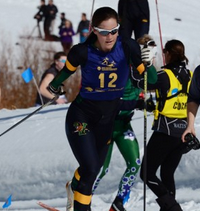

There are few things in skiing more important than knowing physical limits of one’s own body. Just ask Patrick Weaver, head coach of the 2012 NCAA Champions at the University of Vermont.
“More often than not, we find when we get to a race people don’t know how to listen to their body and go out at the right pace,” he said. “The common mistake is they go out too hard and then the second lap comes around and they fall apart.”
To address this pitfall, Weaver started his athletes on negative split interval workouts three years ago. The format is exactly what it sounds like: complete a set course a bunch of times and go faster with each passing interval.
“The whole focus is to start more controlled and still go out at a good pace, but get faster every lap,” Weaver said.
His skiers will do between five and six intervals, at six to eight minutes each. The first will start at Level 3 and and the final lap will be at Level 4. The discipline can vary: classic, skate or running with poles, the same principle applies.
Weaver picks rolling terrain for these workouts; on rollerskis, UVM frequently trains on the paved loops at the Ethan Allan Biathlon Club in Jericho, Vt., where “the uphills and downhills are steep enough, and it’s pretty rolling terrain.”
Ever since he began holding negative split workouts at UVM, Weaver says his athletes’ pacing in individual-start races has improved noticeably.
“It seems to have gotten everyone good at listening to their bodies, and it’s reflected in our races,” he said. “Quite often we’re not the fastest in the first lap, but we are in the second lap.”
The proof is also in the final results. In addition to winning NCAAs, UVM topped the team scores at the EISA regional championship and in three out of five regular-season carnivals in 2012. The gains have also been tangible in training. When Weaver first began conducting the workout, “less than half our team could do negative splits,” he said. “Now it’s rare that not everybody is able to do it. Some people think, ‘Oh you could cheat and go super slow,’ but we don’t really see that. We still see people going out at a good speed.”
Weaver will do the negative split workout four to five times throughout the fall when his athletes are on campus. Once they’re familiar with it, he’ll also send it home for them to do on their own throughout the summer. “When we do paced workouts, we try to do negative splits,” Weaver said.
The greatest benefit to forcing oneself to ski or run negative splits in practice, Weaver says, is that the athlete learns how to be more controlled in the race setting.
“It takes more confidence to go out conservatively than it does to go out hard. A lot of people when they go into a race will go out as hard as they can go,” Weaver said. “It’s still good to go out fast, but this gives you the confidence that maybe when it seems like you’re not pushing it hard, you’re going just as fast.”
The gains from negative split workouts are applicable even in mass starts races, when the pace at the front of the pack is at the mercy of the other leaders.
“It helps teach you to listen to your body and where it’s at,” Weaver said. “At the end, what are your limits?”

Leave a Reply
You must be logged in to post a comment.