From the FasterSkier archive — posts syndicated from athletes’ and coaches’ own blogs between 2004 and 2012, kept online as published. Current coverage is at fasterskier.com.
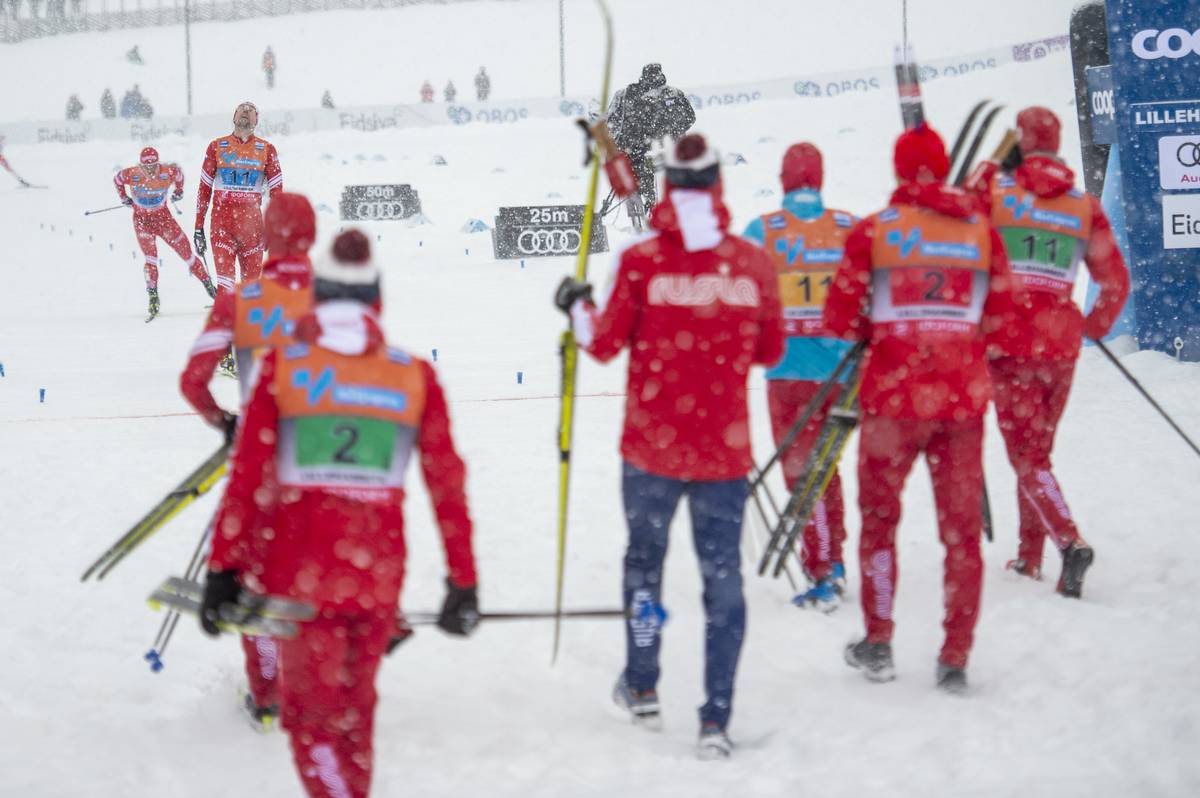
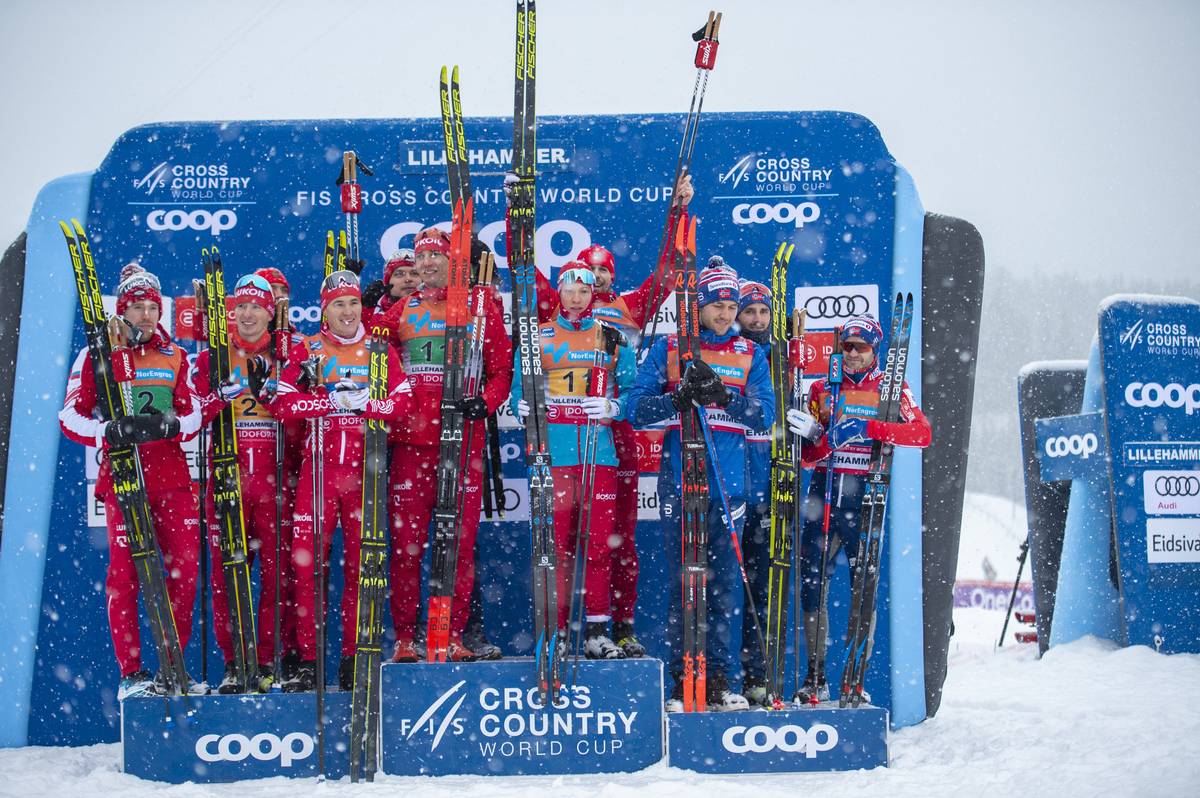
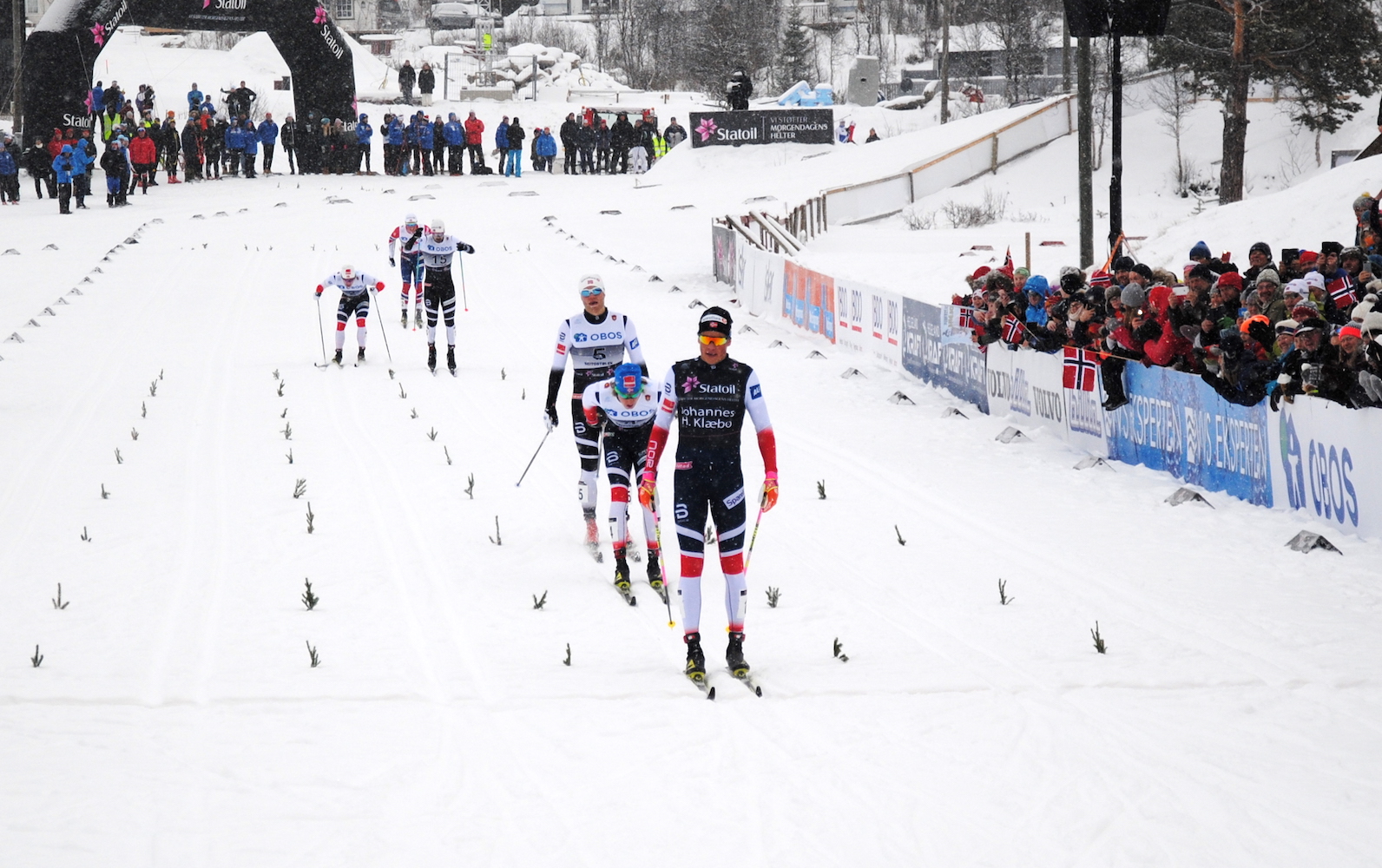
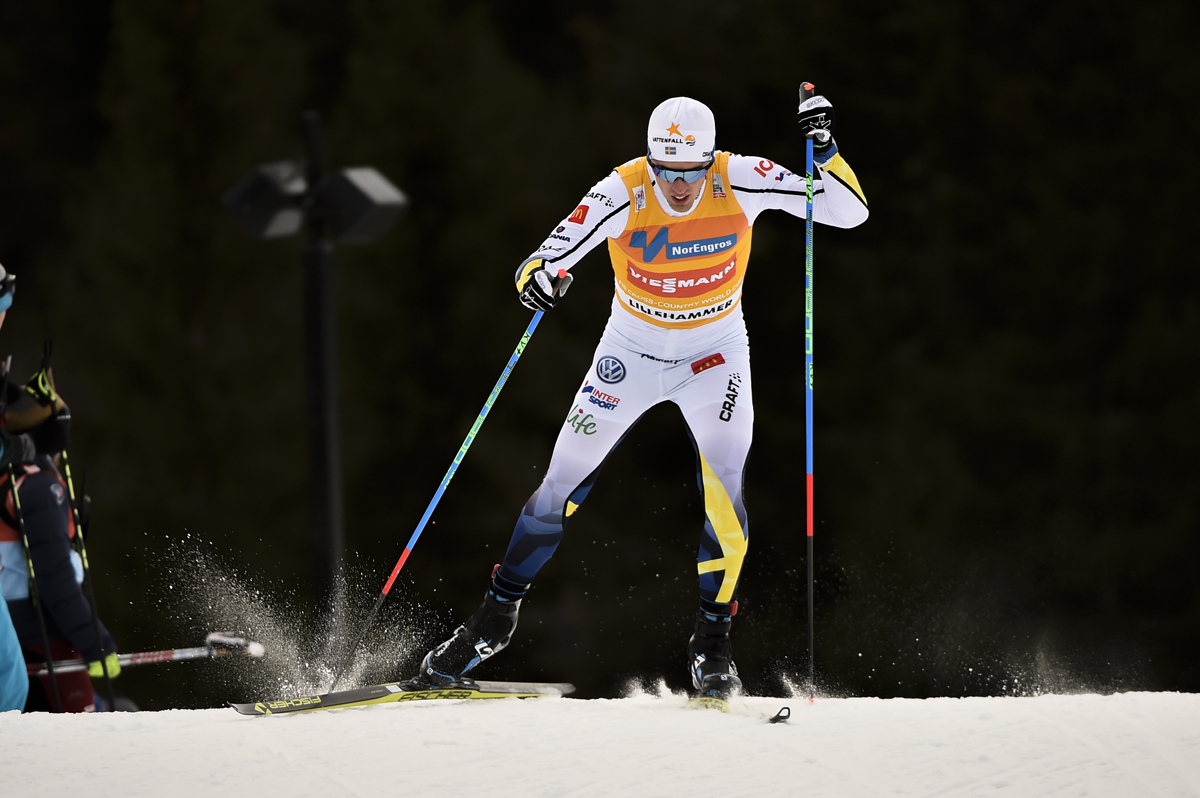
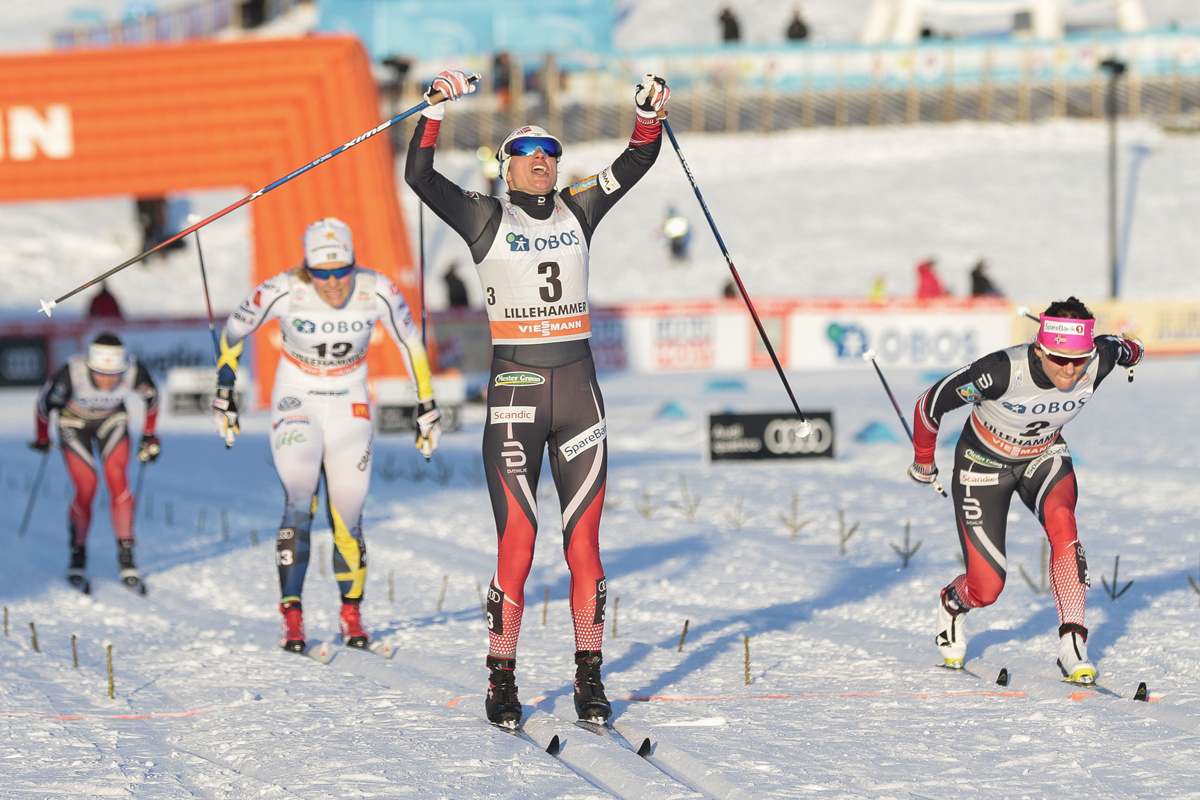
Russia soaking it in as they take 1-2 in the 4 x 7.5 k relay in Lillehammer, Norway. (Photo: NordicFocus)
Call it what you want: national pride, national bias, flag-waving: the team relays elicit nationalistic tendencies. In Lillehammer, Norway, you might think and maybe expect it’s your birthright to see the hometeam crush. That’s been the recent norm almost without exception.
Here’s the quick stats to either dispel or reinforce those tendencies: Norway has won nine of the last 11 relay races on the World Cup. Russia won the other two. In fact, Russia took first and second, Norway third in the last head-to-head 4 x 7.5 k match last season in Ulricehamn, Sweden. Throwing Norwegian dominance back into the equation, Norway has won five of the last six relays on home snow.
On paper, at least for Norway, some big names were missing from their team lineups. No No Emil Iversen. No Johannes Høsflot Klæbo. No Martin Johnsrud Sundby. That trio finished third, fourth. and fifth in Saturday’s 30k skiathlon. Add to that Didrik Tønseth who was busy representing Norway at the European Cross-Country Running Championships.
But Norway is deep with talent. As is Russia. For those keeping score, you’ll see no Alexander Bolshunov featured on either of the Russian teams — he won the skiathlon yesterday. That all said, in a non-championship year maybe it’s a time to tinker and experiment. Here were the teams holding the most podium potential.
Norway I: Pål Golberg, Hans Christer Holund, Sjur Røthe, Finn Hågen Krogh
Russia I: Andrey Larkov, Ilia Semikov, Denis Spitsov, Andrey Melnichenko
Russia 2: Ivan Yakimushkin, Evgeniy Belov, Ilia Poroshkin, Sergey Ustiugov
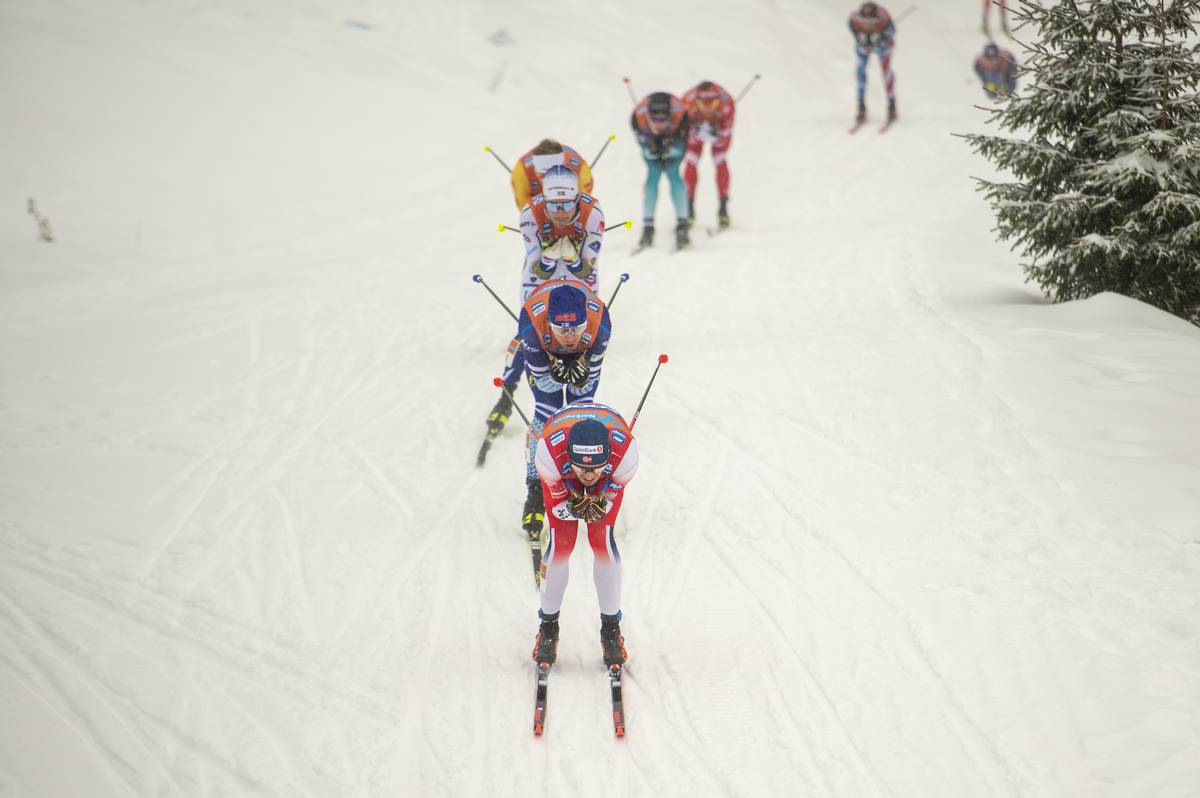
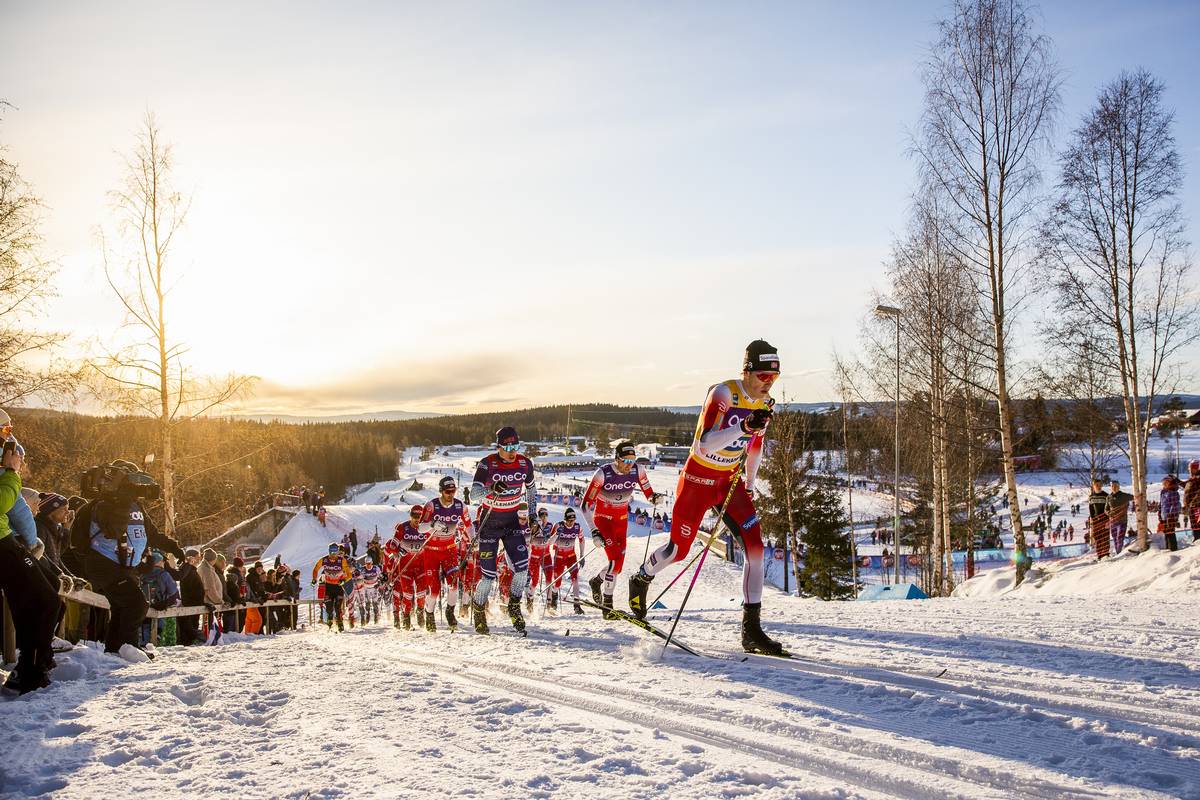
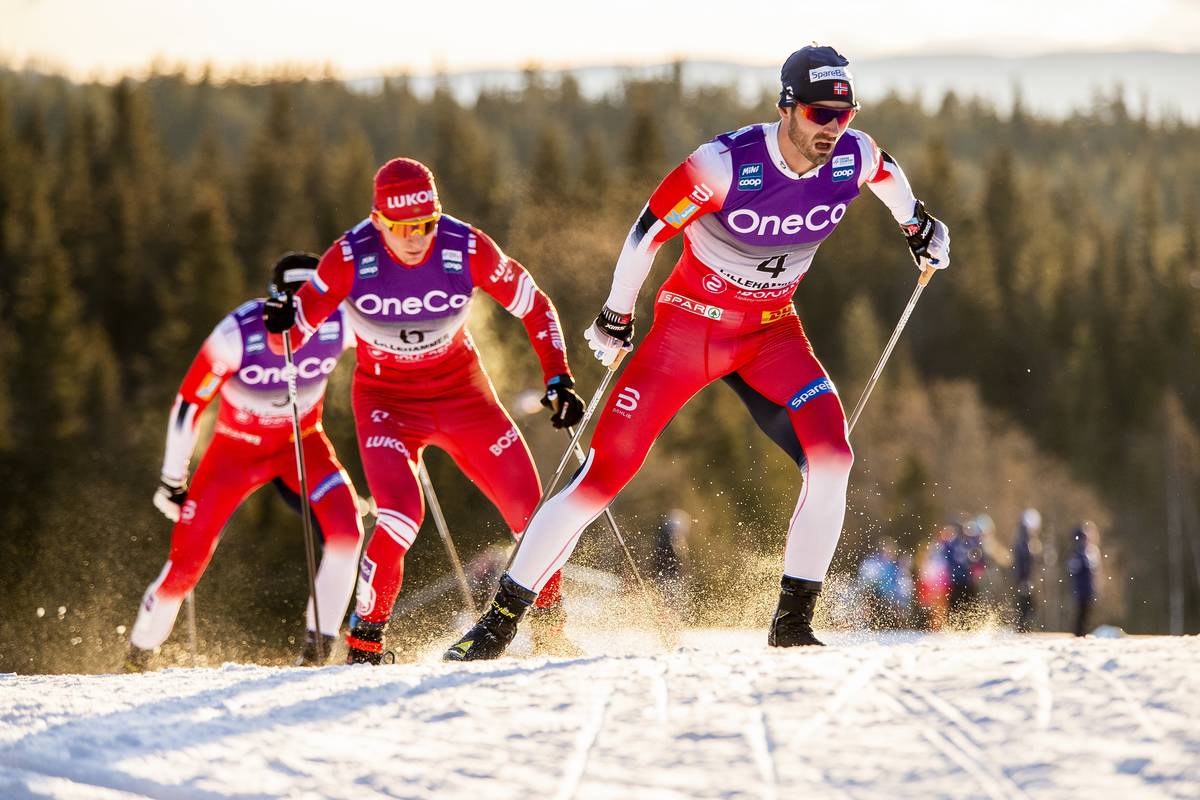
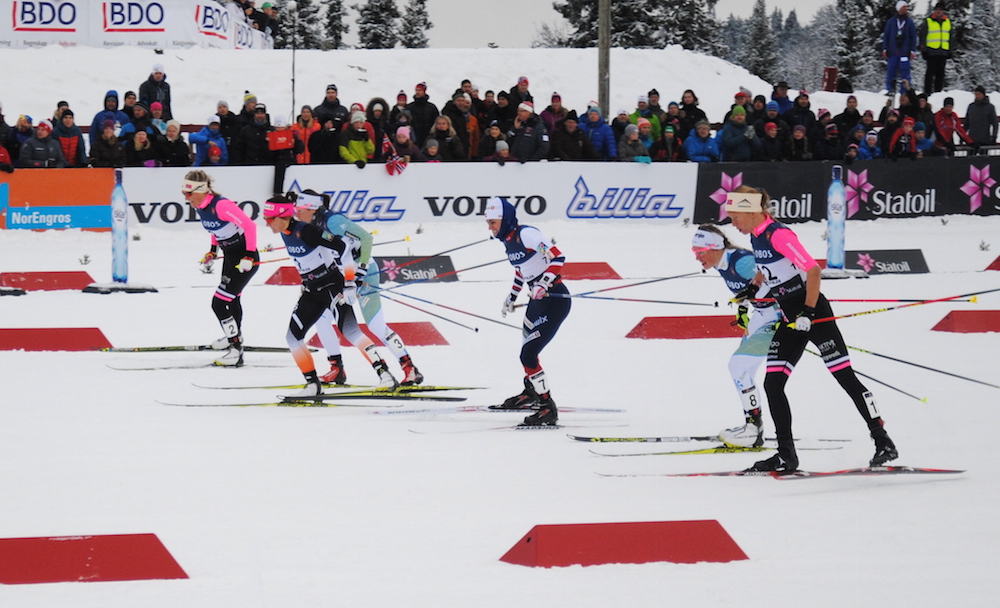
Pål Golberg (NOR) leading the pack during the scramble leg of the 4 x 7.5 k relay in Lillehammer, Norway. (NordicFocus)
The first tag, after 7.5 k, Russia I pulled through first, with Norway I and Sweden right behind. Russia II was 10.5 seconds back, Finland 15.5, the U.S. 17.0, and Norway II dangling 19 seconds off the lead.
As the classic legs ended at 15 k, the race was more about who was falling off out of contention, rather than a team up front making any decisive gesture for a kill shot. Finland came through first, with Russia II next (+0.4), then Norway I (+2.2), Russia II (+9.7), Norway II (+10.5), and Germany (+15.0).
The next closest team was Sweden, roughly twenty-nine seconds arrears in seventh place. At that point, the U.S. team of Erik Bjornsen, David Norris, Scott Patterson, and Kevin Bolger were in ninth (+1:13.7) and racing in a no-man’s-land with a sizable gap to France in eighth and Kazakhstan drifting back in 10th.
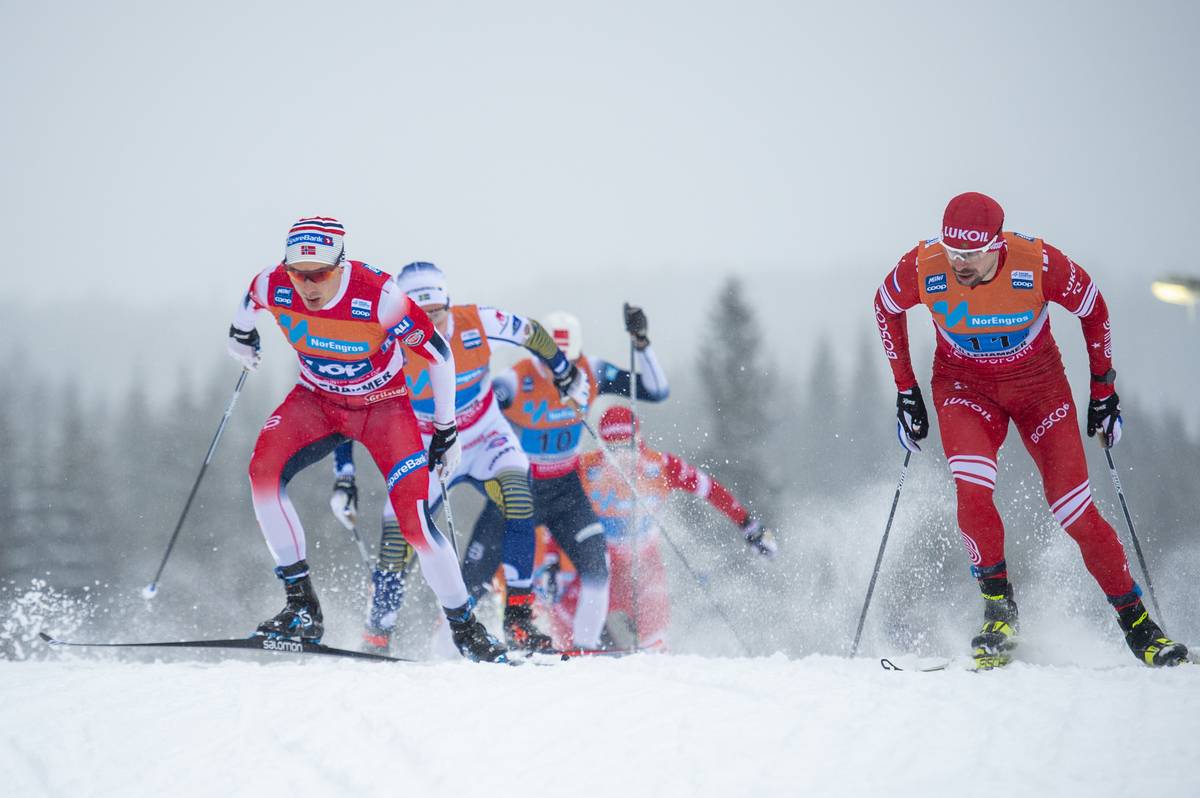
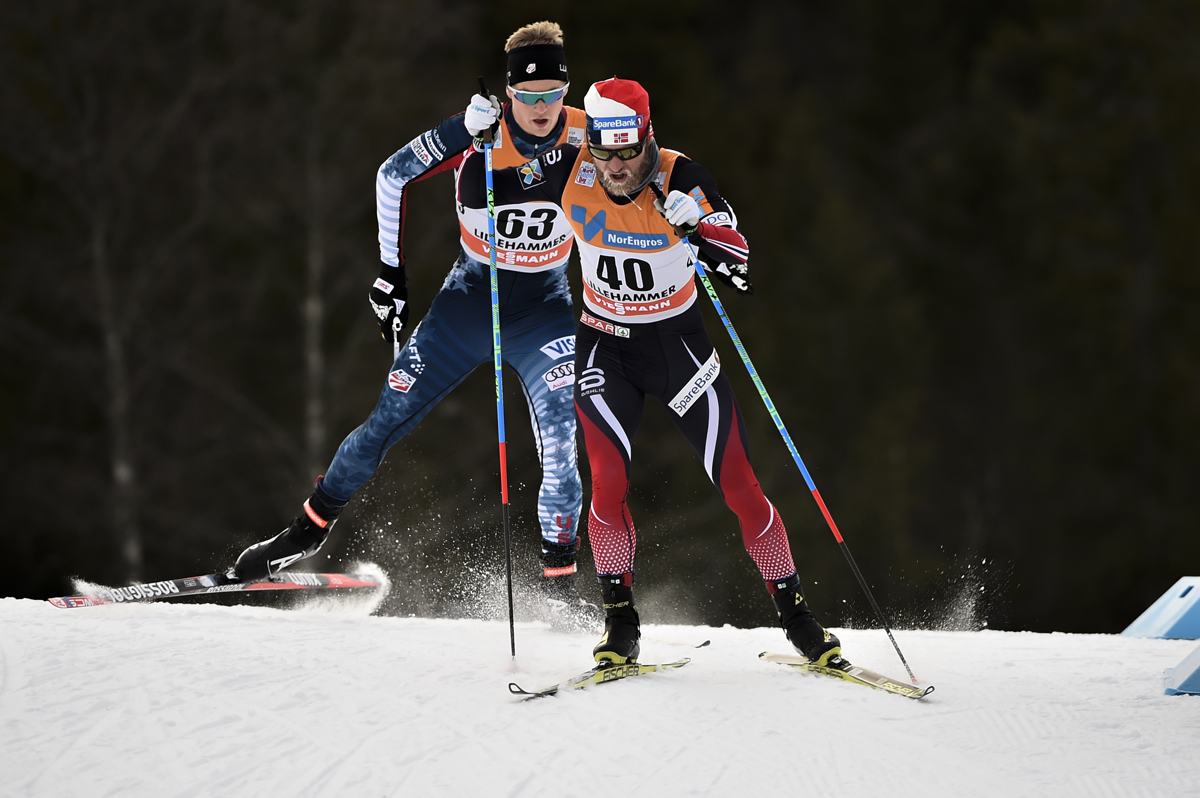
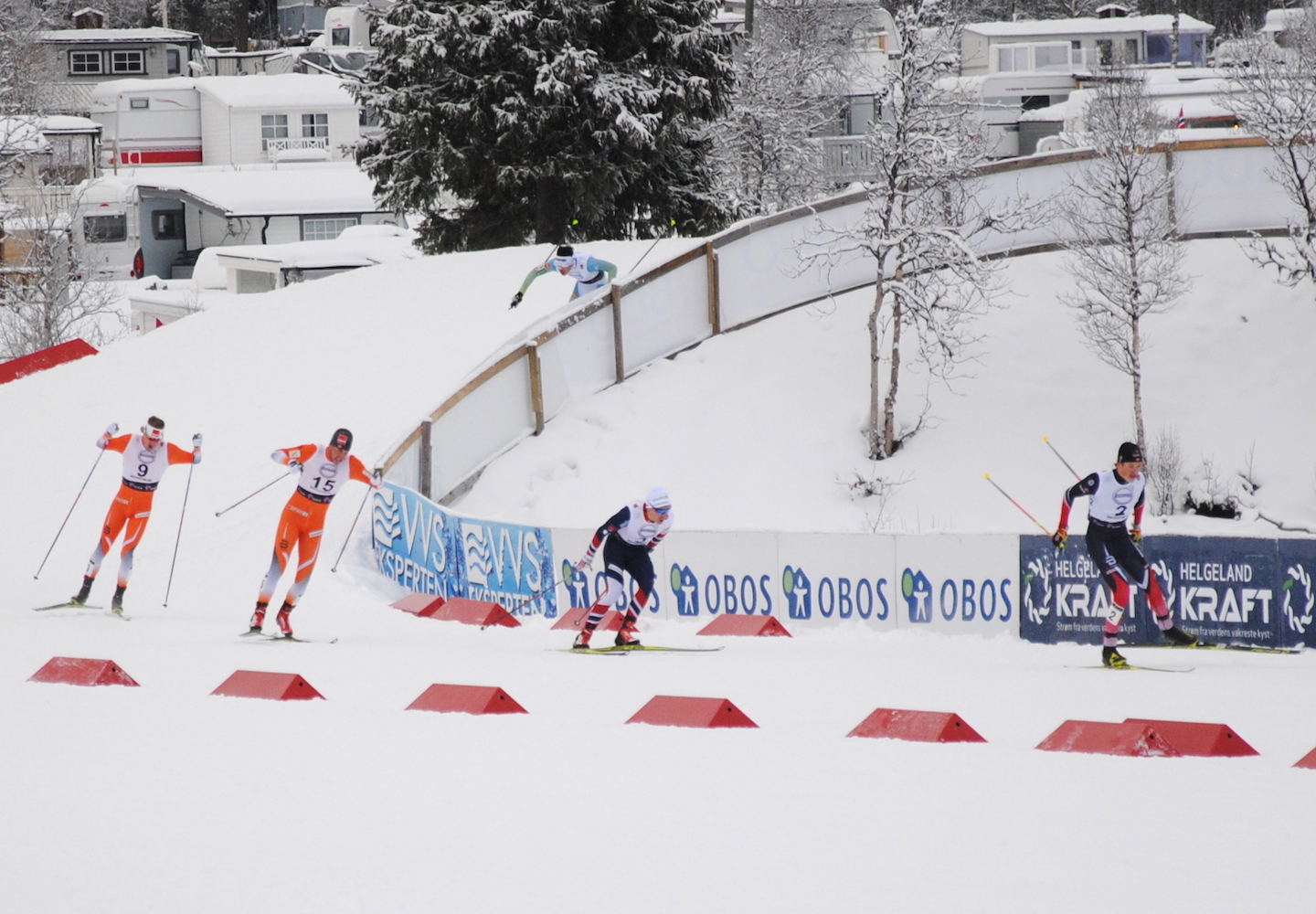
Simen Hegstad Krüger (bib 10) during the 4 x 7.5 k relay in Lillehammer, Norway. (Photo: NordicFocus)
The race began to look a tad spicy for Norway around the 21.2 k mark, nearly an hour into the race. Krüger for Norway II, a sometimes peerless skate skier at that, put his stamp on the affair as he powered ahead on the course’s most prominent climb. Norway I’s Røthe followed Krüger in step. And Sweden’s Jens Berman kept pace as well. The real tease was that Russia I (Spitsov) and Russia II (Poroshkin) appeared cooked as were their team’s chances for anything but third place.
But, it’s a four chapter race. And the fourth leg coalesced into a five team scrum by 25k. Both Russian teams, the Norwegian squads, and Germany were all in it. We should note that Ustiugov, tagged 15 seconds back at the exchange, looked impressive shutting down that gap as he reeled in the lead groups.
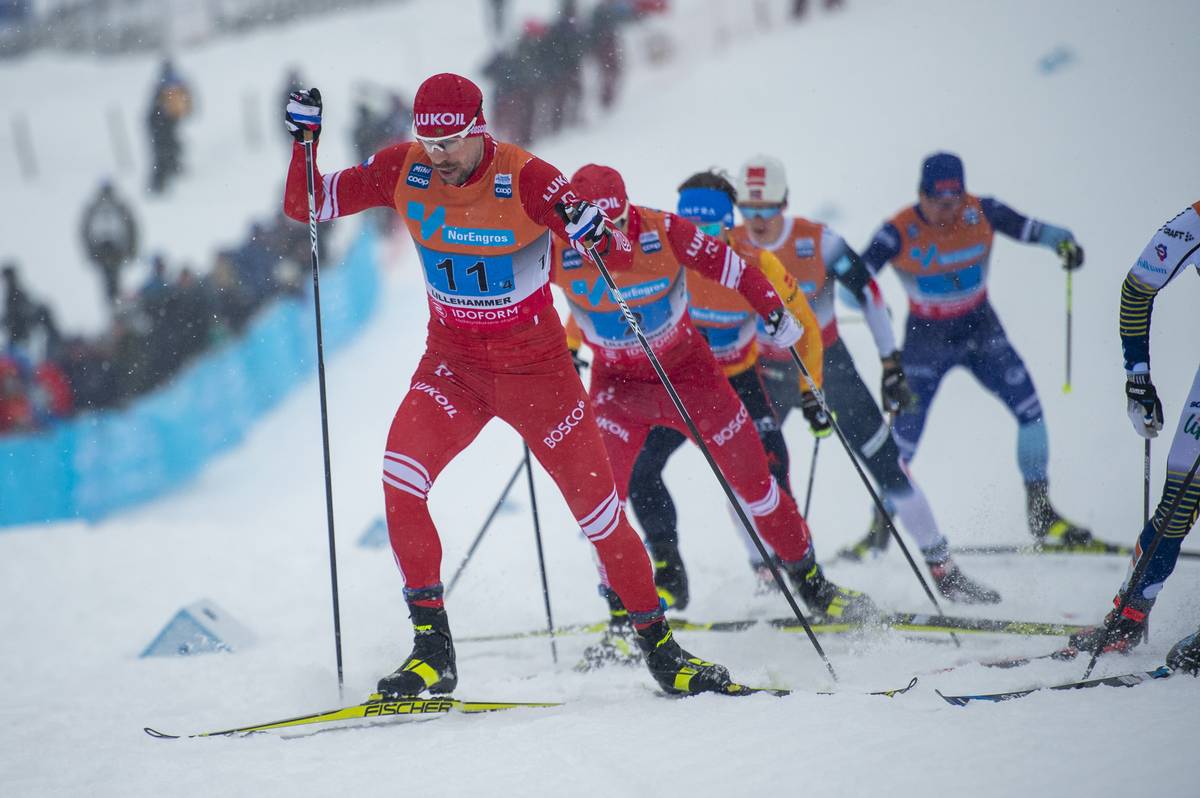
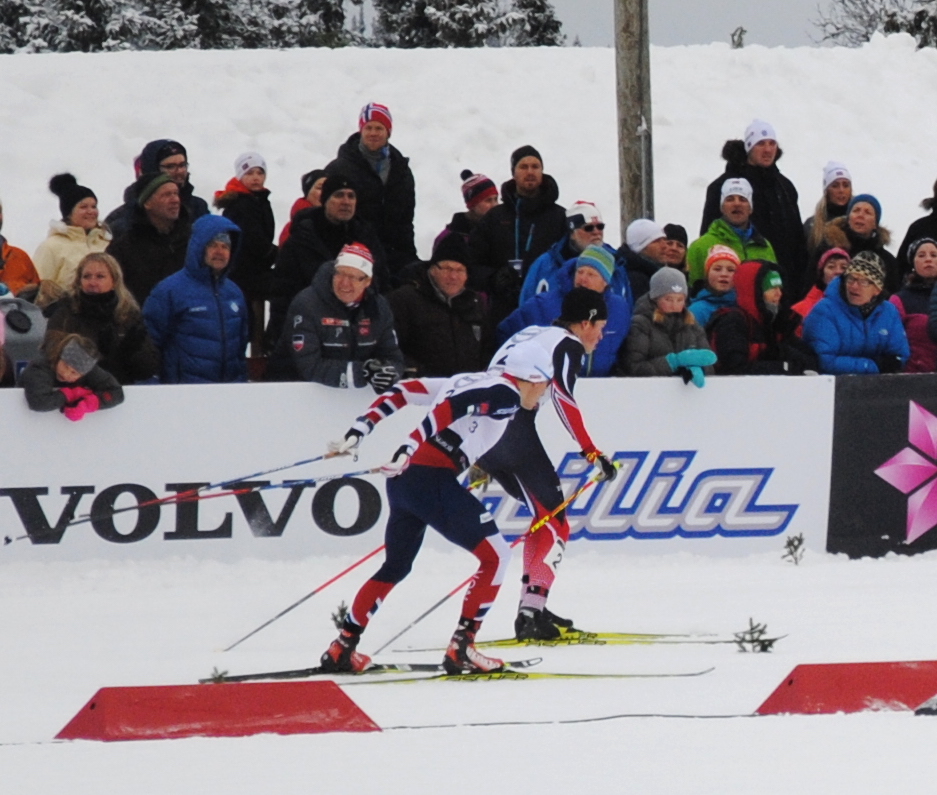
Russia’s Sergey Ustiugov (right) showing his solid form during the men’s 4 x 7.5 k relay in Lillehammer, Norway. (Photo: NordicFocus)
The racing scene’s old friend, Ustiugov, went to the front and eventually shut down the pace. It wasn’t exactly a crawl. It was Ustiugov revealing his tactical hand: wait until punishing terrain, and throw down a punishing push.
But it was Melnichenko for Russia I who made that move. Ustiugov kept pace and pulled through not long after Melinchenkov separted. Ustiugov looked like vintage Ustiugov: a full-body, all-in-it, furnace of power.
Sergey Ustiugov of Russia taking control during the 4 x 7.5 k relay in Lillehammer, Norway (Photo:NordicFocus)
And that was it. Norwegian dreams were snuffed, Russian dreams realized.
Russia I won in 1:26:46.8 hours. Russia II took second (+1.3), and Norway I third (+8.9). Norway II lost the toe-to-the-line finish by placing fourth (+9.0).
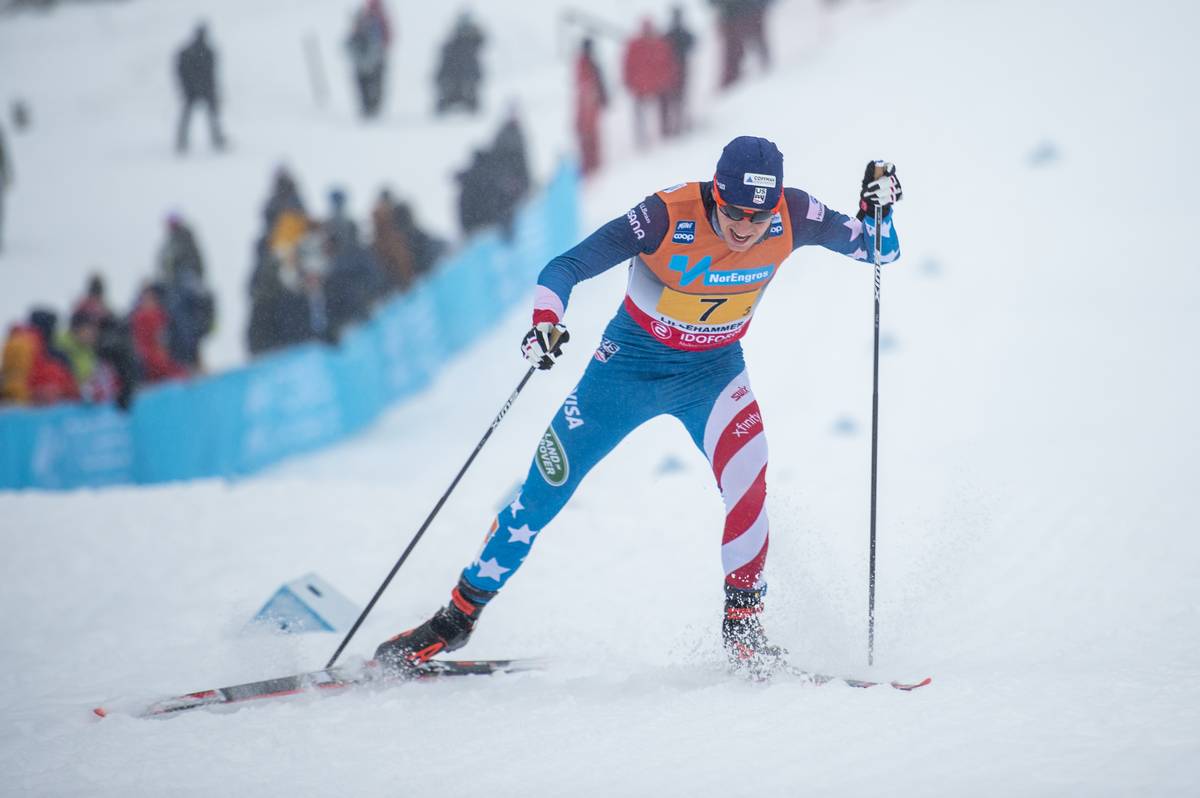
The U.S. team skied to ninth place, 3:33.3 minutes back. U.S. World Cup Coach Matt Whitcomb explained in an interview that relay racing is often a “game of contact and if contact is lost the race is often lost.” The U.S. did lose contact. It remained a relay for the U.S. bright moments and the reality of skiing solo for a few legs. (In the interview below, Whitcomb also notes the thrill of watching an emerging Chinese program finish the men’s relay in a non-championship event.)
Matt Whitcomb post-race interview
Closing out the day on the race course was China. They placed 11th (+12:44.6). Making note that the 2022 Olympics will be hosted by China, it will be interesting to see how this team develops.
Scott Paterson of the U.S. Ski Team during the third leg of the 4 x 7.5 k relay in Lillehammer, Norway. (Photo: NordicFocus)
Scott Patterson post-race interview
Kevin Bolger during the 30k skiathlon in Lillehammer, Norway. (Photo: NordicFocus)
Alexander Bolshunov takes the men’s 30 k skiathlon win in Lillehammer, Norway. (Photo: NordicFocus)
Norwegian countryside just as you imagine: farms, pine trees, a deep snow-blanket, and fast skiing. All this was on display under a bluebird sky in Lillehammer, Norway for the men’s World Cup 30-kilometer skiathlon. Amidst this legacy-backdrop, the beauty of a dual technique race with enough grinding Ks to string out and decimate an impressive field played out.
Fifteen kilometers in, at the ski exchange from classic to skate, nine skiers were separated by 6.5 seconds — Jens Bruman of Sweden to Russia’s Sergey Ustiugov. Sandwiched in there were all the names you’d expect: Norway’s Johannes Høsflot Klæbo, Emil Iversen, and Hans Christer Holund, along with Alexander Bolshunov of Russia, and Iivo Niskanen of Finland. Dangling 20 plus seconds from that group was Sjur Røthe and Martin Johnsrud Sundby, also from Norway.
Johannes Høsflot Klæbo of Norway leading the classic train during the early moments of the 30 k skiathlon in Lillehammer Norway. (Photo: NordicFocus)
The 30 k skiathlon is an exercise in power application, raw fitness, and technique efficiency bundled into a roughly one hour and twenty-minute sport spectacle.
Iivo Niskanen (FIN), Emil Iversen (NOR), Johannes Hoesflot Klaebo (NOR), during the skate leg of the 2019 30 k skiathlon in Lillehammer, Norway. (Photo: NordicFocus)
Johannes Hoesflot Klaebo (NOR), Iivo Niskanen (FIN), Emil Iversen (NOR), Hans Christer Holund (NOR), Sjur Roethe (NOR), Alexander Bolshunov (RUS), Perttu Hyvarinen (FIN), Jens Burman (SWE), Andrey Larkov (RUS), Sergey Ustiugov (RUS), (l-r) during the 2019 30 k skiathlon in Lillehammer, Norway. (Photo: NordicFocus)
By 17.4 k, atop the course’s major climb, Holund pulled Iversen and Bolshunov along for a clean break from any would-be podium spoilers. Fast forward to the closing moments of the race and the last trip up the big ascent in Lillehammer and Holund remained the workhorse. He chugged along, setting the pace up front. Iversen fell off slightly on that climb, dangling five seconds back.
Hans Christer Holund (NOR) leading Alexander Bolshunov (RUS) and Emil Iversen (NOR) during the skate leg of the 2019 30 k skiathlon in Lillehammer, Norway. (Photo: NordicFocus)
On the final punchy hill before the descent and sweeping turns into the stadium, Bolshunov attacked with an unmatchable V1. He crossed the line for the win in 1:17:42.4 hours with Holund in second, 2.2 seconds back. Iversen placed third (+7.9).
“I am still not in the best shape that I could be,” Bolshunov told FIS after the race. “It was the same as in Seefeld where I followed Hans Christer Holund but could not manage to take him. I am happy that I managed that today.”
Klæbo skied to fourth (+57.4) with Sundby in fifth (+57.7). It was Sundby’s first time not on a World Cup skiathlon podium over a seven race span. Klæbo won this event in Lillehammer with panache back in 2017 as he gapped Sundby near the finish marking a changing of the guard on the men’s Norwegian National Team.
Saturday, Norway captured second through sixth place, including 12 skiers in the top-20. As a home race for Norway and additional starts allocated for the host nation, the Lillehammer field was exceptionally deep with talent.
For the U.S., David Norris (APU) just missed the points finishing in 34th (+4:39.7). According to FIS, this was Norris’ second World Cup skiathlon. He also raced the skiathlon at the 2018 World Championships where he placed 38th. Outside of Erik Bjornsen, who finished just behind Norris in 39th today (+5:12.7) and scored in the points twice last weekend, Norris has been the top distance skier for the U.S. this season.
“I think it was a good step forward from Ruka,” Norris said after the race. “I felt like I had better energy and the points of the race where I was struggling. I just did a better job of pushing through those minutes and maintaining my form, technique, and tempo.”
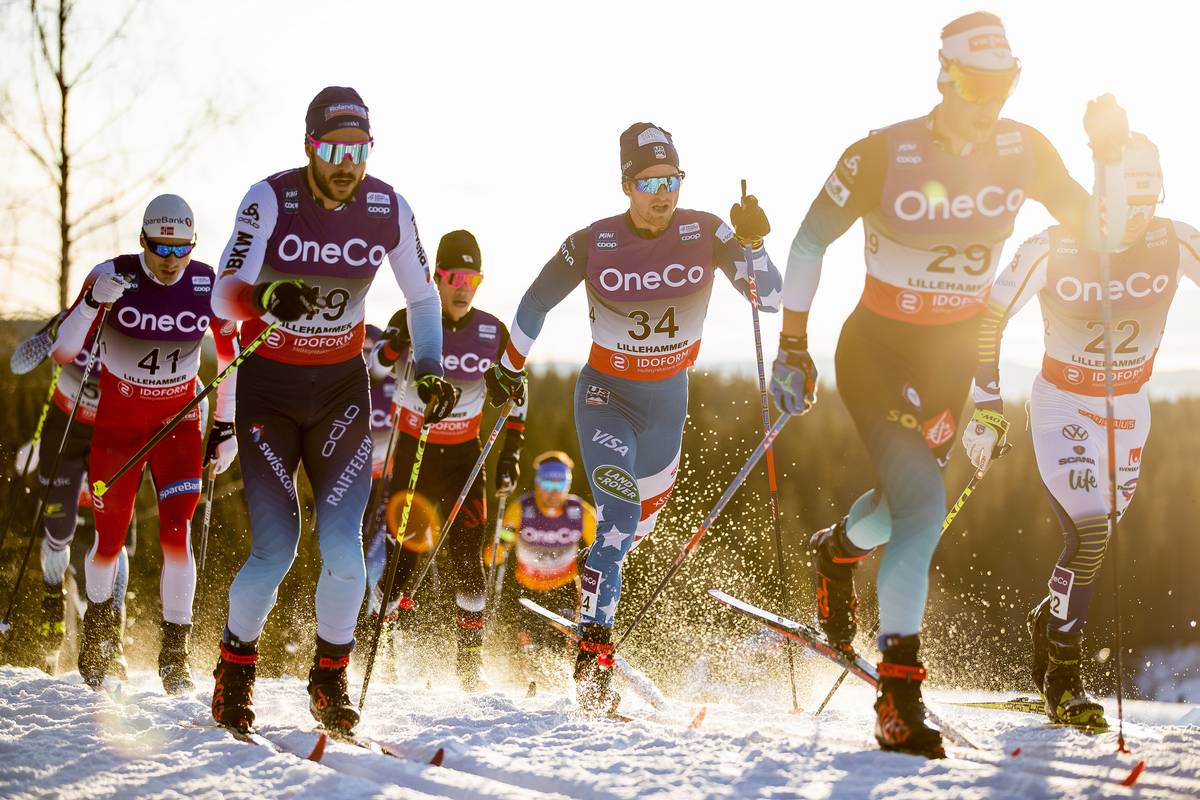
David Norris (bib 34) was the top American placing 34th in the 2019 30 k skiathlon in Lillehammer, Norway. (Photo: NordicFocus)
Post-race interview with David Norris
Coming into the ski exchange, Norris and Bjornsen skied in with a cluster ranked 28th through 36th — with Bjornsen in 28th, Norris in 32nd.
Bjornsen was disappointed with his day. He said post-race that he began to lose kick on the second of the classic ski laps and could not find his best sensations throughout the race. In 2017, Bjornsen placed 20th in Lillehammer’s World Cup 30 k skiathlon.
Erik Bjornsen during the classic leg of the 2019 30 k skiathlon in Lillehammer, Norway. (Photo: NordicFocus)
Erik Bjornsen during the skate leg of the 2019 30 k skiathlon in Lillehammer, Norway. (Photo: NordicFocus)
Post-race interview with Erik Bjornsen
Also for the U.S., Kyle Bratrud (SMST2) skied to 47th (+6:48.1), Scott Patterson 50th (+7:35.2), and Simi Hamilton did not finish. Hamilton has been recovering from a nagging hamstring injury.
Andrew Musgrave of Great Britain pulled himself into the top-20 during the skate leg to finish 18th overall (+3:02.9). (You can hear an extended interview with Musgrave posted below.
Andrew Musgrave of Great Britain placed 18th in the 30 k skiathlon in Lillehammer, Norway. (Photo: NordicFocus)
Post-race interview with Andrew Musgrave
Racing continues tomorrow with the 4 x 5 k, and 4 x 7.5 k relays for the women and men respectively.
Tara Geraghty-Moats won the Nordic Combined Continental Cup in the previous season and is set to be a podium contender for the overall standings in this year’s cup as well. Now she finds herself in Lillehammer ready to jump in this weekend’s World Cup. FasterSkier met up with her to hear her thoughts on training, what it’s like to compete at her level and the future of nordic combined for women.
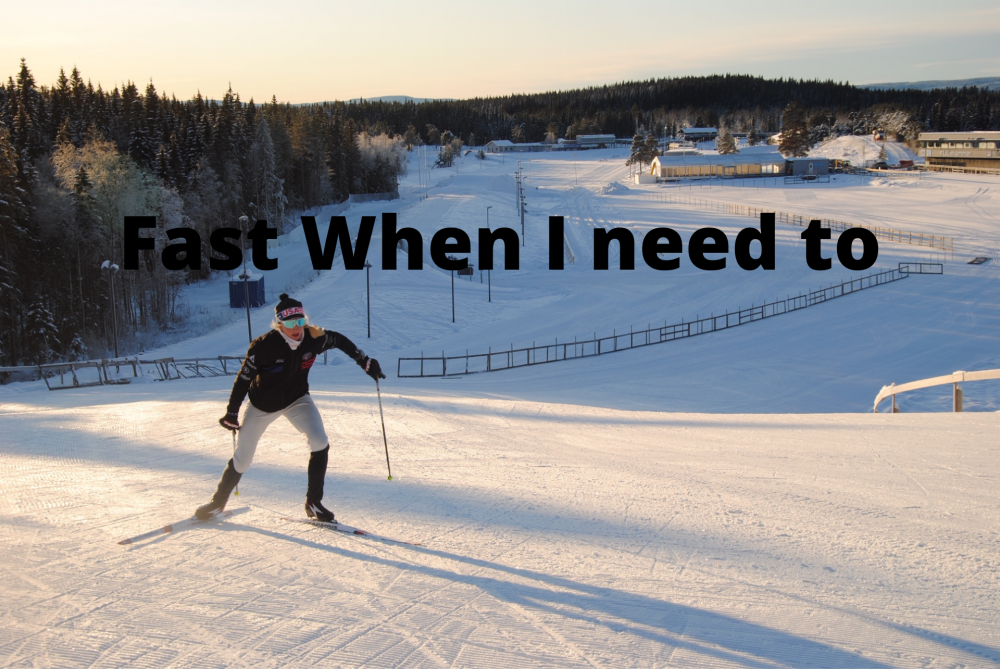
Today, a Monday, she opted for a 7×1 minute hill intervals up the first hill on Lillehammer’s course. This particular hill is the first challenge the skiers tackle as they race the 1994 Winter Olympics. Some 15-25 seconds after the gun goes off, the skiers will find themselves battling it out on the steep hill, which offers a slight break midway through. This break, however, does not offer much of a pause, as Geragthy-Moats’ heart rate will tell you. one hundred and ninety seven beats per minute during her intervals places her just over 96 % of her tested max of 205 and sent her lactate level relatively high above threshold levels. Anyone with knowledge of sports physiology knows what this means: your muscles will be sore.
“Fast when I need to”
Geraghty-Moats explains why she puts herself through a workout like this by saying “the idea is to install a super-boost in your legs”. This top gear, as she also calls it, is something she’s been working on this year. When asked about her workout of the day and why she did it, she explains: “so if I’m skiing in a pack I’ll be able to sprint away from the pack and make a clean break, something that’s really useful in mass-start racing and the nordic combined pursuit format.”
She goes on to say that she’s hopefully in good shape, with good endurance and good conditioning for a race and that “this is sort of the cherry on top of my conditioning for the year, where I’m trying to get my speed up so I have the ability to go fast when I need to.”
How do you feel like a workout such as this one prepares you for an upcoming race?
“Basically those one minute sprints are sort of warming up my engine and making sure that my legs can move quickly, I feel pretty in shape and I feel in good condition this season but that doesn’t necessarily mean you’re ready to race so this is sort of the last prep to race, also for me I have to balance between ski jumping and Nordic skiing, so I have to focus on quality over quantity.”
And how are you able to improve on both?
“For me, the most effective way is to take training blocks where I focus on jumping and different training blocks where I focus on skiing.”
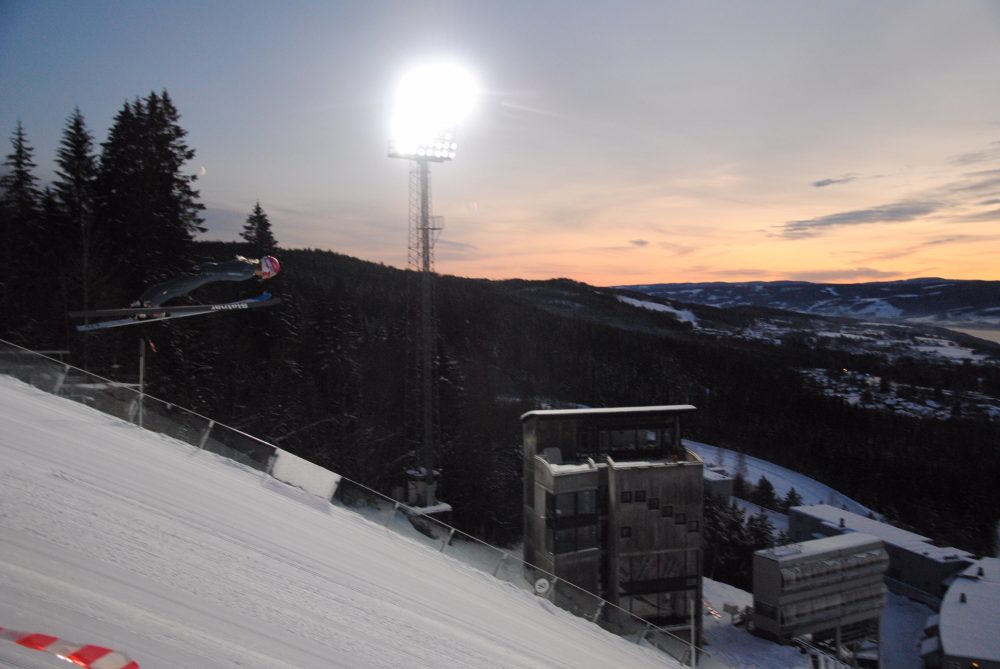
Tara Geraghty-Moats flying off Lillehammer’s HS140 as she prepares for the new season of racing. (Photo: Aleks Tangen)
The training block for this week started with seven sprints in the morning and seven jumps off the big hill (HS140) in Lillehammer. When it comes to deciding what to do in training, Geraghty-Moats considers her competitions. She writes her own training plans and explains that she has an overall plan, which stretches for 2-3 months. As she gets closer to competition, she specializes her sessions. When asked about how she factors in yesterday and tomorrow when deciding what to do today she says: “I decided to do my longer intervals yesterday and shorter intervals in the morning and then have some rest and get ready for jumping. But really I look at when my competitions are and when I’m going to want to be feeling fast and good and then build sort of backwards from there.”
She explains that an important aspect to this process is knowing how long it takes to recover and how long it takes for the intervals to have an effect on overall skiing speed. On December 13-15, the Continental Cup comes to Park City, Utah and the effect she speaks of will show if things are going according to her plan or not.
Below is a lightly edited and condensed version of an interview with Geraghty-Moats.
Aleks Tangen: For your workout today what were you doing?
Geraghty-Moats: So today I was doing one minute sprint intervals something I’ve been working on a lot of this year is really just improving my Top Gear so if I’m skiing in a pack I’ll be able to sprint away from the pack to make a clean break something that you really useful in mass start racing and the nordic combined pursuit format
AT: The reason why you’re doing your workout like that at this time of year is because you want to be able to sprint past the other racers?
G-M: Hopefully with this year’s training I’m in pretty good shape, I have pretty good endurance, good conditioning for a race and this is sort of the cherry on top of my conditioning for the year where I’m trying to get my speed up so I have the ability to go fast when I need to. And I was doing it on the hill, obviously it’s a little bit harder there, where are you get a lot more lactic acid in your legs and preparing my body for that really helps when I’m in a race where I’m already going fairly hard and have to put on the gas and really sprint.
AT: How do you feel like a work out such as this one prepares you for an upcoming race?
G-M: Those one minute sprints are sort of warming up my engine and making sure that my legs can move quickly I feel pretty in shape and I feel in good condition this season but that doesn’t mean necessarily, that you are ready to race. So this is sort of the last prep to race, also for me. I have to balance between ski jumping and nordic skiing. So I have to focus on quality over quantity. Yesterday, I did an interval session, ideally I would do another hard session if I was simply a nordic skier. But today doing a shorter interval session, my body is already tired from yesterday, I don’t have to ski for so long, I don’t have to do so many laps. I still get the training affect, and I still have the hours where I have time to jump and I can feel fresh for the jumping I’m doing later.
AT: It’s a Monday, you’re competing this weekend, what factors playing into doing this particular kind of workout?
G-M: This week I’m actually just competing in ski jumping World Cup, so I’m trying to get a good number of intensity workouts done early in the week so by the time the weekend rolls around I am pretty fresh. I’ll probably do some weights and plyometric workouts on Wednesday and Thursday to get my legs fresh and activated for jumping. But at the same time I still need to stay in shape for cross-country skiing, which will be the weekend after next, in Park city Utah, so yeah it’s always a balance with nordic combined, because you really want to be the best at both sports so you have to stay on top of everything, but also not overextend yourself.
AT: For a workout like this one, how do you structure the warm up?
G-M: For me warm-ups are really important, especially with one minute intervals, because if you’re not warmed up properly first of all you can’t really go that fast and second of all it’s a really big shock to your system, you can get sick or the lactic acid floods your system so you can’t do as many sets. I usually ski between 20 and 30 minutes for warm-up. I start pretty slowly and then I do 3 x 3 min. level III, threshold intervals, before I start the sprint – all out work out – so that gets my system going.
Tara Geraghty-Moats training in Lillehammer, Norway. (Photo: Aleks Tangen)
AT: Considering you are sprinting up the hill, it’s kind of tough, how do you prepare yourself mentally for such a work out?
G-M: Actually, I really like these workouts because they’re pretty quick, and I just enjoy going fast on skis, it’s fun for me. I just look forward to it. It’s kind of easy on a day like this when the conditions are perfect. I have the whole stadium to myself. I mean I don’t really need much motivation, and physically it’s nicer when I’m fresh and not tired. But realistically that’s part of the job, some days my legs are just going to hurt a little bit.
AT: How do you feel the workout you did today, what part of your performance does that improve?
G-M: Anything that short is definitely anaerobic, it really helps you deal with anything lactate flooding your system, and just gets your body moving fast. You see a lot of the women especially in skiing have a lot of high tempo even in the longer races and if you’re not efficient at that anddon’t feel comfortable doing that you really have no chance.
AT: Strength training plays an important role in that if you’re strong then it’s easier to maintain high speed and high intensity.
G-M: For me actually it’s important to not do a lot of weight and strength session but make sure the ones that I do are really quality. I don’t necessarily do strength workouts after an interval workout or after a long day. I think that’s another thing most nordic skiers tend to do — they will slide in strength after an session or when they are already tired and it is really important to do strength when you are fresh. It gives you a chance to improve, and really focus on getting stronger, and not just maintaining.
AT: Being in the moment and not necessarily measuring quantity, but doing it as good as possible?
G-M: Right. And I think that’s nordic combine in a nutshell: quality over quantity. Because there’s no way I can train 800 hours like the cross-country girls on World Cup. It is not going to happen it’s not realistic so I have to have a paired down training plan for nordic.
AT: How many hours do you train every year?
G-M: This is actually my first full year of being a true nordic combiner, so I’ll probably do about 480-500 hours so it’s not nothing, but it is not sort of what you would expect of nordic skiers. I think it’s not really comparable, and you have jumping which is a completely different sport from long-distance nordic skiing. They can do somewhere between 700 and 800 or 900 but they don’t do as much explosive and plyometric work which requires a totally different recovery.
Also the time of the day I can do training sessions for jumping but I might not be that tired but I might’ve still been on the hill in training mode for five or six hours on that day because we usually warm up for about 45 minutes and then we are on the hill for an hour and a half and I can go for a ski in the evening and it means that I might be training close to seven hours that day.
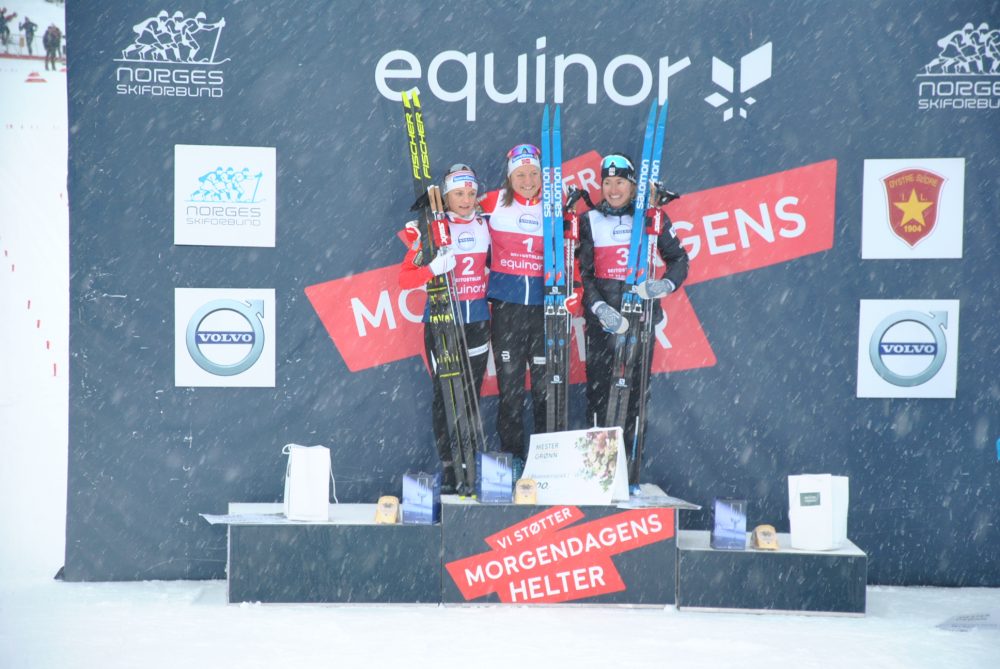
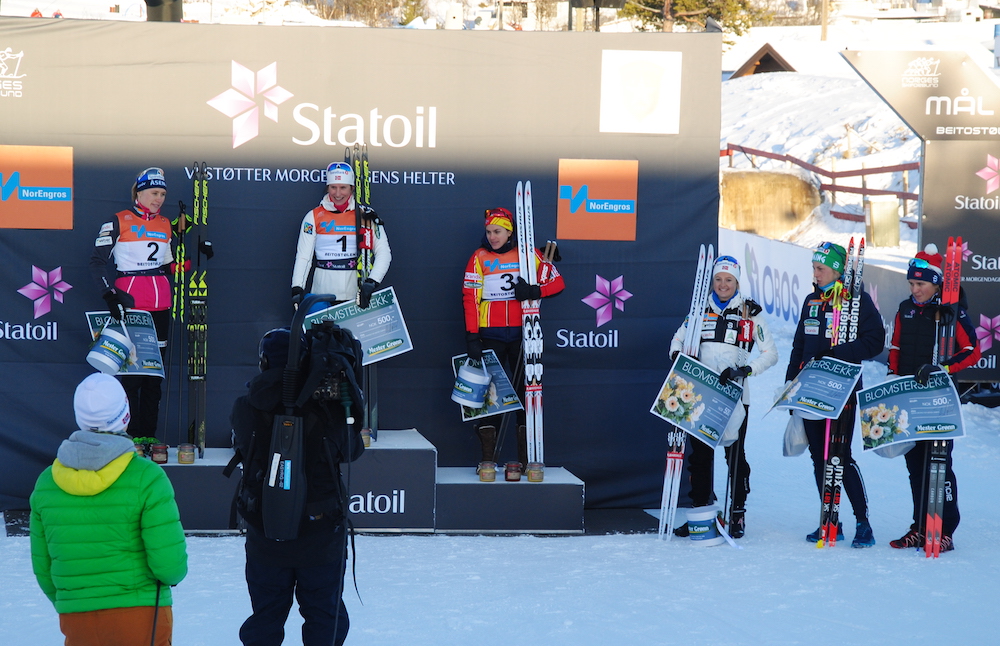
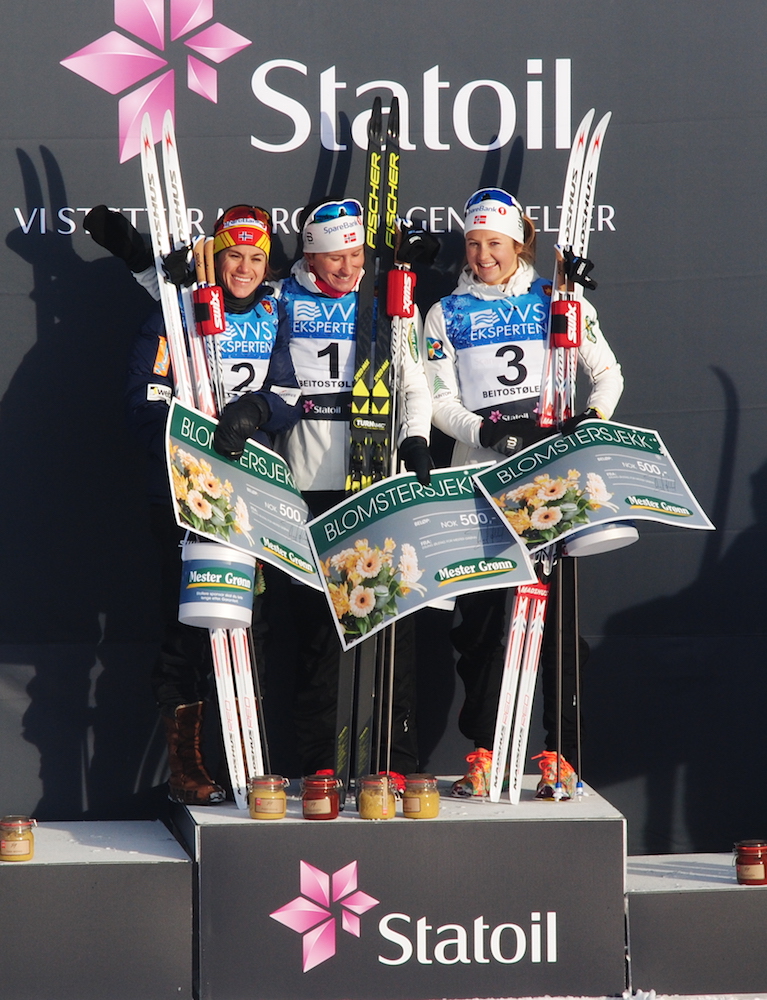
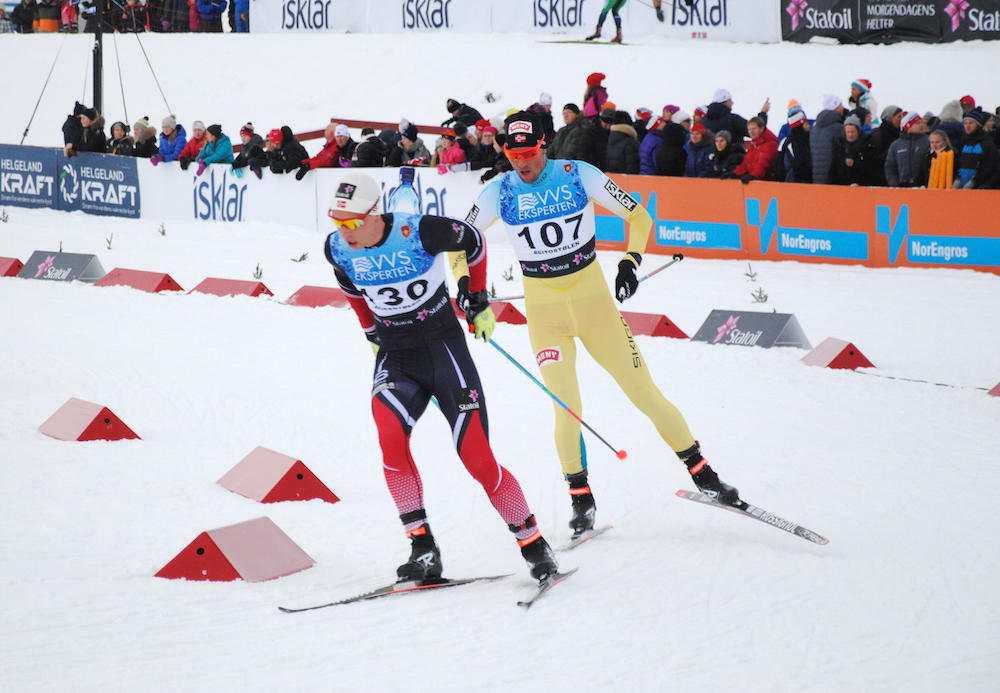
The women’s podium from the 10 k skate in Beitostølen, Norway. Therese Johaug( c) won, Heidi Weng (l) placed second and Helene Marie Fossesholm (r) placed third. (Photo: Aleks Tangen)
Sunday in Beitostølen, Norway the nation’s opening national races concluded with a women’s 10-kilometer freestyle race. The conditions remained as they have for the past few days — near freezing.
The top-three spots were secured by the same skiers who took first through third in Saturday’s 10 k classic: Therese Johaug won in 21:48.0, Heidi Weng placed second (+31.3), and Helene Marie Fossesholm, at 18 years old, placed third (+32.8).
Caitlin Patterson during the Beitostølen, Norway 10 k skate. (Photo: Aleks Tangen)
U.S. Ski Team member Caitlin Patterson skied to 13th overall (+1:33.5). Julia Kern, also of the U.S. Ski Team, was 21st (+2:14.9), and Rosie Frankowski (APU) was 40th (+3:06.1). The World Cup begins next Friday in Ruka, Finland.
The men’s all Norwegian 15 k skate podium. Simen Hegstad Krüger (c), Martin Løwstrøm Nyenget (l) placed second and Hans Christer Holund (r) was third. (Photo: Aleks Tangen)
The third and final day of the Norweigan opening races Beitostølen, Norway — during which the conditions hovered around freezin — saw Simen Hegstad Krüger win the 15-kilometer freestyle in 30:16.4. Martin Løwstrøm Nyenget of Norway placed second (+3.7), and Hans Christer Holund was third (+8.7).
Martin Johnsrud Sundby, having a rough reentry to the racing season, did not finish the race.
The U.S. Ski Team, recently arrived in Norway, used the Beitostølen races as a tune up before starting the World Cup season next week in Ruka, Finland.
David Norris (APU) was the top ranked American in 34th (+1.27.5). Scott Patterson (USST) placed 48th (+1:57.6), Simi Hamilton (USST) 51st (+2:02.8), and Kyle Bratrud (SMS T2) 60th (+2:21.2).
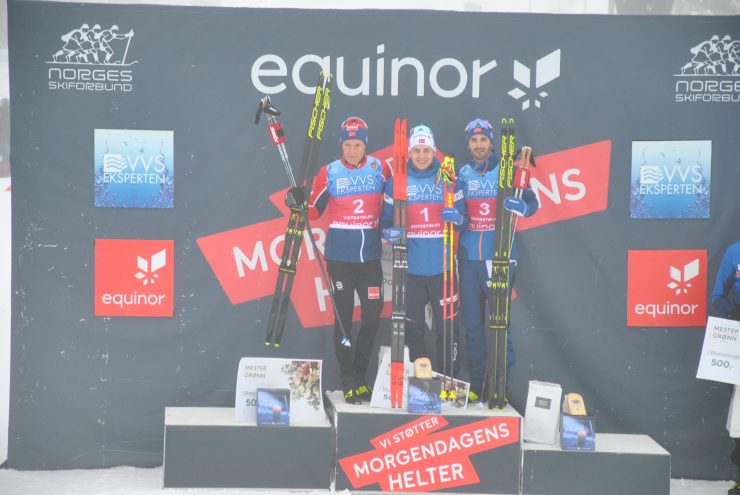
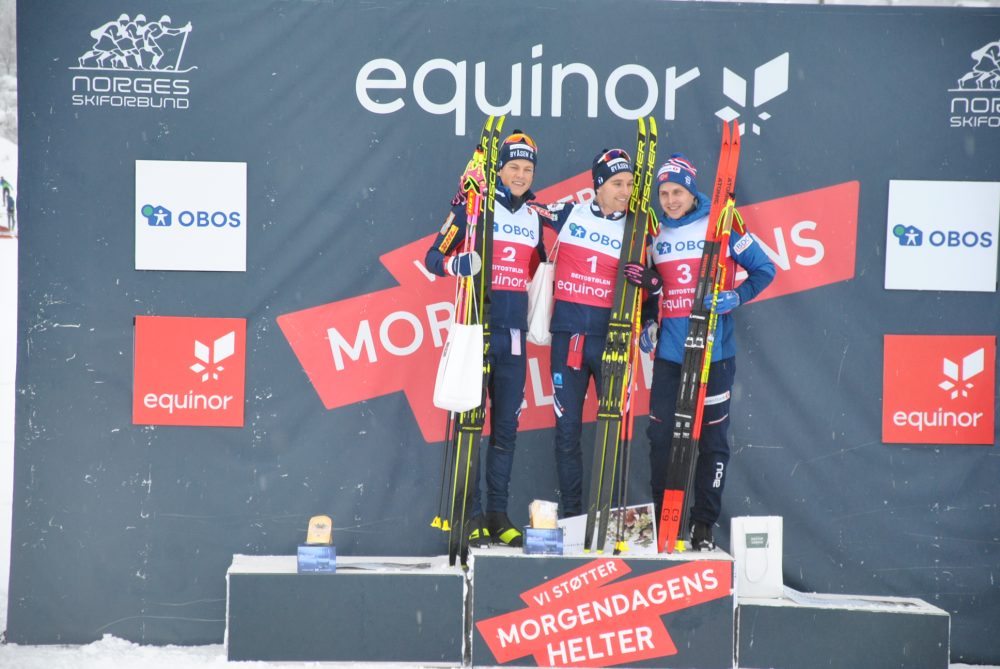
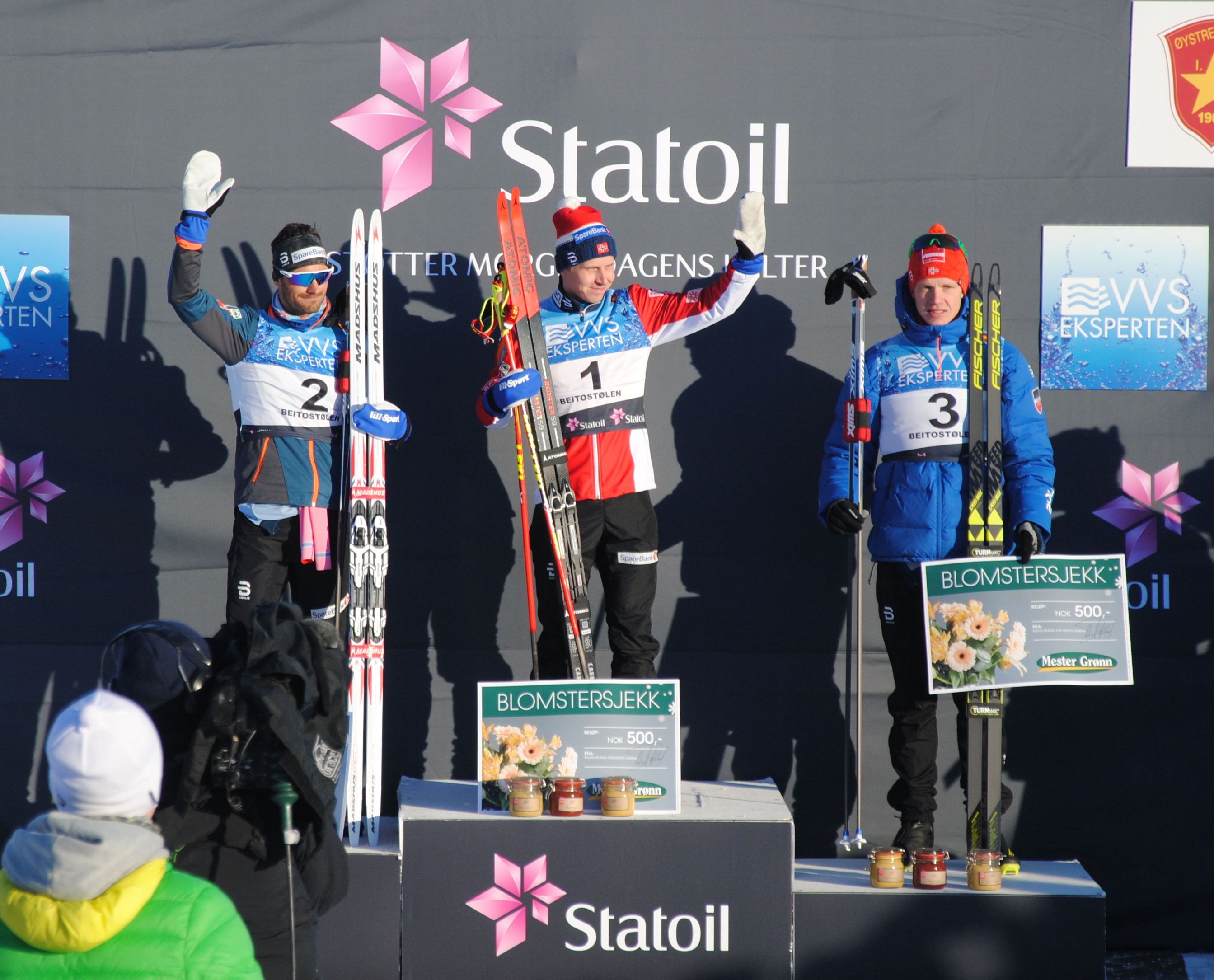
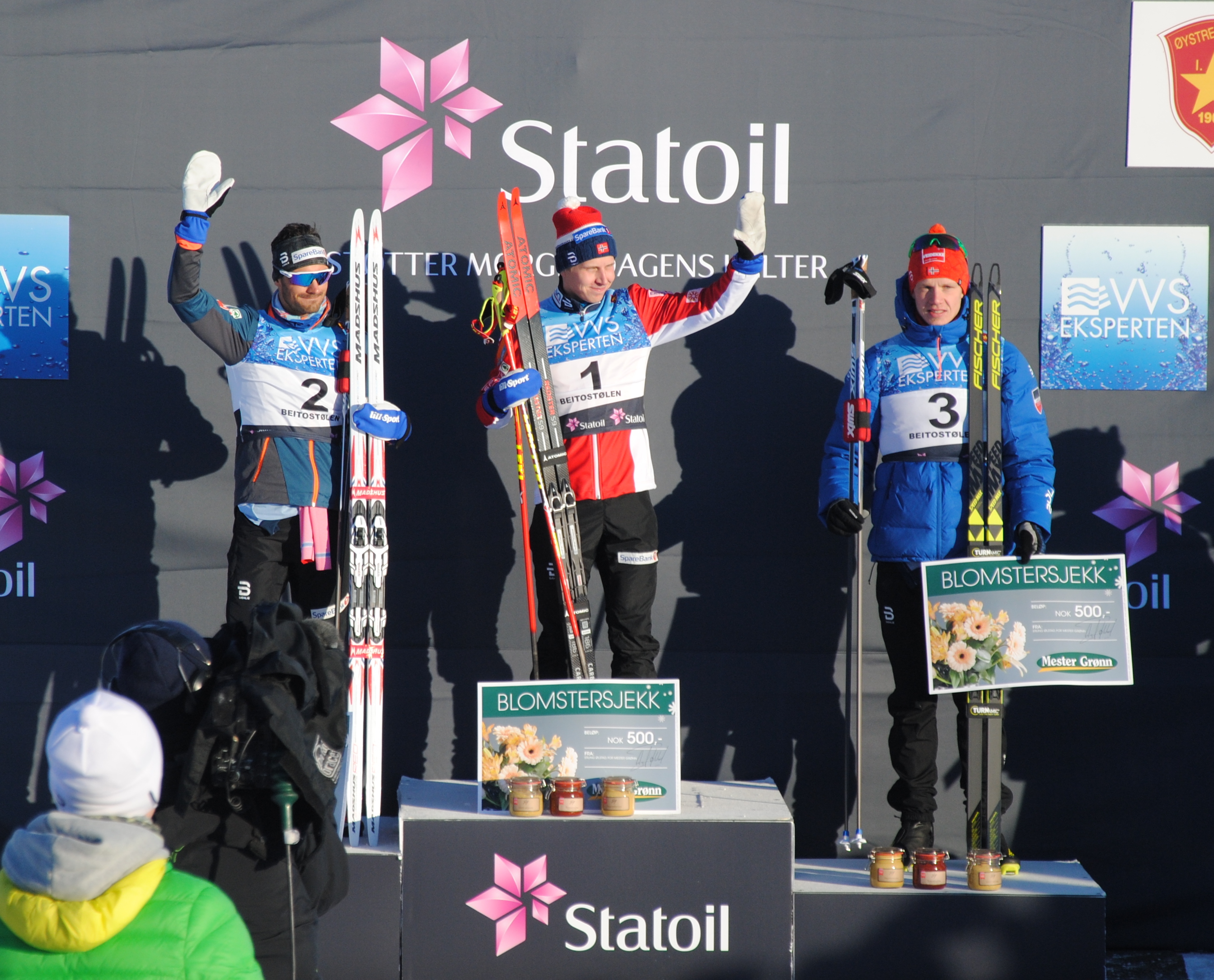
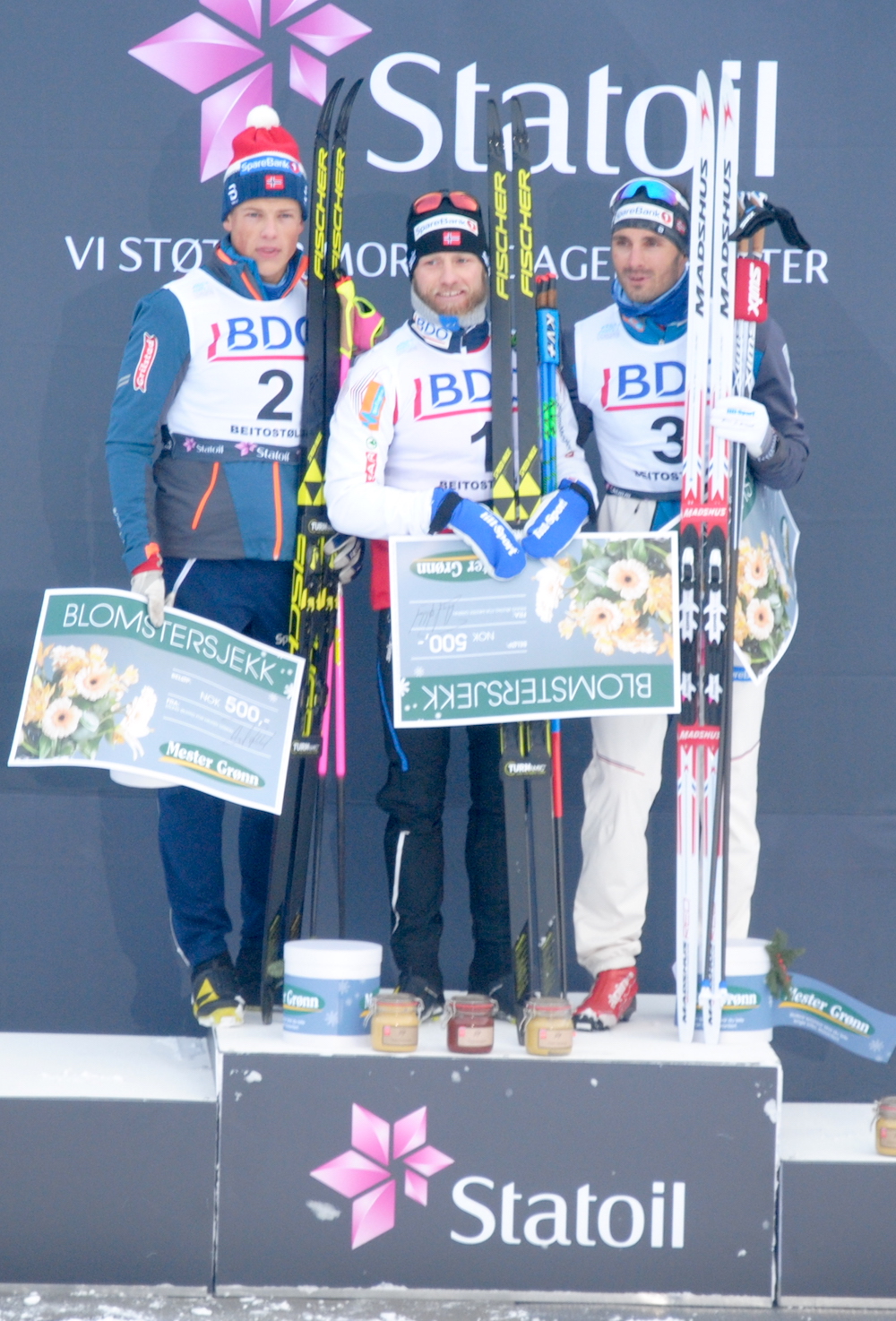
The men’s podium from the 15 k classic in Beitostølen. Norway. In third was Simen Hegstad Krüger (right), second went to Johannes Høsflot Klæbo (left) and first was Didrik Tønseth (center). (Photo: Aleks Tangen)
A national race in Norway, dare we say, may at times be at least as competitive as some World Cups: the field is deep. Today in Beitostølen, Norway the men contested a 15-kilometer classic in tricky waxing conditions.
With fine classic technique on display, Didrik Tønseth of Norway won in 34:56.7. Teammates Johannes Høsflot Klæbo placed second, 18.9 seconds back with Simen Hegstad Krüger taking third (+36.5).
David Norris (APU) was the top placed U.S. skier in 36th (+2:39.5). Erik Bjornsen of the U.S. Ski Team (UUST) was 54th (3:12.6), Kyle Bratrud (SMS T2) 73rd (+3:59.2), and Scott Patterson (USST) raced to 94th (+4:48.5). Simi Hamilton (USST) and Kevin Bolger (USST) were listed as did not start.
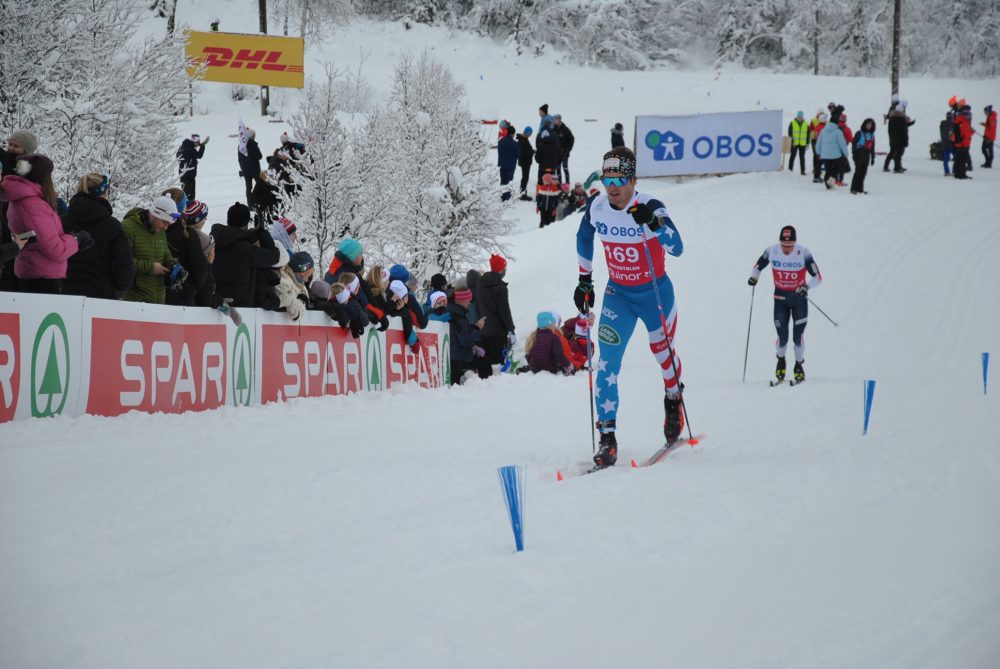
David Norris during the men’s 15 k classic in Beitostølen. Norway. (Photo: Aleks Tangen)
David Norris’ interview from the mixed zone
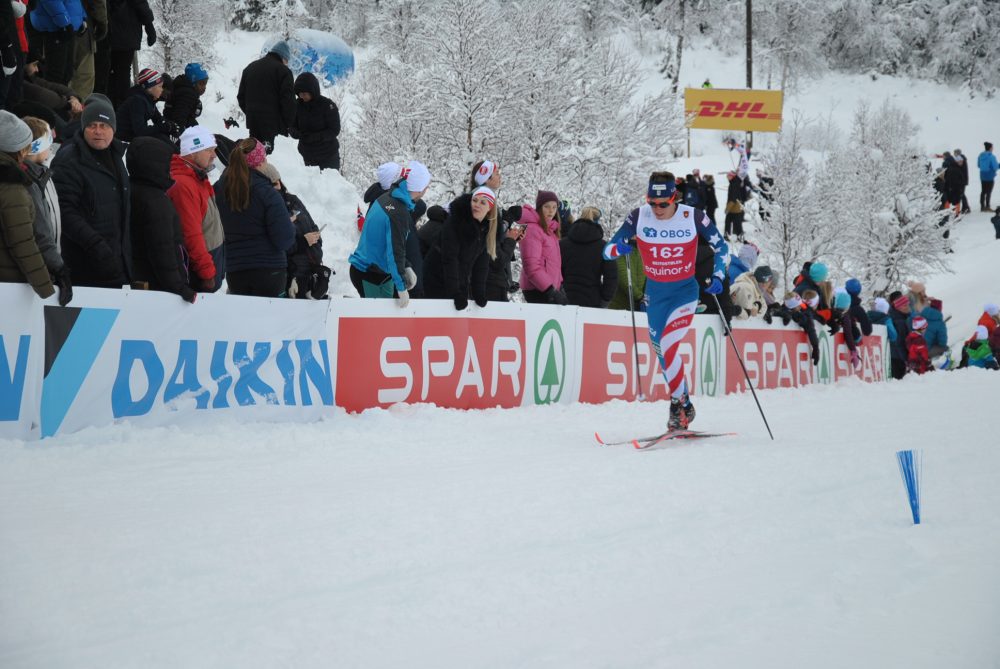
Scott Patterson during the men’s 15 k classic in Beitostølen. Norway. (Photo: Aleks Tangen)
Scott Patterson’s interview from the mixed zone
Great Britain’s Andrew Young placed 63rd (+3:36.9) on the day. In his interview below he discussed how he enters the season coming off an extended altitude camp prior to the World Cup season.
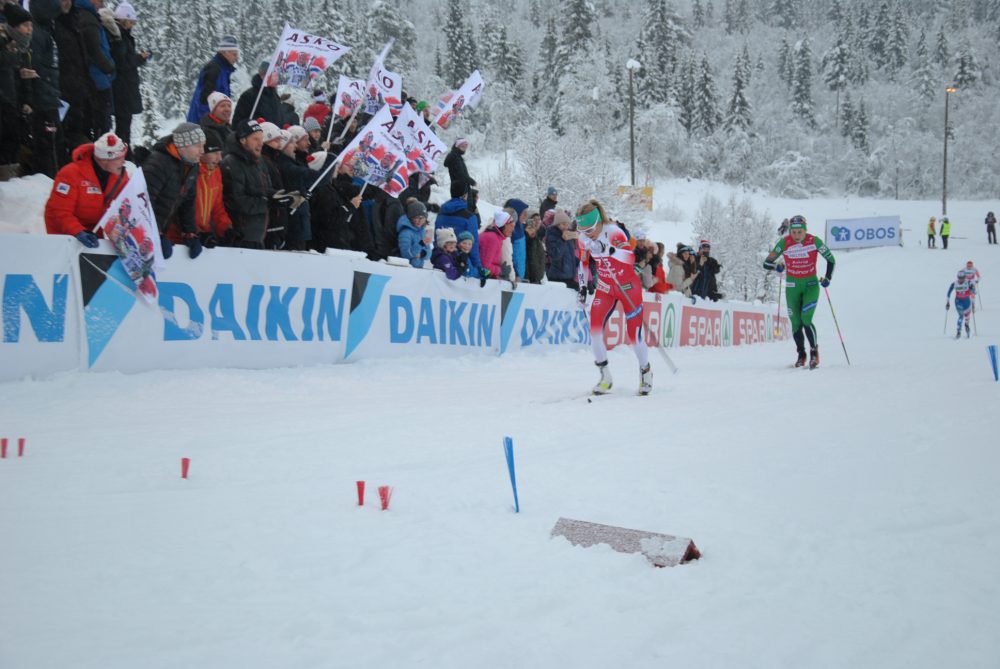
Therese Johaug on her way to winning the 10 k classic in Beitostølen, Norway – part of the national opening races in Norway. (Photo: Aleks Tangen)
FasterSkier reporter Aleks Tangen was in Beitostølen to report. As a new feature we are posting his interviews from the mixed zone in the report below.
With temps hovering around zero degree celsius in a mid-winter looking Beitostølen, Norway day two of the opening national races played out. The women raced a 10 k interval start classic race with a field, as expected loaded with Norwegians.
First thing first: Norway’s Therese Johaug showed early season futness that already resembled World-Cup-crushing form. She won the 10 k classic in 26:08.8. Heidi Weng placed second (+1:03) and 18-year-old Helene Marie Fossesholm was third (+1:13).
Americans Jessie Diggins (+1:35.7) and Sadie Maubet Bjornsen (+1:37.3) placed fourth and fifth respectively. Rosie Brennan cracked the top-10 in ninth (+2:04.9).
Jessie Diggins’ mixed zone interview
Sadie Bjornsen’s mixed zone interview
We wanted to note a nice age outlier as we checked out the results: born in 1980, making her 39, Japan’s Ishida Masako finished in seventh (+1:57.6).
Rosie Frankowski skiing for APU skied to 22nd (+3:31.4), while Caitlin Patterson was 23rd (+3:32.0).
The women’s podium from the classic sprint in Beitostølen, Norway. Sophie Caldwell (right) of the U.S. Ski Team placed third, Maiken Caspersen Fall of Norway (left) second, and Ane Appelkvist Stenseth, also of Norway took the win. (Photo: Aleks Tangen).
FasterSkier reporter Aleks Tangen was in Beitostølen to report. As a new feature we are posting interviews from the mixed zone in the report below.
The opening Norwegian national races began in Beitostølen, Norway today with a 1.2-kilometer women’s classic sprint and a 1.7 k classic sprint for the men. Beyond featuring a loaded field of seasoned and up-and-coming Norwegian skiers, the U.S. Ski Team is using these races as a tune up for next week’s Ruka, Finland World Cups.
Sophie Caldwell and Julia Kern entered the women’s senior race. Caldwell placed third overall (+2.37) after qualifying in third. Norway’s Ane Appelkvist Stenseth won in 2:52.63 with teammate Maiken Caspersen Falla second (+1.20).
(Sophie Caldwell’s mixed zone interview with Fasterskier)
Kern qualified in ninth and was eliminated in the second heat where she placed fourth. No other U.S. Ski Team women raced.
Simi Hamilton and Erik Bjornsen qualified 17th and 23rd respectively in the men’s qualifier. Hamilton was eliminated in the second heat, Bjornsen in the fifth. Both placed sixth in their heats.
Norway’s Eric Valnes won the overall in 3:34.76.
(Simi Hamilton’s mixed zone interview with Fasterskier)
(Erik Bjornsen’s mixed zone interview with Fasterskier)
The U.S. Ski Team’s Sadie Bjornsen during the 2018 World Cup 10 k pursuit in Lillehammer, Norway. (Photo: Fischer/Nordic Focus)
We hear a lot about the details of a cross-country ski racer’s day on race day, but what about those four or five days in between? What do World Cup racers do then, in the middle of the week? FasterSkier Norwegian contributor Aleks Tangen ventured to Lillehammer back in late November 2016 to find out.
***
LILLEHAMMER, Norway — FasterSkier spoke with Bjornsen, Jessie Diggins, Andy Newell and U.S. Ski Team Coach Matt Whitcomb to see how they prepared for Lillehammer and in particular, the mini tour. Back in 2016, the three-day series consisted of a classic sprint on Friday, 5- and 10-kilometer freestyle races on Saturday and 10/15 k classic pursuits on Sunday.
Whitcomb explained that on Wednesdays, in this case, two days before a race, it’s common for the athletes to do 90 to 120 minutes of light skiing in the morning and a strength session in the afternoon.
“Some might do an easy jog instead,” Whitcomb said. “On a normal week, our strength session falls on a Wednesday. That gives us two full days of recovery before the races. Usually, this is also our intensity day and we like doing strength in the afternoon of those. However, in an instance such as this one, where we’re going from a World Cup weekend into a mini tour, we have limited time to recover and for most of our team that means that they will have to pass on mid-week interval session in place for something speed-oriented.”
On Wednesdays, in this case two days before a race, it’s common for [U.S. Ski Team] athletes to do 90 to 120 minutes of light skiing in the morning and a strength session in afternoon.
Bjornsen, who placed 17th in the 2016 Ruka 10 k classic, did just that. She said this week that she thinks it’s possible to improve upon that performance and that she is looking for more.
“Two weeks ago, I was not even sure that I was going to be here…,” she said, referring to bone spurs in her feet that impeded her World Cup lead-up. “Each time I ski, it’s going to become more familiar and hopefully better.”
This week, Bjornsen opted for a distance ski with some speed.
“I find it really special that we can ski on the non-race courses, because we’re always dealing with the lack of snow and then we’re left with a 3.5 k, exceptionally hard, groomed course,” she explained. “It’s something that can contribute to built up fatigue.”
She also did speed work on the course to familiarize herself with the transitions and plan where to change gears.
Jessie Diggins during the 2e018 10 k skate in Davos, Switzerland. Diggins placed fifth for her best result for the season. (Photo: Reese Brown/U.S. Ski Team)
Her teammate Diggins chose a similar kind of workout on the trail leading to Sjusjøen, for 90 minutes of easy skiing.
Asked on Wednesday what goes through her mind during a training session two days before a race, Diggins said it doesn’t have much to do with the race itself.
“I don’t think about the race really, I just try to stay relaxed and do what I’m supposed to do,” she said. “In the middle of two race weekends, you want to stay relaxed, but also improve your conditioning, so I did five minutes at L3 [Level 3 intensity] and 4 x 4 [minutes] at low level on Tuesday in order to have time to recover from traveling and in time for the race.”
In terms of how she balances recovery and improves conditioning at the same time, she said, “That’s a good question. I think it’s really about listening to your body and paying attention to the signals it’s sending you. If you don’t feel good in the morning then maybe you should take it easy and vice versa. And you should always communicate with your coaches, but I really think that first and foremost, it’s important to pay attention to your mind before schedule.”
Diggins said her schedule amounts to roughly 750 training hours a year, but she warned against looking too far into those numbers.
“I don’t like to think about the numbers, really, I feel like that’s not the right thing to do,” she said. “It’s what you do in those hours that matter. It’s more about quality than quantity, and I feel like focusing on the numbers sends the wrong message to for example young athletes.”
Asked what she would say to young athletes considering increasing their volume, Diggins said they should be “very careful about increasing hours. Don’t just throw on hours for the sake of more, think about what the hours contains and go from there.”
According to Whitcomb, Diggins “is in a great state of fitness. … She’s just a really hard worker who does what she needs to do during workouts. She has also gotten to a point where she absorbs her training really well,” he explained.
Andy Newell (U.S. Ski Team) racing in the quarterfinals of the 2017 World Cup men’s freestyle sprint in Davos, Switzerland. He finished fifth in the heat for 21st overall. (Photo: Reese Brown/U.S. Ski & Snowboard)
Newell met with FasterSkier on the Thursday before the race to talk about his preparations. Normally he would do some form of threshold training “like 3 x 8 minutes and some shorter speeds, just to get a feel for the track,” but this Wednesday, things didn’t turn out quite the way he had hoped. Newell skipped training to treat a cold that had been brewing since last Thursday.
“I might have gotten sick from traveling” he said.
If he had been training, his race-prep day would have likely included an hour of skiing, with ski testing (maybe four or five pairs) for the first 45 minutes.
“Once I find a good pair, we usually get together as a team and ski the lap, once at 70 percent of max and once at 90 percent.” Newell said of previewing the course.
When asked about how he balances recovery and fitness, Newell’s answer was similar to that of Diggins and Bjornsen. He said it’s about feeling good before the races, and since the races are like hard workouts, what matters in the time in between is to recover well enough in order to feel good when you’re on the starting line.
“Some people come out of, for example, the Tour de Ski super-fit and that’s the kind of magical balance we’re striving for, where we can be in a state of fitness where we can absorb the benefit of the races,” he said. “For me, that means to maintain threshold base and focus on short bursts of speed during the races.”
And how does nutrition factor into this equation, especially considering you’re in a different country every week?
“I normally don’t have any problems with it, the foods really good here and there is so much to choose from,” Newell said. “I might supplement with multivitamin or fish oil, especially in places like Kuusamo.”
Speaking specifically about Lillehammer, Newell said he loves the course, calling it “perfect”, “very challenging but very skiable, unlike Kuusamo, which are not that fun. Lillehammer’s [courses] are very enjoyable.”
This season, Newell explained that his biggest goal is “to stay strong and healthy.”
“I am trying to be careful with the cold I have now. I know I can be among the strongest in the world and I try not to think about place, but instead feeling strong and take one race at the time,” he said.
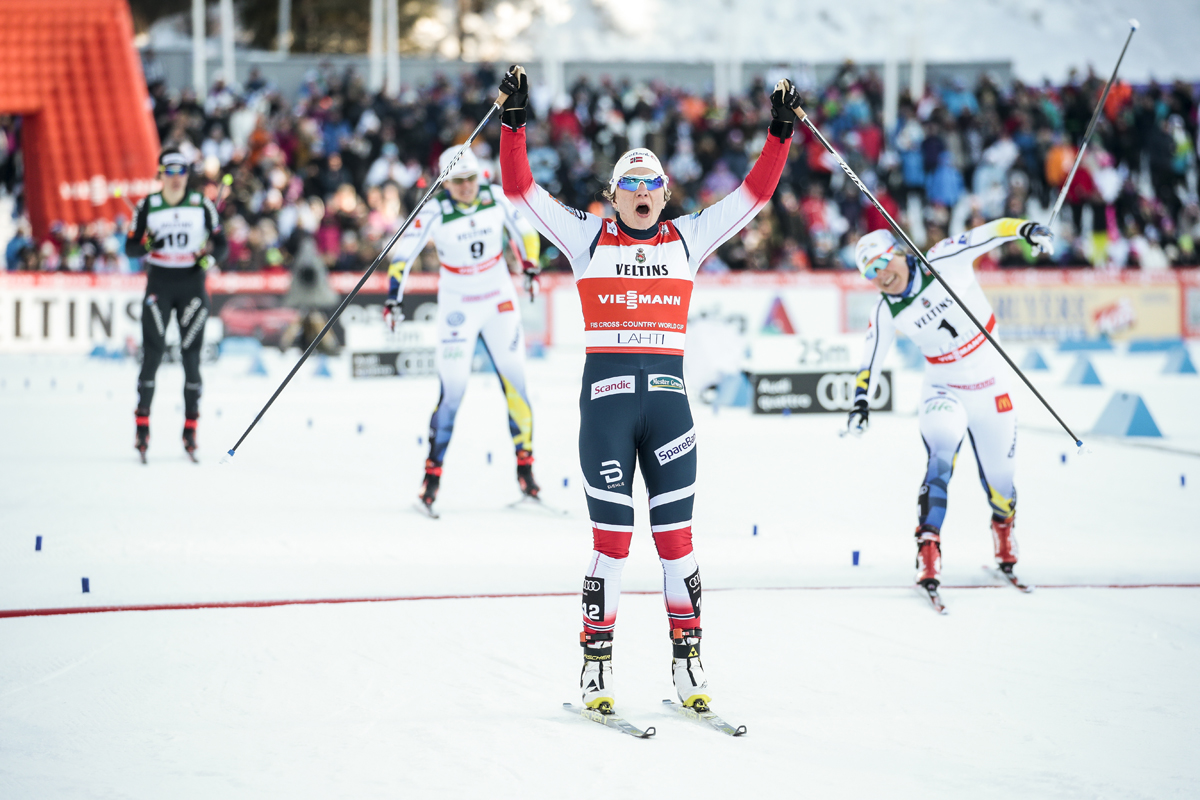
Norway’s Maiken Caspersen Falla celebrates her win in the women’s 1.4 k freestyle sprint at the 2018 World Cup in Lahti, Finland. (Photo: Fischer/NordicFocus)
Welcome to FasterSkier’s World Cup Preview, where we check in with the top-10 teams from last year’s FIS Cross Country World Cup tour before the season starts. The World Cup begins with a classic sprint in Ruka, Finland on Nov. 24th
***
Norway
Overall in Nations Cup Last Year:1
Women’s Ranking 2017/2018:1
Men’s Ranking 2017/2018:1
Norwegians to Watch:
Norway won last year’s Nation’s Cup by more than twice as many points as second place Sweden. The question remains, in the aftermath of Marit Bjørgen’s retirement can that accomplishment be repeated?
Chances are, yes.
The Norwegian women’s team boast names such as Heidi Weng, winner of the World Cup the two previous seasons, Ingvild Flugstad Østberg, 3rd place overall in the World Cup in the two previous seasons and gold medal winner in the 4×5 kilometer relay in the PyeongChang Olympics , Maiken Caspersen Falla, winner of the sprint World Cup the three previous seasons and silver medalist in the Olympic classic sprint, and Ragnhild Haga, gold medalist in the Olympic 10 k skate and 4×5 k relay.
The women’s 10 k freestyle podium at Stage 3 of the 2018 Tour de Ski on Monday in Lenzerheide, Switzerland, with Norway’s Ingvild Flugstad Østberg (c) in first and Heidi Weng (l) in second, and American Jessie Diggins (r) in third. (Photo: Salomon/NordicFocus)
There appears to be no dynastic decline on the immediate horizon. All of these athletes are on track to perform at a similar level this coming season.
In addition to these four podium-capable skiers, Therese Johaug will return to the Word Cup after having finished her 18-month ban for testing positive for the banned substance clostebol. (Johaug tested positive after applying the ointment Trofodermin to her sunburned lips.)
Johaug won the Lysebotn opp rollerski race in August 1:47.5 minutes in front of Sweden’s Charlotte Kalla in second, and out performed all the male skiers on the national team but Didrik Tønseth during an Oslo hill run this Spring. She is reported to be in better shape physically than in the past. Yet, it remains to be seen if she can transfer that into competitive cross-country skiing against a full World Cup field.
In the days before the Norwegian season opener in Beitostølen, Johaug asked during a press conference that people lower their expectations because of her experience in the last two years. Expectations aside, Johaug won the two races she competed in during the season opener in Beitostølen. In the 10 k classic, as described by FasterSkier, Johaug never let off the throttle. In the 10 k skate, she distanced second place Østberg by 26 seconds and U.S. skier Sadie Bjornsen by 1:45.9 minutes in third. With those two wins in Beito, this much is true: she’s in early season Johaug-form.
The Norwegian men
2018 Olympic individual gold, silver and bronze medal winners, team sprint and 4 x 10 k relay winners return to the Norwegian men’s team this season. Tønseth, Martin Johnsrud Sundby, Simen Hegstad Krüger and Johannes Høsflot Klæbo are all returning. No athlete reported any major challenges this pre-season.
Overall sprint and World Cup winner, Johannes Hoesflot Klaebo at the 2018 Seefeld, Austria World Cup sprint. (Photo: Fischer/NordicFocus)
After his dominant season last year, Klæbo has tempered expectations. He stated in an interview with Bergens Tidene in October, “realistically, a lot of things need to happen for me to copy what I did last year.”
We’ll know in days, the World Cup begins this Saturday, if this was all a Klæbo bluff.
The overall winner of the World Cup, and sprint cup winner the past two seasons, Klæbo explained that last season many things worked well right away but there are several fast skiers competing. Just within Norway’s domestic ranks, Tønseth, Emil Iversen,Sjur Røthe, Sundby, and Hans Christer Holund all outperformed Klæbo recently in Beitostølen’s 15 k classic.
One athlete who fans should see on the World Cup again this season for Norway is thirty-two-year-old Petter Northug.
After separating from the Norwegian national team in 2013, the man who needs no further introduction if you have followed xc skiing over the past 10 years, returns to the Norwegian sprint team. His last performances are not what they used to be and therefore Northug returns to national team with confined expectations. Northug noted he probably won’t ski World Cup races until 2019 and that he might not make the cut for the World Championship in Seefeld.
His results recently in Beitostølen were lackluster, he was disqualified from the 15 k and didn’t qualify for the sprint heats.
He raced a single World Cup last season, placing 32nd in Lillehammer, Norway’s classic sprint. Northug did not qualify for the 2018 Olympics.
Northug claims the reason for lowering expectations are his difficulty in adapting to training. Last season was hindered by illness and this pre-season has shown similar signs — Northug has twice dropped out of a training camp due to illness. Headlines across Norwegian tabloids read, in essence, “Northug may retire”, a reference to him saying in a press conference before the season opener in Beitostølen that the odds of him being on the starting line there next year is 100-1. Before being disqualified for skating during the 15 k classic in Beitostølen, Northug did show signs of improvement, finishing the race in 38:26.2 minutes (+2:17.6 behind winner Tønseth).
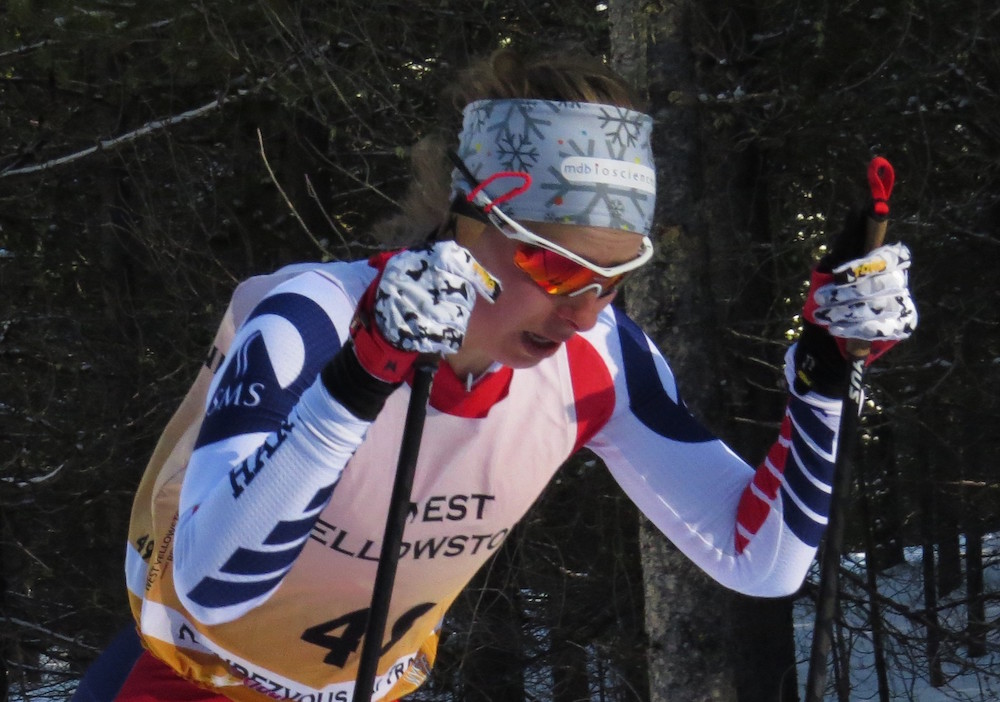
Anne Hart (SMST2) racing at last year’s 5 k classic FIS race in West Yellowstone, Montana, where she finished 12th. A year later, Hart placed 19th in the Beitostølen, Norway, 10 k freestyle race. (Photo: Ian Harvey/Toko)
In one weekend of racing, Anne Hart has already learned a lot, the types of things you can only learn from careful observation and reflection. And for Hart, a 25-year-old member of the Stratton Mountain School (SMS) Elite Team, the season doesn’t truly begin until Dec. 2.
After racing to 19th in the women’s 10-kilometer freestyle individual start on Sunday in Beitostølen, 2:41.9 minutes behind Norwegian winner Marit Bjørgen, Hart talked about being inspired by numerous speedy Norwegians there — many of which are gunning for a spot on Norway’s World Cup team.
Hart ventured to Norway earlier this month to jumpstart her season before heading back to the U.S. to race the SuperTour opener in West Yellowstone, Montana, Dec. 2-3. In two previous races in Beitostølen on Friday and Saturday, she finished 31st in both the 10 k classic and classic sprint.
On Sunday, she resolved to leave it all out there, just as she’d seen Norwegian World Cup regular Finn Hågen Krogh do.
“Today we were watching the men’s race [before our race], and we watched Finn Hågen Krogh halfway up the hill the last time, the third time. I kid you not, he just stopped, bent over and he went on and finished fifth,” Hart reflected. “He went out hard, he blew up, but he made up so much time at the beginning that he just had to make it in.”
That’s precisely what Hart’s been working on.
“I really just pushed it from the go,” she said of her race. “After watching the [top] women start the classic race [on Friday], and then watching how fast they go in the sprints [on Saturday], there is just no easy pace out there … You just keep on going, and you suffer. But the harder you suffer the faster it is over.”
The women’s podium (and top six) after Sunday’s 10 k freestyle in Beitostølen, Norway, with Norway’s Marit Bjørgen (1) in first, Ragnhild Haga (2) in second, Heidi Weng (3) in third, Ingvild Flugstad Østberg in fourth, Astrid Uhrenholdt Jacobsen in fifth, and Tiril Udnes Weng in sixth. (Photo: Aleks Tangen)
Hart finished her 10 k, in what she described “beautiful skiing” conditions, in 26:37.1. Bjørgen raced to first for her second distance win of the long weekend in 23:55.2, 12.6 seconds ahead of Ragnhild Haga in second place. Norway once again swept the podium with Heidi Weng in third, 30.1 seconds behind Bjørgen.
“It’s a course that doesn’t have a lot of rest in it … basically I was just trying to V2 as much as I could, because I noticed that’s another thing they do over here,” Hart said. “It’s like riding a bike; it’s easier to go in a lower gear. … I know I am a stronger V2-er, and the longer I can V2 up the hills, I figured the better I would do overall. Then [I] backed off, worked on quick turnover, and then really tried to push the V2-ing.”
For much of the race, her split times hovered between 19th and 20th. But after a strong effort from 7 to 9.8 k, where she clocked the 15th fastest time in 7:58.2, Hart secured 19th, 8.5 seconds behind 18th-place finisher Silje Theodorsen, of the Norwegian National U23 Team, and 12 seconds ahead of 20th, which went to Norway’s Magni Smedås (Lillehammer Ski Club).
That stands as Hart’s best international finish outside of an Alpen Cup last season in Seefeld, Austria, where she notched two top 20’s. Each year, Norway’s season-opening FIS races in Beitostølen attract most of Norway’s top skiers and upcoming talent.
So 19th in Beitostølen is a big deal.
At the time of her post-race interview with FasterSkier, Hart wasn’t sure where she ended up. But she knew she pushed herself to the limit.
“I think last year I suffered from over-pacing, and it’s gonna hurt no matter what you do,” she said. “And I am very much of the mentality, for me anyways, to just go all in, no fear. And the worst thing that happens is you blow up.”
In terms of how her results in Beito will affect her moving forward, she said it was about building confidence with each race and “having faith in my training and my fitness. The worst feeling in the world is when you finish and are like, ‘Damn, I could have gone harder.’ I would much rather literally collapse out on the course.”
Great Britain’s Annika Taylor, who grew up in Truckee, California, and raced at the University of New Hampshire, placed 23rd (+3:09.9). Taylor, 24, finished 29th in the 10 k classic two days earlier
At the front of Sunday’s race, the final time between Bjørgen and runner-up Haga was what made the news. One Norwegian journalist asked Norwegian women’s team coach Roar Hjelmeset if “this was almost like a victory since the gap was so small”. He replied “no” but added that it was “a very good performance” for Haga.
Bjørgen started last in bib 63 and, as she typically does, clocked the fastest times through essentially every checkpoint and put more time into her competition with each passing kilometer. Haga’s time from 4.9 to 6.1 k was actually 2.5 seconds faster, but Bjørgen later told reporters that she expected a strong performance from her 26-year-old teammate.
“The race was acceptable,” she told NRK. “I was prepared for Ragnhild’s approach since she’s better at skating, but I felt like I was somewhat in control.”
Haga was pleased to hold on to second ahead of fellow World Cup Team members Weng (who ended up third) and Ingvild Flugstad Østberg in fourth (+32.3).
“I had hoped to kick harder from the start so that Ingvild wouldn’t catch up to me,” Haga told NRK. “I didn’t tighten up and was able to keep pushing. I couldn’t really do anything about Marit, but I was closer than normal.”
Both Weng and Østberg told NRK how impressed they were with Haga’s performance.
“Ragnhild has shown strength over a lot of years,” Østberg said.
Weng added that she was impressed Haga gave Bjørgen a fight for first place.
“[Haga] does this because she’s been able to train well over the course of long time, and she has done very well leading up to this season,” Hjelmeset explained to a group of reporters.
Krüger: ‘It’s a big deal’
In the men’s race, Norway’s Simen Hegstad Krüger took advantage of the optimal conditions — with temperatures between -6 and -9 degrees Celsius, firm tracks and a clear blue sky — to win the 15 k freestyle by 16.5 seconds in 32:59.6.
He did so after starting in bib 122 of 124 and taking control of the race at 2.1 k. Krüger led from that point on, clocking the fastest splits in every stretch except from 11 to 11.9 k. At the finish, he beat out the likes of fellow Norwegian World Cup Team members Hans Christer Holund in second, Hågen Krogh in fifth (+42.1), Sjur Røthe in sixth (+42.8), and Martin Johnsrud Sundby in seventh (+52.9).
The men’s podium after Sunday’s 15 k freestyle FIS race in Beitostølen, Norway, with Norway’s Simen Hegstad Krüger (1) in first, Hans Christer Holund (2) in second and Jan Thomas Jenssen (3) in third. (Photo: Aleks Tangen)
“This is incredibly cool,” Krüger told NRK. “Even if it’s early in the season, it’s not common to win at this level. It’s a big deal when entire Norwegian elite is here.”
Notably, 21-year-old Norwegian Jan Thomas Jenssen, of Hommelvik Il, placed third (+30.7). He’s never raced on the World Cup.
“What should I say? This is amazing,” he told NRK, adding that the experience was “indescribable.”
Great Britain’s Andrew Musgrave raced to fourth place (+37.1) as the only non-Norwegian in the top 24. American Noah Hoffman was next in 25th (+2:09.6), and Andy Newell (U.S. Ski Team) finished 52nd (+2:56.0).
“It was better than the other day, a step in the right direction and I feel pretty good and looking forward to next weekend,” Hoffman, who finished 29th in Friday’s 15 k classic, told FasterSkier on Sunday. “Part of it is just having a race under my belt, but beyond that, I think on these more gradual courses I’m better at skating than I am classic, and the conditions were better for me today.”
While he was able to navigate traffic on the course by picking off several racers, Hoffman was frustrated with his “lapse of concentration” that caused him to clip a V-board on the biggest downhill and fall on his second lap.
“[I] went down really hard, lost my glasses, but at least I didn’t hurt myself,” Hoffman said. “Got a little bit of whiplash, I think I might be sore from it. … I probably lost 10 seconds. It was just silly. It still was a good effort and it doesn’t make too big of a difference.”
Andy Newell (c) racing to 52nd in the men’s 15 k freestyle FIS race on Sunday in Beitostølen, Norway. (Photo: Aleks Tangen)
Newell started out skiing around 70th and made his way up to 38th mid-race, but lost time over the final three kilometers to finish 52nd. When he spoke with FasterSkier immediately after, he was unsure of how he placed.
“I don’t think my time will be great, but it was a good workout and my body felt good despite being a little tired and sore from yesterday,” said Newell, who placed 16th in Saturday’s classic sprint. “It was a good training race, and these guys are so fast, and since skating is not my best, I just looked for a good feeling in the body. …. I think I have a little more in the tank. I can save that for next weekend.”
The World Cup opens next Friday, Nov. 24 with the three-day Ruka Triple in Kuusamo, Finland.
Of the four Canadian men that raced on Sunday, Scott James Hill of Barrie Cross Country (BXC) led them in 64th (+3:09.8).
“Today was good, a lot better,” said Hill, who placed 84th in Saturday’s sprint and 99th in Friday’s 15 k classic. “The classic race was kind of my first race and time trial of the year so I wasn’t expecting much, but today I felt like I was ready to race.
“I think everything worked out well,” the 23 year old continued. “I was never skiing alone other than maybe the first half lap, so I was always being pushed, which was really good.”
Ryan Jackson (Team Asker) followed in 102nd, Maks Zechel (Team Asker) was 113th, and Joey Foster (BXC) finished 118th.
Norway’s Johannes Høsflot Klæbo celebrates his first win of the season on Saturday in the men’s 1.5 k classic sprint FIS race in Beitostølen, Norway. (Photo: Aleks Tangen)
BEITOSTØLEN, Norway — A year ago, 20-year-old Johannes Høsflot Klæbo leapt onto the scene with a season-opening skate-sprint win in Beitostølen. Before that, he made waves at 2016 U23 World Championships, winning gold in the skate sprint, 10-kilometer classic and 4 x 5 k relay. But until last season, Klæbo, a member of Norway’s national U23 team, was hardly a household name to those outside of Norwegian skiing circles.
That all ended in Beito. Klæbo landed on the podium in the first World Cup sprint of the 2016/2017 season, placing third in the classic sprint in Kuusamo, Finland, and accumulated half a dozen podium finishes throughout last winter. He capped the season as the men’s U23 World Cup champion as well as the Sprint World Cup winner.
Now a full-fledged member of the Norwegian Sprint World Cup Team, Klæbo, who turned 21 last month, returned to Beitostølen to post a second- and first-place finish so far in two International Ski Federation (FIS) races there. He started his season off by taking second in Friday’s 15 k classic, 18 seconds behind reigning Overall World Cup champion Martin Johnsrud Sundby.
On Saturday, Klæbo won the 1.5 k classic sprint in Beitostølen without so much as a blemish, winning the qualifier to start the day then topping each of his heats en route to the final.
Norway’s Johannes Høsflot Klæbo crossing the line first for the win in the men’s classic sprint final on Saturday at the FIS season-opener in Beitostølen, Norway. (Photo: Aleks Tangen)
Up against five other Norwegians in the final, Klæbo raced to first once more in 3:50.4 minutes, finishing 1.1 seconds ahead of runner-up Kasper Stadaas. World Cup sprinter Eirik Brandsdal followed in third (+1.8), Fredrik Riseth was fourth (+6.4), Sondre Turvoll Fossli crossed in fifth (+6.7), and Emil Iversen was sixth (+9.2).
“My goal was to ski a good race,” Klæbo told a group of reporters after. “I wanted to get away from the pack towards the end and luckily the gap remained until the end.”
Iversen called attention to the young Norwegian while speaking with reporters after the race. “There has never been a talent like him,” Iversen said.
With snow starting to fall just before the men’s qualifier, Klæbo fared best on the course, racing to a 3.07-second qualifying win over Riseth with a time of 3:39.76.
Norwegian sprint coach Arild Monsen emphasized Klæbo’s ability to accelerate in and out of turns.
“Cross-country skiing has seen some development in recent years with specific techniques in specific zones, and Johannes has developed an ability to take advantage of that,” Monsen told a group of reporters. “We saw that very clearly today. The trick is to technically skilled when you’re tired and he’s able to do that almost to point where we don’t understand how.”
Klæbo went on to win his quarterfinal by 0.5 seconds over Norway’s Gjøran Tefre, then his semifinal by 0.2 seconds over Brandsdal. U.S. Ski Team member Andy Newell faced him in the quarterfinal, where Newell finished fourth in the heat, 3.7 seconds behind Klæbo and 2.6 seconds behind Norway’s Emil Nyeng in third. Newell missed advancing to the semifinals and finished the day in 16th overall.
“I knew we were going to have a fast heat because Klæbo had set a pretty strong pace from the first hill on, so we were really close to lucky losers,” Newell told FasterSkier in a post-race interview. “The second heat was just barely faster.”
With his second Beitostølen sprint victory, Klæbo told NRK that he was glad to get this race under his belt.
“This felt good, and I’m glad that sprint is up and running,” he said. “This was a good race considering what will happen next weekend.”
The World Cup kicks off next weekend in Kuusamo with a classic sprint on Nov. 24, followed by 15 k classic and 15 k freestyle races for the men on Nov. 25 and 26.
The lone American man in Saturday’s race, Newell qualified in 11th, 10.86 seconds off Klæbo’s time.
“Felt good in qualification, skis weren’t perfect because it started snowing just before,” Newell told FasterSkier after. “Skis were fast, but not quite enough grip, so we did a little re-wax for the heats.”
He noted that he’s been working with Fischer in Beitostølen as he’s there without his team (the rest of the U.S. Ski Team is currently training in Rovaniemi, Finland).
For the first 300 meters of his quarterfinal, six skiers started at a relaxed pace with Klæbo and Newell at the back of the pack leading into the the first downhill. While both were able to work their way to the front on the first climb, Newell lost steam on the second-to-last hill, “Danskebakken” (Danish hill).
“I was stuck in the back up the first hill, so I had to burn a match to get to the front, which probably made me a little tired for the last hill,” Newell reflected.
With what he called “great grip” up the big climb, he felt like he was dragging a bit over the top.
“I was definitely getting a little tired on the flat part over the top,” he said. “Because it’s the first sprint, maybe I wasn’t aggressive enough in the transitions, maybe it’s because the skis were a little draggy, but it seemed like I would get passed by somebody or two people going into each hill.”
With enough grip on the climbs, he would pass those racers back.
“So tried to finish strong but not quite there, but it’s a long season and hopefully the body will feel a little better in Kuusamo,” Newell said. “It’s all good, just training so looking forward to the World Cup.”
Out of the 30 men who qualified for Saturday’s sprint heats, only two were not Norwegian: Newell and Great Britain’s Andrew Young (who qualified 22nd). Young went on to finish the day in 23rd overall after finishing fifth in his quarterfinal.
Falla Stuns with Late Attack
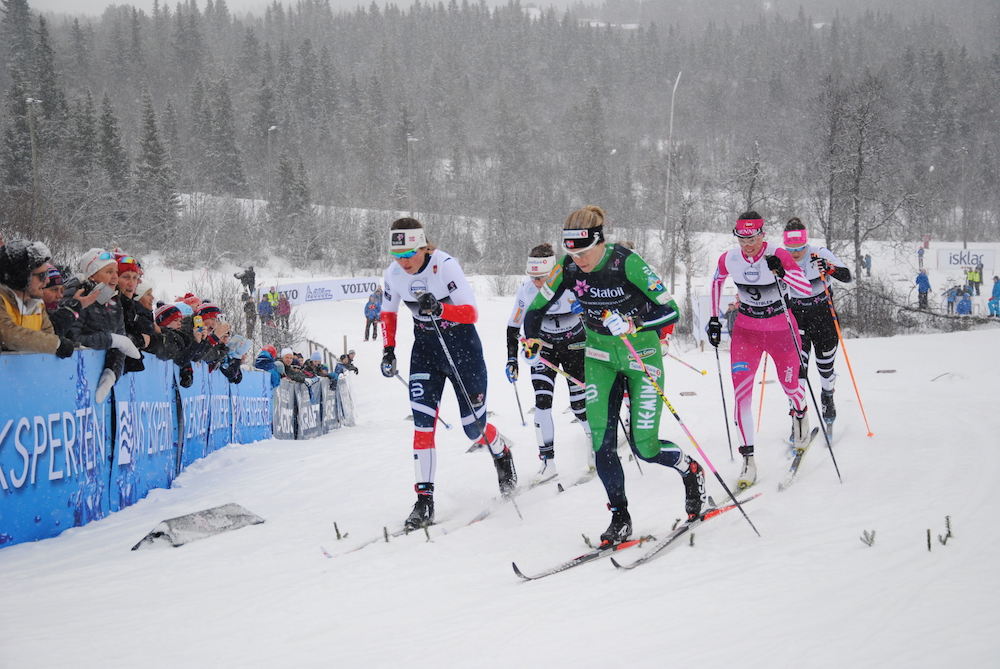
Maiken Caspersen Falla (l) leading the women’s final up a climb, along with fellow Norwegian national team member Astrid Uhrenholdt Jacobsen (in green) during the women’s 1.5 k classic sprint FIS race on Saturday in Beitostølen, Norway. (Photo: Aleks Tangen)
In the women’s race, Maiken Caspersen Falla controlled the women’s race in a similar fashion to Klæbo, winning the qualifier, quarter, semi, and ultimately, the final.
In the final, Falla, who won last year’s Beitostølen skate sprint as well as her second-straight Sprint World Cup Crystal Globe, skied with the pack until the final climb where she made her move before entering the final stretch alone. Falla, 27, finished 3.7 seconds clear of anybody in 3:01.1. In another all-Norwegian final, Mari Eide placed second and Astrid Uhrenholdt Jacobsen claimed third (+4.8). Tiril Udnes Weng placed fourth (+6.7), Kari Vikhagen Gjeitnes was fifth (+11.1) and Ane Appelkvist Stenseth was sixth (+18.5).
Falla started the morning with a qualifying win in 2:54.86, 1.77 seconds ahead of Slovenia’s Katja Visnar in second. She didn’t slow down much for the heats, racing to first in each in 3:01.7, 3:02.3 and 3:01.1, respectively.
“I felt that it went better and better and it’s wonderful to have that feeling when you’re sprinting,” Falla told NRK after.
After watching her attack and pass three women on the final hill, NRK commentator Fredrik Aukland called her “the best sprinter in the world”.
When asked if this performance was good enough to win any race in the future, she told a group of reporters, “I hope so, of course. There is finishing hill already next weekend that is kind of similar to this one and I have practiced running up hills a lot so it’s obviously fun to test it in a race.”
Teammates with Newell on the Stratton Mountain School (SMS) Elite Team, Anne Hart raced to 31st for the second day in a row, missing qualifying in the top 30 by 0.28 seconds.
“I am happy about my qualification,” she told FasterSkier immediately after her race, before she knew whether her time was fast enough for the heats. “The course is a lot faster than yesterday, good condition.”
Hart started the qualifier third out of 58 women, just ahead of Visnar in bib 4. Her time was 17.55 seconds back from Falla’s.
“I skied with Katja Visnar and she is really good classic sprinter,” Hart said. “… It feels really good to be able to ski with all these World Cup skiers.”
Nichole Bathe, who was born in the U.S. but is racing for Great Britain, finished 33rd (+19.26), about 2 seconds out of the top 30.
Canada’s Isabella Howden of Barrie Cross Country (BXC) finished 58th (+57.28) in the qualifier. In the men’s qualifier, her teammates Joey Foster and Scott James Hill finished 74th (+32.45) and 84th (+36.64), respectively, and fellow Canadians Ryan Jackson and Maks Zechel (who are training in Norway with Team Asker) finished 97th (+43.99) and 102nd (+48.48), respectively, out of 109.
The Beitostølen weekend concludes with 10/15 k freestyle individual starts on Sunday.
Norway’s Marit Bjørgen racing to a 29-second win in Friday’s 10 k classic FIS race in Beitostølen, Norway. (Photo: Aleks Tangen)
(Note: This article has been updated to include comments from Nichole Bathe.)
BEITOSTØLEN, Norway — The question of whether Bjørgen or Weng will be the bigger name this season went in the favor of the former on Friday at Norway’s first big matchup of the season. Marit Bjørgen, now 37 and in her 20th World Cup season, won the first race of the three-day International Ski Federation (FIS) weekend in Beitostølen, starting last out of 56 women and finishing first in the 10-kilometer classic individual start, with 29.4 seconds between her and Weng in second place.
On a morning that marked the start of the 2017/2018 season in Norway, with temperatures just below zero and a snow squall during the women’s pre-race warmup, the snow covering the course appeared loose but ample.
Weng, the 26-year-old reigning Overall World Cup and Distance World Cup champion who started 30 seconds behind fellow Norwegian national-team member Bjørgen, told reporters after the race that she was satisfied with her performance, but could have skied better and “could have had better grip”.
For the first 2 kilometers of the race, Bjørgen’s pace was comparable to that of another one of her teammates, Ingvild Flugstad Østberg, who started just ahead of Weng. But halfway through the race, Bjørgen was nearly 22 seconds up on Østberg and 28 seconds ahead of Weng.
While Bjørgen continued to put seconds into her teammates in the final 5 k — blowing through the 7 k checkpoint 28 seconds faster than anyone else — Weng and Østberg battled for second. Weng clocked through 6.1 k just 2.7 seconds faster than Østberg and skied 5.1 seconds faster than her over the next 900 meters. Despite crossing the finish 11.6 seconds faster than Østberg, Weng’s time in the leader’s chair was short-lived, as Bjørgen finished 29.4 seconds faster with a winning time of 29:30.9 minutes.
The women’s 10 k classic all-Norwegian podium at Friday’s FIS race in Beitostølen, Norway, with Marit Bjørgen (c) in first, Heidi Weng (l) in second and Ingvild Flugstad Østberg in third. (Photo: Aleks Tangen)
Østberg claimed third, 41 seconds back and 10 seconds ahead of another Norwegian national team member Ragnhild Haga in fourth (+51.0). Norway swept first through 13th place with Kathrine Rolsted Harsem in fifth (+1:08.1), Astrid Øyre Slind in sixth (+1:27.5) and notably, sprint specialist Maiken Caspersen Falla in ninth (+1:54.3).
“Marit is superior,” Weng said in a post-race interview with NRK. “This is top level and I have to step it up.”
She added, “29.4 and 41 seconds is a lot, but Marit is not invincible.”
But even Bjørgen has to tell herself to ski relaxed for the first race of the season.
“I tried to stay calm and ski my way up to Weng,” Bjørgen told NRK. “Considering that she held the yellow bib [as the World Cup leader] last year, I think that’s pretty good.”
Bjørgen reflected that she could have skied the flatter parts of the course better.
“Heidi did well there, and it was fun to ski behind here and learn from her,” she said.
Norwegian national-team member Ragnhild Haga racing to fourth in the women’s 10 k classic FIS race on Friday in Beitostølen, Norway. (Photo: Aleks Tangen)
Fourth-place finisher Haga told reporters that she was pleased with her technical improvements in classic, which she has been working on for three years.
“It was fun, and I’m glad I was able to race at such a high level,” Haga said.
Three Americans, two of which race for Great Britain, finished 29th, 30th and 31st: Annika Taylor (+3:48.2) Nichole Bathe (+3:51.3) and Anne Hart (+3:51.4), respectively. Taylor was born in California and is a member of Great Britain’s women’s team, as is Bathe, who hails from Wisconsin and is also a member of the CXC Team. Hart, originally from Minnesota, races for the Stratton Mountain School (SMS) Elite Team in Vermont.
Since mid-September, Bathe, a recent University of Alaska Fairbanks graduate, has been living in Lillehammer, Norway, while training with the British national team.
“It’s been quite the transition especially from college racing but it has been such a great learning experience and makes me really exited for the season!” Bathe wrote in an email. “That was my first race of the season and I thought it went okay. I went out pretty hard which caught up to me in the end but overall I think it was a good start to the season.
“Typically I am more of a sprinter but in general I like classic more than skate and 5k classic is my absolute favorite race,” she added. “This winter I am focusing on U23s [World Championships] and skiing fast there especially in the sprint. I will mainly be racing in Europe this year. I am racing the Kuusamo World Cups and then heading onto the OPA and Scando Cup races!”
In an in-person interview with FasterSkier, Hart explained that she made a point to get on snow earlier this season and spent the last two weeks training in Sjusjøen, Norway. After this weekend, she’ll return to the U.S. for the first SuperTour races in West Yellowstone, Montana, Dec. 2-3.
“I’ve been told by just about everyone that this is more competitive than a World Cup in part because these are [the Norwegians’] major qualifying races [for the World Cup], or their only ones I think,” Hart said of Beitostølen. “So I just went out hard. I had great kick on my skis so I just was really working on skiing well because last year that was an area I think I just got really frantic.”
During training on Thursday, Hart skied one lap with Bjørgen.
“Yesterday I actually skied with — stalked — Marit on an easy lap, and I was just trying to imitate her skiing,” Hart said. “So I was just trying to think of her out there and obviously not quite as fast, but I was really psyched with how I skied everything well. I felt a little tired on the last bit, but again, I didn’t fall apart and I’m really pleased with that.”
American Anne Hart (SMS Elite Team) racing to 31st in the women’s 10 k classic FIS race on Friday in Beitostølen, Norway. (Photo: Aleks Tangen)
For Hart, the biggest difference she noticed in this initial race of the season was the fact that she was having fun.
“Last year I was just struggling the whole season to find that ‘fun’ gear, I guess, and today I was really enjoying the whole time and really pushing and not looking forward to the end,” she said. “Instead of thinking, ‘I have to make it another kilometer,’ it was like, ‘Oh my god, I only have a kilometer to go. I’ve gotta really give it all I’ve got.’ ”
For Canada, Isabella Howden, of the newly formed Barrie Cross Country (BXC), finished 53rd (+7:18.2). Afterward, Howden, who started 16th, recalled being passed by the five fastest women on her second lap, which she said was beneficial.
“That was pretty cool, seeing them and getting to stay with them on the downhills and copy their technique for as long as I could see them,” she said.
For Howden and some of her Canadian teammates, Beitostølen is familiar territory; they raced there last year. Regardless, she was in awe of the atmosphere.
“It’s so cool … all the kids up there cheering and there’s a whole crew around the corner with all their cowbells, like 10 of them,” she said with a laugh.
Sundby Pulls It Together
The men’s 15 k classic all-Norwegian podium at Friday’s FIS race in Beitostølen, Norway, with Martin Johnsrud Sundby (c) in first, Johannes Høsflot Klæbo (l) in second and Hans Christer Holund in third. (Photo: Aleks Tangen)
In the men’s 15 k classic individual start that followed, defending World Cup champion Martin Johnsrud Sundby took the win by 18.2 seconds over Norwegian teammate Johannes Høsflot Klæbo, who won last season’s Sprint World Cup at the age of 20.
Now 21, Klæbo is recognized as more of an all-around force, and on Friday, he led the men’s race up until the 4.9 k checkpoint. Sundby started last out of 158 men and trailed Klæbo until 6 k. But from that point on, the race was Sundby’s; at 9.8 k, he was 12.3 seconds faster than Klæbo in second place.
“I had to pull myself together,” Sundby told reporters after the race, explaining that he felt tired around 6 k. While the rest of his race required some extra effort, Sundby expressed contentment with his performance.
“This was something positive that I will take with me going into the season,” he said. “This was the first race of the season and it could have gone both good and bad. … It was so-so, I felt goofy skiing today, but that was also the case for everyone else.”
He attributed that awkward feeling to challenging conditions, “but that is also good practice,” he said. “I didn’t feel all that well in the first 5 k, but after that I was able to speed up and I felt that was able to control the race.”
And he did so without going too far into the pain cave.
“I didn’t have to dig as deep as I have done sometimes in the past,” Sundby said.
Sundby’s winning time of 38:57.2 was 18.2 seconds faster than Klæbo in second and 37 seconds clear of Hans Christer Holund in third. The top-seven men — all Norwegian — finished within 59 seconds of first. The women were a bit more spread out, with the seventh-place woman, Silje Theodorsen (Kvaløysletta Skilag), finishing 1:36.3 behind Bjørgen.
Holund clawed his way into the race after his 4.9 k time ranked 11th. With about 5 k to go, the Norwegian national-team member was up to fifth, and by 11.9 k, he was within reach of the podium in fourth place.
Didrik Tønseth ended up just 1 second off the podium in fourth (+38.0), while Johan Hoel (Åsen IL/Team Veidekke Oslofjord) placed fifth (+42.2), ahead of Simen Hegstad Krüger in sixth (+44.1) and Emil Iversen in seventh (+59.0).
Noah Hoffman (r) passes Norway’s Torstein Bu during the men’s 15 k classic FIS race season opener on Friday in Beitostølen, Norway. Hoffman went on to place 29th, while Bu finished 75th. (Photo: Aleks Tangen)
The lone American in the race, Noah Hoffman placed 29th, 2:25 minutes behind Sundby. After a slow opening that put him in 47th at the 2.1 k mark, the former U.S. Ski Team member settled into a pace that put him within the top 30.
Afterward, he told FasterSkier that his performance was a good starting point. He started the race toward the back of the field in bib 145, just ahead of several top Norwegians.
“It was a little unfortunate that there was a big train that formed right behind me, and those guys didn’t catch me until less than a k to go,” Hoffman reflected. “I was hoping they’d get me a little sooner or not get me at all, but it was good.”
In terms of a race plan, he explained that he tried to ski with energy and build throughout the entire 15 k, which he felt he did.
“I got a little excited the second time up the big hill and maybe burned a little too much, but for the most part it was a good effort and I’m looking to build this for Sunday and then obviously into next weekend,” he said.
After Sunday’s second set of distance races in Beitostølen, the 10/15 k freestyle individual starts, Hoffman will race four weekends of World Cups as an invited member of the U.S. Ski Team (USST) for Period 1. He missed the objective qualifying criteria for renomination to the USST by one place (he ranked 51st in the World Cup at the end of last season) and is thus skiing independently this year, paying his own way (and paying his own wax technicians, Zach Caldwell and recently retired USST tech Peter Johansson) so that he can race in Europe.
“The early season is important for me this year because I don’t have guaranteed start rights for the whole winter, so I need to ski well,” Hoffman, 28, said. “And I believe I’ve done everything I can to prepare and I hope to see the results from that.”
Several Canadian juniors raced the men’s 15 k as well. Ryan Jackson led them in 97th (+5:16.8), followed by Scott Hill in 99th (+5:19.1), Joey Foster in 124th (+6:45.3), and Maks Zechel in 143rd (+8:25.5).
“It was hard out there today,” said Foster, a 21-year-old member of BXC, noting that he was still feeling the effects of travel after arriving in Europe a week ago. “Considering how I felt, the race was pretty good. … I started with what I thought was a pretty conservative pace and I got in with a good train of people, and I skied with them for almost the whole first lap, and from there I just kind of fell off pace. … I think my leadup to the race just wasn’t as good as it could’ve been, so I wasn’t feeling as crisp as I would’ve liked.”
The Beitostølen FIS races continue through the weekend with classic sprints on Saturday, which U.S. Ski Team member Andy Newell plans to race, and 10/15 k skate races on Sunday.
Calle Halfvarsson racing to first by 0.8 seconds over Swedish teammate Marcus Hellner (not shown) in the men’s 10 k freestyle on Saturday at the World Cup in Lillehammer, Norway. Halfvarsson is undefeated so far in the Lillehammer mini tour through two days of racing. (Photo: Fischer/Nordic Focus)
LILLEHAMMER, Norway — The men’s 10-kilometer freestyle on Day 2 of the Lillehammer mini tour turned out to be a nail biter and a win-win situation for Swedish fans on Saturday.
Calle Halfvarsson, who won Friday’s classic sprint, started 42nd, 6 minutes behind his teammate Marcus Hellner in bib 30. Both are Swedish national team veterans. And both were vying for the top step of the podium.
Halfvarrson ended up taking the win by just 0.8 seconds in 23:04.9. Hellner, four years Halfvarsson’s elder at 31, placed second, ahead of Russia’s Sergey Ustiugov in third (+6.7).
For the second-straight race, Canada’s Alex Harvey placed 10th, 23.5 seconds behind Halfvarsson.
“It was really fun to fight with Marcus until the finish,” Halfvarsson told FIS after, according to a press release. “My body felt good. I felt little bit tired in the first lap from yesterday’s sprint. In the second lap I got better and I could ski really fast on the last uphill.”
Hellner explained that, as an earlier starter, he didn’t have the advantage of knowing where his teammate stood and how fast he needed to go to beat him. While Hellner had the fastest time at 8.3 k (by 3.3 seconds over Halfvarsson), the 27-year-old Halfvarsson had the edge at the finish. (Halfvarsson also posted the fastest splits at 3.3 and 5.8 k.)
Sweden’s Marcus Hellner racing to second, 0.8 seconds out of first, in the men’s 10 k freestyle on Saturday at the Lillehammer World Cup in Norway. (Photo: Fischer/NordicFocus)
“It is a good feeling to be on the podium,” Hellner told FIS of his first World Cup podium of the season. “The body feels good. I have some work to do with my technique, I hope I can get better.”
The two Swedes helped keep the Norwegians off the podium, which hasn’t happened on Norway’s home turf since a 50 k in Trondheim in March 2009.
During the post-race press conference, Halfvarsson said it was cool to have two Swedes at the top “and it’s extra cool that it’s Marcus I’m fighting against.”
When asked if it was more gratifying to beat Hellner or all of the Norwegians, Halfvarsson laughed before saying that he’d rather beat Norwegians.
After the race, Harvey told FasterSkier in an in-person interview that he considers top 10 to be a benchmark. He recalled starting too fast on the first lap and fading a bit on the second, “at least the first half of it.”
The men’s 10 k freestyle podium at the Lillehammer World Cup, with Sweden taking the top two with winner Calle Halfvarsson (c) and runner-up Marcus Hellner (l) and Russia’s Sergey Ustiugov in third. (Photo: Fischer/NordicFocus)
Out of 97 finishers, Harvey’s split times ranked sixth at 3.3 k, seventh at 5.8 k, and 10th at 8.3 k.
“Sometimes you start too slow and you just can’t get it back, so I don’t think [my first lap affected me] too much, but had I started 5 seconds slower, I could have been 10 seconds faster on the second lap, but it really wasn’t a whole lot,” Harvey explained.
He continued by saying that his start aligned with his strategy.
The two-lap race included 209 meters of climbing resulting in 74 meters of total elevation gain. The first hill of the race began about 100 meters from the start, but Harvey, who said that “the conditions were some of the best we’ve had in years,” didn’t seem to mind the hilly course.
Sunday marks the final stage of the three-day mini tour, where Halfvarsson will start first in the 15 k pursuit. Harvey, who will be the eighth athlete out of the gate, 51 seconds after Halfvarsson and 1 second behind Norway’s Martin Johnsrud Sundby, had a positive outlook for Sunday.
“I think I’ll have a decent group around me, and I may not be too far away from some good athletes so I can try to stay with them and move up the rankings, hopefully I’ll be around Finn Hågen [Krogh, who’s starting 8 seconds ahead in fourth] and get a good ride,” Harvey said.
Halfvarsson will start 28 seconds before Ustiugov in second and 38 seconds ahead of Hellner, who’s currently third in the tour.
Alex Harvey (Canadian World Cup Team) racing in the 2016 Tour de Ski 10 k freestyle, where he placed 37th in Toblach, Italy. (Photo: Fischer/NordicFocus)
When asked what his strategy for the pursuit, Harvey, 28, replied, “to hunt, it’s a hunting race tomorrow.”
Switzerland’s Dario Cologna, who finished seventh on Saturday, 14.3 seconds behind Halfvarsson, chose a different strategy.
“I tried to find a good speed and not push too hard at the beginning and find a good rhythm and keep that up and I think it worked well,” Cologna said, adding that he hopes to be in top 10 on Sunday. He’ll start 11th, 59 seconds after the leader.
Noah Hoffman led the U.S. men in 33rd (+1:08.6), and was 5.3 seconds away from scoring World Cup points in the top 30.
“My goal was to go out and just ski with really relaxed muscles, and just ski high energy … and I think I did that pretty well,” Hoffman told FasterSkier after. “I wasn’t really good in the early splits and [Canada’s Devon] Kershaw started coming up behind me, and he got really close to me and then, but because I was feeling relaxed, I was able to kind accelerate through the race and ended up beating Kershaw by a couple of seconds, so I executed it the way I wanted to.”
Kershaw ended up 40th (+1:16.7) as the second-fastest Canadian of the day. Teammate Len Valjas was close behind in 42nd (+1:19.1). The two will start the pursuit with Valjas in 37th (+1:54) and Kershaw in 43rd (+2:01).
U.S. Ski Team Head Coach Chris Grover called Hoffman’s race a “big step in the right direction.”
“He really paced that course well,” Grover said in a phone interview. “He was maybe a little bit back perhaps from where he wanted to be at the first time check, but compared to the field, he was kind of just picking through people all the way through the race.
“He skied with a lot of energy out there,” he added. “I know he feels like he is coming out from underneath this really big training load and now that he is having a chance to rest, we are going to start seeing his fitness coming through, and seeing his ability coming through.”
U.S. Ski Team member Eric Bjornsen chases Norway’s Martin Johnsrud Sundby in the men’s 10 k freestyle on Saturday at the Lillehammer World Cup in Norway. Sundby went on to place sixth and Bjornsen finished 45th. (Photo: Fischer/NordicFocus)
Hoffman’s teammate Erik Bjornsen, who placed 24th in Friday’s sprint, finished 45th (+1:22.2) on Saturday.
Bjornsen told FasterSkier that he was hoping for better, but that his performance was realistic according to his current abilities.
“I felt pretty good the first 5 k and I had a sweet ride,” Bjornsen said. “I was skiing it with Sundby [who ended up sixth], and then once I got tired, it was hard to push, I think I was losing a lot of time on the last 5 k.”
Grover called Bjornsen’s race “solid.”
“He was really climbing through the ranks for awhile,” Grover said. “And then he lost contact and he kind of had a little bit of a flat space in the middle of the 10 k, and then closed quite well, so really solid day for him, and I think tomorrow could be another good day for him. He’s in great shape right now.”
Bjornsen will start the pursuit 44th, 1 second behind Kershaw and 2:01 behind Halfvarsson. Hoffman will start 6 seconds later in 48th.
Norway’s Petter Northug finished the race in 51st (+1:26.6) and will start the pursuit 36th (+1:53), just ahead of Valjas. Northug told a group of journalists after Saturday’s 10 k that lacked power in his strides, which he noticed after crossing the 2 k mark.
Also for the North Americans, Canada’s Graeme Killick placed 64th (+1:46.6), Knute Johnsgaard 73rd (+2:22), Bob Thompson 88th (+3:03.4), and Andy Shields 89th (+3:06.3). Americans Simi Hamilton finished 69th (+1:55.8) and Eric Packer was 78th (+2:28.7).
Sadie Bjornsen (U.S. Ski Team) racing to first in the classic sprint qualifier on Friday at the World Cup mini tour in Lillehammer, Norway. It was Bjornsen’s second-career qualifier win, and first time winning a classic-sprint qualifier. She went on to place 17th overall. (Photo: Fischer/Nordic Focus)
LILLEHAMMER, Norway — If anything’s consistent after two days of classic sprinting on the Cross-Country World Cup this year, it’s that nothing is a given — especially on the women’s side of World Cup sprinting.
No more Maiken Caspersen Falla dominating every World Cup sprint. However, Norway’s defending Sprint World Cup champion is no slouch, placing second in both classic sprints so far this season.
Take Sadie Bjornsen, for example. In her sixth time classic skiing in the last couple months (because of problematic heel spur), she clocked the fastest qualifying time in the women’s 1.3-kilometer classic sprint on Friday morning, 0.29 seconds faster than Falla, who qualified second.
“… I’m actually so happy I’m even here, and also that’s so crazy I was the fastest person in the world today,” Bjornsen reflected on the phone Friday evening. “That’s something you can’t forget.”
It wasn’t totally out of the blue. Bjornsen won a freestyle sprint qualifier last season in Quebec at the Ski Tour Canada (STC) World Cup stage.
“I hadn’t done that in classic so that was really fun,” Bjornsen, who turned 27 last week, said.
On Day 1 of Lillehammer’s three-day mini tour, the other big name in the women’s race was Norway’s Heidi Weng, who won her first-ever World Cup sprint after placing third in both races last weekend. (She also qualified third on Friday, 0.36 seconds behind Bjornsen). Weng’s teammate and the favorite in most races, Marit Bjørgen didn’t qualify for the final after finishing fourth in her semifinal, 0.71 seconds behind Weng, for eighth overall.
But let’s go back to Bjornsen for a moment. Her winning qualifying time was 3:19.62 minutes, which would have put her fifth in the final had she made it that far. Bjornsen was eliminated in the quarterfinals after placing fourth in her heat and ended up 17th for the third-straight race this season.
That was frustrating, but a phone call with her coach back in Alaska helped her regain perspective.
“I actually had an awesome chat with Erik [Flora] back to the U.S.,” she said. “He was like, ‘Who cares what happened? You were the fastest in the world.’ ”
Teammate Kikkan Randall, who wasn’t picked for this weekend’s mini tour, also gave her some words of advice at the finish.
“She handed me Breck for a little hug right after,” Bjornsen said of Randall’s seven-month-old infant. “He’s like the team cheer-up.”
Bjornsen raced in the same quarterfinal as teammate Jessie Diggins, who qualified in ninth (+1.75). Last week, Diggins qualified 13th. Last year, her best qualifying result in a classic sprint was seventh.
“Last year, going into the start of the season, I had never qualified in a classic sprint ever in the World Cup,” Diggins noted in a phone interview on Friday. “Now I feel like I have the fitness to make it into the semi. I’m in a different place than I was last year.”
Facing off against Russia’s Yulia Belorukova and Norway’s Kathrine Rolsted Harsem in the quarterfinal, along with Germany’s Sandra Ringwald and Finland’s Kerttu Niskanen, Diggins and Bjornsen stuck in the middle of the pack — both frustrated with their positioning.
Jessie Diggins (U.S. Ski Team) striding to sixth overall in the 2016 Ski Tour Canada classic sprint last season in Canmore, Alberta.
For Diggins, who led Bjornsen for much of the race and ended up just ahead of her in third (for 14th overall), it was about finding her rhythm on the uphills. She was pleased with the way she skied her qualifier, but felt like she wasn’t skiing to her potential in the quarterfinal.
“It’s kind of funny because when I get in a heat setting, I get really nervous having all these people around me,” Diggins said.
She recalled leading Bjornsen until the first big climb, where Bjornsen made a move on the outside and Diggins stepped right to let her pass. She tucked behind her over the top, and sitting in fourth at the time, thought about how to get herself closer to the top two (Harsem, who set a fast pace early, and Belorukova).
Skis weren’t a problem, Diggins said, but the chewed-up tracks presented some difficulties.
“I remember thinking, ‘Oh my gosh, Sadie’s right behind me. I really gotta go!’ ” she said. “I think I got a little too stressed and I was not really going anywhere, which is too bad because I know the fitness is there. … When the tracks break down I feel like one of those cartoon characters where I’m spinning my wheels…
“It has nothing to do with the skis, the skis were great,” Diggins added. “… In the finish, I was psyched to feel good again. Double poling is my strength.”
Despite a big push for second, Diggins finished 0.08 seconds back from the runner-up in that heat, Harsem, and 0.22 seconds behind the winner, Belorukova. Bjornsen was another 0.6 seconds back in fourth.
“I probably wasn’t aggressive out of the start as I should have been,” Bjornsen reflected.
After feeling like she started too hard in her quarterfinal last Saturday in Finland, she decided to try to conserve a bit more early in this race.
“I just felt like I was fighting the whole time to try to go, but wasn’t really feeling like I could get in the right position,” Bjornsen said. “I just didn’t feel like I could get in quite the correct place. It didn’t go as I would’ve liked.”
But she had some good takeaways from Friday’s sprint, and was feeling positive heading into the next two days of racing in Lillehammer.
“I feel like every time I do a sprint race, it’s great practice for me,” Bjornsen said. “I’m not somebody who can naturally see gaps and jump on them so I have to practice that…”
Jessie Diggins (9) lunging at the line with Russia’s Yulia Belorukova (22) and Norway’s Kathrine Rolsted Harsem (12) in the women’s classic sprint quarterfinal. Diggins placed third in the heat and her U.S. teammate Sadie Bjornsen (second from l) finished fourth for 14th and 17th overall. (Photo: Aleks Tangen)
Two other Americans qualified for the heats: Sophie Caldwell in 10th (+2.01 behind Bjornsen) and Ida Sargent in 26th (+6.17). Caldwell went on to place 21st overall after finishing fifth in her quarterfinal, and Sargent was 28th after placing sixth in her quarterfinal.
“We kicked off the day feeling like we’re a different team from last weekend,” U.S. Women’s Coach Matt Whitcomb said on the phone. “We had three women qualify in the top 10, including Sadie’s career-qualifier win, which was always so exciting, to watch someone like Sadie suceed that way, and then Ida qualified — a little piece of trivia — for the first time in Norway.”
Caldwell explained in an email that she struggled out of the start of her quarterfinal.
“There was a lot of lane changing happening so I found myself at the back of the pack pretty quickly,” she wrote. “Once I was back there, I think I got a little frantic and frustrated and ended up losing some steam and staying towards the back of the pack.”
Coming out of the final hill, she remembered skiing in fifth or sixth.
“[I] caught a decent draft coming into the finish stretch, but I was a little out of steam and didn’t have a very strong double pole finish,” she added.
Caldwell crossed the line in fifth, 3 seconds behind Falla as the winner of that heat.
“I haven’t come into the season with a bang, but I usually don’t and I feel like I’m taking a step in the right direction with each race effort,” she wrote. “I was really happy with my qualifier today and pretty happy with my quarter final last weekend and to qualify in classic sprints, especially in period one, used to a pretty big stretch for me. So I feel like I’m making some progress and looking forward to a long season ahead!”
Sargent wrote in an email that she was pleased with her qualifier, considering how competitive the field was.
“I tried to go with slightly slick skis but it didn’t end up being a great approach for me, and I was very tense on the uphills,” she wrote of her qualifier. “.. But my energy felt really good. So I was happy to still qualify with not a great feeling out there.
“I wasn’t as happy with the quarterfinal,” Sargent continued, after finishing 8.24 seconds behind Finland’s Krista Parmakoski, who won the quarterfinal in 3:14.57, the fastest time of the day. “The lane that I was in ended before the big uphill so I had to jump in behind people from the start and felt like I was skiing from the back and wasn’t able to find an opening … I couldn’t get the same energy going in the heat and was just feeling kind of tired so I ran out of steam over the top of the last hill.”
She explained her skis were “awesome” in her quarterfinal, but speculated that she may have spent too much time and energy testing them.
“I know I can improve the way that I warmup and cooldown from the heats and dial in my ski testing so I’m still figuring out that routine and glad there is lots of racing yet to come this season,” Sargent concluded. “Overall it feels like a solid start for me this year but I know that I have a lot more in the tank so I’m excited for more racing!”
“We’re still struggling to find a stable platform,” Whitcomb said of the team in general. “We’re new to snow, things got a little bit mealy [with the course conditions], and while the energy certainly looked better for a one-off qualifier, and even at times for the quarters, I just don’t think we were ready yet to put together a full four rounds of sprinting.
“That said, Jessie was absolutely on fire near the end of her quarterfinal, and had she advanced, which she nearly did by half a meter, I think the day could have looked a lot differently,” he added. “There was no one in the women’s field who had a more impressive drag race in the last 100 meters, so I’m in no way disappointed. I feel like we skied representative of where we are right now.”
Weng for the Win
Norway’s Heidi Weng (3) celebrates her third World Cup victory and first sprint win on Friday in the women’s classic sprint in Lillehammer, Norway. She edged her teammate Maiken Caspersen Falla (r) by 0.48 seconds. (Photo: Fischer/Nordic Focus)
At the top of the results, Weng won her quarterfinal and semifinal before outlasting five others once again in the final. She bested her teammate Falla by 0.48 seconds with a winning time of 3:15.76, and Sweden’s Hanna Falk placed third (+1.06). Of the four Norwegian women in the final, Ingvild Flugstad Østberg placed fourth (+2.99) and Anna Svendsen was fifth (+6.27). Russia’s Belorukova finished sixth (+16.75).
Falla took an early lead and Østberg jumped in behind her to follow closely in second. While Sweden’s Falk strained to put herself in third, Weng sat back and eventually seized the opening — chasing Falla and Østberg as the three Norwegians took hold of the race.
Falla began to gap her teammates on the final climb, but Weng strided powerfully into second while Falk moved back into third. In the finishing stretch, Weng proved strongest as she double poled past Falla for her first sprint World Cup win (after 10 sprint podiums).
It was evident that the win meant a great deal to Weng as she raised her arms in the air and screamed as she crossed the line. Asked at a post-race press conference why she did that, Weng responded, “I was very happy!”
The women’s classic sprint podium on Friday in Lillehammer, Norway, with winner Heidi Weng (c) of Norway, runner-up Maiken Caspersen Falla (l) of Norway, and Hanna Falk (r) in third. (Photo: Fischer/Nordic Focus)
But immediately after the race, she wasn’t sure what to say.
“It’s incredible to go so fast in sprint and I’m…,” she said in a finish-line interview.
The interviewer asked, “You are speechless?” to which Weng lit up and firmly answered, “Yes!”
Weng spoke to a group of Norwegian journalists after, and when she was asked about her performance, she said, “This may be one of the greatest performances in my career. I figured before the final that I should just give it all that I have, and during the final climb I had to take a few detours, but it worked out in the end.”
For the 25-year-old Weng, one of the most consistent podium threats on the circuit, this was only her third World Cup victory. She said that she hadn’t really worked on improving her sprinting,“but I have been focusing on my techinique as usual during my workouts.”
Three other Americans and three Canadian women raced in the qualifier. Rosie Brennan of the U.S. Ski Team (USST) was closest to qualifying in 34th, about a second out of the top 30. Canadian World Cup B-team member Emily Nishikawa placed 62nd, followed by Canadian U25-Team teammates Dahria Beatty and Cendrine Browne in 66th and 67th, respectively. American Caitlin Patterson (Craftsbury Green Racing Project) placed 68th, and USST distance specialist Liz Stephen was 70th in her first race of the season.
Out of Kuusamo and onto Lillehammer. U.S. Ski Team member Sadie Bjornsen (pictured racing to seventh in the women’s classic sprint qualifier last Saturday in Finland) enjoyed an off-the-race-course ski to Sjusjøen, Norway, this week. (Photo: Fischer/NordicFocus)
We hear a lot about the details of a cross-country ski racer’s day on race day, but what about those four or five days in between? What do World Cup racers do then, in the middle of the week? FasterSkier Norwegian contributor Aleks Tangen ventured to Lillehammer on Wednesday and Thursday to find out.
***
LILLEHAMMER, Norway — The first mini tour of the World Cup season starts today — Friday — in Lillehammer. A year ago at this venue, the U.S. women’s team placed third in the relay a day after Sadie Bjornsen finished 20th in the skiathlon. This year’s three-day series consists of a classic sprint on Friday (the second of the season), 5- and 10-kilometer freestyle races on Saturday and 10/15 k classic pursuits on Sunday. FasterSkier spoke with Bjornsen, Jessie Diggins, Andy Newell and U.S. Women’s Coach Matt Whitcomb to see how they prepare for Lillehammer and in particular, this mini tour.
Whitcomb explained that on Wednesdays, in this case two days before a race, it’s common for the athletes to do 90 to 120 minutes of light skiing in the morning and a strength session in afternoon.
“Some might do an easy jog instead,” Whitcomb said. “On a normal week, our strength session falls on a Wednesday. That gives us two full days of recovery before the races. Usually this is also our intensity day and we like doing strength in the afternoon of those. However, in an instance such as this one, where we’re going from a World Cup weekend into a mini tour, we have limited time to recover and for most of our team that means that they will have to pass on mid-week interval session in place for something speed-oriented.”
On Wednesdays, in this case two days before a race, it’s common for [U.S. Ski Team] athletes to do 90 to 120 minutes of light skiing in the morning and a strength session in afternoon.
Bjornsen, who placed 17th last Sunday in the Ruka 10 k classic, did just that. She said this week that she thinks it’s possible to improve upon that performance and that she is looking for more.
“Two weeks ago, I was not even sure that I was going to be here…,” she said, referring to bone spurs in her feet that impeded her World Cup leadup. “Each time I ski, it’s going to become more familiar and hopefully better.”
This week, Bjornsen opted for a distance ski with some speed.
“I find it really special that we can ski on the non-race courses, because we’re always dealing with the lack of snow and then we’re left with a 3.5 k, exceptionally hard, groomed course,” she explained. “It’s something that can contribute to built up fatigue.”
She also did speed work on the course to familiarize herself with the transitions and plan where to change gears.
Jessie Diggins leads fellow U.S. Ski Team members Ida Sargent (c) and Sophie Caldwell (l) in the women’s classic sprint at New Zealand National Championships on Sept. 9 at the Snow Farm in Wanaka, New Zealand. Sargent won the final, Diggins placed second and Caldwell was third. (Photo: Matt Whitcomb)
Her teammate Diggins chose a similar kind of workout on the trail leading to Sjusjøen, for 90 minutes of easy skiing.
Asked on Wednesday what goes through her mind during a training session two days before a race, Diggins said it doesn’t have much to do with the race itself.
“I don’t think about the race really, I just try to stay relaxed and do what I’m supposed to do,” she said. “In the middle of two race weekends, you want to stay relaxed, but also improve your conditioning, so I did five minutes at L3 [Level 3 intensity] and 4 x 4 [minutes] at low level on Tuesday in order to have time to recover from traveling and in time for the race.”
In terms of how she balances recovery and improves conditioning at the same time, she said, “That’s a good question. I think it’s really about listening to your body and paying attention to the signals it’s sending you. If you don’t feel good in the morning then maybe you should take it easy and vice versa. And you should always communicate with your coaches, but I really think that first and foremost, it’s important to pay attention to your mind before schedule.”
Diggins said her schedule amounts to roughly 750 training hours a year, but she warned against looking too far into those numbers.
“I don’t like to think about the numbers, really, I feel like that’s not the right thing to do,” she said. “It’s what you do in those hours that matter. It’s more about quality than quantity, and I feel like focusing on the numbers sends the wrong message to for example young athletes.”
Asked what she would say to young athletes considering increasing their volume, Diggins said they should be “very careful about increasing hours. Don’t just throw on hours for the sake of more, think about what the hours contains and go from there.”
According to Whitcomb, Diggins “is in a great state of fitness. … She’s just a really hard worker who does what she needs to do during workouts. She has also gotten to a point where she absorbs her training really well,” he explained.
Andy Newell (U.S. Ski Team) on his way to 40th in the men’s classic-sprint qualifier in the first race of the 2016/2017 World Cup season last Saturday in Kuusamo, Finland. (Photo: Fischer/NordicFocus)
Newell met with FasterSkier on Thursday to talk about his preparations. Normally he would do some form of threshold training “like 3 x 8 minutes and some shorter speeds, just to get a feel for the track,” but this Wednesday, things didn’t turn out quite the way he had hoped. Newell skipped training to treat a cold that had been brewing since last Thursday.
“I might have gotten sick from traveling” he said.
If he had been training, his race-prep day would have likely included an hour of skiing, with ski testing (maybe four or five pairs) for the first 45 minutes.
“Once I find a good pair, we usually get together as a team and ski the lap, once at 70 percent of max and once at 90 percent.” Newell said of previewing the course.
When asked about how he balances recovery and fitness, Newell’s answer was similar to that of Diggins and Bjornsen. He said it’s about feeling good before the races, and since the races are like hard workouts, what matters in the time in between is to recover well enough in order to feel good when you’re on the starting line.
“Some people come out of, for example, the Tour de Ski super-fit and that’s the kind of magical balance we’re striving for, where we can be in a state of fitness where we can absorb the benefit of the races,” he said. “For me, that means to maintain threshold base and focus on short bursts of speed during the races.”
And how does nutrition factor into this equation, especially considering you’re in a different country every week?
“I normally don’t have any problems with it, the foods really good here and there is so much to choose from,” Newell said. “I might supplement with multivitamin or fish oil, especially in places like Kuusamo.”
Speaking specifically about Lillehammer, Newell said he loves the course, calling it “perfect”, “very challenging but very skiable, unlike Kuusamo, which are not that fun. Lillehammer’s [courses] are very enjoyable.”
This season, Newell explained that his biggest goal is “to stay strong and healthy.”
“I am trying to be careful with the cold I have now. I know I can be among the strongest in the world and I try not think about place, but instead feeling strong and take one race at the time,” he said.
Norway’s Maiken Caspersen Falla (pink headband) leads out of the start of the women’s 1.2 k freestyle sprint final on Sunday in Beitostølen, Norway. (From left to right) Norway’s Mari Eide, Slovenia’s Vesna Fabjan, Falla, Norway’s Heidi Weng, Slovenia’s Anamarija Lampic, and Norway’s Silje Øyre Slind all reached the final. (Photo: Aleks Tangen)
BEITOSTØLEN, Norway — For the reigning Sprint World Cup champion who never lost a classic sprint last season (and placed first or second in all but one World Cup skate sprint), Sunday’s 1.2-kilometer freestyle sprint was about starting where she left off.
Norway’s Maiken Caspersen Falla did just that, qualifying first then cruising through the heats to win the women’s freestyle sprint on Sunday in Beitostølen. Part of a three-race series, it was held on the final day of Norway’s International Ski Federation (FIS) season-opening weekend — one weekend before the World Cup starts in Finland.
Falla, 26, took control of the day early, winning the prologue in 2:47.79 minutes. Afterward, she told NRK that she was satisfied with the result and that it was fun to race the sprint prologue. She carried her momentum through her quarterfinal and semifinal, advancing in the top two in each round, before beating Slovenia’s Vesna Fabjan in the final with a time of 2:42.3. Fabjan finished 0.2 seconds later in second, and Norway’s Mari Eide outlasted Heidi Weng for the final spot on the podium in third (+1.6). Weng, one of Norway’s top women who placed second in both distance races on Friday and Saturday, placed fourth (+2.4), while Slovenia’s Anamarija Lampic finished fifth (+3.2) and Norway’s Silje Øyre Slind was sixth (+5.2) in the final.
In an interview with FasterSkier on Saturday, Weng pointed that she didn’t qualify for the heats at last year’s sprint opener in Beitostølen. On Sunday, she qualified soundly in seventh, 4.2 seconds behind Falla.
Falla skated every heat with good control and technique, and kept her challengers from posing any real threats. Out of the start, the six finalists darted off the line at a high pace, and Falla immediately took control. Fabjan tried to challenge her in the final stretch, but Falla proved to be stronger. Her winning time in the final was the fastest of the day.
The prologue began at 8:30 a.m. and temperatures around -4 Celsius (25 degrees Fahrenheit). The highest-ranked athletes started first and the final standings already began to develop as the prologue came to an end. Falla, Eide and Fabjan clinched the first three qualifying places, just as they did in the final.
“I’m satisfied with the result and I’m happy to be in a sprint race again,” Falla told NRK after the race.
Of the 30 qualifiers, Norway’s 22-year-old Renate Bergset Tjetland was right on the edge in 30th (+18.26). Annika Taylor, who is originally from California but competes for Great Britain (while training with Norway’s Lillehammer Skiklub/Team Coop Talent), qualified in 27th, (+17.14). She started in the second heat and placed fifth, 12.1 seconds behind Weng, who won that quarterfinal.
“I’m happy about qualifying for the quarterfinal,” Taylor told FasterSkier afterward. “I feel like I got off to a good start and I tried to find the right lines, but I wasn’t able to follow in the final climb.”
The five quarterfinals starting at five minute intervals were won by Falla, Weng, Slovenia’s Katja Visnar, Eide and Fabjan, respectively. Slovenia’s Alenka Čebašek crossed the finish in second after Visnar, but was disqualified for an illegal lane change that impeded Norway’s Lotta Udnes Weng. Čebašek was relegated to last in the heat and 30th overall, while Lotta Weng advanced to the semifinals in second (where she went on to place fifth for 10th overall). Falla started out faster than everyone in her quarterfinal, but slowed down considerably in the final stretch, opening the door for teammate Astrid Uhrenhold Jacobsen to win the heat in 2:45.4, while Falla finished with the same time in second.
Falla seemed just as relaxed in her semifinal, which she won by 0.9 seconds over Heidi Weng.
“I thought it was a lot of fun and I’m really happy because I’ve never been in the final in Beito before,” Weng told journalists immediately after advancing to the final in second. “But I’m going to have to start better and work on keeping my speed up all the way when we get to the World Cup.”
Eide won the second semifinal by 0.2 seconds over Fabjan, while Lampic and Slind qualified for the final as lucky losers from the second semifinal in third (+0.6) and fourth (+1.0), respectively.
Canada’s Madison Fraser and Isabella Howden, both of Team Hardwood, placed 43rd (+29.12) and 45th (+43.07), respectively, in the qualifier.
(From right to left) Johannes Høsflot Klæbo (Norwegian U23 Team) leading his semifinal with Finn Hågen Krogh, Even Northug and Kasper Stadaas on Sunday at the 1.7 k freestyle sprint FIS race in Beitostølen, Norway. (All photos: Aleks Tangen)
BEITOSTØLEN, Norway — On the final day of International Ski Federation (FIS) preseason racing in Beitostølen, one 20 year old stood above the rest of the nearly 90-man field. Johannes Høsflot Klæbo, who won three gold medals at the 2016 Junior World Championships in Rasnov, Romania, held off several household Norwegian names in the men’s freestyle sprint final.
Klæbo, a Norwegian U23 Team member, won the final after rounding the men’s 1.7-kilometer course in 3:18.5 minutes. He nipped national-team member Pål Golberg by 0.5 seconds at the line, Finn Hågen Krogh was 3.3 seconds back in third, Emil Iversen 4.7 seconds back in fourth, Kasper Stadaas 4.9 seconds back in fifth, and Even Northug 7.4 back in sixth in the all-Norwegian final.
Johannes Høsflot Klæbo (Norwegian U23 Team) leading Finn Hågen Krogh to the finish of Sunday’s freestyle sprint FIS race in Beitostølen, Norway. Klæbo was 0.2 seconds fasters in first, and both advanced to the final.
Afterward, Klæbo told a large group of journalists that he didn’t hold back in the initial heats and described the semifinal as “really fast”. After qualifying for the heats in second, behind 0.15 second behind Golberg (who rounded the course in 3:19.34), Klæbo won his quarterfinal in 3:22 and his semifinal in a lightning-fast 3:18.7.
“I felt that I had an extra gear going into the final and I’m glad I did,” he said.
Klæbo took control of the race going into the second to last climb and attacked the hill with a high-frequency V1-technique that gave him a slight lead. Golberg and Krogh followed him, but Klæbo maintained his powerful technique into the final climb and entered the stretch with Golberg, who didn’t stand a chance. Klæbo crossed the finish line with his arms stretched out to his sides, reminiscent of another Norwegian Petter Northug, who skipped Sunday’s sprint. Golberg settled for second and Krogh crossed the line in third.
The fastest qualifier of the morning, Golberg won his quarterfinal and placed second in his semifinal, 0.1 seconds behind Iversen. He told told FasterSkier that he had warmed up well before the prologue and concentrated on staying warm in between heats. Norway’s Martin Løwstrøm Nyenget joined him in the first heat while fellow Norwegians Sindre Bjørnstad Skar and Vegard Bjerkreim Nilsen qualified from the second quarterfinal. The third quarterfinal included brothers Thomas and Even Northug. After placing second in his quarterfinal, 1 seconds behind his older brother, Even told NRK that “it went as I had planned.”
Johannes Høsflot Klæbo, of Norway’s U23 Team, talking to reporters after winning Sunday’s classic sprint in Beitostølen, Norway. (Photo: Aleks Tangen)
Klæbo won the fourth quarterfinal by 0.4 seconds over Stadaas. Krogh won the fifth quarterfinal by 0.1 seconds over Norway’s Sindre Odberg Palm.
The first semifinal, with Iversen, Golberg, Skar, Thomas Northug, Nilsen, and Nyenget, took off at a slow pace, but the drama was waiting just around the corner. Thomas Northug fell at the top the second-to-last climb, which caused Golberg to lose a pole, but he quickly received a new one and was able to finish in 0.1 sec behind Iversen in second to advance to the final.
Four people qualified from the second heat after Klæbo took charge from the start and led Krogh, Even Northug and Kasper Stadaas through the finish. All within 1.3 seconds of Klæbo’s fast semifinal time, the four men advanced to the final.
In the qualifier, Canadians Joey Foster ranked 53rd (+17.52), Scott James Hill was 81st (+26.47), Ryan Jackson 85th (+30.81), and Kieran Jones 89th (+48.21) in a field that included nine nations. Jack Carlyle did not start.
Norway’s Marit Bjørgen racing to first in the women’s 10 k freestyle on Saturday in Beitostølen, Norway. It was her first FIS race since March of 2015. (All photos: Aleks Tangen)
BEITOSTØLEN, Norway — Saturday’s 10-kilometer freestyle individual start was, from the start, all about Marit Bjørgen. Her previous race was 603 days earlier on March 27, 2015in Harstad, Norway, but that didn’t seem to affect Norway’s six-time Olympic gold medalist one bit.
“I’ll admit that I have had my doubts,” she told Dagbladet about returning to competition. “And I’ve been tired, but I made it through it and I’ve appreciated the good times.”
Norway’s Marit Bjørgen with her baby, Marius, and fans in Beitostølen, Norway, following Bjørgen’s first race since having a child in December 2015. Saturday marked Bjørgen’s first race back since March 2015. (Photo: Aleks Tangen)
The 36-year-old Bjørgen led Saturday’s International Ski Federation (FIS) race at every split mark and crossed the finish line in 24:40.3 minutes.
Fellow Norwegian national-team member Heidi Weng followed in second, 11.7 seconds behind. After placing second to teammate Ingvild Flugstad Østberg in Friday’s 10 k classic, Weng told VG that Bjørgen, who sat out the race with a cold, was “probably sitting at home and laughing at how slow it went went. She will race fast and I think will see Marit Bjørgen as good as she has been in the past. She’s done great during the summer and fall training.”
After her second-straight second-place finish, Weng told Dagbladet that she opened fast on Saturday, but her muscles tired as the race progressed.
“It’s irritating, but I really had no chance toward the end, and it’s not that bad, really, because I don’t think I’ve ever had a better season opener. I’m a little surprised by that really,” she said.
When asked by FasterSkier if she thought she could match her performances in Sunday’s skate sprint, Weng said, “I didn’t make it through from the prologue last year so I’m hoping that I can do better than that, but we’ll see.”
The race for third place proved to be the most exciting with Østberg crossing the finish line 28.2 seconds behind Bjørgen and just 1.7 seconds in front of Norway’s Astrid Uhrenholdt Jacobsen, who finished fourth. Norway swept the top eight as Kari Øyre Slind followed 2.9 seconds later in fifth and her sister Silje Øyre Slind was sixth, another 17.5 seconds behind.
Østberg told FasterSkier that she will not be competing in Sunday’s sprint. “If the World Cup weekend had been two weeks away then maybe, but after doing two tough races in two days and since sprints takes a lot of energy rest is probably the best,” she said.
Nonetheless, a first and third place finish in Beitostølen is Østberg’s best start to a season yet.
“It is without a doubt my best season opener, and I’m super happy,” she told both FasterSkier and Oppland Arbeiderblad, a regional newspaper from her hometown of Gjøvik.
Astrid Uhrenholdt Jacobsen (Norway) racing to fourth in the women’s 10 k freestyle FIS race on Saturday in Beitostølen, Norway. (Photo: Aleks Tangen)
Jacobsen narrowly missed the podium after crossing the finish line 1.7 seconds slower than Østberg.
“I feel like I’m not quite there yet,” Jacobsen told FasterSkier after. “I still have some work to do in order to be in top shape, but I still ski relatively fast and I feel like I have a very good base condition so I think it can be a good year.”
Asked what it was like to have Bjørgen back, Jacobsen replied, “She wins as expected. I skied with her on my second lap and I definitely think she can ski faster. This race wasn’t Marit in her top shape.”
When asked about Bjørgen’s ability to perform as well as she did on Saturday, considering she hasn’t raced since 2015, Jacobsen smiled and waited a moment before she answered, “That’s something only Marit can do.”
Eighteen-year-old Norwegian Mathilde Myhrvold finished 27th (+3:49.7) of 48 finishers on Saturday. In 2014, she competed in the track and field World Junior Championships in Eugene, Oregon, and last season she won the Norwegian Cup. Saturday stood as her first race this season.
“Slightly after finishing the first lap I started feeling a little tired and then I skied a little slower, but I improved toward the finish and I’m happy about that,” Myhrvold said. “I may have started a little too fast and maybe that’s why I was tired.”
She figured a few races would help her return to top shape, and for the rest of the season, she’s focused on improving her conditioning for FIS Junior World Championships trials.
One spot ahead of her on the results sheet, American Cambria McDermott, who is living and training in Norway, finished 26th (+3:33.6). Canada’s Isabella Howden and Madison Fraser, both of Team Hardwood, placed 45th (+6:19.6) and 47th (+6:59), respectively.
(Story continues below)
Marit Bjørgen racing to first in the women’s 10 k freestyle FIS race on Saturday in Beitostølen, Norway. It was her first FIS race since March of 2015. (Photo: Aleks Tangen)
Norway’s Ingvild Flugstad Østberg (black headband) and Marit Bjørgen (white headband) being interviewed after Saturday’s 10 k freestyle FIS race in Beitostølen, Norway. It was Bjørgen’s first FIS race since March 2015. (Photo: Aleks Tangen)
Norway’s Ingvild Flugstad Østberg being interviewed after Saturday’s 10 k freestyle FIS race in Beitostølen, Norway. (Photo: Aleks Tangen)
Norway’s Marit Bjørgen with fans and media after Saturday’s 10 k freestyle FIS race in Beitostølen, Norway. It was her first FIS race since March 2015. (Photo: Aleks Tangen)
Another ‘W’ for Tønseth
Norway’s Didrik Tønseth repeated his podium-topping performance from Friday’s 15 k classic and won Saturday’s 15 k freestyle in 33:20.9. But the biggest surprise of the men’s race was second-place finisher Simen Hegstad Krüger, who crossed the finish line in a time that was only six seconds slower than Tønseth.
Norway’s Didrik Tønseth racing to his second-straight win of the weekend in the 15 k freestyle FIS race on Saturday in Beitostølen, Norway.
“I had nothing more to give, but this podium finish is incredibly satisfying,” the 23-year-old Krüger, who won the 15 k freestyle at U23 World Championships last season, told NRK after Saturday’s race.
“I’m hoping for a spot on the team for the World Cup in Lillehammer, but it might be too late for that,”
Norwegian men’s coach Tor-Arne Hetland seemed open to placing Krüger on the team for Lillehammer in two weeks.
“We’ll be choosing the team on Monday and I think the mini tour will suit him well, so he may receive a positive message in the coming week,” he told NRK.
Tønseth had the advantage of starting five bibs after Krüger and told NRK that he felt like he was in good shape and that he was ready to start the season. The 2017 World Championships in Lahti, Finland, are his main focus.
Norway swept the top five after a close fight for third, which Simen Andreas Sveen took, 32.6 seconds behind Tønseth. Anders Nøstedahl Gløersen was another 1.9 seconds back in fourth (+34.5), Mathias Rundgreen placed fifth (+36.9) and Andrew Musgrave of Great Britain finished sixth (+37.0).
Norway’s 25-year-old Mathias Rundgreen (130) leads 33-year-old Chris Jespersen (107), also of Norway, in the men’s 15 k freestyle FIS race in Beitostølen, Norway. Rundgreen placed fifth and Jespersen finished eighth on Saturday.
“I feel good about the race, but I felt a little limply in the beginning,” Musgrave told FasterSkier after. “Though I was able to close some of the gap toward the end, but not enough.”
Like most World Cup skiers, Musgrave’s goal for the season is World Championship and he’ll be in both Kuusamo, Finland, and Lillehammer over the next two weekends to compete in the World Cup.
One place behind Musgrave was Norwegian Sjur Røthe in seventh (+37.2), who told FasterSkier that he felt “heavy during the start.” In a post-race interview with NRK, Røthe said he’s focused on the World Championships 50 k. He planned to skip Sunday’s sprint to recharge for the World Cup.
Petter Northug (Norway) approaching the finish of Saturday’s 15 k freestyle FIS race in Beitostølen, Norway. (Photo: Aleks Tangen)
Petter Northug finished Friday’s race like it was a workout, and during the start of Saturday’s race, it appeared that he was on the path to a podium, but such was not the case. Northug led the race at the 1.2 and 2.1 k marks, but for the rest of the race, he was unable to maintain the same speed as the other top finishers and ended up 15th (+1:02.6). However, Northug didn’t seem to be affected by his fading speed, telling Dagbladet, “I am where I want to be. I’ve had two good workouts now and I’m confident that the job is done. I am excited for the important races that are approaching.”
But he did offer some explanation for what happened.
“I opened too hard and during the second lap I felt like it would be too much to maintain the tempo,” Northug told NRK.
Out of 123 male finishers, Jack Carlyle (NDC Thunder Bay) led several Canadian juniors in 90th (+3:48.4). His NDC teammate Scott James Hill finished 101st (+4:25.6), Joey Foster (Pierre-Harvey Training Centre) was 103rd (+4:31), and Team Hardwood skiers Ryan Jackson was 106th (+4:50.4) and Kieran Jones was 115th (+6:11.5).
Ingvild Flugstad Østberg (Norway) out of the start in her country’s first FIS race of the 2016/2017 season: the 10 k classic in Beitostølen on Friday. (All photos: Aleks Tangen)
BEITOSTØLEN, Norway — Friday’s International Ski Federation (FIS) season opener in Beitostølen, with most of the Norwegian cross-country team participating, became a demonstration of strength by Norway’s Ingvild Flugstad Østberg.
With Therese Johaug suspended for the first part of the season and Marit Bjørgen out with a cold, Østberg led the race from start to finish and completed the 10-kilometer classic individual start in 26:47.4 minutes. She progressively increased her distance over teammate Heidi Weng, who started just 30 seconds ahead of her, leading her by 6.2 seconds at 2.1 k and 13.2 seconds at the finish.
Heidi Weng at the start with Norwegian teammate Ingvild Flugstad Østberg behind her in the FIS season-opening race in Beitostølen, Norway. (Photo: Aleks Tangen)
After the race, Østberg told Aftenposten that Johaug gave her some valuable advice just a day earlier. She said they spoke Thursday and Johaug offered some tips, encouraging her to focus on technique rather than worry about her form at this point in the season. Østberg said she told her to go for it and see how things turn out.
She took that advice to heart and came away with a victory. Østberg said it was strange not having her at the races, but she channeled her inner Johaug and focused on a strong start.
“It tends to work for her here, then I thought that I should try, too,” Østberg said, according to a translation.
“I’m usually a little slow in Beitostølen, but not today,” Østberg told NRK. “I had good skis and a body that played along. It was a good day. I’m very happy that I was able to ski well. Of course I got tired toward the end and consequently my technique deteriorated, but I felt that had good control over my opening so I’m happy.”
Notably, Østberg became the first woman other than Johaug or Bjørgen to win an opening race at Beitostølen since 2003.
“They would have probably been strong had both been here, but one cannot do anything about those who aren’t here,” she said.
The Norwegian national-team women swept the top nine, with Astrid Uhrenholdt Jacobsen coming on strong in the final third of the race for third place, 1:06.4 behind Østberg. Throughout much of the race, her split times ranked fourth of 55 finishers, behind Østberg, Weng and Kathrine Harsem.
Afterward, Jacobsen told Aftenposten that she thought she would finish farther back, noting the first races of the season are often the hardest.
“Third is far above my expectation; I had not thought that I would start there,” she said, according to a translation.
Ingvild Flugstad Østberg (Norway) double poling out of the start in her country’s first FIS race of the 2016/2017 season: the 10 k classic in Beitostølen on Friday.
At just one point in the day, Østberg’s time ranked second: at 1.2 k, where Harsem was 1.5 seconds faster.
“I’m a little surprised it worked this well,” Østberg told NRK after the race. “I’ve felt good all through the summer and fall, but during the last week I’ve felt kind of heavy, but then I suppose I just fooled myself.”
American Cambria McDermott, a former Montana State University skier who graduated this spring, finished the race in 44th, 5:05.3 behind Østberg. After spending the summer training with Henning Skilag and representing the Norwegian club during the race, she told FasterSkier afterward that “it was really cool to see so many fast women. I felt slower by comparison, but it was really fun. It’s an awesome course.”
McDermott, 23, is currently taking classes at Nord University in Meråker, a small town near Trondheim. When asked about the level of competition in U.S. collegiate skiing compared to Norway’s first FIS race of the season, she said, “I think NCAAs was really good preparation for these kinds of races. There are a lot of international racers at NCAAs and they bring a lot of competition to those races, but here, there are the best skiers in the world in this race, so I think it’s hard to find a race that matches that.”
She’ll continue to race for Henning Skilag in Europe for most of the season, competing in most of the Norwegian and Scandinavian Cups before heading back to the states for U.S. nationals in early January.
“I’m excited for tomorrow,” she said of Saturday’s 10 k freestyle in Beitostølen. “I like skating and it’s a little less complicated than classic skiing with the wax and everything.”
Canada’s Madison Fraser (Team Hardwood) racing to 50th in the women’s 10 k classic FIS race on Friday in Beitostølen, Norway. (Photo: Aleks Tangen)
Canadians Madison Fraser (50th place, +6:33.8) and Isabella Howden (55th, +8:21.6) also competed on Beito’s opening day. After the race, Fraser, of Team Hardwood, said she felt good about her effort.
“It was the first race I’ve done at this level,” she said. “So, really cool to see my name on the same list as Weng and Østberg, but it was hard, but nice course, really flowy. It felt good to get some intensity in. This is our first race over here.”
Reflecting on how she tackled the course, the 20-year-old, first-year senior described two big hills at the back of the course.
“I think that gritting down that extra bit and I was able to stride up the whole thing,” Fraser said. “Some people would hop out and start stepping, which is slower and more energy, so I was happy with that and stepped all the corners, so yeah, I was happy with how I handled everything.”
When the Cat’s Away… Tønseth Wins
In the men’s 15 k classic, Norway’s Didrik Tønseth capitalized in the absence of his team’s leading skier, Martin Johnsrud Sundby (out with a sore throat), beating out 140 men while double poling the entire three-lap course to win in 37:31.9.
Tønseth told NRK after that he was in “disbelief” at the conditions, with a heavy snowfall blanketing the course after the women’s race. He switched to skate skis one minute before the start, and said it worked well.
“It’s awesome to win … it’s good to put others in their place,” he said, according to a translation.
Starting 12 minutes earlier than Tønseth in bib 125, Norway’s Tord Asle Gjerdalen also double poled the entire course and rose from the seventh-ranked time at 4.9 k to second at the finish, 15.7 seconds back.
“It snowed a lot, but I think it was the right decision to skate,” Gjerdalen told NRK, according to a translation.
“When the cat’s away, the mice will play,” he added, taking a playful dig at Sundby.
All of the eventual top-six men double poled, with Norway’s Morten Eide Pedersen finishing third (+24.5) after opening with the fastest 4.9 k split, then ranking second at 9.8 k. A fourth Norwegian, Sjur Røthe took fourth (+33.2), Great Britain’s Andrew Musgrave broke up the sweep in fifth (+40.0), and Petter Eliassen (Norway) placed sixth (+45.4).
Meanwhile, Norwegians Pål Golberg and Petter Northug chose grip wax. While Golberg cracked the top 10 in ninth (+1:19.4), Northug ended up nearly four minutes back in 74th, approaching the finish line with a sedative pace that seemed more like a conscientious choice than a consequence of low physical conditioning.
After the race, an NRK interviewer said to Northug, “You look very smart for someone who finished 74th.”
Northug, looking as calm as he did during the final part of the race, answered, “You can interpret that the way you want. I believe I have good control even if it doesn’t look like it.”
A number of Canadian juniors competed on Friday, with Jack Carlyle, of the Thunder Bay National Development Centre (NDC), leading them in 116th (+5:32.4).
“The competition is super-fierce, which is super cool to see, but it’s not like they’re super human,” the 23-year-old Carlyle said. “It’s just that they’re very fit and fast, but it’s nothing untouchable, it’s cool to see and be a part of that.”
“The competition is super-fierce, which is super cool to see, but it’s not like they’re super human.” — Jack Carlyle (Thunder Bay NDC), after placing 116th in Beitostølen
His NDC teammate, Scott James Hill placed 131st (+6:25.1). Behind him, Ryan Jackson, of Team Hardwood, finished 135th (+7:06.3), Joey Foster (Pierre-Harvey Training Centre) was 139th (+8:17.5), and Kieran Jones (Team Hardwood) was 140th.
Canada’s Scott James Hill (NDC Thunder Bay) racing to 131st in the FIS season-opening 15 k classic in Beitostølen, Norway. (Photo: Aleks Tangen)
Like his Canadian teammates, Jackson chose kick wax and explained that too much grip probably affected his overall performance.
“I unfortunately lost a little bit of time on each downhill, which I really couldn’t afford to do,” the 19-year-old from Midhurst, Ontario, said. “I need to be on top of my game to compete with these guys. It’s a tough competition, but when things don’t come together, you lose a couple of seconds here and there, it’s too bad.”
Asked how he liked the course, Jackson said he loved it.
“I really liked how balanced it is. There’s a lot of spectators around the course so you’re always seeing people,” he said. “My favorite parts were probably the climbs.”
Foster described his race as a “real hard one”.
“My skis weren’t running nearly as quick as I needed them to be,” he said. “I think I went with too much grip and they just started dragging a lot. People were making up big time on me in the downhills.”