From the FasterSkier archive — posts syndicated from athletes’ and coaches’ own blogs between 2004 and 2012, kept online as published. Current coverage is at fasterskier.com.
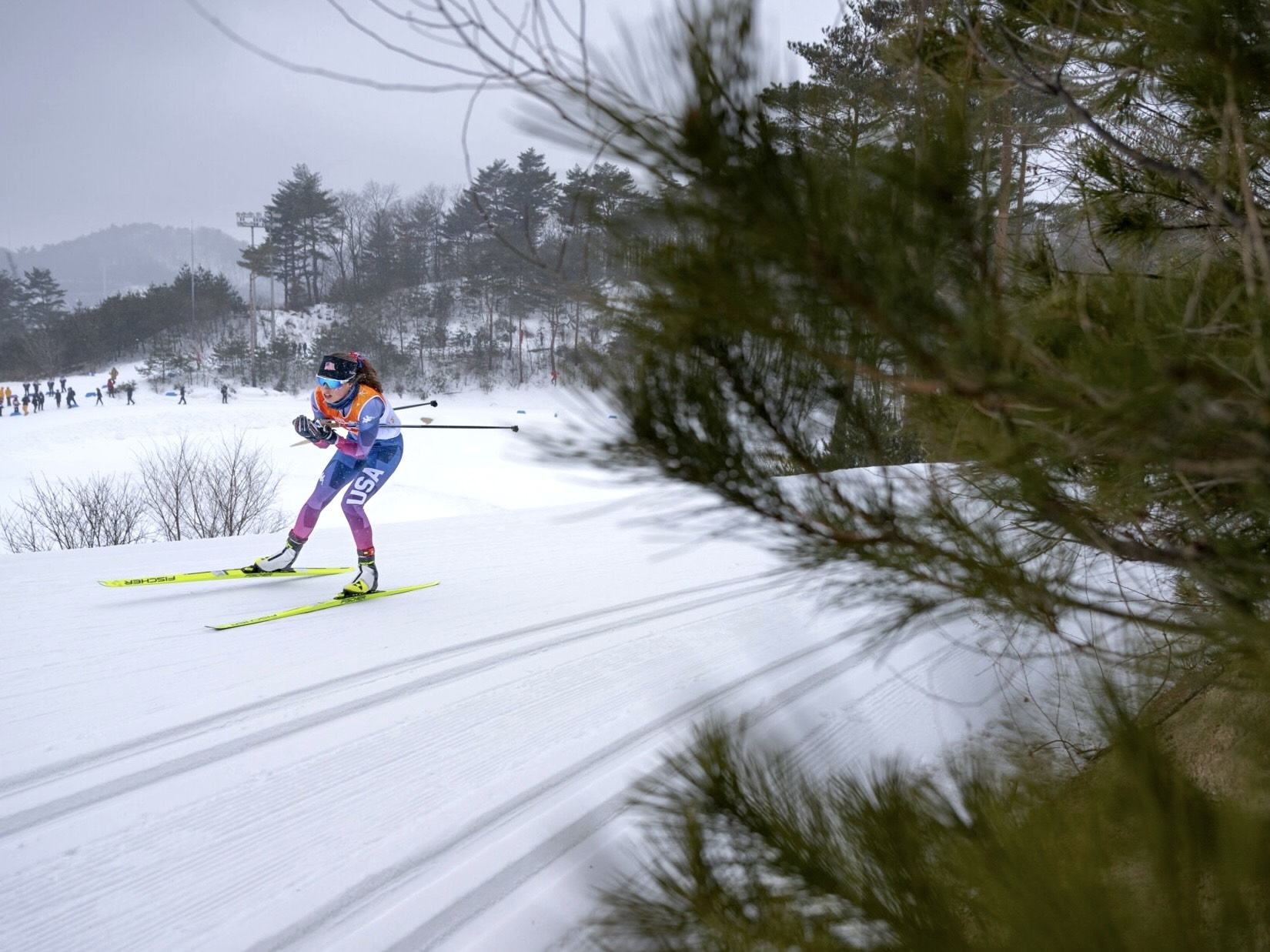
Nearly six years later, she found herself warming up on the same Olympic course where the duo won the team sprint in PyeongChang, South Korea. Gerard, who had since delved deep into nordic skiing, was preparing for her second race of the 2024 Youth Olympic Winter Games.
“We were racing on the biathlon courses from the 2018 Olympic Games, but I got to warm up for that race on the sprint course from 2018, where Kikkan and Jesse won,” Gerard recalled in a phone interview. “That got me so hyped to race.”
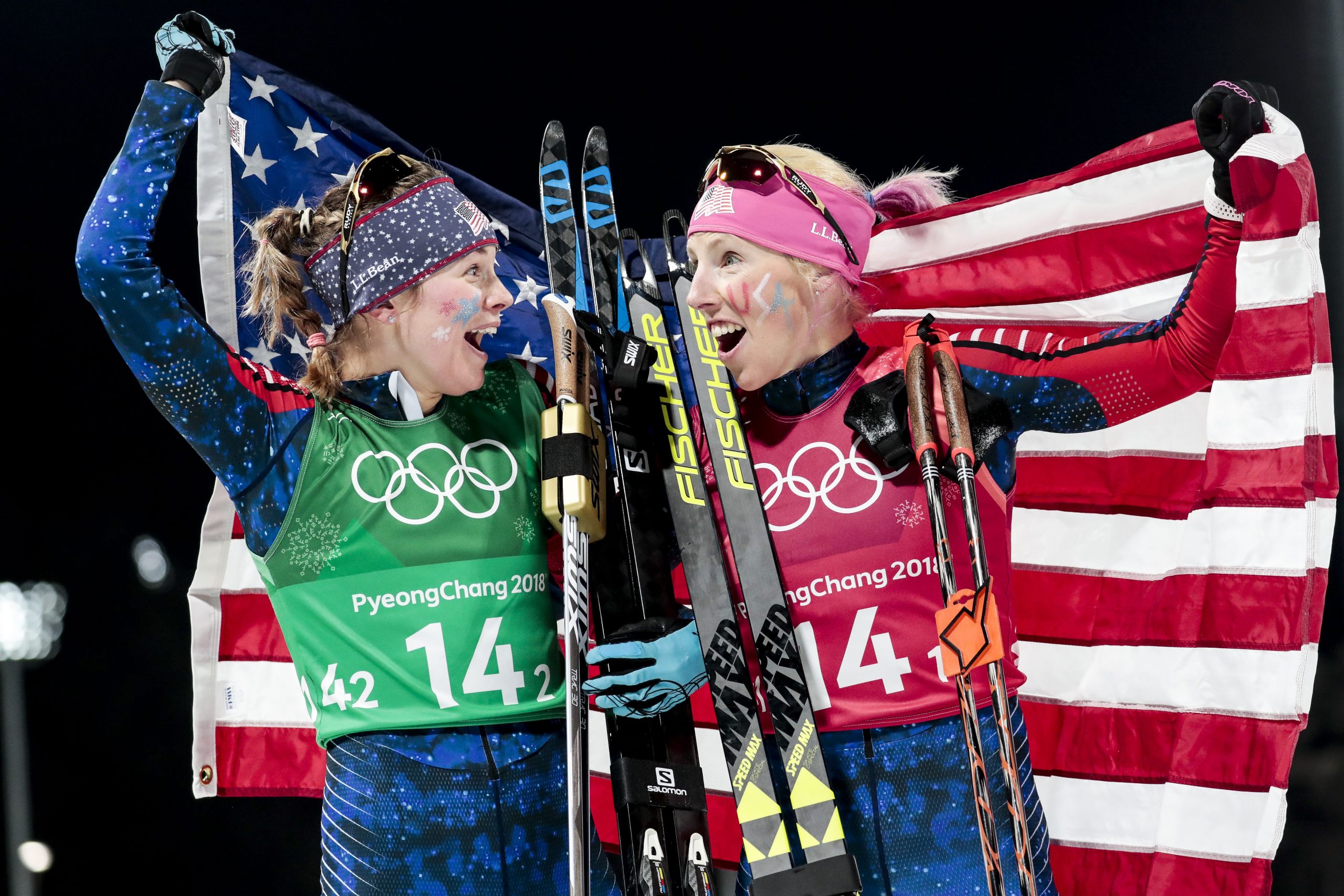
Jessica Diggins (USA), and Kikkan Randall (USA), (l-r) win America’s first cross-country Olympic gold in the women’s team sprint at the 2018 Pyeongchang (KOR) Olympics Pyeongchang. (Photo: Fischer/NordicFocus)
She went on to place sixth in the 7.5-kilometer classic race, following up on a 17th-place finish in the freestyle sprint the day before at the Youth Olympics.
“I finished the race, and I saw the result, and I just like ran up [my coach] Reitler [Hodgert] and gave him a hug,” Gerard said. “I’ve always been so much better at skate, and in the past two years, I put so much effort into my classic technique. It’s been a really frustrating, slow grind to get it better, but it just clicked in that race.”
She finished the Youth Olympics with a fifth-place finish in the 4 x 5 k mixed relay with Rose Horning, Benjamin Barbier, and Tabor Greenberg.
Thinking back to her “breakout” result of sixth in the individual classic race and the impact Randall and Diggins had on her, Gerard called it “super full-circle.”
“Best warmup ever,” she added.
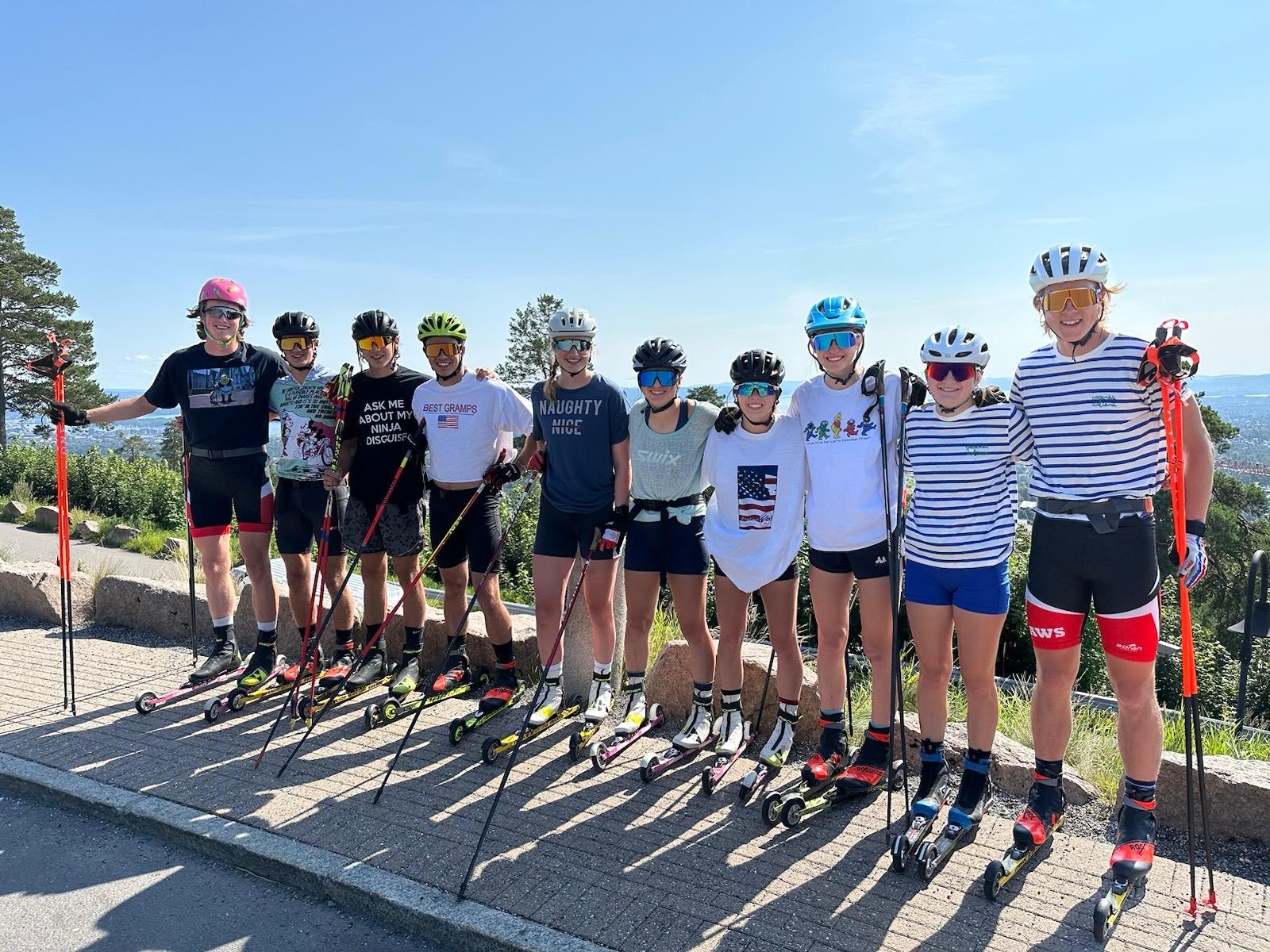
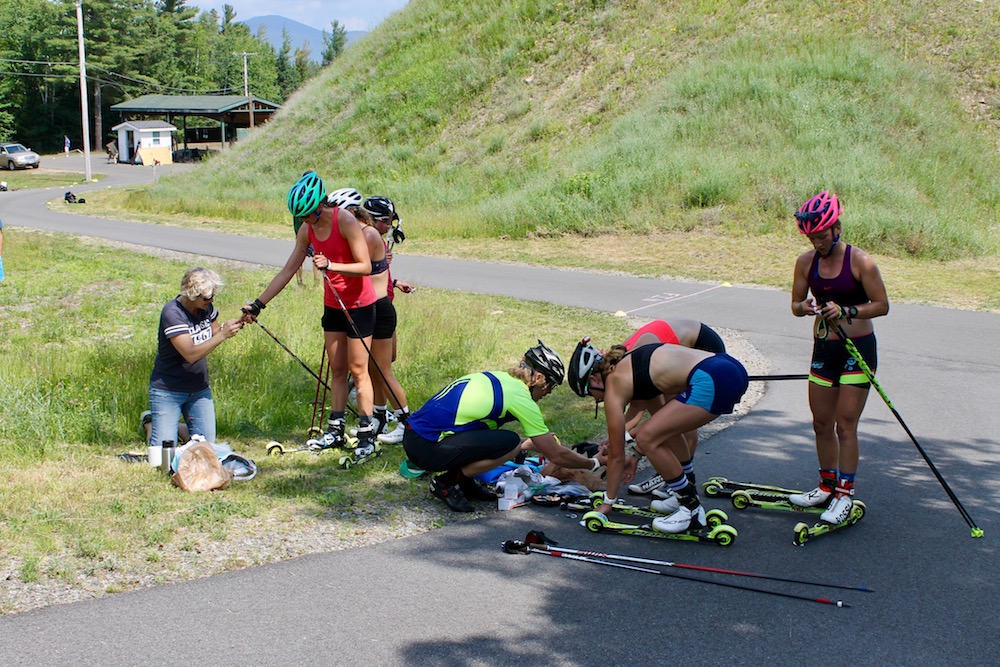
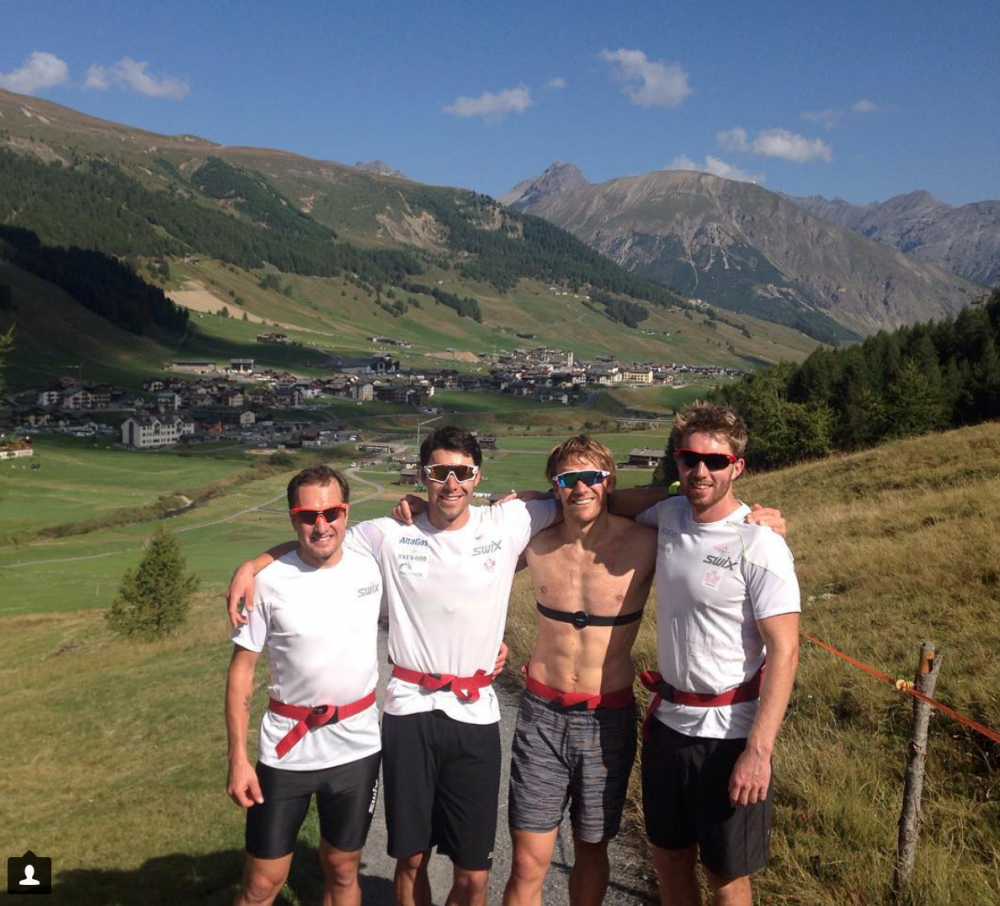
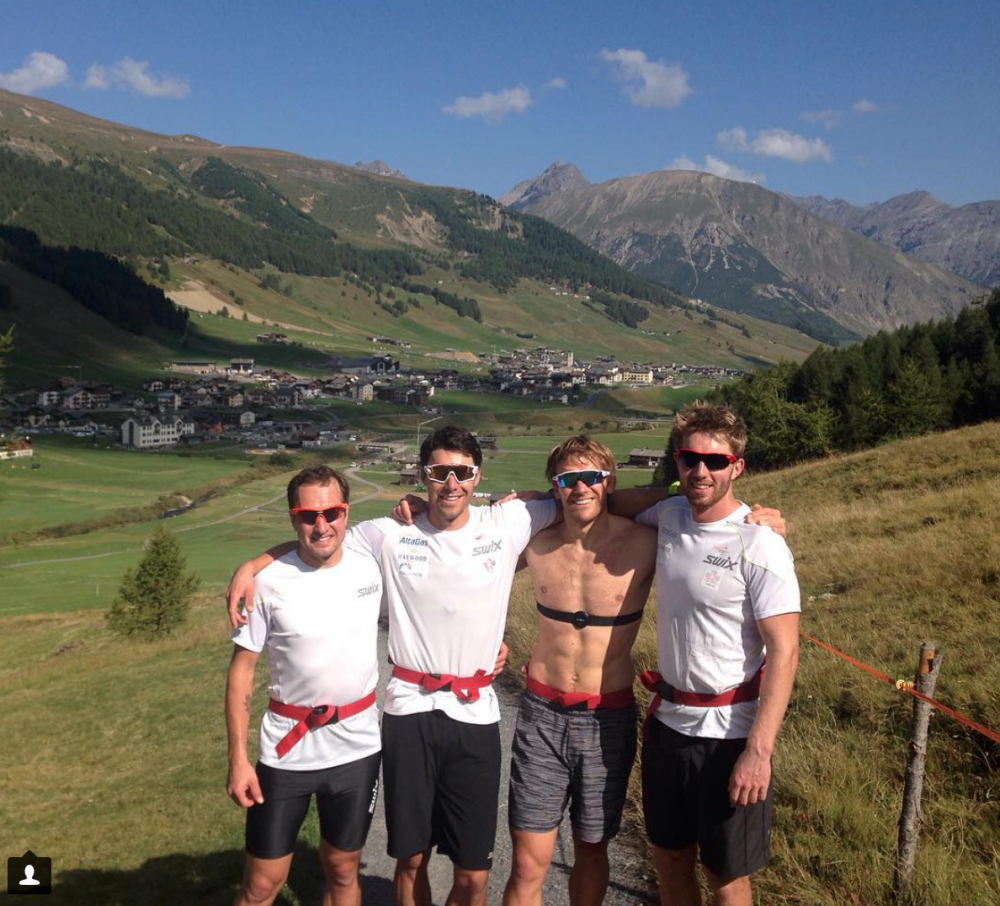
(Left to right) Americans Murphy Kimball, Owen Young, Tabor Greenberg, Grey Barbier, Tuva Granøien, Elsie Weiss, me, Maeve Ingelfinger, Natalie Nicholas, and Cole Flowers training in Norway last month. (Courtesy photo)
This summer, Gerard balanced full-time training with the Mt. Bachelor Ski Education Foundation (MBSEF) and working at events and babysitting before a trip to Europe in early August. There, she attended an International Junior Camp in Sjusjøen, Norway, with more than 80 athletes from 15 countries. She traveled with eight other U.S. skiers—Natalie Nicholas, Elsie Weiss, Maeve Ingelfinger, Owen Young, Murphy Kimball, Grey Barbier, Tabor Greenberg, and Cole Flowers—and coaches Greta Anderson and Tuva Granøien. They arrived in Norway a week early to train on the Holmenkollen rollerski track in Olso.
“It’s been really fun to ski with the fastest girls in the world from my age group,” Gerard wrote in an email during the camp last month. “I feel like I pick up little things they do that work.”
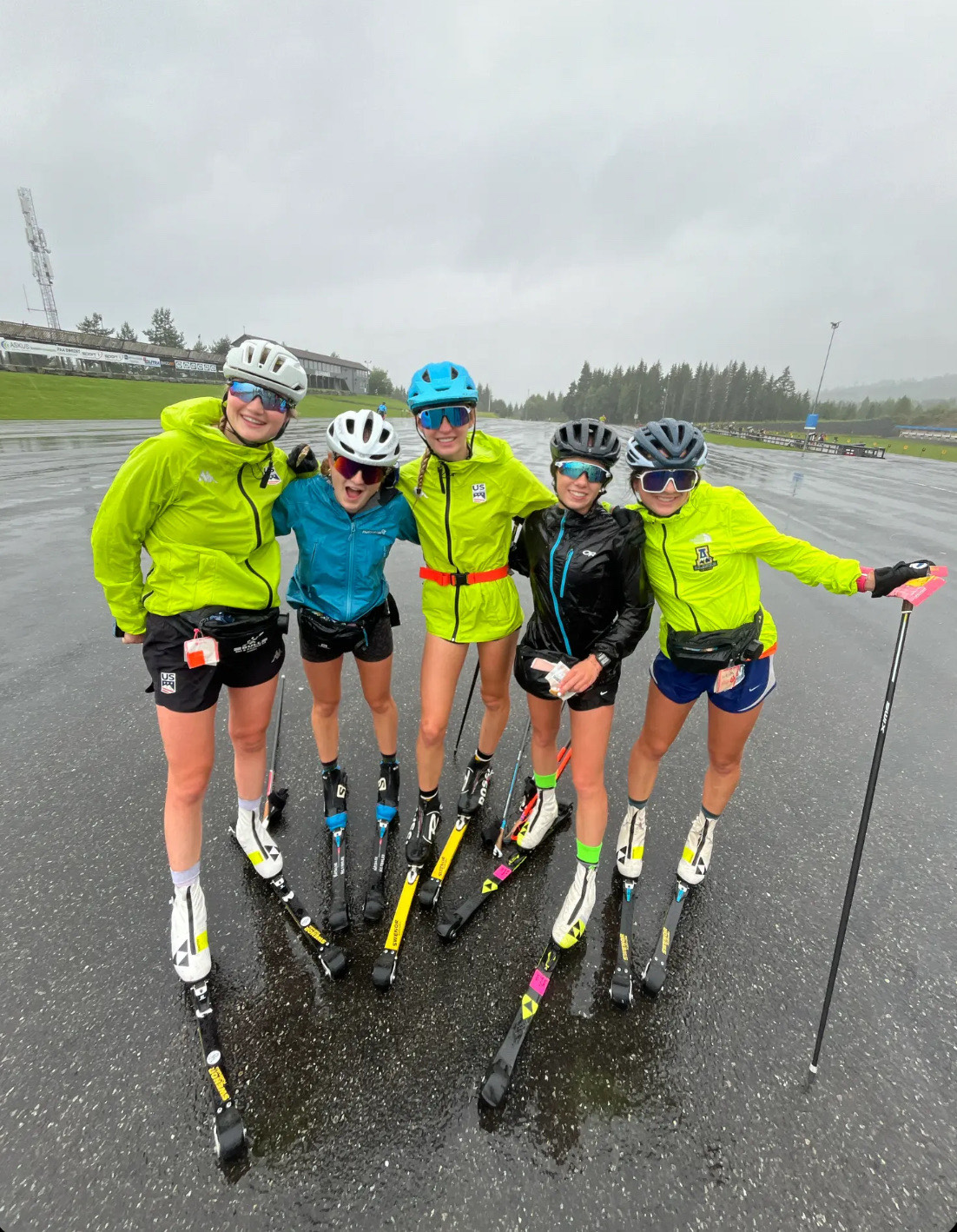
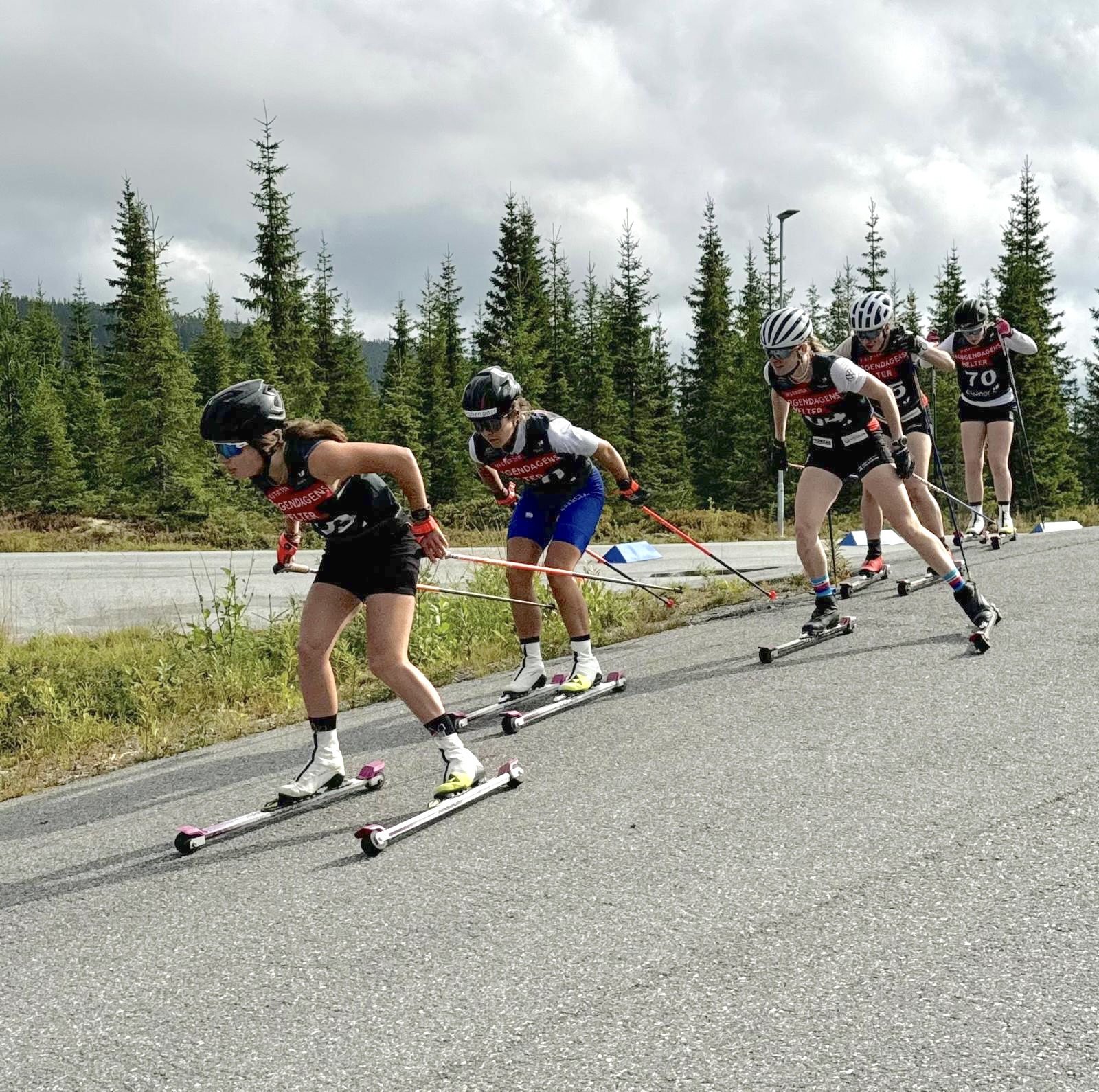
(Left to right) Tuva Granøien, Natalie Nicholas, Maeve Ingelfinger, me, Elsie Weiss training in Norway last month. (Courtesy photo)
She returned to Bend on Aug. 13 and left for her freshman semester at the University of Utah in Salt Lake City the next day.
Gerard explained her easy decision to join the Utes—NCAA skiing champions from 2019–2023. Another MBSEF skier, Zachary Jayne, will join her on the team.
“I just really want to go to a place where I can be surrounded by super-fast girls,” she said. “I want to be the worst on the team so that I get a lot better, and the coaching staff and the support is just phenomenal. Once I visited, I was like, ‘Yeah, this is where I want to go.’ ”
The last time Gerard was at the back of the pack was in middle school when she dabbled in nordic to be with friends and skied about once a week.
“The first race I ever did, I got dead last by like three minutes, and I was like, ‘Oh this sucks. I just wanna be fast,” she said with a laugh. “I didn’t really realize that in order to be fast, you have to put a lot of training into it.”
When the 2020 pandemic affected her mountain bike racing, Gerard shifted her focus to cross-country skiing. As entering freshmen, she and her friends began training more seriously, ramping up to six days a week that summer with MBSEF at the Mt. Bachelor Nordic Center.
The following winter, she raced to ninth in a skate sprint at Western Regionals. “I remember being super stoked about that,” she recalled.
As a former cross-country runner and all-around athlete, training came naturally to Gerard, who enjoys it more than most.
“I just really like training and pushing my body,” she emphasized. “I feel like I have big goals, and I just want to work really hard to get to those goals. I think I’ve always been that way.”
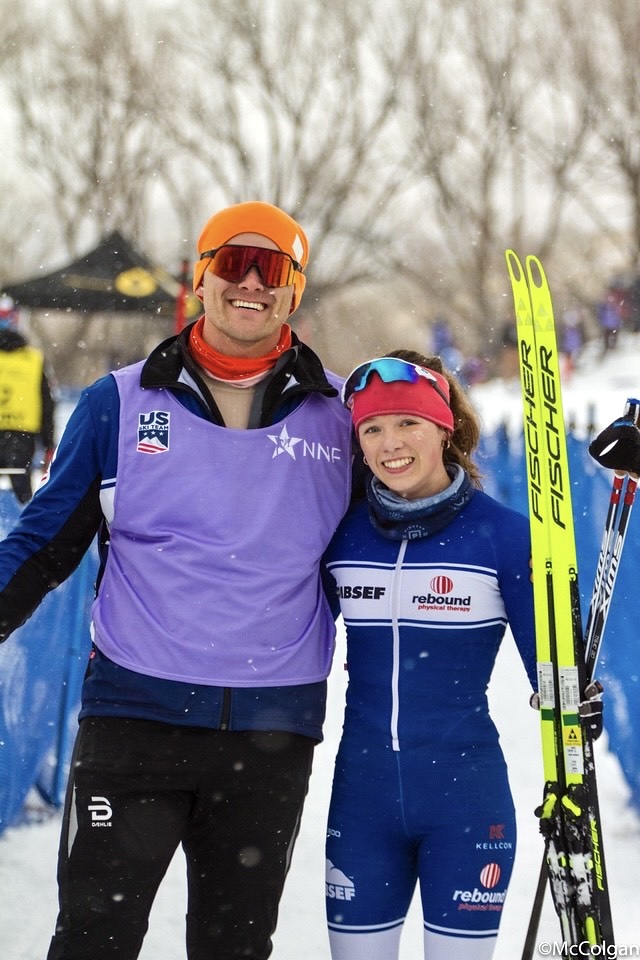
Neve Gerard and her MBSEF coach Reitler Hodgert. (Photo: John McColgan)
According to MBSEF Program Director and Head Coach Reitler Hodgert, she’s one of the hardest-working individuals he’s ever met.
“My job as a coach … has been to convince [Neve] to do less and to slow down and to take breaks,” Hodgert explained. “She has not had any single breakout year, but her skiing has been very much a rising tide of just continuous, consistent results and performances.”
She got her first taste of international racing at last year’s Scando Cup in Finland, where she finished ninth in the 5 k freestyle.
“What really stands out from Finland for me is just how different international racing is,” she said. “I was just like, ‘Wow, like this is like even more fun than racing in the States.’ ”
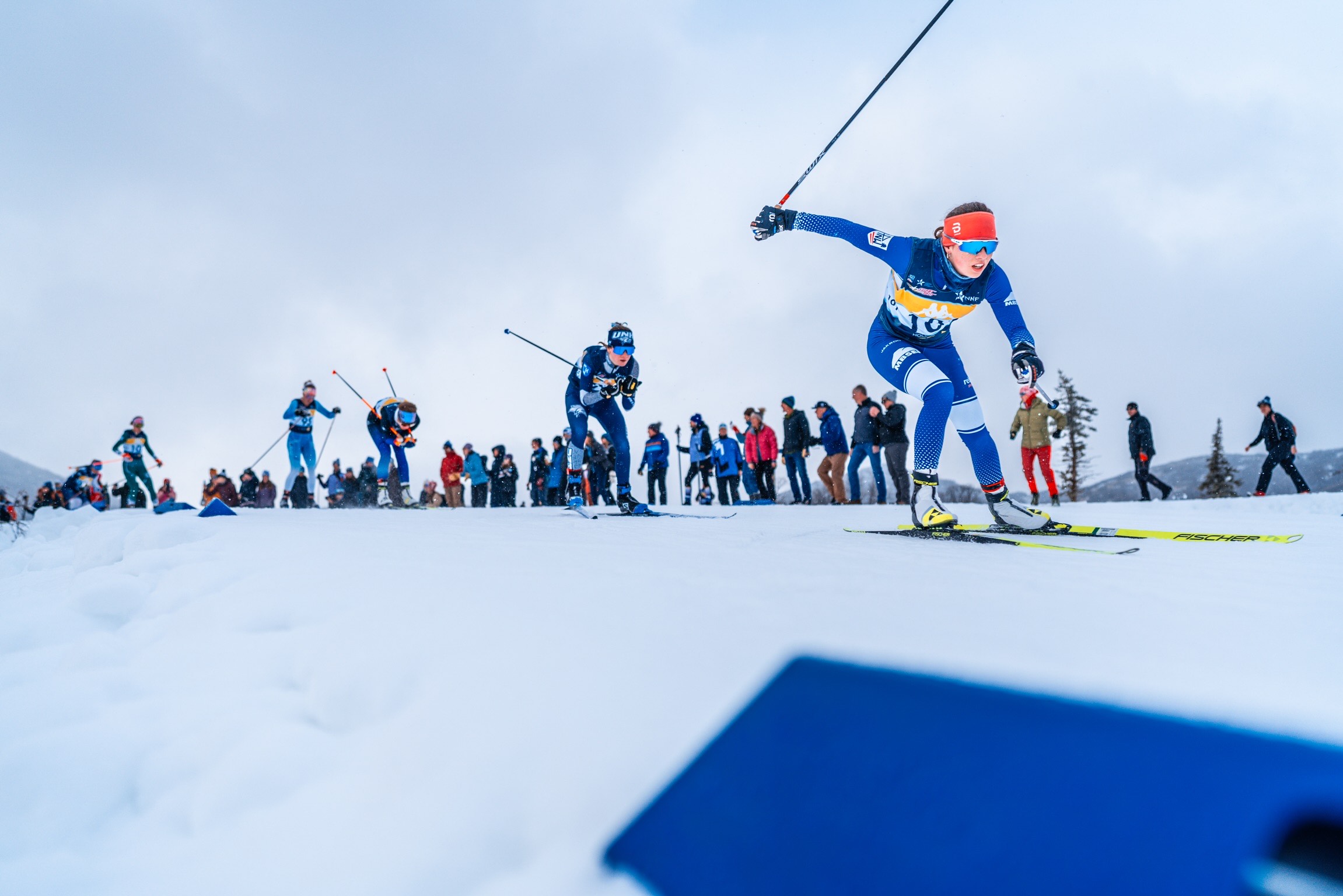
Neve Gerard (MBSEF) racing at 2024 US Nationals in January at Soldier Hollow in Midway, Utah. (Courtesy photo)
This past January, Gerard won the junior 10 k freestyle mass start at U.S. Nationals in Soldier Hollow. She was then invited to 2024 World Junior Championships but declined her spot to race at the Youth Olympics.
She finished out her senior year in Bend by returning to mountain biking, a sport Hodgert encouraged her to resume for cross-training. She and her high-school teammates (the Lava Bears) won the 2023 Mountain Biking State Championships team title, and Gerard placed second individually.
“Reitler wanted me to mix up my training a little bit, and at that point, I hadn’t mountain-bike raced since eighth grade,” she recalled. “It was fun. I got to mix it up a little bit, and it was a good experience.”
“We feel that being a multi-sport athlete as long as you can is super important for athlete development,” Hodgert noted.
“My coaches are the best and care about me as both a human and a skier which I appreciate,” Gerard wrote. “They have been so helpful in developing my skiing. Mt Bachelor has been a great venue to call home, having snow late into the spring/summer has been super beneficial in my training.”
“She’s been an incredible leader on our team for the last, last four years,” Hodgert said.
At the U of U, Gerard is interested in studying pyschology.
“I’m really into criminal psych,” she said. “I just really like how the brain works.”
American Neve Gerard (l) leads athletes from other countries at an International Training Camp in August in Sjusjøen, Norway. (Courtesy photo)
Neve’s Favorite Fall Workout
9 x 4 minutes L4 double pole intervals up Skyliners Road (a slight uphill gradient that goes up for 8 miles) after school
“We do this workout a few times each fall, and it’s always so hard but really fun and rewarding once you’re done.”
Warmup: 30-minute ski to the start with some speeds/pickups
Cool down: Ski Skyliners in the opposite direction/downhill
Neve Gerard (MBSEF) racing at 2024 US Nationals in January at Soldier Hollow in Midway, Utah. (Courtesy photo)
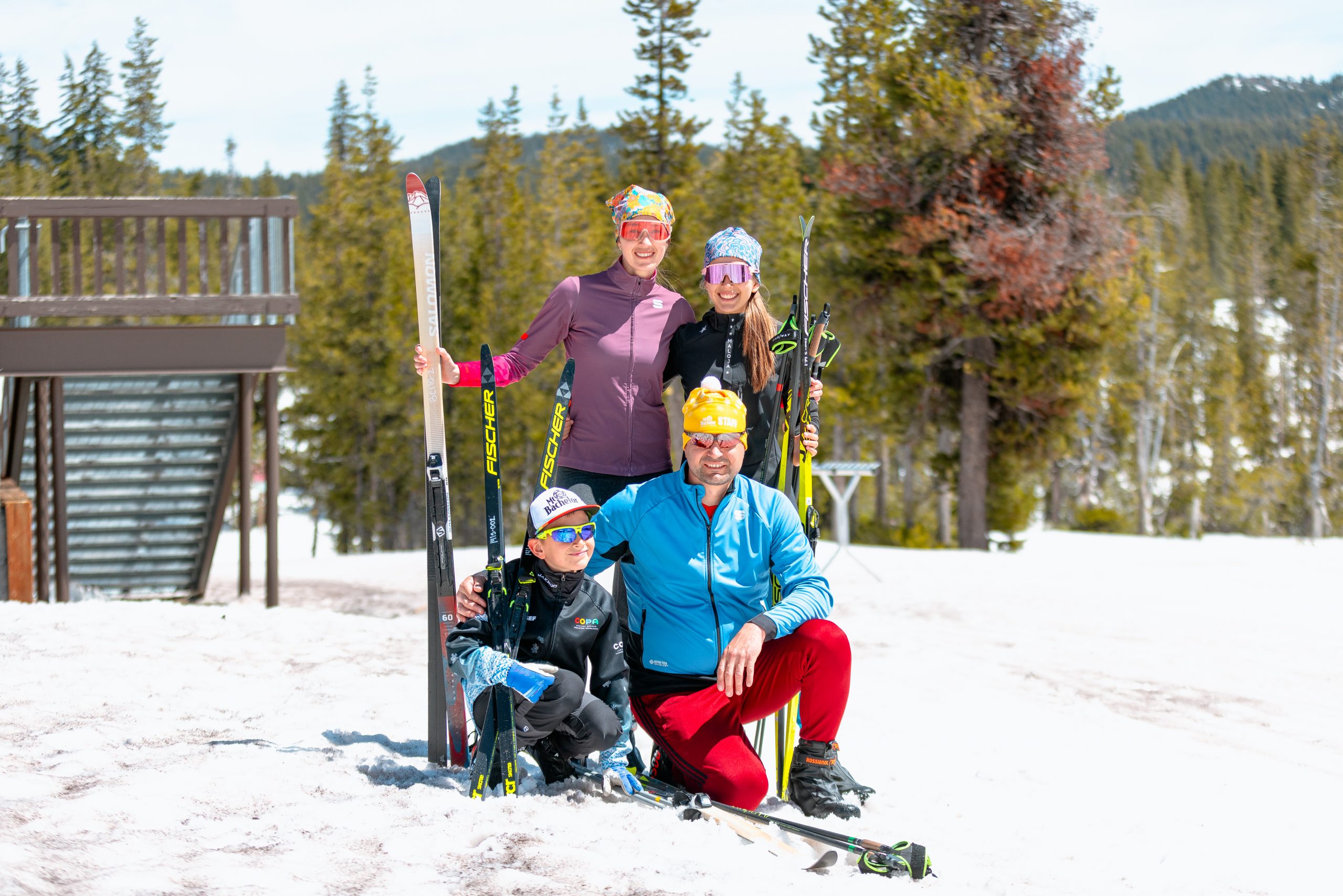
The Hryhorenko family at the Mt. Bachelor Nordic Center in late May, six months after they left Ukraine. Clockwise, from left: Yuliia, Anhelina, 14, Oleksandr, and Ivan, 10. (Photo: Mt. Bachelor)
Anhelina Hryhorenko is a typical 14-year-old girl in many ways—she loves art and isn’t a fan of math. And she’s excited to have her freshman year of school over.
But she’s got a lot of unique qualities, too. For one, she’s a junior national champion with more medals than she can hold in two hands. She’s also the daughter of a former national cross-country ski team member team and the niece of a three-time Olympian.
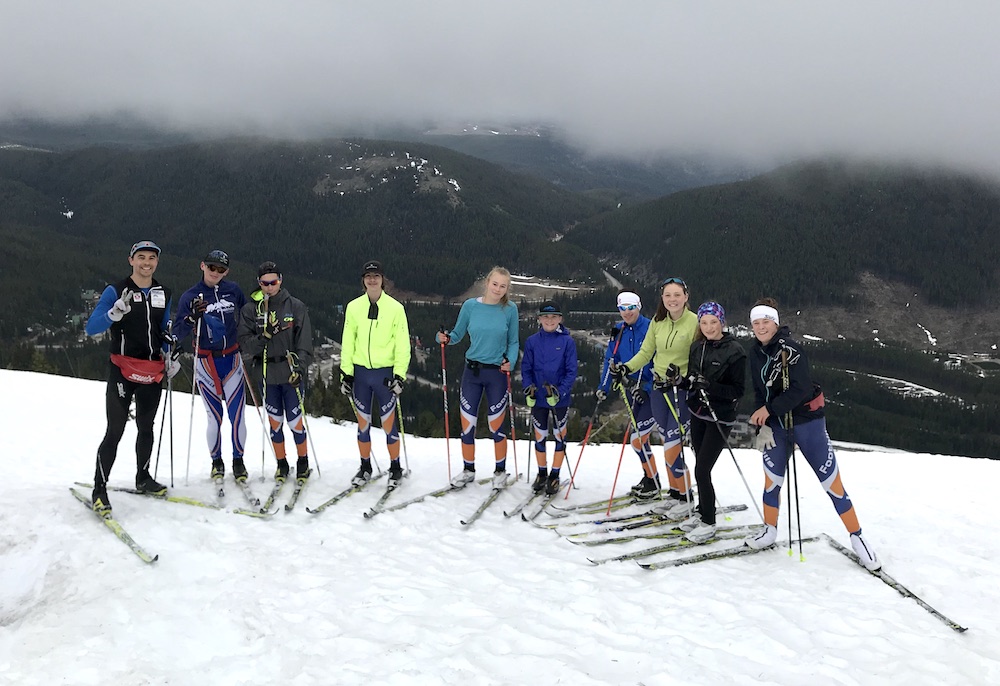
From left to right: Anhelina Hryhorenko and her MBSEF teammates Will Mowry, Catcher Kemmerer, and Irving Stoller spring skiing at Big Meadow in front of Broken Top in Central Oregon (Photo: Reitler Hodgert)
She lives and trains in Bend, Oregon, and races in a blue-and-yellow Ukrainian national team suit. Since she’s only been in the U.S. since December, she speaks little English, but she’s gotten very savvy with Google Translate. She has also made friends with classmates and teammates on the Mt. Bachelor Sports Education Foundation (MBSEF) nordic ski team.
Anhelina, known by her teammates and coach as “Angelina,” is a quiet teenager most excited about training this summer. She moved to Bend with her family in February, thanks to a family who offered to host them and Mila Shelehoff, a fellow Ukrainian who’s been living in the U.S. for the last 30 years. Shelehoff has been serving as the translator and local liaison for the Hryhorenko family, which includes Anhelina, her mother, Yuliia, her father, Oleksandr, and her 10-year-old brother, Ivan.
An art and outdoor educator, nonprofit founder, and instructor at the Mt. Bachelor Nordic Center, Shelehoff created Bend For Ukraine. This community initiative supports displaced Ukrainian families by helping them resettle in Central Oregon. She’s known as “Mamma Mila” and has assisted the Hryhorenkos since they relocated to Bend. She’s also helped several other Ukrainians in Bend as they navigate the challenges of housing, employment, education, and cultural integration.
Ivan Hryhorenko (l) and Lukian Shelehoff, friends, classmates, and teammates with MBSEF’s Stevenson Youth Program. (Photo: Mila Shelehoff)
The Hryhorenkos met Shelehoff a few months ago, and they’ve already become fast friends. Ivan is the same age as her son, Lukian, and the two go to school and ski together with MBSEF.
“I moved to Bend about for the same reason they moved to Bend,” Shelehoff said of moving to the area two years ago. She and her son were drawn to the downhill skiing at Mt. Bachelor, which has the longest natural ski season in the U.S., with snow lasting into June. They ultimately switched to nordic and never looked back.
The Hryhorenkos had a different “coming to Bend” story. When they arrived in the U.S. in December 2023, they knew nothing about Mt. Bachelor or Bend. They initially landed in Salem, Ore., about 2 ½ hours northwest of Bend, to stay with friends who sponsored their humanitarian parole from Ukraine through the U.S. Department of Homeland Security’s Uniting for Ukraine program.
They came seeking refuge in a foreign country, uncertain about their future. Anhelina brought her ski boots and little else.
The Hryhorenkos, Anhelina (r), Yuliia (second from r), Oleksandr (c), and Ivan (l), and Shelehoffs, Mila (second from l) and Lukian (bottom r), at the Mt. Bachelor Nordic Center in late May. (Photo: Mt. Bachelor)
Life Before
About two and a half years ago, Anhelina was training at a Ukrainian boarding school and racking up medals as a promising young cross-country skier. Her family lived in Central Ukraine, about an hour south of Kyiv, while Anhelina lived at a private academy and trained for skiing. She was chasing a dream and had the genetics to back it up—her father, Oleksandr, raced on the Ukrainian national team, and her aunt, Kateryna Gryhorenko, was a three-time Olympic cross-country skier.
On Feb. 24, 2022, everything changed. Russia invaded Ukraine, and Anhelina’s school evacuated its student-athletes to Poland. Meanwhile, her father, mother, and brother sheltered inside their home’s root cellar for two weeks while their country was under siege.
When they felt safe to leave, Yuliia fled to Poland with Ivan. They spent three months with Anhelina in Poland before returning to Ukraine and Oleksandr, a carpenter by trade. Kyiv had installed anti-missile systems while they were away, and their region wasn’t under occupation, so they felt it was safe to go home.
But life was far from ordinary. Anhelina returned to boarding school, but her family slept in their cellar and lived in constant fear.
“It creates a lot of anxiety, especially when you hear the explosions,” Yulia told the Bend Bulletin. “The bunkers are truly root cellars. They’re not bulletproof; they’re not bomb-proof.”
They continued to live this way until October 2022, when Anhelina survived a massive air raid while commuting to school. With that, the Hryhorenkos resolved to leave.
It took the Hryhorenkos a year and a half and several attempts to gain approval to enter the U.S. Eventually, with the help of their sponsors in Salem, their third application was accepted, and they landed in Oregon in December 2023.
Once in Salem, Oleksandr started working to support his family. Yuliia, a former physical education teacher, reached out to ski clubs across the U.S., hoping they could find a place for Anhelina.
“After arriving in America, we immediately started looking for a club for Angelina,” Yuliia explained in an email to FasterSkier. “She had to continue to practice so that there were no gaps in training. Salem could only give us running training, and we needed [ski] training. There was even a question about ending our career if we didn’t find anything, [after] almost 8 years of training.”
Despite not speaking English, Yuliia sent about ten inquiries. One responded.
“At first, when the email came through, I thought it was spam,” MBSEF Nordic Program Director Reitler Hodgert told FasterSkier. “But as soon as I opened it, it made a lot of sense for us to offer them a space to land and do what we could to support that.”
Knowing very little about MBSEF—one of the premier nordic ski clubs in the country—the Hryhorenkos signed her up. By mid-January, she began training with the team in Bend. Their Salem friends assisted with transportation, lending a vehicle with winter tires so the Hryhorenko family could drive to Bend each weekend for Anhelina’s training. On Monday mornings, they’d drive three hours back to Salem in time for school.
After witnessing their long commute, Anhelina’s teammate, Maddie Carney, and her family invited Anhelina to stay with them on weekends. In early February, Sarah Max offered to host the family for free, and Yuliia and Ivan joined Anhelina in Bend while Oleksandr worked in Salem. The kids started school at Bend-La Pine and lived at Max’s home until late March.
They were also hosted by another nordic family, Dr. Sondra and Mike Marshall, who ultimately helped them find an apartment.
“They put a lot of effort into finding us housing among their acquaintances,” Yuliia wrote. “They are currently helping us pay for an apartment for a certain period of time. During our entire stay here, we are surrounded by fantastic people, whom it is rare to meet.”
From left to right: The Mostovych family, Cari Brown, Mila Shelehoff, Anhelina Hryhorenko, Shelehoff’s father from Kyiv, Lukian Shelehoff, Yuliia Hryhorenko, and Ivan Hryhorenko at a Ukrainian Easter event at Café des Chutes in Bend, Oregon. (Photo: Mila Shelehoff)
Life After
United for Ukraine grants Ukrainian citizens and their immediate family members two years of temporary stay in the U.S. Through Shelehoff, who translated, Yuliia told FasterSkier that she was hopeful they could make the move permanent but uncertain whether that was possible.
“[I hope] my children can discover themselves here in this country versus in Ukraine,” Yuliia said. “They have many more opportunities to find themselves and do something they love in the future.”
In addition to other community members, Mt. Bachelor and MBSEF are sponsoring the Hryhorenko family so they can continue settling in Bend. Fischer and One Way have pledged to provide Anhelina with equipment for the coming season.
“When they first arrived in town, we had a huge outpouring of support,” Hodgert explained. “Mt. Bachelor reached out to support Anhelina’s family with trail fees and whatnot, and that was largely through [Mt. Bachelor Nordic Manager] Sydney [Powell] and was huge.
“… They moved here with basically just Anhelina’s ski boots, and so we had families giving gear, jackets, snow pants, gloves, hats…” continued Hodgert, a Bend native. “[That was] one of the proudest moments for me of our community here locally, just to see the number of people stepping forward to give what they could to get them on their feet here in town.”
Ivan Hryhorenko (l) and Lukian Shelehoff spring skiing at Todd Lake in Central Oregon. (Photo: Mila Shelehoff)
One local bought Anhelina and Ivan new bikes.
“I’m in awe of how they were received and how much help they got,” Shelehoff said.
Asked about Anhelina as a skier, Hodgert said that considering her age, she’s one of the most talented technical skiers he’s ever worked with.
“She has a very innate sense of body awareness, just like where each of her limbs are and how she’s moving them,” he noted. “Even while working through a language barrier … she picks up technical feedback and applies it to her skiing faster than any athlete I’ve worked with.
“She’s universally adored on our team,” Hodgert added. “Anhelina, as a person, is fairly quiet, so there were definitely some concerns that she’d feel … a little bit isolated around the team. And thus far, that hasn’t at all manifested. She has jumped right in with things.”
He laughed that his athletes “spend a significant time on Google Translate” while riding in the team van.
“Unsurprisingly, all of our athletes are super curious about what life in Ukraine is like, just her being from somewhere else, and they’re all super eager to introduce her to all the things that they love about being here in Bend or the U.S. in general,” he said.
Compared to Ukraine, Anhelina said the trails and facilities were “much better,” and the training was “different.” Asked what her skiing goals were, she said she just wanted to train. She prefers skating in the winter and classic ski training in the summer.
“I like that it’s a very long ski season,” Anhelina said of Mt. Bachelor specifically.
Her mother elaborated on their U.S. experience so far.
“First and foremost, as a mom and as a former athlete, I want safety for my kids, which is above and beyond what we experienced in Ukraine,” Yuliia said. “Second, the equipment and the facilities and, of course, the trails… the availability of all of those, to provide opportunities for children to train in a safe and enriching environment.”
She explained that when Anhelina was a child, she and her teammates built their own trails, carrying tools to practice.
“In the winter, a little wall of the kids would line up and groom the trail with their skis so they could skate,” Yuliia added, explaining how the kids side-stepped to pack down the snow. They had never experienced grooming like at Mt. Bachelor.
“We’re in awe of the level of the trails here and just really appreciate that they’re groomed and ready every morning,” she said.
“The people we’ve been in contact with are all very wonderful and good-hearted,” Yulia said of the Bend community. “They really care for our family and situation. I’m sure they also care about the rest of the world the way they care for us.”
Hodgert described Anhelina as a “fantastic addition” to the MBSEF program, which boasts over 200 athletes.
“Having Anhelina join our team has been a great worldly learning experience for the athletes, and in exchange, we’ve been able to provide her with a space where she can hone her craft,” he said. “We intend to support [her family] as long as they’re here. That might be just this year, it might be two years, three, five, we don’t really know. But as long as Anhelina wants to be skiing and wants to be in Bend, we’ll be supporting her.”
What a gap year it’s been so far for 19-year-old Otis Loga.
After graduating high school in Montpelier, Vt., in September, the aspiring Paralympian decided to spend a winter skiing and training out West before starting college. He landed at Snow Mountain Ranch, the YMCA of the Rockies, in Granby, Colo.
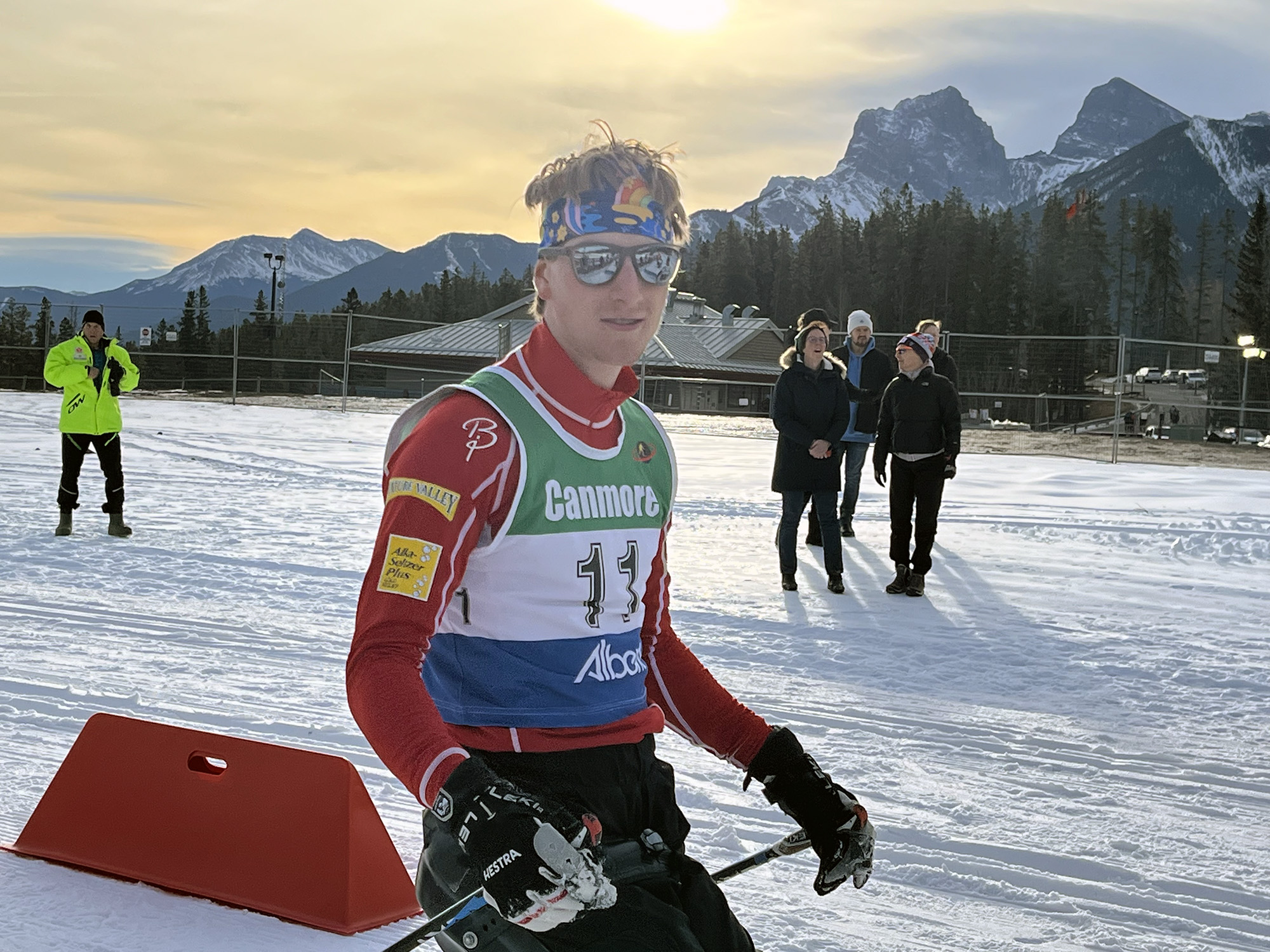
It was a dream for the relatively new sit skier, who was first invited to a US Paralympic camp in Canmore, Alberta, a year earlier. A three-sport athlete in high school, Loga has cerebral palsy (CP), a movement disorder that makes it difficult for his brain to send messages to the rest of his body. He was born with it, yet he persisted in sports, learning to ride a bike in fourth grade and competing in cross-country skiing, cross-country running, and track in high school.
As a freshman, Logan started skiing as most people do—on two legs—but initially needed skis without wax to give him more control. He worked up to skiing on wax and standing for an entire practice, but the coordination involved with cross-country skiing remained a challenge.
“Standing on one foot, moving on snow is an issue,” Loga explained. I was just falling and couldn’t keep up with anybody, and I came in last or second to last place every single race.”
At the first race of his sophomore season at the Craftsbury Outdoor Center, he encountered a US Paralympics table. He picked up an information card, and his coach encouraged him to follow up with them.
“I checked it out, put my name on their email list,” Loga explained. “Next thing I know, BethAnn Chamberlain sent me a box with a sit ski in it.”
His contact with Chamberlain, the US Paralympics Nordic Skiing development coach, proved fruitful beyond his initial sit-ski setup. As a high-school senior, he attended the US Paralympics Nordic training camp and returned to Canmore for a second time this past winter.
“That’s when I met a lot of other skiers and got to ski with people at a high level,” he said. “[It] was like, ‘You’re double poling, and I’m double poling. Cool.’ ”
Chamberlain also connected Loga with Mark Birdseye, the nordic and biathlon competition coach for the National Sports Center for the Disabled (NSCD) in Winter Park, Colo., who facilitated his move to Snow Mountain Ranch.
Otis Loga at Snow Mountain Ranch.
“[She said] this might be a good training/gap year opportunity for you,” Loga reflected. “And I looked into it, like, great, I can get paid to work at the Nordic Center and ski and get coaching, and I’m already out West closer to people [to train with].”
As the recipient of a $3,000 grant from the Challenged Athletes Foundation, he received a new, custom-built sit ski precisely fit for him that didn’t require “five pounds of duct tape” to strap his legs in, as his old sit ski did. Loga joked that the new sit ski “fit [his] curves.” This past winter, he used it for training at Snow Mountain Ranch and several Paralympic training camps and races.
One of five athletes who trained with Birdseye this winter, Loga embraced his Colorado experience, downhill skiing at Winter Park and working, skiing, and living at the ranch. He worked full-time in exchange for lodging and food, the costs of which were deducted from his paycheck.
According to Loga, he taught lessons, worked on the ski patrol, interacted with customers, cleaned bathrooms, and kept walkers off groomed trails. When he wasn’t working, he trained on an abundance of snow on sit-ski-friendly trails.
“When I’m skiing at Snow Mountain, I feel like, ‘Wait, so I live here, and I ski here, and I get paid? What a dream,’ ” he said.
“He needed a place to live and a place to eat and a place to ski, and we are that place,” said Mary Ann Degginger, program director at the Snow Mountain Ranch. “He’s been a great staff member for us and a delight to work with, and he’s also just a really inspiring, inspirational human being.”
Birdseye, who served as program director at Snow Mountain Ranch from 1985 to 2010, described Loga as incredibly hardworking and coachable.
“He’s got a wonderful sense of humor about where he’s at in life and where he’s going,” Birdseye said. “He’s got a very good aerobic engine and can ski for a long, long time.”
Snow Mountain Stampede Ranch Boss belt buckle.
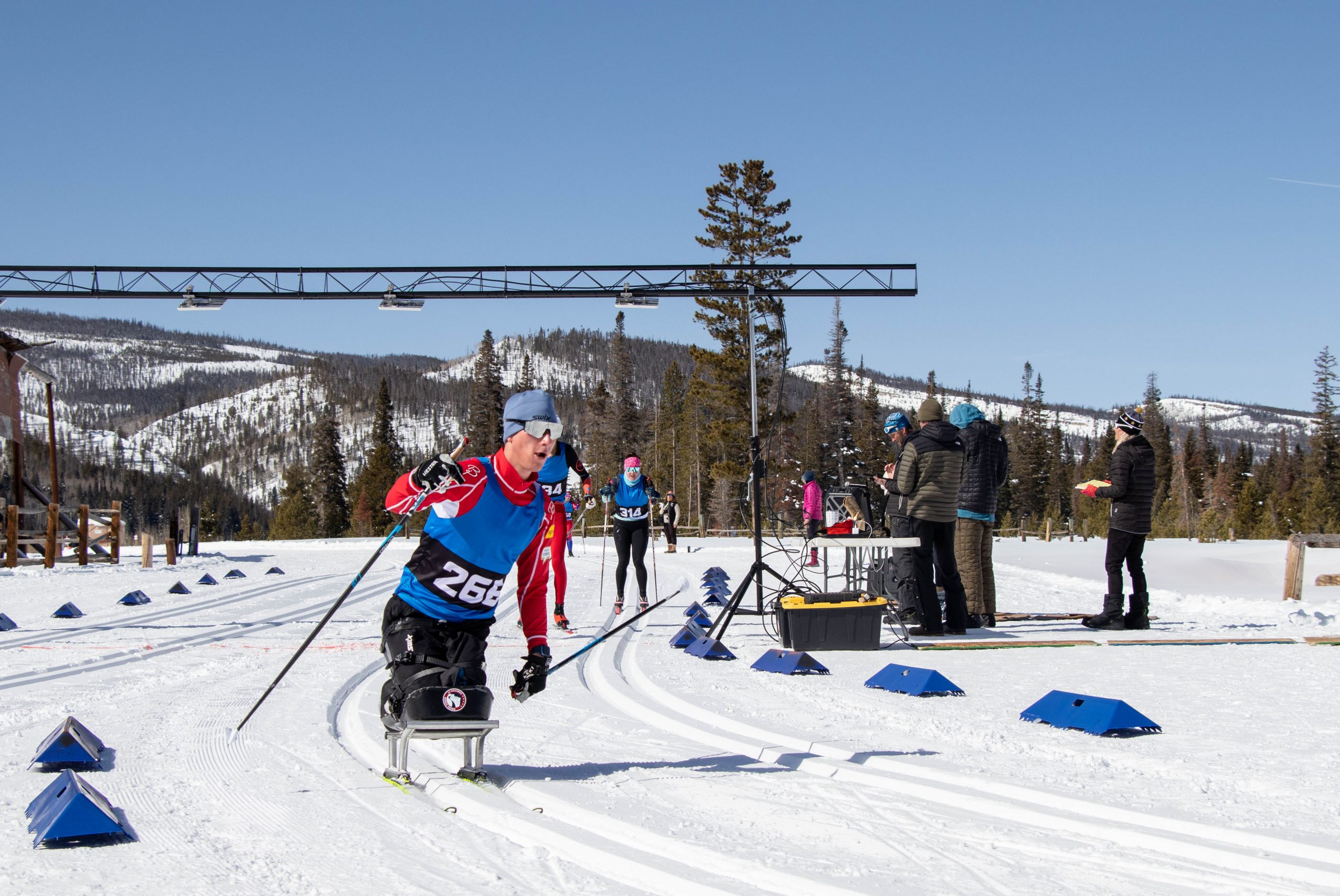
Loga competed in several distance races this year, including the Boulder Mountain Tour in Sun Valley, Idaho, and back-to-back Stampede races at Snow Mountain Ranch. For the latter, he earned the coveted belt buckle for completing two 25 k races on consecutive days, the first of which was on an untracked skate course—a challenge for any sit skier.
“I am a long-distance person,” Loga proclaimed. “If you say ski, run, or bike, fine. Sprint 400 meters? No, thank you.”
As he packed for his return to Vermont this month, Loga said he was grateful for his time spent in Colorado with Birdseye at Snow Mountain and with the US Paralympics Nordic team. While home this summer, he said he would begin classes at a community college while continuing to train in an effort to make the national team and become a Paralympian. Next winter, he hoped to be back out West—preferably in Colorado at Snow Mountain Ranch.
“Athletically, he’s still a young man,” Birdseye said. “He’s only 19, so he’s still got a lot of maturation to go as a young man and an athlete.”
Birdseye said they had been working on Loga’s hand speed and interval-based training to build speed in shorter-distance races. For the start of the off-season, he explained Loga would be getting back into cycling shape during his cross-country road bike back home.
This Friday, April 19, Loga planned to meet his father at the Denver airport, drive to the Kansas-Colorado border, and ride roughly 2,000 miles back home over the next month or so. After having his legs strapped into a sit ski for most of this winter, Loga realized that riding 100 miles daily would be tough. He said the most he has ever done in one day is about 80 miles.
“My dad’s gonna fly out and be my swag wagon,” Loga explained. “I booked a month, so if I don’t make it in time, then I just hop in the car and drive.”
They planned to camp on the side of the road, stay in hotels when necessary, “or knock on some nice stranger’s door and spend the night,” he said.
“I said, ‘Otis, you’re gonna have to pedal yourself into fitness like they do in the Tour de France,’ ” Birdseye said with a laugh. “… You’re a great nordic skier right now, but the Viking legs will come…
“He’s got a very adventuresome spirit,” he continued. “… And he has such a great heart for people. He’s very caring and really wants to do the best that he’s capable of doing.”
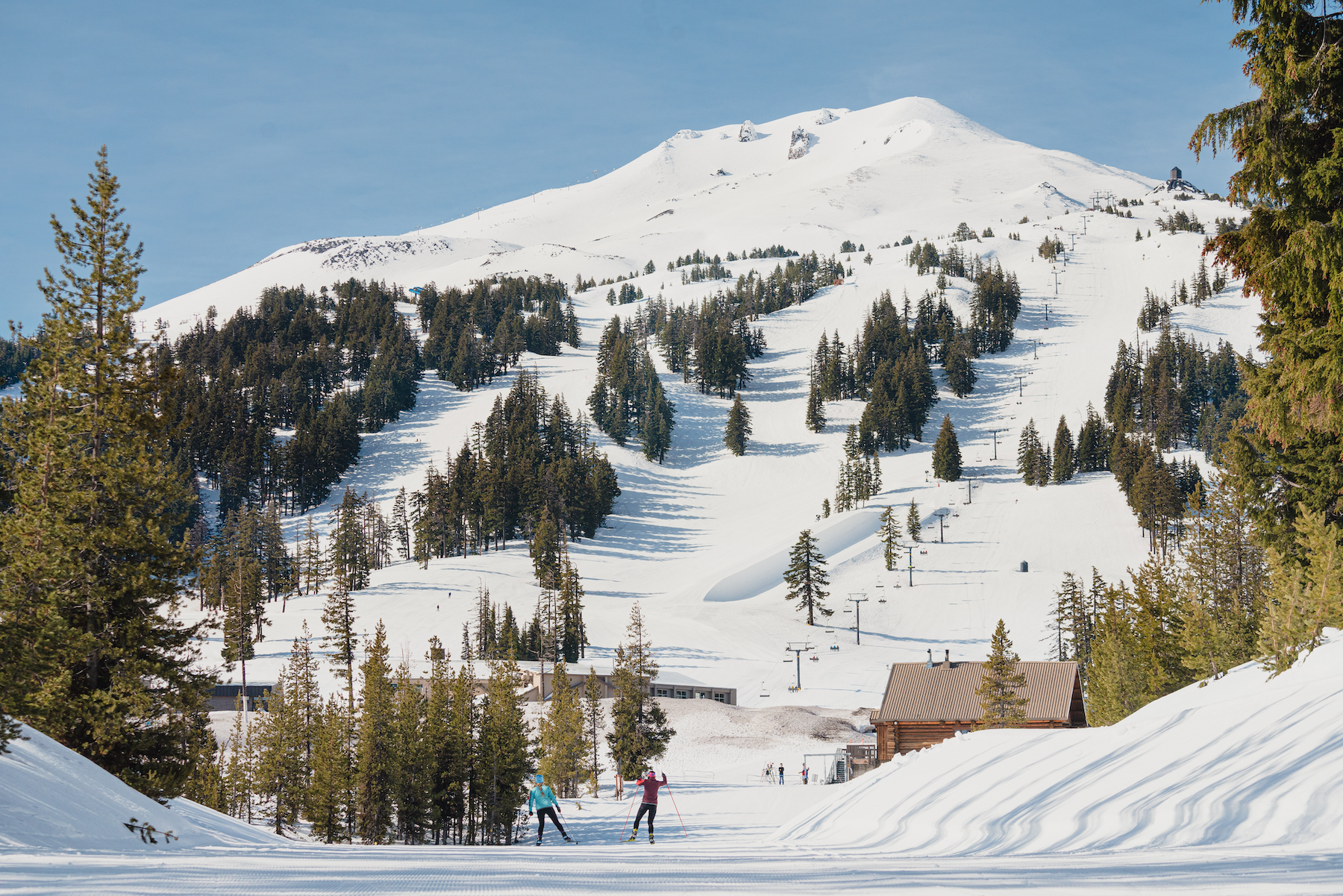
If there’s ever a place for a cross-country skier to put on their bucket list, Mt. Bachelor in central Oregon is it. With a ski season that typically lasts into late May and can even extend to June—with natural snow some 6,400 feet above sea level—the Mt. Bachelor Nordic Center is spring skiers’ paradise.
According to Nordic Manager Sydney Powell, Mt. Bachelor (about 22 miles west of Bend, OR) has been inundated since January with snowstorms that brought powder conditions throughout the winter and a 10-foot snowpack (120-inch base depth) as of early March.
“The grooming team has worked long hours to keep up with it all, but we are really grateful to have this challenge given the lack of snow in some places [of the country],” Powell stated. “May 26 is our planned season-end date, so there are nearly [two] months of skiing yet to go!”
On April 6, it will host the Cascade Crest, the last race of the Mt. Bachelor Cup Series organized by the Mt. Bachelor Ski Education Foundation (MBSEF). Powell described the 25 k course that winds throughout much of the trail system as “hilly but very scenic.” The 25 k skate race is the most popular, and the 50 k marathon tour entails two laps of that course. There’s also a 12.5 k distance and a 5 k kids’ race. All races are freestyle discipline.
To close out the official season, the Nordic Center also has a variety of fun spring activities planned, including an Easter egg hunt on March 31, “Treats on the Trails” on April 12 and May 12 (Mother’s Day), and a spring deck concert/closing weekend celebration on May 25. While not entirely nordic, the Pole Pedal Paddle, MBSEF’s signature event, is slated for May 18. The multi-sport relay includes an alpine leg, 8 k cross-country ski, 22-mile road bike, 5-mile run, 1.5-mile canoe/kayak/SUP paddle, and 0.4-mile sprint.
A dormant volcano in the Cascade Range, Mt. Bachelor tops out at 9,068 feet and regularly experiences high winds and extreme storms. This keeps the ski season extending from November through May most years and into June for teams who pay to use the trails.
“We hope to host the US Ski Team, Biathlon Team, and Para Team again this May,” Powell explained. “We offer contract grooming in June for club teams and typically get a pretty good turnout from club ski teams from the western states. We’ll offer June grooming again this season for interested teams if snow conditions allow it.”
Powell was confident most of the trail network would remain open into May. In late March, temperatures were still in the mid-20s and low-30s Fahrenheit. She expected the Nordic Center to have at least 15-20 kilometers still open at the end of the season and said they hoped to offer skiing on the remaining snow into mid-June.
That’s typically when ski teams from around the country, from club to national level, visit Mt. Bachelor to start training for next winter, even if only on a few kilometers of snow. Cross-country skiing in June is as much a novelty as it is a rarity in the U.S.
According to U.S. Ski Team Head Coach Matt Whitcomb, the 25-minute drive down to Bend, where the ski team stays during their visit, at an elevation of roughly 3,300 feet, makes for a key training and recovery combo.
“We can also go rollerskiing in the afternoon, we can go mountain biking, we can run in shorts and T-shirts,” he told FasterSkier during the team’s Mt. Bachelor training camp in May 2022. “It’s like you’re experiencing the summer and the winter on the same day for two weeks in a row.”
Mt. Bachelor is a similar distance from Sunriver, a small resort town to the south. It’s marketed as the Pacific Northwest’s largest resort playground, with everything from cross-country and downhill skiing to snowshoeing and dog sledding in the winter, plus mountain biking, cycling, trail running, paddling, concerts, and more in the summer.
“Central Oregon is an awesome spring destination,” Powell explained.
For those who have visited before, Powell said not much has changed in the last ten years since she’s worked there—which is a good thing.
“We have a nordic lodge and offer lessons for all levels every day of the week,” she said. “We also have a cafe on-site and a retail shop with rentals. We have nordic ski patrol and day grooming, so a pretty full-service nordic offering.”
For Whitcomb, it’s the trees and world-class trail system that get him.
“You’re skiing through Douglas fir—just these massive, old trees—on creative, windy, hard trails…,” he said. “It’s just such a wonderful environment. The way these cascade forests smell this time of the year when the new growth is coming up—you step out of the car when you first arrive, and it’s like, ahh. I could be blindfolded and tell you exactly where I was.”
FasterSkier has been fortunate to have the support of Snow Mountain Ranch for many years now. If you are looking to extend your ski season we hope you will consider visiting our friends at Snow Mountain Ranch.
If you’re a kid in Granby or Winter Park, Colo., snow days aren’t a thing—until last Thursday, March 13. According to Mary Ann Degginger, the program director at Snow Mountain Ranch, students in the East Grand School District had their first snow day in 20 years last week.
“[Winter Park] ski resort got 15 or 16 inches, and the roads are closed, so it’s a good day in the mountains,” she said that afternoon.
About 12 miles north of Winter Park Resort and 80 miles east of Denver, Snow Mountain Ranch/YMCA of the Rockies in Granby received about 8 inches of snow, which should help extend their cross-country ski season into April. After what Degginger called a slow start to a “spotty” winter, Grand County had a solid second half of the ski season and currently has above-average snowpack in most areas.
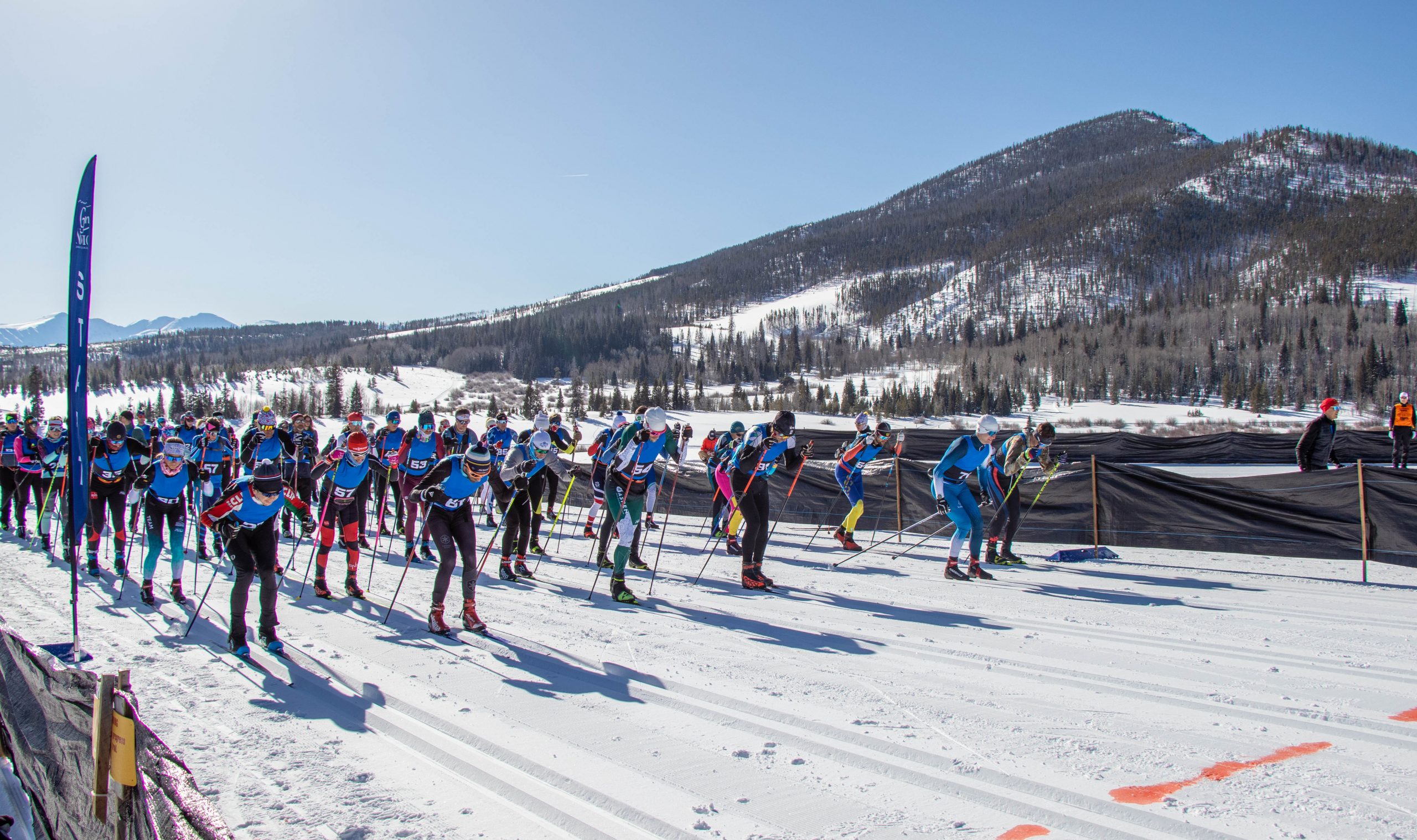
Stampede mass start at Snow Mountain Ranch in early March.
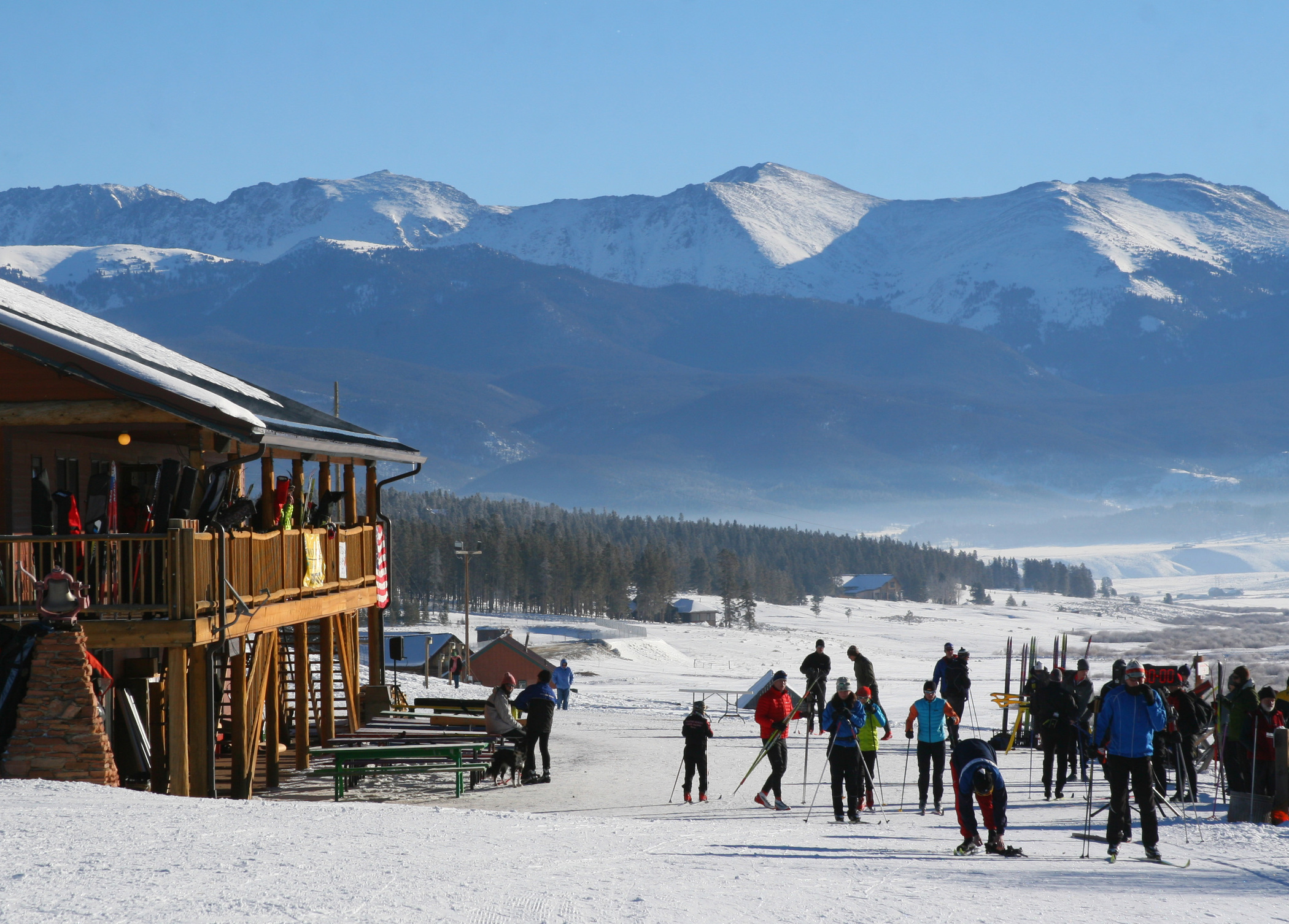
As of Wednesday, March 20, the Snow Mountain Ranch Nordic Center had all 82.5 kilometers of groomed trails open. The ranch recently held its 40th annual Stampede Races, with about 350 participants over two days for the 3-, 12.5-, 25-, and 50-kilometer skate and classic distances.
“It’s kind of a big deal,” Degginger said of the final event in the Grand County Nordic Race Series. “If you do both disciplines at 25 or 50 k, you earn the ranch-boss belt buckle. I gave out about 75 belt buckles to people who did both, and I have mad respect for those people. It’s a lot of skiing.”
She recalled the ideal weather that weekend of March 9-10: “The snow was cold, the weather was warm, it was sunny, and it was beautiful.”
Looking ahead, Degginger said the Snow Mountain Ranch Nordic Center plans to stay open until April 7.
“With this last snow we got, I wouldn’t be surprised if the snow was skiable beyond that,” she noted. “A lot of the north-facing slopes and shadier areas will hold their snow for a couple more weeks even after that. So, spring skiing conditions, but warm and pleasant and really good snow, really good tracks. Our groomers are doing a great job of maintaining our snow.”
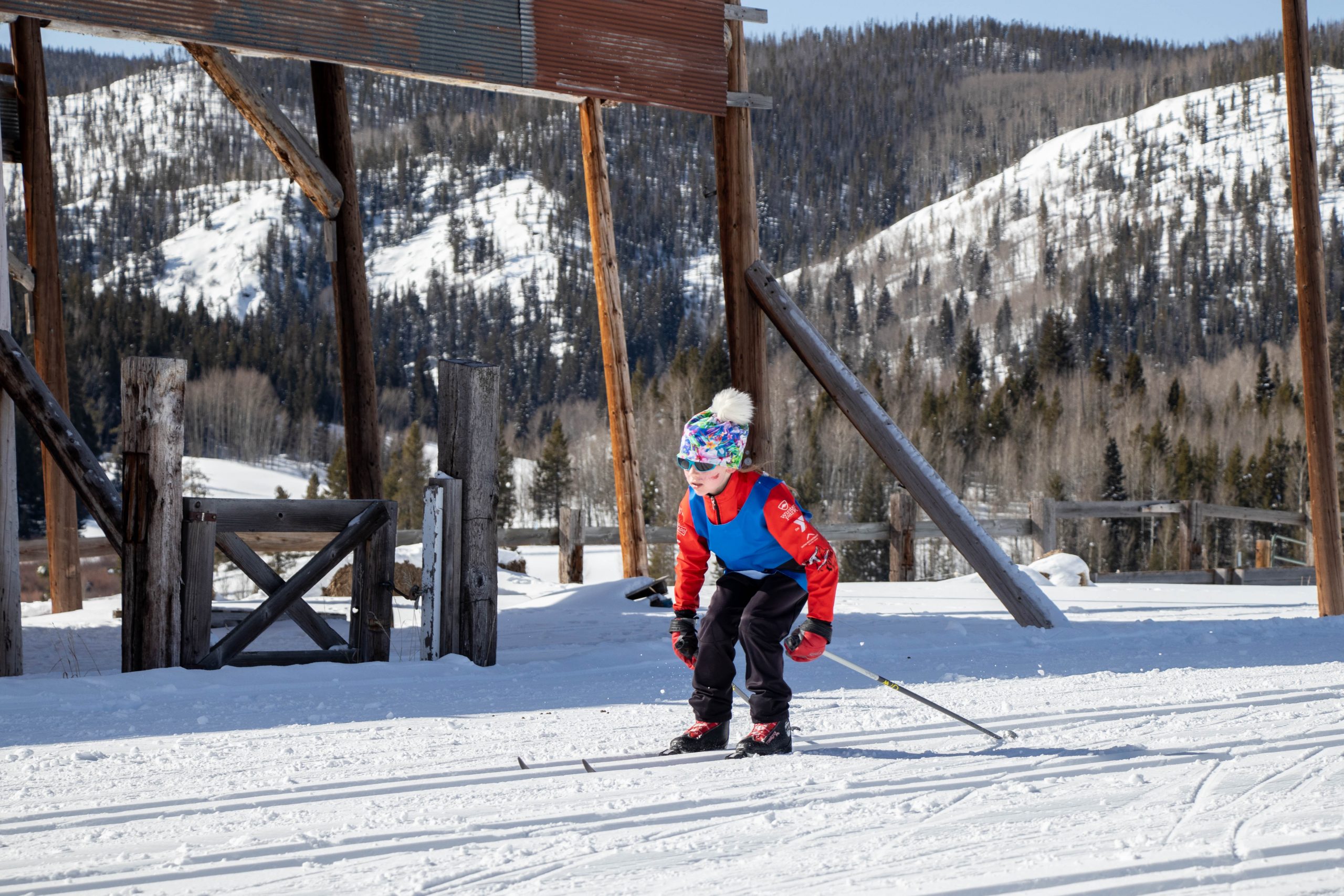
At Snow Mountain Ranch, visitors can stay right on the 5,100-acre property, with ski-in, ski-out lodging options and a cafeteria for dining. Vacationers can choose from rustic cabins and hotel-style rooms and, in the summer and fall, yurts, RV sites, and tent campsites.
“At one of our lodges, all the rooms have balconies or porches on the back, and you can ski right out of the lodge,” Degginger explained. “A lot of our cabins are either ski-in, ski-out, or you might have to carry your skis across the street to get into the trail, [but] really close by.”
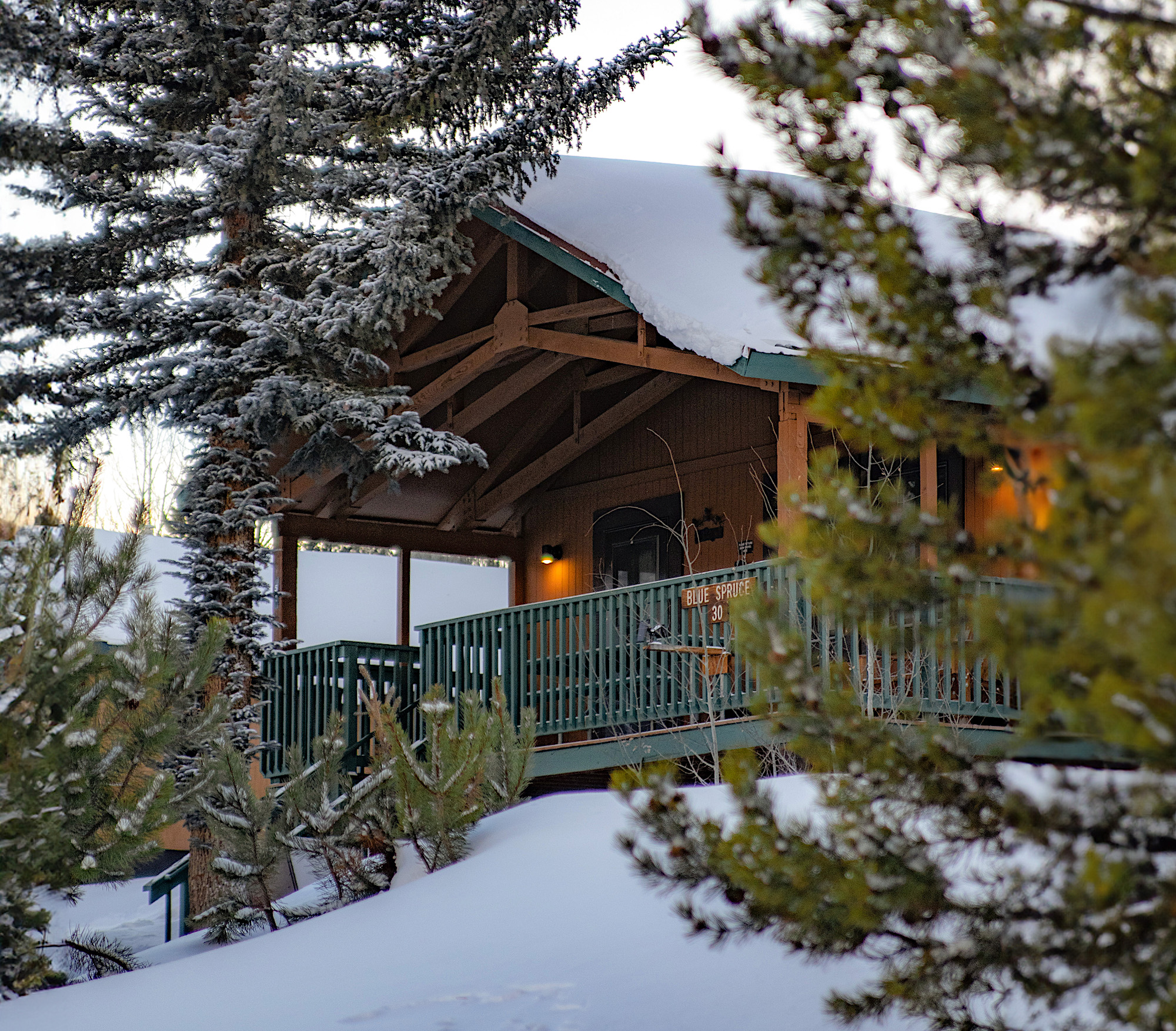
Snow Mountain Ranch winter cabin.
Those who stay there can expect everything they need and nothing they don’t. The rooms aren’t fancy, but they’re practical. Most don’t have TVs, but they do have WiFi. The idea is to connect with friends, family, and the outdoors while taking a break from the hustle and bustle of everyday life. The YMCA of the Rockies makes a point to offer affordable and family-friendly accommodations along with various on-site activities to keep everyone entertained.
“We have a ton of amenities geared toward families and stuff to do when they’re not skiing,” Degginger said. “They can go rollerskating, play basketball, go to the swimming pool, or go to the craft shop—lots of different options and things to do when you’re not on the trails.”
Snow Mountain Ranch also has an indoor archery range and climbing wall. As a nonprofit, the YMCA can provide a wide range of activities and amenities at a relatively low cost to locals and visitors. When asked how their YMCA differs from other community centers, Degginger said people need to experience the YMCA of the Rockies to understand.
“We have members, just like a normal YMCA, who love to come and ski,” she said. “Some are hardcore skiers who ski every day and Paralympians who come and train here. We [serve] our locals as well as our guests and people who come from far away. If you’re not staying here, you can buy a day pass or trail pass to use the facility for the day, but we’d rather you stay with us.”
For those who stay overnight (Degginger recommends booking in advance, especially for holiday weeks, summers, and weekends), trail passes are included, along with access to many of the facilities, such as the roller rink, gymnasium, and pool.
While winter is still going strong at the ranch, she recommended also visiting in the summer, which is the ranch’s busiest season.
“[We] have a brand-new ropes course opening this year, an aerial challenge course, which will be awesome, and a summer tubing hill, which is like tubing on snow but on a synthetic surface,” she said. “We also have archery, a climbing wall, canoeing, and mini golf—so many activities.”
In addition, the ranch has more than 5,000 acres of mountain terrain to explore, giving guests plenty of space to roam, and an abundance of wildlife.
“We have a lot of moose, and we see more and more of them every year,” she said. “I can’t blame them. If I were a moose, this is where I’d want to hang out.”
“We [also] have some elk that you can hear bugling in the fall, especially up in Rocky Mountain National Park,” she added. “A fun thing to do is go in the evening and listen to the elk bugle during mating season. We have typical mountain predators—mountain lions, bobcats, coyotes, and such—and a lot of cute little foxes running around everywhere, marmots, and all kinds of mountain critters.”
In the summer, the Nordic Center serves as the dining hall for the YMCA’s overnight camp. That camp initially drew Degginger to the ranch 20 years ago when she applied for a job there.
“I’m a Midwestern girl who had never cross-country skied before until I came out for an interview for summer camp,” she recalled. “They said, ‘We’re going to take a tour of camp. Put on these skis.’ ”
That was her first of many times on skis. She got the job and stayed, later becoming the head of programming and the Nordic Center at Snow Mountain Ranch.
“If you love being outdoors and recreating outdoors, you can’t find a better place to be,” she said. “We’re at the Continental Divide, and Rocky Mountain National Park is not very far away. You can do everything, and it’s absolutely gorgeous.”
Just over a month after hosting the International Ski Federation (FIS) Cross Country World Cup, the Canmore Nordic Centre is pulling out all the stops and showcasing its brand-new biathlon facility as the host of the International Biathlon Union (IBU) World Cup Finals from Thursday, March 14 to Sunday, March 17.
The world-class venue amid Canada’s Rocky Mountains is no stranger to World Cup nordic and mountain bike events. It hosted 2016 and 2019 IBU World Cups and, as recently as last year, eight IBU Cup events in advance of the 2024 Biathlon World Cup Finals.
Two years ago, Alberta’s provincial government granted the Canmore Nordic Centre $17.5 million to upgrade and enhance its biathlon building, stadium, snowmaking, and range. According to Ken Davies, the Canmore IBU World Cup event chair, they broke ground in May 2022 and have nearly completed the project as of this March.
New biathlon building at the Canmore Nordic Centre. (Photo: Biathlon Canada/Pam Doyle)
“It’s huge,” he said. “We sort of stirred the pot initially seven years ago to get them to reinvest in the nordic centre, and the Alberta government followed through, so credit to them.”
In 2017, the Canmore Nordic Centre requested improvements to its biathlon facility, which hadn’t been updated since 1986, when it was built for the 1988 Olympics. The biathlon stadium needed to be widened to meet IBU regulations and continue to host World Cups. The nordic centre also wanted to replace its undersized timing building and wax facilities, expand its snowmaking, and modernize its shooting range.
Just three days before the start of the IBU World Cup Finals, the Canmore Nordic Centre is ready to show the world its fresh new look. According to Davies, the father of Olympic biathlete Macx Davies and a Canmore World Cup organizer since 2005, the biathlon course has been “turned upside down.”
“When you come in and shoot, we now do a 180-degree turn in the stadium so the spectators can see the athletes for longer,” he explained. “We used a lot of the same course, but how we start and finish is completely different.”
Situated between 1,425 and 1,550 meters (4,675 and 5,085 feet) above sea level, the Canmore Nordic Centre is one of Canada’s highest cross-country ski areas, and it has a deceivingly challenging World Cup course.
“The trails are so well maintained, and they’re wider, so they look like highways, [but] they’re sort of sneaky hard,” Davies said. “People forget we’re at 1,400 meters of elevation. … We’re as tough as most places, and the racers all realize that when they come here.”
Rosanna Crawford (Biathlon Canada) racing to 26th in the women’s 7.5 k sprint at the 2017 IBU World Championships in Hochfilzen, Austria. (Photo: Glen Crawford)
According to Rosanna Crawford, a three-time Olympic biathlete based in Canmore, the approach to the range has changed. On each lap, racers must climb up to the stadium before shooting.
“I’m curious to see how the athletes will like it,” said Crawford, who lives in Canmore with her husband, Brendan Green, also a Canadian Olympic biathlete. “Before, you had a somewhat easier range entry, but now, especially for the men’s sprint, they’re going to climb right up into the range, so I think they’ll be pretty gassed.”
On the range, she said changing conditions can cause the wind flags to change immediately.
“It’s a tricky range. The wind can really rip through there,” she said. “So I’ll be curious to see how the athletes handle that.”
While Crawford has never watched a Biathlon World Cup in person since retiring from racing in 2019, she is excited to spectate with Green and her family this weekend. (Crawford is the younger sister of Olympic cross-country skier Chandra Crawford.)
“Seeing it in person is going to be special because we are huge biathlon fans. We don’t miss a race, and we try to stay off social media until we can get home and watch the races on Eurovision,” Rosanna explained.
Brendan Green racing to sixth for Canada in the men’s 4 x 7.5 k relay at the 2017 IBU World Cup in Hochfilzen, Austria. Sixth place matched the Canadian men’s previous best relay result. (Photo: Biathlon Canada/NordicFocus)
“Brendan retired in Canmore [in 2019], so it was really special having his family there in the crowd,” she added. My cousin made some funny signs, like those face ones, so my whole family had my face on a stick that they were holding up. … Canmore’s just so special. I’m looking forward to being a number-one sports fan during the races.”
When she’s not at the races hanging out in the Rocky Mountain Club and grandstands, she can tune in while working as a dental hygienist in town.
“In my dental office, there’s a TV, and I’m able to stream from my computer,” she explained. “Luckily, I had some ski fans in my chair [during Canmore’s Cross-Country World Cup], and they would tell me when to look because you can’t clean teeth and watch TV at the same time.”
USBA arrives in Canmore after stellar results at their home races in Soldier Hollow, Utah, led by Campbell Wright (USA), who finished in sixth place in the men’s 10km sprint. (Photo: NordicFocus)
With more than 240 athletes from 25 countries, the Biathlon World Cup Finals are expected to draw 3,000 to 5,000 spectators for the Thursday and Friday events and up to 10,000 on the weekend days. Additionally, more than 50 million viewers are expected to watch remotely via Eurosport. According to Davies, Canmore sold out of VIP and grandstand tickets within 36 hours, 70 percent of which were purchased by Europeans.
General admission to the races is free and doesn’t require a ticket. In addition to the indoor Rocky Mountain Club VIP zone and bleacher (grandstand) seating, the venue can accommodate 10,000 non-paying spectators.
Spectators are encouraged to use the courtesy shuttles between downtown and the venue, or take the scenic route by foot and enjoy an Art Walk in the Woods along the way. The Canmore Nordic Centre is 3.5 k west of Canmore, about a 30- to 40-minute walk from downtown. Crawford recommended bringing YakTrax or traction cleats for walking, just in case.
In late February, a snowstorm brought about a foot of fresh snow to Canmore, which made everything look wintery again after an up-and-down winter. Davies said the biathlon loops have been ready since early December, and with expanded snowmaking, the Canmore Nordic Centre can open at least 10 kilometers of trails in mid-October.
“We had a weird winter,” he said of the 2023/24 season thus far. “We had a really hot spot in January, but we also had a really cold spot. So there has been natural snow since November, but [the February storm] helped. .… It didn’t help me with organizing the event as far as digging everything out, but it helped what it looks like. It’s a winter wonderland right now.”
This week, the forecast in Canmore called for sunny weather with daytime temperatures between 5 and 10 degrees Celsius (mid to high 40s Fahrenheit). During the last two IBU World Cups in Canmore, which were held in February of 2016 and 2019, many races were either shortened or canceled due to frigid temperatures.
According to Davies, average temperatures for early March are a pleasant 3 degrees during the day and -5 at night. After the races, 12 Crystal Globes will be awarded to the top-ranked athletes in each discipline for their season-long performances. The competitions include sprints, pursuits, and mass starts over four days, and other spectator activities are being offered in town and at the venue, including an indigenous kickoff party on Thursday night.
“Like Soldier Hollow, we have the benefit of not being in Europe. We have the benefit of being at a high enough elevation. We have winter, and we have snow,” Davies said of Canmore’s attraction. “We’re in the mountains, and it’s pretty easy to get an audience to watch races in that environment. The skiers love it. We have 70 kilometers of non-race trails that are groomed and ready to go. It’s all part of the same facility.”
This week in Canmore, the Bow Valley will host about 200 athletes from 19 countries at the International Ski Federation (FIS) Cross-Country World Cup, the 11th stop on the international docket and the first time in North America in eight years.
The races include 10 k freestyle individual starts on Friday, freestyle sprints on Saturday, 20 k classic mass starts on Sunday, a day of rest, then classic sprints on Tuesday, Feb. 13, at the Canmore Nordic Centre Provincial Park.
Two women who know the courses well there — Olympians and former Canadian National Team members Chandra Crawford and Dasha Atkins (formerly Gaiazova) — will also be at the races as spectators and commentators, respectively.
Crawford will juggle her time between the VIP Suite and a Fast & Female event in Canmore. At the same time, Atkins will call the races with longtime Canadian World Cup, World Championships, and Olympics announcer Randy Ferguson.
Chandra Crawford celebrates her Canmore sprint victory in 2008. (Photo: FasterSkier)
Chandra Crawford: Mom, Keynote Speaker, and Business Connector
Sixteen years ago, Crawford entered the 2008 Canmore World Cup with an Olympic gold medal from the 2006 Torino Games. Born in Canmore, she had high hopes for her hometown races. Some could call it pressure, but she made a point of relaxing and having fun. Easier said than done, but a friend and fellow ski racer named Magda Genuin helped.
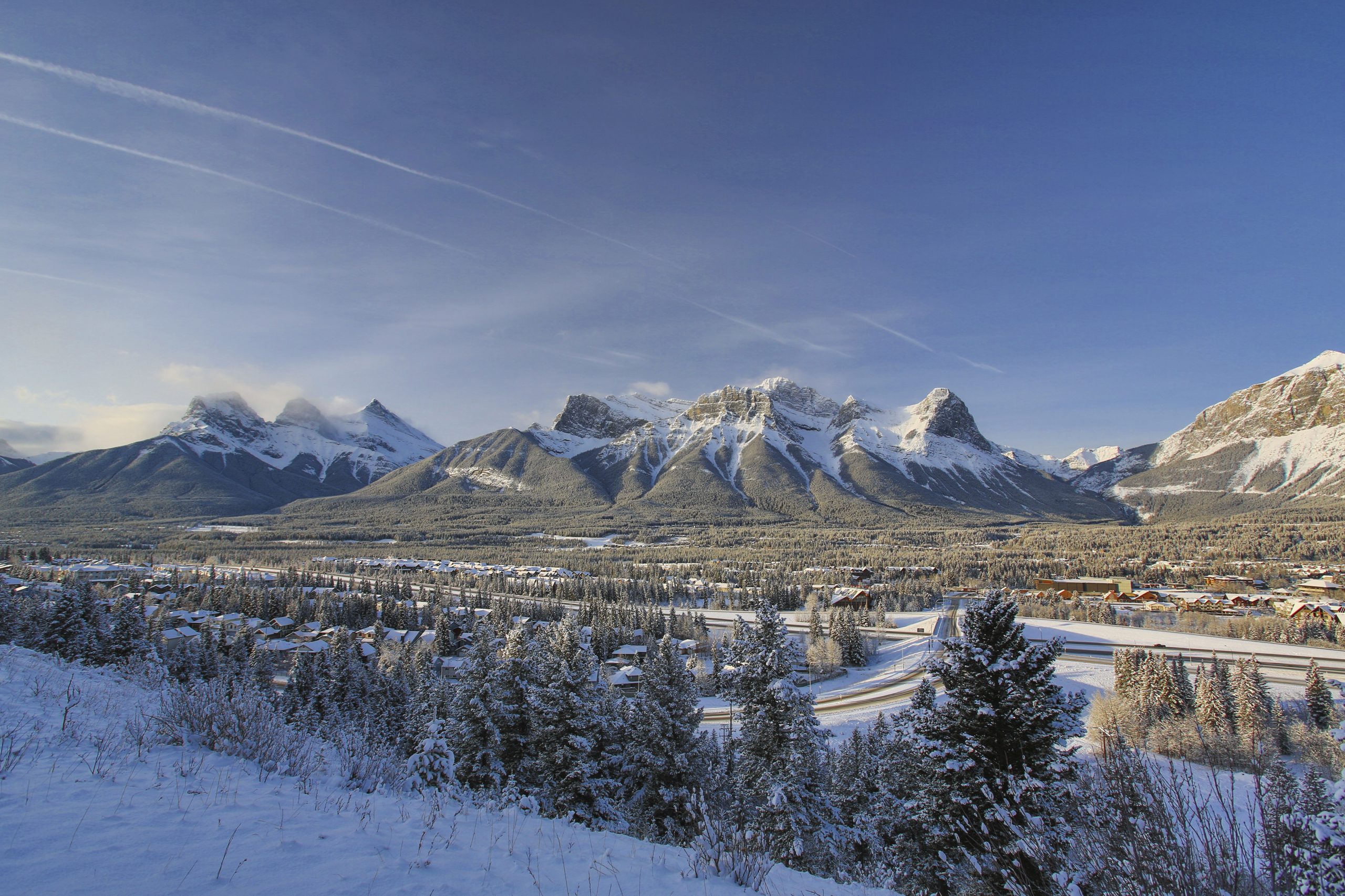
Genuin was from Agordo, Italy, a tiny town surrounded by the mighty Dolomite Mountains. Like Canmore, a mountain town in the Canadian Rockies, it was the home to three peaks called the “Three Sisters” — tre sorelle. In Canmore, these mountains are called Big Sister, Middle Sister, and Little Sister.
“Magda and I just felt like we resonated on this level that we are mountain people,” Crawford recalled. “Ski racing is great, but if you can get out in the mountains for days and days, that’s the best.”
The two skiers didn’t speak much of each other’s language, yet they laughed and chatted over two pots of tea at Communitea Cafe in Canmore, with American Kikkan Randall joining them for some of it.
“I just felt so relaxed and happy with my friends,” Crawford said.
The next day, she felt at ease entering her signature race: the World Cup freestyle sprint.
“I felt just felt full of peace and love and excited to do my absolute strongest strides, my process goals, take turns better, and hammer the snow like my legs were like a staple gun,” she recalled. “I had my own goals, and my intensity was intrinsic without pressure from the outside.”
“I managed my tactics and passing on the downhill and got to the finish line first,” she added. “Magda got a bronze medal and got to be on the podium. I only had less than ten trips to the podium in my career, and she had a handful, but it was a pretty special day to be up there together in Canmore.”
Former Canadian National Ski Team member Chandra Crawford (r) beats teammate Perianne Jones by 0.2 seconds to win the inaugural WinSport Frozen Thunder Classic sprint in 2012 in Canmore, Alberta. (Cross Country Canada/James Cunningham photo: cccski.com)
Retired from ski racing since 2014, Crawford is a keynote speaker with an MBA from the University of Calgary. She’s married, has four kids ranging from age 2 to 7, and is involved with the Canmore World Cup through a contract with the Alberta World Cup Society, which is hosting the races. She has been supporting business development and marketing of the World Cup by connecting corporate Calgary contacts with VIP opportunities at the races. As the founder of Fast & Female, a Canadian charity, she remains connected to its mission of keeping girls healthy and active in sports.
Crawford started competing at age of 16 in 2001. Over the next 13 years of professional ski racing, she learned to control her mindset and make the most of her career. She remembered looking at the 2006 Olympic schedule and asking her sports psychologist how to prepare for her race—the skate sprint—on Day 12 of the Olympics.
“I raced a distance race at the very start of the Olympics, and then I was just staring at the days like, ‘There’s way too many of them!’ ” she said.
Her sports psychologist advised that she have fun and enjoy a meal with her family, which she did. They laughed over a “giant Italian meal and were tourists for a few hours,” she recalled. “That helped me to relieve so much stress, to not just be sitting in my hotel room getting too worked up.”
Her tips for racers in Canmore, some of whom may be in North America for the first time, included maintaining perspective. She emphasized that “mental toughness is mental preparation,” meaning that if everything goes haywire and not as planned, you can still give your absolute best. For her, it helped to visualize all the things that could go wrong before a race and plan for it.
She established her own process goals and focused on what she could control, including how she refocused and relieved stress.
“I just went through that experience [in Canmore] with so much love and gratitude for being there with a perspective of, I’m not my results; I’m a community member,” she said. “My identity is bigger than my results.”
For spectators, she said it’s going to be a blast.
“You’re going to fit right in and have a great time in Canmore. This is a pocket of the world that is extraordinarily fit and forever young,” she said.
My mom has always been my #1 cheerleader, no matter what sport I was doing. Chandra’s mother (l) with her sister and Olympic biathlete, Rosanna Crawford (r). (Photo: Chandra Crawford)
Crawford’s mother used to make alliances in the stands, cheering for another family’s skier in exchange for them cheering for hers. Crawford urged spectators to forge similar friendships.
“My mom has always been my #1 cheerleader, no matter what sport I was doing she was so supportive in me following my dreams. Driving me to nowhere’sville Alberta for a ski or biathlon race. Watching me swim back and forth in a pool. Chasing a soccer ball across a field, she was always there with a hug on the good and bad days! My parents were both really active and had a passion for the outdoors, and our adventures were always filled with great stories and good snacks to keep the kids entertained! Hiking around Lake O’Hara or back country skiing at Mosquito creek, there was always some outdoor activities on the weekend and through the summer. Even now my mom has been setting an example that at any age you can achieve great things. Taught me to be a strong women who isn’t afraid to stand up for her self. Love you mom!”
“The town loves to welcome you, host big events, and show off our local goods,” she added. “Enjoy the massive nature, and let your full passion for cross-country skiing out. This is the place. These are your people. It’s going to be so fun.”
Dasha Gaiazova (CAN) during the Alberta World Cup sprint qualifier in 2008, where she made the cut in 29th and advanced for the first time in a World Cup skate sprint in Canmore, Alberta.
Dasha Atkins: Mom, Coach, Professor, Financial Planner, and World Cup Commentator
Also a professional Canadian skier from 2001 to 2014, Atkins lives in Calgary and is a mother of two children, ages 6 and 2. A wealth manager and financial planner, she teaches finance at the University of Calgary during the week and coaches masters skiers with the Space Dogs Ski Club, which she founded in 2016, on the weekends.
After retiring from ski racing, she earned an MBA from HEC Montréal, during which time she stayed with her friend, Randy Ferguson.
Ferguson had announced at many of her races during her career. In 2020, she was asked to commentate with him at the Cross-Country World Cup Finals in Canmore. The races were called off a week before due to the pandemic, and her gig was canceled.
Two years later, Atkins got another opportunity as an announcer at the 2022 Masters World Cup in Canmore.
“That was intense because they have, like, a million categories, a million races, so it was a whole week, pretty full on,” she recalled. “I was there for nine days commentating, and it was so much fun; it was great, I really enjoyed it, and they called me back, so I must not have done the worst job ever.”
This will mark her first time commentating with Ferguson.
“I’m very excited because I’m going to be with someone I know really well who knows the sport well,” Atkins said of the four-day schedule. “We can talk in French, especially given how well the French team is doing. I’m like, ‘Yes! I can speak in French.’ It’s going to be great.”
She noted the difficulty of the race courses in Canmore, which include 1.3-kilometer sprint and 5-kilometer distance loops.
“It’s the same course that I used to race many, many times, so I can sympathize a lot with how hard it will be,” she said. “It’s going to be a nice contrast to Theodore [Wirth] Park, where they’re racing in Minneapolis [the following weekend], so it will be interesting to see how that works to a lot of skiers’ abilities. Can they shine in both? That’s the question.”
Conditions could be fast and firm, especially in the mornings, as temperatures had been warmer than usual in Canmore in January.
“There’s enough snow—it’s great, but it’s really transformed … it’s been T-shirt weather,” Atkins said on Jan. 31, about a week and a half before the races.
Over the weekend, Canmore received more than 10 centimeters (4-5 inches) of fresh snow and had its snowmaking machines blowing.
“The new snow should give everything a shiny new look. Our trails are holding up well thanks to the snow we made in Nov/Dec,” Norbert Meier, the events chair of the Alberta World Cup Society, wrote in an email on Feb. 2. “We also hope Minneapolis has a successful weekend. The excitement building there can almost be felt here in Canmore!”
“Honestly, the fans are going to be crazy,” Atkins said. “I’m sure the same in Minneapolis. So what we don’t have in snow, we’ll make up for in cheering spirit and party atmosphere. I’m sure about that.”
Dasha Atkins (l) snaps a photo with Johannes Klaebo (r) and her Space Dogs Ski Club masters skiers at the Canmore Nordic Centre on February 3rd. (Photo: Dasha Atkins)
On Saturday, Feb. 3, Atkins and her Space Dogs masters skiers coincidentally met with Norwegian standout Johannes Høsflot Klæbo and Swedish superstar Linn Svahn on the trails and got photos with them.
As for her tips for athletes, she said, “Just enjoy the culture. It’s a very friendly, athlete-friendly town. Everybody loves skiers and gets excited seeing all the jackets from other countries in town. It’s going to be a really cool experience for Europeans who are in North America for the first time.”
The Swedish team in the stadium on February 4th at the Canmore Nordic Centre. (Photo: Angus Cockney)
Chandra and Dasha’s Favorite Canmore Hot Spots
Best meal of your life: Crazyweed (Chandra and Dasha)
Best for spicy tuna: Wild Orchid Bistro (Dasha)
Best takeout: Arashi Ramen and Communitea (Chandra)
Best café and coolest vibes: Communitea and Harvest, very hippy/ski vibes in both (Dasha); Bicycle Cafe has the best coffee, plants, and people (Chandra); Eclipse Coffee Roasters, supports skiers through flexible work opportunities (Dasha)
Best croissants: Le Fournil Bakery (Dasha)
Best pizza: Rocket Pie (Dasha)
Gear and shopping: Trail Sports. “Maybe you don’t want to bring all your stuff, you want to buy World Cup branded gear, or you want to rent a sled to pull a kid out to the Chandra Crawford Meadow Hut at the Canmore Nordic Centre and eat your snacks there. Maybe your friend wants to level up their game, and you don’t want to teach them; how about they just buy a ski lesson from the pros? Maybe you lost your sunglasses or need new ski pants… Trail Sports is fantastic.” (Chandra)
Jessie Diggins prepping on February 4th at the Canmore Nordic Centre. (Photo: Angus Cockney)
Bar at which to meet your future life partner: The Drake* (Chandra) (*Where Chandra met her husband, Jared Poplawski, who is the cousin of Jessie Diggins’s husband, Wade Poplawski; does this make Chandra and Jessie cousins?!)
Best WOW factor: Cliffhouse Bistro has tasty eats and mid-century modern decor and is located up a chairlift 2400 feet above Banff townsite. Access from Mt Norquay. (Chandra)
Best steak or burger: Anywhere in Canmore! “Alberta is the land of beef. If you want the best steak of your life, this is probably the best place to have that.” (Dasha)
Best local souvenirs: Rocky Mountain Soap Co, with made-in Canmore soaps, Alberta’s Own, Project A, or Tin Box for touristy gifts, all locally owned businesses (Dasha)
Best long ski and views: Drive 1 hr from Canmore to Lake Louise and ski the 20km gentle terrain of the Great Divide or “old 1A” and then take some pics on Lake Louise in front of the iconic Chateau Lake Louise. (Chandra)
Best scenic, leisurely walk: The 2km Bow River Loop boasts absolutely stunning views and, although not cleared of snow, is generally packed down and relatively accessible due to its flat profile. (Chandra)
FasterSkier’s Devon Kershaw (CAN) during the men’s 15k skate stage of the Ski Tour Canada the last time the World Cup came to to Canmore, Alberta in 2016. Kershaw finished the tour ranked 16th. (Photo: Fischer/Nordic Focus)
Canmore is one of those places that truly lives up to the hype. Nestled in the Canadian Rockies in southwestern Alberta, the small town with an authentically outdoorsy and Western Canadian vibe is definitely “bucket-list” worthy for anyone who hasn’t visited yet.
Locals say it’s a combination of the scenic backdrop, with jagged peaks on all sides rising around the town and Canmore Nordic Centre Provincial Park, and the community—most everyone here lives and breathes outdoor recreation—that makes it special. It’s also home to the most Olympians per capita of any other place in Canada.
Chandra Crawford (CAN) celebrates her Canmore sprint victory in 2008. (Photo: FasterSkier)
“We have Olympic medalists, including Robin McKeever, Beckie Scott, and Chandra Crawford, living in Canmore, so we are so thrilled when we have even more World Cup athletes coming to join us,” Tourism Canmore Kananaskis CEO Rachel Ludwig said of Canmore’s upcoming International Ski Federation (FIS) Cross Country World Cup from Feb. 9-13.
It marks the first Cross Country World Cup in Canmore in eight years after the 2020 event was canceled a week before due to the pandemic.
The town’s population of about 15,000 full-time residents more than doubles when an event like this comes to town. A past host of Para Nordic World Cups, a Masters World Cup, and International Biathlon Union (IBU) World Cups, this will be Canmore’s seventh Cross Country World Cup in 19 years.
According to Ludwig, they’re more than ready for it.
“Having 15,000 [spectators] come into the community plus athletes and coaches increases our population, but as a tourist town, we are well prepared for them,” she said. “We have great hotels and great accommodation options to choose from. We have restaurants ready to welcome everyone who would like to sample some special Canadian foods, and transportation is provided as well.”
Once in Canmore, just an hour west of Calgary, visitors can leave their cars and use free public shuttles to get around town and up to the Nordic Centre, 3.5 kilometers west of Canmore. Canmore boasts 80 kilometers of walking and biking paths, which are plowed in the winter, so they can also walk to the Nordic Centre, where the World Cup races will be held on Friday, Feb. 9, Saturday, Feb. 10, Sunday, Feb. 11, and Tuesday, Feb. 13.
En route to the venue, situated 1,400 meters (nearly 4,600 feet) above sea level, pedestrians can enjoy the Art Walk in the Woods. This temporary outdoor exhibit, with seven art installations over 2.5 k, celebrates the Cross Country and IBU World Cups, with the latter coming to Canmore in mid-March.
“The Art Walk is always a special treat for visitors [on their way] up to the Nordic Centre,” Ludwig noted. “When you walk from downtown up to the Nordic Centre, it is a bit of an incline. You might break a little bit of a sweat, so it’s nice sometimes to stop and look at the beautiful artwork.”
The wide and inviting stadium at the Canmore Nordic Center (Photo: GibsonPictures)
“Our goal is to attract all sorts of spectators who simply want to come out to the mountains and have a fun, great day,” explained Norbert Meier, events chair of the Alberta World Cup Society. “Coming to Canmore is much more than watching a ski race. It’s a great place to spend a mini vacation.”
If you are not a World Cup ski racer, don’t worry there is plenty of gentle terrain to explore off the race course. (Photo: Tourism Canmore Kananaskis)
Meier said there’s been a great deal of investment and improvement in the Canmore Nordic Centre over the years, including the $27 million redesign of the 1988 Olympic trails in 2005 to meet modern World Cup standards regarding difficulty and television production. Most recently, in 2022, Alberta’s provincial government approved a $17.5 million project to improve the biathlon facilities.
Since Canmore’s last Cross Country World Cup—the Ski Tour Canada in 2016—and the World Cup before that in 2012, the race trails are mostly unchanged. They rise from the stadium with a series of switchbacks and a “compact footprint” that’s great for TV production and spectators, with the opportunity to see racers multiple times on a 1.3 k sprint or 5 k distance course.
Jessie Diggins of the United States during the women’s 10km during 2016’s Ski Tour Canada. (Photo: Nordic Focus)
“There’s no easy part to our trails. It makes for great racing,” Meier said. “The hills are steep going up and fast and short going down. … It’s a bit of a twisty, turny course, so there are lots of opportunities to watch up close and be out there in the mountains.”
Public access is free for general admission and spectating at designated places in the stadium and around the course. This year, organizers offered VIP tickets for an “elevated experience” in the VIP Suite at the day lodge.
“The Canmore Provincial Park is one of those really special facilities where, as a spectator, you can go to a lot of different places on the trails, similar to what you see over in Europe at the Holmenkollen or other venues where there are lots of spectator spaces trailside,” he said of the free spectator/fan zones.
Regarding racers, about 200 athletes from 19 countries had registered, with more arriving each day about a week and a half before the first race. The weather had been warm, but temperatures were expected to drop below freezing leading up to the first race, and the race loops had a base depth of half a meter.
“The racing trails are comprised of manmade and natural snow, and they’re race-ready right now,” Meier said. “We’re really happy with how the trails have been developed this year and how they’re holding up.”
Therese Johaug (NOR) celebrates her victory in Ski Tour Canada’s women’s pursuit in Canmore in 2016. (Photo: Fischer/Nordic Focus)
With “all the big-name athletes” on the docket for Canmore and Minneapolis, Minnesota, which will host the following Cross Country World Cup on Feb. 17 and 18, Meier said it’s an opportunity for North American fans to come out and support their teams.
“We rarely get the World Cup here in North America, so we might as well binge out and watch them all,” he said.
More information about Canmore’s upcoming Cross Country World Cup can be found at albertaworldcup.com. For more on Canmore Kananaskis, visit explorecanmore.ca.
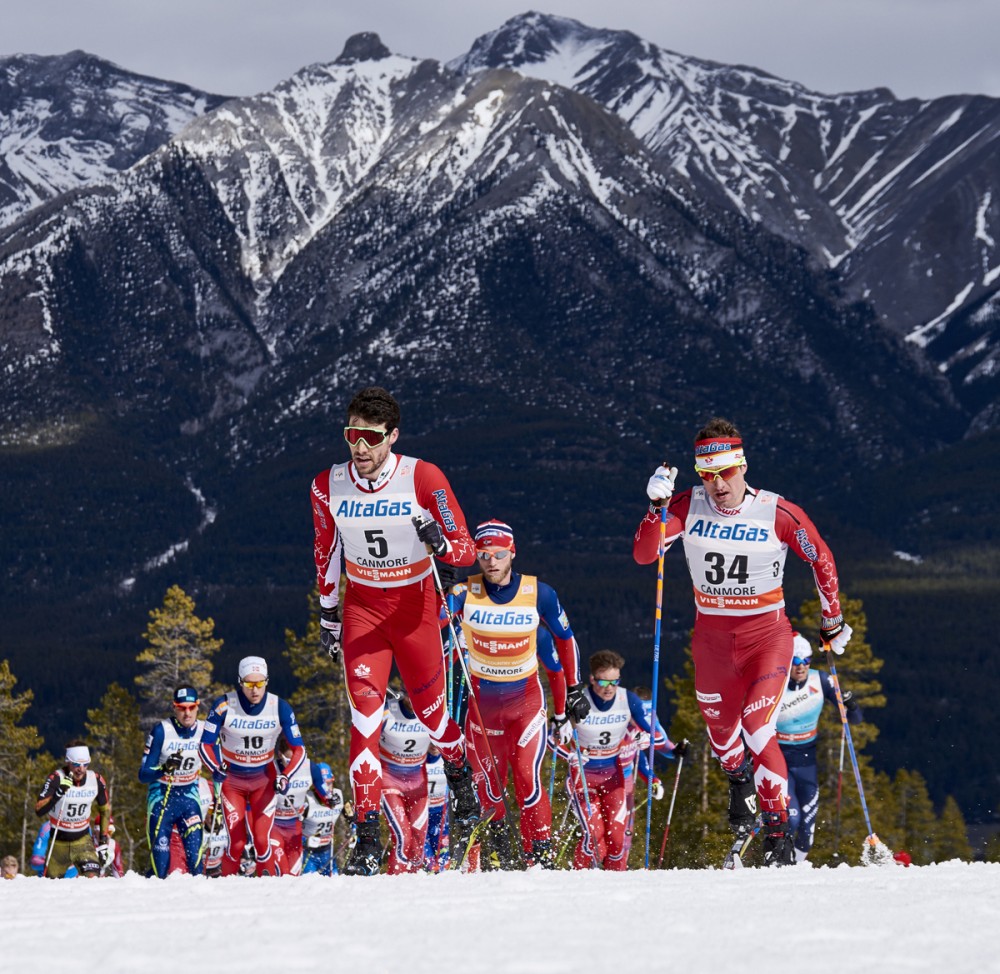
Canada’s Alex Harvey (5) and Ivan Babikov (34) lead Norway’s Martin Johnsrud Sundby (yellow bib) during the men’s 30 k skiathlon in 2016 in Canmore, Alberta. (Photo:Fischer/NordicFocus)
WORLD CUP SCHEDULE
(subject to change – all times MST)
Thursday, February 8
17:30 – 18:15:
Opening Ceremony
Canmore Civic Centre
Downtown Canmore
Friday, February 9
10:40 – 11:45: Women’s 10 k Freestyle Interval Start
12:45 – 13:55: Men’s 10 k Freestyle Interval Start
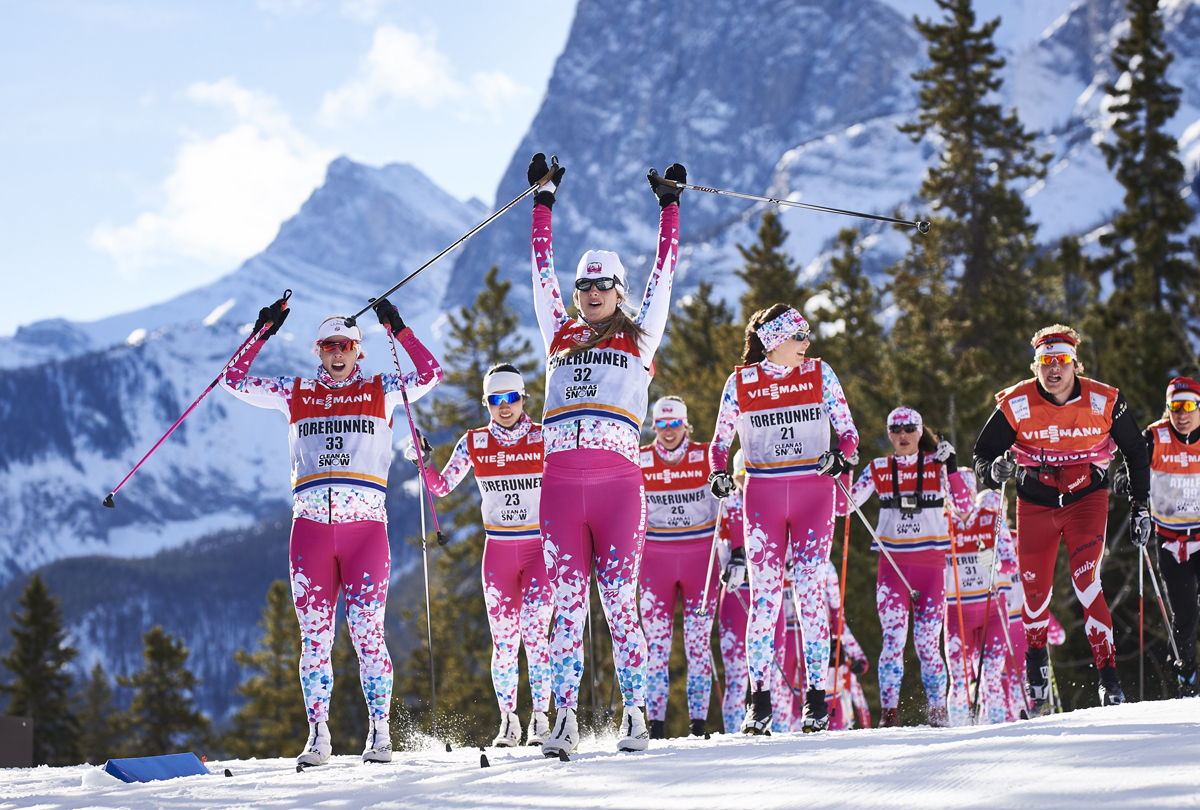
Kikkan Randall (USA) and Chandra Crawford (CAN) leading the Fast and Female forerunners before the classic sprint at Stage 5 of the 2016 Ski Tour Canada in Canmore, Alberta. (Photo: Fischer/NordicFocus)
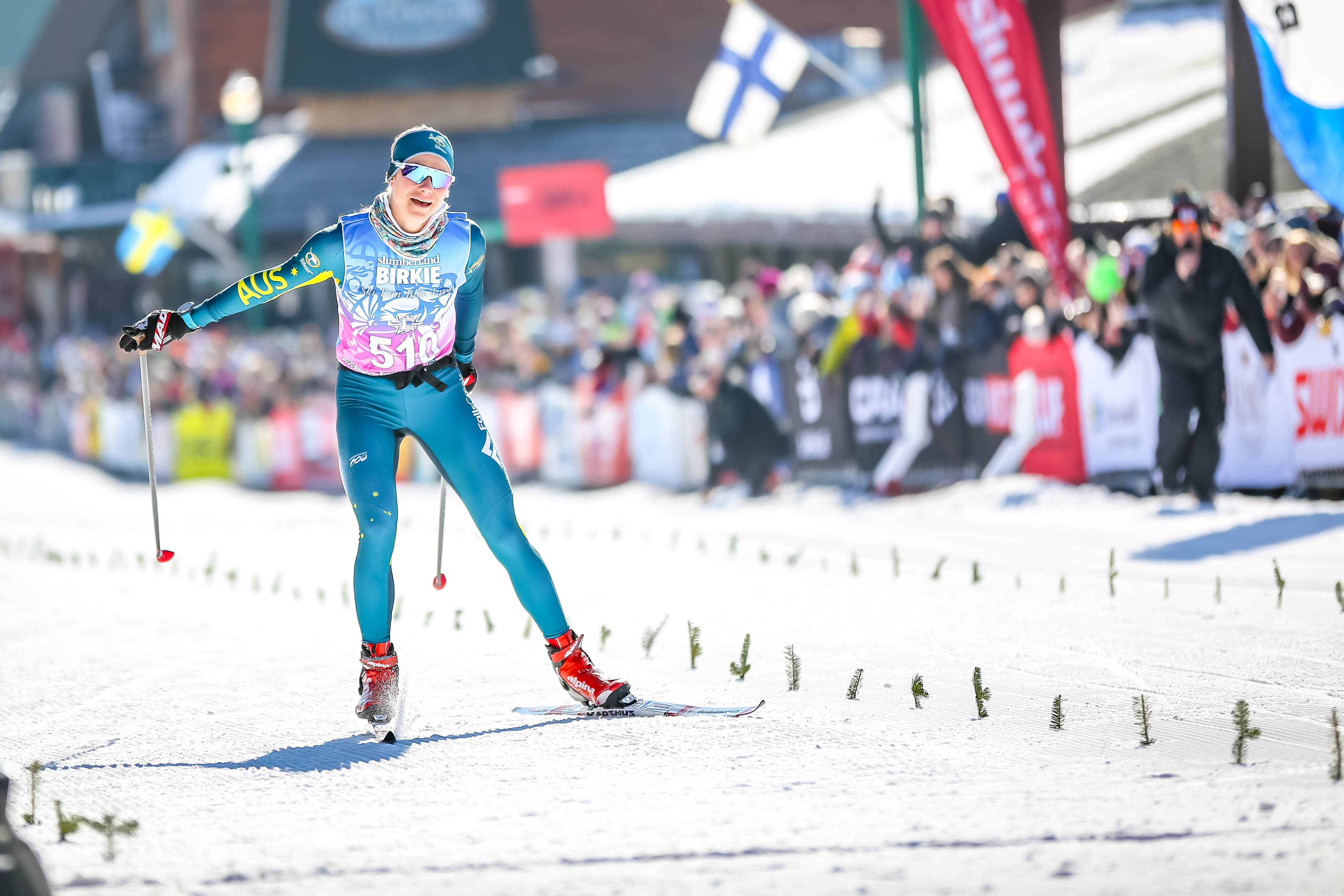
Several course records were shattered on Saturday in a largely faster-than-ever 46th annual American Birkebeiner, with temperatures steadily rising from the 20s at the start into the 30s by the finish of the point to point race from Cable to Hayward, Wisconsin.
Eight men broke the two-hour mark in the Birkie’s 50-kilometer skate race, half of which are American, and an Australian national team member who trains in the U.S. broke the women’s race record by nearly three minutes.
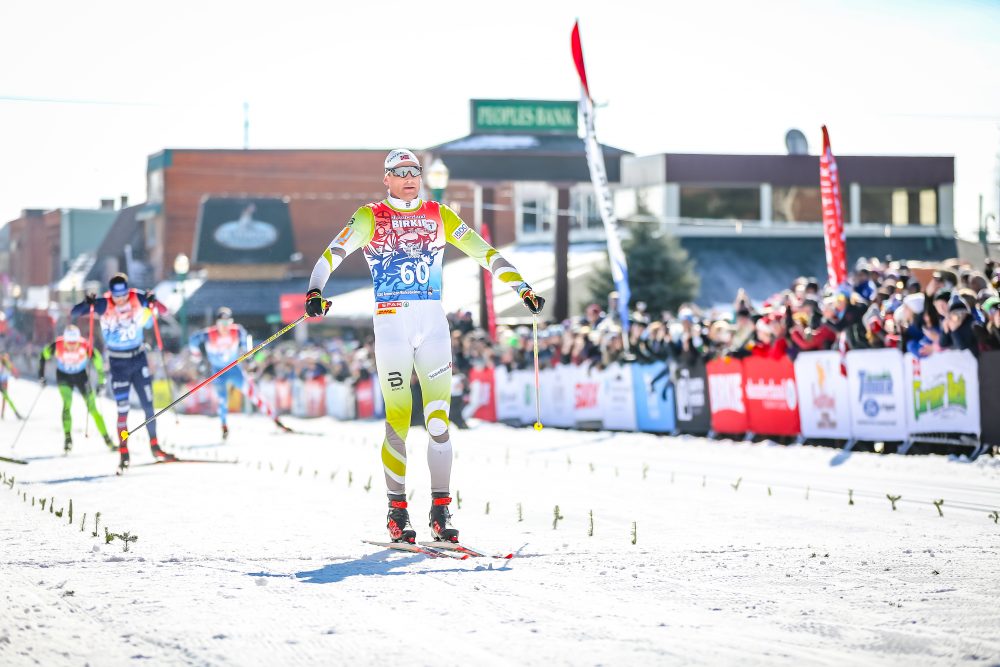
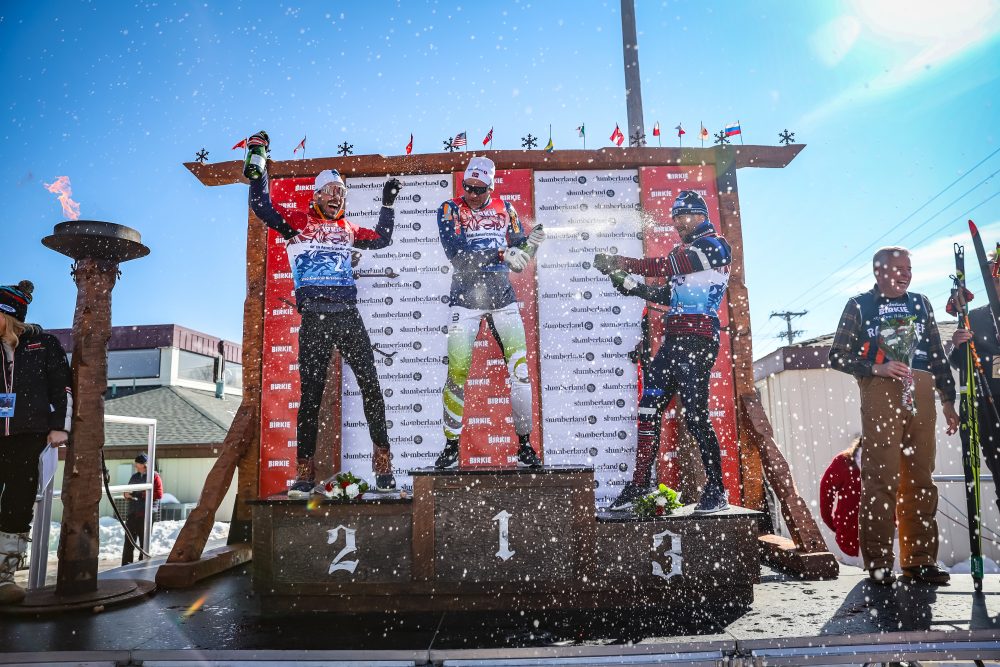
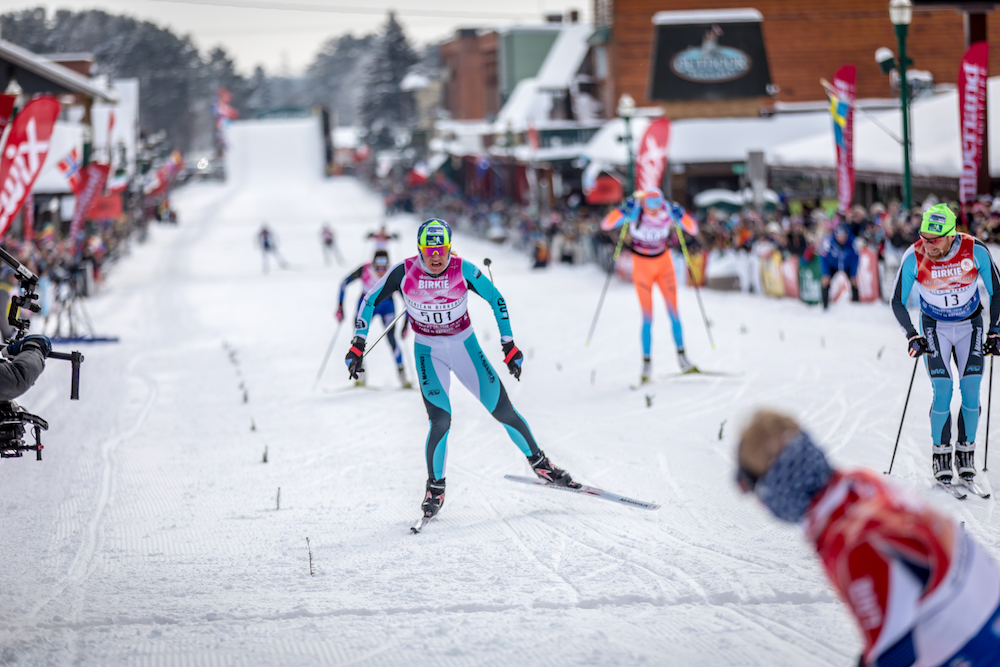
Niklas Dyrhaug, a 32-year-old Norwegian Olympian and former World Cup regular, reached the finish line first on Hayward’s snow-covered Main Street in 1:59:01.7 hours. While he missed the course record of 1:56:58.6 set by Italy’s Fabio Santus in 2010 by just over two minutes, Dyrhaug earned his spot in the Birkie books on Saturday. He held off second-place finisher Ian Torchia, a Minnesota native who trains with the Stratton Mountain School (SMS) T2 Team, by 1.6 seconds and France’s Robin Duvillard, another Olympian and multiple-time World Championships racer, in third by 1.9 seconds.
Wisconsin’s own Adam Martin, who trains with the Craftsbury Green Racing Project, narrowly missed the podium in fourth (+2.7), while Norway’s Anders Gløersen was just behind in fifth (+3.0) and U.S. Ski Team/Alaska Pacific University (APU) member Erik Bjornsen next in sixth (+3.6).
Another Craftsbury racer, Akeo Maifeld-Carucci followed in seventh (+8.0), then France’s Benoit Chauvet in eighth (+12.0). Sam Wood of Idaho placed ninth, 1:42.5 minutes behind the winner with a cumulative time of 2:00:44.2, just ahead of Kyle Bratrud of Minnesota and the SMST2 team in 10th (+1:47.6).
Dyrhaug, who has two World Championship gold medals in the men’s 4 x 10-kilometer relays (in 2015 and 2017), was a Birkie rookie but hardly a surprise winner. In World Cup 50 k classic mass starts in Oslo, Norway, he placed second in 2016 and fifth in 2017. On Wednesday of this week, he placed second in the SuperTour 1.6 k classic-sprint qualifier in Hayward — part of the Birkie Week festivities — finishing 1.07 seconds off the winning time of U.S. Ski Team member Gus Schumacher.
Meanwhile, Jessica Yeaton, who races for Australia and APU, set a new women’s Birkie 50 k skate course record in 2:13.20.6. The 28-year-old Olympian broke Caitlin Gregg’s record of 2:16:07 and placed 67th overall in Saturday’s 50 k skate. Finland’s 41-year-old Riitta-Liisa Roponen, a five-time Olympian who notably placed sixth in the 10 k skate at last year’s World Championships, was the second woman on Saturday, 41.7 seconds behind Yeaton. Former pro racer Erika Flowers, of Montana, placed third, 1:39.4 minutes out of first.
Saturday’s 55 k classic race saw record-setting times from both the winning man and woman, with Peter Holmes of the Sun Valley Ski Education Foundation (SVSEF) defending his 2019 title with a time of 2:26:46, nearly 2 minutes faster than Juergen Uhl’s winning 54 k classic time of 2:28:39.4 in 2010. Holmes won Saturday’s race by nearly 12 minutes, with two Wisconsin skiers — Chris Pappathopoulos (+11:52.4) and Evan Wetzel (+11:54.3) — following in second and third place, respectively.
Wisconsin native Nichole Bathe, who trains in Norway and skis for the British national team, became the new women’s 55 k classic champion in a blistering 2:49:47.0. She beat out Jennie Bender’s 2011 Birkie classic record of 2:50:53 and finished more than five minutes ahead of Colorado runner-up Anja Gruber (+5:33.3) on Saturday. Wisconsin’s Delaney Fitzpatrick finished in just over 3 hours for third place, about 11 minutes behind Bathe.
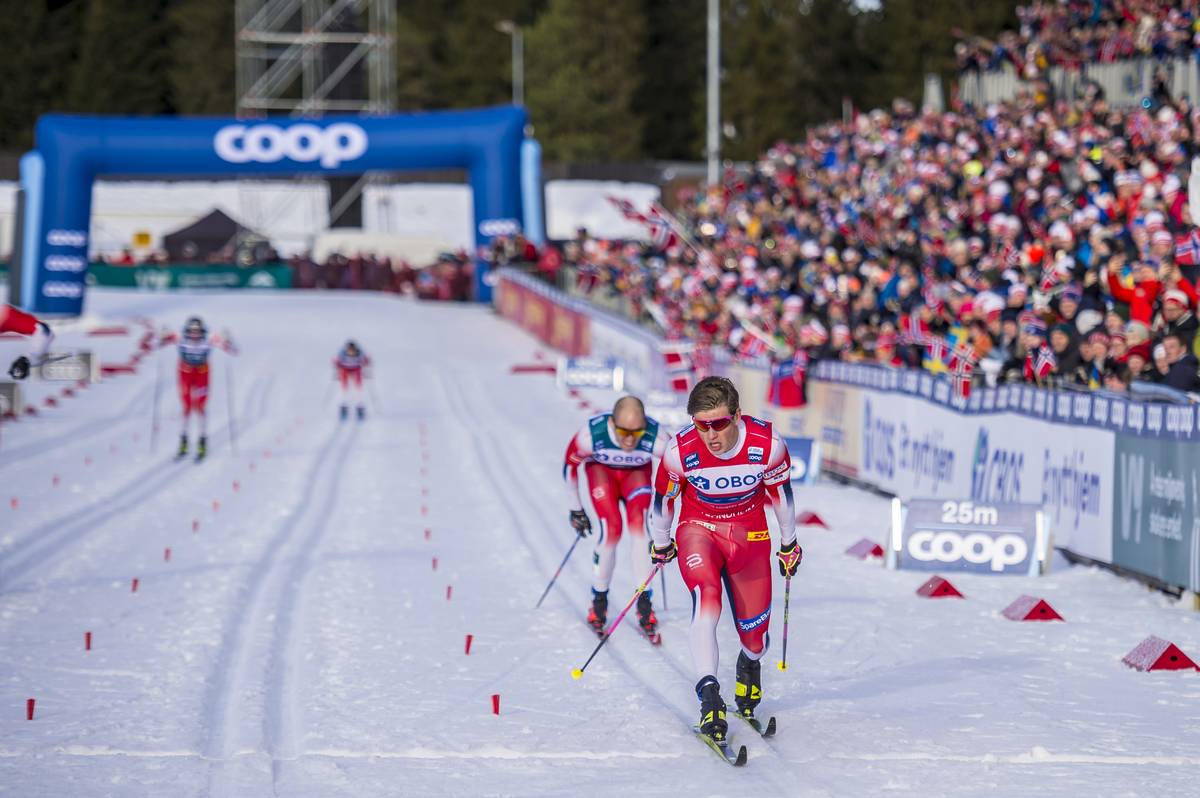
Norway’s Johannes Høsflot Klæbo crossing the line first for the last time of the day on Saturday to win the men’s 1.5 k classic sprint final, Stage 5 of the Ski Tour 2020, ahead of his teammate Pål Golberg, in his hometown of Trondheim, Norway. (Photo: NordicFocus)
Takeaways from Stage 5 (of 6) of the Ski Tour 2020? Alexander Bolshunov no longer has his minute-plus cushion to Pål Golberg in the overall, and Johannes Høsflot Klæbo is rounding into G.O.A.T. (Greatest-Of-All-Time) form.
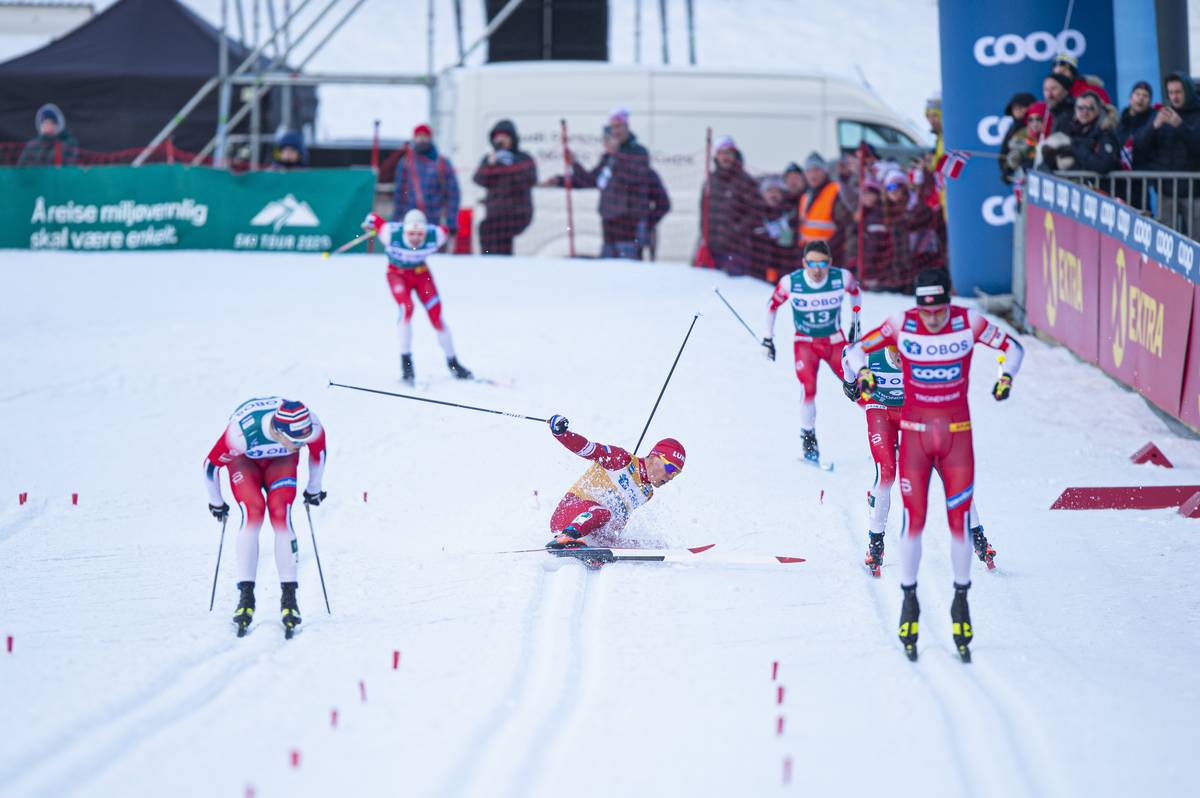
The 23-year-old Bolshunov, a Russian powerhouse who won the Tour de Ski last month, ranks first in the overall World Cup standings, and has landed on the podium in four out of five races so far this month (before Saturday’s classic sprint), crashed and burned in Saturday’s semifinal. He took himself out while switching tracks with 100 meters to go, clipping his left leg with his right ski and falling out of contention (from fourth to sixth) in the finishing straight. That was the end of his day, and his 1:05-minute lead in the Tour standings was reduced to 34 seconds on Golberg, who kept himself in prime position by finishing second to Klæbo in the final.
Russia’s Alexander Bolshunov (center) takes an untimely tumble with 100 meters to go in the first men’s semifinal of the 1.5 k classic sprint at the Ski Tour 2020 on Saturday in Trondheim, Norway. Up front, Norway’s Johannes Høsflot Klæbo (r) skis to first in the heat. (Photo: NordicFocus)
Then there was Klæbo, also 23, second in the overall World Cup standings and a Norwegian celebrity in his hometown of Trondheim, who did what he does best — dominate a sprint race — in front of a slew of familiar faces. He had never won a race at home in Trondheim before, and he did so Saturday in the men’s 1.5-kilometer classic sprint for his 14th straight World Cup individual win and 49th World Cup podium.
“I’ve been dreaming about this since I knew we were coming here,” Klæbo said of his latest victory in a post-race interview with the International Ski Federation (FIS) on Saturday. “So to be able to win here is just amazing, and I’m really proud to be able to win here today.”
He started the day by winning the qualifier by more than 2 seconds (over fellow Norwegian Erik Valnes +2.42 in second), and later advanced comfortably out of the quarterfinals and semifinals to the final. In the first quarterfinal, Klæbo cruised to second place behind Golberg, after Golberg set the pace up front for the bulk of the nearly 3-minute race, before decisively winning his semifinal (after passing Golberg on the last climb) by 1.2 seconds.
That semifinal saw five Norwegians — Klæbo, Golberg, Valnes, Finn Hågen Krogh, and Simen Hegstad Krüger — pinned against Bolshunov. They finished in that order after Bolshunov, who had qualified fourth and advanced in second behind Valnes in their quarterfinal, went down in front of the stands while Krogh and Krüger passed him by. Klæbo, who had the luxury and time to ease way off before the finish line, moved on to the final along with Golberg, Valnes, and Krogh. Bolshunov, who crossed the line nearly 17 seconds after Klæbo, did not, and he ended his day in 12th.
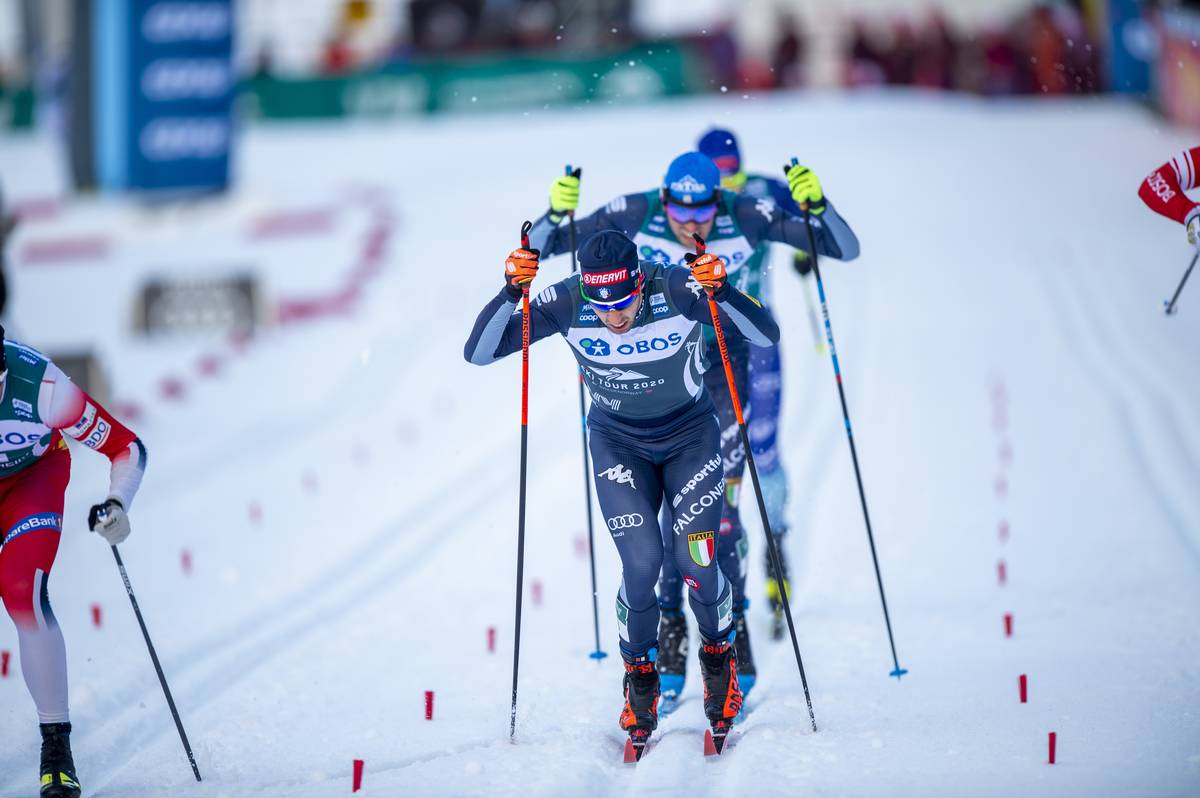
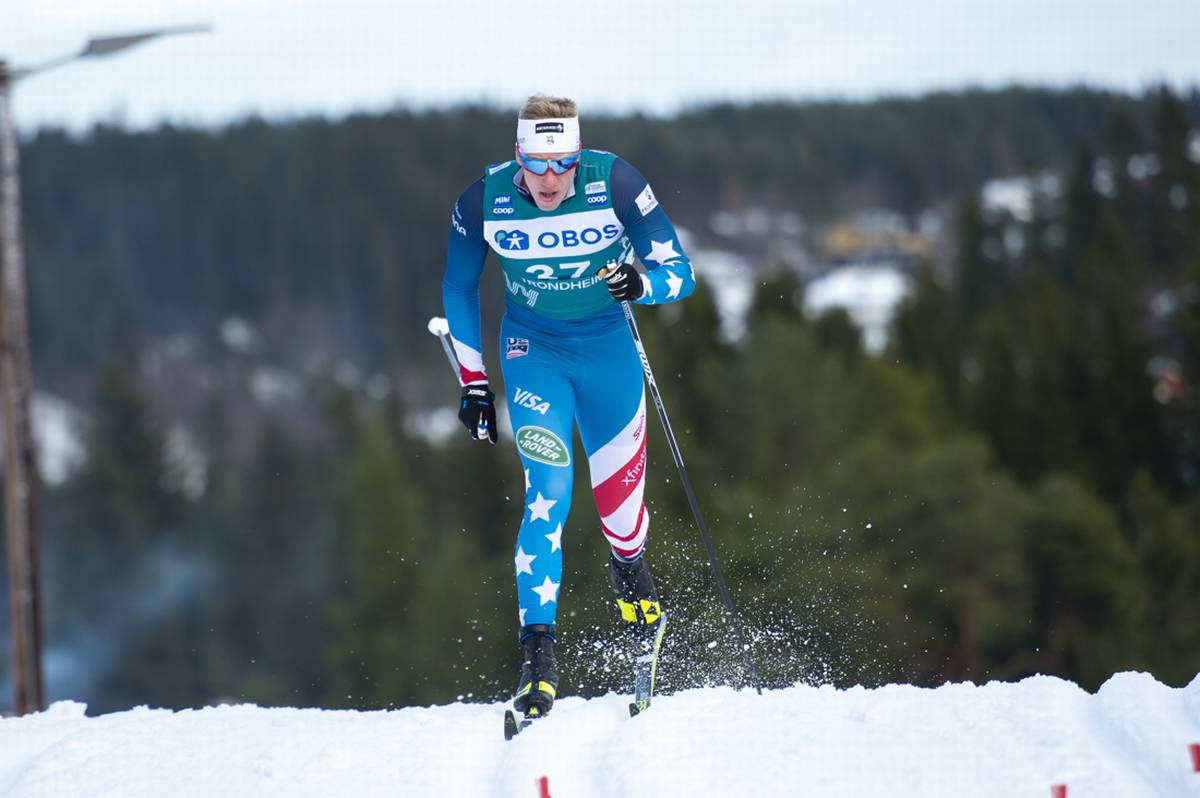
Powering up in Trondheim: Federico Pellegrino of Italy, followed by teammate Francesco de Fabiani . (Photo: NordicFocus)
The second semifinal was more diverse with two Italians — Federico Pellegrino and Francesco de Fabiani — going head to head with Norway’s Emil Iversen, Russia’s Gleb Retivykh, Finland’s Lauri Vuorinen, and Sweden’s Johan Haeggström. Wet snow that had begun in the later men’s quarterfinals had mostly stopped falling, and the sun began to poke through on the +3 Celsius afternoon.
On an early climb, Haeggström fell to his knees and broke his pole while skiing at the back of the pack. He quickly received a replacement, but wasn’t able to regain contact with the group while Pellegrino took charge up front. Despite leading into the stadium, Pellegrino lost some steam in the finishing stretch while Iversen came from behind to cross the line first, 0.3 seconds ahead of Pellegrino and 0.6 seconds ahead of Retivykh. Iversen and Pellegrino advanced to a nearly all-Norwegian final, with five men in red against the Italian in dark blue.
From there, it was another Klæbo jam sesh as the local hero set the tone in the final. Valnes initially led up the first climb while Klæbo, Golberg and Iversen followed closely. By the next uphill, Klæbo used his ferocious double pole to outmatch his teammates, who were still striding. Meanwhile, Pellegrino fell off the pace and into sixth. Klæbo kept the lead for the rest of the race, getting a gap on Valnes and Golberg on the descent into the stadium before running away with the win in 2:52:07. Golberg placed second, 1.2 seconds back, Valnes third (+1.6), Iversen fourth (+5.79), while Krogh, who also faded when Klæbo kicked into high gear, pulled some theatrics at the line and stalled before crossing 18.91 seconds back. Pellegrino finished last for sixth on the day, 22.78 behind Klæbo. That secured Klæbo’s spot as the men’s sprint champion for the Ski Tour 2020, while Pellegrino placed second, 13 points back, and Golberg was third, another 26 points back.
“It was an amazing day for us Norwegians,” Klæbo told FIS. “We had really good skis today, and I think we have done something right. It was a really fun race, and I think it’s an amazing to see how many people that actually come here and cheer for us. It’s something we really appreciate.”
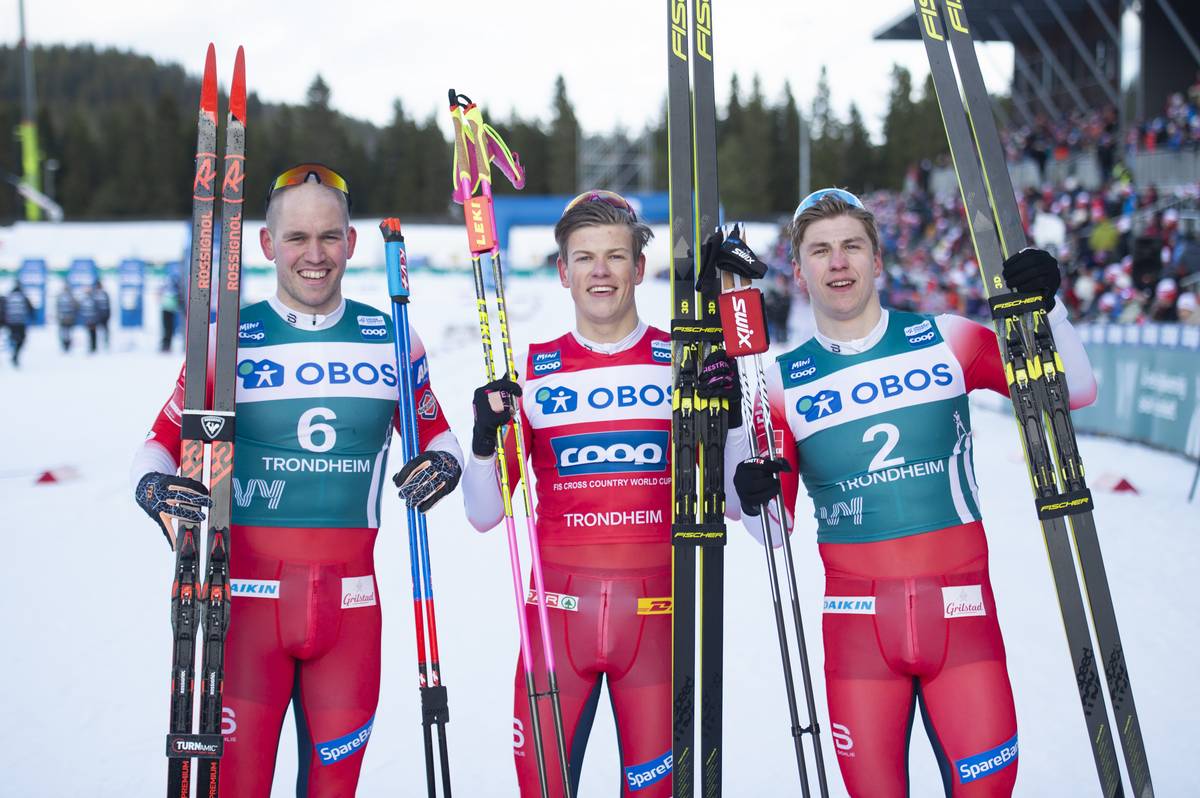
The all-Norwegian, Ski Tour 2020 Stage 5 men’s 1.5 k classic sprint podium on Saturday in Trondheim, Norway, with Johannes Høsflot Klæbo (c) in first, Pål Golberg (l) in second and Erik Valnes (r) in third. (Photo: NordicFocus)
In the overall Tour standings, Klæbo is up to sixth (+2:00.0) with one race — a 30 k classic pursuit — remaining on Sunday. Golberg will start 34 seconds behind Bolshunov, while Krogh in third overall will start just over a minute later (+1:35), ahead of Sjur Røthe (+1:40) and Martin Løwstrøm Nyenget (+1:46), also from Norway. In fact, eight of the top 10 men in the overall Tour standings are Norwegian. The other two are Russian: Bolshunov and Andrey Melnichenko (9th place).
American Logan Hanneman (APU) racing to 34th in the men’s 1.5 k classic sprint qualifier at Stage 5 of the Ski Tour 2020 in Trondheim, Norway. (Photo: NordicFocus)
No North Americans qualified for the heats on Saturday, with Alaska Pacific University skier Logan Hanneman coming closest in 34th, 0.9 seconds out of 30th and 14.38 seconds behind Klæbo. Fellow American Kevin Bolger placed 48th (+17.28) while Canada’s Russell Kennedy followed in 49th (+17.43) in the qualifier. American Ben Lustgarten finished 57th (+18.81) while Canada’s Alexis Dumas, Evan Palmer-Charrette and Ricardo Izquierdo-Bernier placed 59th (+19.6), 61st (+20.54) and 62nd (+20.74), respectively. American David Norris was 69th (+23.81), while Simi Hamilton did not start and is thus out of the Tour.
According to U.S. Ski Team coach Matt Whitcomb, Hamilton and Bolger have mild head colds, and Bolger and Hanneman, who rank 64th and 71st, respectively, out of 73 still in the Tour, will not start Sunday’s final stage.
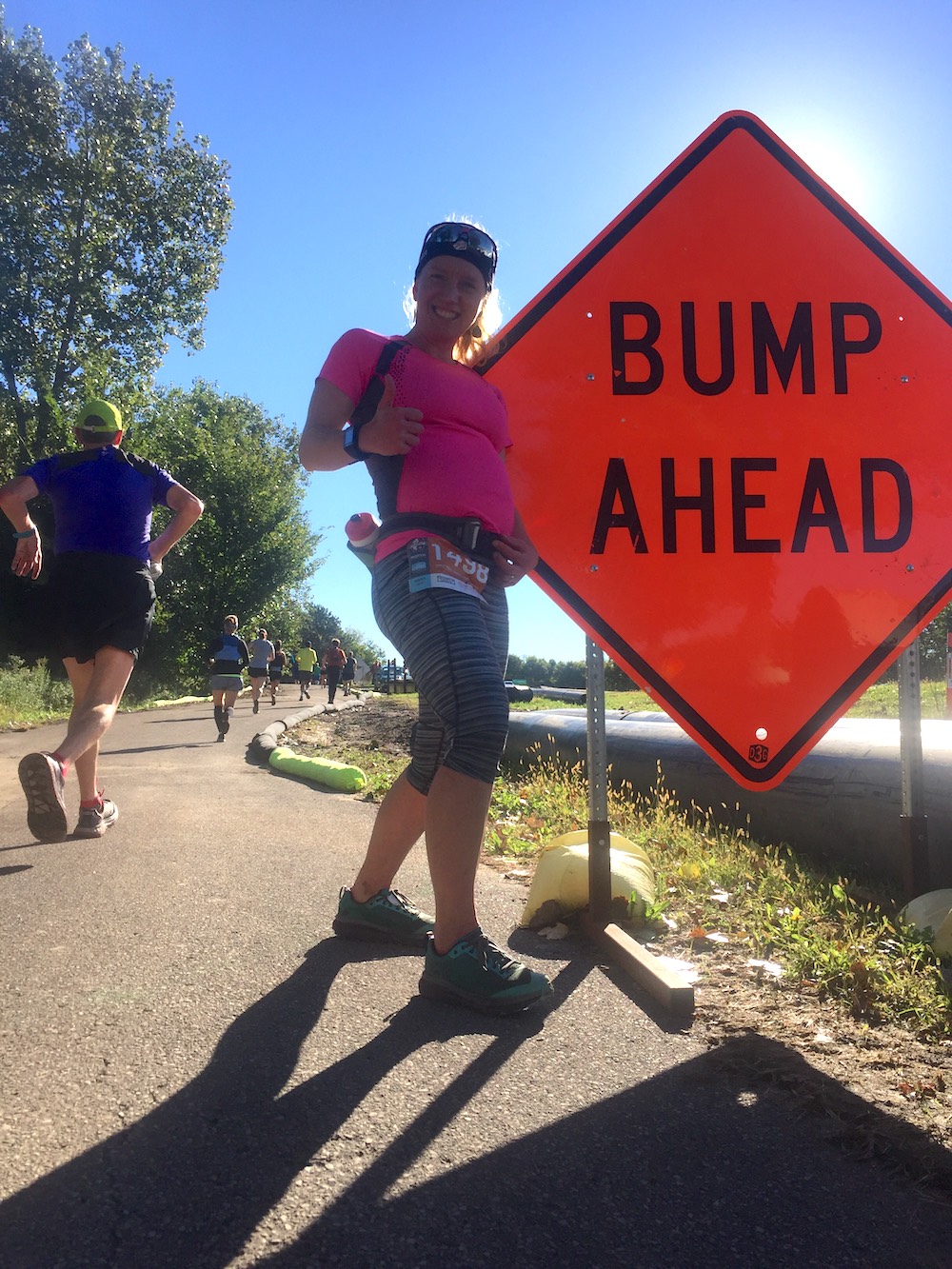
Caitlin Gregg rocking her baby “bump” while 20 weeks pregnant at the Loppet Foundation’s Trail Loppet, an “urban trail run”, on Sept. 21 in Minneapolis, Minnesota. She and her husband Brian are expecting their first child in early February. (Courtesy photo)
The questions started rolling in this spring. How’s training going? Are you going for 2019 World Championships? What’s the plan for next winter?
When you’re Caitlin and Brian Gregg, Olympians and local superstars in the Midwest, it’s hard to keep your athletic profile on the DL. Since buying a house on Theodore Wirth Park seven years ago, the couple has immersed themselves in the greater Minneapolis community — both in and out of skiing. They’ve raced, coached and worked out alongside skiers of all levels. They’ve bolstered the Loppet Foundation and its Loppet Nordic Racing program while chasing their own athletic dreams. And for the most part, they’ve achieved everything they set out for.
But not making the Olympics last winter was a blow for both Caitlin and Brian. They had both been on the edge — the infamous bubble — but didn’t make the 20-person cut for PyeongChang.
And by Brian’s calculations, at least one of them should have.
“The naming of the 2018 Olympic Team was a surprise to me,” Brian wrote in an email to FasterSkier in late September. “After Caitlin made the team in 2010 and myself in 2014 it was our dream to both be competing in 2018. I did not expect to see so many discretionary selections and I had expected to see Eric Packer on the Olympic Team, and I thought I would be as well if they took as many as 20 athletes. I am happy to see that we took a full team of athletes, although it was hard to see us not fill all of our distance men’s starts. I believe the criteria and the selection committee failed our athletes. I still believe we have room to improve our team selection and this year is better than last year, although we still have improvements to make.”
Despite feeling that he and Packer ranked high enough on the U.S. Ski Team’s 2018 Olympic points list to make the cut, Brian wasn’t bitter. And he’s still planning to race this winter. But life for the Greggs is different this year.
Caitlin Gregg (501) winning her fifth American Birkebeiner last February in Hayward, Wisconsin, while skiing alongside her husband Brian Gregg (13), who placed 22nd in the elite men’s skate race. (Photo: ABSF/James Netz)
For one, Brian has been working full time in financial services and taking night classes to become a certified financial planner. In a major step toward that, he passed the six-hour Series 7 exam two weeks ago.
That has meant less training, which he didn’t necessarily see as a detriment. In various running races this spring, summer and fall, Brian won the City Trails Loppet (a 10-mile urban trail run in St. Paul Park, Minnesota), finishing just ahead of his good friend Matt Liebsch, then ran a 1:12:43-hour road half marathon (Grandma’s Marathon) in June in Duluth, Minnesota, won the Loppet Foundation’s Trail Loppet half marathon (in 1:20:34) on Sept. 21, and placed seventh in the Birkie Trail Run Festival’s half marathon (1:24:00) on Sept. 28.
“Now that I’m training a little less on the days where I don’t get out to do a workout, one of my big inspirations is my friend, Matt Liebsch,” Brian said on the phone in late August. “Seeing him not make the [Olympic] team in 2014, that was disappointing, but seeing how much fun he has in the sport, and we still train together four some-odd days a week. … Not all of our times are getting slower; you keep chipping away and pushing yourself.
“It’s good for your general mental health,” Brian added, referring to skiing as a lifestyle more than a job. “I just like it and I think the more people we can get into this sport and doing it, the world’s a better place that way.”
Caitlin agreed.
“We both love the sport and we’re in a really fortunate scenario; it’s pretty neat to have a husband-wife Olympic duo,” she said on the phone while sitting with Brian at his office. “It definitely happens, but the fact that we’ve been able to support each other through that is pretty cool.”
“It’s good for your general mental health. … I think the more people we can get into this sport and doing it, the world’s a better place that way.” — Brian Gregg on cross-country skiing
Caitlin and Brian Gregg are expecting their first child on Feb. 9, two weeks before the 2019 American Birkebeiner. (Courtesy photo)
While the two halves of Team Gregg are used to supporting each other at North American ski races — including an annual assortment of SuperTours and U.S. nationals — Caitlin has been doing more coaching and sideline cheering so far this year. While she had originally planned to keep her pregnancy a secret early on, Caitlin said that it became tough to dodge the training questions.
On Aug. 10, they posted an “expansion of Team Gregg” baby announcement on their Facebook page. During their Aug. 22 interview with FasterSkier, Caitlin was 16 weeks pregnant. And as of this week, now 22 weeks along, she’s past the halfway point. They’re expecting their first child — a girl — on Feb. 9, exactly two weeks before the 2019 American Birkebeiner (a ski marathon Caitlin has won a record-setting five times).
“I told her she has two weeks to get ready and in shape,” Brian jested.
“I was like, ‘Uh, yeah,’ ” Caitlin replied.
***
It’s a girl! Brian (r) and Caitlin Gregg (beneath pink confetti/candy) discovered the gender of their baby, due Feb. 9, 2019, at a gender-reveal party in August. (Courtesy photo)
The gender-reveal party (with a piñata filled with pink candy), a baby shower her high-school athletes threw her (with diapers filled with melted chocolate bars), it was all new to Caitlin.
So was the news of a blood clot in her leg in early July. During their six-hour drive home from Thunder Bay, Ontario, where Brian had competed in Canada Day rollerski races while Caitlin cheered him on, Caitlin started feeling pain in her left calf. It worsened and she went to see her doctor, which revealed she had two blood clots in her calf. She was immediately put on blood thinners and instructed not to bike, rollerski or do anything with a heightened risk of falling.
“That was super scary,” she reflected. “… The doctors were like, ‘That’s really weird, you’re the last person we thought this would happen to; you’re so young and active.’ So we haven’t gotten any answers yet as to whether it’s an underlying [condition]. … There are a couple other genetic disorders you can have, inherited blood-clotting disorders that I just never knew about, potentially, [for] my entire career. I’ll get tested for those after the pregnancy, but one of the big bummers is that I have to be on blood thinners for the remainder of the pregnancy.”
She immediately remembered Kikkan Randall’s blood clot scare in 2008 and decided to call her former U.S. teammate, a 2018 Olympic gold medalist.
“She took a good 45 minutes and just talked to me and told me about her scenario and how it was for her and what she had to go through and all of the kind of different aspects of blood clots and the pregnancy and how everything turned out great, so that was super reassuring,” Caitlin said.
While their experiences were different (Randall had two surgeries to remove a recurring blood clot in her leg well before she became pregnant in 2015), Caitlin was comforted by their conversation. Two days after they spoke, Randall announced her breast-cancer diagnosis on July 11 on social media. She had never mentioned it to Caitlin.
“To me, that was the epitome of a class act,” Caitlin said. “She didn’t once change the subject and say, ‘Don’t worry, that’s nothing,’ or belittle my fears or anxieties. She just listened and was super awesome and great mentor and very much present in what I was dealing with, so I immediately wrote her and said that was amazing, thank you so much, and I wished her the best.”
For the duration of her pregnancy, Caitlin will take two shots of blood thinners each day. In addition to her exercise limitations, she’s also been advised not to fly or take long road trips for the time being.
“For me, because the dose is so high … [the doctors are] more worried about internal bleeding and almost not knowing it, is the bigger thing,” she said. “I can still ride a stationary bike, and I can do a lot of exercises. I just have to make sure the risk of that falling — so mountain biking, riding a bike outside, rollerskiing — are kind of the big no-nos. … But I’m really looking forward to skiing on snow, especially on super-soft, powdery stuff. … Honestly other than that, pregnancy has been awesome.”
In June, Caitlin, about six weeks pregnant, ran the same Grandma’s half marathon as Brian, finishing 19 minutes behind him in 1:31:38. In an effort to qualify for the 2019 New York City Marathon, the two had registered for the 13.1-mile road race before discovering that Caitlin was pregnant. Caitlin decided to run in what she called “Level 3” while being mindful of her heart rate and feeds during the race. She said she felt “awesome,” and their finishing times did the trick, qualifying them for next year’s NYC Marathon.
Since then, she’s scaled back the racing, instead entering running races with a goal of “jogging/ walking/ pole hiking them”.
Meanwhile, Brian has been getting out for workouts whenever he has time and plans to race at least the first period of the SuperTour circuit this coming season. In an effort to qualify for his first World Championships, he is focusing on strong performances in the 15-kilometer freestyle at the Sovereign Lake SuperTour/NorAm in December in British Columbia, and the U.S. nationals distance races in early January in Craftsbury, Vermont.
“My training volume is hugely reduced this year, but I have been hitting all of my intensity sessions,” Brian wrote in an email. “My primary focus is on preparing to support my family and my baby girl, but my passion for ski training and racing will never go away.
Coach Caitlin Gregg (r) timing Sarah Olsen, a Loppet Nordic Racing junior skier, during a time trial this past spring. (Courtesy photo)
While Caitlin won’t likely be able to travel to Canada and New England to support Brian at those races, she expects to stay busy at home while working with sponsors, like Madshus, as well as the Loppet Foundation. In addition to coaching 12 college skiers this summer, Caitlin was hired as the Loppet Foundation’s director of adult programming. She’s also an assistant coach with the foundation’s year-round Trail Kids program.
“We’re both staying super busy, which I think is exhausting in a lot of ways, but it’s also really fun because it brings a lot of balance,” she said.
“Sometimes it’s good to not have a lot of time to analyze your training session,” Brian said. “You’re sort of like, ‘I’ve got an hour and a half. I’m going to just try to get everything done in this hour and a half, and then I’m going right to class or school or working with this kids.’ ”
The two are also adjusting to spending less time together. While they didn’t necessarily work out alongside each other, the Greggs frequently start and finish at the same place, which Caitlin described as “trailheading”.
“Basically you drive to the same location and say, ‘All right, I’ll see you in two hours,’ ” she said. “There are some times when [we would] play around with rollerski speed wheels … or Brian uses a weight vest and that works pretty well.”
During a summer hike on the Birkie Trail, Brian wore a backpack with a watermelon inside. Caitlin guessed it weighed 40 pounds.
“It wasn’t that big of a watermelon,” Brian quipped.
But when they’re not exercising, they’re working — which has become more full time for both of them.
“We went from spending 24 hours a day together, 360 days a year or whatever — there was maybe a couple days or weeks where one of us would be somewhere else. Now Brian’s at the office all day or I’m out coaching,” Caitlin said.
“I feel like I haven’t seen her for weeks,” Brian added.
Yet they’re still having fun, and they’re still loving their ski-driven lives in the Twin Cities. Late last month, news broke that Minneapolis will host a 2020 World Cup race at Theodore Wirth Park, right outside their door.
“Caitlin moved to North Minneapolis 10 years ago and the bulk of her training leading up to the 2010 Olympics and her 2015 World Championship medal were on the trails at Wirth,” Brian explained, referring to Caitlin’s bronze medal in the 10 k freestyle at 2015 World Championships. “I won my first Super Tour at Wirth and we strategically purchased our house 7 years ago next to Wirth because of the great training opportunities.
“It has been incredible to be a part of the amazing Midwest ski community and the growth of the Loppet Foundation,” he added. “One of the major goals of the Loppet Foundation is to promote health and wellness with underprivileged youth and families. We share this passion and it is just amazing to see our small community based organization grow … We have a large group of junior skiers and I would love to see those kids representing our home club in the World Cup, but you better believe we will be keeping those kids honest and going for a spot ourselves.”
Brian and Caitlin Gregg with their baby’s first “singlet”. According to Caitlin, TNC Endurance stands for Team Nichole Coaching. “I worked with Nicole Porath for my training plan for Grandma’s marathon (which was going awesome) and then she helped guide me with the switch to the half-marathon and how to run it once I found out I was pregnant! She is an Olympic Marathon Trials competitor and mother of two. It was/ has been really fun working with her on some running training. I am excited to work with her after the baby is born too!” (Courtesy photo)
As of last month, the Greggs are living debt-free in their home. They literally jogged to the bank before work one morning to sign the final paperwork.
In another “Team Gregg style” exercise session, they ran three miles for ice cream, then ran home. They’ve been known to run to farmer’s markets as well.
Brian vouched for Caitlin’s “intense food cravings” in the first trimester, like the ramen noodles she wanted for breakfast one morning.
“I don’t think I’ve ever seen her have a bowl of ramen in her life,” he said.
“A couple days later I was like, ‘Please take it out of the house, I can’t look at it,’ ” Caitlin said with a laugh.
While life is busy as usual for the Greggs, they’ve both welcomed the transition from “full-time athlete status” to additional work and soon-to-be parenting responsibilities.
“We’re super psyched, we’re having a lot of fun,” Caitlin said. “It helps when you don’t have so much time to think about where you were this time last year or overanalyze your training and just get out and do what you can and be thankful.”
“I’m excited the ski trail comes by the office so I’ll be able ski to work on a good snow day,” Brian said.
Asked what’s kept them in the sport this long, both were quick to answer. They absolutely love it.
“We both are very goal-oriented, but the bottom line is we have an awesome community here and we have so much fun getting out and having such great company, no matter what the level of the company is,” Caitlin said of skiing with people of all ages and abilities. “We get excited having people to push us and push other people and really kind of show that you can make it a lifestyle and make it fun and continue no matter what you’re doing.”
Kikkan Randall (c) with her son, Breck, and husband, Jeff Ellis, in Penticton, British Columbia. (Courtesy photo)
Day by day. That’s how Kikkan Randall is approaching her battle with breast cancer after being diagnosed about three months ago. Now more than 50 days into her treatment — with six rounds of chemotherapy over an 18-week span — Randall, 35, is becoming more familiar with the ugly side effects and adjusting to her new normal.
While beating what is believed to be Stage 2 cancer remains the Olympic gold medalist’s biggest challenge yet, it’s not dampening her spirits — even on the extremely rough days, of which there have been many.
After Round 2 of chemo, Randall returned to her family in their new home of Penticton, British Columbia, where she quickly came down with a nasty cold. That cold required a visit to a local clinic and antibiotics, and Randall now wears a mask on airplanes to fend off germs while flying to and from her cancer treatments in Anchorage, Alaska.
“Getting the head cold on top of going through the worst days of the chemo cycle has definitely been one of the most uncomfortable weeks of my life,” Randall explained in an email to FasterSkier. “It’s mostly because I have no control and I have no idea how well my immune system can clear the cold. Normally I would be optimistic that it would just be a tough couple of days but now I just have to wait and wait.”
Kikkan Randall during her first chemotherapy infusion at the Providence Alaska Medical Center on July 9 in Anchorage. (Courtesy photo)
She eventually kicked the cold and got her voice back, just in time for Round 3 of chemo on Aug. 22. After what she called a “quick 36-hour trip to Anchorage,” she was back in Penticton on Aug. 23. So far, Randall explained on her daily video blogs that her current three-week round is going better than the previous two.
“Just getting used to my haircut … got a nice little fuzz growing on top,” she said in her Day 51 video posted last Wednesday, just over a month after she shaved her head for the first time.
“Definitely giving me a greater appreciation for all the guys out there and gals that deal with this,” she continued with a smile. “But I have to say it is pretty low maintenance so I guess I should just embrace it.”
Two weeks after receiving her first chemo infusion in July, Randall noticed she was losing her hair in clumps. She promptly went wig shopping with friends and scheduled an appointment with her hairdresser in Anchorage to get ahead of the hair loss.
Randall spoke with FasterSkier on the phone from Anchorage on July 26, the day after she initially asked her hairdresser to shave it all off.
“I sat in the chair and she said, ‘Are you ready?’ and I said, ‘Let’s do it,’ ” Randall recalled. “Three minutes later, I had a buzz cut, and I think I actually handled it better than I thought I would. It was kind of interesting to watch it, to feel it, and to be like, OK, now we’ve got that taken care of. Now we can move onto the next step.”
The next step and every passing day has proved to be an unknown. Oncologists never know exactly how a patient will react to treatment, as “everybody seems to react differently,” Randall explained.
“But in a lot of cases what you experience the first round is what you will generally feel like over the next subsequent rounds,” she continued. “Some of it will be a little bit cumulative, like the fatigue I’m sure will add up a little bit, but I also really think that staying active through this as much as I can will really help. I’ve noticed already that even on days where I don’t feel very good, if I get out and do something, it at least keeps my mind off of how bad I feel and I think it helps me process everything better, both physically and mentally.”
Kikkan Randall wearing ice mittens and socks to prevent neuropathy during a chemo infusion at the Providence Alaska Medical Center in Anchorage. (Courtesy photo)
As she approaches the halfway point of her chemo treatment — the first proactive step to eradicate the cancer (which was initially found in her breast and one lymph node), Randall has continued to make an effort to get outside and moving every day. Some days, that’s as much as a run with former training buddies or even intervals, and other days, it’s about playing with her 2-year-old son, Breck.
Ever since announcing her diagnosis on social media, Randall has been promoting AKTIV Against Cancer, a Norwegian nonprofit that she became involved with six or seven years ago without having any direct ties to cancer. According to Randall, the organization funds research on how physical activity can affect cancer treatment and creates supportive environments for patients to work out together, both in and out of the hospital.
“It falls along with what I believe is that physical activity is pretty much good for everything, so I was happy to support them as an athlete, but now that I actually have cancer myself, I have a little deeper connection,” she said. “I’ve committed personally to staying as active as I can through this, but I think in partnering with them, we can share the message on a bigger platform, and I’m looking forward to learning more about the research that they’ve done and also to continue to fundraise and promote awareness for getting other hospitals to have these places and rooms and programs that encourage cancer patients to be active.”
“I’ve committed personally to staying as active as I can through this…” — Kikkan Randall, on her cancer diagnosis
Randall continues to ride her bike to and from the Providence Alaska Medical Center in Anchorage. During a recent layover, she worked out in a Vancouver gym. And early in the treatment, she asked if she could use a stationary bike or treadmill during the several-hour-long infusions. While her oncologist and nurses ultimately encouraged her not to (“the nurses felt it would be hard to keep an eye on me for any reactions I might have to the medication”), the bottom line is: Randall is still plugging away at a rate that would put most people to shame.
After her last round of chemo in mid November, she’s hoping tests will reveal that her tumor has shrunk or disappeared altogether. That would make surgery “more straightforward”, she explained, yet she’ll still have to decide which type of surgery to undergo. Her options range from a lumpectomy (removal of the tumor and some surrounding tissue) to a unilateral or bilateral mastectomy (removal of one or both breasts).
“If you do the double [mastectomy], the idea is you’re taking out the most breast tissue as possible, which is where a second breast cancer would most likely come back so it gives you a slightly better piece of mind,” Randall explained. “You don’t have to be screened quite as much after the fact because there isn’t breast tissue for it to come back to, and then from there, you can decide whether you go the double route and wear prosthetics or whether you go a reconstruction route … so there’s a lot to consider between now and then between what I want to do for maintaining the lifestyle and all the activities I want to do.”
Kikkan Randall staying positive with pink socks and rainbow shoes during her second round of chemotherapy on July 31 at the Providence Alaska Medical Center in Anchorage. (Courtesy photo)
Through all of this, she’s learned that her tumor responds to estrogen, progesterone and HER2 (human epidermal growth factor receptor 2)/neu protein, and is initially being treated with two chemo drugs to specifically target the HER2/neu. That should help stop the growth of the tumor, and after chemo, Randall will start taking anti-estrogen and anti-progesterone meds.
Leading up to all of this, she and her husband had been hoping to expand their family.
“We were just starting to try for kid number two and definitely excited to have more kids so finding out about this thing, the diagnosis, and then knowing I needed to start chemo pretty soon, we didn’t have much of a window to work with,” she explained of her diagnosis in early June.
Later that month, before starting chemo in July, she sought fertility treatment in Seattle. There, Randall received a round of injections to stimulate egg production in her ovaries. That produced one embryo, which is being preserved in case the cancer treatment makes pregnancy difficult later on.
“There’s no guarantee that the chemo will knock out my natural fertility, but it’s nice to know that there’s at least a small chance for the future,” Randall said. “It’s going to be challenging because the type of breast cancer that I have, I will have to be on some anti-estrogen and anti-hormone treatment for probably five to ten years even after the chemo and everything is done, so that’s going to be a little bit tricky to figure out a pregnancy in there, but at least we kind of have a backup plan.”
While Randall repeats her multiple-leg commute between Penticton and Anchorage (a 1- to 1.5-hour drive from Penticton to Kelowna, B.C., followed by a two-stop, roughly 4.5-hour flight to Anchorage) every three weeks, she’s also staying involved in several work engagements, including with Fast and Female and as a new board member of the National Nordic Foundation.
“Everyone’s been so supportive, like the IOC, the USOC [U.S. Olympic Committee], they’ve been telling me to take as much time to make my health the number-one concern, and the same with Fast and Female, we wanted to get some stuff going this summer and fall and we’ve just had to postpone it a little bit,” she said in July. “The door’s open if I have the energy to work on some of that stuff, but if I can’t, I have the time to just focus on recovery. … And then the period after surgery is kind of up in the air in terms of what I’ll be able to do. I’m just trying to be creative; I’m hoping to be able to do stuff, maybe not as much in person but maybe I can contribute to things, whether it’s writing or interviews or projects. I’m just going to ride it out and see where it goes.”
Back in Penticton, her husband, Jeff Ellis, has been “doing the single dad thing”, as Randall put it, while she’s away for treatment. As she retired from racing this spring, Ellis transitioned from his marketing job with the International Ski Federation to sales and marketing with Swagman bike racks. He initially took some time off from Swagman when Randall was first diagnosed before deciding to leave his job and be home full time.
“Ultimately when Jeff said, ‘Hey, this has put things into perspective for us. I need to be home to help Kikkan out,’ they were definitely very understanding of that,” Randall said of Swagman.
Ellis recently started his own business as an independent marketing contractor, called the Jeffrey MW Ellis Group.
“He’s actually helping me with the ‘Kikkan Brand’ while I’m going through treatment and he’s picked up a few more small clients as well,” Randall explained.
Asked why she went public with the diagnosis in early July and what’s driven her daily video updates every day since, Randall said she never could have kept it private.
“I’m not very good at faking things, so I knew once I showed up in Anchorage when I wasn’t supposed to be here, people would start to ask questions and wonder what was going on and I was going to have to start bowing out of things,” she said. “I also felt like, especially Anchorage, especially Alaska, but really just so many people have supported me through my career and they really care what’s going on. So I kind of felt like they’d want to know what was going on with me. It’s always good to celebrate the good things, but I think it’s also important to share the really human moments, and I thought it was really good to show that you could be an Olympic gold medalist and four months later find out you have breast cancer.
“I think it’s important for a lot of people out there that are battling through this, it makes them feel like, this happens to all of us,” she continued. “I learned 10 years ago when I shared my story about blood clots that it helped people. … I kind of felt like, if me going through this can have a positive impact by sharing my story, then I’m happy to do so. I don’t feel like there’s anything I need to hide; I’m willing to share this.”
“It’s always good to celebrate the good things, but I think it’s also important to share the really human moments. … You could be an Olympic gold medalist and four months later find out you have breast cancer.”
One of Randall’s sponsors started a GoFundMe online fundraiser to help with some of her out-of-pocket medical and travel costs, and in a little over a month, it had generated more than $37,000 dollars toward a $45,000 goal. According to the site, any funds that exceed the associated expenses of Randall and her family will be donated to AKTIV Against Cancer.
“It’s been amazing,” Randall said of the community support in light of her diagnosis. “I got to come back after winning the gold medal, and of course I feel like our profile was higher than it had ever been — people were so excited and wishing me congratulations everywhere I went, but this has blown that out of the water. So many people have reached out, whether it’s over social media or messages through my website or cards arriving in the mail, people stopping me in the grocery store, they’re sharing their stories. Breast cancer’s way bigger of a deal than I ever appreciated.
“My traditional income as a ski racer was coming to an end anyway and I was going to be relying on being able to travel and do speaking engagements and things like that for some projects over the next year, and I won’t be able to do that now,” she said of the fundraiser. “It’s hard to put into words, but I just feel so supported. I’ve been reading through all those messages on the tough days and then trying to reach out to as many people as I can to say thanks.
“It’s unfortunate that it takes a situation like this to be able to appreciate the amount of people that do support me in that way,” Randall added. “But like I said, I’m blown away, I’m so grateful for it and it’s definitely going to help me through this.”
From left to right: Katharine Ogden, Julia Kern, Ida Sargent, Caitlin Patterson and Kelsey Phinney navigate the tag zone during a freestyle team-sprint rollerski workout at the U.S. Ski Team women’s camp on July 15 in Lake Placid, N.Y.
LAKE PLACID, N.Y. — This past Sunday, July 15, FasterSkier visited the U.S. women’s cross-country team in Lake Placid, where the team has been holding a dryland camp since July 11. Most all of the team’s top athletes are there — sans those that train with Alaska Pacific University (they’ll largely stick to Anchorage and nearby Eagle Glacier for summer training) — for a “semi-intensity focused” camp that will last through Friday, July 20. Their training has included everything from rollerski speed work to ski walking/bounding, over-distance trail running/hiking and point-to-point distance rollerskiing. And they’ve held several workouts with the US Biathlon team, which is based in Lake Placid.
Meanwhile, four members of the U.S. men’s team (Erik Bjornsen, Simi Hamilton, Ian Torchia, and Paddy Caldwell) have been in Villard-de-Lans, France, for a camp following the wedding of Bjornsen and Marine Dusser. Their overseas training, which has also included some “incredible trail/mountain running,” as head coach Chris Grover explained, wraps up today.
“The weather has been fantastic so far; warm and dry during the days and cool at night,” Grover wrote in an email on July 9, the first full day of camp.
Ben Saxton, of the Stratton Mountain School (SMS) T2 Team, leads the men’s rollerski-sprint workout out of the start, with Ben Lustgarten (Craftsbury Green Racing Project) and Kyle Bratrud (SMST2) closest behind on July 15 in Lake Placid, N.Y.
In Lake Placid on Sunday, it was a warm yet breezy day for a freestyle team sprint, with temperatures reaching the 80s by late morning. Asked how many times a year the U.S. team practices team sprints, complete with each member of a two-person team racing three laps apiece, U.S. coach Matt Whitcomb said they did so about twice a year: once in mid-summer and again in October.
(On the World Cup circuit, team sprints are only held a couple of times each winter. This coming winter, a freestyle team sprint — the event Kikkan Randall and Jessie Diggins won at the 2018 Olympics — is on the schedule at 2019 World Championships in Seefeld, Austria.)
“We’ll do a formal team sprint like this a couple times a year,” Whitcomb said. “It’s obviously a huge opportunity for us with the sprint depth that we have, for both men and women, and it’s just a fun way to have a super-hard workout in a camp environment.”
Jessie Diggins (r) and Julia Kern during recovery time between the semifinal and final of their team-sprint session on July 15 at the Olympic Jumping Complex in Lake Placid.
Sunday’s training group included 11 women, including Diggins, Sophie Caldwell, Ida Sargent, Julia Kern, and Katharine Ogden from the U.S. Ski Team, and several others from the Craftsbury and Stratton programs, and six men (Ben Saxton, Ben Lustgarten, Akeo Maifeld-Carucci, Kyle Bratrud, Adam Martin, and Karl Schulz). The course, which was held on the Olympic Jumping Complex rollerski loop, was about 1.3 kilometers for the women and 1.7 k for the men (taking about 3 minutes per lap for the women and 3:40 for the men).
“Goal number 1 is to keep it safe and make sure we’re not having needless injuries, checking the equipment and making sure the athletes’ bindings are all working … ,” Whitcomb said. Sunglasses and helmets were mandatory. “And then secondly, just creating an environment that gives them a perception by the time they hit winter or the first team sprint on the World Cup that they’ve done this. When you feel that you’ve had experience, even if it’s because of a workout in July and one in October, you can draw a lot of confidence from that. While it is just a total 20 minutes of ‘on’ time today, it has much greater value than just that.”
“When you feel that you’ve had experience, even if it’s because of a workout in July and one in October, you can draw a lot of confidence from that.” — Matt Whitcomb, U.S. Ski Team coach
Athletes were selectively partnered in an effort to make for a “stimulating event”, Whitcomb explained. At times, they were instructed to leave the tag zone early before their teammate arrived to make for a more competitive event. The workout started with a semifinal round of head-to-head racing, followed by about a half-hour break, then finals. Due to lower numbers, the men did not compete as teams and instead raced each lap together, then took about an equal amount of rest before the second and third intervals.
Ben Saxton (r) leads Ben Lustgarten, Kyle Bratrud and Adam Martin during a team-sprint workout on July 15 at the Olympic Jumping Complex in Lake Placid, N.Y.
For coaches and athletes wanting to replicate this workout, Whitcomb said you don’t have to have a ton of athletes and a car-free, challenging rollerski loop like the one at the Olympic Jumping Complex.
“Some days you only have three athletes and you might just have a one-mile strip of road that works and you can’t do a loop,” he said.
The U.S. team has held similar team-sprint sessions with just five or six women.
“We’ll just run it like an interval session,” he said. “We simulate it and you even have a tag zone, but you don’t have a teammate. We might simulate a race situation where somebody’s partner broke a pole and we’ll make them wait for five extra seconds or something like that.”
On a point-to-point course, it might take a little more time to get back to the start, “but it gives the athletes what you’re looking for,” Whitcomb said.
Sophie Caldwell leads Ida Sargent at the front of the pack during a team-sprint training session on July 15 in Lake Placid, N.Y.
He also recommended getting creative and having fun with the workout.
“Sometimes the ladies are making decisions on their own; they’ve got a good idea of what makes a great workout,” Whitcomb said. “There were a couple times where our PA, start-finish guy, Gus [Kaeding], who was also our creativity manager today, came up with some interesting situations, like somebody had slow skis that lap so [their partner] had to wait a little bit. For the men, they were running it more interval-style where they sent Kyle [Bratrud] out as a rabbit for Ben [Saxton] and Ben [Lustgarten] to chase down and that made it really exciting and stimulating for them.”
The workout takes close to two hours to complete so plan the start time accordingly. The U.S. coaches moved the start of the women’s final up slightly to try to beat the heat.
“In hindsight we probably would have started a little bit earlier,” Whitcomb said. “It’s hot out here today and it’s something you have to watch out for in the summer. If it’s excessively hot, we won’t run this workout because you start to lose the benefit. … But today was reaching 80 and happened to be humid, but it was manageable.”
Coaches also took lactate readings of all participating athletes immediately after they finished their final laps of both the semifinals and finals.
Team sprint start times (as outlined by the U.S. Ski Team for its July 15 workout. These changed slightly during the session):
9:30 a.m. Men’s semifinal (3 laps of 1.7 k with about 4 minutes of rest in between)
10 a.m. Women’s semifinal (3 laps of 1.3 k with about 3 minutes of rest in between)
10:30 a.m. Men’s final (Same format as men’s semifinal)
11:00 a.m. Women’s final (Same format as women’s semifinal)
The U.S. women’s and men’s teams also have upcoming training camps planned for New Zealand (three weeks in late August/early September) and Park City, Utah, in October.
Athletes staying loose during team-sprint day at the Olympic Jumping Complex in Lake Placid, N.Y.Craftsbury Green Racing Project Head Coach Pepa Miloucheva (l) and Stratton Mountain School T2 Team Head Coach Pat O’Brien (center) assist athletes with lactate testing after the U.S. Ski Team’s rollerski team sprint on July 15 in Lake Placid, N.Y.
Coach Ivan Babikov (l) at a 2016 fall training camp with Canadian World Cup Team members Alex Harvey, Devon Kershaw and Graeme Killick in Livigno, Italy. (Photo: Ivan Babikov/Instagram)
Cross Country Canada (CCC) has appointed a new high-performance and development advisor, Nic Lemyre, and laid off four staff members, CCC Chief Executive Officer Shane Pearsall confirmed in a phone interview on Thursday.
The news of Lemyre’s hiring came in the form of a press release Thursday morning, two days after four CCC employees — Ivan Babikov, Mike Edwards, Lisa Patterson, and Martine Zilligen — were informed of their release.
Babikov has spent the last two seasons as a national team and World Cup coach, Edwards was the high-performance director for CCC’s Para-Nordic Ski Team, Patterson was a longtime high-performance development coach, and Zilligen has been communications and marketing manager since 2013.
According to Pearsall, the layoffs were a direct result of CCC’s annual operating budget (which covers both able-bodied and para nordic skiing) decreasing from about $4.5 million dollars last year to what he anticipated to be $3.9 or $4 million dollars this year. The budget is not finalized, as CCC is waiting on the amount it will receive from Own the Podium (OTP), a government-backed nonprofit, which Pearsall estimated to be about 20 percent of CCC’s operating budget. That final amount is expected by mid-July, he said.
Fifty percent of CCC’s budget comes directly from the government branch of Sport Canada, and that amount has been determined, Pearsall said. He explained that money is tighter on the whole for CCC as a result of decreased government funding and sponsorship revenue.
One of CCC’s main sponsors, Mackenzie Investments, will no longer support nordic or four other snow sports as it had previously. Instead, the investment firm opted to stick with freestyle and alpine.
On the upside, he explained that another sponsor and investment firm, Haywood Securities, has agreed to sponsor the NorAm circuit as it has in the past.
Asked if budget cuts were among the biggest challenges affecting CCC at the moment and the reasoning behind the latest layoffs, Pearsall said, “Yes. If things had stayed the same that would’ve been good, but obviously that’s not the case.”
He added that CCC is faced with the ongoing challenge of competing with other sports for the support of “corporate Canada”.
“At the same time, we continue to talk to people and try to get them on our side to become part of our programs,” Pearsall said. “There’s a part of it where it always will be the challenge. You’re always looking for money for places to spend the money, and we just continue on trying to get more money.”
Asked specifically why CCC chose to release those four employees, Pearsall said, “Just trying to create a better future, efficiencies that we think we can find. It’s appropriate that at the end of the quad [Olympic quadrennial], you look at things and how to set the stage for the next quad. And even for us, we were looking at 2026. So we’ve decided this the way we’re going to go.”
CCC now has a staff size of 12. Louis Bouchard retained his job and is listed on CCC’s website as its lone national ski team/World Cup coach. Bouchard is also Alex Harvey’s personal coach and head coach of the Pierre-Harvey National Training Centre (Centre National d’Entraînement Pierre-Harvey) in Quebec.
Pearsall said he broke the news to Babikov, Edwards, Patterson, and Zilligen individually during one-on-one meetings on Tuesday.
“It’s one of those things, when you do a change, you tend to want to something like this all at one time, and that’s the strategy we executed,” he said.
CCC will be looking to replace Babikov’s position as co-World Cup coach through an “open job search,” Pearsall stated. As for Patterson’s role as a NextGen coach and development trip leader (for international competitions including U23 and Junior World Championships), Pearsall was unsure if CCC would fill that vacancy.
“When something like this happens — I’ve been involved in the corporate sector — you do a bit of a reshuffle on responsibilities, so we’re working on those on how we’ll go about that,” he said. “At this point in time, I can’t say we’ll necessarily hire somebody in that specific area, but we’re looking at how we cover responsibilities.”
As for the timing of these layoffs in early June, two months after the end of the season, Pearsall said that was a tough one.
“Can you ever find perfect timing? There’s questions about that, but this is the way we decided to go, and we’re going to make the timing work,” he said. “… This is the way things lined up. This is the way we’ve gone about it.”
According to Babikov, the layoff, which was effective immediately, caught him off guard.
“I had no idea it was coming, and it didn’t cross my mind that something like this would happen because we had already started the new summer,” Babikov said on the phone on Thursday. “I just came back from training and our CEO just called me for a meeting, and I thought it was regarding our new HPD, if we hired somebody, but then he just handed me papers and I was told to leave my credit card and keys, and we go separate ways. And that’s all that was said.”
Babikov, who’s been part of the Canadian national team for the last 10 years, first as a two-time Olympic athlete and then as a coach starting in June 2016, said there was no notice. “It was without a cause,” he said.
Asked why Babikov was fired, Pearsall said he couldn’t comment.
‘The Rebuild’
Lemyre as the high-performance and development advisor will fill the roles previously held by Edwards and Thomas Holland, the former high-performance director of able-bodied cross-country who retired at the end of last season. A Montreal native who is primarily based in Norway as a professor of sports psychology at the University of Oslo, Lemyre will work part time for CCC.
He’ll be the head of one of CCC’s two new departments, Pearsall explained, overseeing the sport side of the organization while Pearsall and Megan Begley, CCC’s operations & strategic development manager, oversee operations. Lemyre will make decisions in his department, but Pearsall will have “final approval on all personnel decisions”, according to CCC media relations consultant Chris Dornan.
Dornan clarified that Lemyre is “advising on the rebuild” and that CCC will communicate the structure of its high-performance department in the near future.
“His role is going to be advising us, going forward, on how we should look at things, and develop things,” Pearsall said of Lemyre. “He’s going to be an integral part of the decisions we make, in different areas, in the high-performance area. He will be overseeing, in the re-org, I’ve basically created two departments. One is operations, and one is sport. He will be in the mix on the sport side. Under the old structure, there was a para-nordic [director] and there was an able-bodied [director], and I’ve brought those two together to gain efficiencies and exchange more knowledge, if you will, between the two sections of para and able.”
Jess Cockney (l) and Foothills Nordic skiers on top of Apex, outside of Penticton, British Columbia, on May 19. After retiring from professional skiing this spring, Cockney has been helping out as an assistant coach at Foothills Nordic. He’ll study full time at the University of Calgary this fall. (Courtesy photo)
Strength. Balance. Agility. Jesse Cockney had all of those qualities as a child growing up in Yellowknife, Northwest Territories — just like most Inuit kids — according to his father, Angus. But what he could do with that talent was what Angus hoped to nurture.
Since he had put his son on skis at age 3, Angus reflected in an email that he “knew then that [Jess] had incredible potential to succeed.”
Jess Cockney and his family after the 2014 Olympic trials in Canmore, Alberta, with his mother, Trish, father, Angus, and sister, Marika. (Courtesy photo)
And so the Cockneys moved to Canmore, Alberta, when Jess was 7. That included Jess’s mother, Trish, and his sister, Marika. According to Angus, a former competitive skier and junior national champion in 1973, ’74 and ’75 (who spent two months skiing to the North Pole in 1989), the move was about giving Jess “a better opportunity to succeed as it had the right environment with the Nordic Centre and a community full of support with like-minded kids and parents. In other words, we wanted him around a healthy environment.”
It was an easy transition, Angus explained. Canmore was more conducive to training with milder temperatures than Yellowknife and a wealth of experienced coaches and athletes.
More than two decades later, Jess credited his dad for helping him reach the highest level of cross-country skiing. A two-time Olympian, Cockney, now 28, has spent 11 years on Canada’s senior national team and two more on the junior national team. He achieved a sixth-place finish in a classic sprint at U23 World Championships in 2011, as well as four individual top-10 finishes on the World Cup.
“The big reason that I have cross-country skied at this level and really understood at an early age what it meant to pursue racing at a high level was definitely because of Dad,” Cockney said on the phone in April. “He took skiing to a high level as a junior and didn’t carry on after his junior career but stayed really involved with the sport and with racing, too.”
Jess Cockney enjoying some on-snow time as a youngster. (Courtesy photo)
He emphasized how special it was to share moments like shuffling on skis at a young age with his dad to seeing him on the side of a World Cup course, calling out splits and taking pictures.
“It’s pretty fun to be able to share that time together, because skiing means so much to both of us,” Cockney said. “I’m quite happy that my career has worked out as well as it has and that Dad has been able to be there for so many of the good days with it, too.”
After six years of traveling across Europe on the World Cup circuit (as well as to places like Sochi, Russia, and PyeongChang, South Korea, for the Olympics), Cockney retired from professional skiing this spring. It was a decision that had been on his mind for the better part of the last two seasons, he explained. Toward the end of the PyeongChang Olympics in February, he felt what he described as a mental “decompression” and a natural ending to his career, which solidified his decision.
“I know how much mental energy it takes to commit towards the training year and the travel for the racing season,” Cockney said. “I had a blast doing that for so many years and I just didn’t think that I was going to be sharp enough or motivated enough. I’m just happy to have such a great season as a final year with the Olympic team and being together with so many of my teammates from over the years at those Games. It just feels like the time is right and I’m excited to do something else.”
Annika Hicks (Alberta World Cup Academy) racing in the 2016 Frozen Thunder sprint qualifier in Canmore, Alberta. (Photo: Glen Crawford Production Services)
While currently renovating his home in Canmore with his girlfriend Annika Hicks (as well as his dad, skier Bob Thompson, and another friend) and assistant coaching at Foothills Nordic, Cockney plans to start classes at the University of Calgary this fall. He was accepted into the university’s political-science program this spring.
Hicks, who previously trained out of the Alberta World Cup Academy (AWCA) in Canmore, will also be studying full time at the University of Calgary. She is halfway through her studies there toward a science/kinesiology degree in exercise and health physiology. Like Cockney, she explained in an email that she’s been “on the fence” about continuing with skiing for the last two years.
“I wanted to stop skiing on my terms and with a healthy relationship with the sport,” Hicks, 26, wrote. “I have no regrets and am happy to have that closure. I’m grateful to have had the opportunity to ski race for so long.”
In her career, she started 15 World Cup races, competed at two U23 World Championships and 2011 Junior Worlds, tallied at least three podiums at Canadian senior nationals (including two second-place results at 2018 nationals in March), and ended this season as the second-ranked Canadian woman overall on the NorAm circuit.
The Malcolm Hunter Trophy for aggregate winners of Canadian senior nationals, designed by Angus Cockney, as seen in the Canmore Nordic Centre day lodge. (Photo: Cross Country Canada)
Cockney also finished the second on the overall NorAm aggregate points list. After winning both the freestyle sprint and 15 k freestyle pursuit at this year’s nationals, he also was also awarded the Malcolm Hunter award — a trophy his dad made — as the aggregate male winner at nationals.
“It was a great way to end the season and end the career,” Cockney said. “I’d never won the nationals aggregate before so that was a big thing for me to do … To get that in my last stab at it was pretty sweet.”
Angus pointed out that his son’s aggregate win was also special because of where it took place.
“It was in Thunder Bay [Ontario] where Canada lost my good friend/foe in the late great Reijo Puiras,” Angus wrote. “He too was passionate for cross country and especially made time for and congratulated Jess whenever he could. And, Jess was presented the Malcolm Hunter trophy; a trophy I created and Malcolm was my former coach who brought me to victory in the stormy ice-cold 1975 Canada Winter Games. Therefore, it was very befitting for Jess to go out that way. He came back and told me, ‘Dad, I won the trophy you made.’ ”
Choosing nordic
Looking back, Angus explained that his proudest moment of Jess was was when his son consciously chose to pursue cross-country skiing at age 11.
“I believe he would have made the National Hockey League if he wanted to but I’m glad he picked the greatest sport in the world,” he wrote. “For Jess, I’m proud on how he has become well respected as a person in the community and abroad. Of course too, he showed he belonged on the world’s stage with a number of top ten finishes on the World Cup circuit but was especially proud of him as the second qualifier here in Canmore in 2012 sprints. He certainly had the community a buzz. As a Father/Son duo though, I’m proud too on how we are the only Father/Son duo to win our respective Canada Winter Games; 1975 and 2009.”
Jess Cockney racing to 29th in the freestyle sprint qualifier at Stage 3 of the 2016 Ski Tour Canada in Quebec City. He went on to reach the semifinals and finish the day in 10th. (Photo: John Lazenby/Lazenbyphoto.com)
Cockney had a number of standout moments at the World Cup level, the first of which came at home in Canmore in December 2012, when he placed ninth in a World Cup skate sprint. Then, late in the 2015/2016 season in Quebec City, he raced to 10th in the Ski Tour Canada’s skate-sprint World Cup stage. The next winter, he notched two more individual top-10 results: first in a classic sprint at the 2017 World Cup in PyeongChang and then in another skate sprint in Quebec City.
Those top 10’s effectively earned him a spot on Canada’s 2018 Olympic team as well as its 2017/2018 World Cup A-team.
“The time in Canmore, for sure, was such a special race for me,” Cockney reflected of his career-best World Cup result. “That was really big because it went well and my family was all there and it was just really a great surprise kind of day.”
Another race he’ll never forget was the 50 k mass start at the 2014 Sochi Olympics, a race he had never expected to enter.
“Just the way that people got sick and things don’t work out for other teammates, I was able to start it, and I was just so happy to be able to race that massive race at the Olympics,” he said. “That’s just such a big deal for me in my career, to have raced it and finished it.”
Phil Widmer (CNST/AWCA) leads teammate Jesse Cockney (second from l), Dakota Blackhorse-von Jess (Bend Endurance Academy) and Canadian Para Nordic skier Brian McKeever (r) in a classic-sprint heat at 2013 Frozen Thunder in Canmore, Alberta. (Photo: Pavlina Sudrich)
He recalled his time with the AWCA and transitioning from the NorAm to international racing with peers like Kevin Sandau, Michael Somppi, Chris Hamilton, Graeme Killick, Graham Nishikawa, Brent McMurtry, Drew Goldsack, and Phil Widmer.
“So many fun Phil battles,” Cockney reflected. “Now that that group is still there with Bob Thompson making his way — it’s great to see that group is still getting stronger with that tail end of younger guys in that group. … Probably my biggest highlight is the relationships that I’ve been able to foster and have come from skiing, for sure, is the people and the time that we’ve shared together.”
Besides his dad and his fellow competitors, he credited his high-school training group, the Banff Ski Runners, and its coach Anders Lenes, as well as Mike Cavaliere as major influences.
“We had so many good guys my same age, and really the time with friends was actually just time training so it was the perfect atmosphere for a couple of us to take it really far,” Cockney said of the Banff team.
“My coach right after Anders, Mike Cavaliere, definitely had a really big impact in fostering that next level of belief for me, from going from a good skier in Western Canada to trying to be the best that I could be in Canada,” he continued. “And then setting goals to reach potential in the international scene, too, with time together at World Juniors and Under 23’s and early in my World Cup and my first Olympics we were still working together.”
Jess Cockney racing in a 2015 World Cup classic sprint in Otepää, Estonia. (Photo: Fischer/NordicFocus)
Asked what it was like growing up on the national team and how the sport has shaped him, Cockney was introspective.
“I’m definitely softer spoken or maybe more considerate at this point,” he said. “Really what I’ve gotten to understand is respecting everybody’s hard work in sport and understanding what someone’s going through; we don’t really get it all the time.
“I’m a little bit more — I’d just say not as brash or just a little bit more reserved,” he continued. “I learned some hard lessons from being just a little bit too mouthy or a little bit too, maybe even arrogant. The time in sport has really shaped a lot of who I am, probably more than I realize. I’m super appreciative of the people who’ve been a part of that, just being such great people, and how they carry themselves, [and] emulating that where I can in life.”
A longtime member of Canada’s senior development team, Cockney was promoted to World Cup B-team status in recent years and spent his last season as an A-team member. So while funding has become tighter within Cross Country Canada (CCC) since 2014, Cockney said he had the unique experience of increased financial support in the last couple years.
“I started supporting myself for World Cup opportunities in 2014 and paying out of pocket for the whole thing, and then by this year I was getting more support from the whole team,” he explained. “My seasons have been consecutively getting more and more financially feasible, so I’m lucky it was trending in that direction and I was able to be a little bit better financially as the years went by.”
With further budget cuts for CCC expected, Cockney said his retirement wasn’t motivated by the prospects of self-funding. He is one of four men from last year’s Canadian World Cup Team who have decided to retire (the other three being Devon Kershaw, Knute Johnsgaard and Graeme Killick.) Alex Harvey and Len Valjas are the lone returners to the 2018/2019 World Cup A-team.
“Alex and Lenny and Graeme and I, we’ve been going to nationals together since I think, like, 2004,” Cockney reflected. “So it’s been a really long time together and more and more time with Devon at the top level of the sport. I was roommates with Knute for a while last year so we really felt like we’re a tight-knit group of guys and it was fun. They’re not just teammates, they’re friends that are now going to be part of our life for the rest of our time out of sport.”
The next steps
Canada’s Jesse Cockney (l) and American Simi Hamilton bump fists after anchoring their countries’ relay teams at the 2014 Olympics in Sochi, Russia.
In mid-April, Cockney said his permanent break from racing hadn’t really sunk in yet. A month later, he was coaching Foothills Nordic athletes at a training camp in Penticton.
Asked what piece of advice he’d give up-and-coming skiers, he said it was “cheesy”, but simply to be true to oneself.
“At the end of the day, it’s your name on the results and you’ve got to be able to be the one driving the train and figuring things out,” he said. “It’s a brutally honest sport, and we’re judged with a clock. It’s your name next to that time, so be true to yourself and enjoy the process so much. … In cross-country skiing, the process is 95 percent of the sport, and 5 percent of it is competing… Just having a real love for the training, the relationships, the places that you go, that’s the biggest thing.”
And as he parts ways with CCC, he stressed the importance of club programs in the development pipeline as they helped cultivate his career (Cockney grew up skiing with Foothills Nordic).
“The club systems were really strong in Canada and could provide athletes with a lot of support through different points in their career, and I think we’ve really put a big focus on the training centres, taking up the mantle with that,” Cockney said. “If clubs were able to be more supportive, be more things to athletes at different points in their career, I think that you would start to see an improvement in just the health of the sport across the country. The more places people can ski at a high level, or whatever level they feel they want to, without moving, without uprooting themselves, I think that’s the best thing. It’s not always feasible for someone to pick up and move to a training centre and change their life. If there’s a club in town that they can pursue their goals in sport, then that’s the best way to get people sticking with the sport.”
As for his future endeavors and adventures, Cockney predicted that he probably wouldn’t rollerski for fun. Rather, he was looking forward to mountain biking in the Bow Valley, going fishing and enjoying “a few more outdoor pursuits that are for myself” and a slower pace. “I think that will be good for me,” he said.
“[I’m] definitely keen to get going with something else in life,” he said. “It’s been an absolutely amazing time in sport for me and I achieved pretty much everything that I would’ve wanted to in a career and I had a great time doing it … but it’s going to be a challenge, for sure, because it’s been so long since I was doing school consistently. … Just looking forward to a new challenge.”
Rendering of the new Samuel C. Johnson Family Outdoor Center at the halfway point of the Birkie Trail near Seeley, Wis. (Photo: ABSF)
(Press release)
2500 Donors from 37 states & Canada Help ABSF to Reach Capital Campaign Goals
Hayward, WI (May 25, 2018) — The American Birkebeiner Ski Foundation (ABSF) has been enhancing the quality of lives for nearly half a century. For generations, ABSF events and the award-winning Birkie Trail system have been motivating adventurous spirits to embrace an active, outdoor lifestyle. In support of providing the infrastructure, spaces, and places to keep that spirit alive, the ABSF is pleased to announce completion of the second and final phase of their Honoring the Legacy – Ensuring the Future capital campaign.The resulting initiatives will change the face of the Birkie Trail for participants, volunteers, visitors, and surrounding communities for years to come.
At the heart of phase two of the capital campaign is the creation of the Samuel C. Johnson Family Outdoor Center. The new 4,000 square foot facility will be located at the halfway point of the Birkie trail at the WI County Highway OO Trailhead near Seeley, WI. With an estimated 100,000+ Birkie Trail users each year, the Samuel C. Johnson Outdoor Center will provide a gateway and year-round hub for people to access and utilize the world-class trail for hiking, biking, running, skiing, and year-round events. Facility amenities will include a gathering hall, heated restrooms, changing rooms, and a waxing and bike repair room. Named in memory and honor of Samuel C. Johnson, the Johnson family from Racine and Cable, WI, respectively, provided the lead gift for the structure through the Johnson Family Foundation. This is not the first philanthropic support the ABSF has received from the Johnson family over the years (SC Johnson Wax, Johnson Financial Group, Johnson Family Foundation). Johnson Financial Group (Johnson Bank) is the longest-standing Birkie event sponsor through their ongoing support of the Barnebirkie youth ski tour, while the Johnson Family Foundation and Johnson Financial Group supported the creation of the Tony Wise Museum of the American Birkebeiner, and the family was personally instrumental in assisting the ABSF with procurement of the land for the American Birkebeiner Trailhead, along with other philanthropic efforts.
“We are extremely grateful to the Samuel C. Johnson Family and the many generous donors who helped us to reach our capital campaign goals,” said Ben Popp, ABSF Executive Director. “We’re humbled by the supportof the Birkie community, by their sustained belief in what we do, and are thankful we can continue to make theBirkie lifestyle dreams a reality for generations to come.”
The groundbreaking ceremony for the Samuel C. Johnson Family Outdoor Center is slated for June 9, at 2:00pm, 3.3 miles East of Seeley, WI, at the County Highway OO Trailhead. The public is invited to attend.
In addition to support from the Samuel C. Johnson Family, a grant for development of the trailhead was approved through Sawyer County and with the help of County Administrator, Tom Hoff. Funding will come from the Stewardship Acquisition and Development of Local Parks Grants program and the Recreational Trails program of the Department of Natural Resources (DNR). In addition, grant funding was made possible through the Huelsmann Foundation and the Judd Alexander Foundation. Funds will be received from the Johnson Family over three years, with DNR funds acquired throughout the construction process. In addition, over 2500 individual donors from 37 states and Canada supported the second phase of the Honoring the Legacy –Ensuring the Future capital campaign. Other donors playing an integral role in the Samuel C. Johnson Family Outdoor Center and associated Birkie Trail infrastructure enhancements include:
Brent Carlson, M.D. Great Room, Classroom, and Entry foyer – Supported by Brent Carlson, M.D., the rooms will provide gathering spaces for groups, clubs, families, and schools, before and after they embark on outdoor adventures on the Birkie Trail.
New Moon Ski & Bike Shop Ski Waxing & Bike Repair Room – Supported by New Moon Ski & Bike Shop of Hayward, WI, this tech room will enable skiers and bikers to prepare and repair their equipment for their Birkie Trail experiences.
Virkus Workout Room — Supported by Gus and Julie Virkus, this room will provide a year-round space for outdoor Birkie Trail users to learn and practice skills to encourage an active, outdoor lifestyle.
GymRage Outdoor Circuit Course — Supported by Thom and Utina Malnourie, this outdoor, multi-station fitness course will adjoin the Samuel C. Johnson Family Outdoor Center.
Key Log Rolling Crossing — Supported by Jay and Judy Hoeschler and located near the new Samuel C. Johnson Family Outdoor Center, this Birkie Trail connecting bridge will allow safe passage over WI County Highway OO for all users of the Trail system.
Becker Law Link — Supported by Becker Law Firm, this recreational tunnel will enable Birke Trail users to travel beneath WI County Highway 77, on race day and every day.
Plans for all projects are underway with completion dates ranging from fall 2018 to spring 2019; final approvals, permitting, and plan revisions are currently in progress.
Previously completed phase two capital campaign projects include an initial investment in snowmaking infrastructure for low snow years; procurement of a new dump truck, snowplow, skid steer, snow bucket, and Arctic Cat snowmobile; construction or renovation of trailside cabins including the addition of running water and solar-powered generators at each. Trailside cabin benefactors include Timber Trail Cabin (Anonymous Family, Cable, WI); Franzen Firetower Trail Cabin (Greg & Marilyn Franzen); Strand-Johnson Gravel Pit Trail Cabin (William Johnson); and Mandli Boedecker Trail Cabin (Mike & Jane Mandli). These gifts are in addition to thousands of donors who made the initial phase of the capital campaign a smashing success.
The American Birkebeiner Ski Foundation is a 501(c)(3) non-profit organization with a mission to promote and conduct the finest international cross-country ski competition and healthy, active lifestyle events; to serve as good stewards of the American Birkebeiner Trail; and to support healthy and active lifestyles among people of all ages and abilities. As the sole steward of the over 100-kilometer Birkie Trail system, the ABSF spends an estimated $350,000 annually on ongoing trail maintenance, mowing, and grooming.
About the American Birkebeiner® Ski Foundation and Birkie® Events
Located in Hayward, Wisconsin, the American Birkebeiner Ski Foundation (ABSF), a 501(c)(3) organization, is known for its signature American Birkebeiner Ski Marathon held each February. Today, the Birkie has grown to encompass a variety of year-round, silent sport events that promote a healthy, active lifestyle for thousands of outdoor fitness enthusiasts. The ABSF also acts as steward of the legendary Birkie Trail, providing year- round grooming, mowing and maintenance to all 100+ kilometers. From the iconic American Birkebeiner ski race, to the Birkie Trail Run Festival, and Fat Bike Birkie, the ABSF and the Birkie Trail attract skiers, runners, bikers, trekkers, and hikers, from around the world. Learn more at www.birkie.com.
Canada’s Devon Kershaw racing at 2017 World Cup Finals in Quebec City, where he finished 26th in the 15 k freestyle pursuit and 19th for time of day in the last race of the 2016/2017 season. (Photo: John Lazenby/Lazenbyphoto.com)
On April 26, Devon Kershaw posted a photo on social media of Alpina boots hanging on a line. The next day, he spoke on the phone with FasterSkier from his new home in Lillehammer, Norway, after a day of running around outside with his 15-month-old daughter, Asta Isabel.
Kershaw was tired, but in a good way. For the first time in 17 years, he was ready for a new challenge, a new focus and much more time with his daughter and wife, Kristin Størmer Steira, a former standout Norwegian skier.
Three years after Steira left professional cross-country skiing and pursued a career in business, starting with her master’s degree in business management, Kershaw is following suit and headed back to school. The 35-year-old Canadian hung up his boots to quietly announce his retirement after about a month of deliberation.
“I was really keen to keep ski racing, to be honest,” Kershaw said. “I had the motivation to go one more year, and in my head, I wanted to race one more season, but as things progressed in the spring, there were a lot of different factors that just made it seem like, oh man, it doesn’t look like it’s gonna be super realistic at this point.
“I struggled with that, when you feel like you still have more in the tank,” he continued. “But at the same time, it’s a bit of a double-edged sword in the sense that it’s been a fantastic career.”
Kershaw was quick to reflect on his roots as a kid growing up in Sudbury, Ontario, “a mining town with a small but passionate skiing community,” as he put it. He also reiterated how proud he was to represent Canada for 17 consecutive seasons, first as a junior national team skier for two seasons starting in 2001, then as an under-23 national team member in 2003, and finally as a full-fledged World Cup Team member starting in 2004.
Devon Kershaw (l) and Alex Harvey celebrate their 2011 World Championships gold in Oslo, Norway. (Photo: Fischer/NordicFocus)
His career included three World Cup wins and 14 podiums, and a gold medal at 2011 World Championships with teammate Alex Harvey in the classic team sprint. Kershaw finished the 2011/2012 World Cup season ranked second overall and second in the distance rankings.
When he reflects on those accomplishments, he still has a hard time believing that all happened to him.
“So instead of focusing on being bummed at the situation or a bit frustrated with the state of things in Canadian skiing right now, I have to look back with a smile,” Kershaw said. “I feel just so privileged and grateful to have had the opportunity to be part of a real movement for men’s skiing in Canada.”
Kershaw said he was left with unanswered questions this spring during a transitionary period at Cross Country Canada (CCC). The team’s budget was undetermined, camps were not yet set in stone, and Kershaw said his decision — which he wanted to make by May 1, the start of the new training year — became about energy management.
“Part of managing your energy properly is putting all of your energy and focus into training, and if you’re being pulled with uncertainty or being stressed about uncertainty, that will come back, the World Cup will exploit that,” he said.
According to CCC Chief Executive Officer Shane Pearsall, High Performance Director Thomas Holland had planned to retire this past March, yet has stayed onboard as an advisor until CCC fills the position. Pearsall said the hiring process is still ongoing and will hopefully be wrapped up by next month. He confirmed that CCC has yet to finalize its budget and doesn’t anticipate being able to do so until a government minister signs off on the amount from Own The Podium (OTP), one of its primary funding sources, in July. Pearsall explained that they expect to have a better sense of national-team finances in mid to late June.
Typically, the team’s budget is determined in May, but because of necessary “quad reviews” following the Olympics, which took place before CCC met with OTP, the process was delayed by about a month. Pearsall did not elaborate on how significantly the budget would be decreased from last year, but said, “It’s certainly tighter than last year.”
Kershaw said he needed to pay about $25,000 Canadian dollars in team fees if he wanted to continue racing this year, up from $15,000 last year. That didn’t cover the cost of living, which he figured to be around $55,000 Canadian, for a grand total of $80,000.
“The financial burden is big, and moving forward the financial burden went from big to 100 percent paying for every cost,” Kershaw said. “So all travel, accommodations, everything. … I’ve just been in the sport a long, long time, and from a directional standpoint, I’m not sure we’re moving in a direction that will yield sustainable results at this point in time, but I understand it is difficult when you’re under such financial duress to create a sustainable program. But from a vision standpoint, I think there’s a lot of questions that remain unanswered, and it’s late in April. The fact of the matter is the rest of the world has all of the holes plugged — if they have holes in their boat — because May 1 is the new year of every ski program. And we’re just constantly slow and off the mark with that.”
Budget cuts had been expected as Canada’s World Cup Team missed performance benchmarks throughout last season. The team finished 2017/2018 with just two men scoring World Cup points (top 30) in distance races: Harvey and Kershaw. Two men (Harvey and Julien Locke) scored in World Cup sprints. On the women’s side, Dahria Beatty landed one World Cup sprint top-30 last season, and Cendrine Browne was the top Canadian woman in a distance race with a 27th place for time of day in the last race of the season.
Meanwhile, Alex Harvey led the team with four World Cup podiums, including third overall in the 2018 Tour de Ski, and a top result of fourth place at the 2018 Olympics. He finished his season in fourth in both the Overall and Distance World Cup standings. But Harvey’s results alone weren’t enough to buoy the whole team for another winter.
“Throughout my entire career, it’s almost unfathomable to think that the season ends and that’s the stat line,” Kershaw said of the team’s overall results. “It wasn’t so long ago that we had over 16 World Cup podiums in a season. The truth hurts, as [former Canadian coach] Tor-Arne Hetland once said, but things go in waves and this is the reality that we live in right now.”
Despite the prospect of self-funding, Kershaw didn’t feel pressed into retirement. Several of his teammates have decided to retire as well, including Graeme Killick, Jess Cockney and Knute Johnsgaard, but Kershaw said they weren’t forced, either.
“You can choose to work and you can choose to hustle for money; there are ways to make it,” he said. “No one’s forced into it. I could keep skiing if I wanted to, but I think the stark choice you’re faced with is, maybe perhaps some people are like, I can’t really see a path to international success currently, and that’s what I think is sad…”
‘A dream scenario’
When Kershaw moved to Canmore, Alberta, in 2001 and entered Canada’s elite skiing scene, Cross Country Canada (CCC) was entering a fruitful period. At the 2002 Olympics, Beckie Scott was proclaimed winner of the women’s 10-kilometer pursuit (now called the skiathlon), becoming the first North American woman to win an Olympic gold. At 2005 World Championships, Sara Renner earned a sprint bronze to become the first North American woman to medal at World Championships. Scott and Renner teamed up for silver in the team sprint at the 2006 Olympics in Turin, Italy, where yet another Canadian woman, Chandra Crawford, won the individual skate sprint for Canada’s second-straight gold in as many Winter Olympics. Scott finished that 2005/2006 season ranked second overall in the World Cup, just 16 points behind Norway’s Marit Bjørgen in first.
Devon Kershaw (r) with Graham Nishikawa in 2013. (Photo: Devon Kershaw)
Kershaw made his Olympic debut in 2006.
“Coming into Torino, we were quoted in the newspaper as being like the world’s most anonymous men’s ski team,” he said of the Canadian men’s team that year. “We weren’t really ‘on the map,’ but I’ve just been so grateful and lucky to have such a great group of guys around that really welcomed me in.”
He credited his former roommate and teammate Chris Jeffries as well as other Canadian competitors of his time, including George Grey, Gordon Jewett, Dan Roycroft, Sean Crooks, Dave Nighbor, Phil Widmer, Brent McMurtry, and Graham Nishikawa (who’s still racing), for having a major impact on the formative stages of his career.
“[There were] so many athletes in Canmore that tried hard, wanted it bad, and loved ski racing and training,” Kershaw reflected. “That’s a dream scenario for a young athlete to come into a community like that and be welcomed into that environment.”
Less than a month after the 2006 Olympics, he notched his first World Cup podium by placing third in the Borlänge, Sweden, skate sprint. In doing so, he became the first Canadian male cross-country skier to reach the podium since Pierre Harvey (Alex’s father) in 1988 and the first ever to medal in a World Cup sprint.
“I had no idea who Pierre Harvey was,” Kershaw said of his younger self.
Pierre Harvey had previously won the 1988 Holmenkollen 50 k as well as two other World Cup distance races and the Norwegian Birkebeiner, making him the most successful Canadian male skier before Kershaw.
“He could walk into the room and I would not recognize him,” Kershaw continued. “Even his results, I had heard that he had five World Cup podiums and that seemed pretty cool, but that’s all I knew about him.”
Kershaw’s second World Cup podium came early in the 2006/2007 season in a skate sprint in Munich, Germany. That same day, Crawford — whom he was dating at the time — placed third in the women’s sprint.
Devon Kershaw after being tagged by his Canadian teammate Alex Harvey (l) in the freestyle team sprint at the 2010 Olympics in Vancouver, B.C. They went on to finish fourth.
At his second Olympics in 2010, Kershaw finished fifth in the 50 k classic mass start for the best individual Olympic result for a Canadian male nordic skier. That record stood until Alex Harvey, who burst onto the World Cup scene in 2008, bested it with a fourth place in the 50 k classic at this year’s Olympics in PyeongChang, South Korea.
Kershaw and Harvey also teamed up to place fourth in the freestyle team sprint at the 2010 Olympics.
Kershaw’s first World Cup win came in a skate sprint during the 2011 Tour de Ski. He finished that Tour in seventh, and the next year, came back to place fourth overall in the 2012 Tour de Ski (TdS). Kershaw started all 12 editions of the TdS, a record he shares with France’s Jean-Marc Gaillard.
Harvey scored his first individual World Cup podium in a 50 k classic in 2009 and won his first World Cup race (a 3.3 k freestyle prologue) at the TdS in 2012.
“Then next thing you know, Alex and I are sharing a podium on some World Cups,” Kershaw reminisced. “Two Canadians on one podium in the World Cup, like, really? And then you win World Championships and I’m on the overall World Cup podium, and then next thing you know, Alex has been on the overall World Cup podium a few times and also now 50 k world champion. It’s crazy. It’s insane. From nothing. From no results. The journey has just been amazing. … I never would’ve thought Canada would, I mean, how could you? We had Pierre Harvey and that’s it in, like, a hundred years of international ass-kicking.”
Kershaw credited his initial World Cup breakthrough as a 23-year-old skier in Borlänge to Dave Wood, Canada’s national-team coach at the time.
“I came into a team with a coach that you could call at midnight. He’d do anything for you,” he said of Wood. “There was no way I would’ve stepped onto the podium in 2006 without him, and Mike Cavaliere, too, my first-year senior, Mike was my coach. We had staff that was just committed to the core for the cause and I’m incredibly grateful for that.”
‘A hell of a season’
Canadian head coach Justin Wadsworth (r) giving splits to Devon Kershaw at 2012 World Cup Finals in Falun, Sweden.
Of his coaches, Kershaw gave special credit to Justin Wadsworth. A three-time U.S. Olympic cross-country skier who became Canada’s head coach in the spring of 2010, Wadsworth coached Kershaw for five seasons, and the two developed a close friendship.
“When Justin came into the national team, the level of professionalism and excitement and freshness that he brought … I don’t know if you call it luck or happenstance or just the right place, right time,” Kershaw reflected, alluding to his 2011 World Championships gold with Harvey and his 2012 Overall and Distance World Cup podiums. “Justin’s best results as a coach were me and my best results as an athlete were when I was coached by Justin. Talk about an amazing relationship there.”
“The main thing that I really appreciated with Devon, and I think he would say the same thing about me, is that we could be honest with each other and talk about hard things and enjoy the good times when we had them,” Wadsworth said on the phone last week. “… It’s cliche, but when I was talking to Devon the other day about his retirement, it’s not about the medals or the performances or whatever, it’s about your times together on the road.”
One of Kershaw’s biggest moments came at those 2011 World Championships in Oslo, Norway, where he and Harvey beat out Norway’s Petter Northug and Ola Vigen Hattestad by 0.2 seconds for gold on the Norwegians’ home turf. They had done so after Kershaw lost one of his skis early in the race, Wadsworth pointed out.
“His ski fully came off and he had to put it back on and get back into the race,” Wadsworth said. “Just the whole day was pretty incredible. That was a great, great opportunity for us, and the guys cashed in.”
Devon Kershaw (l) and Alex Harvey with their World Championship gold medals at the 2011 World Championships in Oslo, Norway.
In a difficult-yet-strategic move to conserve for that race, Kershaw and Harvey both sat out the 15 k classic the day before.
“With anybody else running the ship, there’s no way I would’ve trusted that [decision],” Kershaw said of Wadsworth’s call. “But I trusted Justin’s leadership and we went all-in, and the next thing you know we won World Championships. I mean, are you kidding me? How can you get a better start to the next quadrennial? And Justin as a first-year head coach of a national team, that’s gotta go down as maybe the best season ever for a first-year North American coach of a national-team program.”
He and Wadsworth reiterated the crucial foundation that Wood had laid.
“Dave Wood had done a really good job with the athletes leading into that period, mainly focused on building a big base and doing a lot of hours and also doing a lot of time at altitude,” Wadsworth explained. “And when I took over the position, I saw that both Alex and Devon were really primed and had a really good response rate to altitude, and all we had to do was fine tune a little bit of strength training and intensity. I was really excited to work with both those athletes and saw that they had a lot of potential.”
For Kershaw, Wadsworth’s “American swagger … was magic for me,” he said. During the 2011/2012 season alone, he stood on the podium 10 times, with four top-three finishes in seven races at the 2012 Tour de Ski.
“It was a hell of a season for me,” Kershaw said.
‘Best sand-digger ever’
He went on to compete at two more World Championships and two more Olympics. This past season, Kershaw finished in the top 30 in eight World Cup distance races, with a top result of 19th in the 30 k skiathlon in Lillehammer, Norway. While struggling with lung issues, he finished 26th in the 50 k classic at the PyeongChang Olympics.
Devon Kershaw racing to 25th in the World Cup 15 k classic this past March in Lahti, Finland. (Photo: Fischer/NordicFocus)
“We worked to get that under control and it was manageable but it never felt good like it felt prior to 2015,” Kershaw said his health over the last three seasons. “In PyeongChang, it was a calamity of bad luck. When we got there it was minus 20 [Celsius], and this makes me sound so soft, because I’m from northern Ontario so you’d think I’d know, but it was really cold. I did some intervals and it aggravated my lungs and it was super windy and dirty and a lot of sand blowing around, and that really flared up my asthma to the point that I was wheezing badly.”
His breathing troubles also affected his sleeping and took most of the two-week Olympics to manage. At one point, he had a chest X-ray to make sure it wasn’t pneumonia.
“It was sporting asthma,” he said. “… It took all the way to the 50 k to kind of get it 70 percent.”
While he noted he was left wanting more from a performance standpoint at both his final Olympics and in his final season, Kershaw also acknowledged that he’s his biggest critic.
“That’s been probably the biggest detriment to my entire career; I’m the best sand-digger ever,” he said. “I am disappointed in the sense that I work really hard and I train hard and I prepare well, and it didn’t go exactly as planned. … When you’ve competed in the top 10 for as many years as I have and on the podium, of course that becomes your bar that you hope to achieve, but at the same time … when you’re in the top 30 in the results page, you’re in the race at least. And I’m proud of the fact that in almost all classic races, not every, but most, I was in the top 30 and ‘in the race’.
“Am I satisfied? In my life I’ll probably never be satisfied, that’s just how it goes,” he added with a laugh. “But am I somewhat proud of maintaining a fairly competitive level? Yeah, absolutely.”
Wadsworth reflected that Kershaw was one of the best athletes he had ever seen, even “physiologically as good as Alex [Harvey]” at the peak of his career.
Left to right: Canada’s Devon Kershaw leads his teammate Alex Harvey and U.S. Ski Team members Noah Hoffman, Erik Bjornsen and Simi Hamilton during a Level 3 interval skate session up Snake Creek Canyon in Midway, Utah, during their respective teams’ 2016 training camps in Park City, Utah. (Photo: Matt Whitcomb)
“Devon’s a very intelligent person and sometimes he might’ve overthought things and lacked in confidence, and as a coach that’s really frustrating to see because you know how good they are physically,” Wadsworth said. “And when he was on mentally, too, in training, when he was at his very best, he had total confidence and could destroy anybody in any workout.”
He recalled a hill-bounding workout with the Norwegian team in which Kershaw was literally leaps and bounds ahead of everybody else — even Martin Johnsrud Sundby and Russia’s Ilia Chernousov, who joined the training session.
“He was just shelling everybody,” Wadsworth said. “So when Devon was at his best like that and mentally confident and relaxed, he was a real force of nature. Unfortunately that didn’t always translate into the racing season, but in 2012 he put it all together and had a tremendous year. … If he had the confidence the whole time, he would’ve been almost unbeatable, in my opinion, but it takes the whole package all the time, and he was among the greats there for a while.”
‘Younger, faster, better dog’
And then there was Harvey, another one Kershaw’s of his best friends and longtime roommates.
“I’ve spent more nights in a room with him than my wife or any girlfriend I’ve had,” Kershaw joked. “… He was eager to learn, he chased me for years, he was always a hard worker, too. He trained really hard, he believed in himself, and I still am in total awe of that. I’ve never met anybody as confident as him. It’s too bad that didn’t rub off on me, but that’s been great to be around.”
He likened Harvey’s addition to the team as a family adopting a puppy.
“You know when your parents get a puppy because your dog is 10 years old? He’s kind of slowing down a little bit and then you see that old dog get fired up and run again and jump around and play; that’s me,” Kershaw said. “And I’m so grateful that my owners got a younger, faster, better dog to hang out with because it was so inspiring.”
Several times over the last few years, Kershaw has said that witnessing Harvey make Canadian history has been one of his biggest reasons for staying in the sport.
“He, for sure, has kept me in this probably longer than I should’ve,” Kershaw said. “I just love traveling with him and seeing what he can accomplish and training with him and seeing that professionalism.
“There’s no question he’s the best Canadian skier ever, that’s not even close,” he added. “… I just feel so honored that I got the chance to see it all happen, from his last-year junior when he did his first World Cups and then all the way though I’ve been with him.”
The Canadian men’s relay after placing third in January 2017 in Ulricehamn, Sweden, for Canada’s best-ever World Cup result in the 4 x 7.5 k relay. From left to right: Lenny Valjas, Alex Harvey, Knute Johnsgaard, and Devon Kershaw. (Photo: Salomon/NordicFocus)
In an email, Harvey explained that he and Kershaw first met in the fall of 2005 at a training camp at Sovereign Lake, British Columbia. Harvey was on the junior team and Kershaw a senior, but the whole team stayed at the same hotel.
One morning, Kershaw accidentally took Harvey’s poles from the hotel. Harvey had to track him down on the ski trails to get them back.
“That was the first time I talked to him and to me it’s just perfect because that’s so Devon,” Harvey wrote.
Later that season on March 7, 2006, Kershaw made history with his first podium. That same day, Harvey won his first national title in the 10 k classic at Canada’s senior national championships as a 17-year-old junior.
“I guess our friendship was meant to be before we even knew it!” Harvey wrote.
When the two became teammates, Harvey immediately took to imitating Kershaw, both in training and racing.
“He took me under his wings and he has a big part in the athlete I became today,” Harvey wrote, likening Kershaw to a big brother. “I feel very privileged to have spent all that time with him. I think we became such close friends because we are both very driven athletes and we don’t accept any compromise. We’re both huge fans of our sport, ‘nor-dorks’, so we also love to talk about everything from altitude training to who is seeing who on Tour.”
Kershaw’s decision to retire didn’t surprise Harvey.
“I think it’s a mix of a few things,” Harvey wrote. “… Probably this biggest reason, he has a little girl at home. I know this winter was extremely hard on him. Not seeing Asta Isabel was pure torture, I think I would have done the exact same if I was him.
“I will miss a lot of things about Devon,” he added. “He’s always there to give good advice about everything and anything. He knows so much about all that is going on in the world, probably the most well-read person I know. He’s kinda my news source. I’m still amazed by how indecisive one can be. This brought a lot of laughter throughout the years. I have so many memories from the last 10 years with him. Seeing him dominate the World in 2012 was just amazing but also very eye-opening for me. He raised the bar for all North American skiers that year and I’m very thankful for it.
“We both lived great emotions in high accomplishments and huge disappointments. I’d like to think I helped him get through these upsets and I can say he definitively helped me get through mine. A page turns in the life of Devon Kershaw but knowing the man, I’m not worried about what’s gonna come next.”
Without Kershaw, Killick, Cockney, and Johnsgaard on the men’s team, Harvey acknowledged that next winter will be “very different” for him on the World Cup.
“All these guys are calling it a career and I’m super proud of what all my friends accomplished,” he wrote. “I’m excited to try to help the next generation step it up and fill the shoes of the previous generation. … Also, after 10 years on Tour I’ve made some friends on other teams so I’m not too worried. I’m just excited to step into a bit of a mentor role for our next generation.”
Onto the Next
As for Kershaw, he didn’t rule out coaching future generations of Canadian skiers, but he said he was focused on getting an education first. In just over a week, he’ll start a course that requires 20 hours of classes a week — all in Norwegian — for what he anticipates will take six months. The course is essentially an advanced version of Norwegian as a second language, and foreigners must pass it to pursue a degree in Norway.
After that, Kershaw plans to apply to universities “and hopefully study forever,” he said with a laugh. “Not forever, but study, and I want to stay involved in skiing in any way I can and I want to help the next generation get better.
Kristin Størmer Steira (l) and Devon Kershaw during a day hike on one of their acclimatization days. The couple got engaged in 2014 after summiting Mera Peak during a three-week trek in Nepal’s Himalayas. (Photo: Devon Kershaw)
“First things first, I have to get my Norwegian at a level where I can sit through a lecture and write an essay at a decently good level, at least good enough that my wife doesn’t have to rewrite it, she can just correct it,” he explained.
Asked what he’d like to study, Kershaw said medicine, specifically orthopedic surgery, has always intrigued him. (As a junior skier, Kershaw took undergraduate classes at the University of Calgary until 2006, but those credits have since expired.)
“But now I’m 35 and I’m going to have to do all of this in my third language,” he acknowledged. “So for now, I’d say that that’s still my first choice and I’m exploring what it would take.”
If not medicine, he’d like to pursue a degree in “some kind of science physiology, and then in a totally shifted way, if I have a panic attack and be like, ‘Science is too hard after ski racing forever,’ then I am interested in economics and economic theory and business to some degree…”
Regardless of which path he choses, he’ll be doing it in Norway, Kershaw said.
“I don’t mind the challenge. … It’s intimidating in a way, but it’s also really exciting,” he said. “Kristin’s family [who lives in Lillehammer] is just so fantastic and to see how happy my daughter is here, to have her family, to have family around her and everything for the short term, and I hope to be educated in Norway.”
Asked if he’ll jump into any ski races this season, Kershaw was quick to respond, “No.” But he will continue skiing. The beauty of the sport and the struggle, as he put it, is what’s kept him in it so long.
“Imagine just having a singleness, a purpose, a goal that’s just there in your face and then you get to wake up every day and do the things you absolutely love to do,” he said. “… I adore cross-country skiing. I just think it’s such a peaceful, beautiful exercise, and the technique and the flow of it all. … You’re just skiing through the woods peacefully, gliding over snow, over all the terrain you can cover. It’s a beautiful, zen-like endeavor, and I think that’s what’s kept me in it this long. And the people, the Canadian ski community, the world ski community, really. I’ve met so many inspiring people and beautiful people and worked with a lot of absolute experts and I’ve had brilliant teammates and brilliant coaches.”
And because of skiing, he met his wife and started a family in Norway.
“I have a daughter with a woman that I love and respect and am in total awe of every day of my life and without ski racing there’s no way that would’ve ever come to fruition,” he said. “There’s the biggest gift right there, as cliche and Hallmark as that sounds, it’s true.”
Northern lights at camp on one of two nights during the 2018 Arctic Circle Race in Greenland. (Photo: Arctic Circle Race)
Canada’s Dahria Beatty closed out her World Cup season with the rest of her international-racing peers on March 18 in Falun, Sweden. After three straight days of races, the 24-year-old Whitehorse, Yukon, native finished World Cup Finals in 54th overall.
Five days later, she endured a three-day 160-kilometer classic race in Greenland, 65 kilometers north of the Arctic Circle. And Beatty didn’t just survive the 22nd-annual epic adventure, she won it.
Canada’s Dahria Beatty racing to first among women and fifth overall in the three-day Arctic Circle Race in late March in Greenland. (Photo: Arctic Circle Race)
In her first Arctic Circle Race, Beatty was the first woman to complete all 160 k in the backcountry near Sisimiut, Greenland, spending two nights in tents with temperatures below -28 degrees Celsius (-18 Fahrenheit) and fueling herself with dehydrated meals and a jar of peanut butter.
The first woman and fifth overall across the line, she finished on March 25 with a total ski time of 14:19:15 hours. Her dad Craig Beatty completed the race as well, finishing 18th overall and second in his 50+ age group.
“In 2005, my dad went with some of his friends to do this race and he just loved it,” Beatty told FasterSkier in a phone interview earlier this month. “At the time I was 11 years old and he came back and just thought Greenland was an amazing place, and a place that I should experience.”
They decided that they would do the race together when she was old enough to compete, 18 or older by the race’s standards. When she looked at her race schedule this year, which kept her in Europe until late March, Beatty figured a stop in Greenland on the way home to do what organizers dubbed “the world’s toughest ski race” was a great opportunity.
She arrived in Greenland two days before the race and spent two days there after, then recovered in Iceland for six days with her dad.
Craig Beatty at the finish of the 2018 Arctic Circle Race in Greenland. He finished second in his age group. (Photo: Dahria Beatty)
“It was really a great trip, to be able to be with my dad,” Beatty recalled. “We haven’t done a trip like that in a long time, so it was a lot of fun and I really enjoyed it.”
The race itself entailed three back-to-back marathon distances of skiing 50 kilometers or longer, with the longest day being 57 k. Competitors crossed a finish line each day, with Beatty being the first woman on each day, and third overall on Day 1, fifth on Day 2, and finally fifth on Day 3. She noted that her dad, whom she met up with each night at camp, skied a more consistent race.
“His time on the first day and the last day, which were similar distances, were only separated by 15 minutes or so, whereas I was over an hour slower the third day,” Beatty recalled. “I maybe went a little too fast off the gun, but other than that it was a ton of fun. The first day I was skiing in second and third the entire race, men included, and dropped off a little the second two days…
“It’s definitely a totally different event than doing something that’s a one-day event, or something where you can go inside and sleep in the warmth at night,” Beatty added. “It definitely is more a test of survival, which is a cool thing to experience, and we were a little bit unlucky in the fact it was so cold.”
At the same time, racers experienced abundant sun and “bluebird skies”, she said.
“We had amazing views of the mountains, of the fjords, each day we were racing,” she said. “And at night the sky was lit up with northern lights.”
Dahria Beatty at the start of the 2018 Arctic Circle Race in Sisimiut, Greenland. (Photo: Arctic Circle Race)
At the end of each day, racers had access to two- or three-person tents with a thermal groundsheet for sleeping, according to the Arctic Circle Race website. They were provided with a saucepan, frying pan and matches to cook their own food, while organizers supplied hot and cold water as well as coffee and tea. Racers had to wax their own skis and use outdoor “earth closet” bathrooms. There were no showers, beds or cell service, but that all made it part of an experience Beatty won’t forget.
“The volunteers in the race were absolutely incredible,” she said. “The second and third day, when I was absolutely exhausted, they were standing out there all day [at the feed stations] while we were racing, making sure we had food and hot beverages to drink, and cheering us on.
“On the second day, we skied down off the mountains onto a fjord, and at the bottom, my hands were so cold that I couldn’t get my gloves off myself,” she continued. “When I made it to the feed station, the volunteers were there and they helped me take off my wet, cold gloves, and grab my warm mitts out of my backpack and help me put them on. There’s just a really amazing atmosphere around the race. The entire community of Sisimiut looks forward to it each year, and it seems like half the community comes out to volunteer for this race … so that was really cool.”
With a population of about 6,000, Sisimiut is both a small fishing town and the second-largest city in Greenland. It’s also the country’s most northern ice-free town in the winter and most southern town for dogsledding. In many ways, Beatty said it felt like home.
“It was really cool to experience their culture and see so many ties to the Canadian North,” she said. “… I would love to go back in the summer. I met some amazing people from there and they were telling me how different it is in the summertime. It’s definitely a place I’d like to explore more…”
Going the Distance
In her career, Beatty has completed four 30 k races, including a third place in the 30 k freestyle mass start at 2015 Canadian Nationals, 34th in the 30 k skate at 2017 World Championships, and 49th in the Holmenkollen 30 k skate at this year’s World Cup in Oslo, Norway.
Dahria Beatty racing the Holmenkollen 30 k freestyle mass start on March 11 in Oslo, Norway. (Photo: Fischer/NordicFocus)
But 50 k? That’s something she’d like to do more of after completing distances of 52.2, 57.1 and 51 k on three consecutive days in Greenland.
“I had a lot of fun racing this 50 k, and it was definitely slightly different than a 30 k, but I went at it with the same mentality,” said Beatty, who is best known for her World Cup top-30 (and even a top-15) sprint results.
“I mean, I’ve had better results internationally in sprint, but when I was a junior, I was always better at distance skiing,” she pointed out. “Right now I’d say I’m usually stronger in sprinting, but a lot of the times those long-distance races, especially in a loppet-style format lend themselves well to sprint athletes. I think there’s a lot of times you see people that are considered sprinters do well in 50 k and 30 k events, more so than they would in a 15 k. I think they kind of almost lend themselves to each other in a very strange way.”
As she progresses as a skier, Beatty, who made the jump to Canada’s World Cup B-team last spring, said she’s aiming to be more of an “all-around athlete.”
“I’ve scored World Cup points in a distance race once, and I’d definitely want to do it again, many times before my career is over so it’s definitely something that in my training. I’m not trying to train just to be a sprinter. I’d like to have a balance.”
Last season, Beatty spent most of five months on the European World Cup circuit. Pre-selected to the 2018 Olympic squad, she returned to Canada in late December for training and racing in Mont Sainte-Anne, Quebec, where she won both sprints at the Canadian NorAm/Olympic trials. In January, she headed back to Europe.
Dahria Beatty en route to 20th overall in the Seefeld World Cup freestyle sprint for her season-best result in 2017/2018. (Photo: Fischer/NordicFocus)
On the World Cup, Beatty achieved her best individual result of the season — 20th — in the freestyle sprint in Seefeld, Austria. She competed in five events at the Olympics, placing 13th with her teammates in the 4 x 5 k relay as well as freestyle team sprint.
Asked about the highlight of her first Olympics, she said it was that team sprint with Emily Nishikawa.
“For me, the team sprint was more than just racing for Canada,” Beatty said. “Emily and I are both from the Whitehorse Cross-Country Ski Club and the Yukon Ski Team so I was racing for the entire country, but also for my hometown, my club, the roots of where I began skiing and that was really special, knowing I was tagging off to my teammate who grew up through the same program as me and we both could get to this point together was absolutely amazing. We had a good race, and for me, individually, I felt the best that day of the Games and was able to carry a lot of motivation through the race and it was really fun to tag off right in the mix.”
Racing in the heats in Seefeld was another season highlight.
“… The course in Seefeld is so much fun; it’s such a beautiful location,” she said. “We had a perfect sunny day and knowing that World Championships will be there next year, it was really fun to kind of prepare to figure out what tactics worked and didn’t, and look forward to the next season.”
Canada’s Dahria Beatty (l) and Emily Nishikawa after placing 13th in the freestyle team sprint at the 2018 Winter Olympics in PyeongChang, South Korea. (Courtesy photo)
Under the guidance of Alberta World Cup Academy Head Coach Chris Jeffries, Beatty has typically spent most of her offseason training in Canmore, Alberta. While she said “there’s lots of change going on right now in Canmore” in terms of her training plans this year, Beatty was confident she’d be training with Nishikawa — as she has for the past five years. She also plans on having a strong training group of women, both national-team and non-national team members, to train with in Canmore.
That group has been gaining momentum and traction on the World Cup scene, with Cendrine Browne scoring her first World Cup points in the last race of the season with the 27th-fastest time of day in Falun’s 10 k freestyle pursuit. Beatty observed that the cohesiveness of the Canadian women’s team has contributed to its growing success.
“Having a belief in your teammates and being able to learn from your teammates and the strengths of you teammates is so important,” she said. “… I definitely think it’s something that all teams should strive for an strive to support and use each other’s strengths to build the most well-rounded team of teammates, and I definitely think the American women are wonderful role models and having the opportunity to get to know all of them very well over the winters and on the World Cup has been an absolute pleasure. I think we can learn a lot from them, and how they’ve built up their team.”
At the moment, Beatty is enjoying some time at home with her family and new dog Ozzy in Whitehorse, where she estimates she spends about two months a year. Between spending about half the year in Canada and half the year on the road, she said she’s grateful for her teammates.
“Having roommates and having teammates to spend time with and just relax with, and support you on the good races and the bad races, and be out there on the race course with you, too, that’s a huge part,” Beatty said. “I haven’t ever experienced having to be there [on the World Cup] alone luckily, but I’m always grateful for my teammates, and we’re such a close group of friends, I can’t imagine it without them.”
Andy Newell (c) of the U.S. Ski Team (USST) and Stratton Mountain School T2 Team after winning the men’s classic sprint at 2018 SuperTour Finals on March 24 in Craftsbury, Vt. His Stratton teammate Ben Saxton (l) placed second and Erik Bjornsen (r), of the USST and Alaska Pacific University, placed third. (Photo: John Lazenby/Lazenbyphoto.com)
When Andy Newell took to social media about a week and a half ago to announce that he was parting ways with the U.S. Ski Team (USST) after 16 years, some people might have assumed that he was leaving the sport. They would be wrong.
Newell, a 34-year-old Shaftsbury, Vermont, native and USST A-team member for the last 12 seasons, was quick to clarify that he’s not retiring from racing. After four Olympics and 16 years on the team, he’s just ready to be his own boss and set his own schedule.
“I guess in the back of my mind I always knew once the [2018] Olympics were over I would most definitely take a step back from being a full-time international ski racer and definitely take a step back from being a U.S. Ski Team national-team racer,” Newell said in a phone interview earlier this week. “Because that way, it allows me much more flexibility with my schedule even in the summer as far as training camps go and obviously a ton more flexibility in the winter as far as how much time I need to spend away from home racing World Cups.”
American Andy Newell racing the men’s 1.5 k freestyle-sprint qualifier at Stage 1 of the 2017/2018 Tour de Ski on Dec. 30 in Lenzerheide, Switzerland. He qualified 20th and went on to finish 19th on the day. (Photo: Fischer/Nordic Focus)
Newell spent all of last season — from Oct. 29 until mid-March — on the World Cup circuit in Europe (except for when he was at the Olympics in PyeongChang, South Korea, for the month of February). He rarely saw his wife, Erika Flowers, whom he married last June. The two arranged quick trips to see each other when they could, but as full-time ski racers on different circuits, it was a challenge.
“Five, six, seven, or ten years ago, I was making many of these decisions as an individual, and now that I’m married, I definitely have a lot more to consider than just myself when I make decisions when it comes to planning and scheduling,” Newell said.
While he was hesitant to elaborate on his plans moving forward, Newell emphasized that he’ll continue to race in the near future.
“Right now, I guess my plan would be to get back to a simpler schedule where I am still training at a high level but not focused really at all on World Cup racing,” he said. “So I might target a few races that I’ve always really wanted to do, for example some of the Ski Classics possibly over in Europe like the [Norwegian] Birkebeiner, possibly the American Birkebeiner. I think there’s so many great ski experiences that we have out there other than racing World Cups every weekend.”
And at this point, he’s not completely ruling out another run at World Championships.
“If I’m feeling like a complete champion by doing some of these different races, then you might see me trying to take a stab at something like World Championships,” Newell said. “But I’m not really putting any pressure or expectations on that, I’m more just looking to get back to a more simple training and racing routine where I can come up with my own schedule and plans and just remember what it’s like to really enjoy ski racing and doing the ski races that I want to do.”
Growing Up on the Ski Team
Andy Newell with some hardware after placing fourth in the season-long Sprint World Cup for the 2009/2010 season. (Photo: Kikkan Randall)
Newell first landed a spot on the U.S. Ski Team as a high-school senior at the Stratton Mountain School (SMS) in Stratton, Vermont. He was initially selected to the development team, which came with invitations to national-team training camps — like the present-day development “D” team — as well as summer housing at the USST base in Park City, Utah.
That season, in 2002/2003, Newell raced at World Championships in Val di Fiemme, Italy, and nearly qualified for the heats in the skate sprint (placing 31st). Just 19 years old at the time, he also competed at Junior World Championships in Sollefteå, Sweden, where he placed second in the qualifier and seventh overall in the freestyle sprint.
He competed in his first World Cup in 2004 and made the leap to the USST A-team in 2005. Newell then began his 12-season streak on the A-team, which entailed the team’s highest level of financial support. He reached the World Cup podium three times as an individual — first in 2006 in Changchun, China, where he placed third in a freestyle sprint. In doing so, Newell became the first American to medal in a World Cup race since Bill Koch did the same 23 years prior.
While Koch was a distance racer — like every international nordic racer of his era — Newell earned his chops as a sprinter and came onto the World Cup scene when short-distance sprint races were in full swing (the format was introduced at 1999 World Championships and 2002 Winter Olympics).
“I think back on those years, and they were so cool,” Newell said of his early days on the team. “To be, like, 20 years old and beginning to race World Cups. … I remember in ’05, I got a top 15 in a World Cup, and that was the first time that had happened for the U.S. in the last however many years, and because of things like that, every weekend something new and exciting was happening.
“I started doing better in some of the sprints and winning the qualification and getting a top 10 here, and the next year I was on the podium after that in ’06,” he continued. “And so it was a very quick trajectory to becoming one of the best sprinters in the world at that time.”
He raced at eight World Championships with his best result coming in 2007 in Sapporo, Japan, where he placed fifth in a classic sprint.
“I won the qualification in the sprint and ended up finishing fifth, but I remember being pretty disappointed,” Newell reflected. “I thought I totally could’ve been on the podium there.”
Andy Newell racing in late 2009. (Photo: Fischer/NordicFocus)
His other two World Cup podiums came when he placed second in a 2008 skate sprint in Lahti, Finland, and third in a 2010 classic sprint in Drammen, Norway. In four Olympics, Newell achieved two individual top 20s in skate sprints (16th in 2006 and 18th in 2014), and ninth in the freestyle team sprint at the 2010 Olympics in Vancouver, B.C.
In PyeongChang this past February, he raced to 37th in the classic sprint and 14th with the men’s 4 x 10-kilometer relay. Reflecting on those Olympics, Newell said he was personally disappointed with his results, but thrilled to be a part of history with his team.
“I felt like I had put in the time, time and effort and preparation to race better than I did,” he said. “But at the same time, we created such a great, tight unit and team throughout the last four years that for me, it was just so great to be there, to be there on the day that Jessie [Diggins] and Kikkan [Randall] won a gold medal. … Even though I didn’t ski my best, it was still, to me, in a lot of ways a success to be there; it’s been a successful year in that respect.”
‘A Little Bit of a Guinea Pig’
Asked how the sport, specifically sprinting, has changed over the years, he said it’s been gradual but noticeable. Moreover, his ability and willingness to adapt is what has kept him in it this long.
“If you were to look back on a World Cup sprint from 2005, the technique would look a lot different than it does now,” he said. “Many of the courses are the same, some are a little longer now than maybe what you would see back in the early 2000s for sprinting, but I think, in order to be competitive then, and also still competitive now, I’ve had to try to adapt as best as I can, and always be willing to learn new things.
Fifth in the 2012/2013 Sprint World Cup, Andy Newell (r) with women’s Sprint World Cup winner and fellow U.S. Ski Team member Kikkan Randall at 2013 World Cup Finals in Drammen, Norway. (Courtesy photo)
“I think if I would have assumed I was doing everything right or couldn’t improve, then I would have definitely been left behind I think years and years and years ago,” Newell continued. “I think people like Kikkan have done a really good job of that, and something that I’ve really tried to do, too, over the years, is always being willing to learn something new and not really have an ego about your shortcomings as an athlete.”
He explained that a consistent theme of his career was his willingness to venture into unchartered waters when it came to training.
“I’ve been a little bit of a guinea pig for the U.S. Ski Team in a lot of ways,” Newell said with a laugh. “I was probably the first athlete to go over and race an entire World Cup season. They hadn’t done that before we started scoring those kind of World Cup points in the mid-2000s, so it was like, how do we create a training plan that’s going to allow us to be successful at World Championships but also still race an entire World Cup season? So it’s been a great learning process for me and also I think the coaches over the last 20 years.”
Over the last two decades, Newell said he’s mainly worked with Chris Grover, the current U.S. Ski Team head coach, and more recently, USST Assistant Coach Jason Cork.
“Chris Grover wrote my training plans for probably the majority of my career,” Newell explained. “In the last four years or so, I started to work more with Jason Cork and also myself, I do a lot of the writing myself.
“I think I’m someone who likes to be a student of the craft of what I’m working on; I think I’ve always been like that,” he continued. “When a coach tells you to do something, you’re always kind of like, OK, but I would always want to ask why we do a certain workout the way we do and how it builds … I’ve just liked to learn about training principles over the years, and so as I’ve gotten older, I’ve gotten more involved in writing, going over training plans myself, and incorporating ideas and workouts that I want to do. And I’ve done a lot of dumb, crazy stuff over the years, too.”
Andy Newell celebrating the end of the 2012/2013 season with some acrobatics in Falun, Sweden. (Photo: Adam Alexander Johansson, XHC)
Newell may be best remembered for his extreme stunts on ‘X Ski Films’, a filmmaking company he owned and starred in for several years, which included backflips and other airborne tricks on cross-country skis.
He’s also spent the last two decades training out of Stratton with three main coaches: Sverre Caldwell, Gus Kaeding, and most recently, Pat O’Brien, head coach of the SMS T2 Team. Newell met Flowers on that team, and while he won’t be a full-fledged member of SMS T2 this year, Newell said he’s looking to maintain a strong relationships with both Stratton and the U.S. Ski Team.
“In some ways I don’t think it feels like I’m retiring because I’ve kind of always had such a passion for pushing the level of skiing forward in this country,” he said. “And for me as an athlete, that was the best way I could do that, and I know as I transition into different roles in the skiing community, my goal [is] to continue hoping to improve the level of skiing in this country and improve the professionalism of skiing in this country and inspiring the youth skiing movement in this country — all those goals that I had as a ski racer — I will continue to have as a coach or a team leader or whatever my next role is going to be.
“I’d like to work with development as far as helping some younger kids out, so I’m going to try to look for opportunities where I can do that,” he added. “I think it’s kind of a natural transition from athlete to coach in a lot of ways, but I’m still very much going to be an athlete at least in the near future.”
Looking back on his years with the national team, he likened it to the pride one would have in a college or university they graduated from.
“I’m just really proud of my time that I’ve spent with the team and so grateful for all of the opportunities that the U.S. Ski Team has given me over the past two decades,” he said. “It’s probably the same way that people who go to universities and so forth feel about having that kind of pride for their alma mater. I never went to college so it’s like the U.S. Ski Team kind of scooped me up at 16, 17 years old. Everything that has built me up into the kind of person that I am now, that has molded me into my character, everything has more or less has come through the U.S. Ski Team.”
Andy Newell (U.S. Ski Team) after his quarterfinal at a 2015 World Cup freestyle sprint in Davos, Switzerland. (Photo: JoJo Baldus)
Is he nervous about going out on his own? Newell said it’s been a long time coming, and he’s more excited than anything.
“The spring’s always a funny time because you’re pretty exhausted from the season,” he said. “In a lot of ways, kind of the last thing you want to think about is skiing, but for me, I’ve always been one of those people that in the springtime gets super excited about all the opportunities. … By April 1, I [would be] already thinking, ‘Oh, what can I do for training next year?’ … and I start throwing around all these crazy ideas. I think that’s one of the things that’s kept me in the sport for so long, is having that excitement around training and preparation.
“I think it will be exciting in a lot of ways to try to be my own boss and do some of the training camps I want to do and partner up and train with some of the athletes that I want to train with,” he said of this spring and summer. “Not that I was ever held back by the U.S. Ski Team, but you definitely had to adhere to a certain schedule so I think it will be exciting to do some different things.”
From Sprints to Marathons?
In late January 2016, shortly before Newell spoke with FasterSkier about mulling retirement, or at least taking a step back from full-time ski racing, he double poled his way to second place in the 42-kilometer Dolomitenlauf classic marathon (part of the FIS Marathon Cup series) in Lienz, Austria. Never one to like being labeled a “sprint specialist”, Newell is looking forward to trying more marathon races like that.
American Andy Newell (r) outsprints Italy’s Mauro Brigadoi, for second place in the 2016 Dolomitenlauf 42 k classic race in Lienz, Austria. (Photo: Fischer/NordicFocus)
“I have a lot of great friends who train for the Ski Classics [marathon series] and a lot of my Norwegian buddies who I have raced World Cups with over the years have gone that route after their World Cup racing career,” he said. “It’s a cool idea because those races are super fun, there’s great prize money, there’s a lot of excitement over them, and I think it’s really impressive when you see somebody just crush 90 k’s of double poling like they do in the Vasaloppet.
“So I’m definitely inspired by those guys and I, as an athlete, really like classic skiing,” he continued. “I love traditional-style classic skiing and I like double poling, so I think maybe in the future I will try to get into a few of those races, but it’s hard to do those and not be committed 100 percent because those guys that do those, they’re training to crush double pole like nobody’s business, so it’s hard to just show up on a weekend and race one of those races.”
Andy Newell and Erika Flowers, both of the Stratton Mountain T2 Elite Team, after both won the 2014 Jim Bridger Trail Run in Bozeman, Montana.
Aside from the fitness required to double pole an entire marathon, the logistics of these races — many of which start in one town and end in another — is particularly challenging without a full-support crew or team.
“I’d really like to do the [Norwegian] Birkebeiner and I think it will take a few times to be able to consider yourself a threat to the podium in a race like that,” Newell said. “I would be foolish to think I could just jump into a Ski Classics race and crush it, but it’s definitely a goal of mine to maybe do some of those over the next years because I think they’re such legendary, badass ski races.”
In the near future, Newell and Flowers are headed out on a three-week “surf trip” to Australia and Indonesia.
After that, “it’s yet to be seen how everything will fit in,” Newell said in regards to his future plans, both living, training, racing, and otherwise. “There will be more to say later as far as what I have going on for next year as far as what my goals will be.”
Susan Dunklee (US Biathlon) racing to fourth in the women’s 7.5 k sprint on Thursday at the IBU World Cup in Oslo, Norway. It was her best individual result of the season by two places. (Photo: USBA/NordicFocus)
Susan Dunklee had been looking for something all season, a sort of spark. And while the U.S. biathlete hadn’t necessarily found it on Thursday, she had still pulled off fourth place in the women’s 7.5-kilometer pursuit at the International Biathlon Union (IBU) World Cup in Oslo, Norway.
“I feel like right now I’m relying on good habits to carry me through the rest of the season,” Dunklee, 32, of US Biathlon, said in a phone interview on Thursday. “Normally you need more than just that, you need that spark.”
Last year in Oslo, Dunklee placed seventh in the sprint. They year before, she finished eighth in the 2016 Oslo World Championships sprint at the Holmenkollen biathlon venue.
The flower ceremony for the IBU World Cup women’s sprint on Thursday in Oslo, Norway, which American Susan Dunklee appeared in after placing fourth. (Photo: IBU/Biathlonworld)
On Thursday, she shot clean (hitting all 10 of her targets) and finished 35.7 seconds behind the winner, Slovakia’s Anastasiya Kuzmina, and 6.5 seconds out of third, which went to Ukraine’s Yuliia Dzhima.
The race was Dunklee’s last World Cup sprint of the season, since US Biathlon (along with several other teams) is boycotting next week’s final World Cup in Tyumen, Russia.
“I feel like that spark has been missing a little bit so I was really surprised to be able to put this one together,” she said. “But maybe there was too much spark, maybe I wanted things too much and now I’m finally kind of letting go a little bit and that’s what I needed to do all along.”
A two-time Olympian who raced at five World Championships, Dunklee has been competing internationally in biathlon for the last nine years after a relatively late start in the sport. The daughter of Stan Dunklee, a two-time Olympic cross-country skier, she started skiing at age 2 but didn’t learn to shoot until age 22 when she joined US Biathlon’s development program after graduating from Dartmouth College.
And despite currently being the veteran member of the US Biathlon women’s team, Dunklee said she still gains a great deal from her younger teammates. Clare Egan, 30, who switched from cross-country ski racing to biathlon five years ago, raced to a career-best 13th in last week’s sprint in Kontiolahti, Finland.
“I was definitely inspired by Clare’s race last week,” Dunklee said. “I’ve never seen her so composed and confident out mixing it up with the top ladies in the field and that got me excited for the team. … I often feed off of other people performing well.”
US Biathlon had another breakthrough on Thursday when Sean Doherty finished 14th in the men’s 10 k sprint later in the afternoon in Oslo. It was his season best as well and just one place short of tying his career-best individual World Cup result of 13th (which he achieved in a sprint during the 2015/2016 season in Presque Isle, Maine).
“Sean just had his best result of the season today, so the whole team’s kind of rounding into form just in time,” Dunklee said of the season’s end.
Slovakia’s Anastasiya Kuzmina racing to her fifth World Cup win of the season in the 7.5 k sprint in Oslo, Norway. (Photo: IBU/Biathlonworld)
Kuzmina, who won the women’s race in 21:31.8 minutes with one prone penalty (1+0), started the sprint a minute and a half behind Dunklee, who headed out of the gate in bib 10. Despite cleaning both stages, Dunklee knew she was in second on her final loop after hearing about the kind of race Kuzmina was having. The Slovakian posted the fastest overall course time to overcome her early penalty and beat Belarusian Darya Domracheva, who shot clean, by 8.9 seconds. Dzhima also shot 10-for-10 (as did the rest of the top-seven women) and finished 29.2 seconds off Kuzmina’s winning time.
While Dunklee initially finished first and was bumped to second by Kuzmina just under a minute later, she knew there were plenty of later starters capable of strong performances that could bump her off the podium. Considering that, Dunklee, who skied the 18th-fastest course time and had the 14th-fastest range time, said she was “very happy” to finish in the top six and earn flower-ceremony recognition.
Asked how she felt about the last races of the season, Dunklee said she was trying not to overthink it.
“I’m not looking at it like this is the last sprint, I’m looking at it like, well, just one more,” she said. “I’m going to try to put everything I can into doing the best I can this weekend because there’s nothing else to save it for.”
While Dunklee will start Sunday’s 10 k pursuit 36 seconds back in fourth based on her sprint result, her three teammates missed the sprint top 60 required to qualify for the pursuit. Egan finished 68th (+2:44.8) with three penalties (1+2), Joanne Reid was 75th (+3:02.2) with three misses (1+2) and Emily Dreissigacker placed 83rd (+3:24.8) with three penalties (2+1) as well.
Meanwhile, three Canadian women qualified for the pursuit. Rosanna Crawford placed 38th (+1:51.8) with one standing penalty (0+1), Julia Ransom was 46th (+2:10.1) with one miss (0+1) and Emma Lunder in 57th (+2:28.2) with one penalty (0+1) as well. Also for Canada, Sarah Beaudry finished 84th (+3:30.7) with three penalties (1+2).
Sean Doherty (US Biathlon) racing to 14th in Thursday’s 10 k sprint for a season-best individual result at the IBU World Cup in Oslo, Norway. (Photo: USBA/NordicFocus)
In the men’s sprint that followed, Doherty was one of nine in the top 14 that shot clean, and he finished 47.1 seconds out of first. Norway’s Henrik L’Abée-Lund won the race with perfect shooting for his first World Cup win with a time of 26:10.3.
Four years ago, Doherty made his World Cup debut in Oslo, where he finished 82nd in the sprint. He explained in an email that he has fond memories of the venue.
“The skiing on and off the race course is fantastic and it’s always a special atmosphere,” wrote Doherty, now 22.
He started in the middle of the field in bib 53 and kept himself competitive with the race leaders with flawless shooting and the 33rd-ranked course time. His overall range and shooting times ranked 24th and 26th fastest, respectively.
Norway’s Johannes Thingnes Bø, who started 30 seconds behind him in bib 54, went on to finish second, 6.1 seconds behind L’Abée-Lund. Bø led throughout the race even after skiing a penalty lap after his standing stage (0+1), but lost time to his teammate, L’Abée-Lund, on the last loop.
“That’s what you hate, being in the lead after the last shooting and not in the lead in the finish,” Bø told German broadcaster ARD after in an English interview. “It’s not the best feeling, but I fought with what I had, just wasn’t enough.”
“He was a great marker for me to chase,” Doherty said of Bø. “After cleaning heading out onto the [last] loop I knew I was having a good one.
“I felt strong skiing today, which in turn helps your confidence on the range,” Doherty continued. “As for the good shooting I have been working on some good things in the days leading up to today and I was able to execute my race plan on the range as I wanted. Which I am very happy about.”
He was pleased to put together a complete race in the last sprint of the season, especially considering how it sets him up for Saturday’s 12.5 k pursuit.
“It feels good to end the season on some good momentum and it is fun to be towards the top of a extremely competitive field,” Doherty said. “Now I am just looking forward to the possibilities of the pursuit.”
Henrik L’Abée-Lund (top) and his Norwegian teammate Johannes Thingnes Bø after they placed first and second, respectively, in the men’s 10 k sprint at the IBU World Cup in Oslo, Norway. (Photo: IBU/Biathlonworld)
In the pursuit, L’Abée-Lund will start six seconds ahead of Bø in second and seven seconds ahead of France’s Martin Fourcade in third. Fourcade placed third on Thursday, 6.9 seconds back, after shooting clean but falling and breaking a pole on a downhill.
“I just tried to push one more time in the downhill to get more speed and I pushed aside my ski, I fell, I broke my pole, and I lost seconds for the victory today,” Fourcade told ARD in English. “It’s a good place close to Johannes [for the pursuit], but today wasn’t my time.”
Austria’s Julian Eberhard, who placed fourth, just 0.2 second behind Fourcade, will start the pursuit at the same time as Fourcade.
With one race to go, Fourcade leads the overall World Cup Total Score standings by 37 points over Bø in second.
“It will be tough, it will be almost impossible,” Bø said of beating him. “Today I was ahead but I have to beat him in every race and actually make more points [than him].”
A total of four American men qualified for Saturday’s pursuit, with Lowell Bailey finishing 42nd (+1:41.1) with two penalties (0+2)), Leif Nordgren 43rd (+1:43.3) with one miss (0+1) and Tim Burke 57th (+2:12.8) with four penalties (2+2). In his second World Cup start, Alex Howe finished 89th (+3:39.5) with four misses (3+1).
For Canada, the Gow brothers qualified for the pursuit, with Scott Gow placing 49th (+2:02.1) with one penalty (0+1) and Christian finishing 56th (+2:12.3) with clean shooting. Brendan Green finished 71st (+2:31.3) with two penalties (1+1) and Macx Davies was 96th (+4:27.2) with four penalties (2+2).
“There is no special secret,” Kuzmina said of her five World Cup wins and Olympic gold (in the mass start) this winter. “It’s hard work before the season, good work together with my team, great support from my family and that is all.”
Born in Russia and the sister of Russian biathlete Anton Shipulin, she said she’s looking forward to the Tyumen World Cup.
“Tyumen is my home, where I was born, and I am really really excited for the time there and to see my family,” she said.
Racing in Oslo continues with the women’s relay and men’s pursuit on Saturday, followed by the women’s pursuit and men’s relay on Sunday.