From the FasterSkier archive — posts syndicated from athletes’ and coaches’ own blogs between 2004 and 2012, kept online as published. Current coverage is at fasterskier.com.
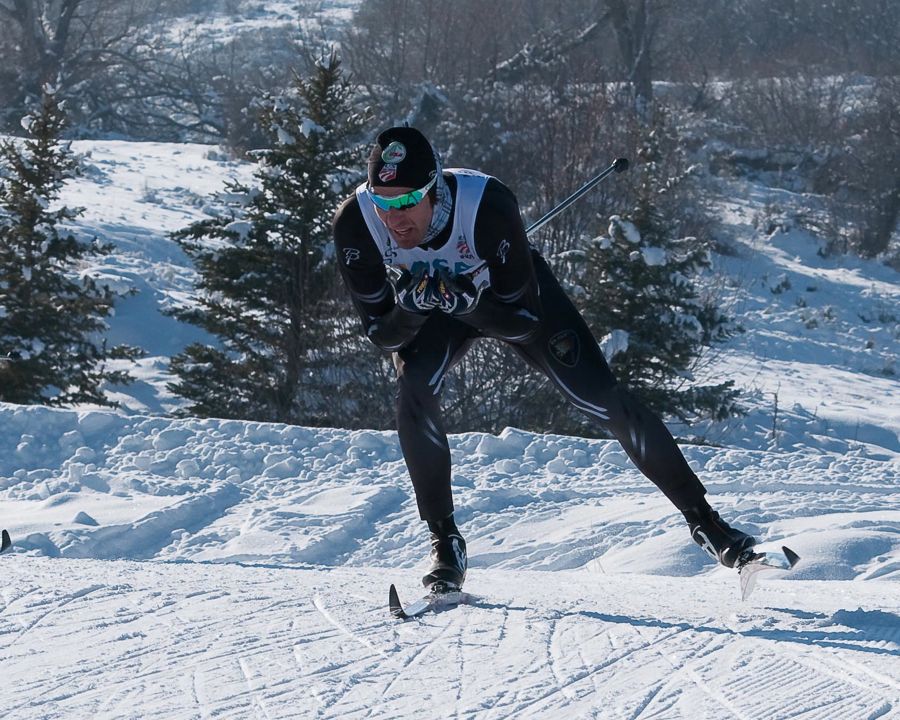
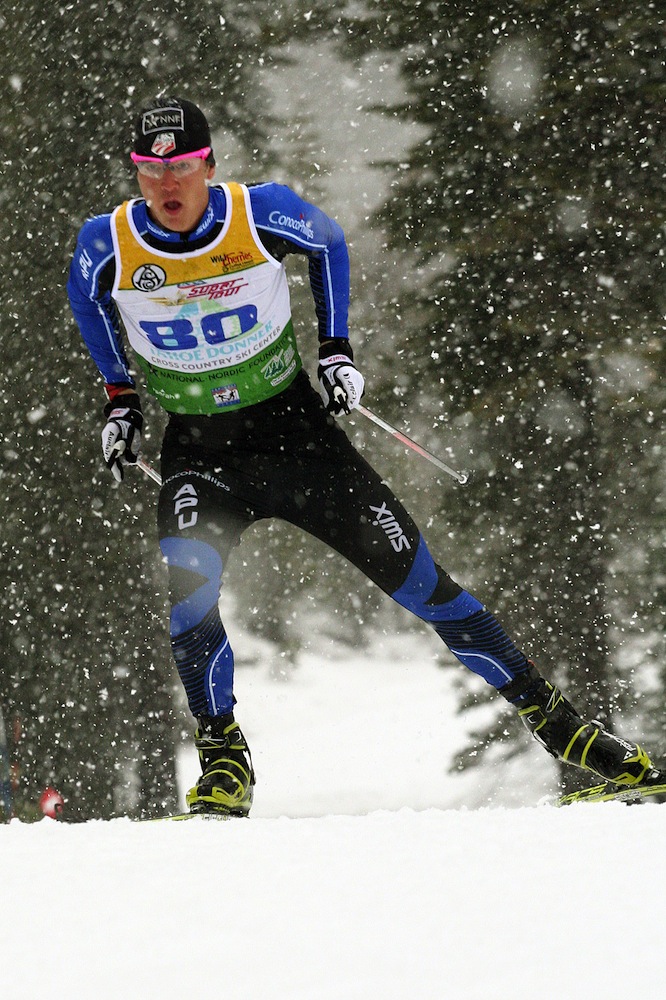
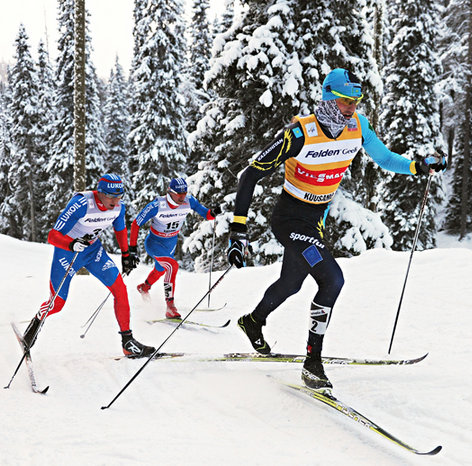
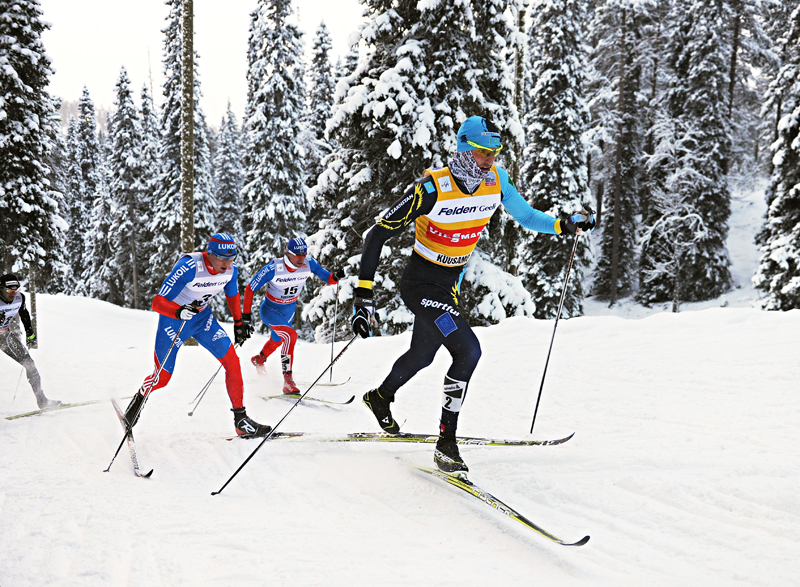
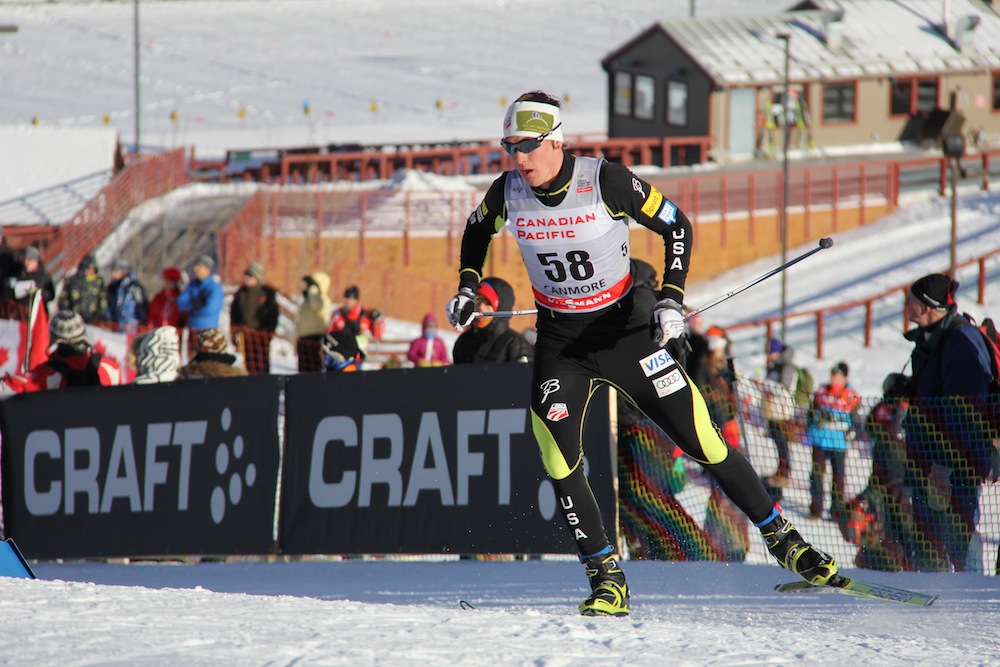
Torin Koos competing at U.S. Nationals in January. (Photo: Bert Boyer)
On January 7, 2013, Torin Koos made a race-winning move up the final hill of the 30 k classic at U.S. Nationals that Tim Baucom, one of the Bridger Ski Foundation coaches, later called “unbelievable.” As competitors struggled in his wake, Koos bounded up the formidable Hermod’s Hill on the Olympic course at Soldier Hollow like it was a bunny hill. A few minutes later, he crossed the finish line comfortably in the lead to claim his first national title in a distance event.
Koos’ skiing that day was part of a season that marked a turning point for the veteran racer. The win was not a surprise to Koos himself, but it was still his first career win at the championships in a race longer than 2 k. As the winter progressed he accumulated more distance accolades, including his first World Cup distance points (albeit in a prologue) and victory in the 50 k at Canadian Nationals in the spring. For Koos, who didn’t even compete in many distance races for the first seven years of his World Cup career, last season may prove to be the start of a new phase of his career.
Koos celebrated his thirty-third birthday last month. After such a milestone, there is a tendency to take a retrospective look at an athlete’s career and come up with measurements of its success and longevity. There are several ways to do this — the number of competitions started, number of wins, and number of results above a certain threshold. A skier’s resume doesn’t always paint a complete picture of his career, but it covers enough of the canvas to depict and decent outline.
In the U.S., few cross-country skiers still actively competing have had a more packed career than Koos. His World Cup debut took place at Soldier Hollow, Utah, in 2001, when he was just 20 years old. The next winter, he competed in his first of three Olympic Games in Salt Lake City. He’s been to six World Championships and has logged 80 World Cup starts. He’s been on the podium at U.S. Nationals six times, including five wins and two trips to the very top step within the same week in January 2013, at the same venue where he first appeared on the international stage.
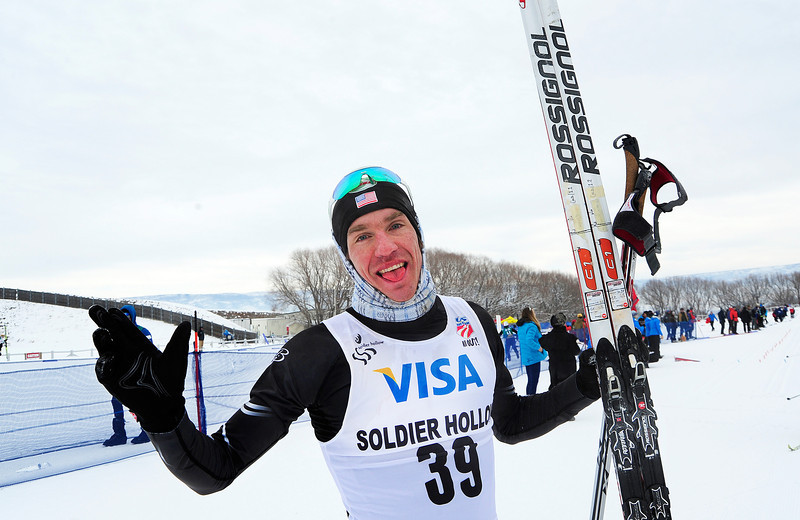
Koos after his 30 k win at U.S. Nationals, 2013. (Photo: USSA/Tom Kelly)
It is somehow necessary to preface anything written about certain athletes with these kinds of numbers, and in Koos’ case it is because they illustrate just how impressive his recent distance highlights are. Out all 80 of his World Cup starts, including stage events, 56 have been individual sprints while only ten have been individual distance races. Koos’ first distance race on the World Cup was a 15 k classic in Kuusamo, Finland, in 2008. Since then, half of the non-sprints on his World Cup resume took place last season alone, when he earned himself a trip to Europe by climbing to the top of the overall SuperTour rankings and the right to start every race in Period IV.
It is not unusual for sprint-specialists to see few distance starts on the World Cup, but this can mean that, from the outside looking in, Koos’ potential distance talent went untapped for years. Or perhaps his distance skiing has developed, as he’s gotten older. Either way, his experience last season confirmed for Koos he can be successful in longer events and that, at the age of 33, he has just begun to explore an exciting, new aspect of his skiing.
“I think [sprinting] is where, at the international level doing World Cup-type courses, I still have my top results,” Koos said on the phone last month from Bozeman, Mont. “But I’m really interested to see where I can take the distance racing, too. It feels like it opened up some doors, figuring out how good I can be in the longer distances… I think it was just a confirmation that something I hadn’t had much opportunity to do — it was confirmation that I could be really solid to maybe great at some of those races.”
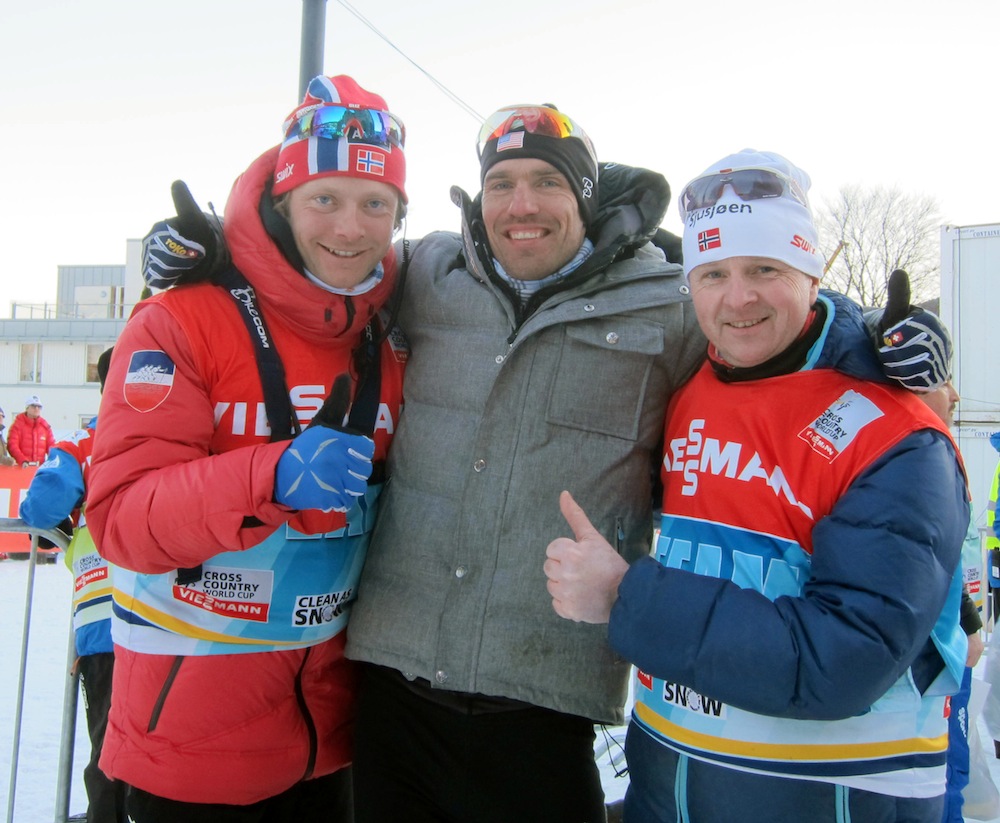
Koos with “Team Sjusjoen” after the Drammen sprint last season. Jon Anders Gaustad (L) and Petter Hagen (R). (Courtesy photo)
Finding new ways to enjoy the sport is what keeps Koos motivated all these years into his career. But his undeniable forte is still in sprinting, and his focus will remain there for the upcoming Olympic year. He may have revealed his distance chops last season, but Koos also proved he is as strong a sprinter as ever on both the domestic and international stage. He hadn’t seen a World Cup bib since being cut from the U.S. Ski Team in 2011, but despite the extended break from the international circuit Koos came back with an 18th-place finish in the classic sprint in Drammen, Norway, last March.
Ten-plus years of experience of racing World Cup heats clearly hadn’t gone away, which Koos feels was important for him to prove to both himself and the world, particularly with the Sochi Olympics on the calendar this season.
“The last time I [raced World Cups] I qualified second in Canmore and finished 11th that day, so when I left, when wasn’t able to race World Cups any more, I felt like I left it at a really high level,” Koos said. “So I always knew I could be back in that same performance zone and it was just a confirmation of that, as well. You have ideas, you have belief, but you also have to do it and show some other people again. I feel like it was a really solid year to build for this upcoming year, you know? So I think it’s a really good platform that I can take coming into this year. I feel like I’m coming into this year with some momentum and still with a lot to prove as well, to myself.”
Asked what his major goals are for the coming season, Koos knows when he wants to have the race of his life down to the day. The freestyle sprint in Sochi takes place on February 11, 2014, and he wants to be there and ski “better than ever.”
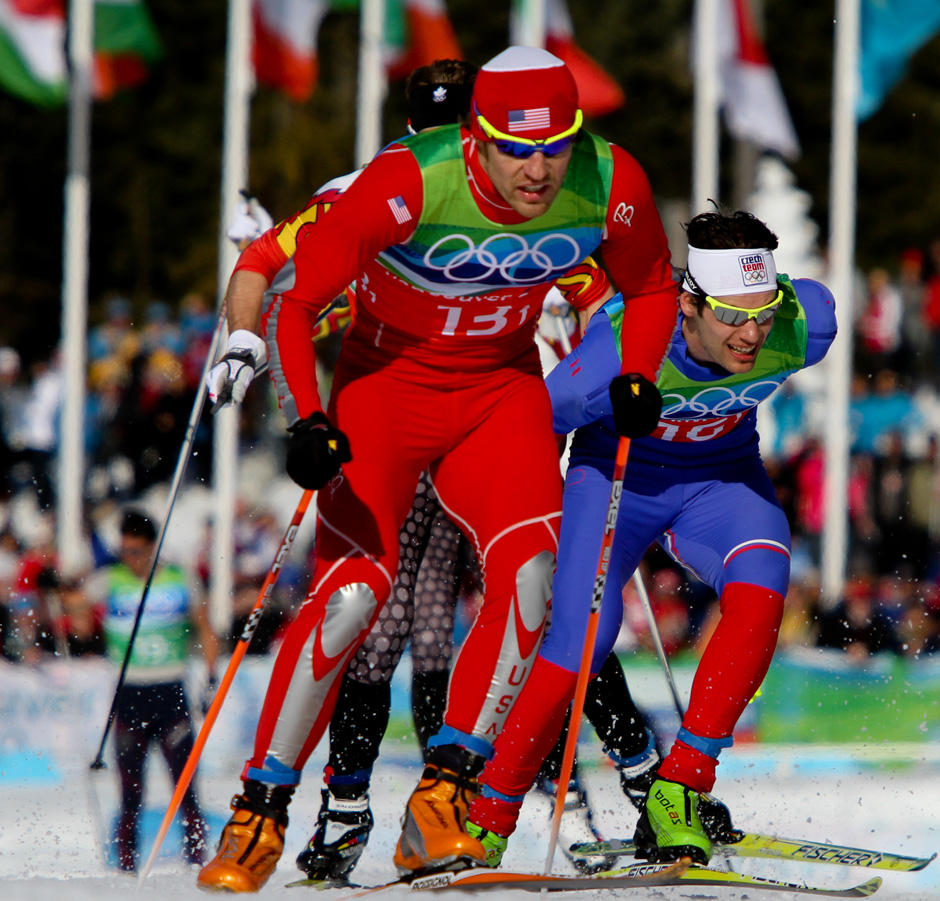
Koos competing in the team sprint at the 2010 Olympics in Vancouver.
Koos has been a part of three Olympic teams, and with the confidence he reestablished in himself last winter he thinks a fourth trip to the Games could be his best yet. But the hardest part of meeting his Sochi goals may be in qualifying — in order to meet the U.S. Ski and Snowboard Association’s objective criteria he would have to move into the top 50 in the World Cup sprint standings from the 69th position he occupied last year. And to do that, he first has to be able to log results on the World Cup before January 12, 2014.
Koos was not the Continental Cup leader at the end of last season and therefore won’t be that on the World Cup in Period I with that particular start right. Period II starts after the Tour de Ski on January 11, which doesn’t leave him much of a window to get on the ranking list even if he does end up leading the SuperTour in the fall. Discretion, therefore, may be Koos’ best chance at getting named to the team, but he hopes he somehow gets to compete on the World Cup before the team is named and objectively show he belongs on it.
“If I can get some more opportunity, I really feel that’s attainable,” Koos said. “It would be nice to get the opportunity again to show what I can do on the World Cup, and I feel that this year’s going, so far, much better than even last year.”
That is to say, Koos thinks his summer training is going well — perhaps better than it ever has. After the season ended at SuperTour Finals, where his races were hindered by a bout of illness, he took a quick vacation in Hawaii before going back to Salt Lake City, Utah, in time for summer classes at Westminster College. While there, he trained both on his own and with other athletes in the area, including former running teammates from his University of Utah days and with Miles Havlick, who is soon headed to Sun Valley but has been in town for the summer finishing his undergraduate degree.
Overall, Koos is encouraged by how sessions have been going. He finished his penultimate class last month and now has even more time to devote to training — and at the moment he is in Canmore at a Bridger Ski Foundation camp.
“I feel like I have a lot of control over how the body’s responding and how I plan training and everything like that, and now I’ll have a little less distraction with school, which all-in-all should be a good thing,” Koos said.
His overall approach to the sport is a reflection of how long he’s been doing it. Though he has goals like returning to the Olympics and doing well there, he generally tries to take things one day at a time. Koos doesn’t know, for example, how long he’ll keep racing, or what exactly he’s going to do with his distance skiing now that he has indicators that he could pretty good at it. This is part of what makes now such an exciting time for Koos. Yes, sprinting will continue to be his focus for at least the coming year, but after that he’s not sure what his future holds.
“I guess you have to find new parts about the sport, and that’s kind of what’s interesting about the distance racing part,” Koos said. “For a lot of years I did two, three, four distance races a year, maybe. And I feel like that whole part of the sport, it’s kind of new and exciting. And from there, there’s also some cool races that you hear about and you dream about, like the Vasaloppet. You can still see with people — I have a friend who’s on the LeasePlan Go Team with Thomas Alsgaard, and he says Thomas is really training to win the Vasaloppet. And I don’t know how old Thomas is, 40, 41 — many-time World Champion, Olympic Champion, coach, mentor, rally car driver, commentator. So for somebody like him, he can still find some new challenge in the sport, and that’s interesting and impressive.”
And so while Koos’ skiing future may be uncertain, you can be sure that he’ll be racing as long as it continues to motivate him like it does now.
“I honestly just try to take it day by day, season by season,” Koos said. “And so long as you wake up every morning and you’re like, ‘I’m really ready to give, go out and train,’ and that’s what you want to give 100% for, then yeah, I won’t question it… As an athlete you do think in four-year blocks, but right now I’d rather focus on what’s coming up rather than thinking too far down road.”
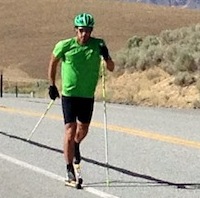
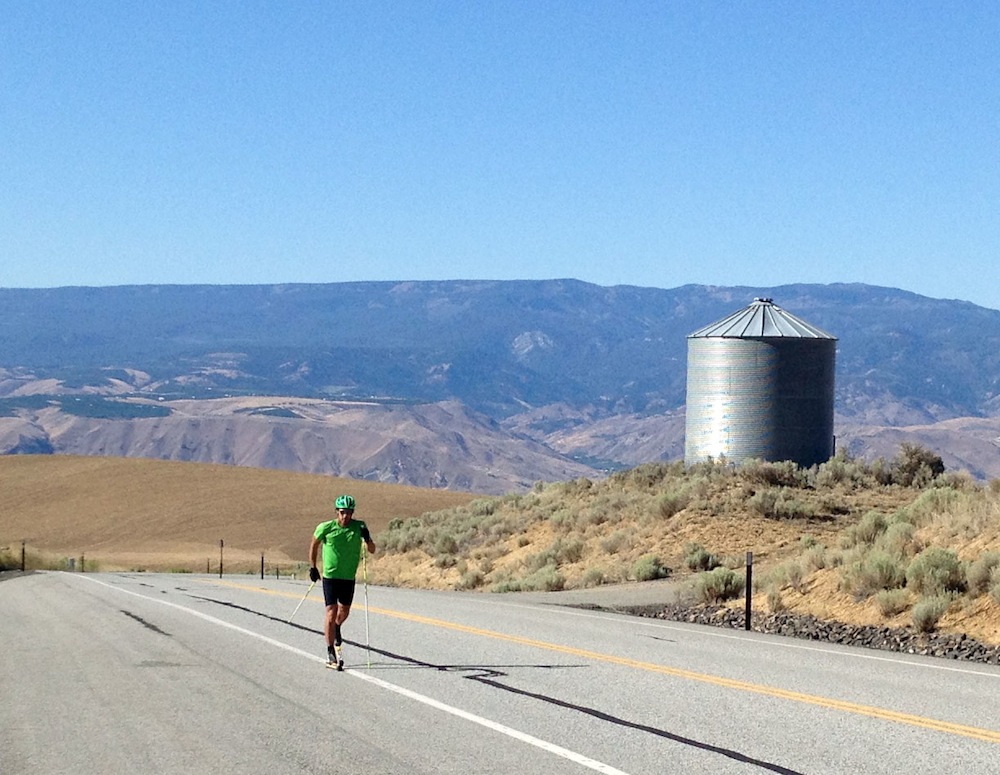
Koos rollerskis up Badger Mountain, from the Columbia River Valley to Waterville, Washington during a steady state threshold session. (Courtesy photo)
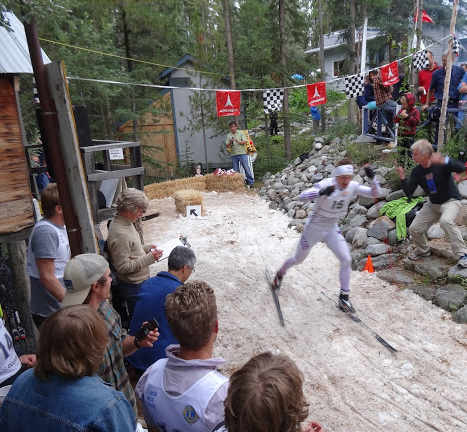
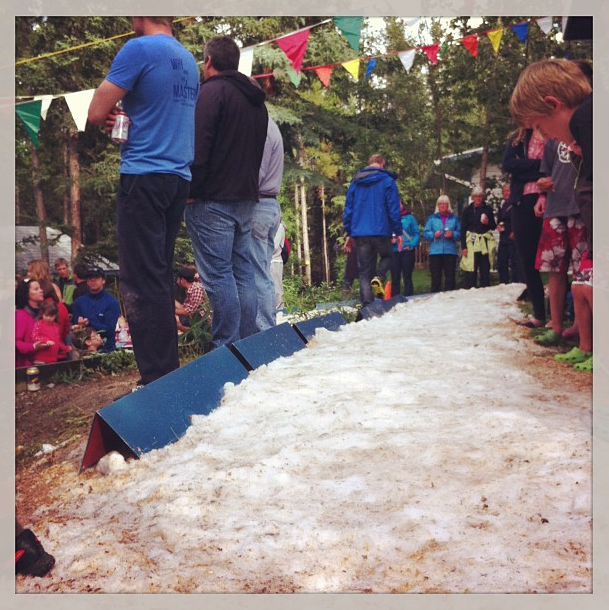
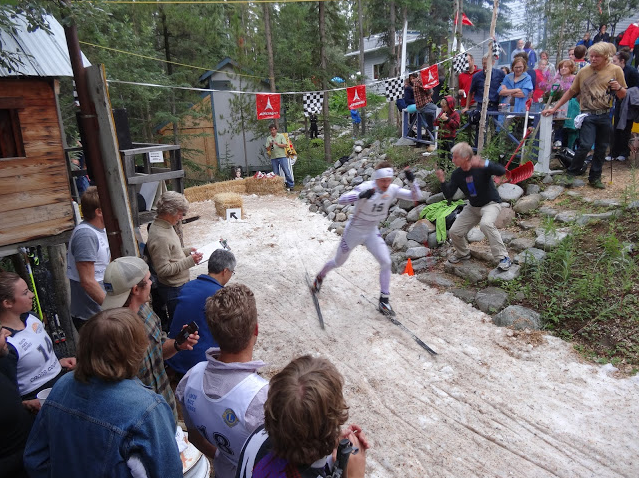
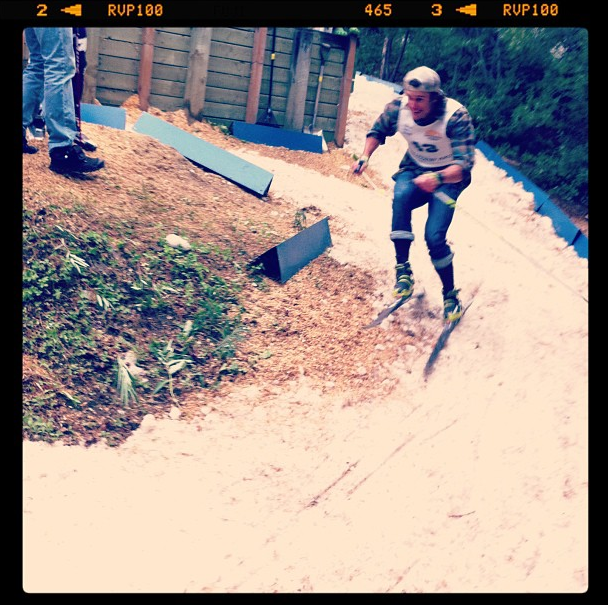
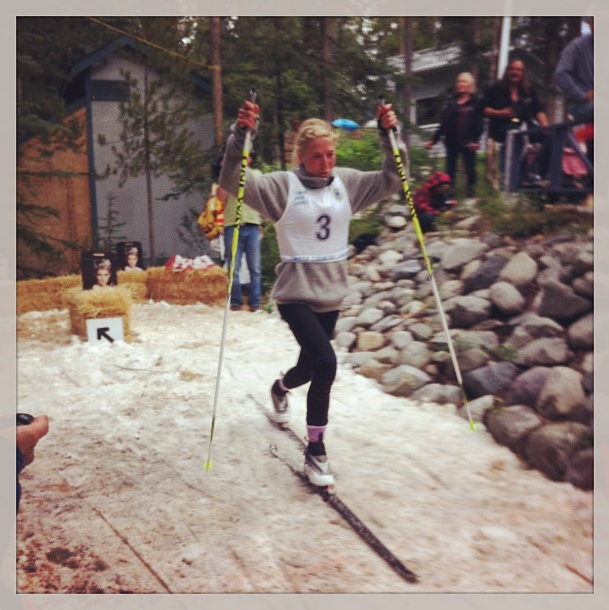
A competitor on course at the JP Grand Prix, a ski race that took place in a backyard in Whitehorse, Yukon, last Friday. (Photo: Brian McKeever)
If you noticed the slew of photos from a ski race in the Yukon last week, you weren’t dreaming. The second-annual JP Grand Prix, hosted in the backyard of Whitehorse skier John Perry and his family, was held on Friday complete with live music, a barbecue, TV crew and, yes, snow. And because it was scheduled to coincide with Canadian World Cup skier Graham Nishikawa’s wedding, there were quite a few world-class athletes who partook in the festivities. Welcome to the world’s coolest ski race.
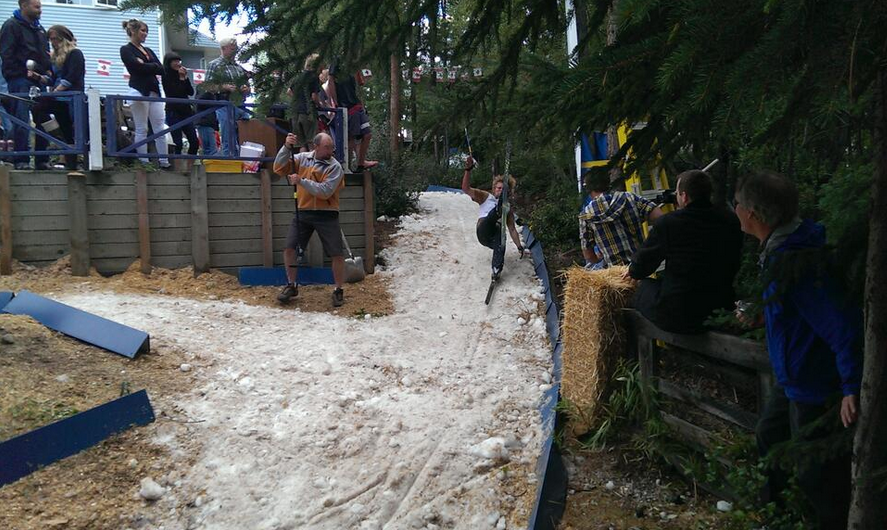
The course laid out for the JP Grand Prix. (Photo: Devon Kershaw)
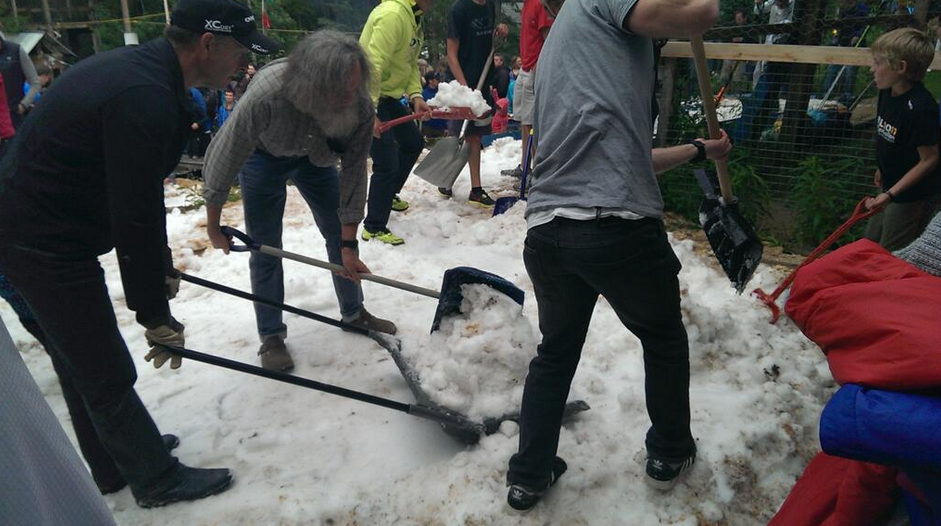
So, how is a ski race made possible in late July? With a lot of foresight. Perry and his father began stockpiling snow last winter to save up for the event. When it came time for the race, everyone at the party grabbed a shovel to build the course.
“The man with the name in the title deserves all credit for organizing the race,” wrote Canmore’s Phil Widmer in an email. “John Perry and his Dad save snow through the winter under their deck, cover it with saw dust and wait for the right time to host the ‘JP Classic.’ They did an amazing job with forerunners, a bagpipe lead procession for all competitors, bibs, prizes, medals, beer, it had all the fixings of a great race. This year it made sense to have it while everyone’s in town for the wedding. Thanks John!”
The making of the course. (Photo: Brian McKeever)
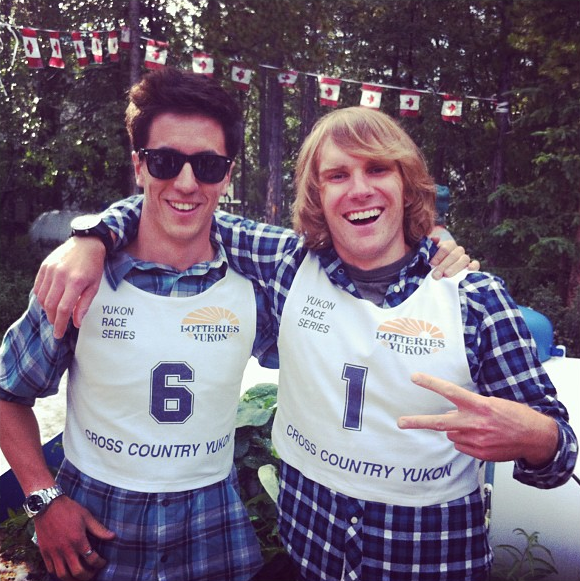
Widmer estimated that about 150 showed up for the event, and the Yukon Elite Squad’s website put the number of competitors at around 40, although ‘competitor’ is a loosely-applied term for race participants. The atmosphere was relaxed; Devon Kershaw raced in jeans and a flannel, as did Widmer and Nishikawa.
“I don’t know that there are results,” Widmer said. “It was honestly more about having fun skiing in the middle of summer in downtown Whitehorse.”
Knute Johnsgaard leaves the gate. (Photo: Yukon Elite Squad)Phil Widmer on course. (Photo: Devon Kershaw)Kristin Størmer Steira. (Photo: Devon Kershaw)Devon Kershaw with Graham Nishikawa before the start. Nishikawa was married the weekend following the race. (Photo: Devon Kershaw)
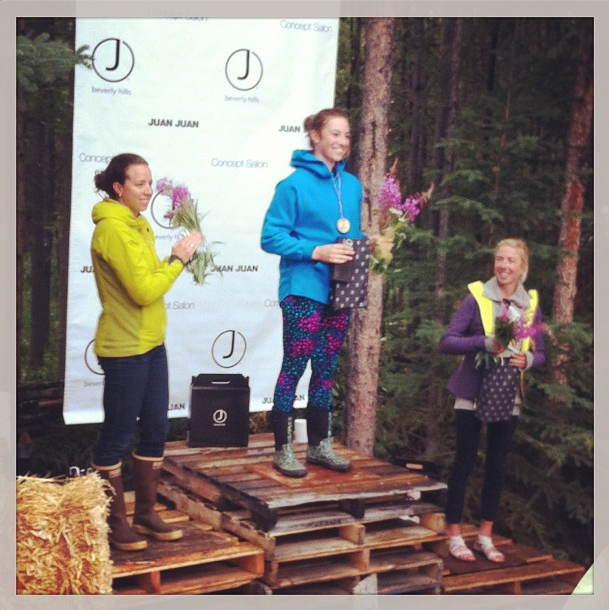
Results or no, somebody kept track of times and named podium finishers. Locals Janelle Greer and Knute Johnsgaard of the Yukon Elite Squad took top honors. Phil Widmer and Brent McMurtry took second and third, respectively, in the men’s category, and Perianne Jones and Kristin Størmer Steira claimed silver and bronze in the women’s race.
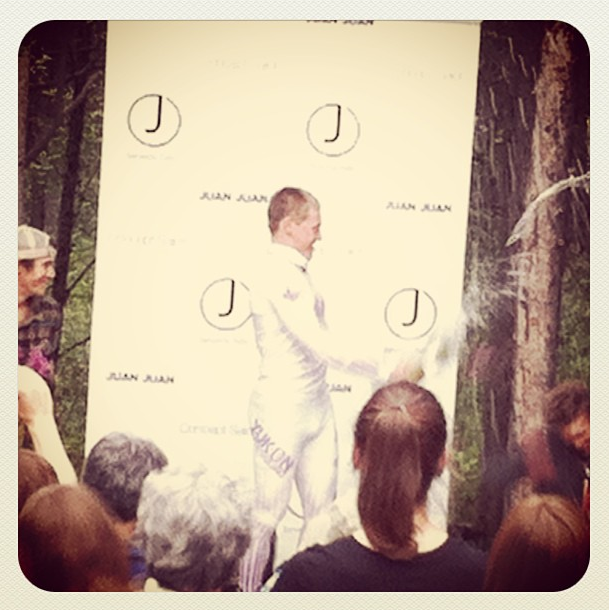
The women’s podium: 1. Janelle Greer (Yukon Elite Squad), 2. Perianne Jones (Canadian National Ski Team), 3. Kristin Størmer Steira (Norwegian National Team). Photo: Devon Kershaw.Men’s race-winner Knute Johnsgaard (YES) pops a bottle of champagne on the podium. Phil Widmer and Brent McMurtry, not pictured, took second and third, respectively. (Photo: Devon Kershaw.)
After the race, the real party began, complete with good food, drink and multiple bands.
“The idea is amazing and they pulled it off really well. I think two to three different bands played through the night and the atmosphere was great,” Widmer said.
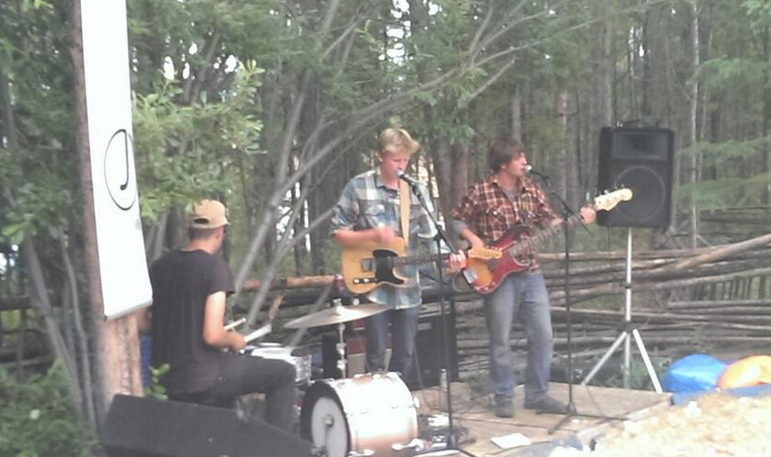
Former Yukon Elite Squad skier Fabian Brook and his band Griswold played at the afterparty. (Photo: Brian McKeever.)
In conclusion, Brian McKeever’s description of the JP Grand Prix as the “world’s best ski race” seems to be fairly accurate. If the number of video cameras that cropped up in pictures is any indication, we may be able to expect another video recap of it in the near future. In case you missed it last summer, here’s last year’s edit from David Greer.
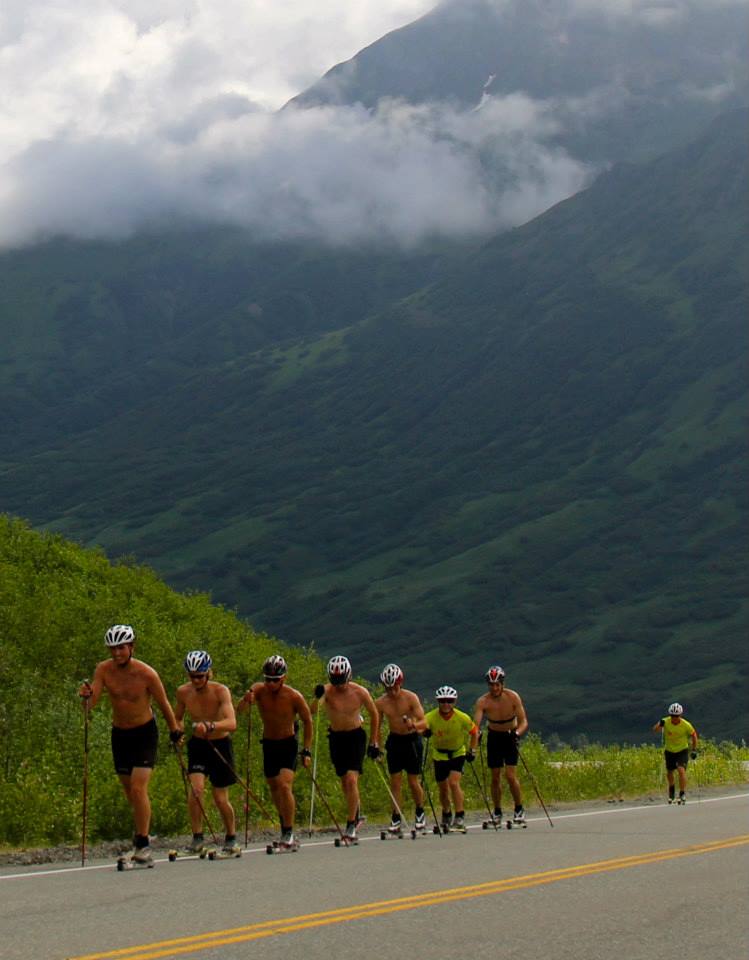
Athletes in training at the Alaskan Regional Elite Group camp, which wrapped up last week in Anchorage. (Photo: Bryan Fish)
There is an agility test that junior skiers take every summer when they attend a Regional Elite Camp in the East, West, Central or Alaska regions. The test was first implemented three springs ago when coaches across the country saw a need to develop technique and agility in young skiers. They added an obstacle course that summer to the other strength and general fitness tests already on the camp schedule; if athletes could quickly and successfully move around cones on rollerskis, it would eventually translate to better racing down the road in the way of tactical competency in mass starts and more skilled navigation through a tightly grouped field.
The last of four REG camps held throughout the U.S. wrapped up last week, in Alaska, and the agility test that once challenged junior skiers now has to be made more difficult in order to push the ability levels of the skiers who show up. A backwards skiing section was added this year to a course that also includes tight corners on pavement and an off-road segment.
“I remember the first year, [the agility test] was pretty eye-opening,” said U.S. Ski Team development coach Bryan Fish said on the phone this week from Park City, Utah. “Now the athletes are getting used to it.”
The need for a tougher agility test at REGs is part of a larger upward trend being seen in junior skiing nationwide. As a specific example, Fish says he has noticed improvement in close-quarters skiing over the past few years amongst the juniors he observes in competition at World Junior and U23 Championships.
“When I go to junior worlds and see a mass start or sprinting, our athletes are moving through the field better tactically and technically,” he said. “Yeah, we’re seeing increase in performance.”
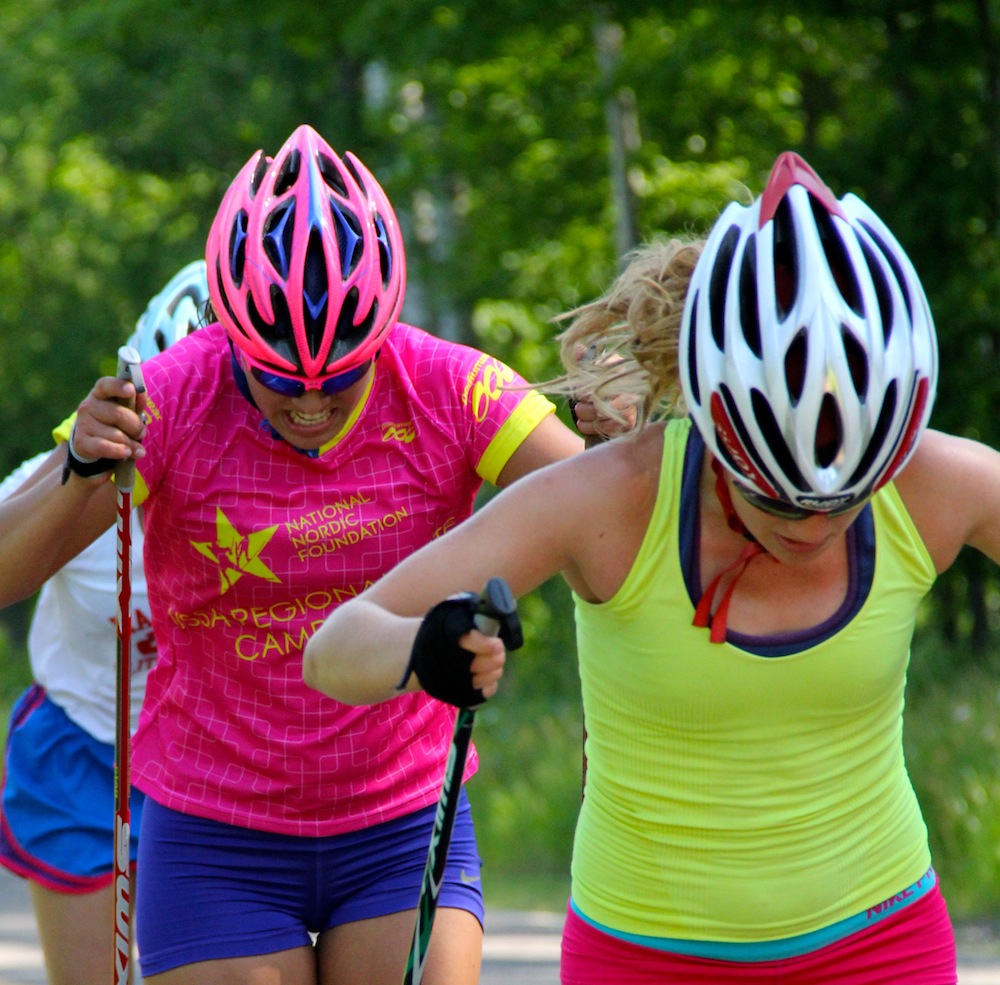
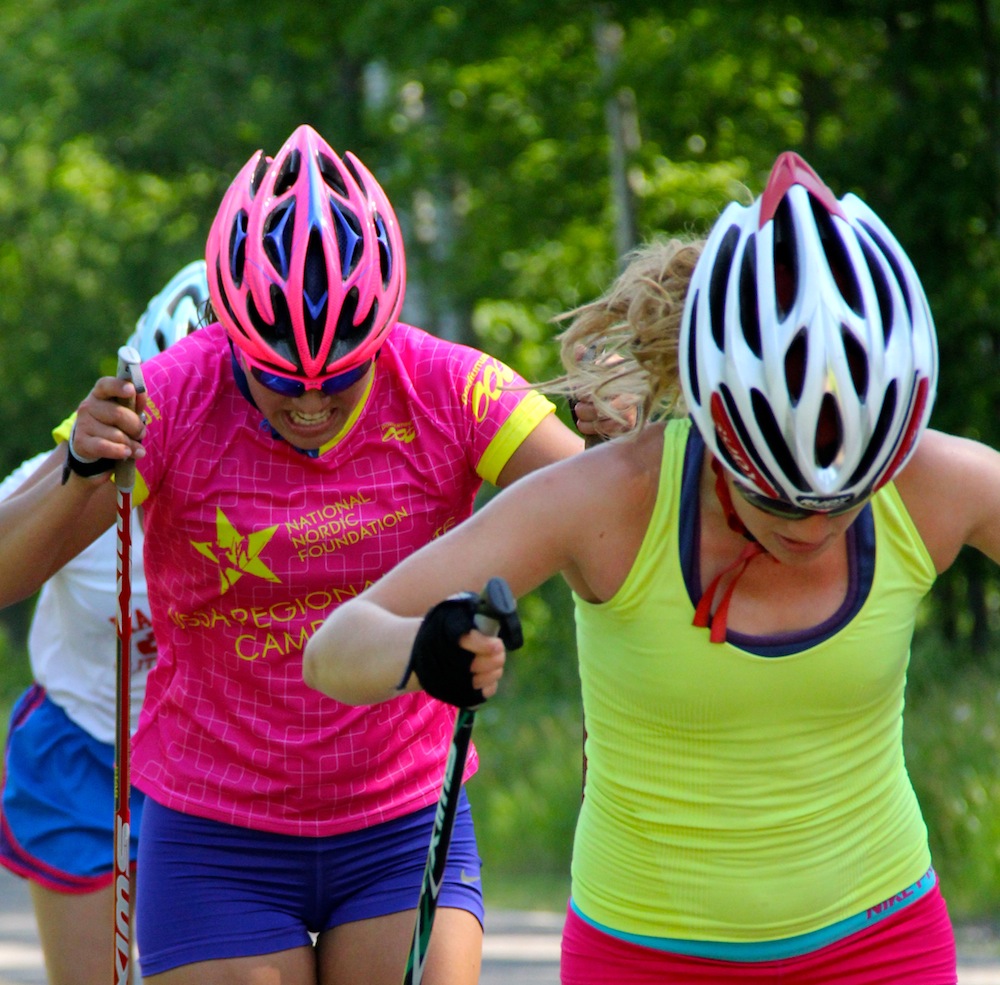
Junior girls double-poling at a recent REG. (Photo: Bryan Fish)
Fish recently returned from Anchorage, Alaska, where the last of the four REG camps concluded last week. REG camps are a cooperative development effort between regional and club coaches and the U.S. Ski and Snowboard Association — the camps run by the regions and supported by USSA — and their end goal is to help make the U18 and U20 skiers who attend into better athletes. Athletes are invited to work with area coaches in group workouts, testing and some seminars based on their Junior National results and national ranking.
“Our goal is to get athletes together more frequently and learning from one another,” Fish said. “That’s how they get better. That’s why we do international competition: they get pushed and hopefully rise to the occasion. Through experience both in camps and competition, that’s how we’re seeing our progress.”
Fish attended three out of the four camps this summer, and fellow USST coaches Jason Cork and Matt Whitcomb took part in the fourth. At each location Fish says he and his colleagues saw clear athlete progress across several categories, which he takes as measurements of successful camps.
In addition to requiring a harder agility test, athletes generally scored higher in the REG general strength test. Most of the juniors who qualify for an international trip last winter have attended an REG or one of the other steps in USSA’s development pipeline, which includes the National U16 Camp, REGs, the National Elite Group and the National Training Group. And at those higher steps, more athletes are being engaged: where participation was once around 50% for the NEG and NTG projects, it has risen to around 70%.
Fish also estimates that more area coaches have volunteered at camps each year, contributing to more collaboration between clubs and a better learning experience for the coaches who then return home to work with own teams.
“Every year we get more coaches partaking in these camps, and that’s something we’ve been pushing for — not just athlete participation, but also us as coaches,” Fish said. “Getting together and sharing ideas and working together.
“Clubs, coaches and regions are critical in working with our athletes on a daily basis and that is where a great deal of the work is done.”
What’s driving such progress? In part, Fish thinks it’s the camps themselves. Four years ago, on top of adding an agility test to REGs, coaches created the National U16 Camp (formerly known as the National J2 Camp) as another way to improve junior athlete development nationwide. It was the brainchild of Rick Kapala, Janice Sibilia, Ali (Dienes) Sehnert and Josh Smullin, who have since directed the camp each year.
Fish believes the addition of another step to the national development pipeline has been a critical part of growing junior success in the U.S. Every one of the juniors who qualified for the U18 trip to Norwegian Junior Nationals last winter, for example, had been through the J2 camp. On that trip, the U.S. girls turned heads with a silver medal in the relay.
“This’ll be the fourth year of the U16 camp…and I remember rolling into where the first one was, in Houghton, and questioning whether that age group was appropriate to have a national camp,” Fish said. “And when I walked away I had no question it was a very good step.”
No small amount of credit goes to the National Nordic Foundation, the non-profit that raises hundreds of thousands of dollars every year to help defray the costs of travel to camps and international competition for nordic athletes from the junior level through the World Cup team.
“NNF is instrumental in financial support and their involvement in development projects has allowed the growth and support of many of these projects,” Fish said.
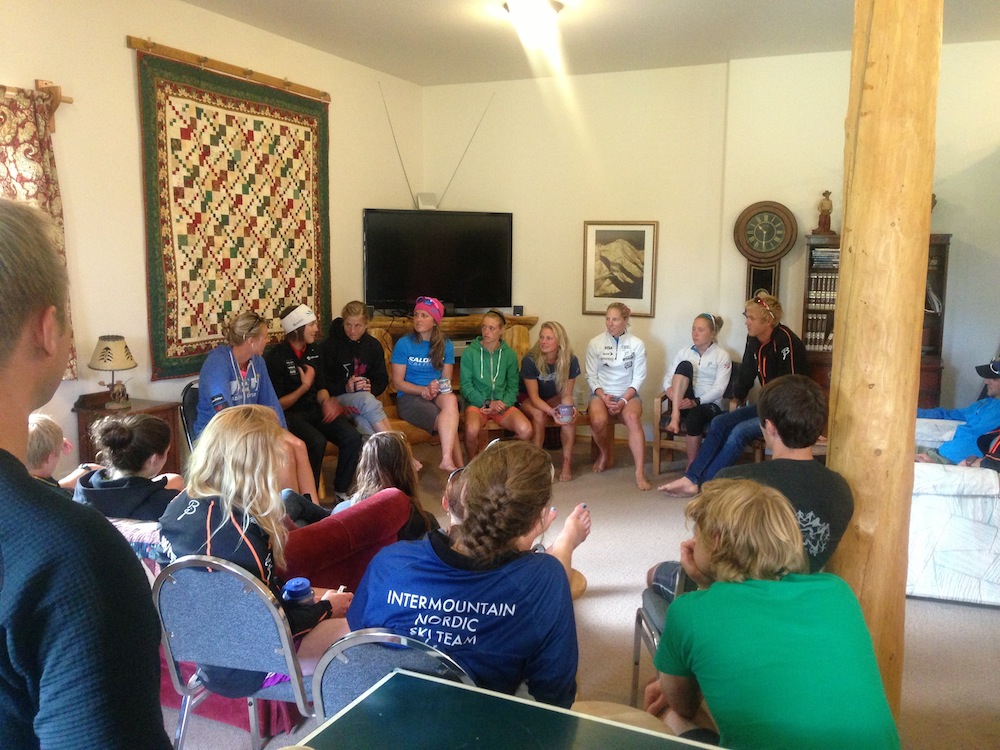
U.S. Ski Team athletes give a talk to junior skiers at the Alaskan REG. (Photo: Eric Strabel)
He also thinks the presence of stronger role models for young American skiers have directly and indirectly influenced stronger junior skiing. The U.S. has been steadily improving on the World Cup for several years now, and this winter a World Championship gold medal became a feasible end goal for aspiring American skiers, courtesy of Kikkan Randall and Jessie Diggins.
“With the path that’s being put forth by our camp and competition structure, our goal, along with what our U.S. Ski Team athletes are doing, is providing this clear path that these athletes can actually see from an American standpoint, from an American example,” Fish said. “Here are the steps and those are the athletes that are actually doing it on an international stage. It’s very powerful to have that as an actual example instead of just being theoretical — something that is very tangible, that these juniors can truly see happening.”
In a direct way, USST athletes were a resource to juniors at REGs. At the East, West and Alaska camps, local national team members took part in group workouts and gave presentations outside of training, and Jessie Diggins made a video for the Central REG. In Stratton, Vt., Andy Newell, Sophie Caldwell, Diggins and Simi Hamilton joined the juniors. In Park City, Noah Hoffman and Liz Stephen joined the Western REG. In Alaska, most of the U.S. women’s team, plus Erik Bjornsen and international guests Astrid Jacobsen and Bettina Gruber, gave talks to the juniors gathered in Anchorage.
The development pipeline is designed to challenge juniors incrementally and allow them to thrive at each step of the way, with World Cup, World Championship and Olympic success held as the goal at the end of the ladder. After a few years of regional and club coaches tinkering with the intermediate rungs, Fish thinks most of the right elements are finally there for effective development nationwide.
“Just last year, [we started] this brand new Norwegian Junior National partnership, where we had Norwegians at our Junior Nationals and we sent some to theirs,” Fish said. “I feel we’re finally to a point where we have the pieces in place, and then it’s just continuing to be innovative and look at the quality of these steps.”
The next step, Fish says, is to further develop a national competition calendar that fosters stepwise athlete development. The SuperTour calendar, as it happens, is being revamped this summer.
“They’re looking at the SuperTour calendar and looking at these steps, but I feel there’s more we can do there,” Fish said. “But it’s just this whole building process, and I think we’ve been doing a better job of putting in these tangible steps.
“Providing those steps and additional opportunities is one of those pieces…that has provided these athletes with the opportunity to get together with higher frequency,” he continued. “Athletes learn from one other and motivate one another, and create a strong team culture, but it also gives us coaches another opportunity to work together and share ideas. But the bottom line is we’re trying to provide experience [to] our athletes. With more experience comes stronger performance.”
Erik Bjornsen (APU/USST) reaches the top of a climb in the Pyrénées during a trip to France earlier this month. (Courtesy photo)
In Albu, Estonia, in 2012, there was a moment where Erik Bjornsen had an epiphany. He was there on a pre-U23 World Championship trip with other American athletes and had just completed two Scandinavian Cup races against Europeans doing a similar warm-up series before heading to Erzurum, Turkey, for the championships.
Bjornsen finished outside the top 30 in both the classic sprint and the 15 k classic in Estonia, and noticed that two of the podium finishers, Norway’s Pål Golberg and John Kristian Dahl, went one-two in both races. For Bjornsen, whose talents more heavily favored sprinting then, the realization made him resolve to become a better distance skier.
“I really got my eyes opened up,” Bjornsen said of the experience. “I just started realizing, even though you see those guys just race World Cup sprints — sometimes you’ll see them jump in distance races, but not often — people tend to think, ‘Oh, you need to focus on one [discipline].’ I just started realizing that in order to be a good sprinter on the World Cup, especially if you want to make it past the quarterfinals and the semifinals, you really have to be a good distance skier. And so I looked at that, and that’s why I was like, ‘I need to change my focus and try to become and all-around skier.’”
Erik Bjornsen (APU/USST) in the first stage of 2013 SuperTour Finals, which he ultimately won three events later. (Photo: Mark Nadell)
Last season, the 22-year-old Methow Valley, Wash., native proved he is well on his way to becoming that all-around skier. He and Alaska Pacific University coach Erik Flora increased his training load last summer and a few months later, Bjornsen won his first national championship in Soldier Hollow, Utah, in the 15 k freestyle, bringing confirmation that the changes were working.
He received further confirmation when, at the end of the season, he held off Kris Freeman in the final climb of SuperTour Finals in Truckee, Calif. Flora noted at the awards ceremony afterwards that Bjornsen’s performance that week was a slight surprise, even for them.
“Last summer we made a pretty big push in his training, and there’s always the chance that it goes great and there’s the chance that it doesn’t go as well,” Flora said. “You always have goals and think you can reach a certain level, but to see how strong he was during this tour, I think it surprised both of us.”
In the pursuit of even bigger goals for the upcoming season, Bjornsen has continued to fine-tune his summer training. Earlier this month he traveled to Villard, France, to both visit his girlfriend, University of Alaska, Anchorage’s NCAA Champion and former French biathlete Marine Dusser, and to train with French national team members in the Pyrénées.
Between the long mountain runs, rollerski intervals and speed sessions with athletes like Robin Duvillard, Bjornsen learned his training isn’t so different from his foreign competitors’. Just as Liz Stephen’s recent training trip to Norway boosted her confidence in her own program, Bjornsen came away from the training block in France more self-assured. He points to this lesson first as his most important takeaway from the trip.
Bjornsen pauses on a long run in the Pyrenees. (Courtesy photo)
“I pretty much felt like I did a normal week of training for me, right now, and it was cool to see,” Bjornsen said. “It definitely gave me confidence. It’s a little different setup than what we do here at APU, but it’s the same idea.”
For reference, Duvillard’s top World Cup result last season was a 13th-place in the Davos, Switzerland, 15 k freestyle, a ranking Bjornsen would like to see himself reach more frequently in the future. After beating Duvillard on a few intervals, Bjornsen says that goal feels a bit closer.
“I felt really fit and was able to push — especially on the classic speed day, [I] beat a lot of those guys, so I was psyched with that,” he said. “And they’re all really good skate skiers, so for the skate intervals it was interesting to train with them.”
One of the roads Bjornsen climbed with the French athletes on rollerskis has been used in past editions of the Tour de France. Bjornsen is not an avid cycling fan, but has immense respect for any athlete that can complete a multi-week tour.
“I didn’t know much about the Tour until this year, but it was fun to learn about and kind of follow,” he said. “Those athletes are crazy — that whole sport, being able to do a tour for 30 days or three weeks or however long it is, I can’t even imagine. The tours we do in cross-country are like five or six days and I feel like I’m wiped out.”
On one of the last days he was in the country, the day he turned 22, Bjornsen entered a 15 k trail race for fun, his first running race since high school. He finished second to Matti Haikinen, the Finnish World Cup veteran and 2011 World Champion.
Bjornsen and Haikinen after a 15 k trail race. Haikinen took first and Bjornsen was second. (Courtesy photo)
“I ended up being able to run with him until six or seven k, to the top of the course,” Bjornsen said. “He kind of took off on the rolling section at the top and on the downhill he put some time on me, so he ended up being me by like a minute and a half.”
In training with French national team biathletes and cross-country skiers, Bjornsen also learned they make more of an effort to seek out rollerski terrain that closely resembles World Cup homologated courses. Now that he’s back in Anchorage, Bjornsen has started applying this to his own training.
Bjornsen feels that another benefit the trip afforded was practice with travel, a necessary component of any North American’s international racing career. He’s learned that getting better at the small things — recovery, nutrition, international flights — goes a long way in producing better race results.
“I think it’s important to just get more comfortable with jet lag,” Bjornsen said. “It’s important to not think about it too much, and it’s something that, as Americans, we’re going to have to deal with our whole ski careers.
“For me, just getting more professional with the sport has seemed to help me make steps in my racing,” he continued. “Everybody, in order to reach the top, you really have to live cross-country skiing at every hour of the day.”
In addition to making an effort to dial in the details, Bjornsen has continued to make incremental jumps in his training to go along with stepwise racing goals. As one of the younger Olympic hopefuls on the U.S. Ski Team, Sochi is certainly one of them, but he is also focused on making another jump at the U23 level. He cracked the top 10 last year in Liberec, Czech Republic, in the classic sprint, but wants to do more in his final year of being eligible for the event.
“This year everybody’s excited about Sochi, and I’m trying to…not focus on that too much, but also focus on the big picture,” Bjornsen said. “I’m looking forward to U23s in Val di Fiemme this year — my parents are going over to watch and that’s their first time abroad — so I think that’s my main goal next year, is to have some breakout races in Val di Fiemme… This’ll be my sixth year going, and every year I feel like I’ve gotten a little closer to my big goal.
“And of course the Olympics would be awesome as well,” Bjornsen added, “but the goal is just to focus on the little things, and continue to up the training a bit and not make any radical changes.”
Beyond this season, Bjornsen wants to continue to develop his sprinting and distance skiing. He has ambitions of competing in the Tour de Ski one day, which he thinks of as the pinnacle event for a well-rounded skier. As an American, in particular, he thinks that’s a niche that still needs to be filled.
“Right now we have [Noah] Hoffman, who’s focused on distance skiing, and [Andy] Newell, who’s focused on sprinting, and Freeman, who’s a distance skier, and Simi [Hamilton], who’s a sprinter,” Bjornsen said. “And I wanted to be, maybe, one of the first guys in the U.S. that [could] be good at a tour race. The Tour de Ski is such a cool race; I’d love to compete in that some day.”
The Tour de Ski is further down the line, however. In the more immediate future, Bjornsen will start next season following a similar schedule to the one he’s had the last few years by focusing on performing well in familiar territory before heading to Europe. He’ll be at West Yellowstone and Bozeman, Montana, for the opening SuperTours, spend the holiday at home in Washington and race at U.S. Nationals in Soldier Hollow in January. After that, hopes to mirror his pre-U23 Championship schedule from last winter, when he was able to hop in a few World Cups before the championships.
From there, Bjornsen’s schedule is dependent on how fast he’s skiing.
“There’s a lot of different routes that could happen from there — if things are going really well, maybe Sochi,” he said.
Bjornsen at the top of Col du Tourmalet, the highest road in the central Pyrenees. (Courtesy photo)
The North American Women’s Training Alliance converged again this week in Anchorage for their third annual camp, this time with a few more foreigners than usual. (L to R) Kate Fitzgerald, Kikkan Randall, Liz Stephen, Astrid Jacobsen (NOR), Ida Sargent, Holly Brooks, Bettina Gruber (SUI), Jessie Diggins, Emily Hannah, Anika Miller. (Photo: Matt Whitcomb)
The joint women’s training camp between the U.S. Ski Team and Alaska Pacific University began this week in Anchorage, Alaska, bringing many of the nation’s top female skiers together for the first time in a month along with a few special foreign guests. According to USST women’s coach Matt Whitcomb, training has been going well so far.
“It’s nice to have the band back together up here for the third annual NAWTA camp,” he said on Tuesday. “We had a killer session [on Tuesday] with some Level 3 pace development intervals, and we’re gearing up for a great couple of weeks here.”
The pack of Americans once again includes Canada’s Chandra Crawford, whose participation in the camp since its iteration in 2011 inspired the name North American Women’s Training Alliance, or NAWTA. But the group might have to change its name soon if it keeps attracting so many European athletes; this year decorated Norwegian skier Astrid Jacobsen and top Swiss national team member Bettina Gruber joined its ranks to experience the group’s training environment.
“We’re in really good company this week,” Whitcomb said. “Just the day in, day out training situation resulting from such a high caliber group is where we get most of our benefit from.”
The group training is precisely what brought Jacobsen says brought her to Alaska.
“For me it is exotic to travel here to see Alaska,” Jacobsen told FIS in a recent interview. “Most importantly though it was the opportunity to go and train with Kikkan [Randall]. For me she is the best skate sprinter we have. I felt that we could challenge each other. We each have different qualities.
“Also, if you look at how the American women’s team has developed in the last couple of years it is a really interesting team with a good spirit. I was curious to come here and see how they work as a group.”
In return, the Americans hope to benefit from the new perspective a foreign athlete brings to the table.
“I got this descriptor from Rikard Grip, the Swedish head coach: he talked about the Americans adding just the right spice to training, so I’ve taken the word spice and have really appreciated the spice that it does add, having Bettina and Astrid and Chandra,” Whitcomb said. “It’s just a nice simulation for everybody, including the guest athlete. We’re going to be watching these girls and their strengths closely, and we hope they can pull something out of this camp and have a better shot at a medal in Sochi, as well.”
If it surprises anyone that the U.S. national team has opened up its training to foreigners, particularly before an Olympic year, Whitcomb says this is simply part of how they operate.
“One of the philosophies of the team is we’re very open,” he said. “We share any secrets we might have, and in doing that we end up learning much more. So it’s an open environment and the more we can share the more we can learn.”
The first week of the camp is being spent dryland training in Anchorage during a higher-intensity block, and next week athletes and coaches fly up to Eagle Glacier for more volume-specific training on snow.
Thus far, Whitcomb has been happy to see his athletes looking strong in workouts and staying healthy while managing mild injuries.
“We have a couple mild injuries being nursed along but nothing major this season,” he said. “I think everybody has their little tendonitis issues, little things here and there, and as a team we’ve gotten things much better under control this season. Through working with a physical therapist and setting up better injury management system than we’ve had in the past.
“The key is just smart, varied training,” Whitcomb continued. “When you do varied training it allows the body to recover in sneaky ways, so we’re doing a lot of that to be preemptive. They’re doing a much better job as athletes, we’re doing a better job paying attention and being strict when needed as coaches, but everybody’s doing great and hitting the ground running here.”
When the group moves to the glacier this weekend they’ll spend about six days on snow for between 23 and 30 hours of volume on skis. The team has both individual and group-specific goals for the entire camp; as athletes work on personal technique or equipment-based goals, the team aims to continue operating better together as they live and train together on Eagle Glacier.
“It’s just a great opportunity to get out there and get on skis,” Whitcomb said. “Learning to kick a ski on sloppy snow — mornings are firm and fast for skating, focusing on something similar to our workout [from this week]… Whether you’re socializing on a long easy ski or going head to head in a speed workout, we really run everything as a group at this camp.”
Astrid Jacobsen (NOR), Liz Stephen, Bettina Gruber (SUI), Jessie Diggins, Holly Brooks and Ida Sargent during threshold intervals in Anchorage, Alaska, on Tuesday. (Photo: Matt Whitcomb)
The third-annual North American Women’s Training Alliance (NAWTA) camp began this week in Anchorage, Alaska, and on Tuesday morning they completed a threshold workout that ended with a lot of high-fives in the van and left U.S. Ski Team women’s coach Matt Whitcomb pretty happy.
“Today’s threshold workout was the best threshold workout I’ve seen out of this group of women since I’ve been working with the team,” he said on the phone, as the group began their afternoon strength session.
Kikkan Randall, Jessie Diggins, Liz Stephen & Co., are joined at this camp by Alaska Pacific University skiers, National Training Group athletes, and decorated Norwegian Astrid Jacobsen, Switzerland’s Bettina Gruber and Canada’s Chandra Crawford. The workout is one that Whitcomb and APU head coach Erik Flora have repeated over the last few years in order to work specifically on high-speed skiing in the middle of a threshold session.
The keys to accomplishing this goal are two-fold: the choice of terrain, and the presence of a group to ski with. It was his team’s skilled pack skiing that Whitcomb thinks set Tuesday’s session apart from the rest, but the rolling hills are a critical ingredient to the goal of the entire workout.
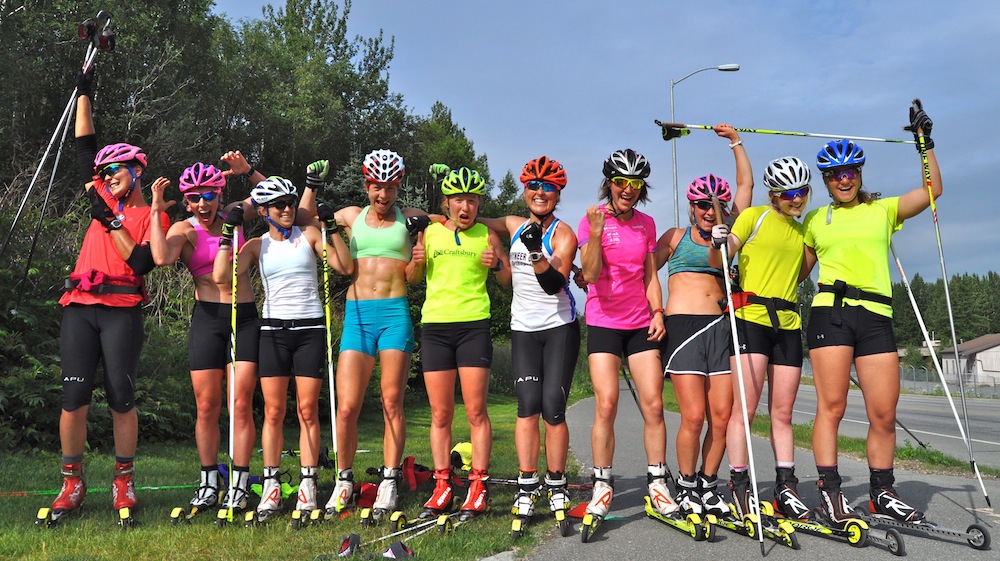
The group after a well-executed workout. (L to R) Kate Fitzgerald, Kikkan Randall, Liz Stephen, Astrid Jacobsen (NOR), Ida Sargent, Holly Brooks, Bettina Gruber (SUI), Jessie Diggins, Emily Hannah, Anika Miller. (Photo: Matt Whitcomb)
“It’s not so much emphasizing going harder, it just emphasizes patterning your muscles, neurally, to fire faster,” Whitcomb explains. “I think a lot of times, certainly my tendency as been to prescribe intervals that are a bit too slow. We might be nailing the percentage of your max heart rate and the proper lactate right on the money, but the pace is just too slow — you’re going uphill, uphill, uphill, and a lot of times when we find hard terrain we go hit intervals there.”
To encourage speed variation while staying within threshold, the workout should be done on a stretch of pavement that includes gradual uphills, flats and gradual downhills, which “systematically [builds] some pace development intervals into your session,” Whitcomb says.
“It doesn’t need to be incredibly hard — today was roughly threshold and above during bursts of speed — but it was about the terrain that helped push the pace for us.”
The Workout:
20-30 minute warm up*
4-6 x 7-10 minute L3 intervals (3 minutes rest) on fast terrain that incorporates gradual uphills, flats and gradual downhills. Most interval sessions use hard and grinding terrain, great for building capacity but not so great for higher pace development. The key to this workout is in the choice of terrain.
20-30 minute cool down*
*Do a warm up and cool down that allows you to focus on the intervals. “Sometimes a mistake can be made where people are going after volume in addition to high intensity on interval days,” Whitcomb says.
Don’t do try to multi-task for this workout. “Warm up only the minimum that your body requires,” he continued. “You want to make sure your muscles are ready to go, and build into the intervals if you have to — you don’t want to pull any muscles or get injured — but a 45 minute warm up is too long, as is a 45 minute cool down. Keep them concise and focus more on the on-time.”
Frequency:
Every two to three weeks in the summer, with increasing frequency to every 10 days as fall approaches. “A workout like this is in addition to L4 intervals, time trials, speeds, ODs,” Whitcomb said. “It’s just another small component, another ingredient to throw in the bag and mix it up.”
Variations:
Shorter recovery time as the season goes on, or longer recovery when at altitude — “just to make sure the on-time is what’s being emphasized,” Whitcomb says.
Pre-determined sprint preems that accomplishes a similar break from straight threshold, forcing athletes to go from threshold, into race pace, then back into threshold when they cross certain preem markers in the interval.
On Tuesday, the women did this session on a stretch of bike path in Anchorage’s Kincaid Park. They chose a section of rolling terrain that was about 7-10 minutes long going either way. The group started their first interval in one direction, which took about nine minutes, took their three-minute recovery, and then skied back the other way to the start, which took about seven minutes.
From a coaching perspective, this workout shows Whitcomb things that don’t surface in regular threshold intervals.
“I think when we started doing this it taught us that the speed didn’t really change as much as we thought it would when the terrain asked for higher speed,” he said. “You try and go faster and your muscles simply didn’t want to move faster. It wasn’t a matter of being at your max heart rate, people were well within threshold, but they just didn’t want to fire those muscles faster. But the body fortunately adapts pretty quickly to a group session like this and you see pretty notable progress in your speed in just a few weeks.”
Whitcomb’s footage from Tuesday’s session.
So what made Whitcomb call Tuesday’s workout, in particular, the best threshold session he’s ever seen from his team?
In addition to their raw speed — “they were really flying” — Whitcomb noticed they skied better together within the pack than they have before.
“Everyone spent some time leading, some time sandwiched cycling in the spin wash in the middle of the pack, and it was really unlike this group perhaps in the past — you know, you establish a pecking order and somebody’s out there hammering off the front all day, maybe somebody switches out if they get tired, somebody is flying off the back all day because they’re struggling,” he said.
“And today instead it was much more this series of incessant attacks at the front where you’d recover a little bit, spend some time in threshold in the pack, and then you’d work your way to the front and use your good feelings and your recovered state to push the pack and pull everybody along at a faster rate. It looked more like watching a cycling race today, to be honest, and that’s kind of a new thing particularly in girls skiing, I think. The mass starts [sometimes] just getting strung out from 100 m into the race, and I think we’re moving in the direction of more pack skiing. And as we can improve our skills within the pack were going to be better suited for those days when the women’s pack does stay together.”
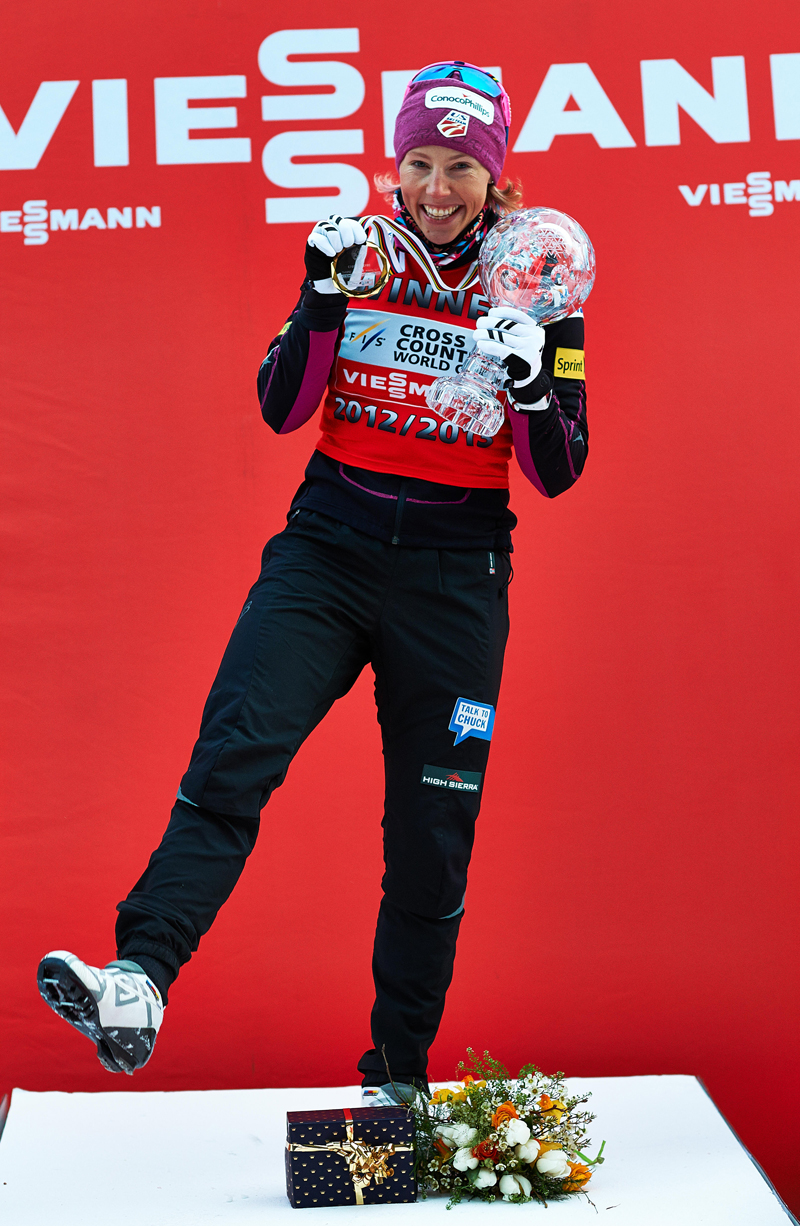
Kikkan Randall (USA) with her second straight Sprint Crystal Globes. With Time Warner Cable now carrying Universal Sports Network, more U.S. viewers will have access to the channel’s endurance sports programming this year, which includes alpine, nordic, snowboarding, freeskiing and freestyle tours. Photo: Fischer/Nordic Focus.
Universal Sports Network, which offers exclusive year-round coverage of Olympic sports programming, made an announcement on Thursday that could help more U.S. ski fans watch their favorite winter athletes. Time Warner Cable, the second-largest U.S. cable system operator in the country, will start carrying the Universal Sports channel later this summer as part of a new multi-year contract to bring its customers coverage of the Olympic qualifying FIS World Cup tour, including alpine, nordic, snowboarding, freeskiing and freestyle tours.
“Time Warner Cable customers will soon be able to enjoy the year-round coverage of championship sports programming found only on Universal Sports,” said Alexis Johnson, Time Warner’s Vice President of Content Acquisition. “We are delighted to be able to provide our Sports Pass subscribers with access to coverage of the Olympic sports they love on multiple platforms.”
For current Time Warner customers, Universal Sports will only be available to those who pay extra for the TWC Sports Pass. DirecTV will continue to carry Universal Sports’ programming, meaning World Cup races will now be available in some 40 million U.S. homes, including major markets in New York City and Los Angeles. Comcast, the largest U.S. cable provider, still has not regained Universal Sports since dropping the channel from its lineup in 2012.
The U.S. Ski and Snowboard Association looks positively at the Time Warner deal, as the governing body seeks to boost its athletes’ exposure in the upcoming Olympic year.
“Maximizing exposure for U.S. Ski Team athletes is a major priority for the USSA and this agreement between Universal Sports Network and Time Warner further helps that initiative,” said USSA’s Chief Marketing Officer Michael Jaquet in a press release. “We are encouraged that Time Warner Cable has seen the value in this and will continue to work with our partners at Universal Sports Network to continue to build out this very valuable platform.
“This announcement and development is about more access and distribution for Universal Sports,” Jaquet further explained in an email to FasterSkier. “So last week if you had Time Warner as your cable provider you couldn’t watch the channel. Now you can. That’s 8 million more people this week that can now get the channel that couldn’t last week. So good for the sport and what they cover already.”
Jaquet, who joined USSA last spring after leaving CBS as a marketing executive, was unsure of how Universal Sports’ cross-country and nordic specific coverage would change in the Sochi Olympic year.
“No major plans that I know of now to change the mix of sports and coverage, but in an Olympic year maybe more than normal,” he said. “Those decisions get made in the next four to eight weeks.”
USSA did not directly play a role in the deal, but Jaquet says winter sports fans likely influenced the decision by requesting access to the channel.
“We weren’t directly involved in the negotiations but these deals get done based on people calling their cable operators and demanding the channel get added,” he said. “We do know that a lot of that call volume came from NYC and LA, two of our bigger markets for fans and Time Warner’s Main coverage areas. So our fans certainly had a role.”
Universal Sports has been the home for season-long coverage of the Audi FIS Alpine World Cup, along with bringing other FIS events like the cross country Tour de Ski to America.
“We are thrilled that Time Warner Cable sees value in Universal Sports Network,” said Universal Sports President Scott Brown. “We look forward to serving Time Warner Cable’s customers with exciting, global sports coverage on multiple platforms.”
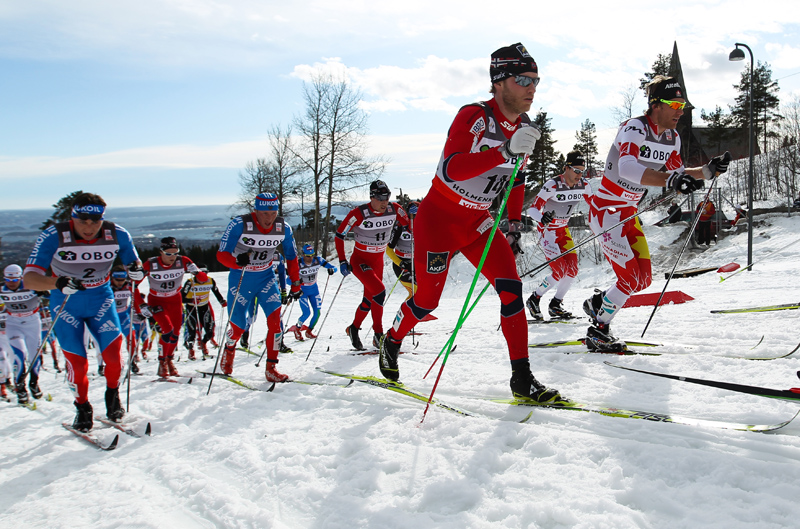
World Cup athletes competing in Oslo, Norway, in 2012. Television interests have influenced the evolution of the Holmenkollen 30/50 k over the last few years, and the event continues to represent the challenge of keeping cross-country relevant while staying true to the sport. Photo: Fischer/Nordic Focus.
Every year, at the International Ski Federation’s (FIS) spring Calendar Conference, the media company responsible for the production and distribution of FIS World Cup and World Championship race coverage gives a presentation surveying TV audience data from the last season. The presentation from Infront Sports and Media is a kind of performance review for the entire sport. Coaches, administrators and organizers from around the globe attend the meetings to play a part in the creation of future World Cup calendars, but a key part of the process is the consideration of how many people tuned in to the races they either participated in or produced over the last year.
The inclusion of a television viewership presentation at this meeting makes clear the fact that media plays a significant role at the highest level of the sport. FIS makes no secret of this; last summer, newly promoted FIS Cross-Country Race Director Pierre Mignerey spoke openly about television’s influence on the World Cup in an interview.
“We can like it or not but today a high-level sport cannot live without television,” he said. “Without substantial television coverage in Germany, Cross-Country skiing, like most winter sports, would get in great difficulties and even probably perish in short term. Germany and Poland are the largest countries in terms of Cross-Country skiing viewers. It is no coincidence that the most important World Cup sponsors are German companies.”
In short, television viewership is critical to the very existence of the sport. The size of the World Cup’s audience every year directly affects the amount of sponsorship dollars that TV, organizers, FIS and ultimately athletes and national teams can negotiate.
“The development of our sport (like all high-level sports) requires to take into account the interests and wishes of television,” Mignerey continued last July. “This does not mean that we accept all the proposals but generally what television has looked for (create dynamic competitions, attacks, failures, strategy. Etc.) has been in the right way and has never put the essence of our sport in danger.”
A central challenge of FIS’s spring meetings, therefore, is to set a new World Cup calendar that strikes a balance between the interests of television and the interests of the other parties who play a role in the circuit: organizers, national governing bodies, national teams and, of course, the athletes. Representatives from each demographic play a role at the conference on committees and sub-committees, and the decisions reached at the meetings are, in theory, a compromise between all parties involved.
This spring, those compromises included the decision to keep a longer ski exchange penalty in the 30/50 k in Oslo, Norway, the creation of a new nordic opening weekend across all nordic disciplines in Kuusamo, Finland, a temporary break from city sprints, and an overall shorter season.
Knowing that television plays no small role in the World Cup calendar, it’s worth asking which calendaring decisions were made with whose interests in mind. To begin to understand the reasoning behind next season’s schedule design and their implications for national teams, we called up U.S. Ski Team head coach Chris Grover, who attended last month’s Conference and sits on the cross-country World Cup committee and the Executive Committee.
Athletic Decisions Dominate Pre-Olympic Races
According to Grover, the Conference was relatively low-key this spring. Many of the calendaring changes between the 2013/2014 season and the one before it have to do with athletic needs, not television’s. Specifically, many early season race formats were set to accommodate training and team selection needs before the Olympics, which is the highlight of next season.
“There are some variances in terms of the schedule from year to year — how many relays you can get in, if you can get in a skiathlon before Christmas,” Grover said. “I think one of the main considerations that always plays into that, especially in an Olympic year, is that a lot of the teams and coaches really want to use the World Cup as their trials, and want to be able to pick their Olympic teams based on races they’re going to see at the Games.”
This is why there are so many skate sprints and classic 10/15 k races before February; those races are the shorter, individual events that will be seen in Sochi.
“Bigger teams in particular are trying to pick out their four best skate sprinters and their four best classic skiers, and so that becomes a little more paramount in an Olympic year,” Grover said.
The Olympics also partly explain why there are no city sprints on the schedule. Grover says that coaches generally want to pick their Sochi sprinters based on results from courses that most closely resemble Sochi’s challenging terrain, and city sprints are simply too flat.
The calendar also makes considerations for a pre-Olympic altitude training block, Grover said. The last pre-Olympic World Cup was placed in Toblach, Italy, specifically for the venue’s proximity to popular altitude training venues in central Europe, where most World Cup athletes will likely train on the break before flying to Russia.
Where Audience Influences the Calendar: Strategies to Generate Hype
One major difference on the calendar next season is on the very first weekend. Kuusamo, Finland, site of the Ruka Triple mini-tour, is the season opener next season instead of its usually start in Northern Scandinavia. FIS decided to start the World Cup in Kuusamo this winter because its possession of a jumping hill allows that weekend to be a one-stop season kickoff for cross-country, ski jumping and nordic combined. Grover says FIS hopes the event will boost hype at the start of winter.
“One goal of the cross-country committee and FIS is to really have a nordic opener. So Kuusamo has the opportunity to combine forces with nordic combined and special jumping,” Grover said. “They feel that’s a way to build interest in the nordic sports when you start them all at once, so I think we’ll continue to see that be the kickoff weekend. Over the next few years that opening weekend may rotate a little bit more between Kuusamo and Lillehammer.”
Television’s interests show again in Oslo, the penultimate weekend on the World Cup. It’s one of the highest-profile events of the year, and it’s also a venue that has already seen significant change to its races in the name of spectator interest. The 30/50 k, originally an individual event, became a mass start in 2009 before ski changes were added to increase the importance of strategy and increase spectator interest. Last year, the race was changed again with the audience in mind; more distance was added to the ski exchange pit to add even more drama.
After a trial run of the newest format, it appears that the penalty component — and its accompanying ski changes — are here to stay for at least another year in Oslo.
“The feedback from television was positive; it provided more interest to the television spectator,” Grover said. “And the athletes — Kikkan [Randall, one of FIS’s athlete representatives] surveyed them, and she’s obviously surveying athletes on all kinds of issues on the World Cup. And they were mixed on that particular question, as I recall.”
According to Grover, approximately one third of the athlete survey respondents were supportive of the exchange penalties, another third preferred exchanges without the added time, and another third were against the concept of ski changes altogether.
“So it kind of comes out a little bit of a mixed message, but I think what you end up with is two thirds of the athletes saying ski exchanges are great, but some debate within that group in terms of how long [the penalty] should be,” Grover said. “So right now, it’ll stay at that longer distance.”
Grover added that his personal opinion on the penalty wasn’t strong one way or another.
“It did not play to our advantage last year, but that’s just because we had some athletes that didn’t necessarily make the best tactical decision as to whether to change skis or not on some of those exchanges,” he said. “I think they learned their lessons a little bit about it, and will be stronger in the event next year. But…as a nation it’s the same decision making process for everybody, so everybody’s in the same boat and I don’t think it necessarily takes away from the race from an athletic perspective.”
How Much Television Influence is Acceptable?
One of the ideas Randall brought to the conference as an athlete representative was a proposal to return the Oslo marathon to its original form — an individual event with no possibility for ski changes, just every athlete against the clock. The last time Holmenkollen hosted an individual 30/50 k was in 2008.
The motion didn’t go through for 2013/2014 — Vegard Ulvang, the leader of the FIS cross-country committee, told the NRK last month that an immediate change would be impossible for organizers. But he also suggested the individual format could be considered again down the road.
“It is very interesting that today’s practitioners so strongly desired [to bring the] interval start back,” Ulvang said via translation. “It is clear that the idea of the individual’s struggle with himself through the forest remains very strong. So the question is whether the public thinks the same way, or if the athletes want to sing a song that nobody is interested in listening to.”
The kind of event that takes place in Oslo, and the ongoing discussion surrounding the format, can be seen as a distillation of the challenges skiing faces to meet the sometimes-conflicting needs of its stakeholders — to keep itself relevant while maintaining the “essence of the sport,” as Mignerey put it.
As the leader of the U.S. national team, Grover believes it is part of his job and of others in a similar position to help keep the sport relevant.
“Frankly, it’s part of our responsibility is to make sure that cross-country stays popular, and cross-country continues to grow in popularity and that people are interested and tuning in and watching it,” he said.
Regarding the mass start, ski change, and penalty aspects to the Oslo 30/50 k, he says, “if it’s one of those things that can make a difference in terms of popularity then I think we need to support it.”
Ultimately, Grover thought the evolution of formats and rules on the World Cup should account for the interests of everyone that participates in the circuit, from the athletes, to television, to the organizers, teams, and coaches.
“It’s a balance for sure…all those energies really need to be balanced in these calendaring decisions, and decision about the rules for a specific event,” Grover said. “The television is a big part of it. And you know, there’s other sports that are part of the FIS family that are really struggling with their television viewership and maintaining their market share, and I think we’re probably very fortunate in cross-country in that we’ve had leadership over the past however many years that has allowed this port to change, that has made steps to modify the types of races that we do to make those races more attractive for television. And because of that, we’ve built interest and a fan base in the sport and I think it’s critical that we continue to do so.”
Astrid Jacobsen (NOR) will join the U.S. Ski Team’s training camp on Eagle Glacier this July as an international guest.
The U.S. Ski Team’s summer training camp in Alaska has become increasingly international over the past few years, and in 2013 the list of invitees will grow by one more. Norwegian National Team member Astrid Jacobsen is scheduled to be in Alaska for three weeks in July to train with the American women. USST Head Coach Chris Grover recently hinted that an unnamed foreign guest might be attending, and on Thursday Holly Brooks tweeted to Jacobsen, “Alaska & Eagle Glacier are excited for your arrival!”
Alaska Pacific University and USST skier Kikkan Randall confirmed Jacobsen’s invitation to the training camp. According to Randall, Jacobsen first expressed interest in training with the U.S. earlier this spring.
“Yep, Astrid is our VIP guest to NAWTA Camp this year,” Randall wrote in an email. “We talked with a few of our World Cup friends this winter about how awesome it was having Aino-Kaisa [Saarinen] last summer, and I think she talked it up too. Astrid expressed some interest this spring so we lined it up to have her over in Alaska for three weeks. She’ll come in a few days before the camp officially begins and will stay a couple days after to adventure a bit as well.”
Jacobsen, 26, joins a short list of foreign athletes who have been invited to Eagle Glacier. Canada’s Chandra Crawford and Perianne Jones were the original guests in 2011, the first year the group dubbed themselves the North American Women’s Training Alliance (NAWTA). Saarinen, the Finnish sprinter, was invited to attend in 2012.
“[It’s] really cool that this international cooperation is growing,” Randall said. “We’re getting a lot more invitations to get together for training with the U.S. team these days.”
The international cooperation has already manifested this summer in Liz Stephen’s invitation to join Norway for a week of skiing on Sognefjell. Jacobsen was the link that prompted Stephen to make that trip, and in July Jacobsen will get the inverse experience with the American women.
“It’ll be fun to have a new face and a new person to talk with and to become frinds with,” Stephen said. “We’re really excited to have her. She’s really impressive because she is doing medical school while she’s skiing, which is unheard of in the U.S.”
In addition to being a medical student, Jacobsen was the 2007 World Champion in the classic sprint at the age of 20. Last season, her top result was a third-place finish in the 3 k classic prologue in the third stage of the Tour de Ski. She was ninth in the 15 k skiathlon at World Championships and placed sixth overall at World Cup Finals in March.
Liz Stephen moving up in the third leg of the World Championship 4×5 k relay last season. The U.S. women finished fourth that day. At the Sochi Olympics next year, Stephen wants a medal.
Last July, Liz Stephen made no secret of the fact that she had specific goals for the 2012/2013 season. The 26-year-old U.S. Ski Team member wanted a top-10 at World Championships, to be in the Red Group all season and to crack the top-10 in a regular World Cup. More than anything, she wanted a relay podium.
“You and your teammates on a podium together sums up why I do sport,” Stephen said then. “We’ve talked about relay goals and we want to podium at the Olympics.”
If you followed Stephen’s season, you know what came next. She was the third leg of the U.S. women’s relay team in Gällivare, Sweden, when they placed third.
Check.
In February, Stephen was fifth in the 10 k individual freestyle at World Championships, a huge breakout performance for her.
Check.
In the Tour de Ski, during the brutal climb up the Alpe Cermis in the last stage, she was second in time-of-day. In the Sochi, Russia, Olympic test events, Stephen finished eighth in the 15 k skiathlon. A few months later she skied to a gutsy ninth place in the 30 k freestyle mass start in Oslo, Norway. She was in the Red Group all season.
Check, check, check, check.
Liz Stephen celebrates her fifth place in the 10 k at World Championships with teammate Holly Brooks.
As any athlete can tell you, goal setting is an integral part of pre-season preparation. Sports psychology canon posits that goals should be specific, measurable and difficult-but-achievable. Given the no-nonsense nature of her goals last year and her achievement of almost all of them, it may come as a surprise that Stephen once had a strong aversion to setting them.
“It’s something I’ve learned to do over the last few years,” she said on the phone from Park City, Utah, last week. “Setting a result-goal used to be a very scary thing that I used to avoid at all costs, because I was convinced it wasn’t going to help my skiing and it would just stress me out. I just love to ski and that’s why I was doing it.”
Clearly, Stephen came around on the concept. The last twelve months, after all, have been a strong demonstration of the power goal setting can have.
“It’s good to set the result goals and the outcome goals so you can have a path as to where you want your training to lead,” she said. “I’m certainly focused on the relay and the 30 k and now I can shape my training this summer and fall, and the season, around making sure that those are the highest priority races for me.”
Stephen’s goals for next year represent her desire for another jump forward. She wants to finish in the top ten at the Tour de Ski and becoming a regular top-ten World Cup skier. Her biggest focus of the season is the Sochi Olympics, where she wants a medal in the relay and the 30 k freestyle.
“We’ll see what happens,” Stephen said. “It’ll be fun.”
Stephen training at Sognefjell this month. (Courtesy photo.)
In pursuit of those goals, Stephen has traveled roads both new and familiar this summer. She reunited with her USST teammates in Bend, Ore., for a camp in May and briefly returned home to Park City thereafter, but from there skiing took her down a unique path. Earlier this month, Stephen took off for Scandinavia to begin an overseas camp with the Norwegian National Team at an invitation from Astrid Jacobsen, the 2007 World Champion in the classic sprint.
“During the season I’d kind of been chatting with Astrid and she was like, ‘You should join one of our camps this summer,’” Stephen said. “And I was like, ‘Really?’”
Before departure, Stephen first explored the idea of joining the Norwegians at Seiser Alm for the team’s upcoming dryland block. When she learned that camp was full, USST women’s coach Matt Whitcomb got in touch with Norwegian women’s coach Egil Kristiansen to ask about their on-snow Sognefjell camp in southern Norway. They had room, and Stephen booked her plane ticket.
“After some thought they said, ‘Yeah,’ — there was room on Sognefjell for me, and they’d be happy if I’d join them,” Stephen said.
And just like that, she was off to Norway for a week of training with the nation that brought home 19 medals from World Championships last winter. Stephen lived and trained with the women’s squad by the snowfield and joined them for both on-snow and rollerski sessions as if she was part of the team.
The Norway trip was Stephen’s third consecutive summer traveling abroad; for the past few summers she and teammate Kikkan Randall have trained with Swedish power couple Emil Jönsson and Anna Haag. In 2012 the entire U.S. women’s team traveled to Sweden to train with the Swedish national team. This month, Stephen returned to Sweden in the second segment of her trip for another visit with Jönsson and Haag.
Stephen poses for a photo with young Norwegian standout Heidi Weng. (Courtesy photo.)
But this year was Stephen’s first time training with Norway, and American invitations to train with the powerhouse ski nation are rare. Her weekly blog updates throughout the trip made her seem comfortably at home while living and training with Marit Bjørgen, Therese Johaug, Heidi Weng & Co., but Stephen admitted to no small amount of nerves before meeting her hosts.
“I was telling the girls on my team before I left, what I [was] most nervous about was that first dinner, where you show up and you’re just kind of the only one there,” she said. “You don’t speak their language, you have no idea what to expect.”
Within the first 20 minutes of being there, however, Stephen’s fears evaporated. “Everyone was over-the-top welcoming and tried to speak English as much as possible with me, and they taught me some Norwegian,” she said.
The welcoming atmosphere continued in workouts. Stephen skied with Johaug, Bjørgen, Jacobsen and the rest of the team, observing the work they did and finding the elements of their training not dissimilar to her own program. This has been a key takeaway from Stephen’s training trips abroad: each time she goes, she finds the difference between European training and her own gets smaller, and now she hardly sees one at all.
“It seems like the first year was really eye-opening, how much Anna was training, and I was a little bit like, ‘Holy crap, this is a lot,’” Stephen remembers. “And I think everyone in the U.S. now has a better idea that there is a lot of training that needs to happen. And so now I go over and it’s kind of nice to see that it’s not anything crazy different from what we’re doing. Everyone’s just training really hard.”
Ingvild Flugstad Østberg flat on the pavement after an interval session. (Courtesy photo.)
She found this lesson from Sweden to be the same in Norway.
“It’s not just like, ‘Oh, that’s what they’re doing, that’s why Marit wins everything,” Stephen continued. “Marit, she’s training a lot and has been for a long time, and is a really good athlete and works really hard and wants to win. There [are] no alien qualities to these girls, they’re just other people. That’s nice to see and good for the U.S. to hear, too. They’re just people.”
The camp Stephen attended was Norway’s first one of the year, so it didn’t include many head-to-head intensity sessions; athletes did most interval workouts solo in order to go the right pace. But in certain speed sessions everyone skied together, and Stephen said she sprinted with the red-clad train and held her own.
One particular rollerski workout was designed to pit skiers against each other at high speeds and close quarters. A different athlete would begin each interval at the front of a train, and those behind her were tasked with passing each other and the leader before the end of three minutes.
“That was a fun way to do speeds, I thought,” Stephen said. “Egil would say, ‘This time Therese is leading.’ And everyone has to stay behind Therese for the first 30 seconds of the interval. And it’s fast. Like — it’s fast. You’re in the draft, and if you lose the draft then you’re pretty much off the back. After 30 seconds everyone can go by and it’s just a free-for-all — and these are max intervals, so they’re really hard.
“I was happy to be able to stay with the girls, for sure,” she added. “I was nervous for that one, going into it.”
The idea of Johaug and Stephen skiing together is of particular intrigue. The two have a similar style of skiing, dictated in part by their slight but powerful builds. The likeness comes out in skate races that feature challenging ascents — in the final climb of the Tour de Ski, Johaug was the only one to beat Stephen to the top on time-of-day. Their quick tempos served them well as they scampered up the alpine slope and left those churning in higher gears in their dust.
It is where the two are less similar that Stephen finds she can learn the most from Johaug’s skiing. Johaug is a year and a half younger than Stephen. The two first saw each other in competition in 2007 at World Juniors in Travisio, Italy, and since then Stephen has taken notes on Johaug’s style as they have both progessed through the World Cup circuit.
“It’s been fun to watch her get better over the years,” Stephen said. “I certainly look to her for some technique ideas, because we’re both pretty small and she’s learned, over the last couple of years, how to ski the flats really well and be really powerful on the double pole. And she’s an amazing classic skier, which some day I’d like to put together. Trying to learn from her [on Sognefjell] was really fun, and she was really nice and let me follow her around.”
If being a guest of the Norwegian National Team was a learning opportunity for Stephen, the cultural exchange was mutual. She doesn’t think she taught them anything new training-wise, but hopes she managed to “spice up” their camp with a new face and gave them an excuse to practice English. If you hear Norwegians with better post-race interview vocabulary next winter, Stephen may deserve some of the credit.
“One of the area’s they’ve been working on a little bit is with media, and how to say more than just, ‘The race was good, my shape was good.’ So they’ve been practicing English media training a bit this summer,” Stephen said.
Maiken Caspersen Falla, Marit Bjørgen, Marthe Kristoffersen, Celine Brun-Lie, Heid Weng, Vibeke Skofterud, Ingvild Flugstad Østberg, Astrid Jacobsen and Therese Johaug. And Liz Stephen. (Courtesy photo.)
The post-race interviews of greatest import are for those who make it to the podium, and Stephen wants to climb those steps this year. At the end of our conversation she repeated the view a teammate recently spoke of regarding the importance of confidence as she moves from one breakout season to a potentially even better one.
“After a good season, the thing you can really take from it is confidence,” Stephen said. “I think in anything…you do everything better if you’re confident in what you’re doing and you enjoy what you’re doing. I think this year we did both of those really well, and now going into next year we can be more confident than ever that we are preparing the right way. Of course barring injury and being healthy, that plays a huge role as well, but I think we can go into next year knowing we’re doing the right things and we’re becoming one of the best ski nations in the world.
Stephen rollerskiing with Østberg. (Courtesy photo.)
“I think with the group of girls we have now, and the guys as well, we can set the goals and expectations now that are realistic, whereas before it was if everything went perfectly we might win a medal,” she continued. “And of course everything has to go pretty darn well to come out of the Olympics with a gold medal, or with any medal, but I think we have many more chances to do so. It will just be a really exciting time.”
When they’ve been together, the USST has talked about Sochi at length this summer, particularly when it comes to the subject of managing the inevitable stress of the Games. With Vancouver under her belt, Stephen hopes the Olympic hype will be easier to manage this time around.
“A big thing will be not letting the stress of the Games kind of wear you down,” Stephen said. “After going to Vancouver I feel like I’m more prepared for what to expect, and hopefully the people who’ve been to the Olympics before can share with the rest of the team some of the stresses that they might encounter so they have time to prepare strategies for things that will go wrong, because are always going to be things that go wrong, or stress you out, or piss you off. There are all these little things you have to learn how to deal with when you’re at a high-stress event like the Olympics. So for me, that’s kind of where I’m heading with my sports psychologist: to come up with ways to make sure I’m not caught off guard with some big issues that might come about.”
Stephen returned to the idea of carrying confidence into the Games as a way of managing that stress — to remember, if the going gets tough, that her preparation is there.
“[We’re] taking what we’ve learned from this past year and going into the season with confidence, continuing to prepare the way we know how to prepare, and to continue our team kind of goals and dynamics and atmosphere we’ve created,” Stephen said. “I think we can have expectations that things may go really well. And even if they don’t, we know we’ve prepared the way we can and know how to, and we’ll just see how it goes. It is just ski racing after all, even though it’s gosh darn fun for the Olympics.”
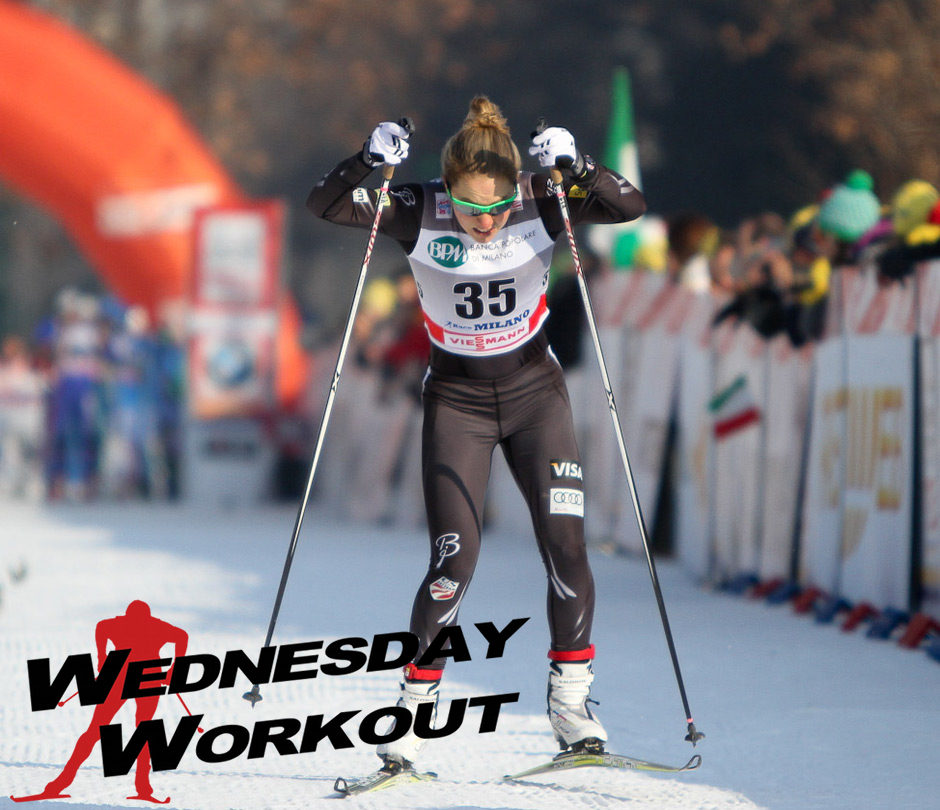
High hands. Ida Sargent sprinting in Milan, Italy, in 2012.
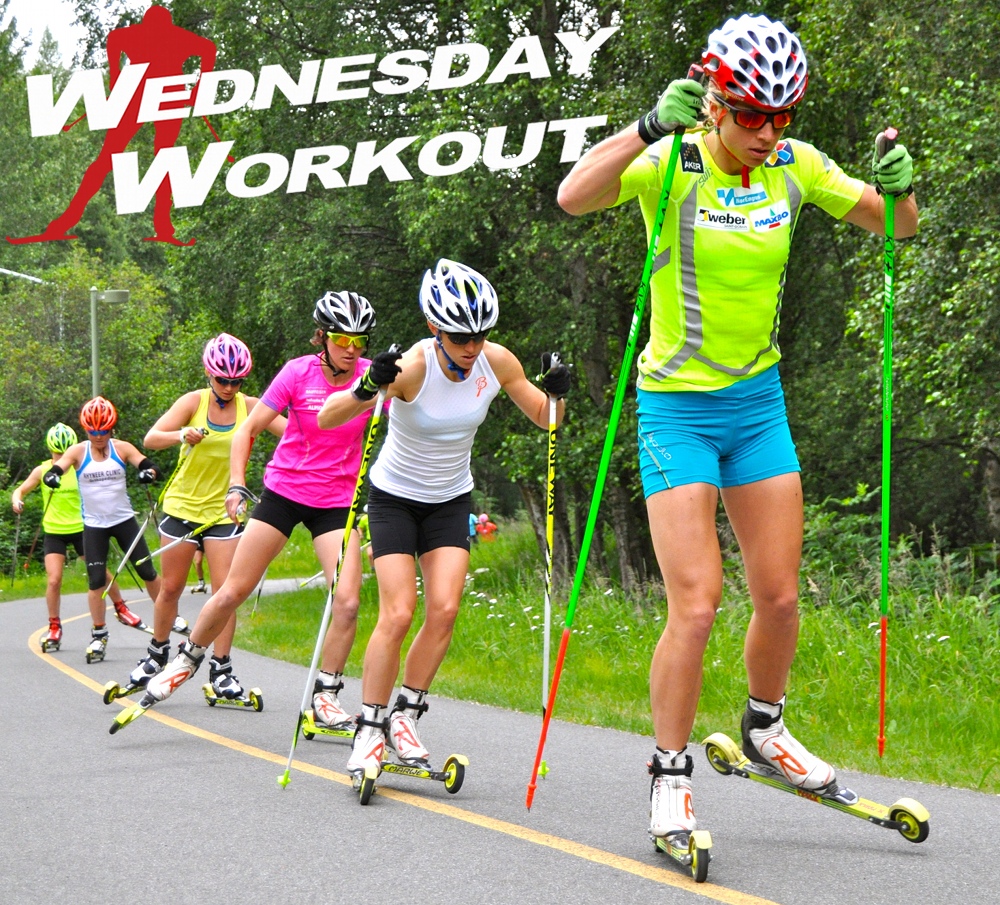
Welcome to Wednesday Workout, the newest workout series on FasterSkier. During the offseason, we’ll feature components of summer training programs from top individuals and teams from throughout the U.S. and Canada at the high school, college and elite club levels. Now get outside and get to work!
Whether it’s the first few meters of a mass start or the final stages of a head-to-head sprint, a strong double-pole can be critical to the outcome of a race. Ida Sargent, of the Craftsbury Green Racing Project and U.S. Ski Team, has one interval session in particular that has helped her make recent gains with her double-pole strength, and offers a bonus opportunity to practice head-to-head tactics when done in a group setting.
“I think I’ve made big improvements in my double pole by doing this workout with my teammates,” Sargent says.
At USST camps, Sargent and her teammates repeat each interval on the same gradual uphill terrain, with the goal of gradually building intensity throughout the workout.
“We start in the same spot for every interval and build into them so that each interval covers more distance,” Sargent explains. “Usually we do the first one at about L3 and push the pace with each consecutive interval and the last one should be close to max.”
The workout:
15-20 minute warm up
5 x 3 minutes on gradual uphill. Start first interval at Level 3 and finish last interval “close to max.”
15-20 minute cool down
“They’re an awesome interval session to do with your team or in a group with everyone taking turns leading, following, drafting, or pushing the pace,” Sargent added.
When she’s back in Vermont with her Craftsbury teammates, Sargent adds a level of difficulty to the workout by finishing on a tougher uphill.
“We also do it at Craftsbury on a three minute stretch of road that gets kind of steep at the end which adds some specific strength into the practice,” Sargent said. “It’s a short session that doesn’t need to take more than 90 minutes with warm up and cool down, as the focus of the workout should be on high quality intervals.”
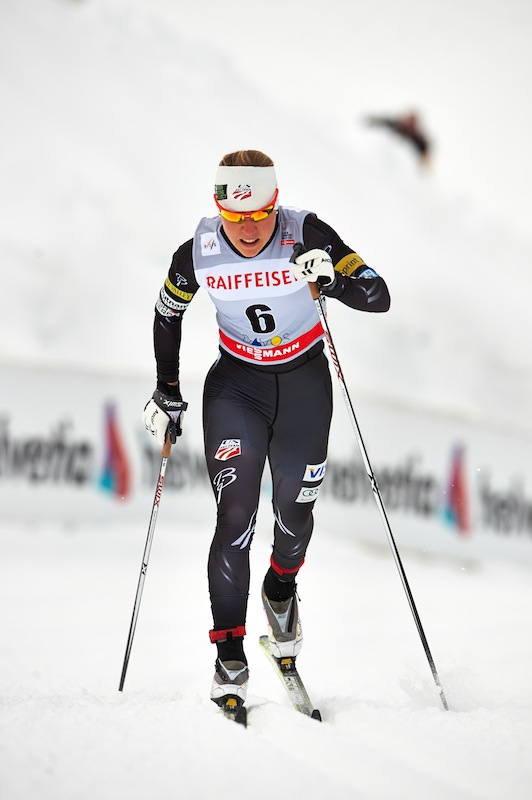
Ida Sargent (USA) sprinting in Davos, Switzerland, last season. Photo: Fischer/Nordic Focus.
It was in the first sprint of the year in Kuusamo, Finland, last November that Ida Sargent cut her teeth on a World Cup semifinal. It was the start of the Ruka Triple, and in the quarterfinals she swung from sixth to second to comfortably move past the first round of heats. U.S. Ski Team women’s coach Matt Whitcomb remarked afterwards that it was “a career-breakthrough kind of day for Ida that we’ve known has been in the cards for a long time.”
A few months later, a career-breakthrough kind of day became part of a career-breakthrough kind of season when Sargent finally cracked the A-final in Sochi, Russia, in the unlikeliest of ways: in the skate technique, which she considers her weaker discipline.
By that point in the year, Sargent was a few months removed from her breakthrough in Kuusamo and had made it past the quarterfinals on one other occasion. Confidence had set in, and in Sochi the A-final had entered the realm of reasonable expectations for her.
“I thought it could be a good day but it’s a sprint, so you never know what’s going to happen,” Sargent said after the race. She finished sixth that day at the back of the heat and promptly became hungry for more.
“I think I made it to the final and was like, ‘Woah, what am I doing here? This is crazy, this is fun,’ but I wasn’t fully prepared when the gun went off,” Sargent said in a phone interview last week. “So I want to make more appearances in the finals [and] hopefully build another step towards a World Cup podium down the road.”
Sargent at 2013 SuperTour Finals, where she won the qualifying round of the classic sprint and ultimately finished second to Kikkan Randall. (Photo: Mark Nadell/MacBeth Graphics)
It’s June now, and Sargent is at home working to build on her confidence from last season. The first USST camp of the year has come and gone and she’s back in Craftsbury, Vt., at the training ground she is most comfortable in.
“This is the perfect place for me,” Sargent said. “I grew up near here, so I’m used to the rural lifestyle…and we spend so much time on the road in the winter that having the opportunity to be at home in one place feels great.”
Sargent now carries both confidence and focus into her new training season. When she looks back, she attributes experience as principally enabling her to reach a new competitive level. Her break into the top six came in just her second full season on the World Cup; in 2011/2012 her personal best was 29th.
“The year before I had some experience on the World Cup, figuring out how that works,” Sargent said. “Some of the venues I’d raced before, so that always helps. When you’re in a sprint qualifier and you only have three minutes, and the competition is so tight…if you make a little mistake you’re a few hundredths out. Getting to know the courses and feeling more comfortable on the road was a huge deal for me.”
The second factor she credits with her breakthrough is the U.S. team’s chemistry, which is frequently discussed by her teammates, too. The Americans are so visibly invested in each other’s success that a French national development coach traveled all the way to Bend, Ore., last month to take notes on their group dynamic.
“Another year as part of the team has really helped,” Sargent said. “One thing we do really well together is just training together at camps and on the road… I can ski skate threshold skate intervals with all the girls on the U.S. team, [and] so many of them have had a top-five finish in a distance skate race, or I can follow Kikkan in speeds. We all work really well together and feed off each other’s positive energy.”
This summer and fall, Sargent will train in a similar way that she has for years. At this point, she and her coaches know enough about what works well for her to not rock the boat before such an important season. This involved writing shorter altitude periods into her plan than some of her other U.S. teammates, but Sargent wants to stick with what she knows as she focuses on sprints this year.
“I grew up in Vermont at sea level and I haven’t ever put in a big role of altitude training into my plan, with the exception of camps here and there,” she said. “So this year, since it went well last year, there’s no reason to make big changes. Pepa [Miloucheva] and Matt [Whitcomb] both decided it’d be good to limit the amount of altitude training I did just to keep the speed and high intensity focus and continue the same things I’ve done in the past, rather than make a big change when things are already going well.”
Sargent made her summer training goals — to improve in strength, mobility and “especially” skate technique — with an eye towards the sprints in Sochi this February. They take place on the same course and close to the same time of year she made the A-final in the test events last season, and the events on the schedule are also identical: an individual freestyle sprint and a classic team sprint.
The U.S. team sprint candidates will be interesting to follow this year. Kikkan Randall and Jessie Diggins recently joined forces for World Championship gold in Val di Fiemme, Italy, but as they have since pointed out, classic sprinting is an entirely different game for each of them — skating is their stronger technique. Randall can still be top five in the world on a classic sprint day, but Diggins has not yet cracked the heats.
The day after her A-final breakthrough in Sochi last February, Sargent teamed up with Sadie Bjornsen in the classic team sprint for fifth place and finished less than four seconds off the podium. Sargent’s success in Sochi and familiarity with the sprint course could prove advantageous for her next year. She hopes so, anyway, but also acknowledges she has to make it onto the team first.
Sargent en route to ninth in the Kuusamo classic sprint last November, which was then a personal-best. (USSA Nordic photo)
“It’s just a goal to be in Sochi,” she said. “That’s the first step; you can’t forget that. But it is important to kind of look past and pick out those races, and so it was really fun racing the team sprint last year and I’d love to be on that team again next year.”
On the way to the Games, Sargent wants to keep making the finals once the season begins again in Kuusamo.
“Making that final in Sochi last year was very exciting and kind of a huge breakthrough and not something I was expecting for last winter,” she said. “I think the goal is just to make the finals, keep moving through the heats, become more consistent at qualifying…The more experience you get head-to-head racing, the jump becomes easier as you become more comfortable skiing in the heats and learning the tactics and that type of racing mentality.”
With the Olympics still a long way off, Sargent is keeping a level head as she continues to invest the work into being named to that team.
“I think it’s impossible not to get excited about that; it’s the Olympics,” she said. “If you’re not excited and fired up thinking about it you probably shouldn’t be training for it. But at the same time there’s a lot of work to them and there’s a lot of training that needs to happen before then, so it’s important to stay smart and continue to do what I’ve done before. And feel confident that it will be the appropriate preparation for the upcoming winter.
“There’s a lot of time before then,” she continued. “[I’m] trying not to feel the pressure and continue to enjoy training and enjoy the camps and my time at home and just this lifestyle, because that’s the most important part.”
The Snow Farm in New Zealand. The Canadian National Ski Team and U.S. men will return there this August for a two week on-snow training camp.
As U.S. and Canadian national team members continue to log hours this June on snow, asphalt and trails, they have several more training camps on tap for the remainder of the season to look forward to. The first World Cup in Kuusamo, Finland, isn’t until the end of November, but when you start to break down the North American training schedules by camp and month, the offseason suddenly looks much shorter.
The two nations have a history of holding joint camps in the offseason; last month in Bend, Ore., the teams often skied together on rollerskis and on snow at Mt. Bachelor. The teams separated after Bend; the U.S. Ski Team migrated to Park City, Utah, for an altitude camp and series of treadmill tests. Liz Stephen traveled to Norway and Sweden to train with national team members there, and the Canadians split for their respective homes, which for Perianne Jones, Ivan Babikov and Devon Kershaw meant Canmore, Alberta.
For their next training blocks, the U.S. Ski Team and Canadian National Ski Team diverge. The Canadian men and women will be back in Bend in late June for a two-week dryland camp, while the Americans have a month-long block of home-based training to follow Park City.
“By design, we have a really open summer,” said USST head coach Chris Grover. “The idea was to really allow each athlete to build some momentum in their home club environment and home training environment, and to really make some progress with their day-to-day training over the summer. So everyone’s got quality at-home time in the summer, some on-snow opportunity.”
When the training season transitions to fall, U.S. athletes will be together more often than not. “[It is] a little more of an intensive camp schedule once we get into the fall, as the volume drops and we’re typically doing more intensity,” Grover said.
In between now and October, the U.S. men and women each have a separate two-week training camp on the schedule. The women will once again be in Alaska starting in mid-July for a half dryland, half on-snow camp in Anchorage and on Eagle Glacier. In 2012, the women’s Alaska camp included Finnish guest athlete Aino-Kaisa Saarinen, and Grover indicated another guest invitation was currently being finalized.
The U.S. men have a longer break built into their camp schedule, but will travel all the way to the New Zealand’s Snow Farm to return to snow for group training in mid-August. After trying something new with a men’s camp in Ramsau, Austria, and Oberhof, Germany, last year, Grover is returning his team to familiar ground before the Olympics. He says they found the quality of skiing on Dachstein glacier to be inconsistent and the Oberhof ski hall wasn’t suited for long sessions.
“Dachstein in the morning is good, but in the afternoon it’s typically not very good, depending on the weather,” Grover said. “In the ski hall there’s only so much skiing you really want to do on a daily basis inside there.
At the Snow Farm, he says, the snow is more consistent and offers higher quality skiing for longer training sessions. With the Canadian men scheduled to be there at the same time, the location also offers more opportunity for group workouts.
New Zealand also provides the potential for some early head-to-head competition. The New Zealand Winter Games take place there in August and include three FIS races at the Snow Farm. The U.S. will miss the first two races, a 15 k mass start classic and a 10 k individual freestyle, while they fly down, but Grover thinks there is a possibility the U.S. men will jump into the freestyle sprint on August 15 for their second day on snow. Whether they compete or not, he expects the camp to be a quality one.
“New Zealand has been a go-to for us since 2002 and we’ve really come away from it so many times going, ‘That was a really great camp,’ ” Grover said. “We took a look around and tried something different last year, but I think because it’s an Olympic year, we know we can get a ton of great skiing down there and we know we can come away from the camp having had a fantastic camp. It made sense to go back down.”
When fall intensity ramps up the USST will return once again to Lake Placid, N.Y., followed by a return to Park City for another altitude block and a final pre-season camp in Canmore on the stockpiled snow of Frozen Thunder.
“We had a great camp up there last year and I think one of the reasons the team hit the ground running so well in the fall World Cup was because we had that extra eight days of on snow time that we haven’t had in previous years for some of the athletes,” Grover said of Canmore.
After New Zealand, the CNST’s October camp takes them to a new venue: Truckee, Calif., instead of Park City. Women’s coach Eric de Nys explained in an email that they wanted a new location for their October camp.
“We wanted a fresh place to do the training this year and we feel we can achieve our objectives for this camp better in Truckee,” he wrote.
Joanne Reid waves a Colorado University flag after helping her team to a national title with her individual win in the 15 k freestyle. (Photo: Steve Fuller/flyingpointroad.com)
College skier faces a decision at graduation: whether to continue pursuing an athletic career on snow or embark down another, more traditional professional path. As the NCAA is fond of repeating every year during March Madness, most student-athletes “go pro in something other than sports.”
Joanne Reid currently stands at that crossroads. The 20-year-old completed her fourth year of eligibility with the University of Colorado last season and will be finished with her undergraduate degree this December. The Palo Alto, Calif., native had a near-perfect senior campaign, winning eight regular-season invitationals in the Rocky Mountain Intercollegiate Ski Association circuit on her way to becoming the NCAA Champion in the 15 k freestyle and leading the Buffs to team victory in Rikert, Vt. With that record, it could be argued that no female nordic skier in the NCAA is better positioned than Reid to take the next step in her athletic career.
And yet Reid is unsure of whether to take that step. Part of her uncertainty stems from having other interests — after she completes her undergraduate degree in mathematics she has ambitions to continue working towards a PhD. The way Reid looks at her options, she believes she would be just as capable of dedicating her life to skiing in four or five years, after earning a PhD, as she is now at 20 years old.
Joanne Reid at 2012 NCAA Championships, where she was 6th in the freestyle event.
“Because I’m so young…I feel like I could continue on to a PhD and continue skiing if I want to,” Reid said. “But if I take a break [from school] in the middle, if you get out of the school groove it’s hard to jump back in, especially with a PhD program.”
Reid’s hesitancy to go pro in skiing goes deeper, however. A year ago, she struggled to find the motivation to continue with the sport at any level. After a life of racing, she started to feel burnt out. Her senior season was unique, therefore, not only because it was so successful — the third-winningest in CU ski team history, in fact. Her success stands out because it was entirely unexpected.
Last summer, for example, Reid wound up reducing her ski-specific workouts significantly in order to find other ways to enjoy being active. She didn’t rollerski until November, and she recalled losing every single team time trial last fall. She skipped U.S. Nationals in January, an event many college skiers treat as a pre-season warm up, “to find my ski spirit again,” she said.
“I just lost the sense of joy and fun that you’re supposed to have,” she added. “So I tried to make it fun again without letting my team down.”
Reid readily acknowledges how she must sound.
“Don’t I sound like a religious person finding God again?” she asked.
Whether it was the unstructured training or a new outlook on racing, Reid came back to the start line ready to compete. At her first race of the year, the Colorado Invitational in Steamboat Springs, she handily won the 15 k freestyle. For the rest of the regular season Reid would only suffer two losses in ten races. She was winning and skiing was fun again, but Reid never quite believed it was due to her own fitness.
“We had so many good skiers [last year] and they all graduated, except for Eliska [Hajkova], and she had an injury,” Reid said. “I was feeling like I was sort of cheating.”
Right up until NCAAs, Reid thought each successive win would be her last, like it was “some weird fluke situation” rather than proof she was skiing well.
“It wasn’t until literally NCAAs that I realized I was having a good season,” Reid said. “When you have a bad season, you don’t feel the need to keep having bad seasons; it’s really discouraging. I looked at quitting every year. I was so uncertain and didn’t feel like it was in my future until the end of the year.”
Joanne Reid leads Colorado University teammates Eliska Hajkova (4) and Maria Nordstrom (9) early in the 15 k freestyle at NCAA Championships. Reid won by nearly 27 seconds and Hajkova was second. (Photo: Steve Fuller/flyingpointroad.com.)
Her season-ending victory at NCAAs against a quality field brings Reid to her present dilemma. After operating for months under the assumption she would leave competitive skiing behind after college, her recent success reopened the possibility of a post-college career. Though Reid has applied to several PhD programs, she has also started to think about racing for another year. Rather than look for a club to train with, she thinks she’ll race independently near her parents’ home in Truckee and at a few SuperTours to test the waters. Reid says a teammate recommended she get in touch with the coaches at Ski and Snowboard Club Vail’s Team HomeGrown, but she has not yet explored that avenue.
“After the season I had, I guess I became uncertain,” Reid said. “Because I had so much fun and I did so well, now I’m not sure if I should continue.”
Reid is one of those athletes who is as happy winning races as she is working out just for fun. “I never saw a reason to have a big competition to work for, or anything,” she says. She gets this attitude from her mom, Beth Heiden, who was a decorated skier, speed skater and cyclist in the 1980s but now trains twice a day and competes infrequently.
“The sport itself of nordic skiing is so volatile,” Reid reasons. “Is the wax right, is this the right grind, the right snow? It’s so hard to get everything right, and because of that the best person doesn’t always win. And that always made me hesitant to be in the sport. It takes up so much time and is so controversial… I just like to be outside.”
Reid’s next step in skiing is about as far as she’s planned. She and her family have traveled to Montana for the West Yellowstone Ski Festival every Thanksgiving since she was two years old, and this November she expects to start her season there again. After the first SuperTours, however, she hasn’t settled on her next move.
“I figure the plan will come to me as it comes,” Reid said.
Sam Tarling (Maine Winter Sports Center) refueling while training on the Stelvio Glacier in Italy. (Courtesy photo)
With his four years of NCAA eligibility completed, Sam Tarling will return to his roots to begin his professional career. The Maine native and 2011 NCAA 10 k freestyle champion for Dartmouth College will again race in the white and blue of Maine Winter Sports Center next season, joining a roster that includes the likes of Kris Freeman, Annelies Cook and Russell Currier.
“MWSC offers and unparalleled level of support that will enable me to pursue my goals,” Tarling wrote in an email. “I’ve worked with the program in the past and it seemed like a great fit for me.”
The 23-year-old has been a force for Dartmouth on the eastern college circuit for the last four years, racking up two individual classic EISA wins in his final season with the Big Green and taking fifth in the 30 k classic U.S. Nationals in January.
Tarling (bib 5) in the lead pack of the 20 k freestyle at 2013 NCAA Championships. (Photo: Steve Fuller/Flying Point Road.)
Tarling has taken a unique path through college skiing and put considerable thought into choosing an elite program. For the past few years he’s taken advantage of Dartmouth’s flexible academic schedule and trained or traveled with most of the elite teams in the U.S. during the fall. This both gave him insight into how each team operates, but he says it also made choosing one to ski for next year more difficult.
“Throughout my years at Dartmouth, I’ve taken a good look at almost all of the professional programs in the country,” Tarling said. “Part of the reason I’m so behind the ball in joining up with a program is that I wanted to give each team a good look. There are a ton of great programs out there, and I’m lucky to be coming out of school at a time where there are many strong skiers looking to keep skiing.”
Will Sweester, MWSC’s Director of Competitive Programs, is happy to have Tarling back and representing Maine once again.
“He’s an interesting guy in that he’s a self-directed athlete,” Sweester said. “He knows what he wants to do, and I’m glad we could do that back in Maine… We have a mandate to put most of our resources into this state, so it’s always a plus when our top-level athletes are from Maine.”
Other additions to MWSC’s roster for next year include National Development Team member Omar Bermejo to the adaptive program and Casey Smith to the biathlon Olympic development team.
“I’m really excited that we’re as close to a full-service program as there is in the U.S.,” Sweester said. “We’ve got athletes from 12 years old to Olympians, and cross-country, biathlon and now adaptive, with Omar joining our program. So I’m pretty excited about that. If there was any way for us to add jumping, I would.”
For the summer, Tarling plans to split his time between Maine and Hanover, N.H., while continuing to work off the training program he’s followed for the last few years. His semesters off means that he still have classes left to complete before finishing his undergraduate degree at Dartmouth. But for the first time since beginning college four years ago, Tarling’s winter season will be free of the academic obligations that are a necessary part of competing in the NCAA.
“For the most part, not a lot is going to change for me,” Tarling said. “The biggest difference is going to be flexibility in the winter race season. I’ve always been obligated to take classes in the winter — which really isn’t too big an issue it just means you have to focus on managing your time a bit more. I’m looking forward to a little break from the regimented lifestyle of being a student-athlete, although I’m sure I’ll miss it.”
His goals for the coming season involve both racing well — “strong international results, race World Cups, podium at U.S. Nationals and SuperTour Finals,” he said — and giving back to his home state.
“Working with the MWSC also gives me the opportunity to give back to my home state of Maine, and hopefully I’ll be able to inspire the some future Olympians in the strong youth and junior programs that the club supports,” Tarling said.
“The skiing background definitely helped me. The mental toughness, the training — the mountain races I do aren’t strictly running, they kind of blend that mountain, woodsy perseverance you have to have … Road racing is much different than running ultras in the mountains, and I think skiing prepared me for that.”
—Scott Jurek
BOULDER, Colo. — In the world of endurance sports, Scott Jurek is one of those athletes whose accomplishments speak for themselves. As an ultramarathon runner, the Minnesota native has built his career and reputation around running races of 100 miles or more at a pace faster than most can complete a 5 k.
Because it’s summer, and every skier is inherently a runner, I decided to find out whether the man who ran 165.7 miles in 24 hours in 2010 to set a U.S. record had anything relevant to say to our target audience about mental toughness and love of sport. I already knew, from reading his recent book Eat and Run: My Unlikely Journey to Ultramarathon Greatness, thatJurek began competitive racing as a member of his high school’s cross-country ski team in northern Minnesota, and that he credits skiing with instilling in him the qualities necessary to excel at running long distances.
Jurek’s skiing background and subsequent ultra success is not the only reason I wanted to interview him. As a recreational runner and casual fan of the sport, I was curious to find out what keeps someone so inspired throughout a long career. For nearly two decades he has dominated the ultra scene, winning 35 major titles and setting 16 course records.
Now 39 years old, Jurek has probably reached the height of his career; when he turns 40 later this year and becomes a master, he’s said he doesn’t expect to continue racing as much as he in his earlier years. But he when he lines up to start the Leadville 100 in August, a race in which he was runner-up in 2004 and where he has since paced other runners, he will still be considered a favorite.
As with every athlete that becomes successful, people want to hear Jurek’s story. Aspiring runners want to know his origin story and his running secrets so they can replicate them. Friends told him for years that he should write a book, and last year Jurek finally published Eat and Run, three years after featuring prominently in Christopher McDougall’s Born to Run.
Upon meeting Jurek, I could see why so many admire him. He is good as his job, of course, and aspiring athletes look up to the best. The amount of time he’s spent at the top of his sport is enough to make him a hero to masters and teenagers alike.
Jurek’s sport requires so much effort and force of will to train for and compete in. The idea of simply completing 100 miles is staggering. But at the height of his career, Jurek was the very best. A recent article in Slate about the people who seek out the pain of ultras began by calling him “an ultramarathon running god.”
Beyond his accomplishments, Jurek’s philosophy about running and life have made him into one of those athletes the ordinary weekend warrior can relate to. Part of his point about running, skiing or any life pursuit is that you have to love what you do for what it is, not just when you have success.
“Whatever quantitative measure of success you set out to achieve becomes either unattainable or meaningless,” he writes in Eat and Run. “The reward of running — of anything — lies within us … We focus on something external to motivate us, but we need to remember that it’s the process of reaching for that prize — not the prize itself — that can bring us peace and joy.”
In a sport that pushes his mind and body to their limits for large stretches of time, often while he’s alone, Jurek has found this approach to be especially important. He describes his book as the story of his transformation; he didn’t always look at competing as part of a process, just as he didn’t always follow a vegan diet. Jurek’s career is filled with experiences that taught him hard lessons.
During the 2005 Badwater Ultramarathon, a 135-mile race through Death Valley, Jurek’s crew had to submerge him in a cooler full of ice to cool down his core temperature at the 48-mile mark. Jurek acknowledges in the book that he underestimated the race. As he writes many pages later, “To run 100 miles and more is to bring the body to the point of breaking, to bring the mind to the point of destruction, to arrive at that place where you can alter your consciousness. It was to see more clearly.”
Eat and Run was published in 2012.
Jurek ended up winning Badwater that year and set a course record in the process: 24 hours, 36 minutes. And it was on the ski trails of northern Minnesota that he first learned to push his mind and body past their limits.
Jurek began skiing as a sophomore at Proctor High School in 1989 under the tutelage of Glen Sorenson, who coached the program until he retired in 2010. As Jurek explains it, he became fully invested in skiing after his introduction to the sport. He went to Team Birkie ski camps at Telemark Lodge in Cable, Wisc. He went to Junior Nationals as a high school senior in 1992 in Rumford, Maine. When he began college at St. Scholastica, before it had a ski program, he continued to train for local races and the American Birkebeiner.
“Skiing was a sport that I really loved and really got passionate about,” Jurek says.
To stay in shape for skiing in the summer, he ran. A lot.
“I didn’t have a good bike and couldn’t afford rollerskis, so I just ran,” Jurek said. “Prior to that, I didn’t really like running.”
What started as a training tool in high school eventually became his life’s focus. The transition was gradual at first — after high school Jurek still trained for ski races — but at a certain point he realized he didn’t have the finishing speed for races that only took an hour or less. He was in the market for another competitive outlet, and ultramarathoning came along at the right time.
“I was really loving skiing, but had that realization that I was just not at that level where I needed to be,” he said. “I didn’t have that top-end speed for 5 k’s, 15 k’s, even 25 k races. Ski marathons I did better [in], but I started hitting that point where I was like, ‘OK, this is not something where I’m going to be able to hit that elite level’ … I was at that phase where I was looking for something else to satisfy that athletic desire and passion.”
Jurek’s friend and training partner, Dusty Olson, invited him to do a 50-mile running race in 1994, the Minnesota Voyageur. Jurek placed second and found his calling. Today, he is grateful for his path to ultra running through skiing.
“The skiing background definitely helped me,” he said. “The mental toughness, the training — the mountain races I do aren’t strictly running, they kind of blend that mountain, woodsy perseverance you have to have … Road racing is much different than running ultras in the mountains, and I think skiing prepared me for that.
“The people I met through skiing also prepared me, from a mental standpoint,” he continued. “Training, work ethic; they were just a unique breed of individuals. There are never two nordic skiers alike and I think that helped shape me, too.”
Jurek thinks his background in skiing has given him a competitive advantage over runners who come to ultrarunning from road racing.
“There’s a huge strength and power component,” he said. “It’s not just the smallest, lightest individuals who are winning ski races. It’s definitely a power sport, and ultramarathoning is like that, as well. You have to have the stability and strength to navigate the rocky trails, the technical descents, and power yourself uphill. And that power walk uphill that I learned in skiing, that comes in handy in ultramarathoning.”
These days, Jurek occasionally gets out on skis. Running six hours a day or more takes up a lot of his time, as do the speaking and outreach engagements he has increasingly dedicated himself to as he’s transitioned more into the giving-back phase of his career.
We talked for over an hour in a coffee shop about his approach to running and life, his vegan diet, the changing nature of the ultrarunning scene, and the up-and-coming athletes that are now taking up his mantle. I must have confused him with the variability of my questions — wasn’t I supposed to be writing a story for a ski-specific audience? — but he gamely gave thoughtful answers to each of them. Halfway through it I noticed my half-drunk coffee was cold and the fan-girl nerves I’d experienced at the start of our conversation had evaporated. I suddenly had the urge to go home later, put on my running shoes and spend the remainder of my afternoon galloping through the Flatirons.
***
The remaining interview has been edited and condensed.
FasterSkier: You’re probably the most recognizable name in the sport of ultrarunning, thanks to the longevity and success you’ve had throughout your career. You’re 39 now. What are you training for these days?
Scott Jurek: I’m running the Leadville 100 in August, staying local. I’ve only run one other time, in 2004, when I did the Grand Slam and placed second there. It’ll be fun. Now that I’m a Coloradoan — I’ve been here for a couple years — I figured I’ve got a pretty good chance at altitude.
FS: When you line up for these big ultras, are you still considered a favorite?
SJ: This sport, it’s interesting. My strengths are not 50 k and 50 miles any more. I’m going to turn 40 this year. While it’s still young, I’ve been racing for a lot of years and I’m not as fast at the shorter distances…There’s so many new people coming into the sport that sometimes I feel like I can hold my own in the longer races but I wouldn’t say I’m always the favorite. In the shorter races, definitely not…
I’d say now, winning is great, but at this point in my career — sure I want to win a couple things, it’s good to have motivation and that drive and that ego to want to excel and win. But now I’m at the point where I love being out there and inspiring people and now I’ve taken on more of this role where, I’ve done a lot of speaking and education throughout my career, but now I feel like I’m transitioning, dedicating more time and energy to that. The amount of travel to speak really takes away from just training. It was easier, I think sometimes, when I was working full time 50+ hours and had my own physical therapy practice, and training, than like now, traveling the country and speaking and still having to train and find time to do all these things.
It’s a little more complicated now, but I feel like it’s still rewarding. I think with all careers and all passions you transition to different phases, and I’d say right now, probably, I’m transitioning into less competition eventually in the next couple years but will still be involved in the sport and continue to speak and volunteer.
FS: Are there any young athletes you feel like you’re passing the torch to right now?
SJ: I run with a bunch of younger guys in town like Tony Krupicka and Dakota Jones. Dakota is 22 now. Like, I’m practically old enough to be his dad. I think in general, maybe I’ve influenced the sport and some of these younger guys and gals in the sport.
But Kilian Jornet, to relate it to skiing: he’s super special. He’s an amazing athlete. He does ski mountaineering in the off season. He’s better than I ever was, probably, because of his ability to do vertical kilometer races to ultramarathons to ski mountaineering. It’s just amazing, the range that he has and what he can do with it.
But I wouldn’t say there’s one person. There was never a point where I felt like it was being passed onto me. It’s like, follow these people and somebody’s going to rise to the top. And how long they stay with it, that’s one thing you’ll see with ultramarathoning, you’ll see all these young guys and gals come in in their 30s and 40s, they train and race really hard for a few years and then they get tired and burnt out and they just decide not to do it anymore.
So I think like longevity in the sport will be interesting to see. I talk to my buddies, ‘Do you think you’ll be running really hard in your 40s still?’ And they’re like, ‘Oh yeah, I’ll be doing this!’
I think that’s key, just to keep that passion burning for longevity in the sport, is make sure it’s part of your lifestyle. And that’s something I think I’ve done. I have a pretty healthy relationship where it’s not just about competing and winning. I just love to be on the mountains, running on trails. I love to be out in the woods and even running on pavement. Just finding that rhythm, that stride, of being happy where you’re at, not having that focused, ‘If I can’t race at the top level does that mean all this training and racing I do is for naught?’ I don’t think that’s a healthy attitude.
A lot of people, when they slow down, so many continue in the sport longer. I remember skiing with people like Charlie Banks when he was in his 80s. Just legends in the sport — George Hovland back in Minnesota. That’s neat, and when I think of the sport of ultramarathoning I think it’s key to have this long-term outlook on it and be inspired by that. Because so many people think, OK, if I can’t race hard like I used to, they get really frustrated and get depressed about getting old. You just have to ratchet back and remember what’s most important about the sport.
That’s why I moved to Boulder, too, is to run with my younger buddies and be inspired by them and get inspired by the community here, from the skiers to the climbers to the cyclist and triathletes. That helps me, being around that environment.
FS: Boulder is also an environment that makes it easy to have an alternative diet. Your veganism is featured heavily in Eat and Run, and you attached a vegan recipe to the end of each chapter. How would you sum up the way you talk to people about your diet?
SJ: I would sum it up as this, because I think some people think, ‘Oh, Scott is totally plant-based, he’s a vegan, and that’s not for me.’ The biggest thing that I would say is that you need to be eating more whole foods, more traditional foods. Get away from the processed. That was the biggest thing for me, going vegan, was that I learned about all these other foods. I went towards more whole grains, legumes, vegetables and more fruits. I was a meat-and-potatoes, hunting-and-fishing type of guy from Minnesota, so it opened up this whole new array of eating.
I think there’s so many distractions out there in terms of, what’s the best diet? Rather than try to say that my diet is the best, the best diet is just any one where you are eating super clean, whole foods in the traditional state, more organic. Basically, the way our great-grandparents ate is the way that I like to describe it to people. And I think that the more plants you eat, the more benefits you’re going to get. We see that in research studies. You see a lot of fads, whether it’s Paleolithic right now, or low-carb, those things help people because they stop eating a big chunk of the processed food. When you look at long-term effects of those things, there’s nothing wrong with carbohydrates. I think maybe people need to realize that okay, maybe it’s not the white sugar and white flour carbohydrates, but there’s nothing wrong with whole grains, legumes, fruits that have fiber and are rich with carbohydrates.
It’s easier now [to access whole foods], but I don’t think that was a drawback when I initially transitioned because I really embraced the learning process. And I think that’s important because when someone wants to learn to eat better, or exercise better or take care of their life and lifestyle, you have to be involved in it and engaged. It’s easy to go and buy food somewhere that is prepared for you.
That’s what I tell athletes, too. Putting effort into your diet is just like making an effort in your intervals or long workouts. It’s another part of that, it’s another component of the training system. I think it’s underestimated. I had buddies, even skiing buddies, who subsisted off of soda and little Debbie bars. You can get away with that when you’re young and it probably doesn’t affect the teenager who is training. But long-term, you see a lot of athletes who end up with cardio problems. You see heart attacks and diabetes. It’s a long-term outlook. For me, I want to keep running and going out in the woods skiing, and being able to do that is important to me.
Most people that I talk to want to know how they can keep training into their sixties, seventies, or eighties, and it’s such an important part of their life. Whether it’s running or skiing, it’s kind of their thing that they need to keep in their life for mental balance and there’s so many components to it. In order to keep doing it, you need to take care of your body, and nutrition is really important.
FS: You say in the book that you doubted for a while that it was possible to be competitive, athletically, if you weren’t eating meat. When did that change?
SJ: It was right after I won my first Western States in 1999. I realized that if I could have success, it was just mental doubts. I think that is the biggest hurdle when people transition to a new diet, whether it’s a plant-based diet or some other diet – it’s something that’s in the back of your mind for a while. You have to just let it evaporate. For me, I was getting enough, but I still had my doubts. For years, we were told that you have to eat meat and animal protein specifically. It was a worry that didn’t pan out. I mean, you can definitely have a vegan diet that’s imbalanced, but if you’re paying attention to it and you’re involved in the process, then it’s not an issue.
The benefits are huge for me. On race day it’s probably not going to make much of a difference, but in terms of recovery and day-to-day training and avoiding illness, it’s a big part of it. We’re tearing down our bodies and having to build it back up, and the more years you do it on a poor diet, it’s going to catch up to you. And the longer you go in a season, too, you have to provide your body with good fuel so it can recover and repair itself so you can go out and train hard the next day, the next year.
FS: You’ve been in this sport a long time. How is ultrarunning different now from when you started, whether in terms of participation, sponsorships, prize money, those kinds of things?
SJ: There were a couple athletes in those early years — Ann Trason, for instance — that were sponsored. But there was little to no prize money in the sport. In the ‘80s there was prize money but then the sport decided to go in a different direction. There was no prize money and [a desire to] just keep it true and pure. So there was that movement when I came it that, you know, ‘We’re going to stick to our roots and not have prize money.’
And then that’s gradually changed. It’s an OK thing for the sport. Some say we shouldn’t have it, it’s going to change the atmosphere, but all sports change with time. It’s not like a ton of money and regardless, you have to have a passion, you have to enjoy the sport when you’re out there training. Like with skiing, you’re out there four to five hours a day… There’s so much time dedicated to it. On the weekends I’ll go for six, seven, eight-hour runs. So if you don’t love what you’re doing and you’re just doing it for the money, it’s going be a problem in ultrarunning. That’s not the sport.
I’ve been fortunate lately, but it’s only the last four to five years that I’ve been able to be, quote, a professional athlete. I’ve always worked 40-50 hours a week for my job in addition to my training. So that’s different now; there’s more athletes able to live off the sport, live a very simple lifestyle. It’s kind of like in nordic skiing; certain groups can make a living at it but …most end up working a full or part time job just to keep doing what they’re doing.
FS: Is there an ongoing discussion within the ultra community about development?
SJ: Ultrarunning is in a real growth spurt as well as growing pains right now. The governing body is technically U.S. Track and Field. But most ultras, because most of them are on the trails, most ultrarunners don’t belong to U.S. Track and Field. They don’t see that as supporting the sport.
Because it’s a longer distance, we don’t encourage kids to compete. However, I get a lot of kids when I go around to schools time to time, kids who really want to do an ultra because they think it sounds cool. They run their 10 ks and they want to run a half-marathon, a marathon. I’m not even sure that’s best. I think skiing does a good job of getting kids on the right path as far as distances.
But you look at countries like Ethiopia where kids run twelve miles plus a day, just to and from school. So if it’s done at the right intensity, I think kids could run longer distances. But I’m not sure if how to think about, okay, how do we get kids into ultra running.
In general running is on a big boom right now, with marathoning and half-marathoning and even kids running cross-country and track. I think if you can just keep it fun for kids, that is the most important. And keep it fun for adults! I think that’s why ultrarunning is growing. People are looking for something different from the road races they have been doing. They want to get out. Maybe they love skiing or hiking or backpacking, or fishing or hiking, and they get into ultrarunning because it allows them to connect with the outdoors and get out into the woods or the mountains, and get away from the concrete of the city.
That’s something that we don’t want to lose, the fun aspect of the sport. Most people, I think, I’m sure they love the race, to have a goal, but it’s the day-to-day, getting out for the hour run, or the two-hour run on the weekends, or the three-hour run in the mountains. That’s something to live for. So as long as we keep it fun, and don’t just focus on the competitive side.
Alexey Poltoranin (KAZ), Alexander Legkov (RUS) and Maxim Vylegzhanin (RUS) during the men’s pursuit in Kuusamo, Finland in 2012. This winter, the mini-tour will serve as the World Cup’s season-opening event. (Photo: Fischer/Nordic Focus.)
The International Ski Federation (FIS) confirmed the 2013/2014 World Cup competition schedule on Monday at the annual Calendar Conference in Dubrovnik, Croatia. International cross-country ski fans can look forward to a few changes in the circuit from years past — namely, a few new or resurrected venues. As the 2014 Olympics taking place in February in Sochi, Russia, will consume most athletes’ energy and attention in the third period of the season, FIS also made adjustments to the Tour de Ski schedule directly preceding it.
Northern Scandinavia has an abbreviated stint on the schedule in Period I. The season began last winter in Gällivare, Sweden, and the year before that started in Sjusjoen, Norway, but in 2013/2014 the first race series is the Ruka Triple in Kuusamo, Finland. The three-event mini-tour has traditionally fallen on the second weekend of the season — you know, to give athletes time to warm up before diving into three back-to-back races — but this November they’ll be treated to a classic sprint, a 5/10 k classic and a 10/15 k freestyle pursuit right off the bat. The Kuusamo World Cup will take place on the same weekend it always has, the last weekend of November, meaning the World Cup is starting a whole week later than usual.
After Kuusamo, the circuit travels southwest to Lillehammer, Norway, for its first stop at the 1994 Olympic venue since 2002, replacing the usual Dusseldorf, Germany, weekend. Davos, Switzerland, hosts on weekend number three, as usual, and the last two competitions before the holiday break will take place in Asiago, Italy, bringing back the Italian venue for the first time since 2008 for a classic sprint weekend.
With the Olympics taking up most of February and all of the World Cup field’s focus this winter, FIS brought the number of races in the Tour de Ski back down to seven competitions in nine days. The tour kicks off once again with a freestyle prologue and classic pursuit in Oberhof, Germany, before migrating to Lenzerheide, Switzerland, for stages 3 and 4. Toblach, Italy, will only host stage 5 in 2014, a 15/30 k pursuit, before the final two stages wrap things up as usual in Val di Fiemme, Italy.
Directly following the Tour, Liberec, Czech Republic, is off the schedule and instead the sprint weekend returns to Nove Mesto na Morave, Czech Republic, this year with a completely upgraded arena. Period II wraps up in Szklarska Poreba, Poland, followed by a short break in competition. The final pre-Olympic tune-races will take place the first weekend in February in Toblach, Italy, and on February 8 the Olympics begin in all their glory with the women’s 15 k skiathlon at Sochi’s Laura stadium.
The Olympics carry the schedule through to the end of February, after which Period IV covers the usual season-ending venues: Lahti, Finland, and Drammen/Oslo, Norway. The 30/50 k at Holmenkollen is still a mass start, so it seems athletes will have to wait at least another year for the return of the individual format. World Cup Finals no longer include the Stockholm city sprints, and will instead take place entirely in Falun, Sweden, with only three events in the mini-tour instead of four.
Sylvan Ellefson (SSCV Team HomeGrown) outsprinted a dozen Boulder Mountain Tour competitors to take the win in the 32 k event in Sun Valley, Idaho, last winter. After some early season illness, his BMT win marked Ellefson’s return to form. (Photo: Sun Valley Nordic Festival.)
Sylvan Ellefson began last season in Europe on a gamble: if he put everything together at the right time, he might race well enough on the World Cup in Period 1 to qualify for World Championships. As the SuperTour leader at the end of the 2011/2012 season, the chance to enter top-level international races before the New Year was his for the taking.
Rather than play it safe at home, where lower FIS points might be easier to come by, Ellefson and his coaches at Ski & Snowboard Club Vail’s Team HomeGrown decided he couldn’t let the opportunity to go to waste. As the 26-year-old explained before last season began, “My ultimate goal is to progress U.S. skiing and kind of help the U.S. men to get to that next level. I think if I were to stay home that would be a little bit of a disservice to that.”
Sylvan Ellefson in the leader’s bib at U.S. Nationals in 2012. Photo: Flying Point Road.
It was a new position for Ellefson to be in. With a huge jump forward in 2011, he earned his first World Cup starts in February and March of 2012, where he reached as high as 43rd in the 15 k skate in Rybinsk, Russia. Upon returning to the U.S. he fought back to the top of the SuperTour on a sprained ankle at Spring Series and, once he settled on the decision to go back to Europe, set his sights on a top-30 in his second World Cup stint and on World Championships in Val di Fiemme, Italy.
Instead, Ellefson got sick in the fall and never quite got up to speed in the Scandinavian World Cups. He had to drop out of the 30 k skiathlon in Canmore and his top finish for the period was a 57th in Quebec City sprint. It took Ellefson until just after U.S. Nationals to return to form and start winning races again, by which point his chance to qualify for World Championships had essentially closed and his absence from the domestic circuit all fall put him behind in SuperTour points.
From the perspective of his World Championships ambitions, the gamble in Europe didn’t play out the way Ellefson would have liked. Still, he says he’s happy he used the World Cup opportunity to build up his international experience and continue learning. There’s another season up ahead, and Ellefson is just as motivated as ever.
“I think it’s good to get a feeling of what all those periods are like,” he said on the phone last week from Bend, Ore. “Some people come into the season really fit and others work their way in. Obviously I wanted to be skiing fast [early] but I had a whole season ahead of me. To be skiing the first period in Sweden, Finland and Canada was just to see if I could improve my World Cup results from the season before.”
Taken as a whole, Ellefson thinks his 2012/2013 was comparable season to the one before it, despite spending different parts of the calendar year in Europe.
“It’s funny to compare my season from two years ago, where I skied basically the second half on the World Cup, and then last year, where I spent a quarter of my season on the World Cup,” Ellefson said. “To me, it seemed like a similar year. Obviously the FIS points in this country are a little skewed, but if they’re an objective measure my skiing was pretty much the same.”
This fall, Ellefson will be back where he first started to break through two years ago, at the Montana SuperTours in November and December.
“Now it’s a whole new ball game,” he said. “I’m back on the SuperTour this fall and I’m really looking forward to it. If I had it my way I’d be back over [in Europe], but for me to take advantage of what I can over here and…hopefully start racking up some good results this fall will be really important.”
Ellefson plans to use the domestic circuit and his comfort level with racing in the U.S. to keep moving forward next year. He carries a good amount of momentum with him from the spring; he had to drop out of the 50 k classic at U.S. Distance Championships after a crash, but a fourth-place finish in the 15 k classic a few days prior was his best result for the end of the season. And fourth in the overall mini-tour was, by his own assessment, “good for me; a good way to finish off the season.”
The men’s Continental Cup start spot on the World Cup, meanwhile, belongs to Mikey Sinnott (Sun Valley Ski Education Foundation) this fall, who stood atop the SuperTour standings at the end of last season. Sinnott’s own journey back to the World Cup underscores how difficult it is for athletes outside the U.S. Ski Team’s World Cup squad to put together consecutive appearances on the circuit. Excluding Canmore, Sinnott was last on the World Cup as the domestic distance leader in the spring of 2012, and it’s taken him the full cycle of a season to earn his way back in the fall of 2013. Torin Koos, similarly, won’t follow up his recent Period 4 World Cup appearance with an immediate return, and will likely be in the U.S. this fall fighting Ellefson for a trip back.
Ellefson sprinting in Quebec City.
Moving forward, one of Ellefson’s preliminary goals is to reclaim the SuperTour leadership. But his real ambitions lie far beyond a return to the World Cup.
“There’s a lot of guys in my exact spot who’ve done some awesome training over the years and just want to go kick some butt on the World Cup and hopefully the Olympics,” Ellefson said.
Sochi is the focal point for many athletes this year, and Ellefson wants to both qualify and perform well there. “It’s not like I just want to go; I want to go and have a result,” he said.
“If I am the SuperTour leader going into the second period that would be helpful to go over to Europe before, and hopefully I am named to the Olympic team and that’ll give me time before those races start in February.”
Only four athletes per country are allowed to compete in each event at the Olympics, and Ellefson knows the battle to get there will be a tough one. At the USST’s Bend training camp last month, he was training right alongside the competition. He rattled off the names of a dozen skiers who were there working as hard as he was.
“The guys that are here… all of them are putting in tons and tons of work for this year, as we always do,” Ellefson said. “It’s going to be exciting. It’s a really exciting year to watch all of us duke it out.”
In the meantime, his summer training will be very similar to what it’s been for the last few years. Ellefson is still skiing in Bend at the moment with his Vail teammates and will be based out of Colorado for most of the off-season, with plans to travel to Lake Placid, Park City and Canmore for periodic training camps.
At this point in his career, Ellefson knows from experience what it takes to race well, and consistently so, for a several-month stretch. Domestic racers with Sochi ambitions will have to ski fast from the first race in West Yellowstone through the beginning of the winter, and the season only intensifies from there.
“Different skiers have good years every year,” Ellefson said. “It’s hard to forecast who’s going to be skiing fastest this season at the right times.”
Reese Hanneman (APU) rollerskiing in Alaska this spring. (Photo: Woodski)
It’s summer time, or close to it, which means vacation season is here. Whether you have a family reunion on a beach or a trip to the mountains planned, it can be tricky to carve out time for training while you’re on the road.
Alaska Pacific University’s Reese Hanneman has a solution to this dilemma: a compact, efficient interval workout that fits into a single hour. It can be done on rollerskis, in running shoes, on a bike — with whatever equipment you have available away from home.
“If I’m on vacation with people…and I’m only going to get one workout in a day, I want to do more than go ski or run or bike for an hour at distance pace, because that’s not that hard,” Hanneman explains.
He frequently returns to this threshold workout when he’s pressed for time. It’s short on warm up and cool down time, but the meat of the workout is challenging and efficiently improves overall fitness. In the past, Hanneman has repeated this session as many as three to five days in a row when he’s traveling. And it clearly works for him: he racked up early-season World Cup starts in Canada and had a series of career-first podiums on the SuperTour last winter. The traditionally strong sprinter improved his distance chops, too, and finished last season with a sixth place at U.S. 50 k Championship in April.
Hanneman sprinting in Canmore, Alberta, last December. (Photo: Rob Whitney)
The workout:
Warm up: 10-15 minutes L1
3×10 minutes L3, with 2 minutes of recovery in between. For added intensity, “if you really want to push yourself,” ramp up the pace to L4 or race pace for the last 3 minutes of each interval.
Cool down: 10 minutes L1
Total workout time: about 60 minutes
By the end of the session, Hanneman is usually pushing the pace.
“If [I] do that hard enough, without it being a sprint workout, I feel like it’s improving my fitness and improving my skiing,” he said. “If I was on a vacation for weeks on end and I did that every other day, I would still come away from that travel feeling like I improved as an athlete.
“For me, obviously you could just do a straight hour of threshold, but by breaking it up then [I’m] able to push it pretty hard in L4,” he added. “So you get that feeling at the end where you feel like you were moving really fast.”
In a perfect world — say, at a training camp — Hanneman would do such a workout after a 45 minute warm up beforehand with some pickups and have time for a longer cool down. But when he has to fit a session in a small window — within a road trip lunch stop, for example — he returns to this stripped-down version.
“On a family vacation, where you’re someplace not suited well to a training block, you don’t want to be that weird person always out training during your family vacation,” Hanneman reasons.
The quicker threshold intervals also work well outside the summer vacation context, when work and life encroach on workout time.
“I think you could reach a pretty high-level doing workouts just like that,” Hanneman said. “People are always under this illusion that you have to do so many hours.”
That’s not just the sprinter in Hanneman talking, either. He’s always considered himself to be a hybrid, but with a jump up in his distance racing last season he’s approaching training this summer with more distance focus.
“I’m trying the Kikkan approach,” he laughed. “It worked for Erik [Bjornsen]. Certainly I have been more consistent as a sprinter, but some of that was mental, too. I’m trying to help myself expand my horizons.”
With the mass start 30/50 k a staple at major championships, athletes would like to see the individual format return to the regular World Cup in the future. This is one of the proposals Kikkan Randall will bring to the FIS Calendar Conference this week in Croatia.
Of all the races to go by the wayside in recent years, the 30/50 k is often missed by longtime fans of the cross-country World Cup. Athletes miss it too, and at the annual International Ski Federation (FIS) Calendar Conference this week in Dubrovnik, Croatia, one of the biggest items on athlete representative Kikkan Randall’s agenda is to propose its return.
“[There is] already a mass start at major championships,” Randall said. “Every athlete says it’s something they want to see. It’s something we keep bringing up and it’s not really a FIS decision, it’s more up to the organizers, but it’s…an idea for the future.”
The spring meetings began on Monday, where the governing body’s priorities are to finalize the 2013/2014 World Cup calendar and begin to think about a schedule for the non-championship year in 2015/2016. A major consideration from FIS Cross-Country Race Director Pierre Mignerey’s perspective is to create a race circuit that builds and retains interest in the sport.
“We have some items to be discussed regarding next winter’s calendar,” he said in a FIS Cross Country press release. “I am convinced we will have a good competition program for the Olympic season. For the next seasons, the task for the Cross-Country Committee is to find an event that would retain the interest in our sport also during the ‘no-title year’ of 2016. We have received proposals for a couple of projects and we will discuss them thoroughly.”
In that vein, Randall will bring another format idea to the table for the future that may be of interest to TV stakeholders: a mixed relay where men and women compete together, as seen on the biathlon World Cup.
Another of the major items on her agenda will be to work on a standard procedure for situations like the athletes and governing body experienced in Falun, Sweden, in March, where skiers at World Cup Finals threatened to boycott the last three races on what they thought was a dangerous course. Last-minute meetings before the first race amongst athletes and between Randall and FIS created a media frenzy at the season-ender. In the future, Randall says, athletes don’t want to resort to such a dramatic measure to get results.
“With the situation we encountered at the end of the season where we had a safety concern, we’re figuring out how we could better work with FIS and have a process in place where we don’t have to threaten to boycott to make something happen in the future,” Randall said.
At the time, Randall said the threatened boycott was the biggest way she’d ever seen her fellow athletes come together on an issue, and the outcome was a groundbreaking example of what such unity could achieve. Overall, Randall says the relationship between FIS and World Cup athletes has evolved since she first became a representative of the Athlete’s Commission to the International Ski Federation in 2009. Randall shared her role with fellow representative Sami Jauhojärvi (FIN) for her first two terms, and she begins her newest one with Norway’s Øystein Pettersen, though Pettersen won’t be present in Croatia.
“We’ve learned a lot as far as our place within FIS over the past few years, so hopefully we can continue to improve upon what we’ve built,” Randall said.
Four years ago the meetings were also in Croatia, and at the time the athlete proposals were more basic, like what requirements should be mandatory at each World Cup venue. The formal network of athletes that Randall now leads was in its infancy then, and where once Randall struggled to get athletes to speak their minds freely, she says communication has now improved between athletes and their governing body.
“Before I came on board there was no athlete involvement at the highest level. So I think on the cross-country side it’s been really positive; the cross-country committee has welcomed the athletes’ involvement,” she said. “We’ve done athlete surveys the last three seasons and we have a network of athlete representatives in each country, so the pathway of communication has improved. We still have a lot to do, but I know the way things work now so we can really start making things happen.”