From the FasterSkier archive — posts syndicated from athletes’ and coaches’ own blogs between 2004 and 2012, kept online as published. Current coverage is at fasterskier.com.
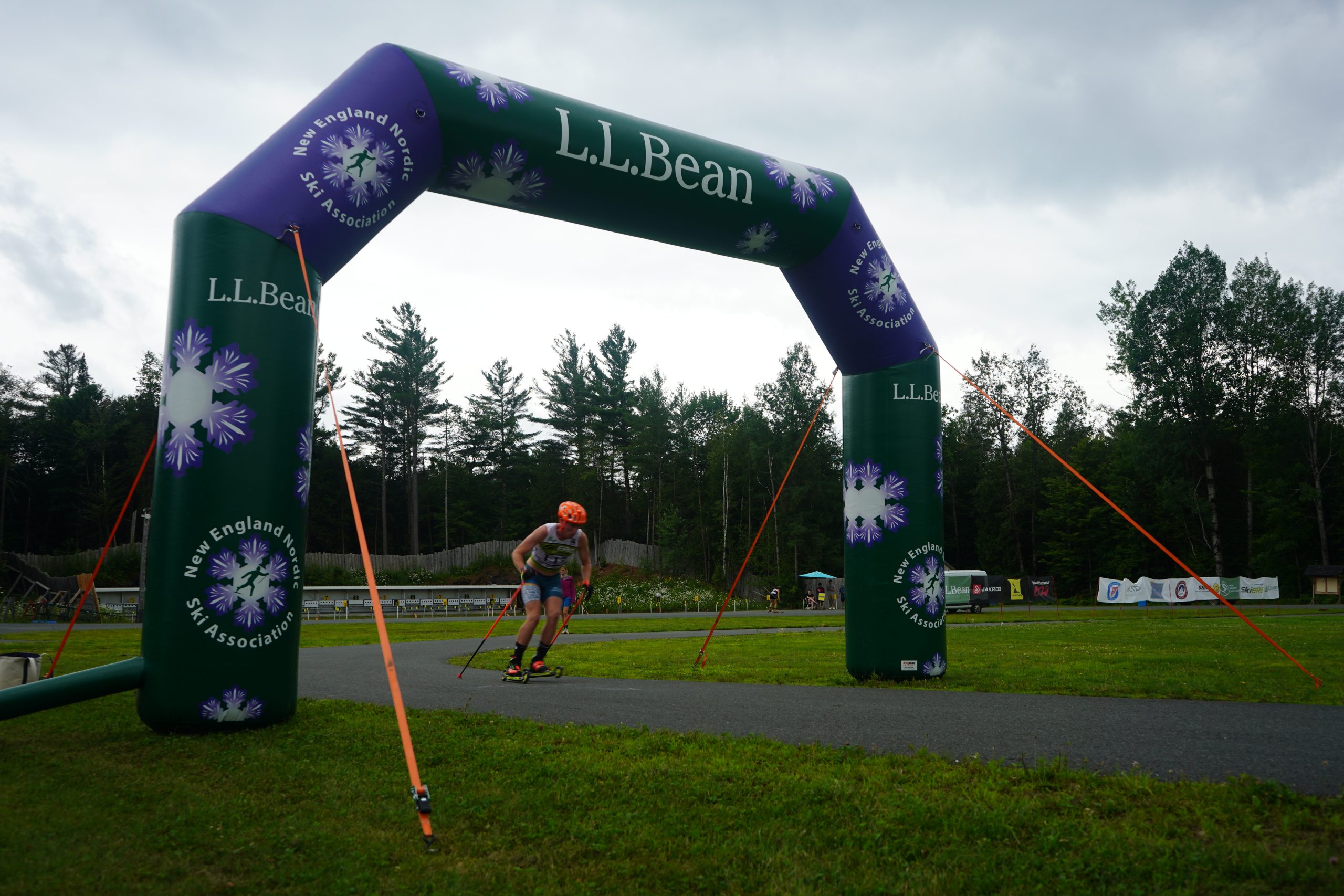
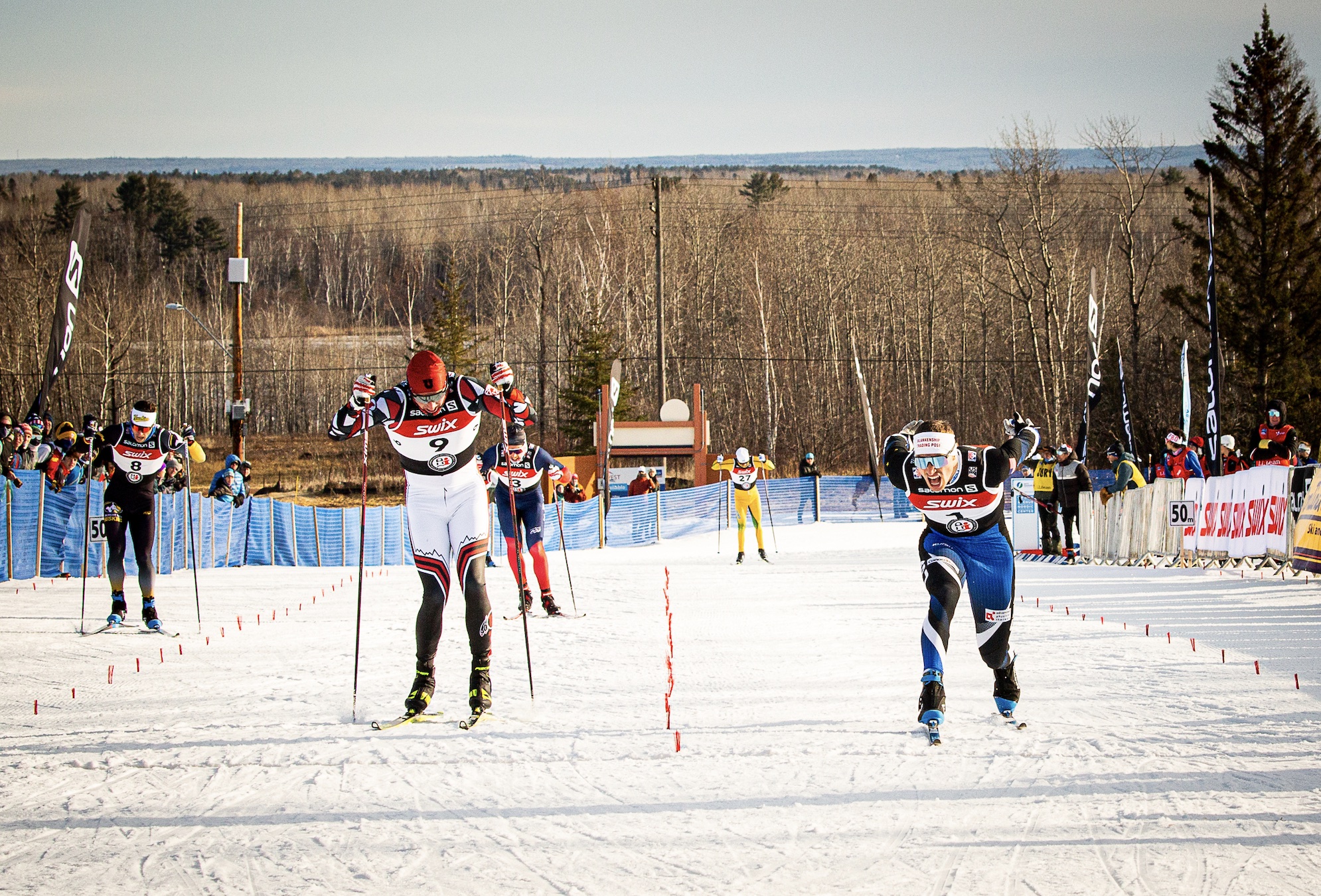
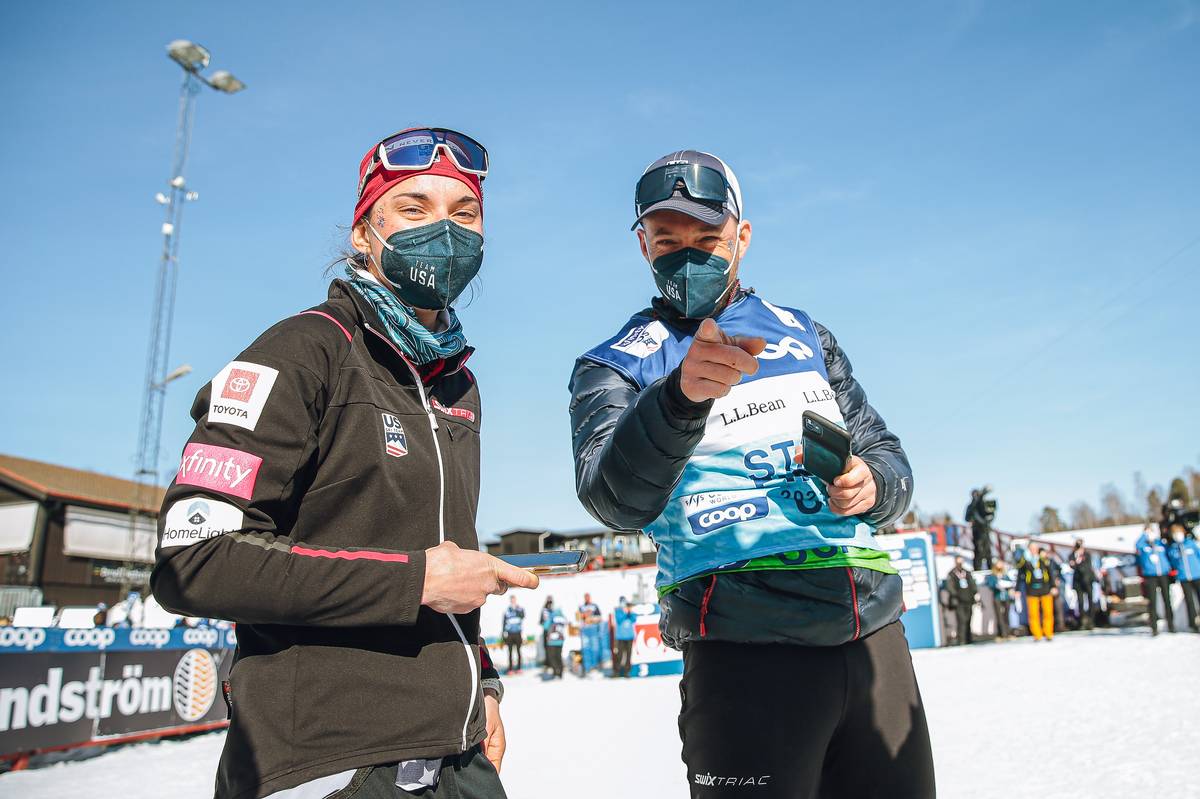
Craftsbury Outdoor Center hosts the Lost Nation Roll in Vermont Friday. (Photo: Ben Theyerl)
Any given day at Craftsbury Outdoor Center in the summer is a hive of activity. A sculling camp here, a group run there, and throw a rollerski race in too. Everyone though, comes back to the Center’s porch, eventually.
On Friday morning, a group of middle school-aged runners, containing more than a few skiers among them, went out for their morning group run. When they came back around, a few lit into the hushed, excited panic of recognition…“is that Ben Ogden!?”
Ah Vermont – where it’s over the fields and through the woods to where the Olympians go!
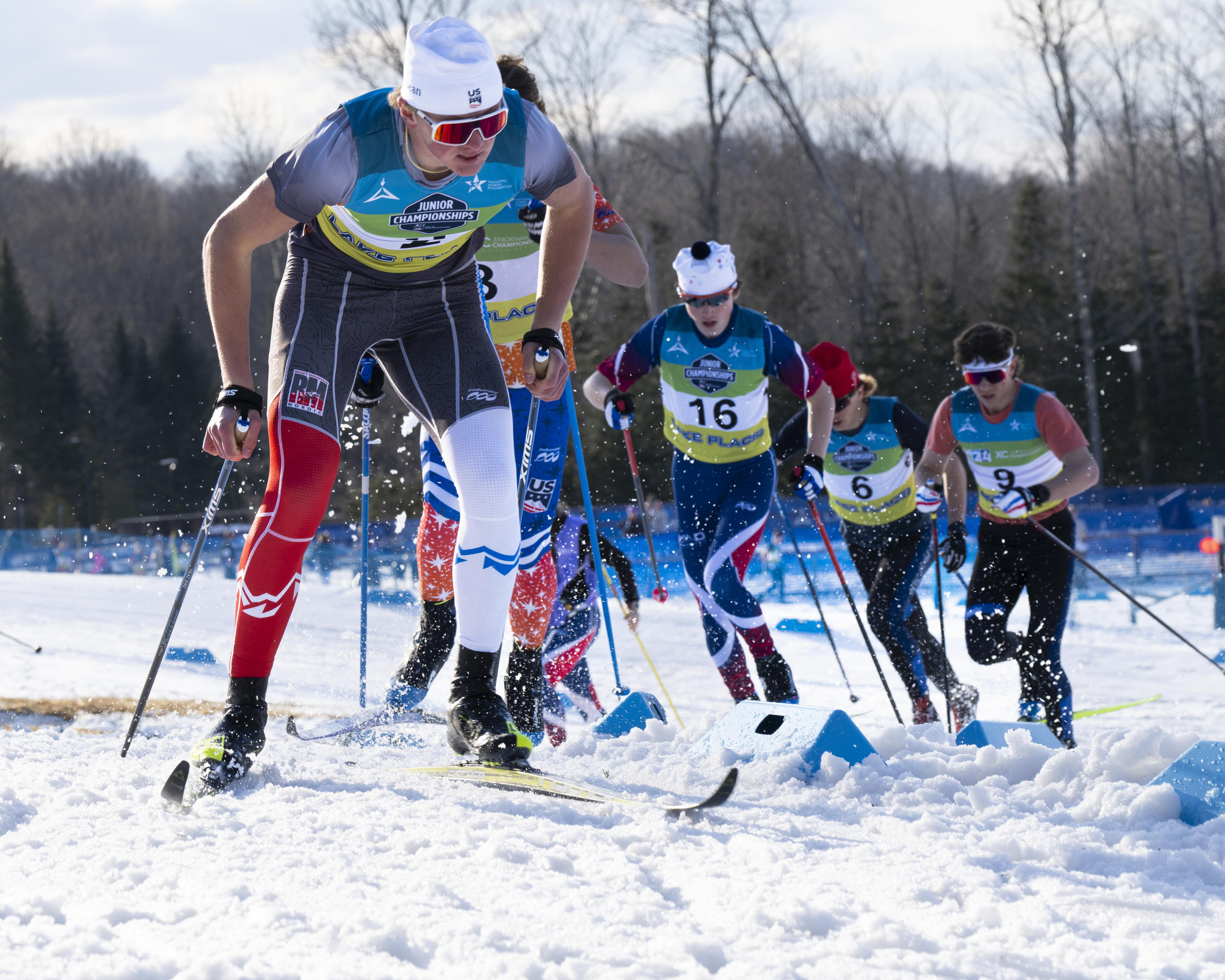
Ben Ogden at the Lost Nation Roll in Craftsbury, Vermont. (Photo: Ben Theyerl)
Ben Ogden was indeed back racing in his home state on Friday, as Craftsbury hosted the Lost Nation Roll. The Northeast Kingdom offering has become an unofficial soft launch of the new season in the East. And with that season being 2026, the presence of Olympic and Olympic-aspirant racers in cross-country and biathlon was noted. Overwhelmingly though, the Lost Nation Roll is characterized by the chorus heard around Craftsbury Friday morning: “it’s just nice to see everyone again!”
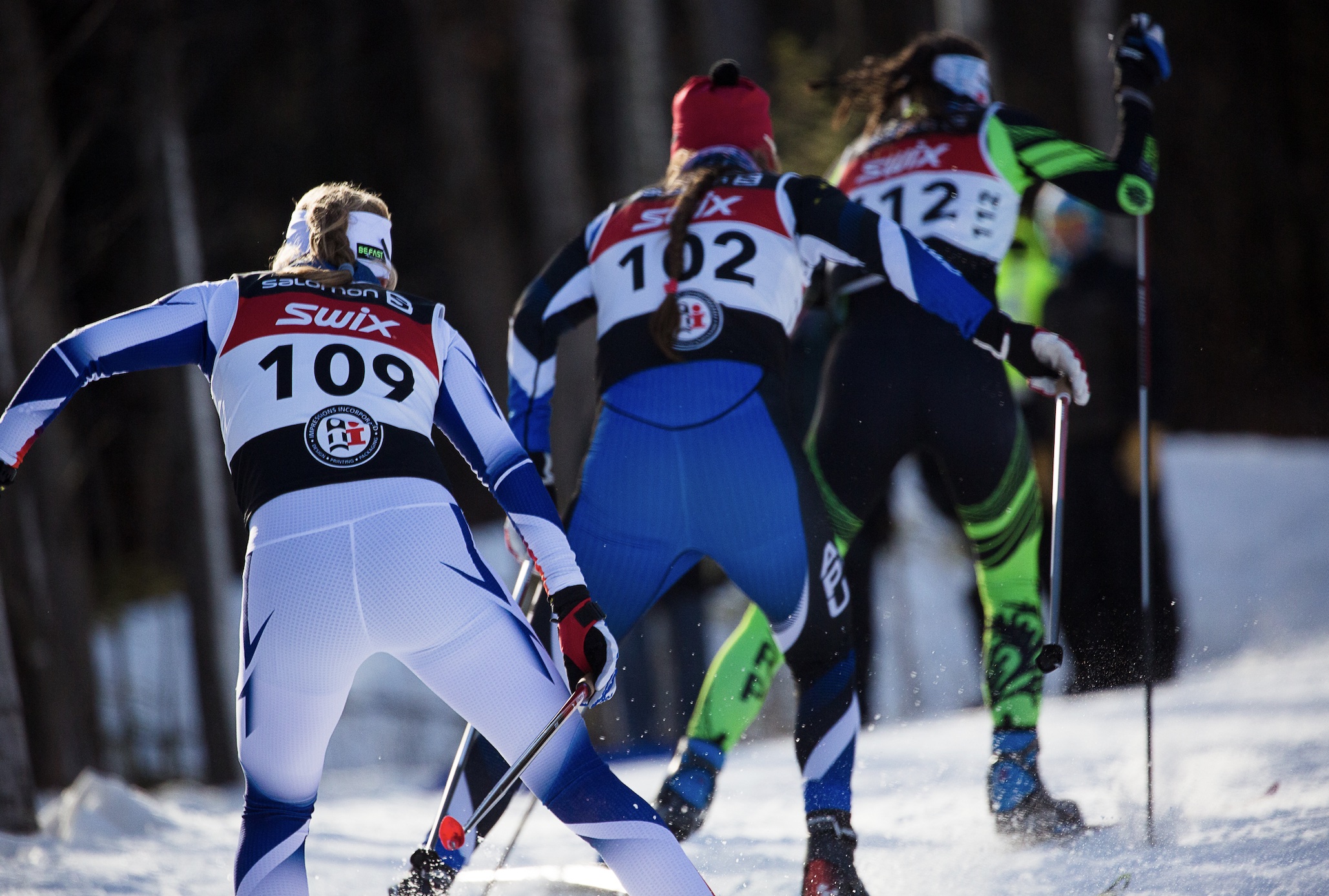
A field of 50 plus racers drawn mostly from the collegiate and pro ranks raced the 10 k skate individual start on the 2.5 k Craftsbury rollerski loop, which features a shallow, rolling set of hills capped by the “Dennis’,” a long twisting downhill which rolls into a transition-practice ready uphill pitch.
In the Women’s field, Craftsbury Green Racing Project (GRP) Biathlete Margie Freed got on course early in the field, and finished early over the field, skiing to a 1 minute 28 second gap over her closest competitor. That closest competitor was GRP teammate Michaela Keller-Miller in 2nd, with Dartmouth’s Amelia Tucker rounding out the podium in third place. Neve Gerard, training with Craftsbury this summer, was the top placing junior in 9th Overall.
Margie Freed skis to the win at the Lost Nation Roll. (Photo: Ben Theyerl).
“I ski this loop just about every day which means I know it pretty well…” said Margie Freed post-race. “I like to push up and over ‘Dennis,’ and I focused on pushing that section well today.”
Ben Ogden also got an early start in the Men’s race, and subsequently set the bar for the field. The field which skied out after him contained a deep, competitive set, with the top 5 finishing within 30 seconds of Ogden’s winning time of 21:29.30. That pack contained a pair of homecoming efforts from new college graduates, with Brian Bushey, back in Craftsbury after 4 years with the University of Utah, in 2nd, and Jack Young, newly graduated from Colby College, finishing 4th. Splitting the difference was US Army World Class Athlete Program (WCAP) biathlete Sean Doherty in 3rd. Tabor Greenberg scored the top junior placing in 6th.
“I really like this rollerski track, so it was fun to come out and crush it with everyone today,” said Ogden post-race.
Ogden also cued in on the more subtle differences rollerski race efforts offer compared to snow skiing (outside of, you know, much higher consequences for falling), “[this] was different than many of the courses I race in the winter in that the hills are short – overall, it’s flat, meaning you have to really work the downhills and flat sections well. I was tempted to charge so hard on the hill knowing they’re so short, but you must measure your efforts so you can push a V2 alternate for sustained amount of time.”
Ogden also reflected on where the rollerski race effort fit into the matrix of preparing for the upcoming winter, “[Today] was a perfect midsummer effort because you had to sustain a hard effort…that’s what is on the training menu right now.”
Leigh Niedick starts out on course. (Photo: Ben Theyerl)
Bringing everyone ‘round to the Craftsbury porch is done with the recognition, and hope, that connections will flow off it. Ogden ended his day up at Craftsbury with a reflection and some plans:
“I try to never miss an opportunity to race [at Craftsbury], just because I love the community. It’s so fun to catch up with so many people from over the years. Even though we’re [geographically] all close in Vermont, it takes something like this to get us all out again. Like, I just made plans to hop in with the GRP guys for a workout next week. That’s a successful day.”
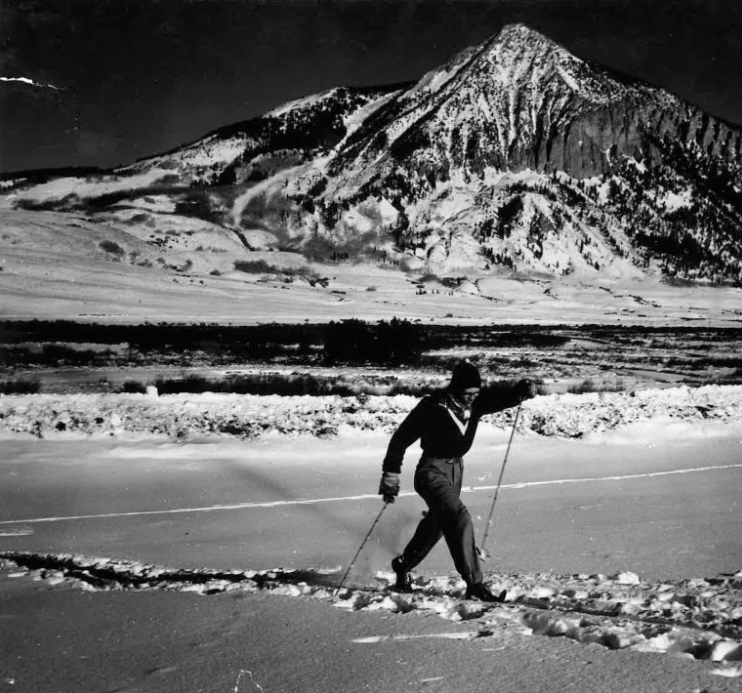
A skier forges a trail on “the Bench” in Crested Butte, CO. Formerly home of a coal mine, the strip of land now plays host to Crested Butte Nordic’s ski trails. (Photo: Crested Butte Mountain Heritage Museum)
Parallax is an effect where the objects in the background of an image appear to move more slowly than the objects in the foreground. In animation, it’s traditionally been used to add depth to an otherwise two-dimensional world. With the background moving slowly, the faster movement in the foreground implies that time is moving. In effect, parallax is a way of adding time into one’s understanding of a place.
I reckon that the essential experience of being in the mountains is based in parallax. The mountains are the only environment where if you only ever experienced them, you would have a complete understanding of where humans are set in the universe. Ancient fissures in the Earth stretch the scales of time beyond you, and when put up right against them, you get a sense that we’re all in a small moment in an infinitesimal smaller place in time. When you attune yourself to parallax, you attune yourself to time not as an instant, but as a fluid, playful thing.
I’ve been especially experiencing a parallax effect lately while looking at old pictures of the mountain town of Crested Butte, Colorado. Crested Butte is set in the platonic ideal of a parallax setting, wholly occupying the lowest point of a glacial valley 9,000 feet up in the central Rocky Mountains. It’s also neatly framed by Mt. Crested Butte, a 12,168 ft laccolith just East of the valley, which is Seussian in its whimsical, perfect jaggedness. In the foreground of that mountain, all the great tropes of western history have been captured. There’s volumes of old sepia photographs with people, looking out from bonnets and stetsons, all distinctly of a time. In the background though, that perfectly pointed mountain. The creases on its sides are the same as the vivid shadows you see when you walk outside your front door today. Always there, always looming. The sensation at the heart of viewing photographs like this is at once humbling and connective. The first thought is that you’re among the essential history of a place that has always been transitory, where everyone is always just passing through. The other is that between you and the Utes and the miners, there is the essential experience of a moment in time where you learn that lesson looking up at that rocky old mountain.
All of which has got me thinking about another photograph. My stint in the long chorus of Crested Butte has been as a ski coach and a writer. As such, the last couple of years have allowed me to fully indulge a pet interest in ski history. And in that capacity, there’s a photograph that keeps finding its way to my eyes, both literal and in my mind.
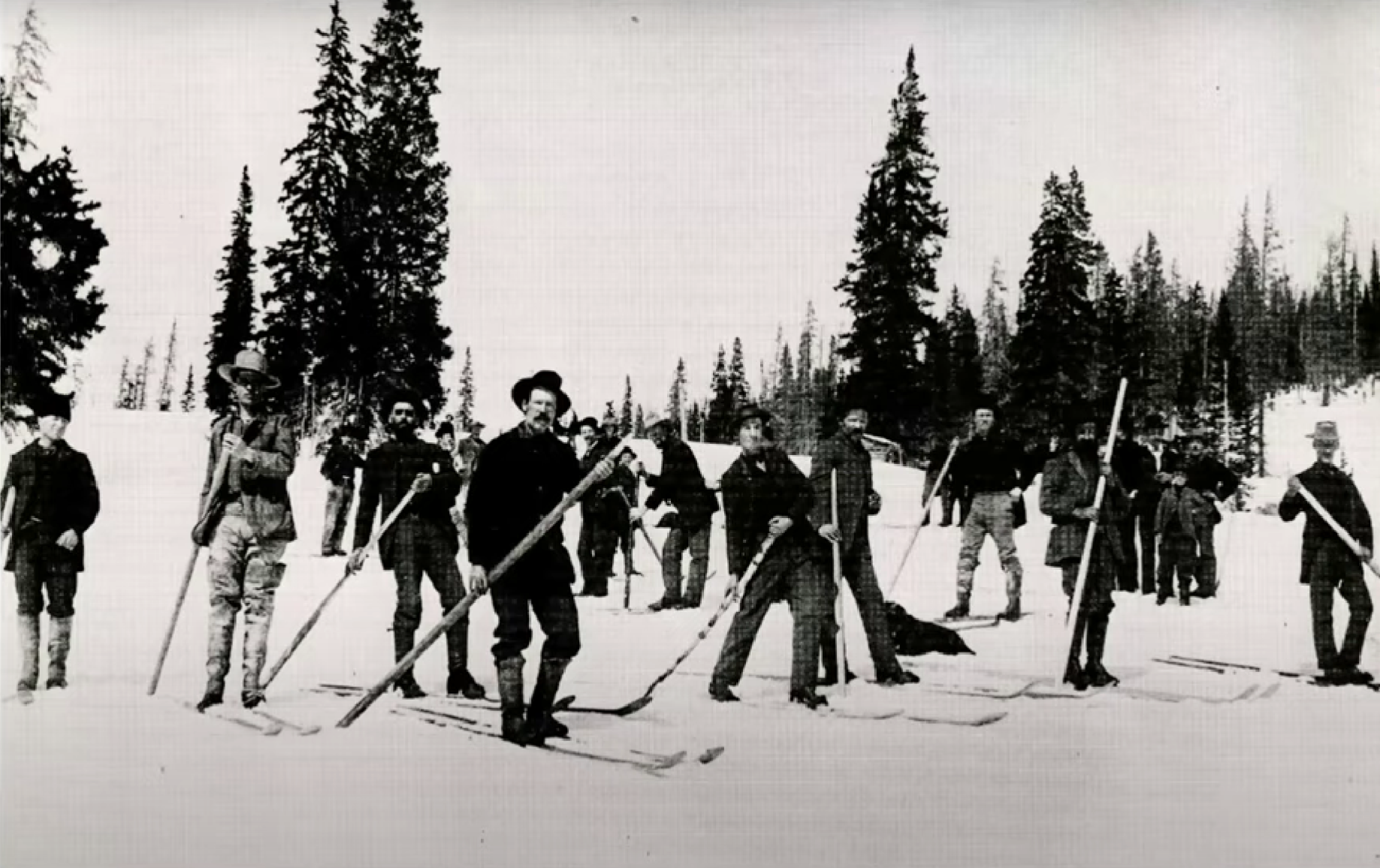
The Irwin, Colorado snowshoe club in its 1880s boom days, fronted by local mail carrier and folk hero Al Johnson. (Photo: Crested Butte Mountain Heritage Museum)
Here. There’s a group of men, stetson’s affixed, looking out and postured. Too long skis, and too long wooden poles accompany them, which produces a kind of defiant effect. They share the kind of pose every skier takes on to this day about to head out onto the trail. A nod that skiing is an unnatural way to get around a frozen world, but that we’ve figured out the trick, and it’s made weathering the winter a lot more fun.
Through some serendipity, I’ve learned a lot about the men in this photo over the past few years. It was taken in the early 1880s and is often denoted as the first ski club on record in United States history, formed at the gold mining boom camp of Irwin, Colorado, five miles West of present-day Crested Butte and sitting at 10,500ft, during its haughty gold rush days. In most sources, there’s a quick addendum to point out that it was actually the “Irwin snowshoe club,: which was the contemporary description for skiing, and that the single wooden pole each man carries was representative of how the sport was practiced then.
The most in-depth sources also identify the front and center man as Al Johnson. In the history of Crested Butte, Johnson holds a kind of Paul Bunyan status among the ski bums. By which I mean he’s a much-lauded folk character (with his own folk song) intentionally stretched in the proportion of his size and abilities to represent an ideal of what being committed to a life centered around skiing looked like in a semi-imagined past. He took whatever work could get him out on skis, which, in the 19th century, was carrying mail to all the mining camps in the Elk Mountains. He was always up for a race. And he was a devout Telemarker – heel free, mind free – before a term even existed. Arch-coolness. For it, he got a Telemark race now in its fiftieth year named after him (and won frequently by FasterSkier fan Pat O’Neil, shoutout).
All of which color the black and white photo, but don’t necessarily change your initial impressions. In nearly all settings it’s displayed, this is a photo meant to temper the impression that this is where North American skiing came from. And likewise, alongside images of lycra-clad US Ski Team suits, carbon poles and skinny skis, it points to where skiing went from Irwin. The parallax does its job. The background is all old, black and white, and here we are today, with skiing in vivid color.
The other impact of parallax though, is to imbue connectedness. And so, I’ve been thinking about ol’ Al Johnson a whole lot lately as the winter melted away in the high country, retreating from the valley floor in Crested Butte up to where it never seems to go away, twelve miles west on Kebler Pass in the isolated pocket of alpine meadows where the Irwin snowshoe club used to ply its trade. Here, in a couple of wetlands and along some alpine lake shorelines there’s still skiing well into June, and along with an eager group of Crested Butte’s best up and comers, skiing towards a common recognition that the old show-shoers and we do today – it’s always a wonder to ski, and by some miracle, a sublime experience to never have to leave it as the winter retreats. When through time and circumstance you find yourself in Irwin, you can’t help but ski. It was true for the miners, and it’s true for me today.
The bare facts of why are up to immutable geography, one-part outsized precipitation, and one-part thermal inclination. Creste Butte sits at 9,000 feet, gathering an average of 236 inches of snow per year. Go up 1,500 feet though, and the snowfall grows exponentially. The remnants of Irwin collect closer to an average of 600 inches of snow each winter. The evidence for why most residents of Irwin packed up the town and quite literally dragged their buildings down to Crested Butte lies right there. The inordinate amounts of snow get a prolonged life too due to the Gunnison River Valley’s central place in Colorado, making it one of the most prone places in the state to cold air pooling (this process is why Gunnison, elevation 7,000ft, is colder during the dead of winter than Crested Butte, elevation, 9,000 feet) the effect happens to some effect up in the smaller valley that the old Irwin mining camp existed in, elevation 10,500 feet, collecting the supercold air off of the 12,000-13,000ft Ruby Range that towers above the valley.
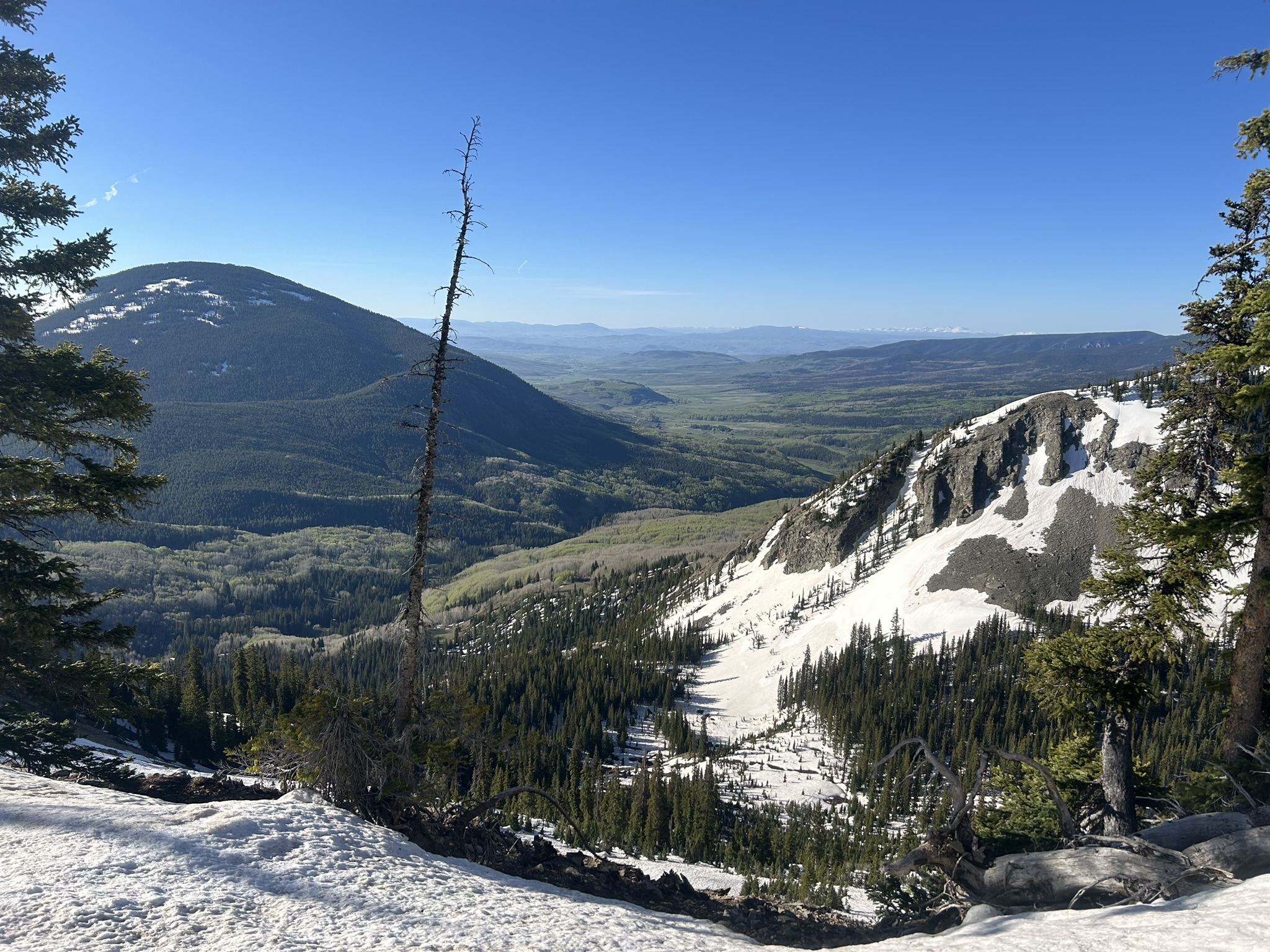
Looking south over the Gunnison country from an overlook in Irwin, Colorado this month, with the San Juan Mountains in the distance. (Photo: Courtesy Image/Ben THeyerl)
To understand the results of Irwin’s positioning just-so in the universe though, is best left on cosmic terms. When I first found the relatively flat patches of sun-cupped snow ready not just for metal-edged backcountry set-ups, but for skinny skis, in my first spring in Crested Butte, I felt as if I’d stumbled upon some epiphanic geography. A born Midwesterner, skiing was the province of a specific slice of the year, which only heightened all the appreciation that it brought you. To ski was to turn the evolutionary perception of winter on its head. Suddenly the cold was welcome. Likewise, it connected you in a very specific way to very specific people. There are still folks I’ve known my entire life in my hometown of Eau Claire, Wisconsin, good folks, that I hardly recognize without a buff and a beanie on their head, and there’s a hinted appeal of sociality that comes exclusively with the seasons. The whispers I did get that snow could exist past March were comprehensible. Bend, Oregon and California lied along continental meeting points where the moisture of an ocean was due to meet with the mountains. When I came across Irwin though, it felt as if I was let in on a secret. Just up the road, literally, there was a place where some complex set of factors had conspired to mean that the winter, skiing, and what skiing brought in the way of metaphysical relief never seemed to go away. Since then, every ski in May or June has glowed with a little more sentimentality, and letting others in on the secret has stretched the poignant feeling of joy incurred by sharing a great ski with others well into the year.
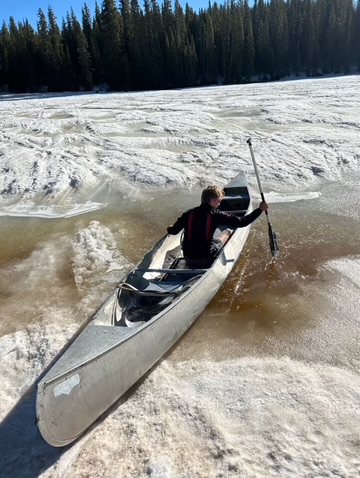
In short, it’s been a dream. One that I know that’s happened by that quintessential rule of the mountains, by parallax. Up at Irwin, time’s been loosed from the sockets that bolt us together. The winter is there in the summer. At the precipice of its cliffs looking South over the Gunnison country, you can literally see all seasons as once. Green stretches over the horizon, with snow under your feet. For their part, the kids growing up on skis in Crested Butte have started to fully embrace, and appreciate, the singular experience they get out of their backyard. A recent report from one of their skis was that they’d found an abandoned canoe on the shores of one of the isolated alpine lakes accessible easily only in the winter, and decided to try and makeshift a combination workout by taking to a still melting out lake.
Finn Veit, Crested Butte Nordic Ski Team member, looks to make a recent ski a dual-sport, dual-season adventure with a maiden voyage on Lilly Lake. (Photo: Courtesy Image/Sawyer Ezzell)
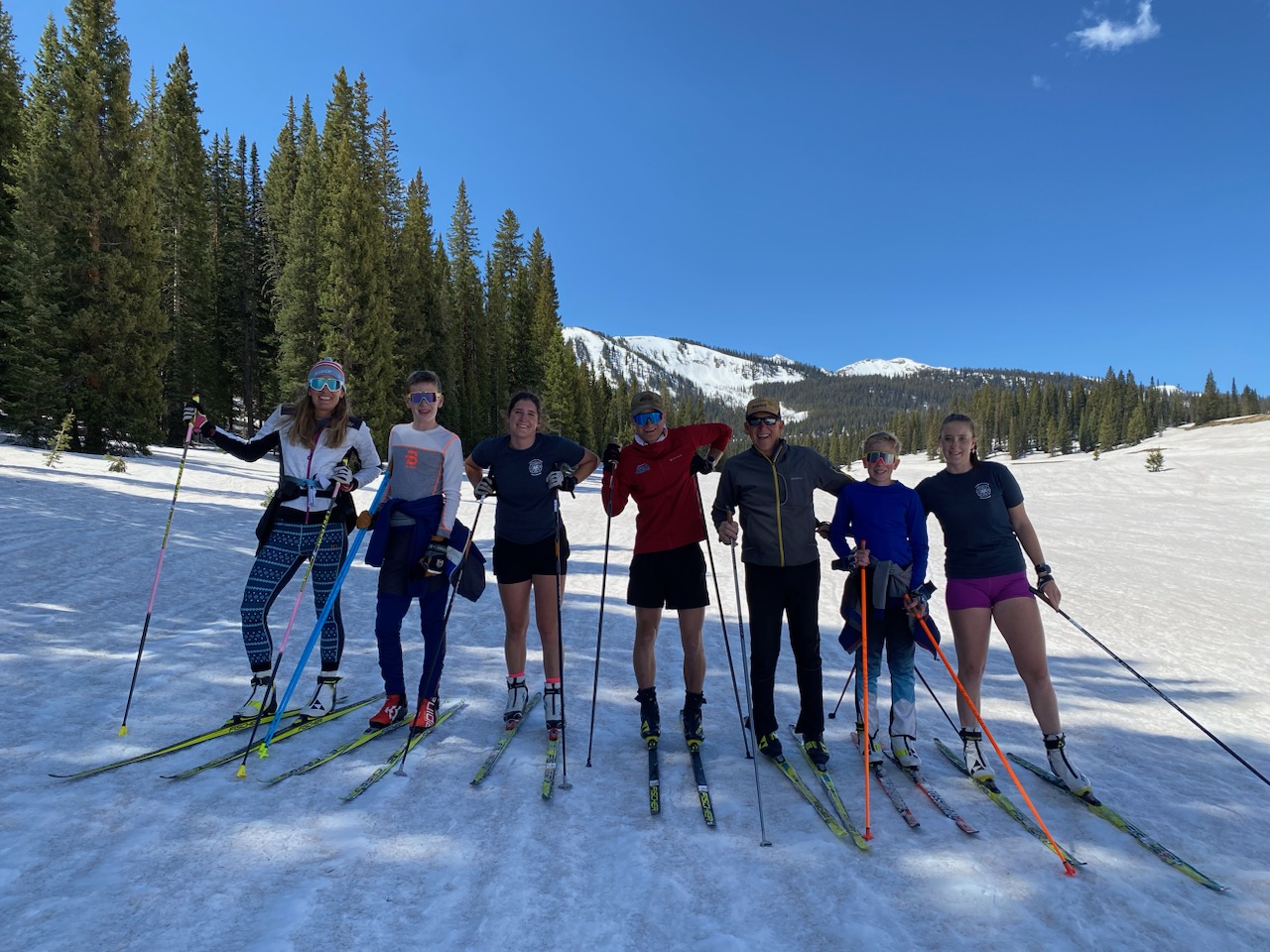
This spring, the quintessential Irwin summer ski for myself happened over Memorial Day weekend. A cadre of Crested Buttians and I headed up the little road west of town early, before the sun that had started to bring summer to the Rockies bore down in full force. Our ages stretched literally from 8 to (nearly) 80. There was the full Larson family, with Mom and Dad Drew and Noelle accompanied by Benaiah (13), Gabe (11), and Simi (8), our lead middle school Devo Team Coach Murray Banks, and a couple of his Assistants, alumni of Crested Butte Nordic Team, the O’Neil twins, Katie and Piper. Our objective was to split off into two groups. The O’Neil girls and myself set out with Benaiah and Gabe to see if we could make it to one of the stunning overlooks that follow a ridge East-to-West, and from which on a clear day the San Juan Mountains loom large across the whole of the Gunnison country. Murray and Simi, oldest and youngest in the group, meanwhile, were set to make the “fun for ages 8 to 80” moniker a literal thing for skiing on the valley floor. A couple hours of stumbles, breaks through the crust, moments where you would swear the skiing was as good as mid-winter, and a lot of views, and we were satisfied. Not just with the that ski, but with what the ski represented. Up there, where the winter never ends, we could see that the connective tissue it brings between those that practice the sport all winter long don’t have too either. Between that group, there had been a lot of kilometers skiing in a lot of places. For an instance, we skied a few more. And with the mountains there as a backdrop, full parallax in effect, the bounds of time between us, stretching back to all of those that had come to Irwin, and Crested Butte, and found that same joy in skiing, looked ready to enter a timeline more akin to those that govern the mountains. Timeless, sublime, glowing with a towering beauty too.
A Memorial Day ski for all, featuring Crested Buttians the Larsons, Noelle, Benaiah and Gabe, the O’Neils, Katie and Piper, Murray Banks, and the author. (Photo: Courtesy Image/Drew Larson)
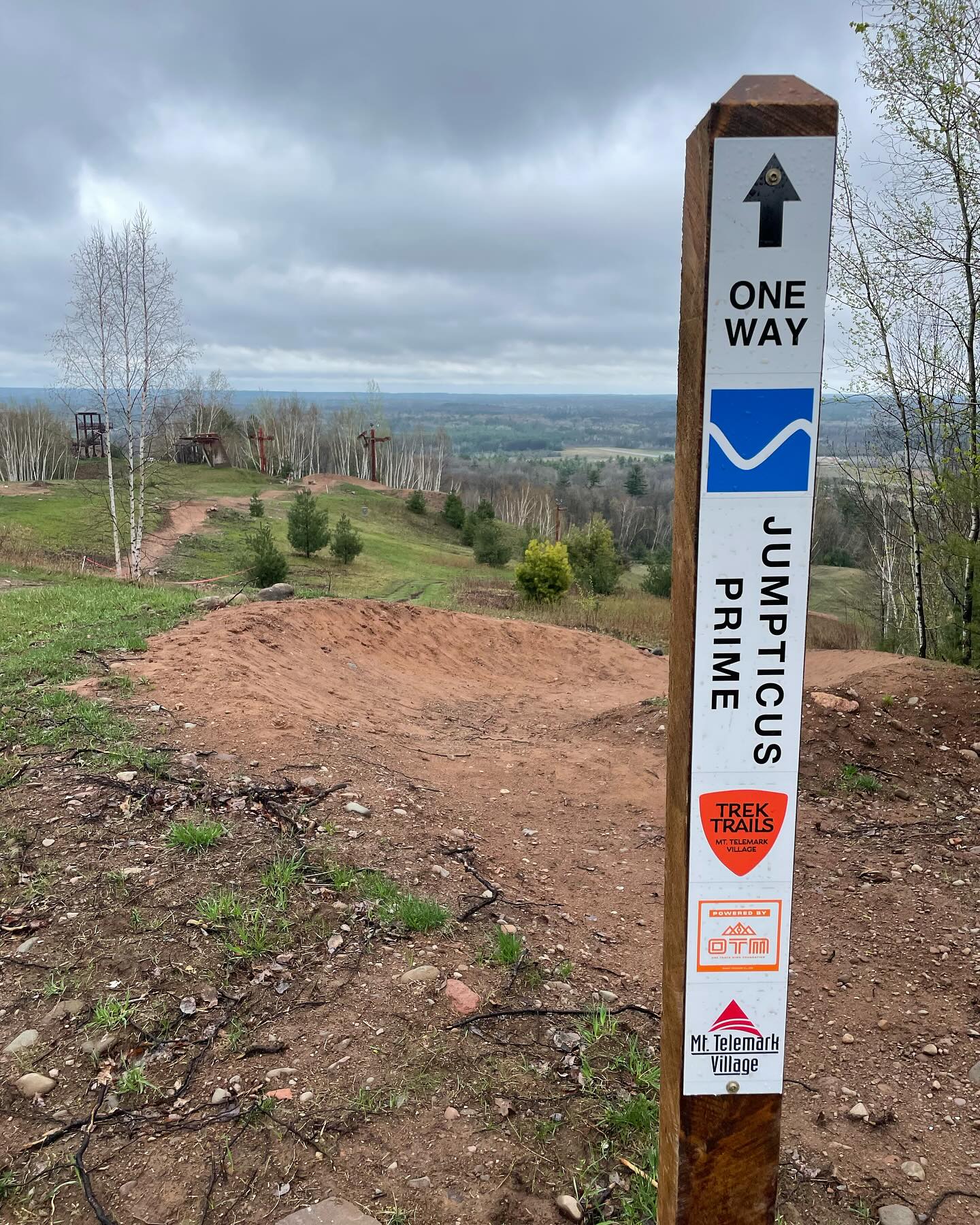
Atop one of the new Trek trails at Mt. Telemark, with the old lift towers from Telemark-past still visible. (Photo: American Birkebeiner Ski Foundation)
For the American Birkebeiner Ski Foundation (the Birkie) it’s been a long time coming.
The dedication ceremony held Saturday for the new projects that encompass the Mt. Telemark Village, the former site of the legendary Telemark Lodge, have been in the works for five years. All together, Mt. Telemark Village is “the biggest thing the American Birkebeiner has ever done.” Its $10.2 million dollar capital campaign, though, doesn’t capture what, for skiing, might just might be priceless. Up in the woods outside of Cable, Wisconsin, the Birkie has been busy figuring out how to commemorate a little glacial knoll that’s played an outsized role in the history of skiing while making it a vital place for more of that history to happen.
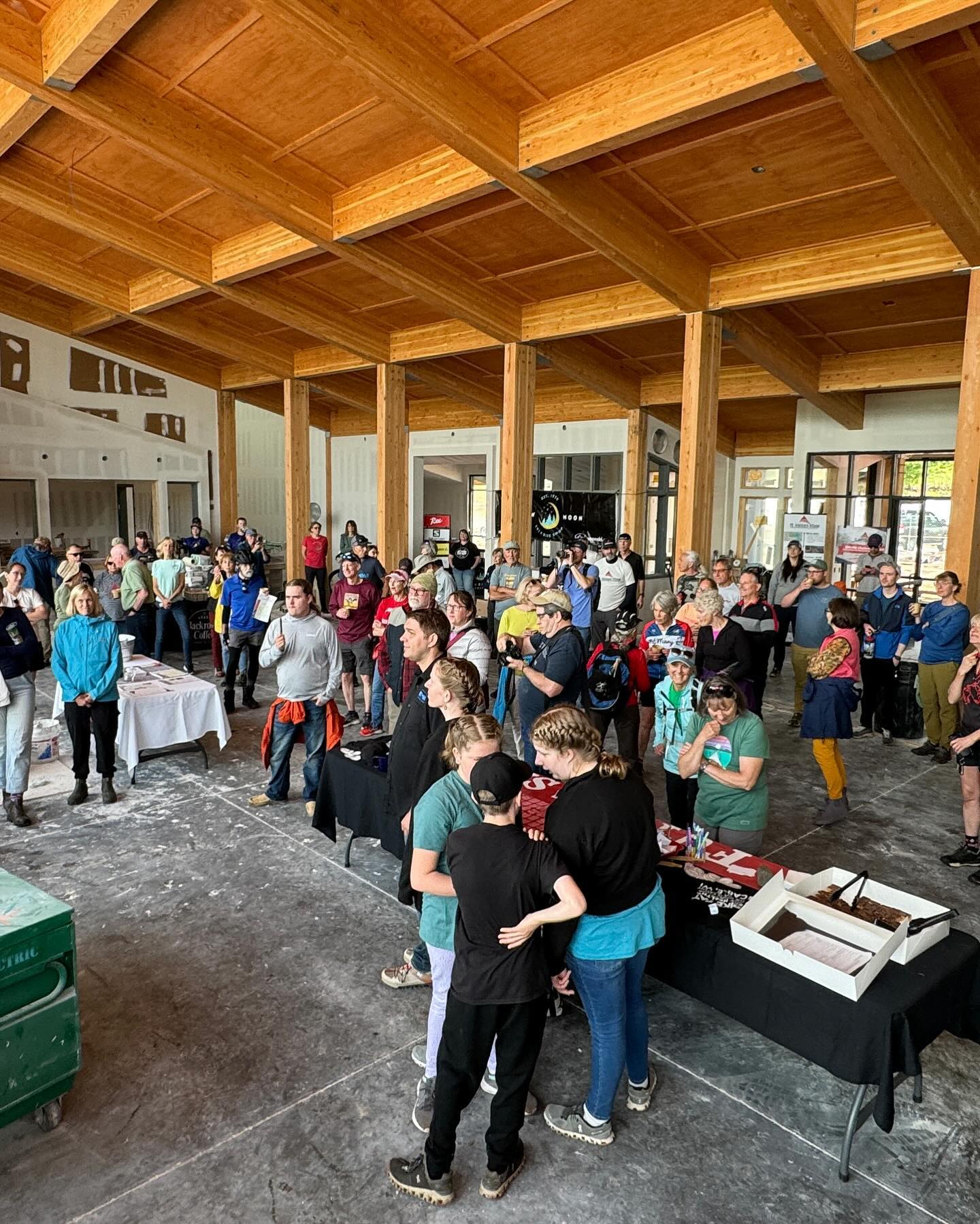
Inside the new Mt. Telemark Community Center, the Birkie community celebrates the dedication of new ski and bike trails. (Photo: American Birkebeiner Ski Foundation)
The dedication ceremony on Saturday featured two main draws that illustrate that delicate balance at the heart of Mt. Telemark Village. The first was the official dedication of the paved rollerski loop to George Hovland, a name linked to the deep past of skiing in North America. The second was the opening of a new mountain bike trail system sponsored by Wisconsin-based bicycle manufacturer, Trek, building on another of Telemark’s legacies as a key site in the development of the sport of mountain biking. In addition, the on-going, glass-plated construction of a new base lodge promised the realization of a vision that’s been in the works for the Birkie and Telemark the past five years.
Telemark and Tony Wise
Mt. Telemark Village, itself, is a re-birth of a long-lived Midwestern legend. Telemark was set up in 1947 by local entrepreneur Tony Wise. The downhill ski area made all it could of its ~300 ft of vertical descent set upon a glacial erratic. Wise, an ebullient character, seemed to derive inspiration from that terrain, making Telemark a cultural erratic, a place for Governors, Musicians, and Packers (the biggest celebrities on offer in Wisconsin) set in rural northern Wisconsin. He did so unrelentingly, building the giant 200-room Telemark Lodge that was too big for its own good. In the glory days, Telemark was a flame whose influence burned over thousands of miles of Northland. After bankruptcy in the 1980s, the embers of Telemark continued to glow primarily in the American Birkebeiner, Wise’s cross-country ski race from Telemark to Hayward that became the largest in North America.
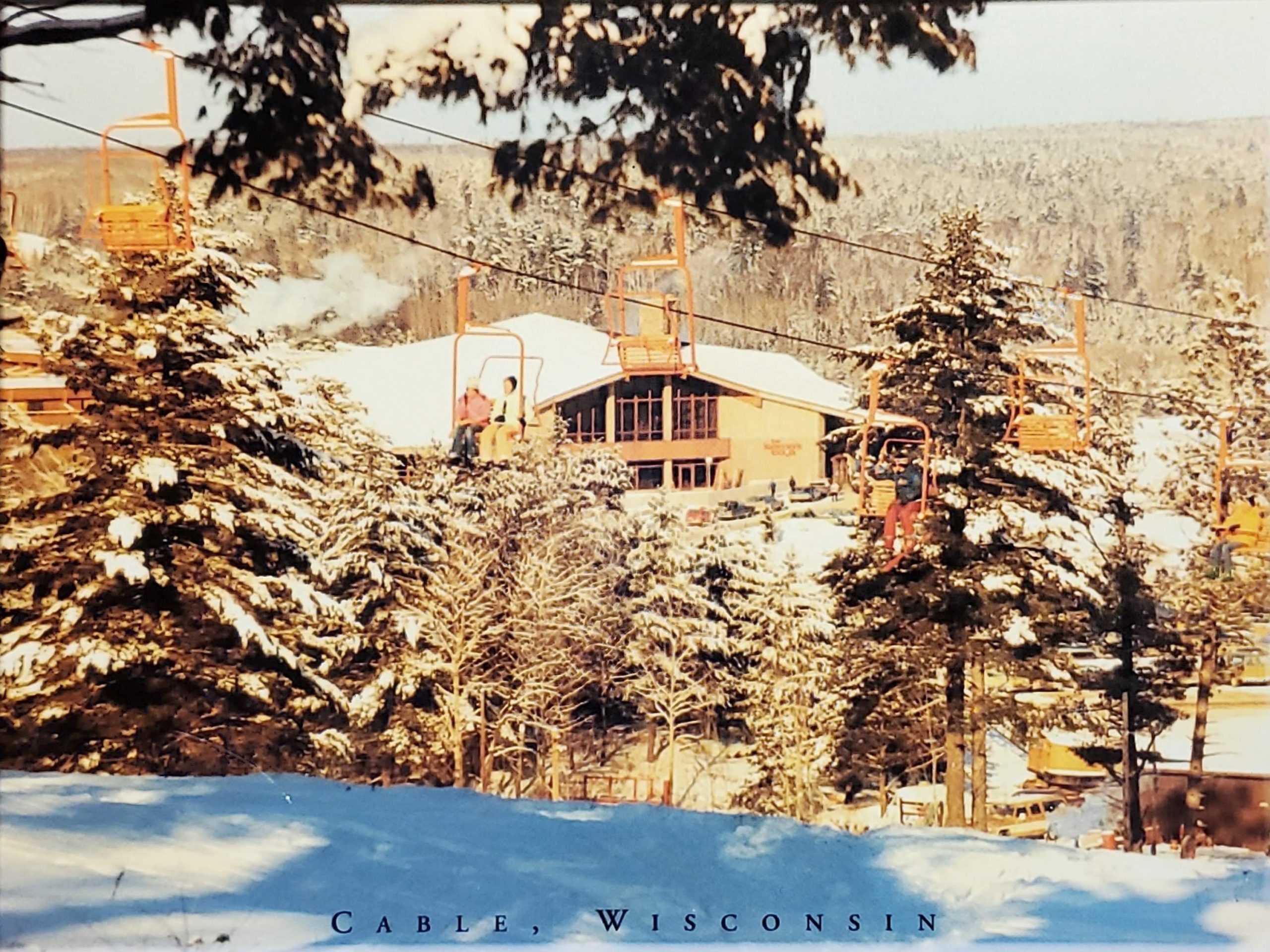
The Telemark Lodge as pictured from the top of Mt. Telemark in Cable, Wisconsin on a 1970s postcard. (Photo: Telemark Education Foundation).
The Birkie was Telemark’s first foray into cross-country skiing, but the race’s momentum in the 1970s led to the resort playing an outsized role in the development of modern cross-country skiing in the United States, and beyond. The first World Cup race ever was held on a trail system laid out in 1978 by American skiing pioneers John Caldwell, coach Marty Hall, and Olympic medalist Bill Koch.
The legacy of Telemark limped along on its own legend for years following Tony Wise’s bankruptcy and surrender of the property in the 1980s. Numerous owners passed through. Central Cross Country Skiing (CXC) briefly made it a home for its Elite Team in the early 2010s, before Telemark closed for good in 2014. The Lodge sat abandoned for years.
In 2020, the Birkie started to piece together a new vision for the property: Mt. Telemark Village. The Lodge was demolished in 2021, the vision that has played out since is the Birkie’s community-oriented project to honor the whirlwind of history that emanated from the little patch of Wisconsin woods, and make it a site to take a central role, again.
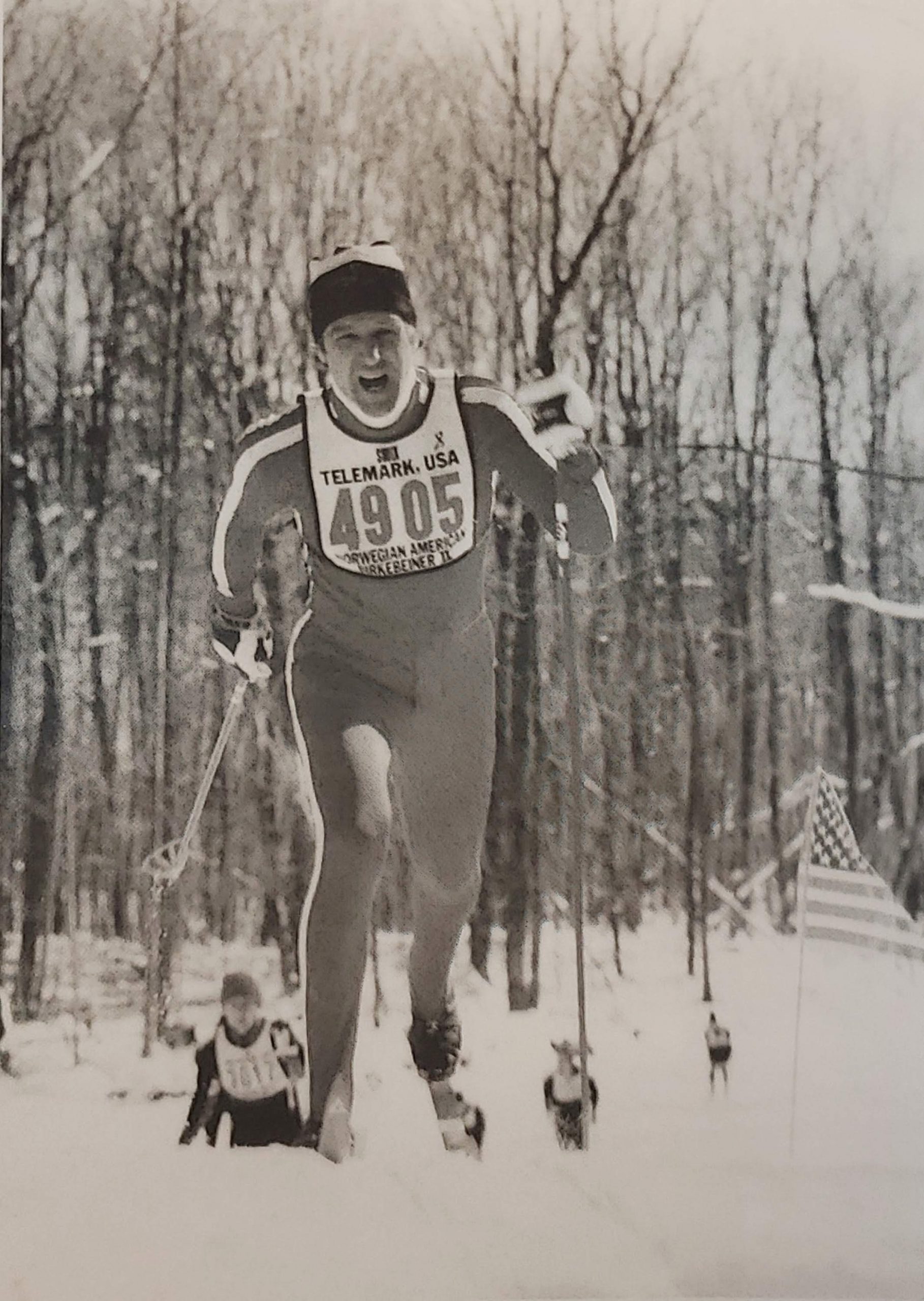
George Hovland at the American Birkiebeiner in 1982. (Photo: Sawyer County Record Archive)
George Hovland Trail
Saturday’s dedication ceremony celebrated the success of the new Birkie venue linked by a number of trails to Telemark. It also linked the new venue to a giant of Midwestern skiing: George Hovland.
George Hovland’s name looms large in his hometown of Duluth, Minnesota, where the 1952 Olympian had a hand in founding nearly all present-day fixtures of Zenith City’s ski scene including Spirit Mountain, Snowflake Nordic Center, and the North Shore In-line marathon.
Hovland’s legacy as a ski pioneer in the wider-Midwest is being celebrated by the Birkie in dedicating its 5 k training loop. A friend of Tony Wise, Hovland competed in every Birkie from 1974 to 2012. In the years prior to his passing in 2021, Hovland was the vital link to a deep, essential past of Midwestern skiing. Hovland took to the sport of skiing as a boy in the 1940s when jumping was nordic’s premier discipline and Chester Bowl in Duluth was still populated by the Scandinavian immigrants who brought the sport to America. He skied his last kilometers after Minnesotan Jessie Diggins and Kikkan Randall combined to earn the first Olympic gold in US skiing history. The George Hovland Trail will play an active role in developing Midwestern ski racers this summer, with CXC hosting its Developmental Camps, and Team Birkie looking to utilize the resource.
“George was such an amazing man and an influence on our sport,” said Ben Popp, American Birkebeiner Ski Foundation Executive Director. “George loved training and this will forever be a medium to get people training and faster!”
Trek Trails Lay New Lines Down Mt. Telemark
Before snow fills the George Hovland Trail next winter, there will be plenty of treads on trails of another type: biking.
Telemark was the site of some early movement in the sport of mountain biking. As the sport first advanced beyond riding klunkers in the West in the early 1980s, one of the first flat-land homes it found was the Birkie trail at Telemark. The Chequamegon Fat Tire Festival, one of the oldest extant mountain bike races in the country, was dreamed up in 1983 with the proposition, “What if we did a bike race on the American Birkebeiner trail?”
While the Chequamegon was based out of the nearby Lakewoods Resort for most of its formative years, a trail system was quickly developed on the Telemark property, and eventually linked via the CAMBA trail system.For years, the Telemark portion of the CAMBA system stood out as a kind of staid testament to those early days of mountain biking as a sport. The trails cut through the woods between logging roads. In the days before slack frame geometry, 29 inch wheels, and full suspension made riding downhill more joy than hazard, the singletrack was laid out to get from point A to B more so than to get from feature to feature.
In more recent years, Mt. Telemark itself started to look ripe for the new-look crop of mountain bike trails that were being built around the Midwest at places like Spirit Mountain Duluth, MN, or Copper Harbor, MI.
When the Birkie took over the property in 2020, those in the Wisconsin biking community took notice. That included Trek, based in southern Wisconsin, which was willing to provide funding for the development of a trail system that utilized the whole of Mt. Telemark’s terrain and set it up to be a central host for mountain biking in the same way that Telemark had long served for skiing.
An additional grant from nonprofit group One Track Mind set the Trek Trails at Telemark in motion. Now in development, 16 additional miles of trail will eventually play host to training and racing for cross-country, enduro, and downhill racers alike.
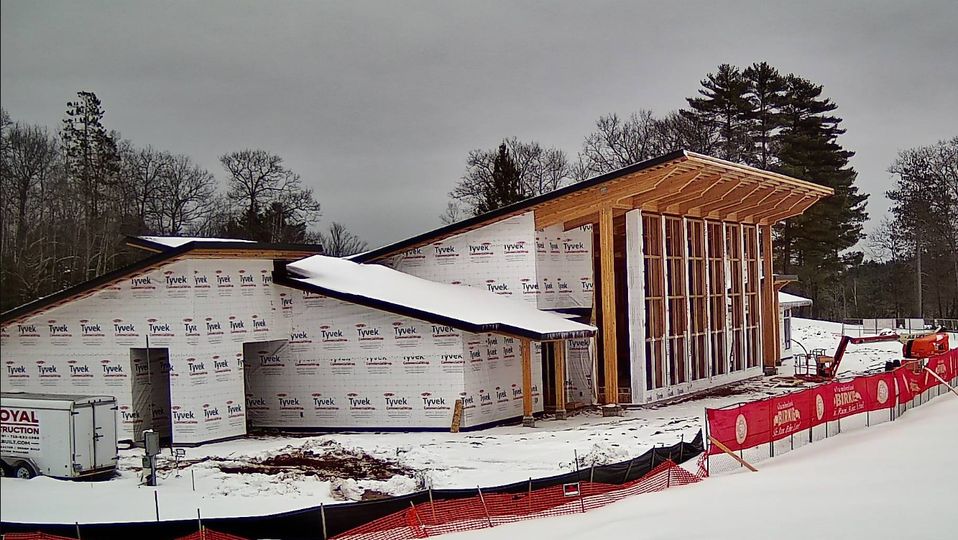
The new Mt. Telemark Village Base Camp under construction last winter. (Photo: American Birkebeiner Ski Foundation)
Mt. Telemark Village Gets a Base Camp
What’s next? A successor for the old Telemark Lodge. While the Birkie gathered its community together on Saturday, the site of a new building under construction where the legendary lodge once stood seemed an apt harbinger.
The “Base Camp” Community Center still looks erratic against the fields and forests that surround it. But in terms of decadence, Telemark seems to have a matured sense of stature. The three-floor fireplace that once greeted visitors in the lobby of the old Lodge isn’t making a comeback. Emeril Legassi is unlikely to be in this version of Telemark’s kitchen (he was, in fact, in the old one).
This new community center doesn’t include the giant concrete walls that are still visible on site from the old Lodge, but it seems to impart that this version of Telemark, after a half-decade of dreaming, is starting to be set.
This coverage is made possible through the generous support of Marty and Kathy Hall and A Hall Mark of Excellence Award. To learn more about A Hall Mark of Excellence Award, or to learn how you can support FasterSkier’s coverage, please contact info@fasterskier.com.
The US Ski and Snowboard Center For Excellence in Park City, UT is hosting Spring Congress this week.
Skiing is an activity divided into seasons of the year: summer is when fast skiers are made; winter leaves us feeling like it went by all too fast; spring is for politics.
This week in Park City, the annual US Ski and Snowboard (USSS) Congress meets to discuss broad-based visions for the future of US Skiing, and to hammer out the necessary logistics that make the sport go ’round. New rules and initiatives are discussed, while some of the best minds in US Skiing mesh the International race calendar, US Skiing development pipeline, and the predicament of predicting where the snow will be in December to create the US Skiing calendar for the next season.
Here’s a couple of highlights from Days 1 and 2 of the USSS Congress:
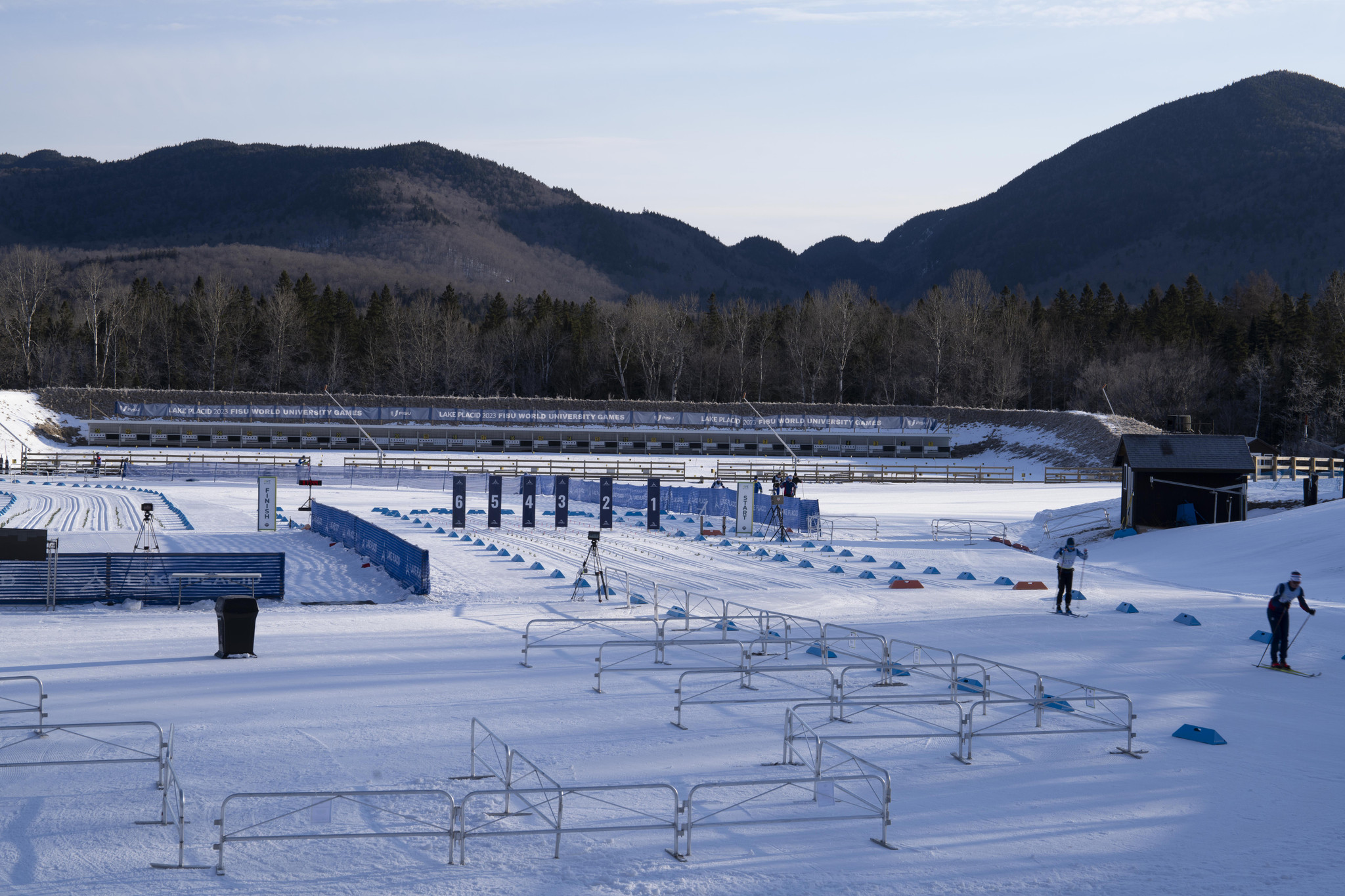
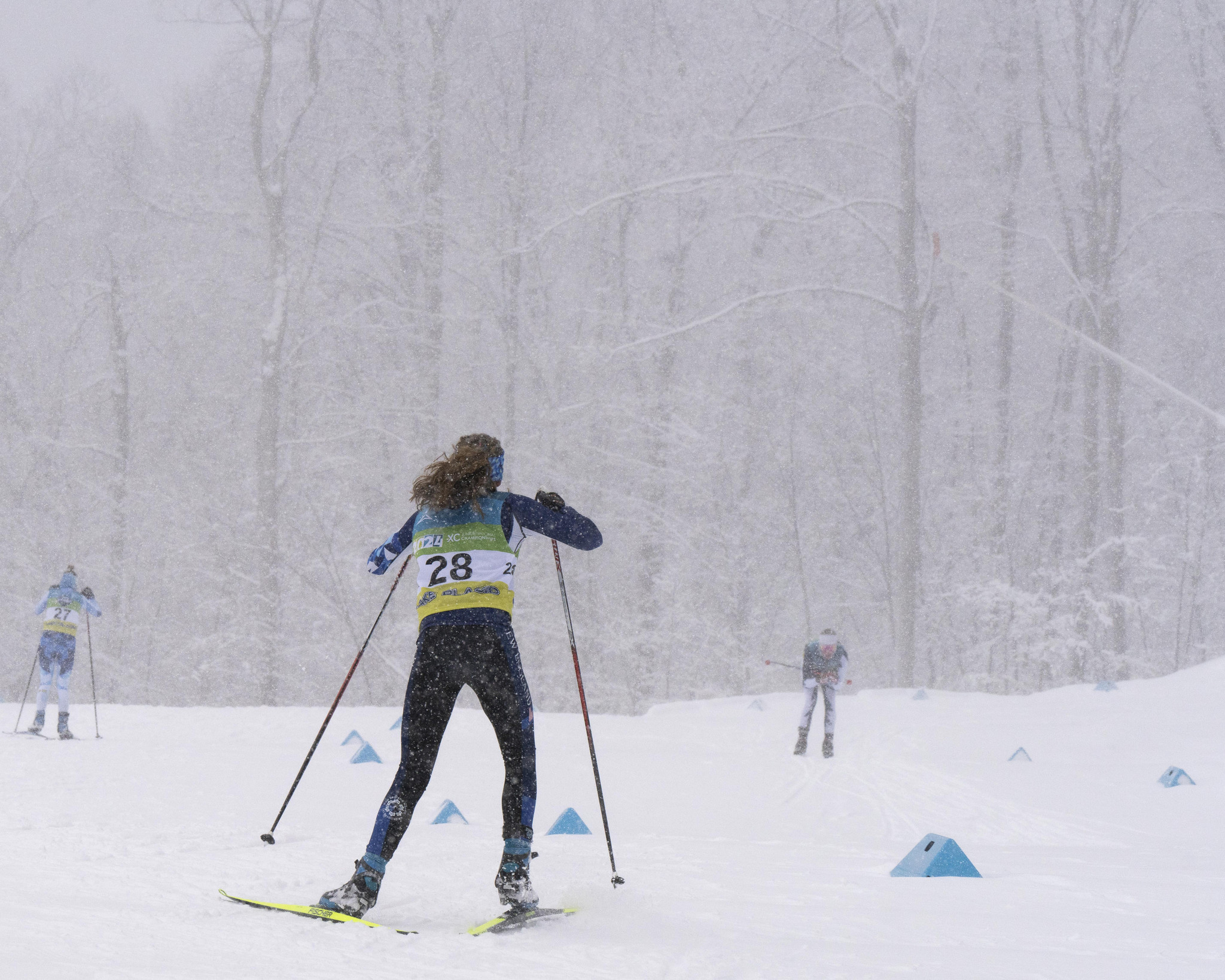
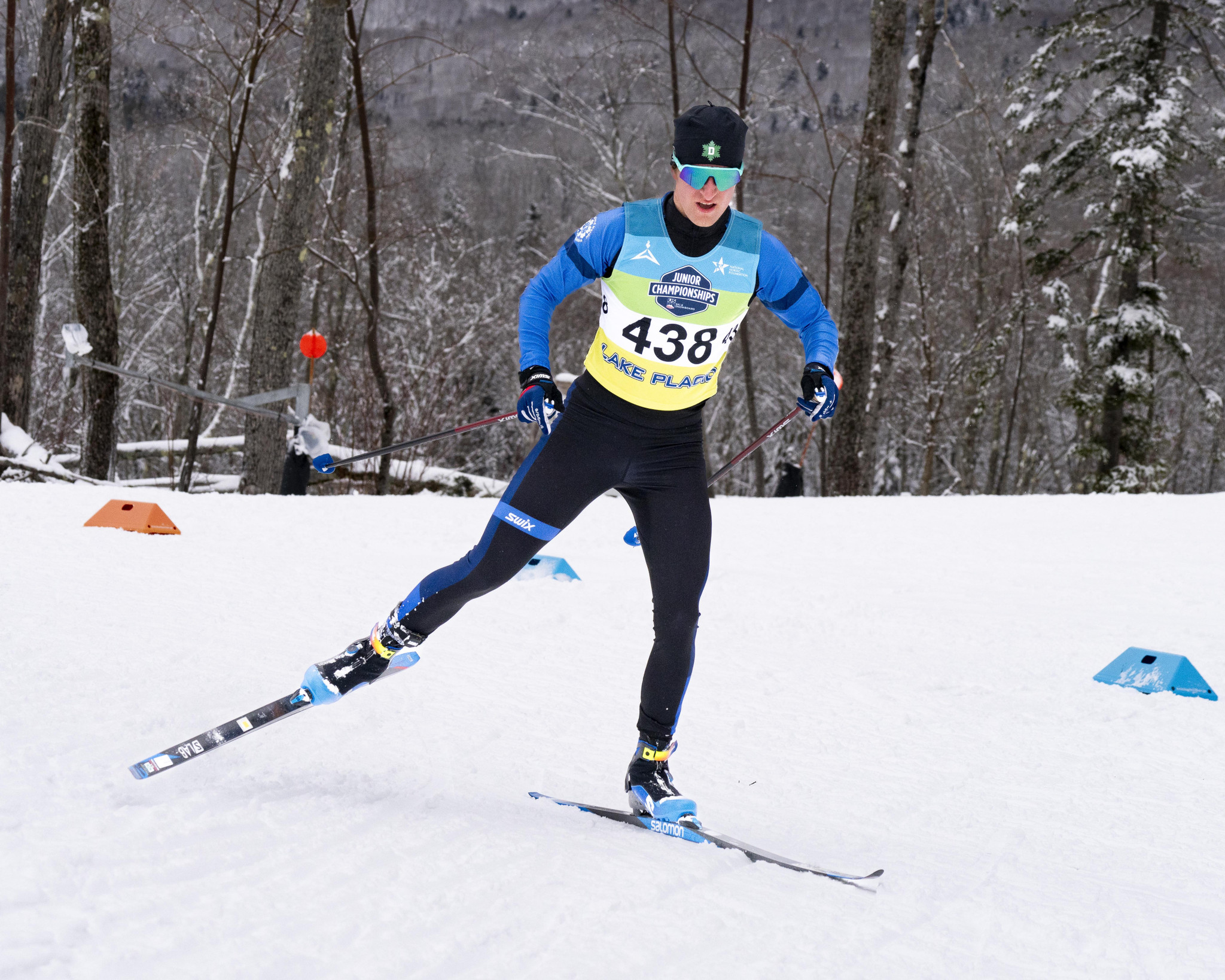
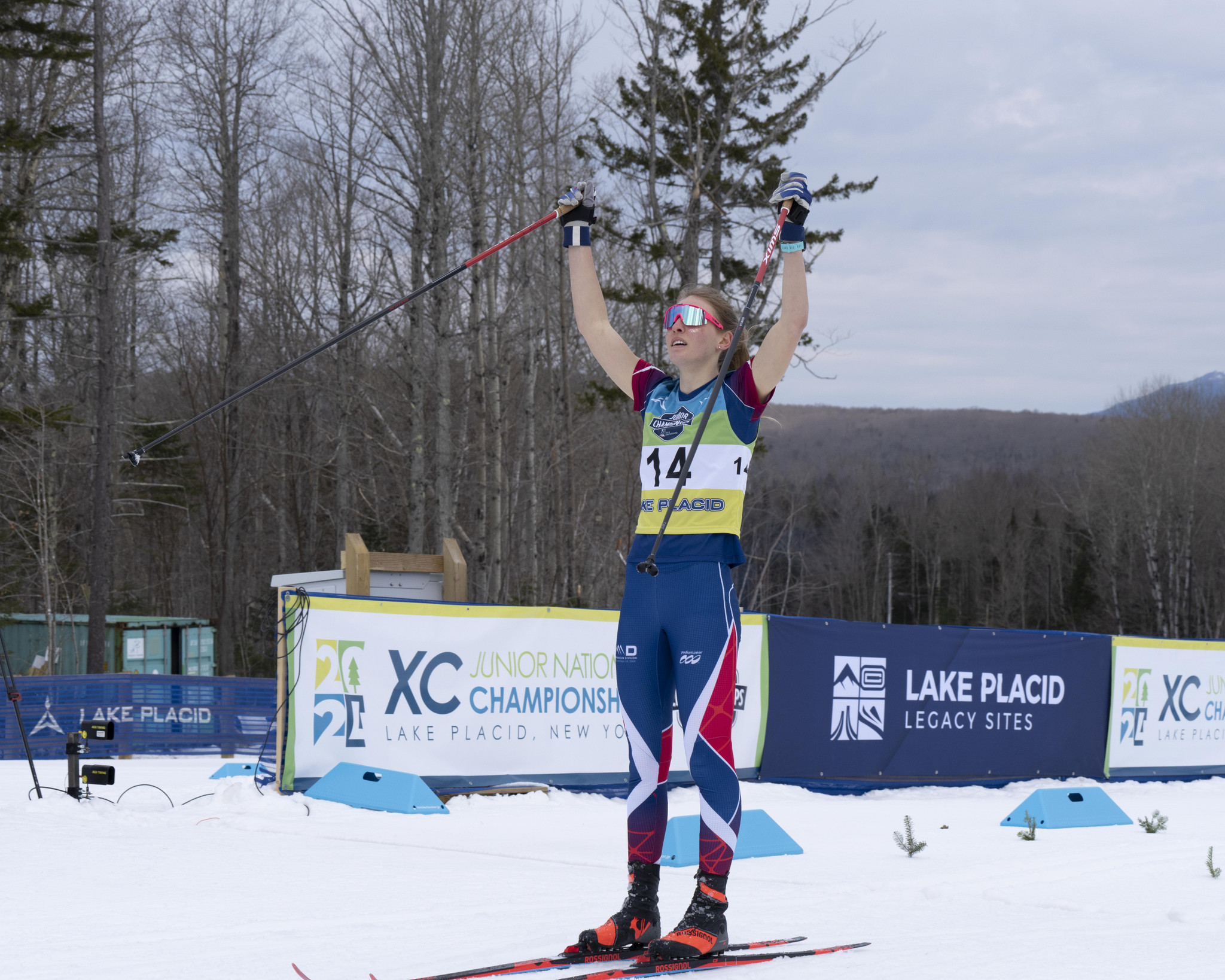
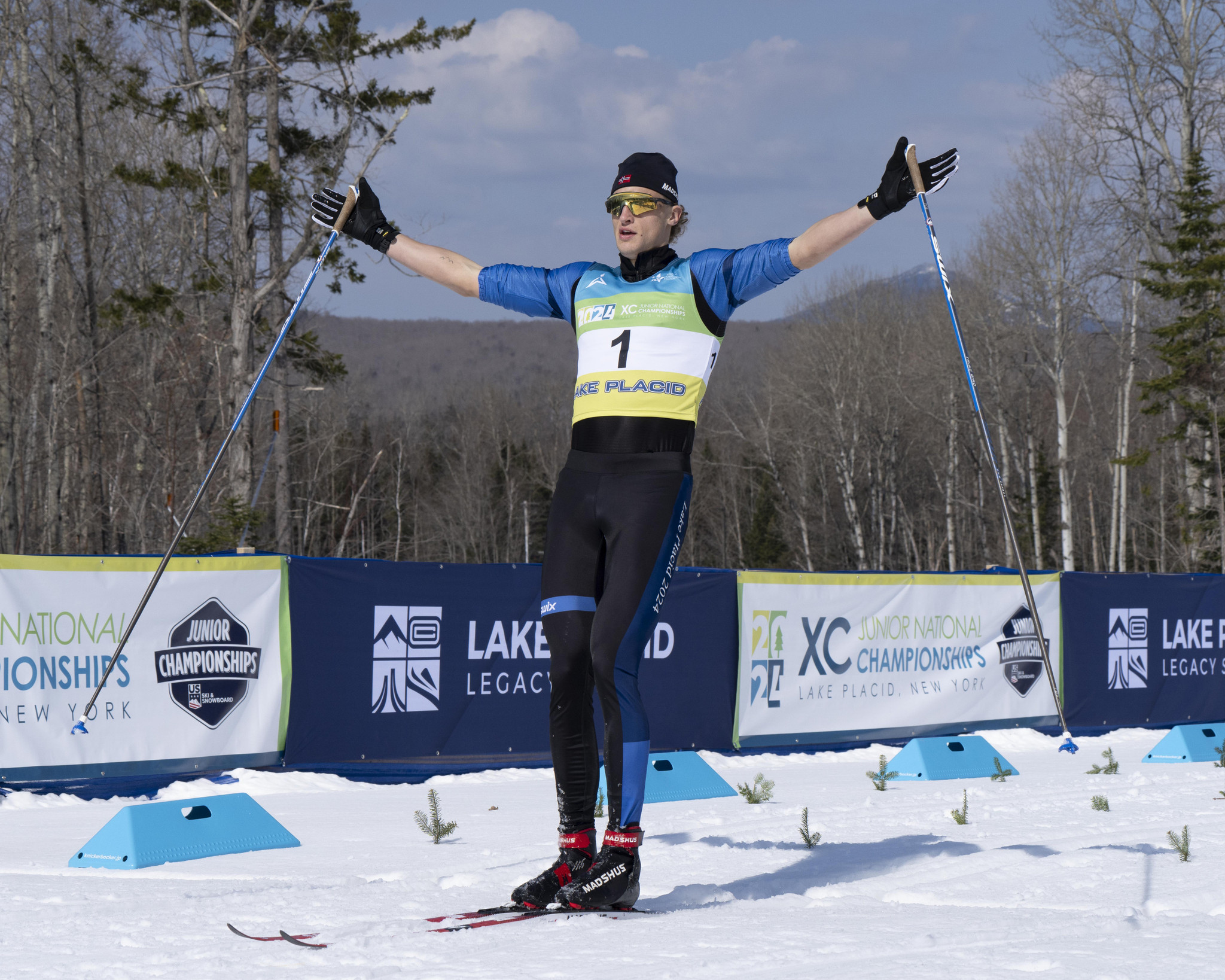
Mt. Van Hoevenberg ski trails ahead of a sunny classic sprint at 2024 Junior Nationals in Lake Placid, New York. (Photo: Lake Placid Organizing Committee/Philip Belena)
Lake Placid to Host 2026 World Cup Finals
In an interview earlier this spring, Stifel US Ski Team Head Coach, Matt Whitcomb, expressed that one of the appraisals from the success of the 2024 Loppet Cup in Minneapolis was a question: “Which US ski venue is next?” On Tuesday, Lake Placid answered that call. The former Olympic venue tucked within New York’s Adirondack Mountains has a tentative agreement with the International Ski Federation (FIS) to host World Cup Finals at the end of the 2026 World Cup season.
Lake Placid’s long-term development toward the 2026 World Cup Finals is a phenomenon to note. A decade ago, Lake Placid looked to re-develop its core competition venue at Mt. Van Hoevenberg accessing funds from the Olympic Regional Development Authority (ORDA). The result was a set of world-class ski courses that double-up as challenging rollerski trails in the summer. Since then, Lake Placid has hosted a SuperTour in 2022, World University Games in 2023, Junior Nationals this March, and recent bid looks to have them hosting Spring Nationals in 2025. With Lake Placid’s organizers having taken taken every opportunity to fine-tune facilities and gain experience, the current bid to host World Cup Finals makes good sense.
There are sure to be logistical challenges. Snow conditions in late March can be fickle in the East. The village of Lake Placid offers very different logistical challenge compared to metro-area Minneapolis. If any American winter sports venue has a track record of success with international competition, though, it’s Lake Placid and it’s century-long legacy of international and Olympic events.
Kincaid Park during the women’s 10km skate at 2018 U.S. Nationals, January 2018. (photo: Gabby Naranja)
SuperTour 2024-25: Alaska for Nationals, and a Couple of Trips to Birkie-land
SuperTour scheduling was discussed on Wednesday, with much of the tentative scheduling revolving around implications for Trondheim World Championship qualifying and the realities of supporting a domestic circuit for resource-limited pro athletes and clubs. One thing is certain: the US Cross-Country Ski National Championships will take place the first week of the New Year in Anchorage, Alaska. With a trip to Alaska already set in stone, the need to balance out the regional race schedule in the lower 48 followed.
Cable, Wisconsin—home of the American Birkebeiner—appears set to host the SuperTour opener before Christmas while the Birkie, itself, is on the SuperTour calendar as it was in years prior to last season’s North American World Cups. The possibility of adding a sprint race to the Birkie block of SuperTour races in February was discussed (a concept previously explored by the Birkie with its Elite Sprints), but that is pending discussions with the American Birkebeiner Ski Foundation (ABSF) and is unlikely to feature next season.
The tentative SuperTour schedule thus far:
Cable Opener, December
US Nationals, January
Bozeman, February
The Birkie, March
Spring Nationals, Lake Placid.
A coaches conference, from the FasterSkier archives. (Photo: USBA/FasterSkier)
USSS Coach Development Makeover
Discussions have been in the works for a couple years surrounding a re-vamp of the USSS Coach Development model. Looming changes have been aimed at making coach certification through the governing body a requirement, with USSS L100 certification becoming a requisite standard for all coaches whether professional or volunteer. The aims are clear: create a more definitive national credential while focusing national coach development around the same concepts.
In response to those goals and intentions, USSS unveiled plans to implement its new Sport Education Academy (SEA) in the 2024-25 season. The SEA comes not only with a re-vamped curriculum, but also a new L100 requirement for all USSS coaches, and subsequently, a new pricing model. The requirement for L100 means that all current USSS coaches now will have to maintain L100 certification (if currently held), or enroll to work towards L100 certification this season. With that requirement comes a new subscription model, of which practically all coaches will need to enroll in the gold at $100/year ($80/year this season).
The pitfalls in implementing and enforcing such policies are many. Currently, buggy USSS software hinders many coaches’ attempts at online training, education, and certification. A shortage of Coach Developers (required to obtain L100 certification) drastically limits the scheduling of requisite training events in many regions of the US. Few local teams have the resources to pay for the training and certification of volunteer coaches, many of whom work only a few hours a week. Those combined challenges have been enough to delay for years the implementation of changes to coaching certification policies. It remains to be seen how these newly-implemented policy changes will be received by the American ski community.
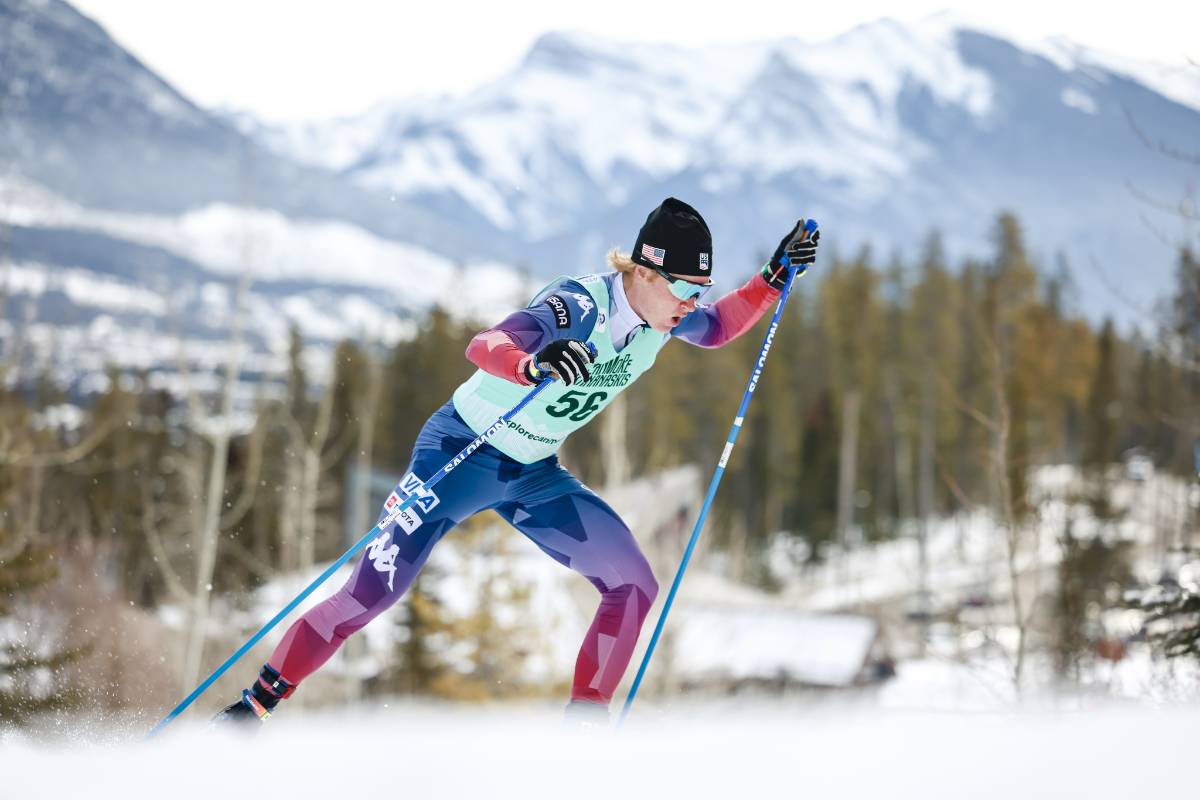
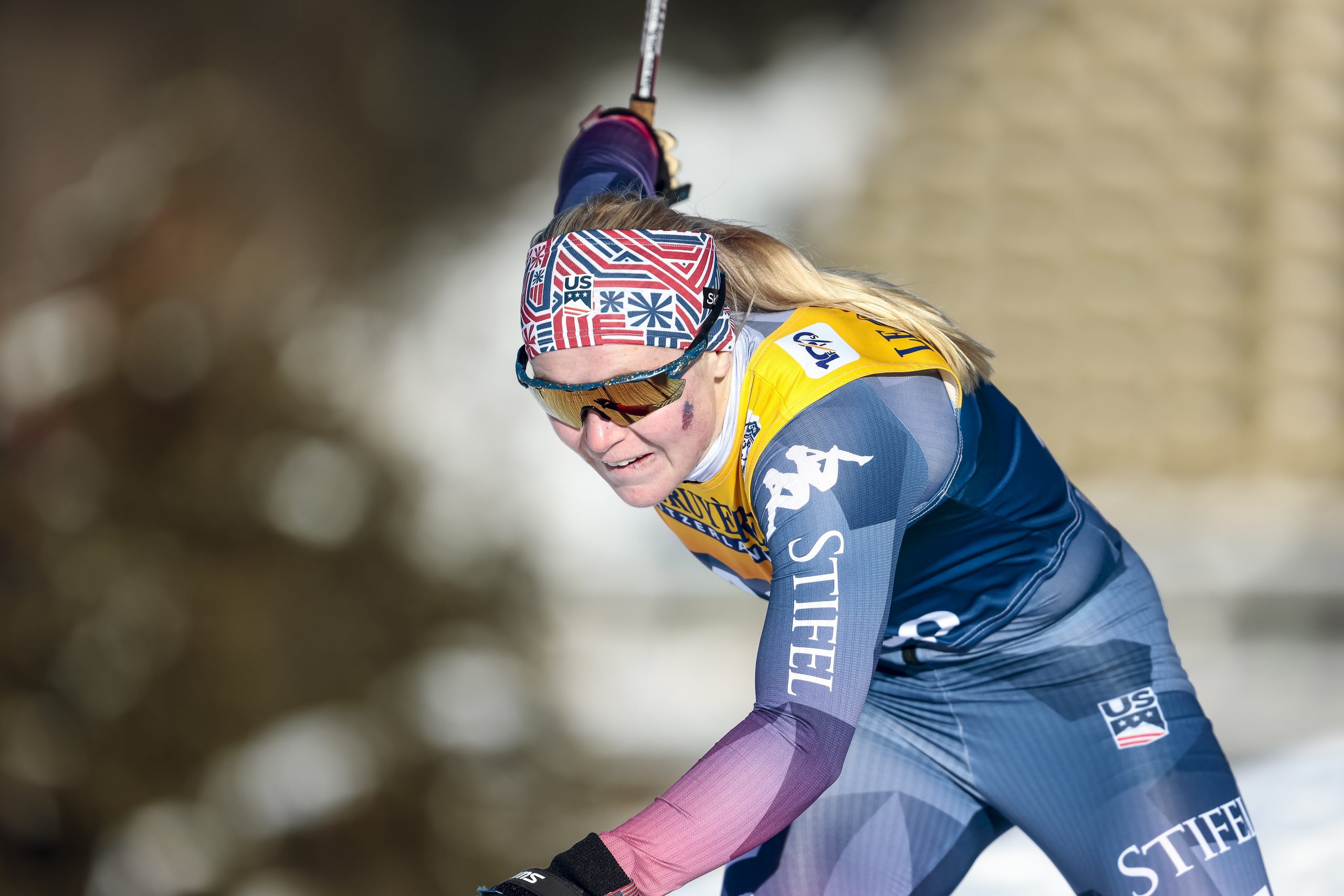
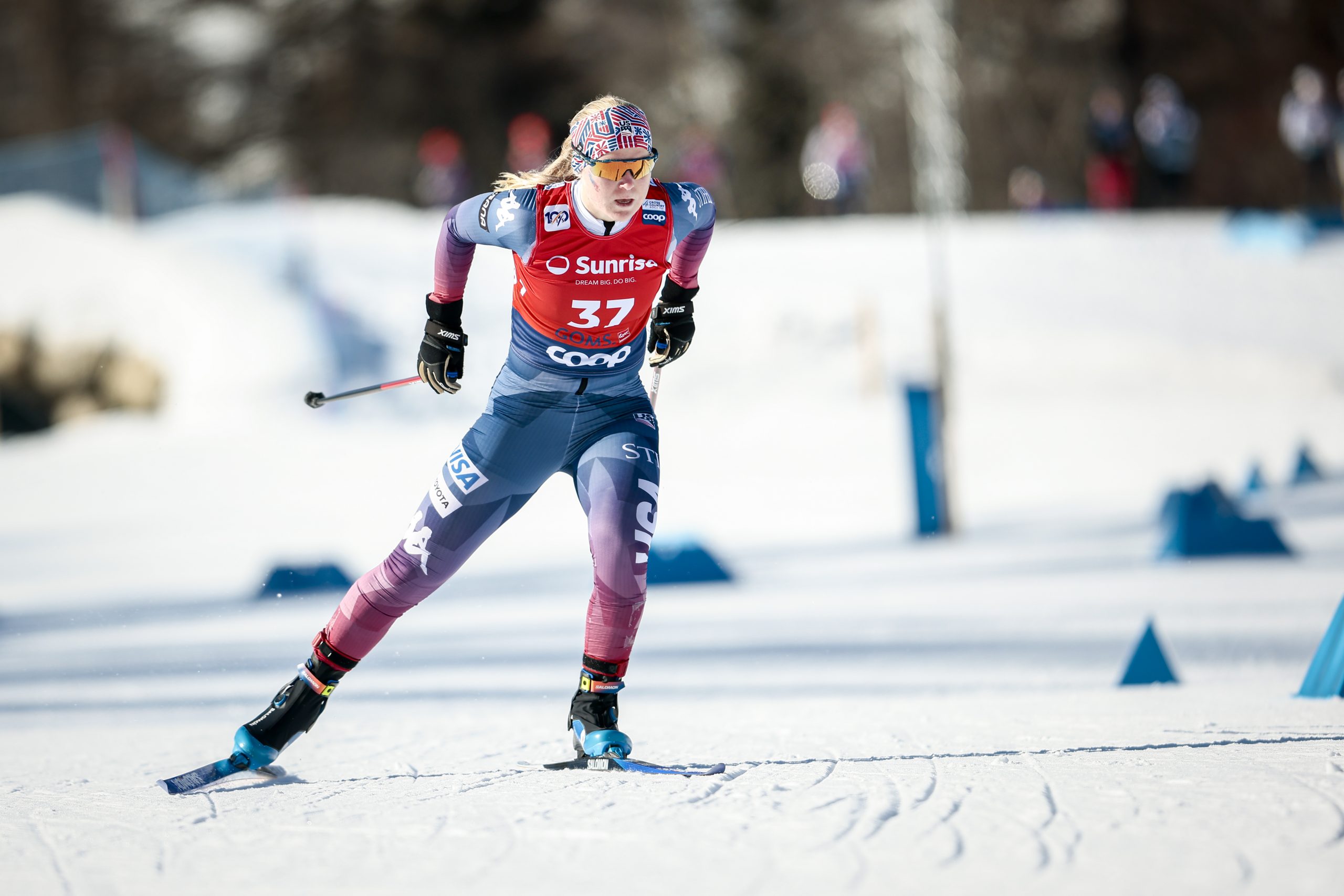
Colby College skier, Jack Young, during the sprint qualifier at the Canmore, Alberta World Cup in February. Since then, his racing performances have earned him a place on the Stifel U.S. Ski Team. (Photo: Nordic Focus)
The story of how Colby College became the Mules traces back to years of listless play from their football team, before a season in which the team suddenly became one of the best in New England. That led the Sports Editor at the student newspaper, The Colby Echo, to remark that instead of “black horse” to win their conference, Colby was suddenly a “white mule.” A couple of creative undergrads took the cue, sourced the rural environs around Waterville, Maine, and the next weekend, a real live mule patrolled the Colby sideline.
A century later, the story seems allegorical for the story of Colby nordic skier Jack Young. The Jay, Vermont native and Colby Junior spent his winter chasing down World Cup starts as one of the country’s best sprint prospects. Then, in his first World Cup start, Young quickly put together a memorable performance in Canmore where he qualified for the skate sprint heats in 11th place. In retrospect, it pointed to the potential of American skiers to leverage the relative home-field advantage of a rare North American World Cup tour into expectation-defying results. A week later, Gus Schumacher won in Minneapolis. Black horse to white mule-type stuff.
Earlier this month, as the buds of spring emerged on Colby’s Mayflower Hill campus, Jack Young’s performance proved to earn him a nomination to the D-Team of the Stifel U.S. Ski Team. He is the first Colby skier to receive a nomination while still enrolled at the small college of 2,200 undergraduates in Central Maine.
Young’s Colby College affiliation stood out among a nominee sheet that includes storied collegiate ski programs with more Team USA alumni in their history than one can count: University of Vermont, Dartmouth College, University of Utah, University of Alaska-Fairbanks, and University of Alaska-Anchorage, among others. Young qualified for the team via objective criteria requiring him to be ranked in the top 175 skiers in the World in his birth year, a standard that speaks to his accomplishments as an athlete, and his embracing of a Colby College ski-culture that revels in the role of offbeat outsider.
A Whole New World…Cup
When Young woke up on the morning of his World Cup race in Canmore, he was focused on feelings more than results. “Once I got a World Cup bid, my complete focus changed to getting to the place that I race best, which is not just physically being rested, but in a place where I have carved out the space in my mind to just get excited to ski race.” When he finally got to ski the sprint qualifier, that feeling transformed into something like euphoria, “I hit the top of the course, and all I was focused on from there was riding the wave I got from imagining that moment and reaching it,” he said. “I didn’t have a thought of where I might stack up in the field. I think that’s when the qualifier fell into place for me.”
As Young crossed the line, where he was stacking up in the field came into view for everyone; it simply astounded. “[American] Murphy Kimball was in the finish corral and was cooled down enough to be processing what the announcers were saying, which I wasn’t, and he heard ‘Jack Young, in 11th,’ and just immediately looked at me. So I stare back for like three seconds of silence, and then he just gives me the biggest hug ever. I started to get it then.”
Young had just started to process his achievement as others looked on with a mixture of awe and dis-belief. “My sister texted me asking if the result on the FIS App was correct.” His Colby teammates, camped up in Hanover, New Hampshire at the EISA Dartmouth Carnival also quickly got in contact. “They were like, it’s not just us that’s excited for you, EVERYONE here is excited.”
Meanwhile, Colby Head Coach Tracey Cote, was spelling it out in even more plain terms. In response to a text that said, “Mules in the Heats,” her response was an exuberant, “HOLY S***!” For Cote, the moment was a culmination of what she has always coached towards: not just an athlete reaching a goal they’ve worked at for years, but doing so in a way that reflected the unique intersection that happens when an athlete brings the character qualities they hold as a person to performing in the ever-complex sport of nordic skiing. “He started thinking about wanting to qualify for the World Cup in the summer,? said Cote. “And from that point forward, everything he did in training and life was centered around this goal.”
Looking back, Young sees Cote’s philosophy as key to his preparations to excel at the sport’s highest level. “She will always say, ‘[at Colby] we coach skiers, not just skiing’ and I think it took me a little bit to understand that,” said Young. “But I look at Canmore, and I think about how I was prepared to ski as well as I did. It wasn’t just because my training was good. It wasn’t just that I was physically rested. It was because I went in trusting that if I carried myself how I know I can carry myself, ski how I know I can ski, things would fall into place. I don’t get that without Tracey, or my teammates working everyday towards a culture that empowers that.”
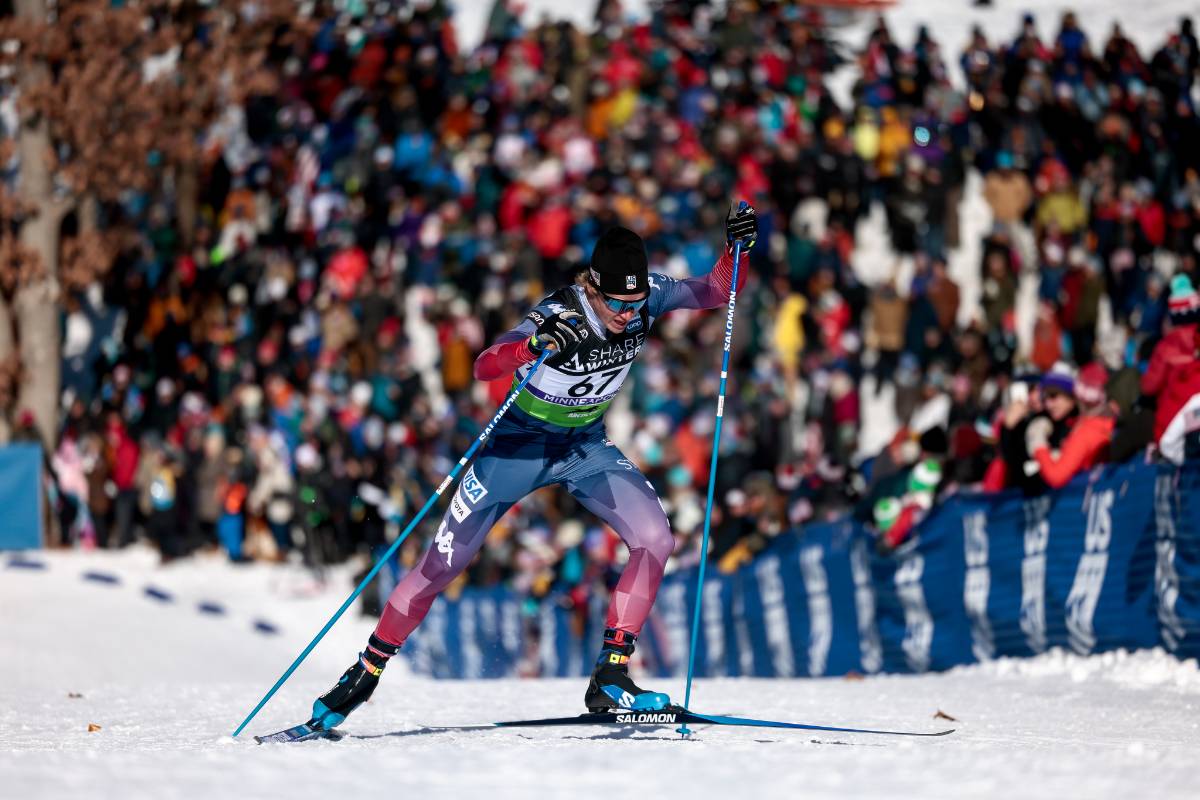
Jack Young at the World Cup in Minneapolis, MN in February. (Photo: Nordic Focus)
To Cote, Young’s results on the World Cup and throughout the season were evidence of his personal capacity to be “exceptionally collaborative.”
“We meet constantly to talk about how we can incorporate what he needs into the team training and when he just needs something different,” said Cote. “I have so much respect for skiers who can achieve incredible results while also lifting up their teammates. Not every top-level skier can do this, but I have been lucky to coach a few in my career and Jack is definitely one!”
Cote and Young also have cued in on Young’s profile as a skier acting as a litmus test for the team-forward culture at Colby. The NCAA circuit in which Colby competes has traditionally been focused on distance-only racing. Young, who earned his World Cup bids on his sprinting ability, has needed to create a training and racing calendar that can look very different from that of his Colby teammates.
“The coolest thing about training at Colby is that in any given workout, one of our guys can do something special,” said Young. “I hope that in a sprint workout, guys like Zach [Nemeth] can push themselves off me, and in a distance workout, I learn a lot from Zach, and the others too.”
Still, there are times when Young strays to keep sharp for sprinting. “He is so intentional about not disrupting the team culture,” says Cote. “Everyone understands when Jack does a different workout.” Young too, has seen it as a would-be weakness that’s turned into a key strength for the Colby team. “The thing about our season is that we have all fall as a team to work out any tension around individualized plans,” Young explained. “When we hit winter, we’re all in lockstep, the whole team, and better for it.”
The process of creating a team culture comes with a necessary constraint in NCAA skiing that Young looks at as a continuing opportunity. “The reality is the team is different every year, because you lose guys to graduation, and you have freshman that come in. Which again, [what you] try to do is turn what might be a weakness into a strength. Every fall, we’re looking to create a team that’s going to work best for that season.”
With that challenge of creating a culture ahead of him for one more year, Young eagerly anticipating the opportunity. “I get to bring the World Cup experience back, that’s exciting.”
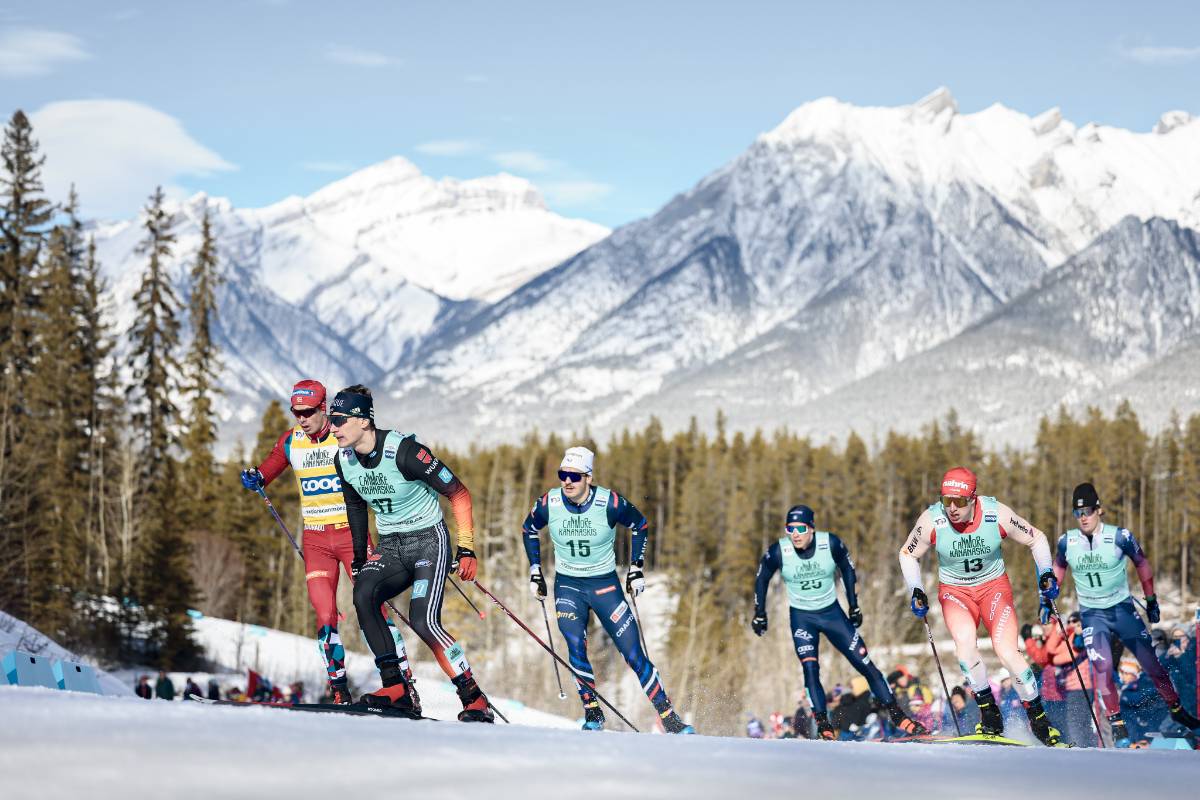
Young, far right, in his Canmore World Cup sprint heat alongside eventual World Cup Overall champion Harald Oestberg Amundsen (NOR). (Photo: Nordic Focus)
For Young, that’s the triumph of his sprint qualifier just as much as his “welcome to the Big Leagues” moment that came in his sprint heat at Canmore. In a heat with eventual World Cup champion Harald Oestberg Amundsen (Norway) and World Championship sprint medalist Jules Chappaz (France), he was competitive, but eventually lost ground in the final surge. “I’d talked [the heat] over with the US Team coaches, and we both agreed with it being my first time going in and trying to stay relaxed, [but] the reality of those World Cup heats is that being ‘relaxed’ per se means still jockeying for a good position so that when the heat goes…and they GO…you can react quick enough to adjust to the pace.”
Young sees the experience as a necessary learning ground, and knows what to adjust going forward. “I can’t wait to bring that back to training,” he said. “The idea that when you enter a World Cup heat, everyone thinks they can be in the top two in that heat. To me, that’s an attitude I need to have, and I want all my teammates to have too.”
Cote has no doubt those new lessons will combine with Young’s steady leadership. “He’s been a leader sine the day he stepped foot on our campus and always brings a level of positive and competitive spirit that infuses confidence into his teammates.”
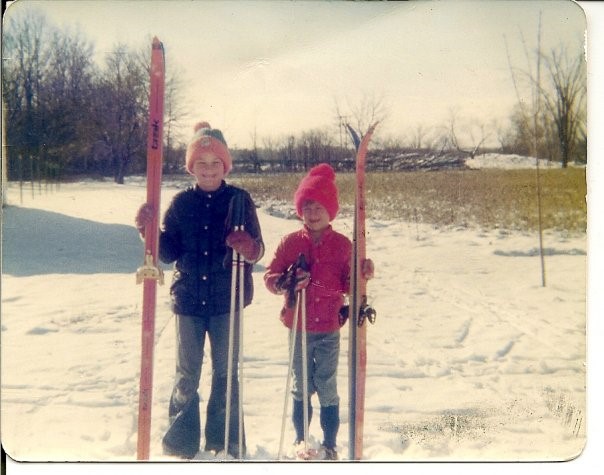
Tracey Cote’s ski career started out on the back forty, literally, here pictured alongside brother, Ted in Elkhart Lake, WI (Photo: Courtesy Image/Ted Theyerl)
A Match Made in Waterville, Maine
The success Young had this season may seem like the result of a serendipitous match with the Colby program. But for longtime observers, Young’s nomination to the Stifel US Ski Team is the logical outgrowth of a program built steadily over generations.
All great programs bear traces of their leaders. For Colby, that’s found in Tracey Cote, who has served as Head Coach for 27 seasons. Cote (née Theyerl—note the non-coincidental author’s byline of this article) grew up in the small Wisconsin village of Elkhart Lake, an hour and a half into the hills north of Milwaukee. Tracey and brother Ted took their first ski strides in the Schultz family cornfield behind their modest home on the outskirts of Elkhart Lake, and continued on into American Birkebeiners of the 1970’s. Her beginnings in the sport were literally out on the back forty.
Starting out skiing in the Kettle-Moraine forest was a far cry from the traditional skier development centers across the United States. Elkhart Lake-Glenbeulah High School certainly was not a ski academy. Fifteen miles west of Sheboygan wasn’t Aspen. Where Cote learned to ski, she learned to love skiing alone. When she did ski with others, it was a family affair. Those two elements continued through Cote’s own collegiate career at Northern Michigan University, her taking on the Colby program in its first year as a Division I ski program in 1997, and through NCAA Championship qualifiers, NCAA All-American finishers, World Junior Championship qualifiers, and now, a US Ski Team member. Her coaching is driven by a desire for every Colby skier to intensely pursue their own competitive skiing goals, while maintaining the perspective to intensely pursue relationships with their teammates, and the sport, that makes everyone feel supported. That’s a close approximation to the “team culture” often spoken about by Young and Cote. “Any one skier’s success is a success for everyone.”
That guiding principle has never come at the expense of letting some of Cote’s own background and quirks shine through. “Tracey will talk a lot about is how training is often a process of avoiding mistakes, more than finding a silver bullet,” says Young. “And that often translates into letting her athletes train on the terms that work best for them.
For years, Cote’s athletes have come from backgrounds in cycling, soccer, basketball, football, and even more esoteric pursuits. She also has a penchant for recruiting skiers who come from out-of-the-way talent centers, and keep to unconventional paths in the sport. The Colby program’s first World Cup skier under Cote came earlier this year when alumni Erin Bianco, who currently skis for Bridger Ski Foundation out of Bozeman, Montana, made her first World Cup starts in Oberhof, Germany. Bianco qualified for her first World Cup sprint heats on the same day Young put in his performance at Canmore. When Cote recruited the Iron Range, Ely, Minnesota native though, Bianco was out of skiing, running at St. Olaf College. Bianco transferred to Colby and became an NCAA All-American.
Further back, the Colby’s program milestones have been linked to out-of-the-way stories of success. Colby’s first All-American, Olivia Amber, came from the small outpost of Lake Nebagamon, Wisconsin, where she and her sister constituted the entirety of their high school team. Colby’s most dominant skier during Cote’s tenure, Zane Fields, was a Woodstock, Vermont skier who came direct from that state’s high school league. The program’s first World U23 Championship qualifier, Andrew Egger, was a sprint specialist who was concurrently enrolled in Officer Training School for the US Marine Corps.
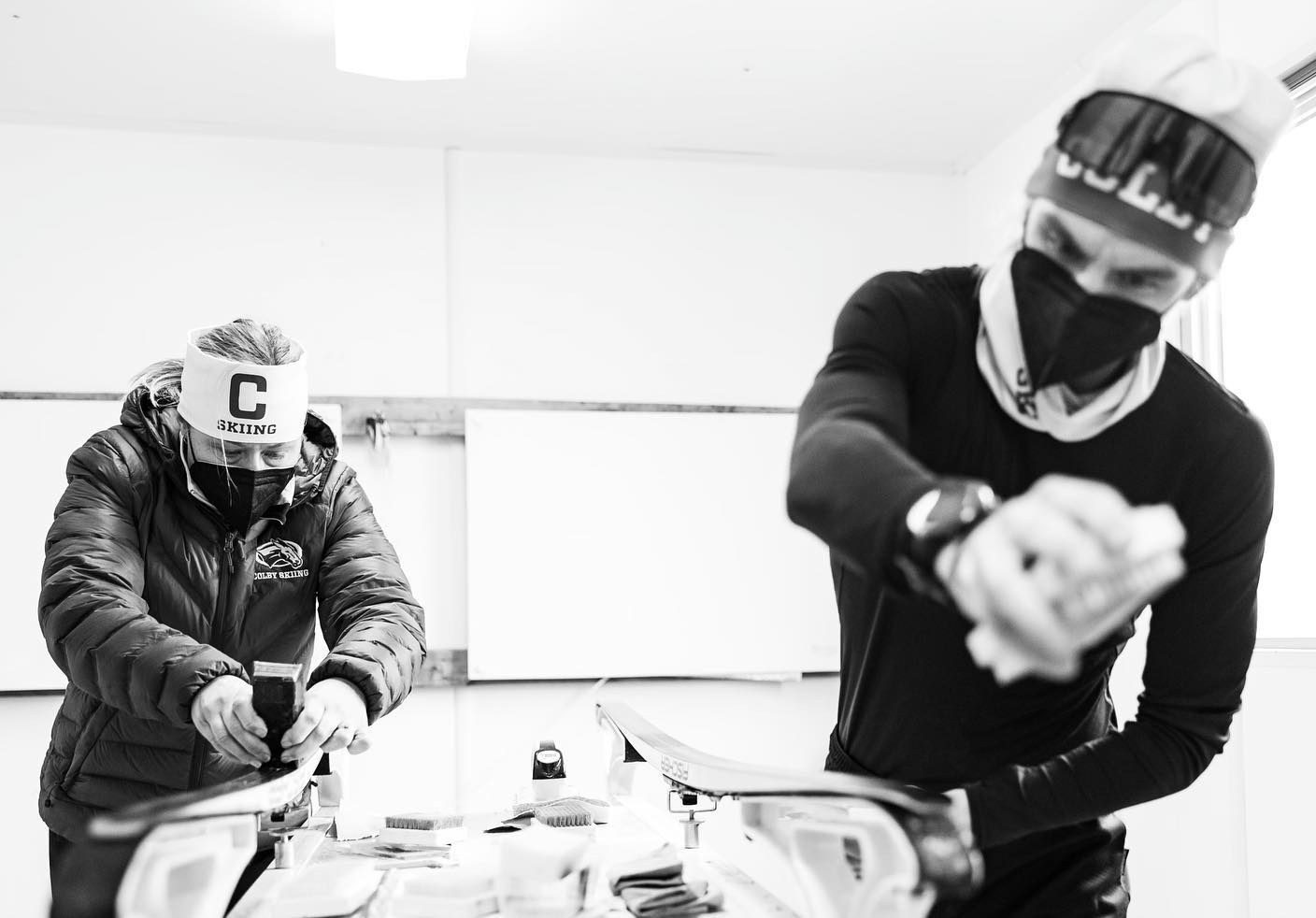
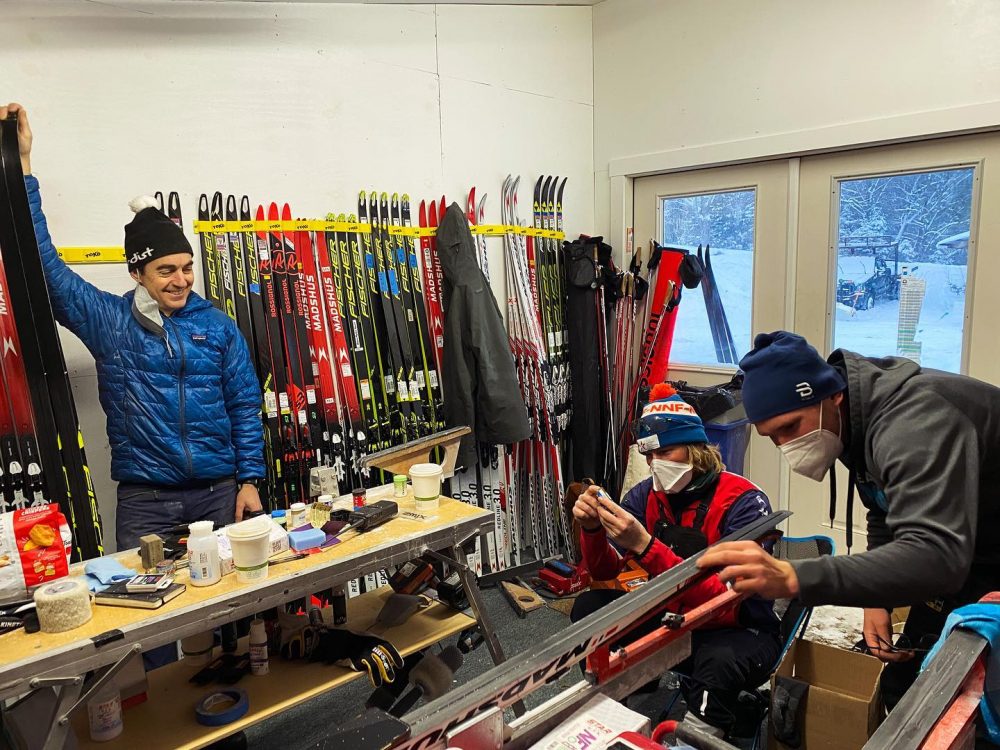
Colby College Head Coach Tracey Cote and former Assistant Brad Ravenelle at work in the wax trailer at US Nationals in January 2023. (Photo: Colby College Ski Team)
They all have come to Waterville, a post-industrial New England mill town in central Maine where they found an out-of-the-way approach to pursuing the sport at the highest level. Cote and Colby have made sure those skiers have all the resources to do so. A decade ago, Colby partnered with the town of Waterville to revive and expand an abandoned quarry, Quarry Road, down the hill from campus into a homologated 5 k course with snowmaking. Two years ago, Colby opened a $200 million-dollar athletic center boasting a full support staff, and arguably the best waxing facilities in the East. For Cote, there was a clear direction in the investments: “It’s made us an attractive place to support a collegiate ski career.”
All of which sets up to point towards an understanding of why Jack Young has not just excelled as a skier, but excelled as a Colby skier. Young has been nordic skiing since he was a little kid in Jay, Vermont’s Bill Koch Youth League (BKL). He didn’t connect with the sport competitively though until relatively late, joining up with the nearby Craftsbury Ski Club in high school. By then, he was more known around Vermont’s Northeast Kingdom as his high school’s starting quarterback than as a top junior skiing prospect.
He found success, becoming a Vermont State Champion skier five times over. However, he still went relatively under the radar to the college coaches casting a recruiting net over a national pool of skiing talent. In short, Young was a bit of an outsider going into college. Which made him the type of skier with whom Cote has had success in her tenure.
Scenes from season’s past: a young Craftsbury Nordic Ski Club racer—Jack Young of Jay, VT—gets some help from his father, Chris, to adjust his pole straps in the start corral, NENSA Eastern Cup. (Photo: Craftsbury Outdoor Center, December 2016)
Young admits that his current list of accomplishments is something that he didn’t even fathom at this time last year. “This season was a sequence of things that just kept going,” he said. “I didn’t take that for granted, but I did have to learn to take it. You go from dreaming of winning a SuperTour qualifier, then you do it like I did in Anchorage, and then you start piecing things together from there. Oh, I could make the World Cup. Oh, I made the World Cup…things like that. I guess the US Ski Team is that too.”
His nomination to the Stifel U.S. Ski Team is something that both he, and the program he comes from, see as the realization of the groundwork laid over the course of decades. “I’ve always loved skiing,” he said. “But really I think the difference has been that I learned to love the competition and training aspect of skiing. When I was a kid in the BKL, it wasn’t on the forefront of my mind to compete on the world stage. Now it is.”
In Jack Young, the skier, there’s a parable for a program. No longer the black horse, with Young, the Colby mules are kicking on.
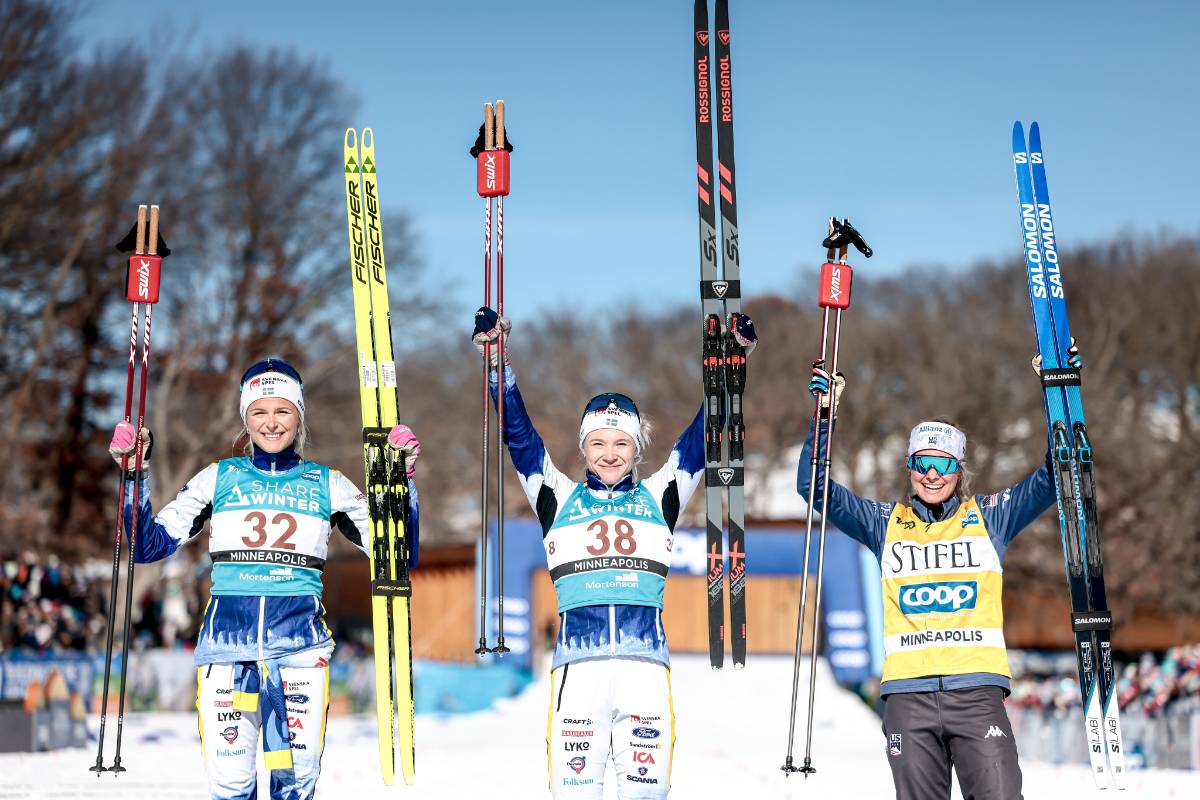
The Stifel U.S. Ski Team celebrates on top of Alpe Cermis where Jessie Diggins took the Tour de Ski Overall and Sophia Laukli won her first World Cup race. (Photo: Nordic Focus)
Last week, the Stifel U.S. Ski Team announced the 2024 recipients of the Stifel Awards, named after the team’s title sponsor for the 2023-2024 season.
Awardees for the “Athlete of the Year” and “Best Comeback of the Year,” among other categories, were nominated and voted on by team members and staff; with Stifel’s backing, those categories were awarded with a monetary prize attached. The 2023-24 season is the first time each discipline represented within the Stifel U.S. Ski Team nominated and awarded within its discipline, rather than the previous format in which awardees came from a pool of nominees across divisions, per US Ski and Snowboard’s press release.
STIFEL U.S. CROSS COUNTRY SKI TEAM AWARD WINNERS
Athlete of the Year: Jessie Diggins, Gus Schumacher
Rookie of the Year: Sammy Smith/Haley Brewster (tie), John Steel Hagenbuch
Most Improved: Sophia Laukli, Zanden McMullen
Best Comeback: Rosie Brennan, Gus Schumacher
Staff Member of the Year: Kristen Bourne
With the Stifel awards all handed out, we’re taking the opportunity here to take a brief look back on the individual accomplishments of the awardees accounting for one of the most successful seasons in American skiing history.
Jessie Diggins crosses the final finish-line of her historic season in Falun, Sweden, winning the 20 k skate and the World Cup Overall. (Photo: Nordic Focus)
Athletes of the Year: Jessie Diggins and Gus Schumacher
Jessie Diggins – The headline accomplishment of Diggins’ 2023-24 season was her second career World Cup Overall Crystal Globe. By winning, she built on her legacy as one of two Americans to ever capture the Overall classification of the World Cup (Bill Koch won the first official classification in 1981-82). Diggins became the first American skier to win the World Cup Overall multiple times.
In the most simple terms, Jessie Diggins was the best skier in the world this season. From a dominant early season win in a 10 k skate in Gallivare through to her victory in the season’s final race(20 k in Falun), Diggins was a factor in every race she started. Beyond just distance wins, she also skied to sprint podiums, and won her second-career Tour de Ski. For all of her accomplishments on the World Cup, Diggins realized a career accomplishment in where the World Cup was held, as well, leading a successful effort to bring a World Cup to her home state of Minnesota. Just one week later she won her first American Birkebeiner (and if you’re from the Midwest, like Diggins, you know that’s all that counts!).
“Athlete of the Year” designation doesn’t come without world-class results, but it doesn’t come exclusively because of them either. Diggins 2023-24 ski season was defined as much for her racing as for her vulnerability regarding her motivation to race. Last Fall, Diggins detailed her struggle to manage disordered eating, doing so in part to spell out the priorities she had going into the World Cup season. She was going to ski race because she loved to ski race. She was going to celebrate that she was capable of doing so by taking each day, and each race, as they came. As the World Cup season progressed—as Diggins’ results started to string together into a Crystal Globe-winning campaign—she let that approach to ski racing shine through. The result was a World Cup champion who wasn’t afraid to acknowledge that champions are human too; an empowering notion in and of itself.
Gus Schumacher takes a lap around a jubilant Theodore Wirth Park in Minneapolis after his World Cup win. (Photo: Nordic Focus)
Gus Schumacher – The biggest moment of Gus Schumacher’s season coincided with arguably the biggest moment of the season for the sport, when he won his first career World Cup in Minneapolis. That, of course, had a whole lot to do with Schumacher’s “Athlete of the Year Award” from the Stifel U.S. Ski Team. The 24 year old also scored other milestones on his way to the historic win in Minneapolis, including qualifying for his first World Cup Sprint Final during Stage 4 of the Tour de Ski. Overall, Schumacher made leaps forward in his consistency in World Cup racing, reflected in his Overall finish: Schumacher skied to 15th on the final World Cup points list, his highest career finish, and a radical improvement from 62nd the previous season. He was a consistent top-30 presence in every distance race, with the potential to put together an extraordinary result on any given day. As it turned out, the extraordinary result would be a milestone for more than just Schumacher, with his Minneapolis win being the first distance win for a male World Cup skier since Bill Koch in 1984.
Schumacher’s win in Minneapolis also brought a golden conclusion to a neat narrative arc for which his teammates awarded him “Comeback of the Year.” Four years ago, he became the first American man to win a World Junior Championship distance race, placing first in the 10 k Skate race at the 2020 Championships in Oberwiesenthal, Germany. He made the jump to primarily racing World Cups over the next couple of seasons, and was open about his struggles in doing so. Schumacher was learning though; training, resting, coping with the mental pressure of racing, working alongside a generation of talented US Skiers. The 2023-24 season was a sign of steady progress, until it was an exultant one, taking his first World Cup win in front of a home crowd, and reiterating why all the mistakes were worth working through.
Haley Brewster stands on the second step after earning a silver medal in the U23 World Championships 20 k Skate in Planica, Slovenia. Brewster delivered the first U23 Women’s distance medal in US history, and was part of an historic Junior Worlds where three different athletes medalled. (Photo: FIS World Junior Ski Championships Media)
Rookie of the Year
Haley Brewster – There’s always a vague hope that we’ll be able to pinpoint the moment an athlete’s potential coalesces into a result that is truly special. For Haley Brewster, that moment came during the final lap of the US National Championship 20 k in Solider Hollow, Utah in January. There, the University of Vermont Junior made a decisive up-tick in the pace that separated her from the lead pack, and won her first National Championship. A whole new world of possibility flowed from that moment, and as it would turn out, it would be the possibility for Brewster to be one of the best U23 skiers in the world. A month on from Soldier Hollow, Brewster was skiing alongside her countrywomen Novie McCabe in a lead pack of five skiers at the World U23 Ski Championship 20 k in Planica, Slovenia when again, she made a decisive up-tick in pace to help separate the pack, and skied to a World Championship silver medal. In doing so, Brewster became the second American woman to ever to medal in a distance race at U23 World Championships, after Liz Stephen did so in 2008. She also became the fifth American woman to medal outright, a list that includes Stephen, Laura Valaas, Julia Kern, and Jessie Diggins.
Her first World Cup starts followed in Minneapolis, where Brewster made her distance debut on the senior circuit with 25th place in the 10 k skate. Two NCAA runners-up finishes back in March wound down the season for Brewster. The time and place circumstances of those Championships, held at Steamboat Springs right down the road from her hometown of Eagle, Colorado, helped ground the whirlwind that had seen her ski to the very top of the world. As the calendar turns towards 2024-25, the possibilities seem boundless.
Sammy Smith – Smith’s season started at the SuperTour in Anchorage, Alaska, where she promptly skied to victory in three of four of the Kincaid Park Opener’s races. From there, the Sun Valley junior spent the rest of the winter on the World stage. Her first World Cup top 30 distance performances soon followed at the Tour de Ski, and she became a staple on the list of qualifiers in sprint races the rest of the season. The only interim Smith took from the World Cup was to compete at the Junior World Ski Championships in Planica, Slovenia, where she became the first American woman to earn a Junior Worlds medal in a sprint race, taking silver, and the first individual American woman medalist since Hailey Swirbul in 2018. The full run-down of Smith’s season should come with the obligatory note that she accomplished all she accomplished at just nineteen years old, which only serves to make her season stand out even more. For a hint on what drove her teammates to bestow her “Rookie of the Year” honors though, one should look at her performance in the World Juniors Mixed Team Relay. After a strong opening leg from Team USA’s Zach Jayne, Smith started out her leg from eight place. On classic skis and in a driving rain, Smith skied to the fastest time in her leg, moving Team USA from eighth to third place and fighting for a podium. Team USA eventually finished fourth, but there was a clear winner within the race. For grit. For drive. For competitiveness, no one could beat Sammy Smith.
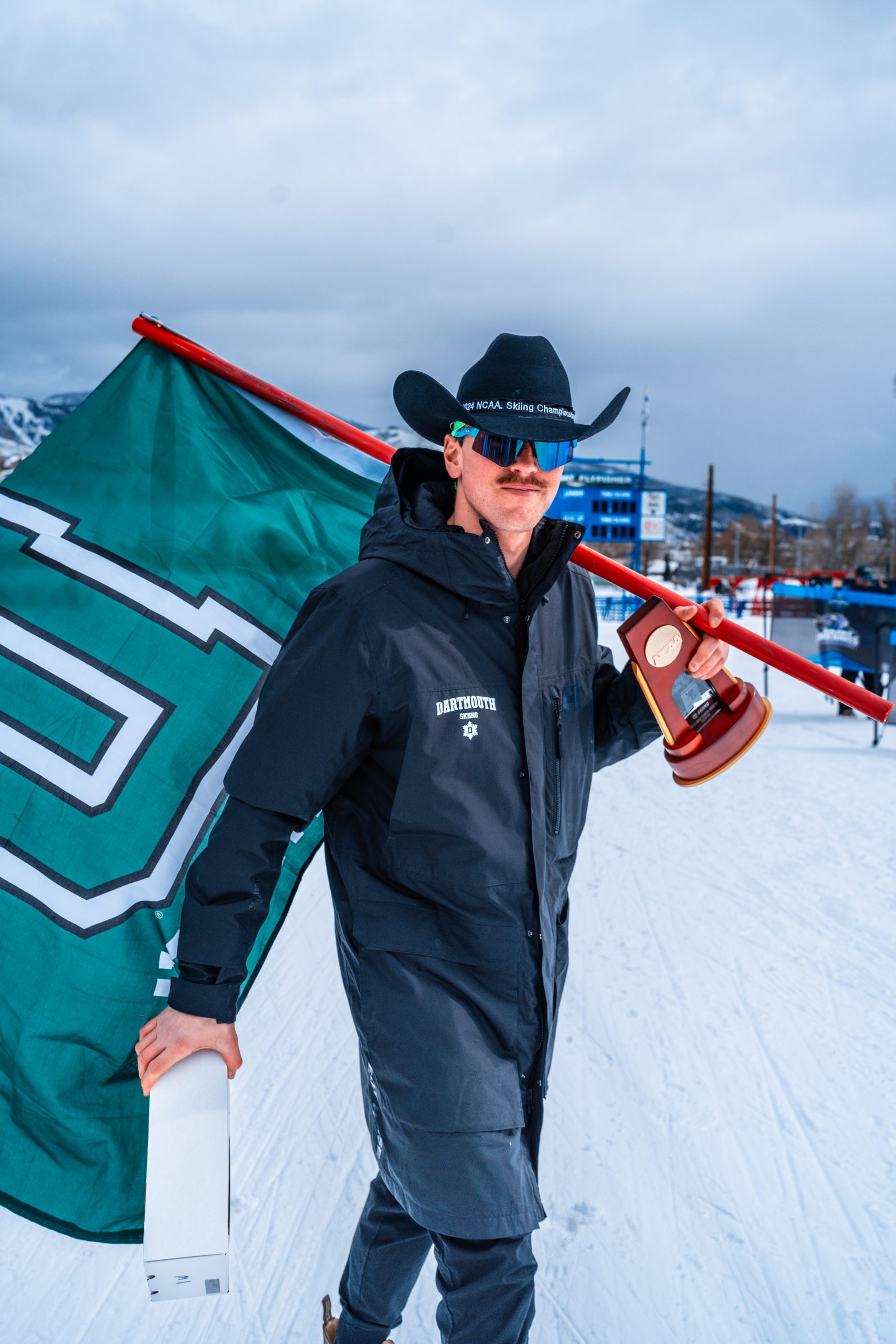
“All-American:” John Steel Hagenbuch (Dartmouth) skied to World U23 Championship medals and top World Cup results this season, and capped it off with his first NCAA Championship in Steamboat Springs, CO in March. (Photo: Tobias Albrigsten/ Untraceable Global)
John Steel Hagenbuch – In the quarterfinal of the U23 World Championship sprint race in which he would eventually earn a bronze medal, Hagenbuch waited until the field hit the hardest part of the course. Then, he hit the hardest part harder than anyone else could. “That’s the move,” he said afterwards. The poise, confidence, and ability to make his move when the toughest part of a race came defined Hagenbuch throughout the 2023-24 ski season. When things got frigid in December at the World Cup in Ostersund, Sweden, Hagenbuch skied to his first career top 15 result. When falling snow started to slow down a crowded 20 k mass start US Nationals field, Hagenbuch took the cue to make a decisive move towards his first National Championship. When the time splits were tight at the NCAA Championship 7.5 k, Hagenbuch split the field to win. The Dartmouth Junior built a consistency in his approach to racing, while crossing as many venues and circuits as a young skier could this winter. With at least one more year at Dartmouth, Hagenbuch is unlikely to stop hopping from the NCAA to the World Cup and other circuits too. It’ll be a tough balance, but then again, when it comes to pushing hard in the tough spots, “that’s the move” for Hagenbuch.
Zanden McMullen became a key, consistent performer for the US Ski Team in 2023-24. (Photo: NordicFocus)
Most Improved
Zanden McMullen – It was a winter where it was hard to keep up with the pace that members of the US Ski Team were reaching milestones on the World Cup. Ben Ogden and JC Schoonmaker skied to their first World Cup podiums. Sophia Laukli and Gus Schumacher to their first World Cup wins. Jessie Diggins and Rosie Brennan were in contention for a win nearly every weekend. The success was a sea change from a generation or two ago when top thirty World Cup results from American skiers would grab headlines. All of which is to say, that Zanden McMullen’s season was an accomplishment in the old-fashioned, stick-it-out variety, exhibiting the persistence that it takes to get results on the way to the headline grabbing finishes his older teammates skied to this winter. McMullen made starts at nearly every World Cup weekend this season, with his results stacking up consistently across discipline and distance. Skate sprint? Classic 20 k? McMullen could be counted on to turn in within the top twenty-five in either. In the Men’s World Cup, he was a crucial piece of US Skiing’s added depth, and at just 22 years old, there is a lot of directions for the versatile Alaskan to go as he looks to the World Cup again next season.
Sophia Laukli – The award of most improved for Laukli comes as a testament to her creativity. Laukli has been open with FasterSkier over the last year on how much has changed, and been changed intentionally, in her skiing career. After graduation from the University of Utah last spring, she moved to Norway and joined Team Aker-Daehlie, becoming the first American athlete on the innovative Norwegian club team. She also made the decision to pursue a budding running career, and subsequently won the Golden Trail Series, which included wins in some of the world’s most prestigious ultra-running events. When Laukli began the running season last year, she was considered a wild card within the Golden Trail Series. And as she put together her winning campaign, it led to another wild card prospect. Running, moving across the world, graduating – how would it all affect her skiing? A 14th place in Ruka during the last race of World Cup opening weekend in November seemed to be an affirmative. Seemed to help. Laukli had her most consistent season on the World Cup to date. In the World Cup distance classification, she jumped to 15th place this season from a previous career high of 35th in 2021-2022. In a year where Jessie Diggins and Rosie Brennan were expectant top ten finishers in every race, Laukli was the reliable next name up, and never very far behind at that. That consistency would be enough to celebrate, but with Laukli, it also came punctuated, when she skied to her first World Cup victory at the Alpe Cermis Hill Climb. Laukli now gets the chance to do it all again, as she begins to fine-tune the mix and match of her running and skiing careers in 2024-25.
Rosie Brennan skied to podiums in numerous races, distances, and disciplines during the 2023-24 season. (Photo: NordicFocus)
Best Comeback
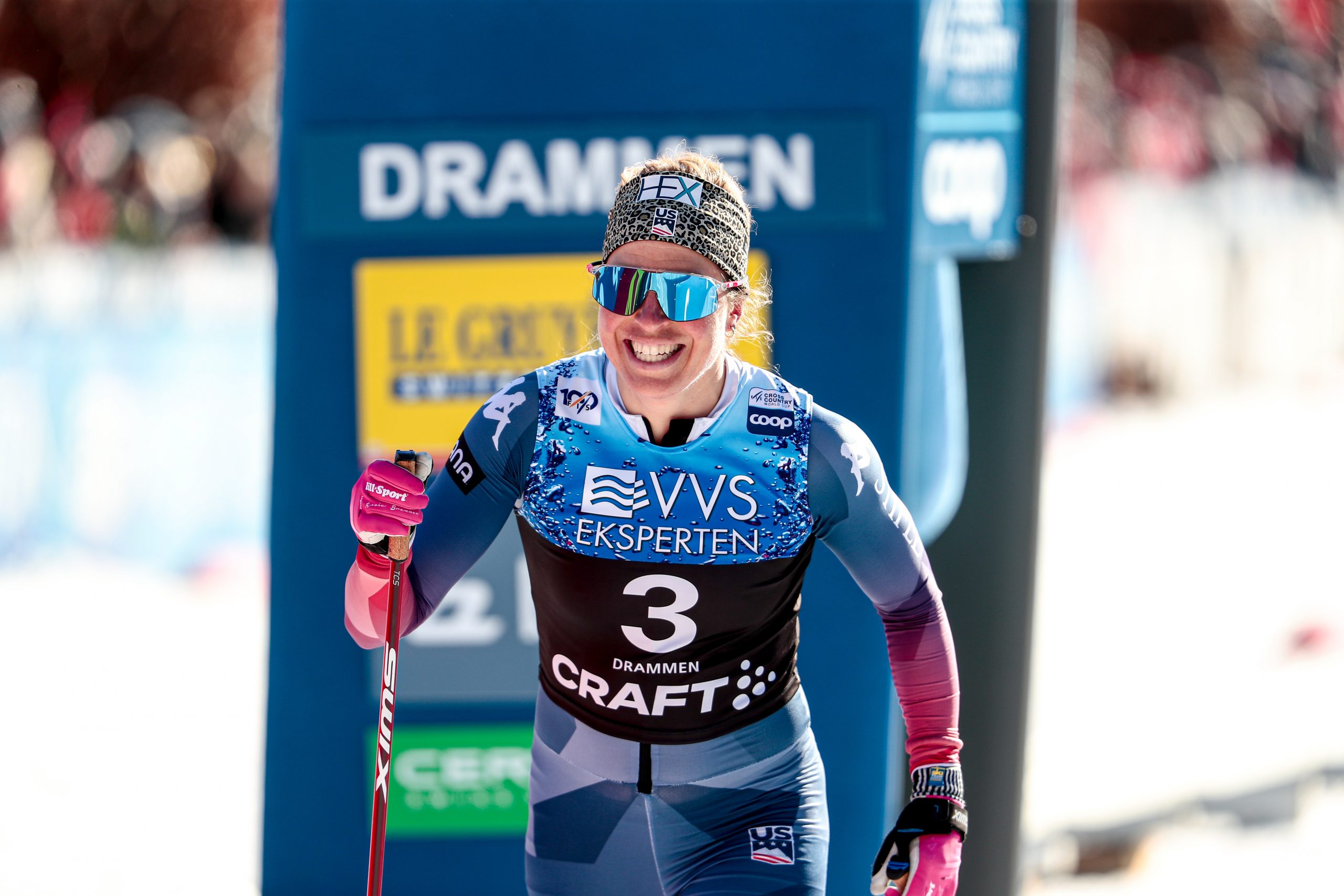
Rosie Brennan – The definitive quote on Rosie Brennan belongs to her former teammate, Sadie Maubet Bjornsen, after Brennan’s near-miss on a podium finish at last season’s World Championships 30 k in Planica. “Ninety-nine percent of the time you’re fourth,” commented Maubet Bjornsen. “That’s just the reality of life. And the way you keep coming back from that is what is really inspiring. It’s such a theme of Rosie’s story: Knock me down, I’ll bend. But I don’t break.”
In the 2023-24 World Cup season opened in Ruka with a 10 k Classic race, and Brennan skied to her first career classic podium. Then Brennan’s results began trending the other way; throughout the 2023-24 season, she skied with a confidence that she could be on the podium in any race. She was on the podium in many—six to be exact—and among those, the real testament to Brennan’s accomplishments was that they were shared across distances and disciplines. She opened with a classic distance second place, went on the next day to take third in a skate distance race, and finished the season with a third place in a classic sprint. Well into a distinguished career, Brennan showed new and brilliant range that hammered home the principle of persistence at the heart of her skiing story.
Kristen Bourne along with other US Ski Team staff in the US Ski Team wax truck, affectionally nicknamed “Yolanda.” (Photo: Courtesy Image/Matt Whitcomb)
Staff Member of the Year
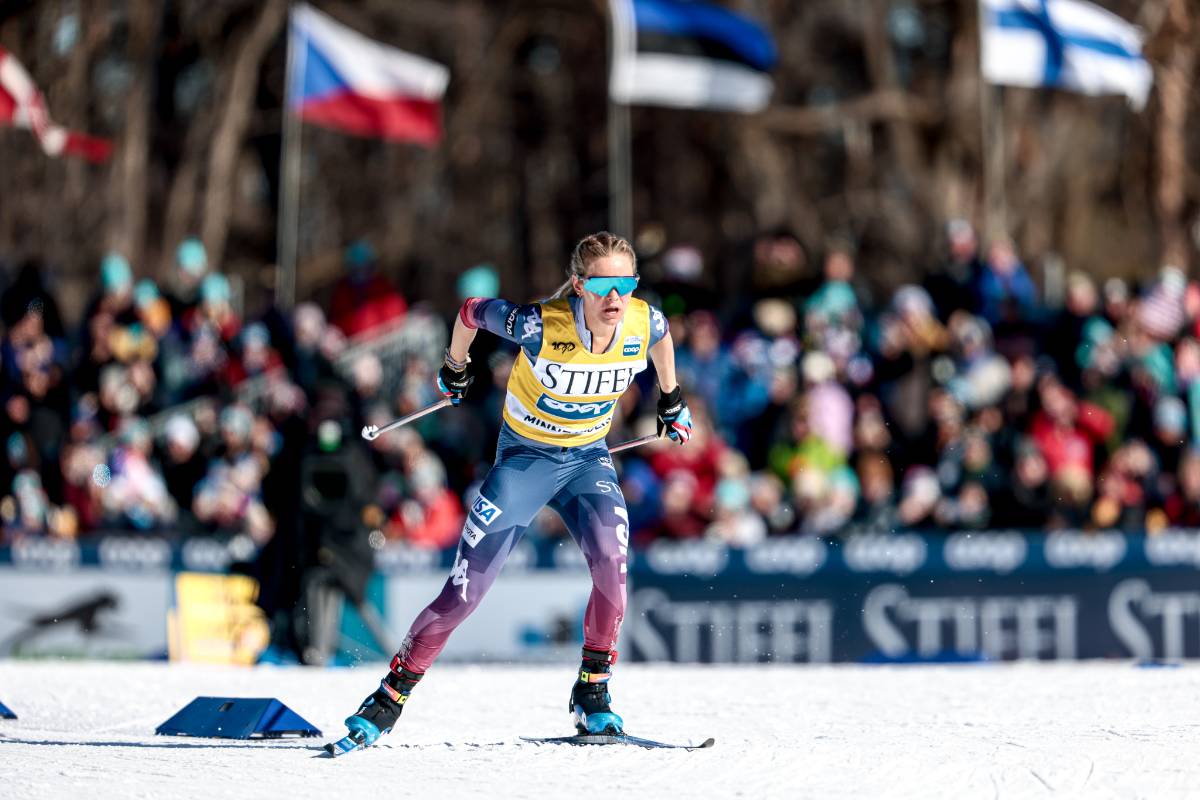
Kristen Bourne – The current US Ski Team D Team coach got her first World Cup experience as an Women’s Sports Foundation Tara VanDerveer Fellow during the 2021-2022 season (when she was serving as the Assistant Coach for the College of St. Scholastica Ski Team). “[Having a moment where] my plane ticket [was] in hand and I was like, ‘whoa, I’m really gonna go to the World Cup and wax skis,’” she said. Two seasons on, Bourne has become a staple on the circuit for the Team USA, taking on the wholistic and varied role of coach, logistician, technician and tester that she first experienced then, and becoming a key component in bringing the world-class support required for skiers to get world-class results. Bourne’s journey in coaching has also left a unique imprint on US Skiing. Her initial fellowship on the World Cup circuit—an immersive two-week experience as part of the Team USA’s World Cup Staff—became the model for the The National Nordic Foundation (NNF)’s Trail to Gold Coaching Program, that saw eight more women coaches join the US World Cup staff for stints throughout the season. Team staff members, including Head Coach Matt Whitcomb, have been quick to point to the benefits of the Trail to Gold Program in not just providing another staff member week-to-week on the World Cup, but in bringing a more diverse set of coaching experiences throughout the season.
**Correction: An earlier version of this article asserted that Haley Brewster was the first American women to medal in a U23 World Championships distance race. In fact, Liz Stephen also medaled in 2008. The article has been updated to reflect this fact.**
This coverage is made possible through the generous support of Marty and Kathy Hall and A Hall Mark of Excellence Award. To learn more about A Hall Mark of Excellence Award, or to learn how you can support FasterSkier’s coverage, please contact info@fasterskier.com.
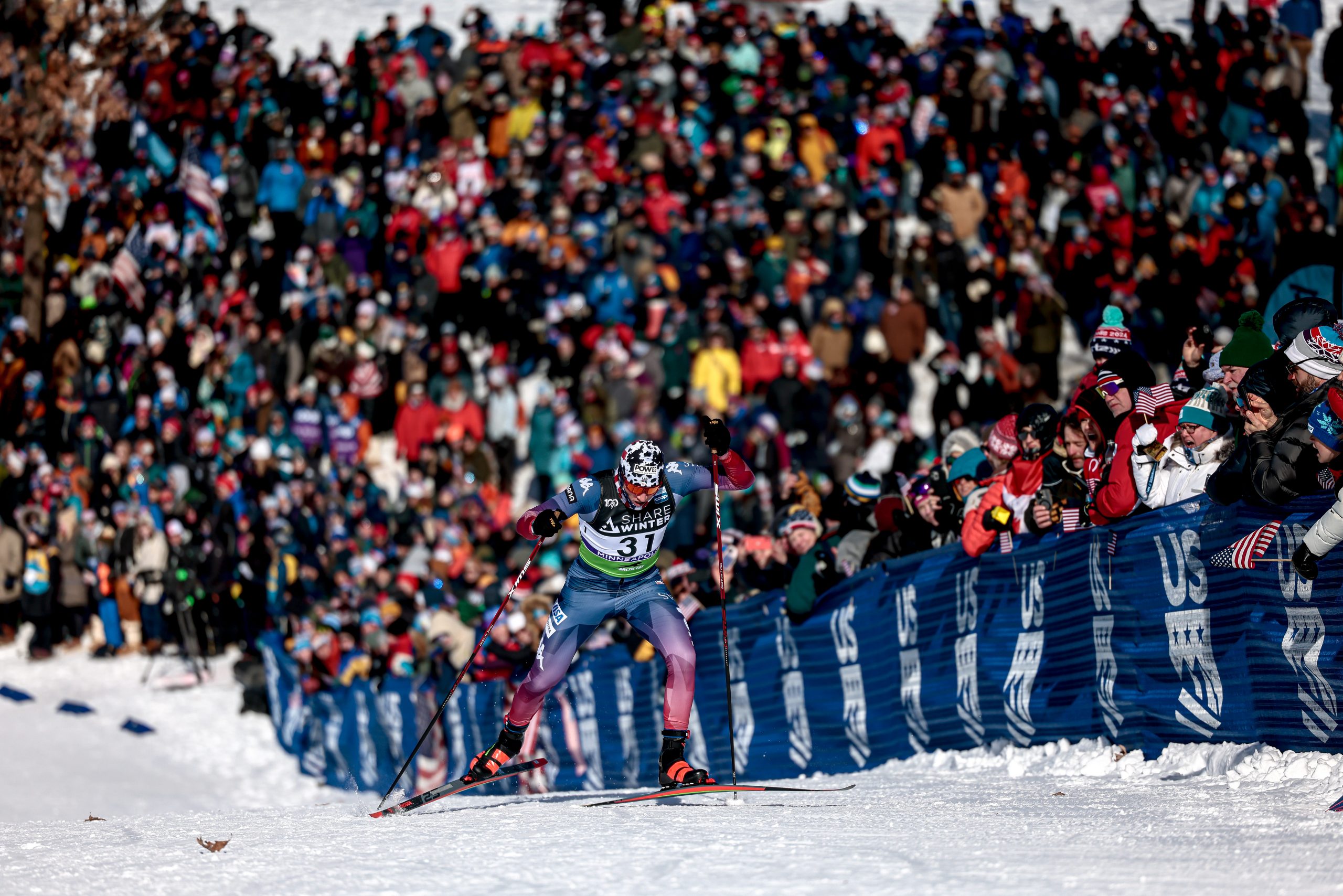
A sea of fans roared as Gus Schumacher (USA) made his way around the Minneapolis course. (Photo: NordicFocus)
After the 2018 Olympics, workers at the Minneapolis Parks and Rec Department had to start putting up posters in the old Theodore Wirth Park chalet to “Clean up your glitter.” Thousands of Minnesota high school cross country skiers who raced there were emulating Jessie Diggins’ famous race-day tradition. The glitter was making a mess, but in Minnesota’s ski-crazy Nordic community, that particular problem was a wonderful one to have. Swix pants and stray gloves dusted in pesky golden glitter-flakes only testified to more young skiers wanting to “Ski like Jessie.” After having watched her win Olympic Gold, they all had a shared idea of the world contained in that simple phrase.
Six years later—again in Minneapolis—Jessie Diggins would bring her glitter to the FIS Cross Country World Cup in Theodore Wirth Park, the first World Cup race held in the United States in over twenty years. What followed was a weekend that most witnesses would describe as “something special.” Twenty thousand American spectators attended a cross-country ski race in America, and on the second day an historic and improbable win from a young Alaskan named Gus Schumacher. It was the first World Cup win of Schumacher’s career, and the first for an American male skier in over forty years. In a banner winter for American skiers (Jessie Diggins winning her second World Cup Overall and seven American skiers finishing on World Cup podiums), Gus Schumacher’s win on home soil was a clearly an emotional apex.
Cut to last week, when the International Ski Federation (FIS) put out a fan vote on its Facebook and Instagram pages to award the “Best Distance Performance of the Year” from this year’s World Cup. Nominees included a predictable slate of Scandinavian stars—Johannes Hoesflot Klaebo, Frida Karlsson, Simen Kruger—but there was a distinctly American flavor to the list of nominees. Three different Americans, with three different performances, made the shortlist. Jessie Diggins was nominated for her early-season 10 k win in Gallivare, Sweden, while Sophia Laukli got a nod for her first World Cup win at the Alpe Cermis Hill Climb. The clear winner of the poll, though, was Gus Schumacher’s victory in Minneapolis.
The “Best Distance Performance of the Year” poll may have been little more than FIS plumbing social media engagement during the doldrums of spring. Even so, in this test of public opinion, Schumacher was the clear winner. That consensus may also be suggestive of more good things to come. As the weather warms, so does the prospect that Schumacher will earn more titles from even more lofty sources. He is likely to be on the shortlist for any kind of upcoming “Athlete of the Year,” or “Skier of the Year” award granted by ski governing bodies and media organizations. He certainly is on the shortlist at FasterSkier.
The extent to which those shortlists and awards shake out will be revealed in time. For now, this informal FIS award was a neat checkpoint smack dab in the middle of the offseason. Two months removed from the World Cup events in Minneapolis, the snow is gone from Theodore Wirth Park. The first blades of grass poking through the mud spell out a clear way forward to spring. It’s a nascent time; with it comes some nascent clarity on what exactly the Minneapolis World Cup—and Gus Schumacher’s win—mean to American skiing.
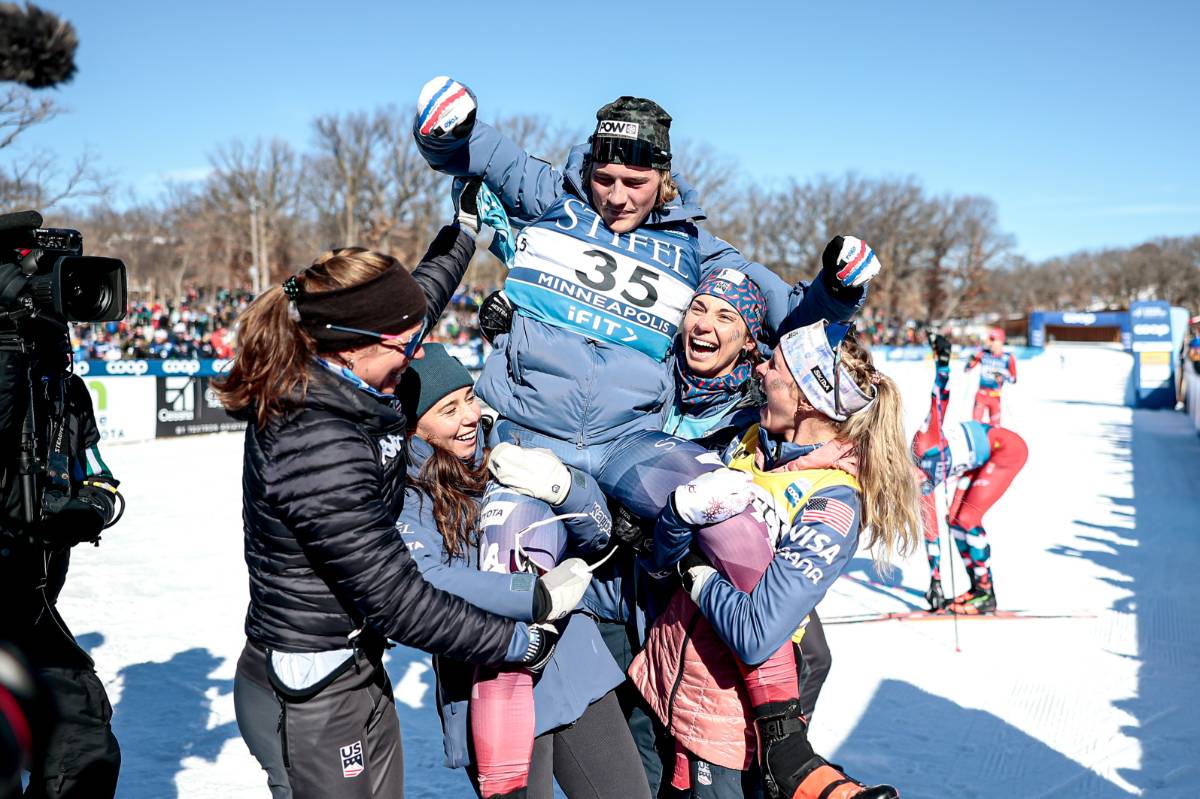
Jessie Diggins helps lift Gus Schumacher after his improbable win at the Minneapolis World Cup in February. (Photo: NordicFocus)
A look at the comments on the FIS Instagram post soliciting votes for “Best Distance Performance” reveals a unified front supporting Schumacher. The question of which individual World Cup performance stood out most to viewers and fans produced an outpouring from American skiers, World Cup champions, and Birkie Birchleggers alike. Some came to the comment section with heartfelt stories on what it was like to process the surprise win as Schumacher, himself, was processing it. How Schumacher started early with Bib 35, crossed the finish line with a 15 second lead, took his turn in the winners’ chair, and watched as every great champion of the sport crossed the finish line splitting seconds behind him until there was no other conclusion to reach: almost impossibly, Schumacher had won. Others came in with more emphatic exclamations: who should win the best performance of the year? “GUS!”
In short, Schumacher’s win in Minneapolis validated itself. If you watched it, you understood why it’s worth striving to do anything well. Why spend years building a ski community in Minneapolis, re-working and expanding a venue at Theodore Wirth Park as the Loppet Foundation did? Why combine the talents of countless individuals across the United States towards developing, of all things, cross country skiers? As Schumacher and his American teammates celebrated at the finish line, the answer became apparent: so that a skier like Schumacher could combine talent, drive, and passion in order to exceed even the expectations he set for himself. The defining characteristic of Schumacher’s win in Minneapolis, though, was Schumacher beaming in an interview immediately after. “I don’t know, this is just the best day ever!” he said.
It took a crowd of 20,000 fans raising their voices along the sides of a Minneapolis ski trail to propel Schumacher toward his unlikely victory. In doing so, the crowd—and Schumacher, himself—revealed the power of what collective energy harnessed in the right individual can do.
Of course, among the FIS “Best Distance Performance” nominees there were two other Americans who delivered the lesson just the same. Jessie Diggins in Sweden was incredible. Sophia Laukli on the Alpe, sublime. Why though, when asked to make the hard choice, did so much of US Skiing latch onto Schumacher? The difference must’ve been found in the venue: Minneapolis, a community versed in sports, versed in the sport of cross-country skiing, and versed in the lessons that sport teaches. For a weekend in February, Minneapolis was a conduit for community spanning an entire continent. Minneapolis ski fans could uniquely recall Jessie Diggins from her time starting out in Afton through to the present day when she epitomizes what skiing can teach you about life: Olympic moments, World Cup triumphs, and all the highs and lows in between.
The testament to Gus Schumacher’s win in Minneapolis, then? This summer, there are sure to be even more young skiers at practices, at camps, pursuing the challenges of cross country skiing. Theodore Wirth Park may still be the place you need to clean up your glitter, but in places throughout our Nordic community young athletes will give voice to a dream to “Ski like Gus.” That day in Minneapolis will flash in their memories, and a smile will cross their faces. “Best Distance Performance of the Year” for certain. And, by all indications, for a whole lot longer too.
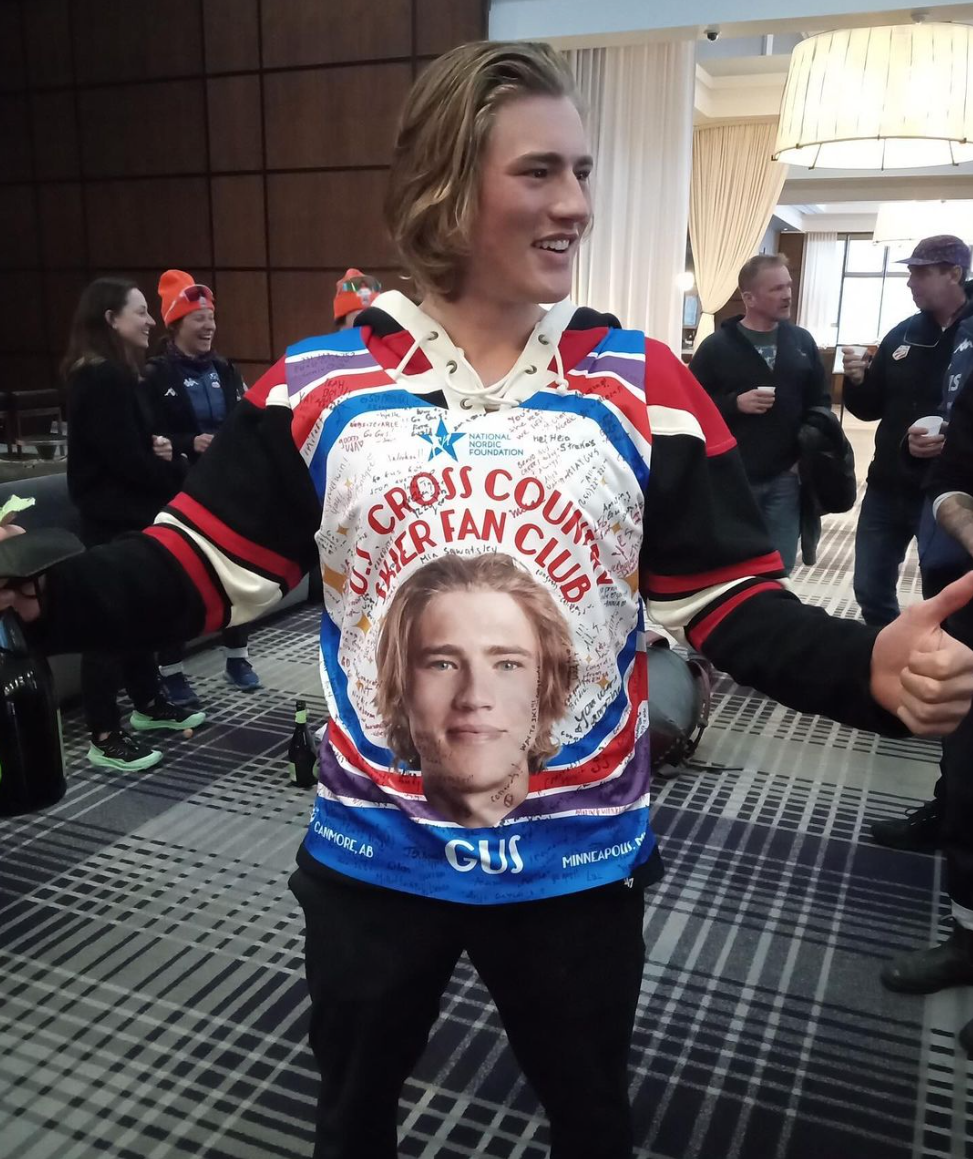
Gus Schumacher sporting a bib signed by over 500 supporters after his win in Minneapolis, donated by the National Nordic Foundation. (Photo: NNF)
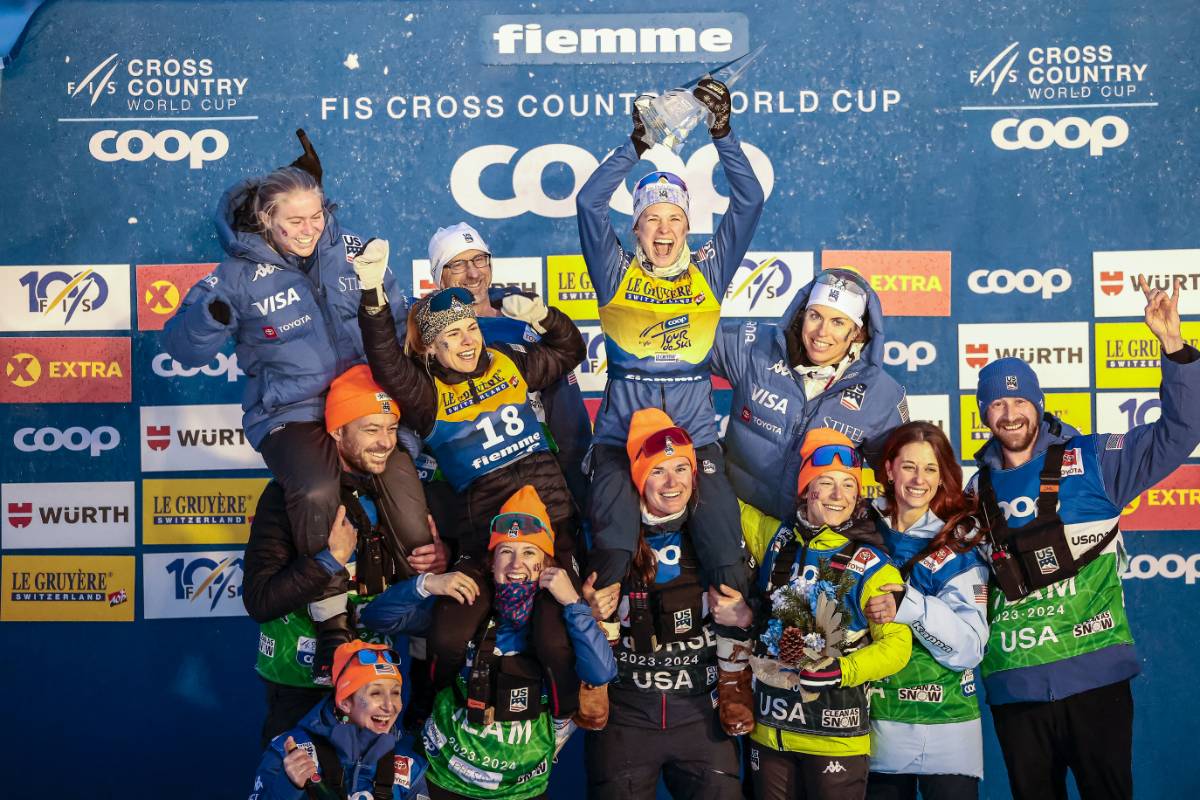
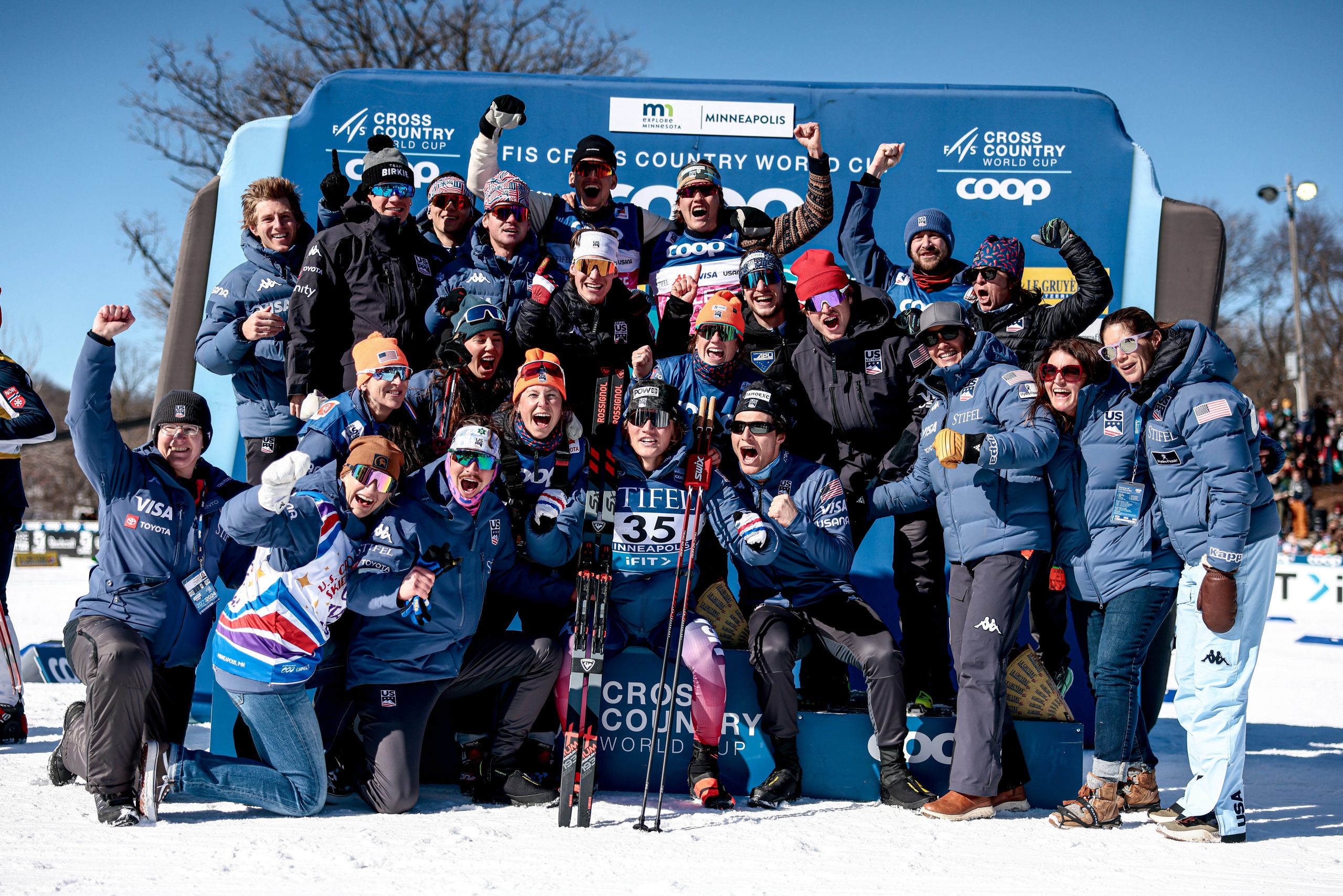
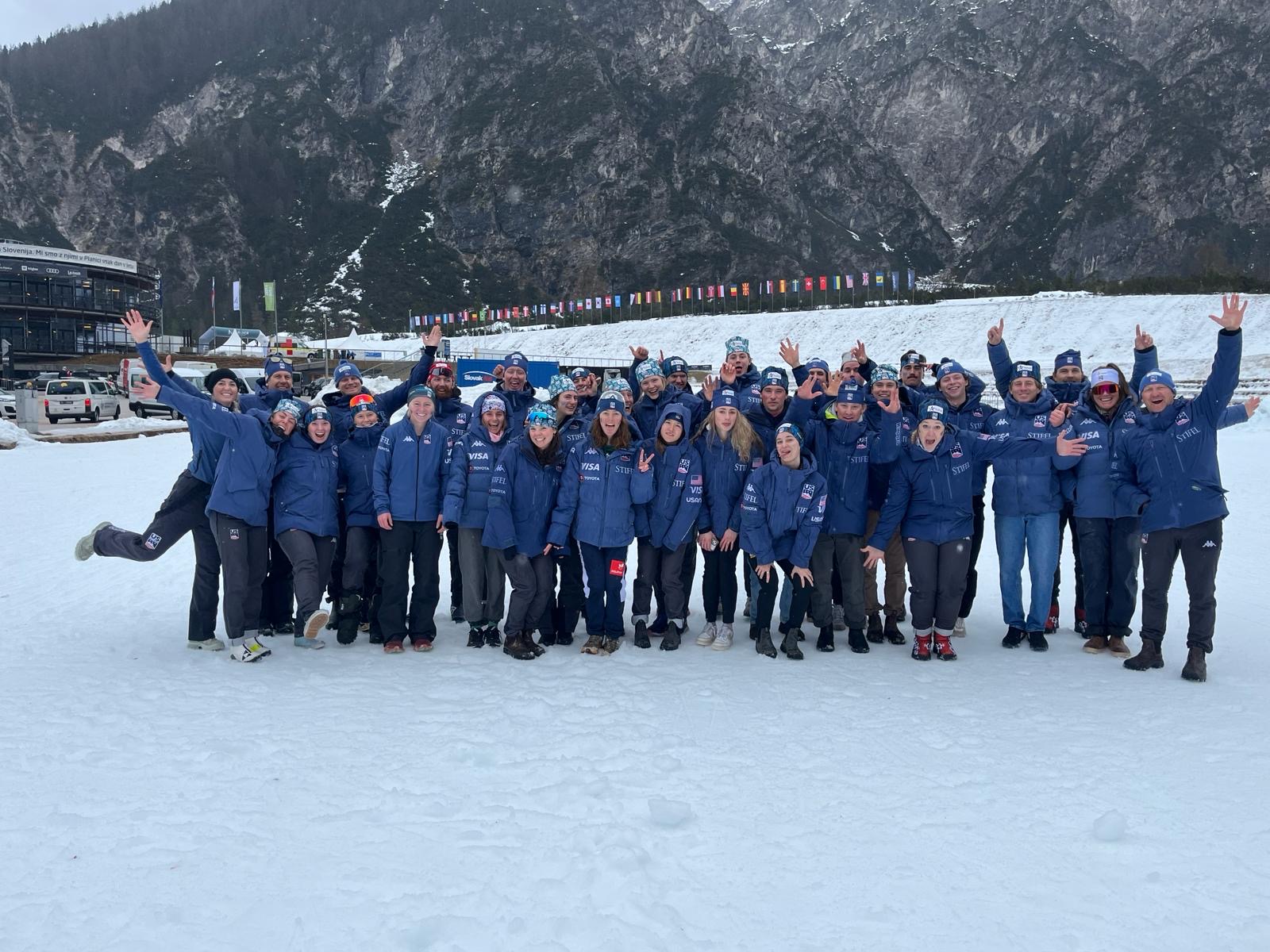
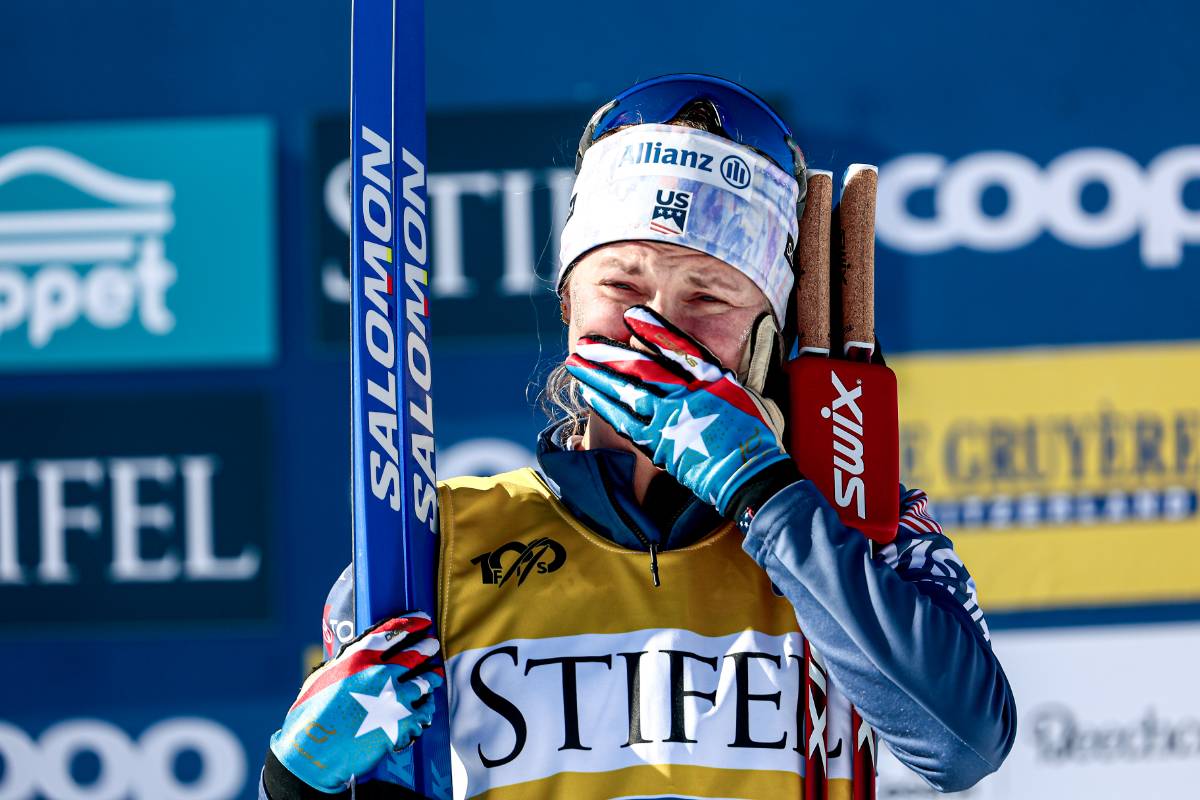
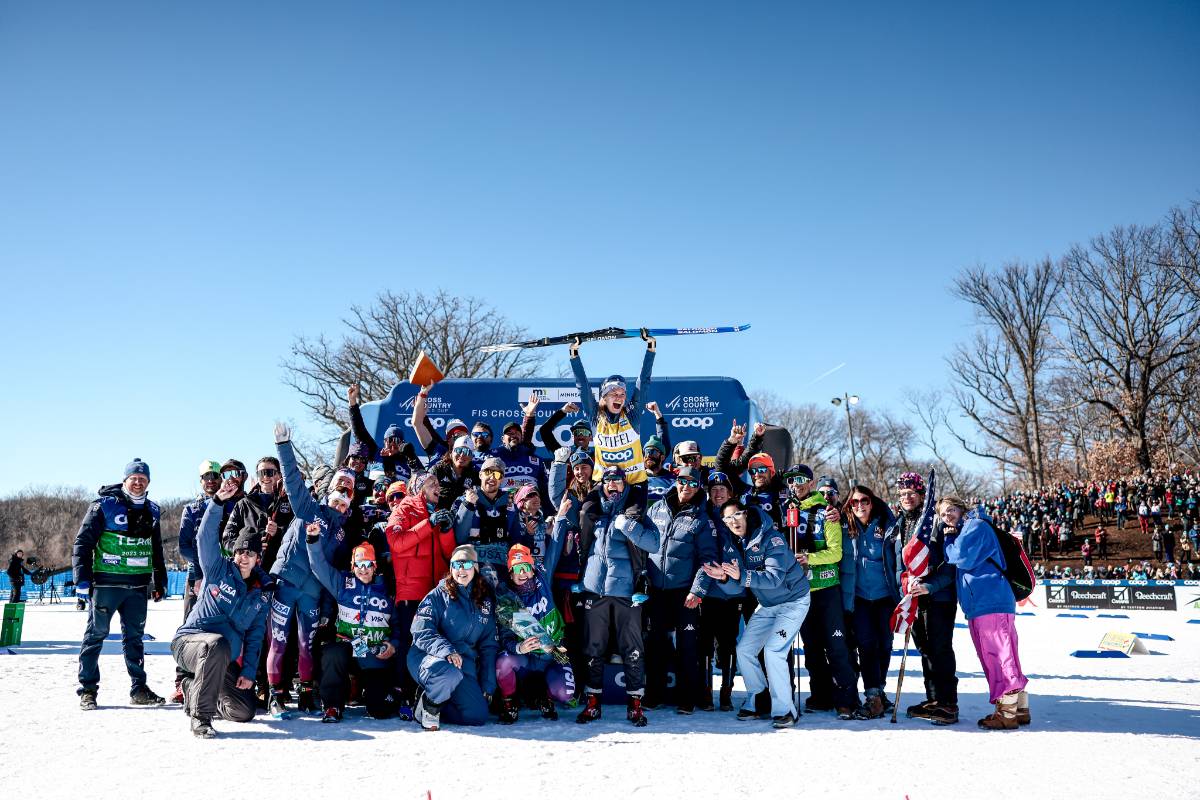
The Stifel U.S. Ski Team and Staff in Minneapolis, Minnesota following Gus Schumacher’s win in the 10 k skate, a highlight of the 2023-24 World Cup season. (Photo: Nordic Focus)
Asked for a reflection on the 2023-24 World Cup season, US Ski Team Head Coach Matt Whitcomb pointed straight towards one place; Theodore Wirth Park in Minneapolis, Minnesota, on a sunny February day, filled to the brim with 20,000 people cheering loud and clear.
“We often talk about athletes peaking for big events,” he said. “But I’d never considered that our American ski culture could peak for an event.”
The specific dynamics between performance and culture may be something Whitcomb is ongoing in noting, but his reflections on this World Cup season show a clear comfort operating in the connected space between the two. In a season of many notable triumphs for American skiers, Whitcomb can trace each individual achievement to a team philosophy shared between each US Team member, extending from their roots in ski communities across the country.
In Jessie Diggins’ Overall World Cup title, Rosie Brennan and Sophia Laukli’s World Cup podiums and victories, JC Schoonmaker and Ben Ogden’s first World Cup podiums, Junior World Championship and Youth Olympic Games medals and, yes, that special Sunday in Minneapolis for Gus Schumacher, Whitcomb sees a consistent ethos. Put together in a single sentence, it’s hard to believe that all those things happened in just the last five months, and as our conversation with Matt Whitcomb shows, this one burst of success is reliant on a consistent thoughtfulness, put into athletes, development, and for the US, a ski community spanning a continent, in which he is a clear leader.
This interview has been edited for length and clarity.
Ben Theyerl/FasterSkier (FS): We last caught up with you ahead of the North American World Cups. I was re-reading that interview, and was struck just by how many of the through-lines you traced in the development of US Skiing and a US Team culture shone through the overwhelming success of the Minneapolis World Cups.
Things like “I want to stand along the course and see and hear what 10,000 people [feel like],” and “We made a goal this year as a team: stop taking podiums for granted. This year, you see us storm the podium and take a team photo with the one athlete who actually earned the award” look a little different when you know there were 20,000 people there, and what it looked like to celebrate Gus Schumacher winning his first World Cup at that World Cup.
How do you look back on that weekend in Minneapolis and what it meant for the US Ski Team?
Matt Whitcomb (MW): I just feel grateful and lucky, so I’d like to say thank you to everyone in the U.S. cross country ski community, and especially to those who traveled to Canmore or Minneapolis. We often talk about athletes peaking for big events, but I’d never considered that our American ski culture could peak for an event. We shocked the visiting nations, and I’m just so proud of it all. A big thanks to Claire Wilson, Doug DeBold and everyone at The Loppet Foundation, including the hundreds of delightful volunteers who ran the event of a lifetime. This World Cup was very expensive, so thanks, too, to The Loppet Foundation, U.S. Ski & Snowboard, Share Winter, the event sponsors, the vendor tents and trucks, and those who chipped in from the grassroot level when the funds were tight.
“If you build it, they will come.” And they did.
FS: There was a lot more to celebrate back in Europe at the end of the season as well. Jessie’s Crystal Globe, of course, and then also a second consecutive year taking fourth place in the Nation’s Cup, which you’ve highlighted as being a very big deal for the team in the past.
When the last ski had been waxed, and the last athlete crossed the finish line this season, what struck you initially about what made this year special for American skiing?
MW: The first thought was one of dread: The staff relay starts in five minutes! When that was finally over, and I was on my flight out of Stockholm, I was thinking about how many American athletes raced a World Cup this season. I believe the number stands at 40, and 7 of them stood on 22 podiums.
We were fourth in the world as a team, losing to Finland by a painfully small margin on the last day of the season. Our women finished the season in third, and our men finished in fifth, when we moved ahead of Italy on the final day. If you look beyond the World Cup too, it was a phenomenal season for US Skiers; we had a podium at the Youth Olympic Games, one at World Juniors, and two at U-23 Championships.
I get more excited about the reasons behind the results than I do about the results themselves, and I’m proud of the club system we’ve all built in this country. We are a decentralized national team, which means we don’t bring the athletes to live in Park City, Utah as soon as they make the team. Instead, the clubs and the national team work together to build a team around each athlete that covers the whole year. It feels good to see that working.
Rosie Brennan and US Ski Team Head Coach Matt Whitcomb embrace after Brennan skied to a second place in a 10 k Classic race in Ruka, Finland. (Photo: Nordic Focus)
FS: As you’ve had a little time to reflect, are there any other aspects of this season that have risen to top-of-mind as being clearly special? Maybe it was a specific performance, or a particular principle that really shone through about this year’s group…
MW: Take a look at our three men’s podiums. Also, re-read that sentence! In each instance, there was a special sort of human connection, which ultimately points to the fact that our success requires so much more than just good training.
JC Schoonmaker toes the line in the skate sprint final in Östersund, Sweden. Five minutes earlier, he watched his girlfriend, Emma Ribom, win the women’s race. And not only that, his brother and teammate, Ben Ogden, is in the heat with him. They have something to defend. A mission. There’s some fuel to burn, and he finishes third, Ben fourth. This was JC’s first podium, and our first men’s podium in seven years (dating back to Simi Hamilton’s 2nd place in Toblach in 2017).
Ben Ogden makes the podium in Toblach, Italy, just three weeks after watching JC break the barrier for our men’s team. There’s a different vibe now: We’ve transitioned from knowing we could do it, to doing it. Our young men’s team has come alive, and Ben is at the center of it today. He and his boys are building something together, and today, he intends to showcase it. And in the crowd, hanging over the fence at the top of the last climb, is his mom, his sisters, his girlfriend, all there to support him in what has been the hardest year of his life. He finishes third, and lands on his first career podium.
Gus Schumacher starts bib 35, and heads out on the 3.3k loop in Minneapolis, which is a tunnel of 20,000 Americans, who have essentially created a particle accelerator loop for our skiers. With a reasonably low bib number, his “race leader” splits are somewhat empty, as he knows he should be winning at this point, because the big boys are yet to start. And Gus is now the target. One by one, the rest of them start and are clear of 6.6k. Gus is still the leader, but nine men know that he is only eight seconds ahead of them, and it will be nearly impossible for him not to be overtaken…unless you were there, and you heard how American fans support their skiers. It was actually impossible for him to be beaten. If you saw Gus’s final 2k in Minneapolis, you saw something special. This wasn’t just about a lot of smart preparation and grit. You saw what inspired skiing looks like, which happens when there is something to ski for.
FS: Five monthsis a long season, so this is intentionally a kind of absurd question: is there a single moment that sticks out to you as having been an especially good distillation of this season for the US Ski Team?
MW: This jumped out immediately. One of our Trail to Gold coaches during the last part of the World Cup season, Julia Hayes Forbes, had a birthday while we were in Oslo, so we all met at the wax truck, affectionately nicknamed Yolanda, before dinner to celebrate, and basically regroup for the final week of Drammen and Falun. We were a tired staff. We had not had the best two weeks of racing, and the pressure was now very high. In Yolanda, our staff has a few trophies we pass around when someone feels like acknowledging exceptional work. I won’t get into the bylaws that govern how the primary, back-up, and secret trophies are awarded, but this night, for two hours, we sat in a camp-chair circle and took turns celebrating each other. We dug in deep for two hours, tossing the back-up trophy—which is a hockey puck—from this person to that. We laughed a lot. There were some tears, too, because we all took the chance to slow down and appreciate each other. We felt lucky, and that was it.
Two days later, Rosie hits the podium in Drammen. She was back. We were all back.
US Ski Team Staff in their wax truck, affectionally nicknamed “Yolanda” trading accolades and laughs. (Photo: Courtesy Image/Matt Whitcomb)
FS: A lot of us who work as coaches are into feeling that post-ski season haze and relief and are curious for you, What do you do to get yourself some rest after the season?Is there a point each spring where you start to get really excited about re-convening with the US Team in Bend?
MW: I always expect my first couple of weeks back from the season to be relieving and restful, but in truth, it’s a tough time of year for me. Coaches have the wonderful job of feeling purposeful, and being required to ski as a profession. We’re goal directed, and each weekend we get to test our progress against those goals. Suddenly that’s gone, and we’re supposed to decompress with time away from it all, and it’s hard for me. We do our planning in early April, and that’s when I start to get excited again. I do miss the team and our staff, and I have a lot of unaccomplished goals yet to meet, so it’s been fun to get back to work.
In terms of what I do, I spent 10 days in Austin and New Orleans with my girlfriend, Caitlin, going on ghost and gator tours, eating everything, including gator. Before Bend, I’ll get out to a Lake in Nevada with my brother, Jake, and former ski racers, Cam MacKugler, and Hunter Karnedy, for a few days of fishing.
FS: Last time we talked with you, you emphasized how “[building and maintaining a great team environment] will always be my number one focus,” and pointed to the group of US Women who really elevated US Skiing to its current run of historic results that started in the 2010s with Kikkan Randall, Holly Brooks, Liz Stephen, Jessie Diggins etc…
How have you observed that great team environment evolve over the last couple of years, especially as there’s been a couple different groups of young skiers – first Ben Ogden, JC Schoonmaker, Gus Schumacher, Luke Jager, Julia Kern, Novie McCabe, and Sophia Laukli, and now John Steel Hagenbuch, Zanden McMullen and Sammy Smith, among others, join and find World Cup success?
MW: We had some great years during the second half of the Kikkan era, and while all but Jessie and Rosie have moved on from ski racing since those days, the expectation of what it means to be a member of the U.S. Ski Team is as clear as it ever was. Each skier and staff member has a responsibility to the team. The return one gets from that investment is one of the keys to a great career. I think that’s the legacy of those skiers from 2006-2018. As we all expected, the young American men’s squad from the Goms, Oberwiesenthal, and Lahti World Junior Championships have arrived. Given the nature of their success as three-year relay medalists, we didn’t just expect to receive fast skiers, and we figured they were going to be pretty invested in the team element of cross country skiing, too. To have that is critical. We’ll go backwards if we ever lose it.
FS: Finally, well there’s still snow on the ground (even in New England!) and memories of the season are still fresh, here’s a way to early question: what hopes do you have for the Stifel U.S. Ski Team as it looks towards 2024-25?
MW: We are trying something different this year, which is to travel less in the summer. We will have big camps in Bend, Oregon in May and in Park City, Utah in October, but for June, July, August, and September, the emphasis will be on stable training at home, really leaning into the club system. We’ll have small projects inNew Zealand and Norway, and coaches will make some club visits, but most skiers will travel less, and I’m excited to test this new plan.
The goal for the next year is to have success in Trondheim at the World Championships, and those championships come very late in the winter compared to previous World Championships, February 26th-March 9th. To succeed there, we need stability. And of course, as a team we plan to break our two-year pattern of being fourth in the World. We want that top-three badly.
FS: You mentioned that April ends up being the time for “planning” for next season and beyond for you, and for all of American skiing. You also implicitly mapped out where that planning pays off – the guys that were medaling at Junior World Championships a couple of years ago worked persistently and diligently, and got the support they needed, and now JC, Ben, and Gus all have been on World Cup podiums.
US Ski Team athletes and coaches on a ski tunnel training session last year. (Photo: Courtesy Image/Matt Whitcomb)
When you look at translating the developmental success US Skiing had this year into that next generation of World Cup podiums, where are you looking?
MW: I don’t think most people realize that we are the only team in the top-10 in the World who doesn’t receive government funding. That’s why you hear us asking for money every year. Each year, the U.S. Ski Team invests over a million dollars in our cross country program. That money comes from sponsors and partnerships, and from private donations. It is spent largely on our A and B Team athletes, and the coaches and techs that run the team. The National Nordic Foundation, on whose board I serve, raises money exclusively from private donations. We invest in the athletes below the A and B Team level, down to the U-16 level, to ameliorate the financial barriers of our development system. While that amount invested in our younger athletes varies from year to year, it has hovered around $350,000 for each of the last three years. Every development camp in the U.S., including U-16, REG, NEG, and NTG are subsidized to the tune of about 70k by these funds. We invest 23k in the SuperTour hosts, so they can afford to organize the races, and 28k in our Trail to Gold women’s coaching grant, to close the gender gap disparity in elite coaching. 47k has just been sent to the 26 World Cup athletes who are not A or B Team athletes, but who still earned World Cup starts.
So, when you hear about the NNF’s online auction in July, or our Drive for 25 in November, or some scheme to sell athlete bibs or hats for an event, this is why. We truly need your help. We are working hard for the athletes, so they can afford to participate in our great sport. There are over 2,000 people who donated to the NNF in some way last year, and I’d like to end this interview as it began, with a thank you.
US Ski Team skiers sporting their very own US Ski Team Staff NNF Fan Bibs in the wax truck in Minneapolis, Minnesota. (Photo: Courtesy Image/Matt Whitcomb)
SuperTour race weekend in Craftsbury, VT, where Zach Caldwell (left) supported SMS T2 athletes. (Photo: Facebook Caldwell Sport)
On January 17th, 2022, a US Ski and Snowboard (USSS) ban on using perfluorocarbon-based wax products (“fluoros”) at all International Ski Federation-sanctioned (FIS) races in the country went into effect. The action marked the critical point in a rapid evolution of policies meant to limit competitive nordic skiing’s emission of perfluorocarbons, part of a class of especially environmentally persistent, and potentially health-concerning, chemicals known as PFAs. Overnight, The cumulative knowledge of 40 years on ski preparation nulled. Since then, it’s been a brave new world.
Step into a wax room these days, and you’re unlikely to hear codewords like “Cera F” and “Jetstream” muffled from behind the gas masks that became standard issue near the end of the fluoro-era. The scramble to take everything into account—from snow temp to air temp, ski selection, grind, and base material too—and funnel it into putting the best ski on the snow for a race is still there. The rules may have changed, but the game is the same.
Two and half seasons into fluoro-free racing, there have been countless tests by wax technicians across the continent to figure out just what they’re working with on any given race day. Among them has been long-time American “ski whisperer” Zach Caldwell, owner and operator of Caldwell Sport in Putney, Vermont. As New England thawed out from its last snowstorm of the season, and US Skiing from the season that accompanied it, FasterSkier caught up with Caldwell to learn what he’s learned about where the limiter of fluoro-free waxing has started to push ski service.
Speak to Caldwell, and you’ll quickly get acquainted with jargon that acquaints you with his professorial approach to ski service. He’ll often talk about “solutions,” that is, the singular result of combining the “pie” of factors (see our 2022 discussion on what makes a ski fast featuring Caldwell here) that go into a race-ready ski. In that pie, you’ll find ski camber, ski flex, base grind selection, hand-applied structure, and everything that can be broadly categorized as wax. He also cites how “robust” solutions are the best solutions; that is, where the overall combination of the factors within that ski performance pie can be adaptable to a wide range of conditions. In Caldwell’s view, the ideal ski technician is as much engineer and artist as they are actuary. “Robust solutions limit the risk of sending you in the wrong direction.”
Zach Caldwell in his element. (Photo: Facebook Caldwell Sport)
“Wax with fluoro compounds occupied a big part of the whole pie when it came to ski performance,” Caldwell had said previously. His expectation when the US moved to eliminate fluoros from the wax slice of the pie two seasons ago was in line with many ski technicians. “I figured was that we weren’t going to accommodate for the lack of fluoros,” he said. “All we did by eliminating fluoros was make the comparative importance of everything else bigger.”
The key problems to which fluoros served as a solution were twofold. Fluoros resisted water better than any other compound. Fluoros were also better at helping to keep base-clogging dirt away. Those properties came from a complex interaction of chemical, ski, and snow. When applied to a ski, the chemical differentiation of fluorocarbons from a standard polyethylene ski base meant they formed a “top-coat,” not mixing with the other base wax treatments that helped change the bulk properties of the base. That fluorocarbon top-coat was extremely hydrophobic, which helped discourage water-on-water friction in wetter snow conditions most often found around or above freezing. The fluoro top-coat also abraded with dirt that otherwise would be picked up by the ski base, lending to the sensation of “durability” from skiers. In attempting to replace the water- and dirt-repellency offered by fluoros, ski technicians have most often looked at other slices of the overall solution “pie” to re-produce those qualities.
The initial expectation from Caldwell was that skiers would look to ski selection and base grind as factors readily available to assist in finding a solution. “When it comes to that, it’s played out 100% as I predicted it would” he said. “We’re selling way more skis, and grinding way more skis [at Caldwell Sport]. There’s a lot more active testing of hand structures.”
A ski being brushed. After the elimination of fluorocarbon wax products, ski selection and grind have jumped to the front of many skier’s considerations in race preparation. (Photo: NordicFocus)
In particular, skiers are looking to add more specialized skis to their fleets in the conditions in which fluoros once excelled. Higher camber skis—skis that ride higher above the snow and often have less prolonged surface run times than comparative skis—can help in having skis not pick up as much dirt. Base Grinds and hand structures, especially “V” shaped chevrons and deeper linear rills, can help channel water away from a ski base in wet conditions.
The push out to the ski itself, and grind selection, has led to a new dynamic in race day solutions. “In the past, you could show up with an inappropriate camber and get those skis into the game in the right conditions by using fluoros,” said Caldwell. “Now, showing up with the wrong ski or wrong hand structure is not doable. You’re unable to compensate with a great wax solution.
The dynamic of not being able to wax your way out of a mis-matched ski has come as a result of what Caldwell sees in the selection of new fluoro-free waxes that have been offered on the market.
“I’ve had to revise my expectations around the wax itself,” he said. “I knew we couldn’t replicate the performance of fluorocarbon chemistry, but thought that the difference between the teams that could test application methods and products ad nauseam and those who couldn’t would be emphasized. As it’s turned out, it has felt like many of the solutions just hit the ceiling for performance at about the same place.”
The result has been twofold. For one, it takes less resources to reach that lower ceiling of performance, and it can often be done by waxes from a much lower price point than the $150-200 fluoro blocks that used to contribute to a race day ski build. There are also more ways to get to an overall ski solution that precludes having found a particular wax product selection and application. Hence, the turn towards ski, grind, and structure selection for many skiers.
Caldwell sees a particular pressure point in the ski industry given the way many fluoro-free waxes have hit a similar performance ceiling, often at wildly unreliable price points: “Some of the big companies were very quick to introduce fluoro-free lines in an attempt to make a new market follow old rules.”
“The price points on those first fluoro-free products reflected that the big wax companies knew that there was a high tolerance high price points among consumers,” Caldwell said. “The thing that gets kind of lost is that those consumer tolerances were built around wax solutions that re-defined the sport. That’s what those 30-gram Swix Cera F vials did in the late 1980s. They were definitely revolutionary. We’re currently in a place now though, where a nominally $1 per application wax job can beat a $10 per application wax job, and after a while, that’s just going to frustrate consumers.”
Ski Techs sorting through test fleet on a race day. (Photo: NordicFocus)
Caldwell views the muddy value proposition offered by new fluoro-free waxes as contributing to a cultural shift away from the “essentially technical” nature of nordic skiing. “It’s creating an environment where the incentive is stronger than ever to control the role waxing places in the whole solution on race day.” That chiefly includes wax protocols, often modeled after the one introduced by Rocky Mountain Nordic in 2019 that now are enforced across a host of junior and collegiate circuits in the United States. “If we assume that on any given day, without fluoro, there is a certain amount of speed available,” said Caldwell, “[Then] by limiting the role wax plays, you’re decreasing the amount of creativity that can be brought to bear in getting to that total speed available. You end up with more of a disparity than you would have by allowing wax to be brought into the picture.” FasterSkier previously covered the discussion surrounding competitive and technical balance at play in wax protocols here; however skiers might form opinions on where the technical aspect of skiing meets its competitive culture, Caldwell was careful to point out that having those opinions is one of the essential beauties of the sport: “I was pretty young when skating came into the picture,” Caldwell said. “People lost their minds like it was going to change the sport beyond recognition, but what happened? There’s a dialectic that’s healthy, and we ended up with a sport that still includes classic skiing, and even there, a ‘classic skiing’ that is pretty advanced from what they were trying to preserve, right?”
“Progress is always going to be there,” Caldwell said. “And trying to halt progress is a bad idea… but that doesn’t mean you don’t try to steer progress.”
U.S. Ski Team wax truck during pre-season camp in Rovaniemi, Finland. (Matt Whitcomb)
On the contrary, the gyre of new ideas and new technologies spinning the sport forward keeps Caldwell, a seasoned-ski expert among seasoned ski experts, excited some fifty years into the sport. He hopes it will keep you excited, too. In that regard, he leads by pure example. In the brave new world catalyzed by fluoro-free, he sees a broad horizon to chart out skiers’ relationship to how they view their skis. He spins visions on how the World Cup could start promoting the technical aspects of the sport, broadcasting wax tests and highlighting ski profiles the way F1 motorsport does. He can rattle off, with passion, a broad architecture to incentivize ski companies to start producing their best skis for all skiers. “Imagine a world where Fischer had to produce a 50th percentile ski that Johannes Hoesflot Klaebo could win on!”
For Caldwell, all of it comes back to a deeply rooted experience in a nordic community he loves. “One of the really cool things about the US is that the nordic community is quite open, uncharacteristically open, compared to other countries. It’s full of a lot of good people, and I think that culture is, at present, one of the most sophisticated cultures in the world when it comes to ski innovation.” As to where are we in the fluoro-free world, two seasons in? “You mean in a world where you can’t brute force your way to good solutions with more resources?” asked Caldwell. “Well, it’s a world that puts a premium on collaboration and creativity? Turns out we’ve been pretty good at that for a long time over here.”
John Steel Hagenbuch started off his season with a World Cup career first top 15 in result Ostersund. Tuesday, he finished it off in style with a win in the 40 k skate mass start in Duluth. (Photo: Nordic Focus)
Out like a Lion: the old adage seems to apply to March in Duluth, Minntesota. At the end of March—during the only true snowstorm that season has delivered to Duluth—the last race of the 2024 SuperTour season and Spring Nationals was set to be a ten lap, 40 kilometer mass start skate race. It was a big race, marking a big end to a big season for a pair of America’s best young skiers.
In the Men’s race, John Steel Hagenbuch skied to an emphatic end on a season that reads like a dream. Back in the frosty days of early December, the Dartmouth Ski Team junior went to the World Cup held in Ostersund, Sweden and skied to his first career top 15. From there, he became US National Champion, World U23 Championship medalist, and an NCAA champion too. In the closing moments of Tuesday’s 40 k skate, he marked a move made by Craftsbury Ski Club’s Jake Brown, came out of the final downhill at Spirit Mountain, and came across one final line with another National Championship to his name.
On the Women’s side of the field, the one to watch as of late has been Alaska Pacific University’s Novie McCabe. She’s established herself as a consistent presence in the World Cup’s top 30, a trajectory that’s charted towards the front of the field with each passing week. A U23 World Championship highlighted by a fourth place in the 20 k skate mass start in February translated to form that led to an 11th place in the final 20 k skate race on the World Cup in Falun this season. Then, in Duluth, she has been nothing short of amazing. A win in the 10 k classic Thursday, a win in the classic sprint, a runners-up podium finish with teammate Renae Anderson on Sunday, and a long-range, solo victory through the wind and snow that left her two minutes ahead of second-place finisher Sydney Palmer-Leger.
Men’s 40 k Skate Mass Start
Ahead of Sunday’s Team Sprint at Spring Nationals, a round of wet snow started to fall onto the race course at Spirit Mountain, and by the 9am start of Tuesday’s 40 k skate, it hadn’t stopped. It only added to the challenge of a four kilometer loop that traversed the base of Spirit Mountain, featuring two distinct climbs over the course of ten laps.
The set-up of the course had a clear-cut impact on how the Men’s field approached it. Through each lap, the opportunity opened up for an attack on the climb that wound its way out of the stadium for nearly a kilometer. A distinct group of leading skiers emerged including University of Utah’s Joe Davies, US Biathlete and Craftsbury Ski Club skier Jake Brown, Canadian Antoine Cyr, APU’s Scott Patterson, and John Steel Hagenbuch.
The quintet remained in tight contact through the last half of the race, with Davies and Patterson picking up the pace through the later laps. Notably, Cyr and Hagenbuch rarely went to the front of the group to lead, alluding to both skiers’ dynamism as sprinters. With a winding downhill running into a clear-cut sprint finish, both seemed determined to make sure the group remained together into the final kilometers of the race.
At the base of the climb, Davies ticked up the pace, before Brown blew it wide open. The Minnesota native got a clear break from the group, but found one skier who was with him as they crested the first of two climbs on course: Hagenbuch.
Scott Patterson earlier this year on the World Cup. The longtime APU skier rounded out a World Cup farewell season with a third place at Spring Nationals in Duluth Tuesday. (Photo: NordicFocus)
Another break saw Patterson and Cyr behind the Brown/Hagenbuch group. Suddenly, a four-way race for three podium spots was on. Brown led through the second climb on course, and into the long, winding downhill that led back to the stadium. Hagenbuch waited until the base of the hill, and then put in his own move, gaining a second gap over Brown that would remain to the finish-line. Hagenbuch crossed in first with Brown in second. Behind the two leaders, Cyr opened a sprint at the base of the Spirit Mountain stadium crossing in third overall, with Patterson fourth. The race for the podium left everyone happy, however, as Cyr’s result did not factor into the US Nationals standings. Patterson’s place behind Cyr still netted him a third place; a great send off for the Alaskan veteran following his recently announced retirement from World Cup skiing.
Novie McCabe started off consistent in the cold this season, and has finished it with three wins in four races at Spring Nationals in Duluth. (Photo: NordicFocus)
Women’s 40 k Skate Mass Start
McCabe sensed the same course dynamics as the Men’s field had earlier in the day at Spirit Mountain: lots of laps, and lots of hills to attack. She picked the sixth time up the first climb to pull away from a front pack of three containing the University of Utah’s Sydney Palmer-Leger and Sun Valley’s Mariah Bredal, came through the next split five seconds ahead, and then proceeded to grow the gap to over two minutes in the last 15 kilometers of racing to take first place.
Sydney Palmer-Leger gained her own advantage over Bredal in following McCabe’s move, and kept a firm grip on second place. Bredal rounded out the podium in third place, with her own gap over Alayna Sonneysn (SMS T2) in fourth, and Ava Thurston (Dartmouth Ski Team) in fifth.
Tyler Kornfield (APU) wins the men’s freestyle sprint in a bootslide ahead of Noel Keefe (Univ. of Utah) at the 2021 SuperTour opener weekend in Duluth, MN. (Photo: Jordan Woods/Woods Creek Productions)
It’s the most welcome irony of the 2023-24 North American ski season so far: As “Spring” Nationals started Thursday at the Spirit Mountain Nordic Center in Duluth, Minnesota, the newly coined “lost winter” of 2023-24 in the Midwest looked to have at-last been found. Snow, from the sky, and not from the end of the snow gun, floated onto that pretty little hillside city near the shores of Lake Superior following the 10 k Classic that opened four days of racing Thursday night. And while racers gathered from across the United States and Canada woke up to a pleasant dusting of white Friday morning, it is looking as if that was simply a opening blip on the story that winter weather will play in the week’s racing, as another storm system looks primed to bring 12-18in of snow, along with some pretty nasty Lake Superior gales (as they say in Duluth, “it’s colder by the Lake!”) right as US Spring Nationals turns towards its finale 40 k on Tuesday.
What exactly are top North American World Cup performers this season, and skiers last seen winning at NCAA Championships, or Junior Nationals doing headed into March conditions that sound eerily reminiscent of the opening verses of the “Wreck of the Edmund Fitzgerald?” They’re all there for the odd, fun, fixture of the US Skiing calendar presently known as SuperTour Finals and Spring Nationals. This is the point where the tensions, travails, and triumphs of the current season start to meet implications for what will happen the next time snow falls on the Midwest (it will fall next year, we can all start to hope!) ahead of the 2024-25 ski season.
Racing started with a 10 k classic on Thursday, with wins from Antoine Cyr (Canadian National Ski Team) in the Men’s race and Novie McCabe (Alaska Pacific University, APU) in the Women’s race, and continued on Saturday with a Classic Sprint won again by McCabe in the Women’s race, and by JC Schoonmaker (APU) in the Men’s race. The program continues on Sunday with a skate Team Sprint, and finishes with a 40 k skate race on Tuesday.
How Did We Get Here? SuperTour Finals and “US Spring Nationals.”
The program being raced in Duluth this weekend is an amalgamation of a lot of ideas that spring from one idea; give the best ski racers in the United States a chance to ski race deeper into the winter.
The traditional bounds of the competitive race season in the United States at all levels have tended to place their ends somewhere in the beginning to middle of March. Athletes who have spent the majority of the winter on the World Cup are back in North America for the first time in months (with this year, and the North American World Cups, a notable exception). NCAA Championships are settled in the first week of March. Junior Nationals takes place around the second week of March.
Yet, most American circuits ending mid-March is an oddity in the scheme of international skiing. The Norwegian National Ski Championships, for example, just kicked off in Lillehammer, and now are held a late-March spot on the calendar to allow and encourage their World Cup athletes to take part (though, it’s worth noting, there is a complicated history on the date of their Nationals as well). A quick survey of the results from Norway on Day 1 of their Championships Friday shows that indeed, their top skiers do take part, as Johannes Hoesflot Klaebo won the Men’s 10 k classic the Men, and Heidi Weng won the Women’s 5 k classic;
Jessie Diggins anchoring the Stratton Mountain School T2 Team’s mixed relay to the win for her third-straight win of 2018 SuperTour Finals/Spring Series in Craftsbury, Vt. (Screenshot: SuperTour live stream)
Over the years, the US ski community toyed and tested the idea of placing the entirety of US Nationals in late March the same way Norway does it—a particularly brutal run-in with Alaskan winter in January 2009 at US Nationals nearly made it a reality —but the idea has continuously run into the pre-existing idiosyncrasies of the US ski system. For one, holding US Nationals mid-season, as it’s now done every New Year’s week in January, is a weird historical oddity that runs back to when the US Nordic Ski Championships were mainly a ski jumping meet during the formative years of the sport in the 1920s-1930s. As time progressed, the ability to use the mid-season National Championships as a fair method to select everything from World Cup starts to Olympic bids and Junior World Championship Teams became a critical component of US Nationals, and so the idea to move the whole Championships to the Spring was met with muted compromise.
The idea of an end-of-season Nationals persisted in some form, however. Holding a “Spring Series” to allow skiers to continue racing well into March when the other domestic circuits of US Skiing had ceased was a a format tested successfully in the West through the late 1990s and early 2000s (and one set to be revived in Sun Valley and Jackson Hole next weekend), and March, when skiers have raced and trained a whole season, seemed like the best time to gain an accurate measure of abilities at distances that might not make sense in early January. Hence, through much of the last decade, Spring Series marked both the finale of the US SuperTour circuit, and as “Distance Nationals,” capped by a 50 k Men’s race and 30 k Women’s race. Some years, Distance Nationals literally took skiers to the end of the season’s snow, like when Craftsbury, Vermont hosted races amid mid-80 degree temperatures in 2012.
A variety of changes to the program have amalgamated since then. A 4×5 Team Relay was added in 2014. In lieu of a “Distance Nationals,” the US combined with Canadian Nationals, traditionally run at the end of the season, in 2022. All of which is to point out that the format and the importance of the races in Duluth this week are active variables, and that comes as part and parcel of what Spring Series is, a burst of boundary-pushing fun at the end of the season for some of America’s most competitive skiers.
In Duluth, the race program includes four races. The 10 k Classic and Classic Sprint (see below for results and recaps), before a Team Sprint contested by club membership Sunday, and the traditional Distance Championship, now a 40 k skate for both genders, on Tuesday. The final three are considered part of “Spring Nationals.”
What’s at Stake? Settling the Season and Looking Ahead.
Becca Rorabaugh (Bib 102) races through the heats to win the 2021 opening SuperTour sprint in Duluth. (Photo: Jordan Woods/Woods Creek Productions)
Much of the fun in Duluth comes from the perch Spring Nationals holds at the end of the season.
There is a certainty of conclusion. The SuperTour’s Overall winner will be decided by the end of Tuesday. Likewise, the SuperTour’s club competition, the NNF Cup, will be settled, and this year comes with a particularly close race between Alaska Pacific University and the University of Utah to boot. New National Champions will be crowned too.
All those conclusions will necessarily have implications on a winter that’s six months away from now (and will hopefully be snowier in more places!). The winner of the SuperTour Overall has for years been granted start rights for Period I of the next World Cup season (note, at time of writing, this is not confirmed for this season). Current standings show that in the Women’s Overall race, the competition is very close between current leader Margie Freed (Craftsbury Ski Club) and Alayna Sonneysn (Stratton Mountain School T2), separated by just four points. Meanwhile, the final standings are sure to have implications on the discretionary nominations for the US Ski Team to be announced later this spring.
Beyond that, the National Championship status of the final three races of the Duluth weekend, the Classic Sprint, Team Sprint Sunday, and 40 k skate race Tuesday, comes with doubled-prize money over the usual SuperTour totals. The club awarded the NNF Cup also wins a cash prize of $3000 dollars, adding some financial incentive to the proceedings for all club team members.
Who’s Racing and Where to Watch?
The other necessary aspect worth mentioning in the evolution of Spring Series/Spring Nationals is the continued attention to who does, and does not, end up racing it.
Through two days of racing in Duluth, there has been plenty of names that have earned impressive accolades through the course of the season on the start-line in Duluth.
Novie McCabe won both Thursday’s 10 k Classic and Saturday’s Classic Sprint at Duluth SuperTour Finals/Spring Nationals, coming off of an 11th place at the final World Cup race in Falun last weekend. (Photo: Nordic Focus)
Under sunny skies in Thursday’s 10 k Classic, Canadian National Ski Team’s Antoine Cyr, who’s last World Cup Period included a Sprint Final in Drammen and 11th in the Falun 10 k Classic, won over recent NCAA Champion John Steel Hagenbuch (Dartmouth) in second place, with Zanden McMullen rounding out the podium in third. In the Women’s race, Novie McCabe (APU) followed up her 11th place in the Falun World Cup 20 k with a win ahead of her former UU teammate Sydney Palmer-Leger, with Erin Bianco skiing well back on her home-turf in Northern Minnesota to a third place.
The Saturday classic sprint saw more success for McCabe, who took the win over Bianco, with Alayna Sonneysn (SMS T2) in third place. The Men’s classic sprint was won by JC Schoonmaker (APU) over his teammate Zanden McMullen, with Antoine Cyr rounding out the Overall podium in third, and Zak Ketterson (Team Birkie) in fourth in the final taking the third spot on the US Nationals podium.
The competition then, is there, and there in volumes. The absence of Jessie Diggins, Rosie Brennan, and Ben Ogden, among others, is sure to spark debates about the “National Championship” status of spring series, but it’s also worth noting that the mixed field at the end of a long, grinding season that continues to be more long and grinding at the World Cup level is one ongoing debate that doesn’t look to be settled anytime soon at Spring Series. The Series has always had a distinctly local flare, and a quick glance down the results sheet shows that indeed, the Duluth field leans heavy on Midwesterners.
Absences won’t detract from what is otherwise sure to be on display through the rest of the time in Duluth. As winter blows into the Midwest for the first time this year, some of the best skiers in the country will be tempted to stay with it just a little longer, for American skiing fans to enjoy one last time, as the 2023-24 ski season sends-off by the Big Lake.
The Rocky Mountain Division Team at the opening ceremonies at last week’s 2024 Junior National Championships, held in the Olympic ice arena in Lake Placid, New York (Photo: Lake Placid Organizing Committee/Phillip Belena)
Lake Placid is a place defined by a particular story of a Miracle. USA v. Soviet Union. 1980. Al Michaels. You know the one. We retell the story because we love the idea: something greater than the sum of all its human parts happens when a community’s energy moves in a clearly focused direction. In 1980, it was a hockey team. In 2024, a community’s dream focused on the efforts of young skiers at Junior Nationals, hosted at Mt. Van Hoevenberg for the sixth time since 1982. Miracles happened . . .
Over the course of a four-race program, there were plenty of flashes personal miracles were occurring for many kids in Lake Placid. There was also earnest appreciation of the miraculous snowstorm that arrived, and multiple repeatings of a quip heard throughout the week: “It’s a miracle we’re not on ice.”
Ben Ogden acted as Master of Ceremonies and commentator at last week’s 2024 Junior National Championships in Lake Placid, New York. (Photo: Lake Placid Organizing Committee/Phillip Belena)
Junior Nationals is the event where ski racers fall in love with ski racing. Junior Nationals continues to hold that special place in the fabric of American skiing: that was evident in the number of ski racers, and former ski racers, who were came to Lake Placid. Ben Ogden was on hand as Master of Ceremonies at the opening ceremony, and commentated the week’s action. The Rocky Mountain Division kids got a pre-sprint-race strategy talk from World Cup sprint winner Sophie Caldwell-Hamilton, and a classic distance mass start talk from David Norris too.
Lea Perreard (New England/Ford Sayre) skis to a junior national championship through the snow in the U16 5 k individual start. (Photo: Lake Placid Organizing Committee/Phillip Belena)
Monday: 7.5 k (U18/20) and 5 k (U16)
Winter in Lake Placid arrived precisely the day before races were scheduled to begin; Sunday produced a Nor’easter: rain, snowflakes, and every variation in between. On Monday morning, temperatures dropped: Junior Nationals would start on a snow day.
The first group to start was the U16 Girls field, set to race a 5 k. Despite slow conditions, the youngest group at JNs still raced the Lake Placid course quick, and raced it tight too. The top-seeded skiers all grouped behind the early starters, and quickly a bar-setter emerged with New England’s Mary Harrington (Green Mountain Valley School), wearing bib 23. Her time, a 16:01, became the focal point around which subsequent top finishers grouped, some below and a select few excelling beyond it. Harrington’s New England teammate, Lea Perrard (Ford Sayre) came across the finish-line with over thirty seconds advantage, 15:28. It was the kind of time that helped calibrate the top performances, and the only skier to subsequently split the two New Englander’s would be Midwest’s Linnea Ousdigian (Loppet Nordic Racing), who finished just three seconds off of Perreard to take second place.
The first national championship went to New England, and to Lea Perreard. In contrast, the next field on course offered a little more pre-race expectation, with the U18/U20 Girls featuring more established junior skiers on course. Chief among these in the Women’s field was Intermountain’s Lena Poduska, who came into this Junior Nationals having stormed to the front of the junior women’s field at last year’s JNs individual start race in Fairbanks, Alaska. There, as a U16, Poduska set the fastest time of anyone, in any age class, in a 7.5 k classic individual start, and earned her first distinction as national champion. When she took the course in Lake Placid, she looked in the same form. Each time check, Poduska encroached closer on the bib ahead of her, US Junior World Championships Team Member Ally Wheeler (High Plains/Casper Nordic), who herself was establishing a lead over the rest of the field. When Wheeler crossed the line, she was in first place by six seconds, but Poduska was rounding the final corner and into her finishing sprint. The final margin between them would be 24 seconds, with Poduska claiming first place over all ages again, and Wheeler taking second overall with the same accolade. In fact, all three fastest times in the Women’s field came from the U18 field, with Far West’s Britta Johnson (Tahoe Endurance) rounding out the podium in third. The fastest U20 time was posted by Alaska’s Rosie Whittington-Evans (Alaska Pacific University), fourth overall, with New England’s Greta Kilburn (Mansfield Nordic), and Rocky Mountain’s Adele Hourning (Dartmouth) rounding out the U20 Girls podium.
The U16 Boys races followed in the afternoon, and would start in a blizzard. By the time the final U18/20 skier crossed the finish-line, the sun came out and Lake Placid seemed to snap back into spring. Those circumstances made for soft snow conditions for the younger U16 field, but again, did not diminish what otherwise was a fast-moving, hilly course.
The leader who emerged from the U16 start list was clad in the blaze orange and blue of the Midwest team, and those distinctive colors would stay at the front of the pack all week. When Logan Drevlow (Loppet Nordic Racing) crossed the finish line, he bested a time set by Intermountain’s Ian Carmack (Park City) by five seconds, 13:42, that opened a significant gap of nearly 25 seconds over the rest of the field. Rocky Mountain’s Tristian Thrasher (Steamboat Springs) would round out the podium right behind Drevlow on the snow in a 14:09, giving a good indication of which of the young field would be ones to watch the rest of the week.
Jack Lange (New England/Dartmouth) on course en route to winning the 7.5 k skate individual start at 2024 Junior Nationals in Lake Placid, New York. (Photo: Lake Placid Organizing Committee/Phillip Belena)
The skiers highlighting the U18/20 Boys field had come to Lake Placid after a season of globe-trotting for the United States. In the U18 field, Youth Olympic Games medalist Tabor Greenberg (New England/ Green Mountain Valley School) looked to build off his successes at JNs in Fairbanks, Alaska last year. U20 Jack Lange (New England/Dartmouth) came into Lake Placid looking to continue the success that had followed him from Senior Nationals to the EISA Carnival Circuit, NCAA Championships, and Junior World Championships earlier this season.
The two standouts would prove equal to their reputations, with Lange setting out early among the top-seeds and posting a 19:08 7.5 k that would net him a 24 second victory over the field, and a junior national championship. Likewise, Tabor Greenberg would turn in the second fastest time of the day, a 19:32, that netted him the U18 junior national championship. Following them, Great Lake’s Ben Dohlby (University of Alaska-Fairbanks) completed the overall podium, while taking second in the U20 race. Midwest’s Davis Isom (APU) rounded out the eldest age group’s podium, in fourth overall. The U18 podium, meanwhile, was completed by Alaska’s Vebjorn Flagstad (Alaska Winter Stars) in second, and his teammate Oskar Flora (APU) in third.
Mt. Van Hoevenberg ahead of a sunny classic sprint ay at last week’s Junior Nationals in Lake Placid, New York. (Photo: Lake Placid Organizing Committee/Phillip Belena)
Wednesday: Classic Sprint
After the storm, spring in the Adirondacks quickly kicked into gear. The quick switch from frigid winter storm to spring sun saw many wax techs pull out hard wax for training on Tuesday, but by the time the Junior Nationals program turned to a classic sprint on Wednesday, the tins of V60 and Rode Rot had been swiped off benches, and tubes of klister emerged in their place. The sticky stuff was a necessity. The Lake Placid sprint course cut during renovations to the venue a couple years ago is as modern a course as exists in the United States including a “Ruka-esque” 180-degree turn, a punchy hill, and a long run-out setting up skiers for a sprint within a sprint to the finish.
The older U18/U20 fields raced to completion, giving the U16s some extra rest at the hotels Wednesday morning. The girls field took to the course first, with another Jackson Hole skier picking up where teammate Lena Poduska’s had left off on Monday, as Aurora Stiles turned in a 3:06 for Intermountain. The U18 girls again proved a very competitive group overall, as they occupied the top seven overall spots in qualifying ahead of first place U20 Adele Hourning. The spread from first to the last qualifier in third place in the U18 Girls field was just 12 seconds, which also served to foreshadow a round of heats in which qualifying place had little bearing on final results.
In those heats, the overall length of the Placid course, ski speed, and above all, one’s ability to ski explosively – or rather, run explosively – on the increasingly slushy sprint hill had bearing on who moved on. In the second quarterfinal heat, a quick pace set by New England’s Beth McIntosh (Green Mountain Valley School) strung out the field, with just Intermountain’s Maeve Ingelfinger (Glacier Nordic Club) able to keep effective pace. The pair worked the sprint hill, and exploded towards the finish to put up a heat time, 3:13 and 3:14, respectively, that was a full five seconds faster than the next fastest quarterfinal.
The pair of McIntosh and Ingelfinger would again meet in the first semi-final, and again, they would create a gap by exploding up the course’s sprint hill. Into the finish, however, there was a role reversal. Whereas McIntosh had bested Ingelfinger in the quarterfinal, Ingelfinger now eased towards the line to take first in the heat. It was a sign of things to come.
The Final found Ingelfinger and McIntosh matched with the other Semi-final’s winner, New England’s Amelia Circosta (Craftsbury Ski Club) and runner-up, New England’s Frances Tucker (Eastern Mass Cross Country), along with Midwest’s Sydney Drevlow (Loppet Nordic Racing), and Lena Poduska. This time, Ingelfinger showed the extent of her strength early, going off the front before there was a chance for another skier to surge to the front on the last hill. Ingelfinger eased again across the line, in the final, to take a junior national sprint championship. Behind her, Sydney Drevlow and Frances Tucker created their own gap over the rest of the field to finish second and third, respectively.
Maeve Ingelfinger crosses the line to win the U18 classic sprint, her first of two wins at 2024 Junior Nationals in Lake Placid, New York. (Photo: Lake Placid Organizing Committee/Phillip Belena)
The U20 Girls would see a similarly dominate performance from New England’s Greta Kilburn (Mansfield), who won the Finals by an even greater margin of five seconds over the Alaskan pair of Marit Flora (APU) and third place Lily Pannkuk (APU).
The Men’s favorite coming into the day was New England’s Finegan Bailey (University of Vermont) in the U20’s field, following back-to-back national sprint championships in the U18 category at Minneapolis and Fairbanks the last two years. Bailey would make quick work of the qualifier, posting the top time of 2:30.83 over his UVM teammate Owen Young in second and Alaska’s Cole Flowers (Alaska Winter Stars) in third.
The U18 field was lead, meanwhile, by New England’s Anders Linseisen (Mansfield), who bested fellow New Englander Miles Miner (Green Mountain Valley School) and Alaska’s Elias Soule (Alaska Winter Stars). The U20 and U18 fields then had one thing in common. New England and Alaska had stretched the country in qualifying, and would look to cut out any skiers from the middle to battle for top honors in the heats.
They would prove successful, though the cast of characters changed from qualifying to heats as other skiers with plenty of previous sprinting credentials re-emerged at the front of the race. Notable among these notables was Alaska’s Murphy Kimball (Alaska Winter Stars), the fourth qualifier in the U18 field. Just a month ago, Kimball narrowly missed out on World Cup sprint heats in Canmore, and once he skied himself into the heats in Lake Placid, he showed it. Through the quarterfinals, semi-finals, and eventually a commanding win in the final, Kimball posted the fastest time at each turn. Controlling the Lake Placid course, and the field he skied with, in impressive fashion as he claimed his first junior national sprint title. In the final, Kimball was followed by New England’s Miles Miner in second, who was followed by his teammate Anders Linnseisen.
New England’s Fin Bailey (University of Vermont) won his third consecutive JNs sprint title in the U20 Boys race. (Photo: Lake Placid Organizing Committee/Phillip Belena)
The U20 Boy’s race meanwhile, would be a challenge cup to see if any of the accomplished skiers within the field could unseat New England’s Fin Bailey. Bailey controlled his way to the Final, keeping his distance over the field in the quarterfinals and semifinals. Doing the same was Alaska’s Derek Richardson (APU), who joined in with Bailey’s move in the semi-final to progress as the second qualifier from the heat. A more precarious path was tread by his Alaska teammate Cole Flowers, who emerged out of a tightly wound semifinal heat along with Owen Young to make the sprint final.
The four skiers, two apiece for New England with Bailey and Young and Alaska with Flowers and Richardson, would make for the closest contested sprint of the day. Through the early part of the Lake Placid course, into the hill, and over-the-top, they spread but never broke, until rounding the final corner, one emerged just a bit ahead. It was a familiar sight. Fin Bailey moved into a powerful double-pole and his third consecutive junior national sprint title. Cole Flowers and Richardson won the ensuing sprint for the final, meaning the New England-Alaska duel came up with honors nearly even. New England got the champion with Bailey, while Alaska got the rest of the podium in second and third.
U16 Boys skate sprint action, led by Rocky Mountain’s Landon Laverdiere (Ski and Snowboard Club Vail). (Photo: Lake Placid Organizing Committee/Phillip Belena)
The U16 race that followed later in the day continued a trend of seeing a few select sprinters grow in strength to commanding wins through the heats. In the U16 Boys, Logan Drevlow followed up his win from Monday by qualifying third, and then posting the fastest time through each of the quarterfinal, semi-finals, and finals, to become the first back-to-back national champion in Lake Placid. In the sprint final, Drevlow fought off a late charge from Intermountain’s Ian Carmack, while Rocky Mountain’s Landon Laverdiere (Ski and Snowboard Club Vail) rounded out the podium in third place.
The U16 Girls field saw Intermountain’s Isabella Waters (Bridger Ski Foundation) follow Drevlow’s pattern. Waters posted dominate wins in her quarterfinal and semi-final, before posting a six second gap in the final over second-place Miya Kam-Magruder (Alaska/Alaska Winter Stars). New England’s Summer Bentley (Dublin XC) rounded out the podium in third place.
Friday: 15 k (U20)/10 k (U18)/5 k (U16) Classic Mass Start
Then, things got ugly. After a Thursday training day marked by sunshine, cowboy hats, t-shirts, and smiles, a couple of inches of rain and a foggy thaw greeted Junior Nationals when the program resumed on Friday for a classic mass start.
The snow that had dotted the Adirondack underbrush quickly turned to a soft muck, and the man-made snow that filled the course wasn’t too far to follow. Organizers scrambled. Along with a groomer, salt (or rather, what was described as a “urea treatment”) was deployed on corners to draw moisture out of the rain-saturated snow, and a ski-pack crew with Alpine equipment was sent out to try and break up crusted ice.
The steps taken all carried an implied truth about the nature of the Lake Placid course. Under ideal conditions, the steep hills cut into the side of Mt. Van Hoevenberg’s ski course offer flattering allusions to the free-sliding Bobsled course that covers the opposite slope onsite. Under the conditions present on Friday though, they were more a version of a nightmare those allusions might inspire, as if you’d been put into a bobsled and told to control the thing as it careened on sheer ice towards impossible speeds.
Nonetheless, the U16 field would brave the trail conditions first, slated to complete a 2×2.5 k lap in a 5 k classic mass start that climbed up the first steep pitch at the bottom of Mt. Van Hoevenberg, then wound downhill and into a fast-sweeping turn leading to the sprint hill, stadium, and finish. The experienced reader may guess which clause of the previous sentence proved to be the problem (“begin with wound downhill…”).
Midwest’s Linnea Ousdigian (Loppet Nordic Racing) early in the U16 Girls 5 k classic, Ousdigian would win the race ahead of a messy day on course. (Photo: Lake Placid Organizing Committee/Phillip Belena)
The early pack was led by Midwest’s Linnea Ousdigian, who made an early break with a few other skiers, including Mid-Atlantic’s Cora Hinsdill (Unaffiliated), that showed racing wisdom well beyond their U16 years. Ousdigian and Hinsdill were able to eventually hold their moves, and crucially, take controlled lines through the course, with Ousdigian taking more time to win a national championship with Hinsdill runner-up.
The ability to take controlled lines would prove to be a decisive luxury for early-movers throughout the day. The reason; the combination of factors in the air and snow at Lake Placid were combining into a treacherous brew where the course took on the fall line of Mt. Van Hoevenberg. Into the final corner leading to the Lake Placid sprint hill, the moisture-sucking treatment had left a firm and fast-moving track near the top of the hill, while the wear-and-tear of skis through softer snow near the bottom, and air temps creeping back towards freezing, was leading to deep, slow, ruts where skis went in, and their owner lost all control over where they went.
Through the rest of the field, falls came from nearly every group of racers. Some racers got up quick, some others collected themselves at the side of the trail, and a few got lucky with their track and got to ski on. Emerging at the top of this pack to take the final spot on the U16 Girls podium was Far West’s Sierra Strecker (Tahoe Endurance).
The first race of the day would define a kind of helpless truth that would dictate the rest of the day; it was a sloppy day, and there was no other way to race well but to race sloppy.
In the following U16 Boys start, Logan Drevlow was again at the front of the race, and showed his continued prowess over the field. Not even an early break-away though, could prevent the now established best skier in the country at the age group from having a fall in the Lake Placid snow. On his second lap, Drevlow fell going into the final climb, then pulled up with a broken ski, and then proceeded to power over the sprint hill into an all-double pole finish to round out a Junior Nationals sweep for the young Minnesotan.
Drevlow’s fall had allowed a late challenge from Far West’s Luka Karnickis (Tahoe Endurance), who would finish ahead of Ian Carmack to round out the U16 Boys podium.
Midwest’s Logan Drevlow (Loppet Nordic Racing) snapped a ski in a fall while battling for a win in the U16 Boys race. Drevlow overcame the ski, and swept the U16 Boys week with his 5 k win in the classic mass start. (Photo: Lake Placid Organizing Committee/Phillip Belena)
Then, a delay. As the U16 Boys field suffered the same fate as the Girls before them, message buzzed out to the JNs Coaches. The older U18/20 races slated to start were on hold to re-evaluate the safety and speed of the downhills on course. Eventually, a decision was made to start the races after a three-hour delay to re-work the snow going into the final downhill, and a course change that saw all racers take on less laps, completing a 5 k, rather than 3.5 k course.
A collective sigh rang over Lake Placid as the decision was made. Mixed in there were some singing relief – wax techs that wanted a little more time to figure out what was going on in the snow, parents who could go get lunch – and some anxiety too – racers contemplating what exactly they were getting into on course.
An aura shown through what was other a very bleak scene. The whole scene was a subtle reminder of the beauty of ski racing; that even when all human elements have been orchestrated to make Nationals the big event, with seemingly everything on the line, it’s still a supremely whimsical sport, with life breathed into it by the natural elements it relies on to happen. When the snow won’t go, you can’t make it, and so as the U18 Girls prepared to start racing again Friday afternoon, the pressure seemed to back off from the JNs field, and the field seemed re-focused on just what fun it is to put on skis with one hundred of your closest friends and competitors from across the country to race.
Maeve Ingelfinger (Intermountain/Glacier Nordic Club) leading out the U18 field in the 10 k classic mass start. Ingelfinger would ski to her second win of the week in an otherwise messy race. (Photo: Lake Placid Organizing Committee/Phillip Belena)
The U18 Girls race that did wind out on the now-5 k loop was fronted by Wednesday’s winner, as Intermountain’s Maeve Ingelfinger led an early pack containing roughly 12 skiers into the Lake Placid climbs, and the field soon stretched out. Following Ingelfinger closely was High Plain’s Ally Wheeler (Casper Nordic), along with Britta Johnson.
As the leaders wound through sprint hill downhill that had caused the day’s delays, conditions initially looked like they had improved. The lead pack had stretched, but nearly all the lead racers were able to step into stride on the downhill with speed from a corner well-taken. The illusion though, was shattered in short order, as the subsequent field chewed the corner up and the same “fast up top, slow through the bottom” problem emerged, along with the carnage it caused too.
The second lap saw Wheeler and Ingelfinger stretch their lead to a set-up a decisive battle in the last stretch of the 10 k race. Ingelfinger, fresh off a classic sprint win on Wednesday, showed her prowess again, and became the week’s second back-to-back champion. Ally Wheeler finished in second place, with Britta Johnson (Tahoe Endurance) rounding out the podium in third for Far West. Behind the podium, the results list became more-and-more defined by crashes that had creeped up the field from the first lap. It would foreshadow the deteriorating conditions that would again characterize the races that occurred after one field had already run skis on the course.
Jack Lange (New England/Dartmouth) enjoyed a dominant win in the U20 15 k classic mass start, his second win of 2024 Junior Nationals in Lake Placid, New York. (Photo: Lake Placid Organizing Committee/Phillip Belena)
In the U18 Boys race that started next, the early-formed lead pack saw a fall before it even reached the first climb. Perhaps sensing that more of those falls may be ahead, Tabor Greenberg broke away early and held his lead through the entirety of 10 k, eventually winning over Far West’s Dane Karch (Tahoe Endurance) by 25 seconds. Karch would follow Greenberg’s example when he could gain an advantage over the field, and carried a solo gap over third place Aidan Jacobus (New England/Green Mountain Valley School), who rounded out the podium of the race.
The U20 races would see similar moves to go early from the race’s eventual winners. In the Boys race, New England’s Jack Lange moved to a one-minute twenty-second gap over his teammate Fin Bailey, with Luke Rizio (Prospect Mountain Ski Club) adding to a New England sweep in third place. Greta Kilburn would make a move that stretched her lead even beyond Lange’s, with the New Englander winning the U20 Girls race by nearly one-minute forty-five seconds over her teammate Mirra Payson (Bowdoin), while Adele Hourning rounded out the podium with third place for Rocky Mountain.
Saturday – 4×3 k Mixed Skate Relay
Friday’s conditions are made for the kind of racing memories that foreground the memories of the experience, rather than results, when Junior Nationals are looked back upon. Saturday seemed to cement those sentiments, as from its one-year hiatus, the ever-popular Junior Nationals Relay was brought back in to round out the 2024 racing program.
When the Junior Nationals relay was last run in Minneapolis two years ago, it featured a crucial update to the traditional 4×3.3 k format; Mixed genders. Two male racers and two female, alternating legs. The change proved a popular one, as it kept with the trend from higher levels of international skiing, including the World Cup, and because it suddenly made for a more total test for each division. The 2024 Lake Placid Relay kept to the Minneapolis format to the letter.
New England’s Fin Bailey (University of Vermont) crosses the line, Alaska Cup in hand, to win the U20 Team Relay at Junior Nationals in Lake Placid, New York. (Photo: Lake Placid Organizing Committee/Phillip Belena)
The U20 skiers began the race day under conditions that had started to improve from the previous day’s fog, rain, and slop. Heading into the 3 k distance, the heavy New England-Alaska battle from Wednesday’s sprint loomed large, and as the first leg, skied by the first Girls skiers, it was no surprise that New England I with Mirra Payson, and Alaska I with Rosie Whittington-Evans, formed two parts of a lead group that also included two Intermountain teams. Near the end of the lap, Whittington-Evans made a move to give Alaska I the advantage headed into the first Boys leg, to be skied by Derek Richardson. Richardson was able to make the Alaskan split over the field decisive, but he was joined by New England I’s Jack Lange, who bridged the gap to set up the duel that had been alluded to earlier in the week.
Alaska handed off to Marit Flora, while New England handed off to Greta Kilburn. Kilburn used the climb that made the bulk of the course to pass the Alaskan and build a sizeable lead that, in retrospect, was decisive in the race. Kilburn handed-off to Fin Bailey, who just had to maintain the lead Kilburn had opened. Bailey was left to ski a triumphant parade lap into the finish, picking up the Alaskan Cup in a decisive move that marked New England’s team dominance over the entire week’s racing. Alaska I finished fifteen seconds later, while Far West I held a move from Matt Seline (University of Alaska-Anchorage) to round out the podium.
The relay exchange zone during the U18 race in the 4x 3.3 k mixed relay at Junior Nationals in Lake Placid, New York last week. (Photo: Lake Placid Organizing Committee/Philip Belena)
The New England-Alaska battle in the U20s belied that Far West’s performance in the U20 race was the greatest foreshadow of who would be putting relay teams near the front of the pack through the younger age groups. In the U18 race, Far West I’s Britta Johnson came into the first exchange to Quinn Holan with a ten-second gap over the field that would grow through exchanges to Niki Johnson and Dane Karch to score a win for the Californians. Behind, a pitched battle between Intermountain I and New England II resulted in a narrow second place for Intermountain and third for New England II.
The same divisions were in play as the final race on the Junior Nationals Program, the U16 Relay, started on course. An early push from Lea Perreard put New England I in first going into the first exchange, while Far West with Sierra Strecker and Intermountain with Isabella Waters formed a two-team chase pack. Through the second leg, Matthew McIntosh (Green Mountain Valley School) kept New England I in the lead, while Odin Berryman (Unaffiliated) skied Intermountain into second, with Elio Adriani (Tahoe Endurance) kept Far West in it in third place.
Intermountain’s Ian Carmack (Park City) completed a thrilling comeback to win the U16 Team Relay at Junior Nationals in Lake Placid, New York. (Photo: Lake Placid Organizing Committee/Phillip Belena)
During the third leg, the New England I gap remained strong with Mary Harrington (Green Mountain Valley School), while Intermountain I extended its gap over Far West I with Tula Higman (Bridger Ski Foundation). Still, into the final exchange, the gap between first and second was twenty-seconds. Matias Citarella (Green Mountain Valley School) was tasked with holding it for New England I. Ian Carmack was tasked with closing it for Intermountain I. As the skiers wound up the Lake Placid climb, it looked vaguely possible that Carmack could do it, until, almost in an instant, the pitch relieved on the hill, and Carmack was well within skiing distance of Citarella. Through the downhill, Carmack would chase, and chase, until coming into the stadium, he was ahead of the New England I skier. He pushed, and came across the line suddenly having reversed roles. Intermountain I took first place, New England I second, while Far West closed out the week of podium by book-ending the day. A third in the U20 race, followed by a third in the U16 race, and with a bright future ahead.
The falling snow made Lake Placid what it has always been for US Skiing: a touchstone. The skiers who competed in this Junior Nationals will go on to shape a sport and it’s a community in ways that can’t be predicted, and a community will be inspired by the miracle they represent.
New England celebrates winning the Alaska Cup, awarded to the top-scoring division at Junior Nationals. The Northeasterners extended a streak of nearly a decade winning the cup. (Photo: Lake Placid Organizing Committee/Phillip Belena)
John Steel Hagenbuch (Dartmouth) en route to his first NCAA Championship in Thursday’s 7.5 k skate race. (Photo: Tobias Albrigtsen/@untraceableg)
When the sun shines happily and snowstorms spread a fresh coat of white on trails and trees, it’s pretty hard to beat Steamboat’s Howelsen Hill as a ski race venue. That’s exactly what greeted the country’s best collegiate skiers for Day 1 of nordic competition at the 2024 NCAA Ski Championships as racers lined up for a 7.5 k individual start skate race.
Pitch-perfect Colorado spring conditions softened the corners—literally and figuratively—on an otherwise stark, challenging, three lap, 2.5 k course that climbed out of the Howelsen Hill rodeo grounds, turned corners, kept on going, and finally relented for a fast downhill to the finish. Located way up at 7,000 feet of elevation, the course—and the challenges of the mid-distance race distance—combined to present a true test for collegiate skiing’s young, versatile talent. The climbs would task the aerobic capacities, but the ability to recruit fast twitch fibers was one that would play a role in determining who could cover the 7.5 k the fastest. It was a utility-players race, and would make for an interesting spectacle for the spectators.
“All-American:” 7.5 k skate winner John Steel Hagenbuch (Dartmouth) looked right at home at the Steamboat Springs rodeo grounds after the Men’s podium ceremony Thursday. (Photo: Tobias Albrigtsen/@untraceableg)
Men’s 7.5 k Skate Individual Start
At last year’s NCAA Championships in Lake Placid, Dartmouth’s John Steel Hagenbuch finished second in the 10 k skate behind then-University of Alaska-Fairbanks (now-University of Utah) skier Joe Davies. Hagenbuch came into Steamboat knowing he just needed to take one more step. The metaphor became something more literal when Thursday’s startlist was posted; Hagenbuch started one bib behind Davies, bibs 37 and 36, respectively.
Through three 2.5 k laps, Davies and Hagenbuch would remain tied to each other. Davies went through the first 2.5 k checkpoint in first place, splitting less than a second with a group of early start leaders Florian Knopf (University of Denver), and Will Koch (University of Colorado). One start place behind though, Hagenbuch was able to emerge from that pack. He came through the 2.5 k checkpoint seven seconds ahead of the leading group containing Davies and another pre-race favorite, the University of Denver’s Andreas Kirkeng. Hagenbuch’s lead was one of the only distinguishable features from the first lap of racing. The second place through eleventh place skiers were all within ten seconds through one lap, which only served to impart that the 7.5 k race would make for a race in which seconds split would be places gained or lost.
Through the second lap, some clarity began to emerge. The lead times had started to splay, with Knopf and Koch continuing to top the early starters through the five kilometer mark. Davies would again set the high bar at the checkpoint, taking nine seconds on Knopf to go into the lead, momentarily. Again though, Hagenbuch followed in short order. His time check showed that he had kept his lead steady over Davies at around eight seconds. Behind Hagenbuch, the last starter in the field, UU’s Tom Mancini had started to pick up time, as well. He moved from eighth place at 2.5 k into the fifth spot, 22 seconds off Hagenbuch.
The men’s podium at the first day of the 2024 NCAA Ski Championships in Steamboat Springs, Colorado. John Steel Hagenbuch took the win for Dartmouth, with UU teammates Joe Davies and Tom Mancini in second and third, respectively. (Photo: Tobias Albrigtsen/@untraceableg)
Hagenbuch’s season has been defined by milestones on a national, and international scale. When he has made moves towards a first National Championship, or a World U23 Championship podium, it has come cleanly, and decisively, in the final moments of a race. So, with a lead at five kilometers, the look ahead to the finish raised questions more in line with “Will he be able to put more time on the field?” than “Will he win?” Davies would fall into a similar category, crossing the line in first place, with a twenty second gap over Koch who would finish fourth on the day. As Davies crossed the line, Hagenbuch was coming off the downhill leading to the Steamboat Springs stadium, and would answer the questions raised at the 5 k checkpoint with an affirmative, “Yes!” He gained a couple more seconds over Davies and the field, to total eleven, en route to winning the race. UU’s Mancini, meanwhile, surged, to move ahead of Koch and finish third place, giving UU a dual podium in second and third place.
For Hagenbuch, the win will round out a milestone-filled season with a particularly meaningful one. After three years on the college circuit, Hagenbuch (a junior) is now an NCAA Champion, and has opened up the door to complete a rare NCAA sweep for an American male skier (the last skier to do so was Ben Ogden for the University of Vermont in 2022). “He’s been skiing at a really high level all winter,” said Dartmouth Men’s Head Cross Country Coach, Brayton Osgood, of Hagenbuch’s race. “And he’s done a tremendous job all season of balancing international competition, EISA Carnival racing, and his academic commitments. He skied confidently and strong today, I’m so impressed with his approach and racing today.” Osgood added that Hagenbuch’s race helped set a tone for the entirety of the Big Green on Thursday: “As a full team, this was the best day we’ve had at NCAA Championships in my time at Dartmouth – all six of our skiers in the top-20, three All-Americans, and two podiums including a National Champion. We are really proud of this team.”
Sydney Palmer-Leger (University of Utah) on her way to her third NCAA Championship in Thursday’s 7.5 k skate race in Steamboat Springs, Colorado. Palmer-Leger’s win extended a UU win streak that extends back to her first NCAA win, in 2021. (Photo: Tobias Albrigtsen/@untraceableg)
Women’s 7.5 k Skate Individual Start
The University of Utah (UU) Women’s team is in the middle of a streak—three straight years of NCAA individual championships. That streak has been made possible by a trio of skiers, Sophia Laukli, Novie McCabe, and Sydney Palmer-Leger. The youngest of the trio, Palmer-Leger had started the impressive run for the UU team by sweeping NCAA Championships as a Freshman in 2021 at Jackson, New Hampshire. Since those victories, she has worked steadily, skied with consistency, and been a factor in nearly every race she has started. She hadn’t, however, skied back to the top step of the NCAA podium.
Fast-forward to 2024, when factors in Steamboat Springs hinted at Palmer-Leger having a good chance to cap her collegiate career with another NCAA title. The Utah native knows how to ski well at altitude, and 7.5 kilometer distance seemed to provide a mid-distance sweet spot. Through the first checkpoint, she was in first place, with a gap of six seconds over early starting pace-setter Astrid Stav (UAA). Palmer-Leger, though, started with bib 32, at the front-end of the field’s main “A-seed” contenders. Bib 35, Montana State’s Tilda Baangman, came through the first checkpoint with a lead of eight seconds on Palmer-Leger, and Haley Brewster (UVM), World U23 silver medalist in the 20 k skate, started with Bib 40, the last skier on course. When Brewster came through the 2.5 k mark two seconds behind Palmer-Leger, it seemed to create a separation of three skiers as the top contenders. Palmer-Leger was there; as a consequence, UU was again, too.
Through the second lap, Palmer-Leger again set the bar for the race’s top-seeded skiers, further distancing herself from early-starting Stav, who was now 20 seconds behind the UU skier. Baangman would be the next main contender through the checkpoint, but when she reached the stadium on her second lap it was with a split behind Palmer-Leger. Baangman had lost an eight second advantage and now stood nine seconds down from Palme-Leger in second place. Haley Brewster would follow five seconds off of Baangman in third place, which solidified the standing of Palmer-Leger ahead of the rest of the pack. Baangman and Brewster’s splits, too, drew attention further down the pack, where a number of skiers had been able to push the Howelsen hills to surge towards the front of the pack. The most noticeable among these was Dartmouth skier, Jasmine Drolet, who pushed from a 13th place split at 2.5 k to sixth place at the 5 k.
When Palmer-Leger reached the finish-line, she was well above the field. She had stuck to her race plan, according to UU Head Coach Miles Havlick, “Her race plan was to go out hard and try to hold it which is exactly what she did.” The gap over a surging Rosie Fordham (UAF) stood at forty-three seconds. Baangman finished twenty-four seconds behind Palmer-Leger, with Drolet following close behind. The Dartmouth skier had started with bib 38 to Baangman’s 35, which spelled out that she had continued her middle-race surge to put in a phenomenal final lap. Drolet finished two seconds ahead of Baangman to take second place, and with just two starters behind her on course, nearly guaranteed herself a podium finish. The only factor behind her was a big one, however, as Brewster looked to push for the finish-line wearing bib 40. Brewster crossed the line with a one second advantage over Drolet—21 seconds behind Palmer-Leger—to take second place.
The podium then was determined: Palmer-Leger (UU) first, Haley Brewster (UVM) second, Jasmine Drolet (HAR) third.
The women’s podium at the first day of the 2024 NCAA Ski Championships in Steamboat Springs, Colorado. Sydney Palmer-Leger won, with Haley Brewster (University of Vermont) second, and Jasmine Drolet (Dartmouth) third. (Photo: Tobias Albrigtsen/@untraceableg)
Three years on from Jackson, New Hampshire, Palmer-Leger is an NCAA Champion again, and opens up her own historic possibility going into Saturday’s race. University of Utah Head Coach Miles Havlick said post-race on Palmer-Leger’s day: “Sidney skied an incredible race today. Her race plan was to go out hard and try to hold it which is exactly what she did. There were several of her competitors who blew up or started too conservatively, and I think she executed perfectly.” With three NCAA wins already behind her, Palmer-Leger has an opportunity to join a list of just three women skiers to have four NCAA Championships with Saturday’s race. She already has matched the total from her former teammate, McCabe, who swept NCAAs last year, making Palmer-Leger among the most accomplished NCAA skiers ever. A win on Saturday would leave Palmer-Leger alone in that regard, as the only American skier to sweep NCAAs twice.
Defending Champions, University of Utah, became the first team in modern NCAA Championships history to win four consecutive titles at the 2023 NCAA Ski Championships in Lake Placid, New York. Their nordic team led the way. (Photo: (c) 2023 Nancie Battaglia)
When the best collegiate athletes in the United States gather for the 2024 NCAA Ski Championships, they will head to the nation’s oldest ski area, Howelsen Hill, for one of the longest continuously run championship events in the country. The NCAA is the most staid competitive circuit in US Skiing history, and continues to serve as an incubator of North American ski-talent. The best young skiers in the country will be racing in Steamboat Springs this week. Yet, in 2024, they are competing at a 70 year old championship that seems oddly behind the times.
The out-of-sync quality of NCAA skiing is defined by two facts of life at the Championships:
(1) Combined nordic and alpine team scoring—crowning a National Champion uses combined totals from nordic and alpine racing (even long after the idea of crowning a “ski-meister” has been left far behind).
(2) No Sprint racing—the 2024 NCAA Championship will consist of a 7.5 k skate individual start on Thursday, and 20 k Classic Mass Start on Saturday. That format leaves many of the country’s best sprinters without a shot to compete for a collegiate championship despite their discipline’s established importance at senior levels of the sport.
In an odd way, the stubbornness of the NCAA to change has slid into a really healthy spot as the nature of the college field changes. In the not-too-distant past, young American skiers with international potential would forego college skiing altogether; now, the Stifel U.S. Ski Team has begun embracing the training resources and financial backing that college teams provide. As a result, more skiers at the NCAA Championships than ever before are tied to national ski programs—primarily the United States and Canada—and the fields at the Championships have grown increasingly competitive.
In turn, the NCAA Championships have also shrunk from being the be-all and end-all of the college skiing experience. A quick glance at the 2024 US Cross-Country National Championships results shows that it has become a kind of de-facto open college event with pro teams and promising junior skiers mixed in, offering a championship-level race in the middle of the season, rather than at the traditional conclusion…and with sprint races too! In the interim between US Nationals and NCAAs, college skiers are expanding far beyond their NCAA circuits as well. Nearly every skier representing the USA at World U23/Junior Ski Championships this year came from a college program, or will be joining one in the near future. Expanded American and Canadian rosters at World Cups in North America (Canmore and Minneapolis) leaned particularly heavily on college athletes. Canadian and American college athletes didn’t waste those World Cup opportunities, skiing to multiple top 30 finishes.
So, what exactly is this NCAA Championships in Steamboat Springs this week? Well, it’s always been about the skiers competing, and the ways they’ve helped to define what NCAAs are, and are not. Out amid the forecasted light snow—on a course that climbs, climbs, climbs some more, and then punches with a series of fast, fun downhills—will be skiers concluding a long season. With the idiosyncrasies in the NCAA championship format, this won’t be a definitive conclusion. Most of these skiers have found that elsewhere, anyway. Regardless, NCAAs will be a celebration,as skiers join up with a grand old tradition uniquely woven within other threads of American life—growing up, and growing alongside teammates and competitors through competition, in that old rite of passage that is the college experience.
Last year’s NCAA Championships in Lake Placid saw a clean sweep from University of Utah’s Novie McCabe in the 5 k Freestyle and 20 k Classic race. McCabe has since graduated and moved to join the Alaska Pacific University Nordic Center (APU) program, but her wins perpetuated a trend that has a good chance to continue in 2024—the University of Utah winning the Women’s NCAA Championships. 2020 was the last time a UU skier didn’t take the top step in the Women’s race when Finnish skier Evelinna Piipo took the win for the University of Denver (the second race at that year’s NCAA Championship was canceled due to the COVID-19 pandemic). Since then, Sydney Palmer-Leger swept 2021 NCAAs at Jackson, New Hampshire, before McCabe claimed her first NCAA title at Soldier Hollow in 2022 in the 5 k Classic, and then finished second to her teammate Sophia Laukli who took that year’s 20 k Freestyle win.
Novie McCabe (UU) winning the women’s 5 k Classic during the 2022 NCAA Championships in Soldier Hollow, Utah. (Photo: Tobias Albrigtsen /@untraceableg)
McCabe and Laukli have since graduated, leaving Palmer-Leger the only current champion in this week’s field. Palmer-Leger is still a contender in nearly every race she starts, and has proven so throughout the Rocky Mountain Interscholastic Ski Association (RMISA) season. She’ll be joined for UU by Norwegian Karianne Dengerud who, earlier this year, won the US Nationals Freestyle Sprint at Soldier Hollow, and has been a consistent presence in the top ten throughout the season in the West. Rounding out the UU squad will be freshman Nina Schamberger who brings more experience to the Howelsen course than any typical first-year. Schamberger grew up in nearby Leadville, Colorado. Despite battling a back injury this season, has shown her potential to ski with nearly anyone in the field when she’s healthy.
Beyond the UU squad, the Western region will also bring Montana State’s Tilde Baangman as a top contender. The Swedish-born Baangman burst out of the gate this season, taking a surprise win in the 10 k Classic at US Nationals. She has won numerous Western region races this season, and enters the championship weekend as half of a strong duo from the Montana State Bobcats alongside teammate Kate Oldham. A Junior, Oldham will be making her first NCAA experience; like Schamberger, Oldham brings plenty of experience racing in Steamboat having grown up in Carbondale, Colorado skiing with Aspen Valley Ski and Snowboard Club.
Other skiers to watch from the Western contingent include the University of Colorado duo of Hanna Abrahamsson (who finished runner-up in last year’s 20 k classic in Lake Placid )and Anna-Maria Dietze (who won the NCAA 7.5 k skate race that was held earlier this year on the Howelsen Hill course). The University of Alaska-Fairbanks will also field the persistently strong pair of Mariel Pulles and Kendall Kramer. Pulles finished top 10 in both of last year’s NCAA Championship races, while Kendall Kramer has had a season highlighted by a second place in a close-fought 20 k Freestyle race at US Nationals, World Cup starts in Minneapolis where she took 36th place in the 10 k skate, and a win earlier this year in the 10 k Classic at the University of Utah invitational.
At last year’s NCAAs, the top performer emerging from the Eastern Interscholastic Ski Association (EISA) Carnival circuit was the University of New Hampshire’s Jasmine Lyons, who took second in the 5 k Freestyle race. Lyons, though, is not participating in this year’s NCAA Championships, and without her presence, the East won’t have a skier on the start line in Steamboat Springs with a prior top five finish in an NCAA Championship race; however, that shouldn’t serve to diminish the Eastern region’s potential. At national and international-level racing this season, skiers from Dartmouth, the University of Vermont, Bowdoin, and Middlebury have scored historic results for college and country, and often done so in the same fields as their Western Region counterparts. The stand-outs in that respect are two skiers: UVM’s Haley Brewster, and Dartmouth’s Ava Thurston.
Haley Brewster (UVM) during the 2024 US Nationals 20 k Freestyle Mass Start race. Brewster made a decisive move late in the race to claim her first career NCAA Championship. (Photo: Tobias Albrigsten / @untraceableg)
Brewster has experienced a whirlwind of successes this season, starting with her first National Championship win in the 20 k Freestyle Mass Start in January. A trio of Eastern Carnival wins started off her collegiate season before she traveled to Planica, Slovenia to compete for the US at U23 World Ski Championships. There, she and Novie McCabe featured in the lead pack of the 20 k Freestyle Mass Start. Brewster pushed the final kilometer to take a U23 World Championship silver medal, highlighting a week for her in which she never finished outside the top 15 across all competitions. Her success translated to the senior World Cup circuit a week later in Minneapolis where she scored her first World Cup points by taking 25th in the 10 k Freestyle. A Junior at UVM, she has yet to finish in the top ten at an NCAAs race in her career, but with a resume that’s been completely re-written in recent months, the former Ski and Snowboard Club of Vail skier will be considered a favorite in Steamboat Springs.
Ava Thurston follows Brewster in a similar vein. In the EISA Carnival field this year, Thurston has been reliably near the top of the field, and is coming off of winning the 20 k Classic at the Middlebury Carnival Regional Championships. The Dartmouth sophomore has also had a frenetic couple of months, highlighted by a consistently strong week at Junior World Ski Championships where she finished seventh in the 20 k Freestyle Mass Start, and then a Minneapolis Sprint qualifier where she finished just a second off the heats in 40th place. Thurston placed 10th in the 5 k Freestyle and seventh in the 20 k Classic at last year’s NCAAs. With a stellar season leading into this year’s championship, she will be a favorite to challenge closer to the podium. Alongside Thurston, the Dartmouth Ski Team will also field Jasmine Drolet who finished just behind Thurston in last year’s 20 k Classic, and Emma Reeder who makes her NCAA debut in Steamboat Springs.
The EISA sends an impressive degree of depth among its qualified racers. Among those standouts is Emma Crum who has featured in the top 10 consistently at Carnivals all season and leads a full contingent of Bowdoin Polar Bears to Steamboat Springs alongside Jordan Grialou and Morgan Richter. The University of New Hampshire, with a full team of Lucina Anderson, Hattie Barker, and Lea Stabaek Wenaas will also look to compete, while Middlebury’s Shea Brams has also proved a top distance classic skier, with a win most recently in a 15 k Classic Mass Start at the Dartmouth Carnival.
Rounding out the Women’s field is the Central Division, sending a contingent highlighted by Michigan Tech’s Anabel Needham. The Houghton, Michigan native previously took a podium at NCAAs in 2022’s 5 k Classic, and is coming off a season in which she posted consistently strong results at U23 World Ski Championships in Planica, Slovenia, and won the 7.5 k Freestyle race at Central regionals two weeks ago. Needham took third in that weekend’s 20 k Classic race, won by Merle Richter, who highlights the Northern Michigan University (NMU) team at NCAAs this year. Richter has shown particular prowess in the 20 k Classic, adding an earlier Central Region win at NMU’s home meet. She’ll likely add some Midwestern flair to the lead pack in the Steamboat Springs race, and represents a good chance for NMU to score its first Women’s NCAA Championship since 2007 when it swept the championships with Lindsay Williams and Lindsey Weier.
With an all-distance NCAAs program—and last year’s champion gone—the Women’s races will feature a bevy of competitors capable of winning on the right day. That’s a testament to the strength and depth of a field: Olympians, World Junior Championships medalists, and more will make the Steamboat Springs course a particularly interesting variable in determining who emerges as NCAA champion.
Joe Davies (UAF) during his NCAA Championship performance in the 10 k Freestyle in Lake Placid, New York in 2023. Davies delivered a dominant performance, 25 seconds ahead of second place John Steel Hagenbuch (Dartmouth). Davies now skis for the University of Utah. (Photo: (c) 2023 Nancie Battaglia)
Men’s Field—Returning and Ascendent Champions in Steamboat
In contrast to the Women’s field, the Men’s field in Steamboat Springs is deep with skiers who already have earned places on NCAA podiums. Both of last year’s NCAA champions will be looking to add to their collegiate accomplishments, and a select few who found the podium last year will be looking to capture the title of NCAA Champions.
First among the returning champions is 2023 Lake Placid 10 k Freestyle champion, Joe Davies. The British/Canadian University of Utah Junior won last year as a member of the University of Alaska-Fairbanks team. Davies has followed up his NCAA triumph with a season that’s shown his wide range of talents as a skier. At US Nationals in January, he skied to a pair of second place finishes in the week’s distance races. Davies also had a phenomenal performance at the Minneapolis World Cup where he finished 16th in the 10 k Freestyle for Great Britain. Davies is also coming off a win in the 7.5 k Freestyle at RMISA Regionals in Bozeman, indicating that he is poised to defend his NCAA skate title.
The other individual champion at last year’s NCAAs was Canadian Remi Drolet from Harvard University, who won the 2023 20 k Classic Mass Start. Drolet has followed that campaign with an EISA Carnival season in which he never finished off the podium lending credence to his versatility and continued presence at the front of the NCAA field. The nature of his win last season at Lake Placid—reeling back an attack by John Steel Hagenbuch late in the 20 k Classic Mass Start—will be an indicator of the Canadian’s experience and poise as he looks to add to his NCAA total in Steamboat Springs.
John Steel Hagenbuch (Dartmouth) and 20 k classic champion Remi Drolet (Harvard) in Lake Placid last year. Both return to the NCAA Ski Championships in Steamboat Springs, Colorado on Thursday. Photo: ( (c) 2023 Nancie Battaglia)
At the top of the list of contenders outside the defending champions will be Hagen buch, a Dartmouth junior who comes to Steamboat Springs with the clearest goal out of any other skier: pick up one place from last year. Hagenbuch was runner-up to both Davies in the 10 k Freestyle and Drolet in the 20 k Classic, and since has bolstered his credentials to be considered the all-out favorite in the Men’s field. Hagenbuch has won every collegiate race he has entered this season, a feat last completed by the University of Vermont’s Ben Ogden on his way to sweeping the 2022 NCAA Championships in Soldier Hollow. In December, Hagenbuch skied to a World Cup 13th place in Ostersund in a 10 k Freestyle race. Then, at US Nationals, he made a move 15 k into the 20 k Freestyle Mass Start that led to his winning by over a minute. He then proceeded to open up U23 World Junior Ski Championships with a bronze medal in the Freestyle Sprint, and rounded out his latest trip to the World Cup with a 30th place in the 10 k Freestyle at Minneapolis. National Champion, U23 World Championship medalist: NCAA Champion seems like the natural next title that Hagenbuch is looking to add to his resume. He’ll get his chance in Steamboat Springs.
There is another already-NCAA-champion, the University of Colorado’s Magnus Boee, who swept the Championships in 2021 at Jackson, New Hampshire. three years later, Boee has remained a persistent presence at the front of collegiate race fields. He most recently finished just 0.3 seconds behind Joe Davies in the RMISA 7.5 k Freestyle regional championship race in Bozeman. Boee will also benefit from skiing on his “home” course, as Colorado hosts the championships in Steamboat. That home-field advantage may also benefit the other Buffaloes NCAA qualifier, Will Koch, who found the podium in the 20 k Classic at Howelsen Hill earlier this season, and was a US Nationals winner in the Freestyle Sprint in January.
One more Colorado skier—this one from the University of Denver—will also come to Steamboat Springs in pursuit of an NCAA title. Andreas Kirkeng won the 10 k Classic race at US Nationals in January. Since then, has won every RMISA classic race excepting a 10 k Classic at the University of Utah Invitational. That run includes a pair of wins in 20 k Classic Mass Starts: one at Howelsen Hill, and one at Regionals two weeks ago. With those results, the Norwegian will be clearly looked at to set the pace in Saturday’s race in Steamboat Springs.
Davies’ teammates at the University of Utah will also add to the presence of red and white Utes suits in the races. Frenchmen, Tom Mancini has been a consistent top five performer in RMISA races this season, and Vermont native Brian Bushey scored a win in the 7.5 k Freestyle race at his home meet before going on to be a top performer for the US at U23 World Ski Championships in Planica, Slovenia in February.
Meanwhile, another of Hagenbuch’s rivals on the EISA circuit this year has been his Dartmouth teammate, Jack Lange. A sophomore, Lanbe posted a top ten finish at his first NCAA Championships in the Lake Placid 20 k last year, and this season has been the number two in Dartmouth’s 1-2 punch at the top of Carnivals alongside Hagenbuch. More recently, he was the top US Junior male throughout World Junior Ski Championships, taking ninth in the 20 k Freestyle and 20th in the 10 k Classic race.
Magnus Boee (CU) leads a pack including fellow NCAA Champions Remi Drolet (Harvard) and Joe Davies (UU) at Lake Placid in 2023. All three will be in Steamboat Springs, Colorado for the 2024 NCAA Championships; (Photo: (c) 2023 Nancie Battaglia)
Others in the mix worth noting include University of Denver’s Florian Knopf who had a remarkably consistent season on the RMISA season prior having never finished outside the top five across skate, classic, distance, and sprint races. Leading the Central region will be Skylar Patten, a freshman from Michigan Tech, who recently swept the Central Regional Championships in a 7.5 k Freestyle and 20 k Classic race. There will also be plenty of sprint talent testing their limits as distance racers. That includes former US Nationals sprint winner Kristoffer Karsrud from Northern Michigan University. It also includes Colby College’s Jack Young, who is the only skier in the field—apart from top contenders Davies and Hagenbuch—with a top 30 on the World Cup this season. Young finished 23rd in the Canmore Classic Sprint in February.
In races filled with NCAA experience, the Men’s competitions promise to come down to who combines all the complex ski-race factors—skis, wax, fitness, course dynamics, and the ability to deal with Steamboat’s high altitude. Regardless, there will be many skiers eager to etch their names onto a great American ski tradition, the NCAA Championships at Howelsen Hill.
This coverage is made possible through the generous support of Marty and Kathy Hall and A Hall Mark of Excellence Award. To learn more about A Hall Mark of Excellence Award, or to learn how you can support FasterSkier’s coverage, please contact info@fasterskier.com.
Tricky conditions and crashes defined a Team Sprint that saw the world’s best sprinters, including Sweden I’s Linn Svahn, emerge victorious in Lahti Friday. (Photo: Nordic Focus)
As the World Cup returned to Europe in Lahti, Finland, Friday, it was those tricky conditions:temps hovering around zero degrees Celsius; mix of wet, man-made, and natural snow that leaves even the best wax technicians wracking the corners of both brain and wax box to give their skier’s the best tools for the job. With a Classic Team Sprint on a steep-defined Lahti course, there was no getting around the factor that ski and wax selection play in racing. On Friday, those factors defined the race in both the Men’s and Women’s field, leaving behind broken bits of skis, poles, and a many more hypotheticals to how the race may have played out in Lahti’s dimly lit snow.
The results would prove more of an equivocation than a final conclusion regarding those race conditions. At the end of both the Women’s race and Men’s race, the top-seeded teams ( with the best ranked sprinters in the world) crossed the line well out in front of the rest of the field. In the Women’s race, Linn Svahn (SWE) skied what amounted to a parade lap, easing up to a stride in the finishing stretch, to give the Sweden I team (with her partner, Jonna Sundling) the win. Entering the final lap, the Men’s race remained close enough that Johannes Hoesflot Klaebo still had to stamp his sprinting authority over the rest of the field. He did so handily, giving the Norway I team (with partner, Paal Golberg) a comfortable win.
Julia Kern (USA) and Sammy Smith (USA) advanced out of qualifying to the Team Sprint Final, finishing 15th. (Photo: Nordic Focus)
In the space leading up to those results, however, there were falls from clear-cut competitors, and personnel decisions that shaped the race. The latter category was the most important feature of the day for the US Ski Team. Tight turnarounds from the North American World Cup tour and American Birkebeiner—combined with the math regarding Team Sprints that dictates they no longer count towards the Overall, Distance, and Sprint, World Cup classifications—saw the leading sprinters from the US Team absent from the start list. In the Women’s field, Sammy Smith teamed with Julia Kern to form the only US Team. In the Men’s field, two teams started: USA I with Luke Jager and Zanden McMullen, and USA II with Logan Diekmann and Michael Earnhart. Neither Men’s team made it through the qualifying round in the top 15, leaving the US absent from the Men’s Team Sprint Final. The Women’s team of Smith and Kern, meanwhile, qualified for the final in 14th, and finished the Final in 15th.
The result didn’t diminish the valuable experience in a unique event for a decidedly young US squad. ”I think the first race after travel is always the most difficult—it takes time to get your legs under you again,” said Sammy Smith post-race. “I hope today’s race will act as a good prep for Sunday’s sprint and the rest of period 4.” Smith also drew a clear lesson from starting within the field: “I think it takes time to learn how to ski in a pack of 15 at sprint pace. It’s definitely very aggressive skiing, which is something I know I need to work on.”
Women’s Team Sprint Final
The Women’s Team Sprint start list was headlined by two powerhouse Swedish teams, Sweden I seeing Sundling combine with Svahn fresh off the pair’s dominant performances in Minneapolis, and Sweden II seeing Maja Dahlqvist combine with Frida Karlsson. The Germany I pairing of Katharina Hennig and Laura Gimmler completed qualifying in third place, giving strong indications that the Germans’ continued prowess in Team events would be at play in the Final. The race’s classic technique also gave the home Finnish crowd reason to hope that Finland I team of Krista Parmakoski and Johanna Matintalo, and Finland II team of Anne Kyllonen and Jasmi Joensuu could have an outside chance at the podium. Norway I, with Lotta Udnes Weng and Kristine Stavaas Skistad, and Norway II with Kristin Austgulen Fosnaes and Mathilde Myhrvold also looked to bump the Norwegians onto the podium.
The exchange zone during the Women’s Final Team Sprint in Lahti, Finland. (Photo: Nordic Focus)
The Lahti course featured a steep climb right out of the start, with a “J-bend” feature on the descent back to the stadium that made the course as technical as it was challenging. The Swedish teams, with Sundling and Karlsson, wasted little time in driving a hard pace, and by the first exchange, they had stretched the field out to a snapping point. The first exchange gave way to a second leg that was heavy on sprinting talent, with Svahn, Dahlqvist and Skistad notable in a lead pack that mixed in with more distance-seasoned skiers like Gimmler and Matintalo. Skistad was left with a slight gap to make up for her Norway I team to Sweden’s I and II, but Svahn and Dahlqvist drove a considerably more subdued pace than their relay partners in the early goings.
Svahn put a small burst in over the top of the Lahti course climb to give herself a clear field into the downhill. Dahlqvist, in second, did the same and found momentary success. In an instant though, Dahlqvist had one of those klister moments in those types of conditions. Her wax pocket caught just enough to wreak havoc on her balance, and she went down hard. Behind, Gimmler looked to avoid Dahlqvist by swerving, but the German plowed through the outstretched ski of Dahlqvist. The nature of the fall shaped the entire nature of the race. Gimmler was able to recover with only a second or two lost on the leading pack. Dahlqvist, though, pulled up with a ski that had taken a coreshot. She glided fine with skis in parallel, but as she approached the bend leading to the Lahti stadium, she lifted her right ski and revealed that it was shredded. Some thirty seconds passed before Dahlqvist was clipped back into a spare ski and on her way to the exchange. Sweden II was effectively out of the race.
Svahn was the only skier in the lead pack who’s speed on the downhill was wholly unaffected by the Dahlqvist fall. As a result, a slight advantage turned into a race-concluding one. In the exchange to Sundling, Sweden I had a 20 second gap on the rest of the field. Through subsequent exchanges, they would open that gap little-by-little, until it stretched to 25 seconds at the finish-line.
The result turned all eyes towards the chase pack for second and third place, where those in Lahti had a whole lot to look at. The chase pack that emerged from the second exchange was clear color-coded, two red suits belonging to Norway, two blue suits belonging to the home Finland teams. Another would join eventually, as the black suit of Germany’s Hennig, then her teammate Gimmler, slowly made the gap from the early fall disappear.
Johanna Matintalo (FIN) crosses the line in Friday’s Team Sprint Final to give the home Finnish team a surprise second place alongside Krista Parmakoski for Finland I. (Photo: Nordic Focus)
Into the last exchange, Norway I’s Weng missed the shoulder of her teammate, Skistad. The Finland I team and Germany I team emerged with a significant gap over the leg’s best sprinter as a result. Matintalo sensed it as she hit the steep part of the Lahti climb, and rushed to snap the field so as to not give Skistad a gap that she could overcome in a sprint. Gimmler matched the effort, but without the same punch. That left Finland I to sprint for an improbable second place podium finish, and Gimmler to hold off the late sprint that Skistad did unleash, in order to give the Germany I team a resilient third place.
Men’s Team Sprint Final
The Men’s Team Sprint Final saw a similar dynamic on the start line as the Women’s field. Norway I’s Paal Golberg and Johannes Hoesflot Klaebo and Norway II’s Haavard Solaas Taugboel and Even Northug would be looked at to set the pace which a bevy of contending teams—France I’s Jules Chappaz and Richard Jouve, Italy I’s Elia Barp and Federico Pelligrino, Switzerland I’s Janik Riebli and Valerio Grond, and Finland I’s Iivo Niskanen and Lauri Vuorinen—would follow.
The Men’s race, led by Norway I and Norway II, held a steady pace through much of the Team Sprint before a fall from France I’s Jules Chappaz proved decisive. (Photo: Nordic Focus)
The Norwegians favored a much more relaxed pace in the first leg than their Swedish counterparts. Golberg and Taugboel were the clear presence at the front of the pack, but the whole pack—all fifteen teams—remained steadily together. With the conditions, that opened up the possibility for real chaos to emerge from a fall. In the first leg, it looked like it just may do havoc on the field, when Canada’s Antoine Cyr caught an edge on the final corner leading into the stadium, but Cyr allowed momentum to carry him back upright and the field remained relatively intact.
The first look at the second leg skiers didn’t spell out much differently than had been established by the scramblers. Klaebo and Northug. The Swiss moved their way into the mix with Grond and remarkably well running skis, with Pellegrino and Jouve in place behind. The pack remained the same through the middle part of the race, with slow separation occurring in the field.
The last leg of the opening skiers saw the decisive sequence. Golberg and Taugboel still commanded the front pack, but France I’s Chappaz, sensing that he was the fastest sprinter within the leg, looked to open an advantage for his teammate, Jouve, to take into the final lap over Norway I’s Klaebo. The move from Chappaz worked well initially, as Golberg was the only skier that could respond into the downhill and Chappaz looked to have a chance at a gap. “I tried to give Jules [Chappaz] three or four meters out of the turn to slipstream him,” Golberg would say to FIS media after the race. The gap turned out decisive in a different way than the Norwegian intended. Chappaz caught his wax pocket and went down in front of Golberg, with the Norway I skier stepping outside of the V-boards off-course to avoid the crash. Chappaz recovered, but France I’s move was snuffed out. Jouve would recover to compete for the final podium spot, but an intriguing French-Norway dynamic was quickly forgotten.
Lauri Vuorinen (Finland I) would hold off a resurgent Richard Jouve (France I) in a boot throw to give Finland third place, and two podium finishes on the day. (Photo: Nordic Focus)
Golberg gave his teammate Klaebo a slight advantage, but with Klaebo, that was more than enough. Norway I cruised across the line in first, while Norway II, with Northug, likewise did so to take second. The French crash allowed another team into the mix, Finland I. Niskanen handed off to Vuorinen, and the anchor leg looked to stay out ahead of the resurgent move of France I’s Jouve. Into the finishing straight, it looked as if Vuorinen may just have lost the battle, but a boot throw, and a gap of just one-hundredth of a second, saw the Finland I team to an improbable dual-podium day in third place.
20 k Classic Tomorrow
Friday’s Team Sprint defined by the weird mix of factors that happen around zero degrees celsius will no doubt keep hairs raised on Saturday, as the conditions look similar for a 20 k classic individual start. The extra space between racers on course, however, won’t drive the focus from the World Cup’s Overall classifications as it makes its way into the final stretch in earnest. Jessie Diggins will look to hold off a surging Linn Svahn in the Women’s Overall classification, and more focus may start to be brought to historic third place standing in the Nation’s Cup that the US is currently holding over a Finnish team that scored two podiums Friday.
Johanna Matintalo and Krista Parmakoski (Finland I) celebrate a big day for the home country: second place in the Women’s Team Sprint, while Iivo Niskanen and Lauri Vuorinen took third in the Men’s race. (Photo: Nordic Focus)
The official American Birkebeiner poster from 1991, when the race started in “Rosie’s Field,” located near the present-Fish Hatchery trailhead outside of Hayward, Wisconsin. (Photo: American Birkebeiner Ski Foundation)
“You’re skiing along, and you look up at the green of the pines and look down and see golden tamarack needles peeking out of the Wisconsin snow, and you find yourself gliding along thinking, ‘my gosh, how lucky can one guy get…and Go Packers too!” – Grandpa Theyerl, Wisconsinite, Birchlegger.
The American Birkebeiner turns 50 years old this weekend. And although it didn’t ask for it, I’m doing some reflection on its behalf.
At 26 years old, I’ve only been around for half of the history of the “Birkie.” I was born and raised in Wisconsin. Never knew it without the Birkie. I was also born into a family whose name has appeared in the Birch Scroll for 45 of the Birkie’s 50 years. Somewhere out there amongst those forested knolls, the Birkie became intwined in my family tree. The quintessential American ski race, and my quintessential family experience.
And why not? The yearly ritual spending a day skiing 50 kilometers from Cable to Hayward has thrown muskie-sized ripples into our lives every other day of the year. Slowly, year-over-year, it’s plotted the course of my family’s collective life over generations. And though the magnitude may vary, the experience is typical. The Birkie is all about the ties that bind: a physical exercise with ontological overtones.
There are two kinds of dreams: aspirational and retrospective—the Birkie has been both. The aspirational dream is when you look into the future and decide what you want to see there. That was Birkie dream of Tony Wise, the ebullient Northwoods businessman who planned to give his hometown an economic engine, and a way to spin a mythology out of snow, pines, and skinny skis.
The other type of the dream is the one you find in retrospect; the momentary circumstances and connections that point towards something that feels like home. That’s been my Birkie dream. I’ve had a lot of great skis in my life, but the best great skis have all been on the Birkie trail. I’ve had a lot of good fortune in my life—making a living in this sport, growing up among the Northwoods of Wisconsin, my parents meeting and starting a family—but so much of that luck began with my Grandpa signing up for the American Birkebeiner 45 years ago.
Tony Wise, the “brains, brawn, inspiration, energy source, and grand imagination” behind Telemark Lodge, and the Founder of the American Birkebeiner. (Photo: Telemark Educational Foundation).
Tony Wise, Telemark, and the Birkie Idea
The Wisconsin Northwoods are a vast region. Endless pines, countless lakes, and the frigid omnipresence of Lake Superior. They beckon every human soul to dream outstretched dreams. The lucky few that are comfortable dancing in their low, endless expanses earn a typically understated moniker, a character.
Tony Wise was a character. “The brains, brawn, inspiration, energy source, and grand imagination behind [Telemark], a bulky excitable fellow who talks with the chattering speed of a machine gun and apparently thinks the same way,” as a profile on Wise in Ski Magazine put it in 1977.
Wise built his Telemark Resort while living in the same Hayward tar-paper shack in which he’d lived his entire life. His 1995 obituary in the Star Trib (The Minneapolis Star Tribune) concluded that Wise “built Telemark from a dream, and it did what he said it would do. It brought life and vibrancy and entertainment stars and international athletes and development to what had been a depressed area of Wisconsin.” At the same time, the lede on the same article also declared “Wise’s bank account showed $0.00 when he died Thursday.” Tony Wise, in life, emptied the tank.
He was a born during the lean years after the Wisconsin timber boom went bust. Went off to war as young man, a tank commander during World War II. During the waning days of the War, he was introduced to Alpine skiing in the Bavarian Alps, and decided he’d bring it all back home.
Wise founded Telemark Ski Resort in Cable, Wisconsin on a 300-foot vertical run with a nothing more than a surplus Jeep engine. The resort rounded out the fishing-summer-hunting tourism economy underfoot in the Northwoods after the War, providing year-round tourism dollars and jobs to an entire community.
The Telemark Lodge as pictured from the top of Mt. Telemark in Cable, Wisconsin on a 1970s postcard. (Photo: Telemark Education Foundation).
Things hummed along for some thirty years, before Wise could see the writing on the wall. He had just built his Telemark Lodge in 1973, but could also see the limitations of what he was working with in Wisconsin for Downhill skiing. Airfare to the American West—where old mining towns had took on second lives as ski resorts by simply putting up a lift on the nearest mountain with a 3,000 foot run—was beginning to become feasible for the middle-class. Wise started to look to other options.
The dense thickets of the Northwoods mask an endlessly undulating set of kettles and moraines, left from the last retreat of the Wisconsin glaciation 10,000 years ago. A cross-country ski race would help bring people in on the secret; in 1973, Wise stitched together a path of snowmobile trails, old logging cuts, and hunting footpaths from the Lumberjack Bowl in Hayward to the base area of the Telemark Lodge in Hayward: 55 kilometers. For a name, he leaned into the Norwegian heritage present in the area—and his own myth making at “Telemark”—taking the legendary story of the Birkebeiners from the Norwegians, and dubbing his event the American Birkebeiner.
The first running of the American Birkebeiner took place on February 24, 1973. 57 racers competing across two events. Thirty-four men and one woman, Jacque Lindskoog, completed the entire 50 kilometer course. Eric Ersson, a Swedish skier Wise had enlisted to add to the Scandinavian heritage aspect (he was doing this a lot in the early years), beat out the legendary Swedish-American ski coach Sven Wiik. Another nineteen competitors completed a half-distance course that was won by Hayward local Carol Duffy. Starting in the mid-way outpost of Seeley, this proto-event would become the Korteloppet, the Birkie’s half-distance cousin.
The Sawyer County Record’s report on the very first American Birkebeiner in 1973. (Photo: Sawyer County Record Archive).
Humble beginnings, but the architecture for what the Birkie is today was all there in its inaugural year. The point-to-point course through the county forests of both Sawyer County and Bayfield County. The name. The perfectly perched late February date making the Birkie the last true gasp of winter before hopes of spring could start to bubble forth.
The People’s Race
The most important aspect of Wise’s first Birkie was that it cut a wide swatch through cross-country skiing. In 1973, it didn’t take many people to represent the whole of the American ski community. In truth, the sport was probably in its lowest moment of the last century in the United States. The grand wooden ski jumps (the more popular form of nordic skiing at the time) which had been the preferred form of Midwestern after-church Sunday entertainment before the Minnesota Vikings started playing football were starting to rot and be torn down. From Chester Bowl in Duluth to Theodore Wirth Park in Minneapolis. Numbers in the Minnesota High School Ski League, long the greatest holder of young ski talent in the country, were diminishing. American skiing was three years away from its competitive high-water mark for the next 50 years with Bill Koch’s 1976 Olympic medal at the Innsbruck games. But Koch came from a separate, more-focused, tradition of cross-country skiing that had taken shape in the prep schools and liberal art colleges of New England. The more populist tradition of nordic skiing in America—having started out among the Scandinavian diaspora with miners, farmers, and lumberjacks—was already fading out.
American Birkebeiner VIII in 1981, when the race began by cresting the top of Mt. Telemark. (Photo: American Birkebeiner Ski Foundation)
The group that started that first Birkie—the now-famous red-bib-wearing “Founders”—turned around the popular participation in cross-country skiing. The ski community which exists today is the ski community they kindled back in the Lumberjack Bowl. The Birkie revolution was a quiet one, and one inspired by even more humble actors. Most were local Wisconsinites and Minnesotans who had found their way to cross-country skiing by accident or by heritage.
There was Ernie St. Germaine, a local Wisconsin schoolteacher and tribal chief for the Lac du Flambeau band of the Ojibwe, that as of writing is the only person to have completed every edition of the American Birkebeiner. St. Germaine ought to—and I believe would prefer to—always have his childhood Dave Langraff accompany him in his telling of how they did the first event on a whim, and then saw it change their lives for good. For his part, Dave Langraff was as radiant a skier as you’d ever find out on a trail. He was another teacher, operating out of the “Jump Rope Capital of the World,” of Bloomer, Wisconsin. My few memories of him are all exuded joy, and all on skis. There’s an unadulterated patch of Birkie fever found on the Hickory Ridge trails Langraff helped cut outside Bloomer, where there’s “more lakes than kilometers to ski!” Every sharp jutting corner and fast-running downhill re-asserts a love that resonates down the years.
Other founders include John Kotar, who hung up the skis a decade ago and since has helped shepherd the Birkie into a new era of growth as a member of its Board of Directors. There was also Karl Andresen, a Geography Professor in my hometown of Eau Claire, Wisconsin who founded the Eau Claire Ski Striders. In my youth, he played a kind of Midwestern Falstaff for all that was good about the sport of nordic skiing, regaling us with tales of this Birkie race and the little features of it that had taken on their own mythos: the Power Lines, the Fire Tower, “Double-OO.”
These “Founders” glowed with a quiet, unassuming fire through the Midwestern ski community. Close in their tracks would be others who got in on the action as quick as they could. Through Minnesota Youth Ski League clubs and high school teams they’d coach and give back to sport which had sent them out into the great Wisconsin woods. Most of us who learned to ski in the Midwest in the last 50 years have someone who did the Birkie to thank for setting us down on tracks. Through a child’s eye, the accolade of “Birkie” skier was everything. In my mind’s eye now, I recognize the little gleam in our local ski coaches eyes when they’d talk about the race that had sparked their own love for the sport. With the Birkie spirit coursing through the community, we were all operating from a level plane.
The author’s father celebrates after a warm Birkie finish sometime in the late 1980s. (Photo: Courtesy Image/Ted Theyerl)
A Family Tale
The Birkie has remained true to its intention: adventure, first and foremost. Growing from 57 racers, the legions number in the hundreds of thousands on participants who have discovered qualities within themselves by venturing out there on skis. Things caught on quick. By the fourth Birkie in 1977—the one my Grandfather first hopped in—the Birkie field had grown from 57 to 2,000 racers.
Twenty years in, the American Birkebeiner Ski Foundation (ABSF), noticed that there was a unique staying power to the Birkie. Through the massive changes in a human life that come about over decades, A growing group was had been back year-after-year. The observation resulted in the establishment of the Birchleggers club. Membership requirement: twenty Birkie’s completed. Reward: a famous Purple bib (then gold, after 30 Birkies, then red, after 35).
The Birchleggers now number in the hundreds. Within their ranks, there are just as many Birkie stories, and many of them key in on one particular metaphysical quality. Though the Birkie race course has remained a relative constant for them, the lived experiences they bring to the race each year, and the experiences lived during the race each year, continue to offer something close to constant discovery.
My father—Ted Theyerl—who is 34 Birkies in at the time of this writing, signed up for his first Birkie as soon as he turned 18 in 1986. He earned an elite wave placement based off placing second in the Korteloppet the previous year. He completed the race that year skating, but still had kick wax underfoot because “no one could believe you could climb without it!” From there, through college, and well into his days as the fittest coach on my little league baseball roster, he’d consistently place in the top two-hundred, earning a bid in the Birkie’s elite wave the next year.
One year in the early 1990s, he was out early-season training near his home in Milwaukee, Wisconsin, fell, and fractured his leg. In need of rehabilitation to keep his Birkie total on track, he turned to a Physical Therapist name Denise. They hit it off, got married, and here I am, their son, recounting the story.
The author (l) and his family (L-R), mom Denise, brother Christian, and dad, Ted, on an early 2000s excursion to the Telemark Lodge, site of the former Birkie finish line. (Photo: Courtesy Image/Ted Theyerl)
When Dad finally left the elite wave, it was in another crash. In 2010, my mother and I were mingling in the crowd at Angler’s Pub after my first Korteloppet, when the wave of Birchlegger elite wave finishers that my Dad usually finished with started to filter into the scene telling us he had taken a hard fall. Dad had separated his shoulder near the unofficial half-way point at County “OO” in Seeley.” He stopped off at the aid station, discarded a broken pole, took up a sling, and proceeded to skate towards Hayward. “I remember thinking, well, this will be different,” he recounted. “I don’t have to sprint across the Lake now!”
Eventually, we found him wandering on Main St. in Hayward among the thousands of people he’d smiled, greeted, and had conversations with throughout his long, slow, one-pole skate to Hayward. He remembers that as one of his most enjoyable Cable-Hayward treks, where the kilometers lay long and thick with connections to other skiers behind him. Dad eventually slipped out of the elite wave permanently, and then took up skiing with my brother, or sister, as they started to forge their own Birkie journeys.
Admittedly, I haven’t pulled my weight in the family Birkie legacy, having spent most of my adult life far-flung from the Northwoods of Wisconsin and with only two American Birkebeiner finishers to my name. There’s irony in that: because of the Birkie, I’m now in a spot where I can’t do the Birkie, and will be spending this year’s Birkie Saturday at a wax bench in Colorado coaching the Crested Butte Nordic Team. It’s a circumstance I count as a blessing, not unlike the example of my aunt, Tracey Cote (nee Theyerl), who left the Birkie twenty-six years ago to take up the helm of the Colby College Ski Team. She’s been spending the last weekend in February on the collegiate carnival circuit ever since. Time and distance haven’t diminished my love of a race that has directed where I’ve gone and who I’ve known in life.
Gathering Around for Winter Vespers
I can still evoke the feeling I had during my first Korteloppet when I turned the corner three kilometers into the race. I saw the Power Lines stretching out before me, laden with zig-zagging masses of skiers and supporters. I felt like I’d arrived at a familiar haunt. I’d spent the first 13 years of my life envisioning what that moment would be like. In reaching it, I reached that rare state where you truly can appreciate the miracle of every lived moment. I’ve been in a coasting of sorts ever since that moment.
The other instance I hold onto from that first experience was one of inheritance. During that first Korte, I was biding my time in the line up one of the first big hills when a man wearing one of the red “Spirit of 35” Birkie bibs pulled up next to me, and shouted, “Ben!” I looked over, and got an introduction, “I’m Jim O’Connell, your Grandpa and I used to be out here together,” and in an instant, the Birkie Trail seemed to stretch before me to a different, looser, sense of time construed not around some linear march through life, but instead by the connections you make in it.
I choose to believe there’s a reason there have been so-many repeat Birkie winners. There must be a logic behind why Caitlin Gregg, Matt Liebsch, David Norris, Alayna Sonneysn and those others who come back to compete for the top step of the Birkie podium every year. I choose to believe it’s probably along the same lines as those who are pulling over to breathe in the pines, and thank the volunteers, and make their way to Hayward from Wave 8, and 9 and 10.
The real power of the Birkie is in repeating the ritual. Every February, a whole sport heads to one neck of the woods. Popping through old sawmill towns, gaining that first view of the Namekogan river on the drive to Hayward, the bridge welcoming you into Birkie-land which has always read “SPOONER BLOWS” in your rearview mirror. The “Viking Warriors” in full regalia still make their way to Hayward. The Sawmill Saloon in Seeley with its Birkie Bash, and seeing snowmobilers and Birkie champions, alike, gain equal purchase over a fish fry and a good ol’ can of Leinie’s O.’
Through the many seasons of our lives, the Birkie has become communion: a gathering around for each winter’s vespers. In skiing that fifty kilometers, we’re reminded that the winter can be warm. It can make you shed a few layers. The harsh cold is no match for the warmth that human souls, pointed together in the same direction, can provide. And that, burning brightly, is the source of “Birkie Fever.”
The Birkie: a dream dreamed, a dream realized, and a dream that skis on.
The author’s father, Ted Theyerl, and aunt Tracey Cote (nee Theyerl) prepping for their first trip to the American Birkebeiner in winter 1977. (Photo: Courtesy Image/Ted Theyerl)
Sammy Smith (Sun Valley) stands on the podium in last week’s World Junior Ski Championships skate sprint in Planica, Slovenia. Smith opened a week that saw three US skiers earn World Championship medals. (Photo: Courtesy Image/ Ben Theyerl)
Planica, Slovenia occupies a pretty unique corner of the world, with special emphasis on the “pretty.” Miss a turn in the traffic circle outside the venue, and in five minutes you’ll find yourself at the Austrian border. Miss the next turn, and you’ll find yourself at the Italian border. The valley in the Julian Alps is defined by a kind of beautiful thought—go over the mountains on any side and you find yourself in a different world. This is where Romantic, Germanic, and Slavic Europe met. And within these towering limestone walls there’s an all encompassing, separate, and singular focus: nordic skiing.
Planica seemed to revel in its recent role as the place the entire ski world met this past week. After hosting the 2023 World Nordic Ski Championships, 2024 brought the Junior and U23 event of the same scale.
“The Valley of World Championships,” Planica, Slovenia was spring-like during last week’s World Junior Ski Championships. (Photo: Courtesy Image/Jasmine Wiley)
For the US Ski Team, “World Juniors” has played prelude to the country’s ascent through the ski world ranks. A generation ago, it was the first stage where American skiers Kris Freeman, Andy Newell, and Kikkan Randall popped onto international podiums. Those athletes went on to redefine what was possible for American skiers. Since then, Jessie Diggins, Ben Ogden, Gus Schumacher, and notably, the all-around depth-requiring Relay teams have had success at the event. In 2024, that perspective was especially pertinent for Team USA. Junior World Championships is always a nexus point in a skiers career; for Americans this season, it just so happened to be a crux for the sport itself, and its transformation over a generation in the United States.
The occasion also provided a reference point on how the United States has evolved and now operates when it comes to competing on an international stage. There, perhaps, the most notable thing is that the United States has a notable presence. This year’s delegation of skiers, coaches, and service team totaled nearly 40 people, with roles ranging from Relay Anchor to Head of Kick Wax to Passport Collector to Snack Finder all having to work in concert to make for competitive skis, and competitive skiers. Tucked in among the Norway and Sweden wax trucks were four wax cabins marked “United States of America.” Throughout the week, techs, coaches, and athletes from across the world stopped in to remark that the United States is having a season of success like no other. From Jessie Diggins shout-outs to uniform exchange requests á la an international World Cup soccer match, skiing in America was on the skiing world’s mind.
Still, for all the ways the United States now looks like a bonafide skiing nation on the international stage, there are still ways it differs, too. The US wax cabins are still the only ones you’ll walk by and hear country music blaring from. The wax technicians returning from wax testing all invariably started their recovery with a Coca-Cola. When not clad in US Ski Team gear, the American athletes were all showing their school pride from the college teams that uniquely play a critical role in incubating talent in North America, and as conditions changed throughout the week, all pined for locales across the North American continent that Planica reminded them of in that instance. In the dry, sunny slush of the early week, it was Lake Tahoe, California or Soldier Hollow, Utah, before a solid three days of rain elicited a comment from one US athlete that, “I came halfway across the world to ski like I’m back in Craftsbury, Vermont.”
The 2024 World Junior Ski Championships US Team, including coaches, medical staff, and wax techs. (Photo: Courtesy Image/ Bryan Fish)
That wide range of locales still defines American skiing when it travels abroad. The process of getting the best U23 and Junior skiers in the country all to one place happens as a slow amalgamation by parts, rather than in one wave. This year, there were skiers who joined up to two weeks before Championships for a pre-camp in Toblach, while others came from a World Cup in Switzerland. Still more came from racing domestically days before starting to race in Slovenia. Eventually, they all camped out across the Slovenian border in Italy, crossing the international border daily (and making quick friends with Italian border guards in the process). And so, half a world away, a tight knit group of the nation’s best athletes was together, and stayed that way throughout the week. By the time that many are at World Juniors, they’ve already skied with each other for years, forged bonds through other NNF and US Ski and Snowboard projects such as the National Elite Group. By the time they arrived in Planica, they operated as a cohesive unit.
The US World Juniors wax team meets in their “office” last week, including Kaelyn Woods (Bridger Ski Foundation), Peter Holmes (Sun Valley), Will Wicherski (Jackson Hole), Bernie Nelson (Auburn Ski Club), and August Teague (Aspen Valley). (Photo: Courtesy Image/Ben Theyerl)
US Team Support Staff
Whereas the athletes have gained familiarity from spending time on course and off course, the US still remains unique in its community-spanning approach to supporting those athletes. Other skiing nations dedicate development team staff down to medical and wax support that work together throughout the season, while the US prefers to gather this staff from across the club system for each championships. With coaches and technicians hailing from places as far removed from each other as Maine, Alaska, and everywhere in between, there’s likely an expert in the cabin for just about any snow condition one might encounter. With support staff coming from more places, and more backgrounds, there’s more ideas in the mix whenever the crazy situations that travel and racing (and they will be crazy) arise. Flexibility is key. The cross-paths between regions and ski communities skiers weave within the US becomes thread into a wholistic tapestry.
That tapestry this year looked like a lot of big “USA” jackets and suits walking around Planica in the past week and a half, as a week-long championships including a skate sprint, followed by a 20 k skate mass start, 10 k classic individual start, and finally a 4×5 k relay saw the juniors and U23s swap race days, and the US work to find success each day.
Former Eastern Mass XC teammates Evie Walton (Dartmouth) and Sofia Sirica (Middlebury) helped contribute to the first World Juniors sprint where the US Team sent all starters to the heats. Walton was 27th and Sirica 30th joining teammates Ava Thurston (Dartmouth) and Sammy Smith (Sun Valley). (Photo: Courtesy Image/Ben Theyerl)
Junior Skate Sprint
The week opened with a Junior skate sprint that also set standards for the kinds of courses racers could expect at Planica. The steep walls of the alpine valley kept conditions firm through the mornings, but when the sun did hit the track, it hit it hard, leading to slush and t-shirt skiing. The Planica course was the same one used for a classic sprint during 2023 World Championships, with a windy, downhill half kilometer opening to a long, winding climb into the stadium.
On a firm course, it was raced fast and close, with a second either way translating to five places gained or lost. Given that, the Americans first run of the week translated to a start that confirmed a strong team from top to bottom, wax techs to coaches to skiers. Ava Thurston (Dartmouth) led a group of four American starters that all made it into the heats, a first at a World Junior Ski Championships for the US in a sprint. Thurston placed second, with Sammy Smith (Sun Valley) in fifth, Evie Walton (Dartmouth) 27th, and Sofia Sirica (Middlebury) 30th all close behind. The Junior boys would see the other side of the close-running Planica course, as top American qualifier Zach Jayne (University of Utah) placed 32nd, less than a second out of the top 30. Second American qualifier Trey Jones (University of Colorado) wasn’t off by much more, finishing in 39th.
A close fought qualifier would give way to even closer heats in the afternoon. Evie Walton would be the first American starter out of quarterfinal 2, where she would find herself poised to take the fast, winding downhill on the Planica course from back in the pack, before looking for room on the long uphill that followed. Walton found space near the top of that hill, but reached it just a little too late, and was only able to move into 5th place in the heat. A similar pattern would see Sofia Scirica and Ava Thurston through out of the fourth quarterfinal, with Thurston nearly able to pull off the move to come back into the stadium, but losing out narrowly in the closest heat the quarterfinals had on offer.
Skiers line up ahead of quarterfinal action in Planica, Slovenia at World Junior Ski Championships last week. (Photo: Courtesy Image/Ben Theyerl)
In slight contrast to the other Americans, Sammy Smith started looking to work the first downhill of the course, and in doing so, bring the pack with her. She did so successfully that when her third quarterfinal hit the bottom of the course, a duo of skiers representing Norway and Sweden were able to draft around and start the long climb in front of the American. It was at that point that a principle rule that would follow through the week was established; there’s nothing that quite motivates Sammy Smith like a pack to chase. Smith moved steadily, and then in the climb’s final pitch, decisively. She pulled into the finishing straight in first, and onto the semi-final.
It was in the semi-final where Smith would come up against the top qualifier on the day for the first time, Gina Del Rio, representing the small, Pyrenees-bound nation of Andorra. The duo would make for a compelling, if not, controlled semi-final where Del Rio looked comfortable taking it out, and Smith seemed comfortable knowing she had one skier she had to mark. Again, they went on the final climb, and again, a controlled finish for Smith, off of Del Rio, sent the American to the final.
In the final, Smith would cue off the Andorran again, but this time was joined in a more frantic start by the rest of the field. In the process, she found herself with room to make up to the front as the pack wound into the final climb, but again, found room for herself. By the top of the climb, Smith had worked her way to being right off of Del Rio, alongside Norwegian Milla Grosshaugen Andreassen, and as they wound over the bridge that acted as an entrance to Planica’s final straight, Smith seized the opportunity to at the very least net herself a medal. Del Rio comfortably hit the line in first, but right off her, having gained a clear edge, was Sammy Smith in second place. Andreassen finished in third.
Sammy Smith after skiing to second place in the skate sprint at World Junior Ski Championships Planica, Slovenia last week. (Photo: Courtesy Image/Jasmine Wiley)
The picture of the post-race was about as perfect as you find in skiing. The sun was starting to cast golden shadows that made the Stars and Stripes that quickly found their way around Smith’s shoulders glimmer a little more. The Boise, Idaho native is the first to admit that this year has been a whirlwind for her – she has danced between SuperTour wins, and World Cup sprint heats – but also that the sprint medal, a World Championships sprint medal, was a clear apex so far. Around the American camp too, it seemed to lift the possibilities for the rest of the week. Everyone who had started the Junior sprint had been in it for the Americans, and with one definitive result, the drive to push for more permeated the mood around the hotel Ristorante dinner tables that night.
U23 Skate Sprint
There was a subdued buzz as day two got underway in Planica the following morning. All the variables around the skate sprint were nearly identical for the U23s, and with the showing from the US juniors the day before, that left a the US team with a glint of confidence going into the qualifier.
That glint translated into another strong performance. Again, the Women went first, and again, every American starter qualified for the heats. Haley Brewster (University of Vermont) led the way, qualifying in fourth, with Anabel Needham (Michigan Tech) qualifying in 15th, and Nina Seeman (Dartmouth) rounding it out in 22nd. The American men would follow suit, with Brian Bushey (University of Utah) leading in third place, John Steel Hagenbuch in sixth, and Walker Hall (University of Utah) in 23rd.
The sun came out for the heats again, which softened the bottom part of the Planica course that remained a fast downhill, then climb to the finish, in its racing dynamic. The Women’s quarterfinals would again see a series of near issues for the Americans, with Haley Brewster simply running out of room to sprint to a second place after a late move in her heat, and Anabel Needham and Nina Seeman both pushing to competitive finishes in their heats as well.
None of the American Women went through to the semi-final then, but the way they raced would play a key factor in informing how their teammates in the Men’s field would race. Having watched from the stadium, Hagenbuch, Bushey and Hall all marked the importance of risking it through the slushy downhill conditions and the trouble they might bring early on in the heat for the reward of staying within the lead pack as they hit the climb. They saw that you didn’t have to be out in front, but that you did need to be in it, in order to give late moves on the climbs a chance.
Bushey and Hall, skiing out of the same fifth quarterfinal heat, employed this strategy to put themselves in a dead heat sprint until the very last. They would wind up with Hall in fourth and Bushey in fifth, with Hall missing out on a lucky loser spot by an agonizingly close margin,
Out of the third quarterfinal heat though, John Steel Hagenbuch had gleaned total confidence in his approach to the course by watching the others. He aptly maneuvered to the fourth position at the bottom of the Planica sprint climb, and then turned the tempo up in a way that the rest of the heat couldn’t match. It yielded him a berth to the semi-final and solidified his approach. “That’s the move,” he said to the US stadium staff after the quarterfinal, and he would look to trust his approach to new heights in the subsequent rounds.
That approach wavered slightly in the semi-final, where Hagenbuch’s final push yielded him a fourth place lucky loser spot into the final, but it didn’t waver his trust in his approach or his strengths as a skier. So, when the final began with Hagenbuch in it, he was poised and back in the pack at first. When the climb came, a surge from a pair of Norwegians, Aleksander Elde Holmboe and Matz William Jenssen, came from the front, but Hagenbuch was already into a move of his own further down. That trust to push on his own terms gave him a jump on the other competitors chasing the Norwegians, and as the course straightened out into a sprint, gave him what he needed to secure his first World Championships medal. Holmboe would take the win, Jenssen the silver, and John Steel Hagenbuch would take bronze to make it back-to-back days on the podium for the United States.
John Steel Hagenbuch (Dartmouth) heads towards the podium for taking third place in the U23 Skate Sprint at World Championships last week. (Photo: Courtesy Image/ Greta Anderson)
For Hagenbuch, it was a milestone, that came all the sweeter because it was, admittedly, a surprise. The Sun Valley product has already had World Cup success, with a 13th place finish earlier this year in a 10 k skate in Östersund, but his own sense of his abilities on the World stage had been limited to distance racing. To have success in the sprint on such a grand scale served as an achievement in its own right, but his ability to trust himself in knowing how he could, and would, find success throughout the day, seemed to be the more important take-away for later in the week, and beyond.
Sammy Smith and Nina Schamberger move in the lead pack of the Junior 20 k skate race. (Photo: FIS World Junior Ski Championships Media)
20 k Skate Mass Start Juniors
When the juniors returned to action Wednesday, the skis from Monday hadn’t at all switched out, but how far they would go had. Still stable warm conditions under sunny skies played host to the Junior 20 k, raced on six laps of a 3.3 k course.From the start, the American starters on the day were grouped together, and grouped up front, with Ava Thurston and Sammy Smith returning to action and Nina Schamberger (University of Utah), and Ally Wheeler (High Plains) joining alongside them through the early part of the race.
Through four laps, the pace lifted steadily, but didn’t prove too much to snap the pack. Then, a move from Italian Maria Gismondi started to break the field into groups, and the American starters separated. Ava Thurston held on in the first chase pack for the rest of the race, and would net herself a seventh place finish, the first top ten of her junior World Championships career. Further down, Sammy Smith held fast for a 16th place finish, while Ally Wheeler, in her first World Championship race ever, skied to a 24th place finish. Wheeler also helped Nina Schamberger through a painful second half of the race, as Schamberger fought through back spasms to finish in 27th, but, as is sometimes an impressive result on its own, the result sheet.
The Men’s Junior race that followed in the afternoon was defined by sun-baked slush and a clearer cut dynamic. Through two laps, it was a pack race. Then, as the lead group of thirty headed out on lap three, a switch was flipped by Norwegian Joergen Nordhagen. By the time the 19 year old made what would be the decisive move, his pedigree was already without question. In fact, the 20 k was set to be his last competitive ski race ever, as he is signed on as a member of cycling’s premier Grand Tour-winning team, Jumbo-Visma, starting this spring (where he’ll join Durango, Colorado native Sepp Kuss as a cycling talent with a nordic skiing background).
On the six lap course, Nordhagen’s eventual two minute plus winning margin proved devastating. Nearly half the field of starters was pulled off course for being lapped through the second half of the race. Behind him, it also left a tough, strung-out fight for any spot within the top 30. In that mix was Jack Lange (Dartmouth), who survived the initial break of the pack to ski himself into a pack for positions 9-12. The New Hampshire native was merely hanging on to that pack into the last lap before a distinct uptick of pace on every climb the Planica course could offer helped him fight his way to the front. He crossed the line as the top American, in ninth place, and with his first World Championships top ten.
Behind Lange, Zach Jayne would finish the race in 47th, with Wes Campbell (Michigan Tech) finishing in 57th.
U23 20 k Skate Mass Start
Another day in Planica yielded yet another day of sun and cold transformed snow giving way to slush in the afternoon. With three days under the belt, the US team was starting to pin-point the extra variables playing into performance in the Planica conditions, and the starters in the U23 race all played a particularly collaborative role in the journey to the race start—picking skis and race tactics together.
Haley Brewster (University of Vermont) and Novie McCabe (APU) in the lead pack of the U23 20 k skate mass start in Planica, Slovenia last week. (Photo: FIS World Junior Ski Championships Media)
The journey from the start to finish would likewise follow suit. In the Women’s race, Haley Brewster, Novie McCabe (Alaska Pacific University) and Kendall Kramer (University of Alaska-Fairbanks) all remained close in the lead pack through the first half of the race. When the pack stretched, Kramer fought to finish in an eventual 17th place, while Brewster and McCabe eventually moved their way to the front together.
Through lap 5, a loose group of six racers remained with the two Americans in it. Swiss skier Marina Kaelin was prominent up front, with French skier Maelle Veyre in as well. Those two and the American duo managed to gain a slight advantage over chasing skiers Lilliane Gagnon (CAN) and Helen Hoffman (GER), and as they came off of the final downhill in Planica, there was little to be discerned about who would take the win. For the Americans observing though, the pure, exalting shouts to “GO HALEY!, GO NOVIE!” also held an implicit logic, with two skiers in the lead group rather than the Swiss and French one, the odds were much better for the USA. Kaelin would launch the final sprint off of the stadium corner in Planica, and Haley Brewster had the most defiant response. The 20 k skate American national champion in Soldier Hollow last month proved that her efforts were truly world class, as she took World Championship silver, her first World Championship medal and the third in three days to start the week for Team USA.
Haley Brewster stands on the second step after earning a silver medal in the U23 World Championships 20 k skate in Planica, Slovenia last week. (Photo: FIS World Junior Ski Championships Media)
Behind Brewster briefly, Novie McCabe engaged in a close-moving sprint with Veyre, and ended up in fourth place. The momentary disappointment wouldn’t deter McCabe from the realization of her accomplishment, and that of what the USA had just had happen. In the longest, toughest race at World Championships, the Americans had been the most prominent country in the leading pack. The eventual 17th place for Kendall Kramer, and 31st for Anabel Needham, only cemented that the result had shown a new depth for the youngest generation of American women in the distance field at World Championships.
The Men’s race that followed in the afternoon would see the same tight-knit racing from the Americans, as John Steel Hagenbuch, Brian Bushey, Logan Moore (Middlebury) and Elijah Weenig (University of Denver) all found themselves skiing together at one point early on in the race. Through subsequent pace lifts, the Americans stretched out, with John Steel Hagenbuch the eventual leader in 17th place on the day, Brian Bushey in 28th, Logan Moore in 37th, and Elijah Weenig in 39th.
Sammy Smith (Sun Valley) followed up a skate sprint podium by showing her balance as a skier with a sixth place finish in the Junior 10 k classic race. (Photo: FIS World Junior Ski Championships Media)
Junior 10 k Classic Individual Start
Then, came the rain. As World Juniors turned to classic skiing for the first time, the conditions in Planica changed dramatically from a spring-like sun to a driving, spring-like rain. Clear klister conditions gave way to conditions in which double-pole skate skis, and zeroes all came into the mix across the field. Planica itself seemed determined to showcase the cerebral, compacting and complex variable demanding side of cross country skiing, and the rest of the week would do just that.
The Junior 10 k would see Sammy Smith showcase her all-roundedness as a skier, as she saw splits in the top ten throughout the course translate to sixth place finish in the Women’s field. Ava Thurston too, demonstrated her balance as a skier, finishing 21st on the day, while Evie Walton skied to 41st place and Nina Schamberger finished in 56th.
The top Men’s performer for the US would again be Jack Lange, who skied to a 20th place finish in the afternoon’s action. Lucas Wilmot (Jackson Hole) finished 55th, with Trey Jones 58th, and Wes Campbell 67th.
Kendall Kramer (University of Alaska-Fairbanks) finished the U23 10 k classic in the middle of an all-around solid performance from the American Women. (Photo: FIS World Junior Ski Championships Media)
U23 Classic 10 k Individual Start
The following day would see the rain continue to fall, as the U23 field took to the same 10 k course as the juniors had the day prior.
In the Women’s field, top performances again would go to Haley Brewster and Novie McCabe, who finished 12th and 22nd, respectively. Kendall Kramer again turned in a strong performance in 31st place, with Nina Seeman close behind in 34th place.
The top Men’s performer was again John Steel Hagenbuch in 22nd, with Brian Bushey in 37th, with Logan Moore in 52nd rounding out the American results.
The relative elation of the early week was dampened, quite literally by classic results initially, but a close reflection of the US’s standing was quickly put into perspective by what lay ahead. With Team Relays ahead the next day, the depth of the American squad especially came into view, Through the entirety of the week, there was only a single race where the Americans hadn’t had a finisher in the top twenty, and also only a single instance without multiple finishers in the top 30. In the context of American ski history, it had been an exceptional week, among the best ever by medal count, number of top tens, top twenties, and top thirties.
Zach Jayne (University of Utah) put the Junior USA Relay team firmly in the race with a strong opening leg that allowed the Juniors to ski to 4th place. (Photo: FIS World Junior Ski Championships Media)
Junior and U23 4×5 k Mixed Relays
At the team meeting Saturday night ahead of the final day of racing, the feelings of the ups and downs of a week of racing floated around in the air for every individual racer and coach. The collective feeling though, was represented by something more solid. As Us Ski Team D-Team Coach Greta Anderson finished briefing the relay team members, Sammy Smith pulled out a special delivery from the World Cup via Jessie Diggins. Relay socks, the original set of red, white, and blue, striped and a little stretched out, came out. Where this iteration of the US relay teams were going, it had the backing of an entire team that had been through the highs and lows of not just a week, but of the journey through the sport that a ski community half a world away had been at for years. That was enough to stir and drive the team into the next day.
The Juniors would go first Sunday, on a course that had started to resemble something like a frozen pond as the rain continued to drive down. The American juniors didn’t seem to deterred, and even pined for some of the more infamous courses they’d grown up skiing in – in the pen before his leg New Englander Jack Lange was heard telling his compatriot from the Italian team that, “this is just like my home!”
The relay was a 4×5 k, mixed in gender and technique. The Men’s classic leg ran first, with Zach Jayne representing the US Team. Jayne stayed steady through an early break in the field, and as things started to stretch, he held fast to a 7th place position that, crucially, left the US Team roughly 30 seconds out of first through the first exchange and in the race.
Jayne handed off to Sammy Smith, and with it, kicked up that principle that had been present with Smith all week: nothing more motivating for Smith than a pack to chase. Through her leg, that’s just what Smith did, turning in a performance that lifted the US into 3rd place alongside the Italian team. Smith’s effort netted her the fastest split on the Women’s classic leg by nearly 15 seconds, and re-invigorated the entirety of the soaked US team that stood by observing the race.
Jack Lange (Dartmouth) kept the US Juniors in medal contention by matching Italy through every surge during his skate leg of the Mixed Relay. (Photo: FIS World Junior Ski Championships Media)
Smith handed off to Jack Lange for the Men’s skate leg, who would be tasked with staying with the Italian team and keeping the chance of a medal alive, as the team’s dueled behind a Norwegian-Swedish battle for gold and silver. As it turned out, Lange’s prognostication that Planica felt a whole lot like home would lead him to ski likewise. Through every surge from the Italian he skied with, Lange reeled back to make it even. When he handed off to his Dartmouth teammate Ava Thurston for the anchor Women’s skate leg, USA and Italy were even.
Thurston would follow Lange’s example through the first part of her leg. She was skiing off of the pace-setting of the 20 k skate champion earlier in the week, Maria Gismondi, with a clear directive to hold on and then use her relative sprint punchiness late to try and secure a medal for the US. On her part, Gismondi kept pressure on early and often, with Thurston able to answer until the final uphill, on the final lap. That’s when Gismondi gained a 15 second gap that would hold for Italy to take third, with Thurston crossing the line in fourth for the Americans.
Again, momentary disappointment gave way to the quick realization that each team member had skied an outstanding leg, and that the US was still a team whose combined powers were greater than the sum of its parts.
That left an auspicious feeling around the U23 team that would start later that afternoon. When the start of that race came, however, the bare reality of ski racing and all its variables came around to bite.
Brian Bushey (University of Utah) got caught in a messy opening leg of the U23 Mixed Relay. A hard fall and a broken pole left the US out of medal contention, despite Bushey and his teammate’s, perseverance. (Photo: FIS World Junior Ski Championships Media)
The U23 field started with a Men’s classic race. With the rain piling down on chewed up snow, variability had been added to the once firm deck on the Planica course. Pockets of slow slush accumulated on sheer ice, while some snow spots were now liable to cave to the ground with an ill-planted pole. All of it equated to an extremely messy start for the U23 relay in which American starter Brian Bushey got caught in. Through the first round of pole breaks off the start line, Bushey remained poised, but as the Planica course wound over its first crest, Bushey caught a fellow skier and went down hard. A momentary pause to re-compose himself, a broken pole, and a subsequent ski to the next coach zone for a spare pole left the American team way off a pack that had responded to the early chaos by trying to lift the pace out of trouble.
Bushey would complete his leg, but by the time he handed off to Kendall Kramer for the Women’s classic leg, the US Team was vying to compete for a top 10 position, rather than a medal. Through strong legs by Kramer, John Steel Hagenbuch and Haley Brewster, they would land in 10th place, but it was far off the pack they had wanted to ski with. North America would still wind up with a strong end, as the Canadian team put together a steadfast set of legs to score a win, followed by the French and Swedish teams on the podium.
The sets over the Julian Alps and the Planica Nordic Centre at World Junior Ski Championships last week. (Photo: Courtesy Image/Ben Theyerl)
Rain Couldn’t get “U.S.” Down
Any feelings of woe from the unlucky end to the week were lost for the US Team in the rush to pack up and hit the road from Planica after the Relays had wrapped up. There was a long journey home ahead, and uniquely, more firsts to chase on the horizon.
From Planica, more Americans than ever before were taking home medals from a World Junior Ski Championship, and were taking them mostly to one destination: Minneapolis. For some, it would be a return to the World Cup with some dreams accumulated from a lifetime of skiing realized, and more ready to chase. For some, it would be a wholly new thing; a World Cup start, and in an old haunt of American skiing where many just a few years ago in 2021 raced to Junior National Championships.
After leaving the steady, rainy, confines of Planica, the first rays of sunshine that hit the athletes as the United States came back into view on the plane ride home seemed to transform into a metaphor for where the ski community they were all representing was headed. In a World Championships that is designed to spell out the future of the sport, the Americans had nailed it. And now, the future was shining along with the sunshine somewhere over the Midwest, where it will be realized this weekend with an entire ski community on hand to see.
All eyes on North America: The Italian, Austrian, and American teams all caught the Canmore World Cup action together in between races at the 2024 Junior World Ski Championships in Planica, Slovenia. (Photo: Courtesy Image/ Ben Theyerl)
This coverage is made possible through the generous support of Marty and Kathy Hall and A Hall Mark of Excellence Award. To learn more about A Hall Mark of Excellence Award, or to learn how you can support FasterSkier’s coverage, please contact info@fasterskier.com.
Jessie Diggins (USA) was emotional after a day in which she skied to a third place podium in front of her home crowd in Minneapolis. (Photo: NordicFocus)
Ski racing is all about time, and the magic power of the best ski racers is that they’re seemingly able to bend time the way they want it to go. Lives are lived under a relentless march of seconds, minutes, months, and years. But a select few can claw a few seconds back the other way when given skis as a tool. By that measure, the three seconds that Jessie Diggins bent her way to take third place over Sweden’s Linn Svahn in Minneapolis’ 10 k Individual Start Freestyle were a testament to her power over time. Likewise, the 31 seconds Sweden’s Jonna Sundling took over the rest of the field—and the 15 seconds her countrywomen Frida Karlsson had over Diggins in second place—provided evidence of their incredible efforts.
To understand the full extent of who Diggins is as a ski racer, one must consider Diggins’ oft-repeated chorus that this weekend was “about bigger things than results.” This was about generations of US skiers, and years of US skiing. Twenty years since the last US World Cup took place. Today, though, brought nearly 20,000 people to Theodore Wirth Park—old teammates, competitors, coaches, acquaintances, and fans—a community that shared a love of cross country skiing. Such a gathering as that was a worthwhile endeavor, in itself.
“This whole weekend has been a dream come true,” said Diggins. “I’ve maybe never done anything I’m more proud of.”
Team USA celebrates Jessie Diggins (USA) after a third-place finish in Minneapolis. (Photo: NordicFocus)
The winter sun that shone over Minneapolis on Sunday put the close-contested racing in full glare as the top contenders traded time checks all the way to the races conclusion. For those observing though, there was more significant time being folded and split as Diggins took her turns around the course. Her winding up the A-climb in Wirth recalled a decade ago on this same course when she swept the Junior National Championships. And where Diggins has taken the sport was evident throughout the day; five American Women placed in the top 30. The ascendant Sophia Laukli skied to 15th place, and Julia Kern skied to a strong 19th. Rosie Brennan finished 22nd, U23 World Championship medalist Haley Brewster 25th. The Americans showed depth all the way through the results with three more in the top 40: Sydney Palmer-Leger 32nd, Kendall Kramer 36th, and Novie McCabe 37th.
Jessie Diggins (USA) helps lift Gus Schumacher (USA) up after he pulled off an improbable win in the Men’s 10 k Freestyle race earlier in the day. (Photo: NordicFocus)
Diggins understood that this weekend was not just a series of races, but a grander celebration of the ski community she’s so transformed. “This was all about Gus,” she said after the young Alaskan pulled off an unlikely World Cup win, the first for an American man since Bill Koch 40 years ago. A whole new generation of US skiing has been ushered to success on the ski tails of Jessie Diggins; for a few moments—while hoisting Schumacher up on her shoulders—Diggins was just another part of the ski community in which she, herself, had been raised a mere thirty miles away. In the intervening years, Diggins has been transformed . . . and so has the American ski community.
Julia Kern was one of five American Women to finish in the top thirty on Sunday. She was quick to attest that energy created by the home crowd lifted her performance. (Photo: NordicFocus)
Women’s 10 k Individual Start Freestyle
Julia Kern led out an American contingent that included 12 starters in the Women’s race. Racing in bib 5, Kern started to piece together a remarkable race for herself. “That was probably the most fun I’ve had racing in my entire race!” Kern said post-race, as she credited a sea of Wirth Park spectators that lifted her throughout the 10 k. When Kern crossed the line, she briefly got to sit in the leader’s chair before Sweden’s Maja Dahlqvist, bib 14, would cross the line with a 17 second advantage.
The start order would mean the Swedish-American duel would be one that lasted the duration of the race, with seeded skiers spread throughout the field. Frida Karlsson, bib 32, marked the first skier to best Dahlqvist’s splits, taking 10 seconds through 1.9 k. “It was a really high speed track, which I knew suited Jonna [Sundling] and Jessie,” said Karlsson. “I knew I was trying to keep up with them.”
Frida Karlsson helped Sweden finish 1-2 with a second place performance behind Jonna Sundling. (Photo: NordicFocus)
Karlsson’s assessment was right on, as Sundling came through the first 1.9 k checkpoint with nearly eight seconds up on Karlsson, expanded the lead to 12 seconds by the 5.8 k mark, and finally expanded it to 15 seconds over the finish line to take the lead.
That set up a waiting game as splits rolled in for bib 50, Svahn, and bib 58, Diggins. In the interim, American Sophia Laukli was putting together another solid distance performance on the Wirth course. “I think I was going faster because of the fans,” said Laukli post-race. “I’m pretty happy with that on this course with less climbing than I usually like.”
The second round of the fight for the podium opened with bib 50, Svahn, who would momentarily put three Swedes in the top spots at each checkpoint. Svahn, though, was consistently third behind Sundling and Karlsson, clocking 8 seconds off of the pace at 5.8 k and eventually letting the gap drift to 20 seconds between her and Karlsson at the finish.
When Diggins came through the 5.8 k checkpoint, she split the difference between Karlsson in second and Linn Svahn in third at 17 seconds off the lead. That put her five seconds off of Karlsson and three seconds ahead of Svahn. By 8.5 k, Diggins had drifted closer to Svahn than Karlsson, setting up a clear-cut fight for Diggins: she needed to hold onto that three seconds over Svahn to ski onto the podium. “My strategy was to go as hard as I could,” said Diggins. “With 2 k left, I hoped the crowd could carry me to the finish.”
A final sprint helped lift Jessie Diggins (USA) to a hard-earned third place over Sweden’s Linn Svahn on Sunday in Minneapolis. (Photo: NordicFocus)
Diggins’ hopes were cast onto a crowd more than ready to receive them. As she ascended the bump that lead into the Wirth Park stadium, she accelerated towards the finish and increased her gap over Svahn to four seconds, netting her a third place podium before collapsing to the ground.
“It wasn’t about the podium,” said Diggins. “I just wanted to go out and leave it all on the course, and I did.” With a podium secured on home turf, she paraded alongside Sundling and Karlsson . . . then Diggins took another lap, a modest bow for her hard work—not just over today’s 10 k distance, but over nearly a decade of promoting, supporting, and driving for this moment in the Minnesota winter sun. At this day’s end, a dream realized.
Samantha Smith (USA) sprinting to the line earlier this season in a World Cup/Tour de Ski Sprint in Davos, Switzerland. (Photo: Modica/NordicFocus)
“Today was good,” Sammy Smith said of her medal-winning performance at World Junior Championships. A bit of an understatement, perhaps, but her smile described the deep satisfaction she felt. “I didn’t think that I skied [the qualifier] as tactically well as I was hoping to,” she continued. “And definitely lost some time on parts of the course where I shouldn’t have. But going into the heats, I was really excited and things turned out well. It was hectic: there was definitely a lot of crashes, but tons of fun.”That’s how FasterSkier’s interview began with World Junior Championships silver medalist, Sammy Smith . . .
FasterSkier: You came out of the qualifier in fifth place. Where did you feel like you wanted to improve on the course after the qualifier?
Sammy Smith: I looked at the halfway split at .6 kilometers; I lost almost all of my time back from the leader in that first [section]. So, I knew that for the first part of the course was definitely ripe to clean things up, particularly in both of the corners because I think I was a little too cautious. I definitely could have been more aggressive with things.
FS: In the semifinal, you went out with the first qualifier. Did you plan on skiing off her, or were you more trying to go hard from the gun kind of thing?
SS: She kind of opened it up and I tried to follow her. And then it just kind of played out that we got a little bit of a gap on the rest of the fields and then going into the finish I definitely backed off. I could have pushed harder, but there wasn’t really a reason to because she was ahead of me and you’re gonna be chasing her in the final, too.
FS: How did the the final play out? Did you feel it was faster than your semifinal?
SS: I would say it was more hectic because it’s the final . . . everyone’s hoping to take a spot on the podium. And then [another skier] crashed on the corner . . . I was on one ski for a little bit to dodge her, which I’m very grateful I did. And then I think the Swedish skier went down with her. The girl from Andorra, Gina, she had a lead. And I didn’t really realize, to be honest, how close the other girls were because the way the course kind of turns and stuff. I feel like it’s not straight enough to really, like, know your distances super well until coming into the finish.
All over social media, praise and recognition for the efforts of Team USA’s Sammy Smith. (Photo: FIS/Instagram)
FS: How did you feel good crossing the line in second place, silver medal in a World Championship?
SS: Yeah, I was super excited. One of my goals for the season was to get a podium at World Juniors, and I knew I was going to be [a contender] in sprints. It’s going to be my best shot. So very glad that it was able to make it happen today. And yeah, I mean, there’s always like a little bit of a bittersweet feeling: silver, just leaves you excited for more!
FS: This was the first American individual medal since Katherine Ogden in 2017; yours is an entirely new generation generation. Does it feel good to be at the forefront of that?
SS: Yeah, it’s, it’s really exciting. I’ve had the opportunity to race some World Cups, and I think that experience has really, really helped me today. [With such] competitive fields you should ski a lot more aggressively.
FS: I’m also on the tech side of things (editor’s note: FasterSkier reporter, Ben Theyerl was at these championships as a Wax Tech with Team USA) and we were really excited about all four of you guys [qualifying] into the heats. Can you say a little bit about how having more of your teammates in a race like this?
SS: Yeah, it was a pretty incredible day for the American women. I mean, Ava qualified second, which was phenomenal. She was only .4″ out from the lead. She should be really proud and happy with that. And then this was both Evie and Sofia’s first World Juniors and potentially first international racing experience. They both qualify top 30, which is so exciting.
FS: Your coach, Peter, was here today. I saw your parents were out there today, too. What’s it like to have so much support over here a world away from home?
SS: I was so excited when I found out that Peter was going to be here. And yeah, my parents were here, which is really exciting. And obviously it’s not a short trip to come over from the US. So I’m very grateful that they could be here and watch today, and then get to kind of celebrate with Peter at the end too. It’s very exciting.
Samantha Smith (USA) competing in the World Cup Individual Sprint in Goms, Switzerland just days prior to her silver medal performance in the World Junior Championships. (Photo: Modica/NordicFocus)
Head Coach, Matt Whitcomb, was all smiles during a successful Tour de Ski for the Stifel U.S. Ski Team. (Photo: Nordic Focus)
Watching the Stifel U.S. Ski Team during the first half of the 2023-24 World Cup season has, at points, been a sublime experience. That feeling of overwhelming exhilaration when looking out from the mountain top has been something literal for American athletes on top of podiums—and literal Alpes too—as they’ve traveled week-to-week, race-to-race, across Europe this winter. From Jessie Diggins’ Overall World Cup lead and Tour de Ski win, to career firsts way into her career for Rosie Brennan, and a generation of young American men coming of age as they’ve stormed to their first podiums, sprint finals, and more, there’s been one evident truth: where the Americans have gone this year, they’ve gone together.
That “team-first” philosophy is a complex idea that may be easier to feel than to understand, but if anyone can come close to providing a definition, it’s Head Coach, Matt Whitcomb. Whitcomb has been a fixture on the World Cup for Team USA for over a decade, and in his current role as Head Coach since 2020. His tenure has seen transformative athletes, but more than that, as he stresses, a transformation in how the US ski community looks at itself. “I don’t think the [performance boost in US Skiing over the last decade] is because of one or two athletes, or one or two club,” Whitcomb said. “I think the difference is that our secret weapon as a nation is that we work together.” He prefers to view things holistically in order to understand the whole of the success he and the team he now leads has had.
For Whitcomb, the chance to show off the holistic system that powers US skiing is just a month away: the Loppet Cup, Minneapolis’ World Cup, Feb 17-19. This represents not only the first time American World Cup competitors have had a home race in 20 years, but also one massive homecoming for those athletes in front of the American ski-community that supports them everyday. Whitcomb confirmed that the Stifel U.S. Ski Team is really that excited about bringing it all back home. “It feels like we’re hosting our own little Olympics,” he said.”
FasterSkier caught up with him during his team’s post-Tour retreat in Livigno, Italy. In a Question and Answer session, Whitcomb recapped his feelings on the US Team’s early-season World Cup success, and discussed the ways that the Minneapolis World Cups could provide a springboard for the future of American Skiing. He also delved into his other big role in US Skiing: bolstering the ski community’s sport development as part of the National Nordic Foundation, and the opportunity for American skiing fans to show their support for the organization through a World Cup Fan Bib fundraiser in Minneapolis.
Stifel U.S. Ski Team head coach, Matt Whitcomb (right), and Julia Kern course-side during the 4 x 5 k mixed relay at the 2021-2022 World Cup Finals in Falun, SWE. (Photo: NordicFocus)
FasterSkier (FS): What’s the report from the US camp in Italy after the Tour de Ski? How’s the skiing? How’s everyone feeling?
Matt Whitcomb (MW): Extra Blue. That probably describes it best! We place a high value on building a post Tour de Ski recovery camp option for athletes and staff that includes a lot of living space, mellow trails, and great food cooked by one of our chefs. Most other teams go home and get this naturally, and we know our typical hotel room and buffet is inadequate when it comes to Tour de Ski recovery. We need a mid-season uplift, and this is it. The house we have in Livigno, Italy allows us to live like a family, and experience a lot of the values one would find at home. All this is to say that recovery has gone well, and we’ve resumed training carefully. I should note, too, that as we recover after the Tour, we often try to sneak in a bit of altitude. Livigno is at 6,100ft (1859m). I know it seems like sea-level would be the smarter choice, but we’ve found that this additional commitment to altitude living pays dividends in Period 3 and 4.
The Season Thus Far
FS: Success is subjective, but this season has certainly felt like a very successful one for American skiers. From your place in the middle it all, does that ring true?
MW: If we have 15 athletes on the road and only one of them is winning the Olympics or the Tour de Ski or the World Cup Overall, we are not successful. There is no chance for legacy when only one person succeeds. Look at post-Justyna Kowalczyk Poland; she won it all, and then retired and left a hole that was exactly as large as the sum of her accomplishments. A team is successful when it is no longer defined by its one or two star athletes. We have depth now, and that’s what creates hard-to-stop momentum. That’s why Ben gets his first podium not long after JC’s first podium. Then Gus gets fourth, three days later. The success of many athletes creates a vibe—a wind—and we get swept up in it. Zoom out a bit. How do we get the professional athletes and young kids back home swept up in that vibe? It doesn’t happen if we have a few jerks and prima donnas succeeding on the World Cup. We need our team to consist of tangible, accessible, inspirational role models, who create a powerful draft that the next level can slip into. I think that’s how it works. I think that’s why it’s working.
FS: A lot of American athletes this season have hit milestones that they’ve had trajectories towards, and worked for, for years – first podiums, first World Cup victories etc…Curious about the means to those ends. What characteristics can you point to that have allowed this Team to reach the results it has this season?
MW: We can have the best talent in the world come through our team, but if they quit before age 23, like most American skiers do, we’ll never know how good they could’ve been at the World Cup level. We try to create a positive team environment for one reason: we need our athletes and staff to enjoy longer careers.
Look at the women’s team of 2012-2018. We strived for a great team environment, and consequently, to name a few, you saw Kikkan [Randall], Holly [Brooks], Liz [Stephen], Ida [Sargent], Sophie [Caldwell-Hamilton] , and Sadie [Bjornsen] all ski into their 30’s, each retiring with World Cup podiums. Jessie [Diggins] and Rosie [Brennan], who are ranked first and third in the world, are in their 30’s. None of this history is written if we don’t build and maintain a great team environment. This will always be my number one focus, and I will say, it’s a very difficult target—especially for Americans—to hit, given how up in each other’s space we are for so many months in a row. Even at our best, this goal will always be a struggle, and it will always be our answer.
FS: You’ve said in the past that “[nordic skiing] is becoming a team sport.” Are there any particular moments over the past month and a half of racing where that core belief in each other really shone through?
MW: We made a goal this year as a team: stop taking podiums for granted. This year, you see us storm the podium and take a team photo with the one athlete who actually earned the award. No one of us is as strong as all of us, and that’s what we are celebrating. If you see that photo, that’s the message we are trying to send to you. We are recruiting you.
Rosie Brennan (USA) and Stifel U.S. Ski Team Head Coach Matt Whitcomb embrace after Brennan skied to second place in a 10 k Classic race in Ruka, Finland. (Photo: Nordic Focus)
World Cup Period 3, and the Future of US Skiing
FS: How are you and the Team feeling now that the North American World Cups are really starting to come into view?
MW: It feels like we are hosting our own little Olympics. This is our chance for the U.S. ski community to show off what we have built together. It’s our chance to recruit kids to our sport. Look at the recruiting advantage Norway has; in just this World Cup season alone, they get to ski in front of their fans in Trondheim, Drammen, and Oslo, followed next season by World Championships, and several World Cups. Of course their kids grow up wanting to be skiers. We are about to see this benefit to our nation for the first time in a quarter of a century. And yet, we are succeeding anyway. Just imagine; this success we are experiencing now, if we continue to work together as a skiing nation, is just the beginning.
FS: What are you most looking forward to about having the US ski community in one place?
MW: We can write about and tout our strength as a nation, but it’s a different thing to looking being able to really feel it. I want to stand along the course and see and hear what 10,000 people—including my family—who surround that race course in support of our team really feels like.
FS: There’s probably very few Americans that know more about what a World Cup “atmosphere” looks like than you. What kinds of things are you looking forward to seeing brought over from the World Cup circuit to North America for these World Cups?
MW: Our European competitors are very excited to come race in the United States. They’ve heard it’s going to be huge. These days, the whole world is being affected by the onslaught of indoor culture. Even in Europe, it’s hard to get people outdoors to watch a live cross country event when they can watch it instead on their phones and TV’s. You don’t have to look farther than Trondheim, with a population of over 200,000 people. It’s the hometown of Johannes, and yet the crowds were disappointing. This is what Minneapolis will bring: a culture that doesn’t take the World Cup circuit coming to its doorstep for granted.
I’m also very excited about a project we have going on with the National Nordic Foundation (NNF) (note: Whitcomb serves on the NNF Board of Directors) which is to put as many American skier fan bibs on our spectators as is possible. I want to look out at the crowd and see our stars and stripes on hundreds of people, and on others, the smiling faces of our athletes. This is a cool project that was pitched to us by one of our friends, Oumar Cherif, who’s an avid skier in the Minneapolis area and involved with the Loppet Cup. I believe it was a creation by he and his girlfriend, with the idea of celebrating our strength as a nation by uniting us with fan bibs. Oumar reached out to the National Nordic Foundation and pitched the idea, and said he thought it could be a successful fundraiser. I think he was right. We have a variety of designs being produced by local Midwestern companies Borah Teamwear and Podiumwear. They’ve each cut us a great deal, and I think we’re offering a lot of fun and loud options for our fans.
The big thing to highlight is that this is a real way to see skier development works in the US. At Minneapolis, any skier that qualifies for a World Cup start, who is not already fully funded by the US Ski Team, is receiving funding. That’s championing competitive equity in our ski community, and it’s possible because of our ski community and what they give to NNF.
FS: With this being the first World Cup in America in over 20 years, there’s a unique circumstance where a veteran group of American skiers—Jessie Diggins, Rosie Brennan, etc.—will be getting the same experience as a younger group of skiers that grew up watching them race: racing in front of a home crowd for the first time. Having now gotten to observe the sweep of a couple of generations of American skiers building off the successes of the ones before them, what are your thoughts on getting to see that cross-over happen at these North American World Cups?
MW: That’s a great question. We’ll have Olympic and World Championship medalists—athletes with over 100 World Cup starts—as well as first-time starters on the World Cup, all toeing the line on the same day. I think this shared enthusiasm will be uniting. I can’t wait to see it.
FS: You spoke briefly about NNF, which you’re involved in as a Board Member. How does that organization play a role in something like the Minneapolis World Cup?
I have two jobs that fit together a bit like puzzle pieces. As the head coach for the U.S. Ski Team, I get to help coach the top level of racing in the U.S. And it’s well-supported. U.S. Ski & Snowboard fully funds camp and racing expenses for any athlete who qualifies for the A or B teams. But that funding falls away steeply between the B and D team (we have no C team), and that’s where NNF begins its financial support. That support starts with these World Cups, and includes U-23 and World Junior Championships, summer athlete training grants, OPA winter race trips, the U-18 winter race trip, REG and National U-16 camps, SuperTour title sponsor funding, and the Trail to Gold coaching grant program.
We disburse nearly $250,000 per year into American skiing, with the goal of reducing the number of developing skiers who leave the sport because of funding stress. We are a fundraising organization that powers the opportunities that lead to World Cup and Olympic excellence for cross country skiers from the United States. Our philosophy is special. We won’t fully-fund a project for an athlete, but will instead team up with that athlete, their family, and their club, to make it affordable.
FS: So something like the World Cup Fan Bibs is a way to lay a foundation to empower future skiers while the ones that inspire them in the sport are out chasing success today?
Exactly. These fan bibs should improve our brand recognition for the future, and for now, they will help pay for the NNF’s Pillar Projects. The big hope, however, is that people will see these bibs, or read this interview, and will become an NNF supporter. We need help. Our board works very hard, and our community is responsive to our needs, but we want to expand! For three years, we’ve raised $500,000 per year, and we have aspirations to increase that to $1,000,000, as we work towards endowing our Pillar Projects.
FS: With a nod towards the future, what makes you excited about American skiing in the near-term this season, and what makes you excited as you look way beyond it?
MW: In the near-term, pretty simple: Minneapolis. It really is that exciting for us all to be coming home. I can’t stress the idea of using this opportunity to literally turn the ski world more towards North America. Create the atmosphere that shows everyone that we’re excited—that we’ve always been excited—about World Cup skiing. Buy a fan bib, come cheer, give everything!
For Minneapolis to have long-term impact, what must happen is that our next American World Cup venue is inspired to host. We have to have the World Cup come back to the U.S. We need the desire from that next venue to be loud, and urgent. We can’t wait even another five years. Minneapolis again? Great. Lake Placid? Alaska? Soldier Hollow? Central Park? All just great!
The Stifel U.S. Ski Team celebrates on top of Alpe Cermis earlier this month. Jessie Diggins took the Tour de Ski Overall, and Sophia Laukli won her first World Cup race. (Photo: Nordic Focus)