Author: Chet the Jet

  • Battle with the Bikes!

    The Susitna 100 is a 100-mile run, ski, or bike race in Alaska, following a portion of the Iditarod trail. You are required to have 15 pounds of gear with you at all times, not including consumable food and 2 liters of water. If you pull a sled, that weight doesn’t count either. The trail is ungroomed by nordic standards, and is oftentimes only one snowmobile width across. A skier can expect uneven terrain, small burms, and varying snow conditions. With the advent of the fat-tired bicycle, bikers are able to ride through even softer snow than ever before. In hard conditions a bike will beat skis, but when things start getting soft (new snow ro warm temps.) the bikes start digging in while skis can still glide across. This race is a combination of fitness, conditions, and equipment. This year was an exceptionally close race.

    A week prior, I had held a waxing clinic specifically for this type of race. The focus for waxing is durability and varying snow conditions and temperatures. Temps. can vary from 0-30F during the race, and snow can vary from churned up and dirty to fresh powder to wind-blown semi-crust- all in one day!

    This year, despite unseasonably warm temps (20-30F), I stuck with the tried and true- HF blue (thermobagged), LF Moly lightly brushed (for the dirty parts), HF blue covered with Jetstream blue (ironed) and Jetstream blue (rotocorked). It’s hard to convince people (sometimes even myself) to wax this hard for such warm temps., but for this long of a race durable skis will beat out skis that are slightly faster in the beginning.
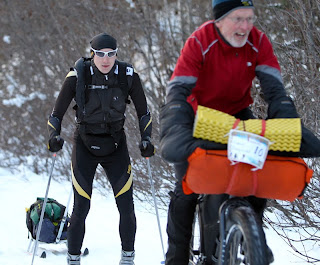
    This year started off rough- still fighting a head cold and rolling my sled 3 times in the first 5 miles- setting me behind all the other skiers and quite a few bikers on the narrow trails. By the first checkpointat 22 miles, the lead bikers were barely in sight and heading toward firmer, more heavily traveled snowmobile routes. Heading up 15 miles of the Susitna and Yentna Rivers, I could catch glimpses of the bikes still 15-20 minutes ahead. As we headed north and left the rivers toward the turnaround checkpoint, the snow got a little deeper and I was able to slowly reel the bikes in. The snow that fell the week prior must have been dry, because despite the warm temps. it was a little squeaky and sandy (soft) feeling. It took about 50 miles to catch up with the lead bikes and take the front.

    Here’s where strategy comes in: gain as much lead as you can while the conditions favor you without over-doing it and running out of energy. With a tailwind and heading downriver on the return, I was able to keep an 8-9 minute lead on the bikes as I headed to the last checkpoint (mile 85). With about 1 mile of (bike-pushing) soft trail on a lake before the final 14 miles of (bike-favorable and firm) snowmobile highway before the finish, I made my escape across the lake, and pushed it hard to the finish trying to keep their headlamps out of sight.

  • Battle with the Bikes!

    The Susitna 100 is a 100-mile run, ski, or bike race in Alaska, following a portion of the Iditarod trail. You are required to have 15 pounds of gear with you at all times, not including consumable food and 2 liters of water. If you pull a sled, that weight doesn’t count either. The trail is ungroomed by nordic standards, and is oftentimes only one snowmobile width across. A skier can expect uneven terrain, small burms, and varying snow conditions. With the advent of the fat-tired bicycle, bikers are able to ride through even softer snow than ever before. In hard conditions a bike will beat skis, but when things start getting soft (new snow ro warm temps.) the bikes start digging in while skis can still glide across. This race is a combination of fitness, conditions, and equipment. This year was an exceptionally close race.

    A week prior, I had held a waxing clinic specifically for this type of race. The focus for waxing is durability and varying snow conditions and temperatures. Temps. can vary from 0-30F during the race, and snow can vary from churned up and dirty to fresh powder to wind-blown semi-crust- all in one day!

    This year, despite unseasonably warm temps (20-30F), I stuck with the tried and true- HF blue (thermobagged), LF Moly lightly brushed (for the dirty parts), HF blue covered with Jetstream blue (ironed) and Jetstream blue (rotocorked). It’s hard to convince people (sometimes even myself) to wax this hard for such warm temps., but for this long of a race durable skis will beat out skis that are slightly faster in the beginning.

    This year started off rough- still fighting a head cold and rolling my sled 3 times in the first 5 miles- setting me behind all the other skiers and quite a few bikers on the narrow trails. By the first checkpointat 22 miles, the lead bikers were barely in sight and heading toward firmer, more heavily traveled snowmobile routes. Heading up 15 miles of the Susitna and Yentna Rivers, I could catch glimpses of the bikes still 15-20 minutes ahead. As we headed north and left the rivers toward the turnaround checkpoint, the snow got a little deeper and I was able to slowly reel the bikes in. The snow that fell the week prior must have been dry, because despite the warm temps. it was a little squeaky and sandy (soft) feeling. It took about 50 miles to catch up with the lead bikes and take the front.

    Here’s where strategy comes in: gain as much lead as you can while the conditions favor you without over-doing it and running out of energy. With a tailwind and heading downriver on the return, I was able to keep an 8-9 minute lead on the bikes as I headed to the last checkpoint (mile 85). With about 1 mile of (bike-pushing) soft trail on a lake before the final 14 miles of (bike-favorable and firm) snowmobile highway before the finish, I made my escape across the lake, and pushed it hard to the finish trying to keep their headlamps out of sight.

  • 24 Hours of Telemark

    The first of the ultra-marathons hits the season early, the second weekend in January!

    This event gives a plethora of racing options: ranging from 3, 6, 12, or 24 hour events and from Solo up to 8-person teams, freestyle or classic.

    This was my second time competing in this event in the 24-hour Solo catagory, feeling much more matured and ready than before. I wasn’t, however, expecting the temps to be as cold as they were- virtually putting an end to my goals. The snow was cold and abrasive- providing little glide during the wee hours of the night. I had two pairs of skis ready, hoping to not have to stop and rewax an any point during the race. My ‘primary’ skis were done with LF moly, HF Blue/cold powder, then Jetstream blue ironed in. My ‘warm’ skis were LF Moly, HF blue, then Jetstream blue rotocorked.

    Starting the race, my skis were fast. As it warmed into the teens in the afternoon, I switched to the ‘warm’ skis in order to preserve my ‘primary’ skis for the night, noticing no significant difference in speed. As the sun dipped beyond the Telemark hill, overmits froze into a solid shell, bodies chilled, and worst of all, skis got slow. Stopping for the first ‘break’ after 11 hours of skiing, I layered up, changed gloves and socks, and put my primary skis back on. They felt fast- considering the conditions. Back to zipping by other racers on the downhills. What a difference the cold powder makes!

    6 hours later, temps. dipping below 0F and barely able to push any glide out of the skis going uphill (this is where I should have traveled with a pair of classic skis)- I had to stop to reapply some HF blue/cold powder. I’m sure fatigue had something to do with the sudden lack of ability to climb hills, but the skis were definitely dry. They had lasted about 150K in cold and abrasive snow(the warm skis had made it about 50K).

    This is my personal attestation to the wide range, speed, and durability of the HF blue/cold powder combination that I trust for any race greater than a marathon. I have used it up in the low 20’s and obviously into the sub-zero’s, and have always had great results!

    the24hoursoftelemark.com is a fun race at a great venue- recommend it to anyone!Now to get ready for the Susitna 100…

  • 24 Hours of Telemark

    The first of the ultra-marathons hits the season early, the second weekend in January!

    This event gives a plethora of racing options: ranging from 3, 6, 12, or 24 hour events and from Solo up to 8-person teams, freestyle or classic.

    This was my second time competing in this event in the 24-hour Solo catagory, feeling much more matured and ready than before. I wasn’t, however, expecting the temps to be as cold as they were- virtually putting an end to my goals. The snow was cold and abrasive- providing little glide during the wee hours of the night. I had two pairs of skis ready, hoping to not have to stop and rewax an any point during the race. My ‘primary’ skis were done with LF moly, HF Blue/cold powder, then Jetstream blue ironed in. My ‘warm’ skis were LF Moly, HF blue, then Jetstream blue rotocorked.

    Starting the race, my skis were fast. As it warmed into the teens in the afternoon, I switched to the ‘warm’ skis in order to preserve my ‘primary’ skis for the night, noticing no significant difference in speed. As the sun dipped beyond the Telemark hill, overmits froze into a solid shell, bodies chilled, and worst of all, skis got slow. Stopping for the first ‘break’ after 11 hours of skiing, I layered up, changed gloves and socks, and put my primary skis back on. They felt fast- considering the conditions. Back to zipping by other racers on the downhills. What a difference the cold powder makes!

    6 hours later, temps. dipping below 0F and barely able to push any glide out of the skis going uphill (this is where I should have traveled with a pair of classic skis)- I had to stop to reapply some HF blue/cold powder. I’m sure fatigue had something to do with the sudden lack of ability to climb hills, but the skis were definitely dry. They had lasted about 150K in cold and abrasive snow(the warm skis had made it about 50K).

    This is my personal attestation to the wide range, speed, and durability of the HF blue/cold powder combination that I trust for any race greater than a marathon. I have used it up in the low 20’s and obviously into the sub-zero’s, and have always had great results!

    the24hoursoftelemark.com is a fun race at a great venue- recommend it to anyone!Now to get ready for the Susitna 100…