Author: Colin Gaiser

  • Stephen Ninth as Three Americans Finish in Top 20 of Holmenkollen 30 k

    Stephen Ninth as Three Americans Finish in Top 20 of Holmenkollen 30 k

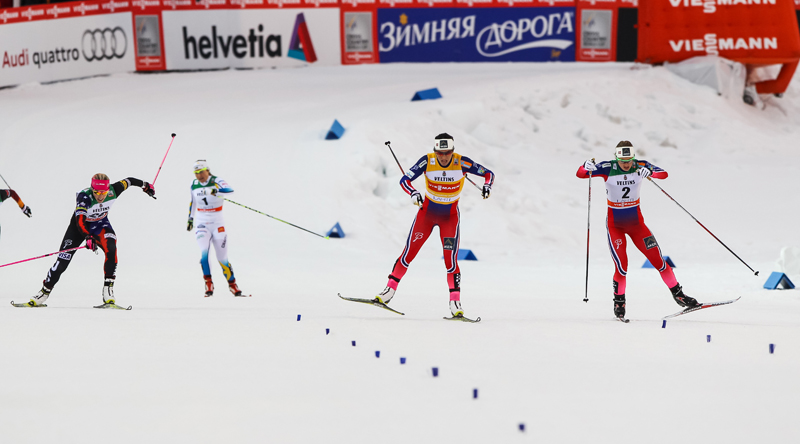
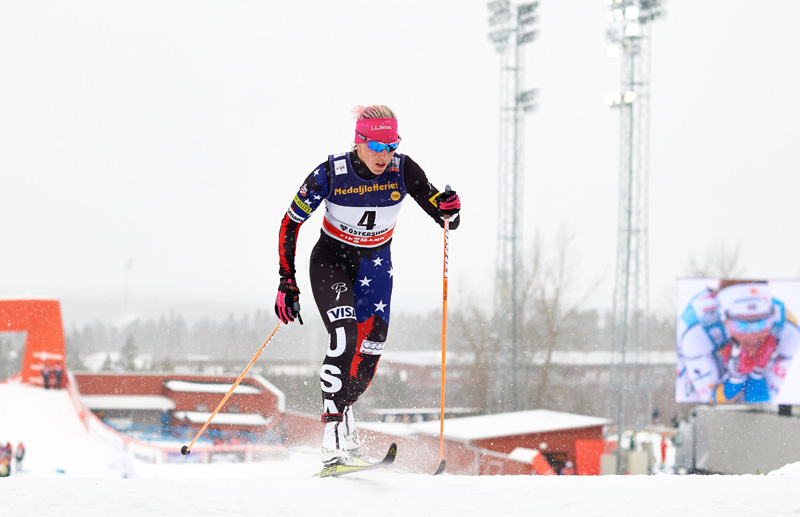
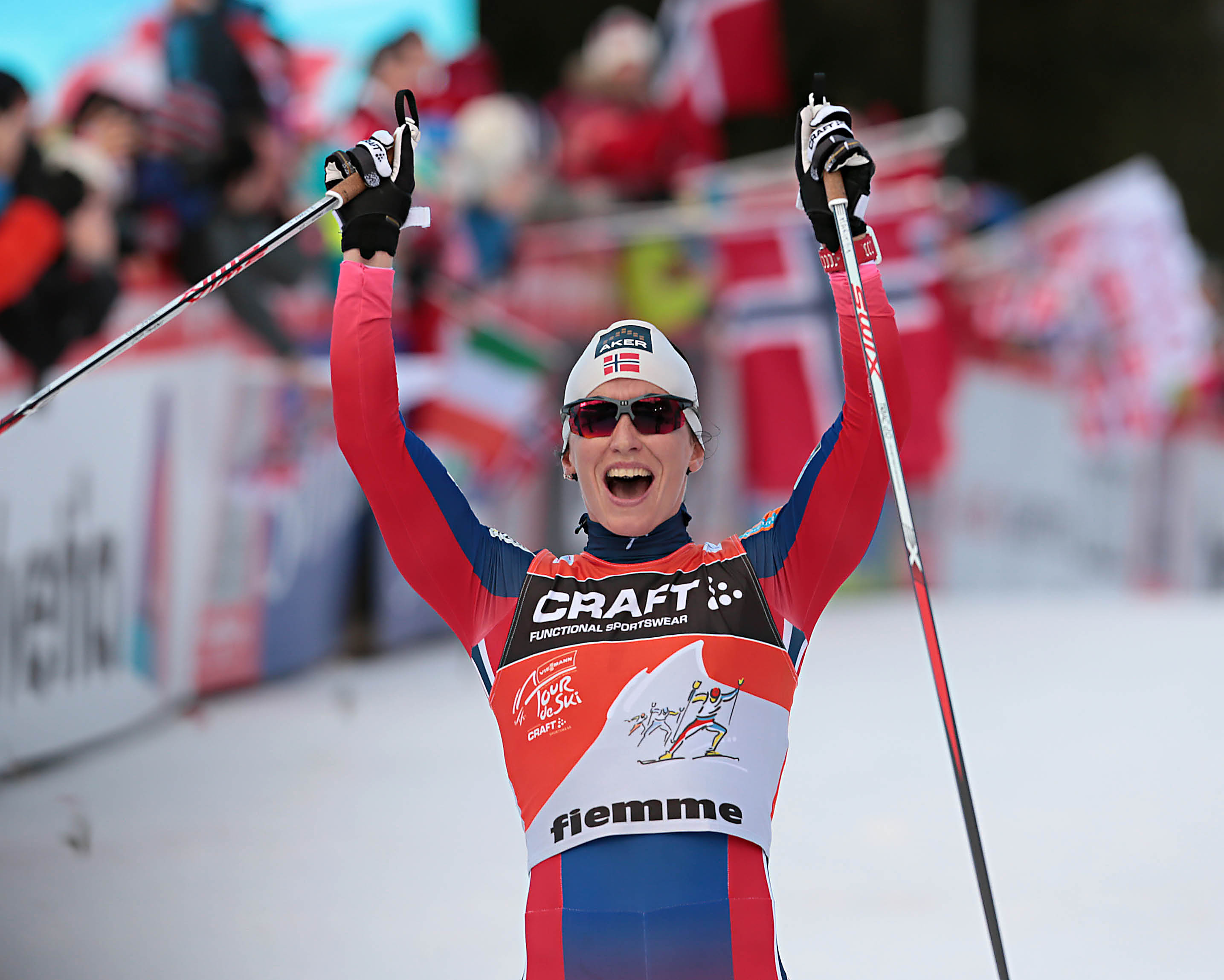
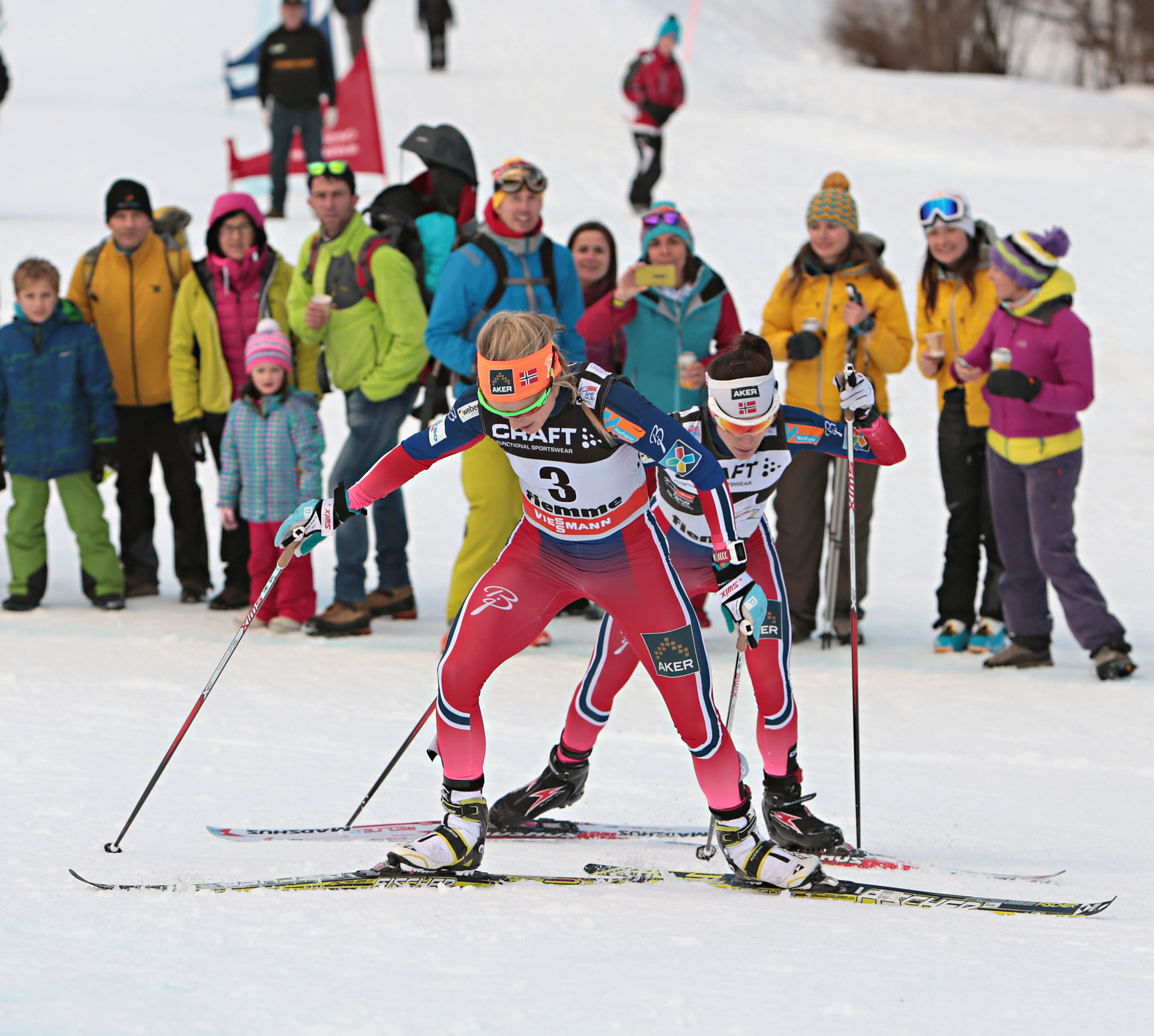
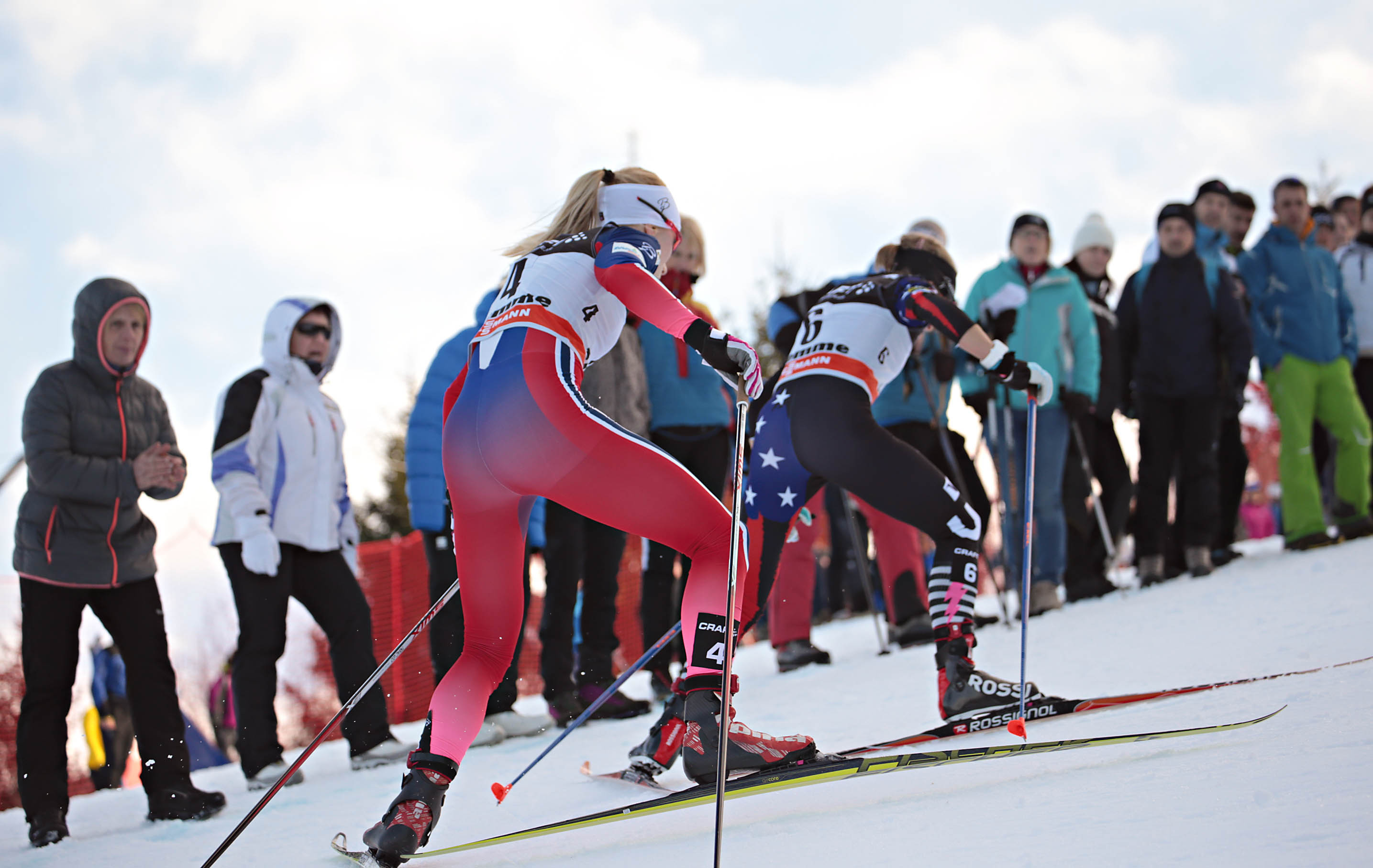
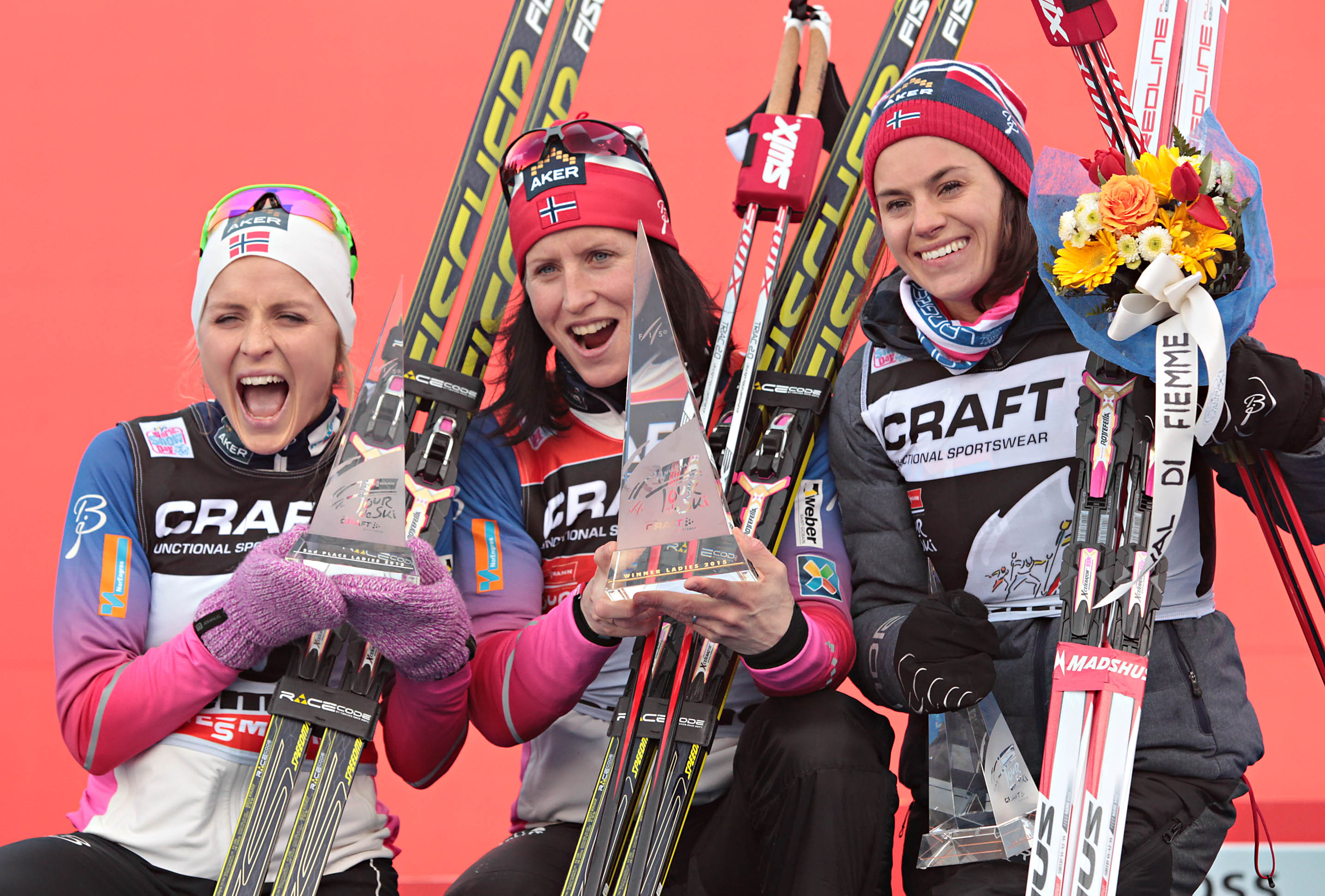
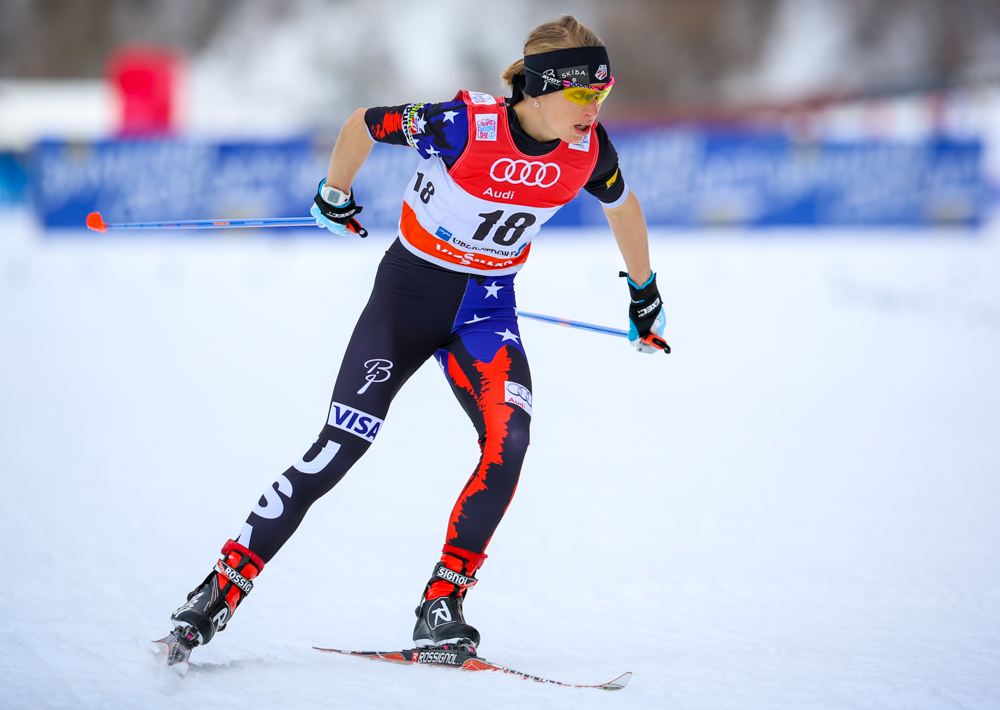
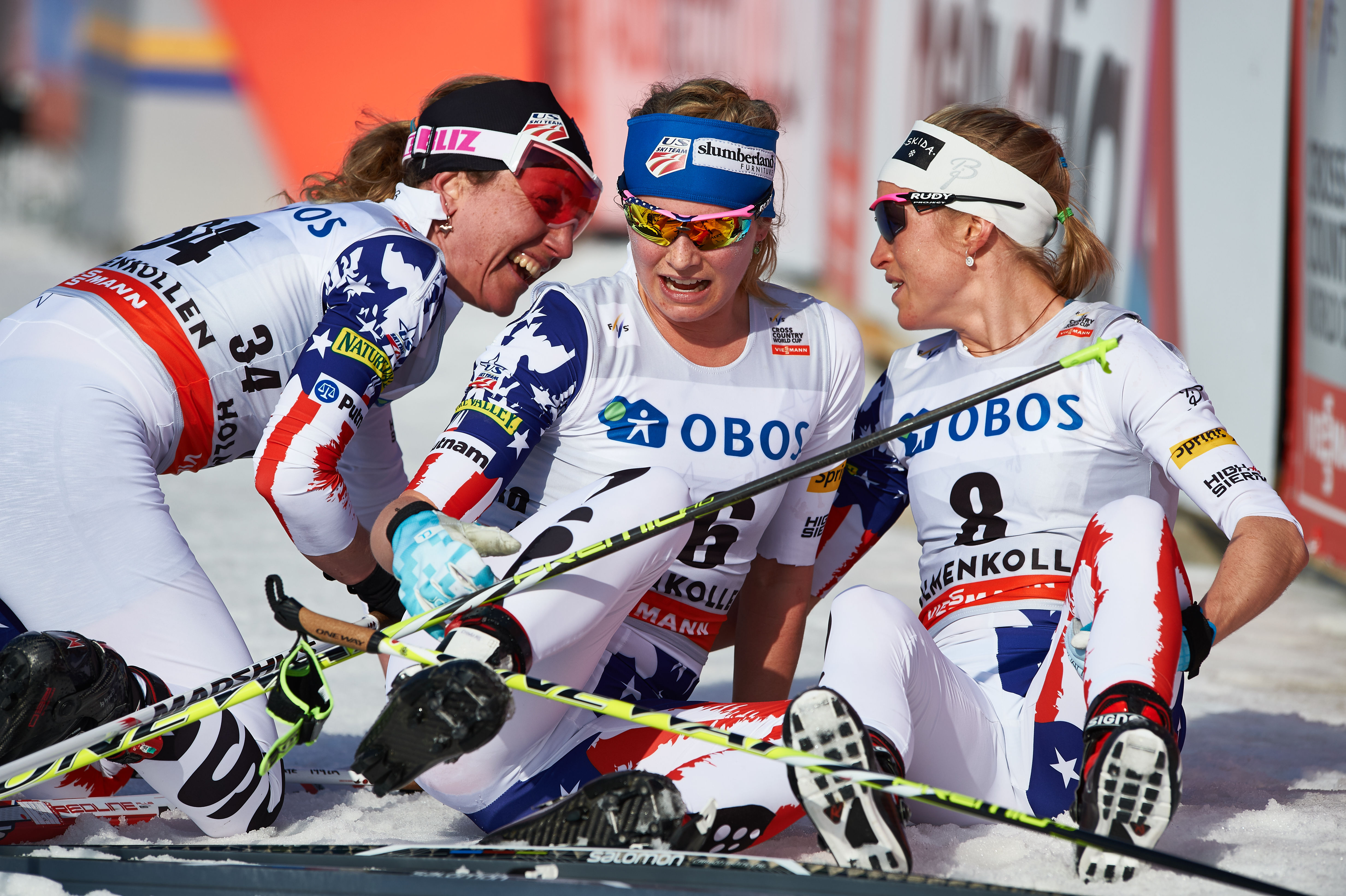
    USST's Caitlin Gregg (r), Jessie Diggins (c) and Liz Stephen (r) in the finish of the 2015 Holmenkollen 30 k. Stephen led the three in ninth, while Diggins and Gregg Placed 14th and 19th. (Photo: Madshus/Nordic Focus)
    USST’s Caitlin Gregg (r), Jessie Diggins (c) and Liz Stephen (r) in the finish of the 2015 Holmenkollen 30 k which served as the last race of the 2015 World Cup season. Stephen led the three in ninth, while Diggins and Gregg Placed 14th and 19th. (Photo: Madshus/Nordic Focus)

    Liz Stephen led a trio of Americans placing in the top 20 of Sunday’s 30-kilometer freestyle mass start in Holmenkollen, Norway – the final World Cup race of the season.

    Stephen finished in ninth to earn her sixth individual top-10 finish of the 2014/2015 World Cup season. She was 2:06.7 minutes behind Marit Bjørgen of Norway, who sprinted away from teammate Therese Johaug in the final kilometer to win in a time of 1:14:10.5 and put the finishing touch on her overall World Cup title.

    Stephen was fifth after 16.3 k, and led the main chase pack throughout much of the final lap. However, she fell behind in the final kilometer and came across the line 17.5 seconds outside the top five.

    Stephen finished the season 10th in the overall World Cup standings and seventh in the distance standings.

    The East Montpellier, Vt. native said that she entered Sunday’s race with a goal of reaching the top five and had her sights set on Norway’s Heidi Weng. She explained that to fight for her goal, risks were necessary.

    “I took some chances and almost blew up at points. A good indicator for me is when my stomach is knotted and I wanted to throw up which came earlier than usual,” Stephen told USSA in a press release, adding that while she finished four spots away from her goal, she considered the day a success.

    With the culmination of the 2015 World Cup season Stephen said the many personal and team achievements of the year gave her hope for the future.  Stephen earned a historic fifth-place finish in the 2015 Tour de Ski and claimed the best finish by an American woman in a distance World Cup with her silver medal in the Rybinsk 10 k freestyle.

    “The top of the race is closer now. It gives me hope for next year and years in the future,” she said to USSA. “I’m really happy with the day. I’m really happy with the season.”

    Jessie Diggins, silver medalist in the 10 k freestyle at the 2015 World Championships, was the second American to finish, coming through by herself in 14th (+2:44.0). She claimed her eighth individual top-15 World Cup finish of the season and ended the season 22nd in the World Cup standings.

    Diggins wrote in an email to FasterSkier that she was happy with her race and the World Cup season as a whole. “My skis were great and I was skiing with a pack that didn’t exchange skis so I didn’t either, and it worked out great to be on one pair for the whole race.”
    However, Diggins explained that she probably went out too hard, as she was with the lead pack around the 8 k mark but had to settle into the chase group shortly afterward. In addition, she began cramping in her lower quadriceps during the final few kilometers.
    “I’ve never had cramping in a race before, so it was totally unexpected, and my legs kept twitching and it was really hard to move!” she wrote.
    She explained that instead of trying for a top-10 finish, at that point she was just hoping to get to the finish line “in one piece.”
    “I was fine once I got out of the hot sun after the race,” Diggins added.

    Meanwhile, Caitlin Gregg finished in 19th (+3:07.7), three weeks after taking bronze in the 10 k freestyle at the 2015 FIS Nordic World Ski Championships in Falun, Sweden.

    Gregg said in a phone interview that in previous seasons she would be more excited about Sunday’s result, but her recent successes have left her with higher expectations.

    “I’m a little bit bummed, because I was definitely skiing in a place where I was fighting for a top-ten finish and I was feeling really good,” she said.

    Gregg put herself in a good position early in the race – she was eighth at the 8 k mark, just 16 seconds off the lead. At that point, she was in a chase pack of roughly six other skiers and feeling strong.
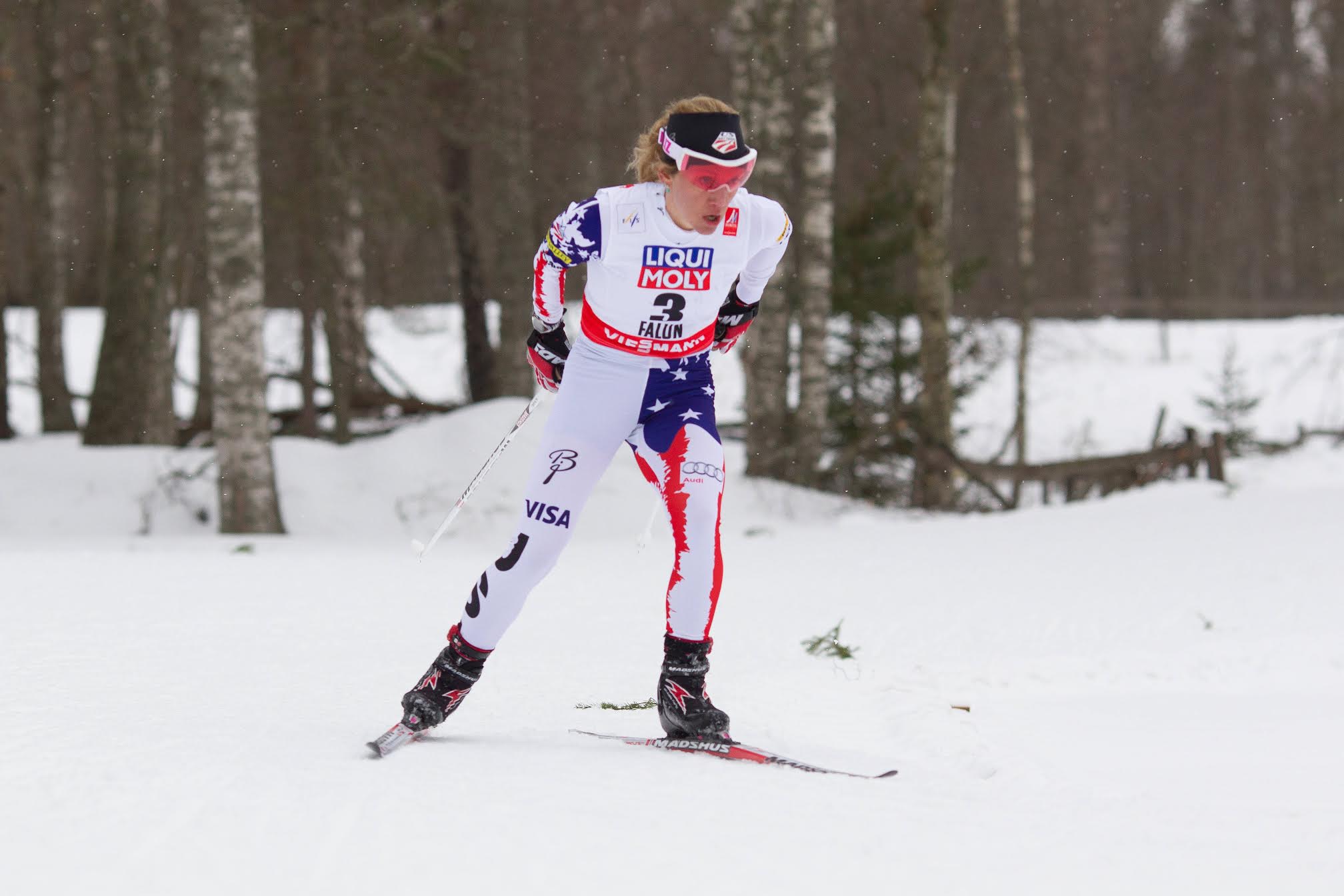
    Caitlin Gregg racing to bronze in the 10 k freestyle at 2015 World Championships in Falun, Sweden. Gregg placed 19th in Sunday's 30 k freestyle mass start in Holmenkollen, Norway. (Photo: Madshus/NordicFocus)
    Caitlin Gregg racing to bronze in the 10 k freestyle at 2015 World Championships in Falun, Sweden. Gregg placed 19th in Sunday’s 30 k freestyle mass start in Holmenkollen, Norway. (Photo: Madshus/NordicFocus)

    However, she said she picked her second-best pair of skis for the race, expecting the other skiers to exchange their skis at the 13 k point like in previous years. But when the leaders, Bjørgen and Johaug, did not switch, no one in the chase pack did either.

    “The skis I selected were a bit stiffer … and as the course broke down I realized they were way too stiff, and areas where I usually would feel the greatest, on those long inclines through some pretty deep slush, my skis were just bogging down and I was struggling,” Gregg said.

    As a result, she was caught by another pack and fell to 17th by the 24.3 k point, before finishing the race in the back of that pack.

    “Skiing Holmenkollen on your second-best pair of skis isn’t really what you want to do, so it leaves you with that ‘what if?’ feeling. But that’s why we do this; it’s a fun experiment. You’re always playing and the strategy is a cool part of it,” Gregg explained.

    Gregg is thrilled with the 2015 season, especially given the fact she dealt with shingles early in the World Cup season. In addition to her performance at World Championships, she won the 10 k freestyle and was second in the freestyle sprint at U.S. Nationals and took third in last weekend’s 42 k mass start Marathon Cup race in Engadin, Switzerland.

    “Just being on the World Cup is a pretty incredible experience … I feel like I’ve definitely figured out how to ski on the World Cup, how to travel on the World Cup, how the whole system operates,” she said.

    She added that it is a great feeling to know she is finishing strong.

    Three other Americans finished in the famed 30 k. Sadie Bjornsen took 44th (+6:59.0) and finishes the season 23rd in the World Cup standings, Caitlin Patterson was 53rd (+8:53.3), and Rosie Brennan finished in 55th (+10:22.7).

    The lone Canadian in the field, Emily Nishikawa, took 50th (+8:04.1).

    Results

    Final World Cup standings

  • Newell 12th, Valjas 14th in Final World Cup Sprint in Drammen

    Newell 12th, Valjas 14th in Final World Cup Sprint in Drammen

    FIS world cup cross-country, individual sprint, Drammen (NOR)
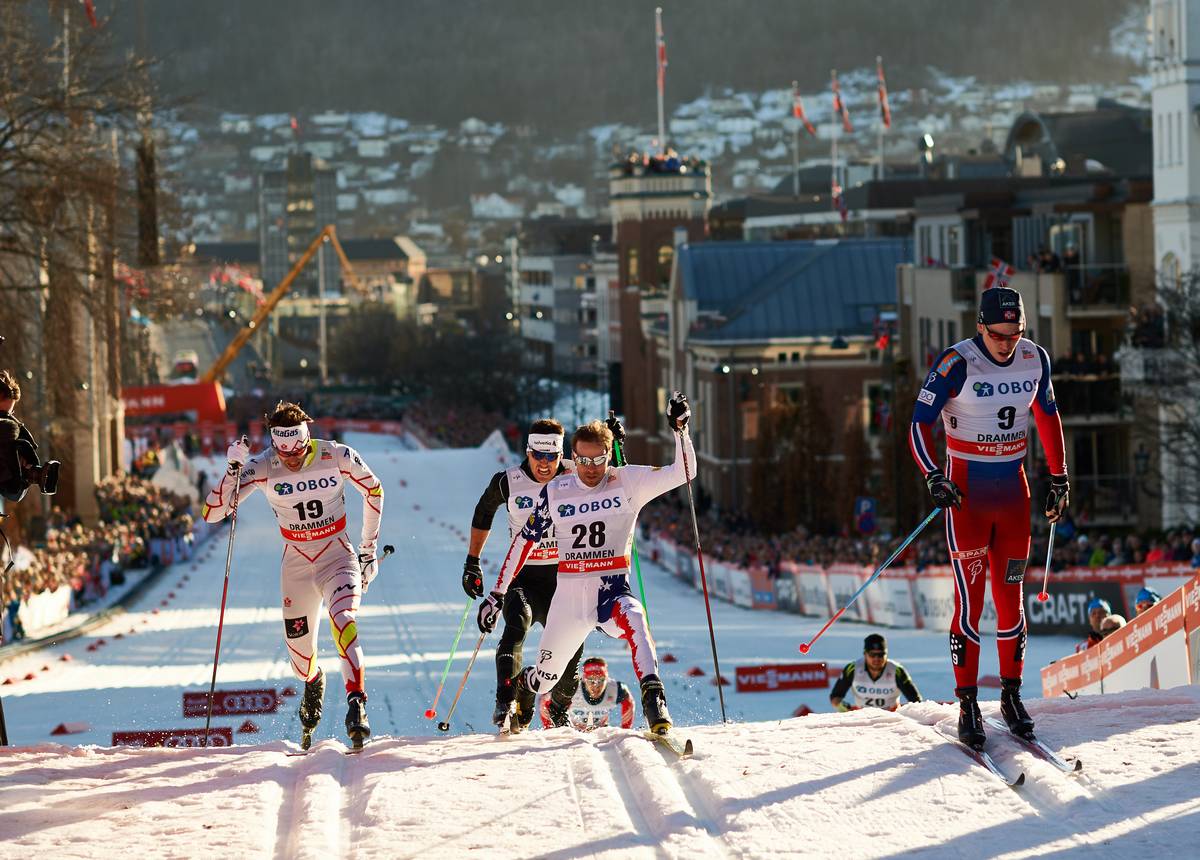
    (From l-r) Canada’s Lenny Valjas, Andy Newell of the U.S., and Norway’s Pål Golberg (9) at the finish line of their quarterfinal heat in the World Cup freestyle sprint in Drammen, Norway. Newell advanced to the semifinals and ended up 12th overall, while Valjas narrowly missed advancing and placed 14th. (Photo: Fischer/Nordic Focus)

    American Andy Newell ended his World Cup season on a high note, finishing as the top North American in Wednesday’s 1.3-kilometer classic sprint in Drammen, Norway. He reached the semifinals before finishing 12th overall.

    Newell qualified in 28th, 5.48 seconds behind top qualifier Ola Vigen Hattestad of Norway (2:36.48).

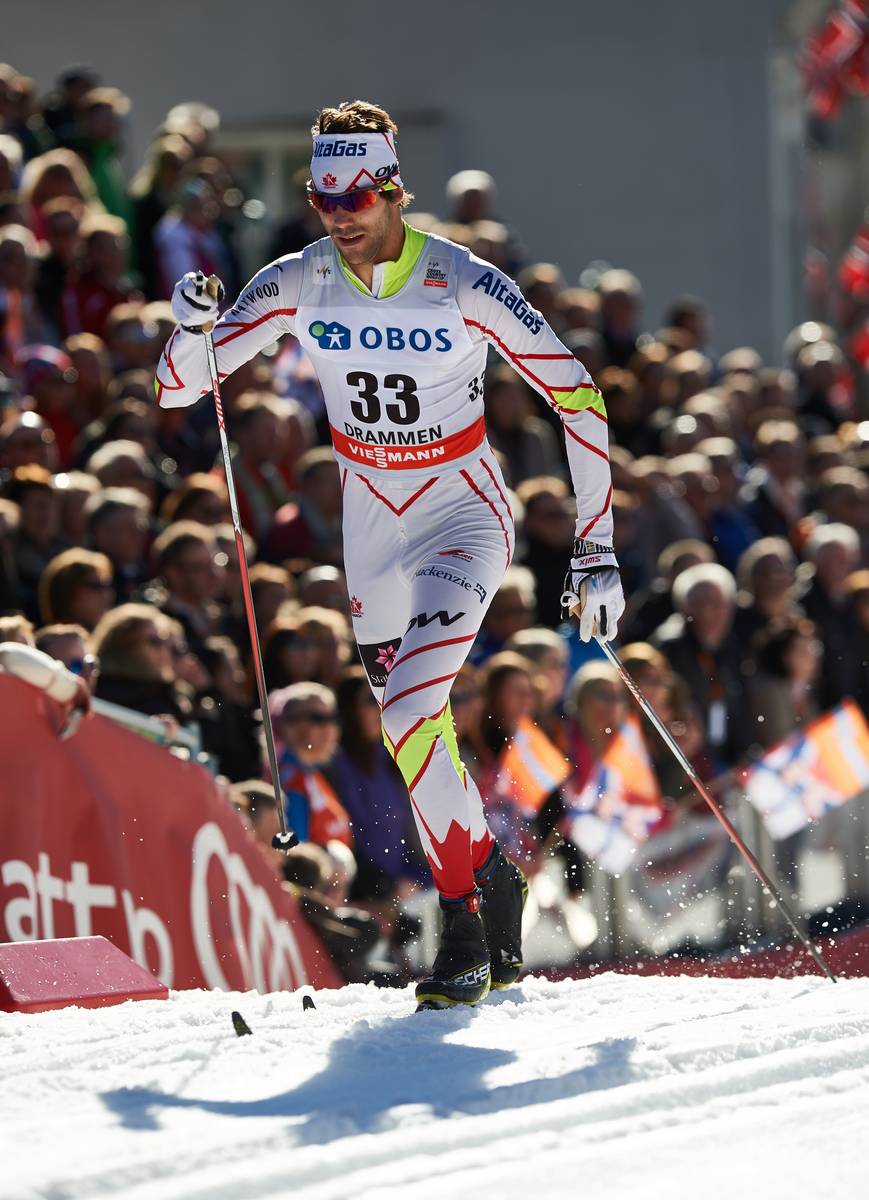
    Canada's Lenny Valjas during of the World Cup classic-sprint qualifier in Drammen, Norway. Valjas qualified 19th and placed 14th overall. (Photo: Fischer/Nordic Focus)
    Canada’s Lenny Valjas during of the World Cup classic-sprint qualifier in Drammen, Norway. Valjas qualified 19th and placed 14th overall. (Photo: Fischer/Nordic Focus)

    Lenny Valjas of Canada qualified in 19th (+4.90) and was the only other North American male in the quarterfinals. He and Newell ended up racing in the fifth quarterfinal.

    In that heat, Valjas held a slim lead until Newell and Norway’s Pål Golberg passed him in the final stretch. The Canadian finished in third, just 0.72 seconds behind Golberg, who won the heat in 2:39.43, while Newell lunged to a second-place finish, 0.43 seconds back.

    Valjas would finish 14th overall. He did not immediately respond to an email for comment.

    Newell said in a phone interview that he felt strong during his quarterfinal heat, deciding to go with kick wax while trying to stay near the front throughout the heat.

    “I was able to do that in the first climb and get a good draft on the downhill. I felt good striding up to the finish line and was able to move on pretty comfortably,” he said.

    Newell, who is coming off an eighth-place finish in Saturday’s freestyle sprint in Lahti, Finland, explained that he had a yellow card on his record and had to be especially careful to avoid skating, a risk on the steep hill where many of the racers were herringboning.

    “You can be skating very easily trying to do that,” he said. “I think there were definitely some sketchy techniques going on out there, so I went into that hill doing my best to be really under control and not herringboning too much.”

    In the semifinal, Newell finished sixth, 8.75 seconds behind winner Sondre Turvoll Fossli, who won in 2:35.41.

    Newell said that although he was happy to reach that round, he wished he could have been more competitive. The quick turnaround from the final quarterfinal heat left him fatigued, he said.

    “I just got stuck in the back going over the tops of the hills and into the drafts,” he explained.

    Newell wanted to establish a good position to catch a draft on the long downhill, but became stuck behind Russia’s Nikita Kriukov, who was herringboning the uphill.

    “I had to herringbone behind him as well, and he wasn’t going as fast as some of the guys that had kick wax,” Newell said. “We did come back on the downhill, but because he had skate skis he wasn’t a great person to draft behind because he pulled away from me and I was left in no-man’s land on the downhill. And then I didn’t carry quite enough speed on the corner.”

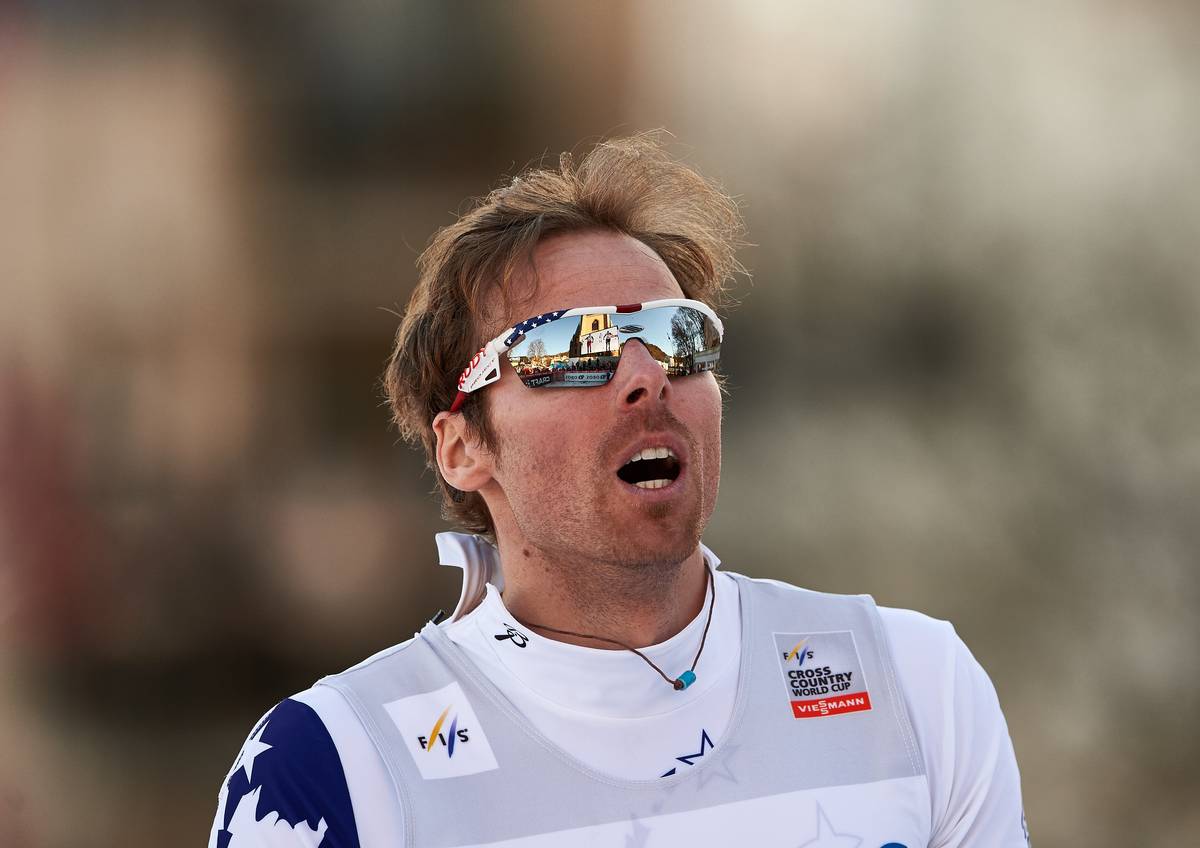
    Andy Newell (U.S. Ski Team) at the 1.3 k classic sprint in Drammen, Norway. He placed sixth in his semifinal for 12th overall. (Photo: Fischer/NordicFocus)
    Andy Newell (U.S. Ski Team) at the 1.3 k classic sprint in Drammen, Norway. He placed sixth in his semifinal for 12th overall. (Photo: Fischer/NordicFocus)

    Newell finished the season 18th in the overall Sprint World Cup, despite missing one sprint and failing to score in two others.

    He explained he was pleased to be able to turn his season around after suffering from a slow start, injuries and adversity, particularly a neck injury and a reoccurring allergic reaction, earlier in the season.

    “As far as an overall sprint year, it was not super successful, but I was able to learn some things and turn it around at the end of the season,” Newell said. “It’s always nice to finish pretty strong.”

    Canada’s Alex Harvey, who took a silver medal in the classic sprint at the 2015 World Championships and bronze in the skiathlon, missed qualifying by 0.7 seconds in 33rd (6.53 seconds behind the qualifying winner) and ended the season 13th in the sprint standings.

    Other American men racing on Wednesday included Erik Bjornsen in 38th (+7.16), Dakota Blackhorse-von Jess in 42nd (+7.55), and Simi Hamilton in 65th (+13.56). Hamilton crashed late in his qualifier to take him out of contention.

    Sadie Bjornsen Qualifies Ninth 

    Sadie Bjornsen was the lone North American woman to qualify for the heats, finishing ninth, 5.22 seconds behind Norway’s Ingvild Flugstad Østberg, the top female qualifier in 3:01.25.

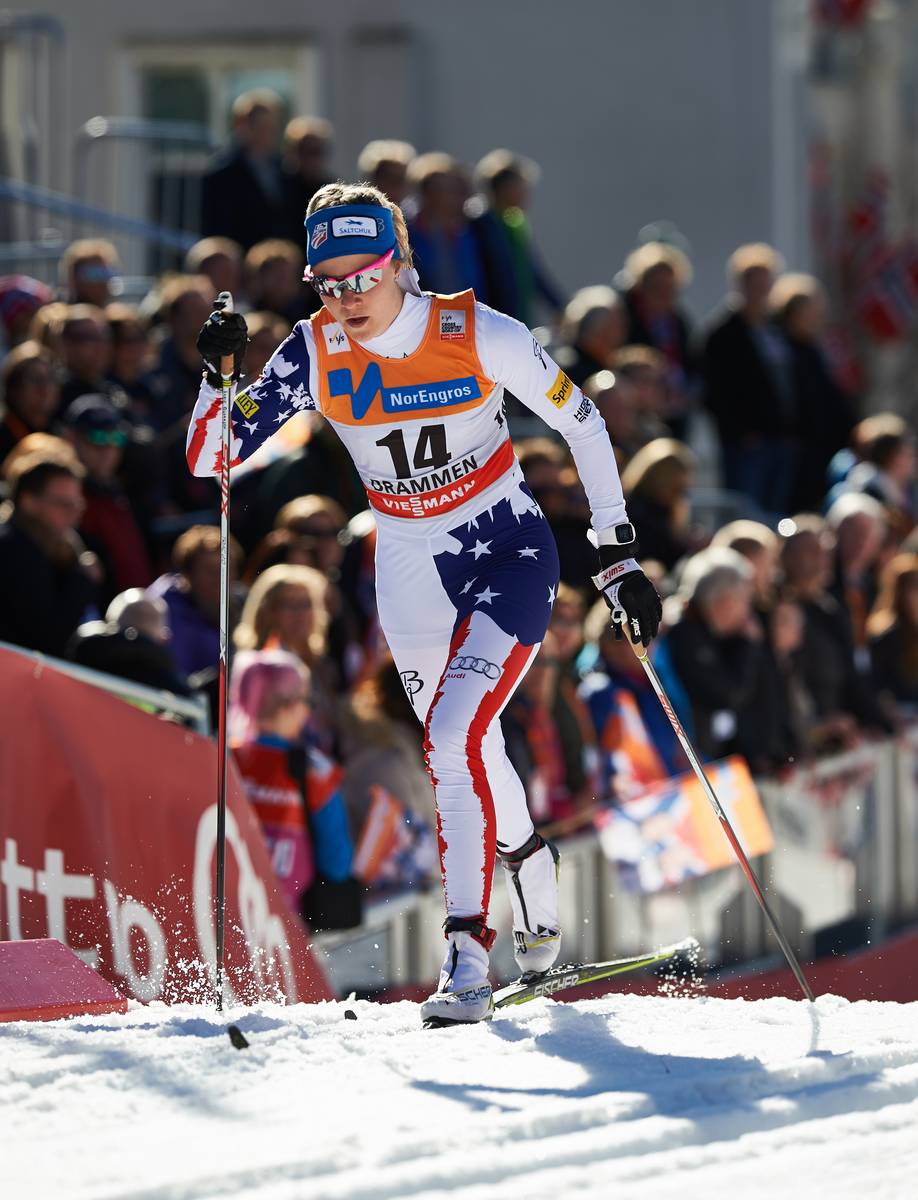
    Sadie Bjornsen (U.S. Ski Team) racing to ninth in the 1.3 k classic-sprint qualifier on Wednesday at the World Cup in Drammen, Norway. In the last sprint of the season, Bjornsen went on to place sixth in her quarterfinal for 26th overall. (Photo: Fischer/NordicFocus)
    Sadie Bjornsen (U.S. Ski Team) racing to ninth in the 1.3 k classic-sprint qualifier on Wednesday at the World Cup in Drammen, Norway. In the last sprint of the season, Bjornsen went on to place sixth in her quarterfinal for 26th overall. (Photo: Fischer/NordicFocus)

    However, Bjornsen ended up in the fastest quarterfinal, which Norway’s Astrid Uhrenholdt Jacobsen won in 3:00.33, and placed sixth (+2.87) to finish 26th overall.

    Bjornsen said in a phone interview that it is unfortunate she was put a heat with so many fast skiers, but her time in the heat still left her encouraged.

    “Even though I was last in my heat, I was skiing faster than most of the other heats, so there’s definitely some positive things to take away,” she said.

    Bjornsen explained that her strategy in the quarterfinal was simply to ski as hard as she could and try to keep contact with the front. She said she had a strong start, but became caught behind the other skiers. Once she had to slow down, she had a difficult time regaining speed. It is something she says she has struggled with throughout the season.

    “I ended up skiing from the back the whole time, and every time I tried to find a hole, it was quickly covered,” she explained. “It was a bit frustrating, but those are all really good skiers so it was hard to find my way to the front.”

    Bjornsen was able to make contact with the leaders at the bottom of the course’s steep hill, but got tangled up in the back while climbing the other side and was not in an ideal position when she reached the finishing stretch.

    “The hills were steep and narrow and tricky,” she said.

    Despite temperatures above 50 degrees Fahrenheit, skis were not an issue for her.

    “I definitely had awesome skis,” she explained.

    Even though she was not able to reach the semifinals, Bjornsen is encouraged by how she qualified.

    “I feel like this year I’ve sort of struggled. There have been many races where I’m just barely qualifying or on the other side of not qualifying,” she said. “I was definitely really happy to finish the last sprint of the year knowing that I can qualify in the top 10.”

    Although she has not had as many top results as during the 2013/2014 World Cup season, Bjornsen said this season has been a step in the right direction. She finished 24th in the sprint standings.

    “It’s easy to be greedy and just want to have those high races … but I’ve finally found a level of consistency. And I do believe this is the next step,” she said.

    She explained that this winter she has raced more than ever, and hopes for even better results next season after a good summer of training.

    American Sophie Caldwell placed 35th in qualifying in Wednesday's World Cup freestyle sprint in Drammen, Norway. (Photo: Fischer/Nordic Focus)
    American Sophie Caldwell placed 35th in qualifying in Wednesday’s World Cup freestyle sprint in Drammen, Norway. (Photo: Fischer/Nordic Focus)

    Meanwhile, her teammate Sophie Caldwell missed out on qualifying by 1.18 seconds, placing 35th (+11.59). She finishes the season 20th in the sprint standings.

    She wrote in an email that she was not very satisfied with her qualifier and felt like she skied frantically.

    “I’ve been fighting a little sickness the past few days, but it never got bad enough to consider not racing. I felt a little flat and tired, but mostly just frantic,” she explained.

    She wrote that she tends to struggle with the Drammen course due to the power striding and double poling, and is going to work hard to improve those techniques during the offseason.

    “I’ve never qualified in Drammen, but one of these years that’s going to change!” she wrote.

    American Kikkan Randall, who reached the podium in third in Saturday’s freestyle sprint in Lahti, qualified in 45th (+18.03), while Caitlin Patterson was 51st (+19.73) for the U.S.

    No Canadian women competed on Wednesday.

    The 2014/2015 World Cup season finishes this weekend at Holmenkollen in Oslo, Norway,  with the men’s 50 k and women’s 30 k freestyle mass starts.

    Results: Men | Women

  • Canada’s Harvey 17th in 15 k, Nishikawa Tallies Career-Best 23rd in Lahti 10 k Classic

    Canada’s Harvey 17th in 15 k, Nishikawa Tallies Career-Best 23rd in Lahti 10 k Classic

    Canada's Alex Harvey finished 17th in the men's World Cup 15 k classic individual start in Lahti, Finland, on Sunday, 35.7 seconds off the pace of winner Francesco de Fabiani of Italy. (Photo: Fischer/NordicFocus)
    Canada’s Alex Harvey finished 17th in the men’s World Cup 15 k classic individual start in Lahti, Finland, on Sunday, 35.7 seconds off the pace of winner Francesco de Fabiani of Italy. (Photo: Fischer/NordicFocus)

    Even after earning two medals at the 2015 World Championships, Canada’s Alex Harvey is still OK with a 17th-place finish in Sunday’s 15-kilometer freestyle individual start in Lahti, Finland.

    “It wasn’t bad, but it wasn’t great,” he said in a phone interview.

    In 17th, Harvey ended up 35.7 seconds behind Italy’s Francesco de Fabiani, who won in 34:51.2, and 31.1 seconds from a podium spot.

    “I thought it would be a tight race and it was a really, really tight race,” he said. “I was never really in it, but never too far out of it, either.”

    Harvey placed better in last year’s Lahti 15 k, finishing eighth, but was 55 seconds behind the winner and farther from podium contention than he was on Sunday.

    Harvey had a good start – he was 10th at the 6.2 k point and just 9.5 seconds off the pace.

    “I opened hard and thought that was the right speed to fight for the top five or top 10, and I just faded a bit near the end, but I didn’t completely blow up and the wheels didn’t completely fall off,” he explained, adding that he slowly lost time and position near the end.

    “I was skiing on my own the whole time, so I knew I had to make the work on my own,” he said.

    Harvey explained that he took quite a bit of rest in the last week since World Championships and that it typically takes him a while to get back into normal skiing shape.

    “My body was kind of asleep this weekend, I think,” he said.

    He had hoped for a top five or the podium in Lahti, but knew he would be affected after an exhausting World Championships and subsequent rest.

    Canada's Emily Nishikawa finished 23rd in the 10 k freestyle individual start in Lahti, Finland. (Photo: Fischer/NordicFocus)
    Canada’s Emily Nishikawa finished 23rd in the 10 k freestyle individual start in Lahti, Finland. (Photo: Fischer/NordicFocus)

    Meanwhile, Emily Nishikawa of the Canadian Development Team notched a career-best 23rd, 2:01.6 off the pace of Norway’s Marit Bjørgen, who won in 25:27.8. Previously, Nishikawa’s World Cup best was 29th in the 10 k classic in Davos, Switzerland, earlier this season.

    “I’m really happy with my race today,” she wrote in an email. “I started faster than I normally do and I think that made a difference in my result.”

    However, she explained that she thought she might have started too fast, as she faded in the last two kilometers. At the 8.4 k point, she was in 18th and 1:42.4 minutes behind Bjørgen.

    “I was really struggling to keep up my speed,” she wrote.

    On the men’s side, Graeme Killick – who was 19th in the 50 k classic at World Championships – finished 41st (+1:36.6), and Ivan Babikov placed 48th (+1:59.8).

    Alberta World Cup Academy (AWCA) teammates and national development team members, Kevin Sandau finished 61st (+3:09.3), while Michael Somppi was one place behind in 62nd (+3:17.4).

    Graeme Killick (AWCA/NST-Dev. B) racing to 41st in the men's 15 k classic on March 8 at the World Cup in Lahti, Finland. (Photo: Fischer/NordicFocus)
    Graeme Killick (AWCA/NST-Dev. B) racing to 41st in the men’s 15 k classic on March 8 at the World Cup in Lahti, Finland. (Photo: Fischer/NordicFocus)

    The other Canadian women racing included Cendrine Browne, of the Pierre-Harvey Training Centre, in 52nd (+4:10.7), Olivia Bouffard-Nesbitt (Rocky Mountain Racers) in 54th (+4:36.0), and Andrea Dupont (Rocky Mountain Racers) in 58th (+5:08.0).

    “We had good skis yesterday and today,” Canadian World Cup Coach Tor Arne Hetland told Cross Country Canada, noting the soft snow and warm temperatures. “We saw good racing out of Alex – I expect him to do well in Drammen later this week, and in the 50 k in Oslo. Emily skied very well and came out with a personal best, and Cendrine should be happy with how she has skied the last two races.”

    Despite feeling like he is “running on fumes,” Harvey said he was looking forward to the last two World Cup races of the season.

    He is hoping for a podium finish on Wednesday at the classic sprint in Drammen, Norway, explained that the sprint in Drammen is always fun and that he has vastly improved his classic sprinting this season.

    “I’m still really motivated; I’m hungry to race, but the body needs to be there, so it’s kind of hit and miss for the body by mid-March,” he said. “But I’m motivated so that’s important.”

    After the classic sprint in Drammen, the 2014/2015 World Cup season ends next weekend in Oslo with the 50 k men’s and 30 k women’s freestyle mass start races.

    Results: Men | Women

  • Bjornsen, Diggins Earn Top-20 Finishes for U.S. in Lahti 10 k Classic

    Bjornsen, Diggins Earn Top-20 Finishes for U.S. in Lahti 10 k Classic

    Sadie Bjornsen led all Americans at the World Cup on March 8, placing 14th in the women's 10 k classic individual start in Lahti, Finland. (Photo: Fischer/NordicFocus)
    Sadie Bjornsen led all Americans at the World Cup on March 8, placing 14th in the women’s 10 k classic individual start in Lahti, Finland. (Photo: Fischer/NordicFocus)

    The American women’s team looks to be in good shape in the final stretch of the 2014/2015 World Cup, as Sadie Bjornsen and Jessie Diggins finished in the top 20 of Sunday’s 10-kilometer classic individual start in Lahti, Finland.

    While Norway’s Marit Bjørgen collected her second victory of the weekend, winning in a time of 25:37.8, Sadie Bjornsen led all Americans by finishing in 14th (+1:41.4).

    Jessie Diggins followed a fourth-place finish in Saturday’s freestyle sprint by placing 17th, 1:48.1 minutes behind Bjørgen.

    Bjornsen wrote in am email to the press that the conditions made for a challenging day, as the course offered a mix of soft, spring-like conditions and icy spots.

    “I just kept trying to tell myself that conditions were similarly hard for everyone,” she wrote. “I had a great first lap, and then spent the second lap trying to hold my technique together as the tracks become more challenging to kick in.”

    Bjornsen added that this season, there have been more races on soft, klister conditions than on hard wax, which has traditionally been her strength.

    “I am being forced to find some new skills and strengths this winter,” she wrote.

    U.S. Ski Team Women’s Coach Matt Whitcomb said in a phone interview that he was impressed with Bjornsen’s effort and that it was a positive result.

    “It’s pretty difficult to get a top 20 at a classic race in Finland,” he said. “She mentioned that she struggled in the herringbone sections on the course, but she was able to put together some very competitive striding and double poling sections.”

    Sophie Caldwell took 31st on Sunday in Fahti, Finland, for her best World Cup distance result ever. Here she is pictured following Norway's Celine Brun-Lie (10) in their 1.4 k classic-sprint quarterfinal at 2015 World Championships in Falun, Sweden. (Photo: FlyingPointRoad)
    Sophie Caldwell placed 31st on Sunday in Lahti, Finland, for her best World Cup distance result. Here she is pictured in bib 21 in the classic-sprint quarterfinal at 2015 World Championships in Falun, Sweden. (Photo: FlyingPointRoad)

    Diggins said in a phone interview that based on her two performances, she feels this is the best weekend she has ever had in Lahti.

    Though she placed much higher on Saturday, she was happy with her result on Sunday, as neither classic racing nor the Lahti course play to her strengths, she said.

    “On a course like this that was all about the steep climbs, I felt like there wasn’t a whole lot of double-pole and glide sections,” she said. “It wasn’t really a great course for me traditionally, but I had to try and wrap my head around that and get psyched about it.”

    She said the tricky conditions made it difficult to determine whether she should stay in the track, especially when exhaustion set in during the second lap. However, when Bjørgen passed her, she was able to replicate what Bjørgen was doing.

    “I was just trying to copy her, and that helped at the end of the second lap,” she said.

    She added that, despite the conditions, her skis had a “really good kick.”

    Meanwhile, Whitcomb said he thought the best race of the day went to Sophie Caldwell, who finished in 31st and missed out by 0.2 seconds on earning her first 10 k classic points. Interestingly, before the race Caldwell was not sure if she was even going to participate.

    “Her body wasn’t quite feeling right, but she decided to just go for it,” Whitcomb said.

    It ended up being the right call, as she earned her best-ever distance result in a World Cup.

    Whitcomb said she did an impressive job attacking the most difficult sections of the course – particularly the tops of long climbs.

    “She was really competitive against the field in those sections,” Whitcomb said. “Today was an impressive step in the right direction.”

    Liz Stephen finished right behind Caldwell in 32nd (+2:27.8), while Caitlin Patterson of the Craftsbury Green Racing Project finished 50th (+3:55.2).

    Erik Bjornsen Leads American Men 

    In a close men’s race, Erik Bjornsen – who was 28th in the skiathlon at the 2015 World Championships – led the Americans by placing 38th, finishing 1:34.9 behind Italian winner Francesco de Fabiani (34:51.2). Noah Hoffman was just behind in 43rd (+1:38.2).

    Erik wrote in an email to FasterSkier that he felt decent, and that his goal was to go out strong and try and hold on for a good place, despite the tricky conditions.

    “It’s been great getting so many starts this year because I’m starting to feel more comfortable skiing in crap,” he wrote. “My distance form seems to be at a new level since my pre-World Champs camp in Davos.”

    He added that it is great to be able to go out strong and “not have the wheels fall off completely.” He said he felt great on the last lap despite not being able to find the kick he needed.

    Erik Bjornsen led the American men to take 38th in the World Cup 15 k freestyle individual start in Fahti, Finland. Here he is pictured hunkering down on his last loop in the 2015 World Championships relay.
    Erik Bjornsen led the American men to take 38th in the World Cup 15 k freestyle individual start in Fahti, Finland. Here he is pictured hunkering down on his last loop in the 2015 World Championships relay.

    “I’m sure part of the problem is technique but I also wonder if I chose a classic ski with too high of a camber,” Bjornsen wrote.

    Bjornsen started in bib 1, and Whitcomb said that racing first led to a strategy adjustment. He explained that they wanted to attack the conditions as they held up.

    “In a normal race, you’re checking your split and maybe trying to lay down your fastest final lap,” Whitcomb said. “Today with the earlier bib numbers we were trying to lay down fast first and second laps before the conditions fell apart, and I think Erik did that.”

    However, he reiterated that Bjornsen struggled with the kick in the final lap.

    Other Americans in the field included Noah Hoffman in 43rd (+1:38.2), Kris Freeman in 57th (+3:00.5) and Andy Newell – who was eighth in Saturday’s freestyle sprint – in 59th (+3:07.7).

    Despite his performance on Sunday, Whitcomb said that Newell is finally coming into form, and that he expects him to challenge for a podium spot during Wednesday’s classic sprint in Drammen, Norway.

    In addition, he said Kikkan Randall – who was third in Saturday’s sprint – will threaten for a podium, while Simi Hamilton will also be a contender. Hamilton was seventh in the Drammen sprint in 2012.

    After Wednesday’s classic sprint in Drammen, the 2014/2015 World Cup ends next weekend in Oslo, Norway, with the 50 k men’s and 30 k women’s freestyle mass start races at Holmenkollen.

    Results: Men | Women

  • Randall Returns to Podium as Bjørgen Claims Victory in Lahti Skate Sprint

    Randall Returns to Podium as Bjørgen Claims Victory in Lahti Skate Sprint

    From l-r, Kikkan Randall (USA), Hanna Falk (SWE), Marit Bjørgen (NOR), and Ingvild Flugstad Østberg (NOR) in the final stretch of the 1.5-kilometer freestyle sprint in Lahti, Finland (Photo: Fischer/Nordic Focus) www.nordicfocus.com. © Laiho/NordicFocus. Every downloaded picture is fee-liable.
    From l-r, Kikkan Randall (USA), Hanna Falk (SWE), Marit Bjørgen (NOR), and Ingvild Flugstad Østberg (NOR) in the final stretch of the World Cup freestyle sprint final in Lahti, Finland (Photo: Fischer/Nordic Focus)

    Norway’s Marit Bjørgen won a close final in Saturday’s 1.5-kilometer freestyle sprint in Lahti, Finland, while American Kikkan Randall earned her first World Cup podium of the season.

    Bjørgen took the final in a time of 2:59.79, barely outlasting teammate Ingvild Flugstad Østberg (+0.14). The two Norwegians are battling for the lead in the overall sprint standings, and Saturday’s victory puts Bjørgen 40 points ahead of Østberg.

    It was a great day for the American team, as Randall took third (+0.24) and Jessie Diggins was close behind in fourth (+0.38).

    “Lahti has been a good venue for me the last few years so I was looking forward to racing here this week, especially after a personally disappointing World Championships,” Randall wrote in an email to the press.

    Randall – who won last year’s skate sprint in Lahti – snuck into the heats, qualifying in 28th. She was 7.87 seconds behind the fastest women’s qualifier, Hanna Falk of Sweden, who posted the top time of3:03.84.

    The International Ski Federation (FIS) tested out a new system of assignment for quarterfinal heat selection, as the top-30 athletes were able to choose their quarterfinal heat based on their results in qualifiers. As bib 28, Randall was able to choose between two heats. She decided to go with the heat that featured the top two qualifiers, Falk and Østberg, as she thought being in a fast heat would give her a better chance of moving on.

    The strategy worked, as Randall took third in her quarterfinal – just 0.33 seconds behind winner Østberg – and advanced to the semifinals as a lucky loser. In her semifinal, Randall finished 1.29 seconds behind Bjørgen and placed second.

    The final featured an exciting and closely contested sprint to the finish between Randall, Bjørgen, Østberg, and Diggins. While Randall could not outsprint the two Norwegians, she held on to collect her best World Cup result of the season and first podium since last year’s victory in Lahti.

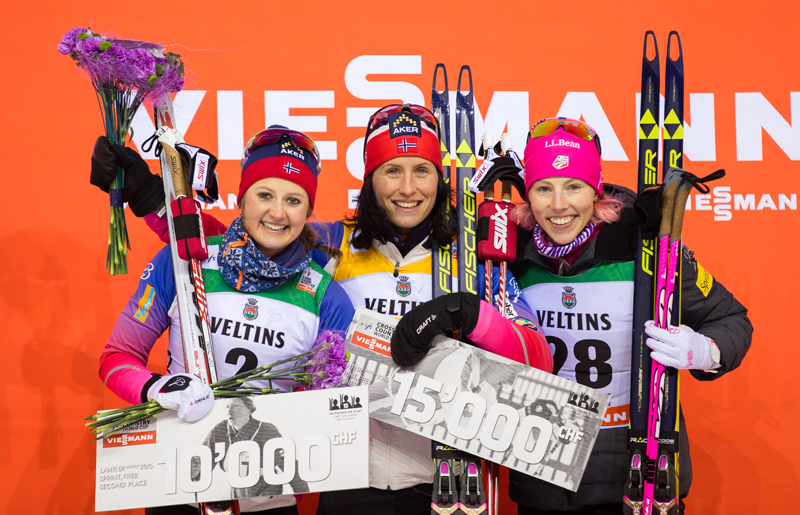
    From l-r, Norway's Ingvild Flugstad Østberg, Marit Bjørgen, and American Kikkan Randall on the podium after the 1.5-kilometer freestyle sprint in Lahti, Finlad. Bjørgen won the event by 0.14 seconds over Østberg, while Randall was close behind in third and earned her first World Cup podium of the season. (Photo: Fischer/Nordic Focus)
    From l-r, Ingvild Flugstad Østberg (NOR), Marit Bjørgen (NOR), and Kikkan Randall (USA) on the podium after the World Cup freestyle sprint in Lahti, Finlad. Bjørgen won the final by 0.14 seconds over Østberg, while Randall was close behind in third and earned her first World Cup podium of the season. (Photo: Fischer/Nordic Focus)

    “Making the podium today felt really good after such a frustrating season. I’ve always believed I could get back to fighting for the medals but this year has been a lesson in patience,” Randall explained.

    She also wrote that it was fun to ski with Diggins in the final, saying they both made use of fast skis.

    “My skis were rockets today and that really came in handy on some tactical downhills,” Randall wrote.

    Diggins, who is coming off a second-place finish in the 10 k freestyle at the World Championships in Falun, had a strong qualifier, advancing in fifth, 2.60 seconds behind Falk. In her quarterfinal, the first heat, she finished 0.15 seconds behind Germany’s Denise Herrmann before winning her semifinal in 2:59.12, 0.33 seconds ahead of Østberg.

    Though she just missed a spot on the podium by placing fourth in the final, Diggins still earned her World Cup career best, excluding World Championships.

    The sprint yesterday was so exciting and I was so happy to be in contention for the medals, I wasn’t even bummed out that I didn’t get one, I was just so psyched to be that close and right there in it. And to see Kikkan get back on the podium was really great, I was so happy. And our skis were good all weekend.

    Diggins called the sprint “exciting” in a phone interview, and said she was just happy to be in contention for the medals.

    “I wasn’t even bummed out that I didn’t get one [a medal]; I was just so psyched to be that close and right there in it,” she said. “And to see Kikkan get back on the podium was really great, I was so happy.”

    Meanwhile, the 2015 Overall World Cup champion Bjørgen said she was very pleased about her victory.

    “Today was much better than I thought. It is little bit surprising for me to be so good after Falun,” she told FIS. “I am looking forward to the next competition in Lahti and then in Norway.”

    Østberg, who failed to reach the podium in her two individual events at World Championships, was also happy with her result. She told FIS that she had to fight to catch back up to Bjørgen in the final after a slow start, and Bjørgen was stronger in the final stretch. “I am happy for Kikkan to be back,” she also added.

    The other finalists, Herrmann and Falk, finished in fifth (+2.49) and sixth (+3.64), respectively.

    The American team had other skiers race in the qualifiers that did not manage to reach the heats. Sadie Bjornsen qualified in 32nd (+9.31), 0.94 seconds away from a spot in the top 30, while Sophie Caldwell was 34th (+9.94). Ida Sargent was 43rd (+11.35), Liz Stephen took 46th (+12.04), and Caitlin Patterson finished in 51st (+13.92) in her first World Cup race of the season.

    Five Canadian skiers also raced, though none qualified. Andrea Dupont led the team in 42nd (+11.27), while Cendrine Browne was 47th (+12.36). Olivia Bouffard-Nesbitt took 56th (+17.41), Heidi Widmer was 58th (+18.63), while 21-year-old Dahria Beatty – racing on her birthday – took 65th (+23.76).

    The World Cup in Lahti, Finland, continues Sunday with the women’s 10 k and men’s 15 k classic individual starts.

    Results

  • Brooks Wins Second Birkie; Bonaldi Takes Men’s Race in Dramatic Finish

    Brooks Wins Second Birkie; Bonaldi Takes Men’s Race in Dramatic Finish

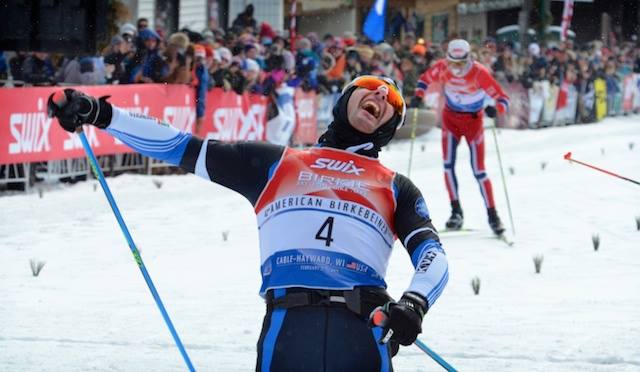
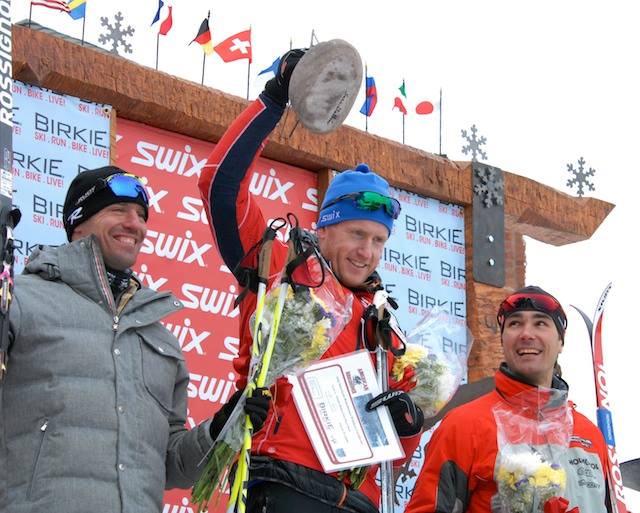
    Segio Bonaldi celebrates after winning in a sprint finish at the 2015 American Berkebeiner. It is Bonaldi's second Birkie title. (Photo: American Birkebeiner Ski Foundation)
    Italy’s Segio Bonaldi celebrates after winning in a sprint finish at the 2015 American Berkebeiner in Hayward, Wis. It was Bonaldi’s second Birkie title. (Photo: American Birkebeiner Ski Foundation)

    The 2015 American Birkebeiner in Hayward, Wis., was spared the most frigid weather gripping the Eastern U.S., as temperatures hovered around 15 degrees Fahrenheit when Saturday’s 51-kilometer freestyle elite race began. And despite three to four inches of new snow, even the sun made an appearance during the race.

    In was in these conditions that American Holly Brooks, of Alaska Pacific University in Anchorage, Alaska, won her second Birkie, claiming victory in a time of 2:34:33.

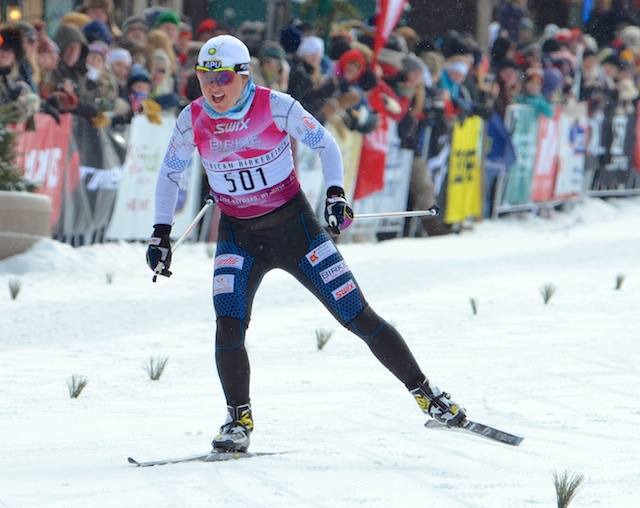
    Holly Brooks racing to her second Birkie victory on Saturday in Hayward, Wis., which she won by nearly 30 seconds to reclaim the FIS Marathon Cup overall lead. (Photo: Darlene Prois/ABSF)
    Holly Brooks racing to her second Birkie victory on Saturday in Hayward, Wis., which she won by nearly 30 seconds to reclaim the FIS Marathon Cup overall lead. (Photo: Darlene Prois/ABSF)

    However, she first had to ward off Aurelie Dabudyk of France, who stuck with Brooks until she began her final push on the flats of Lake Hayward, a few kilometers from the finish.

    Brooks came into the race second overall in the FIS Marathon Cup, but reclaimed the lead after Saturday’s win.

    The 32 year old told FasterSkier that the top four women were together for most of the race. At “B*itch Hill” – a steep climb about 40 k into the race – she said she heard a second snow machine behind her.

    “I looked over my shoulder and there was the sea of men who had caught us,” she explained. “I knew it was a now-or-never moment.”

    As the leading men passed the first four women, Brooks decided to make her move. She tagged onto the group of men and managed to break from the group.

    However, she was surprised to find Dabudyk was able to hang behind her.

    “I did not want to leave it to the finish sprint and therefore pushed as hard as I could on Lake Hayward. I did not dare to look back before the finish line to be sure not to lose any seconds,” she explained to the press. “I didn’t want to be ‘that skier’ who looked back and lost the sprint because you miss a crucial pole plant or something.”

    As usual, she said Main Street in Hayward was incredibly loud and festive.

    “It would have been fun to grab a flag and celebrate a bit but ensuring the win and reclaiming the red bib was more important!” she said. “I am really happy that I could win the Birkie again today!”

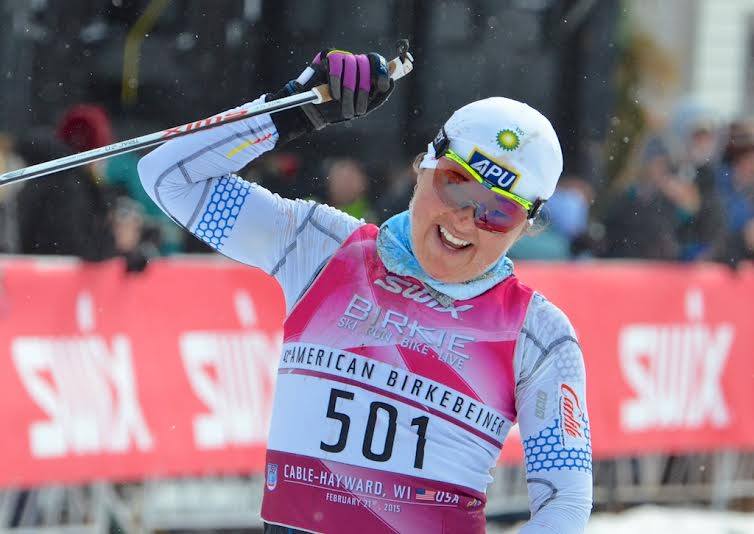
    Holly Brooks celebrates after winning her second American Berkebeiner on Saturday in Hayward, Wis. The win put her back in the lead of the overall FIS Marathon Cup. (Photo: American Birkebeiner Ski Foundation)
    Holly Brooks celebrates after winning her second American Berkebeiner on Saturday in Hayward, Wis. The win put her back in the lead of the overall FIS Marathon Cup. (Photo: American Birkebeiner Ski Foundation)

    Dabudyk went on to finish second, 28.1 seconds behind Brooks. Tatiana Mannima of Estonia was nearly two minutes back in third (+1:59.9), barely holding off German Anja Gruber, who placed fourth (+2:02.1).

    Mannima has won the last two FIS Marathon Cup races, while Gruber is coming off three podium finishes earlier this month in SuperTour races in Craftsbury, Vt.

    Dabudyk said to the press that she wanted to stay with Brooks until the finish, though down the stretch Brooks had too much power for her.

    “But I am really happy with my second place,” she added.

    Mannima said that she pushed hard from the start to see which skiers could hold onto her speed. She was able to stay in the lead group until Brooks and Dabudyk finally took off with 10 k to go.

    “At Lake Hayward, I was trying to stay behind Gruber, as it was pretty windy on the lake. I hoped to pass her before the finish line, which I did,” she explained, adding that she is happy to just be on the podium.

    American Caitlin Patterson (Craftsbury Green Racing Project) ended up fifth (+9:31), after winning the SuperTour 20 k classic mass start in Craftsbury late last month.

    Bonaldi wins second Birkie in exciting fashion 

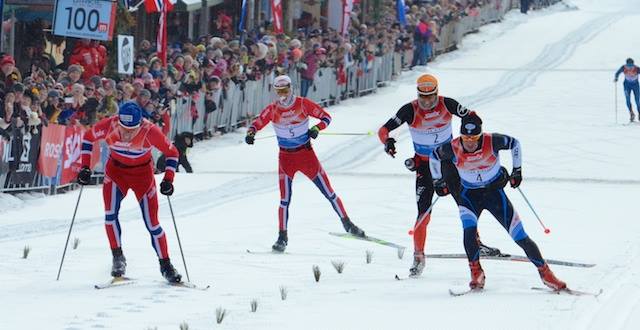
    Italy's Segio Bonaldi (r) outlasts three Frenchmen en route to his second American Birkebeiner victory on Saturday in the 42nd annual Birkie in Hayward, Wis. (Photo: Darlene Prois/ABSF)
    Italy’s Segio Bonaldi (r) outlasts three Frenchmen en route to his second American Birkebeiner victory on Saturday in the 42nd annual Birkie in Hayward, Wis. (Photo: Darlene Prois/ABSF)

    The men’s race offered a more dramatic finish, as Italian Segio Bonaldi outsprinted three Frenchmen to win by less than a second.

    Bonaldi, Birkie winner in 2013, finished in 2:12:21.1. He passed France’s Christopher Perrillat-Collomb in the final 100 meters to win by just 0.5 seconds. Benoit Chauvet and Mathias Wibault were also in the lead group, and Chauvet finished in third (+1.7) while Wibault faded to fourth (+5.0).

    Chauvet told the press that he tried to break out of the lead group of 20 at the first climb, but no one was willing to break with him. However, the racers slowly began to spread apart at about the 35 k point, and Chauvet was able to work with Perrillat-Collomb.

    “At this point all were thinking about winning the race,” he said.

    Chauvet explained that his tactics failed him, however, and that Bonaldi was smarter and stayed behind the others until the final stretch. Chauvet said he probably made his final sprint too early, as he tried to be first coming off the new bridge that drops the skiers into downtown Hayward and the final straightaway to the finish.

    “I did not feel so well until 15 k before the finish,” Bonaldi said. “My skis were also not very good so I tried to stay behind and to wait for the finish sprint. I kept energy for that.”

    The 36 year old added that he really wanted to win this year, especially after finishing third last year, but was not sure he would have a clear shot at victory until 100 meters before the finish line.

    “I am very happy!” he said.

    “I am little bit disappointed to be third as I wanted to win. I have to come back for the victory next year,” Chauvet said.

    The top American, Lex Treinen (APU), finished nearly 20 seconds after Wibault in fifth and was 24.5 seconds from the win. Last year, he placed 10th in the Birkie. American Brian Gregg (Team Gregg/Madshus) finished in eighth (+1:51.4).

    FIS Marathon Cup leader Petr Novak of the Czech Republic came through in 11th (+5:51.4).

    “I had the worst skis of my life. I lost so much on the downhills. It was a mental fight for me all the way through and right until the end!” Novak said in a statement to the press. Despite his rough day, he still retains the lead in the overall FIS Marathon Cup standings.

    American Matt Liebsch (XC United/Team Strong Heart), 2009 Birkie winner, finished 10th (+3:10.8), while 2012 Birkie winner Tad Elliott (Ski & Snowboard Club Vail Elite) took 16th (+10:29.5).

    Naryshkina, Mork take classic titles

    Men's 55 k classic Birkie winner Ole Christian Mork (c) is with second-place finisher Torin Koos (l) and Thomas Seidel (r), who placed third. (Photo: ABSF)
    Men’s 55 k classic Birkie winner Ole Christian Mork (c) is with second-place finisher Torin Koos (l) and Thomas Seidel (r), who placed third. (Photo: ABSF/Facebook)

    In the 55 k classic race, Natalia Naryshkina of Russia and the CXC Team took the women’s win in 3:19:20.2, while Norway’s Ole Christian Mork won the men’s race in 2:54:22.1.

    Naryshkina beat runner-up Josie Nelson of Medicine Lake, Minn., by 3:44.9, and Kelly Sillicorn of Winona, Minn., by 3:50.9. Isabel Caldwell, younger sister of U.S. Ski Team member Sophie Caldwell, placed fourth (+6:14.8).

    Mork, of Oslo, outlasted four-time U.S. Olympian Torin Koos by 8.8 seconds and Thomas Seidel, of Salt Lake City, in third by 14.7 seconds.

    Complete results

    51 k skate results: Men | Women

    55 k classic results: Women | Men

  • Diggins Rides Fast Start to 17th; Stephen 26th in Östersund 10 k

    Diggins Rides Fast Start to 17th; Stephen 26th in Östersund 10 k

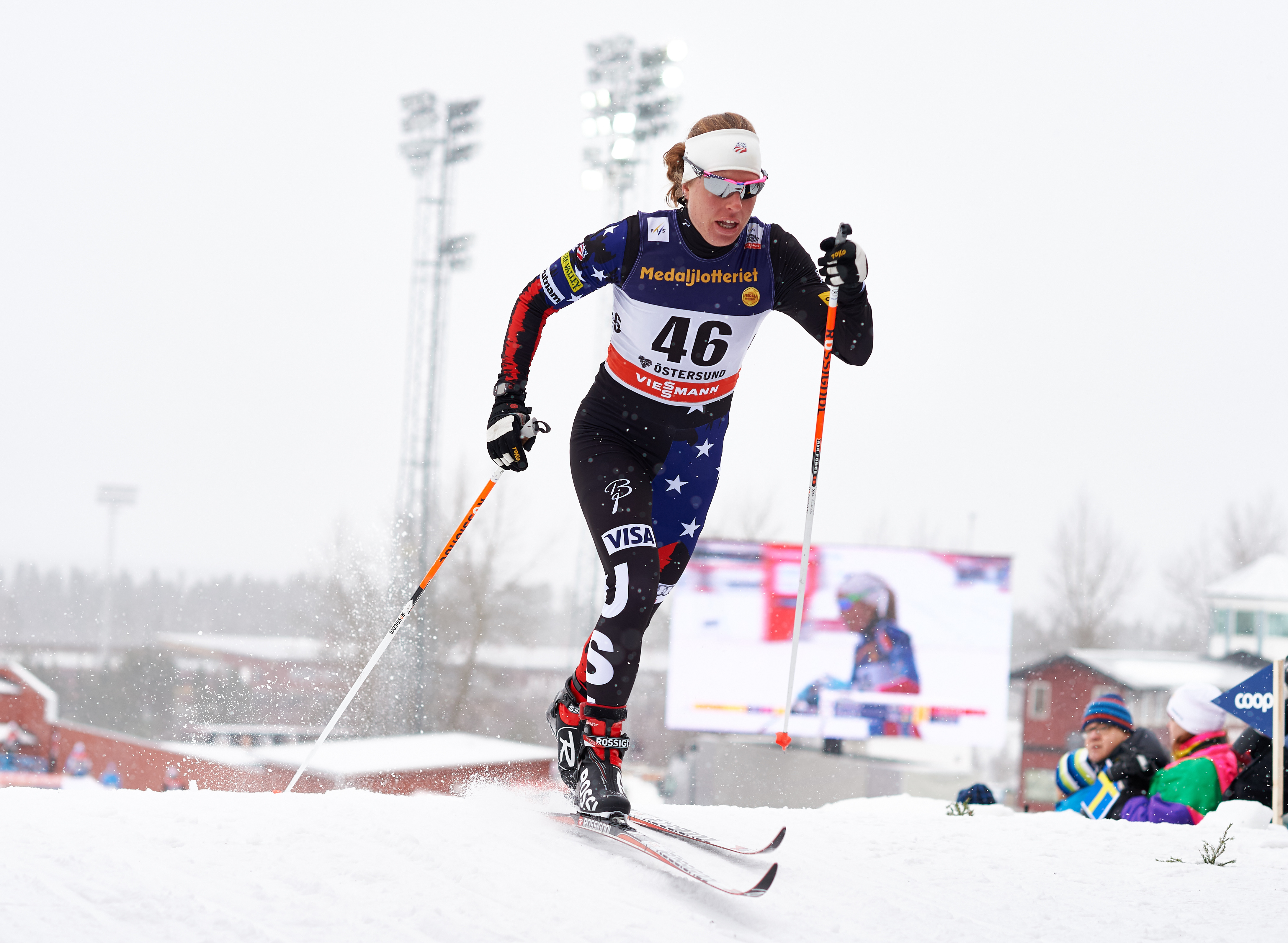
    Rosie Brennan racing to 33rd overall in Saturday's World Cup classic sprint Östersund, Sweden. She placed 32nd in Sunday's 10-kilometer freestyle individual start. (Photo: Ian Harvey/Toko)
    Rosie Brennan racing to 33rd overall in Saturday’s World Cup classic sprint Östersund, Sweden. She placed 32nd in Sunday’s 10-kilometer freestyle individual start. (Photo: Ian Harvey/Toko)

    In the final World Cup race before the 2015 World Championships, Jessie Diggins led the American women’s team by taking 17th in Sunday’s 10-kilometer freestyle individual start in Östersund, Sweden.

    Diggins finished 1:47.7 behind winner Charlotte Kalla of Sweden, who posted a time of 23:26.1 in front of a large home crowd. Marit Bjørgen of Norway took second (+36.4) to seal her fourth overall World Cup title, while Norway’s Therese Johaug placed third (+53.6).

    Diggins had the fifth-fastest time at the 1.8 k mark, but slowed to 14th by 6.8 k into the race.

    U.S. Ski Team (USST) Women’s Coach Matt Whitcomb said in a phone interview, “You might look at the pacing and say, ‘There’s an athlete that went out too hard’ … but I look at it as, there’s an athlete that went out and tried to win a race.”

    He explained that while Diggins faded throughout the race, he preferred her intense approach to a more conservative start, adding that she showed integrity and her body responded well to her effort.

    “Seventeenth is a great result, and I know she felt good and looked good doing it. So I’m excited for her,” he said.

    Diggins could not be reached immediately for comment.

    Liz Stephen, who placed fifth overall in the 2015 Tour de Ski, ended up 26th (+2:08.6).

    “I was not checked into race mode either in the body or the head, so I have a bit to work on over the next week,” Stephen wrote in an email.

    She explained that the course was difficult and consisted of many steep climbs and fast descents, in addition to some icy spots under a layer of crushed corn snow. However, with the large crowd of fans, she wrote that it made for a great ski-racing atmosphere.

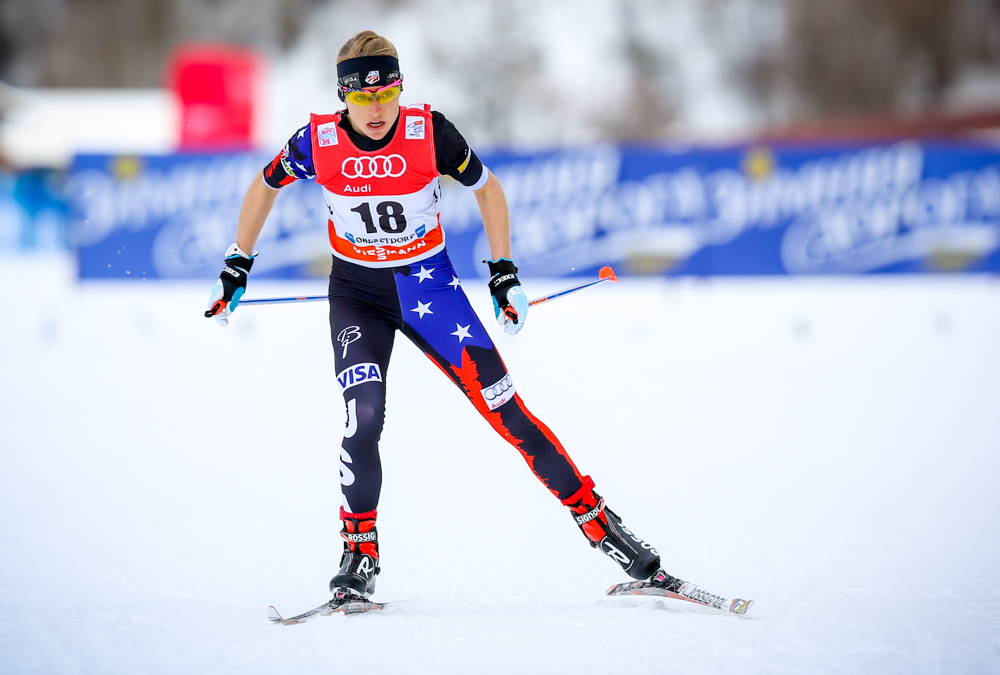
    Liz Stephen was 26th in Sunday's 10-kilometer freestyle individual start in Östersund, Sweden. Here she is pictured racing in the 2015 Tour de Ski prologue in Oberstdorf, Germany.  (Photo: Marcel Hilger)
    Liz Stephen was 26th in Sunday’s 10-kilometer freestyle individual start in Östersund, Sweden. Here she is pictured racing in the 2015 Tour de Ski prologue in Oberstdorf, Germany. (Photo: Marcel Hilger)

    “I am feeling good, physically and mentally,” she explained. “I am really excited to be heading to Falun tomorrow and can’t wait to get the World Champs started.”

    Whitcomb said that while they were hoping for a stronger race, he is not concerned about Stephen’s performance. He remains confident about where she is heading into World Championships.

    “My guess is that we need a couple more significant doses of rest – a day here, a day there – before her first target event at World Champs, which will be the skiathlon. And the plan has that in it already, so no emergency action will be taken,” he said.

    Rosie Brennan took 32nd (+2:26.6), a day after finishing 33rd in the classic sprint. She was 2.7 seconds from cracking the top 30.

    Brennan wrote in an email that she felt she had a decent day, but thought some parts of the race could have gone better. She explained that she enjoyed the course’s steep-and-numerous uphill sections but struggled in the downhills and “undulating terrain.”

    “They lost a lot of snow here last week so most of the course was fast, manmade snow breaking down into sugar-like snow,” she wrote.

    Brennan added that she feels confident about her fitness and training, and that it was great preparation for World Championships to race twice this weekend.

    “After a few weeks off racing, it usually takes me a race or two to get back in my groove,” she wrote.

    Meanwhile, Kikkan Randall finished 33rd (+2:27.7), 3.8 seconds out of the top 30.

    Kikkan Randall raced to 33rd in Sunday's 10-kilometer freestyle individual start in Östersund, Sweden. Here she is pictured during qualifiers in Saturday's classic sprint, where she placed 51st.  (Photo: Felgenhauer/NordicFocus)
    Kikkan Randall raced to 33rd in Sunday’s 10-kilometer freestyle individual start in Östersund, Sweden. Here she is pictured during qualifiers in Saturday’s classic sprint, where she placed 51st. (Photo: Felgenhauer/NordicFocus)

    She explained in an email to the press that she had a strong start and found a rhythm in the first lap, but found it difficult to “kick it into full race gear.”

    “While the pace was not as aggressive as I had hoped to find today, the feelings were a lot more positive than earlier in the season.  This confirms that my preparation over the past month has been productive.  Now it’s just a matter of getting my body back into race mode,” she wrote.

    She added that the weekend was a good boost as she prepares for the World Championships classic sprint on Thursday.

    Overall, Whitcomb said Sunday was not a confidence-building day, especially as the team looks toward World Championships. He said the team would prefer to enter Worlds with season-best results.

    “But the fact is, no one race can capture where we are as a team,” he explained. “We’re leaving Östersund with some really valuable feedback, and we feel perfectly comfortable with where we need to be right now … We’re an eager team, and we’re really looking forward to putting on a show in Falun.”

    Results

  • Hamilton Takes 11th, Newell 12th to Lead Americans in Östersund Sprint

    Hamilton Takes 11th, Newell 12th to Lead Americans in Östersund Sprint

    Simi Hamilton placed 11th overall in Saturday's World Cup classic sprint in Östersund, Sweden after falling during his semifinal heat and taking sixth. Here he is pictured en route to his first distance points ever in World Cup competition in Oberstdorf, Germany. (Photo: Marcel Hilger)
    Simi Hamilton placed 11th overall in Saturday’s World Cup classic sprint in Östersund, Sweden, after taking sixth in his semifinal heat. Here, he is pictured en route to his first distance points in a World Cup race earlier this season in Oberstdorf, Germany. (Photo: Marcel Hilger)

    On what U.S. Ski Team (USST) Women’s Coach Matt Whitcomb called a “wild-and-crazy course,” Simi Hamilton was the lone American to reach the semifinals in Saturday’s 1.2-kilometer classic sprint in Östersund, Sweden.

    However, Hamilton would fall while ascending a hill during the first lap of his semifinal heat and took sixth, ending up 6.33 seconds behind semifinal winner Sondre Turvoll Fossli of Norway (who won the heat in 2:27.83) and finishing 11th overall.

    Hamilton explained in a phone interview that the difficult course was breaking down quite a bit throughout the day, and the snow was getting deeper on the steep hills that required the skiers to herringbone.

    “My right ski just got caught behind me a little bit in the powder, and I just put my right pole right through the top of that ski,” he said. “When you’re trying to hammer a herringbone your poles are just coming so close to your ski it’s definitely a pretty thin margin between a good pole plant and planting right on top of your ski.”

    After falling, Hamilton focused on getting up as fast as he could and surged through the end of the first lap in order to make up lost time.

    “I made contact with the back of the group again, but just didn’t have a ton of energy left after that to try and get around anyone,” he said.

    After qualifying in 12th, 2 seconds behind Norwegian qualifier winner Timo André Bakken, who posted the fastest time in 2:28.25, Hamilton won his quarterfinal in 2:31.97.

    “My energy felt really good all day, so I knew I’d be able to put in a good, sustained effort, hoping that a few of those guys in the quarterfinal would start to drop off a little bit,” he said.

    Hamilton explained that he was able to put himself in second place, behind Finland’s Toni Ketelä, as they went up the hill above the stadium for the second time. By the last climb before the short, final descent into the stadium, he went as hard as he could and took an open lane on the left.

    “I had some room to do my own thing, so I could hammer up and over the top of that climb and focused on having a good double-pole finish,” he said.

    “I felt like some times in the past, especially with classic sprinting I haven’t been able to lay down a really good qualifier and haven’t been able to find the energy,” he continued. “So I was definitely pretty happy with the quarterfinal.”

    Rosie Brennan racing to 33rd overall in Saturday's World Cup classic sprint Östersund, Sweden. (Photo: Ian Harvey/Toko)
    Rosie Brennan racing to 33rd overall in Saturday’s World Cup classic sprint Östersund, Sweden. (Photo: Ian Harvey/Toko)

    Meanwhile, Hamilton’s teammate Andy Newell took third in his quarterfinal after qualifying in 17th (+2.68). He finished 12th overall for his best World Cup result of the season.

    Newell explained that if he had made “one or two better moves” going into the final uphill of his quarterfinal, he might have had a shot at placing into the semifinals or moving on as a lucky loser. But he ended up 2.61 seconds behind Norway’s Thomas Northug, who was second in his heat, and 1.10 seconds short of a lucky loser spot.

    “It was a pretty unique course, that’s for sure. It’s fun in that we don’t get to race courses like that very often,” Newell said in a phone interview. “You had to have a unique technique of herring bone in order to do well.”

    Newell was happy with the result, especially in light of his struggles earlier in the season due to both allergies and physical injuries.

    “You have years where a 12th-place finish is a disappointment … But at the same time I’m feeling really good, and it’s not always reflected in the results,” he said. “As an athlete you have to gauge your excitement and your momentum on how you’re feeling and not necessarily on your results.”

    Norway’s Finn Hågen Krogh would eventually win the men’s final in 2:25.28, holding off Canada’s Alex Harvey by 0.47 seconds. Bakken took the final spot on the podium in third (+1.41).

    Bjornsen, Caldwell Lead U.S . Women

    In the women’s sprint, Sadie Bjornsen qualified in 27th, 10.02 seconds behind Norwegian qualifier winner Kari Vikhagen Gjeitnes, the fastest in 2:47, while Sophie Caldwell qualified in 24th (+9.84). They raced in the same quarterfinal heat against Sweden’s Stina Nilsson and overall World Cup leader Marit Bjørgen of Norway.

    Bjørgen won the heat in 2:50.88, while Bjornsen placed fourth (+4.53) to finish the day 20th overall, and Caldwell took fifth (+5.57) to place 22nd.

    Bjornsen said in a phone interview that the course was fun, and much different than what the skiers are used to on the World Cup circuit.

    “I knew it was going to be very dependent on my herringboning skills, which I’ve been working a lot on the last couple of years, because I used to be terrible at it,” she said, adding the course featured very little striding and consisted mostly of herringbone, double pole and downhill tucking.

    Because of the chevron start, Bjornsen and Caldwell had to begin the quarterfinal heat in unfavorable, outside positions.

    “I didn’t have a great start, but I tried not to panic,” Caldwell wrote in an email. She explained that it was difficult to move around skiers because of the constant herringboning, so she spent most of the race in fifth place.

    Sophie Caldwell placed 22nd overall in Saturday's World Cup classic sprint in Östersund, Sweden. Here she is pictured during the 2015 Rybinsk, Russia sprint, where she took seventh.   (Photo: NordicFocus)
    Sophie Caldwell placed 22nd overall in Saturday’s World Cup classic sprint in Östersund, Sweden. Here she is pictured during the 2015 Rybinsk, Russia sprint, where she took seventh. (Photo: Fischer/NordicFocus)

    Bjornsen described the race as a “busy scene.” She said that with six skiers trying to funnel into small areas, there were a lot of tangles and opportunities for blocking.

    She explained she was not able to close in on the leaders as much as she wanted to at the end, but she said that she definitely felt confident about her fitness.

    “I didn’t want to set a goal this weekend that was going to dictate how I felt about my fitness – so it was kind of just for fun today. I’m definitely going into [World Championships] feeling happy and confident,” she said.

    Whitcomb said in a phone interview that it was a solid result for the American women and its team’s sprinters would not leave Östersund discouraged.

    “You’re always hoping for a top 10 … but it was a tricky course, with a variety of unique demands,” he said.

    Based on their positions after qualifying, Caldwell and Bjornsen made the most of what they had, he said, as it was nearly impossible for them to be better than fifth and sixth coming off the top of the steep hill leaving the stadium.

    “For Sadie to mix it up in third and fourth, and for Sophie to be able to finish fifth – in good contact with people – I was pretty happy with that. It was a course that was really difficult to move around on, and your place at the start in many cases didn’t change,” he explained.

    Rosie Brennan narrowly missed the quarterfinals, qualifying in 33rd (+11.03), 0.72 seconds out of the top 30.

    Brennan said in a phone interview that while it is frustrating to be so close to qualifying – especially three weeks after placing 31st in the Rybinsk, Russia freestyle sprint – she is still happy with the result.

    “I am really happy with the way I skied so I will just have to work on perfecting the details … As with every race I enter, my goal is simply to push as hard as I can and ski well,” she said.

    Whitcomb said that Östersund does not suit Brennan’s strengths, as the Alaska Pacific University skier benefits from powerful striding and not the herring boning the course requires.

    “Thirty-third is definitely a success, one of the successes of the day,” he said. “It’s an indication that she’s in the best shape of her life and she should be looking forward to a really positive World Championships.”

    Two other American women raced in the qualifying round – Ida Sargent finished 41st (+13.11) while Kikkan Randall was 51st (+16.92).

    Whitcomb said that Randall and Sargent were not pleased with their results. He said Sargent reported that she was skiing frantically, while “it took Kikkan a lap to get things going, and you don’t have time for that in a short sprint like this.”

    Randall wrote in an email to the press that her qualification was not as strong as she was hoping for after a month-long break from racing.

    “I skied too tense and didn’t quite have enough tempo out there, kind of like I was blowing the cobwebs out,” she wrote.

    However, she added that she is still confident in the recovery and preparation she has undergone over the last month, and believes it was a good decision to go home and “get a chance to complete reset and get back to basics.”

    Bjørgen would end up expanding her overall lead by comfortably winning the final in a time of 2:46.82, 1.80 seconds ahead of teammate Maiken Caspersen Falla. Nilsson placed third (+2.03) in front of a roaring home crowd.

    World Cup racing in Östersund continues on Sunday with the 10/15 k freestyle individual starts.

    Results: Men | Women

  • U.S. Women Eighth in Junior Worlds Relay; Russia and Norway Victorious

    U.S. Women Eighth in Junior Worlds Relay; Russia and Norway Victorious

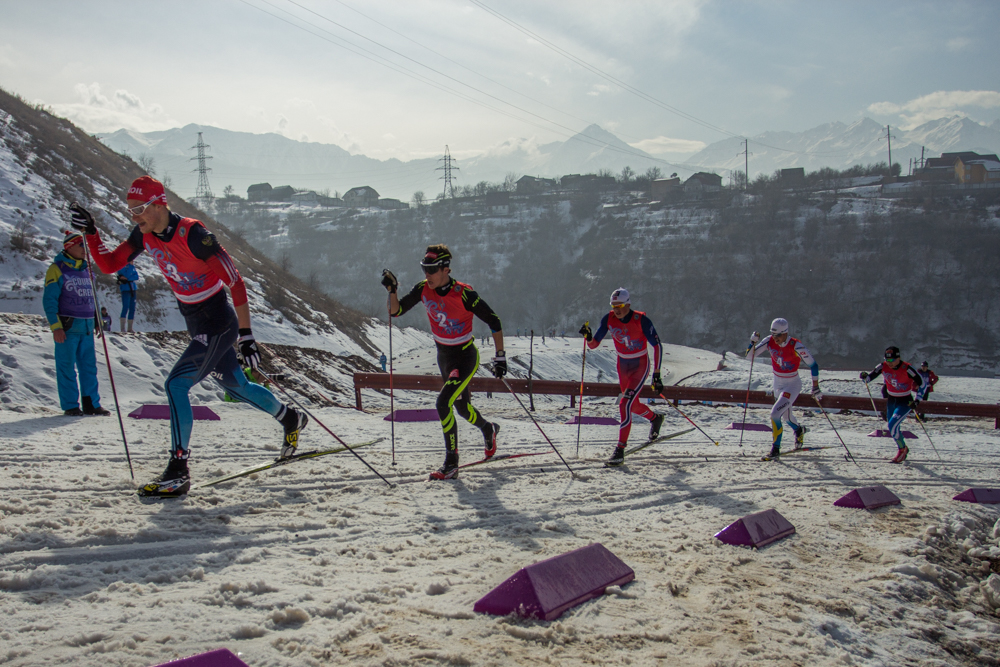
    Julia Kern races the first leg of the 4 x 3.3 k relay at the Junior World Championships in Almaty, Zazakhstan. The American team would go on to place eighth. (Photo: Logan Hanneman)
    Julia Kern (CSU) races the first leg of the 4 x 3.3 k relay at the Junior World Championships in Almaty, Kazakhstan. The American women’s team would go on to place eighth. (Photo: Logan Hanneman)

    The American junior women’s team wrapped up a successful week at the Junior World Championships in Almaty, Kazakhstan, by placing eighth in Sunday’s 4 x 3.3-kilometer relay. They finished 2:11.0 minutes behind the winning Norwegian team (35:04.0).

    Norway erased an 11.1-second deficit after the second leg to claim victory with a time of 35:04.0 and beat the Russian team by 0.4 seconds. Germany used a strong final leg from Victoria Carl to overcome Sweden and take third (+35.3).

    Julia Kern (Cambridge Sports Union) set up the American women’s squad by posting the fifth-fastest first leg and putting the team just 8.6 seconds behind Slovenia, the leader at the time.

    Kern wrote in an email that the mass start today was not as chaotic as during Friday’s 10 k skiathlon, but was still fast and aggressive. “In these international races, people go hard from the start, leaving it all out there,” she wrote.

    The 17 year old added that it was encouraging to be able to ski with the lead pack and be with the top skiers.

    “It was relatively fast for the warm conditions, with a few icy spots,” she wrote. “My skis were fantastic, I didn’t slip once and also had really fast skis.”

    Northern Michigan University’s Vivian Hett, who skied the second leg, wrote in an email that she felt okay about her race despite falling on an icy corner.

    “The ski conditions today were getting a little tricky. The morning started out really foggy but the sun began to shine right after the race began! It has been really warm here so klister was needed for the classic legs,” she added.

    17-year-old Katharine Ogden, of the Stratton Mountain School – who placed sixth in Friday’s skiathlon and tied the best American distance result at a Junior Worlds since 2002 – skied alone for the fifth-fastest third leg of the day. However, the team was still 1:16.4 minutes behind Norway and 24.7 seconds out of seventh going into the final leg.

    “The people ahead of me were far ahead and the same with the people behind me,” Ogden wrote in an email.

    Hailey Swirbul races the anchor leg while guiding the American team to eighth place in the 4 x 3.3 k relay at the Junior World Championships in Almaty, Kazakhstan (Photo: Logan Hannneman)
    Hailey Swirbul (Aspen Vally SSC) races the anchor leg while guiding the American team to eighth place in the 4 x 3.3 k relay at the Junior World Championships in Almaty, Kazakhstan (Photo: Logan Hanneman)

    Hailey Swirbul’s anchor leg was also fairly uneventful, the Aspen Valley Ski & Snowboard Club member explained in an email.

    “A pack of teams in front of us had created a gap in the previous leg, so it was my job to hold off the Finnish team behind us. It was a painful but lonely anchor leg for me!” Swirbul wrote.

    She explained that conditions on the course were great considering the warmth Almaty has experienced over the past few days, and “the skis were ripping fast as usual thanks to our hard working techs.”

    Overall, the American women were satisfied with their result.

    “I thought that our team skied really well today. Other than a little crash on the second leg everything went smoothly and everyone gave it their all,” Ogden wrote.

    “I was really excited about how our team did today,” Kern wrote. “We had bib 10 and we moved up to eighth, so that was exciting!”

    Though Swirbul was happy the team improved on its 10th-place ranking from 2014, she explained that she is confident the team will only get better in years to come.

    “It has been great to see the U.S. really mixing it up this year in multiple events, so I am looking forward to improving that relay result in the future,” she wrote.

    Meanwhile, the Canadian women’s team finished 10th (+3:04.0). Katherine Stewart-Jones skied first and left the team in ninth, 37.5 seconds back. However, her leg could have gone a lot better.

    The 19 year old Nakkertok and Canadian National Junior Team skier – who was 14th in Friday’s skiathlon – wrote in an email that her leg started off well, and she was in fourth after the first lap.

    “Then I got tangled up and fell,” Stewart-Jones explained. “I got up as quickly as I could but realized I had lost my ski and that my binding was broken. I ran with one ski until one of the coaches gave me a new one.”

    By that point, she had lost a lot of time and had fallen back to ninth place.

    “It is obviously a little disappointing but skiing as a team is always a lot of fun anyway. It was great to be able to watch my teammates hammer their legs and cheer them on!” she wrote.

    Russia wins again; Canada cracks top 10 

    On the men’s side, Russia continued to assert their dominance by winning the 4 x 5 k relay in 45:11.0. They were essentially tied with the French team going into the final leg, but Russian Alexey Chervotkin had too much speed for France’s Louis Schwartz, and Russia won by 17.3 seconds.

    Norway was never within striking distance of the Russian or French skiers and finished third (+1:01.5).

    The leaders -- (l-r) Russia, France, Norway -- during the 4 x 5 k men's relay at Junior Worlds in Almaty, Kazakhstan (Photo: Logan Hanneman)
    The leading pack: (l-r) Russia, France, Norway, Sweden, and Finland during the 4 x 5 k men’s relay on Sunday at the Junior World Championships in Almaty, Kazakhstan. (Photo: Logan Hanneman)

    The Canadian men’s team took 10th (+3:40.9), while the American men placed 11th (+4:51.4).

    “I thought that we did pretty alright,” American Thomas O’Harra (Alaska Pacific University), who skied the first leg, wrote in an email. “We were hoping to get into the top 10 at least, or even higher, but we couldn’t quite make it.”

    O’Harra explained that he moved into fifth place during the first loop and pushed hard to stay with the leaders, but the pace caused him to blow up approximately 300 meters into the second loop.

    “I moved backwards through the pack until we were pretty far down on the leaders,” he wrote. “Then, in the tag zone, something weird happened and Ian fell right after I tagged him.”

    However, O’Harra was happy to see the team not get lapped and hold on for 11th.

    Juniors reflect on week in Almaty 

    The North American athletes had mostly positive things to say about their experiences at the 2015 Junior World Championships.

    Ogden explained that her goals coming into Junior Worlds were mainly to obtain valuable international racing experience and earn a top-20 result. She certainly got those results: In addition to her sixth-place performance in the skiathlon, she also placed 11th in Wednesday’s 5 k freestyle.

    “I was really stoked to be able to meet and even exceed my goals,” she wrote.

    She added that one of her favorite memories took place on Sunday when all the teams – wearing coats, hats, and suits from their own countries – were conversing and trading their specialized items of clothing.

    “It was just so cool to see all of the teams come together like that,” she wrote.

    Kern was disappointed that she missed the sprint heats by 0.4 seconds on Tuesday, but wrote that otherwise she had a fantastic week.

    Thomas O'Harra (back left) staying with the leaders during the first leg of the men's relay at the Junior World Championships in Almaty, Kazakhstan (Photo: Logan Heinemann)
    Thomas O’Harra (back left) staying with the leaders during the first leg of the men’s relay at the Junior World Championships in Almaty, Kazakhstan. (Photo: Logan Heinemann)

    “One of my favorite memories was relay day. We all put glitter on all our faces and then went to track down all of our coaches and wax techs who all received glitter on their faces as well!” she wrote.

    Swirbul reflected on World Juniors by writing that the week has been an “important and successful step” in her skiing career.

    The 16-year-old Swirbul was 35th in the skiathlon and 40th overall in Tuesday’s sprint.

    She wrote that she began her season with a goal to qualify for Junior Worlds, and after achieving that goal, she arrived in Almaty feeling little pressure and with a mindset to learn as much as possible.

    “I was able to achieve my goals to absorb as much as I could from the elite athletes surrounding me, and learn from their race strategy and the way they carry themselves at competitions,” Swirbul explained.

    O’Harra wrote, “The smog in Almaty is pretty bad, but the people are all really nice, and the food is good … I’ve met a lot of really cool people here, and I’m looking forward to racing with and against them in the future!”

    Results: Men | Women

  • 21-Year-Old Dahlmeier Wins First IBU World Cup; Dunklee Ninth, Cook 28th for U.S.

    21-Year-Old Dahlmeier Wins First IBU World Cup; Dunklee Ninth, Cook 28th for U.S.

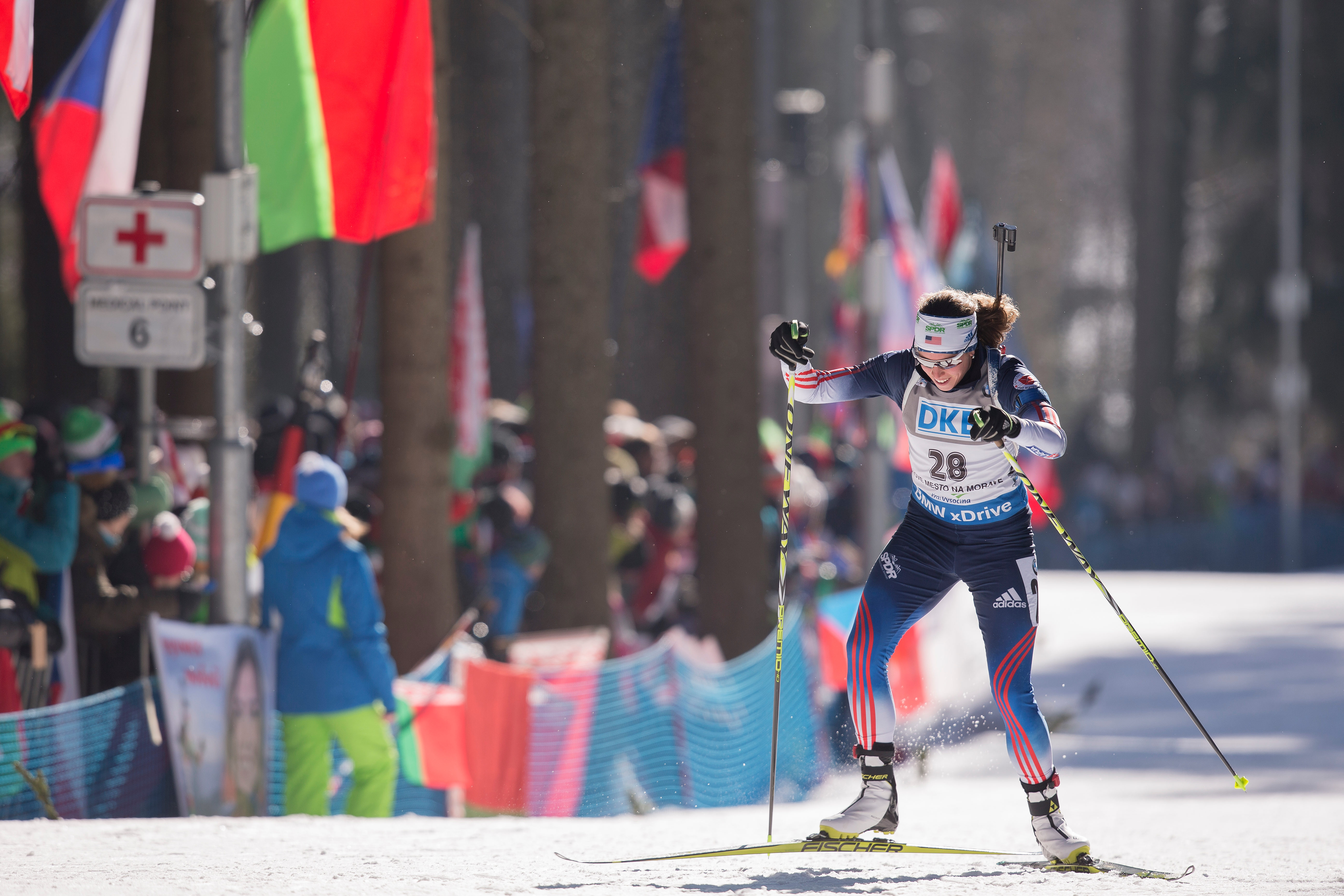
    Susan Dunklee on her way to a ninth-place finish in the World Cup 7.5 k biathlon sprint in Nove Mesto, Czech Republic (Photo Credit: U.S. Biathlon/Nordic Focus)
    American Susan Dunklee on her way to ninth place, for her third-straight individual top 10, in the women’s IBU World Cup 7.5 k sprint in Nove Mesto, Czech Republic. (Photo Credit: USBA/Nordic Focus)

    Laura Dahlmeier of Germany had just enough speed on the final loop to beat teammate Franziska Hildebrand, winning Saturday’s 7.5-kilometer biathlon sprint in Nove Mesto, Czech Republic, to earn her first-ever World Cup victory.

    She finished in an overall time of 21:33.4 and topped Hildebrand by 1.0 second.

    Hildebrand had the fastest cumulative time by 15.8 seconds heading into the third of three loops, but Dahlmeier was 16.8 seconds faster on the third loop. Neither skier missed a shot.

    “Since I was a little child, I always said that I wanted to come to the World Cup, and that I wanted to win,” Dahlmeier told the IBU’s Jerry Kokesh. “Today it is so, I’m in the first position and it’s amazing for me.”

    It was an impressive result for a young German team: Dahlmeier is just 21 years old, and Hildebrand, at 27, is one of the most senior members of the team. It was also a career-best for Hildebrand, who was thrilled to go 1-2 with her younger teammate.

    “It is amazing,” Hildebrand said in the press conference. “I felt a little tired from the relay, so I said I would just see what would happen today … The last loop was hard. I am happy to reach the podium.”

    The result satisfied the win-hungry German fans, who have high expectations every year. Dahlmeier made it clear that it was satisfying to prove wrong those who had questioned the ability of the young women’s team.

    “You can see that our concept works,” she told German broadcaster ZDF. “It was right to go with not so high expectations for the season. But we have shown that we can do it, and that people like [Darya] Domracheva or [Kaisa] Mäkäräinen are beatable.”

    Hannah Dreissigacker took 39th in the IBU World Cup 7.5 k sprint in Nove Mesto, Czech Republic (Photo: U.S. Biathlon/Nordic Focus)
    American Hannah Dreissigacker took 39th in the IBU World Cup 7.5 k sprint in Nove Mesto, Czech Republic. (Photo: USBA/Nordic Focus)

    Veronika Vitkova of the Czech Republic was third (+13.9), having missed one shot in the prone stage. The 32,000 fans in Nove Mesto were undeniably rooting for a home team victory; the noise when Vitkova and her teammates were on course and on the range was substantial. But the Czech women couldn’t come through. Gabriela Soukalova tied for 20th with one penalty.

    Darya Domracheva of Belarus missed one shot in each shooting stage and was fourth (+23.0), while Marie Dorin Habert of France ended up fifth (+26.9) after finishing the first loop in third and missing two shots in the standing stage.

    The top North American racer was American Susan Dunklee, who placed ninth (+46.3). She was 17th following the second loop after missing a shot in the standing stage, but pushed herself into the top ten by skiing the eighth-fastest final loop of the day. It marked her third-straight top-10 finish this season.

    Dunklee explained in an email that the 2.5 k course in one of her favorites on the World Cup circuit.

    “There are a lot of steep climbs, and my strongest technique is V1,” the 28-year-old wrote. “The climbs are hard, but it is crucial to also push hard on the flats and gradual downs after the uphills – that is where I tried to make up time today.”

    On the range, Dunklee explained that she chose to shoot on point 30 during the standing stage because it is more protected from the wind. While she did have one late miss, she was happy about how she executed her shooting.

    This result comes after a warm-up that she explained felt tense. She wrote that the team was involved in a significant traffic jam on the way to the race and barely made it on time, due to the “32,000-plus” fans driving to Nove Mesto. However, she was able to relax after skiing around for a bit before the race.

    Her teammate Annelies Cook also had an impressive performance, placing 28th (+1:19.8) and earning her her third-best sprint result ever on the World Cup, and her best result so far this season.

    “I am feeling really happy and also relieved,” she wrote in an email. “It has been a long time since I was able to put together a good race in both skiing and shooting, long enough to start to wonder if it was still possible.”

    Anneiles Cook took 28th in the IBU World Cup 7.5 k sprint, earning her third-best World Cup sprint result ever (Photo: U.S. Biathlon/Nordic Focus)
    American Anneiles Cook took 28th in the IBU World Cup 7.5 k sprint, earning her third-best World Cup sprint result ever and her best result this season. (Photo: USBA/Nordic Focus)

    The 30-year-old Cook explained that she tried to channel the positive energy from the large crowd on hand, and then take advantage of the long approach to the range in order to relax.

    “I try not to think about what is possible until the last loop because so much can change in a second and it is better to just be in the moment,” she explained.

    She added that it was a great feeling to be able to ski hard on the last loop and “feel like you are actually being competitive on skis.”

    The other American woman who qualified for Sunday’s pursuit was Hannah Dreissigacker, who finished 38th (+3:09.7)

    “I just tried to really ski my own pace on the first lap and keep it in control so that I’d have more left for the end.  I focused on being relaxed and having good technique,” she wrote in an email.

    She wrote that during shooting she was focusing on the basics of “breathing and trigger” – as she explained it is easy to lose that focus – and it worked today, as she only missed one shot in the standing stage.

    “In standing I think I may have come in a bit too hard, and I got shaky legs,” she wrote.

    She wrote that she tried to ski as hard as she could on the last lap, though was passed by Domracheva and knew she should not try and stay with her too early. However, she kept her in her sights on her way to the 30th-fastest final loop of the day.

    U.S. Women’s Head Coach Jonne Kähkönen explained in an email that it was a great day overall for the women’s team.

    He wrote that he knew the American women could have a solid result as a team as well as individuals, based on both training over the last few weeks and the progression over the course of the season so far.

    “I know that we have trained well and have used the opportunity in-between the World Cup races to always aim for even better, so based on that I was feeling confident for the day,” Kähkönen wrote.

    He added that Dunklee has been consistently performing well and that it was encouraging to see Cook and Dreissegacker also “stepping it up.”

    “I know that they have the potential to ski like this consistently,” he wrote.

    Neither Canada’s Audrey Vaillancourt nor American Clare Egan qualified for the pursuit, as Valliancourt placed 66th (+3:09.7) and Egan took 73rd (+3:43.4). In her first World Cup individual race, Egan cleaned prone but missed four standing shots.

    In an email, Egan explained that while she executed her plan on her first shooting stage, she didn’t do a good job controlling her rifle in standing.

    “But of course no matter what happens in biathlon, you have to keep pushing hard,” she wrote. “I did not think about my misses after I left the mat, I just skied as fast as I could to the finish line. Although I am disappointed about the standing, overall I am pleased with my performance because there were a lot of good things about it, and I know I can improve on the bad ones. I can’t wait to race three times next week in Oslo!”

    “For Clare, it was good to see the start and the prone stage,” Kähkönen wote. “She did a great job executing the game plan there. As for making it to the next level, there are really no short cuts – just hard work.”

    Canada’s Rosanna Crawford did not finish after missing her first shot in the prone stage, then hitting the next four – in the wrong lane.

    “I usually choose my lane as soon as I can see the targets and repeat it a couple times to myself. I didn’t do that today because I was analyzing the wind flags really hard,” Crawford wrote in an email.

    After skiing her penalty loop, her coach told Crawford that she had cross-fired and was facing eight minutes of penalties, so she decided to stop.

    “I’ve never cross fired before in a race and from what everyone tells me I’ll probably never do it again!” she wrote. “Lots of things to learn from this race but stewing and being angry won’t help me for next week.”

    The seventh weekend of the IBU World Cup finishes tomorrow in Nove Mesto with the women’s 10 k pursuit and the men’s 12.5 k pursuit.

    Alex Kochon and Chelsea Little contributed reporting

  • Ogden Ties Best U.S. Junior Distance Result in Sixth; Stewart-Jones in 14th in Skiathlon

    Ogden Ties Best U.S. Junior Distance Result in Sixth; Stewart-Jones in 14th in Skiathlon

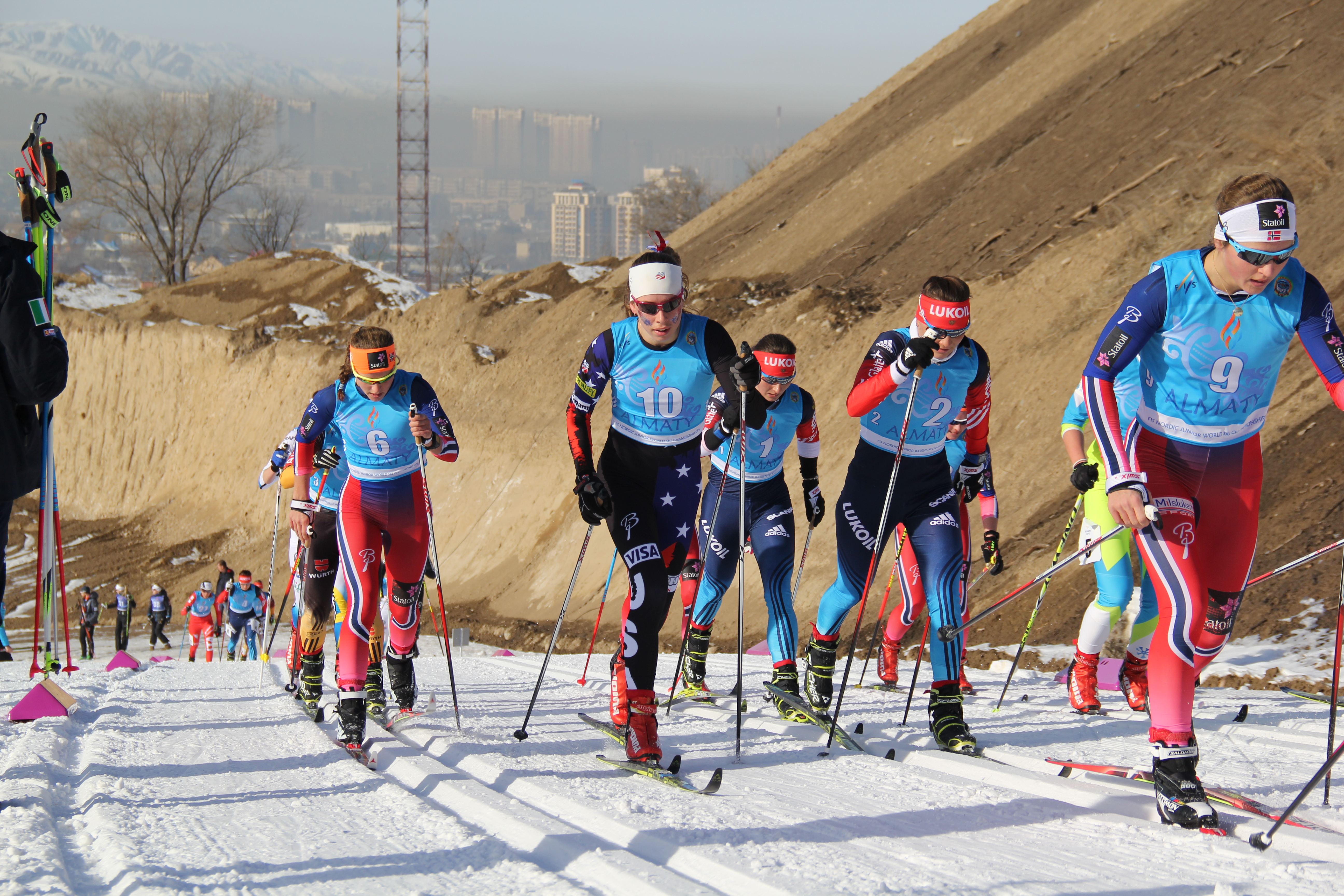
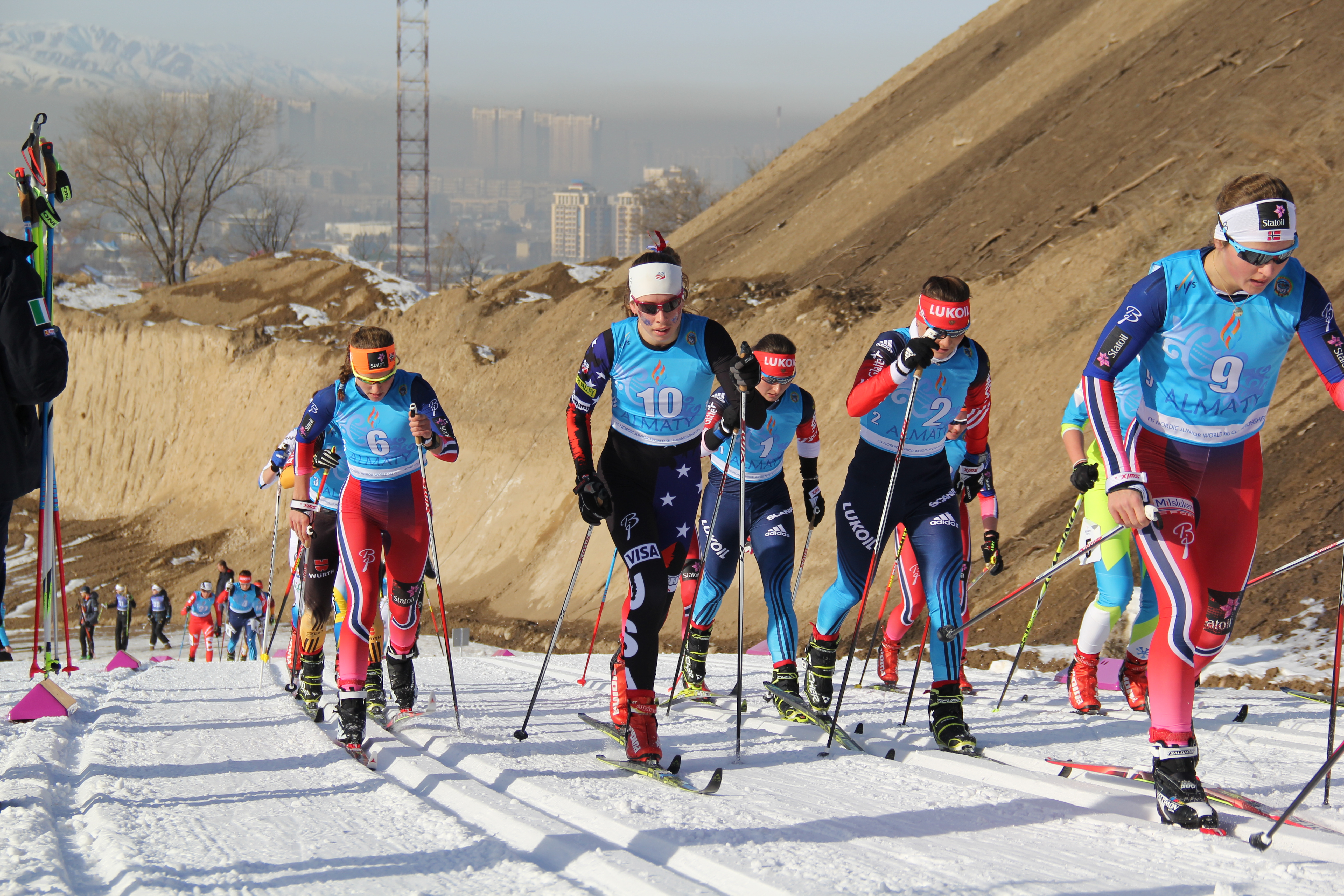
    Katharine Ogden (10) on her way to a sixth-place finish in the women's 10 k skiathlon at the Junior World Championships in Almaty, Kazakhstan (Photo: Bryan Fish/USSA)
    Katharine Ogden (10) of the Stratton Mountain School on her way to sixth place in the women’s 10 k skiathlon at the Junior World Championships in Almaty, Kazakhstan. With that result, Ogden tied Kristina Tryggstad-Saari for the best Junior Worlds distance result since Tryggstad-Saari placed sixth in the 5 k freestyle in 2002. (Photo: Bryan Fish/USSA)

    It may be Katharine Ogden’s first-ever Junior World Championships, but the 17-year-old Stratton Mountain School (SMS) skier is having a week to remember.

    Ogden placed sixth in Friday’s 10-kilometer skiathlon in Almaty, Kazakhstan, following an 11th-place finish in Wednesday’s 5 k freestyle. The American finished just 13.2 seconds behind winner Sofie Nordsveen Hustad of Norway (27:02.8) and was 6.4 seconds from the podium.

    “I am beyond stoked about my race today!” Ogden wrote in an email. “Going into the race I was originally hoping for a top 20, but after the 5 k on Wednesday I was really hoping for a top-10 result.”

    Ogden explained that the race went smoothly, as she was able to avoid crashing during the hectic mass start. She was then able to maintain a position in the top 20 for the majority of the classic portion.

    “It was really cool to be able to ski with some fast, aggressive Europeans and to experience a crazy, Euro-style mass start for the first time,” she wrote.

    Katharine Ogden's sixth-place finish in the women's 10 k skiathlon is the best American result in a Junior Worlds race since 2002 (Photo: Bryan Fish/USSA)
    Katharine Ogden’s sixth-place finish in the women’s 10 k skiathlon is the best American distance result in a Junior Worlds race since 2002. (Photo: Bryan Fish/USSA)

    Germany’s Victoria Carl broke away during the first lap of the skate portion, and Ogden joined the pack chasing her down. By the second of two skate laps, the lead group had dwindled down to six skiers and was fairly spread out, Ogden explained.

    “Katharine would charge on the climbs, leading the pack uphill and the Russians would immediately react over the climbs and pull in front,” U.S. Ski Team Development Coach Bryan Fish wrote in an email to the press. “It was a hard fought battle on a challenging 2.5 k skate course.”

    Ogden would finish in the back of the lead pack, but was just 2.2 seconds behind fifth-place Anastasia Sedova of Russia (+11.0).

    “This was a really good, encouraging result for me, and going forward it is really awesome to have the learning experience from my first international mass-start race,” Ogden wrote.

    Fish said that Ogden’s result – along with Ian Torchia’s 11th-place finish in the men’s skiathlon – is outstanding in the history of distance racing at Junior Worlds.

    “Both Katharine and Ian’s results are in a very small group in the history of U.S. Junior World cross-country ski results. Historically, we have had strong results in junior sprinting and U23,” Fish explained in an email to FasterSkier.

    U.S. Women’s Head Coach Matt Whitcomb posted on Facebook that Ogden’s result tied the best women’s Junior Worlds distance result, men or women, after Kristina Tryggstad-Saari placed sixth in the 5 k freestyle in 2002.

    “The future is bright for the U.S.!” Whitcomb wrote.

    Fish added that there is no special way the U.S. team prepared for the skiathlon – they just treated it like any other distance race.

    Julia Kern, wearing a mask because of air-quality concerns, on her way to 38th place in the 10 k skiathlon at Junior Worlds in Almaty, Kazakhstan (Photo: Bryan Fish/USSA)
    Julia Kern (41) of the Cambridge Sports Union on her way to 38th place in the 10 k skiathlon at Junior Worlds in Almaty, Kazakhstan. (Photo: Bryan Fish/USSA)

    “The athletes often do two-a-day training where one ski discipline is in the AM and another in the PM, so the body is already somewhat accustomed to it. Certainly, practice is necessary to transition from classic to skate back-to-back,” he explained.

    Fish added that based on Ogden and Torchia’s results, “the whole team is riding a high. We’re going to feed off this energy tomorrow for the U23 skiathlon races.”

    Meanwhile, Canadian National Junior Team and Nakkertok member Katherine Stewart-Jones cracked the top 15 in 14th (+1:34.0) and Anne-Marie Comeau (CNEPH/NST-Junior) was 25th (+2:02.0).

    Stewart-Jones wrote in an email that she was very happy with Friday’s result, as she accomplished her goal of earning a top-15 finish in a distance race at Junior Worlds.

    “It is my last individual race I’ll get to do as a junior at Worlds and so I couldn’t be happier with how it finished,” the 19-year-old wrote.

    She explained that the race was chaotic from start.

    “There were girls falling everywhere and breaking poles. I just focused on staying on my feet, avoiding trouble, and skiing relaxed. I got myself into a good position at the end of the classic leg and was skiing with a big group of girls,” she wrote.

    She explained that she felt strong heading into the skate, and was leading the large group of skiers behind the lead group. The other skiers would draft her on the downhills, which made it hard to break away, so Stewart-Jones knew she would have to make her move on the final hill.

    From l-r, Canadians Annah Hanthorn, Katherine Stewart-Jones, Anne-Marie Comeau, and Maya McIssac-Jones, after the 10 k skiathlon at World Juniors in Almaty, Kazakhstan (Photo: Cross Country Canada)
    From l-r, Canadians Annah Hanthorn, Katherine Stewart-Jones, Anne-Marie Comeau, and Maya McIssac-Jones, after the 10 k skiathlon at Junior World Championships in Almaty, Kazakhstan. (Photo: Lisa Patterson/CCC)

    “The last kilometer is a blur. I just skied as hard as I could and didn’t think about anything else,” she wrote.

    During that last kilometer, she distanced herself from the large group and held on during the final stretch to take 14th.

    “All in all, it is such a great feeling to have improved from last year’s 31st place and this is definitely some motivation for the next races and training season!” she wrote.

    Comeau managed to avoid getting tangled up at the start and was 29th after the classic portion and 58.5 seconds behind Carl, who led after the classic (13:00.7). However, she picked up the pace after the transition and had the 14th-fastest skate, beating Kazakhstan’s Angelina Shuryga by 0.3 seconds to earn a top-25 finish.

    After Hustad, the other podium spots were filled by Carl in second (+2.0) and Sweden’s Ebba Andersson in third (+6.8).

    “After the classic [portion] I was in fourth or fifth place, so I didn’t expect to become a champion today,” Hustad told the International Ski Federation (FIS). “I had amazing skis, I just glided into the finish line.”

    Andersson said to FIS, “The course is very tough and fun at the same time. I really did not expect that I would be on the podium. Of course I am very happy today!”

    Other North American skiers included Americans Hailey Swirbul (Aspen Valley Ski & Snowboard Club) in 35th (+2:45.4), Julia Kern (Cambridge Sports Union) in 38th (+3:19.1), and Alayna Sonnesyn (University of Vermont) in 50th (+4:56.2).

    Canadian Maya Macisaac-Jones (Rocky Mountain Racers/NST-Junior) finished in 45th (+4:00.9) while Annah Hanthorn (Whitehorse) was 47th (+4:36.2).

    Hanthorn was faced with some unusual adversity, as Canadian High-Performance Development Coordinator Lisa Patterson told Cross Country Canada.

    “Annah had her skis taken from the exchange box by a Finnish skier. Annah wasted at least 30 seconds searching and then skied on the Finn’s skis. At the end of the race she was extremely polite and showed no anger, and actually congratulated the Finnish racer. On a positive note, both said their skis were fast,” Patterson said.

    Junior Worlds finish in Almaty on Sunday with the men’s 4 x 5 k relay and the women’s 4 x 3.3 k relay.

    Alex Kochon contributed reporting

  • Russians Dominate Skiathlon at Junior Worlds as Torchia Takes 11th, Dumas 18th

    Russians Dominate Skiathlon at Junior Worlds as Torchia Takes 11th, Dumas 18th

    Ian Torchia on his way to an 11th-place finish in the 10/10 k skiathlon at the 2015 Junior World Championships in Almaty, Kazakhstan  (Photo: Bryan Fish)
    American Ian Torchia (Northern Michigan University) on his way to an 11th-place finish in the 20 k skiathlon on Friday at the 2015 Junior World Championships in Almaty, Kazakhstan. (Photo: Bryan Fish/USSA)

    Earning the best finish for an American male at this year’s Junior World Championships, Ian Torchia narrowly missed the top 10 in Friday’s 20-kilometer skiathlon in Almaty, Kazakhstan. He placed 11th and finished 2:15 behind winner Alexey Chervotkin of Russia (48:53.3).

    Torchia (Northern Michigan University) explained in an email that he started in the back of the pack and managed to avoid a crash before picking off other skiers throughout the classic portion. He was 13th going into the exchange – 48.7 seconds behind Chervotkin, who had the fastest classic leg in 24:10.7 – and wrote that in the skate portion he skied with two other skiers vying for 10th.

    “Going into the final downhill I was 11th and one of them went down,” the 18-year-old Torchia wrote. “For a split second I had a moment of elation as I moved into 10th but a Swede [Axel Ekström] sling-shotted right by me to outsprint me for 10th.”

    Torchia added that he was excited to finish 11th, especially considering he has one more year of eligibility as a junior.

    He wrote that the goal for his first Junior Worlds was to finish in the top 15 of both distance races. While he was discouraged by his 35th-place finish in Wednesday’s 10 k freestyle, he was motivated after watching teammate Katharine Ogden finish sixth in the women’s skiathlon an hour before the men’s start on Friday.

    “It really fired me up to go out there and move up as much as possible,” he wrote.

    U.S. Ski Team Head Coach Chris Grover tweeted his support after Friday’s race, writing, “Huge results by Katherine Ogden and Ian Torchia today in Almaty. Some of the best WJC results in U.S. distance history. Congrats to all!”

    Torchia added that seeing the Russian domination at Junior Worlds is “unbelievable” and will be a source of inspiration during training this coming summer.

    The Russian team has indeed been dominant, sweeping the junior men’s podium for the second consecutive race. Finishing just behind Chervotkin, Ivan Yakimushkin was second (+1.6) and Denis Spitsov took third (+2.5), nearly a minute ahead of fourth-place Eirik Sverdrup Augdal of Norway (+1:00.9).

    “We didn’t expect that we will be standing together on the podium … there [was] no strategy from the beginning of the race,” Yakimushkin told the International Ski Federation (FIS). “When we [overtook] all the rest, we started to work harder supporting each other.”

    Spitsov said to FIS that the amazing weather conditions — the sun was out and the temperature hovered around freezing during the race — helped him collect his second medal of Junior Worlds.

    “I did my best and am satisfied with the result. I would also like to congratulate my teammates; great day for the Russian team!” he said.

    Alexis Dumas (center) of Canada placed 18th in the 10/10 k skiathlon at the 2015 Junior World Championships (Photo: Lisa  Patterson/Cross Country Canada)
    Alexis Dumas (center) of Canada, with wax technician Simon Boisvert and Coach Charles Castonguay, placed 18th in the 20 k skiathlon at the 2015 Junior World Championships (Photo: Lisa Patterson/CCC)

    Alexis Dumas, of the Pierre-Harvey National Training Centre (CNEPH) and the Canadian National Junior Team, was the top Canadian in 18th (+2:41.6).

    “My race went really well. I’m super happy with the result. I knew that if I was in good shape and the skis were good I could make the top 20,” the 19-year-old Dumas wrote in an email.

    He added that his wax technicians gave him incredible skis for both the classic and skate portions.

    He wrote that the start of the race was chaotic, but like Torchia, he was able to avoid falling like many of the other skiers. At the end of the first lap, he skied aggressively enough to put himself in a good position, and at one point found himself skiing just beside the Russians in the first line. However, he relaxed a bit and was not able to maintain the furious pace of the Russian-led lead pack.

    After the classic portion, he was 17th, and 1:00.2 behind Chervotkin.

    “In skate I just tried to stay with the guys in front of me, but I was starting to feel very tired,” he wrote.

    Despite the exhaustion, Dumas was able to break away from the group he was skiing with and ended up chasing Norway’s Gaute Kvaale in the final kilometer. He made up significant ground but, as he said in a Cross Country Canada press release, was not able to “close the deal” at the finish. He ended up just 0.4 seconds behind Kvaale (51:34.5).

    Dumas said that making the top 20 gives him a major boost in confidence, especially as he transitions to the U23 category next year.

    While the rest of the North American men were outside the top 30, a few crashed in the frantic start. U.S. Ski Team Development Head Coach Bryan Fish wrote in an email to the press that Evan Weinman damaged a classic ski and Thomas Bye broke a pole.

    He added that the crashes at the start were the result of the course’s technical nature along with fast snow conditions.

    Weinman (Middlebury) would end up finishing 57th (+6:19.1) and Thomas Bye (Michigan Tech) placed 67th (+9:14.8) out of 69 finishers.

    On the Canadian side, Ricardo Izquierdo-Bernier (CNEPH/NST-Junior) took 41st (+5:07.6) and had the 28th-fastest skate ski, while teammate Philippe Boucher (CNEPH/NST-Junior) was 53rd (+6:13.0) and Zachary Cristofanilli (CNEPH/NST-U23) finished in 60th (+7:22.1).

    Junior Worlds finish in Almaty on Sunday with the men’s 4 x 5 k relay and the women’s 4 x 3.3 k relay.

    Chelsea Little and Alex Kochon contributed reporting

    Results

  • Ogden 11th in Junior Worlds Debut; Russians Sweep Men’s Podium as Dumas Leads North Americans

    Ogden 11th in Junior Worlds Debut; Russians Sweep Men’s Podium as Dumas Leads North Americans

    Katharine Ogden (SMS) placed 11th in Wednesday's 5 k freestyle in the Junior World Championships in Almaty, Kazakhstan.
    Katharine Ogden (SMS) placed 11th in Wednesday’s 5 k freestyle in the Junior World Championships in Almaty, Kazakhstan. (Photo: Bryan Fish/USSA)

    American Katharine Ogden (Stratton Mountain School) made the most of her World Junior Championships debut, placing 11th in the women’s 5-kilometer freestyle individual start on Wednesday in Almaty, Kazakhstan. The 17-year-old Stratton Mountain School T2 Team athlete was the top North American skier and finished 24.5 seconds behind winner Victoria Carl of Germany.

    Ogden is coming off a U.S. Nationals performance where she placed sixth in the 10 k freestyle and won the juniors’ 5 k classic mass start.

    Ogden wrote in an email that her strategy was to ski hard throughout the race and focus on the uphills – where she thought she could make up the most time. Going into the race, she was hoping for a top-20 result but wrote that she did not know what to expect.

    “I skied the whole race pretty hard because everyone was saying that the people here go out really hard and keep going really hard,” Ogden explained, adding that she skied alone except when she briefly skied with a Swiss skier who started in front of her.

    Ogden wrote that the experience at Junior Worlds has been incredible.

    Victoria Carl of Germany (50) tops the podium after winning the women's 5 k freestyle at the Junior World Championships in Almaty, Kazakhstan. Anastasia Sedoiva of Russia (66) was second and Natalia Nepryaeva was third. (Photo: FIS)
    Victoria Carl of Germany (50) tops the podium after winning the women’s 5 k freestyle at the Junior World Championships in Almaty, Kazakhstan. Anastasia Sedoiva of Russia (66) was second and Natalia Nepryaeva was third. (Photo: FIS)

    “Everything here is new and exciting and different … I love skiing with all of the people from different countries and learning from them as well as learning from my amazing and talented teammates from the U.S.,” she wrote.

    Race-winner Carl skied to a time of 13:26.9 and gapped the field by over five seconds to earn her second victory of worlds. She also won Tuesday’s 1.3 k classic sprint.

    “It’s a big and very important moment for me personally and in my career. The day is unbelievable. It’s a very, very big success for me. The course is great! I would also like to thank my coaches and everybody, who supported me today,” she said in a post-race interview with the International Ski Federation (FIS).

    Rounding out the women’s podium were two Russians – Anastasia Sedova was 5.3 seconds off pace in second, while Natalia Nepryaeva finished 5.9 seconds behind to take third.

    “The course was hard and difficult, but I was well prepared for today’s race. I had some troubles with my legs, but I coped with it,” Sedova told FIS.

    Nepryaeva explained to FIS that the course was difficult, but her training at the venue this season was a large factor in her second third-place finish in as many days.

    Meanwhile, Katherine Stewart-Jones (Nakkertok) led the Canadian women in 25th (+1:05.0)

    The race comes a day after Stewart-Jones earned a 19th place performance in Tuesday’s 1.3 k classic sprint. The 19-year-old found success at the international level prior to Kazakhstan. She earned 15th in the freestyle sprint at the 2014 Junior World Championships freestyle sprint in Val di Femme, Italy.

    Stewart-Jones wrote in an email that she was happy with the result, especially when recalling a 56th-place finish in the same event at Junior Worlds two years ago.

    “I felt a lot better than I thought I would and sort of expected to have to push to keep the same pace during the second half, but that wasn’t the case,” she explained, adding that while coaches were giving her splits she was not focused on her place during the race.

    Stewart-Jones maintained a consistent pace throughout the race, as she was also 25th at the 1.7 k split.

    Teammate Anne-Marie Comeau (CNEPH/NST) crossed the 1.7 k split in 21st but eventually fell to 39th (+1:23.2). Two fellow Canadians finished back-to-back – Annah Hanthorn (Whitehorse) was 44th (+1:35.8) and Maya Macisaac-Jones (Rocky Mountain Racers/NST) placed 45th (+1:36.6).

    American Vivian Hett of North Michigan University (NMU) was right behind in 46th (+1:42.8), followed by two teammates – Kristen Bourne (NMU) in 51st (+1:53.6) and Alayna Sonnesyn (University of Vermont) in 52nd (+2:04.2).

    Dumas Cracks Top 30 to Lead North Americans

    Russian skiers dominated the men’s 10 k freestyle, snagging the top four places, while Canada’s Alexis Dumas (CNEPH/NST) was the lone North American skier to finish in the top 30. The 19-year-old took 30th, and crossed the line 2:09.3 minutes behind winner Alexey Chervotkin (23:36.4).

    Desis Spitsov was 15.9 seconds back from his teammate to take second, while Alexander Bakanov trailed by 34.4 to take third. The Russian trio told FIS that their sweep was indicative of Russian skiing and that they were pleased to share the podium with teammates.

    Russians Alexey Chervotkin, Denis Spitsov, and Alexander Bakanov swept  the podium in the Junior World Championships 10 k freestyle in Almaty, Kazakhstan (Photo: FIS)
    Russians Alexey Chervotkin, Denis Spitsov, and Alexander Bakanov swept the podium in the Junior World Championships 10 k freestyle in Almaty, Kazakhstan (Photo: FIS)

    “We are extremely glad to stand on the podium together,” Chervotkin said.

    “I’m glad to stand here with my teammates also. I hope the other days of competitions will be successful for the Russian team too,” Bakanov added. His third-place performance comes off a second-place finish in Tuesday’s sprint.

    Meanwhile, Dumas wrote in an email that his plan was to start strong, as he is typically a slow starter.

    “In an event like World Juniors you cannot afford to be conservative. You have to hammer as hard as you can and if you fade, at least you tried,” he wrote.

    Dumas started strong, and was 21st overall at the 1.7 k split. He later faded to 34th after 5 k. He explained that his race went well but he felt there was a potential for a better result, as he felt he could have skied with more speed on the last lap and on the course’s downhill section.

    Dumas added that he likes the difficulty of the course along with its long climbs.

    “You have to be strong in your head to continue pushing hard. I think I’m good with dealing with the pain and that really helped me today because I definitely felt pain all through my body,” he wrote.

    Dumas improved on his results from the 2014 Junior Worlds in Italy, where he finished 60th in the 20 k skiathlon and 46th in the 10 k classic.

    “My experience from last year in Val di Femme definitely helped me. I was a lot more confident. Last year, I wasn’t feeling good at all, but I learned a lot and this year I was ready to perform,” he explained.

    American Ian Torchia of Northern Michigan University of was the next North American finisher, taking 35th (+2:20.2), and Canada’s Philippe Boucher (CNEPH/NST) was right behind in 40th (+2:24.4). Thomas O’Harra of Alaska Pacific University – who placed 14th overall in Tuesday’s sprint – finished 49th (+2:36.3).

    After the sprint was pushed back on Tuesday due to air-quality concerns, the air was clearer on Wednesday, according to Ogden.

    She wrote that since the race started at 11 am, the pollution was fairly under control, as the smog remains in the valley and the city of Almaty in the morning before gradually rising into the mountains throughout the day.

    “I didn’t notice it during the race, although afterwards I did have a bit of a weird cough,” she added.

    Nakkertok Head Coach Kieran Jones wrote an email on Tuesday, “That stuff is out of our control. That’s always been the message — control what you can, and don’t worry about anything else.”

    Racing in Kazakstan continues Thursday with the U23 10/15 k freestyle interval starts.

    Chelsea Little and Lander Karath contributed reporting

    Results: Men | Women

  • Harvey Captures Ninth in Messy 30 k Skiathlon in Rybinsk

    Harvey Captures Ninth in Messy 30 k Skiathlon in Rybinsk

    Canada's Alex Harvey competes in the qualifier of Saturday's 1.3 k freestyle sprint in Rybinsk, Russia. He qualified 25th and ultimately finished 28th. (Photo: Fischer/Nordic Focus)
    Canada’s Alex Harvey, who took ninth in Sunday’s 30 k skiathlon, competes in the qualifier of Saturday’s 1.3 k freestyle sprint in Rybinsk, Russia. (Photo: Fischer/Nordic Focus)

    Canada’s Alex Harvey notched his second top-10 finish in a weekend of World Cup racing in Rybinsk, Russia, leading all North American men by taking ninth in Sunday’s 30-kilometer skiathlon. He finished 16.0 seconds behind winner Maxim Vylegzhanin of Russia (1:21:54).

    Harvey said in a phone interview that the 15 k classic portion was fast and challenging, as a contingent of young Russian skiers fought to position themselves in the font of the pack.

    “There was a lot of stress in the pack,” he said.

    Harvey explained that he crashed five times in the classic portion: three times with Russian Alexey Vitsenko, once with Dario Cologna of Switzerland, and another time with Russian Evgeniy Belov.

    “My goal was to kind of stay relaxed and save energy but that’s not exactly what I did … I had to move to the back of the pack again and again and again,” Harvey explained.

    However, Harvey maintained contact with the leaders and was 13th after the classic portion, just 4.7 seconds behind 15 k leader Stanislav Volzhentsev of Russia (42:54.5).

    The leaders established a slower pace at the start of the 15 k skate portion, which allowed Harvey’s legs to recover.

    Ivan Babikov (Canadian World Cup Team) racing to 22nd on Friday in the 15 k freestyle at the World Cup in Rybinsk, Russia. (Photo: Fischer/NordicFocus)
    Ivan Babikov (Canadian World Cup Team), seen here during Friday’s World Cup 15 k freestyle in Rybinsk, Russia, took ninth in Sunday’s 30 k skiathlon. (Photo: Fischer/NordicFocus)

    “It was super slow the whole time until near the end, on the second-to-last lap. That’s when Cologna and [Finland’s Matti] Heikkinen went … and then they kept pushing the whole way,” Harvey explained.

    He said Cologna and Heikkenen opened up a gap of “five-to-ten seconds” while he was sitting in fifth. The pack was not chasing, so Harvey decided to take on the chase himself, and was in third position going into the last lap.

    “But then I paid for it,” Harvey said. “I slipped from third to ninth. My legs blew up a bit in the end, but still the top 10 is always a good result. That’s what I’m aiming for every time I put a bib on.”

    Harvey said it was an especially good result when considering he was one of the few skiers to do all three races in Rybinsk. He was 10th in Friday’s 15 k freestyle individual start and 28th overall in Saturday’s 1.3 k freestyle sprint.

    “For sure, after three races there was fatigue in the body,” Harvey said.

    Teammate Ivan Babikov used a strong skate portion to finish in 19th (+31.5) after completing the classic portion in 29th, 41.9 seconds behind Volzhentsev.

    “I struggled a bit in classic … I got stuck behind some skiers crashing and after the second time I wasn’t strong enough to breach that gap between our group and main pack,” Babikov wrote in an email.

    Babikov explained that he was able to position himself in the leading group during the skate portion, but expended too much energy doing so, and struggled during the last lap while finishing in the back of the leading group.

    However, he wrote that he was still happy with the 19th-place result.

    Graeme Killick (AWCA/Canadian Development B-Team) racing to 43rd in the 15 k freestyle at the World Cup in Rybinsk, Russia. (Photo: Fischer/NordicFocus)
    Graeme Killick (AWCA/Canadian Development B-Team), who took 40th in Sunday’s 30 k skiathlon, seen racing to 43rd in Friday’s 15 k freestyle at the World Cup in Rybinsk, Russia. (Photo: Fischer/NordicFocus)

    Devon Kershaw was 20th after the classic portion and just 8.3 seconds behind Volzhentsev, but wrote in an email that he had a rough skate on his was to a 34th-place finish (+1:35.2)

    He wrote that most of the skiers stayed close together in the classic portion, which made things messy and unpredictable.

    “There were lots of falls … sketchiness all around, really,” Kershaw wrote.

    He explained that despite the messiness he still felt good and was able to stay out of trouble, and skied as relaxed as he could in order to save energy for the skate.

    “In the skate portion the first 2.5 k was okay, but then it was rough. My calves cramped pretty badly, which was awful, and then I yo-yoed off the back of the big lead group for four laps before finally getting dropped with about 4-5 k to go,” he wrote.

    Kershaw explained that not being able to ski with the big group during the final laps of the skate, along with the wind blowing through the stadium, did not help his position.

    “Today’s result was disappointing. But today there were some positives … so I’ll take those with me moving forward,” he wrote.

    Meanwhile, Canadian Graeme Killick ended up 40th (+2:36.3). He was 31st (+44.2) after the classic portion.

    During a break in World Cup racing until Feb. 14, The Canadian team will head to Livigno, Italy, for 10 days of training, followed by another 10 days in Seiser Alm, Italy.

    “It’s going to be a lot of volume; a lot of three-plus hour skis at altitude to get more efficient at altitude and be in really good shape for World Champs in Falun,” Harvey said.

    Results

    Note: This article was updated to reflect that Matti Heikkinen is of Finland, not Russia.

  • Led by Hamilton, Four North Americans Ski to Top-30 in Rybinsk

    Led by Hamilton, Four North Americans Ski to Top-30 in Rybinsk

    Simi Hamilton (6), Andy Newell (16), Alex harvey (25) compete in a quarterfinal of the 1.3 k freestyle sprint at the World Cup in Rybinsk, Russia. (Photo: Fischer/Nordic Focus)
    Simi Hamilton (6), Andy Newell (16), Alex harvey (25) compete in a quarterfinal of the 1.3 k freestyle sprint at the World Cup in Rybinsk, Russia. (Photo: Fischer/Nordic Focus)

    As Italy’s Federico Pellegrino and a contingent of Russian skiers shined in the 1.3 k freestyle sprint in Rybinsk, Russia, the North American skiers attempted to keep. While three Americans and Canadian Alex Harvey qualified for the heats, no North American skiers made it into the semifinals.

    American Simi Hamilton had a strong qualifier, qualifying in sixth and finishing 5.29 seconds behind top qualifier Sergey Ustiugov of Russia (2:41.10).

    Hamilton – who placed eighth in the Tour de Ski freestyle sprint in Val Mustair earlier this month – said in a phone interview that he was pleased with how the qualifier went and that the sixth-place result was encouraging.

    “It was one of those days where the snow was super soft, and I think in the past I haven’t been able to ski in conditions like that too well … but I think I’m definitely getting better at skiing in those softer snowy conditions,” Hamilton said.

    U.S. Ski Team Head Coach Chris Grover said in a phone interview that it had snowed “quite a bit” the night before and the morning of the race. Even though the snow tapered off before the competition began, it made for challenging conditions.

    “They re-groomed the course an hour before the competition but it was a really dry snow so and didn’t really bond. It was pretty soft for qualification,” Grover said.

    Simi Hamilton competes in the qualifier of Saturday's 1.3 k freestyle sprint in Rybinsk, Russia. He qualified sixth but ended his day in 17th. (Photo: Fischer/Nordic Focus)
    Simi Hamilton competes in the qualifier of Saturday’s 1.3 k freestyle sprint in Rybinsk, Russia. He qualified sixth but ended his day in 17th. (Photo: Fischer/Nordic Focus)

    American Andy Newell qualified in 16th (+7.59) and said in a phone interview that he felt decent during the qualifier. However, he was hampered by a neck injury that developed during the World Cup races in Otepää, Estonia, where he finished 17th overall in the classic sprint.

    “My neck was all jacked up and I was racing with hot packs taped on there to loosen it up, but it still wasn’t feeling great, and especially across the flats it was hurting a decent amount,” the 32 year old said.

    The highlight for the Americans on Saturday was Erik Bjornsen posting his best sprint result ever on the World Cup, taking 20th (+8.64) and reaching the heats for the first time.

    The 23 year old wrote in an email that he believed his fitness allowed him to push hard from the start and maintain a consistent pace throughout the race.

    “The track was soft so I didn’t feel like I was Superman, but I kept the tempo up and tried to keep it light. It seemed to really work! I was pretty close to some guys I’m usually several seconds behind,” Bjornsen wrote.

    Grover was also excited for Bjornsen, saying he beat several sprinter specialists to get into the quarterfinals.

    “He looked great in qualifications. People were really struggling but he was really powering so that was really cool. He was stoked, and it’s exciting to get another skier in the men’s sprint points besides Simi and Andy,” Grover explained.

    Bjornsen landed in the first quarterfinal heat, and found himself up against eventual finalists Ustiugov, who would take second overall, and Norway’s Emil Iversen.

    Bjornsen was never competitive in the heat, writing that he was “a bit of a spectator from the back of the pack.” Iversen won the heat in 2:40.36, with Bjornsen finishing 2.30 seconds behind in fifth. He was 24th overall.

    “I see that you have to be … aggressive in the World Cup heats. Not a surprise but something that I will learn from experience,” Bjornsen wrote. “Next time I will be a little less shocked to be there and a little more hungry for a semifinal spot!”

    Meanwhile, Harvey — coming off a 10th-place finish in Friday’s 15 k freestyle individual start — qualified in 25th (+9.44).

    Canada's Alex Harvey competes in the qualifier of Saturday's 1.3 k freestyle sprint in Rybinsk, Russia. He qualified 25th and ultimately finished 28th. (Photo: Fischer/Nordic Focus)
    Canada’s Alex Harvey competes in the qualifier of Saturday’s 1.3 k freestyle sprint in Rybinsk, Russia. He qualified 25th and ultimately finished 28th. (Photo: Fischer/Nordic Focus)

    Three other Canadians also raced, but failed to qualify. Lenny Valjas was 42nd (+13.00), 1.89 seconds behind the final qualifier, while Jesse Cockney was 47th (+15.57) and Patrick Stewart-Jones was 52nd (+21.29) out of 53 finishers.

    Newell, Hamilton, and Harvey all raced in the same quarterfinal, in addition to eventual finalist Nikita Kriukov of Russia.

    Hamilton said he felt like he had a great start to the heat, skiing just behind Kriukov. However, he said that he was not aggressive enough on the long flats before the steep climb and let other skiers pass him on both sides.

    “Once that happened, I knew that to stay in contention I had to get back by a couple people before the steep climb,” Hamilton explained, adding that he tried to pass France’s Paul Goalabre on the right but was prevented by the soft, powdery snow.

    At the start of the climb, Hamilton said that Goalabre accidentally knocked his left ski, causing him to fall on his knees. He got up quickly, but was not able to catch up with the leaders, especially on the fast downhill going into the finish.

    Kriukov won the heat in a time of 2:43.77, and Hamilton finished fourth (+1:39), ending up 17th overall.

    “I kept my effort up all the way through the finish … but it’s a tough finish, just super soft all the way through the finish lanes which makes for an interesting last 20 or 30 seconds. You ski as hard as you can but you still feel like you’re skiing a 30 k or 50 k because you’re not moving that fast,” Hamilton said.

    Grover said Hamilton’s slip was unfortunate, as he was forced to play catch-up and “wasn’t able to demonstrate really where he is.”

    Canada's Len Valjas skied to 42nd in the qualifier of the 1.3 k freestyle sprint in Rybinsk, Russia. (Photo: Fischer/Nordic Focus)
    Canada’s Len Valjas skied to 42nd in the qualifier of the 1.3 k freestyle sprint in Rybinsk, Russia. (Photo: Fischer/Nordic Focus)

    Meanwhile, Newell took fifth in the heat (+2.12) to take 22nd overall.

    Newell said that he tried to put himself in a good position while ascending the hill, and was in third at the top. He tried to get in position right behind Kriukov but was unable to secure his position.

    “I just got gassed a little bit over the top … I don’t have much power with the way I’m skiing right now,” Newell explained.

    He also said his injured neck played a factor in the quarterfinal heat.

    “I don’t like to make excuses but I’m not 100 percent when it comes to racing right now … it’s hard to heal and it’s just getting worse some days; sprints and stuff make it worse. So I need to try and heal it up so I can get some hard training in,” Newell said.

    Harvey finished just behind Newell to take sixth in the heat (+2.24) and ended up 28th overall.

    “It was not a good sprint for me today. I wasn’t in the greatest spot before the climb and got stuck behind a fall. I am now focusing on tomorrow’s 30 kilometer,” Harvey told Cross Country Canada.

    As for Sunday’s skiathlon, Bjornsen wrote that it is the race he was most excited for going into this weekend.

    “I’m definitely a little tired from the last two races and intervals in the cold on Thursday, but I have nothing to lose out there! Tomorrow is just another opportunity to ski with the fastest guys in the world,” Bjornsen wrote.

    However, Newell is planning to sit out the race in order to heal his neck, and Hamilton said his status depends on the conditions.

    He said if the recent snowfall sets up before the race and the snow becomes firmer and faster, there is a chance that he will race, but if the snow remains soft and slow he will probably opt out of the race.

    After leaving Rybinsk, the American team will have a training camp in Davos, Switzerland, then head to World Cup races in Oestersund, Sweden, before World Championships begin in Falun on Feb. 18.

    Results

  • Harvey Leads North American Men in Rybinsk 15 k

    Harvey Leads North American Men in Rybinsk 15 k

    Alex Harvey (Canadian World Cup Team) racing to 10th in the men's 15 k freestyle on a chilly day in Rybinsk, Russia, on Friday. (Photo: Fischer/NordicFocus)
    Alex Harvey (Canadian World Cup Team) racing to 10th in the men’s 15 k freestyle on a chilly day in Rybinsk, Russia, on Friday. (Photo: Fischer/NordicFocus)

    The North American men had mixed results while facing cold-and-snowy conditions in Rybinsk, Russia, during Friday’s World Cup 15-kilometer freestyle individual start.

    Canada’s Alex Harvey took 10th and was the top North American finisher, ending up 1:15.7 behind Switzerland’s Dario Cologna, who won it in 36:53.4. The result elevated Harvey to 11th in the overall World Cup standings.

    Although the field featured fewer top athletes than a usual World Cup race — with many of the leaders in the World Cup standings, including the top Norwegians, opting out of the races in Rybinsk — Harvey said in a phone interview that he was pleased with his top 10.

    The 26 year old explained his first lap proved especially difficult, as the 5 k course features five significant climbs.

    “I kind of struggled with my legs and everything so I couldn’t push too hard on the first lap, but I was feeling better and better so I was able to pick up some ranks from the 5 k mark on,” he said.

    Harvey had the 20th-fastest time after 3.5 k, but his pace improved throughout the race, and he was 15th after 11.9 k.

    “I think I skied well technically; it was kind of a cold snow so when you were on your edges it was pretty slow, but if you were able to hold onto a flat ski it was good,” Harvey explained.

    He said he tried to glide as much as he could, and “took it down a notch” on the climbs for the sake of his legs.

    “It was probably the best I could have done,” he said.

    Harvey said that before the race he was unsure he would start. He came to Rybinsk thinking more about Saturday’s freestyle sprint and Sunday’s 30 k skiathlon, but decided to race after the temperature was not as cold as predicted.

    “Doing three races in a row is always hard, but it was just -11 [degrees Celsius] so it wasn’t so cold. But had it been -15 or colder I probably would have skipped it,” he explained.

    Ivan Babikov (Canadian World Cup Team) racing to 22nd on Friday in the 15 k freestyle at the World Cup in Rybinsk, Russia. (Photo: Fischer/NordicFocus)
    Ivan Babikov (Canadian World Cup Team) racing to 22nd on Friday in the 15 k freestyle at the World Cup in Rybinsk, Russia. (Photo: Fischer/NordicFocus)

    Also for Canada, Ivan Babikov finished 22nd (+1:53.3), despite not being able to ski as fast as he would have liked.

    “Fresh, cold snow definitely made a big difference in speed compared to yesterday, so it was pretty hard to ski fast out there,” the 35-year-old Russian-born skier wrote in an email.

    Babikov said he skied his second lap alongside France’s Maurice Manificat, who finished sixth (+1:03.8), and was able to stay with Manificat on the flat sections and gradual inclines. However, he lost him on the hills and was dropped 4 k into the second lap.

    “I’m satisfied that I scored some points but I still lost a lot of time to the top ten,” Babikov explained. “My body was feeling good though and I’m looking forward to the [skiathlon] on Sunday.”

    He is now 55th in the World Cup standings.

    Meanwhile, teammate Devon Kershaw was disappointed with his day, in which he placed 36th (+2:42.3).

    “I am sounding like a broken record these days, but it did not play out well out there on the course for me today. I feel devoid of power and on a course like this one — where the climbs aren’t too long or too steep — that’s a bad thing,” Kershaw wrote in an email.

    Graeme Killick (AWCA/Canadian Development B-Team) racing to 43rd in the 15 k freestyle at the World Cup in Rybinsk, Russia. (Photo: Fischer/NordicFocus)
    Graeme Killick (AWCA/Canadian Development B-Team) racing to 43rd in the 15 k freestyle at the World Cup in Rybinsk, Russia. (Photo: Fischer/NordicFocus)

    The 32 year old described the course as a “real workhorse course” and said it is easy to either make up a lot of time or lose time on a difficult day.

    Looking ahead, Kershaw was excited about the 30 k skiathlon.

    “The courses here are some of my favorite on the World Cup, so good body, bad body — I don’t have a hard time getting excited to race on these tracks,” he wrote. “Sunday’s race is longer, has some classic, and is a mass start so the key is to be able to have the body to ski the leaders’ rhythm and try and conserve energy early.”

    Kershaw’s best World Cup result this season was in Ruka, Finland, last November, when he took 14th in a 15 k classic individual start.

    Canadian Graeme Killick, coming off a successful Nor-Am Cup where he won the skiathlon, finished 43rd (+3:18.5).

    Erik Bjornsen competing in the 2015 Tour de Ski prologue on Jan. 3. (Photo: Marcel Hilger.)
    Erik Bjornsen competing in the 2015 Tour de Ski prologue on Jan. 3. (Photo: Marcel Hilger.)

    The two American skiers finished near the back, with Erik Bjornsen taking 40th (+2:50.0) and Matt Gelso placing 50th (+4:10.0) out of 53 racers.

    However, Gelso was ill the week preceding Friday’s race. He wrote in an email that while suffering through a head cold he was not able to ski for multiple days and only managed a short ski on Thursday. Fortunately, he felt healthy on Friday and was able to race.

    The 26 year old explained that he felt solid for the first lap and a quarter of the second lap, but began to struggle when he would have liked to increase his pace and stay competitive.

    “There is a lot of sustained V1 on this course, and I did not have the tempo or pop I needed to ski these sections well. I felt solid on the flat and rolling sections, but unfortunately that made up a very negligible part of the course and so I struggled on the steeps with my slow and flat V1,” Gelso wrote.

    Gelso explained he knew beforehand that this result was a distinct possibility after a week of sickness and little preparation, though he was still “extremely unhappy” with it.

    “But that’s racing,” he wrote.

    U.S. Ski Team Head Coach Chris Grover said in a phone interview that despite Friday’s results, the team is excited.

    “Now that Gelso is feeling better, everybody is healthy,” he wrote.

    He explained that the U.S. team only had five of their ten athletes starting on Friday, as the team is focusing on Saturday’s sprint and Sunday’s skiathlon. However, Gelso will not start on Saturday in order to focus on the skiathlon.

    Results

  • Bjørgen Cruises to First Tour de Ski Title; Stephen Takes Fifth

    Bjørgen Cruises to First Tour de Ski Title; Stephen Takes Fifth

    Marit Bjørgen of Norway celebrates her 2015 Tour de Ski victory at the finish line of the final stage in Val di Fiemme, Italy (Photo: Val di Fiemme/www.fiemmeworldcup.com)
    Marit Bjørgen of Norway celebrates her 2015 Tour de Ski victory at the finish line of the final stage in Val di Fiemme, Italy (Photo: Val di Fiemme/www.fiemmeworldcup.com)

    It seemed inevitable for most of the Tour, but it is now official: Norway’s Marit Bjørgen has her first-ever Tour de Ski title after Sunday’s 9 k freestyle pursuit in Val di Fiemme, Italy.

    Going into the final stage, there was not much drama over who would come out on top; Bjørgen started the day with a lead of 2:11.2 over fellow Norwegian Heidi Weng and 2:50.3 over defending champion Therese Johaug, also of Norway. She would not let her teammates get anywhere near her, crossing the line in a time of 33:27.5.

    “It is a big victory for me. To win the FIS Tour de Ski has been a goal for me for a long time. It took me nine years to achieve it,” Bjørgen said to FIS.

    The 34-year-old also described it as “an amazing feeling” to share the experience with her teammates.

    “They mean a lot [to] me. They motivate me and they push me in training every day,” she said.

    Stage-six winner Johaug completed the notoriously difficult course with the fastest time of the day (32:16.4) and finished 1:39.2 behind Bjørgen. Weng started the day in in front of Johaug but took third (+1:59.5), unable to maintain Johaug’s furious pace despite posting the second-fastest time of the day (33:15.8).

    Therese Johaug (bib 3) leads Norwegian teammate Heidi Weng as they race in the final stage of the 2015 Tour de Ski in Val di Fiemme, Italy (Photo: Val di Fiemme/www.fiemmeworldcup.com)
    Therese Johaug (bib 3) leads Norwegian teammate Heidi Weng as they race in the final stage of the 2015 Tour de Ski in Val di Fiemme, Italy (Photo: Val di Fiemme/www.fiemmeworldcup.com)

    “Everyone hates the final climb, but I love it,” Johaug told FIS.

    The 26-year-old said she knew she was out of the competition for first overall before the stages in Toblach, Italy, and was satisfied with second place and her performance in the final two stages in Val di Fiemme.

    Weng told FIS she feels she put together her best races ever at this point in the season, and that it was “absolutely unbelievable” to be on the podium after every stage of the Tour.

    It is the second consecutive year that Norwegian women have swept the top three places on the overall Tour standings.

    American Liz Stephen – who took seventh in the 2014 Tour and was the only North American skier left in the field – started the day in sixth but managed to climb into the fourth position in front of Poland’s Justyna Kowalczyk, who did not finish, and Norway’s Ragnhild Haga.

    Stephen said in a phone interview, “I knew there were a few girls right behind me, and we skied the flats together. The girls actually pulled me along for that whole flat section, so I was able to hang in and conserve my energy.”

    However, Haga would reclaim the lead over Stephen in the final kilometer.

    “[Liz was] perhaps was a bit too aggressive in her approach to the climb. She caught them [Haga and Kowalcyzk] very quickly but then skied the middle section of the hill under extreme fatigue,” wrote USST Women’s Coach Matt Whitcomb in an email.

    “I think Ragnhild skied such a strong race and I just made up a little too much time too quickly on her,” Stephen said.

    The 27-year-old stayed just behind Haga throughout the steep pitch before the finish, and for a moment it looked like Stephen was going to catch her, Whitcomb wrote.

    But with about 100 m to go, it was clear that Haga had more energy to spare than Stephen. Haga crossed the line 7:32.2 behind Bjørgen to complete a Norwegian sweep of the top four.

    American Liz Stephen leads Norway’s Ragnhild Haga during the charge up the final hill of the seventh stage of the 2015 Tour de Ski in Val di Femme, Italy (Photo: Val di Fiemme/www.fiemmeworldcup.com)

    “It’s hard to lose a battle like that, but it was Marit who greeted Liz first at the finish. That takes the edge away,” Whitcomb explained.

    Stephen said she was happy with the way she was able to stay with Haga and fight to the end, the product of “a lot of mental work and confidence building” throughout the season.

    “A lot of times once somebody goes by it’s over … I really tried to latch on and actually make another move towards the finish,” she said.

    Stephen finished the Tour in fifth (+7:41.8), which is the best result ever for an American in the Tour de Ski. She also posted the fourth-fastest time of the day in 33:29.9, which was just 2.4 seconds slower than Bjørgen’s time. She is now 11th overall in the World Cup standings.

    Whitcomb wrote that Stephen set a goal last summer to finish in the top five in the Tour.

    “Watching an athlete accomplish a top-tier goal like that is really satisfying and we are all very proud of her ability to prepare and execute,” he wrote.

    “I’m working really hard on having the confidence to ski with the big dogs and know that I belong there,” Stephen said. “I guess I’m really happy to prove it to myself that I can be there.”

    Though Stephen was happy with her individual result, she said “it takes a team” and that she could not have accomplished what she did without the seven other Americans sticking by her throughout the final stages.

    Meanwhile, four-time Tour champion Kowalczyk apparently fainted about 900 m before the finish and was taken away in an ambulance, according to Eurosport.com. She was already having a difficult race, having fallen to ninth after 8.1 k.

    Not much is known about her condition at this point, though reportedly after two hours in the hospital she was feeling better.

    Eva Vrabcova-Nyvltova of the Czech Republic finished in sixth (+8:29.4), while Germans Nicole Fessel and Diane Herrmann captured seventh (+8:55.8) and eighth (+9:35.1), respectively.

    Bjørgen continues to top the World Cup standings with 1588 points, expanding her lead after earning 400 points for her Tour victory. Johaug sits in second (1138), Weng is in third (1017), while Haga is far back in fourth (632). Ingvild Flugstad Østberg, a Norwegian who left the Tour after stage four, rounds out the top five (609).


    Results | Tour de Ski final standings  | World Cup overall standings

    Therese Johaug, Marit Bjørgen, and Heidi Weng (l-r) sweeping the podium of the 2015 Tour de Ski (Photo: Val di Fiemme/www.fiemmeworldcup.com)
    Therese Johaug, Marit Bjørgen, and Heidi Weng (l-r) sweeping the podium of the 2015 Tour de Ski (Photo: Val di Fiemme/www.fiemmeworldcup.com)
  • Tscharnke Outlunges Poltoranin to Win Tour 15 k; Norwegians Kept Off Podium

    Tscharnke Outlunges Poltoranin to Win Tour 15 k; Norwegians Kept Off Podium

    Tim Tscharnke (bib 30) of Germany begins to celebrate after a narrow victory over Kazakhstan's Alexey Poltoranin (out of frame) in Saturday's Tour de Ski 15 k classic mass start in Val di Fiemme, Italy (Photo: Val di Femme / Trentino)
    Tim Tscharnke (bib 30) of Germany begins to celebrate after a narrow victory over Kazakhstan’s Alexey Poltoranin (out of frame) in Saturday’s Tour de Ski 15 k classic mass start in Val di Fiemme, Italy (Photo: Val di Fiemme/www.fiemmeworldcup.com)

    Saturday’s 15 k men’s classic mass start in Val di Fiemme, Italy, had no shortage of excitement – with the top five separated by less than a second – and sets up a potentially dramatic final stage of the Tour de Ski.

    In a sprint to the finish line, it was Germany’s Tim Tscharnke winning the Tour’s sixth stage by mere inches. Tscharnke, who began the race 30th in the Tour standings, outlunged Alexey Poltoranin of Kazakhstan (+0.0) to finish in 46:48.8.

    Tscharnke was positioned behind the leaders for much of the race and was ninth after 11 k, 6.8 seconds behind Tour leader Petter Northug of Norway. However, as skiers such as Northug and Norwegian Martin Johnsrud Sundby slowed their pace after sprinting to collect bonus points, Tscharnke was able to make his move along with other racers who held back.

    “We did not focus on sprints, we just wanted to go for a good position in the finish,” Tscharnke told FIS.

    Dario Cologna (bib 7) and Tim Tscharnke (bib 30) race in the Tour de Ski 15 k classic mass start in Val di Fiemme, Italy (Photo: Val di Fiemme/www.fiemmeworldcup.com)
    Switzerland’s Dario Cologna (bib 7) and Tim Tscharnke of Germany (bib 30) race in the Tour de Ski 15 k classic mass start in Val di Fiemme, Italy. Tscharnke would go on to win in a photo finish. (Photo: Val di Fiemme/www.fiemmeworldcup.com)

    “It’s a little bit of a surprise for me to win today,” the 25-year-old explained. “Thomas [Bing] and me wanted to be in the front of the pack. We helped each other.” Bing would end up finishing sixth (+2.0).

    Tscharnke’s Tour got off to a rough start, as he took 73rd in the 4 k Obsertdorf prologue. However, he has since been posting better and better results, and with Saturday’s victory he has his best World Cup result of the season by far. His previous best was in Wednesday’s 10 k classic interval start in Toblach, when he took 24th.

    Tscharnke said, according to the German newspaper Frankfurter Allgemeine, that this victory meant more to him than his last World Cup victory, a 15 k classic mass start in Canmore, Alberta, in Dec. 2012. He explained that he underwent intense training over the holiday break, especially on the roller ski and the treadmill, and that it is a relief to see the hard work pay off.

    He is now 15th in the Tour standings, 4:20.8 behind the leader, Northug.

    Dario Cologna was contending for the win during the final sprint and took third (+0.4), despite an earlier crash. About 29 minutes into the race, he tangled skis with Russian Evgeniy Belov while descending a fast hill, and both skiers went falling to the ground. Belov, who is fourth in the overall Tour standings (+35.3), would end up taking 17th (+14.1).
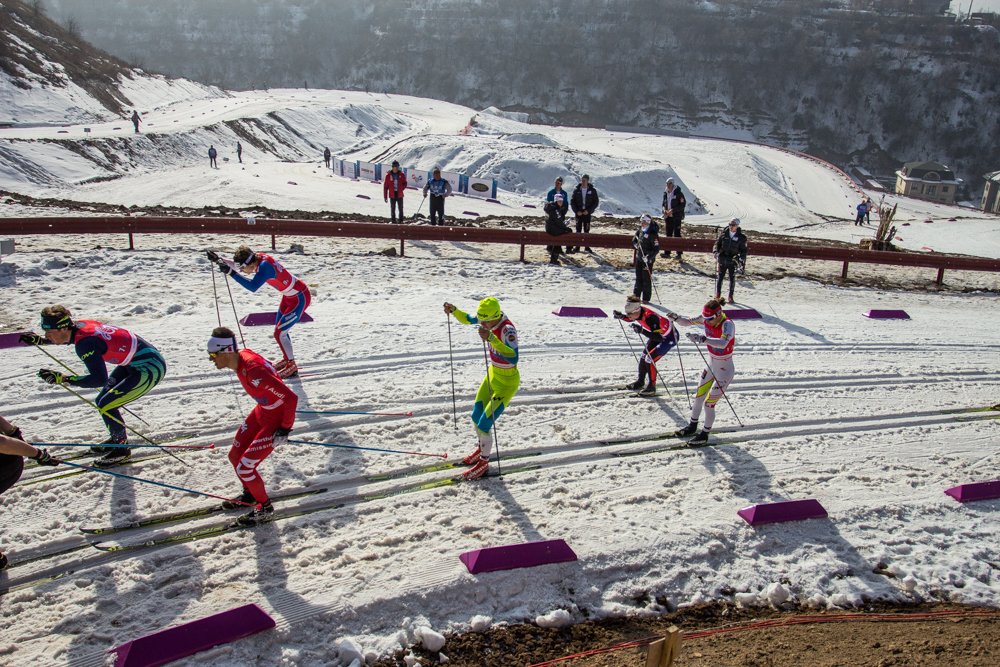
    “I had to spend some energy to come back after the crash but I managed to finish on the podium. It will be difficult to go for podium in the Tour but you never know what can happen on the climb,” Cologna said to FIS, referring to the long climb that makes up much of Sunday’s 9 k freestyle pursuit.

    Cologna is fifth in the Tour standings (+1:46.6) and 1:19.8 behind the third-place skier, Sweden’s Calle Halfvarsson.

    Meanwhile, two Russian skiers, Stanislav Volzhentsev and Alexander Bessmertnykh, both stayed well behind the leaders throughout the race and were able to conserve enough energy to take part in the final sprint to the finish. Volzhentsev just edged out Bessmertnykh in a photo finish to take fourth (+0.7).
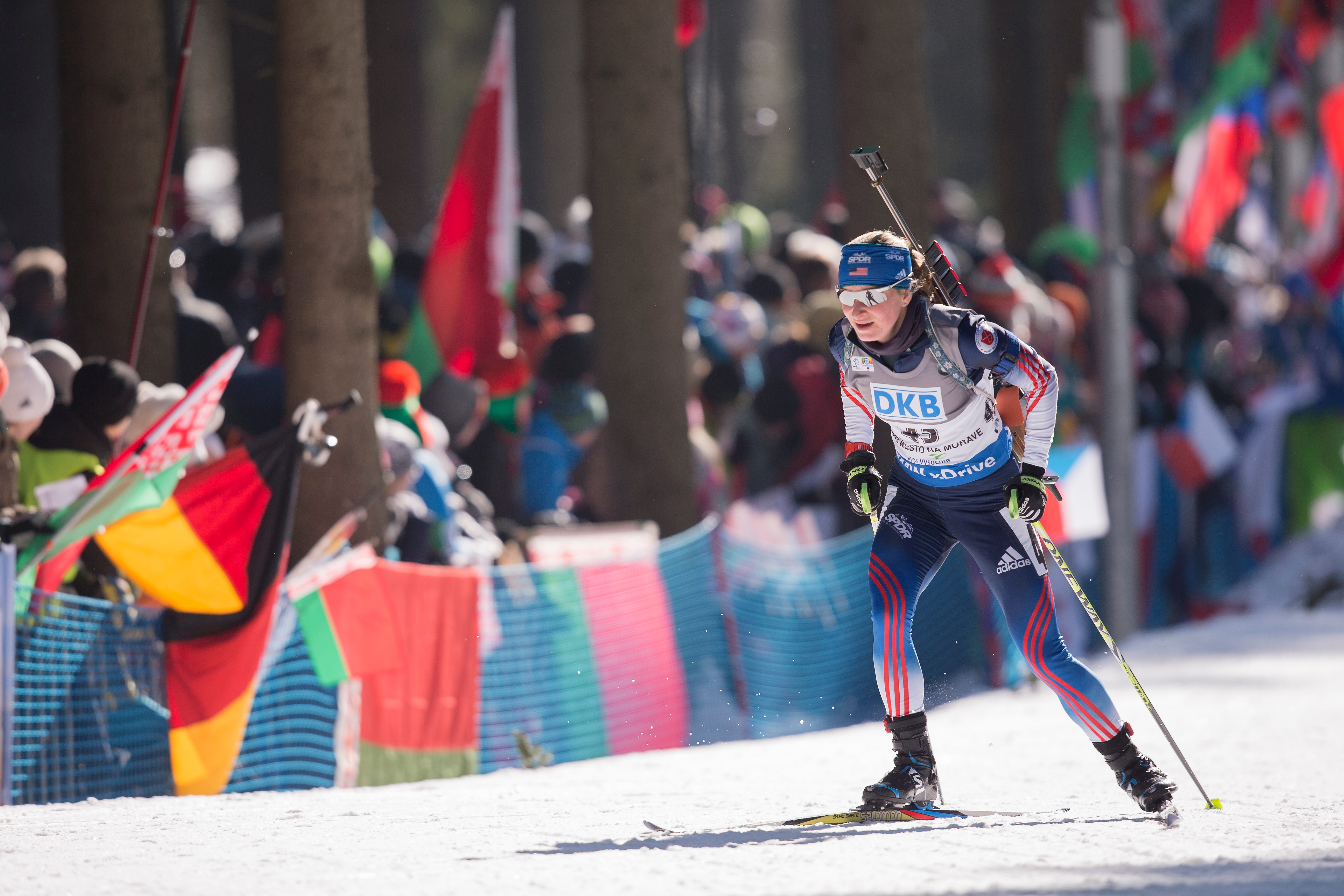
    Kazakhstan's Alexey Poltoranin (bib 8) races alongside Germany's Thomas Bing (bib 36) in the Tour de Ski 15 k classic mass start in Val di Fiemme, Italy (Photo: al di Fiemme/www.fiemmeworldcup.com)
    Kazakhstan’s Alexey Poltoranin (bib 8) races alongside Germany’s Thomas Bing (bib 36) in the Tour de Ski 15 k classic mass start in Val di Fiemme, Italy (Photo: al di Fiemme/www.fiemmeworldcup.com)

    With a podium consisting of Tscharnke, Poltoranin, and Cologna, Saturday featured the first podium of the season without a Norwegian present.
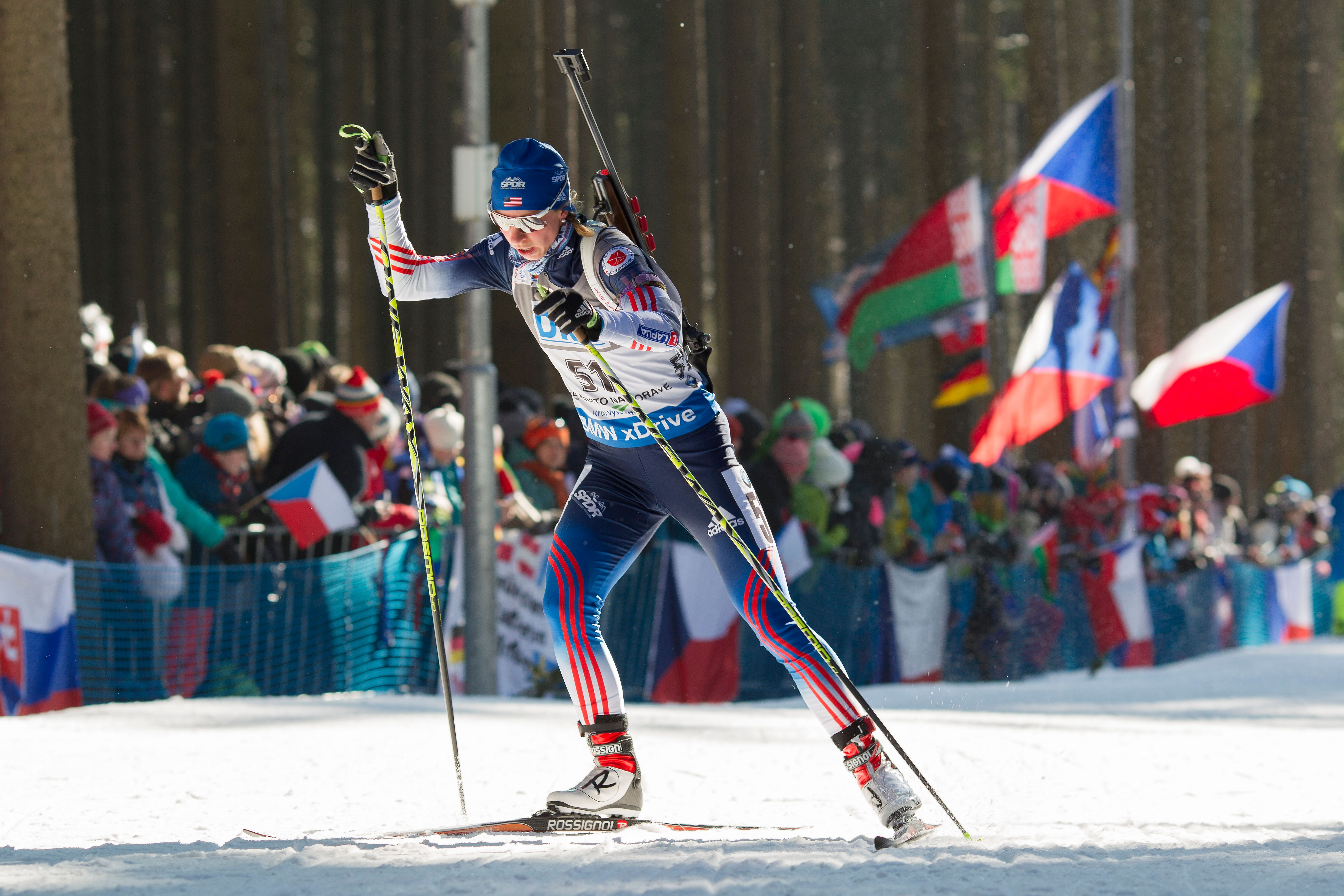
    Northug finished the race in 21st (+17.2), which was just barely enough to hold the overall Tour lead over teammate Sundby, who finished in eighth (+4.1) and was the highest-placing Norwegian. Sundby also crashed on one of the course’s steeper downhills, falling alongside Niklas Dyrhaug five minutes into the race.

    Northug explained to FIS that Saturday’s race was all about collecting bonus points.

    “I knew many skiers were saving energy for the finish. The last bonus sprint cost me a lot of power,” Northug said.

    The current Tour standings set up a tight race for the overall Tour title, which will be decided in Sunday’s final stage in Val di Fiemme. Northug is just 3.1 seconds ahead of Sundby, while Halfvarsson, who was 27th on Saturday (+30.0), is 26.8 seconds behind Northug in third and within striking distance.

    “It will be a hard fight for the podium tomorrow,” Northug said. “It has been a tough Tour de Ski. If you have a really bad day you can easily lose many minutes.”

    At this point on the Tour, the men’s North American contingent consists entirely of Canadians. Alex Harvey finished his Tour by taking 34th (+2:12.5), and dropped from sixth to 16th in the overall standings. Teammates Ivan Babikov and Devon Kershaw finished 40th (3:28.6) and 41st (3:39.5), respectively.

    Results

    Tour de Ski overall standings 

    Dario Cologna (SUI), Tim Tscharnke (GER), Alexey Poltoranin (KAZ), (l-r)  take the podium in the men's classic mass start in Val di Fiemme, Italy.  (photo:Fischer/Nordic Focus)
    Dario Cologna (SUI), Tim Tscharnke (GER), Alexey Poltoranin (KAZ), (l-r)
    take the podium in the men’s classic mass start in Val di Fiemme, Italy. (photo:Fischer/Nordic Focus)


  • Stephen Remains 14th in Tour de Ski after 15 k Pursuit; Randall Ends Tour in 25th

    Stephen Remains 14th in Tour de Ski after 15 k Pursuit; Randall Ends Tour in 25th

    Liz Stephen races in Saturday's Tour de Ski 3.3 k prologue in Oberstdorf, Germany (Photo: Marcel Hilger)
    Liz Stephen races in Saturday’s Tour de Ski 3.3 k prologue in Oberstdorf, Germany (Photo: Marcel Hilger)

    Only two Americans raced Thursday in the Tour de Ski’s fifth stage, a 15 k freestyle pursuit in Toblach, Italy.

    Liz Stephen had the eighth fastest time of the day (37:25.6), but still finished 5:31.9 seconds behind Norwegian Marit Bjørgen (36:37.9), Thursday’s winner and overall Tour leader. Stephen remains in 14th in the Tour standings.

    USST Head Coach Chris Grover said that Stephen had a good race, even though it is not a course that plays to her strengths.

    “There is not much V1 in it; it is more of a big powerful skier type course with a lot of V2, V2 alternate, a lot of transitions,” he explained. “But another great performance by her.”

    Meanwhile, Kikkan Randall – who decided that this would be her last race of the Tour – improved three places to finish 25th (7:21.7) and posted the 17th fastest time of the day in 37:53.6.

    Randall was coming off what she described in an email to the press as a “disappointing” 5 k classic race on Wednesday.

    “It seemed like it was going decent through 2.5 k and then I ran up against a wall again trying to really shift into my top climbing gear. I fell apart in the second half and crossed the line way off my expectation,” she wrote.

    Randall explained that in Thursday’s 15 k she started in a wave of other skiers and had a difficult first lap, but improved as the race progressed.

    Kikkan Randall racing in the 5 k classic in the fourth stage of the 2015 Tour de Ski (Photo: Fischer/Nordic Focus)
    Kikkan Randall racing in the 5 k classic in the fourth stage of the 2015 Tour de Ski (Photo: Fischer/Nordic Focus)

    “The first lap my body was slow to respond but it came alive through the race and I ended up feeling strong on the second and third laps. I was able to move up a few places and end with a more satisfying effort,” she wrote.

    Randall will not participate in the final two stages of the Tour, which she was never planning on finishing.

    “The big focus on the season is still the Falun World Championships and I am focusing all my efforts on being in the best shape in February,” Randall explained.

    Now, Randall will travel home to Alaska, Grover explained, and “spend about 16 days at home just to kind of take a break from the World Cup and just get re-centered and not focus on traveling and racing so much.”

    Jessie Diggins, who was 40th on the Tour, did not start on Thursday.

    Grover said Diggins woke up with a cold, and decided it was not worth it to keep pushing.

    “She was really hoping to do the whole Tour so just a bit of bad luck, but that is just part of the game in the Tour de Ski. It is so much racing and so much traveling, it is just a battle to stay healthy,” Grover said.

    Diggins finished the Tour the last two years, taking 21st in 2013 and 13th in 2014. Now she is focusing on the World Championships, Grover explained, and will go to a training camp with Stephen before World Cup races in Rybinsk, Russia, from Jan. 23-25.

    The women’s team is now left with just one athlete, Stephen, racing in the Tour.

    “That is a bummer to just have one athlete at the end, but we knew we would be small at the end anyway,” Grover said.

    Results

    Tour de Ski overall standings

    Celia Aymonier (FRA), leads ahead of the wave start, including Kikkan Randall. (photo: Fischer/Nordic Focus)
    Celia Aymonier (FRA), leads ahead of the wave start, including Kikkan Randall. (photo: Fischer/Nordic Focus)
  • Harvey Jumps Cologna in Tour Standings, Still Two Minutes Behind Northug

    Harvey Jumps Cologna in Tour Standings, Still Two Minutes Behind Northug

    Alex Harvey (CAN), Dario Cologna (SUI), Daniel Richardsson (SWE) and Alexey Poltoranin (KAZ), (l-r)   during Thursday's Tour de Ski stage.  (photo: Fischer / Nordic Focus)
    Alex Harvey (CAN), Dario Cologna (SUI), Daniel Richardsson (SWE) and Alexey Poltoranin (KAZ), (l-r) during Thursday’s Tour de Ski stage. (photo: Fischer / Nordic Focus)

    Alex Harvey’s plan to work with Norway’s Niklas Dyrhaug may have slowed him down in Thursday’s Tour de Ski 25-kilometer freestyle pursuit, but he was still 0.4 seconds fast enough to jump Switzerland’s Dario Cologna in the Tour standings and improve from seventh to sixth overall.

    The Canadian is now sixth overall, 2:01.0 minutes behind leader Petter Northug of Norway. He finished Thursday’s pursuit in sixth, 1:46.0 minutes behind Northug (53:36.9), and had the 21st fastest time on the course – five laps around a 5 k loop – in 54:35.1. However, Dyrhaug edged him out at the finish line by 0.1 seconds to take fifth.

    “I’m happy with the results but time-wise I’m a bit disappointed by the other guys in the group,” Harvey said in a phone interview.

    He explained that Dyrhaug – who started the day eighth overall – approached him before the race and said he wanted to work together to catch Cologna. Harvey agreed, but Dyrhaug set a slow pace from the start, and he estimated they quickly lost 10 seconds to Cologna.

    However, he said the pace finally quickened when Sweden’s Daniel Richardsson caught up to them.

    Niklas Dyrhaug (NOR) and Alex Harvey (CAN), (l-r) each moved up the overall Tour de Ski results.  (photo: Fischer / Nordic Focus)
    Niklas Dyrhaug (NOR) and Alex Harvey (CAN), (l-r) each moved up the overall Tour de Ski results. (photo: Fischer / Nordic Focus)

    “Richardsson had a really good day so when he caught up to us, him and I could work well to close the gap. By then it was maybe up to 30 seconds to Dario, but we could work well, and I think Dario was starting to fade a little bit,” Harvey said.

    At that point, Harvey knew the top-four skiers were too far ahead to be caught, so the race turned into a battle between him, Richardsson, Cologna, Dyrhaug, and Kazahstan’s Alexey Poltoranin for fifth.

    Harvey said no one was willing to take a big pull, and the group ended up sitting.

    “We [Richardsson and I] saw that Dario and Dyrhaug were sitting, so we didn’t want one of them to attack right after we took a big pull and get dropped. So when not that many people are trying to work, people get pretty pissed, and I guess that was what was going on,” Harvey explained.

    The results was a final charge for fifth among the five racers, with Dyrhaug taking it by a fraction of a second.

    “I think we could have skied probably 45 seconds to a minute faster if Dario, Daniel, Niklas, and I really pushed,” Harvey said. Dyrhaug – who Harvey said he has a “good relationship” with – went up to him after the race and apologized for not pulling, according to Harvey.

    Despite his frustrations with the speed, Harvey said the course was fairly fast.

    “Every 5 k I would throw in maybe four or five offsets – on climbs I can skate in that technique – so everything else was one skate or two skate. It was pretty fast snow,” he said.

    Harvey will race in the 15 k classic mass start in Val di Fiemme, Italy, on Saturday, but will forgo Sunday’s final stage, a 9 k freestyle pursuit. This will be the third year in a row he will skip the final stage of the Tour.

    However, he thinks he has a shot at the podium on Saturday.

    “I’ve had really good races in the past in Val di Fiemme … It’s a race that I’ve done well in the past, and the classic this year has been feeling really good, and today because we didn’t push so hard I’m not really tired,” he explained.

    Two other Canadian men competed in the pursuit. Devon Kershaw started the day in 29th but improved to 25th (+4:11.0), while Ivan Babikov started and finished in 31st (+4:13.9). Babikov also had the 23rd fastest race of the day, with a time of 54:39.2.

    The three American men withdrew from the Tour after Wednesday’s 10 k.

    Results

    Tour de Ski overall standings

    Daniel Richardsson (SWE) and Alex Harvey (CAN), (l-r).  (photo: Fischer/Nordic Focus)
    Daniel Richardsson (SWE) and Alex Harvey (CAN), (l-r). (photo: Fischer/Nordic Focus)