Yoggl celebrates with Slovenia, Germany and Canada after the Team Jumping event in Seefeld Arena
Despite significant recent snowfall, the Youth Olympic Games staff managed to polish the HS 75 meter jump in Seefeld Arena in time for Saturday’s Team Jumping event—the final Nordic event of the Games.
The Canadian Team— consisting of female special jumper Taylor Henrich, male special jumper Dusty Korek and Nordic Combined skier Nathaniel Mah— managed to take advantage of the inconsistent conditions to secure a historic Bronze medal.
The team finished 8.7 points ahead of Finland, and just 11 points ahead of pre-event favorite Japan. Germany— who also handily won the morning’s Mixed Cross-Country/Biathlon Team event— displayed its massive commitment to youth Nordic development by winning Gold in the Team Jumping event with a nearly 30 point lead on Slovenia, who took Silver.
Colton Kissell of Park City UT flies on the HS 75 meter hill during the Team Jumping Event Photo: Andrew Moore
The United States team of Emilee Anderson, William Rhoads and Nordic Combined skier Colton Kissell struggled to find their best form on the hill today, placing 11th in the field of 13 teams.
Based on the results from the Individual competitions held over a week ago, Canada was considered to be a long shot for the podium. However, steady snowfall and unpredictable wind made conditions challenging for many teams. Japan —whose star female jumper Sara Takanashi dominated the Women’s Individual Jumping event by over 27 points— was a strong favorite for Gold.
Yet the grabby conditions on the inrun tracks proved to be a challenge for the Japanese, who are experimenting with very aggressive and low inrun positions. With their weight far forward on their feet before takeoff, the Japanese were depending on the tracks being iced and “free”. With the resulting snowfall playing havoc with her normal position, Takanashi jumped 57 meters on her first jump before posting a 75 meter second round jump.
An Austrian athlete competes in Saturday's Team Jumping Event Photo: Andrew Moore
With the normal jumping powerhouse nations of Japan, Norway and Austria all struggling, Canada seized the opportunity.
Canadian Team Head Coach Max Thompson explained the team’s strategy heading into the event.
“Today was all about consistency,” Thompson told FasterSkier. “It was bad conditions. The athletes were focused. We talked a lot, did immos [technique imitations] last night, immos this morning, and talked about doing nothing special. They kept things simple, basic ski jumping, and it worked.”
The Canadians started out strong, finding themselves ranked second overall after the first of two competitive rounds. A strong second jump by Calgary’s Dusty Korek helped secure Canada’s spot on the podium.
“We came into today confident, but having watched those individual guys who really put out long jumps, we knew we were the underdogs here,” Korek told FasterSkier. “We’re a close team. We’ve grown up together jumping since age six, and we’re sixteen now. We’re definitely close.”
Canadian Coach Max Thompson congratulates Team Germany's Coach following the Team Jumping event in Seefeld
This medal was a historic finish for Canada, who has never medaled in an Olympic Ski Jumping event. Most of all, the team was sure that this medal would help to boost the confidence of up and coming jumpers in Canada.
“As a North American thing, we seem to have this mentality that we’re just not as good as the Europeans,” Thompson explained to FasterSkier.
“These kids—Dusty, Nathaniel and Taylor—have been competing in Springer Tournee competitions in North America, and they’re super competitive fields. It’s great to see that when our athletes come to Europe and compete against Austria, Germany, Finland and Norway, it shows our kids at home that if they’re close to these athletes, they’re close to the best in the world. We can make something happen in Ski Jumping.”
Team Canada, from left to right: Coach Max Thompson, Nathaniel Mah, Taylor Henrich, Dusty Korek, Coach Alex Levichev
And the Canadians certainly showed that today, topping off what was an undeniably successful day for North America, with two podium finishes in Nordic disciplines.
This event concludes the Nordic competitions for the 2012 Winter Youth Olympic Games. The final competitions of the Games will end Sunday, and the Games will conclude with the Closing Ceremonies, held in downtown Innsbruck.
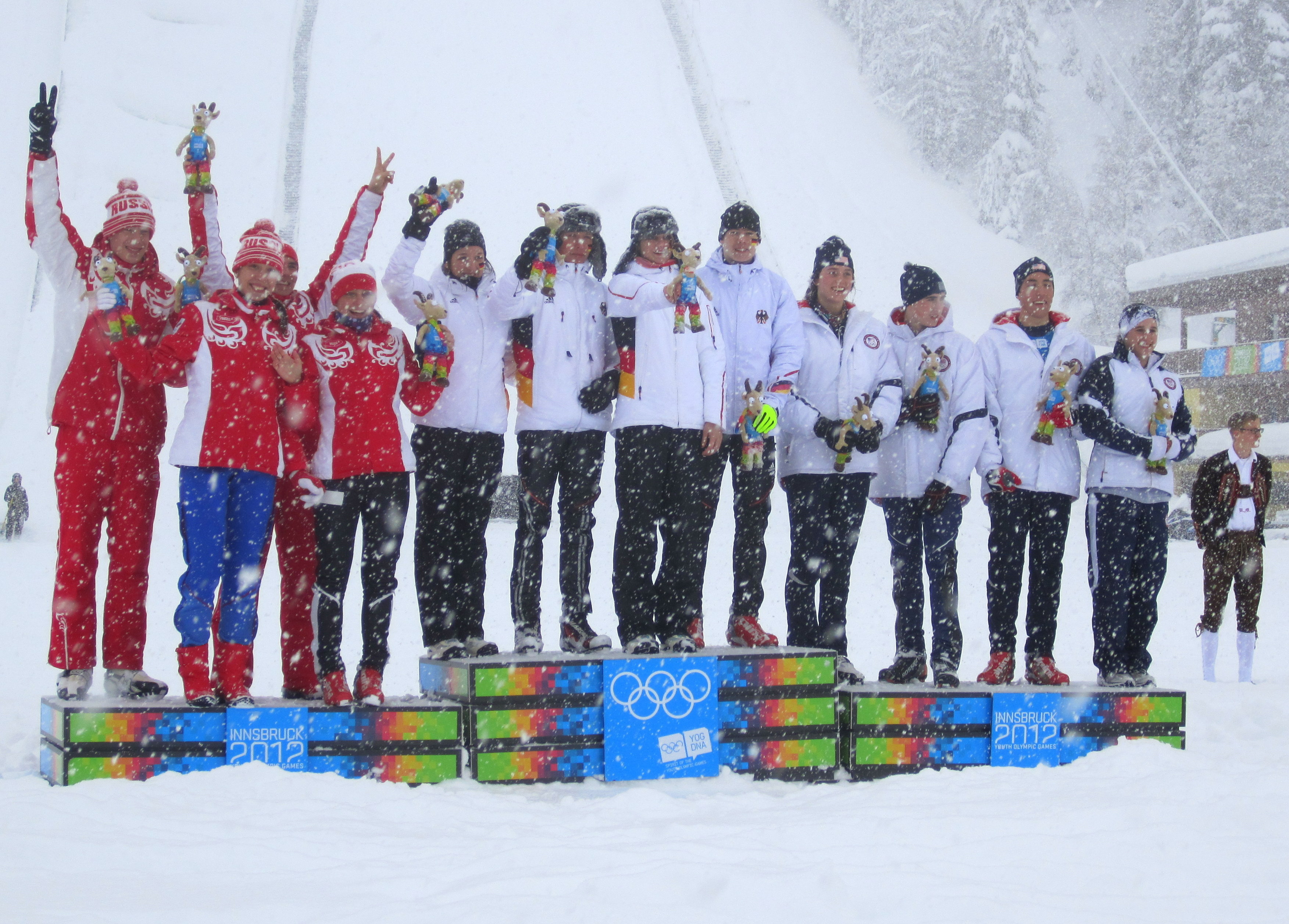
The US Team– standing proudly on the podium in Seefeld Arena
It’s been a week of memorable firsts here in Seefeld Stadium during these Winter Youth Olympic Games. The very Youth Games themselves, hosted by the Austrian city of Innsbruck, served as the winter debut for the International Olympic Committee’s latest concoction, thereby making Innsbruck— the two time host of the Olympic Games, in 1964 and 1976— the first city to host three Olympic Games. The Youth Games is a shiny new event with a fresh new message, which is reflected by many of the unique athletic events which debuted during these Games, including today’s exciting Cross-Country/Biathlon Mixed Relay.
While the Gold medal went to the Germans, who skied a near flawless race, it was the underdog American team which powered its way towards a historic first in Seefeld today—finishing a half second behind the mighty Russian squad to claim the Bronze medal. The finish marks the first Olympic medal for the US Biathlon program, and the second for the Cross-Country squad.
Maximilian Janke of Germany skied a solid leg to further pad Germany's substantial lead
A New Event Requires a New Strategy—
The much anticipated Biathlon/Cross Country mixed relay assumed an exciting format—the female biathletes would scramble the mass start, skiing one lap of a 2km course before they headed to the range for a prone shooting stage. Athletes were entitled to three spare rounds per stage in order to keep penalty loops to a minimum.
From there, the first leg racers completed two more laps of the 2km loop, interrupted in between by a standing shooting stage. The biathlete then tagged off in the stadium to the female cross-country skier, who completed two fast laps of the same 2km loop. After an all out 4km, the female skier would then tag off to the male biathlete, whose three loops of a slightly different 2.5km course were also interrupted between laps by one prone and one standing shooting stage.
The anchor leg, skied by Paddy Caldwell—fresh off of a top 5 finish in Thursday’s Freestyle Sprint, entailed two laps of the 2.5km course. It was a straightforward, yet high stakes effort which that set up the drag race to the line.
In terms of strategy, all four athletes would need to fight for every meter to keep the team in overall contention. But due to the two shooting stages, which could instantly drop a team from first to worst and open up huge time gaps, strong biathlon legs would be absolutely critical.
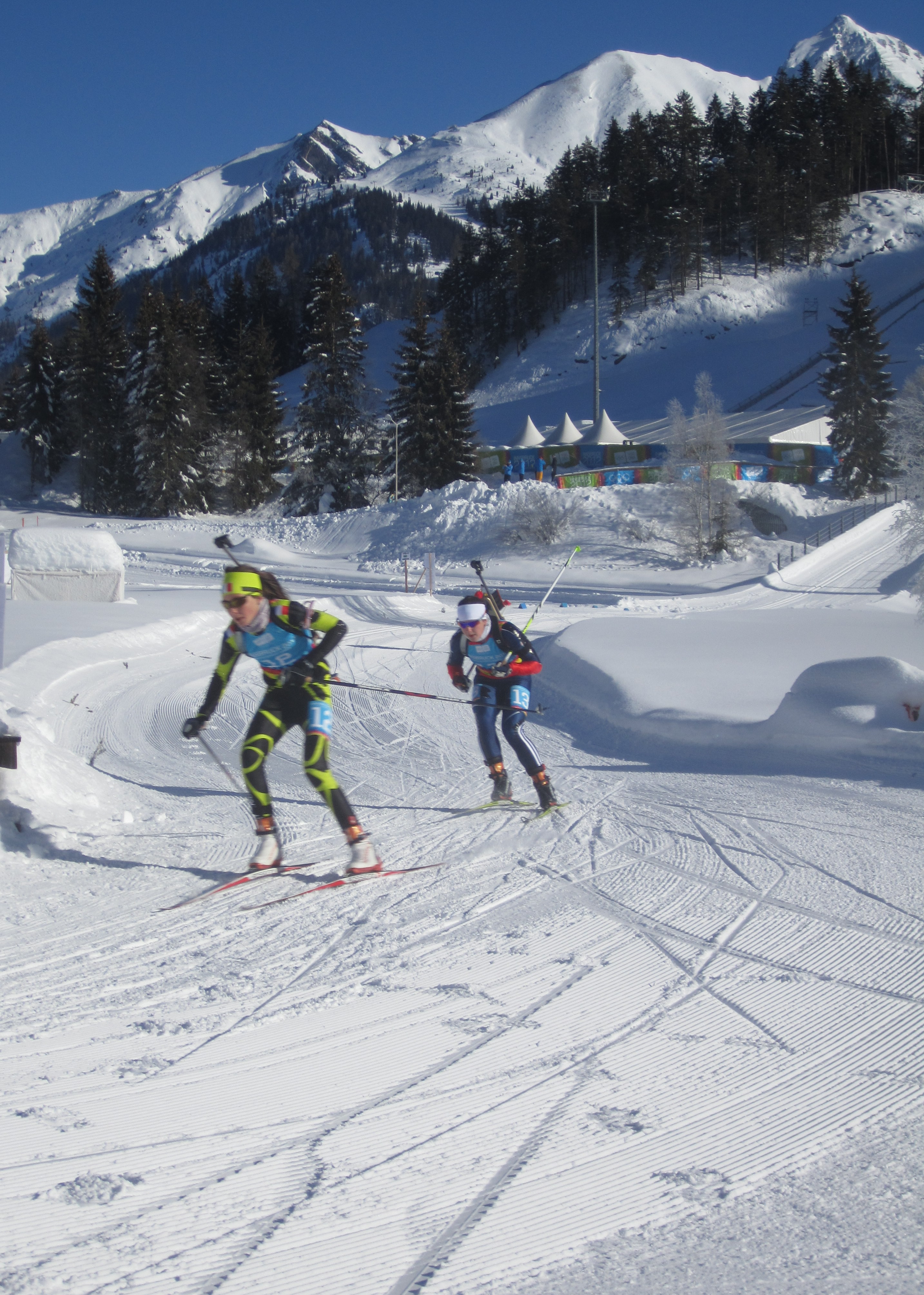
Team USA's Anna Kubek skis her scramble leg, keeping the team in the thick of the action
“The biathlon legs are critical in this relay,” Biathlon Coach Piotr Bednarski told FasterSkier in a pre-race interview, “You can move up ten places in one shooting. Poor shooting will take a team right out of the running.”
Less than ideal pre-race conditions—
As if more snow were just what western Austria needed this season, a meter of Tyrol’s finest white stuff fell over the race course throughout the 24 hour period preceding the start, with snow continuing to fall throughout the event.
According to Team Cross Country Coach Sverre Caldwell, the soft conditions would punish racers who started too hard.
“With such soft conditions, I kept repeatedly reminding Heather and Paddy: ski smooth, ski smooth,” Caldwell told FasterSkier. “We really wanted to make sure they didn’t go out too hard chasing some of those faster guys.”
But it wasn’t only the new snow that had the US squad on edge before the race. Heather Mooney— whose Middlebury Teammates are competing in the first EISA Collegiate Carnival at Bates this weekend—came down with a nasty cold the night before the race. She woke up unsure if she’d be able to compete.
“I woke up and was feeling pretty sick,” Mooney told FasterSkier. “I had a bad sore throat, my nose was pretty congested, but when I got here, I knew I had to race. I figured I’d just try and go as smooth as possible. It turns out, for me, in these soft conditions, I was probably a bit faster—just thinking about being relaxed instead of just hammering.”
When asked how high the chances were that Mooney wouldn’t be able to start, Caldwell told FasterSkier, “Hmmm, she was medium-close! We really just weren’t sure what to expect this morning. The biathletes were 15th in Thursday’s Biathlon relay, Heather wasn’t feeling well, you really just never know with this stuff.”
With solid shooting by Kubek, the women set it up—
With Mooney feeling well enough to grind out four full gas kilometers, the US was back in the mix. Duluth, Minnesota native Anna Kubek and the rest of the 23 scramble-leg skiers charged out of the stadium for their first loop and when they came in for their first shooting leg, it was clear that solid shooting would indeed be critical.
Kubek used one extra round in her prone stage, and two in the standing to avoid skiing any penalty loops, and she tagged off to Mooney in 8th position.
Despite illness, Heather Mooney skied a strong second leg for the US
Biathlon Sprint Champion Franziska Preuss of Germany took the reins early on in the race, using just one spare round in her standing shooting stage to avoid a penalty loop, and the team didn’t look back— not once relinquishing the overall lead.
Not all powerhouse nations fared so well during the first lap, as Russia’s Uliana Kaysheva— who won Gold in the Pursuit event earlier in the week— struggled on the range during the snowy conditions. She used all six spare rounds and still ended up with two penalty loops, dropping her team to 14th place after the first exchange.
Despite her sickness, Mooney maintained her focus throughout her two laps, keeping her pace smooth and powerful.
“Normally, I’m much better in harder, firmer conditions, but just thinking about being relaxed and not hammering helped me keep my pace under control. It ended up OK!” Mooney told FasterSkier after the race.
With the leaders still fairly tightly grouped, Mooney managed to post the 12th fastest lap of her leg to hand off to biathlete Sean Doherty in 9th position.
Heather Mooney tags off to biathlete Sean Doherty
Men capitalize on Doherty’s shooting to fight for the podium—
Doherty, who hails from Conway, NH, knew he had his work cut out for him during the third leg. The young skier had been skiing consistently fast all week, but his shooting was the key variable. Doherty had worked his way up to 7th in Monday’s Pursuit event before “dirtying” his first standing stage, missing all five shots, dropping him back to 12th. He’d need to deliver a big one for the team to stay in contention.
Deliver he did.
“I’ve been having some trouble on the range this week, like during the Pursuit. ‘Little mishaps’, like that one. So I did some dry-firing this morning, a little extra confirmation in the zero, and then it all just came together. Solid opening leg, great skis. So awesome,” Doherty told FasterSkier.
Doherty combined his reliable ski speed with exceptional shooting to instantly vault the US into second place after his second standing stage. The young athlete from New Hampshire only needed one spare round per stage to avoid penalties despite the stormy conditions. His effort netted the fastest overall split of the leg, 11 seconds faster than that of France’s Fabien Claude.
Sean Doherty lit up the relay for the US, skiing strongly and using only two spare rounds
Several of the pre-race favorite faltered during the third leg, sending their teams far back in the standings. Norway’s Kristian Andrew Aalerud, who took 5th in Sunday’s Sprint, dragged his team from a comfortable 2nd to 9th after skiing three penalty loops on his prone stage, even after he’d used all of his three spare rounds. This left their closer, Chriander Holth—who placed 4th in the Classic race—with too little real estate to close the gap. The team would finish a disappointing 9th overall.
Just as Bednarski cautioned, poor shooting could handily take a top team out of the mix, which opened the door for the United States to attack the podium.
After Doherty’s massive effort left the US suddenly sitting in 2nd, anchor leg Paddy Caldwell simply put his head down and went to work. But with Russia’s Alexander Selyaninov—winner of the Classic event— starting a mere 15 seconds behind him, the race for the second was on.
Sean Doherty overtakes Kazach racer Ruslan Bessov. Doherty rocketed the US team up from 9th to 2nd position when he tagged off to Caldwell
With just a few seconds to register that they were now fighting for second place, Paddy and Coach Sverre touched base briefly before the tag.
“Sverre just told me, ‘Look where we are, and remember what we’ve got going here!’” Caldwell told FasterSkier. No pressure whatsoever.
But that pressure didn’t seem to phase the young New England skier. He stuck with the Russian on the fast course, and hatched a plan to try and foil Selyaninov in the final sprint.
Heather Mooney cheers on teammate Paddy Caldwell as he leads Russian Alexander Selyaninov–Classic event Gold medalist– into the stadium on the final lap
“We were definitely playing a little cat and mouse out there. He [Selyaninov] caught and passed me after the first lap. I stuck behind him, and we kept going back and forth,” Caldwell explained to FasterSkier. “Towards the end of our last lap, I passed him and pushed the pace. I knew we had a pack close behind in 4th and 5th, and I just wanted to really hammer it home.”
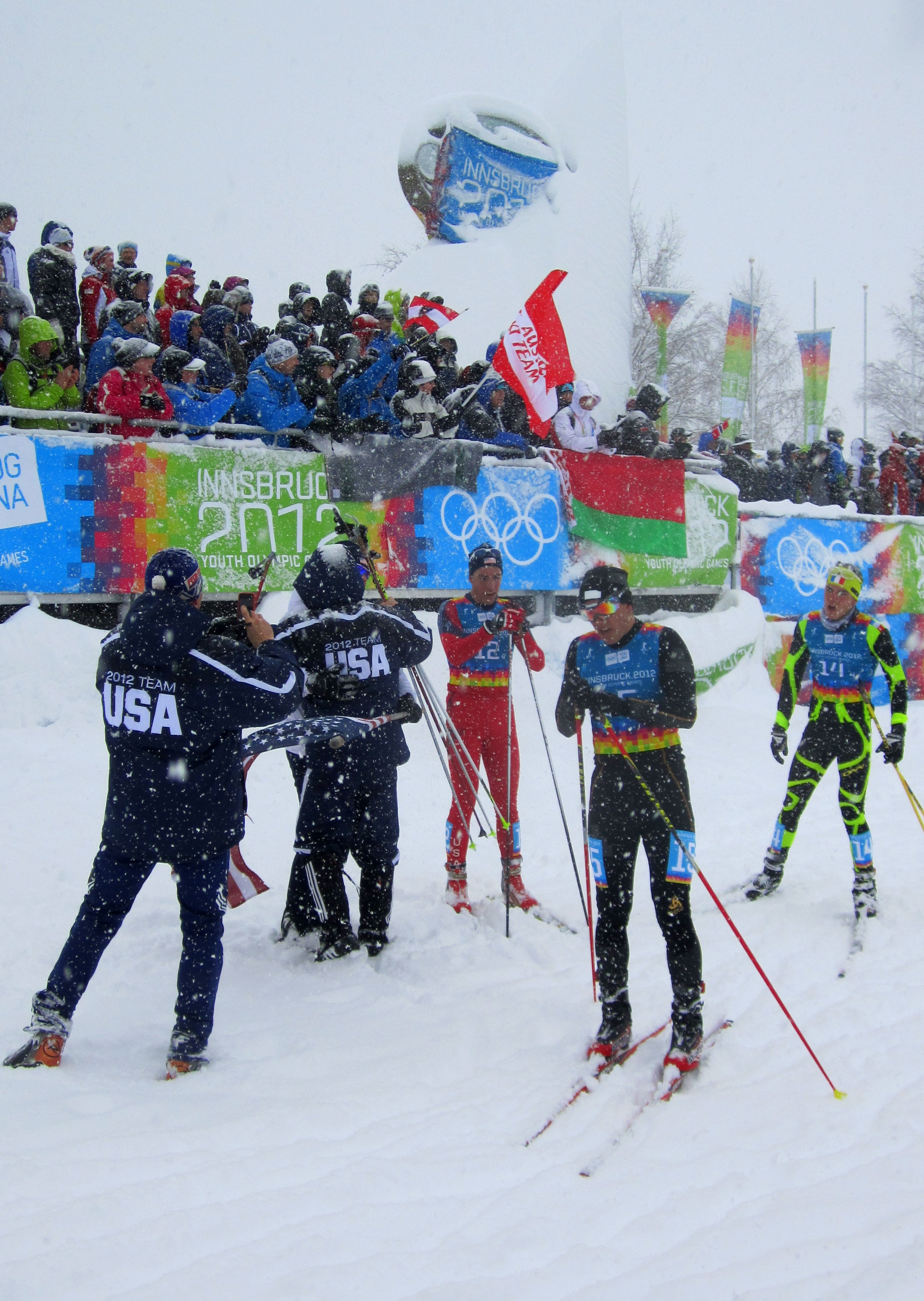
The Russian put on a surge coming over the final climb behind the range, and took the best line coming through the s-turns to the finishing straight. The Russian ended up nipping Caldwell by a half a second in the sprint, but the US Team had delivered—they’d bagged Bronze, boxing the Scandinavians out from the podium in the process.
A Historic Moment—
Caldwell is embraced by coaches and teammates as he crosses the line in third
The day marks a historic occasion for US Nordic Skiing, as this medal is the first ever for the United States in an Olympic Biathlon event, and only the second in a Cross-country event— Vermonter Bill Koch took Silver in the 1976 Games in the very same stadium.
While the Americans were clearly the underdogs coming into this unique event, it was their unbelievable consistency which allowed them to surpass many of the world’s best.
Coach Bednarski— who has devoted his coaching career to preparing young biathletes to compete on the world stage— was moved, having witnessed a crop of his junior athletes deliver such a groundbreaking performance on the world stage.
“I’m pretty proud. I’m a little emotional—I’ve been doing this for a real long time. It just made all those years a little more worthwhile. But they’re all worthwhile,” Bednarski told FasterSkier.
Kubek, whose solid leg was so crucial to the team’s success, told FasterSkier, “I’m just on Cloud Nine right now. It’s such an honor to be part of this team. To be honest, it hasn’t really hit me yet. We’ve become such close friends throughout the course of this week.”
Tim Caldwell, who famously took part in the Men’s 4x10km relay during the ’76 Games which were so monumental for US Nordic Skiing, proudly watched as his son deftly marked the Russian on the very trails he’d raced on thirty six years beforehand.
“Everyone skied so well, and then Sean really broke it open during his leg. And Paddy skied great. It was just so exciting to watch him ski to that medal, it was really great.”
Paddy, whose closing effort secured the team’s finish, praised the efforts of the entire team.
“This is a great thing. It’s so exciting to have done so well with the team here. It was just so great to work with the biathletes this week, it’s really been a true team collaboration throughout this entire event,” Caldwell told FasterSkier after the race.
Sean Doherty, Heather Mooney, Anna Kubek, Paddy Caldwell–celebrating a big day in US Nordic history
It’ll surely take a while for the gravity of the team’s accomplishment to sink in, but for now, the athletes are eagerly awaiting tonight’s Medal Ceremony, where they’ll get to stand on the impressive podium in the middle of Innsbruck’s famous downtown boulevard— the Maria Theresien Straße. It’s quite clear that this medal speaks volumes about the rising level of cross-country ski racing in the United States. The bar has been raised, and aspiring skiers can look to this finish and know that US juniors truly rank amongst the very best in the world.
And it’s only fitting that this medal came out of the Mixed Team Relay, a brand new and undeniably exciting format which combines Biathlon and Cross-Country squads—teams who normally compete separately during their European tours. It’s an accomplishment in the true spirit of these Games.
Anna Kubek, Heather Mooney, Sean Doherty and Paddy Caldwell have some important news they’d like to share with you.
History was made here in the storied Seefeld Arena during the Cross-Country/Biathlon Mixed Relay event, with Team USA crossing the line in 3rd to take the Bronze medal.
Team USA celebrates its historic Bronze medal finish during today's Mixed Relay at the Winter Youth Olympic Games in Innsbruck
Desperate to leave their mark on the Youth Olympic Games, the Norwegians gave it everything tonight in the Freestyle Sprints
Today’s evening sprints in Seefeld were big for the Scandinavians. Having walked away from the sole distance event of Games with nothing but a pair of clunky 4th place “wooden medals”, the Nordic powerhouse nations came out this evening with their guns blazin’. But the Americans, specifically members of the Caldwell family, have a history of turning heads in Seefeld. This time around it was young Paddy who made quite a splash, skiing his way to a top 5 finish in the Men’s Sprint event at the 2012 Winter Youth Olympic Games.
The Play-By-Play
Gone were the familiar bluebird skies above Seefeld on Thursday afternoon—in their place were all too typical Central European conditions: overcast skies with a light drizzle. Qualification for both fields kicked off at 3:45pm, with athletes completing a fast, glazed course of exactly 1km.
The Seefeld Stadium– nice at night
With a slight climb out of the start followed by a fast downhill, athletes had just enough time to catch their breath before tackling the sole major climb into the 300 meter flat finishing straight. As is par for the course in all sprint racing, snappy, clean starts and all-out finishes were essential.
Going into the event, Coach Sverre Caldwell set realistic goals for the two US skiers, former Stratton teammates Heather Mooney and Paddy Caldwell.
“You just don’t know when you come to a place like this, which will have really great sprinters,” Caldwell told FasterSkier, “With such a strong field, our goal was to get both athletes into the heats, and do the best we could from there. A top 20 finish would have been excellent— a top 10 finish would have been outstanding.”
Norwegians settle the score in the Women’s Sprint—
Heather Mooney hammers up the final climb during her Sprint Qualifier
In the Women’s field, Mooney cranked out a solid qualifier, ending up 23rd, 11 seconds off of Norwegian Silje Theodorsen’s winning split. The effort placed her into the fifth quarterfinal heat, lining up against several heavy hitters including 3rd ranked Linn Eriksen of Norway, and Classic Gold Medalist from Tuesday, Anastasia Sedova of Russia.
Mooney started out her heat strong, scrambling over the first climb in 3rd position, slotted directly behind the favorites. But at the base of the climb heading towards the finishing straight, Russian Alisa Zhambalova collided with Mooney’s pole, snapping it in half.
Despite grabbing a spare pole on course from Tim Caldwell, Paddy’s father, Mooney couldn’t make up the deficit to the leaders and came across 4th in her heat, good for 24th overall.
Heather Mooney (L) starts out strong during her Quarterfinal
Out to set the record straight, the Norwegian duo of Silje Theodorsen and Linn Eriksen advanced handily through their quarterfinal and semifinal heats, propelling the two into the final alongside the two Slovenians—Anamarija Lampic and Lea Einfalt— who turned heads during Tuesday’s Classic race.
In a heated charge to the line during the dramatic final, Theodorsen surged with ten meters to go, crashing into the finish line to take the Gold ahead of Swede Jonna Sundling, who took Silver, and teammate Eriksen, who came across for Bronze.
Norway's Silje Theodorsen loses her balacne–but not the Gold medal– in the Women's Sprint Final
Men’s Race—Cunning Caldwell hunts down Lucky Loser spots to make the final
The 50 men’s racers completed the same 1km course as the women, and the fast qualifying times demonstrated the depth of the field—8 seconds separated the 30 top qualifiers.
Paddy Caldwell, who considers himself to be more of a longer distance specialist, managed to produce a solid qualifying effort— placing 18th, 5 seconds back of the leader, Andreas Molden of Norway.
A Norwegian racer leaves the start house during the Men's Sprint Qualifier
“When I think about sprinting, I think more about survival,” Caldwell told FasterSkier. “I think about trying to get through the heats as far as I can. In my head, I was aiming for a top ten finish.”
Paddy and his Coach, Sverre, both knew that in order for a top ten finish to come to fruition, they’d need to make every second count, and that strategy included hunting down Lucky Loser positions in each heat.
“I kept reminding Paddy, ‘You can still qualify, even in fourth, because of the Lucky Losers’, and that’s how he did it,” Sverre told FasterSkier.
Paddy Caldwell, second from left, guns it for the valuable 4th position in his fast Quarterfinal
In his Quarterfinal heat, Caldwell was paired up with some ringers, including the 3rd fastest qualifier Chrisander Holth of Norway, and Marcus Ruus of Sweden.
Despite a fast start in the Quarter, Paddy slipped to 6th coming into the final hill. Sensing that the two athletes in front of him were beginning to fade, Caldwell punched the gas.
“Especially during that Quarterfinal, there were two guys right with me. I had the inside lane, and they didn’t look like they were really going, so I took charge and got that spot for 4th,” Caldwell told FasterSkier.
He didn’t know it in the finish pen, taking off his transponders, but his quarterfinal heat turned out to be the fastest of the day. He and Holth, the Norwegian, took the two coveted Lucky Loser spots, squeaking their way into the Semifinals.
Paddy Caldwell, thinking that his heats are over, learns that he punched the last Lucky Loser ticket to the Semifinals
With his two sisters— Heidi and Lucy, father Tim, Uncle Sverre, and the whole Mooney clan cheering him on from the stands, Caldwell powered his way around the course during the Semifinal. His boards were flying, a benefit of having Biathlon Coach Piotr Bednarski out on course testing during the Qualifiers, and Caldwell hammered it into the finish for 3rd place, coming in just behind Germany’s Marius Cerbulla and Sweden’s Ruus.
Again, the Vermonter had given just enough gas to earn a second Lucky Loser slot, punching his ticket for the Sprint finals. The stars seemed to align for the young skier. Perhaps it was the advice Sverre whispered in his ear that made the difference, or maybe the slippery boards. It might have even been a touch of that Caldwell family magic that seemed to work so well in the 4x10km relay during the 1976 Olympics in Innsbruck.
“Nope,” said his father Tim after the race, “he did this race all on his own, and his Coach gave him the advice—I just try and stay out of the way.”
With a boisterous US crew cheering him on, Caldwell cranked it home in the Men’s final, finishing 5th. A tight finish, he crossed the line a scant 2.9 seconds back from the Norwegian Molden, who took the victory ahead of Germany’s Cebulla and Alexander Selyaninov of Russia.
Racing in Europe sure is cool, but it's way cooler when your family and friends are there to cheer you on with a bunch of flags. The Mooney/Caldwell clan in Seefeld
While he might not have all the necessary fast-twitch muscles of the top sprinters, the young Caldwell has clearly developed an eye for fast racing, knowing exactly how to get the job done. As he told FasterSkier during a pre-event interview this past November on lessons learned from European racing:
“I learned that every fraction of a second counts when racing in such deep fields.”
Indeed. Things are looking promising for the next crop of young American racers.
Nordic action continues Saturday afternoon with the Biathlon-Cross Country Mixed Relay in Seefeld Stadium.
Good skis played a big part in Paddy's stellar finish. "Sverre, these feel pretty good, but I'm having a little trouble cornering…"
While Standard and Poors may have recently downgraded Austria’s credit-worthiness to ‘AA’, no one is questioning Tyrol’s ability to put on world class ski races. Clear skies and cold temperatures delayed start times by one hour, but the resulting bomber tracks in Seefeld Stadium heated up quickly beneath the skis of the world’s fastest Junior racers during Tuesday’s YOG Classic races.
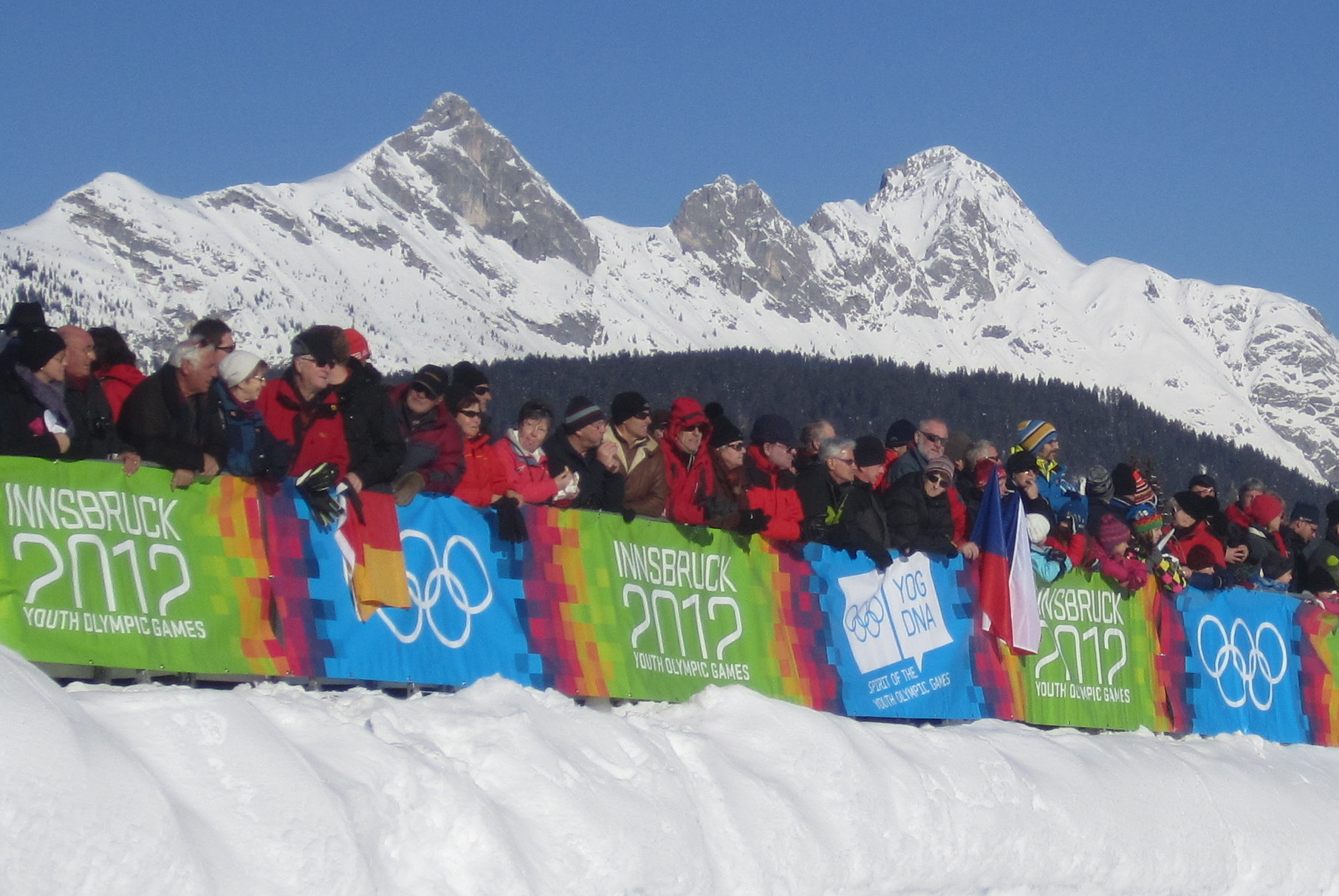
Frenzied fans line the finishing straight for Tuesday's YOG Classic Event
Russian athletes took advantage of the familiar brisk conditions to steal the show—in the Women’s 5km classic race it was Anastasia Sedova who won Gold, finishing well ahead of two Slovenians: Silver medalist Anamarija Lampic and Bronze medalist Lea Einfalt.
In the Men’s classic event, Russian Alexander Selyaninov posted the fastest time of the day on the rolling 10km course. Kentaro Ishikawa of Japan finished in second place, and Kazakstan’s Sergey Malyschev snatched Bronze away from Norway, finishing 28.7 seconds behind the Russian.
How the races unfolded—
The women’s field completed two laps of a rolling 2.5km course. Racers headed out of the stadium, immediately ascending a short, two-tiered hill before bombing down a fast descent onto the pancake valley floor. From there, the course veered sharply up the most challenging hill of the day, which began with a short, steep herringbone section, before leveling out to a stride worthy grade. The course then spat racers back down to the flat valley floor, before gradually winding upwards towards the stadium.
Russia’s Anastasia Sedova blazed her way to an impressive victory—posting the two top splits of the day to take the win by nearly 20 seconds. Sedova is relatively new to international competition, with a FIS race in Finland in 2009 being her sole listed international result.
Heather Mooney charges through the lap zone during Tuesday's 5km Classic Race Photo: Tamra Mooney
Heather Mooney— a Peru, Vermont native who is currently a Freshman on the Middlebury Ski Team— posted the top North American finish of the day, finishing 13th amongst the field of 40 athletes. Mooney skied a smart race, posting the 20th fastest first lap, improving to 13th overall after a strong second lap.
A calculated effort allowed Mooney to pick up the pace on loop two.
“Heather planned to ski into the major climb, and save her hammering for the top of the climb on the first lap, and then just go for it on the 2nd lap,” explained US Team Coach Sverre Caldwell in an email interview with FasterSkier. “She did that quite well!” he noted.
Heather Mooney cheers on teammate Paddy Caldwell during Tuesday's Races Photo: Tamra Mooney
Mooney explained that she was able to capitalize on the smooth pacing of Norway’s Silje Theodorsen, who ultimately finished 4th in the race.
“Silje blew by me on the stadium hill after the first lap… but I could see that I was gaining time on her on the double pole section,” Mooney explained to FasterSkier in an email.
“She skied the hill really well though and I lost contact. It was good to notice how she just floated up the hill, and it’s something I know I need to work on now!”
Norway, along with the rest of the traditionally strong Scandinavian nations, was notably absent from the podium positions during the Classic races. The Norwegians fared the best of the Nordic countries, with skiers claiming 4th place in both the Men’s and Women’s races.
The reflective siding of Innsbruck's downtown marketplace display's the city's backyard– the Nordkette Mountain Range
In the Men’s race it was Russia’s Selyaninov who took the win ahead Japan’s Ishikawa. The two racers were tied at the 3.3km split, with Ishikawa leading the Russian by 1.3 seconds at 6.6km. Selyaninov put in a massive effort during the final lap to take the win by 11.4 seconds overall. Sergey Malyshev of Kazachstan posted a first lap split 12 seconds faster than the Selyaninov and Ishikawa, but faded on the final lap, ultimately finishing 28.7 seconds down on the Russian.
Selyaninov has not competed in any major races outside of Russia thus far in his career, and this win marks his first major victory. Ishikawa competed in last year’s Junior World Championships in Otepää, Estonia, with 22nd place in the 20km pursuit his best finish.
Vermont’s Paddy Caldwell, whose father Tim competed on the Seefeld courses during the 1976 Olympic Games, skied a strong race to wind up 16th overall, finishing just over two minutes off the winning pace.
Caldwell noted that the course’s sole steep climb was his primary focus during the race.
“It [the main climb] proved to be especially tough because it was on the first kilometer of the loop. My strategy was to ski it well without putting myself under. I succeeded with this until the last lap, when I was just running on fumes,” explained Caldwell to FasterSkier via email.
Vermont's Paddy Caldwell ready in the start gate during Tuesday's Classic Race Photo: Tamra Mooney
Coach Caldwell, Paddy’s Uncle, noted that the young Vermonter did an excellent job sticking with some of the strongest skiers, many of whom started just after him.
“Paddy had the 7th place finisher [Slovenia’s Miha Simenc] start right behind him, and ultimately caught him around 3.5km,” Caldwell explained. “He stuck with him for the second lap and then just held on the best he could. He didn’t bonk and only lost one place on the third lap—it was just pure heart and guts.”
Paddy Caldwell striding his way to a strong 16th place Photo: Tamra Mooney
In both races, many of the top junior competitors had relatively little international experience. However, many relied on the tried and true Eastern Cup Series to gather the necessary skills to compete at the top level. And we’re not just talking about Mooney and Caldwell, who are fixtures on the NENSA Eastern Cup Circuit. Both Russian Gold medalists have notched numerous starts in the ultra-competitive ‘Eastern European Cup’ events. Even Japan’s Ishikawa, who took Silver in the men’s race, boasts extensive experience on the FIS ‘Far Eastern Cup’.
It’s an exciting sign to see a changing of the guard in Nordic skiing. Having the US right in the thick of it makes it that much sweeter.
Cross Country action continues Thursday afternoon in Seefeld with Freestyle Sprints.
Every Nordic race director is well versed in Murphy’s Law. Today, Seefeld Stadium was more or less the Titanic—the unsinkable race venue. Temps were cold, the loops were covered with a meter and a half of perfectly groomed snow, thousands of cowbell clanging Tyroleans lined the course, and the IBU’s finest were on hand to supervise. The Women’s 7.5km Pursuit event at the Youth Olympic Games was to go off without the slightest hitch. But halfway through the event, things suddenly became quite hectic.
Anna Kubek of Duluth powers her way to a top ten finish.
The women’s field competed four loops of a lightning fast, 1.8km loop, interspersed with four shooting stages—two prone and two standing. In pursuit format, the 47 top junior biathletes left the stadium based on their results from the previous day’s sprint. But fast lap times, combined with the fact that lapped racers weren’t pulled before they entered the range (as is traditionally done on the World Cup), meant that by the second and third shooting stages, some racers were already shooting standing while others were still shooting prone.
Piotr Bednarski, coach of the US Biathlon squad, elaborated, “Now you have athletes who are on different shooting stages coming in at the same time, and the officials obviously got confused. They were sending people to the wrong targets.”
Canadian Sarah Beaudry touches base with Coach Chris Lindsay during her zero. The effort paid off– Beaudry moved up from 22nd to 14th place overall.
Confusion broadened with so many athletes in the range at one time, and there were numerous reports of cross-firing. Coach Chris Lindsay of the Canadian squad told FasterSkier, “It [cross firing] happened to one of our skiers, Danielle Vrielink. She was lucky, in a way. One of her targets went down. Then, she missed her fourth target. She still had a black target to shoot at without having to alert the officials, reset the target, shoot a single round, and then be done with it then. It probably cost her a few seconds, but not enough to have a significant impact on the race. To their credit, the officials took care of it quite well.”
Despite the chaos, many of the top skiers were able to avoid the confusion. Avoiding absolutely any chaos whatsoever was Russia’s Uliana Kaysheva, who was one of three female skiers to clean all four shooting rounds. Starting in 3rd at 33 seconds back, Kaysheva powered her way to a substantial victory of nearly 28 seconds ahead of yesterday’s Sprint victor Franziska Preuss of Germany. Galina Vishnevskaya of Kazachstan, who was yesterday’s Silver medalist, ended up third, 1:43 off the lead.
Uliana Kaysheva of Russia employed a useful Biathlon tactic to snag the win: hit all the targets, ski fast.
American Anna Kubek of Duluth led the North American contingent on the day with a strong 10th place finish, besting 11th placed Canadian Danielle Vrielink by six seconds. Asked if the chaos on the range interfered with her concentration, Kubek succinctly told FasterSkier, “Nope. It didn’t affect me. I just focused on my race, and everything went pretty well.”
Canadian Sarah Beaudry had an excellent day, moving up from 22nd place to 14th. Aleksandra Zakrzewska, from South Burlington Vermont, struggled on the shooting, slipping to 41st place.
US Coach Piotr Bednarski was very impressed with the overall quality of the women’s field, particularly on the range.
“The women’s field is quite professional. You see the girls in the top 15 in the range and they’re shooting very smooth, very well—much better than the men. Of the top 15, I think 12 of them shot clean on the second prone. Lots of clean shooting today,” Bednarski told FasterSkier.
Chloe Chevalier of France leads Anna Kubek down the first descent.
Bednarski also implied that such a stiff level of competition can put additional pressure on the young athletes, especially when the conditions so perfect and wind-free on the range. Yet again, the challenging level of competition did little to derail Kubek’s state of mind.
“I’ve been training hard, and my shooting has been getting better. I can compare myself, and I knew I could be up there with the top athletes as well,” said the Minnesota native. When asked if it was the tasty Wiener Schnitzel served in the Olympic Village that got her into the top ten, Kubek replied, “No. I’ve just been training really hard and it’s been paying off.”
Anna Kubek leads Austria's Julia Reisinger on the ascent to the range.
All in all, 8 athletes were awarded time credits by the Race Jury, as per IBU Rule 8.7.4. The highest ranking finisher to receive a time credit was Austrian Julia Reisinger, whose credit of 33 seconds bumped her from 7th to 6th overall.
Action continues for the Biathletes in Seefeld on Thursday with the four person, mixed gender relay.
Lots of students from a local Volksschule came out to cheer on the races, which was great to see. They were fluent in cowbell.
Harvard Nordic skier Tony Ryerson and Harvard alum Andy Moore stand next to a large pile of Tyrol's freshest, finest Schnee. It looks like there's a house in there, somewhere.
Canadian Stuart Harden in the finish pen, moments before he learned of his 2 minute penalty
In his address to the competitors and spectators who packed the bleachers of the Bergisel stadium during the Opening Ceremonies of the inaugural Winter Youth Olympic Games in Innsbruck, IOC President Jacques Rogge emphasized the importance of the Games with respect to the core Olympic values. “You have a chance to be true champions, not only by winning medals, but by conducting yourself like Olympians,” Rogge told the 1,078 Youth Olympians in attendance.
YOGGL, the mascot of the Games, was on hand to spark some serious enthusiasm in the fans. He's a lucky charm for athletes and is a vivid example of the Innsbruck 2012 motto "be part of it!"
Today in Seefeld, the true spirit of an Olympian was epitomized by young Canadian Stuart Harden who crossed the line in first position, but was regulated minutes after his finish to 7th place after being penalized for failing to ski his single penalty loop of the day. Gold went instead to Germany’s Niklas Homberg. Rene Zahkna of Estonia took Silver, finishing 9.5 seconds behind Homberg, and Fangming Cheng—yesterday’s winner—added a Bronze medal to his collection, finishing 14.6 seconds off the pace.
2002 Gold Medalist and Canadian YOG Team Leader Beckie Scott was on hand with husband Justin Wadsworth and son Teo to take in today's Biathlon Pursuit action
How it unfolded–
For today’s Biathlon Pursuit, the 50 competitors completed four laps of a 2.5km course and shot four times during two prone and two standing stages. Yesterday’s champion, Fangming Cheng of China, set out first with a 21 second advantage over Rene Zahkna of Estonia and a 27 second cushion on Aristide Begue of France.
But it was the fourth starter, Stuart Harden of Calgary, who would prove to be biggest threat to the top starters. Harden and Coach Chris Lindsay devised a pre-race strategy in which Harden would combine progressively more aggressive skiing with his reliably consistent shooting to fight for the podium. Both had high expectations coming into the event.
“Stu was very happy with his race [yesterday’s Sprint]. Deep down, I think he’s anxious because he knows there’s an opportunity to be the first Canadian to come away with a medal here [at the Games]. Stu knows that if he has another race like he had yesterday, the medal will come to him,” Lindsay explained to FasterSkier in a trackside interview before the race start.
“The reality is, there’s nothing to protect here. 4th or 10th, it doesn’t matter. He [Harden] is going to ski a strategic race in the first half, and then ramp it up and see what kind of damage we can do,” said Lindsay moments before the race started, under the same ideal conditions which graced Seefeld for the past three days: crisp, firm tracks, blue skies tainted by nothing other than jet contrails, and calm winds.
Fans line the finishing straight in the Seefeld Biathlon stadium
As the competitors headed into the range after the first lap, it was clear that Harden was doing some serious damage indeed.
When race leader Cheng and sixth placed Homberg both missed two penalties on the first prone stage, Harden cleaned. And then he cleaned again, and again once more during the first shooting stage. The massive crowd began to rally behind the young Canadian who turned heads with his mechanically precise shooting.
“He’s a methodical shooter, not a speed shooter,” noted Lindsay.
By the time the racers headed up the sharp uphill heading into the range, it was clear that the final standing stage would determine the winner. The crowd went silent as Cheng and Harden stood side by side, taking their final shots of the day.
Canada's Stuart Harden and China's Fangming Cheng go head to head during the final shooting stage
Cheng missed, and missed again. Harden, who opted to take several breaths in between shots, missed the first shot but nailed the final four. Cheng took off first towards the penalty loops, having missed three shots, with Harden following close behind. With a penalty loop taking competitors roughly 15-20 seconds, Harden realized that he’d have a 30 second advantage on Cheng for the final 2.5km of racing. Gold was in his sights.
But then Harden turned left, onto the course, instead of right, which would have sent him onto his required penalty loop. It was a mistake that would cost him the victory.
No one recognized the error in time, and Harden continued his final loop, oblivious of his mistake and focused on holding off the notoriously fast Cheng.
Fangming Cheng of China completes one of his three required penalty loops following the final standing shooting stage. Harden is posted as race leader on the scoreboard.
“I think I can say I was having the race of my life,” explained Harden to FasterSkier after the race, “My mindset was go-go-go, and I simply missed the penalty loop. It cost me a penalty, and that’s what happened.”
As Harden raced up the final steep climb before the descent to the finish, the young Canadian seemed destined for a textbook victory. 2002 Gold Medalist and Canadian YOG Team Leader Beckie Scott was cheering with Harden’s parents at the finish, ready to congratulate the Calgarian. The crowd roared as the North American grabbed a flag from a fan and coasted to the line, no rivals in sight.
Yet the stadium quickly fell silent as Harden’s name appeared atop the score board with an asterisk beside it. Lindsay confirmed that his young skier had indeed failed to complete his final penalty loop, and he was penalized 2 minutes—the standard penalty for failing to complete a loop.
Stuart Harden slotting into the first position. Crowds fell silent after an asterisk appeared beside his name, indicating that the placing was in question
Harden stood in the finish pen after the race surrounded by three of his biggest supporters: his parents and his coach. The young athlete was clearly rattled, having gone from experiencing the euphoria of his first international win, to suddenly learning of the penalty and its effect on his result. Despite the commotion, Harden demonstrated experience beyond his years in recounting how his race unfolded.
“Despite the penalty, I could feel worse. I’m pretty happy with how I feel,” Harden told FasterSkier post race. Asked how he might learn from the incident, Harden replied, “I’m learning a lot from it, and I’m sure I’ll learn more. It’s only been a few minutes. I already feel better about it. You know, it’s never going to happen again. It’s just one more thing on my way to the World Cup, the World Championships, and the real Olympics—if I get there. I’m building up, and I’m still really confident in myself.”
Harden wasn’t the only North American to experience ups and downs on the course today. Sean Doherty, who began the race in 12th, moved up to 7th place after missing one target in each of the first two prone stages. But in the first standing stage, Doherty dirtied, missing all five shots.
Sean Doherty of Conway, New Hampshire shoots during a prone stage of today's Biathlon Pursuit
“I kind of made a major mistake there. Obviously. But then I put my head down and just skied really, really hard, and worked my way back up to 14th. So the day ended up alright,” Doherty told FasterSkier.
“I just lost it mentally a little bit,” explained the young American about his collapse in the first standing stage, “I didn’t feel that off, but just didn’t hold it together. Kinda wish I could have that one back.”
Doherty and teammate Nick Proell stood together after the finish, supporting one another after a challenging day. But like Harden, they’d each learned valuable lessons which would help them on their way towards success at the “real” Olympic Games. Proell ended up finishing in 40th place, with a total of 8 penalties. Canadian Aidan Millar finished 32nd, finishing 5:33 back of Homburg.
Teammates nick Proell and Sean Doherty touch base with FasterSkier after the 10km Biathlon Pursuit
But both teams remained positive, optimistic and highly motivated for the upcoming Mixed Relay. Proell and Doherty joked that some serious Wiener Schnitzel for dinner might be just what they’d need to deliver strong performances later in the week.
While they didn’t manage to claim spots on the podium today, the North American biathletes personified perhaps what are the primary goals of this unique event: to give it all on course, to be part of the event, and to be a supportive member of a strong team.
“Stuart is the anchor for our team here. I think the actual happening here, the situation that Stuart found himself in, has actually buoyed up the spirits of everyone on our team,” reflected Coach Lindsay after the finish. “I think the rest of the team— because we’re very tight as a group—is anxious to help him realize the dream it’s obvious he had as he crossed the line today.”
Finishers from today's Youth Olympic Biathlon Pursuit event
If today’s performance was any indication, we’ll have plenty to look forward to from the strong North American biathletes at these Youth Olympic Games, both in the upcoming relay, and on the world stage in years to come.
The Seefeld Biathlon Stadium garnished with blue skies and white Alps
It was a busy day for the double hitters today in Seefeld during the second day of competition at the Youth Olympic Games. Bluebird skies, calm winds, and perfect tracks delivered the type of conditions that race directors dream of.
Nordic Combined Men’s Individual Competition
Action kicked off Sunday morning with the Nordic Combined Men’s Individual competition. Competitors took part in one competitive round of jumping held on the HS 75 meter hill, which was followed by a 10km Gunderson format skate race. 16 athletes made up the international field.
German Tom Lubitz led the field after the jumping, but failed to maintain his 20 second cushion, ultimately placing 4th. Instead it was Czech athlete Tomas Portyk who won the sprint for Gold by 2.8 seconds over Finland’s Ilkka Herola, who claimed Siver.
Portyk started the race in 5th place after the jumping— 31 seconds behind Lubitz, and 2 seconds behind Herola. Japan’s Go Yamamoto, who started the race in second place, held on for Bronze.
This victory is arguably the most significant of the young Czech’s career. His previous best finish was a victory in a Alpen Cup event in Baiersbronn, Germany last February.
Nathaniel Mah of Calgary led the North Americans with an 11th place finish. Colton Kissell of Park City slotted in for a solid 13th place, finishing 4:49 back of Portyk. Kissell was optimistic about his finish.
“I just tried to stay positive and relaxed during the jumping. I managed to improve two meters on my trial jump, so I’m happy with that,” Kissell told FasterSkier.
“During the race, I just tried to keep it simple. I went out in a group, so I just gave it 80% on the first lap, 90% on the second lap, and went all out on the last one,” explained Kissell.
The Nordic Combined athletes will compete next on January 20th in an exciting mixed-gender, jumping-only team event with the special jumpers.
Team USA: Anna Kubke, Aleksandra Zakrzewska and Coach Piotr Bednarski dial things in before the sprint start
Conditions remained ideal for the duration of the Women’s 6km Biathlon Sprint event. 46 athletes completed the event, which consisted of three loops of a fast 2km loop, interrupted by one prone and one standing shooting stage.
German biathlete Franziska Preuss of Haag skied her way to a commanding victory with a sole penalty in the standing shooting stage. Preuss finished 27.5 seconds ahead of Kazakhstan’s Galina Vishnevskaya, who had two penalties. Bronze went to Russia’s Uliana Kaysheva who also notched two penalties—one in each shooting stage.
Jessica Jislova, of the Czech Republic, was the only female athlete to shoot clean. Jislova finished in 5th, 51.8 seconds back of Preuss.
Austrian Biathlete Julia Reisinger overtakes Jessica Jislova of the Czech Republic during the Women's Sprint
Canadian Danielle Vrielink of Calgary led the North American effort with a strong 9th place finish, notching just one penalty on the prone shooting stage.
Vrielink left nothing to chance today, and made sure to take care of the small details leading into today’s event. “My goals for today were: good zero, good ski testing, and a good warmup. I accomplished all those goals before my race, so when I got to my race I was like, I’m ready for this!” Vrielink told FasterSkier.
“After my four-for-five I felt pretty strong, and I decided to go a little harder,” explained Vrielink. “After my five-for-five I looked and saw my name on the billboard and my name in 3rd, and I thought: I’ve gotta take this opportunity!”
US biathlete Anna Kubek charges uphill towards the range
US athlete Anna Kubek also had a strong day on the course, finishing in 13th, 10.8 seconds behind Vrielink. She also had just one penalty, but in the standing shooting stage.
Canadian Sarah Beaudry finished 22nd after struggling in the shooting, with two misses in each shooting stage. American Aleksandra Zakrzewska of South Burlington VT rounded out the North American contingent, placing 39th with four penalties.
Despite her difficulty in the shooting today, Zakrzewska is having a great time here at the Youth Olympic Games, and she’s very excited to be racing in Europe. “They’re [the Games] competitive, but they’re really laid back at the same time. They’ve also got the culture and education things, and you’re supposed to meet people and have fun. It’s sort of the best of both worlds,” Zakrzewska explained in an interview with FasterSkier.
The female biathletes will compete in a pursuit event tomorrow morning in Seefeld.
US biathlete Nick Proell leaves the starting gate during the 7.5km Men's Sprint Race
The final race of the day was the 7.5km Men’s Biathlon Sprint. Weather and course conditions held up incredibly well, making for exciting racing. Chinese athlete Fangming Cheng skied to a commanding victory in the race, notching just one penalty in the standing shooting stage. 50 athletes competed in the Men’s field.
Cheng finished 21.3 seconds ahead of Silver medalist Rene Zahkna of Estonia. France’s Aristide Begue took Bronze. All three members of the podium notched one penalty.
Finishing in 4th position, a scant 2.8 seconds out of the medals, was Stuart Harden of Calgary, Canada. Harden skied smoothly, but his superb shooting highlighted his performance. The young Canadian shot clean in both shooting stages— the only male competitor to do so.
Harden, who trains in Canmore, Alberta with the Rocky Mountain Racers team, explained that accurate shooting was a priority.
“I usually rely on my shooting,” Harden explained to FasterSkier. “Today I took it a little slower standing. My range time was pretty slow, I think. I took two or three breaths in between each shot, just to make ‘em all go down. It kinda came back to haunt me, I think I’m only 2 seconds or so out of 3rd,” said Harden.
Describing his emotions after the race, Harden was overjoyed upon seeing that he was sitting in the bronze medal position.
“It stings a little when you’re bumped down a spot, but I’m sure tonight I’ll be really, really excited for it. I’m really looking forward to tomorrow’s pursuit,” said Harden.
Coach Chris Lindsay of Biathlon Canada was thrilled with Harden’s finish, and confirmed that a simple race strategy contributed to the strong result.
“Stuart’s strategy was: race it like you train it. Let’s not go overly aggressive on the skiing, let’s have a good, solid first result, and then let’s bring it for tomorrow’s pursuit,” Lindsay told FasterSkier.
Just out of the top ten was US athlete Sean Doherty. A strong skier and podium threat, Doherty was hindered by three penalties—two in the prone and one in the standing shooting.
Nick Proell of the US finished 32nd, 3 minutes behind Cheng. Aidan Millar of Canada rounded out the North American contingent with a 43rd place finish.
Italian Xavier Guidetti heads out for another lap
Biathlon action continues tomorrow with the Pursuit event, and all North Americans are eager to improve on today’s solid results.
Beneath crisp blue skies, the world’s finest junior ski jumpers flew into the annals of Olympic history today in Seefeld, Austria. The individual ski jumping event marked the first competition event to be held at the 2012 Winter Youth Olympic Games.
Youth Olympians prepare for takeoff atop the HS 75 meter hill in Seefeld
As if to prove that world-class ski jumps are more prevalent in Austria than are Mini-Golf courses in Fort Lauderdale, Youth Olympic action shifted today across the Inn River valley from downtown Innsbruck’s Bergisel Ski Jumping stadium, where the Opening Ceremonies were held, to the Toni Seelos Ski Jumping Center in Seefeld.
In the women’s individual event, fourteen competitors battled for top honors during two competitive rounds held on the HS 75 meter hill. Gold went to Japan’s Sara Takanashi who posted two back to back jumps of 76.5 meters. Despite being a junior competitor, Takanashi is one of the world’s best, having placed second to American Sarah Hendrickson in the most recent World Cup event, held in Hinterzarten Germany.
Silver in the women’s competition went to Germany’s Katharina Althaus, who edged out Bronze medalist Ursa Bogataj of Slovenia by a mere 2.2 points.
In the men’s event, Gold was awarded to Slovenian Anze Lanisek who posted jumps of 81 and 79 meters– the longest jumps of the day. Silver went to Norway’s Mats Berggaard, who laid down two consistent jumps of 77.5 and 78 meters. Yukiya Sato of Japan claimed Bronze. 23 athletes competed in the men’s event.
New York Ski Ed Foundation athlete Will Rhoads soars above the Seefeld Stadium
Despite relatively calm conditions, substantial margins separated the top three in the men’s field. Lanisek bested silver medalist Berggaard by 8.3 points on the HS 75 meter hill, and Berggaard led Sato by 17.7 points.
North American athletes also jumped to solid finishes in the Ski Jumping event. On the women’s side, Canadian Taylor Henrich of Calgary led the North Americans with a 5th place finish and jumps of 64 and 66 meters. Emiliee Anderson of Eau Claire, Wisconsin placed 9th, with a strong second jump of 65.5 meters.
Sverre Caldwell and Piotr Bednarski busy applying the special Caldwell touch to the fleet
On the men’s side, Dusty Korek of Calgary posted an 8th place finish, just behind Austrian Elias Tollinger. Will Rhoads, of Park City, finished 19th in the event.
This is Rhoads’ third experience competing in Europe. He competed in Falun, Sweden in a FIS Cup event in 2010, and in another round of FIS Cup events held in Einsiedeln, Switzerland, in 2011.
Rhoads describes the Youth Olympic Games as having a slightly different feel than his previous experiences in Europe.
“It’s a little more competitive, but at the same time it’s a little more friendly,” says Rhoads, “It’s more of a youth competition, meaning there are more athletes your age, and it’s not quite as serious. It’s definitely alot more friendly than other events I’ve been to.”
When Worlds Collide: Will Rhoads and Heather Mooney were busy testing new equipment for the upcoming Mixed Relay
Nordic action continues tomorrow in Seefeld with the Individual Nordic Combined event taking place in the morning, followed by the Biathlon Sprint event in the afternoon.
Thrice is nice. The Olympic torches from 1964, 1976 and 2012 lighting up the Bergisel Stadium
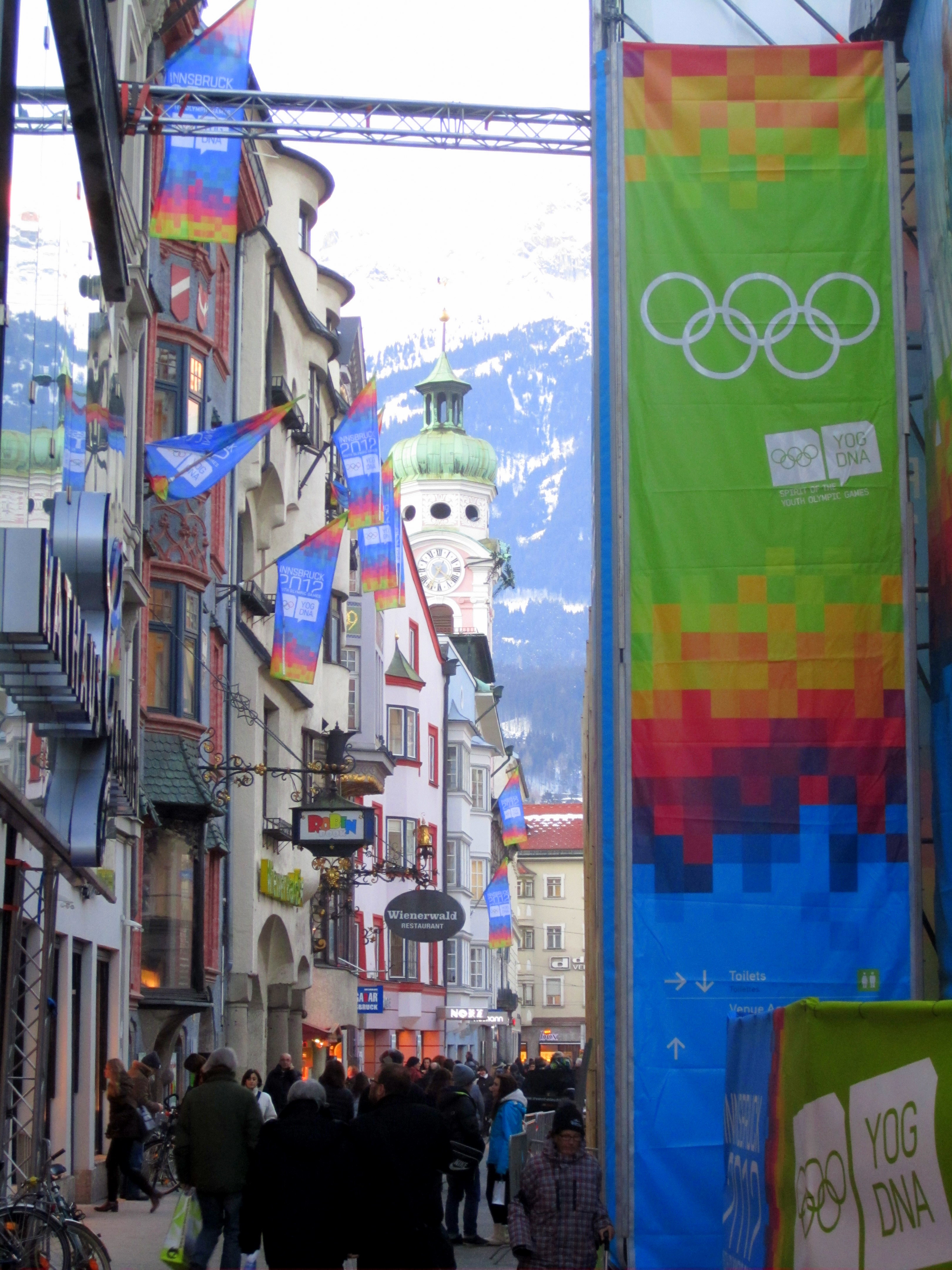
After a 36 year hiatus, Olympic competition has now returned to the bustling university city of Innsbruck for a third time in the form of the Inaugural Youth Winter Olympic Games. The capital city of the alpine province of Tyrol in Austria’s western panhandle, Innsbruck twice hosted the world during the 1964 and 1976 Olympic Winter Games and now proudly bears the distinction of being the only city to have hosted three Olympic events. The Youth Winter Games will run from January 13th to the 22nd, and will feature 1,058 athletes ages 14-18, representing 70 nations.
Innsbruck's downtown boulevard "Maria Theresien Strasse" is alive with Youth Olympic spirit.
The Youth Olympic Games, whose inaugural summer event took place in Singapore in 2010, has been engineered as the successor to the World Youth Games. The Games themselves aren’t out to replace existing premier junior events such as Junior World Championships, but will instead serve to combine sport and culture and ultimately raise interest in the Olympic movement amongst young people.
Richard Rubatscher, Chairman of the Supervisory Board of the Innsbruck YOG Organizing Committee, stressed the importance of the Games’ motto ‘Be Part of It’ in his speech to the crowd of 15,000 who gathered for the Opening Ceremonies in the storied Bergisel ski jumping stadium overlooking the city. “Youth Olympic Games should be about more than ‘higher, faster, further’. That is why the Youth Olympic Games will not only feature sporting competitions but also a comprehensive Culture and Education Programme designed to bring together youngsters from across the globe and young people from the local region,” said Rubatscher.
All of the Nordic events during the Games will be on held on the historic loops of Seefeld, Europe’s largest cross country ski resort, located 20 minutes Northwest of downtown Innsbruck. With a storm system last week laying down a meter of fresh snow, conditions simply couldn’t better going into the big event. The Seefeld trails have special significance for American competitors, as Bill Koch famously skied his way into the history books there in 1976 by taking silver in the 30km classic event, and fellow Vermonter Tim Caldwell placed in the 4 x 10km team relay.
YOGGL, the Austrian Chamois, is the Games' mascot. He's up in Seefeld now getting a few k's in.
Cami Thompson-Graves, the current women’s coach for Dartmouth College, fondly recalls her experiences in Seefeld while competing in the 1985 World Championships, just as the new skating technique was transforming Nordic skiing.
“I have very good memories of being in Seefeld, although it was only my second trip with the US Ski Team and my first time ever skating without kick wax underfoot…even at the December World Cups we were skating more on corners and in some areas, but basically classical skiing. That was during the ‘skating revolution’ so at World Championships that year, everyone skated everything,” recounts Thompson-Graves.
The current generation of US athletes ready to take on the world in Seefeld arrived earlier this week, and they’ve had plenty of time to scope out the freestyle sprint and classical distance loops. US competitor Heather Mooney, of Peru VT, is eager to continue the legacy of fast Vermonters in Seefeld. She provided FasterSkier with a great tactical overview of the courses.
“The skiing at Seefeld is fantastic! There’s a ton of snow on the ground, I want to say three feet, but that’s probably exaggerating a bit, there’s a lot. For the distance race we’ll be doing laps on a 2.5k (women) and a 3.3k (men). It’s pretty flat, with one monster hill in the middle, so it should be fun! The sprint is a 1k that rolls in the beginning before climbing a big hill into the finish lanes, I’m really excited for that!” said Mooney.
There's currently no shortage of snow on the loops in Seefeld.
Action gets underway tomorrow, Jan 14th, in Seefeld with the individual Ski Jumping competitions on the K70 meter hill. A team Ski Jumping event will take place on January 20th.
Cross-country events feature a distance classic race (5k women, 10k men) on January 17th and evening freestyle sprints on January 20th. An exciting Cross-Country/Biathlon Mixed Relay will take place on the 21st.
Biathlon action includes four events beginning with a sprint on January 15th (6k women, 7.5k men), a pursuit on the 16th (7.5k women, 10k men), a mixed relay on the 19th, and the Cross-Country/Biathlon Mixed Relay on the 21st.
Nordic Combined racing includes an individual Gunderson format competition on January 15th, with racers completing a 5km skate race following the jumping on the K-70 meter hill.
The Biathlon Stadium in Seefeld– ready for its third round of Olympic action.