From the FasterSkier archive — posts syndicated from athletes’ and coaches’ own blogs between 2004 and 2012, kept online as published. Current coverage is at fasterskier.com.
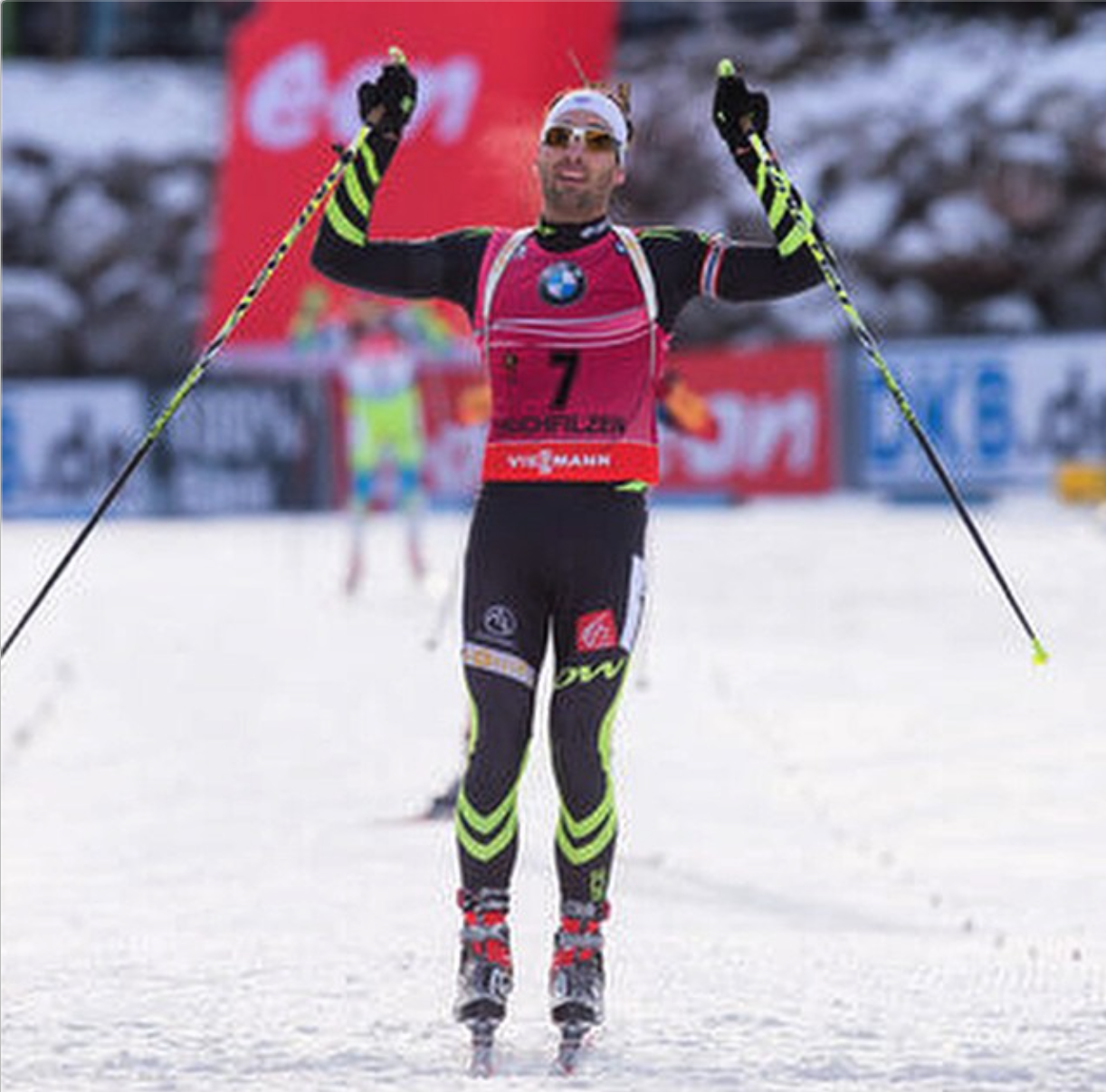
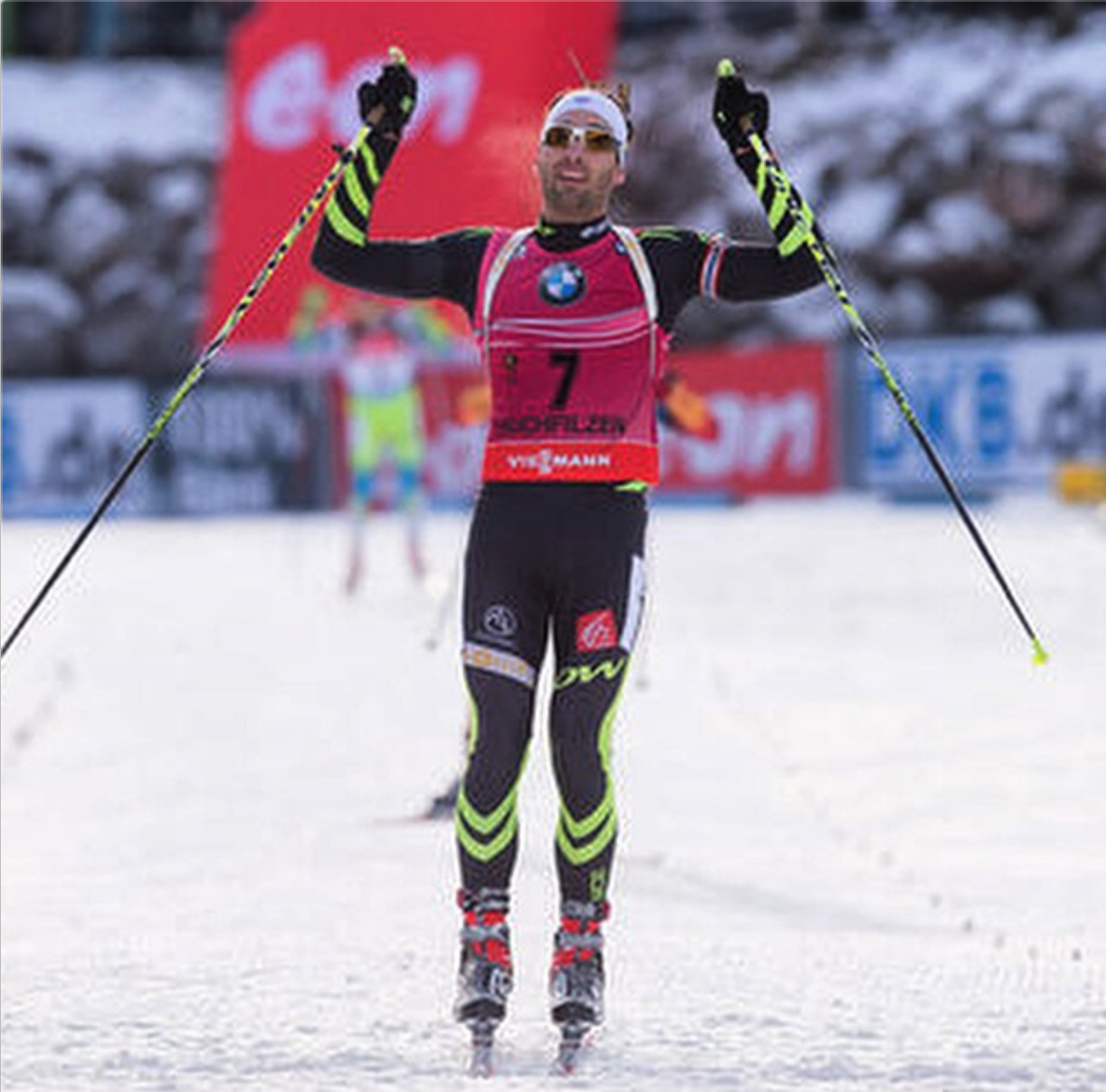
At it again: France’s Martin Fourcade, here winning the 12.5 k pursuit in Hochfilzen, Austria, before Christmas, won the 10 k sprint in Oberhof, Germany today. (Photo: Martin Fourcade/Instagram)
Warm overnight temperatures, strong winds, and rain in Oberhof Friday night meant trouble for the IBU World Cup biathlon men’s 10 k sprint race Saturday morning. Start time was pushed back to mid afternoon to allow time for snow to be shipped in and repair the course. Even with the fixes, organizers couldn’t cobble together the 3.3 k required for the three-loop race – all they had was 2.5 k worth of snow.
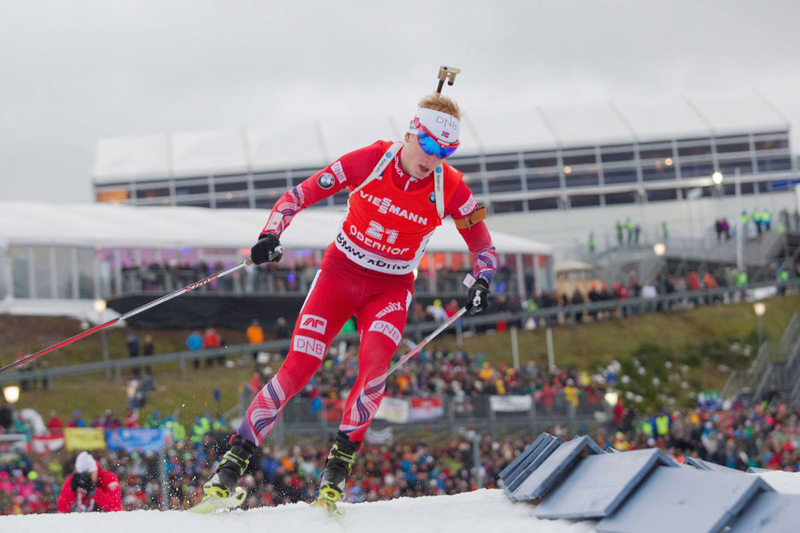
Johannes Thingnes Boe (NOR) on his way to 4th place. (photo: Fischer/Nordic Focus)
So, very unusually in biathlon were loops between shooting stages are always the same length, they used a 2.5 k loop. The men skied one loop, then shot, then skied a double loop before the final shooting stage. That put 5 k in the middle of the race, a longer bout of skiing than is ever completed at once in regular World Cup formats.
“They had to change the course because the snow totally melted,” American biathlete Tim Burke said in a phone interview. “They made it a 2.5 k loop, so it was 2.5 k and then prone shooting, then do a double loop for 5 k, then shoot standing, then 2.5 k. That changes it up, definitely a decent amount, having a 5 k in the middle of the race makes it interesting and definitely changes tactics a little bit.”
That was just one of the challenges faced by racers in a competition Burke called completely unfair. Wind gusts were strong – but they also died, giving some competitors much better shooting conditions than others.
Martin Fourcade of France, the double Olympic gold medalist from Sochi, won the competition to retain the overall lead in World Cup standings. But even he didn’t think that biathlon should be raced this way.
“It’s my seventh time in Oberhof; today were perhaps the best weather conditions, and this is not a joke,” he said in an IBU press conference. “So we have to think about something. Oberhof can be really good but not in the beginning of January.”
Some of the problems were equally bad for everyone: for instance the ski trails. Ice mixed with slush to create a dangerous mix of snow types that claimed many victims. Several athletes broke skies and poles as a result of crashes on the technical downhill.
Only two of the ninety-nine racers avoided skiing penalty loops, a rare occurrence on the World Cup – but the number of loops required was the thing. Was it one? Or six? And did that racer also wait a minute instead of the usual 25 seconds on the range, hoping the wind would die down?
Despite all this, Fourcade found himself in a familiar spot: atop the podium. Sitting out the relay, Saturday’s sprint was Fourcade’s first chance to test his training from the holiday break. Though Fourcade told the IBU he did not need the extra break, he used it to train and prepare for the rest of the season.
After posting a slow opening lap, Fourcade shot slowly prone though still had a penalty. Leaving the final shooting, the French star was seven seconds behind the time set by Ole Einar Bjørndalen of Norway. That didn’t leave Fourcade with much hope of winning: “I wasn’t confident at all,” he said in the press conference, crediting Bjørndalen for being very strong this year.
By the finish, though Fourcade picked up the pace and opened a 4.4 second gap over the Norwegian veteran. The pair retained their first and second place positions, although Timofey Lapshin of Russia used a late charge to bump Norway’s Johannes Thingnes Bø off the podium and snag third, +15.7.
Having won individual races nine time in Oberhof, Bjørndalen was one of very few skiers looking relaxed and confident taking the downhill’s with spend would have to settle for silver. He said in the IBU press conference, “I felt good and my shooting was much better than in the relay today, the condition were tricky, sometime we had wind sometimes no wind.”
Johannes Thingnes Bø posted the best opening lap time but was denied a podium due to his two shooting errors, finishing 18.2 second back. It took a lot for Lapshin to bump him off; the wind was so strong on course that not only did he have to shoot well, but he struggled just to cross the finish line in a strong headwind.
Benjamin Weger of Swizerland nearly matched the speed of Bø, finishing 19 second back in fifth. Latvia’s Andrejs Rastorogujevs had the fastest ski time of the day but with three mistakes in the range finished sixth 21.4 seconds back.
Weger, who a few years ago earned the first-ever podium by a Swiss biathlete but has since lacked that level of performance, was pleased to see it come back.
“I am happy to be back in the top 10, after all with one less miss I could have won this race,” he told the IBU in a finish-line interview. “It’s a good motivation. I am satisfied and looking forward to the next races.”
Stay tuned for interviews with the North American biathletes. Lowell Bailey and Nathan Smith led the way, finishing 34th and 35th for the United States and Canada, respectively.
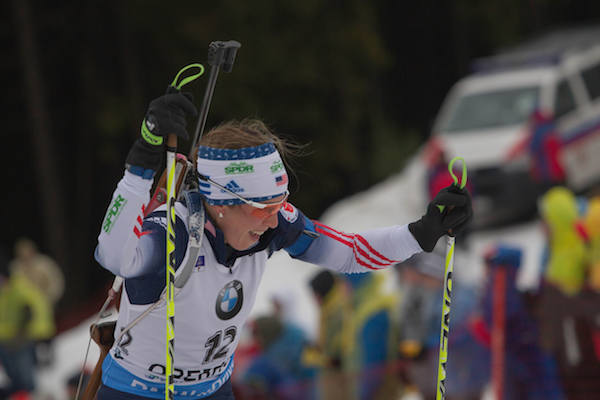
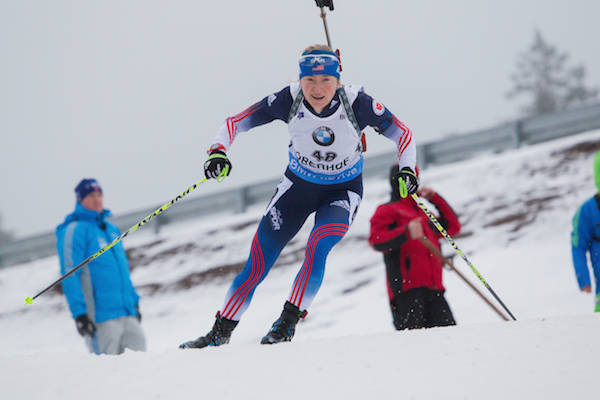
American Susan Dunklee racing to 21st place in Friday’s 7.5 k World Cup sprint in Oberhof, Germany. (Photo: USBA/NordicFocus.com)
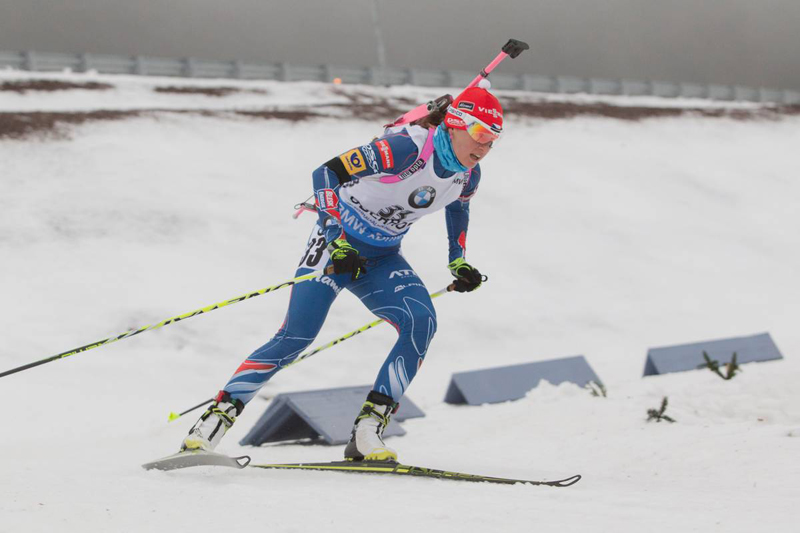
Another windy day in Oberhof, Germany, for Friday’s IBU World Cup 7.5-kilometer women’s sprint race caused some of the big names to make huge errors on the range and created room for new faces on the podium.
Veronika Vitkova of the Czech Republic made it two-for-two for victories in 2015, claiming her first individual World Cup win. Coming off the Czech women’s first relay win in over a decade on Wednesday, Vitkova powered her way victory on Friday with a time of 22:40.0 even after a miss in both the prone and standing shooting. She had the second-fastest ski time of the field.
“I felt very good on the tracks but I didn’t think I would win with two mistakes,” Vitkova explained in a press conference following Friday’s sprint.
She knocked two Italians back when she crossed the finish line: Dorothea Wierer, who ended up in second place 8.8 seconds back, and Nicole Gontier, who was 19.1 seconds back. Wierer, who had the fastest opening leg in Wednesday’s relay, continued to lead the Italian team and with the result moves into second in the women’s world cup standings.
Wierer commented on the tough conditions of Oberhof: “It was really hard conditions with the wind, I was lucky because in the standing I had no wind, and I could shoot really fast and that was my luck.”
Gontier lead early, being the tenth starter of the day and hitting all 10 targets though she would be bested by 19.1 seconds.
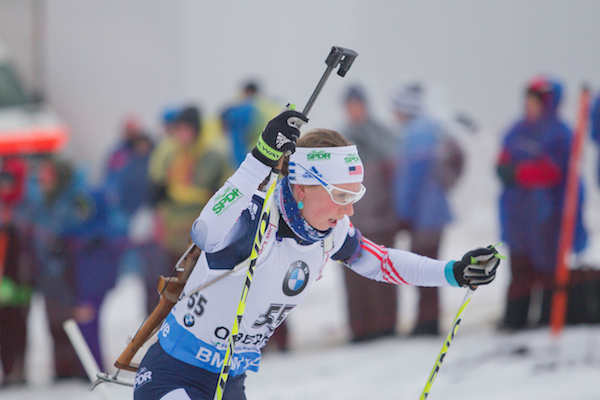
American Hannah Dreissigacker finished 37th in the sprint with two penalties. (Photo: USBA/NordicFocus.com)
“I’m really surprised because I didn’t expect it [to be on the podium], I shot really well,” Gontier explained during the press conference. “It was the first time I shot clean, and I am really happy to be here with Dorothea for my first podium.”
Her team certainly thrived in the windy conditions, putting three women in the top ten and two on the podium. Karin Oberhofer finished eighth, making them the most successful team on the day.
Overall World Cup leader Kaisa Makarainen had two mistakes in each of her two trips to the shooting range, ending her chances of another sprint victory. Another strong challenger for the overall points lead, Darya Domracheva of Belarus missed three times in the prone and again in her standing, putting her out of contention early. She had the fastest ski time on the day to nevertheless finish 18th.
The German crowds finally had something to celebrate as German native Fransiska Preuss finished fourth, 22.5 seconds back with one miss. Finland’s Mari Laukkanen surpassed her more famous teammate Makarainen to claim fifth, 23.9 seconds off the winning time. Gabriela Soukalova of the Czech Republic, also with two mistakes, rounded out the top six, 24.8 seconds behind her teammate.
Two North American women claimed World Cup points: Americans Susan Dunklee, who finished 21st, 1:22.9 of the pace with three misses, and Hannah Dreissigacker, who placed 37th (+2:05.0) after cleaning her prone shoot and missing two targets in her final trip to the range.
Some athletes were luckier than others in terms of shooting conditions in Oberhof. After facing some difficult gusts in prone shooting, Dunklee explained in an email, “Every athlete had slightly different conditions to deal with. As an athlete, the trick is to not stress out about it because it is not something you can control.”
Dreissigacker was happy to be in the points.
“Scoring points is always good!” Dreissigacker wrote in an email. “I was very happy with my first lap and with shooting clean in prone. In standing I had a little bit of trouble, but it was windy and I was tired and so I was happy to pull myself together after two misses and hit the last two shots.”
Annelies Cook (USA) on course. (Photo: USBA/NordicFocus.com)
Annelies Cook, the third American, finished 62nd (+3:24.3). She crashed on the last lap, reportedly damaging her rifle, but still finished the race.
Rosanna Crawford was again the top Canadian, placing 46th after a difficult standing shooting where she took four laps of the 150-meter penalty loop before completing her race.
“I felt decent skiing and our skis were amazing,” Crawford wrote in an email. “I was lucky in prone with consistent wind and then not so lucky in standing where it was gusting pretty hard.”
Crawford explained that after having made all of her mistakes shooting in the second trip to the range, she realized that shooting standing in the end lanes (25-30) potentially would have offered more shelter from the wind.
Fellow Canadian Megan Heinicke claimed 56th (+2:56.6), just ahead of Zina Kocher in 58th (+3:05.1); Emma Lunder finished 92nd (+5:44.4). Their teammate Julia Ransom took a major crash on her final lap having hit nine of the ten targets, breaking her ski and retiring from the race. In just the second weekend of World Cup racing in her career, Ransom was sitting in 25th place after the second shooting.
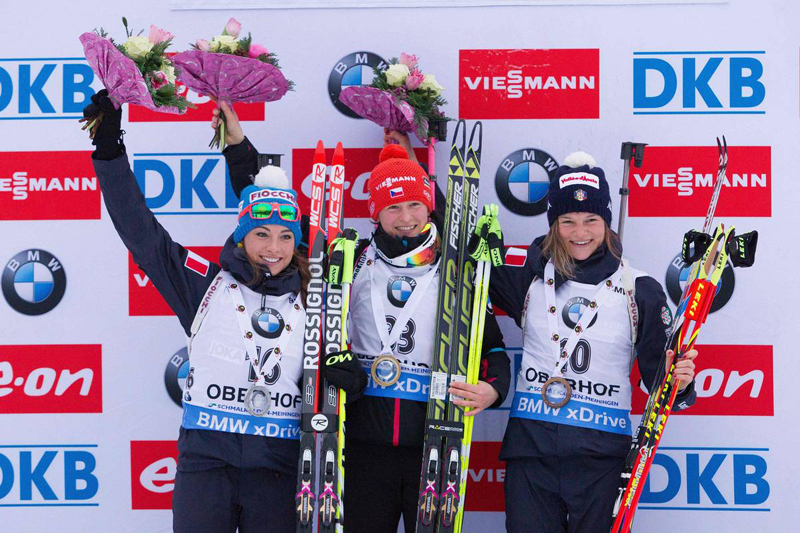
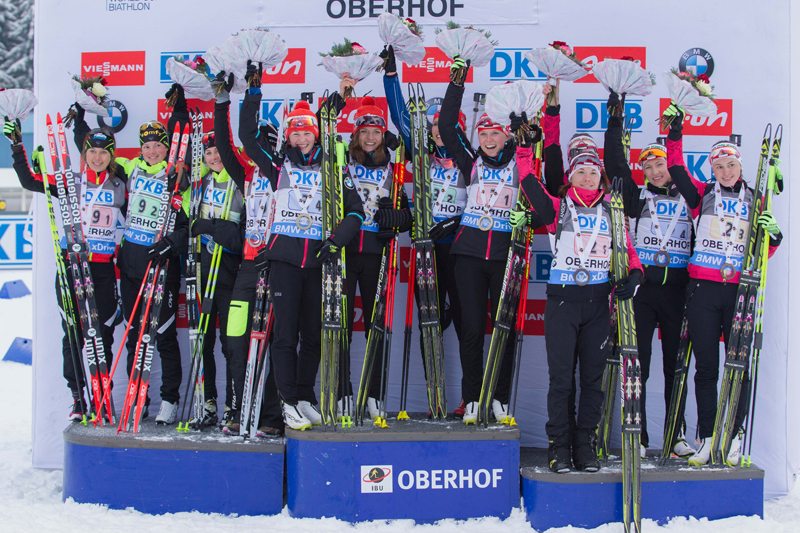
Dorothea Wierer (ITA), Veronika Vitkova (CZE) and Nicole Gontier (ITA) take the IBU biathlon World Cup podium in Oberhof, Germany. (Fischer/NordicFocus)
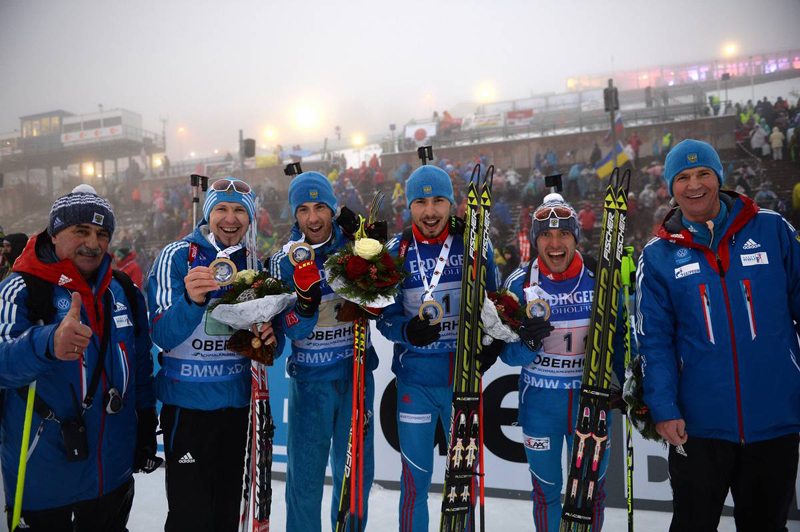
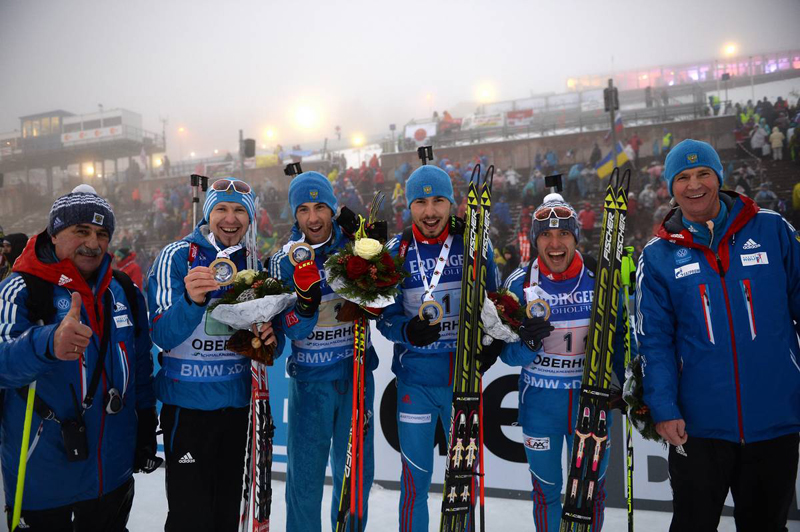
The Russian men’s relay team including; Timofey Lapshin (RUS), Dmitry Malyshko (RUS), Anton Shipulin (RUS) and Evgeniy Garanichev (RUS) show their hardware from the IBU World Cup biathlon, relay in Oberhof (GER). (photo: Fischer/Nordic Focus)
Heavy fog in Oberhof, Germany, on Thursday pushed back the start of the IBU World Cup 4 x 7.5 k relay, and then obscured both the targets and the race course as the world’s top male biathletes battled their way through the race. But even a delay, tough conditions, and a 57 second deficit going into the final leg couldn’t keep the Russian team of Evgeniy Garanichev, Timofey Lapshin, Dmitry Malyshko, and Anton Shipulin from gold.
It was Shipulin who did the hero’s work for Russia. He skied the fastest course time of all the anchor-leg skiers, and also turned in remarkable shooting – just one spare round over the two shooting stages combined. On the final loop, he closed a ten-second gap to Norway’s Ole Einar Bjørndalen, then passed him, accelerated up the final hill, and celebrated as he crossed the line with a two-second win.
“Everything was good today, shooting and running, and so I am so happy that we won,” Shipulin said in a press conference.
Impossible conditions
Strong winds, dense fog, and slushy snow made both skiing and shooting a challenge. Even with three spare shooting rounds available in each shooting bout – a luxury available only in relays – just two of twenty-four nations escaped the day without penalty loops. As wind battered their race bibs and they squinted to see targets, the men missed almost more targets than they hit. Russia’s 12 spares set a new low for shooting by a winning team – and yet represented remarkable accuracy, given the conditions.
“Every one of us had some problem or other on the shooting range, but we struggled to victory,” Malyshko said through a translator at the post-race press conference.
All teams in the top six saw at least one trip to the penalty loop. The three medal winners, Russia, Norway, and France had one-a-peace; Germany and Ukraine each had two; in six Switzerland had six penalties.
Athletes struggled on the ski trails as well; Ukraine, Canada, Poland and Finland are just a few of the dozen nations that had crashed during the race.
“Marco [Bedard] fell but he is OK,” Canadian National Team Coach Roddy Ward wrote in an e-mail. “No broken equipment either. The conditions on the downhills were very tricky. There were a lot of falls!”
The Czech Republic team, whose women claimed the win in Wednesday’s 4 x 6 k relay, was forced to withdraw before completing their first leg after a major crash by Michal Krcmar.
“We actually thought the race was going to cancelled until about 5 minutes before the start.” Nathan Smith told FasterSkier in an email.
Another athlete took a wrong turn at a trail intersection because visibility was so bad.
Even Sweden was disqualified for using four spares in one bout of shooting, one more than the allowed three extra rounds.
And then there was the rainy snow, something like being in a cloud.
“The main challenge today was not to get cold,” Lapshin said in a post-race press conference. Biathletes have a word for this weather: “Oberhofing”.
“Today it was a very hard competition,” Jean Guillaume Beatrix of France said. “Every year it is the same in Oberhof, conditions for warriors. We just try to be as strong as possible.”
Lead Changes and Errors
The opening leg already saw Russia, Latvia, and France beginning to take advantage of tough shooting conditions by slightly getting away from the rest of the field for the first transition. The French team was ager to prove their abilities without the participation of French superstar Martin Fourcade. His brother Simon said in the press conference, “Jean Guillaume [Beatrix, a teammate] has a good joke about this, the women had a podium yesterday without Martin, so why not us?”
The second 7.5 k leg of the race was the point that brought Norway into striking distance of Russia and France. The experienced Alexander Os brought solid shooting in the windy range, putting Norway less than 10 seconds off the lead pack. He is one of several men vying to complete Norway’s roster for World Championships, and was happy with his effort: “I am satisfied,” he said in the press conference.
Germany was fourth and Canada, boosted by Nathan Smith, fifthbefore the second exchange. But on the third leg it looked like Norway had run away with the race. Johannes Thingnes Bø easily closed the gap to France and Russia, then clean prone shooting put him eighteen seconds ahead of Russia and twenty-seven ahead of France.
While all three leaders had a trip to the penalty loop after the standing shooting i, Bø made it to the exchange fifty seven second ahead of the chasing Russian Malyshko.
Bjørndalen has claimed nine individual World Cup victories in Oberhof and with nearly a minute advantage on Shipulin was in the ideal position. But it wasn’t going to happen: Shipulin, who had excellent individual result before the holiday break, could not be beaten. The Russian closed nearly twenty seconds in the first loop and twenty-five in the second. And then Bjørndalen didn’t help himself by using all three spare rounds in standing.
Still with a nine second deficit on the final lap Shipulin sprinted past Bjoerndalen to cross the line in the winning time of 1:15:24.1, 2 seconds ahead of Norway.
“I wasn’t completely safe about whether I would catch him, it wasn’t 100% certain,” Shipulin said in the press conference. “I knew that Ole Einar has very strong efforts. So I just tried to get him. I did everything I could.”
Bjørndalen didn’t appear to be in his best form, although Shipulin’s speed was enough to make anyone look weak in comparison.
“It was hard on standing,” Bjørndalen admitted to Norwegian broadcaster NRK. “It was difficult conditions, and I had to work madly to get away without a penalty lap.In the track today was not good either…. Shipulin was so good today, and I felt tired.”
Bø said that blame for Norway’s loss should not fall on Bjørndalen, even though as the anchor his face was attached to it.
“It’s easy to be the scapegoat when you go last, but the entire race goes from A to B,” he told NRK. “I’m not proud of my penalty loop… my leg could have been half a minute better, and then we would have won by half a minute.”
France finished 1:32 off the pace, having passed Germany while Simon Schempp was in the penalty loop. Germany would finish fourth 2:43.7 back. Quentin Fillon Maillet, France’s anchor, joined his team and they immediately grabbed a “Je Suis Charlie” sign in support of the victims of the recent terrorist attack at a Paris newspaper office.
Ukraine and Switzerland rounded out the top six finishing 4:08.5 and 4:27.9 respectively behind the Russian team. Due to the range conditions, which saw many spares and penalty loops but also slow and deliberate shooting to try to overcome low visibility, only ten teams escaped without being lapped.
Eighth Place for Canadian Men
The Canadian men continued their relay success this season, clutching the 8th place finish when Macx Davies edged out Finland lunging for the line. Davies and Christian Gow made their World Cup circuit debut for this year in Wednesdays relay. Much of Canada’s usual World Cup squad is taking extra time to train and relax at home and skipping the Oberhof World Cup – Nathan Smith is there only to defend a top-25 Total Score ranking – and the IBU Cup squad was given the chance to race in their place, hence the newcomers to the scene.
“Based on training and racing to date, I think Christian and Macx were confident coming into Oberhof,” Ward wrote. “However, I think it was good for Christian to brush shoulders with the big boys and see that he can hold his own. Macx had a great last lap and skied away from a few teams for 8th, that should help his confidence too. They both have the potential to put together a good result in the Sprint.”
Gow is not usually a scramble-leg skier, but based on his performance in training and recent racing, the team and staff picked him to lead off.
“I felt a bit more pressure than normal the last couple of days, mainly because I have never started a relay or a World Cup,” he wrote in an e-mail. “The idea of doing both of those things on the same day at the most crowded spectator venue was definitely a bit nerve-wracking. ”
Gow was steady on the range in opening up for Canada, losing only fifty-six seconds to the leaders and passing off to veteran Nathan Smith.
“He did quite well,” Ward said in a phone interview. “It was very, very hard conditions, but he definitely held his own. He shot pretty well, given the day, and tagged off pretty close to the leaders.”
Smith moved into sixth place before finishing his leg, turning in what Ward called a “solid leg.”
Marc Andre Bedard took over from Smith; a crash on his first lap for Bedard stole his speed leading into the big downhill of the course.
Bedard took one trip to the penalty loop after his standing shooting. Davies final shooting resulted in two more penalties for Canada but a strong attack on the last lap moved Davies up from 10th to 8th at the finish. In doing so, Canada improved their Nations Cup ranking.
“We have quite a few strong guys, so I thought that this result was possible,” Ward said. “8th place today shows our men’s team has some good depth. It’s good to see our younger athletes make the jump to the highest level. Hopefully this means we are doing a good job at developing these guys and girls.”
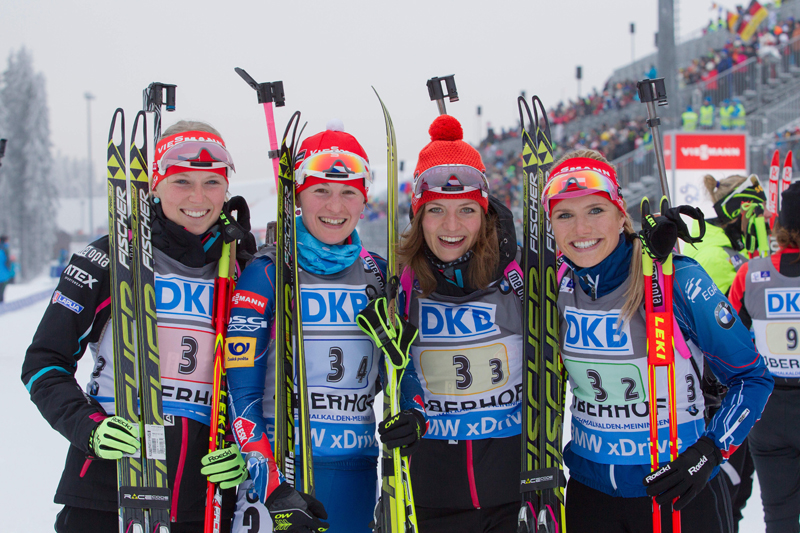
The Czech Republic posted the most consistent performances of the day and clinched the women’s relay win with anchor Veronika Vitkova (second from l) at Wednesday’s IBU World Cup in Obehof, Germany. From left to right: Eva Puskarcikova, Vitkova, Jitka Landova, and Gabriela Soukalova. (Photo: Fischer/NordicFocus)
The women’s International Biathlon Union (IBU) World Cup resumed in Oberhof, Germany, on Wednesday with the women’s 4 x 6-kilometer relay. Twenty centimeters of fresh snow made for difficult skiing on a foggy, warmer day than in training on Tuesday, and on top of that, Oberhof is known as a notoriously hard shooting venue. The large-climb profile of Oberhof and a long, flat section leading into the range contrasts that of several other World Cup stops.
The leading positions changed several times throughout the race, with early leaders Russia and Finland falling out of contention with two many penalty loops apiece.
The eventual winners, the Czech Republic, with Eva Puskarcikova, Gabriela Soukalova, Jitka Landova, and Veronika Vitkova, used seven spares to claim the victory, one less than runner-up France (with Marine Bolliet, Marie Dorin Habert, Justine Braisaz, and Anais Bescond), which used eight. The Czech team was consistent throughout the day with none of its athletes skiing significantly quicker or slower than the others, which put them on pace for the win in 1:16:56, 8.6 seconds ahead of France.
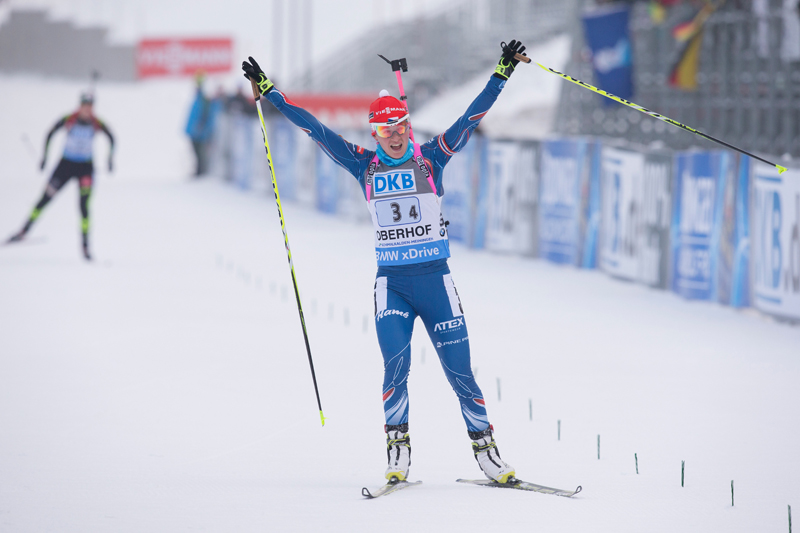
Veronika Vitkova clinches the nearly-nine-second win for the Czech Republic on Wednesday in the women’s 4 x 6 k relay at the IBU World Cup in Oberhof, Germany. (Photo: Fischer/NordicFocus)
Sixth after the first leg with Puskarcikova, who used just one spare, Soukalova skied the team to third with a single spare as well, Landova brought them one step closer in second with two spares, and Vitkova used three spares to seal the win.
“The final shooting was quite hard as I was nervous; but I really wanted to win,” Vitkova told the IBU.
“I was not sure about my shape for the first race after Christmas,” Soukalova said. “Early in the race, I had a lot of energy but on the last loop, I was so tired; I just wanted to see the finish line.”
During the third leg, it seemed Ukraine, the Olympic relay champions, had a strong hold on the first position with Olga Abramova maintaining their lead until the final exchange. The Czech Republic followed came through the exchange in second, 8.3 seconds back, followed by France, 11.9 behind Ukraine.
Vitkova led into the first prone stage and cleaned with six shots, but France’s anchor Anais Bescond cleaned quickly as well to chase her out of the stadium. Ukraine’s Iryna Varvynets used one spare to leave the range in third, followed by Norway’s Tiril Eckhoff, who also used one spare and headed out on her second lap in fourth, 34 seconds after Vitkova.
In the final standing, both Vitkova and Bescond used two spare rounds to leave the range together Eckhoff suffered a penalty lap, while Varvynets missed just one to chase the leaders from 37 seconds behind in third. However, she slowed on her last lap and was overtaken by three women — Darya Domracheva of Belarus, Eckhoff, and Italy’s Karin Oberhofer respectively — to finish sixth for Ukraine.
At the front of the race, Vitkova pulled away from Bescond with about 2 k remaining to the finish, and secured the win by nearly nine seconds. Domracheva brought Belarus from 10th to third, passing Varvynets in the final 500 meters.
The IBU World Cup women’s relay podium on Wednesday in Oberhof, Germany: with France in second (l), the Czech Republic in first (c), and Belarus in third. (Photo: Fischer/NordicFocus)
France welcomed back Marie Dorin Habert to her first World Cup race since giving birth to her first child this summer.
“I have only had two national races before this; I did not expect my form to be so good,” she said in a press conference following relay.
France’s second skier, Habert used a single spare to bring her team back within less than a second of the leading Ukrainian team, which had perfect shooting from its first two skiers, Anastasiya Merkushyna and Valj Semerenko.
Darya Domracheva had the biggest individual leg of the day, lifting Belarus to the podium after Nadzeya Pisareva’s penalty on the third leg put the team in 10th. Domracheva used two spares and skied the fastest course time on the last leg to close 38 seconds and place third overall, 1:06.8 behind the winners.
Norway saved their strongest woman for last. With her team in fifth, Eckhoff took over with an aggressive start to her race. Coming into the standing shooting, Eckhoff was within range of the leaders, but fighting the wind, she used her three spares and still incurred a penalty loop. Eckhoff skied a strong final lap, passing Italy and Ukraine, but was unable to hold onto Domracheva. Norway took fourth, 1:12.7 behind the Czech Republic.
Italy led early in the first leg with Dorothea Wierer, who shot clean, but dropped to seventh with second-leg Lisa Vittozzi and remained in seventh, and finally fifth. After catching Varvynets coming into the stadium, Oberhofer could not hold off Eckhoff and dropped to fifth, 1 second behind Norway and 1:13.7 after the winners. Ukraine was another 5.3 seconds back in sixth.
Canada, the lone North American women’s relay, put themselves in the mix in early on with Megan Heinicke, who had perfect shooting and the ninth-fastest course time of the first leg. She tagged teammate Julia Ransom in fifth, 8.8 seconds behind the leaders.
Ransom skied with a quick tempo in the warm-and-slushy conditions, and held onto the leaders for her first lap. Ransom needed just one spare in standing to hit her 10 targets and complete her leg, tagging Emma Lunder in 10th.
“Megan rocked the first lap!” Ransom wrote in an email. “Shooting felt solid out there and the first ski lap was filled with adrenaline and excitement. Flying out [to Oberhof] only a few days ago, I still felt the effects of jet lag and died a little on the other two laps. However I am confident that the body will be back in form for the sprint.”
Nearly 1:50 behind the leaders, Lunder was troubled by a change in wind since her pre-race zero and skied two penalty laps after prone. She used three more spares in standing, for a total of six, and tagged Zina Kocher in 16th, nearly five minutes back.
In an email, Lunder explained these mistakes only motivated her to perform better in Friday’s sprint.
“I like the course, I feel strong, and with a bit of extra focus on the range in training tomorrow, I’m certain I can perform to my potential,” she wrote, adding that the slushy conditions and the difficult climbs suit her strengths.
The team’s veteran, Kocher, used six spares (three in each stage) before being lapped on the final loop and taken out of the race.
“I had to focus on doing my job and make the best of it,” she explained in an email.
Three of the Canadian women flew into Oberhof on Monday night, and Kocher explained that jet lag after the holidays could have been a factor in their performance.
“Today’s relay was just a blip in the scheme of things,” Ransom wrote. “It’s incredibly hard to get four people to be ‘on’ all at the same time and it just didn’t happen for us. But now that the cobwebs are out, I believe that all of us ladies will have some great performances coming up.”
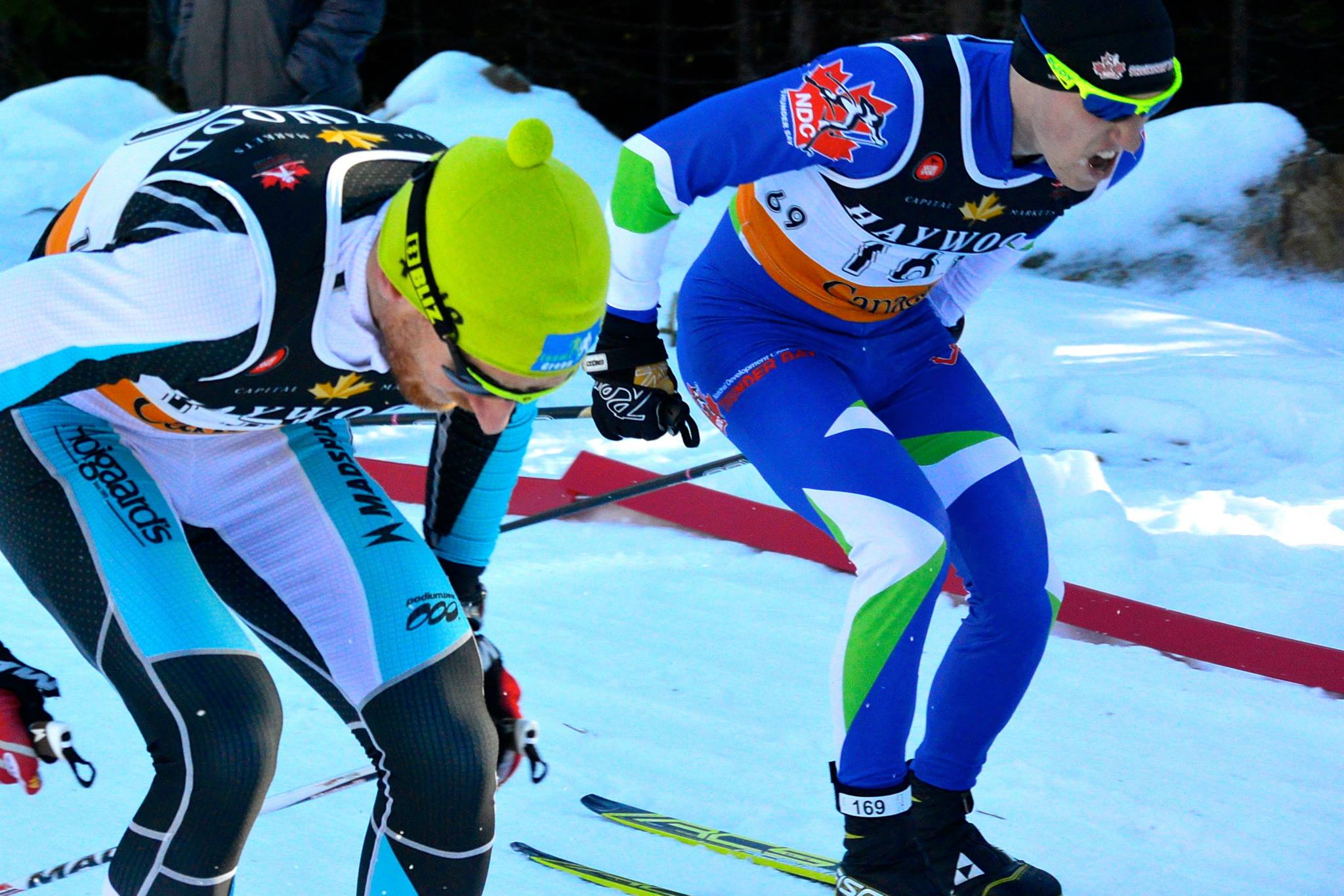
American Brian Gregg (l) and Canadian Andy Shields of the Thunder Bay National Development Centre ski alongside each other in the 11 k classic individual start last weekend at the NorAm opener in Rossland, B.C. Gregg went on to place fifth and Shields was 12th. (Photo: FRESH cafe & apres/Facebook)
While the opening weekend of the U.S. Super Tour marked the start of the North American race season in late November, Canada’s NorAm circuit kicked off last weekend in Rossland with two classic distance races, held despite challenging conditions and a lack of snow.
The second stop of the NorAm circuit was originally scheduled for Whistler this Friday and Saturday, but once again, warm weather and insufficient snow led the races to be moved further inland to Sovereign Lake in Vernon, British Columbia, better known as Silver Star.
This season, the NorAm will visit six venues, wrapping up at the Lappe Nordic Centre in Thunder Bay, Ontario, for Canadian Ski Nationals. The circuit attracts many of the most competitive Canadian and American domestic cross-country skiers, juniors and seniors alike, all trying to earn their stripes and log top results in an effort to get to Europe.
Canadians Alysson Marshall and Heidi Widmer, teammates at the Alberta World Cup Academy (AWCA) in Canmore, Alberta, and on the national development team — also based in Canmore, started the winter off with strong results at the SuperTour opener in West Yellowstone, Mont. Marshall won the first sprint of the season, and Widmer placed second.
In the 10 k freestyle the next day, Widmer again broke into the top 10 with a ninth-place finish, and Marshall finished 17th.
Patrick Stewart-Jones (AWCA), Bob Thompson (Thunder Bay NDC), Michael Somppi (AWCA/NST D-team), and Andy Shields (AWCA) were among several Canadians racing in West Yellowstone. There, Shields made the sprint A-final, but finished sixth after breaking a pole. In the 15 k, Stewart-Jones led the Canadians in 17th.
One week later, Stewart-Jones emerged as the winner of the classic sprint in Bozeman — the second SuperTour stop in Montana. Marshall placed fifth in the women’s A-final, and the next day in the 10 k classic mass start, she finished 14th, just ahead teammate Dahria Beatty (AWCA/NST U23) in 15th. In the men’s 15 k classic mass start, Somppi was the top Canadian man 13th.
Rossland’s opening NorAm races challenged organizers with difficult conditions, but quality racing still took place thanks to the hard work of the staff and volunteers. Warm weather and rain previously wreaked havoc on the snow, but below-freezing temperatures last weekend made for hard-packed, icy conditions for the two distance races. Leading up to the races, organizers ruled the course unsafe for a sprint and added another classic distance race to the schedule instead.
Yukon’s Annah Hanthorn racing to third on the opening day of the 2014/2015 NorAm season, in the women’s 7.5 k classic in Rossland, B.C. (Photo: FRESH cafe & apres/Facebook)
Marshall swept both races, as did American Kris Freeman. Somppi hit the podium in third in last Saturday’s 11 k classic, and was again the top Canadian in fourth in the following 15 k classic. Andrea Dupont (Rocky Mountain Racers) placed second to Marshall in the 7.5 k sprint on Day 1, and junior Annah Hanthorn (Yukon Territory Ski Team) placed third, then second in the women’s 11 k on Day 2.
Following an Olympic year, there have been some shifts in the key Canadian players: Dasha Gaiazova, Amanda Ammar and Zoe Roy were three of the nation’s top women last season and retired this spring. Graham Nishikawa, the reigning overall men’s NorAm leader, has re-committed his focus to guiding Canadian Para-Nordic teammate Brian McKeever at International Paralympic Committee (IPC) World Cups and 2015 World Championships.
Many of the top athletes are aiming for top results in order to qualify for later World Cups, U23 and Junior World Championships, and potentially senior World Championships in Falun, Sweden.
“Making the transition from domestic to World Cup racing is what everyone on the development team is trying to achieve, me included,” Somppi wrote in an email. “Experience is certainly helpful. The more international racing you do, the more comfortable you get with it and the better you perform.”
Women to Watch
Alysson Marshall at the last season’s Canadian Eastern Championships in Cantley, Quebec. (Photo: Canadian Eastern Championships)
Heidi Widmer (AWCA/NST D-team) – With last year’s overall NorAm cup winner Emily Nishikawa starting her season in Europe on the World Cup, Widmer is one favorite in the running for an overall NorAm title this season.
The 23-year-old Sochi Olympian already has a podium under her belt from West Yellowstone, where she also posted the fastest women’s qualifying time in the sprint. In late October before the season officially started, she qualified fourth in the Frozen Thunder classic sprint among U.S. Ski Team members and other top Canadians, and then edged Nishikawa in the distance skate to finish ninth.
Alysson Marshall(AWCA/NST D-team) — In six races so far this season, Marshall, 26, has won half of them. Marshall and Widmer have already been battling back and forth; neither has beaten the other in consecutive races this season (although Widmer did not race in Bozeman or Rossland). Marshall, 26, has been consistent in distance and sprinting, a critical asset in the run the overall NorAm title. Last season, she finished third in the NorAm standings behind Nishikawa and Widmer, respectively.
Dahria Beatty (AWCA/NST U23 team) – One of the youngest threats on the circuit, Beatty, 20, is a first-year senior who proved as early as the Frozen Thunder classic sprint that she’s able to ski with the best. There in October in Canmore, she qualified second behind former Olympian Perianne Jones.
Andrea Dupont (Rocky Mountain Racers) – After finishing fifth overall in the 2013/2014 NorAm (behind Ammar in fourth), this 34-year-old distance veteran is looking to lift herself to World Cup starts.
A sprint specialist, Dupont stressed in an email the importance of dominant qualifiers, while adding that racing well in the heats and advancing throughout each round is important as well. But more than anything else, she wants better qualifiers than last season.
“It isn’t enough to just get into the heats in Canada; you have to win the qualifier here if you want to have a chance of qualifying in Europe,” she explained.
Despite her sprinting preference and sickness early in the season, Dupont claimed second place in Rossland’s 7.5 k classic race.
Cendrine Brown (CNEPH/U23) – This 21-year-old member of the Pierre-Harvey Training Centre (CNEPH) in Quebec, made the junior-national team last season and competed at U23 World Championships in Val di Fiemme, Italy.
This year, after focusing on speed to improve her sprinting, Brown has already recorded fourth- and sixth-place finishes in Rossland, and will continue to shoot for another U23 World Championships in Almaty, Kazakhstan. The first three NorAm weekends serve as trials for Canada’s U23 and World Junior teams.
Brittany Webster(AWCA) — A two-time Olympian and veteran to high-level racing, Webster, 27, started her season off in 15th in the Bozeman classic sprint. She didn’t race in Rossland, but Webster has been busy this offseason; competing in her first off-road triathlon World Championships, where she won the amateur division.
Also this fall, she launched a pursu.it crowd-funding campaign in September and has raised over $19,500 to help cover the cost of what she anticipates to be an expensive international race season.
Men to Watch
Michael Somppi (AWCA/NST D-team) racing in the Frozen Thunder classic sprint on Oct. 24. (Photo: Angus Cockney)
Michael Somppi (AWCA/NST D-team) – Third overall in the NorAm last season; Somppi, 26, is eager to build on his past performances. For now, he’s focused on superb racing before the end of December.
“At this point in my ski career, I’m 26 and if I want a shot at being a World Cup competitor I need to be able to podium at home,” Somppi wrote in an email. “So every time I step on the start line I’m looking to finish on the podium.”
He was the top Canadian in both classic distance races in Rossland last weekend, claiming a bronze medal in the 11 k classic and finishing fourth in the 15 k.
Raphaël Couturier (CNEPH/U23) – In August, Couturier, 21, was the only Canadian not part of the World Cup Team invited to come down from Quebec to train with the team at a dryland camp in Stratton, Vt. He ranked fifth overall in the NorAm last year, and has started the season in seventh and 10th in Rossland.
Patrick Stewart-Jones (AWCA) – Wrapping up the 2013/2014 NorAm season in sixth overall, Stewart-Jones, 23, will be looking to improve his placing. Last winter, he posted some of his best results of the season at Canadian Olympic Team trials in Janaury (where he was third in the freestyle sprint and sixth in the 15 k classic), and was able to race at U23 World Championships as well as Scandinavian Cups in Latvia and Estonia.
In six races, he has two top 10’s: one win and an eighth-place finish in the 11 k classic last weekend.
Knute Johnsgaard(Independent) – Likely one of the biggest dark horses at the beginning of this season, Johnsgaard spends most of his training hours without company in the Yukon.
Despite his training partner leaving for school, having limited time with his coach, and developing his own training plan with the help of Graham Nishikawa, Johnsgaard is confident in his training, the work he has done and how it will translate on the tracks.
“I’m always really focused and motived to just get out and go by myself,” he explained. “It’s a little lonely sometimes but I don’t need anybody to ‘push’ me.”
Johnsgaard, 22, added he likes being off the radar and not having anyone knowing how his training is going. To that end, he joked that he’s won every single time trial he’s done this year. He’s hoping to continue this streak and claim victories at NorAm races.
Andy Shields (Thunder Bay NDC) – Last season, Shields finished ninth overall on the NorAm, yet his early season results indicate he’s had a successful summer of training that could put him closer to the top overall this time around. So far, the 23 year old has posted two sixth-place results: first in the West Yellowstone sprint and also in the 15 k classic last weekend.
Wild Cards
World Cup Academy teammates Kevin Sandau (NST D-team), Jesse Cockney (B-team), and Graeme Killick (B-team) were among the most competitive on the NorAm circuit last season, finishing second, fourth and seventh overall, respectively. Cockney and Killick earned Olympic spots for Sochi based on the mid-season NorAm races and all three have started their seasons on the World Cup in Europe.
In an email, Sandau described his excitement to race on the World Cup and some of his expectations: “Davos is a very unique race and I think it plays well with my strengths with it being a longer distance and a course with longer climbs than most other world cups,” the 26 year old wrote. After some tuneup FIS races in Switzerland earlier this month, he placed 70th in the 15 k classic last weekend in Davos.
“At the end of the day it really is the final result that counts, but more than anything I want to cross that line and just have that feeling of it being the perfect race,” he wrote.
Multiple-time Paralympic gold medalist, Brian McKeever races to 13th in the Rossland NorAm 11 k classic on Dec. 13. (Photo: FRESH cafe & apres/Facebook)
Last year’s overall NorAm leader, Graham Nishikawa is backing away from domestic racing to fulfill his commitments to the Para-Nordic Tea, although he confirmed he would take part in one or two NorAms to prepare for IPC World Cups. Despite the races not being his focus, Nishikawa, 31, is a potential treat if he makes it to the start line.
His younger sister Emily matched him as the women’s overall NorAm winner last season. She is currently racing on the World Cup, where she posted a career-best 29th last weekend in Davos.
“The major difference between racing on the World Cup and domestically is the depth of the field,” Emily Nishikawa explained in an email. “If you lose a few seconds, you will lose a few places as well. This probably won’t happen when racing domestically because the field is just that much smaller.”
Annah Hanthorn and Maya MacIsaac-Jones, both 19-year-old juniors, finished third and fifth respectively in last weekend’s 7.5 k classic (and Hanthorn was second in the following 11 k classic). Then there’s always Perianne Jones, a perennial World Cup staple, who could make NorAm waves should she return to Canada.
Already, it’s shaping up to be another exciting year of racing. Some athletes are most competitive in distance races, others sprinting, and a myriad of possible contenders can take the victory on any given day. Stay tuned for NorAm updates via the Continental Cup blog: http://blogs.fasterskier.com/continentalcup