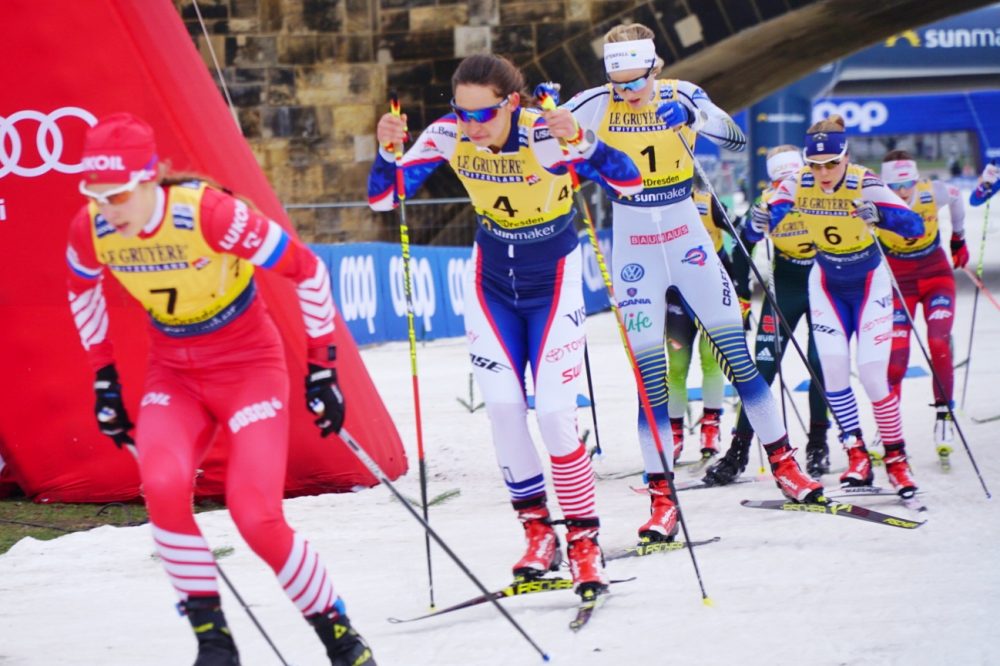
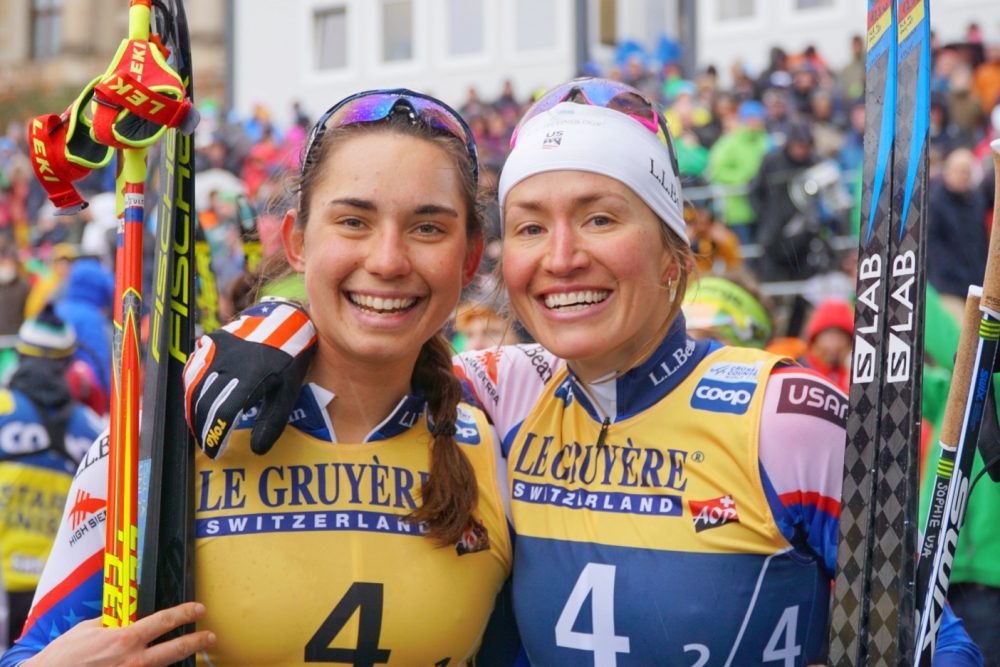
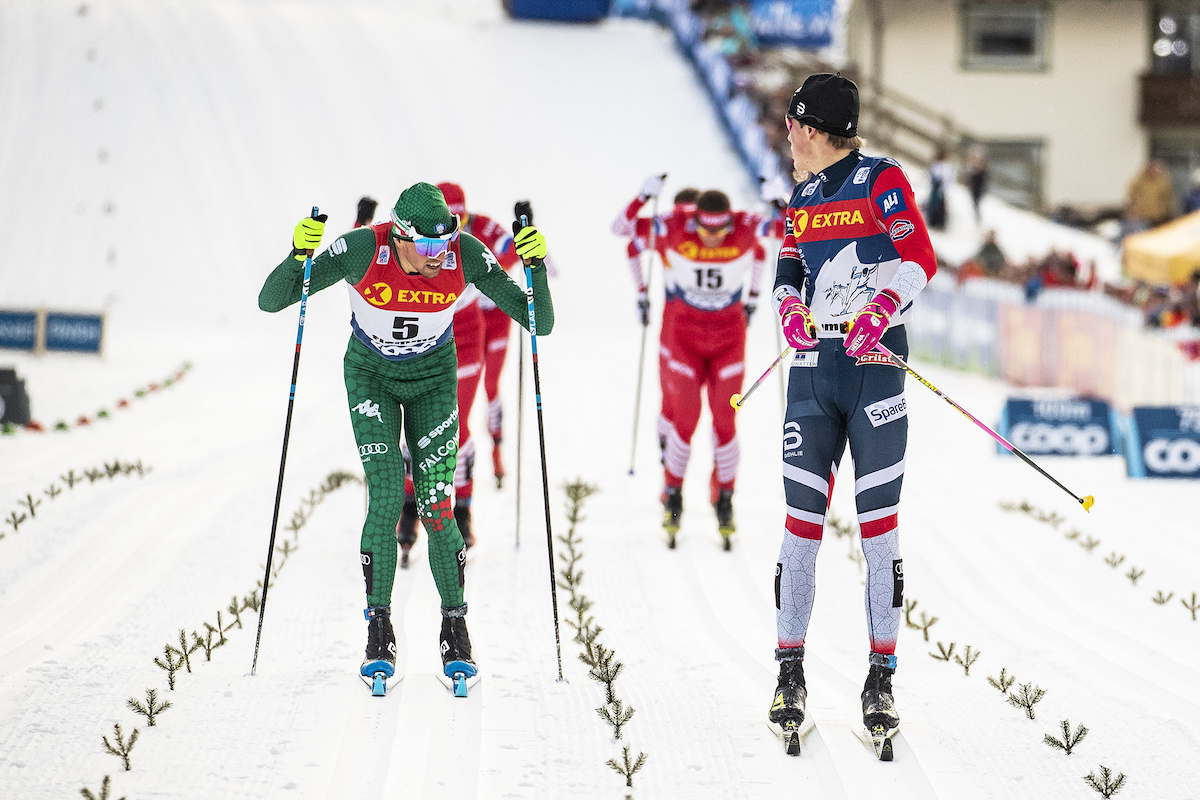
From the FasterSkier archive — posts syndicated from athletes’ and coaches’ own blogs between 2004 and 2012, kept online as published. Current coverage is at fasterskier.com.
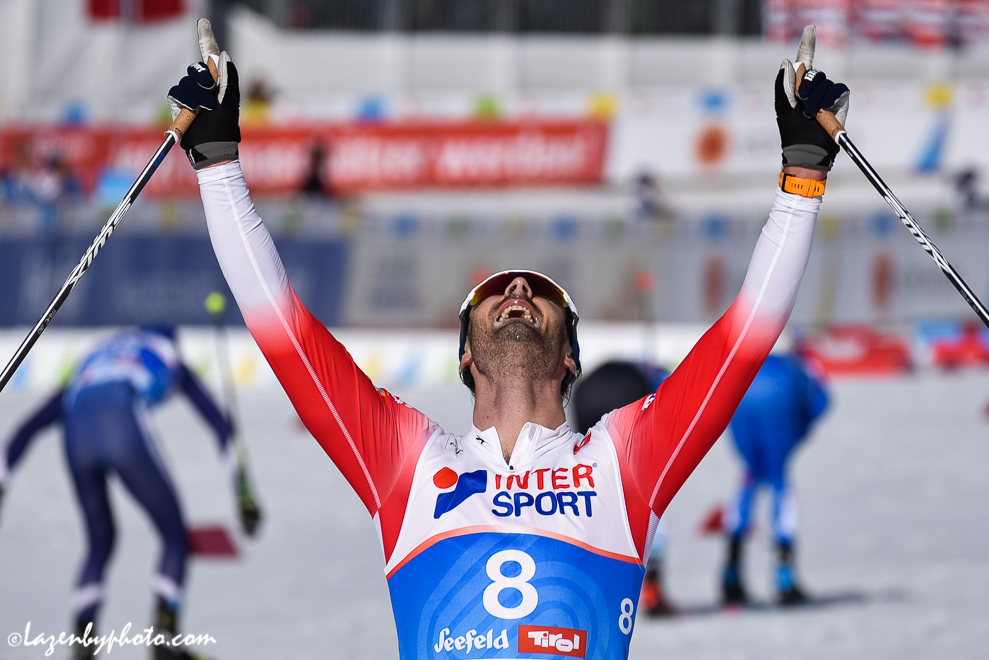
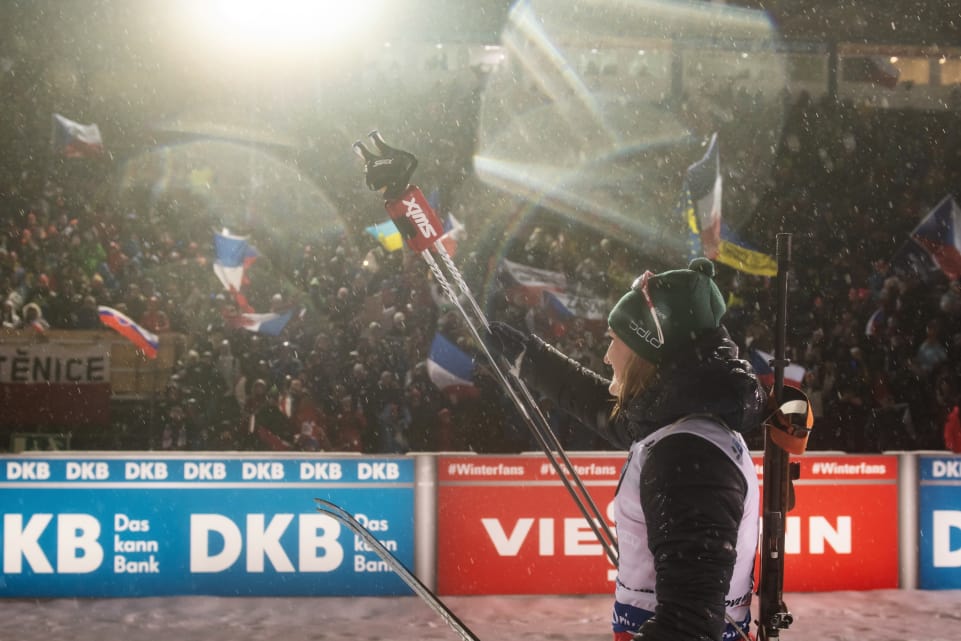
Canada’s Alex Harvey acknowledging the crowd after his second place in the men’s 15 k classic in Québec City. (Photo: John Lazenby/lazenbyphoto.com)
Amidst overcast skies and spectators bearing signs for the local cross-country favorite, Canadian Alex Harvey, World Cup Finals resumed on Saturday in Québec City, Québec with a men’s 15-kilometer classic mass start race.
Thanks to his win in Friday’s freestyle sprint, Norway’s Johannes Høsflot Klæbo lead Saturday’s 78 starters out of the gate, his yellow bib also indicative of his first place rank in the 2019 Overall World Cup Standings.
With Saturday and Sunday being the last competition days of the World Cup season, and only 24 points separating Klæbo’s first place (1443 points) from second place Alexander Bolshunov of Russia (1419 points) in the Overall Standings heading into the 15 k on Saturday, both athletes were looking for a win.Klæbo to solidify his position on top and Bolshunov to supersede it.
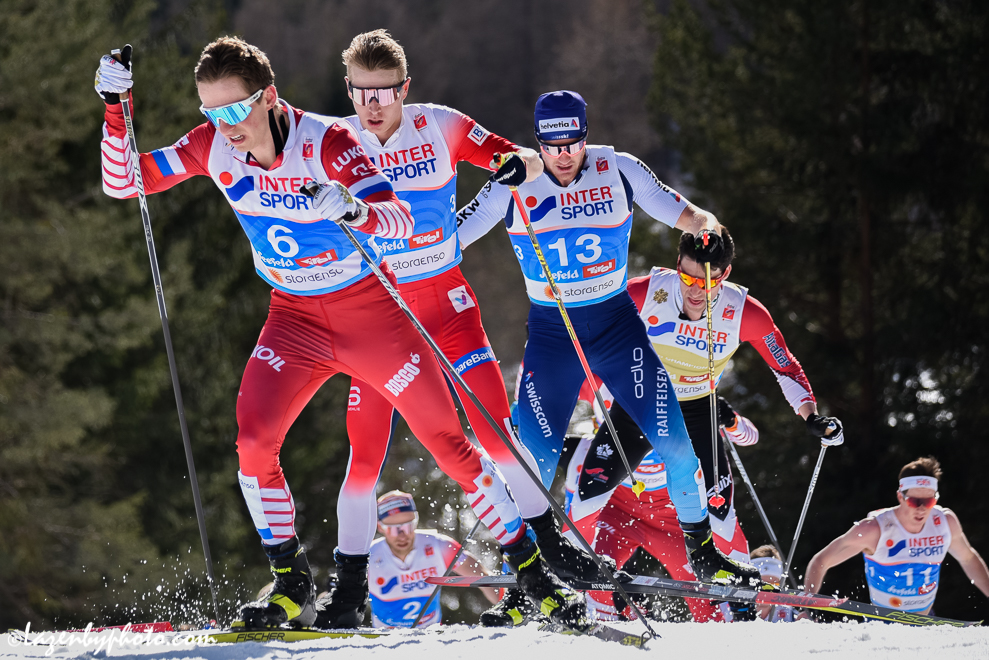
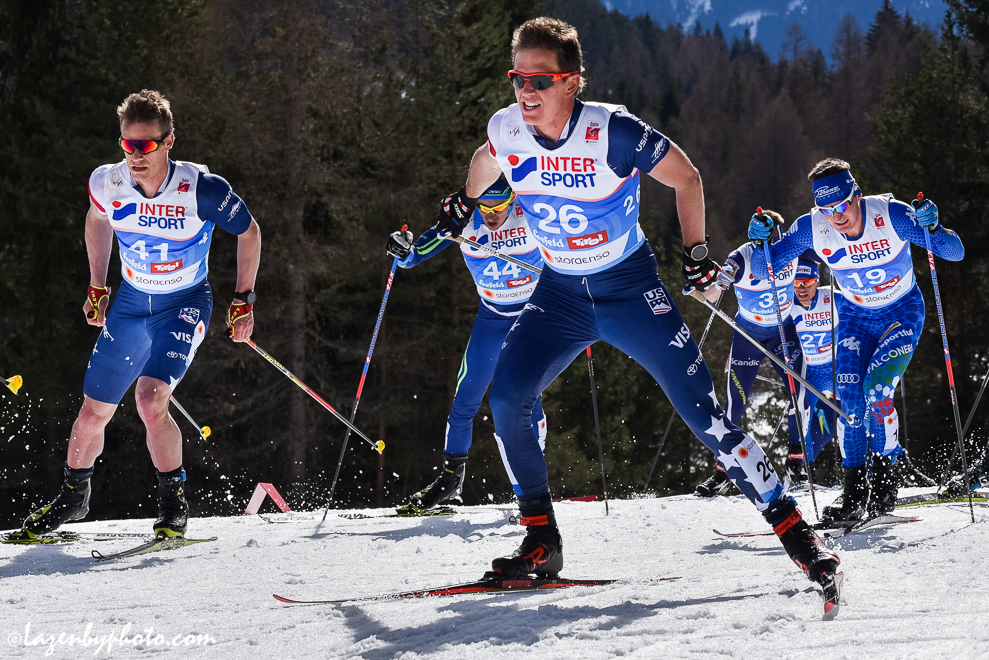
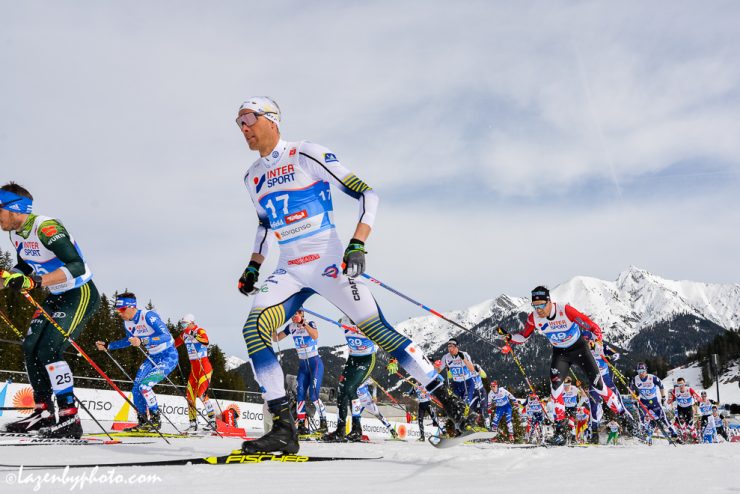
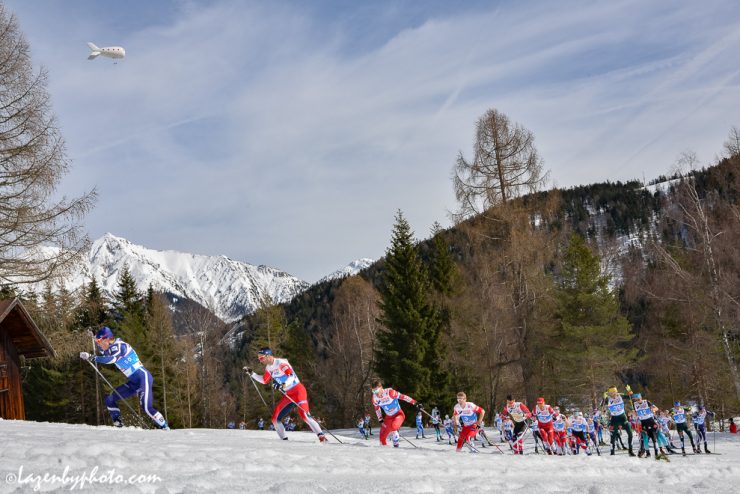
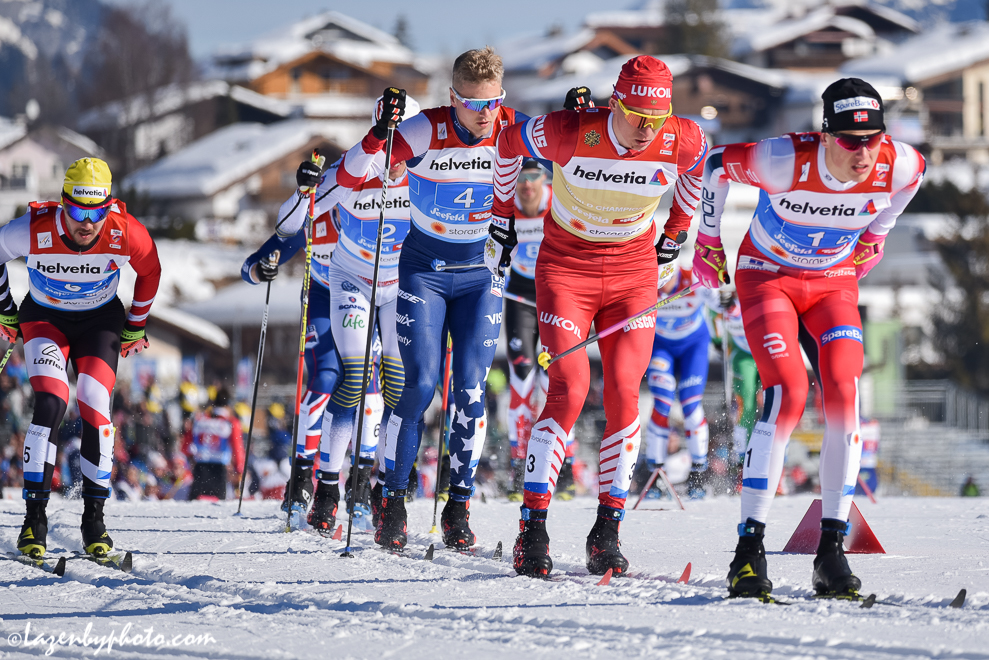
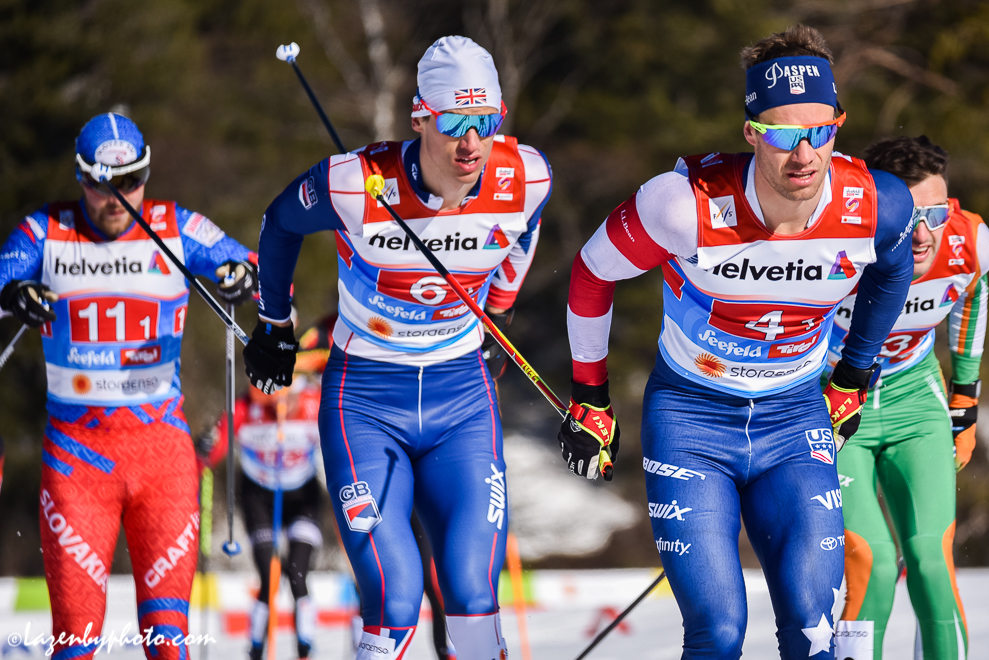
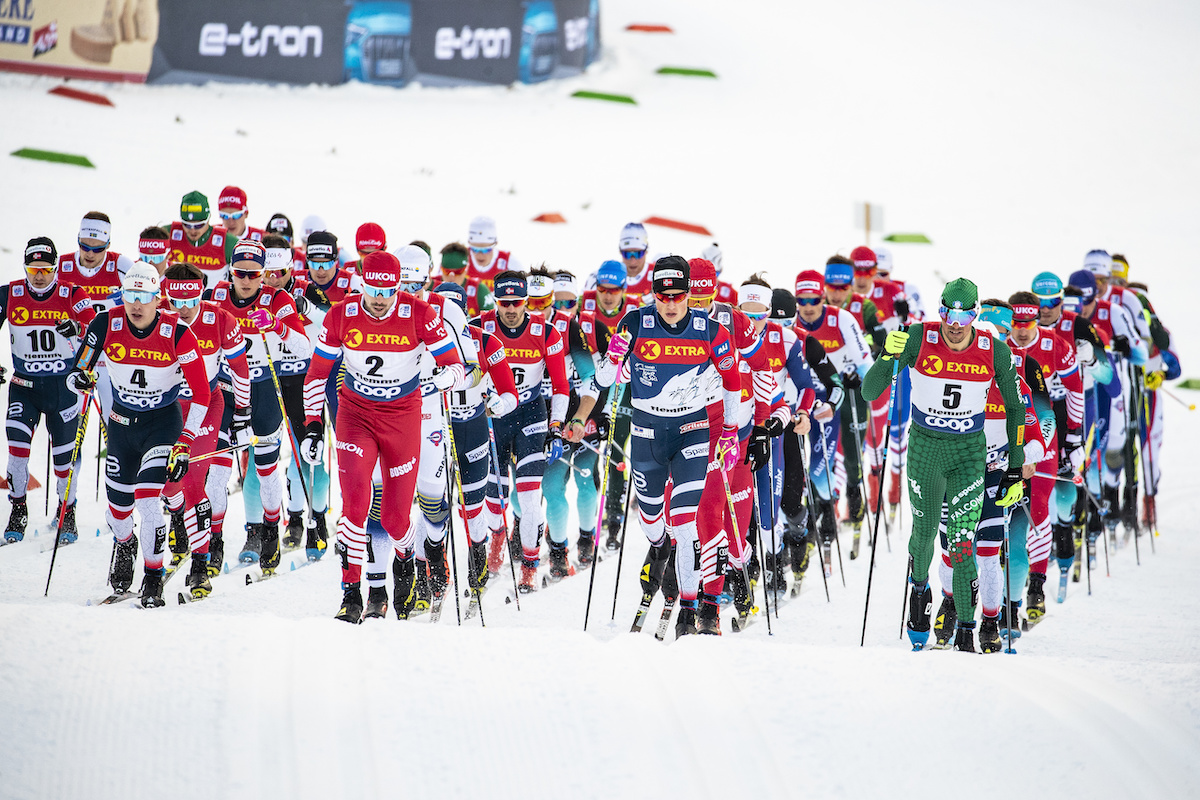
A literal mass of skiers after the start of the men’s 15 k mass start classic in Québec City. (Photo: John Lazenby/lazenbyphoto.com)
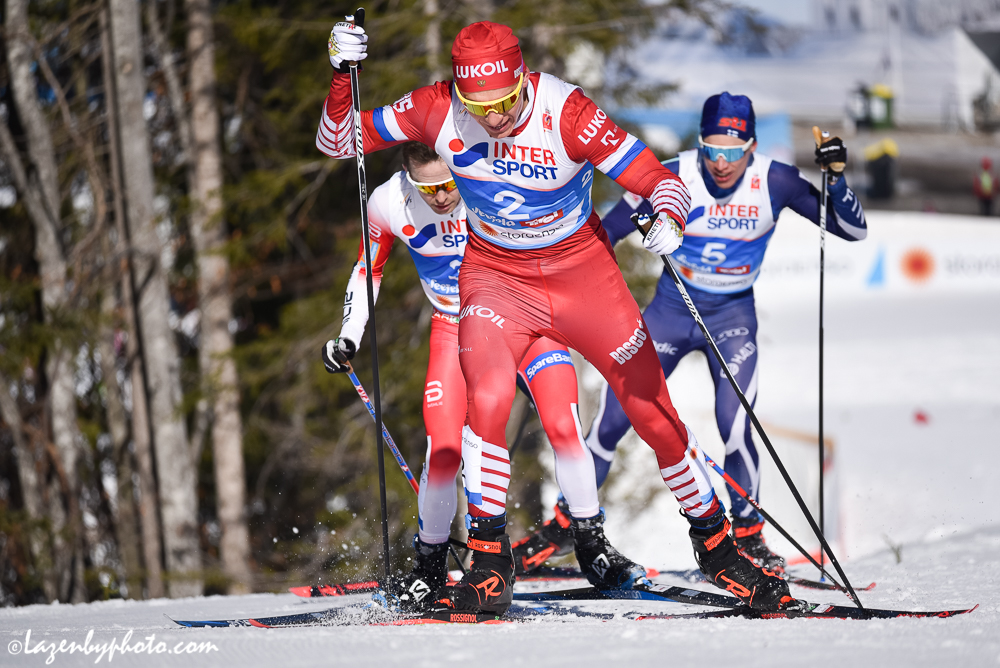
Leading up to 10 k, it appeared as if Bolshunov was on track to overhaul Klæbo’s immutable position on top. The Russian had positioned himself at the front of the lead pack’s 13 skiers which included Klæbo, Harvey, Italians Federico Pellegrino and Francesco de Fabiani, Russian Andrey Larkov, Switzerland’s Dario Cologna and Norwegians Didrik Tønseth, Sindre Bjørnestad Skar, Emil Iversen, and Sjur Røthe.
Taking charge through the climbs, Klæbo and Bolshunov went stride for stride, with Harvey hard pressed a little more than 1 second behind.
“I didn’t want to be leading because it was windy but I wanted to be near the lead every time,” Harvey told FasterSkier after the race.
Their descents through the tight sugary s-turns were maneuvered with ease. At 12 k, a Klæbo versus Bolshunov battle had directed most of the race and seemed fated to the finish.
However at the 13 k mark, halfway up one of the course’s major climbs, the bottom of Bolshunov’s right pole snapped. Although he received a replacement pole within a meter or so, the broken one did damage to his pace.
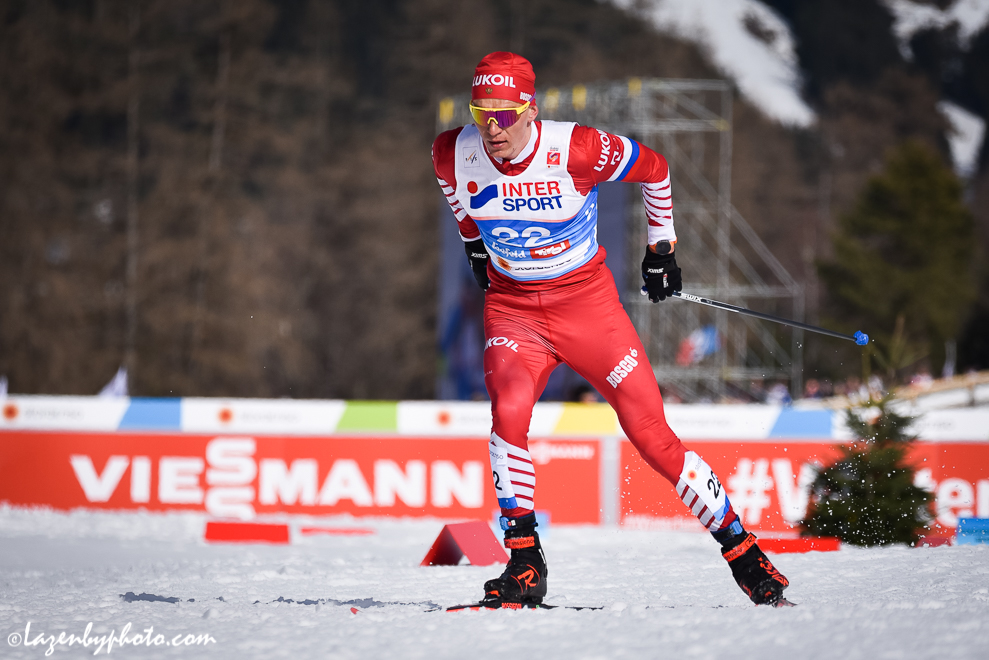
Russia’s Alexander Bolshunov leads the front group of skiers in the mens’s 15 k mass start classic in Québec City. (Photo: John Lazenby/lazenbyphoto.com)
“When I heard the Russian broke his pole, I went all in for Klæbo to make a gap as big as possible,” Tønseth told FasterSkier after the race. “We went for Klæbo and that’s the most important thing.”
With Tønseth pushing the pace, Bolshunov began to fall back. By the bottom of the next descent, the lead group had dwindled to five: Tønseth, Klæbo, de Fabiani, Røthe, and Harvey.
“We started to stretch the pack and…Didrik [Tønseth] is the strong guy that can make a hard drive in the final 2 kilometer to the finish he’s better than Johannes [Klæbo] or me in that so it was almost fun for him, if you want to be on the podium you got to punch it hard now and I knew for me it was going to help me,” Harvey said.
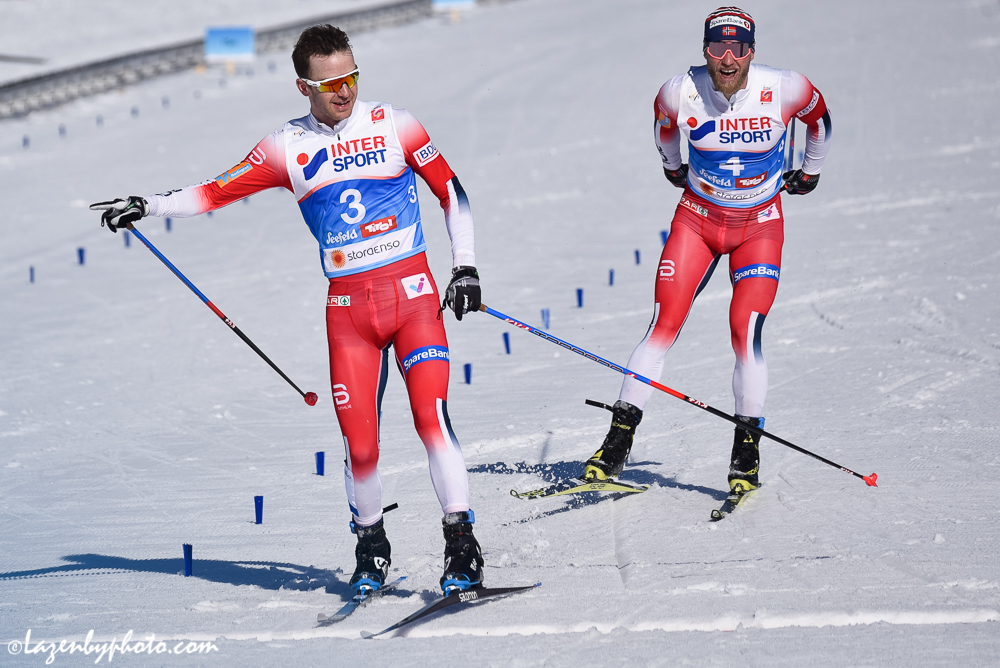
For the remaining 2 k, all five skied together until the finishing stretch. In the final 100-meters to the finish, Klæbo moved to the front and held off the charge of Harvey and Tønseth. Klæbo crossed first in a time of 36:10.9, while Harvey claimed second, just 0.8 seconds behind Klæbo, after a last minute surge past Tønseth.
Crossing 0.5 seconds back from Harvey and 1.3 seconds back from his teammate, Klæbo, was Tønseth in third.
“It’s a different scenario than two years ago when I came in newly World Champion fighting for the top three in the overall, I feel like this time I’ve had a harder season, was a bit more of an outsider,” the 31-year-old Harvey said. So I knew I needed my best race of the year to be on the podium and I was able to do that today so it’s pretty special.”
It is spring. “Go Alex!” (Photo: John Lazenby/lazenbyphoto.com)
Harvey confirmed earlier this season that World Cup Finals in Québec City will be the last World Cup races of his career. The Canadian will now start Sunday’s pursuit less than a second behind Klæbo.
“I felt strong today so I was able to come up in the front again. I needed these points for the total World Cup,” Klæbo told FasterSkier after the race.
With Saturday’s 15 k complete, Klæbo retained his top spot in the Overall Standings now with 1493 points. Bolshunov is currently second with 1451 points and Røthe third with 892 points.
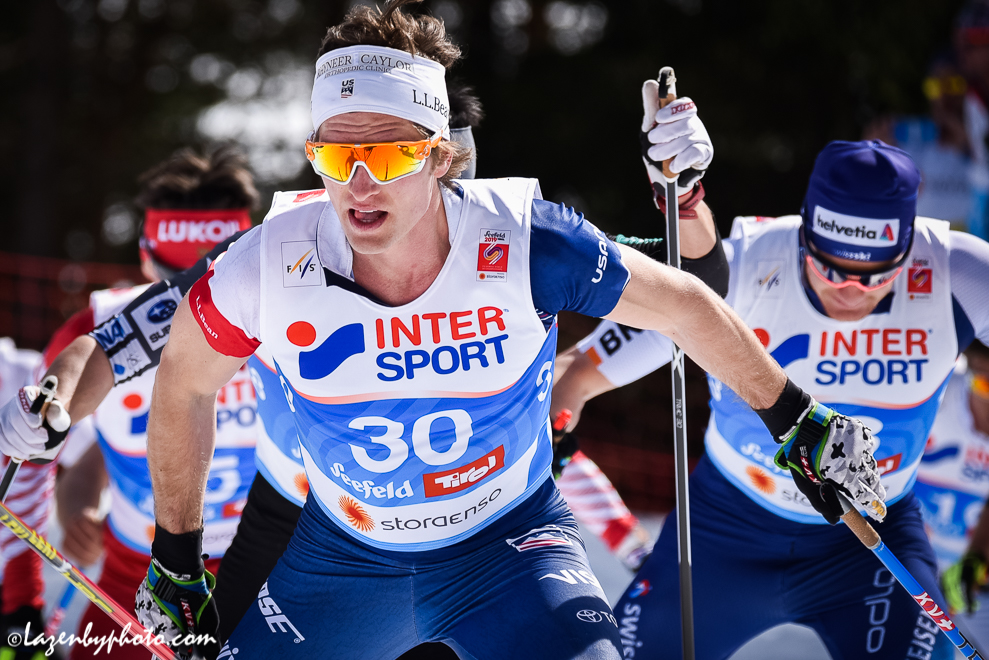
Following Harvey was the U.S. Ski Team’s (USST) Erik Bjornsen in 18th (+1:04.3).
“I’m happy with the result,” Bjornsen told FasterSkier after the race. “I think it might have been the first time I was leading a World Cup for a bit. ”
Around 4 k, Bjornsen was at the front of the 78 skiers who started the race.
“The way my season’s been going it feels easy to go at race pace but when there are surges in the pack, if I try to go I just flood and I can’t really recover the way I’m hoping. But that was fun today,” Bjornsen said.
The next top North American finisher was Canada’s Len Valjas in 32nd (+1:43.6).
“It was one of the best distance races of my career,” Valjas told FasterSkier after the race. “I’ve had a few really good ones, but I don’t think I’ve ever been near [Top] 30 in my career other than the two podiums. So I’m super happy. Alex had a great day. I feel like I had a great day and I’m looking forward to tomorrow.”
“I was in bib 69 and I was skiing with some guys who were in the Top 20, so it’s really exciting for me to feel sort of back again,” Valjas added.
Following Valjas was the USST’s Simi Hamilton in 39th (+2:13.7). After the race, Hamilton indicated that prior to Saturday, his most recent classic distance race had been the Lillehammer 15 k back in December.
“I think by far the hardest part about today was the poling,” Hamilton told FasterSkier after the race. “It was just super rotten everywhere, the tracks stayed firm, which was nice, but the poling trenches just got so deep. I was constantly trying to look for harder snow on the outside and it made for, as a bit of a heavier skier, it made for a tricky 15k, but it was fun.”
Also skiing for the Americans was Kevin Bolger in 44th (+2:31.1), Scott Patterson in 50th (+2:37.9), Gus Schumacher in 56th (+3:44.1), David Norris 57th (+3:48.8), Ben Saxton 66th (+4:55.0), Logan Hanneman 67th (41:17.2) Ben Ogden 70th (+5:15.2) and Peter Holmes 73rd (+6:30.4). Andy Newell did not finish.
For the Canadians Remi Drolet finished 52nd (+2:57.4), Evan Palmer-Charette 55th (+3:16.6), Philippe Boucher 58th (+3:53.9), Jack Carlyle 59th (+4:13.6), Russell Kennedy 62nd (+4:27.0), Antoine Cyr 63rd (+4:29.8), Scott James Hill 64th (+4:46.5), Alexis Dumas 65th (+4:52.3), Bob Thompson 69th (+5:06.6), Antoine Briand 71st (+5:16.1), Julian Smith 72nd (+5:56.7), Julien Locke 74th (+6:31.8), Graham Ritchie 75th (+6:44.4).
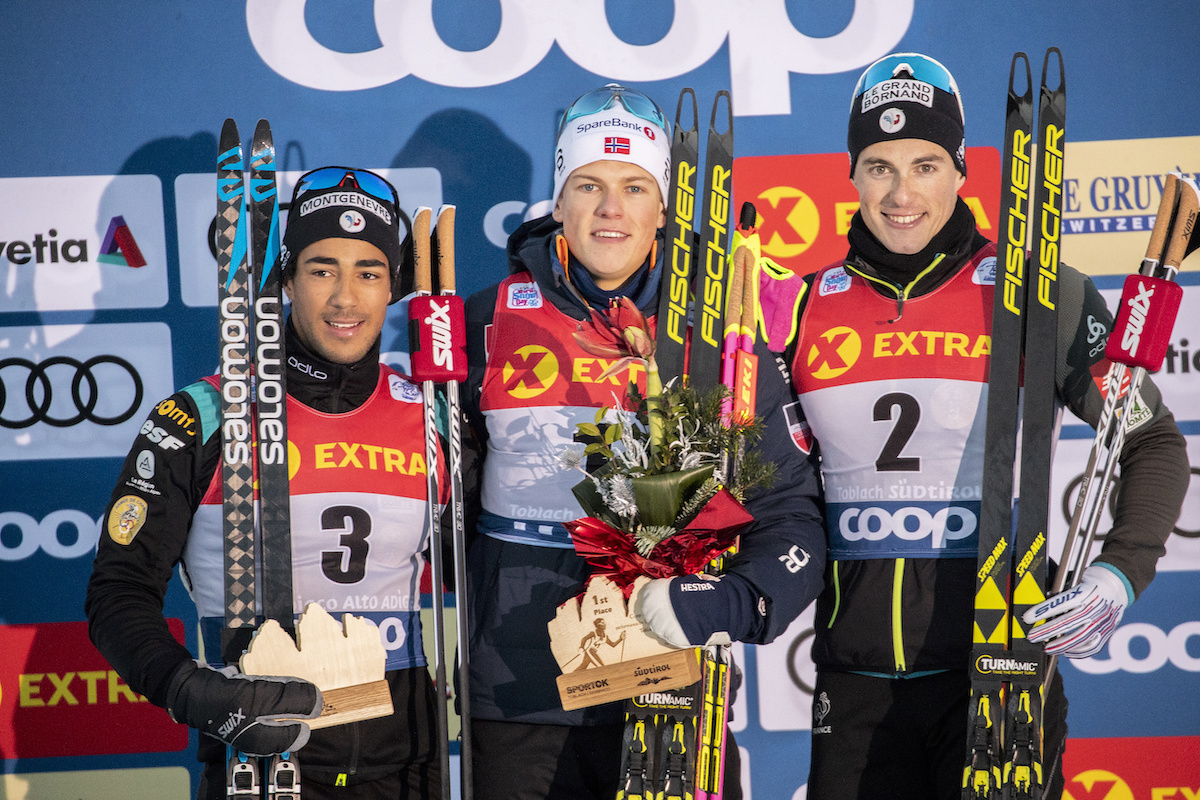
The men’s podium from the 15 k classic mass start in in Québec City. Alex Harvey (bib 11) was given the honor of standing in the center. Harvey placed second to Johannes Høsflot Klæbo (left). Third place went to Didrik Tønseth (bib 17). (Photo: John Lazenby/lazenbyphoto.com)
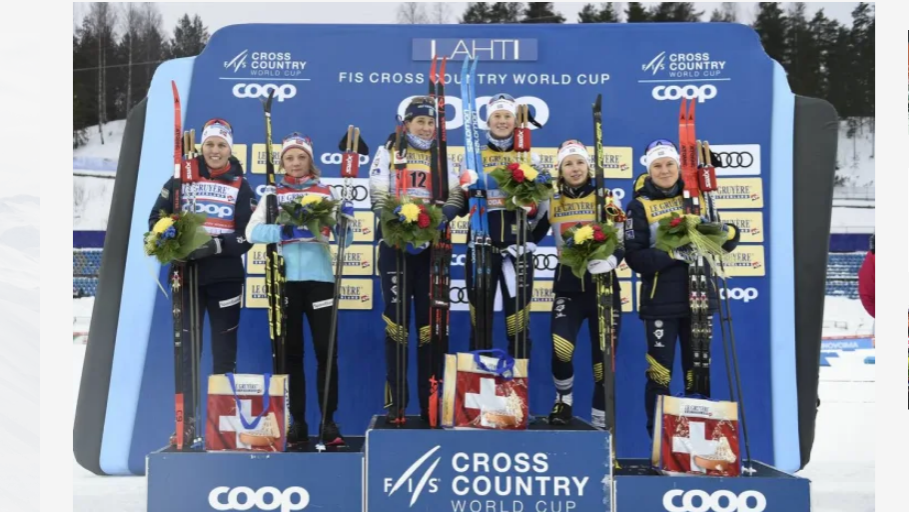
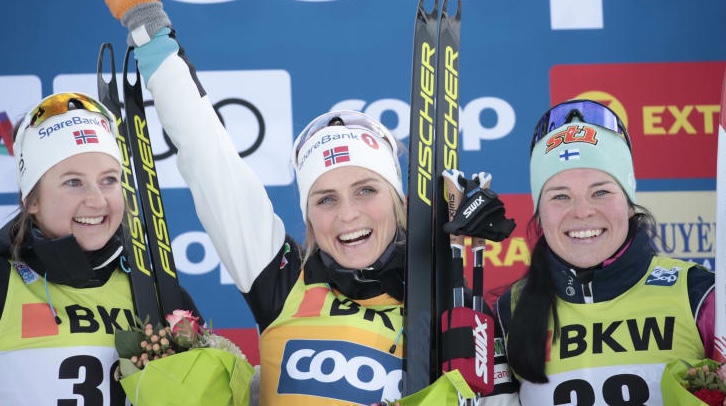
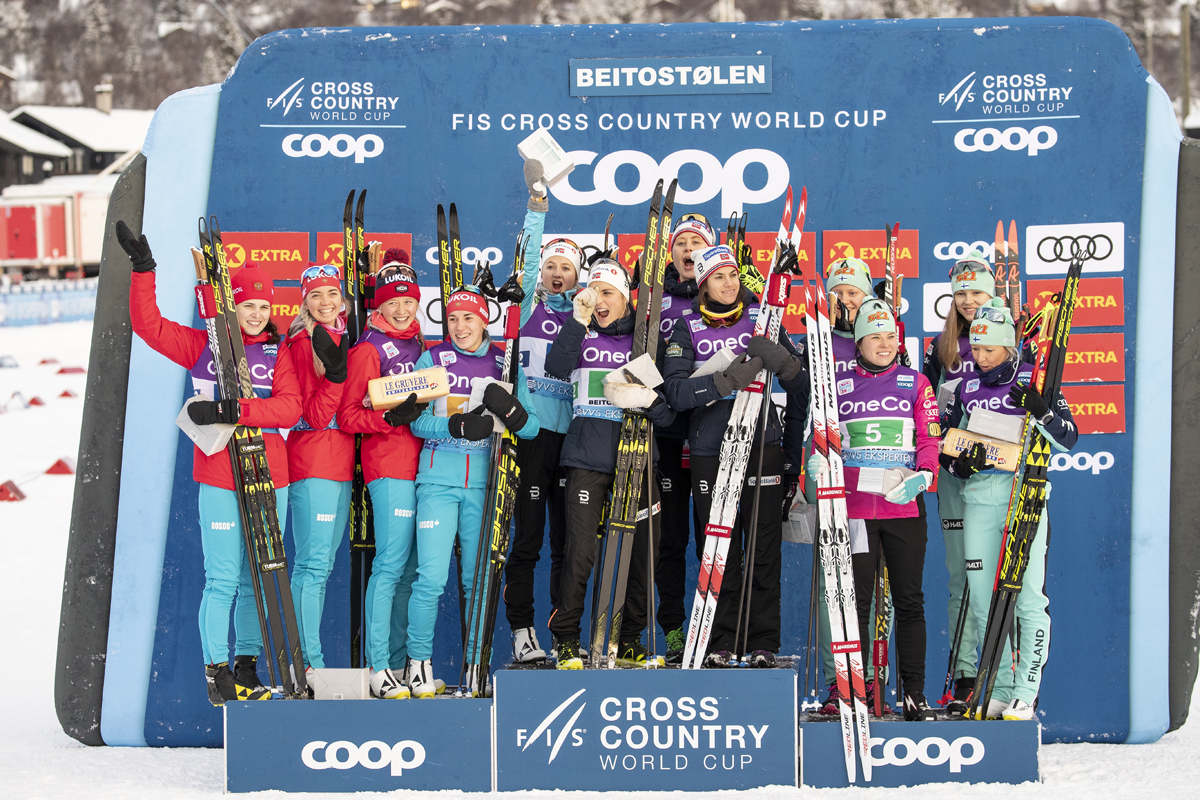
The women’s Top Three from Sunday’s 10 k skate in Falun, Sweden. From left to right, Sweden’s Ebba Andersson in third, Norway’s Therese Johaug in second, and the U.S. Ski Team’s Jessie Diggins in third. (Photo: FIS Twitter Screenshot)
In all of the individual distance races she has entered this season, both World Cup and World Championships events, Norway’s Therese Johaug has remained the undeafeated distance winner, with Sunday’s victory in the women’s individual start 10-kilometer freestyle race in Falun, Sweden marking her twelfth win so far.
Starting in bib number 34 out of 56 starters on Sunday, Johaug passed the 3 k mark 11.9 seconds faster than Sweden’s Ebba Andersson to take the leader’s position. The Norwegian not only maintained, but expanded that gap to 19 seconds by the 6.7 k mark, losing only half a second by the time she crossed the finish line in a time of 25:23.9 for the win.
“It was difficult to go out there,” Therese Johaug said during a post race interview with the International Ski Federation. “I feel not so good, but I think everyone feels that. So it was some place ice and someplace a lot of snow and the balance was not so good, but I’m really happy to take a new first place.”
With World Cup Finals slated to take place next weekend in Quebec, Johaug has two 10 k distance races remaining to make her 2018/2019 winning streak complete. She is currently ranked first in the women’s Overall Distance World Cup Cross Country standings with 860 points to her name.
Finishing 18.5 seconds back from Johaug’s time was Andersson in second place. Andersson had started ahead of Johuag in bib 30, and held the fastest splits throughout the race until Johaug’s start. Her pace was consistently the second fastest time through the 3 k mark, 6.7 k mark to the finish. The podium is Andersson’s seventh individual World Cup top three this season.
The race for third came down to the U.S.’s Jessie Diggins, and Norwegians Ingvild Flugstad Østberg and Heidi Weng.
Østberg was first on course in bib 32, with Weng and Diggins chasing down her times in bibs 48 and 40, respectively. By the 3 k mark, Weng’s time was ranked third and she had a 6.3 second lead on Østberg in fourth and a 6.9 second lead on Diggins in fifth.
At the 6.7 k mark, Weng had retained the third fastest time, ahead of Diggins by 8.4 seconds and Østberg by 2.5 seconds. By the 9 k mark, Østberg had overcome the 2.5 second gap and had put 6 second into Weng. Diggins had also upped the pace by the 9 k mark, her time leading Weng’s by 4 seconds and trailing Østberg’s by a mere 2 seconds.
In the final kilometer, it was Diggins chasing down a two second gap for a Top 3. Her last push was just the right amount to put her 0.5 seconds ahead of Østberg’s time by the finish, and snagging her the day’s third and final podium spot 30.3 seconds back from the winning time.
“I knew my fitness and energy were in a great place going into today, and I love this course because it’s so twisty with a lot of turns and places to continue working the downhills all around the course,” Diggins wrote in an email after Sunday’s race.
“I focused on even pacing because it was slower with all the new snow, and pushing as hard as I could in the V2 sections where it was easier to ski without the deeper snow,” Diggins continued. “I was psyched to have great skis and even when the visibility on the downhills was a little sketchy in the snow, it was fun to send it!”
The top three performance is Diggins’s fifth individual World Cup podium this season, her best result so far having been a first place finish in the Cogne freestyle sprint. She is currently ranked fifth in the women’s Overall World Cup cross country standings with 901 points. Ahead of Diggins is Østberg in first with 1424 points, Russia’s Natalia Nepreyava in second with 1327 points, Finland’s Krista Parmakowski in third with 1115 points and Johaug in fourth with 1060 points.
Three more U.S. women finished in the Top 30, with the U.S. Ski Team’s Sadie Bjornsen racing to 12th (+1:05.7), Julia Kern, also of the U.S. Ski Team, placing 25th (+1:53.9), and Rosie Brennan finishing 27th.
Two more American women competed in Sunday’s race with Kaitlynn Miller of the Craftsbury Green Racing Project finishing 34th (+2:21.5), and Rosie Frankowski of Alaska Pacific University racing to 35th (+2:26.1).
Norway’s Hans Christer Holund reaching for a feed during the men’s 50 k skate at the 2019 World Championships. (Photo: John Lazenby/lazenbyphoto.com)
The 2019 Seefeld World Championships event came to a close on Sunday, the 11 days of competition capping off with a men’s 50-kilometer freestyle mass start. Unlike two years ago at the Lahti World Champs, when the top six finished within four seconds of each other, Canada’s Alex Harvey ultimately earning the 2017 title, this year’s World Champs featured no head-to-head sprint to the finish.
In Seefeld on Sunday, Norway’s Hans Christer Holund crossed alone, arms raised high in celebration of his gold medal performance. He stopped the clock at 1:49:59.3, the next closest finisher being Russia’s Alexander Bolshunov, who crossed 27.8 seconds after Holund.
Norway’s Hans Christer Holund crossing the line in first as he wins the 50 k skate at the 2019 World Championships. (Photo: John Lazenby/lazenbyphoto.com)
Holund’s break from the pack came at the 21 k mark, a decisive move observed by his teammate Martin Johnsrud Sundby, who initially assumed the role of leading the chase pack as Holund skied ahead. The pulse of close to 40 skiers threatened to swallow Holund back up, if Sundby let it.
But the Norwegian continued to ski alone and in the lead past the 25 k mark, the 30 k mark, the 35 k. What may have at first appeared like an unsustainable rabbit’s pace off the front, was turning out to be cruise control for Holund. The 14-second gap he had on the field at 22 k had grown by a minute at the 34 k mark. Over the remaining 15 k, only Bolshunov would manage to put any more than 30 seconds back into Holund.
Even after securing the win, the 30 year old was somewhat surprised that he managed to maintain such a significant amount of time between himself and the rest of Sunday’s 50 k field.
Norway’s Hans Christer Holund taking a feed during the men’s 50 k skate at the 2019 World Championships. (Photo: John Lazenby/lazenbyphoto.com)
This is the first race Holund has competed in at the Seefeld World Champs, his start itself uncertain until recently.
“I’ve been in not so good shape this year and I actually didn’t thought I was going to go this race because I wasn’t qualified, but when I finally got the chance I thought well this may be my last chance to be World Champion, so I just have to go for it,” Holund said.
According to the FIS database, the title is Holund’s first World Championships gold–the only other World Champs event he has raced was the Lahti 50 k, where he placed 10th.
Holund’s closest challenger on Sunday, Bolshunov, had made his move to the helm of the chase pack around 25 k. The Russian did not begin to gain time on the Norwegian, however, until he broke from the chase group at 38 k.
From there, Bolshunov did regain 46.2 seconds on Holund, but ran out of course to see if he could make up the remaining 27.8 seconds. The podium finish is Bolshunov’s fourth from the Seefeld World Champs, all of which have been silver medal performances. Prior to this year, the 22 year old had never medaled at a World Champs event.
Russia’s Alexander Bolshunov during the men’s 50 k skate at the 2019 World Championships. Bolshunov came close to closing down Holund’s lead. (Photo: John Lazenby/lazenbyphoto.com)
Sunday’s battle for bronze place came down to Norwegians Sjur Røthe and Martin Johnsrud Sundby. With less than 5 k to go, the two had moved to the front of the chase pack behind Holund and Bolshunov. In a sprint to the finish, Røthe outlunged his teammate by 0.1 seconds for third (+57.8) and Sundby place fourth (+57.9).
Leading the way for the North Americans on Sunday was Canada’s Alex Harvey in 12th (+1:10.5). Two years ago in Lahti, Harvey earned his first individual World Championships title in the men’s 50 k race, Sunday’s 50 k being his final career World Champs event. At the age of 30, Harvey announced his decision to retire after this year’s World Cup races in Quebec City, Quebec.
“I think it is pretty clear it is not what I had hoped for or dreamed for,” Harvey said during a post-race phone call. “I think today and for the whole week, or the whole of the last two weeks, I just have got to look at things with a more objective eye. The skiathlon is my best result of the season in distance. I had my best race of the season at World Champs so that is good. But of course, I was hoping to come away from Seefeld with a podium.”
Over the course of his career, Harvey has competed in six World Championships events, his first being in Liberec in 2009. He has since then amassed five World Champs medals, including two golds, two bronzes, and one silver.
“I really expected the Norwegians to attack, maybe a tiny bit later in the race, I was expecting more around 30 k,” Harvey said of Holund’s move at 21 k. “They kind of did that in Lahti in the 50 k. It forces the other nations to try and take on the chase. So knowing that they have so much depth, I was expecting it from either Holund or Krüger, because it is more their style of racing anyways.
“I had made a decision before the race that if an attack was made, it would not be the one chasing because it would have played too much in the hand of Sundby and Rothe,” he added “At the end of the day, I think Holund was just way better than the rest.”
Canada’s Alex Harvey (first skier from right in the front group) during the men’s 50 k skate at the 2019 World Championships. (Photo: John Lazenby/lazenbyphoto.com)
With less than a kilometer to go, Harvey was still in the running for a podium. The final hill, however, found his legs flooded.
“I think for me there was still an opportunity for third place and I really positioned myself in the best way possible at the base of the sprint hill,” Harvey said. “Then I did not have the legs to go up the hill. I just lost a lot of position I just wasn’t strong enough. It is as simple as that. But everything else, we had the skis. In the 50k you have to have a feeding strategy and try to save energy where you can. I think I did everything to the best. … I would not do anything different. I just was not good enough. It is a bitter-sweet feeling knowing …it is easy to say I gave it my all. At the end of a race, you always give it your all. I think I really executed my plan.”
Following Harvey, two Americans cracked the top 20 on Sunday, with David Norris placing 20th (+1:22.6) and Scott Patterson in 23rd (+2:05.5). Norris came into Sunday’s race having competed in last year’s Holmenkollen 50 k where he placed 38th (He also won the 2016 American Birkebeiner 52 k). Seefeld has been his first World Championships experience.
David Norris of the U.S. racing to 20th overall in the men’s 50 k skate at the 2019 World Championships. (Photo: John Lazenby/lazenbyphoto.com)
“At Holmenkollen [last year], I felt strong, but often I have struggled to get engaged into the top-twenty,” Norris explained during a phone conversation. “From the gun I feel like I am one of the stragglers, trying to hang on.”
Sunday that was not the case for Norris. The 28 year old managed to position himself in the top 20 from the start, making for what he described as “smoother” skiing. He experienced less accordioning between groups of skiers and during the second half of the race was still skiing within 10 bibs of Sundby and Røthe.
“The way I have always tried to race over here is to go out hard and put yourself into the position to have a result that you are excited about and represents my goals,” Norris said. “So often I have died and blown up several times over here, but I feel like when that happens I also know in the back of my mind that if I put everything together the result that is almost a great one was not so far away.
“I think today, when I was racing, more things were just working out and clicking so it allowed me to finally reach the result that I have been pursuing and chasing in the first of races often instead of fading, I continued to feel strong all the way to the finish for the most part,” he added.
Norris will race next weekend’s Holmenkollen 50 k as well as the remaining Period III World Cup races. “I feel like I’m really fortunate that every year my skiing seems to get more feasible and the support has been there,” Norris said. “I think every athlete experiences huge portions of their season where they’re second-guessing or frustrated and those are the times to push through and believe in the plan.”
Patterson explained, the race was “a step up in results”, though still left him “ looking for a little more.” Seefeld is Patterson’s first World Championships, with Sunday’s 23rd his best individual ranking to date. Earlier in the week, he placed 30th in the 15 k classic and 32nd in the skiathlon.
“I spent most of the race kind of dangling on the back end of the lead pack,” Patterson wrote in an email.
The American indicated that he had good energy, though not enough to follow Holund’s break from the front group near the race’s halfway mark.
“I was a bit disappointed with the lack of leadership in the pack when we just chilled out instead of reacting at all to Holund’s move,” Patterson wrote. “There is talk around here of the unwritten principle of the Norwegians to not chase down the first attack. I think we saw that today as well as some weakness in the other strong nations such as Russia and France.”
The American maintained contact with the lead group until his sixth lap when things began to separate. Positioned at the rear of the group, Patterson found himself unable to chase down any breaks.
“Over the course of the first long hill on that lap, the main group seemed to spread and splinter between skiers,” Patterson wrote. “I was a little too far back to make the split for the front of the pack. I tried hard to chase, but going for it solo wasn’t working against a pack of 18. Overall, I am satisfied with 23rd but also believe that I still have more to give the rest of this season. I’m looking forward to another 50 k next weekend at Holmenkollen.”
Scott Patterson of the U.S. racing to 23rd overall in the men’s 50 k skate at the 2019 World Championships. Simi Hamilton (bib 41) placed 34th. (Photo: John Lazenby/lazenbyphoto.com)
However, as much as compartmentalizing athletes simplifies the narrative, Hamilton’s definition of cross-country racer helps broaden the sprint or distance paradigm. According to the FIS, Sunday’s race was Hamilton’s third 50 k at this level of competition. He placed 54th in the 2014 Holmenkollen 50 k classic and was a DNF last season in the Holmenkollen 50 k skate.
“It’s definitely intimidating, I think this is maybe the third fifty k I’ve skied at this level, one of which I didn’t finish – at Holmenkollen last year, and I skied Holmenkollen the previous year,” Hamilton said in a post-race phone call. “It’s certainly quite different from the domestic scene generally, now the pace is just way hotter from the start.”
American Adam Martin raced to 45th (+8:01.7), while Canadians Russell Kennedy finished in 46th (+9:57.6), Evan Palmer-Charrette in 47th (+11:26.1), and Scott James Hillin 50th (+11:27.6).
The toe-surge by Norway’s Sjur Røthe for third place over teammate Martin Johnsrud Sundby who placed fourth during Sunday’s 50 k skate at World Championships. (Photo: John Lazenby/lazenbyphoto.com)
Double click on the photos below to enlarge.
Sweden’s Calle Halfvarsson during the men
s 50 k skate at the 2019 World Championships. (Photo: John Lazenby/lazenbyphoto.com)
Canada’s Russell Kennedy during the men’s 50 k skate at the 2019 World Championships. (Photo: John Lazenby/lazenbyphoto.com)
Early in the men’s 50 k skate at the 2019 World Championships. (Photo: John Lazenby/lazenbyphoto.com)
Canada’s Evan Palmer-Charette (bib 43) in the men’s 50 k skate at the 2019 World Championships. (Photo: John Lazenby/lazenbyphoto.com)
Fourth place skier in the men’s 50 k skate at the 2019 World Championships, Martin Johnsrud Sundby of Norway walks with his son after the race. (Photo: John Lazenby/lazenbyphoto.com)
The men’s 50 k skate podium at the 2019 World Championships. From left to right, Russia’s Alexander Bolshunov in second, Norway’s Hans Christer Holund in first, and Sjur Røthe of Norway third. (Photo: John Lazenby/lazenbyphoto.com)
Simi Hamilton of the U.S. takes a feed during the men’s 50 k skate at the 2019 World Championships. (Photo: John Lazenby/lazenby photo.com)
Norway’s Martin Johnsrud Sundby (bib 2) leading the chase-train in the men’s 50 k skate at the 2019 World Championships. (Photo: John Lazenby/lazenbyphoto.com)
Adam Martin of the U.S. in the men’s 50 k skate at the 2019 World Championships. (Photo: John Lazenby/lazenbyphoto.com)
Canada’s Russell Kennedy during the men’s 50 k skate at the 2019 World Championships. (Photo: John Lazenby/lazenbyphoto.com)
David Norris of the U.S. placed 20th overall in the the men’s 50 k skate at the 2019 World Championships. (Photo: John Lazenby/lazenbyphoto.com)
Alex Harvey of Canada after his final career World Championship race. (Photo: John Lazenby/lazenbyphoto.com)
Soggy snow could not stop the V-1 perfection of Therese Johaug as she soloed to win the women’s 30 k skate at the 2019 World Championships. (Photo: John Lazenby/lazenbyphoto.com)
From start to finish on Saturday, Norway’s Therese Johaug commanded the front without missing a beat.
By the 5 k mark, the top seven skiers, which included Norwegians Ingvild Flugstad Østberg and Astrid Uhrenholdt Jacobsen, Austrian Teresa Stadlober, Sweden’s Ebba Andersson and Frida Karlsson and American Jessie Diggins, as well as Johaug, had a close to 30 second gap on the field’s remaining 41 starters.
But for anyone familiar with Johaug, it isn’t enough to just be in the front.
In another kilometer and a half, the Norwegian had separated herself completely from the pack. Anyone looking to challenge her for the gold medal win had a 15 second gap to close. By the 8.6 k mark, that deficit had grown to 30 seconds.
Andersson and Karlsson led the group charging for second place, which almost a third of the way through the race, was a battle between Diggins, the two Swedes, Stadlober, Østberg and Switzerland’s Nathalie von Siebenthal.
Diggins began to pull at the front of that chase group at the 9 k mark, maintaining her press for the next 5 k. Johaug, however, continued to hold them off.
Jessie Diggins (bib 5) chasing Norway’s Ingvild Flugstad Østberg in the women’s 30 k skate at Seefeld, Austria’s 2019 World Championships. Diggins placed fourth, Østberg second . (Photo: John Lazenby/lazenbyphoto.com)
“I felt really good today,”Johaug said during an interview with the International Ski Federation (FIS) after Saturday’s 30 kilometer mass start. “I wanted to go fast from the beginning. When I get a gap I think I have to try. Then I just went as fast as I could all the way.”
When Johaug exchanged skis at the 18.75 k mark, she had entered all too familiar race territory as the solo frontrunner. Forty-three seconds after Johaug’s ski switch, Diggins had also swapped boards and was once again, leading the chase group.
The American medal favorite for Saturday’s race, Diggins was also looking to best her previous highest ranked World Championships 30 k result, which prior to Saturday was a 5th place in the Lahti World Champs 30 k skate.
By the top of the next major course climb, Diggins faced a challenge from behind. Karlsson swept past her, appearing to have an untapped energy reserve with still close to 10 k to go.
At the 22.5 k mark, Østberg passed Diggins and the American slipped into fourth place with more than two thirds of the race complete. Though Diggins was visibly working, she could not bridge the gap back up to second and third place.
Having maintained her blistering pace in the front, Johaug crossed first in a time of 1 1:14:26.2 hours for the gold medal. Østberg finished 36.8 later for second place, while Karlsson crossed 7.2 seconds behind Østberg to snag third place (+44.0).
With the 30 k capping this season’s World Champs women’s events, Johaug will depart Seefeld with three gold medals–the 30-year-old Norwegian also won the 10 k classic race earlier in the week, as well as last Saturday’s skiathlon.
“I am really happy for the goldtoday,” Johaug told FIS. “I came here to Seefeld hoping for one gold medal and now I have three.”
Johaug now has a grand total of 10 World Championships gold medals, seven of those being individual accomplishments. The second place finish is Østberg’s fifth podium at the Seefeld World Champs alone. Prior to Seefeld, she had one World Champs medal to her name, a gold from the 2015 Team Sprint in Falun.
The 19-year-old-Karlsson will close out her first World Champs with three medals: Saturday’s 30 k bronze, as well as a silver from the 10 k classic and a gold from the women’s 4 x 5 k relay.
Finishing 20 seconds off the podium was Diggins in fourth (+1:05.9).
Therese Johuag of Norway leads Jessie Diggins (U.S.) and Ebba Andersson (SWE) during the 30 k skate at the 2019 World Championships. (Photo: John Lazenby/lazenbyphoto.com)
“I tried everything I could and I had the best skis in the world,” Diggins said. “It’s funny, I think if the race had been 2 k longer I might not have made it because my legs were cramping up…I did everything I could I held nothing back and that’s a good feeling.”
“I tried to go with [Karlsson]” Diggins said of her third lap when the Swede made her move around the American. “But that’s when my legs started cramping up and I still had 5 k to go. … I was just at my limit, fighting the whole way,” Diggins said.
Following Diggins, U.S. skier Sadie Bjornsen finished the day in 15th (+4:42.9). Bjornsen explained that due to the hot pace from the start, she lost contact with the lead group earlier on in the race.
“I definitely spent some kilometers out there struggling and wanting to drop out and I guess questioning where I’m at,” Bjornsen said of the beginning of her race.
Mid-way through the 30 k, Russian skier Anastasia Sedova joined Bjornsen and as the two skied together, Bjornsen began to feel better. Though her finish was not as strong as she would have liked, the ups and downs of the race offered Bjornsen a bit of insight.
“It was definitely one of those races that had some good moments and some bad moments and I think in a way it was really good for me because it kind of made me assess where I’m at right now,” Bjornsen said. “I think that my body is in a really good place. I think that keeping your brain in a really good place as an athlete is really difficult and maybe something that I struggled with this week.”
For Bjornsen, this World Champs has had its challenges, not so much with her skiing, but as she explained, with her skis and confidence.
“I definitely feel really good skiing out there so I know that my muscles are ready, I just need to make sure that I get my mind there,” Bjornsen said. “It’s just so hard because you can’t control what you have on your feet a lot of the times. And I think I just have to get to a place that that doesn’t affect me. That I keep my belief through it. So I’m looking forward to challenging myself for the last block of the season with that.”
Rosie Brennan and Sadie Bjornsen (bib 11) congratulate one another after the women’s 30 k skate at the 2019 World Championship’s (Photo: John Lazenby/lazenbyphoto.com)
“At this level you have to have your skis at a level that can compete,” she added. “If you’re going to fight for a medal or even Top 10, Top 20 and there were some races this week that that was not the case.”
Following Bjornsen, American Rosie Brennan placed 16th (+5:21.0). After battling mono last season and not being renamed to the U.S. Ski Team, Brennan remained positive of where she’s taken her skiing this year leading up to and during World Championships in Seefeld.
“I never really know what I am going to feel in a month or so,” Brennan said. “I feel so proud of myself for having navigated last year or last summer basically and come out stronger. I hope that that is a clear message that is sent to everybody. I hope that inspires juniors to not be afraid of when something bad comes along or when they have a hiccup or they miss out on the pipeline that is the perfect pipeline or whatever it is.
“It motivates me to keep going and I want to be that example,” Brennan continued. “I want to be that person that doesn’t give up because something bad has been put in front of them. It also taught me that maybe I do know myself best.”
Rosie Brennan (bib 16) and Caitlin Patterson (bib 24) both of the U.S., charging in the women’s 30 k skate at the 2019 World Championships. Brennan placed 16th overall, Paterson 34th. (Photo: John Lazenby/lazenbyphoto.com)
“The way I look at it, it makes me really proud of what I have accomplished doing it in a clean way,” Brennan said. “I just look at those guys and think they have just ruined their lives. And they have no future in skiing now and that is not why I do this. That is not a place I want to ever be in.
“As shocking as it is, it makes me really proud of who I am,” Brennan added. “I try focusing on that aspect of that and not wonder what else is going on in the field. Those guys are a pretty good example, here they were doing some really bad things and they weren’t winning races. I don’t know that you have to do that to win and I choose not to believe that otherwise there is no sense in going out and fighting. I believe you can do it cleanly and I am going to try my hardest to do that.”
Racing for Canada, Katherine Stewart-Jonescrossed in 28th (+8:17.9) for her best career individual World Champs result.
Placing just outside the Top 30 was American Caitlin Patterson in 34th (+8:49.4). Canadians Emily Nishikawa placed 39th (+10.11.5), Dahria Beatty 41st (+11:34.5), and Cendrine Browne46th (+14.50.0).
Therese Johaug of Norway takes the win in the 30 k skate at the 2019 World Championships. (Photo: John Lazenby/lazenbyphoto.com)
The women’s podium from the 2019 World Championship’s 30 k skate. From left to right, Norway’s Ingvild Flugstad Østbergin second, teammate Therese Johaug in first, and Sweden’s Frida Karlsson placed third. (Photo: John Lazenby/lazenbyphoto.com)
Jessie Diggins at the finish of the women’s 30 k skate at World Championships. (Photo: John Lazenby/lazenbyphoto.com)
Jessie Diggins of the U.S. receives a feed women’s 30 k skate at the 2019 World Championships. Diggins placed fourth overall. (Photo: John Lazenby/lazenbyphoto.com)
Rosie Brennan during the the women’s 30 k skate at World Championships. (Photo: John Lazenby/lazenbyphoto.com)
Sadie Bjornsen the women’s 30 k skate at World Championships. (Photo: John Lazenby/lazenbyphoto.com)
Canada’s Katherine Stewart-Jones skiing to a 28th overall in the 30 k skate at the 2019 World Championships. (Photo: John Lazenby/lazenbyphoto.com)
Emily Nishikawa of Canada skiing to 39th overall in the 30 k skate at the 2019 World Championships. (Photo: John Lazenby/lanzenbyphoto.com)
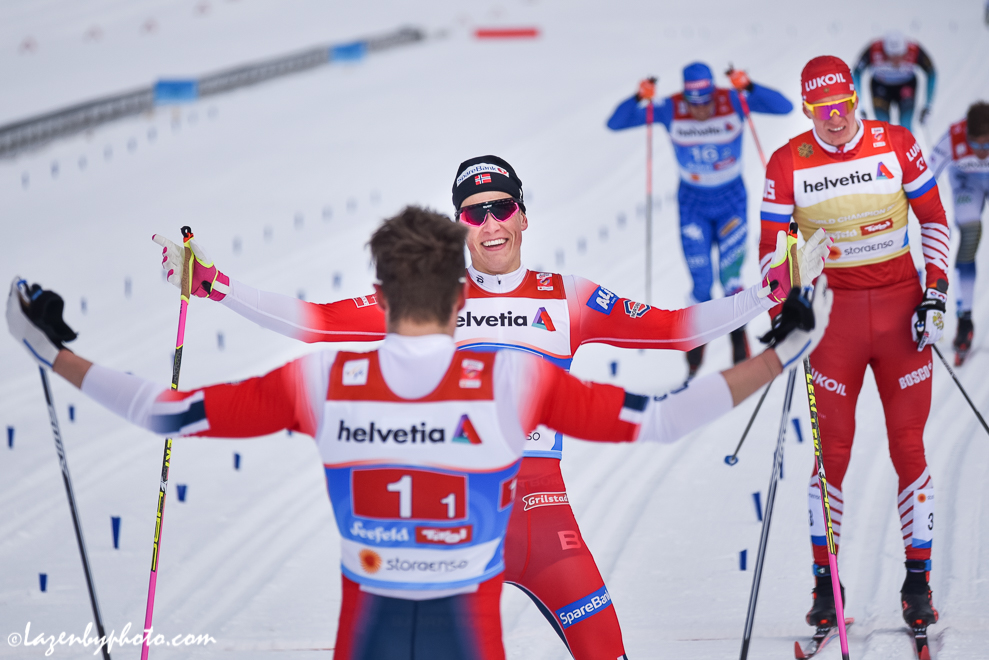
Norwegian Johannes Hoesflot Klæbo and Emil Iversen celebrating their win in the men’s 6 x 1.6 k classic team sprint at World Ski Championships in Seefeld, Austria. (Photo: John Lazenby/lazenbyphoto.com)
Redemption. As the old saying goes, it is sweet, particularly in sport, even if the occasion only arises every two or four years. Or perhaps the wait makes it savory.
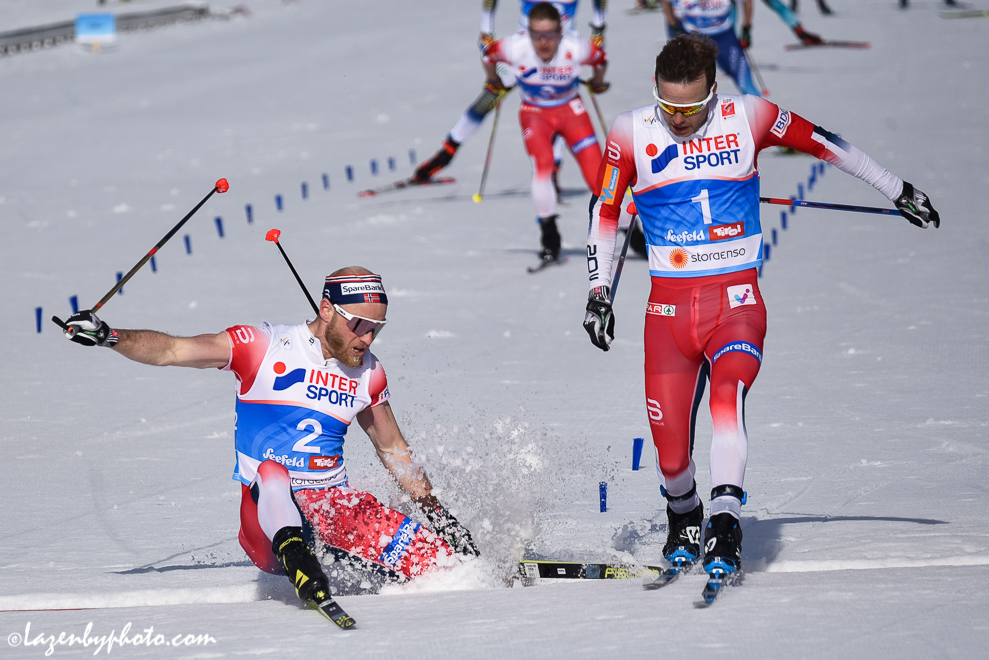
Two winters ago, Norwegian Team Sprint finalists Johannes Høsflot Klæbo and Emil Iversen had been on their way to a potential gold or silver World Championships medal in Lahti, Finland when Iversen crashed taking out Finland’s Iivo Niskanen and putting Norway out of medal contention.
For Norway, tallying podiums is a point of national pride. The missed one in Lahti was a visceral loss. The only other time the Norwegians had missed a team sprint top 3 was at the 2013 World Champs in Val di Fiemme when they placed 11th.
Norway’s Emil Iversen leading his one of his legs of the men’s 6 x 1.6 k classic team sprint at World Ski Championships in Seefeld, Austria. (Photo: John Lazenby/lazenbyphoto.com)
Prior to this Sunday at the World Ski Championships in Seefeld Austria, the Norwegians, according to a International Ski Federation press release, have accumulated altogether, three gold World Champs medals and one silver, the second most of any nation–Russia has them beat with five.
With Iversen and Klæbo paired up once again–though this time Iversen taking the first leg and Klæbo the anchor–Norway was in the rare position of holding its breath by the start of the race. With ten teams taking to the 6 x 1.6-kilometer classic sprint final there would plenty of opportunity for things to go wrong. Norway was going to avoid as many of those as they could.
From the gun, Iversen went to the front and leading the pace with France’s first leg, Richard Jouve just behind in second followed by Italy’s Francesco de Fabiani in third, Finland’s Niskanen in fourth, the U.S.’s Simi Hamilton in fifth and Russia’s Gleb Retivykh in sixth.
From right to left: Norwegian Johannes Hoesflot Klæbo, Russia’s Alexander Bolshunov and American Erik Bjornsen during the men’s 6 x 1.6 k classic team sprint at World Ski Championships in Seefeld, Austria. (Photo: John Lazenby/lazenbyphoto.com)
In that order through the first exchange and with the tempo slowing following that, Canada’s Len Valjas and Erik Bjornsen skiing for the U.S., took a pull at the front during the course’s first climb. Norway’s Klæbo was back to the front by the second exchange with Alexander Bolshunov of Russia stuck just behind. Italian Federico Pellegrino had maintained Italy’s position in third, while Sweden’s Calle Halfvarsson had moved the team into fourth. Bjornsen came through positioned in eighth, Valjas 10th.
As Iversen once again took the reins at the front during the third lap, the attrition of teams began. Canada’s Evan Palmer-Charette lost touch with the pace and by the exchange, Hamilton was four seconds off Iversen’s lead pace. France, Sweden, Italy and Russia still remained in contact with Norway in the lead.
Klæbo charged the to front on the fourth lap along with Bolshunov. Despite a slight tangle at the exchange between the two Russian teammates, Retivykh maintained his spot with the forerunners and Norway going into Lap 5.
In the fifth lap, Iversen’s last for the day, the Norwegian avoided any spills heading into the final lap. Still, six teams remained in play for a podium position, including France, Sweden, Norway, Italy, Russia, and Finland.
Bolshunov took the pace out hot in the first climb out of the stadium, though by the top of the second uphill, the pace had slowed to an actual crawl. Skiers burst to life once again as they descended the the course’s major downhill, with Team Finland’s Ristomatti Hakola crashing in its sweeping left turn.
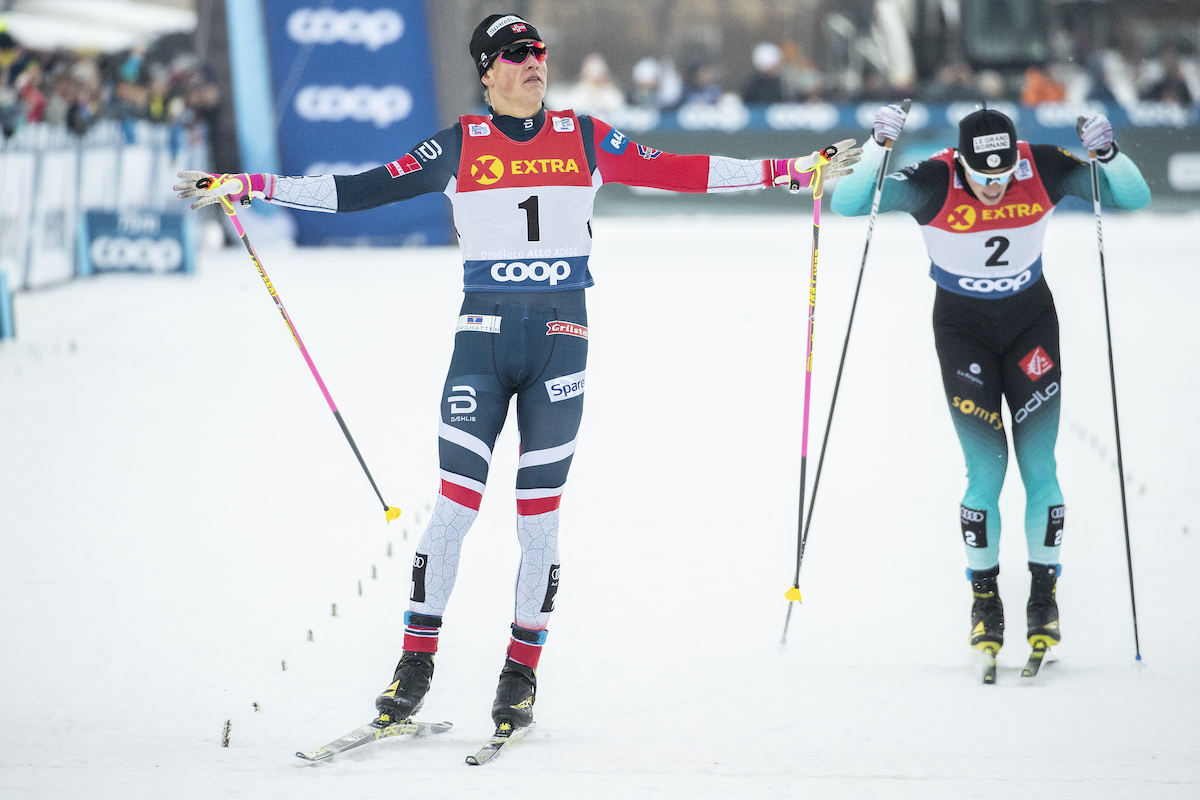
By the bottom of the descent, Klæbo had surpassed Bolshunov and was ready to cruise. He sailed up the final climb with time enough to glance back at a fading Bolshunov. The 22 year old Norwegian cruised his way to the finish line, crossing arms outstretched for Team Norway’s first place in a time of 18:49.86.
“Yes it was a revenge because of Lahti. But we did not just ski as a team today but more also as friends and this makes the win even more special for us,” Iversen said to FIS, according to a press release. “To be able to cross the finish line in the first position is of course always a special moment. We now enjoy the day and see what other goals we will set for us.”
American Simi Hamilton (r) leading Great Britain’s Andrew Young during the 6 x 1.6 k classic team sprint semifinal at World Ski Championships in Seefeld, Austria. (Photo: John Lazenby/lazenbyphoto.com)
Russia crossed 1.88 seconds later for the silver medal and claiming the bronze was Italy, finishing 4.03 seconds back from Norway.
The U.S.’s Hamilton and Bjornsen finished in eighth (+28.56) and Canada’s Palmer-Charette and Valjas in 10th (+1:40.99).
Norwegian Johannes Hoesflot Klæbo and Emil Iversen snag the men’s 6 x 1.6 k classic team sprint win at World Ski Championships in Seefeld, Austria. (Photo: John Lazenby/lazenbyphoto.com)
Norway’s Sjur Røthe (l) leading teammate Martin Johnsrud Sundby on their way to first and third respectively in the men’s 30-kilometer skiathlon on Saturday at the 2019 World Ski Championship in Seefeld, Austria. (Photo: John Lazenby/lazenbyphoto.com)
*This article has been updated to include comments of Great Britain’s Andrew Musgrave
By the time the camera panned past the 26-kilometer mark of the men’s 30 k skiathlon at 2019 World Ski Championships in Seefeld, Austria on Saturday, the original pack of 72 starters had dwindled to five: Norwegians Martin Johnsrud Sundby and Sjur Røthe, Russia’s Alexander Bolshunov, Finland’s Iivo Niskanen, and France’s Clement Parisse.
The leaders had been unphased by Niskanen’s hot pace during the classic portion of the event and with less than 5 k of freestyle skiing to go, Bolshunov levied control of the pace. But it wasn’t long before one red suit was exchanged for another.
Russia’s Alexander Bolshunov during the men’s 30-kilometer skiathlon on Saturday at the 2019 World Ski Championship in Seefeld, Austria. (Photo: John Lazenby/lazenbyphoto.com)
Saturday, he looked bound to break into that realm. In the second to last climb before the uphill to the finish, he began to separate himself from the lead pack of five. By the hill’s crest, only Bolshunov and Røthe had managed to maintain sight of Sundby’s ski tails. Through the gentle descent before the uphill to the finish, the three tuck skated in a line with Sundby setting the pace, Bolshunov just behind and Røthe just behind him.
As the trio ascended the final uphill, Sundby looked steady; perhaps too steady. A brief glance back revealed the raw power of Bolshunov and equally quick tempo of Røthe pressing in from behind. By the finishing stretch, Sundby was swallowed. The sprint to the line became between Røthe and Bolshunov, with Røthe outlunging the Russian by 0.1 seconds for first in a time of 1:10:21.8. Bolshunov, claimed second (+0.1), finishing 0.6 seconds ahead of Sundby in third (+0.7).
“It was an amazing feeling to cross the finish line first,” Røthe said according to a International Ski Federation press release. “When we changed skis, it was important for me to get away from the best athletes in the field. I had some problems with my legs during skating, but it worked out well in the end. I chose the right tactic today … and I hope I was good enough to be part of the relay team on Friday.”
Røthe’s win on Saturday is predicated on a series of firsts this season: earlier in the year he earned his first World Cup win and Saturday marks his first career individual World Championships gold–he has a relay gold from 2013 when he raced the third leg for Norway at World Champs in Val di Fiemme.
For Bolshunov, Saturday’s skiathlon silver medal is his first World Champs podium and, with the men’s 15 k classic yet to race, it may just be the start to his championships trophy case. The 22 year old Russian has made his way to the top of the podium a few times this season and, if Sundby hopes to take home his long sought after individual gold, it will not be without a challenge from the likes of Bolshunov.
Rounding out Saturday’s top 5 was Niskanen in fourth (+12.3) and Parisse in fifth (+20.7).
Canada’s Alex Harvey during the men’s 30 k skiathlon at the 2019 World Championship in Seefel, Austria.
Finishing 58.9 seconds back from the winner was Canada’s Alex Harvey in sixth place. The winner of the 2017 Lahti World Championships 50 k and Canada’s favorite medal contender in Seefeld, Harvey recently announced that he will be retiring this season after World Cup finals in Quebec City, Quebec. Many are hoping for a repeat gold place finish for the 30 year old–over his career, he has accumulated five World Champs medals, two of those being gold one from the Lahti 50 k and one from the 2011 Oslo Team Sprint.
On Saturday, however, Harvey told Cross Country Canada (CCC) that he “was never really in the hunt” for the podium, despite his high ranking result.
“Normally when you are in the top-six you are in a mass start fighting for the podium until the end, but that wasn’t the case today,” Harvey said according to a CCC press release.
“I missed the boat in the classic and the gap was made there. The equipment was great, but I just wasn’t skiing well and couldn’t create enough speed – especially on the flat part of the course,” he added.
Happy with the skating portion of the race, Harvey implicated that more could have been had from his classic.
“As soon as I clicked into the skate skis, I was feeling really good,” Harvey said. “I was skiing with a lot of big names, guys started popping a bit from the back and I was feeling really confident leading that group. The skiathlon is my favourite race. I will draw a lot of confidence from the skate today, but I am disappointed with the classic.”
Finishing 1.4 seconds behind Harvey in seventh place (+1:11:22.1) was Great Britain’s Andrew Musgrave. The seventh place finish is Musgrave’s second best result at a World Championships event, his best having come in Lahti 50 k when he finished just off the podium in fourth.
“I felt great on the classic today- having ridiculously good skis helped!” Musgrave wrote in an email to FasterSkier after the race. “The last lap of the classic was pretty hard though – when the worlds 2 best classic skiers started pushing the pace (Bolshunov & Niskanen). I must admit I was a bit glad when Niskanen fell on the 2nd lap- so we didn’t have an entire 15km of him stringing out the field & making us suffer!”
The 29 year old Brit has had four Top 10 finishes this World Cup season and has stood atop a World Cup podium once, that having been a third place finish two years ago in the Toblach 15 k. In Saturday’s race he indicated that while the classic portion of the skiathlon for him went well, the skating segment had him searching for a second gear.
“The first lap of the skate was OK… But I started to pay for the hard effort on the classic by the 2nd,” he wrote. “By 7km into the skate I was pretty wrecked. The last 2 laps were horrific- I was almost crawling by the end! I think I lost an impressive 50s to Harvey over the last 7.5km!”
Either way, many rooting for Britain’s blue red and white, are hopeful that the seventh is just the start of Musgrave’s World Champs performances.
American Scott Patterson (bib 28) during the men’s 30-kilometer skiathlon on Saturday at the 2019 World Ski Championship in Seefeld, Austria. (Photo: John Lazenby/lazenbyphoto.com)
The next top North American finisher following Harvey was American Scott Patterson in 32nd (+4:40.6). In an email to FasterSkier, Patterson explained that the hot pace during the first classic portion of the skiathlon took a toll on him
“In racing today, I struggled from pretty early on.” Patterson wrote. “Iivo Niskanen and others pushed the classic pace pretty hard early. I went with it for a while hoping to stick onto the pack, but it became a little too much for me as I was struggling to kick my skis. I was partially saved by having really fast skis, but it wasn’t enough.”
The switch to his freestyle boards was a welcomed exchange, though low energy reserves left him wanting more.
“In switching to skate, I felt slightly better, but had also dug my legs into a hole during the classic leg.” Patterson wrote. “I tried to work with a group around me, but we weren’t moving up all that well and I wasn’t quite feeling the initiative to go for it on my own.”
“I was able to ski by a few people, but I really wanted to get the Norwegian pair of Klaebo and Iverson who were dogging it at the end,” he continued. “That would have made me a lot happier (along with a top 30).
“Overall, I think my fitness is pretty good and I am looking forward to getting a little more dialed in and faster over the next few races,” he added.
American David Norris the men’s 30-kilometer skiathlon on Saturday at the 2019 World Ski Championship in Seefeld, Austria. (Photo: John Lazenby/lazenbyphoto.com)
American David Norris finished six places behind Patterson in 38th (+4:54.4).
“Today had an awesome atmosphere with amazing fans and hot sun.” Norris wrote in an email. “I struggled in the classic portion and that is a little frustrating. My skate leg felt really good and I was catching guys the whole way. For my first Championship event this was a pretty awesome experience and a good start.”
Next to finish was Canada’s Evan Palmer-Charrette in 45th (+6:12.4) followed by Americans Kyle Bratrud in 49th (+6:19.6), and Adam Martin in 54th (+7:47.4). Also racing for Canada was Scott James Hill in 56th (+9:58.8).
British skier Andrew Musgrave skied to sixth overall (+1:00.3)
Andrew Musgrave (bib 12) of Great Britain en route to a 7th place finish in the Nordic World Ski Championship skiathlon event. (Photo: John Lazenby/lazenbyphoto.com)
World Championships picks up Sunday with a men’s and women’s Team Sprint.
Russia’s Alexander Bolshunov (c) after winning the men’s 15-kilometer classic individual start on Sunday in Cogne, Italy. Finand’s Iivo Niskanen (l) placed second and Russia’s Alexander Bessmertnykh in third. (Photo: FIS screenshot)
If there’s anyone on the hunt to dethrone Finland’s Iivo Niskanen of the 15-kilometer classic kingship–Niskanen was the gold medalist in the 2017 Lahti World Championships 15 k classic and is certainly looking to repeat the feat at this year’s World Championships 15 k classic in Seefeld, Austria–it’s Russia’s Alexander Bolshunov.
On Sunday in Cogne, Italy, the 22 year old Bolshunov raced to a decisive win over Niskanen, besting the Finn by 43.7 seconds with his time of 34:48.4. Sunday’s result comes exactly eleven months after Bolshunov’s first-career World Cup win, which he achieved in last season’s 15 k classic at World Cup Finals in Falun, Sweden.
Between his victory in Falun and Cogne, Bolshunov has reigned at the top of the podium two other times–taking back-to-back victories in the International Ski Federation’s (FIS) opening races in Ruka, one of which happened to be a 15 k classic.
With the 2019 World Champs slated to start next Wednesday, Feb. 20 and the men’s 15 k classic scheduled for Feb. 27, Bolshunov could be on his way to his first World Championships gold. On paper, one skier definitively stands in his way. And if anyone can hold off a Russian attack, it’d be a Finn.
Niskanen has been a force in the 15 k classic for the past five years; seven of his nine World Cup podiums are in the 15 k classic event and all of his wins on the World Cup have come in the discipline. Along with his World Champs gold medal, the 27 year old has two World Cup wins from Kuusamo, one in 2014 and one in 2016 and four weeks ago, he also claimed the men’s 15 k victory in Otepää, Estonia.
The Finn and the Russian were in close quarters for the first half of Sunday’s interval start, with Niskanen trailing Bolshunov by 6.5 seconds at the 3 k mark, then 9.8 seconds by the 7 k mark.
In another 3 k, the Finn, who had started 12 bibs behind the Russian in bib 53, was down on Bolshunov by 24.9 seconds. Bolshunov’s pace for the remaining 5 k proved too fast for Niskanen and the Russian put another 18.8 seconds into the Finn by the end of the race.
Russia’s Alexander Bolshunov (l) on his way to winning the men’s 15-kilometer classic individual start on Sunday in Cogne, Italy. (Photo: NBC screenshot)
“With every minute the snow got softer and softer and one really needed some good ski’s today,” Bolshunov said according to a FIS press release.
Following Bolshunov and Niskanen, Russia’s Alexander Bessmertnykh took third, finishing 55.9 seconds behind the race winner.
Canadian Alex Harvey was the top North American male finisher on Sunday, placing 10th, 1:40.7 seconds behind Bolshunov. Harvey started in bib 65, four bibs ahead of Sunday’s final starter, Didrik Tønseth of Norway.
With Bolshunov still in the leader’s chair by the time he got on course, Harvey pressed to the front and he also pushed others back. At the 2 k mark, he was ranked ninth and 14.6 seconds down on Bolshunov, with that gap widening to 44.2 seconds at the halfway point. An early charge from Tønseth put the Norwegian ahead of the Canadian by 0.2 seconds at the 2 k and later 7.6 seconds at 7 k, but by the finish, Harvey had the Norwegian beat by 16 seconds.
The result is Harvey’s fourth Top 10 this season. At the age of 30, he is about to enter his sixth World Championships, and is one of Canada’s strongest hopefuls for hardware in Seefeld.
The next North American to finish on Sunday was the U.S. Ski Team’s, Erik Bjornsen in 16th (+1:54.8). The result is Bjornsen’s best individual finish this season and in the 27 year old’s eyes, came just at the right time.
“Today’s race went well. It’s exactly the boost of confidence I needed heading into Seefeld,” Bjornsen wrote in an email to FasterSkier.
While some U.S. athletes spent last weekend at a training camp in Davos, Switzerland, Bjornsen raced the World Cup individual sprint and team sprint competitions that took place in Lahti. The transition from low altitude to racing in the Italian Alps “made yesterday’s sprint really difficult,” Bjornsen explained. Sunday’s distance course, he added, “suited me better.”
“I didn’t feel extremely good or anything, but I think I was able to pace it well and use my double pole power on all the gradual climbs,” Bjornsen said. “I did much more strength training this summer and I’m still trying to get some of my endurance back. We had a great camp in Sweden a couple weeks ago and I put in a lot of volume. Hopefully that’ll pay off now.”
American Kyle Bratrud scored his first World Cup points on Sunday, finishing in 26th (+2:21.1) just 1.2 seconds behind Switzerland’s Dario Cologna in 25th (+2:19.9).
Prior to Sunday, Bratrud had competed in one other World Cup race, the Östersund 15 k back in 2015 where he finished 84th. He qualified for his first World Championships that same year and has qualified for every World Champs since then. In Lahti two years ago, he finished 33rd in the 15 k classic, 20.7 seconds outside the Top 30.
“I wish I could say I have some formula for making World Championship teams every other year but in truth I just seem to be healthy every other year,” Bratrud wrote in an email to FasterSkier on Sunday. “This year I also joined Stratton and have made great strides with this extremely professional program.”
Though initially unsure if he would race in Cogne on Sunday, Bratrud’s decision to do so turned out to be the right call.
“Today was awesome. I wasn’t sure I would even race since I was in bed with a cold two days ago but I felt good yesterday and woke up this morning feeling fine so I decided to send it,” Bratrud wrote.
“It was an interesting race course in the sense that it wasn’t very hilly but there was a lot of work and we are at altitude,” he added. “There were stretches were I was hoping for more hills and stretches where I was thankful to have recovery but all in all I’m very happy with the result leading into Seefeld.”
Earlier this season, Bratrud garnered his third U.S. National title at U.S. Cross Country Championships in Craftsbury Vt. and is currently the Continental Cup leader. Thanks to that, most of his trip to Austria for World Champs is covered by FIS.
Kyle Bratrud racing to a win in the men’s 15-kilometer classic race at U.S. nationals in Craftsbury, Vt. (Photo: John Lazenby)
“I got to Davos on February 5th and spent some time at altitude training and acclimating before Cogne which really helped,” he wrote “I’m looking forward to head a bit lower for Seefeld!”
Also competing for the U.S., was American David Norris in 33rd (+2:52.2). Norrisfinished 9.3 seconds outside of Sunday’s Top 30 and is also on the 2019 World Championships Team bound for Seefeld next week.
Two more U.S. skiers competed on Sunday, with Scott Patterson finishing in 43rd (+3:36.8) and Adam Martin in 50th (+3:56.3). Canadians Evan Palmer-Charrette and Scott James Hill placed 56th (+4:17.0) and 58th (+4:20.6), respectively.
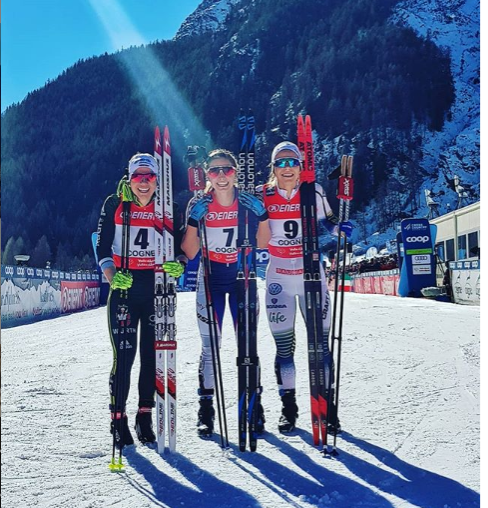
American Jessie Diggins (center) after winning the women’s 1.6-kilometer freestyle sprint in Cogne, Italy. Germany’s Sandra Ringwald (l) placed second and Sweden’s Johanna Hagström in third.
FIS Cross Country World Cup 1.6-kilometer freestyle sprint Cogne, Italy
Amidst sunshine and sporting rolled up sleeves on Saturday in Cogne Italy, American Jessie Diggins took the women’s 1.6-kilometer freestyle sprint win in nail-biter fashion. After making it into the semifinals and the final as one of the day’s lucky losers, Diggins outlunged Germany’s Sandra Ringwald by 0.11 seconds, claiming the victory in a time of 3:32.73.
The 27 year old Afton, Minnesota native now has six individual World Cup sprint podiums, Saturday marking her first individual World Cup sprint victory (not to be forgotten is the gold medal Diggins and Kikkan Randall won in the team sprint during last year’s Pyeongchang Olympic Winter Games).
Following Diggins, Ringwald placed second (+0.11), Sweden’s Johanna Hagström third (+0.86), and Norway’s Ane Appelkvist Stenseth was fourth (+1.31). American Sadie Bjornsen also advanced all the way to the final on Saturday where she placed fifth, 2.23 seconds back from Diggins’ winning time. The sixth finalist on Saturday was Eva Urevc of Slovenia, who crossed 2.32 seconds back from Diggins.
In her strongest individual World Cup sprint result yet, Julia Kern of the U.S. raced to an 11th place. Prior to Saturday, Kern’s best individual World Cup finish in a sprint was 19th, which she earned at this year’s freestyle sprint in Dresden, Germany.
Three more U.S. woman finished in the top 30, with Sophie Caldwell placing in 17th followed by Ida Sargent in 24th and Rosie Brennan in 27th.
American Kelsey Phinney finished 1.03 seconds outside of qualification, ending the day in 33rd overall.
Four Canadian women raced on Saturday, with Dahria Beatty leading the way in 38th. The next Canadian finisher after Beatty was Cendrine Browne in 48th, followed by Maya Macisaac-Jones 49th and Katherine Stewart-Jones 51st.
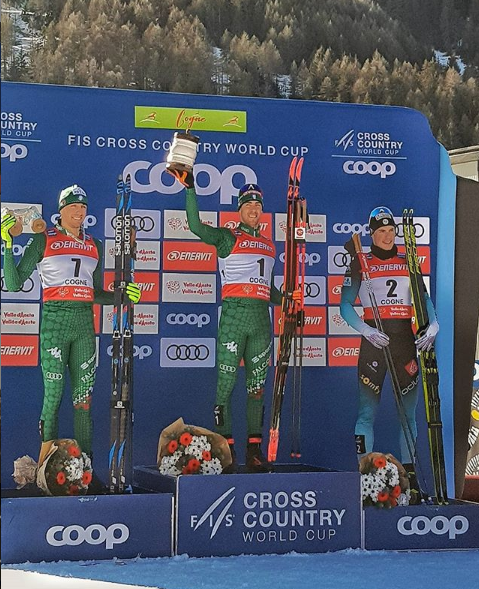
Italy’s Federico Pellegrino (c) after winning the men’s 1.6-kilometer freestyle sprint on Saturday in Cogne, Italy. His teammate, Francesco de Fabiani (l) placed second and France’s Lucas Chanavat third. (Photo: FIS Instragram screenshot)
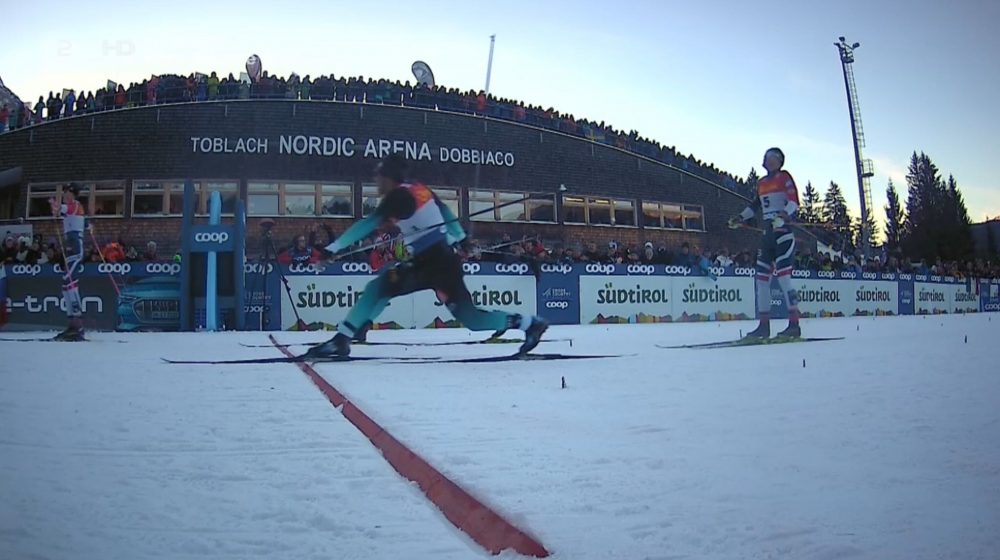
On the men’s side, Italians Federico Pellegrino and Francesco de Fabiani put on a show for the home crowd, with Pellegrino taking the win in a time of 3:09.07 and his teammate de Fabiani earning second (+0.48) by 0.03 seconds after a photo finish with France’s Lucas Chanavat, who placed third (+0.51).
After narrowly avoiding a crash in his semifinal, American Simi Hamilton advanced to the final, ending the day just off the podium in fourth (+3.91). Following Hamilton was Norway’s Sondre Turvoll Fossli in fifth (+4.03) and Sweden’s Marcus Grate in sixth (+27.90).
Racing for Canada, Russell Kennedy was the next top North American finisher in 11th. Following Kennedy was American Andy Newell in 23rd and the U.S.’s Logan Hanneman in 27th. Kevin Bolger qualified for the fourth quarterfinal, but did not start and ended the day in 30th.
Erik Bjornsen of the U.S. Ski Team placed 39th while Canada’s Alex Harvey ended the day in 48th and Evan Palmer-Charrette 59th.
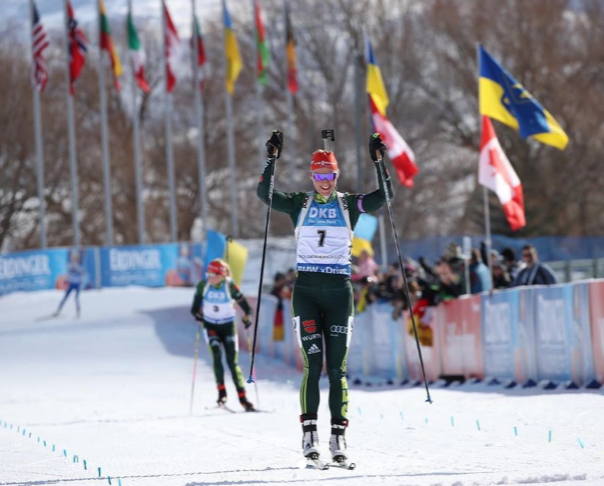
Germany’s Denise Herrmann winning the women’s IBU 10 k pursuit on Saturday at the SoHo venue in Midway, Utah. (Photo: IBU Instagram screenshot)
IBU World Cup Soldier Hollow (Midway), Utah: 10/12.5 k pursuit
International Biathlon Union (IBU) competition has returned to the famed Soilder Hollow (SoHo) race course venue in Midway, Utah for the first time in 17 years–the last time IBU/World Cup level competitions were held there was back in 2002, when Salt Lake City played host to the Winter Olympic Games.
The IBU’s third day of competition in SoHo brought on a 10-kilometer pursuit for the women. Germany’s Denise Herrmann won the event in a time of 28:03.4 after skiing two penalties (0+0+1+1). Franziska Hildebrand, also of Germany, claimed second, finishing 4.2 seconds behind Herrmann with one missed shot (0+0+0+1).
Racing for Finland, Kaisa Mäkäräinen placed third, 16.5 seconds back from the winner with three misses (2+0+1+0).
Susan Dunklee was the top North American woman, finishing in 26th (+2:34.5) with one miss (0+0+0+1). Just 0.4 seconds back from Dunklee in 27th (+2:34.9), was U.S. skier, Clare Egan with three missed shots (0+0+2+1).
Rosanna Crawford of Canada placed 34th (+2:48.2) after skiing three penalties (0+1+0+2) and U.S. skier Joanne Reid finished 40th (+4:11.9) after skiing two penalties (0+1+1+0). Canada’s Sarah Beaudry placed 44th (+4:33.2) after two missed shots (0+0+1+1) and Emma Lunder, also racing for Canada, placed 51st (+5:41.3) after skiing six penalties (2+2+2+0).
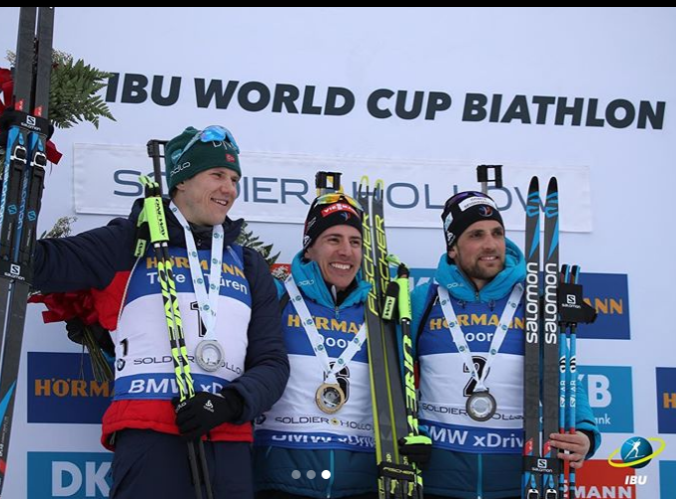
Quentin Fillon Maillet (c) after winning the men’s IBU World Cup 12.5-k pursuit at the SoHo venue in Midway, Utah. Norway’s Vetle Sjåstad Christiansen (l) placed second and Simon Desthieux, also of France, placed third. (Photo: IBU Instagram)
In the men’s 12.5-kilometer pursuit, France’s Quentin Fillon Maillet claimed the win in a time of 30:55.8 after shooting 100 percent. Norway’s Vetle Sjåstad Christiansen, who earned his first IBU World Cup win on Friday, placed second in Saturday’s pursuit, finishing 25.9 seconds behind Fillon Maillet and missing just one shot (0+1+0+0).
Simon Desthieux, also of France, placed third on Saturday, finishing 47.3 seconds back from the winner after skiing three penalties (0+1+1+1).
Racing for Canada, Christian Gow placed 8th (+2:21.2) after shooting clean. American Sean Doherty finishing two places behind Gow in 10th (+2:22.8) with three misses (0+3+0+0). Canadian Scott Gow, Christian’s brother, placed 25th (+3:58.5) after skiing four penalties (1+1+2+0).
Also racing for Canada, Aidan Millar finished in 39th (+5:25.1) with five missed shots (2+0+1+2).
Minneapolis SuperTour 20 k/15 k mass start classic
The SuperTour returned to racing on Saturday in Minneapolis, Minnesota with a 15/20 k classic mass start. The men’s 20-kilometer event was won by Northern Michigan University (NMU) skier, Zak Ketterson in a time of 54:08.0. Ben Lustgarten skiing for the Craftsbury Green Racing Project (CGRP) placed second, 0.9 seconds behind Ketterson. Norwegian Mathias Rolid, also skiing for NMU, placed third, 15.8 seconds behind the race winner.
In the women’s 15 k event, Kaitlynn Miller of the CGRP won in a time of 50:17.1. Skiing for the Stratton Mountain School T2 team was Alayna Sonnesyn in second place (+25.1). Liz Guiney (CGRP) claiming third (+30.6).
From left to right,Tiril Udnes Weng and Maiken Caspersen Falla of Norway I in second, Maja Dahlqvist and Ida Ingemarsdotter of Sweden I in first, and Evelina Settlin and Hanna Falk of Sweden II in third. (Photo: FIS cross country screenshot)
It was a weekend of sprinting in Lahti, Finland, with many World Cup athletes closing out Sunday having traversed the famed 1.4-kilometer 2016 World Championships sprint loop at top speed close to ten times.
By the time Sweden’s Maja Dahlqvist got on course for the final lap of the women’s classic Team Sprint, she had already tallied nine–in Saturday’s freestyle sprint she made it through the qualifier, quarterfinal, semifinal and final (placing third), and on Sunday, she and teammate Ida Ingemarsdotter had to first complete in the 6 x 1.4 k semifinals to advance to the 6 x 1.4 k final.
Through the first two thirds of Sunday’s final, it appeared the extra kilometers had worn on the Swede. She and Ingemarsdotter remained positioned in fifth or sixth through first four exchanges, watching from behind the pace of Norway’s Team I, Norway’s Team II, Russia’s Team I and Finland’s Team I.
In her last leg and just before the final exchange, however, Dahlqvist’s teammate Ingemarsdotter made a decisive surge to the front. By the time Ingemarsdotter handed off to Dahlqvist for the race’s final sprint lap, only Tiril Udnes Weng of Norway’s Team I remained in front. Heading into the races final kilometer and half, Sweden’s Team I was positioned in second.
If Dahlqvist was feeling anything in her legs from the weekend’s sprint series, it must have been motivation. She charged into the last sprint lap chasing down Maiken Caspersen Falla, the anchor for Norway Team I and the winner of Saturday’s skate sprint.
In the end, Dahlqvist’s press proved too strong for Falla. She overcame the Norwegian and Sweden’s Team I crossed first in a time of 18:24.96 for the win. Falla crossed 1.84 seconds behind to put Norway Team I in second place. Claiming third place, 3.55 seconds back from the winners, was Sweden’s Team II of Evelina Settlin and Hanna Falk.
With World Championships just around the corner, the U.S. entered two teams in the sprint: USA I was comprised of Ida Sargent and Sophie Caldwell. The two women raced the first semifinal and finished outside of advancing to the finals, placing 12th overall. Sargent and Caldwell have partner up in the past and landed on the podium–last year in Dresden and two years ago in the Pyeongchang World Cup–so making it into the final and onto the podium had been in the back of their minds.
“Classic team sprint I think is my favorite race so I was really excited for today but unfortunately it didn’t go as well as we hoped” Sargent wrote in an email.
Sargent cited the pace of the semifinal as unlike team sprint semis that she has scrambled for in the past.
“Today’s race was the fastest team sprint semifinal that I’ve ever raced,” she wrote. “It was hard from the gun rather than building into it more like some races. My skis were really slick for the first two legs so I was using a lot more energy to stay at the front than some of the girls that I was skiing with. Then on the third lap when the pace really picked up I didn’t have much left and was just trying to not completely explode.”
Kelsey Phinney and Julia Kern were entered as USA II and placed 14th overall. The duo placed seventh in their semi-final.
Resources were stretched a little thinner this weekend in Lahti due to the simultaneous USST pre-World’s training training camp in Davos, Switzerland.
“We have a really small service staff here and they were working so hard to get us great skis,” Sargent wrote. “Today was just a trickier klister day with not much time for testing so we ran out of time. Yesterday I felt like we had the best skis in the field which was super impressive since we only had a few techs here who were all working so hard.”
U.S. World Cup coach, Matt Whitcomb indicated that he helped with skis on Sunday and because of that role, spent most of his time waxing instead of on course.
“While it was definitely a disappointment not to have any teams advance through the semis today, we did see a lot of athletes ski really well,” Whitcomb said during a phone conversation. “Unfortunately, Ida struggled a little bit with her skis and Simi struggled with his glide. … Sophie and she felt like she had really awesome skis and felt really good, so she has returned from her trip home very strong,” Whitcomb continued.
Caldwell recently returned to the U.S. to spend time with her mother.
“I have no real regrets,” Whitcomb said. “Our team, staff, athletes, we all tried and executed the plan we intended to, sometime it all doesn’t work out as perfectly as planned.”
Athletes will remain in Finland for two days before heading down to Cogne, Italy on Wednesday for the final World Cup races before World Championships in Seefeld, Austria.
“While the results were a little bit disappointing today in Lahti, I really believe we have a team that is well prepared for World Championships,” Whitcomb said. “We like to go into the Championships having knocked a few races out of the park and we had a couple hits this weekend, but not as many as we intended to. So we will be looking to swing hard in Cogne. I feel very confident about our Seefeld Championships with this team, its a strong crew.”
Johannes Thingnes Bø of Norway has dominated the win column. So far this season, he has 12 victories to his name and leads the IBU men’s overall standings. (Photo: biathonworld.com)
With six of the nine stops on the International Biathlon Union (IBU) World Cup circuit complete, IBU athletes will take a brief hiatus from Europe this February and venture across the Atlantic for a race tour in North America.
The first stop for biathletes, coaches and fans will be Canmore, Albert. Canada–the last World Cup races having taken place there in 2016. Following Canmore, the IBU will head for U.S. soil: The Soldier Hollow Nordic Center (SoHo) in Midway, Utah. The 2019 IBU World Cup races will be the first major biathlon event held at the SoHo venue since the Salt Lake City Winter Olympic Games.
With 15 competitions already in the bag this season, the men’s IBU World Cup is currently led by Norwegian Johannes Thinges Bø, who has accumulated a total of 836 points for the coveted top-dog position.
Bø kicked off his World Cup season with back-to-back wins in Pokljuka, Slovenia, claiming first in the IBU’s opening sprint and then winning the following day’s pursuit. (He placed seventh in the men’s individual 20 k that weekend). In Hochfilzen, Austria, the 25 year old won the sprint before placing ninth in the next day’s pursuit. In Nové Město, Czech Republic he completed a hat trick win, sweeping the sprint, pursuit and mass start.
He dropped a position in the Oberhof, Germany sprint, finishing second, only to reclaim his position at the top in the pursuit. Ruhpolding, Germany once again found him with a triple win: in the men’s relay, one in the sprint and one in the mass start.
Johannes Thingnes Bø scored his 10th IBU World Cup win of the season in the 10 k sprint in Antholz, Italy. (Photo: biathlon world.com screenshot)
By the time he competed in Antholz, Italy–the final European destination before the North IBU’s American tour–Bø had accumulated two more wins and one second place. All told, the Norwegian has won 12 of the 16 IBU World Cup competitions he has entered this season and missed the podium twice.
Following Bø on the the men’s IBU World Cup Top 3 this season is France’s Martin Fourcade in second place with 554 points. Fourcade was the overall leader last season, ahead of Bø who was second. This year, Fourcade is currently trailing Bø by 288 points. At the age of 30, Fourcade has accrued a grand total of 76 individual victories over the course of his career, while Bø, five years younger than Fourcade, has 33. Third in the 2018/2019 IBU World Cup overall standings is Russian Alexander Loginov with 548 points.
Scoring 183 points and ranked 28th in the overall, Canada’s Christian Gow currently leads the North American men on the IBU World Cup. Gow opened his season with three Top 20 finishes in Pokljuka, placing 16th in the individual, 17th in the sprint and 14th in the pursuit. He had a career best finish in the Ruhpolding mass start, racing to 11th place. Altogether, Gow has finished in the Top 30 11 times this year.
Behind Gow, American Sean Doherty is ranked 37th and Canadian Scott Gow, Christian Gow’s brother, is 47th. Leif Nordgren and Jake Brown of the U.S. are ranked 57th and 88th respectively, while Canada’s Jules Burnotte currently sits in 73rd.
Norway’s Marte Olsbu Røiseland out skiing Italy’s Dorothea Wierer on Satrday’s 10 k pursuit in Nové Město, Czech Republic. (Photo: biathlonworld.com)
On the women’s side, Italy’s Dorothea Wierer is the woman to watch–or watch out for–thus far this season, currently ranked first in the overall standings with 632 points. The 28-year-old-Wierer earned three victories this season, winning the Hochfilzen sprint and relay then later the Antholz pursuit. Including those wins, Wierer has landed on the podium six times during the 2018/2019 IBU World Cup race year. Last season, Wierer finished fifth in the overall standings.
The Italian women have proven themselves in good form this year with Italy’s Lisa Vittozzi taking up second in the standings behind Wierer with 598 points. At 23-years-of-age, Vittozzi earned the first wins of her career this season, claiming first in the Oberhof sprint and pursuit.
Behind the Italians, Norway’s Marte Olsbu Røiseland is presently ranked third in the standings with 508 points.
Team USA’s Clare Egan has had a banner IBU World Cup race season, ranked 22nd at present with 258 points. Egan’s World Cup success this season began in Pokljuka where she had a career best sixth place finish in the women’s pursuit.
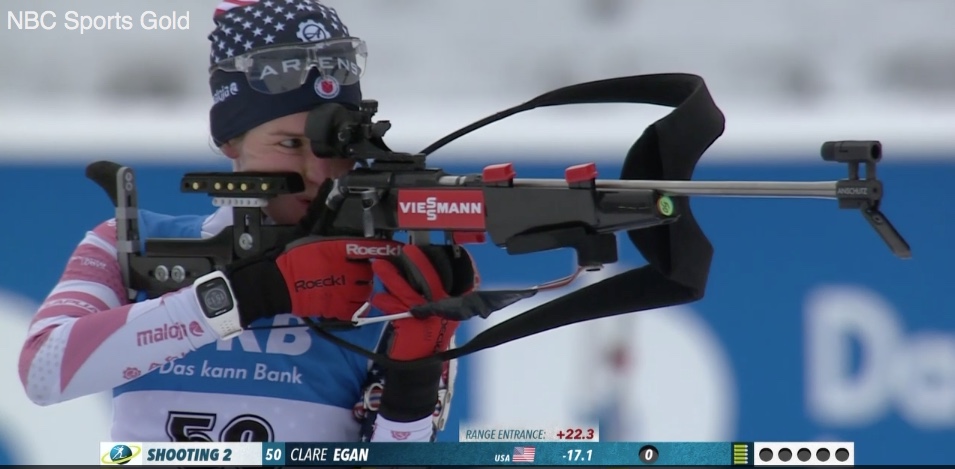
Clare Egan during her second shooting stage in Oberhof’s sprint on Thursday. (Photo: NBC Gold screenshot)
“I am frankly amazed with my skiing,” the 31 year old Egan had written in an email to FasterSkier after the Pokljuka race weekend. “I knew I was in great shape, but this week my ski times were 11, 6 and today 1st. I think small changes and improvements in my training are coming together to make this big difference. The most important factor in my performance is our new women’s coach, Armin Auchentaller. He is the right coach for me.”
Following her sixth place, Egan has had 11 Top 30 performances this season, three of those coming from relays, the rest individual. Egan, who began competing in the sport six years ago, made a visibly large jump season, having finished last year’s overall standings ranked 63rd.
Susan Dunklee is the next highest ranked North American woman in 31st (154 points). Over the course of her biathlon career, Dunklee has accumulated 5 IBU World Cup podiums and one silver World Championships medal, though her top performance this season was seventh in the Oberhof pursuit.
Canada’s Rosanna Crawford is ranked 53rd, Sarah Beaudry 57th, Emma Lunder 58th, and Megan Bankes 73rd. A third American, Joanne Reid, is currently 55th.
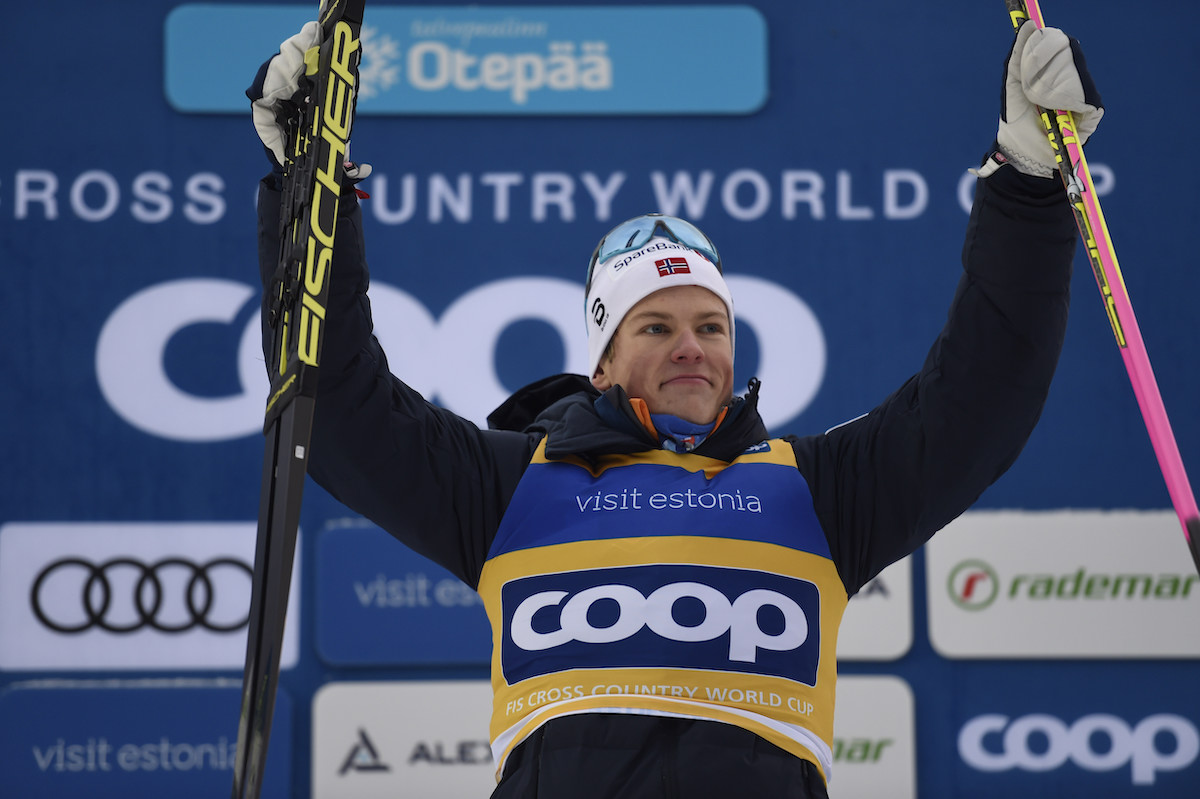
After winning Saturday’s qualifier in a time of 3:21.99, Klæbo went on to win both his quarter and semi. He eventually crossed the final first in a time of 3:20.05 to complete his sweep of the day’s rounds.
“It’s very cool to win here again,” Klæbo said during an interview with the International Ski Federation (FIS) after the race. “And I have a grandpa who is living here so that’s even better now, so I want to enjoy this.”
With the win, his 18th individual World Cup victory (12th in sprint), Klæbo could be on his way to his most winningest season yet. Last winter he departed the World Cup with 10 wins total. Thanks to a strong Tour de Ski and a few sprint races this year, Klæbo has already accumulated six individual victories in the 2018/2019 season.
The win this Saturday came in good company, as he raced the six man final with four other Norwegians: Pål Golberg, Eirik Brandsdal, Mattis Stenshagen and Erik Valnes. Alexander Bolshunov was the lone non-Norwegian to make the final.
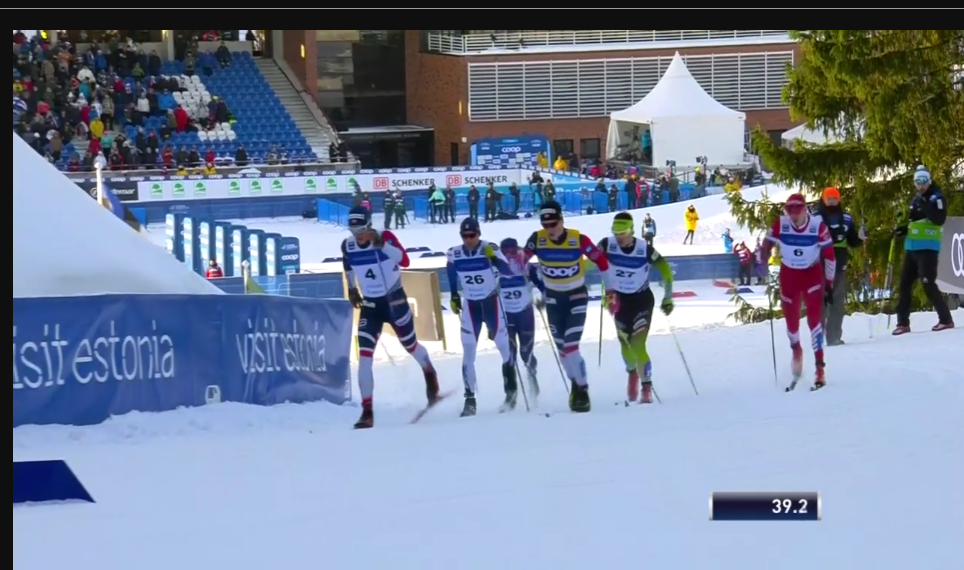
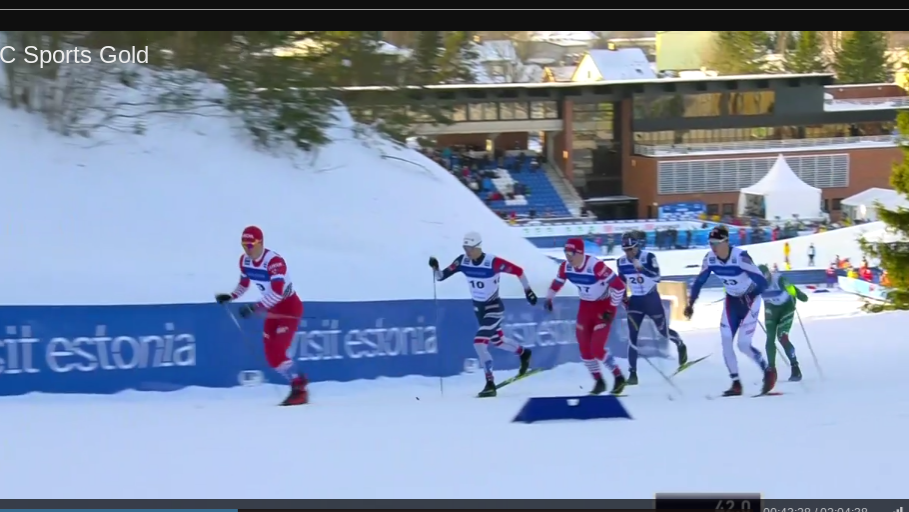
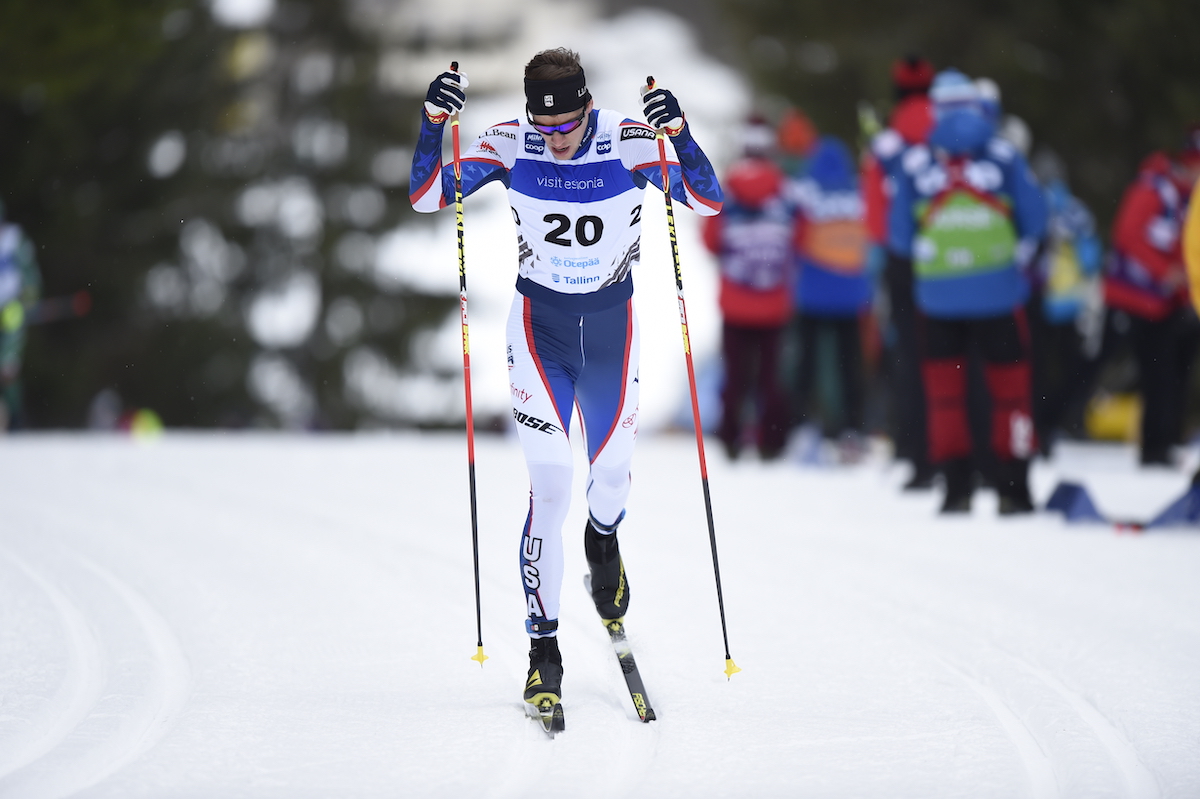
American Andy Newell (bib 26) racing the first quarterfinal of the the men’s 1.6-kilometer classic sprint final on Saturday in Otepää, Estonia. (Photo: NBC Gold screenshot)
Pitted against each other, Bolshunov appeared to be the only one in the final willing to challenge Klæbo. The two went head-to-head in the first major course climb, and by the following series of downhill S-turns, Bolshunov had positioned himself in the front. A brief double-pole section found Bolshunov and Klæbo side-by side once again, with Brandsdal and Stenshagen just behind.
As the six finalists geared up for the second major climb, a steep nearly vertical pitch that forced all racers to herringbone, Klæbo maneuvered to the outside right of Bolshunov. Using a quick, herringbone clip that almost made his skis look like a fish out of water, Klæbo passed Bolshunov by the top of the ascent.
After two double poles at the crest of the hill, Klæbo was tucked and descending back toward the stadium. His skis proved unmatchable by the Russian’s and by the bottom of the hill, he had put close to two meters on Bolshunov. Another meter behind Bolshunov was Golberg.
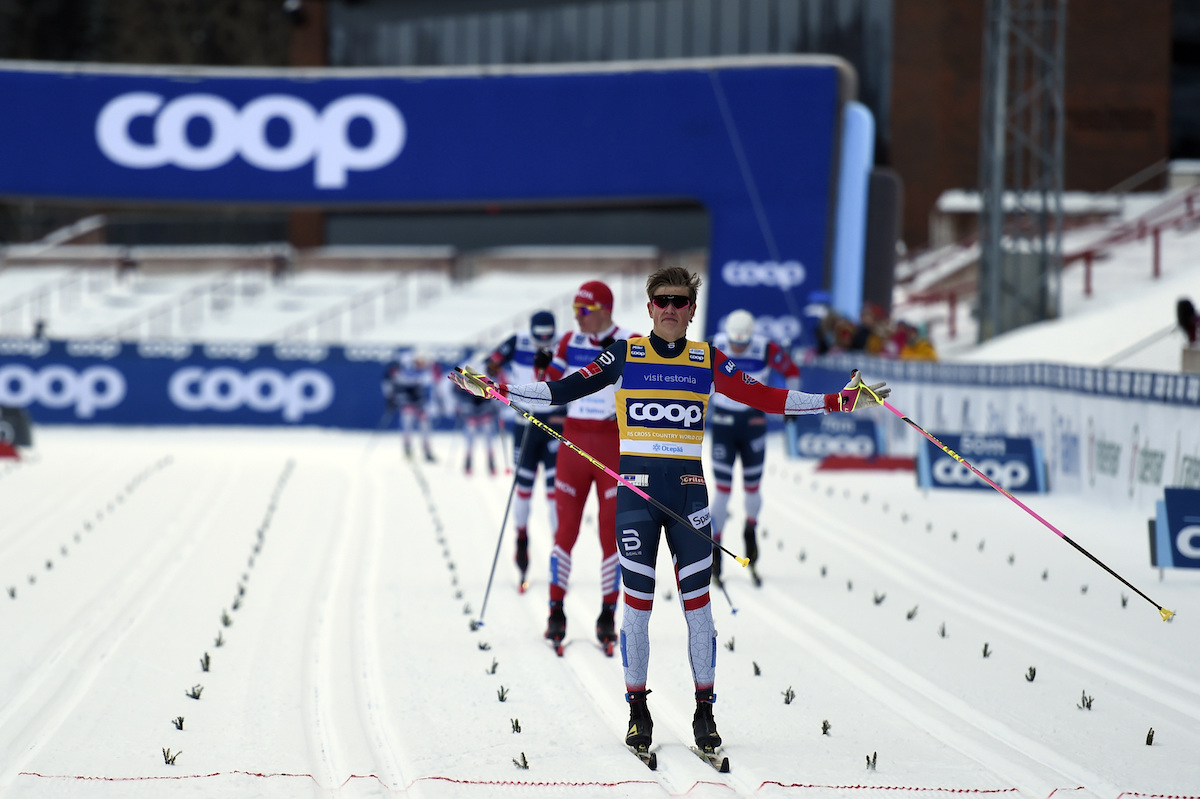
With no foreseeable challenge to the win, Klæbo double poled breezily to the finishing stretch and crossed first, arms outstretched in his signature celebratory gesture.
Norway’s Johannes Høsflot Klæbo (yellow bib) crossing first in the men’s 1.6-kilometer classic sprint final on Saturday in Otepää, Estonia. (Photo: Fischer/Nordic Focus)
Bolshunov crossed second (+1.51) for his seventh World Cup podium of the season.
In a lunge to the line, Golberg claimed third (+2.53) over Brandsdal in fourth (+2.57). Stenshagen crossed fifth (+7.69) and Valnes sixth (+11.99).
Rounding out the top ten was Norwegian Sindre Bjørnestad Skar in seventh, Sweden’s Viktor Thorn in eighth, Norway’s Sondre Turvoll Fossli in ninth and Italy’s Federico Pellegrino in tenth.
The U.S. had two men qualify, with Erik Bjornsen qualifying in 23rd (+8.20) and Andy Newell 26th (+8.75). Newell went on to race the first quarterfinal with Klæbo. Avoiding a crash from Russia’s Andrey Sobakarev in the herringbone hill, Newell crossed the quarterfinal in third to end the day in 15th overall.
American Erik Bjornsen (bib 23) racing the first quarterfinal of the the men’s 1.6-kilometer classic sprint final on Saturday in Otepää, Estonia. (Photo: NBC Gold screenshot)
Bjornsen, who was slotted into the second quarterfinal, jockeyed for position throughout his heat, taking aggressive lines during the course’s sweeping S-turns to move from fifth to third. He dropped back once again in the herringbone hill and crossed his heat in fifth for 24th overall.
“I was happy to qualify well today,” Bjornsen wrote in an email. “This season hasn’t gone as well as I hoped but I think I can turn things around before world champs. Today was a step in the right direction. Positioning was quite important in the second half of the course. Unfortunately I wasn’t where I needed to be before the steep climb.”
The U.S. Ski Team’s Kevin Bolger during his qualifier on Saturday in in Otepää, Estonia. (Photo: Fischer/Nordic Focus)
Also racing for the U.S., American Kevin Bolger finished in 41st (+13.13) and Ben Saxton in 44th (+14.16). Len Valjas racing for Canada finished in 43rd (+13.61) and Bob Thompson, also for Canada, placed 51st (+15.96).
American Sophie Caldwell (far left) lunges to the line with Norway’s Maiken Caspersen Falla and Sweden’s Jonna Sundling. Caldwell ended up fourth, while Sundling took second and Fall third. Sweden’s Maja Dahlqvist 9not shown) crossed first for the win. (Photo: Garrott Kuzzy /LumiExperiences.com)
If the Grand Prix were to host a ski race, it might look like the Team Sprint in Dresden, Germany. With 10 teams racing the 6 x 1.6-kilometer final and the racetrack style, three-lap loop situated in the city’s center, the tactics of a Formula One driver seemed employable on the relatively flat course. For most teams’ skiers, that meant patience; staying in one’s lane and in contact until the last lap.
Norway’s Team I of Mari Eide and Maiken Caspersen Falla, the U.S.’s Team I of Julia Kern and Sophie Caldwell, Sweden’s Team I of Stina Nilsson and Maja Dahlqvist, as well as the Swede’s Team II of Ida Ingemarsdotter and Jonna Sundling remained the teams to watch heading through each exchange.
By the time she started her third and final leg, Falla appeared to have played the conservation game. When on course, she had taken a few pulls at the front, though for the most part, left that work to Sweden’s Team I and Team II second leg skiers, Dahlqvist and Sundling. With the brunt of the pace-setting work having gone to the Swedes, Falla’s engine seemed primed for a jumpstart to the front.
Norway’s Maiken Caspersen Falla leading the women’s 6 x 1.6-kilometer Team Sprint on Sunday in Dresden, Germany. (Photo: Garrott Kuzzy /LumiExperiences.com)
Just a few meters before the course’s hairpin turn, which shuttled racers back to the finish, Falla made her move. She pushed around both Sundling and Dahlqvist to take over the lead. A hard pressing Dahlqvist led the chase on the Norwegian’s ski tails, which included herself as well as Sundling and the U.S. Team I’s second leg skier, Caldwell.
Sporting the red leader’s bib, Falla looked in good form. Any challenge for the win would need to come from behind and the the opportunity to do so–in correlation to the course’s chances of survival in Sunday’s steady drizzling rain–was dwindling.
The quad of skiers, led by Falla, headed toward the sole, brief, gut-punch of a climb. Dahlqvist pushed to the inside right of Falla and using two powerful V2 strokes, the Swede had reached the top of the short uphill and the pinnacle of the city’s modernized race course.
What unfolded next was an aged battle: Sweden and Norway duking it out for the win.
Dahlqvist inched ahead. Descending toward the finish, it was Sweden leading Norway followed by Sundling and Caldwell.
American Sophie Caldwell (bib 4) racing during the women’s 6 x 1.6-kilometer Team Sprint semifinal on Sunday in Dresden, Germany. (Photo: Garrott Kuzzy /LumiExperiences.com)
By the time the group rounded the last corner to the finishing stretch, Dahlqvist had increased her lead. Skating in a tuck, Falla scrambled to make up lost ground. The pressure for Norway in the race’s final moments quickly became less about overtaking the win and more staving off Sweden II and the U.S.
Crossing first to secure the win for Sweden’s Team I was Dahlqvist in a time of 24:02.45. In a three-way lunge to the line, Sweden’s Team II snagged second place (+1.11), while Norway claimed third (+1.11). Caldwell crossed fourth (+1.11) according to the International Ski Federation’s (FIS) photo finish.
“Today was a really fun day. Julia and I have never team sprinted together before, so we didn’t really have any expectations going into the day, but I knew we could be fighting in the final if we had a good day,” Caldwell wrote in an email.
In last year’s Team Sprint in Dresden, Caldwell teamed up with Ida Sargent and finished in third behind Sweden’s Team I and Team II. This year, Sargent raced on the U.S.’s Team II with World Cup rookie, Hannah Halvorsen. Sargent and Halvorsen finished Sunday’s race in 11th, just outside of advancing to the finals.
The fourth place finish for U.S. Team I on Sunday, was what Kern described as “bittersweet.’ The difference between Caldwell’s ski boot and Falla’s in the final lunge to the line barely discernible.
“The photo finish did end up being extremely close and I so badly wanted to get that podium for Julia’s first World Cup podium, but podium or not, I think it was still an awesome day for us,” Caldwell said. “We’re club teammates as well as national team teammates and are pretty familiar with how we each ski and have a lot of mutual respect for each other, so it was really just an awesome opportunity to go out there and get to show what we practice for all year!”
Both Caldwell and Kern ski for the Stratton Mountain School T2 club team. Though mere fractions of a second away from her first World Cup podium, Kern was focused primarily on the opportunity she had gained to race with Caldwell on the U.S.’s Team I.
She found out Saturday evening, after the women’s 1.6-kilometer freestyle sprint–in which Kern finished 19th–that she would be partnered up with Caldwell for Sunday’s Team Sprint.
“It was a dream come true,” Kern said of being selected to race with Caldwell on the U.S.’s Team I. “Going in to the weekend it was not what I expected, but after my qualifier heats yesterday, it was definitely on the table.”
Prior to the start of the race, Kern gave the camera a smile and wave, expressing outward excitement for her first Team Sprint World Cup start. Despite being slotted against the likes of Nilsson, Ingemarsdotter and Eide, Kern said she did not feel nervous.
“I think going into the race today, I tried to be really confident and wasn’t afraid to ski in front of Stina or didn’t really feel out of place because I needed to ski big and confident to hold my position,” Kern said.
U.S. Ski Team member, Julia Kern (bib 4) leads Sweden’s Stina Nilsson (bib 1) and American Ida Sargent (bib 6) during the women’s 6 x 1.6-kilometer Team Sprint semifinal on Sunday in Dresden, Germany. (Photo: Garrott Kuzzy /LumiExperiences.com)
The biggest goal for Kern on Sunday was to maintain her position and as she put it, “stay out of trouble.” While on course, she narrowly avoided a crash between Russia’s Tatiana Aleshina and Slovenia’s Alenka Cebasek that occurred just after the second exchange.
“I just stayed relaxed and made my way around, which I was very happy to avoid that,” Kern said of the crash.
“In the final things got much more aggressive than in the semi-final. There was a lot more jostling around for position and pretty much everyone was skiing over each others skis,” Kern said. “You kind of had to ride that fine line were you were playing it safe so you weren’t risking falling or getting you pole broken, but also holding your line.”
“I had a blast racing my first world cup weekend,” Halvorsen wrote in an email to FasterSkier on Sunday. “I am happy about how things turned out because I put down two really solid races for me and didn’t make any big rookie mistakes.
“While I am grateful things went smoothly, it was a wake up call of how many things I have to learn,” she added. Especially racing in the team sprint, my inexperience became apparent where one or two people would somehow pass me on every turn or transition. I would have to work hard to regain my position, and I learned how important it is to hold your line.
“In both races I learned the importance of working every section, and how easy it is to lose time by not accelerating out of a corner or not pushing hard enough over hills, etc,” she continued. “I loved getting to see how well the U.S. World Cup coaches and athletes work together and was beyond excited to take a part in it. Thank you to everyone who made this possible for me!”
Julia Kern (l) and Sophie Caldwell after finishing fourth in the women’s 6 x 1.6-kilometer freestyle Team Sprint in Dresden Germany. (Photo: Garrott Kuzzy /LumiExperiences.com)
Norway’s Johannes Høsflot Klæbo (r) crossing ahead of Italy’s Francesco de Fabiani to secure his fourth win of the 2019 TdS. He placed first in the men’s 15-kilometer classic event on Saturday in Val di Fiemme, Italy. (Photo: Fischer/Nordic Focus)
The final stages of the Tour de Ski (TdS) often bring drama: the attrition of some athletes leaving opportunity for others.
Among the 45 male competitors who chose to start Saturday’s TdS Stage 6 of 7–a 15-kilometer classic mass start in Val di Fiemme, Italy–some may have been experiencing fatigue from racing the Tour’s previous five stages; others may have been finding their peak. For Italy’s Francesco de Fabiani, who started Saturday in bib number 5, it looked like the latter.
With a little less than half a kilometer to go, the Italian appeared to be reeling in a win for Italy. He had stormed to the front of the lead pack–which consisted of two Norwegians Johannes Høsflot Klæbo and Hans Christer Holund, as well as four Russians – Alexander Bolshunov, Andrey Larkov, Maxim Vylegzhanin, and Andrey Sobakarev – in the final climb. A gap between de Fabiani and the final six expanded to almost a meter by the crest of the last uphill.
But as de Fabiani made headway into the final descent and toward the finishing stretch, the shadow of one skier closed in. One that few would choose as their counterpart in a sprint to the finish. Klæbo.
The Norwegian’s skis had caught up to de Fabiani by the bottom of the hill and as the duo approached the final 50-meter stretch to the finish line, Klæbo switched lanes and shadowed on de Fabiani’s left.
The Italian worked to stave off the powerful double poles of Klæbo, but with the race’s two bonus sprints already in the bag, Klæbo was not about to let up on the finish line sprint. He ousted de Fabiani in the 15 k’s final tracks, crossing first in a time of 40:52.6 minutes. De Fabiani crossed 0.6 tenths of a second behind the Norwegian for second place.
“I think it was really tough in the last uphill,” Klæbo said during a FIS interview after the race. “But I [managed to] get a stream down before the finish line then I held a little bit higher speed than the Italian guy so then it was just full speed to the finish and I’m not stopping before I cross the finish line now.”
The start of the men’s Stage 6 15 k mass start classic of the 2018/2019 Tour de Ski. (Photo: Fischer/Nordic Focus)
The victory marks Klæbo’s fourth of the Tour: he opened with a win in Stage 1, a freestyle sprint in Toblach, before moving on to place 12th in Stage 2 and winning Stage 3, another skate sprint in Val Müstair. After a ninth-place finish in Stage 4, he returned to the top of the podium in Stage 5, claiming first in the Oberstdorf 15 k pursuit.
His victory in Stage 6 makes him the first male in history to win four stages while still a U23 (he turned 22 this October). He also now has back-to-back TdS wins–the last Norwegian to do so was Martin Johnsrud Sundby in 2016. Notably, this is also Klæbo’s first TdS. He is now leading the men’s overall TdS standings and will start tomorrow’s final stage climb 1:20.4 ahead of Russia’s Sergey Ustiugov, who is currently ranked second in the TdS overall standings.
“Today was really hard and I was a bit afraid of the Russian guys because I heard that they were going to set a high speed but I had a very good day and took a lot of bonus second as well so it was really really cool to be first,” Klæbo said.
For the 25-year-old de Fabiani, Saturday’s second place finish is his seventh individual podium on the World Cup. One of those podiums came earlier in this season’s TdS, as he also garnered a second place finish in Stage 4, also a 15 k classic mass start. He has now moved up to fourth in the overall TdS standings after his performance in Stage 6.
Norway’s Johannes Høsflot Klæbo (r) crossing ahead of Italy’s Francesco de Fabiani to secure his fourth win of the 2019 TdS. He placed first in the men’s 15-kilometer classic event on Saturday in Val di Fiemme, Italy. (Photo: Fischer/Nordic Focus)
Taking the third position in Stage 6 on Saturday was Russia’s Alexander Bolshonov, who crossed 2.6 seconds behind Klæbo.
The Russian had perhaps been looking more for the win. At the 11.4 k mark, he was at the helm of the lead group, which was still 20 skiers strong at that point. In another kilometer and a half, the front had finally dwindled to seven, with a pull from Sobakarev stringing out a pack consisting of Bolshunov, Klæbo, Holund, Vylegzhanin, Larkov and de Fabiani. Bolshunov continued to set the pace until the final kilometer when a push from de Fabiani caused racers to scramble.
The Italian’s pace proved one that only Klæbo could match. Following Bolshunov in third was Larkov in fourth (+3.4), Vylegzhanin in fifth (+4.6), Sobakarev in sixth (+6.3), Holund in seventh (+13.0) Russian Denis Spitsov in eighth (+27.1), Great Britain’s Andrew Musgrave in ninth (+29.0) and Norway’s Martin Johnsrud Sundby in tenth (+29.9).
The lone North American to start Stage 6 was U.S. skier, Ben Lustgarten who finished the day in 44th (+5:31.7).
Kyle Bratrud (c) after winning the men’s 15-kilometer classic race on Thursday at U.S. nationals in Craftsbury, Vt. Second place finisher Adam Martin (l) and third place finisher Kris Freeman. (Photo: John Lazenby)
If there’s one skier on the U.S. domestic circuit who knows how to time his wins, it’s Kyle Bratrud. The 25 year old now has three U.S. Cross Country Championship titles to his name–his most recent coming on Thursday in the men’s 15-kilometer classic race in Craftsbury, Vt–with all of these wins simultaneously falling on Championship years.
In 2015, while still a senior at Northern Michigan University, he earned his first national title by winning the men’s 15 k freestyle in Houghton, Michigan. Thanks to that performance, he went on to qualify and compete at the World Champs held in Falun, Sweden later that season.
Two years later, as a member of Central Cross Country’s (CXC) Elite Team, he earned his second U.S. nationals victory, taking the men’s 15 k skate race on the Soldier Hollow trails in Midway, Utah. A little more than a month after that win, he competed at the 2017 World Champs in Lahti, Finland.
With starts for the 2019 World Champs in Seefeld, Austria on the line for competitors at this years U.S. nationals, Bratrud once again appears to be on the right track for qualifying after his win on Thursday.
The most notable changes for the Minnesota native this season has been his switch to the Stratton Mountain School and its SMS T2 group from CXC.
“It is always an upgrade when you train with Olympians, [an] Olympic Gold medalist,” Bratrud said during an in-person interview after the race, the Olympic Gold Medalist he referenced being Jessie Diggins, whose club team is SMS T2.
“It has been great and living out East, the roller skiing is great, the running is great, and working with coach Pat I think it was making a difference,” he added.
Patrick O’Brien has been the SMS T2 head coach for the past five years, working with the likes of Andy Newell, Sophie Caldwell, Simi Hamilton, and Jessie Diggins.
Both of Bratrud’s national titles prior to Thursday were in the freestyle discipline. His most recent victory in the classical discipline came a little more than four weeks ago in the Sovereign Lake NorAm 15 k classic race.
“SilverStar was my first SuperTour classic victory so I am turning into a classic specialist these days,” Bratrud said.
Bratrud has a number of FIS regulated classic race wins. He won Thursday’s race in a time of 41:41.8, the next closest finisher being Adam Martin, who finished in a time of 42:12.8 for second place.
“I didn’t get a lot of splits on the first lap, but second and third laps I was getting consistent splits some were a little confusing,” Bratrud said. “But I was getting consistent splits that I was twenty seconds up. I know I had to keep the hammer down because that can disappear pretty quick on a course like this. It was certainly encouraging to get leader splits. I just tried to finish as hard as I could.”
Kyle Bratrud racing to a win in the men’s 15-kilometer classic race on Thursday at U.S. nationals in Craftsbury, Vt. (Photo: John Lazenby)
For Martin, who trains with the Craftsbury Green Racing Project, the podium is his third at a Championships event. He placed third at the 2016 U.S. nationals 15 k classic in Houghton and second in last year’s Spring Series 50 k.
“The course is awesome I am psyched to be racing at home in Craftsbury,” the 24-year-old Martin told FasterSkier during an in-person interview. “I know how much work our groomers did, all the volunteers, to get snow on this course and put this race on. So I am really psyched to be here.”
The slower conditions on Thursday were no hindrance to the Wausau, Wisconsin native.
“We got three or four inches of snow overnight which whitened everything up and slowed things down a bit so I was super happy about that,” Martin said. “For me this course is pretty flat and fast for the first 3 k and then it is hard at the end. So I had to try pretty hard to go fast at the beginning.”
Rounding out the podium in third place on Thursday was four time Olympian, Kris Freeman. The 38 year old formally announced his retirement earlier this spring, though still poses a threat to anyone looking to land in the top three. He completed the 15 k in a time of 42:27.6 for third.
“Race went really well,” Freeman told FasterSkier during an in-person interview. “I felt good I had good energy and as always Caldwell Sport gave me great skis so it was fun.”
“I went out pretty conservatively and Akeo Maifeld-Carucci was my 15-second man and when I caught him I was definitely a little faster than him but not that much.” Freeman continued. “I decided to work with him for the second lap and that really saved a little bit for me in the last lap, I had something left in the legs. I moved up over the ranking over the last few K.”
Rounding out the top ten on Thursday in Craftsbury was Canada’s Evan Palmer-Charette in fourth (42:33.6), David Norris in fifth (42:37.0), Scott Patterson in sixth (42:41.2), Gus Schumacher in seventh (42:47.1), Zak Ketterson in eighth (42:57.5) and Akeo Maifeld-Carucci and Andy Newell tied for ninth (43:12.0).
The men’s podium from Toblach, Italy’s first stage of the 2018/2019 Tour de Ski — a 1.3 k skate sprint. Richard Jouve (left) from France placed second, Johannes Hoesflot Klaebo (center) of Norway was first, and Lucas Chanavat of France (right) was third. (Photo: Fischer/Nordic Focus)
*Note: This article has been updated to include comments from U.S. Ski Team B-Tean member, Kevin Bolger
Without the visual of the grey and white U23 marker next to his name on an FIS results sheet, it’s easy to forget Norwegian Johannes Høsflot Klæbo is still under 23 years of age. As the Tour de Ski (TdS) celebrates its 13th edition this year, the twenty-two-year-old Klæbo (he celebrated his 22nd birthday this October) is only in his first TdS. He did not start last season’s 2017/2018 Tour. Nor did he start the 2016/2017 TdS. His debut World Cup race came in the spring of 2016.
Even so, by the opening race of this season’s TdS, a 1.3-kilometer freestyle sprint in Toblach, Italy, Klæbo maintained the composure of a seasoned Tour veteran. A skier used to winning and ready to do it again.
He started by posting the day’s fastest qualification time, placing first in a time of 2:16.86 minutes.
Klæbo then advanced to Quarterfinal 1, exchanging the lead with Russia’s Sergey Ustiugov for the first half of the sprint loop, before taking command and eventually duking it out with France’s Lucas Chanavat and Norwegian Sindre Bjørnestad Skar in the finishing stretch.
Johannes Høsflot Klæbo (bib 1) from Norway winning the men’s final in Toblach, Italy. Klæbo looked in form during the first stage of the 2018/2019 Tour de Ski.(Photo: Fischer/Nordic Focus)
Klæbo eventually won that quarterfinal, crossing first in a time of 2:19.71 minutes, just ahead of Chanavat. Both he and the Frenchman advanced to semi-final 1. Skar squeaked into the second semi as a Lucky Loser thanks to the heat’s fast times.
In the first semi-final, Klæbo once again took the lead from the start. He was shadowed closely by Chanavat and Italy’s Federico Pellegrino until the course’s second climb. There, the Italian made a push to the front, but by the bottom of the following hill, Chanavat had maneuvered his way around Pellegrino to take the lead. As the first semi-final skiers cornered into the finishing stretch, it was a four-skier battle between Chanavat, Pellegrino, Klæbo and Norwegian Eirik Brandsdal.
Chanavat took the semi final win. Crossing behind Chanavat, Klæbo (+0.07) bested Pellegrino (+0.10) by 0.03 hundredths of a second to advance to the final. Pellegrino did not move on.
By the time the men’s final rolled around, the line up included three Norwegians, two Frenchman, and a Russian. Norway’s Emil Iversen and Skar had advanced to the final as the two Lucky Losers from the second semi, which was won by France’s Richard Jouve followed by Russia’s Alexander Bolshunov.
From the start of the gun, it was Klæbo in front in the final. Clinging to his skis were Jouve and Bolshunov as the group headed toward the first climb. Klæbo maintained the leader’s pull just until the top of the climb, where Bolshunov positioned himself in first for the descent. Rolling into the second short climb, Bolshunov and Klæbo went head-to-head. Lurking just behind them was the French duo.
As they headed into the third climb, Chanavat moved to the outside right of the group. Jouve followed. By the time the final field crested the last climb on course, Klæbo was positioned in first, Jouve in second and Chanavat in third.
A final sling around the curve to the finish revealed Klæbo flurrying to hold off the attacks of Chanavat and Jouve. His efforts paid off and the Norwegian finished the sprint, his first TdS race, in first in a time of 2:17.99 minutes. Chanavat crossed 0. 34 seconds behind Klæbo for second.
Crossing a mere 0.05 hundreths of a second behind Chanavat was Jouve in third (+0.39). The podium is Jouve’s sixth in the top three (fifth individual) all of which, like his compatriot, were in the freestyle sprint discipline.
Rounding out the top 10 was Pellegrino in seventh, Brandsdal, in eighth, Sweden’s Oskar Svensson in ninth and Norway’s Finn Hågen Krogh in 10th.
Johannes Høsflot Klæbo of Norway crossing the line in first as France’s Richard Jouve placed second and his teammate, Lucas Chavanat, was third. (Photo: ZDF Screenshot)
Two Americans qualified for the heats, with Simi Hamilton qualifying in eighth (+3.00) and Kevin Bolger of the U.S. qualifying in 13th (+3.98).
Hamilton, who advanced to the second quarterfinal, looked strong for the first two-thirds of the course. However, in the last climb of the sprint loop, while moving from fifth to third, Hamilton fell. The crash cost him advancing to the semis and he crossed his heat in sixth, ending the day’s sprint in 26th.
“I think he unfortunately just took himself out,” U.S. World Cup head coach, Matt Whitcomb said during a phone conversation. “From the side angle, it looked like he just started getting a little bit too far forward. He thought he might have hit something…But it was a bummer because he had a really speedy qualification and was just positioned perfectly to move on and was feeling great.
“It’s one of those instances where you can be disappointed but not discouraged because he’s where you want him to be,” Whitcomb continued. “He’s in a place where he’s good enough to be on the podium, can certainly ski with the best, but unfortunately that didn’t unfold today.”
The U.S. Ski Team’s Kevin Bolger during the first stage of the 2018/2019 Tour de Ski — a 1.3k skate sprint. Bolger placed 21st overall. (Photo: Fischer/Nordic Focus)
Bolger, who advanced to the fifth quarterfinal remained in contact with Swedish skiers Karl-Johan Westberg and Viktor Thorn and Russian Alexander Bolshunov, who lead through the first and second climbs. Bolshunov picked up the pace on the second hill, pulling the rest of the field with him.
“I kind of assumed Bolshunov would want to take command of the heat, and he did from the start, and then he put in that surge just over the top of the second climb, I felt like I was ready but not in the best position to react, and was able to get back in contact with the group over the last climb, but making a move from there was tough,” Bolger wrote in an email to FasterSkier on Saturday. “We had one of the fastest heats of the day, if I was in any other heat I think I would have qualified.”
The Russian crossed the quarterfinal first with Poland’s Maciej Starega holding onto him to cross in second. Bolger eventually crossed in fifth for 21st on the day.
“Really exciting to see Kevin qualify,” Whitcomb said. “Watching his qualification rounds, he must have skied one of the fastest first climbs. His V1s were absolutely lightning fast. We’re really impressed with his trajectory throughout Period 1 getting gradually faster and faster and almost being there in Davos and he’s clearly there now.”
Two weekends ago, Bolger finished the Davos, Switzerland sprint in 31st, just one place outside of qualifying. These were the first heats of the season in which he qualified.
“I was excited, but also relaxed,” Bogler wrote of how he was feeling. “I don’t feel like a newbie in the world cup heats anymore, I’ve had experience. So I wanted to ski aggressive and attack and be in the mix from the start.”
“I will be dropping out of the tour after the 3rd stage, along with Simi, and Sophie,” Bolger continued. “But tomorrow’s 15 k skate will be a hard effort, but a fun fast course I’m looking forward to having a good race, but I’ll be putting a little more focus into the next skate sprint in Val Müstair!”
Canadians Alex Harvey finished in 50th (+7.16), Len Valjas in 55th (+7.46), and Bob Thompson 62nd (+8.10).
“My skis were great today!” Harvey wrote in an email after the sprint. “I was actually feeling quite good in the warm up and in the race. I just think that a 2:16 sprint is a bit too short for me. The conditions made for a quick and fairly easy prologue, I think 2 years ago in was more around 2:45 so to shave 30 sec of a sprint course is pretty impressive.”
“I would have liked to get in the heats and maybe put some time on some of the contenders for the overall but I guess I’ll have to wait for tomorrow to do that!” he added.
Another duo of North Americans started the qualifier, with Erik Bjornsen (USST) and Ben Lustgarten (CGRP) of the U.S. placing 76th (+10.38) and 105th (+15.23), respectively.
Marte Olsbu Røiseland of Norway celebrating her victory after Friday’s IBU World Cup sprint in Nové Město. (Photo: biathlonworld.com)
IBU World Cup Nové Město, Czech Republic Women’s 7.5 k Sprint
On Friday in Nové Město, the women contested a 7.5-kilometer sprint. Norway’s Marte OlsbuRøiseland won the day in 19:44.6 minutes for her first IBU World Cup victory. Røiseland shot clean on the day. It was her second top five result this season after placing fifth in Pokljuka, Slovenia’s pursuit.
Germany’s Laura Dahlmeier finished in second 4.5 seconds back after missing one target for her only penalty. Third place went to Paulina Fialkova of Slovakia. Fialkova was 6.2 seconds behind at the finish after shooting clean.
Canada had two athletes in the top-20. Sarah Beaudry placed 12th (+42.7, 0+0) for her best career individual IBU World Cup result. Emma Lunder finished 17th (+57.9, 1+0), which also was a career best individual result. Rosanna Crawford was 54th (+1:59.9, 2+1), and Megan Tandy 81st (+2:50.9, 1+2).
For the US Biathlon Team, Clare Egan placed 26th (+1:11.1, 1+1), Susan Dunklee 39th (+1:32.4, 1+1), Joanne Reid 52nd (+1:57.2, 1+1).
Johannes Thingnes Bø of Norway after winning the 2018 men’s 10 k sprint in Nove Mesto, Czech Republic. It was the Norwegian’s third sprint win of the season and his fourth win overall this year. He leads the IBU World Cup. (Photo: biathlonworld.com)
IBU World Cup Nové Město, Czech Republic Men’s 10 k Sprint
On Thursday in Nové Město, Johannes Thingnes Bø of Norway captured his third sprint victory of the early IBU World Cup season. Shooting clean, Bø won in a time of 23:09.9 minutes. It was Bø’s fourth win of the year. Alexander Loginov of Russia, in what was his best career result on the World Cup, placed second (+21.0) while shooting clean. In third place was Sweden’s Martin Ponsiluoma. The Swede also missed no targets while posting a career best for his first podium on the World Cup.
With several races left in Nove Mesto, Bø leads the men’s World Cup after six events with 308 points. Loginov sits in second with 232 points.
Christian Gow of Canada was the best placed North American as he tied for 20th (+1:31.8, 0+0). Also for Canada, Jules Burnotte placed 33rd (+1:57.8,0+1), Scott Gow 38th (+2:04.7,1+1), and Brendan Green 67th (+2:43.0, 1+1).
Leif Nordgren was the best American finisher in 40th (+2:07.6, 1+0). Sean Doherty placed 51st (+2:23.8, 2+0), Travis Cooper 56th (+2:28.8, 0+1), and Jake Brown 78th (+3:13.7, 1+1).
Racing continues tomorrow for the women with the 7.5 k sprint, and the men on Saturday with a 12.5 k pursuit.
The women’s podium from the 2018 World Cup 10 k freestyle individual start in Davos, Switzerland. Therese Johaug (center) of Norway won, teammate Ingvild Flugstad Østberg (left) was second, and Krista Pärmäkoski (right) of Finland was third. (Photo: Fis-Ski.com screenshot)
FIS World Cup Davos, Switzerland 10k/15k Freestyle Individual Start
On Sunday, the final day of racing on the World Cup before a two-week break prior to the start of the Tour de Ski, the early season trend for women’s distance skiing continues. Norway’s Therese Johaug won the 10-kilometer freestyle individual start in Davos in a time of 26:06.9 minutes. She led the race at every intermediate time checkpoint.
The only difference with Sunday’s distance narrative was Johaug’s margin of victory. Teammate Ingvild Flugstad Østberg placed second 12.1 seconds back. Krista Pärmäkoski of Finland placed third (+19.2).
The U.S. Ski Team’s Jessie Diggins popped a season-best fifth place, crossing the line 1:01.1 minutes back. Also for the U.S. and posting a career-best World Cup finish was Rosie Brennan in sixth (+1:04.9).
Also for the U.S., Caitlin Patterson placed 38th (+2:22.5) and Kelsey Phinney 65th (+4:02.1).
Canada’s Emily Nishikawa stormed into the top-30 in only her second World Cup start of the season to place 23rd (+1:47.6). Cendrine Browne (CNST) was 44th (+2:28.8).
In the men’s 15 k skate, Russia’s Evgeniy Belov won in 35:52.5 minutes. It was the Russian’s first career individual World Cup win.
Over the duration of three laps on the up and then down 5 k loop, Belov only outdistanced second-place skier Maurice Manificat of France by a meager 0.9 seconds. Third place went to Norway’s Martin Johnsrud Sundby who finished 4.5 seconds back.
In another tight men’s race, only 10.6 seconds differentiated first from fifth place. Russia’s Denis Spitsov was fourth (+7.5), and Norway’s Chris André Jespersen fifth (+10.6). Only 1:07.7 minutes separated 30th place from first.
Alex Harvey of Canada was the best placed North American in 26th (+1:00.9). Teammate Len Valjas (CNST) was 62nd (+2:13.2), and Andy Shields 76th (+2:52.0).
David Norris (APU) was the best placed American in 61st (+2:12.6). Adam Martin (CGRP) finished in 67th (+2:20.5), Scott Patterson of the U.S. Ski Team (USST) 72nd (+2:49.0), Simi Hamilton 77th (+2:54.3), and Kevin Bolger 92nd (+3:55.3).
The third day of the Canmore NorAm weekend featured mass start classic racing.
In the men’s race, NorAm leader Bob Thompson (TBay) emerged the winner of the 30km in 1:18.40.2 hours after beginning the 8th and final lap in a group of four. Jack Carlyle (AWCA) placed second, 0.3 seconds behind. It had been almost two years to the day since his last podium at this level.
Russell Kennedy (Team R.A.D.) placed third, 8.6 seconds back, after winning the 15km skate individual start race on Saturday.
In the junior ranks, Samuel Hendry (Team R.A.D.) was dropped on the final lap, finishing 22.0 seconds in back of the day’s winner as the top junior. Antoine Cyr (CNST) fell back on the 7th lap but held on for 5th overall and top U23 at 1:24.7 back. Remi Drolet (Black Jack) was the second junior in 6th, 0.3 seconds behind Cyr.
Thompson is the COC leader for Period 1, which should qualify him for the Tour de Ski and World Cup period 3.
Cyr should be automatically to the U23 team for the Lahti, Finland World Juniors when the High Performance committee meets Sunday afternoon to confirm final selections. As both Hendry and Drolet had already qualified, the committee will be interpreting rules to determine the remaining junior men going to Lahti. Team ULLR’s Tom Stephen (14th today, 3:29 behind) and Xavier McKeever (16th at 5:07.4) will be among the athletes considered for the final junior spots.
In the women’s 15km, national team members Dahria Beatty and Katherine Stewart-Jones gained a gap on the shorter first lap of the race and were never reeled in. Beatty won the sprint for first crossing the finish in 42:55.8 minutes, with Stewart-Jones 1.8 seconds back.
Beatty has already met the criteria for World Cup period 2 and 3 starts as COC leader, which means a Canadian woman could possibly be racing the Tour de Ski.
First year senior Hannah Mehain (Telemark) finished alone in third, 1:55.6 minutes back, after dropping the original chasing pack to take the top U23 spot on the day. Frédérique Vézina (CNEPH) started slower but finished strong to take 4th overall, 2:26.7 behind. Sadie White was 5th at 2:29.7 minutes for the second U23 place.
Jasmine Drolet was 6th overall at 2:38.0 behind to take the top junior position and join her brother Remi on the Lahti trip.
IBU World Cup Hochfilzen, Austria women’s 4 x 6 k relay / men’s 4 x 7.5 k relay
In the women’s 4 x 6 k relay on Sunday, Italy won in a time of 1:10:58.7 hours after using three spares. Italy’s team consisted of Lisa Vittozzi, Alexia Runggaldier, Dorothea Wierer, and Federica Sanfilippo.
Sweden placed second (+8.4) using eight spares. Linn Persson, Mona Brorsson, Emma Nilsson, and Hanna Öberg raced the four legs.
Anais Chevalier, Julia Simon, Celia Aymonier, and Anaïs Bescond placed third for France finishing 11.8 seconds back while using nine spares.
The U.S. team of Joanne Reid, Susan Dunklee, Clare Egan, and Deedra Irwin placed 13th (+3:39.1) using nine spares and skiing one penalty loop.
Canada’s women’s team of Megan Tandy, Megan Bankes, Nadia Moser, and Rosanna Crawford placed 16th (+5:19.3) with two penalties and using 13 spares.
The men’s 4 x 7.5 k relay was won by Sweden’s Peppe Femling, Martin Ponsiluoma, Torstein Stenersen, and Sebastian Samuelsson in 1:16:10.6 hours using five spares.
Lars Helge Birkeland, Henrik L’Abee-Lund,Tarjei Bø, and Vetle Sjåstad Christiansen of Norway placed second (+3.6) using seven spares. For Germany, Simon Schempp, Johannes Kuehn, Arnd Peiffer, and Doll Benedikt were third (+28.8) with a single penalty and using six spares.
The U.S. team of Leif Nordgren, Sean Doherty, Travis Cooper, and Jake Brown placed 12th (+2:33.6) using 10 spares.
Canada’s Scott Gow, Brendan Green, Jules Burnotte, and Nathan Smith placed 20th (+5:13.0) with three penalties and using 14 spares.
Sophie Caldwell (bib 1) of the U.S. Ski Team racing on Saturday during the women’s 1.5-kilometer freestyle sprint in Davos Switzerland. (Photo: Reese Brown/ U.S. Ski Team)
DNS. It’s a rare acronym to crop up in the results portion of Sophie Caldwell’s FIS database. But after battling a cold for the first few weeks of the 2018/2019 season, Caldwell did not start (DNS) the Lillehammer freestyle sprint and also chose to sit out the women’s relay last weekend.
By this Saturday in Davos, Switzerland, the 28 year old’s decision to rest and not race seemed to have paid off. She sprinted to a second place in the women’s 1.5-kilometer Davos freestyle competition, finishing just behind Sweden’s sprint superstar, Stina Nilsson. Earlier in the day, Caldwell also won the women’s qualifier in a time of 2:46.2.
“I think when you lay down a really fast qualifier, it gives you confidence moving forward,” U.S. World Cup head coach, Matt Whitcomb said during a phone conversation after the race.
“I was coming off a long bout of illness, so I was honestly just really happy to be racing again and didn’t have any expectations going into the day,” Caldwell wrote in an email to FasterSkier.”I think when you’ve had a period of illness or feeling down, it’s important to set smaller goals to gain your confidence back, so I was really grateful to be feeling healthy again and told myself I would be happy to qualify today. I was very pleasantly surprised when I won the qualifier and continued to feel great throughout the day, so the day exceeded any expectations I had going into it.”
Sophie Caldwell (bib 1) and Stina Nilsson (bib 3) during the women’s 1.5-kilometer freestyle sprint final on Saturday in Davos Switzerland. (Photo: Reese Brown/U.S. Ski Team)
After qualifying in first, Caldwell advanced to the first quarterfinal which she won in a time of 2:41.97. Moving on to the semifinal, Caldwell once again crossed first in a time of 2:42.28. For both her quarterfinal and semi, Caldwell remained positioned in third to fourth through the first climb and descent and second major climb of her heats, before making her move in the final descent.
“She decided in both her quarters and semis and final to lay back a little bit mid-pack try and follow a little bit and then pounce as the pack tired out intending to have bit more energy herself and that went to plan perfectly,” Whitcomb said. “Really proud of her tactics today.”
“I really like how technical and fast this course is, so after I had a good qualifier, I knew I could be really confident in my ski speed and finishing stretch, so I just tried to ski smart the rest of the time, conserving energy when I could and moving into a good position up the hill the second time,” Caldwell said.
In the final, it was Nilsson along with Slovenia’s Katja Visnar setting the pace from the gun. Caldwell, who had started in lane two, slotted herself to the inside of the final group in third through the first climb.
As the field approached the crest of the course’s first major uphill, Finland’s Krista Pärmäkoski made a decisive move to the front. She maneuvered to the left of the group, jetting from fourth to first. Caldwell continued to click away, cornering to the inside to maintain a draft off Visnar and Pärmäkoski. Just to Caldwell’s left, was Nilsson.
As the group swept into the course’s first descent, the skis of the U.S. and Sweden seemed to outpace the rest. Heading into the following course’s flatter V2 section, Nilsson had snuck around Visnar and Pärmäkoski to take the lead. Caldwell shadowed her move and the two began to push the pace. It was Sweden’s top sprinter being chased down by Caldwell; the remainder of the sprint final’s field chasing down the U.S.
Neither Caldwell or Nilsson let up. The two pulled away in the final climb, with Nilsson holding a slight gap over Caldwell. As the racers began the final descent on course, almost two meters separated Caldwell from the next closest skier, Sweden’s Maja Dahlqvist.
Rounding into the final 100-meters, Nilsson maintained her lead on Caldwell and crossed ahead of the American for first in a time of 2:41.34. Caldwell finished 0.72 seconds behind for second place.
“I was feeling pretty good on the climb, but I knew I had fast skis and felt really good in the finishing stretch, so my goal was to position myself in 2nd or 3rd at the top of the last hill to take advantage of the draft, corner, and finish stretch,” Caldwell wrote in an email. “Unfortunately, Stina got away from me a bit on the climb, but I tried to push as hard as possible to close the gap and am of course thrilled with 2nd!”
The win is the first of the season for Nilsson. She won the Davos freestyle sprint in December last year, besting American Kikkan Randall (now retired) and Norwegian Maiken Caspersen Falla. Falla placed fourth in her quarterfinal and did not advance to the semis. Nilsson now has 13 individual World Cup sprint victories and is currently ranked first in the sprint standings with 186 points, ahead of Dahlqvist in second with 140 points and Russia’s Yulia Belorukova in third with 119 points.
2018 Davos, Switzerland women’s sprint podium. Sweden’s Stina Nilsson (center) placed first, Sophie Caldwell (left) of the U.S. was second, and Maja Dahlqvist (right) also of Sweden was third. (Reese Brown/U.S. Ski Team)
Claiming Saturday’s third and final podium position was Dahlqvist, who crossed 2.60 seconds behind Nilsson. The podium is Dahlqvist’s second World Cup podium this season. She placed second in the FIS classic sprint opener in Kuusamo, Finland. Prior to this year, Dahlqvist has had one other individual World Cup top three performance, that being her second place finish in last season’s Dresden freestyle sprint.
Finishing in fourth on Saturday was Russia’s Natalia Nepryaeva (+3.98). Following Nepryaeva was Visnar in fifth (+4.34) and Pärmäkoski in sixth (+11.16).
Rounding out the top-ten was Swiss skier Nadine Fähndrich in seventh, Evelina Settlin in eighth, Lotta Udnes Weng in ninth and Ingvild Flugstad Østberg in tenth.
The U.S. placed four women total in the top-30, with Caldwell’s second place performance followed by Sadie Bjornsen in 14th, Ida Sargent 21st, Jessie Diggins 26th, and Rosie Brennan 29th.
Sadie Bjornsen of the U.S. Ski Team during the third quarterfinal of the women’s skate sprint in Davos, Switzerland. (Photo: Reese Brown/U.S. Ski Team)
Both Bjornsen and Brennan advanced to the third quarterfinal, with Bjornsen having qualified in 10th and Brennan 28th. Bjornsen had led the first climb and descent of her quarterfinal before Sweden’s Hanna Falk took over the pace as they headed into the course’s second climb.
Bjornsen held onto second through the descent before getting passed by Nepryaeva in the finishing stretch. She finished the quarterfinal in third behind Falk and Nepryaeva. Bjornsen missed advancing by 0.13 seconds. Brennan crossed in sixth.
In the first quarterfinal along with Nilsson, Sargent led the group through the first uphill. However, by the second climb on course, Sargent had dropped back to sixth and eventually crossed her quarterfinal in fifth.
Ida Sargent locked in during her World Cup quarterfinal in Davos, Switzerland. of the U.S. Ski team during the qualifier of the women’s skate sprint in Davos, Switzerland. (Photo: Reese Brown/U.S. Ski Team)
In the fourth quarterfinal, an early fall put Diggins out of contention for advancement to the semis. In the first straightaway, the American’s left ski collided with the pole of Russian ski racer, Natalia Matveeva, causing Diggins to crash.
“Traffic just sort of closed in on her,” Whitcomb said. “Just a race incident, the kind of the thing you saw happen in some of the other heats.”
In the second semifinal, a collision between Pärmäkoski and Norway’s Tiril Udnes Weng caused the Norwegian’s left ski to fall off midway through the race.
“Unfortunately in Davos, even Jessie can’t recover the 30-meters required to catch back up to the group,” Whitcomb added. “It’s too delicate a venue at altitude.”
Sophie Caldwell (l) and U.S. Ski Team teammate/boyfriend Simi Hamilton after Caldwell placed second in Saturday’s 1.5-kilometer freestyle sprint on Saturday in Davos, Switzerland. (Photo: Reese Brown/U.S. Ski Team)
The women’s podium from the 4 x 5 k relay in Beitostølen, Norway. Norway I (center) placed first, Russia II (left) was second, and Finland I (right) third. (Photo: Fischer/Nordic Focus)
For Norway, relays are often tallied not by wins, but how many wins have been missed. Back in 2009, Team Norway watched on as Team Sweden took the top spot of the podium for the women’s 4 x 5-kilometer relay event in Beitostølen, Norway.
In the nine years after that second place finish in Beitostølen, the Norwegian women’s team has missed winning the World Cup relay–excluding team sprints–only one other time (FIS reports that as having been in 2011, when Italy won the Rybinsk, Russia 4 x 5 k).
This December marks the first time Beitostølen has hosted a World Cup race since the team, back then comprised of Vibeke Skofterud, Therese Johaug, Kristin Strørmer Steira, and Marit Bjørgen, placed second in 2009. Though the goal of top relay performances has not changed, changes within Norway’s team itself are palpable.
Skofterud passed away this summer after a jet skiing accident. Strørmer Steira, married to Canadian Devon Kershaw, retired in 2015. Bjørgen announced her retirement last spring. Johaug served an 18-month ban from ski racing and came back to competitions this year. She is the only name to return to the relay team and Beitostølen since the city last hosted World Cup competitions nine years ago.
Sunday’s win marks if nothing else, Norway’s reclaiming of what they see as theirs.
“It’s really nice to have a race in Beitostølen we have a lot of good memories here – all of us,” Johaug said during a FIS post-race interview. “We all did a really good job today and its beautiful to ski with these ladies.”
Norway’s Heidi Weng (left) and Sweden’s Evelina Settlin (right) lead the women’s 4 x 5 k relay train Sunday in Beitostølen, Norway (Photo: Aleks Tangen)
Taking out the Norwegian’s first classic leg was Heidi Weng. Weng hung tightly to the front group until around 3.5 k, when Sadie Bjornsen of the U.S. Ski Team and Russia’s Team I, leg one skier, Yulia Belorukova, began to push the pace.
By the time the women came through for the first exchange, Belorukova and Bjornsen had put a 7.3 second gap on Weng and a 13 second gap on the chasing teams’ skiers, Lidia Durkina of Russia II and Anna Svendsen of Norway II.
“At the beginning, when I was leading, I felt like it was pretty clear that those girls were going to stay in a mass behind me,” Bjornsen told FasterSkier during an in-person interview after the race. “So I tried to stay near the front…then [I said] ‘I’m going on attack mode on the second-half because maybe I can break some people then,’ and it worked out.
“It was a little frustrating to have some people stick in there that I wanted to break harder,” Bjornsen added. “But it was nice to have Belorukova to work back and forth with to push all the way to the end.”
Sadie Bjornsen of the U.S. Ski Team followed by Norway’s Heidi Weng during the women’s 4 x 5 k relay in Beitostølen, Norway (Photo: Fischer/Nordic Focus)
At the start of the second classic leg, it was Natalia Nepryaeva skiing for Russia I in the lead, followed by Rosie Brennan of the U.S. less than a second back positioned in second. The second classic skier for Norway I, Johaug, was positioned 8.2 seconds back through the first kilometer. Chasing down the top-three, 20 seconds back, was Astrid Uhrenholdt Jacobsen skiing for Norway II in fourth, and Russia II’s skier Anna Zherebyateva in fifth.
Within the next kilometer and a half, Johaug had closed the 8 second gap separating her from the U.S. and Russia I. By the race’s 8.5 k mark, Johaug was up on Brennan by almost 14-seconds and looking ready to bury Nepryaeva, who lagged just 1.4 seconds behind the Norwegian.
As Johaug came into the stadium to tag off to her teammate Ragnhild Haga for the first freestyle leg, she was alone. Nepryaeva skied in 9.4 seconds behind Johaug to hand off to Anastasia Sedova. Along with Johaug, Brennan had also been passed by Russia II’s Zherebyateva, Norway II’s Jacobsen and Finland I’s Krista Pärmäkoski having dropped down to sixth, handing off to Caitlin Patterson 29 seconds back from the race leader.
Therese Johaug of Norway leading the U.S. Ski Team’s Rosie Brennan during the 4 x 5 k relay in Beitostølen, Norway (Photo: Fischer/Nordic Focus)
“I’m a little frustrated, I think I have more to give than I did today, I struggled a little bit with my skis, maybe I didn’t have my top form, but it was something to work with and a good starting place, so hopefully I can make some improvements,” Brennan told FasterSkier.
“I mean, I think I skied fairly even, I think it’s just really hard to ski by yourself out there, there was a lot of drafting,” she continued. “Once you’re on your own it’s easy to get swallowed up by the next pack, so hopefully next time I won’t be on my own, I’ll stick with the leaders.”
In the third leg, Haga held onto the lead by a 15 second margin for most of the 5 k. By the time she came through for the final exchange, Haga had 11.6 seconds on her closest challenger, Sedova. Thanks to a hard push from Finland’s Pärmäkoski in the second leg, the Finish Team I’s third skier, Ritta-Liisa Roponen came through the final exchange in third, 0.6 seconds behind Sedova and 12.2 seconds away from Haga.
Patterson had maintained the sixth position, handing off to the U.S.’s anchor leg, Jessie Diggins 53.9 seconds back from the race leader, Norway I.
“This is the first time ever that I’ve been on the relay; I’ve been on a few little team sprints here and there, so this is pretty sweet,” Patterson told FasterSkier. “In my own performance, I can see a lot of potential for improvement…I could see so many people up in front of me, but just didn’t quite have the legs to chase them down, so I see a lot of potential for improvement and you never know on a different day, so I hope I’ll get another chance.”
Caitlin Patterson (right) tags off to U.S. teammate Jessie Diggins during the 4 x 5 k relay in Beitostølen, Norway (Photo: Aleks Tangen)
Taking out the final leg for Norway I, Ingvild Flugstad Østberg held off any challengers and continued to pad the team’s gap on the field. She crossed first for the win in a time of 57:23.6.
Though it seemed as if Russia I were on their way to a podium finish on Sunday, a fall from their anchor Anna Nechaevskaya in the course’s last turn placed them off the podium in fourth (+40.9). Russia Team II’s anchor skier, Elena Soboleva, passed her fellow compatriot to claim second place, 37.3 seconds behind Norway I.
The third and final podium position went to Finland I, with Eveliina Piippo closing out the final leg and finishing 37.8 seconds behind the race winners.
The U.S. placed fifth (+48.0) with Diggins serving as the team anchor.
“It was interesting [be]cause I went out full on sprinting trying to shut down a gap,” Diggins said.
However, Diggins indicated that due to the flat course and the skiers she was positioned with, Sweden’s Ida Ingemarsdotter and Norway II’s Tiril Udnes Weng, she decided to change her strategy.
“So I was charging, but then I realized I wasn’t going to be able to drop the girls I was with…so then, about a third of the way through I just totally changed tactics and went to the back and was drafting, trying to conserve energy, build up my plan for the sprint [to the finish].
“Rounding the corner and seeing Russia [I’s Nechaevskaya] right there, I was like ‘dang it, I wish I had kept pushing super hard,’ I had no idea how close we were going to be. But at the moment I made the best tactical choice I could, which was to beat the group I was with,” Diggins said. “I think it was a really good day and it’s always a good chance to practice those practical decisions and making the right move at the right time.”
The U.S. women’s 4 x 5 k relay team from Beitostølen, Norway. The team of (from left to right) Caitlin Patterson, Sadie Bjornsen, Rosie Brennan, and Jessie Diggins placed fifth. (Photo: Aleks Tangen)
A second U.S. relay team of Sophie Caldwell (USST), Ida Sargent (USST), Kelsey Phinney (SMS T2), and Kaitlynn Miller (CGRP) did not start, as Caldwell is working through “a resurgence of symptoms from the end of her cold.”
“We were very close today on the women’s side,” U.S. Ski Team World Cup coach, Matt Whitcomb wrote in an email to media outlets. “The goal is always to podium. Sadie knew it would be tough to break the lead pack, but her mission was to turn the screws hard. She has a lot of confidence in her fitness right now, and her pace took Sweden out of the podium hunt.”
Sweden ended the day in sixth, 50.0 seconds back from Norway I.
“Rosie’s leg was particularly stacked today, and she did a good job staying as close to the podium as possible on a course with a profile that’s a bit flat for her,” Whitcomb continued. “Today was Caitlin’s first start in a World Cup relay, and she’s an athlete we’ve been wanting to see get some relay experience. While her time was 8th on her leg, not yet good enough for a podium team, she demonstrated that she is close. I’m happy we selected her for the third leg today.
“Jessie was put in a position she thrives in today. Regardless of place, her leg was an invaluable experience to sharpen her relay game,” he added of Diggins’ performance on Sunday. “She was both aggressive and tactical, and had she been only aggressive, we would’ve finished 7th. I was very impressed with her ability to adapt her plan mid-race. I’m particularly excited for her sprint in Davos next week.”