From the FasterSkier archive — posts syndicated from athletes’ and coaches’ own blogs between 2004 and 2012, kept online as published. Current coverage is at fasterskier.com.

Author: Gretchen Burkholder

  • Klæbo Takes Home a Crystal Globe; Harvey Ends Career with a 2nd Place

    Klæbo Takes Home a Crystal Globe; Harvey Ends Career with a 2nd Place

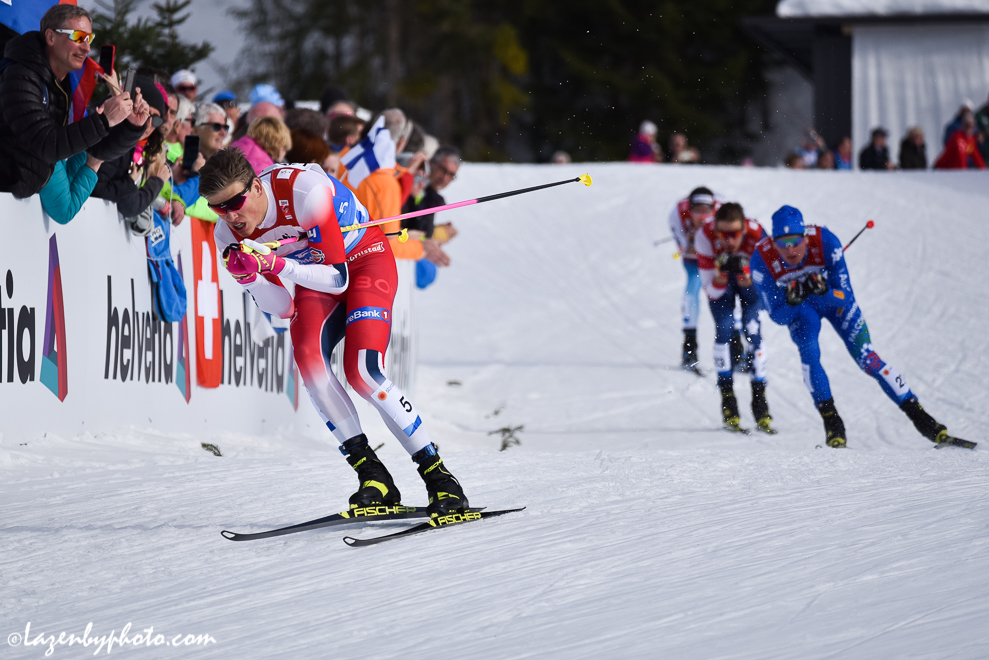
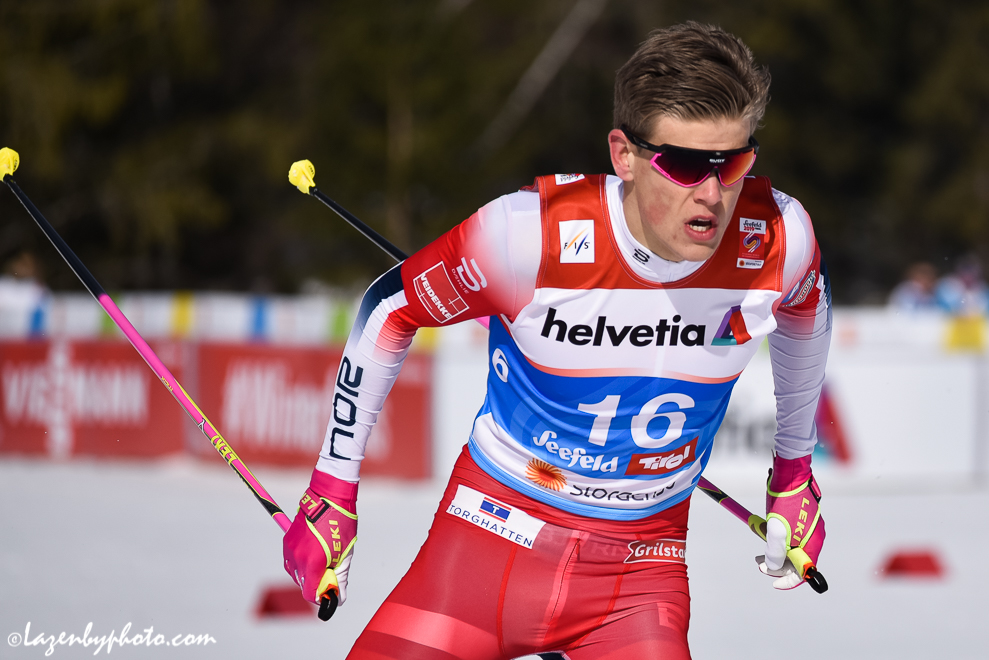
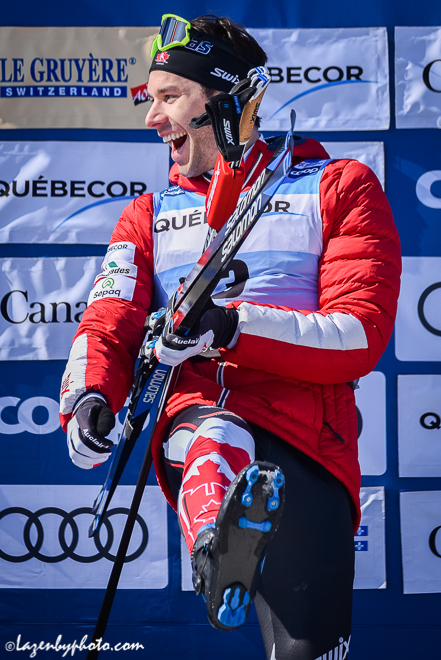
    One more riff: Harvey’s “air -guitar” remains in tune. (Photo: John Lazenby/lazenbyphoto.com)

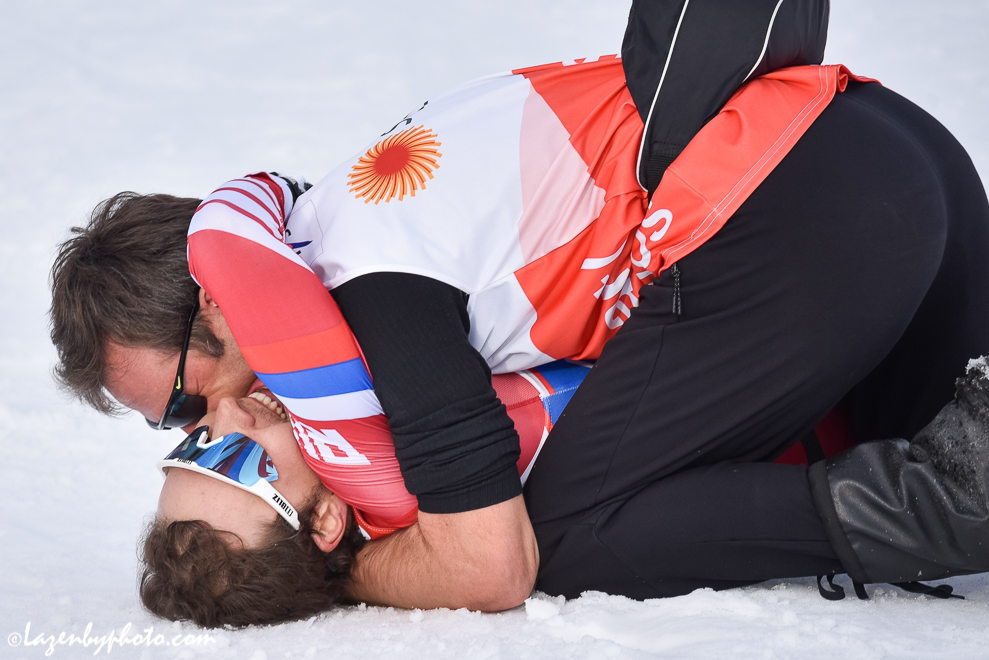
    Alex Harvey finished his career racing for Canada with a bang today in Québec City, Canada. Harvey placed second to Norway’s Johannes Høsflot Klæbo in today’s 15-kilometer freestyle pursuit. It was Harvey’s second podium in as many races as he can now claim a perfect ending to his career. Another solid ending went to Klæbo, who with his win today earned the overall World Cup title. Although the point differential lent an air of intrigue to the racing as Klæbo and Alexander Bolshunov of Russia were fighting for the overall title today, Klæbo’s knack for theater and endurance left nothing to doubt. Bolshunov placed third on the day and second in the overall standings. 

    “It was a cool race out there, Klæbo told FasterSkier after the race. “Bolshunov and Harvey were really strong and I think Bolshunov did most of the job today. On the second lap there, I felt the pace behind was quite high so I decided to let them in and I saw that when they took the head with me I felt like it was much easier to stay behind. This was a really cool race and it’s really cool to have Harvey on the podium again. I am really happy for him and it was important for me that he took Bolshunov as well. I was saying thank you to him after the race. I think he was really happy, he said so.”

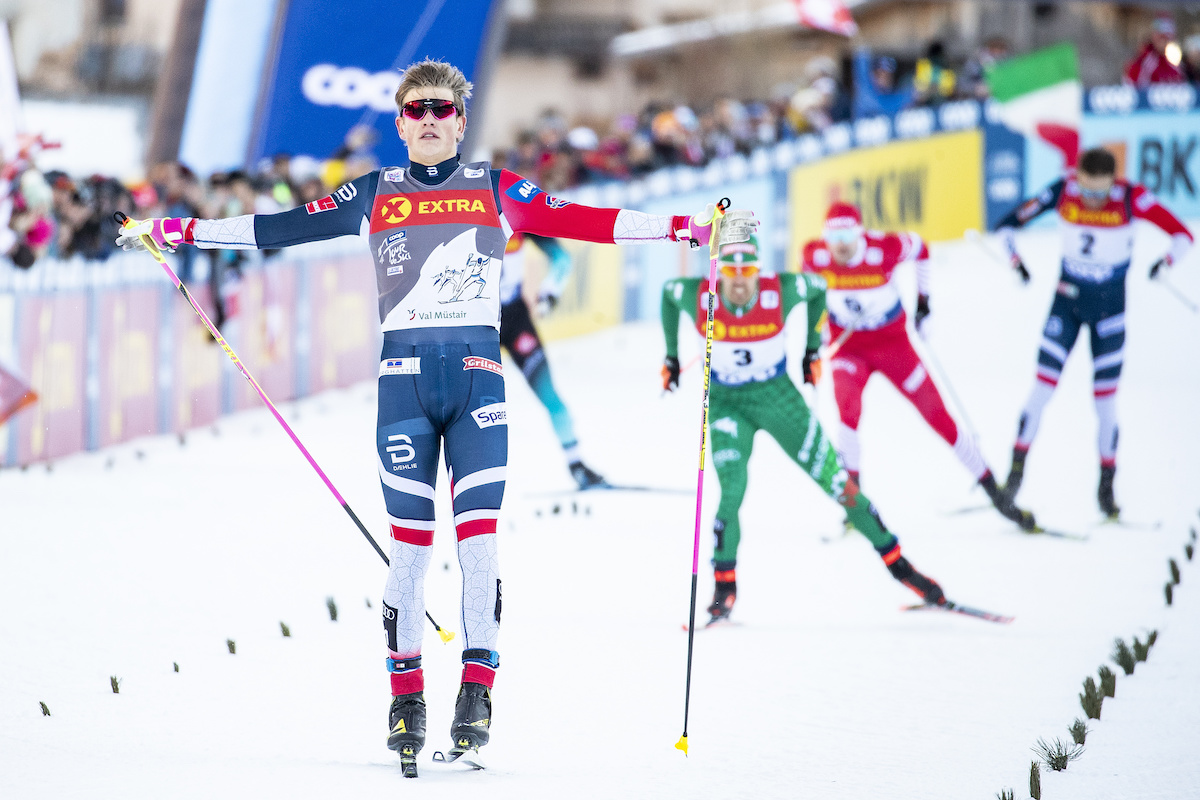
    For the Win. Johannes Høsflot Klæbo (NOR) wins the Overall World Cup Title at the World Cup Finals in Quebec City, Canada

    Klæbo’s sentiments weren’t guaranteed with Bolshunov as the chaser. Klæbo started the pursuit 52 seconds ahead of Bolshunov and Harvey. Because of this, Klæbo skied the first half of the race alone. But, in a chase lead by Bolshunov, Harvey and Bolshunov continued to make up time on the Norwegian. Just before the 8k mark, Bolshunov and Harvey came into eyesight of Klæbo and by the 8.2 checkpoint, the three skiers were skiing together. They were locked as a trio until near the finish.

    Bolshunov lead the second half of the race, with Harvey in second and Klæbo sitting in behind. But during the final climb, Klæbo found a last bit of energy and attacked, pulling ahead of Bolshunov and Harvey. He kept this lead to the finish, ending the race +2.8 seconds ahead of Harvey.

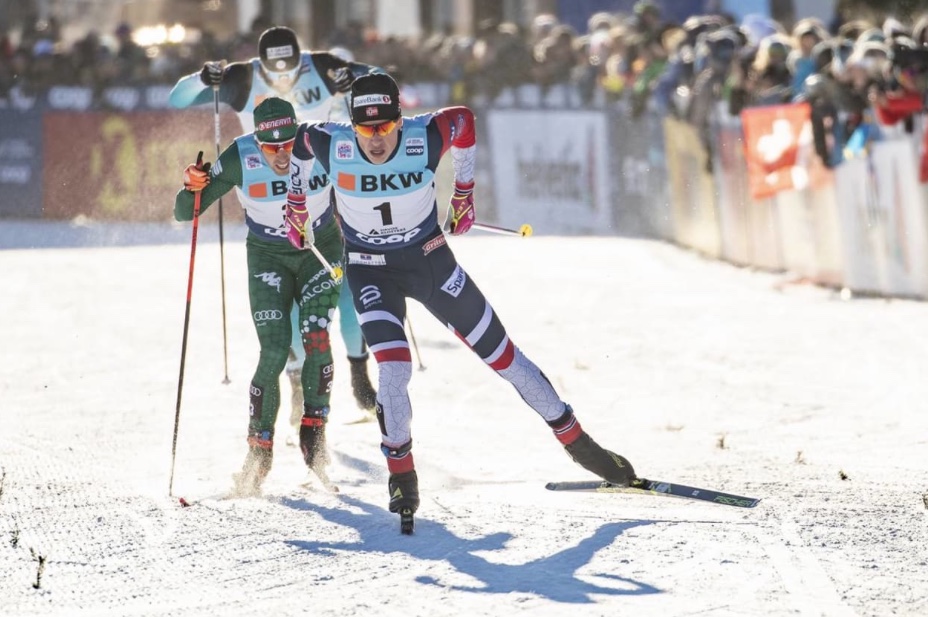
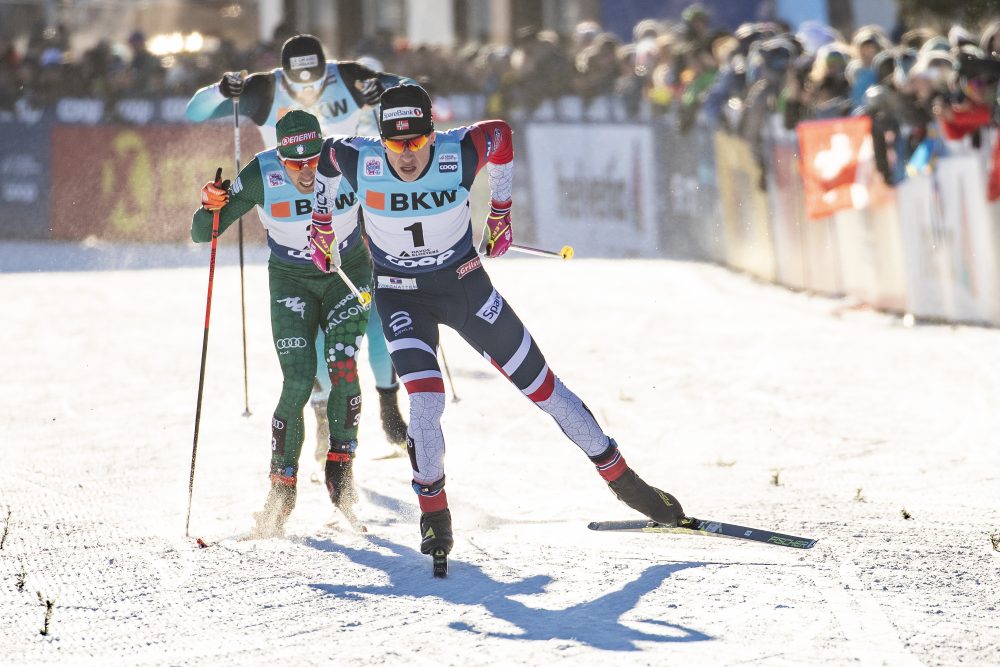
    Bolshunov seemed to have second place in the bag when he and Harvey came around the corner into the finishing stretch. Harvey came from behind with an inspiring final push and managed to overtake Bolshunov and grab second place. Today’s podium was the 28th and final podium of Harvey’s World Cup Career as he is set to retire at the end of this season. Bolshunov is ending his 2018/2-19 season with 10 podiums, five of which were wins.
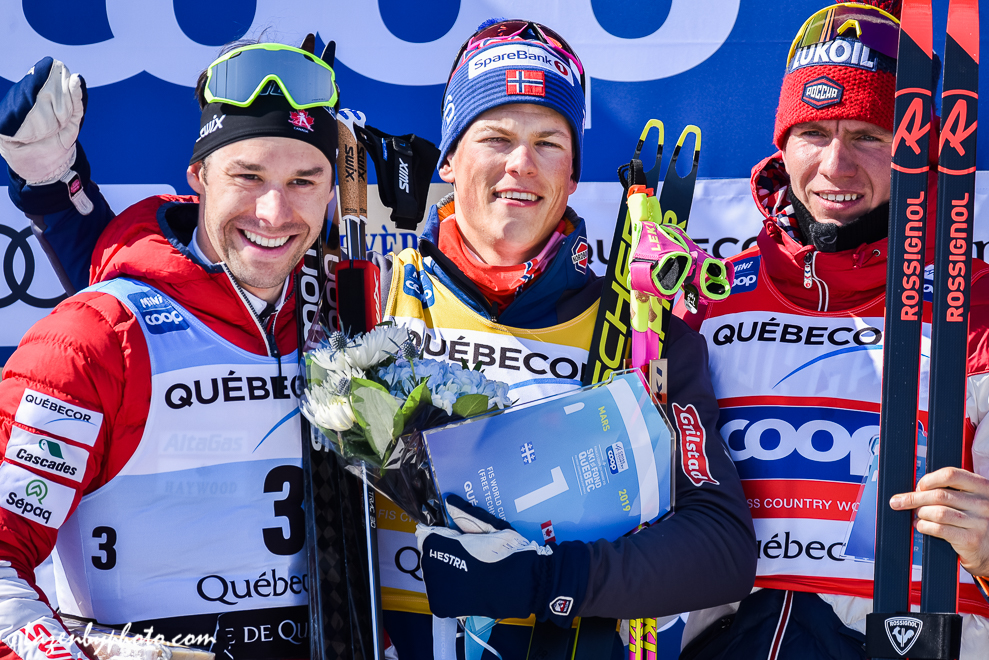
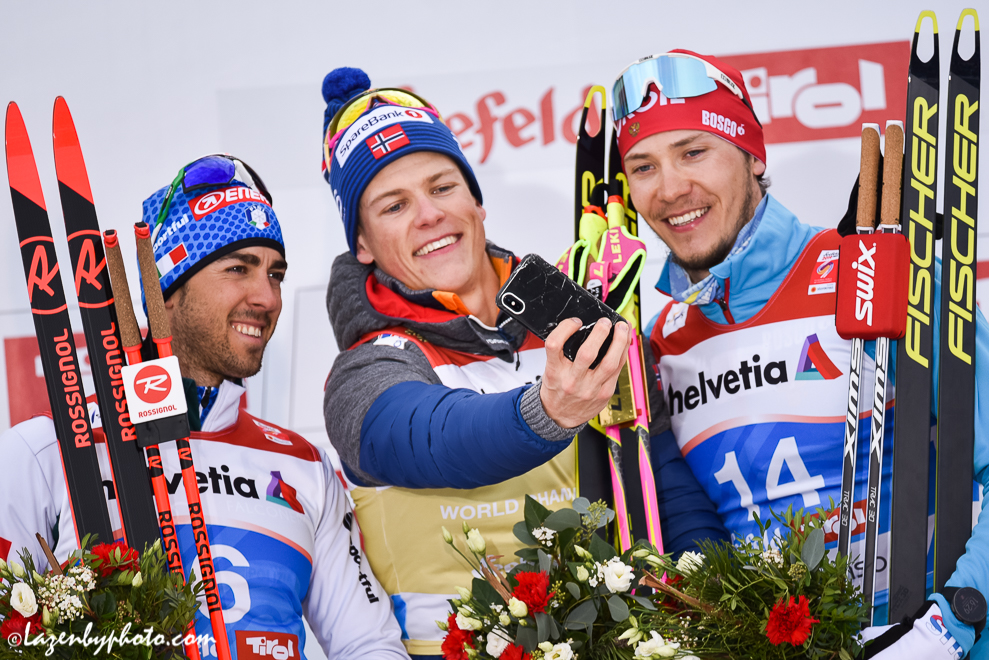
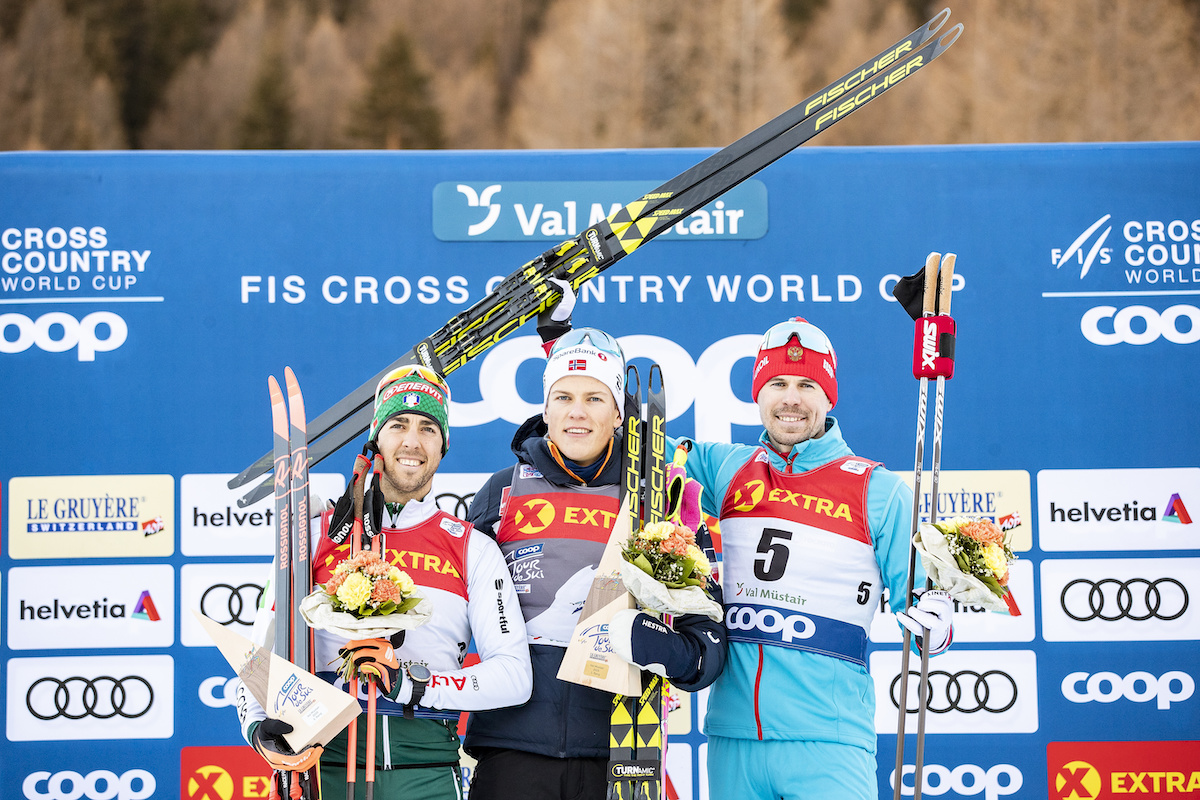
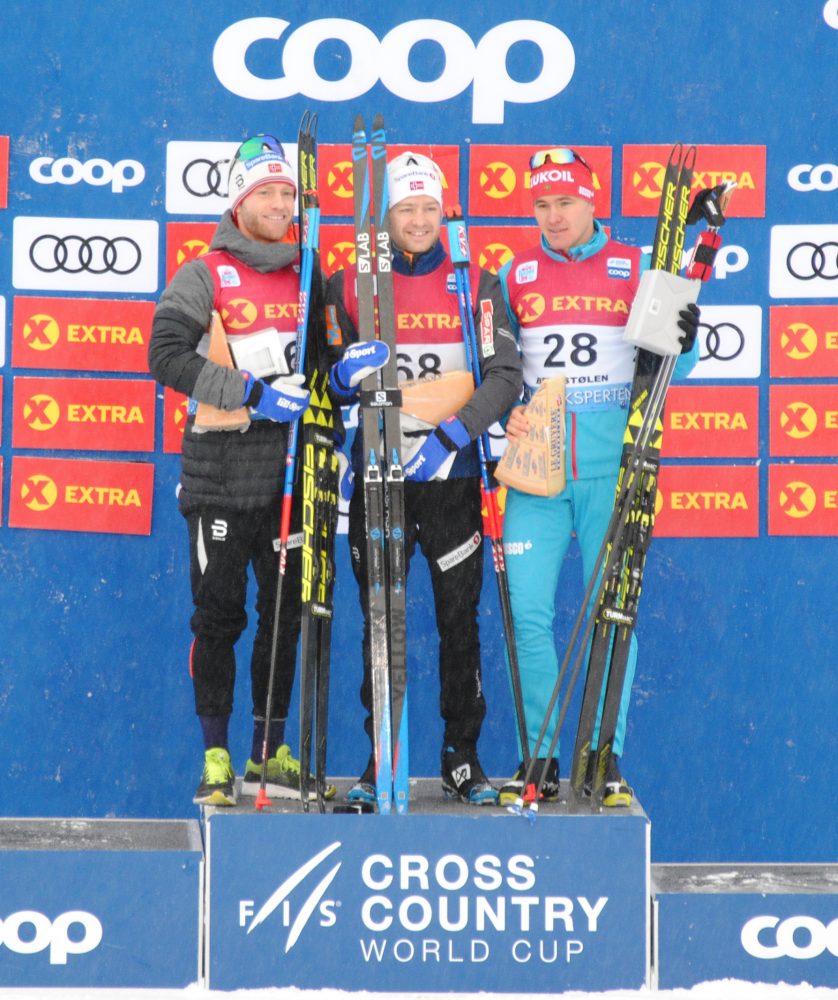
    All smiles at the end of the season. From left to right, Alex Harvey (CAN) was 2rd, Johannes Høsflot Klæbo (NOR) was 1st and Alexander Bolshunov (RUS) was 3rd.

    “I didn’t feel as strong today and I think that the pace behind was really high, so I decided to just let them get in and go behind and stay behind before the end there and then try to push all into the last uphill and before the finish there, “ Klæbo said of his race strategy. “The tactic worked quite good and it was even better to see Harvey beat the Russian guy, that was amazing.”

    Yet Klæbo qualified his statements to note that he harbors no deep-seated resent for the Russians. 

    “I don’t have any bad things to say about Russia at any time,” Klæbo said. “It’s good to have this type of duels I think. It’s really fun and exciting for the sport that we have this tight duel. I don’t know how many points it was at the end there, but I don’t think it was that much. It’s cool to have this type of competition and today was a lot of points to ahead today. The Canadian guys, it’s just friendly. No enemies at all, so it’s really cool and I think we all are very happy about Harvey and the way he can end his career.”

    Harvey and the podium stoke. (Photo: John Lazenby/lazenbyphoto.com)

    Harvey spoke to FasterSkier about his season and ending his career.

    “The last 5 months for me, basically since November, have been a struggle for me this year, so it’s a good way to end it. This is the best way to end a career with two podiums like that at home, so that’s the end.”

    The chase pack, consisting of Norwegians and Italians fought hard to gain time of the leaders, but in the end, the leader of the chase pack, Francesco De Fabiani of Italy, finished +1:13.3 behind Klæbo. Norway finished the day with six men in the top ten and Italy with two.

    lioresal

    Sjur Røthe was third in the Overall World Cup results. In today’s race, he was 10th, but he has won three World Cups and was second in a fourth race. Six Norwegian athletes finished in the top 10 of the season-long overall standings. De Fabiani and his teammate Federico Pellegrino were seventh and eighth respectively.   

    U.S. Ski Team member Erik Bjornsen was the next North American to finish, placing 20th. This is Bjornsen’s fifth top-20 this season.

    “It’s been kind of an up and down season,” Bjornsen said in the mixed zone. “I’ve usually been pretty consistent in the past and this seasons, there’s been a lot of doubts, I’ve also had some of my best results so I’m looking forward training harder this summer and having a little bit more of a relaxed summer and hopefully getting more consistent results next year.”

    Simi Hamilton placed 26th. Hamilton blasted the course to ski the third fastest time of day. Harvey and Bolshunov, wh0 turboed to catch Klæbo, were first and second respectively. Hamilton’s time of 28:48.9 was 33.5 seconds behind Harvey’s who skied the fastest time of day. British skier Andrew Young marked the fourth fastest time, 0.1 seconds slower than Hamilton.

    “It was good, it was really fun fast skiing, good course, short course, not a ton of climbing, but really rolly,” Hamilton said. “My skis were awesome, you never really know how a pursuit is going to go, just because there is so much that depends on the people you’re skiing with and obviously with the wind today it was just so good to be in someone’s draft, I was really lucky to start in front of the first wave so it was basically guaranteed to skiing with people the whole time and I felt great. It went awesome. It was a good one to end on.”

    Kevin Bolger and Scott Patterson skied together during today’s race, they finished 44th and 45th respectively. Also racing for the US were David Norris who was 55th, Logan Hanneman who was 65th and Ben Saxton who was 69th.

    The US started a number of athletes who are new to the World Cup circuit. The was the first World Cup weekend for Gus Schumacher who placed 52nd, Ben Ogden who placed 66th, and Peter Holmes who placed 70th.

    Schumacher spoke with FasterSkier after his race, “It was really good, I felt strong, and my skis were good. It was nice to just fight and race how I could. Yesterday was a little tough, conditions-wise, and today I just felt like it was kind of just me and my fitness out there.”

    The US Super Finals begin on March 28th in Presque Isle, Maine. These are the final races of the season for the U.S Ski Team.

    Men’s Results | Overall World Cup Standings- Men’s | Time of Day

  • Russia takes the Podium in Holmenkollen; Harvey 5th, Patterson 19th

    Russia takes the Podium in Holmenkollen; Harvey 5th, Patterson 19th

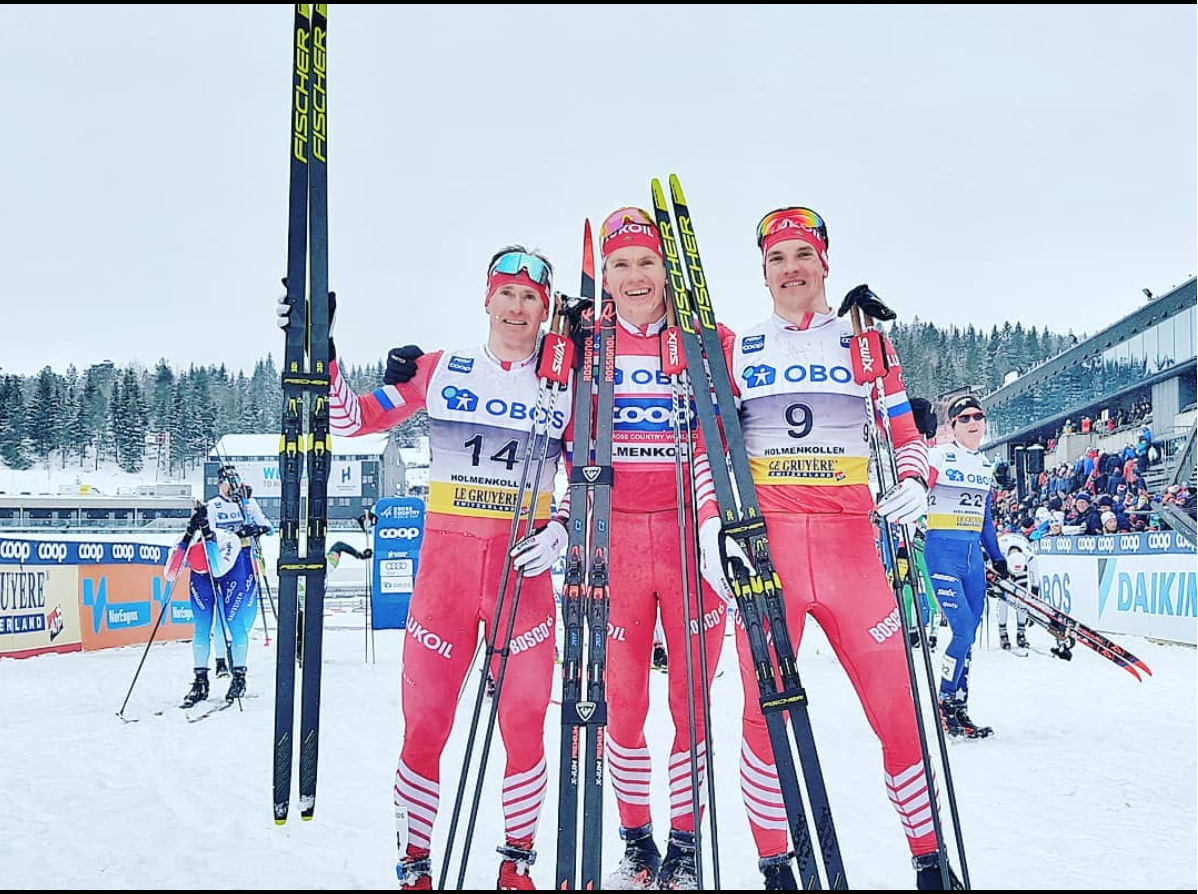
    A clean sweep for Russia today. From left to right, Maxim Vylegzhanin was 2nd, Alexander Bolshunov was 1st and Andrey Larkov was third. (Photo: Screenshot/ FIS Instagram)


    Russian skier, Alexander Bolshunov made history today during the Holmenkollen 50-kilometer classic mass start race. With his victory, Bolshunov became the youngest person and the third Russian to win the storied Holmenkollen 50 k. Bolshunov finished today’s race in 2:23:49.8 hours.

    For Bolshunov, who comes off a World Championships during which he won four silver medals, this was his fourth World Cup win of the season. The victory on Saturday reinforced Bolshunov’s lead in the World Cup distance cup rankings and he leapfrogged Norway’s Johannes Høsflot Klæbo for the overall World Cup lead. Bolshunov has amassed 1,230 points to Klæbo’s 1,181. Klæbo placed 38th in Saturday’s race.

    Bolshunov spoke about the end of the season and how he is approaching these finals races with a FIS reporter after the race, “At the end of the season, it is a necessity to show his best results each race and to fight in each race until the end and hopefully everything will be done.”

    The race featured no solo attack that could break away from the A-list of distance specialists. The lead was tossed around a number of times and for the first half of the race, Norway’s fans were treated to a 30-plus deep train of skiers engined by Sjur Røthe, Martin Johnsrud Sundby and Emil Iversen. But the ebb and flow of the 50 k allows skiers to sit in the pack, buy their time, conserve resources, then pounce.

    With 10 k to go, Russian skiers moved to the front, and began dictating the pace. At 1.6 k remaining, a Russian foursome consisting of Maxim Vylegzhanin, Andrey Larkov, Bolshunov, and Ilia Semikov were defining the flag waving rights on Norway’s holy-grail of ski loops.

    The race came down to the finishing stretch with Bolshunov charging into the finish, double poling all the way, and out sprinting his teammates to take the win. Vylegzhanin placed second and his teammates, Andrey Larkov and Illia Semikov, came in third and fourth respectively.

    This was the last World Cup race for Vylegzhanin who is retiring at the end of this season; this was his 24th podium in his career, but his first this season.

    https://www.allcreams.org

    Vylegzhanin spoke to a FIS reporter after the race, via a translator, “Of course it was a pleasure to see all the people coming to see me and congratulate me on the finish line and after the finish. The Russian team is very strong, we got all four places and we have many young potentials here who are proof that the Russian team is a very strong team. I started here at Holmenkollen in 2007 with the 7th place and since then I was getting 4th, 3rd, 2nd and actually it’s my best place to compete here.”

    Those skiing in the back of the well defined lead pack only began dropping off during the last 3 k. At that point, the Russians ramped up the pace and only Norway’s Martin Johnsrud Sundby, and Canada’s Alex Harvey were able to hang tightly connected to the Russians.

    The top 11 finishers were dominated by Russia and Norway. Russia took the top four spots as well as the tenth spot and Norway went 6, 7, 8, 9 and 11. Harvey was the only skier to break this pattern, finishing fifth overall.

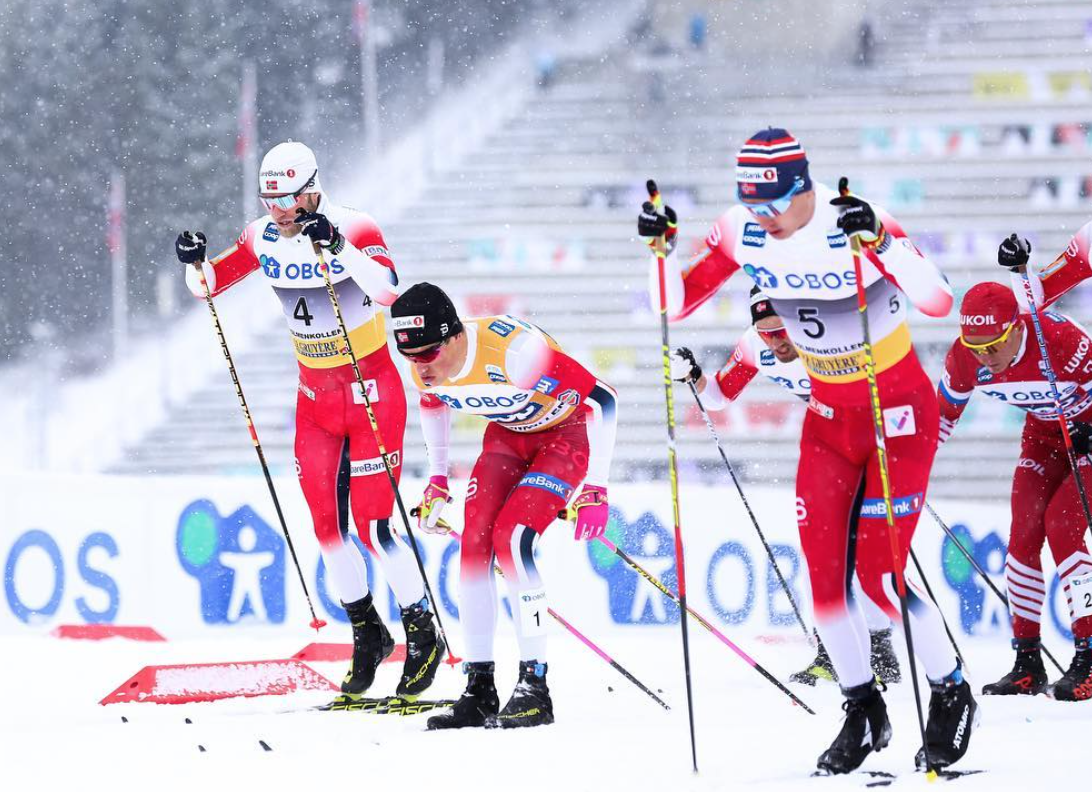
    Norwegian racers Marin Johnsrud Sundby, Johannes Høsflot Klæbo and Simen Hegstad Krueger starting the Holmenkollen 50k off strong (Photo: Screenshot/Holmenkollen Ski Fest Instagram/Jacques Holst)

    Harvey’s fifth place on Saturday matched his career best Holmenkollen 50 k finish — he was fifth during the 2011 Oslo World Chamionship’s 50 k skate. On Saturday, Harvey skied with the lead pack the entire race, sitting in the top 20 until the last 5k when he started making his way toward the front of the pack.

    “This year in classic, I never had good feelings really, so today was the first day I felt like I could actually race in classic, “ Harvey told FasterSkier in the mixed zone. “But of course, coming so close to the podium is always bittersweet. But the Russians, I think you could tell, had better skis, better glide. They were struggling on the kick but really high speed, so in the end they were really strong. So it was a really good race for me, but the podium was close, I could taste it.”

    He continued on, discussing today’s race pace, “It was a fairly easy pace the whole way. There was a huge group and guys were slowly getting dropped off the back, but there was never a big attack. So for me personally, I was in control the whole time, but I had good shape and pretty easy kicking skis.”  

    U.S. Ski Team member Scott Patterson finished 19th. This was Patterson’s best individual finish of the season. He skied with the lead pack until the last 3.75k, when he began to fall back.

    “This is my fourth time racing Holmenkollen, so I know that pack hangs on and people just start shooting off that back on the last couple laps,” Patterson told FasterSkier in Oslo. “So I figured I’d ski with that pack for as long as I could and hope I had energy for the finish. I think I did pretty good, I was pretty low on energy for that last 3.75, but it worked out pretty well.”

    Also for the U.S., David Norris (APU) finished 24th. For the Anchorage based skier it was a career best result on the World Cup. It follows a top-U.S. performance in last week’s 50 k skate at the Seefeld, Austria World Championships. Norris placed 20th in that event. 

    In Oslo on Saturday, U.S. skiers Adam Martin (CGRP) and Kyle Bratrud (SMS T2) were 31st and 40th respectively. Ben Lustgarten (CGRP) did not finish the race.

    Holmenkollen is a unique experience for races, with crowds, snow sculptures and bonfires lining the entire race course. It is essentially an end of season party for athletes and spectators alike.

    Norris commented on the atmosphere, “This is a highlight of the season. The crowd is so loud up top, and it’s so awesome to be here.”

    Harvey also appreciated the spectacle of the event, he told FasterSkier, “Having a little party is good for the sport, it make for good images. When the legs are screaming, to hear so much noise, it’s like you stop thinking for a bit, when you’re so exhausted, it kind of keeps you going.”

    Racing continues tomorrow in Oslo with the women’s 30 k classic.

    -Aleks Tangen contributed

    Men’s Results

  • Klæbo Claims First World Championship Title, Hamilton 9th Overall

    Klæbo Claims First World Championship Title, Hamilton 9th Overall

    Johannes Hoesflot Klæbo (NOR) winner of the men’s 1.6 k freestyle sprint at the 2019 World Championships in Seefeld, Austria. (Photo: John Lazenby/lazenbyphoto.com)

    It was a dramatic day at World Championships in Seefeld, Austria on Thursday. Norway’s Johannes Hoesflot Klæbo can now call himself a World Champion after a tactical and hard-fought victory in the 2019 World Championship 1.6-kilometer freestyle sprint. Federico Pellegrino of Italy won silver finishing 0.23 seconds behind Klæbo. Russian skier Gleb Retivykh placed third, 1.37 seconds back.

    Klæbo qualified fifth, then proceeded to win his quarterfinal and advance to the finals after placing second in his semifinal. This is where the day’s big drama played out.

    The semi was stacked: featuring Klæbo, Russia’s Sergey Ustiugov, and skate sprint crusher Federico Pellegrino of Italy. Atop the course’s first major climb at 1:38 minutes, the six skiers, led by Ustiugov came to a near standstill. The with a burst of V2, the Russian made his move, peeking under his legs to determine the damage as he descended.  Any lead Ustiugov gained had dissipated by the free-skating straight nearly 30 seconds later.

    When the distance back from Norway’s Johannes Hoesflot Klæbo is measured in meters – a win could be in play. Here Klæbo skis in his quarterfinal at the 2019 World Championships in Seefeld, Austria. (Photo: John Lazenby/lazenbyphoto.com)

    Coming into the tight right-hander that would swing skiers into the final climb, Klæbo slotted to the inside, his ski tail centimeters away from Ustiugov’s ski tip. The Russian stumbled slightly, as Klæbo kept his balance and V2 momentum — Ustiugov appeared to push off Klæbo’s back during the Norwegian’s move.

    Atop the final hill, Pellegrino sped down first with Klæbo in third and Ustiugov chasing. Pellegrino closed out the semifinal win as Klæbo placed second after an after-burner effort. As the skiers collected themselves after crossing the line, a visibly upset Ustiugov engaged Klæbo with several shoves in the finish pen. Ustiugov received a yellow card for pushing Klæbo during the race as well as a second yellow card for his unsportsmanlike conduct after the race. According to FIS and ICR 352.23, two yellow cards in one race results in a disqualification which is reflected in today’s results.  

    Klæbo described this event to the FIS reporter, “It was really strange, at the top [of the first hill] everyone was stopping and no one wanted to go first so we were just standing there and after some seconds, one person was going down and everyone was following him.”

    In the day’s sprint final, the podium places came down to the finishing stretch. Pellegrino’s raw speed was overcome by Klæbo just meters before the line. It was Klæbo’s first time competing at World Championships where he now compliments his three Olympic golds with a FIS championship medal. 

    From left to right, Federico Pellegrino (ITA) in second, Johannes Hoesflot Klæbo (NOR) in first, and Gleb Retivykh (RUS) third in Thursday’s World Championship skate sprint. (Photo: John Lazenby/lazenbyphoto.com)

    Pellegrino won last weekend’s World Cup in Cogne, Italy. As he remains on form, his second place today is his fourth World Championship medal. Pellegrino won both his quarterfinal and his semifinal. He won his quarterfinal easily, waiting until the last uphill to take the lead. As he gained distance on the final downhill he skied unchallenged across the finish line. He spent a good deal of his semifinal in the back of the pack, but he was able to maneuver his way towards the front right before the finish, and once again place first.

    For Retivykh, it was his first World Championship medal and his second individual sprint podium of the season. 

    Gleb Retivykh (RUS) celebrating his first World Championship podium finish. (Photo: John Lazenby/lazenbyphoto.com)

    Simi Hamilton was the best placed American in ninth overall. He qualified 11th and was fourth in his fast-paced quarterfinal. Hamilton snagged the second lucky loser position and moved onto the semis. He raced in the first dramatic semifinal with Klæbo and Pellegrino.

    Atop the first hill in his semi, Hamilton tangled with Pellegrino. Both skiers stayed on their feet, but Hamilton was unable to gain back his lost time as he placed sixth.

    “The quarter-finals were really tough, it was a fast heat,” Hamilton told FasterSkier in a call. “Viktor Thorn, I think because he had a really good qualifier, wanted to push the pace the whole time, so that made it really hard. But it also ensured that both lucky losers came from that heat. So I was really psyched about that. A top-10 at World Champs is a result you can be proud of. Obviously, I would have like to be in that final today, I think I’m still that caliber of skier but, it’s pretty cool being top-10, so I’m happy with today.”

    Simi Hamilton (USST) Skiing into 9th place overall in the World Championship skate sprint in Seefeld, Austria. (Photo: John Lazenby/lazenbyphoto.com)


    U.S. skier, Logan Hanneman (APU) qualified 20th today and finished sixth in his quarterfinal for 26th overall. It was Hanneman’s first World Championship start. At last weekend’s World Cup skate sprint, in Cogne, Italy Hanneman qualified 15th and placed 27th overall.  

    “The racing today was tough for sure,” Hanneman emailed. “I am sure that you have seen the course, but the guys course is very front-half heavy, with a large hill right out of the start. Last year when I raced the World Cup here, I found that I lost most of my time to the leaders from the start to the base of the large hill, so today in the qualifier my goal was to get to the hill as fast as possible, and then get up it. The rest of the course, I was just hanging out for dear life. I was so flooded!”

    Hanneman comes to this championship admittedly new to World Cup sprint heats.

    “It was only my second heat ever at the level, and the learning curve is steep,” he continued. “Obviously if I was faster and fitter, it wouldn’t be too much of an issue, but opportunities to pass are rare and come very quickly here, and I need to just be more confident in my abilities to take those windows.”

    Logan Hanneman of the U.S. skiing to 27th overall in Thursday’s skate sprint at the 2019 World Championships in Seefeld, Austria. (Photo: John Lazenby/lazenbyphoto.com)

    USST member, Kevin Bolger qualified 23rd today. He was in the first quarterfinal with Klæbo and Ustiugov where he placed fourth. Bolger finished 18th overall for his best result of the season.

    asthma inhalers online, zyrtec online

    “Great job by Logan and by Kevin in their first World Championship sprint heats,” U.S. Ski Team Head Coach told FasterSkier in a call. “Neither of those guys really have a lot experience yet skiing heats, they are at the place where they aren’t qualifying in the top part of the field yet either so it kind of makes sense that they are going to end up 5th or 6th in their heat until they can take another step forward in their qualification and also just build their experience and learn how to really ski in the heats with these guys.”

    Bolger told FasterSkier about his quarterfinal via email, “I picked Heat One because it looked like a A.) it would be a fast heat and B.) it looked like a competitive heat where the guys were going to ski and not play any games. Unfortunately, my time wasn’t fast enough to move on. Ustiugov made a move going up the first hill and I was wasn’t quite able to respond and get in the tail of it! But of course, I’m happy to have skied competitively with my heat!”

    U.S. skier Andy Newell was 41st in the qualifiers today. According to Grover, Newell is suffering from a back strain.

    “Newell has been struggling with a light strain to his back for a little bit here,” Grover said. “So I think if he had been healthy, he’s easily qualifying material. Then you go into a world championship field with only four starters from each nation, he would have easily made that. So bummed for Andy that he wasn’t 100% healthy and ready to really unleash it today, it would have been awesome to have four guys in there.”

    For Canada, Alex Harvey, who announced he will retire from the World Cup after the finals in Quebec this March, placed 16th overall.

    “It was a good start today and the body felt really good,” said Harvey in a Cross Country Canada press release. “I just wanted to come in today and get some good feelings heading into the rest of the championships. I did that so I’m happy.”

    Men’s Results

  • Niskanen Wins Cogne 10 k Classic; Brennan 21st

    Niskanen Wins Cogne 10 k Classic; Brennan 21st

    https://www.fis-ski.com/en/cross-country/cross-country-news-multimedia/news/2018-19/niskanen-fahndrich-and-nepryaeva-win-at-cogne-10km-c
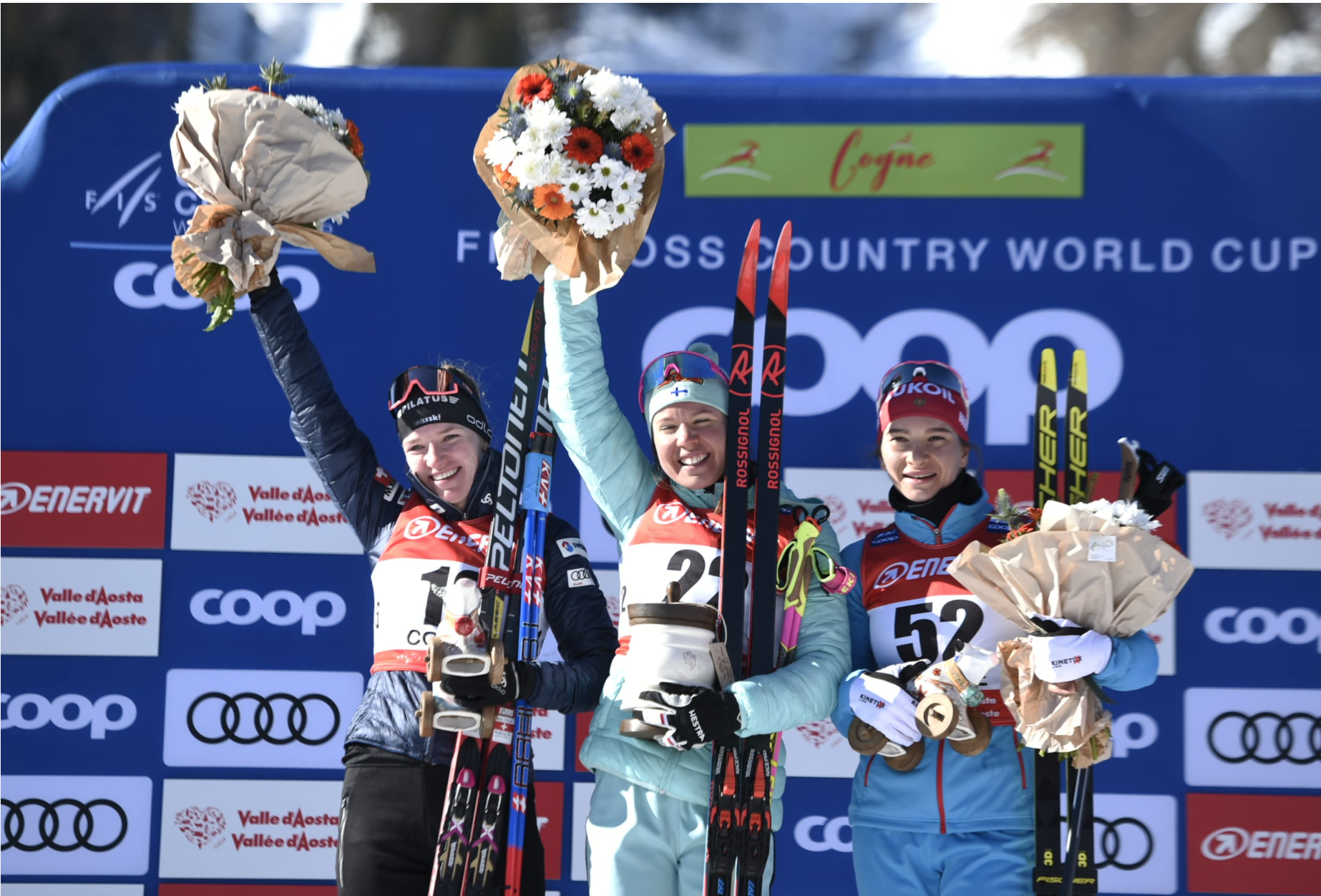
    From left to right, Nadine Fähndrich (SUI), Kerttu Niskanen (FIN) and Natalia Nepryaeva (RUS) on the podium for the women’s 10 k classic race in Cogne, Italy. (Photo: Screenshot FIS/NordicFocus)

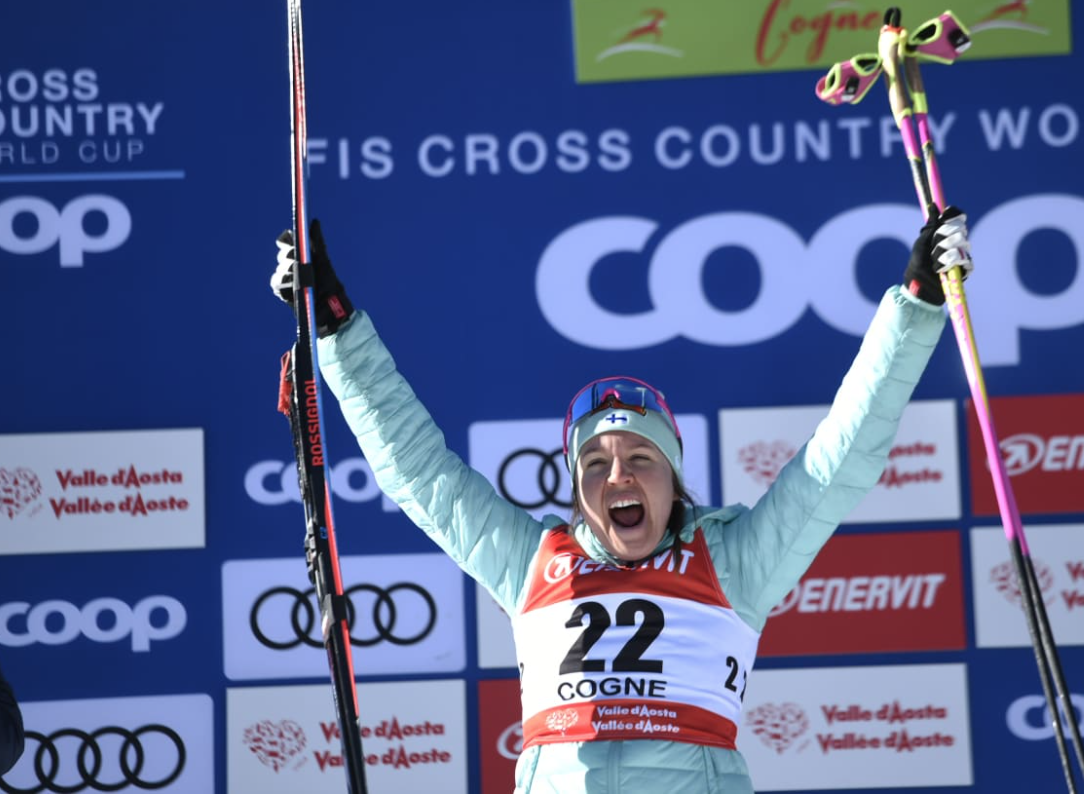
    World Cup racers in the Cogne, Italy 10-kilometer classic individual start enjoyed blues skies and sunshine on Sunday,  the temperate weather seeming to have carried over from Saturday’s sprint. Winning the women’s race was Finland’s Kerttu Niskanen in a time of 27:24.8. The victory is Niskanen’s second individual World Cup win–her first came five years ago in the Lenzerheide, Switzerland 10 k classic.

    With Sunday’s 10 k the final World Cup regular season race before World Championships, which is set to kick-off next Wednesday, Feb. 20 in Seefeld, Austria, Niskanen explained in a post-race interview with the International Ski Federation (FIS) that she feels ready for the upcoming World Champs competitions. 

    “Some weeks ago, I felt like Seefeld was too far away. I was so tired at the beginning of the season and I had to totally rest,” Niskanen told FIS. “It was not an easy time, watching the TV when others skiers were racing. So, now I feel good and I’m happy to travel to Seefeld.”

    https://www.fis-ski.com/en/cross-country/cross-country-news-multimedia/news/2018-19/niskanen-fahndrich-and-nepryaeva-win-at-cogne-10km-c
    Finland’s Kerttu Niskanen is all smiles after her win in Cogne, Italy (Photo: Screenshot FIS/NordicFocus)

    Starting in bib 22, Niskanen was chasing down the times of Switzerland’s Nadine Fähndrich, who started in bib 16, and Sweden’s Frida Karlsson who started in bib 20. By the time Karlsson came through the halfway point, she was up on Fähndrich, who came through four bibs earlier, by 3.1 seconds. Niskanen, who came through two bibs after Karlsson, was down on the Swede by 3.9 seconds.

    By the 8 k mark, however, Karlsson’s pace had fallen back and Fähndrich’s time led hers by by 10.6 seconds. Niskanen had also gained steam. At 8 k, she was down on Fähndrich by a mere 0.8 seconds. In the next 2 k, Niskanen managed to outpace the Swiss skier, besting Fähndrich by 3 seconds for the win. According to the FIS database, Sunday’s second place finish is Fähndrich’s first individual Top 3 on the World Cup circuit–although she posted the fastest time in Saturday’s sprint qualifier. 

    Following Fähndrich, Russia’s skier, Natalia Nepryaeva, finished third today, 12.6 seconds behind Niskanen. Nepryaeva, who started in bib 52, was 13.2 seconds down on the race leader, Karlsson at the halfway point. By 8 k, she had the third fastest time and maintained that position until the finish. Including Sunday’s result, Nepryaeva has landed on the podium seven times this season, four of those in the 10 k classic discipline. 

    https://www.fis-ski.com/en/cross-country/cross-country-news-multimedia/news/2018-19/niskanen-fahndrich-and-nepryaeva-win-at-cogne-10km-c
    Russian skier, Natalia Nepryaeva skiing to a third place finish on Sunday. (Photo: Screenshot FIS/NordicFocus)

    The top North American finisher on Sunday was Rosie Brennan who placed 21st (+1:19.6) Brennan has had 11 individual finishes in the World Cup Top 30 this season, her strongest result being 11th in the Lillehammer 10 k freestyle back in December. In bib 26, Brennan was skiing outside of the Top 30 by 1.5 seconds at the 2 k mark, though by the halfway point, she was ranked with the 17th fastest split. With 2 k to go, she was 10 seconds away from being in the Top 15. 

    “The course was very unique with lots of twists, turns, and transitions which isn’t always a strength of mine so I think I didn’t ski those sections as well as I would have liked,” Brennan wrote to FasterSkier in an email. “I love racing at altitude so I wanted to push the pace early on to see what was possible. I think I did that well but struggled with my skis a bit and struggled to keep pace on the transitions.” In today’s reality, getting a so-called "casino bonus" – is quite easy. Licensed platforms themselves will offer nice gifts as a thank you for your play! To find out more about the best bonuses on modern online gambling platforms, the service https://ranking-kasyn-online.net/bonusy-kasynowe/ will help. Thanks to it, you can not only look at the current casino bonuses on the market, but also understand which online gambling platforms offer the best conditions for you!

    Finishing 13.4 seconds outside of scoring World Cup points in 33rd (+1:44.6) was Canada’s Katherine Stewart-Jones.

    “Yesterday’s sprint was rough, my legs felt heavy and body felt tired so I was surprised with how much better I felt today” Stewart Jones wrote in an email on Sunday. She competed in Saturday’s sprint and finished 51st.

    “My skis were awesome so that definitely gave me a boost of confidence,” Stewart-Jones continued. “I am feeling fit and healthy so I am super excited for World Champs. I am mostly looking forward to the 10 km classic and the relay.

    “Distance classic races are my strongest event but the relay is always the most fun, there is something special about being able to race for the teammates you train with all season,” she added. “We have a really strong women’s team this year and we are all looking at improving our result from World Champs 2 years ago.”

    The next North Americans to finish were Caitlin Patterson, Rosie Frankowski and Julia Kern skiing for the U.S., with Patterson placing 36th (+1:49.6), Frankowski 37th (+1:55.2) and Kern 39th (+1:59.2). Canada’s Cendrine Browne placed 48th (+2:49.0), while the U.S.’s Ida Sargent finished just behind her in 49th (+3:12.3). Canadian Emily Nishikawa started Sunday’s 10 k race but dropped out after the 8.2 k mark.

    “I was really excited for today’s race, the course had long gradual climbs and was well suited for power striding which I like to do,” Kern wrote in an email to FasterSkier. “I was feeling pretty good in the warm up, but felt a little tired in the race and also I was the first starter so I didn’t have anyone to chase. I ski best when I am chasing people or skiing with people, but I still tried to push hard. I didn’t have the race I hoped for, but it was really nice to get another race effort in before world champs and it is leaving me hungry for more!”

    Results

  • Diggins Wins Cogne Sprint; U.S. Puts 6 Women in Top 30

    Diggins Wins Cogne Sprint; U.S. Puts 6 Women in Top 30

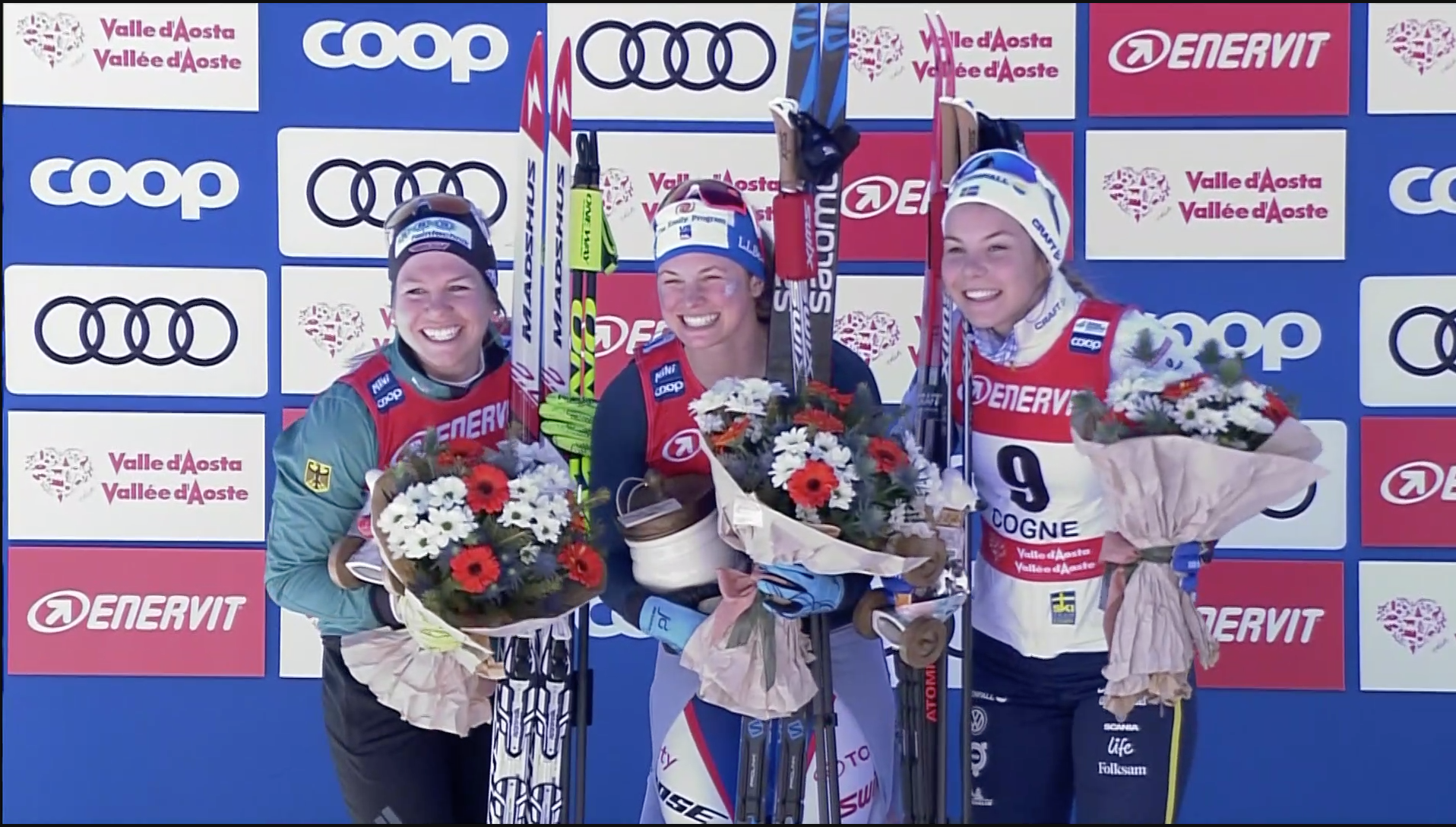
    left to right Sandra Ringwald (GER), Jessie Diggins (USA), and Johanna Hagström (SWE). (Photo:Screenshot)

    Until the very end of Saturday’s 1.6-kilometer freestyle sprint race in Cogne, Italy, American Jessie Diggins had those watching on the edge of their seats. She advanced as the lucky loser in her quarterfinal and then once again in her semi final, before winning the final in a lunge to the line.

    “Man I am glad they do lucky  losers here!” Diggins told the International Ski Federation after winning Saturday’s sprint. “It’s so fun to be in Italy, I love it here, your pasta is the best! Thank you guys for cheering so loud, this was a lot of fun!”

    Diggins started the day by qualifying in seventh, 5.18 seconds off of the fastest qualifying time of 3:37.06 posted by Switzerland’s Nadine Fähndrich. She was then slotted into the first quarterfinal along with Germany’s Sandra Ringwald, Norwegians Ane Appelkvist Stenseth and Anna Svendsen, Russia’s Natalia Nepryaeva, and Diggin’s U.S. Ski Team teammate, Ida Sargent. Diggins crossed her quarterfinal in fourth, behind Ringwald in first, Nepryaeva in second and Appelkvist Stenseth in third. The fast times in Quarterfinal 1 produced two lucky losers: Appelkvist Stenseth and Diggins. She had secured a spot in the semis. 

    Matched up against U.S. teammate, Sadie Bjornsen in Semi final 1, Diggins crossed third behind Ringwald in second and Bjornsen first. The fast times, however, once again worked in favor of Diggins and she advanced to the finals as a lucky loser.

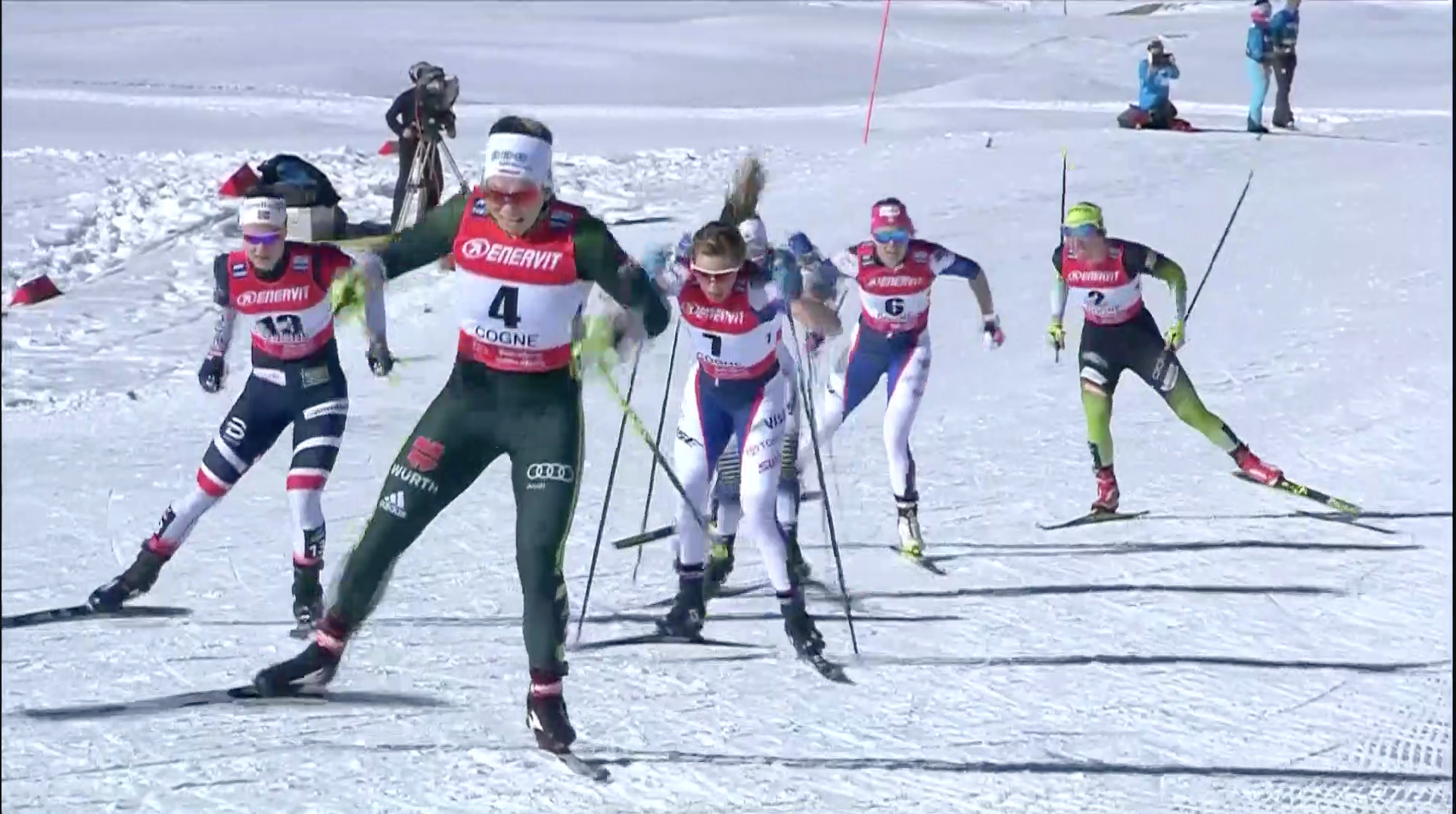
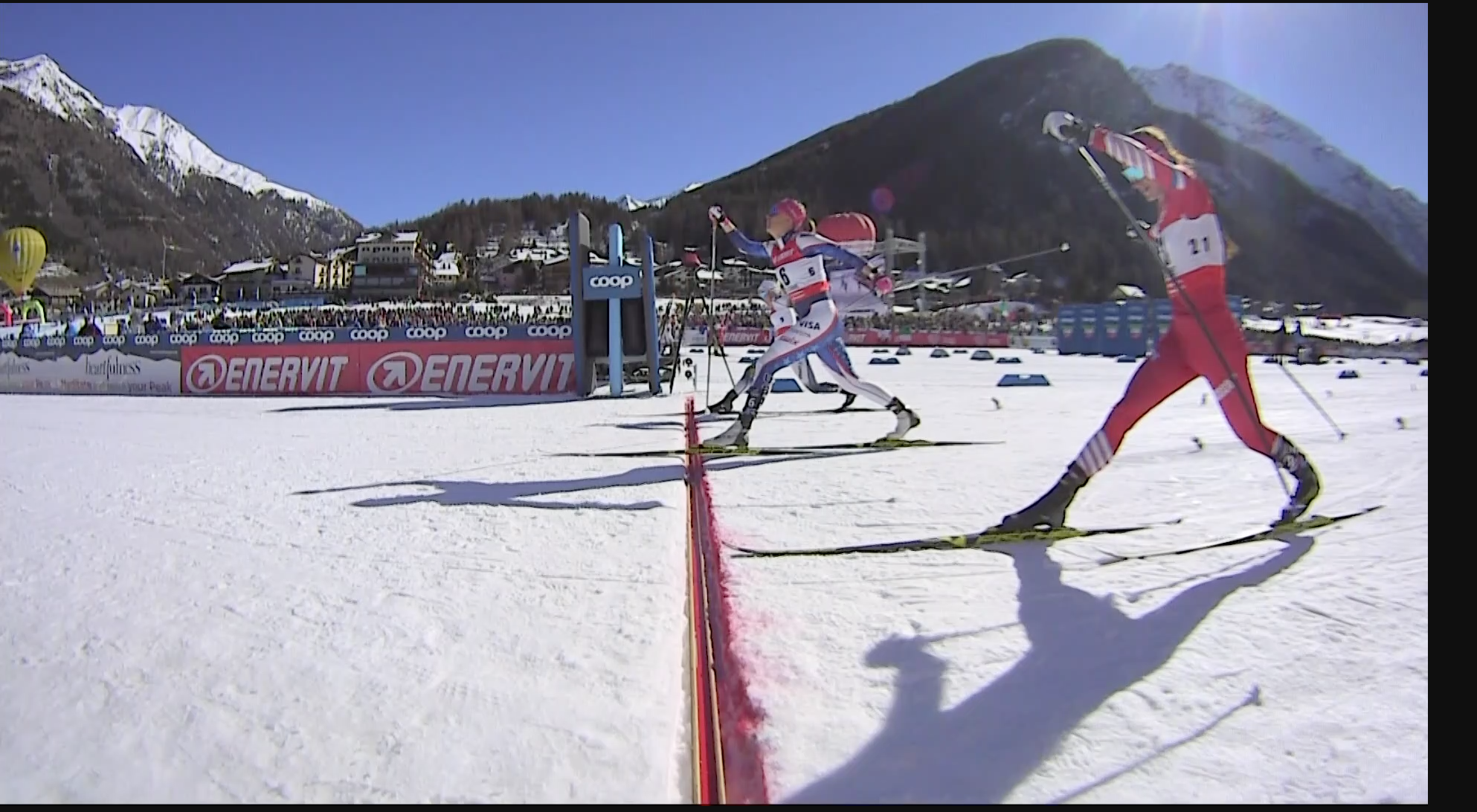
    During the final, it appeared Germany’s Sandra Ringwald was on her way to the win. She made her move in the course’s major climb, gapping the field by a little more than a meter. Chasing her down were Diggins, Appelkvist Stenseth and Sweden’s Johanna Hagström. By the last hiccup of a hill before the finishing stretch, however, Diggins was closing in. With 100-meters to go she trailed the German, but by less than half a meter. The two lunged for the line, with Diggins bringing in the win. This is the first individual World Cup sprint victory for Diggins, and her first win of the 2018/2019 ski season. 

     “Honestly, there have been lots of ups and downs this year,” Diggins told FIS after her win. “I’ve been sick a lot, there has been a lot of doubt, and sometime losing my self-confidence. So it’s good to remember you don’t know what’s going to happen until the last 100-meters of any race, and you just have to believe in yourself and keep pushing the whole way.”

    Finishing in second place overall, 0.11 seconds behind Diggins was Ringwald. After qualifying in fourth, the German skied smooth and strong, winning her quarterfinal and crossing second in her semi final. Her second place finish in the final is her first individual World Cup podium–in 2017 she earned a second place with Team Germany in the 4 x 5 k relay in Ulricehamn and in 2016, she and Hanna Kolb, who retired this spring, partnered up to take third in the Planica Team Sprint. 

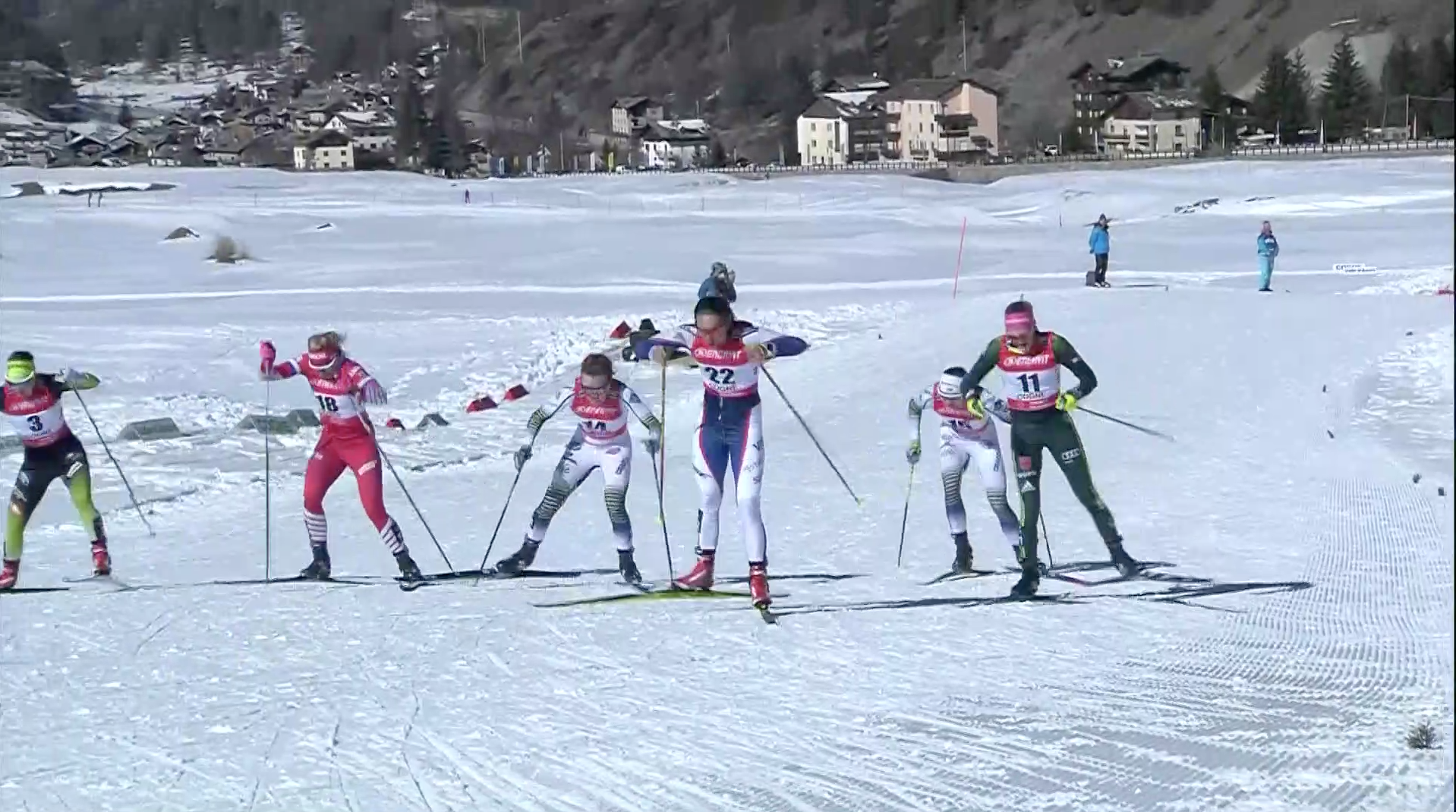
    Sandra Ringwald (4) leading the pack, but Diggins (7) is close behind. (Photo: NBC Screenshot)

    Following Ringwald, Sweden’s Johanna Hagström, crossed third on Saturday, 0.86 seconds back from Diggins. After qualifying ninth, Hagström crossed her quarterfinal in second. She went on to snag a lucky loser spot from her semi final to advance to the final. This is also her first individual World Cup podium finish. 

    Racer’s enjoyed blue skies and warm temperatures in Cogne on Saturday. When prompted about the course conditions Diggins told FasterSkier during a phone conversation that “It was incredibly hot, everyone was making fun of me because I was rubbing handfuls of snow over my neck and my arms, I was so hot, it was ridiculous out there, it felt like skiing in April, so sunny and gorgeous.”

    These warm temperatures made for changing snow conditions, but according to Diggins, the USST wax technicians had no problem keeping up.

    “Halfway through rounds we switched skis and switched structure, and they kept keeping up as the course was breaking down in the sun, and that was really impressive,” Diggins said. “With a long gliding downhill, you needed the speed today. My Salomon boards were smoking today, and I really needed that in the finishing stretch.”

    “I’m just really grateful to them for all the hard work that they are always doing, you don’t see it on the TV, but you know there is a huge team of people there, just working so hard, and definitely skiing way more the we are,” Diggins added.

    The next American finisher was Bjornsen who ended the day in fifth, 2.32 seconds behind her teammate Diggins. With World Championships taking place in Seefeld, Austria next week, a few U.S. skiers chose to sit out last weekend’s World Cup races in Lahti, Finland and partake instead in a training camp in Davos, Switzerland. Due to that camp, Bjornsen indicated during a phone conversation with FasterSkier that she “didn’t really know what to expect today.”

    Sadie Bjornsen (USA) lunging for the win in her quarterfinal, against Johanna Hagestrøm (SWE) and Yulia Belorukova (RUS). (Photo: NBC Screenshot).

    “I’m definitely starting to feel a bit better than I have for a while, so I was encouraged by that,” Bjornsen said. “I was pleasantly surprised to find quite good feelings today, so that’s really nice right before World Champs.”

    Prior to Saturday, Bjornsen explained  that her race strategy was to lead as little as possible during the heats. However, that changed, she said, after she saw her teammates Diggins and Sophie Caldwell ski their quarterfinals. also talked

    “It looked so stressful to me to try to make moves, so I ditched my plan and decided I was going to go back to my leading plan and I’m really happy I did,” Bjornsen said. 

    “In the semifinal, I tried a new tactic to try to stay in the front, but maybe not the front-front because we had a stacked semifinal and that also worked quite well, and I saw that I had some extra power in that final uphill so when I finished my semi I was like ‘oh man, I can win today, I feel amazing!’” she said.

    By the final, however, Bjornsen’s energy  reserves were burning low.

    “Going into the finals, I could feel right away a little bit of a power outage, but when I went over the top of the climb, I was like ‘the race is not over until it’s over so I’m going to keep fighting because I know I can be strong until the last uphill,’” she said.

    In the final uphill Norway’s Appelkvist Stenseth maneuvered in front of Bjornsen, breaking her momentum. 

    “Getting stopped like that and having to go again, I didn’t have that final gear to do that,” Bjornsen said. 

    Following the two women in the final, the U.S. had four more top 30 results, with Julia Kern placing just outside the top ten in 11th, Sophie Caldwell 17th, Ida Sargent 24th and Rosie Brennan 27th.

    Racing in Quarterfinal 4, Kern was up against Germany’s Laura Gimmler, Sweden’s Linn Sömskar and Moa Lundgren Russia’s Tatiana Aleshina and Slovenia’s Alenka Cebasek. In the first climb, Kern charged to the front and kept the front charging pace through skied into second place during her quarterfinal. In the second semi final, Kern crossed sixth to place 11th overall. 

    “I was in the fourth quarterfinal so I was able to watch the heats before me on the jumbotron and get advice from my teammates who raced in the earlier heats. We noticed that people were getting boxed in so my tactic was to ski as close to the front as possible. I ended up leading my quarterfinal, similar to what Sadie’s tactic ended up being in her quarterfinal.”

    Prior to Saturday’s finish, Kern’s career best World Cup result came in the Dresden city sprint this year where she finished 19th. 

    Julia Kern (22) taking the lead before the first climb during her quarterfinal. (Photo: NBC Screenshot).

    Caldwell crossed fourth in her quarterfinals and did not advance to the semis. Brennan and Sargent also did not advance past the quarterfinals.

    “I love racing in Italy!” Brennan wrote in an email to FasterSkier. “It’s beautiful here and the courses are quite different from many other World Cup courses so it’s been a great change of pace.”

    Brennan was one U.S. athlete who chose to sit out last weekend’s World Cup races in order to complete the Davos training camp.

    “I had a great training camp in Davos and am feeling much better so I was optimistic for today’s race.” Brennan said. “The qualifier went well and I’m always excited to get a shot at the heats. I did a really poor job of skiing to my strengths in my heat and struggled a bit with my skis so I am disappointed in how things went there. I am excited to see where my distance shape is tomorrow!”

    Also skiing for the U.S., Kelsey Phinney finished in 33rd, 1.03 seconds outside of qualification.

    Four Canadian women raced on Saturday, with Dahria Beatty leading the way in 38th. The next Canadian finisher after Beatty was Cendrine Browne in 48th, followed by Maya Macisaac-Jones 49th and Katherine Stewart-Jones 51st.

    Results: Women’s Qualifier | Final

  • Norway goes One-Two in Lahti Men’s Team Sprint

    Norway goes One-Two in Lahti Men’s Team Sprint

    https://www.fis-ski.com/en/cross-country/cross-country-news-multimedia/news/2018-19/norway-and-sweden-for-the-win-at-lahti-team-sprint-c
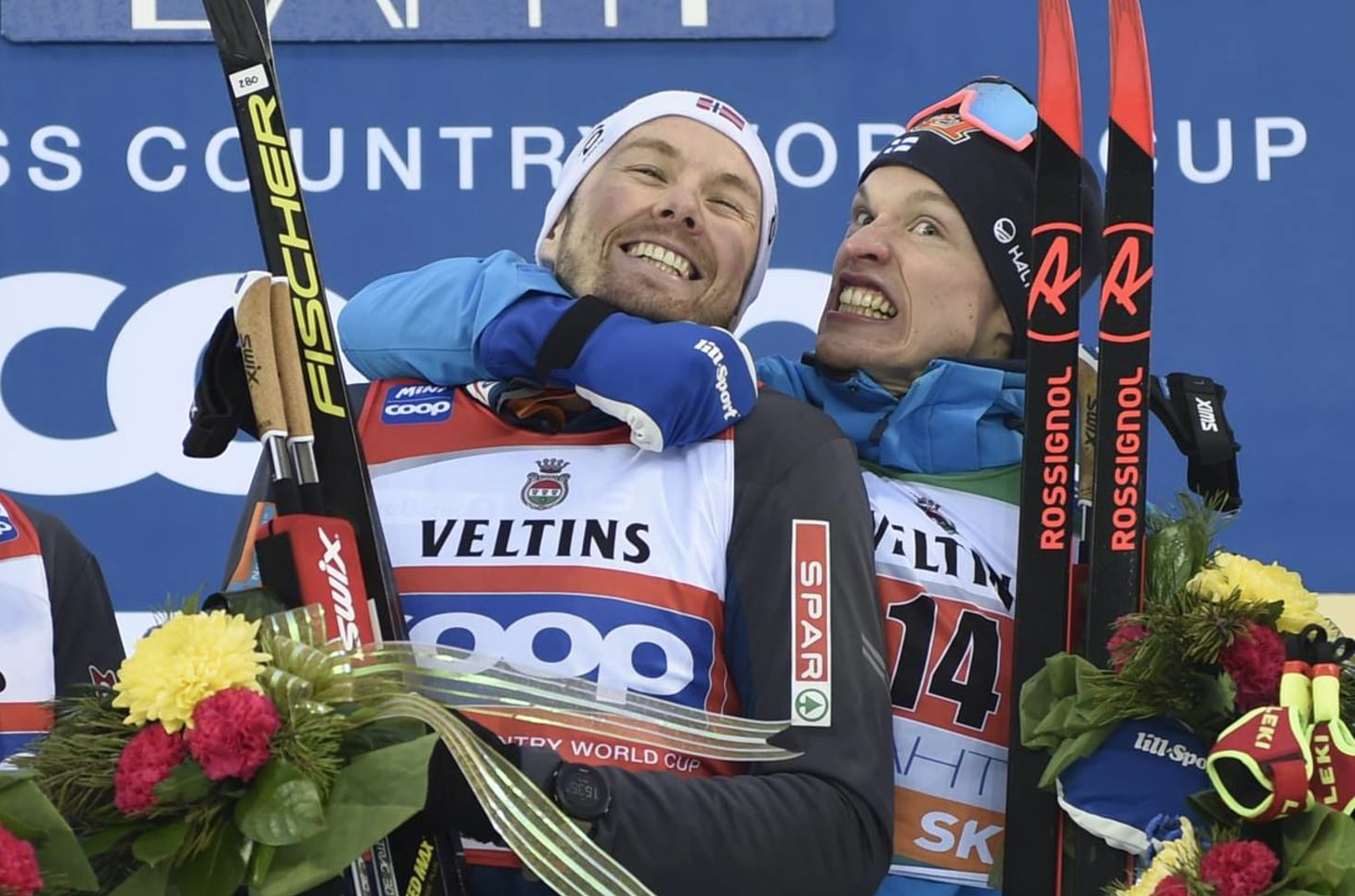
    Emil Iversen (NOR) and Iivo Niskanen (FIN) happy with their podium finishes (Photo: fis-ski.com screenshot)

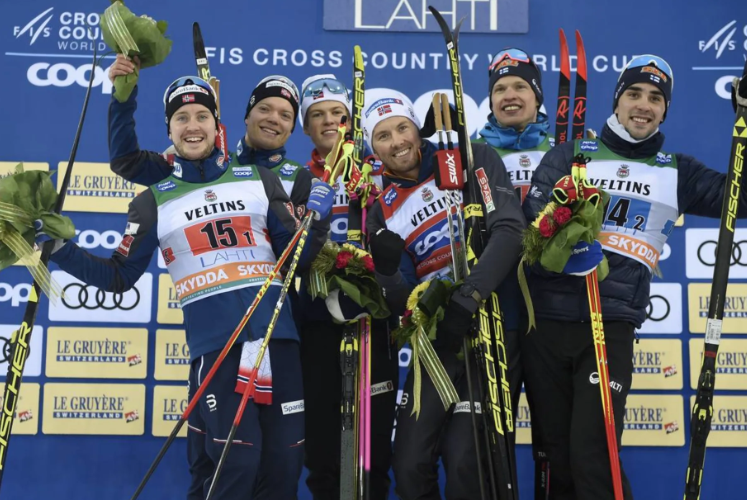
    Norway placed first and second in today’s World Cup 6 x 1.6-kilometer classic team sprint in Lahti, Finland. Skiing for Norway I were overall winners Emil Iversen and Johannes Høsflot Klæbo. They won the ten team final in a time of 18:57.19 minutes. In a photo finish for second place, Sindre Bjørnestad Skar and Eirik Brandsdal of Norway II finished 0.65 seconds back to take the second podium step. Iivo Niskanen and Ristomatti Hakola of Finland placed third (+0.71). 

    On the way to the win, Norway I won their semi-final with of a time of 19:22.32, 0.63 seconds ahead of Germany. Norway II, on the other hand, came in third in their heat to first place Russia I and second spot Finland I.

    The finals were marked by several teams vying for the lead. In six lap race, with each athlete skiing three 1.6 k legs, the team sprint favors those with endurance and traditional flat-out World Cup speed. At times, the Swedes, the Italians, and Russians all made plays for the lead. None were able to make any advance stick or discourage Norway I.

    Norway II, the second overall team on the day, held a more conservative approach in the final. Coming into the start of the third lap, they were positioned in eighth. They began to surge toward the front during the race’s second half, moving into fourth after 4.8 k. During the final two laps, they maintained their position near the front. At the 17:40 minute point of the race, as Klæbo stamped his aerobic mark on the race with a surge on the final climb, Norway II tried to match the tempo, but sat in fourth. 

    At the hairpin turn atop the climb, where skiers began their long descent into the stadium, it was two team race for second with Klæbo meters ahead. 

    Finland I, in second as the skiers descended, skied a tactfully sound and uptempo race.  Niskanen was the smart-choice Finnish anchor as he raced the fastest lap time of the race (3:16.04 minutes) during his last lap.

    Finland came into the finish with what looked like a lock for second. But Norway II’s Brandsdal put on a sprint finish double pole clinic topped with a perfect out stretched toe and lunge at the line to take the second spot ahead of Finland I.

    2019 Lahti, Finland’s World Cup classic team sprint podium. From left to right, Norway II in second, Norway I in first, and Finland I in third. (Photo: fis-ski.com screenshot)

    USA I and USA II were in the same semi-final today: Simi Hamilton and Erik Bjornsen filled out USA I while

    Kevin Bolger and Logan Hanneman skied for USA II. USA II placed sixth and USA I was right behind, placing seventh in the semi-final. Neither team advanced to the finals. Take a look at the top gambling sites that you may find from India. This platform suggest only safe casino sites which you can gamble at regarding the circumstances with online gambling legislation.

    Bolger discussed the snow conditions via email, “Conditions were very wet, and sloppy which made it a Klister day.” Bolger also explained how condition affected skis today, “I felt like I had a really good A and B pair of skis coming into the race which made it easy on my tech Oleg to make sure that for each of my relay legs I had ripping fast skis — and I did, so a  huge shout out to him for giving me some of the best skis today!”

    On his final lap, Bolger skied the fastest lap time of his cohorts in a mark of 3:09.0 minutes.

    “Logan, this was the first team sprint he’s done, and he was impressive today,” Whitcomb told FasterSkier in a call. “He wasn’t quite good enough to advance past the semis, but he was close and he just got over here, so it’s a very good sign for him.”

    Hamilton also touched base with FasterSkier after the race, via email.

    “I was disappointed with how the race went today,” Hamilton emailed. “Erik skied really, really well and kept us in contention, but I came up short. I haven’t been feeling great all weekend, and the conditions, especially today, were a bit tough for me.”

    Hamilton took the month of January to focus on training and hasn’t raced a World Cup since January 1st.

    “I’m hoping that this weekend was just me blowing some cobwebs out of the body and the head,” Hamilton added. “I also haven’t raced a classic race since early December (and haven’t raced a classic sprint yet this year if you don’t count Ruka, where I had a fall at the start), so I felt quite rusty. Training has gone really well in the last couple weeks, and from everything I’ve gathered from hard workouts in the last 10 days, I know I’m fit right now. I think it’s just a matter of getting my sprint gear back which I may have lost a bit in the last 6 weeks.”

    Whitcomb summed up today’s results with this statement, “While the results were a little bit disappointing today in Lahti, I really believe we have a team that is well prepared for World Championships, we like to go to going into the Championships having knocked a few races out of the park and we had a couple hits this weekend, but not as many as we intended to. So we will be looking to swing hard in Cogne. I feel very confident about our Seefeld championships with this team, its a strong crew.”

    The World Cup will be move to Cogne, Italy next weekend before heading to Seefeld, Austria for World Championships.

    Men’s Results

  • Wednesday Workout: Race Prep with UNM’s Kornelius Grov

    Wednesday Workout: Race Prep with UNM’s Kornelius Grov

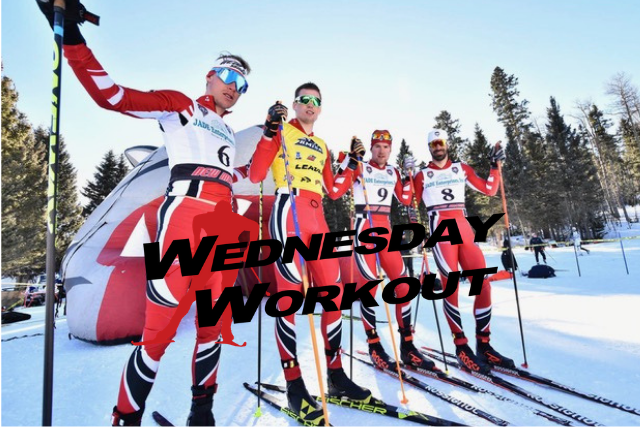
    University of New Mexico’s Men’s Team, from left to right, Ben Berend, Kornelius Groev, Johan Eirik and Ricardo Izquierdo-Bernier (Photo: Ben Berend)

    For this week’s Wednesday Workout, FasterSkier talked to University of New Mexico (UNM) racer Ben Berend about how his teammate, Kornelius Groev, the fastest skate skier on the RMISA circuit this season, gets ready for a race weekend. We are already over halfway through the collegiate race season and Groev has established himself as a favorite for NCAA Championships, which take place at the University of Vermont in early March. Groev has won every single skate race on the RMISA college circuit this season. Groev is twenty-two years old and hails from Norway. Free online slots on a special site, https://reallybestslots.com/ many game providers with the ability to play a demo version or try to catch your luck and play for real money.

    Here’s Berend with this week’s Wednesday Workout:

    “By February the work has already been put in and many of us know if we are slow, fast, or not fast enough; the thing is, in February you are what you are. Kornelius Groev, he is FAST. So this week we are going to share some pre-race intervals from the fastest guy around, Kornelius Groev, known to his teammates as Big Fudge, Kelly Slater, or Korn Dog.

    The workout:

    2 x 6-8 minutes Level 3 (3-minute rest in between)

    4 x 4 minutes Level 4 (2.5-minute rest in between)


    The idea here is to get a solid amount of time in Level 3 to start the workout. Please, don’t spend any time in Level 4 during the first two intervals… please. All of us can keep up with Kornelius during these L 3 intervals.

    After two really solid L3’s, Kornelius moves onto the second part of the interval session- 4 x 4 minutes L4. If this was a movie, here is the part where All Along the Watchtower by Jimmy Hendrix starts playing. Korn Dog goes really fast, nobody can keep up. Do you catch the drift? Very controlled in L3, almost conservatively so, then go HARD during the L4 section.

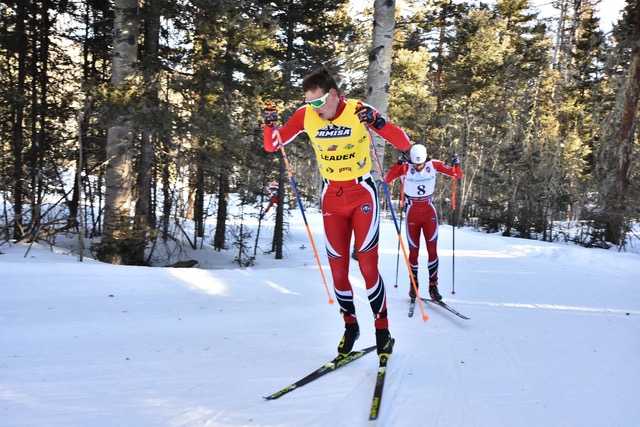
    Kornelius Grov (UNM) skating to another victory in Red River, New Mexico (Photo: Ben Berend).

    These intervals work well in between race weekends as a way to help the body stay awake without overdoing anything. Many of us have started to use these intervals as well, hoping to magically turn into Kornelius overnight.  We do a lot of these sessions on rollerskis, because we live in Albuquerque, New Mexico where it is 50 ℉ for the majority of the winter. So, if you are like us and don’t have access to snow on a race week don’t stress out; rollerskiing and running work as well. One thing we have all learned here at UNM, lack of snow doesn’t factor into results.”

    Workout written by: Ben Berend

  • Taylor Fletcher: Finding Strength after Loss

    Taylor Fletcher: Finding Strength after Loss

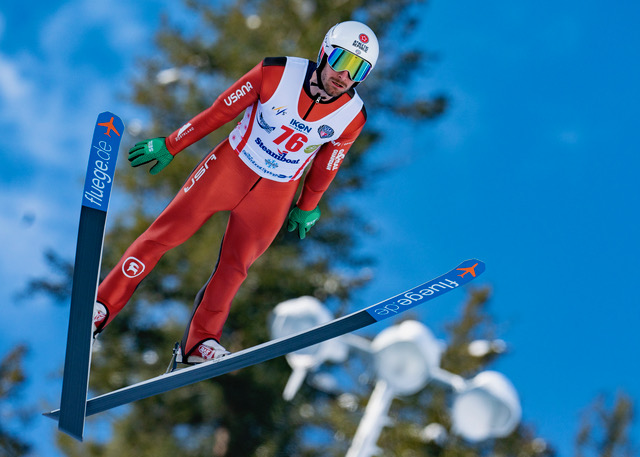
    Taylor Fletcher soaring in Steamboat Springs, Colo. at the 2018 Continental Cup (Photo: Ben Pieper)

    Twenty-eight-year-old Taylor Fletcher has been nordic skiing and ski jumping nearly his entire life. He grew up training and competing in Steamboat Springs, Colo. He has been racing World Cups since 2010 and is a three time Olympian.

    The 2018/2019 season has been his best yet. Fletcher began his season with two Continental Cup victories, one in each of his “hometowns”, Steamboat Springs and Park City, Utah.

    He has also brought a renewed spirit to his skiing and jumping. His ski times on the World Cup are blistering, with top-five and fastest times of day within reach. He posted two top-20 World Cup results in January.

    This past October, Fletcher’s father Tim passed away after a hard fought battle with ALS. Family remains important to Fletcher. His father’s passing affected him both mentally and physically but he is able to find strength from his loss and is able to transfer his feelings into his skiing and jumping.

    At the conclusion of an Olympic cycle in 2018, the U.S. Nordic Combined Team lost several athletes to retirement — most notably his bother Bryan. Team veterans Ben Berend and Adam Loomis also moved on from the sport. These vacancies made room for a few younger racers like Grant Andrews and Jared Shumate.

    FasterSkier connected with Fletcher in late January for an interview to discuss his season, his father’s passing, and the new team dynamic.

    FasterSkier: You started the season with wins in the two places you call “home”, how did that feel?

    Taylor Fletcher: Competing at home is always a dream. 2006 was the last time I had a international competition in Steamboat. It was a great honor to compete there after my father passed away and even better to honor him with a victory and second place.

    FS: How have you been processing the loss of your father and how has losing him impacted your training and racing?

    TF: It’s been tough, after he passed I was actually in Slovenia for a Grand Prix and he passed the day after my competition there. One of his last wishes was to have me stay over and continue training and continue progressing over here. But, emotionally, physically and mentally there was no chance that I could do that. And so it was important for me to go home to be able to regroup, refresh, kind of focus again and that was a good opportunity for me to do that. Every single one of my flights was delayed, I missed two of my flights because of those delays, so it was a challenging day.

    He wants me to continue skiing, he wants me to ski as long as I can and that’s my goal, to honor that. He’s definitely a big motivator for me, he’s a big reason why I’ve had a better season than the last couple of years. It’s because I have his thoughts and the motivation from him, so that’s been great.

    But, the day after he passed, I tried to go out and do some training sessions and there was no chance that I could train at all. I tried to do an intensity sessions and about a quarter of the way through it, I stopped and I just looked at myself and I was like “what am I doing?”.

    There comes that time for everyone, luckily mine hit me at a good spot and everything surrounding his passing was exactly what we were hoping for, it was super peaceful. I got to talk to him, or I was telling him some stories and he was actively listening and heard everything.

    It was funny, I was actually on a ski resort in Slovenia here and we knew that it was coming time, that it might be a day, or it might be a week, we didn’t really know. It was about five minutes after I got back from the resort that I was told give him a call to say my final words and it was about five minutes after I hung up the phone that he passed. He was definitely waiting for me to talk to him. I know Bryan had talked to him as well.

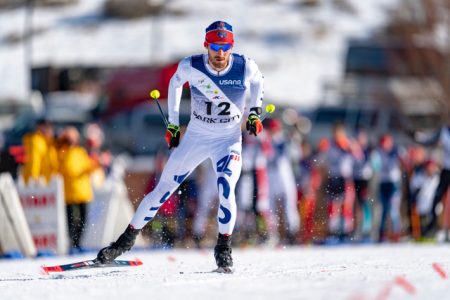
    Taylor Fletcher Skiing in Park City’s 2018 Continental Cup (Photo: Ben Pieper)


    FS: A few of your teammates retired at the end of last season and the USA Nordic gained a few new guys, how has that been? How is the team dynamic this year?”

    TF: Losing Bryan [Fletcher], Adam [Loomis], and Ben [Berend] was a big blow to our team as we already have a small team. Having a big team is nice as they all want to succeed and it helps motivate you through the tough times. But unfortunately there is always a time when someone has to call it and unfortunately that happened on the same year. The team dynamic is great, its a young group of guys that want the best and push each other to be the best!

    FS: Do you miss competing with your brother?

    TF: Always, yeah. We pushed each other on a regular basis and that’s definitely different. But at the same time, it’s a little bit nice because we always seemed to bicker with each other when we were traveling. He always wanted to give me as much advice as possible, which was great. But now I have the free reign to do what I want and not have his input all the time. Don’t get me wrong, I really wish Bryan was still skiing and I wish Adam [Loomis] and Ben [Berend]were still skiing.

    FS: What were your goals going into this season?

    TF: It’s solely focused on World Championships, getting goals along the way, scoring points every weekend, jumping better and racing fast and being one of the fastest racers all year. And, so far, I feel like my goals are in line but I desperately want a World Championship medal of my own, an individual one. I’ve got some work to do, but that can come on the jumping side because I think the cross country side is there.

    FS: What about 5 year goal/plan?

    TF: Basically, I want to have this year as a year to have as much fun as I possibly can, and make it like those days at Howelsen Hill as part of the [Steamboat Springs] Winter Sports Club. And then I’ll decide from there whether or not I can continue doing that. In reality, we all want to have as much fun as possible and we all know that having fun can breed good results and success. So having this model going forward I think is good for me both mentally and physically and it allows me to do what I want to do and that’s what’s most important.

    Taylor Fletcher smiling after a soaring jump (Photo: courtesy USA Nordic)

    FS: What has been your favorite moment of the season so far?

    TF: I think my first competition jumping in Lillehammer, Norway, I jumped to 16th, which was actually a career tie. But the highlight was having the second longest jump of the whole field. I want to have more days like that for sure, but that was a pretty good day for me, definitely a peak day and those are always hard to come by. But at the same time, I know that I did it once, so I can do it again.

    FS: What races are you looking forward to this season?

    TF: Seefeld, Austria for World Championships is definitely the one I’m looking forward to the most, good race course, beautiful venue, tons of snow this year. So I just hope I can put it all together on that day and come out successful.

    FS: You have had some of the fastest ski times on the World Cup- how does knowing you can kill on the ski course affect your jump prep? Official German shop of Maral Gel – http://maral-gel.com/DE

    TF: It’s just one less thing I have to worry about, kind of a Forest Gump quote there. But I can just focus on my jumping and not have to really rely 100% on cross country to get things done. That makes it easy for me, the more I can think about the jumping side, the easier that will get.

    Four World Cups remain for Fletcher before World Championships take place in Seefeld, Austria.

  • Russian Teams Take the Top Two Spots in Ulricehamn; U.S. in 13th

    Russian Teams Take the Top Two Spots in Ulricehamn; U.S. in 13th


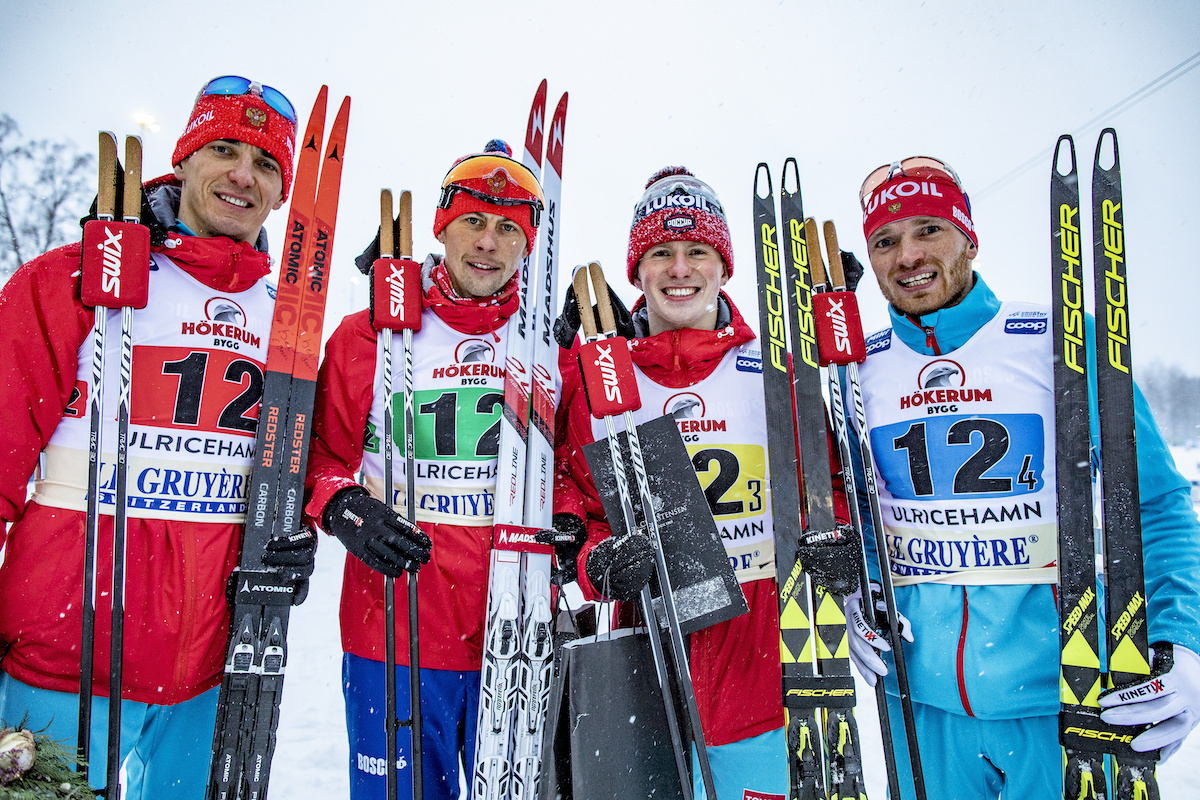
    The Winning 4 x 7.5 k Russian relay team at the Ulricehamn, Sweden World Cups: from left to right, Evgeniy Belov, Alexander Bessmertnykh, Denis Spitsov and Artem Maltsev. (Photo: Fischer/Nordic Focus)

    Today in Ulricehamn, Sweden, the men skied a 4 x 7.5- kilometer relay in unsettled conditions. Racers dealt with harsh conditions as the wind howled and heavy snow fell. With a softened course, it appeared most teams struggled with kick on the steeper climbs.

    Scott Patterson of the U.S. Ski Team (USST) commented on the conditions via email, “the race conditions were interesting with both falling snow and blasting wind. The organizers re-groomed the course in between the women’s and men’s races which did improve things, but the downhill corners were chopped up and soft.”

    Russia II took the victory today in a time of 1:17:53.2 minutes with Evgeniy Belov, Alexander Bessmertnykh, Denis Spitsov and Artem Maltsev.

    The winning team was followed closely by their teammates on Russia I; Andrey Larkov, Alexander Bolshunov, Andrey Melnichenko and Sergey Ustiugov.

    Atypically, Norway had a rough start to the day – more on this in a bit — but the entire team put in a massive effort to claim third place. The Norwegian team consisted of Hans Christer Holund, Didrik Tønseth, Sjur Røthe and Simen Hegstad Krueger.

    The Russian teams lead the entire race, flip-flopping between leaders. Russia I and II worked together throughout, but Russia II had superior fitness. With each Russia II surge, Russia I was unable to match the pace. In the closing k’s, Russia II charged for the finish. Russia I couldn’t hold on. Russia I finished 20.8 seconds behind.

    During the initial lap of the scramble leg, the entire field remained close-knit. Only at the start of the second lap did both Russian teams, along with Sweden I, begin to gap the field. The Russians were able to hold this lead throughout the race. As the race progressed, and the pacing screws turned, Sweden was unable to match the Russians as they faded to place fifth overall (+1:39.6).

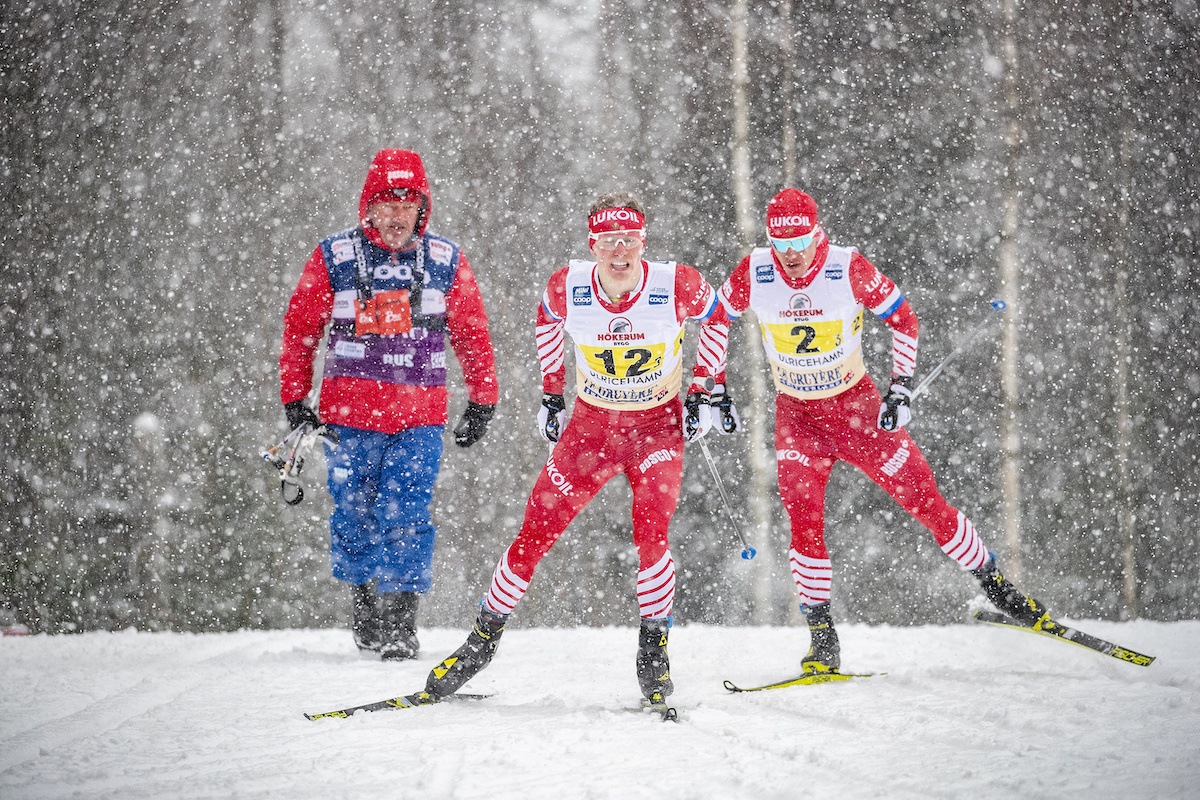
    Russia’s Denis Spitsov (bib 12) and Andrey Melnichenko (bib2) leading the men’s 4 x 7.5 k relay in Ulricehamn, Sweden. (Photo: Fischer/Nordic Focus)

    USST Head Coach Chris Grover commented on the Russian team’s performance this season. 

    “I mean they’ve been super strong all season, we certainly saw that up in Beitostolen and Lillehammer and the Tour,” Grover remarked over the phone. “It does seem like there are a lot of really good things going on with their program from a service perspective. They just had extraordinary skis race after race after race, especially in classic legs. It is very noticeable that they are doing a fantastic job on the service side and they obviously have a lot of depth and a lot of great athletes that have been coming up for a long time.”

    The Norwegian team, as strong as they were, fell back during the first classic leg. It was a gradual decline for Holund throughout his 7.5 k effort. Coming into the first exchange, Norway was sitting in 12th place.

    During Norway’s second leg, Tønseth made gains. He tagged Norway off in fourth place, giving his teammates a chance at the podium. Røthe, the third skier for Norway hammered to put his team within eyesight of third, which at the time was held by Lari Lehtonen of Finland.

    By the end of his leg, Roethe had caught, passed and dropped Lehtonen, putting Norway solidly in third place. Krueger, the Norwegian team’s anchor, was able to hold third place until the finish. According to FIS, Norway has been on the podium in every men’s distance relay for the last 12 years.

    The U.S. relay team, Erik Bjornsen, Scott Patterson, David Norris, and Benjamin Lustgarten finished 13th overall (+4.10.8). 

    During the first two legs, the U.S. team sat in the top-10. Bjornsen skied a strategically strong race, skiing smoothly towards the front of the pack. For the remainder of the race, the U.S. bounced bouncing between eighth and 13th place.

    The U.S. Ski Team’s Erik Bjornsen during December’s  4 x 7.5 k relay in Beitostølen, Norway. (Photo: Aleks Tangen)

    Bjornsen commented on the team’s strategy going into the race, “Our tactics were to try and stay with the group for as long as possible. We knew we weren’t going to be fighting for a podium spot today, just with where everyone is at right now. We also know this is good practice for World Champs so we used it as another opportunity to learn. We’ve set a goal as a men’s team to get a top 8. In a few years with some strong younger guys coming up, maybe that could be a top 5. Once you’re getting top 5’s then anything is possible when it all comes together.”

    Bjornsen chose to race only the relay this weekend in preparation for World Championships which begin in three weeks. His conservative approach to race stars this weekend left him feeling fresh for Sunday’s relay.

    “Erik did a great job, stayed in the fight for a long time there and it may be one of Scott’s better classic races. He did a really good job of holding steady with the group that he was in,” Grover commented.

    This was Norris’s first World Cup since the U.S. National Championships concluded in early January.

    “Coming off of Nationals I feel fit and healthy,” Norris told FasterSkier. “I got here Thursday night and I am glad I got two hard races in before a training camp in Davos. I am going to Davos tomorrow. This gives me plenty of time to adjust and prepare for the Cogne World Cup and World Championships.”

    The U.S. team has a distance and sprint training camp planned for the next two weeks until the World Cup in Lahti, Finland on Feb. 9. The Lahti races include a skate sprint and team sprint, with no distance races scheduled until Cogne’s races starting on Feb.16. These training camps are in preparation for the World Championships in Seefeld, Austria.

    Men’s Results

  • Niskanen wins in Otepää, Bolshunov second, Bjornsen 30th

    Niskanen wins in Otepää, Bolshunov second, Bjornsen 30th

    The men’s 15-kilometer classic podium on Sunday in Otepää, Estonia with Russia’s Alexander Bolshunov (left) in second, Iivo Niskanen of Finland (center) in first and Norwegian Didrik Tønseth (right) in third. (Photo: Fischer/Nordic Focus)

    Finland’s Iivo Niskanen took the victory in Sunday’s 15-kilometer classic individual start in Otepää, Estonia. This is Niskanen’s first World Cup win of the season and his third career individual World Cup victory.

    During the first half of the race, Niskanen’s splits were up on the rest of the field and by 7.5 k, he had almost 15 seconds on the next closest competitor. Niskanen finished in a time of 19:26.8. Niskanen was just voted Finland’s “Athlete of the Year” at Finland’s Annual Sports Gala.

    “It was a nice way to start a new season and new year,” Niskanen told the International Ski Federation (FIS) after the race. “I have been really tired after the Sports Gala in Finland. Yesterday, I couldn’t have done this kind of result, but I was happy that when I woke up this morning I felt fresh legs. So it was easy to classic 15k today even though the weather was so slow.”

    Finishing 15.9 seconds behind Niskanen on Sunday was Russia’s Alexander Bolshunov in second place. This is Bolshunov’s eighth individual podium of the 2018/2019 World Cup season.

    Sunday’s third and final podium spot went to Norway’s Didrik Tønseth, who finished 46.4 seconds off of the winning time.

    Screen shot
    Finland’s Iivo Niskanen after winning Sunday’s 15-kilometer classic individual start race in Otepää, Estonia. (FIS screenshot)

    Erik Bjornsen of the U.S. Ski Team was the top North American on Sunday, finishing in 30th (+2:35.7).

    “Today was okay,” Bjornsen wrote in an email to FasterSkier. “I had some good moments during the race. My fitness is not where I would like it to be right now so I’m trying to turn that around.

    “This weekend was a step in the right direction,” he added. In yesterday’s classic sprint, he finished 24th.

    “My focus is on the team sprint and the individual 15 k at world champs,” he wrote on Sunday. “Today was a tough effort and hopefully something I can build off of. I’m not satisfied with a 30th place finish.”

    Following Bjornsen, the next U.S. skier to finish was Scott Patterson in 36th (+3:01.0).

    “Today was a step in the right direction for me,” Patterson wrote in an email to FasterSkier. “US Nationals was a little tough due to a painful shoulder injury over the holidays; however, I am working on putting that behind me and building towards peak fitness for later in the season. I started a little slow in Period 1 and today was definitely better than that. There is still lots of room for improvement, but today represented progress.” Bettilt https://bettilt33.com estabeleceu-se como um lugar fiável e seguro, proporcionando uma fonte de excitação positiva e uma oportunidade para os seus muitos clientes de ganharem dinheiro com as apostas. A principal prioridade da casa é justificar a confiança nela depositada pelos seus clientes

    “I think the US techs did a great job today for the men’s race in figuring out pretty good skis for some tricky conditions with loose blowing snow, some glazing sections, steep hills, and blown out tracks,” Patterson continued. “It was extremely variable skiing today. Relative to others I skied with in the race, I think our skis were competitive.”

    The U.S. Ski Team’s Kevin Bolger during the men’s 15 k classic in Otepää, Estonia. (Photo: Fischer/Nordic Focus)

    Also racing for the U.S., Ben Lustgarten finished 53rd (+4:41.1) and Kevin Bolger 56th (+4:57.3).

    “I’m coming off of a week of being sick before Dresden and the last few days I was taking some antibiotics to get over my sickness, so the body wasn’t feeling the best,” Bolger wrote in an email to FasterSkier.

    Canadians Len Valjas and Bob Thompson placed 43rd (+3:56.9) and 52nd (+4:24.0), respectively.

    American Andy Newell did not start Sunday’s 15 k race.

    Next weekend, the World Cup will head to Ulricehamn, Sweden. Patterson told FasterSkier, “Apparently they have already sold 40,000 tickets for the races so it should be a great show.”

    Men’s results

  • Sweden takes 1, 2 and 3, with Nilsson Leading the Way in Dresden City Sprint; Caldwell 5th

    Sweden takes 1, 2 and 3, with Nilsson Leading the Way in Dresden City Sprint; Caldwell 5th


    An all Swedish podium, from left to right: Jonna Sundling, Stina Nilsson and Maja Dahlqvist after the women’s 1.6-kilometer freestyle sprint in Dresden, Germany. (Garrott Kuzzy /LumiExperiences.com)

    With the 2019 Tour de Ski complete, World Cup athletes returned to competition on Saturday for a 1.6-kilometer freestyle sprint. The race took place in the city of Dresden, Germany–an icy, two lap sprint course along the Elbe river  offered racers the non-traditional backdrop of cathedrals and other gothic architecture. Temperatures hung around 40 degrees Fahrenheit on Saturday and the snow that was trucked in to cover the streets made for a hard packed, icy racecourse. Wind gusts between 15 and 25 mph added another challenge to those competing. 

    “It was really windy, so I just wanted to save some energy the first lap and be in a good position the whole last lap,” Sweden’s Stina Nilsson said during an interview with the International Ski Federation (FIS).

    Nilsson went on to take the overall win, finishing the final first in a time of 3:48.49 after also winning both her quarterfinal and semifinal. The 25 year old Swede now has 16 individual World Cup sprint titles, this being Nilsson’s fourth successive sprint win in a row.

    Two more Swedes finished on the podium, with Maja Dahlqvist claiming second (+0.24) and Jonna Sundling third (+0.54) after she bested Switzerland’s Nadine Fähndrich by 0.02 seconds in a photo-finish. 

    “When I realized there were three [Swedish] girls on the podium I was really happy because we have such a strong team and I am really proud to be a part of it,” Nilsson told FIS after the race.

    The podium finish is Dahlqvist’s fourth in the individual top three at the World Cup level. Last year in the Dresden sprint, the 24 year old placed second (then to her teammate Hanna Falk). Dahlqvist has yet to win an individual World Cup sprint. 

    Also at 24 years of age, the other Swede making a name for herself in sprints, Sundling, now has three individual World Cup podiums. Her first individual win came earlier this season during the Lillehammer mini-Tour in late November. 

    Following Fähndrich’s fourth place finish (+0.56) was American Sophie Caldwell in fifth (+2.61). Caldwell started the day with the second fastest qualifying time of 3:42.34, Sweden’s Hanna Falk posting the fastest qualifier in a time of 3:41.85. The U.S. skier went on to cross second in her quarterfinal, which was won by Fähndrich, and then second again in her semi final, this time to Nilsson.

    In the final, Caldwell remained in contact with the group for the first two thirds of the race. Until the race’s midway mark, she was positioned in third, just behind Sundling and Fähndrich who led the first half of the final. Cornering into the last half kilometer, Slovenia’s Alenka Cebasek fell and Nilsson took over the lead. Caldwell clung to the three Swedes and Fähndrich, but the four broke away their last time up the courses lone, short uphill.

    “My strategy was to conserve energy for the first lap and try position myself well with fresh legs for the second lap. This worked quite well in my quarter and semi, but in the final I was bopping around not quite in the draft at the beginning of the second lap and definitely lost my legs a bit for the last half of the lap,” Caldwell wrote in an email. “That said, it’s always a good day when you make it into the final, and these long courses used to be a challenge for me, so I was really happy to ski into the final with confidence.”

    Sophie Caldwell racing the qualifier of the women’s 1.6-kilometer freestyle sprint in Dresden, Germany. (Photo: Garrott Kuzzy /LumiExperiences.com)

    “She’s pretty happy with the day,” the U.S. Ski Team’s World Cup head coach, Matt Whitcomb, told FasterSkier after the race. “At the end, I think the 1.6-kilometer course coupled with it being very flat and then one thing tactically went very poorly near the end where she ended up having to break some wind and she just got tired. No real mistakes out there, she executed the plan like she wanted to, there were just a lot of good women out there, it was a strong final. She also had a very strong semi-final which made for an exciting day.”

    Julia Kern racing the qualifier of the women’s 1.6-kilometer freestyle sprint in Dresden, Germany. (Garrott Kuzzy /LumiExperiences.com)

    In her first World Cup start of the season, American Julia Kern ended the day in 19th after qualifying in 23rd. She advanced to the same quarterfinal as Nilsson and Sundling and for the first lap of the race, Kern was in second, right on Sundling’s tail. During the second lap, Nilsson ramped up the speed and took over the front pace. Kern was able to hang onto the pack and ultimately crossed fourth after a photo finish with Canada’s Dahria Beatty. 

    “I was really psyched to lay down a good qualifier and make it into the heats!” Kern, 21, wrote in an email to FasterSkier. “My family is here watching (parents, grandparents, and aunt and uncle) so I wanted to qualify for heats so they could watch me more than once.”

    “I think coming off a strong start to season, I carried in more confidence and excitement coming into this World Cup which put me in a great place to go for it and have fun!”she added.

    Saturday’s heats were the first of the season for Beatty. The 24 year old Canadian qualified in 20th and ended the day in 16th overall. 

    “I am really happy to have made my first World Cup heats of the season…16th is one of my best ever World Cup results.” Beatty wrote in an email. “I would have loved to make the semis and was pretty close today but I will keep chasing that goal. My skis were amazing and the atmosphere was great, I made a few small mistakes tactically in my heat but hopefully I can have another shot next weekend in Otepää.”

    U.S. Ski Team member, Hannah Halvorsen racing the women’s qualifier for the 1.6-kilometer freestyle sprint in Dresden, Germany. (Garrott Kuzzy /LumiExperiences.com)

    Also in her first World Cup start, American Hannah Halvorsen placed 35th with a time of 3:55.73. The 20 year old was 1.54 seconds away from scoring World Cup points and qualifying for the day’s heats. 

    The next U.S. finisher was Ida Sargent in 38th.

    “Today was rough for me,” Sargent wrote in an email to FasterSkier after Saturday’s sprint. “I have been having an issue this year with my femoral nerve and I think the icy conditions really flared it up.  I’m hoping to be able to manage it better tomorrow. My energy is good though so I’m looking forward to more racing.”

    Another World Cup rookie, Hailey Swirbul of the U.S. Ski Team D-Team, finished 41st on Saturday. 

    “It was exciting to have a city sprint be my first World Cup experience,” Swirbul wrote in an email. “I thought I skied powerfully and as smoothly as I could for the conditions. Each race is an opportunity to learn something and I absorbed as much as I could from these incredible teammates and athletes around me. I can’t wait for another shot at the World Cup at some point!”

    Hailey Swirbul racing the qualifier of the women’s 1.6-kilometer freestyle sprint in Dresden, Germany. (Garrott Kuzzy /LumiExperiences.com)

    “[R]eally awesome to have some of our D Team girls here and have Julia get a top 20!” Caldwell wrote. “I’m really proud of them all and it should be a fun day of team sprinting tomorrow. I’ll be teaming up with Julia and I’m really looking forward to it! Ida and Hannah will also have a really strong team and Hailey will be cheering strong with her relay socks.”

    Results: Qualifier | Final 

  • Tara Geraghty-Moats, the Undefeated Women’s Nordic Combined Pioneer

    Tara Geraghty-Moats, the Undefeated Women’s Nordic Combined Pioneer

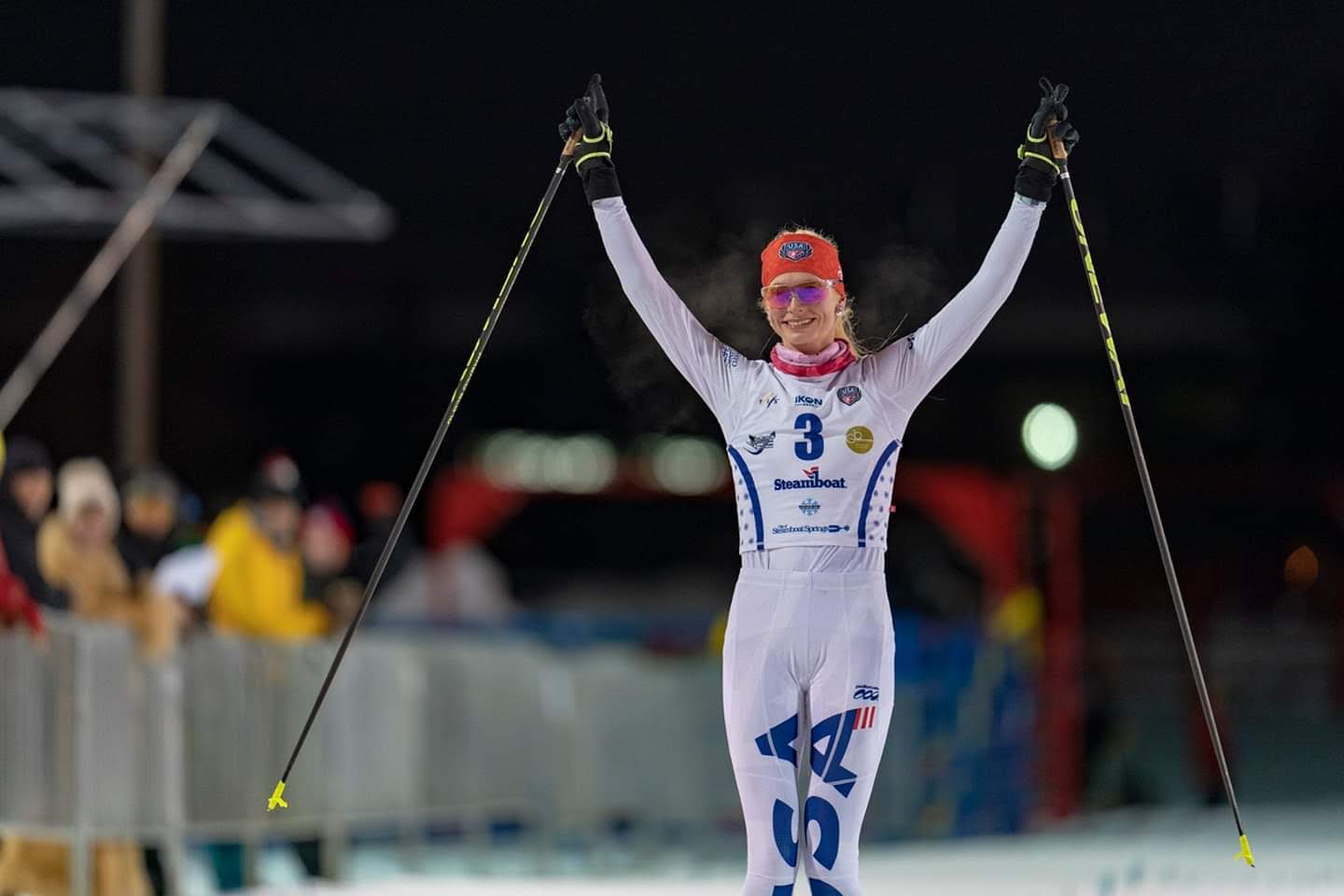
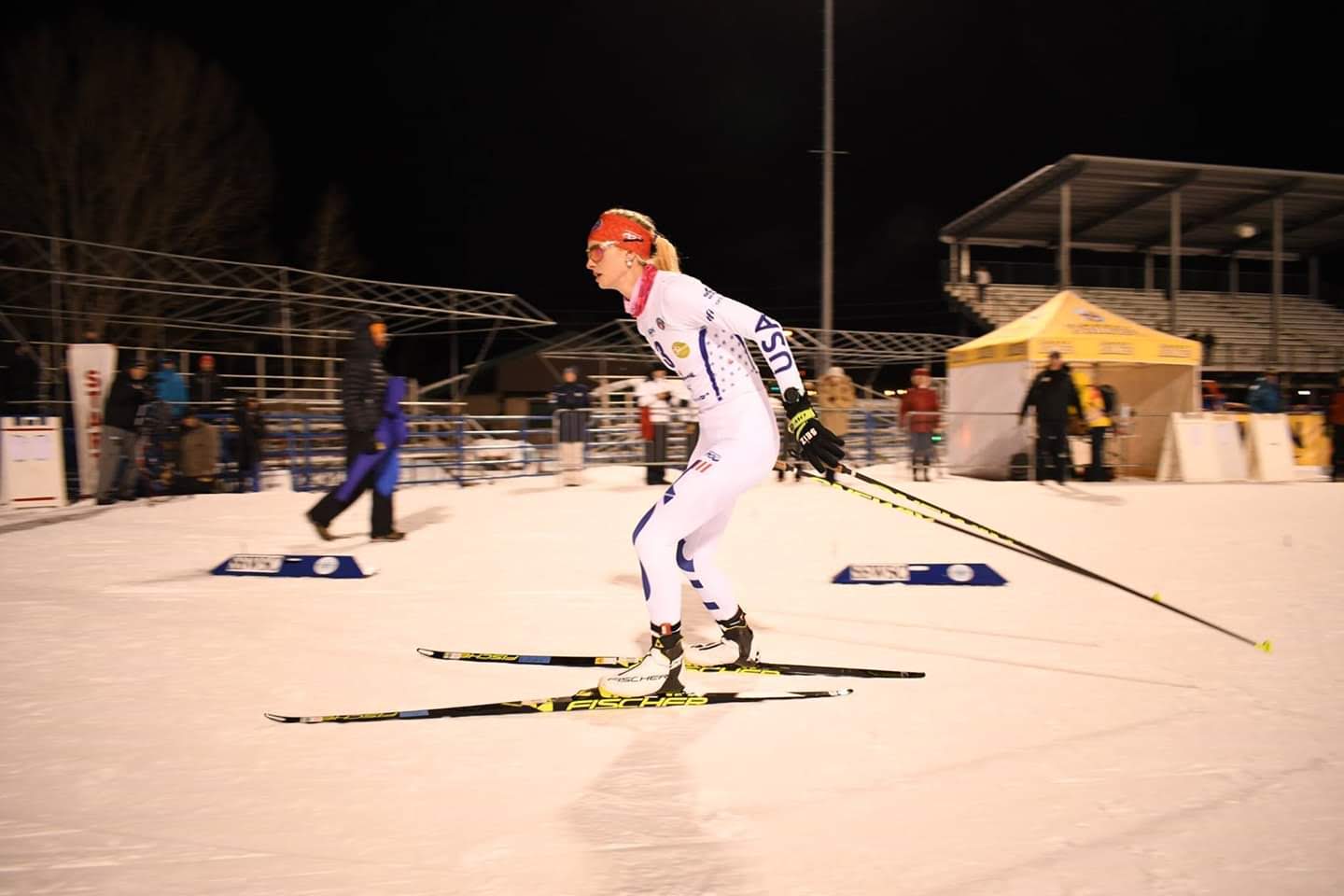
    Tara Geraghty-Moats winning the first 2018/2019 women’s nordic combined Continental Cup held in Steamboat Springs, CO. (Photo: Ben piper)

    Tara Geraghty-Moats started ski jumping when she was nine years old. Fearless for sure, but all part of the multisport athlete’s mojo.

    But after suffering multiple knee injuries when she was 16, Geraghty-Moats was forced to take a break from ski jumping. That hiatus was a four-year jumping drought that only served to push her into other aspects of nordic sport. During her time away from jumping, Geraghty-Moats competed in cross-country skiing and biathlon where she was highly successful.

    At 19-years-old, Geraghty-Moats came back to ski jumping which she has been doing ever since. This summer, she added a well-suited endeavor to her jumping: skiing fast. The reason for this addition was the introduction of an 11 event women’s nordic combined Continental Cup.

    “My goal this season is to be overall Continental Cup winner and to be on the World Championships team for ski jumping,” Geraghty-Moats said about her season’s objectives. As far as nordic combined is concerned, she is well on her way to mastering the Continental Cup series. 

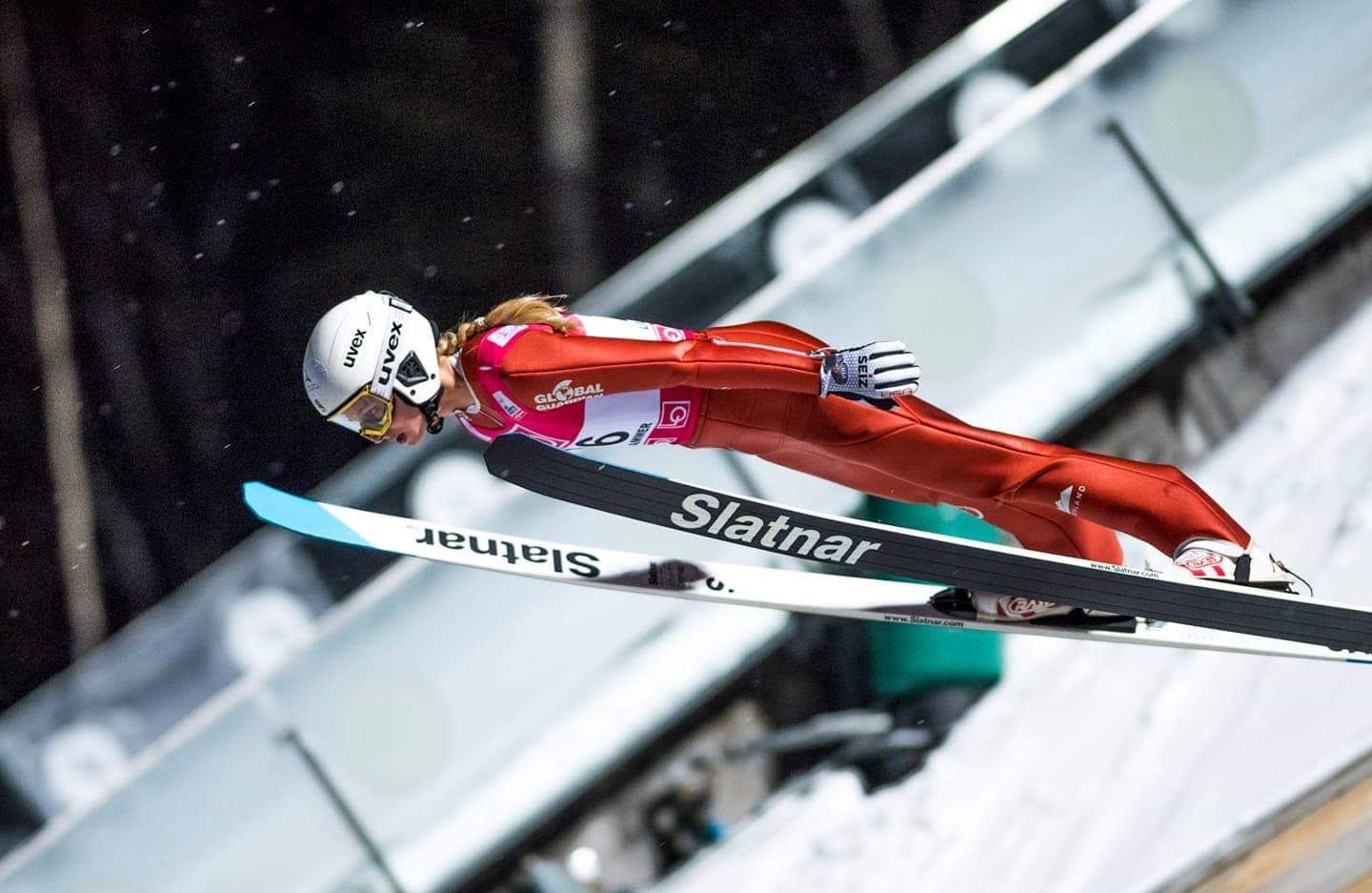
    Tara Geraghty Moats ski jumping World Cup in Lillehammer, NOR. (Photo: FIS Ski Jumping)

    In the first race of the inaugural Women’s Summer Grand Prix in Oberwiesenthal, Germany, Geraghty-Moats ski jumped into fourth place and then skied into second place. That was the last race Geraghty-Moats didn’t win this season. She won the second race of the Grand Prix, and took home the Overall Championship title.

    Geraghty-Moats has participated in five Continental Cup races so far this winter, she has won them all.

    “Winning every race I entered came as a real surprise,” Geraghty-Moats said. “This summer and fall I was focusing on working hard and building my nordic skiing up again after a few years off. I had no idea what to expect. I was hoping for some podiums.”

    The first two races of the season took place in Steamboat Springs, Colo. at the beginning of December. In the first race, Geraghty-Moats jumped to third place, placing her seven seconds behind the leader at the start of the ski race. She had no problem making up the time, winning the race by 47.7 seconds. The following day, Geraghty-Moats jumped into fourth place, 26 seconds behind the leader. She skied a solid race and finished 40.1 seconds ahead of the next competitor. 

    When asked about her favorite moment so far this season, Geraghty-Moats commented, “winning my first Continental Cup in Steamboat with my mom there. She has always supported me skiing nordic combined and is hardly ever able to come to watch me compete, so it was very special.”

    This season, Geraghty-Moats plans to start in all 11 of the women’s nordic combined Continental Cups scheduled. She will also be competing in a number of special jumping competitions. This past weekend, she competed in her first international nordic combine race in Otepää, Estonia where again she dominated. Now she will be heading to Japan for a ski jumping World Cup this upcoming weekend.

    Tara Geraghty-Moats winning the first Continental Cup of the season in Steamboat Springs, CO. (Photo: Ben Piper)


    Currently, Geraghty-Moats is the only women on the U.S. Nordic Combined team.

    “I train by myself a lot,” Geraghty-Moats said. “The men’s team is on a pretty different competition schedule so we aren’t able to train together much. I write my own cross-country program and integrate it with the ski jumping program my jumping coaches give me. It seems to be working well so far.”

    Regardless of their competition schedules, Geraghty-Moats believes the US Nordic Combined Team has a strong and inclusive team dynamic.

    “I’ve competed with some of the guys on the team since my jumping career started,” she said. “They are pretty much the coolest teammates ever. It’s nice they are so supportive of the developing women’s circuit.”

    The outlook for a viable women’s nordic combined circuit remains uncertain. Organizations like the International Ski Federation (FIS) and USA Nordic, the NGB responsible for jumping and nordic combined in the U.S., fully support integrating women into the top level of the sport.

    As raised in a recent New York Times story on the women’s nordic combined circuit, some major hurdles remain for a fully fledged women’s nordic combined division. First are the number of total participants. Second is ensuring those competitors are in fact competitive. A good problem for  Geraghty-Moats is that she remains dominant. Yet the others in her peer group are playing catch up when it comes to her skiing prowess. 

    Women’s nordic combined will be included in the 2021 World Championships. There was discussion of it being included in the 2022 Winter Olympic Games. However, in July, the International Olympic Committee did not include women’s nordic combined as part of the 2022 Games. The sport will have to wait until 2026 at the earliest to make an Olympic debut to put it on equal Olympic-level-footing.

    Bill Demong, USA Nordic’s Executive Director, said in an Oct. 17, 2017 press release that his organization fully supports equity when it comes to developing new pathways for women to participate and excel. 

    “This is an opportunity that we are fully behind”, Demong said about the first women’s U.S, National Championship in nordic combined. “We know that other nations will begin to turn on their funding and that when this becomes an Olympic event everyone will spend resources we can not match. Right now we have the opportunity and responsibility to take athletes like Tara Geraghty-Moats and Gabby Armstrong and develop them into leaders in the sport. It is our job to continue to innovate and support them so that they can lead Women’s Nordic Combined into the future with our crop of upcoming juniors.”

    Geraghty-Moats remains positive. She also embraces her role as a groundbreaker. She knows stumbles will occur. With any breakthrough there are setbacks, but ultimately there is a net gain.

    “I think that it will develop fairly rapidly in the next two years,” Geraghty-Moats said of women’s nordic combined.  “There are World Championship medals on the line in 2021 so I don’t expect very many countries will pass up the opportunity to support a women’s Nordic Combined team and get some hardware.”

    For now, Geraghty-Moats will simply soar.


  • Østberg Solos to Stage 5 Win; Diggins Steps on Podium and up to Third Overall

    Østberg Solos to Stage 5 Win; Diggins Steps on Podium and up to Third Overall

    The women’s podium from DStage 5 of the Tour de Ski: (l-r) Natalia Nepryaeva of Russia second, Ingvild Flugstad Østberg of Norway first, and Jessie Diggins of the U.S. third. (Photo: Fischer/Nordic Focus)

    The real race tension today was the race for third between the U.S. Ski Team’s (USST) Jessie Diggins and Russia’s Yulia Belorukova during the 10-kilometer freestyle pursuit in Oberstdorf, Germany, Stage 5 of the Tour de Ski (TdS).

    The race up front was a solo effort, as Ingvild Flugstad Østberg of Norway started 24 seconds ahead of Russian skier Natalia Nepryaeva. Østberg held that lead until the finish, winning with a time of 26:21.2. Nepryaeva placed second (+30.4). Østberg continues to hold the overall lead in the TdS after today’s race.

    “It was a really good and I felt really good but at the same time it was both mentally and physically pretty hard to be in front,” Østberg told the International Ski Federation (FIS) after the race. “I saw all the girls chasing me all the time so I just had to work really hard.”

    Ingvild Flugstad Østberg of Norway leads the Tour de Ski after five stages. She won Thursday Stage 5 10 k skate pursuit. (Photo: Fischer/Nordic Focus)

    Nepryaeva skied a consistent race as well. Østberg was almost always in her sight giving her someone to physically chase besides a time gap, up ahead. She only lost six seconds on Østberg throughout the race and kept the chase pack led by Diggins and Finland’s Krista Pärmäkoski at bay.

    This was Nepryaeva’s third podium of the TdS; she won Stage  — a 10k freestyle individual start, and she placed second in yesterday’s Stage 4 10k classic mass start. Nepryaeva still sits in second place behind Østberg in the overall TdS standings. Østberg heads into Stage 6 with a 35.4 second cushion over Nepryaeva.

    Natalia Nepryaeva of Russia on her way to second place in Thursday’s Stage 5 of the Tour de Ski. (Photo: Fischer/Nordic Focus)

    The for third began in earnest when Diggins and Pärmäkoski caught the stage’s third starter, Belorukova, within the first three k of the race. (Belorukova began 15 seconds ahead of Diggins; Pärmäkoski began four seconds in back of the American.)

    “I was really excited to ski with Krista [Pärmäkoski] which was really fun,” Diggins said in a call. “I really love working with her because she always takes her turn leading and we basically split the race in half. It was so fun because we were motoring. And she also is someone who also never steps on your skis, never steps on your poles. Super fun to work with because she gets it. If we both work hard and share the load of leading then we are both going to have a great day. That was the plan and we talked about it beforehand.”

    U.S. Ski Team Coach Matt Whitcomb considered the Diggins-Pärmäkoski-engine a win-win.

    “Just letting it unfold together, pushing each other, trying to get the fastest time,” Whitcomb said. “So the strategy was to work with Krista, Krista leading on some of the climbs, and Jessie leading on some of the descents and flats, using the strengths of each of them to put time on the leaders, and it worked pretty well.”

    (Diggins skied the fastest time of day in 26:07.5 minutes, with the Finn notching the second fastest time, 7.6 seconds back.)

    The group of Diggins, Pärmäkoski, and Belorukova skied together once the three linked-up. As the pace quickened in the final k, Pärmäkoski began dropping behind.

    Diggins and Belorukova had comparable skis, remaining in contact on the downhills. When they came into the finishing stretch together each skier remained locked on the remaining podium spot.

    It came down to a toe.

    Diggins out lunged Belorukova in a photo finish. For Diggins, this was her second podium of the TdS. She was third in Val Müstair, Switzerland’s, Stage 3 skate sprint. With her third place today, Diggins is third overall in the Tour, 1:22.6 minutes behind overall leader Østberg.

    As noted in the Stage 4 race report, the yesterday’s kick waxing was problematic for many teams including the U.S. Whitcomb explained the collective team dynamic remains positive after processing yesterday’s frustrations.

    “Today was good, it was a testament to the team’s ability to regroup,” Whitcomb said. “We don’t dance around mistakes that we make, we confront them and talk directly with the athletes and explain what we thought we did wrong and everything is cool. If there’s somebody that cares more about this than the athletes it’s each of the athlete’s techs. And when any team misses a race, especially a high profile one, the pain extends through the whole team, and we feel it hard. It’s important to address it and figure out how to learn from our mistakes and then just move forward. So we didn’t spend too much time dwelling on it but we hit it hard, and then we are on to the next day.”

    For Diggins, dealing with disappointment has a time limit, then she redirects her energy to what remains in her control.

    “To be perfectly honest, it was frustrating yesterday because I know I am in better shape and skiing better than that,” Diggins explained. “So it is hard to lose because of the way bonus seconds work. It is really hard to lose that much time and is literally nothing you can do except go out and race hard.”

    Diggins said she went into this season’s Tour to win. Her performance today was a stamp declaring she has moved on.

    “When I was in the leader bib, I was like I am skiing with these girls, I am in good shape right now, we can duke it out, this is possible,” Diggins said. (The U.S. skier was in the TdS leader’s bib for Stage 4.) Yet, she stated she has not imposed undo pressure on herself to perform.

    “The big thing about this Tour for me is that it sets me up well for the rest of the season,” said Diggins.

    Today was Diggins 19th career podium, and as she sets her sights on the World Championships later this season, she insists she is where she wants to be.

    “I want to make sure I am seeing the bigger picture and that is right where I want to be right now and that is a good feeling,” Diggins said.

    Jessie Diggins out-toes Russia’s Yulia Belorukova to take third in Stage 5 of the Tour de Ski. (Photo: Fischer/Nordic Focus)

    Sadie Bjornsen of the US Ski Team placed 11th in today’s race. She started in ninth place, 2:54 seconds behind Østberg and finished 4:07.8 behind her. She skied with Austria’s Teresa Stadlober for the first half of the race, but Bjornsen wasn’t able to hold on. She eventually dropped back to 11th for the second half of the race. Bjornsen now sits in 11th in the overall TdS standings. However, as planned, Bjornsen has exited the TdS. 

    “Well, that’s a wrap for my Tour de Ski racing this season, signing out in 11th place,” Bjornsen wrote in an email to several news outlets. “I decided to not complete the tour this year in order to get a good training block in without too much race fatigue. With my heart set on World Championships this year, my coach and I made a plan to only go through five stages. It’s one of the hardest things in the world to drop from the tour, because it’s my favorite racing of the season, but I have big goals ahead in February.

    “It was a tough tour for me after coming back from a nasty virus over the holidays. I had a really exciting day one, and amazing feelings, but haven’t found quite the spark in my body I have wanted since. I will take the next two weeks to get 100% healthy, get some good volume in, and get a head that is ready to fight again. In the meantime, I am channeling every last bit of energy towards Jessie. That girl is on fire right now, and I can’t wait to see what happens. Let’s hope the weather and waxing are a little more straightforward in Val di Fiemme, and she gets closer to those front girls!

    “Catch up with you next in Otepaa, for a classic World Cup weekend. After so much skating, I’m really looking forward to getting back to the classical style!”

    Canada’s Emily Nishikawa finished 30th today. This was her second-best race of the season. She finished 23rd in the Davos two weeks ago and she was 34th yesterday in the 10k classic mass start, Stage 4 of the TdS.

    Women’s Results | Women’s TdS Overall Standings After Stage 5

  • Østberg wins in Oberstdorf and takes TdS Lead; Diggins 11th

    Østberg wins in Oberstdorf and takes TdS Lead; Diggins 11th

    The women’s podium from the fourth stage of the 2018/2019 Tour de Ski — a 10 k classic mass start. Russia’s Natalia Nepryaeva (left) placed second, Norway’s Ingvild Flugstad Østberg (center) first. and Anastasia Sedova (right) also from Russia third. (Photo: Fischer/Nordic Focus)

    It was a snowy and grabby day in Oberstdorf, Germany, for Stage 4 of the Tour de Ski (TdS). The temperatures were sitting right around freezing, making it challenging conditions for dialing kick wax. Many racers skied on zeros for this 10-kilometer classic mass start. But throughout the race, many women appeared to be struggling to find the right amount of kick as slipping on the hills was a common theme for some.

    U.S. Ski Team Coach Matt Whitcomb commented on the day’s tricky conditions.

    “The races were typically hard Oberstdorf races, in some ways, it’s what every cross-country skier dreads and in other ways, it’s what is so great about this sport,” Whitcomb said. “It was a really challenging day surface wise, conditions were slow, the course was hard and it snowed like hell, so it was a challenging day today.”

    Ingvild Flugstad Østberg of Norway drag racing down the final 100 meters with Russia’s Natalia Nepryaeva in Oberstdorf, Germany during Stage 4 of the Tour de Ski (Photo: Fischer/Nordic Focus)

    Wearing bib 2 as the TdS second overall skier, Norway’s Ingvild Flugstad Østberg fought hard for the victory today finishing in 32:08.9 minutes. Østberg led the majority of the race, only giving up the lead three times before quickly taking it back — once to Krista Pärmäkoski of Finland and twice to Natalia Nepryaeva of Russia.

    Østberg spoke with an International Ski Federation (FIS) reporter after the race and noted she had to be persistent.

    “It was a really tough race and when we saw it was snowing and knew it would be hard to be in front, but I knew I had to try and I just had to work and work and work and maybe people would fall off one by one,” Østberg told FIS. 

    Nepryaeva attempted to pull away from Østberg in the finish stretch and nearly took the win. But Østberg out lunged her across the line.

    Østberg recounted, “the Russian were really strong, especially in the last uphill. But today, I just decided to give it all and in the last 100 meters, I just had to try and it was an incredible feeling to cross the finish line first.”

    Today’s victory makes Østberg the overall leader of the TdS.

    “It’s really fun to be in the lead of the Tour de Ski. I’ve been here before and it’s always fun and I’ve been working hard for four stages. But I know a lot can happen in the next three, so I just have to take it race by race,” Østberg said. 

    https://youtu.be/c34Cc8tVKQ8

    In nearly taking the win, Nepryaeva displayed she has the overall fitness to contest a top overall spot at the Tour. The twenty-three-year-old Nepryaeva kept pace with Østberg the entire race. She never was more than five seconds behind the day’s winner. In the last 2.5-k of the race, Nepryaeva’s teammate Anastasia Sedova caught her, allowing the two Russians to work together and challenge Østberg.

    Despite being out-lunged, this is not the first time this season that Nepryaeva has gone head to head with Østberg. During Stage 2 of this year’s Tour, a 10 k skate, Nepryaeva beat Østberg by just under a half-second for her first career World Cup victory. After today’s result, Nepryaeva is positioned second place in the overall TdS standings.

    Sedova skied a very strong race as well, putting in a massive effort to finish third. After the first 2k, she was in 11th, but she moved quickly through the pack and by 7.5k she was in the mix for a podium position. Once catching her teammate Nepryaeva, Sedova settled in with the winning pace and finished five seconds behind Østberg. Sedova’s third-place finish put her into sixth in the overall TdS standings.

    Jessie Diggins of the U.S. Ski Team was the first North American to cross the finish line. Diggins started today with the TdS leader’s bib. In what was admittedly a tough waxing day, Diggins held onto the lead pack for the first kilometer before falling back to 24th. After the race’s mid-point, Diggins found her groove. She surged forward to 12th place at the 5 k time check, 18.7 seconds back. Diggins finished in 11th (+58.5). After Stage 4, Diggins is in fourth overall in the TdS standings, 1:26.3 minutes behind overall leader Østberg. 

    “Frankly, we missed the boat on the wax today, but I fought as hard as I could and I know I’m in great shape right now,” Diggins texted FasterSkier after the race. “I did everything I could with what I had today! And now the pressure of the leader’s bib is 100% off, and I’m just going to ski as hard as I can tomorrow and recover as smart as I can!”

    Whitcomb also commented on the USST women’s skis, confirming that day’s dicey conditions.

    “We did not have good skis for the women, it was straight up just a really difficult race for them because of this,” Whitcomb said. “What I will say is about 2/3rds of the race had very bad skis and our girls did incredibly well considering those things.”

    Diggins will be racing in the next three stages of the TdS as she plans on completing the Tour.

    “The goal remains the same for Jessie, whether starting 1st, 4th or 50th,” Whitcomb said. “Until the finish line on Alpe Cermis, we’re racing to win. It’s just how she does things.”

    Sadie Bjornsen (USST) finished 15th on the stage.

    Sadie Bjornsen of the U.S. Ski Team during Stage 4 of the Tour de Ski — a 10 k classic mass start race. (Photo: Fischer/Nordic Focus)

    Diggins and Bjornsen skied in the same pack for the majority of the race. During the first half of the race, Bjornsen sat in 17th. When Diggins made a move, skiing into 12th, Bjornsen followed suit, skiing to 15th. Bjornsen held this position for the remainder of the race and finished 1:05.4 minutes behind Østberg. Today’s result lands Bjornsen in 10th in the overall TdS standings.

    “It was a really challenging race out there,” Bjornsen texted. “Unfortunately, our team really missed the kick, so we had to fight with what we had. Our skis were icing really bad, which made it quite challenging to ski both the uphills and the downhills. Thank goodness there were a few flat sections out there to feel like I was out for a ski race. It’s a bummer to have a day like today because my body felt really good, and I really like this course for classic skiing- but that’s life, and sometimes you have to just laugh it off and hope you can learn something as a team from the experience.”

    Bjornsen will exit the Tour after tomorrow’s fifth stage.

    “Tomorrow will be the last race of my tour, as I have planned to not complete the full tour this year, and try to do a training block without too much accumulated race fatigue,” Bjornsen explained. “So, let’s hope tomorrow can work out a little better, and I can make some use of these good feelings!” Bjornsen told FasterSkier.

    After her exit, Diggins will be heading to Seefeld, Austria to join some of her other teammates for a mini-training camp before World Cup racing starts up again after the Tour.

    “Given how strong Jessie and Sadie skied today with skis that weren’t working for them, I’m very optimistic about tomorrow,” Whitcomb stated. “These two are strong right now, and pretty pissed off.  That’s a good combo to bet on.”

    Emily Nishikawa of Canada finished in 34th.

    Women’s Results |Tour de Ski Overall Standings

  • Klæbo Claims another Sprint Victory, Hamilton Qualifies Sixth

    Klæbo Claims another Sprint Victory, Hamilton Qualifies Sixth

    A familiar look: Johannes Høsflot Klæbo of Norway crosses the line in first during the Tour de Ski’s Stage 3 sprint in Val Müstair, Switzerland. (Photo: Fischer/Nordic Focus)

    Today’s 1.4-kilometer freestyle sprint course in Val Mustair, Switzerland was not lacking in short, steep climbs, fast, tight corners and rollers that knocked even the best skiers around. Going into Tuesday’s races, Johannes Høsflot Klæbo of Norway was third overall in the Tour de Ski (TdS).

    In the first two stages of the TdS, Klæbo took the first stage’s sprint win and placed 12th in Stage 2’s 15 k skate. After his racing today, Klæbo moved from third overall in the TdS, to first. He leads the overall by 12.0 seconds over second place skier from Russia, Sergey Ustiugov.

    Klæbo was the fastest qualifier in today’s race with a time of 3:04.69 minutes before going on to win the finals. This is the first time a male has won back-to-back sprint stages in the Tour de Ski. 

    Klæbo won both his quarter and semi-finals and won the final in a time of 3:03.78. In all three races, he led the steep punchy climb on the second lap and created sizeable gaps by the time he crested the hill and glided into the downhill. Italy’s Federico Pellegrino challenged Klæbo in the finishing stretch of his semi and the final. But in both races, Klæbo prevailed. This is Klæbo’s tenth sprint victory since the beginning of last season. 

    “I’m very glad [Sergey] Ustiugov did this fast speed at the second lap and, I was just trying to push all in and I’m really happy to be in first.”  Klæbo told the International Ski Federation (FIS) after the race. “Now it’s a little bit of rest and then you start over tomorrow. So we try again tomorrow. We’ll see.” 

    Pellegrino finished today’s sprint in second place, 2.35 seconds behind Klæbo. Pellegrino qualified third, he won his quarterfinal and came in second in his semi-final to Klæbo by 0.14 seconds. After today’s race — the fifth sprint of the World Cup season — Pellegrino sits second overall in the World Cup sprint standings and seventh overall(+1:19.4) in the TdS.

    Sergey Ustiugov of Russia finished in third (+3.07) in the Stage 3 sprint. This is Ustiugov’s second podium of the Tour de Ski, he won Sunday’s 15 k skate race 

    The men’s podium from Stage 3 of the 2018/2019 Tour de Ski – a 1.4 k skate sprint in Val Müstair, Switzerland. From left to right, Italy’s Federico Pellegrino placed second, Norway’s Johannes Høsflot Klæbo first, and Sergey Ustiugov of Russia finished third. (Photo: Fischer/Nordic Focus)

    Simi Hamilton of the U.S. Ski Team (USST) was the only North American to qualify for the heats in today’s race. Hamilton qualified in sixth (+4.30) and ended his day 13th overall. Hamilton finished third in his quarterfinal, .68 seconds behind winner Pellegrino, and did not advance. 

    “There was a big headwind, so I focused on settling in and drafting on the first lap and I felt like I was in a good place,” Hamilton said of his quarterfinal matchup. “But Pellegrino and Chanavat put a surge on and I couldn’t match it. I’m a little disappointed, it’s a little bittersweet. I felt good, but it was a bummer not to move on. I’m psyched for Jessie [Diggins] and Sophie [Caldwell], the team’s energy is great right now. It was another fun day of ski racing!” Online gaming, charity lotteries, and slot machines all include risk. It’s tough to see the hazards when playing, whether you win or lose. The majority of people like gambling, but it may become a problem that affects their health, money, or relationships. Check out this website: bahis siteleri . Everyone’s gambling experience is unique, but we offer the tools to assist you or someone you care about manage the dangers.

    Kevin Bolger of the U.S. Ski Team during his qualifier, Stage 3 of the Tour de Ski. (Photo: Fischer/Nordic Focus)

    Kevin Bolger (USST) was the next best American finishing in 34th (+10.60). In his first career TdS, Bolger qualified 13th and finished 21st overall in Sunday’s Stage 2 sprint. 

    Also for the U.S., Ben Lustgarten (CGRP) placed 77th, Erik Bjornsen (USST) did not start today’s stage.

    For Canada, Alex Harvey was 37th overall, Bob Thompson 62nd, and Lenny Valjas 72nd.

    Men’s Qualification | Men’s Results | Men’s TdS Standings after Three Stages


    – David Brown and Harald Zimmer contributed

    buy vancomycin

  • 2018 Holiday Gift Guide: The Last-Minute Stocking Stuffers

    2018 Holiday Gift Guide: The Last-Minute Stocking Stuffers

    Santa Shreds


    As FasterSkier staff stroll into an upcoming weekend with no cross-country World Cups, it’s time to scramble and score some holiday gifts for friends and loved ones. Christmas is around the corner. It’s never too late for Hanukkah  (Hanukkah ended on December 10). In this iteration of gift ideas for the oh-so-close holidays, Gretchen Burkholder provides a gamut of ideas – from a HRM/Multi-sport watch to snazzy headbands.

    ***

    Christmas is right around the corner and if your family is anything like mine, 90 percent of the presents under your tree probably will have something to do with skiing. But, let’s be honest, it’s hard to come up with unique gifts for the skiers in your life that aren’t wax, gloves and water packs. Don’t get me wrong, we still need all of those things, but it’s always nice to give something unexpected and creative. So, we at FasterSkier compiled a list of our favorite things with the hope that we  can make it a little easier for you to find the perfect present for every type of Nordie in you live.

    Now onto gear! We chose a few items that we don’t leave the house without.

    The Polar M430 watch with H10 heart rate monitor is a great addition to your workout wardrobe. It’s great for year round training, it’s super customizable, it has settings for basically any sport/activity,  and it great battery life so you won’t stop and recharge mid way through your workout. This heart rate monitor has a wrist HR sensor, and the chest strap is great. So much data to nerd out on!

    The Bose SoundSport Wireless Headphones are an excellent companion for long solo training sessions. These earbud connect to your phone via bluetooth so you no longer have to deal with cords while you’re trying to ski. They are water resistant and have a six hour battery life. The SoundSport Pulse Wireless Headphones have a built in heart rate monitor so you can monitor your heart on your phone while you workout. With three StayHear+ Sport tips for the buds to choose from, the headphones will stay snugly in any ear delivering high quality sound for hours.

    https://www.bose.com/en_us/products/headphones/earphones/soundsport-wireless-pulse.html
    The SoundSport Pulse Wireless Headphones in action

    According to one of our writers, Craft Windproof Boxers are the best invention since skis! According to Craft these are “Boxer brief with elastic windstopper panels and propeller shaped fibers that offers excellent body-temperature management. Perfect for intense workouts in mild to cool conditions. Developed for devoted athletes who need protection and performance in their baselayer.”

    For the truly committed athletes out there, Qalo’s silicone wedding bands are a must! These rings allow you to be married, and workout all without damaging your metal ring. Plus, they are safer to workout in! They come in all different styles and designs so you can customize your ring based on your style.

    https://www.facebook.com/Qalo/photos/a.125850320920915/767253050113969/?type=3&theater
    Qalo Silicone Rings perfect for every activity! (Photo: Qualo)

    Peet Power Cell Dryers are perfect portable boot dryers for the traveling nordie in your life. These boot dryers are compact and small making them easy to travel with, nobody likes wet boot at a training camp!

    Finally, we came up with a list of stocking stuffers, just little things that make the life of a nordic skier a little bit easier and a little bit more fun

    You can never go wrong with Skida! Nordic Headbands for when it’s warm, Alpine Hats for when it’s cold, neck warmers for every occasion and they come in the prints of your dreams! I personally ask for some kind of Skida every year!

    Both Race Glitter and Skida modeled by Anna Burkholder

    Every racer should have a little glitter in their life for race day. Here’s what you need- chapstick (for the glitter to stick to) and loose glitter which you can find in any craft store! If your racer has team colors, it always fun to coordinate with those, but having an assorted selection is also never a bad thing!

    A little bit of kick wax, a cork and some ski ties are always crowd pleasers! These are things that always seem to be disappearing so you can never have too many of them.

  • Klæbo Takes Davos Sprint for First Win of the Season; Simi Hamilton in 12th

    Klæbo Takes Davos Sprint for First Win of the Season; Simi Hamilton in 12th

    Johannes Høsflot Klæbo of Norway down the finishing stretch in Davos, Switzerland. He won the day’s skate sprint while Italy’s Federico Pellegrino (green suit) was second. (Photo: Fischer/Nordic Focus)

    As seems fitting for all things Davos, Switzerland: the racers enjoyed a bluebird day for the 1.5-kilometer freestyle sprint on Saturday. And just when we thought Johannes Høsflot Klæbo of Norway might be too spent from a year of media coverage and big-effort racing, he scored his first win of the season in gorgeous Davos.

    He began the day at full-throttle in the men’s qualifier, placing first with a time of 2:22.39 minutes. Lucas Chanavat of France qualified second (+0.36) and Federico Pellegrino of Italy qualified third (+1.76).

    Klæbo continued his winning streak throughout the heats, winning his quarterfinal, and semi. He finished the day with an overall win in the final, finishing in 2:20.44 minutes. This was Klæbo’s first win of the season. He qualified first in the 1.6-km skate sprint in Lillehammer, Norway two weeks ago, but he finished in 11th overall. One thing was for certain in Davos: Klæbo was skiing with confidence, snappiness, and some of the flair he’d been missing this season. 

    On the first climb of the final, Klæbo and Chanavat duked it out for the lead position. Pellegrino, skiing more conservatively at the outset, started in the back of the pack but was able to work the first corner to his advantage. By the top of the hill, he was sitting in third place. As the skiers lapped through and skated around the tight right-hander before the final climb, Kælbo was in stalk and hunt mode. He punched up the final climb and gapped the field on the downhill, sprinting to the finish ahead of Pellegrino who finished second (+.39).

    “That’s what we train for the whole spring and all summer – so now I’m where I want to be. It’s a fantastic feeling,” Klæbo told Norwegian broadcaster NRK according to a translation. Klæbo also told NRK he has not confirmed his plans to race the Tour de Ski (TdS) and will make that decision in the coming days. 

    With the win on Saturday, Klæbo joins Norway’s Eirik Brandsdal and Petter Northug with nine wins each in World Cup individual sprint wins. The three all sit fourth all-time for World Cup sprint wins among Norwegian men.

    For Pellegrino, it was his second podium of the season. He won the 1.6km skate sprint in Lillehammer. Pellegrino has won 11 freestyle sprint World Cups in his career which is the men’s record. That win total is topped by only Kikkan Randall who won 12 freestyle sprints, and Marit Bjørgen who won 24 freestyle sprints during their careers.

    Despite his skate sprint pedigree, Pellegrino admitted he feels slightly old among the sprint scene’s young skiers.

    “I think I am starting to be a bit old,” Pellegrino told the International Ski Federation (FIS). “This was my 10th race here in Davos and always passed the qualifications. I am really proud of that until now and I hope to do 10 more years and maybe I’ll beat the younger then.”

    Babtiste Gros of France finished third (+1.40), barely out sprinting teammate Chanavat (+1.45) in the final. This was Gros’s first podium of the season and his fifth career podium.

    Simi Hamilton of the U.S. Ski team zeroing in during the fifth heat Saturday in the 1.5-kilometer freestyle sprint in Davos, Switzerland. Hamilton placed 12th overall. (Photo: Reese Brown/U.S. Ski Team)

    Simi Hamilton(USST) was the only North American that qualified for the men in the Davos sprint. Hamilton was 17th (+4.76) in the qualifier. In the fifth heat, Hamilton was second to Joni Maeki of Finland to advance to the semis. A bit spent from the quick-turnaround after the fifth heat to the second semi-final, Hamilton placed sixth in his semi-final.

    buy naltrexone online

    “Davos, it’s always been a good place for me, having grown up at 8,000 ft. I don’t feel like it’s super high here at 5,000 feet,” Hamilton told FasterSkier in a call. “I think it is still tough for everyone, but also for me when I haven’t been above 1,000 ft for the last 6 weeks, it’s still a shock to the system.”

    Hamilton also spoke about his short recovery time from the fifth heat to the semis, and why he chose a later heat.

    “Obviously you want to choose one of the earlier heats so you have a longer turnaround time between the quarters and the semis,” Hamilton added. “But, my main goal today was to ski into the semis. It’s always the big goal to be in the final and be on the podium, but I think setting the short-term, realistic goal is also important. So today, having not been at altitude for a while and not feeling super super good, I set the goal of just being in the semis. With that in mind, I chose heat five, knowing that would set me up best for getting into the semis, but probably wouldn’t result in me feeling really good in the semis. So I was kind of expecting that, but just went out and raced as hard as I could and completely ran out of gas in that semi-final and felt pretty crappy on that second lap. ”

    US Ski Team Coach Matt Whitcomb also commented on Hamilton’s 12th place in a call.

    “Nice step forward for Simi today,” Whitcomb said. “Not exactly what we need on a podium day, but it was still a step forward. He felt very controlled in his quarterfinal and was tactically sound today, made really good moves. It was nice to see him in the semifinals, it’s positive feedback for him. But I’m really looking forward to seeing him in the first few ski sprints in the Tour de Ski.”

    Kevin Bolger (USST) was the second-best American, finishing 31st and barely missing the cut off for the heats. This is Bolger’s best individual result so far this season.

    In an email to FasterSkier, Bolger explained he is feeling better energy in his first full World Cup season as a new member of the U.S. Ski Team.

    Kevin Bolger of the U.S. Ski Team during the skate sprint qualifier in Davos, Switzerland. Bolger just missed the heats by qualifying in 31st.  (Photo: Reese Brown/U.S. Ski Team)

    “The qualifier was a fast 2 lapper, no room for error,” Bolger wrote. “Unfortunately, I ended up 31st just 0.02 out from qualifying, but it’s a step in the right direction. I’m moving forward and that’s a huge confidence booster going into Christmas break, and the Tour.”

    Bolger also noted he will be racing in tomorrow’s 15 k skate individual start.

    “It’ll be a burner, pretty tough course especially at altitude but I’m excited. I feel like my distance skiing is moving in the right direction as well, I’ll be using today’s result as fuel for tomorrow, but looking forward to getting out there and putting together a good race, should be a fun day in the sun!”

    Alex Harvey was the best placed Canadian, placing 37th overall. Harvey, who in the past has explained he does not prefer higher altitude courses, has placed in the top-30 twice in Davos sprints: a ninth place in 2011, and a 23rd in 2017. Lenny Valjas, in his first World Cup of the season, was 53rd. Andy Shields finished in 60th. No other Canadians were entered.

    Racing continues tomorrow for the men with a 15 k skate individual start.

    Men’s Results


  • Røthe Beats Sundby in Beitostølen; Harvey 13th

    Røthe Beats Sundby in Beitostølen; Harvey 13th

    The men’s podium from the 30 k freestyle individual start in Beitostølen, Norway. Sjur Røthe (center) of Norway placed first, teammate Martin Johnsrud Sundby (left) second, and Russia’s Andrey Melnichenko (right) third.

    It snowed continuously throughout today’s 30-kilometer freestyle individual Start in Beitostølen, Norway. There was already a  great deal of accumulation on the race course by the time the men started. This made the already challenging distance race even more grueling as the fresh snow created more resistance for skiers.

    Norway took the top two spots as Sjur Røthe won the with a time of 1:09:53.5. His teammate, Martin Johnsrud Sundby, was close behind in second (+35.2).

    This is Røthe’s third podium of the season. Last weekend, in Lillehammer, Norway, he won the 15 k freestyle individual start and placed second in the 15 k classic pursuit the following day. 

    “I was pretty proud of myself today,” Røthe told FIS at the end of the race. “I felt pretty good at the start. I was few seconds behind Martin [Sundby] and Didrik [Tønseth] out from the start and it looked like they are doing a sprint today. I felt very confident at the beginning of the race but looking at them taking up a high pace right from the start, I was unsure if I should change my pacing strategy.”

    Sundby set the tempo for the first 10 k, outpacing Røthe by just seconds. After the 15 k mark, Røthe took the lead and continued to put time between himself and Sundby. By 25 k, Røthe had a 30-second gap which he preserved for the remainder of the race.

    vteabp.org


    “I had a strong start but felt that between 10 and 20 k, it would be surprising, if some of the other nations would be much better than us,” Sundby told FIS. “We know the course, we have competed here for 10 years so we sure have some seconds in our favor.”

    It was Sundby’s best result of the young season and his first World Cup podium of the year. Sundby placed fourth in Ruka’s 15 k classic, missing out on a podium by 10 seconds. Last season, Sundby was the third-ranked World Cup skier in the distance overall.

    Russia’s Andrey Melnichenko took third (+49.2). At twenty-six-years-old, this was Melnichenko first career World Cup podium.

    “During the race in different splits, I got some information that I was around the sixth place and actually did not expect anything more than that,” Melnichenko told FIS.

    Canada’s Alex Harvey during the World Cup’s 30 k skate individual start in Beitostølen, Norway. Harvey placed 13th.

    Alex Harvey of Canada was the first North American to cross the finish line. Harvey finished in 13th (+1:49.8). Harvey has been known to come into form later in the season for distance races, this year he came on strong early in sprinting, placing third in the skate sprint last weekend in Lillehammer. 

    After 10 k today, Harvey was sitting in 15th, but he continued to fight and was able to gain five places in the next 15 k, putting him in 10th going into the last lap. But, he was unable to hold on as he faded slightly down the final stretch.

    ainhalers


    Harvey talked with FasterSkier after the race about the tough conditions. “The course doesn’t have much recovery, you have to work the whole time and then the conditions with the snow…there was resistance in the snow the whole way so you have to push on the flats, and on the gradual downhills so you’re always working,” Harvey explained. 

    Erik Bjornsen of the U.S. Ski Team (bib 50) during the men’s 30 k skate in Beitostølen, Norway. Jens Burman of Sweden (bib 27) and Jonas Dobler of Germany (bib 26) skied alongside Bjornsen for a portion of the race.

    Scott Patterson (USST) was the first American, finishing in 47th (+4:32.7). David Norris (APU) followed shortly behind in 51st (+5:13.3) and Erik Bjornsen was right on his heels, finishing 52nd (+5:14.9). Adam Martin (CGRP) finished 59th (+6:14.8).

    After the race, Norris commented on his strategy going into the race,

    ainhalers

    “My strategy was to put in the first two laps well and then just try to ski smooth and then get on the heels of some fast guys and try to hang in there,” Norris said. “I did that in certain points and struggled to do that at others. I felt like my first lap I went out well and then from lap two to lap five I kind of like hung in there. And then on the sixth lap, felt I like I charged pretty well and finished strong.”

    Racing continues tomorrow for the men with a 4 x 7.5 k relay.

    Men’s Results

    — Aleks Tangen contributed