From the FasterSkier archive — posts syndicated from athletes’ and coaches’ own blogs between 2004 and 2012, kept online as published. Current coverage is at fasterskier.com.
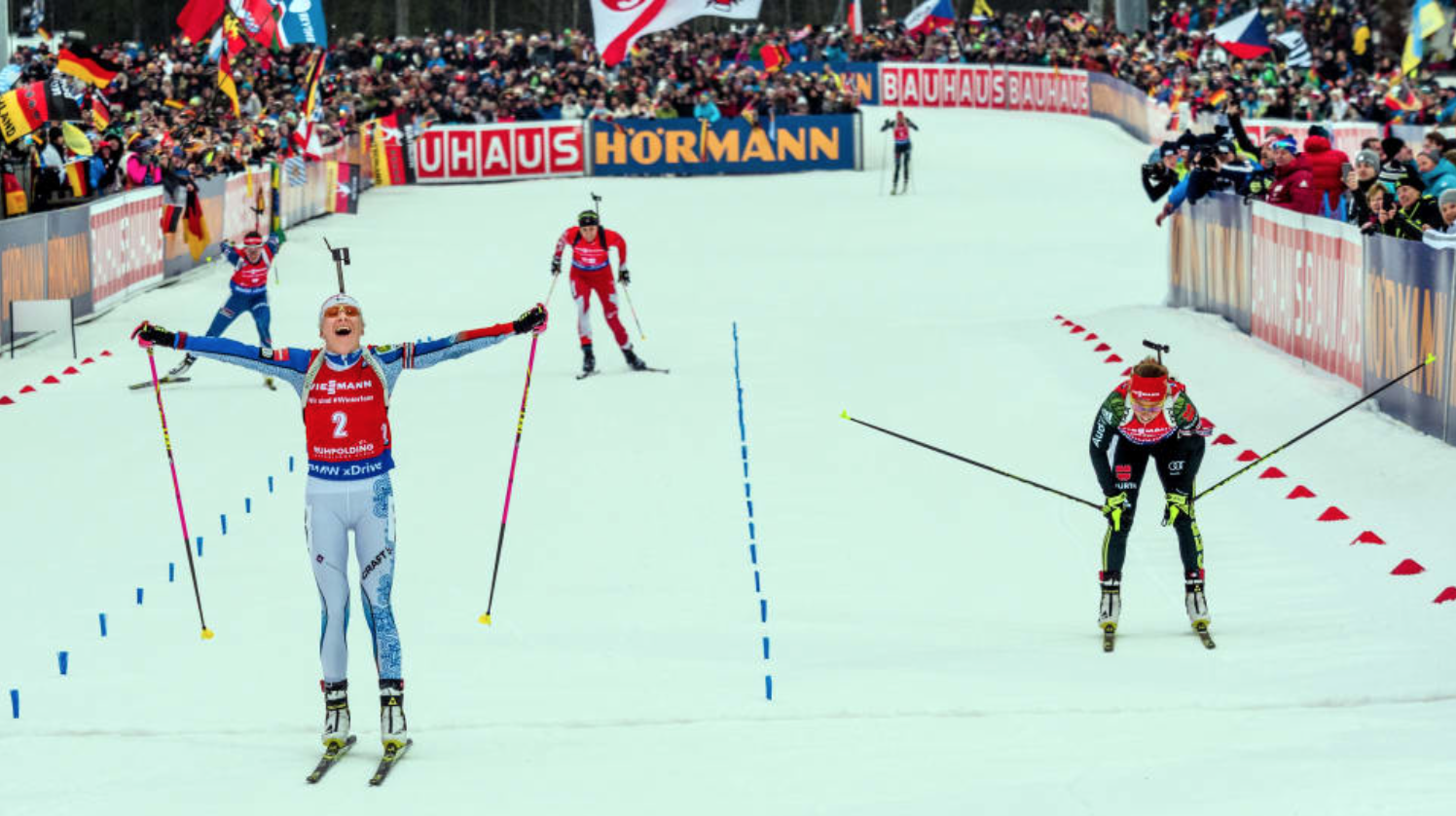
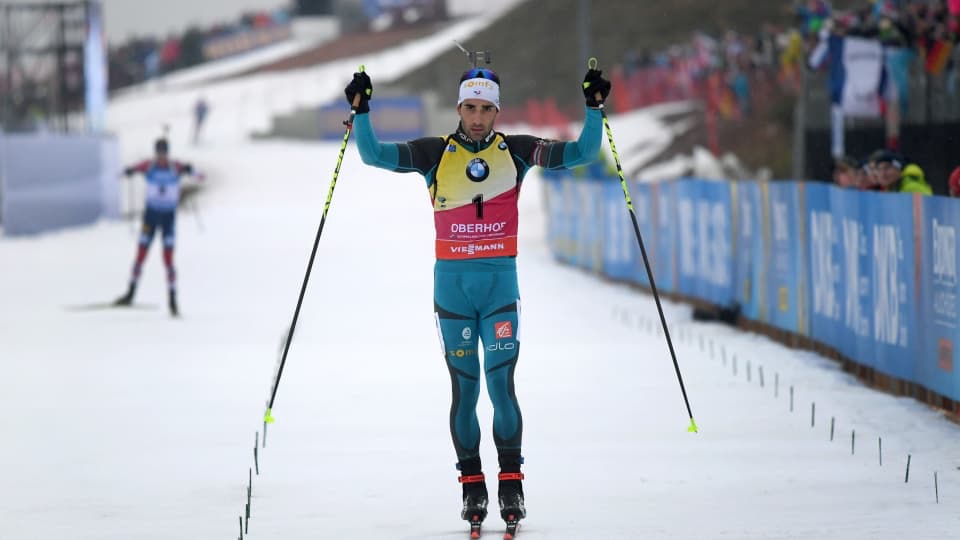
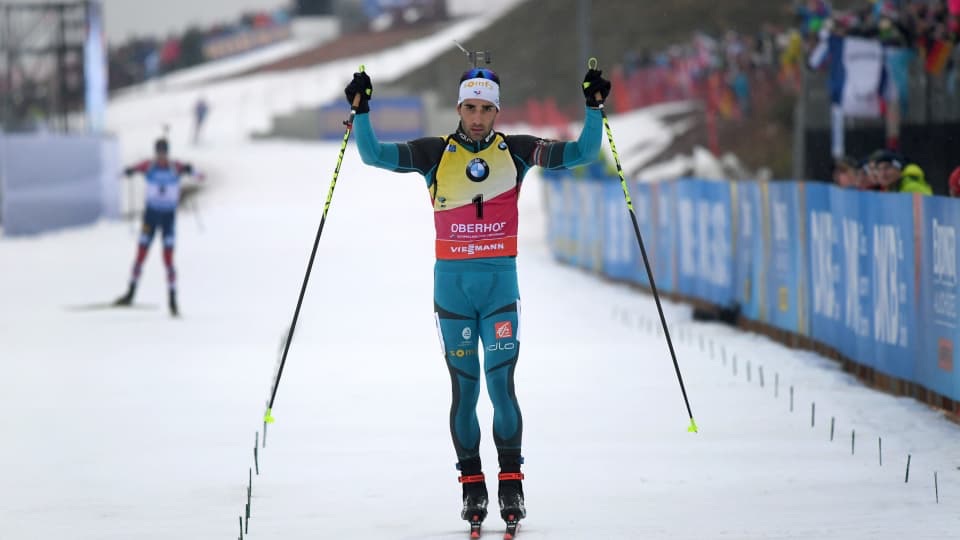
Thanks to a clean shooting performance on the range and a tactical masterclass on the final lap, France’s Emilien Jacquelin, 24, was able to celebrate across the line in first place in a time of 31:15.2 minutes, after an exciting finish sprint against Norway’s Johannes Thingnes Bø just 0.4 seconds behind (with 2 penalties).
Emilien Jacquelin of France celebrates the win. (Photo: NordicFocus)
In a bit of an upset, the title in the men’s 12.5-kilometer pursuit at the 2020 IBU Biathlon World Championships in Antholz, Italy, went to the young French athlete, who had started out the race on Sunday afternoon in sixth position according to his result in the sprint a day earlier. Bø left the range after the last shooting just 0.1 sec behind, but Jacquelin consistently stayed in the lead, with the two athletes at times slowing down a bit to eye each other. At one point Jacquelin even took the time to bend down and tighten the straps of his ski boots while also loosening the rifle suspension strap on his left arm.
Going into the final long downhill stretch, Bø positioned himself to be able to attack out of the draft, but Jacquelin defended his leading position up a short climb and into the flat of the sunny Antholz arena, again packed to capacity with spectators.
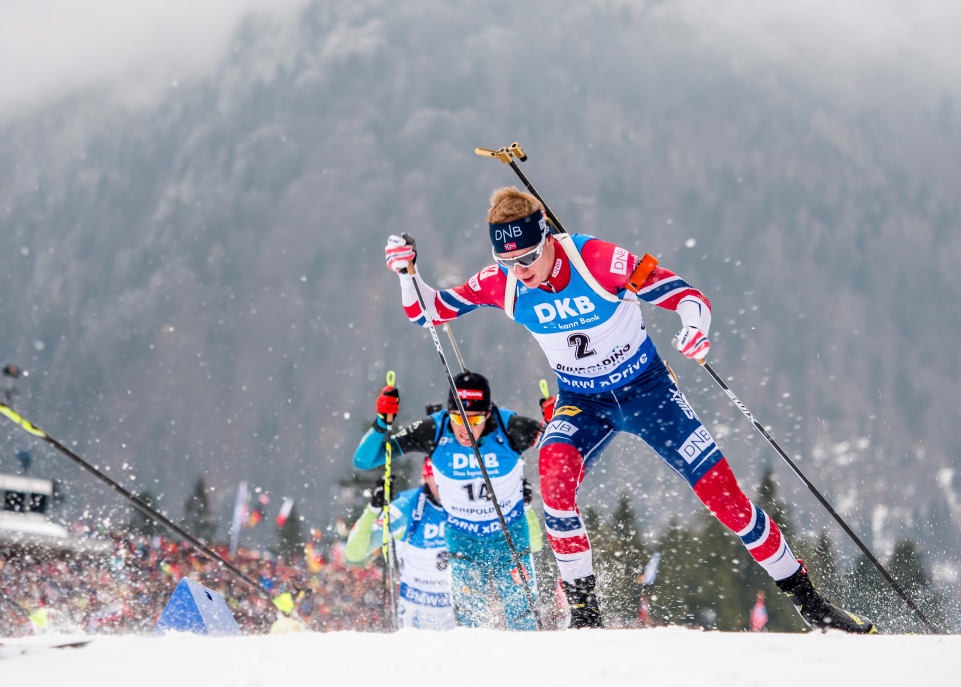
Johannes Thingnes Bø (NOR) placed second on the day. (Photo: NordicFocus)
Bø briefly seemed to lose his balance when he tried to attack, and Jacquelin managed to take the interior lane on the final right-hand turn into the finish stretch not allowing Bø to pass. With strong double poling he kept pushing hard on the finish stretch along the middle lane to widen the gap, before raising his arms several meters before the line, confident that the Norwegian would not be able to catch him anymore. It was the Frenchman’s first medal and victory at IBU World Championships. Jacquelin had also never won a World Cup race before, with two second-place finishes earlier this season as his best results.
In the post-race press conference, Jacquelin credited his experience from another sport for his finish sprint tactics: “[Bø] decided to not attack me, so I was just focused on tactics… I was a track cyclist when I was young, so I just remembered all my training. I was just focused to sprint at a good moment. …He would win for sure if he didn’t let me pass.” Bø, usually an outstanding sprinter who dominated the prior IBU World Cup season and several early tour stages of the 2019/20 season, before taking some time off to be with his wife for the birth of their first child, was not able to withstand Jacquelin’s finish punch this time. Though he made no excuses about his interrupted training and racing period leading up to the peak of the season, and claimed he was happy about the result remarking that he was “less nervous before the world championships because of the family situation at home”.
“I put myself in position for a gold in the final shooting,” Bø said in the press conference. “I just want to have fun, that’s why I was satisfied with my fifth place in the sprint yesterday. … I could just relax today and do my best one more time and hope for a medal.”
Behind them, Alexander Loginov of Russia, coming fresh off his victory in the sprint, claimed the bronze medal position on the podium this time. He had kept his composure and his pursuers in check virtually all race, thanks to three very fast and clean shooting performances on the wind-exposed Antholz range. And while he lost a few seconds on the course on each loop he was able to ski just fast enough to arrive on the range taking his position on the first shooting lane. It already looked like with his perseverance in that game of cat and mouse the Russian had again worn out his competition. But in his final shooting stage he then missed the third target and had to ski through the penalty loop. That enabled the clean-shooting Jacquelin and Bø to pass him, leaving Loginov only with the bronze medal this time, 23.9 seconds back in the finish (with one penalty).
“At the last shooting, I thought I would fight with Johannes for the silver because I thought Loginov was first,“ Jacquelin explained, according to an IBU press release. “Afterwards, I thought, ‘Oh my God, I can win the title!’”
Loginov, who was asked the most questions in the press conference. He credited his wife and daughter for keeping him “happy and comfortable” and always trying to cheer him up during a period of intense media attention due to news about past anti-doping code violations at the 2014 Olympics hanging over the Russian team in general and questions surrounding his own prior two-year suspension.
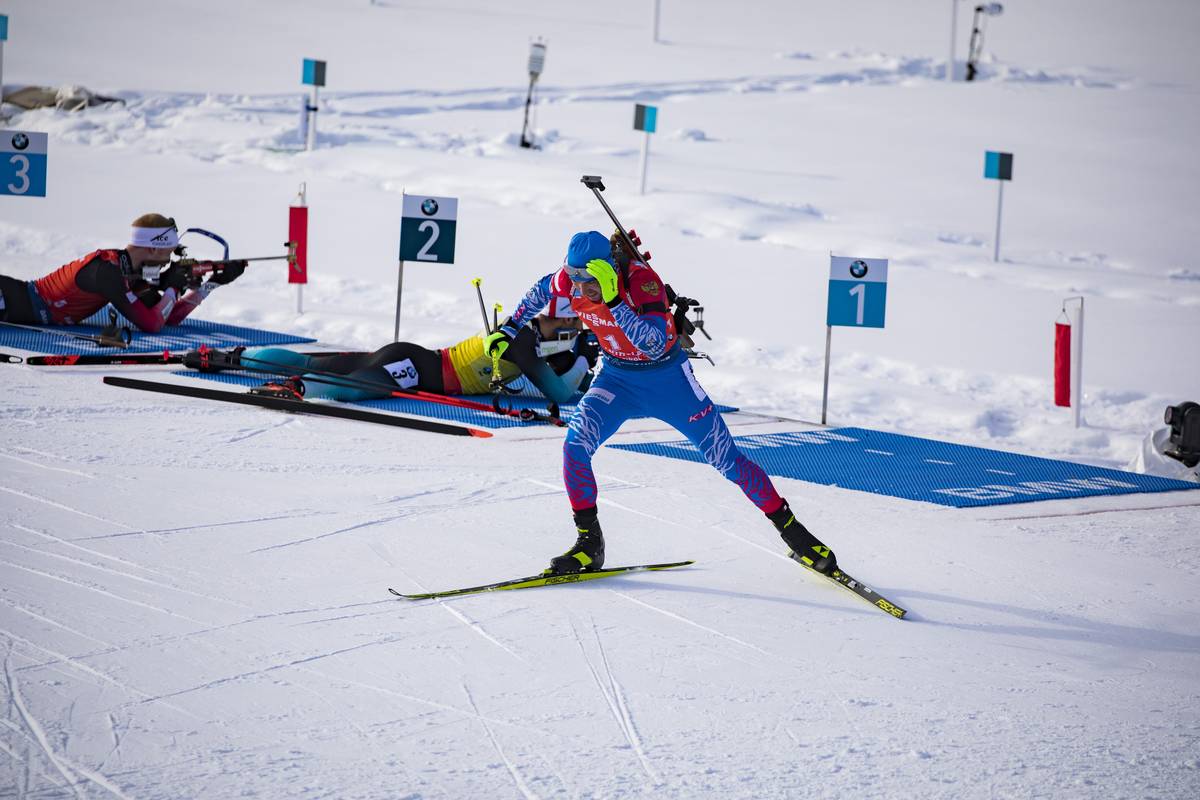
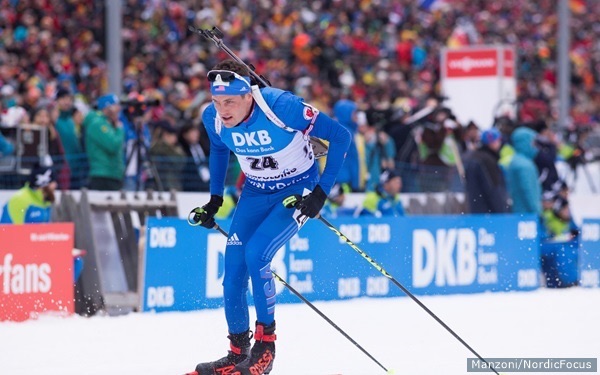
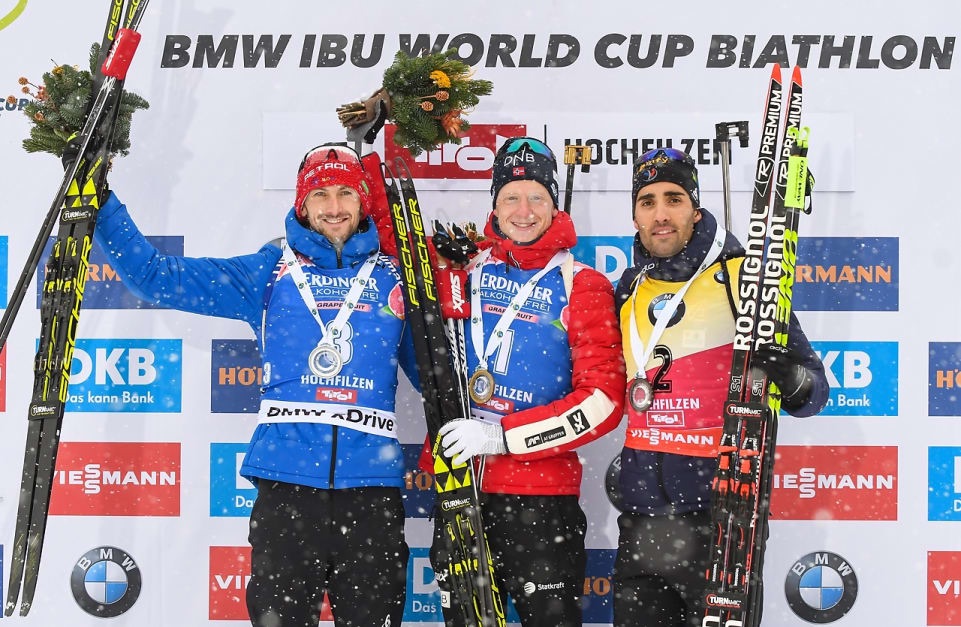
Emilien Jacquelin (FRA), Martin Fourcade (FRA), Alexander Loginov (RUS), (l-r) on the range. (Photo: NordicFocus)
In fourth place, Jacquelin’s teammate Martin Fourcade, second in the sprint and for most of the pursuit race looking like he could at least repeat a podium finish, missed a target in each of the standing stages to push him out of medal contention. Still, when Fourcade crossed the finish line (+46.3, with two penalties) he couldn’t help but smile broadly, and instantly hugged and high-fived his younger training partner Jacquelin, who stated in the press conference that they live in the same town and have worked together for six years now.
“It’s a childhood dream, since I was five years [old] I wanted to be a champion in biathlon like Raphaël Poirée or Martin Fourcade,” the new gold medalist Jacquelin told broadcaster ZDF in an interview right after the race. “So here for me to do this today is incredible. I was able to make a great race, and it was really tough here at the World Championships. I am really satisfied about my shooting. It’s a dream realized. I just want to thank my parents who are here, thank you for believing in me and to help me reach my goals.”
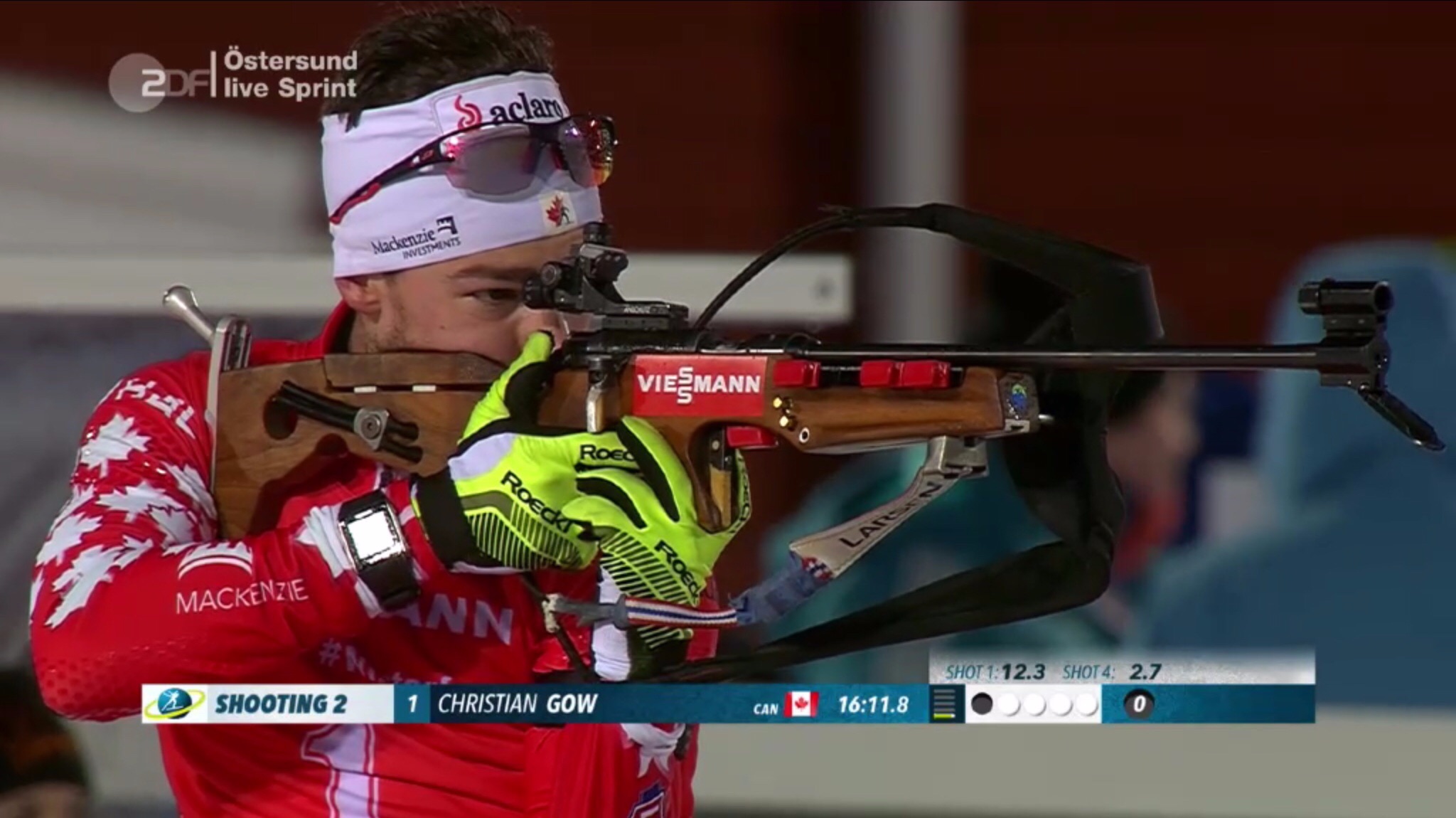
For Biathlon Canada, only Scott Gow had qualified for the World Championships pursuit race among the top-60 with his sprint result, starting the race in 16th position and 1:16 minutes behind sprint winner Loginov. In his first shooting, Gow incurred two penalties, setting him back to 30th position early in the race.
In the second prone stage he managed to clean his targets, leaving the range slightly up in 28th place, but already more than 2 minutes behind the leaders. Gow’s tactic seemingly was to try and shoot fast, recording the fifth-best shooting and range times of the day overall. While the TV cameras focused on the top of the field, that didn’t quite pay off when he unfortunately shot two more misses in his first standing stage, before incurring his fifth penalty of the day in the final shooting. He finished the race in 35th position, just behind a few athletes including Russia’s Evgenyi Garanichev in a finish sprint, crossing the line 3:34.8 minutes back (2+0+2+1). For Gow, this still ranks as his best result in a pursuit race at IBU World Championships and Olympic Winter Games, improving on a 43rd place at last year’s championships in Östersund, Sweden.
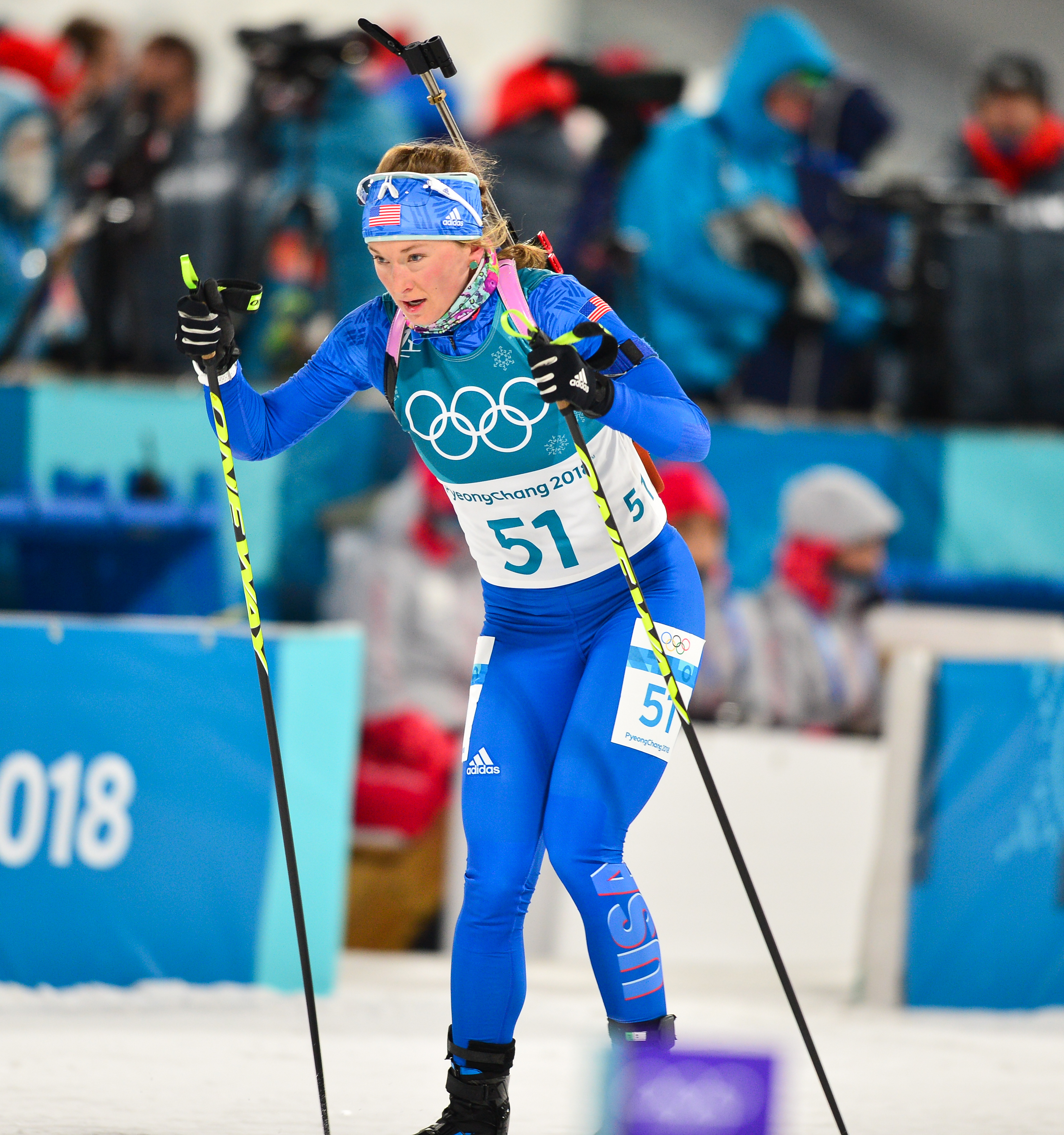
For US Biathlon, Sean Doherty was the lone qualifier for the pursuit. He began the race in 44th position, 2:04 min back. His shooting performance started out on a sour note when he instantly missed his first shot in prone, before hitting the next four targets. That streak continued, with Doherty as he incurred a penalty in each of the next three stages, which prevented him from moving up more in the field despite holding up well on the course with the 35th-fastest skiing time. He finished the pursuit in 43rd position (1+1+1+1). For Doherty, it was his second-best result in a pursuit at World Championships at the senior level, having finished in 20th place the prior season.
After a rest day, the IBU World Championships will continue on Tuesday with the women’s 15 k individual before the men’s 20 k individual follows on Wednesday.
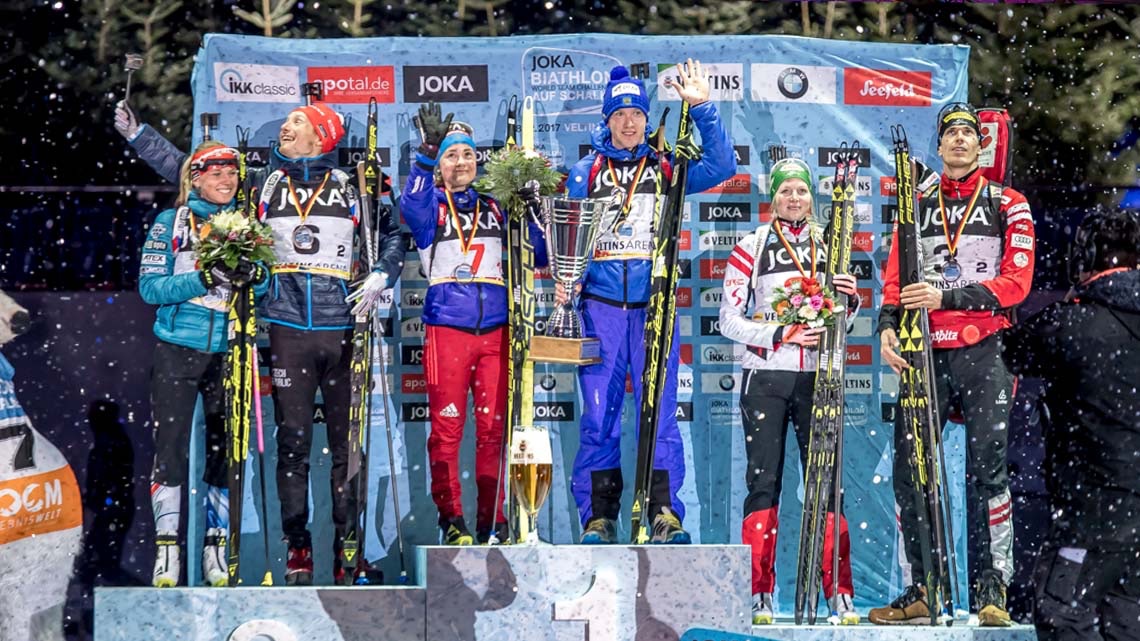
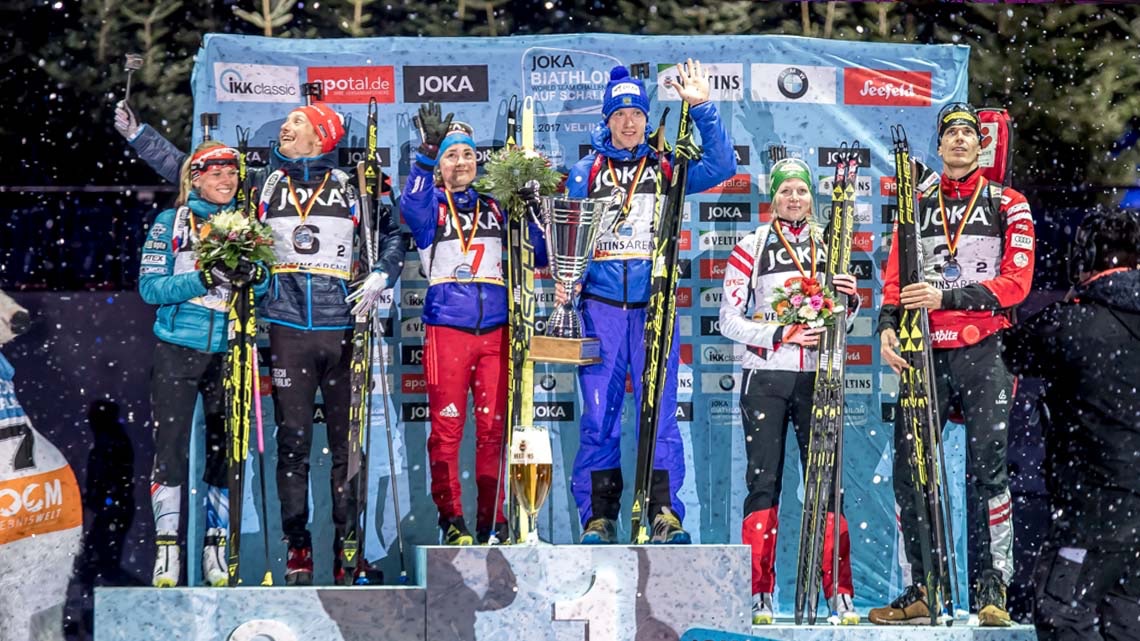
Italy’s Dorothea Wierer and Lukas Hofer in first place (center), Germany’s Franziska Preuß and Simon Schempp in second place (left), and Darya Domracheva of Belarus with her husband Ole Einar Bjørndalen of Norway in third place (right) on the podium of the 2018 “Biathlon auf Schalke” event. The invitational was billed as the last international race for Domracheva and Bjørndalen, the winningest biathlete of all time. (Photo: Event organizer)
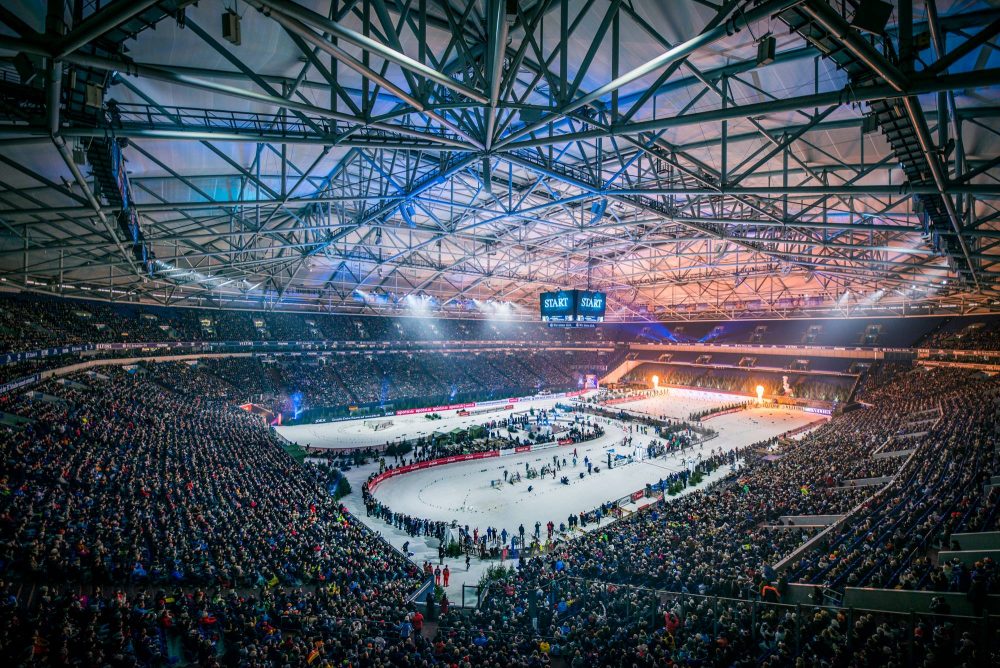
The “Biathlon auf Schalke” two-person mixed relay show race in Gelsenkirchen, Germany, has become a Christmas holiday break fixture on the winter sports calendar. Many biathletes are in awe of the event, featuring a temporary ski course in and around a massive domed arena that usually serves as the home pitch for the Bundesliga soccer club Schalke 04, along with a raucous atmosphere in a sold-out venue and millions watching the broadcast live on TV in several countries.
It’s no real surprise that some living legends of the sport would pick the frantic event that brings biathlon from the mountains to the city as the final race for their storied careers.
In 2018 in its 17th season and with 46,421 fans in attendance, no North American team was represented among the ten invited teams.
The event on Saturday evening mainly drew its fascination from being billed as the final race in the long and successful athletic careers of Ole Einar Bjørndalen of Norway, age 44, and Darya Domracheva of Belarus, 12 years his junior. Combined, the husband-and-wife team could display 12 Olympic gold medals in their personal trophy case, to name just one of their many achievements. By their own admission in a series of interviews with German TV host network ZDF and other broadcasters before, during and after the event, the day certainly was an emotional highlight for Bjørndalen and Domracheva.
“It’s just fantastic, vielen vielen Dank, thank you so much for your support, you are the best!” Domracheva hollered in a fun language mix in an interview with ZDF after the race, drawing a big cheer when her words echoed through the arena via the public address system.
“You couldn’t have dreamed it [better],” her husband Bjørndalen also added in German. “This is incredible, so many people … I never experienced fans as good as this in my life. Thanks again Schalke, this is incredible!”
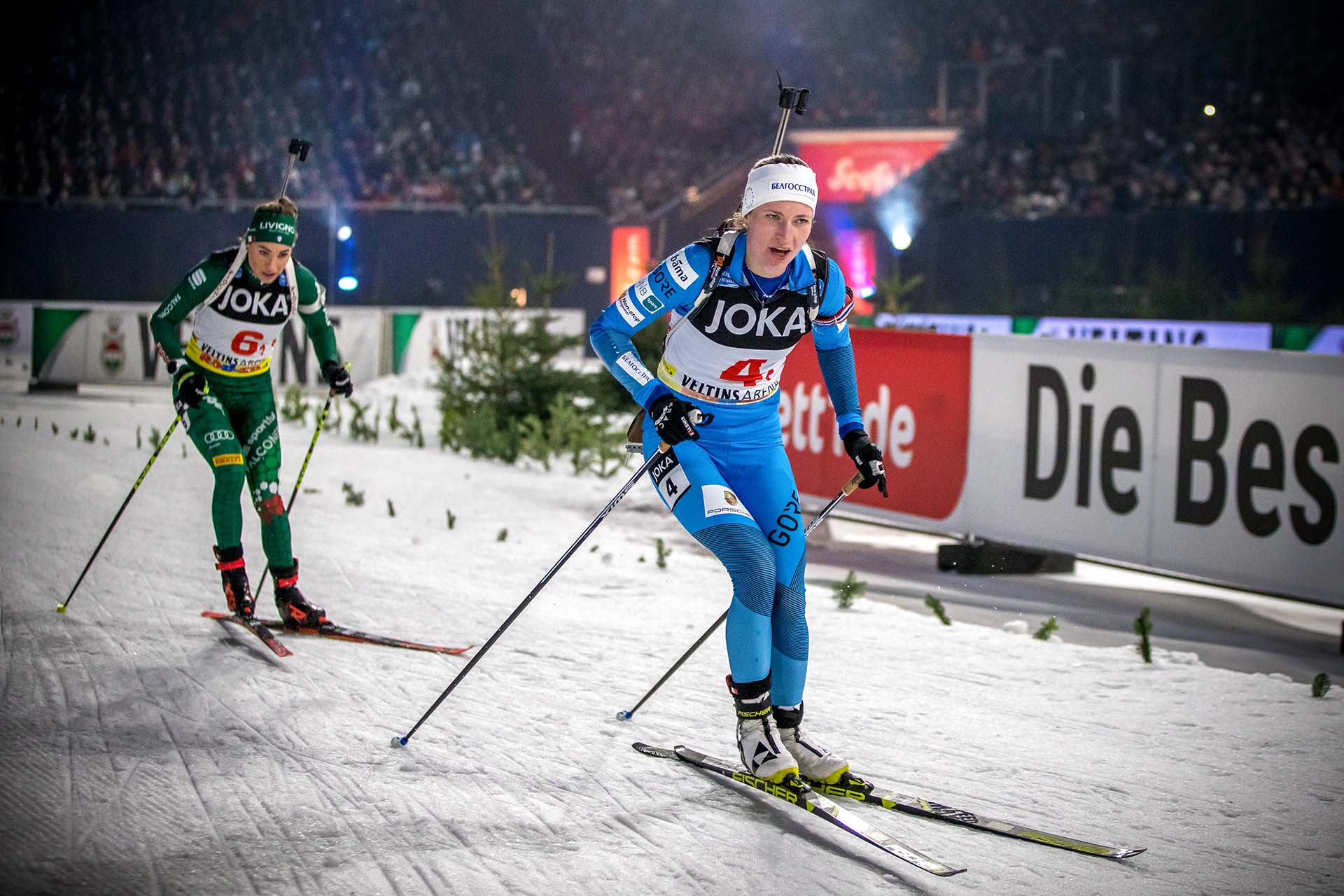
Darya Domracheva of Belarus skiing in front of Italy’s Dorothea Wierer during the 2018 Biathlon auf Schalke event. Wierer went on to win the race with her partner Lukas Hofer. (Photo: Event organizer Facebook page)
First World Team Challenge Victory for Italy
In terms of the athletic merit of the event, the 2018 edition saw the first victory in the history of this competition for an Italian team, with current International Biathlon Union (IBU) World Cup women’s total score leader Dorothea Wierer successfully pairing up with teammate Lukas Hofer.
Over the course of the evening, the Italian pairing turned out to be an ideal combination of the fastest shooter on her race legs and the fastest skier on his. The duo narrowly won the “first half” mass start race of the event which was followed by a 30-minute intermission. Wierer and Hofer also created a convincing lead in the pursuit, which was featured as the “second half” of the evening’s racing.
But their victory was briefly in doubt when Hofer missed three targets in his final standing stage — a bit unusual on a range with no wind influence. Having to circle the penalty loop (though shorter than in regular World Cups) and now on tired legs, the three penalties allowed Germany’s clean-shooting Simon Schempp – who raced with his fellow national team member and girlfriend Franziska Preuß – to catch up to Hofer on the final lap that meandered through a “winter village” concourse around the arena.
“I knew [Lukas] is super on skis, but when he missed three that was still becoming pretty suspenseful,” Wierer laughingly remembered the situation in an interview with ZDF after the race, according to a translation. “But luckily that triggered a little bit of adrenaline.”
Hofer slowed down on the winding 1.3-kilometer course that provided few opportunities for overtaking other skiers before coming back into the main arena where he began to push hard on the only notable straight section along the shooting range. He managed to create a small gap between himself and Schempp and defended that to the finish line to secure the victory in a time of 33:23.6 minutes. Schempp finished 1.2 seconds behind.
“My knees were trembling like a sewing machine,” Hofer said about his problems in the final shooting stage. “Luckily it somehow still worked out fine. I had to ski a tactical final loop, and it’s just great to finally stand at the top of the podium.”
“It’s just a grandiose event,” Schempp said, seemingly not minding the narrowly lost victory (and sponsored car prize). “It’s so incredibly fun to race here in front of such an audience. And when a German team is also in the mix in front, that creates such an atmosphere … That gives you back a lot as an athlete. Just a lot of fun.”
“You really feel like a soccer player with so many people watching,” Wierer added. “Even if you are just trying to have a conversation, it’s so loud you hardly understand anything with all this noise. And it’s great that everyone is being cheered for. Really cool.”
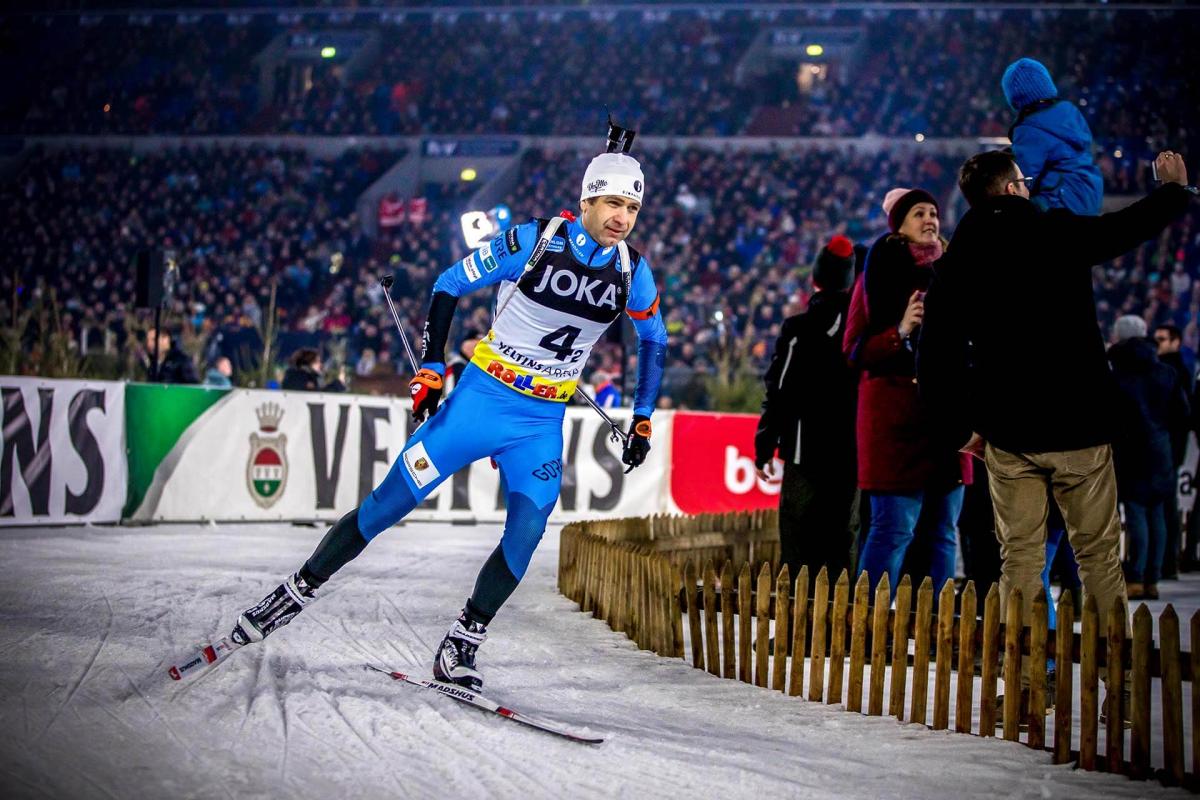
Norway’s Ole Einar Bjørndalen on course during the 2018 Biathlon auf Schalke, billed as the last international race of his storied career. (Photo: Event organizer)
Third Place for the Biathlon Legends
But the real story of the night unfolded a little behind the race for the top of the podium.
In the first event of the evening, Bjørndalen had proven once more that he still ‘got it’, winning a shootout competition to determine the start order against a host of athletes known as fast and accurate shooters.
The semi-retirees Bjørndalen and Domracheva initially struggled a bit with the speed of the athletes still active week to week on the World Cup. Although they were able to hold their own and finished the event’s first half in third place, 6.1 seconds behind Italy and 2.7 seconds behind the French team of Anaïs Bescond and Emilien Jacquelin.
“The course is not so difficult, but when you are in a bad shape it becomes difficult,” Bjørndalen told broadcaster ZDF at halftime, according to a translation. “We didn’t prepare so well, though Darya is still strong but I am flailing a bit in the skiing. Maybe next round will be better.”
Despite admitting he had prepared for the event with a brief training camp in Norway and then a course inspection a day before most competitors had arrived at the venue, the athlete nicknamed “the cannibal” for eating up gaps to other athletes on the course in the prime of his career had some problems keeping speed with the fastest skiers on Saturday.
Domracheva was able to hold up well on the range and course. With her signature elegant ski technique she kept right behind Germany’s currently best-ranked World Cup athlete Preuß on a loop, and stuck within viewing distance of the fast skiing Wierer. With a series of cleaned targets, Domracheva and Bjørndalen managed to keep themselves in podium contention and at one point even maneuvered into the lead, to the joy of the spectators who cheered for them at least as loud as for the German home teams.
Then came the final exchange to the men, which required athletes to shoot a standing stage before skiing another full loop.
“It was mega-cool to watch the final leg, very exciting,” Preuß told ZDF, according to a translation. “I believe everyone watching today saw how the suspense was bubbling up again. That’s how you wish a race should be.”
Bjørndalen had incurred one penalty in his final shooting and skied back on the main course in third position behind Hofer and Schemp. But just a few seconds back, Benedikt Doll, who formed an “injury replacement” second team for Germany together with Denise Herrmann, managed to catch up and pass the Norwegian on the final lap. Being aware that a fourth place just off the podium for the final race for the biathlon star would be an anticlimactic result, Doll waited a few meters before the finish line for the man who he considers his biathlon idol. Doll then grabbed and lifted up Bjørndalen’s arm before skiing into the finish side by side. Intentional or not, Bjørndalen slid his ski boot over the line 0.1 seconds ahead of Doll.
“It was a very nice gesture. It is impressive that he does it at home. Thank you very much,” Bjørndalentold Norwegian broadcaster NRK about Doll’s actions, according to a translation. During the victory ceremony, he and Domracheva then called Doll up to the podium and hung their awarded medals around his neck, who seemed to reluctantly accept the honor.
Darya Domracheva of Belarus (in foreground) is waiting to greet her teammate and husband, Norway’s Ole Einar Bjørndalen, as he skis towards the finish line together with Germany’s Benedikt Doll at the 2018 Biathlon auf Schalke event, billed as the last race of Bjørndalen’s career. (Photo: Event organizer Facebook page)
Bjørndalen will retire as the winningest biathlete of all time, following a 25-year career that is a rare achievement in any endurance sport. To honor Bjørndalen, ZDF showed some old footage and interviews from early in his athletic career in the lead-up to the race.
Bjørndalen amassed eight Olympic gold medals of 13 total Olympic medals, 20 IBU World Championship golds of 45 total championships medals, and 95 World Cup wins with an additional World Cup win in cross-country skiing. Even France’s current biathlon star Martin Fourcade would have to keep competing for numerous years to have any chance at matching those numbers. Bjørndalen’s Olympic record is only surpassed by fellow Norwegian cross-country skiing star Marit Bjørgen.
Domracheva has four Olympic and two World Championship gold medals to her name, most recentlyanchoring the women’s relay to the gold medal for Belarus at the 2018 PyeongChang Winter Olympics. She told ZDF in an interview that she considers the 2014 Olympic Games in Sochi, Russia, to be the peak of her athletic career, where she won gold in the individual, sprint and pursuit disciplines.
Domracheva reportedly plans to still race in one more event at home in Minsk, the capital of Belarus, for which 100,000 spectators are expected to show up.
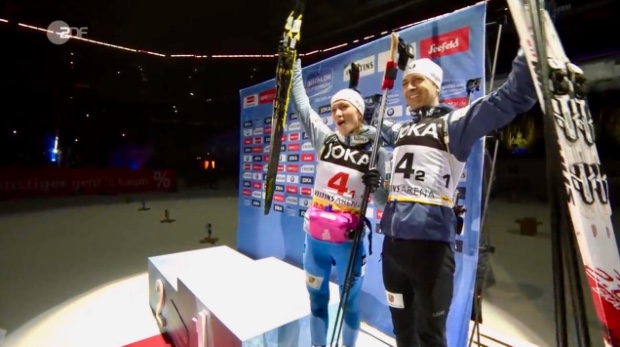
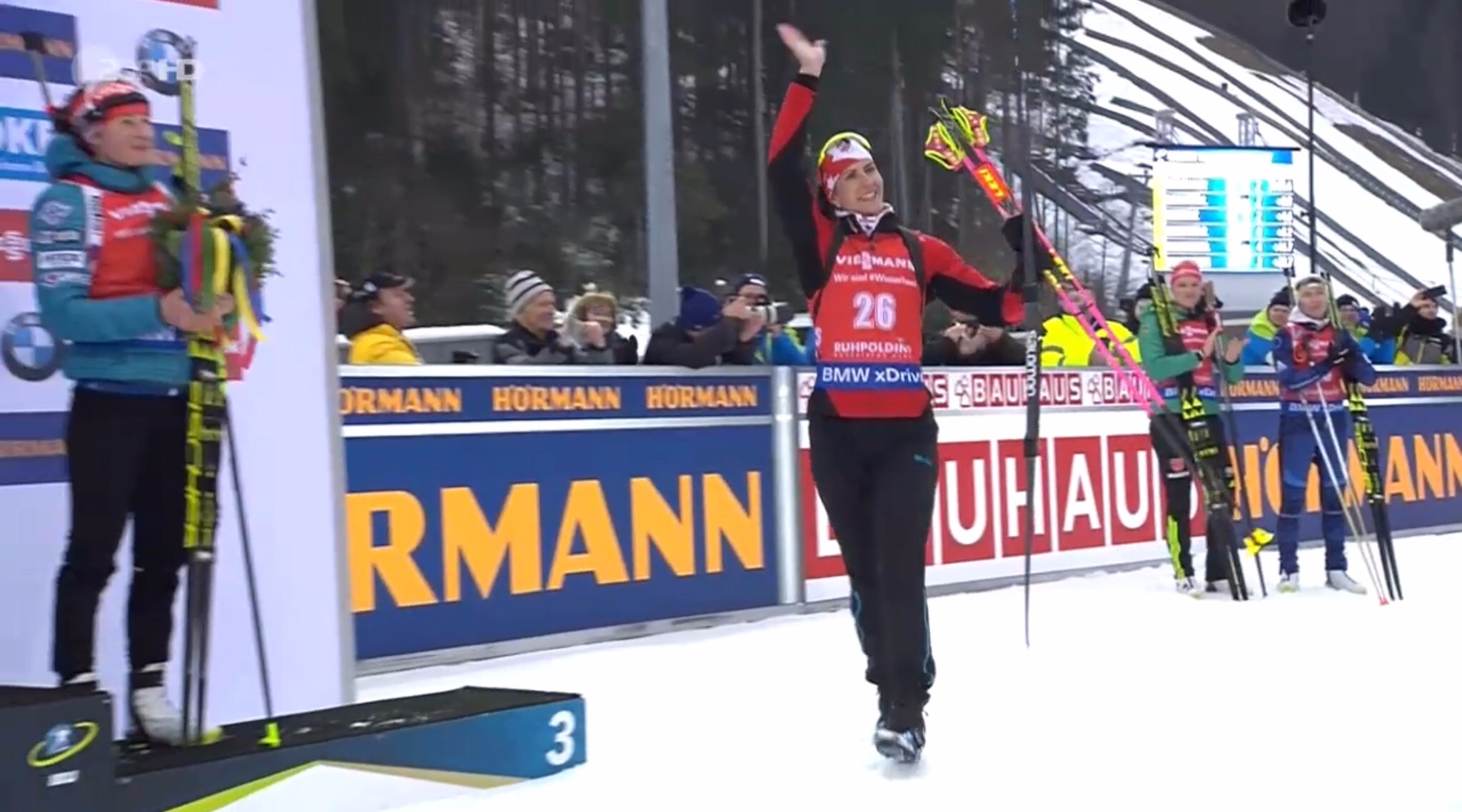
Darya Domracheva of Belarus and Ole Einar Bjørndalen of Norway waiving to the crowd before the victory ceremony of the 2018 Biathlon auf Schalke invitational race. (Photo: ZDF screenshot)
With homes all over Europe in Beitostølen (Norway), Minsk (Belarus) and Obertilliach (Austria), and already active in other career ventures from sports broadcasting to fashion design, the pair told reporters they have not yet decided where they will ultimately settle in the next few years, wanting to decide that once their young daughter is of school age. For now, their only firm plans are to spend New Year’s Eve together in Norway.
Another Farewell: Russia’s Anton Shipulin
Anton Shipulin – Russia’s best biathlete of the last few years – alsoannounced last week that Schalke would be the final race of his international career.
“Thank you very much, dear fans, for your support,” he posted on his social media accounts, according to a translation. “Without you, this adventure would have been more difficult. My victories are also your victories. I will always remember this. You are the best. I hope we will be able to please you once again at the ‘Christmas race’ [World Team Challenge], which will be held on December 29 and will be the final in my professional career.”
Last winter, Shipulin had been among a number of Russian athletesbarred by the International Olympic Committee (IOC) from starting at the 2018 Olympics in PyeongChang, and claims that to this day he has not yet received a satisfying official explanation by either the IOC or IBU for that blow to his athletic career, according to a fairly rare international interview he gave German home broadcaster ZDF before the race.
Shipulin came back with a vengeance to close out the 2017/18 IBU season, winning the sprint at the World Cup in Kontiolahti, Finland, during the race week immediately following the Olympics.
Overall he has achieved 11 World Cup victories in individual races during his career and won seven medals at World Championships including one gold. Arguably his biggest success, the gold medal from the men’s relay at the 2014 Olympics at home in Sochi, Russia, hangs in the balance as the IOC and International Biathlon Union keep investigating allegations, though for now publicly only against retired teammateEvgeny Ustyugov. Shipulin’s fourth-place mixed relay result from those Olympics has already been voided.
Shipulin conveyed in statements that the international sports bodies and anti-doping authorities have treated his case unfairly during the last two seasons, and the murky situation about his ability to participate in future major sports events combined with the unpleasant prospect to see old results annulled seemingly has exhausted his motivation to keep training and competing.
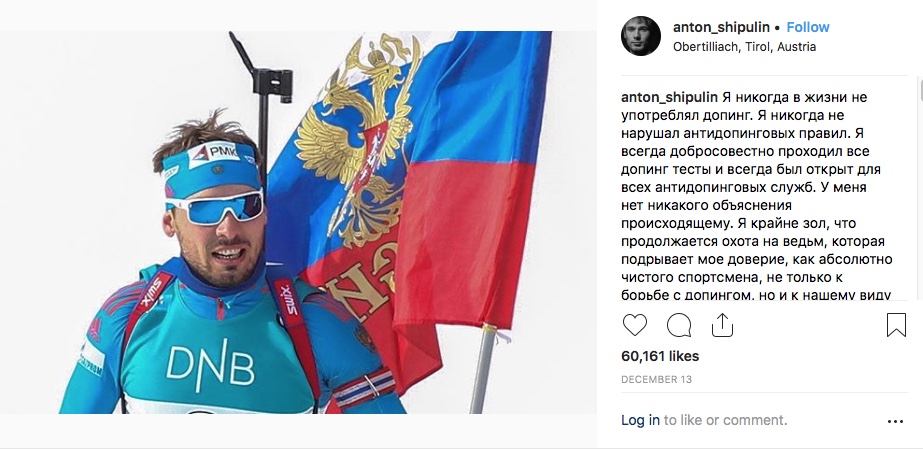
Russia’s Anton Shipulin claimed his continued compliance with anti-doping regulations in a Russian and English post on his Instagram social media account from December 13, 2018. (Photo: Instagram screenshot)
“I never violated anti-doping rules. I have always completed doping tests in good conscience,” he told ZDF in an interview, according to a translation, reiterating comments he made in social media posts including one from December 13, 2018, in which he called the most recent investigations triggered by Austrian and Italian authorities that reportedly included a team hotel search a “witch-hunt” and “total nonsense”.
On Saturday, the pre-determined final race together with his teammate Ekaterina Yurlova-Percht didn’t quite go as storybook-scripted as for Bjørndalen and Domracheva. Incurring too many penalty laps, the Russian duo was never really in contention for the podium and ended the race in seventh place (+1:48.8).
Yurlova is a veteran of racing at Schalke,winning the event a year ago together with Alexey Volkov, as well as in 2012 when she had teamed up with Shipulin and is currently in full World Cup race mode. Also, like her teammate Shipulin, Yurlovawas not allowed by the IOC to start in PyeongChang and reportedly could still be under investigation by international sports and legal authorities. But so far has not been publicly charged with any concrete violations. She is married to an Austrian national, and by living in that country is under the supervision of the local anti-doping agency for much of her off-season.
Shipulin had not yet raced in an IBU event this season, citing a lack of training time in the summer. Though prior to his announcement last week it had been widely expected that he would be back with the Russian team in time for the races in January or at the latest for the World Championships in Östersund, Sweden.
Similar to Domracheva, Shipulin might still make an appearance in a farewell race at home. He told ZDF that he looks forward to now spend time in Tyumen, Russia, with his family, and said he was also happy to have more opportunities for his other sports passion: fly fishing.
Final Results “Biathlon auf Schalke” World Team Challenge 2018
Shooting range and part of the ski course inside the domed Veltins Arena during the 2018 ‘Biathlon auf Schalke’ invitational race event. (Photo: Event Organizers Facebook Page)
While the International Biathlon Union has adopted the mixed and single-mixed relay formats as exciting new disciplines in recent years, the “Biathlon auf Schalke” also dubbed the World Team Challenge by the organizer is an invitation-only private event not sanctioned by the IBU (even though there areplans to cooperate in the future, especially regarding a junior competition leading up to the main event), so there were no World Cup points much less internationally recognized medals to win in the race. That will happen towards the end of the season in March at the IBU World Championships in Östersund, Sweden.
The regular IBU World Cup season will continue on January 10th, 2019, in Oberhof, Germany.
As FasterSkier staff stroll into an upcoming weekend with no cross-country World Cups, it’s time to scramble and score some holiday gifts for friends and loved ones. Christmas is around the corner. It’s never too late for Hanukkah (Hanukkah ended on December 10). In this third book idea for the gift-giving season, Harald Zimmer, German-based FS contributor, highlights Andre Agassi’s gem.
***
2018 Gift Guide – Open: An Autobiography
The autobiography of a star tennis player known for weird hairdos who retired more than a decade ago? What could I gain from that if I don’t want to also become an elite tennis player, or maybe don’t even particularly care for the sport? Those were my reservations as I sat down with Open: An Autobiography by Andre Agassi.
Yet Agassi and this book are also among the favorite inspirations (min 31:00 in the linked podcast episode) cited by Shaun White, three-time Olympic gold medalist in halfpipe snowboarding — on the surface, a completely different athletic endeavor. According to White, both athletes dealt with “now what?“ motivational issues after experiencing success early in their careers. Success that came when both athletes were unable to think about their lives beyond their respective sports.
In Open, Agassi describes in candid, vivid and at times hilarious detail how he struggled with a love-hate relationship for tennis. He expands upon his anti-climatic feelings after winning major tournaments; the win only providing brief joy. He elaborates on the disconnect between his curated “marketing public persona” and his true self, his many personal issues, and how sports enabled him to help others off the pitch and ultimately find new meaning for his own life.
From the man who helped make the mullet semi-fashionable within Wimbledon’s formal grounds, Agassi allows the reader to go deep as explains how he learned to channel unpleasant but all too common events and emotions in both sports and life into the right direction and mold them into a constructive source for good.
This solid read is recommended for both singularly driven athletes to the coaches, parents, and mentors tasked with helping develop emerging people under their care.
“What you feel doesn’t matter in the end; it’s what you do that makes you brave.” ― Andre Agassi, Open
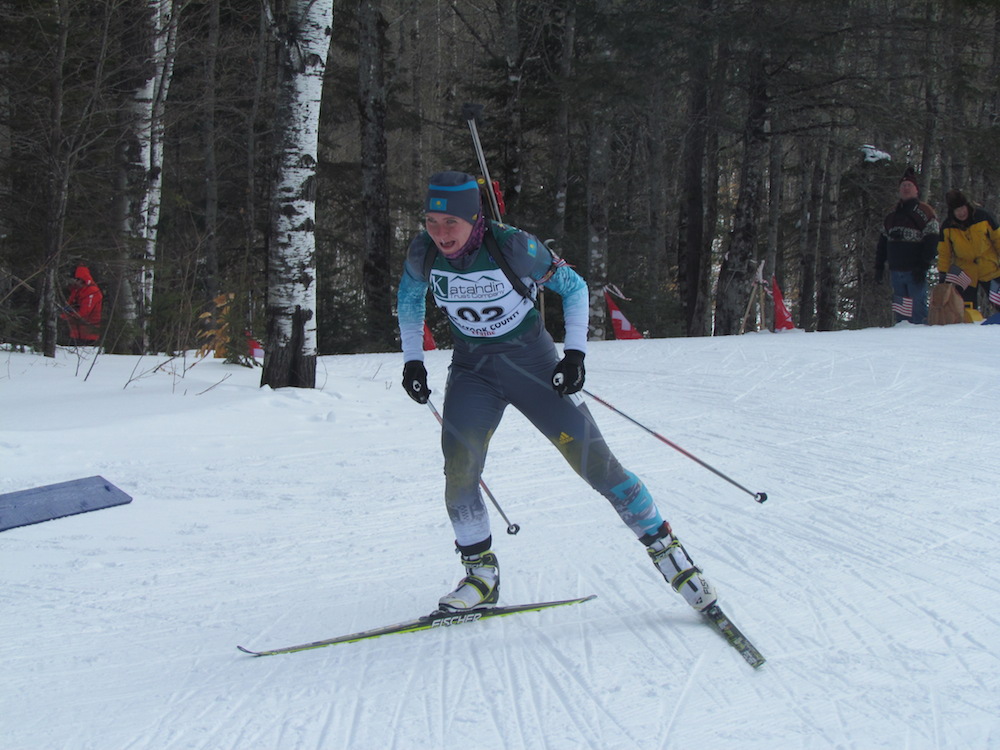
Kazakhstan’s Galina Vishnevskaya on her way to winning the pursuit at 2014 IBU Junior World Championships. (Photo: Katrina Howe)
About a week before the upcoming 2018/19 World Cup Season kicks off, the International Biathlon Union (IBU) announced in a press release on Thursday, November 22nd, that it has provisionally suspended a group of nine female and male athletes representing Kazakhstan from all IBU-sanctioned events with immediate effect, due to alleged anti-doping rule violations. The list of names includes a former Junior World Champion as well as Universiade gold medalist and World Cup podium finisher, a number of recent Olympians for Kazakhstan, and notably also the wife of well-known cross-country skier Alexey Poltoranin.
Prior Suspicions Against The Team
The IBU also announced that the sanctions are based on criminal investigations by authorities in Austria and Italy. On February 8th, 2017, the eve of the 2017 IBU World Championships in Hochfilzen, Austria, federal police raided the hotel of the Kazakh national team seizing medical products and medications for further investigation. Blood and urine samples were also taken, but no immediate adverse analytical findings were announced. All athletes on location were allowed to compete in those World Championships. The Kazakh team failed to achieve any individual top results, with an 11th place in the mixed relay their best finish. Although, that 2017 World Championship roster though was comprised of four athletes who have now been suspended.
The Hochfilzen investigation, in turn, had been triggered a month earlier in January 2017, when members or staff of the Kazakh national team travelling in a team van had been observed discarding a carton box with a suspiciously large amount of medical products at a gas station rest stop in eastern Tyrol. The box’s contents included syringes, infusions and handwritten notes that hinted at medical treatments prohibited under sports anti-doping regulations. The box reportedly also contained official accreditations for IBU race events, which allowed authorities to trace them to the Kazakh biathlon team.
Presumably the IBU as well as the respective national police authorities have had a watchful eye on this team ever since, and now acted on their findings.
The athletes that were provisionally suspended as named by the IBU are (in alphabetical order):
Women:
Anna Kistanova, 28. She has started in 59 IBU World Cups, and competed for Kazakhstan at the 2015, 2016 and 2017 World Championships, with an eighth place in the women’s relay at the 2016 event in Oslo as her best result. She has not competed in the Olympic Winter Games, and has not started at the World Cup level since the 2016/17 season.
Darya Klimina (née Ussanova), 29. She represented Kazakhstan at the 2012, 2013, 2015, 2016 and 2017 IBU World Championships, as well as at the 2014 and 2018 Olympic Winter Games. Her best result in those events was also the eighth place in the 2016 Oslo relay, as well as a 27th place in the sprint during those championships.
Olga Poltoranina (née Dudchenko), 31. Her father is a national team coach. According to IBU data, the veteran athlete has represented Kazakhstan at eight World Championships beginning at age 16 (2003, 2004, 2007, 2008, 2011, 2012, 2015, 2017), as well as at four Youth and Junior World Championships. She did not compete on the IBU World Cup between the 2012 and 2016 seasons. Most recently she started for her country at the 2018 Olympic Winter Games in PyeongChang, South Korea, her first, recording a 63rd place in the sprint, 46th place in the individual race and a 14th place in the women’s relay as her so far final race at an IBU event.
In her private life, according to multiple news reports and her Wikipedia page in several languages, she is the wife of Kazakh cross-country skier Alexey Poltoranin, who has competed on the FIS World Cup circuit since 2005.
Alina Raikova, 27. She represented Kazakhstan at the 2013, 2015, 2016 and 2017 World Championships, as well as the 2014 and 2018 Olympic Games. A solid shooter, her best result was a 29th place in the Individual event at the 2016 World Championships in Hochfilzen, Austria. At Youth and Junior World Championships she represented her country four times, achieving a sixth place, also in the Individual in Kontiolahti in 2012.
Galina Vishnevskaya, 24. Arguably the most successful Kazakh athlete now suspended, she was a highly accomplished junior athlete, highlighted by becoming the 2014 IBU Junior World Champion in the pursuit discipline in Presque Isle, USA, and winning three more silver and a bronze medal at the 2014 and 2015 editions. She also achieved bronze and silver medals at the 2012 Winter Youth Olympics in Innsbruck, Austria. She became a two-time gold medalist in sprint and mass start at the 2017 FISU Winter Universiade (often dubbed the Student Olympics) at home in Almaty, Kazakhstan, along with winning two additional silver medals.
Her best results on the senior elite IBU World Cup level were a third place in the single-mixed relay in Östersund, Sweden, to start off the 2017/18 season, and a fourth place in a mass start in Oberhof, Germany, during the 2016/17 season. Most recently she also became a 2018 Summer Biathlon World Championships bronze medalist in sprint and pursuit (albeit in an event not attended by many of the best athletes competing in the winter season).
Men:
Maxim Braun, 25. He represented Kazakhstan at the 2015, 2016 and 2017 World Championships, and most recently also at the 2018 Olympic Winter Games. For his best result at the World Cup level he reached the podium together with his partner Vishnevskaya in the single-mixed relay mentioned above.
Anton Pantov, 27. He started for Kazakhstan at the 2012, 2015, 2016 and 2017 World Championships, and at the 2014 Olympic Winter Games in Sochi where he achieved a 27th place in the individual event. In this discipline he also finished fourth at the 2012 Junior World Championships. At the 2017 Winter Universiade, at home in Almaty, he won a silver medal with the mixed relay and a bronze medal in the men’s mass start.
Vassiliy Potkorytov, 24. He represented Kazakhstan at the 2015, 2016 and 2017 World Championships, and at the 2018 Olympic Winter Games. His only top-20 finishes have been in relays and mixed relays.
Yan Savistsky, 31. He reportedly represented his country at a total of ten biathlon World Championships over the course of a decade from 2007 to 2017, as well as at the 2010 Olympic Winter Games in Vancouver, Canada, and 2014 in Sochi. His best championship results were in the Individual discipline, where he twice finished 11th in 2013 in Nove Mesto and in 2016 in Oslo. He also helped his team win a gold medal with the men’s relay at the 2011 Asian Games, together with three athletes not named by txhe IBU in relation to this investigation. On the World Cup he achieved a fifth place in a single-mixed relay in Kontiolahti during the 2016/17 season together with the above-mentioned Vishnevskaya.
The IBU will now hold hearings with the suspended athletes to give them a chance to explain the allegations, and will then decide on further proceedings and potential longer suspensions.
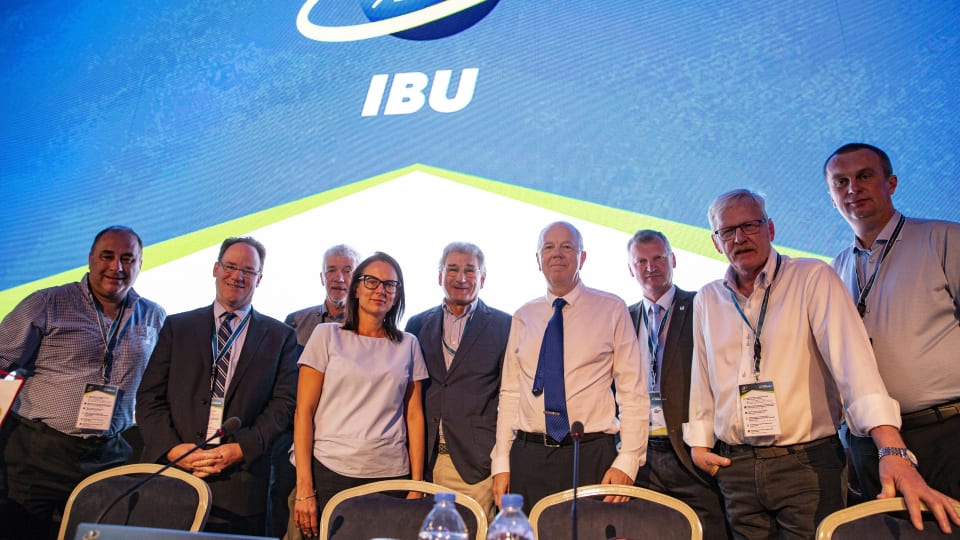
Nine of the 11 members of the newly elected International Biathlon Union (IBU) Executive Board, including St. Paul, Minnesota-based Canadian doctor Jim Carrabre (far left), US Biathlon President and CEO Max Cobb (second from l), and newly elected president Olle Dahlin of Sweden (fourth from r). (Photo: IBU/Biathlonworld.com)
The past year certainly has not been an easy one for the International Biathlon Union (IBU), the governing body in the sport of biathlon for the past 25 years.
The sports federation had to take the unusual measure of suspending the Russian Biathlon Union, historically one of the core countries for biathlon, to a provisional member status.
The International Olympic Committee (IOC) banned several prominent athletes, including biathletes, from that nation from participating in the 2018 Olympic Winter Games in PyeongChang, even though they were still allowed to compete in IBU World Cups before and after.
International athletes boycotted eventsin Russia citing the continued non-compliance with anti-doping regulations.
And to make matters worse, the IBU became embroiled in its own leadership scandalwith longtime President Anders Besseberg and Secretary General Nicole Resch having to step down amid allegations of corruption.
Last weekend, the IBU and its member nations had a chance to set a course for the future at its 13th biennial “regular Congress”, this time held in Poreč, Croatia. The congress brings all the member countries together once every two years to elect an executive board and vote on rules for both competitions themselves and how the federation should operate.
The question was: more of the same, or a new direction?
As the first order of business, the IBU had to find a successor for Besseberg to lead it into the next seasons. Only two candidates were on the ballot: Olle Dahlin of Sweden, and Baiba Broka of Latvia. In the end Dahlin was the clear winner,receiving 39 votes of the delegates to 12 for Broka. He will serve a term of four years.
“Thank you very much for the confidence you showed in me. I am very honored. I will do my utmost together with you to develop the future of biathlon,” the new IBU President Dahlin said in remarks shown in a highlight videoof the Congess. “I will be the president of all athletes and all nations,” he vouched, according to an IBU press release.
As one important voice for these athletes, US Biathlon’s Clare Egan, a 2018 Olympian and since March 2018 the new chairwoman of the IBU’s Athlete’s Committee, welcomed the choice of Dahlin.
“The Congress sent a clear message by electing Dahlin 39:12 and voting in this particular roster of Executive Board members,” Egan wrote in an email to FasterSkier.
US Biathlon Association President and CEO Max Cobb reiterated that message, writing “I am extremely happy Olle Dahlin was elected and I support his vision for the future for IBU.”
Controversy Avoided?
Dahlin had already been a member of the IBU Executive Board, and while that gave him prior experience and he was not charged by external authorities in the investigation of the scandal surrounding Besseberg and Resch, his name might not exactly scream “fresh start”.
Broka, meanwhile, is a lawyer and politician from Latvia who serves as President of the Latvian Biathlon Federation and on the Executive Committee of the Latvian Olympic Committee.
“At the moment, there is a need for change,” Broka had told SportaCentrs.comabout her candidacy when the nomination was announced, according to a loose translation. “I have been working in the Legal Committee of the IBU for four years, I have seen a lot of problems between Sochi and PyeongChang. I have seen a lot of things to do, many of my suggestions to change in the statutes have already been taken into account, the situation with doping scandals, in terms of good governance of the organization. To a great deal, the IBU has so far not paid attention and now it is apparent that it is missing. My legal experience would be useful.”
But while Broka advertised a fresh start, she came with some baggage of her own. Summing them up, German television network ARD released a scathing storyon the state of the IBU in general and Broka in particular, citing an expert on Latvian politics at the University of Hamburg and local media reports who had unearthed a litany of questionable anecdotes from the candidate’s past: allegations of involvement in ominous real estate deals in the capital of Latvia; a personal credit from an Arab investor wanted by Interpol (which cost her a job as secretary of justice of her country after six months in office); leadership in a far-right nationalist party; and at the same time good relationships with a party that supports Russian interests, such as Latvia leaving NATO.
This led some in the biathlon community to fear that she might promote the Russian federation to full membership status again even though four more biathletes from that country were just had doping cases formally opened against them.
According to ARD, Broka roundly denied all of these allegations as fabrications by political opponents and not relevant for her involvement in sports governance, citing a section from the IOC’s charter that forbids political discrimination.
But while it is hard to say how much this story influenced the voting representatives of the member federations at the IBU Congress, elevating her to the presidency hardly would have been a good look for a sports organization keen to “clean house” and win back trust in the international sports community.
Vice Presidents New and Old
Besides the position of President, all other Executive Board positions were also up for election.
The incumbent First Vice President, Viktor Maigourov, was a former Olympic bronze medalist for Russia. The Russian Biathlon Union’s provisional membership meant that he could not run to have that position again, but he circumvented this issue by instead showing up on the ballot as a representative nominated by the Biathlon Federation of Belarus.
But in the week leading up to the Congress Maigurov reconsidered and ultimately withdrew his name from consideration.
Instead, the President of the Czech Biathlon Union Jiří Hamza to be elected as the new First Vice President, beating out German Ski Federation President Franz Steinle with 30-20 votes.
Dr. Klaus Leistner of Austria was re-elected as Vice President Finances, seemingly unaffected by investigationsagainst the former leadership administration.
Besseberg and Resch were alleged to have taken personal payments from Russian interests and not have pursued all positive doping samples. They also are alleged to have potentially been involved in collusion for the awarding of various TV sports broadcasting rights. Both deny having accepted any personal payments and so far do not seem to have been officially charged by authorities.
Regardless, the IBU’s finance minister did not seem to take a hit among the voters for his former bosses’ potential financial misdeed.
As one of the first orders of business, Leistner will also have to deal with the International Olympic Committee (IOC) freezing the payout of funds from the PyeongChang Olympics until certain ‘good governance’ reforms including an external audit of the IBU’s anti-doping policies have been implemented, according to a press release from June.
During the Congress the IBU presented the findings from that audit, but it remains to be seen if all concerns of the IOC have been relieved with the decisions of this Congress and the change in leadership.
“I feel confident that the IBU has addressed all the requirements the IOC requested and have no doubt that the funds will be released,” Cobb commented on that issue.
North America Well Represented on the Executive Board
US Biathlon’s Cobb was re-elected to the Executive Board, receiving the most votes of any candidate with 43.
According to Cobb, Bernd Eisenbichler, USBA Chief of Sport, was also in attendance as the voting delegate for the U.S.
“I am very satisfied with the composition of the newly-elected IBU Executive Board,” Egan wrote in her email. “I have a high degree of confidence that this team can lead the IBU into a new era we can all be proud of. It was great to see that USBA’s CEO, Max Cobb, who has been a consistent and vocal advocate for athletes and for clean sport, was re-elected with the most votes of any board member.”
Canadian Dr. James Carrabre, who has made a name for himself as Chairman of the IBU Medical Committee and as a vocal anti-doping warrior, will also be on the Executive Board after he received 21 votes from the delegates.
“Congress clearly came here to make a clear statement in the favour of clean sport,” Carrabre said, according to an IBU press release.
“I am very happy that Jim Carrabre was reelected,” Cobb commented on the election of his colleague in an email. “Jim has been a true champion of clean sport and as a result IBU is leading the charge on prosecution of doping cases based the information that the World Anti-Doping Agency collected.”
The other new members will be Tore Boygard (Norway, 37 votes), Dagmar Gerasimuk (Poland, 35 votes), Dr. Franz Steinle (Germany, 34 votes) and Ivor Lehotan (Slovakia, 22 votes).
And the Congress took another decision to involve the athletes more directly into the direction the sport is taking, by adding a representative to the Executive Board with full voting rights. As the current chair of the Athlete’s Committee elected by her peers in March 2018, this role fell to Egan.
“The biggest victory for athletes was the approval of the Athletes’ Committee proposal for a full, voting position on the Executive Board,” she wrote. “I am taking on that role. Already yesterday I video-called into our first meeting. Athletes have never been represented within the IBU’s leadership so this is a major step forward.”
“Olle demonstrated his leadership style as he led the newly elected board in our first meeting following our last congress session,” Cobb wrote, providing some insight into the proceedings of that newly elected board. “Perhaps as important as all the progress we made at the congress, he proved his commitment to a collaborative style where every member of the board was encouraged to share their thoughts on setting our policy agenda going forward. It was the most collaborative and empowering moment I have participated in during my two years on the IBU [Executive Board]. Through my years of leading work in sport, I have learned that the best decisions come when a diverse group share their thoughts in an open and respectful forum. Olle has set exactly that tone at our first meeting.”
As part of the new transparency the IBU also decided to admit accredited media members to Congresses. Until now, that had not been possible under the IBU’s Constitution, unlike at IOC General Assemblies.
Russian Biathlon Union Remains Suspended
Addressing another big issue on the agenda, the Congress voted against a petition by the Russian Biathlon Union for reinstatement to full membership status at this point in time, as it announced in a terse press releasewith only three sentences.
“I think the Congress showed good judgement in denying the Russian Biathlon Union’s (RBU) request for reinstatement of full membership,” athlete representative Egan commented on the decision. “The RBU was relegated to ‘provisional membership’ in December 2017 due to their doping scandal. Russia remains noncompliant with the World Anti-Doping Code, the IBU just last week announced that four more Russian athletes have been notified of anti-doping rule violations, and two former IBU leaders are currently under criminal investigation for taking bribes in order to support RBU interests. It would send the wrong message if the IBU were to welcome the RBU back under these circumstances. Under provisional status, Russian athletes are not punished–they can continue to compete normally–but the federation can’t bid on events, vote in elections, or nominate candidates. I think it’s fair. That being said, the new Executive Board needs to work with the RBU to agree on a path for reform and reinstatement.”
Furthermore, the IBU adopted a motion that no country that is not considered compliant with the code of the World Anti-Doping Association (WADA) at both the time a bidding/voting process takes place or later when the event is scheduled will be eligible to host IBU-sanctioned competitions.
Presumably this was a reaction to last season’s controversy when the 2018 World Cup final was hosted by Tyumen as well as the last two stages of the IBU Cup in Khanty-Mansiysk and Uvat, all Russia, while both the RBU and the Russian anti-doping agency were officially suspended by the IBU respectively WADA. The IBU leadership at the time argued that when the events had been awarded and the contract with the organizing committees signed Russia had still been considered in compliance.
On the last day of the Congress, decisions about awarding the venues for future IBU World Championships were made. The list of candidates was very short, but all had extensive experience hosting World Cups and prior World Championships.
For 2021 Pokljuka, Slovenia,was the only candidate and was approved by the Congress delegates uncontested with 49 to 1 votes.
Then after delegations from both venues had presented their event concepts Oberhof, Germany, beat out Nove Mesto na Morave, Czech Republic,to host the 2023 World Championships with 28to 21 votes.
Thus the calendar for upcoming IBU World Championships looks like this:
2019: Östersund, Sweden
2020: Antholz, Italy
2021: Pokljuka, Slovenia
2022: No IBU World Championships due to Olympic Winter Games in Beijing, China
2023: Oberhof, Germany
Cobb stated he expects the Czechs to bid again for the 2024 iteration of the IBU World Championships and “run a great campaign.”
Olympic Quota for Biathlon Reduced
In July the IBU announcedthat to its disappointment it had been informed of an IOC decision with the intention to reduce the biathlon quota by 20 athletes for the 2022 Olympic Winter Games in Beijing (and presumably going forward).
The topic was on the schedule for the IBU Congress, with IOC Sports Director Kit McConnell and IOC Head of Winter Sports Irina Gladkikh attending a special joint workshop to explain the reasoning behind the decision, according to a press release.
But no concrete decision was published, with the IBU representatives stating that more work remains to be done in the appropriate committees later this year. Thus it remains to be seen which type of countries will be most affected by this change and what – if any – effects it could have on future Olympic teams for US Biathlon and Biathlon Canada.
Technical Committee Members and Decisions: More Participants in Mass Starts
Instead of the previously very selective field of only 30 athletes allowed to start in the women’s (12.5km) and men’s (15km) mass start discipline, the IBU Congress adopted a proposal from the Technical Committee to double that number to 60.
The number of World Cup wild cards available has been raised to eight, and restricted to a maximum of two per national federation.
Ten members were voted to the Technical Committeethat makes decisions about the nitty gritty details of biathlon competitions, among them e.g. active coaches such as Germany’s Gerald Hoenig and past World Cup athletes such as Olga Nazarova of Belarus.
For the U.S., Max Saenger was up for re-election to the Technical Committee, and according to Cobb he “only narrowly missed being elected”. Saenger reportedly received 25 votes tied with Tommi-Pekka Riihivuori of Finland, while Tomas Bernatof Poland was the last one making the cut with 27, according to a press release by Italian sports journalist Alex Tabarelli.
Recently retired biathlete Daniel Böhm of Germany also joins the committee as the 11th member, as nominated by the Athlete’s Committee without requiring the approval from the Congress.
According to Egan, Böhm was in attendance at the Congress to keep the athletes informed as well, while she had “really wanted to go” but ultimately decided to follow the decisions from afar to “prioritize my own training”, partly because she would not have had a vote to influence the outcome of decisions anyway. “I have no doubt that it would have been a good learning experience but when it comes down to it, Athletes’ Committee members do not vote”, Egan wrote.
That now changes after the decisions at this Congress, with the athletes having a voice and vote on the Executive Board.
Egan’s fellow Athlete’s Committee members Martin Fourcade (France), Erik Lesser (Germany) and Aita Gasparin (Switzerland) had made the same decision and skipped attending the event in person.
“I would hope that such [negative] headlines will no longer be produced,” Lesser had outlined his expectations in an interview with German network ZDF a week before the IBU Congress. “That [the IBU] works transparent, that one investigates what happened in the past, that athletes know what is happening, that the member federations know what’s going on, and also that – cash is king – the sponsors know where the international federation is heading. And I believe that the IBU noticed that the world is currently looking at the IBU pretty negatively. […] I believe a change of thought is happening, and I hope at the IBU Congress in Croatia that will be executed now.”
Next Steps
The Congress concluded with a gala dinner celebrating the 25 years since the IBU had been founded. The sport is much older even in its competitive form, but previously it had shared an organization with Modern Pentathlon.
During that ceremony recently retired stars Darya Domracheva of Belarus, her husband Ole Einar Bjørndalen of Norway, and Esa Hapaala of Finland (the event manager of the Kontiolahti World Cup) were awarded a special IBU “medal of honor”. Domracheva also hostedthe event.
After a brief look at the past, the federation is now looking to the future.
“We will conduct a total review of our constitution and policies aimed at implementing robust standards for good governance and transparency to be put in place at least by 2020,” Cobb wrote about the outlook for the next years. “We are already getting to work on a first ever long term strategic plan for IBU aimed at developing and empowering our national federations and event organizers […] and making our sport as attractive as possible. The goals are to grow our sport and to increase our sport’s visibility and value to drive further support of our national federations, large and small alike. It is a long term proposition but I believe it will be a very important step in the future of our sport.”
He also explained that the IBU is exploring the creation of a coaching academy, and in particular wants to “encourage the development of female coaches and national federation leaders” beginning in 2019.
“The adoption of a Code of Ethics and the decision to revise the entire IBU Constitution before the 2020 Congress were also really important,” Egan concluded in her email. “There were many, many decisions taken at the Congress, but in my opinion the composition of the leadership team is by far the most important. With good leadership, we can do great things. I’ll do my best to be a good representative for all biathletes!”
“We had a great start but the real work begins now,” Cobb summed up the Congress. “Real progress will take time and we will all be judged on what we accomplish for the sport.”
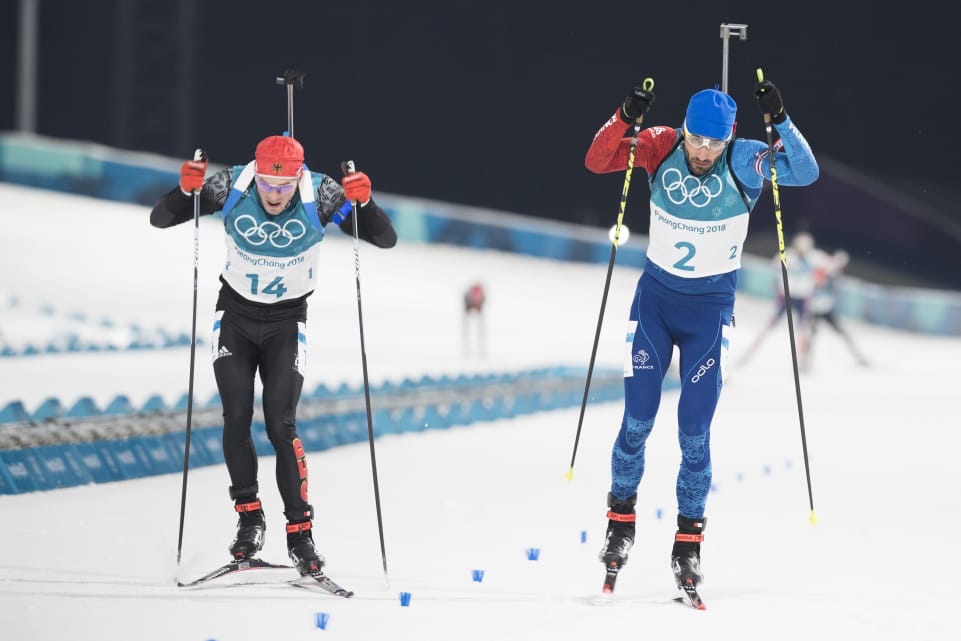
France’s Martin Fourcade (right) and Germany’s Simon Schempp (left) lunging for first at the finish of the men’s 15-kilometer mass start at the 2018 Olympics in PyeongChang, South Korea. In a photo finish, Fourcade was deemed the winner with Schempp claiming the silver medal. (Photo: FlyingPointRoad)
After both athletes had lunged over the finish line and fallen down, France’s Martin Fourcade initially thought he just lost an exciting finish sprint against Germany’s Simon Schempp in the men’s 15-kilometer mass on Sunday night at the Olympic Winter Games in PyeongChang, South Korea.
He slammed his pole into the snow and shook his head in anguish. Not again.
Almost exactly the same had already happened to Fourcade four years ago at the 2014 Olympics in Sochi, Russia, as he narrowly lost a sprint finish for the gold medal in the mass start to Norway’s Emil Hegle Svendsen.
“I was sure that Simon did it,” Fourcade said of Schempp at Sunday’s post-race press conference. “It was just because four years ago in Sochi, Emil did me a lot of pain, and tonight I was sure that history was repeating again.”
“I didn’t know who was in front of the other, and Martin as well,” Schempp recalled at the press conference. “So we were both waiting.”
During the race Fourcade had incurred two penalty laps (1+0+0+1) while Schempp had missed just one target (0+0+0+1). However, Fourcade made up for that by skiing the fastest course time of the day.
France’s Martin Fourcade (r) and Germany’s Simon Schempp (l) pushing to the finish of the men’s 15-kilometer mass start at the 2018 Olympic Winter Games in PyeongChang, South Korea. After a photo-finish lunge, Fourcade was deemed the winner while Schempp claimed silver. (Photo: IBU/Biathlonworld)
But while they both had finished with the same time of 35:47.3 minutes, the photo-finish image evaluated by the race jury for about a minute would prove they were not exactly even: Fourcade had moved the tip of his boot just about half a foot before his opponent over the line.
Now it was Schempp who looked a bit frustrated, tilting up his head and letting out a sigh after he saw the official result on the big video wall. But that feeling did not last for long, with pride about the strong performance he had just shown after a difficult season and the happiness about his first Olympic medal in an individual-start race in his third Olympics taking over.
“For me, it was not too hard; I was happy to get one of these three medals,” Schempp said.
“Of course I am enormously happy,” he had previously told German broadcaster ZDF immediately after the race, according to a translation. “I had to wait a long time for this, and now until the last individual-start race. I think it was incredibly suspenseful for all viewers.”
Behind them the above-mentioned 2014 Olympic gold medalist Svendsen placed third to claim the bronze medal this time, 11.2 seconds out of first, with two penalties. He was on the winning side of a final sprint with Schempp’s teammate Erik Lesser, who placed fourth (+11.6), with two penalties. Germany’s third man in the top five, Benedikt Doll finished another few seconds back in fifth (+18.8), with one penalty, only slowing in the last 100 meters after he realized third and fourth place were out of reach.
Fourcade Starts on Wrong Foot
Initially the race had not started out well for Fourcade, with little indication that he could end the day with his historic fourth Olympic gold medal.
On the first loop, he led the mass start field of only 30 athletes, comprised of the medal winners from the previous sprint, pursuit and individual races in PyeongChang, as well as the other top 15 in the current World Cup Total Score standings and filled up with the next-best performers of the last week not among those two groups.
It was truly an elite field, including all seven different biathletes who had become International Biathlon Union (IBU) world champion in the mass start discipline in the last seven iterations.
The whole pack stayed close together within a few seconds, with Germany’s Lesser bringing up the back, not investing any energy with fruitless maneuvers to gain a few positions.
In the first prone shooting stage, 14 athletes remained clean while Fourcade missed a target, forcing him to ski a penalty lap. Then as he returned to the course, he stumbled briefly when his ski caught a V-board and he fell on his behind. He left the range in 19th position and 25 seconds behind South Korea’s Timofey Lapshin, who was leading into the next loop to the delight of local fans in the stands.
But Fourcade quickly narrowed the gap on the next loop, and after a clean second prone shooting had moved up to eighth place, less than ten seconds behind Germany’s Doll, who had led the field for large parts of the prior loop and now also kept that position after the shooting stage.
In that second prone, one of the presumed favorites and 15 k individual winner Johannes Thingnes Bø of Norway ruined his race with three penalties, falling back to 27th and almost 1:15 out of first. He eventually finished 16th (+1:20.0) after cleaning the remaining standing stages (0+3+0+0).
Obviously having very fast skis, all four German athletes in the race stayed at or near the top throughout the next loop.
“The way they were able to aggressively put their mark on this race, all four of them, from the first to the last loop … we surely didn’t expect that considering this level of competition,” German men’s head coach Mark Kirchner later told ZDF.
(From left to right) Germany’s Simon Schempp, his teammate Erik Lesser (19) and France’s Martin Fourcade lead the field on the third loop of the men’s 15 k mass start at the 2018 Olympic Games in PyeongChang, South Korea. Fourcade went on to win the race, while Schempp finished second and Lesser fifth. (Photo: FlyingPointRoad)
After again shooting clean in the first standing while Doll incurred a penalty, Fourcade took the lead going out on the course, with Schempp and Lesser followed within two seconds of him.
On the third loop, Fourcade, Schempp and Lesser pushed hard for a high tempo and swapped leads several times. The gap to a group led by Czech Republic’s Ondrej Moravec and Austria’s Simon Eder ballooned after Eder had been less than 7 seconds behind leaving the range. At a split time following the longest climb, the group clocked in 24 seconds behind, and that time back grew to 30 seconds on that loop.
Just before the range, Lesser and Schempp briefly looked at each other, then Lesser increased the frequency pushing hard for a few meters to move into first, knowing that would give him the first-lane position on the shooting range. From years of racing against each other, the German athletes were aware Fourcade often prefers to have that position in a final shooting as a demonstration of confidence, so it might have been a little psychological trick to irritate him.
But Lesser’s race tactic did not exactly work out, as all three failed to clean their targets in the final shooting. Fourcade and Schempp both had to ski one penalty lap, while Lesser missed two shots and came back on the course in fifth, just behind teammate Doll and Norway’s Svendsen, who had both managed to hit all targets to move back into podium contention.
About 20 seconds ahead, Fourcade kept the speed fairly high leading in front of Schempp throughout the loop, but did not attempt one of his signature ferocious attacks up a climb for which he is feared by his opponents.
“I thought about a few scenarios how this could play out,” Schempp told ZDF, according to a translation. “I knew either he attacks on the first very steep and long climb, but there he only pushed the tempo and I could stay with him. And then he rather decelerated and I knew I had not other choice but stay behind him in his draft to save some energy for the finish stretch, because my current shape is not good enough to try and get away from him. … So then I knew it would end in a finish sprint. I tried to push hard into the downhill maybe taking the momentum with me, but unfortunately that was not enough.”
“I tried to be faster than Simon in the first part of the loop, but he was still in my skis,” Fourcade said of the last loop. “So then I knew it will be a tight finish. I gave everything I had, but I know that Simon is a really good sprinter and that is not my main quality.”
On the final downhill, Fourcade led the duo into the arena with Schempp drafting behind him. Fourcade briefly stumbled in the final right turn but retained his balance, not losing much speed. Entering the finishing straight, Schempp initially motioned toward a lane to the left of Fourcade, but when Fourcade veered that way as well before picking the center Schempp switched over to the right lane and poled all-out.
France’s Martin Fourcade lunging for his second gold of the 2018 Olympics, and fourth Olympic gold of his career, in PyeongChang, South Korea, winning the men’s 15 k mass start on Sunday. (Photo: FlyingPointRoad)
“I chose my corridor late because earlier this season in Hochfilzen [in the pursuit’s finishing race for third place] I did it a bit early, and then he went right into the one I wanted to go in as well,” Schempp told ZDF. “I still had that in the back of my mind.”
“Our last sprint in Hochfilzen together was not a fair one,” Fourcade recalled of the same race, unprompted in his interview with ZDF. “And I thought during the final loop, ‘Beat him, but just do it in a fair way,’ because Simon is one of the best opponents I fight with. So thanks Simon for this fight, and it makes my gold more valuable.”
“Choosing the finish stretch corridor, that’s the prerogative of the athlete who has pushed the tempo on the final loop,” Schempp explained in an interview with ZDF later in the evening. “So I could ski behind him, save a bit of energy, and in turn he gets that advantage. Poetic justice.”
With the finish line approaching, Schempp managed to pole closer and finally next to the French athlete. “I felt that Simon was taking me meter after meter,” Fourcade recalled at the press conference.
Both athletes lunged far as they approached the line, and with slightly higher velocity Schempp seemed to move past Fourcade as they slid and fell, causing Fourcade’s frustrated initial reaction as he looked over and saw the German coming to a stop slightly ahead of him.
“After the finish line I thought I was in his back,” Fourcade told ZDF.
But as the photo finish revealed, right on the line Fourcade had still been in front by about half the length of his foot this time and was the lucky winner.
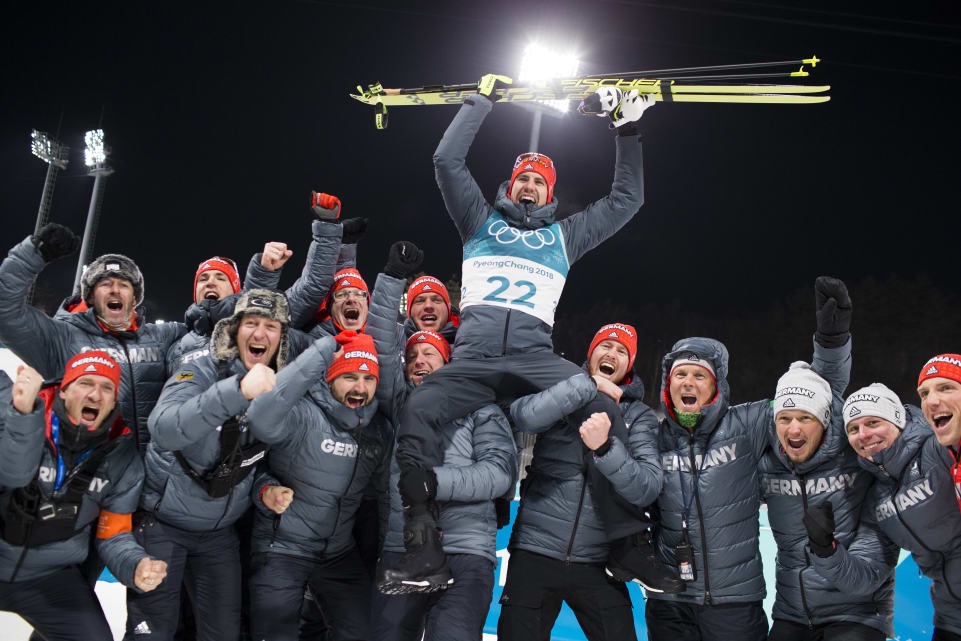
Any signs of initial frustration from Schempp were quickly replaced as he celebrated with his teammates and staff who rushed to congratulate him, and later was hoisted up on their shoulders.
“The finish line came maybe five meters too early for me,” Schempp told ZDF. “But still, I am also totally happy and satisfied about silver. It was a suspenseful competition, and I am so glad it worked out. … I have had a few photo finishes in my career when I was in first, and now it’s the other way around. Martin was incredibly strong on the course today, and he had one more penalty than me, so he also fought enormously for gold, and I did my best.”
Behind them, Lesser had tried to attack up the last big climb to break away from Norway’s Svendsen and his teammate Doll, but Svendsen managed to stay on his ski tails and in the finish sprint claimed the bronze medal by 0.4 seconds. It was his fourth individual medal in four Olympics (plus one gold medal in the men’s relay in 2010).
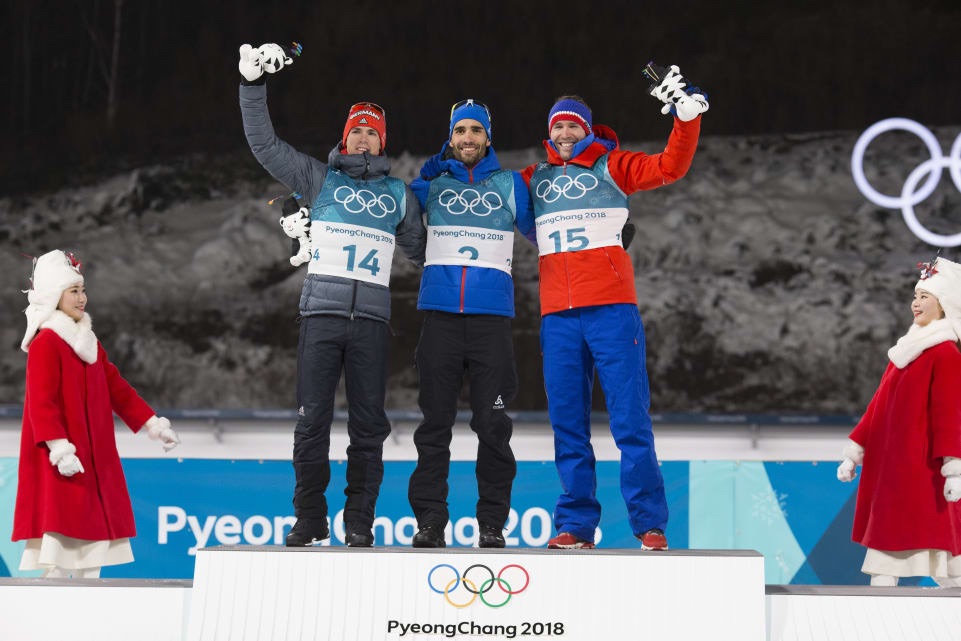
France’s Martin Fourcade (c) in first, Germany’s Simon Schempp (l) in second, and Norway’s Emil Hegle Svendsen (r) in third, during the flower ceremony of the men’s 15 k mass start at the 2018 Olympics in PyeongChang, South Korea. (Photo: IBU/Biathlonworld)
Four years ago at the Sochi Olympics, Svendsen had won the gold medal just ahead of Fourcade, as Fourcade recalled at the press conference.
“It means very much, it’s been really bad Olympic Games for me,” Svendsen said in the press conference when asked about his bronze medal. “So I didn’t really believe in a medal at all. When I came into a position to get a medal I really fought hard. And to be on the podium with these guys, it’s a very good feeling.”
When the experienced podium finishers were asked about their “secret” for a finish sprint, Svendsen added: “For me, I was thinking a lot about Marit Bjørgen from yesterday, what she did on the last few hundred meters [when] she didn’t allow the Swedish girl to catch her. That helped me a lot today, maybe that was the key to beating Lesser and Doll.”
Disappointed, Lesser initially did not talk to German media following the race. Only several hours later, he posted an image of him hugging Schempp after the race and superimposed with the words “in the end the only thing left for me is to congratulate” to his Facebook fan page, adding a paragraph that according to a loose translation reads:
“Wow!!! That was tight, annoying, hammer, humbling, pleasant, unbelievable, mega, crass, semi, phenomenal… no one has a leg up on our team. Everyone on our team is now individual-race World Champion and in possession of an individual-race Olympic medal. No other team can show that off.”
On his Instagram account he wrote in English “Once again #wtf !!! It’s amazing to be part of this great team” to a photo of the team’s coaches and staff hoisting up Schempp.
“Another really strong shooting performance, just one miss, that is great,” Doll told ZDF right after the race. “For two loops I skied at the top of the field, so that gives me some self-confidence … On the final lap, that kind of head-to-head duel isn’t really my strength, unfortunately I couldn’t win that today. It was difficult, even though we had the better ski today. We could have made a little more out of that, me and Erik, but that’s just the way it is.”
Making History Instead of History Repeating Itself
For Fourcade it was the fourth Olympic title of his career. In the mass start he had already won silver in both the 2010 Vancouver and 2015 Sochi Olympics. He now also has a gold medal in each non-relay discipline (sprint, pursuit, 15 k individual, and mass start).
“Today I am so satisfied because I was second eight years ago in Vancouver in the mass start, I was second four years ago, and today I finally win this competition,” Fourcade said at the press conference. “So I am really proud.”
As an added bonus, Fourcade is now tied with two French fencers for having won the most gold medals at either a Summer or Winter Olympic Games in the history of his country with six total.
“That’s something really incredible. I grew up watching biathlon on TV and sport at the Olympics, so being the best French Olympian ever is something I am really proud of,” Fourcade said at the press conference. “But then you need to compare, because if I was Norwegian I would not be the best Olympian ever.”
“After effort and suspense Martin Fourcade makes us tremble and dream a second time by winning a new gold medal for France. A legend of the Olympic Winter Games and biathlon,” French President Emmanuel Macron wrote on his official Twitter account, according to a translation, alongside with an image of the photo finish.
Deep Respect for Each Other
Fourcade’s opponent Schempp had not been in optimal health going into these championships after dealing with persistent back problems that forced him to miss several races on the 2017/2018 World Cup competition calendar. So in the end he was happy that despite losing out on gold so narrowly, he had been able to reach his first Olympic medal in a non-relay race. Last year, Schempp had won gold in the mass start at the 2017 World Championships, back then also his first title excluding relays.
France’s Martin Fourcade (2) leading Germany’s Arnd Peiffer (1) and Norway’s Johannes Thingnes Bø (3) early in the men’s 15 k mass start at the 2018 Olympics in PyeongChang, South Korea. They went on to place first and second, respectively. (Photo: FlyingPointRoad)
“I wasn’t really afraid [of the back injury returning], I was just hoping it would hold up,” Schempp told ZDF in a studio interview later Sunday evening. “It was very tedious and often also frustrating in January, because I did a lot to get it under control and a lot of people helped me with that. … But then 10 days before we flew over here, I just thought, ‘Woah, I don’t know if it will work out like this, if that will be enough.’ But then shortly before [the races] it got enormously better, there was a big leap, but I still didn’t know how it would be in the stress of a competition. … Until now it was pretty good and I hope it stays that way.”
In his interviews right after the race, Fourcade had been very congratulatory of how hard his opponents had made it for him and how highly the won medal ranks for him.
“I must apologize to the German fans because I know how much I disappointed them tonight,” Fourcade told ZDF. “But Simon is one of my best opponents. When I was on the podium with Simon and Emil I told them that I could not have a [better] podium for me tonight. It was the best podium I could hope for. You know, Simon is an incredible champion, and I am so proud I beat him in the sprint.”
“We are on very good terms, and two years ago I have visited him at home,” Schempp later said of Fourcade to ZDF. “In general we get along very well. Maybe not so great on the tracks, but later in the finish, respectively before competitions. Of course he also has this crazy killer instinct and can assess race situations very well.”
The close race also brought up memories of past events with an end like this.
At the 2003 World Championships in Khanty-Mansiysk, Russia, two gold medals had been awarded in the women’s pursuit race to France’s Sandrine Bailly and Germany’s Martina Glagow after the photo finish had been deemed too close to call.
But with the help of more modern technology there was a visible difference this time, and the German team readily accepted that when questioned if they thought it was fair that after a 15 k race you lose an Olympic gold medal merely by inches.
“I think there are plenty of other sports were decisions are this close,” coach Kirchner told ZDF. “If you think about alpine skiing where races also get decided by hundredth of a second, or in others like bobsledding even by a thousandth, that’s the way it is. The athletes know they are fighting for every second, and in the end there has to be a winner. When the clock is running you know that it’s fair, there is no subjective judging.”
No North Americans qualified for the top-30 men’s mass start field at these Olympics.
The biathlon competitions in PyeongChang continue with the mixed relay on Tuesday at 8:15 p.m. local time. (6:15 a.m. EST).
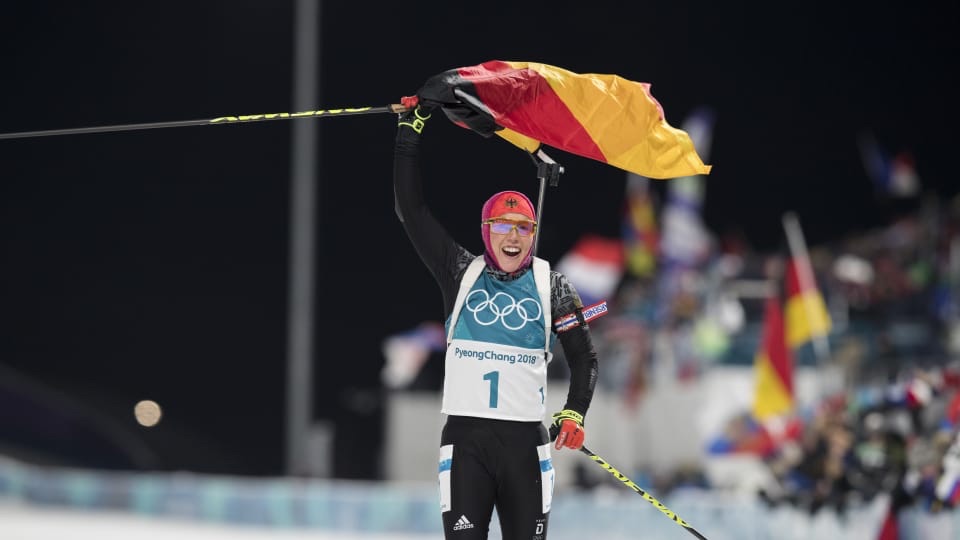
Gold medalist Laura Dahlmeier of Germany celebrates waiving a national flag as she crosses the line first in the women’s 10-kilometer pursuit at the 2018 Olympic Winter Games in PyeongChang, South Korea. (Photo: IBU/Biathlonworld)
It was almost another start-to-finish victory at the Olympic Winter Games in PyeongChang for the current golden girl of biathlon, Germany’s Laura Dahlmeier. But it came with a painful price to pay.
After starting the women’s 10-kilometer pursuit on Monday evening local time in freezing temperatures and with a 24-second lead following her sprint victory, Dahlmeier began the race intensely focused, again cleaning the first prone stage.
But this time she was not uncontested.
After starting in 13th position and almost a minute back to begin the pursuit, Slovakia’s Anastasiya Kuzmina, who’s currently second in the World Cup Total Score standings, caught up to Dahlmeier after both had incurred one penalty in the second prone shooting and avoided more by performing multiple adjustments on their rifle sights to deal with gusts of wind.
After closing a nine-second gap, Kuzmina passed her rival on the next loop. But Dahlmeier did not seem to mind someone else helping her to set the pace in once again difficult conditions on the course and range (the race jury reportedly debated a potential postponement), and tucked behind Kuzmina to wait for her next chance in the standing shooting. There Dahlmeier cleaned again, leaving the range with a 38-second lead after Kuzmina had to twice ski through the penalty lap, but still retained second place as the closest pursuer.
“On the third loop we raced together, and on the uphill part Anastasiya was really strong and I just wanted to follow her and we had a good speed together,” Dahlmeier later recounted at the post-race press conference. “And at the shooting range, I felt really comfortable. I know about my good standing shooting, and I just looked to my targets and wanted to hit the middle and it worked … During the last years I could improve my shooting in wind situations, but I didn’t especially train wind situations [for PyeongChang].”
“Laura is a very hard opponent to beat,” Kuzmina said at the press conference, via a translator. “She is able to fully focus on the shooting and she is able to shoot very good also in the strong wind, so you can fight with her on the skis of course, but you need to shoot very good to beat her.”
In her final shooting stage, Dahlmeier again cleaned all targets and left the range with a 55-second lead on Kuzmina, with France’s Anaïs Bescond right behind the Slovakian.
“If I would already think that I might miss a target when approaching the range for the fourth time, I believe that would be the wrong mindset. I just tried to concentrate on myself, on my own targets,” Dahlmeier told German broadcaster ZDF when questioned about the final shooting, when she probably could have afforded to compensate for one penalty lap. “I have proven often enough that I can hit [when it matters], in training we simulate that every day. And I just firmly believed that it will work out again today. And it did, so I am very grateful for that.”
With such a comfortable lead, nobody could challenge her anymore on the final loop. On the finishing stretch Dahlmeier had enough time to reach for a German flag handed to her from the stands, before crossing the line in a time of 30:35.3 minutes, with one penalty (0+1+0+0).
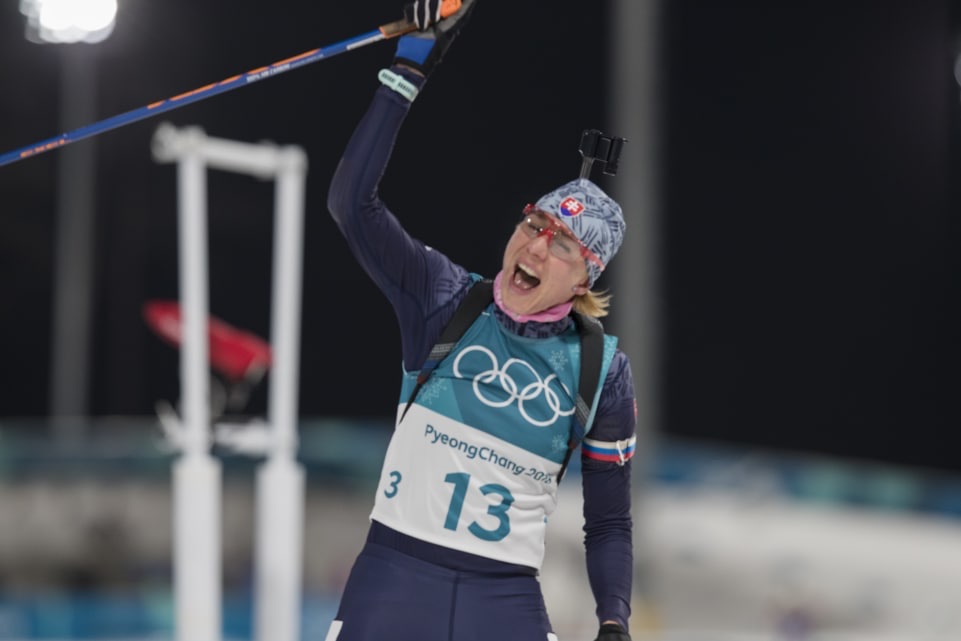
Anastasiya Kuzmina of Slovakia celebrates after crossing the finish line in second place in the women’s 10-kilometer pursuit at the 2018 Winter Games in PyeongChang, South Korea. (Photo: IBU/ Biathlonworld)
Fighting for the positions on the podium behind her, Kuzmina crossed the line 29.4 seconds back to claim the silver medal, winning the finishing sprint against Bescond, who had to settle for bronze (+29.6).
Bescond moved up from a 19th starting position largely thanks to her 19-for-20 shooting with just one penalty lap (0+0+1+0), though she also skied the fifth-best overall course time, while Kuzmina overcame four misses (0+1+2+1) with the fastest course time of the day, just as she had done in the sprint.
Almost another minute back, fourth place went to sprint silver medalist Marte Olsbu of Norway (+1:07.3, four penalties), fifth to Hanna Öberg of Sweden (+1:08.9, three penalties), and sixth to Dahlmeier’s teammate Denise Herrmann (+1:19.4, two penalties), who improved from starting in 21st position. Sprint bronze medalist Veronika Vitková of the Czech Republic fell back to seventh (+1:37.3, three penalties).
Going to the stands a few minutes after reaching the finish, Kuzmina hugged her friends and relatives, including her husband and a teary eyed woman (presumably her mother) who was wearing a sports jacket embroidered with Russian emblems. Herself a mother of two, Kuzmina is the older sister of Russian star biathlete Anton Shipulin, who was not invited by the International Olympic Committee (IOC) to compete as part of the neutral Olympic Athletes from Russia team in PyeongChang. An appeal to the Court of Arbitration for Sports (CAS) was denied just hours before the Opening Ceremony. Kuzmina has been racing for Slovakia since 2008, only competing for Russia at two Junior World Championships and never at senior-level championships.
“I am missing my brother. I hoped to the last moment that he will be able to compete here,” Kuzmina said about the topic when asked about it in the press conference, via a translator. “I don’t want to talk a lot about this issue. I am really sorry about what happened and that my brother is not here. I am here to fight for medals for my entire family. I won the one medal, and I want to win another medal for my brother.”
Kuzmina, 33, is an Olympic gold medalist in the sprint and silver medalist in the pursuit at the 2010 Olympics in Vancouver, British Columbia, and sprint gold medalist from 2014 in Sochi, Russia.
“This is a very special feeling to have the third medal from the third Olympics in a row,” Kuzmina explained. “Almost everybody who talked to me was [expecting] that I could win the sprint here, because I won the sprint in Vancouver and Sochi as well. That didn’t happen, but I am very glad that I managed to defend the silver medal in this event like in Vancouver eight years ago.”
For the 30-year-old Bescond it was her first medal at Olympic Winter Games, after she narrowly missed out four years ago in Sochi with two fifth places in the sprint and individual.
At 2016 World Championships she had taken silver in the 15 k individual in Oslo, Norway, and she’s also earned six medals with French relay teams. But last season was a down year where she started just one race at 2017 World Championships in Hochfilzen, Austria, and finished outside the top 50 before she rebounded with a third place in the pursuit at the World Cup test event last year in PyeongChang.
“Of course it was never granted that I make the podium,” Bescond said in the press conference, via a translation. “It was very difficult for me not being able to do the World Championships [in Hochfilzen]. This year I really wanted to perform very well, and the Olympic Games is the best thing you could think of, the Holy Grail. So I did think about last year this time, and I was very happy to have a very good race.”
“Laura really dominates our sport, but there a lot of good athletes out there,” Bescond stated when asked how her opponent could be beaten at these Olympics. “They are strong, they got lots of qualities, what you need to do is be faster on the skis and shoot better and faster, that’s it.”
Sounds easy enough.
But if her opponents couldn’t quite yet do it in the pursuit on Monday, the weather conditions and all the increased attention on Dahlmeier, who usually guards her private life closely, pushed her to her limits.
“I am extremely happy that everything worked out so well again today,” Dahlmeier told German broadcaster ZDF right after the race. “I tried to be fully focused on the shootings, on the course I didn’t feel quite as relaxed. On the one hand the conditions were very demanding, and the past two days have taken a toll on me with a lot of media appointments, a lot of additional stuff. At the moment I am feeling quite well, but of course it is cold and when the fingers thaw up, maybe some viewers know it, that hurts quite a bit.”
Soon after, Dahlmeier was no longer in the mood to celebrate, as she had fully exhausted herself for the victory. And her frozen fingers exposed to the cold in thin race gloves now seemingly really hurt, even though in the press conference before she had claimed that “I always spend a lot of time in the mountains and there it’s normal to have wind and cold temperatures, so perhaps I am a little bit used to it.”
“Primarily it was the cold. She is in extreme pain,” Stefan Schwarzbach, a manager and speaker for the German Ski Federation, later told ZDF after she had to cancel a planned studio appearance. “So when [her hands] thawed up she really had tears in her eyes, it was painful to watch. After the doping control she put herself to rest, she is just completely finished.”
At last year’s World Championships in Hochfilzen, where she won five medals, she physically collapsed after two races to the point that the German team doctor did not want her to start the mass start. In the end her stubbornness prevailed, and she also won that race overtaking American Susan Dunklee on the final lap.
“We already know that from last year, we just have to be careful with the sum of the exertions in competition,” Schwarzbach said. “And I believe the spectators will be accepting if she reduces the media work a little bit, and then hopefully can stand at the start line for the individual with full strength. … She will be all right, but we will reduce her program to what is necessary, even if it would have been nice to celebrate the second gold medal.”
North Americans Moving On Up
Canada’s Rosanna Crawford finished 19th in the pursuit as the best North American, moving up from 53rd at the start, based on her sprint result, to finish 19th (+2:27.7) for her best individual result at her third Olympics.
Canada’s Rosanna Crawford (22) during the women’s 7.5 k sprint on Saturday, Feb. 10 at the 2018 Olympics in PyeongChang, South Korea. She finished 53rd then went on to place 19th in the pursuit on Monday. (Photo: FlyingPointRoad)
On the range, Crawford managed to cope well with the windy conditions, shooting 18-for-20 with one miss in each of her standing stages (0+0+1+1). In an interview with FasterSkier after, she said she would have liked to avoid one mistake she made in the final shooting.
“[The wind] seems to have been more consistent,” Crawford said. “My zeroing went really well, I had my sights, I knew exactly where they were and what corrections I would need to make. So prone I was really confident. … In my last standing I didn’t mean to pull the trigger on my first shot, so that was a bit of a disappointment.”
She enjoyed her race despite the harsh weather and demanding tracks, skiing the 19th-ranked overall course time.
“For sure I love the 2k [pursuit loop] here,” Crawford said. “I [also] was 19th with 18-for-20 last year at the World Cup here. Yeah, the 2 k is so much fun. You just have to grit your teeth up that hill and then just rip along the top and back down to the range, and I love it so much. My skis were amazing. Our techs did such a good job. So I just had some fun out there today.”
Asked how she got into a better mindset following the sprint, Crawford said she called her older sister, a 2006 Olympic gold medalist in cross-country skiing.
“I had some really good chats with my sister Chandra,” Crawford said. “She’s a huge motivator for me and my biggest cheerleader now. She really just talked some sense into me to not be so down on myself after the sprint, so that was really helpful.”
Julia Ransom (Biathlon Canada) during the women’s 7.5 k sprint at her Olympic debut in PyeongChang, South Korea. She finished 40th then went on to place 28th in the pursuit on Monday. (Photo: FlyingPointRoad)
Teammate Julia Ransom also improved from her sprint position, moving up by 12 places to finish in 28th place (+3:03.0) with one miss in her last standing stage. She was one of just six women on Monday who shot 19-for-20, with no one shooting clean.
“I had some really solid shooting today hitting my first 15, missing my 18th or 17th shot,” Ransom recounted after the race. “I am a confident shooter in the wind, I know corrections fairly well, and I think you just have to make good shots and that’s all you can hope for”
On the course she skied the 44th-best course time after a faster first loop.
“My legs were not feeling as good as I was hoping they’d be, so I was really happy to keep it together in the range and just slowly work my way up and ski with the other girls,” Ransom concluded.
American Emily Dreissigacker racing to 47th in the women’s 10 k pursuit at the 2018 Olympics in PyeongChang, South Korea. (Photo: Ross Burton/US Biathlon)
Emily Dreissigacker, the lone American to qualify for the women’s pursuit, improved by four positions after starting in 51st to finish 47th (+5:01.4) with four penalties (0+1+1+2).
That was another improvement on her personal best at the World Cup-level, which she achieved in Saturday’s sprint. Before these Olympics, Dreissigacker’s best result on the International Biathlon Union (IBU) World Cup had been 56th place in a pursuit in Antholz, Italy, last month.
On the course she recorded the 54th course time, steadily holding her position on the three loops between the shooting stages.
“I think the skiing felt a little better than the sprint two days ago,” Dreissigacker said after. “Getting to ski with people is always really fun, and my skis were amazingly fast.”
Just like Crawford, she also preferred the loop the pursuit was raced on over other courses in PyeongChang.
“I really like the 2 k course,” Dreissigacker said. “You climb up and then you come back down, which is something that I really like. I think mentally especially, I’m like ‘All right, gotta get to the top of this hill and then I have time to recover,’ which is nice.”
“I really just like to try to keep things simple,” she said of her shooting performance and approach to the wind-exposed range. “Just relax, if the wind comes up just wait for it to pass or if it’s not going to pass take some clicks. I really think the simpler you can keep it the better.”
“The wind can be a little tricky,” she told US Biathlon, according to a press release. “In my first standing stage, actually, I had to wait out a pretty big gust of wind. All the people around me were waiting, too, and we’re all just standing there waiting for it to die. That’s kind of just how it is. You have to be able to deal with that … be able to wait and not freak out.”
Canada’s Emma Lunder finished 53rd (+6:16.8) after starting 54th then shooting four penalties (0+1+1+2).
“It was not great,” Lunder reflected. “Started out with shooting OK, unfortunately missed two in my last standing and just did not have it in the legs today, so the skiing was a big struggle.”
While not completely satisfied with her race performance, the 26-year-old Lunder said she was making the most out of her first Olympic experience.
“The whole time I was just trying to remind myself, I am at the Olympics, racing my first Olympics. It’s such a cool atmosphere, so even if the race isn’t going as well as I would like I am still pretty happy to be here,” Lunder explained. “The racing doesn’t feel different from a World Cup. It’s being at the Athlete’s Village with athletes from every sport all over the world, the best in the world, that’s been pretty special. I have [met] quite a few people who I never thought I would meet, so I have just been trying to take it all in and also try to perform as well as I can.”
Asked how she is dealing with the cold conditions and prepares for her upcoming races, Lunder added, “I would say a lot of it is energy management. When it’s this cold out I find I am a lot more tired, burning more calories just from shivering. So we have a therapist here with us. I will see her for some treatment, just take a bit of time to lay in bed and watch some movies, do whatever I can to rest up a little bit.”
The fourth Canadian, Megan Tandy, did not start,as she’s working to kick a cold in time for the next race on Wednesday.
“Disappointing news, but it is for the best,” Tandy wrote in an Instagram post before the race. “I have decided not to start the 10km Pursuit tonight in order to get healthy for our upcoming Individual Race. I will be cheering on my girls from bed, I know they can rock this stadium tonight.”
Estonia’s Johanna Talihärm, who skis collegiately for Montana State University and last year split her training time between Bozeman, Montana, and Estonia, finished 26th (+2:59.4) with another strong performance after a career-best 22nd place in the sprint. She incurred four penalties (0+1+2+1), and skied the 27th-ranked course time.
The biathlon competitions in PyeongChang continue on Wednesday with the women’s 15-kilometer individual and Thursday with the men’s 20-kilometer individual race.
Germany’s Arnd Peiffer (front) on his way to winning the men’s 10 k sprint at the Alpensia Biathlon Center on Sunday at the 2018 Olympics in PyeongChang, South Korea. The German was one of just four men to shoot clean in windy conditions. (Photo: FlyingPointRoad)
Arnd Peiffer’s race day before the men’s 10-kilometer sprint at the 2018 Olympic Winter Games in PyeongChang began anything but ideal, not giving any indication that it would end as one of the luckiest days in the athletic career of the German, standing at the top of the podium and flanked by Michal Krčmář of the Czech Republic in second and Italy’s Dominik Windisch in third place.
“Shortly before ski testing, the bolt on my rifle broke. Then I slipped outside the wax cabin [on a flight of stairs] and badly bruised my elbow,” Peiffer told German broadcaster ARD about a series of mishaps that also included a cut to his hand, a forgotten key for his rifle storage locker and a poor warmup. “Somehow nothing was really working as planned, but then in the race everything did.”
About an hour before the race during dry firing target practice (without loaded ammunition clips), the bolt on Peiffer’s rifle that triggers the shots just snapped. On short notice the weapon had to be disassembled and the bolt replaced with the help of men’s head coach Mark Kirchner (a successful biathlete himself with a gold medal in the sprint and two in relays at the 1992 and 1994 Olympics), a problem that according to Peiffer “happens about once every six months to a year… That’s not so bad, but something you don’t really want to occur right before a race”.
“I am generally not superstitious at all,” Peiffer recounted during an interview with ARD in the Olympic broadcasting center late Sunday night. “But Mark told me, ’22 is a good bib number, I once became world champion with that… And [teammate Erik Lesser] also had a broken bolt before the individual race at the [2014] Olympics in Sochi when he shot clean four times and won silver, that was surely a good omen.’ I was like, yeah, that won’t help me today either.”
Yet after he had started his race, Peiffer was indeed the lucky one, hitting 10-for-10 shots in every bit as difficult wind conditions as the day before during the women’s sprint when his teammate Laura Dahlmeier won gold, while the presumed favorites such as France’s Martin Fourcade and Norway’s Johannes Thingnes Bø missed too many targets to contend for the medals.
In his prone shooting, Peiffer reacted correctly to a strong gust of wind from the left side of the range, adjusting his sights with several clicks on his rifle. Then in the standing shooting he took advantage of manageable conditions to shoot in rhythm and again remained clean. On the final loop he skied the 10th-fastest time (18th overall), crossing the line in a time of 23:38.8 minutes. That mark would not be beaten anymore by the 65 athletes starting behind him.
“I have waited a long time for this individual medal,” he said during his in-studio interview with ARD. “I won one in 2011 [at IBU World Championships] and since then had a few chances that I didn’t take advantage of, and sometimes didn’t have any chance at all. So that it worked out today, with a pretty mediocre course time, is a gift that I am very grateful for.”
It was Peiffer’s first individual medal at Olympics, following a silver medal in the men’s relay in Sochi and no podium in Vancouver in 2010. Most of the World Cup successes for the 30-year-old biathlete have been in sprints, and he won the title in this discipline at the 2011 World Championships in Khanty Mansiysk, Russia. His first World Championship medals also came in PyeongChang, back in 2009, when he took bronze with the relay and mixed relay, which he fondly remembered.
Germany’s Arnd Peiffer is hoisted up by his coaches, staff and teammates, celebrating his victory in the men’s 10-kilometer sprint on Sunday at the 2018 Olympic Winter Games in PyeongChang, South Korea. (Photo: IBU/Biathlonworld.com)
“I am honestly completely surprised that my result was so amazing, that I am standing at the very top,” he had told ARD right after the race. “I am just happy about my performance, because in Vancouver and Sochi I twice had a bad sprint [finishing outside the top 30]… So for today I just was determined to have a good one, have a good shooting performance, and if it had been a sixth place I’d also have been happy.”
The silver medal in Sunday’s sprint went to Krčmář, who also hit 10-for-10 and finished 4.4 seconds shy of Peiffer’s time. Starting behind Peiffer in the middle of the field, that clean shooting performance opened a window of opportunity to wedge himself between the times set by Peiffer and Windisch, who ultimately placed third (+7.7) with one penalty.
“For me, it was very hard in the last loop,” Krčmář said at the post-race press conference. “I [had no] power in last loop and my teammate on the track said to me, ‘You are five seconds behind Arnd’. I do maximum [went as hard I could], but Arnd [was really] better today.”
He made up 2.4 seconds on that final loop, but could not catch up to Peiffer’s time. It was the first sprint podium for the 27-year-old Krčmář at the World Cup or championships level, and at these Olympics it came just at the right moment.
“It’s true, for me a big, big medal. First in career,” Krčmář said. “It’s for me [a] very surprising day because I [felt bad] in the training here. My shooting in training [was] not so good. And now, zero-zero. I am lucky man today because I [had] very good condition in standing shooting and on the track.”
Windisch missed one target in his standing bout, and came back on the course 12.2 seconds behind Peiffer’s time and 5.4 seconds behind Krčmář. He narrowed that gap on the final loop, but it wasn’t enough to catch either one.
“The wind was not easy because it continued to change … but maybe it was the best for me because I had something to think about and to be concentrated on my work,” Windisch said at the press conference. “I didn’t think about results, and maybe that was my secret today.”
For Windisch, 28, it was the second Olympic medal of his career after he held Italy to bronze in the mixed relay in Sochi four years ago.
“The relay is always a tough race because you are racing also for your friends or for three other persons. Maybe it’s more pressure there,” Windisch said when asked to compare the two achievements. “But to win an individual medal [means] a little more because it’s really hard to reach it, because there are so many different good athletes. I think the emotions are really big. But also [for the] relay the emotions are maybe bigger because the whole team celebrates the medal.”
Down On Their Luck
Having started in bib 5, Austria’s Julian Eberhard led the race early on until Peiffer beat his time, and in the end he just missed a medal by 0.7 seconds when Windisch bumped him off the podium to fourth place (+8.4, with one penalty).
During the race, Eberhard, who has three World Cup victories to his name, broke a pole on the loop after prone shooting and had to ski about 300 meters before receiving a spare. But he couldn’t explain why he lost time on the final downhill before the finish.
“I definitely started today with the goal to get the victory. I did my job, and it was very close. Only eight seconds are missing, so of course this is very bitter now,” Eberhard told Austrian broadcaster ORF, according to a translation. “Especially considering that before the downhill 500 meters before the finish I was clearly in second place … Those are the little details that have to work out for a gold medal.”
Norway’s Erlend Bjøntegaard led the race after the prone stage with his time and in the end finished fifth (+17.4), also just missing the podium after he missed two targets in his standing stage (0+2). He had been selected as the final athlete on the Norwegian men’s Olympic roster, effectively replacing biathlon legend Ole Einar Bjørndalen, a decision debated controversially in his home country. But on Sunday, Bjøntegaard, 27, justified his start.
“It feels incredibly strange when you put it that way,” Bjøntegaard told Norwegian broadcaster NRK when told he might have been one miss away from the podium, according to a translation. “It slowly dawns on me that I was so close to an Olympic medal and the gold. There is a lot of buzzing in my head. I’m happy, but also a little disappointed and mad at myself. It’s strange to look at the results list. Very strange. I’m struggling to take it in, but it’s slowly coming to me that I was so close.”
A number of athletes could have echoed same feeling, including three of Peiffer’s teammates.
Benedikt Doll, the defending sprint world champion, placed sixth (+17.6) after missing his final shot. Mass-start world champion Simon Schempp came almost as close in seventh (+21.4, with one penalty), and Erik Lesser, whose past rifle troubles had served as a positive example for Peiffer, was not far behind in 11th place (+31.9, also missing his final shot), despite starting the race with a bruised ribcage.
“I am rooming with Arnd and lost our team-internal duel. So that totally annoys me,” Lesser jokingly told ARD.
“I think that is the hallmark of our men’s team. Today I was the lucky one who got through. From my point of view, it could have been any one of the other three as well. I am not just saying that, I truly believe that,” Peiffer told ARD.
“I will definitely drink a small beer with my coaches, wax techs and teammates, I won’t let myself be denied of that,” he added with a laugh, although it was already past midnight local time. “And then I’ll be looking forward to [the pursuit], because now the pressure is gone. We have a great starting position, the others also did a great race even if that won’t be at the center of attention now. We can be really proud of that.”
As for the presumed “Big Two” race favorites who have dominated the International Biathlon Union (IBU) World Cup this season, with France’s Fourcade standing on the podium in every individual race he started and Norway’s Johannes Bø having won eight races including three sprints, on Sunday they looked like mere mortals for once.
While Peiffer was approaching the finishing stretch, Fourcade, who had started in a later group in bib 54, missed three prone shots. He came out of the penalty lap with a split time that ranked 56th overall. That setback would have taken just about any other athlete completely out of contention, but with a clean standing shooting and the fastest overall course time of the day, Fourcade limited the damage and rose to eighth at the finish (+22.1).
Bø, currently ranked second behind Fourcade in the World Cup Total Score, also missed three shots in prone and another one in standing (3+1), crossing the line 1:12.7 back in 31st.
Their uncharacteristic days left openings and opportunities for the three podium finishers.
“I think on these conditions, it’s possible for everything and nothing, so today it was our lucky day and maybe not the day for Bø and Fourcade,” Windisch said at the press conference. “It was really difficult to shoot, and I think they will have many other chances at these Olympic Winter Games and they will be here [at the press conference] the next time.”
“I don’t know how this could happen,” Peiffer said at the press conference, still a bit incredulous about the outcome. “The other two [Fourcade and J.T. Bø] were dominating the season in ski times and on the range, so I didn’t expect that anyone would be in front of them, for sure not me.”
Four North Americans Qualify for Pursuit
American Lowell Bailey racing to 33rd in the first men’s race of the 2018 Olympics, the 10 k sprint, on Sunday in PyeongChang, South Korea. (Photo: FlyingPointRoad)
The best North American in the difficult conditions was US Biathlon’s 2017 individual-discipline world champion Lowell Bailey, who began his race by cleaning all his prone targets, leaving the range with a split time that ranked him in eighth overall.
Then Bailey was shown on the international broadcast as one of the last remaining podium contenders still out on the course when he came into the range again for his standing shooting, in which he missed the fourth shot and thus had to ski through the 150-meter penalty lap.
That set him back to 24th place, and after losing about 30 more seconds on the final loop he crossed the line 1:15.6 out of first in 33rd.
“I had a good performance on the range, I was happy with the shooting but, unfortunately, I just didn’t have it in the legs,” Bailey said, according to a US Biathlon press release. “I just haven’t had the ski shape that I had last year. I haven’t gotten the speed going this year and that’s the way biathlon is. It wasn’t a bad race. I had a really good first lap, I just didn’t have it on the second and third laps. With any luck I’ll feel better and better as the Games go on.”
Tim Burke (US Biathlon) en route to 47th in the men’s 10 k sprint at the 2018 Olympics in PyeongChang, South Korea. (Photo: FlyingPointRoad)
His teammate Tim Burke finished 47th (+1:47.5) with four penalties (2+2).
“Physically I felt descent. It wasn’t a bad start,” Burke told FasterSkier after the race. “Shooting was tough. I had four penalties. It was real tricky today; it’s a bit of a lottery and that’s the way it goes. … I thought I had similar wind [to zeroing] when I was shooting prone, but what makes it really tough here is it switches literally from one shot to the next. I am really curious to talk to the coaches and see where I was at because I felt totally fine and normally I don’t miss all these shots.”
“It’s a tough course because you have longer climbs,” he said of the course at the Alpensia Biathlon Center, after skiing the 28th-ranked time of the day. “A lot of biathlon courses today, the climbs are only 30 seconds long before you get a break and here you have a couple climbs that are significantly longer than that, so that suits me well.”
Leif Nordgren (US Biathlon) en route to 58th in the men’s 10 k sprint at the 2018 Olympics in PyeongChang, South Korea. (Photo: FlyingPointRoad)
Leif Nordgren will join them in Monday’s pursuit after finishing 58th (+2:10.2) with a missed shot in each of his shooting stages (1+1).
“I’m satisfied that I made the pursuit and there’s another [race] day tomorrow, but yeah, the shooting was quite tough today and the wind,” Nordgren said after. “I made two mistakes and that was too much to have a great race today.”
Asked about the challenging conditions, he added:
“The wind was obviously number one, but actually the cold is another thing. If your hands ever get cold, it impacts the shooting tremendously. If you pause just for a second to even think about how cold your hands are that can throw off the shooting right away. So little things like that. It doesn’t take much to really lose that focus.”
Sean Doherty (US Biathlon) racing to 65th in the men’s 10 k sprint at the 2018 Olympics in PyeongChang, South Korea. (Photo: FlyingPointRoad)
The fourth American starter Sean Doherty missed four of his five prone targets, having to shoot about in the middle of the lane positions on the wind-exposed range. The penalties set him back almost 2 minutes, and even a clean standing shooting was not enough to overcome that deficit. He ultimately finished 65th (+2:16.4, 4+0), only about 2.5 seconds out of the top 60 needed to qualify for the pursuit.
“The wind today is very highly variable and I really thought I had a handle on it in zero [target practice],” Doherty said after. “I had a good zero, I had a good shooting warm up. I had pretty good confidence in what I am doing with things. I came in and I thought I had it under control and obviously something is off. … When I came in I did not assess the wind to be that severe, I guess I didn’t give it enough credit. … But everything else went well. The skiing feels strong. Standing shooting was fine.”
Doherty skied the 48th-ranked course time for the day.
“The course is skiing well,” he said. “It’s very fast and firm and this is a good hard course. … I am happy with the skiing, I felt fairly energetic and I am pretty encouraged with that, but it’s just the range. You leave a lot out there when you miss four.”
The Canadians also struggled with the windy conditions and demanding course.
Nathan Smith was able to cope best, shooting clean in prone before having to ski one penalty lap in his standing bout (0+1) to finish 44th (+1:43.5).
“I was happy with my shooting,” Smith said of his race. “Nine out of ten so that’s good for the windy conditions. … My shooting has been really good this year. Whenever I race I’m probably like 90 percent average or something. I usually shoot pretty quick and this year I haven’t been afraid to slow down when I need to be to hit those targets.”
On the course Smith only skied the 77th-ranked time of 87 starters, after he missed every World Cup race since the sprint in Annecy, France, before Christmas.
“Skiing was hard,” Smith said. “I haven’t raced for two months so it’s hard to jump into the top level of racing when you have just kind of been racing by yourself for a bit after getting sick … When you’re not feeling tip top, I think the biggest difference is when you’re going over hills and stuff, you’re tired and you’re just like, ‘Oh yeah, I’m getting to a downhill,’ and you can’t really push hard through all those transitions.”
Unfortunately he was Biathlon Canada’s only team member to qualify for the pursuit, while others missed the top 60 by mere fractions of a second.
Scott Gow missed four shots in his prone stage before cleaning all targets in standing (4+0), finishing 2:14.0 back in 61st place. That was just 0.1 seconds behind Romania’s Cornel Puchianu, who had incurred just one penalty, and finished 60th.
Gow told FasterSkier he took special care to bundle up before the race to keep warm fingers and a feeling for the trigger, but when he reached the prone stage, the wind had changed directions from the zeroing target practice, posing yet another problem.
“I had a fairly consistent wind from the left I would say, then when I came in to shoot in the race, it had switched directions,” Gow said. “So I thought I had accounted for it and I could hear that I was actually, we call it splitting, but hitting like half the target there and I didn’t want to chance making an overcorrection. So it was disappointing. I think luck-of-draw type of thing. It was too bad.”
The four penalty laps set him back two minutes and all the way to 84th place at the split time, and despite hitting all his targets in the following standing stage, Gow couldn’t quite make up that deficit.
On the course he skied the 46th-ranked time of the day overall and the 29th-ranked final loop.
“It’s a really hard course,” Gow said. “It’s basically three big hills with a couple downhills in-between. There’s no transitional areas, there’s no flatter spots. So it feels like you’re always grinding up a hill just to go back down and have to go up it again. … I felt like I could go a little harder on the first two-thirds of the course, and then just make sure I drop back a little bit on the last climb before you come back into the stadium just for the shooting sake. Then also with the wind, especially the headwind, to try and ski behind people if possible to get a good draft. … Overall I would say I did a fairly solid job with my race plan.”
Christian Gow (Biathlon Canada) racing to 62nd in the men’s 10 k sprint at the 2018 Olympics in PyeongChang, South Korea. (Photo: FlyingPointRoad)
His brother Christian Gow was just behind him in 62nd, 2:14.7 back with three penalties (2+1). Thus he also was less than a second out of the top 60.
“The conditions are tough today,” Christian said after. “It’s windy. It’s not nearly as bad as it was this afternoon, that was crazy. But regardless, it’s changing a lot, which I think is the hardest thing.”
“I corrected in prone and so I have to talk to the coaches and see if it was me or if I missed the correction, where those misses were,” he said of his shooting performance. “Then standing I think was a bit more my fault than anything. Shooting on lane 30 here, it’s quite sheltered. It blocks most of the wind, so it was pretty calm when I shot there and I still came away with a miss.”
Christian skied the 61st-ranked course time, acknowledging that he was impacted by the cold temperatures and wind.
“Today I felt a bit heavier than I would have liked to on the track,” he said of his skiing. “It’s a tough course for sure, really big climbs in it, and you’ve got to manage your energy so that you can do them time and again. … The wind, absolutely you get thrown around by it, but I kind of figure that everyone is getting some of that at some point.”
Brendan Green (Biathlon Canada) en route to 82nd in the men’s 10 k sprint at the 2018 Olympics in PyeongChang, South Korea. (Photo: FlyingPointRoad)
The fourth Canadian starter Brendan Green cleaned prone and was also shown on the international broadcast as a potential late contender when he came into the range for his standing shooting. But with strong wind he then missed three shots, ultimately finishing the race in 82nd place (+3:09.2, 0+3).
“It was a tough day,” Green said. “The conditions were obviously very challenging. But on a day like today that … opens up the door a bit, there’s a good opportunity, but I just was not able to put together a solid performance today. … Standing I just had a lot of gusts, just couldn’t quite overcome the wind for standing.”
“It’s a very challenging course,” he said of the conditions. “The cold weather and the wind. The snow is very dry and very slow, kind of like a sandpaper feel to it. But hopefully the weather starts to cooperate and things start to warm up a bit and the wind drops.”
The biathlon competitions in PyeongChang continue Monday with pursuits for the women at 7:10 p.m. local time (5:10 a.m. EST) and men at 9 p.m (7 a.m. EST). The times back to the winner from the sprint carry over into the pursuit race.
Germany’s Laura Dahlmeier racing to her first Olympic gold (and first Olympic medal) on Saturday in the women’s 7.5 k sprint, the first biathlon race of the 2018 Winter Olympics in PyeongChang, South Korea. (Photo: FlyingPointRoad)
(Note: This article has been updated to include comments from Canada’s Julia Ransom.)
“Perfectionist” is a term the coaches of Germany’s Laura Dahlmeier often use to describe her.
On Saturday, this quality helped Dahlmeier to brave difficult wind conditions on her way to winning the gold medal in the women’s 7.5-kilometer sprint that opened the biathlon competitions at the 2018 Winter Olympics in PyeongChang, South Korea, ahead of Norway’s Marte Olsbu in second and the Czech Republic’s Veronika Vítková in third place.
“A childhood dream is coming true,” Dahlmeier told German broadcaster ZDF after the race, according to a translation. “I have always imagined this, that some day I would stand at the very top at the Olympics, that I could win a gold medal. And somehow exactly that happened to work out today. I am incredibly grateful and proud. It’s an amazing feeling, and I don’t think I have fully realized it yet.”
On the shooting range, Dahlmeier twice adjusted her rifle’s sights in the prone stage to successfully cope with changing winds. Coming into the standing stage, she hit three targets in rhythm, then waited for what seemed like excruciating seconds for a gust to pass, before triggering her fourth and fifth shots. Both targets flipped over to white.
She had taken so long that she only recorded the 76th-ranked shooting time in this stage in the field of 87 athletes, 22 seconds off the pace and almost as long as the time it takes to ski a penalty lap. But that she had hit all shots mattered the most. Only two other athletes managed to clean all 10 targets on Saturday.
Dahlmeier followed that up by skiing the fastest course time on the final loop, and fourth-best overall. She crossed the finish line in a time of 21:06.2 minutes, lunging to not squander even a tenth of a second more, before pounding her chest and raising her arms in jubilation, knowing the time she had set would be hard to beat. Indeed her mark could not be improved again by any athlete starting later.
“I believe if you want to win a race like this one, that doesn’t happen by chance,” Dahlmeier told ZDF. “A lot goes into that. It’s true, I really had to work for it in the race today. But also the team around me, what they had to work during the last days, weeks, months, years, that is embodied by today’s result. It’s just beautiful that I was allowed to fulfill that dream today.”
Olsbu claimed the silver medal, 24.2 seconds back with one penalty in her prone shooting stage and just 1.6 seconds ahead of Vítková on the bronze podium spot, who had missed one target in the standing stage.
France’s Marie Dorin Habert placed fourth (+33.1) with one penalty in prone, while Dahlmeier’s teammate Vanessa Hinz was fifth (+40.3), losing out on a potential medal when she missed the last shot of her competition. Several other favorites struggled with the wind conditions and incurred a number of penalties.
For the two runner-ups, winning a medal at the Olympics was also a dream come true.
“Of course I am happy, it was my best race ever,” first-time Olympian Olsbu, 27, said when asked in the press conference if she was satisfied with the silver medal. “It was difficult on the shooting range today because it was so windy, but I just stuck to my plan. And I was so happy when I crossed the finish line. … That was a dream from when I started in biathlon. Of course [compatriot] Ole Einar Bjørndalen was my hero when I was a child, and I was hoping that one day I will do the same. I don’t know what to say, it is just amazing and today I am sitting here with an Olympic medal.”
“Yeah, it was my dream too, like for Marte, and I am happy that my dream is here,” Vítková, 29, said of her first individual Olympic medal in her third Winter Games.
Starting early in bib 12, Vítková initially appeared dissatisfied when she crossed the finish line and saw that she had not managed to beat Olsbu’s time, after the Norwegian had finished the race just one bib ahead. The Czech feared more athletes would finish ahead of her and still push her several positions down, but aside from Dahlmeier starting in bib 23, no one managed to do that.
So at the “flower ceremony” in the arena, where the podium finishers each received a stuffed animal as their prize (a snow-white tiger called Soohorang that is the official mascot of the 2018 Winter Olympics), Vítková was beaming just like her two peers. The Olympic medals will be awarded in an separate ceremony later.
“I am very happy, because this medal is my first ‘big’ medal in an individual race,” Vítková explained at the press conference. “I had a [silver] medal from the Olympic Games in Sochi, but it was a mixed relay medal. And now I have MY medal!”
Last season, Dahlmeier set a record by winning five events at a single International Biathlon Union (IBU) World Championships, taking gold in every race but the sprint (where she placed second) in Hochfilzen, Austria. But winning the gold medal in PyeongChang was indeed the fulfillment of a lifelong dream. As an elementary school student, Dahlmeier reportedly had written two career goals into a class book: Olympic champion in biathlon and becoming the manager of an Alpine Club hut, since mountaineering continues to be her other big passion. One down, one to go.
“Today was a victory Laura had to work very hard for, that wasn’t automatic,” German women’s national team coach Gerald Hönig told ZDF, according to a translation. “My highest respect for how she withstood the conditions today. How she repeatedly had to make the right decisions by herself on the course and on the range in order to be successful. She did that great, and she is outshining a great overall team result.”
In 2014 at her first Olympics in Sochi, Russia, the biathlon competitions for Dahlmeier, who was 20 at the time, and the rest of the German women’s team had started off as disappointing with no individual medals, and then descended into turmoil when on the eve of the women’s relay, the doping case of Evi Sachenbacher-Stehle due to a tainted food supplement came to light (her suspension later was reduced to six months) and the team again failed to reach the podium.
“For our team this medal is particularly important,” Hönig said. “We still have the defeats of Sochi somewhere in the back of our minds. Well, I particularly do, so for me this is a gigantic moment. I believe having a medal in the very first race here makes the tasks that lie ahead much easier … It’s the prerogative of young athletes like Laura to chalk that off faster, but I have repeatedly thought about these days in Sochi … Laura showed coolness today, but also executed everything she had worked for in training.”
Dahlmeier, now 24, became the second German athlete to win a gold medal at the Winter Olympics in the women’s sprint, after Kati Wilhelm claimed the title at the 2002 Games in Salt Lake City, Utah.
Mixed Day for North American Starters
Canada’s Julia Ransom was the best North American in the sprint, finishing in 40th place (+2:08.8) after she shot fast and accurately, incurring just one penalty in her standing stage.
Julia Ransom (Biathlon Canada) racing to 40th in the women’s 7.5 k sprint at her Olympic debut in PyeongChang, South Korea. (Photo: FlyingPointRoad)
On the course she skied the 68th-ranked time of the day, consistently losing about 45 seconds on each loop to the blazing pace set by Slovakia’s defending Olympic sprint champion and current World Cup Sprint standings leader Anastasiya Kuzmina, who ended up 13th place with three penalties (2+1).
For Ransom it was her first start in an Olympic race, building on three appearances at Biathlon World Championships.
“It was amazing to start the race today,” Ransom wrote in an email to FasterSkier. “Some of my family were in the stands and the others had woken up early in Canada to catch it. Definitely feeling the love!”
She described the conditions as “windy with some extremely strong gusts,” Ransom wrote. “I noticed it more out on course than in the range. I was quite happy with my shooting today, but unfortunately my legs were just cooked (for whatever reason)! However, I think this was a good leg blowout, and after some rest, I’ll be ready for the pursuit!”
All four Canadian women that contested Saturday’s sprint finished in the top 60 to qualify for Monday’s pursuit, with Rosanna Crawford next in line in 53rd (+2:23.0) after shooting three penalties (1+2).
Canada’s Rosanna Crawford (22) racing to 53rd in the women’s 7.5 k sprint on Saturday at the 2018 Olympics in PyeongChang, South Korea. (Photo: FlyingPointRoad)
“It was really tough,” Crawford told FasterSkier in the mixed zone after the race when asked about the conditions. “The wind made it hard for shooting and on the course, all of a sudden these gusts would come and blow your poles right out from underneath you. In prone, I made a correction and missed my first shot which shouldn’t have happened, and in standing I overheld [the rifle] for my second miss so I’m pretty disappointed.”
Starting fairly early in bib 22, the race was still going on at the time of her interview, so Crawford feared she might miss the cutoff for the pursuit. At least that did not happen.
“The sprint sets you up for the rest of the week, for two weeks, so I’m pretty bummed,” she continued. “I’m still looking forward to the relays, so that’s definitely positive. It’s just so unfortunate that the sprint dictates the other individual races, other than the 15-kilometer [individual race]. Hopefully I’ll qualify for the pursuit and can go out there and fight again. I love the 2 k course here, so I’m really looking forward to it.”
In her third Olympics, Crawford skied the 44th-ranked course time of the day.
Canada’s Emma Lunder racing to 54th in her Olympic debut on Saturday in the women’s 7.5 k sprint in PyeongChang, South Korea. (Photo: FlyingPointRoad)
Just behind her, Emma Lunder in her Olympic debut placed 54th (+2:24.2) with two misses in the standing stage (0+2). Her course time ranked 65th.
Megan Tandy, in her third Olympics, finished 57th (+2:36.6) with a penalty in each stage (1+1). She skied the 69th-ranked course time.
“Although I am somewhat disappointed with today’s result (57th with 2 misses and heavy legs) I am thinking positive,” Tandy wrote on Instagram on Saturday. “8 years ago I was the only woman to qualify for the pursuit, this Olympics all 4 of us will be putting up a fight.”
(Note: FS missed interviewing Ransom, Lunder and Tandy in the mixed zone, and with the race in the evening local time they could not be reached for comments at press time.)
In her first Olympic race and on her first year with the senior women’s team, Team USA’s Emily Dreissigacker was the top American 51st place (+2:21.0) after shooting 9-for-10.
American Emily Dreissigacker racing to 51st in the women’s 7..5 k sprint on Saturday at the 2018 Olympics in PyeongChang, South Korea. It was her career-best result at the World Cup level. (Photo: FlyingPointRoad)
“I did I shot zero plus one [0+1], so I’m pretty happy with that,” Dreissigacker told FasterSkier after the race. “The wind was a little tricky out there. I was just trying to stay calm and think about what I could control…. Happy to make the pursuit!
“It was kind of gusty and changing a lot,” she commented on the conditions. “Like on prone, I got a little lucky, the wind was pretty much what I had zeroed in [target practice], which was still pretty windy, but at least was consistent. Then in standing, I mean, it definitely wasn’t terrible, but I could feel the wind pushing my barrel around a little bit.”
Dreissigacker’s course time ranked 74th overall and she slipped 10 places on the final loop.
“I definitely died a little bit on the last lap,” she said. “I think the hills are hard. … You’re not really recovering [anywhere] before you climb back up to come back down into the stadium.”
Previously Dreissigacker’s best result on the IBU World Cup in a sprint had been a 59th place at last month’s race in Antholz, Italy, followed by a 56th place in the pursuit.
For the rest of the US Biathlon women, things did not work out as well as they had hoped on Saturday.
Clare Egan (US Biathlon) racing to 61st in the women’s 7.5 k sprint at the 2018 Olympics in PyeongChang, South Korea. (Photo: FlyingPointRoad)
Also starting in her first Olympic race, Clare Egan just missed the cutoff for the pursuit race in 61st place (+2:45.4) with three penalties (1+2), only two seconds behind Emilia Yordanova of Bulgaria.
“Honestly as I was warming today it felt like I was warming up today for any other race, which I think is a good thing,” Egan told FasterSkier after. “I knew I was ready to go today and I was excited to do what I’ve been training to do and become an Olympian.”
But then her race began with a mishap on the course.
“I fell on the first loop at the bottom of the big hill, which is kind of a nightmare. I haven’t fallen in a couple years probably, but I don’t know, it just happened,” Egan said. “Weird things happen in big races I guess, but besides that I am really pleased with my skiing considering I was really sick in our pre-Olympic training camp.”
Skiing only the 71st course time on the first loop due to the fall, her pace improved from there, capped by the 30th-ranked time on the final loop (57th overall).
“I’m really happy with the prone,” she said of her shooting performance. “It was really tricky shooting today, windy, missed one but I am very satisfied with that. Standing I started out really solid, had three good hits and felt good about what I was doing and then I misfired actually. My bullet didn’t eject and I wish I had refocused better after that. I had to kind of pick the bullet out and I didn’t reset adequately. So then I missed my last two shots and I am not happy about that, but it was sort of a mediocre race overall.”
Team veteran Susan Dunklee incurred an uncharacteristic five penalties (1+4) to finish in 66th position (+3:06.9).
Starting early in the race in bib 6, she could be seen on the broadcast making a wind adaptation in the prone stage after missing her fourth shot, then went on to hit the last one having to ski once around the 150-meter penalty lap.
She came back on the course with what would later be the 28th-ranked split time, but in the standing stage, things then turned south and with four additional penalty laps, she could not make up the deficit.
“I’ve had better days,” the 2017 World Championships silver medalist told FasterSkier after the race. “I missed five shots. You can’t be anywhere close to where you need to be with 50-percent shooting. It’s very frustrating. You work for four years and you have big dreams, you see what’s possible, and it all comes down to one of these races like this and the sprint is so important for the rest of the races here. You really have to have a good sprint to qualify for the pursuit, to qualify for the mass start, so I’m really bummed about that, that’s for sure.”
Unlike her teammates, Dunklee skipped Friday’s Opening Ceremony of the Winter Olympics while “fighting off a small cold,” according to a US Biathlon Instagram post.
She skied the 42nd course time of the day and didn’t want to blame her misses all on the weather conditions.
“The conditions are actually really nice,” she said. “It’s a little bit cold but not so cold as it was when we first got here. You can feel your fingers, which is really nice. Seems like it’s fair. You’ve got really hard-packed good tracks.
“I think I’m going to have to figure out how to allow myself to be disappointed for another hour or so, get it out of the system a little bit and then put it behind me and move on,” Dunklee concluded.
Joanne Reid (US Biathlon) racing to 86th in the women’s 7.5 k sprint at the 2018 Olympics in PyeongChang, South Korea. (Photo: FlyingPointRoad)
Also in her first Olympic race, the fourth U.S. starter Joanne Reid finished 86th (+5:12.6) with seven penalties (4+3), though she explained it wasn’t due to any race jitters already having competed in front of far bigger crowds on the World Cup before.
“I try and approach every race the same,” Reid told FasterSkier. “Same warm up. Same mentality. Just go out there and hope you hit your targets which didn’t really work out for me today.”
She skied the 67th-ranked race time of the day overall.
“It’s much worse on the cross-country side,” she said of the biathlon course and range conditions. “Everything is real open [to wind] over there. We have only the stadium area and the range [that] gets all the wind, but on the backside it’s pretty good, it’s sheltered. It’s actually really fun, it’s really ripping, it’s up and down with some swoopy corners.”
Reid explained that for her standing shooting she had planned to use the wind cover from a hill on the far left side of the range, as many athletes like Dahlmeier had also done, but that was not possible when she came in to her shooting stage as all those lane positions were occupied.
“Definitely in standing the farther lanes have less wind and when I came there was no farther lane,” Reid said. “It was 30, 29, 28, 27, 26 were all full and then big gusts coming in and that was pretty brutal. Then the longer you stand the more your muscles shake, so you know, that’s life.”
Career Best for Johanna Talihärm
Unlike for most of the North Americans except Dreissigacker, for Estonia’s Johanna Talihärm it was a career-best race in her second Olympics, finishing 22nd (+1:20.8) with one penalty (0+1).
The resident of Bozeman, Montana, is well known on the U.S. collegiate cross-country skiing circuit as a Montana State University junior and a second-team All-American at last year’s NCAA Skiing Championships.
This January leading up to the Olympics, she competed in cross-country races at the U.S. Cross Country Championships in Anchorage, Alaska, and in West Yellowstone, Montana.
Her previous best result on the IBU World Cup was a 29th place in a pursuit race in Hochfilzen earlier this season.
In the PyeongChang women’s sprint, she was the lone racers for Estonia. In Sochi, she finished 48th in the sprint for her best individual result and placed 16th in the women’s relay.
The biathlon competitions in PyeongChang continue on Sunday with the the men’s 10-kilometer sprint, followed by the women’s and men’s pursuit on Monday.
Biathlon Canada’s Rosanna Crawford (26) waves to some 20,000 spectators in the stands during the flower ceremony of the women’s 12.5 k mass start at the 2018 IBU World Cup in Ruhpolding, Germany, after finishing in fourth place. (Screenshot: ZDF broadcast)
Note: This article has been updated to include comments from Rosanna Crawford.
For a few minutes, it looked like Biathlon Canada’s Rosanna Crawford could clutch her second podium in her second-straight individual race in Ruhpolding, Germany, in the women’s 12.5-kilometer mass start on Sunday. Maybe it could even be the first World Cup victory of her career.
After cleaning also the 20th of 20 targets — as the only competitor to achieve that on Sunday in the elite mass start field of just 30 athletes — Crawford headed out on the final loop 16 seconds ahead of Czech Republic’s Veronika Vitkova, with Finland’s Kaisa Mäkäräinen and Germany’s Laura Dahlmeier a few additional seconds behind, all of them former World Cup winners and world champions.
“I was really surprised to leave the range in 1st, these are the 30 best women in the world,” Crawford wrote in an email.
On the prior loop, Crawford had lost just about ten seconds to those three and Darya Domracheva of Belarus, before passing them on the range with her flawless shooting. Mäkäräinen and Dahlmeier each incurred a penalty, having to ski 150 extra meters before they could return to the course to chase after her, while Vitkova had also remained clean in that stage.
But would the Canadian’s lead be large enough to reach the finish first, keeping some of the strongest skiers of the field at bay?
Anxiously looking behind several times, Crawford was overtaken by Dahlmeier and Mäkäräinen, but kept Vitkova behind her to stay in podium contention. Yet her lead was dwindling.
Kaisa Makarainen of Finland celebrates winning the women’s 12.5 k mass start in Ruhpolding, Germany, as Germany’s Laura Dahlmeier (r) takes second, Veronica Vitkova of the Czech Republic (far left) races to third, and Canada’s Rosanna Crawford (c) fourth. (Photo: IBU/Biathlonworld)
Out of the final downhill in a meandering section of turns, Mäkäräinen moved in front of Dahlmeier and held that ski-length lead into the finish. She crossed the line in a time of 34:05.6 minutes (with two penalties), with Dahlmeier just 0.8 seconds behind (also with two penalties) before collapsing to catch her breath.
Cheered on from the side of the track by coaches and teammates, Crawford remained in front right until the little tree branches marking the finishing lanes, but Vitkova was already on her tails.
“I really thought if I made it to the stadium in front of Vitkova I’d be able to hold her off, but she had the slip stream and I my legs just felt like concrete,” Crawford wrote.
Choosing the lane to her right, Vitkova pushed hard and managed to outsprint Crawford to the line for third (+4.6, with two penalties) while Crawford finished 0.6 seconds back in fourth (+5.2, with no penalties). For Crawford, the result was her career best in a mass start, and she received many congratulations from her peers and the ovations from thousands of spectators during the flower ceremony following the race.
“I would have love to hold onto a podium but was pretty dead on my last loop,” she continued, adding that she had woken up to a sore throat and congestion on Saturday, which persisted on Sunday. “In hindsight it was a mistake to be looking over my shoulder to see how close they were, I really should have just kept pushing, but this being a position I’ve never been in before I was pretty overwhelmed! Next time I will just keep fighting till I cross that red line in the snow! But having the two of the strongest women chasing me down was a bit scary! Kaisa is so fast and Laura I’m sure wanted to give the fans what they came for, a German podium!
“I was pretty disappointed when I crossed the line in 4th, but as time went by I got more and more happy,” she added. “To have hit another 20/20 is fantastic, especially in the high pressure situation of a Mass Start. With that race I went 50/50 in Ruhpolding!”
Germany’s Denise Herrmann followed in fifth (+16.7), almost making up for a penalty lap in each of the four stages by also skiing the fastest course time on each loop. Domracheva finished sixth (+23.7) after she had missed two more targets in the final standing stage (0+0+1+2).
For Vitkova it was the second podium of the season, after another third place in the sprint in Oberhof, Germany.
“I knew that Kaisa and Laura are behind me,“ Vitkova said of the exciting last loop in the post-race press conference. “My feeling on the skis was very good, and I believed that I can catch Rosanna. … It was very nice, now we have Olympic season and my results are better and better, so I am very happy.”
For Mäkäräinen, it was her first victory of the season and 22nd overall in her career. She also moved into the lead in the overall World Cup Total Score, 19 points ahead of Slovakia’s Anastasia Kuzmina in second.
“I appreciate silver and bronze a lot, too, since all podium places mean you had a good race, but victory is victory,” Mäkäräinen said in the press conference. “We were skiing quite fast all the last loop, I was on my limit all the time. … Happy that it ended this way.”
Dahlmeier, coming off a cold that forced her to forego the previous week of races in Oberhof, Germany, was satisfied with her result as well, despite narrowly missing out on another victory in front of her fans after anchoring her relay team to a win on Saturday.
“It was a lot of fun today, a really great race that had everything, suspense at the shooting range, a fight on the loop … and incredibly exciting with that finish sprint,” Dahlmeier told German broadcaster ZDF after the flower ceremony, according to a translation. “For me this was the perfect race to close out the week in Ruhpolding.”
“It was like Kaisa said, a really fast loop for us,” Dahlmeier later explained in the press conference. “We had really good equipment today, so for me it was a little bit easier on the downhill parts. We [caught] Rosanna Crawford, and I was in front on the last hill up the [shooting range climb]. Then we had the final sprint, and Kaisa was a little bit faster than me today. But I am very happy about this second place, and I think it is a really good sign that I am in good shape.”
As Crawford had told FasterSkier following her podium in the individual race, she considers Ruhpolding a “special place”, after she raced her first Junior World Championships there in 2008, her first World Cup in there in 2010, and on Thursday, her first World Cup podium (when she was third in the 15 k individual). She has followed that up with another one of her best results of her career.
“The crowd was amazing in Ruhpolding this whole week! I loved having my first podium at one of the most popular World Cup venues,” she wrote. “We had incredible skis all week and our techs worked so hard, a big shout out to them! I think none of them have voices this morning from cheering so hard in yesterday’s race!!”
And regardless of whether or not Crawford reached the podium on Sunday, multiple-time World Champion Dahlmeier pointed out, “There is no big difference even between a place in the 40s or a victory,” she said of the ups and downs of her weekend and the sport in general during the press conference. “With the shooting, you can have one or two [misses] more and you are somewhere out of the best 30. Then the next day you can win a race or be on the podium … That’s the difference between cross-country and biathlon, and that’s why we love it.”
J.T. Bø Wins Men’s Mass Start Ahead of Fourcade; Burke 21st
US Biathlon’s Tim Burke racing to 21st in the men’s 15-kilometer mass start at the 2018 IBU World Cup in Ruhpolding, Germany. (Photo: US Biathlon/NordicFocus)
Earlier on Sunday, US Biathlon’s Tim Burke successfully cleaned the first two stages in the men’s 15 k mass start to stay in contention for a top position. He left the range in 11th position and just 8 seconds behind the pace set by World Cup leader Martin Fourcade of France in first and his Norwegian rival Johannes Thingnes Bø in second.
“The atmosphere was great out on the course today with 25,000 fans,” Burke wrote in and email to FasterSkier. “No matter how many times I have done this, racing in that environment is always exciting.”
Then Burke missed the last shot in his first standing bout and had to ski a penalty lap. He came back on the course in 13th, just ahead of Fourcade who had incurred two penalties in that stage. Then Burke skied the fifth-fastest course time on the next loop, trying to again close a gap to the group ahead.
“I felt decent throughout the race but am definitely looking forward to racing on some different courses that better suit my strengths,” Burke wrote. “Ruhpolding is filled with short, steep climbs that are almost always followed by some type of recovery. Because of that, it ends up being an endless cycle of sprint then recover, which is definitely not my forte.”
After he missed two more targets in the final standing stage, Burke lost 10 positions and another 50 seconds to the leaders, leaving the range in 23rd. On the final loop he made up two places, passing Norway’s Lars Helge Birkeland and Bulgaria’s Krasimir Anev, to finish 21st (+1:30.2, with three penalties).
“Overall, I am happy with where I am at right now,” wrote Burke, who placed fourth in a 10 k sprint at the previous World Cup in Oberhof. “I just have to work on a few small details and then a top result should be possible.”
Ahead of Burke, the mass start was decided when Johannes Bø extended his lead on the fourth loop before the final shooting to almost 20 seconds, then returned to the course in first place despite a penalty in the last standing.
On the last loop he defended his lead ahead of three French athletes with Antonin Guigonnnat, Quentin Fillon Maillet and Fourcade chasing after him. Though Bø skied the second-fastest course time overall, he lost 14 seconds to Fourcade on the last loop and crossed the finish line 4.5 seconds ahead of Fourcade in 37:11.2 minutes (with one penalty).
Norway’s Johannes Thingnes Bø (2) racing to a win in the men’s 15-kilometer mass start at the 2018 IBU World Cup in Ruhpolding, Germany, with France’s Martin Fourcade behind him. (Photo: IBU/Biathlonworld)
At the press conference, Bø acknowledged that he was worried Fourcade would catch him.
“I was thinking about it when I saw him out on the tracks there, but I tried to just stay in my own lane for the tracks, and it was very good practice to stay on the lead on the last lap,” Bø said. “It’s very tough, mentally, and you just have to think forward and not so much about the people behind.
“When you fight for the win, you don’t want to be weak, you know?” Bø added when asked what gave him strength on that last loop. “So it’s just to be happy with the pain in the legs and ski as fast as you can.”
Fourcade — who temporarily dropped to 15th following two misses in the third stage — could not quite catch Bø and settled for second (+4.5), with two penalties (0+0+2+0).
“It was a really good fight at the front of the competition,” Fourcade said inatthe press conference. “I didn’t take enough time to be stable on my [first standing stage] and I missed two, but I think I could [have missed] three on that; it was a really bad one. … I knew that with two mistakes advantage, it would be really hard to come back on Johannes, and when I saw that he missed only one on the last shooting, I knew that it was already over for me.”
So he focused on at least catching his teammates Guigonnat and Fillon Maillet on the final loop, who had left the range in second and third, respectively.
“It was really special to fight with them because we know each other — our strong points and our weaknesses,” Fourcade said. “I knew that I had to be really faster than Antonin before the last finish [stretch], because he’s a really good sprinter.”
Fourcade’s 26-year-old teammate Guigonnat, who had been called up to the French World Cup team for the last three races, finished third place (+8.4, with no penalty). It was the second World Cup podium of his career, following up on another third place in the sprint in Annecy, France, earlier this season.
“I didn’t feel much pressure because I’m clearly an outsider, so nobody’s cheering for me, I think,” Guigonnat modestly said in the press conference. “And the other guys, they are fighting each other for maybe the yellow bib [of the World Cup leader] or things like this, and then I just do my job and that’s it.”
Fillon Maillet finished fourth (+12.6, with one penalty), and Bø’s older brother Tarjei Bø placed fifth (+14.2, with one penalty) after he made up by five positions on the final loop.
Burke learned Saturday that he could race the 30-man mass start, after being listed as the third alternate based on his current World Cup Total Score. After Sunday’s race, he’s up to 26th in the overall standings.
“A few athletes in front of me were sick so they decided to sit out,” Burke explained in his email. “This is very normal for a mass start, you can usually count on 1 to 3 athletes sitting out. I ended up doing that earlier this season [for the World Cup in Annecy] when I sat out the Mass Start because of a cold.“
Aside from Crawford and Burke, no other North Americans qualified for Sunday’s mass starts via the top-25 positions in the World Cup Total Scores, respectively the five best results of those outside those ranks in the individual race.
The IBU World Cup continues in Antholz, Italy, with sprints on Thursday, Jan. 18 for the women and Friday, Jan. 19 for the men.
“My fiancée will come down, so I’m looking forward to have her on her first World Cup outside Norway, so that will be fun,” Bø revealed when asked about Antholz at the press conference.
“That’s good news for me, because he will be really tired for competitions,” Fourcade quipped, as both laughed.
Fourcade continues to lead Bø in the Total Score standings, now just 44 points ahead with 666 points.
Rosanna Crawford celebrates with her Biathlon Canada teammates Emma Lunder (l) and Julia Ransom (r) after placing third for her first-career IBU World Cup podium on Thursday in the women’s 15 k individual in Ruhpolding, Germany. (Photo: Salomon/NordicFocus)
For a while it looked as if the podium in the women’s 15-kilometer individual at the Thursday’s IBU World Cup in Ruhpolding, Germany, had been all but decided with only a few more athletes circling the course. But then the favorites who had already finished had someone to worry about.
Along with some 13,000 spectators in the stands, they paid close attention to the video walls in the arena, as one late-starting Canadian — Rosanna Crawford — had just set the best split time after the third shooting by hitting every target for the third time in a row. She was even 1.8 seconds ahead of race leader Dorothea Wierer of Italy.
“I actually didn’t know I was fighting for a podium until the fourth loop,” Crawford told FasterSkier on the phone after the race. That’s where Czech wax technician, Tom Zidek, a former Biathlon Canada wax tech, told her she was is in first place.
Canada’s Rosanna Crawford (standing) celebrates her first IBU World Cup podium on Thursday after placing third in the women’s 15 k individual in Ruhpolding, Germany, while Sweden’s Emma Nilsson (who placed 36th) unclips. (Photo: Salomon/NordicFocus)
“I was like, Oh God!” she recalled with a laugh. “But I think that kind of helped as well because then I knew to expect the crowd for the last standing.”
Could this be Crawford’s big day? Coming into the range for the final standing shooting, the 29-yaer-old Canmore native knew she likely would get a season-best result if she did not totally implode, but needed to shoot clean again to stay in podium contention and not get hit with the individual race’s merciless one-minute penalty per miss.
“I made sure just to set up properly, and then I took an extra breath before my last shot and was pretty pumped to see it turn to white,” Crawford recalled of her last shooting stage. “I am a person who really likes cue words and I have a few sentences that I repeat over in my head. … I knew the only way I was going to hit the targets is if I only thought about the present moment.”
After she had cleaned all five targets for the fourth time, bringing her shooting percentage to a perfect 20-for-20 (the first time she had ever done so in a race), Crawford skated off the shooting mat with a smile on her face. She left the range now 7.8 seconds behind Wierer’s time (after the Italian had also hit all 20 targets), but was still more than 20 seconds ahead of Finland’s Kaisa Mäkäräinen (who had incurred one penalty in her first prone shooting but shot clean after that) and Ukraine’s also clean-shooting Yuliia Dhzima.
“Being one of the last competitors with bib 96 I had a lot of time to wait,” Crawford said at the IBU’s post-race press conference. “I knew all the eyes were on me probably for my last two shootings. That is something I have never experienced before, going from the third loop onwards where everyone was cheering for me around the loop. … It’s a feeling I have never had before to hit all 20, so I was really excited to ski out of the range.”
With her team staff, including head coach Matthias Ahrens running next to the track cheering her on, Crawford chased around the loop up the steep “Wall of Ruhpolding” climb. Overall she skied the 26th-fastest course time of the day, and on the final loop in softening conditions, her loop time ranked 48th. But she still hung onto the podium.
“The course had broken down a little bit, with a hundred-and-something starters, so by the time I went around I was really searching for the best line, which I think paid off as well,” Crawford said.
The women’s 15 k individual podium at the IBU World Cup in Ruhpolding, Germany, on Thursday, with Italy’s Dorothea Wierer (c) in first, Finland’s Kaisa Mäkäräinen (l) in second, and Canada’s Rosanna Crawford (r) in third. (Photo: Salomon/NordicFocus)
Coming out of the downhill and onto the finishing stretch with the thousands of spectators cheering her on, Crawford fought the clock. She was out of reach of Wierer, but still within striking distance of Mäkäräinen in second. At the finish, Crawford was third, 21.2 seconds behind Wierer and 8.5 seconds behind Mäkäräinen in second place (+12.7). The Canadian was comfortably ahead of Dhzima in fourth (+45.9), while another clean-shooting Ukrainian, Valj Semerenko, placed fifth (+52.6).
“I am so excited today, it was really special, my first time hitting 20-for-20 as well,” Crawford said at the press conference. “I really love Ruhpolding! It was my first World Juniors, my first World Cup, and my first podium, so it’s a very special place for me.”
As Crawford skied into the finish she looked up to the nearest video monitor to check if she indeed had managed to hold her position on the podium for the first time. But she didn’t have to wait long for confirmation as her teammates and coaches already rushed out into the finish to hug and congratulate her.
“Julia [Ransom], Emma [Lunder] and Sarah [Beaudry], they kind of pushed past the IBU guys, which I don’t think they were allowed to do, but Canada’s not on the podium every day so they let them sneak by to give me a hug so that was really special,” Crawford told FasterSkier. “I’ve been with these girls the past couple years now and so to be able to celebrate with them is amazing. Their results have been so inspiring for me … [My coach Roddy Ward] also jumped the fence, which I don’t think was allowed, so that was nice to be able to see him as well.
Biathlon Canada celebrates Rosanna Crawford’s podium on Thursday in the IBU World Cup 15 k individual in Ruhpolding, Germany, with (from left to right) coach Roddy Ward, Crawford, Emma Lunder, Julia Ransom, and Sarah Beaudry. (Photo: Salomon/NordicFocus)
“It’s just such a team effort to get to the podium,” she continued. “I’m the one out there skiing and shooting, but I couldn’t have done it without the amazing skis on my feet or my coaches behind the scope, so Matthias and Roddy were really important there, and I couldn’t have done it without the girls who I train with all summer. I’m just so grateful for this team that I’m on.”
“So proud!!!” her longtime boyfriend and teammate Brendan Green wrote on Instagram with a screenshot of Crawford finishing.
“Brendan is amazing,” Crawford said. “I’m sure he was pretty nervous. He was the first text messages and tweets and Instagrams that I had on my phone. Right now I’m having dinner with him and then we’ll go to the awards ceremony tonight. It’s really special.”
“It’s incredible for me, not something that I was really expecting this season,” she told German broadcaster ZDF in an interview immediately after the race. “I didn’t have the best summer of training so to be on the podium is really special for me.”
That was an understatement. Last spring, Crawford and her family dealt with a severe personal tragedy with the loss of her brother Jordan.
“It was such a hard summer for me, losing my brother in April,” she told FasterSkier. “I really wish he was here today so I could celebrate with him, too. I miss him a lot. Jordan was a huge cheerleader for me. He always believed in me. Whenever I was home, he was always cooking me food and helping me take care of the dogs, and he was always so concerned that he was causing me stress. … Jordan loved the outdoors so whenever I was out in a valley or skiing or mountain biking, he was always in my thoughts, and wishing I could share these things with him. It was really hard on the whole family, but it brought us closer together as well in some ways, to support each other.”
Asked if she had caught up with her family members yet, including her sister Chandra Crawford, a 2006 Olympic gold medalist in cross-country skiing, she said she had spoken to all of them.
“Training was always a little bit on the back burner for the first couple months while we were all grieving and then once finally the motivation came around again to start training, it felt right and proper,” she said of her offseason and transition to another race season. “But then again, the results just were not paying off through the first trimester [of the World Cup] and I didn’t know what I was doing wrong and I was really starting to lose hope.”
Crawford’s previous best non-relay result this season was 39th in the 10 k pursuit in Hochfilzen, Austria. And her last time in the top 10 outside a relay race was back in December 2014, where she placed fourth in a sprint and seventh in a pursuit in Pokljuka, Slovenia.
Coincidentally, Germany’s ZDF network featured the Canadian women’s team in a preview to the individual race, filming them and coach Ahrens while they attended a one-hour cooking class in Ruhpolding. But they certainly had not intended it as a segment on a likely podium finisher for the very next race.
“Yes, of course the Bavarian food fueled me around the course,” Crawford said with a laugh when ZDF asked about that.
“Just thank you so much to the fans. There is no way I would have been able to ski around that last loop without them,” she added.
“This really describes the biathlon family,” Crawford later explained in the press conference. “That it doesn’t matter which country you are from, people will be cheering for you. And not only the fans but also the techs. Jarko, Kaisa’s head wax tech, who used to wax for Canada, he was giving me splits off of Kaisa telling me, ‘You are ahead of Kaisa, go get her!’ So they might have to have a serious conversation tonight! It was really incredible.”
Rosanna Crawford (Biathlon Canada) finishing third in the IBU World Cup women’s 15 k individual in Ruhpolding, Germany. (Photo: Salomon/NordicFocus)
In her interview with FasterSkier, Crawford also spoke of a Ukrainian coach who cheered her on for the final loop. “I think this really describes what the biathlon family actually is,” she said. “It’s not the IBU. It’s the coaches and the athletes and the wax techs and the fans, that is actually the biathlon family.”
Despite all the support she had felt throughout the year, Crawford had a season she was not satisfied with so far, with two 39th places as her best results (excluding relays). Going into this race, she ranked 79th in the overall World Cup standings. Last weekend, instead of starting at the World Cup in Oberhof, Germany, she raced two sprints on the IBU Cup in Brezno-Osrblie, Slovakia, where she placed 15th and 22nd. More so than a demotion, that was a move Biathlon Canada made to give other women on the team a chance to qualify for the upcoming Olympics.
“This season has definitively not started out very good for me, and then getting sent to the IBU Cup was really frustrating,” Crawford said on the phone. “But I did really like the course in Osrblie, and it was the best skiing I’d felt all year so I really tried to carry that momentum into today’s race. … I think staying in Europe over Christmas was incredibly beneficial for us.”
Crawford’s previous career bests in non-relay races have come in sprints, with her fourth place in Pokljuka and a fifth place in Hochfilzen, both during the 2014/2015 season. She’s been on the podium before, placing second with teammate Nathan Smith in the single mixed relay in Östersund, Sweden, to open the 2015/2016 season.
“There’s just so many lessons you learn over the years, and trying to bring it all together and to have it pay off on one day is exactly what we’re all hunting for out there,” Crawford concluded.
Fourth Career Victory for Wierer
Italy’s Wierer, who frequently performs very well in this competition format and also won the individual in Ruhpolding in 2016 (Crawford placed 18th back then as the best North American) set the best time on Thursday, crossing the line after 41:29.0 minutes.
“I am really happy about this,” Wierer said at the press conference. “I knew that it’s all about the shooting. In the last individual competition I shot really bad, but the last weeks I feel really confident about my shooting. I think the track was really good, and hard conditions are much better for my skiing. The shooting range wasn’t difficult today, there was nearly no wind.”
Asked about having to wait if her time would ultimately be good enough for first place, she added with a laugh: “I was looking [at] Rosanna, and I was afraid of her. But finally I saw that she was some seconds behind me. I wasn’t sure because on the last round I lost a lot, I was really tired, but at the end she didn’t get me!”
On her 35th birthday, Mäkäräinen finished second (+12.7). She was the only finisher in the top five with a penalty, incurred during her first prone shooting.
“It’s a good present,” she said at the press conference when asked about her second place. “I have actually managed to do many good races on my birthday, so this is nice. … 19 out of 20 is really good for me, probably my best shooting this winter, so I am really happy about that and not thinking too much about that one penalty.”
“It’s an amazing place,” she added when asked about her tendency to do well in Ruhpolding. “I like it a lot here because the crowd is really close to us, and there were a lot of people from Finland here, also my parents and their friends. So it was a nice atmosphere today.”
She added that she did not intend to extensively celebrate her birthday with her family.
“I will celebrate by having a massage and good dinner,” Mäkäräinen said. “Just basic things, the athlete’s life goes on, we have more races to come.”
Dunklee 27th, Ransom 34th
For US Biathlon, Susan Dunklee finished 27th with three penalties (1+1+1+0), staying ahead of a number of competitors who performed better on the range thanks to her 14th-ranked ski time.
“Certainly the highlight for me today was watching Rosanna crush it,” Dunklee wrote in an email. “Her whole team, athletes and staff, were overjoyed. It’s inspiring to see and lends positive energy to all the North Americans going forward.”
“This was the first race that felt normal for me and not an extreme high or low,” she wrote of her own race. “It’s a relief. The skiing felt great today and I have no doubts in it going forward. Shooting is finally rounding into form; 85% is a solid result. My goals going forward are to stay healthy and happy and I believe that’s what I need most to perform well in February.”
US Biathlon’s Clare Egan in front of the stands in the finish of the women’s individual 15-kilometer race at the IBU World Cup in Ruhpolding, Germany. Initially she was ranked 35th, and ultimately ended the race in 57th. (Screenshot: ZDF broadcast)
Starting about in the middle of the field in bib 43, her teammate Clare Egan was initially 35th as she came into the finish, waving to the cheering crowd as she was shown on the video wall. As more athletes ended their races ahead of her, she ultimately finished 57th (+4:26.3) with three one-minute penalties (0+1+0+2).
“Finally a race I can be proud of!” Egan commented in an Instagram post.
“We will field our first women’s relay this weekend,” Dunklee wrote of their team, which will be joined by athletes who competed at the IBU Cup in Arber, Germany, on Thursday. “It has been a challenging season so far living and traveling with such a small crew, trying to stay upbeat and carry the team with a skeleton group.”
Starting the race early in bib 5 and thus completing her race before Crawford’s had even begun, Biathlon Canada’s Julia Ransom placed 34th (+3:35.0) with two penalties (1+1+0+0). Sarah Beaudry finished 53rd (+4:18.6) with two penalties (0+1+1+0), and Emma Lunder was 67th (+5:21.7) with four penalties (1+0+2+1).
After their own races had concluded, they could only wait for Crawford after learning about the great day she was having and excitedly ran out into the finish to greet her.
“It’s really amazing for our country and for our sport,” Crawford said in the press conference. “Hopefully there will be a few more eyes on biathlon during the Olympics. The last person to get a podium was Zina Kocher in the individual as well [a third place in Östersund during the 2006/2007 season]. So this is becoming a special race for Canada. Julia Ransom had a personal best with a ninth place in Östersund, so we seem to be individual specialists.”
Skardino Earns Individual Discipline World Cup
Since the IBU does not count the races at the upcoming Olympics for World Cup points and standings, this second individual race was also the last one on the competition calendar this season.
Thus Nadezda Skardino of Belarus, who won the first individual race of the season in Östersund, managed to claim the “crystal globe” award in that discipline by finishing seventh in Ruhpolding on Thursday (+1:04.8, with no penalty). It was Skardino’s first World Cup discipline title.
Despite finishing ahead of her in fourth on Thursday and another third place from the race in Östersund, Ukraine’s Dzhima could not make up enough points and placed second in the standings just five points back, while Mäkäräinen was third. Even without Crawford still finishing ahead of Skardino and Dhzima the outcome would have been the same.
“It was my dream, and now I’m minus one dream in my life,” a smiling Skardino told the IBU. “I am very happy, because I thought about it after my win in Östersund. … And now I did it! Today I was not very fast on the tracks, I only thought about my clean shooting. I understood that I can win [the discipline title] if I shoot clean. I knew if some more people stay between Yuliia and me I could lose more points and still lose this, but after all people finished I was very happy I did it!”
Crawford placed 12th in that ranking as the best North American, scoring 2 points for her 39th place in Östersund and 48 for the third place in Ruhpolding.
The women’s World Cup Total Score leader Anastasia Kuzmina of Slovakia, coming off two victories last weekend in Oberhof, placed eighth on Thursday (+1:32.3, with three penalties) to retain her lead there.
Races in Ruhpolding continue with a men’s relay on Friday and women’s relay on Saturday, before concluding with mass starts on Sunday. Crawford is now qualified for that race as one of the five best athletes this week not currently in the top 25 of the overall World Cup; she is now ranked 48th in the Total Score standings.
France’s Martin Fourcade celebrates his victory in the men’s 12.5-kilometer pursuit at the 2018 IBU World Cup in Oberhof, Germany. (Photo: IBU/Biathlonworld.com)
After cleaning the fourth and final shooting stage in the men’s 12.5-kilometer pursuit on Saturday at the 2018 International Biathlon Union (IBU) World Cup in Oberhof, Germany, Martin Fourcade of France hoisted the biathlon rifle onto his back, spun around and fully faced the way he’d come, glancing for a moment at his three closest competitors behind him: Norwegians Johannes Thingnes Bø and his older brother Tarjei Bø, and Emil Hegle Svendsen, before heading out on the final loop while his closest challengers were all still shooting on the range.
Was it a new gesture to assert his dominance in the sport instead of celebrating with a fist pump or raised arm when he crossed the finish line, or was he genuinely curious how they were doing?
“I will answer diplomatically. Yesterday I heard from the Norwegian press that Emil [Hegle Svendsen] said I feared the Norwegian team,” Fourcade said when asked about ‘the stare’ in a post-race press conference. “I have a lot of respect for them. I know how good they are because they show me every weekend. They can beat me in every competition, but I don’t fear them like they don’t fear me! It was my answer to them.”
Fourcade then looked over to Tarjei Bø sitting next to him on the podium who laughed and replied: “Really good answer!”
In the race, Johannes Bø cleaned his targets to follow his French rival onto the last loop, 16.3 seconds back, followed by his brother Tarjei another ten seconds later, while the third Norwegian Svendsen, who had shot head-to-head in a duel against Fourcade in the first stages, incurred his only miss of the day and had to ski 150 extra meters in the penalty lap, thus slipping from second to fourth.
Johannes Bø skied faster on the final loop than Fourcade, getting closer and closer, and the French biathlete surely would have kicked himself for his unorthodox maneuver on the range if he had squandered his lead and lost by inches in a finishing sprint. But that didn’t happen, and Fourcade could celebrate across the line in a time of 30:49.5 minutes, with just one penalty.
Johannes Bø crossed the line 6.3 seconds after him with three penalties, while his clean-shooting brother Tarjei finished third, 30.9 seconds back.
Svendsen, the runner-up in Friday’s sprint, had to settle for fourth place (+1:04.7) with one penalty in the pursuit, while Ukraine’s Dmytro Pidruchnyi was fifth (+1:16.2) also with one penalty.
“I missed in the first prone together with Martin, then the rest of the race I fell a little bit behind in each shooting … so I was never really in the fight for the win,” Johannes Bø said in the press conference. “But in the end I got the second place. If Martin had stood [on the range] two seconds longer maybe I would have caught him!”
Asked if it added extra pressure on the range having to shoot directly against his brother, he added with a laugh: “Yeah, it’s like a cat-and-mouse game. We have done it for as long as … some 20 years. So there is not much difference. I won, like at home.”
“I was one penalty loop behind the guys after the sprint, so I knew they had to make a [mistake] for me to have a chance,” Tarjei Bø said. “I was always some seconds behind, I was never fighting for the win but fighting for the podium. … The level was really high, we were four guys together, and to be honest it’s really fun to have these fights when you know you have to deliver your best to have a chance to win.”
Asked about the friendly rivalry with his brother, he added: “The only problem is whenever Johannes has been on the podium he has beaten me every time. It’s not so fun, so I need to improve! Today were were together at the last shooting, and he showed me he was better. So … do you have any tip for me? You all have seen biathlon for ten years, you don’t have anything?!”
Best Pursuit of the Season for Burke
Tim Burke (US Biathlon) racing to 14th in the men’s 12.5 k pursuit on Saturday at the IBU World Cup in Oberhof, Germany. (Photo: US Biathlon/NordicFocus)
US Biathlon’s Tim Burke had started the pursuit race in fourth and 20 seconds behind Fourcade after his season-best performance in Friday’s sprint, and initially remained in the top of the field in the pursuit after cleaning his first prone stage.
He then skied the next loop with eventual third-place finisher Tarjei Bø, who skied the overall 10th-fastest course time of the day while Burke was 22nd overall. Burke then incurred two penalty laps in his second prone stage
“Going with Bø on the second loop was definitely fast but I felt in control,” Burke wrote in an email to FasterSkier. “I don’t think this had anything to do with the two prone misses in the second stage. I just simply missed, which happens in biathlon sometimes.”
Burke had fallen back a bit to the eighth position as he returned to the course, then after the third loop, cleaned his first standing shooting stage, but was passed by two competitors. He missed one more in his final standing stage and set back out on the course in 14th position.
On the final lap and in an extended sprint for positions on the slightly inclined, very long and straight finish stretch in Oberhof, he skied with Russia’s Anton Shipulin (who ended up 12th, +1:43.1, with one penalty) and the Czech Republic’s Ondrej Moravec (13th, +1:43.6, three penalties) who had left the range two seconds behind him, while Burke managed to overtake Sweden’s Frederik Lindström (+1:45.8; no penalties), one of only three athletes to shoot clean in all stages.
Burke thus ended his day still in 14th, 1:43.7 behind Fourcade, with three penalties (0+2+0+1). It was his best result in a pursuit this season.
“I was able to push reasonably well on the last loop today, which was a first for me this season,” he wrote. “I will take this as a good sign for the upcoming races.”
No other athlete for US Biathlon qualified for the pursuit in the top 60 of Friday’s sprint, with Sean Doherty finishing 84th position in the sprint the day before.
Career-Best for Christian Gow
For Biathlon Canada, Christian Gow moved up from a 36th starting position after the sprint to finish 21st, 2:19.2 back, with only one penalty incurred in his last stage (0+0+0+1).
With this performance he tied his career-best individual result from a pursuit in Östersund, Sweden, during this season’s opening weekend.
“I am really happy with my result today,” Gow wrote in an email to FasterSkier. “This is one of the best ski races I have ever had, and the shooting was really solid as well. I wish I could have made one more spot, but it was a great race anyways.”
Gow wasn’t too bothered by the rainy conditions the biathletes encountered all week in Oberhof, including on Saturday.
“The course held up quite well considering the weather we have been having here, the hills were firm which made for a much more pleasant race,” he wrote in an email. “The shooting range was the calmest I have ever seen in Oberhof, so it was very manageable today.”
Gow skied the 28th-ranked course time of the day, including a second loop where he was the 11th-fastest athlete.
“I skied with [Norway’s] Lars Birkeland and [Sweden’s] Sebastian Samuelsson at different points in the race […] which was really helpful for keeping the ski pace high,” he explained.
On the range, the 24-year-old Calgary native remained clean through three stages moving up as high as 17th, until he came to the final shooting stage.
“I felt really calm for all of my range entries today, including the last one up until I hit the shooting mat,” Gow wrote. “At that point I realized that I was having a really good race and that another clean shooting would really solidify a strong result. I tried to put that aside and focus on being aggressive in the shooting in order to not allow time to think and make mistakes. Unfortunately, I was a bit too aggressive on my second shot which resulted in a miss, but I refocused really nicely from there and hit the rest.”
He came out of the penalty lap in 21st position, and kept that place into the finish by overtaking Russian-born athlete Timofei Lapshin, who races for South Korea, while being passed by Russia’s Alexander Loginov on the final lap.
Also starting in the pursuit for Biathlon Canada, his brother Scott Gow finished 50th (+4:45.0), after starting in 32nd then incurring six penalties on the range (2+1+1+2), and Brendan Green ended the race in 54th, 5:26.1 minutes back, improving by three spots while shooting three penalties (0+2+0+1).
Relay Races
The IBU World Cup weekend in Oberhof will conclude with the second relay races of the season on Sunday. The Canadians are slated to start the men’s relay with the two Gow brothers, Green, and Carsen Campbell, while the Canadian women’s team will include Sarah Beaudry, Julia Ransom, Megan Tandy and Emma Lunder.
US Biathlon won’t be able to enter a women’s or men’s relay, after the team only had Susan Dunklee and Clare Egan as well as Burke and Doherty as the athletes already qualified for the upcoming Winter Olympic Games in PyeongChang, South Korea, representing it in Oberhof. Reigning world champion Lowell Bailey, who is also prequalified for the Olympics, skipped the races in Oberhof for a longer rest and training period at home, just like he did a season ago.
The other potential candidates for PyeongChang are competing this weekend in two sprints at an IBU Cup in Brezno-Osrblie, Slovakia, which together with next week’s races in Arber, Germany, serve as the Olympic trials to round on the team.
“We will indeed miss the relay tomorrow but plan to race the relay in Ruhpolding [next Friday],” Burke wrote regarding the men’s team. “I don’t see this as a problem. In fact, it will be nice to have an extra day break with a tough 20k coming up on Wednesday.”
U.S. Ski Team members Jessie Diggins (bib 3) and Sadie Bjornsen (bib 5) leading the pack ahead of eventual winner Ingvild Flugstad Østberg (left, red bib) of Norway and third-place finisher Krista Pärmäkoski (bib 4) of Finland in the women’s 10 k freestyle mass start in Oberstdorf, Germany, the fifth stage of the 2017-2018 Tour de Ski.
(Note: This article has been updated to include comments from U.S. Ski Team Women’s Coach Matt Whitcomb.)
OBERSTDORF, Germany — After a severe storm had led to the cancellation of the Stage 4 classic sprint the prior day, the 2018 Tour de Ski resumed on Thursday morning with the scheduled mass starts, albeit on an altered course due to wind damages and the still ongoing strong rainfall.
In the women’s 10-kilometer race, athletes had to ski a 2.1-kilometer course five times (for an actual total of 10.5 k). The course featured a climb out of the arena leading into a steep descent and sharp left hairpin turn (identical to the sprint course), then the athletes had to ski a long and flat out-and-back loop, before the laps concluded with another climb and the descent back into the stadium area.
“Today was definitely a very different course than most due to the storm and trees falling down over the usual course!” U.S. Ski Team (USST) member Jessie Diggins explained in email to FasterSkier. “It was icy and flat, which meant that the pack stayed really tight together as there were no big climbs to break it up. … This was the only course that [the race organizers] were able to make and so I think having a race is better than no race at all, for sure.”
The two American women in the best overall positions in the Tour de Ski (TdS), with Diggins in third and Sadie Bjornsen in fifth heading into Stage 5 put their mark on the first few loops by staying at or near the front of the pack of 45 female starters remaining in the Tour.
“Highlight of the day was controlling lap 2 alongside Jessie,” Sadie Bjornsen wrote in an email to media outlets after the race. “It’s funny during tour events, I always feel like it benefits us to mentally work together!”
Diggins then managed to claim second-place behind Finland’s Krista Pärmäkoski in the women’s only interim sprint for bonus seconds on the third lap, earning 12. “Fortunately, I got into a great position to sprint for the bonus seconds,” Diggins wrote.
But that moment was also when things started to turn south for the Americans, as Bjornsen stumbled on the climb just as the top group accelerated for the sprint.
“I had a great first half of the race, but unfortunately slipped out right before the bonus, and fell down,” Bjornsen wrote. “In the 4 seconds on the ground, I managed to get passed by 20 people, and then struggled to fight my way back up.”
Still third by the 4.2 k split, Bjornsen had fallen back all the way to 23rd at the 5.7 k mark, even though in real time she had only lost 11 seconds to the top.
Diggins remained near the front of the field for the next lap and was still in sixth place and just two seconds off the pace at the 8.4 k split time. But while three Norwegians, Sweden’s Maria Nordström and Finland’s Pärmäkoski up front readied themselves for the final sprint to the finish, Diggins hit a snag.
“Unfortunately, 200 meters from the finish I hit ice and crashed hard into the boards, spinning around and losing quite a bit of time and places,” Diggins wrote. “But that happens sometimes in racing and I shook it off already!”
Skating ahead of her, Norway’s current TdS leader Ingvild Flugstad Østberg and teammate Heidi Weng as her closest pursuer and defending Tour champion built a little gap on a downhill section into the arena to the third Norwegian, Maiken Caspersen Falla, who lost speed when she briefly slipped. Just a few seconds behind followed a still tightly packed group of almost 20 athletes within 10 seconds of one another.
The women’s 10 k freestyle mass start podium at Stage 5 of the Tour de Ski in Oberstdorf, Germany, with Norway’s Ingvild Flugstad Østberg (c) in first and Maiken Caspersen Falla in second, and Finland’s Krista Pärmäkoski (r) in third. (photo: Fischer/Nordic Focus)
The two Norwegians entered the finishing stretch side by side, with Weng taking the right of two center lanes and Østberg the one to her left. Weng might have been a step ahead, but then suddenly lost her balance and veered right, falling on her side.
Uncontested, Østberg celebrated her third-straight TdS win across the finish line, while her teammate Falla claimed second place, 1.9 seconds back. Pärmäkoski took the third position on the podium (+3.2), and Switzerland’s Nathalie von Siebenthal followed in fourth (+4.1) and Nordström fifth (+4.4).
“I’m just really happy that I managed to cross the finish line first,” Østberg told reporters in English after the race. “I thought when we were on the last uphill, I knew that we were in a big, big group. So I thought that maybe 20 girls would pass me in the last 100 meters. I realized that it was a fight with Heidi and me, and I saw that she had an accident — that’s really sad for her. When things like that happen I don’t think it’s fun at all, but I just had to keep on going. I’m sad for Heidi.”
“My plan today [was] to gain as many bonus seconds as possible,” Pärmäkoski, who also benefitted from Weng’s mishap, said according to an International Ski Federation (FIS) press release. “After the bonus sprint [which she won] I knew I had to be fighting for a good position before the finishing straight. I feel sorry for Heidi’s fall, but such situations happen in our sport.”
Norway’s Ingvild Flugstad Østberg reaches out for her teammate Heidi Weng (r) while American Jessie Diggins finishes behind them in the women’s 10 k freestyle mass start at Stage 5 of the 2018 Tour de Ski in Oberstdorf, Germany.
Weng scrambled back to her feet and turned around to face the finish, but having lost all speed only crossed the line 7.2 seconds back in 11th place. She covered her head in her hands, then refused the outstretched arm from Østberg and walked out of the finish pen without talking to her teammates or any media.
Only after about an hour had passed, she told Norwegian broadcaster NRK that she just needed some time alone and had been “very embarrassed”.
Just as the finishing-pen interaction between the two Norwegian rivals unfolded, Diggins snowplowed to a halt behind them, having reached the finish in 24th position, 16.8 seconds out of first, following her own stumble.
Four seconds later, Bjornsen crossed the line in 26th (+20.8).
And just another few seconds later, the third USST member Liz Stephen reached the finish in 28th place (+24.5), after moving her way up from skiing as far back as 40th position at the 4.2 k mark.
A day after she would have made the sprint heats and scored World Cup points after qualifying in 21st place before the race was canceled, the fourth USST member in the Tour, Rosie Brennan finished 36th (+52.7) on Thursday.
Along with 10 other female competitors, Americans Ida Sargent and Sophie Caldwell withdrew from the TdS before Stage 5, with the intention to be ready for the next regular-season World Cup weekend of sprint races Jan. 13-14 in Dresden, Germany.
Overall Tour de Ski Standings
Despite a less-than-ideal stage due to the mishap just before the finish, Diggins remained in third for podium contention in the overall Tour standings. Now 1:56.7 minutes out of first, she lost more time to Østberg, while Weng in second trails Østberg by 57 seconds. Pärmäkoski is fourth overall, 2:09.1 back.
“She skied a gutsy race and didn’t lose a lot of time,” U.S. Ski Team Women’s Coach Matt Whitcomb said about Diggins on the phone late Thursday. “We would’ve loved for her to pick up a few more bonus seconds to put a little time in to Pärmäkoski, but these next two days should be great for Jessie. … Nothing was really gained today, but not a whole lot was lost.”
Norway’s Ingvild Flugstad Østberg after winning her third-straight stage of the 2018 Tour de Ski: the women’s 10 k freestyle mass start in Oberstdorf, Germany.
“I think I need maybe almost two minutes to beat Heidi at the end [up the Alpe Cermis],” Østberg told reporters. “She’s the strongest climber in the World Cup, and she really likes the courses in Val di Fiemme. So I think she will be really strong in the last two stages.”
“It has been a discussion if I will go through the whole Tour or not,” Østberg added. “The sprint yesterday was canceled and today was, uh, a special race, maybe not the hardest one, so that makes it easier to keep skiing. But yes, the last two stages are hard. We have plenty of weeks of rest after the Tour so I think it will be good for preparation for the Olympics.”
With her result in the Oberstdorf mass start stage, Bjornsen slipped from fifth to seventh position (+2:47.0) in the overall Tour standings.
“I was pretty bummed, but then again, it’s tour skiing,” Bjornsen wrote. “You can’t think about a race more than 10 minutes after it’s over… or you waste energy for the next. So now, I’m really looking forward to some great classic skiing in the rain here in a couple days! Let’s see what I can do!”
“Sadie’s skied a brilliant Tour as well,” Whitcomb said. “She slipped a couple spots but not a lot of time, given how tight the race was, even though she finished in 26th she was very close to the leaders. She stumbled on one of the climbs and just ended up getting buried in the pack. When you’re back where she ended up and where Liz and Rosie were, it is really difficult to move. There just aren’t hills to tire people out…”
Bjornsen stands to improve one spot again for the next race as Germany’s Nicole Fessel announced her intention to withdraw from the Tour after this stage, citing a need to conserve energy and the upcoming Olympics as her highest priorities this season. Fessel, who is skiing for the local club in Oberstdorf and thus very familiar with the area, had finished the day in sixth place (+5.5) and was also ranked sixth overall (+2:39.8).
“Conditions were top, considering what happened the last hours here, they really managed to compact the snow,“ she told German broadcaster ARD in an interview, according to a translation. “It was difficult to ski today because the course wasn’t so demanding now, but it still had its challenges. Personally I was missing the climbs a little bit, but I am still satisfied that today I was in the mix and could assert myself in a race that required sharp elbows.”
Stephen is 27th overall (+5:12.2) and Brennan 33rd (+5:50.6) out of 43 women remaining.
Asked what kind of final overall finish in this Tour is attainable to Stephen, one of the strongest hill climbers on the World Cup circuit, Whitcomb said it depends on how her next two races go in Val di Fiemme (with a 10 k classic mass start on Saturday followed by the 9 k freestyle final climb on Sunday).
“I’m focused less on what her end result could be and more on the fact that things are starting to look and feel really good for her,” Whitcomb said. “Today she felt great, and it wasn’t necessarily a course that suited her super well, but she was really engaged physically out there and looked fresh and was just attacking when she could. I think when we put her on a tough course it’s going to go really well.
“I think Rosie’s also in great shape,” he added. “She’s had a couple distance races where she hasn’t skied to the level that’s she currently at with her fitness and ability, and she knows that. Today was tough for her. With this flat, she felt that the platform she was skiing on was very unstable and it made things very challenging today. Rosie’s legs were very tight in the race and she didn’t feel like she could access her motor the way that she wanted to. Val di Fiemme if nothing else does that; these are tough courses here.”
For the third time after 1987 and 2005, Oberstdorf is scheduled to host the 2021 FIS Nordic Ski World Championships, and the organizers will then hope for better luck with the weather conditions that would allow them to showcase all of the demanding courses at the venue.
After a rest and travel day, the TdS will resume on Saturday with the sixth stage, a 10-kilometer classic style mass start for the women in Val di Fiemme, Italy, before concluding with the grueling 9 k freestyle pursuit climb up Alpe Cermis.
A view of the racecourse in Oberstdorf, Germany, on Wednesday after Storm Burglind ripped through, bringing rain and wind which tossed materials and trees around the course.
OBERSTDORF, Germany — On Wednesday, a storm big enough to earn a name from meteorological agencies, “Burglind” provided unexpected obstacles to the World Cup cross-country ski field. With some gusts of wind approaching hurricane speeds, the women’s and men’s sprint courses became potentially dangerous — and they are already difficult to ski under regular conditions.
Trees fell on a warmup track and a section initially intended for the men’s sprint. Blown-over ad banners and gates littered both the men’s and women’s sprint courses for the fourth of seven stages at this year’s Internationals Ski Federation (FIS) Tour de Ski.
“There were a few lightning strikes during the ski testing window that were probably within a mile of the venue, so that made everyone nervous and for me that was the scariest part of the day,” Simi Hamilton of the U.S. Ski Team (USST) wrote in an email. “I think they were prepared to keep running the race until a 60-foot tall tree fell down on the distance course where men were warming up and women cooling down. At that point, I think they deemed it too dangerous to continue, and I agree with the decision they made.”
Ultimately, the race jury canceled the sprints.
This was not good news for some women, who had looked forward to the races and braved the elements successfully: their sprint qualifying round had still been started despite the adverse conditions. Maiken Caspersen Falla of Norway won that time trial, although it wasn’t ever counted for anything other than FIS points.
Those who didn’t go as fast as Falla could benefit from having a “mulligan” to try anew on Thursday, when races are scheduled to continue with mass starts also in Oberstdorf.
“The skiing itself was really good today, perfect klister conditions, so it is unfortunate to cancel the race, but our safety should always come first,” USST member Rosie Brennan wrote in an email. “I think it would have been better to postpone the race as soon as the lighting hit and then make a decision as to whether or not it is safe to race so that no one is out skiing in lightning … I was debating if I should keep warming up or not take the risk, and that is a position I don’t think the athletes should be put in.”
The qualifying round was drowned out in a rainstorm on Wednesday. The female racers were drenched when they came off the course, and while lightning could be seen over the mountains surrounding the arena they ran to take cover indoors.
Just as the men’s qualifying round was about to be started, the jury decided to cancel the race day.
“Heavy rain and strong winds made the competition course not safe for the athletes. The competition has halted after the ladies’ prologue before the men began,” a FIS press release stated.
Local organizers, team representatives and FIS race officials couldn’t remember if something like this had ever happened, at a Tour de Ski or otherwise.
“Trees fell over on the course, some athletes just stopped skiing. Those were not acceptable conditions for the athletes, but also for the staff out on the course,” German cross-country team manager Andreas Schlütter told broadcaster ARD, according to a translation.
According to another jury decision, the FIS points gained in the women’s qualifying will count. However, for the Tour de Ski standings and the overall World Cup, it will be as if no race had happened. The Tour thus will have only six instead of the scheduled seven stages.
Women’s Qualifying
Jessie Diggins of the USST, currently in third position in the 2018 Tour de Ski (1:26.9 behind Norway’s Ingvild Flugstad Østberg in first), finished the qualifying in second position, 2.55 seconds behind Norway’s Falla. Local fan-favorite Sandra Ringwald of Germany was third (+5.80), rising from 13th position at the course’s halfway mark.
Behind Diggins, Ida Sargent raced to ninth (+8.67) in the qualifier, and would have had a good position in the heats. Sargent was coming off a strong run, having qualified in fifth position and then reached the final in a freestyle sprint in Davos, Switzerland, in December, and placed 20th in the freestyle sprint in Lenzerheide, Switzerland, earlier this week.
“It was really crazy out there,” Sargent wrote in an email after the race. “I’ve never raced in a lightning storm. All through the warmup I was expecting someone to cancel it because the thunder and lightning strikes were really close. I ended up just going inside and spinning because I’m really afraid of lightning. There was another really big lightning strike just before I started the qualifier. Rosie [Brennan] and I looked at each other and both kind of laughed since we couldn’t believe we were actually racing in that. I think it helped me go fast because I just wanted to get back inside as soon as possible. … I felt good out there, so I was actually bummed the weather was so crazy and they had to cancel it. But it was definitely the right call because it just wasn’t safe.”
Starting a few bibs behind Sargent, Brennan finished 21st (+12.95), following up on a 15th-place finish in the Lenzerheide sprint.
“I am, of course, bummed to not race,” Brennan wrote in an email. “However, I am also disappointed that we were even allowed to be out there warming up. Things were not bad at all when we showed up, but the rain increased and then the wind picked up, and then the thunder and lightning started. After I heard thunder and lightning, I became very scared.”
Sadie Bjornsen, currently in fifth overall in the Tour and with a podium in the Stage 2 Lenzerheide 10 k classic, had been looking forward to the Oberstdorf classic race well before starting the Tour, according to a U.S. Ski & Snowboard press release.
But the safety of the athletes was on her mind more so than her own race performance hampered by external wind influence, which might have seen her drop back in the overall standings if the race had continued.
“It sure was a wild day out there today,” Bjornsen wrote in an email to FasterSkier. “Unfortunately, it took a turn further from ‘wild’, and turned into life-threatening risk. About 45 minutes before the start of the race, weather took a severe turn. Thunder and lighting started hitting very close, and then the rain came hard, and then the wind picked up. For a while it was funny, but it turned to the point that is was downright dangerous. I was 99% sure the race would be cancelled, so I was trying to not stress. To my disbelief, the jury was not able to weigh the risk between safety and putting on a race, and the race went on.”
After starting in the middle of the field, Bjornsen’s halfway checkpoint split time ranked 15th.
“A giant hurricane gust hit as I was making the far turn on the end of the course,” she wrote of her race loop. “I got blown so hard from the back that I had to skid to a stop on the corner in order to stay on the course. Then, as I tried to make my way up the climb back home, the wind was blowing so hard, I literally couldn’t move. At one point, I crouched down, put my head down, and just tried to not get blow away. I finally was able to get going again, but was forced to herring bone up the entire hill against the wind. As I crossed the line, I quickly realized it was not going to be a fair race today. My sole goal was to get indoors though, so I ran for the building. As the results came in, I heard I got pushed out of qualifying, and it slowly broke my heart.”
Bjornsen finished in 37th position.
“Ski racing can’t always be fair, and that is life,” she concluded. “But more importantly today, I was super sad to see the race wasn’t called off the minute the first thunder and lighting started hitting, and gusts started blowing that were strong enough to take trees down. … We all want to be out there racing, there is no doubt about that… but we should never chase that dream at the compromise to our life! I hope today was a learning lesson for the jury, and we can avoid situations like this in the future.”
Her teammate Liz Stephen would have also been out of the heats after she finished the qualifying in 49th place (+39.22).
Almost exactly two years ago on Jan. 5, 2016, Sophie Caldwell of the U.S. Ski Team won her first World Cup race on this same course and location. On Wednesday, she did not start in the sprint qualifying due to an illness. Earlier this week, Caldwell had already been successful finishing in second place in the freestyle sprint in Lenzerheide, only behind Switzerland’s Laurien van der Graaff.
Questioned in person, FIS Cross-Country Media & Project Coordinator Michal Lamplot could not immediately confirm whether the cancellation would mean that Caldwell could in theory continue the Tour on Thursday if she wanted to (typically once an athlete does not start a tour stage, that individual is out for the rest of the tour). However, Caldwell had already intended to likely leave the Tour latest after the mass start in Oberstdorf to focus on a weekend of sprint races in Dresden, also Germany.
Men’s Qualifying Not Started
Initially the competition jury had considered switching the men’s sprint course to the same 1.25-kilometer loop as the women, omitting a tree-lined higher-elevated section up the (in-)famous Burgstall climb, introduced at 2005 World Championships.
The men, including Canada’s Alex Harvey, who is currently in fourth overall in the Tour standing (1:01.8 behind Switzerland’s Dario Cologna), came out into the starting pen to warm up running back and forth.
“Early in my warm up I went on the training trails, saw a first broken tree there, then looping back to a place I had skied four minutes prior I saw that another tree had fallen in that four minute period!” Harvey wrote in an email. “I think canceling the race was the safe call today. You don’t want to have trees falling on the skiers! It’s the first time something like this happened to me as a skier!”
The men quickly retreated to the athletes’ tent and wax cabins when the jury decision to cancel their race spread around.
“I’m especially bummed with the decision to cancel the race today,” USST sprinter Andy Newell wrote. “I’m particularly disappointed because this classic sprint was pretty much the only reason I was racing the Tour in order to get some valuable classic sprinting in, since they are so limited on the World Cup.”
He would have preferred for the race jury to wait a while longer to have another opportunity for a race he had targeted specifically, though in the end that likely would not have helped as rain turned into heavy sleet and the wind hardly died down.
“I think the weather was probably too poor to have a fair race at the time, but I would have liked to see them postpone or put a hold on qualification rather than cancel,” Newell wrote. “There was heavy rain and wind but the snow was actually in great shape and I think we could have had some good weather windows with a postponed start…. It likely makes it impossible for a tv broadcast with a postponed race, but at least we get something done. This was my main race to focus on in the last month.”
“I think they made the right call today, and I’m glad that everyone is safe,” Hamilton noted. “… You have to be flexible when you are on the World Cup and it’s a good reminder to make the most of every single race opportunity you are given regardless of the weather and conditions.”
Along with the teams, some 900 spectators in the stadium area had to leave again without getting to see a race.
Oberstdorf Stage ‘5’ (Skipped 4) Set for Thursday
According to a statement by FIS, regularly scheduled 10/15 k freestyle mass start competitions will be held on Thursday, weather permitting, albeit with some alterations due to damage to the course. The races will be a couple kilometers shorter for both the men and the women, with the women racing four laps for 8 k and the men doing six laps for 12 k.
“Due to the damage on the planned course caused by the severe weather a different competition course will be used resulting in a slightly reduced lap,” a FIS press release stated.
The USST sprint-specialists will likely withdraw from the Tour, although a few may stay and race Thursday’s Stage 5 (while Stage 4 was never contested, FIS opted to keep the remaining Tour stages named as they previously were). Most World Cup sprinters have their eyes set on a weekend of freestyle sprint and team-sprint races in downtown Dresden, also in Germany, Jan. 13-14.
“If they just continue with the 15 km mass skate then I’ll consider racing that if the conditions aren’t too crappy,” Hamilton wrote.
The athletes focused on the overall Tour — or at least intending to complete the grueling challenge of now six races in nine days — will have to deal with whatever happens next.
“The tour will go on tomorrow,” Bjornsen wrote. “We will keep trying to work through the weather. It is unfortunate to see this storm hitting much harder than expected. In this world, we have to be prepared for everything. Today that meant three layers of clothing, rain outfits, and a positive outlook. We will bring the same tomorrow, and hope the winds and thunder and lighting don’t come to join!”
Ultimately, losing a sprint out of the schedule could drastically impact the Tour’s final standings.
“I think if we just lose the classic sprint, it’s better for [Martin Johnsrud] Sundby and Dario [Cologna],” Harvey wrote. “For me personally, I’d like to have a classic sprint, both for my Tour de Ski chances and the opportunity to get another good classic sprint before the Games. They made a new course for the men here and it’s a bit like the PyeongChang course… I don’t know if it’s just me but the first thing I thought when I skied the course yesterday was: sweet, this is a great practice for the Olympic sprint!”
—Alex Kochon and Chelsea Little contributed reporting
Russia’s Ekaterina Yurlova-Percht and Alexey Volkov (center, first place), Czech Republic’s Eva Puskarčíková and Ondřej Moravec (left, second place) and Austria’s Lisa-Theresa Hauser and Julian Eberhard (right, second place) on the podium of the 2017 JOKA Biathlon auf Schalke invitational race. (Photo: biathlon-aufschalke.de)
Picture some 45,000 rambunctious fans, loud music blaring, a course comprised of 10,000 cubic feet of machine-made snow, a shooting range surrounded by bulletproof glass, 1,300 fir trees as decorations, and 10 biathlon teams representing their nations, all packed into a huge stadium with a retractable roof that’s home to soccer team Schalke 04 in Gelsenkirchen, Germany. That’s the setting for the annual “Biathlon auf Schalke” two-person mixed relay show race, also known as the World Team Challenge.
Many international biathletes enjoy the event’s party atmosphere and use it as a fun way to keep their race shape sharp during the holiday break. The outdoor portion of the course meanders through a so-called “winter village” Christmas market, with the smell of food stands for the fans. Trees inside the domed arena form little forests to delineate the track and shooting range. There is entertainment like a “shoot-out” to determine the starting order, an unofficial “Snowball Fight World Championship”, fireworks, and multiple live pop-concert performances.
The 2017 edition took place this Thursday, Dec. 28, and this year marked the second time a Canadian relay was at the start, with Biathlon Canada represented by Rosanna Crawford and Brendan Green. Last year, Megan Tandy and Macx Davies teamed up for Canada in the mixed relay event.
Far away from the Alps in a flat region of the country previously known for its coal mining, “Biathlon auf Schalke”, while not an International Biathlon Union (IBU) sanctioned race, in its 16th season has become an annual fixture during the holiday break, bringing biathlon from the mountains to fans in the city. Each year, it has drawn a huge audiences, both in person and via television in Germany, as well as in a number of other countries where the event is also broadcast live.
“A few years ago Rosanna and I had talked about how fun it would be to race Schalke together, but it never quite fit in well with our schedule,” Green wrote in an email to FasterSkier. “This year the team stayed in Europe over Christmas and we were able to make it work.”
The World Team Challenge relay race is executed in a special format, with the main event split into two “halftimes” (as the organizers call it, borrowing a term from soccer) of a mass start race followed by a pursuit, held the same night after just a very short break.
In both races, one woman and one man form a team and exchange repeatedly, each skiing a short 1.3-kilometer loop and then having to clean a prone or standing shooting stage while not being allowed to use spare bullets — or else ski a shorter-than-normal 75-meter penalty lap — before tagging off to their teammate again. This mode of competition is comparable to the new single mixed relay format in biathlon or the team sprint in cross-country, though the pace might be even more frantic.
Rosanna Crawford at the start of the 2017 Biathlon auf Schalke invitational race. The Canadian relay team with her partner Brendan Green went on to finish seventh. (Screenshot: ARD broadcast)
“The course was tough, harder than it looked I think,” Crawford wrote. “This race is different to a single mixed relay, where you race for about 12min and then get 12min rest, this was race for about 4min and get 4min rest. Then there was only 15min in-between the two races, so it was quite difficult!”
“The pace you entered the range with skiing full gas on a shorter loop, with the added adrenaline from the crowd, I think for me was the most challenging aspect,” Green reflected in an email on Friday. “I just looked at my heart rate file and it peaked at 188 which is high for me. It never gets that high during a normal race format.”
With the women starting the “first half” pursuit race to a loud cannon boom, the event immediately began with a bit of a mishap for some teams, though Crawford got through it mostly unharmed.
“The first lap was pretty tricky, [Germany’s Franziska] Hildebrand changed lanes right on the very steepest climb and that caused me to ski into her, which then caused a pile up behind me,” Crawford wrote. “It’s a tricky course with not a lot of snow and not a lot of room to pass people, pretty much whoever leaves the range first will be leading the loop.”
Due to a number of penalties by both Crawford and Green early on, the Canadian pair initially fell back to the ninth position, before improving a little bit again when Green finally recorded his first clean shooting stage.
“The shooting atmosphere is different,” he wrote. “You don’t have to deal with certain variables such as wind [due to the closed arena], but instead have to deal with a lot of noise, bright lights, and other stimulus. It took a bit of getting used to.”
In the first years of “Biathlon auf Schalke”, the course was a rather flat loop, but in redesigns during the last few iterations the organizers added longer climbs and a fairly steep downhill section leading into a sharp right turn on the part of the track that is winding through the “winter village” outside the arena. It is supposed to now more closely resemble what athletes would see on the World Cup level.
Using artificial snow mostly coming from a permanent ski hall in a nearby city, every loop is 1.3 k long (adding up to more than 10 k throughout the event for each athlete) with about 25 meters of vertical elevation on a climb nicknamed the “Ruhrpott Glacier”, before the athletes enter the pitch inside the arena again via a tunnel, and then having to shoot in front of the 45,000 fans, often with additional music and the noise level amplified in a heated atmosphere.
Biathlon Canada’s Brendan Green shooting a clean stage with five legs to go in the pursuit mixed relay race during the 2017 Biathlon auf Schalke invitational event. Together with his partner Rosanna Crawford, the Canadian relay finished seventh. (Screenshot: ARD broadcast)
“The course was quite challenging but it skied well and had surprisingly good flow,” Green wrote. “I anticipated that it was going to be quite physically demanding, but was still surprised at how punishing the racing was on the body.”
While one athlete was out on the track, crews of service technicians hurried to clean and prepare the skis of the athlete who was resting briefly. Unlike in most biathlon formats, where the shooting range is a no-coaching zone during a race, teams were also allowed to receive instructions after each leg and during the short 15-minute intermission between the mass start and pursuit.
“It was great to have Matthias [Ahrens] there, so he would run over to us after each shooting and show us our shots,” Crawford wrote. “Andrzej Lesnik was our wax tech and he did a great job with the skis.”
“We received feedback for our shooting from Matthias, and during the break in-between the races Rosanna and I spoke quickly about our own observations,” Green added. “In the end I think it came down to being a bit more attentive in the range and staying as focused as possible despite what was going on around us.”
The Canadians completed the first part of the event in eighth place, 1:24.1 minutes behind Russia in first.
Green came into the finish just a second behind Germany’s Benedikt Doll, who formed a team with Nadine Horchler (in place of Laura Dahlmeier, after Dahlmeier had to withdraw from the event just the day before due to illness. Organizers had previously hyped up Dahlmeier’s participation, after she had just been voted the German “female athlete of the year” as the first biathlete since Magdalena Neuner).
Pursuit Final
For the “second half” pursuit, the gaps to first place were halved respectively capped at a maximum of 45 seconds, so even the teams that had completed the mass start at the back of the field should still have a realistic shot at the top positions.
The coaching hints and adaptations on the range seemed to help, as both Canadians began the pursuit with a series of clean shooting stages, steadily moving up in the field. After her penultimate leg, Crawford tagged off in fourth position.
“Both Brendan and I felt better in the second race,” Crawford wrote. “It was too bad we had so many shooting mistakes in the mass start, would have been good to start closer to the leaders for the pursuit race. But after getting out the jitters we were able to shoot much better.”
In close head-to-head shooting duels for the positions on or just behind the podium, both Green and Crawford missed two targets in the next stages, falling back a bit again.
At the end of the pursuit, Green was beaten by inches — or 0.4 seconds — in a finish sprint with Germany’s Erik Lesser (forming the second German team with Hildebrand) and Belgium’s Michael Rösch (starting as a replacement for Slovenia’s Jakov Fak in a mixed-nation team with Ukraine’s Yuliia Dzhima) to finish the race in seventh place, the second-best result for a North American team.
“The last loop was tough,” Green remembered. “I was able to close a small gap to Lesser and Roesch on the last lap which ended in a sprint finish. I kept waiting for an opportunity and thought something might have been possible once we entered back inside the arena towards the finish, but in the end there just wasn’t enough space and we had to settle for 7th.”
“For the finish loop Brendan did a great job closing the gap to Lesser and Roesch, but there is just no room to pass!” Crawford, who had observed the scene from the sideline after completing her last leg, wrote in her email. “6th or 5th would have been amazing, but we are happy to finish 7th!”
Russian Team in Control in Both Stages
Knowing that accuracy on the range was more important than ski speed on a fairly short and narrow course, the Russian team entered two very secure shooters into the event with 2015 individual-discipline world champion Ekaterina Yurlova-Percht and Alexey Volkov, a member of the men’s gold medal-winning relays at the 2014 Olympic Games and 2017 biathlon world championships. The duo incurred the fewest penalties of all teams, only missing four of 80 targets on their road to winning both the mass start race and the following pursuit.
“With Alexey Volkov as my partner I expect everything, and I knew that Alexey is really really fast on the shooting range, and it can bring us the really good result,” Yurlova-Percht said at a post-race press conference.
At the “halftime” the Russian duo in first seemed within reach of a few other teams that were only about ten seconds back, yet in the pursuit they steadily increased their lead. After he had hit his final shot to clean the last stage to secure the victory, the otherwise subdued Volkov celebrated by raising his fist and looking to the stands in a gesture reminiscent of France’s perennial World Cup leader Martin Fourcade. He then rounded the final loop at a relaxed pace before skiing into the arms of the equally excited Yurlova waiting for him at the finish line.
“Our team was working highly focused on the shooting range today, that surely was our big advantage,” their coach Ricco Groß — himself a past winner of the World Team Challenge for Germany in an earlier iteration — told broadcaster ARD in a TV interview right after the race had concluded, according to a translation. “They solved that really well, and accordingly also won in pretty convincing fashion. … The athletes really did a great job today, that should also push our whole team, giving us some momentum and self confidence for the tasks ahead in January and February. … The atmosphere in the stadium here is gigantic, it is just crazy and incredibly fun here.”
“I want to say thanks a lot to all spectators who visited this competition today,” Yurlova added in the press conference. “This was an amazing atmosphere, and perfect feelings of support. I am really happy that all spectators were supporting not just their teams, but they were supporting everybody. And also when me and Alexey were shooting everybody was supporting us the same like the German teams.”
Both athletes had previously raced at Schalke, with Yurlova winning in 2012 with partner Anton Shipulin and placing fourth in 2015 with partner Evgeniy Garanichev as her best results, and Volvok placing third a year ago with Olga Podchufarova.
“I already thought before the start that we could win,” Volkov said, via a translator. “I have to say the course was very good, not at all flat, and if you take some risk going into the downhill anything can happen. … Today before the start I was trying to find an empty seat in the stands before the start, and I couldn’t see any. This is not just about motivation, this is a celebration [of biathlon]; you just have to be there.”
Looking over to the German team sitting next to him as the local representatives, Volkov added. “I am sure Erik [Lesser] shot faster than me today, but you know how statistics are, sometimes it’s better to shoot two seconds slower and hit everything.”
With nearly as solid shooting performances as the Russian team, the Czech Republic represented by Eva Puskarčíková and Ondřej Moravec stood in second after the mass start, behind Yurlova and Volkov (+9.2 seconds), then held that position in the following pursuit (+24.0).
Austria with Lisa-Theresa Hauser and Julian Eberhard (replacing Simon Eder on short notice) finished the World Team Challenge in third place (+43.5).
After the mass start they had been in fourth position (+10.3) just behind the Czechs and the French team of Anaïs Bescond and Emilien Jacquelin in third (+9.7). In the pursuit race Eberhard secured the position on the podium in the final shooting stage when he hit all targets standing on the range in a duel against Germany’s Lesser and France’s Jacquelin, who incurred more penalties. France finished fourth (+58.4), also slightly hampered by a fall and broken pole for Bescond during the race.
Crawford and Green were the sixth North American team to be invited to the “Biathlon auf Schalke” race and the second Canadian one. In 2008 and 2009, Lanny Barnes and Jay Hakkinen represented the US (placing ninth and sixth for the best finish by a North American team to date), in 2010 Tracy Barnes-Coliander and Tim Burke (10th), in 2012 Susan Dunklee again with Tim Burke (10th), and in 2016 Megan Tandy with Macx Davies for Canada (10th).
“Brendan and I really loved competing in Schalke!” Crawford summarized their experience. “It was like nothing we’d ever done before! There have been big crowds at World Cups and World Champs, like Nove Mesto and Oslo … but this was so different with having 45 000 people all packed into a soccer stadium! … I am really glad Brendan and I got to compete in this race once in our careers!”
While the International Biathlon Union (IBU) has adopted the mixed and single mixed relay formats in the last years as new disciplines to make the sport more attractive, “Biathlon auf Schalke” is an invitation-only race not promoted or hosted by the IBU, so there were no World Cup points to win in the event. However about €156,000 ($185,000 U.S. dollars) in prize money was awarded.
The regular IBU World Cup will resume on Thursday, Jan 4, in Oberhof, Germany, with a women’s sprint race.
Leif Nordgren (US Biathlon) skiing the second leg of the IBU World Cup men’s 4 x 7.5 k relay on Sunday in Hochfilzen, Austria. The U.S. men ended up ninth overall out of 26 teams. (Photo: IBU/NordicFocus)
Strong gusts of wind on the range required strong nerves and a lot of luck in the women’s and men’s relay races that concluded the International Biathlon Union (IBU) World Cup in Hochfilzen, Austria, on Sunday afternoon.
While the relays concluded with teams on the podium one might expect there, tempestuous weather conditions that at times made it almost impossible to hit the targets also gave outsiders a good chance, and both the U.S. men and Canadian women remained in contention for a long time. The men’s 4 x 7-5-kilometer relay was particularly wild with more than 100 penalty laps, and it began with a big surprise.
Belgium’s starter Michael Rösch tagged off in first place for the first time in the history of that team, representing a country that until now, rarely had enough athletes for a relay and had thus far had a 24th place at the 2016 World Championships to its credit. And on his tails was Norway’s Ole Einar Bjørndalen, and shortly behind them US Biathlon’s Lowell Bailey in third.
The three aforementioned athletes all raced in the Olympic relay more than a decade ago at the 2006 Winter Games in Torino, Italy, but back then Rösch raced for Germany and won gold with his team.
“I wanted to tag off in first at all costs, to see the Belgian flag at the top,” Rösch told TV broadcaster ARD on Sunday while the race was still going on. “But Ole made it really hard for me. … I was on my last fumes, I tumbled into the finish, I was just seeing black, but it definitely was worth it.”
Just a turn behind, Bailey had gotten off to a strong start for the U.S. team, temporarily taking the lead out of the arena on the first lap before shooting clean in his prone stage to put himself in the lead group of seven. Facing strong wind in his standing stage, Bailey missed two targets but avoided the penalty lap with his last spare in that stage (0+0, 0+3), and tagged off to teammate Leif Nordgren in third position, 23.8 seconds out of first.
Nordgren ended up with a penalty in his first prone after missing two targets, and returned to the course in fifth. While his penalty had increased the gap to first by 50 seconds, Nordgren made up a few seconds with a clean standing bout, hitting all targets without requiring a spare (1+3, 0+0).
Italy and France passed him on the final loop, and Nordgren handed off in seventh, 1:34.2 minutes behind Norway setting the pace up front.
“The team came pretty close to a good result today in a relay with nasty weather,” Nordgren wrote on his Instagram account. “Personally I’m quite disappointed with my skiing, it’s been a struggle to find the top gears so far this season and I’m far from where I know I should be. It’s a long season though and there is still plenty of time to turn it around.”
US Biathlon’s Tim Burke loading a spare in his prone stage of the men’s relay at the 2017/2018 IBU World Cup in Hochfilzen, Austria. The team went on to finish 9th. (Screenshot: ARD broadcast)
Taking over next for the U.S. was Tim Burke, who pointed out this was one of the most challenging races in terms of wind that he’d experienced.
“This was definitely one [of the] windiest races that I have taken part in,” Burke wrote in an email to FasterSkier. “We knew it would be very challenging right from the start but our team tried to look at it as an opportunity for a top result. I feel like our team did a great job at avoiding any big disasters on the range and this allowed us to stay near the front for most of the race.”
After only needing one spare in his prone shooting to hit his last target, Burke incurred a penalty in his standing stage (0+1, 1+3), but kept his position on the final loop in a hard race against Switzerland’s Jeremy Finello to exchange still in seventh, now another minute back (+2:49.4).
“I was not surprised to see a mix of different teams near the front today,” Burke wrote. “It was one of those days that any team could find themselves with multiple penalty loops after a windy shooting stage.“
Taking over from Burke as the U.S. anchor leg was Sean Doherty, coming off two strong shooting performances in the sprint and pursuit earlier this week.
U.S. relay anchor Sean Doherty taking aim in difficult wind conditions during his standing stage of the men’s relay at the 2017/2018 IBU World Cup in Hochfilzen, Austria. His team finished ninth. (Screenshot: ARD broadcast)
In his prone stage, Doherty again shot clean and fast (with the second-fastest prone shooting time on his leg) and overtook Switzerland to move into sixth. He kept that position on the course, vying for a position in the top five with the teams from France, Italy, Ukraine, and Russia also in his vicinity.
“Today was a crazy one for sure,” Doherty wrote in an email. “The conditions on the course were decent, firm tracks and we had good skis. The wind was whipping, so that really just made some sections a lot harder than normal when you added in the head wind. I have done races in bad weather before but today was amongst the most windy.
In the standing stage, Doherty hit his first four shots in another fast sequence before missing the last one. It looked as if he had thought that final shot was also a hit as he dropped his rifle slightly, but then realized he had to load spares. Unable to clear the last target, Doherty ended up with the team’s third penalty.
“With the shooting you try to get a general idea of how far the wind is pushing the shots and do the best you can,” Doherty explained. “It’s a total toss up and the finish order is just a ranking of who battled the wind the best and had most to least luck along the way.”
He set out on his last loop in eighth place with Ukraine’s Dmytro Pidruchnyi and Switzerland’s Mario Dolder right ahead of him, and Russia’s Anton Shipulin ten seconds behind.
“The fight on the last lap is always tough,” Doherty wrote. “Although I felt better today I was not able to hang with the two guys I left the range with. I was able to ski a good lap but not enough to hold off Anton.”
After Shipulin passed him up the big last climb, Doherty came to the finish in ninth position, 3:38.3 minutes behind the winners with a team total of three penalties and 13 spares.
“We were not too excited with the end result because we saw the potential was there for a top 5,” Burke concluded for the team. “We are also all far from our best on the tracks right now, but are hopeful that will come with more racing.”
Norway Successful with Its ‘Second Unit’
Norway’s Lars Helge Birkeland, Erlend Bjøntegaard, Henrik L’Abée-Lund and Ole Einar Bjørndalen (left to right) following their victory in the men’s relay at the 2017/2018 IBU World Cup in Hochfilzen, Austria. (Photo: IBU/Biathlonworld)
Norway started the men’s relay race without Emil Hegle Svendsen, who was sidelined with a cold, and also rested brothers Johannes Thingnes Bø and Tarjei Bø, both of whom had already won races this season.
But shooting was more important than skiing in a relay decided by strong crosswinds on the range, and that’s where the Norwegians coped by far the best. While Norway also required nine spares, which usually is a rather average performance in a relay, on Sunday this was the top shooting performance of the men’s relay.
After veteran Bjørndalen, Henrik L’Abée-Lund and Erlend Bjøntegaard had created a fairly comfortable lead of almost a minute on the first three legs, Lars Helge Birkeland anchored them to the victory by shooting clean in prone and only needing one spare to hit every target in his final stage despite some widely spread shots.
“It is really nice; a good start for Norway and good self confidence for the the rest of the season,” L’Abée-Lund said at the post-race press conference.
“It’s always fun to compete on the highest level with the best guys,” Bjøntegaard said. “I think I did pretty good on my leg today. It was tough conditions as it was for everyone else. I am just happy to show what I am capable of.”
“It feels great, it was an amazing feeling on the last loop, and really satisfied with my own leg,” Birkeland said. “I just decided to be offensive and attack and don’t think about the others and just do my own race. … We have a really strong team with a lot of good guys, so we don’t need to have all the best at the start to have a chance to win.”
All hopes for Germany’s Simon Schempp to contend with Birkeland for first were dashed when Schempp required three spares to clear both his prone and standing stages, narrowly avoiding the penalty lap twice.
Due to the huge distances between the top-three teams, the final loop was more of a cool down for their anchors, with Norway taking the win in 1:21:21.8 hours, just under two minutes ahead of Germany, with Erik Lesser, Benedikt Doll, Arnd Peiffer and Schempp, in second (+1:54.9, with zero penalties and 17 spares).
“At least we avoided the penalty loop, for me it was definitely close in standing,” Peiffer told German broadcaster ARD. “There was so much wind that it was impossible to shoot calmly and controlled. … It was clear that today there would be some upsets, like Belgium being in the mix in front. You just had to somehow avoid the penalty lap.”
“The last years in Hochfilzen we have never been on the podium, so it’s the first time in like six years we are back again,” Peiffer said at the press conference. “So that’s a good start for us because normally we are struggling here and we don’t know why.”
France, which had rested its star Martin Fourcade and started Jean-Guillaume Beatrix, Simon Desthieux, Emilien Jacquelin, and anchor Quentin Fillon Maillet, finished another 40 seconds later in third (+2:34.0, with three penalties and 13 spares).
Another 20 seconds back, Sweden with Peppe Femling, Jesper Nelin, Sebastian Samuelsson, and Fredrik Lindström crossed the line in fourth (+2:54.8, with three penalties and 12 spares).
“Today was very hard, very strange result, because when we look at all the penalties on the result list it was just crazy,” Beatrix said at the press conference. “I am satisfied for the team, and I am also really satisfied for the newcomer Emilien because it’s his first two weeks on the World Cup and first relay, and he did a every good job and brought us to the podium.”
“Today I was a little bit stressed, because the French guys are so strong and I had to be at their level, so I am happy to do a good relay today,” the 22-year-old Jacquelin said.
And what happened to the brave team from Belgium? With three athletes who had just made an overnight trip from an IBU Cup race in Lenzerheide, Switzerland, they came through the second exchange in second place after Florent Claude only needed one spare in standing. On the last two legs, however, three penalties for both Tom Lahaye-Goffart and Thierry Langer put them in 16th at the finish (+6:24.9) , which was still a team-best relay result for Belgium.
Just ahead of them in a finishing sprint anchored by Brendan Green was Biathlon Canada, with a lineup that earned bronze at the 2016 World Championships in Oslo, Norway. On Sunday, however, the Canadians’ race began with difficulties for brothers Christian Gow (1+3, 2+3) and Scott Gow (1+3, 2+ 3), each having to ski three penalty laps and exchanging in 21st position already 4:45.7 minutes back. Then Nathan Smith (0+0, 0+2) and Green (0+3, 0+3) were able to move them up a bit again, with Smith putting them as high as 13th by the final exchange and Green anchoring them to 15th (+6:22.5, with six penalties and 20 spares).
Of 26 teams in the men’s relay, Norway and Germany were the only ones that succesfully avoided the penalty lap.
Hochfilzen World Champs Women’s Podium Repeats
Later on Sunday afternoon in the women’s 4 x 6 k relay in slightly better conditions than the men’s race, last season’s reoccurring winner Germany struck gold again.
Germany with (left to right) Vanessa Hinz, Franziska Hildebrand, Maren Hammerschmidt and anchor Laura Dahlmeier shows off their medals following their victory in the women’s relay at the 2017/2018 IBU World Cup in Hochfilzen, Austria. (Photo: IBU/Biathlonworld)
The victorious world-champion quartet of Vanessa Hinz, Franziska Hildebrand, Maren Hammerschmidt,and Laura Dahlmeier won with a large lead ahead of Ukraine (+44.9) and France (+1:04.5). The first-, second- and third-place teams were a repeat of last season’s World Championships relay in Hochfilzen this past February.
Fighting for position with Ukraine and Switzerland on the third leg, Hammerschmidt got her team on the road to victory when she cleaned every target within 24 seconds despite difficult conditions to reclaim the lead, erasing the gap she had been handed of almost 30 seconds to first.
“For me it was very important to have a good standing shooting today, because the last two days were not so good,” Hammerschmidt said at the press conference. “I thought it was one of my best standing shootings, and I was so happy to go on the last loop and fight for every second to give to Laura.”
Dahlmeier returned to the World Cup after missing last week’s opening races with a cold, then had no major problems defending the lead. Dahlmeier used just one spare in each of her shooting stages, while Switzerland’s Irene Cadurisch as the closest pursuer had to ski a penalty lap. Germany finished in a time of 1:14:36.4, with zero penalties and nine spares.
“It’s a really cool feeling to be here again,” Dahlmeier said at the press conference. “Especially with the team. We know we can make a good race, but it’s important for every person to be good on the range and on the tracks. Relays are special races.”
“From the last year we have good memories about Hochfilzen … and today it was a good place, too,” Hildebrand said “I was really impressed with [Ukraine’s] Yulia Dzhima’s standing shooting, because she took all targets out while I used two extra bullets and was happy I could go out on the track again.”
Ukraine’s Olena Pidhrushna anchored her team, with Vita Semerenko, Yulia Dzhima and Valj Semerenko, to second (+44.9), thanks to the best team shooting performance of zero penalties and five spares, and despite a fall on the first leg by Vita Semerenko.
“I think our team spirit is very strong, without that we wouldn’t be on the podium, so I am very thankful to all the girls and our staff for making this happen,” Valj Semerenko said at the press conference, via a translator.
“My start this season was not so good … Actually today I was so nervous ahead of the relay,” Pidrushna explained. “But I saw that we had a little bit of extra time at the last exchange, and I calmed down a little bit and it worked well in the end. … And I think my team believes in me [to anchor it successfully].”
Twenty seconds behind her, France with Marie Dorin Habert, Celia Aymonier, Justine Braisaz and the current women’s World Cup leader Anaïs Bescond, passed Russia’s Ekaterina Yurlova-Percht on the final loop to claim third place (+1:04.5, with two penalties and 13 spares).
“Honestly at the beginning when I started I didn’t think a podium was still possible, but loop after loop I thought maybe I can still catch a podium [position],“ said Bescond, who skied the fastest course time on the final leg amidst strong competition.
A few seconds behind, Russia with Victoria Slivko, Tatiana Akimova, Irina Starykh, and Ekaterina Yurlova-Percht finished fourth (+1:09.0, with no penalty and nine spares).
Another 16 seconds back, Switzerland, with Elisa Gasparin, her older sister Selina Gasparin, Lena Häcki and Cadurisch finished fifth (+1:25.7, with two penalties and 12 spares) for Switzerland’s best women’s relay result, which fulfilled its national qualification criteria for the Olympics.
Canada in Contention
For Biathlon Canada, Emma Lunder started off the race in the middle of the field, and managed hit all her targets with one spare in her prone stage to leave the range in 16th position.
Biathlon Canada’s starter Emma Lunder (r) exchanging to Rosanna Crawford in the women’s relay at the 2017/2018 IBU World Cup in Hochfilzen, Austria. Crawford temporarily moved up to fifth before the team finished in ninth position. (Screenshot: ARD broadcast)
While a number of competitors, including France’s Dorin Habert, incurred penalties, Lunder again needed just one spare to clean (0+1, 0+1) and moved Canada up to 1oth. After losing a few more seconds on her last loop to the leaders, with Germany’s Hinz up front, she tagged Rosanna Crawford in 12th position, 51.7 seconds back.
Crawford started out fast and also needed just one spare to hit all five prone targets, improving by three places to ninth.
“It was a tricky shooting day today, you really had to be aware of the wind, and be prepared to do a correction even part way through a bout of shooting,” Crawford wrote in an email. “In prone I made a correction of 5 left and 2 up and it was enough to keep me pretty centred.”
Then in her standing stage, she picked off four more positions with clean shooting and no spares to leave the range in fifth place, while most teams around her needed spares or even incurred a penalty in seemingly difficult wind conditions.
“I was really happy with my standing today,” Crawford explained. “I saw Brendan [Green] right before zero and he said that it’s worthwhile to take your time and make each shot a good one. So I really thought about that as I came into the shooting, there was a big gust right off the start, so I waited and could hear the women around me missing. Each shot was really precise. My shooting time was 33 seconds which is really slow for standing but still the 2nd fastest of my leg, which says a lot about the wind today!”
Biathlon Canada’s Megan Bankes shooting in her standing stage in the women’s relay at the 2017/2018 IBU World Cup in Hochfilzen, Austria. The team finished ninth overall. (Screenshot: ARD broadcast)
Crawford tagged Megan Bankes in fifth (+36.3), after having regained 15 seconds on the leaders and skiing the second-fastest course time on the final loop.
“It’s always fun to tag off in a high position but today was a bit of a lucky draw for what you got in the range,” Crawford concluded.
The 20-year-old Bankes as Biathlon Canada’s youngest team member started out just as fast, nearly maintaining that time gap on the first loop.
“I was super stoked to be tagged in such a good place, but I definitely still felt that I was able to ski my own race,” Bankes wrote in an email. “I wanted to ski my best, and not lose to much time on the tracks, but also be controlled on the range, because I knew it was going to be a tricky shooting day.”
She was able to get through the prone stage with two spares in a stage when all leading teams needed them, keeping her in fifth. Bankes followed that up with just one spare in her standing shooting, temporarily moving up to fourth after overtaking Sweden’s Mona Brorsson.
“Coming into the range I was focussed on my own shooting more than anything else,” Bankes wrote. “I knew that the wind was pretty variable, and that I needed to make sure I took good, smart shots, and correct appropriately for the wind. I was super happy with how I ended up doing on the range, and also with my speed on my first couple of laps.”
On the last loop, Brorsson and Russia’s Starykh passed her, and Bankes came through the final exchange in sixth place (+1:28.8).
“I died a bit at the end, but I still managed to tag Julia in a good position, so for me it was a pretty great race!” Bankes concluded.
Shown on television in the exchange zone, looking back at the final curve to see when Bankes would arrive, Ransom took over as the anchor and skied a very fast first loop, just 1 second off the fastest pace on that loop.
She then managed to still clean all five targets in a controlled fashion, leaving the range again in fifth position, with Switzerland in sight and Russia nearby as well.
After a slower second loop, Ransom struggled to clean all her targets in the final stage, but avoided the penalty lap with her last shot and left the range in ninth position. Sweden’s anchor Anna Magnusson was still in sight, 10 seconds ahead, but extended her lead on the final loop, while Japan’s anchor Rina Mitsuhashi was already more than a minute behind Ransom in 10th.
Ransom crossed the line in ninth place (+2:31.6) with zero penalties and nine spares for the team.
“A top 10 is a decent result for our team, it’s nice that we were fighting for a top 6 for most of the race,” Crawford wrote. “Our team has come a long way and I’m really proud to be a part of this team! Emma and Megan had a great leg and Julia an awesome prone and then it was quite windy for her standing, but most teams have their strongest women on the last leg, so it’s always a hard fight!”
In other good news for Biathlon Canada this weekend, the team finished eighth in an IBU Cup mixed relay and national team member Megan Tandy raced to 11th place in the sprint followed by ninth place in the pursuit this weekend in Lenzerheide, Switzerland.
“Another #perfect#shooting day! I was hoping for more, but you gotta work with what you got – in my case very heavy legs skiing. Nonetheless, a solid race,” Tandy wrote on Instagram after shooting clean in both the sprint and mixed relay.
The U.S. Women and Nation Cup Standings
US Biathlon could not start a women’s relay on Sunday because it only has three women currently on the World Cup circuit: Susan Dunklee, Clare Egan and Emily Dreissigacker. US Biathlon had hoped that its fourth woman Kelsey Dickinson, would qualify for the first trimester of World Cup racing by scoring necessary points at the IBU Cup opener in Sjusjøen, Norway. But unfortunately that did not work out.
In addition to Dickinson missing out on the World Cup starts because of that technicality, and her teammates now missing out on one of only three opportunities on the World Cup competition calendar to prepare for the relay in the upcoming Olympics, this also means they lost out on valuable points for the Nation Cup Score. That ranking is its own award category in the World Cup season (last year Germany won it for both the women and men), but more importantly for the North American teams, also determines the starting quota for the following season.
With a third of the races counting towards that already completed (unlike at World Championships the races at the Olympics don’t apply, neither do pursuits and mass starts), the U.S. is currently in 21st position for the women with 676 points and in danger of losing its fourth starting position for next year again, which would make team selections and travel planning even harder.
While certainly not impossible — last year the U.S. women also did not start a relay in Pokljuka, Slovenia — it will be a bit of an uphill battle to make that up the rest of the season, requiring a number of strong results. For instance, South Korea is currently 357 points ahead in 17th, the benchmark for a fourth quota spot.
The Canadian women are currently in 14th position with 1220 points. Last season they were 15th and the U.S. 14th. For the men’s teams, Canada is currently in 12th position with 1260 points, the U.S. is 13th with 1198.
The teams will now travel to Annecy-Le Grand Bornand, France, for the next World Cup from Thursday, Dec. 14, to Sunday, Dec. 17.
US Biathlon’s Sean Doherty (79) racing to 22nd in the IBU World Cup men’s 10 k sprint on Friday in Hochfilzen, Austria. On Saturday, he raced up to 17th for his best pursuit result on the circuit. (Photo: US Biathlon/NordicFocus)
One day after winning the International Biathlon Union (IBU) World Cup men’s sprint, Johannes Thingnes Bø held onto first place in the men’s 12.5-kilometer pursuit on Saturday in Hochfilzen, Austria. In difficult conditions with heavy snowfall and strong gusts of wind, the Norwegian decided the race when he shot clean in the final standing stage. He reached the finish line uncontested on the last loop in a time of 36:41.1 minutes, almost a minute ahead of Slovenia’s Jakov Fak (+58.8 with one penalty) and last season’s Overall World Cup winner Martin Fourcade (+1:10.0 minutes with five penalties).
“Best start of the season so far in my career,” the 24-year-old Bø said after his third victory of the season in a post-race press conference. “I have to enjoy it, you never know what the next races will bring.”
2:12.8 minutes behind him, US Biathlon’s Sean Doherty finished 17th for his best career result in a World Cup pursuit, improving by on an 18th place from a pursuit last season in Kontiolahti, Finland.
A day after scoring his first points of the new World Cup season in 22nd and shooting a perfect 10-for-10 in Friday’s 10-kilometer sprint, Doherty shot 18-for-20 in the pursuit (1+0+1+0).
“I am very happy with the race today,” Doherty wrote in an email to FasterSkier. “The execution on the range was good in the tough conditions we had today. It’s nice to have a solid back-to-back set of races here. … The ski shape is still a ways off but it’s heading in the right direction.”
In very difficult conditions in the first standing stage, several of the top racers like Norway’s Henrik L’Abee-Lund and Germany’s Arnd Peiffer incurred multiple penalties and to slip out of contention. Meanwhile, Doherty hit all but one of his targets in that stage and moved up to 16th. On the next loop he maintained that position about 1:50 back.
“The course was slow today, although not too soft,” Doherty commented on the conditions. “Fortunately it was not as snowy and windy as yesterday afternoon. There was a steady wind but it was manageable. I am pleased with my work on the range. If you want to compete at this level you have to shoot well.”
After the race up front had been decided in a final duel between Bø and Fourcade in the last stage, Doherty once again shot clean in the last standing stage and moved up to 11th. On the final loop, he could not quite hold that position and a small group passed him, yet coming onto the finishing stretch he was able to keep Ukraine’s Dmytro Pidruchnyi 0.4 seconds behind him in a push for 17th (+2:12.8).
“Unfortunately I didn’t quite have the legs to back up the solid shooting, as was clear on the last lap,” Doherty wrote. “Looking over my shoulder I saw that big pack of guys and I just tried to give it all I had. I wasn’t able to hang on but I was glad to be in that situation nonetheless.”
Starting out in 19th place based on his sprint result, Biathlon Canada’s Nathan Smith finished the day in 31st, 3:02.2 after Bø with three penalties (1+1+0+1).
After the first shooting stage, Smith had moved into 14th despite incurring a penalty.
“The wind was a bit changeable, especially in the first prone where it was blowing quite strongly,” he explained in an email after the race.
Smith skied the next lap in a group that included Germany’s Simon Schempp, who eventually would finish the race in podium contention, and got into a slight tangle with Schempp in a right-hand turn at the far point of the course, but both remained on their feet.
“I started pretty aggressive on the first lap but wasn’t able to maintain the speed of those around me after that,” Smith wrote. “I didn’t see who was tangling with me on that turn, but it was definitely an odd place to attempt an inside pass. I can’t say yet that things are turning around in the skiing department. I think I will just have to be very very patient.”
In the second prone stage, Smith incurred another penalty and dropped to 29th place, almost two minutes behind the leaders. He cleaned the first standing stage that followed, then had one more miss in the fourth and final stage.
“My shooting was pretty good once again today, given the challenging conditions,” Smith wrote. “It was definitely tougher conditions today, although the temperature was low enough that the falling snow wasn’t sticking to my glasses. The tracks were a little soft, and quite slow, especially out of the track where athletes were skiing.”
He started the final loop in 27th position and “like the previous ones, I was mostly focused on trying to minimize the number of skiers passing me,” Smith wrote. “It’s fun to pass but when you’re not feeling it its important to try and conserve energy.”
On the final meters of the race, he went head to head with Italy’s Thomas Bormolini and finished 0.4 seconds behind him for 31st.
“I thought I could take Bormolini but he got the middle track,” Smith recalled. “I tried my best in the outside and made a little ground, but the snow was just too deep over there. Tactically it would’ve been best to be in front heading through the tunnels [that are leading into the stadium].”
Smith’s teammate Brendan Green finished 33rd (+3:15.7), also with three penalties ( 1+0+1+1), after climbing nearly 20 places from his starting position by using his extensive experience to deal with snowy conditions that he described as “a classic Hochfilzen day”.
“Today was a much better race for me,” Green wrote in an email. “Yesterday felt completely off for some reason, so to be able to put together a solid performance today is reassuring. … I’m quite happy with the shooting considering the conditions. I was really hoping to shoot clean in the last bout, which would have made for a really great day, but all in all I’m happy with how I performed.”
After incurring that third penalty in the last standing stage, Green, who started 52nd, came back on the course in 37th place. He recalled seeing a group ahead of him, which he was able to catch by skiing the 17th-fastest course time on the final loop.
“I attacked early on and skied my way past a train of 5 athletes, and was able to hold them off for the rest of the loop with the exception of [Belgium’s] Michael Roesch. This was my strongest ski of the season which is hopefully a sign that my shape is coming around. It seems that no matter what I do, I struggle to find my form early on in the season.”
Doherty’s teammate, Lowell Bailey, the only other American who qualified for the pursuit, moved up from 53rd to finish 36th (+3:20.6) with three penalties (0+2+1+0).
The two remaining Canadian starters, Scott Gow and Christian Gow, finished 48th (+5:08.4) and 49th (+ 5:13.7), respectively, with Scott ending up with seven penalties (1+1+3+2), while his younger brother Christian had five penalties (2+0+1+2) and improved five places from the sprint.
Bø and Fourcade in Sync… Until Final Shooting
The two dominant athletes of the IBU World Cup season so far swapped the lead out on course and dueled on the range in Saturday’s pursuit. In the end the podium was nearly a repeat of Friday’s sprint, with Bø in first, and Fak and Fourcade flipping positions in second and third, respectively.
Medal ceremony for the men’s 12.5-kilometer pursuit at the 2017/2018 IBU World Cup in Hochfilzen, Austria, with Norway’s Johannes Thingnes Bø (c) in first place, Slovenia’s Jakov Fak (l) in second place, and France’s Martin Fourcade (r) in third place. (Photo: IBU/biathlonworld)
In the first shooting bout, Bø incurred two penalties to lose his 12-second head start on Fourcade, but he set out on his second loop just a second behind Fourcade. In the second prone stage, the two both shot clean, after shooting alongside each other and almost hitting their targets in a synchronous rhythm, before starting the third loop together.
While not quite able to hold up with Fourcade and Bø on the course with the 35th-ranked overall course time, Fak, who had started the day in third, was able to keep in touch with the leaders due to another solid shooting performance.
The 30-year-old, Croatian-born Fak, who has been racing for Slovenia since the beginning of the 2010/2011 season, is coming back from a slight slump last season, but is looking back on a storied career that includes a third place in the 2014/2015 World Cup Total Score and two gold medals at the 2012 and 2015 IBU World Championships.
By his own account, in preparation for the new season Fak mostly trained with the Ukrainian women’s team, which is coached by one of his old mentors. “They shoot good and I wanted to beat them and I guess that also works in the men’s field,” he said with laugh at the press conference.
In the first standing stage, Bø and Fourcade each incurred a penalty, and while Fourcade shot his sequence slightly faster, Bø was able to easily make up a six-second gap on the next loop, taking the lead again up the first big climb.
“[I] had a perfect race together with Johannes,” Fourcade said at the press conference. “We each did half the [work] in the front and it was a smart move because we wanted to keep the advantage and we knew the answer would be on the final shooting.”
Fak also had his only miss of the day in the third stage, but managed to improve his position as conditions worsened and a number of athletes had several penalties in this stage. Russia’s Maxim Tsvetkov and Germany’s Schempp were the first ones to clean this stage to leap into podium contention. Bø’s older brother Tarjei also cleaned.
Norway’s Johannes Thingnes Bø shooting in the standing position in difficult weather conditions on his way to the victory in the men’s 12.5-kilometer pursuit at the 2017/2018 IBU World Cup in Hochfilzen, Austria. (Photo: IBU/biathlonworld)
In the final stage Johannes Bø and Fourcade again stood side by side on the range, but this time Fourcade missed three while Bø hit every target to embark on the last loop with nearly a minute lead.
“He got the answer, and I didn’t…,” Fourcade sighed when he tried to explain what had happened in his final shooting. “With the snow conditions I went on my shooting mat a little late, I first had to open my rifle [sights snow cover] and I was simply a bit late compared to Johannes by just one or two seconds. … Then I heard that Johannes had a good shooting and I tried to shoot faster to catch him, and that was totally wrong today.”
“The people are always speaking about a fight of Martin against the Norwegian team,” Bø stated in the press conference. “Of course both me and him think about this, but still we fought together out there, we exchanged in the first position [helping each other], and that was a smart move for us.”
Fak managed to shoot clean again to leave the range for the last time in second, and while he could be relatively sure of second place, a fierce fight for third ensued behind him.
“It was very hard on the track, but I managed to stay calm on the shooting range and tried to shoot as [few] mistakes as I could,” Fak said. “It was only one mistake and so I am pretty happy about that, because if we look at the weather it was not so easy on the shooting range. On the track I used my shooting as an advantage, and it got me in the second position on the last lap, so I just needed to go a little faster in the beginning and then cruise to the finish.”
A group of Schempp, Tsvetkov and Tarjei Bø also came through the final stage with a clean shooting performance, and Fourcade joined them after he had completed his three penalty laps.
Fourcade led that group going into the longest climb of the course, then tried to break away, pushing hard over the crest of the hill with only Schempp able to stay on his tails into a corkscrew downhill section.
Schempp and Fourcade had a minor tangle as they positioned themselves on the slightly uphill finishing stretch, and Fourcade ended up outlasting Schempp in the final meters by half a second
“It was a big fight with Simon but also with Tarjei and Maxim Tsvetkov from Russia,” Fourcade said. “It was a big battle, and then at the finish line we crossed our skis. The advantage of being in the first position is that you can choose your own line, it’s what I did, and when I crossed my skis with Simon because I saw he chose the same line I went to the other line. … I said to Simon that I was sad, because I didn’t want to do it this way, but I fought really hard on the track to get the first position and choose my own track because it’s a big advantage.”
“In the finish sprint I really wanted to take the innermost lane, so wide right, and thought he’d take the middle lane,” Schempp told German broadcaster ARD in a post-race interview, according to a translation. “But then he still pulled onto my side and we tangled up and got a little bit into each other’s way, but everything is all right.”
Tarjei Bø came to the finish a second later in fifth (+1:11.9) with two penalties (1+0+1+0), while Tsvetkov finished sixth (+1:12.3), up from a 20th starting position, with just one penalty (1+0+0+0).
“I am happy I am in the top six, but I am a bit sad that I can’t fight today for a top three,” Tsvetkov told the IBU in an interview, via a translator.
“[Actually] I can’t understand why I missed today,” he added with a laugh when questioned about his lone penalty, which only he, Fak, and two more athletes achieved in this race.
The IBU World Cup in Hochfilzen concludes on Sunday with the first men’s 4 x 7.5 k and women’s 4 x 6 k relays of the season.
Fourcade announced during the press conference that he plans to skip the relay to focus on next week’s races in front of a home crowd in Le Grand Bornand, France.
Italy placed second in the mixed relay at the IBU World Cup in Canmore, Alberta, in 2016. Karin Oberhofer (second from l) is the 2014 Olympic bronze medalist in the sprint after the disqualification of Russia’s Olga Vilukhina for doping. (Photo: Daniel S. Guay)
And not only Italy – but specifically, Karin Oberhofer.
The then-28-year-old was part of the mixed relay team which won bronze, along with Lukas Hofer, Dominik Windisch, and Dorothea Wierer. Oberhofer will now receive her bronze medal in the sprint as well, where she finished 27.9 seconds behind gold medalist Anastasia Kuzmina of Slovakia with ten-for-ten shooting. Before 2014, she had never stood on an individual podium at the top level of competition.
“I would be very happy to belatedly receive the Olympic bronze medal,” Oberhofer – who was officially fourth at race time, while now-disqualified Vilukhina was officially second – wrote in an email. Her comments were made in German and translated into English.
Vilukhina, meanwhile, has said that she refuses to give back silver medals from the relay and the sprint.
“I won’t just give up the medals,” she told sports.ru, according to a translation. “I’m a two-time Olympic medalist.”
The International Olympic Committee, however, has ordered that her medals be returned, and notified the Italian Olympic Committee that Oberhofer will be getting bronze.
“Of course everything has a bitter aftertaste, but I would say: ‘better late than never’,” Oberhofer wrote. “It would be wonderful for me if my performance on that day would now be crowned with the bronze. It would also mean to me that justice has finally won.”
Since the Olympics, Oberhofer also won two bronze medals at 2015 World Championships, in the mass start and the women’s relay. The same season, she was second in a World Cup sprint.
Then, Oberhofer took a break last season to prepare her first child, Paul, who was born in August. She has continued training but has not raced yet this season.
“I am very happy with my little family and about my new challenge,” Oberhofer wrote. “Every day with my little son is unique and indescribably beautiful. It’s not always easy, but my family helps me a lot and I love doing sports. I do it because I like to do it, and little Paul allows me to do it and is very well-behaved. At the moment I am at home and prepare myself individually for the competitions. I have to qualify again for the international competitions first.”
Oberhofer has known for nearly a year that her Olympic sprint was likely medal-worthy. When the McLaren report released its evidence packet, the names of four Russian biathletes, including Vilukhina, were not redacted in one of the documents.
“11 months ago there were already these rumors, and several members of the media contacted me about that,” Oberhofer wrote. “[Recently] I was contacted by Giovanni Malagó, President of the Italian National Olympic Committee, who informed me that Vilukhina had been banned and removed from the list of results.”
Oberhofer isn’t sure whether there will be some medal ceremony arranged for the one she missed out on in Sochi.
“Honestly, I don’t really know what to say about that,” she wrote. “It would be a big surprise for me if it took place in public. But that’s not so important. The most beautiful thing for me would be to get the medal at all. But what I do know is that I would belatedly celebrate this medal with my family and friends in a small ceremony.”
France’s Justine Braisaz (left, second place), Germany’s Denise Herrmann (center, first place) and Norway’s Marte Olsbu (right, third place) celebrate during the flower ceremony of the women’s 10-kilometer pursuit at the 2017/2018 IBU World Cup in Östersund, Sweden. (Photo: IBU/biathlonworld)
Twenty months ago, Germany’s Denise Herrmann was a cross-country skier, ending the Ski Tour Canada in 28th place in the 10-kilometer classic pursuit in Canmore, Alberta. And one with a very successful career, earning an Olympic bronze medal in the relay in Sochi in 2014 and narrowly missing out on another one with a fourth place in the team sprint.
But her heart seemingly was no longer in the sport. A month after the 2015/2016 season had wrapped up, Herrmann publicly announced her intention to continue her athletic career with the goal of qualifying for the 2018 Olympics in PyeongChang, South Korea, yet no longer in cross-country skiing. Instead she dreamed about a second career in biathlon.
Biathlon is highly popular as a spectator sport in Herrmann’s home country, arguably receiving more attention than cross-country skiing and thus providing a higher earning potential. But while a switch between the two disciplines has not been unprecedented, Germany’s senior national team is also one of the most successful and competitive ones, with no guarantee even for seasoned biathletes to make the World Cup roster. So critics wondered if that was a wise decision by Herrmann, or rather a case of giving up a bird in the hand for two in the bush.
Herrmann had some initial success right out of the gate in her first season as a biathlete. She instantly qualified for the German team for the second-tier IBU Cup, and with the coaches trying to make use of her athletic talent she was allowed to start three World Cup races, and finished 18th in her first sprint in Pokljuka, Slovenia.
Then ten months ago in January 2017, she might have had some second thoughts and tried a “mini-comeback” at a cross-country World Cup in Toblach, Italy, in what appeared to be an attempt to qualify for the 2017 Nordic World Championships in Lahti, Finland. Despite placing 13th in a freestyle sprint and fourth in a team sprint, but she was not nominated to Germany’s World Championships team. Instead she received more starts at the IBU World Cup test event in PyeongChang, where she won her first relay race.
After another successful offseason of biathlon training, highlighted by winning national titles in three disciplines, she was put on the IBU Cup team again. That followed a sprint victory in Sjusjøen, Norway, after which she was ‘called up’ to the roster for this week of races in Östersund, Sweden.
Breakthrough in Östersund
Germany’s Denise Herrmann racing to her second career victory in the women’s 10-kilometer pursuit at the 2017/2018 IBU World Cup in Östersund, Sweden. (Photo: IBU/biathlonworld)
This weekend, Herrmann achieved at least a big milestone on the road to her dream goal and secured her ticket for the German Olympics team for PyeongChang, fulfilling the team-internal qualification criteria (a top-eight result) with an exclamation mark by winning the sprint on Saturday.
Now a day later she followed that up with another victory in the women’s 10 k pursuit in a time of 30:02.7 minutes with two penalties (0+0+2+0). Her transition to biathlon has come to fruition.
While the sprint only required two shooting stages, for the pursuit she had to navigate four, an obstacle that typically weeds out inexperienced shooters, especially in the standing stages. But on Sunday, Herrmann demonstrated everything she has already learned about her new sport.
Starting with a 15-second lead on France’s Justine Braisaz based on the sprint, Herrmann skied with a controlled pace on the first loop and went on to clean her first prone stage, returning to the course with an increased lead of 22 seconds. Then Herrmann reacted correctly to some changing wind influence by adjusting her sights to also clean the second prone stage and kept her distance to Braisaz and the next chase group.
Herrmann later told German TV broadcaster ZDF she would not have expected to win “in a pursuit having to shoot four times and with a number of extremely good shooters breathing down my neck.”
“To twice clean in prone made me extremely happy since that is the basis for a good pursuit,” she added. “It was good that I had a little lead so I was not under immediate pressure. With the wind on the shooting range you really had to focus today.”
Then in the first standing stage she began with a good rhythm but narrowly missed her last two shots, hitting above the edge of the black target. Momentarily she fell back to the second place, with France’s Braisaz taking an 11-second lead after she managed to clean all of her targets.
But Herrmann had already completed one penalty lap before any chasers had left the range, and after completing the second penalty she was able to regain her lost time on the course. For the final shooting, the two women stood side by side on the range, and both managed to clean their five targets.
“In the third one I was shaky,” Herrmann told ZDF. “Then in the last one I tried to really give it everything I had and leave with a clean shooting. Easier said than done […] Though we practiced pressure situations like this in training with the coaches teasing us, and that helped me a bit in the last bout.”
“When I came on the shooting range in the first position, it was the first time that happened to me, and I just had a thought, ‘Wow is it true, is that possible?’ ” Braisaz said at the IBU press conference. “It was a high difficulty today, it was tough, but I did it.”
Braisaz started the final loop just 1.5 seconds ahead of Herrmann, who quickly passed Braisaz on a climb, then increased that lead into the finish. Braisaz crossed the line 25.8 seconds behind Herrmann, repeating her second place from the sprint and tying her career-best World Cup result for the fourth time. She was one of only three athletes to shoot clean on Sunday.
“I was afraid,” Braisaz said in the press conference when questioned about Herrmann chasing behind her. “She just passed me on the uphill, I just tried to do my best even if it won’t work. … I am very happy, it was my main goal today to stay focused on what you have to do [on the shooting range], and I did it.”
With a comfortable lead, Herrmann had enough time to waive to the about 3,000 spectators in the stands. “I already told [my roommate] it’s cool to win, but it must be even cooler to ski across the finish line in first and knowing you have won,” Herrmann told ZDF. “An incredible feeling. … With my tired legs I was happy that there was no battle until the finish line. Then you can really enjoy it, and I have never experienced that feeling [in cross-country], and it’s wonderful.”
Norway’s Olsbu finished third, 48.0 seconds behind Herrmann with two penalties (0+1+0+1).
“This means a lot to me, I felt that this week has been good for me, but it has just been almost [on the podium] so I am glad that today I got the podium,” Olsbu explained in the press conference. “I was OK on the track and my shooting was good, even though I am not so happy about my last shooting.”
“She is really good, I am very impressed about what she is doing in the shooting,“ Olsbu said of Herrmann. “We trained in that for so many years, and she has trained for two years or something, so that is really impressing.”
Olsbu’s teammate Synnøve Solemdal started the race with the yellow bib of the World Cup Total Score leader, earned via a second place in the individual and a fourth place in the sprint. It was the first time in her career the 28-year-old Solemdal had achieved that distinction, and after she finished 19th on Sunday (+2:23.5 with four penalties), Braisaz took over the lead in the World Cup standings after the first week of races.
Twenty seconds behind Olsbu, Italy’s Lisa Vittozzi finished fourth (+1:09.1 with one penalty). Herrmann’s teammates Maren Hammerschmidt in fifth (+1:16.8 with two penalties), moving up from starting 14th, and Vanessa Hinz in eighth (+1:29.1 with one penalty), up from 16th, also pre-qualified for the German Olympic team.
“I got the [qualification norm] today, and that was very important for me,” Hammerschmidt told the IBU in an interview. “I never would have thought that I could already do it here in Östersund, I thought maybe in December was good, so I am very happy to go to Hochfilzen without this [pressure next week]. When I came to the finish line I realized Denise had won again, and I am so happy for her, it is incredible what she has done.”
Team Germany is starting to take shape for the Olympics, with Herrmann a name on the roster few fans would have expected a year ago.
“I think Laura is coming back next weekend…,” a laughing Herrmann cautioned at the press conference.
Laura Dahlmeier, the dominant athlete of the 2017 World Championships in Hochfilzen, Austria, has not started a race this season yet, missing the Östersund World Cup because of illness. She plans to be back for the races later this week (Dec. 8-10) at the site of her biggest successes.
Third-Best Career Result in a Pursuit for Ransom
Julia Ransom (Biathlon Canada) racing the second leg of the women’s 4 x 6 k relay at 2017 IBU World Championships in Hochfilzen, Austria. (Photo: Glen Crawford)
Starting in 29th and 1:17 out of first based on her sprint result, Biathlon Canada’s Julia Ransom started her pursuit without a slip, cleaning both her prone shooting stages. Since a number of athletes in front of her incurred penalties, she had moved up all the way to the 11th position as she returned to the course after her second shooting.
“We get pretty consistent feedback on the course so I was aware I was 11th,” Ransom wrote in an email to FasterSkier. “The wind picked up today and made for some tricky shooting. On one end of the range, the wind can swirl off the building and push the bullets one way, while it blows the bullets another way on the opposite side of the range.”
On the next round she skied in a pack with athletes, including Finland’s Kaisa Mäkäräinen and Ukraine’s Valj Semerenko (who also cleaned the first prone on Sunday).
“My legs were a little fatigued but those fast girls definitely helped pull me around the course!” Ransom remembered regarding that loop.
In her first standing bout, she again cleaned the first four targets before seeming to hesitate a bit and then missed the last target, having to ski a penalty loop. She came back on the course in 17th position.
Then in the final stage she missed another target, leaving the range for the last time in 21st.
At the finish Ransom was 23rd for her third-best result in a pursuit behind a tied 19th place in Nove Mesto, Czech Republic, last season as well as in Antholz, Italy, two seasons ago. She achieved her best career result in a ninth place in the 15 k individual earlier this week.
“I really wished I could have kept my focus for those last standing shots because it would have made for a very exciting race,” Ransom concluded. “That is how it goes sometimes. I am thrilled with my race! You can always say ‘what if…?’ but I am stoked with how solid the start of the season has been. I am looking forward to next weekend, especially since my parents are coming out to watch.”
Starting in 46th position and 1:42 minutes back according to her sprint result, her teammate Rosanna Crawford initially put herself in the mix, cleaning her first prone stage to move up to 38th, even making up a few seconds to Herrmann up front.
But in her next prone shooting, Crawford incurred three penalties, falling back to 53rd and doubling her deficit. With three more penalties in the standing stages Crawford ultimately finished 52nd, 5:25.1 back with six penalties (0+3+1+2).
Her World Cup start in Östersund was marred by a nasty crash in the single mixed relay last Sunday. On Wednesday, she placed 39th in the individual for her best result of the week.
Megan Bankes as Biathlon Canada’s third woman snuck into the top 60 to qualify for her first World Cup pursuit as the 60th and final starter (actually, 59th, since French athlete Anaïs Chevalier withdrew on race day).
But that meant the 2017 Junior World champion in the individual discipline had to begin the race 2:11 minutes after Herrmann started hers.
“I was quite excited because pursuits are always fun races, and to be racing with the 60 best women in the world is pretty neat,” Bankes wrote in an email. “Conditions on the course were pretty fast, the uphills were a little chopped up, but not bad. There was more wind today than any other race day, and I found it hard to read on the range, especially in the far lanes (28, 29, 30), because it swirls due to the wall [of a utility building at the end of the range].”
After missing three targets already in her first prone shooting bout, she lost more time coming back on the track and was 3:50 behind she started her second loop.
“I did not read the wind properly or make a big enough correction when I came into my first prone, so that is why I missed 3,” Bankes explained.
After incurring another penalty in the second prone shooting and one more in the following standing stage, Banks was almost 5:30 minutes back, and the top of the field approached quickly from behind on the short 2.5-kilometer lap.
On her final lap Herrmann passed Bankes, ending the race for the Canadian.
“I think the techs may have yelled at me that I might be lapped, but I don’t really remember,” Bankes wrote in her email. “I knew about the rule, and knew the top girls were real fast, so I was aware of the possibility that I could be lapped. I could also see them coming into the range as I was leaving the range [after the third shooting], so I knew I had to ski pretty fast if I wanted to get to the range again before they finished. That did not happen, but I got farther on my 4th lap than I thought I would. Overall, it was a good learning experience, and a reminder that you should hit your prone targets in a pursuit!”
In Saturday’s sprint, US Biathlon’s Clare Egan, Susan Dunklee and Emily Dreissigacker, along with Canada’s Emma Lunder, missed qualifying in the top 60 for the pursuit.
The IBU World Cup continues next Friday Dec. 8 in Hochfilzen, Austria, with another sprint for the women and men.
Norway’s Tarjei Bø celebrates his victory in the men’s 10 k sprint at the 2017/2018 IBU World Cup in Östersund, Sweden, his first win in four years. (Photo: IBU/Biathlonworld)
Biathlon Canada’s World Cup Team at the International Biathlon Union (IBU) World Cup in Östersund, Sweden, had a number of things to be happy about on Saturday afternoon as the first men’s 10-kilometer sprint race of the new season wrapped up.
Christian Gow was already smiling at the cameras as he stood in the starting-gate booth. Beginning the sprint as the very first starter in a large field of 108 athletes from 30 nations, Gow soon would have every reason to smile, as all alone on the range he shot clean in both his prone and standing stages under the watchful eyes of the spectators and his coach Matthias Ahrens, who watched through the lens of his spyglass. Gow kept himself ahead of the field and was the first athlete across the line after avoiding being passed.
“I enjoyed starting with bib 1 more than I expected,” Gow wrote in an email to FasterSkier. “I found that there are some extra elements that you don’t really consider when you start in the middle of the pack. The biggest differences are not having any information on splits for the first loop and that shooting on the range with no other athletes is kind of eerie. It is normally such a busy place, so to have it all to yourself and the entire crowd focused solely on you can add extra pressure. I am really happy with how I managed that today.”
Biathlon Canada’s Christian Gow shooting clean in the standing stage of the men’s 10 k sprint at the 2017/2018 IBU World Cup in Östersund, Sweden, on his way to a career-best sprint result. (Screenshot: ZDF)
He had to wait for a long time for the other starters to finish the race so he could know where his time stood. In the end, it was good enough for 26th place, 58.1 seconds back from the winner, Norway’s Tarjei Bø, in a very tight race at the top.
“I knew that the entire field was still to come, but that I had done my job so all I needed to do at that point was wait,” Gow wrote. “I am quite happy with my placing. With my time back from the leader being under one minute, I was hoping for a top 20, but am very satisfied anyways. Finishing in the top 30 is awesome, I have been on the cusp a half-dozen times, but only within it once before.”
Last season, in the World Championships pursuit in Hochfilzen, Austria, Gow finished 23rd.
Starting a few minutes behind him in bib 24, his older brother Scott also cleaned both stages and skied a little faster, initially crossing the line in fifth..
“It was almost frustrating having to wait so long to finally see the full results,” Scott Gow wrote in an email. “I knew I had a good day, but I also felt like a lot of skiers were finishing in front me as the race wore on.”
“Any finish in the top 30 and especially top 20 is very good for us,” Gow said of his team. “Today’s results helps increase my Olympic qualification which is a nice boost in confidence as the race season gets underway.”
With a top 16, Gow jumped a rank in Biathlon Canada’s Olympic criteria standards; he’s now halfway to Priority 2 (along with teammate Julia Ransom, who placed ninth earlier this week). Both need another top 16 to fulfill that second priority.
“It had rained a bit this afternoon and during our zero,” Scott Gow explained of Saturday’s conditions. “The rain made the track very fast and hard-packed, and the downhills were particularly tricky. The course also held up really well from start to finish so definitely fair conditions in that respect.”
Aside from the eventual winner, another athlete helped by that was teammate Nathan Smith. Starting very late in bib 103, he also managed to hit all 10 targets ultimately finished 24th (+54.3) between the Gow brothers.
While not close to his career-best results in the top five, most of which he achieved in 2014/2015, it was another step up for Smith, who placed 37th in the 20 k individual race on Thursday and missed most of the last season to illness.
“I expect to feel better this weekend in the sprint but will have to be realistic considering the cold and being ‘rusty’ after not racing last year, other than a few races,” he had predicted in an email after the individual on Thursday.
The fourth Canadian, Brendan Green finished 55th with two penalties (1+1), still also qualifying for the pursuit of the best 60 starters on Sunday.
Bailey Leads Five Americans in 22nd
US Biathlon’s Lowell Bailey also shot clean on Saturday, finishing 22nd and 49.8 seconds back from the winner, and six seconds ahead of Canada’s Smith.
”I’m happy with the race, especially after coming off of a cold this past week,” Bailey wrote in an email. “Our performance goals are to steadily progress with the season. I think this is a good step in the right direction.”
Last season, Bailey had achieved his career best in a sprint with a second place in the World Cup test event for the Olympic courses in PyeongChang, South Korea. Those races will be his main focus this season.
“The conditions on the track were MUCH faster than the Individual, which proved one of the slowest conditions I’ve encountered in my career!” Bailey explained. “The range was a bit tricky, with shifting winds, and I had at least one prone shot that was on the edge of the target.”
The other starters for US Biathlon struggled a bit more on the range today. Tim Burke placed 52nd, 1:42.3 back with three penalties (3+0), joining Bailey in the pursuit on Sunday.
“As seems to be the case in this race each year, the field is incredibly tight for tomorrow’s pursuit. It will be an exciting race,” Bailey stated in a US Biathlon press release.
Leif Nordgren finished 66th with two penalties (1+1), Sean Doherty was 82nd with three penalties (2+1), and Paul Schommer was 94th with four penalties (1+3).
While the three Canadians and Bailey shot clean, the men at the top of the field incurred at least one penalty and thus had to rely on their ski speed in this race.
Another Day, Another Bø Brother
Norway’s Tarjei Bø lunges across the finish line in the men’s 10 k sprint at the 2017/2018 IBU World Cup in Östersund, Sweden, to claim the victory just 0.7 seconds ahead of France’s Martin Fourcade. (Photo: IBU/Biathlonworld.com)
On Thursday in the men’s 20 k individual race, France’s Martin Fourcade was beaten by Norway’s Johannes Thingnes Bø, gapped by over two minutes in a dominating performance. On Saturday afternoon, Johannes missed too many targets to challenge Fourcade again, ultimately finishing 11th (+34.4 with three penalties).
But starting towards the back of the field in bib 94 when Fourcade had already ended his race, Bø’s older brother Tarjei snatched another victory away from Fourcade, who had already looked like the winner of the day after making up a deficit to two other athletes with one of his trademark furious final laps.
This time he was beaten by mere inches.
Still 7 seconds ahead of Fourcade when Bø left the range, after he also had to ski once through the penalty loop, Bø’s lead dwindled on the final lap. At the next split time, only a 3.1-second advantage remained, with 400 meters to go it was even down to 0.9 seconds heading into a downhill corkscrew into the arena.
“You can never trust those guys giving you the times,” Bø later joked about his coaches frantically yelling splits during the press conference. “Because they want to push you, so even if they say it’s one second you can also be behind.”
Pushing all out on the finish stretch, Bø lunged and crashed across the line in a time of 22:40.6 minutes, which was 0.7 seconds ahead of Fourcade’s time, causing the spectators in the ski arena of Östersund to erupt in a big roar.
“I was totally blacked out, to be honest,” Bø said at the press conference. “I had this incredible fight with Martin. Already when I warmed up I saw his last 500 meters, so I knew I had to just keep on pushing. It was such a relief after I woke up from the dead there, to see that I was number one… It’s always a mental game when you fight against such great athletes as Martin.”
It was Tarjei Bø’s first World Cup victory since the 2013 season, a sprint win at home in Oslo, Norway.
“It was a really tough time,” the 29-year-old Bø recounted the last few seasons of his career. “In 2016 I felt I sort of came back into the top. … I was going somewhere again. But then last season was a new punch in the face … I missed so much training. This season I tried not to push so hard in the summer to keep this flow in the training and not get stopped by all these sickness problems again. This win is definitely a relief after so many years with struggles.”
“It was quite a good biathlon competition until Tarjei came to the finish,” Fourcade said with a laugh at the press conference. “Of course I am a bit disappointed because I hoped for the victory for a long time … But that’s biathlon, and I am happy for him to be back on the top of the podium … I think I lost many times with less than one second, so I am used to that, but I am used to the opposite as well, so I will not cry.”
“Finally, I can say that I am equal with [my brother] Johannes again,” Bø added. “Fighting with Martin, who also has a brother [Simon Fourcade]… And when the younger brother becomes better than you, it’s so nice to beat them every once in a while.”
Germany’s Erik Lesser finished third, just 3.7 seconds back, after he also incurred one penalty lap in his standing stage, in his case with his last shot of the race. Lesser skied the 10th-ranked course time of the day, but was especially buoyed by his blazing-fast speed on the shooting range.
Lesser triggered the first shot in prone after only about eight seconds, almost twice as fast as some athletes use to take their position, and completed the stage roughly ten seconds faster than the two other podium finishers. His range time overall ranked as the best and shooting time as the second-best of the day, just 0.6 seconds behind Italy’s Dominik Windisch (however, Windisch also missed four targets to finish 62nd).
“Not 100% satisfied, I didn’t do my job on the final shot,” Lesser told German broadcaster ZDF while the race was still going on. “Though I’d rather miss the final than the first shot… But on the course it was top. In prone everything worked out, and I think the shooting time was again where I’d like it to be.”
“I am very happy that I won my first podium in a sprint competition, I never was on a podium [in that] before so right now I am very happy about this,” he later added at the press conference.
Norway’s Emil Hegle Svendsen had to settle for fourth place (+13.3), but could be seen walking out of the mixed zone smiling as Bø approached the finish to push him off the podium, and Lesser’s teammate Simon Schempp placed fifth (+15.0), both of which each had one standing penalty.
Switzerland’s Mario Dolder with a career-best sixth place (+16.0) and Sweden’s Fredrik Lindström in seventh position (+16.7) shot clean, but could not match the course times of the podium finishers on Saturday. Out of the entire field, nine athletes shot clean. Four of them were North Americans.
The race week in Östersund concludes on Sunday with pursuits for both the women and men.
“The level is incredible, I think 30 athletes within one minute,” Fourcade said in the press conference. “I don’t know if I have already seen that in a pursuit, so tomorrow will be a great fight.”