Author: Ian Tovell

  • Niskanen Strides for 15 k Classic Victory on Home Turf; Cyr leads North American Men in 23rd

    Niskanen Strides for 15 k Classic Victory on Home Turf; Cyr leads North American Men in 23rd

    This World Cup coverage is made possible through the generous support of Marty and Kathy Hall and the A Hall Mark of Excellence Award.  To learn more about A Hall Mark of Excellence Award or to learn how you can support FasterSkier’s coverage please contact info@fasterskier.com.

    Racing continued in Lahti, FIN with the men’s 15-kilometer classic individual start. The field was smaller than usual, with just 68 starters contrasting the 104 racers in the 15 k skate Davos in December, the last World Cup prior to the Tour de Ski. With the seeded athletes wearing the even-numbered bibs 40 and upward, the race would be watching the final starter, Johannes Høsflot Klæbo (NOR) to see if he will be able to hold off crowd-favorite, Iivo Niskanen (FIN).
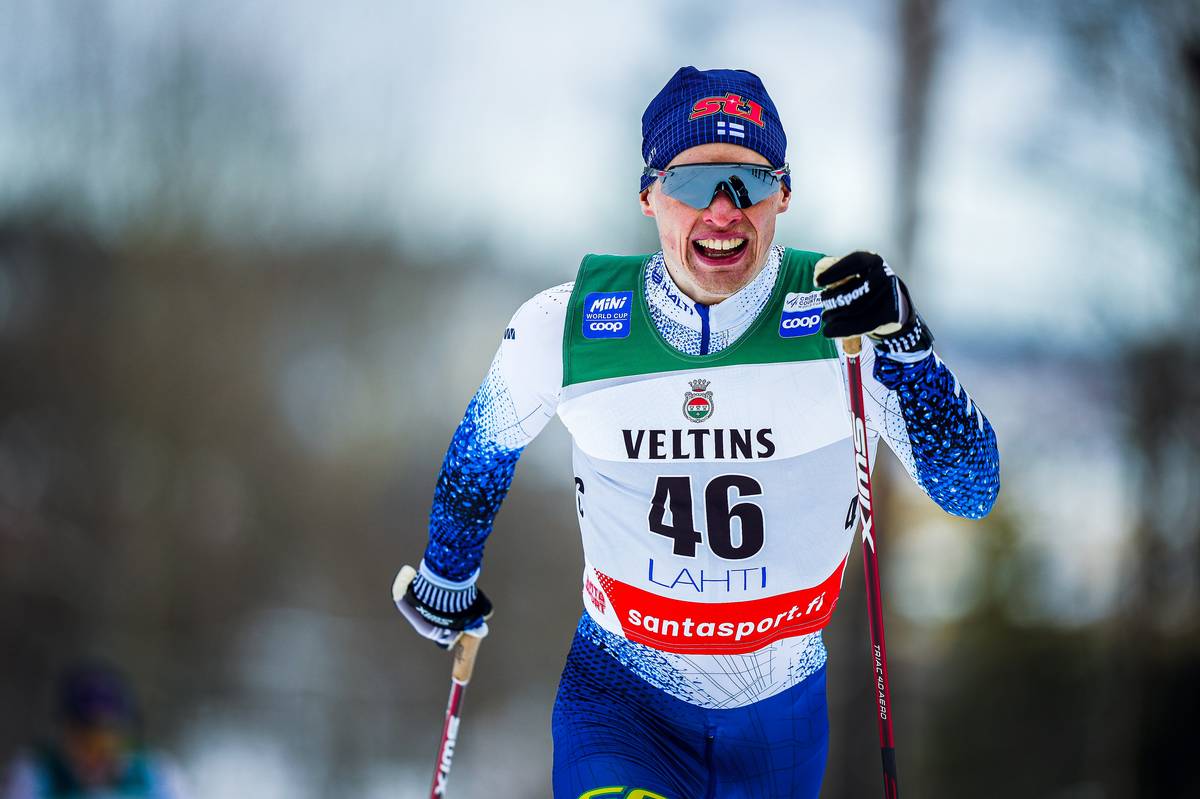
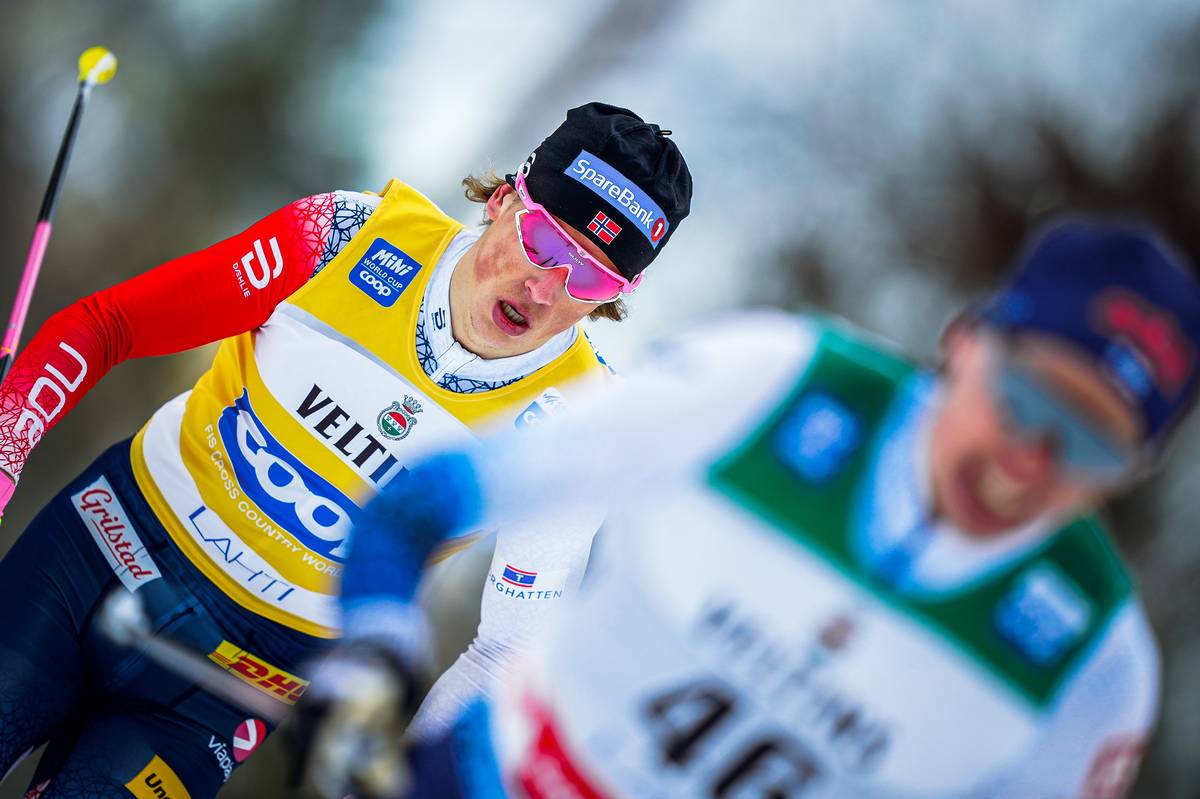
    Iivo Niskanen (FIN) leads the way during the 15 k interval start classic in Lahti, FIN. (Photo: NordicFocus)

    That Finland was happy to have its Olympic champion back to race a 15 k classic on home turf was readily apparent as he strode through the wooded course. Chants of “Iivo! Iivo! Iivo!” matched his metronomic tempo, while Finland’s flag waved him along.

    Starting near the front of the seeded group in bib 46, Niskanen set the bar through his first lap, holding a narrow lead of 0.4 seconds over Martin Løwstrøm Nyenget of Norway at the 5 k mark. Ilia Semikov and Alexander Bolshunov of Russia crossed in third (+0.8) and fourth (+1.1), while William Poromaa of Sweden rounded out the top 5 (+2.4). 

    Starting 11 minutes behind the Finn, Klæbo lucked into a ride as Niskanen lapped through the stadium just as the Norwegian took to the course. Accelerating to catch the Finn early, Klæbo and Niskanen pushed the pace at the top of the standings for the next 10 k, Niskanen making the winning pace clear from 5 k ahead. 
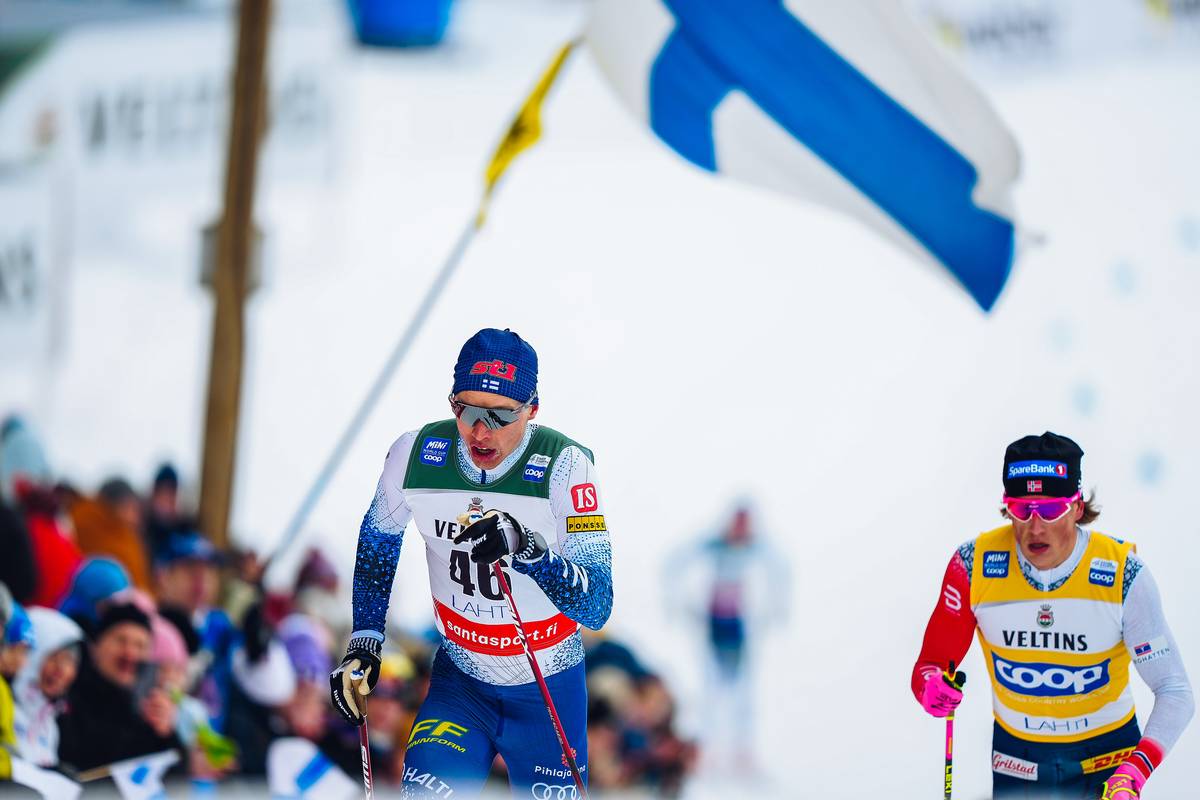
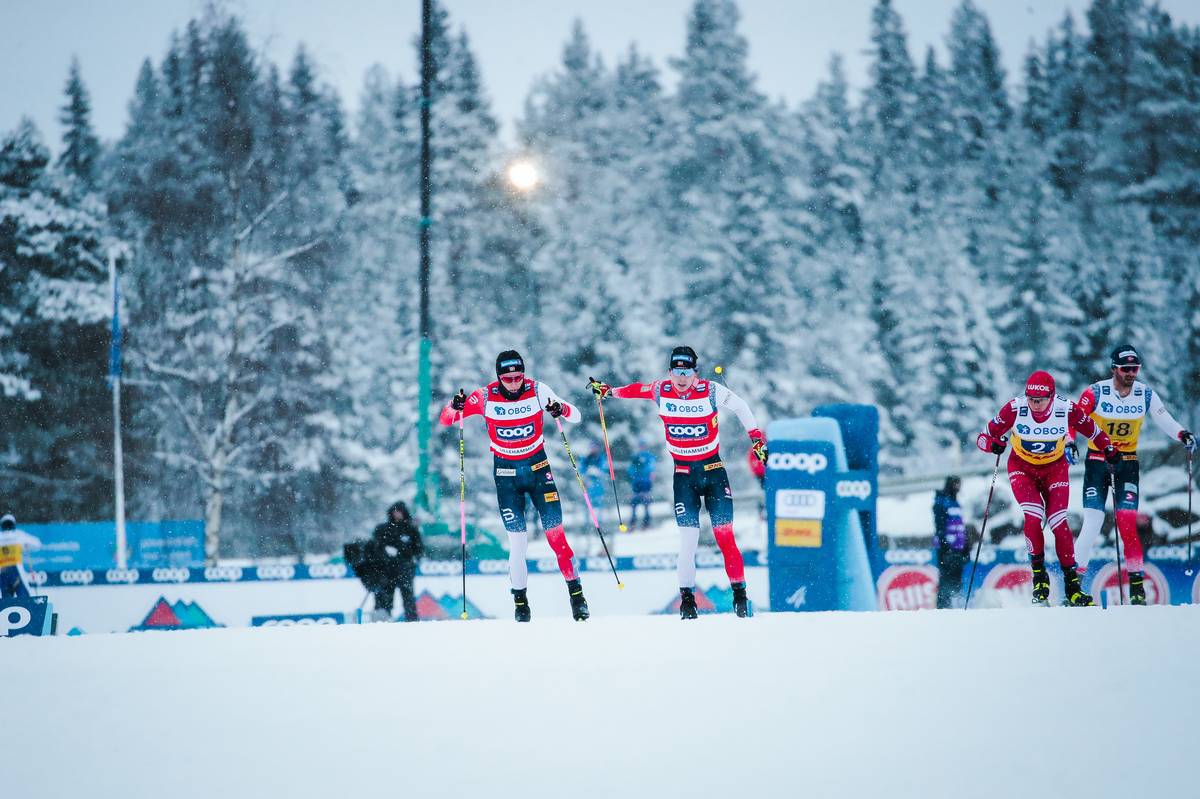
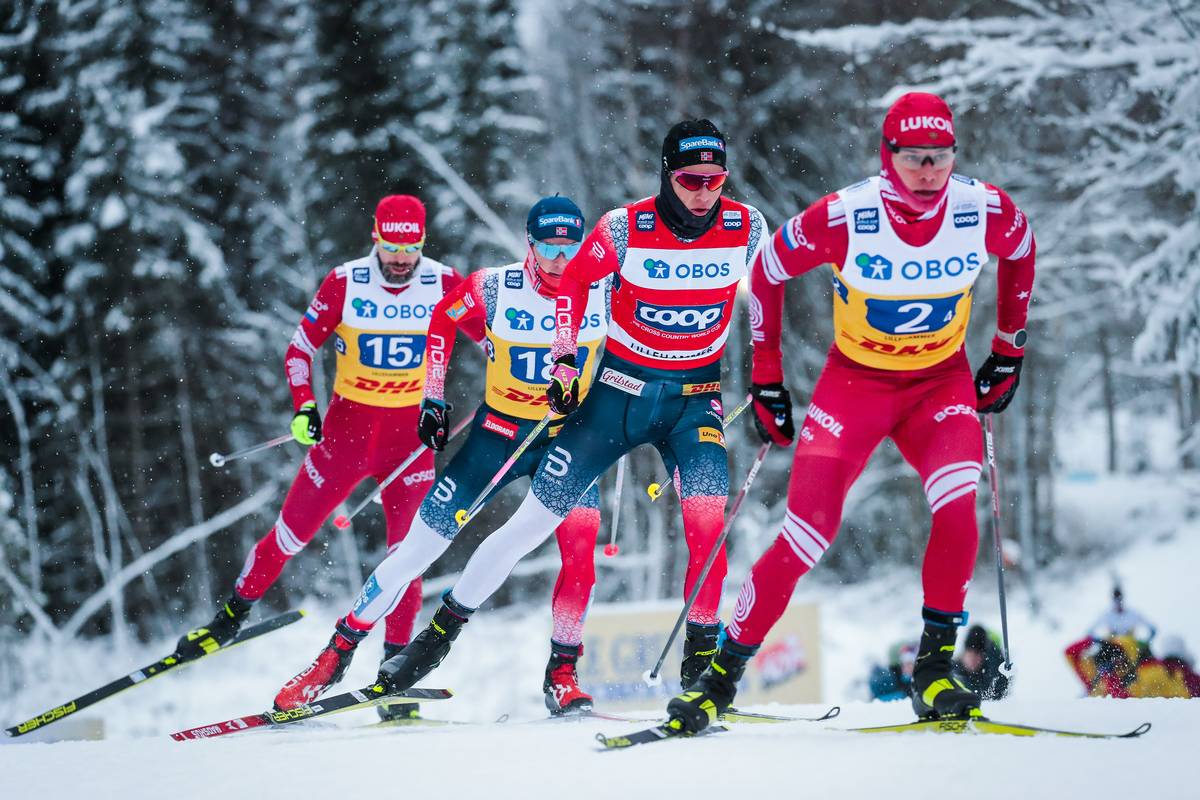
    Starting 11 minutes apart, Johannes Høsflot Klæbo (NOR) caught Iivo Niskanen (FIN) after his first lap, the Finn becoming a carrot for the Norwegian through his first 10 k of racing. (Photo: NordicFocus)
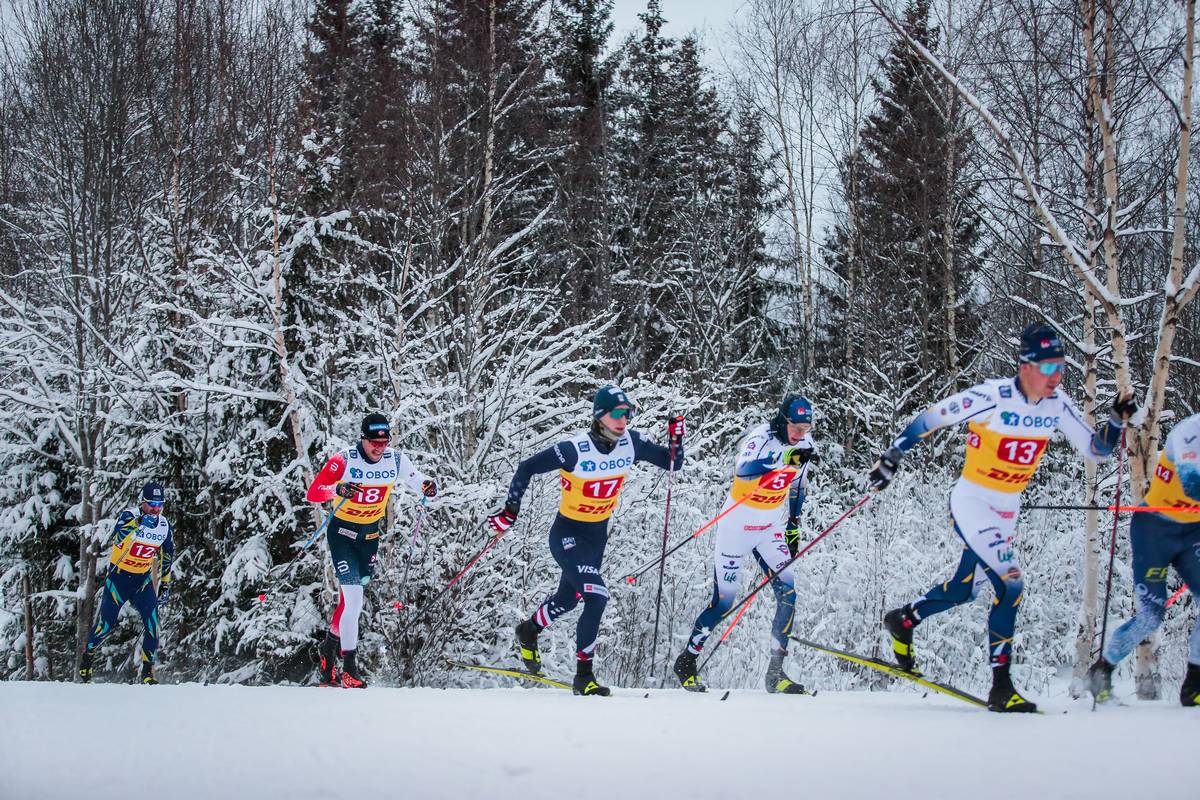
    Johannes Høsflot Klæbo (NOR) follows Finnish favorite Iivo Niskanen during the 15 k individual start classic in Lahti, FIN. (Photo: NordicFocus)

    At the 10 k checkpoint, Klæbo was able to match pace with Niskanen to put himself in the lead with a +7.5 second advantage. Niskanen pulled away from Klæbo at the 11 k mark to make his final push toward the finish. Poromaa was sitting in third (+7.6), with Nygent and Bolshunov rounding out the top 5 in fourth (+9.2) and fifth (+10.1).

    As Niskanen made his way to the finish, the crowd erupted. His name echoed through the packed stadium, as he threw his boot to stop the clock at 33:06.5.
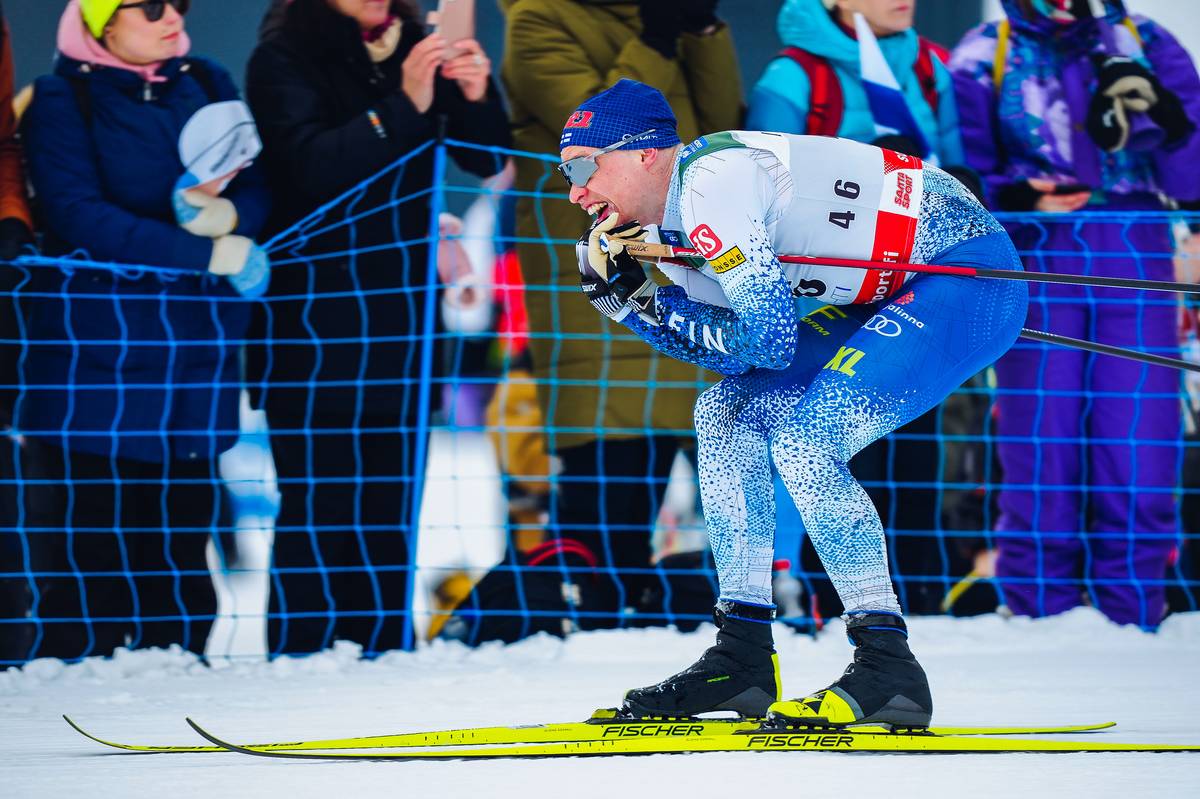
    Iivo Niskanen (FIN) makes his way into the stadium at the finish of the 15 k individual start classic in Lahti. (Photo: NordicFocus)

    With each subsequent finisher, the crowd increased its energy while Niskanen waited in the leader’s chair, a local win looking more and more likely. The final domino was seeing where Klæbo would fall as he crossed the finish line.  

    Fading in his final lap, Klæbo quickly lost his advantage, sliding behind both Niskanen and Poromaa at the 13.7 k checkpoint. Starting the lap 7.5 seconds ahead of Niskanen, Klæbo had already lost nearly 23 seconds, now sitting 14.7 back on the Finn with just over a kilometer of racing to go. The question then became, can Klæbo get Poromaa?

    Sipping a Red Bull and watching the clock, Niskanen watched Klæbo enter the stadium well off the Finn’s mark. Reveling in the excitement of his eighth 15 k classic victory on the World Cup, this time in front of his home crowd, the Finn hopped down and raised his arms into the air for a cacophony of cheers, before congratulating his opponent, Klæbo, on an exciting and hard-fought race. 
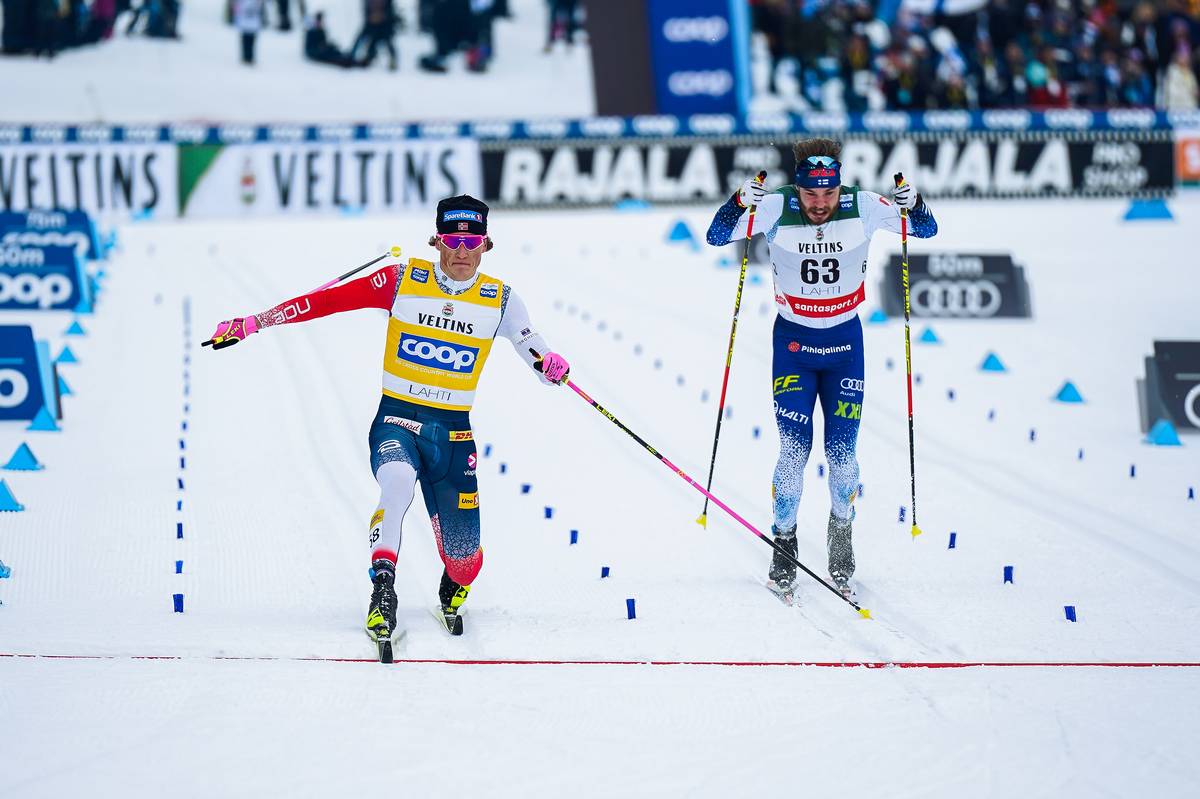
    Johannes Høsflot Klæbo (NOR) throws his boot for second place in the 15 k interval start classic in Lahti, FIN. (Photo: NordicFocus)
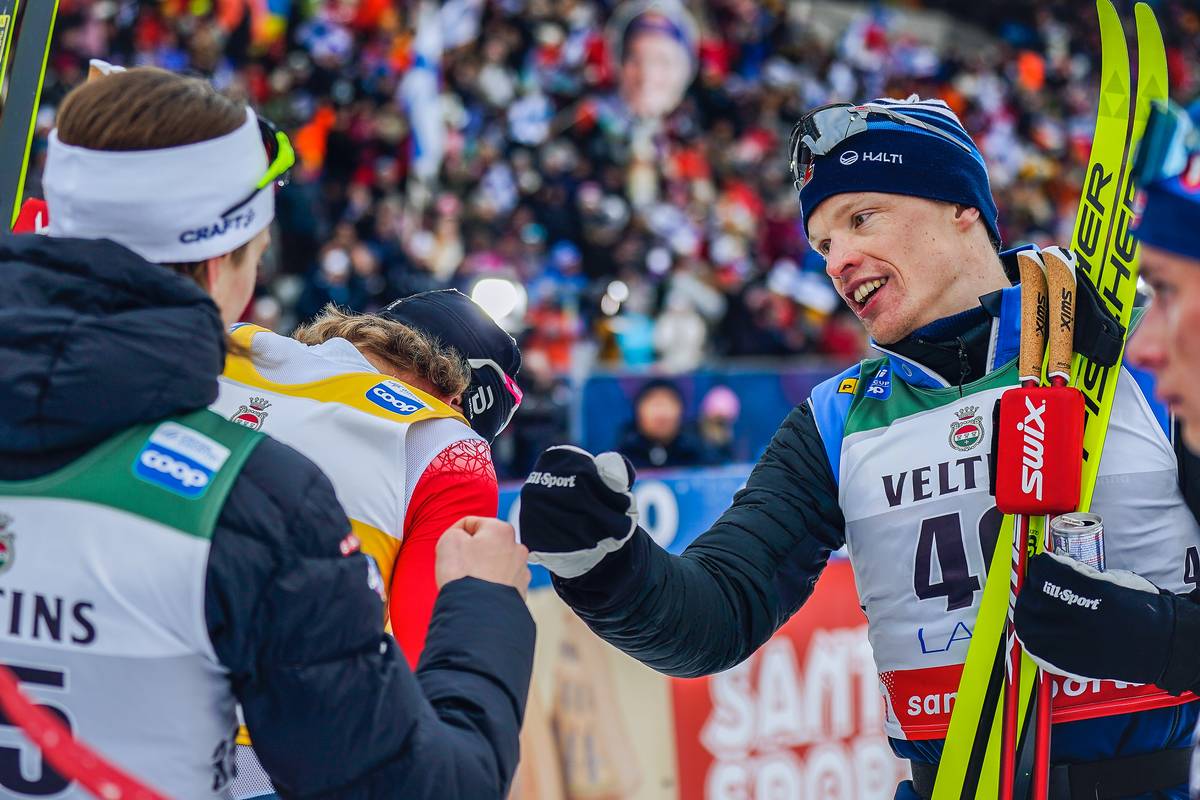
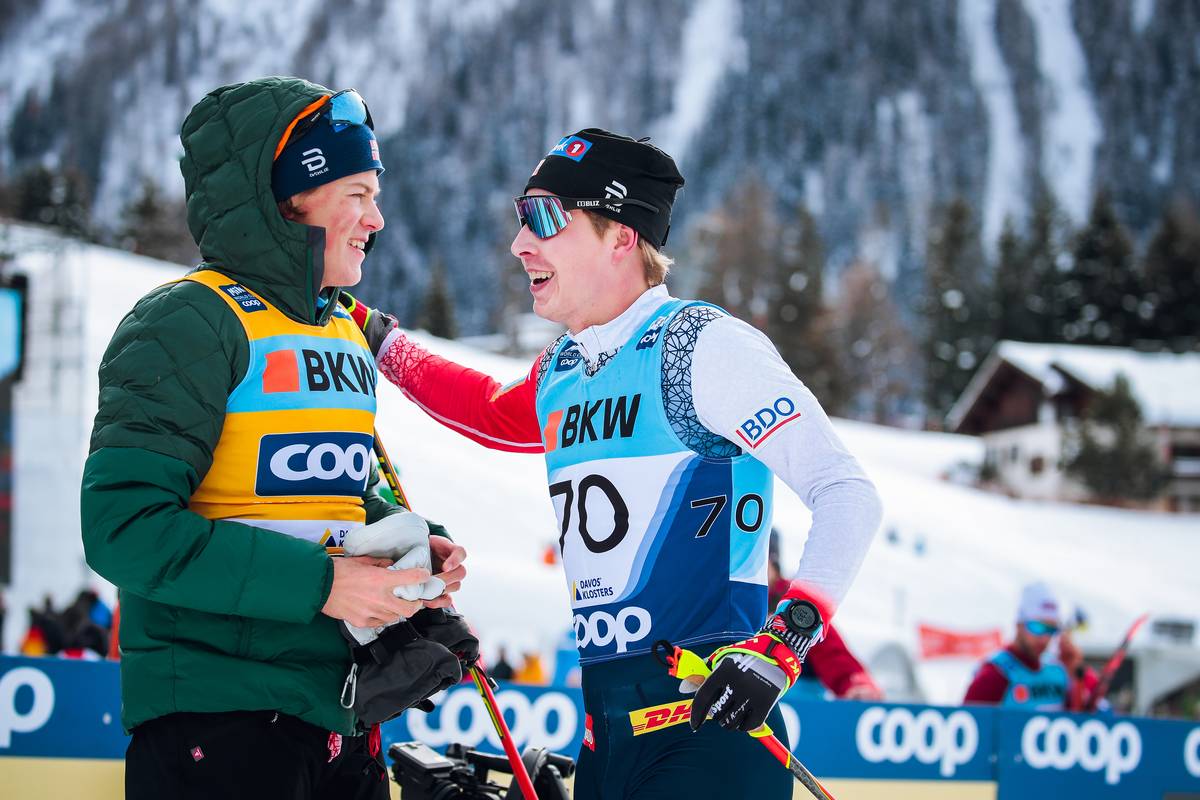
    Winner Iivo Niskanen (FIN) congratulates Johannes Høsflot Klæbo (NOR) following a 15 k individual start classic that saw the two working together for 10 k. (Photo: NordicFocus)

    Klæbo held narrowly held on for second place (+17.6), just ahead of 21-year-old Poromaa who finished in third (+18.0). Alexey Chervotkin (RUS) crossed the line in fourth (+22.0) after sitting just outside the top 5 for a majority of the race. His teammate, Bolshunov rounded out the top five (+24.4).

    “It was great,” Niskanen told FIS at the finish. “Couldn’t believe that it’s so nice to ski in front of this audience, so I enjoyed every moment of the course. It was one of the most emotional races, I have to say, because there are so [many] spectators here in Lahti today.”

    All of Niskanen’s World Cup victories in the 15 k distance have been in classic, and he’s gone four for four this season. He is now an Olympic champion in the event, adding to his collection of Championship gold medals in the event which began with a win in the 15 k classic at the 2017 World Championships on this course in Lahti. 

    “I get a bit nervous during the race, because I fell down in the first lap,” Niskanen said of his confidence in today’s race. “Then we skied together with Johannes, and I think he spent a little bit too much energy in the first lap, so it was a tough finish, but at the end I was feeling quite fresh, so it was a nice last lap. We have done a lot of work with the skis now and it seemed that they worked really good in Beijing, and now it’s continuing [here] in Scandinavia. So really happy at the moment that I could make the races like this.”
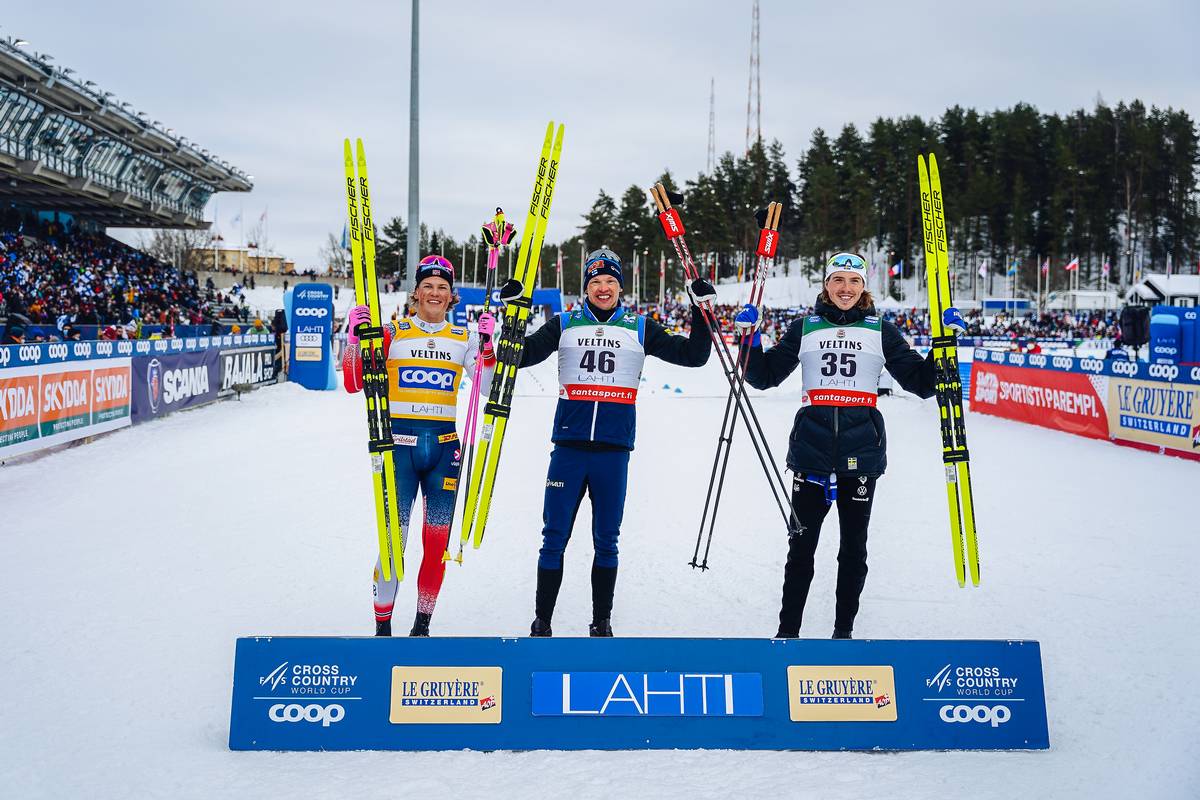
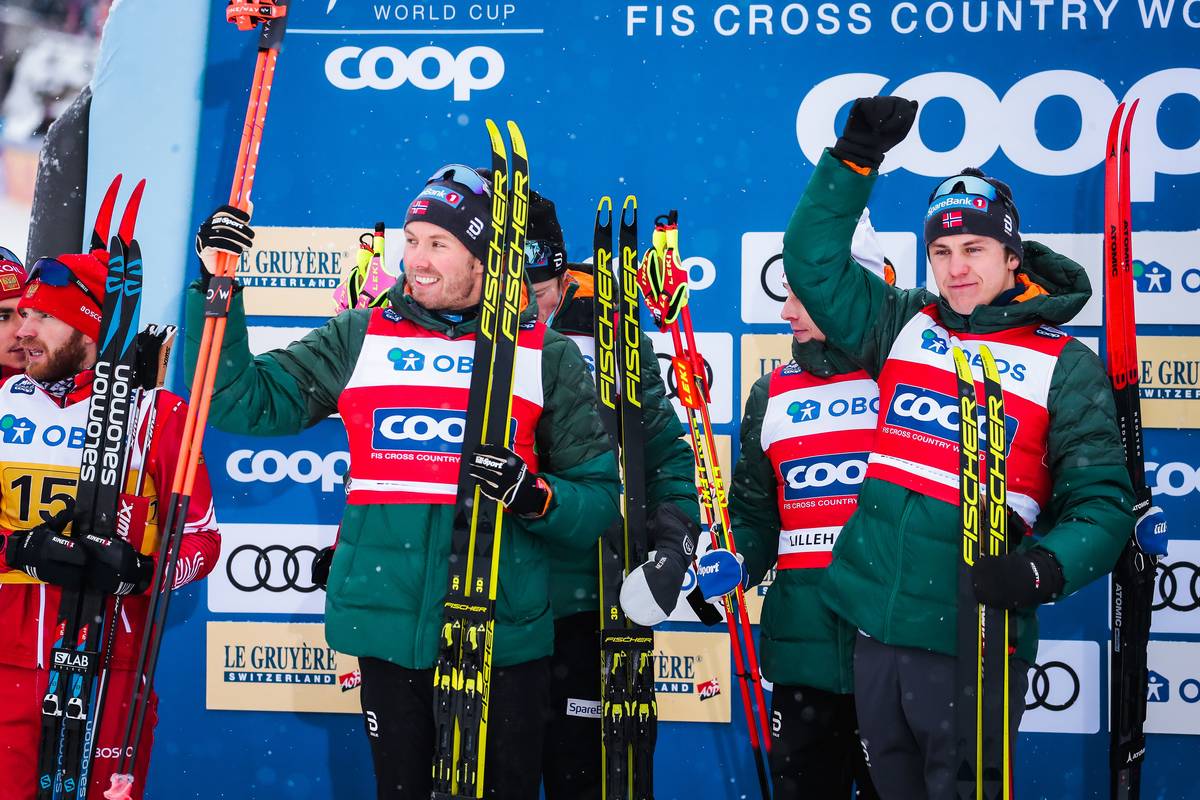
    The men’s 15 k classic podium in Lahti: Iivo Niskanen (FIN) took the win in his signature event, ahead of Johannes Høsflot Klæbo (NOR) and William Poromaa (SWE). (Photo: NordicFocus)

    The FIS interviewer gave a nod to Niskanen’s hard work through the season, but he smiled as if to say this week may not have matched that ethic.

    “I have to say, I have been so tired after the Games. We have partied too much so now it’s time to focus more on sport, and let’s see. Hopefully I can manage to win again next weekend [at the Holmenkollen].”
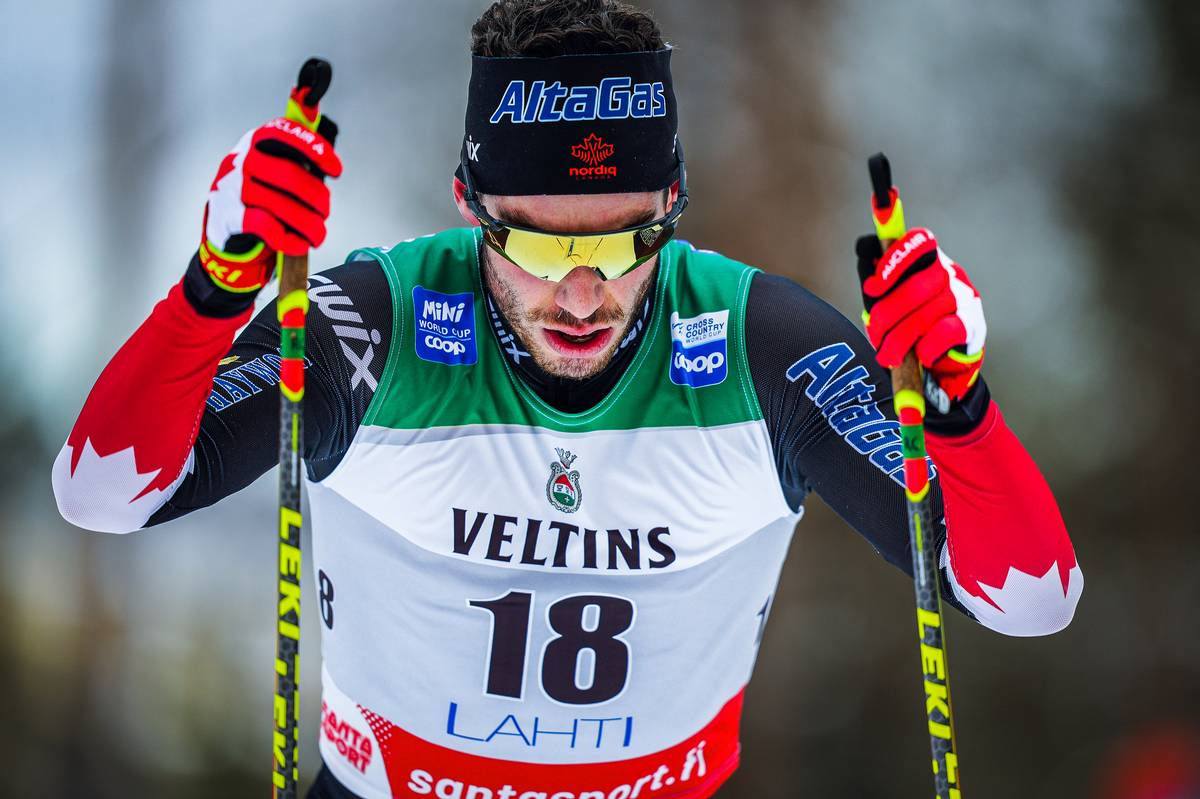
    Antoine Cyr races the 15 k interval start classic in Lahti, FIN. (Photo: NordicFocus)

    The Canadians had a strong day with two in the top 30. Antoine Cyr finished in 23rd (+1:46.5) while teammate Olivier Léveillé crossed the finish line in 29th (+1:59.1). 

    On the heels of a strong classic team sprint performance in Zhangjiakou, Cyr was fighting in and out of the top 20 all day. Through the 5k mark, Cry was 19th (+19.3), sliding back to 24th (+1:03.1) at the 10 k mark. Cyr was 11th and 12th in the opening distance races in Ruka in November, and won the 15 k classic during the Canadian Olympic Trials in January.

    “[It was a] good day for me today,” Cyr wrote to FasterSkier in a post-race email. “It’s a really fun course and such a historic venue. I felt good and skied well. I thought I had a little bit more in me, but it was a competitive field out there and I missed the top 20 by not much. I am really happy with the result and will see how the shape is going to be for the races to come.”

    Also racing for Canada, Rémi Drolet finished in 42nd (+2:41.9), while Philippe Boucher crossed the line in 59th (+3:26.9) and Leo Granbois took 62nd (+3:38.9). 
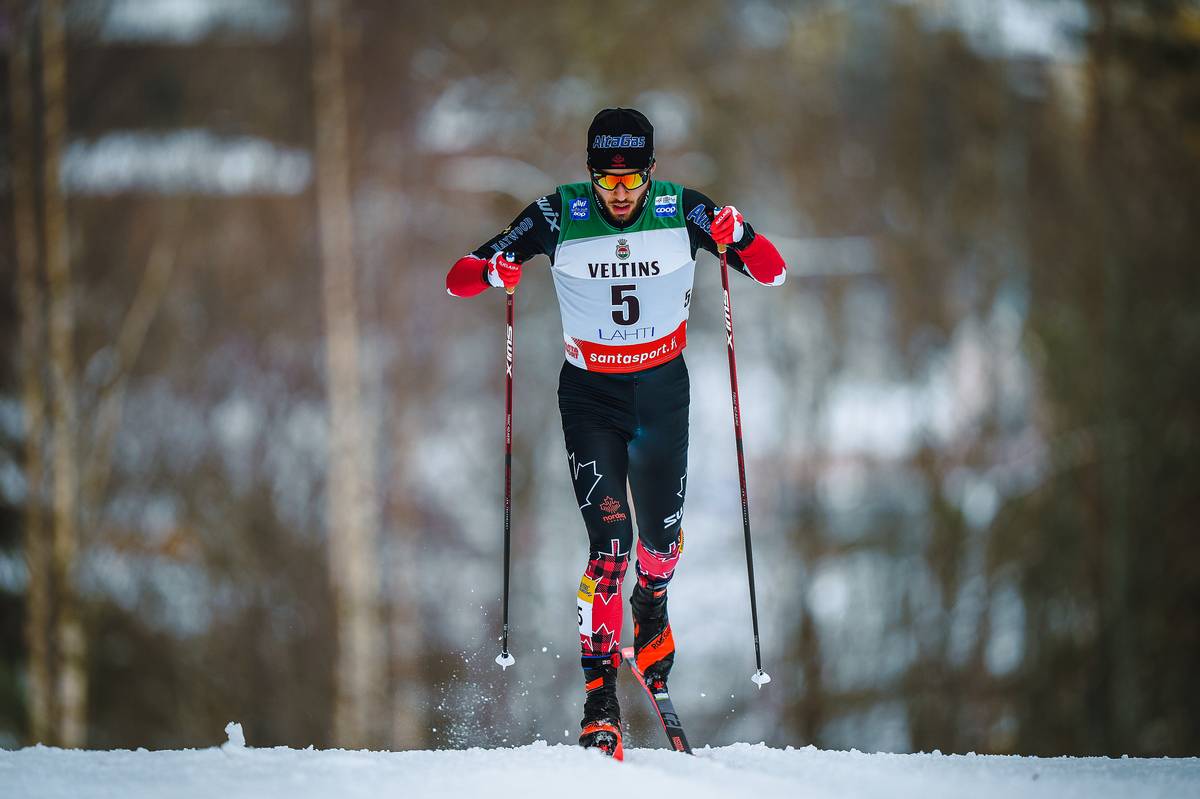
    Olivier Léveillé races the 15 k interval start classic in Lahti, FIN. (Photo: NordicFocus)
    Scott Patterson races the 15 k interval start classic in Lahti, FIN. (Photo: NordicFocus)

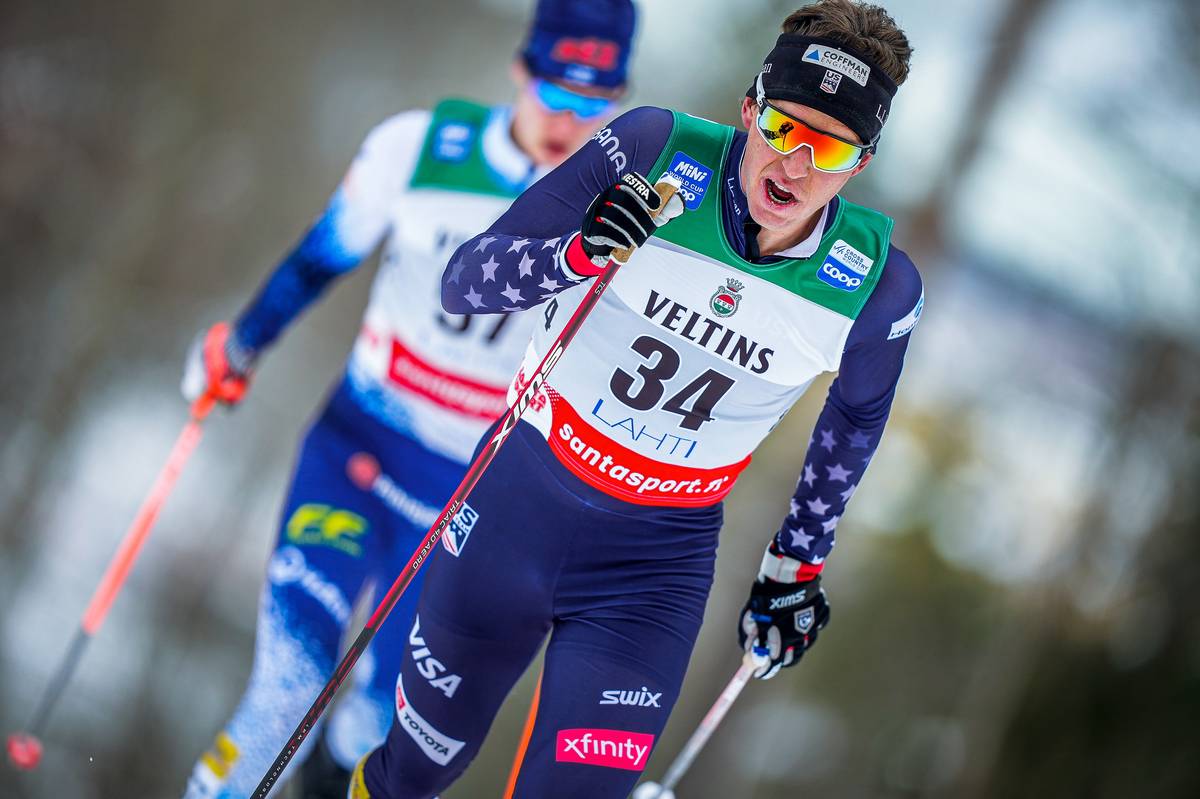
    The top American was Scott Patterson, who was just outside the top-30 World Cup point margin finishing in 33rd (+2:11.4). Zak Ketterson was 41st (+2:41.1), while Kevin Bolger took 49th (+2:59.9), and Zanden McMullen skied to 51st (+3:04.5), returning to the World Cup following races at the ongoing  2022 U23 World Ski Championships in Lygna, NOR. The first weekend of World Cup starts for Logan Diekmann saw him cross the line in 65th (+4:30.7).  
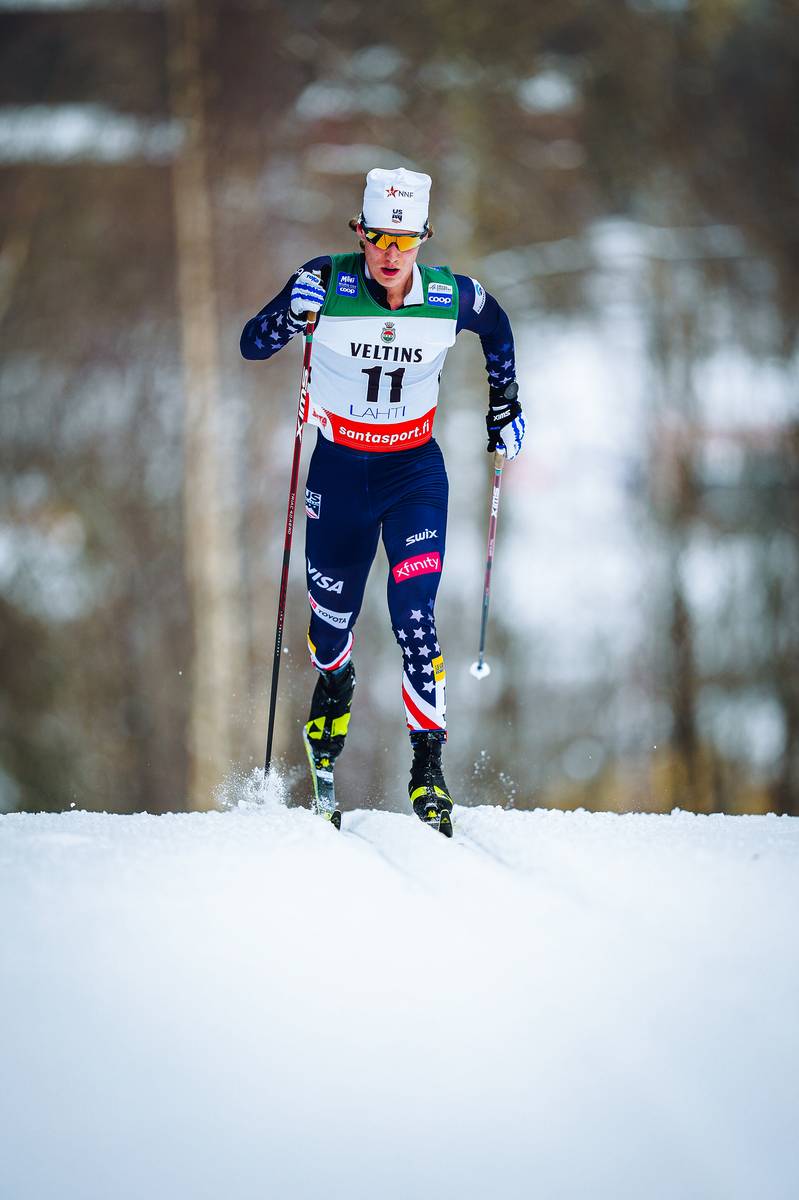
    Fresh off of the 2022 U23 World Ski Championships, Zanden McMullen rejoins the World Cup for the 15 k interval start classic in Lahti, FIN. (Photo: NordicFocus)

    Following the races, US Ski Team head coach Matt Whitcomb provided insights into both the men’s and women’s races in Lahti, as well as sharing the news that Östersund, SWE may become the host to the initially cancelled World Cup Finals that had been scheduled for Tyumen, Russia. Whitcomb also speaks to the “Olympic hangover” that can make hard for athletes to perform at their best the weekend following the Games, and gave a shoutout to the athletes racing at World Juniors in nearby Lygna.

    Results

    – Rachel Bachman Perkins contributed
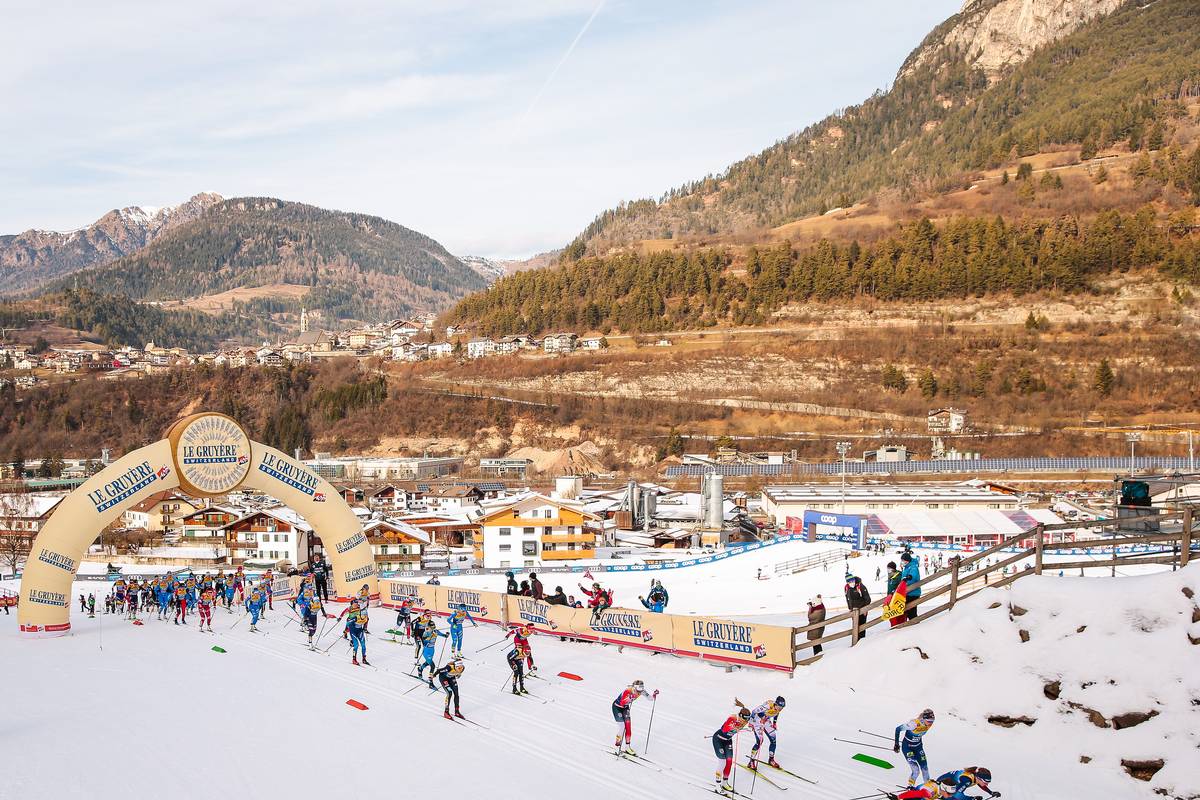
    Racing his first weekend on the World Cup, Logan Diekmann the 15 k interval start classic in Lahti, FIN. (Photo: NordicFocus)
  • Nepryaeva Cushions Her Lead with 10k Mass Start Classic Win; Diggins 13th

    Nepryaeva Cushions Her Lead with 10k Mass Start Classic Win; Diggins 13th

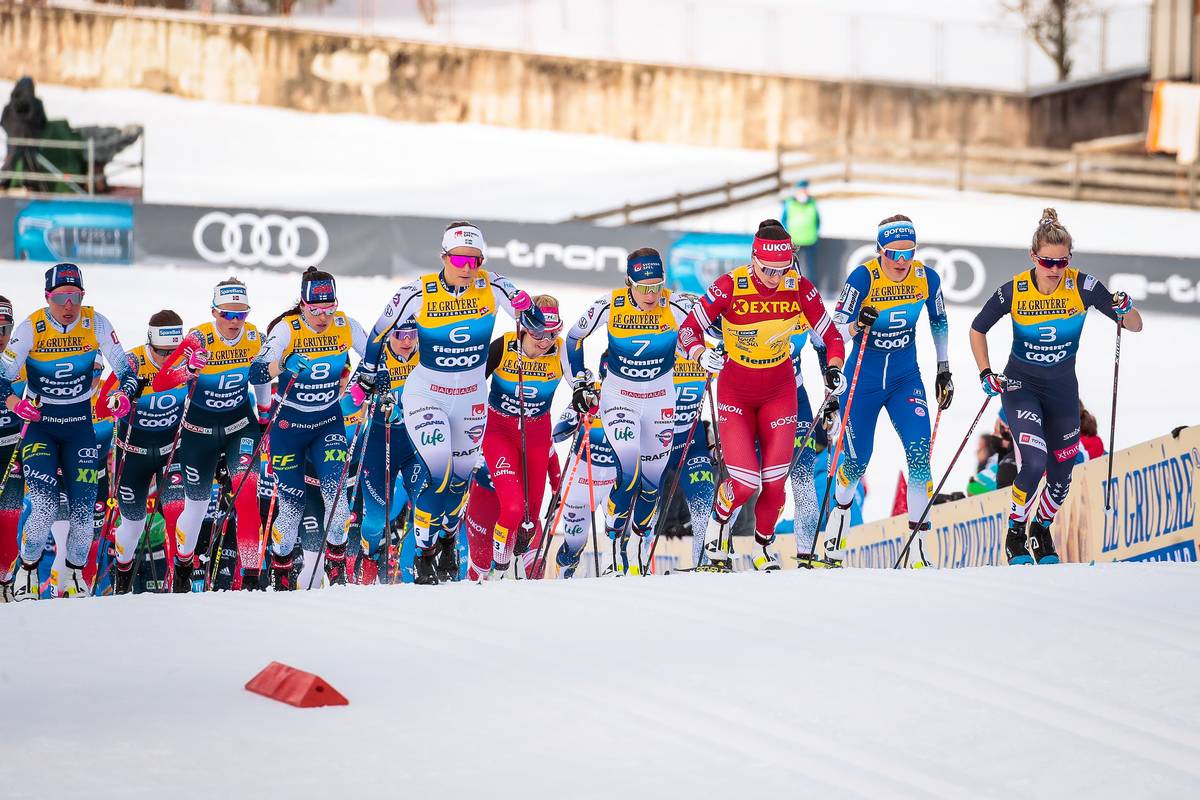
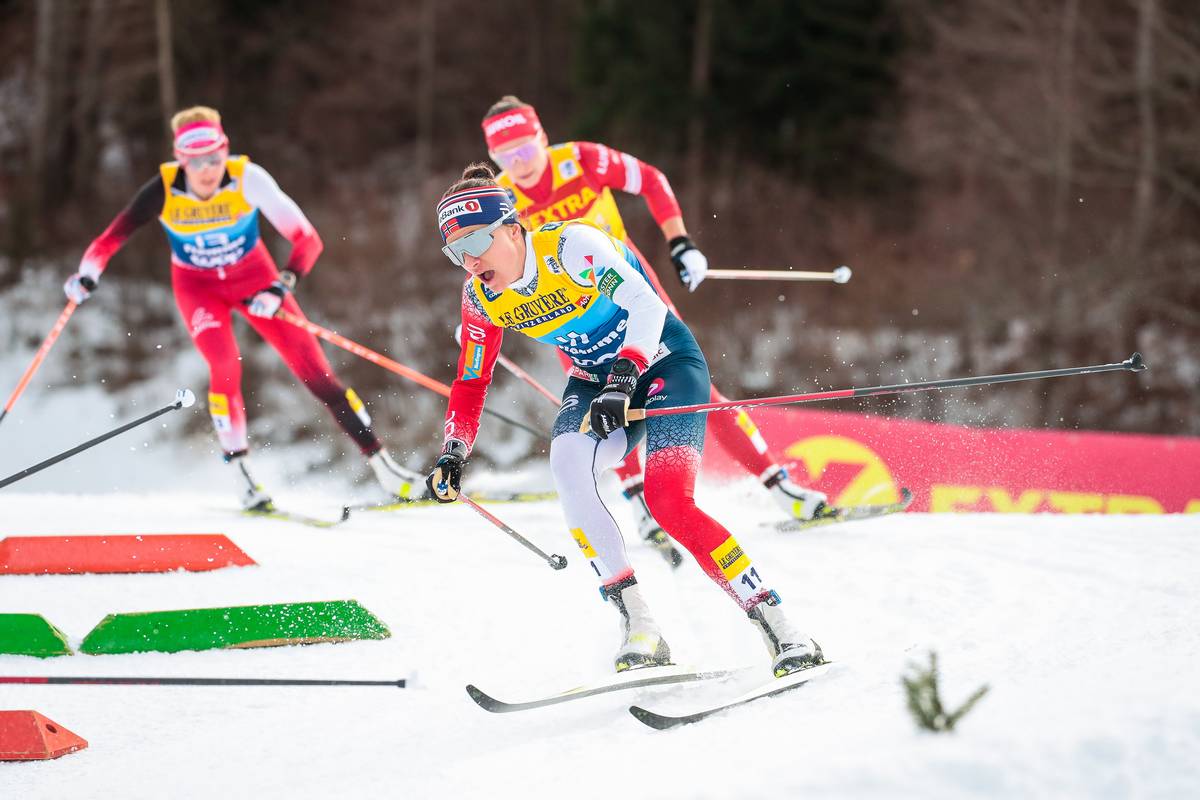
    Not-quite-winter. The women’s 10-kilometer classic kicked off the final two stages of the 2021/22 Tour de Ski in Val di Fiemme, Italy. (Photo: NordicFocus)

    This World Cup coverage is made possible through the generous support of Marty and Kathy Hall and the A Hall Mark of Excellence Award.  To learn more about A Hall Mark of Excellence Award or to learn how you can support FasterSkier’s coverage please contact info@fasterskier.com.

    After a day of rest, the Tour de Ski kicked off it’s final two stops in the mountains of northern Italy. After a dramatic freestyle sprint in Stage 4, there was a lot on the line with little time to go in the Tour for many of the women who lined up for today’s 10-kilometer mass start classic in Val di Fiemme. With blue skies and sunshine illuminating the spectacular Italian Dolomites, the stage was set for a spectator’s dream over the four lap course.  

    First, a quick look to the overall Tour standings to set the tone. Natalia Nepryaeva (RUS) took the lead in Stage 4. With the 60-second time bonus for a sprint win, Nepryaeva entered Stage 5 with a 34 seconds lead on Kerttu Niskanen (FIN) in second, and 38 seconds ahead of Jessie Diggins (USA) in third.

    A favorite for a second consecutive Tour win, Diggins led the standings heading into the fourth stage, during which she was taken out by Frida Karlsson (SWE) in the quarterfinals, losing vital time in the Tour standings. Karlsson was later disqualified for obstruction and withdrew from the Tour after being issued a three minute time penalty that put her out of contention for the overall win. 

    While Diggins typically responds well to pressure and has put together impressive performances up the final hill climb, the classic tracks in Val di Fiemme have historically challenged Diggins, who would need to minimize time lost in order to still be in a position to fight for the overall win in the final stage. In last year’s Tour, Diggins was 10th in the 10k classic in Val di Fiemme, 17th in 2020 and 2019, and 4th in 2018. The odds were, perhaps, not in her favor, but the potential was there.

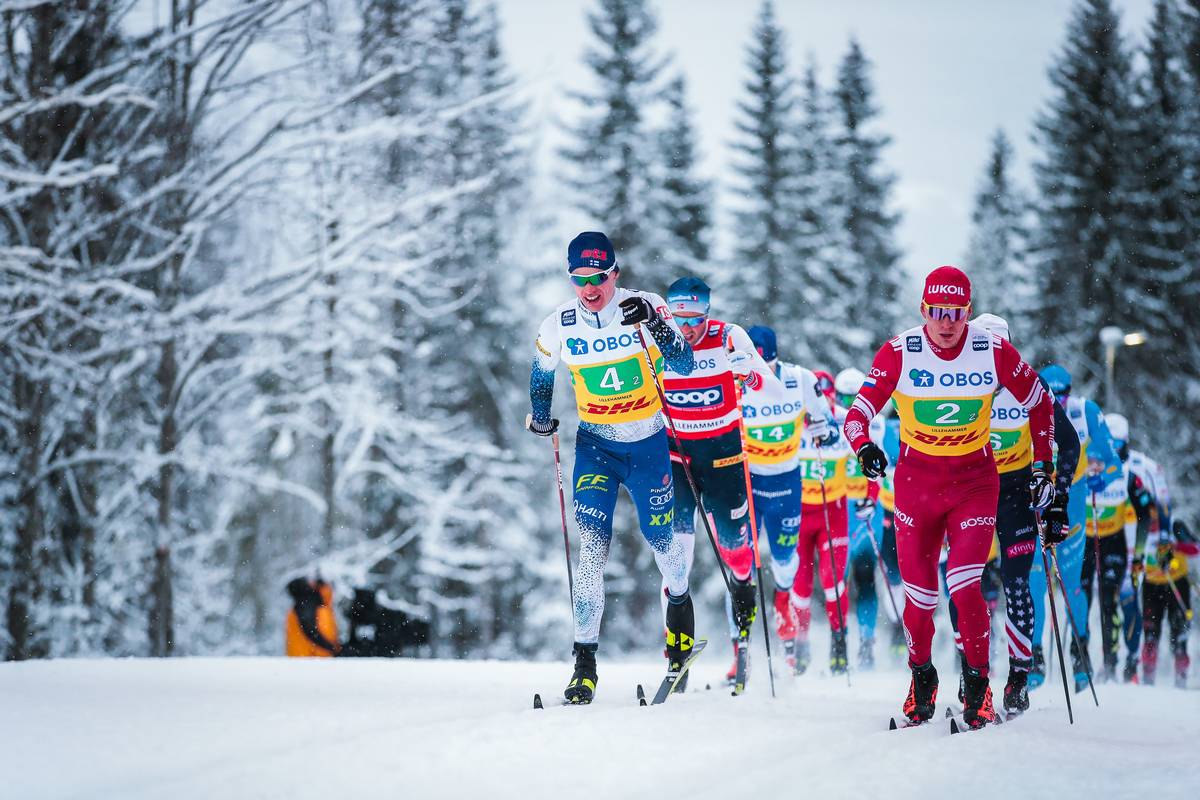
    Athletes take to the tracks for Stage 5 of the 2021/22 Tour de Ski, a mass start classic in Val di Fiemme, Italy. (Photo: NordicFocus)

    Within the race, there were two opportunities for bonuses, one for Tour points and one for bonus seconds. These opportunities arose at 2.3 and 6k, respectively. 

    As racers took to the course, the congestion of a mass start was apparent. A pole snapped within the first minute as racers jostled for position in the lanes before settling in. 

    As the second lap started, a gap began to form behind a large lead pack of about 14 women, which included Diggins, Nepryaeva, and Niskanen. The lead women created a roughly eight-second lead on the chase pack at 3.5k.  

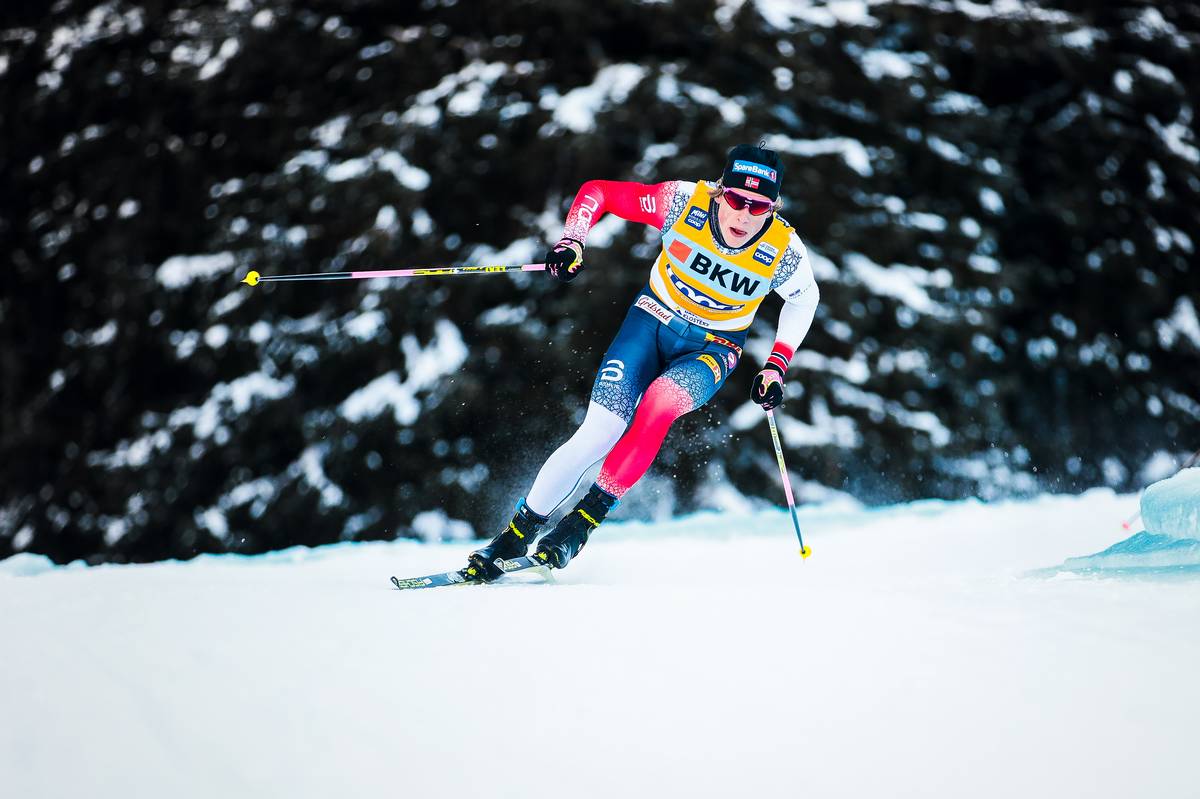
    Heidi Weng navigates fast and icy corners during the 2021/22 Tour de Ski in Val di Fiemme, Italy. (Photo: NordicFocus)

    At the halfway mark a group of six skiers began to thin out the lead group, led by Krista Pärmäkoski (FIN), Heidi Weng (NOR), Ebba Andersson(SWE), Katharina Henning (GER), Nepryaeva, and Teresa Stadlober (AUT). They opened up about a six-second lead on the chase pack which included Diggins and Niskanen. 
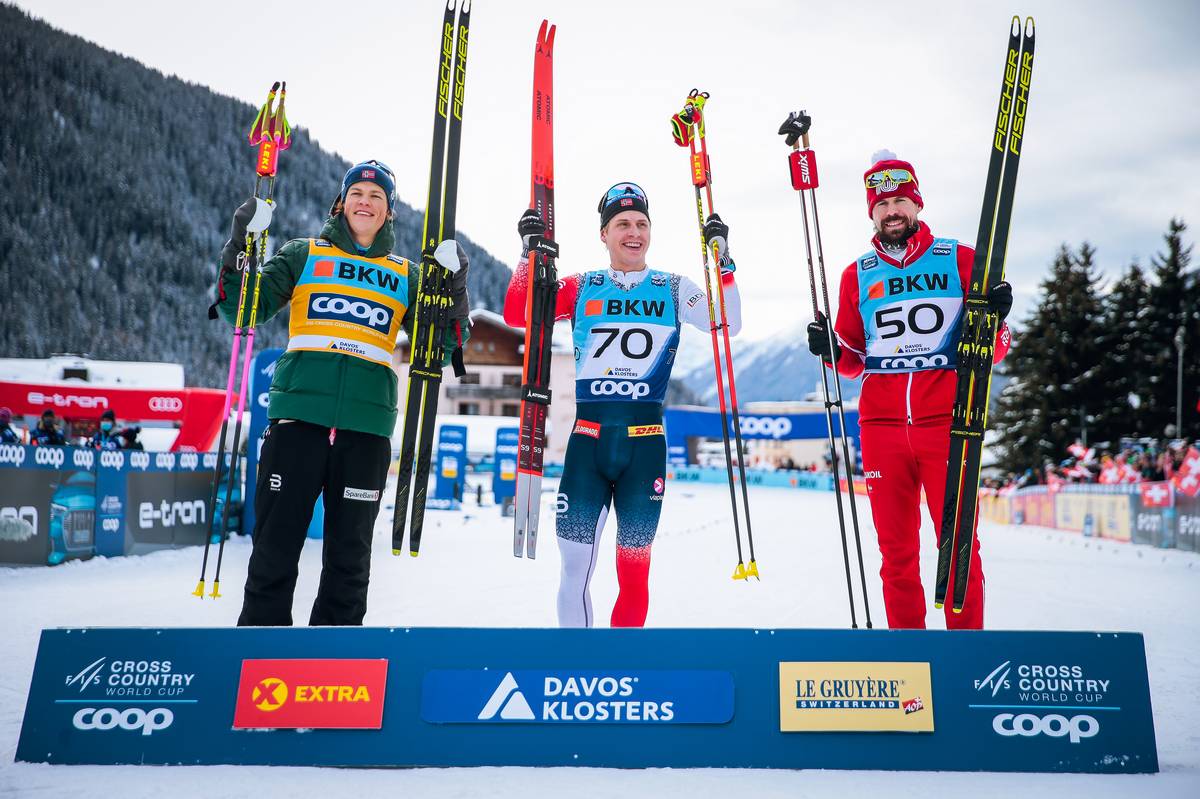
    As the women lapped through the stadium for the last 2.5k, this lead group, now led by Andersson, had stretched their lead to more than 20 seconds over the next chase pack.  

    Working together through most of the final lap, the group of six women skied together until the final climb before the stadium where Nepryaeva began to surge.

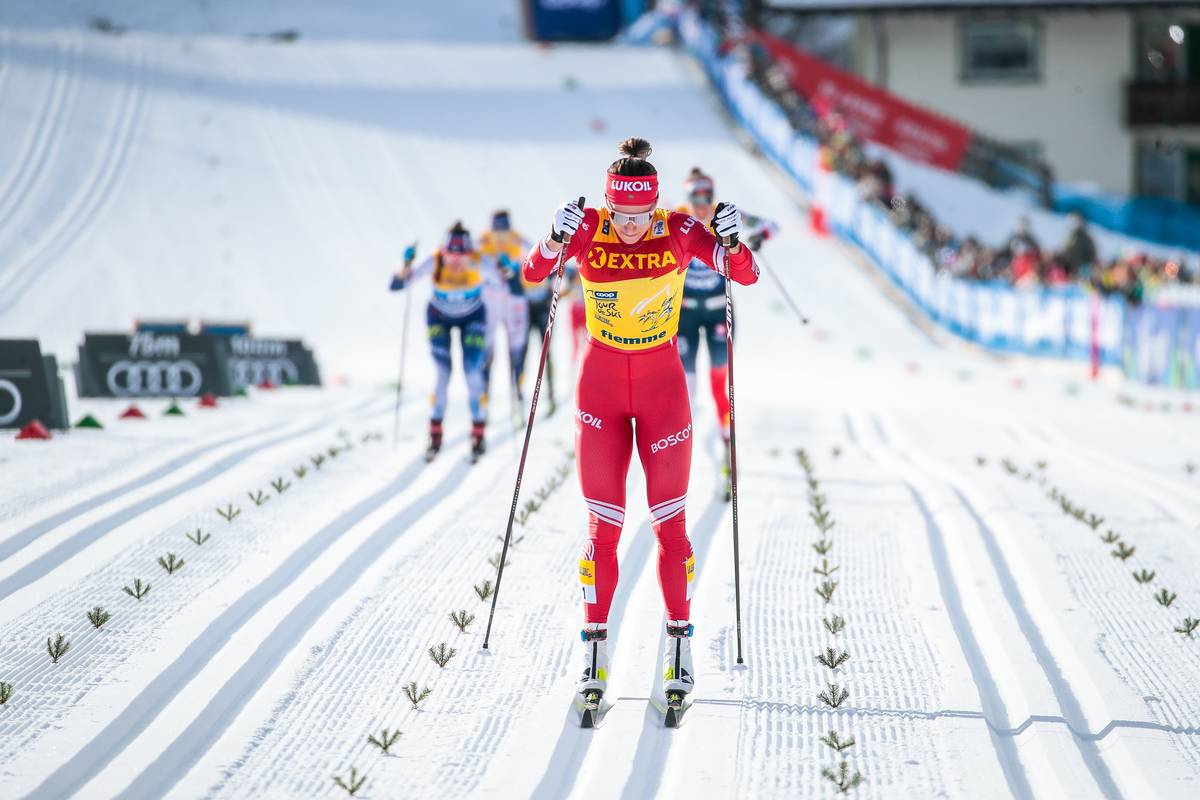
    Charging up the hill and pushing hard over the top before dropping into a tuck, she quickly dropped the women in pursuit. Cruising through the stadium with a powerful doublepole, Nepryaeva had a comfortable lock on the win, stopping the clock with a fist pump in 29:51.3. 

    Natalia Nepryaeva (RUS) takes the win in Stage 5 of the Tour de Ski. (Photo: NordicFocus)
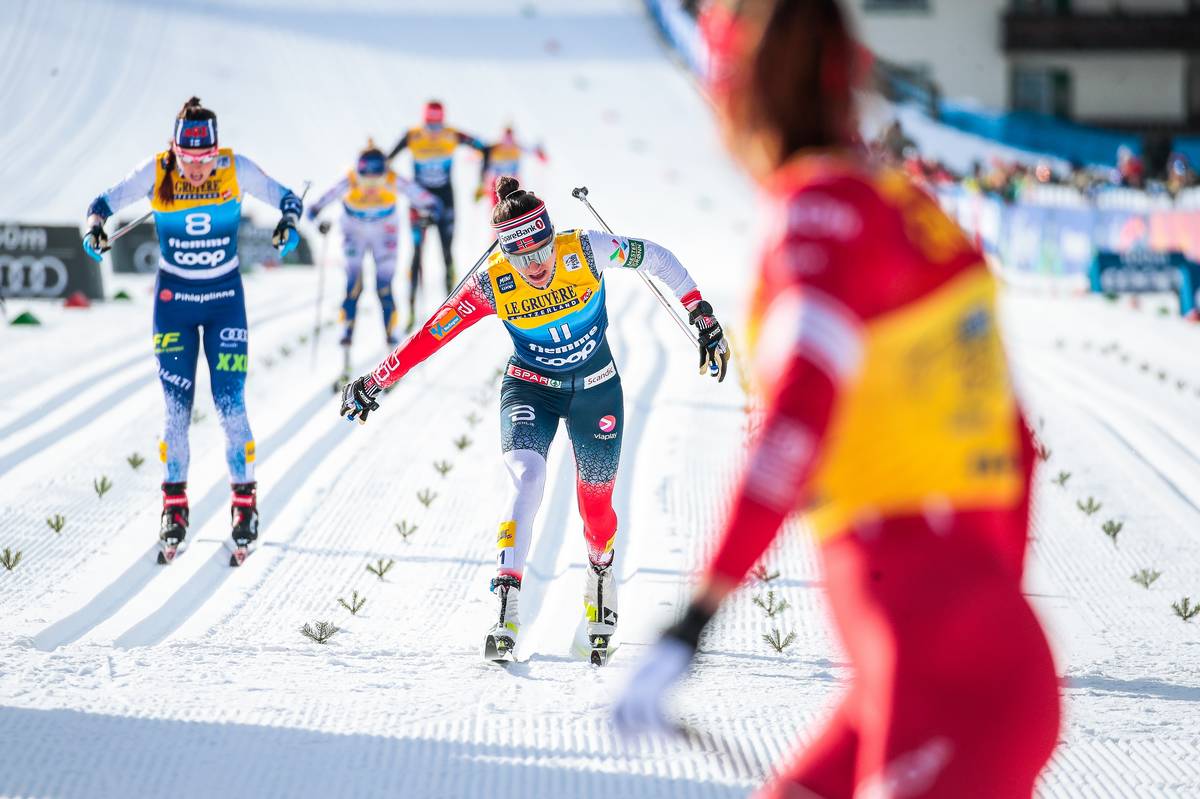
    Fighting for second and third, Heidi Weng (NOR) overtakes Krista Pärmäkoski (FIN). (Photo: NordicFocus)

    In second at the top of the climb, but gaining ground in the descent and double pole, Weng pulled ahead of Pärmäkoski to finish second (+3.7), with the Finn just behind in 3rd (+4.7). The remainder of the lead group skied through the finish evenly spread with Andersson in 4th (+7.5),  Henning in 5th (+10.9), and Stadlober 6th (+14.3).

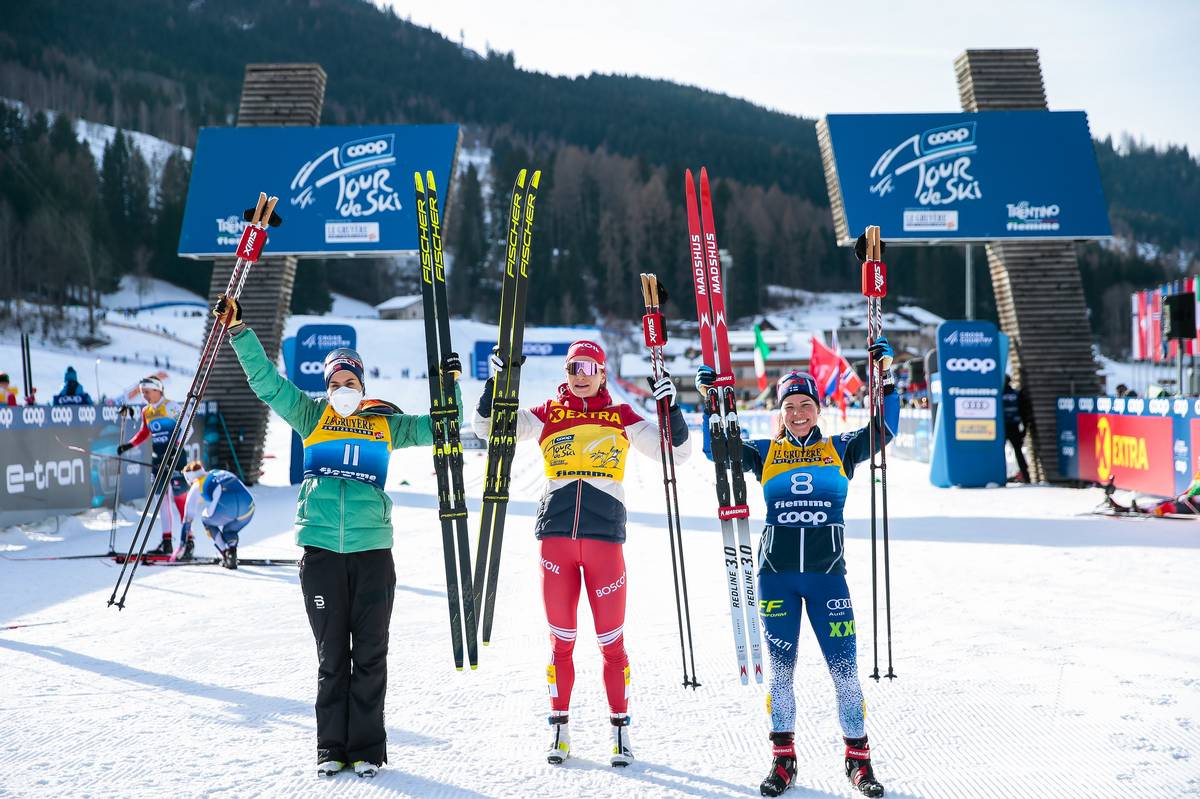
    The women’s podium after Stage 5 of the Tour de Ski. Natalia Nepryaeva (RUS) took the win ahead of Heidi Weng (NOR) in second, and Krista Pärmäkoski (FIN) in third. (Photo: NordicFocus)

    In a FIS Interview, Nepryaeva was asked how she felt about the race and about the course. “I am really happy to win here, it is a really important place for me, as it was my first win at World Juniors here.”  

    Outside the lead group and fighting hard to minimize time lost, Diggins crossed the finish line in 13th (+58.0). Diggins explained after the race that the icy conditions in Val di Fiemme were tricky for many of the women racing, as the speed checks needed to stay in control through the downhills in mass start conditions also cost them some grip in the final laps. 

    “I think it was one of those [days] where I had to really catch myself and be thinking really, really hard about standing tall and thinking about technique, which is harder for me in classic,” Diggins explained post-race. “I’m really proud of staying in the moment and never giving up and doing what I could with what I had.”

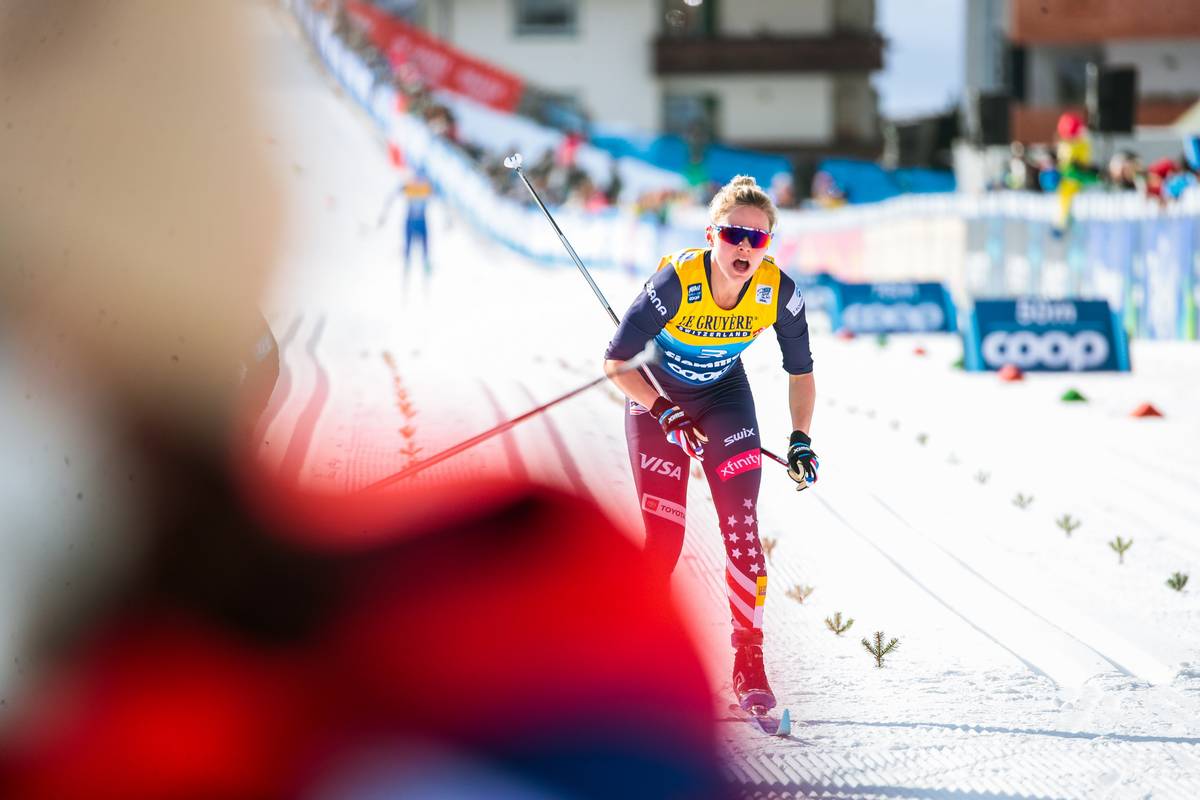
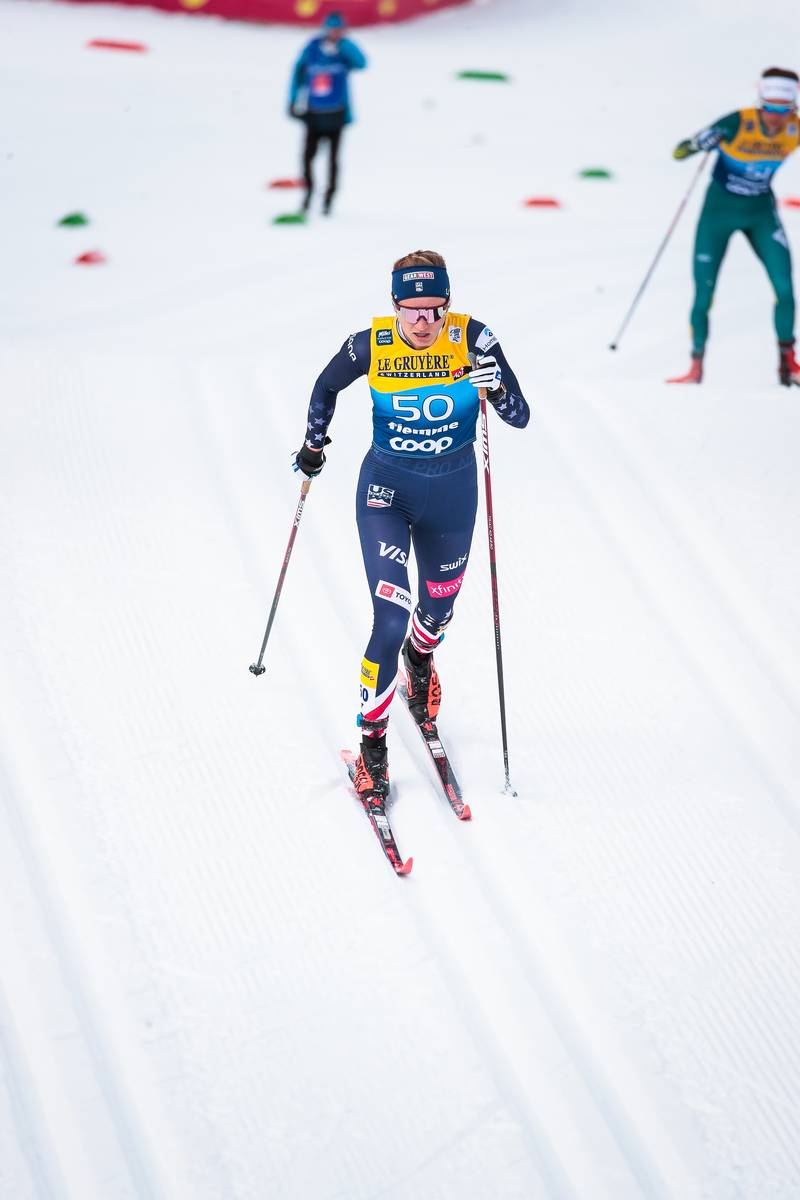
    Never a question of whether she has given her all, Diggins crosses the line in 13th in Stage 5. (Photo: NordicFocus)

    Looking ahead to the Alpe Cermis, where her time deficit may prove insurmountable, Diggins once again showed her never-give-up attitude 

    “I’m excited. It’s so hard, but it’s such a feeling of accomplishment making it to the top of that mountain… You can rest assured I will be crossing that finish line with nothing left.”

    Full audio clip from Jessie Diggins, interviewed on-site by Tom Horrocks, U.S. Ski & Snowboard cross country communications manager. 

    Katherine Ogden skis to 31st in Stage 5 of the 2021/22 Tour de Ski. (Photo: NordicFocus)

    Missing the Top-30 by just 13 seconds, Katherine Ogden raced to 31st (+2:17.4) as the next American finisher. Also with strong finishes, Novie McCabe crossed the line in 36th (+2:38.3) just ahead of her teammate Sophia Laukli, who took 39th (+2:57.7). Alayna Sonnesyn rounded out the women in stars and stripes in 51st (+5:32.1).

    Post-race interview with Katharine Ogden and Novie McCabe, interviewed by Tom Horrocks. 

    Sophia Laukli skis to 39th in Stage 5 of the Tour de Ski in Val di Fiemme. (Photo: NordicFocus)

    Looking back on the bonus opportunities, Johanna Hagström (SWE) made a move just before the 2.3k point bonus to pull away from the pack to snag the maximum of 15 points.  Pärmäkoski and Weng tied for second to both get 12 points. Diggins crossed the 2.4k mark in 8th, earning 3 bonus points.  

    At the 6k time bonus opportunity, Andersson was the first over the line, giving her 15 bonus seconds in the tour. Weng was able to continue her bonus streak on the day by crossing second and getting a 12-second bonus, while Pärmäkoski crossed in 3rd for 10 bonus seconds.  Nepryaeva finished in 5th, collecting six seconds.

    After today, Nepryaeva was able to not only hold on to her lead in the Tour, but expand it. Now leading Andersson by 1:12 seconds, heading into the final stage of the tour tomorrow. Diggins dropped down to sixth place from third, now behind by 1:42.

    Alayna Sonnesyn skis to 51st in Stage 5 of the Tour de Ski in Val di Fiemme, Italy. (Photo: NordicFocus)

    The final stage of the 2021/22 Tour de Ski, the infamous Alpe Cermis hill climb, kicks off at 11:30 CET / 5:30 EST.

    Stage 5 Results 

    Overall Tour Standings: Cumulative Time | Points

  • Keeping It In the Family, Iivo Niskanen Adds Another 15k Classic Victory to His Resume

    Keeping It In the Family, Iivo Niskanen Adds Another 15k Classic Victory to His Resume

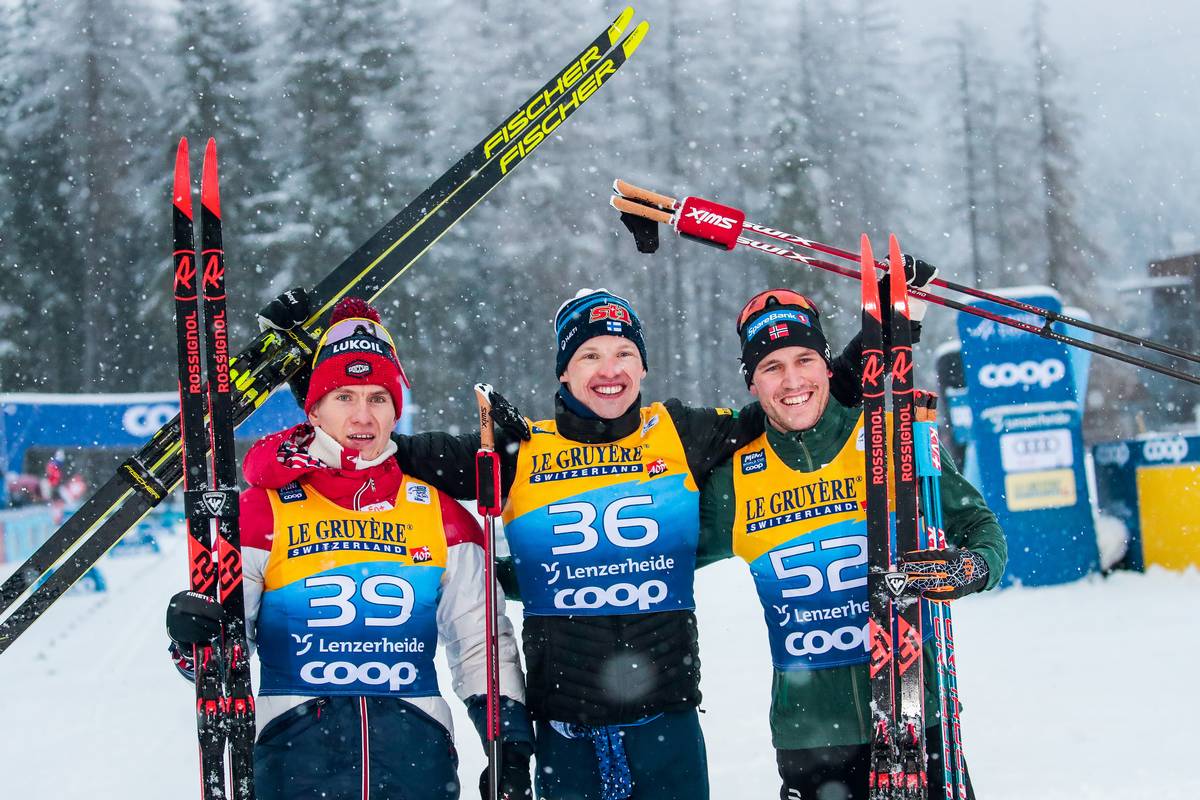
    The men’s podium in Lenzerheide, SUI: Iivo Niskanen (FIN) led with command, finishing ahead of Alexander Bolshunov (RUS) and Pål Golberg (NOR). (Photo: NordicFocus)

    This World Cup coverage is made possible through the generous support of Marty and Kathy Hall and the A Hall Mark of Excellence Award.  To learn more about A Hall Mark of Excellence Award or to learn how you can support FasterSkier’s coverage please contact info@fasterskier.com.

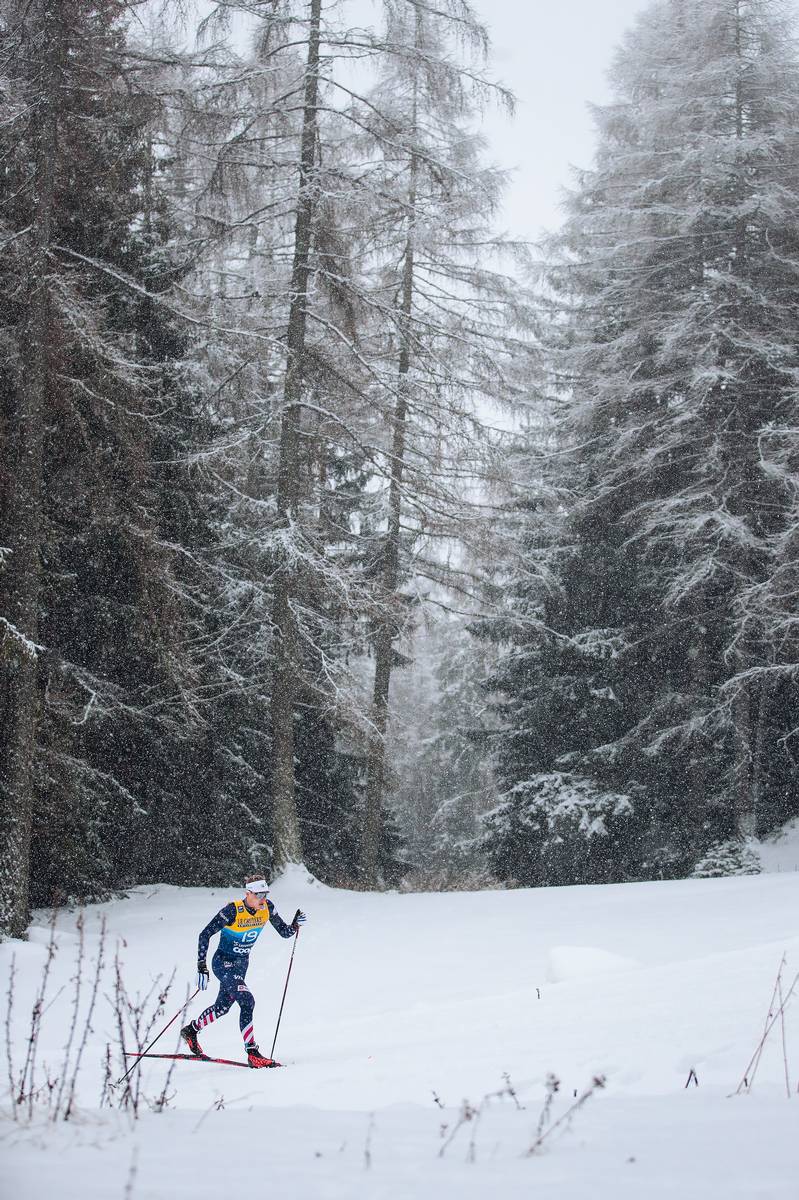
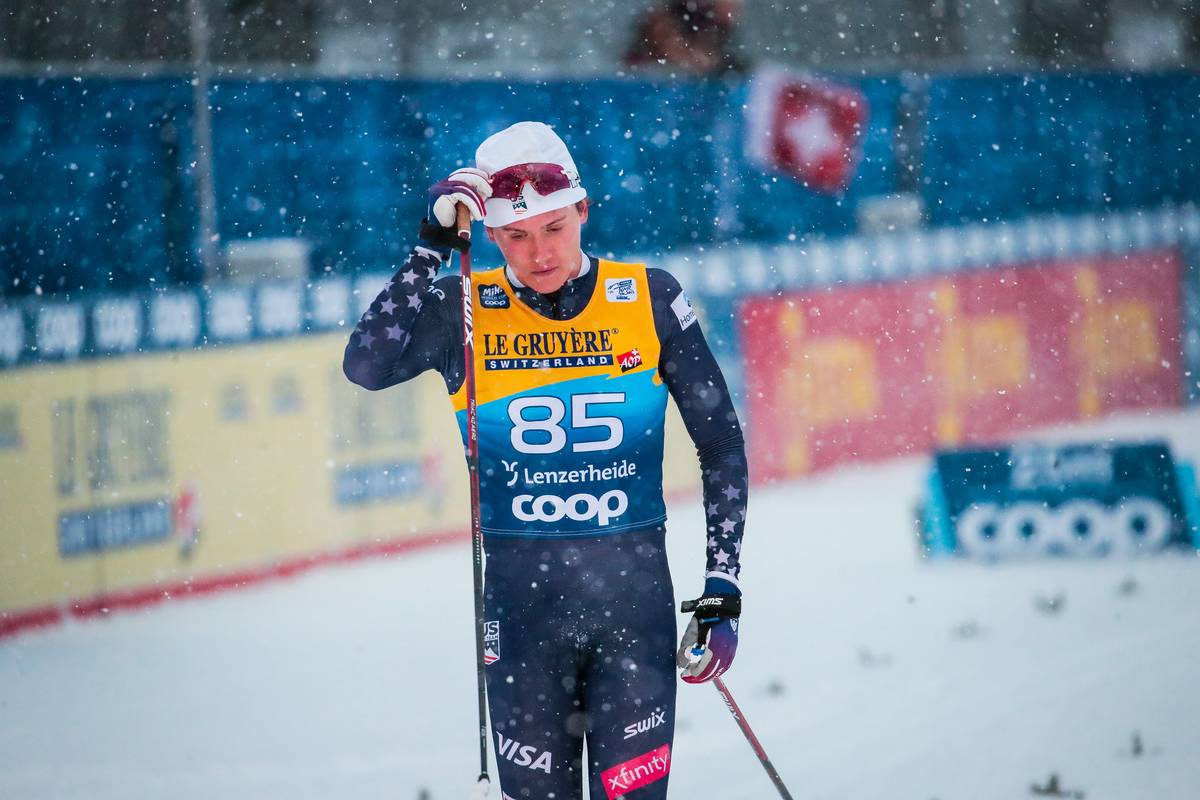
    Lenzerheide, Switzerland was tucked into a snow globe today, as snow fell steadily in fat flakes throughout the races. The wax technicians had their work cut out for them as they prepared skis for the second stage of the 2021/22 Tour de Ski, a 15-kilometer interval start classic. 

    With the seeded group of podium favorites starting in bibs 30-50, there was time for athletes to learn how the course was skiing. Among these favorites, Johannes Høsflot Klæbo (bib 42) was looking to maintain good standing in the Tour, building on his top finish in yesterday’s freestyle sprint. In the 2019-2020 Tour de Ski, his last appearance after sitting out last year’s Tour for COVID-19 concerns, Klæbo finished in 10th in the 15k classic stage. 

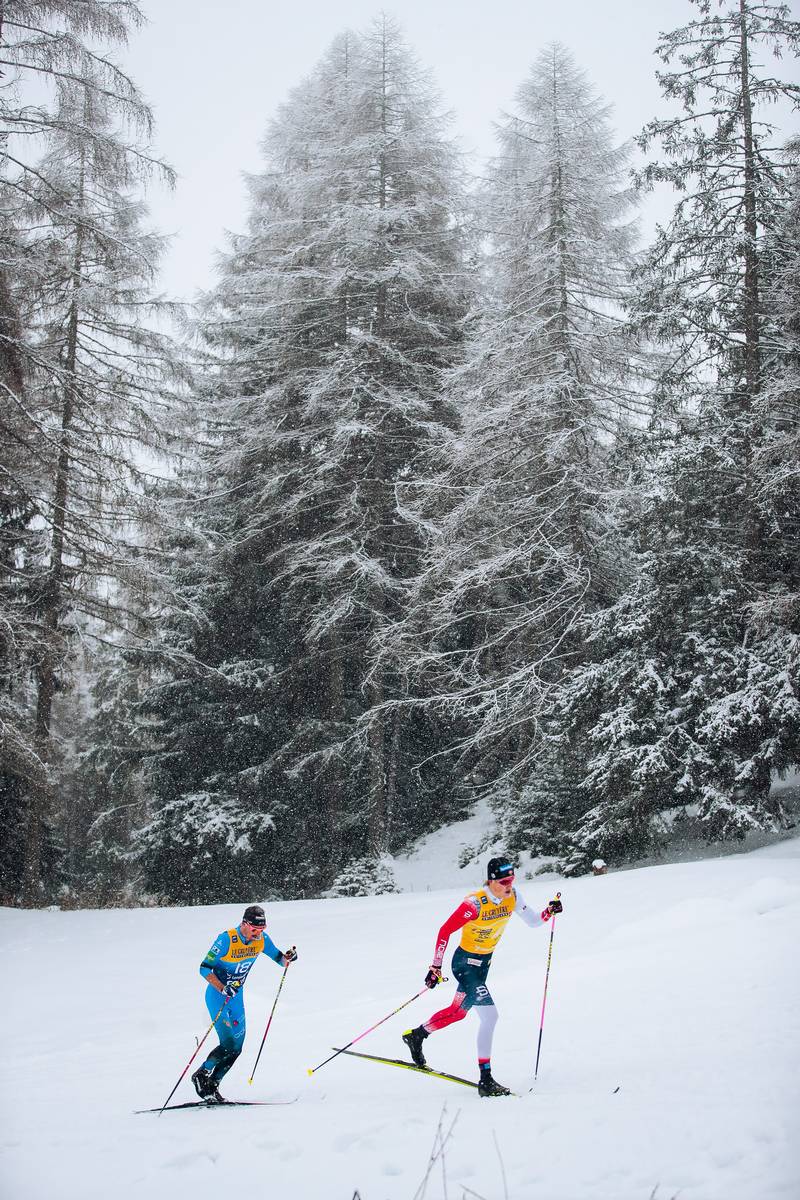
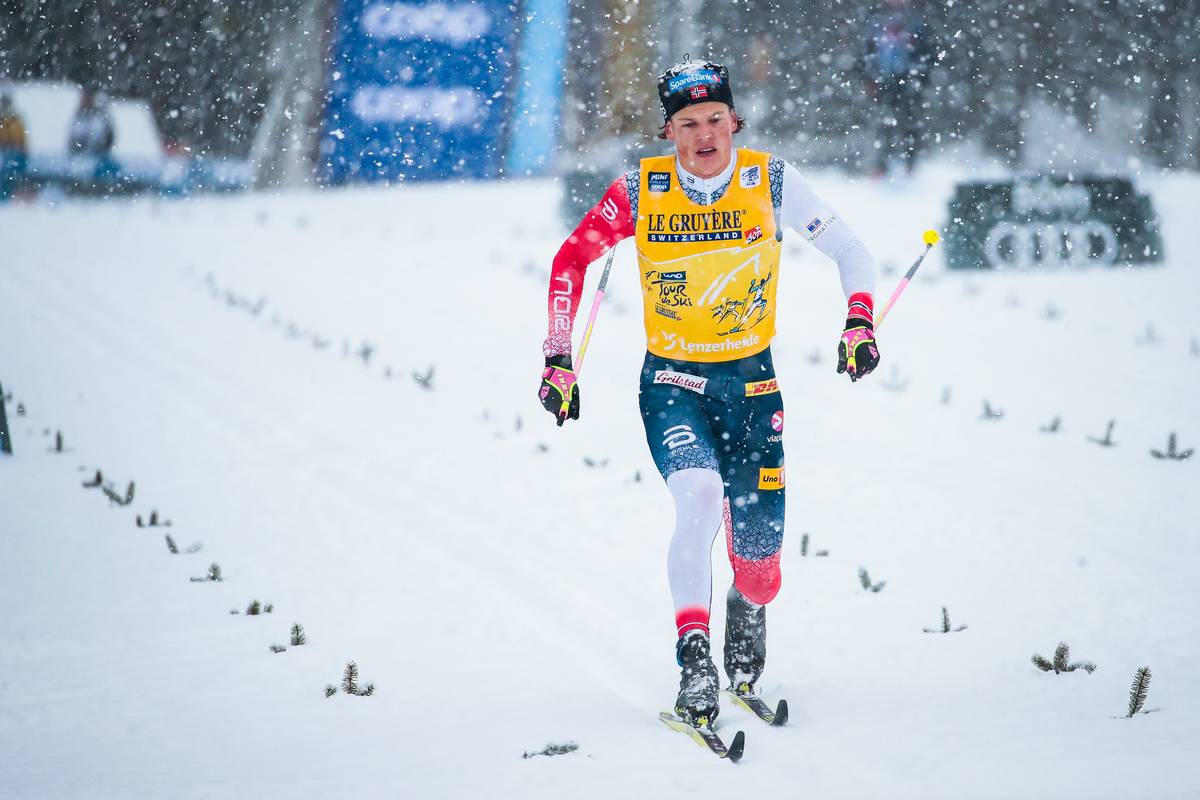
    Johannes Høsflot Klæbo (NOR) leads Hugo Lapalus (FRA) through the snow in Lenzerheide. (Photo: NordicFocus)

    Winner of the last two iterations of the Tour de Ski and back-to-back World Cup overall champion, Russian Alexander Bolshunov has had an unprecedented start to the season, with results well below what were anticipated, possibly due to health challenges he’s faced this year. Bolshunov was knocked out in the quarterfinal of yesterday’s sprint, finishing 17th, and has not been on the podium in an individual event since the opening World Cup weekend in Ruka. 

    The Americans were looking to build upon solid results yesterday, where they put three men in the Top-30 overall. Kevin Bolger was the top finisher in the sprint, placing 16th overall, after qualifying 9th. Ben Ogden finished in 21st overall, after qualifying 5th, and Logan Hanneman ended his day in 25th overall. 

    Gus Schumacher races through the snow in Lenzerheide. (Photo: NordicFocus)

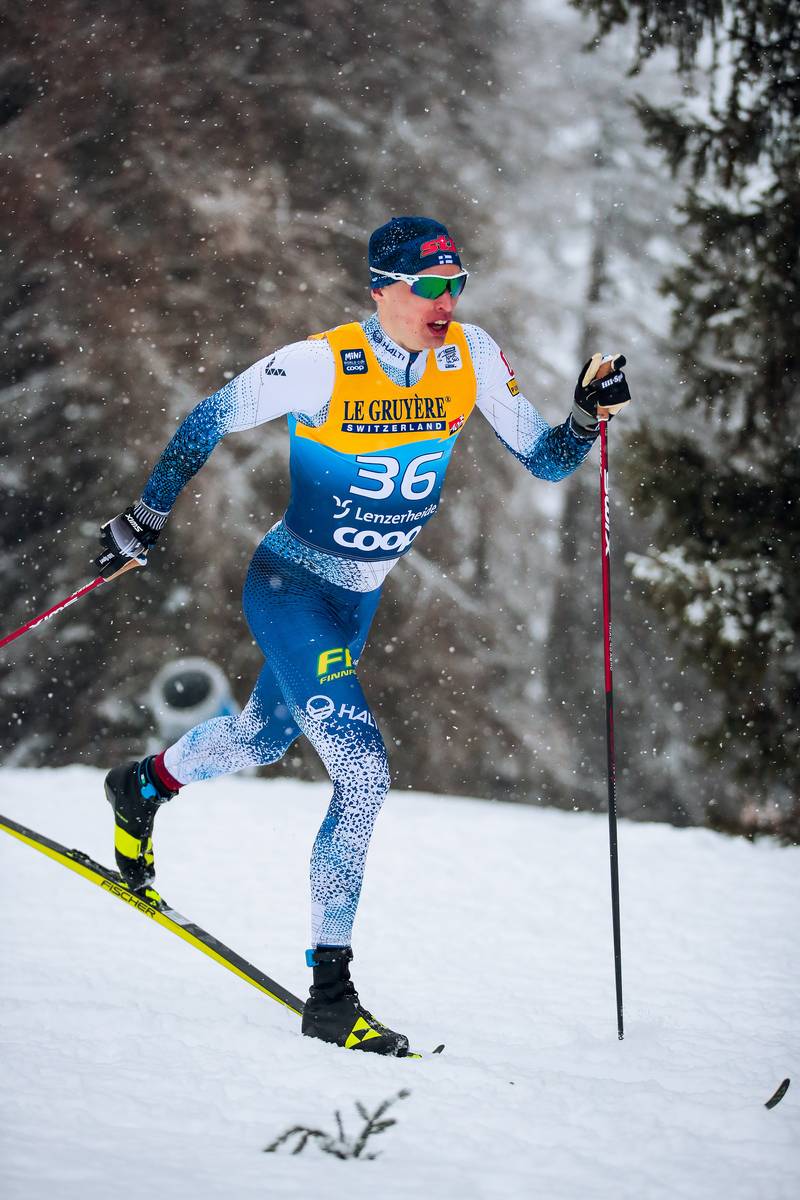
    As the seeded group time trialed through the snow, it was Iivo Niskanen in bib 36 who set the bar at the 5.8k mark, leading a group of Norwegians and Russians.  Bolshunov (+11.1) came through in 2nd (+11.1) with five Norwegians in tow, namely, Erik Valnes (+16.7), Pål Golberg(+18.6), Simen Hegstad Krüger (+20.9), Klæbo (+22.1), and Martin Løwstrøm Nyenget (+22.8).  

    Gus Schumacher was the top American in 37th (+59.2) at the 5k, with Ogden not far behind in 41st (+1:03.9). 

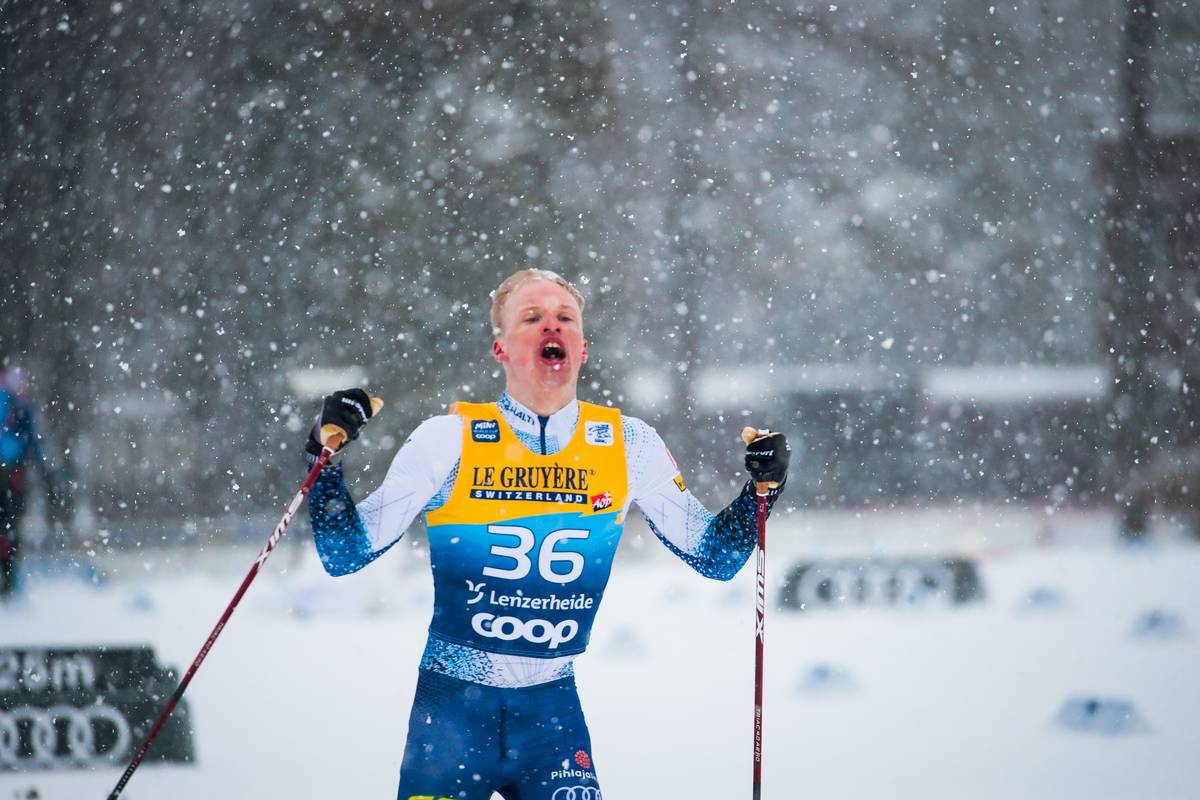
    A model for classic technique, Iivo Niskanen puts on a clinic in Lenzerheide in his signature event. (Photo: NordicFocus)

    With snow continuing to fall and tracks beginning to disappear, some athletes began to favor double pole to striding. Conditions didn’t seem to slow down Niskanen as at the 10k mark he was able to grow his lead over the pack. Bolshunov was still in second (+15.7), looking back on form and in contention for the podium. Goldberg  was in 3rd (+28.4), with Klæbo sitting just off the podium in 4th (+33.3).   

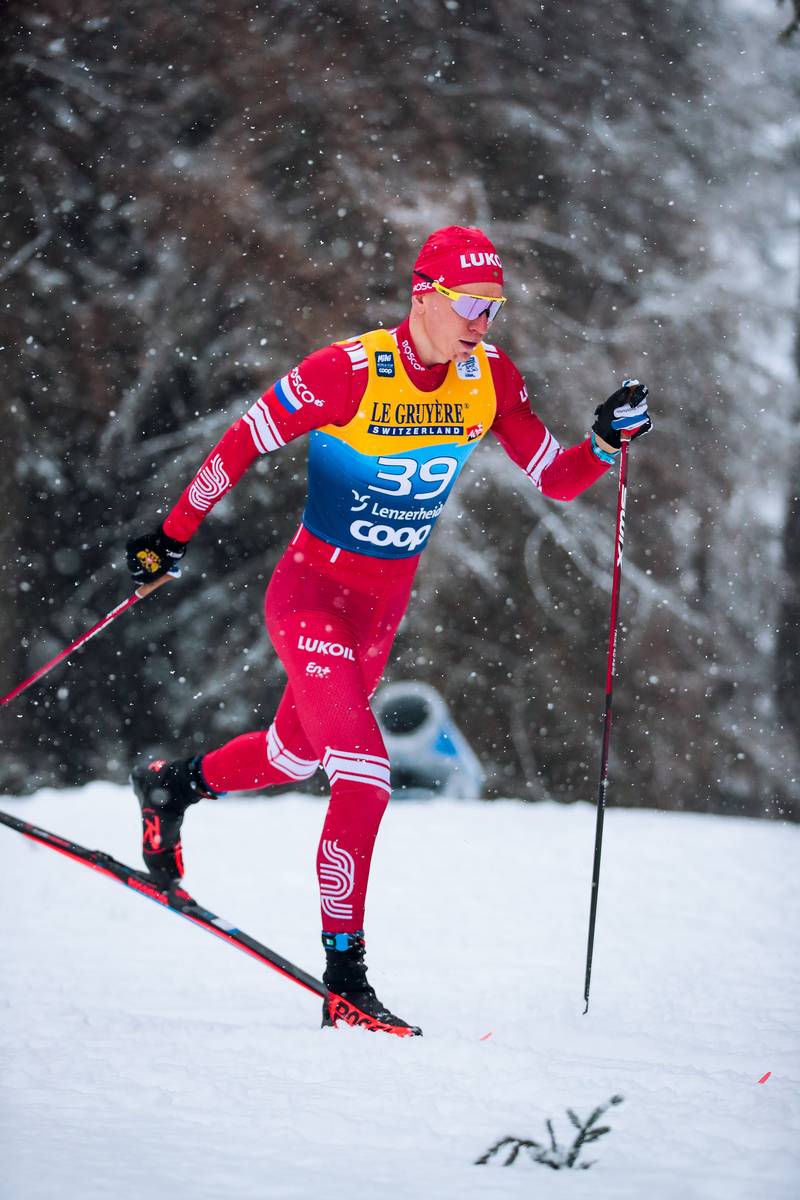
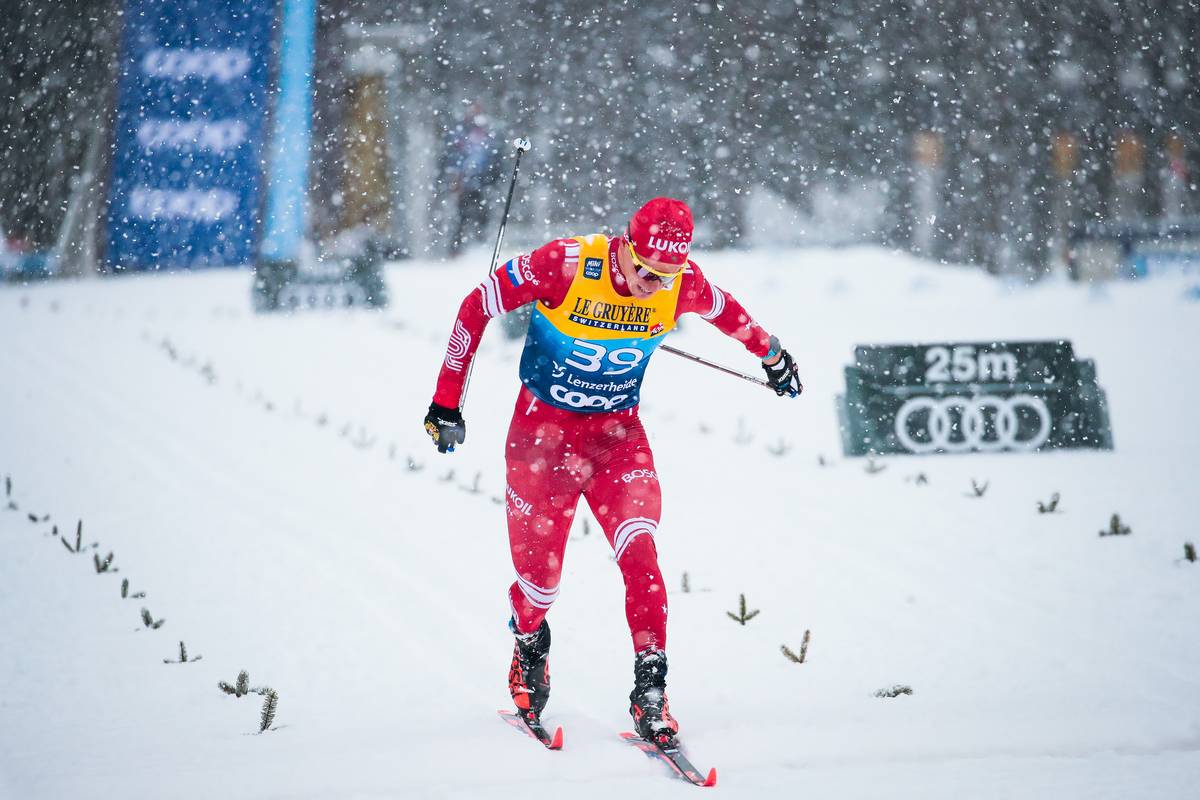
    Back on form in Lenzerheide, Alexander Bolshunov (RUS) skis to second in Stage 2 of the Tour de Ski. (Photo: NordicFocus)

    Thriving in his signature event, Niskanen continued to set the bar at each checkpoint to take the win in 32:51.7, making it a family sweep with his sister, Kerttu, winning the women’s race. This is Niskanen’s seventh World Cup victory, each of which has been in the 15k classic. He’ll be one to watch in the event at the upcoming 2022 Olympics, where he’ll be looking to add a third gold medal to his collection. Niskanen won the 50k classic in 2018 and was a member of the winning classic team sprint duo in 2014.

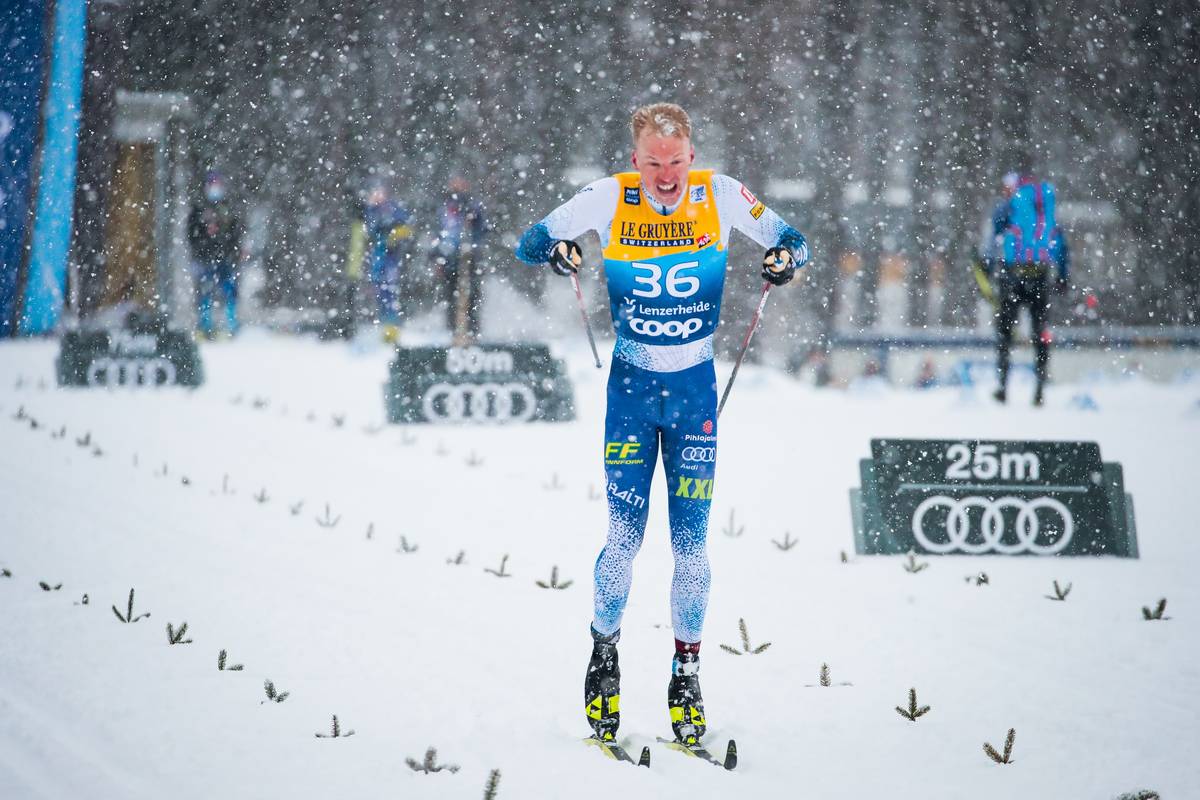
    Iivo Niskanen powers through the final meters for a commanding win in Stage 2 of the Tour de Ski. (Photo: NordicFocus)
    Iivo Niskanen celebrates victory in the 15k individual start classic in Lenzerheide. (Photo: NordicFocus)

    Perhaps a breakthrough after setbacks, Bolshunov held on for second (+19.3), finally earning another individual podium after weeks away. Goldberg was able to hold off his fellow teammate, Klæbo, to finish 3rd (+25.2) and 4th (+34.3) respectively. Yakimushkin (+34.6) couldn’t close the gap on Klæbo in the final meters, finishing just off the Norwegians mark in fifth (+34.6).  

    Alexander Bolshunov finishes solidly in second place in the 15k individual start classic in Lenzerheide. (Photo: NordicFocus)
    Johannes Høsflot Klæbo takes fourth in tough conditions during the 15k individual start classic in Lenzerheide, keeping himself in good standing in the overall Tour ranks. (Photo: NordicFocus)

    After the race, Niskanen told FIS, “I felt quite good… I tried to keep the race slow and steady [at the] start. I actually started too fast. I am happy, it was good also at the end.”

    Niskanen also explained how he felt before the race after seeing his sister winning the women’s race, “I got a little nervous before the race because I saw she won.  We had really good skis today, and it was an unbelievable day for our family.”

    The men’s podium in Lenzerheide, SUI: Iivo Niskanen (FIN) took the win, ahead of Alexander Bolshunov (RUS) and Pål Golberg (NOR). (Photo: NordicFocus)

    Racing through tough conditions, each of the Americans finished outside the Top-30. Schumacher was the top finisher, placing 38th (+2:13.4), roughly 9 seconds off 30th place. Ogden was not far behind placing 44th (+2:22.4). Bolger placed 65th (+3:25.3), with Hanneman finishing 70th (+3:44.8). Luke Jager finished just in front of Zak Ketterson, placing 84th (+4:36.4) and 85th (+4:43.2), respectively.  

    Post-race interview with Matt Whitcomb, from U.S. Ski & Snowboard cross country communications manager Tom Horrocks, discussing the men’s and women’s day in Lenzerheide.

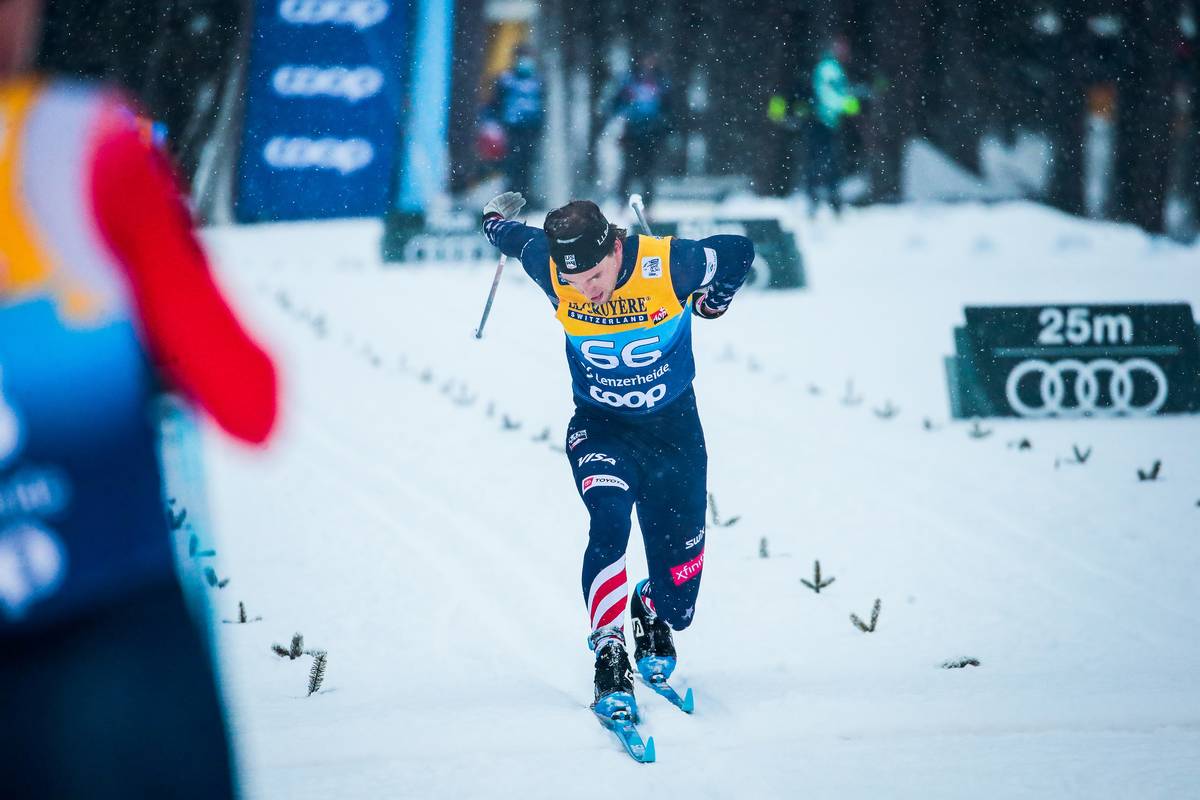
    Kevin Bolger slides over the line for 65th in Lenzerheide. (Photo: NordicFocus)

    There are two sets of standings in the Tour, points and cumulative time. Bonus points were up for grabs at the 2.4k mark, providing an opportunity for sprinters to stay in the mix through the distance-heavy Tour. While sprinters did not look to fight for these points today, Niskanen surged ahead of the field to earn the maximum 15 point-bonus. Bolshunov was second at this checkpoint, claiming 12 points, with Valnes in 3rd for 10 points. Klæbo was 5th at 2.4k, earning 5 bonus points.  

    As results from the day became finalized, Klæbo was able to hold on to the overall lead in the Tour, having a 14 second lead over his teammate, Goldberg. With today’s win, Niskanen moved up the rankings, now sitting in third place.

    Luke Jager finishes Stage 2 of the Tour de Ski, racing through tough and snowy conditions in Lenzerheide. (Photo: NordicFocus)

    After a day off for rest and travel, racing will continue on Friday with a 15k freestyle in Oberstdorf, Germany. 

    Final Results  |  Overall Standings 


  • Dahlqvist Unstoppable in Dresden; Hannah Halvorsen Earns a Career Best 7th, With Diggins 8th

    Dahlqvist Unstoppable in Dresden; Hannah Halvorsen Earns a Career Best 7th, With Diggins 8th

    This World Cup coverage is made possible through the generous support of Marty and Kathy Hall and the A Hall Mark of Excellence Award. To learn more about A Hall Mark of Excellence Award or to learn how you can support FasterSkier’s coverage please contact info@fasterskier.com.

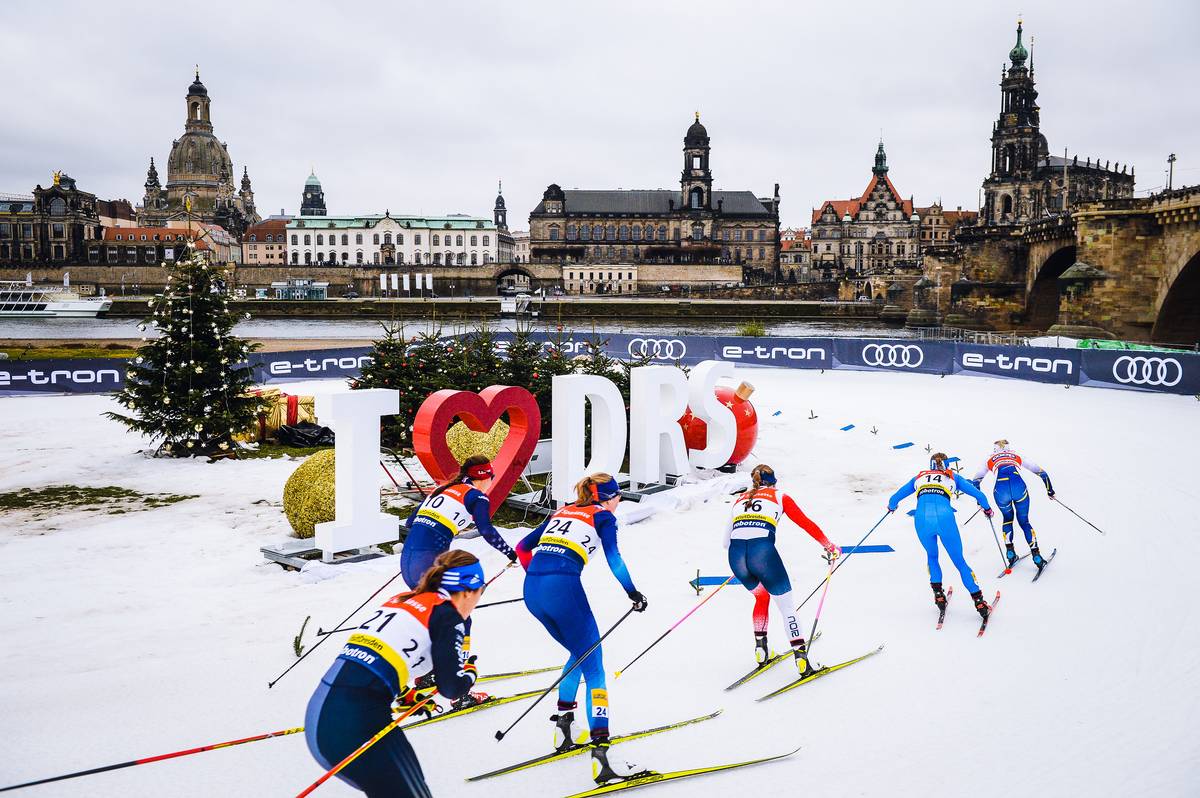
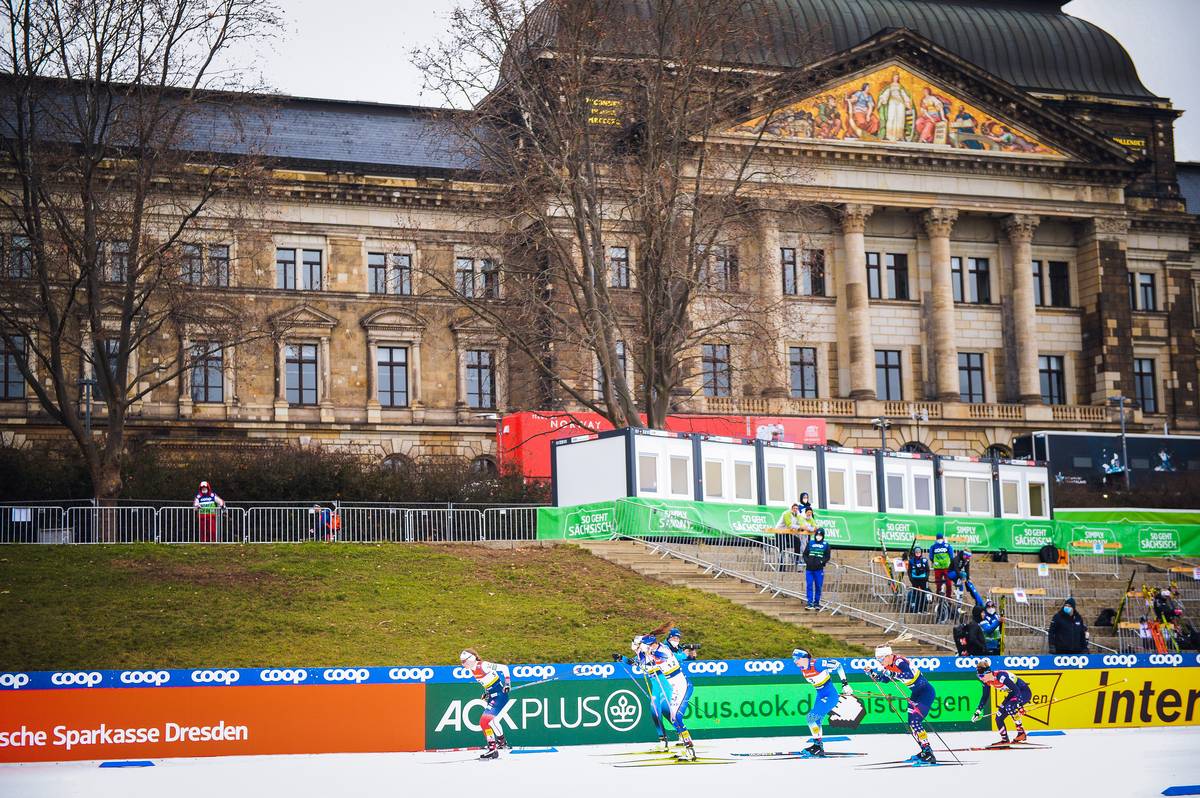
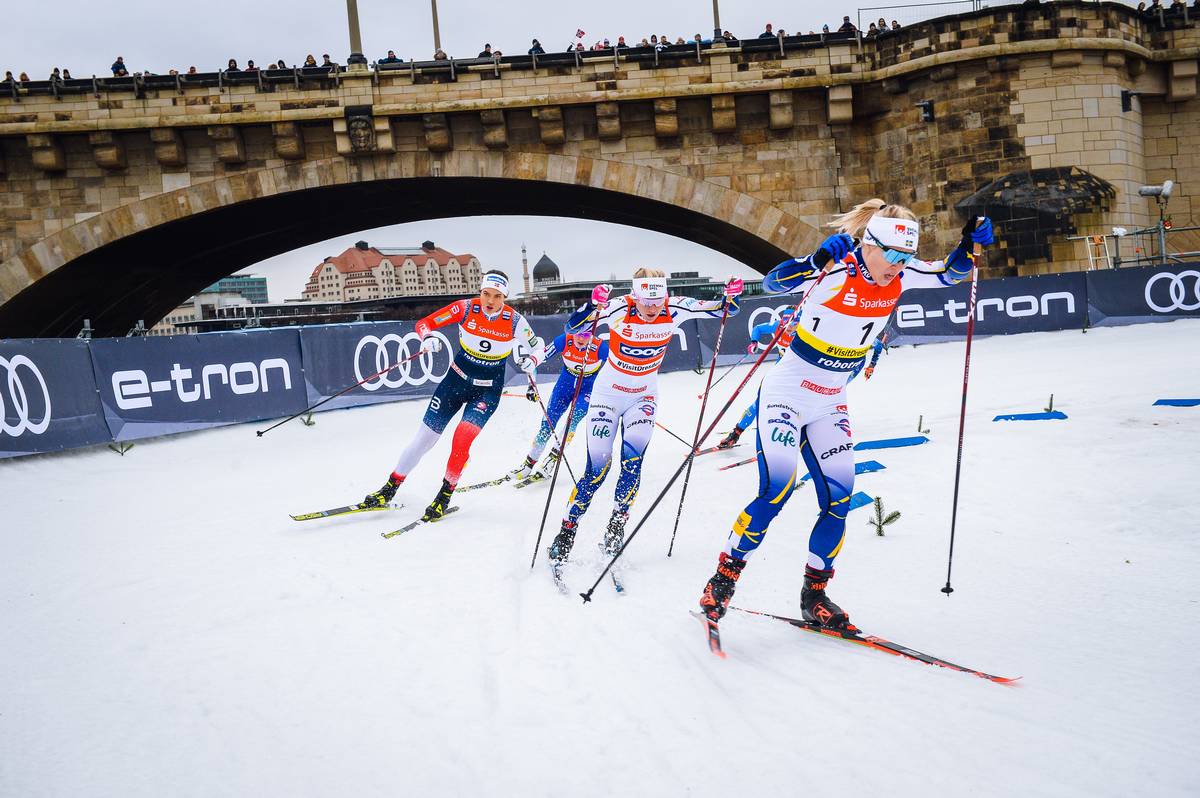
    For the fourth year in a row, the city of Dresden, Germany was ready to host an exciting city Freestyle sprint on a 1.3-kilometer course.  A race that usually attracts fans from all over the world, for the second year in a row could not allow spectators on the course due to Covid.  The last race before the holiday break, the skiers were ready to have fun, and enjoy the challenging and icy course.

    Julia Kern (bib 10) takes the inside around a curve in Dresden. (Photo: NordicFocus)

    “It is so amazing, it is one of my favorite races of the year. I love it, it’s fast and furious.  it is going to be an exciting day of racing,” Julia Kern told FIS before the heats started. Kern’s family has roots in Germany, and she is often celebrated in Dresden as if she were a native.

    On the women’s side, World Cup Sprint Leader, Maja Dahlqvist (SWE) was ready to continue her great start to the season. On a win-streak, has been on the top step of the podium in each of the last four individual sprint races, including the first three of this season. A fifth win would make Dahlqvist the second woman to win five consecutive individual sprint events in the World Cup, after Norwegian legend Marit Bjørgen, who won 11 in a row from December 2003 to January 2005.

    Sweden’s Jonna Sundling set the mark in the qualifier, finishing the top spot in a time of 2:29.52. The American women placed four in the top-30 in qualification, with Hailey Swirbul leading the way in 7th(+2.39), followed by Kern in 10th (+3.49), Jessie Diggins in 17th (+4.87), and Hannah Halvorsen in 25th (+6.82).  

    The top American qualifier in Dresden, Hailey Swirbul races the quarterfinal. (Photo: NordicFocus)

    In the first heat of the women’s sprint, Swirbul stayed in contact with the lead pack until the final 100 meters. In the final straightaway, Swirbul pushed to the line to cross fourth in her heat.  Anamarija Lampic (SLO) and Kristine Stavås Skistad (NOR), who qualified in 6th and 9th, respectively, were the top two finishers in the heat.

    In the second heat, Kern (USA) raced alongside Dahlqvist, who comfortably cruised through the heat to take the win ahead of Italy’s Greta Laurent. Kern solidly maintained her position within contact with the leaders throughout the two-lap course, but finished fifth in the heat, unable to advance. 

    Hannah Halvorsen advanced from the quarters to the semis in Dresden. (Photo: NordicFocus)

    In the third heat, Hannah Halvorsen (USA) faced the top qualifier, Sundling, who won the classic sprint at last year’s World Championships in Oberstdorf, GER. Navigating through chaos, Halvorsen was able to stay on her feet after a crash between Nathalie von Siebenthal (SUI) and Magni Smeedas (NOR) leaving a group of three to fight for the top two spots.  Sundling was able to cross the finish line comfortably in first, with a photo finish between Halvorsen and Jasmin Kahara (FIN) behind her.  Halvorsen was able to outstretch Kahara in the bootslide, taking the second spot in her heat, and punching her ticket to the semi-final.

    Diggins (USA) raced in the final quarter-final heat, staying with the main pack throughout the laps, pushing up from 5th to 3rd as they headed into the final stretch. Diggins finished third in the heat but was able to advance to the semi-finals as a lucky loser. Lena Quintin (FRA) and Moa Lundgren (SWE) were the two automatic qualifiers from this round.

    Fast racing on icy tracks in Dresden makes staying upright and balanced an accomplishment of its own. (Photo: NordicFocus)

    In the first semi-final, Sundling and Dahlqvist set a steady-pace with the pack staying together throughout  both laps. Pulling to the front in the final 500 meters, Dahlqvist and Sundling cruised to the finish, crossing first and second, respectively. On their tails, Lampic and Skistad slid over the line in a photo finish, just 0.35 seconds behind Dahlqvist. Both these women advanced to the final as lucky losers.

    The two Americans, Diggins, and Halvorsen both raced in the second semi-final heat, which featured the inevitable twists and turns of sprinting. At the lap, 23-year-old Lea Quintin of France, who had qualified in second, snapped her left pole, leaving her searching for a new one while the pack skied away.

    Turning it up in the final stretch, Jessie Diggins and Hannah Halvorsen race the semifinal in Dresden. (Photo: NordicFocus)

    Meanwhile, Diggins and Halvorsen patiently waited near the back of the pack until the final straightaway where both made strong moves to contend for a spot in the final. Halvorsen powered from fifth place into a position to fight for second, but ended up just 0.27 seconds behind Eva Urevec of Slovenia who took the second automatic qualifier position. Diggins crossed a ski length behind Halvorsen, each less than a second behind Mathilde Myhrvold (NOR) who won the heat. 

    The final consisted of two Norwegians, two Swedes, and two Slovenian skiers fighting to claim the Dresden sprint title. 

    Dahlqvist follows Sundling on course in Dresden. (Photo: NordicFocus)

    Racing was tight and tactical, with all six women skiing together through the first loop.  Dahlvquist and Sundling led the whole way, controlling the pace at the front.  In the final 100m, Dahlvquist started to make her move, creating a small gap between herself and the field, to win in a time of 2:33:36. Sundling crossed just behind (+0.43) with Lampic closing fast for third (+0.64) to round out the top 3. Skistad ended her day in fourth (+1.64), with Myrhvold in fifth (+3.03) and Urevc in sixth (+6.15).

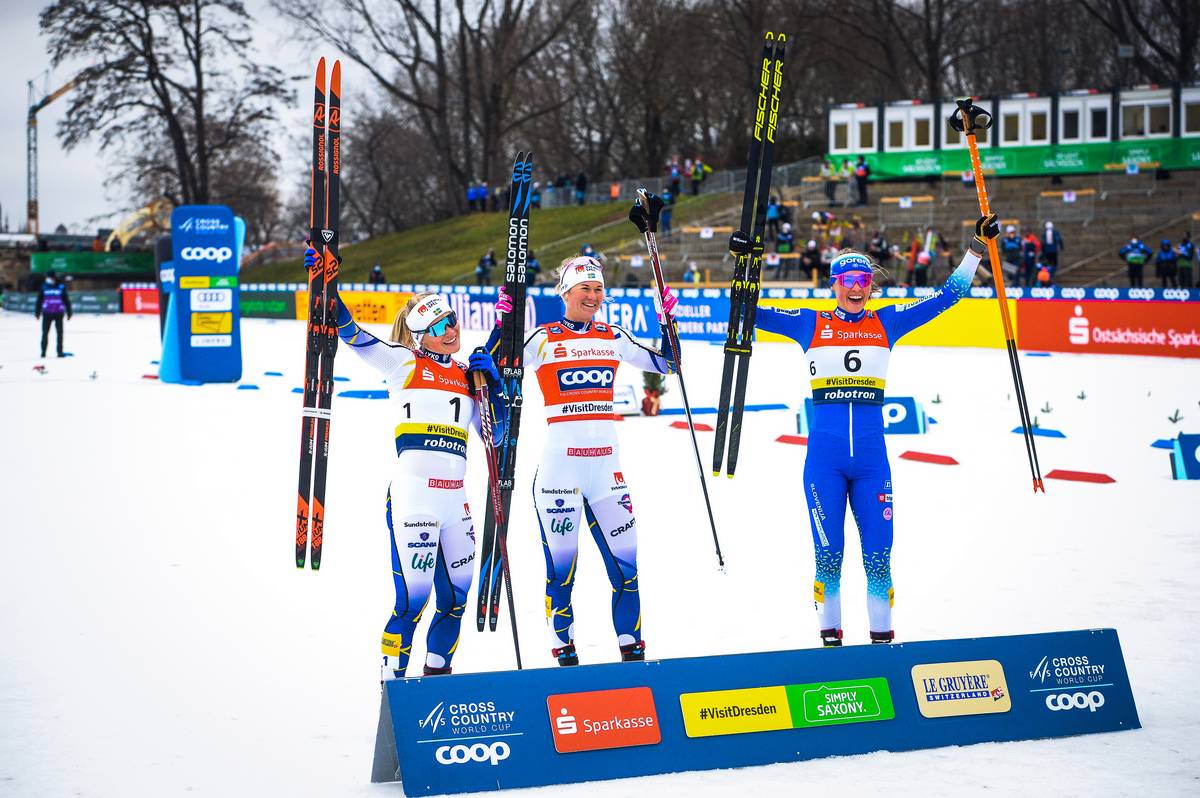
    The women’s individual sprint podium in Dresden. Maja Dahlqvist (SWE) wins her fourth straight this season (of four), ahead of teammate Jonna Sundling and Anamarija Lamic (SLO). (Photo: NordicFocus)

    The Americans put together an outstanding day overall with all four women finishing inside the World Cup points. After final rounds were decided, Halvorsen ended her day in seventh, a career-best result. Coming off a horrific accident in November, 2019, Halvorsen showed she is back on form in Dresden. 

    Introspective and progress-oriented, Halvorsen spoke to her day in Dresden, and how it helped her take a step forward with confidence in her ability to race into the semis and beyond.

    After strong work in the semifinal, Hannah Halvorsen and Jessie Diggins end their days in 7th and 8th, respectively. (Photo: NordicFocus)

    Diggins finished right behind Halvorsen in 8th place in the final rankings, while Swirbul ended her day in 16th and Kern ranked 22nd.  

    Two Canadian women raced the qualifier but did not advance into the rounds. Maya Macisaac-Jones led the Canadians in 52nd (+11.31), while Dahria Beatty finished 58th (+14.16).

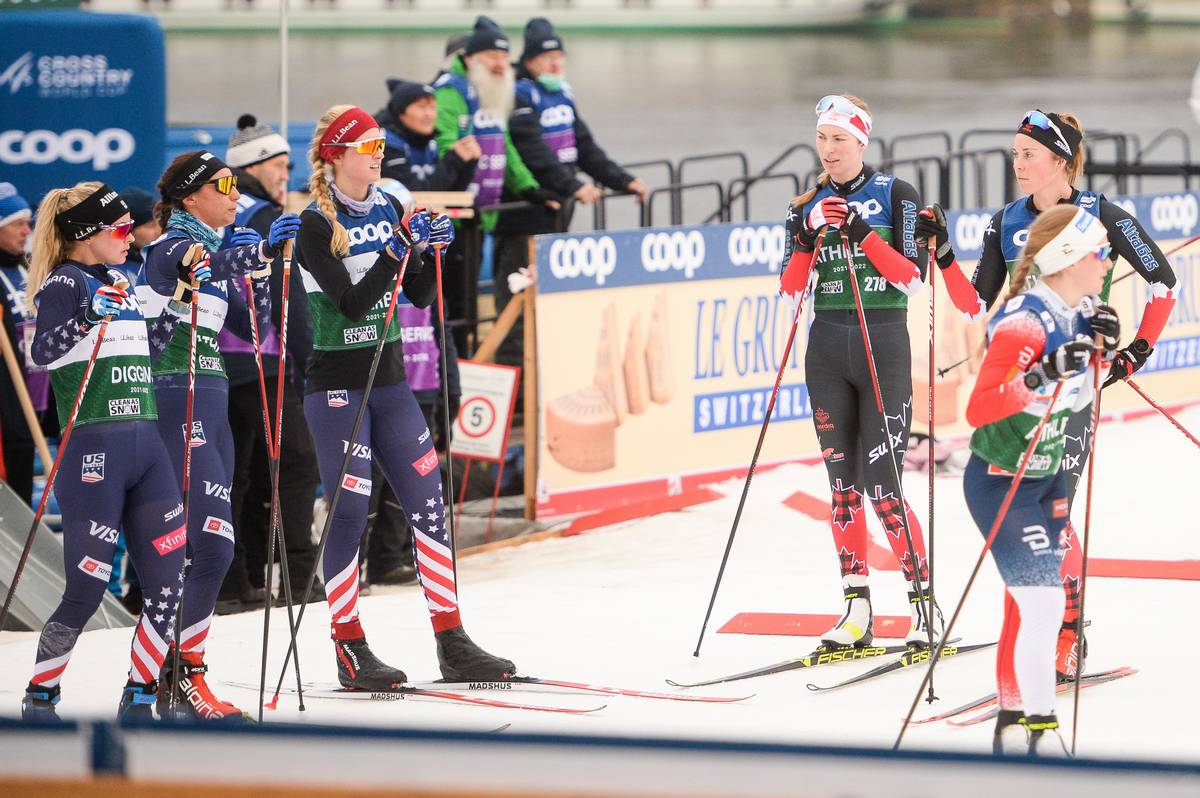
    The Americans and Canadians debrief the qualifier in Dresden. (Photo: NordicFocus)

    With the win, Dahlvqist has taken over the overall World Cup lead from teammate – and roommate – Frida Karlsson (SWE). Diggins currently sits in 5th, behind teammate Rosie Brennan who ranks 4th. Now with a week off for Christmas, the teams will get some rest as they gear up for the Tour de Ski which starts on December 28th.   

    ​​When asked about  taking over the World Cup Lead from her teammate and best friend, Dahlvqist said in a FIS interview, “The most important thing is that it is still in our room”

    Looking good in Period I, Maja Dahlqvist wins five in a row. (Photo: NordicFocus)

    Results: 

    Qualification | Final

  • Krüger Dominates the 15k Skate in Davos; Schumacher 29th

    Krüger Dominates the 15k Skate in Davos; Schumacher 29th


    The men’s 15k freestyle podium in Davos: Simen Hegstad Krüger (NOR) took the win with command ahead of Johannes Høsflot Klæbo (NOR) and Sergey Ustiugov (RUS). (Photo: NordicFocus)

    This World Cup coverage is made possible through the generous support of Marty and Kathy Hall and the A Hall Mark of Excellence Award. To learn more about A Hall Mark of Excellence Award or to learn how you can support FasterSkier’s coverage please contact info@fasterskier.com.


    The second day in Davos, Switzerland started with the Men’s 15K Freestyle individual race.  In contrast to yesterday’s snow and wind, it was a beautiful blue sky day, as 108 men chased splits around the tracks in Davos. 

    Two of the favorites, Johannes Høsflot Klæbo (NOR) and Alexander Bolshunov (RUS) started one minute apart from each other. The two ascended from the junior level together to quickly become World Cup champions, Klæbo in sprinting and Bolshunov in distance, though the Russian has proven all-around talent. 

    In total, Klæbo has won 44 World Cup events, including yesterday’s sprint, putting him 3rd on the all-time list behind Petter Northug (47) and Bjørn Dæhlie (46). Bolshunov has won 24 World Cups, with nine individual World Cup distance events in 2021 – already a men’s record for most individual World Cup distance event wins in a single calendar year. As Klæbo has looked to improve as an all-around skier, this matchup is one to watch.

    After a conservative start, Johannes Høsflot Klæbo skis to second place in Davos. (Photo: NordicFocus)

    Last week’s 15k winner at Lillehammer, Simen Hegstad Krüger looked to win back-to-back individual World Cup distance events. The last man other than Bolshunov to win back-to-back was Sergey Ustiugov (RUS) in the Tour de Ski in 2019.

    Six Americans started the race, including Ben Ogden who is coming off a career-high 12th place finish in the sprint yesterday. The Canadian team did not race today, though Antoine Cyr had been on the start list. 

    Norway’s Sjur Røthe on course during the 15k individual start freestyle in Davos. (Photo: NordicFocus)

    As splits from the seeded middle group of starters rolled in, it looked like Klæbo (+20.4) was struggling through the first 3k with Bolshunov (+6.6) closing the gap between them both.  Perhaps not surprisingly after last weekend’s podium sweep and top-15 dominance, Norway had the top-4 spots through the first 3k, held by Krüger, Hans Christer Holund, Martin Løwstrøm Nyenget, and Harald Østberg Amundsen, respectively. Sjur Røthe was also sixth as the team’s fifth man in the top-10, however, Klæbo had fallen just outside the top-30 in the rankings. 

    Bolshunov held the lead for the Russian men at this checkpoint, sitting in 8th, but the name that would rapidly ascend the rankings was Ustiugov, who was 19th (+15.6). Ustiugov started in bib-50, later in the lineup than most of the Norwegians except for ​​Krüger, who wore bib-70.

    At 12.2k, with roughly 3k to go, the rankings looked similar, with a couple of names making a dramatic swing in standings. ​​Krüger, blasting through each checkpoint as the new leader, had increased his margin to over 24 seconds ahead of his teammate Holund, and Ustiugov had skied all the way up to third. 

    Simen Hegstad Krüger smashes the 15k skate in Davos. (Photo: NordicFocus)

    Close behind by time, Amundsen sat in fourth with Klæbo making a rapid rise into fifth. 

    Continuing to grow his lead over the final lap, ​​Krüger ran away with the win, stopping the clock at 32:20.4.  

    Sergey Ustiugov powers down the final stretch for third in Davos. (Photo: NordicFocus)

    Klæbo hit the final kilometers hard, accelerating to set what would stand as the fastest time of day until ​​Krüger came through 26 bibs later. Ustiugov had beaten Klæbo’s split at 13k, but could not hold the pace required to stay ahead in the final 2k. After all the top men came through, in particular ​​​​the dominant Krüger, it was decided that Klæbo took second (+22.9) and Ustiugov third (+27.2), both men earning their second podium of the weekend in Davos.  

    After back-to-back distance wins, Krüger gave the following remarks in a FIS interview from the leaders chair:

    “It feels great and I like it here and I enjoyed every minute of skiing today.  My skis were incredible and I just enjoyed every single minute of it.  It was a really fun day today.” 

    Johannes Høsflot Klæbo hands over the leader’s chair to his teammate, Simen Hegstad Krüger, who had smashed the fastest splits at every checkpoint. (Photo: NordicFocus)
    Winning back-to-back 15k freestyle races, Simen Hegstad Krüger is on form. (Photo: NordicFocus)

    The remaining top-10 was composed of three Norwegians, two Russians, and two French skiers.  Amundsen (NOR), Holund( NOR), and Røthe (NOR) finished 4th (+32.), 5th (+33.7) and 6th (+38.3), respectively.  Artem Maltsev (RUS) finished in 7th (+39.4) with fellow teammate, Ivan Yakimushkin (RUS) finishing in 9th (+52.0).  Maurice Manificat (FRA) had a strong race to finish in the top 10 in distance for the second week in a row, this time in 8th (+50.8).  His teammate, Hugo Lapalus (FRA) finished 10th (+54.7).

    Bolshunov dropped back to 12th in the standings, following 14th place in this event last weekend in Lillehammer. The three-time overall World Cup distance champion has not been outside the top-10 in consecutive events since December 2018.

    Gus Schumacher leads the American men with a 29th place finish in the distance race in Davos. (Photo: NordicFocus)

    The top U.S. Skier in Davos was Gus Schumacher sat inside the Top-30 throughout most of the race, rising as high as 18th at the 5k. Having started just behind Swedish junior champion William Poromaa, Schumacher held his margin to the Swede even through the first half, then began to cede time to the leaders. Schumacher ended his day in 29th (+1:53.8), improving upon his result from the Lillehammer 15k, where he finished 38th.

    “[I’m] pretty happy with it, but i still think I have better races coming,” Schumacher reflected in a post-race email. “I think I did a better job with pacing than last year, but still didn’t quite nail it. Definitely getting a better handle on the race routine and pacing, and I’m looking forward to some more races later this season!”

    Schumacher added that he plans to stay in Davos through Christmas with “the boys”, which he said will be “magical.”

    Ogden, coming off a fantastic sprint yesterday, was the next American in 51st (+2:39.7).  Norris (USA) had a solid race coming in just behind Ogden in 54th ( +2:44.7).  Schoonmaker, Wonders, and Patterson finished in 66th (+3:03.5), 70th (+3:07.5), and 75th (+3:26.0) respectively.

    David Norris on course during the 15k individual start freestyle in Davos. (Photo: NordicFocus)

    After a weekend at altitude, the World Cup now heads to Dresden, Germany for an exciting individual and team sprint in the city. This will be the last races before  a break for the holidays, and then we begin the Tour de Ski.

    Final Results

  • Norway Takes the Relay Win at Home in a Close Match; United States I Team Races to 9th, Canada 10th

    Norway Takes the Relay Win at Home in a Close Match; United States I Team Races to 9th, Canada 10th

    It was Norway I, Russia II, and Norway II for the podium during the men’s 4 x 7.5k relay in Lillehammer. (Photo: NordicFocus)

    This World Cup coverage is made possible through the generous support of Marty and Kathy Hall and the A Hall Mark of Excellence Award. To learn more about A Hall Mark of Excellence Award or to learn how you can support FasterSkier’s coverage please contact info@fasterskier.com.

    Most-often the champions of the event, the Norwegian men’s program has been waiting for another crack at the 4 x 7.5-kilometer relay on home turf for the last two years. In 2019, Russia not only won the 4 x 7.5-kilometer relay in Lillehammer but the Russia II team took second as well. The World Cup in Lillehammer that was scheduled for 2020 was first postponed, then cancelled, to manage the nation’s COVID-19 cases. With the opportunity to take back their title at home in 2021, Norway was ready to throw down on the modified tracks in Lillehammer today. 

    Luke Jager leads the American men’s team during the 4 x 7.5k relay in Lillehammer. (Photo: NordicFocus)

    Hoping to be in the mix was the young American team made up of Luke Jager, Ben Ogden, Gus Schumacher, and Zanden McMullen. Each currently 21-years-old, Jager, Ogden, and Schumacher were part of the World Junior Championship back-to-back gold medal teams.  

    From the Canadian World Junior team who earned a silver medal during that relay in Oberwiesenthal, Germany, Olivier Leveille has moved onto the World Cup and raced today as a member of the Nordiq Canada relay team. Leveille would race as the third leg, following teammates Russell Kennedy and Antoine Cyr, who skied the classic legs. Graham Ritchie would ski the anchor leg for Canada. 

    A second U.S. team was also entered. This team included Hunter Wonders, David Norris, Kevin Bolger, and JC Schoonmaker, racing in that order.  

    Hunter Wonders skis the first leg for the United States II team. (Photo: NordicFocus)

    From the first leg, it was no surprise to see both teams from Russian and Norway leading the pack, separated by only 1.2 seconds. Team France (+9.7) was sitting in fourth place while  Jager (19:40.9) was able to keep the U.S. within striking distance in sixth at the first exchange (+10.2). 

    The United States II team sat in ninth (+25.8), with the Canadians close behind in 13th (+28.1).

    Iivo Niskanen (FIN) and Alexander Bolshunov (RUS) lead the train during the second leg of the men’s 4.75k relay. (Photo: NordicFocus)

    During the second classic leg, the lead group compressed. Iivo Niskanen (FIN) closed a 17-second gap for Finland to take the lead at the second exchange. Niskanen won the 15k classic distance opener last weekend in Ruka. 

    Russia I (+0.4), Norway I (+11.9), Russia II (+12.4), and Norway II (+14.2) rounded out the top 5 as teams made the second tag to begin the final two skate legs of the race.

    U.S. I was sitting in 12th place (+27.9)  after a strong leg from Ogden, with Cyr passing off for Canada just ahead in 8th place (+22.5) .  

    Ben Ogden skis on the tails of leader Alexander Bolshunov during the second classic leg of the men’s relay in Lillehammer. (Photo: NordicFocus)
    Olivier Leveille (Bib 9) races the third leg of the men’s relay in Lillehammer. (Photo: NordicFocus(

    As teams entered the stadium after their first 7.5k skate leg, the Norwegians and Russians were back on top, separated by only 1.3 seconds.  Skiing the 6th fastest time for his leg, Schumacher was able to move up 5 spots to leave the U.S. I team in 7th (+29.0)  (18:11.9). This effort brought the Americans back into the mix at the front of the lead chase group. Canada dropped down to 11th place (+33.5) after the third leg.  

    As teams made the final exchange, Johannes Høsflot Klæbo (NOR I), Sergey Ustiugov (RUS II), Harald Østberg Amundsen (NOR II) and Ivan Yakimushkin (RUS I) took off in a group.

    The final exchange. Simen Hegstad Krüger tags Johannes Høsflot Klæbo for the final leg of the men’s 4 x 7.5k relay in Lillehammer. (Photo: NordicFocus)
    Still tight at the front: two Russian teams and two Norwegian teams push the final leg of the men’s relay in Lillehammer. (Photo: NordicFocus)

    The two Norwegian and Russian teams stayed together as a pack over their last two laps, conserving their energy for a final sprint. This lead pack of four continuously grew their gap from the chase pack, building suspense for moves that might determine the podium. 

    With 1.5k to go, the lead pack began to accelerate. Moves were made by each team, but all moves were quickly answered. It remained anyone’s game. 

    Once the lead pack hit the stadium, Klæbo looked to take control, initiating his top gears in hopes of creating separation from the pack. Bringing it down to the wire, Ustiugov followed this attack as the group turned the corner for the last 100m. 

    Down the home stretch, Johannes Høsflot Klæbo turns on the sprint gears to bring the Norway I team home. (Photo: NordicFocus)

    In the head to head sprint into the finish, Klæbo showed an edge over Ustiugov, gaining ground and throwing his ski at the line for the win. Sealing the deal on a Norwegian victory, Klæbo stopped the clock at 1:14:58.7 to reclaim the relay at home. 

    Still in the hunt, Ustiugov brought Russia II home in second (+0.2), with Norway II just behind in third (+1.2). Also edged out at the line, the Russia I team finished fourth (+1.4).  

    Johannes Høsflot Klæbo brings home a win for Norway in the men’s relay in Lillehammer. (Photo: NordicFocus)
    Keeping the final leg tight, Sergey Ustiugov anchored Russia II team who took second in the men’s relay in Lillehammer. (Photo: NordicFocus)

    Looking excited and proud, Klæbo shared his thoughts on the day with FIS after the finish.

    “It was a really tough one,” Klæbo said. “It was a nice fight and it was for sure really fun to cross the finish line first and to win as a team.”

    Emil Iversen, who had raced the second leg, praised Klæbo for his sprinting ability, adding the value his prowess added to the relay team. 

    “We know we have the best man in the finish. It was a pretty exciting sprint today. It’s nice to have him in the last leg of the relay – he is the best sprinter in the world.” 

    Winners of the relay in Lillehammer, the Norway I team included Erik Valnes, Emil Iversen, Simen Hegstad Krüger, and Johannes Høsflot Klæbo. (Photo: NordicFocus)
    Take a bow. Zanden McMullen crosses the finish after racing the anchor leg of the men’s relay in Lillehammer. (Photo: NordicFocus)

    Closing for the Americans, McMullen skied a strong anchor leg for the U.S. I, finishing 9th overall (+1:02.5). McMullen raced a steady leg to hold the American position near the front of the first chase group, hovering in sixth or seventh position throughout the leg. In the final push, McMullen was overtaken by athletes from the German and first Swedish team.

    After the race, Matt Whitcomb provided insight into selection for each of the American teams, along with insights into their performances, conditions in Lillehammer, and the overall team dynamic after the second consecutive three-day race weekend.

    At the finish, Canada was just behind the U.S. I team in 10th (+1:15.5), while the United States II team crossed the line further back in 15th (+3:20.9).

    Russell Kennedy (Bib 9) skis the anchor leg for Nordiq Canada during the men’s 4 x 7.5k relay in Lillehammer. (Photo: NordicFocus)

    After a fantastic weekend of racing in Lillehammer, teams are headed to Davos, SUI for a weekend of freestyle racing. The program includes a freestyle sprint on Saturday, followed by a 15k distance race on Sunday. 

    Final Results

  • Q&A: Beckwith’s Return to Skiing as NENSA Competitive Program Director

    Q&A: Beckwith’s Return to Skiing as NENSA Competitive Program Director

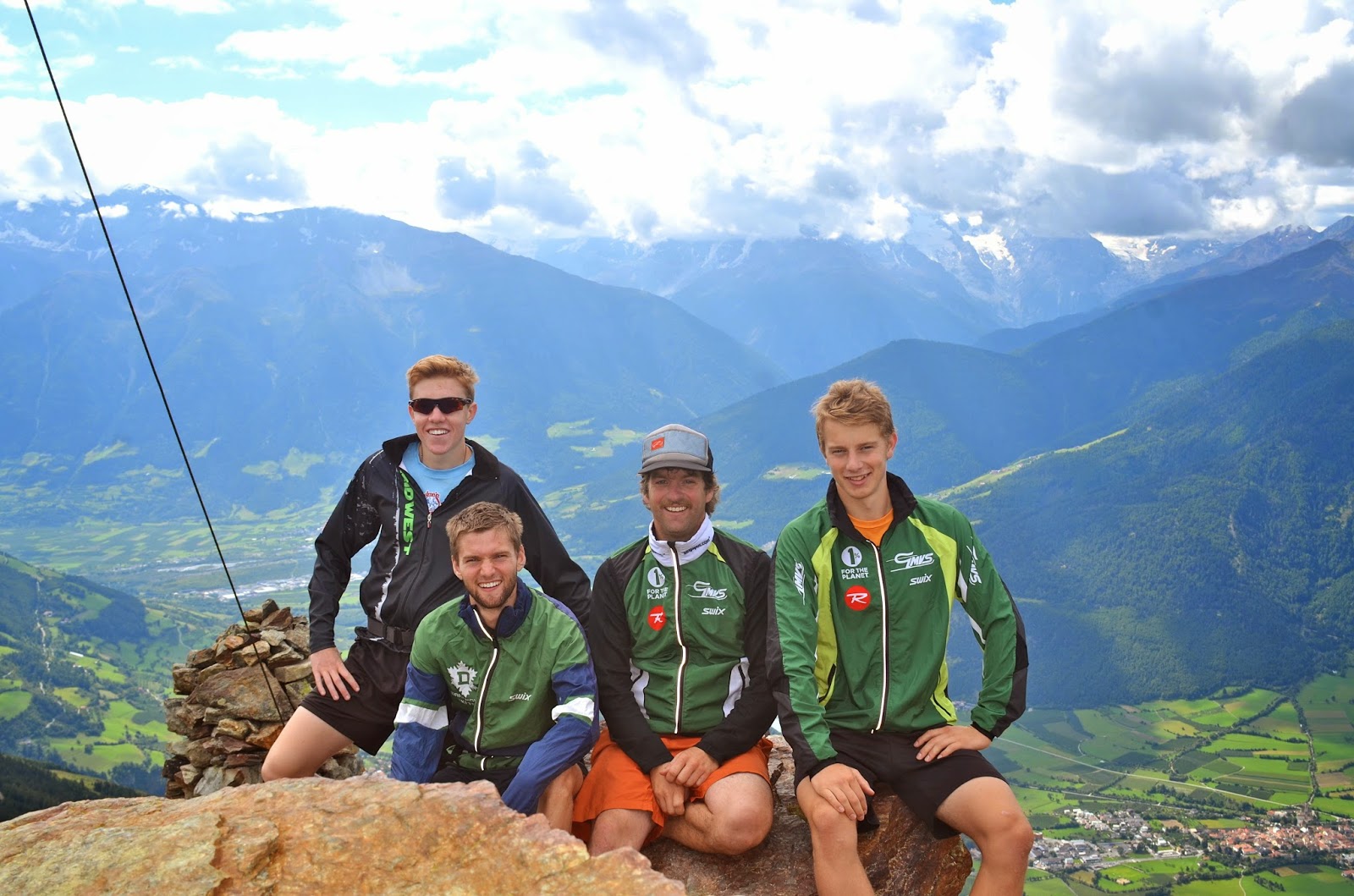
    Justin Beckwith (second from r), as seen in 2014 when he was head coach of the Green Mountain Valley School (GMVS), with former GMVS elite and postgraduate athletes (from l to r) Nick Gardner, David Sinclair and Ian Moore during a fall trip to Italy. (Photo: GMVS)

    About a year and a half after leaving his post as nordic director at the Green Mountain Valley School (GMVS), Justin Beckwith is once again involved with New England skiing at full throttle as competitive program director for the New England Nordic Ski Association (NENSA).

    The news came from NENSA early last month in an announcement that stated Beckwith would be filling in for Amie Smith, the association’s high-performance director for the last two years, who was promoted to executive director.

    Justin Beckwith (l) and Gus Kaeding in the wax room at 2017 U23/Junior World Championships at Soldier Hollow in Midway, Utah. (Photo: Flyingpointroad.com)

    Beckwith, of Warren, Vt., spent nine years from 2006 to 2015 building the GMVS program. When he left in the fall of 2015, he decided to go back to building houses, yet he remained involved with nordic as a wax tech for New England juniors and U.S. skiers at both national and international races, like last season’s OPA Cup Finals.

    Right around that time, in late March when NENSA posted the job opening, Beckwith knew he was ready to return to a full-time position in skiing.

    “It was just sort of, ‘OK, that’s it. That’s what I need to do,’ ” he told FasterSkier last month.

    After graduating from Middlebury College, Beckwith, now 37, spent one year living out west before taking the job at GMVS in Waitsfield, Vt. During his tenure there, he was also a coach for the U.S. Ski Team’s U18 Trip and Junior World Championships as well as the head wax tech for Junior Nationals and Junior Worlds.

    Stepping away from the sport as a coach allowed him to view it in a way he hadn’t before.

    “I went back to Junior Nationals after not being there for a couple years, now being able to watch, coming from the outside and see how our coaches, athletes and organizers are acting and performing, and what a unique perspective it is,” he said. “It is so much different than when you have your own athletes in the race, or you’re supporting your division or whatever your job is. … I am really excited to start to using all my contacts and resources and just bring energy that I think coaches understand what I am all about.”

    ***

    FasterSkier: What made you decide to return to skiing full time?

    Justin Beckwith: When I left GMVS to be a carpenter, I knew I wanted to come back to skiing, but on my own terms and do the piece of the skiing that I absolutely love and am so passionate about. That allowed me to be open to do that, whether or not the bank account reflected that, I just needed to be a carpenter, but I also had the ability to start making relationships with international people, coaches from other nations that are so impressed with what we are doing now in the U.S., and that started happening three or four years ago. Coaches started saying, “Wow, you guys are doing really well down to the national level now.” Then I got to start working with some of our manufacturers and suppliers, like Start Ski Wax specifically, a bunch more this year. I went back to Junior Nationals after not being there for a couple years now being able to watch coming from the outside and see how our coaches, athletes and organizers are acting and performing, and what a unique perspective it is.

    Justin Beckwith getting after it in Hemsedal, Norway. (Courtesy photo)

    So bringing to the present day, I think this [NENSA] position came up one time while I was involved at a certain amount of professional level with skiing. Amie [Smith] took on the job a few years ago, but I was deeply immersed my GMVS culture at that time and I also think that probably was not the perfect fit for me. Just before my wife and I left for our trip to Norway [this year], the job was posted [again]. It was just sort of, ‘OK, that’s it, that’s what I need to do.’ I am really excited to start to working with my contacts and resources and just bring energy that I think coaches understand what I am all about. I have also been able to make that connection with a lot of the young athletes over these last few years.


    FS: What drew you to the NENSA position?

    JB: With this position with NENSA and also what I have been able to do the last couple years, I am not using the microscope anymore, I am using a telescope. It’s totally different, but at the same time, it’s the same. I am going to be able to support GMVS in a great way. I love working with [GMVS Nordic Director] Colin Rodgers. GMVS went through some transitions. I am staying in the Mad River Valley, which is amazing; another great part of the job is that I get to stay where I am and sort of create some of that vision and move it in a way. It’s a pretty cool job, it’s a very cool lifestyle, it’s something that I am so passionate about. I was just talking to [Dartmouth men’s nordic coach] Brayton Osgood, he said he’s so glad to have [me] officially back in skiing. That is the coolest thing, to have those relationships.

    We are going through a transition within the U.S., there is a changing of the guard within our coaches and in our whole community, and we need to hold on to the history. That’s why people like Peter Graves are so interesting. We absolutely need to hold on to that history, but we have so many, because of all the awesome work that Dick Dreissigacker and Judy Geer at Craftsbury, or Sverre at Stratton, Rick Kapala at Sun Valley, or Gordon Lange in Park City, because of what all these people did, they inspired the next generation of not only athletes but coaches. It’s a really exciting time for U.S. skiing that we have such great venues, coaches and organizations. It’s a really cool time and a lot of energy is coming back into it right now.


    FS: How is your role at NENSA going to be different than it was with GMVS?

    JB: The biggest difference is what I tried to do at GMVS is essentially I wanted to be able to do what I am going to be able to do with NENSA. I am able to work with everybody now — and not that I am trying to spread myself too thin; I will obviously be working in a different capacity — I will be in personal contact with a lot of our athletes. … I will have more communication with coaches, whether it is with [U.S. Ski Team Development Coach] Bryan Fish or our club coaches in New England, and coaches throughout the nation, and figuring out that common goal, whether you’re part of a ski academy, or a club, or even a different region at JN’s, the goal is to make U.S. skiing better, and to create that culture and create those results, so that’s the goal.


    FS: How was being at the OPA Cup Finals and what were your takeaways?

    U.S. techs and coaches at 2017 U23/Junior World Championships (from left to right) Justin Beckwith, Andy Keller, Gus Kaeding, and Mike Matteson at Soldier Hollow in Midway, Utah. (Photo: flyingpointroad.com)

    JB: Probably the coolest thing going into that was the fact we were able to pull Caitlin Gregg into that, so we had this mix where we had some of our best juniors were there, we didn’t have the biggest team we’ve had, but we had a great time. And right out of the gate in the OPA Cup Finals — these are big-deal racers — on Day 1, Caitlin won the thing and Hannah Halvorsen was second. World Juniors was of course groundbreaking, but that result showed another level of depth we have in the country, and that was really inspiring to see that and be a part of. It also showed that we are a little bit better at skate skiing than in the European contemporary classic condition, basically slush. We were racing in 10 degrees [Celsius, 50 degrees Fahrenheit], and that is something we are adjusting at the developmental-team level. … That’s something we are going to try address soon. The takeaway from OPA, it shows the depth of where U.S. skiing is now, it shows what happened at World Juniors isn’t a fluke, it shows that we still have work to do, but we very much have arrived, and we are lucky as a nation that the European Nations are recognizing what we are doing and they are interested in what we are doing. We are contemporary now, and it’s pretty cool.


    FS: What are some of your key initiatives moving forward and what does your five-year plan at NENSA look like?

    JB: One of the things is my big initiative to make NENSA a known support structure to our clubs and to our coaches and to our athletes. We are not just putting on races, I want to make coaches’ education cool again. I want to make it popular and fun, and I just sort of want to reinvigorate that a bit. I want to help increase the participation and make it a clear thing that when you ask any coach what NENSA is doing for them, I want them to be able to give a clear answer that we are providing really cool feedback and support for their program. We are helping them coach and inspire their kids, and we are not putting on camps or other events that compete, we are helping make those better. I want to reinvigorate rollerski races. I have one that I want to start with this summer and ideally that would transfer to each state, having an event that we were able to make better for them, whether through promotion or physically bringing athletes to them, bring sponsors and suppliers in there, all part of that goal. … That’s what I want to do with this job, create that that buzz, that energy.

    Another thing I am going to work on is NENSA alumni, if you will, we need to keep them involved. When you’re a junior skier: you love your coach, you love your peer group, love going to Junior Nationals. You don’t necessarily remember that it was Janice Sibilia or Zach Caldwell or NENSA that created these camps and brought you all together two or three times a year. There are so many people that brought it to where it was now. It’s cool to come back and look at it with that perspective. Some of those people are coming back to it in different ways. Kris Seymour has taken a position at running Mount Van Hoevenberg in Lake Placid. Kris Seymour was Lowell Bailey and Tim Burke’s high-school coach; he inspired those guys, he helped to inspire me, now he is at a position where he can do wonderful things not only for his venue and his job, but he can do great things for cross-country skiing. So it’s really neat to meet somebody who cannot just juggle those balls, but bring those balls together.


    FS: Are you still going to be a carpenter?

    JB: I do have a passion for that and creating things especially with wood. I will still be hobby-ing and doing fun projects on the side, but only in a capacity like somebody would play the guitar, not as a business. I am diving right into this as a passion. People who are involved in the country and New England are coaching for the right reasons and I share the same vision.

    The enthusiasm and the support and welcome I have gotten from the staff and board of NENSA, New England and the U.S. ski community is truly humbling. It’s going to be really fun, and I am looking forward to it. I am so fortunate to be a part of it and want to get more people in the sport.

  • Q&A: Burke New Head Coach Will Sweetser

    Q&A: Burke New Head Coach Will Sweetser

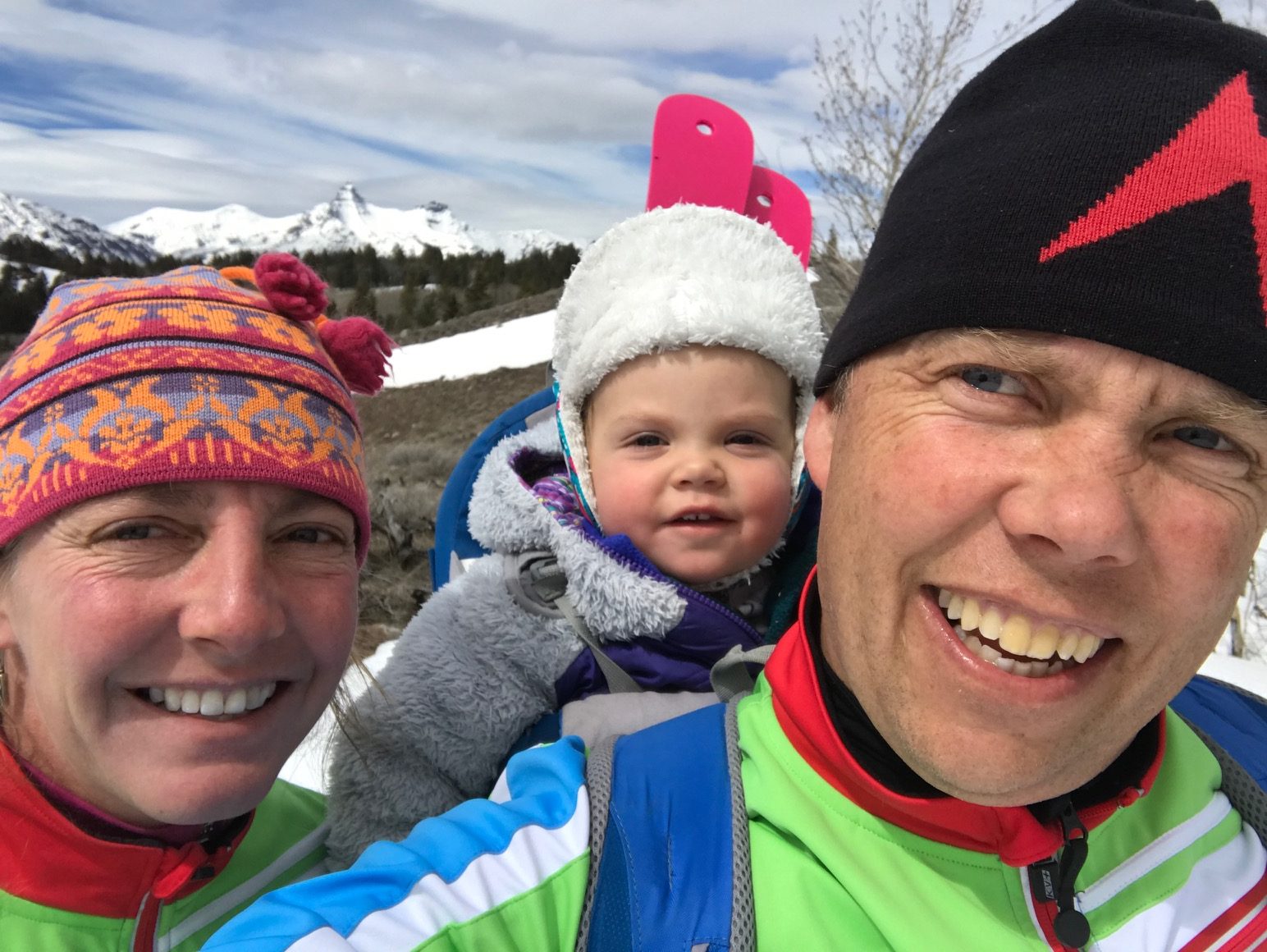
    Will Sweetser snaps a selfie with his wife Sarah Dominick and their 1-year-old daughter, Aesklyn, near their home in Cody, Wyo. Sweetser recently accepted a position as head coach of Burke Mountain Academy’s nordic program in East Burke, Vt. (Courtesy photo)

    If you are from New England, you’ve probably heard of Will Sweetser. Originally from Auburn, Maine, Sweetser, 47, has been coaching nordic for the last 25 years. He skied for Dartmouth and coached at Bates College, the Jackson Hole Ski Club, Carrabassett Valley Academy, and Rangeley Lakes Ski Club before spending 15 years with Maine Winter Sports Center (MWSC) from 2000-2015. He started with MWSC as a cross-country coach and evolved into its competitive programs director, but in 2015, MWSC announced its Olympic Development Team was being restructured. It changed its name to the Outdoor Sports Institute and expanded its mission to four seasons of outdoor sports in Maine.

    With a baby on the way, Sweetser and his wife, Sarah Dominick, a former assistant nordic coach at Bowdoin College, decided to leave their home in Stockholm, Maine, and move west to Cody, Wyo. There, the two started a post-grad, gap-year program called Mountain Endurance Sports, which also offered personalized coaching services and an online ski store. Last season in its second year, the program had two post-grads, Lance McKenney and Daniel Streinz. McKenney placed 20th in the classic sprint at 2017 Junior World Championships in Utah, and according to Sweetser, Streinz ended the season with the best International Ski Federation (FIS) point ranking of any junior man in the U.S.

    In March, the Burke Mountain Academy in East Burke, Vt., announced Sweetser would be returning back to New England to serve as its new head nordic coach. He said he accepted the job in early March and with his wife Sarah and their one-and-a-half-year-old daughter, Aesklyn, the family of three planned to head East in June for the first training camp of the season at Burke.

    FasterSkier caught up with Sweetser on the phone earlier this month from his current home in Cody.

    ***

    FasterSkierWhat drew you to Burke and back to New England?

    Will Sweetser: My wife and I spent 20 years in Maine, and I grew up in Maine. I love the East, really, I’m a Mainer through and through, but certainly New England has been my home. My wife and I did something very similar to this 20 years ago, we moved out West after I had been coaching for a while in the East, in order to try to race, and we made it about a similar amount of time, about two years. I guess I would say my wife loves the trees, she misses them, that’s part of it.

    Part of the move out here was to get a break after MWSC and to get a chance to be with family. I mean, I was constantly putting in 60 to 75 hour weeks at MWSC, so it was a good opportunity for me to change things up. I looked at jobs over those two years and had conversations with a number of different options, and Burke has been the best fit for us. Part of the attraction is that it is a very small rural town, it feels like a lot like where we just were in Maine, at the same time, I can drive an hour and 15 minutes and be in Hanover, where I could drive an hour fifteen in northern Maine and still be absolute nowhere.

    It’s a good change for us, but it preserves a lot of the things we really loved about Maine, while offering us an opportunity. … We were looking for a place to raise our daughter, the opportunity to raise her somewhere the strive for excellence is real so that was a big draw. And last, it seems like a great fit for both of us to be able to work there when the time is right with our family. We felt really welcomed there.


    FS: How difficult of a decision was that?

    WS: Like I said, I had other job offers; I interviewed at other places the last two years. It was pretty easy for us to decide that those things weren’t right. … It wasn’t a difficult decision, every time you move it’s a big deal, so we wanted to make sure the fit was right. We spent quite a bit of time there looking things over, and we tried to do a good job making that decision with our eyes wide open, so we spent a better part of a week on campus, and I went back and visited again.


    FS: When did the hiring process start and how long did it take?

    WS: It was all pretty quick. I started having conversations with Burke in late February, and we went and visited the last couple days of February and first couple days of March and I accepted a position March 3 or 4. We knew that we were looking for something, I talked to groups in Canada, and I interviewed for two other positions while I was out East, but I was recruiting for Burke by the time JN’s [Junior Nationals] started [in March].


    FS: What are your key priorities in your first year at Burke and what is the status of its nordic program?

    WS: Priority number one is to recruit. I don’t know if you know the history of Burke, but it’s a longstanding nordic program, for over 30 years they’ve had a nordic program, and they produced some excellent skiers, from people like [U.S. Ski Team members] Liz Stephen and Ida Sargent, [and Ford Sayre’s] Sam Tarling a little after them. Heading into this with them having had no athletes and no coaches last year, essentially the program was dead. In name it was not dead, and they have always had a nordic skier on their school logo, and the board of directors seemed totally disinclined to let nordic die, so I feel like there is a tremendous support for nordic at the school.

    My first priority is rekindling that core group. We do have interest. Two kids are committed to coming and I am in discussions with several others that I think we will start the year between four and six athletes for next year. My goal is to have enough athletes on campus to have a consistent group of somewhere between 18 to 24 athletes. I recognize that is going to take a while, but that will be a program that is several coaches, full-age cohort in both men’s and women’s high school ages. I am very optimistic about the potential. There are a lot of great things that Burke has to offer, such as skiing on campus, which I think is a big plus, so we are looking at homologating a couple of race courses right there. We are going to grow a fairly robust gap-year program, and we will have a pretty extensive camp schedule coming up. I will run one camp this summer and then see where that leads us.


    Will Sweetser, former MWSC competitive programs director, holding Welly Ramsey, whom he coached for six years at the MWSC, during a season-ending team ski in April 2015 in Fort Kent, Maine. (Photo: Facebook/Welly Ramsey)

    FS: How is the Burke position different than your position at Maine Winter Sports Center?

    WS: Well, one, it’s vastly less travel. I am going to spend, I don’t even want to guess the number of fewer miles I am going to drive, but a significant amount. The proximity of other strong programs is just outstanding. One of the things that makes New England the strongest region in the nation is that we have such a strong club system, thanks in large part to NENSA [New England Nordic Ski Association], but the proximity to GMVS [Green Mountain Valley School] and Stratton and Craftsbury is just great. I think it is excellent that all those programs are in Vermont, not too far from one another and can bang heads, and for that matter, [NENSA Head Cross-Country Coach] Margaret [Maher’s] program over at Lake Placid, and then the rekindling of the Dublin School if you go a little further out. I think that if you drew a radius around [Vermont’s] upper valley, you really get to some super-strong programs.

    Some of the other things that I think will really help Burke and that I did not have access to at MWSC is I got access to snowmaking both at Burke and at Craftsbury and I think I am going to be able to capitalize on that. And it will be different in that my duties are different. My role at MWSC was in no way shape or form confined to coaching junior racers. Almost the whole time I was there, I had extensive other duties: community building, facilities management. It’s not like those things are going to go away, but it’s all right there, which is really different from driving across the whole state of Maine trying to grow those things. It is much more ‘grow it at home’ and I will have a lot more contact hours with athletes than I have ever been able to have.


    FS: Will Mountain Endurance Sports continue and if so in what capacity?

    WS: It will happen in a modified iteration, the latest iteration. We are still working on the ins and outs of where to keep the business. It very well may change name, certainly we will continue to retail and do team sales for Maplus wax and Rex Ski Wax, we are working on details with how our arrangement with KV+ will move forward, and as far as the coaching goes, no, we are not going to do a gap-year program anymore — that’s going to be Burke — but I will continue a coaching relationship with some athletes who are older than high school. I am still talking with several athletes that I have worked with in the past about their athletic future. I am for sure working with Austin Huneck, who was with me for two gap years with MWSC then he was a standout freshman at the University of New Mexico two years ago, spent last year in Sweden not ski racing, but now he is coming back to ski racing. I am working with him as his coach, and somehow, he and a few other guys are going to be part of, I don’t know what to call it yet, maybe like a Burke Mountain training group, something like that.  It’s not a full senior program yet, but give me a few years.


    FS: What has kept you coaching and in the sport for the last 25 years?

    WS: It was really at Dartmouth where I developed a passion for skiing and I coached first. I was a writing major. I was writing and coaching, and then I was teaching English and coaching, and then it turned out I could make a better living coaching. But more than that, I lost a brother to drugs in 1998 and since then I have been pretty motivated to help kids make better choices, and I have been doing that through skiing ever since then, so that’s a lot of what has kept me in it. That is my driving passion: working with kids and helping them make good decisions, and that was a big piece of MWSC. And the other piece is that my wife and I have done this for essentially all our adult lives, we really enjoy the lifestyle, the people we get to work with are fantastic. It’s a great way to travel and it’s a great way see other parts of the world. We really enjoy just being outdoors and being fit. Even two years ago, I wasn’t coaching essentially, we were out in the mountains hiking, skiing, doing all the things you do for ski training, just because we love them, so it’s a really easy fit for us, and we look forward to sharing more of those things with people who are passionate about those at Burke. The Burke community is really motivated.


    FS: Do you know where you will be living yet when you move in June?

    WS: We don’t know; we would like to know. I am hoping by the time I go to run this camp in June that I will know and I will be able to look at where we will live and then can pack appropriately. We are leaving a lot of our stuff here. Cody is not a ski town, but its a great place to train for skiing. The elevation is excellent, the climate is excellent, the mountain biking is growing in leaps and bounds, so the trail system is fantastic right in town. Cody sits at 5,000 feet and the mountains around it goes up to 12,000 feet. If everything goes as well as we think it’s going to go, I am sure we will have a permanent location at Burke in a few years. For now, I anticipate that we will live near or on campus.

    We are looking forward to being back. It really does feel like our family. The New England ski family feels like our family. Even on the circuit the last two years, we have been astonished by the continued support we get from New England, even when we lived out here, so it really does feel like a homecoming for us.

  • 2017 American Birkie: An Experience I’ll Never Forget

    2017 American Birkie: An Experience I’ll Never Forget

    The scene at 2017 BirkieFest on Feb. 25 at the American Birkibeiner trailhead near Cable, Wis. The iconic race was canceled this year due to a lack of snow and a casual ski on a 5 k loop and festival at the trailhead was held in its place. (Photo: American Birkebeiner Ski Foundation)

    The following firsthand account was written by FasterSkier intern Ian Tovell, who attended this year’s American Birkebeiner in February, which was canceled due to lack of snow. Instead, the 2017 BirkieFest was held on Feb. 25 at the new Birkie trailhead and start area near Cable, Wis., with an estimated 10,000 people coming out for a casual ski on a 5-kilometer loop, on-snow demos, live music, food and a beer garden. Photos from Ian, FasterSkier contributor Vince Rosetta, and the American Birkebeiner Ski Foundation.

    ***

    The 2017 American Birkebeiner will be a race that no one will ever forget. It will be remembered for a tremendous amount of effort from Ben Popp and his hard-working staff. Even though there was no race, it was a great event with 10,000 of likeminded friends and a lot of great food, live music, and the ability to check out the latest-and-greatest gear.

    I was very excited to race in my third Birkie after missing the race in 2016. Heading into Birkie week, I was obviously worried, like most racers were, as the weather did not look like it was going to corporate. With high optimism, I left Boston to head to Hayward, Wis., with my two travel companions in hopes the race would still happen.

    On Friday we headed to the OO trailhead to see if we could get some skiing in. As we were headed to the trail, we got the news the race was going to be canceled and turned into a non-competitive ski in Cable at the start. After traveling all that way, that wasn’t going to stop us from getting in some skiing.

    However, my friend forgot his boots that day. Knowing the skiing was not going to be that great, I offered to run the trail so he could ski. We were able to do about 10 k worth of skiing on icy and grassy trails, but it was great just to be out on the Birkie Trail. We were not the only ones that had the same idea as we saw a bunch of other hopeful skiers getting some kilometers in as well.

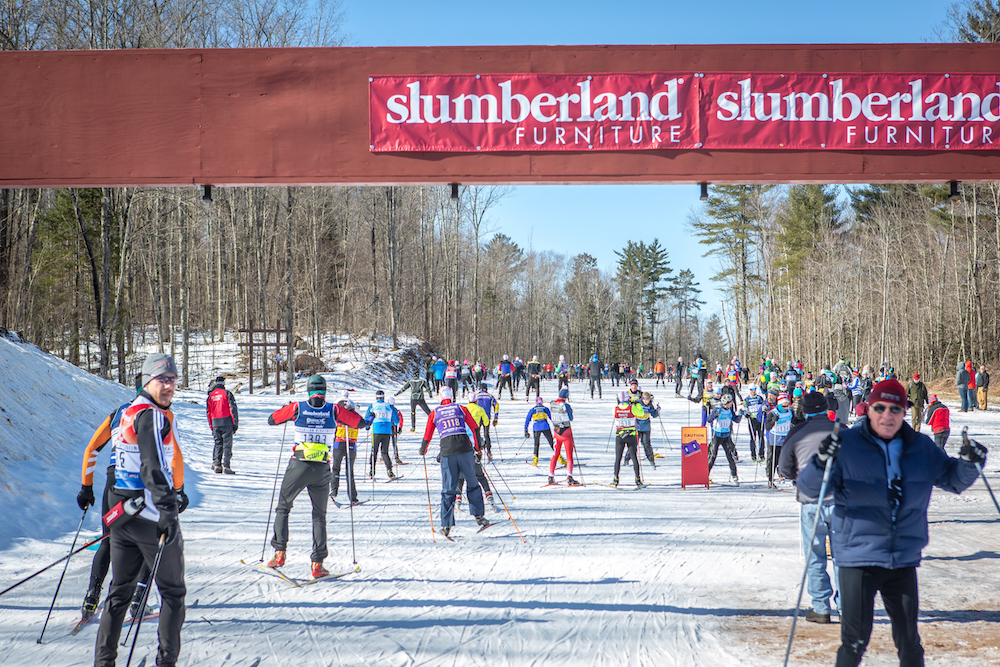
    On Saturday, we headed to Cable to join some 10,000 skiers that wanted to check out the 5 k loop and get some more skiing in. All things considered, the loop was in great shape. As the day went on and more people joined in, the trail became crowded to the point that it was difficult to ski with much speed.

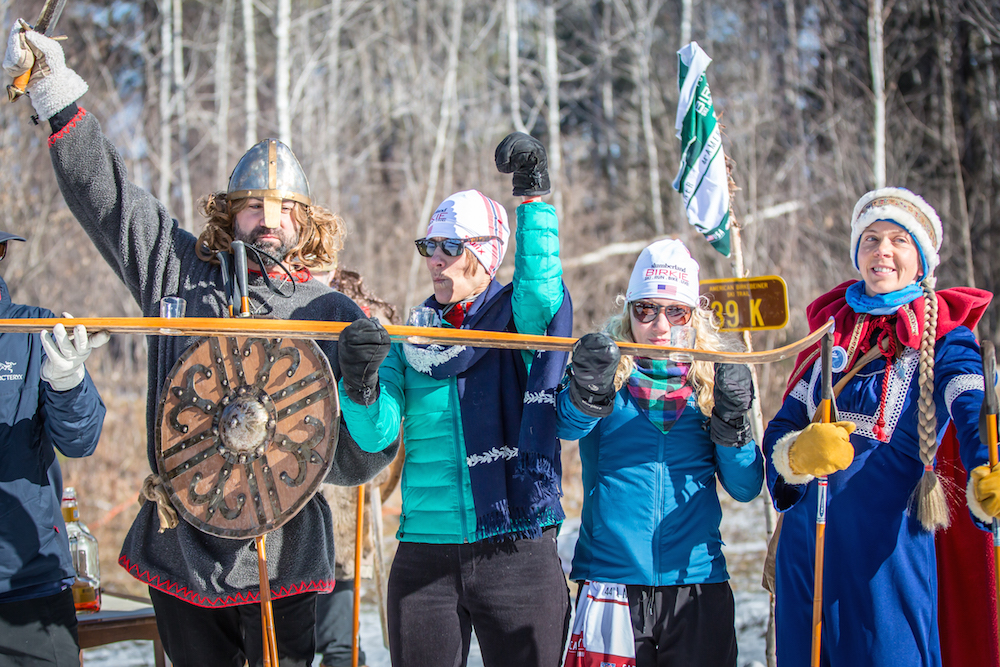
    The famous 39K Club Shot Ski trailside at 2017 BirkieFest near Cable, Wis. (Photo: American Birkebeiner Ski Foundation)

    The highlight of the course was at 4.8 k, where the 39K Club was there with its shot ski, making sure that the Birkie spirit was alive and well and getting everyone excited just to be at BirkieFest.

    After a quick two-lap ski we were off to the food tent to get the famous on-course cookies and chicken-noodle soup. We were fortunate to test out some fat bikes at the demo, which was a ton of fun because we were able to ride them on the Fat Bike Birkie race trail. After listening to some live music, collecting our fair share of free ski ties and other goodies, we headed back to our hotel to start planning our trip for Birkie 2018.

    Though my 2017 Birkie experience was not the one I was hoping for, just being on the Birkie trail with 10,000 other people felt like any other Birkie. The atmosphere and camaraderie at this race is unmatched in my experience, and being a part of it is truly special. This year was such a great time even without skiing that I know that it will be the most memorable Birkie of my career. I am looking forward to returning to Cable and Hayward in 2018.

    ***

    Editor’s note: 2018 Birkie registration opened May 1. The 2017 event marked the second official cancellation in the Birkie’s 44-year history. An article in the Birch Scroll 2017 spring edition (page 15) confirmed that 2017 race fees will not be refunded and presented numbers to explain why. The total cost of organizing the 2017 Birkie Week amounted to more than $854,000 dollars. Read the article here.

  • Wednesday Workout: Testing the (Endurance) Waters

    Wednesday Workout: Testing the (Endurance) Waters

    FS intern Ian Tovell is a longtime skier and triathlete training for his first Ironman. Here, he provides an indoor-swimming workout for anyone looking to measure their endurance.
    FS intern Ian Tovell is a longtime skier and triathlete training for his first Ironman. Here, he provides an indoor-swimming workout for anyone looking to measure their endurance.

    Living in New England, the adult version of Christmas is waiting for the first snowfall. For most skiers in New England usually by the time the first race comes around you have skied once or twice on snow if you are lucky. The key to be race ready without going on snow is to train your body in race conditions. We do this by rollerskiing, running, strength, etc. One workout that I do to make sure my endurance is up where I need it to be is swimming. Swimming being one of the best aerobic exercises you can do (after nordic skiing, of course) is one of the main reasons a lot of skier use that in the offseason.

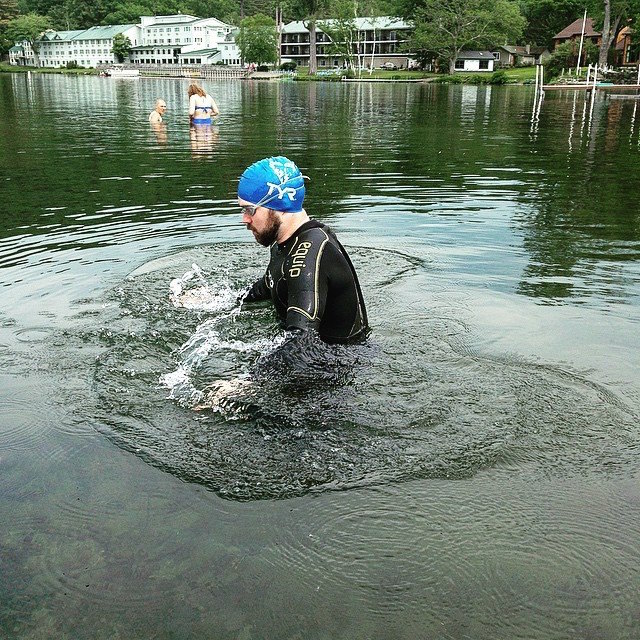
    Ian Tovell getting ready to dive right in.
    Ian Tovell getting ready to dive right in.

    Swimming is a great way to keep up your ski fitness while changing up your daily routine. As a nordic skier and triathlete, I like to mix up my workouts so that I can work on other muscles while still staying in shape for nordic in the winter. Being able to get to the pool and work on my endurance has made the transition to skiing quite easy.

    This past week, I did two hard workouts to really test the endurance level and see what I need to work on. The key was to make sure that the two workouts were separated by a few days to ensure I was rested between the two tests.

    Swimming Workout 1

    Warmup: 800 yards:

    • 300 choice
    • 100 kick
    • 6×50 strong (Level 3), each followed by 15 seconds rest
    • 100 easy

    Main Set: 950 yards (at Level 3-4):

    • 50 freestyle (1-minute recovery)
    • 100 freestyle (1:30-minute recovery)
    • 800 freestyle (2-minute recovery, or as long as you need before the cool down)

    Cool down: 250 yards

    • 5×50 Free

    Total Distance: 2000 yards

    Swimming Workout 2

    Warmup: 800 yards:

    • 300 choice
    • 100 kick
    • 4×75 build (Level 2-3), with each pool length (25 yards) faster than the last
    • 100 easy

    Main Set: 600 yards:

    • 200 freestyle as fast as you can (2-minute recovery)
    • 400 freestyle as fast as you can (2-minute recovery or as much time as you need before the cool down)

    Cool down: 350 yards:

    • 100 Choice
    • 5×50 easy

    Total Distance: 1750 yards

    During your warmup you should focus on your technique. This is the time to make sure that your technique doesn’t fall apart during the main set. The warmup is also the best time to get the junk out of your system and really gauge how your main workout will go.

    When you get to the main set, this is where the fun begins. The effort should be between Level 3-4, but be at a pace that you can sustain for the whole workout. For example, you shouldn’t do the 200 freestyle as fast as you can, then by the time you get to the 400 you die halfway through it. The times for each interval will be dependent on how fast you swim. Just like in skiing, you want to be as consistent as possible with your perceived effort. Both Workout 1 and Workout 2 should be done at the same effort to get the most accurate times.

    During the main set, one of the most important things is to make sure you take the appropriate rest between each set. During the rest, catch your breath, drink water and refuel your body before the next interval. Like in skiing, rest is just as important as the interval itself so ensuring you take the accurate rest is critical. The total time for each workout will vary depending on how long it takes you to warm up, race and cool down, but it usually will take about 40-60 minutes to complete from start to finish.

    Ian Tovell after the swim leg of a triathlon. Ian is training for Ironman Mont-Tremblant.
    Ian Tovell after the swim leg of a triathlon. Ian is training for Ironman Mont-Tremblant.

    The cool down is the final part of the workout and should be done fully. This will help to ensure that your muscles relax and you won’t be sore or unable to move your arms the next day. The cool down should be slow and easy with the effort being Level 1 or less.

    A little background about myself is that I am not only a nordic skier, but I am also an avid triathlete. I am currently training for Ironman Mont-Tremblant, and this is part of my own Ironman training plan. I have done triathlons for the last 12 years and have been a nordic skier for the last 16 years. I have found a great balance between both and have found that each helps me prepare for the other. I have a great coach, Kyle Burnell, who works for PBM Coaching and provides me with workouts to help reach my full potential.  He gave me this workout in order to test my “Critical Swim Speed” so that when I am in the pool I will have paces to hit based on the perceived effort for each workout.

  • Ian Tovell

    Ian Tovell

    Ian Tovell

    Ian Tovell began skiing when he went to a practice with his friend to see what it was all about, and after that the rest is history as they say. Ian skied throughout middle school and high school where he raced at a high level at Vermont Academy. He attended University of Vermont where he decided to “hang up the skis” and pursue his other passion, cross-country running. After an injury sidelined him from running, he picked up triathlon and has been racing triathlon across the country for the last eight years. After graduation, Ian found his love of skiing again, and now races the American Birkiebeiner every year.