From the FasterSkier archive — posts syndicated from athletes’ and coaches’ own blogs between 2004 and 2012, kept online as published. Current coverage is at fasterskier.com.
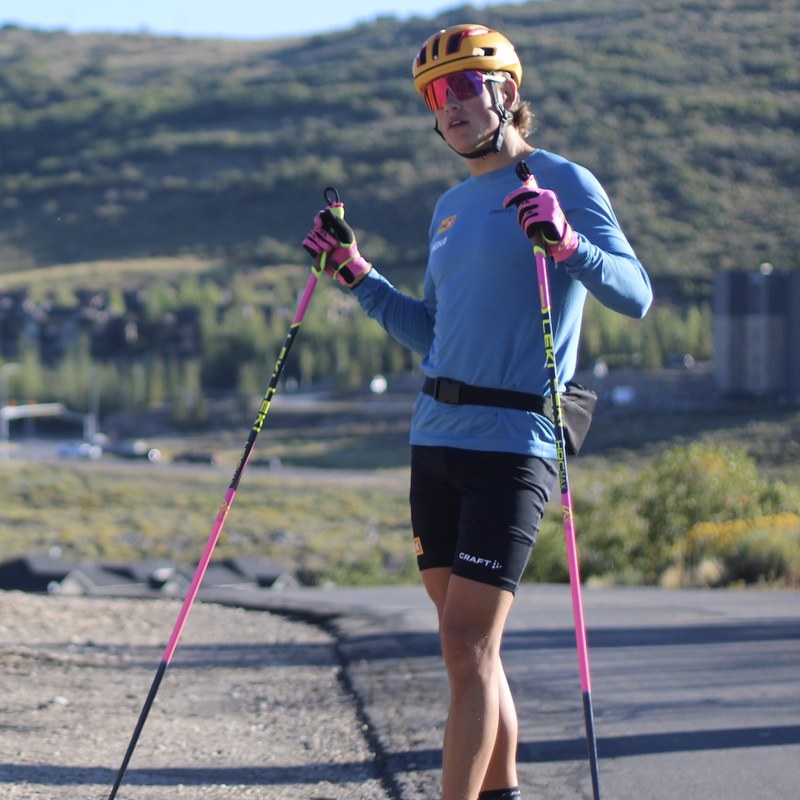
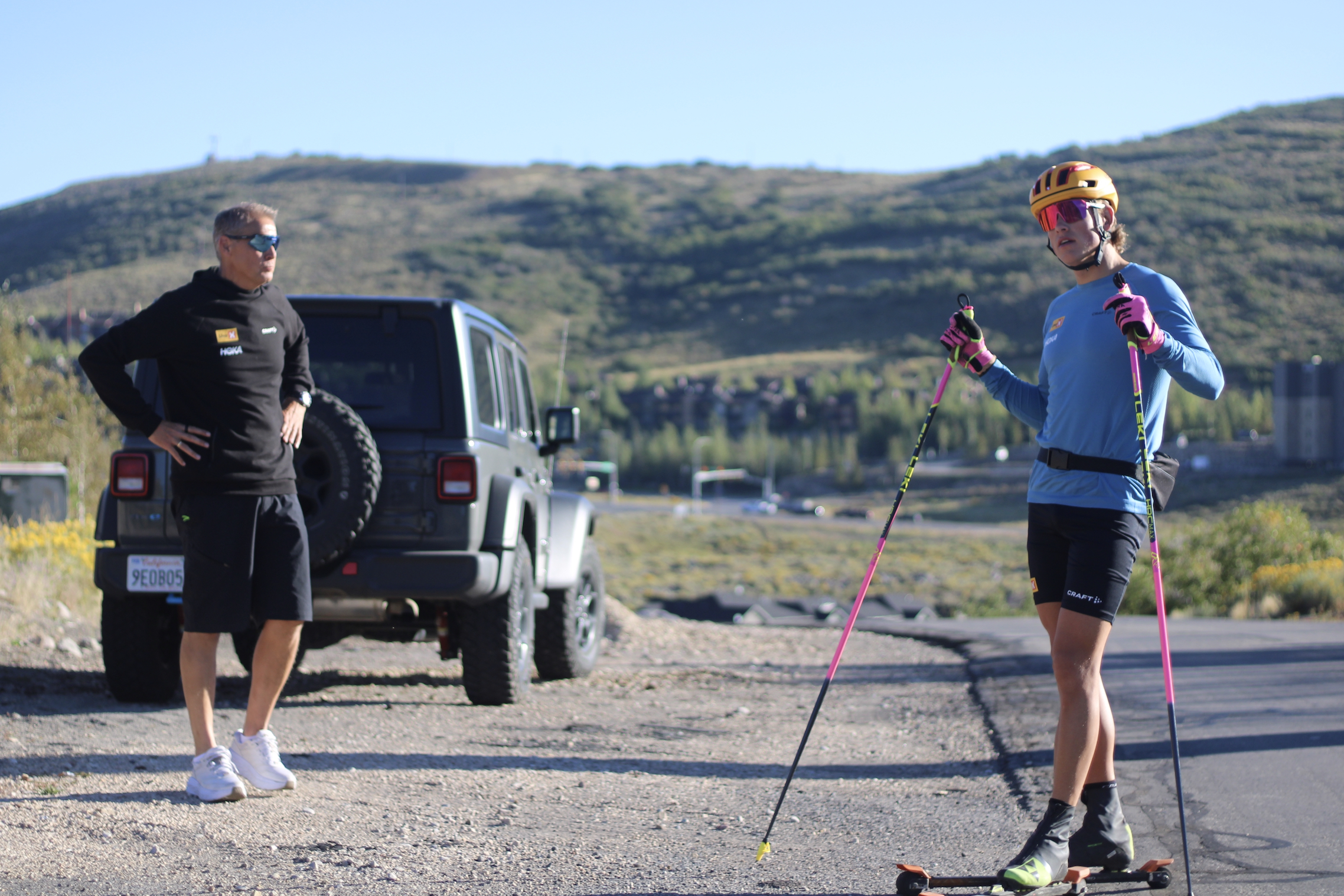
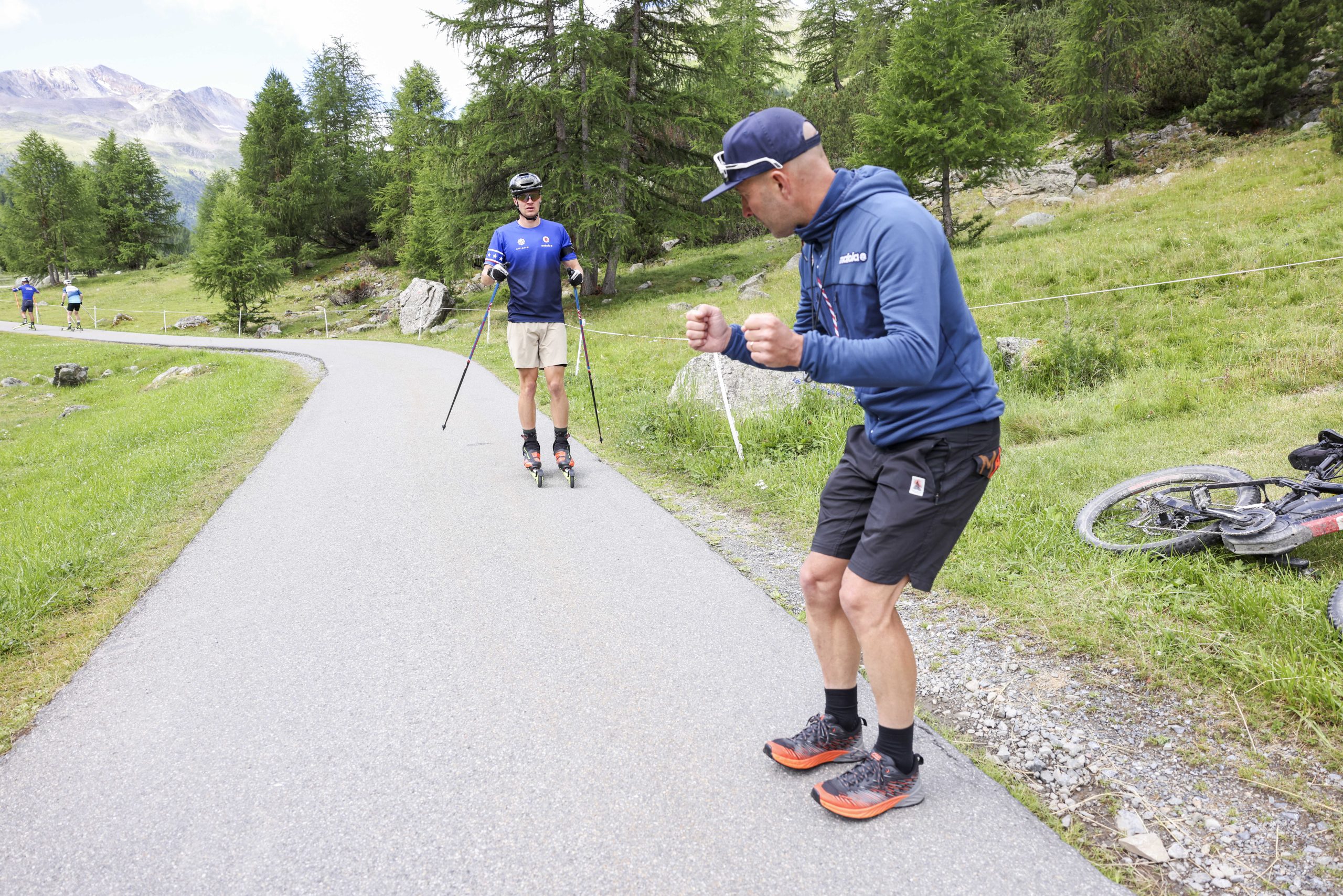
Johannes Høsflot Klæbo and his father, Haakon, during a water break on a rollerski workout in Park City, Utah, in September 2023. (Photo: Nathaniel Herz)
After more than 50 years in endurance sports as an athlete and coach, I recognize many of today’s training debates. We were asking versions of the same questions decades ago: How much training is enough? How hard should it be? When should we increase the load, and when should we allow more recovery? My answers have changed. The biggest change has been how much authority I give the training plan compared with the athlete’s response to it. I still believe in consistent work, appropriate volume, controlled intensity, and patience. But I have become much more willing to change the prescription as I learn how the athlete responds.
I believe it is important for coaches and athletes to build the training process on their own experience. Too many follow current trends, which in the last decade or two have shifted more than they did in the previous 30 years. That deserves recognition and some thought. Modifying what an athlete has done successfully over a few years is a fine and reasonable way to go. Wholesale changes create unknowns that make it impossible to assess what has worked.
What we know to be true, and what experience has demonstrated, should remain the foundation of how athletes train. Consistency is key, training at an appropriate volume load is critical, good control of training intensity should be a primary focus, and being patient and allowing the athlete time and room to adapt is most important.
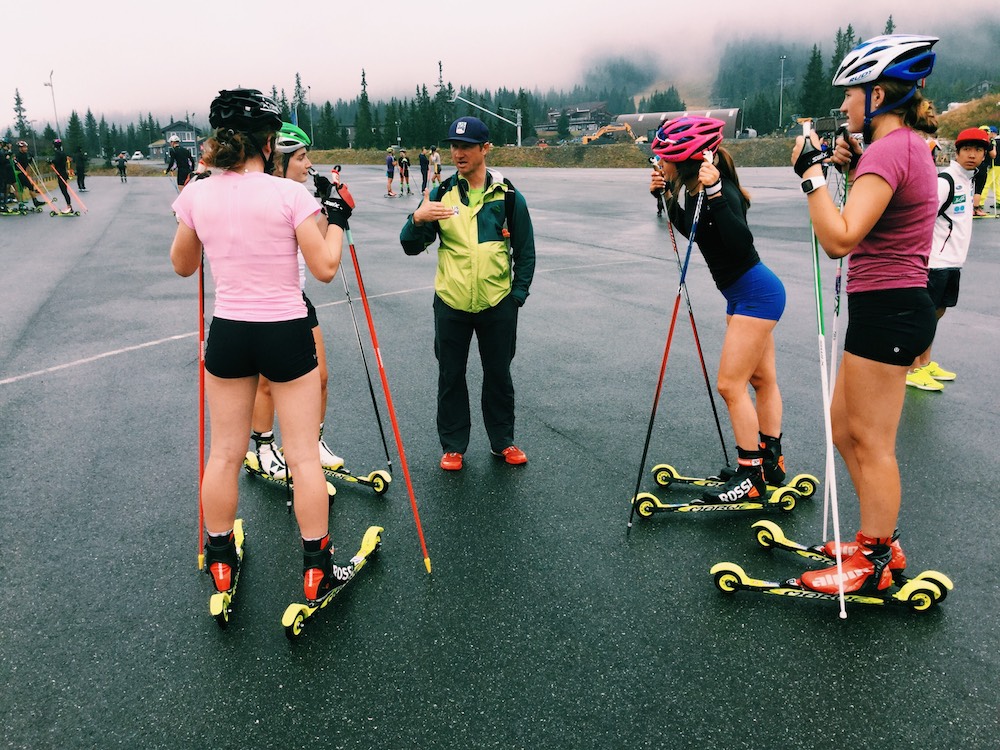
Coach Bryan Fish, in the yellow jacket, works with American athletes at the International Junior Camp in Sjusjøen, Norway, in 2018. How an athlete arrives on a given day can matter more than what the plan says. (Photo: Maria Stuber)
Twenty Years of HRV
Perhaps the most important change I have considered and implemented for anyone I coach is not being a slave to the training plan. I was one of the early adopters of heart rate variability (HRV), some 20 years ago. HRV is a tool I find most valuable in guiding training and in giving athletes the time and space to recover and adapt to it. Of course, following experience and science, I have modified how I analyze HRV over two decades, but the core value is still there. In my experience, HRV helps us refine training so we can give athletes what they need on a given day or week.
Maybe in another decade something better will come along to help with this assessment, and we should be open to that. But we should not throw out something that has demonstrable value.
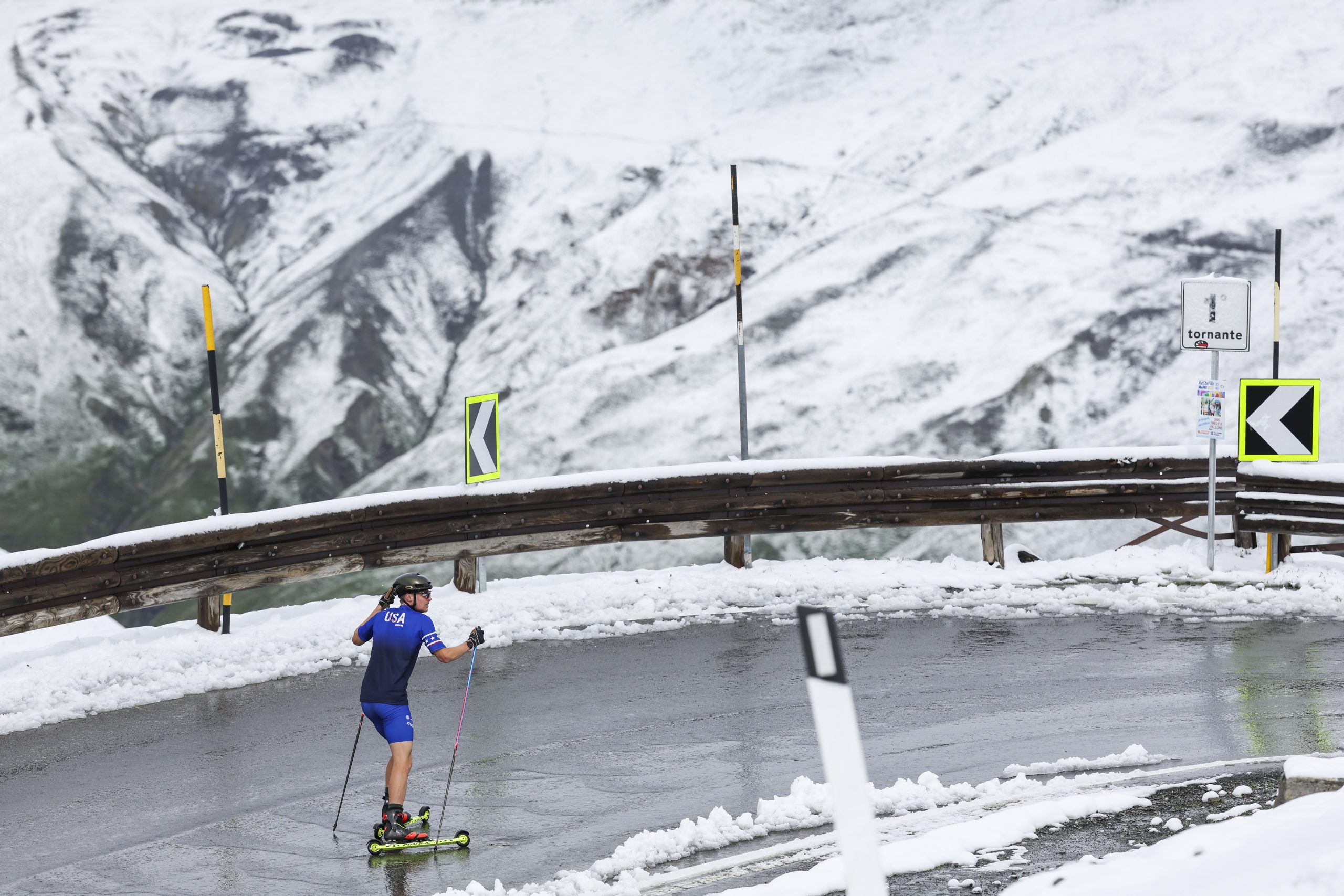
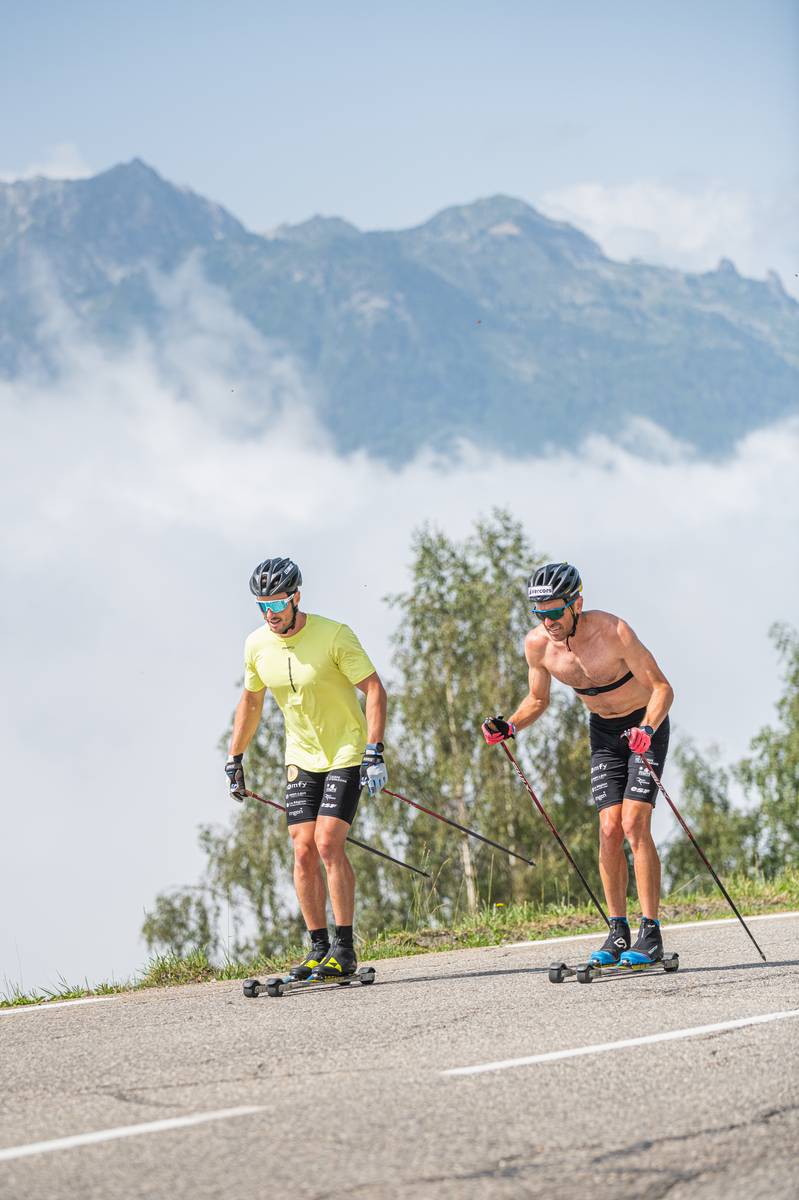
U.S. biathlete Campbell Wright climbs the Stelvio Pass during a summer training block based in Livigno, Italy, in July 2025, with fresh snow along the road. (Photo: NordicFocus)
A Flatter Ramp
Another big change I have made over the past 10 to 15 years is to the periodized training models we follow. When I was competing, we started the year in May at, say, 50 hours, and we progressively built that load month over month to 100 to 120 hours in November. During the later years of my career and into my early coaching years, I remember talking with coaches, physiologists and other athletes about this process. I simply did not see how 50 hours created adaptation that allowed for 60 hours, and how that training load allowed for 70 hours, and so on. It just did not make sense to me. Of course, it took some years to break out of that cultural mode and truly shift how we plan and implement training.
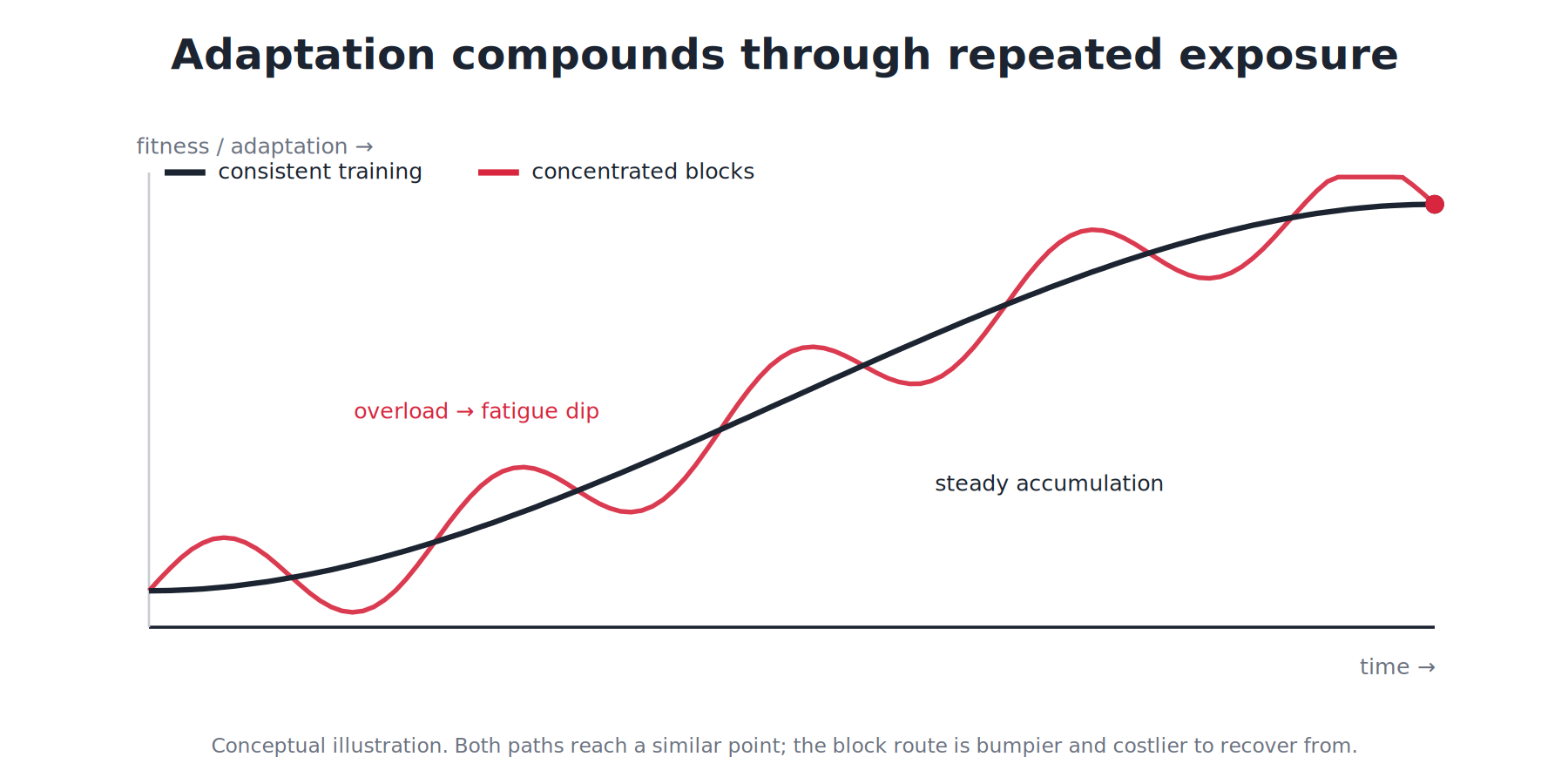
Now I fully believe in a far less aggressive ramp rate: starting the year at higher volume and staying consistent week to week and month to month. Over the course of the year, we can actually do more training with less shock and stress to the system, and with more consistent development. The theory that we need to increase the load week to week and month to month to add stress so we can adapt is, frankly, BS as I see it now. Training compounds week to week, month to month and year to year with consistency.
Simply put, under any model we should strive for consistent implementation, and we should not increase the load until, and only until, we have plateaued and fully adapted to the current load. Being consistent at the correct loads will let us do more training over a year, or over multiple years, than striving for a month-over-month increase.
It is easy to admire a big week or block of training and be impressed. But one big week or block tells us little more than what the athlete did. It does not tell us whether that training was sustainable, consistent, or actually created beneficial adaptation. The athlete who trains consistently day after day, week after week, month over month and year over year receives far less attention, but is the one building a sustainable base of fitness and performance.
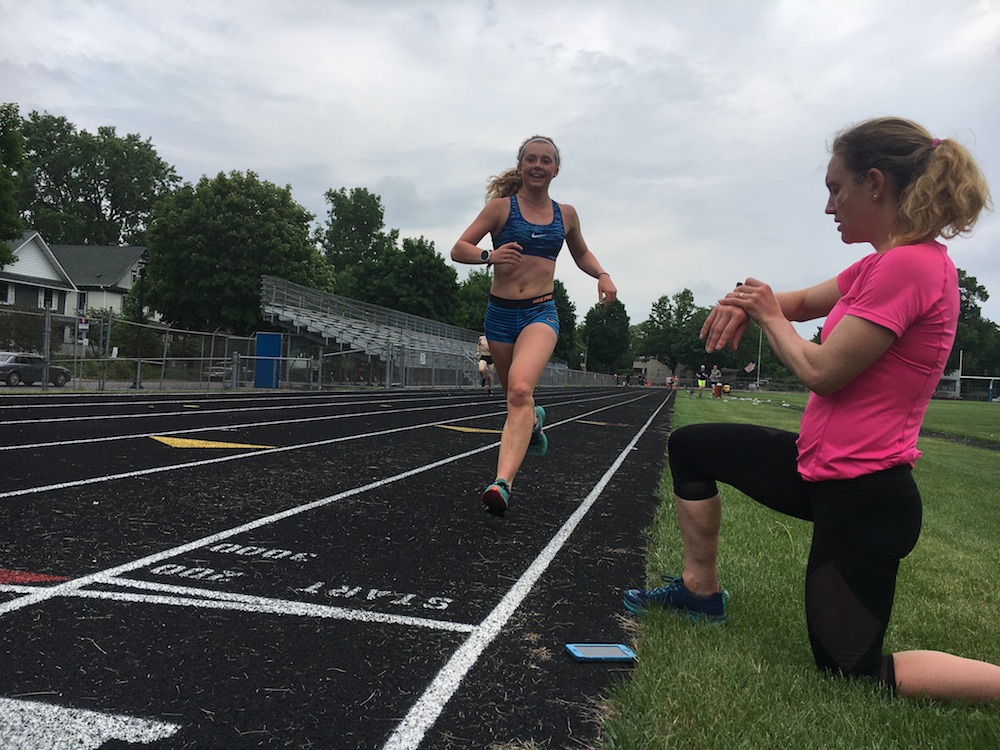
Coach Caitlin Gregg times Loppet Nordic Racing junior Sarah Olsen during a track time trial in the spring of 2018. (Courtesy photo)
The Questions I Ask
So both how I assess training load and recovery with HRV, and how I plan training around consistent loads, have completely changed how I evaluate training decisions. Sometimes the right decision is to add more training load. Often it is not. Other times it is to repeat a sustainable load so the athlete can stay consistent and adapt to it.
I always ask the question: If we do workout X today, or load X this week, how will it affect the athlete next week or next month? We also need to ask what we are trying to improve, what dose we need to improve it, and how we will know if it improved.
Ian Torchia leads L3 intervals with the Stratton Mountain School team in June 2018, with U.S. Ski Team head coach, Matt Whitcomb, following on a bike. (Photo: Pat O’Brien)
Old Becomes New Again
Then we must address the recent trends, and perhaps not so recent, in high-intensity training. In the mid-to-late ’80s and into the ’90s, high doses of threshold training were the “thing.” Then, in the late ’90s and early 2000s, VO2max blocks became the next “thing,” and after that it was back to VO2max workouts in a somewhat more controlled fashion. Now, over the last five or so years, based on the training of a speed skater and some Norwegian triathletes, we are back to so-called threshold and subthreshold training.
In essence, all things old become new again. What is missing from the trends is not the actual training; for some athletes it may well be the correct pathway. What is missing is an assessment of what limits the athlete’s performance. Without judging the merits of either high-intensity methodology, some athletes may need more focus on VO2max work, and others may well benefit from threshold-type workouts. In the simplest terms, an athlete with a very high fractional utilization may benefit more from a higher volume of threshold work, while those who do not have a well-developed aerobic capacity may benefit more from VO2max-type work. For elite athletes with a very high fractional utilization, threshold-type training probably also creates a signal to improve VO2max, or the speed at VO2max, because the intensity is relatively in the same zone.
Regardless of the type of high-intensity training an athlete is doing, we should be most focused on assessing and measuring how efficiently they are moving, their speed, and their durability to sustain that speed. Because no matter what the training methodology is, if you are not consistently improving performance, the training is not working.
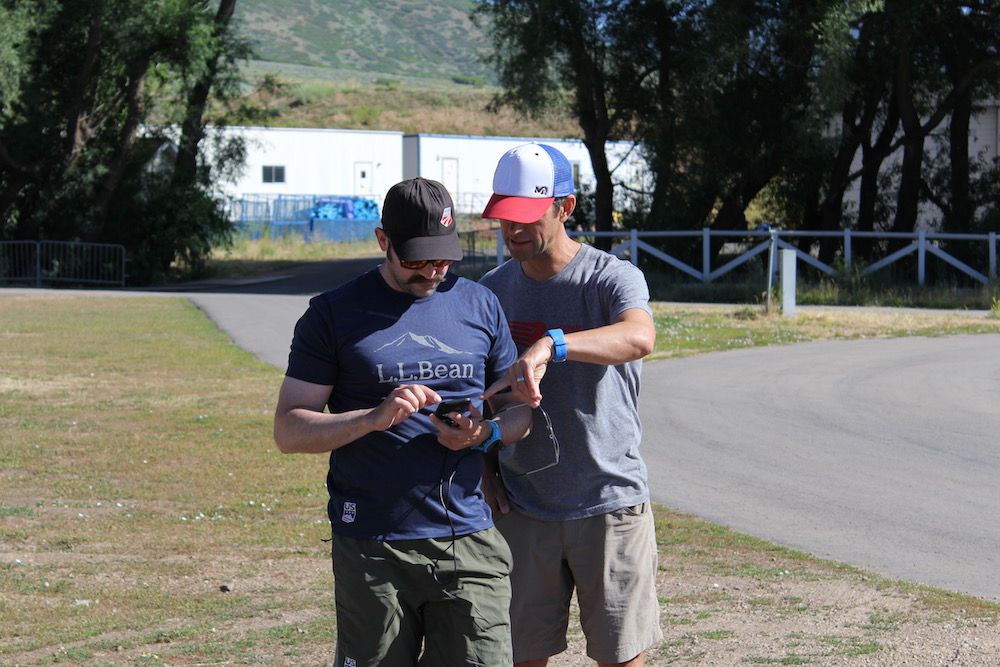
U.S. Ski Team coaches Jason Cork and Chris Grover go over the details for a distance time trial at Soldier Hollow in Midway, Utah, in 2017. (Photo: Pat O’Brien)
The Plan Is a Snapshot
The most basic element, and the one most coaches spend hours and hours on, is the training plan. We plan periodized models of increasing training volume, and when and how to implement high-intensity training. We plan when to do races or time trials, when to focus on speed training, and how to fit in strength training and other aspects of performance. Yeah, that is all well and good, but it is mostly an exercise in futility. In my opinion, the training plan was valuable on the day it was written, based on where the athlete was at that snapshot in time. Once a plan is in place, there is a temptation, if not a certainty, that the athlete will do everything in their control to carry it out regardless of how they are feeling or what they need right now.
I did this for years. I spent hours developing an individual plan and expected the athlete to carry it out as some kind of infallible document. That is not how the body works. Nowadays I still write year plans, but with far less detail on hours and specifics, and more explanation of what we want to accomplish in each period rather than details of volume and periodization. I want the plan to create an environment with flexibility, where we use the data, and how the athletes are feeling and adapting, to adjust the day-to-day training.
After more than 50 years, I still believe in the value of consistent training, appropriate volume, controlled intensity, and patience. What has changed is how I decide what an athlete needs and how willing I am to revise that decision.
I once spent more time asking whether the athlete had completed the plan. Today, I spend more time asking whether the training is producing the response we intended, whether the athlete is absorbing it, and what that tells us about the next step.
I expect some of my thinking will continue to change. Experience gives me a foundation, but it also gives me reasons to keep asking questions. The responsibility I have as a coach is to pay attention, assess honestly, and act on what I learn, even when that means changing a plan I believed in when I wrote it.
Help Support Our Coverage!
If you value the thoughtful work and access FasterSkier provides, please consider becoming a Voluntary Subscriber. Your support directly fuels our work to cover the people, places, and moments that make our sport special.
Hailey Swirbul during an intensity session at a U.S. Ski Team camp in Park City, Utah, in October 2018. The same pace can cost an athlete very different amounts from one day to the next. (Photo: Matt Whitcomb)
In my last article on training zones, published on FasterSkier, I tried to describe the challenges we face when we don’t use a common language. There is a lot of talk on social media about Zone 2 training, while most of us in the cross-country ski world understand this same training intensity as Zone 1. Others challenge the use of heart rate to set zones at all. These discussions are great, because they push all of us to better explain our beliefs and how we got there.
Today I want to share why I think heart rate is, for most athletes, a useful, available indicator of cardiovascular stress, even though it doesn’t necessarily capture the complete cost of exercise. I often hear that heart rate is too variable: heat and other environmental conditions can change it; fueling, hydration and fatigue can affect it; it doesn’t stay the same at the same workload (pace or power); and it doesn’t react quickly enough during hard efforts. All of which has some truth to it!
Hannah Halvorsen (left) ski bounding in Park City, Utah, in June 2016. Heat, altitude, fueling and fatigue all change what a given pace costs, and heart rate reflects that cost. (Photo: Bryan Fish)
Cost or Pace?
But let’s break it down. For all endurance work, from easy endurance work below 72 percent of maximum heart rate up to high-intensity work at 95 percent of maximum heart rate, heart rate is an indicator of the physiological demand and strain associated with producing energy. So when it is said that we should use other metrics to implement and track training because of these variations, I say, really? Shouldn’t we train day in and day out based on how the body responds to those external conditions? The same pace, power, speed or workload can carry widely different physiological demands on any given day. So what are we trying to train: the metabolic cost, or the speed, power or pace we can maintain? I would argue both, but in very different circumstances.
I should note that while I use percentages of maximum heart rate to discuss training, that doesn’t mean percentages of maximum heart rate are the best way to determine training zones. It is not a bad method if you test for maximum heart rate, but there may be better ways to use actual performance data to set training zones.
David Norris and Scott Patterson during a set of pre-race classic intervals. Outside of heart rate and perceived effort, few training metrics get measured every day. (Photo: Tom Horrocks)
Every Metric Moves
Then there are those who say we should use lactate, heart rate variability (HRV), rating of perceived exertion (RPE), ventilation, respiratory exchange ratio (RER) and other metrics that change with improved fitness. In fact, those may be better or similar metrics. The problem is that, except for RPE, they are not typically measured daily, so coaches don’t see how much they can vary from one day to the next. Any measure requires context to understand its daily variation. Why? Because the body changes every day in response to life and training stressors.
All of these measures require context, consistent testing protocols and an understanding of their day-to-day variability to be effective. The bottom line is that we need metrics that can be measured daily to understand how athletes are responding and adapting to training. When we are doing aerobic endurance training, often described as Zone 2 and, in the ski world, as Zone 1, the oxygen cost is reasonably reflected in heart rate during exercise.
Certainly, the metabolic cost of training changes from day to day with internal and environmental factors, which can require a higher heart rate to produce the same energy output. We also see heart-rate drift during these workouts: at the same pace or power, heart rate climbs. My response is, OK, this represents an increase in internal cost, and we should definitely respond to it. No metric is perfect, but heart rate captures an important and significant part of the internal strain of training.
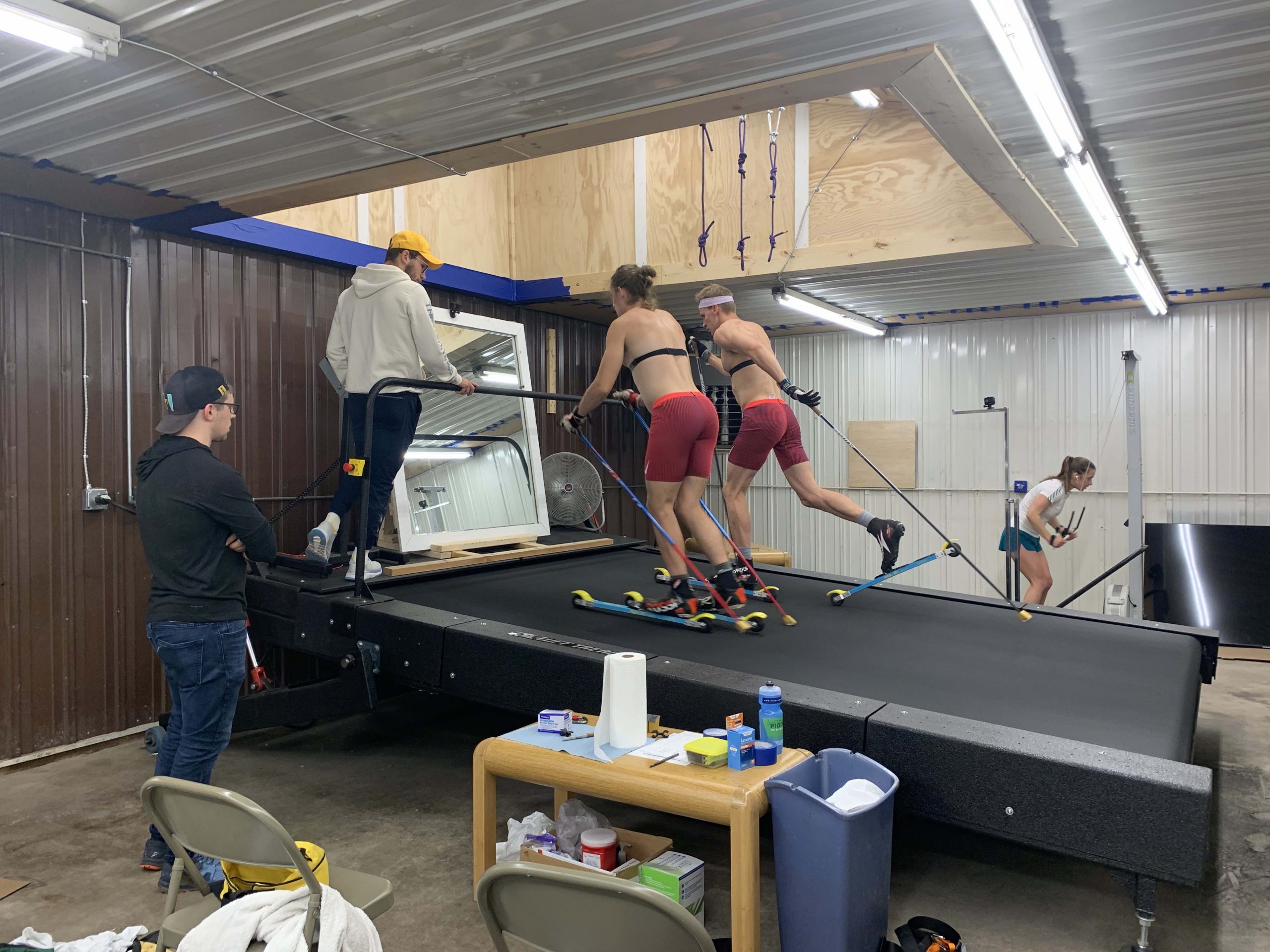
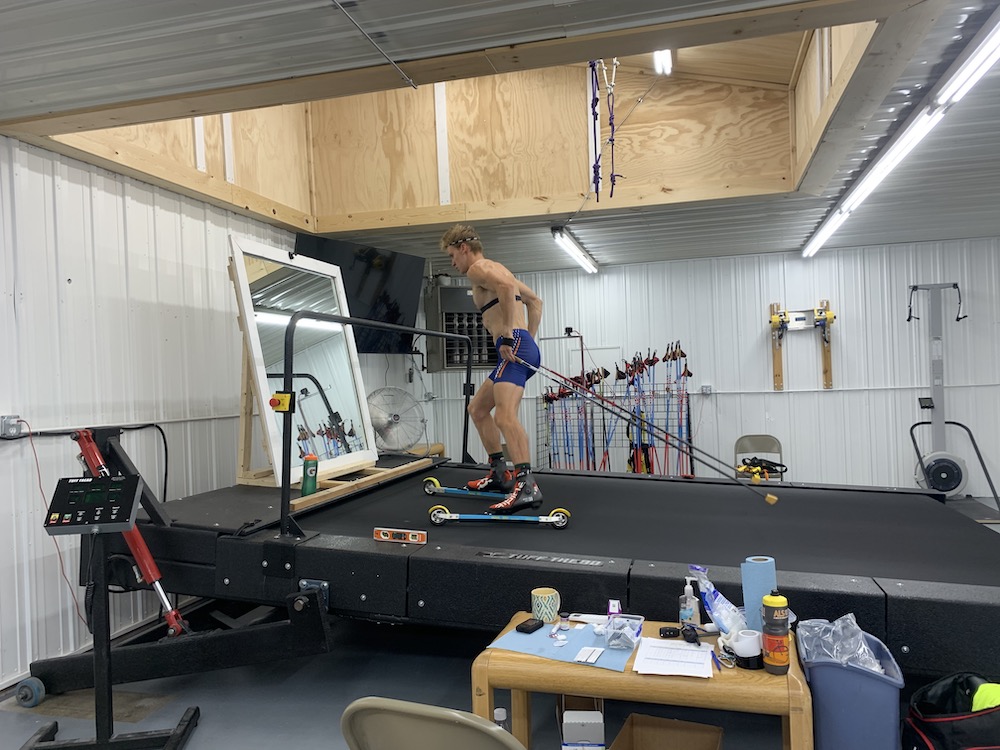
Team Birkie’s Xavier Mansfield (left) and Zak Ketterson share a rollerski treadmill in 2021 while coaches Leo Hipp and Jeremy Hecker give feedback. A lab number is a snapshot unless it is measured often enough to show its own daily variation. (Courtesy photo)
Variation You Never See
To those who say other measures (ventilation, HRV, lactate levels, respiratory exchange ratio, respiration and others) are more accurate, OK. But without seeing how those measures change from day to day, you have no idea of the variation. People use lactate to guide training, for example, and the same goes for newer measures of muscle oxygen saturation and ventilation. They often set training zones at arbitrary levels, or from equally arbitrary estimates based on a visual read of a lactate curve, then assign work based on those values. But if lactate is not measured often during daily training, you have no idea how consistent those values are, or how they vary in response to the same factors that affect heart rate. From my observations, all of those metrics vary as much as heart rate.
No matter how we cut it, none of these measures is as precise as we like to think, because the body changes and responds daily to stress and external factors. And yes, what we are after is a measure we can observe every day. So let’s recognize the facts. Heart rate represents the internal cost of work. Sure, there are daily variations. But over time, and with context, we can understand those changes.
Kendall Kramer (right) in the 10 k classic at the Lahti World Cup on March 8, 2026, an interval-start race she finished in 27:40.8. Galanes puts races of 15 to 30 minutes in the middle of Zone 4. (Photo: Authamayou/NordicFocus)
How I Set Zones
So this is how I use training zones. First, I use the zones as a tool to implement and assess the effects of training on each individual. Those assessments help us determine whether the zones and the training are effective. I believe training zones provide a reasonable method that will work for most athletes and doesn’t require regular lactate or lab testing or other expensive equipment.
So what do I do? I don’t do regular lab testing, because the athletes I coach live all over the country and many don’t have access to or opportunities for it. It is also quite expensive, and most importantly, I have often seen over the years that what we learn in a lab setting doesn’t correlate with what we see in training.
I do a six-minute test, which, according to research by Véronique Billat, corresponds to the pace at which VO2max is achieved. I use the average heart rate of the last two to three minutes of the test, and I assume that to be about 94 to 95 percent of maximum heart rate. Yes, I assume! But the six-minute test also gives me a repeatable field performance and a high heart-rate observation. I use it to inform my initial estimates, not as a direct measurement of VO2max pace or maximum heart rate. The point is to establish workable ranges, observe how the athlete responds and revise them when the evidence warrants it.
I also look at racing and high-intensity workout performance. Short races of 10 to 15 minutes should be in the top range of Zone 4. Races of 15 to 30 minutes should be in the mid-range of Zone 4, and races of 45 to 60 minutes in the low to mid-levels of Zone 4.
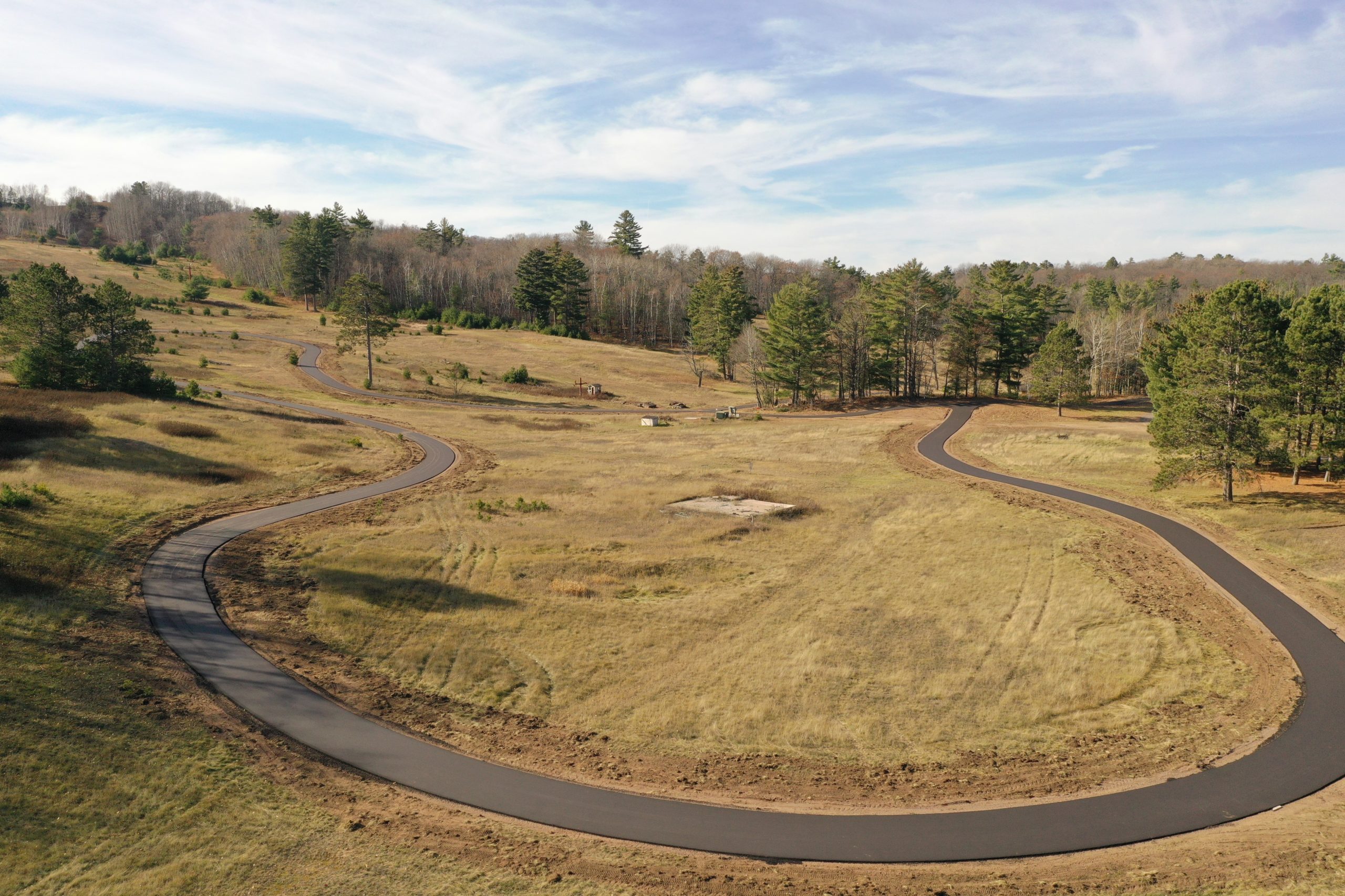
The 5-kilometer paved rollerski loop at the base of Mt. Telemark, outside Cable, Wisconsin, when it was laid in 2023. A fixed loop like this is all a Zone 1 check needs: 45 to 60 minutes of laps, with lactate and heart rate taken after each one. (Photo: American Birkebeiner Ski Foundation)
Checking Zone 1
To confirm the accuracy of Zone 1, I have athletes do 45 to 60 minutes of work on a standard loop of about 15 to 20 minutes, and we take lactate measurements after each loop. If lactate and heart rate remain stable, we know the endurance Zone 1 training is in the correct range. A stable lactate response suggests that the intensity is easy enough, but it does not necessarily identify the first lactate threshold, or LT1.
We need to understand that no method of determining training zones is precise. The body just doesn’t operate that way. For any training adaptation there is an optimal point of adaptation, but also a much broader range in which the adaptation occurs. So the objective when implementing training is to be as close to the optimal point as possible. But knowing where that is day in and day out is impossible, so being within a reasonable range is the goal.
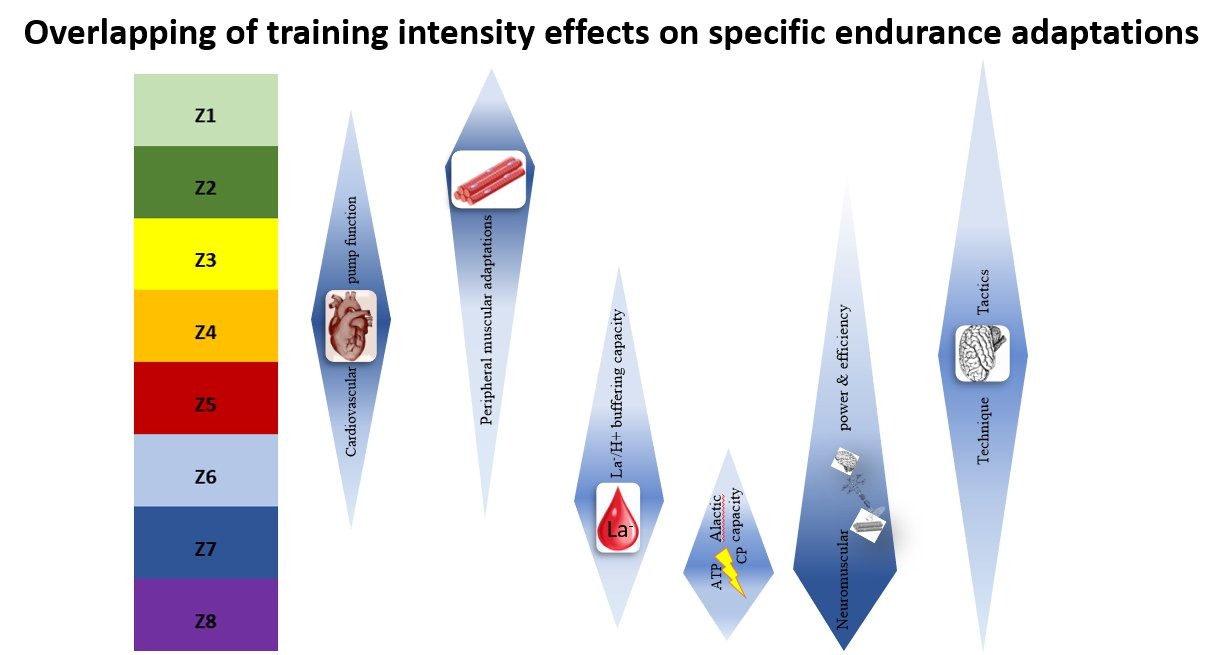
Every adaptation has an intensity where it responds best and a much wider range where it still responds. (Figure: redrawn from Olympiatoppen educational material, 2020)
Close Enough
My conclusion is that using field-testing measures along with training and race performance data to support training-zone determination is adequate, and it allows us to build ranges that can move as fitness changes. There are no ideal “thresholds” or clear metabolic points we can use to determine training zones. LT1 and the second lactate threshold, LT2, are useful reference points, but different protocols and definitions can produce different estimates for the same athlete.
Other thresholds, determined by heart rate variability, DFA alpha1, respiration and muscle oxygen, may prove useful in the future, but so far they have not been fully validated and likewise cannot identify clear physiological thresholds.
So we are left with what is practical and available to developing and recreational athletes. Let’s get close enough, control training effectively and learn what works based on the data for each athlete. Heart-rate metrics fit that need best.
We can debate exactly where one training zone ends and another begins, but no test gives us a number that will describe an athlete perfectly every day. For the athletes I coach, heart rate gives us a practical place to start and a way to follow their response over time. I use field tests and race results to establish working ranges, then look at heart rate alongside pace, perceived effort, conditions and, when available, lactate. If those observations no longer agree, I revisit the zones.
The goal is not to defend a particular method or number on a chart. It is to help an athlete do the work as intended on a given day, learn from the response and make a better decision the next time. That is where training zones earn their value.
Help Support Our Coverage!
If you value the thoughtful work and access FasterSkier provides, please consider becoming a Voluntary Subscriber. Your support directly fuels our work to cover the people, places, and moments that make our sport special.
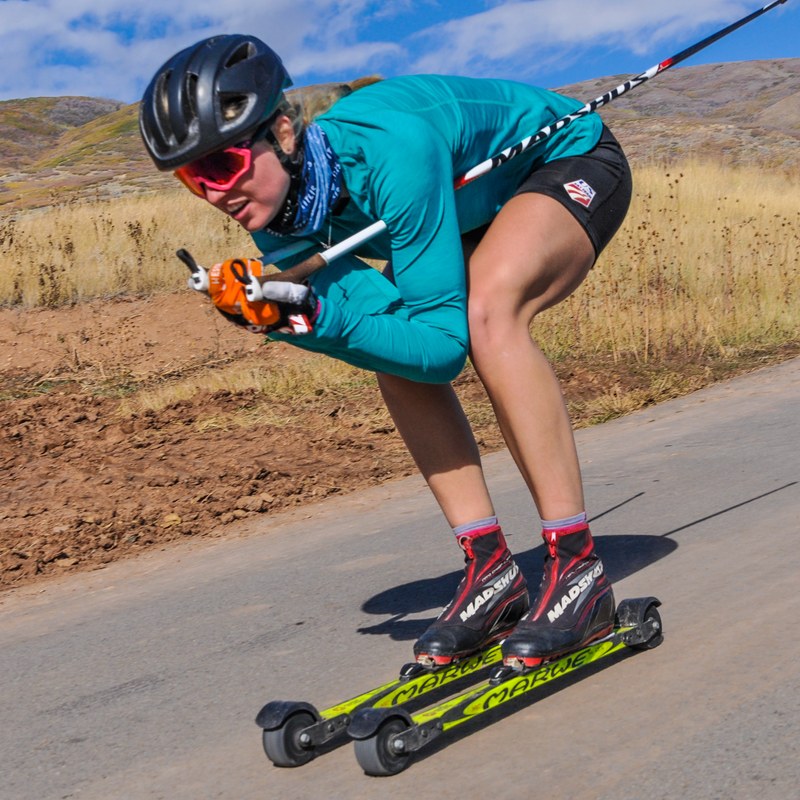
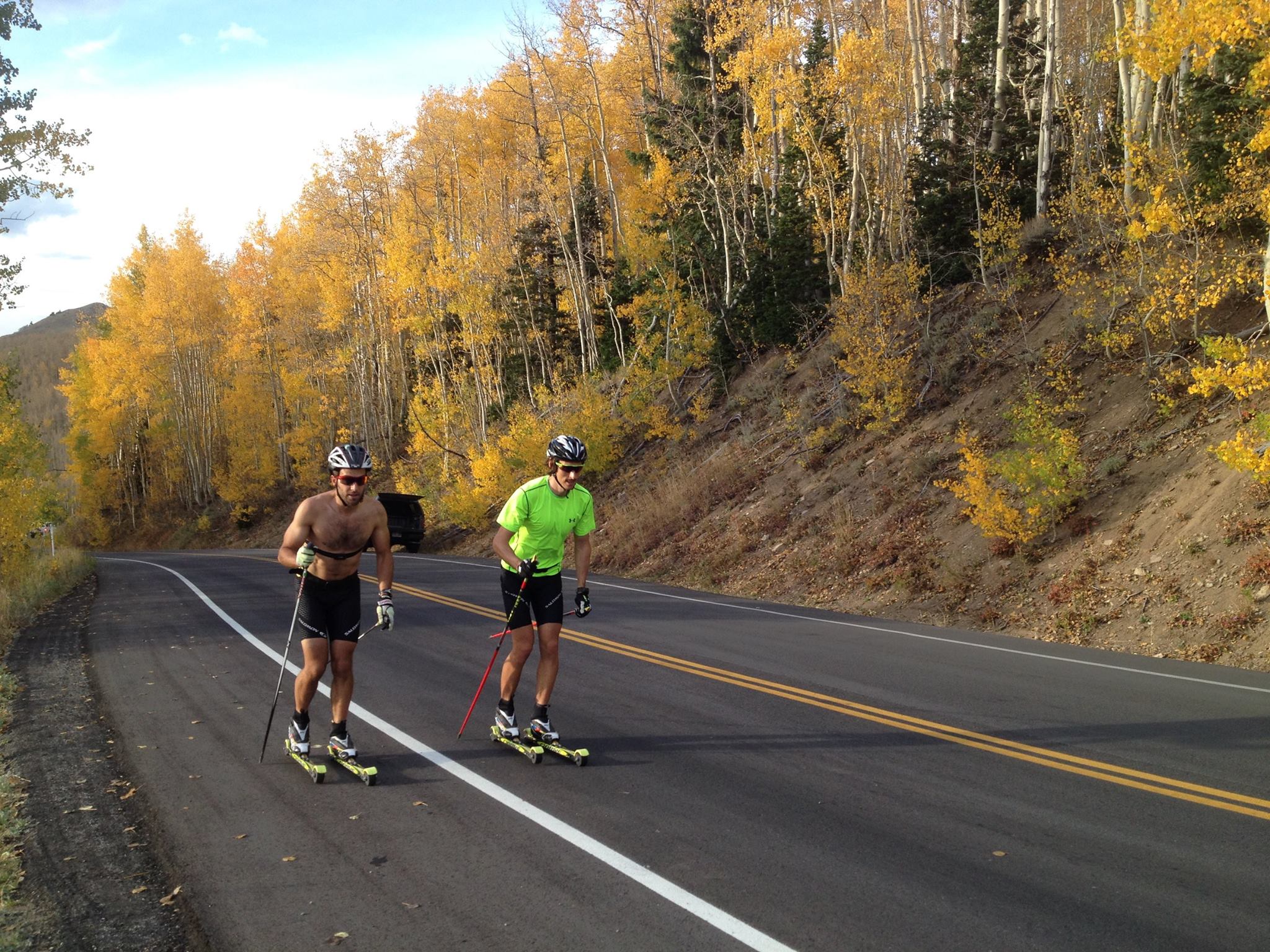
Canadian biathletes Brendan Green and Scott Perras rollerskiing up Guardsman Pass above Park City, Utah, during a fall 2015 camp. (Photo: Matthias Ahrens)
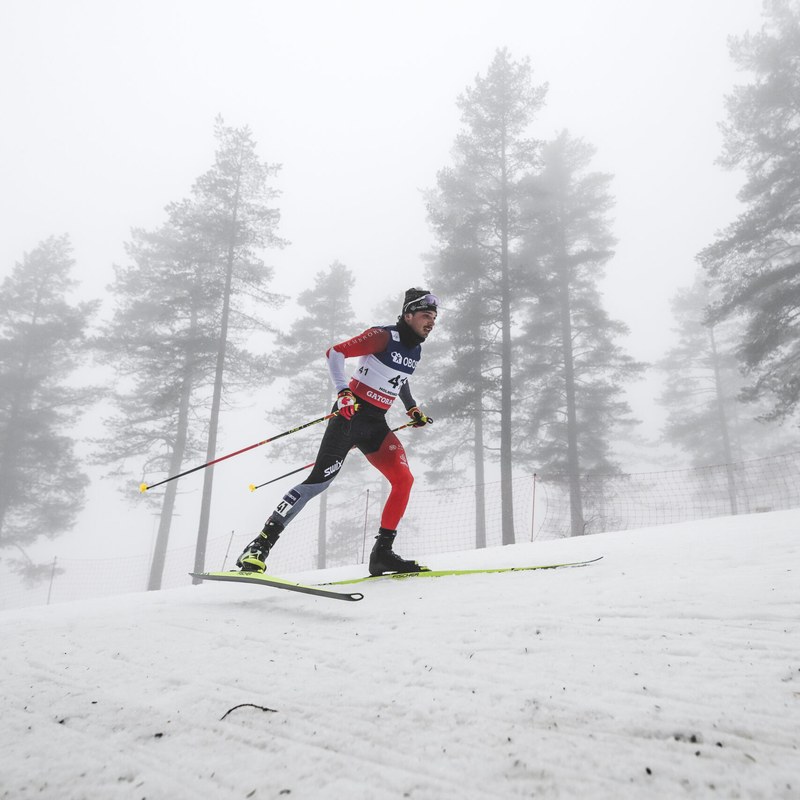
Thomas Stephen of Canada in the fog at the Oslo World Cup mass start in March 2026. One coach’s Zone 2 can be another’s Zone 1, and the label means little until you know what it is anchored to. (Photo: Authamayou/NordicFocus)
Over the last decade I have often thought that we need to find a better way to define training zones. I have assessed every model under the sun and even tried to create some new ones. From a metabolic perspective, three-zone models probably make the most sense, because physiological anchors form the transition points, even though some of those anchors, lactate threshold among them, are questionable. Then there are five- and seven-zone models. Which are best, and which are most accurate? The answer is probably none of them. They all have limitations, and there really is not a better method.
Some coaches set training zones from maximal heart rate. Others use lactate measures referenced to heart rate, pace or power, and still others use gas analysis (ventilation, VO2, RER and so on). Whatever the method, the important point is how the zones are used and implemented in training. While there may be a valid physiological basis for training zones, their primary use is to quantify training as planned and as performed. That is how we assess which methods of training have worked for the individual athlete.
Julia Kern racing the 10 k freestyle at the Trondheim World Cup in December 2025. A higher heart rate at a standard effort can reflect heat, glycogen depletion or fatigue, and all of those should change the day’s training. (Photo: Modica/NordicFocus)
Heart Rate Holds Up
Many coaches and even physiologists claim that heart rate is too variable to be used reliably for training control. Of course it is variable. Physiology varies daily with fatigue, recovery, hydration, glycogen status and more. In my experience, heart rate is no more variable than any other metric we use. We just don’t recognize the variation in the others, because it is not practical to measure them every day. Human physiology is complex, and in general heart rate reflects the current status of an athlete’s physiology. Under any system, it is important to train at a level that reflects the individual’s physiology and condition on that day. Heart rate is as good as anything for that, and I would argue better, because the daily variation is easy to assess.
Heart rate is inexpensive, practical and physiologically informative. A higher heart rate at a standard workload can reflect warm weather, glycogen depletion or general fatigue, all of which matter when adjusting the day’s training. A lower heart rate at a standard workload often reflects improved fitness, though occasionally it can also reflect fatigue and increased parasympathetic drive of the autonomic nervous system.
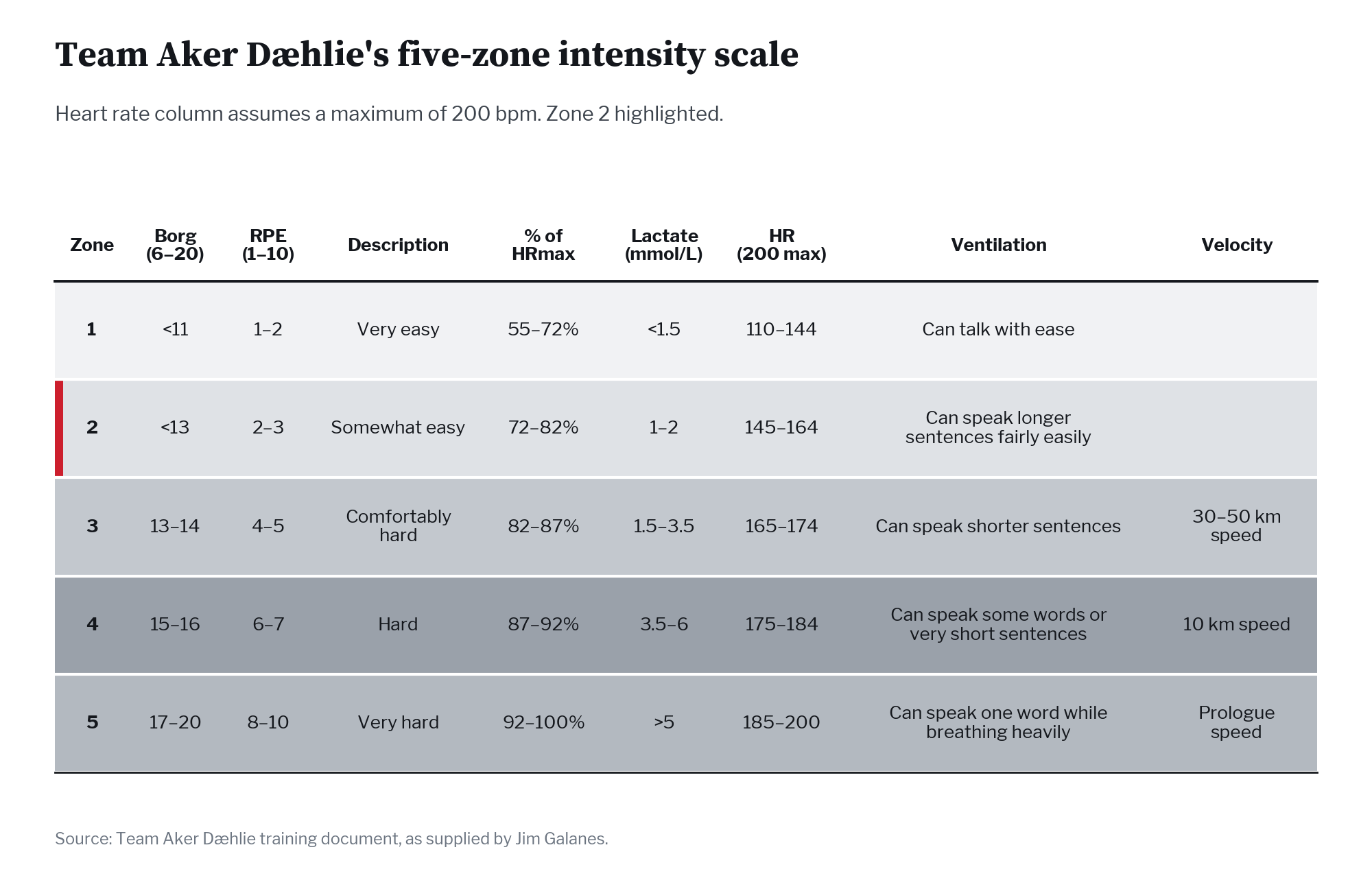
Team Aker Dæhlie’s five-zone scale. Its Zone 2 runs from 1 to 2 mmol/L of lactate, overlapping Zone 1, which sits below 1.5. (Chart: FasterSkier)
Whose Zone 2?
One example is a document published a few years ago by Team Aker Dæhlie in Norway, which laid out a slightly different training zone model than I was used to seeing out of Norway. Given the popularity of Zone 2 training, I believe it is important to understand how the proponents of a particular system of training define and use their zones.
In the Aker Dæhlie system there is significant overlap between Zones 1 and 2 in terms of lactate, with Zone 1 below 1.5 mmol/L and Zone 2 at 1 to 2 mmol/L, while the heart rate ranges are what I consider consistent with how most training zones are delineated. The implication of that lactate range is that lactate is highly variable and not the same between individuals. From the published document we can see that their Zone 2 does not fit what some may consider Zone 2. It fits how I would describe Zone 1: endurance training not to exceed 70 to 75 percent of maximal heart rate. We need to realize that lactate may vary greatly from day to day and can’t be viewed as a hard and fast anchor for a specific training zone.
Listening to many podcasts and reading many articles and publications, I hear people discuss training zones as if they were talking about the same thing. Most often they are not. The recent popularity of Zone 2 training is a good example: what Iñigo San Millán means by Zone 2, many of the common five-zone models would define as Zone 1.
So if you want to use and reference the Aker Dæhlie zone system, you should also be aware of this statement about Zone 2 in their published document:
Zone 2: Semi-hard long sessions with a heart rate at around 140-155 bpm and with lactate up to 2 mmol/L, is considered intensity 2 training. Scholars debate over the importance of this training. In our experience, this training costs more than it is worth, and should therefore not be prioritized. L2 can work well to learn/automate correct technique. Again, evaluate cost vs benefit! Typical length of a session is 1 to 3 hours of continuous activity.
Zones 3, 4 and 5 are close to how many would describe training in those ranges, although Zone 3 here may sit a bit lower than it is often described. But the Aker Dæhlie team is primarily a long-distance team, and we don’t know whether they use different zone ranges for World Cup skiers, or whether World Cup skiers do more of their intensive training in Zone 4.
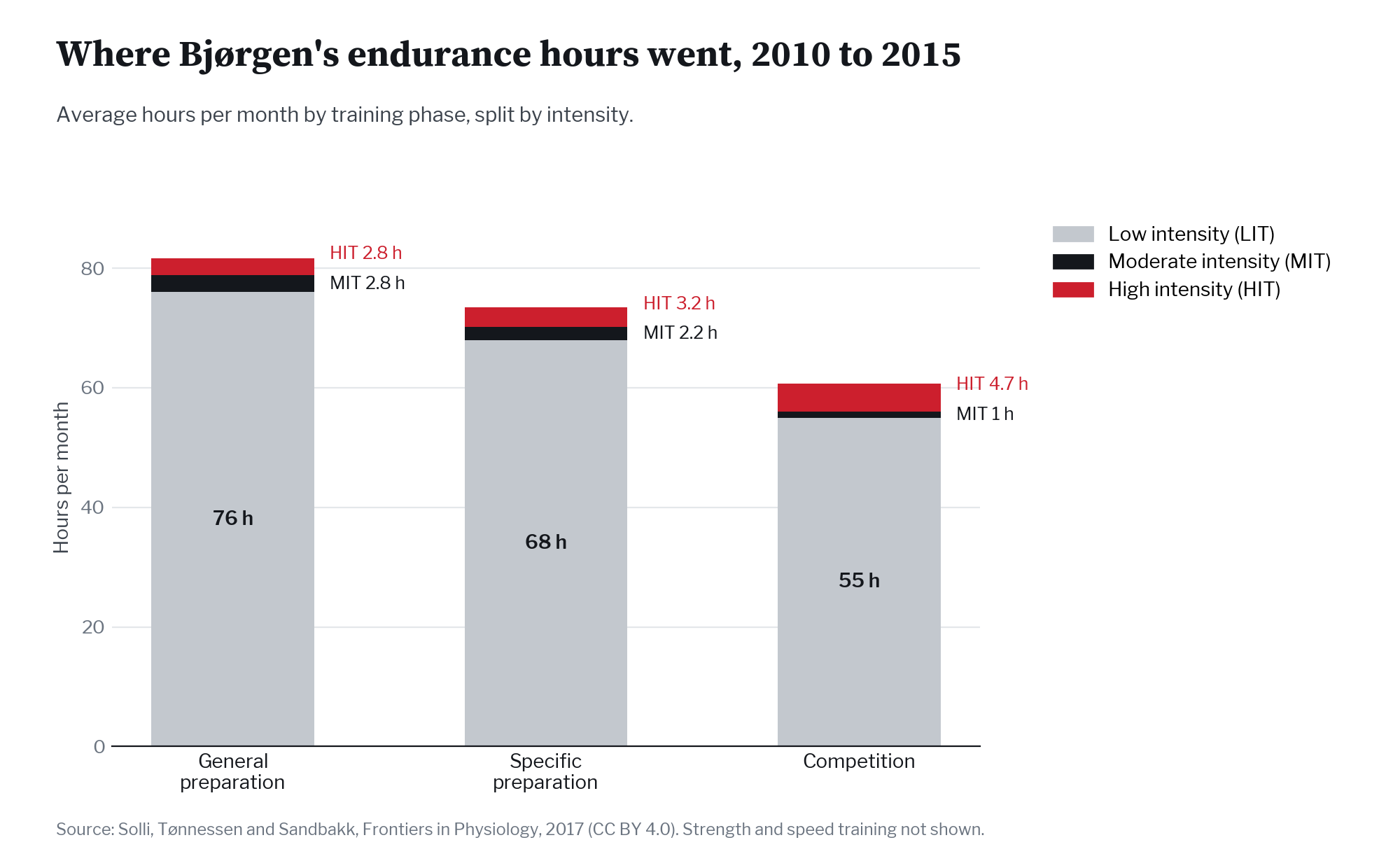
Marit Bjørgen’s average monthly endurance hours by phase during her most successful seasons. (Chart: FasterSkier. Data: Solli, Tønnessen and Sandbakk, Frontiers in Physiology, 2017)
How Bjørgen Trained
A chart like the one above is often used to illustrate how one of the best female cross-country skiers ever trained during her most successful years. The data comes from an extensive study of Marit Bjørgen’s training.
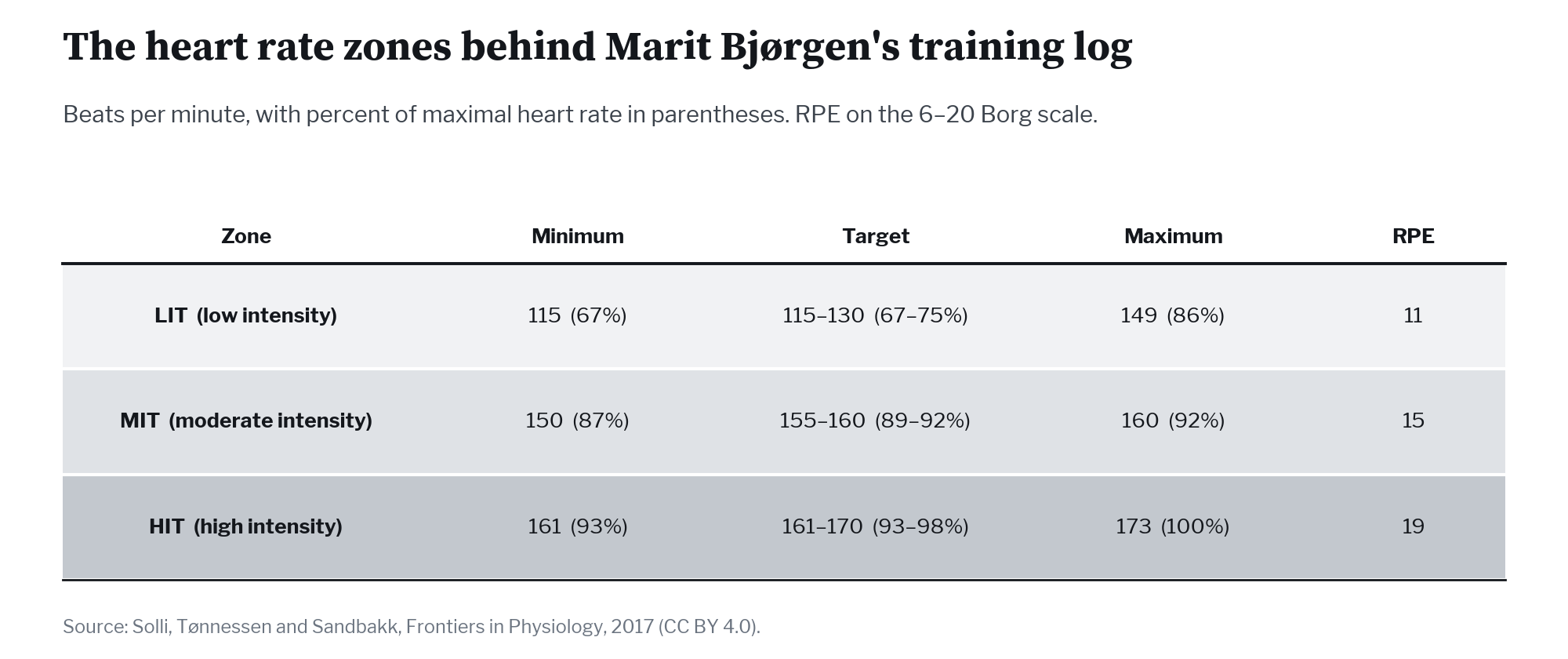
The zones used to classify Bjørgen’s training. The top of the low-intensity target and the bottom of the moderate-intensity target sit 25 beats apart. (Chart: FasterSkier. Data: Solli, Tønnessen and Sandbakk, Frontiers in Physiology, 2017)
A 25-Beat Gap
To provide context, these are the zones used to define this athlete’s low-intensity (LIT), moderate-intensity (MIT) and high-intensity (HIT) training. The low-intensity target is where we might expect it, at 67 to 75 percent of maximal heart rate. However, there is a large gap, some 25 beats per minute, between the low- and moderate-intensity targets, with the MIT target at 89 to 92 percent of maximal heart rate. That MIT zone is quite different from what is described in the Aker Dæhlie document.
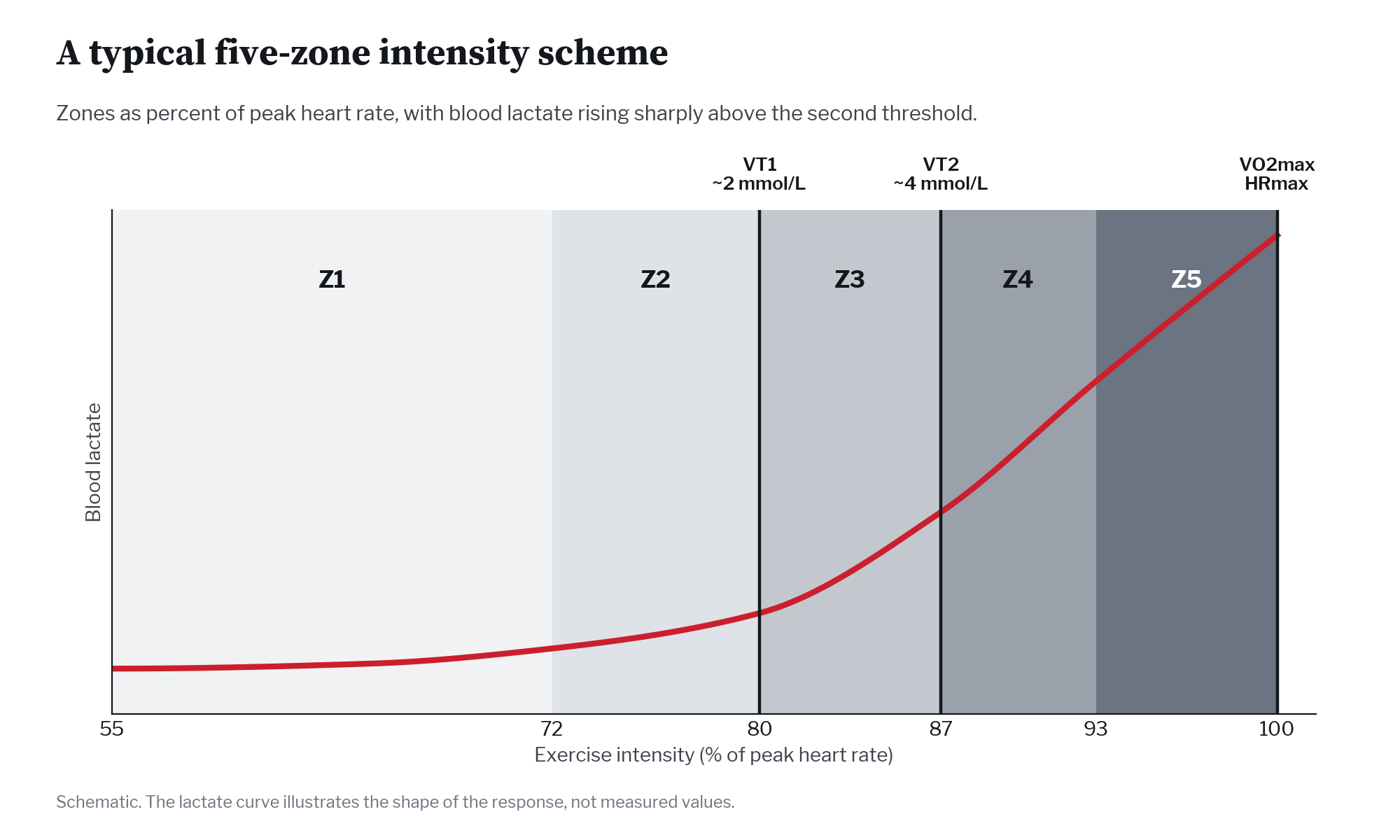
A typical five-zone scheme places the first ventilatory threshold at about 80 percent of peak heart rate. For most athletes, Galanes argues, it sits lower. (Chart: FasterSkier)
Another Common Model
Here is another example, much like the zone table published by Aker Dæhlie. It is a good theoretical model, but again I would suggest that endurance training above 75 percent of maximal heart rate is unnecessary, and the cost-benefit assessment does not suggest a benefit. We also see that LT1/VT1 is probably not at 80 percent of maximal heart rate for most athletes.
Each adaptation has an intensity where it responds best, but none of them stops at a zone boundary. (Figure: redrawn from Olympiatoppen educational material, 2020)
Zones Overlap
Most of us consider training zones hard and fast, but that is not the case. The chart above illustrates the possible range of metabolic and neuromuscular benefits of different training intensities. I believe the reason to use zones and monitor training is to ensure effective training adaptation. That is why I say that endurance training at more than 70 to 75 percent of maximal heart rate does not have a positive cost-benefit. As recovery time increases, adaptation slows, and the time to readiness for the next hard session can be extended.
The chart is an excellent depiction of how adaptations overlap across training intensities. Each metabolic and neuromuscular adaptation has a theoretical optimal range, but the adaptations still occur well outside those ranges.
A lactate test in the middle of a hill-bounding session, with coach Will Sweetser and Quinn Holan. If you use lactate, spot-check often enough to learn your own daily variation. (Courtesy photo)
My Advice
When analyzing what others say or publish, look closely and question what their training zones are based on. You must be speaking the same language before implementing any changes.
Pick a training zone model that makes sense to you. If you are going to use lactate, you must do frequent spot checks so you understand your individual daily variation. You absolutely cannot rely on a one-off test to make training decisions.
Use new and emerging technology, such as respiration and muscle oxygen monitoring, only after validating its consistency and variability.
Don’t jump from trend to trend. There are a lot of them out there. Learn from what has worked, and weigh emerging science against experience. Remaining current does not mean trend-hopping to stay relevant on social media.
Be clear on terminology. The same term can mean very different things to different scientists and coaches.
Use a couple of tests that produce meaningful data and inform training decisions. Collecting more data does not make for better programs.
For most people, perhaps everyone, percentage of maximal heart rate is a practical way to determine training zones.
Help Support Our Coverage!
If you value the thoughtful work and access FasterSkier provides, please consider becoming a Voluntary Subscriber. Your support directly fuels our work to cover the people, places, and moments that make our sport special.
Kate Oldham racing the 10 k freestyle at the Trondheim World Cup in December 2025. Races of 5 to 15 kilometers, Jim Galanes points out, are not raced at threshold. (Photo: Modica/NordicFocus)
For the last couple of decades, the priority for high-intensity training has shifted from threshold, to VO2max, and now back to threshold again. Nowadays threshold training is increasingly presented as the ideal endurance training intensity. The suggestion is a high aerobic stimulus at a low recovery cost, repeatable and sustainable. VO2max is often portrayed as the opposite: a very high stimulus, high stress, very high fatigue, and something to be used carefully, if at all. Folks, we have seen this story before, in the threshold boom of the mid to late ’90s.
From some perspectives this may be intuitively correct and perhaps logical. If we compare one minute of threshold work to one minute at VO2max intensity, the VO2max work is more demanding. That is a no-brainer. There is more carbohydrate use, higher oxygen demand, higher lactate production, greater perceived exertion and generally a greater physiological disturbance. But is that the way training really works? We build training plans around individual workouts and daily and weekly loads, not per minute of high-intensity training.
For example, we might plan 5 x 4 minutes at VO2max intensity, or 20 minutes of total work. Or it might be 4 x 10 minutes at threshold, or 40 minutes of total work. When we look at the load of the whole session, things become far less clear. Both types of training produce similar adaptations, although the adaptive signal from the higher-intensity work is much stronger, and there is little evidence that a threshold session creates less recovery demand than an appropriately controlled VO2max session.
This is really the point I want to make. We need to stop confusing intensity with training load, and, perhaps more important, we need to stop confusing training load with the recovery timeline. They are related, but they are not the same thing.
As I have written before, threshold is a moving target, and defining it is problematic. There are perhaps a dozen or more methods used to determine threshold, and they can produce very different speeds, heart rates, power outputs and lactate values. Some athletes are working just above LT1 and calling it threshold. Others are working around 4 mmol, and others are using ventilatory threshold, critical power, some percentage of race pace, or simply an intensity that feels controlled and hard. So when people say “threshold training,” I am not sure we are even talking about the same thing. That alone should make us careful about assigning a fixed physiological cost or benefit to threshold training.
The generally accepted training model is usually described like this: easy endurance training provides a relatively small stimulus at a relatively low cost, so we need a lot of it. Threshold gives us a much larger aerobic stimulus, still at a manageable recovery cost. VO2max gives us a very large stimulus, but at a very high recovery cost. Again, that makes intuitive sense, but is it true when we compare realistic sessions? I am not convinced it is. In fact, I am certain it is not.
If we think of training load in simple terms, it is a combination of intensity and duration. Higher intensity produces greater load per minute, while longer duration produces more total load. A 3-hour easy workout, for example, produces a bigger training load than a 75-minute workout with 5 x 4 minutes of VO2max intervals. This is obvious, but somehow we often forget it when discussing threshold and VO2max training.
Take a typical VO2max workout of five by four minutes, 20 minutes of work. Using Firstbeat’s TRIMP model, that might create about 55 to 60 TRIMP. Now take a threshold workout of four by ten minutes, 40 minutes of work. That might generate something in the 95 to 100 TRIMP range. With Firstbeat we can also look at EPOC as an estimate of the disturbance of homeostasis. Again, these are estimates and certainly not perfect measures, but 20 minutes at around 90 percent of VO2max might produce an EPOC of around 175 ml/kg, while 40 minutes at around 85 percent might produce an EPOC of 225 ml/kg. Once again the threshold workout produces a significantly higher stress load.
I don’t want to get hung up on whether those exact Firstbeat numbers are accurate, because that is not really the point. The point is that it is entirely possible for the lower-intensity session to produce the larger total load, and that should not surprise anyone, because it is twice as long.
The same thing happens if we use session RPE. Twenty minutes of VO2max work at an RPE of 9 gives us 180 AU (arbitrary units), while forty minutes of threshold at an RPE of 6 gives us 240 AU. Again, the threshold session creates the larger estimated training load. That does not prove threshold is more stressful or that it takes longer to recover from. TRIMP and session RPE are measures or estimates of training load, not measurements of recovery time.
We have at least three different things being discussed as if they were the same: the intensity of the exercise, the total load of the workout, and how long it takes the athlete to recover. A VO2max interval clearly creates greater physiological disturbance per minute. A longer threshold session may create a greater total training load. Neither one, by itself, tells us which athlete will be better recovered 24 or 48 hours later.
High cost per minute is not the same thing as high cost per session, and high session load is not necessarily the same thing as longer recovery.
Otto Invenius, Campbell Wright, Maxime Germain and Adam Runnalls climbing the Stelvio Pass on rollerskis above Livigno, Italy, in July 2025. The adaptations from threshold and VO2max work overlap far more than the zone names suggest. (Photo: Manzoni/NordicFocus)
What Are We Actually Trying to Adapt?
The other issue is that we spend far too much time talking about training zones and not enough time talking about desired adaptations. What adaptations are we trying to create? That should come first.
VO2max training provides a very strong aerobic stimulus at near-maximal oxidative capacity. It can increase maximal cardiac output, improve oxygen transport, create very high muscular oxygen demand and expose the athlete to speeds and power outputs similar to race demands. Threshold training lets us accumulate a large amount of work at a high aerobic fractional utilization. It can improve sustainable speed or power, oxidative capacity at that intensity, and the ability to maintain a high percentage of maximal aerobic power for a longer period of time.
These adaptations overlap a great deal. I sometimes hear people talk as if threshold develops lactate clearance and the muscles’ ability to sustain work, while VO2max develops the central cardiovascular system. But VO2max training creates a large muscular stimulus as well. ATP turnover is very high, calcium flux is high, metabolic disturbance is high, and the signaling associated with mitochondrial biogenesis is substantial. VO2max training is not simply “central cardiovascular training.” It also provides a significant peripheral training stimulus.
Threshold training obviously produces a similar but slightly smaller mitochondrial and muscular signal for adaptation. But I think its real advantage may be something much simpler. Because the intensity is lower, we can normally do considerably more of it. That allows us to accumulate a large amount of work at a high aerobic fractional utilization, with substantial muscular recruitment and a large amount of sport-specific work.
That may be threshold training’s most important characteristic. Not that it creates some unique physiological adaptation unavailable at other intensities, but that it allows us to accumulate considerably more work while still creating a high oxidative demand.
This can be particularly important for an athlete who already has a high VO2max and whose limitation is the fraction of that VO2max that can be sustained. If fractional utilization is relatively low, increasing sustainable aerobic power may be far more important than trying to push VO2max another few percent. For that athlete, a greater amount of threshold work may make very good sense.
But that is an argument based on the needs of the athlete, not an argument that threshold is inherently a better training intensity or that we recover from it more quickly.
Lactate clearance and resynthesis is another area where I think training discussions have become confused. We often hear that threshold training is necessary because the athlete needs to train to “clear lactate.” I have always had a problem with this explanation, because it is neither accurate nor scientifically valid. Remember, it is lactate we are talking about, not lactic acid, as many refer to it.
Lactate is not a waste product that suddenly appears at threshold and then needs to be removed. It is being produced, transported and oxidized all the time, at all intensities, and it is an important fuel. Endurance training improves the ability to transport and oxidize lactate, but there is no reason to believe this only happens at threshold. High-intensity interval training also improves lactate transport and can move lactate threshold substantially.
VO2max intervals also create very high lactate production and turnover. So if we are looking at the lactate shuttle, why would it only, or even preferentially, adapt when lactate is sitting around 2, 3 or 4 mmol? That doesn’t make much physiological sense to me. Producing higher levels of lactate will stimulate resynthesis.
The same is true for mitochondrial biogenesis, oxidative enzymes and capillarization. We cannot neatly assign these adaptations to one training zone, because there is considerable overlap between endurance, threshold and high-intensity training.
That doesn’t mean all intensities are the same. They clearly aren’t. It means we should be careful about inventing unique adaptations for a training zone simply because we have given that zone a name. Threshold training is not the only method, or even the optimal method, to improve lactate oxidation and resynthesis.
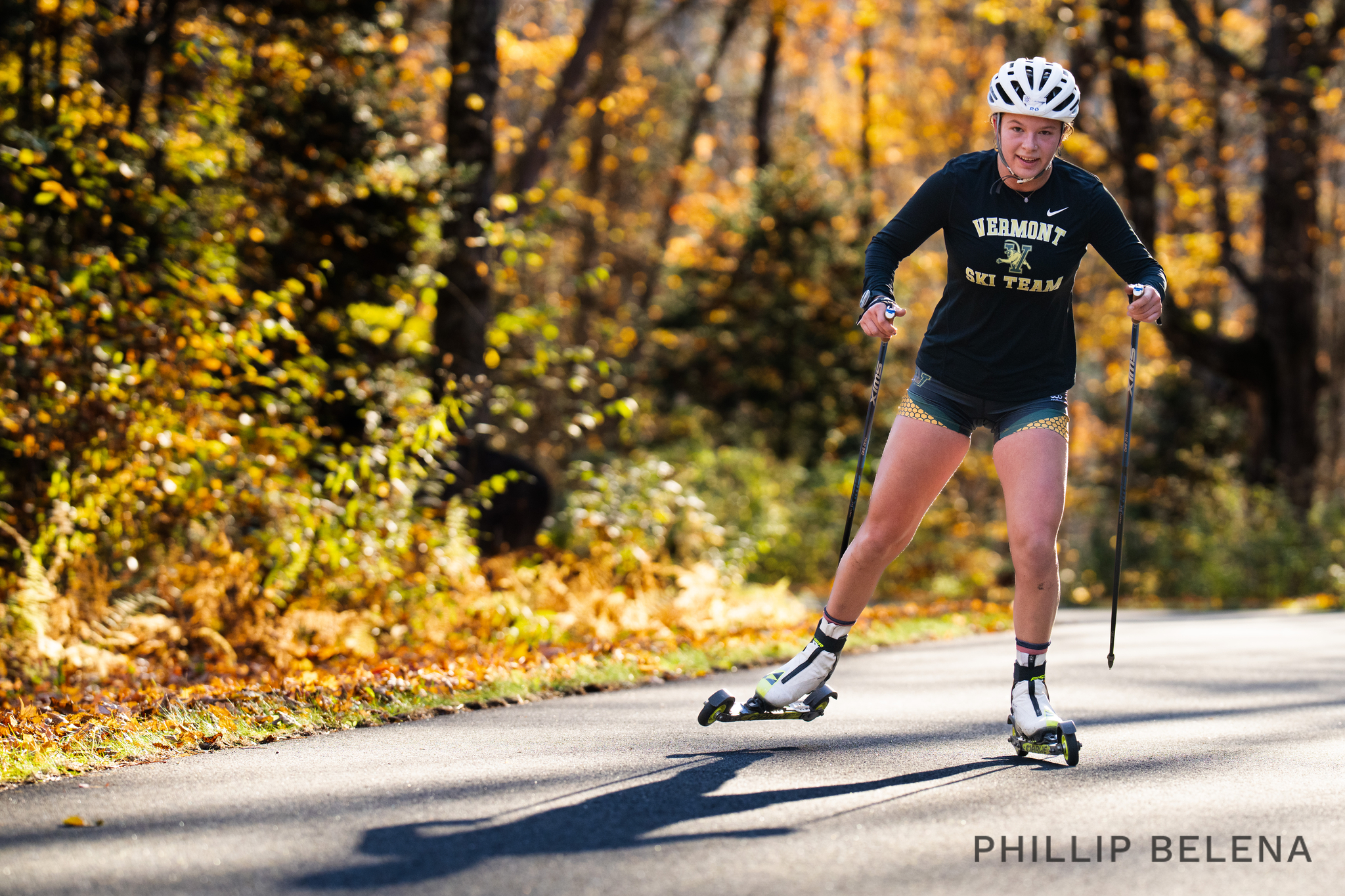
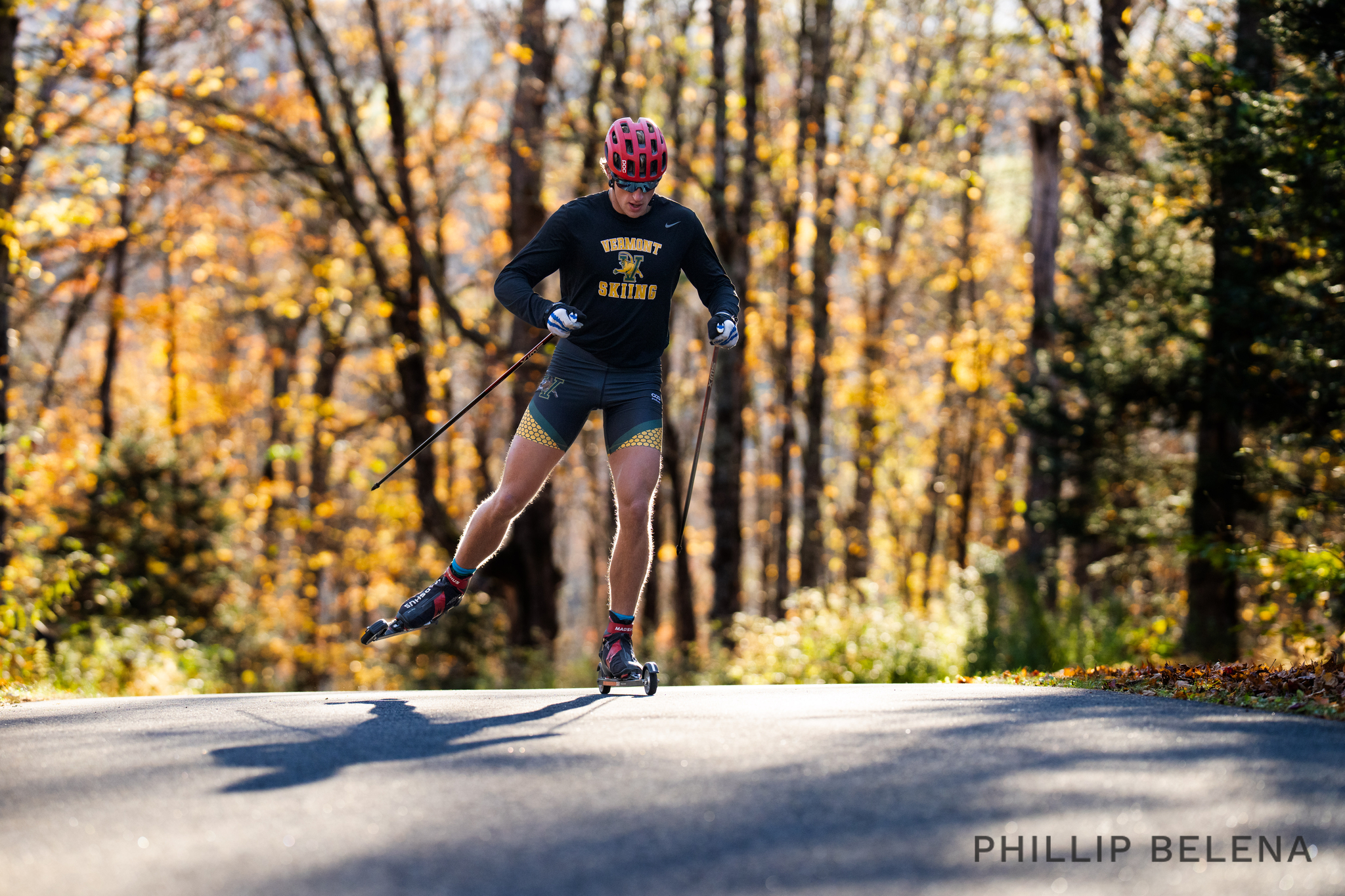
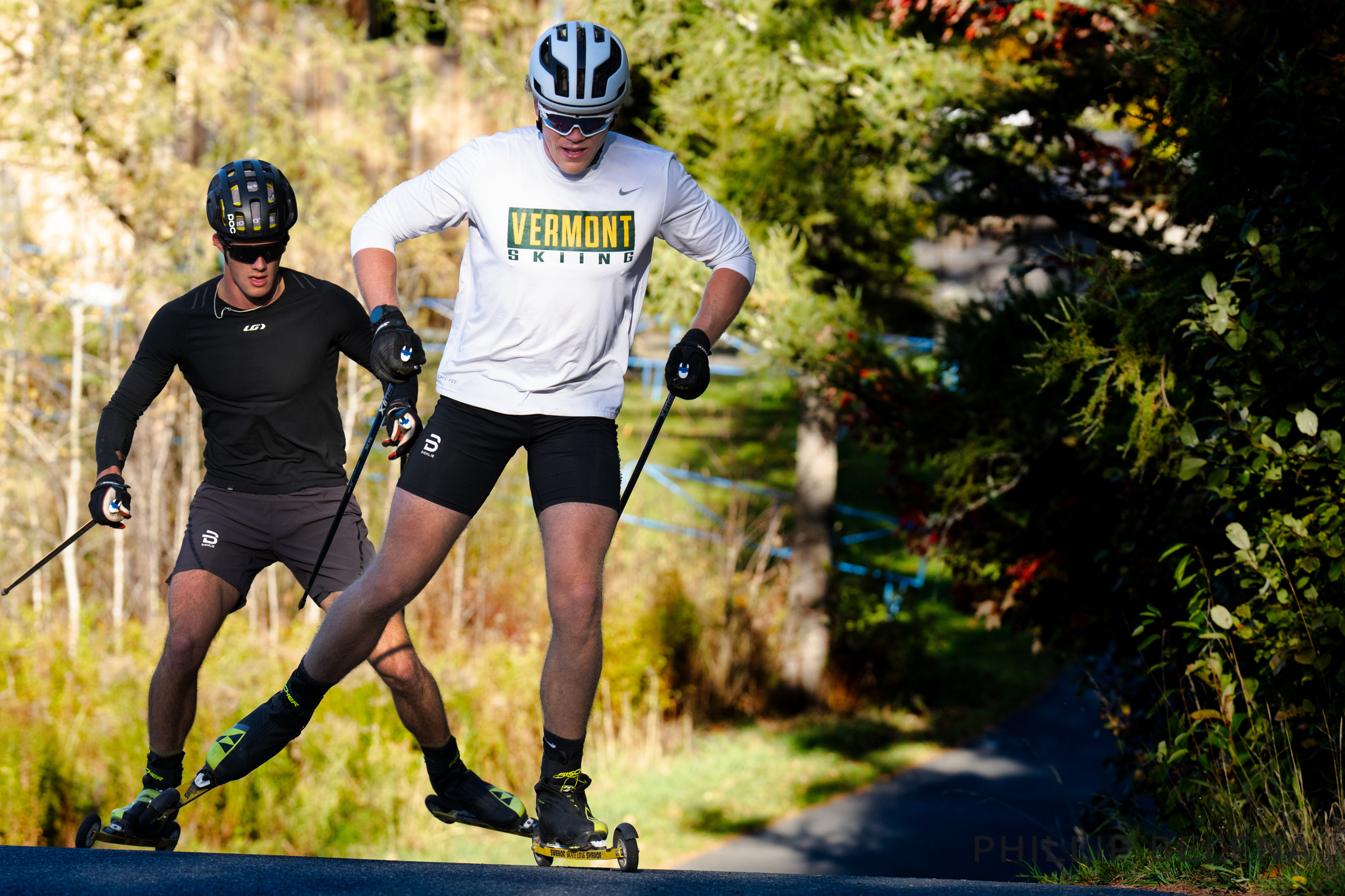
A University of Vermont skier on rollerskis at Craftsbury Outdoor Center in October 2025. Autonomic, glycogen, muscular and mechanical recovery all run on different clocks. (Photo: Phillip Belena/EISA)
What Is Recovery?
Another problem in this discussion is recovery. People will say that threshold is easier to recover from. Maybe, but recover from what? Autonomic disturbance, glycogen depletion, neuromuscular fatigue, muscle damage, mechanical load, dehydration or psychological fatigue? These are not the same thing, and they do not necessarily recover at the same rate. A 2-hour run and a 2-hour rollerski at the same intensity, for example, carry very different mechanical loads to recover from.
HRV may tell us something about autonomic recovery, which should also reflect other aspects of recovery but does not specifically measure them. Resting heart rate can tell us something, but again not everything. Blood lactate tells us something about what is happening during and immediately after the workout, but remarkably little about whether the athlete is going to train well 24 or 48 hours later. Creatine kinase may tell us something about muscle damage, but there is huge individual variation. So when we talk about recovery cost as if it were one number, I think we are being too simplistic.
This is also why I don’t think we can simply use TRIMP, EPOC, duration, distance or session RPE to say one workout takes longer to recover from than another. They can give us useful information about internal load or physiological disturbance, but they are not recovery measurements. Ultimately, recovery must be considered in terms of which physiological systems were stressed and, more practically, what the athlete can do in the days immediately after a hard workout.
Carbohydrate use is another good example. VO2max exercise clearly has a higher rate of carbohydrate use per minute than threshold exercise. But once again, the session matters more than the minute. Twenty minutes at VO2max intensity may have a very high glycogen cost per minute. Forty, fifty or sixty minutes at threshold has a somewhat lower rate, but it is sustained for two or three times as long. We cannot automatically assume that the shorter VO2max workout creates greater total glycogen depletion.
This becomes particularly important when athletes are doing regular quality sessions. If glycogen restoration is an important part of recovery, a long threshold session may impose a very substantial recovery requirement despite producing lower lactate concentrations and feeling much more controlled. An athlete does not have to be lying on the ground after a workout for that workout to have been expensive to recover from.
That is one of the problems I see with the idea that threshold can be repeated frequently simply because lactate is controlled. Low lactate does not necessarily mean low glycogen use, low muscular load or rapid recovery. If we keep extending the duration of the threshold work, at some point the additional work has a cost.
Which brings us to what I think is probably the most meaningful recovery measure, and one that is surprisingly rarely studied: can the athlete perform the next important training session at the expected level?
Lucas Wilmot, Kristen Bourne, Murphy Kimball and Tabor Greenberg after their first L3 intervals at a 2025 camp in Bend, Oregon. (Photo: Leann Bentley)
An Interesting Study
One of the more interesting comparisons was made by Seiler, Haugen and Kuffel with highly trained runners. On one occasion the athletes did a threshold session of around 30 minutes between the first and second ventilatory thresholds, and on another, six three-minute intervals at around 95 to 96 percent of VO2max. I would point out that 95 to 96 percent of VO2max is already hard, and above what I would normally call a controlled VO2max session.
The differences between the workouts were substantial. Lactate during the threshold session was around 2.7 mmol, while during the VO2max intervals it was around 7.1. Perceived exertion was also much higher during the VO2max workout. By almost any acute measure the VO2max workout looked harder, so we might reasonably expect recovery to take longer. But HRV recovery following the two sessions was remarkably similar.
Now, this study does not fully answer the question. The threshold work was only around 30 minutes, HRV measures one part of recovery, and there are all kinds of differences between athletes. But it does challenge an assumption that I think is important. Greater acute metabolic disturbance does not necessarily mean longer recovery, but the dose does.
It also raises what I think is an even more interesting question. What would have happened if the threshold session had contained 40 or 50 minutes of work rather than 30? That would be much closer to the threshold sessions many trained endurance athletes are actually doing.
U.S. Biathlon coach Armin Auchentaller with Campbell Wright during summer training in Livigno, Italy, in July 2025. A controlled VO2max session is about time at high oxygen uptake, not about producing as much lactate as possible. (Photo: Manzoni/NordicFocus)
Control of VO2max Training
There is another issue here that I think is important. A lot of people seem to think VO2max training means going as hard as possible. It doesn’t, at least not the way I see it and use it.
If I give an athlete 5 x 4 minutes of VO2max work, I am not asking them to race every interval or see how much lactate they can produce. I am trying to get them to accumulate time at a very high oxygen uptake, typically around 90 to 95 percent of maximal heart rate and VO2max.
If the objective is a cardiovascular and oxidative stimulus, we need sufficient intensity to drive oxygen consumption toward a very high fractional utilization of VO2max. For many athletes, something in the range of 90 to 95 percent of VO2max may be enough to accomplish that. Once we have produced the stimulus we are looking for, going harder does not necessarily make the workout better.
This becomes important when we compare threshold and VO2max training. If someone compares a carefully controlled threshold session with a set of VO2max intervals performed as hard as possible, then of course the VO2max workout is going to look very stressful. But that may simply be a badly controlled VO2max workout.
A well-controlled VO2max session and an all-out interval session are not the same workout, just as a controlled threshold session and a threshold session that slowly turns into a race are not the same workout. Anyone who has coached for very long has seen both.
A University of Vermont skier on the rollerski track at Craftsbury in October 2025. Forty minutes at threshold is a lot of work, and so is fifty, and so is sixty. (Photo: Phillip Belena/EISA)
What Is Threshold’s Real Advantage?
In my view, the strongest argument for threshold training is not that it produces some special adaptation, but that athletes can accumulate a lot of high-quality aerobic work. Forty minutes at threshold is a lot of work. Fifty minutes is a lot of work. Sixty minutes is a lot of work. For an elite endurance athlete doing a very large total training volume, that may be exactly what is needed, provided the athlete can recover from the overall workload of the training period.
Threshold gives us a way to accumulate a substantial amount of work at high oxidative fractional utilization, with considerable muscular recruitment and a lot of sport-specific work. For an athlete with a high VO2max who needs to improve fractional utilization or sustainable aerobic power, this can be valuable.
I think this is where some of the current discussion around threshold becomes problematic. Because it is controlled, because lactate is relatively low, and because the athlete is not destroyed afterward, threshold starts to be treated almost like endurance training. It isn’t. It is still hard training, and if you do enough of it, it carries a substantial training load and potentially a substantial recovery cost.
The question is not simply whether forty or fifty minutes at threshold creates more adaptation than twenty minutes of VO2max work. It probably creates more of some kinds of stimulus simply because we are doing so much more work. The more useful question is whether the additional adaptation we get from that extra work is worth the additional load and recovery cost.
Kevin Bolger in the fog at the Oslo World Cup mass start in March 2026. The first question is what adaptation an athlete needs. The second is the smallest dose that will produce it. (Photo: Authamayou/NordicFocus)
Are We Asking the Wrong Question?
The debate is usually framed as threshold versus VO2max. Which is better? I don’t think that is the right question. The first question should be what adaptation this athlete needs. The second, and I think this is more important, is what is the smallest dose capable of producing that adaptation? It isn’t necessarily 40, 50 or 60 minutes. The third is what effect that dose will have on the training the athlete can perform over the next several days.
We tend to assume that if some training is good, more of it must create a greater adaptation. Up to a point that is probably true. But the objective of training is not to produce the largest possible stimulus in every workout. It is to produce enough stimulus to create the adaptation while still being able to absorb the rest of the training.
If an athlete has a relatively low VO2max and that is limiting performance, perhaps 15 or 20 minutes of controlled VO2max training gives us exactly the stimulus needed. If that is enough to stimulate the adaptation, why do 50 minutes of threshold just because threshold is currently popular?
On the other hand, if an athlete already has a very high VO2max but relatively poor fractional utilization, and cannot sustain a high percentage of it, then perhaps a larger volume of threshold work is exactly what is required. In that case the ability to accumulate 40 or 50 minutes at high aerobic flux may be the important stimulus.
NENSA athletes rollerskiing together in Craftsbury, Vermont. A workout can look great on paper and still be the wrong choice if it costs the next two days. (Photo: Chris City)
The Training Week Matters More Than the Workout
I also think we make a mistake when we look at workouts in isolation. A workout can look great on paper and still be a poor training choice, because the real issue is not simply what happened during those 60 or 90 minutes. It is what that workout allows us to do over the next several days.
Suppose a threshold workout produces 10 percent less adaptive stimulus than a VO2max session but allows the athlete to train substantially better over the following two days. Threshold may clearly have the better stimulus-to-recovery ratio and therefore be the better choice.
But reverse the situation. Suppose 20 minutes of well-controlled VO2max work produces the adaptation we want and the athlete is ready to train normally the next day, while 40 or 60 minutes of threshold creates substantial glycogen depletion and muscular fatigue. In that circumstance, the shorter VO2max workout may have the better stimulus-to-recovery ratio.
We shouldn’t decide the answer beforehand simply because one workout carries the label “threshold” and the other “VO2max.” Threshold is not automatically low cost, and VO2max is not automatically high cost. The dose matters, the athlete matters, the training done before the session matters, what needs to be done after the session matters, and the total training week matters.
Therese Johaug racing the mass start at the Lahti World Cup in March 2025. Even races of up to 90 minutes, Galanes says, are often skied well above threshold. (Photo: Thibaut/NordicFocus)
Dose, Adaptation and Recovery
I am certainly not arguing against threshold training. Rather, I am arguing that the dose needs to be controlled relative to the individual athlete, and that the time to recover is not what is often suggested. I use threshold with athletes who need it, and it can be effective. But I do think we need to be more careful about how it is being presented. It is not automatically what every athlete needs.
Threshold and VO2max training have different characteristics, but their physiological adaptations overlap substantially. VO2max training provides a very large physiological stimulus in a relatively short period of time and appears particularly useful when maximal aerobic capacity is what we are trying to improve. Threshold allows us to accumulate considerably more work at a high aerobic output and can be extremely effective when sustainable aerobic power or fractional utilization is the limitation.
Both can be valuable, and both can be overdone.
In my experience, especially over the last decade, I have seen far more athletes become flat, stale, overtrained or simply stagnant from doing too much threshold training than from doing properly controlled VO2max work. Usually it comes from doing too big a volume of threshold work, too often. That doesn’t mean threshold is bad. It means threshold must be appropriately prescribed and dosed.
I also think the very large amounts of threshold work we sometimes see promoted are primarily appropriate for highly trained elite athletes who are also doing very large overall training volumes and have spent years developing that volume. I would be much more cautious applying the same model to younger athletes, developing athletes, masters athletes, or anyone doing a much smaller overall training volume.
There is another point that seems to get lost. Athletes racing 5, 10 and 15-kilometer events are not racing those events at threshold. I have decades of data showing that even in races of up to 90 minutes, fractional utilization can be well above threshold. The shorter races are at a very high intensity, in what is defined as the VO2max zone. At some point we need to train that capacity directly. Doing more threshold work because it is supposedly lower cost does not eliminate the need to train at race-relevant intensity.
In the end, I think we need to get away from ranking training zones as good, bad, safe or dangerous, and think more in terms of dose, desired adaptation and recovery. What are we trying to adapt, what dose is needed to produce that adaptation (often less than we think), and what does that dose cost us in terms of the training that follows?
The most valuable workout is not necessarily the one that creates the greatest immediate physiological disturbance, nor is it necessarily the one that accumulates the most minutes around some predetermined lactate value. It is the workout that provides enough stimulus to produce the adaptation we are looking for while preserving the athlete’s ability to absorb the rest of the training program.
In the end, that is the balance we are trying to find.
Help Support Our Coverage!
If you value the thoughtful work and access FasterSkier provides, please consider becoming a Voluntary Subscriber. Your support directly fuels our work to cover the people, places, and moments that make our sport special.
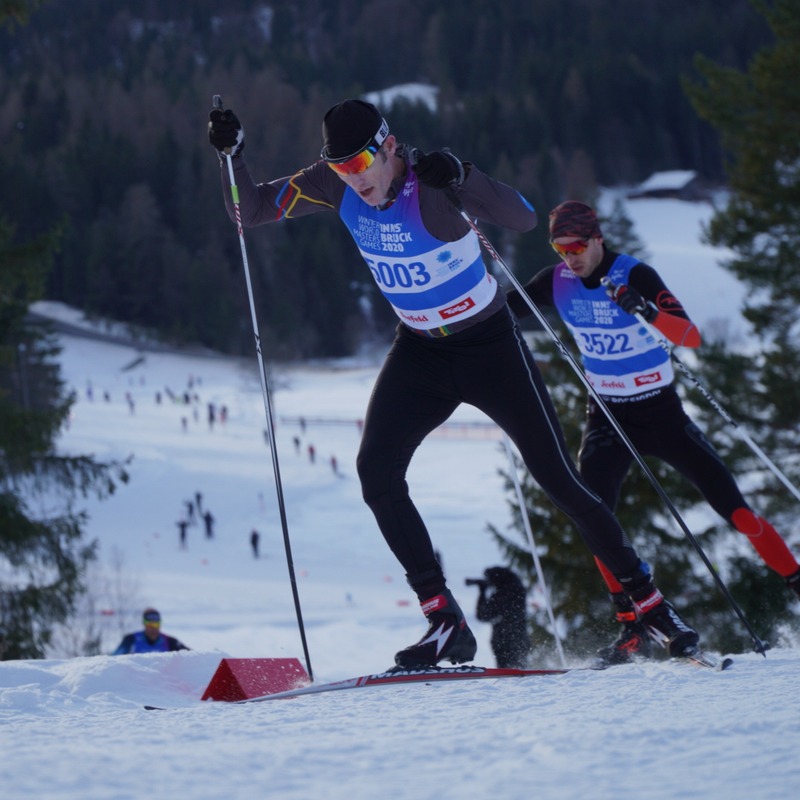
Tim Donahue racing at the 2020 Winter World Masters Games in Seefeld, Austria. Jim Galanes argues that the training masters skiers cut first is often the training that protects what aging takes away fastest. (Photo: Garrott Kuzzy / Lumi Experiences)
There are two common problems I see in the masters athletes I consult with or coach. The first is the same problem we see with athletes of all ages: they tend to train “half hard” every day. Half hard, Zone 1 quickly drifts into Zone 2 or 3. The second is more specific to masters athletes. They try to follow a training plan that is basically a dumbed-down version of an elite athlete’s program.
The first problem is relatively straightforward to address. Determine appropriate training zones and control the intensity of training more accurately.
The second is more complicated. We need to determine the volume of training an athlete can recover from, adapt to and maintain consistently. Then we need to organize that training around the physiological capacities that are most likely to decline as we age.
There is truth behind the conventional advice given to masters athletes. Recovery does change with age. Simply repeating the training we did at 25 or 30, or copying the program of an elite athlete, is never the best approach at 50, 60 or 70.
But there is a problem with how we sometimes respond to that reality. Many of the training components we tend to remove as athletes age are exactly the components that address the physiological capacities declining most rapidly.
The challenge of training as a masters skier isn’t simply figuring out how to recover better. It is figuring out how to provide enough training stimulus to maintain and improve the capacities that are naturally declining with age while still recovering sufficiently to adapt to the volume of training.
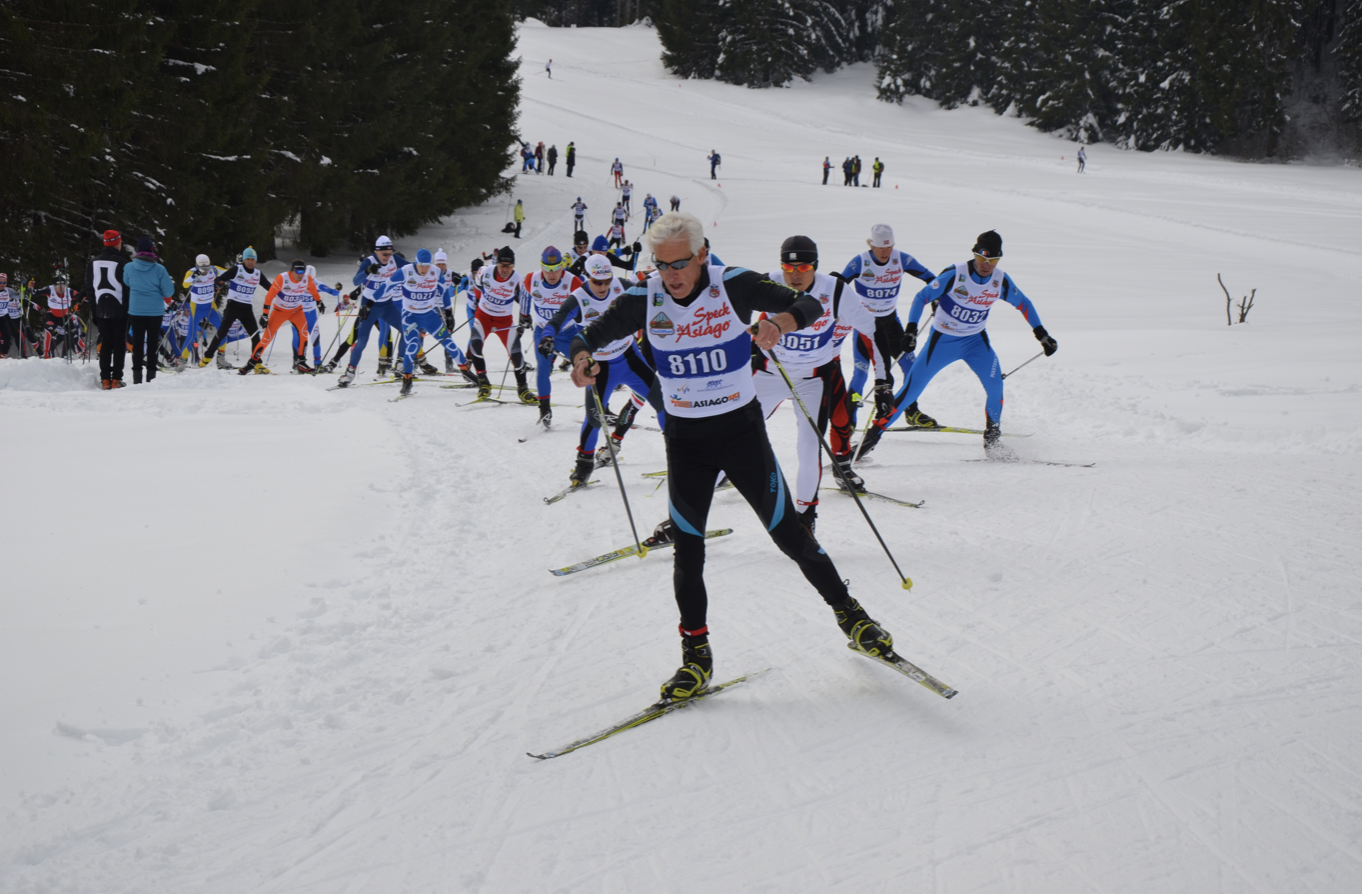
A masters field on the climb at the 2014 Masters World Championship in Asiago, Italy. Endurance performance declines with age, but the individual components of performance do not decline at the same rate. (Courtesy photo)
What Actually Changes with Age?
We know endurance performance declines with age, but the individual components of performance do not decline at the same rate.
One of the largest physiological changes is generally VO2max. Maximum heart rate declines. Muscle mass and maximal strength decline, both of which are important to maintaining aerobic capacity and skiing performance. Type II muscle fibers and explosive power become increasingly difficult to maintain.
Meanwhile, exercise economy and the ability to sustain a relatively high percentage of VO2max can be reasonably well maintained in highly trained older athletes. That should tell us something about training.
If these capacities decline at different rates, it doesn’t make much sense to treat them equally in training.
There is a temptation as we age to gravitate toward the training we tolerate best. The problem is that the capacities we tolerate best may also be the capacities we are already preserving reasonably well.
Training should not simply reflect what aging makes easiest to do. It must continue to address what aging is taking away. If VO2max, strength and power are among the capacities most vulnerable to aging, eliminating high-intensity and strength training in the name of increasing recovery may solve one problem while creating another.
Ahvo Taipale during a Vakava training session. Consistently accumulated aerobic volume remains one of the primary drivers of endurance adaptation, and one of the best defenses a masters skier has. (Photo: Finn Sisu)
Maintain the Aerobic Volume
There has been considerable emphasis in endurance training recently on large volumes of low-intensity training combined with substantial amounts of threshold and sub-threshold work.
There are good reasons for that approach, particularly among highly trained elite athletes. But simply transferring that model to masters athletes can overlook the capacities most threatened by aging, particularly VO2max, strength and power.
So how much Zone 1? How much threshold? How much VO2max?
Those are important questions, but they can obscure something more fundamental.
Consistently accumulated training volume remains one of the primary drivers of endurance adaptation. Masters athletes sometimes respond to aging by progressively reducing volume and attempting to compensate with intensity. There are limits to that strategy.
Mitochondrial development, capillarization, fat oxidation, durability and the ability to maintain performance over long races are built largely through accumulated aerobic work. A two-hour easy ski is not interchangeable with a hard interval workout simply because the interval session produces more acute physiological stress.
For a masters skier who has trained for decades, maintaining as much sustainable aerobic volume as possible may therefore be one of the most important defenses against declining endurance capacity.
The key words are sustainable and consistent training.
The volume has to be performed at the right intensity. It has to be something we can recover from day after day and, most importantly, adapt to over weeks and months.
As we have written previously, occasional hero weeks followed by heavy fatigue and a subsequent reduction in training for recovery are less effective than weeks and months of consistent training at a sustainable level.
UVM’s Fin Bailey drives up a climb on the Craftsbury Outdoor Center track. The answer to aging is not necessarily more high-intensity training, but keeping the frequency of the stimulus while controlling the dose. (Photo: Phillip Belena)
Don’t Abandon Intensity
The opposite mistake is maintaining plenty of volume while gradually eliminating the hard training. This is understandable, particularly for those who enjoy the “half hard” training.
When we stop performing high-intensity training consistently, we lose some of our adaptation to that capacity. Every subsequent interval workout or race is then harder than it used to be, and recovery takes longer, because we have eroded that capacity. That can reinforce the idea that high intensity itself is the problem.
But VO2max is also one of the physiological qualities most strongly affected by aging. So the training stimulus we may most need to maintain becomes increasingly difficult to perform and recover from. The answer isn’t necessarily more high-intensity training. It is maintaining the frequency of the stimulus while controlling the dose.
That may mean less high-intensity work in an individual session, but performing it consistently throughout the year. Fifteen to twenty productive minutes near VO2max may provide a better stimulus than turning every interval workout into a contest to see how much we can do. For many masters skiers, one or two genuinely hard aerobic sessions every seven to ten days may accomplish more than two or three mediocre high-intensity sessions every week.
The appropriate frequency depends on training history, age, fitness and recovery ability, not on a predetermined seven-day formula.
Gunnar Knapp finishes the Engadin Skimarathon. Threshold and sub-threshold training allow considerably more work to be accumulated at a high aerobic rate. (Photo: Garrott Kuzzy / Lumi Experiences)
Threshold Has a Different Job
Threshold training shouldn’t simply become the safer substitute for VO2max training. It is not. In fact, the metabolic and neuromuscular cost of a typical threshold session may be greater than that of a typical controlled VO2max session.
VO2max training provides a powerful stimulus to central aerobic capacity, cardiac output and the ability to deliver and utilize large amounts of oxygen. Threshold and sub-threshold training allow considerably more work to be accumulated at a high aerobic rate while developing the ability to sustain that rate economically.
One of the important considerations in deciding how much emphasis to place on each is fractional utilization: the percentage of VO2max an athlete can sustain for a prolonged period. An athlete with a relatively low VO2max but already high fractional utilization may gain relatively little by continually emphasizing the quality that is already strong while allowing the aerobic ceiling above it to decline.
Conversely, an athlete with a large aerobic capacity but relatively poor ability to sustain a high percentage of it may have considerably more to gain from threshold and sub-threshold training.
This becomes particularly important in highly trained skiers. The speeds elite skiers can maintain at threshold or just below it can be quite close to actual race velocities. That speed and the muscular demands associated with sustaining it are part of what makes the training effective.
For cross-country skiers, both qualities matter.
A skier may have an excellent VO2max but lack the muscular endurance to translate that capacity into sustained double poling or climbing. Another skier may have excellent threshold durability but gradually lose the aerobic ceiling above it.
The question isn’t whether threshold or VO2max training is better. The question is which physiological limitation we are trying to change.
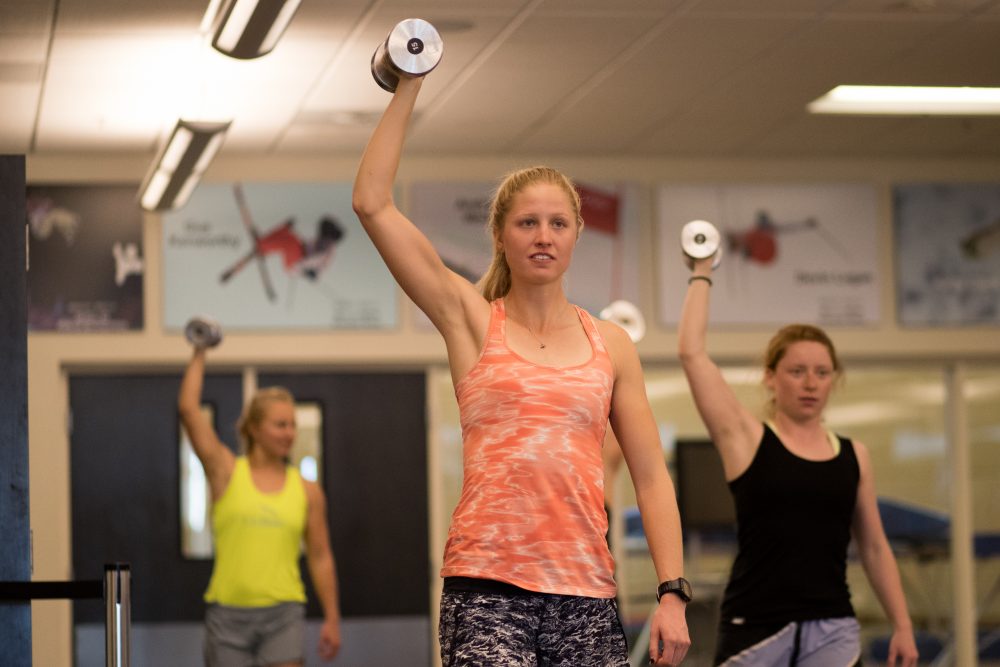
Hailey Swirbul during a strength session at a U.S. Ski Team camp in Park City, Utah. Research in cross-country skiers has shown that maximal-strength training can improve double-poling performance and economy. (Photo: Reese Brown)
Strength Becomes More Important, Not Less
Perhaps the clearest change in training priorities with age should be strength.
Cross-country skiing has become increasingly dependent on upper-body force, whole-body strength and power. At the same time, aging progressively reduces muscle mass, maximal strength and particularly fast-twitch muscle function.
Research in cross-country skiers has shown that maximal-strength training can improve double-poling performance and economy. One likely explanation is relatively simple. If every pole stroke represents a smaller percentage of your maximum force, repeatedly producing that force becomes less metabolically costly.
For masters skiers, developing and preserving maximal strength is particularly valuable because it provides reserve capacity. The goal is maintaining the ability to produce force.
That generally suggests relatively heavy resistance, good technique, low-to-moderate repetition ranges and sufficient recovery, rather than endless circuits of light weights.
Ian Torchia, right, leads bounding intervals up Stratton Mountain. Power tends to decline particularly rapidly with age, and short, fast work preserves it without requiring a large amount of metabolic stress. (Photo: Courtesy Stratton Mountain School)
Power Is the Forgotten Quality
Strength and power are not identical. Strength is how much force we can produce. Power is how fast we can produce it. Power tends to decline particularly rapidly with age.
Acceleration over the top of a hill, changing gears on a climb, responding to an attack, generating force quickly through the poles and maintaining technique at race speed all depend on the ability to produce force quickly.
Masters athletes therefore shouldn’t eliminate every fast movement from training. Short hill accelerations, controlled bounding, short ski sprints and explosive strength exercises can provide a neuromuscular stimulus without requiring a large amount of metabolic stress.
The dosage doesn’t need to be large. What matters is the peak stimulus.
But, as with nearly every aspect of training, consistency matters.
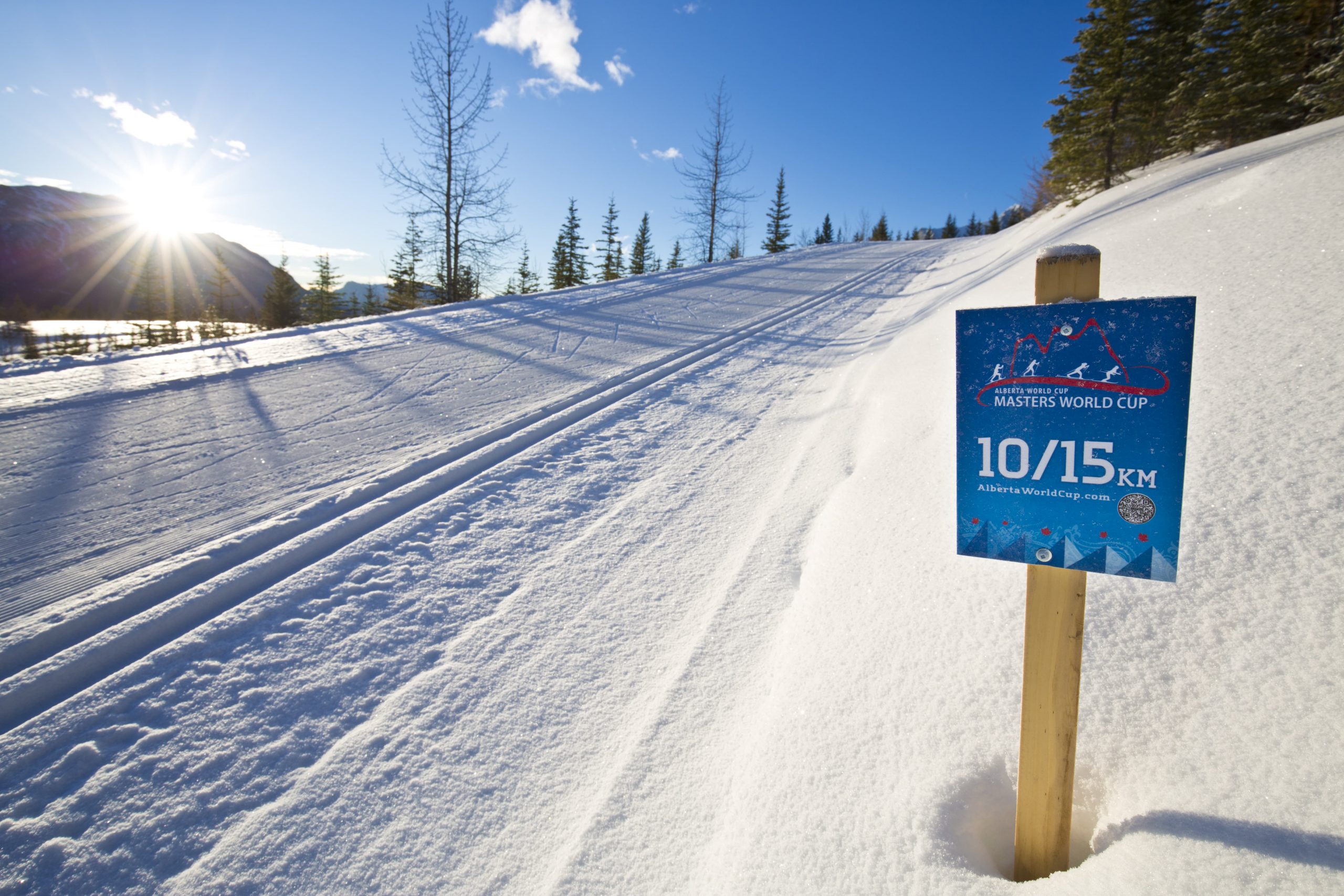
Fresh tracks on the Masters World Cup course in Alberta. Recovery is essential because adaptation occurs between workouts, but maximizing recovery is not the goal. (Photo: GibsonPictures)
Recovery Serves Adaptation
This brings us back to recovery. Recovery is essential because adaptation occurs between workouts. But maximizing recovery is not the goal of an athlete.
Maximizing adaptation is.
The masters athlete must solve a more complicated equation:
Stimulus + Recovery = Adaptation
Too much stimulus accumulated over days and weeks and we fail to recover sufficiently. Without recovery, we fail to adapt. The common theme in underperformance and overtraining is accumulating fatigue and a failure to adapt.
Sometimes the better solution is reorganizing the training. Instead of a pattern of hard, hard, easy, hard, easy, hard, exhausted, rest over seven days, a masters skier might organize training so the important sessions are separated sufficiently to perform them well and adapt to them.
The objective isn’t necessarily fewer quality sessions over the course of a month. It is enough recovery between those sessions to allow the athlete to absorb them.
The coaches behind the masters performance group at Crested Butte Nordic in Colorado: from left, Rachel Bachman Perkins, Murray Banks, Cam Smith and Woody Martineau. Fitness is not created by individual workouts. (Courtesy photo)
Consistency Beats Heroic Training
For masters athletes, we need to adjust our perspective. Fitness is not created by individual workouts. It is created by the consistent implementation of easy endurance work, high-intensity aerobic training, strength, power and appropriate recovery.
One big interval session does relatively little. One big training week does relatively little. Forty or fifty good weeks stacked together can produce remarkable fitness.
That changes the definition of a successful workout.
The question is no longer: How much training can I survive today?
It becomes: What training can I absorb today that allows me to continue training tomorrow, next week and next month?
That doesn’t mean avoiding hard work. It means implementing both easy and hard training in a way that provides adequate space for recovery and adaptation.
Murray Banks at the Alley Loop in Crested Butte, Colorado. Chronological age alone doesn’t tell us enough: training history, injury history, available time, sleep, nutrition and life stress all matter. (Photo: Xavier Fane / Crested Butte Nordic)
The Masters Training Equation
Training, of necessity, must be individualized for athletes of every age. A highly trained 60-year-old with forty years of endurance training may tolerate workloads that would overwhelm a recreational 45-year-old who started skiing five years ago.
Chronological age alone doesn’t tell us enough. Training history, injury history, available time, sleep, nutrition, life stress and individual recovery all matter. But the physiological objectives remain surprisingly familiar.
Maintain aerobic volume.
Maintain VO2max.
Develop threshold and muscular endurance.
Preserve maximal strength.
Preserve power.
Maintain ski-specific technique and economy.
Then organize recovery around accomplishing those objectives. That is fundamentally different from starting with recovery and removing training until the athlete can tolerate what remains.
Masters athletes don’t need a watered-down version of elite training. Nor do they simply need more recovery. They need training organized around the physiological capacities most threatened by aging, with enough stimulus to preserve and improve those capacities and enough recovery to adapt to that stimulus.
Aging changes how we assemble the training. It doesn’t change what makes an endurance athlete fast.
The great opportunity of masters sport is discovering how much performance we can preserve, and in many cases still improve, by continuing to give the body both the stimulus and the time and space it needs to adapt.
Help Support Our Coverage!
If you value the thoughtful work and access FasterSkier provides, please consider becoming a Voluntary Subscriber. Your support directly fuels our work to cover the people, places, and moments that make our sport special.
Wilmington, Vermont’s Luke Rizio rollerskiing with the University of Vermont at Craftsbury last fall. Jim Galanes argues that a training year should change the dose of each quality, never remove one of them entirely. (Photo: Phillip Belena/EISA)
One of the biggest misconceptions in endurance training is that we should train one physiological capacity at a time. The traditional model usually follows the same progression. First build an aerobic base, lots of easy endurance training. Then add “threshold” training in the middle of the summer. Then, as we move into the pre-competition period, shift the emphasis toward VO2max and race specific intensity.
The emphasis certainly should change throughout the season. But this approach often leads coaches and athletes to unintentionally neglect important physiological systems for weeks or even months. The problem is that the human body doesn’t work that way.
Aerobic performance is not determined by one physiological system. It emerges from the interaction of multiple systems, each supporting the development of the others. When one begins to decline, it limits the effectiveness of the entire system.
The goal of periodization is not to sequentially build individual physiological systems. It is to continually maintain every important system while changing the emphasis toward the adaptations that offer the greatest opportunity for improvement.
Every Workout Sends a Different Signal
Training isn’t simply stress. Every workout sends a unique physiological signal for adaptation.
Long aerobic training stimulates mitochondrial biogenesis, capillary development, fat oxidation, plasma volume expansion, and cardiac remodeling.
“Threshold” training improves the ability to sustain a high fraction of aerobic power by increasing oxidative capacity, metabolic stability, and lactate transport. It should be noted, in spite of the current buzz, that “threshold” training is not a magic solution. Some athletes may need a heavier focus on VO2max training. Usually “threshold” type training is best for those doing high volumes and with an already high fractional utilization.
(Note: while I use the common term “threshold” here, there is ample evidence that no threshold actually exists and that it is a vastly misleading term. There is also no consensus on what this so-called threshold is. Depending on which of the many methods you use to define it, the speed or intensity at these various definitions can differ by 40 to 50 percent.)
VO2max intervals place the greatest demand on oxygen delivery, stimulating central cardiovascular adaptations while also improving mitochondrial function, the oxidative capacity of Type II fibers, lactate transport, and the speed or power that can be sustained at VO2max.
Sprint training recruits high-threshold motor units, preserves neuromuscular coordination, maintains the oxidative capacity of fast-twitch fibers, and develops the ability to rapidly produce force.
Strength training increases maximal force production, improves movement economy, enhances tendon stiffness, and helps reduce injury risk.
These are not interchangeable adaptations. Each contributes something different to developing aerobic fitness and performance.
The Systems Support Each Other
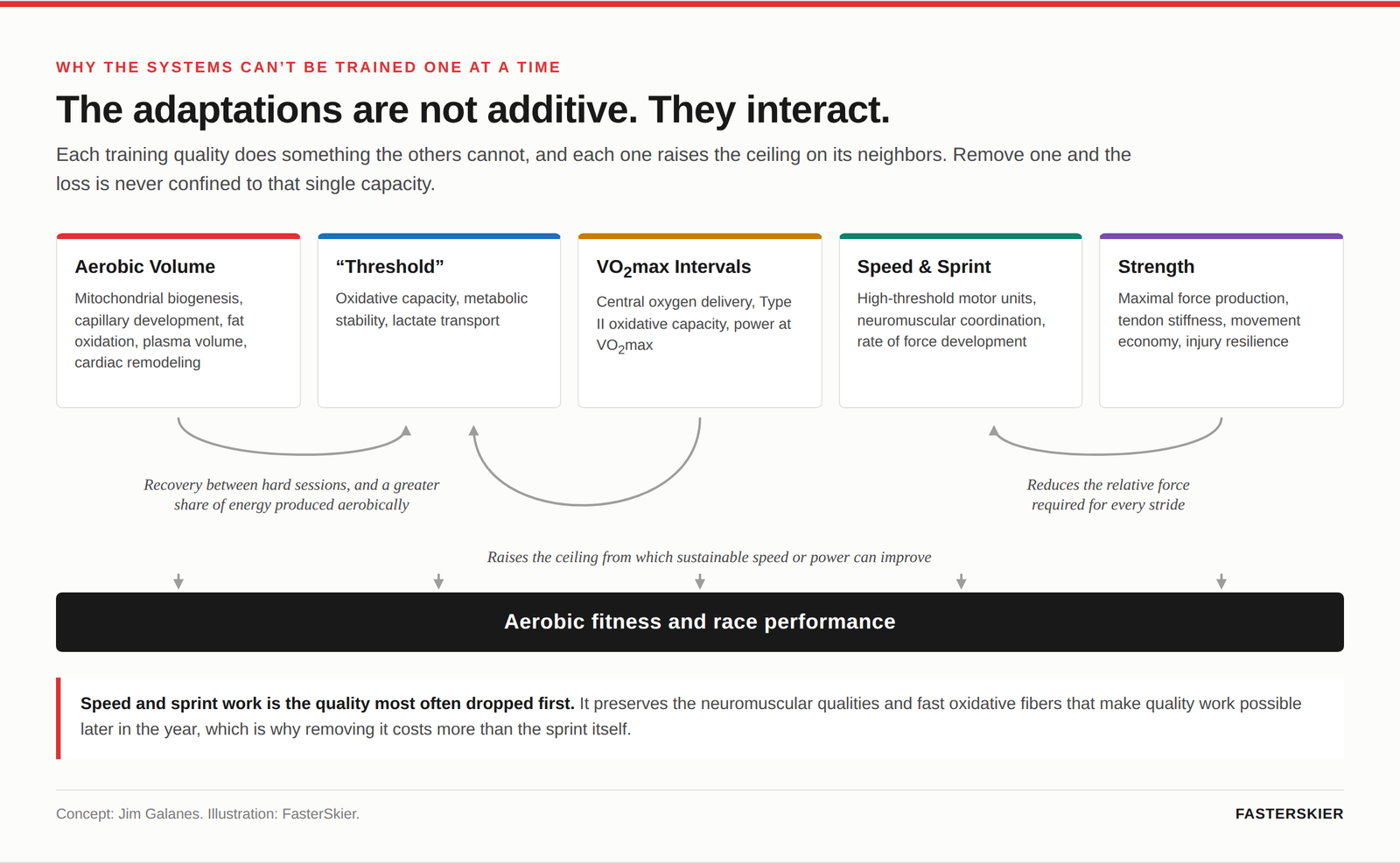
These systems work synergistically. The mistake is assuming the adaptations are simply additive. They are not. They interact, and the combined effect on aerobic fitness is larger than the sum of the parts.
A larger aerobic system allows the athlete to recover more quickly between hard sessions and to produce an increasing proportion of energy aerobically.
Better “threshold” capacity allows more quality work to be performed with less fatigue. Greater maximal aerobic power raises the ceiling from which “threshold” speed or power can improve.
Improved strength reduces the relative force required for every stride.
Sprint training preserves the neuromuscular qualities that improve efficiency even during submaximal exercise. At every intensity, we can move faster and more efficiently.
Aerobic volume, “threshold” work, VO2max intervals, speed and strength each do something the others cannot, and each raises the ceiling on its neighbors. (Illustration: FasterSkier)
What Happens When One System Is Ignored?
Every physiological adaptation has a maintenance requirement. Remove the stimulus long enough and that adaptation begins to decline. An athlete who abandons speed training gradually loses neuromuscular recruitment and maximal power. An athlete who eliminates heavy strength training slowly loses force production and movement economy.
When an athlete reduces aerobic endurance training, they don’t simply lose endurance. They lose the physiological foundation that supports every other adaptation.
An athlete who removes VO2max work for extended periods may maintain excellent endurance while gradually losing the central cardiovascular adaptations that support maximal aerobic performance.
These changes are rarely dramatic at first. What we see instead are the symptoms of overtraining. Performance in training declines. Interval sessions become harder. Race pace plateaus or drops.
Many coaches respond by adding more volume or more intensity. Neither is the likely answer. The solution is to restore the balance between the physiological systems that support performance.
Through the training year the dose and density of each quality moves, but no quality drops to zero. Concept illustration of Galanes’ argument, not a prescribed distribution. (Illustration: FasterSkier)University of Vermont skiers work up a climb during a fall dryland session at Craftsbury, Vermont. (Photo: Phillip Belena/EISA)
Why High-Intensity Training Belongs in the Base Period
One of the most common statements heard during base training is: “We shouldn’t do any hard training yet.”
Current evidence suggests otherwise. High-intensity training during the base period is not about maximizing anaerobic fitness. It is about maintaining the physiological systems that complement the full development of aerobic capacity.
Appropriately dosed high-intensity training helps preserve central cardiovascular function, maintains high-threshold motor unit recruitment, supports the oxidative capacity of fast-twitch muscle fibers, reinforces movement economy at higher speeds, and prepares the athlete for the demands of future training. Just as importantly, these adaptations support aerobic development rather than detract from it.
A stronger cardiovascular system allows greater oxygen delivery during long aerobic sessions. Maintaining fast oxidative fibers improves the ability to perform “threshold” work later in the season. Preserving movement economy reduces the energy cost of every stride. Maintaining maximal aerobic capacity raises the ceiling from which “threshold” performance can continue to improve.
High intensity doesn’t compete with aerobic development when it is properly dosed. It enhances it. This is why elite endurance athletes rarely eliminate intensity completely. They change the dose and the density. Not the presence.
I often hear athletes say their first interval session or time trial in late July felt terribly slow, or metabolically challenged. Of course it did. That should come as no surprise. If high-intensity work has been absent for weeks or months, the physiological systems required to perform it have detrained. The athlete now has to rebuild those systems before meaningful race-specific adaptations can occur.
Emphasis Is Not Elimination
This doesn’t mean every quality deserves equal attention every week. Training emphasis should absolutely change throughout the year. An aerobic development phase should contain more aerobic volume. The pre-competition period should emphasize “threshold” and race-specific intensity. The competition season should prioritize race performance and recovery.
But changing emphasis is very different from abandoning a physiological system. Even during an aerobic block, athletes should continue performing some high-intensity work, sprint training, and strength training.
During race season, aerobic volume remains essential. While emphasizing VO2max development, “threshold” training still supports the ability to perform quality work.
The dose and density change. The physiological adaptation remains.
There Is No Optimal Intensity Distribution
One of the most common questions in endurance sports is: “What is the optimal training intensity distribution?”
The question assumes there is one correct percentage of easy, “threshold”, and hard training. There isn’t. The optimal distribution depends on the athlete’s training background and on which physiological system currently limits performance. Those limiting factors change throughout an athlete’s development.
Early in a career, building aerobic capacity may deserve the greatest emphasis. Later, improving sustainable race pace may become the priority. Still later, improving neuromuscular power, force production, or movement economy may produce the greatest gains.
As those priorities change, training distribution changes with them. Not because the principles change. Because the athlete changes.
The coach’s responsibility is to continually adjust aerobic volume, “threshold” training, VO2max work, sprint training, and strength training so that each enhances the adaptations produced by the others while minimizing interference.
There is no universal training formula. There is only the continual process of identifying the athlete’s current limiter, maintaining every important physiological system, and emphasizing the adaptations that will produce the greatest improvement.
Great coaching is not about prescribing the perfect intensity distribution. It is about continually identifying the athlete’s current physiological limiter while maintaining every system that supports performance. As the athlete changes, the emphasis changes, but the physiology never disappears.
Help Support Our Coverage!
FasterSkier is independent, reader supported, and free to read. If coaching and training coverage like this is worth something to you, a voluntary subscription keeps it coming.
UVM coach Patrick Weaver talks with first year Hanna Koch of St. Paul, Minnesota, during a fall session at Craftsbury. Identifying an athlete’s current limiter, Galanes writes, is the coach’s central job. (Photo: Phillip Belena/EISA)
This is a follow-up to my last article, Speed Creates the Load, Not Intensity. Before going further, it helps to define terms. Intensity is reflected in the heart rate response. Load is the physiological stress that drives adaptation. This piece takes a different angle, using high-intensity workouts and race heart rates to assess fitness and monitor for overtraining.
Over the last two decades, much of my coaching has involved working with athletes who are underperforming, overtrained, or struggling to regain fitness. When the data is available, one of the first things I examine is the relationship between training intensity and speed across the season. I am looking for improvements in efficiency, but I am also paying close attention to what happens during races and hard workouts.
Race data is almost always the most revealing.
I recently reviewed the training of a top domestic athlete whose sustainable race heart rate fell by roughly 10 to 15 beats per minute between November and March. Why? Given the time of year, that should immediately raise concerns. A substantial decline in sustainable race heart rate during the competitive season rarely points to improved fitness. More often, it is a warning sign that the athlete is carrying excessive fatigue, is no longer capable of producing the same muscular power, or has entered a state of overtraining.
An illustrative competitive season. Sustainable race heart rate slides 13 bpm from November to March. With no gain in speed to explain it, that slide reads as a fatigue signal, not a fitness one. (Chart: FasterSkier)
A reduced race heart rate means less cardiac output unless stroke volume increases enough to compensate. In well-trained athletes, that compensation is usually very small. The result is less oxygen delivered to the working muscles, reduced oxidative metabolism, slower lactate clearance, diminished phosphocreatine resynthesis between surges, and ultimately a reduced ability to sustain high race speeds. In simple terms, the athlete cannot create the same physiological demand because the muscles are no longer capable of producing the same amount of work.
When a Lower Race Heart Rate Reflects Improved Fitness
A declining race heart rate is often misunderstood. Some physiologists and coaches suggest it reflects improved cardiovascular function. That can be true, but only if performance has clearly improved.
The critical question is simple: is the athlete racing faster?
If an athlete is producing greater speed or power at a lower heart rate, several physiological adaptations have likely occurred:
Greater stroke volume. The heart pumps more blood with each beat, allowing similar cardiac output with fewer beats.
Improved movement economy. Better technique and neuromuscular coordination reduce the oxygen cost of movement.
Greater peripheral adaptations. Increased mitochondrial density, capillary density, and oxidative enzyme activity improve oxygen extraction and utilization.
If these adaptations have occurred to a meaningful degree, performance should improve. The athlete should be racing faster while holding a similar physiological level, not racing at a lower heart rate.
In my experience, I have never seen an athlete race at a substantially lower heart rate because they became fitter or more economical. The improvement almost always shows up as increased speed or power, not as a dramatically reduced race heart rate. If race performance is unchanged, or worse, declining, a lower heart rate is unlikely to be explained by improved fitness.
This distinction matters because many coaches correctly recognize that heart rate decreases at submaximal workloads as fitness improves. That is exactly what we expect during aerobic training. Racing is different. At maximal or near-maximal effort, the goal is to maximize performance, and that rarely shows up as a lower heart rate.
Is Stroke Volume Really the Explanation?
Stroke volume is frequently cited as the reason trained athletes can race with lower heart rates. While that explanation sounds plausible, it probably accounts for only a negligible part of what we observe during maximal competition.
In trained endurance athletes:
Stroke volume reaches near-maximal values at roughly 40 to 60 percent of VO2max.
Beyond that intensity, further increases in cardiac output come primarily from increases in heart rate.
Stroke volume changes relatively little in already well-trained athletes.
Stroke volume reaches near-maximal values at roughly 40 to 60 percent of VO2max. At race intensity, it has little room left to climb, so a falling race heart rate is unlikely to be explained by rising stroke volume. (Chart: FasterSkier)
So if an athlete’s sustainable race heart rate falls from 185 to 175, it is unlikely that stroke volume has increased enough to fully maintain cardiac output. The science does not support that explanation in most well-trained athletes. Something else is going on, and extended fatigue, maladaptive training, and long-term overload are the likely causes.
The Muscles Drive the Heart
One concept that is often overlooked in endurance physiology is that heart rate responds to muscular work. It does not create it. The muscles generate the metabolic demand and the cardiovascular system responds. If neuromuscular power production declines, metabolic demand falls. The heart no longer needs to pump as rapidly because the muscles are not asking for the same amount of oxygen. This aligns closely with a concept I first wrote about nearly twenty years ago and returned to in my previous article:
Speed creates the load, not intensity.
The muscles create the demand. The heart responds. When an athlete loses the ability to generate force, speed, and power, race heart rate falls as a consequence. The cardiovascular system may be functioning normally. It simply is not being driven to the same level because the neuromuscular system has become fatigued.
When a Lower Race Heart Rate Is a Warning Sign
A falling heart rate is one of the earliest objective signs that an athlete may be accumulating excessive fatigue. When athletes become excessively fatigued, they often lose the ability to recruit muscle fibers effectively and sustain race-specific power. Because muscular demand falls, heart rate falls with it.
Rather than interpreting the lower heart rate as improved efficiency, coaches should ask whether the athlete is still capable of producing the same speed or power.
Warning signs include:
Sustainable race heart rate declines progressively over a few weeks to months. Monitoring heart rate helps catch this early, so training can be adjusted before it becomes a bigger problem.
Race performance stagnates or deteriorates despite similar perceived effort.
Legs feel flat and heavy, as if they never really warm up.
The athlete cannot respond to the demands of uphills or changes in pace.
Heart rate remains well below normal race values even during maximal effort.
Recovery between hard sessions becomes progressively slower.
Easy training may still feel normal while racing and high-intensity training become increasingly difficult.
This pattern is often described as parasympathetic overreaching, although terminology varies. Regardless of the label, suppression of maximal or sustainable race heart rate by 5 to 15 beats per minute over weeks should never be ignored. It frequently reflects excessive cumulative training load, inadequate recovery, or overtraining. Waiting until performance completely collapses is waiting too long. In many athletes, a declining race heart rate is one of the first objective indicators that recovery and adaptation to previous training were insufficient.
Coaches sometimes celebrate lower lactate values as improved aerobic fitness. During excessive fatigue, however, reduced lactate production often reflects reduced muscle recruitment rather than improved metabolic efficiency. The athlete cannot produce enough power to generate high lactate concentrations.
Chronically low glycogen availability, whether from excessive training or inadequate carbohydrate intake, can also suppress race heart rate and lactate. The athlete cannot generate the metabolic demand required to reach previous racing intensities.
The heart is reactive, not proactive. It responds to the metabolic demand created by the working muscles. When the muscles cannot produce force because of fatigue, the cardiovascular system has less work to do. A lower heart rate is therefore often the consequence of reduced performance, not the cause.
Why Elite Athletes Rarely Race at Maximal Heart Rate
Elite endurance athletes rarely spend an entire race at maximal heart rate. As performance improves, limitations increasingly shift away from the cardiovascular system and toward the muscles’ ability to generate force repeatedly while resisting fatigue.
Improvements in neuromuscular power, economy, and fatigue resistance allow athletes to sustain higher speeds without requiring proportionally higher heart rates.
As athletes become capable of producing greater speed and power, they generate a larger physiological stimulus. The cardiovascular system responds to that demand, but it is the neuromuscular system that ultimately determines how much work can be produced.
Practical Coaching Implications
Heart rate should never be interpreted in isolation. Always evaluate it alongside speed, power, performance, and perceived effort.
Reading race heart rate against performance. Green is adaptation, amber is a flag to investigate, red is accumulated fatigue until proven otherwise. (Chart: FasterSkier)
Similar heart rate plus faster performance equals positive adaptation, improved economy, and greater efficiency.
Lower heart rate plus unchanged performance equals the early stage of maladaptation to training loads.
Lower heart rate plus slower performance equals a clear indication of accumulated fatigue, inadequate recovery, illness, low energy availability, or excessive training load.
Normal heart rate plus declining performance equals a reason to consider environmental conditions, glycogen availability, illness, altitude, or reduced movement economy.
Over the course of a successful season, athletes should become capable of producing greater speed and power while maintaining similar race heart rates. When race heart rate falls substantially without a corresponding improvement in performance, assume fatigue before assuming fitness. That mindset will keep many coaches from overlooking one of the earliest objective signs of excessive training stress.
A lower heart rate should never be viewed as evidence of improved fitness on its own. If an athlete is racing faster, producing more power, and performing better, a modest reduction in heart rate may simply reflect positive adaptation. But when race heart rate falls while performance stagnates or declines, resist the temptation to credit what may actually be the earliest objective sign of excessive fatigue. The goal is to catch a falling heart rate during hard efforts early and adjust training as soon as possible. Weeks or months of inaction will greatly increase recovery time and cost additional effective training time.
Help Support Our Coverage!
If you value the thoughtful work and access FasterSkier provides, please consider becoming a Voluntary Subscriber. Your support directly fuels our work to cover the people, places, and moments that make our sport special.
I originally wrote the following article in 2004. Twenty-two years later, I believe it remains just as relevant. To me it illustrates that while we tend to assume training has changed a great deal, in many ways it has stayed much the same. I have rewritten it here to improve clarity without changing the content.
UVM’s Fin Bailey drives up a climb on the Craftsbury Outdoor Center track last fall, generating speed through clean extension rather than grinding against the grade. (Photo: Phillip Belena)
The development of basic speed, neuromuscular power, and speed endurance is critical for high-level cross-country skiing performance. I would also argue that, once an athlete reaches a certain level of aerobic development, future improvements in aerobic capacity may become limited if the athlete cannot produce enough power to generate a sufficient training stimulus.
This article presents a concept that has influenced my coaching for many years: before continually increasing the external loads, volume, and intensity of training, athletes must first develop the ability to produce greater speed and power.
Training loads can be increased in two ways. The first is externally, by making the terrain more difficult or increasing resistance. The second is internally, by improving neuromuscular function so the athlete is capable of producing more power and therefore greater speed.
My experience has been that increasing external loads without first improving power production often yields little improvement in performance and, in some cases, little measurable gain in aerobic development. Athletes simply work harder while producing little additional external work.
We have all seen unfit or less-developed athletes walk up a steep hill while reaching near maximal heart rates. We have observed this repeatedly in junior skiers. Simply walking, skiing, or running uphill slowly can produce extremely high heart rates. Does this indicate inadequate aerobic capacity or inadequate power production? The answer is usually a combination of both.
However, in athletes whose performances have plateaued despite years of increasing training volume and intensity, this question deserves closer examination. Many continue to produce high heart rates while moving slowly. In these athletes, the limiting factor may not be the cardiovascular system itself, but rather an inability to produce enough power to create a greater demand on the aerobic capacity.
For this reason, I believe that early in an athlete’s development, and often early in each training year, speed, movement quality, efficiency, and neuromuscular power should receive significant emphasis. These qualities should not replace aerobic training, but they should develop alongside it. Improving an athlete’s ability to produce power increases the speed at which aerobic training can be performed and therefore increases the potential aerobic training stimulus.
Our observations over many years have consistently shown that athletes lacking sufficient power gradually slow during uphill skiing, running, or bounding intervals while heart rate continues to rise. The internal effort increases even as external work declines.
We have also observed athletes become overtrained despite carefully planned training programs. In many cases the common factors were excessive metabolic cost of endurance training, elevated lactate concentrations at relatively modest speeds, deteriorating movement quality, and inefficient power production.
Again, I believe the underlying issue is often inadequate neuromuscular function.
When athletes cannot produce power efficiently, every uphill carries a large metabolic cost. Heart rate and blood lactate increase rapidly even though speed remains relatively low. The athlete experiences considerable physiological stress without generating the external workload necessary to increase adaptation.
For one summer training period we emphasized extensive speed and neuromuscular training. Several athletes improved their maximal treadmill workload by as much as seven percent during a graded treadmill protocol. At the same time, blood lactate concentrations were lower at each workload stage.
Zak Ketterson doing work on the rollerski treadmill. (photo: courtesy Team Birkie)
These findings do not prove that VO2max increased. However, they strongly suggest improvements in movement economy, neuromuscular power, and the athlete’s ability to express aerobic capacity. The athletes could sustain greater workloads at the same relative physiological cost.
Although the sample size was too small to draw firm scientific conclusions, the observations were both encouraging and consistent with our coaching experience.
One useful coaching tool has been estimating the oxygen demand of uphill terrain using the Balke or ACSM treadmill equations. While these equations were developed for walking and running, not roller skiing or ski-specific movements, they provide a reasonable estimate of the external workload required to climb terrain of a given grade and speed.
Using these estimates, I evaluated athletes on both a maximal 500-meter uphill test and a 3,000-meter uphill test conducted on the same hill. Our top male skiers consistently sustained estimated oxygen demands of approximately 70 to 72 ml·kg⁻¹·min⁻¹ during the 3,000-meter effort. During the 500-meter test, estimated oxygen demands ranged from approximately 83 to over 90 ml·kg⁻¹·min⁻¹. These values represent estimated metabolic demand rather than directly measured oxygen consumption.
The athletes who consistently produced the highest estimated workload during the 500-meter test were also our best performers. The shorter test reflected the athlete’s ability to produce high neuromuscular power. The longer test reflected how much of that capacity could be sustained aerobically.
During summer testing, the best athletes generally sustained only about 80 to 85 percent of their maximal estimated workload during the longer effort, leaving room for further improvement as fitness and skiing specificity increased during the competitive season.
Several practical conclusions emerged from these observations.
Ian Torchia, far right, leads bounding intervals up Stratton Mountain in summer 2021. Ski bounding remains one of the most direct ways to build the neuromuscular power Galanes describes, with the athlete loading and driving off each step. (photo: courtesy SMS)
Maximal power production establishes the athlete’s aerobic potential.
The estimated workload achieved during the 500-meter test reflects the athlete’s ability to produce power. If this value is too low, it becomes increasingly difficult to create a training stimulus large enough to maximize aerobic development, because the athlete cannot sustain sufficient speed.
Small differences between maximal and sustainable power may indicate a different limitation.
If the athlete’s maximal 500-meter workload is only slightly greater than the workload sustained over longer efforts, further improvements in aerobic capacity may be limited until maximal power production improves.
Lower-level athletes often need speed before more intensity or volume.
Many developing athletes have maximal power values only five to ten percent higher than their longer uphill performances. These athletes often benefit more from improving neuromuscular function, movement quality, and speed than from simply adding more difficult interval training.
Hard uphill intervals are not always the answer.
If athletes lack sufficient power to increase speed, making the terrain steeper or simply asking them to work harder often produces more fatigue than adaptation. Increasing the load without increasing movement quality seldom solves the underlying problem.
Sustainable aerobic power is not enough.
Athletes capable of sustaining a very high percentage of their aerobic capacity but possessing relatively low maximal power often plateau. They may already be performing close to their physiological ceiling and will likely require improvements in neuromuscular power before further performance gains occur.
Youth skiers during a Skinouk Roller Ski Race. Galanes argues these athletes often gain more from speed and movement quality than from steeper terrain or harder intervals.
Speed should create the load.
Uphill training remains essential in cross-country skiing. However, I believe the primary driver of training should be generated through efficient movement rather than terrain alone.
Whether athletes are performing distance training or intervals, movement should remain clean, crisp, coordinated, and quick. If technique deteriorates and speed slows simply because the terrain is harder, the athlete is no longer training optimal movement. They are merely increasing physiological stress.
Ultimately, endurance performance depends upon the interaction between physiology and movement. The aerobic system can only respond to the workload the neuromuscular system is capable of producing.
For that reason, coaches should devote as much attention to developing speed, power, and movement quality as they do to increasing training volume and intensity. In the long term, improving an athlete’s ability to generate external workload may be one of the most effective ways to unlock further aerobic development and higher performance.
Help Support Our Coverage!
If you value the thoughtful work and access FasterSkier provides, please consider becoming a Voluntary Subscriber. Your support directly fuels our work to cover the people, places, and moments that make our sport special.
UVM’s Benon Brattebo rollerskiing on the Craftsbury Outdoor Center track last fall. Galanes argues that speed and neuromuscular power, not just harder terrain, should create the training load. (Photo: Phillip Belena)
Most athletes view the warm-up as preparation for the hard part of the workout. The reality is that the warm-up is often one of the most important parts of the session, because it largely determines the physiological response that follows.
The purpose of a warm-up is not simply to get moving. It is to bring the body’s physiology to a level where the intended training stimulus can be achieved while controlling the overall stress of the workout. In endurance training, particularly during high-intensity work, the warm-up is often the difference between controlling the metabolic response and being controlled by it.
Athletes frequently start sessions too hard. They feel fresh, see a target pace or power on their watch, and immediately try to hit it. The problem is that physiology is not yet prepared to support that workload. Oxygen delivery, muscle temperature, enzyme activity, and substrate utilization are all operating below the levels required for efficient steady-state exercise. The result is often a disproportionate metabolic response.
The Oxygen Deficit Problem
At the start of exercise, energy demand rises immediately, but aerobic energy production takes time to catch up. During this period, often referred to as the oxygen deficit, a greater percentage of the required energy must come from glycolytic pathways.
This can be particularly problematic during races and maximal efforts. If the physiology, especially the oxygen transport system, has not been properly activated, lactate oxidation and resynthesis can be compromised. Lactate accumulates more rapidly, metabolic stress rises, and performance can suffer.
The same thing often happens during training. If an athlete begins too aggressively, glycolytic energy production rises rapidly before the aerobic system is fully engaged. Lactate accumulation increases, and the athlete spends much of the workout trying to recover from a metabolic disturbance that was largely created during the opening minutes of the session. Many workouts intended to be primarily aerobic become moderately glycolytic before the real work has even started.
Jack Young hits some big lactate numbers during a hard training session. (Photo: Courtesy Photo)
Lactate Is Often Controlled Before the Main Set Begins
Coaches frequently focus on pace, power, heart rate, or lactate during the interval portion of a workout. In reality, much of the metabolic profile of those intervals may have been determined during the first 10 to 20 minutes of the session.
A gradual warm-up allows oxygen delivery and utilization to increase progressively. Muscle blood flow improves. Mitochondrial respiration accelerates. Oxygen kinetics improve. The contribution from anaerobic glycolysis declines relative to the overall energy demand.
As a result, when the athlete begins the primary workload, lactate appearance and clearance are better balanced, and the body’s ability to oxidize lactate is already functioning at a high level. This creates a fundamentally different physiological environment.
When I was racing bikes, particularly time trials and hill climbs where the energy demand was high from the very start, I found that the longer the easy portion of the warm-up, often 45 to 60 minutes, the better I could tolerate high intensity immediately. The effort felt more controlled, and the metabolic response was far more predictable.
Two athletes may perform the same interval session at the same power output. The athlete who started gradually may stabilize at a lower blood lactate concentration and experience less metabolic strain than the athlete who rushed into the session. The difference is not fitness. The difference may simply be the quality of the warm-up.
Pellegrino embraces the crowd ahead of Sprint qualifying in Lake Placid. “The energies I got in the Final were coming from the warmup lap, where I stopped in the middle of the climb, crying.” (Photo: Thibaut/NordicFocus.)
Warm-Up as a Tool for Intensity Control
One of the most overlooked benefits of a proper warm-up is improved intensity control. For athletes who struggle to control intensity during endurance workouts, paying close attention to the first 20 to 30 minutes of the session can have measurable benefits.
When athletes begin too fast, they often overshoot the desired intensity. Lactate rises quickly. Respiration and ventilation climb above normal. We have measured lactate during training and repeatedly seen athletes who start too hard spend the next 30 to 45 minutes of the workout significantly slower, simply to bring lactate back down to the intended level.
A gradual progression gives the athlete time to monitor how the body is responding. Heart rate rises progressively, respiration remains controlled, and the athlete gains a much clearer picture of the true physiological response to the workload.
This is particularly important during high-intensity training, where small differences in workload can create large differences in metabolic response. The goal is not simply to reach the target workload. The goal is to arrive there with the physiology prepared to support it aerobically.
The Better the Athlete, the More Deliberate the Warm-Up
Elite endurance athletes often appear to spend an excessive amount of time warming up. They do it because they understand physiology. As aerobic capacity increases, athletes become increasingly sensitive to small changes in metabolic stress. A controlled rise in workload allows them to achieve higher-quality training and produce more predictable physiological responses.
The warm-up is no longer separate from the workout. It becomes part of the workout itself.
Jessie Diggins (neon orange shorts) helps lead her Stratton Mountain School teammates through A-skip drills during a “power warmup” at the base of Stratton Mountain in 2018. (Photo: Pat O’Brien)
Practical Application
For most endurance sessions, particularly aerobic training, athletes should think of the opening 20 to 30 minutes as a transition period rather than part of the main workload.
Start below the intended training intensity. Allow heart rate, oxygen consumption, and respiration to rise gradually. Resist the temptation to immediately achieve target pace or power. The objective is to create the physiological conditions that allow the workout to accomplish its intended purpose.
Final Thoughts
The warm-up is often viewed as preparation for the workout. In reality, it is the first opportunity to influence the metabolic response of the entire session. A gradual start reduces the oxygen deficit, limits unnecessary lactate accumulation, improves intensity control, and creates a more stable aerobic environment for the work that follows.
Athletes often focus on the intervals, the pace, the power, and the volume. Yet the quality of those elements may depend heavily on what happened during the first few minutes of the workout.
Sometimes the most important part of the session is not the hardest part. It is how you begin.
Help Support Our Coverage!
If you value the thoughtful work and access FasterSkier provides, please consider becoming a Voluntary Subscriber. Your support directly fuels our work to cover the people, places, and moments that make our sport special.
A new study landed in my feed last week, and I will admit the algorithm has my number. It steered me toward a question I have chewed on more than once here at FasterSkier: when it comes to low-intensity training, are you better off concentrating volume into one big week, or spreading the same volume evenly across several weeks? The easy move is to enjoy a paper that agrees with you and click away. I try not to do that. A study only earns its keep if I am willing to read the ones that argue against me with the same care I give the ones that pat me on the back. This one sits close to my own view, which is exactly why I want to handle it carefully.
What the researchers tested
Walther and colleagues, writing in the International Journal of Sports Physiology and Performance, set out to test whether concentrating low-intensity training into a high-volume block produces any adaptation that even distribution does not. They worked with 20 well-trained junior cross-country skiers in a crossover design, so every athlete completed both approaches and served as their own comparison. Total training volume was matched across the two protocols. Before and after each intervention, the researchers ran a battery of tests: VO2max, peak velocity at VO2max, lactate responses, submaximal economy markers, and subjective measures of recovery and fatigue.
The two protocols differed only in shape:
BLOCK: one week at 160 percent of normal endurance volume, followed by three reduced-volume weeks.
EVEN: the same total volume spread evenly across four weeks.
The point worth holding onto is that the totals were identical. Only the organization of the four weeks changed.
FasterSkier – Even vs Block Protocol – Figure 1: Bar charts comparing the EVEN and BLOCK protocols. EVEN shows four weeks at 100 percent of normal volume. BLOCK shows one week at 160 percent, followed by three weeks at 80 percent. Total volume is identical. The two protocols delivered identical total volume. BLOCK front-loaded a 160 percent week; EVEN spread the same load across four weeks.
The performance results
Concentrating the volume into a block had no effect on performance. Both protocols nudged some variables in the right direction, and the improvements were statistically similar. VO2max, maximal aerobic speed, and lactate-threshold measures all moved to a comparable degree whether the work was stacked into a block or laid out evenly. That matters because block periodization is so often assumed to be the stronger option. Here, concentrating on a low-intensity load produced no extra adaptation beyond what consistent training already delivered.
The two approaches did not feel the same, though. During the high-volume week and the recovery week that followed, the BLOCK group reported lower mood, reduced feelings of recovery, and greater fatigue. The athletes tolerated the work, and there was no indication of increased injury or illness risk, though four weeks is a short window in which to base that claim. The concentrated approach simply costs more on the recovery side without being repaid in results. I would have liked to see heart rate variability tracked across both protocols. Autonomic data might have put real numbers to that recovery cost, rather than leaving it to a subjective report.
FasterSkier – Gains vs Cost – Figure 2: Both protocols improved aerobic measures to a similar degree, but the block week carried a higher subjective recovery cost.
Why this matches what I have seen
This lines up with something I have watched play out across endurance sport for years. Adaptation comes from repeated exposure, not from the occasional enormous week that flattens recovery and chips away at the very adaptation you are chasing. A training model deserves to be judged on more than whether it works. Time to adaptation matters. So does recovery cost, psychological and autonomic strain, and whether an athlete can actually keep the thing going for months and years. The block protocol led to greater fatigue and poorer perceived recovery without a better outcome. From a coaching chair, that is not a small detail, and it weighs even heavier with junior athletes.
There is a fair counterargument, and it deserves room. Proponents of block periodization will point out that overload blocks build fatigue first and may reveal their benefits only over a longer horizon, and that a four-week window can miss those delayed adaptations. I see the logic, but I lean the other way. The longer the timeline an adaptation needs, the greater the room for overtraining and the thinner the signal you are actually working with. If a block needs four weeks to show its hand, there probably wasn’t much adaptive signal to begin with.
FasterSkier – Block vs Consistency – Figure 3: Over time, adaptation accumulates through repeated exposure. The block route can reach a similar point, but with more fatigue along the way.
Why low intensity is the key qualifier
For low-intensity work, the physiological stress of any single session is modest by design. The adaptation seems to come from stacking many of those sessions on top of one another over time, not from cramming volume into a short window. When the totals match, the body appears to respond to how much training got done, not to how it was parceled out. That helps explain why athletes who lean on the occasional big week rarely pull ahead of the ones who just train, month after month, without drama. The big week feels harder. Harder is not the same as more adaptive.
The authors are careful not to overreach, and so am I. Their findings should not be stretched to cover every form of block periodization. The earlier work showing real benefits from block training generally concentrated high-intensity sessions, where the stimulus is far larger. This study looked only at low-intensity volume. Block periodization may well earn its place when the stimulus itself is potent. There is just little evidence that piling up low-intensity volume creates a stronger adaptive signal.
What it means for junior coaching
For junior endurance athletes, the practical read is straightforward. Do not expect a high-volume, low-intensity camp or an overload week to produce superior adaptations simply because the work is bunched together. Camps still earn their place for logistics, technique, and the team-building that holds a season together. They just do not appear to hand you a physiological edge once total volume is matched.
So here is where I land. Concentrating low-intensity volume into overload blocks does not seem to yield better short-term aerobic adaptation than spreading the same volume out, at least when the total volume is equal. I am not claiming block periodization does not work, or that all concentrated loading is a waste. What the evidence keeps pointing at, for aerobic base development, is that showing up consistently does more for an athlete than the occasional heroic training week. Over a season, the consistent skier and the big-week skier can bank the same hours. Only one of them pays the fatigue tax to get there.
Help Support Our Coverage!
If you value the thoughtful work and access FasterSkier provides, please consider becoming a Voluntary Subscriber. Your support directly fuels our work to cover the people, places, and moments that make our sport special.
Masters’ athletes are often told to “train smarter, not harder,” or the current version: “Go easy on the endurance sessions so you can go hard on the intense sessions.” Those phrases get repeated so often they’ve lost context and meaning. But there is a real physiological reason training for masters’ skiers must be approached differently than training for younger athletes.
The challenge is not simply age itself. The challenge is balancing adaptation with recovery while preserving capacity, durability, consistency, and motivation over many years of training. Older athletes can still improve significantly. Aerobic capacity can improve. Sustainable race pace can improve. Technique can improve substantially. Strength and power can improve. What changes is the recovery required to create adaptation and the recognition that the margin for error narrows considerably compared to when we were younger.
Daniel Schwenk on his way to 9th place in the Men’s Masters’ division of the Climb to the Castle. (Photo: Nancie Battaglia)
The Biggest Mistakes
Many masters athletes carry over the same training structure they used decades earlier, too moderate intensity (Zone 2 and 3 in most 5-zone models), hard sessions stacked too closely together, insufficient recovery between demanding workouts, and not enough attention to technique, strength, mobility, and durability.
The results are absolutely predictable: chronic fatigue, declining velocity or pace in the hard sessions, stagnate or declining performance in spite of continued training, and simply a loss of motivation to train. Ironically, many master’s athletes are functionally overtrained, despite the reluctance in some circles to even use that term.
Recovery and Adaptation Become a Primary Training Variable
As we age, there is a clear reduction in recovery capacity due to reduced anabolic hormone response, decreased muscle protein synthesis, accumulated fatigue, and often greater life stress outside of training.
None of this means that masters athletes cannot train hard. They absolutely can, and should. Maintaining aerobic capacity and muscular strength is strongly associated with health, function, and longevity. But masters’ athletes generally cannot stack hard sessions with the same frequency as younger athletes without compromising recovery and adaptation.
For most skiers I have coached or consulted with, the question should not be, How much can I train? The better question is: How much can I recover from and adapt to consistently over the weeks and months ahead? That distinction is perhaps the most important one.
Tim Donahue mid-race during the 2020 Winter World Masters Games in Seefeld, AUT. (Photo: Garrott Kuzzy / Lumi Experiences)
Consistency Beats Hero Workouts
The most successful athletes at any level are usually not the ones doing the biggest “hero” sessions. They are the ones who maintain consistent training and compound it week after week, month after month, and year after year.
A training model built around sustainability always outperforms the commonly programmed “ramp” approach, where volume and/or intensity continually increase week to week and month to month. The assumption that training load must constantly rise in the short term, to add stress and create more adaptation to improve, is scientifically unsupported and not common practice among athletes who perform well over the long term.
That means, fewer very hard sessions typically 1–2 every 7–10 days, endurance sessions performed at the correct intensity, usually easier than most athletes think, 1–2 true rest or recovery days per week, not “easy training” or so-called recovery workouts, but actual rest, consistent sleep and nutritional fueling, and proper control and management of both low and high-intensity sessions.
One of the biggest contradictions in master’s training is that many athletes improve when they reduce training load. That does not necessarily mean less training volume. More often, it means better control of intensity and reduced accumulated stress.
Masters World Championship, Asiago, Italy, 2014
Intensity Still Matters
One of the common mistakes today, especially with the influence of social media and the one-sided promotion of Zone 2 and threshold training, is the assumption that aerobic improvement comes only from easy or moderate training.
To improve aerobic function, we still need hard training. High-intensity work improves mitochondrial function, increases oxidative capacity in high-threshold motor units, recruits more muscle fibers, and improves high-end aerobic power. The key is proper control of the dose and intensity.
An elite athlete may tolerate three demanding intensity sessions per week plus strength work. That rarely works for most masters athletes. Many would benefit more from one VO2max session and one maximal steady-state session every 7–10 days, combined with two strength sessions and additional speed- and technique-focused work embedded within basic endurance training. While I really dislike rules of thumb or guidelines in a general sense, I feel using the 80/20 rule is a good starting point. Often confused with the duration or mileage of training. It is not that. The 80/20 guide is 80 percent of the total workouts in a week or a month are easy endurance-based, and 20 percent of the workouts are hard. If one applies this measure to the duration of training, I guarantee over-training.
Help Support Our Coverage!
If you value the thoughtful work and access FasterSkier provides, please consider becoming a Voluntary Subscriber. Your support directly fuels our work to cover the people, places, and moments that make our sport special.
I was reviewing recent U.S. Ski & Snowboard Cross Country Sport Committee meeting minutes and came across an interesting note in the April 7, 2026, meeting. The following item stood out:
“Rick shared the announcement of adding Para Cross Country and that there is a strong drive from the USOPC to move Biathlon governance under USSS.”
That immediately raised a larger question. Years ago, U.S. Ski & Snowboard decentralized Nordic disciplines because they were financially difficult to sustain. Now, the organization appears willing to absorb another financially struggling discipline.
Campbell Wright (USA) takes aim during the men’s relay at the IBU World Championships in Lenzerheide (SUI) in 2025. (Photo: NordicFocus)
The Questions
Over the last week, I reached out to representatives from USA Biathlon, U.S. Ski & Snowboard, and the United States Olympic & Paralympic Committee with several specific questions regarding the discussions around potentially moving USA Biathlon under USSS governance. The questions were straightforward:
Why is the USOPC driving this discussion?
What does the USOPC believe the benefit of this move would be?
Is the push in any way related to USA Biathlon’s previously reported cultural and athlete protection failures?
If these discussions are connected to systemic governance failures, why were the corrective mechanisms outlined in the Sports Act not pursued first, including mandated reforms, leadership changes, sanctions, or ultimately decertification of the NGB?
In its spring meeting minutes, USA Biathlon framed the discussions as an opportunity to transform the sport and accelerate long-term development, specifically through expanded athlete support, increased visibility, broader talent identification, and enhanced fundraising and sponsorship opportunities.
The response from USSS was carefully worded:
“U.S. Ski & Snowboard and U.S. Biathlon are exploring a potential integration aimed at growing the sport and strengthening long-term performance. Discussions are ongoing, and both organizations are committed to a thoughtful, athlete-first approach.”
The USOPC response was similarly broad:
“Can confirm that we are engaged and aware of the ongoing discussions between USSS and USA Biathlon, and supportive of actions that provide increased levels of athlete support and long-term organizational stability.”
None of the organizations addressed the underlying questions.
It is difficult to believe the negative publicity and lack of accountability surrounding multiple abuse cases within USA Biathlon did not create operational and funding consequences. It is equally difficult to understand how moving USA Biathlon under USSS materially improves athlete opportunities when the existing Nordic programs already operate under significant financial pressure.
The 2007 Precedent
The discussion also seems contradictory given what occurred in 2007, when the then-United States Ski Association/U.S. Ski Team eliminated direct national team funding for Ski Jumping and Nordic Combined, citing financial sustainability concerns. At the time, the core message from USSA leadership was clear:
Ski Jumping and Nordic Combined were too financially difficult to sustain within a centralized national team structure.
The sports needed to develop independent fundraising and governance models.
The creation of USA Nordic Sport was presented as a way to ensure the long-term survival of those disciplines through independent leadership and donor support.
The rationale then was limited resources and the need to prioritize disciplines with stronger medal potential. If those same arguments were applied consistently today, they would appear to point toward similar conclusions regarding USA Biathlon.
The U.S. Biathlon team and staff celebrate a Lowell Bailey’s gold medal in Hochfilzen in 2017. (Photo: USBA/NordicFocus.com/Twitter)
The Performance and Financial Picture
USA Biathlon has struggled for decades within its centralized development model. The program has never won an Olympic medal. Its financial structure remains heavily dependent on external institutional support. The closest the United States has come to a modern Olympic breakthrough was Lowell Bailey, whose 2017 World Championship gold medal represented a historic result for the program.
More recently, Campbell Wright’s rapid rise has dramatically changed expectations. Olympic podiums now appear to be viewed internally as realistic rather than aspirational.
Financially, the organization remains highly dependent on the USOPC and the International Biathlon Union. In 2023, those two sources combined to provide just under $2 million in funding. Membership revenue totaled approximately $305,000. Together, those categories represented roughly 70% of total organizational revenue, illustrating how limited the organization’s independent sponsorship and fundraising capacity remains.
Overall, USA Biathlon reported approximately $3.2 million in annual revenue against roughly $3.2 million in expenses, essentially operating at break-even. Based on expense reporting, it appears less than $800,000 was directed toward direct athlete programs and support. USA Biathlon categorized approximately $2.4 million under “Functional Business” expenses tied to trials, training, competition, and development programs, yet more than $700,000 of that consisted of staffing and contract labor costs. In total, staffing and operational expenses appear to exceed $2 million annually, roughly 63% of total expenditures.
That leaves very little financial margin for error. USA Biathlon appears to be operating in a structurally fragile position where revenues and expenses are essentially balanced while administrative and operational costs consume the majority of available resources.
What Does USSS Gain?
Given the current financial picture, and the program’s historical performance trajectory, it is difficult to see how USA Biathlon brings anything other than additional financial pressure to USSS. So the obvious question becomes: what does USSS gain from the arrangement?
Presumably, increased USOPC funding. USA Biathlon’s own 2030 strategic plan lays out explicitly outcome-based goals:
“Consistent medal winning performances every year,”
beginning with “one Olympic medal in 2026,”
and progressing toward “four [Olympic medals] in 2030, at least one gold.”
That language closely mirrors the increasingly performance-driven funding expectations the USOPC now places on National Governing Bodies.
It is clear USA Biathlon currently faces significant operational and financial challenges in supporting athletes at the level required for sustained international success. Campbell Wright’s emergence has only intensified the pressure surrounding those expectations. What remains unclear is how simply moving the sport under USSS materially changes the equation.
There may be some operational efficiencies through shared services and administrative consolidation, perhaps several hundred thousand dollars annually. But regardless of governance structure, the fundamental reality remains the same: the sport will require substantially more funding if it expects to support athletes at a level capable of producing consistent Olympic success.
Athlete Trust
The unresolved issue in all of this is athlete trust. Financial instability and competitive underperformance are one thing. Failures involving athlete safety, organizational culture, and accountability are something entirely different.
Over the last several years, USA Biathlon has faced significant public scrutiny surrounding athlete abuse allegations and broader questions about organizational oversight. Whether or not those issues are directly tied to the current governance discussions, it is difficult to believe they are irrelevant to the long-term stability of the organization.
For athletes and families, trust matters. Those athletes impacted by abuse allegations have asked for accountability for those who minimized their reports of abuse and failed to report. Parents should be evaluating a development pathway, not simply assessing coaching quality or race results. They should be asking whether the organization can provide a healthy, stable, and safe environment for athletes.
Once an NGB develops a public reputation for cultural or athlete protection failures, rebuilding confidence becomes extraordinarily difficult. That impacts membership growth, fundraising, athlete retention, and ultimately performance itself.
The Case for Transparency
Which is why transparency matters here. If the proposed integration is fundamentally about operational efficiency and athlete support, then that case should be made openly and directly. If it is also connected to concerns surrounding governance, accountability, or organizational stability, those questions deserve equally direct answers.
Without that transparency, the process begins to look less like strategic planning and more like institutional consolidation without meaningful public accountability.
Help Support Our Coverage!
If you value the thoughtful work and access FasterSkier provides, please consider becoming a Voluntary Subscriber. Your support directly fuels our work to cover the people, places, and moments that make our sport special.
Johannes Hoesflot Klaebo (NOR), Emil Iversen (NOR), and Martin Loewstroem Nyenget (NOR), (l-r) during the final kilometers of the Olympic 50 k classic. (Photo: Vanzetta/NordicFocus)
A review of a recently published paper from Norway, “Long-term development culture for sustainable Olympic success: Lessons learned from Norwegian cross-country skiing” by Jacob Walther and Øyvind Sandbakk, is worth the time.
We’ve all heard enough about Norway. But this one simply cuts through some misconceptions, and it is worth the time to review. It strips away the mythology and gets back to what actually drives development and ultimately elite performance. Norway isn’t operating with better information. They’re more disciplined about applying what most programs already understand, and more consistent about what they refuse to do.
The paper addresses this immediately and directly. There is no “Norwegian method.” No magic interval session. No secret intensity zone you can implement and expect results. What they have is a system. And more importantly, a system built around their culture.
We tend to frame their success in physiological and technical terms. It’s not physiology, technique, health management, or mental health; they are all part of it, but they don’t explain the system. Most programs know early specialization is risky and inaccurate. Most coaches understand long-term development and the need to build training slowly and in phases based on training age. The difference is that Norway holds the line on it.
The elements are not new. Delay early selection. Encourage multi-sport participation, and integrate sport science into daily coaching. Invest in coach education. Treat athlete health as part of development, not something that gets in the way of it. The result isn’t just better elite athletes. It’s broader mass participation, more informed training, and a deeper pool of athletes and families engaged in the sport.
Norway’s Johannes Høsflot Klæbo won his first World Cup at 20, in the men’s 1.6 k freestyle sprint in Otepää, Estonia, in 2017. (Photo: Fischer/NordicFocus)
The paper uses Johannes Høstflot Klæbo as a case study. At 15, he placed 101st at junior nationals. Years later, he’s the most decorated Winter Olympian of all time. That’s a compelling outcome. But the value isn’t the result. It’s what the system expects and allows.
In most programs, that athlete gets filtered out early. In Norway, they stay in longer. That’s the point. This isn’t about identifying talent earlier and directing resources and opportunities at those. It’s about not eliminating talent identification too soon. That requires patience, cooperation among club programs, trust in the system, and a willingness to ignore short-term validation.
That’s where the Norwegian model sets itself apart. The turning point came in the lead-up to the 1994 Winter Olympics. Norway didn’t discover new physiology or invent new training methods. They organized themselves differently. They centralized expertise, embedded sport science into coaching, collected experience and training data across all Olympic Sports, and aligned the ski federation from the national team down to the club level.
Olympiatoppen sits at the center, not as a lab removed from the field, but as part of the training process. It doesn’t drive the system, but it informs and shapes it. That balance matters. Norway didn’t just add sports scientists. They used sports science to improve coaching. At higher levels, many coaches are trained in exercise physiology. That reduces misinterpretation and creates consistency over time.
Long-term development in Norway isn’t a slogan. It is intentionally implemented. It follows physiology. Peak endurance performance arrives in the late 20s, after years of consistent training. They don’t challenge that reality; they built their whole system around that reality.
You see that athletes stay in the sport longer, as evidenced by high-level FIS races in Norway. Hundreds of skiers are over 25-30 years old. They build general capacity before narrowing focus. Skill development has time and the room to engrain. Training isn’t rushed. Volume and intensity progress over years, not seasons. Junior results are not used as a sorting mechanism.
And this is where most systems break down. They say development matters, so select early and train accordingly. In Norway, youth championships are not selection events. They are part of the development process. The culture reinforces it. Clubs and schools coordinate so athletes can participate in multiple sports. Athletes regularly move across multiple ski disciplines. The recruitment base stays broad, and the system stays resilient.
Norway hasn’t eliminated selection; they’ve delayed it and minimized its consequences. That distinction matters. What gets labeled as “talent” at 14–16 is often early maturation, better support, or more exposure, not long-term potential. Norway avoids that trap by not falling into it. While many other systems double down on it.
Another principle sits underneath all of this: athlete health, physical and mental, comes before results. Training is managed for long-term progression. Training loads increase gradually over the years. High intensity is controlled, and low intensity dominates most of the training. The goal is adaptation over time, not accumulation in the short term.
The paper also points to emerging pressure on this model. Rising costs, shifting societal trends, increasing early specialization, and changes in team structures all push against it. These aren’t theoretical concerns. There are real pressures that can erode the system if they’re not managed.
Harald Oestberg Amundsen (NOR), Johannes Hoesflot Klaebo (NOR), and Einar Hedegart (NOR), (l-r) share the 20 k Freestyle Mass Start podium at the final World Cup in Lake Placid (USA) to end the 2025/2026 season. (Photo: Modica/NordicFocus)
So what carries over?
We can’t copy Norway. That misses the point. The lesson is alignment. Align incentives with long-term outcomes. Integrate sports science into coaching to improve the coach’s work. Build systems that allow athletes time to develop. And hold the line when short-term pressure starts to dictate decisions.
Many countries can point to a standout athlete. But if success depends on outliers, unusual resilience, unusual support, unusual talent, you don’t have a system. You have anecdotes. Norway produces depth, that is, the expectation and the standard.
There’s no secret session here. What they’ve built is a system that connects coaching and science, commits to long-term development, creates space for late progression, and maintains consistency over time. Not what they’re doing this week or next week, but what the athletes are doing ten years from now.
Help Support Our Olympic Coverage!
If you value the thoughtful work and access FasterSkier provides, please consider becoming a Voluntary Subscriber. Your support directly fuels our work to cover the people, places, and moments that make our sport special.
Where do High School and USCSA programs fit into our development.
In a recent article, I laid out the disconnect between what we say about long-term development in Nordic skiing and what we do and the rewards. “Long-Term Development in Nordic Skiing: What We Say vs. What We Actually Do”. Most people that I talk with agree with the premise of long-term development and keeping youth in sport longer. None of this is particularly controversial. We all understand that endurance development, technical skills and learning how to race takes years. We now see this statement across virtual all endurance sports world, that early results are a poor predictor of long-term success.
So, if we assume there is a consensus then we must ask why the system seems to act in the opposite way. Because systems don’t reflect what we say. They reflect what we reward through early selection, for competition and training opportunities. That’s really the question sitting underneath all of this.
We’ve reached a point where there’s broad agreement on philosophy. Long-term development matters. Early results don’t predict long-term success. Endurance, technique, and racing ability take years to build. You hear that all endurance sports now, not just skiing.
None of that is controversial!
But if that’s true, then we have to be honest about what follows. Because systems don’t reflect what we say. They reflect what we reward. And right now, the system is still rewarding something very different.
The incentives tell the story.
Skiers from all over the country round the first corner of the Theodore Wirth Park course in the U16 Boys 5 k Classic at Junior Nationals in Minneapolis in 2022. (Photo: David J Owen Photography)
Junior skiing in the U.S. is quietly organized around early selection. Qualification for Junior Nationals, especially at U16 and younger, carries weight. Rankings matter. Opportunities follow results. No one would say that’s the goal. But it’s the outcome.
Athletes see it. Parents respond to it. Coaches feel it. And none of that is inherently bad. But when those forces align around early results, the system starts to tilt. Short-term performance carries more weight than it should. And over time, that shows up in participation. The fields in USSS junior races get smaller as the age groups progress. We can debate why, but we can’t ignore that we’re losing athletes along the way.
The earlier we start selecting, the earlier we start excluding, selecting out athletes. And in a sport like skiing, that’s a problem. Development is long-term, non-linear, and tied to maturation in ways we can’t reliably predict. So, when we sort athletes at 13, 14, or 15 years of age, or younger, we’re making decisions on incomplete information, and treating those decisions as if they’re meaningful. They’re not!
What we’re really doing is narrowing the pathway at the exact point where it should be widest. If we believe in long-term development, early stages should include more athletes, not filter them out. We don’t lose athletes because they lack talent. We lose them because they stop seeing a path or opportunities forward.
That loss doesn’t always show up at the top. At the elite level, we can always point to success and say the system works. And in a narrow sense, it does. Every system produces some high performers. But that’s survivorship bias. But even with the perceived success, it is clear that most of those who step onto the World Cup are not prepared and developed for that level of competition, or we see an erosion of their performances over several years.
What matters more is what happens in the middle. Over time, that middle erodes. Fewer athletes stay. Fewer develop later. Fewer are still around when their best years should begin. And once they’re gone, they’re gone. So, how do we grow the sport and improve the development system? Following are a couple of ideas for the integration of high school and college skiing.
Stillwater senior Jessie Diggins, right, finishes ahead of St. Paul Academy senior Annie Hart in the 2010 edition of the Minnesota State Meet. (Photo: MSHSL Archives)
This is where the high school system should come into focus. Whether we acknowledge it or not, it’s one of the most influential environments in the entire pathway. We’re talking about roughly 6,500 high school athletes, compared to about 2,100 in the USSS junior system. That alone tells you something. Most athletes are not in the club pipeline. And there’s very little overlap between the two, in some regions more than others.
So now you have two systems, often operating in parallel, sometimes in conflict, shaping the same athlete. The club system is year-round, often very expensive, which creates barriers, and it is tied to rankings, qualifications, and progression. Ideally, at least in theory, it is long-term focused. The high school system is seasonal. Compressed. Built around immediate competition, conferences, regional, and state.
Both have value. But they’re not aligned. And when systems aren’t aligned, the athlete’s abilities are often put in difficult positions. High school seasons are short. That compresses everything. Training, racing, recovery, all of it gets stacked into a three-month season.
And yet, high school skiing also gets something right that the system needs more of. It creates a connection. It lowers barriers to entry. It brings athletes into sport who might never join a club. It makes skiing social. It makes it fun. Those values matter!
Athletes who feel connected to a team stay in the sport longer. That alone makes the high school system one of the most valuable pieces of the entire pathway. The issue isn’t that it exists rather it is not integrated, where do those high school skiers go after high school, an assumption may be many go into the non-integrated USCSA programs.
If that gap exists in high school, it becomes even more obvious at the college level.
Because this is where the pipeline either tightens or disappears. On one side, you have NCAA skiing. Roughly 20–25 programs. Maybe 300–400 athletes. Small, but structured, providing consistent coaching, clear expectations, and daily training environments that align with the demands of sport.
On the other side, you have USCSA. Thousands of athletes. Hundreds of active racers. A much broader participation base. So yes, USCSA is far bigger. But the NCAA is more efficient. In NCAA programs, a higher percentage of athletes improve year over year. More reach FIS relevance. More stay on a performance trajectory. That’s not because they’re inherently more talented. It’s because the environment supports development. Training is consistent. Coaching is present. Progression is clear.
USCSA shows the opposite. It’s not only a talent problem. It’s a structural problem. You have hundreds of athletes still in the sport. Many have endurance backgrounds. Many are still within a trainable window. But training is inconsistent. Coaching is variable. Development isn’t systematized. And there’s no clear bridge to higher performance levels. So, the conversion rate stays low.
This is where the pipeline argument starts to fall apart. We tend to focus on the front end, getting more kids into the sport. But at the USSS level that has been ineffective at best. And missing the fact that we already have athletes in the system that aren’t welcome or integrated. High school skiing, USCSA, represents a large participation pool sitting right in the middle of the development pathway. What we don’t have is a system that consistently integrates and develops them.
So, what actually needs to change? Not the philosophy, it seems we already agree on that. What needs to change is how the system behaves across the junior and collegiate level, it means recognizing where the opportunity is not just in the NCAA pipeline, but in the larger, under-structured USCSA system that already exists.
Even if we integrated the high school athletes and the USCSA athletes into the USSS system, the sport is still tiny. But it seems growing the sport significantly beyond this level is unlikely so we should be looking for ways to include these athletes in the system as much as possible for those who have an interest.
There are athletes in the system right now, thousands of them, who could or have the potential to improve dramatically beyond high school. Some who could enter the sport late and still become competitive.
Novie McCabe controlled the pack for much of the 20-k mass start at the 2023 NCAA Championship in Lake Placid, New York. McCabe became just the fifth three-time NCAA Women’s Champion with her win. (Photo: (c) 2023 Nancie Battaglia)
At some level, this comes down to a simple choice. Do we want a system that identifies and benefits early performers? Or one that develops athletes over time? Right now, we say the second. But too often, we operate like the first. And the differences are real; we can see it by who improves, who stays in the sport, and when athletes exit the sport.
We don’t need to overhaul everything. There’s a lot in the system that works. High school brings athletes in. NCAA shows what structured development can look like. Even USCSA shows us how much untapped potential is sitting there.
But without alignment, those pieces don’t add up. So the question isn’t whether we understand long-term development. It’s whether we’re willing to build a system that actually supports it. Because if we are, the path forward should be clear.
And if we’re not, we should at least be honest about what we’re choosing instead.
Help Support Our Olympic Coverage!
If you value the thoughtful work and access FasterSkier provides, please consider becoming a Voluntary Subscriber. Your support directly fuels our work to cover the people, places, and moments that make our sport special.
Where do Plyometrics Fit Within a Training Program
Hint: You Don’t Start with Plyometrics
Over the past few years there’s been a noticeable shift in how athletes and coaches talk about training. More emphasis on power. More interest in being “explosive.” That’s a good direction. Cross-country skiing is a power-endurance sport, and the ability to produce force quickly matters — whether it’s a finishing sprint, a tough climb, or simply skiing more efficiently at race pace.
But as often happens, the optimal application gets missed. What I keep seeing is athletes jumping straight to plyometrics as if that’s where power development begins. It doesn’t. And when you start there, you usually end up with a lot of activity and not much adaptation.
Plyometrics are not a shortcut. They are part of a progression — the conversion of maximal strength into power. Exercises like bounding, jumps, hurdles, and medicine ball throws can all be effective. But only when the athlete has the capacity to both absorb and produce force. Without that foundation, you’re not really training power. You’re mostly practicing jumping.
That distinction matters more than most people think.
I’ve used Tudor Bompa’s periodized strength model since the mid-1990s, and what still holds up is not the exercise list, but the sequencing. He didn’t build the model around movements. He built it around a logical progression. In my experience, that sequencing becomes even more important at the edges of the sport — junior athletes who are still developing and masters athletes who need to be more deliberate about how they load the system.
And in that sequence, plyometrics come late. Not first.
The progression is simple:
Anatomical Adaptation (AA) — 4–8 weeks
Maximum Strength (MS) — 6–8 weeks (minimum)
Conversion to Power (CP) — 6–8 weeks
Maintenance (M) — through the competitive period
No shortcuts. No skipping steps. And no mixing phases and expecting the same result.
Sweden’s Nicolina Lindquist jumping over Jake Pearson, of Cody, Wyo., during a strength workout at the USBA development camp in 2016 in Jericho, Vt.(Photo: Katrina Howe)
Anatomical Adaptation
The Anatomical Adaptation phase is the one most often underestimated, and it’s the reason a lot of strength and power work never turns into what it should. The goal here is not to get strong in the traditional sense. The goal is to prepare the athlete to train.
That means building connective tissue tolerance, improving movement quality, and addressing the weak points most skiers share: eccentric control, single-leg stability, trunk stiffness under load, and upper body pulling strength. If those aren’t in place, everything that follows is limited.
The work in this phase should look simple and controlled. Single-leg strength work like split squats, step-ups, and single-leg Romanian deadlifts (RDLs). Eccentric work like slow step-downs and controlled lowering. Trunk work that emphasizes force transfer, not just stability. Upper body pulling through a full range of motion. Even basic plyometric preparation — jump rope, small hops, controlled landings — but with the focus on coordination and tissue conditioning, not power.
Two to three sessions per week is enough. The progression is not about maximizing loads. It’s about improving control under increasing demand. If this phase is done well, the athlete finishes it ready to train — not already fatigued.
Max strength. (Photo: Corey Young)
Maximum Strength
From there, the focus shifts to Maximum Strength — and this is where many endurance athletes miss the point. Max strength is not circuits. It’s not high-rep fatigue work. It’s the ability to produce force.
That means high load, low reps, and full recovery. Roughly 80–90% effort, sets of three to six reps, and enough rest between sets to maintain quality. The goal is not to exhaust the athlete. The goal is to improve motor unit recruitment and force production.
For skiers, the work should still be sport-specific in its intent. Single-leg strength for the lower body — Bulgarian split squats, heavy step-ups. Posterior chain work — deadlifts, RDLs, hip thrusts. Upper body pulling — weighted pull-ups, heavy rows. And trunk work that connects the system under load, not isolates it.
A session doesn’t need to be complicated. A few key movements, done well, with intent. Two to three sessions per week. Progress by increasing load, improving speed at the same load, and cleaning up movement under stress — not by constantly changing exercises.
This phase is critical for a simple reason: you can’t convert strength you don’t have into power. In a sport already biased toward endurance, this is often the missing piece.
Skate jumps with Chelsea Holmes back in 2014.
Conversion to Power
Only after that does the Conversion to Power phase make sense.
Now the goal shifts. You’re no longer trying to get stronger. You’re trying to apply force faster. Rate of force development, timing, coordination, and the elastic qualities of muscle and tendon all become the focus.
This is where plyometrics belong.
The difference from the max strength phase is clear. Loads come down. Speed goes up. The movement patterns may look similar, but the intent is entirely different. If it’s not fast, it’s not power.
That changes how the work is structured. Low volume, high quality. Three to six reps per set. Three to five sets. Full recovery. Stop when speed drops. This is neural work, not conditioning.
Now the exercises make sense: bounding, especially uphill; single-leg hops; lateral bounds; reactive jumps; drop jumps, box jumps, hurdles. Loaded power work like jump squats and explosive step-ups. Upper body power through medicine ball throws and explosive pulling. And finally, ski-specific integration — bounding with poles, hill sprints, roller ski accelerations.
If the power isn’t developing there, it’s not transferring.
A session doesn’t need much. A handful of exercises, done with speed and intent. Two sessions per week is usually enough. More than that and you start turning power training into accumulated fatigue.
This is also where athletes often get it wrong. They expect this phase to feel hard in the traditional sense. It shouldn’t. It should feel sharp. Explosive. Fresh. If it feels heavy and slow, you’re no longer training power.
In the yearly plan, this phase typically sits in late summer or fall — after strength has been established and before racing begins. You’re not building the system at that point. You’re sharpening it.
Paul Schommer (l) and Jake Brown doing high-five partner burpees during a strength workout at the U.S. Biathlon development camp in Jericho, Vermont. (Photo: Katrina Howe)
What This Looks Like in Practice
What this looks like depends on the athlete. Younger athletes should spend most of their time on movement quality and basic strength, with only low-level plyometric work. Developing athletes need to build real strength first, then layer in plyometrics gradually. Senior athletes need to respect the sequence across the year — spring to rebuild, summer to get strong, fall to convert, winter to maintain.
None of this is complicated. But it does require patience.
There’s nothing wrong with plyometrics. Used at the right time, they’re one of the highest-return tools we have. But they’re not a starting point. They’re a finishing layer.
Strength gives you the foundation. Plyometrics teach you how to use it.
Help Support Our Olympic Coverage!
If you value the thoughtful work and access FasterSkier provides, please consider becoming a Voluntary Subscriber. Your support directly fuels our work to cover the people, places, and moments that make our sport special.
American Neve Gerard (l) leads athletes from other countries at an International Training Camp in August, 2024, in Sjusjøen, Norway. (Courtesy photo)
As this ski season wraps up, many of us coaches are doing similar work. Using spreadsheets or a popular training platform, we map out training for the year. We plan the yearly hours, monthly hours, and weekly hours, along with defining the training intensity distribution. We also plan how long and over-distance sessions should be, and maybe how much high-intensity training we should include, etc. I have done the same in the past.
Nowadays, my yearly plans include almost none of those things, but rather it is a general road map of how I might want the training loads to progress, what type of high-intensity, neuromuscular work, strength training focus, technique development, training camps, testing sessions, and a general concept of where we start in April or May. We must be able to adjust training on the fly based on an assessment of how athletes’ recovery and adaptation, week to week, with the training and developing fitness.
In this article, I want to make a case for the changes I have made. Why? Because these detailed hours and training-intensity distribution plans we make are about as good as the day they were written. We then must avoid the temptation to implement training in May, June, or July just because we wrote it down in April. There is no way we can anticipate in April how an athlete will respond to training next month, much less than 2-6 months down the road.
In discussion with many athletes and coaches I have consulted with in the last four to five years, I believe the biggest challenge faced is how and when to increase training load within a training year. For reference, I use TRIMP to define the metabolic load. TRIMP is described as a modeled internal-load metric or composite index based on exercise duration and HR-derived intensity weighting. TRIMP is not perfect because it is based on heart rate parameters, so power and strength training, mechanical loads are not accounted for. I find TRIMP an excellent proxy for the loads of all endurance training.
Bates College getting after some dryland in 2024. (Photo: courtesy photo)
Others simply use hours to plan and measure the loads. The challenge is difficult when just looking at hours, how to compare an hour of easy training versus an hour of hard training. Then, looking at percentages of time in zones or with other training methods does not define the load or focus the training on the desired adaptation.
I am not going to address the year-to-year increases simply because all the assorted tables recommending volume of training at an age are based on population averages. The goals of the athletes, the athletes’ training age, training history, and many other potential factors. Just assigning training based on a table is foolish without considering these other factors. In most cases, athletes will train enough if the right principles are followed.
When we are coaching athletes, we should only increase loads because of improved fitness not in an attempt to drive fitness gains. The decision to increase loads should come from evidence that the athlete(s) have absorbed the current load, not simply because it is a new month and the plan calls for a month-over-month increase. I believe that in the past we have used templates or models that have called for big month-to-month increases. The basis of building fitness is consistency and adaptation to the training. In many cases, we can go as long as 2-3 months at a very similar or very small increase in load.
I am far from certain how coaches plan training these days, but others and I in the past have planned training based on monthly and weekly hours. In my days, I used to start in May with 50 hours, and by November, I was training more than 100 hours. Then the weekly progression within those months might go 12 hours, 14 hours, 16 hours, 10 hours or something like that. Even back then, how does a 50-hour month prepare you to do a 60-hour month, how does a 12-hour week prepare you to do a 14-hour week? What I learned more than 30 years ago. It doesn’t work that way; even if an athlete completes that kind of protocol, it does not mean it worked; it just means they survived it.
The research and experience suggest that higher monthly volume and small periodic increases are better for building long-term fitness and performance, with far less risk than the typical plans that ramp up training with increases of 10-15-20% per month. Many old-school thoughts persist that we must increase volume to stimulate further improvements. That is an invalid belief and has been shown to be in much research and analysis. If we are in fact building fitness, we are moving faster at every intensity. Isn’t that already an increase in load? Recruiting more muscle fibers and motor units aerobically, improving mitochondrial density and function, improving aerobic enzymes in more muscle fibers, among other aerobic adaptations.
Fin Bailey works on uphill technique at training camp. (Photo: courtesy photo)
I look for three layers of signals: performance stability, physiological response, and behavioral cues.
The stability of performance in training is easily measured with simple technology, such as heart rate and GPS. Prior to increasing loads, the athlete should show improvement or stable performance in workouts. The aerobic training sessions should feel consistent and easy, with very little or no heart rate drift through the workouts. So, a simple training session once a week, once every two weeks, around a standard loop, both for high-intensity and aerobic training, can tell us much.
The key workouts should show repeatable performance levels from week to week. The pace athletes can maintain at aerobic intensity should gradually and slowly improve, and the technique should stay stable and efficient throughout the workouts.
Indicator
What it suggests
Same HR but faster pace, HRV is improving
Aerobic adaptation
Same workout feels easier, HRV is stable or improving
Load is absorbed
Ability to repeat intervals without extra fatigue
Ready for progression
If workouts are still producing large fatigue swings, the system is still adapting and increasing load is premature.
As I have written previously for FasterSkier, older junior ( U18’s) athletes, masters, and elite athletes, I think it is important to use HRV to assess recovery. Using HRV, we can see whether the athletes are recovering predictably between sessions. We can see the stability or improving response their training, and we can assess whether the training loads are sustainable.
Useful signals:
Resting HR stable
HRV 7-day trend stable or improving
Sleep quality normal
Muscle soreness minimal after aerobic sessions
The data and the athlete reports feeling normal again within ~24 hours
If recovery between sessions is incomplete, increasing load compounds fatigue rather than builds fitness. The rush to hit hourly objectives and the failure to respond to accumulating fatigue are the biggest causes of maladaptive training.
The critical question HRV can help to address. Are the current loads the athlete is doing correct? HRV, especially RMSSD trends collected consistently, can help flag whether an athlete is tolerating training well. But HRV should be interpreted alongside performance, subjective recovery, resting HR, sleep, and life stress rather than used as a standalone decision rule. In some cases, this may mean adjusting other areas of life; in others, we may simply have to reduce the training loads. Simply low HRV indicates a compromised ability to recover from and adapt to training
A good indicator of readiness is the athlete’s ability to handle training density. Most athletes should have at least one rest day per week. During a training period, the athlete should be able to handle 3-5 moderate training days in a row without feeling accumulated fatigue, and the quality of workouts remains normal and stable.
The occasional longer sessions should not disrupt the next day’s planned training, and recovery should be normal the following day. If an athlete is doing double sessions, the second session of the day should not be carrying excessive fatigue from the morning session, and the quality, speed, pace, or intensity of the second workout should be consistent.
When the athlete’s readiness and physiological measures indicate that an increase in load is appropriate, there should only be a slight increase in volume. Make a few sessions per week a little bit longer, followed in the future by adding a workout or two per week
Training load should only increase when the muscles and connective tissue are tolerating the training. If there is persistent tendon soreness, joint irritation, muscle tightness, or recurring niggles are common, it is not appropriate to increase the loads. Aerobic fitness improves faster than structural durability, which is why injuries often appear right after a volume jump.
We also need to be aware of and watch for behavioral cues in the athletes, not just the recovery and performance data. We should look for the athlete’s motivation to train and their assessment of the RPE (rating of perceived exertion) for a given workout. If the perceived exertion of a given workout is increasing, it is not a positive signal. Finally, we should ensure that athletes’ nutrition is good, and their body weight is stable.
As a practical guideline, I would recommend increasing load only after a period of 3-6 weeks, where we can see stable adaptation and improvement in training and recovery measures. When we look at elite training, we always see the training progression is often much slower than people expect.
JC Schoonmaker and Luke Jager training in Anchorage, Alaska back in 2023. (Photo: Brinkema Brothers)
Training Phase
Progression Pattern
Base Phase
+5–10% volume every 3-6 weeks, but only if all inputs are positive. If using TRIMP or Training Peaks TSS the load increase should never exceed 15-20%
Race Prep Phase
Maintain a stable volume, intensity increase slowly from the base phase
Competition phase
Volume and Training load decreases slightly; intensity is maintained or increased due to race load.
As useful guidelines for coaches. If a training day or a week feels heroic, it is too big. Most likely, all the heroic training did was build fatigue and greatly slow recovery and adaptation. Sure, the athlete can do it occasionally, but it in no way means the load improves fitness or performance, or that the athlete adapts to it. My rule of thumb is that the longer it takes for an athlete to recover from a workout, a week, or a month of training, the less adaptation that is possible. When I shared this comment regarding high-intensity workouts with Zach Caldwell, I asked him when we should adapt to them. His response was Thursday! Not next Thursday, not a Thursday next month. Thursday!
An effective training progression should feel well-tolerated for weeks. Fitness improvements are built on consistent, manageable weeks. Where the fitness is developed through compounded training, not the occasional massive week. I have seen it repeatedly, it is big increases in training load, too much, too soon, that ultimately leads to declining performance and overtraining. Sure, elite athletes train massive weeks, but to get there, they adapt to training every year, step by step.
Increases in training load should be almost invisible over weeks and months as athletes develop. Over the years of training, the increases are clearly visible and large.
In summary, increase training load when:
Current workouts are repeatable and controlled
Athletes recover following training days, normally within ~24 hours
No structural soreness or injury signals
Motivation and energy are normal
This training performance has improved, and recovery has been stable or improving for 3-6 weeks
Help Support Our Olympic Coverage!
If you value the thoughtful work and access FasterSkier provides, please consider becoming a Voluntary Subscriber. Your support directly fuels our work to cover the people, places, and moments that make our sport special.
The U.S. women’s relay after taking a historic third in the 4 x 3.3 k relay at 2017 Junior World Championships on Sunday at Soldier Hollow in Midway Utah, with (from left to right) Hailey Swirbul, Julia Kern, Hannah Halvorsen, and Katharine Ogden. (Photo: U.S. Ski Team/Tom Kelly)
As the season winds down, it’s worth stepping back and asking a simple question: Does the way we develop young skiers in the United States reflect the philosophy we say we believe in? I know everyone is probably done with hearing about how the Norwegians do it, so let’s look at what we say we know and what we embrace.
Many coaches and programs describe cross-country skiing as a lifetime sport. We talk about patience and say it takes ten years or more to develop as a skier. Clubs reference long-term athlete development models, and parents hear that endurance sports reward athletes who build gradually and peak later in life.
All of that is true.
But much of the system we’ve built rewards the opposite.
Once rankings, camp selections, college recruiting, and program reputation become tied to junior results, the incentives quietly shift. Development begins to be measured by podiums and training hours rather than movement quality, long-term improvement, or whether athletes are still engaged in the sport five or ten years later.
The U.S. men’s silver-medal relay at 2018 Junior World Championships in Goms, Switzerland, with (from left to right) Luke Jager, Hunter Wonders, Gus Schumacher, and Ben Ogden. (Photo: JWSC2018.ch)
What is long-term development
Aerobic capacity develops over years, often decades. Technical efficiency improves gradually. The durability required to handle training load is built slowly through years of training. Most elite endurance athletes reach their peak in their mid-twenties or early thirties, not in high school.
If peak performance happens ten or fifteen years after an athlete first enters the sport, the early years should focus less on maximizing results and more on building the foundation that supports long-term growth.
That foundation includes several elements.
Movement skill. Nordic skiing is a technical sport, and the best skiers move efficiently long before their physiology fully matures. This efficiency is critical to managing training loads in the future. More efficiency in technique equals less stress and load from training.
General athletic development. Running, biking, jumping, climbing, and playing other sports all contribute to coordination and resilience. Athletes who move well tend to adapt better to training later.
Motivation. The most valuable asset a young athlete has isn’t VO₂ max or the hours trained by some arbitrary definition. It’s the desire to keep showing up year after year.
Junior athletes race during the 2022 U.S. Cross Country Championships in Soldier Hollow, UT. (Photo: Tobias Albrigtsen / @untraceableg)
The System Sends Mixed Signals
In practice, the system often sends young athletes a different message.
Junior racing has become increasingly competitive. Rankings exist even for younger age groups, and selections for camps, trips, and development programs often depend on early results. National events and development pathways can make performance at 14 or 15 feel like it carries some long-term significance. Yet we also claim to know that identifying future elite athletes at that age is extremely unreliable. If that’s true, it’s worth asking why the system places so much weight on those results.
One example is allowing U14 athletes to ski up in order to qualify for Junior Nationals. It doesn’t happen frequently, but it happens every year. It’s hard to reconcile that with the philosophy of not rushing development. If long-term development truly matters, governing bodies should show leadership and address this issue.
In some regions of the country, qualifier races have U16 athletes seeded in the start list with U18 and U20 athletes. People say it doesn’t matter because we separate them in the results. I disagree, the are intermingled with much older and more developed athletes. But more than that it is again the message begin sent?
At the same time, training culture has shifted. Training data is widely shared, and conversations often revolve around hours. Young athletes begin comparing workloads long before their bodies are ready to handle them. Often the more is better attitude prevails, even though we say that we should be working on other skill aspects of development.
These pressures can push athletes toward earlier specialization and higher training loads than their stage of development requires. A 14-year-old begins to feel like they need to train like a college skier. A 15-year-old worries that missing races or reducing training volume might put them behind.
The Boulder Nordic Junior Race Team out for an adventure ski in 2014. (Photo: BNST)
What are the impacts of the mixed signals
The most visible consequence is burnout. Many people challenge the idea of burnout. But after more than forty years around this sport, I’ve seen the pattern repeatedly. Just because we don’t measure something well doesn’t mean it isn’t happening.
Coaches who have spent time around junior skiing see the pattern: talented athletes who disappear from the sport sometime between their late teens and early twenties. Sometimes academics, finances, or changing interests are the reason. But often the explanation is simpler, they are tired from too much too early and to intense.
There are also physical consequences. Adolescence is a complex period of growth and development. Training loads that are manageable for more mature athletes are impossible for a developing body. When volume and intensity climb too quickly, overuse injuries and chronic fatigue become more likely.
Early specialization is not the problem. Rather, it is ineffective programming that has these young athletes training like more mature athletes. This early training focus limits athletic development. Athletes may accumulate impressive training hours but miss the movement diversity that builds long-term durability.
The biggest loss in this process is one that is unseen because those athletes are lost from the sport.
From a coaching perspective, the shift shows up in small ways. Conversations revolve around weekly training hours instead of how well athletes are skiing. Easy sessions slowly become harder. Fatigue accumulates while movement quality quietly declines. None of this happens overnight, but over time, the focus drifts away from skill development and toward simply doing more.
Development in endurance sports isn’t about accumulating work. It’s about adapting to the work being done and building the capacity to handle more later. A training log that looks impressive at 15 doesn’t necessarily translate into success at 25. What matters more is whether the athlete remains healthy, motivated, and technically sound over the long term.
Hailey Swirbul celebrates the U16 Junior National Championship title in the Freestyl Mass Start in Stowe, Vermont, in 2014. (Photo: Voisin/FasterSkier)
What Good Development Actually Looks Like
If long-term development is the goal, the early years should look different from elite training. Young skiers benefit from variety. Running, cycling, hiking, and other sports build coordination and resilience. The goal isn’t to replicate elite training programs but to create athletes who move well and enjoy being active.
Technique deserves major attention. Nordic skiing rewards efficiency, and athletes who develop strong movement patterns early often progress faster later because every hour of training becomes more productive. Training volume should increase gradually over time. Consistency across years matters far more than pushing limits in any single season.
Most importantly, development should seek to preserve motivation. The sport needs athletes who remain engaged long enough to realize their potential. We often see athletes try to do a big training year to catch up or reach a target training volume. It rarely works out.
The Problem With “More Volume” Thinking
In Nordic skiing, training volume carries a certain mystique. Conversations quickly turn to hours, weekly totals, yearly totals, and stories of elite athletes training 800 to 1,000 hours per year.
It’s easy to see why. Endurance sports reward consistency and large training volumes. But a subtle misunderstanding often occurs. Volume stops being seen as the result of long-term development and starts being treated as the cause of performance.
Correlation becomes mistaken for causation.
Hunter Wonders (APU/Alaska) winning the U16 Boys Mass Start Freestyle race at the US Junior National Championship in Stowe, Vermont. (Photo: Voisin/FasterSkier)
High Volume Works for Elite Skiers
At the elite level, high training volume makes sense. World Cup athletes have spent years building the capacity to handle that workload. Their aerobic systems are highly developed, their movement patterns are efficient, and their bodies have adapted gradually.
High volume works because it sits on top of a massive foundation: technical skill, durability, and years of progressive training.
The problem arises when that model gets copied without the same foundation underneath it.
The Missing Variable: Training Age
One of the most overlooked concepts in endurance development is training age. Training age refers to how many years an athlete has spent consistently adapting to structured training. Two 18-year-old skiers may have very different training ages. One may have spent eight years gradually building capacity. Another may have entered the sport recently and increased training dramatically. On paper, their training logs may look similar. In reality, their ability to adapt to those loads can be very different.
Training only produces progress when adaptation occurs. Without adaptation, training simply builds fatigue.
The U18 Girls field works its way past the Loppet Foundation Adventure Center in Minneapolis during Junior Nationals on March 11th, 2022. (Photo: David J Owen Photography)
The Efficiency Problem
Elite skiers move extremely well. Their technique allows them to ski long distances while conserving energy and minimizing unnecessary muscular stress. Developing this efficiency early is critical. In the future, it will allow the athletes to train large volumes without the metabolic and neuromuscular stress that can lead to overtraining.
Young athletes often lack efficiency. When technique is still evolving, large training volumes can actually slow technical development. Fatigue reinforces inefficient movement patterns that later become difficult to change.
For developing skiers, time spent improving movement quality can be far more valuable than time spent extending distance.
The Cost of Chasing Hours
There is also a practical cost to the “more volume” mindset. Elite athletes structure their lives around training. Sleep, nutrition, and recovery are integrated into the system. Young athletes are balancing school, travel, social life, and other commitments. When training volume climbs, something gives. Sleep declines, recovery becomes inconsistent, and fatigue accumulates.
Under those conditions, simply adding more hours rarely produces better results.
What Volume Should Really Represent
Training volume does matter. Endurance sports ultimately require substantial workloads. But volume should be viewed as a long-term outcome of development, not a short-term objective. Successful endurance athletes rarely build training hours quickly. They accumulate them gradually across many seasons, allowing their bodies to adapt step by step. By the time they reach elite levels, high training volumes feel natural because they have spent years building the durability to support them.
The 2026 US Ski and Snowboard Junior National Championships in Cable, Wisconsin, hosted by the American Birkebeiner Ski Foundation. (Photo: Tryg Solberg)
A Better Question to Ask
Instead of asking how many hours an athlete should train, a better question might be:
What training can this athlete adapt to right now?
For some athletes, the answer may involve increasing volume. For others, improving technique, strength, or intensity distribution may produce greater gains. Development is not identical for every athlete. What matters is finding the training load that promotes consistent adaptation rather than constant fatigue.
Why This Matters for the Future of the Sport
Cross-country skiing, like all endurance sports, depends on long-term participation. The sport needs athletes who remain engaged, not only as competitors but as lifelong skiers, coaches, and community members.
A development system that pushes athletes too hard, too early risks losing them before they reach their potential. It also narrows the pathway to elite performance by favoring early maturity and filtering out late developers.
If Nordic skiing truly wants to remain a lifetime sport, its development culture must reflect that philosophy.
Closing
Cross-country skiing has always valued endurance. That value should extend beyond physiology and into how we develop athletes. Endurance isn’t just about how long someone can ski hard on race day. It’s about how long they can remain engaged in the process of improving.
If we truly believe Nordic skiing is a lifetime sport, then our development system should not resemble a funnel that selects kids out at every progressive age group. It should look more like a runway, where every young athlete has the opportunity and the time to fully develop their potential, not just the ones who mature early.
Help Support Our Olympic Coverage!
If you value the thoughtful work and access FasterSkier provides, please consider becoming a Voluntary Subscriber. Your support directly fuels our work to cover the people, places, and moments that make our sport special.
The 2026 US Ski and Snowboard Junior National Championships in Cable, Wisconsin, hosted by the American Birkebeiner Ski Foundation. (Photo: Tryg Solberg)
Ben Ogden (USA) celebrates as he crosses the finish line with an Olympic silver medal, the first medal for the U.S. men in the sport in fifty years. (Photo: Vanzetta/NordicFocus)
This essay by Jim Galanes was written on the evening of the Olympic Men’s Classic Sprint in Val di Fiemme, when Ben Ogden won silver to become the first American man in 50 years to medal in an Olympic cross-country skiing event. It was drafted from the race course that same night and is being published now, several weeks later, as a reflection from someone who has witnessed multiple generations of American skiing.
~ ~ ~ ~ ~
A friend texted and reminded me as we were standing on the course for the sprint race, in Val di Fiemme, that it had been 50 years and five days since Bill Koch won his silver medal in Seefeld, Austria, at the 1976 Olympics.
I was at those Games as a Nordic Combined skier, 20 years old learning the sport, I was trail side 4-5 kilometers from the finish cheering Bill on. In fact, I got so caught up in the moment that I nearly missed my own ski jumping training window and had to hustle back to squeeze in my final practice jumps before competition. Bill’s performance mattered, not just for the result, but for what it signaled about what American skiers could do on the world stage.
Fast forward five decades (and five days), and I found myself in a remarkably similar position, but as a spectator, back on course, watching Ben Ogden put together what I believe was the most complete race of his career , tactically, psychologically, and physiologically, on the same Val di Fiemme tracks that have tested athletes for the past 30 years.
Johannes Hoesflot Klaebo (NOR) and Ben Ogden (USA), (l-r) crest the final climb before descending into the finish during the semifinals. (Photo: Barbieri/NordicFocus)
Let’s be clear. Racing against Johannes Høsflot Klaebo is a different challenge altogether. He is, quite simply, the dominant sprinter of this era. Everyone knows that. But if there is someone willing to challenge him, to pressure him early rather than concede, Ben is one of the few with the courage and competitive instinct to do it.
Ben has always been an aggressive racer. We’ve all seen the pattern before, going out hard, sometimes, too hard in qualification or early rounds, only to lose just enough capacity to not be a factor when it matters most. That’s not an athletic flaw. It’s the learning curve of a young athlete figuring out how to apply fitness in international competition.
This time was different.
With an early start in qualification, Ben laid down a fast, aggressive time that held up until Klaebo edged it. What stood out wasn’t just the speed; it was the control, the discipline, and the focus. Ben skied the lower sections with restraint, clearly managing energy so he could handle the Zorzi climb effectively and carry speed over the top. From our vantage point near the finish, you could see those who had overcooked that climb and the early sections of the course. Those athletes crested without momentum, struggled to accelerate on the descent, and had difficulty navigating the soft, wet corner into the finishing straight.
Ben didn’t have that problem.
We couldn’t see the full climb directly, but the stadium screen told the story. He attacked decisively, created separation, and more importantly, did it without being frantic or over his limits. Still, the coach in me wondered whether that effort would cost him later. History makes me cautious.
As the rounds progressed, it was obvious the conditions were deteriorating. The snow got slower each heat. Times drifted up significantly, and the race began to perhaps reward athletes with deeper aerobic reserves and better efficiency rather than pure power. In softer conditions, maintaining effective kick can become a limiter. Some athletes compensated with excessive upper-body work. Ben, by contrast, maintained clean mechanics and consistent pressure and pace through the race
In the semifinal, Johannes Hoesflot Klaebo (NOR) was first across the line, while Ben Ogden (USA) was outlunged by Lauri Vuorinen (FIN) and needed a lucky loser spot to advance to the finals. (Photo: Vanzetta/NordicFocus)
In the semifinal, we positioned ourselves on the first uphill. Klaebo and Ogden came through side by side. Partway up, Klaebo glanced over, the kind of look experienced racers give when they recognize a real contender, as if to say OK-lets go. The front group, Klaebo, Ogden, and Vuorinen, quickly separated from the field. No one could break it open on the final climb, and it came down to the finishing sprint, where Ben placed third and advanced as a lucky loser out of the faster semifinal.
Not dramatic. Just composed. Exactly what he had to do.
By the final, the track had slowed even more. Once again, Ben committed from the gun, but not recklessly. On the Zorzi climb, he and Klaebo distanced the rest of the field, turning the race into a two-man contest for gold and silver. Over the final roller, Klaebo made the decisive move, a couple of double poles, as he has done here numerous times, and created the separation he needed. Ben held second convincingly ahead of a very strong Norwegian contingent.
Here’s my takeaway.
Ben has adjusted tactically. But this wasn’t just better tactics. This was the performance of an athlete who arrived. The fitness is there. The psychological composure is there. The tactical judgment has caught up to his physiology. At the end of the race he was spent as he should have been. That wasn’t miscalculation; that was full commitment.
Ben Ogden (USA) celebrates on the podium with his Olympic silver medal. (Photo: Vanzetta/NordicFocus)
Fifty years ago, Bill Koch’s medal showed that an American could belong at the front of international cross-country skiing. Performances like this suggest we are entering another period where that idea is no longer an exception.
On the men’s side, athletes like Ogden, Gus Schumacher, Ketterson, Wonders, McMullen, and Schoonmaker, the talent is real. The depth of talent is unquestionable. The question is no longer whether they can compete. The question, as always in endurance sport, is whether they can improve their consistency of their performance, continue to build, stay healthy, and keep progressing.
That part never gets easier. We can do it if we can continue to support and improve the club programs that have developed these athletes.
Jim Galanes, Peter Davis, and Peter’s granddaughter. (Photo: Joyce Allgier)
As a side note, this is the first Olympics I have been to since 1994, more than 30 years. It has sort of been like old home week, bumping into friends who had just skied in the World Masters in Sampada, Italy. Spending an hour with Rick Kapala in the food court line while discussing many of what we both see we need to work on to the keep the sport progressing. Connecting briefly with former Olympians Judy Rabinowitz, Trina Hosmer, and her husband Dave, old ski and bike riding friends from Stowe. On the last day, I was also able to meet with Peter “Giant” Davis and his wife, Nancy, on the side of the trail. Peter was an athlete on the US Ski Team in the 70’s, a coach at Telemark Academy, and later at the Lyndon Nordic Ski Center. The first residential programs for junior cross-country skiers in the country.
Gus Schumacher fans. (Photo: Joyce Allgier)
We also enjoyed meeting some of Gus Schumacher’s friends, family, parents, and others. It is fun to see so many old soldiers of the sport still around and enjoying the time watching U.S. skiers compete on the world stage. It was great to see and know so many other US ski fans who were there that I did not get to see personally. Most of all, having a young APU skier who I had never met come up and thank me for founding the APU program that is giving her the opportunity to pursue her dreams. The success we are seeing today and what we need to do in the future is built upon an understanding of what we have done in the past and a clear vision of what we need to do in the future to move forward.
Picture of Vermonter Bill Koch celebrating his winning the FIS Overall WC crown with a very happy coach, the late Mike Gallagher. A very special moment. (Photo and caption courtesy of Peter Graves)
A clear vision of the future should require an understanding of where we have come from, and what we have done in the past. It is interesting that some of those who have been influential in the past are still engaged in the sport. Maybe a curse of old age, or maybe relevant, that we see the past as a building block for the future. As I look back in my lifetime in the sport, understanding where we are today would not have been possible without the likes of John Caldwell, Sven Wiik, two of the earliest coaches in the sport who helped create coaching for aspiring athletes. Athletes, like Gray, Gallagher, Rockwell and Elliot who laid the foundation in international competition and inspired my generation. The Southern Vermont quad of Koch, Caldwell, Galanes and Dunklee took the next steps, along with women like Spencer, Owen, and Rabinowitz. The next generation of athletes like Kemppel, Bauer, Freeman, and Randall, who, despite a multitude of challenges and inadequate support from the US Ski Team, produced some excellent results.
In 1996 I established Gold 2002 program in Anchorage, later I brought into APU to become APU Nordic Ski Center. I established this program to create a better (a different) or alternative pathway that would provide athletes with full-time coaching and a base level of support to keep athletes skiing after college or have an alternative pathway to the NCAA route. Many more of these so-called pro teams followed in the coming years. We now have strong club programs in every region of the country. Those programs have been critically important to the success we have enjoyed over the last decade or so. We need to support and help those programs to continue to improve and expand so we can have even more athletes ready to perform when they step on the World Cup and Olympic stage. Perhaps the biggest hurdle these days. It is possible that we just need to find the best pathway to make the next steps in developing athletes.
Help Support Our Olympic Coverage!
If you value the thoughtful work and access FasterSkier provides, please consider becoming a Voluntary Subscriber. Your support directly fuels our work to cover the people, places, and moments that make our sport special.
Ben Ogden (USA), Johannes Hoesflot Klaebo (NOR), and Oskar Opstad Vike (NOR), (l-r) share the 2026 Olympic Winter Games Classic Sprint podium in Tesero, Italy. (Photo: Vanzetta/NordicFocus)
John Caldwell, born November 28, 1928, passed away February 27 at 97 years old. John’s contribution to cross-country skiing in the United States is unquestioned.
John Caldwell, November 28, 1928 — February 27, 2026. (Photo: Robert George)
He was a 1952 Olympian in Nordic Combined. He wrote several books on cross-country skiing that became our training guidance, our bibles, in the early and mid-1970s. He was a long-time teacher and coach at The Putney School, an early U.S. Ski Team coach, and a member of the coaching staff at the Winter Olympics in 1960, 1964, 1968, 1972, and 1984. In the mid-1990s he founded the New England Nordic Ski Association (NENSA), stepping in to fill a regional void the U.S. Ski Association had abandoned at the time.
That’s the high-level resume. But that doesn’t capture what happened. It’s beyond me to catalog everything John did for the sport. What I can offer is a personal perspective, what it was like to grow up skiing with his influence.
Left to right: Jennifer, Peter, Sverre, Tim, Hep, and John. (Photo: Courtesy Image)
My earliest memory of JC was driving to Putney with my dad to buy a pair of skis from him. Later I saw him at the Washington’s Birthday races, local races in Putney, the Samsonite/Dannon Series, and the night races of the late ’60s and early ’70s.
In 1967 or so, John reached out to Inga Löwdin in Sweden to bring women to the U.S. to race. That exchange helped spearhead women’s skiing in this country, particularly the career of Martha Rockwell, then a student at Putney. In the early ’70s he also brought Norwegian skiers over to compete in what was then a surprisingly robust night race circuit in the Northeast.
I’m not sure he was thinking in terms of “athlete development” as we define it today. His goal was simpler: to grow the sport. Get people involved. Raise the level by exposure.
He was integral in founding the Washington’s Birthday race in southern Vermont, one of the first popular cross-country races in the country. The race rotated locations from Marlboro, Guilford, Brattleboro, Putney, and Westminster West. It reportedly grew from 54 participants in the first year to several hundred within just a few years.
It was not an accident, even before Bill Kochs success the sport was going through a growth and participation spike that fuels the sport still today.
In junior high I would go up to Putney School for occasional training sessions. I remember skiing long loops and being far behind. In high school, Labor Day training camps organized by JC brought national team skiers into our backyard, Bob Gray, Tim Caldwell, Charlie Kellogg, Peter Davis, Joe McNulty. That was normal in Windham County. There were always good skiers and cyclists around for a workout.
Chris Osgood, Mary Heller Osgood, Jennifer Caldwell (daughter), Peter Caldwell (son) and John Caldwell arriving in Australia for a ski trip. (Photo: Courtesy Image).
By the early to mid-’70s, Putney graduates like Bob Gray and Martha Rockwell, along with the next wave, Bill Koch, Tim Caldwell, Stan Dunklee, myself, were training and competing together more regularly. John didn’t “coach” us in the modern sense. He rarely prescribed workouts. Instead, he would ask what I was doing for training, then share what he was hearing from Russians, Norwegians, and Finns.
“This is what they’re doing. Maybe it makes sense to try it.”
Between 1974 and 1978, and through the 1980 Olympics in Lake Placid, our local group trained together more often. Long runs from Putney to Saxtons River and back. Weekly 50–60 km roller skis, usually ending at the Caldwell sauna. For a few years we did a 220-mile bike ride straight up or down the spine of Vermont, depending on Bill’s forecast of prevailing winds.
John didn’t script those sessions. He didn’t stand there with a stopwatch. His influence, and his openness to ideas from abroad, shaped the key workouts we implemented. Many of them still hold up today.
I spent a lot of time around Putney in those years, so JC and I worked frequently on technique. He pushed me to experiment. Not necessarily because he knew the movement would be faster, but because adapting to new movement patterns develops skill. Most of our technical work happened on uphill’s. Back then, equipment and grooming limited how much time you could gain on flats and downhills. Uphill efficiency mattered most or so I thought. We worked on short, quick tempo striding. Shuffling. Even running movements not far from what people now call the Klaebo run.
John Caldwell and the art of flexing skis. Here, he’s helping his granddaughter Sophie Caldwell, a former U.S. Ski Team member, pick skis in 2017. (Photo: Sophie Caldwell)
In December 1979, John was contracted by the U.S. Ski Team to work with me in early, season Nordic Combined World Cups. I was skiing well and trying to hold form heading toward the 1978 World Championships in Lahti. I’m not sure how much he knew about ski jumping at that point. But he knew enough to keep things relaxed and low-key in the days before competition, including an afternoon visit to the Hofbräuhaus in Munich.
In Reit im Winkl, I was third in jumping and won the cross-country by a substantial margin. That week, at least, he did just fine as a coach!
At the 1982 World Championships he was there in a wax-support role. Back then, that mostly meant Swix Purple or Toko glide and a binder plus hard wax for kick. There wasn’t extensive testing. Athletes prepared their own skis. He was there as support team, especially for those of us from the Putney Ski Club. His last international trip with us was the 1984 Olympics in Sarajevo.
In later years, John served on a steering committee overseeing the U.S. cross-country program. I’d like to say it was a productive collaboration between staff and the steering committee. It wasn’t. The structure didn’t allow for effective dialogue. Good intentions don’t automatically produce good governance.
From left to right: Sverre Caldwell, Tim Caldwell, John Caldwell, and Peter Caldwell. (Photo: courtesy Sophie Caldwell)
In the early to mid-1990s, I worked at Stratton Mountain School. Being close to Putney again meant more time with JC, and many discussions that eventually led John to the formation of NENSA. As a founding board, we saw the early organizational stages and the hiring of its first staff. Summers often included time at the sauna, the best conversations happened when only a few of us were there, often ending around the big dinner table.
The last 30 years of my friendship with John were mostly phone calls, emails, and the occasional Facebook comment. Often cryptic. Once, commenting on a photo of me skiing in my 60s, he wrote that I still skied like a donkey. Not entirely inaccurate.
Other times it was, “What do you make of the results at X race?” Or, “Whose technique is best?” He was always curious and engaged. Thinking about the sport at a higher level than most others during those years
The last time I visited him was last June during a short trip through New England. Tim told me it was JC’s nap time, but I was on a tight schedule and stopped in anyway. The caretaker let me into his apartment. I walked in and said, “JC, what the hell is going on?” Before he even saw me, he replied, “Galanski, what the hell are you doing here?” We spent two hours talking about old times, friends, and family. Mentally, he was as sharp as ever, even as his body was failing.
John’s contributions to skiing can be measured by the roles he held, the teams he coached, and the organizations he helped build. Harder to measure, and ultimately more important, is what happened in southern Vermont simply because he was there. A culture took shape that valued learning and curiosity, exposure to the highest levels, and consistent, broad-based participation. Athletes trained hard, thought broadly, and held themselves to a higher standard, without being told to do so. John didn’t try to manage the sport or own its direction. He created the conditions where it could grow. And for decades, it did.
Note: An official obituary for John Caldwell has been published by his family. Those wishing to honor John’s legacy may consider making a donation toNew England Nordic Ski Association(NENSA), the organization he helped found to strengthen and grow cross-country skiing in the region. Contributions in his memory will continue the work he cared so deeply about — supporting athletes, coaches, and the future of American Nordic skiing.
John Caldwell, front left, with his, Hep, and all 10 of their grandchildren. Photo: courtesy of Sophie Caldwell.
Training by the numbers: heart rate, exertion levels, weekly/yearly hours, and lactate monitoring are all part of the system that guides the training of Stifel US Ski Team Sprinter, Jack Young. (Photo: Courtesy Photo)
In my coaching and consulting work, I get a lot of questions about using heart rate variability (HRV) to guide training. This is a follow-up to a previous article, where I want to move from theory to practice and show how HRV has been one of the most valuable tools I’ve used to assess recovery and adaptation in endurance athletes.
There is no shortage of research documenting the value of HRV in endurance training. That’s well established. What matters to me is how it works in coaching practice. In my experience, HRV is especially useful for helping athletes avoid the most damaging downsides of poorly implemented training. Most of the big performance issues I have seen over the years could have been avoided with the use of HRV.
Over the years, I’ve collected long-term HRV data on many athletes, some spanning close to ten years. The example I’m using here covers nearly four years and serves as an excellent illustration of how HRV reflects training implementation, adaptation, and the consequences of training changes over time. This athlete was 50 years old at the start of the data set, but I’ve seen the same pattern in juniors, elites, and masters’ athletes alike. The trend is the same; only the absolute HRV values differ.
Most of the athletes I’ve worked with over the past 15–20 years arrived with either inconsistent training or worse, chronic over-training. In this example, training lacked consistency and relied too heavily on endurance work performed at intensities that were simply too high. To be clear, many of the long-term problems I’ve seen, performance stagnation, recurring illness, persistent fatigue, would have been obvious much earlier had HRV been used properly.
The chart below shows an overview of the data, collected using a Firstbeat sensor and analyzed through the Firstbeat Sports platform. With improved training structure and better implementation, this athlete’s RMSSD baseline steadily increased:
2022: ~45 ms
2023: ~55 ms
2024: ~65 ms
2025: ~75 ms
For anyone familiar with HRV, these are substantial improvements. From a health and wellness perspective, they’re meaningful. From a performance perspective, they’re even more telling. Population data suggests that an RMSSD of around 75 ms is very good for someone in this age group. Performance metrics tracked alongside this, ski erg tests and six-minute roller ski tests, showed parallel and consistent improvements over the same period.
Some people will point to what looks like large day-to-day variation in the data. Yes, the coefficient of variation can appear wide at first glance. In athletes with low or suppressed HRV, I often see variability in the 20–30% range. As fitness and autonomic stability improve, that typically narrows to the 10–20% range. So, while the spread may look dramatic, it’s often exactly what we expect. Larger variability usually reflects poor training implementation or an athlete drifting toward an overtrained state.
I’ve seen this same pattern repeatedly in underperforming and overtrained athletes, at both junior and elite levels. HRV is often much lower than expected. When training and recovery are corrected, athletes frequently feel better before their HRV confirms they are ready to resume normal training. This is a critical point. Returning too early, before HRV plateaus, is a common mistake. When training is reintroduced with proper control, HRV not only stabilizes but often continues to rise beyond previous levels.
Population-level HRV data can provide useful context. There will always be individual differences, but these ranges help determine whether an athlete is operating in a reasonable zone for their age. In practice, well-trained endurance athletes often sit above the “high” end of population norms. I’ve coached athletes in their 20s with RMSSD values consistently in the 110–120 ms range. The same 50-year-old athlete referenced here now sits closer to 75–80 ms.
Normal Resting RMSSD Ranges by Age
(Morning, seated or standing, ECG-based measurement)
Age
Low / Suppressed
Typical / Normal
High / Very Good
<20
<50 ms
60–90 ms
>90 ms
20–29
<40 ms
50–80 ms
>80 ms
30–39
<35 ms
45–75 ms
>75 ms
40–49
<30 ms
40–65 ms
>65 ms
50–59
<25 ms
35–60 ms
>60 ms
60–69
<20 ms
30–50 ms
>50 ms
70+
<15 ms
25–45 ms
>45 ms
To make HRV actionable, the data must be analyzed correctly. I typically use a seven-day acute average of RMSSD and establish a normal range using a standard deviation of ±0.5 over a two- to three-month period. When training is well implemented, we expect to see a gradual upward drift in HRV. Eventually, HRV will reach a physiological ceiling, and further increases won’t occur unless the athlete is recovering from illness, injury, or prior overtraining.
In a healthy training state, the acute HRV average should remain within that normal range. If it drops below, the first step is always context: life stress, sleep, travel, illness, or recent training load. Sometimes it’s a conversation. Other times, it’s an immediate adjustment to the plan.
Daily fluctuations are normal. Hard sessions or unusually long workouts often cause short-term drops in HRV, and that’s not a problem provided values don’t fall well below baseline. What matters is the seven-day trend and whether that trend begins drifting downward.
Chronic suppression tells us several things:
the autonomic nervous system is not recovering
training stress exceeds adaptive capacity
intensity distribution is likely wrong, even if volume looks reasonable
This is where HRV is most powerful. It catches problems early, before performance falls apart. Large single-day drops can also flag oncoming illness or signal the need to review the previous few days of training.
HRV often exposes poor intensity distribution long before performance declines. Athletes can hold things together for surprisingly long periods while autonomic stress accumulates underneath. HRV shows that the effects early, particularly in athletes doing too much work in the higher intensity zones.
This is especially relevant for junior and masters’ athletes, where recovery margins are smaller and the consequences of mistakes are greater.
I will not increase training load, weekly or monthly unless the acute HRV is at baseline or higher (the midpoint of the error bars). This is one of the most common issues I see when consulting with athletes and coaches: loads are increased according to the plan, not according to how the athlete is recovering and adapting.
JC Schoonmaker and Luke Jager training in Anchorage, Alaska. (Photo: Brinkema Brothers)
Both experience and research are clear here. Increasing load or adding high-intensity work when HRV is suppressed does not lead to adaptation. I’ve worked with athletes whose acute RMSSD dropped 20–30 ms below normal for weeks or months, with the expectation that a short taper would fix it. At that point, the system is deeply suppressed. It often takes weeks or months for the nervous system to normalize and for performance to follow.
RMSSD is a valid marker of systemic stress. When HRV is low, the body is not positioned to recover from or adapt to training especially high-intensity work and racing. The daily process to collect and review this data takes less than 15 minutes.
The protocol is simple. The athlete wakes up, uses the bathroom if needed, then puts on a chest strap and sensor. In a seated or standing position, they remain still for a minute to allow heart rate to stabilize, then complete a three-minute test. I discourage optical sensors for HRV; they do not provide true ECG-based data. Sitting or standing introduces a mild orthostatic stress, which reduces variability and improves readiness assessment. We used supine testing for years and found far greater noise.
Use reliable software, Firstbeat, Kubios, or one of Marco Altini’s phone-based applications to analyze the data. I export everything to Excel to dig deeper into respiration, coefficient of variation, and resting heart rate.
If the goal is to prepare athletes optimally, manage recovery, and understand when they are truly positioned to perform, HRV is not optional. It’s inexpensive, easy to use, and one of the most valuable data streams we can collect.
HRV doesn’t make training smarter.
It is exposed when we aren’t smart already.
Help Support Our Olympic Coverage!
FasterSkier will have our own Nat Herz on the ground at the Olympics, which, to be honest, is a very big financial lift for us. If you value the thoughtful work and access FasterSkier provides at championships like this one, please consider becoming a Voluntary Subscriber. Your support directly fuels the work we do to cover the people, places, and moments that make our sport special.