From the FasterSkier archive — posts syndicated from athletes’ and coaches’ own blogs between 2004 and 2012, kept online as published. Current coverage is at fasterskier.com.

Author: Katie Bono

  • Canadian National Team Changeup: De Nys No Longer Women’s Coach, Starts Junior Program

    Canadian National Team Changeup: De Nys No Longer Women’s Coach, Starts Junior Program

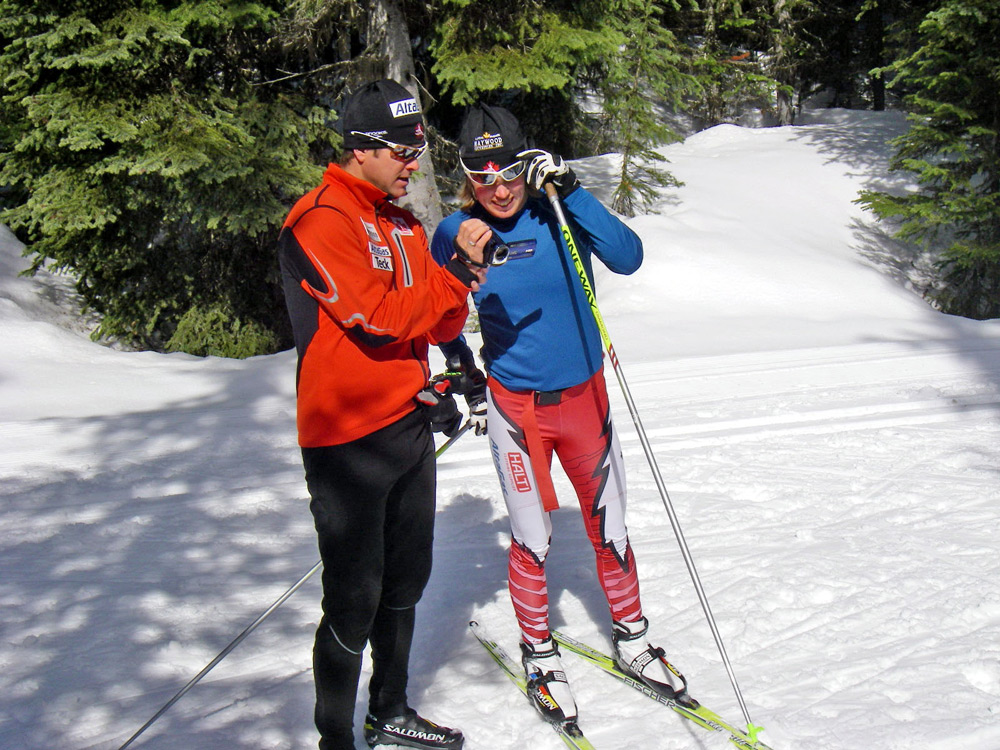
    Coach Eric Denys and Sara Renner at SilverStar, spring '09
    Canadian Women’s World Cup Coach Eric de Nys with former athlete Sara Renner in  spring 2009 at Sovereign Lake in Vernon, British Columbia.

    Editor’s Note: This article is the first in a series about expected changes within the structure of the Canadian National Cross-Country Team, starting with the departure of women’s coach Eric de Nys. While official decisions will likely be announced later this month, here’s a sense of what’s to come in Canada. This article has been updated to include notes and quotes from WinSport’s press release.

    CANMORE, Alberta — Eric de Nys, the current coach of the Canadian World Cup women’s team, is leaving the Canadian National Team coaching staff to start a new training program in Canmore for juniors looking to bridge the fitness gap to the senior level. The WinSport Junior Cross Country Ski Team, a year-round program for older juniors, was officially announced in a WinSport press release on Monday.

    De Nys has been a member of the National Team coaching staff for the last 10 years and the coach of the women’s World Cup team for the last two years. This past year, however, he worked directly with just one athlete, Perianne Jones, as Chandra Crawford and Dasha Gaiazova, the two other members of the World Cup team, decided to pursue alternative training options.

    Gaiazova trained alternately with the B2Ten organization and the Pierre Harvey National Training Centre, while Crawford temporarily left the National team in the spring of last year to train independently with Team Ninja.

    Canada's Chandra Crawford racing to 44th in the 1.3 k freestyle sprint qualifier on Tuesday in Sochi, Russia.
    Canada’s Chandra Crawford in her final international race of the season, and her career, where she was 44th in the 1.3 k freestyle sprint at the 2014 Olympics in Sochi, Russia.

    Since the end of this season, the Canadian National Team has had to look hard at its structure and organization. According to the published selection criteria for this coming year, none of the Canadian women meet the objective standards to qualify for the World Cup team.  A team for next year has not yet been named, and official decisions and announcements aren’t expected until later this month.

    “You could look at our criteria and our website and put together guesses based on that, because that’s what we’re going to use, more or less,” Canadian Head Coach Justin Wadsworth said in a phone interview. “But I can’t tell you anything because we’re still in the process and none of that stuff has been decided officially.”

    Crawford recently announced her retirement, making next season’s team officially one man (or more specifically, woman) down. Gaiazova and Jones did not make the World-Cup team requirements of at least two top-12 results or one top 6 last season.

    Own The Podium, a sports organization that financially supports Canadian athletes who produce top-level results, has cut back on funding across all winter sports, according to Wadsworth.

    According to de Nys, this combination reduced funding and an expected smaller team meant that the current coaching staff — with Wadsworth as head coach, de Nys as women’s coach, and Louis Bouchard as assistant men’s coach — would be a bit excessive for next year.

    “With the World Cup team being what it will be next year, it just can’t justify having that many coaches there,” de Nys said. “We had to do some restructuring and part of that was eliminating a job.”

    Wadsworth said the decision was based on “a combination of budget restraints and also travel, coaching and travel obligations and family.”

    Cross Country Canada (CCC) High Performance Director Thomas Holland could not be reached for comment.

    Looking forward, De Nys said the situation allowed him to move in a new direction, one that he hopes will help raise the level of skiing in Canada.

    “There’s been a noted gap in Canada,” he said. “For top level [junior] athletes to make a training centre is a really big step … Some of the training centres have taken junior athletes and often they’re overshadowed because most of the athletes are seniors. So they’re junior athletes trying to adapt to a senior plan, and it doesn’t work very well.”

    De Nys is working with WinSport, a Canadian winter-sports nonprofit that funds world-class facilities and services, to set up a junior academy in Canmore.  The idea is for skiers graduating high school to spend a maximum of two or three years in the program, with the end goal of moving on to an athlete-funded program at one of the four National Training Centres, the National Senior Development Team, or the World Cup team.

    “It’s a short window, and it’ll be a fairly intense program,” de Nys said. “But [the idea is] you have two years to do something, and then that’s it — you move on.”

    De Nys said he’s been developing this program for the past few months, although the program has been in the works over the last year. “I actually had no say in planning the program up until the point that I got wind of it and thought about perhaps applying, which would have been a couple months ago,” he said.

    “We know there’s a need for this program,” he added. “I hope that I have some education [to offer to] coaches and athletes across the country. But when I’m gone 145 days a year it’s pretty hard to do that, and now I hope, if I can cut that down to 70 days on the road, that’s 70 other days that I’m around Canmore or other clubs that come to Canmore or to the glacier. I can speak to them, help them out, whatever. I mean it’s going to be a really valuable asset, and I look forward to being around the home.”
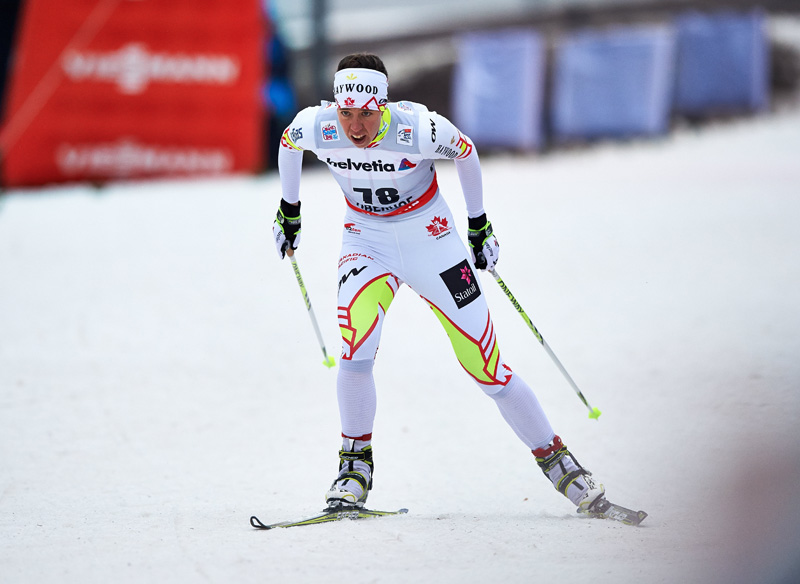
    Perianne Jones, who finished 47th, racing in her third international race of the season. (Photo: Fischer/Nordic Focus)
    Perianne Jones earlier last season at the Tour de Ski in Oberhof, Germany. (Photo: Fischer/Nordic Focus)

    The program will start as soon as next month, and the application process for interested juniors should open within a week, pending finalization of details.

    “Eric has played a critical role in developing many of Canada’s top skiers,”  CCC Executive Director Davin MacIntosh said in the press release. “He is a proven performer, and his leadership of the WinSport Junior team will ensure that there is alignment and collaboration with national team programming — this represents a significant advantage for the future success of our program. Eric will bring a wealth of experience to the athletes at WinSport’s Junior Ski Team.”

    According to the release, the program is “fully aligned” with Cross Country Canada’s Long Term Athlete Development Program.

    “This new initiative is a very exciting project, we look forward to building this program and working with Eric as our head coach,” said Mike Norton, WinSport’s sport manager in Canmore.

    De Nys explained he hopes to continue working with Perianne Jones in some capacity next year, although the intricacies of this are still being hammered out. Jones, who is currently building a schoolhouse in Nicaragua with several other Canadian skiers, was unsure of her plan for next year.

    “We will continue to work together,” De Nys said. “That’s what she would like, and I’ll be happy to help her out.”

    While meetings are still underway regarding the National team structure for next year, decisions are set to be released within two weeks.

    As for Wadsworth’s role, he said CCC hasn’t made anything official, but “the plan is that I’m going to stay on with the team and have maybe a slightly changed role,” he said. “[I’ll] still be the head coach of the World Cup and the national team, potentially work in some other areas as well.”

  • Adventures in Birkie Land: A First-Timer’s Experience at the American Birkebeiner

    Adventures in Birkie Land: A First-Timer’s Experience at the American Birkebeiner

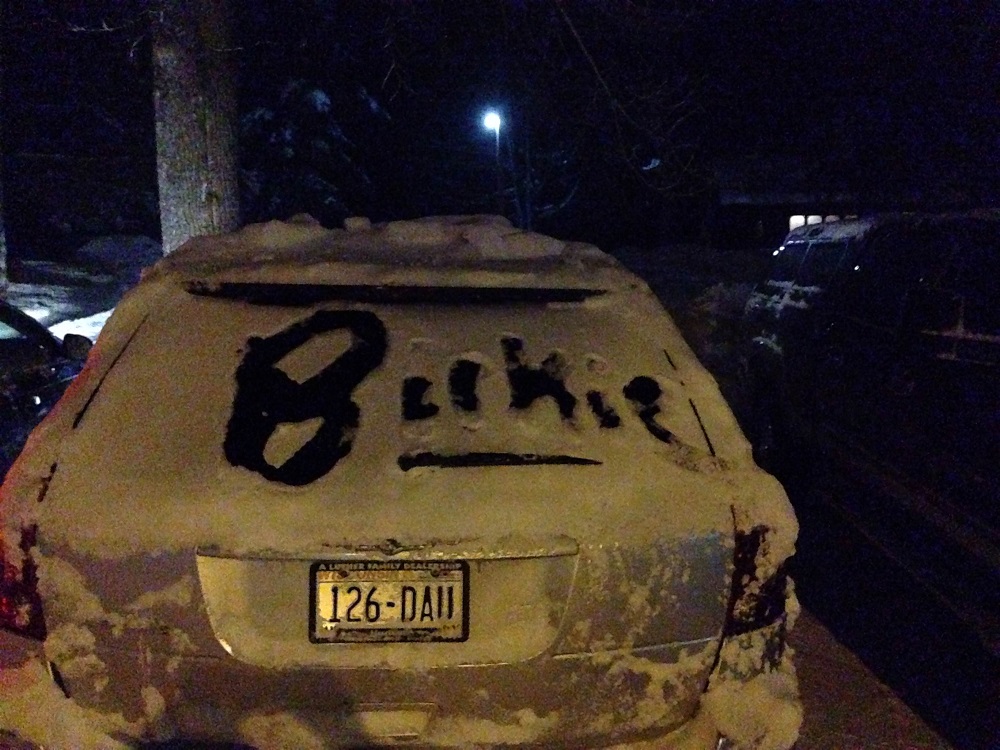
    Birkie Fever, incarnate.
    Birkie Fever.

    HAYWARD, Wis. — This past weekend, nearly the entirety of the adult population of Midwestern skiers made their way to Hayward for the annual get-together of the ski community: The Birkie. The American Birkebeiner (or Birkie, for short), is the biggest ski race in North America. For many skiers, the race represents their culmination of training for the whole year.

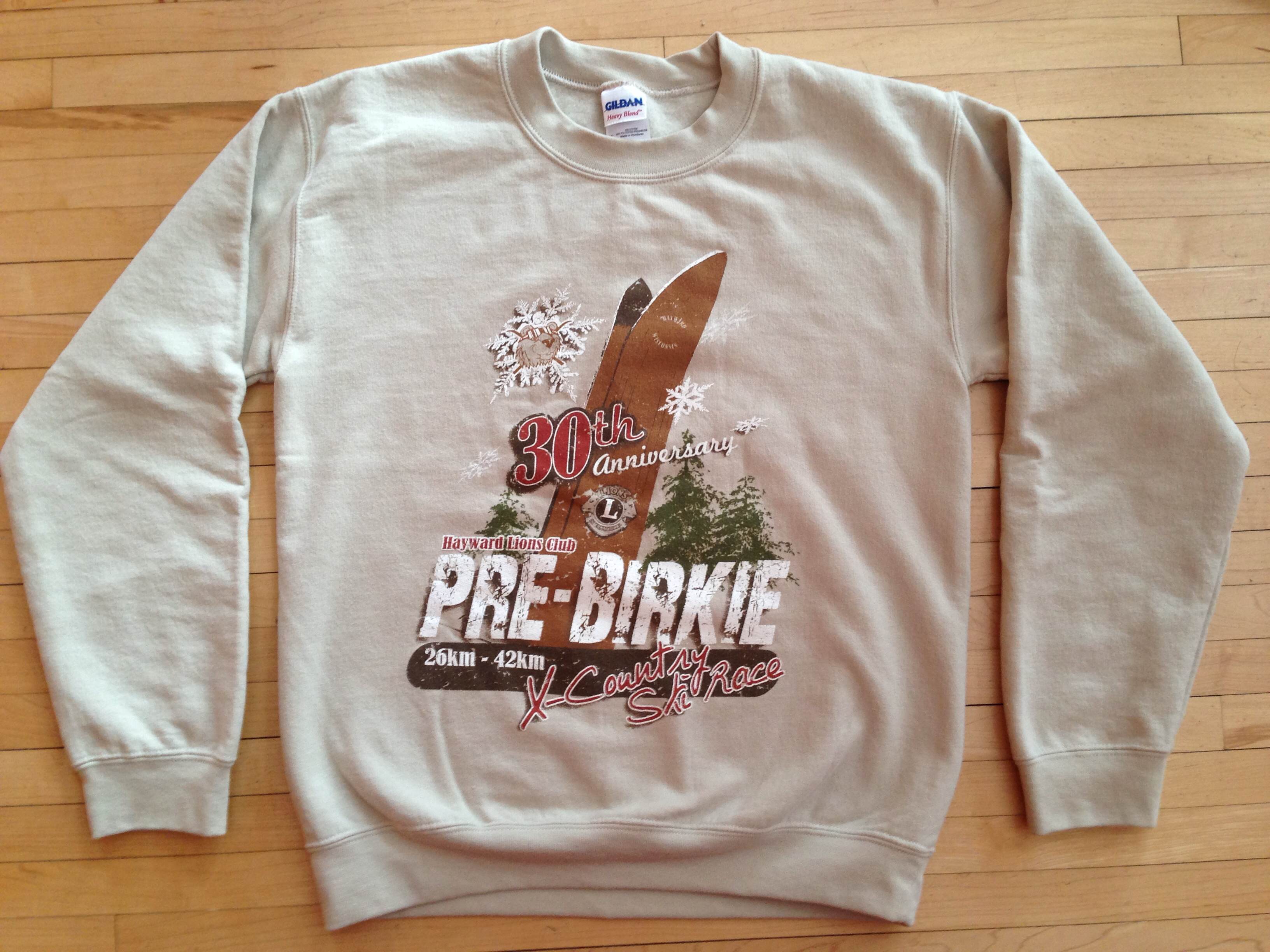
    The commemorative sweatshirt for the Pre-Birkie, circa 2012.
    The commemorative sweatshirt for the Pre-Birkie, circa 2012.

    Accordingly, the level of excitement and attention towards this race is high enough that there is actually a term for it — Birkie Fever.  There is even a fairly large race dedicated to preparation for the Birkie itself, logically named the Pre-Birkie, which races on the Birkie trails two weeks prior to the big race.

    Growing up in the Midwest, I had been fully aware of the Fever, but as a junior and collegiate skier, this time of year was often filled by preparation for Junior Nationals or other races. This year, I finally decided to make the trek to Hayward from Canmore, Alberta (my current residence), for my first-ever Birkie. My plan was to meet up with my family and my friend Julie, who lives on the East Coast.

    T-minus 6 weeks: I decide to start mixing some interval sessions into my usual workout schedule, which generally consists of easy skiing and lots of mixed and ice climbing. I also discover some amazingly colorful workout spandex online and have an in-depth discussion on race day wear with Julie on whether we should start our own team and wear said spandex.

    T-minus 4 weeks: A last-minute three-week climbing trip is organized, and I leave for the climbing trip. The trip is fantastic, but with temperatures dropping to -20F, I sustain moderate frostbite in my feet.

    T-minus 7 days: I start noticing in-depth wax discussions for the Birkie popping up on major ski shop websites based on the 10-day forecasts. Info emails from the Birkie, which had previously been arriving several times a month in my inbox, start arriving every other day. I also learn that there are no less than three songs that have been written about the Birkie (available for listening here).

    T-minus 4 to 5 days: Comments start popping up on Facebook about the Birkie. Focus is centered on the weather forecast, which has changed significantly. A mega-snowstorm predicted to arrive Thursday afternoon is dubbed “Birknado” and spawns the hashtag #BirkiePanic.

    Commemorative Birkie Merchandise
    Commemorative Birkie Merchandise.

    T-minus 2 days: I travel to Minneapolis, arriving just before all of the flights are canceled coming into town, due to the mega-snowstorm that’s about to hit. Julie’s flights are all canceled, and now she’s not scheduled to arrive until late Friday night. My dad and I travel to Hayward. Bib pickup is the most elaborate set up I’ve ever seen. I have to show photo ID twice. Wandering around the vendor booths afterward, we notice the Birkie memorabilia stand, where one can choose from hundreds of items with which to display one’s Birkie pride.

    T-minus 1 day: I head back into Hayward, armed with a hat, a Buff, and a photo of a photo ID of Julie. The goal is to pick up Julie’s bib via impersonation, and it is a stunning success at first. At the second ID check, however, I’m asked what my birthday is, and in a worst-friend-ever maneuver, I totally blank. I tell my story to the bib lady, and she lets me take the bib anyway.

    I am also informed by a seasoned Birkie skier that the road “00,” which marks the rough midway point of the race, is actually pronounced “double-oh,” and not “double-zero,” as I had been calling it. This is a serious faux-pas. #BirkieFail.

    Race Day: After at least five Birkie emails in the past 24 hours, we arrive at the Birkie start. There has been so much snow that the start area warm-up tent is partially collapsed, but the bitter cold has driven many people inside the tent anyway.  It’s 1F at 8 a.m., and there’s a strong headwind. There’s a helicopter shooting video circling above us.  The cost basis of helicopter filming is absurdly high, so I know that this is serious business.

    I move into the start area and file into my wave zone. I’m lucky enough to be in Wave 1, but I notice that as the start countdown for the wave ahead of us (Classic Wave 2) begins, all of the people around me start to shift into a crouching position. Confused at first, I realize that they are setting up to run to the start line once our wave moves up.  Classic Wave 2 goes off, and my wave starts a full-on sprint to the start line. Realizing that this is how stampedes begin, I, too, break into a sprint and score a great starting spot.

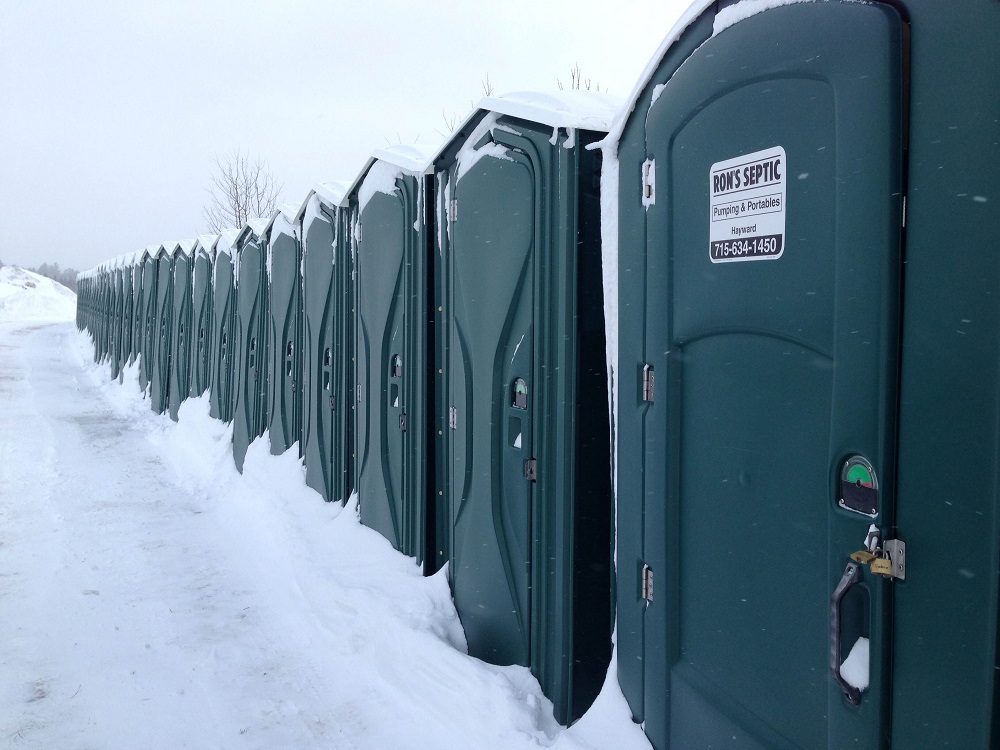
    Lots of restrooms at the Birkie start.
    Lots of restrooms at the Birkie start.

    The start itself is pretty standard, but I’m impressed to see bins of poles on the side of the trail after the chaos has settled out. Replacement poles, sorted by length, are available to all. I later find out that this is standard at the aid stations, as well.

    As my wave settles in a rhythm, all goes smoothly. There is great cheering from supporters on the sides of the trail, and there are sometimes massive slowdowns on the uphills as skiers bog up in the very soft, very cold snow, but otherwise, the race is fairly normal.

    At 00, I end up dropping out due to cold feet (a carryover from the cold injuries sustained on the climbing trip), but Julie, also in her first Birkie, finishes the race. She is stoked about the shot-ski at the top of Bitch Hill and, like the Dartmouth alum that she is, fully indulges. Later on, she is not so stoked about the ski across the lake to the finish (due to the headwind, not the shot), but finishes strong.

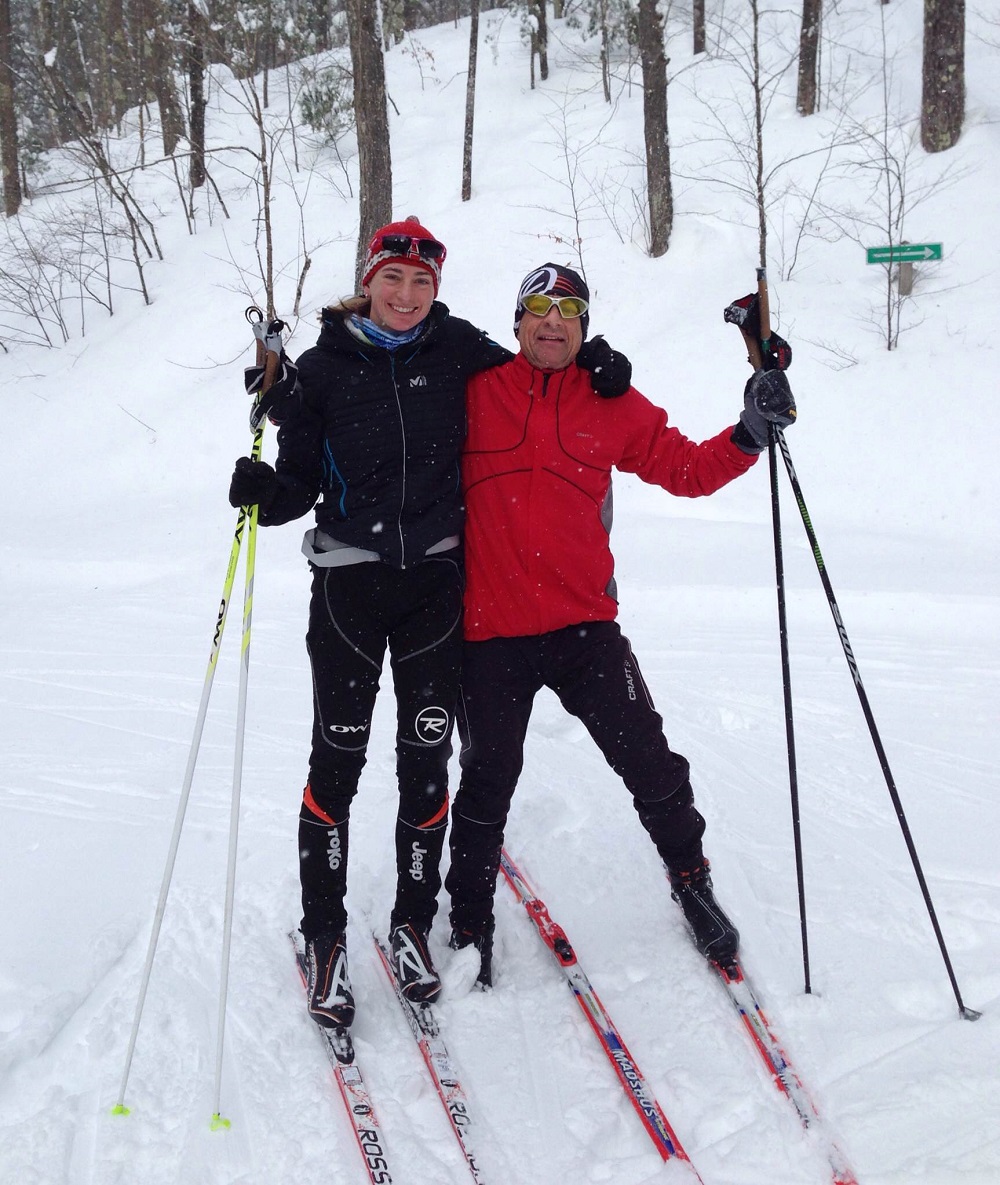
    The author and her dad out for a ski before the Birkie.
    The author and her dad out for a ski before the Birkie.

    I hitch a ride to the finish area. I find my clothes bag in the meticulously organized and enormous bag area just as Julie finishes the race. She’s tired, but mostly extremely impressed at how nice Midwestern skiers are. The streets are packed with people. Everyone is exhausted, but the sun is just warm enough to make the cold manageable. There is serious revelry going on, and even though I’m a little disappointed about my race, the atmosphere is so fun that it more than makes up for it.

    Overall, the Birkie was a great experience. It’s pretty amazing to see how many people are excited enough about skiing to want to ski a hard, cold, 50 k skate race hours away from any population center. I was stoked to finally experience “The Fever,” and I will definitely be back next year.

  • How Webster, Ammar Earned Additional Spots on Canada’s Olympic Team

    How Webster, Ammar Earned Additional Spots on Canada’s Olympic Team

    Amanda Ammar (Team Ninja) leads Brittany Webster (Highland Trailblazers) in the 15 k skiathlon on Jan. 12 at 2014 Canadian Olympic Trials in Canmore, Alberta. (Photo: Angus Cockney)
    Amanda Ammar (Team Ninja) leads Brittany Webster (Mito Canada) in the 15 k skiathlon on Jan. 12 at 2014 Canadian Olympic Trials in Canmore, Alberta. (Photo: Angus Cockney)

    Editor’s Note: With the Olympic Games set to kick off in earnest with the Opening Ceremony on Friday night (Moscow Time Zone, 9 hours ahead of EST), the Canadian National Cross-Country Team is ready to go in the mountain village of Krasnaya Polyana, where it’s been training for the last few days. This article explains how their team grew by two just a few weeks before the Olympics, and shortly after the official nomination.

    ***

    On Jan. 14, Cross Country Canada (CCC) nominated 11 athletes to its 2014 Olympic squad: a roster that included seven prequalified World Cup skiers, plus an additional two men and two women.

    Over the next week, teams like the U.S. also announced their Olympic picks, with the U.S. nordic team opting to use 14 of its 17 allotted quota spots. Nations that chose not to fill their quotas for various reasons, limited support-staff accreditation being one of them, gave countries like Canada the option to bring more athletes.

    By Jan. 23, the CCC appeals process was in its final stages regarding the selection of its own team — a policy designed to ensure member athletes get fair treatment when it comes to decisions that “may include, but are not limited to, carding, contract matters, harassment, selection and discipline,” according to the document.

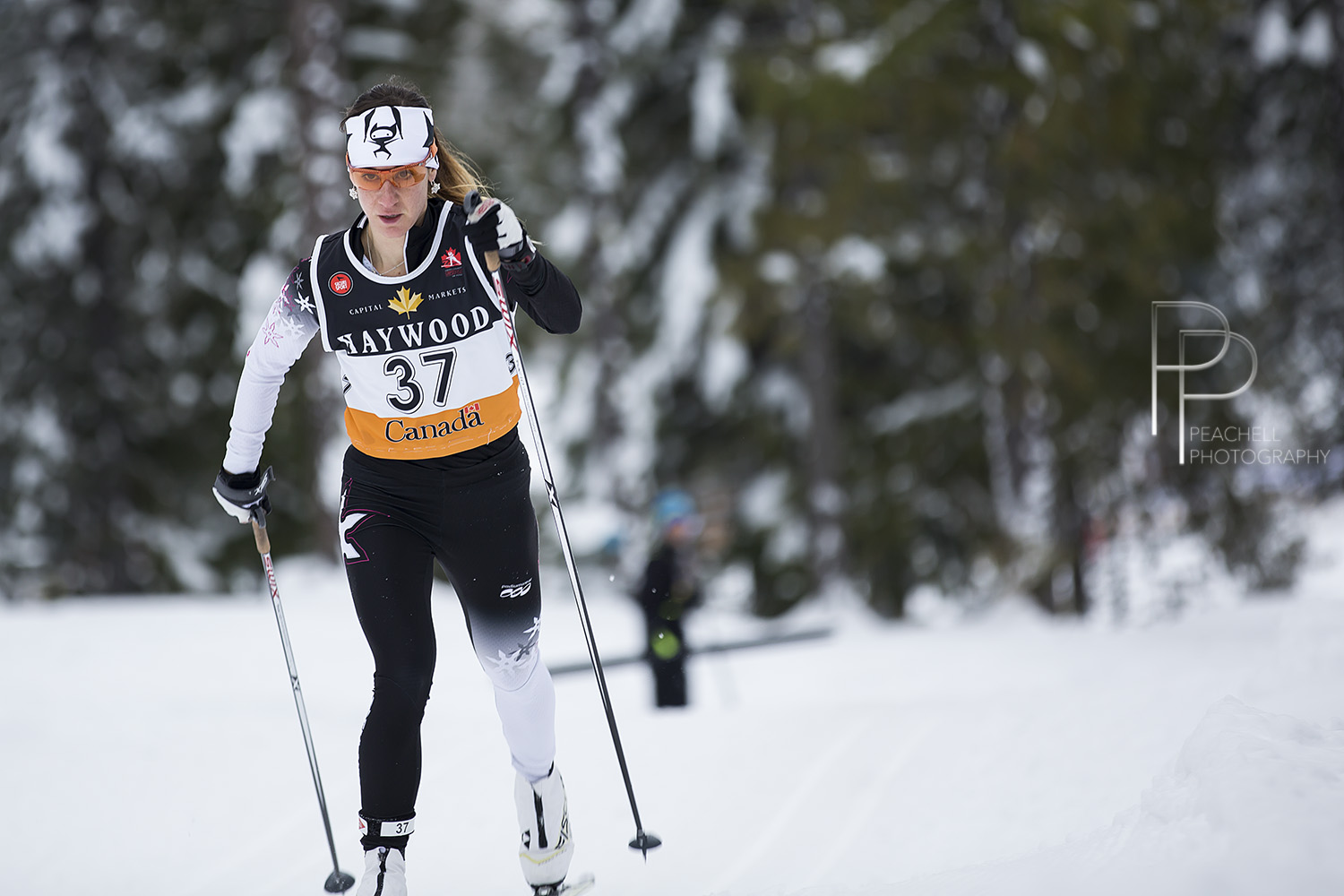
    Amanda Ammar (Team Ninja) racing to third in the Black Jack NorAm 10 k classic individual start on Dec. 15 in Rossland, B.C. (Photo: Shelley Peachell/Peachell Photography, http://peachellphotography.com/)
    Amanda Ammar (Team Ninja) racing to third in the Black Jack NorAm 10 k classic individual start on Dec. 15 in Rossland, B.C. (Photo: Shelley Peachell/Peachell Photography)

    Two former national-team members who narrowly missed the Olympic cut based on their  Canadian Points List (CPL) standings after Olympic Team Trials — Brittany Webster (Mito Canada) and Amanda Ammar (Team Ninja) — stepped forward.

    “If an athlete is not satisfied with the decision of a selection committee in any of our selections, they can appeal internally within Cross Country Canada,” CCC High Performance Director Thomas Holland explained on the phone. “They go to the president, he [sends it to] another panel to hear the appeal.”

    With the Olympics three weeks away and a panel typically having up to 21 days to hold a hearing, CCC rejected one of the appeals because of the short time frame, Holland explained. In that instance, athletes can go to Sport Dispute Resolution Centre of Canada (SDRCC) to have their appeal reconsidered.

    “That’s what Amanda Ammar did,” Holland said. “So then you basically have a hearing for both sides and there’s an arbitrator who decides the case.”

    Based on CCC’s published criteria, which stated it could take up to 12 athletes to the Olympics, Webster was the first one in the door after CCC accepted her appeal.

    “The criteria was a little ambiguous on one point, so she made a case internally to appeal,” Holland explained. “It was all friendly fire anyway. She brought that case forward for the ambiguity in the criteria, which was really looking at the second-place finish [at Olympic Trials].”

    Reviewing Olympic Trials

    The team’s selection process consisted of a prequalification stage at the World Cup level, followed by a series of NorAm races in early January in Canmore, Alberta, which doubled as trials. In addition to the seven World Cup athletes that prequalified, CCC planned to take four more athletes from the results of those trials: a male and female sprinter, and a male and female distance skier.

    For three out of the four disciplines, the decision was clear.

    Heidi Widmer of the Alberta World Cup Academy (AWCA) and National Senior Development Team (NST) won the second freestyle sprint after placing second in the first one to Chandra Crawford, of the World Cup Team and Team Ninja, who had prequalified.

    Jesse Cockney (AWCA/NST) placed second and first, respectively, in the two freestyle sprints, and Graeme Killick (AWCA/NST) finished second in the 10 k classic race by just 1.5 seconds and then dominated the skiathlon a few days later.

    As a result, Widmer, Cockney and Killick were all named to their first Olympic team two days after the trials, along with Emily Nishikawa (AWCA/NST), who won the women’s 10 k classic race by 54 seconds. She went on to place sixth in the 15 k skiathlon, more than 2 minutes behind Ammar as the winner.

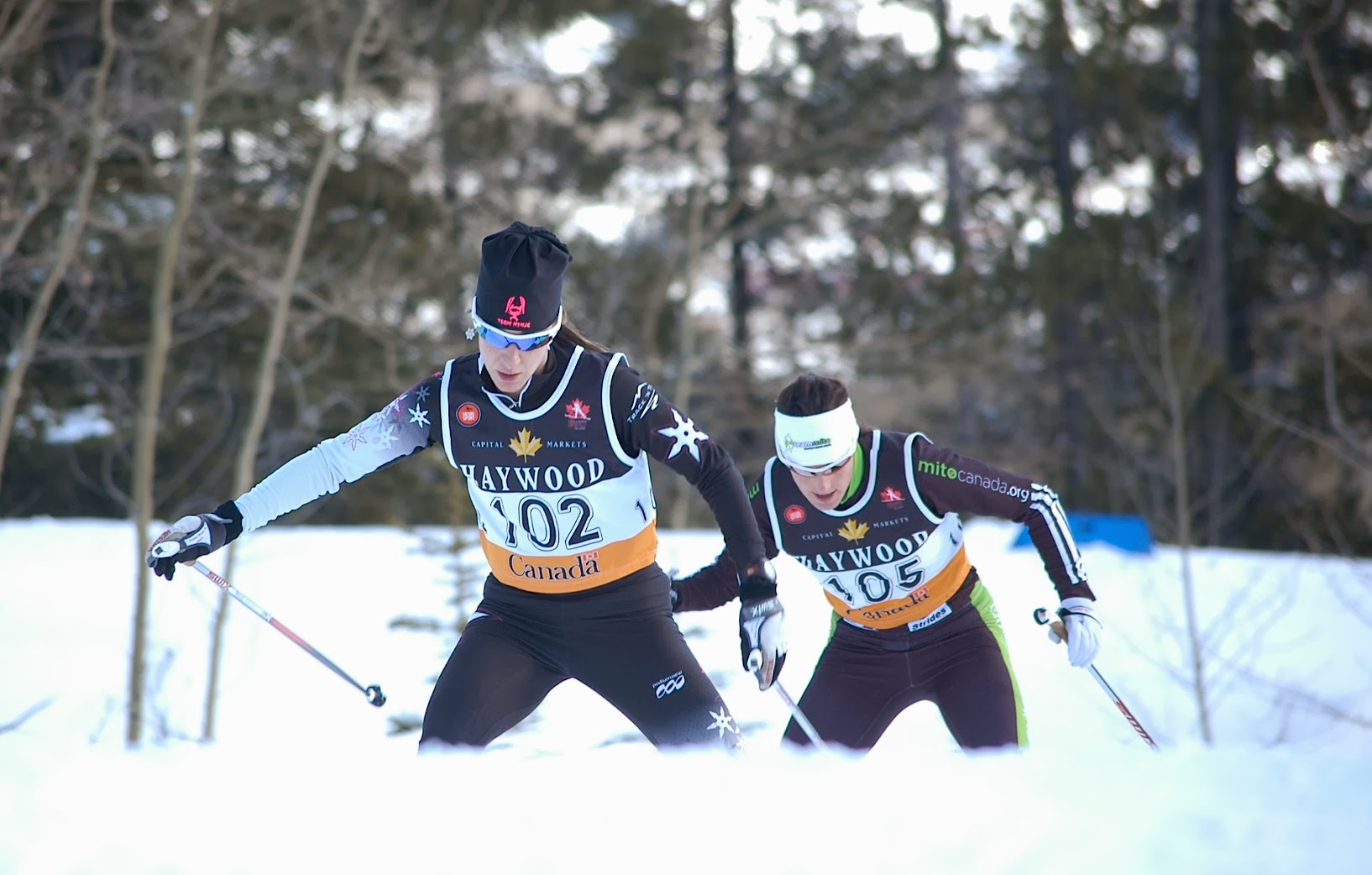
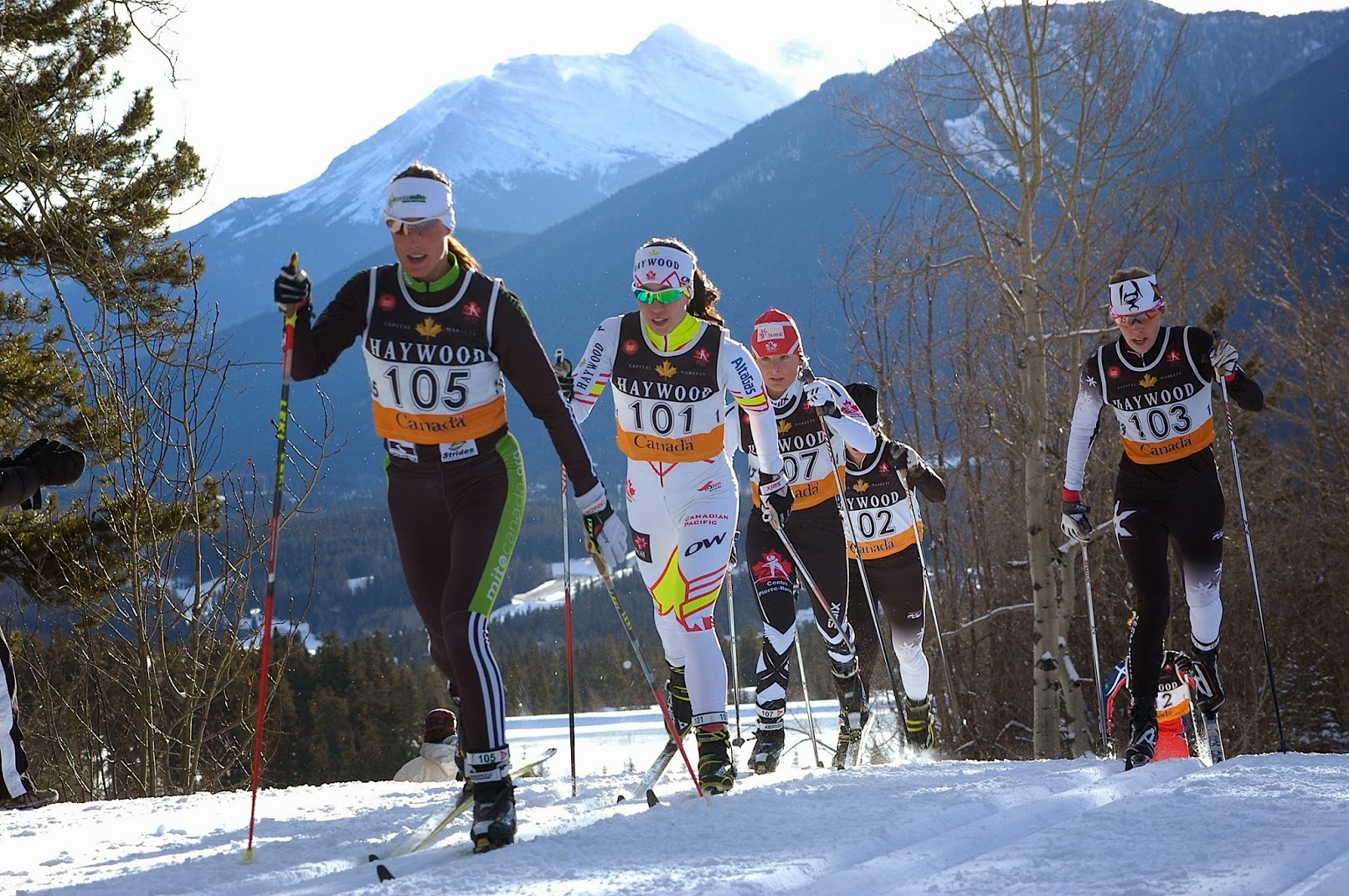
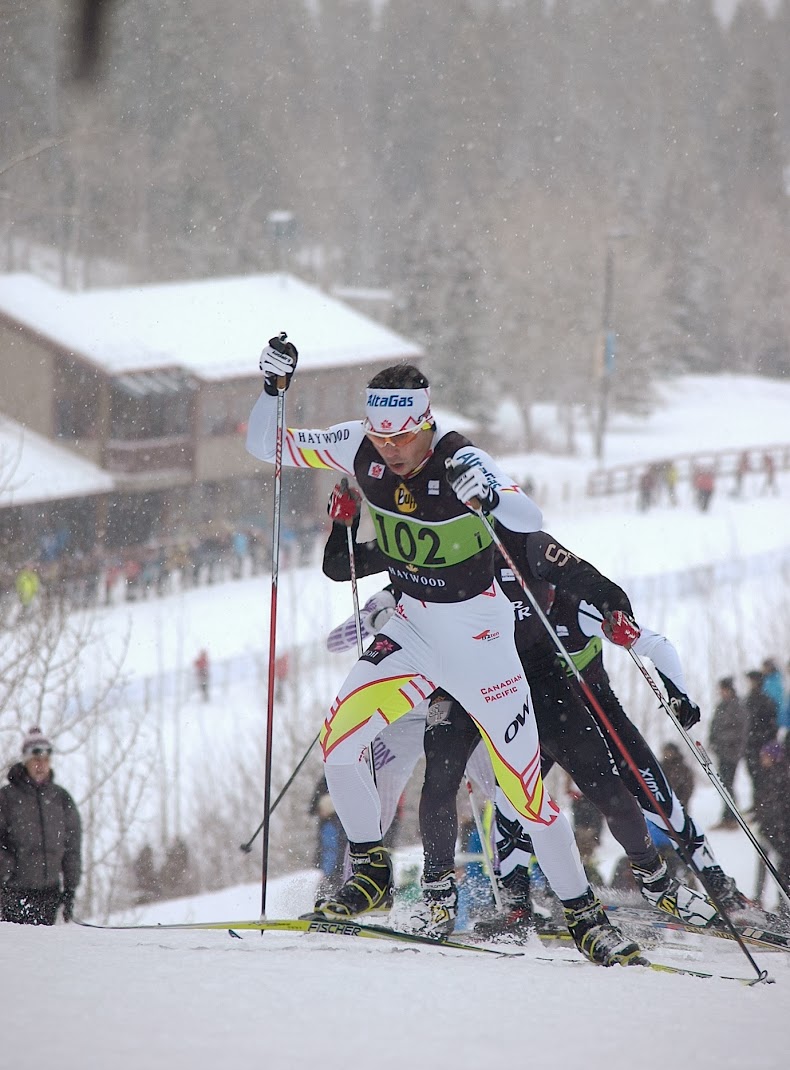
    Emily Nishikawa (101) follows Brittany Webster (105) in the women's 15 k skiathlon at Canadian Olympic Team Trials on Jan. 12 in Canmore, Alberta. Nishikawa placed sixth in the final race of the trials, securing her spot at the 2014 Sochi Olympics from Feb. 7-23. Webster took second after winner Amanda Ammar (102). (Photo: Angus Cockney)
    Brittany Webster (105) leads Emily Nishikawa (101) in the women’s 15 k skiathlon at Canadian Olympic Team Trials on Jan. 12 in Canmore, Alberta. Nishikawa placed sixth in the final race of the trials, securing her spot at the 2014 Olympics. Amanda Ammar (102) won, and Webster placed second. (Photo: Angus Cockney)

    Ammar had placed sixth in the 10 k classic, 1:50 behind Nishikawa. Webster placed second in both of those races.

    Going into the trials, the general consensus among athletes was that winning one of the races was necessary to have a chance at nomination. Nishikawa was named to the team based on her CPL points for the two races better than Ammar’s, topping her by a single point, according to Ammar’s Facebook page. CPL points are the Canadian equivalent of USSA/FIS points.

    After the Olympic team was announced, both Ammar and Webster filed appeals with CCC with separate arguments.

    Ammar stated that the CPL-based selection process was flawed and additionally, that Canada wouldn’t fill its distance starts at the Olympics with the athletes already nominated to the team, with four sprinters among five women. She argued that, had Nishikawa placed fifth in the skiathlon (versus sixth), the points for the skiathlon would have been better because of Nishikawa’s strong point profile, which would’ve boosted Ammar’s points. The CPL scoring system considers only the seed points of the top-five finishers in each race to determine the race points.

    Webster, on the other hand, could have been nominated to the team based on Olympic qualifying standards.  According to CCC’s Nomination Procedures for the 2014 Olympics, an athlete does not explicitly need to win one of the trials races to be selected. In fact, a key component of qualification is having the best points between two trials races.

    “If there are two race winners, the ranking list based on the athlete’s sum total of the designated distance races … will decide the top ranked athlete for the purpose of selection,” the document states.

    Through the end of the trials on Jan. 12, Webster’s points for those races were higher than those of both Nishikawa and Ammar. That, paired with additional Olympic quota spots granted to Canada on Jan. 24, supported Webster’s grounds for nomination.

    Holland said the whole process, including Ammar’s appeal to an outside governing entity, moved quickly — and involved other athletes, such as Para-Nordic Team veteran and 2010 Olympian Brian McKeever, who “started to appeal and for various reasons withdrew that appeal,” Holland explained.

    While McKeever could not be reached for comment, Holland said McKeever, who won the 15 k classic at trials, brought up his case after more athletes were being considered for additional quota spots.

    “He felt that he had a better ranking so why wouldn’t he be considered,” Holland said. “Once an outside appeal committee jumps in, the decision can get very messy because other athletes can come forward and say, ‘What about me?’ We made that case very clear. Anyways, we’re past it, we’ve got our team, and we’re happy to move forward.”

    The entire process started shortly after trials, and with team-naming deadlines looming for both the national and Sochi Olympic committees, Holland said the panel had to move quickly.

    “Sometimes you have to do this within hours,” he said. “That’s why it happened fast and that’s why we have an appeals process that allows for that. It moves pretty quick and these aren’t just hearsay, these are things where we have to put forward a case and put facts on the table.”

    Reacting, Moving Forward

    Once CCC acknowledged it could take up to 13 athletes to the Olympics, both Webster and Ammar received notice on Jan. 24 that they would be named to the team, according to Ammar.

    “I found out on Friday at 6 a.m.,” Ammar said. “So it was a very long, exciting day.”

    When she first discovered she didn’t make it, Ammar said, “Like a normal athlete, I just cried.”

    Frank Ammar cheering for his daughter Amanda Ammar (Team Ninja) on the final day of the Canadian Olympic Team Trials in Canmore, Alberta. A week and a half after the trials, Amanda was named to her second Olympic team. (Photo: Angus Cockney)
    Frank Ammar cheering for his daughter Amanda Ammar (Team Ninja) on the final day of the Canadian Olympic Team Trials in Canmore, Alberta. A week and a half after the trials, Amanda was named to her second Olympic team. (Photo: Angus Cockney)

    The one-point margin was what got her.

    “I mean if it was something huge, then I would have gotten over it, but luckily my dad doesn’t take really no for an answer, and he’s like, ‘Nope, nope, we’re fighting this, nope, we are fighting this,’ and he talked to my old coach, and they’re like, ‘Oh yeah, we more than have a case here, this shouldn’t be an issue.’ So we went forward, and there was a lot of people behind me and supporting me throughout this whole thing.”

    A 2006 Olympian, Ammar, who turned 28 on Thursday, stepped away from skiing for two seasons (from 2009-2011) and came back to it with the help of her boyfriend and coach, Chris Butler. She had been derailed by injuries and dealt with pains in her back and foot as recently as last fall. The NorAm leader at the end of last season, she had the opportunity to start this winter over in Europe. She declined, resolving to rehab her injuries and train more at home to peak for Olympic trials.

    “It feels deserving, it feels amazing, it feels exciting,” Ammar said of being named to her second Olympics. “I have never felt so strong in my whole career. Taking that time away and coming back and training the way I believed to be the best, and staying true to myself and doing my own things as an independent racer has never been more fun and more rewarding. When I hit those start lines at trials this year, I knew there was nothing more I could have done, and there was nothing more in my way.”

    Eight years ago, the Olympics came as a bit of a surprise.

    “I wanted to go to world juniors, and I wanted to be fit, and I ended up making the Olympics — sweet,” she said.

    This time around, she revived and reinvented herself.

    “I came back from so much,” she said. “I came back from an eating disorder, I came back from a back injury, I came back from food allergies, I came back from overtraining, I came back from sleep problems. It was so hard, and I put it out there — I made it real — I said, ‘I want to make Sochi,’ and I just went for it.”

    A member of the 2010 Olympic team, Webster, 26, has also returned to the sport. Four years ago at the Games in Vancouver, B.C., she was initially too sick to race and did not start as a result.

    “[The team] wanted to fly me back to Calgary so I could go back, and in their words, ‘Rest up for a day or two’ and then start training again, but not be around the Olympic environment,” Webster said. “They were going to fly me back for the team relay and the 30 k skate, and for me, it made a little more sense to stay in place and try to recover as best as I could.

    “I had a fever, a sinus infection, a sore throat, and I wasn’t really fit to fly, so I decided instead to stay with my parents at their condo, and that didn’t fly well,” she continued. “So that was basically the end of the story.”

    After taking some time off after the 2010 Olympic season, Webster renewed her zest for racing, making it to World Championships last year in Val di Fiemme, Italy, where sickness knocked her out for all but two of the competitions.

    “I think that if I’m healthy and fit and feeling the way I do now, I can definitely pull out a good race,” Webster said. “What that is on the World Cup or Olympic scene, I have no idea. I would love to think that it’s a top 30, but I really haven’t had a lot of experience stepping on the start line in a good mindset and … healthy in a championship like this, so that would be like the ideal circumstance. In order to get there, I just have to stay happy and healthy and really just enjoy the whole process.”

    Earlier this week, Webster and Ammar flew to Sochi to join their team in the mountain village of Krasnaya Polyana, where all the nordic events will be held. On Saturday, On Saturday, Webster, Ammar and Nishikawa will represent Canada in the women’s 15 k skiathlon, the first race of six women’s events at the 2014 Olympics.

    “I came back from so much … It was so hard, and I put it out there — I made it real — I said, ‘I want to make Sochi,’ and I just went for it.”  — Amanda Ammar

    Accreditation

    In terms of staffing, Canadian Head Coach Justin Wadsworth wrote in an email that they will  have three coaches, seven wax technicians, a team doctor, osteopath, two massage therapists, physiologist, and Holland as the team leader in Russia. Of the 16, all but four (the doctor, osteopath, physiologist, and one masseuse) are accredited, which grants access to the venue and certain restricted areas.

    Canada worked with Australia to bolster its accredited staff. According to Holland, the relationship between the two national teams started before the World Cup races in Sochi a year ago.

    “It is simply an arrangement where we [work] their skis in exchange for accreditation,” he wrote. “Works for both nations. Every Games we are short on accreds for techs.”


  • Canadian Olympic First-Timers on Qualifying, Shifting Focus to Sochi

    Canadian Olympic First-Timers on Qualifying, Shifting Focus to Sochi

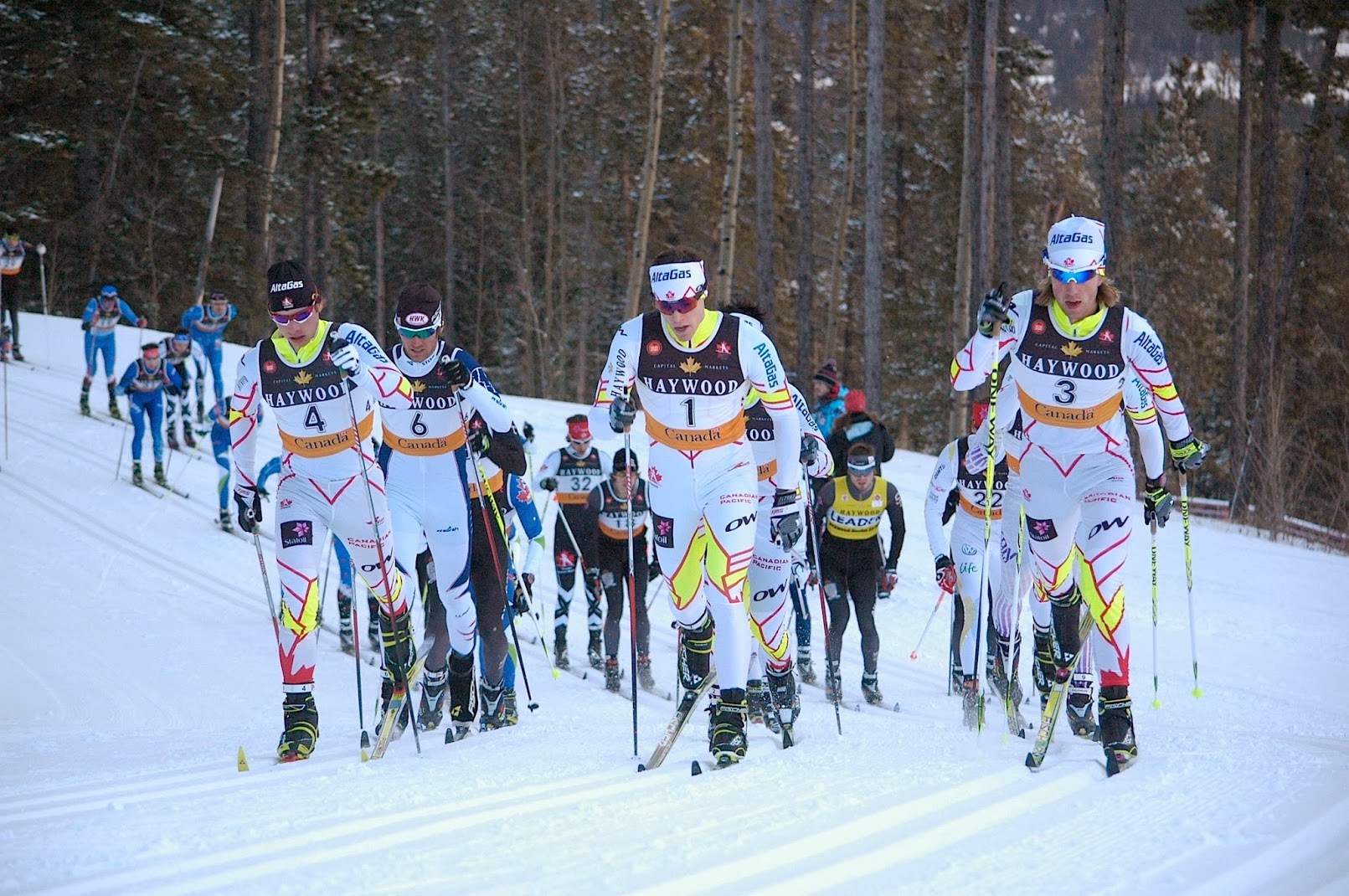
    Graeme Killick (3), Michael Sompp (1) and Kevin Sandau (4) lead early in the men's 30 k skiathlon at Canadian Olympic Team Trials on Jan. 12 in Canmore, Alberta. Killick ended up winning by nearly a minute to secure his ticket to the 2014 Sochi Olympics. (Photo: Angus Cockney)
    Graeme Killick (3), Michael Sompp (1) and Kevin Sandau (4) lead early in the men’s 30 k skiathlon at Canadian Olympic Team Trials on Jan. 12 in Canmore, Alberta. Killick ended up winning by nearly a minute to secure his ticket to the 2014 Sochi Olympics. (Photo: Angus Cockney)

    The Canadian Olympic team was officially announced last week in Calgary, Alberta. While seven of the 11 team members were no surprise (most prequalified for the Games with their World Cup results last season), four of the newly minted Olympians earned their spots through the high-stakes week of Olympic Trials racing. Graeme Killick, Emily Nishikawa, Jesse Cockney, and Heidi Widmer, all of the Alberta World Cup Academy (AWCA) and Canadian Senior Development Team (NST), managed to keep their nerves and fitness together to each garner their first trip to the big show — the 2014 Winter Olympics, which start in just over two weeks in Sochi, Russia. Here, we profile these Olympic newbies and their thoughts before heading to Sochi.

    Graeme Killick

    Killick, 24, scored his ticket to Sochi via a second place in the trials’ 15-kilometre classic race and a win in the 30 k skiathlon, and has been steadily improving over the past few years on the AWCA and NST. After placing 15th in his last U23 Championships in 2012, Killick made a smooth transition to a senior career with a handful of NorAm podiums in 2013, including a third-place finish in the 10 k freestyle at Canadian Nationals.

    In a phone interview last week, Killick mentioned that the hardest part of qualifying for the Olympics this year has been the increased level of competition amongst the Canadian men.

    “This year, more than any other Olympic qualifier in the past, the level of competition in Canada is at an all-time high,” Killick said. “I think that alone made it hard to achieve, but I think it was all the training [I’ve] put in the last couple years, [I’ve] been able to put it together for these two races.

    “Every qualifier has been a challenge, like for U23 Championships and World Juniors, those are things that I’ve had to overcome over the years, and it all culminates to these trials,” he added. “I think being able to have a good result here [is from] all of the rest of the qualifiers that have helped me to put it together for this week.”

    With less international-racing experience than most on the Canadian Olympic squad, Killick will primarily be looking to build on his  experience and skills, but believes the Canadians have a shot at some good results.

    “I think for these Olympics, and I think for myself, I’ll just continue to improve,” he said. “The more racing I get and the more international experience I get. I’m looking forward to the World Cups in Toblach [Italy] to prepare me for racing at the international level and at the Olympics. “

    Emily Nishikawa

    Emily Nishikawa (101) follows Brittany Webster (105) in the women's 15 k skiathlon at Canadian Olympic Team Trials on Jan. 12 in Canmore, Alberta. Nishikawa placed sixth in the final race of the trials, securing her spot at the 2014 Sochi Olympics from Feb. 7-23. Webster took second after winner Amanda Ammar (102). (Photo: Angus Cockney)
    Emily Nishikawa (101) follows Brittany Webster (105) in the women’s 15 k skiathlon at Canadian Olympic Team Trials on Jan. 12 in Canmore, Alberta. Nishikawa placed sixth in the final race of the trials, securing her spot at the 2014 Sochi Olympics from Feb. 7-23. Webster took second after winner Amanda Ammar (102). (Photo: Angus Cockney)

    Nishikawa won the first distance race of the Olympic Trials, a 10 k, by almost a minute to secure her nomination to the Olympic squad. She also placed sixth in the 15 k skiathlon.

    At 24, Nishikawa has a solid resume of international results. She competed at last year’s World Championships and placed 34th in the World Cup 15 k skiathlon in December 2012 in Canmore. Prior to that, she placed as high as 17th at U23 Championships.

    This season, the Whitehorse native has been on a hot streak. Coming off of an especially consistent summer and fall of training, Nishikawa has had podium finishes in three out of the four NorAm races before the trials. Though she said she felt confident about her chances of making the team prior to trials, she is very happy everything came together at the right time.

    “[Making the Olympics] is a childhood dream come true,” Nishikawa said. “I’m so thrilled, and so honored, and proud to represent Canada at the Olympics. I’ve definitely been working towards this goal for a long, long time, so yeah, everything’s come together for me, and to compete at the Olympics—I’m just thrilled.”

    Nishikawa’s brother, Graham, will also be potentially racing a few weeks later in Sochi as a backup guide for Brian McKeever at the Paralympics.

    Jesse Cockney

    Jesse Cockney en route to a skate-sprint victory at Canadian Olympic Team Trials on Jan. 11 in Canmore, Alberta. Cockney won the A-final to elevate him to his first Olympics at the 2014 Winter Games in Sochi, Russia. (Photo: Angus Cockney)
    Jesse Cockney en route to a skate-sprint victory at Canadian Olympic Team Trials on Jan. 11 in Canmore, Alberta. Cockney won the A-final to elevate him to his first Olympics at the 2014 Winter Games in Sochi, Russia. (Photo: Angus Cockney)

    Cockney was sick before the Olympic Trials. While he casually mentioned that he had been ill in a pre-trials interview, he didn’t seem too fazed by the situation. However, after the races, Cockney confessed that he had, in fact, been very sick, very “strung up,” and very stressed, what with hearing “Olympics” mentioned every day.

    However, his dad, Angus Cockney, who was an elite nordic racer who got his starts in the Northwest Territories in the mid ’60s, knew what to do.

    “My dad … really helped me calm down and relax, and made sure that I was enjoying the process and just dealing with what was in front of me,” Cockney said. “He’s good at keeping me positive.”

    Cockney, 24 (and coincidentally sharing a birthdate with Emily Nishikawa), placed second and first in the freestyle sprints at Trials. Coming off an early season on the World Cup, Cockney had a weak sense of his fitness.

    “The good days are a little different over there,” he said. “Instead of finishing on the podium like I feel like I would have in Canada, I was finishing in the 60’s over there, so it was a different feeling for sure.”

    This was especially tough going into trials; Cockney said believing in himself was the toughest challenge for making the team.

    “I think that, along with a lot of people that are going to the Olympics, the biggest challenge is really finding true belief that you can do it,” he said. “I struggle a lot with self-doubt and I’m pretty hard on myself with a lot of things so that was a big thing for me to be sure that I was confident going into the races.”

    Cockney has had some of the stronger results of this class of Olympic freshmen. The Yellowknife native placed ninth in the Canmore World Cup sprint last year, and had eight podiums in last year’s NorAm circuit.

    Along with the families of the other Olympians, Cockney’s family is trying to make it to Sochi, despite the complexities of Russian visa acquisition.

    “I am not holding out a whole lot of hope that they’ll be able to go,” he said. “But they’re trying as hard as they can. I’m happy that they at least are in a position where they can do that, and one of my sponsors is being very generous and offered to help pay their way, so that’s amazing … [But if they can’t come] they’ll probably end up seeing more of me on TV than they would if they came to Russia.”

    Heidi Widmer

    Heidi Widmer on her way to winning the Canadian Olympic Team Trials skate sprint on Jan. 11 in Canmore, Alberta. Widmer, 22, qualified for her first Olympics in Sochi, Russia. (Photo: Angus Cockney)
    Heidi Widmer on her way to winning the Canadian Olympic Team Trials skate sprint on Jan. 11 in Canmore, Alberta. Widmer, 22, qualified for her first Olympics in Sochi, Russia. (Photo: Angus Cockney)

    At 22, Widmer is the youngest member of the Canadian Olympic cross-country team. Coming from a strong skiing family (her brother, Phil, a 2006 Olympian, narrowly missed qualifying for this year’s team), she dominated the women’s freestyle sprints, placing second to Chandra Crawford in one race and winning the other (Crawford only raced the first race).

    Last season, Widmer competed in the Canadian World Cups and had two podium finishes at nationals.

    Hailing from Banff, Alberta, Widmer is still somewhat shell-shocked from her nomination. Although she had a strong season last year, she said that the realization of making the team has “sunk in in steps.”

    “It wasn’t all at once, it was in chunks,” Widmer explained. “Each day I realized it differently.”

    Widmer had no idea what to expect going into this season after sustaining a head injury this fall. She had to take several weeks completely off and temper her training carefully after that.

    “Going into the season, I had no idea what to expect because in the fall, I was dealing with my head [injury], and I think that really challenged me to focus just on what I could do in each training session,” she said. “I wasn’t really looking too far ahead or anything. You’re very much living day by day when you’re dealing with an injury. So going into the season I kind of went in with that mentality of just being like ‘What can I do today?’ and just really being present in the moment and taking advantage of every opportunity that I was given.”

    Clearly, that attitude paid off. Widmer departed for Europe this past Sunday, where over the course of the next few weeks she will compete in U23 Championships, the World Cup skate sprint in Toblach, and the Olympics, in quick succession.

    Along with the American Olympic squad, most of the Canadians will be doing a training camp in Seiser Alm, Italy, before departing for the World Cup races Feb. 1-2 in Toblach, Italy.

  • Widmer, Cockney, Killick, and Ammar Show Strength at Canadian Olympic Trials

    Widmer, Cockney, Killick, and Ammar Show Strength at Canadian Olympic Trials

    The start of the men's skiathlon at the Canmore Nordic Centre on Sunday. (Photo: Pavlina Sudrich).
    The start of the men’s 30 k skiathlon at the Canmore Nordic Centre on Sunday. (Photo: Pavlina Sudrich)

    CANMORE, Alberta — Four racers made claims to berths on Canada’s Olympic team this weekend in the freestyle sprints and 15- and 30-kilometer skiathlon on the last two days of Olympic Trials at the Canmore Nordic Centre.

    Heidi Widmer of the Alberta World Cup Academy (AWCA) and Canadian National Team (NST), and Jesse Cockney (AWCA/NST) took top honors in Saturday’s freestyle sprint, while Graeme Killick (AWCA/NST) and Amanda Ammar (Team Ninja) won Sunday’s skiathlon.

    Cross Country Canada (CCC) intends to name one sprinter and one distance racer per gender to the Olympic team based on this past week’s races at the Canmore Nordic Centre. The team will be announced Tuesday morning in Calgary.

    “I didn’t want to be one of those Olympiczillas getting caught up in it all. … This is a dream come true, but I have only completed part one. Now the real journey and work begins.” — Heidi Widmer, 2014  Canadian Olympic Trials skate-sprint winner

    2014 NorAm BUFF® Sprint Series from Twin Zebra on Vimeo.

    Freestyle Sprint

    Heidi Widmer of the Alberta World Cup Academy and Canadian Senior Development Team, en route to a victory in the 2014 Canadian Olympic Trials skate sprint. (Photo: Angus Cockney)
    Heidi Widmer of the Alberta World Cup Academy and Canadian Senior Development Team, en route to a victory in the 2014 Canadian Olympic Trials skate sprint on Jan. 11. (Photo: Angus Cockney)

    Heidi Widmer all but guaranteed her selection to the Olympic team on Saturday with a win in the 1.3 k freestyle sprint. This backs up her second-place finish in Wednesday’s freestyle sprint to Chandra Crawford (Team Ninja/NST), who is already prequalified for the Olympics. Although Crawford did not race on Saturday, Widmer wrote in an email that she used the lessons she had learned from racing Crawford to help her take the win on Saturday.

    “I have raced these trails and trained on them so many times, but this just feels so surreal,” Widmer told CCC. “I was on a mission for this. I didn’t want to be one of those Olympiczillas getting caught up in it all. There are so many ups and downs. I just wanted to stay focused on the process and not look back or ahead of myself. This is a dream come true, but I have only completed part one. Now the real journey and work begins.”

    Behind her, the women’s field showed remarkable consistency from Wednesday’s freestyle sprint.  In the absence of Crawford, the women’s top-four finishers from Wednesday simply became Saturday’s top three.

    Biathlete Zina Kocher showed that her third place on Wednesday (in her first-ever sprint) was no fluke by finishing second in the trials on Saturday. Despite her strong finishes, she has no intention of switching over to cross country.  Kocher is proud, however, of representing biathletes well.

    “I know biathletes get a rep for not being as fast [and] strong as xc skiers, but I hope I have started to prove otherwise!” Kocher wrote in an email. “But I’m not going to make a complete switch [to cross country]. Biathlon has another element to it that I love [and] that makes it incredibly exciting and it would be hard to give that up!”

    Andrea Dupont of Rocky Mountain Racers rounded out the podium in third.

    Phil Widmer (AWCA/NST) leads teammate Jesse Cockney (second from l) and the rest of the men's final at the 2014 Canadian Olympic Trials on Jan. 11 in Canmore, Alberta. (Photo: Angus Cockney)
    Phil Widmer (AWCA/NST) leads teammate Jesse Cockney (second from l) and the rest of the men’s final at the 2014 Canadian Olympic Trials on Jan. 11 in Canmore, Alberta. (Photo: Angus Cockney)

    For the men, Jesse Cockney moved up to top spot on the podium after finishing second on Wednesday and, along with Widmer, will almost certainly be named to the Olympic team.

    Skiing tactically within the pack until the finishing stretch, Cockney moved alongside Phil Widmer (NST) in the finishing stretch and threw the hammer down to win the 1.7 k skate-sprint final by two seconds.

    Widmer finished second and young-gun Patrick Stewart-Jones (AWCA) followed in third. Cockney described his finishing strategy to CCC:

    “I just kept telling myself to get to the line. … Phil has been so strong, and I took that outside lane for the finish. I didn’t know what else to do, but I just wanted to get to the line. It has been years of hard work. I don’t know if it is official. I did all that I can do and I just want to enjoy this moment.”

    15/30 k Skiathlon

    With the qualification wrapped up for the sprint racers, the last chance for the distance racers was Sunday’s skiathlon.

    Killick, who finished second to Brian McKeever (Canadian Para-Nordic World Cup Team) in the 15 k classic on Thursday, was a strong favorite heading into the men’s race and he delivered.

    “My initial strategy was to try and break with someone in the classic and work together to hold off the group,” Killick wrote in an email. “I tried a few times to go the classic but was pulled in on the downhill and never really got away with anyone. On the last lap I was finally able to respond to an attack by Graham Nishikawa and keep pushing past to get a little gap on the field. Jess [Cockney] bridged to me and we were able to work together into the first lap of the skate.”

    Graeme Killick (AWCA/NST) soaring to a 30 k skiathlon victory at 2014 Canadian Olympic Trials on Jan. 12 in Canmore, Alberta. (Photo: Angus Cockney)
    Graeme Killick (AWCA/NST) soaring to a 30 k skiathlon victory at 2014 Canadian Olympic Trials on Jan. 12 in Canmore, Alberta. (Photo: Angus Cockney)

    After that, Killick, who had not raced the previous day’s sprint race, started to pull away.

    “I just tried to keep a good pace going and managed to stay strong through the last couple laps,” he explained.

    By the end of the race, Killick had extended his lead to just under a minute to take the win. He joins Cockney and Heidi Widmer as another almost shoe-in for the Olympic team.

    Cockney faded somewhat towards the end of the race and was caught by the rest of the pack, but he regrouped to win a sprint finish with Michael Somppi (AWCA/NST) for second place.  Already having secured a vital win during the week’s trials, Cockney entered the day with a relaxed attitude.

    “The day was really fun,” he wrote in an email. “Tactically I just wanted to conserve energy and ski near the front for a podium. I’m happy with the result and thrilled with the week of racing.”

    Somppi wrote in an email that he was happy with the day, but overall unsatisfied with his fitness thus far this season. Though the Olympic team is likely out of his reach for this season, he wrote:

    “I still don’t feel I am racing at my best, but today was a good step forward.  I will take some much needed rest and recovery now and hopefully I can find my top racing form for the second half of the season.”

    McKeever, winner of Thursday’s distance race, ended up in eighth and is likely out of the running for Olympic qualification — but the visually impaired skier is a gold-medal favorite at the Paralympics in early March.

    Amanda Ammar (Team Ninja) leads Brittany Webster in the 15 k skiathlon on Jan. 12 at 2014 Canadian Olympic Trials in Canmore, Alberta. (Photo: Angus Cockney)
    Amanda Ammar (Team Ninja) leads Brittany Webster in the 15 k skiathlon on Jan. 12 at 2014 Canadian Olympic Trials in Canmore, Alberta. (Photo: Angus Cockney)

    On the women’s side, Ammar gritted out a huge win for herself after finishing sixth on Thursday.  Although she wrote in an email that she didn’t feel great energy-wise on the day, she tried to simply “hold on” for as long as possible. Her strategy worked, as the pack was whittled down to three skiers, two of whom Ammar thought she could out-sprint in the end (the other being herself).

    However coming into the last few kilometres, she decided to start her sprint with 1 k remaining in the race, and it was all over for the other racers.

    Ammar crossed the finish line in 49:16, with Brittany Webster (Mito Canada) five seconds back and junior Anne-Marie Comeau (Pierre-Harvey National Training Centre) at 30 seconds back. All three were over a minute ahead of the fourth-place finisher.

    Ammar, while thrilled with her result, is circumspect.

    “No matter what happens with the Olympic decision, I will now know that I am just as fast and as fit as the girls going, and I’m at that top level. It’s been a long hard journey for us, and I’m just so proud.”

    Webster is equally happy with the week of racing, although disappointed to have finished second on both days of distance racing. She wrote in an email to Fasterskier that,

    “I feel great about my [two] efforts, and I know that the way I have trained this year, it should only keep getting better. Of course I am bummed I didn’t have what it took to win on either day, but hey that is racing, and I am really looking forward to working on it for the rest of the season.”

    According to a Cross Country Canada press-release, the 2014 Olympic Team selections will be announced Tuesday morning in Calgary, Alberta.

    — Gerry Furseth contributed reporting

    Video of Canadian Olympic Trials Sprints by TwinZebra Productions

    Saturday: Women’s Freestyle Sprint Results | Men’s Freestyle Sprint Results

    Sunday: Women’s 15k Skiathlon Results | Men’s 30 k Skiathlon Results

  • Crawford, Thompson, McKeever, and Nishikawa Score Big at Canadian Olympic Trials

    Crawford, Thompson, McKeever, and Nishikawa Score Big at Canadian Olympic Trials


    The finishing stretch of the men's freestyle sprint. (Photo: Kathy Wylie)
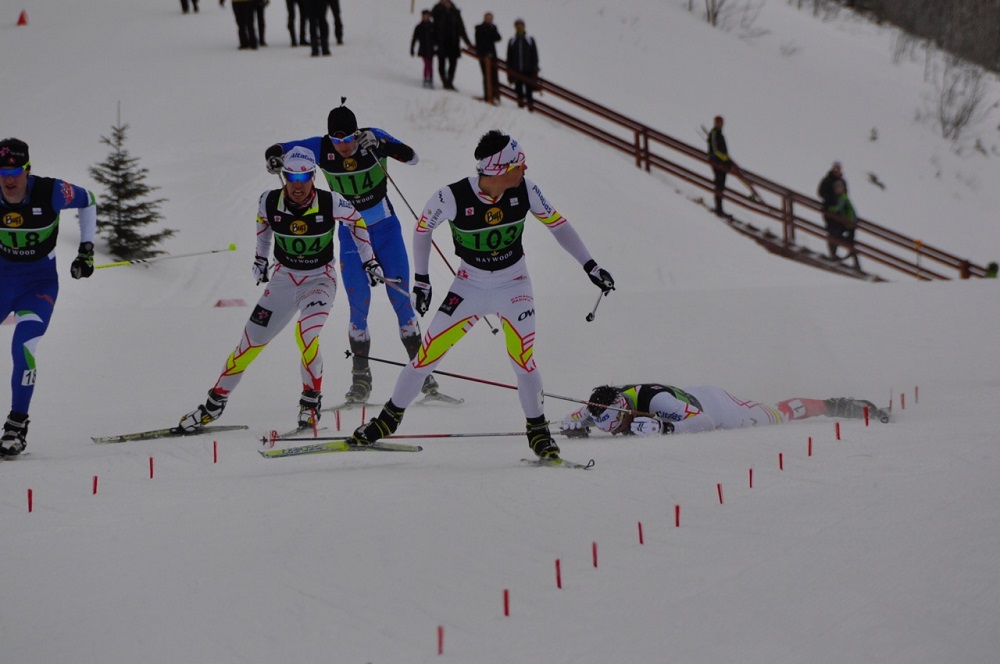
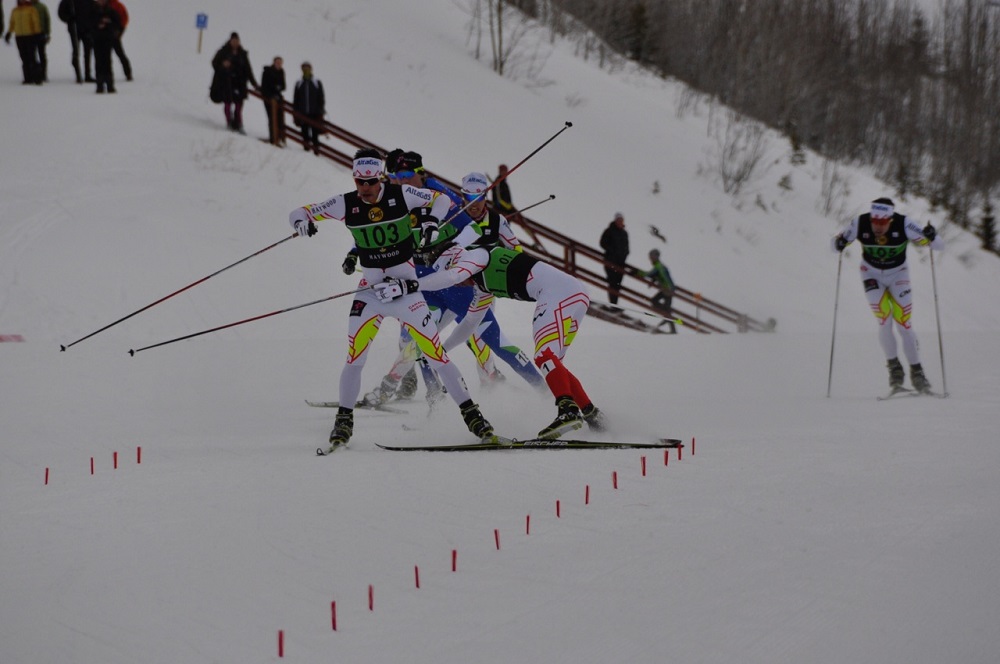
    The finishing stretch of the men’s freestyle sprint after Widmer’s fall. (l-r) Bob Thompson, Graham Nishikawa, Julien Locke, Jesse Cockney, Phil Widmer. (Photo: Kathy Wylie).

    Canada’s Olympic Trials kicked off on Wednesday at the Canmore Nordic Centre with the first of two freestyle sprint races. With perhaps only two spots per gender on the Olympic team up for grabs, there is little room for errors for racers wanting to qualify for the Olympics.

    Freestyle Sprint

    Chandra Crawford of Team Ninja and the Canadian National Team was dominant in the finishing stretch of the women’s final, taking the win with a 2.4 second gap on the rest of the field. Crawford is prequalified for the Olympic team, but has struggled with health issues over the past year. She told Cross Country Canada that,

    “To be able to put it all out there and charge your way to the finish line is what it is all about. It has been a huge effort this year for me to this point, and I’m excited with how today went. I just love racing and it is fun to win today.”

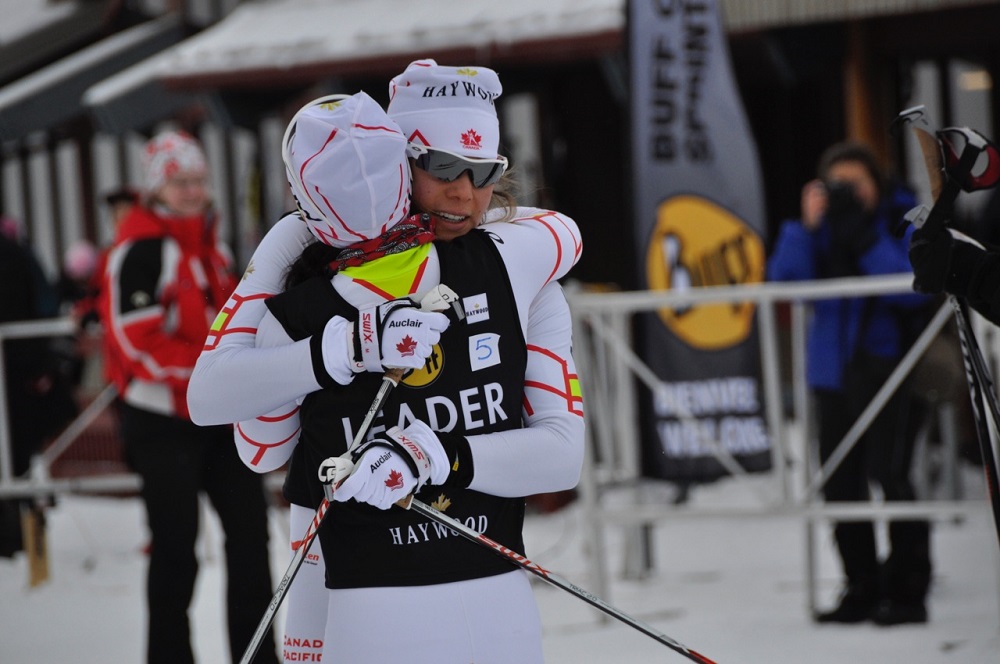
    Heidi Widmer and Emily Nishikawa embrace after the women's sprint final. (Photo: Kathy Wylie)
    Heidi Widmer and Emily Nishikawa embrace after the women’s sprint final. (Photo: Kathy Wylie).

    Finishing behind Crawford was Heidi Widmer of the Alberta World Cup Team (AWCA) and the Canadian National Team (NST). Widmer qualified in first, and looked strong in finishing. Canada is planning to choose one athlete solely off of sprint results, and one from distance results. Crawford’s prequalification puts Widmer in strong position going into the second round of freestyle sprinting on Saturday.

    Rounding things up for the women’s podium was biathlete Zina Kocher of Red Deer, Alberta. Kocher has already qualified for Sochi in biathlon, but is also trying to qualify for the cross-country team. Incredibly, she finished in third in an event that she has rarely, if ever, competed in. In an email, she wrote that,

    “For my first experience, my heats went great. I love hill climbing so this course is fantastic for me!

    My strategy was really just to completely enjoy the day, be challenged by a new experience and do intervals with fast skiers [and] friends! Every heat required a little bit different mindset before starting and thinking about what strategy was needed. I didn’t have any expectations since this was new for me so I just focused on givin’er!”

    Jesse Cockney and Phil Widmer collide in the finishing stretch of the men's sprint final. (Photo: Kathy Wylie).
    Jesse Cockney and Phil Widmer collide in the finishing stretch of the men’s sprint final. (Photo: Kathy Wylie).

    On the men’s side of things, the results were equally interesting. Up-and-comer Bob Thompson of Thunder Bay had a stellar day to take the win after qualifying in 18th place.

    According to Jesse Cockney (AWCA-NST), the heats were slow on the day, and coming down the finishing stretch all the racers were in a big pack. A tangle in the last 100 meters between Cockney and Phil Widmer (AWCA-NST) left the win up for grabs, and Thompson snagged it. Cockney held on for second, and Graham Nishikawa (NST) ended up in third.


    Classic 15/10 K

    Racing continued on Thursday with 15/10 k interval start classic racing for the men and women, respectively.

    Brian McKeever of the National Para-Nordic Ski Team eked out the win for the men, starting slowly and building into the four lap race.

    Brian McKeever in Thursday's classic distance race. (Photo: Kathy Wylie).
    Brian McKeever in Thursday’s classic distance race. (Photo: Kathy Wylie).

    “I could see my splits throughout the race and knew what I had to do. My strategy going in was this is a four-lap race. It is not over after two,” McKeever told Cross Country Canada. “I wanted to get into a good rhythm and keep the pace throughout all four laps. I like to be the guy moving up as the race goes along rather than falling back. It feels very rewarding to know I was able to stick to the plan and it worked out. ”

    McKeever is legally blind and, in 2010, was a member of both the Paralympic and Olympic team for Canada in Vancouver. However, he did not get to start any races at the Olympic Games.

    Following closely behind McKeever were Graeme Killick (AWCA) and Kevin Sandau (AWCA-NST), 1.5 seconds and 18 seconds back, respectively. Both racers were strong early in the race and then faded a bit as McKeever made his surge. Sandau wrote in an email that,

    “Since only race winners are only considered in the final selection, everything is on the line for Sunday[‘s distance race]. But the top [five] from today were relatively tight so anything could happen in the skiathlon. For me, the longer the better so looking forward to Sunday!”

    Alysson Marshall, who finished fourth in the classic 10 k, in Wednesday's sprint race. (Photo: Kathy Wylie).
    Alysson Marshall, who finished fourth in the classic 10 k, in Wednesday’s sprint race. (Photo: Kathy Wylie).

    The women’s race, on the other hand, was not nearly as close. Emily Nishikawa (AWCA-NST) showed early on that she was in top form, dominating the race throughout to win by nearly a minute. Keeping her enthusiasm in check, she told Cross Country Canada that,

    “I have put in the work and now put it together for the races and that feels incredible,” said Nishikawa. “The wax was amazing and my skis were incredible today. I’m not going to celebrate just yet. I am going to recover and get ready for Sunday’s race.”

    Runner-up Brittany Webster (Mito Canada) was jubilant, however, after being hobbled last season by sickness and early this season by a training plan designed to produce better mid-to-late season results. Using a race strategy that focused on skiing her own race, Webster wrote that,

    “Whoo, I am not gonna lie it is nice to have that over with! Honestly, I am not even sure where the time went on that course. I remember every second of it and yet I remember nothing of it too. Is that even possible?” She added, “Emily skied fantastic. She started quite [far] back from me so I had no idea what my back splits were to her. All I focused on was keeping it together and standing up on my skis, and the finish result was the finish result.”

    Rounding out the podium for the women was Ninja Zoe Roy. After using the qualifier of Wednesday’s freestyle race as a warm-up for today’s race, Roy skied to a strong third place finish, 1:23 back from Nishikawa.

    The Canadian Olympic Trials, which also serve as selection races for U23 World Championships and World Junior Championships, will continue on Saturday with a second round of freestyle sprinting.

    Women’s Freestyle Sprint Results

    Men’s Freestyle Sprint Results

    Men’s Classic 10 k Results

    Women’s Classic 10 k Results

  • Sundby Skis Alone to 35k Tour Victory

    Sundby Skis Alone to 35k Tour Victory


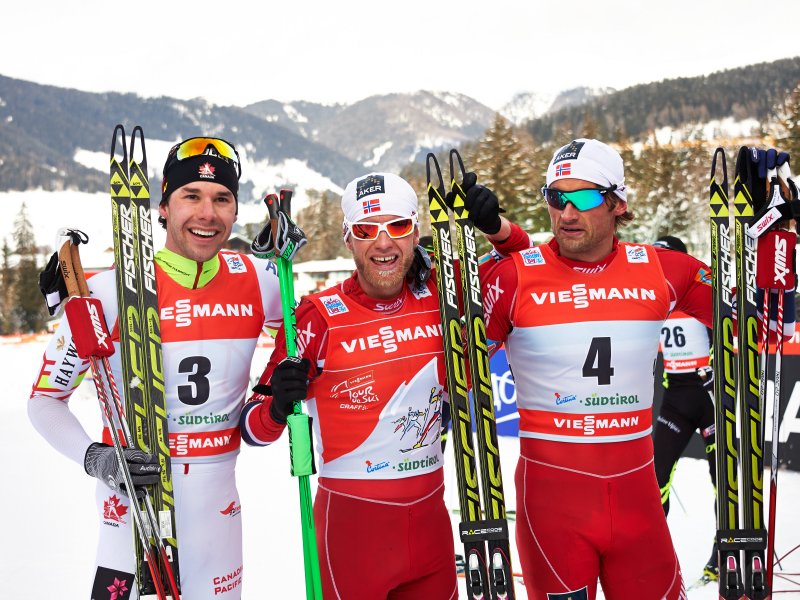
    Cortina to Toblach podium (l - r) - Alex Harvey (CAN) 3rd, Martin Johsnrud Sundby (NOR) 1st, Petter Northug (NOR) 2nd. Photo: Fischer/NordicFocus
    Cortina to Toblach podium (l – r) – Alex Harvey (CAN) 3rd, Martin Johsnrud Sundby (NOR) 1st, Petter Northug (NOR) 2nd. Photo: Fischer/NordicFocus

    Norwegian Martin Johnsrud Sundby took off like a rocket on Friday and never looked back. The 29-year-old Norwegian had a 32 second head start in the 5th stage of the Tour de Ski, a 35 k freestyle pursuit race, and he took full advantage of it.

    Taking place on a tough point-to-point course starting in Cortina, Italy and finishing in Toblach, Italy, the course strongly favored pack racing. The course consisted of one long uphill to the halfway point followed by one long downhill to the stadium area and 3 k of gradual rolling terrain to finish off the day.

    The long gradual downhill section raced considerably faster in a pack, but Sundby decided to race his own race and ended up with a lead big enough to secure the win, 58 seconds ahead of the field. He was aided by the relatively slow pace of the men in the chase pack, all of whom seemed unwilling to lead and unbothered by the large distance between them and the Norwegian. Petter Northug (NOR) bested the rest of the chase pack for second place (+58.2) in a sprint finish, with Alex Harvey coming in third.

    After starting the race, Sundby quickly extended his lead to over a minute ahead of the pack. Skiing alone and controlled, he had a good idea of where the rest of the pack stood. He said he had plenty of splits from his coaches letting him know how big his gap was, but that the effort definitely took a toll on him. He told FIS News,

    “I went with a pace I thought I could hold for the whole way. For sure I was trying very hard and now I am extremely tired.

    “Now it’s [time] to recover for tomorrow.”

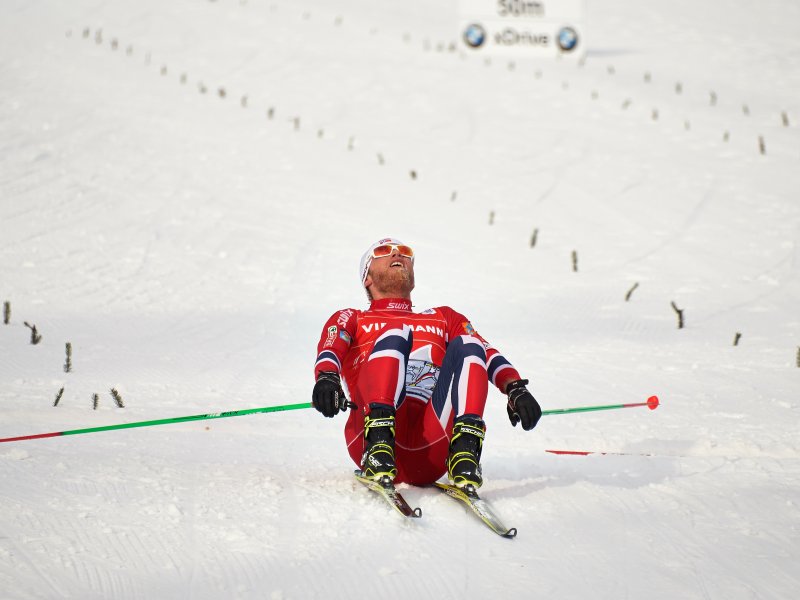
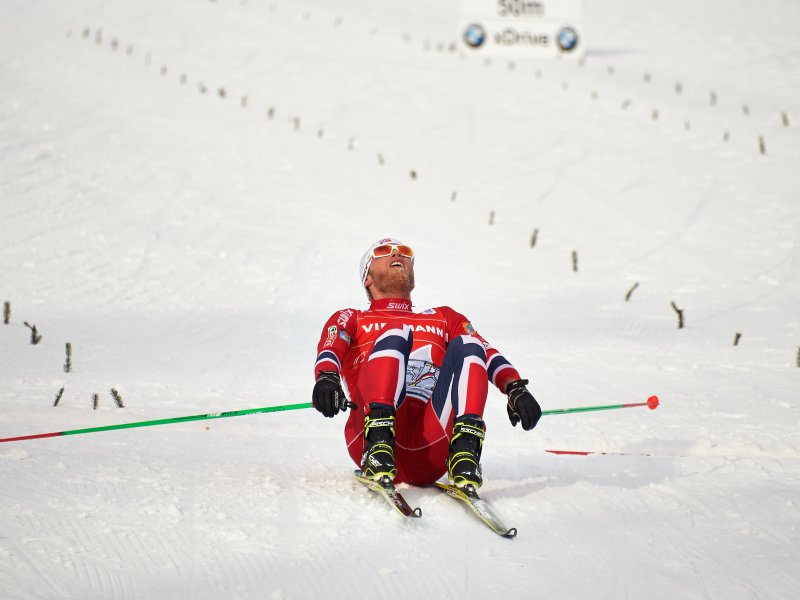
    Sundby collapses after crossing the line. Photo: Fischer/NordicFocus
    Sundby collapses after crossing the line. Photo: Fischer/NordicFocus

    Sundby’s win was his first stage victory of the Tour, and his third podium.

    Behind him, the race was most notable for the controlled pacing of the chase pack and the dramatic jump up the overall rankings for a few skiers.

    Johannes Duerr of Austria, was one of these. Starting in bib 34, 2:12 back, he quickly moved up the field to gain the chase pack midway up the uphill portion of the course. He maintained his position with the lead pack and, in fact, led much of the way due to the other skiers’ reticence to ski at the front.

    Moving through the finishing stretch, Duerr and Harvey briefly tangled. Duerr broke a pole, but still ended up sixth overall, with the fastest time on the day. This race could put him into contention for a podium finish, as Harvey is planning on leaving the Tour after Saturday’s 10 k classic race.

    Northug showed his famous finishing strength, surging to the front of the chase pack coming into the stadium to move up to second place overall in the Tour. Before today, he was sitting in fourth place, but is now in good position coming into the final races of the seven day set.

    It remains to be seen, however, if anyone will be able to touch Sundby’s 1:15 lead on the rest of the field.

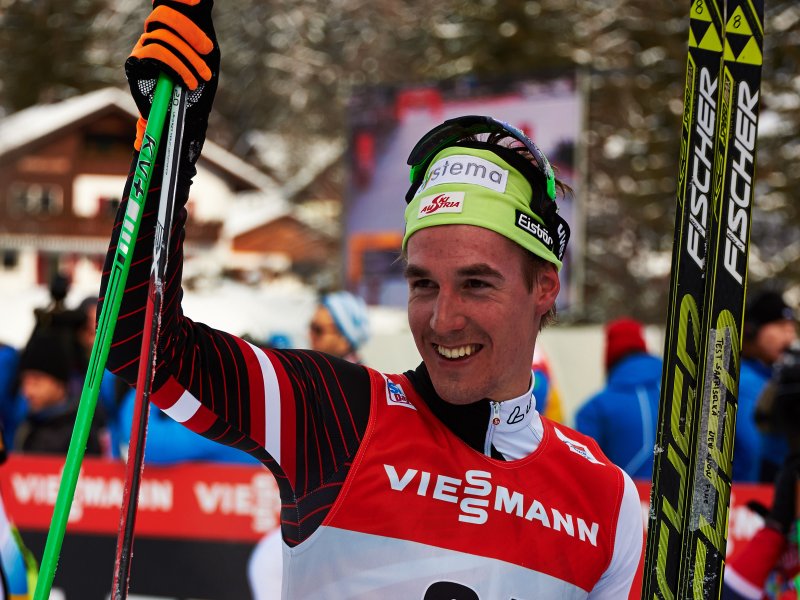
    Duerr celebrates his strong race. Photo: Fischer/NordicFocus
    Duerr celebrates his strong race. Photo: Fischer/NordicFocus

    Calle Halfvarsson of Sweden fell back from second place to fourth in the overall rankings, while Russian Alexander Legkov moved up from seventh place to within striking distance of the overall podium in fifth place. Both sit six seconds back from the podium.

    Along with Duerr, Noah Hoffman (USA) also had a dramatic day. Starting in bib 69, 3:27 back, he surged to gain a large pack right before the crest of the course and skied to the second fastest time of the day, ending up in 27th overall (+3:07).

    Tomorrow’s race is a 10 k classic individual start race for the men and could shake the results up a bit. With predicted temperatures around freezing, and a large storm blowing in, waxing will be tricky.

    Results:

    35 k pursuit race

    Overall standings

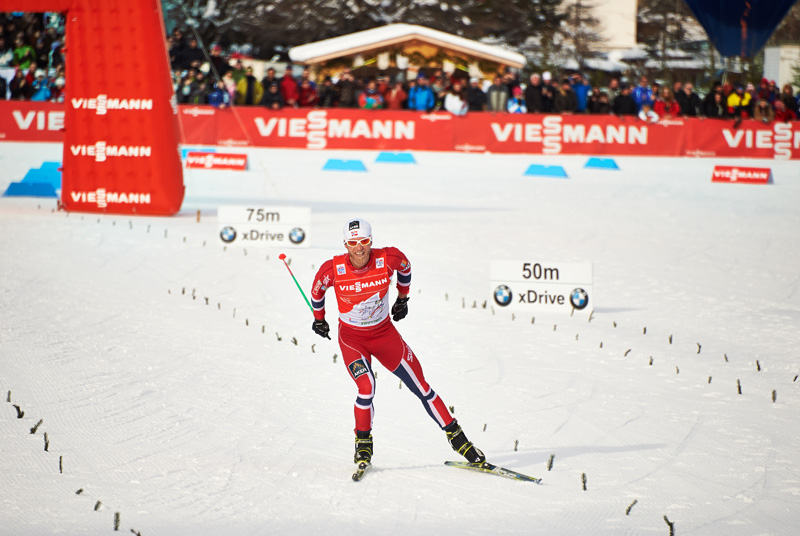
    Martin Johnsrud Sundby (NOR) starts the 35 k pursuit.  Photo: Fischer / Nordic Focus.
    Martin Johnsrud Sundby (NOR) starts the 35 k pursuit. Photo: Fischer / Nordic Focus.
  • Sandau, Fitzgerald Win Black Jack NorAm Classic Races

    Sandau, Fitzgerald Win Black Jack NorAm Classic Races

    Amanda Ammar (Team Ninja) racing to third in the 10 k classic individual start on Dec. 15 in Rossland, B.C.  (Photo: Shelley Peachell/Peachell Photography, http://peachellphotography.com/)
    Amanda Ammar (Team Ninja) racing to third in the 10 k classic individual start on Dec. 15 in Rossland, B.C. (Photo: Shelley Peachell/Peachell Photography)

    In the last big North American races before the holiday break, Kevin Sandau of the Alberta World Cup Academy (AWCA) and Canadian National Senior Development Team (NST) and American Kate Fitzgerald of Alaska Pacific University (APU) took top honors on Sunday in the Black Jack NorAm 15- and 10-kilometre classic individual starts in Rossland, B.C.

    Kate Fitzgerald (APU) racing to third in the West Yellowstone SuperTour 10 k freestyle individual start on Nov. 30.
    Kate Fitzgerald (APU) racing to third in the SuperTour 10 k freestyle individual start on Nov. 30 in West Yellowstone, Mont. She won the Black Jack NorAm 10 k classic individual start on Sunday in Rossland, B.C.

    On a day marked by warmer temperatures, tough waxing conditions and even tougher race courses, racers had only positive things to say about the quality of the race course and the depth of talented racers in the combined Canadian-American field.

    In the women’s 10 k, Fitzgerald gritted out the win in 31:53.7 after feeling “super strong.” In an email, she wrote that her coaches nailed the tricky waxing, and it helped to have a strong skier to race against.

    “Caitlin Gregg [Team Gregg/Madshus] started right in front of me and I caught up to her and we skied together the whole race after that,” Fitzgerald wrote. “She was awesome! We pushed each other and it was so much fun to have someone to ski with and work together!”

    The women’s SuperTour leader, Gregg ended up fourth, and Canadians Emily Nishikawa (AWCA/NST) and Amanda Ammar (Team Ninja) squeezed in for second and third, respectively. After leading the first of two laps by nearly seven seconds over Fitzgerald, Nishikawa finished 13.9 seconds back in second, and Ammar was another 9.9 seconds back in third. Gregg was 30.3 seconds back in fourth, and Zoe Roy finished 47.1 seconds off the winning pace in fifth.

    “There was an extremely strong field of women here this weekend, all of which I highly respect, and who are also in great shape,” Ammar wrote in an email. “I have been consistently getting stronger and stronger in each race. I’m right where I want to be.”

    Ammar added that the courses were hard, but doable. “These were the kind of trails I was brought up on,” she explained. “Hard steep climbs, and fun windy technical downhills. I had an absolute blast out there!”

    Sandau Edges Ellefson

    In the men’s 15 k, Sandau echoed the sentiments of the women, adding that it was nice to have warmer-racing temperatures compared to the frigidity of last weekend’s opening NorAm at Sovereign Lake. Although he dealt with some icing on his skis, Sandau did his best to maintain efficiency and came out on top in 42:08.4.

    Kevin Sandau (AWCA/NST) racing to victory in the NorAm 15 k classic individual start on Dec. 15 in Rossland, B.C.  (Photo: Shelley Peachell/Peachell Photography, http://peachellphotography.com/)
    Kevin Sandau (AWCA/NST) racing to victory in the NorAm 15 k classic individual start on Dec. 15 in Rossland, B.C. (Photo: Shelley Peachell/Peachell Photography)

    “I’m pretty happy with [Sunday’s] result,” he wrote. “It’s just how I wanted [to] end things going into the holiday break before Olympic trials.”

    Sylvan Ellefson (Ski & Snowboard Club Vail/Team HomeGrown) ended up second, just 3.2 seconds behind Sandau, and Graham Nishikawa rounded out the podium in third (+33.2), for his third top-three in over just two NorAm weekends. US Ski Team member Erik Bjornsen (APU) placed fourth (+44.3) and Andy Shields (NDC Thunder Bay) was fifth (+56.0).

    Ellefson was also satisfied with his race. In an email, he explained that despite feeling pretty tired midway through the race, he was able to dig deep to pull out a solid race.

    “The last 2k had to be the fastest 2k of my life,” Ellefson wrote. “I’m very happy with my results from the weekend and these results definitely help the confidence going into US Nationals in 3 weeks.

    “The courses here are amazing,” he added. “Amazingly hard, amazing beautiful. Whoever crafted them was a genius because any kids coming out of that Black Jack program can probably ski anywhere after running those courses. Technical and fun, almost seems like a downhill biker designed them. Up there with the hardest course I have ever skied without a doubt.”

    He was right on.

    Ethan Meginnes, co-owner of Joyride Bike Parks, wrote in an email that he helped construct the Black Jack course.

    “We build the course for the Red Bull Joyride slope style comp at Whistler as well as many other downhill bike trails,” he explained. “Dave Wood, Al Fisher and myself were the primary volunteer supervising the course build with a local contractor, Ed Mayer.”

    After this weekend, most of the racers on the circuit are dispersing for the holidays, quality time with friends and family, and local citizens’ races until the recommencement of racing January 8-12 in Canmore, Alberta.

    Results

  • Dupont, Stewart-Jones Race Tactically to Notch Sprint Wins at Sovereign Lake NorAm

    Dupont, Stewart-Jones Race Tactically to Notch Sprint Wins at Sovereign Lake NorAm

    (L-R) Emily Nishikawa, Alysson Marshall, and Andrea Dupont head into the finishing stretch of Sunday's classic sprint at the NorAm opening weekend at Sovereign Lake in Vernon, B.C. (Photo: Peggy Hung)
    (L-R) Emily Nishikawa, Alysson Marshall, and Andrea Dupont head into the finishing stretch of Sunday’s classic sprint at the NorAm opening weekend at Sovereign Lake in Vernon, B.C. (Photo: Peggy Hung)

    A day of cold and windy sprinting — with temperatures around -17 degrees Celsius — wrapped up this weekend’s NorAm races at Sovereign Lake. After all was said and done, Andrea Dupont (Rocky Mountain Racers) and Patrick Stewart-Jones of the Alberta World Cup Academy (AWCA) emerged as victors in the classic sprint.

    In the women’s race, Andrea Dupont skied a tactical-and-controlled race to win the A-final after squeaking through the semifinals as a lucky loser. Alysson Marshall of the AWCA and Canada’s Senior Development Team (NST) and Emily Nishikawa (AWCA/NST) were close behind in second and third, respectively. Rounding out the A-final was Heidi Widmer (AWCA/NST) and Ninja teammates Amanda Ammar and Zoe Roy.

    Dupont leading Marshall (c) in the finishing stretch (Photo: Peggy Hung)
    Dupont leading Marshall (c) in the finishing stretch of the Sovereign Lake NorAm sprint. Dupont won, Marshall was second and Emily Nishikawa placed third. (Photo: Peggy Hung)

    After sitting out Saturday’s 10 k freestyle as a precaution to protect her lungs from temperatures around -18 degrees Celsius, Dupont explained in an email that Sunday morning “was a bit of a shock to the system racing in the cold.”

    That said, she was happy with her final and her ability to “relax and work tactics (something that is not always my strength),” she wrote. “We had really great skis from our club parent volunteers, and I was able to use that extra bit of glide heading into the final climb, which was the defining point for the course.”

    With most of the pack together until the final hill, Dupont explained her skis helped her feel “super fresh” heading up it.

    “I came out of the climb first and it gives you a huge advantage heading into the finishing straight,” she wrote.

    Marshall was also pleased with her runner-up result, and concurred that the race was quite exciting.

    “The A-final was tight for most of the race,” she wrote in an email. “There are lots of corners and transitions so a fair amount of contact and lane switching going on but luckily no crashes. Andrea and I got into the lead on the final climb and Andrea lead into the finish. I was gaining on her but couldn’t quite catch her before the line.”

    On the men’s side, Stewart-Jones captured his first NorAm victory, which he wrote in an email he was “pretty excited about.”

    “I came close to winning a few times last year but never pulled it off,” he added.

    Phil Widmer (AWCA/NST) and Graeme Killick (AWCA/NST) placed second and third, and Knute Johnsgaard (Yukon Elite), Raphaël Couturier of Pierre Harvey National Training Centre and NST, and Simon LaPointe (Skinouk) rounded out the rest of the A-final.

    Patrick Stewart-Jones racing in the Sunday's classic sprint qualifier at the Sovereign Lake NorAm. (Photo: Peggy Hung)
    Patrick Stewart-Jones (AWCA) racing in the Sunday’s classic sprint qualifier at the Sovereign Lake NorAm. (Photo: Peggy Hung)

    Qualifying in fifth, Stewart-Jones explained that he felt the effects of Saturday’s 15 k freestyle, in which he placed fourth.

    “My plan for the heats was to ski as efficiently as possible to try and get to the final using the least energy possible,” he wrote. “I knew my finish was strong so I was just trying to get to the last few hundred metres in a position where I could challenge for the win.”

    Widmer (AWCA/NST) complimented Stewart-Jones on his race. “It was a cold, slow day of racing and I have to say I’m satisfied with the result,” Widmer wrote. “Patrick was very strong in the final and I wasn’t able to make up any ground on him in the finishing straight.”

    Next weekend’s NorAm, hosted by the Black Jack Ski Club in Rossland, B.C. will feature a freestyle sprint and 10/15 k individual starts. The fields will be much larger due to the addition of many stateside Americans heading up north to race, without a SuperTour next weekend.

    Marshall, for one, is looking forward to the challenge. “It will be fun to have some Americans at the races next weekend!” she wrote. “I’m really focusing on sprinting this year and it’s always nice to sprint against different skiers since we get used to the strengths and weaknesses of the girls we race against all the time.”

    “[The Americans] were fast last time we raced on Frozen Thunder and deeper fields are always more fun to compete in!” Widmer wrote.

    Additionally, Widmer is looking for some redemption next weekend. During his last race there, Widmer explained he “fell and came as close as I ever have to seriously hurting myself in a race. I was taken out and flew into a log jam at the side of the trail. It could have ended up much worse than it did as I walked away with only a broken pole and some scratches. Needless to say I’ll be looking for a much better result this time around!”

    Results

  • Wednesday Workout: Ring Training for Your Inner Gymnast

    Wednesday Workout: Ring Training for Your Inner Gymnast

    Katie Bono demonstrating the kneeling ring rollout.
    Katie Bono demonstrating the kneeling ring rollout.

    Cross-country skiers are a pretty fit lot. We tend to pride ourselves on overall fitness, and indeed it’s true that ski training does a great job of developing Crossfit-like versatility. Even in strength workouts, the nemesis of many upper-body-challenged athletes, skiers tend to do pretty well. Look at photos of Kikkan Randall, Andy Newell, and other top-level skiers doing weighted pullups and you’ll realize this.

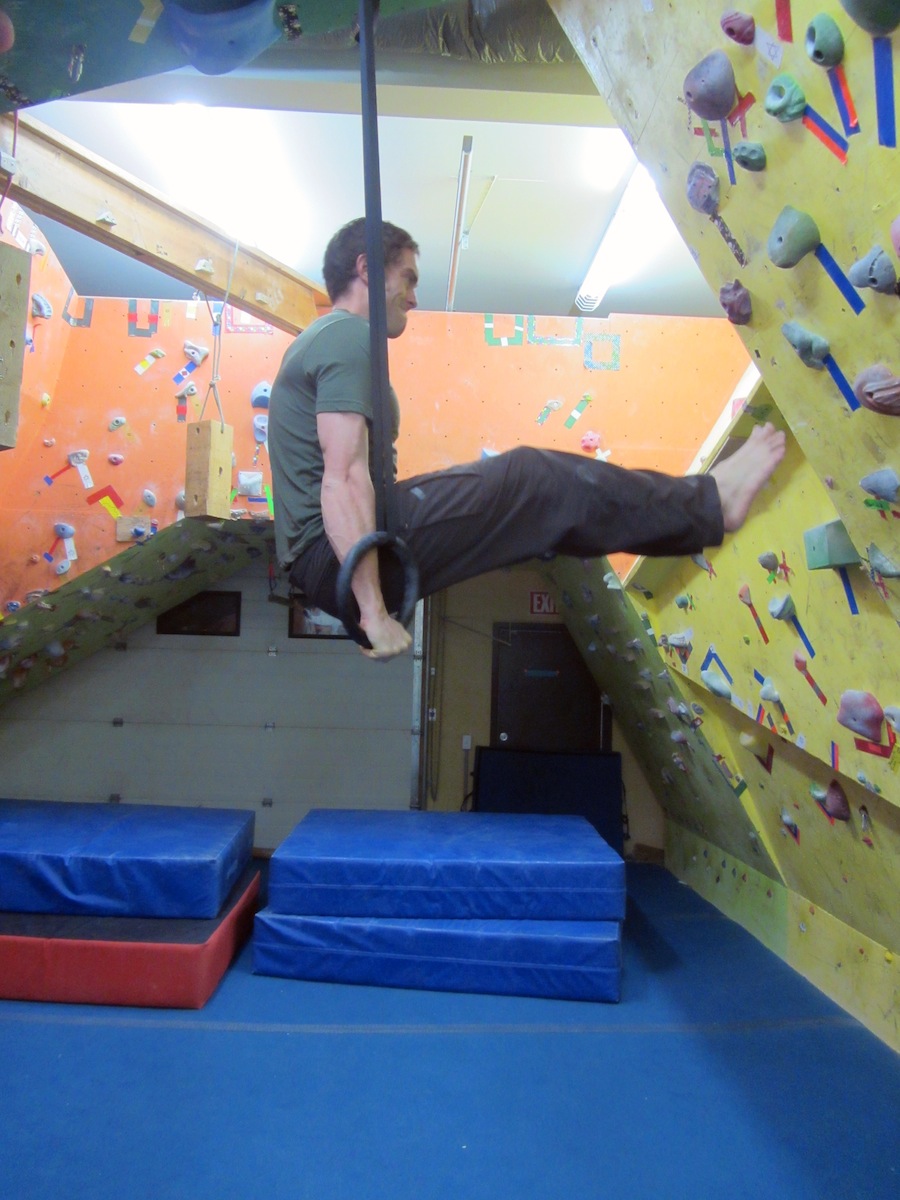
    Cody Doolan in an L-sit
    Cody Doolan in an L-sit

    Clearly, skiers need some new exercises to bump up the difficulty level in the weight room. If you find yourself maxing out the difficulty level of your current weight-room exercises, or if you are simply bored with all of them, give strength training with rings a try.

    Gymnastic ring training isn’t anything new. Although it and it’s trendier cousin, TRX suspension training, are making some waves in the fitness world right now, rings have been around for ages. However, if you’d like to make significant gains in upper-body and core strength and stability, take a new look at ring training.

    Training on rings has a plethora of benefits: it’s fun, the rings are extremely portable and versatile, and the exercises develop strength, coordination, and stability. However, the main benefit is that ring training is HARD. Like REALLY HARD. Ring training is the most difficult training I’ve ever done in a gym.

    I started doing ring workouts as training for skiing and all-around fitness at a point when my strength fitness was relatively high, and was amazed at the difficulty in performing relatively benign exercises like dips. Although my ego was somewhat shattered, I quickly discovered that the intense difficulty of ring training paid off mightily in my fitness. If you’d like to experiment with ring training, start off with intro exercises and work up.

    A big plus to ring training is that, for all intents and purposes, you can never get too strong for them. As a frame of reference, Olympic gymnastic exercises are rated on a scale from A to E, with A being the easiest. A muscle-up on rings, a fairly difficult exercise for the layman or laywoman, is an A-. Check your local gym to see if they have rings to use or buy your own and bring ’em along!

    Exercises

    Here are some exercises to get you started, but be creative and do some googling! Many traditional upper body and core exercises can be done (albeit at a harder grade) on rings.

    Ring Pushups: Adjust the rings so they are low to the floor. Place your feet on the floor, your hands in the rings, and do pushups. The lower to the floor the rings are, the harder it will be. If you perfect these, prop your feet up on a weight bench level with the rings.

    Ring Pullup and Dips: Pullups and dips on rings. Make sure to not let your arms rest on the straps as you do dips. If you want to make the dips harder, let your body come in front of the rings and turn your hands out (see photo).

    Ring Rollouts: Similar to rollouts done with a squat bar. Adjust the rings so they are just above the ground. Put your feet close to the rings and bend over to grasp the rings. Slowly move your hands and the rings away from you until you are stretched out and suspended by the rings. Then pull your body back to the starting position using only your core. An easier version of this is to start in a kneeling position instead of standing.

    L-sits: Adjust the rings to just above your waist, and support yourself on the rings (as if you were at the top position of a dip). Then lift your legs up to the level of your waist.

    Full and Half Levers: Adjust the rings to just above your head. Hang from the rings, and keeping your body rigid in a plank position, raise your body until it is parallel to the ground. An easier version is to bend one leg so your knee is up by your chest (half lever). Don’t let your butt sag!

    The Iron Cross: Perhaps not as ski specific as the other exercises, this is a good one to impress your friends. Save it for off-season tomfoolery. Rated a B on the Olympic gymnastic exercise scale, the way to do this one is to start in the support position (the starting position for dips). Lower your body by moving your arms out to the side until your hands are almost level with your shoulders. Yikes!

  • SuperTour Preview: Olympic Year Raises the Stakes

    SuperTour Preview: Olympic Year Raises the Stakes

    Correction: An earlier version of this article incorrectly stated that Torin Koos and Dakota Blackhorse-von Jess had been granted World Cup starts by the US Ski Team. At this point, neither athlete has earned a World Cup start.

    The 2014 race season has arrived, and with it, the start of SuperTour racing. The SuperTour is the United States’ Continental Cup series, and is not only the highest level of competition in the country, but also the best way to fast-track to the World Cup.

    As usual, the series kicks off in West Yellowstone, Mont., and skiers will be racing towards several different goals. SuperTour rankings and prize money will be on the line, of course, but the SuperTour leaders after the first period of racing will also have the opportunity to race the World Cup races in January. Additionally, for those skiers ‘on the bubble’ of making the Olympic team, the SuperTour races provide valuable chances to lower FIS points.

    Olympic team selection will be based on several criteria. Those skiers ranked in the top 50 in the World Cup sprint or distance standings as of January 12 will be named to the team (with a limit of four skiers per gender to be named off of the sprint list). After that, coaches’ discretion kicks in. Skiers not in Europe need to find a way to turn some heads if they are gunning for Sochi.

    While racing well domestically certainly doesn’t hurt, the best way to to punch a ticket to the Games is to get to Europe and post strong results against the world’s best, and leading one of the three SuperTour categories at the end of Period I is the best option.

    Sadie Bjornsen of APU/USST (r) edges Sophie Caldwell (SMST2) and CXC's Jennie Bender (c) in the 1.3 k freestyle sprint final at U.S. nationals on Tuesday in Soldier Hollow. Caldwell was second and Bender placed third.
    Sadie Bjornsen of APU/USST (r) edges Sophie Caldwell (l) and Jennie Bender (c) in the 1.3 k freestyle sprint final at U.S. Nationals last season at Soldier Hollow in Midway, Utah. Caldwell (SMST2) was second and Bender (formerly of CXC, now with BSF) placed third.

    This year’s SuperTour schedule has some significant changes from previous seasons. The Minneapolis, Aspen and Madison SuperTours have been dropped from the schedule, and there will be an inaugural SuperTour weekend in Craftsbury, Vt.

    Overall, the number of events has shrunk from nine locations and 24 races to seven locations and 20 races. Additionally, points awarded at the American Birkebeiner will only be half the usual point totals. The idea behind this strategy is to not unduly punish those racers avoiding the long length of the Birkebeiner in order to race optimally in Europe in March.

    Key Contenders

    The first period of SuperTour racing will have several key players missing. The U.S. Ski Team (USST) will be in Europe, and last year’s SuperTour leaders will be racing the World Cups (with many expenses covered per FIS rules) in an attempt to improve their World Cup rankings and thus the possibility of Olympic Team selection.

    These racers include men’s sprint and overall leader Mikey Sinnott, of the Sun Valley Ski Education Foundation (SVSEF), and women’s sprint, distance and overall leader Rosie Brennan, of Alaska Pacific University (APU).

    SuperTour distance leader Erik Bjornsen (APU/USST) opted out of those starts in favor of racing stateside. Additionally, Torin Koos, of the Bridger Ski Foundation (BSF) and Dakota Blackhorse-von Jess, of the Bend Endurance Academy (BEA) are in Europe and are hoping to earn World Cup starts rights with strong performances on that side of the pond.

    Additionally, longtime SuperTour force Mark Iverson, formerly of APU, has stepped back from elite racing. His former teammate, Brent Knight, continues to represent APU, but is also a member of the Salomon Mountain Running Team, which will be his focus.

    Fitzgerald showing podium form in the skate.
    Kate Fitzgerald (APU) racing the West Yellowstone SuperTour in 2012.

    Despite these racers missing, the fields will still be plenty deep.

    On the women’s side, the veteran trio of APU skiers Kate Fitzgerald, Becca Rorabaugh and Lauren Fritz will all be looking to make an impact. Caitlin Gregg, newly of Loppet Nordic Racing (LNR), Caitlin Patterson, of the Craftsbury Green Racing Project (CGRP), and Jennie Bender (BSF) are all very strong contenders to lead the first period of racing. However, some of the newer skiers to the full-time race circuit will be in the mix.

    New and notable skiers to the professional racing scene will be Annie Pokorny (SMST2), who is taking time off from Middlebury College to pursue skiing; Elizabeth Guiney (CGRP), a recent UNH graduate and member of last year’s U23 World Championships team; and Rose Kemp (SVSEF), who joined the Gold Team this year after a strong collegiate career at the University of Utah.

    The men’s side will be equally as strong. Look for APU skier Reese Hanneman to lead the pack along with at least three guys from Ski & Snowboard Club Vail/Team HomeGrown: Sylvan Ellefson, Ryan Scott and Tad Elliott. Matt Liebsch (XC United), Brian Gregg (LNR), and Skyler Davis (SMST2) should also be battling at the top of the result sheet.

    Notable rookies to the full-time circuit include former collegiate standouts Miles Havlick, a two-time NCAA champion with Utah now with SVSEF, and Sam Tarling, an NCAA champ and Dartmouth grad who joined the Maine Winter Sports Center (MWSC) this year.

    While the focus is obviously on the Olympics, no more than a few domestic racers are likely to join the U.S. squad.

    Everyone else needs to keep long-term goals in sight. If Period I leaders head to Europe, the doors open for another set of athletes to take over the top spots, and earn their own World Cup experience. This can be critical for long term development, and potential USST nominations.

    Holly Brooks (APU/USST) is the best example of a stateside racer leveraging SuperTour success into a World Cup career. After winning the overall SuperTour title in 2011, Brooks, now 31, began the next season in Europe and raced so fast, she not only earned additional start spots, but ended up on the national team.

    Sylvan Ellefson
    Sylvan Ellefson (SSCV Team Homegrown) racing at the Quebec City World Cup sprints last season will be gunning to return to the big stage.

    And while it is only November, the early season SuperTour races often boast the strongest fields this side of SuperTour Finals in March. As the season progresses, and more athletes race overseas or focus their energy on preparing for specific events, the talent in the U.S. can drop somewhat. As a result, racing over the next few weeks should be intense — for the top skiers, there is no time to ease into the season.

    Prize money is also not inconsequential for athletes, who are usually operating on a very tight budget. A top placing can cover a good portion of travel costs, and every place makes a difference.

    In West Yellowstone, prize money is as follows:

    • 1st: $750
    • 2nd: $500
    • 3rd: $250
    • 4th: $200
    • 5th: $150
    • 6th: $100

    U.S. Cross Country Championships in January remain the focus of the domestic calendar, with five events back at Soldier Hollow in Midway, Utah. In addition to both a classic and skate sprint, there will be a 10/15 k classic individual start and a 20/30 k skate mass start.

    As usual, the SuperTour wraps up with SuperTour finals, which will be in Anchorage, Alaska. The Finals are coupled with the 30/50 k U.S. Distance Nationals and will feature the return of the relay format.

    The Finals will not be a mini-tour, and thus there will be no hill climb, a break from the format initiated in Maine in 2010.

  • Mindful Babikov Plans to Pace Season for Olympic Peak

    Mindful Babikov Plans to Pace Season for Olympic Peak

    Ivan Babikov (CAN) racing to a career-best fourth in Wednesday's 15 k freestyle individual start at World Championships in Val di Fiemme, Italy. (Photo: Fiemme2013)
    Ivan Babikov (CAN) racing to a career-best fourth in the 15 k freestyle individual start at 2013 World Championships in Val di Fiemme, Italy. (Photo: Fiemme2013)

    Ivan Babikov knows the deal when it comes to Olympic years. Having already competed in two previous Olympics, the Canadian World Cup Team member is entering this season with the confidence that comes from knowing how the game works. At 33, he’s essentially prequalified for this season’s Olympics in Sochi, Russia, and so far all of his prep work is going according to plan.

    Babikov ended last season with some serious fatigue, but all wasn’t lost.

    “It actually turned out the best ever,” he wrote on his blog. “With scoring points in pretty much every World Cup Race before Christmas, awesome result at Tour de Ski, and 4th place at the World Championship 15km skate race, which let me finish in top 20 in the World Cup Overall.”
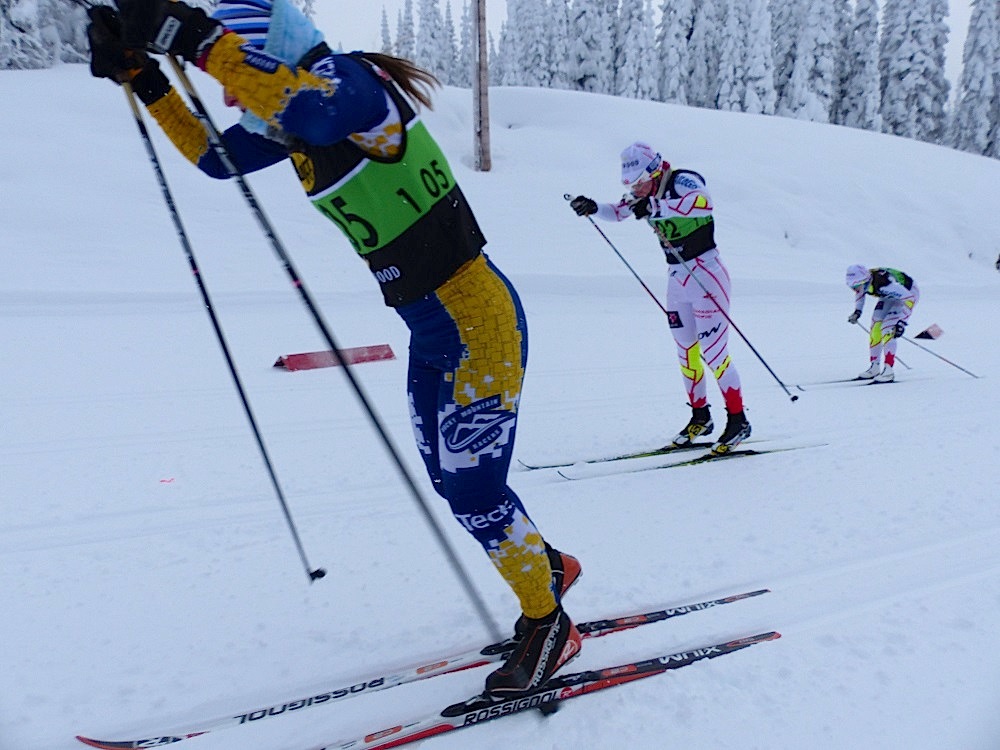
    Babikov biking on the South Rim Trail at the California training camp this fall. (Photo:  ivanbabikov.com)
    Babikov biking on the South Rim Trail at the California training camp this fall. (Photo: ivanbabikov.com)

    Babikov’s fourth-place finish at World Championships was the best ever by a Canadian man in that event, and his runner-up result at the Tour de Ski hill climb earlier the season — also in Val di Fiemme, Italy — was also notable.

    After that the World Championships, the effects of the long season started to kick in. He struggled with sickness for the next several weeks of World Cups, won the 10k classic race at Canadian Nationals, and then hit the wall.

    “I just went straight to vacation, without even finishing Canadian Nationals,” Babikov continued. “I was exhausted mentally and physically, tank was empty, no juice left.”

    After a bit of a reboot, Babikov moved on from that exhausting-yet-successful season to build upon what he knows works for him.

    His early season saw the familiar iteration of a June training camp in Bend, Ore., followed by a New Zealand camp in August, where Babikov has been going for the past six years.

    Babikov getting some cross-training during his national-team training camp this summer in Bend, Ore. (Photo: ivanbabikov.com)
    Babikov getting some cross-training during his national-team training camp this summer in Bend, Ore. (Photo: Ivan Babikov)

    The Canadians have the benefit of training on the Haig glacier just outside of Canmore, Alberta, where Babikov lives. Even so, the Russian native feels that the benefits of accessing many kilometres of trail, combined with the mid-winter conditions, more than make up for the hassle of travelling to New Zealand.

    This fall included a new national-team camp in Truckee, Calif., for high-altitude training. Besides that, Babikov has stuck to his usual regimen.

    “[I’m] not trying to reinvent the bicycle, you know how they say?” Babikov said in a recent phone interview.

    However, with the lessons of last season, Babikov’s main goal for this winter is to “pace the season well and pace the energy.”

    “The season is long, and the Olympics are at the end of it, so you’ve got to pace [the World Cup races and the Tour de Ski] and get in good shape for February,” he said. “That’s what matters the most. But, yeah, we’ll see what’s gonna happen.”

    Ivan Babikov (r) and his teammates on the Canadian World Cup team, Alex Harvey (c) and Lenny Valjas (l), during a rollerski near Truckee, Calif., in October. (Photo: Ivan Babikov)
    Ivan Babikov (r) and his teammates on the Canadian World Cup team, Alex Harvey (c) and Lenny Valjas (l), during a rollerski near Truckee, Calif., in October. (Photo: Ivan Babikov)

    Babikov has already seen some indication that his fitness is close to where he wants it;  in an informal time trial at Canmore’s Frozen Thunder earlier this month, Babikov beat a solid group of Canadian and U.S. competitors in the distance skate race.

    Looking ahead to the Olympics in February, Babikov is especially excited about racing in his country of birth. Although he was born and raised in Kozhva, a tiny town close to the Arctic Circle far away from Sochi, he said, “It’s going to be special … going back to your motherland and race. Not many athletes in the world get a chance to race two home Olympics. … I raced one in Vancouver and then [Sochi]. That’s already pretty special.”
    At the same time, he doesn’t want to put too much emphasis on his results there.

    “It’s all energy wasting … thinking too much and then getting too excited and too psyched,” he said. “I try to waste as least energy as possible and then just focus on the races.”
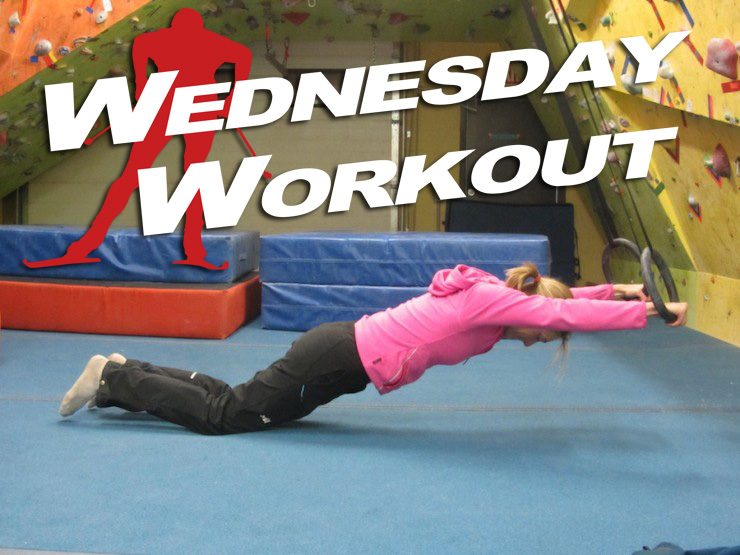
    Fortunately, he said the courses suit him.

    “There’s [a] huge uphill in the skate part and of course I love that,” Babikov said. “Harder is better for me. I’m not super-speedy guy, but I can manage those uphills.”
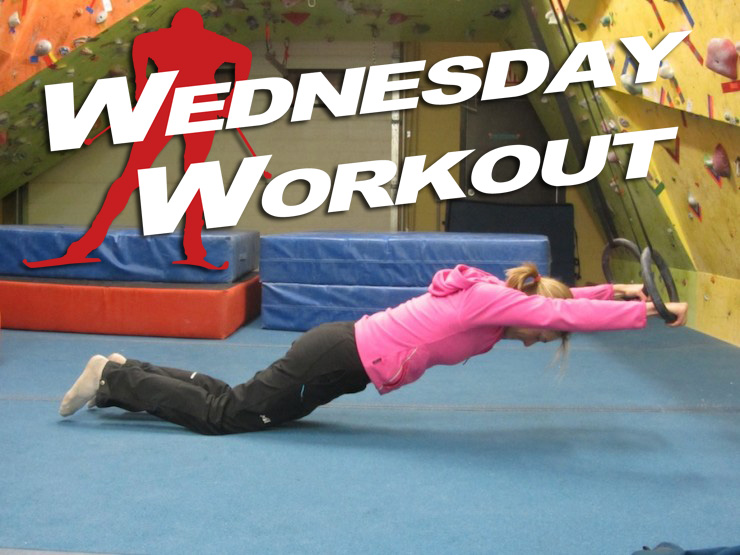
    “What matters most is that the athletes are in the top shape for the best moment for those two weeks,” he added. “Whoever feels the best is going to [do best]. That’s why it’s so important to pace your season and save some energy for February.”

    And, despite racing as a Canadian, Babikov is not worried about feeling like an outsider in his homeland.

    “I still have my Russian passport and I’m still Russian,” he said. “We [my wife and kids] still speak Russian at home. So it’s like when some people have two houses, but they’re both home, and that’s kind of what it is for me. Of course, my home home is Canada, but I still know so much about Russia and it’s not going to be weird at all. It’s going to be like, ‘Oh yeah, I’ve been here so much and I’m comfortable here,’ that kind of stuff.”

    Until leaving for the World Cup circuit at the end of November, Babikov is doing his best to keep things normal and spend time with the family. His 11-year-old son Sergei, a budding biathlete, has his first race coming up.

    “He’s going to start racing even before me!” Babikov says.

    Ivan Babikov and his son, Sergei, in 2008. (Photo: Ivan Babikov)
    Ivan Babikov and his son Sergei, now 11, in 2008. (Photo: Ivan Babikov)
  • Heidi Widmer Rebounding After Third Concussion

    Heidi Widmer Rebounding After Third Concussion

    Heidi Widmer (l) and Andrea Dupont after colliding at a NorAm sprint last January in Thunder Bay, Ontario. Widmer suffered a mild concussion, but qualified for the U23 World Championships as a discretionary pick and was fully recovered in five days. (Photo: John Sims)
    Heidi Widmer (l) and Andrea Dupont after colliding at a NorAm sprint last January in Thunder Bay, Ontario. Widmer suffered a mild concussion, but qualified for the U23 World Championships as a discretionary pick and was fully recovered in five days. (Photo: John Sims)

    Heidi Widmer is no stranger to head injuries. One of the newest members of Canada’s Senior Development Team, the 22 year old suffered her first as a teenager in the fall of 2009. The culprit? Rollerskiing – downhill, to be specific.

    Part of the Alberta World Cup Academy in Canmore, Widmer crashed during a classic rollerski, and the next thing she remembers is the hospital. Four years later, the cause of the accident is still a mystery to her, as she has amnesia surrounding the event, but the effect was a head injury serious enough to send her to the Calgary hospital as a precautionary measure.

    “That crash took me by surprise,” Widmer said on the phone last week. “I didn’t really plan on that happening. So that was my one really bad concussion and since then I’ve had to be more cautious with my head. I haven’t had any problems recovering from that. I made a full recovery. I didn’t have any spinal or internal bleeding; I was super lucky with that.”

    Heidi Widmer (Courtesy photo)
    Heidi Widmer looks out at the 3,100-metre Mount Lougheed during a summer hike up Wind Ridge near Canmore, Alberta. (Courtesy photo)

    Fast-forward to Sept. 7, 2013, Widmer found herself in an eerily similar situation.

    “This past fall I was classic rollerskiing again and fell on a downhill pitch,” she said. “I slipped on some mud at the bottom; I was going down with a teammate. [There was] a nasty little grime layer at the bottom of the hill that neither of us saw. And that took us both out … I superman-ed into a ditch.”

    Fortunately, she didn’t hit her head and there were no major acute injuries. However, Widmer noticed a pressure in her head that didn’t feel right, so she cut her workout short to get some rest. After taking another day off, she started back into training and felt great, winning a skate sprint time trial with the women’s national team that week.

    Shortly after, her symptoms returned along with a bad headache. After consulting with doctors, Widmer agreed to take several weeks off, then gradually return to full-intensity training.

    “[The pressure] is not extreme and it’s not like I’m in blinding pain, but it’s enough for [the doctors] to want to take the right precautions,” Widmer explained.

    Despite these mild symptoms, she resumed full-time training and is more excited than ever to be back.

    “I’m super lucky in so many ways that it’s not a serious head injury,” she said. “There’s no internal bleeding, I’m functioning, I’m fine, but I just have to be able to take care of this and come out of it with some lessons learned for sure.”

    Widmer had another concussion last winter, when she crashed in a skate sprint during the selection races for U23 World Championships.  She had to take five days off to recover, and as a result, missed one of the qualifying races. She still made the team as a discretionary selection and said she recovered completely after five days.

    “I haven’t reached the point of the doctors being like ‘one more and you may never be able to ski again’ type extreme,” she explained. “I know that every time it does happen, it adds up in my brain, but I don’t have a specific medical answer for that.

    “Being afraid to fall is probably more dangerous than accepting the risk,” she added. “Falling happens to be part of skiing and after all we’re talking about cross country skiing. I’m not an alpine skier pushing 130 km/hour and crashing with my face on ice!”

    In addition to maintaining a healthy perspective on her concussions, Widmer has also started doing a fair amount of physio work to maintain and improve her balance — something that took a hit from her first concussion.  The trauma caused her damage in her inner ear, which governs balance.  She’s working on restoring that balance via physio exercises, while also getting back into shape for race season.

    “I think that the rest of this fall is something that will play to my advantage,” Widmer said. “It’s something that I’ve come to view as an advantage for me, because the fall that I had [my previous head injury], [taking time off] paid off in my season. I ended up having one of my best seasons. I think it says a lot to be able to absorb the summer of training and come into the fall with a new perspective and motivation to train. It’s really reignited in me my motivation. Sometimes in the fall it’s super common for people to get super run down with the changing seasons and the ski racing season approaching. So I’m looking at it in as positive a light as possible.”

    As for whether she’s feeling the positive effects of her time off yet, Widmer said she’s a little behind with her fitness, but is confident she’ll get back up to speed soon.

    “I’ve already seen huge gains in the last week of returning back to intensity,” she said. “The summer [training] is absorbed, and more than anything, I’ve learned to be more patient over the past month.”

    Widmer’s first races for the season are the Alberta Cup races the first weekend of December. “I’m ready to get after the winter,” she said.

    ***

    About the Author:

    Katie Bono is a Canadian contributor at FasterSkier. Hailing from Minnesota, she raced for Dartmouth College and Sun Valley before turning her energies to climbing (and becoming the fastest known woman to ascend Mt. Rainier in Washington). Now based in Canmore, Alberta, she is an athlete ambassador for Millet and works as a mountain guide in Alaska, Washington and South America.

  • Smutna, Americans Show their Speed in Frozen Thunder Sprint

    Smutna, Americans Show their Speed in Frozen Thunder Sprint

    With one lap to go, Dakota Blackhorse-von Jess (Bend Endurance Academy) leads the men's A-final of the Frozen Thunder classic sprint at the Canmore Nordic Centre in Canmore, Alberta. U.S. Ski Team and Stratton Mountain T2 teammates Simi Hamilton and Andy Newell follow, along with Sam Naney (Methow Olympic Development). (Photo: Pavlina Sudrich)
    With one lap to go, Dakota Blackhorse-von Jess (Bend Endurance Academy) leads the men’s A-final of the Frozen Thunder classic sprint at the Canmore Nordic Centre in Canmore, Alberta. U.S. Ski Team and Stratton Mountain T2 teammates Simi Hamilton and Andy Newell follow, along with Sam Naney (Methow Olympic Development). (Photo: Pavlina Sudrich)

    Note: This article has been correct to recognize Sophie Caldwell (USST/SMST2) as the women’s qualifier winner.

    CANMORE, Alberta – The 2013-14 ski season unofficially kicked off Thursday with a classic sprint on snow at Frozen Thunder in Canmore, Alberta. While a fairly low-key event overall, it served as a tune-up race for many of the skiers as they head into the World Cup races in Finland or U.S. SuperTour openers in West Yellowstone, Mont., in late November.

    Racing two laps around a shortened version of the 2.2-kilometer Frozen Thunder loop, skiers completed the course in 4 to 5 minutes for the women, and roughly 30 seconds faster for the men, making for a long sprint course to start the season.

    Katerina Smutna of Austria leading the women's A-final at the Frozen Thunder classic sprint on Thursday in Canmore, Alberta. U.S. Ski Team members Ida Sargent and Sophie Caldwell chase to finish second and third, respectively. (Photo: Pavlina Sudrich)
    Katerina Smutna of Austria leading the women’s A-final at the Frozen Thunder classic sprint on Thursday in Canmore, Alberta. U.S. Ski Team members Ida Sargent and Sophie Caldwell chase to finish second and third, respectively. (Photo: Pavlina Sudrich)

    As Caitlin Gregg of the Methow Olympic Development team in Washington explained, the variety of terrain on the course, with plenty of uphills, downhills and turns, made for a quality course. However, the two-loop experience made for a unique mental challenge of staying psyched for big hills the second time around.

    To deal with possible crowding issues in the qualifiers, race organizers used a unique starting strategy. After the first five skiers, they left a larger time gap than usual before starting the next of five racers to space out the field.

    The field of 34 women raced first. Sophie Caldwell of the U.S. Ski Team (USST) and Stratton Mountain School T2 Team (SMST2) won qualification by just over a second, followed by Austrian Katerina Smutna and Ida Sargent (USST/Craftsbury Green Racing Project) rounding out the top three.

    The men’s field was somewhat larger with 54 racers, and like last year, saw a combination of skate and classic equipment used among the top racers. Andy Newell (USST/SMST2) won the qualifier on skate skis by more than 3 seconds. SMST2 teammates Skyler Davis and Simi Hamilton (USST) followed up in second and third.

    Only 16 men and 16 women moved onto the heats. As a result, many of the less sprint-endowed racers came up with alternate plans for their workout that day. Some moved on to interval sessions, while others simply decided to save up energy for Friday’s classic-distance time trial. However, many skiers were impressed with the organization of the sprint.

    Sargent appreciated the trademark low-key, high-organization style of an event run at the Canmore Nordic Centre. “The race this morning was very chill but also very well organized and well run,” she said. “They did a great job keeping the schedule rolling which can be tricky with a two-lap course.”

    After leading much of the A-final, Smutna ended up with the win, while the Americans showed their strength, with Sargent finishing second, Caldwell placing third and Liz Stephen (USST) in fifth. Alysson Marshall of the Canadian National Senior Development Team and Alberta World Cup Academy was the top Canadian in fourth, with Olivia Bouffard-Nesbitt took sixth and 2013 World Championships team member Andrea Dupont was seventh. American Jessie Diggins (USST/SMST2) did not race due to a cold, and Canadian World Cup team member Perianne Jones did not start. Her Canmore-based teammates, Lenny Valjas and Ivan Babikov were not on the start list, and Dasha Gaiazova is in Quebec.

    On the men’s side, several skiers were strong on Thursday. Dakota Blackhorse-von Jess (Bend Endurance Academy) looked especially strong in winning the A-final by a large margin on classic skis. He was the only one of the top three on classic skis. Both Newell and Simi Hamilton used skate skis for the qualification and final to end up second and third, respectively.

    Across the board, U.S. and Canadian skiers appreciated the chance to mix it up on snow before the season starts in earnest.

    “It was really great to have everybody in town with the US skiers and even some Austrian skiers in the race,” Dupont said.

    On the significance of an October race, Sargent said, “I was less concerned with results than trying to go hard and get out some of those racing tweaks like remembering how to warm up, test wax, and stay fueled on between sprint heats.”

    Finally, as a footnote to a race well run, several teams showed off their new season’s spandex. The U.S. team showcased their new uniforms with electric blue accents for men and pink accents for the women, while Team Ninja, the band of independent skiers based out of Canmore, showed up in suits adorned with pink and white snowflakes, and ninjas.

    Results

    About Katie Bono: 

    Katie is a Canadian contributor at FasterSkier. Hailing from Minnesota, she raced for Dartmouth College and Sun Valley before turning her energies to climbing (and becoming the fastest known woman to ascend Mt. Rainier in Washington). Now based in Canmore, Alberta, she is an athlete ambassador for Millet and works as a mountain guide in Alaska, Washington and South America.