From the FasterSkier archive — posts syndicated from athletes’ and coaches’ own blogs between 2004 and 2012, kept online as published. Current coverage is at fasterskier.com.

Author: Ken Roth

  • The Story Behind the New World Cup Race Format

    The Story Behind the New World Cup Race Format

    Yesterday’s announcement of changes to next year’s World Cup schedule came as a dramatic surprise to the cross-country skiing community. But the story behind those changes is just as interesting as the changes themselves. Lars Johansen, the Swedish delegate to the FIS (International Ski Federation) competition committee described how the historic changes came about. “I was sitting glumly in my Cortina hotel room. In nine days, I was due to give my final report to the annual meeting of the FIS’s cross-country skiing competition committee, and the news wasn’t good. Soon the good feelings and sugar buzz of the winter Olympics would be over,” said Johansen, “and the hard choices of what to do next would need to be resolved.”

    Johansen was referring to the task the committee had directed him to address, which was the thorny issue of traditional cross country skiing’s sagging television ratings. The preliminary numbers from the Olympics were very good—but they always were—however the ratings for the regular season World Cup competitions continued to disappoint. There has been a long steady decrease in television viewers for traditional cross-country compared to other Nordic sports, and if the pattern continued, it would become an existential threat to the continued viability of traditional cross-country World Cup racing. Without the money associated with strong viewership, a business model simply doesn’t exist for traditional cross-country to continue on the World Cup circuit.

    The data was now in and the results were unmistakable. The numbers weren’t bad, but biathlon continued to kick traditional cross-country’s butt. In fact, biathlon had surged to become the most watched winter sport in Europe, and despite the U.S. cross country team’s success in recent championships, North American viewership wasn’t increasing nearly fast enough to offset the decline in European viewers. The problem is that there are only so many advertising dollars to go around, and advertisers go for the biggest bang for their buck. The limited pool of existing advertisers were sinking their budgets into biathlon. Eyeballs were glued to biathlon, and traditional cross-country had become an afterthought. Biathlon’s dominance was becoming hard to take, and the Nordic competition committee wanted answers. Something had to be done.

    The viewer data for traditional cross-country skiing compared to biathlon is not good. (Data/Photo: O’Neil Data Services Inc.)

    The competition committee’s meeting process is well established. During every World Championships and Olympics, the Committee gathers to discuss changes to race formats and other issues which need to be addressed. It is a logical way to conduct business. Most of the governing body’s members are already in town for events, so it makes sense to get everyone together while officials are already there. The routine goes something like this; delegates are free to watch live events as they choose, after events and on off days; they meet to discuss business.

    However, this year while the format was the same, the mood was very different. This year the mounting crisis facing traditional cross-country was the main topic and it was definitely not business as usual. “What were we going to do about the falling viewer ratings? That was the only agenda item.” The committee had already had two meetings, and they did not go well. “We batted around a bunch of tweaks to competitions to make them more attractive,” said Johansen. “But the reality was that we all knew these minor changes wouldn’t make much of an impact. I had been directed to submit new fresh ideas and really, I didn’t have much. We were looking at adding mixed relays to the Olympics and continuing them more prominently into the world cup schedule, but I knew that it was just nibbling around the edges. We needed something dramatic, something that would serve as a wakeup call to the world that we were not the stodgy older brother of biathlon, but that we could be the cool kid as well.”

    “But I was totally stuck, and the committee wasn’t happy, though I think they knew that there really wasn’t much to be done. We were probably just going to have to accept our fate and continue to struggle with declining viewership and therefore declining revenue. I was fully prepared to be the one to deliver the bad news, knowing that it would mean that I would probably lose my job.”

    The all important metric of total viewer engagement for traditional cross-country skiing is not looking healthy. (Data/photo: O’Neil Data Services)

    However, as it turned out, serendipity intervened and Johansen came up with a groundbreaking idea that has rocked the Nordic world and put traditional cross-country back into the spotlight, hopefully for good.

    “It was Wednesday, and my next update was due the following day. To be totally honest, I was pretty depressed. I didn’t even go the Sprint races that day, instead I watched them from my hotel room. I wasn’t really even paying much attention to the competition, but then I saw what now has become a worldwide phenomenon. The dog everyone now knows as Nazgul strayed onto the Sprint qualifying course. At first, I was annoyed by this. How could anyone be so careless with their animal I thought? Someone could have been hurt.”  Johansen continued that, “the day progressed like any other day, and I mustered the energy to go watch the Sprint finals live. By the time I returned to my hotel room every social media channel was blowing up over this dog. I couldn’t believe it. In 30 seconds, this canine achieved more media notoriety than our hard working athletes had in years. I was dumbfounded but didn’t really know what to make of any of this other than that it was an interesting Olympic footnote.”

    Johansen had bigger fish to fry than the curious case of a stray dog. He staggered into Thursday’s meeting empty handed, and admittedly dejected. “The discussion began and everyone turned to me for my suggestions. I had nothing. It was as you Americans like to say, the sound of crickets. So, just to fill the dead air, I asked if people had seen the dog who was now a social media star, of course everyone had. For the next half hour, we all talked about the dog and how amazing it was that it had gone viral. Slowly the discussion began to return to what suggestions I had to address our issue; that’s when the lightning bolt struck.”

    “How about adding skijoring as an event, I said? It popped into my head and came out of my mouth before I even had time to think about it, though I did have the common sense to put it out there half joking just to see what the reaction would be. To my surprise, no one laughed. In fact, everyone seemed pretty interested.” (To the uninitiated, skijoring is the sport of a dog harnessed to a cross-country skier pulling the skier along as the skier skis, usually freestyle. The result is incredibly fast skiing).

    Total dollar amount spent on dogs in the United States. (Photo/Data: American Pet Supply Federation, Inc.)

    “I then pulled out my phone and showed the committee that there had already been over 15 million views on X of the dog crossing the finish line. That’s more than the number of viewers we had for the women’s Sprint finals in the United States!” It seemed to be the perfect solution in the right moment. Skijoring is wildly popular in Scandinavian countries. On any given winter’s day ski trails are crowded with skijorers, and even if you don’t care about skijoring, most people love dogs. But there were a few doubters in the room, surprisingly mostly from the nontraditional skiing countries. So, I did a quick Google search of how much money is spent in the United States on dog care and put the result on the conference room’s television screen. Over $150 billion was the answer. The room went silent. No one could argue with those numbers.”

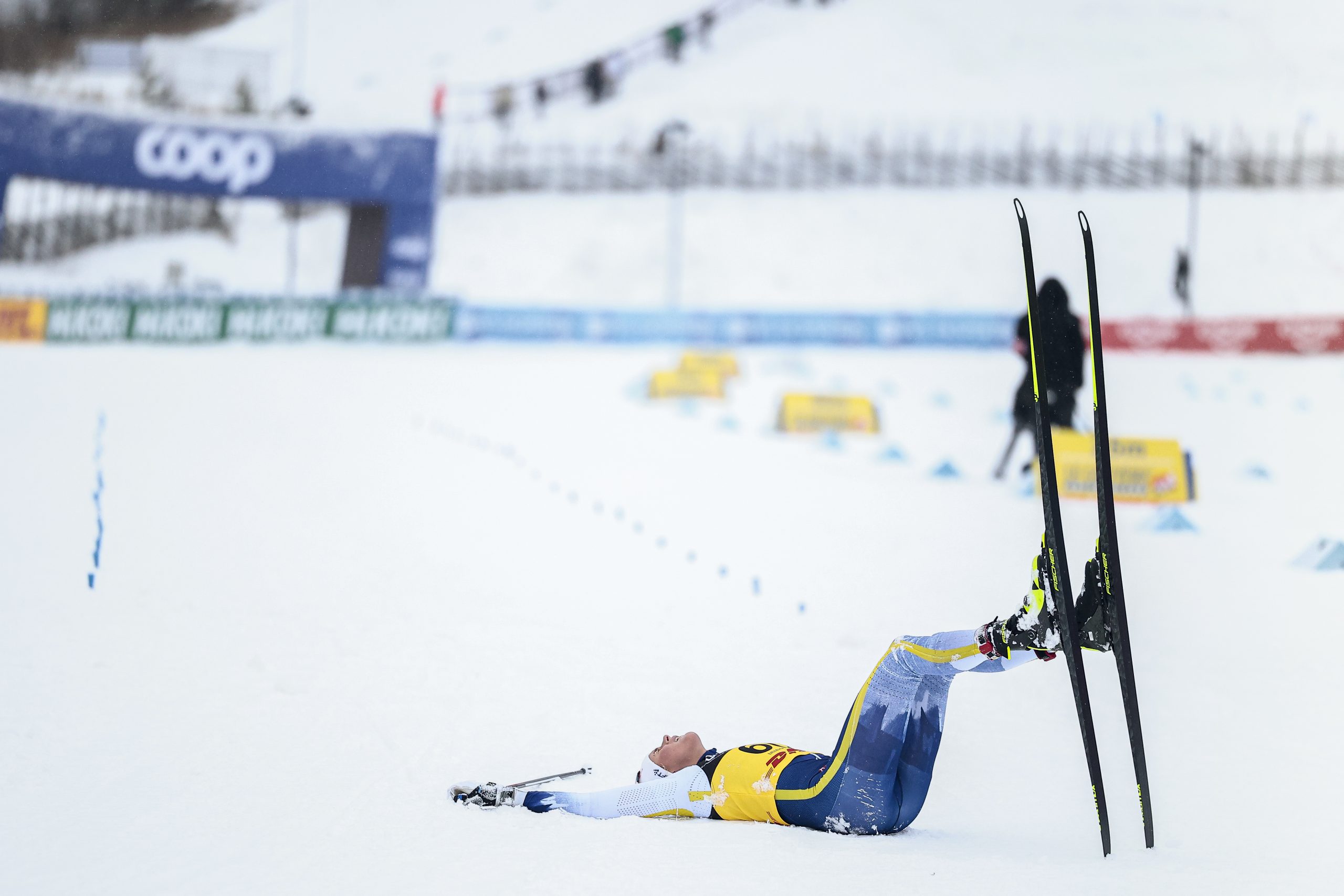
    Johansen continued, “that’s when my brain really started rolling. I put out this idea; imagine the image of an exhausted skier and dog crossing the finish line together, both collapsing to the ground embracing each other. The images alone would be better than all of the advertising we could spend. I quickly constructed an AI generated image of a finishing ski racer lying in the snow collapsed with a dog next to her. The doubters immediately went silent, everyone was in awe, the potential power of the imagery was more than anyone could have imagined, and it was impossible to argue against it. By then, I had gathered enough momentum and confidence to close the deal. I said, imagine joining the power of the most demanding athletic competition in existence with humankind’s innate love of animals into one package. I paused for a moment and looked at the delegates to let the statement’s impact set in. We have been handed the greatest promotional opportunity in sport history. No one disagreed.”

    This AI generated image was used by Johansen to convince the FIS delegates that Skijoring would be cross-country skiing’s television savior.

    But this was just the beginning. “From there, things started moving pretty fast. We immediately brought in a consultant on Zoom to help us understand possible formats and logistical issues. Krag Stellon from the Finnish contingent had contacts in the sled dog world (which is a completely different discipline but there is crossover in how the dogs are trained), and we immediately arranged a meeting with his friend Andrew Steffson to discuss if such races were even possible. After a full day of discussion, we had outlined possible formats. There were also discussions with independent skijoring associations to roll their races into the World Cup calendar and combine efforts with those independent associations. The committee was so excited that we all agreed to skip watching the remaining competitions live and focus on our work. So, with the men’s 50k race on the television in the background, we worked out our format.

    Skijoring at the World Cup for the 2026/27 hopes to be the radical change needed to increase television ratings. An added bonus; men and women will compete at the same time. It’s an opportunity to link traditional cross-country skiing to an industry with endless growth potential.

    For the next race season, we decided that there will be three skijoring events added to the calendar as demonstration events. The format will be broken down into three distinct categories. First there will be the combined event which will work like the skiathlon. Racers will ski 10 kilometers freestyle, then they will come into the exchange station where they will be harnessed to their dog to ski another 10 kilometers. The first to cross the finish line wins.

    The next event will be the individual 10 kilometer race where the dog and skier will start in a time trial fashion.

    The third event will be the mixed relay. There will be one male and one female skier. One skier will ski a five kilometer Classic leg, and they will then tag off to the skijoring skier who will ski five kilometers Freestyle to the finish. Teams may choose which gender skier they wish to have ski each leg.

    FIS promotional image of skijor mixed relay. (Photo: Lars Johansen)

    “For next year there will be 200 world cup points available for each skijoring race. This is twice the normal race point value which will serve as incentive for racers to partake in the new format. For 2027-28, we plan on there being one skijoring event every other weekend, with points being assigned the same value as traditional races. Skiers will not be compelled to skijor race, however, if they don’t, they will lose valuable points and hurt their Overall cup rankings.”

    “All dogs will be provided by neutral trainers with kennels based in Finland and Sweden. For North American races, dogs will be transported by plane to the venues. The dogs will be subject to the same doping control protocols as their human companions. Teams will be assigned a group of dogs which they will work with throughout the season. For the first year, trainers will be assigned to teams. After that, teams will be free to hire their own dog coach/trainer, similar to the way wax technicians work, but the dogs themselves will always come from neutral kennels. This way we will avoid a dog arms race similar to what we see with ski preparation.”

    FIS is hoping to have many smiling experiences like this one to draw in television viewers.

    However, there were still a lot of details left to consider. “We contacted our representatives from every voting nation, and the immediate response was overwhelmingly positive. Then we decided to put out our findings for our corporate liaisons to reach out for sponsorship.

    The response has already been overwhelmingly positive. “Our business representatives and lawyers have reached out to companies in the pet supply world, and the response has been huge. We already have a multi-year, multimillion dollar contract with Purina (pending legal reviews), as the principal sponsor for the skijoring races. We also have a seven figure sponsorship deal with a North American chain of dog kennels. Zoetis, the world’s largest canine prescription pharmaceutical company has also agreed to a multi-year, multi million U.S. dollar agreement. The inquiries from potential sponsors haven’t stopped since we made the announcement. Companies ranging from dog clothing accessories, to training devices, to grooming products, have been contacting us nonstop. It has simply been amazing.”

    Lars Johansen with one of the hopeful saviors of traditional cross-country skiing.

    “We’ve run preliminary viewer focus group studies and have had an over 85 percent positive response. That’s the highest focus group response we’ve had in the history of running such studies on any race concept.”

    “When you stop to think about it, it’s really a no brainer, and it’s kind of embarrassing that we never thought of it before. Everyone loves dogs, and the cross-promotional tie-ins are limitless.”

    “My view on the entire Nazgul situation has completely changed. I have to admit that at first I was a little frustrated and angered by what happened. But now I see it as the serendipitous confluence of an entirely new chapter in competitive cross-country skiing—something that could actually save cross-country as a televised sport. After having had some time to reflect I’m willing to bet that in five to ten years, skijoring audiences will greatly surpass human only powered racing. It’s really remarkable when a chance circumstance comes along at just the right time and changes history. Now we will let the races begin!

    Even Ben Ogden’s (USA) silver medal couldn’t compare to the media boost provided by Nazgul the dog. (Photo: NordicFocus.)

    THIS STORY WAS ORIGINALLY PUBLISHED ON APRIL 1, 2026


  • Davos Team Sprint: Norway and Sweden Dominate

    Davos Team Sprint: Norway and Sweden Dominate

    This coverage is made possible through the generous support of Marty and Kathy Hall and A Hall Mark of Excellence Award. To learn more about A Hall Mark of Excellence Award, or to learn how you can support FasterSkier’s coverage, please contact info@fasterskier.com.

    “I’ll tell you; I never get no respect.” That was the lament of the immensely popular comedian Rodney Dangerfield, the loveable schlub who became an American icon by continually reminding everyone how unloved he was, while he simultaneously went on to become a huge success. The FIS (International Ski Federation) Team Sprint race format is kind of the Rodney Dangerfield of the ski world. Mention it to the average ski fan and they usually get about as excited as hearing about soybean futures—unless of course your team is winning a medal. Some of this is no doubt due to the complex qualifying and race structure. But if you take a look at when international cross-country skiing competitions occur, you would think that the Team Sprint is the belle of the ball. It’s been in every winter Olympics since 2006 and every World Championship since 2005. But during the regular season, it’s the first race many skiers are likely to opt out of and today was no exception. In the high altitude of Davos, Switzerland, it was the time for the Team Sprint to get its moment in the regular season spotlight, as the men and women competed for team honors in the Freestyle technique in this cross-country hybrid event.

    Astrid Oeyre Slind (NOR), Jasmin Kahara (FIN), Maja Dahlqvist (SWE), Iris De Martin Pinter (ITA), Laura Gimmler (GER), Anja Weber (SUI), (l-r) fight for position in the women’s Team Sprint. (Photo: NordicFocus)

    In the women’s event the story was that there was no American team entered. Given how much emphasis the team places on the Nation’s Cup battle, the no show was a little surprising. But it’s a long season— in an Olympic year— and there’s only so much energy to go around, but it did feel a bit like a Dangerfield moment. While the American women rested, it was time for other nations to take their shot. After Sweden’s Sprint podium sweep last week in Trondheim, Norway, it felt like the Swedes were the prohibitive favorites, especially with Maja Dahlqvist and Jonna Sundling headlining Sweden I into the qualifying round.

    On the men’s side, the only question going into the race was how many of its stars, if any, would Norway rest. Given their early season dominance, they were clearly favored to win. In the qualifying rounds when Johannes Klaebo and Erik Valnes were on the start list for Norway I, and Harald Oestberg Amundsen and Oskar Vike, were manning Norway II, it looked a little bit like mission impossible for the rest of the men.

    But one of the reasons that the Team Sprint has its appeal is that in the tight quarters with multiple exchanges and skiers packed so closely together, anything can—and often does—happen.

    Men’s Team Sprint
    Men’s Team Sprint Qualification

    In the least surprising development of the day, Norway I led by Klaebo and Valnes qualified first, and Norway II led by Amundsen and Vike was second. In third place, 2.4 seconds off the lead was the Italian duo of Elia Barp, and Federico Pellegrino.

    Team USA’s chances ended when Ben Ogden crashed in the qualifier. (Photo: NordicFocus)

    The only American team—which consisted of Ben Ogden and JC Schoonmaker—finished 18th place, which wasn’t good enough to qualify. After Ogden crashed and broke a pole in his qualifier, the American hopes for making the finals were dashed. Gus Schumacher didn’t race due to illness and took the day off to recuperate for the rest of the weekend. Because of this, Schoonmaker was moved into USA I and this resulted in no USA II being available.

    Men’s Team Sprint Final

    At the start Valnes shot to the lead and looked determined to set a brisk pace. An early crash by Barp pushed Italy I to the back and meant Pellegrino would have his work cut out for him. At the first exchange the field was still tightly bunched with Norway I and Sweden II going to the front. Halfway through this leg there was another crash as Sweden I’s Edvin Anger crashed in one of the icy turns. At this point Klaebo—who was unaware of the carnage behind him— decided to open up some navigating space around him and turned up the pace.

    As Klaebo handed off on the second leg, Norway I was in the lead. The field was slightly broken up by another collision in the middle of the pack. But nothing deterred the Norwegians as Valnes continued to keep the Norwegians out front. He handed off to Klaebo who was now shadowed by the rest of the field. Anton Grahn of Sweden II was gamely hanging with Klaebo at the front, while in the middle of the field there were two more crashes as skiers tumbled throughout the slick course.

    It was no surprise when Norway I, led by Johannes Klaebo (NOR) went to the lead and won the race. (Photo: NordicFocus)

    At the next exchange it was still Norway I and II at the front as Valnes and Amundsen began to press hard with Johan Haeggstroem of Sweden hanging with the Norwegians at the front. But Valnes soon found another gear and established some separation of the field. He was able to hand off to Klaebo with a slight lead over his teammate with Sweden I and Switzerland I close behind. Klaebo and Vike were out front while Sweden I’s Anger hung tight with Klaebo. Into the final hill Klaebo found the gear that only he has and created a large gap on the field.

    Federico Pellegrino (ITA) did a great job closing the gap after his teammates crash to secure second for Italy. (Photo: NordicFocus)

    Amazingly Pellegrino had managed to overcome the early deficit created by his teammate’s crash and was now battling Anger for second. Pellegrino was able to secure second place with Sweden I finishing third. In a huge surprise Norway II had dropped down to seventh place at the finish.

    After the race Klaebo said he wasn’t aware of the crashes behind him but wanted to be out front regardless. As usual, his race strategy worked perfectly even if at the time he couldn’t fully appreciate its effect.

    Federico Pellegrino (ITA), Elia Barp (ITA), Johannes Hoesflot Klaebo (NOR), Erik Valnes (NOR), Johan Haeggstroem (SWE), Edvin Anger (SWE), (l-r) (Photo: NordicFocus)
    Women’s Team Sprint
    Women’s Team Sprint Qualification

    There were no surprises in the top two qualifying spots as Sweden I consisting of Dahlqvist and Sundling finished first with Sweden II’s Emma Ribom and Linn Svahn qualifying second. Germany’s team I of  Laura Gimmler and Coletta Rydzek took the third qualifying spot, and Norway II consisting of Astrid Oeyre Slind and Mathilde Myhrvold settled for qualifying fourth.

    Women’s Team Sprint Final

    Lap one of the women’s race was a tightly packed affair with Switzerland getting to the exchange first, but there hadn’t been any real separation as Fabienne Alder (SUI) went out first in her leg of the lap, but was quickly absorbed by the field with Sweden I and II going to the front of the pack.

    Jonna Sundling (SWE) created a big lead as she eased across the finish line for the victory. (Photo: NordicFocus)

    At the second exchange Kristine Stavaas Skistad of Norway I snuck to the front and was the first to hand off to her teammate Kristin Fosnaes. At this point there still hadn’t been much separation with Dahlqvist now pushing the tempo.

    At the start of the third exchange the Swedes were beginning to assert themselves and Sundling and Svahn pushed to the front as the field began to string out.

    Kristin Austgulen Fosnaes (NOR), Kristine Stavaas Skistad (NOR), (l-r) hand off in the Team Sprint. (Photo: NordicFocus)

    On the final leg Slind went to the front with the two Swedes going with her. Dahlqvist and Slind began to push hard as Germany and Switzerland hung with them.

    As the final exchange approached, Dahlqvist had gapped the field giving Sundling about a three second advantage over Norway I and Norway II, as Sweden II struggled to keep with the pace. Sundling had a large lead of almost six seconds as the skiers entered the finish area with Norway I and II working hard to try to stay on the podium. Sundling was unchallenged as she entered the stadium and coasted to the finish. Norway I and II fought for second place with Norway II edging out Norway I. Germany I finished fourth. In the biggest surprise of the day, Sweden II finished in fifth.

    Astrid Oeyre Slind (NOR), Mathilde Myhrvold (NOR), (l-r) beat expectations and finished second. (Photo: NordicFocus)

    After the race Dahlqvist commented on the difficulty of coping with the altitude, and both racers stated that they were pleased with their efforts.

    Men’s Team Sprint Final RESULTS

    Women’s Team Sprint Final RESULTS

    Astrid Oeyre Slind (NOR), Mathilde Myhrvold (NOR), (l-r) – FIS world cup cross-country, team sprint, Davos (SUI). (Photo: NordicFocus)


    Love Stories Like This? Help Keep Them Coming.

    Feature stories like this one take time, access, and care to produce. If you value thoughtful storytelling and independent ski journalism, please consider becoming a Voluntary Subscriber. Your support directly fuels the work we do to cover the people, places, and moments that make our sport special.

    Join the FasterSkier community!
  • The Fastest Person in the World on Cross-Country skis. It’s Not Who You Think

    The Fastest Person in the World on Cross-Country skis. It’s Not Who You Think

    Who is the fastest person in the world on cross-country skis? Seems like a straightforward question, but the answer will unquestionably surprise you. An attempt to answer this seemingly easy question might quickly veer straight to the usual suspects. Johannes Hoesflot Klaebo would certainly rise to the top of the list—a Sprinter undefeated for an entire season seems like a good guess. But you would be very wrong. Bjorn Daehlie in his prime would be another good shot in the dark—but it is very far off the mark. Jessie Diggins is well known for her downhill skiing prowess, but even she couldn’t keep up with the world’s fastest person.

    Dr. Sten Fincholm. The fastest cross-country skier in the world. (Photo: Compliments European Organization for Nuclear Research)

    The correct answer to this question is both surprising and complicated, and to find the solution you have to stray very far from the world cup, and far from any FIS (International Ski Federation) sanctioned event. To find the world’s fastest cross-country skier you have to dive deep into the world of science and meet a fascinating man by the name of Dr. Sten Fincholm.

    For a couple of days every year Dr. Fincholm is the fastest person on cross-country skis. More precisely for about 90 seconds a year there’s no one in the world that’s as fast as Fincholm, and the competition isn’t even close.

    So why haven’t you ever heard of him? Well, it’s a story that involves luck, serendipity, curiosity, and like most important things in life, timing.

    Schematic map of LHC (Large Hadron Collider) footprint. (Photo: Compliments European Organization for Nuclear Research)

    Fincholm is quite well known in his field—which isn’t cross-country skiing— it’s particle physics. His research has been published dozens of times, and he has postulated groundbreaking theories in quantum physics, and quantum field theory. “When I go to conferences, I never have to pay for my own drinks, someone else always wants to buy,” a laughing Fincholm told me. Fincholm works at the Large Hadron Collider (LHC) near Geneva, Switzerland. The LHC is the world’s largest particle accelerator and is the product of the collaboration of 24 member states. Groundbreaking research happens at the LHC every day. It’s now the center for research into particle physics after the United States bowed out of the game when it yanked funding for the Super Conducting Super Collider which had been scheduled to be built in Texas. After Congress cancelled funding in 1993, Switzerland became the heart of subatomic particle research, and it has remained there ever since. And but for that footnote in research funding, none of this strange tale ever would have happened.

    Massachusetts Institute of Technology. Sten Fincholm’s alma mater.

    Fincholm grew up in Norway. I met him in the early 1990s when I was in school in Boston, and he was studying at MIT. Fincholm was working on his PhD and was on a mission to be involved in the opening of the Texas Super Collider. But when Congress pulled the plug, he returned to Europe to pursue post-doctoral work at the Max Planck Institute. It was during his time at Max Planck that the connection with the LHC was developed, and Fincholm eventually received a posting there as a fellow. He now occupies the position of Senior Particle Investigator and Program Coordinator. We rekindled our friendship when we met up on a trip to Switzerland.

    Sten is one of those guys who it is impossible not to like. He has a wry wit and is deeply curious about anything anyone else is doing. He always wants to hear what’s going on with you first. If he wasn’t such a nice guy, you would immediately hate him because he is one of those people who has been graced with so much talent that it’s hard to believe. He’s a polymath in the truest sense of the word.

    At this point the reader might rightfully ask “what does any of this have to do with Nordic skiing or racing at any level?” Well, that’s where luck, coincidence, and timing, all—well —collide, and this is where Fincholm comes in.

    Before pursuing his PhD from MIT, Fincholm was chasing another interest. He was one of the top 75 ranked cross-country skiers in Norway. “One year I finished 32nd in the Norwegian championships in the 20k. I also finished 39th one year in the 50k. My overall ranking in Norway rose at one point to 68th.” Fincholm comes from an athletic family. “I have a great Uncle who anglicized his last name and took a shot at playing major league baseball in America, but it wasn’t for him. Professional sports wasn’t his cup of tea, but nonetheless, I’m told he was an incredible pitcher.”

    When you ski next to Fincholm you feel like you’re skiing in slow motion, and that he’s hardly working. He has the elegance and grace of a dancer, and the power of a weightlifter. He’s a great skier, better than almost everyone in the world his age, but in Norway, that’s not good enough. “What most people don’t realize is that in Norway being the 68th ranked skier means you can beat almost anyone in the world,” Fincholm explained. “But it’s kind of on par with being the 100th best quarterback in American football. The few guys at the very top are the only ones really making a living at it, the rest are just really good football players without anywhere to go.”

    Fincholm saw the handwriting on the wall and that’s when he decided to abandon professional skiing and journey to MIT. But it was when fate intervened, and he received his job at the LHC that the merging of two wonderful and completely unrelated worlds happened—quantum mechanics and cross-country skiing— and but for the chance cancellation of an American research program in Texas, none of this would have been possible.

    Fincholm explained that when he started as a fellow at the LHC, the worst jobs around the collider would often fall to him. “Whenever we needed someone to do grunt work my name was on the top of the list. Checking voltage regulators on the magnets for the fifth time, that was me.” But often he had to do physical labor as well.

    The guts of the Large Hadron Collider. Nothing magnetic is allowed around this. (Photo: Compliments Dr. Sten Fincholm)

    “LHC is basically a big donut in the ground. We accelerate particles around in a circle about 27 kilometers in diameter to nearly the speed of light. We use superconducting magnets to accelerate these particles, and we use a tremendous amount of energy; our usage is measured in the hundreds of gigawatts. Whenever you’re using that much energy unusual things can and often do occur.”

    The tunnel at the Large Hadron Collider where sub-atomic particles nearly reach the speed of light. (Photo: Chris Mitchell)

    One of the things that occurs is that periodically, the thousands of magnets used at LHC require unusual maintenance. Vast amounts of energy are shot through these magnets. And because they are not perfectly efficient, there is some debris created. After each firing of the magnets small amounts of detritus are created inside the magnet’s shielding. “It’s only micrograms, but eventually it has to be cleaned and that’s one of the grunt jobs I had to do. You have to physically scrape the debris off the magnet housing, and it has to be done periodically for each of the over 9,500 magnets. The total amount collected is small. Over the course of a year, it wouldn’t fill a shoebox. We use a special scraping tool made out of carbon fiber and titanium to avoid damaging the housing or the magnets, and of course we can only use material which is not magnetic; that would be bad. Once the material is cleaned off it kind of resembles something like graphite powder mixed with water. We are quite familiar with this material, it’s produced in every collider in the world, we just happen to produce the most because we are the biggest. It’s totally harmless, it’s mostly a combination of nitrogen that’s been bonded to manganese and about 20 other trace elements contained in the atmosphere and cooling mechanisms which the magnetic fields react with. But it’s the prolonged exposure to an intense repeated magnetic field that’s the secret sauce, and that’s the part we don’t completely understand.” As Fincholm described, the stray magnetic field holds all of the elements together in a kind of subatomic magnetic slurry. After the material is scraped from the magnets it begins to revert back into its constituent parts. “It takes about 12 hours for the material to completely break down, and the initial decay begins very quickly.”

    “Even as I was promoted through the program, I still worked cleaning the magnets, and do so to this day. I think it helps to keep me in touch with the day to day operations” It was during this process that Fincholm had a eureka moment.

    A 50X microscopic image of SPECS (Semi-perturbed excited conglomerates) taken after the LHC’s maintenance regimen and seconds before they begin to decay. (Photo: Compliments Dr. Sten Fincholm)

    He was cleaning off the housing scraper with a hose and noticed that the water would puddle on the scraper and wouldn’t react with the substance at all. “It became obvious that it was extremely hydrophobic.” That’s when the light bulb went on. “Ever since the fluoro ban everyone’s been looking for something to replace it with, but nothing really is as good. I even spent some time playing around with solutions, but that’s more of a chemistry thing than particle physics. But as soon as I saw the reaction of water with the spatula, I immediately had the idea of putting it on skis to see what would happen.” But there was a problem. Because the substance, known as SPECS (semi-perturbed excited conglomerates) breaks down so quickly it was hard to test. But Fincholm was in the right place at the right time. LHC’s experiment scheduling and cleaning generally took place early December and late March. Perfect time for snow falls in Switzerland. So, one day Fincholm took some of the substance and smeared it on the bottom of skis. “I knew I had very little time to work with. I had all my gear ready to go and was running through LHC in my ski boots with my skis in hand, everyone looking at me like I was crazy. I had asked the maintenance staff if they could use the plowed snow from the parking lot to build me a little ski track. They were very enthusiastic and set up about a half kilometer loop which was totally flat. I jumped on the snow, took a couple of skate pushes and immediately landed flat on my back. The speed was so intense that I wasn’t ready for it and fell backwards!”

    Public display cross-section of Large Hadron Collider segment. (Photo: Courtesy European Organization for Nuclear Research)

    After his initial shock, Fincholm completed the half kilometer loop in about 35 seconds. “I couldn’t believe it— it was shocking how fast it was.” Unfortunately, the thrill only lasted for a short time. “After about .2 k, the decay process really accelerated and I could quickly feel the skis returning to normal speed, and by the end of the loop I was again only mortal. It was kind of like that book Flowers for Algernon [in addition to his scientific achievements, advanced degrees, and sports prowess, Fincholm also picked up a bachelor’s in English literature, one of those many talents you could easily hate him for]. It’s the story of a mentally challenged young man who is given a drug that makes him one of the smartest people in the world. The problem was that the drug began to wear off, but the man was now smart enough to realize what was happening and was also smart enough to know that there was no fixing it. It was kind of like that. After the initial near light speed experience, I was quickly returning to normal, and I knew there was nothing to be done. I was once again just a pretty fast guy on skis. But, for almost a minute I was by far the fastest person in the world on skis. I did some calculations and determined that if the substance could last over 10k, my time would be about 12 minutes for a skate race.”

    If the collider in Texas had been built as originally proposed, Fincholm would have been in the dusty arid Texas countryside instead of snowy Switzerland and the ski application connection never would have happened. It’s pretty much the definition of serendipity.

    But getting the SPECS to last is the problem to make skiing on the material feasible for the masses. “I know it can be solved; I’ve done the math and I’ve proven to myself that it can work, but it would take lots of money. It’s kind of like creating fusion energy. It’s mathematically doable but it is going to take billions of dollars to make it happen. I’m guessing SPECS could be turned into a usable product for $50-$60 million. I have the theoretical underpinnings all worked out, but who’s going to invest that much money into ski wax? It may be more practical for downhill skiing applications since the run times are relatively short. But the terminal speed would be frighteningly fast, and it would require reconfiguration of every competition downhill course in the world. It’s scary to think how fast you could get going on downhill skis. The other problem is that there are only a couple of dozen of people in the world who completely understand the particle physics involved, and to the best of my knowledge none of them are skiers, so it’s unlikely that they would want to devote their time searching for a solution.”

    Science happening at the Large Hadron Collider. (Photo: Simon Waldherr)

    The answer to who is willing to develop the product is probably nobody, but Fincholm isn’t deterred. “There might prove to be some non-ski related use for SPECS where industry will want to spend the money to find a way to stabilize the product, or applications in aerospace or defense departments.” Fincholm has reached out to the United States Department of Defense’s DARPA (Defense Advanced Research Projects Agency) but can’t talk about those conversations. Though he did volunteer that he went to MIT with a DARPA scientist who is leading their research into quantum computers so he thinks that contact will help move research on the project along.

    “So, until a large corporation or wealthy nation steps in, just me and a couple of guys at LHC will be the only ones using it. When you’re in this line of work you have to be patient and willing to accept many failures before success. After all it took decades of trying until the first quantum particle was detected. I’m sure eventually there will be commercial use for SPECS and with it will come the fastest skis the world has ever seen. It will be an incredible day for the skiing world, and every record will fall the next day. But it will be a very sad day for me, because when everyone is skiing on SPECS I will once again be just another very good skier.”

    Until that day comes, Dr. Sten Fincholm will continue to be the fastest man on skis; for about 90 seconds a year!

    Sten taking a lap around the LHC’s grounds.
    This article was originally published on April 1, 2025


  • Kern Takes Podium in Tallinn City Sprint. Joensuu Locks up Sprint Lead

    Kern Takes Podium in Tallinn City Sprint. Joensuu Locks up Sprint Lead

    This coverage is made possible through the generous support of Marty and Kathy Hall and A Hall Mark of Excellence Award. To learn more about A Hall Mark of Excellence Award, or to learn how you can support FasterSkier’s coverage, please contact info@fasterskier.com.

    Julia Kern (USA) took her first individual podium since 2019. (Photo: NordicFocus)

    Today’s nighttime mid-week Freestyle city Sprint in Tallinn, Estonia is an unique event. It’s one day of individual Sprint racing coming at the tail end of the season leading into the final weekend of racing in Lahti, Finland. The race also requires all skiers to use the same ski wax.

    In the women’s event— with the chase for the Overall crystal globe already mathematically secured by Jessie Diggins and a 50 kilometer World Cup finale looming this coming weekend— there wasn’t much incentive for the American star to race today. Her teammate Rosie Brennan would also be taking the day off. But it wasn’t just Diggins and Brennan who would be missing from the lineup. World Sprint Champion Jonna Sundling (SWE) is ill and not racing. Her teammate Linn Svahn, who has had an almost unbearable string of bad luck, is also still on the sidelines suffering from concussion symptoms. That meant that Kristine Stavaas Skistad (NOR), along with Sprint crystal globe leader Jasmi Joensuu (FIN) and Nadine Faehndrich (SUI) would be catapulted into the pre-race favorites position. With Joensuu entering the day leading the Sprint cup by 148 points over Sundling, and 157 points over Faehndrich—with only one individual Sprint race remaining after today— she was in prime position to cement her chances for the Sprint crystal globe.

    It has been an odd journey for the Finnish skier who could receive the Sprint crystal globe and yet hasn’t won a World Cup Individual Sprint race this season and has only been on the Sprint podium once. A victory today would help to erase that asterisk from her championship.

    With Diggins not racing, Julia Kern (USA) immediately moved into the favorite position for team USA.

    The script was set perfectly by the qualifying results when Faehndrich finished first besting Joensuu, who qualified second, by almost two seconds. Kern also had a strong qualifier finishing sixth. But at the end of the day it was Faehndrich who triumphed taking the victory with Maja Dahlqvist (SWE) finishing second, and Kern taking a dramatic third for her first individual podium since 2019.

    It was a satisfying day for Kern. “It feels really good, especially after over 5 years since my first individual podium,” said Kern. “I never stopped believing, and I felt like coaches and teammates close to me as well, and it feels good that how I imagined I can ski finally all came together today. I feel like I’ve had a lot of injuries and obstacles along the way that have often disrupted my training, so even in a year where I still experienced major training disruptions, it means that it’s still possible with enough patience and persistence!”

    Kern also acknowledged the efforts of the wax technicians. “The staff did an amazing job in ski testing and strategy today, especially with the limited course access and neutral waxing rules. They were cheering so loud around the course that I no option but boost into another gear and I feel so grateful for their unwavering belief over the years, and especially this season where I was reminded to be patient, and that likely my form will catch up and come around at the end of the season!”

    It was definitely a race of redemption for Kern who struggled early in the season after a summer of nagging injuries. “A podium possibility is something I have been chasing the past 5 years ever since my first podium. I never stopped believing that I had it in me, but there were definitely times when it felt far out of reach, like in Period 1 this season. Things with sprinting were really not clicking early season, which wasn’t so surprising given my injury ridden fall. But I knew my fitness was there with strong distance races, so I worked really hard with the coaches and strength coach in the lead up to World Champs to get my sprinting gears back. The belief has always been there deep down, but I feel like my body has not been able to get there. I’m pleasantly surprised how quickly I was able to build back my sprint gears in the last month, making it feel that much sweeter!”

    Joensuu finished sixth and was still in the awkward position of being on the cusp of winning the Sprint crystal globe, having never won a Sprint and only having found the podium once. But that’s the lesson of a long World Cup season; persistence and durability often win out over intermittent victories and podiums.

    Nadine Faehndrich (SUI) took the Sprint victory, but she can’t overcome Joensuu’s crystal globe lead. (Photo: NordicFocus)
    Women’s Freestyle Sprint-Quarterfinals

    In heat number one, Kern had the difficult task of facing off against Skistad, and Moa Ilar (SWE), the winner of the most recent world cup Sprint. But very quickly, the entire heat was turned upside down when three athletes fell in an early turn, including Ilar. That paved the way for Kern to advance with little difficulty. Kern quickly jumped to the front to take the lead, which she held until the finish line, with Skistad content to sit far back in second place conserving energy.

    All eyes were on Jasmi Joensuu (FIN) to see if she could maintain her Sprint lead and whether she could win a Sprint race. (Photo: NordicFocus)

    Emma Ribom (SWE) and Mathilde Myhrvold (NOR) took the second heat with the narrow course proving to be the most dominating factor.

    Heat four included the two fastest qualifiers with Faehndrich and Joensuu facing each other. Joensuu blasted out from the start immediately, but Faehndrich was able to take the lead up the steep final hill with Joensuu drifting back to third having been displaced from automatic advancement by Katerina Janatova (CZE). Joensuu would have to wait until the next heat was completed to see if she could advance as a lucky loser. If she didn’t, her lead for the Sprint cup would dwindle substantially.

    Sammy Smith (USA) qualified for the heats, but couldn’t advance out of the quarterfinals. (Photo: NordicFocus)

    In the final heat the only other American to make the heats, Sammy Smith, would try to advance to the semi-finals, but she couldn’t keep up with the pace set by Johanna Hagstroem (SWE) who won the heat. But more importantly to the Sprint cup standings, Joensuu’s time from the prior heat held up for her to advance as a lucky loser which let her avoid what would have been a disastrous outcome had she not advanced out of the quarterfinals.

    Women’s Freestyle Sprints-Semifinals
    Kristine Stavaas Skistad (NOR) found herself in the unusual position of being shut out of the finals. (Photo: NordicFocus)

    Kern was in the first semifinal and would again face Skistad as well as Ribom, Maja Dahlqvist (SWE), and Myhrvold. Skistad didn’t waste any time going to the front with Dahlqvist right behind her. Kern was pinched to the outside early but was able to pick her way toward the front as Dahlqvist shot into the lead. Kern and Skistad came to the line together with Dahlqvist ahead of them taking the victory. In an incredibly tense photo-finish Kern nipped Skistad at the line to finish second. It was now Skistad who was in the unusual position of having to wait on a lucky loser position with Kern automatically advancing to the finals.

    Kern had to adjust her strategy during the race. “My strategy was to be as far front as possible and push the pace. Unfortunately I did not have a great start and my backup strategy was to move up and find a window as I lapped through and that is what I did. I knew I was feeling really strong in the second lap all day, so if I could be in the right position, I had confidence I could go.”

    The second semifinal was packed with top contenders with Joensuu, Faehndrich, Janatova, Hagstroem, and Coletta Rydzek (GER) facing each other. Joensuu and Faehndrich again went to the front early with Faehndrich setting the pace. Faehndrich was able to put a small gap on the field early, but the group quickly closed in on her with Joensuu doggedly in pursuit. Faehndrich pushed hard up the final hill and was able to re-establish her lead over Joensuu who began to fade. Gina Del Rio (AND) took advantage of Joensuu’s slowdown and finished second. But miraculously once again Joensuu was able to advance as a lucky loser. Joensuu’s good fortune was Skistad’s bad luck as she would not be able to advance as a lucky loser and for the first time in a long time, she wouldn’t reach the finals.

    Maja Dahlqvist (SWE) had a strong showing finishing second. (Photo: NordicFocus)
    Women’s Freestyle Sprint-Finals

    In the finals Kern would match up with Faehndrich, Dahlqvist, Del Rio, Joensuu, and Rydzek. Joensuu had been living a charmed existence all day having advanced twice through the heats using the lucky loser position. Having reached the finals ensured that she would maintain a healthy lead going into the final Sprint this weekend. But there was still a podium to contend for today. Following the previous heat’s form, Faehndrich shot to the front at the start with Del Rio gamely following closely. Faehndrich continued to charge as the field went up the final steep hill with Dahlqvist behind her and Kern in third. Faehndrich put in a big gap on the field to take the win with Dahlqvist finishing second, Kern finished third to take her second ever individual world cup podium, her first since she finished third in Planica in 2019. Joensuu finished sixth but it was mission accomplished for the Finnish skier who miraculously managed to maintain an insurmountable Sprint cup lead by advancing twice as a lucky loser.

    For Kern it was a landmark day finding an individual podium after a very long absence, and for Joensuu it was a combination of luck, persistence, and speed which locked up her grasp of the Sprint crystal globe. Joensuu will go into the final weekend of racing with an insurmountable 129 point lead in the Sprint competition with only one race left to be contested.

    Maja Dahlqvist (SWE), Nadine Faehndrich (SUI), Julia Kern (USA), (l-r) (Photo: NordicFocus)

    Women’s Freestyle Sprint, Tallinn, Estonia: Results

  • Andersson Takes 10-k Classic in Another Thrilling Win Over Johaug

    Andersson Takes 10-k Classic in Another Thrilling Win Over Johaug

    FasterSkier’s FIS World Championships coverage stands as a proud tribute to American Skiing Icon Marty Hall, who (with his wife, Kathy Hall, and their A Hall Mark of Excellence Award) has supported our coverage of international cross-country ski events. Learn more about A Hall Mark of Excellence Award at info@fasterskier.com. We’ll miss you, Marty. 

    Ebba Andersson (SWE) had another thrilling victory over Therese Johaug (NOR) in the women’s 10 kilometer Classic. (Photo: NordicFocus)

    After the rainy deluge of the women’s Skiathlon Sunday, the focus of the World Championships turned to the women’s 10 kilometer Classic Individual Start. The storylines were numerous and compelling. Could Therese Johaug (NOR) come back from her stinging second place photo-finish to claim a title in a race where she would face stiff competition from her teammates and others? Could Heidi Weng (NOR) overcome her own demons after her result changing tangle with Jonna Sundling (SWE) in the Skiathlon? And what about Astrid Oeyre Slind (NOR)— could she bounce back after her disastrous ski exchange in the Skiathlon? Those were just the questions surrounding team Norway.

    For team Sweden, Frida Karlsson (SWE) would be looking to take the top podium spot and regain her early season dominating Classic form after having just missed a podium finish on Sunday. Karlsson would still have to contend with her teammate Ebba Andersson, but Jonna Sundling (SWE) would not be racing today as she was resting for the team sprint. That meant there would be one less Swedish woman to potentially knock Karlsson off of the podium.

    Therese Johaug (NOR) finished second for the second race in a row. (Photo: NordicFocus)

    Whenever there is a Classic race Kerttu Niskanen’s (FIN) name is always mentioned. It’s the first race of these World Championships for her and she would be hoping to make up for lost time.

    For the Americans, the question was more fundamental. Would they be able to produce good enough skis to allow their athletes to contend? After the ski preparation difficulties of the last two races, nerves had to be frayed, and no doubt anxiety was high in the American’s wax trailer. Team USA would be without their big gun as Jessie Diggins wouldn’t be racing today which came as no great surprise, given that she’s still nursing her foot injury— which Classic skiing only serves to aggravate— and that she has other races later in the championships to focus on. But it was a surprise that there were only two Americans on the start list. Rosie Brennan and Alayna Sonnesyn were the only skiers representing team USA.

    It was another tough outing for Rosie Brennan (USA) as she continues with health struggles and finished 22nd. (Photo: NordicFocus)

    Team USA and the rest of the field weren’t handed an easy hand to play as ski preparation conditions were difficult. At the race’s start, heavy wet snow was falling along with the possibility of it changing to rain with temperatures hovering around freezing; treacherous waxing conditions for Classic racing. The choice of kick wax or zero skis was a difficult decision right off the bat. No matter what the choice, conditions were going to be slow and challenging.

    But as the race reached the finish, it was Andersson and Johaug again fighting for the top of the podium with Andersson taking another thrilling finish this time by just over one second ahead of Johaug. Karlsson skied well but couldn’t match the pace of Andersson and Johaug and she took third.

    After the race Andersson commented that, “I was so surprised. I was prepared for hard conditions and a tight race. It feels amazing. I had good skis and tried to push everything the entire way. It’s the best I’m feeling this season and maybe the best in my career.”

    Brennan ended up finishing 22nd, 2:29 behind the leaders while Sonnesyn held on for 33rd. Sonnesyn was happy with her performance. When asked how she felt about her performance she replied, “overall really good, looks like I just barely missed the top thirty.” She said that her skis felt good and that she had been racing on zero skis, as had many in the field. “It was a good zero day.”

    For Brennan, her season long struggles continued. “Skiing was good, my body was less good,” said Brennan after the race. “I’m disappointed … everyone did everything they could to get me here in the best shape possible, it’s hard when it’s not enough. I’m definitely dealing with some tough not understood health things. That’s life I guess.” Brennan was uncertain what her race schedule would be for the rest of the championships.

    Alayna Sonnesyn (USA) was happy with her day skiing on zero skis. (Photo: NordicFocus)

    The top Canadian finisher was Katherine Stewart-Jones finishing 27th. She was followed by Sonjaa Schmidt in 35th, and Olivia Bouffard-Nesbitt in 40th.

    The Women’s 10 kilometer individual start

    At the start of the race it was good news for the Americans as Sonnesyn (USA) was the early leader at the two kilometer mark. While none of the favorites had gone out yet Sonnesyn’s skis appeared to be working well which had to have been a relief for the beleaguered American wax technicians.

    Andersson was the first of the favorites to start with Johaug beginning a minute behind her, and Slind following just behind. At the two kilometer mark Andersson went into the lead, but it didn’t last long as Johaug came through over five seconds faster than Andersson. Slind challenged Johaug’s lead when she came through just four seconds behind Johaug, but she wouldn’t remain in second for long as Karlsson came through slightly ahead of her. Early on the four women established the trend for the entire race with the four fighting for the top spots.

    Frida Karlsson (SWE) finished third but never really threatened for the win. (Photo: NordicFocus)

    Johaug, Andersson, Slind, and Karlsson continued to battle at each time check with all of the skiers being within four seconds of each other at the 3.2 kilometer time check. At the half-way point the race had tightened even more as Johaug and Andersson were separated by only 1.7 seconds with Johaug in the lead. Slind and Karlsson had dropped off the pace and were now more than 10 seconds behind the leaders. A few moments later, the lead had flipped as at 5.9 kilometers Andersson nudged into the lead by a second. By then, it appeared to be a two person race as Karlsson and Slind were now substantially off the leaders’ pace with Karlsson hanging on to third place, while Weng and Niskanen were fighting to stay in contention.

    The leaders continued to seesaw in an incredibly close race as at seven kilometers Johaug regained the lead by 0.3 seconds over Andersson, while Karlsson and Slind continued to fight for third place.

    With less than one kilometer to go, Johaug was again dropped into second place as Andersson surged back into first place, but by less than a second.

    Teresa Stadlober (AUT) was a late starter and almost pulled off a surprise podium. (Photo: NordicFocus)

    At the finish the race was developing into a replay of the Skiathlon with a thrilling finish looming. Andersson crossed the line first and could only wait to see what Johaug would do. Johaug frenetically double polled to the finish with the crowd screaming, but she was unable to beat Andersson’s time coming in 1.3 seconds behind the Swede. While the Swedes celebrated, they appeared to have forgotten about the racers still out on the course as Teresa Stadlober (AUT) had quietly taken the lead at the 5.9 kilometer mark.

    The battle for third place was also still looming as Karlsson and Slind came into the finish with Karlsson taking third place for the time being. Suddenly though all eyes were on Stadlober who was still out on the course and had the advantage of skiing much of the race after the heavy snow had stopped. By the 8.2 kilometer mark Stadlober was still hanging on to third place and was still in third with less than a kilometer to go.

    Coming into the finish, Stadlober was the last skier on the course who had a chance to impact the podium as she still had third place in her sights. She gamely fought up the last big hill herringboning up the thick slushy snow. But Stadlober couldn’t muster a quick enough finish as the slow slushy snow provided too much resistance for a finishing sprint, and Stadlober dropped to fourth.

    Therese Johaug (NOR) would have to deal with another close call taking second place. (Photo: NordicFocus)

    It was another dramatic replay for the women as Johaug and Andersson once again battled to the finish in a race which was decided by just over a second with a clearly disappointed Johaug leaving the finishing area while Andersson celebrated another thrilling victory.

    It was all smiles for Ebba Andersson (SWE) as she took another World Championship victory. (Photo: NordicFocus)

    Women’s 10 kilometer Classic Individual Start Results.


  • Sundling Wins Engadin Freestyle Sprints. Diggins Breaks Pole in Finals, Finishes Sixth

    This coverage is made possible through the generous support of Marty and Kathy Hall and A Hall Mark of Excellence Award. To learn more about A Hall Mark of Excellence Award, or to learn how you can support FasterSkier’s coverage, please contact info@fasterskier.com.

    Jonna Sundling (SWE) (bib number one), and Kristine Stavaas Skistad (NOR) battled all day. (Photo: NordicFocus)

    Today’s Freestyle Sprint in Engadin, Switzerland was an opportunity for Jessie Diggins to expand her lead in the chase for the Overall leader’s position in the World Cup. Entering today’s race—held at over a mile in altitude— Diggins held a healthy 146 point lead in the Overall competition over Victoria Carl (GER), and 158 points over Astrid Oeyre Slind (NOR). It was a great opportunity for Diggins to put more distance between herself and Slind, as the Norwegian was not on the Sprint start list. The event’s importance was further magnified since Diggins’ foot injury has hindered her opportunity to separate herself from Slind in Classic Sprints, so Freestyle Sprints have become a rare opportunity for her to gain substantial ground on Slind. Carl, however, is a regular in the Sprint heats, and she would be working hard to gain ground on Diggins.
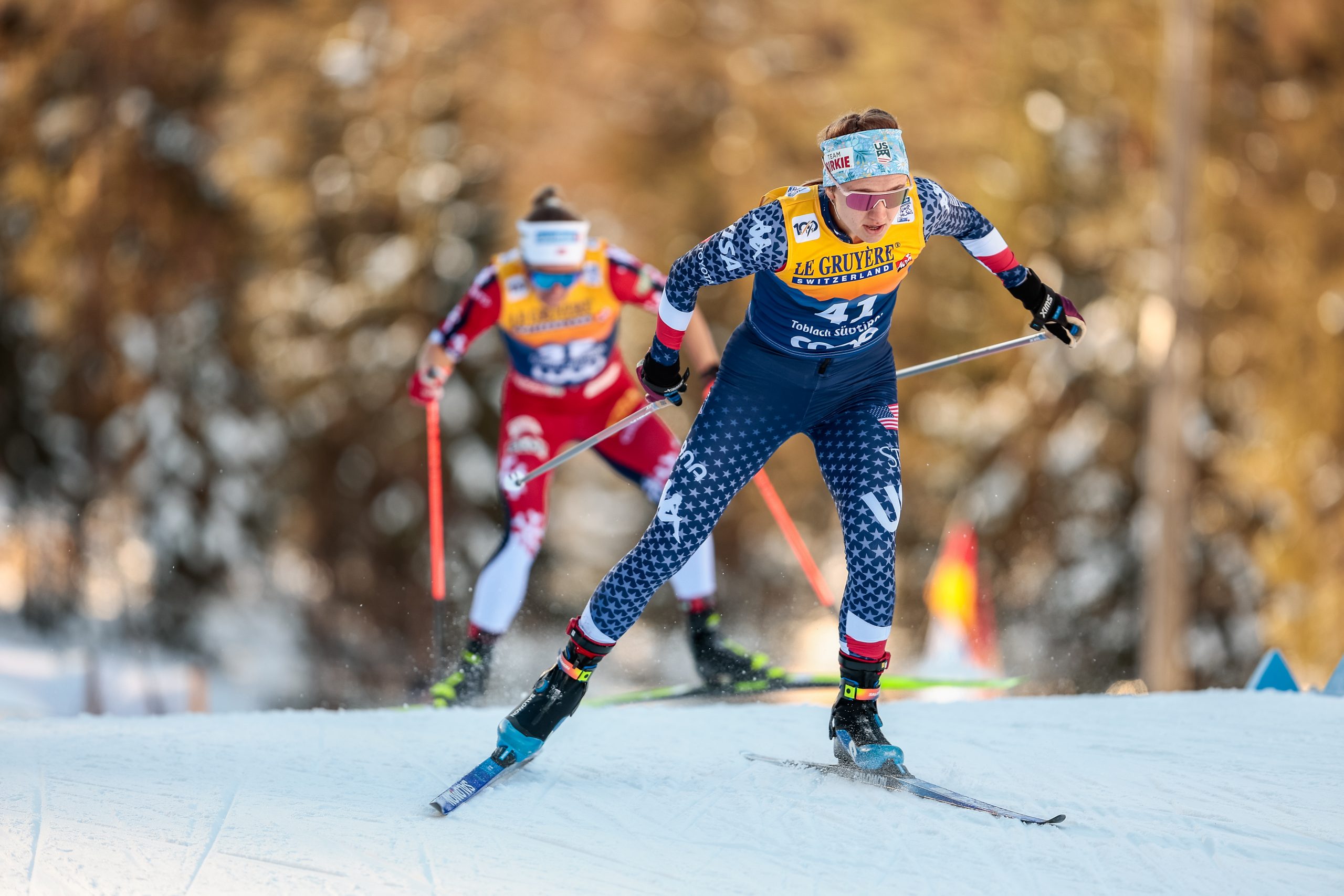
    For Diggins, it was mission partly accomplished before the heats even began as Carl finished 37th in qualifying meaning that she wouldn’t be in the heats and Diggins would have a golden opportunity to put some distance on her German rival.

    Team Norway was somewhat replenished with Lotta Udnes Weng, and Kristine Stavaas Skistad, joining the start list. Sweden fielded its usual formidable field—including Jonna Sundling, Emma Ribom, and Maja Dahlqvist— but still absent from team Sweden was Linn Svahn. When Sundling is in form she is always a name to beat and proved that again by finishing first in the qualifying round leading the field by over four seconds.

    At the end of the day Sundling simply proved too formidable for the rest of the field as she led every heat including the finals, where she was able to convincingly handle Skistad. Skistad skied very tactically the entire day and tried to slingshot past Sundling in the finals, but the Norwegian simply didn’t have the speed to be able to pass Sundling. Dahlqvist ended up taking third.

    Jessie  Diggins (USA) looked good all day, but was done in by a broken pole in the finals. (Photo: NordicFocus)

    Diggins qualified eighth and decided to race in the third quarter final, abandoning her strategy of choosing heat number five. The new strategy served her well as she advanced to the finals. But she had bad luck in the finals when she fell going up a hill and broke a pole. It was an unrecoverable event, and she ended up finishing sixth. It was a truly unfortunate bit of bad luck as Diggins had looked very strong all day and into the final race as well. “The thorn was getting my ski stepped on, which caused me to fall then put my knee through my pole, or my ski, I’m not sure” said Diggins. “My rose was how I handled it. You only get your sportsmanship tested when things go wrong. And I’m really proud of how I kept my head high, I smiled and thanked the volunteers and the fans, and took time to high-five a bunch of cute little kids. I’m proud of how I handled the situation that’s obviously a bummer, but that is sport.”  But the good news for Diggins was that she gained substantial ground over her rivals in her chase for the Overall lead.

    Today also marked Julia Kern’s (USA) return to Sprinting. Kern raced yesterday in the mixed relays (five kilometers) but today was her first opportunity to test her Sprinting legs since the Tour de Ski. Kern looked good in the quarter final and made it to the semifinals but was unable to advance out of the semis. “I was excited to be sprinting again,” said Kern “I’ve been hungry to improve my sprinting this season, trying to find my sprint mojo back. The pace was hot from the start and I was feeling the quarterfinals and the altitude in my body. I’m proud of how I skied the quarterfinals today, and was a step in the right direction to getting my sprint form back, and now I have to work on holding repetitive efforts through the rounds.”

    There were also some fresh faces on team USA with Kate Oldham and Lucinda Anderson joining Lauren Jortberg and Alayna Sonnesyn in the qualifying round. It was the World Cup debut for Oldham, and only Anderson’s second world Cup race. Oldham and Anderson made the heats qualifying 28th and 24th respectively. “I’m trying not to have any result-based goals on my first trip to World Cup so I can just focus on learning what it’s like to race here,” Oldham said after the race. “That being said, it was a huge bonus to make the heats today. Racing the qualifier felt similar to most other qualifiers especially because it was an individual start race, but I knew that every fraction of a second was going to count because the level of competition is so high here. I think the parts that were the most different were the little things that you don’t get in the US, like having a heat selection, lots of cameras, starting gates, etc. After all that, it just felt like racing, but with a new group of teammates, techs, and coaches who are all incredibly good at their jobs!”

    Julia  Kern (USA) returned to Sprinting today and made the semifinals. (Photo: NordicFocus)

    “It felt great!” remarked a clearly pleased Anderson after the race. “I wasn’t expecting to make the heats today, but I had a fun time trying to keep up with all those fast skiers. They definitely raced it a lot more tactically than heats I’ve done in the US, so hopefully I get the opportunity to race more World Cup heats and try and get more in the mix!”

    Sonja Schmidt (CAN) Canada had a breakout day. She qualified 10th and in a shocker won her quarterfinal heat. Prior to today, Schmidt—who has only previously competed in five World Cup Sprints— had one top twenty Sprint finish at the World Cup. She advanced to the finals by qualifying as a lucky loser in the semifinals, finishing fourth in the finals just missing the podium.

    Diggins was the top American finisher in sixth place followed by Kern in 12th. Other American finishers were Oldham in 19th, Jortberg 28th, Anderson 29th, Sonnesyn 50th, and Sammy Smith in 52nd.

    Schmidt led Canada with a personal best finishing fourth. Other Canadian finishers were Liliane Gagnon 32nd, Olivia Bouffard-Nesbitt 40th, and Katherine Weaver 42nd.

    Engadin Women’s Freestyle Sprints-Quarterfinals

    Sundling and Skistad battled each other in the first quarterfinal with Sundling taking the win over her Norwegian rival by half a second. The two easily took the top two spots, and it was a familiar scenario for two of the top Sprinters in the sport.

    Lucinda  Anderson (USA) made the heats in her World Cup Sprint debut. (Photo: NordicFocus)

    Lucinda Anderson made her Sprint heat debut in the second heat. She had the unenviable task of going up against Jasmi Joensuu. But the story of the day was that in a huge surprise, Sonjaa Schmidt (CAN) was able to blast past Joensuu to take the victory. It was a breakout race for Schmidt.

    In a change of strategy, Jessie Diggins chose to race in the third heat today. She joined her teammate Julia Kern and the strong Katerina Janatova (CZE). Diggins went to the front early along with Kern. The two skied together for the first half of the race with Diggins putting a big gap on the rest of the field. Coming to the finish Janatova went by Kern and put in a push to try and catch Diggins. But Diggins was able to hold of Janatova to win the heat with Janatova taking second. Kern held onto third and her time would be good enough to qualify as a lucky loser.

    The fourth heat also had strong skiers with L. Weng and Maja Dahlqvist facing each other as well as Jortberg. L. Weng and Dahlqvist dominated the heat with L. Weng taking the win and Dahlqvist finishing second. Jortberg was unable to keep pace with the leaders and finished sixth.

    Today was the Sprint heat, and World Cup debut for Oldham (USA) (far right). Alina  Meier (SUI), Barbora  Antosova (CZE), Kate  Oldham (USA), (l-r) – Photo: NordicFocus)

    The fifth heat was the Sprint heat debut for Oldham. She would face Moa Lundgren (SWE), and Alina Meier (SUI). Ane Appelkvist Stenseth (NOR) took the early lead. But about a minute into the race, she was passed by Lundgren who continued to lead coming into the stadium. The rookie Oldham was right with the leaders as Meier managed to squeak by on the inside to take second place. Oldham battled hard but couldn’t gain on the leaders as she ended up in fourth but was less than a second away from finishing in the top two. However, placing fourth in a heat in your first world cup race and just missing advancing was an impressive debut for Oldham.

    SemiFinals
    Sonjaa Schmidt (CAN) (center) had her best Sprint day ever. (Photo: NordicFocus)

    In the first semi-final Diggins and Kern again faced each other along with Sundling, Skistad, Schmidt and Joensuu. It was as difficult a field as there is these days in Sprinting with Sundling and Skistad having a dominating presence. Sundling and Skistad immediately went to the front of the field with Diggins right with them. Sundling put in a torrid pace as about 1:20 into the race she put a gap on the field with Diggins sitting in second place and Skistad right behind her. There was no catching Sundling as she continued to push the pace and string out the field. Into the stadium Sundling was leading comfortably as Diggins and Skistad battled for second. Skistad put in a quick burst of speed to catch Diggins who finished third. Schmidt had another incredible performance finishing fourth which allowed her to advance to the finals as a lucky loser along with Diggins. Julia Kern was never able to keep pace with the leaders and finished sixth.

    In the second semifinal Dahlqvist and L. Weng were able to advance by finishing first and second. Fortunately for Diggins and Schmidt the pace was slower than the first semi-final which allowed Diggins and Schmidt to advance as lucky losers.

    Finals

    The finals ended up being a star studded field with Sundling and Skistad looking like the favorites going in, against Dahlqvist, Schmidt, L. Weng and Diggins. As she had done the entire day Sundling went to the front from the start, with Skistad shadowing her, and Dahlqvist and Diggins just a few strides behind them. Going into the first big climb Diggins began to charge up the hill when she fell and broke a pole as she hit the ground. It immediately put her to the back of the field and there would be no recovering from it.

    As Diggins was struggling with her broken pole Sundling continued to hammer away with Skistad doggedly pursuing her. The two had put an enormous gap on the rest of the field as the top two places were decided before the skiers entered the stadium. It was a fitting duel to the finish as Skistad hung back drafting off Sundling. But the Swede proved too tough as she was able to outsprint Skistad winning by over a second. Dahlqvist finished third with Schmidt hanging on for fourth in her best ever Sprint finish.

    It was a might-have-been kind of day for Diggins who looked very sharp in the finals, but there was no way for her to overcome a broken pole. Nonetheless she was able to gain valuable points in the Overall standings over her two principal rivals. It was a day that showcased everything Sprint skiing has to offer—incredible speed, technical prowess, and the heartbreak of very bad luck.

    Engadin Women’s Freestyle Sprint

    Kristine Stavaas  Skistad (NOR), Jonna  Sundling (SWE), Maja  Dahlqvist (SWE), (l-r) -(Photo: NordicFocus)
  • Karlsson Dominates Les Rousses 20 K Classic. Diggins Sidelined by Injury. Brennan Out Indefinitely

    Karlsson Dominates Les Rousses 20 K Classic. Diggins Sidelined by Injury. Brennan Out Indefinitely

    This coverage is made possible through the generous support of Marty and Kathy Hall and A Hall Mark of Excellence Award. To learn more about A Hall Mark of Excellence Award, or to learn how you can support FasterSkier’s coverage, please contact info@fasterskier.com.

    Frida Karlsson (NOR) dominated the field setting a blistering pace which no one could match. (Photo: NordicFocus)

    The timing of the Norwegian national championships has already had a dramatic effect on world cup races in Les Rousses, France. Today’s women’s 20 kilometer Classic mass start race would not be an exception.

    Absent from the start list were perennial favorites Therese Johaug (NOR) and Heidi Weng (NOR). Those two finished one-two respectively in yesterday’s Norwegian championship 20 kilometer skiathlon.

    Jessie Diggins (USA) disclosed that her foot injury was worse than originally believed. (Photo: NordicFocus)

    But the absences on the American squad were perhaps even more meaningful and certainly likely to have a longer lasting impact on the race season. The U.S. women who have consistently been celebrated for their depth and top performances are now plagued by injuries.

    One critical absence was the Overall world cup leader Jessie Diggins (USA) who decided not to race today because of her ongoing foot injury. She revealed that after double poling the entirety of the Classic Sprint yesterday that she would not compete in today’s Classic race. She also disclosed that after the Tour de Ski she had an MRI which revealed that she has a partial rupture of the fascia by the heel bone in addition to the plantar fasciitis. She indicated that, “this is something that I don’t want to risk. My number one goal is long term foot health.” She stated that she couldn’t stride “with any intensity,” but that she could double pole, which is why she double poled all of yesterday’s Sprint course to finish 40th. Diggins doesn’t know when her next Classic race will be. World Championships are still in her sights, but there is no certainty about whether she will be able to do any Classic racing by then. It was an absence which further dug into an already depleted American squad.

    Joining Diggins on the sidelines were Rosie Brennan who also did not race today, and Julia Kern who is still recovering from the Tour de Ski.

    The news from Brennan was bad. “I am struggling with my health and as I hope you can observe, racing does not feel good,” said Brennan. She elaborated that, “I really hoped with two weeks away, I could sort things out but that has unfortunately not been the case. It’s been very challenging to get the medical help I need overseas, and without friends, family, and my coach, so I am currently on a plane to Alaska. I am crushed and scared and don’t know what the future holds but a change was needed to try to move forward. I haven’t given up on returning to racing but need to put myself in a place where I can learn more about what my body is telling me and be able to take care of my physical and mental self before I can make a decision on when I will return.”

    So that meant that only two Americans were in today’s field. Sophia Laukli, who turned in an excellent performance finishing 16th,, and Alayna Sonnesyn who was 36th.

    “Each classic race this year is definitely getting a bit better each time, but I do still feel there’s a lot of room for improvement.,” said Laukli. “I’m for sure feeling there’s fatigue from the Tour so I’m just happy to put together a solid Classic race for the time being. In past years I wouldn’t be able to do that unless I was in peak form.” The challenging Les Rousses course also worked to the Distance specialist’s favor. “The course was definitely a grind which always works to my advantage, maybe less so today because I was pretty tired. But in general I will always do better on a course with minimal double pole and lots of work.”

    The absence of Norwegian and American stars provided an opening for others. Frida Karlsson (SWE) took full advantage of some of her top rivals’ absence and turned in an epic performance, totally dominating the field winning by almost 1:30. Karlsson led from the start, and it was immediately clear that no one would be able to keep pace with her today. Her performance certainly made fans wonder what the race would have looked like had Johaug been present. Karlsson was followed in second place by her teammate Ebba Andersson, with Teresa Stadlober (AUT) taking third. After the race Karlsson said, “it was really fun today.” She continued that, “I felt relaxed and strong. It was just fun.” Karlsson indicated that she intended to do some altitude training before the world championships, which didn’t give much of a clue as to whether she would do additional world cup races before the world championships.

    Sophia Laukli (USA), (left) finished 16th, just behind Karoline Simpson-Larsen (NOR), (right) (Photo: NordicFocus)

    Canadian Katherine Stewart-Jones continued to impress, she finished 14th. Other Canadian finishers were Lilian Gagnon in 23rd, and Alison Mackie 34th.

    Perhaps no one trying to take advantage of Norway’s thin lineup was a more unlikely sight than the appearance of Norway’s own Kristine Stavaas Skistad’s name on the start list. Skistad is a well-known name, having won more Sprints than most can remember—but a Distance race —well that’s not exactly in her wheelhouse. She has completed some distance races in the Tour de Ski. But outside of those, the only world cup Distance races on Skistad’s resume appeared to be … none! But apparently Skistad reevaluated the benefit and reality of doing a 20 kilometer Classic race, thought better of it, and chose not to start.

    But after today’s race, there were more questions than answers swirling around the American team. With it’s usual dominating duo of Diggins and Brennan ailing, and the reliable Kern resting, it would be up to some of the other women to shoulder the racing load, at least in Classic races. With the world championships on the horizon, it is not the position that the American team was hoping to be in.

    The Women’s 20 Kilometer Classic Mass Start

    Karlsson wasted no time going to the front of the pack and by two kilometers she was out front setting the pace ahead of Astrid Oeyre Slind (NOR). Karlsson’s brisk pace was able to string out the field very early. By 3.5 kilometers she was at the front of a six person pack with the Classic expert Kerttu Niskanen (FIN) at the back of it. Katharina Hennig (GER), Slind, Ebba Andersson (SWE), and Teresa Stadlober (AUT) rounded out the group.

    At the five kilometer mark Hennig double poled past Karlsson and the two jockeyed for position at the head of the pack. It was the only few moments at the front for Hennig, and the only time when Karlsson would relinquish the lead.

    Niskanen was the first to show that she was having trouble keeping up with the pace as she was dropped off the back and the lead pack was quickly down to five skiers.

    Alayna Sonnesyn (USA) was one of only two American starters. She finished 36th. (Photo: NordicFocus)

    At 8.1 kilometers Karlsson continued to push the pace with Andersson, Hennig, Stadlober, and Slind hanging right with her. At this point, Sophia Laukli (USA) was the top American in 18th place, and Canadian Katherine Stewart-Jones, who was having another good day, was holding on to 14th.

    Ebba Andersson (SWE) (left), tried to keep pace with teammate Frida Karlsson (SWE), (right), but no one could match Karlsson’s tempo. (Photo: NordicFocus)

    Toward the front Karlsson was picking up the pace like a locomotive gaining speed, and only Andersson was able to go with her. Stadlober was now in third and by the half-way mark she was over four seconds behind Karlsson.  Hennig had drifted to over 11 seconds back. Slind, Carl, and Niskanen were now in a second chase group that was over 25 seconds behind the leaders.

    But Karlsson was on a mission and set a pace which no one could match. By the 13.4 kilometer mark she had dropped her teammate Andersson and was skiing by herself 23 seconds ahead of Andersson.

    With five kilometers left Karlsson already had the race in hand, and the competition was now for the rest of the podium spots. While Karlsson had extended her lead to 41 seconds over Andersson, Stadlober, who was in third place, was trying to reel in Andersson. Surprisingly, long distance specialist Slind was unable to maintain the pace and was over 30 seconds behind Stadlober.

    Teresa Stadlober (AUT) made a bid for second, but couldn’t catch Ebba Andersson (SWE). Photo: NordicFocus)

    With 3.8 kilometers remaining Karlsson’s lead ballooned to over 54 seconds. In second place, her teammate Andersson was fighting desperately to hold off Stadlober who continued to stalk her. Stadlober was six seconds behind Andersson and showed no signs of relenting. But the fight was exclusively for second and third place with the rest of the field now too far back to play into the podium standings.

    Stadlober was keeping Andersson in her sights, but try as she might, she couldn’t begin to close the small gap on the second place skier.

    As the skiers approached the finish, Karlsson’s total domination clearly showed as there wasn’t another skier to be seen—for a long time. Karlsson had just given an absolute Classic skiing clinic finishing over 1:29 ahead of Andersson as she double poled across the finish line with an enthusiastic smile on her face and looking jubilant. Meanwhile, Andersson had fought off Stadlober’ s efforts and was able to keep her second place position. Stadlober finished third having fallen back to almost 12 seconds behind Stadlober. It was total domination by Karlsson who showed that she appeared to be back in top form.

    Les Rousses Women’s 20 kilometer Classic Mass Start

    Frida Karlsson (SWE) completely imposed her will on the field. (Photo: NordicFocus)
  • Skistad Returns to Win Les Rousses Classic Sprint

    Skistad Returns to Win Les Rousses Classic Sprint

    This coverage is made possible through the generous support of Marty and Kathy Hall and A Hall Mark of Excellence Award. To learn more about A Hall Mark of Excellence Award, or to learn how you can support FasterSkier’s coverage, please contact info@fasterskier.com.

    Sprinting has the most unpredictable action of any World Cup racing format. Skiers are crammed into a narrow patch of snow, leading to skis crossing and poles breaking. Wobbly legs often misfire, and mistakes ensue. Whenever a racer gets crowded out at the finish line, there is an inevitable shrug followed by the common refrain of, “that’s Sprinting.” But even in the unpredictable world of Sprinting, there are usually a few constants.

    Jessie Diggins (USA) was unable to advance to the heats and finished 40th. (Photo: NordicFocus)

    But one of those constant themes was upended when Jessie Diggins (USA) failed to qualify for the heats. For the last two years Diggins qualifying for the Sprints and choosing to race in the final heat has been about as predictable as Sprinting gets. But that constant failed to materialize as Diggins had a tough time and finished 40th in the qualifying rounds which meant she would not race in the heats. Due to her foot injury, Diggins was unable to stride during the race and was forced to double pole and herringbone the entire course, creating a difficult on course situation for her resulting in her not qualifying. But she was able to pick up several valuable points for still finishing in the top 50.

    Another constant has been the American team usually fielding three or four women in the heats. But that also didn’t happen when Alayna Sonnesyn (USA) finished 38th and also failed to qualify. That meant that all of the hopes for team USA were riding on Rosie Brennan (USA) who qualified 22nd.  Julia Kern’s (USA) usual presence in the heats wasn’t a factor as she wasn’t racing this weekend as she was still recovering from the Tour de Ski.

    Rosie Brennan (USA) was the only American woman to make the heats. (Photo: NordicFocus)

    Brennan had a hard time in the heats and couldn’t advance out of the first round and ended up 26th on the day. So, today the usually reliable American Sprint team fell victim to the unpredictable nature of Sprinting.

    Kristine Stavaas Skistad (NOR) returned to World Cup racing, and to Sprinting dominance. (Photo: NordicFocus)

    After the racing had concluded some of the predictability of Sprinting returned as Kristine Stavaas Skistad (NOR) asserted herself throughout the day to defeat all of her Swedish rivals. Maja Dahlqvist (SWE) was second with Jonna Sundling (SWE) coming in third. After the race, the always reserved Skistad said, she was “very happy and that the race had been very hard.”

    Yesterday’s Distance races had been significantly affected by the absence of many top Norwegians who had elected to stay home and race in their national championships. But today’s women’s field wouldn’t be as dramatically affected as Norway’s top Sprinter, Skistad was back after her prolonged absence from abdominal surgery. Skistad raced on Thursday in the Norwegian championships and won the Freestyle Sprint competition. She appeared to be fully back in form, but racing again only two days after the Norwegian championships— with travel in between— was going to be a major test. Before her surgery Skistad had been about as consistent as things get in Sprinting. Skistad was joined on the Norwegian squad by Elena Rise Johnsen—who is little known to North American audiences—but finished third in the Norwegian Sprint championships. Also joining her was Ane Appelkvist Stenseth who finished seventh in the Norwegian nationals Sprint competition. Missing today was Julie Myhre (NOR) who going into the day was second in the world cup Sprint competition.

    Maja Dahlqvist was the top Swede, finishing second. (Photo: NordicFocus)

    The Swedish women have also been one of the constants in Sprinting for some time. But they competed today at  less than full strength as two time former Sprint Overall champion Linn Svahn was absent in order to recover from the Tour de Ski and prepare for the world championships. She would be replaced by Moa Hansson, whose previous best performance in a Sprint world cup was 22nd.

    Another recent Sprint constant is the presence of Jasmi Joensuu (FIN) who has proven to be a continual Sprint threat this year and currently leads the Overall Sprint competition. But Joensuu was unable to find the podium today and finished fourth.

    Kern is a usually reliable presence for the Americans in the Sprint heats but needed more time off after the Tour. She posted on social media, “my body wasn’t quite ready to race in France this weekend, but a little extra time at home is feeling like a special treat right now!!! Lots of motivation to train smart for the bigger goals ahead and soak up that extra recharge time at home!”

    Canadian Katherine Weaver had an excellent day finishing 16th. The other Canadian finishers were Olivia Bouffard-Nesbitt in 29th, and Alison Mackie 31st.

    Les Rousses Women’s Classic Sprints-Quarter Finals

    In the first heat Skistad appeared to show that she was completely back as she and Jonna Sundling double poled away from the other contenders with Sundling nipping Skistad at the finish. But as she often does, Skistad let up at the finish unconcerned about the victory and more focused on saving energy and moving through the heats.

    The second heat featured Joensuu and Emma Ribom (SWE). About halfway through Joensuu and Ribom established themselves at the front with Ribom gaining ground on the more technical sections. Joensuu went into an extra deep tuck on the downhills which helped her gain ground as Ribom took the win with Joensuu finishing second.

    In heat three Brennan faced Laura Gimmler (GER) and Stenseth who went into the early lead with Gimmler right behind her. About halfway through Brennan was in the back of the pack and didn’t seem to have the ski speed to keep pace with the leaders. Coming into the finish Gimmler and Stenseth were side by side as they eased up to cross the finish line with Stenseth taking the win. Brennan finished sixth and would not advance. It was not only the end of her day, but the end of the day for team USA.

    In the fourth heat Nadine Faehndrich (SUI) was matched against Maerta Rosenberg (SWE) and Katherine Weaver (CAN). Rosenberg went out to a blistering start and put a large gap on Faehndrich. But Faehndrich used her veteran skills to slowly but surely close the gap and took the lead as they entered the stadium. Weaver’s pace was too much for her to sustain as Coletta Rydzek (GER) was able to pull ahead at the finish. Rosenberg would advance as a lucky loser. Weaver finished fourth and would not advance.

    In the fifth heat Johanna Hagstroem (SWE) and Dahlqvist battled against Victoria Carl (GER). They were joined by hometown favorite Leonie Besson (FRA) who finished 29th in the qualifying round and gave the French fans a brief thrill. But her hopes were dashed early as she broke a pole at the start and would never be able to be a factor. Ingrid BergeneAabrekk (NOR) went to the lead early, but about half way through, Hagstroem—who was the top qualifier—picked up the pace and went to the front along with Dahlqvist. At the finish, no one could match the fire power of the Swedes as Dahlqvist and Hagstroem finished first and second.

    Semi Finals
    Jasmi Joensuu (FIN), (far left,red bib) made it to the finals, but couldn’t reach the podium. (Photo: NordicFocus)

    The first semi final was a battle of Sprinting all-stars. Sundling, Ribom, Skistad, and Joensuu were all in the first heat. Skistad went to lead early with Ribom going with her. Sundling charged up the first steep hill to take the lead as she tried to put some distance on Skistad who would have a double poling advantage coming into the finish. But Skistad showed off amazing skis as she glided up and over a small hill toward the end of the race to take the lead back. Sundling pulled ahead at the finish as Skistad dramatically let off the accelerator about 20 yards before the finish. Joensuu made a late charge but couldn’t catch the leaders. Nonetheless, she advanced as a lucky loser along with Ribom.

    The second heat featured Faehndrich, Dahlqvist, Hagstroem, and Gimmler. Hagstroem and Gimmler took the early lead in what was a very controlled pace. The race remained very tactical as no skier was anxious to go into the lead. Coming into the stadium all six skiers were together with Hagstroem going to the front and she began to press the pace along with Faehndrich. But it was Dahlqvist who moved to the lead with Gimmler joining her. It was a photo-finish between Dahlqvist and Gimmler—with both skiers being awarded the same time—and no skiers advanced from this heat as a lucky loser.

    Finals

    In the finals, Skistad would have the chance to show that she was completely back as she faced a formidable field of Sundling, Joensuu, Ribom, Dahlqvist and Gimmler. It was the repeat of a familiar theme from last year’s Sprint competitions as three Swedes battled the lone Norwegian: Skistad.

    No one had an answer for Skistad in the finals. Maja Dahlqvist (SWE), Jonna Sundling (SWE), Kristine Stavaas Skistad (NOR), (l-r) (Photo: NordicFocus)

    Skistad immediately went to the front and sent the message early that this was not going to be a tactical race. Sundling was able to close the gap up the first hill and looked like she might have an advantage over Skistad. But Skistad looked controlled and calm as she stalked Sundling, while Joensuu was hanging on in third place. Skistad repeated her excellent glide over a small uphill to slingshot into the lead and began pulling away. She was able to double pole to victory as Dahlqvist snuck up from behind to take second, while Sundling held on for third. The effort clearly showed on Skistad who remained collapsed onto the snow for some time after the race, which is not her habit. Nonetheless, the race was a statement for the rest of the women, that the rivalry between Skistad and Sweden was back.

    Les Rousses Classic Sprint Results

    Maja Dahlqvist (SWE), Kristine Stavaas Skistad (NOR), Jonna Sundling (SWE), (l-r) (Photo: NordicFocus)


  • Johaug Wins Alpe Cermis and Tour. Diggins Third Overall

    Johaug Wins Alpe Cermis and Tour. Diggins Third Overall

    This coverage is made possible through the generous support of Marty and Kathy Hall and A Hall Mark of Excellence Award. To learn more about A Hall Mark of Excellence Award, or to learn how you can support FasterSkier’s coverage, please contact info@fasterskier.com.

    Therese Johaug (NOR) won the climb up Alpe Cermis, and the Tour de Ski. (Photo: NordicFocus)

    Today marked the end of the journey on the long and hilly road that is the Tour de Ski. All that remained is one of the more daunting challenges in cross-country ski racing; the fabled climb up Alpe Cermis. Over a week ago 67 energetic bright-eyed women lined up to start the Tour. Now only 31 drained skiers remained to start the race, ready to charge up a mountain, and then take a much needed rest.

    Leading the 10 kilometer Mass Start Freestyle race up the mountain today would be Tour leader Therese Johaug (NOR). Going into the race she led Astrid Oeyre Slind (NOR) by 22 seconds and had a 1:47 advantage over Jessie Diggins (USA). In a FIS (International Ski Federation) interview before the Tour began, Johaug described the climb as “perfectly suited” for her. She speaks from experience. Johaug has had the fastest time in the uphill race an incomprehensible eight times. So, it’s not bragging when she says the race is “perfect” for her.

    The goal for the other two women currently on the podium would be to hold onto their second and third place positions. Diggins would start the race 1:25 behind Slind, so the odds of her catching Slind were very slim. Diggins’ biggest concern would be Kerttu Niskanen (FIN) who was 40 seconds behind her. Niskanen has finished in the top 10 on the climb several times, and a 40 second lead, while substantial, can evaporate quickly if things blow up on the mountain, and you are being chased by a proven performer in the uphill race. Diggins would have to carefully pace herself to make sure things didn’t get out of hand going up the mountain.

    Jessie Diggins (USA) did exactly what she needed to do to stay on the Overall podium. She kept Kerttu Niskanen behind her all day. (Photo: NordicFocus)

    Probably the most compelling pre-race story was the upcoming inter-generational battle between the titans of mountain climbing Johaug and Sophia Laukli (USA). Last year Laukli won the climb and did so in what appeared to be an effortless fashion. If the Alpe Cermis is perfect for Johaug it is also right in Laukli’s wheelhouse. The American spends her summers racing in the world trail running championships so a 35 minute climb up a mountain is really just a warm up for her. Laukli was starting with bib 25 and would have to expend some energy to work to the front of the pack, but with such a small field it was unlikely to take a lot out of her.

    But age triumphed over youth as Johaug crushed the field winning Alpe Cermis by over 25 seconds and in doing so became a four time Tour de Ski winner. Laukli was never a factor. Slind did more than she needed to do, finishing second and securing her second place Overall finish. Diggins also did exactly what she needed to do. She finished sixth, 54 seconds behind Johaug, but over a second ahead of Niskanen to secure her place on the podium.

    Therese Johaug (NOR) made it look easy blasting up the steep climbs. (Photo: NordicFocus)

    “The last stage was fantastic,” Johaug said after the race was over. “I love the climb, so I can’t wait for it. It’s so fun to be here again after four years. Four times winning feels really good. It was not my goal this season because I shouldn’t be here.” Johaug was non-committal when asked when she would rejoin world cup racing. “I will be home for a while. I will go the World Championships.” It was a response which left a lot of room for interpretation as she didn’t commit to rejoining world cup racing before the World Championships.

    Diggins was relieved to have the Tour behind her. “I don’t know if you’ve ever seen a happier third place in your life. It was an epic Tour, in ways I didn’t ask for, but I got a chance to see how tough I could be. I’m definitely excited for some rest now. It was great to fight out there today. I’m really proud of how this Tour went.”

    It was a rough day for Laukli who never really established a rhythm and ended up 15th. The other American finisher was Julia Kern who finished 19th.

    The top Canadian finisher was Katherine Stewart-Jones who finished 14th. Liliane Gagnon was 26th.

    The much anticipated duel between Sophia Laukli (USA) and Therese Johaug (NOR) didn’t materialized as Laukli never established a serious threat. (Photo: NordicFocus)
    The Women’s 10-kilometer Alpe Cermis Freestyle Climb

    There was no surprise as Johaug led the field out of the stadium, as she was followed by three time Alpe Cermis winner Heidi Weng (NOR). Weng has had a challenging Tour, so a good showing today would be a measure of redemption for her. Niskanen and Krista Parmakoski (FIN) closely followed the two Norwegians.

    As the skiers reached the 2.7 kilometer mark there was already a small gap forming with a lead group of Weng, Johaug, Diggins, Slind, and Ebba Andersson (SWE) stringing out the field into a single file line. Laukli was still toward the back of the pack, 17 seconds behind the leaders. It was clear that Johaug and Weng were determined to race hard from the start and punish the rest of the field. But Diggins was right behind the two Norwegians not letting them establish a gap on her.

    As the field began to start the climb Johaug was out front with Weng and Diggins right behind her and Slind hanging on to Diggins. Entering the Alpine climb, Johaug continued a relentless V-2 technique. At this point, Laukli began to make a move going into eighth place, and she now had the leaders in her sight. But it would turn out to be the most the American had to offer in today’s climb.

    Julia Kern (USA) had another good distance day finishing 19th. (Photo: NordicFocus)

    As the serious climbing began Johaug, Weng, and Andersson formed a trio that put a gap on Diggins who was leading the chase group. Laukli seemed to be mired in a group in the back and had dropped back to 11th. The pace seemed to be too much for her to maintain and early on in the race the narrative shifted away from the Johaug-Laukli battle to whether anyone could keep up with Johaug.

    As the race course hit the 28 percent grade, Johaug put the pedal to the floor and pulled away from the group. But the rest of the podium contenders were doing what they needed to do. Niskanen was not mounting a threat to Diggins and Slind was still hanging with the chase group which was now led by Andersson.

    Johaug was relentless as she assaulted the mountain at a tempo which no one else could match. At the steepest section of the climb Johaug hammered away and enlarged the gap on the field. She had already beaten down the field and the outcome was not in doubt. But the race for the other podium spots continued. Nora Sanness (NOR) was now leading the chase group in front of Weng, Slind, Andersson and Diggins. Niskanen was thrown off the back of the group and was unable to cut into Diggins’ Overall advantage over her.

    With half a kilometer to go Johaug was skiing relaxed and looked as fresh as she did at the bottom of the mountain. Diggins began to fade off the chase group, but was still in front of Niskanen as the mountain began to flatten out.

    Jessie Diggins (USA) never let Kerttu Niskannen (FIN) threaten her podium lead. (Photo: NordicFocus)

    Coming into the finish Johaug was out of sight of the chase group. She glided over the finish alone and had enough time and energy to grab a Norwegian flag as she skied across the finish line.

    Slind crossed the finish second with Weng right behind her. It was mission accomplished for Slind who actually gained time on Diggins in the Overall standings. Diggins finished sixth, 54 seconds behind Johaug, but a second ahead of Niskanen which meant that Diggins had also done what she needed to do to stay on the Overall podium.

    Team USA celebrates a podium finish in the Tour de Ski. (Photo: NordicFocus)

    It was a disappointing day for Laukli when the match with Johaug never materialized as Laukli slid into 15th place.

    The punishing Alpe Cermis climb ended up not affecting the Overall standings, but still served as an entertaining race to finish off the Tour. Now the racers will enjoy some well-deserved rest.

    Tour de Ski Alpe Cermis Climb

    Tour de Ski Overall Standings

    05.01.2025, Val di Fiemme, Italy (ITA):
    Astrid Oeyre Slind (NOR), Therese Johaug (NOR), Heidi Weng (NOR), (l-r) (Photo: NordicFocus)


  • Johaug Dominates 20-k Skiathlon. Diggins Fifth and Back on Overall Podium

    Johaug Dominates 20-k Skiathlon. Diggins Fifth and Back on Overall Podium

    This coverage is made possible through the generous support of Marty and Kathy Hall and A Hall Mark of Excellence Award. To learn more about A Hall Mark of Excellence Award, or to learn how you can support FasterSkier’s coverage, please contact info@fasterskier.com.

    Jessie Diggins (USA) was able to fight through painful plantar fasciitis to retake an Overall podium position. (Photo: NordicFocus)

    As we enter the second to last event in this year’s Tour de Ski—the 20 kilometer Skiathlon—there has been little movement at the top of the women’s Overall leader board. As the field continued to thin its ranks, yesterday’s Sprint results took on unusual outcomes which simply wouldn’t occur in a regular season World Cup Sprint. In a starting field with only 42 remaining skiers contesting the Sprints, there was an opportunity for more non-Sprinters to find their way into the heats to collect extra time bonuses. Qualifying for the Classic Sprint heats yesterday were Tour contenders Astrid Oeyre Slind (NOR) and Heidi Weng (NOR), with Weng taking a podium. The last time Heidi Weng took a podium in a non-Tour Sprint was in Otepaa, Estonia in 2017. That’s how dramatic the effects of a thinning race field are.

    The thinning of the Tour field continued today. The Tour began with 67 women contesting the first day of racing in Toblach. Today’s start list was down to 36 skiers, and before the race began another three skiers dropped out. If today’s race had been a Sprint, almost everyone would have qualified!

    Going into the race, Slind remained in first place ahead of Johaug but by only 8 seconds, and she was 29 seconds in front of Kerttu Niskanen (SWE). Jessie Diggins—who finished 14th in yesterday’s Classic Sprint— was in fourth place exactly one minute behind Slind and 31 seconds off the podium behind Niskanen. But as is often the case, looks are very deceiving because while Johaug sat in second place, she was really in a commanding position, as the final day of racing on Sunday will be in an event which she has described as being “perfect for her”—the climb up Alpe Cermis.

    For Diggins and the rest to have a real shot at the top of the podium, they would need to put a lot of time into Johaug today to build a substantial cushion before Sunday’s final. A more attainable task for Diggins would be to gain time on Niskanen, who has her own very strong history up Alpe Cermis.

    Therese Johaug (NOR) stayed relaxed in the Classic portion and pushed hard up the hills in the Freestyle to grind down the pack. (Photo: NordicFocus)

    At the race’s end, no one had an answer for Johaug who took the win beating Teresa Stadlober (AUT) and Slind by over thirty seconds. Slind finished third in a dramatic photo finish with Stadlober. The win put Johaug comfortably into the lead by 22 seconds with tomorrow’s climb being the only thing standing between her and a Tour de Ski victory. “It was amazing,” Johaug said after the race. “I need some races in my body, I’m old! Oh my God, it was a tough race. Felt really good in the skating in the beginning, but it was tough in the end. I had to push myself all the way to the finish line. I’m looking forward to Monday and not having to be so nervous anymore.”

    It was revealed that Diggins has been dealing with plantar fasciitis which has been affecting her mostly on the Classic portions of races. But she was able to push through the pain today and do what she needed to reclaim an Overall podium position by finishing 1:11 ahead of Niskanen to put Diggins into third place Overall. “I feel lucky that I’m still racing with what’s happening with my foot right now,” Diggins observed. “It feels like a bonus just to be here. And, maybe sometimes that’s the attitude you need, I’ve got nothing to lose, I’m just going to go out there and go as hard as I can, and be grateful that it’s normal ski racing pain tomorrow, because I can skate. When I walk it’s like I’m practicing for when I’m 95 years old, but when I’m skiing, skating is ok.”

    Entering the last day, the math for Diggins is very simple. After today’s race she is in third place overall, 40 seconds ahead of Niskanen. If she beats Niskanen up Alpe Cermis, or stays within 39 seconds of her, she will secure a place on the podium. She is 1:25 behind Slind for second, and it is probably asking too much for her to make up that much time on the climb to advance in the standings.

    Julia Kern had a career best day of Distance skiing finishing seventh. She credited her achievement to her team. “Hats off hands down to the wax techs. Our team did an incredible job today. I had amazing kicking skis, bullet proof kick, and they were ripping fast both in Classic and in Skate. I was so stoked in the race, I had incredible skis and that’s always an extra confidence boost. It helps with skiing tactically, maybe conserving a little on the climb knowing you’ll catch people on the down hill. That was huge.” But not all the credit goes to the people who gave her fast skis. “I also just surprised myself this morning feeling really good, and I feel like the Tour is such a roller coaster, you never know what you’re going to get on any given day. My body was there, and my skis were there, and I just took advantage of the opportunity today.

    Sophia Laukli was the only other American finisher, she was 20th. Laukli won the final stage up Alpe Cermis last year, but that was without Johaug in the field. Tomorrow promises to be an exciting race to see if Johaug can hold off the American upstart up Alpe Cermis.

    The top Canadian finisher was Katherine Stewart-Jones in 15th, she was followed by Liliane Gagnon in 29th.

    The Women’s 20 Kilometer Skiathlon

    The women began the Skiathlon with the 10 kilometer Classic portion. Slind, Johaug and Nadine Faehndrich (SUI) went to the front of the race early with Niskanen and Jasmi Joensuu (FIN) right with them. Joensuu and Faehndrich were competing for the Sprint bib, so they surged to the front when the first Sprint bonus point was available at 3.3 kilometers. Faehndrich and Joensuu raced to the bonus line together with Faehndrich narrowly beating out Joensuu.

    After the Sprint bonus, the Overall leaders quickly re-established themselves at the front with Johaug and Slind setting the pace. Johaug revealed after the race that she had a specific strategy for the Classic portion. “In the Classic I tried to focus on technique and not push so much until the last lap.” The two Norwegians were joined by veteran Krista Parmakoski (FIN) and Teresa Stadlober (AUT). When the pack hit the 4.6 kilometer mark a bit of a breakaway had formed with Johaug, Slind, Parmakoski, Stadlober, and Ebba Andersson (SWE) forming a lead group.

    Diggins was now skiing in a chase group with Niskanen and H. Weng. It was somewhat surprising that Niskanen wasn’t in the lead group during the Classic portion of the race, but it was good news for Diggins who could now keep an eye on her podium competition.

    At 6.8 kilometers the lead group of five was still intact with Parmakoski now struggling to stay with them, but Diggins had now moved to the front of her chase group along with Niskanen and they were trying to bridge the gap.

    Julia Kern (USA) had a career best Distance day. (Photo: NordicFocus)

    When the lead pack hit the eight kilometer mark Johaug continued to press the pace and dropped Parmakoski. The lead group was now down to Johaug, Andersson, Slind and Stadlober. Diggins had not been able to close the gap and now had drifted back over 28 seconds behind the leaders, but she was now skiing with her teammate Julia Kern. Kern’s presence in the top ten of the Classic portion of the race was a bit of a surprise, and she would continue to ski well the entire day.

    As the skiers entered the stadium for the ski exchange the lead group of four was still together 28 seconds ahead of Parmakoski with Diggins 34 seconds behind. After the ski exchange Diggins was 37 seconds back and faced the unenviable task of trying to gain ground on the lead group in the Freestyle portion of the race. But the good news for Diggins was that Niskanen was right in front of her, only four seconds ahead, and Diggins had her strongest portion of the race ahead of her, while Niskanen’s was behind her.

    But it was still Johaug setting the pace at the front trying to grind down the other three racers in her group. While Johaug was grinding, Diggins was closing on Niskanen and by the 11.2 kilometer mark she had managed to pass Niskanen who tried to hang onto Diggins’ coattails as Diggins passed her, but Niskanen didn’t have it in her.

    Sophia Laukli (USA) finished 20th going into her specialty tomorrow, the climb up Alpe Cermis (Photo: NordicFocus)

    As the lead group hit the 12.6 kilometer mark, Johaug made a concerted effort to press the pace up the steep hills. Doubtlessly, she didn’t want the race to come down to a sprint finish, and she began to edge away from Andersson, Slind, and Stadlober, slowly but surely beginning to create a growing gap with each passing kilometer. Diggins was now 45 seconds back of the leader but had put nine seconds between herself and Niskanen and continued to stretch her lead.

    Johaug continued to pull away from her three chasers who didn’t appear to have an answer on the steep climbs, but were able to pull back a little time on the flat sections. Slind led the chasers, but no one could match Johaug up the hills and by the 14.6 kilometer mark Johaug had extended her lead to 13.9 seconds. It then appeared that Slind, Andersson, and Stadlober capitulated the race to Johaug and were now fighting for second. Meanwhile, Diggins was now skiing on her own having put 27 seconds on Niskanen but was 56 seconds behind the lead pack. However, if Diggins continued this pace, she would regain a podium spot at the end of the day. Diggins didn’t mind skiing on her own. “With all these down hills, I kind of preferred it. Because you never know what can happen, and I’m thinking the last thing I need on top of this foot injury is to crash. I actually appreciated having my own space.”

    Jessie Diggins (USA) did what she needed to today to regain an Overall podium spot. (Photo: NordicFocus)

    Johaug continued to grind, and at 18 kilometers the writing was on the wall as none of the chasers could mount any response. As long as Johaug could stay on her feet, she would take the day’s win and put herself into the Overall lead. The good news for Diggins was that as the race currently stood, she was back on the Overall podium having put 54 seconds into Niskanen so far and continued to pull away from the Finn.

    As Johaug approached the stadium her lead had swelled to over 30 seconds, while Andersson, Stadlober, and Slind still skied together. Stadlober lead the trio into the stadium and a hectic three way sprint to the finish line ensued resulting in a photo finish. Stadlober ended up edging out Slind by a toe length with Andersson finishing fourth and Diggins finishing fifth, 55 seconds behind the leader, but more importantly 1:11 ahead of Niskanen putting Diggins in a great position to find the podium after tomorrow’s race.

    Julia Kern finished seventh turning in a career best performance for a Distance race.

    The day’s results put Johaug into the Overall lead with the only remaining stage being one of her best, the climb up Alpe Cermis.

    Teresa Stadlober (AUT), Therese Johaug (NOR), Astrid Oeyre Slind (NOR), (l-r)

    Tour de Ski Women’s Skiathlon Results

    Tour de Ski Overall Standings


  • Slind and Johaug Dominate 15-k Classic Pursuit. Diggins 6th, Relinquishes Tour Lead

    Slind and Johaug Dominate 15-k Classic Pursuit. Diggins 6th, Relinquishes Tour Lead

    This coverage is made possible through the generous support of Marty and Kathy Hall and A Hall Mark of Excellence Award. To learn more about A Hall Mark of Excellence Award, or to learn how you can support FasterSkier’s coverage, please contact info@fasterskier.com.

    Try as she might, Jessie Diggins (USA) and the rest of the field couldn’t match the pace set by Slind and Johaug. (Photo: NordicFocus)

    Part of the attraction of the Tour de Ski is the quick ebb and flow of the leader board. One day you’re sitting on top of the world with a big lead, and the next day you’re wondering where it all went. American star Jessie Diggins is thick in the middle of riding the Tour’s roller coaster. She went into yesterday’s 20 kilometer Freestyle race with a minute plus lead over three time Tour winner Therese Johaug (NOR), only to find that lead quickly shrunk to 41 seconds. At the start of today’s race, the formidable Kerttu Niskanen (FIN) was sitting in second place only 22 seconds behind Diggins, and the sudden darling of the Tour, Astrid Oeyre Slind (NOR) was a scant 32 seconds back in third place, when today’s event, the 15 kilometer Classic Pursuit began.

    But in this year’s Tour, Diggins has already performed against type twice, having won both a Sprint and a Classic race—neither considered her strength. So, the hope for the American star going into today’s race was that she would again perform against type.

    There was also an upside to yesterday’s time loss; it meant that in the Pursuit format, Diggins would start sixth, 37 seconds behind Slind (in a new format, starting spots are based on yesterday’s finish). So instead of being the hunted, Diggins would now be doing the hunting. She would also have the added benefit of starting off sandwiched between Victoria Karl (GER), Katherine Stewart-Jones (CAN), and Heidi Weng, which would give her the opportunity to join fast company to help close the starting gap on Slind who would start the race four seconds in front of Johaug. Slind has made her living for several years off long Classic races on the Ski Classics circuit, and she would have to be considered dangerous in any Distance Classic race.

    Astrid Oeyre Slind (NOR), and Therese Johaug (NOR), (l-r) worked together the entire race, and no one could catch them. (Photo: NordicFocus)

    Another skier also performing against type was Niskanen, who is best known for her Classic prowess. But Niskanen finished a strong third in yesterday’s Freestyle race and would be one of the favorites going into today’s Classic Pursuit.

    In another development with the potential to affect the Tour’s outcome, Maja Dahlqvist (SWE) did not start yesterday. She joined a growing list of Swedish women—including Johanna Hagstroem—on the sidelines. Both racers are usually in the mix for podiums, and their absence would now have the potential to affect race outcomes.

    But after the race was over the top Norwegians were able to regain dominance in the Classic technique with Slind and Johaug working together the entire race to control the field. Slind finished slightly ahead of Johaug with Niskanen taking third. But from the early kilometers there was a sense of inevitability as Slind and Johaug teamed up to work together relentlessly pushing the pace that no one else could come close to matching.

    Diggins didn’t have a group to work with until about 5 kilometers into the race when she settled in with Heidi Weng (NOR) and Stewart-Jones. But they simply couldn’t match the firepower of Slind and Johaug, though Diggins was still glad to have someone to work with. “I’m really grateful that I got to work with Heidi. That was really helpful for both of us.” Diggins finished 2:08 behind the leaders and she now sits in fourth, 1:01 behind Slind in the Overall Tour standings. Despite losing time Diggins remained upbeat. “I’m really proud of that race, I battled through a lot of pain out there, and was pushing for every single second. Yeah, the time was not indicative of my fitness levels, or what I know I can do on a perfect day, but at the same time, you get the day that you have, right here, right now, and I did everything I could, and I’m proud of that.”

    Johaug is in second place, six seconds back with Niskanen in third 28 seconds behind. Heidi Weng’s fortunes have fallen, while she is in fifth place Overall, she is over two minutes behind Slind, which is likely to be an insurmountable hurdle for her.

    Other American finishers today were Sophia Laukli 17th, Julia Kern 25th, and Rosie Brennan 31st. Alayna Sonnesyn did not start, and her Tour is now over.

    Katherine Stewart-Jones had another career great day finishing seventh. Liliane Gagnon was the other Canadian skier, she finished 32nd.

    It was a good showing for Laukli, “I think today was a pretty big improvement for my Classic skiing.” She continued that, “I could ski with a lot of strong Classic skiers and normally I’m not able to do that, so in that sense it was good.”

    Women’s 15 Kilometer Classic Pursuit

    It was a gorgeous cloudless bluebird day in Toblach for the start of stage four, as Slind started the race first out of the gate onto the three-lap race. Johaug began only four seconds behind Slind and went out quickly to bridge the gap to start working with Slind. The pair were double poling in unison by the time they hit the 1.7 kilometer mark. At this point they were the only Tour leaders who were in a position to be able to work together, and it was quickly paying dividends. Niskanen was trying to close the gap on Slind and Johaug, but in a theme which would continue throughout the race, she was working on her own and was unable to keep up with the Norwegians.

    Jessie Diggins (USA) was eventually able to join a group with Heidi Weng (NOR) and Katherine Stewart-Jones (CAN), but even working together, they lost ground to the leaders. (Photo: NordicFocus)

    A half a kilometer later, Diggins had caught Stewart-Jones but initially didn’t spend time working with her as she passed the Canadian, but everyone in the field was now losing time to the two leaders who were constantly working together and were powering through the course on a level no one could match.

    As the skiers hit the five kilometer mark the theme remained the same. Slind and Johaug working together with the rest of the top Overall contenders struggling on their own or in their own small groups to keep the pace. Behind Diggins, Weng and Stewart-Jones had finally joined together and were able to catch up to Diggins. The three were now able to ski as a trio, giving some hope to Diggins who was losing time to the leaders in every kilometer.

    But Slind and Johaug’s lead continued to grow the further they skied. At the 6.7 kilometer mark Diggins was now 1:07 behind the leaders and her Overall Tour lead was gone. She continued to struggle as Weng and Stewart-Jones took over the lead in their trio.

    At 8.0 kilometers Diggins was clearly working hard as she appeared to need a lot of effort to set her kick wax even though she had lots of kick wax. “I felt like I had really great kick,” said Diggins. “I asked for a lot on purpose, and also, I own that, because it may have slowed them down a little, but at the same time, I knew I was going to need a lot of kick out there today.” While the leaders in the Tour were desperately trying to keep up with Slind and Weng, Sophia Laukli (USA) was working with a group of her own and was in 13th place. It was a strong performance for the American who is an excellent Distance skier but has always struggled with Classic.

    Kerttu Niskanen (FIN) was in the unenviable position of skiing alone all race. (Photo: NordicFocus)

    Two-thirds of the way through the race, Slind and Johaug continued to punish the rest of the field with their lead having grown to 43 seconds over Niskanen and 1:36 ahead of the Diggins group.

    With 3.3 kilometers left the outcome of the race wasn’t in doubt. Either Slind or Johaug would cross the finish line first, the only questions remaining were how much time they would put into Diggins and when would they begin to start racing each other and not work together? In the meantime, Diggins was still with Weng and Stewart-Jones who was turning in another tremendous race.

    Therese Johaug (NOR) and Astrid Oeyre Slind (NOR), (l-r) worked together until the finish line. (Photo: NordicFocus)

    Slind and Johaug didn’t appear too interested in expending extra energy to take the stage win as the Norwegian duo were still together as they entered the stadium. Slind approached the finish area first maintaining a brisk double poling pace. Johaug had no answer for her teammate who easily kept Johaug at arm’s length to take the victory. Both skiers looked remarkably fresh, comfortable, and relaxed after finishing. Niskanen was able to finish within a minute of Slind and Johaug to take third.

    Sophia Laukli (USA) had an excellent finish in a Classic race. (Photo: NordicFocus)

    Still on the course, Diggins continued to push with Weng and Stewart-Jones still with her. But at the finish Weng double poled ahead of Diggins who finished 2:08 behind Slind and was now over a minute behind in the Overall lead. Sophia Laukli was able to hang on to finish 17th, a good finish for her in a Classic race.

    Heidi Weng (NOR) (right) was able to sprint past Jessie Diggins (USA) (left) at at the finish. (Photo: NordicFocus)

    For Diggins it was a tough day as she skied well but like the rest of the field had no answer for the lead Norwegians. The silver lining for Diggins is that the next race is another Sprint, but it’s a Classic Sprint which isn’t her best event. However, neither Slind nor Johaug is known for their Sprinting prowess so there is still an opportunity for her to retake the lead. But looking further down the Tour road, if Diggins is going to have an opportunity to win, she will not only have to re-establish a lead, but she will need to create a cushion before the final race of the Tour, the epic climb up Alpe Cermis which is one of Johaug’s best events.


    2024/25 Tour de Ski overall standings (after Stage 4):
    • Astrid Øyre Slind (NOR) 2:13:00.
    • Therese Johaug (NOR) +0:06.
    • Kerttu Niskanen (FIN) +0:28.
    • Jessie Diggins (USA) +1:01.
    • Heidi Weng (NOR) +2:09.
    • Slije Theodorsen (NOR) +2:59.
    • Victoria Carl (GER) +3:01.
    • Jasmi Joensuu (FIN) +3:14.


    Tour de Ski 15 kilometer Classic Pursuit Results

    Tour de Ski Women’s Overall Standings

    Astrid Oeyre Slind (NOR) celebrates the day’s victory and taking the Tour lead. (Photo: NordicFocus)


  • Diggins Again! American Wins Tour 15K Classic

    Diggins Again! American Wins Tour 15K Classic

    This coverage is made possible through the generous support of Marty and Kathy Hall and A Hall Mark of Excellence Award. To learn more about A Hall Mark of Excellence Award, or to learn how you can support FasterSkier’s coverage, please contact info@fasterskier.com.

    Jessie Diggins (USA) won her first Classic race today and stretched her Tour lead. (Photo: NordicFocus)

    Watching the Tour de Ski is like looking at a giant pendulum swinging back and forth. Yesterday, on day one, the pendulum swung to the favor of skiers with sprinting talent. Jessie Diggins (USA) made the most of that swing by gaining the maximum number of bonus seconds winning the Freestyle Sprint. She came into today’s 15 kilometer Classic Mass Start race with over a minute lead on Therese Johaug (NOR) and Heidi Weng (NOR). Today, those skiers without Sprinting legs would try to ride the pendulum back as it swings to Distance racing.

    Jasmi Joensuu (FIN) and Nadine Faehndrich (SUI) also made the most of yesterday’s Sprint. At the start of the day, they sat in second and third respectively, seven and 15 seconds behind Diggins. Whether Joensuu and Faehndrich could hang with the Distance skiers remained a big question mark. But there was no question about what Johaug and Heidi Weng had in mind going into the day. Their mission would be to do whatever it took to eat into Diggins minute plus lead. That was the only certainty heading into the day. Already this season we’ve seen the two work together in Distance races, and that was a distinct possibility going into today’s race.

    But the Distance skiers’ plans to gain time on Diggins today imploded when in a shocking turn of events Diggins was the one grinding down the Classic skiers and took her first World Cup Classic victory outdueling all of the big Scandinavian names. Johaug and Astrid Oeyre Slind (NOR) tried to punish the field throughout the race, but every time they made a move, Diggins answered closing any gaps they created with her world best downhill technique.

    Jessie Diggins’ (USA) persistence was rewarded when after 340 World Cup starts she took her first Classic victory. (Photo: NordicFocus)

    When the pendulum had swung back towards the Classic Distance skiers, it was shockingly Diggins who was at the top having not only withstood the pendulum swing but actually managed to come out on top. Classic phenom Kerttu Niskanen (FIN) took second place with Slind finishing third. H. Weng held on for fourth, and in another shocking turn of events, Johaug ended up sixth, clearly defeated at the end of the race.

    After the race Diggins was ecstatic. “It’s really cool. It took me 340 World Cups to get here. This is why you never give up. I’ve been working so hard on Classic skiing my whole life, and it’s really emotional to finally do it. It took a lot of tries. I’m so thankful to my team because they gave me perfect skis. They were fast and I had the grip, so on the last hill I could go. It was just pure magic. It was really cool. I came into this in a really good head space. I’m healthy, I’m happy, loving what I’m doing, it’s an amazing team atmosphere.  It’s going to be a big party in the truck today.” Diggins added that, “this summer I put in so much work on my double pole, so much work trying to improve my power and my strength. I feel like being able to sprint like that yesterday and finish like that today … I didn’t know if I had that in me, and I had to work really-really hard to get there, and I had a lot of help from a lot of people. I had perfect skis, and I feel like this victory is as much for the wax techs as it is for me.”

    Other American finishers were Rosie Brennan in 14th, Julia Kern 31st, Sophia Laukli 46th, and Alayna Sonnesyn 50th.

    It was a good day for Brennan but, “I’m definitely still far from where I want to be,” Brennan said after the race. “At this point, I’m just putting my best foot forward every day and doing the best I can to keep finding myself and you’ll know when I’m back, and I’ll leave it at that.”

    The top Canadian finisher was Katherine Stewart-Jones in 34th. She was followed by Liliane Gagnon in 35th.

    Today was the day for Therese Johaug (NOR) (number 39) to close the gap on Jessie Diggins, but it turned out to be Diggins’ day. (Photo: NordicFocus)
    Women’s 15 kilometer Classic Mass Start

    Conditions were described as perfect for the start of the women’s 15 kilometer Classic mass start with firm deep tracks. By virtue of winning yesterday’s race, a hatless Diggins was in the front row of starters alongside Joensuu and Faehndrich. Almost immediately at the start Classic expert Niskanen went to the front. One of the Tour favorites Johaug—because of her poor sprinting performance—started toward the back of the pack in bib 39 and spent the first kilometers double poling outside the track on the edge of the course to move toward the front. After only six minutes into the race at the 2.3 kilometer mark Johaug had pushed at a frenzied pace and worked herself to the front of the pack to take the lead.

    Today was also an excellent day for Rosie Brennan (USA) (number 28) who finished 14th. (Photo: NordicFocus)

    At the 3.3 kilometer mark there was a bonus Sprint where Joensuu went to the front to take the maximum Sprint points. Johaug and Faehndrich were with her with Diggins sitting calmly in 10th only a couple of seconds off the lead.

    At the start of the second lap Johaug had pushed back to the front with Niskanen and Diggins trailing right behind her. Also having moved to the front was another Tour favorite H. Weng. At 5.2 kilometers there was another bonus section— this one was a bonus section for climbers. Johaug went through first, but Diggins was right by her side, now followed closely by Norwegian Distance standout Slind.

    At the 6.1 kilometer mark Slind and Johaug decided to make their first serious break and established a gap on the group. Diggins quickly went to the front of the chase group as the two Norwegians in a matter of a couple of seconds were able to develop a measurable gap. But as she so often does, Diggins was able to close the gap on the downhills. It was a theme which was repeated several times throughout the race.

    But even though Johaug and Slind hadn’t gained ground on Diggins, they had broken up the pack and there was now a defined lead group of about a dozen skiers. While the pack pulled away Slind and Johaug continued to throw in a burst of speed to try and pull away. And amazingly at the bottom of downhills Diggins would glide up onto the backs of the Norwegians. It had to have been incredibly frustrating for the lead pair to see their hard work evaporate at the bottom of every downhill as Diggins magically appeared right beside them.

    At the 7.5 kilometer halfway mark Johaug was still out front with a pack of proven Classic performers around her. Niskanen, Slind, and Weng joined Diggins at the lead pack along with Teresa Stadlober (AUT), Krista Parmakoski (FIN), and Linn Svahn (SWE). At this point, the lead pack looked like a Scandinavian Classic all-star team with Diggins somehow hanging with them.

    At 8.6 kilometers Niskanen took the lead with Johaug right behind her. But the big news at this point was that Johaug had not been able to blow open the race. She had used a lot of energy at the beginning of the race to scratch her way from the back of the pack to take the lead and it looked like she was paying the price.

    As the racers hit the 11.2 kilometer mark the pattern which had been established throughout the race repeated itself again. Johaug and Slind led a group of nine skiers at the front pushing the pace on the uphills creating a gap, with Diggins then closing the gap on the downhills. Several times it looked like the lead duo were going to pull away, and each time Diggins closed on them on the downhills.

    With only 1.4 kilometers left the lead field was down to seven skiers with Slind still pushing the pace. But try as they might the leaders couldn’t drop Diggins who tenaciously hung with the lead group as they entered the final downhill leading into the stadium.


    Jessie Diggins (USA) (left) put in a furious double pole at the finish to take the win. (Photo: NordicFocus)

    At this point, it was already mission accomplished for Diggins. As long as she stayed upright until the finish, she would have preserved her Tour lead, which was at the start of the race really all the American team was hoping for. But Diggins wasn’t satisfied with just maintaining her Tour lead. She could sense that she had the opportunity to make personal history. On the final climb she put in a massive turn of speed and took the lead over the field. Shockingly none of the other leaders could respond to Diggins’ burst. The first to crumple was Johaug who couldn’t take the pace and dropped off the field. Diggins frenetically double poled to the finish as Niskanen and Slind tried to stick with her, but they couldn’t and Diggins dropped the rest of the field. She crossed the finish line first, exhausted, laying on the snow with the knowledge that not only had she defended her Tour lead, but that she had just won her first World Cup Classic race! It was a shocking and incredibly satisfying victory.


    Jessie Diggins (USA) (far left) outdueled two skiers known for their Classic prowess, Astrid Slind (NOR) (number 34) and Kerttu Niskanen (FIN) (number 9), to take the win. (Photo: NordicFocus)

    Not only had Diggins defended her lead, but she had beaten the Scandinavians at their own game, Classic skiing. It had to be a dagger through the heart of the Distance skiers chasing her as they were doubtlessly counting on gaining time on their rival today only to end up losing more time to Diggins. It was a monumental achievement for Diggins and the entire American team, and a crushing blow to the rest of the field.

    After today’s heroics, Diggins had expanded her lead in the Tour. She now holds a 38 second advantage of Niskanen, and is over a minute ahead of Slind, H. Weng and Johaug.

    Kerttu Niskanen (FIN), Jessie Diggins (USA), Astrid Oeyre Slind (NOR), (l-r) (Photo: NordicFocus)

    Tour de Ski women’s Mass Start 15 K Classic Results

    Tour de Ski Standings


  • Diggins Electric in Tour de Ski Opener. Wins Freestyle Sprint

    Diggins Electric in Tour de Ski Opener. Wins Freestyle Sprint

    This coverage is made possible through the generous support of Marty and Kathy Hall and A Hall Mark of Excellence Award. To learn more about A Hall Mark of Excellence Award, or to learn how you can support FasterSkier’s coverage, please contact info@fasterskier.com.

    Jessie Diggins (USA) claimed the Sprint victory to propel herself to the Tour de Ski lead. (Photo: NordicFocus)

    Today marks the opening round of the 19th edition of the Tour de Ski, and this year it will be an all Italy based event with races in Toblach and Val Di Fiemme. On the women’s side, this year’s Tour promises to be one of the most compelling in years, as three time Tour champion Therese Johaug (NOR) marks her return to the Tour and will face perhaps her stiffest Tour competition ever. Challenging Johaug for the top spot will be two time champions Jessie Diggins (USA), and Heidi Weng (NOR). Weng looks reinvigorated this season and is turning in some of her best racing in years.

    But Diggins has an advantage over her two main rivals in today’s event, the Freestyle Sprint. Diggins is a capable Sprinter while Johaug and Weng rarely make Sprint heats. However, the Tour’s Sprint rules are different than the regular season and everyone must at least try to Sprint.

    That’s because the Overall winner of the Tour is whoever has the lowest cumulative time; Sprints included. Times from the qualifying Sprint rounds are added onto each competitor’s total running time. For skiers who make it to the heats, bonus seconds are removed from their overall time. If you win the Sprint competition you have a massive 60 seconds deducted from your overall time. So, there’s lots of incentive to ski fast in the qualifiers and go all out in the Sprints. It’s quite possible that the Sprint winner could gain as much as 70 seconds on her rivals.

    Besides the Tour’s unique rules, the normal Sprint dynamics were thrown into further disarray as Jonna Sundling (SWE) —who has been sprinting great lately— did not start the Tour. This opened the window for her teammate Lin Svahn (SWE) who has twice won the Sprint crystal globe, and when she is healthy can beat anyone in the world in a Sprint showdown. Also absent from the Sprints is Norway’s Kristine Stavaas Skistad, who while never a threat at winning the Tour, could always upset the apple cart by affecting the Sprint results.

    Day one of the Tour got off to a rollicking start when Diggins qualified with the third fastest time only behind Johanna Hagstroem (SWE) and Federica Cassol (ITA). Svahn was lurking right behind Diggins qualifying fourth. But Diggins was able to ski wise tactical races and used all her accumulated racing knowledge to work her way to the finals. In the final heat Diggins skied smartly and tactically the entire way with a great entry into the stadium which propelled her to the finish ahead of Jasmi Joensuu (FIN). It was a great victory for Diggins, giving her a huge surge of momentum going into day two of the Tour.

    After the race, Diggins was clearly very happy to have proven that she could still win a Sprint race. It was her first Sprint victory since 2021. “I thought I was getting old and maybe didn’t have another Sprint victory in my life.” She continued by thanking her wax technicians and the fans and family members in attendance. “I’m super surprised, it was unexpected, but I think that’s what makes it more exciting and joyful. I’m really thankful for our team. We had awesome skis, it’s a win for the whole team.”

    Other American finishers were Julia Kern 14th, Alayna Sonnesyn 19th, Rosie Brennan 29th, and Sophia Laukli 63rd.

    The top Canadian finishers were Liliane Gagnon in 36th, and  Katherine Stewart-Jones 45th.

    The Women’s Tour de Ski Freestyle Sprint—Quarterfinals

    Rosie Brennan (USA) raced in the first heat having qualified 24th. Moa Lundgren (SWE) and Joensuu lead through most of the heat. Joensuu won the heat to move on, but Julie Myhre (NOR) put in a late surge to knock Lundgren out of a qualifying position. Brennan finished sixth and her day would be over. After the race she said, “I felt cautiously optimistic entering the Tour.” Brennan continued that, “things have just not been perfect for me by any means. I don’t have any current injuries … things haven’t been ideal. I had some better feelings today, so I’m hopeful that I can continue to carry that with me and move forward in a way that I am happy with, but I’m just taking it day by day and we’ll see how things go.”

    Rosie Brennan (USA) could not advance out of the quarterfinals. (Photo: NordicFocus)

    Linn Svahn (SWE) was one of the favorites going into the second heat. She would be challenged by Helene Marie Fossesholm (NOR) and Laura Gimmler (GER). Gimmler and Fossesholm took the early lead with Svahn asserting herself about a minute into the race. After about two minutes Fossesholm put in a burst to take the lead and increased the tempo for the entire field. Gimmler and Fossesholm crossed the line first with Svahn having made a tactical error by leaving too much distance between her and the leaders to be able to catch up at the finish. One of the Sprint favorites was now out in the first round as her time would not hold up for a lucky loser position.

    Julia Kern (USA) (second from left ) skied well, but couldn’t advance out of the quarterfinals. (Photo: NordicFocus)

    Julia Kern (US) was in the third heat. Kern looked good in the qualifying round having finished 10th. Also in the heat was hometown favorite and surprise winner of the qualifying round Cassol. Nadine Faehndrich (SUI) took the early lead and kept the tempo brisk. Kern was able to stay with the lead group through the race and at the two minute mark was sitting in second place. But then Faehndrich put in a little extra turn of pace taking Dahlquist with her. Kern was in third coming into the stadium but couldn’t manage to close the gap. She finished third, but her time was fast enough to put her in a lucky loser spot for the moment and knocked Svahn out of the lucky loser spot. “I was happy with today’s qualifier,” said Kern. “This course has always suited me pretty well and I love racing in Toblach. I don’t feel like I’m in top form yet, but there were a lot of positives from how I felt and skied today, and I hope to continue to build on that.”

    Alayna Sonnesyn (USA) qualified for the heats, but couldn’t advance out of the quarterfinals. (Photo: NordicFocus)

    American Alayna Sonnesyn was in the fourth heat along with Lotta Udnes Weng (NOR) and Sofie Krehl (GER). Krehl went to the early lead along with Jasmin Kahara (FIN). A little over a minute into the race Weng fell just in front of Sonnesyn who was able to avoid her. The tangle seemed to spark Sonnesyn who moved into fourth going into the final uphill alongside Kerttu Niskanen (FIN). The five remaining skiers were in one pack entering the stadium and out of nowhere Niskanen surprisingly shot to the front to take the win, her teammate Kahara finished second. Sonnesyn was fourth and would not advance. It was a surprise win for Niskanen who is known more for her Classic Distance skiing than her Sprinting.

    Diggins was in the fifth and final heat along with the second fastest qualifier Hagstroem. Diggins went to the lead early as she has been doing all season in the quarterfinal heats. In the first turn several racers tangled and Hagstroem fell, immediately losing contact with the group. That left Diggins with Anja Weber (SUI) right behind her. Diggins was able to hang on to the lead coming into the stadium to take the win with Weber holding on in a photo finish to take second. Diggins had set a fast pace which meant that both lucky losers would come from her heat. Kristin Austgulen Fosnaes (NOR) would move on to the semifinals along with Katerina Janatova (CZE). The fast pace meant that Kern had lost her lucky loser spot and would not move on.

    So, after the quarterfinals, Jessie Diggins was the only American still standing.

    The Semifinals

    Joensuu, Fossesholm, Dahlqvist, Myhre, Gimmler, and Janatova were in the first semifinal. Joensuu and Gimmler immediately went to the front of the race with Dahlqvist right with them. Dahlqvist then used an excellent race strategy to slingshot to the front about 1:30 into the race. But at the two minute spot the entire field was still together with Joensuu now setting the pace into the final climb. Joensuu was able to shoot over the top of the final climb and establish a bit of a gap on the field. She entered the stadium first with Dahlqvist right behind her. But just at the finish line Dahlqvist was able to throw her foot ahead of Joensuu to take the victory. Myhre and Fossesholm would have to wait for a lucky loser spot.

    Diggins was in the second semifinal along with Niskanen, Kahara, Faehndrich, Weber, and Fosnaes. Faehndrich took the early lead with Diggins off her right shoulder. Faehndrich continued to push the pace with Diggins hanging with her, but the speed wasn’t fast enough to break up the field. About two minutes in, Diggins put in a burst to go by Faehndrich. But Faehndrich wouldn’t let her go and tenaciously hung on Diggins’ coattails. Going into the stadium Diggins took the entering turn a little wide giving Faehndrich an inside opportunity. But Diggins was able to maintain her speed and held on for the victory. Fosnaes snuck by Faehndrich at the finish to take second, but Faehndrich and Weber were able to move on as lucky losers. Once again, Diggins’ fast tempo had benefitted the other racers in the heats by bringing them along as lucky losers.

    The Finals
    Jessie Diggins (USA) was able to maintain her speed into the stadium to win the Sprint. (Photo: NordicFocus)

    Joining Diggins in the finals were Dahlqvist, Joensuu, Fosnaes, Faehndrich, and Weber. On paper, the field looked like a good opportunity for Diggins to take the podium. It was the first Sprint finals for Weber. But Joensuu and Dahlqvist are experienced Sprinters and had skied very well through their heats.

    Jasmi Joensuu (FIN) couldn’t hold off Diggins coming into the finish. (Photo: NordicFocus)

    At the start, Diggins dropped back quickly, with Faehndrich and Joensuu going to the front. But Diggins didn’t stay in the back for long and quickly moved toward the front just behind Joensuu, with Faehndrich next to her. Dahlqvist broke a pole early in the race and had to ski with one pole for a very long stretch. That ended her chances.

    While Dahlqvist was struggling, Diggins was surging to the front with Joensuu going with her up the final hill. Joensuu had established a gap on Diggins at the top of the last hill, but she was able to close the gap on the final downhill into the stadium. Diggins put in a huge burst in the final 50 meters to fly past Joensuu to take the win. An exuberant Diggins waved to the crowd at the finish while the rest of the field was laying on the ground around her. Faehndrich held on to third to round out the podium.

    It was as good a start to the Tour for the American star as she could have hoped for. Her first place gave her a minute bonus over her two primary competitors, Johaug and H. Weng. Additionally, Diggins would gain about an additional eight seconds over the two Norwegians because of her faster qualifying time to put her 1:08 ahead of H. Weng and 1:09 ahead of Johaug.

    Jasmi Joensuu (FIN), Jessie Diggins (USA), Nadine Faehndrich (SUI), (l-r) (Photo: NordicFocus)

    Tour de Ski Freestyle Sprint: Results

    Tour de Ski Overall Standings


  • Short-handed Sweden Still Dominates in Davos Sprint. Diggins Sixth

    Short-handed Sweden Still Dominates in Davos Sprint. Diggins Sixth

    This coverage is made possible through the generous support of Marty and Kathy Hall and A Hall Mark of Excellence Award. To learn more about A Hall Mark of Excellence Award, or to learn how you can support FasterSkier’s coverage, please contact info@fasterskier.com.

    Jessie Diggins (USA) made it to the finals finishing sixth. (Photo: NordicFocus)

    The U.S. women’s cross-country team really likes the site of today’s Freestyle Sprints, Davos, Switzerland. Last season in Davos, Jessie Diggins (USA) claimed the podium twice including third place in today’s event, the Freestyle Sprint. She also finished first in Davos in 2022 in the 20 kilometer Freestyle and picked up second place that year in the Freestyle Sprint. Last year, Rosie Brennan (USA) finished second in the Classic Pursuit, and also won two races in Davos in 2020, one of them being the Freestyle Sprint. So, it’s fair to say that the top American women like Davos, and like their odds there.

    But a quasi-home field advantage by itself wouldn’t be enough for the U.S. squad, as their affection for the Swiss super-luxe resort would be put to a stern test as the American women expected to face off against the usual Swedish all-star Sprint team, and Norway’s always deep roster. But as the day unfolded, and before the racing had even begun, Sweden’s dominance suddenly appeared to unravel. Last year in Davos, Linn Svahn (SWE) re-established herself as a Sprint force winning the race. But Svahn would not be able to defend her crown, as the Swedish team announced that she wouldn’t compete in Davos due to illness. Also, before the start of the qualification round Sweden’s Johanna Hagstroem withdrew. Hagstroem has already been on the Sprint podium twice this season and is one of Sweden’s big Sprinting guns. With two of the top Swedes out before the race even began, the door was thrown wide open for other countries to make it to the podium.

    Jonna Sundling (SWE) was dominate all day and was never seriously threatened. (Photo: NordicFocus)

    In the qualification rounds, other teams quickly capitalized on Sweden’s thinning ranks, with the Americans qualifying four racers. Jessie Diggins qualified fourth, and she would be joined in the heats by Alayna Sonnesyn, Rosie Brennan, and Julia Kern. Norway also filled the void qualifying six racers. But missing from Norway’s lineup was Kristin Stavaas Skistad. The media adverse Skistad did not race today, and her status is unknown. Last week in Lillehammer marked Skistad’s return to racing after recent abdominal surgery, and her resumption of racing was not auspicious, as she didn’t advance out of the quarterfinals. To add insult to literal injury, she received a yellow card for obstruction and was relegated to last in the heats.

    Sweden still had high hopes for the top spot as Jonna Sundling again qualified first beating the field by over four seconds. But she would not have the usual armada of teammates surrounding her as Emma Ribom was the only other Swedish woman to qualify. Ultimately, it didn’t make a difference as even with Sweden fighting shorthanded, Sundling dominated throughout the heats and the finals taking an impressive victory. Mathilde Myhrvold (NOR) took second, with Julie Myhre (NOR), finishing third.

    Diggins kept her lead in the Overall World Cup competition over Sundling and Therese Johaug (NOR) by reaching the finals and finishing sixth.

    Other American finishers were Rosie Brennan in 18th, Alayna Sonnesyn 22nd, Julia Kern 28th, Lauren Jortberg 38th, Erin Bianco 47th, Haley Brewster 50th, and Renae Anderson 54th.

    Liliane Gagnon (CAN) also took advantage of the Swedish lineup changes and put in an impressive performance in the qualifying round, finishing 14th and ended up 26th after the heats. The other Canadian finisher was Sonjaa Schmidt in 49th.

    The Women’s Sprints—Quarterfinals

    Davos is a bit of a cross-country carnival as the races are held at night under the lights with shooting flames going on and off around the two lap course. “I do like racing at night here,” Brennan said after the race. “That was kind of a new thing last year, and it was cool. You definitely get good crowds, and the course is really well lit, and the flames are cool. It definitely throws off your schedule a bit and makes it super hard to sleep after revving the body like that and probably consuming too much caffeine!” Diggins was also enthusiastic about night racing. “I loved it, I thought it was really-really cool. Having the flame shooters on the final curve was really fun. And also, I kind of forgot that was a thing, so in my quarterfinal when they went off, I was like ‘wow,’ you can actually really feel the heat from the flames so that was pretty exciting. It does change things a little because we’re used to racing in the morning. So you have the day shifted a little bit later, it’s harder to kind of come down from the buzz of racing at night. So we’ll see how sleeping goes tonight, should be really interesting.”

    It was also snowing hard at the start of the qualifiers which would create a bit of a wild card. “It made it a little bit harder to pass and maneuver like it has in the past,” said Kern. “My past strategy didn’t work as well today given the strong headwind and new snow. There was really only one lane skied in, so it made it a little tricky to move around, or more costly at least.” Diggins agreed that the falling snow affected racing. “It did affect the conditions a bit. I feel there kind of became one line that was better to ski in, so I think you saw people getting into a single file line a little bit more.” She also noticed that the Norwegian skis in particular were getting faster as the snow continued to fall.

    In the first quarterfinal Sundling immediately went to the front and asserted her dominance. She was able to string out the field early and controlled her race from start to finish. The hometown fans were disappointed as Anja Weber (SUI) was not able to advance. Lotta Udnes Weng (NOR) finished second to reach the semifinals.

    Liliane Gagnon (CAN) (number 14) had an excellent qualifying time and reached the heats. (Photo: NordicFocus)

    Canada’s Gagnon was in the second heat and would face off against the strong Jasmi Joensuu (FIN) and Myhrvold. Myhrvold and Joensuu jockeyed for position at the front and the two led the entire race with Myhrvold winning in a photo-finish. Gagnon was not able to stay with the leaders, finished sixth and would not advance.

    Rosie Brennan (USA) skied well and looked good reaching the quarterfinals, but could not advance. (Photo: NordicFocus)

    In the third heat, Brennan faced Germany’s Laura Gimmler and Coletta Rydzek as well as Norway’s Hedda Oestberg Amundsen, and Ane Appelkvist Stenseth. Brennan hung with the lead group at the start and was with them about a minute into the race. She was in the front group coming up the final hill but took it wide and was pushed back into third. Rydzek put in a fierce acceleration coming into the stadium with Stenseth behind her. Brennan finished fourth, and her time wouldn’t be good enough for a lucky loser spot; her day would end. “I felt some fatigue today definitely from the team sprint yesterday,” Brennan said to FasterSkier. “I really like this course and I like racing in Davos. I didn’t quite have the speed that I needed to move through the rounds, but I felt a bit more myself than I have been, so that was encouraging for me.”

    Kern (USA) (outside) made it to the quarterfinals, but could not advance. (Photo: NordicFocus)

    Kern was in the fourth quarterfinal. She faced a formidable field going up against the ascending Julie Myhre (NOR), hometown favorite Nadine Faehndrich (SUI), and Katerina Janatova (CZE). Kern has been challenged this season as she still struggles to return to form dealing with an off season injury which forced her to alter her training. Kern was with the leaders early, but she too was pushed wide through a turn and drifted into the back of the field. About halfway through Myhre put in a turn of pace and moved to the front splitting up the pack. She was able to hold her lead into the finish with Nicole Monsorno (ITA) finishing just behind her. Kern finished fourth and she would be done for the day. The local crowd was disappointed as Faehndrich finished fifth and she would not advance, which ended the day’s chances for Switzerland. “I think I am finding my Sprint legs,” Kern told FasterSkier after the race. “But, I feel I’m missing a little bit of the fitness I normally have this time of year, due to the fact that I wasn’t able to do much hard intensity this fall due to my back injury.”

    Alayna Sonnesyn (USA) was able to reach the quarterfinals. (Photo: NordicFocus)

    Diggins and Sonnesyn were together in the fifth and final quarterfinal and were next to each other at the start line. They would have to contend with Ribom and Elena Rise Johnsen (NOR). Ribom stumbled at the start, fell, immediately dropped to the back, and her chances of qualifying were over. Diggins took advantage and shot out to the front with Johnsen following her and staying with her through the first half of the race. Diggins forced the pace the entire way and created a large gap over the rest of the field. She cruised into the stadium beating the field by almost two seconds. Lena Quintin (FRA) took a surprising second. Sonnesyn finished fifth and would not advance. Ribom was unable to overcome her catastrophic start and finished sixth.

    The Semifinals

    Sundling was in the first semifinal and would face off against Myhrvold, Rydzek, Joensuu, Lotta Weng, and Janatova. Sundling has been dominant in Freestyle Sprints and the question at the start of the race was whether anyone could keep up with her initial pace. Once again, Sundling went to the front. The two Norwegians—Myhrvold and Weng— stayed in contact with Sundling, but never really appeared to threaten her. She confidently skied in front the entire way, controlled, and not appearing stressed at all. Sundling maintained her lead all the way across the finish with Myhrvold finishing second. Lotta Weng and Joensuu would secure lucky loser spots.

    Jessie Diggins (USA), (front) raced from the front in the heats, but couldn’t keep with the leaders in the finals. (Photo: NordicFocus)

    Diggins was in the second semifinal. She would have to contend with Myhre, Quintin, Monsorno, Stenseth, and Melissa Gal (FRA). Notably, she would not have to face a Swedish woman in this heat. Diggins went out hard at the start and fought with Myhre for the lead. Diggins continued to push the pace as she shot down the first hill. Myhre was able to slingshot past Diggins at the bottom of the hill, but Diggins quickly went back to the front to continue to set the pace. Entering the last downhill Diggins continued to push the pace and Myhre again closed the gap appearing to have the faster skis on the down hills. Diggins pushed to the finish to take the win. Myhre finished second with both lucky losers coming out of the first semifinal.

    The Finals

    Diggins and Sundling were the most dominant in the heats both having led most of the entirety of their heats. Something would have to give in the final. But Lotta Weng had demonstrated in the semifinal that she had fast skis, and the favorites would need to take that into account. Those three were joined by Myhre, Joensuu, and Myhrvold. It was Sundling who jumped into the lead with an incredible sprint out of the start. Myhrvold was following Sundling with Diggins forced back into fourth. Diggins took a nice inside line on the first corner but couldn’t keep pace with the group. Sundling turned up the pace and Diggins began to be gapped at the back of the group. Entering the final big hill Sundling found another gear and surged away from the pack creating a huge gap. Myhrvold was fighting for second and she managed to hang on to secure the runner’s up spot. Myhre finished third. Diggins was unable to keep up with the tempo and finished sixth.

    It was an impressive day for Sweden; despite facing a depleted lineup, they were still able to take the win and cement their spot as the team to beat in Sprint competitions. The American women would have to recalibrate as once again only Diggins was able to advance out of the quarterfinals.

    Women’s Freestyle Sprints Davos, Results

    Davos, Switzerland (SUI): Mathilde Myhrvold (NOR), Jonna Sundling (SWE), Julie Myhre (NOR), (l-r) (Photo: NordicFocus)
  • Schumacher Fifth in 20-K Skiathlon–Norwegians Sweep Podium

    Schumacher Fifth in 20-K Skiathlon–Norwegians Sweep Podium

    This coverage is made possible through the generous support of Marty and Kathy Hall and A Hall Mark of Excellence Award. To learn more about A Hall Mark of Excellence Award, or to learn how you can support FasterSkier’s coverage, please contact info@fasterskier.com.

    It was a fantastic day for Gus Schumacher (USA) who finished fifth. (Photo: NordicFocus)

    Today’s race—the 20 kilometer Skiathlon— marks the last day of competition in Lillehammer, Norway. On the men’s side of the racing there has been complete dominance of the weekend by Norway, with only one non-Norwegian man making a podium all weekend. Since the beginning of the World Cup season, only three non-Norwegian men have made a podium. With 12 Norwegian competitors donning race bibs today, the odds of continued Norwegian podium dominance seemed good, and the array of Norwegian hopefuls seemed endless.

    But the Skiathlon is a bit of a fickle event. It isn’t often competed, so athletes aren’t as well trained for it and therefore things can be slightly unpredictable. It also combines techniques making it usually harder for one person to dominate and has the wildcard bit of the ski exchange where lots can go wrong. There were also two bonus point sections throughout the race which could help mix things up.

    For team USA Gus Schumacher seemed to be the best hope going into the race. Last week in Ruka he finished eighth in the 20 kilometer Freestyle mass start, and 18th in the 10 kilometer Classic, which is an encouraging average. But for him or any other American to even breach the top ten, he would have to break through the fusillade of Norwegian talent.

    In the end Schumacher was able to hang with the best in the world, was in contention all race, and in a remarkable performance was the top non-Norwegian in the race finishing fifth. He was less than one second from the win and a mere 0.6 seconds off the podium! It was a brilliant day for Schumacher who raced at a consistent pace all day and it served as another announcement that he has arrived at the upper echelon of Distance racing. He beat out Andrew Musgrave (GBR) by about a second which gave the Brit a sixth place finish, and Schumacher even managed to vanquish the great Johannes Hoesflot Klaebo, who finished eighth, by almost nine seconds.

    “My strategy was to be as far forward as I could, being a split course (barriers separated Classic and Freestyle sections on the course) there wasn’t a ton of room,” Schumacher said after the race. “I think that saved a lot of energy being near the front, and I had good Classic skis and was able to stay relaxed so the pacing wasn’t too much of an issue. Coming into the finish I had good energy and was able to move up into a good spot. I could tell my skis weren’t the best, I was able to stay in the group, but I wasn’t passing people. I wasn’t really doing a ton of calculating, but I knew I needed to move up on that sprint hill and nice to get by Muzzy (Musgrave). Put myself in a great spot I thought, was maybe a percent or two slower on the skis going into the finish and that made it hard to slingshot and get on that podium. Otherwise, I was super close.”

    Harald Oestberg Amundsen (NOR) ended up taking the victory in a photo-finish over Jan Thomas Jenssen (NOR), with Martin Loewstroem Nyenget (NOR) coming in third.

    Other American finishers were Ben Ogden in 25th, Zanden McMullen 26th, Hunter Wonders 46th, and John Steel Hagenbuch 57th.

    After the race, Schumacher and Ogden commented on the unique nature of Skiathlons, “I don’t do much to prepare for Skiathlons,” said Ogden. “For me just upping my fitness and improving my fatigued technique is way more valuable than dialing in anything particularly specific to Skiathlons.” Schumacher shared Ogden’s laid back preparation for Skiathlons. “Honestly, this one I didn’t do much. Sometimes I practice the transitions … I think the biggest part is just coming in (to the transition) being relaxed and not stressing about a second or two. In the warm up I definitely try to do both techniques.”

    Ogden reported that he is pleased with his fitness at this juncture, “things felt pretty good, I am happy with the trajectory and where I am at with only three weeks on snow. Stoked for the rest of the season!”

    The top Canadian finisher was Antoine Cyr in 27th. He was followed by Olivier Leveille who was 38th, Max Hollmann 49th, and Xavier McKeever 52nd. Sasha Masson did not finish.

    Gus Schumacher (USA), (far left number 11) stayed with the lead pack from start to finish (Photo: NordicFocus)

    The 20 Kilometer Skiathlon

    The first half of the Skiathlon is performed in the Classic technique and the Norwegians wasted no time going to the front as a group with Amundsen, the current Overall leader going to the lead. Nyenget, and Andreas Fjorden Ree (NOR) were with him. The only non-Norwegian in the top six early on was Beda Klee (SUI).

    Nyenget put in an early burst with Ree going with him, but the two were quickly reeled in by the pack. And, at about 3.8 kilometers, sensing that the race was getting fast quickly, Klaebo joined the lead group along with Nyenget who began to seriously press the pace. Schumacher was in an excellent position at this point sitting in eighth place. Soon, Classic specialist Iivo Niskanen (FIN) joined the lead group and went to the front taking the lead from the Norewegian pack. To have any chance of a podium, Niskanen would have to have a good performance in the Classic leg and use his best in class technique to try and take some of the punch out of the Norwegians’ legs.

    Iivo Niskanen (FIN) used his Classic prowess to stay in the race, but faded on the Freestyle leg. (Photo: NordicFocus)

    Niskanen continued to force the pace in front of a sea of red Norwegian jerseys which was led by Klaebo. Niskanen’s speed was having its desired effect and it began to string out the field. A lead pack was clearly now established with Schumacher hanging in the middle of it maintaining his eighth place position as the pack surged through the first bonus point spot at 7.1 kilometers. Also hanging in with the top 10 was perennial crowd favorite Musgrave.

    Schumacher was riding fast Classic skis. “In Classic, I think I had some of the best skis in the field. My kick was really good and other people were struggling a bit, that helped me stay relaxed on the hills, and on the downhills they were at least as fast if not faster (than others).”

    The lead group was down to 12 skiers with Hugo Lapalus (FRA) trying to break up the Norwegian domination. As they came into the stadium for the transition zone the lead pack was led by Nyenget with Lapalus with him. But it was Klaebo first out of the transition onto his skating skis.

    Schumacher had maintained his eighth place standing out of the transition. The next best Americans were McMullen in 24th and Ogden in 25th, followed by  Wonders in 41st place, and Hagenbuch in 59th.

    It was often a wall of Norwegians at the front with Amundsen holding on to take the win. Harald Oestberg Amundsen (NOR), Johannes Hoesflot Klaebo (NOR), Andreas Fjorden Ree (NOR), (l-r) (Photo: NordicFocus)

    As the Freestyle section wore on, Niskanen began to fade, and at 12 kilometers rather shockingly it was Lapalus and Musgrave going to the front. They were being marked by a Norwegian quartet of Simen Hegstad Krueger (NOR), Klaebo, Amundsen, and Nyenget. Schumacher was still skiing a steady race and had maintained his eighth place position all race.

    At about 13.5 kilometers Klaebo had enough of watching others at the front and easily slid into the lead and tried to control the pace. But Klaebo didn’t stay up front for long and let Musgrave take the lead. It didn’t appear that Klaebo would have his normal ability to control a race from the front today as Krueger, and Lapalus were still with him. Schumacher continued to race at an incredibly consistent pace and was still in eighth place.

    With about 4 kilometers to go the pace picked up with Krueger setting the tempo. His speed began to string out the lead group a bit, but they were able to reconsolidate on the uphill. Lapalus was surprisingly still at the front with Krueger.

    Gus Schumacher (USA)(number 11) skied a tactically smart race, hanging with the pack then surging at the finish. (Photo: NordicFocus)

    With about 2.5 kilometers left Lapalus had been pushed down to eighth but was still in striking distance. But now five out of the top seven spots were Norwegians with Musgrave and Schumacher being the odd men out.

    Ben Ogden (USA) (number 44) had a solid performance finishing 25th. (Photo: NordicFocus)

    With about two kilometers to go, the leaders’ pace began to quicken even more. The increased speed fractured the chase group as Amundsen was out front grinding down the back of the lead group. Surprisingly, Klaebo was at the back of that pack, and it looked like he was having trouble hanging on. It was Schumacher who was keeping pace with the leaders which was still a group of seven, led by four Norwegians.

    Zanden Mcmullen (USA) (number 33 far left) put in a strong showing finishing 26th. (Photo: NordicFocus)

    Coming into the final uphill the racers reached top pace and began to jockey for the final sprint to the finish with Amundsen out front. As they entered the stadium it was the four Norwegians in a pack with Schumacher right with them. Amundsen put in a quick surge to take the win in a dramatic photo finish over Jenssen who was right behind, finishing second by about a boot length. Schumacher had put in his own surge and finished fifth, only eight tenths of a second behind the winner, about half a second off the podium, and was the top non-Norwegian. Musgrave finished sixth about a second behind Schumacher.

    Schumacher tried to push for the victory but, “in Skate, the skis were marginally worse than the Norwegians’. Still really good skis and absolutely competitive. In the finish that was a bit of a factor, I wasn’t perfect either, they were only slightly worse than the Norwegians’ which is saying something because they are pretty dialed in here, so we did a great job today.”

    Gus Schumacher (USA) gave a strong final push but finished just off the podium. (Photo: NordicFocus)

    It was another impressive display for Schumacher who has been showing that he belongs at the top of distance races and today proved to be among the best in the world.

    Lillehammer Men’s Skiathlon Results

    Harald Oestberg Amundsen (NOR) was able to eke out a victory by the length of a boot. (Photo: NordicFocus)
  • Lillehammer Freestyle Sprints—Sweden Dominates, Diggins Top American

    Lillehammer Freestyle Sprints—Sweden Dominates, Diggins Top American

    This coverage is made possible through the generous support of Marty and Kathy Hall and A Hall Mark of Excellence Award. To learn more about A Hall Mark of Excellence Award, or to learn how you can support FasterSkier’s coverage, please contact info@fasterskier.com.

    Jonna Sundling (SWE) (number 1) dominated all day racing from the front. (Photo: NordicFocus)

    World Cup competition in Lillehammer, Norway continued today with the Freestyle Sprints. Notably, it also marked the return of Norway’s Kristine Stavaas Skistad after she missed the first weekend of competition recovering from abdominal surgery. Once again Norway’s list of starters was long—12 racers—due to the additional start spots it received from being the host nation. But among all of those skiers, it was Skistad’s return which was the most interesting story. No one is certain about what level she would be performing at, and there has been precious little information about the exact nature of her medical condition. With last week’s second place Classic Sprint finish by fellow Norwegian Julie Myhre, it would set up some interesting intra-team dynamics.

    There were also some interesting sub-plots for team USA’s roster. Yesterday, Rosie Brennan revealed that she was dealing with an undisclosed injury. Given that revelation, it was a little surprising to see her name on the qualification start list. “I still don’t fully understand what’s going on,” Brennan stated after the race. “So I don’t know what the future looks like. I was able to ski with less pain today, but my skiing is far from where I want it to be so I’m not sure what my plan will be from here.”

    Another American with a bit of a question mark around her is Julia Kern. She came into the season recovering from her own injury and is still rounding into form. Today’s Sprint would be a good barometer of how she is progressing. “I feel like the past two days is definitely a step in the right direction,” said Kern. “I hope with more races I can continue to race my way back into shape! Definitely a bittersweet day today where I felt like I had more in me but didn’t have the opportunity to show it, but in sprinting there isn’t much room for error out there with tight margins.”

    Diggins qualified third and made it to the semi-finals. (Photo: NordicFocus)

    And as usual, almost any of the six skiers from Sweden could find their way to the top of the podium, with Johanna Hagstroem (SWE) having taken home her first World Cup victory last week by winning the Ruka Sprint after having been a runner up four times. She would hope to continue with that winning momentum.

    Part of the question surrounding Skistad’s fitness was answered early when she qualified in fourth place, slightly behind Diggins who qualified third. But Jonna Sundling (SWE), grabbed everyone’s attention when she won the qualifying round by over six seconds. It certainly grabbed Jessie Diggins’ attention, “I actually went and found her when we were warming up for the heats because I just wanted to tell her how amazing that is. I think sometimes we’re in danger of forgetting how incredible it is because she does it so often. That’s absolutely amazing and incredible.”

    Sundling continued to dominate all day, and no one really came close to matching her performances as she took the victory by winning every heat and the finals. Hagstroem gave another good performance, finishing second with Myhre coming in third. Diggins made it to the second round and finished eighth.

    Julia Kern (USA) skied well but an unfortunate pole break ended her chances early. (Photo: NordicFocus)

    Julia Kern and Rosie Brennan were the other American qualifiers. Brennan squeezed into the heats by finishing 29th in the qualifier, Kern qualified 13th. Brennan and Kern were unable to advance out of their quarterfinals finishing 29th and 17th respectively.

    In what could be a harbinger for the rest of the season, Diggins was able to vault ahead of Therese Johaug (NOR) in the Overall standings since Johaug didn’t accumulate any Sprint points. There is an interesting possibility of a season long see-saw between Diggins and Johaug as they alternate between high placing Sprint and Distance finishes.

    Other American finishers were Alayna Sonnesyn in 38th, Lauren Jortberg 40th, Erin Bianco 47th, Haley Brewster 53rd, and Renae Anderson 58th.

    The top Canadian finisher was Liliane Gagnon in 24th. Sonjaa Schmidt did not start today.

    The Lillehammer Freestyle Sprint-Quarter Finals
    Skistad returned to the World Cup but could not advance out of the first round. (Photo: NordicFocus)

    Skistad would be tested right from the get-go as she chose to race in the first heat, and she would not be able to dominate as she did last year. Sundling easily won the heat with Skistad finishing third. She would have to wait for a lucky loser spot. But the wait would be short lived. She received a yellow card and was relegated to last place in the heats. She would not be able to advance regardless of her time.

    Rosie Brennan (USA) (number 29, middle) qualified 29th and couldn’t advance out of the first round. (Photo: NordicFocus)

    Brennan was in the second heat. She took an outside line at the start and remained toward the back of the pack but was still within striking range. As the race opened up Brennan remained in contact, but as the skiers went up the final climb, the group spread out and Brennan was unable to remain in contact. Coletta Rydzek (GER) and Emma Ribom (SWE) would take first and second. Jasmi Joensuu (FIN) and Lotta Udnes Weng (NOR) for now took over the lucky loser positions, and their times would have knocked out Skistad regardless of her disqualification. Brennan ultimately could not hang with the winning group and finished sixth. Her day was over with more questions than answers pending.

    Kern was in the third quarterfinal. She immediately went out in the middle of the pack, but her race was quickly turned upside down when just a few seconds in she snapped a pole with an errant pole placement. She received a replacement quickly. Fortunately, the damage happened early in the race, and she would have a chance to recover. As she spent the next 30 seconds trying to get her new pole strap around her wrist, she bravely was able to stay with the pack and was somehow still in contention going up the second to last climb. “Kristen Bourne (USA coach) absolutely crushed the pole handoff,” said Kern. She continued that, “I think it went as smooth as it could have. I don’t feel like it took too much out of me, just a little extra leg energy to catch back up, but what impacted me more was losing the positioning and dropping back into 6th, a place you do not want to be on this course.”

    But the last climb splintered the pack with Katerina Janatova (CZE) and Jasmin Kahara (FIN) finishing first and second. Kern finished fourth and her time was not fast enough to qualify as a lucky loser.

    Jessie Diggins (USA) (far left) led in her quarter-final and advanced into the semi-final round. (Photo: NordicFocus)

    Diggins was in the fifth and final quarterfinal heat. She has clearly established a pattern of choosing to race in the final heat. It’s a bit of a divergent strategy from typical tactics as it affords the least amount of rest. She would face the Swedish duo of Johanna Hagstroem and Moa Ilar, as well as last week’s podium finisher Myhre. This field would not present an easy opportunity for Diggins to advance.

    At the starting gun, Hagstroem false started and the field had to reset. She would have to carry a yellow card for the rest of the day.

    At the second start Diggins, who was in the outside lane went into the lead right from the start. She quickly pressed her advantage and put initial distance between herself and the pack. Given the undulating course, it was a tall task to lead start to finish as there were too many opportunities for racers to slingshot past the leaders. “I was essentially riding on base fitness to get out of the quarters,” said Diggins. “I feel like my strength isn’t necessarily power and ultimate speed, it’s more pushing the whole time, so to push out of the quarters I wanted to try that strategy. I obviously reversed it in the semis because the slingshot was becoming astronomically important the further we got into the race. It was really cool to try opposite strategies and I feel like I learned a lot.”

    About two minutes in, Hagstroem and Myhre closed in on Diggins, but she was able to maintain her lead up the final climb. Diggins led going into the stadium where the other skiers would now try and slingshot past her, which they did. Diggins put in a final surge to make it close at the end, but still finished third. However, her hard work paid off as she had set a fast enough pace that she was able to advance as a lucky loser. She would be the only American to advance out of the first round.

    Semi-Finals

    The second heat featured the novel composition of three Germans; Rydzek, Victoria Carl and Pia Fink all of whom made it through to the semi-finals. They were joined by Sundling, Ribom, and Janatova. Sundling went to the lead early, which had not been a winning strategy for any of the other racers. She was joined by her teammate Ribom. The two were able to create a bit of a gap, but Carl put in a hard burst up the final climb and moved into second place. Sundling was safely in the lead with the rest of the skiers strung out. Sundling easily took the win with Carl holding on for second. For the time being Ribom and Janatova were in the lucky loser positions.

    Diggins was in the second semi-final. She was joined by Myhrvold, Hagstroem, Kahara, Hedda Oestberg Amundsen (NOR), and Myhre. Diggins started from the inside position and this time she immediately drifted to the back of the pack.

    The initial pace was very relaxed. Myhre took the early lead and continued to lead for over the next minute. Myhre upped the tempo and created a bit of a gap which Hagstroem was able to close. Going up the second to last hill Diggins charged hard around the corner and went into third. There was a lot of jostling as the racers approached the home stretch with Diggins getting a photo finish in fourth place. However, her time was not fast enough for a lucky loser position and her day would end.

    Jonna Sundling (SWE) felt good and had skis to match as she dominated the field. (Photo: NordicFocus)

    Again, the finals would see three Swedish women; Sundling, Hagstroem, and Ribom all advancing to the finals. Only one German, Carl remained. They were joined by Myhre and Janatova. Sundling had thoroughly dominated the qualification round and her heats. At the start of the finals, she immediately went to the front again. Sundling was the only racer all day—including Johannes Hoesflot Klaebo (NOR) in the men’s races— who had been able to win racing from the front. It quickly became a Swedish wall at the front with Sundling pressing her advantage and Hagstroem and Ribom following. Today, Sundling was clearly in a class of her own. Hagstroem was hanging on for second with Myhre moving up to third. Sundling seemingly effortlessly glided to the finish line with a lead of over three seconds. Her teammate Hagstroem took second with Myhre finding the podium again to finish in third place.

    It was as dominating a performance as is ever seen in the women’s Sprints. For Sundling today, she was simply untouchable from start to finish. She acknowledged as much after the race when she commented about how good she felt all day, and how the Lillehammer course required top form. For the Americans it was another difficult day with Diggins once again leading the charge, but the rest of the American team unable to get much traction.

    Lillehammer Women’s Freestyle Sprints Results

    Lillehammer, Norway (NOR):
    Johanna Hagstroem (SWE), Jonna Sundling (SWE), Julie Myhre (NOR), (l-r) (Photo: NordicFocus)
  • Johaug Leads Norwegian Sweep in Lillehammer 10-K Freestyle. Diggins Fifth

    Johaug Leads Norwegian Sweep in Lillehammer 10-K Freestyle. Diggins Fifth

    This coverage is made possible through the generous support of Marty and Kathy Hall and A Hall Mark of Excellence Award. To learn more about A Hall Mark of Excellence Award, or to learn how you can support FasterSkier’s coverage, please contact info@fasterskier.com.

    Jessie Diggins (USA) was in the hunt for a podium all day, but fell just short. (Photo: NordicFocus)

    To state the obvious, team Norway does not need any help on the World Cup circuit. But as this weekend’s racing moved to Lillehammer, Norway—home of the 1994 winter Olympics— that’s exactly what they were going to get a big helping hand of. In today’s race—the 10 kilometer Freestyle Individual Start—not only would Norway have the home field advantage, but because of the host nation’s start quota, the Norwegian women would bring 12 racers to the start. The American women would also get a slight start advantage since one of the perks of Jessie Diggins’ (USA) Overall Championship is that the team receives an extra start bib and would therefore be able to field eight racers.

    But when it comes to the Individual Start it’s not so much quantity as quality that counts. And among the highest caliber skiers that everyone would be keeping their eyes on, there would likely be a battle between Jessie Diggins, Frida Karlsson (SWE), Heidi Weng (NOR) and Therese Johaug (NOR) for the podium. In 2022 Diggins won this same race in Lillehammer, so she was hoping for a bit of history to repeat itself. She was also coming off an impressive victory in the 20 kilometer Freestyle last Sunday in Ruka, Finland. Diggins’ strength is Freestyle, she’s proven her abilities in Individual starts, so the stars were aligned for a compelling and taut race with high hopes for Diggins to stay on a roll.

    The snow conditions were tricky with a mix of artificial and natural snow. “It was super interesting,” said Diggins. “We got this beautiful snow fall overnight, which really put me in the holiday spirit, and it was mixing down with the artificial snow. It was super tricky. I actually felt like my skis were feeling really good. That said, Norway clearly knocked it out of the park today. I think my skis compared to the rest of the field were really really good, and I’m super grateful for our techs, because every single day they’re working super hard … sometimes you have the best skis in the whole world, and sometimes you don’t. You just have to go out there and race as hard as you can.”

    While the anticipation around Johaug’s return has been huge, so far, she has appeared mortal. In last weekend’s 10 kilometer Individual Start Classic in Ruka, Karlsson ground Johaug into the snow beating her by a walloping 46 seconds.

    There was no stoppingTherese Johaug (NOR) today as she led a Norwegian sweep. (Photo: NordicFocus)

    But there was no beating back Johaug today as she went out fast and kept a blistering tempo all race long to take the win beating Heidi Weng by 11 seconds. Astrid Oeyre Slind (NOR) rounded out the podium for a Norwegian sweep. It was a dominating performance by Johaug and by team Norway as Johaug put her stamp on the race from start to finish. After the race she commented that “I’m so happy. It was a tough week after Ruka. I’m so- so happy. Johaug then commented on negative statements about her in the Swedish press. “Today I showed them.”  She certainly did, as today’s victory not only put her on the top of the podium, but also on top of the distance and overall standings.

    Diggins ended up finishing fifth, 48.7 seconds behind Johaug and only five seconds off the podium. Other American finishers were Sophia Laukli in 15th, Rosie Brennan 31st, Julia Kern 34th, Alayna Sonnesyn 35th, Sydney Palmer-Leger 47th, Haley Brewster 55th, and Renae Anderson 68th.

    The top Canadian was Katherine Stewart-Jones in 38th. Liliane Gagnon was 49th, and Sonjaa Schmidt was 56th.

    It was a tough day for Rosie Brennan who revealed in a bit of a bombshell to FasterSkier after the race that, “I’m dealing with an unknown injury that significantly impacted my race today.” She continued that, “it’s stressful and at the moment right now, I don’t have any other information to share. I will be working with our medical staff to figure out a plan moving forward.”

    The 10 Kilometer Freestyle Individual Start

    When Johaug took to the course, she wasted no time establishing her frenetic tempo. Diggins went out six skiers after Johaug putting her in the perfect position to mark one of her key rivals. But it was Karlsson who went out last amongst the best skiers and would have the best view to gauge her competitors’ performances.

    Sophia Laukli (USA) had a good day finishing 15th. (Photo: NordicFocus)

    When Sophia Laukli (USA) came through the 3.5 kilometer time check she established a new lead at that point taking a six second advantage over Kristin Austgulen Fosnaes (NOR). “I think a longer race could suit me better but I still feel like I can perform well in 10kms, especially with courses like Lillehammer,” said Laukli. “But you have to be very dialed (in) with tactics and skis since there’s very little room for mistakes when it is a shorter race, but on a good day I think I can do very well in a 10km.” Laukli’s skating looks to be more finely tuned this winter. “I have worked a lot on my skate skiing this summer and learning to ski with a bit more power and efficiency. I’ve always been a skier with high frequency so focusing more on using my strength and engine together and a bit slower frequency to be more efficient has really helped me improve.”

    There was some more good news for team USA as when Brennan crossed the timing mark she was in fifth place, but that would be the high point of the day for Brennan as she was clearly having trouble coping with her newly revealed injury. Both of the Americans were quickly displaced as the top skiers came through the time check. When H. Weng came through she established a new lead by over 21 seconds, and it looked like it might be enough for her to stay out front. But no one could withstand the onslaught of Johaug as she established yet another new mark putting in over seven seconds on H. Weng at 3.5 kilometers. After Diggins came through, she was in fourth, 16 seconds behind Johaug and nine seconds behind H. Weng.  But Diggins would drop to fifth after Karlsson was able to use her start place strategically and came through half a second behind Weng in third place.

    Rosie Brennan (USA) had a tough day finishing 31st. (Photo: NordicFocus)

    Johaug continued to press her advantage and when the skiers reached 4.8 kilometers, she had a six second lead over H. Weng, 14 seconds over Karlsson, and 19 over Diggins. Laukli had been pushed down to ninth place, 37 seconds back, and Brennan had quickly slipped into 18th place, 51 seconds off of the lead.

    Johaug was relentless as she crossed the 5.6 kilometer mark and stretched her advantage over H. Weng to nine seconds. When Diggins crossed the mark, she was in third, 17 seconds behind H. Weng and 27 behind Johaug. But Karlsson would again displace Diggins and drop her into fourth with Astrid Oeyre Slind (NOR) nipping at her heels, only three seconds behind Diggins. At this point, just a little past the half waymark, Johaug had the race firmly in her grasp, with Diggins battling to hang on to a podium.

    Therese Johaug (NOR) (foreground), raced at her signature high tempo pace the entire race. (Photo: NordicFocus)

    As the 8.3 kilometer timing mark approached H. Weng had tried to turn things up a notch and crossed in the lead, but it didn’t last long, as Johaug quickly eclipsed her time as she came through extending her lead to 13.9 seconds. Diggins was now 35 seconds behind H. Weng and 43 behind Johaug. But more importantly, shortly after Diggins went through the time check Astrid Oeyre Slind (NOR) came through and pushed Diggins into fourth by five seconds, then after Karlsson moved through, she found herself sitting in fifth.

    It would take a huge effort by Diggins to reach the podium. But Diggins wasn’t keeping track of where she stood compared to her competition. “I pay almost no attention (to competitors’ split times), said Diggins. “This maybe is just a Jessie thing, but I actively try to ignore splits. I essentially try to approach every race like it’s a three second battle for the win amongst 38 people. I’m always just trying to race as hard as I can and cross that finish line with nothing left. It’s not like if I hear I’m winning by 20 seconds I back off. I don’t change my race approach based on the splits because you don’t know what’s going to happen. For me a lot of the satisfaction I get out of racing is knowing that I have dug deep and I’ve gone to the bottom of the well. That has nothing to do with other racers, or times, or the clock.”

    Heidi Weng (NOR) has returned to championship form, but she couldn’t quite keep with Johaug’s pace. (Photo: NordicFocus)

    Weng was the first of the contenders to cross the finish line and she came in with over a 51 second lead. But Johaug was still on course. As she went up the final climb, Johaug showed no signs of relenting as her tempo continued to be manic up the final hill. H. Weng could only look on helplessly as she saw her teammate blasting through the course. When Johaug crossed the line, she was 11 seconds up on H. Weng with Diggins and Karlsson still on the course.

    When Diggins crossed the finish, she was third, 37 seconds behind H. Weng and 48 by Johaug. But with Slind and Karlsson lurking, the outcome was still to be determined, and it didn’t look like Diggins had put enough time into either skier to hold onto a podium finish. Slind crossed the finish five seconds ahead of Diggins who was moved off the podium into fourth place. It would now be up to Karlsson to break up a Norwegian podium sweep.

    Frida Karlsson (SWE) just missed out on the podium by three seconds. (Photo: NordicFocus)

    As Karlsson approached the final stretch, it was obvious that she wouldn’t be in the top two and was fighting for third. She put in a furious V-2 push in the last 100 yards, but it wasn’t enough as she couldn’t close the gap on Slind and finished three seconds off the podium. Karlsson’s finish forced Diggins into fifth, but she finished just a scant 5 seconds from the podium.

    So as the World Cup returned to Norway, it was also a return to Norwegian dominance with the home team sweeping the podium in an impressive performance on friendly soil. Two Norwegian veterans, Johaug and H. Weng, looked like they did at their career best and the rest of team Norway looked ready to dominate as well. After the final racer finished, Norway had taken eight of the top 13 spots.

    Lillehammer 10 kilometer Freestyle Individual Start Results.

    Heidi Weng (NOR), Therese Johaug (NOR), Astrid Oeyre Slind (NOR), (l-r) (Photo: NordicFocus)
  • Diggins Wins in Ruka in Another Epic Race

    Diggins Wins in Ruka in Another Epic Race

    This coverage is made possible through the generous support of Marty and Kathy Hall and A Hall Mark of Excellence Award. To learn more about A Hall Mark of Excellence Award, or to learn how you can support FasterSkier’s coverage, please contact info@fasterskier.com.

    Jessie Diggins (USA) celebrates a hard earned victory in the Ruka 20k Freestyle. (Photo: NordicFocus)

    Going into today’s 20 kilometer mass start Freestyle race, the American team was a little back on its heels. This early in the season, it’s way too soon to talk about redemption. But after a difficult day yesterday across the board for team USA, it was time for some introspection and time to figure out some lessons learned. After a disappointing day, USA head coach Matt Whitcomb was very candid when he told FasterSkier that, “Our staff had a long debrief after the races (yesterday) were completed, where we took a hard look at our ski preparation process, and some potential areas where mistakes in ski speed may have been made.” Yesterday’s races created an opportunity to learn. Today would hopefully create an opportunity to shine.

    And shine they did. After today’s performance, the American team may decide to have those debriefings every day. In yet another thrilling performance Jessie Diggins (USA) battled with Therese Johaug (NOR), Heidi Weng (NOR), and Jonna Sundling (SWE) to win an incredibly exciting race. It was another epic day in Ruka for Diggins who sprinted past her competition in an all-out drag race at the finish to claim a thrilling victory. Sundling took second, with Weng finishing third.

    Today marked the first Distance Freestyle race for Johaug since her return to the World Cup. Prior to her retirement she dominated Distance racing in a way like no one ever had. She tried several times to impose her will on the field today, along with her teammate Heidi Weng. But every time she would try to make a move off the front another skier—most often Diggins or Sophia Laukli (USA)— was able to keep the gap just short enough to stay in contact. Of course, the Swedish women were in the mix as well with Sundling eventually working with Diggins to create a four person lead pack rocketing into the stadium. Sweden was missing its star Frida Karlsson, who didn’t start the race, but it probably wouldn’t have made a difference in a Freestyle sprint to the finish as Diggins answered every move by every competitor. It was yet another smart, strong, and gutsy performance by the American star.

    Jessie Diggins (USA) was able to find another gear at the finish which no one could match. (Photo: NordicFocus)

    Immediately after the race, Diggins commented that, “It was so fun out there.” She continued, “I might have frozen my eyes a little.” She also commented about how things felt a lot better than last year when she had her pole stepped on, lost her glove, froze her hand, and received a bloody nose in the process. “I’ve been so happy this year and feeling like I’m in a really good place.” She commented upon the final kilometer of the race when the lead group of four racers were together, “I tried to be too cute with the draft and I thought I might have messed this up. In the last k I was thinking save it up and try to find the line. I had amazing skis, the techs nailed it.”

    Sophia Laukli also had a great day finishing 10th. Other American finishers were Rosie Brennan in 20th, Julia Kern 30th, Alayna Sonnesyn 31st, Sydney Palmer-Leger 35th, and Haley Brewster 42nd.

    The top Canadian skier was Liliane Gagnon in 28th. She was followed by Katherine Stewart-Jones in 33rd.

    The 20 Kilometer Freestyle

    Not surprisingly at the start of the race Johaug went out to the front right from the gun. She was joined there by Diggins, and long distance specialist Astrid Oeyre Slind (NOR). But the race looked quite different for the first 4k than any other distance race with Johaug in it before her retirement. Before retirement, Johaug would go out faster than anyone and then hold the gap she had created. Today, Johaug went to the front, but the pack was still with her.  Diggins and Heidi Weng were right at her side and there wasn’t the initial large gap which Johaug was known for creating earlier in her career.

    Try as she might, Therese Johaug (NOR) could not assert her will upon the field. (Photo: NordicFocus)

    Just before the 5.1 kilometer mark was the biggest hill on the course which the skiers would have to traverse four times. After cresting the hill for the first time, the skiers were still pretty much all together. But shortly after the hill a defined lead group of around 20 racers broke out. The most noticeable thing at this point was that Johaug was still not able to break from the field. In her pre-retirement competitions in a race of this distance she would have clearly asserted herself by now, not so this time around. It was a theme which would occur throughout the race.

    Hanging with the front group was Sophia Laukli who was in ninth place. Rosie Brennan was a little off the front, ten seconds back in 21st.

    At about eight kilometers Weng went to the front to set the tempo with Johaug, Slind, Ebba Andersson (NOR) and Diggins with her. While Weng’s surge did separate the lead group from the rest of the racers, it didn’t sever the lead pack which was still a group of about 15 skiers.

    Interestingly at the 8.8 kilometer mark where 15 bonus points were available Diggins rather casually went to the front to claim the full bonus points. It was a reminder of her strategy from last year when she was in the hunt for the Overall Championship and was working for bonus points in every race. Diggins calmly surged to the front, claimed her points, and then melted back into the middle of the lead group.

    Delphine Claudel (FRA), Nora Sanness (NOR), Pia Fink (GER), Jonna Sundling (SWE), Flora Dolci (FRA), Linn Svahn (SWE), (l-r) (Photo: NordicFocus)

    At the 10.8 kilometer mark it was still Johaug out front with Weng right behind her setting the tempo. But Diggins was hanging right with them with Laukli impressively keeping pace in fifth place. Brennan was still in contact, only 9.3 seconds back.

    But every time Johaug and Weng climbed up the hills they put in a little extra effort, and it started to have an effect on the pack as they would be able to create a little space between them and the field. But on the flats, the gaps would close down, and there would again still be about 15 skiers in contention.

    Sophia Laukli (USA) was with the lead pack until the last several kilometers. (Photo: NordicFocus)

    At 13.1 kilometers Johaug and Weng put in a quick surge and finally began to find the gap which they had been working so hard to create. In seemingly the blink of an eye, they established a ten second lead on the field. The skier in front of the chase group trying to close the gap was now Laukli who was working furiously to chase down Johaug and Weng. Diggins was at the back of the chase group, and Brennan had dropped to 27 seconds back. It was a big effort by Laukli and she may have paid a price for it. She told FasterSkier that, “I found that I was skiing quite controlled so I really wanted to make a move and try to catch back up with the leaders. When it’s a mass start my best chance is being part of a small break away so that it’s not a big group of girls at the finish, so I wanted to see if that could happen. I didn’t feel like it really cost me but I did realize pretty quick that the way the course was laid out that the move wasn’t really going to pay off when the downhills brought everyone back together again. But I’m glad I tried because I know it will work when there are longer uphills or it’s a longer race next time.”

    At this point Brennan was clearly having troubles. “I was doing my best to stay as close to the front as I could, and unfortunately I just got blocked when that gap was made. I was actually feeling pretty good at that moment, so I was a bit frustrated that I couldn’t bridge that gap. I don’t think I had the top end speed I needed to be competitive, but I think I definitely had the pace to stay with that front group, but tactically, didn’t play it well.”

    Johaug and Weng kept on hammering away at the front and relentlessly began to assert their will. It looked like history was going to reestablish itself with Johaug being able to wear down the entire field of World Cup skiers with everyone else just trying to hang on. But Diggins had worked her way back to the front of the chase group and was now in charge of trying to close the gap. The pack was on the ropes but hadn’t been knocked out yet. Diggins tenaciously clung to the front and was now working with Sundling. The pair separated themselves from the rest of the chase group and brought themselves to within striking distance of Weng and Johaug.

    Jessie Diggins’ (USA) grit and tactics kept her in the race. Her final burst of speed gave her the victory. (Photo: NordicFocus)

    Methodically, Diggins and Sundling chipped away at the Norwegians’ lead. Just past the 17.5 kilometer mark Diggins and Sundling had finally closed the gap with a tremendous effort. Diggins later revealed to FasterSkier that the gap she had to overcome was partly due to her getting a little too “cute” with strategy. “During the whole race I was kind of playing around figuring out how much of a sling shot (there was) and essentially timing the distance, how far back could I be and still come back into contact on the flats. I think knowing it was likely to come down to a sprint finish, it was important for me to figure out how I could get away with as little work on the steep climbs as possible while still keeping contact. At one point I mis-timed it and go too far off the back, which is when I had to work pretty hard to get back up there. That’s when Sundling and I were working together to make contact with Heidi and Theresa. I got a little too cute.”

    It was now a group of four skiers. Diggins, Sundling, Weng, and Johaug were together in their own lead pack. It was now time to start thinking about the finish and who could win the final sprint. But Diggins had been thinking about a sprint finish way earlier in the race. She told FasterSkier that she starts thinking about the sprint finish, “probably in the first k. I start looking around and seeing who’s skiing aggressively where is the fast snow, where is the deep snow, what lines are working, if the pack is strung out will it stay strung out. So, there’s a lot of note taking going on in my brain during the race.”

    Diggins looked like she was paying the price for having spent so much energy catching the two Norwegians. In a sprint finish she could probably handle Weng and Johaug even if she was tired. But Sundling is a strong sprinter, and she was showing no signs of letting up.

    With less than a kilometer to go Diggins appeared to struggle to maintain contact with the first three leaders. There was now only one last climb before the stadium finish and that’s when the sprint began. The four skiers all went into overdrive up the hill with none of them able to initially break the others. But that is when Diggins amazingly found another gear. Suddenly, Johaug was dropped, and Diggins surged to the front. She shot by Weng and Sundling exploding to the finish line letting out a scream in exaltation, not distress, as she stormed across the finish. In an amazing display combing tactics, speed, strength, and sheer will, Diggins was able to blow past the other best skiers in the world and take the win. Sundling held on for second, with Weng taking third. It was another great day for Diggins in Ruka.

    Ruka 20 Kilometer Freestyle Results

    The winner gets to spend some quality time with Santa. Jessie Diggins (USA). (Photo: NordicFocus)
  • Ruka Sprints: Hagstroem Gets First Win. Rough Day For USA

    Ruka Sprints: Hagstroem Gets First Win. Rough Day For USA

    This coverage is made possible through the generous support of Marty and Kathy Hall and A Hall Mark of Excellence Award. To learn more about A Hall Mark of Excellence Award, or to learn how you can support FasterSkier’s coverage, please contact info@fasterskier.com.

    It was a special day for Johanna Hagstroem (SWE) as she notched her first individual World Cup victory. (Photo: NordicFocus)

    Last year the theme for much of the women’s sprint season was whether anyone from team Sweden could defeat Kristine Stavaas Skistad (NOR). However, this year, things will be different, for at least a while. Sweden still presents an incredibly formidable team of Sprinters, with Emma Ribom, Johanna Hagstroem, Jonna Sundling, Linn Svahn, and Maja Dahlqvist headlining the Sprint roster and creating the most powerful women’s Sprint team in cross-country. But the rivalry with Skistad will have to wait as she is sidelined from abdominal surgery, and a date for her return to racing is uncertain. So, the duel between Sweden and Skistad is delayed for now with no one knowing what Skistad’s form will be like when she returns. Expectations for today’s Sprint were further complicated when Sweden lost some of its firepower early in the day when Emma Ribom withdrew before the start of the heats after having qualified 18th.

    Jessie Diggins (USA) looked good early in her heat, but couldn’t keep up with the pace. (Photo: NordicFocus)

    The bad luck for Norway and Sweden created an opening for other teams which America’s Jessie Diggins, Rosie Brennan, and Julia Kern would have loved to fill. But it was a tough day for the American women with only two qualifying for the heats with Diggins qualifying in 27th and Brennan in 28th.

    The first day of Sprinting is a big of an adjustment. “What is different is the technique on snow,” said Diggins. “I think that becomes one of the biggest things. At this point I’ve had maybe 10-12 hours of Classic skiing on snow. Ruka especially is a course that is super technically demanding … that’s the thing that’s hardest to get used to because it’s so different than roller skiing. You have to do pretty specific motions in order to close down your skis and kick.” She continued that, “I am pretty much where I normally am this point of the year. I really like to work into the year and I really like to work into my fitness, and so right now, I’m not super sharp, and that’s ok. I don’t expect to be. I’m not at all surprised by where I am right now. I think the base fitness is fine and the sharpening will come later. ”

    Instead, it was the hometown favorites from Finland who took advantage of the opening day change of pace and qualified seven racers and raised the hometown hopes for a Finnish woman to be standing on the podium at the end of the day. The Finnish onslaught was noted by Brennan. “It seems the Finns were flying this morning. I think they had some incredibly good skis, and that’s really cool to see. It’s been a little while since they’ve had a super-super strong team, so that’s awesome, and it was really great to see. Homefield advantage is always fun.”

    In the end form was maintained, but with different characters playing key roles as Sweden yet again found a way to the top of the podium with Johanna Hagstroem taking her first World Cup individual victory. But there was renewed optimism in the Norwegian camp as Norway found a new hope in Sprinting with Julie Myhre coming in second, Maja Dahlqvist (SWE) finished third.

    Other American racers were Julia Kern in 41st, Renae Anderson 42nd, Erin Bianco 43rd, Alayna Sonnesyn 44th, and Lauren Jortberg 48th.

    Kern was happy to just be in Ruka given the back injury she’s been fighting. “Qualifying is always really challenging here and I’ve never really had much buffer room. I’m proud of how I skied. I’m just really psyched to be at the start line right now. “Kern revealed that since her back injury, “it has been just a battle to be able to ski and train, and do everyday things. So, I’m happy to be at the start, and obviously wanting a lot more. “She acknowledged that she is uncertain about her fitness. “I always race into form, especially given a disruptive fall of training. Ruka is such a special beast … and from the first to second weekends, things can change a lot.”

    The only Canadian competitor today was Katherine Stewart-Jones: she finished 45th.

    Ruka is a technical and physically challenging course with a large hill close to the finish which usually plays an outsized role in determining the winners. At least today, the skiers wouldn’t have to contend with the difficult at freezing waxing conditions they faced yesterday, as today’s temperatures were in the mid-teens at the start of the competition.

    The Quarterfinals
    Rosie Brennan (USA), pictured qualifying, had a golden opportunity in her heat when three skiers went off course. (Photo: NordicFocus)

    Rosie Brennan (USA) was in the second heat and would face the Sprint champion from last year Linn Svahn, and the formidable Victoria Carl (GER). Brennan was boxed out early at the start and was pushed toward the back of the pack immediately. But in the blink of an eye, she was catapulted into third place when the three leading skiers tangled in the first turn, including pre-race favorite, and last year’s Sprint champion Linn Svahn, and went crashing off the course. Suddenly the race was down to three skiers. Brennan immediately took advantage going to the front of the remaining pack of three. But she couldn’t hold that lead going up the final hill and ended up battling for second with Carl. Carl was able to glide away from Brennan going into the stadium finishing second with Anne Kyllonen (FIN) winning the heat. Brennan finished third. Her time was not fast enough to qualify as a lucky loser and after only the second heat, her day would end. “It was definitely scary to watch those three girls said Brennan.” She added that, “I saw Linn take flight and I was quite worried that they were severely hurt so I had a moment of wondering whether I should stop or not because people’s safety is more important than a ski race.” She then decided to push the pace as much as she could. “Not for any other reason than just wanting to continue to open up my body and make a hard effort and maybe take some sprint out of somebody, because I know I don’t have the speed that I want right now.”

    Jessie Diggins (USA) was unable to move past the quarter-finals. (Photo: NordicFocus)

    Jessie Diggins was in the fourth heat. It was in a very competitive field with Nadine Faehndrich (SUI), Laura Gimmler (GER), Katharina Hennig (GER) and Frida Karlsson (FIN) in the field. The field stayed together early with Diggins looking to have quick skis as she had to stand up early on to avoid running up on her competitors. The group stayed together up the first challenging hill with Diggins keeping an outside line. Faehndrich then pushed to the lead with Diggins up toward the front of the pack. Going into the start of the final hill all the skiers were still grouped together as the final charge began. But Diggins couldn’t keep up with the pace and was pushed off the back. She dropped back even more toward the end of the race and finished sixth. Her day was also over. She attributed her inability to keep pace as being, “a technique and ski decision thing on the final hill.” She continued that, “I made the mistake of not asking for extra kick, I had tested my skis and I thought I was in a good place with them, but in hindsight I needed more kick.” Diggins said that the lack of kick caused her to ski “hesitantly, tiptoeing up the hills to not slip.” Diggins took full responsibility for the lack of kick wax. “That’s on me. It’s important for me to communicate with my tech. I own the fact that I thought I had enough kick, and I was wrong with that.”

    Norway has new hope in Sprinting with Julie Myhre (NOR) coming in second. (Photo: NordicFocus)
    The Semi Finals

    Jasmi Joensuu (FIN) continued to keep Finnish hopes alive as she took off to an early lead, but racers quickly consolidated and they were one big pack going into the first hill in what quickly turned into a very tactical race. Sundling was able to put in a last second sprint to take the win along with Dahlquist who finished second. Joensuu hung on for third and would keep Finnish hopes alive by advancing to the finals. But so far, the Swedes had been able to overcome the Finn’s numeric advantage and were beginning to assert themselves.

    Finland’s Sprint hopes were riding on Jasmi Joensuu (FIN), (far left), but ultimately Finnish fans would go home empty handed. (Photo: NordicFocus)

    In the second heat it was an unusual position for Johanna Hagstroem as she was the only Swedish skier. But the lack of teammates didn’t deter her. Going into the final hill Hagstroem displayed a preview of what fans would see in the finals and put in a huge burst of speed to shoot to the front. All day long, Hagstroem looked like she had something extra to offer on the big final hill and she worked her advantage perfectly throughout the heats. Her only mistake was slowing up too much coming into the finish line where she was joined by Coletta Rydzek (GER) in what became a photo-finish. But Hagstroem was still able to eke out the win.

    The Finals

    Sweden fielded three skiers in the finals with Sundling, Dahlqvist, and Hagstroem qualifying. After its initial surge of qualifying seven skiers, Finland was down to only one skier remaining; Jasmi Joensuu. She joined Norway’s Julie Myhre, and Rydzek.

    The emotion of Johanna Hagstroem’s (SWE) first win was showing during and after the race. (Photo: NordicFocus)

    The Swedish trio went to the front early with Rydzek gamely hanging with them. Things again turned very tactical with all the skiers slowing down on the first climb with no racer wanting to lead. It wasn’t until the big hill at the final that things opened with Hagstroem putting in another incredible burst which ultimately catapulted her to victory.

    It was a special day for Hagstroem as she took the victory which was the first win of her career. Julie Myhre (NOR) hung on for second with Dahlqvist finishing third. Myhre’s podium had to provide team Norway with some level of solace giving them hope that someone would step up in Skistad’s absence.

    After the race Hagstroem said that, “I cant believe it. It feels crazy.” She continued that “I had a really good day. I like Ruka and love the last hill.” She explained that as part of her strategy she likes to go outside of the track and run on her skis. “I kept thinking don’t screw it up. I’m in shock.”

    The incredible promise of the beginning of the day for the Finns turned sour when after qualifying seven racers, none of them could make it to the podium.

    It was also a rough day for team USA who will hope to rebound next weekend in Lillehammer, Norway when the Sprints will be in the Freestyle technique and hopefully their fortunes will improve.

    Johanna Hagstroem (SWE) – FIS world cup cross-country, individual sprint, Ruka (FIN). (Photo: NordicFocus)

    Ruka Women’s Classic Sprint Results

    Ruka Women’s Classic Sprint QUALIFICATION

  • Ruka Preview: The World Cup Starts Here

    Ruka Preview: The World Cup Starts Here

    This coverage is made possible through the generous support of Marty and Kathy Hall and A Hall Mark of Excellence Award. Learn more about A Hall Mark of Excellence Award—or about supporting FasterSkier coverage—by contacting info@fasterskier.com.

    It’s hard to believe, but the start of the World Cup ski season is upon us. The weekend opener in Ruka, Finland begins November 29th. While many of us will be bemoaning our Thanksgiving excess and recovering from NFL binge watching, the best skiers in the world will assemble in Finland’s northern remote regions— hovering around the Arctic Circle— for the start of the 2024/25 season.

    The U.S. team looks on in Ruka in 2023. (Photo: NordicFocus)

    All systems are go for the season opener, with FIS (International Ski Federation) reporting that “after the last snow control meeting … the event preparation group confirmed the event is to take place as scheduled.” There’s a lot at stake for the season opener in Ruka, but cross-country fans may forget that there are other Nordic sports using the same snow for the season opener. Nordic combined, ski jumping, freestyle skiing, and cross-country will all share the Ruka venue so getting the green light from FIS is huge for many ski fans and athletes.  The forecast for the area calls for warmer temperatures and rain mixed with snow early in the week, but by Friday, temperatures are predicted to drop well below freezing with several inches of snow each day. Jessie Diggins stated in her press conference on Monday that Ruka just experienced a huge snowfall. So it’s likely the races will be held on a mix of natural and artificial snow. If it’s snowing during the races, the weather could play an outsized role with two of the races scheduled being Classic.

    Last year, Jessie Diggins (USA) finished 11th in the 10 kilometer Classic in Ruka. (Photo: NordicFocus)

    The cross-country race season will kick off with the women’s 10 kilometer Classic interval start on Friday, November 29th at 4:00 a.m.  Eastern time. The men’s event will follow at 6:40 a.m. Eastern. You can spare yourself from the dreadful rising time and join us for our same day coverage at FasterSkier.com. As always, our vigilant FasterSkier staff will be watching the races live, so you don’t lose out on your precious beauty sleep, and you can catch up with the results with coverage from us any time.

    Dreaming of the Season Ahead

    The beginning of the ski season is like the start of any new sport season. In front of the athletes is only a blank slate, and visions of glory of what might be. It’s time to dream big. For Rosie Brennan’s big dream to come true this ski season she told FasterSkier it would mean “a relay medal at the World Championships.”  Same dream for Julia Kern. Same for Jessie Diggins. It’s fair to say that the women’s team is focused on one goal.

    Ruka will be an early test for Julia Kern (USA) to see if she has successfully worked through injury. (Photo: NordicFocus)

    U.S. head coach Matt Whitcomb has a slightly different angle on what a dream come true season would be. For Whitcomb a dream season would be “a million dollar donation to the NNF (National Nordic Foundation), because we finish in the top three as a nation.” It’s a dream that would set up the team for continued success and cement their prestige which has been only building over the decades. It’s a fitting ideal for a coach who must take a long term view of the entire program.

    Dealing With Opening Day

    While it’s a very long season, it’s nice to get out to a good start, but not imperative. One big thing that Jessie Diggins has learned about opening weekend is to not worry too much about the results. “Unless you lose a glove and end up with a pole in the face (as happened last year), no one is going to remember what happened in Ruka. In the moment it feels bigger than big, but it’s ok to work your way into the season.” Diggins continued that, “you get this back to school vibe and you’re excited to see everyone … I would tell younger Jessie that one data point is not a trend, and it’s not who you are.”

    “The first period of racing can vary in importance for the season, depending on the goals and the training build-up,” said Julia Kern. “It is always a confidence boost if the first period goes well; however, it’s not indicative of the rest of the season. Momentum is always a good thing, but sometimes it takes time to build up to speed.” Kern’s gaze is looking beyond the weekend opener. “I am excited for World Champs and going back to some less frequent venues like Cogne, Italy and Tallinn, Estonia. I think the calendar has great flow this year, where there are a lot of exciting stops and formats such as Davos adding a team sprint this year.”

    For some, there might be a rush to get opening day jitters over with, but certainly not everyone feels that way. “I want to enjoy it,” said Rosie Brennan. “I’m anxious to get started but I love the early season nerves and the blank slate you start with every year. I think it’s fun to move through all the different parts of the season and embrace all the different emotions each part brings.” Looking down the road a bit, not surprisingly, Brennan is anticipating the World Championships the most. “I’m looking forward to sharing Trondheim (site of the world championships) with my favorite fans, my mom and aunt.”

    Whitcomb shares Brennan’s sense of not just wanting to get opening day over with, but to savor it. “Getting our rhythm back always feels good, but we aren’t looking to get through it, so much as to get to it. Ruka is one of my favorite venues, and perhaps is my all-time favorite sprint course. The Skate mass start is always thrilling. The opener is exciting. I’m lucky to work with this staff and these athletes. To be a part of a tribe that gets to perform rather difficult jobs in occasionally stressful environments is such a gift. I feel lucky every day.”

    The start of the season also signals the seemingly endless parade across Europe and being away from home for months. Everyone has their own way to cope with the challenge. For some, it’s bringing a little piece of home with them. Brennan has perhaps the most unique and frankly surprising approach. The thing from home she absolutely doesn’t leave without? “Teddy! It may sound crazy to be the oldest one of the team and still traveling with my childhood teddy, but don’t knock it till you try it! Teddy is small and at this point, kinda disgusting, but he represents my whole life, my family, and my support team that’s with me no matter how great or tough life on the road is at that moment. I need that daily reminder and something that gives me that sense of safety and peace that family can bring.” So perhaps a message to all of the aspiring junior skiers out there is don’t give away that childhood stuffed animal just yet!

    Whitcomb carries with him an inspirational note from former U.S. coach Pete Vordenberg. (Photo: U.S. Ski Association)

    While Brennan favors plush toys for comfort, coach Whitcomb turns to something a little more directly related to skiing. He always takes with him, “a motivational note from Pete Vordenberg (former U.S. Olympian and longtime team coach). He slipped it in my bag in 2009.” That’s a pretty cool motivational keepsake. He continued that, “also, depending on whether it’s in my possession at the time, a wooden heart that Chris Grover (current program director) and I have been furtively stashing in each other’s backpack for a long time.”

    Diggins won’t leave home without American gum and toothpaste. “Those are two things that I just really like having from home and I know that’s kind of weird, but I like my things!” She also brings along her own supply of biodegradable glitter. And yes, biodegradable glitter is a thing. Diggins has engaged with Dermatone to launch biodegradable glitter kits, so she can spread the glitter love and be environmentally responsible at the same time.

    Besides the items that cheer the psyche and act as a salve for homesickness, there are practical matters like dealing with the lack of sunlight and its proven debilitating effect upon the Circadian rhythm. “I actually find the lack of light rather cozy and exciting,” said Whitcomb. “Personally, I’m not affected by the loss of light, but I know some people travel with special happy lights that are used in various ways. They might stretch under it for 30 minutes a day, for instance. It’s a real thing.”

    One thing that won’t fit into Whitcomb’s pocket is the addition of another wax truck for the team. The new truck is, “currently set up and is being waxed in. The grinder is running. Ultimately, the new stone grinder truck is our answer to a fluoro-free waxing world. We are unlikely to be using team grinds in the first year or two, though we will be very dedicated to testing grinds, and developing our system. This is the beginning of a project that will never end but is likely to take several years to really impact the team.” The underlying message is clear. In the arms race for faster ski speed– with fluoros now out of the picture– selecting the best ski grind for the day will be the new weapon of choice.

    U.S. head coach Mattt Whitcomb and Rosie Brennan (USA) share a moment last year in Ruka. (Photo: NordicFocus)

    The U.S. team is now a nice blend of accomplished veterans and up and coming athletes and coaches. The veteran’s perspective helps to guide the team over a long season. Part of that perspective is understanding that there are many possible roads to take to reach the final destination. One of the big lessons learned is, “the acceptance that many training plans can work,” said Whitcomb. “The road of the insecure is to negatively judge that unusual training, and the high road is to support it, and consider its merit. While I believe I have an understanding of what works for the 10 days that lead up to the first World Cup, I’ve seen many different approaches work. One needs belief in their plan. Inter-team judgment hurts this, and support promotes this. If you look at it that way, many ways can work, and it takes the pressure off. It’s pretty simple.”

    Opening Weekend Up Close: Friday’s Opener
    Whenever there’s a Classic race in Finland, Iivo Niskanen (FIN) is certain to be in contention. (Photo: NordicFocus)

    Last year, the 10k Classic was on the second day of the Ruka weekend, this year it will be the first race. In last year’s 10k Classic, Norway took two of the podium spots in the men’s race, with hometown favorite Iivo Niskanen (FIN) finishing second by a scant 2.9 seconds. It was a bitter pill for the Finn who was looking to thrill the locals with the top spot in his Classic specialty. There’s no reason to think that the Norwegians won’t dominate the podium again. But if the snow falls during the race, it could make it a wide open contest.

    The best American man was Gus Schumacher’s 22nd place finish. Schumacher has been on what feels like a straight upward trajectory since then, so there is a lot of optimism for improving upon that finish. Ben Ogden, Luke Jager, and Zanden McMullen all finished outside of the top 30 in that race. They will be hoping to start the season off with a better opening day showing to get the season’s momentum going early. Ruka will be an early test for Ogden who had to call it quits early last season—and was forced to miss Minneapolis— because of illness.

    Another racer to keep an eye on will be Canada’s Antoine (Tony) Cyr. Cyr’s results started ramping up toward the end of last season. On the last weekend of racing, he placed 11th in the 10k Classic in Falun. Last year in Ruka, Cyr finished 27th in the 10k. If he can build off of last year’s Falun momentum with a good start in a Classic race, he could be a North American sleeper to keep an eye on.

    Norway’s Therese Johaug celebrates her final 30 k race at Holmenkollen, before retiring at the end of the 2021/22 season at age 33. (Photo: NordicFocus)
    She’s Back

    The biggest wildcard in the women’s field will be the return of Therese Johaug (NOR). Johaug retired at the end of the 2022 season, but she has quickly reestablished herself at the top of the game. Her performance in the opening of the Norwegian domestic racing season last weekend certainly grabbed everyone’s attention. For those who thought Johaug’s return would be some kind of skiing social victory lap, think again. Last weekend she won the Women’s 10 kilometer individual start Classic race in Beitostoelen, Norway by beating the venerable Heidi Weng by almost 40 seconds. It bears repeating that her margin of victory was 40 seconds over only 10 kilometers!

    Weng got revenge and eked out a victory over Johaug the next day in the 10k individual start Freestyle. Weng managed to hold onto a 0.6 second advantage to take the win. Weng’s victory notwithstanding, it looks like Johaug will be a force to be reckoned with throughout the season. Whether she will be as dominant as she was two years ago, and whether she races throughout the entire season remains to be seen. But no matter what, everyone is on notice to watch out for Therese. Given her performance in the Classic at Beitostoelen how can she not be the favorite going into the first Classic race of the season?

    The American women had a great day in last year’s 10k Classic, with Rosie Brennan taking her first individual Classic podium by finishing second, Jessie Diggins finishing 11th, and Novie McCabe 30th. Brenan has told FasterSkier that she really likes the grinding nature of the start of the season races, so expect her to be in contention for a podium again. The unknown factor will be how her Classic legs are feeling. Last weekend, she told FasterSkier that, “I know that I have the ability to succeed right off the bat, but success is never a given, and there are many variables at play.” The pressure of performing on opening day doesn’t bother Brennan, “There are many people that support me in order to have success and I want to deliver. I enjoy that type of pressure, it makes me feel like I‘m doing something for more than just myself and it allows me to better find my limits.”

    Jessie Diggins (USA) is feeling very positive about her mental and physical state entering the season. (Photo: NordicFocus)

    But all eyes will be on Jessie Diggins, as she begins the defense of her Crystal Globe championship. If she can duplicate the hot start she had to last season, it will only help her in her title defense. “I’m very excited for a new season,” Diggins said in her news conference Monday. “I feel like I’m sitting here as a different stronger version of myself.” Diggins went on to address her mental health status, “I feel like being vulnerable has actually let me connect in a very different way with a lot of people. I feel like I’m coming back in a much stronger place.” Diggins feels that, “I’m in a much more solid place than I’ve ever been in before.”

    Sophia Laukli (USA) had a strong opening in Ruka last year in the 20k Freestyle. She’s hoping to improve on her Classic results. (Photo: NordicFocus)

    American fans should also keep an eye on Sophia Laukli. Laukli has been working on her Classic technique, and though a 10k race is a little too short to be exactly in her wheelhouse, it could be an interesting barometer for an early glimpse into whether her striding game has improved. Last year she finished 44th in the 10k Classic. Last weekend she took an impressive 7th place in the Norwegian season opener in the 10k Classic beating out many impressive names and finishing only 38 seconds off the podium  It’s hard to believe that she won’t see a dramatic improvement from last year’s 44th place.

    Opening day will also be an early test for Julia Kern. Kern has been struggling with injury and has had to resort to alternative training methods throughout the summer. Ruka will be an early marker to see if she’s been able to maintain her skiing fitness. “I am both excited and feeling a bit uncertain,” Kern told FasterSkier. “I was in a great place during New Zealand camp. Unfortunately, since that training camp, I have been dealing with back issues that have greatly impacted my normal training routine. However, my energy has been good, and I had a good last week of training at home. This time of year, I think the most important launching point is having good energy going into a long season of racing.”

    Saturday’s Sprints

    Saturday will be for the Classic Sprinters with the heats beginning at 5:30 a.m. Eastern. For those who just can’t get enough racing and may need to fill time during bouts of insomnia, you can follow the Sprint qualifiers live through the FIS website starting at 3:00 a.m. Eastern—enjoy that!

    Last year Norway dominated the men’s Ruka Classic Sprint, but in an unexpected way. The Norwegians advanced seven skiers into the semifinals. But, in a true shocker, Johannes Hoesflot Klaebo (NOR) didn’t make it to the top of the podium. Klaebo was in the midst of recovery from illness. His countryman Erik Valnes (NOR) took the victory. It was no secret that Klaebo had been sick, but seeing other skiers blow by him still felt extremely unsettling and shocking to witness. But there was no reason to remain feeling badly for Klaebo for long, as he went on to dominate the Sprints later in the season like no one else ever has. He won the Sprint in the Norwegian opener last weekend and looks ready to dominate again.

    Ben Ogden (USA) had a good Sprint day last year in Ruka. (Photo: NordicFocus)

    The top American finisher that day was Ben Ogden, in 11th place.  Later in the season Ogden would go on to claim his first World Cup podium in Toblach in the Freestyle Sprint. After Friday’s 10k and Saturday’s Sprint, we should have some solid insight into where Ogden’s conditioning stands.

    For the women last year, the first Sprint race of the season was a preview of the rest of the year. It was all of the Swedes against Norway’s Kristine Stavaas Skistad. Emma Ribom (SWE) won the opener, but Skistad later went on a late season tear which saw her winning the last three World Cup Sprints in Klaebo-like dominating fashion. When Skistad is firing on all cylinders she is in a league of her own. But there is a huge question mark facing her this winter. In a still developing story, Skistad is reported to have undergone stomach surgery of an undisclosed nature several weeks ago and is not scheduled to be in Ruka. She is reportedly returning to training, but there isn’t any detail on when she is expected to return to competition. Until Skistad returns to the field, Swedish podium sweeps could be a common sight this winter.

    Kristine Stavaas Skistad (NOR) was at times dominating last year. She will miss the opening weekend due to surgery. Her return date is unknown. (Photo: NordicFocus)

    For the Americans the test will be to see if Julia Kern can rebound from her aforementioned injury. Diggins and Kern finished 7th and 8th respectively last year. It will also be interesting to keep an eye on Diggins’ early season Sprint performances. Last year, once she had gained control of the Overall points standings, Diggins sprinted very strategically choosing to go out hard in the first round and ensure accumulating points by reaching the second round of heats. It will be intriguing to see if she will adopt a more traditional strategy early in the season and go out more conservatively in the opening rounds.

    It will be interesting to see how Jessie Diggins (USA) approaches the Sprints early in the season. (Photo: NordicFocus)
    Sunday’s 20 Kilometer Freestyle

    Sunday will be the first Distance race of the year, featuring the 20 kilometer Freestyle mass start. The men race first, with coverage starting at 3:30 a.m. Eastern, followed by the women at 5:25 a.m. Eastern.

    Jessie Diggins (USA) is comforted by her teammate Rosie Brennan (USA) after receiving a pole grip to the lip. (Photo: NordicFocus)

    Epic—that was the only word to describe the American women’s performance in this event last year. Sweden’s Moa Ilar won the race, but it didn’t get as much attention as the results of those behind her. It wasn’t just that Diggins and Brennan finished second and third, but Diggins crossed the finish line with a bloody mouth having had her pole yanked off her hand toward the end of the race, and then getting plunked in the lip during the new pole exchange. The finish line picture was one for the ages. It’s hard to imagine that the 20k will be as compelling as last year’s race, but you never know. As Whitcomb said, the 20k Freestyle mass start is “always thrilling.”

    Keep an eye on Sophia Laukli during this race. The race features two things she really likes: distance and skating. It will also be a good indicator of whether she was able to fully recover from her running season injuries to start the season in top form. Last year she finished a solid 14th, and a move into the top ten would announce that she’s a real presence in distance racing, and not just at the extremes of Alpe Cermis. Last weekend she finished 11th in the 10k Freestyle in the Norwegian opener, and she looks to be ready to start the season in fine form.

    Also keep an eye on Canada’s Katherine Stewart-Jones who finished 22nd in last year’s 20k Freestyle. Jones had a difficult season last year, as her World Cup racing ended after Minneapolis. She’ll be looking to return to her form from two years ago when she had multiple top 20 finishes, including finishing 18th overall in the Tour de Ski.

    Gus Schumacher (USA) is hoping to build upon his success from last season. (Photo: NordicFocus)

    In the men’s race last year, American Gus Schumacher showed a harbinger of things to come with a 16th place finish. It will be another opportunity for Schumacher to prove that his star is rising. Norway took two podium spots that day with a sweep only being interrupted by the feel good second place showing of Michal Novak (CZE). In addition to dominating the podium, Norway placed six skiers in the top ten, and until proven otherwise, they will be the favorite for every podium position in every men’s race until someone proves that they can pry the podium out from under Norwegian feet.

    Moving Hundreds of Skis and Dozens of Team Members Across Europe
    Yolanda, the wax truck, can accommodate 800 pairs of skis. It’s still not enough. (Photo: Matt Whitcomb)

    Success at the World Cup level requires much more than just skiing fast. The logistics of moving around Europe with hundreds of skis and dozens of team members can be daunting, and part of it falls onto Whitcomb to coordinate. If you’ve ever flown for a cross-country ski trip you know that handling a bag of skis can be a huge hassle and make or break your ski trip. But for the pros, there’s much more riding on it, and the logistics are just a bit more elegantly managed. “The most successful athletes know by March that they are likely to be on the World Cup in November,” said Whitcomb. “So 90% of their fleet stays in our wax truck, Yolanda (the team’s name for their pet wax truck). Everyone on the team brings at least a small ski bag home in March that covers SuperTour Finals, as well as spring, summer, and fall skiing needs. It’s the athlete’s responsibility to bring that bag back. In September or October, our techs make a visit to the factories in Europe and pick up skis from the summer and fall ski run productions. Lastly, the industry brings a few pairs for the athletes to the first World Cups, and the various ski companies always have additional skis on hand at nearly every venue. We have capacity in Yolanda for something like 700-800 pairs of skis. If you can believe it, this fills up quickly, so we try to only keep the performing skis on hand. If we get new skis, we try to trade the old, poorly performing skis out.” Managing 800 pairs of skis might sound like a nightmare, but it’s just part of the process for preparing for the rest of the season.

    Whitcomb explained the way the season long logistics management works. “The World Cup is a system that has a nice flow to it. Most weeks, our team will travel to the next venue on Monday, and then train Tuesday, Wednesday, and Thursday. We race Friday, Saturday, and Sunday, and then repeat the process. Chris Grover, our Program Director, runs the majority of pre-season logistics. That largely includes flights and working with each organizing committee to secure housing and a good meal plan. We place a lot of emphasis on our “Curran Family Nutrition Program” (named after supporters of the team), which involves, among other things, organizing chefs for as many venues and winter training camps as makes sense for our housing. If we have houses or apartments, we often have a chef so we can control the quality of our food. This accounts for about 1/3 of the winter. This has made a massive difference to our health and performance. Zoom in a bit and the logistics change focus to training day and race day performance. We have 22 athletes racing in Period 1, which means we have 22 different training plans. We plug them all into a shared document so athletes can easily find a training group that matches their workout on a given day. Winter life is a little more lonely than summer life, so we emphasize the importance of long, big group meals, team walks at night, or game night. If we don’t vibe as a team, we’ll be beaten by the teams who do. The waxing and grinding trucks are a whole other deal. When the athletes and coaches travel by bus or plane on a Monday, many of the techs will have swiftly departed after the races on Sunday for the next event. The drives are often long. In Period 1 for this season, they first drive the trucks from Tallinn, Estonia, which is where the trucks summer, to Muonio, Finland. That’s 600 miles, plus a several hours ferry across the Gulf of Finland. Then it’s back to Ruka, Finland, which is only five hours. Then they’re off to Lillehammer, Norway which is about 900 miles, and then down to Davos, Switzerland, which is another 1,200 miles. Know, too, that the big truck is limited at 89 kph (55mph).”

    It takes a lot to make the giant World Cup wheel go around, and with the 2024/25 season now upon us, fans can now go through their own process of gearing up for another exciting season of racing.