From the FasterSkier archive — posts syndicated from athletes’ and coaches’ own blogs between 2004 and 2012, kept online as published. Current coverage is at fasterskier.com.

Author: Kieran Jones

  • Randall Wins Skate Sprint In Davos, Ending Bjoergen’s Streak

    Randall Wins Skate Sprint In Davos, Ending Bjoergen’s Streak

    Kikkan Randall entering the finish lane on her way to winning the skate sprint in Davos by 1.7 seconds. Photo: Fischer/Nordic Focus.

    Davos, Switzerland — Marit who?

    At least that’s how it appeared in the World Cup in Davos, Switzerland, on Sunday, during the 1.5 k freestyle sprint, as it was American Kikkan Randall who destroyed the field rather than the usual Marit Bjoergen devastation.

    The Alaskan native blasted her way to her second consecutive World Cup sprint victory of the year, skiing away from the other five women in the final, leaving Russian Natalia Matveeva to grab second place, just ahead of Maiken Caspersen Falla (NOR).

    Straight from the qualifier, it was obvious Randall was going to be tough to beat. In the two-lap 1.5 k course, she started just two skiers back of Bjoergen. Ater the Norwegian set the second-fastest qualifying time behind Natalia Matveeva, the U.S. Ski Team (USST) veteran swooped in and stopped the clock.

    Randall was 0.11 seconds faster than the Russian – and almost a full second up on Bjoergen – in winning the qualifier.

    As the top seed, Randall was placed in the first quarter-final, and skied strongly from the gun. After taking control, and using her smooth V2 to cruise, only Caspersen Falla was able to stay reasonably close. Randall easily took the win, advancing through to the semi-finals.

    Randall rounding a corner coming into the stadium. Photo: Fischer/Nordic Focus.

    In the semi-final, Randall was matched up against some strong competition: 2007 sprint World Champion Astrid Jacobsen (NOR), and Dusseldorf surprise bronze-medal winner and Davos native Laurien Van Der Graaf (SUI) both qualified through to the next round.

    But they might as well have been J2s for all they could do against Randall.

    Taking the lead from the gun, Randall avoided the traffic on the first corner — a hairy 180-degree bend that curved straight into the only real climb on the course. After attacking the hill hard, she never looked back, stretching the field into a single line behind her as she built a massive lead to win comfortably by over a second, punching a ticket to her third sprint final of the year.

    Bjoergen was in the second semi-final. Owner of 49 World Cup victories and undefeated on the season, the seemingly invincible Norwegian seemed poised to qualify for the final, and create the Randall-Bjoergen face off that the fans desired.

    But with the red-hot Russian Natalia Matveeva as well as arch-rival Justyna Kowalczyk, and surprising Vibeke Skofterud (NOR), Bjoergen was not a lock.

    And early on, it was clear that Bjoergen was not going to dominate the heat. Kowalczyk squeezed into the lead around the first corner, and tore hell-bent up the first climb — only Matveeva and Canadian Chandra Crawford were able to keep pace. Bjoergen was left at the back as they rounded the corner and headed for the second lap, giving her just 750 meters to find her way into a qualifying position — not unheard of, but certainly difficult, even for Bjoergen.

    Chandra Crawford on her way to 9th in Davos. Photo: Fischer/Nordic Focus.

    As Kowalczyk and Crawford began to tire, paying for their first-lap enthusiasm, Matveeva pushed the pace, opening up a large gap on the downhill. Sweden’s Hanna Brodin found herself in second place rounding the final turn, with a couple of meters gap back to Kowalczk and the hard-charging Bjoergen.

    Bjoergen sling-shotted around the corner in Kowalczyk’s wake, and narrowly passed the Pole in the charge to the line, finishing third. Her late charge was impressive, but not quite good enough — the first semi was quicker, robbing Bjoergen of a spot in the final as the lucky loser.

    The streak was over, but the final was still to come. The 9,000-strong crowd, heavy with Norwegian and Swiss fans, were waiting to see who would supplant Bjoergen on the top step of the podium.

    The Norwegians had Maiken Caspersen Falla and Heidi Weng to support. Weng (World Junior Champion last year in the 10 k pursuit) barely qualified for the heats; she finished 30th in the individual start, just 0.08 of a second separated her from 31st place Yelena Kolomina (KAZ). Just 21 years old, Caspersen Falla is a strong skate sprinter — she has two World Cup medals in skate sprints in her short time on the circuit.

    Meanwhile, the Swiss were excited about Davos native Laurien Van Der Graaf, who had her break-through World Cup race last weekend in Dusseldorf, Germany, where she collected the bronze medal. Van Der Graaf qualified fourth, and the young woman had the crowd on her side.

    Hanna Brodin (SWE) and Matveeva rounded out the final, the latter riding a hot streak similar to Randall’s after finishing second to the American last weekend in Dusseldorf.

    Randall crossing the line with a dominating lead. Photo: Fischer/Nordic Focus.

    Matveeva led the way out of the tracks, skiing neck-in-neck with Randall approaching the first corner. The two climbed the hill together, and Randall pushed hard over the top, and rode a pair of fast skis into the lead on the downhill section of the course, taking the lead into the second lap.

    Matveeva closed up the gap instantly and took the lead, while Caspersen Falla, Van Der Graaf and Brodin all packed in tightly just behind Randall. As the group rounded the 180-degree corner, it looked like the race was going to go down to the wire. But Randall instantly launched a massive attack on the hill, powerfully hop-skating her way to the top. Only Matveeva was able to stay close, but as the two crested the hill, Randall refused to let up, hammering her way down the backside. As a result, the current Sprint Cup leader built a 50 meter lead on the field with half a lap to go — and still she kept charging.

    As she rounded the final corner and sprinted for the line, it was clear that Randall was untouchable. Matveeva and Caspersen Falla were left to pick up the pieces as Randall cruised to the finish, letting up only briefly to celebrate before crossing the line 1.7 seconds clear of the competition.

    A fading Matveeva just barely managed to out-last the fast-finishing Caspersen Falla at the line to collect her second silver medal in as many weekends. Sweden’s Brodin finished fourth, 2.5 seconds behind, while Van Der Graaff had to settle for fifth.

    When the smoke cleared, Randall was shell-shocked.

    “I don’t even believe it just happened,” said Randall in response to the stadium interviewer’s first question, sounding a little stunned.

    In an interview with FasterSkier after the race, Randall explained that her good position was the key to winning.

    “The hill was my strong point,” she said. “I didn’t want to lead, and when I made that strong move on the uphill, it was the perfect set-up for me.”

    As for the big gap in the final, Randall said she never even thought about where the other women were.

    “In my mind they are always there,” she said. “You never take anything for granted in sprint racing.”

    While Randall was excited about the win, she wasn’t shy about spreading around the credit — her fast skis, the great atmosphere in Davos, the team’s accommodation at Hotel Kulm, and the crowd all helped her to victory.

    “The training life leading up to the race is so nice [in Davos]” she said.

    “I had amazing skis, and I really want to share this with the team — they do such a good job of taking care of absolutely everything and letting me just race.”

    As for Bjoergen, Randall said that it was “a bit of a bummer” the Norwegian wasn’t in the final.

    “She’s the gold standard we all compare ourselves with,” said Randall. “It would have been nice to test myself against her, but all five women were plenty challenging.”

    Randall now has a week to digest the fact that she leads the Sprint Cup standings by 46 points, and is ranked third in the World Cup Overall standings before another weekend of World Cup action in Rogla, Slovenia.

    But tonight, she has some celebrating to do. She’s eating dinner with Anna Haag and Emil Joensson (SWE), whom she and Liz Stephen trained with last summer, and then spending some time enjoying the win with the whole U.S. Ski Team.

    Full results.

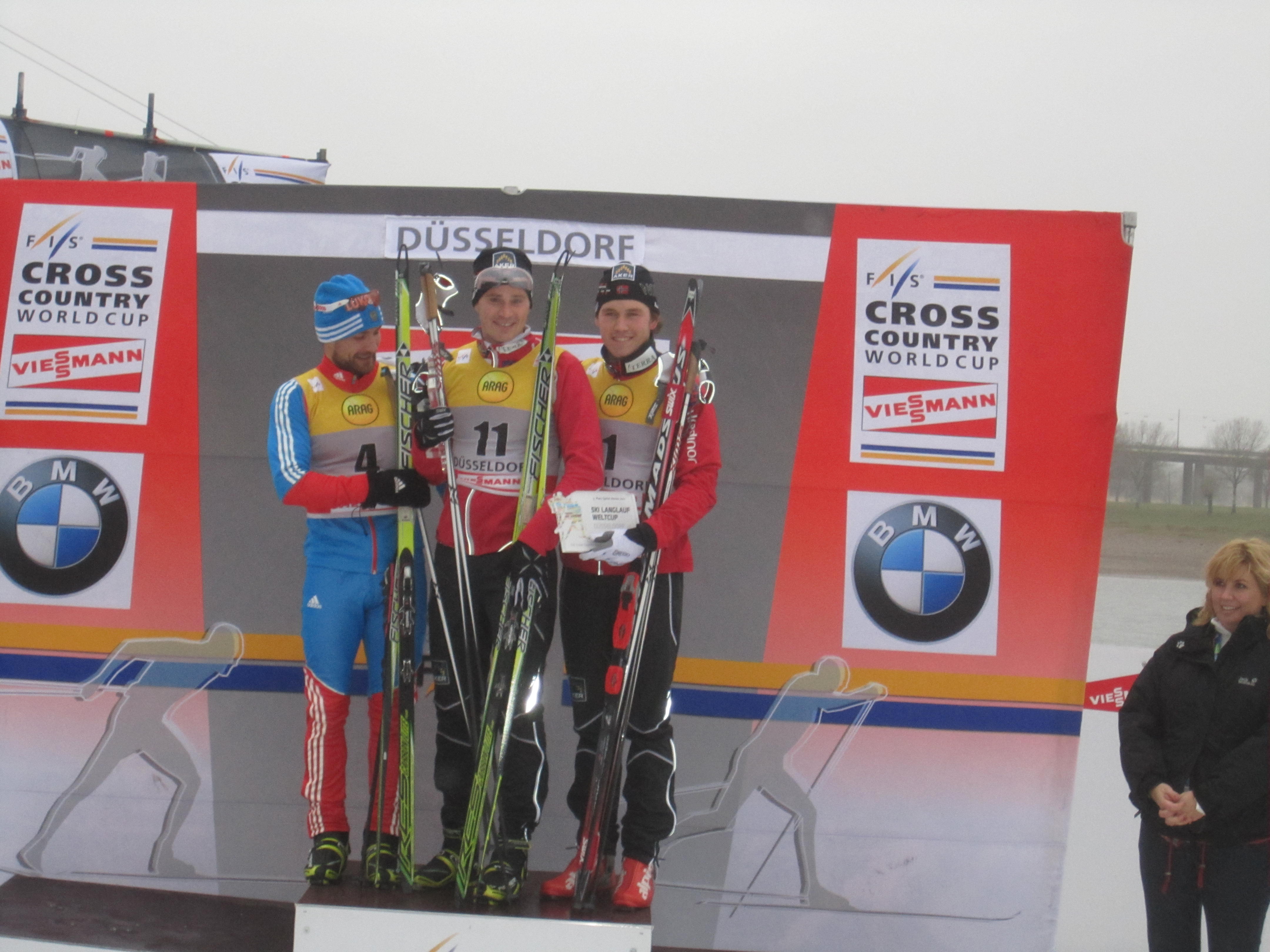
    Matveeva, Randall and Caspersen Falla on the podium. Photo: Fischer/Nordic Focus.
  • Northug Cruises to Victory In Davos; Manificat and Bauer Strong in 30 K

    Davos, Switzerland – Petter Northug served notice to the World Cup field Saturday in Davos, Switzerland that the Norwegian superstar has to be taken seriously – no matter where or what the World Cup race is.

    The odds were supposed to be against Northug Saturday. The 30 k freestyle distance individual start doesn’t suit his strong mass-start finishing style. The strong distance field taking to the start line was rounding into shape, especially home-town favorite Dario Cologna. Even the venue was supposedly against him, as Northug has never won in Davos – his best distance finish in the Swiss ski-crazy valley was 13th.

    But the exciting Norwegian showed why he is the World Cup Overall leader, taking the top step of the podium by a whopping 51.4 seconds over Frenchman Maurice Magnificat. Finishing third 59.5 seconds back was distance specialist Lukas Bauer (CZE) who picked up his first podium of the young season.

    As Northug was starting last, the 8,000 strong crowd of mostly Swiss and French fans had plenty of time to wait and cheer their skiers around the four 7.5 k loops.

    The best of the early-starters was Canadian Ivan Babikov, who rocketed out of the gate to hold the lead at a number of early time checks. Babikov was locked in a battle with fellow early-starter Matti Heikkinen (FIN). Also in the mix were Norwegian Petter Eliassen, who is best known for falling in the last kilometer of the 50 k at World Championships in Oslo last February, and Martin Johnsrud Sundby (NOR), an incredibly inconsistent distance specialist.

    With Babikov and Johnsrud Sundby setting fast times, it looked like the early starters might take the day – at least until the end of the Red Group hit the first time check.

    Maurice Magnificat (FRA), who has yet to record a medal on the World Cup this year seemed to break out of his early-season slump, taking the third-fastest time on the first two laps. Marcus Hellner (SWE) also appeared to be back in form, holding a strong second at 15 k before fading slightly on the last two laps to finish fourth, 1 minute 11.8 seconds behind Northug.

    At 30 k, Petter Eliassen established the fastest of the early marks on the day, taking a seat in the reindeer-hide chair. With close splits on the last few time checks, it looked like Babikov might be in position to pull the top spot out from under the Norwegian, but the Canadian fell short at the finish – as he came through the mixed zone, he was visibly upset.

    Eliassen withstood most of the red group challengers, as did Babikov, but as the top-ranked men started to come across the line, it was clear that a new leader would emerge. Johnsrud Sundby took the lead briefly, but relinquished it shortly thereafter to Bauer, who was supplanted quickly by Manificat.

    At that point, it was merely a formality – splits were showing Northug with an insurmountable lead, and he was still attacking. In the last five kilometers, the Norwegian was hop-skating hills like it was a sprint rather than a 30 k.

    By the time he crossed the finish line, Northug had built up 51.4 seconds of buffer – more than his female counterpart Marit Bjoergen put into the women’s field, and had banished all criticism of his all-around skiing ability.

    Of particular note was Northug’s domination of the downhill sections of the course, where he was extremely fast.

    “I had good skis and I gave my best to push in the downhills as I am not so strong than Maurice [Manificat] in the uphill,” said Northug after the race.

    As for the Czech distance specialist Bauer, he showed that he is rounding in to the shape that has seen him win the Tour de Ski twice in the past.

    “I was actually not sure if it is enough for the podium but at the end I made it,” he said.

    “I am happy with it. The longer races fit me well and I like Davos.”

    Bauer was also impressed with Northug’s skiing, especially in the distance individual start event.

    “Northug is not unbeatable,” said Bauer, “it’s just really, really hard.”

    In what is probably not a surprise, all three podium-placing athletes were happy with the return to 30 k individual start racing – but none were as brash about it as Northug.

    “I don’t like mass starts,” he joked in the post-race press conference. “I like to go alone.”

     Complete Results

  • Bjoergen Wins Again; Norwegian Women Dominate in Davos

    Bjoergen Wins Again; Norwegian Women Dominate in Davos

    Spectacular conditions in the stadium on Saturday morning in Davos, Switzerland.

    Davos, Switzerland – There is no doubt that the Norwegian women’s ski team is currently the best in the world.

    On Saturday morning, during the 15 k individual start freestyle in Davos, Switerland, they absolutely dominated the leader board, putting six women in the top ten, and taking the first four places.

    Surprising no one, Marit Bjoergen (NOR) crossed the line with the fastest time, leaving Vibeke Skofterud the silver medal, 41.8 seconds back. Therese Johaug finished 42.2 seconds back of Bjoergen for third, securing the podium for the Norwegian women.

    Young 22 year old Marthe Kristoffersen finished fourth, while Kristen Stoermer Steira was sixth.

    Only Justyna Kowalczyk (POL) was able to put a dent into the Norwegian armour, finishing fifth, a long 1 minute 26.4 seconds back of her Norwegian rival.

    Justyna Kowalczyk (POL) heads out on her first 5 k loop – she finished 5th on the day.

    But in the early stages of the race, it wasn’t the Norwegians who appeared dominant, but the Americans.

    Holly Brooks (USA) held the best time through the first time check for a significant portion of the race, with Kikkan Randall (USA) and Liz Stephen not far behind – at least until the Norwegians showed up.

    “Of course it’s always fun to hear that you’re in the lead but you have to put that in perspective,” said Brooks of her fast start in an interview with Fasterskier after the race.

    “I wasn’t super worried [about fading], because I felt like I was in control,” she said.

    In the end, at the 4 k mark Brooks has the 7th fastest time, and was looking comfortable, but behind her the inter-Norwegian battle was heating up. First Kristoffersen bettered the early lead times set by Charlotte Kalla (SWE) and Kowalczyk, followed by Johaug, and finally Bjoergen.

    Bjoergen then took the race over, putting big time gaps back to Johaug and Skofterud with ease, and pulling up before the line to celebrate on her way to her 49th career World Cup victory.

    “I had a very good feeling today,” said Bjoergen after the race.

    Marit Bjoergen (NOR) on her way to dominating the field in Davos Saturday.

    “I kept good technique at the beginning of the race and maintained speed in the flat section.”

    On the heavy climbing course, it appeared Johaug was going to be a solid lock for second, as she went through every time check in second, and looked strong. With a 5.6 second lead over Skofterud at 11.5 k, the race was still on, and after Johaug crossed the line, Skofterud hammered down the finishing straight almost exactly a minute later, stick out her toe to take the silver away from the ‘Energizer Bunny’.

    “The hills were really tough,” said Johaug in an interview with FasterSkier after the race.

    “It was a really good race for me today.”

    But Johaug didn’t hide her disappointment with letting second place slip away from her.

    “Of course, I was number three, I was just .4 of a second back of Skofterud, but I’m really happy with my race and I think I did the best I could today,” she said.

    Of the strong showing of Norwegian women today and this season, Johaug attributed it to having a good team atmosphere.

    “We are training a lot together,” she said. “We push each other a lot in the training.”

    Third place finisher Therese Johaug (NOR) in the mixed zone after the race in Davos.
  • Kershaw and Harvey Sit Out 30 K Freestyle; Focus on Tour de Ski

    Kershaw and Harvey Sit Out 30 K Freestyle; Focus on Tour de Ski

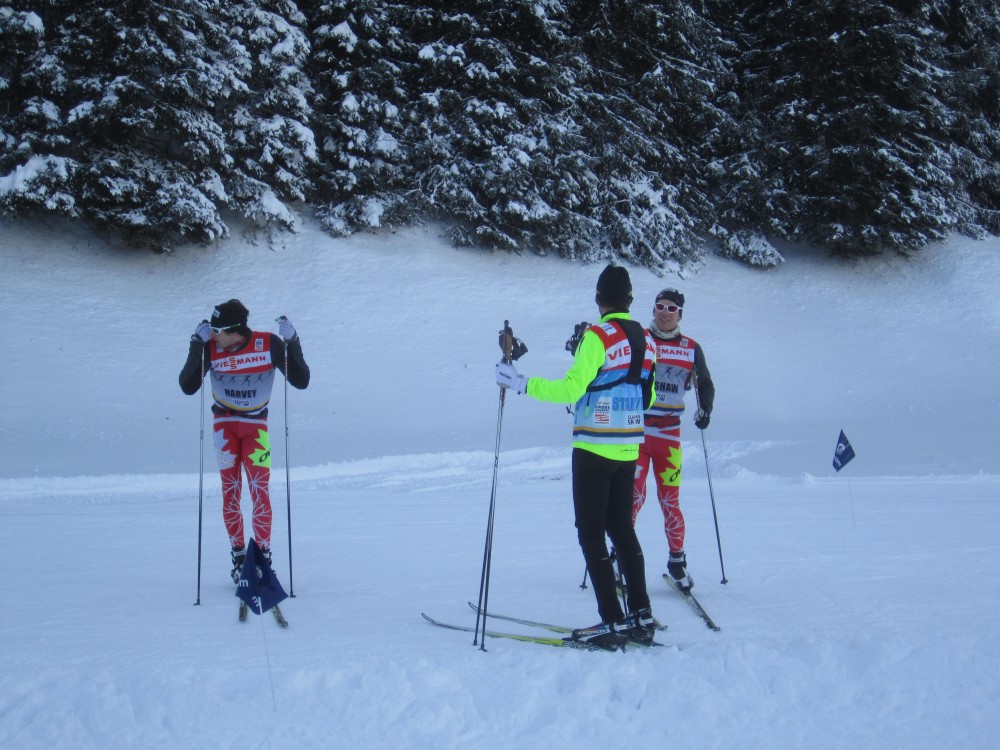
    Justin Wadsworth (center) talks to Alex Harvey and Devon Kershaw during training on Friday in Davos, Switzerland.

    Davos, Switzerland – If you’re a ski fan anywhere, you were probably disappointed to find out that stars Canadians Devon Kershaw and Alex Harvey were sitting out of the 30 k freestyle World Cup in Davos, Switzerland, this Saturday.

    Both Kershaw and Harvey are talented skaters, and seem to be in good shape – both have already recorded top 15 finishes on the World Cup already this season.

    Last year, they finished in the top 10 in the Overall World Cup standinds, and it has been no secret that in 2011-2012 they are gunning for more.

    So what gives? Why are just Ivan Babikov and Graham Nishikawa (last years’ NorAm leader) starting the first individual start 30 k on the circuit in over five years?

    FasterSkier put the question to Canadian National Ski Team (CNST) Head Coach Justin Wadsworth on Friday.

    “They both could have good races,” admitted Wadsworth.

    “But when we look at the whole picture – and this whole picture is through the Tour de Ski – the focus is still on the Tour de Ski and the Overall World Cup.”

    “If we look at those two things, we feel like they have better chances if we hold them back from the 30 k, and then go for the sprint hard on Sunday.”

    Wadsworth has his eye on Sunday, where he feels that all Harvey, Kershaw, and Len Valjas all have a chance to do well – he mentioned that both Harvey and Kershaw picked up World Cup medals in skate sprints last year.

    The style of the race figured into Wadsworth’s decision as well – the individual start 30 k is a rare beast on the current World Cup.

    “If it’s a 30 k mass start it’s a totally mind-set – it’s a totally different toll on your body” said Wadsowrth.

    “But being an individual start 30 k it’s one of the hardest races. It’s maybe even harder than 50 k individual start because the pace has to be so high the whole the time.”

    The Canadians strategy is to use this period as training, with the eye still on the Tour de Ski.

    “Here at altitude and looking for training next week also in preparation for the Tour de Ski, it’s just the decision we decided to make.”

    While fans may be disappointed, Wadsworth said the pair did want to race, but understood the strategy.

    “I think they both feel good now and they both feel fit,” he said.

    “It’s a little tough, but I mean it’s a long season, there is a lot of races and you can’t just throw yourself into every single situation and expect to get a good net outcome at the end of the year.”

    As well, Wadsworth is looking ahead to next weekend in Rogla, Slovenia, and the 15 k classic race.

    “If you rank how we think they [Kershaw and Harvey] can do in races it’s probably one of the highest ranked races,” he said.

    “We feel like they can win, that they can both be on the podium there.”

    With Harvey and Kershaw sitting on the sidelines, Ivan Babikov and Graham Nishikawa will both have a chance to carry the torch for the Canadians.

    “I’m pretty excited for both those guys,” Wadsworth said.

    Wadsworth described Babikov as being in a “totally different place than last year.”

    “I think he showed that in the 10 k in Kuusamo,” he said.

    “That early in the season to ski that fast, I think his prospects are really good here.”

  • Davos World Cup Preview – No Cheese Here

    Davos World Cup Preview – No Cheese Here


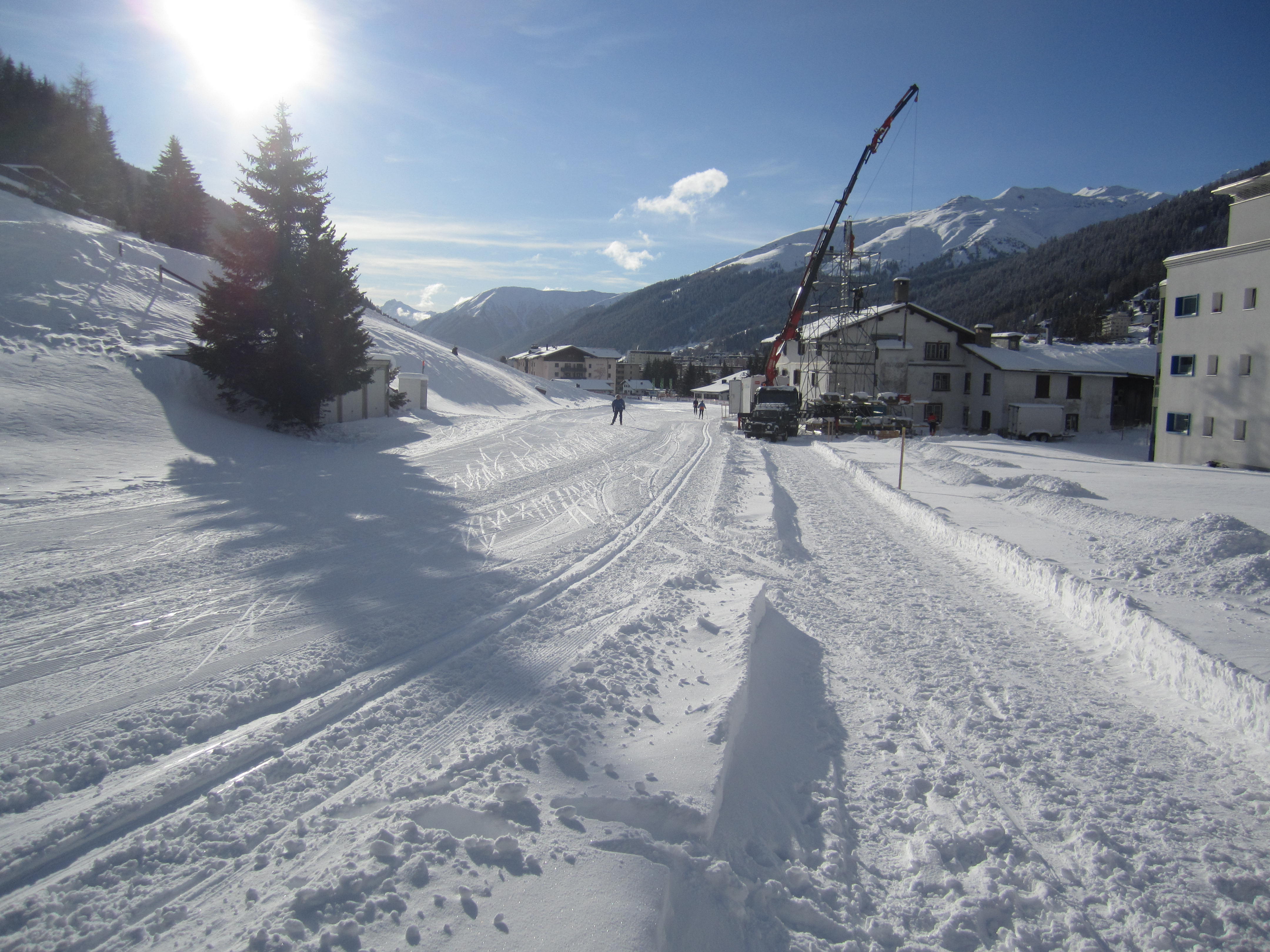
    The stadium in Davos.

    After a weekend of city sprinting in Germany, including gluhwein, spills, and DSQ’s, the FIS World Cup heads to Davos, Switzerland, this weekend for another pair of skate races.

    Saturday sees a rare beast on the World Cup — a long distance individual start skate race (15 for the women, and 30 k for the men) — while Sunday features what might be the most intense sprint of the World Cup season.

    While Dusseldorf lacked the full cup complement of skiers, missing most of the distance specialists, Davos, home of Dario Cologna and one of the most spectacular World Cup venues on the circuit, will see all of the regulars return to racing.

    There are plenty of story lines heading into the weekend, but FasterSkier fills you in on some of the most intriguing.

    Just up the trail from the stadium in Davos, Switzerland.

    Kikkan Randall vs. Marit Bjoergen

    If you’re the kind of person who likes winning streaks, try this one on for size: Kikkan Randall has now won three consecutive World Cup skate sprints.

    While the connection is somewhat tenuous – it counts Dusseldorf 2011, as well as Liberec, Czech Republic and Drammen, Norway, but skips over the World Championship sprint in Oslo – it obviously matters, because U.S. Ski Team (USST) Head Coach Chris Grover was eager to mention it in an interview last weekend in Dusseldorf.

    “When you think about it, she’s won the previous three skate sprints on the World Cup,” he said following her win last Saturday in Dusseldorf.

    “That’s a pretty impressive record.”

    Grover also mentioned that Randall fell at World Championships, cutting short her chances there. It was also the last time she faced Marit Bjoergen (NOR) in a skate sprint.

    In an interview with FasterSkier on Friday, Randall wasn’t shying away from facing the Norwegian star.

    “I’m excited!” said Randall of the prospect of facing Bjoergen in the sprint. “I was in the final with her here last year, and I’m looking forward to going up against her again.”

    Randall is also currently the Sprint Cup leader. While it’s still early in the season, Randall is enjoying the experience.

    “It’s a nice bonus for sure,” she said, of being the top-ranked sprinter on the World Cup. “I’ve been steadily working my way up to that point; it’s just fun to have an American in that position.”

    But speaking of streaks, Marit Bjoergen owns a considerable one herself. The Norwegian queen has already collected 5 consecutive wins this season (if you count all three days in the Kuusamo mini-tour. Which you should, except for the individual times on Sunday – Bjoergen started so far clear it would have taken a miracle for her pursuers to catch up).

    She won the skate sprint at World Championships in Oslo, and hasn’t faced off in a skate sprint against Randall since last winter in Drammen, where the American finished first, and Bjoergen was left off the podium in 5th.

    Bjoergen may have a slight advantage in skipping Dusseldorf to train, but if you managed to catch any of Randall’s exploits in Dusseldorf – specifically her last-lap heroics in the team sprint, where she blasted from ninth to second place and history in the space of 850 meters – you could hardly say the high-energy Alaskan looked fatigued.

    The Disappearance of Justyna Kowalczyk

    In the first two weekends of the World Cup season, Kowalczyk (POL) has appeared just ordinary. She has yet to win a medal, and has been dominated not just by Bjoergen, but by most of the Norwegian women.

    While the short laps and relatively small and punchy climbs in Sjusjoen, Norway, didn’t exactly suit the Polish superstar’s strength, a week later in Kuusamo, Finland, it was a different story.

    Both individual skate and pursuit classic days featured tough courses with major climbs, difficult races in which Kowalczyk has traditionally excelled, even dominated. Her demise was especially worrying in the 10 k classic – while her ninth place finish isn’t catastrophic, in the last year she had no fewer than seven medals in World Cup classic races over 10 k.

    In Davos, she will be handed yet another prime opportunity to turn her season around. The individual start distance skate will be filled with big climbs, giving Kowalczyk an opportunity to use her motor, rather than her woeful descending and tactical abilities.

    And speaking of her lack of tactical abilities, last year in Davos in the skate sprint made some dubious decisions leading to her being bumped to the back of the final. In the last hundred meters, Kowalczyk made the mistake of cutting off none other than Kikkan Randall.

    Ski testing and athlete access to the course.

    The Rise of Vibeke Skofterud and Inter-Female Norwegian Competition

    Vibeke Skofterud has been the surprise Norwegian this season. Everyone knew Bjoergen was hot, and Therese Johaug had a coming out party of sorts in Oslo, but Skofterud has never really been given top billing – she’s best known for anchoring a relay team that seems to be skiing so fast that they could probably survive with just about anyone skiing the final leg.

    While Skofterud’s fast starts have been debated extensively in the blogosphere, FasterSkier staff are interested to see how she does in her third World Cup weekend, particularly due to the race formats.

    Skofterud seems to have the package to get it done this season, whether the race be sprint, distance, mass start or individual – but so does Johaug. She and Johaug seem to be locked in competition for second-best Norwegian female. Skofterud is the better skate sprinter, while Johaug is the hill-climbing ‘Energizer Bunny’ – the weekend should be a good match-up between the two.

    Surprise Swiss Sprinters

    The Swiss sprint team pulled off plenty of impressive performances in Dusseldorf. Most notably was Laurien Van Der Graaf, who managed to finish 3rd in her first trip to the semi-final and final.

    For the men, without Dario Cologna in attendance, three managed to slip in to the top 12, including second place qualifier Eligius Tamborino – a tall, thin man with a serious expression. Martin Jaeger and Joeri Kindschi also picked up top 15 places – just Kindschi cracked the heats in Davos last year, so you can bet the home-country boys will be skiing as hard as they can.

    It has to be said that people who perform well in Dusseldorf are not guaranteed to perform well in other venues (see Wenzl, Josef).

    However, at just 24 years of age, Van Der Graaf has yet to even enter her prime. Sunday will be a good test of whether she has broken through, or whether her performance in Dusseldorf was a fluke.

    At the very least, the Swiss are coming off a confidence-booster of a weekend in Dusseldorf. In Davos they have home course advantage, and they also have legendary Norwegian sprinter Tor Arne Hetland for a sprint coach. While the crowds may show up mainly to support home-town hero Cologna, if they are given someone else to cheer for, they won’t hesitate to do so.

    North Americans in the Sprint Arena

    Speaking of sprinters, Davos has been kind to the North American contingent in the past.

    Last season, Canadians Phil Widmer and Len Valjas both finished in the top 20, securing spots for Oslo, while Simi Hamilton also skied well enough for 16th place, his best finish on the World Cup last season.

    And there are a few North Americans who need to borrow a little bit of Davos magic.

    Hamilton (black, far right) makes a move in Davos, 2010.

    Hamilton desperately needs to find some of that form he displayed last season in the Swiss ski mecca. He has had a miserable start to his European campaign thus far, suffering from illness and failing to start an individual race yet.

    Skyler Davis would also like a bounce-back weekend — the young American finished last in his first World Cup start last weekend in Dusseldorf, and didn’t have a much better experience in the Team Sprint. But American fans shouldn’t panic, as in Len Valjas’ first World Cup race, he also finished atop the reverse podium.

    While Davis was disappointed with his last place finish, he put it into perspective.

    “Obviously it sucks to get last,” he said. “But I was 17 seconds out on my first World Cup.”

    As for the women, Chandra Crawford took advantage of Dusseldorf to break out of her slump of sorts, finishing fourth in her first final since 2008.

    Crawford would like to keep the ball rolling — she has started the 2011-2012 season far better than in the past, and another trip to the final would keep her in good standing.

    Perianne Jones would like to find her way through to the heats as well. After making the Canadian World Cup team on the back of a 6th place finish in the Team Sprint at World Championships last February, the 26 year old is coming off one of the best training seasons of her career.

    Her 32nd place in Dusseldorf (by a mere .2 of a second) was tough to swallow, and when paired with Crawford the two Canadians finished 7th on Sunday, just missing out on the money.

    Another Canadian sprinter to watch is Dasha Gaiazova – she came out hot in Kuusamo, but struggled in Dusseldorf. Gaiazova was the strongest female Canadian skier on the World Cup last season, and she has traditionally been a better skater sprinter.

    After a start-wand snafu in Dusseldorf, Ida Sargent will look for more in Davos.

    Sadie Bjornsen (USA).

    Fellow young American Sadie Bjornsen is fresh off a 36th place finish in Dusseldorf. More importantly, Bjornsen found herself paired up with Kikkan Randall on Sunday, which the rookie American admitted was a major bonus.

    In an interview Friday, Bjornsen said that she liked the sprint course, and was excited about Sunday.

    “I think it’ll be good, there is a good amount of hills, and a good amount of transitions, and everything in there, so it should be fun,” she said.

    While the story of Sunday was Randall’s final-lap hustle, Bjornsen should be given proper credit – she was far from dead weight. In her first ever World Cup team sprint, Bjornsen stayed tight with the pack, and made sure she tagged off to her fast-finishing teammate in good enough position to give Randall a chance. Bjornsen picked up the first World Cup medal of her career, and a truck load of confidence heading to Davos.

    “For the sprint it [the World Cup medal last weekend] has given me a little confidence, which is good — we’ll see what happens,” said Bjornsen.

    This is also Bjornsen’s last World Cup weekend before heading back to the U.S., and she wants to make sure she goes out in style.

    “Hopefully I’m going to make some heats!” she said of Sunday.

    Will the North American (Distance) Men Please Stand Up?

    With the exception of Alex Harvey and Len Valjas’ seemingly endless supply of tricks up his sleeve (hey, the guy has big sleeves), there has not been a lot to cheer about if you’re a fan of North American distance skiing.

    Fine, so there have really only been three distance races thus far on the circuit. But between Canadians Ivan Babikov, Devon Kershaw, Graham Nishikawa, and Americans Kris Freeman, Noah Hoffman, Tad Elliot, and Lars Flora, all primarily distance-focused skiers, there have been a whopping three top-30 finishes.

    Nishikawa in Bruksvallarna this November. Photo: Erik Wickström

    Call us greedy here at FasterSkier, mainly because the American distance women seem to have hit their stride, but we think the NorAm male contingent also has the speed to get the job done. Unfortunately, this weekend doesn’t seem to be the best chance – Freeman and Kershaw are both better classic skiers, while Hoffmann and Elliot are all still quite new to the circuit, and are coming into Davos for the first time.

    Canadian continental cup holder Graham Nishikawa is no stranger to Europe, but has yet to hit a race out of the park.

    The Canadian contingent will be a little light on Saturday – both Alex Harvey and Devon Kershaw are sitting out on the recommendation of the Canadian coaches, who are focused on the Tour de Ski.

    Dario Cologna, Petter Northug, and… Ivan Babikov?

    Swiss superstar Dario Cologna, with his own large fan club, will be present. You can bet the crowd will be out, and on his side. Cologna is incredibly well-rounded, as when he is at the top of his game he can win anything from a 50 k classic to a skate sprint, as he has proved with two Tour de Ski wins.

    Cologna with his 2011 Tour de Ski trophy. Photo: Fiemme2013.

    Dressed head to toe in black, and leading what has become a strong team, the Swiss monster has yet to emerge victorious this season – can he give his fans something to cheer about?

    But it won’t be an easy road – primarily due to Norwegian ace Petter Northug.

    Unlike last year when he limped out of the gate due to over-training, Northug has come out swinging to start of the 2011-2012 season. He called his doubters on the carpet by finishing 2nd and 1st in the two individual start races, putting a serious dent in the ‘he can only win mass-start finishes’ whining. Then during the 15 k classic pursuit in Kuusamo, after a game of cat and mouse with a seemingly disinterested Cologna, he uncorked his traditional finishing speed to gain an early lead in the World Cup Overall standings – a title which eluded him last season.

    Last season in Davos, Northug was very human, failing to get out of his quarter in the sprint, and falling to 28th. He also struggled in the 15 k classic race, finishing 13th. FasterSkier does not recommend betting on that happening again – Northug seems poised to dominate the World Cup circuit this season.

    Ivan Babikov may seem like a surprise add-on to the favorites list, but this weekend has some serious upside for the hill-climbing Canadian.

    He obviously won’t be in contention for the medals (or, let’s be honest, qualification) in the skate sprint – not that much has changed – but the distance race Saturday is something he has been looking forward to all year.

    On Friday, Babikov said that he was excited to race Saturday.

    “Its been a long time since we’ve done a 30 k – individual start especially,” he said. “In Davos it’s at altitude, and a pretty hard course, so I’m looking forward to it.”

    Babikov has always done well on climber-friendly courses, and he described the hills on Saturday’s 7.5 k as “not really steep climbs, but long.”

    “Pretty much half of the course is all up and the second half is all downhill, which you still have to work hard,” he said. “It’s going to be a really hard race.”

    He has also somewhat bucked his recent trend of slow starts – his 16th place finish during the 10 k freestyle during the Kuusamo mini-tour is a positive indication that he has the fitness and the speed earlier than usual.

  • Swedes Storm to Victory in Dusseldorf City Sprint

    Swedes Storm to Victory in Dusseldorf City Sprint

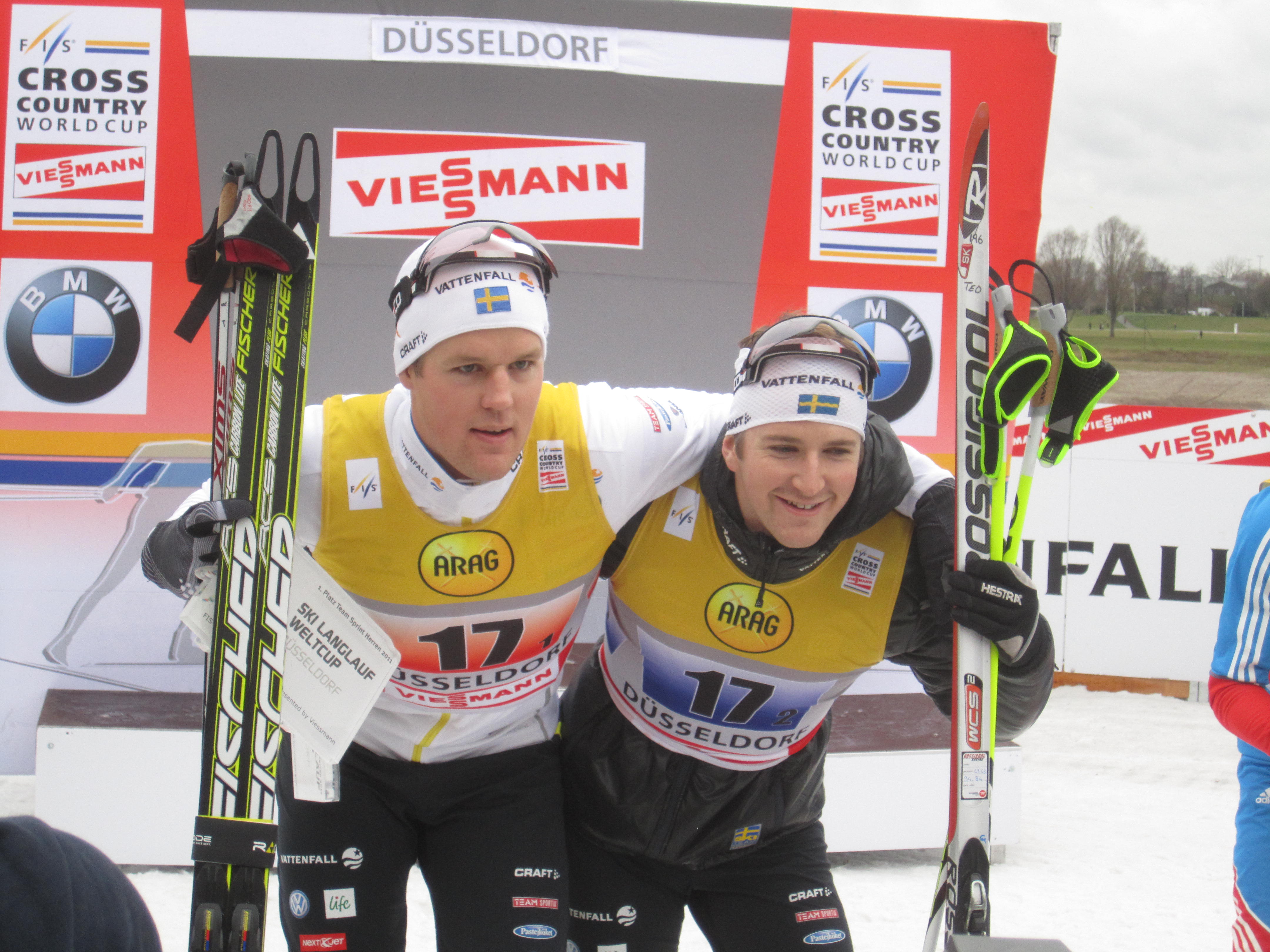
    Jesper Modin (L) and Teodor Peterson (R) celebrate their Team Sprint victory. Dusseldorf World Cup, December 2011.

    Elbows, crashes, spills and thrills – that’s an average World Cup freestyle Team Sprint event in Dusseldorf, Germany, and the action on Sunday was no different.

    Sweden’s top pairing of Jesper Modin and Teodor Peterson emerged from close-quarters racing to take the top step of the podium, narrowly edging out Russia I, Nikita Kruikov and Alexey Petukhov. After taking gold and bronze in the sprint Saturday, Ola Vigen Hattestad and Paal Golberg of Norway I had to settle for the bronze medal on Sunday.

    From the gun of the first men’s semi-final, it was clear that there were too many teams and not enough snow to go around. Federico Pellegrino of Italy I broke his pole almost instantly in the chaos, as 14 teams fought for space on the narrow course.

    With the teams in front skiing controlled and at a slow pace, Mt. Dusseldorf became a bottle-neck, as the men jostled for position up the only hill. At the third exchange, Johann Kjoelstad of Norway II broke a pole in a collision with the Swiss, dropping one of the favorites to the back of the field.

    Modin picks up Peterson

    As the laps ticked by, first the Russians, then Finland II increased the pace, finally forcing the field apart. On the second last lap, all the buzz was about Canada’s Drew Goldsack, who attacked hard over the top of Mt. Dusseldorf, jumping into third behind the Swedes. Goldsack then made a decisive move around the tight final corner to pull the Canadians into second behind the Kruikov of Russia I.

    With the announcer getting agitated over the state of the two German teams (“Wo ist Wenzl, Wo ist Heun?”) as the group headed out on the final lap, Wenzl found something for the home-town Germans to cheer about, moving up the field past Canadian Len Valjas into second.

    But Swiss skier Eligius Tamborino attacked hard, opening a gap back to Wenzl as well as the Russian Petukhov.

    With the Swiss free and clear of the traffic, Wenzl came hard into the finish, Petukhov tight on his heels. The German skier was making lots of movement, not choosing a lane until the last moment, and made contact with the Russian, who fell. Wenzl crossed the line second, while the fading Valjas made some quick movements to avoid the fallen Petukhov, and barely held off Erik Brandsdal of Norway II in a photo finish to bring the Canadians to third.

    The second semi-final featured what many considered to be the top two pairs of the day, as Norway I (Golberg/Hattestad) and Sweden I (Modin/Peterson) faced off.

    Both Modin and Golberg led out very slowly, and all 14 teams were tightly packed.

    While there were plenty of elbows thrown, poles stepped on, and skis clipped, there was no major action until just before the third exchange, when Hattestad tripped over his Scandinavian rival Peterson’s pole in the exchange zone, falling before he tagged Golberg. It appeared that the top top Norwegian team was going to be in trouble, but with the pace still slow, Golberg had no problem making contact with the pack.

    By the final lap, the pace had finally jumped, with the two Swedish teams up front skiing strong but controlling the race, until Finland I (Matthias Strandvall and Martti Jylhae) broke through, followed closely by Germany II (Tim Tscharnke and Sebastien Eisenlauer). Coming around the final corner, Austria I (Harald Wurm/Bernhard Tritscher) jumped into the mix as well.

    Peterson managed to secure the win for Sweden I, while Jyhlae edged out Tritcher for second place. Hattestad managed to finish fourth, 0.8 seconds back of the Swedes.

    However, the most exciting part of the heat came when Kazahk Denis Volotka tripped up on the run down to the finish and caused a pile-up, claiming no less than four victims, including the French, Russia II, and the Czechs.

    Just minutes before the start of the final, the jury announced that Germany I had been disqualified due to Wenzl’s contact with Petukhov, and the Russia I was granted a spot in the final. With the Germans disqualified, the Canadians moved up to an automatic qualifying position, and Norway II, Finland II, and Sweden II all received places in the final.

    The Russians having taken the German’s place, and the memories of the recent pile-up as well as the aggressive skiing displayed last year in the final, the men appeared quite cautious as they headed out on their first lap of the final.

    The pace could definitely be called slow and careful, as teams tried to find any extra little bit of space. The slow speed of the race resulted in lots of elbow-bumping, but nothing more major for the first four laps, until Sweden I (Modin) jumped to the front on his final loop around the course, snapping the pack out of its level-one pace.

    Bronze medal-winner Paal Golberg (NOR) in the finish area.

    Norway I (Golberg) was the only one who was able to shadow Modin, and the two charged up Mt. Dusseldorf together, the Norwegian taking control over the top. The two built a sizeable lead, splitting the pack apart with their pace into the exchange.

    Almost immediately, it became clear that their respective anchors, Hattestad and Peterson were not going to try and ski away on the fast two-lap course, and the pack closed up right away.

    Petukhov was the first to attack, coming from the very back of the group all the way to the front, pulling Canadian Valjas with him. The bearded Russian then paused briefly before pressing the attack again, leaving the Swedes and Norwegians struggling to respond. Only Peterson was able to hang on as they headed for the finish line.

    With Petukhov running out of steam, Petersen managed to pass him and hit the line first to grab the gold for the Swedes. Despite his massive effort, Petukhov settled for silver, 0.2 behind, while Hattestad couldn’t find the same closing speed that brought him to victory the previous day, ending up third 0.7 back.

    Finland I finished 4th, 0.9 seconds behind, while Canada held off Austria I for 5th place, +4.0 and +4.4 seconds back of the Swedes respectively.

    It may seem surprising because the big Swede has had so many sprint final appearances, but the victory on Sunday was the first of Jesper Modin’s career.

    “It was a great race,” Modin said in a post-race interview.

    “Team sprint is always a bit challenging with so many racers but it was fun here with all the spectators that cheered for us.”

    For Norwegian Paal Golberg, the bronze medal was his second in two days, but he seemed disappointed when FasterSkier caught up with him following the race.

    “I just tried to give everything on that last lap, and it turned out okay,” he said.

    Golberg also mentioned that the slow pace during the final was deliberate, as he was saving himself for the last lap.

    “I just didn’t use as much power on the first couple of laps,” he said.

    “But the legs were still stiff on the last lap.”

    Dusseldorf is well-known for rough and tumble racing, and Golberg said that the heavy traffic played a factor in the race.

    “It was difficult to position myself in the field with so many people,” said Golberg.

    His sentiments were echoed by quite a few people, including German Tim Tscharnke, who failed to advance from his semi-final.

    “There was a little bit too much traffic for the loop,” said Tscharnke, who was part of the German pairing who won a silver medal at the 2010 Winter Olympics Games in Vancouver.

    “In Dusseldorf, it is more about show than cross-country skiing.”

    Men’s Results.

  • Norway Takes Team Sprint Victory in Dusseldorf; Americans Pull Off Surprise Second

    Norway Takes Team Sprint Victory in Dusseldorf; Americans Pull Off Surprise Second

    For the second straight day of sprint racing in Dusseldorf, Germany, the American women brought the fireworks.

    During the second day of World Cup racing in Dusseldorf, the Norway I team of Mari Eide and Maiken Caspersen Falla took the win. In a surprise move, United States I featuring Sadie Bjornsen and Kikkan Randall crossed the line second, 1.6 seconds back of the Norwegians. The bronze medal went to Natalia Korosteleva and Natalia Matveeva of Russia I, who were 2.1 seconds behind Norway I.

    While the Norwegians may have won the gold with an impressive final lap by Caspersen Falla, the story of the day was without a doubt the skiing of Kikkan Randall, paired with World Cup rookie Sadie Bjornsen, who picked up the first-ever Team Sprint medal for the U.S.

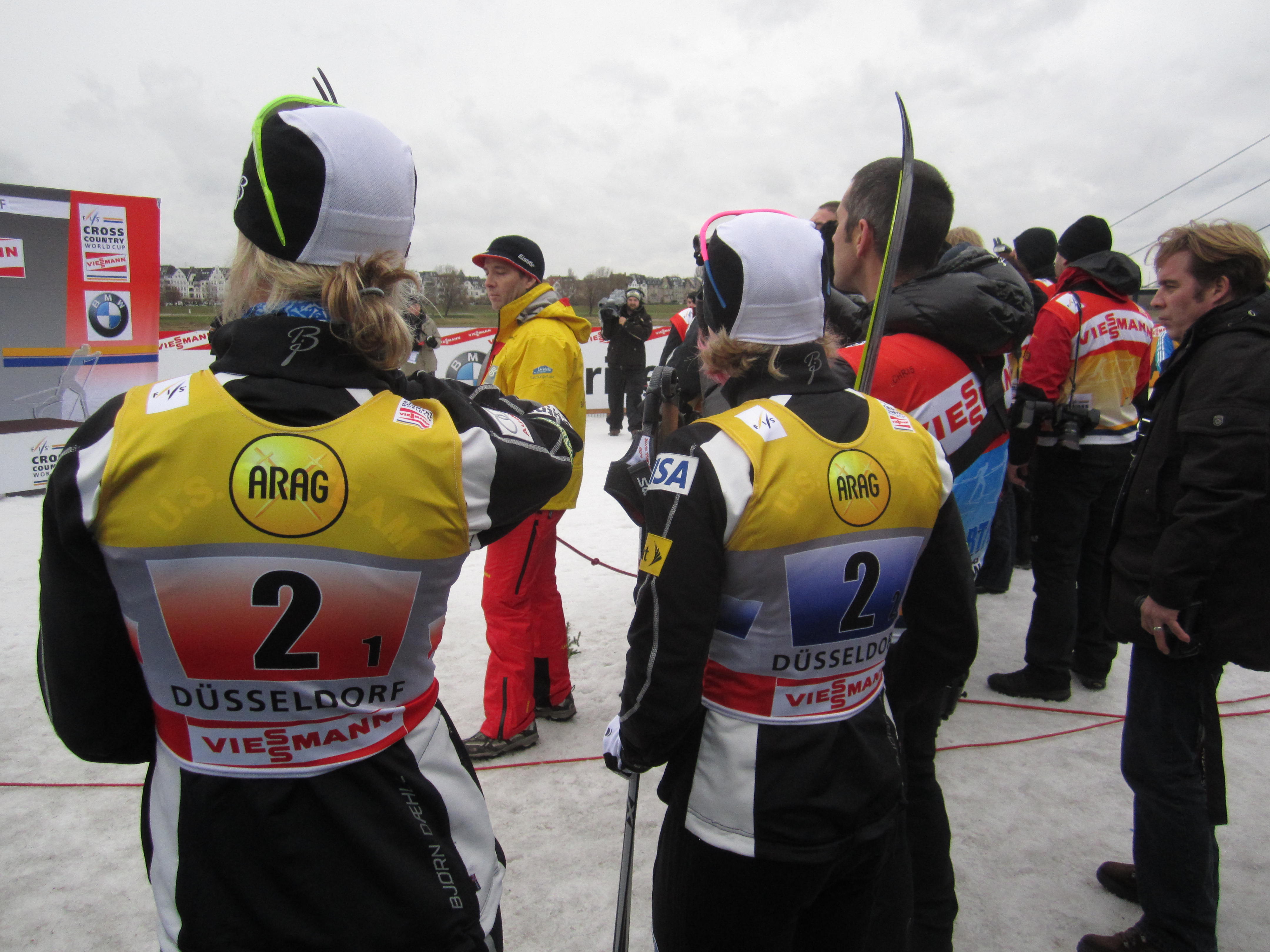
    Sadie Bjornsen (L) and Kikkan Randall (R) await the first-ever U.S. Team Sprint podium appearence

    From the early going, the American pair, while talented, was going to have to have a good day to make the final.

    They were packed into the first semi-final with ten other teams, including the favored Slovenia I with Vesna Fabjan and Katja Visnar, Finland I, Switzerland I, as well as Sweden II and Norway II.

    They action in the semi was fast and furious, with the Norwegians and Slovenians both launching attacks at various points. The Americans spent most of the first few laps bouncing around in the mid-pack, never falling out of contact.

    Randall (L) and Bjornsen (R) on the podium

    Bjornsen picked up the tag in fifth position on her last lap, and dropped a few spots back, but managed to tag off to Randall in a close eighth. Coming out of the exchange zone, Visnar (SLO) and Laure Barthelemy (FRA) made contact, and the Frenchwoman hit the snow hard, dropping her from contention.

    Hard on their hills, Randall avoided the pile-up, and skied smoothly down the back straight, gliding up into second. On the final corner, she was challenged by Finn Riika Sarasoja-Lilja, but the American held her off, and churned out a strong finish to earn an automatic qualifying berth in the final behind Hanna Falk of Sweden II, thereby avoiding the agonizing lucky-loser wait.

    In the second semi-final, Sweden I with Mia Eriksson and Hanna Brodin broke away from a contact-filled pack on the second last lap, skiing to a 1.4 second victory over Norway I. Canada I managed to secure third spot after Perianne Jones survived a dicey exchange with athletes falling all over the snow, including Germany I and Russia I. Chandra Crawford then skied anchor, and brought the Canucks home 2.4 seconds behind the Swedes in third place, which was good enough for a lucky loser position in the final.

    An hour later, the ladies were lined up on the start grid again, awaiting the start of the final.

    Just 200 meters in, narrow Dusseldorf claimed another victim, as Mia Eriksson (Sweden I) found herself lying on the snow, and it looked like the race was going to be about staying on your feet.

    Bjornsen, who was next to Eriksson, was able to avoid the sprawling Swede, but was forced to slow and change direction slightly. She quickly dropped from the second row off the back of the pack.

    Just one of the many hairy exchanges of the day. (Photo: Brad Jones)

    The pace was high, with the Swedes and Norwegians both making early bids to spread the field out. On the second lap, the women were stretched out into single-file, with slight gaps appearing in spots. Randall made up some ground for the US, and Bjornsen continued to creep back toward the pack on her second loop.

    However, on the third and fourth lap, the paced slacked off a little. While Sweden I and Norway I held strong at the front, the third spot was a revolving door of nations, including the Swiss, the Russians, and the Canadians. The slight down-turn in pace allowed Randall to regain contact with the top group as she made the hand-off, and Bjornsen settled in at the back of the main back as she headed out on her final lap.

    The young sprinter managed to hold position, but tagged off to Randall down in sixth place – they were not on the radar, as the battle raged up front between the Finns, Norwegians and Russians.

    The group bunched up a little climbing Mount Dusseldorf, and Randall made contact before blasting down the left, making several passes. Caspersen Falla broke contact with the tailing skiers, but Randall fought her way through the remaining traffic, including Canadian Chandra Crawford to lay down yet another incredibly strong finish to pick up the silver medal, leaving Russia I with third.

    With the silver, Randall secured her second medal in two days, and continued her blockbuster season that has yet to see her finish out of the top 20.

    “It’s just amazing,” said Randall after the race.

    “With this course so fast, you had to race every lap like it was the last shot.”

    Randall said she focused on skiing smooth, and didn’t worry too much about what place the team was in – she knew she wanted to set herself up for the final lap.

    “People were looking stiff on the last lap, and I was still feeling strong,” Kikkan said of her impressive final lap.

    After passing several people with what she described as “awesome” skis on the back portion of the course, she came hard around the outside of the last turn and headed for the line.

    “I was happy to have a lot left again on the final straight,” she said of her finishing kick.

    For Bjornsen, it was her first World Cup team sprint, and her first World Cup medal – the 21 year old was still in shock when FasterSkier talked to her.

    “It’s the greatest thing to happen so far!” she said. “It hasn’t even sunk in yet!”

    Bjornsen also appreciated the talent of Randall, who managed to secure the medal for the team.

    “It helps to have a sprint champion like Kikkan [Randall] on your team, that’s for sure,” said Bjornsen.

    While the Team Sprint is notoriously messy in Dusseldorf, both Americans felt the final was much cleaner than the previous heats had been, with skiers being “more calm.” However, Randall did note that the exchange zone was “always a mess.”

    In her first team sprint experience, Bjornsen said she barely had time to think about what was happening.

    “I was just going with it – it was so quick, and there was so much contact, you just had to react,” she said.

    Looking ahead, the Americans hope to carry the momentum from the weekend into the next World Cup races in Davos, Switzerland, on December 10th and 11th.

    Women’s Team Sprint Results

  • Hattestad Takes Dusseldorf Sprint, Petukhov, Golberg Lunge for Silver

    Hattestad Takes Dusseldorf Sprint, Petukhov, Golberg Lunge for Silver


    (L-R) Alexey Petukhov, Ola Vigen Hattestad, and Paal Golberg stand on the podium


    Despite cold rain pelting down on the city, Dusseldorf, Germany, was hopping Saturday afternoon.

    And rightly so, as even without Swedish sprint star Emil Joensson taking part, the best of the World Cup sprinters were on hand to tackle the rocket-fast course.

    The venue consisted of roughly 1900 meters of snow with an icy glaze on top. While the women did just one lap, the men were primed to race two loops of the narrow band of snow along the Rhine River, and the close quarters combined with a lack of hills to separate the men from the boys virtually guaranteed contact.

    However, Norwegian Ola Vigen Hattestad rose above the elbows and broken ski poles to grab the top step of the podium in a final.

    Alexei Petukhov (RUS) crossed the line second, while Hattestad’s team mate and surprise top qualifier on the day, Paal Golberg picked up the bronze medal.

    Anssi Pentsinen (FIN), Teodor Petersen (SWE) winner of the classic sprint last weekend in Kuusamo, and Federico Pellegrino (ITA) rounded out the extremely competitive final.

    After Petersen broke his pole shortly after the start, dropping him to the back, most of the first lap was spend jockeying for position, and Pellegrino figured prominently.

    However,entering the second lap, Petukhov headed to the front of the group, hitting the pace hard. By the time the Russian topped Mt. Dusseldorf, he had built a small lead. However, even small leads were proving difficult to close on such a fast day, and Petukohov looked in control.

    But as he rounded the final bend and headed for the finish line, both Hattestad and Golberg appeared to find an extra gear. The two Norwegians closed the gap around the corner, and it turned into a three-way drag for the finish line.

    Hattestad passed the Russian clearly by the line for the win, but Petukhov narrowly managed to withstand a strong late lunge by Golberg. The 21 year old Norwegian picked up the second bronze medal of his World Cup career Saturday, it coming in just his 10th start at the highest level.

    But for the sprint specialist Hattestad, who fell in Kuusamo ruining his chances, the victory was sweet.

    “It was just fantastic,” he said in an interview with FasterSkier.

    “My skis were really amazing, and I really enjoyed the ski today.”

    Of the lead that Petukhov built on the final lap, Hattestad described it as a strategy to avoid the rough and tumble nature of sprint racing.

    “I gave him one meter because I was scared he would cut that last curve,” the Norwegian said.

    “I felt strong the whole way, so it was just my tactic give him one meter.”

    For Hattestad, the goal all day was to stay out of traffic in order to give himself the best chance at moving on.

    “This year I was trying to be in front as much as possible, and so there are less things that could happen,” he explained.

    While the Norwegians pulled off two medals, it is the Swiss men who were turning heads on the course. After Eligius Tamborino qualified second, he cruised to victory in his quarter final. He was joined by team mates Joeri Kindschi and Martin Jaeger also advanced through to the semi finals.

    All three ended up in the second semi-final, and it seemed like a good bet one would make it through to the final. However, Jaeger broke his poll right out of the start gate, Kindschi couldn’t pace, and Tamborino never hit the stride that earned him his second qualification spot.

    Just two North Americans qualified on the day – Andy Newell in 14th, followed closely by Devon Kershaw in 15th. Both were eliminated in the quarter-finals.

    Newell tangled with a Norwegian, and broke his pole before finding himself on the wrong end of a lunge, finishing third. Kershaw also lost out in a tight three-way battle for one spot, finishing fourth in his heat.

    You can read more about Newell’s and Kershaw’s races, as well as the rest of the North American men here.

    Men’s Results

  • Kikkan Randall “On Fire” in Dusseldorf City Sprint

    Kikkan Randall “On Fire” in Dusseldorf City Sprint

    Kikkan Randall (USA) on top of the podium with Natalia Matveeva (RUS) 2nd (l) and Laurien Van der Graaf (SUI) 3rd (r) (Photo: Fishcer/NordicFocus)

    DUSSELDORF, Germany — Kikkan Randall is a World Cup Overall threat.

    At least, that was the way it felt in the city of Dusseldorf Saturday afternoon, when Randall hammered around the 900-meter manmade loop on her way to her first World Cup victory of the season.

    In the freestyle sprint, Randall out-gunned Natalia Matveeva (RUS) in the rush for the line, while Laurien Van Der Graaf (SUI)  picked up the bronze medal in her first-ever sprint final experience.

    Van Der Graaf beat out Canadian Chandra Crawford, while top-qualifier Riika Sarasoja-Lilja (SWE) and Hanna Brodin (SWE) got tangled up in the first corner and went down, and both finished off the back.

    A U.S. Ski Team (USST) veteran, Randall opened the season with a rash of strong distance results, including a 6th place finish in the Kuusamo mini-tour.

    And the first two World Cup weekends lacked the one race that Randall has become dominant in – the freestyle sprint.

    But Saturday in Dusseldorf, the American sprint-star turned World Cup overall contender took to the start line of the first freestyle sprint of the World Cup season, in a location that has long been one of her best.

    Randall was the favorite from the start – with World Cup leader Marit Bjoergen sitting out, the American was the top seed in qualification, and laid down the 10th fastest time around the short 900 meter course.

    From the very first round, it was clear that Randall was going to be a threat. She powered through her first heat, and despite a photo finish with Hanna Brodin, her advancement was never really in doubt.

    Randall holding down second in the quarterfinals behind Hanna Brodin (SWE). Brodin and Randall would match up in every heat of the day. (Photo: Fischer/NordicFocus)

    In her semifinal, Randall was matched up against Sarasoja-Lilja, and joined by Crawford, who also advanced past her quarterfinal convincingly, after a 17th place qualification.

    Randall and Crawford slotted themselves in second and third respectively around the first corner, and the jostling for position on the narrow course began in earnest.

    Randall attacked on Mt. Dusseldorf, the only hill on the course, and led over the top, while Crawford held third place.

    Coming down the finishing straight, Randall was able to hold her lead, and advanced easily to the final. Crawford was unable to squeak past Hanna Brodin (SWE) for an automatic spot in the final, finishing third, waiting on the hot sit to find out if she was fast enough to be the lucky loser.

    The second semifinal also included some top names, as home-town favorite Hanna Kolb (GER) was up against Matveeva, who qualified second, and third-place qualifier Mona-Lisa Malvalheto (FIN).

    To the disappointment of the crowd, Kolb took herself out of contention early on, falling out of the start gate.  In her first-ever semifinal, Van Der Graaf surprised everyone by taking control and opened up a small gap to win the heat and advance.

    In the moments leading up the women’s final, there was some apprehension among the North American fans in the crowd.

    Randall, Sarasoja-Lilja, Van Der Graaf and Brodin were all either lining up or preparing to do so, when the camera’s showed Crawford, who managed to advance as a lucky loser, kicking off her running shoes and stepping into her boots, held out for her by a Canadian wax tech.

    After Crawford did get to the line, the first freestyle sprint final of the World Cup season got underway, and with all six women close in ability, it was immediately crowded on the narrow course.

    Hanna Brodin (SWE) leads Randall and Crawford in the semifinals (Photo: Fischer/NordicFocus)

    Around the first corner, a fairly tight uphill left-hander, Sarasoja and Brodin, both at the back of the pack, got tangled up. Sarasoja came off the worst of the pair, going down hard and falling out of contention.

    Despite plenty of close calls, shoulder-to-shoulder action and lots of tactical moves, the four remaining women made it around the final corner without incident. North American coaches, staff, and fans were holding their collective breath, as three medals were up for grabs, and just four skiers in contention.

    Randall held off a strong late charge from Matveeva, who passed a fading Crawford, while Van Der Graaf also sneaked by the Canadian to pick up the bronze medal, the first World Cup medal of her career.

    “It was pretty scrappy out there, narrow course, contact at a couple points,” said Randall in an interview with FasterSkier following the race.

    “I was really happy to get into position coming into the finish, and have a good strong finish.”

    For Randall, the key to victory was mastering the tricky conditions.

    “The snow was really hard to balance on – it was hard to apply a lot of power. With the wind there were times where you really had to stay low, and work the lower body,” she said.

    Despite the slippery snow, Randall called the conditions “really good,” and was pleased with the course.

    USST Head Coach Chris Grover was enthusiastic about Randall’s day.

    “She’s on fire right now,” he said. “It’s great that she’s now at the level where she’s in the running for the World Cup overall.”

    “She’s so strong in the skate sprint, and this course has been traditionally good for her,” he added. “So it was great to get the first win of the year.”

    Surprise bronze medallist Van Der Graaf, advanced to the first final of her career in just thirteen World Cup starts, after having never finished higher than 21st.

    “That was amazing,” said Van Der Graaf of her race in an interview with FasterSkier. “I can’t believe it. It’s just like some dream.”

    She mentioned that the racing was very close-quarters and intense.

    “It was quite messy,” Van Der Graaf said. “I had some troubles with Chandra Crawford but that’s sprints, that’s normal.”

    With her first World Cup medal ever, Van Der Graaf couldn’t find any faults with the day – even rain, blustery winds, an icy course, and above zero temperatures didn’t faze her.

    “The conditions were really good – it was rainy and windy but the snow was really good. There is nothing to complain about,” she said with a big smile.

    For Crawford, there was slightly less smiling – she felt she had a chance at a medal and let it slip from her hands.

    “It was my first final since 2008, so I made my goal, but fourth? Wow,” she said. “I thought I had second, then I really thought I had third, but I got a bit stiff, and I lost a little bit [of speed]. … If you even get off balance the slightest bit on the final stretch, it can cost you a medal.”

    It’s not often that two North American women make a sprint final, much less Randall and Crawford, good friends, at least off the course.

    “She was extremely aggressive,” Crawford said of Randall’s skiing.“I got to encounter it in my semifinal, so for the final, I was like ‘I gotta be way more aggressive, way more’, but it still wasn’t enough.”

    As for scrambling to get her boots on at the start, the Canadians, like most teams, were running in between heats for warm-up and cool-down.

    “That’s a good way to channel some adrenaline,” said Crawford of the hurried preparation for the final.

    Tomorrow, the Americans will go with two teams – Randall and Sadie Bjornsen, and Ida Sargent and Holly Brooks making up the second tandem.

    Crawford team up with Perianne Jones in Canada I, while Dasha Gaiazova and Alysson Marshall will combine for Canada II.

    Complete women’s results.

    Complete men’s results.

  • Randall 10th, Crawford 17th in World Cup Sprint Qualification

    Rain and chilly temperatures didn’t dampen the rocket-fast qualifying round at the World Cup freestyle sprint in Dusseldorf, Germany, on Saturday morning.

    In fact, with rain falling early in the day and never letting up, the course turned icy very quickly, and the rock-hard snow resulted in the already short and fast course becoming incredibly fast.

    The short optimistically-measured 900 meter womens’ course was blazing fast. In just one loop around the mostly flat course the top woman, Riika Sarasjoa-Lilja (FIN) stopped the clock at just 1 minute 41.99 seconds.

    She was followed closely by Russian Natalia Matveeva, who finished 0.52 seconds back, and Mona-Lisa Malvahleto (FIN), at 1.06 seconds behind.

    The North American contingent was led by Kikkan Randall, who went out with the highest seed of the day, and finished 2.33 seconds back of the winner.

    Randall finished 10th, and called the qualification round “challenging” in a post-qualification interview with Fasterskier.

    “It’s a little icy, a little slow, and then the wind catches you,” she said.

    As for the heats this afternoon, Randall was enthusiastic about the racing to come.

    “It’s gonna be fast and furious for sure!” said Randall.

    Her position places her in the first heat with Sarasoja-Lilja, as well as Swedish sprinter Hanna Brodin, Norwegians Kari Vikhagen Gjeitnes and Heidi Weng, and 30th place qualifier Lucia Anger (GER), which goes at 12:45 local time.

    Chandra Crawford was the sole Canadian women to qualify, and did so in 17th place, 3.52 seconds back.

    “It was fun,” said Crawford.

    “It was so fast and icy, it was crazy fast.

    As for the course, she called it “bumpier than ever and more narrow than ever,” but still fast.

    “The number one tip I have for Dusseldorf is just – don’t crash, protect your space, do your best, and let’s have a clean race out there,” she said of the afternoon heats.

    The tight times resulted in heartbreak for a couple of North American women, as Perianne Jones (CAN) missed qualification by just .2 of a second, finishing 32nd. Sadie Bjornsen was also less than a second from qualification, finishing 34th, 5.74 seconds behind the leader.

    For the Canadians, Alysson Marshall finished 38th, while Dasha Gaiazova finished 46th. Americans Holly Brooks and Ida Sergent finished 51st and 52nd respectively, ending their day early.

  • Rain or Shine, Düsseldorf Promises Sprint Excitement

    Rain or Shine, Düsseldorf Promises Sprint Excitement

    One of the two straightaways that make up the course in Düsseldorf, Germany, waiting for snow to be put down.

    Warm temperatures have plagued the World Cup all season long, but the city sprint in Düsseldorf, Germany, has always been a lock on the calendar.

    On Friday, 13° C temperatures and rain pelted down on the German city, which overlooks the Rhine River. This weekend’s races mark the 10th year in which Düsseldorf has hosted the city sprints on man-made snow, but the production of the course seemed to have met its match in the adverse weather conditions.

    FasterSkier staff observed that the only uphill on the course — nicknamed ‘Mount Düsseldorf’ — was bare on Friday. The course looked better suited to a rollerski race than the World Cup sprint planned for Saturday. In fact, conditions in Düsseldorf were so warm that many World Cup skiers were actually out rollerskiing as pre-race preparation, including Norway’s Oeystein Pettersen.

    "Mt. Dusseldorf" built, but waiting to be covered in snow.

    Due to the unseasonably warm weather in Europe, one would think that a big concern of the weekend would be the quality of the course. However, organizers were extremely confident in their preparation on Friday, as were several coaches. During the weekend-opening press conference on Friday, August Pollen, head of the Düsseldorf organizing committee, was so confident in the venue’s snow that he said there was no contingency plan.

    To create the one-of-a-kind sprint course along the Rhine River, 3000 cubic meters of snow are trucked from the nearby ski hall Jever Skihalle Neuss. Three piston bully snow machines then spread out and create the 830-meter loop. The course is expected to be ready bright and early Saturday morning.

    For the individual sprint on Saturday, the women will complete just one 830-meter loop, while the men will do two loops of the course to make a rock-solid and fast 1700-meter sprint.

    Grooming equipment waiting for the go-ahead to start course prepartion.

    No athletes have yet had a chance to ski on the loop – it will be rolled out Friday night, and be ready to ski Saturday morning. In an extremely tight schedule, the wax techs have roughly half an hour to test skis before the course is open for the women to pre-ski.

    While this practice is unusual for most race sites, Düsseldorf always has the same pre-race trail preparation. Despite the late course set-up, U.S. Ski Team (USST) Head Coach Chris Grover was enthusiastic about the course in an interview with FasterSkier on Friday.

    “They lay it out during the night,” he said.

    “It’s just amazing – you arrive in the morning and there is a full course.”

    He also expressed confidence in the organizers being able to pull it off.

    “It’s usually just like this – they’re used to it being quite warm,” Grover said, calling the organization of the event “totally pro.”

    In the pre-race press conference on Friday, German head-lining sprinters Josef Wenzl, winner of the Düesseldorf sprint in 2007, and Hanna Kolb were on hand to address questions.

    Wenzl, one of ten German male sprinters tapped to start Saturday, explained that he was aiming for a top 15 result on the day, has been training hard in Norway in preparation for the weekend.

    Jochen Behle, Head Coach of the German National Ski Team, was also cautiously optimistic about Wenzl, saying that the German sprint-specialist was in great shape.

    The two most recognizable German names missing from the squad were heavyweights Tobias Angerer and Axel Teichmann. Neither are strong sprinters, and Behle explained that they are training in Italy along with other distance skiers.

    On the mens’ side, early reports had reigning Sprint Cup champion Emil Joensson back in action after opting out of the first two World Cup weekends in order to rest an injured thigh. However, Joensson, who was victorious in Düsseldorf in 2010, has opted to wait another weekend before returning to the circuit.

    While Joensson is out, the Swedes have still sent a talented group, including regular 6th place finisher Jesper Modin, and Teodor Petersen, winner of the classic sprint last weekend.

    As is expected, the Norwegian Sprintgutta is out in force. While Petter Northug Jr. (NOR) is passing on the weekend, eight athletes including Oeystein Pettersen, Ola Vigen Hattestad and Northug’s younger brother Tomas have been selected.

    The North Americans may not have the same kind of numbers as some of the Scandinavian and European countries, but both teams are fielding talented sprinters.

    For the U.S., Andy Newell, Simi Hamilton, and Skyler Davis will all be starting.

    In particular, Grover is looking to Newell to have a good day, as the skate sprint specialist has qualified and finished well in Düsseldorf before — in his last three trips to the German venue, he has never finished lower than 15th, and is a regular top-five qualifier.

    Grover acknowledged that the early season had been tough going for the American men.

    “It’s kind of been hit or miss,” he said.

    “They haven’t quite hit their stride, but I’m expecting them to hit it in the next few weeks.”

    Canadian Len Valjas in sprint action last season.

    As for the Canadians, they are sending three men to the start line – Len Valjas, Devon Kershaw and Drew Goldsack will have a shot on Saturday.

    The Canadians are riding a hot skier into the city sprint, as Len Valjas is fresh off his career-best 5th-place finish in the first stage of the Kuusamo mini-tour last weekend, a classic sprint.

    While Valjas has yet to contest a skate sprint this season at any level, Canadian National Ski Team (CNST) Coach Eric de Nys said that the lanky sprinter had looked “awesome” in a recent skate sprint workout in Davos, Switzerland.

    As for Devon Kershaw, who has started out his season slowly, the World Champion picked up a few solid results in Kuusamo, which de Nys characterized as “confidence races.”

    “I wouldn’t want to go into the corners with him right now,” said de Nys.

    The surprise non-starter was Alex Harvey — according to de Nys, Harvey came down with illness and will not be racing.

    “It’s just a minor sore throat,” said de Nys. “Nothing major.”

    While several top women have opted out of the sprint-only weekend, including Marit Bjoergen (NOR) and Justyna Kowalczyk (POL), the field still contains some very talented sprinters.

    At the top of that list is American Kikkan Randall. The former sprint-specialist turned all-around threat currently sits 6th in the World Cup Overall rankings, and she hasn’t even had a shot at her best event —the skate sprint.

    Kikkan Randall (USA) in qualifying in Drammen 2010, which she went on to win.

    Randall has a track record of skiing well in Düsseldorf – last year she finished second to now-retired Italian Arianna Follis.

    “Her chances are good,” said Grover. “She’s proven she can do it on this course.”

    Grover called Saturday a “huge opportunity” for Randall, but also pointed out that the randomness of Düsseldorf cannot be overlooked. Two years ago, Randall hooked a ski tip and went down, ending her day early.

    Randall is without a doubt the headliner, but her teammates Holly Brooks, Sadie Bjornsen and Ida Sargent should not be ignored.

    All three are talented skate sprinters, and Grover said he was excited to see where the younger women of the team could end up this weekend, after starting off so well.

    “It’s an extremely fast sprint qualifier,” said Grover, “if you go out really hard from the gun, anything can happen.”

    For the Canadians, all four women overseas have been given starts spots. Chandra Crawford, Dasha Gaiazova, Perianne Jones, and Alysson Marshall will all be on the start line Saturday morning.

    De Nys was also positive about the Canadian women, citing Crawford and Gaiazova’s previous success in Düsseldorf in particular as a good sign.

    The course is slightly shorter than usual, and at just 750 meters de Nys said it played to the teams strengths.

    “Roller-derby style racing suits Chandra,” he said.

    As for Jones, who struggled to find her form in the Kuusamo opener (she finished 44th in the classic sprint), de Nys was clear that he felt she could race just as well as Crawford or Gaiazova.

    “Last weekend she just over-thought things,” he said.

    “She was thinking about it, instead of just doing it – she’s in great shape, and she’s shown all year she can be as fast as Gaiazova and Crawford.”

    As for the youngest Canadian starting, convergence team member Alysson Marshall, de Nys said she was in good shape, and that “all the women have a chance at making it in.”

  • Canadian Men Fail to Finish Relay After Multiple Equipment Failures

    If you’ve ever had one of those days where nothing seems to go right, you should be able sympathize with the Canadian men, because things could probably not have gone much worse for the first two legs of Canadian mens’ 4×10 k relay team Sunday in Sjusjeon, Norway.

    Devon Kershaw, a veteran of the Canadian National Ski Team (CNST) who is known for his skill and love for the 10 k classic opening-leg of the 4×10 k relay, was hampered by a disastrous turn of events – at the end of the first lap, his ski popped off.

    Then Kershaw tagged off to team mate Ivan Babikov who only managed to get a few kilometers before snapping a pole, and changing it twice to get the right one.

    “It was really frustrating,” said Kershaw in an interview with FasterSkier after the race.

    Kershaw Saved By Fan

    Kershaw, who said he was “feeling good, and skiing well right at the front of the pack” was just ending the first of his four 2.5 k laps when he got mixed up in traffic as the pack passed through the stadium.

    “Right at the lap lane on the end of first leg, I cut off, and my ski popped off,” said Kershaw.
    “My binding lifted up, and my ski went shooting under the barrier [which separates the course from the spectator area].”

    Now on one ski in icy fast conditions, Kershaw fell hard out, sliding off the course onto the uncovered pavement in the stadium.

    As he slid across the pavement, he collected some road rash.

    “My fore-arm is pretty scraped up,” he said, but other than that the Canadian star assured FasterSkier that he was fine.

    As for his ski, which he saw disappear into the crowd; “A fan ran, grabbed it, and gave it back to me,” Kershaw said.

    After hopping back onto the course, putting his ski on, Kershaw said that he was “at least 30 seconds down, and well out of the race.”

    While he didn’t give up, he said the entire experience was “really, really disappointing,” as he felt as though  his day was going much better than Saturday’s 15 k freestyle, where he finished a disappointing 37th.

    If Kershaw losing a ski sounds familiar, that’s because it has happened to him before. During Oslo World Championships in the Team Sprint, Kershaw lost his ski in the semi-final, but was able to put it back on and get through to the final to become World Champion with team mate Alex Harvey.

    And Kershaw isn’t alone with the problem – Ivan Babikov had a binding pop open last year during the Tour de Ski.

    But Kershaw is still confident that despite his ongoing struggles, it is still a freak accident.

    “You could honestly go out and try it a thousand times, specifically trying to pop it up, and it won’t,” he said.

    But there has been discussions of trying to make some adjustments.

    “We talked about filing them [the bindings] down or something, but in a pursuit you would never get them up,” he explained.

    Even before he lost his ski, Kershaw was struggling a bit with the wax, as he wasn’t able to get any kick in what he described as “skating rink icy” conditions in the tracks.

    With his skis slipping, and losing time continuously, he tried outside the tracks, and found his skis were able to get some purchase.

    As well, he considered skiing outside the tracks an advantage, as he was always able to take the best line around the corners. In some relay races, the courses are distinctively marked as classic zones, and you aren’t allowed to cross the lines, but no such lane markers were in evidence Sunday.

    Despite his fall, and corresponding blood loss, Kershaw had high praise for the organizing committee of the first World Cup race of the season.

    “It was great job by the Sjusjoen organizers,” said Kershaw.

    “They put together a beautiful course, and racing in Norway is always special.”

    Pole Problems Plague Babikov

    After receiving the tag in 13th place, Babikov set out to try and repair some of the damage.

    Similar to Kershaw, Babikov felt like his race was going well.

    “I started pretty good I thought,” he said in an interview with FasterSkier.

    “The group in front of me wasn’t pulling away from me.”

    But around 2 k into the race, Babikov found himself in trouble. He called the flat sections “really icy”, and said that there were big, deep holes in the tracks from the heavy use.

    “I just stuck my pole in one and it twisted in there, and I broke off the end just above the basket,” he said.

    “I kind of started panicking.”

    In hindsight, Babikov said that he probably could have kept skiing with the broken pole until he was able to get around to the Canadian staff who had the right size of pole ready for him, right before the big uphill on course.

    Instead, he took one from another coach, and it was too long. He skiied with the oversize pole for a few more kilometers until the Canadian staff was able to get to him.

    “I pretty much changed my pole three times, and that was it,” he said.

    “I just couldn’t find the rhythm after that.”

    And it showed on the results sheet, as Babikov had the 16th second-leg time, and tagged off to Graham Nishikawa in 17th, or last place.

    It was a little surprising to even see Babikov out on the classic leg. A skate specialist, in recent history he has been the go-to man skiing the third leg.

    However, Babikov said that the Canadians didn’t feel like they had a full team, and that they “wanted to try a few different things.”

    He also mentioned that getting in a practice classic race before the World Cup next weekend in Kuusamo, Finland, was important, calling his leg of the relay on Sunday a “test.”

    “I need some racing for sure, I need as many races as I can to get back into shape,” Babikov said, in reference to his traditional slow start to the season.

    Nishikawa Has “Tough Go”

    After the equipment malfunctions of his first two team mates Nishikawa wasn’t left with a lot of optimism for his leg.

    “I kind of thought that skiing with Devon and Ivan, I would get the tag right into the mix,” said Nishikawa, something that he was looking forward to.

    Instead, he received the tag in last place, over two minutes behind, changing his race plan.

    “It was tough to go out at the end of the relay, but it was good training for me,” he said.

    While conditions played a factor in both Kershaw and Babikov’s racing, Nishikawa described the skiing as “great,” saying that it was “just perfect for skating.”

    Nishikawa, who also had a tough day yesterday finishing 71st, has already switched his focus to the World Cup in Kuusamo next weekend.

    “I thought I would be a lot better this weekend,” he said.

    “I’m looking forward to having a good result in Kuusamo.”

    At the end of Nishikawa’s leg, the Canadians opted to sit their fourth skier, sprinter Len Valjas, instead of sending him out almost four minutes behind the leader.

    As for the relay, the Canadians are likely done for the year in the event. There is just one more on the schedule, in Nove Mesto, Czech Republic, and according to Kershaw it’s unlikely that Canada will field a team, as just he and Alex Harvey are slated to travel to that weekend at the moment.

    “That was the end of it [their relay for the year],” Kershaw said. “It’s not a focus whatsoever for this year.”

    All the Canadians now look forward to mini-tour in Kuusamo, Finland. FasterSkier caught up with the team in the airport in Oslo, where they were flying out to Helsinki, Finland, for a quick overnight stop before heading up to Kuusamo.

    There they will be joined by the CNST women Perianne Jones and Chandra Crawford, as well as Senior Team member Dasha Gaiazova, and convergence trip Development Team athletes Drew Goldsack, Kevin Sandau and Alysson Marshall.

  • Norwegian Men Go One-Two in Tight Finish; USA Strong in 11th

    With the Norwegian women taking the top two spots earlier in the day in the 4×5 k, the Norwegian men had the bar for success set high for their four-man relay effort.

    Northug getting it done in Sjusjoen (Photo: flyingpointroad.com)

    As always, Petter Northug Jr. was anchoring Norway I, supported to Eldar Roenning and Finn Haagan Krogh on classic skis, while Lars Berger, biathlete, brother of Tora Berger, and occasionally cross-country relay selection skied third in the 4×10 k race in Sjusjøen, Norway, on Sunday.

    Held on 2.5 k loops of man-made snow, the tracks quickly became extremely icy and hard.

    While Norway I had a slight advantage in the form of Northug’s traditional anchor-leg superhuman efforts, it was obvious that the men were not going to have as clear a path to the finish line as their female counterparts.

    Ultimately, the result was the same, as Norway I took the gold medal in a tight finish. In a surprise turn of events, Norway III emerged from the finish-line sprint with silver medal, while the Swedes picked up the bronze, narrowly edging out the French.

    Russia I and II as well as France pushed the pace on what is usually a fairly sedate opening leg of the relay, forcing the field to work, and whittling away several teams.

    As they rounded the corner into the exchange zone, the main pack was down to just six, with another six teams hanging close inside of 15 seconds, including the Americans, kept competitive with a strong leg by Andy Newell.

    The lead pack on the second leg (Photo: Liz Stephen)

    The major players on the outside were Switzerland, where Toni Livers dropped 46 seconds to the leaders, while Germany I employed Andy Kuehne — who could be seen running up hills on his skis — to finish the leg dead last, over a minute and 30 seconds back of the lead.

    Under strong efforts by a variety of teams including Russia I, using Maxim Vylegzhanin, the French who tapped Maurice Manificat, and Finlands’ Sami Jauhojaervi, the main pack was reduced to six teams, including Norway I with Krogh.

    Norway III, up until that point in the hunt, was let down by unknown quantity Ronny Fredrik Ansnes who dropped them out of the lead group and almost 30 seconds back of Russia I when the teams switched to the skate leg.

    Russia I, France, Finland, Norway I, Sweden and Italy all came into the exchange within five seconds, while Switzerland’s Dario Cologna, the Czech Republic, and American Kris Freeman making up a smaller chase pack, around 30 seconds off the pace.

    It took a massive effort for Cologna to draw back into the group – he skied the fastest second leg of the day by 13 seconds, blowing by Canada’s Ivan Babikov who broke a pole and was struggling as a result.

    With Sweden’s Daniel Rickardsson tagging off to Johan Olsson, winner of Saturday’s 15 k skate, fireworks appeared in the offing for the third leg, especially with the history between Norway and Sweden in the relay.

    But the Swede who was so strong on Saturday didn’t seem to be in the same world-class form. After leading for the first 5 k, Olsson could be seen looking around and motioning for someone else to come to the front.

    However, Olsson was mostly ignored, until Lars Berger of chief rival Norway I stepped up at 7 k and turned up the pace. Berger was matched by everyone, especially Roland Clara who was skiing third for Italy. Clara, who picked up a bronze medal on Saturday finishing just shy of Northug for silver, put in an attack in the last 700 meters on a steep uphill, managing only to shake Russia I in the form of Sergey Turychev before the third and final exchange.

    Roughly 30 seconds back of the lead pack, USA’s Tad Elliott attacked his small group of Morten Eilifsen (NOR III) and Remo Fischer (SUI), and then was attacked in turn, as Norway III and the Swiss handed off 44 seconds back, and Elliott handed off to Simi Hamilton 53 seconds behind the leaders.

    Heading into the fourth leg, it was clear that Northug hadn’t had a sudden urge to change his tactics. Immediately after taking the tag, the firebrand Norwegian pulled up to let the five others go by, slotting himself in the pack second from the back.

    The pace then dropped considerably, letting Curdin Perl (SUI) and Sjur Roethe (NOR III) claw back their considerable deficit. It was obvious for a long way out that the race had turned into an 8-way shootout at the finish line for just three medals.

    At that point, Northug does what he does best, unleashing his unparalleled finishing kick to get clear of the pack to pick up the gold medal for Norway I.

    But the surprise was Roethe, who stormed from 8th and a 44 second deficit to deliver a silver medal for Norway III, and secure the one-two finish for the second relay of the day.

    “I’m happy to be on the podium today,” said Roethe in an interview after the race.

    “The last leg was a tactical one but at the end I pushed hard and could take the second spot for our team.”

    Sweden’s Calle Halfvarsson made a valiant effort to break up the Norwegian party, but the young Swede – who opened his season with a career-best World Cup finish in 4th on Saturday – couldn’t find enough speed to get past the red suits.

    “In the last uphill I was behind and lost a bit the connection,” Halfvarsson said in a post-race interview with FIS Ski.

    “I had to pass all for the finish sprint and that was not so easy… I am satisfied with my race but for sure I was a bit nervous before and during it.”

    Left empty-handed at the finish line were the French, who finished fourth, just ahead of Russia I. Finland finished sixth, barely holding off the hard-charging Norway II, who placed biathlete Emil Hegle Svendsen on the anchor leg. Svendsen came from 12th spot, nearly two minutes back to have a shot, which gives you an idea of just how slowly the lead pack was going on the final leg.

    USA anchorman Simi Hamilton dropped just two spots, one to Ilya Chernousov (RUS II) and the other to Svendsen, to end the Americans day in a solid 11th.

    Canadian opening-leg specialist Devon Kershaw appeared strong in the early going, until a collision popped his ski off his foot, and put him to the ground.

    Kershaw has provided plenty of first-leg fireworks in the past, but his fall and resulting time loss put the Canadians in a deep hole early, while Babikov broke a pole and never managed to find his rhythm. Graham Nishikawa skated the third leg, but by the time he received the tag they Canadians were out of the running, and the Canadians failed to start their fourth skier, sprinter Len Valjas.

  • Norwegian Women Dominate Relay; Swedes Run Out of Snow

    The start of the women's 4x5km relay. American Ida Sargent is on the left, Ida Ingemarsdotter (SWE) is center, and Vibeke Skofterud (NOR) on the right in red (Photo: flyingpointroad.com)

    After packing seven women into the top 10 on Saturday, it was undisputed that Norway was the team to beat in Sunday’s 4×5 k women’s relay.

    And the Norwegians showed no signs up letting up, starting four teams that all contained talented skiers. However, it was obvious that only one was a clear standout – Norway I. Featuring the same quartet — Vibeke Skofterud, Therese Johaug, Kristin Stoermer Steira, and Marit Bjoergen — as they did to win the World Championship relay in Oslo last February, the Norwegians sent a message that beating them on their home turf was going to be tough.

    As it turned out, it was more than tough — it was impossible, as Norway picked up the gold, leaving Norway’s ‘B’ team and Finland to collect silver and bronze, respectively, after a multi-leg battle.

    Immediately following the starters’ gun, Skofterud led out the pack and quickly set a pace that very few could follow, stringing out the field by the end of the second 2.5 k loop.

    By the end of the first leg, only Norway II remained in contact with Skofterud when she tagged off to Therese Johaug. World Champion in the 30 k skate last February, Johaug played a critical classic role in the relay team, and from the second that she received the tag, she started putting time into her pursuers. She skied away from the chasers, and Norway I never looked back, skiing unchallenged to the finish line.

    “We did definitively took the relay serious and not as granted,” Skofterud said in an FIS Ski post-race interview. “We started the new day this morning with a new focus — the relay.”

    While it was apparent early that the gold medal was not up for grabs barring a disaster (or miracle, depending on your allegiance), the fight for the bronze and silver medals place heated up quickly.

    The Swedes, which ranked second coming into the relay, suffered early, as lead-off skier Ida Ingemarsdotter had a difficult leg, handing off in 10th position, 42 seconds off the lead. After Anna Haag received a brief ride from hard-charging Justyna Kowalczyk (POL), who did some second-leg heroics to move from 15th into 5th, Sweden moved within seven seconds of 6th.

    Maria Rydqvist then held the fort, pulling the Swedes up to 6th before handing off to anchor Charlotte Kalla who skied to the fastest fourth leg of day. However, despite her stellar skiing, Kalla just ran out of racetrack, leaving the Swedes to finish fourth, 12 seconds back of a podium position.

    Meanwhile, the Finns, who were brought back into second place with a solid classic leg by Aino-Kaisa Saarinen, were in a tight battle with Norway II for the silver medal. Ingvild Flugstad Oestberg of Norway II tagged off to biathlete Tora Berger, while Saarinen tapped Riita-Liisa Roponen.

    Berger and Roponen then dueled for 5 km before the rifle-less biathlete put four seconds into her Scandinavian rival before the final tag — Marthe Kristoffersen for Norway II and Riika Sarasoja-Lilja for Finland.

    After some back and forth action, Sarasoja-Lilja was attacked in the last 700 meters by Kristoffersen, and couldn’t hold on, making it a Norwegian one-two finish on the day.

    The surprise of the day were the French women. After they were led in Saturday’s 10 k freestyle by Laure Barthelemy in 23rd, it seemed unlikely that they were going to be a factor. However, Aurore Jean held France in it for the first leg, tagging off in second before they slipped to 5th on the day on the back of a strong third skate leg by Anouk Faivre Picon, who finished 31st on Saturday.

    With no Canadian women taking part, the American women were tapped to uphold the North American pride.

    However, it was apparently a tough day for lead-off skiers named Ida, as Ida Sargent (USA) struggled mightily coming into the exchange over a minute back, leaving second-leg skier Kikkan Randall with some ground to cover. And cover it she did, skiing the second-fastest two-spot leg of the day before tagging off in 12th position to Liz Stephen, who continued to make up ground before Holly Brooks rounded out the foursome by crossing the line 9th in a tight pack finish with Russia I and Germany I.

    Coming off the best distance result of her career (eighth in Satuday’s 10 k freestyle), Randall was particularly impressive. In the second leg, the former sprint-specialist took some big-name scalps.

    She was just 13 seconds back of Kowalczyk, and just ahead of Therese Johaug, a promising indication of her distance skiing shape.

    For complete results, click here. 

  • Team 1: Norway

    Norway

    2009-2010 Nations Cup Ranking: 1st (9899 pts)

    2010-2011 Nations Cup Ranking: 1st (11397 pts)

    Men: 1st (4722 pts)

    Women: 1st (6675 pts)

    2011/2012 World Cup Team

    Men

    Tord Asle Gjerdalen

    Petter Northug Jr

    Eldar Roenning

    Martin Johnsrud Sundby

    Sjur Roethe

    Petter Eliassen

    Kristian Tettli Rennemo

    Ola Vigen Hattestad

    Johan Kjoelstad

    Eirik Brandsdal

    Oeystein Pettersen

    Anders Gloersen

    John Kristian Dahl

    Women

    Marit Bjoergen

    Therese Johaug

    Marthe Kristoffersen

    Kristin Stoermer Steira

    Vibeke Skofterud

    Astrid Jacobsen

    Celine Brun-Lie

    Ingvild Flugstad Oestberg

    Maiken Caspersen Falla

    What You May Have Missed Last Season

    Victory.

    Regardless of nation affiliation, Therese Johaug was possibly the highlight of the entire World Cup season. Whether you call her ‘Go-Haug’, the ‘Energizer Bunny’, or ‘that tiny blonde chick who never seems to get tired’, Johaug had a massive bounce-back season, churning out top results over the course of the entire year.

    She won two Stage World Cups, including a commanding one-minute lead on the Final Climb up Alpe Cermis during the Tour de Ski, which brought her up to second in the event.

    It was the same hill-climbing prowess that catapulted Johaug to victory at World Championships in Oslo, where she pulled away from Marit Bjoergen and Justyna Kowalczyk to become World Champion in the 30 k skate. Most importantly, Johaug’s prowess broke up the Bjoergen-Kowalczyk club, and introduced a new power into womens skiing.

    With Bjoergen knocking the stuffing out of every single woman on the circuit this year, and Johaug stepping up to a new level, the Norwegians have an unbeatable 1-2 punch in women’s skiing. Add in the aging but not-quite-done Kristen Stoermer Steira, and one of Astrid Jacobsen, Marthe Kristofferesen, or Vibeke Skofterud, and it’s not hard to understand why the Norwegian women won every single 4-woman relay they entered this year (they didn’t bother going to Rybinsk, Russia).

    Speaking of Stoermer Steira, the lanky distance-specialist was on her way to yet another wooden medal (that would be a fourth place finish) at a major event, when Charlotte Kalla stepped on her pole, putting her to the ground.

    After being called on the carpet by FasterSkier last year for terrible distance skiing ability, the Norwegian men didn’t really rise to the occasion. (And yes, we know that the Norwegian World Cup team probably doesn’t read FasterSkier season previews.)

    Regardless, Northug was once again alone in the top 15 of the Overall World Cup standings, while Ola Vigen Hattestad was 18th, and Eldar Roenning was 19th – again, that’s just not good enough for a country like Norway.

    However, there were flashes of brilliance, as Roenning finished in the top 10 every time a 15 k classic popped up on the scheduled, including a silver-medal winning effort at World Championships, just ahead of Martin Johnsrud Sundby. And 21 year old Finn Haagen Krogh had a stellar World Cup Final in Sweden, where he won the second last stage before falling to Northug on the final day of racing.

    Everyone knows Northug is fantastic skier, so much so that it barely rates mentioning at this point. His finish-line and mid-race exuberancehas almost overtaken his skiing ability in news-worthiness. But Northug might want to put things in perspective – the all-time World Cup win leader is Bjorn Daehlie at 46 victories, and Northug only has a piddly ten. And if the

    Northug stepping across the line in the 4x10km relay in Oslo after coming to a full stop just inches before the finish.

    Norwegian biathletes have their way, he won’t be picking up another one this weekend.

    What You Need To Know for This Season

    The vaunted Norwegian Sprintgutta is without a doubt the most bad-ass ski institution in existence. Between their ridiculous website, their unbelievable strength training videos, and their on-course antics, it impossible not to get excited about the men of ‘Den Roede Arme’ – especially when they pack four of their members into the top 15 in the Sprint Cup standings.

    Marit Bjoergen became the all-time leader in World Cup wins last season with an astounding 46, and the superstar had one hell of a season (just look at that FIS results page – it can’t get much better), before sitting out the Tour de Ski, where her main rival, Justyna Kowalczyk took the victory.

    But this year, Bjoergen isn’t letting the Tour de Ski slide – the dominant Norwegian who has won just about everything there is to win in cross-country skiing is focusing on the Tour, and if it goes as well as the last two major events she focused on (Vancouver Olympics, 2011 Oslo World Champs), there won’t be any room left in her trophy cabinet.

    Former World Junior Champion Marte Elden has opted to take some time away from skiing at just 25 years old. She had an outstanding World Cup season in 2010-2011, finishing 20th in the World Cup Overall, and a shocking ninth in the Tour de Ski. Despite those stellar results, she pulled the plug due to health concerns.

    Ola Vigen Hattestad, who has been a force on the sprint circuit the last couple of years, is also doing the Tour de Ski this year. While his distance skiing is nothing to write home about, it should make things harder for the all-around athletes to get sprint points, making things exciting.

    In just her fifth season on the World Cup, the 23 year old Johaug finished fourth in the World Cup Overall, second in the Tour de Ski, picked up two World Championship gold medals, and has 11 career World Cup podiums. To say that the future is bright for Norway is an understatement.

    Johaug is also a headline generator – FasterSkier could probably write an entire preview just about all the stuff she’s done over the summer, which includes gymnastics, watching her own race with Bjoergen, and climbing a mountain.

    Who You Should Watch

    With Norway, it’s pretty tough to predict stand-out performances. This is mainly due to the depth of the team, but also because there are so many that it’s tough to define what truly is a ‘breakout season’ for a young Norwegian.

    However, FasterSkier doesn’t shy away from making predictions, so this season we’re going to bank on young Sindre Bjornestad Skar as the up and comer to watch.

    The Norwegian squad is so deep that this 19 year old junior likely won’t get too many World Cup starts, but he was one of the strongest Norwegian juniors last season. Skar won the 10 k skate at World Junior Championships in Otepaa, Estonia, last winter, as well as finished 10th in the sprint, and 14th in the pursuit.

  • Pro Workout: Race Prep Time Trial With Noah Hoffman

    Pro Workout: Race Prep Time Trial With Noah Hoffman

    Noah Hoffman at World Championships, Oslo.

    At this time of year, Noah Hoffman is focused on one thing; getting as ready as he possibly can for the first races of the season.

    FasterSkier caught up with the USST B-team member, who has been training in the ski tunnel in Torsby, Sweden in preparation for the start of the World Cup season on November 19th and 20th in Sjusjøen, Norway.

    Hoffman set up the time trial so he’d have to treat the entire day exactly like the day of a World Cup, starting with his warm-up and cool-down.

    For the warm up, Hoffman usually includes a pre-race threshold of five minutes on an uphill on the course. However, being in the ski tunnel changed things a little bit — “You’ve got a 30 second uphill in the tunnel and that’s it,” he said — so instead his threshold ended up being a lap and a half of the loop in the tunnel.

    With the warm-up done, Hoffman focused on getting everything ready, just like he would for race day, including wax preparation.

    “I had Randy [Gibbs, USST wax technician] working on my skis; [I] had him make adjustments to the wax a few times,” he said.

    He also stuck close to the specific schedule, including his start time, even though he was the only athlete doing the time trial and one of very few people skiing in the tunnel at the time.

    Hoffman set his start time for 11 am, and kept to it – even if he wasn’t quite ready, as he wanted to practice working within a full-on race setting.

    “[I] need to practice all the little things that happen for a race, it’s not just about the effort,” said Hoffman.

    Hoffman raced 10 k in the tunnel, doing 4 laps in total. In a tunnel, the race course is slightly different – Hoffman would do a lap in one direction, turn around, then do it again backwards to get a 2.5 k loop, which he did four times.

    While that kind of repetitive skiing might sound boring to some, Hoffman felt comfortable.

    “In terms of mentally focusing, once you start going, it’s almost easier to push yourself on a short loop,” he said.

    “When I’m in a race, I tell myself, second to last time up this hill, last time up this hill. [There is a] lot of opportunity to do that in the tunnel.”

    He also went without his preferred race-staple: splits. Instead of being given splits throughout the time trial, he found out how his pacing was at the end. While he said that “they help motivate a little bit” during the race, the goal of going without intermediate times was to make it harder for himself.

    “I tend to lean towards whatever is harder so you get practice doing that,” he said. “You don’t always hear splits during a race.”

    For recovery, Hoffman said it was all about the skiing. Despite already having skied 10 k in circles, he added on another three laps of the tunnel and a twenty minute jog, which he does after a World Cup race as well.

    The biggest goal of the workout was to focus on going hard; “We got the most important thing done, I’d say that,” he said.

    A few U.S. Ski Team athletes getting ready for a workout in the Torsby ski tunnel. Photo: Sadie Bjornsen.
  • Team 2: Sweden

    Sweden

    2009-2010 Nations Cup Ranking: 3rd (6793 pts)

    2010-2011 Nations Cup Ranking: 2nd (7660 pts)

    Men: 3rd (4067 pts)

    Women: 2nd (3593 pts)

    2011/2012 World Cup Team

    Men

    Anders Soedergren

    Johan Olsson

    Jens Eriksson

    Emil Joensson

    Teodor Petersen

    Robin Bryntesson

    Calle Halfvarsson

    Marcus Hellner

    Daniel Richardsson

    Women

    Ida Ingemarsdotter

    Maria Rydqvist

    Hanna Falk

    Hanna Brodin

    Sara Lindborg

    Magdalena Pajala

    Jennie Oeberg

    Charlotte Kalla

    Anna Haag


    Marcus Hellner leading the men's pack, World Championships Oslo 2011

    What You May Have Missed Last Season

    The Swedes continued to churn out some of the best sprinters on the circuit, headlined by two massive performances at World Championships.

    While most of the Swedish sprint buzz usually surrounds Emil Joensson, it was Markus Hellner’s lung-busting, thigh-tearing, man-on-a-mission dethronement of Petter Northug on the Norwegian superstars home turf in Oslo which was unforgettable.

    Not to be out-done, Charlotte Kalla laid a beat-down of her own, dominating the final leg of the Team Sprint at World Championships in Oslo. Best known for her outstanding skate abilities, Kalla cranked out some massive double-pole power to leave Finland and Norway eating Swedish dust.

    It goes without saying that Emil Joensson is the greatest pure sprinter on the circuit at the moment. His detractors will claim that his lack of Olympic or World Championship titles point to his inability to perform on the big stage, but FasterSkier is willing to cut him a little slack.

    Mostly because the Swede has won back-to-back Sprint Cup titles, as well as winning ten World Cups (Stage or otherwise) in that span, some of which in incredibly dramatic (or heart-breaking if you’re Canadian) fashion.

    While their sprinters are great, FasterSkier would be remiss if we failed to mention the distance skiing ability the Swedes displayed.

    Daniel Rickardsson led the men’s squad, finishing third in the World Cup Overall, skyrocketing up from his previous-best of 17th. The late-blooming Rickardsson (he is 29 years old) is something of a middle-distance classic-skiing specialist, picking up three World Cup medals in either 10 or 15 k classic races.

    Meanwhile, Anna Haag continued her quiet ascent of the standings, finishing 11th in the Overall standings in just her fourth season on the circuit.

    What You Need To Know for This Season

    Emil Joensson, sprint master and one speedy bugger, has suffered a costly thigh injury, taking him out of training for “weeks” – it’s unclear as to how extensively the injury will affect his race season, but the reigning Sprint Cup Champion might start out a tad slower than normal.

    Luckily for him, he’s still dating Anna Haag, and the two Swedes hosted Kikkan Randall and Liz Stephen this summer for some top-notch training and fun. And if FIS ever introduces the power-couple Team Sprint, Haag isn’t surewhether she and Joensson could take Canadians Devon Kershaw and Chandra Crawford.

    Charlotte Kalla anchoring the Swedish women's relay team at 2011 World Championships.

    Jesper Modin went to seven sprint finals this year, but failed to produce a single World Cup medal – instead, he finished last five times. If he can stretch out his endurance to include that final heat, he could become almost as unstoppable as Joensson. He is also the most imposing man on the circuit, standing at 6’7, and just over 200 lbs. He also enjoys racing Volkswagen Beetles – seriously, that’s not a joke.

    With everyone and their grandmother focusing on the Tour de Ski this seaon, Kalla will have a hard time finding the shape which saw her win the second running of the event in 2007-2008. But she’s been training hard, and has turned in some good results in the off-season, including dominating an orienteering race, winning the FIS Rollerski World Championships this summer, as well as winning the first FIS tune-up race of the season in Bruksvallarna last weekend.

    Sweden also had two notable retirements, as former sprint standout Mats Larsson stepped away, as did Lina Andersson on the women’s side. Both retirements were slightly surprising – Andersson is just 30 years old, and still has an incredible amount of talent, but health problems have limited her success since winning a gold medal at the 2006 Olympics in Torino. Larsson, a 2006 Olympic bronze-medal winner, and 32 years old hasn’t seen a massive drop in his abilities, but just felt it was time to call it a career.

    Who You Should Watch

    Jennie Oeberg is the next big thing. The 22 year old sprinter saw limited World Cup action last year, and qualified for three sprints, including a top 10 finish in Liberec, Czech Republic. Her focus was on Under-23 World Championships, where she managed to finish third in the sprint, ahead of team mate Hanna Brodin.

    Most importantly, Sweden has a track record of producing talented young sprinters (see: both Hanna’s, Falk and Brodin) and Oeberg will be the given the chance to break out in 2011-2012.

  • Team 3: Russia

    Russia

    2009-2010 Nations Cup Ranking: 3rd (7701 pts)

    2010-2011 Nations Cup Ranking: 3rd (6199 pts)

    Men: 2nd (4422 pts)

    Women: 7th (1777 pts)

    2011/2012 World Cup Team (Best Estimate)

    Men

    Stanislav Volzhentsev

    Maxim Vylegzhanin

    Petr Sedov

    Evgeniy Belov

    Konstantin Glavatsikh

    Ilia Chernousov

    Alexey Petukhov

    Nikolay Morilov

    Dmitriy Japarov

    Nikita Kruikov

    Sergey Shiryaev

    Alexander Panzhinsky

    Sergey Novikov

    Women

    Yulia Tchekaleva

    Anastasia Dotsenko

    Natalia Korosteleva

    Julia Ivanova

    Olga Mikhailova

    Natalja Iljina

    Valentina Novikova

    Svetlana Nikolaeva

    Olga Savialova

    Elena Soboleva


    What You May Have Missed Last Season

    It was impressive just how good the Russian distance skiing men were in 2010-2011 – especially in the last kilometer of racing.

    Maxim Vylegzhanin (L) during World Championships, Oslo 2011

    Alexander Legkov, Maxim Vylegzhanin, Ilia Chernousov, and Petr Sedov were all brilliant last season at various points, and all four finished in the top 20 in the World Cup Overall standings.

    In particular, for the first few weeks of the season it looked like Legkov was going to run away with the Crystal Globe. He finished in the top 10 six times in the first three weekends of racing, including a devastating attack a long way from home in the final day of racing during the mini-tour in Kuusamo, Finland, where he left Marcus Hellner and Dario Cologna standing still.

    And Legkov wasn’t alone in impressing the crowd with his finishing skills – Vylegzhanin did what most possible consider to be impossible, beating Petter Northug to the line at the end of the 30 k skate in La Clusaz, France.

    Joining his more highly-decorated and recognized teammates in the elite group this season was Chernousov, who had his best World Cup season to date. The highlight of Chernousov’s season was his big win on home turf, where he did a fantastic job of reeling in and then dispatching Frenchman Jean-Marc Gaillaird in the 20 k pursuit in Rybinsk, Russia.

    But despite having possibly the strongest team on paper, the Russians had the most devastating relay experience at World Championships in Oslo. After taking the tag in third place, just 20 seconds out of the lead, Legkov exploded spectacularly while skiing the third leg, giving up almost two minutes to the fastest leg time, and dropping the Russians back to seventh.

    On the flip side, while the men were solid except for the World Championships blunder, the Russian women did not impress. For the size of the Russian program, and considering the fact that it’s headed by Elena Vlyabe, who is second on the all-time World Cup wins list (45, or one less than Marit Bjoergen), the Russian women were nothing to write home about.

    Yulia Tchekaleva led the team with her best year on the World Cup to date, while Anastasia Dotsenko was a surprisingly effective sprinter, but just four women scored over one hundered points. The rest were mostly enthusiastic pack filler during the World Cup weekend in Rybinsk, Russia.

    But the Russian women failed to win a World Cup outright all season – even in Rybinsk, where the odds are usually pretty good (just look at all those RUS nation tags on the results list).

    Legkov leading Lukas Bauer during the 50 k classic at the 2010 Vancouver Olympics

    Notably, the Russians had significant quantity – they had 29 men and 29 women score at least one World Cup point. While a lot of those were collected during one three-race weekend in Rybinsk, Russia, it’s still an impressive number.

    What You Need To Know for This Season

    Several strong Russian women are back on the circuit, ready to bang heads with the best in the world.

    Irina Khazova has returned from a year-long break, where she had a baby, and has already put up an impressive second place result in the FIS race last weekend in a 10 k freesytle.

    Natalia Matveeva has returned from a doping ban, and while the formerly speedy sprinter has her eyes set on the home Olympics in Sochi 2014, there is no guarantee she’ll get to go.

    And it’s a good thing the Russian women are receiving reinforcements, as according to her FIS profile, Yulia Tchekaleva, the top female point producer from last season is injured and is currently not active.

    As for the men, Yevgeny Dementiev, also fresh off a two-year doping ban will be allowed to compete for a spot on the national team. The 2006 Olympic gold and silver medalist will be competing against a deep men’s team, and is now 28 years old, but could conceivably be a factor.

    The Russians are also strength training machines, cranking out all kinds of intense weight workouts, while wearing bullet-proof vests. And the lack of snow in Scandinavian isn’t a problem, as they have been working hard on synthetic skiing options.

    Evgeniy Belov (RUS) leading Alex Harvey (CAN) during the Under-23 World Championship pursuit.

    Who You Should Watch

    Holy smokes, the list could be endless, as Elena Soboleva, Konstantin Kuleev, Sergei Ustygov, and Gleb Retivykh all had top 10 finishes at World Junior Championships in Otepaa, Estonia last winter. The Russians always seem to have a home-run prospect in the pipeline, and last season FasterSkier picked break-out star Petr Sedov, who stormed to 20th in the World Cup Overall rankings.

    However, this year FasterSkier is tipping Evgeniy Belov, which is a bit of a no-brainer.

    The strong Russian was the only athlete to stay anywhere close to Canadian Alex Harvey in the Under-23 World Championship pursuit, scored 244 of his own World Cup points in just ten individual World Cup starts, was a member of three World Cup medal-winning 4×10 k relay teams, and to top it all off, is just 21 years old.

  • Team 4: Italy

    Italy

    2009-2010 Nations Cup Ranking: 5th (4956 pts)

    2010-2011 Nations Cup Ranking: 4th (6106 pts)

    Men: 5th (2571 pts)

    Women: 3rd (3535 pts)

    2011/2012 World Cup Team

    Men

    Pietro Piller Cottrer

    Giorgio Di Centa

    David Hofer

    Valerio Checchi

    Roland Clara

    Thomas Moriggl

    Dietmar Noeckler

    Giovanni Gullo

    Renato Pasini

    Fabio Pasini

    Federico Pellegrino

    Fulvio Scola

    Loris Frasnelli

    Women

    Marina Piller

    Virginia De Martin Topranin

    Silvia Rupil

    Melissa Gorra

    Elisa Brocard

    Gaia Veurich

    Pellegrino qualfiying second in Drammen, Norway.

    What You May Have Missed Last Season

    The Italian men’s sprint team emerged as a force in 2010-2011. With a few exeptions (Christian Zorzi, for one) the Italian men have never really been thought of as strong sprinters, probably because big names such as Pietro Piller Cottrer and Giorgio Di Centa qualify for sprints about as often as Petter Northug loses a sprint finish.

    But Fulvio Scola stepped up his game significantly, Renato Pasini regained some of his former glory, and  Federico Pellegrino did not disappoint in his first full World Cup season.

    Scola was the biggest contributer, as the 29 year old who has never really made a splash on the circuit qualified for every sprint he competed in this winter – except the one at World Championships (missed peak, perhaps?). He finished 5th in the Sprint Cup rankings, and apparently likes running in one-piece suits.

    Renato Pasini turned back the clock to 2009, and finished in the top 10 three times on his way to 9th in the Sprint Cup.

    But it was young Pellegrino who punched his way onto the World Cup in style, winning qualification during the skate sprint in Davos, Switzerland, before ending his day last in the final. He qualified in the top 15 four other times, and also picked up his first career World Cup medal in Liberec, Czech Republic, after he tried to pull a fast one on Ola Vigen Hattestad and was taught a lesson by the elite Norwegian.

    What You Need To Know for This Season

    The Italian women’s team was gutted at the end of last season, and if it isn’t dead, it is now on life support. Arianna Follis pulled the plug after her best World Cup season ever, as did Marianna Longa, who might actually stay retired this time. Magda Genuin waited an extra month or so, but then followed her teammates rather than hang around for one more seaon.

    It was the skiing of all three that pushed Italy from a second-tier nation into a battle with the Russians for a Nations Cup podium spot. The departure of sprinters Genuin and Follis, and distance heavyweight Longa will be extremely costly for the women’s program, and the Italians across the board.

    While FasterSkier always likes a surprise, the chances of any of the Italian women having the kind of breakout campaign needed to replace the over 2600 World Cup points produced by their top three women last season is nil.

    Giorgio Di Centa stands happily with an Italian flag draped over his shoulders at the Canmore, Alberta, World Cup in 2010. (Photo: Win Goodbody)

    As a result, the Italian men must step up, or the country will drop in the Nations Cup ranking like skiers during Stage 3 of the 2010 Tour de Ski…

    Italian hopes are pretty much centered on one man – Pellegrino. The sprint phenom who helped the country massively last season will be called on to do everything once again – generate excitement, score points, and probably wax skis as well.

    But don’t be surprised if the men don’t start off the season in top shape. The Italians suffered from a brutal summer of injuries, as Pellegrino had shoulder surgery, Di Centa injured his thigh, Piller Cottrer fell off his bike and banged up his shoulder and hip, and Roland Clara got sick.

    Who You Should Watch

    FasterSkier knows that Silvia Rupil isn’t exactly a young gun in the pipeline, but here’s the deal – someone has to step up to replace the departed women, and Rupil is in the perfect position to do so.

    She will be given all the opportunities possible to succeed;  at 26 she is now one of the team leaders, she is entering just her third World Cup season, and we have seen flashes of elite ability, including two top tens and being a part of three World Cup medal winning relay teams last season.

    If you speak Italian, check out this video, and let FasterSkier know how she’s progressing!

  • Team 5: Finland

    Finland

    2009-2010 Nations Cup Ranking: 5th (4758 pts)

    2010-2011 Nations Cup Ranking: 5th (4210 pts)

    Men: 9th (1249 pts)

    Women: 4th (2961 pts)

    2011/2012 World Cup Team

    Men

    Matti Heikkinen

    Sami Jauhojaervi

    Lari Lehtonen

    Ville Nousiainen

    Tero Similae

    Niklas Colliander

    Martti Jlyhae

    Lasse Paakkonen

    Anssi Pentsinen

    Matias Strandvall

    Women

    Aino-Kaisa Saarinen

    Riita-Liisa Roponen

    Riikia Sarasoja-Lilja

    Krista Lahteenmaki

    Kerttu Niskanen

    Anne Kllyonen

    Laura Ahervo


    What You May Have Missed Last Season

    Finland's Krista Lahteenmaki on her way to the win in the 10 k freestyle, U23 World Championships, Otepaa, Estonia 2011.

    Finland had an explosion of unbelievably good skiing from a variety of previously unheard of sources.

    Of the surprise talent, the women were the best – Krista Lahteenmaki and Kerttu Niskanen stormed their way onto the circuit in style.

    Lahteenmaki was particularly impressive, finishing 21st in the first weekend of the season in Gallivaere, Sweden, on her way to 12th in the World Cup Overall rankings.

    Over the course of the season, the 21 year old Finn picked up a silver medal in the second stage of the Tour de Ski before finishing 8th, won the 10 k at Under-23 World Championships by a full minute, and finally picked up two medals at World Championships, in the Team Sprint and 4×5 k relay.

    Niskanen turned heads as a young sprinter – the 23 year old qualified in five of six World Cup sprints this season, as well as winning the Under-23 World Championship sprint, and finished 36th in the World Cup Overall standings.

    While last year FasterSkier claimed Finland couldn’t be any worse, the men sure didn’t get much better. Matti Heikkenin led the team in 25th Overall, followed closely by Sami Jauhojaervi in 30th who bounced back from terrible 2009-2010 season.

    It was a rollercoaster type season for the Finnish men. Heikkinen had two highs, winning the fourth stage of the Tour de Ski before going into hibernation for a few weeks, only to reappear at World Championships, winning the 15 k classic.

    Jauhojaervi was frustratingly inconsistent, either finishing in the top 10, or out of the points, and ended the season with just one medal, a bronze from Kuusamo, Finland.

    But the biggest ride of the season for the Finnish men was the two World Championship relays.

    During the Team Sprint at World Championships, JauhoJaervi staked Ville Nousiainen a substantial three second lead going into the final leg, and, well, we all know what happened next…

    They gave it another shot during the 4×10 k, where Nousainen practically dropped the Finns out of contention on the first leg, handing off to Jauhojaervi nearly a minute back of the lead. Jauhojaervi went to work, recording the fastest second leg of the day, pulling the group back into fourth.

    Heikkinen on his way to World Championship gold in Oslo

    Then the biggest surprise of the World Championships took over – Juha Lallukka (a 33 year old who never really made any noise and wasn’t even on the National Team at the start of the season) attacked his competition, giving the Finns the lead. Heikkinen rounded out the quartet, and failed to keep pace with Northug, finishing off the day 4th.

    What You Need To Know for This Season

    Despite the talent of the Finnish skiers, the Finnish Ski Association has not looked good over the last 12 months.

    First, there were accusations that team money allocated for coaching costs were being used to cover Association finances.

    Then, four members of the Association were charged with fraud and perjury related to the doping scandal in the 1990’s.

    That was followed by the lengthy contract dispute between the skiers and the Association, which dragged on to the point where some athletes were excluded from camps. While it remains to be seen how the headlines will affect their performance on the trails, many members of the national team cited concerns over the wasted energy athletes have spent dealing with the issue taking away from their training.

    Finally, the team was dealt a massive blow as Juha Lallukka, the Finnish hero of World Championship relay and 8th place finisher in the 50 k skate recently had his A-sample test positive for Human Growth Hormone.

    With Lallukka’s discovery and the earlier charges, Finland just can’t seem to shake it’s association with doping – but Lahteenmaki is making an effort at being clean, listing every single time she gets tested on her website.

    Also, Pirjo Muranen has retired, ending a length career that includes three World Championship and an Olympic bronze medal.

    Who You Should Watch

    At just 20 years old, Maria Grundvall has shown some speed, finishing 4th at World Junior Championships in the sprint. While she has been given a few World Cup starts, and has yet to make anything of them, that’s hardly a reason to count her out. The Finnish women have proved that they can make the leap to the World Cup, usually after a standout Under-23 World Championship effort – if Grundvall can pop off a big result there next winter, she will be on her way.