From the FasterSkier archive — posts syndicated from athletes’ and coaches’ own blogs between 2004 and 2012, kept online as published. Current coverage is at fasterskier.com.
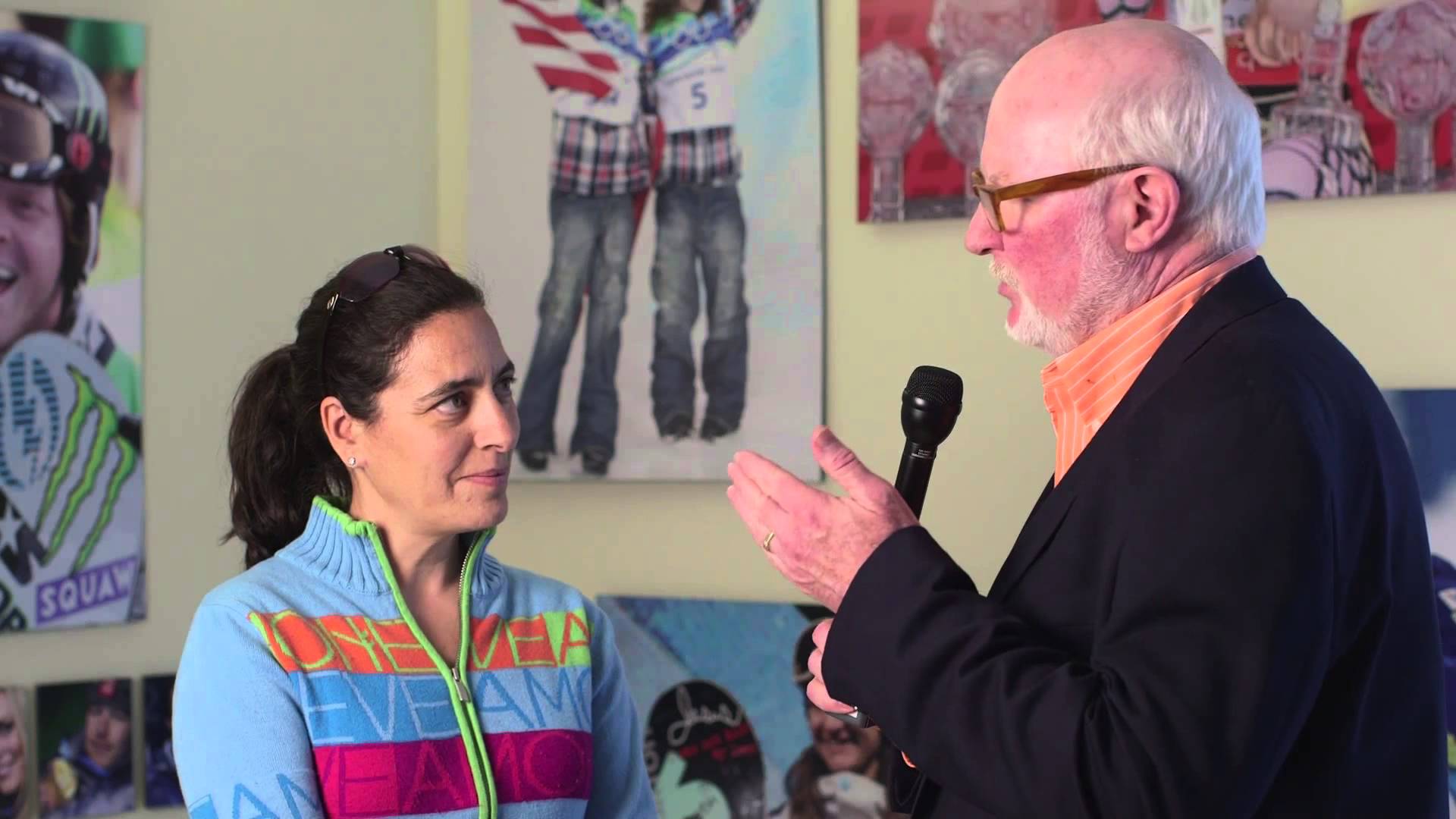
USSA Nordic Manager Joey Caterinichio (l) speaks to USSA Vice President of Communications Tom Kelly about the 2014 USSA Congress. (Photo: USSANetwork/Youtube)
Joey Caterinichio, a longtime figure in the cross-country skiing community, announced last month that she plans to step down as nordic manager at the United States Ski and Snowboard Association (USSA).
Beginning the position in 2012 after John Farra left to join the U.S. Olympic Committee as high-performance director of the Paralympic Nordic Program, Caterinichio has served as the manager of one of the largest branches of the organization for roughly three years.
Caterinichio’s journey to USSA began long before her time as an administrator. A native of Anchorage, Alaska, she raced throughout high school, college and beyond. She then became a coach and founder of the Alaska Nordic Racing in Anchorage. Over her years of training young athletes, she attended 18 junior nationals as a team leader or head coach for the Alaska region. Caterinichio also began working with Kikkan Randall when the three-time World Cup sprint champion was a U14 and on multiple Team Alaska trips.
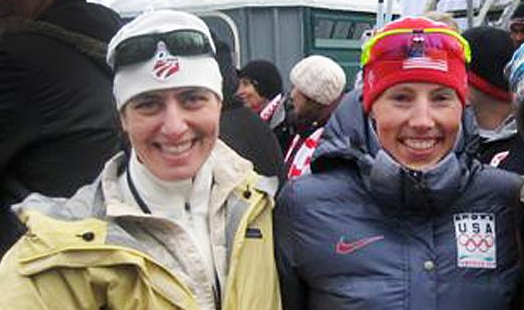
Joey Caterinichio (l) at the 2010 Olympic Winter Games with Kikkan Randall, one of her former junior athletes. The USSA nordic manager announced that she plans to leave her position when a replacement can be found. (Photo: USSA)
Caterinichio was also the chief organizer for U.S. nationals when they were held in Anchorage in 2009 and 2010.
When Caterinichio took over the managerial role in 2012, she oversaw several projects regarding reorganization of USSA’s nordic branch — from updating websites and contacts to easing scheduling procedures. During her time as manager, Caterinichio went to two World Championships and the 2014 Olympics, where she served as an organizer and general support.
During her time on the international circuit, she observed what it took to be the best in the world and brought what she learned to her work with domestic skiing. According to Caterinichio, the link between the U.S. Ski Team (USST) athletes racing in Europe and the athletes competing on home soil is crucial in maintaining a healthy ski racing community.
“It’s super important that our domestic athletes have some sort of tangible reach to the international athletes,” she said in a phone interview. “Between criteria, our SuperTour, sending athletes to the World Cup, and making domestic skiers part of World Championship teams, I feel that it was one of the best parts of the jobs. “
Over the years in the position, Caterinichio said that her main focus has been to lay the groundwork for clubs around the country to develop strong athletes.
“There’s been a lot of work by the clubs that’s forwarded skiing in the United States over the years,” Caterinichio said. “I came from the field, so with the trust of my colleagues I came into USSA trying to help make USSA have a better light in what it can offer folks. That was my goal.”
Caterinichio pointed to the new membership policy recently announced by USSA as a project that aims to make USSA and skiing in the United States more accessible.
“It’s going to make cross-country bigger,” she said pointing to decreased membership fees. “Right now there’s roughly a thousand members in cross-country. Now we’ve lowered the prices so much that our goal is 10,000 members.
“The task was to increase membership within USSA and do it in conjunction with working with everyone instead of alienating them,” she added. “A national governing body is important for any athlete to belong to. It happens in swimming, it happens in hockey.”
Caterinichio said that one of the main reasons for her departure was USSA’s need for someone based in Park City. While she has performed her work from Alaska for the past three years, the new membership program will require someone on-site. According to her, her replacement may require a team rather than an individual.
In a USSA press release, Executive Vice President of Athletics Luke Bodensteiner explained that the position for nordic domestic program director will be based at USSA’s Center of Excellence in Park City. The association is seeking applicants “with a deep background in cross country ski racing and with strong marketing and administrative skills. It’s anticipated that the position will start in Park City by mid to late summer,” the release stated.
“This is a substantially different job than Joey has undertaken, incorporating many of her responsibilities, but additionally focusing on club education/development, growth of participation in USSA and its programs, and expanded external relations,” Bodensteiner wrote in an email to FasterSkier. “The team manager-related activities that were a large part of Joey’s job are not included in this position, and will be handled separately.”
As of mid-July, the position was closed while USSA evaluated candidates. “But pending the outcome of
that we’d be happy to continue to evaluate additional applicants if we don’t fill the job in this round,” Bodensteiner wrote.
Caterinichio plans to stay in her current position until there is a sufficient replacement. Once her role has been filled, she will stay with USSA in a volunteer capacity.
“I’d love to continue to work with USSA and consult,” she said, adding that she’ll also continue working with the National Nordic Foundation (NNF) and possibly work in a business venture unrelated to skiing.
“Caterinichio has worked to increase the quality level of USSA cross country events and played a strategic role in managing the membership task force the past year,” the USSA press release stated. “She will remain on during the transition and will continue to be engaged with the USSA as she has for over two decades.”
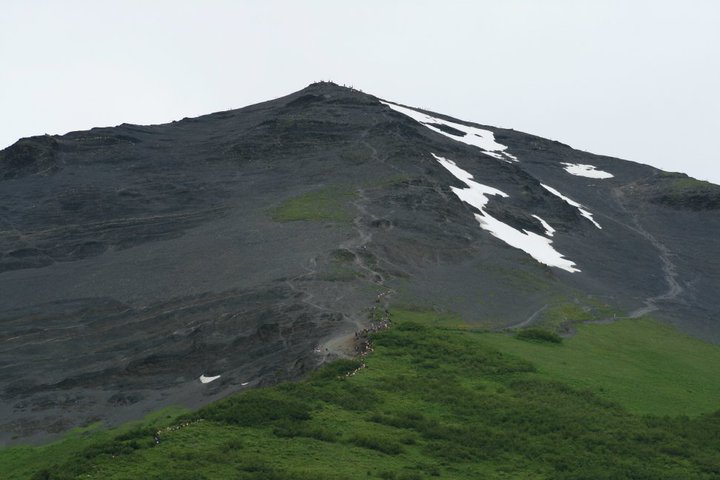
The 3,022-foot Mount Marathon rises above above Seward, Alaska.
Records were destroyed this Fourth of July in Seward, Alaska at the 88th edition of the annual Mount Marathon. In impressive fashion three runners bested previous course records, with international running stars Kilian Jornet and Emelie Forsberg claiming the men’s and women’s titles, respectively.
Jornet notched a time of 41:48 on the 5-kilometer course, that climbs and descends roughly 3,000 feet, to take the men’s victory. The Spaniard beat Eric Strabel’s 2013 course record by 67 seconds. Forsberg took first in the women’s race with a time of 47:48, breaking Nancy Pease’s 25-year-old record by 2:42. Forsberg wasn’t the only woman to surpass Pease’s record, with 18-year-old high school running sensation Allie Ostrander crossing the line in 50:28 to take second place in her senior class debut. Prior to 2015, Ostrander competed in the junior category of the race and is the only junior woman to claim the overall junior title.
It came as no surprise that Jornet crossed the line in first. Considered the best mountain runner in the world, he has six-time Skyrunner World Series championships to his name along with countless course records across the globe. After his record-breaking performance in Alaska, Jornet remarked to Alaska Dispatch News that the run reminded him of some European races due to the thousands of fans that lined the finish.
“That’s crazy,’’ Jornet said to the news organization. “Some races in Europe are like that. Here in the U.S., it’s unique.”
Rounding out the podium were Rickey Gates (42:56) and Jim Shine (43:11).
On the women’s side, Forsberg said she was surprised by the win given the strong competition. The Swede is a three-time Skyrunner World Series champion.
A photo posted by Emelie Forsberg (@tinaemelie) on
In second, Ostrander said to Alaska Dispatch News that while she was please with her senior debut she still hoped to claim the record time in the future. “I kinda wish the record was mine but I have a lot more years in me,” Ostrander said. “Some people are racing at 70 so I’ve got, oh, 50 more shots at it.”
The final woman on the podium was Chrissy Marvin (52:28).
Missing from the women’s race was two-time Mount Marathon champion Holly Brooks, who decided to sit out the race in order to rest after the long 2014/2015 FIS Marathon ski season.
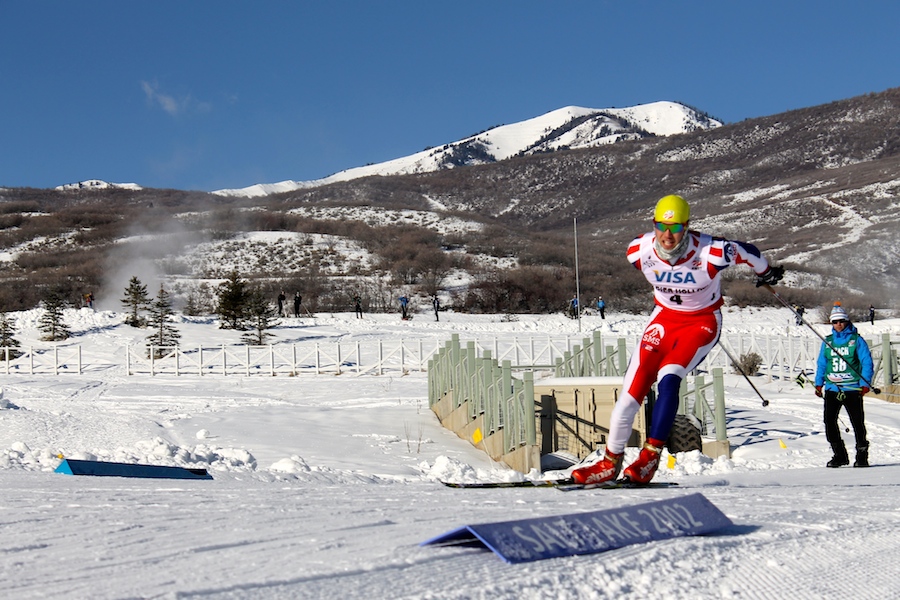
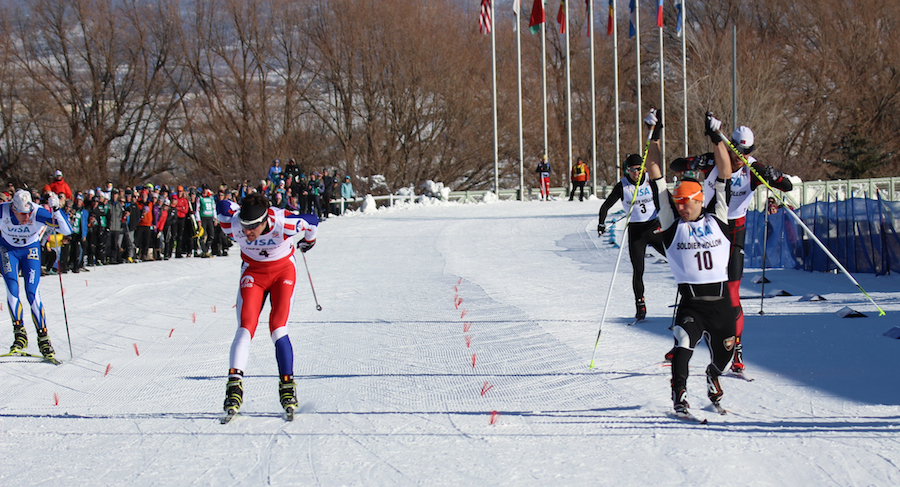
Skyler Davis competes at the 2014 U.S. Cross Country Championships at Soldier Hollow. Davis retired from skiing following the championships and took up soccer at UVM. He was recently named captain of the team for the 2015 season.
In 2011 Skyler Davis made headlines by claiming third place in the 1.4 km classic sprint at the U.S. Cross Country Championships in Rumford, Maine. This was just the beginning of a successful year for the then 19-year-old, which ultimately ended with a naming to the U.S. Ski Team D-team. In 2012 Davis’ success continued with a standout-24th place in the freestyle sprint at his second ever World Cup in Canmore, Alberta. In 2013 the former SMS T2 skier had another successful U.S. Cross Country Championships, qualifying second in the 1 km classic sprint before finishing just off the podium in fourth.
Though he did not reach his goals at U23 Championships that year in Liberec, Czech Republic, Davis was hungry for a bounce back in 2014. However, the young skier virtually disappeared from the cross country ski world after nationals in Soldier Hollow, Utah. As it turns out, Davis was ready to go back to school.
“School was the biggest deciding factor for me,” Davis said in a phone interview. “I loved my team [and] I loved my coaches, Gus [Kaeding] and Sverre [Caldwell], at the time when I did retire. I was in a really good situation actually because the T2 Team had just started to really send off. We were doing well, we had a good group of guys, the coach was great, but I really wanted to enter school before another Olympic year went by.”
“If I made the Olympics I would keep skiing and then probably enter [school in] the fall and if I didn’t, I would stop skiing and enter the spring semester which started I think honestly 12 to 24 hours after senior nationals ended that year,” he added.
Even though Davis was headed to school, he didn’t want to leave athletics completely behind. Searching for a continued relationship with sport, he turned to an old passion of his, soccer. “As I viewed it, it was my chance to stay at a really high level…Soccer was something I had a really strong background in. I was very raw going back into the sport but it definitely was what I was looking for,” Davis, who played on northern Vermont’s premier soccer teams throughout elementary and middle school, stated.
Prior to the of the 2014/2015 ski season — knowing that he might not qualify for the Sochi Olympics — Davis met with many division 1 soccer coaches and ultimately decided that the University of Vermont (UVM) was the right fit for him. “The deciding factor with UVM was the coach, I really love the coach, and I really like the team,” Davis said.
Though Davis was ineligible to play until the following year, he was allowed to join the team for practices and training, which proved to be a challenge. Suffering from ailments ranging from shin splints to back problems, Davis worked to transition from low-impact skiing the high-impact movement required in soccer. That, in combination with intense lifting sessions, left Davis wondering if he would be able to reach the level required for large university soccer program. “That was definitely an interesting two plus months where I was like, I might get cut. I really wasn’t sure,” stated Davis.
But the former cross country ski racer took on the challenge, and managed to impress the coaches and the team enough to maintain his roster spot for the following year. Still, he was ineligible to play in the fall and patiently waited for his chance this past spring. “Once the spring started up for games, we play about six games in the spring, I was able to actually carve out a roll on the team at center back so I actually played every minute of every game in the spring,” said Davis.
This past June, Davis was named as one of the two captains for the upcoming season — something he credits to both his relationships with his teammates and some lessons he learned from skiing.
“I think nordic skiing definitely helped me as far as being a good role model and leader for the team because with nordic skiing you have that work ethic that surpasses basically any other sport,” Davis said. “There definitely are moments where it brings me back to my nordic skiing training where we will be doing intervals which are obviously a little bit differently tailored, but the get me excited compared to other people.,” said Davis.
In a recent press release by the University’s athletic department, the program’s staff had nothing but praise for the former USST member.
“Skyler is a natural born leader who has a tremendously positive impact on the program from day one”, Head Coach Jesse Cormier said. “He has established himself as a strong, mature voice in the locker room and is an exemplary student. He has made amazing progress in training, his game has changed so much and is reflective of the consistent growth we have seen from the group as a whole. I’m excited for Skyler to play in his first match, he was waited a long time and prepared well to say the least.”
The newly named captain is currently in Burlington, Vt. preparing for the upcoming season. “It has been ratcheting up pretty quickly,” Davis said. “Basically every day we train together. We have about half the team here now and preseason starts in about a month, so everyone is filtering in soon…Once we get about 20 to 25 guys we can really make it competitive with playing and training.”
Though the 2015 soccer season at UVM is currently his biggest athletic focus, Davis certainly has not forgotten about his love for skiing. “Hopefully, after I’m done with soccer I’ll be able to get back to skiing and other more nordic ski related activities,” he said.
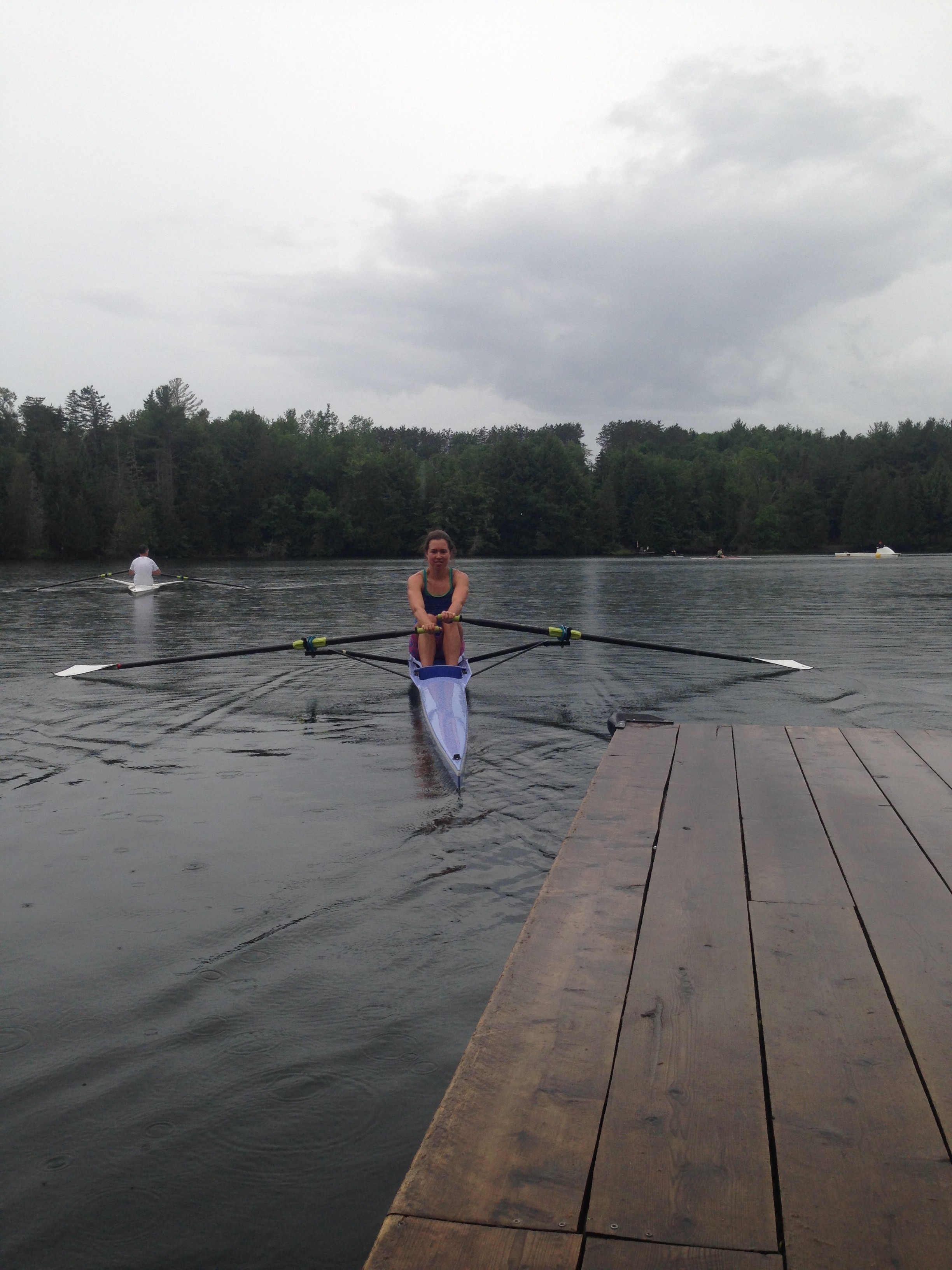
CGRP skier Heather Mooney gets out on the water with her sister, Brooke, as part of her cross training program. (Photo: Heather Mooney)
This week’s Wednesday Workout comes from the Craftsbury Green Racing Project, centered at the Craftsbury Outdoor Center in Vermont. With professional rowers also based at the center, the GRP ski team takes advantage of the center’s facilities to partake in full-body cross training. Don’t have access to rowing equipment? You can partake in one of the exercises below on an erg, which are located at most gyms.
***
CGRP skier Caitlin Patterson heads out on the water for a rowing workout out. (Photo: Heather Mooney)
The Craftsbury Green Racing Project has a couple afternoons each week for cross training built into our general training plan. Our cross training activities of choice include mountain biking, road biking, and rowing, and in a big volume week we have plenty of time for just about all of them. Although it is easy to spend as most of our training hours doing exercise that will relate directly to speed on skis, we like to mix up or routine with other activities to get our other muscles working, minimize the monotony of one activity, and to learn something new.
Several of us enjoy rowing and the prime facilities, equipment, and coaching available to us at the Craftsbury Outdoor Center make it it very easy. A few times a week, the GRP rowers host “community rowing” where residents from around the area come to work on their rowing. For us on the nordic side of things, it’s a good chance to learn from our fellow GRP rowing teammates.
Rowing is good cross training for skiing as it is another full body sport — and aerobic once you’re good at it. It also requires good balance to keep your boat upright, which involves the use of all the limbs and a strong core to connect them. With some basic skills, it is a great option to know the technique on a rainy day at the gym on a rowing erg.
There are a lot of options from hard intervals to just easy steady state workout, with benefits ranging from speed to strength to endurance — just like in skiing — and can be done either on the water or on an erg. Many of us go out for an easy row, “Level 1”, like we’d go for an easy run or bike or ski, but here are some more advanced options that our fellow GRP rowers use:
The “workout”, courtesy of Steve Whelpley, one of the GRP rowers:
5 x 5: Five minutes at 24 strokes per minute (spm) done five times with two minute rest. Ii is a simple Simple workout that builds aerobic capacity and power.
10 minutes pieces: Four minutes at 22 spm, three minutes at 24 spm, two minutes at 26 spm, one minute at 28 spm. Typically do it three to four times. it builds in intensity and forces power at the lower ratings.
40/20 seconds: 40 seconds on 20 seconds off, two sets of 10 intervals with a longer break in between them. These shorter intervals build anaerobic capacity, and with short enough rest, they force a lot of oxygen exchange and heavy breathing.
Rowing is great cross training as it is a full body workout. Like skiing, it necessitates a lot of oxygen consumption, builds VO2 max, and encourages more anaerobic development since it can be more power based than skiing, as well as being slightly antagonistic exercise to stay healthy and well rounded. Moreover, although there are no uphills in rowing, there also are no downhills, so it is a good chance to work on endurance with no breaks.
Matthew Perry Johnson was hired as the new head coach for the Montana State University Ski Team. He will begin his position in August. (Photo: Evan Hagen)
It has been a tumultuous two years for the coaching staff of the Montana State University cross country ski team. The past two springs have seen complete shifts in staffing — long-time head coach Grethe-Lise Hagensen’s contract was not renewed in 2014 and her replacement, Kristina Trygstad-Saari, resigned from her position at the team’s helm earlier this year. The Bozeman, Mont. university recently announced that former Middlebury College racer and Alaska Winter Stars coach Matthew Perry Johnson will be the newest head coach for the Bobcats starting in August.
In Trygstad-Saari’s first year as a coach the MSU Ski Team finished seventh at the 2015 NCAA Championships in Lake Placid, and the nordic team garnered two All-Ammerican honors. Despite the success, Trygstad-Saari decided to leave the position to explore paths unrelated to skiing. The 30-year-old has been in the ski community as a racer and coach since a her days as a junior with the Bridger Ski Foundation, and explained that she needed a change. “I’ve spent a lot of years moving around in the ski world, both racing and coaching, and I haven’t always been 100 percent sure that it’s where I should be,” Trygstad-Saari wrote in an email, adding that the decision to leave was incredibly difficult.
Trygstad-Saari said her experience with the MSU team was highly positive, and that a highlight of the season was in Lake Placid where skiers Cambria McDermott and Forrest Mahlen notched fourth and fifth place finishes, respectively. The lone year as head coach didn’t come without challenges, however, as Trygstad-Saari worked to balance athlete’s training and travel, in addition to the coaching transition.
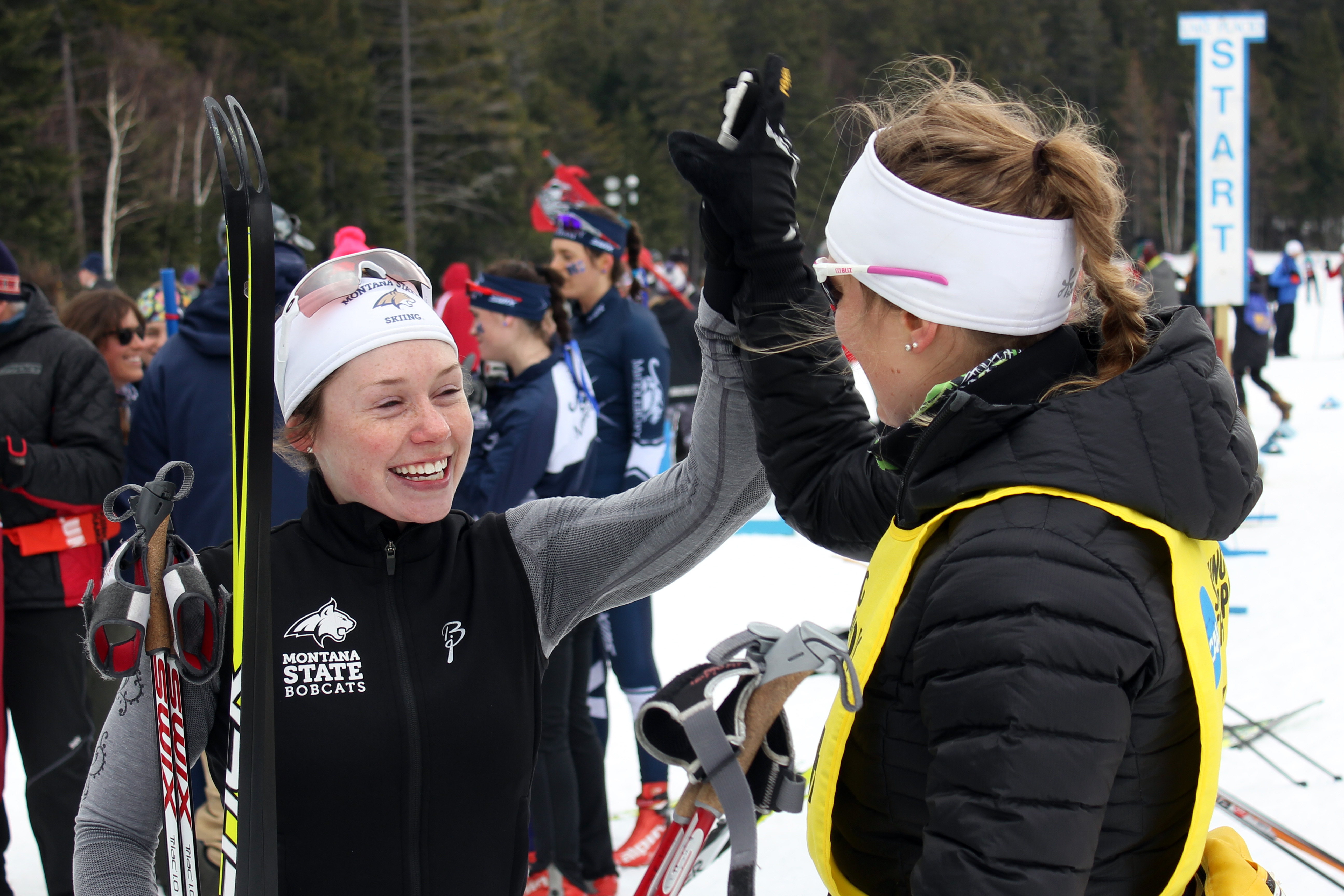
Cambria McDermott, fourth place and top American finisher in the 2015 NCAA Championship 5 k, high fives Montana State University Head Coach Kristina Trygstad-Saari.
“The year was challenging, and I had a lot to balance and learn,” she wrote. “Some of our athletes got pretty tired later in the season, and I think I could have done some things differently with training and travel planning. However, I was generally satisfied and think the team responded well to the changes.”
With her departure from the team, the single-season coach is ready for what the future holds. Trygstad-Saari is currently in Vermont finishing up her master’s degree at the Middlebury College Breadloaf School of English. “Hopefully I can explore some options that will put [the degree] to use!,” she wrote. “As of now, the future is wide open, and I look forward to some new adventures.”
A large pool of candidates applied to replace Trygstad-Saari, but in the end it was Johnson who got the job. The new head coach grew up skiing with Alaska Winter Stars in Anchorage and raced for Middlebury College in the years following. After graduating he began assistant coaching at Burke Mountain Academy. He left three years later to become the program/director and head coach of the Utah Nordic Alliance, and in 2014 he returned to his roots and coached with Alaska Winter Stars.
MSU Athletic Director Peter Fields said in a press release that he was pleased with Johnson’s hire. “Matt possesses a strong background in program and student-athlete development,” Fields said. “He has also worked on both coasts as well as the Rocky Mountain region, and is well respected. Matt sees the big picture and is very motivated to continue the level of excellence the Bobcat ski program has established.”
Johnson applied for the open position at MSU because of the potential he saw in the program. While it was difficult for the Alaska native to leave his current athletes, he said the high-level juniors he has coached over the years inspired him to make the progression to collegiate coaching.
“Bozeman is such a great environment for ski training year round and the potential I see in the MSU Nordic Program is massive, so in that sense applying for this position specifically was an obvious choice,” Johnson wrote in an email. “The more difficult aspect of the decision was deciding whether to move on from coaching juniors, which I’ve made the focus of my career so far… The way those kids motivate me to work as hard as I can for them definitely pushed me towards pursuing the position with MSU to work with an entire team at that level.”
In the coming year, Johnson hopes inspire the team and its individuals to greater success. As for the future, however, he has big hopes for his team including an NCAA title. “I would like to help establish this team as a place where athletes who are serious about their skiing as well as academics know they will have every opportunity to improve and grow,” Johnson wrote. “I think this team can win NCAA titles and produce athletes who are ready for World Cup competition after graduation.”
To get there, Johnson will have to overcome the challenges associated with being a new coach on a well-established team, especially given the fact he will be the third head coach in two years for many of the older athletes. “Any time there is coaching turnover there are challenges to overcome,” he wrote. “It’s a situation I’ve dealt with from an athlete’s and coach’s perspective so I know that as long as everyone feels comfortable communicating openly, there’s nothing we can’t overcome with relative ease.”
Although Trygstad-Saari is leaving, she is excited to see what Johnson will do with her former team. “He’s had a wide-range of coaching experience and has the passion and motivation to help drive the program,” she wrote. “He also has the skills to excel in the position beyond the ski trails; he will be a tremendous asset to the Bozeman nordic community. I think the team is in a great place, but I’m confident that Matt will bring even more to MSU and continue this trajectory.”
Johnson will start at MSU in August and said that he has yet to come to a final decision regarding an assistant coach.
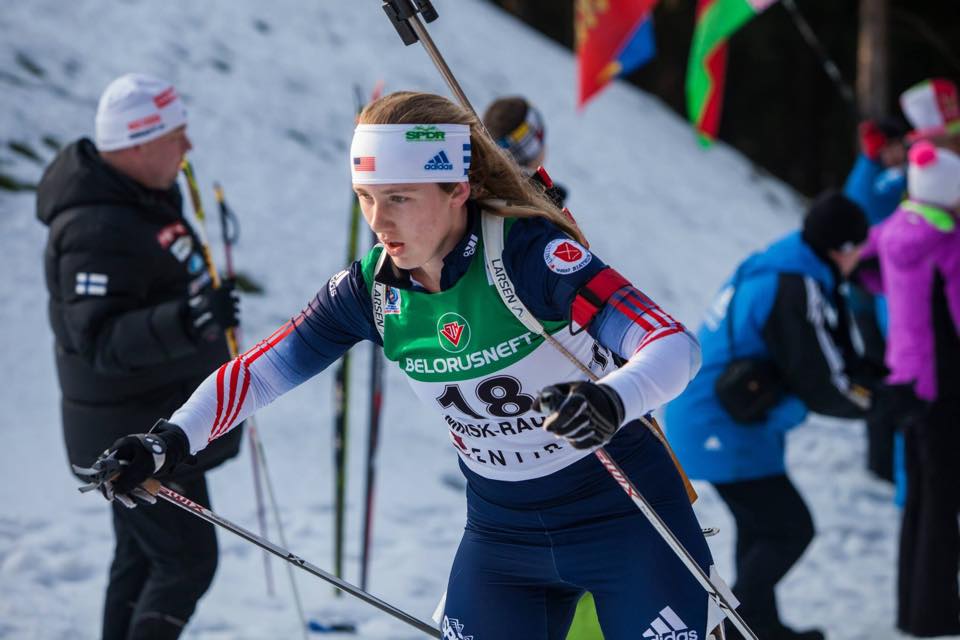
Chloe Levins racing at the 2015 IBU World Youth Championships in Minsk, Belarus. (Photo: Chloe Levins)
Editor’s Note: The ‘From The Pack’ features profiles about talented-and-intriguing junior and collegiate racers in the U.S. and beyond. While nordic sports are certainly not the largest, there are still thousands of great stories that most of us are not familiar with. We will be picking athletes out of this pack to write about; nominations for outstanding or interesting nordic skiers can be sent to info@fasterskier.com with the subject line: “From The Pack.” We are looking for unique stories, not necessarily the fastest skiers. Nominations should include a brief explanation of why we should profile the athlete.
***
With an 18th-place finish in the 6 k sprint during the 2015 IBU World Youth Championships in Minsk, Belarus, Chloe Levins demonstrated she is a name to look out for in the years to come.
Levins has been skiing her entire life. Since her family moved to Rutland, Vt. when she was two months old, they have been heavily involved in the local cross country commuity. Her parents, Mary Ann Levins and Jim Levins, are a constant presence at Mountain Top Resort where her father is also a Toko Tech Team representative. Her mother, meanwhile, is the chair of the New England Bill Koch League and a race coordinator and volunteer at Mountain Top. In 2009 she received the John Caldwell award, New England Nordic Ski Association’s (NENSA) highest annual honor, for her commitment to skiing development in New England. Two of her older siblings, who Levins credits for inspiring her to get involved in competition, ski raced until they graduated from college and still get on the trails whenever they get the chance. It’s safe to say, Levins skiing roots run deep.
Biathlon, however, is a relatively new venture for Levins. “I started the summer after my eighth grade year. Max Cobb recommended to my mom to send me to a three day introduction camp in Craftsbury. So I went there and Algis Shalna, my coach now, saw something and invited me to the next camp in Lake Placid for a week. I’ve been training with him ever since,” Levins said in a phone interview.
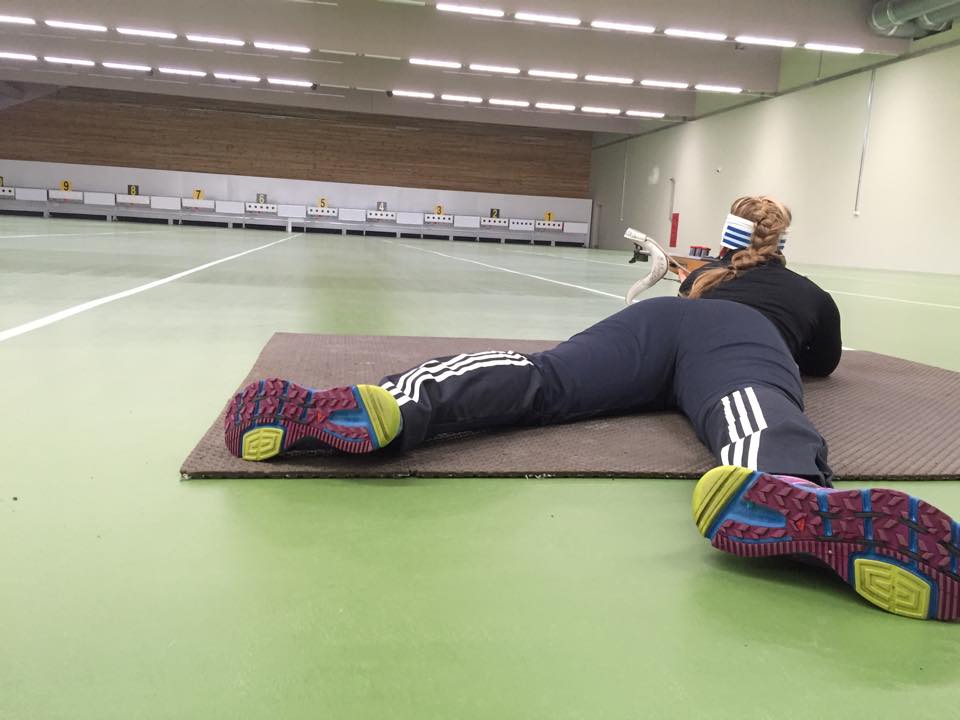
Chloe Levins practices at the shooting range in Minsk, Belarus during the 2014/2015 season (Photo: Chloe Levins)
She has been passionate about the sport ever since. “The mental aspect of the sport really intrigues me,” Levins explained. “I think that the combination of aerobic skiing and precision shooting is very unique and is not something that you find in any other sport…It’s really exciting. You’re never out of the game. You can be a minute back and still have a chance to win because the last stage is so nerve racking. Its unreal.”
This past winter, her passion for biathlon gave the Rutland skier some impressive results. Levins has always been a great skier – in the 2013/2014 season, a highlight result was a second place finish in the U16 girls 5k mass start at Junior Nationals. But the winter of 2014/2015 is when she really made her presence known in biathlon. She won the U.S. Biathlon Association’s trials race series to qualify for the IBU World Youth Championships in Minsk, Belarus. There, she achieved an impressive 18th place finish.
But what led to such drastic improvement?
“Millions of things contributed… Something that really stands out in my head is… I think it was from my mom. She said, ‘doing your best in this moment puts you in the best place for the next moment’ and that is what was in my head for the entire season. I lived by that,” Levins said of her 2014/2015 season.
The Rutland native also explained that she focused on improving her shooting in the past year. “I put in a lot of time dry firing with the rifle… I just kept my eye on the process as best I could [and] tried to stay positive, which was difficult at times because biathlon is such an unpredictable sport. It’s a short way from heaven to hell in this sport so keeping it in perspective is important and I think I did that really well this past season,” Levins explained.
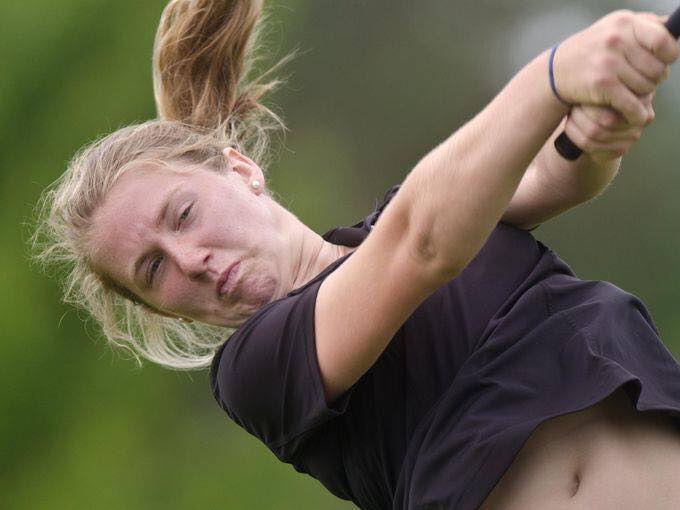
Chloe Levins competes in the 2015 Vermont State Championships in her second passion: Golf. She won the event and placed fourth in the New England Championships. (Photo: Chloe Levins)
Another contributing factor to Levins improvement is her interest in another sport in which she excels: golf. This spring she was Vermont’s state champion and narrowly missed the podium at New England Championships with a strong fourth place. Levins gives some credit to golf for both her focus and interest in biathlon. “I see a connection with biathlon and golf mentally so I am able to apply some of the knowledge I have gotten from playing golf my entire life to biathlon and I think that’s helped me and also increased my interest in the sport,” she said.
“Golf is a game of integrity, patience, and mental toughness, all aspects of sport that can continue to be developed at the highest level and are essential to executing quality training. I believe that the game of golf is a great cross training exercise for the improvement of mental strength in general,” Levins added.
The improvement, passion, and results leave Levins with a tough decision. An incoming senior at Rutland High School, she will have to choose between college and full-time training in the coming year. “There are some juniors in biathlon that have chosen not to go to college and train since [biathlon is] not a collegiate sport,” Levins said. “But there are also some current professional biathletes that chose to go to college, race for college, and get faster at skiing, then pick up with their shooting after college. So its been done both ways and I think the best way for me to do it is to go to college right after high school.”
Even if she does attend college, Levins plans to stay involved with biathlon, “I definitely want to try and keep training for biathlon because I don’t think I could ever step away from it for four years,” the Rutland native added.
For now, however, Levins is focused on this year. She is currently in Lake Placid for a junior development camp where she is an assistant coach and a young mentor for aspiring biathletes between the ages of 11 and 15. Immediately after that Levins will stick around Lake Placid for a national team camp, where she will ski and shoot with the professionals. “I’m looking forward to upping my game and learning from them on the range. Its going to be not so much physical, I think its going to be mostly shooting camp,” Levins said.
She plans to attend a few more camps throughout the summer and will be a regular at the Jericho, Vt. biathlon range in the fall. If all goes well for the 17-year-old, she hopes to improve on an already successful junior career.
It is a well-known fact that everyone knows each other in the nordic community. If you haven’t met another skier or coach first-hand, you likely already know something about them. But what happens when the person cheering you on from the sidelines becomes more than just a friendly acquaintance?
That’s exactly what former Middlebury College skier Stella Holt set out explore in her film, Fred.
Fred Fayette, a volunteer assistant coach to the University of Vermont ski team and former racer, had been on Holt’s radar throughout her college career as “the cheerful guy that gives everyone splits on the course.” However, it wasn’t until she heard the many stories of Fayette circulating the eastern collegiate circuit, that she realized there was more to the lighthearted assistant than she could have imagined.
“It wasn’t until I scratched the surface of the incredibly rich life Fred leads that I realized he would be a compelling subject for a documentary project,” Holt wrote in an email. “I was drawn to Fred as the subject of my thesis as his story gave me the opportunity to produce work that intertwined my experience on the Middlebury Ski Team with my passion for filmmaking.”
As the production of the film progressed, Holt realized a 15-minute documentary solely focused on the assistant wouldn’t do Fayette justice. Following advice from her instructors, she shifted the project to include a personal touch. Planning to coincide the end of her racing career with her graduation from Middlebury, Holt was conflicted about leaving a sport that had defined much of her life. She was able to overcome her apprehensions by combining her experience with the story of Fayette.
“In doing so, making the film quickly became a means of digesting my own anxieties about leaving the competitive side of skiing behind,” Holt said.
The 13-minute documentary delves into Fayette’s entrance into cross country competition at UVM, his research boat – the Neptune, meeting his wife, and the importance of a team. For Holt, the film serves as a way to communicate her love of the nordic community through the narrative of Fayette.
“His understanding of skiing and of the way in which we move in and out of various spheres in our lives was particularly helpful and relevant for me in anticipation of graduation from Middlebury,” Holt added. “While I have always known that I will stay connected to skiing in some way, Fred was essential in helping me articulate what is most important to me about the sport and my own experiences.”
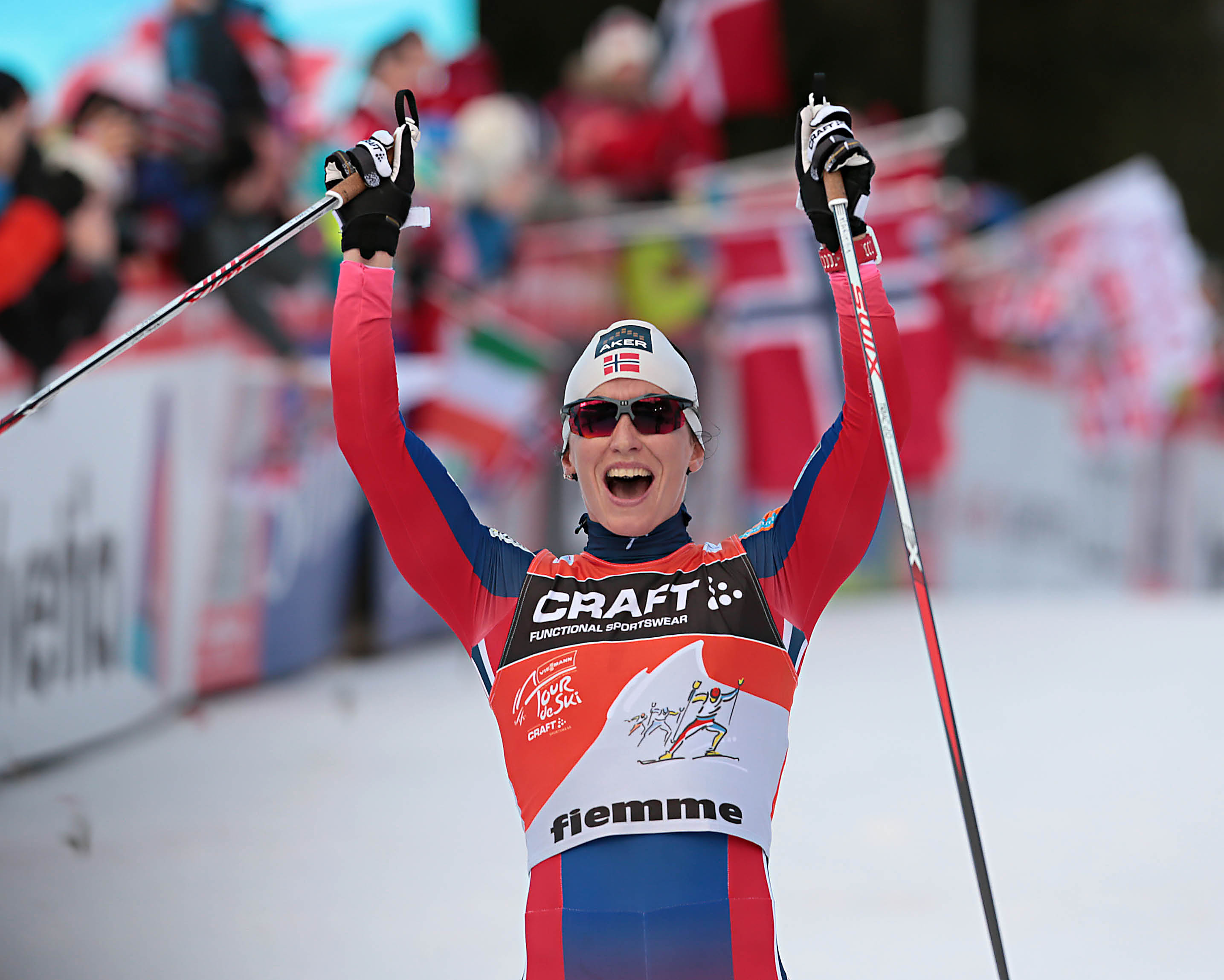
Marit Bjørgen of Norway celebrates her 2015 Tour de Ski victory at the finish line of the final stage in Val di Fiemme, Italy (Photo: Val di Fiemme/www.fiemmeworldcup.com)
The queen of cross country skiing will have an heir to her throne come December, and if all goes according to plan she will be back to ruling the World Cup by 2017.
Six-time Olympic gold medalist and 14-time world champion Marit Bjørgen announced Tuesday in a press conference that she is pregnant with partner Fred Børre Lundberg. Bjørgen’s baby is due in December, the height of the 2015/2016 season, and the Norwegian plans to sit out the entirety of the season.
“I’ll drop a bomb.I will become a mom in December,” she said at the beginning of the press conference according to a translation from Norwegian broadcaster NRK Sport.
The news comes as a surprise to the international nordic community, especially after Bjørgen assured journalists in April that she would compete in 2015/2016 season and had no plans regarding retirement. “I have used the spring to think a little, and I am now sure that I’m a hundred percent ready to put down the work needed to continue my career,” she said at the time. According to NRK Sport, even Bjørgen’s mother was surprised when her daughter informed her of the news.
Bjørgen told her fellow Norwegian National Team members two days before the press conference to much celebration. Teammate Therese Johaug, who joked she would be the child’s “spare aunt,” said that the news was emotional for both her and the team. “First and foremost, I am so incredibly happy at Marit their behalf.I knew it when she told the team on Sunday and also when she told here today that I get tears in my eyes thinking of it,” she said at the press conference according to NRK Sport. Bjørgen said that she will do her best to attend team meetings and be as supportive as possible throughout the remainder of the year.
The overall 2014/2015 World Cup winner’s absence in the upcoming season creates a power vacuum on the circuit, giving skiers like fellow Norwegians Johuag and Heidi Weng the opportunity to take up her mantle. Bjørgen won her first Tour de Ski in 2015 and her removal from the event gives Johaug a clear path to another victory. The U.S. Ski Team’s Liz Stephen, who finished fifth in the 2015 Tour, also has a greater opportunity to earn America’s first overall podium in the event with Bjørgen gone.
Women’s World Cup skiers shouldn’t get too used to Bjørgen’s absence, as the 35-year-old plans to return to skiing in the 2016/2017 season. While at this time it is unclear whether that would mean the entire season or the latter half, Bjørgen believes that she’ll be competing at the 2017 World Championships in Lahti, Finland and at the 2018 Olympics is PyeonChang, South Korea.
“There are not so many ski runs in the winter, but I’d like to come back in 2017 if things work well,” she said.
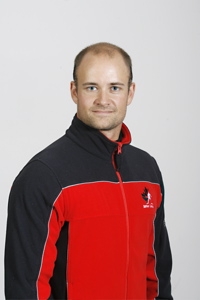
A 2008 file photo of Chris Lindsay. He left Biathlon Canada after eight years with the organization. (Photo: Biathlon Canada)
Biathlon Canada announced earlier this month that Chris Lindsay would leave his position as High Performance Director to assume the role of High Performance Advisor to summer sports at Own the Podium. With over four years as High Performance Director, Lindsay departs Biathlon Canada having fostered a program that has risen to the highest level of international competition.
A former biathlete who competed at both the national and international level, Lindsay has been with Biathlon Canada for roughly eight years. Previously serving as Technical Programs Coordinator, he was hired in 2010 as High Performance Director. Before joining Biathlon Canada Lindsay worked in the summer sports industry, including aquatic recreation and competitive canoeing and kayaking.
According to Lindsay, his current progression from winter to summer sports is natural given his transition between the two realms over the years. As High Performance Advisor he will work with a variety of summer sports programs’ high performance directors to realize the potential their programs hold and get them the resources necessary to realize that potential.
“While I absolutely love [being biathlon’s High Performance Director], the sport, and the athletes and the fantastic staff that I get to work with, I had this opportunity come up with Own the Podium,” Lindsay said in a phone interview. He continued, adding that the new position was the next step in his journey, “in terms of providing me with a fresh challenge and providing me with new opportunities to support high performance sport, specifically winning Olympic and World Championships medals.”
Biathlon Canada’s President, Murray Wylie, said in a press release that Lindsay would be missed by the organization. “Chris has played an integral role in leading the strategic transformation of Canada’s high-performance biathlon program from a group of participants to medal contenders at the Olympics, World Championships and World Cups during his five years with Biathlon Canada,” Wylie wrote. “He leaves having positioned Biathlon Canada with the opportunity to deliver a medal-winning performance at the 2018 Games, and beyond.”
Nathan Smith celebrates after becoming just the second Canadian man to ever win a biathlon World Cup, taking the win in the 12.5 k pursuit in Khanty-Mansiysk, Russia. (Photo: Biathlon Canada/NordicFocus.com)
While Lindsay is content with his decision to leave Biathlon Canada, it doesn’t come without challenges. The former high performance director said he will not only miss the relationships with those in the biathlon community, but also opportunity to be present at races in the coming years, especially the IBU World Cup in Canmore in early February of 2016.
“In a way it makes it very challenging to leave because you want to continue to be a part of this machine that has this momentum going forward,” Lindsay said. “I think the hardest part about leaving Biathlon Canada, beyond the relationships with the athletes and the staff, is that I am not going to be around for the home World Cup next season.”
While Lindsay’s new job will keep him busy throughout the next year, he plans to schedule a vacation during the Canmore World Cup week and volunteer at the event in order to reconnect with some of his former athletes.
Looking back at his career with Biathlon Canada, Lindsay said that the sport is an example of success in the Canadian system. Just in the last year the team had several top-10 performances on the World Cup, the most notable of which were Nathan Smith’s silver medal in the sprint at World Championships and his victory in a late-season World Cup pursuit. “The systematic successes we have seen prove the mission and how we’ve been able to execute it,” Lindsay explained.
Although some of Biathlon Canada’s target races are several years out, most notably the 2018 Olympics, Lindsay is certain that the program he has been a part of for eight years will achieve its goals and then some.
“We have been working hard as a nation to be recognized as a real member of the club and we fully expect that by the 2018 season,” Lindsay said. “We will be firmly recognized as a top-10 nation in the sport and we will be regularly, perhaps not frequently but regularly, converting medals at the World Cup and World Championships level. There will always be setbacks and there will be dry spells, but if the machine is fully functioning then we have multiple athletes who can take the mantle.”
There was no official word from Biathlon Canada regarding Lindsay’s replacement.
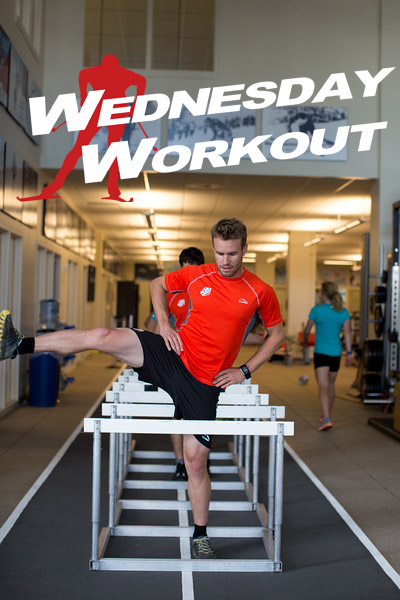
Simi Hamilton utilizing the hurdles at the Center of excellence in Park City, Utah. (Photo: USSA/Sarah Brunson)
This week’s Wednesday Workout comes from Tschana Schiller, Senior Strength and Conditioning Coach with the United States Ski and Snowboard Association in Park City, Utah. Schiller develops strength programs for many of the U.S. Ski Team athletes and was an essential part of the USST camp that took place at the end of May. We asked Schiller for advice regarding nordic athletes and her response was simple, yet essential: athletic movement.
***
Lately I have begun to utilize a different focus for some of my cross country athletes as well as other disciplines of athletes that I train. With the trend for kids to specialize in one sport starting so early, I have noticed as many athletes age they actually begin to lose or get worse with their athleticism or movement capacity. If you look at cross country skiing, the movements utilized occur primarily in the sagittal plane. When I assess my athletes during testing and training, they typically move pretty well straight forward. However, as I incorporate more multi-directional movement the efficiency of their positions seems to decrease.
You may ask, “If cross country skiing movements are pretty straight forward, why is it important to train in any other direction?” My immediate answer is that you still need great movement capacity in order to be a better, well-rounded cross country skier. There are certainly instances during the course of races where an athlete may need to avoid another skier falling, be agile enough to move around a skier that just snapped their ski pole in front of you, or just move laterally around others in order to set yourself up to attack a hill. If you don’t have the ability to maneuver your center of mass, quickly and efficiently, then you may be missing an important component in your training. The more cumbersome your movements, the more time and energy you will use trying to make the move. The best athletes, no matter what sport or discipline, have the ability to make their movements look easy and effortless.
Tschana Schiller, USSA Strength and Conditioning Coach in a 2013 staff photo. (Photo: USSA)
I am a big proponent for strength training. The majority of my programs are based around whole body movements crossing multiple joints. My strength programs are set up with a few main goals: address weaknesses/imbalances, improve force and power production, and help prevent injuries, amongst other things. That being said, the weight room can be a pretty sterile environment. There is nothing too terribly athletic about squatting. It’s a brilliant exercise and nearly all of my programs incorporate some sort of squatting variation (split, single leg, double leg, etc.) as it requires good mobility and develops great force production. As far as movement capacity goes, however, there is not much in the gym that can mimic what takes place on your skis.
Developing strength and power capabilities in the gym can most certainly help the characteristics of skiing and should be used in dry-land programs, but it is highly beneficial to also incorporate a movement oriented session or ‘athleticism type’ exercises into your strength program.
The exercises are simple – anything like jumping, sprinting, speed ladders, agility drills, shuffling forward, backward, laterally, etc. all help to train athleticism. Focus on movement quality, not quantity. How you move and keep a rhythm at first is most important. If your arms are flailing around as you run and cut, you are using extra energy where you don’t need it.
I have also trained many athletes who perform these drills with so much tension that they cannot stay relaxed. Occasionally this happens in skiing as well. This does not mean be lazy with your movements. Instead, work to develop a flow and tempo that allows you to use only the energy required for the movement but not more. For example, if you are squeezing your traps up to your ears and your fists are gripped as you sprint and cut during an agility drill, you are taxing your body unnecessarily. You may be able to pull this off for a short drill, but if you tried to maintain that for 30 k you would be fatiguing yourself instead of saving that energy to use it when you really need it.
The great Muhammad Ali once said “float like a butterfly, sting like a bee.” A good boxer is relaxed and efficient with his or her movements but can strike with strength and power when needed. This also goes for cross country skiing. Finding a rhythm and tempo with your movements in the gym and on your skis allows you to save that force and power for when you really need to lay it on.
Multidirectional/Athletic Movement Exercise Examples
Lateral shuffle and reach:
Set up two cones starting roughly 10 meters apart. Side shuffle and reach down to touch the cone. Keep steps even and smooth. Shuffle back to the other cone and touch.
Start with three sets of 15 seconds. Progress to 20 to 30 seconds, or to cones further apart. Once you have mastered this move, you can shuffle and pivot to touch the cone (you would end up facing the opposite direction), pivot back and continue to shuffle to the other cone, pivot and touch. Get creative with this. Other progressions can use a cross-over step in the shuffle, pivot and reach, etc.
Micro hurdles:
Use six to 12 inch hurdles for agilities. Forward skip/knee drive drills through six to eight micro hurdles into a 20 meters acceleration or build up sprint. Work on correct running mechanics keeping elbows in and hip, knee, ankle alignment and staying ‘tall’ through the hurdles. Do five to six sets.
You can progress or challenge yourself by going laterally through the micro hurdles then opening the hip into a forward acceleration for example. You can also change up the drills through the hurdles then follow it up with a shuffle and pivot like the above drill. Again, try to find a rhythm and solid tempo while remaining relaxed and efficient.
If you are not doing it already, try adding some more multi-directional, athletic type movements to your strength plan. Don’t discard the normal strength and power training because this is a vital component as well, but consider some more ‘big movement’ exercises. How are you shifting your weight?Are you staying balanced?Are you able to use those strength and power gains and actually propel yourself athletically now on your skis? Remember, to improve or maintain athleticism, YOU HAVE TO MOVE!
Adam Terko, former St. Lawrence University Assistant Coach, is the new Head Coach and Executive Director at Mansfield Nordic Club. (Photo: NENSA)
Adam Terko came to St. Lawrence University as a skier and student in 2008, but his time at the school would last long after his racing and studies ended. After graduating in 2012 he joined the Saints’ coaching staff, bringing the same energy and spirit into his three years as coach as he had while on the team himself. During his years as assistant coach, he dedicated his time to write weekly recaps of the EISA collegiate carnivals for the FasterSkier community. Earlier this year, Terko decided to leave his position as the assistant nordic coach this spring to become the Head Coach and Executive Director of Mansfield Nordic Club, replacing current Head Coach Tim Weston who will officially depart the program in July of 2015, according to the team’s website. While the new head coach has been busying navigating his new responsibilities, he answered questions from former teammate and athlete Kathryn Mulcahy about the next chapter of his ski coaching career.
FasterSkier: What are you most excited for with the Mansfield Nordic Club?
Adam Terko: I’m from Vermont and I was personally supported by a lot of people from this area growing up. Having such a great support structure as I became a skier, I’m excited to be part of that from the other end. Also, in New England there is a lot of success and there is definitely a positive future here. I’m excited to be a part of and contribute to that future for kids from this area and Vermont as a whole.
FS: What are you going to miss most about St. Lawrence University?
AT: I came to St. Lawrence in the fall of 2008 as an athlete, so I think after spending seven years there it’s hard not to have a strong connection to the ski team and everyone that was a part of my experience throughout those years. I got to interact with a lot of great teammates and assistant coaches, as I’m sure is similar for a lot of people. But this is a great opportunity to move forward with my coaching career, apply what I’ve learned during my time at St. Lawrence and give what I’ve been given back to others.
On a day to day operational level colleges, especially ones as well supported as St. Lawrence, are definitely benefited by logistical aids that I probably took for granted. For example, transportation, lodging budgets, waxing, equipment, and facilities of various types. Not to mention a corporate credit card (laughs). At the same time I’ve already gotten to know a lot of people who have contributed a ton to Mansfield Nordic and provide so much for the skiers even without that kind of corporate structure. I think it’s great to have that personal investment and those kind of connections are what a ski club is all about.
FS: When did you decide coaching was something you wanted to pursue as a career?
AT: Sophomore or junior year of college. I had some success with my own racing but knew I probably couldn’t race professionally. But I knew I wanted to stay involved in the ski world and felt that coaching was a good way to give back, stay involved and pass on what I had learned. I tried to learn as much as I could from then on. Knowing I was interested in being a coach even before I was finished racing had me looking for opportunities to apply situations from both the athletes and coaches perspectives, to consider the positives and negatives and difficulties of both sides and apply that to myself in the shoes of a coach.
FS: How do you think your youth is beneficial to you as a coach? In what ways is it a limitation?
AT: I’ve only been removed from racing for a few years and in that time I was an assistant coach. During that time I tried to immerse myself in other opportunities for coaching during all seasons. I attended clinics at the Olympic Training Center in Lake Placid, worked with athletes in the summer from the college age and younger, and tried to take every opportunity I was given to learn as much as I could knowing I wanted to stay in the coaching field.
As for limitations, at 25 I go into coaching knowing I don’t have a lot of experience, when experience is what brings success to many coaches. Realizing that, and going into every individual workout or race knowing that it is a learning opportunity is a way I’ve tried to approach it though.
FS: What do you think the hardest part about being a head coach will be?
AT: When you’re an assistant is easier for responsibility to be put on a head coach and I know that there are decisions that I will make that may not always receive unanimous support. But I’m always going to try to do what is best for the club and for the skiers and I need to trust that as long as I’m putting thought and consideration into my decisions I need to accept that I might not always please everyone all the time.
FS: What do you think your strongest attribute as a coach is?
AT: I think that on a personal level I’m pretty easygoing and very open and willing to collaborate and bring people together. Additionally, I think that I’ve learned the value of connecting with skiers and figuring out what success means for them at their level, whatever that level may be, and helping them to achieve that success. That could be related to results or what they enjoy doing for training, where they want to go in the sport and how they plan on achieving those goals.
I would also say as a ski racer myself I went through times when I would consider myself successful, on a relative scale, and then there were times when I skied into the woods after a race and asked myself why I was doing this and how I could be struggling so much. I’ve experienced both ends of the spectrum and moments of disappoint and triumph and I hope that I’m able to put myself in a lot of different shoes depending on where a skier is at.
FS: Where do you see yourself in ten years?
AT: I have the intention of committing to this program seriously and helping the club grow. Some of my individual goals as a coach are to get more experience and connections nationally like coaching at REG camps and Junior Nationals. From there I’d like to experience coaching at an international level through coaching at World Juniors and U18 Scando Cups with the hope that the Olympics are in there somewhere down the road.
FS: Final question, what are your race day coaching essentials?
AT: Guru red kick wax, chocolate covered pretzels, energy and enthusiasm, good coffee, Neos, seltzer, preferably music at the wax bench, and a radio vest so I don’t keep getting mistaken for a high school racer.
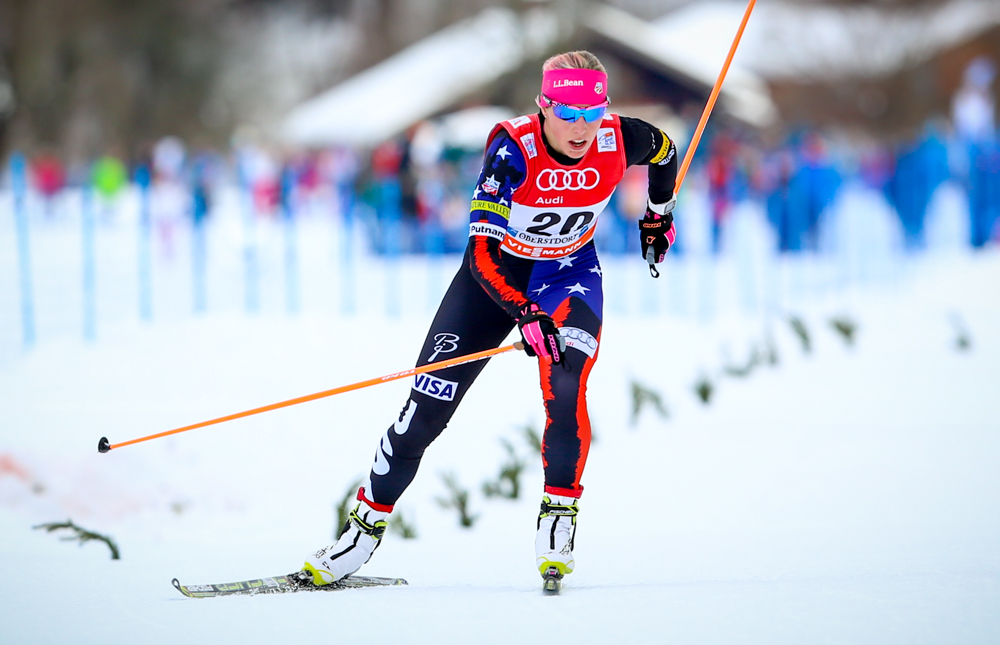
Kikkan Randall skating to 22nd in the 2015 Tour de Ski prologue in Oberstdorf, Germany. (Photo: Marcel Hilger)
The 2016 edition of the FIS Calendar Conference took place in Varna, Bulgaria from June 2 to 6. At the conference, Kikkan Randall performed her duties as the Athletes’ Committee Chair and FIS Athlete Representative on the Cross Country Committee. Tackling issues from yellow card procedure to National Team inequality, Randall helped present athletes’ concerns and shape FIS policy throughout the five-day conference. After a two year term as the Athletes’ Committee Chair, Randall was reelected and will serve alongside Norway’s Pål Golberg in the next term.
FasterSkier talked with Randall about her recent trip, the new procedures, and the issues that are most important to World Cup athletes in the coming season. This interview was condensed and edited for clarity
FasterSkier: How was your time in Bulgaria?
Kikkan Randall: It was really funny for me because I had just left the training camp with the National Team in Park City. I was just in a really good training rhythm and then I flew halfway across the world and was on the beach for three days. It was a bit of a shift but I feel like it was really productive.
I did an athletes’ survey before we came so I had a clear idea of what some of the key issues would be from the athletes’ side, and some of the big topics on the agenda. I made sure I had a good presentation from the athletes. I was able to give that presentation and a lot of those points were integrated into the discussion and it felt like a lot of those points were really considered. Ultimately the decisions that were made were really good for the sport and things that the athletes will support.
It was fun to come together with all of the ski family and not only talk about how to make the sport better in the coming season, but make sure that our sport stays strong over the next five to ten years.
FS: What were some questions you asked your fellow competitors in the survey and what were their responses?
Varna, Bulgaria was the site of the 2015 FIS Calendar Conference. (Photo: FIS)
KR: One big topic this year was the prevalence of double-poling and the fact that the guys were double-poling a distance race for the first time. [There was] also the problem of technique infractions in classic sprints. I asked a few questions and wanted to see if this was something that athletes thought was a normal evolution of sport or was this something that needed to be corrected. I think that athletes felt like this was the evolution of the sport but that we should make sure we have rules in place and make sure that the race is made as fair as possible.
We talked about a few different ways to deal with technique infractions. In the past the jury the would give a yellow card, which is like a written warning, but they would have to call an athlete in, do a hearing, explain what happened, and possibly use video evidence. When you’re talking about a sprint day where things are moving really fast, that just clogs up the system. We felt comfortable with a new rule for the jury to issue a yellow card without a hearing as long as there is more than one jury member concurring. I think that’s going to be good because once you have a yellow card, if you then have another technique infraction it’s an automatic disqualification.
[The rules] are just trying to ensure that the athletes understand that technique fractions are serious. We also worked on some rules to make sure that classic technique is more defined.
FS: Were there any other topics?
KR: Another thing that came up had to do with tours and the number of bonus seconds awarded for sprint competitions. [FIS] was toying with the idea of reducing the sprint bonus to 30 seconds per sprint, but I explained that going through four rounds of a sprint is quite taxing and the athletes should get credit for all their work. In the scheme of the overall tour sprinters may have the advantage on sprint day and a distance skier may have the advantage on a distance day, and you really have to try and keep that as equal as possible. That feedback was received and they decided to keep the 60-second bonus. I think the athletes will be happy about that.
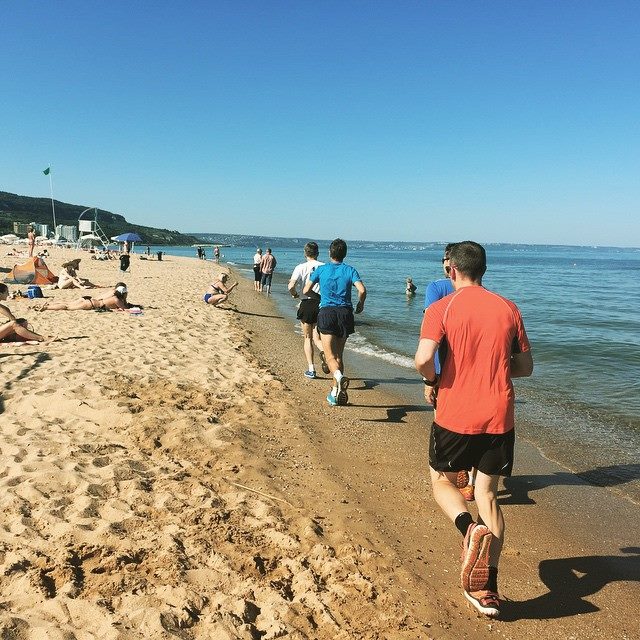
It wasn’t all work for Kikkan Randall at the 2015 Calendar Conference in Varna, Bulgaria. She and members from the cross country committee took advantage of good weather to run on the beach. (Photo: Kikkan Randall/Facebook)
And then we talked about course conditions, and what to do when the course is soft. Should they always try to make hard conditions? or is it just the nature of the sport? The athletes felt like organizers have to do as much as possible to keep the course in shape and keep the conditions as firm as possible. That played into some decisions surrounding course access from the team side and the use of salting.
That also factored into our discussion on the new interval start procedure. That’s going to have the top-15 seeded athletes a little bit higher up in the starting order, and give the coaches a chance to actually select which spots in the seed group their athletes will start.
FS: What was the consensus on last year’s new sprint heat selection procedure trial?
KR: That was probably the third major point on the athletes’ survey. We expected that there would be a more negative response to it. As an athlete I can appreciate that a sprint day is already long and complicated enough and now you throw in the tactic of ‘what sprint heat do I pick?’ and it eats into recovery time.
“We recognize that the current trend we’re on is dangerous for the sport. We have to get creative and help some of the smaller and medium sized nations catch up in terms of the ‘arms race.’ When you have all these talented athletes who are training so hard it can come down to some of these smaller things.” – Kikkan Randall on income and resource inequality between national teams.
Actually the athletes were about 50-50. When we discussed that in the World Cup committee, since there wasn’t an overwhelming negative reaction, it was decided that we would continue to test this procedure to test over the whole of next season so we can continue to test whether it is a good thing or bad thing. At the end of next spring we’ll evaluate after a full season of testing.
FS: Was there an issue you hoped to tackle that didn’t get discussed?
KR: I felt like all the major points that I saw from talking to athletes and from the surveys were definitely addressed. One of the big topics that we talked about that we didn’t come up with a resolution for was the fact that there seems to be an income and resource inequality amongst the teams. It is really unhealthy for the sport long term. If it continues with just a few teams at the top our sport could be in jeopardy in a few years.
We talked about strategies for us to equalize resources a little bit and maybe share some of the income in the sport. There was one proposal that changed the distribution of the red group pay list that would take a few places from the biggest teams like Norway and give the chance to have some of the smaller nation’s athletes travel paid for, which in turn frees up the money for more wax support.
We recognize that the current trend we’re on is dangerous for the sport. We have to get creative and help some of the smaller and medium sized nations catch up in terms of the ‘arms race.’ When you have all these talented athletes who are training so hard it can come down to some of these smaller things.
Everyone was tasked to be creative over the summer and there are some working groups. Hopefully we’ll see some more progress on that in the fall and come up with some solutions that can get some more nations back on the podium.
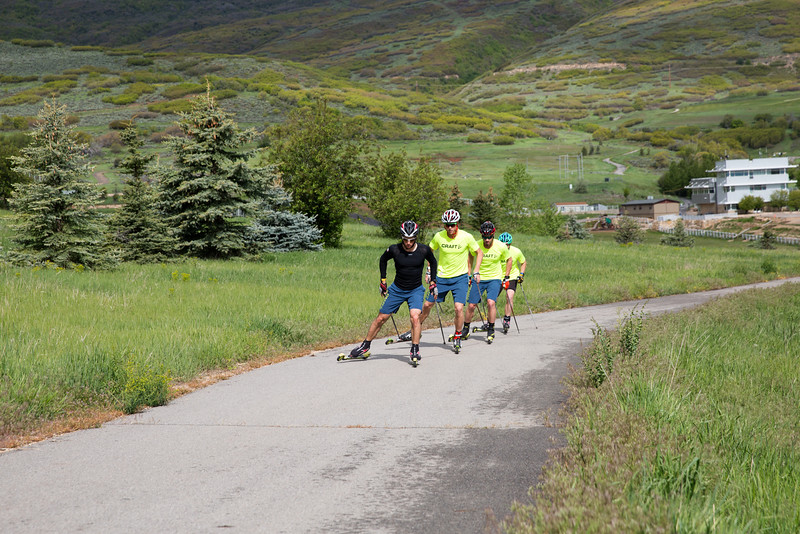
The USST women rollerski at Soldier Hollow in Midway, Utah as part of the 2015 U.S. Cross Country Ski Team Spring Camp (Photo: USSA/Sarah Brunson)
Fresh off their first training camp in Park City, Utah, the U.S. Ski Team is taking a new approach to summer camps in the 2015 season. Due to a need for more on-snow training, increased funding from outside sources, and the fact that the upcoming racing season does not feature a major championships, the Americans are trying out a new camp schedule that includes a lot of travel. Increasing their the number of training camps from four to five, the team’s most notable travels will include trips to New Zealand and Norway.
Return to New Zealand
The USST is no stranger to New Zealand training camps. With the exception of 2014 the team has taken part in some form of organized camp at the Snow Farm in Wanaka for many years. For several years prior to 2014, the American trip to New Zealand was solely a men’s camp, while the women’s camp was held at Eagle Glacier in Alaska. For the first time in 2014, both the men’s and women’s on-snow camps were at Eagle Glacier, with Noah Hoffman being the lone USST member to travel to the Southern Hemisphere.
Upcoming USST Camp Schedule:
New Zealand: July 7 – 24
Junior Camp in Norway: August 2 – 15
Norway: August 9 – 24
Lake Placid: September 13 – 20
Park City: October 12 – 28
While the 2014 Eagle Glacier camp was lauded as a success, the team had limited time at the venue and was forced to log many hours of skiing each day to make the camp worthwhile. Although New Zealand has challenges of its own, namely the many hours of travel it takes to get there, it allows for more on-snow time over the course of two weeks. Because the team missed its typical spring skiing in Bend, Ore. this year, coaches decided their skiers needed more midsummer snow time than usual.
“We really felt like that it was critical for us to get a little bit longer on-snow opportunity than we had in the past few years for a lot of these guys simply because we missed Bend and the on-snow time we would have logged at Mt. Bachelor,” USST Head Coach Chris Grover said of the choice to return to the Southern Hemisphere. “We chose to go to New Zealand instead to get a little more skiing over a longer period of time, which is more viable down there.”
Both the A- and B-teams will travel to New Zealand July 7 and remain until the 24. The Alaskan members of the team (Kikkan Randall, Rosie Brennan, Sadie Bjornsen, and Erik Bjornsen) will not partake in the camp will take advantage of skiing on Eagle Glacier two to three times throughout the summer.
Measuring Up in Norway
The biggest change to the USST summer schedule is the addition of a two-week camp in Norway taking place in mid-August. According to Grover, the camp is something coaches and athletes have talked about for many years. With no championship races in 2016, the USST decided to explore the benefits of a camp in Europe.
The team will have an acclimatization period in Aure for eight to nine days where they hope to train with several local skiers or other European national teams. According to Grover, the USST reached out the Norwegian National Team but due to schedule conflicts the two teams will have no official training sessions together. The U.S. skiers will attempt to train with several individuals on the National Team who live in the area, however.
After the acclimatization period, the USST will participate in the annual Toppidrettsveka rollerski races that take place between Aure, Kynken, and Trondheim from August 20 to 22. The set of three races, which are often attended by the best Norwegians including Marit Bjørgen, Therese Johaug, and Petter Northug, were a major motivation for the Americans to have a training camp in Europe. According to Grover, they will allow the attendees to measure up against the competition at a crucial time in the training season. Furthermore, all three days of racing will feature classic rollerskiing – a technique the U.S. is looking to improve upon in 2015/2016.
“We have a pretty big goal with a lot of the athletes to improve classic technique in particular, especially on the women’s side,” Grover said. “This is an opportunity for us to go and measure our classic technique against the best skiers in the world so people can measure where their double pole is right now, where there striding is, etcetera.”
Marit Bjørgen celebrates her win int he 2013 edition of Toppidrettsveka (Photo: Toppidrettsveka.no)
August 20 – Aure: Uphill running race and classic sprint
August 21 – Knyken: 15 k skiathlon
August 22 – Trondheim: 15 k classic pursuit
Given the American successes in recent years, organizers were eager to have the team compete in the series of races. According to Grover, the trip was made financially viable due to organizers providing lodging, food, and transportation for at least part of the camp.
The final list of participants for the camp is still being confirmed, but several athletes are excited at the prospect of training and racing in Norway. Kikkan Randall, three-time sprint World Cup winner, said she believes the camp is an excellent opportunity for the team.
“Getting in and being able to do some intervals and some racing with World Cup level field really helps me fine tune things and get a good picture of where I’m at,” Randall said. “It increases motivation after a long summer of prep… I think it will be a perfect fit because it’s in August and it will give us a couple months before we go into the race season.”
The remaining USST camps will take place in Lake Placid and Park City. The mid-September camp in Lake Placid will be reduced from two weeks to one week, while the Park City camp will remain at its usual placement in the middle two weeks of October. Both camps will be open to athletes receiving invitations based on National Training or Elite Group status, or other qualifications.
Eldar Rønning speaks to juniors at the 2014 edition of the International Junior Camp. (Photo: Olav Mellingsaeter/FIS)
International Junior Camp in Norway
A- and B-teamers are the only Americans headed to Norway this summer, as a squad of juniors will attend the 2015 International Junior Camp in Norway from August 6 to 14. The camp, which is organized by the Norwegian Ski Federation, will start in Oslo and eventually move to Sjusjøen. The U.S. juniors will arrive prior to the start of the camp to acclimatize and participate in tunnel skiing in Torsby, Sweden starting August 2.
With 120 spots available, the Norwegian Ski Federation invited nations to bring a maximum of 10 athletes and two coaches to the roughly week-long camp. Last year 90 athletes from Germany, Canada, Latvia, Estonia, Slovakia, Iceland, Czech Republic, Slovenia and Norway were in attendance. The 2015 event will mark the first time that American juniors have been selected by the national team to participate in an international training camp of this caliber and size.
The camp will include a high volume of running, rollerskiing, and strength in addition to an uphill running race in Olso and a rollerski sprint race in Sjusjøen.
According to trip-leader and USST Development Coach Bryan Fish the camp will serve several purposes, including the sharing of training philosophies and developments skills. “Most important, is the opportunity to for hands-on learning through physical training with one another,” Fish wrote in an email.
Through a detailed selection process (see below) the USST selected 10 athletes for the event. Nine accepted the nomination and include Katharine Ogden, Julia Kern, Hannah Halvorsen, Hailey Swirbul, Alayna Sonnesyn, Zak Ketterson, Max Donaldson, Lars Hannah, and Karsten Hokanson.
Prioritized International Junior Camp Selection Criteria:
One top 20 women’s / one top 30 men’s result at the 2015 Junior World Ski Championships
One top 15 women’s / one top 20 men’s result at an overall Scandinavian Cup or OPA Cup that has been scored to the USSA National Ranking List (NRL)
One top 10 women’s / one top 15 men’s result in the Junior division at a Scandinavian Cup or OPA Cup that has been scored to the USSA National Ranking List (NRL)
One top 10 women’s / one top 15 men’s result at the Under-18 Nation’s Cup competition (formerly known as J1 Scando Cup Trip)
Qualify for Junior World Ski Championships
Highest ranking on the USSA overall National Ranking List (athletes born on or between 1996, 1997 or 1998)
International Junior Camp Athletes Accepting Nomination:
Women:
Katharine Ogden
Julia Kern
Hannah Halvorsen
Hailey Swirbul
Alayna Sonnesyn
Men:
Zak Ketterson
Max Donaldson
Lars Hannah
Karsten Hokanson
The USST is attending its first International Junior Camp in 2015 because of unique circumstances that allowed for participation. According to Fish, one of the biggest reasons is funding. The National Nordic Foundation (NNF) will aid in the cost of the trip, so that athletes’ and coaches’ expenses are minimal.
A second reason is the increased desire to continue development for young U.S. athletes. Fish wrote that the U.S. will continue to support its domestic programs for up-and-coming athletes, but that more international exposure will aid in future development.
“It is cliché but true that cross country skiers are made in the summer, however there is no better way to learn what and how the best juniors from around the world are training than to join them in a place where the vast majority of the world’s best juniors are at,” he wrote.
“I believe every camp has information each athlete can take home,” Fish continued. “I hope we all come into this camp with open-minds, respective to new ideas. The goal is for each and every one of us to come home with at least a few ideas or strategy (big or small) that can augment and improve personal training and performance.”
This week’s workout features neurological mapping with Ben Lustgarten of the Sun Valley Ski Education Foundation Gold Team. (Photo: Austin Cobb)
For this week’s edition of Wednesday Workout, FasterSkier sat down with Ben Lustgarten to discuss a new part of his training regimen that aims to improve a crucial yet less focused on system of the body, the neurological system.
***
After yet another season plagued with injury, Ben Lustgarten began to search for answers regarding his physical health issues. In the 2014/2015 season a heal injury prevented the first-year professional athlete from training and racing during a significant part of the season. The Sun Valley Ski Education Foundation (SVSEF) Gold Team athlete turned his frustration into a search for a solution, and began a regimen that included neurological mapping to help keep his body healthy.
“The only reason I started doing this is because I have been so injured. I’ve really been looking for a solution… PT has been good, stretching has been good, but…I [wanted] to get to the source,” Lustgarten said in an interview.
While injury prevention is what led Lustgarten to focus more on his brain and its connection to the body, neurological mapping has many other benefits ranging from increased balance to quicker reflexes to more efficient use of energy.
The neurological component is something Lustgarten said he feels has been missing. “What has been lacking in my physical education has been… using your brain, because everything is in the brain, pain perception, endurance, feel of strength, vision, the environment,” he said. “We never really train our eyes, we don’t train our brain, we don’t train mapping. We just assume that if we run a lot, our body and our ankles are our feet are going to map properly.”
What exactly is neurological mapping? Lustgarten’s response covered the basics: “Your brain has a map of all of your muscles and their range of motion. So let’s say you hold out your arm and you want to move your index finger in a figure eight. If you can do that, your brain has mapped that movement… If you do that with all your fingers, some fingers are going to move really erratically; they’re going to jump from position to position. That means they are not properly mapped.”
Essentially, while the body can anatomically move in certain ways, the brain is what controls the movement. Whether it is moving a finger in a figure eight or correcting balance after tripping over a pole in a mass start, the brain is in control. If the brain is able to more accurately control these movements, then the body can be more efficient and ultimately more effective.
By properly mapping movements in many of his joints and muscles, Lustgarten hopes injuries will be less common and that his body will be maximally efficient.
“All the little muscles in my ankles, as I map my ankle movement, those muscles will increase their muscle memory with the specific positions and then give me a little bit more efficiency,” Lustgarten said, giving and example of mapping he’s done with his ankle.
The 45 degree single knee circle starting position. Lustgarten rotates his right knee in a slow, smooth circle (Photo: Austin Cobb)
Right ankle roll fully extended ankle position. (Photo: Austin Cobb)
Right ankle roll left position. (Photo: Austin Cobb)
Right ankle roll top position. The goal is to seamlessly move between each of these positions as your foot goes around in a circle. (Photo: Austin Cobb)
According to the Sun Valley skier, mapping should also improve joint mobility. “[It] has been proven to [lead to] less injuries, faster muscle recovery, efficient movement, less muscles fatigue, and better awareness of the body” he said.
Another large aspect of Lustgarten’s mapping exercises involve vision, as receiving input from surroundings is the first step in being able to effectively react. According to Lustgarten, skiers must be “in tune with [their] environment and have to always know what’s coming up, and [be able to] react to those things.”
“On a ski trail you have to know where your body is and how its reacting to the environment… So as you see the environment and see the trail, that information is going into your eyes and then you analyze that in your brain… Then, because of whatever patterns we have generated in our brain, we know how to move our muscles to react to that environment. So if there is something a little off with your eyes and you see something a little late or not quite accurately, then you are going to move your body in a way that is not as efficient,” he added.
In short, in order for the brain and body to effectively respond to your environment, the eyes must be able to quickly and accurately see the environment. The efficient joint and muscle movements will not mean much if the movements react incorrectly to the environment.
The results are already showing for Lustgarten. He is already able to move his eyes much faster while interpreting his environment just as effectively. Since starting these vision and joint and muscle mapping exercises, he has already noticed differences. “I’ve noticed it in training, like I’m on skate roller skis and I feel about as good as I did at my best last winter,” he said. “I’ve been training for three weeks now and I’m not injured which is a huge record for me…I feel good. My training has been good. I’m excited to see how this works.”
The Workout:
There are two parts, ‘rehabilitation and maintenance’ and ‘performance.’ The rehab and maintenance portion is designed specifically for correcting poor neurological mappings of joint movements, eye movement and focus. This section can vary from person to person, based on which exercises a given person struggles with. The performance portion, on the other hand, is a “longer nightly routine that is supposed to increase perception and function” of the targeted area, whether it be eyesight or a joint. The following workout is only an example, but Lustgarten recommends seeing a specialist to get the individual attention needed for these workouts to be as effective as possible.
Rehabilitation and Maintenance:
This portion of the workout is performed four times a day, with four reps of the daily exercise or exercises. It takes around five minutes each time.
Body Example:
T-Spine: This exercise works on mapping spine motion. To perform this exercise keep your shoulders in line and square them, while slowly and smoothly moving your chest up and down. To make it easier perform this exercise while sitting so you can hold your legs. This helps keep your shoulders square and still so you can focus on spine movement.
Ben Lustgarten performing saccades using the near-far chart arrangement. (Photo: Austin Cobb)
Visual Examples:
VOR (Vestibulo Ocular Reflex): To perform this exercise begin by focusing your eyes on a fixed point. Then close your eyes, move your head in a direction, and open your eyes again. The goal is to keep the eyes focused on the fixed point. The various head endpoints are left, right, up, down, up-left, up-right, down-left, and down-right. Perform this exercise as quickly as possible while maintaining the focus point. For an extra challenge, try balancing on one leg.
Saccades:
First, make two charts with random letters printed vertically from top to bottom. These can be arranged in many ways with a few feet between the charts. Some arrangement examples are side-by-side, upper-left and lower-right, upper-right and lower-left, and one near, one far. The exercise is to keep the head still and move the eyes from one chart to another while stating the each letter in the sequence. The goal over time is to increase speed so the eyes move and focus more quickly.
Performance:
This aspect of the workout is performed once a day, between 10 and 25 minutes. It can be anything from joint mobility to saccades. The performance portion is essentially a more focused and lengthy version of a given rehabilitation and maintenance exercise. We will use the knee joints for an example.
Knee circles:
These focus on joint mobility and neurological mapping of the knees and their movement. Perform each position four times clockwise and four times counterclockwise.
To begin, use both knees at the same time. Stand with the feet wide enough so there is a tennis ball length gap between the knees. Bend the knees slightly and move them in a smooth circle. While doing this it is very important to move the ankles, hips, and other joints as little as possible.
The second portion of this exercise focuses on one knee at a time. Start in a shallow lunge and move one knee in a smooth circle. Do this with each leg at 0 degrees, 45 degrees, 90 degrees, and 135 degrees. So after starting in a lunge, move the front leg around the other leg in a half circle pattern. Then repeat with opposite leg.
This joint circle exercise can be done with any joint from ankles to wrists to hips. It is imperative to focus on proper technique, isolating the movement to the focus joint and making the circles as smooth as possible. Also make sure there is a full range of motion in the joint with no jerks or jumps. This is to ensure that the brain properly maps the movements. Once a smooth circle is achieved, faster movements can be attempted.
Soldier Hollow in Midway, Utah serves as the cross country venue in the recently submitted bid for the 2017 Junior/U23 World Championships by USSA. With no competing bids, there is a high chance the Championships will come to the U.S. for the first time in its modern form. In this photo, Torin Koos (BSF) out-lunges Ben Saxton (SMST2) for the win of the 1.5 k freestyle sprint at the 2014 U.S. Cross Country Championships at Soldier Hollow. (Photo: Tom Scrimgeour)
UPDATE: According to the International Ski Federation, Utah will officially host the 2017 FIS Nordic Junior/U23 World Ski Championships. See the pre-decison article from June 5 (below) to learn how the U.S. entered a bid after last hosting in 1986, and what the Championships will look like.
If everything goes according to plan the world’s best junior and U23 nordic skiers will descend upon Park City, Utah in the winter of 2017. The United States Ski and Snowboard Association announced Tuesday that organizing body submitted a bid for the 2017 Nordic Junior/U23 World Championships at this year’s International Ski Federation (FIS) Calendar Conference, which began June 3 and will continue until June 8. With no other bids, all that stands between the U.S. and the Championships is a stamp of approval from FIS.
The last time the U.S. hosted a Nordic Junior World Championships was in 1986 at Lake Placid, N.Y. At the time, however, the event only consisted of ski jumping and nordic combined and did not include officially recognized cross country skiing races (although there were cross country races that were coordinated with the event), as is standard in Junior/U23 World Championships since 1991. The U.S. has also hosted the 2004 Cross Country Intercontinental U23 Championships at Soldier Hollow, but the U23 World Championships were not created until 2006, when they were hosted in conjunction with the Junior World Championships in Kranj, Slovenia.
According to USSA Vice President of Events and IT Calum Clark, there’s a high chance the U.S. will host its first modern Junior/U23 World Championships in 2017. He explained the U.S. bid was the sole entry for the event, and that all that was left for USSA to gain hosting rights was the official go-ahead from FIS.
“We met with the FIS leadership this afternoon any they were excited for [the Championships] to come back to America,” Clark said from the 2015 FIS Congress in Belgium Thursday. He explained that the only thing left was “a simple rubber stamp from the council.”
If the U.S. is selected by FIS, the event will be held between the cross country courses at Soldier Hollow in Midway and the jumping complex at the Utah Olympic Park, in Park City.
An American-hosted Championships has been a dream of U.S. Nordic Combined Coach Greg Poirier for many years, but it wasn’t until 2014 that he decided to jumpstart the project. “It was kind of my idea to bring these Championships to the U.S. I had been thinking about it for years and finally last year I decided to stop thinking about it and get something going,” Poirier said in a phone interview.
He approached the cross country and nordic combined committees at the 2014 USSA congress and was encouraged to further explore a U.S. proposal. Poirier put together an ad hoc bid committee consisting of officials from Soldier Hollow and Utah Olympic Park, which then presented a proposal to the leadership of USSA, including President and CEO Tiger Shaw, in the fall of 2014. Once USSA was comfortable with the presented budget, it sent a written intent to host the Championships to FIS before the December 31 deadline.
A view of Soldier Hollow’s stadium from the highest point of the 5 k olympic course.
According to Clark, USSA supported the proposal due to thorough planning and feasibility. “So often with these World Championships, the excitement can overwhelm the practicality and you get this aftermath of realizing that this is going to be a whole lot of work that you’re not prepared for,” he explained. “In this case we had such a tremendous group of people with great experience on both sides of the nordic skiing jumping and cross country.”
Clark said that the financial model of the Championships was within the means of USSA due to various groups who provided “semi-guarantees of strong financial support.”
According to the Vice President, the most important factor of the bid was the athletic opportunity it provided to U.S. athletes. Over the years USSA has been exploring the possibility of bringing other high-profile international competitions stateside to further such opportunity, exampled by last year’s discussions of a cross country World Cup in New York City. Clark said that in the end, however, a Junior/U23 World Championships made more sense.
“We went through the process of exploring an urban cross country World Cup and [the nordic leadership] came back to us and said, ‘no, if you’re doing anything Junior Worlds is what we’d like to have.’”
If USSA receives the pending bid for the 2017 Championships there will be several focus areas that organizers will need to tackle. It will start with the creation of a new organizing committee, consisting of technical delegates from cross country, nordic combined and jumping. Once the committee is created they will work to build a plan regarding marketing, television or live streaming, transportation, and accommodation. Poirier hopes to create an athlete village in Midway, Utah — possibly at the Zermatt Resort — where all competitors, coaches, and staff will stay during the event.
Organizers will also look into updating Soldier Hollow, the cross country and biathlon venue for the 2002 Olympic Games, to meet the Championships’ needs. Poirier said that a future organizing committee would explore using the original cross country stadium at the venue in addition to creating more challenging courses that feature increased climbing. According to the nordic combined coach, any changes in courses or stadium placement would use existing trails and facilities.
“It’s already a great center,” Poirier said of Soldier Hollow. “We created this bid with the intent that we wouldn’t have to create a whole lot of dollars for infrastructure improvements. If we can get some and there’s a need then it would be a great opportunity for both the Olympic Park and Soldier Hollow. But if we can’t, we’re confident that we can move forward with the facilities the way they are now.”
Although the 2014 Nordic Combined Olympic Trials featured the cross country portion of the event at the Utah Olympic Park, Poirier said that it made more sense for the cross country portion of the Championships’ nordic combined events to take place at Soldier Hollow because the venue was already in use by the other cross country races and due to its proximity to the athlete village in Midway.
Those anxiously awaiting official confirmation of the bid will have to wait until Monday June 8, the last day of the the 2015 FIS Calendar Conference.
In the meantime, the high likelihood that the U.S. bid will be approved is giving many in the nordic community a sense of excitement. “It gives me goosebumps to think about it and I have butterflies in my stomach,” Poirier said.
“What I’m most psyched about is those kids that are in our pipeline who are going to be able to compete on our home turf,” he added. “Hopefully they are really going to shine and that will really be the impetus and catalyst for the spark that gives those young boys and girls motivation. That’s going to be the real gem, the real benefit to these games.”
With just days before official confirmation, USSA officials, Poirier and other organizers aren’t about to relax.
The USST celebrates a workout at the Center of excellence in Park City, Utah as part of the team’s spring training camp. (Photo: USSA/Sarah Brunson)
When you train in the same spot for nearly decade, a change in scenery can be an adjustment. Such was the case for the U.S. Ski Team when it was forced to abandon the annual spring training camp in Bend and Mt. Bachelor, Ore., and instead prepare for the upcoming year in Park City, Utah. Despite an unusual amount of rain in the Wasatch Mountains, the National Team’s skiers and coaches took well to the familiar Utah terrain.
USST staff was in communication with Mt. Bachelor Ski Resort in early spring and the word from the slopes wasn’t promising. Organizers reported roughly 20 percent of average snowpack at the time, and the resort eventually made the call to suspend grooming for the late spring months. Although the decision left the USST without a location for on-snow training, it appears Mt. Bahelor made the right call, as its trails were bare come May.
With spring skiing out of the picture, the USST coaches switched the May camp to Park City due to the vast resources available in the area between the Center of Excellence and rollerski trails at Soldier Hollow.
Noah Hoffman leads Erik Bjornsen and Simi Hamilton while rollerskiing at Soldier Hollow in Midway, Utah as part of the 2015 U.S. Cross Country Ski Team Spring Camp (Photo: USSA/Sarah Brunson)
“As disappointing as it was to not be in Mt. Bachelor and Bend, we have the Center of Excellence in Park City so that gives the chance to utilize the full staff there, in terms of sports medicine and sports science team,” USST Ski Team Head Coach Chris Grover explained in a phone interview.
Much like previous Bend/Mt. Bachelor spring camps, the 2015 USST gathering focused on the technical aspects of each skier. Through technique work on rollerskis, strength in the gym, VO2 max testing, and general goal-planning, the camp’s purpose was to create a solid platform for athletes to use as they jump into the training season.
Each athlete received physicals from the two main cross country doctors in addition to specialized attention from the sport science and strength departments at the Center of Excellence. Skiers were given individualized programs after the results of body functioning screenings, blood work, body composition tests, and sessions with on-site nutritionists
While there were no reports of major injuries from Utah (such as Sophie Caldwell’s broken elbow from last year’s spring camp), several athletes worked to correct areas of physical weaknesses. “Obviously there are small problems – an achilles here or lower back pain there – so there are chronic issues that everyone is dealing with,” Grover explained. “We use this camp to come up with individual strength, mobility and flexibility programs for each athlete based on what their needs are.”
When it came to actual workouts, the team was forced to abandon traditional Bend programs and adjust to the Utah landscape. Skiers logged many hours in the gym, which Grover said worked in their favor due to frequency of rain. Other workouts included double pole rollerskiing intervals on a gradual incline, threshold bounding and ski walking at the Canyons Resort, and modified rollerski speeds that the team normally does at the October in Park City. While a day of mountain biking was on the schedule, the persistent rains prevented the team from finding dry trails.
Grover said one of the most notable workouts from the camp was a threshold and aerobic capacity skate rollerski time trial. Athletes began by individually skiing a timed 5 k loop at threshold. They would then recover before attacking the same loop at level 4 or race pace. According to the USST coach, the goal of the workout was to help athletes differentiate between threshold and race paces. If an athlete’s times were similar or only separated by a couple seconds, it meant their threshold pace was too fast.
The spring camp also allowed for some post-training fun. Between homemade dinners and bonding sessions the A- and B-team members appeared to make the most of their first meeting of the year. After the camp several athletes went skydiving, as documented by Jessie Diggins’ Instagram video below.
A video posted by Jessie Diggins (@jessiediggins) on
According to Grover the camp’s participants will enter a period of recovery before the bulk of their summer training begins. Most athletes will continue to build a base with level 1 aerobic efficiency and ample time in the gym. As they progress throughout the summer they will continue to introduce more threshold workouts in addition to speed.
The USST A- and B-teams’ next training camp will take place in New Zealand from July 7 to 24. The trip marks a return to the Snow Farm after the team scrapped their annual trip last year in favor of a camp on Eagle Glacier in Alaska. The Alaskan skiers on the National Team will not travel to New Zealand, and will instead take advantage of on-snow skiing at Eagle Glacier.
The USST women rollerski at Soldier Hollow in Midway, Utah as part of the 2015 U.S. Cross Country Ski Team Spring Camp (Photo: USSA/Sarah Brunson)
The USST women rollerski at Soldier Hollow in Midway, Utah as part of the 2015 U.S. Cross Country Ski Team Spring Camp (Photo: USSA/Sarah Brunson)
Simi Hamilton discusses a workout with USST coach Jason Cork at Soldier Hollow in Midway, Utah as part of the 2015 U.S. Cross Country Ski Team Spring Camp (Photo: USSA/Sarah Brunson)
Noah Hoffman leads Erik Bjornsen and Simi Hamilton while rollerskiing at Soldier Hollow in Midway, Utah as part of the 2015 U.S. Cross Country Ski Team Spring Camp (Photo: USSA/Sarah Brunson)
Noah Hoffman leads Erik Bjornsen and Simi Hamilton while rollerskiing at Soldier Hollow in Midway, Utah as part of the 2015 U.S. Cross Country Ski Team Spring Camp (Photo: USSA/Sarah Brunson)
Andy Newell rollerskis at Soldier Hollow in Midway, Utah as part of the 2015 U.S. Cross Country Ski Team Spring Camp (Photo: USSA/Sarah Brunson)
The USST A- and B-teams warm up at the Center of excellence in Park City, Utah. (Photo: USSA/Sarah Brunson)
Andy Newell at the Center of excellence in Park City, Utah. (Photo: USSA/Sarah Brunson)
Liz Stephen at the Center of excellence in Park City, Utah. (Photo: USSA/Sarah Brunson)
Simi Hamilton utilizing the hurdles at the Center of excellence in Park City, Utah. (Photo: USSA/Sarah Brunson)
The USST celebrates a workout at the Center of excellence in Park City, Utah. (Photo: USSA/Sarah Brunson)
Rosie Brennan (APU) leads Caitlin Gregg (Team Gregg/Madshus) at the 2015 U.S. Cross Country Championships in Houghton, Mich. The two skiers will join the USST B-team in the 2015/2016 season.
When the U.S. Ski and Snowboard Association (USSA) announced the nominations for the upcoming season’s National Team earlier this month, four new faces were added to the ranks. Caitlin Gregg (Team Gregg/Madshus) and Rosie Brennan (Alaska Pacific University) were nominated to the B-team, while Katharine Ogden (Stratton Mountain School) and Julia Kern (Cambridge Sports Union) were placed on the D-team.
FasterSkier caught up with each of the new additions to discuss their motivations, feelings, and journeys to their respective nominations. From the 34-year-old Gregg — who has been working to earn a spot on the team for nearly a decade — to Ogden — a 17-year-old who will be a senior in high school next season — the four women mark changes in the USST lineup that will ultimately shape its future.
Caitlin Gregg (Team Gregg/Madshus) skis to a nearly three minute win in the 2015 U.S. Distance Nationals 30 k in Sun Valley, Idaho.
Caitlin Gregg: A long time coming
Gregg was the only new addition to the USST to qualify via objective criteria. After a season which included two national titles and a bronze medal performance in the World Championships 10 k, she ranked 27th on the International Ski Federation (FIS) distance points list — which was within the USST team standards.
The Minneapolis-based skier had kept her eyes on the list throughout the latter part of the season, but it was only after her dominating performance in the 30 k freestyle at U.S. Distance Nationals in Sun Valley, Idaho that she knew there was a good chance of making the team. Even then there were still several international races left in the season for other athletes to bump her out of the qualifying standard.
“We calculated my points after the 30 k at U.S. Nationals, but there was a period of races after that – the marathon in Russia and a few others around the world – where other athletes could have gotten better FIS points and bumped me down,” Gregg said in a phone interview after the nominations were announced.
Once all international races were complete it was only a matter of waiting. Gregg received a call from USSA in April informing her that the nomination was coming – something the 34-year-old had been working towards her entire career.
When it comes to the USST, Gregg has faced challenges regarding her age for a long time. According to a blog post by Gregg’s husband Brian regarding her 2015 World Championships medal, she was told after the 2007 World Championships that she was “too old for the U.S. Ski Team and their pipeline.” Eight years later, however, Gregg is on the team and excited about the season’s prospects.
For Gregg the nomination is a reward for the years of hard work – physically, financially, and otherwise – that she has put into the sport. She explained that due to her late entry into professional skiing, her career has seen delayed trajectory. While the journey to the nomination was challenging, the 34-year-old said it was worthwhile.
Caitlin Gregg (Team Gregg) hugs her husband, Brian, after her large win in the 30 k freestyle mass start at the 2015 SuperTour Finals in Sun Valley, Idaho.
“It’s been a goal for a long, long time. I’ve been battling; a lot of the criteria is centered around age-based results,” Gregg said of her journey to the nomination. “That was always something that was more difficult for me because I came into skiing after college and even after college there wasn’t a whole ton of programming until CXC came around. By the time that all came together I was on that older end of the spectrum already.
“At my age you’re not going to be discretion-ed onto the team but if you make the criteria they’re going to put you on the team. I think that’s really reassuring for anyone out there who’s really questioning if it is worth it to keep going. It’s not going to be easy and nothing will be handed to you, but it’s totally possible.”
Earlier in the 2014/2015 season Gregg wasn’t sure what her future held, and before the successes of the late-season she contemplated retiring. “It’s a tough decision after every year,” she explained.
According to Gregg, both she and Brian have created a sustainable financial model that has taken years to master. That, coupled with her recent successes led them to ask, “why stop now?” Furthermore, Brian plans to continue to ski through the 2018 Olympics, and while it would be possible for Team Gregg to exist as a one-man project, it largely centers around the two of them.
“As much as it would be sweet for me to be his coach or working or supporting him from the side, we really feel like it’s a pretty incredible opportunity for the two of us to keep racing together and keep building that model we have,” she explained.
“I’m really psyched with that decision. I know it’s early in the season, but I think it was the best call so I’m fired up.”
In the upcoming year Gregg will continue to ski as a skate distance specialist, but will look to improve her classic and sprinting skills. In the past, focusing on several key races instead of trying to compete in them all has helped her perform at the highest level. She will employ a similar strategy in the 2015/2016 season.
Fueled by the exciting developments in her career, Gregg began her busy summer schedule earlier this month with a trip to the USST camp in Park City. She will remain there for Rookie Camp, where she said a joking Matt Whitcomb (USST Women’s Coach) told her she would likely be the oldest rookie in history.
“[The nomination is] super exciting and something I’ve been trying to do since I was 18-years-old,” she explained. “To reach the goal a few years after I had hoped is still awesome and an incredible feeling. Both Brian and I are incredibly fired up. We feel like we learned so much in the last couple years and now with the resources and opportunities that are presented to us and available we feel like it’s a great launching pad and we can build on what we’ve already achieved. We’re excited to see what’s possible.”
Rosie Brennan, USST, skis 30th place in the 2015 World Championships 15 k skiathlon. (Photo: flyingpointroad.com)
Rosie Brennan: A return to the team
Of the four women who will join the team in 2015, Brennan is the only one who held a position in the past. The Park City native was nominated in 2007 and remained on the team until she was cut in 2009. Brennan was 18 and a recent high school graduate when she was first nominated to the team. She decided to attend school and race for Dartmouth College, while juggling her spot on the national squad.
“I was quite young and I decided to school anyway,” Brennan said in a phone interview. “I did a few years on the National Team but was pretty much just racing at school with the exception of Junior Worlds and U23s and camps and stuff. After 2009 the coaches decided that wasn’t the direction they wanted the team to go so they dropped all of us who were in school at the time.”
According to Brennan, her removal from the team was difficult because she felt as if the USST coaches had lost faith in her abilities. “At the time I was really bummed and really devastated by it. For whatever reason it’s hard not to feel that the governing body of skiing doesn’t believe in you,” she said.
“It took me a little while to get over that. I was really thankful that I was in school and I had a really good ski team and coaches that supported me and believed in my skiing regardless of what the direction the ski team was headed in. I kept plugging along.”
Although she debated to continue her skiing career after Dartmouth, Brennan ultimately decided to race professionally for APU. She said the “supportive and conducive environment for training” on the team helped her jump back into racing and eventually regain a spot on the team.
Brennan said that her return to the USST feels especially gratifying given her history. “It makes me extra proud to know that I didn’t give up and believed in myself and I made it back to where I know I should be,” she said.
In the upcoming season Brennan said she hopes to continue on the trajectory she started this past year — where she earned 16th in the 30 k and helped the U.S. ski to fourth in the women’s relay, both at World Championships. “I’d like to just continue on what I was doing last year. I finally figured out how the World Cup circuit works and I’d like to continue along those lines and work forward from there,” she said.
Brennan is planning to attend the two USST camps in Park City, but hopes to remain in Alaska for the majority of the training season to continue a program that has worked for her in the past.
From l-r, Julia Kern (CSU), Hailey Swirbul (Aspen Valley), and Katharine Ogden (SMS) cheering on the U.S. U23 team at World Chamionships in Almaty, Kazakhstan (Photo: Julia Kern)
Katharine Ogden and Julia Kern: Young and up to the challenge
Ogden has been one of the most successful junior athletes in the history of U.S. cross country skiing, so when she received a call from Matt Whitcomb over her spring break it seemed routine. It wasn’t, however, as Whitcomb told her she would be nominated for a spot on the USST D-team – a feat she had only dreamt of since she was a very young skier.
“I was kind of shocked because ever since I was little it has been a huge — I don’t know if you can call it a goal when you’re six — but it’s been something I wanted to do for my entire life,” Ogen explained in a phone interview. “It was just crazy, and while it really isn’t the U.S. Ski Team it’s the next step, which is really cool.”
It was a similar experience for fellow D-team member Kern, who received the call right before she was supposed to meet with her CSU teammates.
“I didn’t really know how to respond,” Kern said in a phone interview. “I was about to meet two of my teammates and it was weird because I couldn’t say anything. I was thrilled and honored to be nominated. It also kind of felt relieving in a way because it is a dream come true.”
The skiers, both 17 years old, will be the youngest members of the team. Kern will graduate from high school this year, while Ogden still has one year left at Stratton. Both had a momentous year on the international circuit, with Ogden claiming sixth in the skiathlon at Junior Worlds and Kern taking third in a mid-season Slavic Cup.
Kern said she is excited about her spot on the team because of the new opportunities that will be at her disposal. “It will offer more support and access to resources which is definitely a big key,” she said. “It’s just a great motivator.”
After Kern graduates this spring, she will make the transition from CSU to take a post-graduate year at Stratton, where she will train with Ogden and utilize the ski-oriented environment at the small Vermont school.
Katharine Ogden (10) on her way to a sixth-place finish in the women’s 10 k skiathlon at the Junior World Championships in Almaty, Kazakhstan (Photo: Bryan Fish/USSA)
“This last year I was thinking about taking the year off and skiing, and since the year went well I wanted to see what skiing full time is like,” Kern said. “With the Stratton option I’ll have one of the best coaches I know, Sverre Caldwell, and also Pat O’brien. I’ll also still be able to stay in contact with Rob, my high school coach. The training group is so competitive with such a great group of girls and guys. I’m so close with Katharine and our strengths are opposite so we’ll have a lot to gain from each other.”
Ogden echoed Kern’s statements, adding that another top female junior skier, Lauren Jortberg from Boulder, Colo., would be joining the ranks at Stratton. “I’m so excited to have everyone coming. The more fast people around the better everyone gets, but also I’m just really close friends with Julia and Lauren and I’m really excited to spend more time with them and I think they’re going to be a great addition to our team.”
Both Kern and Ogden will travel to Park City for the upcoming rookie camp, where they will learn about the inner workings of the USST. From there, the two are looking forward to a season where they can call some of the best skiers in the world their teammates.
“It’s pretty incredible and motivating to be able to consider the U.S. Ski Team A and B team women my teammates because they are so incredibly strong,” Ogden said. “They’re some of the best in the world and that’s incredibly motivating.”
Several members of the U.S. Ski Team lift up Kikkan Randall after she won her third-straight World Cup sprint Crystal Globe a the end of the 2013/2014 season. Randall enters the upcoming season with another A-team nomination after a year of possible over-training. (Photo: Fischer/Nordic Focus)
The U.S. Ski and Snowboard Association (USSA) announced its cross-country team nominations for the 2015/2016 season on Thursday, naming 16 athletes to the team, four more than the previous year.
All 12 athletes from 2014/2015 will return, led by Liz Stephen (Burke Mountain Academy) who finished 10th overall in the season’s World Cup standings. Other A-team athletes include 2015 World Championships silver medalist Jessie Diggins of the Stratton Mountain School T2 Team (SMST2), three-time World Cup sprint champion Kikkan Randall of Alaska Pacific University (APU), Sadie Bjornsen (APU), Sophie Caldwell (SMST2), Ida Sargent (Craftsbury Green Racing Project), Andy Newell (SMST2), and Simi Hamilton (SMST2).
The B-team will feature returning athletes Noah Hoffman (Ski and Snowboard Club Vail) and Erik Bjornsen (APU).
Rosie Brennan (APU) and Caitlin Gregg (Team Gregg) are two new additions to the B-team after breakthrough seasons. Like Diggins, Gregg earned a historic medal in the 10 k freestyle at World Championships in Falun, Sweden, placing third after Diggins. Brennan broke into the top 20 on both the World Cup circuit and at World Championships, most notably in the 30 k in Falun where she placed 16th. Brennan returns to the USST after being a member of the team in 2007/2008 and 2008/2009.
The D-team will also grow in the 2015/2016 season with the addition of two women, Katharine Ogden (SMS) and Julia Kern (Cambridge Sports Union). They were named along with returning D-team athletes, Ben Saxton (SMST2) and Patrick Caldwell (SMST2/Dartmouth).
Andy Newell is one of two men on the USST A-team in the 2015/2016 season. Here the SMST2 skier is racing in the 15 k classic individual start at the 2015 Super Tour Finals in Sun Valley, Idaho.
There are objective requirements to earn an automatic nomination to the U.S. Ski Team (USST). An athlete must either be in the top 50 in the overall World Cup rankings or have a top-30 ranking in the distance or sprint disciplines. A skier can also be ranked in the top 30 of the FIS points list in distance or sprint list to earn the nomination. A final qualifying criteria is a top-three finish at either the Junior or U23 World Championships.
Nine athletes automatically qualified for the team: the eight A-team athletes, who all met the World Cup ranking criteria, and Gregg, who was 27th in the International Ski Federation (FIS) distance points list. The remaining seven skiers were all chosen by discretion.
Although Gregg made the objective criteria, she was not ranked in the World Cup’s Red Group and thus was placed on the B-team.
As in past years, USSA will cover the majority of the eight A-team athletes’ expenses. According to USST Head Coach Chris Grover, there are several instances when A-team members will have to cover their own costs, such as the training period over Christmas when the team prepares for the Tour de Ski.
The B-team athletes will receive some support in the form of lodging and meals at certain training camps, such as the upcoming Park City training camp occurring later this month. However, during the actual season, B-team athletes receive no support from USSA in terms of travel and lodging.
D-team athletes are expected to pay for everything they do throughout the season, but receive the support of the national-team infrastructure, such as coaching, when necessary.
According to Grover, the National Nordic Foundation (NNF) has financially aided both B- and D-team athletes at training camps and during the competition season in the past.
Liz Stephen racing to 11th in the 15 k skiathlon at the 2015 World Championships in Falun, Sweden. Stephen will headline 12 returning and four new athletes on the 2015/2016 U.S. Ski Team. (Photo: flyingpointroad.com)
Grover: ‘We’re really excited to see what people can do’
After the nominations were announced, Grover said that he was excited to see what the group of 16 skiers could accomplish in the upcoming season. Although there is no major championship event in the 2015/2016 schedule, he believes that the Americans have an opportunity to shine.
“I’m really excited for the season because I felt like we had so much bad luck with our crew last year,” he said on the phone. “We made some mistakes as a nation and as a coaching crew both within the USST coaches and also with the club coaches. We had bad luck in terms of injuries. First of all, I doubt we will have those injuries again and second of all I think we will learn from some over-training issues going forward.”
The most notable injuries of the season came from Sophie Caldwell and Hoffman. Caldwell broke both her elbows in the leadup to the season, which hindered much of her preparation. Hoffman fractured his leg in a November crash — his first World Cup race of the season — which took him out of competition and full training until late February 2015.
In terms of overtraining, Grover pointed to two specific athletes — Newell and Randall — who may have suffered from its effects throughout the season.
With no championship event, the team will have varying focus races between athletes. However, Grover said that the Tour de Ski and the season-ending Canadian World Cup tour are two events that many team members will target. With a “home-time-zone” advantage and a small break spent in the U.S. to prepare beforehand, Grover said that the Canadian tour gives his team an opportunity for high performance. The midseason World Cup weekend in Nove Mesto, Czech Republic, is another focus as it features some of the Americans’ best events: a freestyle individual distance and a team relay.
Grover explained he’s interested to see how the newcomers perform in their first seasons as full-time World Cup athletes, especially after successful 2014/2015 outings.
“[Brennan] dominated domestically in the fall. We’ve talked about her a lot — she was in great shape last summer when we saw her at the camp at Eagle Glacier and she carried that shape into the fall,” Grover said. “Then she showed up on the World Cup and she proved that her domestically really translated to her speed internationally. It was natural to put her on the B-team.”
“Caitlin by contrast struggled in the early part of the season. She was the Continental Cup leader during the whole first period and she wasn’t skiing particularly fast at that time,” he added. “She went home, regrouped, she obviously did some good training in Colorado. She came back and did some really good skiing in Falun and Holmenkollen in particular.”
Grover said that the coaching staff will be “selective” as to which races they enter the 34-year-old Gregg because of limited starting spots and her tendency for high performance when targeting certain races.
“For her it doesn’t make sense for her to dive into a full World Cup schedule,” he said. “She has shown that she does her best when she targets key events that play to her strengths. One key thing that’s on her radar is the 15 k freestyle in Davos in the middle of December.”
On the World Cup circuit, the U.S. has lost two sprint starts for the women — a reduction from six to four — and will only be able to start seven women in the season’s tours, which make up just over half of the season’s races. (Tour starts are calculated by adding distance spots plus half the sprint spots). With eight women on the A- and B-teams, the entire team will not be able to start the tours. One exception will be the Ruka mini tour in Kuusamo, Finland, which allows an additional spot for the Continental Cup leader for Period 1. Since Brennan will be the leader at the time, all eight women will technically be able to start the mini tour.
17-year-old Katharine Ogden’s sixth-place finish in the women’s 10 k skiathlon at the 2015 Junior World Championships was the best American result in a distance race since 2002 (Photo: Bryan Fish/USSA)
D-Team: An Opportunity for Extra Support
The D-team will double in size from two to four in 2015/2016 with the addition of Ogden and Kern. According to Grover there were several athletes who were strong candidates for positions on the team.
“It’s hard because there are a number of athletes who are out there that could have potential D-team positions,” he said. “Especially on the guys’ side, there are a lot of guys who are really close that maybe had one or two real standout races for the year. There are a lot of guys we are keeping an eye out for and we just want to watch really for another year and see how they develop and see if they can have some big results in Europe.”
Grover explained that Ogden and Kern have been at the top of women’s junior racing in the U.S. for several years and that their successes last season proved they were ready for national-team support.
“With Katharine and Julia, those are two juniors who have been the best juniors for a few years. In general they have been two of the standouts,” Grover said. “Katharine was one of the obvious choices, as her result at the Junior World Championships is one of our historic best U.S. finishes of all time. Julia had some really standout results on the Europa Cup and Slavic Cup in particular where she was the fastest American woman.”
While the D-team does not provide any special starting rights or automatic trip qualifications, it does allow its athletes to take advantage of the USST infrastructure. According to Grover, its four members will have access to USST perks such as sports medicine, sports science and coaching that wouldn’t otherwise be provided to National Training Group (NTG) athletes.
2015/2016 USST Nominations:
A-team
Men
Andrew Newell (Shaftsbury, VT; SMS T2; 11/30/83)
Simi Hamilton (Aspen, CO; SMS T2; 5/14/87)
Women
Sadie Bjornsen (Winthrop, WA; Alaska Pacific University Nordic Center; 11/21/89)
Sophie Caldwell (Peru, VT; SMS T2; 3/22/90)
Jessie Diggins (Afton, MN; SMS T2; 8/26/91)
Kikkan Randall (Anchorage, AK; Alaska Pacific University Nordic Center; 12/31/82)
Ida Sargent (Orleans, VT; Craftsbury Green Racing Project; 1/25/88)
Liz Stephen (East Montpelier, VT; Burke Mountain Academy; 1/12/87)
B-team
Men
Erik Bjornsen (Winthrop, WA; Alaska Pacific University Nordic Center; 7/14/91)
Noah Hoffman (Aspen, CO; Ski and Snowboard Club Vail; 8/1/89)
Women
Rosie Brennan (Anchorage, AK; Alaska Pacific University Nordic Center; 12/2/88)
Canada’s Alex Harvey skating his way to a bronze medal in the 30 k skiathlon at the 2015 World Championships in Falun, Sweden. He is currently recovering from surgery on both his iliac arteries and will return to training May 1. (Photo: flyingpointroad)
Alex Harvey just completed one of his most successful seasons to date, finishing 10th overall in the World Cup rankings and placing second in the classic sprint and third in the skiathlon at the 2015 World Championships in Falun, Sweden. While it appeared the Canadian was at the top of his game, something was holding him back.
Due to friction on his iliac arteries Harvey had difficulty skiing to his full capacity in both training and racing. In training, the problem was was made worse when he ran. “In training and running, when my heart rate goes above 150/155 I can’t go any further and they completely shut down,” Harvey said in a phone interview, referring to his legs.
While classic skiing was easier due to the increased use of upper body, the injury was especially painful for the 26-year-old when he was skating on steep, long hills. Due to the injury, Harvey has not competed in the Tour de Ski’s final climb since 2013.
“In skating, already you’re using your legs a little more on the flats than in classic, and then on the climbs you can’t use your upper body as much,” Harvey explained. “When it was an effort that was longer than three to four minutes on a steady climb, in skating that’s when the problem started to appear.”
Immediately after the end of the 2015 World Cup season Harvey returned to his home in Quebec to undergo surgery on both his iliac arteries. The procedures, which took place on March 20 and April 1, give Harvey the chance to ski without the painful symptoms for the rest of his career.
Canada’ Alex Harvey skiing to fifth in the qualification round of the 1.4 k classic sprint at the 2015 FIS Nordic World Championships in Falun, Sweden. He placed second in the finals to earn his first of two medals at the Championships. (Photo: flyingpointroad)
The Surgery
The iliac arteries are major blood vessels that supply blood to the lower half of the body. Oxygen-rich blood flows from the heart and travels downward, behind the lower abdomen where it splits into what is called the common iliac arteries. The two arteries carry blood to the right and left side of the lower body.
According to Harvey, the source of his injury was the friction between the arteries and the psoas muscles, which prevented blood flow to both his legs. In addition, scar tissue from a similar operation in 2008 surrounded his left iliac artery. Surgeons entered through Harvey’s lower abdomen and hip, and removed the scar tissue and placed a patch over an 11-centimeter section over the left artery. The patch was made from veins extracted in Harvey’s leg and prevented the restriction of blood flow. The operation lasted over five hours.
The second surgery took place 10 days later and was shorter and less complicated given the lack of scar tissue on the right side.
According to the Canadian, both surgeries carried substantial risks due to their length, complexity, and possibility of infection.
“There was a big risk. If it goes from a small infection to big infection they have to cut the leg, or even death,” Harvey said. “I knew the risks but I was confident with the surgeon. My mom is a doctor and she made sure I knew all the risks and prepared everything you could do to prepare yourself well.”
Harvey said that both surgeries went smoothly and that he was optimistic about the outcome. Although the problem returned to his left leg after the 2008 surgery, Harvey explained that the recent operations covered a larger section of artery. The length encompasses more than just the affected area, increasing the chance he will avoid iliac artery related problems for the rest of his career.
Recovery and Training
It has been almost six weeks since Harvey’s first surgery and the Quebec skier is ready to get back to training. While his recovery has been fairly easy, Harvey isn’t allowed to do any activity that will significantly increase his blood pressure until May 1. To fill his time the multiple 2015 World Championships medalist has participated in sponsor events, speaking engagements, and visited Montreal to see his girlfriend who is currently in dentistry school. He’s also completed many projects at his home, including the installation of gutters and wallpaper.
The most challenging part of the process has been his inability to be active. Harvey normally spends April playing hockey with friends or surfing in Hawaii, but this year he says it has been a mental struggle to abstain from the activities he loves most.
“Physically I’m good, it’s just mentally hard not be allowed to do any kind of activity,” he explained. “It’s all good when you do it for the first 10 days, the first two weeks, the first three weeks, but now I’m antsy to get going again.”
Harvey will start his training for the 2015/2016 season on May 1. According to the 26-year-old the surgery won’t change much of his activities in the month of May. He will keep his workouts at level 1 and the only trainings he will miss are several long threshold workouts. “It’s going to be pretty normal,” he said. “I’m going to do a lot of volume and the first month you’re just sore everywhere. May is always the hardest month of the year because you’re sore everywhere.”
Harvey said that this May will be more painful than others due to his inactivity in April, but that he is confident that his training will not be affected by the surgery.
The start of the men’s U.S. National Championships 50 k freestyle mass start at the 2015 SuperTour Finals in Sun Valley, Idaho. (Photo: flyingpointroad)
SUN VALLEY, Idaho — Sun, warm weather and abundant smiles welcomed the final day of competition at 2015 SuperTour Finals, which featured the U.S. Distance Nationals 30- and 50-kilometer freestyle mass starts.
The men’s 50 k took place on icy and fast snow that made it difficult for skiers to find traction as they skated around the 9-lap course. The 62 starters of the race remained relatively close throughout the first laps, but as the kilometers continued a pack of 14 skiers gained nearly a minute on the field.
The pack was often led by University of Colorado’s Rune Malo Ødegård while other top skiers such as SSCV’s Noah Hoffman and Tad Eliot, Canadian National Team’s Ivan Babikov and Graeme Killick, Alaska Pacific University’s Erik Bjornsen, New Mexico’s Aku Nikander and Brian Gregg shuffled in the mix as well.
Just before the final two laps, Babikov switched his right and left skis to take advantage of intact, smoother edges for further stability on the icy downhills. Regardless of whether the ski switch helped, the Canadian demonstrated his superiority in the remaining 10 kilometers.
On the eighth lap, Babikov sped up one of the 5 k course’s early hills, leaving the remainder of the leading men behind. He held the advantage until the finish, where he crossed in first with a time of 1:57:06.2. Behind him, a four-man fight for second was brewing as Ødegård, Hoffman, Killick, and Bjornsen drew closer towards the finish. The skiers entered the last meters together, but Ødegård used a strong final kick to claim silver, 51.9 seconds from Babikov. Hoffman crossed the line in a close third, 52.4 seconds from the win.
Bjornsen (+52.8) was fourth, while Killick (+54.5) took fifth.
Canada’s Ivan Babikov celebrates his win in Thursday’s 50 k freestyle mass start at the 2015 SuperTour Finals in Sun Valley, Idaho. (Photo: flyingpointroad)
After his finish Babikov, who is fresh off a week of racing at Canadian Ski Nationals, said that he expected the competition to respond to his game-changing move, but soon realized they were nowhere in sight. “The altitude actually works well for me. I pushed a bit with two laps to go and I was surprised I dropped the guys,” he explained.
Babikov’s strategy for the 50 k was to stay at the front of the pack to avoid any mishaps on what he described as “dangerous” conditions.
“To be honest, even at the end, the track was poorly prepared. The downhills were super dangerous and people were all over the place,” he said. “I just tried to stay ahead, not to get in a crash and not to get into a pile up. Then I wanted to go faster in the last laps and that’s what happened.”
Babikov was pleased with his win, especially given his history with U.S. domestic racing. Babikov was once a member of the Subaru Factory team and a regular at SuperTour and U.S. Championships events.
“This is really important for me,” Babikov said of his win. “ U.S. Nationals, I’ve done it so many times, and doing all the SuperTours. I love coming here, all the people are so friendly. Graeme [Killick] was really surprised because all the coaches were offering help, and everyone was really friendly.”
After his second place finish Ødegård said that since the 50 k was the last race of the season he entered with nothing to lose. Like Babikov, the University of Colorado skier worked to stay at the front to control the speed and avoid crashes on the treacherous downhills. “I felt really good in the warm up so I just felt like I should be offensive today and stay in front and control it, especially the downhills,” he said.
As the race became a four-way fight for second, Ødegård said that he was focused on conserving energy for the final meters instead of chasing Babikov.
“When he got the gap I thought it was not that smart for me to chase that down,” he said of Babikov’s move. “I would die and I probably won’t even be able to take second, so it was better to focus on second place today.”
The senior recently finished his college skiing career with a pair of third-place finishes at the 2015 NCAA Championships in Lake Placid earlier this month. He plans to make the jump into professional skiing within the next year and hopes that Thursday’s performance will catch the eyes of teams in his home country.
“It means a lot,” the Norwegian said. “It’s really good skiers around me today, World Cup skiers, and you know they are top performers in 50 kilometers. I hope people back home can notice that I went fast today and that could help me get in some team for next year.”
Colorado’s Rune Malo Ødegård celebrates his second place finish over Noah Hoffman (r) and Erik Bjornsen (l) in the U.S. National Championships 50 k freestyle mass start at the 2015 SuperTour Finals in Sun Valley, Idaho . (Photo: flyingpointroad)
Hoffman placed third overall and was crowned U.S. National Champion in the 50 k as the first American finisher. Hoffman, who suffered a fractured leg in November and returned to racing in February, said that he was happy to end the season on a high note.
“It’s a good way to end a challenging season,” Hoffman said. “I’m happy with the way I skied today especially given the conditions. It was so hard to stand out there, especially on that hill. It was so icy in places.”
Before the race, Hoffman said he was discouraged from a week of mediocre racing at the SuperTour Finals. In the first laps of the race he felt like the 50 k was headed in a similar direction, but he recovered as the race progressed.
“I wanted to feel it out,” Hoffman said of his strategy. “It’s been such a rough week and not an encouraging two months of racing. To be honest, I was really hurting and I thought it was going to be a really rough day, but then I felt better as the race went on and the conditions softened.”
Hoffman said he was proud of his finishing sprint, which is not something the distance skier is known for; “I’m happy with that finishing sprint. Not that long ago I would have gotten last out of the group,” he said. “Bjornsen is a great sprinter so it’s a little team battle there. It’s fun for me to come out on top.”
Caitlin Gregg (Team Gregg/Madshus) leads the start of the women’s National Championships 30 k freestyle mass start at the 2015 SuperTour Finals in Sun Valley, Idaho.
Gregg Skis Away with 30 k Victory
The women’s 30 k welcomed vastly diverse conditions as the sun and warm weather transformed the icy course into a wet, speed-sucking loop. From the start of the race USST/Burke’s Liz Stephen took an early lead on the first uphill. By the top it was just Stephen and Team Gregg/Madshus’ Caitlin Gregg with he rest of the field several seconds behind. Originally suggesting to work together, Gregg took the lead on the downhill but at the bottom of the course her superior skis gave her a large lead over Stephen.
Over the course of the 30 k Gregg increased her lead and crossed the finish line in first with a time of 1:42:46.2. Stephen maintained her second-place standing throughout the race and crossed the line 2:40.8 behind Gregg.
The fight for third proved more competitive, with four skiers – APU’s Sadie Bjornsen, Rosie Brennan, Chelsea Holmes, and Utah’s Veronika Mayerhofer – vying for the final spot on the podium. The three APU skiers eventually dropped Mayerhofer and entered the finish together. In the end it was Sadie Bjornsen who claimed bronze, 3:54.0 behind Gregg.
Brennan (+4:01.8) and Holmes (+4:05.7) finished fourth and fifth.
Gregg’s victory was reminiscent of the 2014 U.S. Cross Country Championships in Midway, Utah where she skied to a massive victory in the 20 k freestyle mass start. Unlike 2014, many strong skiers from the USST like Stephen and Bjornsen were present in Thursday’s 30 k, making the blowout win even more impressive.
Although it was apparent that Gregg was in top-shape, she was unsure if she would participate in the 30 k prior to its start. Earlier this month, Gregg suffered a concussion after being hit with a feed in the Homenkollen 30 k. She explained that she hadn’t raced or trained significantly since the incident.
“To be quite honest I woke up this morning and I sat a little bit and thought I wasn’t going to race,” she said in a post-race interview. She explained that after watching the men’s 50 k she began to change her mind especially as the snow became slower.
Caitlin Gregg (Team Gregg/Madshus) hugs her husband, Brian, after her large win in the 30 k freestyle mass start at the 2015 SuperTour Finals in Sun Valley, Idaho.
As the conditions began to change more rapidly than expected, Gregg realized she had skis that would match the wet conditions – a pair of new Madshus that she hoped to use in the Holmenkollen 30 k that were ultimately never skied on due to the lack of a ski switch. As the race began, it was clear the skis were the answer to the warm Idaho afternoon.
Gregg said that she had originally wanted to ski at the front and slow the pace. However, after a couple hard pushes from the start she realized it was just her and Stephen ahead of the pack.
“Liz skied an amazing first climb and I was doing everything I could do to hang on,” Gregg said of the first part of the course. “I could tell we had a lead and I said, ‘let’s work together, I’ll lead on the downhill because I’ll be a better draft.’ I started going on the downhill and I turned around and she just looked at me and couldn’t keep up.”
Once alone in the front Gregg said her strategy was to ski the uphills efficiently and the downhills aggressively – knowing that was where she could make up the most time. Even with her large lead, Gregg said that there were times when she doubted her ability to maintain the distance.
“There were moments out there where I felt like ‘oh man maybe I only have 10 k in me,’ but after you get positive feedback you just start to build on that,” she said.
Thursday’s win marks the end of a historic season for Gregg where she earned a bronze medal in the 10 k freestyle at the FIS Nordic World Ski Championships in Falun, Sweden in February. Originally, Gregg wasn’t sure if she would continue to pursue international racing in the upcoming season, but with her continued successes she plans to try and prove herself on the World Cup circuit once again.
“I wasn’t sure if I was going to keep racing, but it seems kind of silly to stop now,” she explained. “I feel great and we are really fired up about the rest of our careers going forward. I know what I need to work on and where I’m at. I have a lot more confidence after this year.”
The start of the women’s 30 k freestyle mass start at the 2015 SuperTour Finals in Sun Valley, Idaho. (Photo: flyingpointroad)
In second, Stephen said the 30 k was the hardest race she’s ever completed and was happy to end the season knowing that she earned a break. “I’m really psyched to put an end to the season. It’s been awesome and I’m ready for a break… and to find a beach,” she explained after her finish.
Stephen skied the majority of the race alone and said that she played some “little games” to keep her mind from the slowing and wet conditions. Whenever she hit the shade she would work as hard as possible until she reached the slow snow in the sun.
“Dropping out definitely goes through your head,” Stephen said with a laugh, after being asked what was on the Burke Mountain Academy skier’s mind throughout the lonely 30 k. “You just ski it in and keep fighting. I was focused on not having the pack behind me catch me.”
As Stephen crossed the finish line she collapsed from exhaustion and burst into tears. “Sadie and I have been calling this the trail of tears,” Stephen explained of the finish. “The last five weeks we’ve done three 30 kilometers. Today the trail was definitely a teary one. I was just so happy to be done and have my team around me.”
Although Stephen is focused on getting as much rest as possible in the coming weeks, she said that her mind is already going to next season.
“We’ve had a great season as a team and we’ve all had highlights,” she said. “Even though I’m so exhausted, I am looking forward to making some changes and starting the training up again.”
Taking the final podium position, Bjornsen was happy to ski the race with two APU teammates. She explained that the three were able to take advantage of eachother’s strengths to ski the long race in the most efficient way possible. “It also made for some more smiles than we would have had in a 30 k,” she added.
“It’s a great way to end the season with my teammates,” Bjornsen said of the final race of the year. “I’m really glad we had spring series because I finished the World Cup wanting more. I never felt like I found that shape and had some unlucky things at the end. It was fun to come here and go into the training season with some confidence and believe in my shape.”
SuperTour Final Rankings
With the culmination of the 2015 SuperTour, Brennan and Kris Freeman (Freebird) were named the overall leaders. The two will automatically earn starting rights on the World Cup this coming fall.
Holmes claimed the distance title, while Bridger Ski Foundation’s Jennie Bender won the women’s sprint rankings. For the men, Freeman was the top-ranked distance skier while bend Endurance Academy’s Dakota Blackhorse-von Jess earned the sprint title.
Brennan and Freeman also won the titles of U.S. Grand Champion after earning the most points combined from Thursday’s races and the week of racing in Houghton, Mich. in January at the 2015 U.S. Cross Country Championships.
The final award of the season, the National Nordic Foundation Cup, was given to APU for its domination on the domestic circuit in the 2015 season.