From the FasterSkier archive — posts syndicated from athletes’ and coaches’ own blogs between 2004 and 2012, kept online as published. Current coverage is at fasterskier.com.

Author: Luke Dykowski

  • All in the Timing: Inside Chicco Pelle’s Last Dance in Lake Placid

    All in the Timing: Inside Chicco Pelle’s Last Dance in Lake Placid

    This coverage is made possible through the generous support of Marty and Kathy Hall and A Hall Mark of Excellence Award. To learn more about A Hall Mark of Excellence Award, or to learn how you can support FasterSkier’s coverage, please contact info@fasterskier.com.

    LAKE PLACID, New York (March 21) — As the snow settled on Lake Placid and clouds began to dissipate over Mt. Van Hoevenberg, a growing sense that something momentous could happen permeated the crowd assembling for the last Sprint of the 2025-26 World Cup.

    That something unusual would happen was assured. With the Sprint Globe already secured to Johannes Høsflot Klæbo, the golden-haired juggernaut would not be on the starting line – opting instead to rest his legs, and head, in hopes of defending his 12-point lead over Harald Østberg Amundsen in the Distance standings. By default, then, someone other than Klæbo would stand atop Saturday’s podium – a rare occurrence in a season where the Norwegian had already won 8 of 11 Sprints in commanding fashion. (Two wins evaded Klæbo due to falls; the third because he did not start in Oberhof).

    Who would take his place? Ben Ogden, the Northeast’s homegrown favorite and the Sprint silver medalist in Milano-Cortina? Gus Schumacher, Ogden’s partner in the Olympic Team Sprint? France’s embattled specialist, Lucas Chanavat, who appeared on track to rival Klæbo during the 2023-24 season, who had seized the opportunity – and the win – after Johannes’ bobble in Davos last December? Ansgar Evensen (NOR), who had done the same in Drammen?

    Or, perhaps, it would be Federico Pellegrino (ITA) – the 35-year-old elder statesman of the league; making his 344th (and penultimate) World Cup start, eyeing an 18th and final Sprint victory?
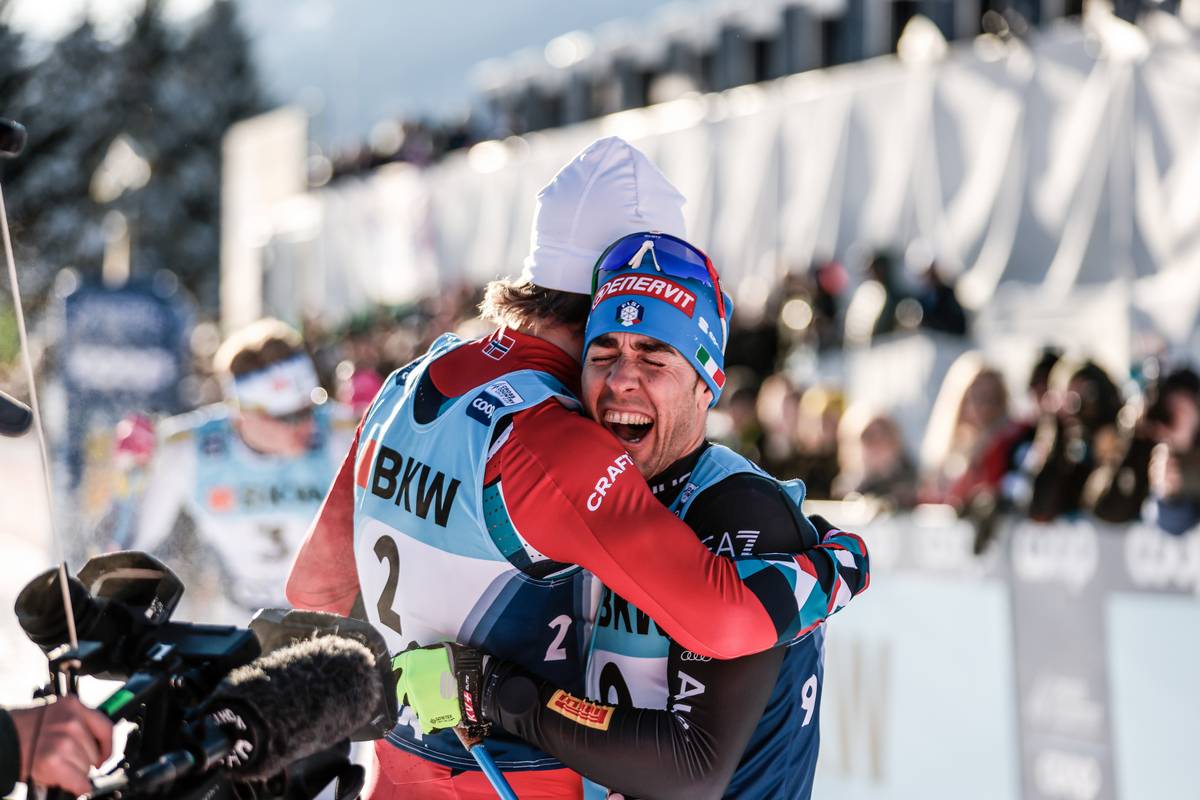
    Johannes Hoesflot Klæbo (NOR) and Federico Pellegrino (ITA) after the finish of the Finals in Davos, 2022. Pellegrino bested Klæbo on the eve of the birth of his first child. (Photo: Nordic Focus)

    It states the obvious to say that success in cross-country skiing is a matter of timing, and for “Chicco Pelle’s” 15 seasons, the timing had been just shy of right. The formative and final years of Pellegrino’s career were defined by the dominance of skiers other than he. Pellegrino made his World Cup debut in Drammen in March 2010, finishing 49th. The winner that day was Emil Joensson (SWE); runner-up was Petter Northug (NOR), then on his way to his first of two Overall Globes. These were the halcyon days in which Dario Cologna (CHE) descended from his Alpine fastness to rack up World Cup and Tour de Ski titles; when Northug, Joensson and Marcus Hellner (SWE) traded sprint victories and taunts in a bitter intra-Scandinavian rivalry. Pellegrino was 12th in his first World Championships Sprint (Oslo, 2011) and 11th at his first Olympic Sprint (Sochi, 2014).

    While notching his debut victory in December, 2014 in the Davos Freestyle Sprint, Chicco’s break came in the 2015-16 season. He won 5 of 13 sprint races, becoming the first non-Scandinavian male to win the Sprint Globe. As Pellegrino hit his stride, Northug’s star was showing its first flickerings ahead of a dramatic waning, Joensson had entered the twilight of his career, and although Sergey Ustiugov (RUS) was approaching his own prime, the factious cast of World Cup sprinters was looking for a new leading man.

    That man would not be Chicco. An upstart dramatist from Trondheim, Johannes Høsflot Klæbo, had arrived to script skiing’s long, and mind-bogglingly successful, next chapter. After making his debut in Drammen in 2016, Klæbo outscored Pellegrino in the 2016-17 Sprint standings, taking his first of 8 (and counting) Sprint Globes. The two went head to head at the 2017 World Championships in Lahti, Finland, where Pellegrino surged from behind to claim his first World Title ahead of a legendary lineup, including Ustiugov, Klæbo, and Northug, but this maiden gold would also be his last. In Pyeongchang the next year, the Olympic gold went to Klæbo; Chicco brought home silver.

    The wins did keep coming for Chicco, including a tear of three consecutive Sprint victories and his second Sprint Globe in 2020-21. And, though they admittedly came in greater abundance to Klæbo (who, it should be noted, did not start in those races, or the 2020-21 Tour de Ski), it is rather glib to assert that Chicco’s career had slid “in[to] the shadow of” the Norwegian. Pellegrino bested Klæbo in Dresden and Lahti in the spring of 2018; in Lillehammer that winter; and in Davos in 2022. He was near-omnipresent on Sprint podiums and won his second Olympic silver in Beijing in 2022; moreover, he was among the very few men who could disrupt Klæbo’s dominance in the discipline, and the clear favorite when Johannes was absent.

    But Pellegrino’s win in Davos in December 2022 marked the beginning of a long, and perhaps self-inflicted, World Cup drought. Chicco declared his intention to focus on distance races ahead of Milano-Cortina, and did indeed record four such podiums in classic, skate, and skiathlon formats, alongside a welter of Sprint podiums – including an ecstatic World Championships silver in Trondheim in 2025, and Olympic bronzes on home soil in the Team Sprint (alongside Elia Barp) and in the 4 x 7.5 k Relay (which he described as “the proudest day of [his] life!”) this February.

    Elia Barp welcomes Federico Pellegrino to a bronze-medal finish in the Olympic Team Sprint in Milano-Cortina, February 18th, 2026.
    (Photo: Vanzetta/Barbieri/NordicFocus)

    Outright wins, however, were not forthcoming. By the time March 21, 2026 arrived in Lake Placid, it had become Pellegrino’s last, best chance to secure one more Sprint victory.

    Anticipation and emotions ran high. While Pellegrino had been impervious to the crowd in Friday’s 10 k Classic – earbuds deadening the world beyond his blue racing cap during warmups, and his face a deaf mask of exertion during the race – their excitement overwhelmed him on Saturday. During his first warmup lap, he skated calmly up the course’s A-Climb through a chorus of “CHI-CCO, CHI-CCO, CHI-CCO.” On his second, the frenzied chant began again, and the gravity of the impending race dragged him to a halt. His skis splayed wide against the pitch; he buried face in his hands. “The energies I got in the Final were coming from the warmup lap, where I stopped in the middle of the climb, crying,” Pellegrino told me at the finish line. “I think the public deserved this kind of show, and I deserved to finish my career, with a Sprint skate like this.”

    Pellegrino embraces the crowd ahead of Sprint qualifying in Lake Placid. “The energies I got in the Final were coming from the warmup lap, where I stopped in the middle of the climb, crying.”
    (Photo: Thibaut/NordicFocus.)

    To reach that final finish line, however, was a perilous journey.

    After qualifying second, Pellegrino sidestepped two falls (the first from Jules Chappaz (FRA); the second from Elias Keck (GER)) in his Quarterfinal, moving from sixth to first in the course’s final descent and level hairpin. In Semifinal 1, he attempted to close on Lucas Chanavat (FRA) and Anton Grahn (SWE) through the crest of the A-Climb but couldn’t get by; pushed to the outside on the level hairpin, he was out-lunged by Lars Heggen (NOR) in the final meters, finishing third by 0.03.

    While the Lucky Loser spot was Chicco’s to lose heading into Semifinal 2, Erik Johansson (SWE), Harald Amundsen (NOR), and Even Northug (NOR) lost time playing for a slipstream position as they approached the top of the A-Climb. Pellegrino was on to the final by a comfortable margin.

    Lars Heggen (NOR) outlunges Federico Pellegrino (ITA) by 0.03 in Semifinal 1. Federico moved on to the Final as a Lucky Loser. (Photo: Thibaut/NordicFocus)

    Once more around the track, and the day could be his. After being fourth out of the gate, he attacked from the outside on the B-Climb; breaking into an aggressive V-2 and taking Chanavat and Heggen by surprise, he moved into second behind Grahn. The pace increased again at the base of the A-Climb, but where Grahn and Chanavat’s broad frames moved up the hill in sweeping, powerful strokes, Pellegrino leapt into a furious V-1.

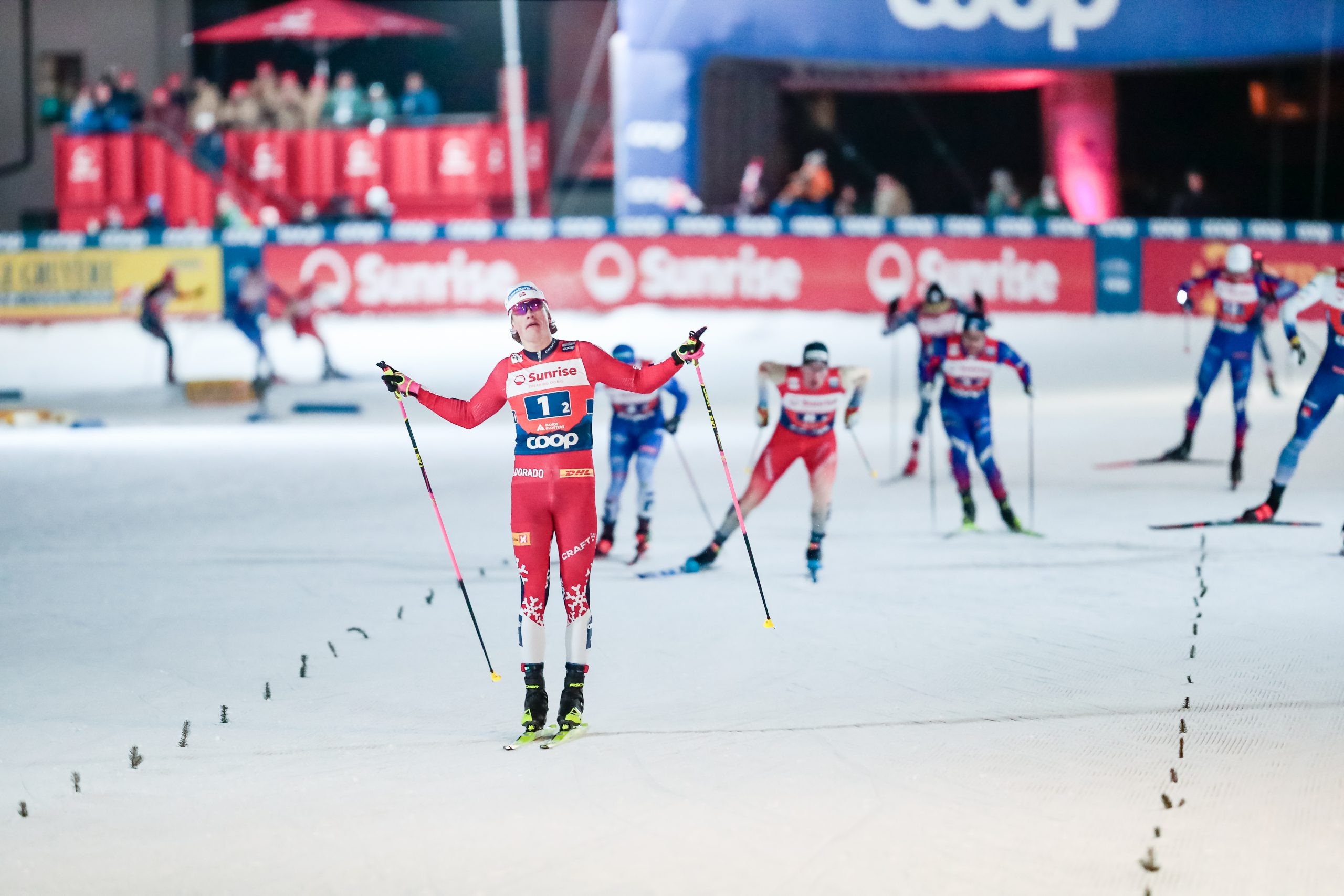
    The move was decisive. To the adulation of the crowd, he opened a decisive gap through the crest of the climb. His lead only grew through the final descent into the level hairpin, but Chicco was taking no chances. While Grahn and Heggen grappled for second behind him, Pellegrino hammered to the line, threw his arms wide and his head back, roaring with the crowd.

    An 18th victory and 46th career podium, clinched.

    Federico Pellegrino secures his 18th and final World Cup victory. Lake Placid, March 21, 2026. (Photo: Thibaut/NordicFocus)

    What had happened in the Semifinal, when this triumphant last dance had nearly evaded him by three hundredths of a second? And what had changed for the Final?

    “I could not do what I did in the Final, because the energies of the other athletes were still quite big,” Chicco admitted our post-race interview. “About the last downhill, I was not the same as the others. I am not, I know, but I have some different qualities, and if I could get quite good gap in the top of the uphill, then I knew that I could keep it until I end. This is what I did. This is how I loved to win all along my career – not wait until the last meter, but trying before.”

    “Sometimes it happened, mostly before Klæbo came,” he laughed. “But today I was there, and I studied the best tactics in the end . . . the public here in Lake Placid deserves this kind of show, and I think we are all happy now.”

    And, this was nothing short of “the best way” to end his journey. “I could not do different. In the end, the last four years have been strange. I didn’t focus so much on sprinting; I tried to discover my body in different fields. Sometimes I got really great feelings and performances, but then, to come back here . . . and to win in that way, I could not do more.”

    Pellegrino after his final win. “I think the public deserved this kind of show, and I deserved to finish my career, with a Sprint skate like this.” (Photo: Thibaut/NordicFocus)
    One more podium for Federico Pellegrino, alongside Lars Heggen (NOR) and Anton Grahn (SWE). (Photo: Thibaut/NordicFocus.)

    In 15 seasons, Pellegrino proved himself to be far more than a runner-up to those Swedish and Norwegian titans who loomed large over his early and later years. He had taken the Sprint Globe from the Scandinavians for the first time; outsprinted Klæbo, Ustiugov, and Northug in Lahti; perpetually challenged – and occasionally beaten – the greatest athlete in the history of the sport; and secured Olympic medals on home soil, alongside a team of up-and-coming Italians ready and eager to fill his boots. “I’m really happy that he finished his career with probably one of the best weekends for him so far,” Elia Barp (ITA) told me on Sunday. “I’m very happy for him; I’m very happy for the team. I think we have proved that we are ready to race without him – not only me, but a few other young guys are ready to try to take victories next year . . . [He showed] that it is important to keep fighting and try to be a good overaller as he was in the last years. And, now we know that it’s possible; everyone is human as us, and we can do that.”

    To Chicco’s fans, that determination – to grapple with giants; to reinvent himself; to seize the final, perfect timing and a final, perfect victory – defined his career. But for Pellegrino himself, “the biggest memories will not stay about the races, but much more about the hugs I got from the teammates, from the coaches, even outside of Italy, from my family, from the people that love me – and not only when things went well; even when things were not going so well. I think this is something that sport teaches us; that in the end, it’s only a cross-country ski race, and life is different. That’s it. The hugs are something I will remember for my entire life.”

    Pellegrino, the most popular man at Zig Zag’s on Saturday, March 21. (Photo: Lily Den Hartog)

    At Zig Zag’s Pub on Saturday night, Pellegrino told this reporter’s associate that his win vindicated his decision to retire. On Sunday, soaked with rain and champagne and tears after his last World Cup race, he reaffirmed it:

    “That’s it. I tried to enjoy today as well . . . I tried to give my best, as always, and it was good after the finish line; under the rain, it was special. But with the teammates and coaches and waxers celebrating this moment, it was good for me.”

    “Now, I really need to stay with my family. They deserve this, and I need to give them a lot of time.”


    Love Stories Like This? Help Keep Them Coming.

    Feature stories like this one take time, access, and care to produce. If you value thoughtful storytelling and independent ski journalism, please consider becoming a Voluntary Subscriber. Your support directly fuels the work we do to cover the people, places, and moments that make our sport special.

    “Grazie Papao!!” Team Italy was waiting at the finish of the 20 k Skate with champagne and a tribute to Pellegrino’s children and wife, Greta Laurent (ITA, ret.). (Photo: Thibaut/NordicFocus)
  • The Case for More American World Cups

    The Case for More American World Cups

    This coverage is made possible through the generous support of Marty and Kathy Hall and A Hall Mark of Excellence Award. To learn more about A Hall Mark of Excellence Award, or to learn how you can support FasterSkier’s coverage, please contact info@fasterskier.com.

    Johannes Hoesflot Klaebo (NOR) back in action and lifted by the roar of American ski fans during the World Cup 10 k Classic in Lake Placid, New York. (Photo: Dils / FasterSkier)

    LAKE PLACID, NEW YORK — Ten kilometers into the second World Cup on American soil in as many decades, and the verdict is already clear: We need more racing in the United States.

    That’s the message panted into my microphone by every athlete in the Mix Zone; shouted over the undulating din by every supporter I spoke with on the ice-lacquered walkways lacing Mt. Van Hoevenberg. And it’s the irresistible outcome of the turnout this afternoon in Lake Placid — with a crowd that came out in droves for Diggins, the Schumacher-Ogden’s Silver Medal Squad, and a host of homegrown heroes; that braved five inches of wet, driving snow; and that stayed to see Jessie clinch the Overall Crystal Globe, a reconstituted Klæbo overtake Amundsen in the Distance standings, and to welcome the world’s best to the conclusion of the 2025-26 season.

    The reaction to racing in the United States in 2023 was overwhelmingly positive – and, it had seemed, sui generis. With four snowmaking venues spread across the Twin Cities, along with the (purportedly) highest concentration of cross-country skiers outside of Oslo, the energy that embraced Jessie Diggins in her home state and buried a generation of “almosts” for the U.S. Men’s Team in the snow and mud at Theodore Wirth could have been lightning in a bottle.

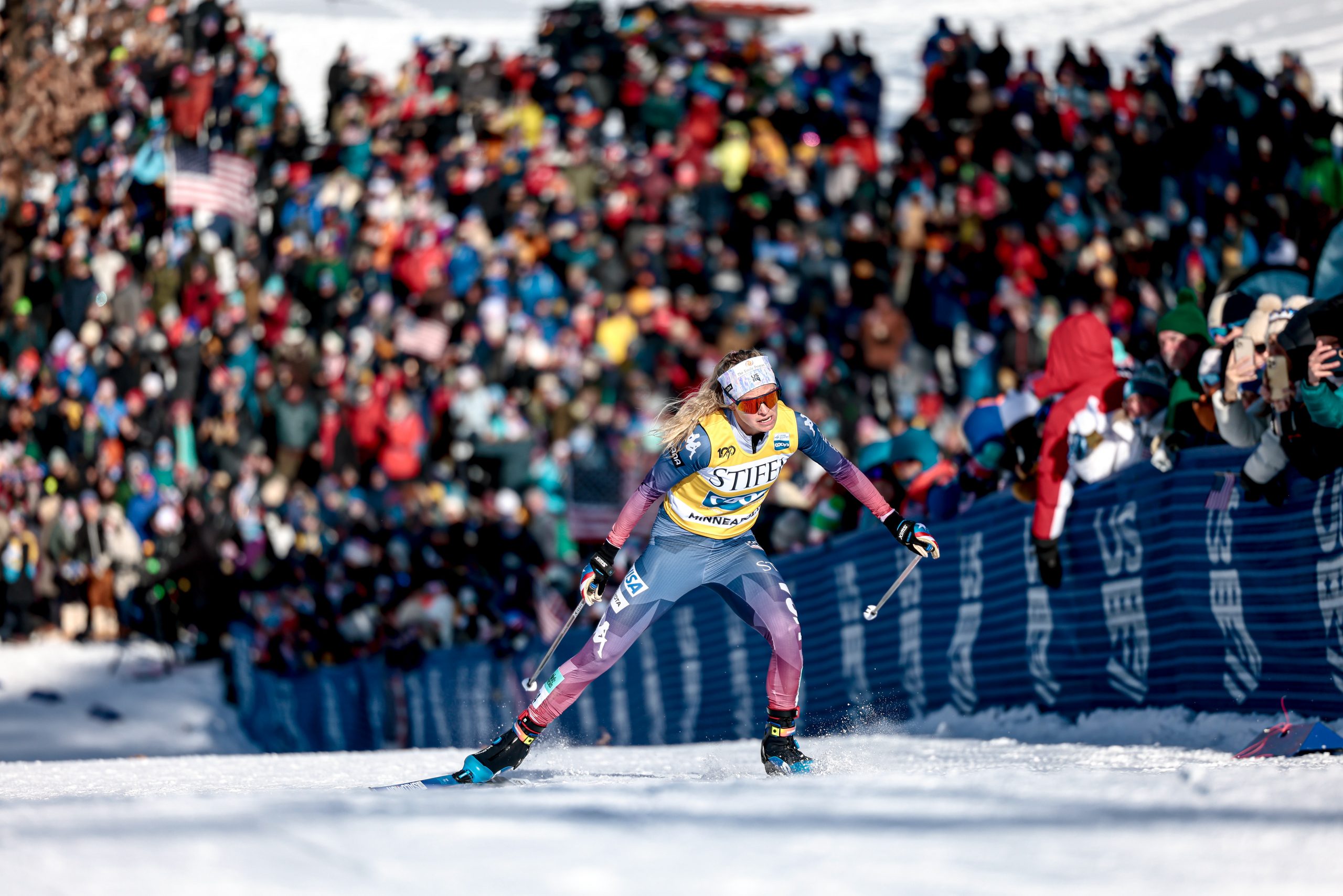
    Jessie Diggins (USA) racing on home soil in Minneapolis and did so again in Lake Placid as she concludes her storied World Cup career. (Photo: Modica/NordicFocus)

    I will admit my own skepticism that Lake Placid could field the fans, or the volume, of spectators to match Minneapolis. Perhaps my flight into Saranac Lake Regional Airport on Wednesday morning was my first evidence of error. Of seven passengers bobbing our way through the cloud-laden Adirondacks, four were here for the World Cup: Charlie, from Seattle; Billy (as in, Demong, the Nordic Combined gold medalist) and his son, from Salt Lake City; and myself, from D.C. Bussing to the venue the next day, I’m seated with a dozen of University of Minnesota alumni – they’ve taken off of work, graduate school, and medical school to spectate. “I’m excited just to see the number of people out cheering,” Alex Gude, who organized the trip, tells me. “I think one of the best parts about Minneapolis is just seeing the community come together, and now, away from home, we’re seeing another whole ski community come out and cheer.”

    And, indeed, they are – from across the United States, from across New England, from across the Canadian border, and from right here in Lake Placid. Once we disembark, I wade through the corn snow and the first of many falling flakes to Mt. Van Hoevenberg’s sprawling Nordic Center, where the racecourse coils around the podium and snakes below the pedestrian bridge. Patricia Damp is herding thirteen might-be-members of the local ski community across the bridge; she’s a third-grade teacher here in Lake Placid, chaperoning a class field trip to the World Cup Finals.

    Are the kids already Diggins die-hards, Ogden acolytes, Gus bus-riders? Not really, Patricia tells me. The class “was out here a couple months ago, cross-country skiing. We get to do the Olympic venues. We were at the museum a month ago. We have a friend who we watched ski jump. So, we’re very Olympic-oriented, and today we’re just out here to support the athletes and get some autographs.” Her students back her up. “We’re excited to get the players’ signatures,” Riley tells me. And while Declan is “excited to see the racers,” there’s no-one in particular he’s cheering for.

    Gus Schumacher (USA) during the Men’s 10 k Classic in Lake Placid, New York. (Photo: Dils / FasterSkier)

    From the mouths of children, our first – and perhaps strongest – argument for future American World Cups. The glitter-dusted kids in fan club bibs, wielding cardboard-cutout faces as large as they are, make for compelling pictures and undeniable evidence of Team USA’s impact on its next generation. But racing in the United States creates opportunities to draw an entirely new cohort of young people into the cross-country skiing community – kids who may have never tried skiing before; who may not have heard of Kikkan or Klæbo ; and whose parents certainly are not waking up before sunrise to livestream Ruka, Falun or Holmenkollen. They will not see themselves in this sport until they see this sport. What better way to do so than on a Friday field trip with Mrs. Damp?

    After bidding them good luck with the signature-hunting, it’s not an easy task to wade against the current of the rest of the Lake Placid Class of 2035. Also threading his way through the third-graders is Niklas Dyrhaug, immediately recognizable even five years into retirement from World Cup racing. He’s on the other side of the v-boards this weekend, broadcasting for Norwegian television. In his first sentence, he tells me: “We are enjoying being back in the U.S. In my opinion, we should be here every year.” He’s not surprised by the number of spectators, either. “Everybody who knows the U.S. crowd knows they are really enthusiastic . . . We know the tradition, the culture, and Lake Placid’s place in that history. So, personally, I’m not that surprised. It’s really cool that we’re back here.”

    That’s the sentiment just after Coaster Hill, some four kilometers into the racecourse, where Norwegian national team coach Eirik Myhr Nossum prowls the striding zone. Being back in the United States is “awesome, it’s amazing. I think we should be here every year, because you guys show up; you guys cheer for everyone, and it’s always fun to be in the U.S. and to be overseas to compete.”

    And it’s the sentiment at the finish line.

    Harald Oestberg Amundsen (NOR) after the 10 k Classic in Lake Placid, New York. (Photo: Thibaut/NordicFocus)

    Harald Amundsen (NOR) tells me, “In the outer part of the track, there were so many people I couldn’t hear my own thinking. That’s a really good thing.” Even before he arrived at the venue, “We had a run this morning in the city. Everyone was screaming at us, ‘Good luck!’ It’s a really nice atmosphere.”

    For Elia Barp (ITA), conditions were “very tough because it was really slow with this new snow, but it was fun racing for me. So I enjoyed it – at least I tried to enjoy it – it was a pack of people screaming my name so that gave me even more motivation, and was fun . . . I loved racing two years ago in Minneapolis, and here it’s packed with people, even with the snowfall, so thank you to everyone for coming. It’s really good to race here.”

    Mika Vermeulen (AUT) admits, “Honestly, this is probably the worst race I’ve done in a long time. But I don’t think I’ve ever had so much fun out on the track . . . on top there, out in the forest, I just heard, ‘MI-KA, MI-KA,’ the whole time. It was insane. I had a bad race and a lot of fun.”

    As for how he feels about returning to the United States: “Great, great, actually—and feeling a bit frustrated, because it just gets me pissed that we race these [bad] courses in Europe all the time, over and over and over again, and we have these freaking jewels out here which we never use. It’s crazy. I want to go to the U.S. every year for at least a whole period. It’s called the World Cup. It’s not called the European Cup, right?”

    Fans all over the course with custom gear showing their fandom. (Photo: Dils / FasterSkier)

    Klæbo’s opinion is a bit more measured – perhaps because he has more microphones hovering around his face. “I heard some rumors that it was supposed to be quite well [attended], and when I searched up Lake Placid and read a little bit about the place, I understood there’s not that many people living [here], but when you see how many people are here, I was pretty shocked.”

    A second argument, then, in favor of World Cup racing in this country: the athletes love it. They embrace not just the energy, but the venues that push the World Cup beyond the geographic and cultural confines of Transalpine Europe.

    Benjamin Dohlby (USA) at the finish of the Men’s 10 k Classic in Lake Placid. (Photo: Thibaut/NordicFocus)

    For the closing statement, Ben Dohlby is among the last athletes I interview. This is Ben’s first World Cup start; a junior at University of Alaska-Fairbanks, he was 3rd in the American Birkebeiner in February. How does it feel to be making his first professional start in the United States?

    “It was crazy. I went out so hard. The fans were so loud that I didn’t feel anything, and then I felt it all and got so tired – but it was awesome; a great atmosphere.” It wasn’t too long ago that Ben was skiing laps around the glazed kilometer of manmade snow at Lapham Peak State Park in Delafied, Wisconsin; now he’s here. To his former teammates, to other up and coming skiers, and to novices across similar ribbons of snow in Wisconsin, Michigan, and Minnesota, his message is simple: “Follow your dreams and you can make it happen.”

    Most of the fans hiked up on the course, but the stadium filled up as the day went on. (Photo: Dils / FasterSkier)

    That, then, is our concluding point: More World Cup starts on American soil means more starting berths for American skiers, and more chances for our most talented young skiers to make it to the starting line. We should savor the privilege of, as a host nation, pitting our athletes against the most accomplished figures in the sport, dreaming that a World Cup podium, an Olympic medal, could be in their future. When a lifetime of discipline and preparation meets the opportunity of a lifetime, the promise of Lake Placid – that miracles can happen – becomes deliverable.

    I will leave the invariable complex problems of bidding, organizing, and logistically managing future events to far wiser pundits. But, in the meantime, the verdict is clear: FIS, U.S. Ski & Snowboard, and the American Nordic community should be eager, and determined, to have them here.


    Love Stories Like This? Help Keep Them Coming.

    Feature stories like this one take time, access, and care to produce. If you value thoughtful storytelling and independent ski journalism, please consider becoming a Voluntary Subscriber. Your support directly fuels the work we do to cover the people, places, and moments that make our sport special.

  • Mass Start Masterclass: Diggins Outsprints Three in Final Meters

    Mass Start Masterclass: Diggins Outsprints Three in Final Meters

    This coverage is made possible through the generous support of Marty and Kathy Hall and A Hall Mark of Excellence Award. To learn more about A Hall Mark of Excellence Award, or to learn how you can support FasterSkier’s coverage, please contact info@fasterskier.com.

    The final race before the 2025 Trondheim World Championships treated viewers at home and a sparse crowd Falun, Sweden to the very best of Mass Start skiing. After over fifty minutes of tactical pacing, relentless climbing, and breakneck descents, Jessie Diggins surged to crack a pack with which she had skied since the 1.6-kilometer mark—a dramatic, eleventh-hour masterclass that claimed her 25th individual World Cup win and 63rd individual podium. Heidi Weng (NOR) and home-soil star Ebba Andersson (SWE) finished 0.7 and 0.8 seconds behind Diggins; teammate Julia Kern led the Chase Group to take 6th place.

    Diggins outsprints Heidi Weng (NOR) and Ebba Andersson (SWE) to win the Women’s 20 k Mass Start Freestyle in Falun, Sweden. (Photo: NordicFocus)

    The Women’s 20 k Mass Start provided everything the avid ski racing fan might have hoped for: strategy, surprises, and suspense, culminating in seat-leaping final sprint. The opening 10 kilometers unfolded in the positional poetry of an 18th-century naval battle—with spandex-clad ships probing each other’s weaknesses, flanking and falling behind, slipping ahead and then stepping aside; steadily pushing the pace while awaiting the right moment to fire an anaerobic fusillade.

    From the starting gun it was Diggins, Andersson, Victoria Carl (GER), and Weng trading the lead of a dense pack of skiers; notably absent was Distance Leader Astrid Øyre Slind (NOR), who withdrew an hour before the start due to an aggravation of her Celiac disease (according to Langrenn.com). On the first lap, no early leads emerged, and while the first ascent of the Mordarbaken—the course’s high-point and key climb, a 550-meter grind with 60 meters of vertical and grades approaching 16%—may have presaged a difficult day, a descending gap by the four frontrunners quickly disappeared.

    By the 5.6k timecheck and the second time up Mordarbaken, Nora Sanness (NOR) had worked her way alongside Diggins, Andersson, Weng, and Carl. While Sanness appeared to test her skis through the ensuing downhills, she did not meaningfully separate.

    The leading group continued to contain 17 women within seven seconds of one another through the 8-kilometer mark, including Americans Sophia Laukli in 9th and Julia Kern in 11th.

    (From front): Victoria Carl (GER), Ebba Andersson (SWE), Nora Sanness (NOR), and Heidi Weng (NOR), along with Diggins, formed Sunday’s lead group. (Photo: Modica/NordicFocus)

    However, as the race neared the halfway point, the strain of the course’s long opening climbs—and a near-imperceptible acceleration from the (now five) frontrunners—gradually but decisively fractured the field. Andersson, Diggins, Carl, Sanness, and Weng crested Mordarbaken a third time (at 9.6k) within three seconds of each other, and five seconds ahead of the now-emerging Chase Group 1.

    By the 11.4k timecheck, the gap against Chase Group 1 (led by Pia Fink (GER) and Flora Dolci (FRA)) had grown to 11 seconds; by the fourth Mordarbaken climb (at 13.6k), it had expanded to a likely-insurmountable 25 seconds. As Diggins continued to trade the helm with her four co-captains, Kern remained snug in Chase Group 1, while Laukli had fallen into a No-Man’s Land (11 seconds off Chase Group 1, and 32 seconds ahead of Chase Group 2).

    Diggins leads through the closing pitches of Lap 4/5. (Photo: NordicFocus)

    At the 16-kilometer mark, viewers had enjoyed four laps of intelligent, technical Mass Start maneuvering, but had yet to see the sort of furious broadsides our earlier naval analogy would suggest.

    Then, with one lap remaining, the fireworks began. Moments after leaving the stadium, Carl went down hard—planting her own pole directly into the top of her right ski, and tumbling into a ski-splaying, snow-spraying fall which Diggins narrowly dodged. Although Carl recovered relatively quickly, receiving a new pole from one of the Team USA coaches, the damage was done—the five had become four.

    On the grinding pitches up, out of the stadium to the base of the Mordarbaken, the lead-changing and pace-testing continued with renewed intensity, trembling towards frantic as Swedish onlookers chanted “Ebba! Ebba! Ebba!” in a relentless tattoo. Midway up, Sanness ventured a breakaway but couldn’t open meaningful ground; the four leaders remained together over the final crest of the Mordarbaken with Diggins, the last of the group (and perhaps wary of sidestepping another fall), scrubbing speed through the opening descent before regaining contact.

    The descents in Falun are just as infamous as the Mordarbaken and Jessie Diggins (USA) is brilliant at both. (Photo: NordicFocus)

    Two “Sprint Hills” —overlapping with Friday’s Sprint course—remained. At the base of Sprint Hill One, Diggins launched the first true attack of the race, lunging towards the front of the group. Weng responded on a hair-trigger, marking Diggins’ move—but too closely! The Norwegian stepped on Diggins’ pole basket mere feet from the top of the climb; for a moment, both skiers staggered, in danger of falling; the front four reeled! In a gasp, their skis were back beneath them, and the four leaders stumbled on with no change in position but no gap opened—frantic smoke, but no fire!

    They plunged to the base of Sprint Hill Two, scarcely a kilometer remaining, Diggins leading by a hairsbreadth. She cast a glance over her shoulder and broke into a jump-skate on the inside of the trail’s lefthand arc, gaining at most a desperate meter on her three pursuers—and then hesitating, her tempo dropping, her meter seized and then lost in the space of second! Another attack, foiled!

    Andersson, avatar of the screaming spectators, matched Diggins on the outside; the Swede devoured the scant distance between them and lunged towards the crest; towards, perhaps, another win—but Diggins was not finished. A second sharp look behind and the American erupted into another jump-skate—a huge move, the move; the roaring cannonade we were waiting for since the starting pistol—Diggins was away; she was over the top and hurtling down towards the stadium, with Andersson, Weng, and Sanness completely off-guard and now precious fractions of a second behind. They hurtled after her, matching her deep tuck and then her signature free-skate as the trail leveled off, then clutched at her with powerful V2s over the rolling trail-crossing and into the final downhill, the final corner.

    Diggins was low; her skis were, perhaps, just fast enough to carry her home. Weng pulled ever so slightly ahead of Andersson and the two were both upright, surging, pummeling the snow with their poles, as Diggins remained in that final, nail-bitingly-long tuck and free-skate. Then Diggins was up and poling, too, at the absolute last impulse of her momentum—had the race been ten meters longer, it seemed, the Scandinavians would have reclaimed her.

    But it wasn’t, and they didn’t.

    Diggins crossed the line in 54:27.4, with Weng in second and Andersson in third, each less than one second behind her. Sanness took fourth, 5.9 seconds back; Carl, finishing between the leaders and Chase Group 1, finished fifth, 27.2 seconds back. And, in sixth place—absent from the leader-focused cameras for the final kilometers of the race, but now outsprinting Fink and Dolci at the front of Chase Group 1—Julia Kern!

    Rounding out the American squad, Sophia Laukli was 16th; Alayna Sonnesyn and Sydney Palmer-Leger were 25th and 26th, respectively.

    Diggins remains free-skating as Andersson and Weng close the gap in the final meters of the 20 k Mass Start Freestyle. (Photo: NordicFocus)

    Reached for comment by this outlet, Kern stated that the American Women entered today’s race energized, inspired, and cognizant of the determinative Mordarbaken.

    “We were nervously watching the Men’s race and so amped by Gus [Schumacher]’s result, and it looked like the skis were running really well, so we were really excited when we headed out,” Kern said. “My plan was to be as far up in the front as possible. I knew that on the big ‘Murder-baken’ things would start to string out and gaps would form, so I really tried to be in good position.”

    Executing this plan was hard-fought. “I honestly didn’t feel as good today as I did yesterday, but I just knew and told myself—‘You will recover, you just need to hang on, every [climb].’ I was in the Chase Pack, just hanging on for dear life and on the ropes, frankly, for a lot of the race, but I had amazing skis. Coming into the Sprint Course I was able to ski [past] the pack and found this extra gear and energy; my sprint legs kicked in […] and had an incredible finish, catching the two girls, Pia [Fink] and Flora [Dolci] who had skied away, actually, on the Mordarbaken.”

    “It was so cool to see Jessie win, and Gus on the podium, and overall our techs just crushed the skis. For me, it was just—‘Believe, keep hanging on’—and then waiting for the Sprint Course because that’s where I felt most confident and most excited to make my move.”

    Julia Kern outsprints a fractured Chase Pack to take 6th place in the 20 k Mass Start Freestyle. (Photo: Modica/NordicFocus)

    Diggins, interviewed by FIS ahead of her podium appearance, told a similar story of pacing, persistence, and team inspiration.

    During the Men’s race, she said, “Julia and I were jumping up and down screaming at the TV. It definitely got me really excited and really sweaty, and warmed up for the race.”

    “I really like this course. To be totally honest, I was starting to cramp up, and if the fourth lap had gone a little faster I probably would have been off the back”—but she held on to “see what happens.” Diggins, too, credited speedy skis for her decisive surge. “Huge congrats to the wax techs. They’ve been working super hard all weekend,” and their work—and the American performances today—will set the tone going into the World Championships.

    “This was a win for the whole truck and the whole team—it’s awesome momentum going into Trondheim.”

    Complete Women’s Freestyle Mass Start RESULTS

    The American Women, coaches and wax techs celebrate Sunday’s results. “This was a win for the whole truck and the whole team—it’s awesome momentum going into Trondheim,” said Diggins. (Photo: NordicFocus)
  • Slind Surges in Final Kilometers of Toblach 20 k, While North Americans Find Fast Allies

    Slind Surges in Final Kilometers of Toblach 20 k, While North Americans Find Fast Allies

    This coverage is made possible through the generous support of Marty and Kathy Hall and A Hall Mark of Excellence Award. To learn more about A Hall Mark of Excellence Award, or to learn how you can support FasterSkier’s coverage, please contact info@fasterskier.com.

    Stage Three of the Tour de Ski, the penultimate day of racing in Toblach, and the final World Cup event of 2024: the Women’s 20 k Interval Start Skate race. Playing out on a unique, long-course format, the course essentially entailed ten kilometers of gradual climbing to the head of the valley, followed by a ten-kilometer net descent on the return to the starting area.

    For the viewer at home, two questions predominated as the skiers took their places.

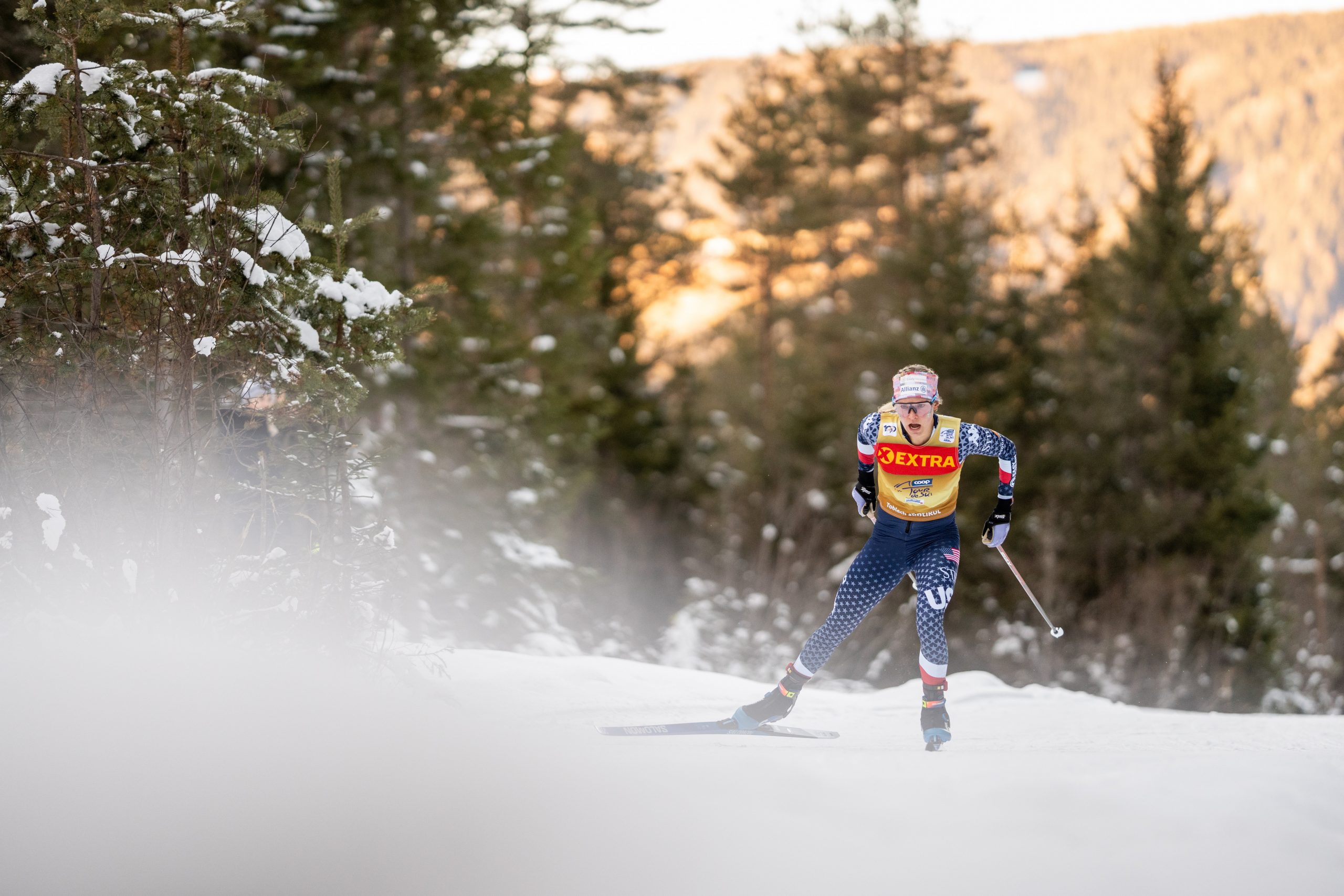
    Jessie Diggins (USA) in the early kilometers before she caught up to teammate Julia Kern (USA). (Photo: NordicFocus)

    First: Could Jessie Diggins make it a hat trick? Momentum was certainly in her favor. On Saturday, she opened the 19th Tour with a surging win in the Skate Sprint; on Sunday, she followed up by winning the 15 k Classic Mass-Start, her first victory in that discipline in fourteen years of World Cup racing. With a 38-second lead over Kerttu Niskanen (FIN), and 1:09 over both Astrid Øyre Slind (NOR) and two-time Tour de Ski Champion Heidi Weng (NOR), there at least seemed little chance that Diggins would end the day wearing anything other than the leader’s bib. And, second: Would this be Therese Johaug’s chance to make her mark in Toblach? After a triumphant comeback in Lillehammer, the three-time Tour Champion failed to qualify in Saturday’s sprints (as, admittedly, might be expected) and was sixth in Sunday’s 15 k Classic. However, the longer distance, Skate discipline, and interval start would appear to favor Johaug; after all, she secured the gold medal in the 2022 Olympic 30 k Skate by a margin of 1:43.3, effectively rendering the Mass Start a personal time-trial.
    Astrid Oeyre Slind (NOR) used the skills she has honed on the long gradual trails of the Ski Classics to capture victory in the Tour de Ski 20 k Individual Start Freestyle in Toblach (ITA). (Photo: NordicFocus)

    However, for the conscientious commentator, the race posed another question entirely: When was the last 20 k Interval Start Skate? Astrid Øyre Slind won the 20 k Interval Start Classic two weeks ago in Davos, ahead of Kerttu Niskanen and Johaug. At the beginning of December, Diggins won the 20 k Mass Start Skate in Ruka over Joanna Sundling (SWE) and Heidi Weng. Before that, Diggins closed out the 2024 season with a win in another 20 k Mass Start Skate in Falun, and Finland’s Krista Parmakoski won the 20 k Interval Start Classic on home soil at the beginning of March. Beyond Spring of 2024, the FIS Results page testifies to a clutter of interval Classics and mass-start Skates until Davos, December 18, 2022: the most recent 20 k Interval Start Skate. There, Jessie Diggins carried the day by 5.5 seconds over Ingrid Flugstad Oestberg (NOR); Rosie Brennan finished third. However, notably absent from that Davos race were Heidi Weng and, due to her retirement, Therese Johaug. How would this trio fare in a long-awaited, perfect storm?

    Interviewed just before the broadcast by FIS, Petter Northug (formerly NOR) estimated that finding “the right speed on the first two kilometers” would be “the key” to the race. U.S. broadcaster Kikkan Randall (formerly USA) concurred, stating that building speed—without burning out too quickly—would be essential in the first five kilometers. With Tour de Ski Sprint Points available at the first-time check (just over two kilometers in) and Climbing Points available at the ten-kilometer mark, there would certainly be an incentive to get out fast. But, alone in the woods, would points-chasers be able to maintain early leads?

    Therese Johaug (NOR) finished just three seconds off the pace in second place. (Photo: NordicFocus)
    Carl Sets the Pace; Johaug Surges at the Crest

    At the first time check, Victoria Carl (GER; bib 29) seized an early lead, passing the 2.1 k mark in 5:23.4; Kerttu Niskanen (bib 39) came through 9.7 seconds back, followed by Johaug (bib 49) and Diggins (bib 57), both 10 seconds back and in a provisional third place. Slind (bib 55) was hot on their heels, 10.4 seconds off of Carl.

    At the 5.6 k time check, Carl had maintained her roaring pace, crossing in 14:14.1. Niskanen shrunk the gap to 4.3 seconds, while Heidi Weng (bib 35; the first of the returning Tour de Ski Champions to take the course) followed 19.1 seconds back. Johaug shaved her gap to 5.0 seconds but, initially, did not appear to be in the dominant form of distance races past, showing some signs of exertion. Slind kept her gap against Carl from opening, following in 10.1 seconds; Diggins, having caught teammate Julia Kern (bib 56), fell to a provisional fifth place, 12.7 seconds back.

    Kerttu Niskanen (FIN) battled her way to third place on the day. (Photo: NordicFocus)

    At the top of the course, Carl showed no signs of flagging, leading Helene Marie Fosseholm (NOR; bib 13), who set the early lead times for the course by over 32 seconds at the 10.6 k mark; Weng followed, slipping to 23.3 seconds back. But even if Carl were holding strong, others were hitting their stride: Niskanen was the first to turn the lamp green, leading Carl by 3.8 seconds; then, contrary to first impressions, it was Johaug, nudging herself ahead of Niskanen by 0.7 seconds.

    At the 10.6 k mark, the provisional standings were Johaug (30.01.1) in first; Niskanen (30.01.8) in second; Carl (30.05.6) in third; and Slind in fourth (30:17.4). Diggins had fallen to sixth place and 29.6 seconds back, looking visibly exhausted as she reached the course’s high point.


    Johaug Storms the Descent; Slind Attacks from Traffic

    Descending to the 15.6 k time check, Carl faded to fourth place: it was Johaug, clawing her way into a 6.4 second over Niskanen, who seized the lead. Slind sat in third, 9.1 seconds behind Johaug. Diggins was in fifth, 32.3 seconds behind, with Julia Kern trading pulls with her golden-bibbed teammate.

    Katherine Stewart-Jones (CAN), who tied Victoria Carl (GER), had her best race of the season, leading all North Americans in fourth place. (Photo: NordicFocus)

    At the line, Carl had her turn in the Winner’s Chair, until the arrival of Kerttu Niskanen, who put 7.5 seconds on the German. The day briefly appeared to belong to Therese Johaug, who led Niskanen by 17 seconds and Carl by 24.5. However, entering the stadium in a thicket of Swedes, it was Astrid Øyre Slind who made the decisive move of the afternoon and seized victory from the clutches of the once and future Queen of Snow—taking first by 3.3 seconds over Johaug. Carl, despite her valiant lead, would again be denied a podium finish, slipping to fourth place. She was tied in that position with Katherine Stewart-Jones (CAN), who secured a career-best fourth place, 27.8 seconds off Slind.

    Diggins finished in sixth, 36.3 seconds off the lead. Additional strong showings from the US Women included Sophia Laukli (10th place, + 1:01.1) and Julia Kern (13th place, + 1:08.9).

    Jessie Diggins (USA) relied heavily on teammate Julia Kern (USA), especially on the second half of the course today. (Photo: NordicFocus)


    Pack Skiing Defines the Day

    In any Interval Start format, athletes’ fortunes may hang on the fickleness of their starting seed—as who they start behind or ahead of will dictate their pacing fellows for the day. While a traditional, multi-lap race may enable a skier to encounter a wide variety of racers, today’s single-lap race leads to the coagulation of large, largely stable pace packs near the course’s high point.

    For Diggins, the single, 20 k lap was a race format she had “never done in [her] life,” and despite being “really cool,” was also “really hard. I basically pinned it as hard as I could go and just held it there […] It was hard because it wasn’t a normal course.” With the course’s gradual gradation, there was “basically no rest out there.”

    As close teammates and friends, Jessie Diggins (USA) and Julia Kern (USA) share a laugh after executing their plan on the Toblach 20 k course. (Photo: NordicFocus)

    “The best part was that I got to ski with my teammate, Julia [Kern]. We’ve trained together all summer, so that was really, really awesome […] We helped each other, and it was really, really motivating.” The two had planned ahead of time to work together if Diggins caught Kern and executed accordingly, with Diggins leading to the top of the course and Kern assisting with pulls in the latter half of the course. “We had amazing communication and collaboration, and honestly, it felt like we were doing the Merino Muster in New Zealand—every couple minutes, switch[ing] leads,” and verbally cueing each other to take the lead or pull back. “Without her, it would have been a really tough time for me because you either got lucky in that you got to ski someone or you didn’t. That’s ski racing—it’s not fair; the sport is not fair, and today was a wildly unfair course in that you either saw people getting to take a train up and skiing with big packs, and that made massive differences, and then you saw people who got stuck skiing alone. So, honestly, massive kudos to the people who skied alone and had a super impressive result because that was incredibly, incredibly hard.”

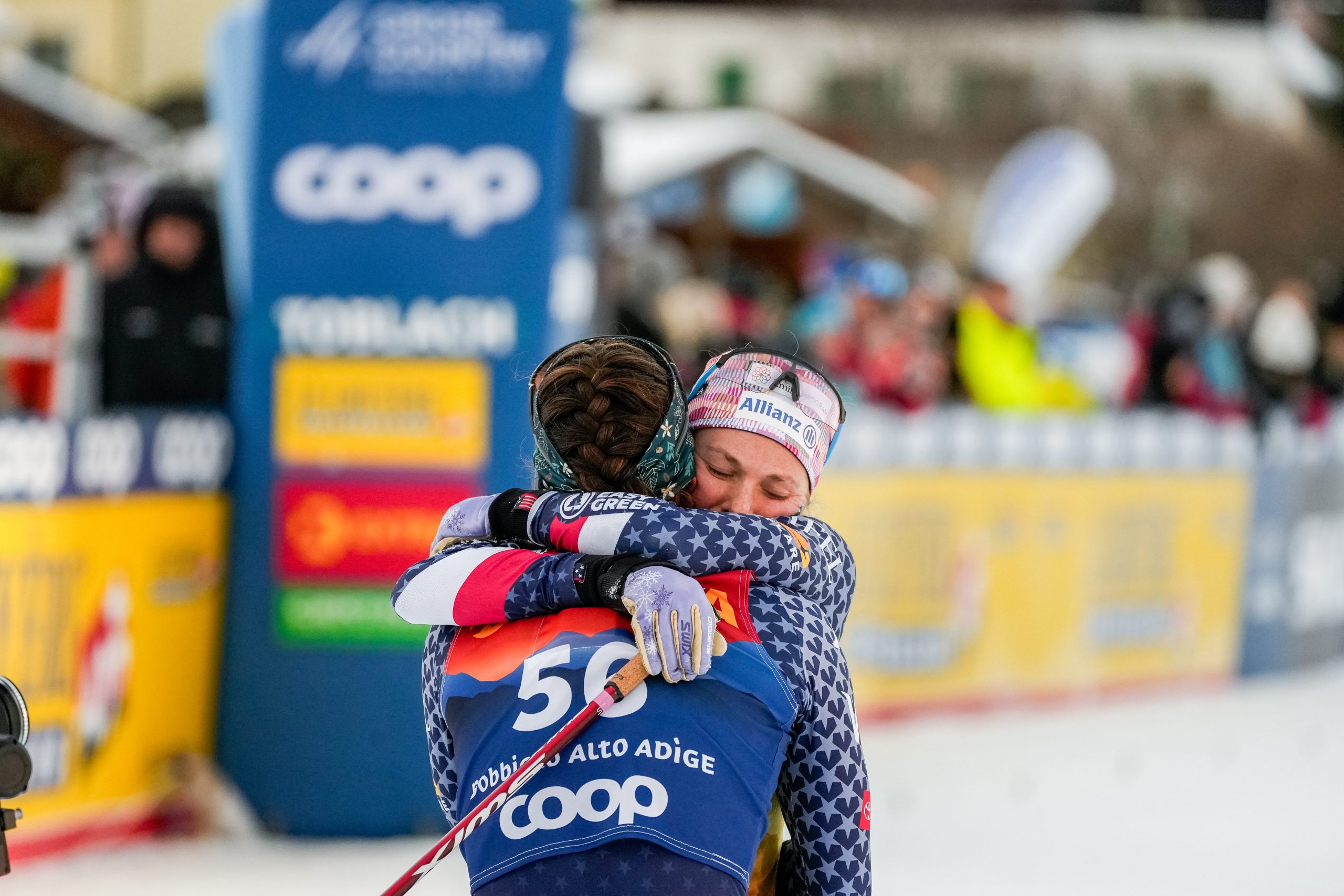
    Julia Kern (USA) and Jessie Diggins (USA) hug after working closely together throughout the 20 k Individual Start Freestyle in Toblach, Italy. (Photo: NordicFocus)

    “I’m just proud of us—how we worked together, communicated, collaborated, and fought for every single inch.”

    Collaborative skiing also defined the day for Laukli, in a race she described as fraught with “a lot of emotions. Right at the start, I already heard Victoria Carl catching me and thought, ‘Alright, that’s another terrible race.’ Then, I skied with her on the up, and we both realized we could make each other’s races better. I was doing a lot of work on the uphill so that she could do a lot of work on the downhill, and I think we both benefitted. I know I benefitted, at least!” While Laukli’s Classic performance on Sunday had put her in a “dark hole,” she is entering the New Year and the next stage of the Tour feeling invigorated after today’s result. “It’s a little bit shallow to let [Sunday’s] result mean so much, but I was definitely a little bit nervous on the start line, and I really want a full Tour. If I had another bad race, I don’t know how my motivation would be. I’m really happy, and I want to keep going now.”

    Sophia Laukli (USA) worked with Germany’s Victoria Carl on the climb and hung tight to Carl on the second half of the race. (Photo: NordicFocus)

    “This tour is a bit different for me because I’m trying to do a bit better in races other than just the Hill Climb because now I’ve proven to myself that I’m more than just a hill-climb skier. I’m also trying to perform well in the other races,” and she is certainly not holding back in hopes of securing another Alpe Cermis victory.

    Interviewed just before mounting the podium, Slind reported that she felt “amazing” during today’s 20 k. The Ski Classics powerhouse expressed relief that she could “finally” prove her abilities in the Skate discipline, noting: “This was one of the most fun races I’ve ever done. We were racing together from the top [of the course], with really good coverage from Canada, Sweden, and Norway” in the finishing cluster. The win was a combination of factors: “A little bit lucky, a little bit smart, and a little bit good shape.”

    As for Stewart-Jones’ standout result, she credited great skis, and close skiing with Slind and Moa Illar (SWE). “The strategy was to hold on to Astrid Strind,” Stewart-Jones wrote. “I knew she would be strong on this course so I knew that if I held on it could be a great race. It was awesome to be able to work with her and Moa Illar on the downhill. We gained a lot of time in those last 10 kilometers. It was just a great day where everything came together. The [Canadian] team did an amazing job with the skis which, on this course, makes a huge difference!”

    The 19th Tour de Ski will continue on New Year’s Day in a Classic Pursuit, with starting positions based on today’s Interval Start race. Diggins maintains her Tour de Ski lead by roughly 19 seconds over Niskanen and 33 seconds over Slind.

    View Women’s 20 k Interval Start RESULTS here.

    Therese Johaug (NOR), Astrid Oeyre Slind (NOR) and Kerttu Niskanen (FIN), (l-r) share the podium of the 20 k Individual Start in Toblach (ITA). (Photo: NordicFocus)
  • Davos Team Sprint: Could It Be Anyone But Norway?

    Davos Team Sprint: Could It Be Anyone But Norway?

    This coverage is made possible through the generous support of Marty and Kathy Hall and A Hall Mark of Excellence Award. To learn more about A Hall Mark of Excellence Award, or to learn how you can support FasterSkier’s coverage, please contact info@fasterskier.com.

    Friday night in Davos: A fast course, fireballs, and a remarkably flexible field for the Men’s Team Sprint Finals.

    After qualifying, the evening’s would-be winner was uncharacteristically unclear, with four nations represented in the top five qualifying times. Ben Ogden (USA I) started his second weekend of sprinting in pole position, having put a full 1.67 seconds on the individual favorite, Johannes Høsflot Klæbo (Norway 1). Edvin Anger (Sweden 1) qualified third; teammates and host-nation heroes Valerio Grond and Riebli Janik (Switzerland 1) were fourth and fifth, respectively. The Swiss duo’s combined times put Switzerland 1 at the front of the starting gate; USA 1 started in second position (with Zanden McMullen qualifying 26th), followed by Norway 1 (J.H. Klæbo and Paal Golberg) in third. USA 2 (J.C. Schoonmaker and Kevin Bolger, qualifying ninth and 24th) started the race in eighth, putting both American teams in the final. Further down the starting list, although hardly out of contention, were Sweden 1 (E. Anger and Johan Haggstroem) in fourth; and France 1 (Jules Chappaz and Richard Jouve) and France 2 (Remi Bourdin and Renaud Jay) in fifth.
    Ben Ogden (USA 1), top qualifier in the Men’s Team Sprint. (Photo: Modica/NordicFocus)

    Breathless after qualifying, Ogden panted a comment to FIS, expressing high hopes for the final ahead. “Last week was a good start but a bad finish. Today I’m turning it around: A good start and a good finish!” His race strategy was simple: “Ski fast in the first lap. Ski fast in the second lap. And then ski really fast in the third lap.” As for conditions, Ogden echoed the sentiment expressed across numerous athletes’ social media posts in the previous days, stating that the team is “Happy to be racing in beautiful Switzerland.” With thorough snow coverage, superb grooming, and no shortage of pyrotechnics (athletes were expressly warned to swing wide of the flamethrowers on the final corner), things appeared favorable for left-field performances: Notably absent from the grid were more Norwegians and Swedes (each nation qualified only a single team each); the French are benching Chanavat until tomorrow, and if the Germans or the Finns (other than Lauri Vuorinen, third in Ruka) have a solid Sprint team they haven’t bothered to tell anyone yet.

    Switzerland 1: Courageous Performances from the Crowd Favorites

    For optimistic viewers, the race was an exercise in suspending disbelief. Far from the self-assured Swedish dominance in the Women’s Team Sprint, the lead of the Men’s pack was repeatedly contested over the course of twelve laps, with a hard-out-of-the-gate start from Janik Riebli putting the Switzerland 1 at the forefront of the evening’s action. Norway’s Paal Golberg made an early challenge descending into the first exchange, but Valerio Grond fended off a few probing jump-skates from Klæbo to reclaim the lead on Lap 3. By Lap 4, the key contests of the evening had already been sketched: the Swiss Men were determined to fight for the front of the pack; the Norwegians wanted–and frequently got–control of the race, and Frederico Pelligrino, returned from a weekend of rest, was practically Klæbo’s shadow each time the two ascended the course’s singular climb–a blue specter locked as closely as possible behind the Norwegian’s white hat.

    To more cynical fans, however, the outcome–which always seemed to favor Norway I, despite Golberg’s lackluster qualifying lap (he was 19th, over six seconds behind Ogden)–was clear by the start of Lap 6. Despite repeated challenges, an unflappable Klæbo danced over the hill-crest and around the slick downhill corner as the mass of Men around him appeared lunging (and occasionally stumbling) by comparison. Elia Barp (ITA I)–the young gun to “Daddy Chico’s” elder statesman–had maneuvered the Italians into second; Schoonmaker handed off to Kevin Bolger in third, with Ogden tagging McMullen in sixth, so there was still ample fighting ahead for podium finishes, but Golberg was pulling his weight and keeping the race where Klæbo needed it to be (which, realistically, was anywhere within ten seconds of the lead).

    Paal Golberg (NOR) leads Janik Riebli (SUI) and Jules Chappaz (FRA). (Photo: Vanzetta/NordicFocus)

    This was not to say that there weren’t a few fireworks in store. Beginning in Lap 8, Valerio Grond saw the writing on the wall and attempted to unnerve the Norwegians with a huge surge over the climb; he managed to open a ski-length against Klæbo and handed off to Riebli, who held onto first position through Lap 9. Golberg moved to reel in the Swiss, but his fatigue was becoming evident on the Lap 10 climb as Riebli initiated a furious jump-skate; dropping his shoulder, the Norwegian was losing turnover and power, but managed to stay in second through the final exchange. Elia Barp handed off to Pellegrino hot on Golberg’s heels, and the Frenchmen occupied fourth and fifth, just ahead of USA 1 and 2.

    Swinging in to slice across the apex of the first corner, Pellegrino led into the penultimate climb; Grond marked him on the inside, while Klæbo moved to the far left shoulder of the course to challenge the Italian. Appearing to stumble–perhaps catching a ski on Grond–over the crest, Pellegrino descended in third; now it was Grond to the front, with Klæbo adhered to his tails in second. Rounding the downhill corner, nine skiers jockeyed for prime positioning into the long, wide, and flat straightaway into the final lap, but Klæbo could smell the Gruyere (or perhaps the singed spandex) and unfurled himself into a fluid, ground-eating V2. Ben Ogden observed that, although today was an important exercise in “energy management,” this section was undoubtedly “the deciding point of today’s race.” Grond was pumping like mad, but by the base of the last climb, Klæbo had four ski-lengths on the field, and offered his competitors no slipstream on the descent.

    With Grond and Pellegrino battling for the podium, and two Frenchmen, Bolger, and Ogden battling for fifth and sixth, the Swedes finally decided to start racing: Edwin Anger, largely absent from the evening’s excitement, leapt up the hill and into second. With a glance over his shoulder, Klæbo powered around the final corner and opened his arms in victory across the line, while the three men behind him–Anger, Grond, and Pellegrino–roared down the finishing stretch. With meters to go, Grond stepped to the outside to clinch second for the Swiss, and Pellegrino–appearing to cross the line in third–ultimately took fourth thanks to a tremendous lunge from Anger, who snuck his toe 0.02 seconds ahead of the Italian’s. France 1’s Richard Jouve was fifth; Ogden for USA 1 and Bolger for USA 2 were sixth and seventh.

    Grond secures second place for Switzerland 1, ahead of Edvin Anger (SWE, not pictured) and Frederico Pellegrino (ITA, left), and in front of a raucous home crowd. (Photo: Modica/NordicFocus)

    Golberg & Klæbo Steady to the Podium; More Sprinting Ahead

    In retrospect, today was Paal Golberg’s race to lose, and the Norwegian showed no intention of doing so. In his post-race interview, Golberg noted he has historically struggled in Davos (his previous personal best was an eighth-place Sprint finish in December, 2011), and was gratified to secure tonight’s podium with Klæbo. For his part, the Norwegian anchor was gracious as always (well, at least since 2018), complimenting the venue and the night-racing format, and modestly stating that he will “come back tomorrow, and try to compete one more time, and see how it goes.” Today marked Klæbo’s 93rd World Cup victory; Saturday could well be his 94th.

    Johannes Hoesflot Klaebo (NOR) crosses the line in the Men’s Team Sprint, his 93rd World Cup victory. (Photo: Modica/NordicFocus)

    The Swiss Men appeared ecstatic to secure a podium in front of a home crowd, and Pellegrino–doubtless disappointed–will certainly have another bite at the cheese tomorrow. While the Americans may have had their sights set on a more competitive finish, both Men’s teams finishing in the top eight is a marked improvement from their performance in the single Team Sprint of 2023-24 (Lahti, where no Americans made the final) and from 2022-23 (when USA 1 was 12th in Livigno). Reached for comment, Ben Ogden admitted that he “wanted to better in the actual race and not just the pointless pre-race race.” While frustrated, he feels the American Men “learned a lot and were very close to [their] goals, so [they] are not disappointed.”

    Kevin Bolger wrote that it’s “always fun battling between [USA] Team 1 and 2. We joke that at the end of the day, that’s the most important team to beat.” Bolger and J.C. Schoonmaker, ahead of USA 1 for most of the race, “wanted to stay in front and keep out of trouble,” and enjoyed being in the mix with Ogden and McMullen alongside them. While tomorrow will be a “tight turnaround” for the USA sprinters, the “only thing to do is eat, sleep, and try to be horizontal.” Today, “pretty much from the start of Lap 2 the throttle went down,” so there will be no shortage of lactate to flush out over the course of Saturday afternoon as the athletes head to another round of night sprinting.

    The US Men are now in sixth in the Nations Cup, 20 points behind Germany.

    Davos Men’s Team Sprint RESULTS

    Davos Women’s Team Sprint QUALIFYING


    Men’s Team Sprint podium: Switzerland (SUI): Janik Riebli (SUI), Valerio Grond (SUI), Paal Golberg (NOR), Johannes Hoesflot Klaebo (NOR), Edvin Anger (SWE), Johan Haeggstroem (SWE), (l-r). (Photo: Modica/NordicFocus)


  • Zak Ketterson: His New Training Philosophy and the Road to Ruka

    Zak Ketterson: His New Training Philosophy and the Road to Ruka

    This article was made possible through the generous support of our voluntary subscribers.  If you would like to see more articles like this one, please support FasterSkier with a voluntary subscription.  

    Despite a challenging start to the 2023-2024 season, Zak Ketterson (entering his third year on the U.S. B-Team), narrowly qualified for the Minneapolis World Cup—fulfilling his goal of racing, not merely in the United States, but in his own hometown. The Minnesota native has learned from the highs and lows of last year and is bringing “renewed energy and renewed excitement” to what he hopes will be “a do-over.” FasterSkier connected with Ketterson to discuss his new approach to the off-season, training in the Twin Cities, and what to watch for in Ruka.

    A Long Road Home

    Before we dive into the details his summer training, his expectations for the World Cup opener, and his goals for the coming season, Zak Ketterson takes a moment to reflect on 2023-24. “I was really struggling to put together any kind of good performance,” Ketterson tells me. He was illness-prone (coming down with Covid-19 in early December), fatigued, and “racing so badly in Period I that [he] got booted off the World Cup.” Relegated to the Norwegian domestic racing circuit, he found himself in serious and unexpected danger of missing his chance to start at Theodore Wirth Park—the site first American World Cup in two decades, within walking distance of his Minneapolis home.

    It was a possibility Ketterson “didn’t even consider” at this time last year. However, it was one he was determined to avoid. “I was able to pull myself up from rock bottom and race well enough” to reach the starting line in Minnesota, Ketterson says—first, by qualifying for a fresh slate of World Cup starts in Oberhof, Germany and Goms, Switzerland; then, by qualifying for the Oberhof Sprint Quarterfinals (where he ultimately finished 16th) by a bare 0.14 seconds. The difficult and doubt-laden journey made Wirth Park the highlight of Ketterson’s tumultuous season: It wasn’t just “the day itself; to even make it there was a big deal.”

    Zak Ketterson skied into his first Heats of the World Cup season in Oberhof, eventually finishing 16th in a closely contested !uarterfinal. He credits his hard-fought Oberhof appearance as ensuring his appearance at the Minneapolis World Cup. (Photo: Nordic Focus)

    In retrospect, Ketterson has diagnosed overtraining as the culprit behind last year’s challenges. It’s a realization that has reshaped his approach to the summer and fall. Moreover, it has provided a lesson in personal persistence that Ketterson is carrying with him as he embarks on this year’s World Cup circuit. “I overcame it. I can keep that extra resilience in my back pocket… I’m excited to hopefully prove to myself that I can do this.”

    New Season, New Strategy

    Ketterson described navigating this off-season with a “philosophy shift, from thinking in terms of maximizing quantity, to trying to maximize quality. Any time I did a session, I had to ask myself: ‘What’s the point of this session?’, [instead of] doing sessions for the purpose of just filling out the training log.” He “dialed back [his] volume a little bit” in favor of “going out with intention” and ensuring he could approach key interval sessions at optimal intensity.

    Ketterson feels the psycho-physical effects of these changes have been evident. “I’ve focused on […] making sure I’m excited, ready to do every workout,” and “I’ve been a lot happier, a lot more energetic, and a lot more grateful to be training.”

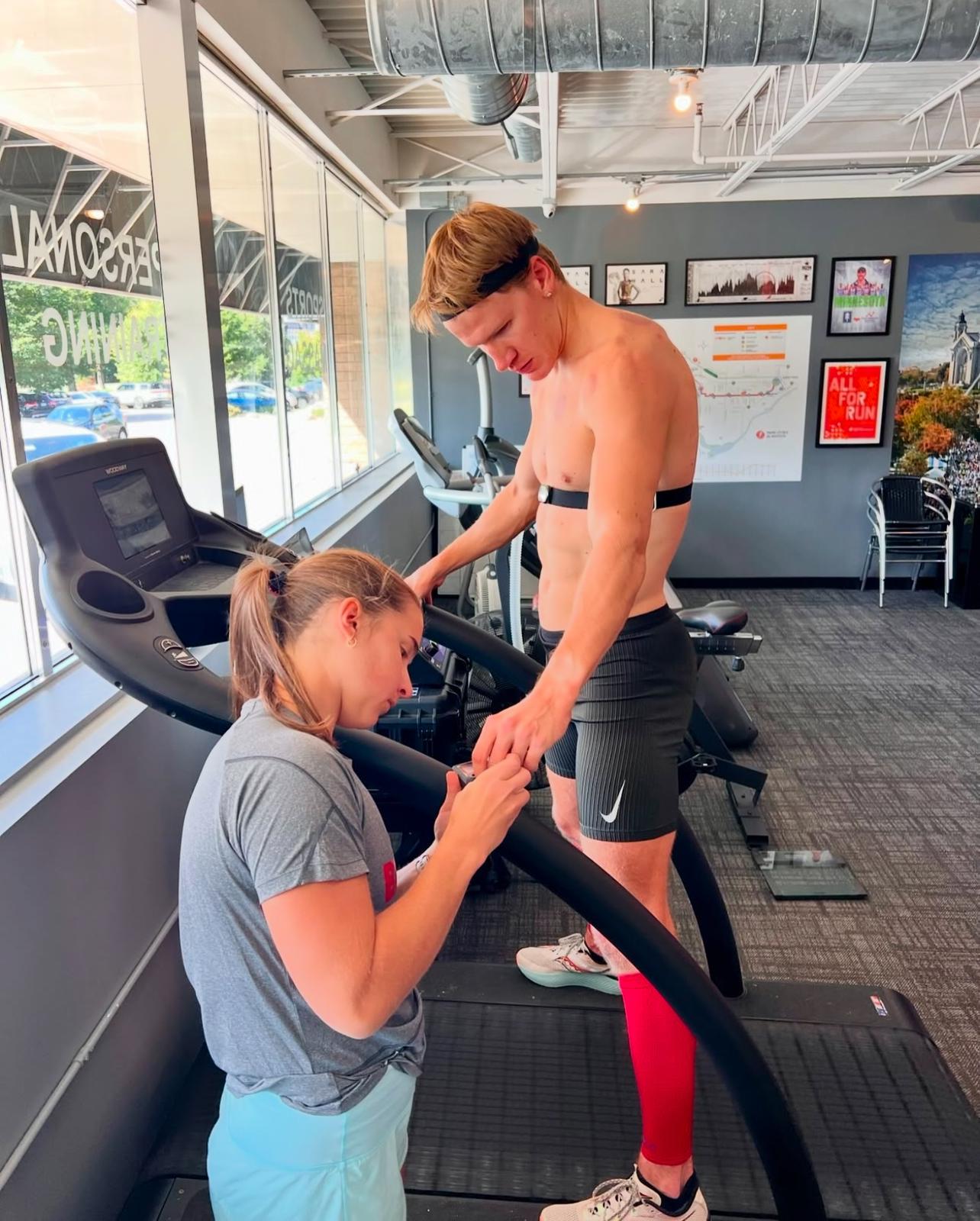
    Ketterson’s coach (and wife), Julie Ensrud, assists him with lactate testing during a Standard Session. (Photo: Zak Ketterson)

    However, he’s also relied on the hard data of regular progress evaluations to ensure he stays on a productive trajectory. This spring, Ketterson introduced a “Standard Session” to his training plan: A treadmill-running interval with a consistent incline, and a series of pre-set pace blocks which increase at five-minute intervals, which Ketterson would complete roughly every three weeks (at the conclusion of each training block). By “taking lactate [tests] after each stage and also tracking my heart rate and perceived effort, I was able to have a pretty good idea of whether I was carrying more or less fatigue that I might have thought, and also whether my fitness was progressing throughout the year.”

    The utility of this objective metric proved itself throughout the last eight months: “There were actually several times where I had a bad Standard Session where my fitness or, basically, fatigue was just showing that I wasn’t performing up to the standard of the last time I took the test. When that happened, it was a really easy decision to take an easier period and maybe take two or three days off,” Ketterson reported. He sees these data-driven checkpoints as essential to balancing a long-term training load. Without Standard Sessions, “it can be hard to make sure you don’t get overtrained, because the fatigue is really cumulative.” With its omnifarious symptoms, overtraining “can creep up on you.”

    Twin Cities Training

    Ketterson’s re-envisioned, intentionalized training program seems to have produced a positive cycle that leaves him with “headspace” to “be a balanced individual outside of sport” which, in turn, “translate[s] pretty well to [his] performance.”

    “I perform best when I’m happy,” he summarizes.

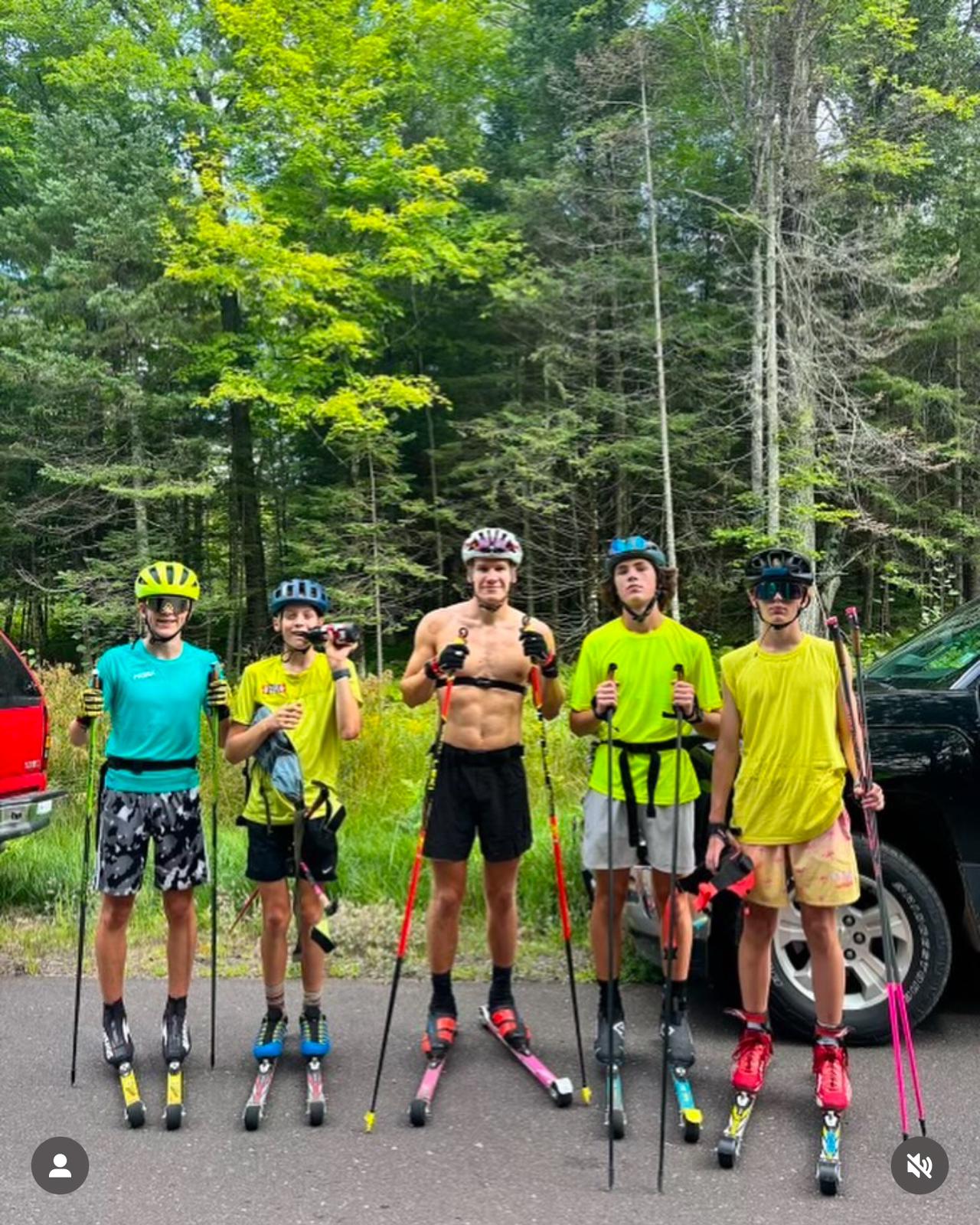
    Ketterson’s choice to live in Minneapolis—unique among the U.S. A- and B-Team athletes, who largely spend their summers in either the Northeast, the Mountain West, or Alaska—contributes to both the strength of his training and his appreciation for life beyond the trails. He explains: “It’s where I’m from, it’s where my family is; my wife [Julie Ensrud] and I have a house there,” which enabled the “surreal” experience of enjoying breakfast in their own kitchen before walking to the Wirth World Cup. With an abundance of urban trails and bike paths, Ketterson has a range of training options steps from his front door—and can “go to see some Timberwolves games, walk around the city, swim in [his] parents’ pool,” and rollerski at Hyland Park, where he learned to cross-country ski. Logging miles there is “really nostalgic […] To have trained there when I was 10 years old, and to be training there now, 17 years later, as a World Cup skier, reminds me how lucky I am.”

    Ketterson with family at the Minnesota State Fair. (Photo: Zak Ketterson)

    Minneapolis is also the headquarters of Team Birkie, the regional professional group with which Ketterson has competed since 2021, and of which his wife is now Head Coach. In addition to the advantages of training alongside athletes “who, in one [workout] or another, are going to give me a challenge,” Ketterson has consistently benefitted from collaborating closely with the Team Birkie staff to develop tailored deviations from a framework of “universal, good training practices […] Team Birkie has been so respectful of my opinions and of what I’ve learned about myself these last fifteen years. I have the freedom to do what I think makes me the best, and the coaches” support and advance those decisions.

    Moreover, the Twin Cities are the geographic and cultural gateway to a regional network of avid Nordic athletes. “The Midwest is maybe the place in the United States with the biggest critical mass of excited skiers—people who love skiing and are excited about World Cup competition.” Ketterson volunteers at several youth development camps in Cable, Wisconsin (and travel camps to Park City, Utah), “mentoring some of the top junior athletes in the region.” Helping to coach the next generation of Midwest standouts is “pretty special,” because he himself attended these camps “three or four times” as a middle- and high-schooler. While “it’s easy to think that if you want to be a really good skier you have to be born somewhere like Anchorage or Minneapolis, seeing those kids from Spooner [and elsewhere in rural Wisconsin], and how much they care,” reinforces that “skiing is a lot more global and accessible” than it is conventionally understood to be—especially after the “huge shift, for people of all ages who are into skiing in the Midwest” prompted by the Minneapolis World Cup. Ketterson reports an “energy flowing around Wirth Park now, even through the summer months,” and states that the venue has bid for a 2028 World Cup race—a powerful incentive for young athletes who could compete there in four years.

    Summer in the Midwest brings coaching Wisconsin and Minnesota’s promising young skiers at regional development camps. (Photo: Zak Ketterson)

    Not Expectations, But Belief

    One downside of training in the Midwest is, however, the late arrival of snow. Ketterson approached last weekend’s events Beitostølen as an opportunity to get steady on wax instead of wheels, and “to get that early-race rust out of the way before the World Cup.” It can be “daunting” to start the season with World Cup racing, and the Norwegian opener serves as “a really good opportunity to compete with a pretty high-level—honestly, World Cup-adjacent—field […] there’s so many Norwegian domestic guys who don’t get the chance to race” on the FIS circuit. “I don’t envy them in that it’s a cutthroat environment. But, I do envy them in that they have this ‘local’ circuit that rivals the World Cup in its competitiveness. That’s definitely a big reason why [the Norwegians] are so strong.”

    Ketterson’s objective was to at least qualify in the Beitostølen Sprints—a goal he successfully achieved on Friday, finishing 21st overall. Supported by his wife and Norwegian in-laws, Ketterson feels the weekend “went pretty well, all things considered, with how little time [he’s] been able to spend on snow. Especially the Sprint—being able to qualify in that field was a really big accomplishment for [him], and hopefully a good sign of things to come for the rest of the season.”

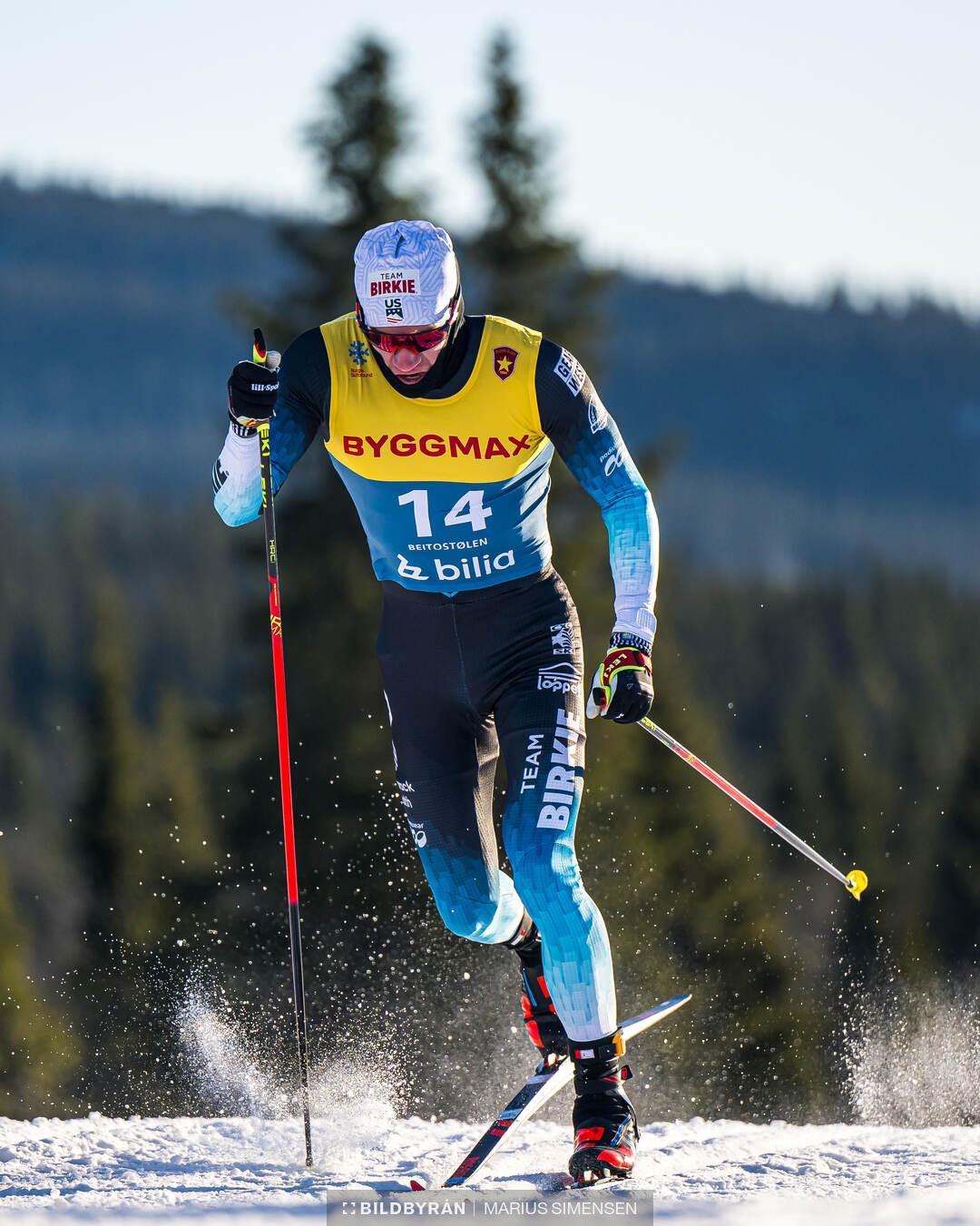
    Ketterson advanced through Qualifying at last weekend’s Classic Sprints in Beitostølen , Norway. (Photo: Marius Simensen / Zak Ketterson)

    Indeed, as he looks to the World Cup, Ketterson is determined to use the lessons, progress, and resilience of the last year to “be competitive in the races that [he’s] doing.” He finds ‘first day of school’ to be a good metaphor for Ruka. In addition to reconnecting with fellow U.S. team members, some of whom haven’t seen each other since March, the upcoming three days in Finland entail a “shared experience” of anticipation and excitement: “The other athletes have trained just as hard as you have, and they all care just as much as you do, and they are there with similar goals.” While the season start can be “nerve-inducing,” the skiers are among peers who understand and reciprocate the electric attitude of the weekend. “It takes a lot of energy, but it gives a lot of energy.”

    After Ruka, “You have to take it period by period,” Ketterson explains. “Starting with Period I, my first and foremost goal is just to race well enough to move on to the Tour de Ski. Hopefully, if I’m racing at a really high level, I can lower my shoulders a bit.” A Sprint Semifinal placement would be ideal: “I’ve made six or seven World Cup Quarterfinals, but haven’t managed to squeeze through one yet.”

    Beyond the season start, Ketterson states that the Trondheim World Championships are his “biggest priority.” Between stories from his wife’s family and his own experience living and training in Trondheim through the summer of 2023, he’s heard “so much about [the World Championships in] Oslo in 2011 and how legendary that was,” and anticipates the coming Championships will bring similar energy.

    Perhaps more significantly than any single race performance, though, is this season’s “opportunity for a do-over.” Ketterson has clearly reflected on 2023-24, and is ready to compete with “renewed energy and renewed excitement.” It’s an attitude that has only been reinforced by the success elsewhere on the U.S. Men’s Team—success that Ketterson says has not raised expectations but, rather, “belief. When we see Gus [Schumacher] in Minneapolis, J.C. [Schoonmaker] in Ostersund, or Ben [Ogden] in Toblach, the reaction isn’t, ‘Oh, shit, now we need to do that.’ It’s, ‘If those guys can do it, maybe we can do it, too’… Those guys have shown it’s possible. We’ve all bought into this belief that we can do it, and could be the next ones.”

    The FIS World Cup will kick off on Friday, November 29th in Ruka, Finland.

    FasterSkier thanks Zak Ketterson for his time. Some comments have been edited for length and clarity.

  • Juggling the Four S’s: An Interview with John Steel Hagenbuch

    Juggling the Four S’s: An Interview with John Steel Hagenbuch

    The 2023-2024 season was undeniably strong for Dartmouth College’s John Steel Hagenbuch (’25, U.S. B-Team).

    In December, his was the fastest leg time in the Men’s 4×7.5 k Relay in Gällivare. One week later, he secured his first top-15 finish on the World Cup circuit, taking 13th place in the Östersund 10 k Freestyle. In February, he surprised himself with a bronze medal in the U23 World Championship Sprint in Planica.

    Domestically, the wins came hard and fast. Hagenbuch rang in the New Year with a victory in the 20 k Freestyle at USSS Nationals in Soldier Hollow, UT, before proceeding to win every race he started in the Eastern Intercollegiate Ski Association—going six for six across the Vermont, Colby, and Middlebury Carnivals. Then, it was on to the NCAA Ski Championships, where he won the 7.5 k Freestyle, before finishing the season at the top of the 40 k Freestyle podium at Duluth, MN’s blizzard-battered Spring Nationals.

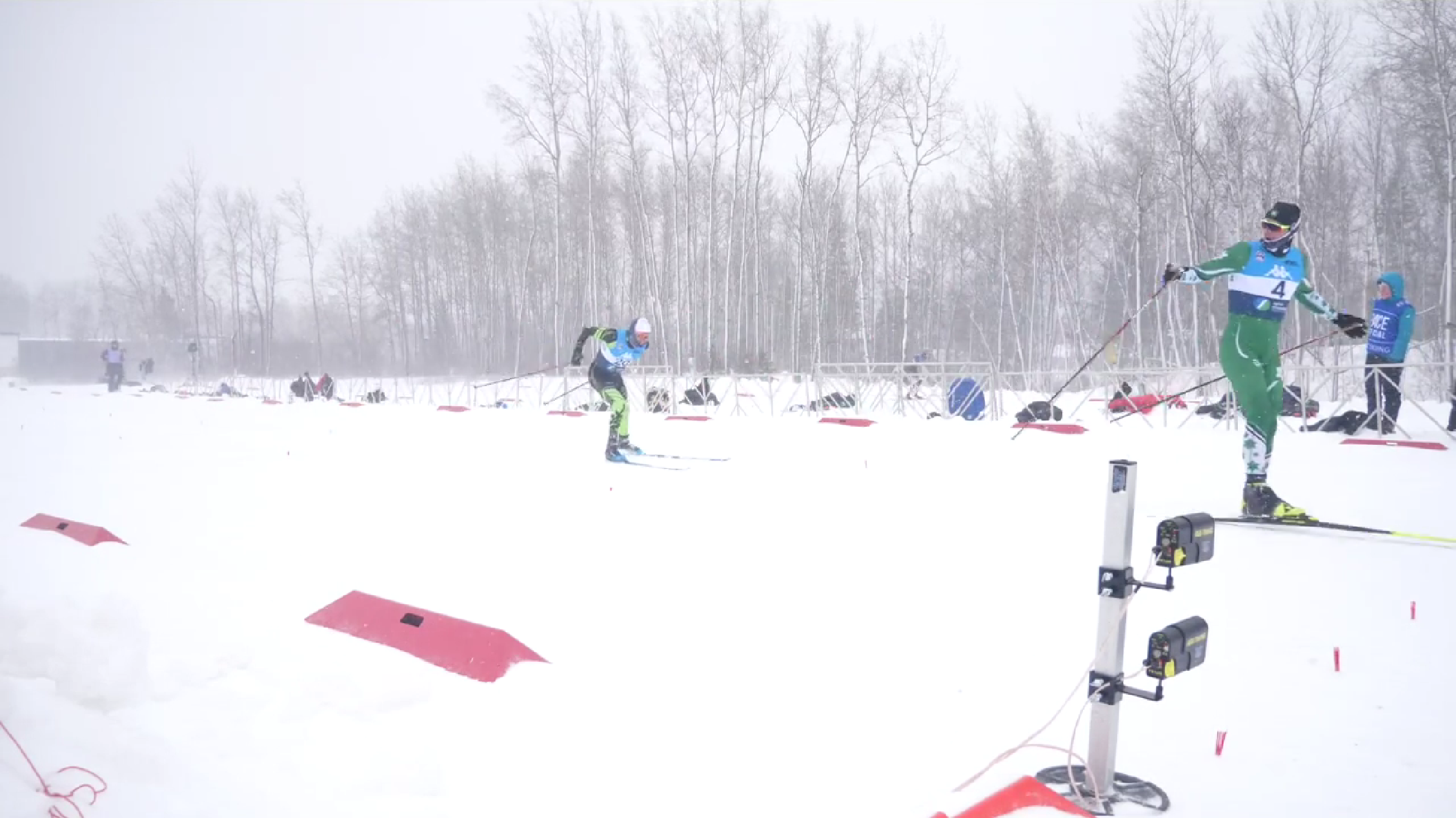
    Hagenbuch outsprints Jake Brown (Craftsbury Nordic) to end the 2023-2024 season with a win at Duluth’s “Spring Nationals” 40 k Skate. (Photo: Ben Theyerl / FasterSkier)

    However, in a chapter of American skiing which has left commentators (understandably) salivating over career-defining performances, and quick to use the attendant, maximalist terminology, Hagenbuch resists any such characterization of his performances. “I genuinely don’t think [last season] was a breakout by any means,” he told this hyperbole-bandying writer. “Every year up to now has just been improvement in key areas, and just an evolution in my skiing […] I think it was just part of the processes, and just another step in my development.”

    Steady development might not make for much of a pre-season story—but Hagenbuch’s approach towards training, racing, and the winter ahead certainly does. Indeed, the measured, circumspect, and profoundly grateful attitude with which he characterized last season evidently saturates his workouts, his performance goals, and his abiding love for the undergraduate experience. FasterSkier spoke with John Steel Hagenbuch to get the details on Dartmouth, “Shrimp Week,” and what’s next for the USCSCA’s Men’s Nordic National Skier of the Year.

    Batting 0.750 on “the Four S’s”

    In his third year of skiing for Big Green, Hagenbuch describes his life as a balancing act in several dimensions.

    At the macro-level, there’s the challenge of pursuing three distinct strains of activity: academic commitments, NCAA racing, and skiing internationally. When it comes to college skiing and World Cup skiing, Hagenbuch admits “there’s not many people who do both,” but credits Ben Ogden (University of Vermont, ’22) as a “blueprint” for successfully competing in both worlds. “It’s awesome that the attitude has fundamentally changed from 20 years ago—it’s no longer ‘either or,’” Hagenbuch says.

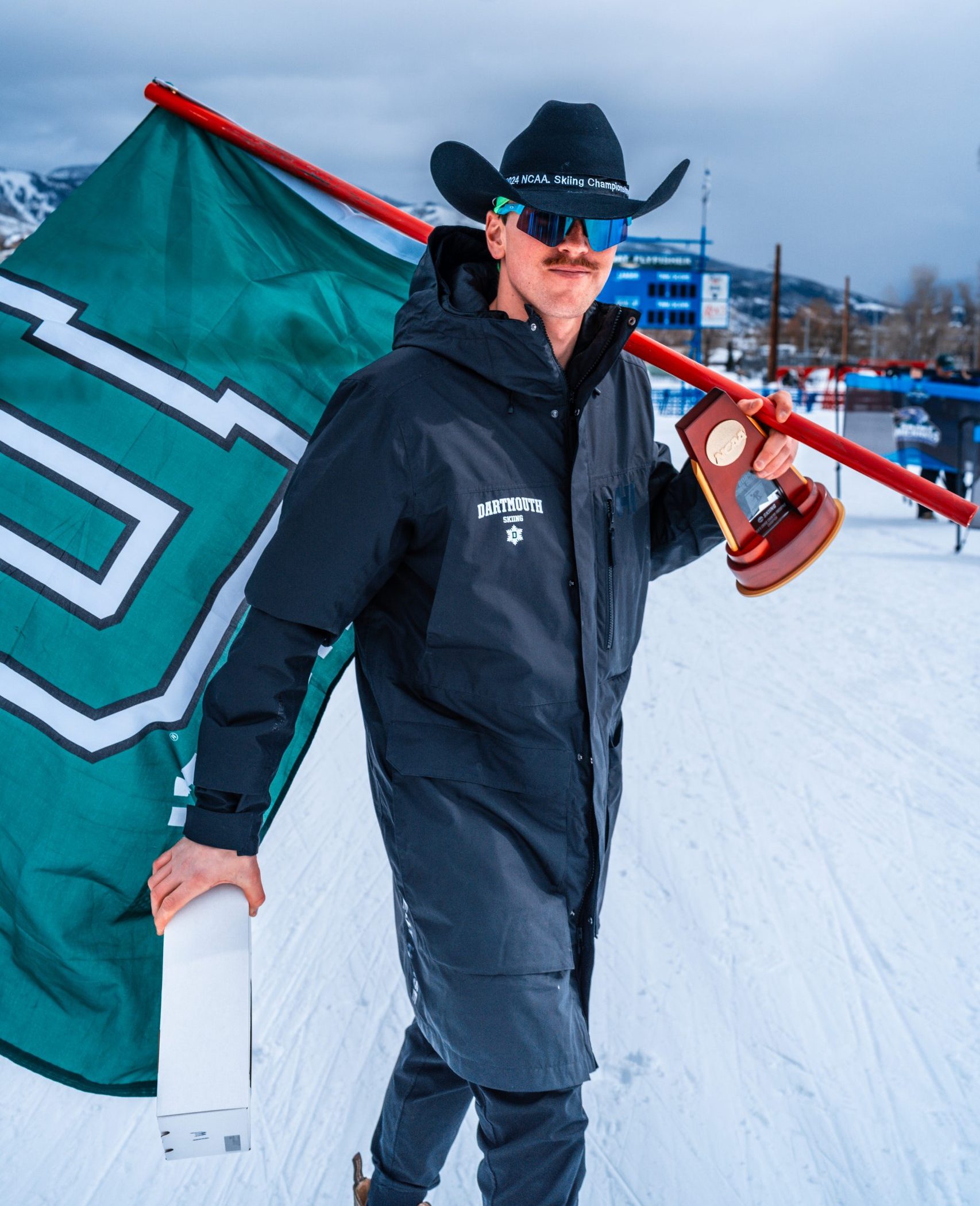
    Hagenbuch, 2024 NCAA Champion in the 7.5 k Freestyle at Steamboat Springs, Colorado. (Photo: Tobias Albrigsten / Untraceable Global)

    In his estimation, the space to compete at both the highest levels of domestic and international racing, while soaking up the undergraduate experience, is “going to sustain skiers’ careers for longer. Going to college is really fun, and for the time that I’m here, it provides a lot of balance in keeping things lighthearted and low-stress.” If Hagenbuch has a tough day, or even tough season (in a Q&A with The Dartmouth, he said of his 2021-2022 World Cup run: “Frankly, it sucked”), he has “other things to turn towards, and to look towards, to make [him] happy. Dartmouth is an amazing place; there’s so many amazing people with such diverse interests […] I’m so glad I took the opportunity to come here and live the life I’m living.”

    With a rigorous battery of social events and campus traditions, however, comes a more micro-level balancing act. “I say I’m juggling Four S’s: Skiing, School, Sleep, and Socializing. On any given day, I can only choose to do three. It’s a sacrifice” (most often, it seems, of sleep), “but it’s one that I very willingly make to take advantage of a great education and a robust college experience while I’m the same age as my peer group, and still a ‘real kid.’”

    Progress and Perspective

    When it comes to training, juggling the Four S’s means making room for spontaneity—and a summer program that rejects restrictive regimen in favor of vibrance and variety. Indeed, Hagenbuch’s approach to the off-season seems to invert the perennial challenge of ‘Making training fun’ in favor of ‘Making fun training.’

    When I ask him to describe his summer block in three words, Hagenbuch takes an uncharacteristic pause before settling on “Go with flow.” Over the last two years, he says he has been “the least stressed out about skiing since my freshman year of high school. A lot of that came down to having really great stuff going on in my life socially and academically, and actively choosing to think about those more.”

    This isn’t to say that Hagenbuch was “prioritizing skiing less. It was just that I think [skiing] was taking less energy from me, and I was getting only positive things from it, as opposed to worrying about it. I think that enabled me to roll with the punches better, and not to stress.” Rather than fretting over a missed workout or a busy week, he recognized that he “can’t do everything all the time,” and would simply strive to maximize his focus and intensity during “moments when I felt good and had time to train, maybe even a little bit more than people would recommend […] When I zoom out, I realize that I hope to still be skiing a full ten years from now, and I’m not that worried about it. I’ve got a lot of time to make the progress that I need to, and get the notches on my belt that I need to.”

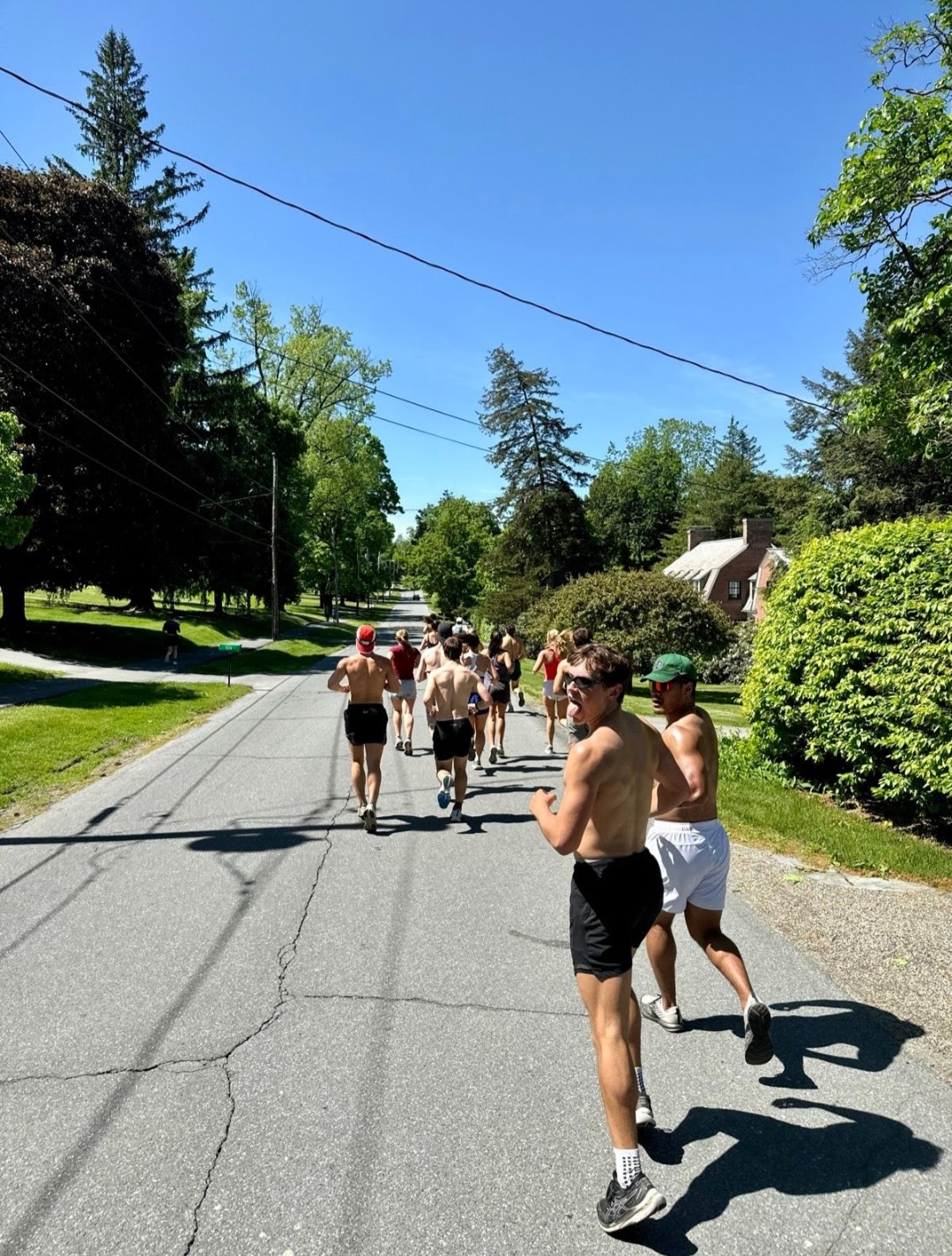
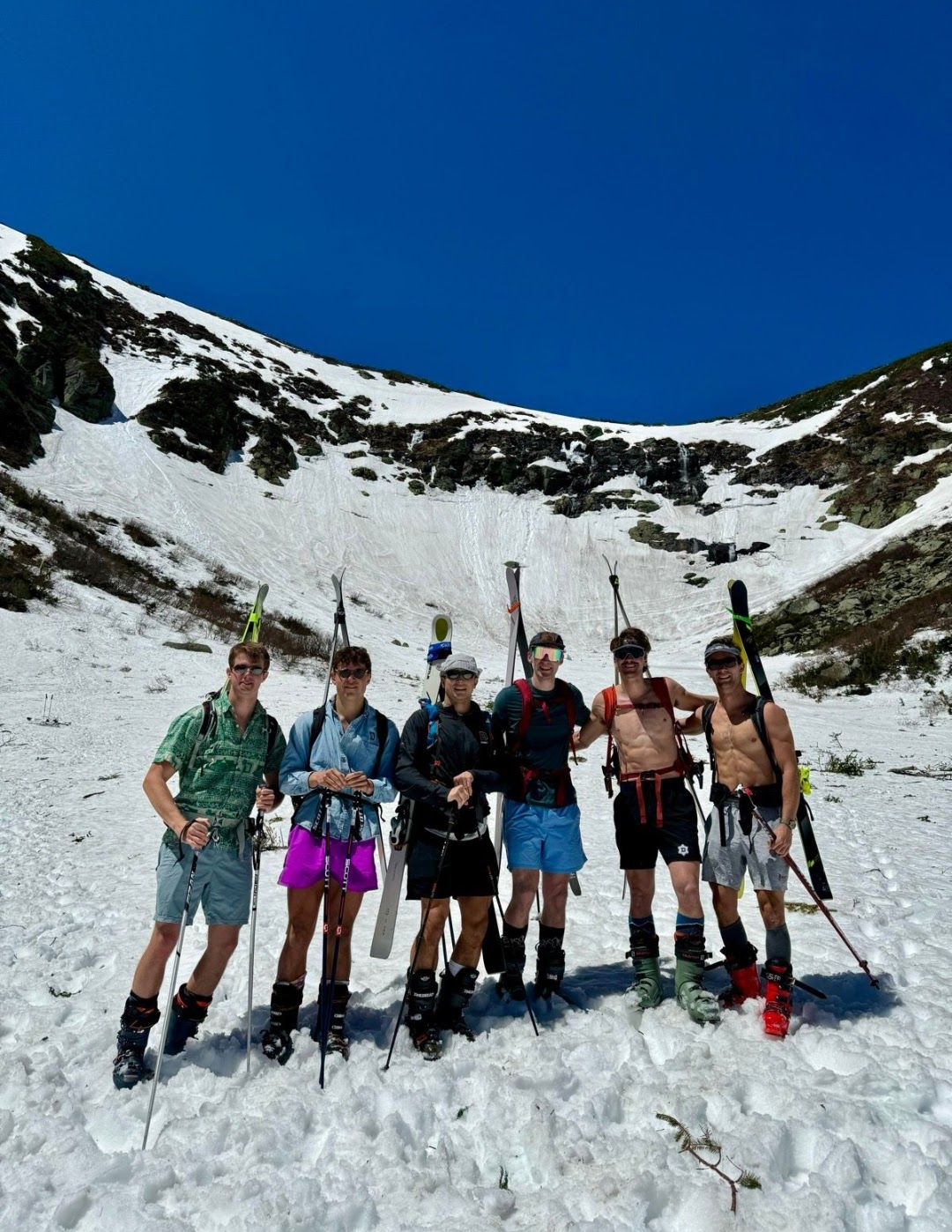
    Hagenbuch’s extensive spring and summer highlight reel illustrates this perspective on a sustainable, “go-with-the-flow” off-season. Favorite spring workouts included skipping class to backcountry ski Tuckerman Ravine on a bluebird May day, and the “Occathon”—a marathon consisting of 18 laps around Occom Pond, “adjacent to the Dartmouth campus, with all these nice homes around it, and which adjoins Frat Row.” Hagenbuch began the run with a handful of teammates and fraternity brothers, but “40 to 50 other random people joined in throughout,” with football players, students, professors, and stray joggers pulled in by the energy of the event.

    Scenes from Dartmouth’s “Inaugural Occathon.” (Photo: John Steel Hagenbuch / Strava)

    High summer at home in Sun Valley, Idaho brought more long days of backcountry skiing, including a “sketchy” July descent of McGowan Peak, as well as teaching classmates how to mountain bike, point-to-point 50 k trail runs in the Sawtooth Mountains, and a week of river-rafting. Although the lattermost trip may have come at a “time when most other people were probably putting their noses to the grindstone, I thought that it was something that would be a net positive in terms of relaxing for a bit, resetting the body and mind, and having some fun with my friends.”

    When he returned to Hanover in late July, Hagenbuch adopted a more structured cycle—while still making time to soak up the energy of summer on campus (Dartmouth, with a quarter system, has classes year-round). He completed coursework, moved back into his fraternity, and was “training a lot, and hard, and getting in the sessions I needed to. Would I have done things a little bit differently? Would I have recovered a little bit better, or been X-percent better in a certain session? Had I gotten a little bit more sleep, probably, but I don’t really care.”

    Backcountry skiing at Tuckerman Ravine. (Photo: John Steel Hagenbuch / Strava)

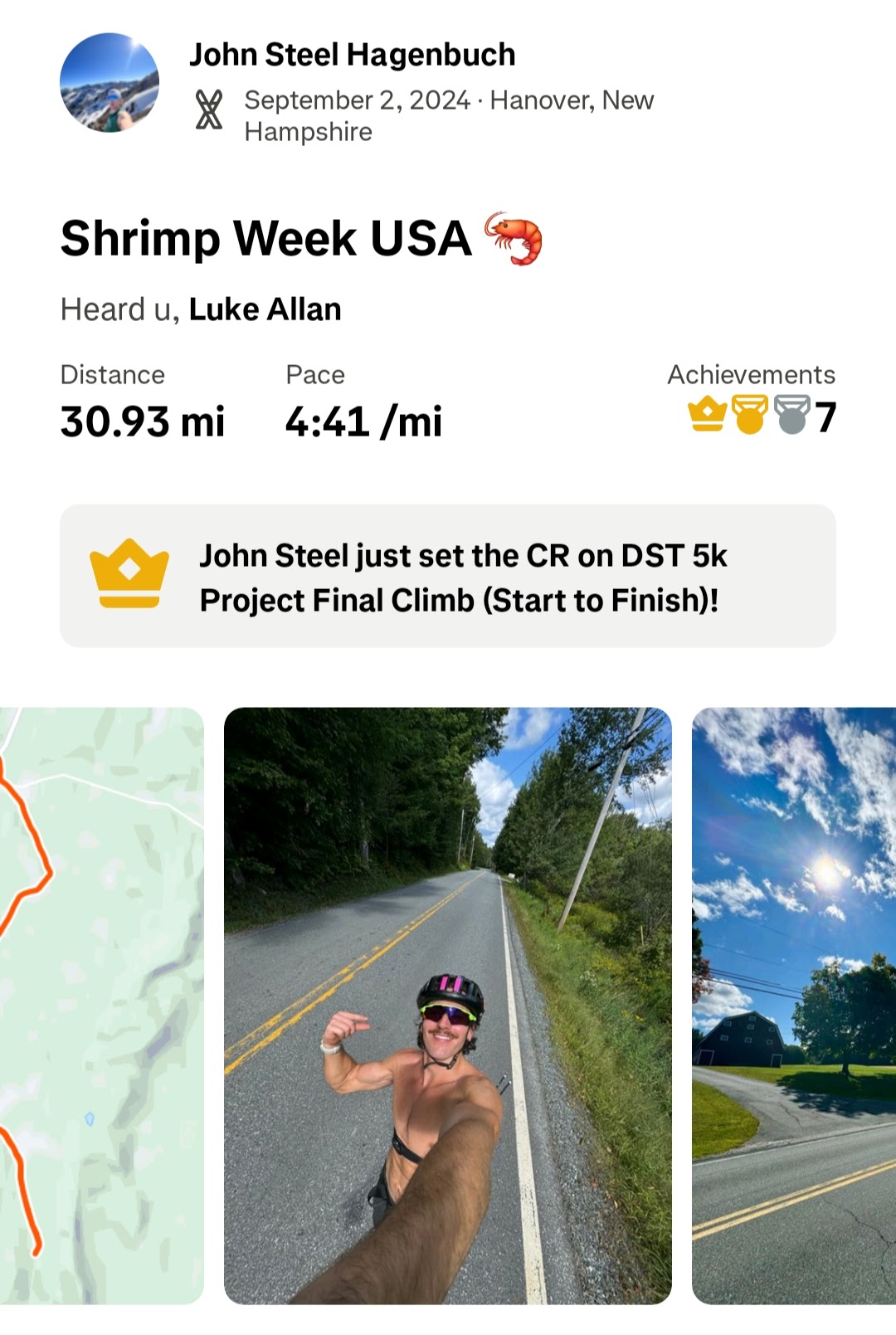
    What Is Shrimp Week?

    The first week of September stood in stark contrast to Hagenbuch’s otherwise-adaptable summer. Hagenbuch reportedly logged over 852 kilometers across 45 hours of running, rollerskiing and biking between September 2nd and September 8th—a sojourn he cryptically christened “Shrimp Week.”

    When I asked for the logic behind both the Brobdingnagian volume block and the name, Hagenbuch admitted: “If you talk to most of the coaches I’ve ever had, and many of the people I train with, there are some things I do that there isn’t much logic behind. I was already planning on doing a volume week. I was still here in Hanover, but my buddies that had been here for sophomore summer had just left, and no-one on the ski team was here yet, so I was training all by myself. I was feeling good, feeling really fit […] and that was the barometer I went by every day—just thinking about how I was feeling when I was waking up, and fueling really well, sleeping well, and just training a bunch and seeing how that went.”

    In essence: “I was curious how much I could do while still feeling good.”

    Shrimp Week, Day One outtakes. (Photo: John Steel Hagenbuch / Strava)

    And, that name? “Well, Forrest Gump is one of my favorite movies. And there are some individuals that were doing some training and calling their volume weeks ‘Shark Week,’ which I thought was funny. So, I was kind of making fun of that.” Blood in the water!

    Passing the Three Gates

    When asked about the coming winter, Hagenbuch seems contentedly confident: confident that his body is “in a good spot and responding well” to autumn intensity; confident that he’ll continue to balance his Four S’s while hitting “key sessions”; and confident in the steady arc of progress he has thus far maintained.

    In the 2023-2024 World Cup season, Hagenbuch aimed to have just one race in which he passed through the “three gates” to a strong performance—“good skis, good body, and good execution.” Between the Gällivare Relay and the Östersund 10 k, he had two (his Planica Sprint arguably constituted a third); this year, he’s simply looking to add to that total.

    “Once again, all I’m really hoping for is to have a couple of races where I’m really happy that those three gates were fulfilled. And I think the results will come if that happens,” especially if he can improve his consistency in both disciplines. “I’m definitely not saying, ‘Oh, I need to get a top-ten.’ But a top-ten would be nice.”

    Hagenbuch and teammates after the 4×7.5 k Relay in Gällivare, Sweden, December 3rd 2024. Hagenbuch recorded the fastest leg time of the day. (Photo: John Steel Hagenbuch / Strava)

    In addition to racing Period I, Hagenbuch plans to stay in Switzerland through Christmas and complete the Tour de Ski, where he hopes that the Alpine climbs and altitude, and potentially even Alpe Cermis, will play to his Sun Valley strengths.

    While he is “not immune” to the nervousness that the approaching World Cup brings to many athletes, Hagenbuch cites the dynamic of the US Men’s Team as creating a relay-like atmosphere in which he can excel.

    “When I think back on my best races, a lot of them have been relay legs, and I think that’s not a coincidence. You take a lot of internal and external pressure and stress out of racing” when “skiing for your teammates and not just for yourself.” The American Men “all like each other, and we’re all close friends. They’re all really, really great guys that I like to spend time with, I like to train with, and I like to race with. And I think we push each other in a really positive way that’s mutually beneficial […] I don’t mind if any of those guys beat me. I’m not racing against them. I’m racing against me. I’d love to see them do as well, if not better than, myself, because I know that if they’re capable of doing that, if they’re putting out those results, then that’s emblematic of the atmosphere and capacity of the whole team, including myself.”

    The camaraderie continues for (from left) Gus Schumacher, Ben Ogden, Johnny Hagenbuch, and Luke Jager, pictured here as the U20 4 x 5 k World Champions in Lahti, Finland, 2019. The American Men are “no longer really the underdogs” they were in 2019, Hagenbuch says. (Photo: Doug Stephen)

    The Hound of Hanover

    On American soil, however, Hagenbuch is looking to the 2025 NCAA Championships with vicious clarity.

    The event will be on home turf in Hanover, with a 20 k Mass-Start Freestyle and a 7.5 k Individual-Start Classic. In the Classic race, he’s hoping to “improve on [his] runner-up finish from 2023” (read: win).

    As for the Freestyle: “I’m going to be frothing-at-the-mouth rabid before the start of that race. It will certainly be, up to that point, the most important race of my career.”

    Indeed, the man who will be defending his Championship title this March appears unrecognizable from the serendipitous spirit who “go-with-the-flow’ed” his way through the training sessions described above.

    “I bring a kind of manic energy” to races, Hagenbuch says. Think Redbulls, really loud music (“I’ve blown out a couple van speakers in my day. ‘Rental Car Companies Hate Him for this One Simple Trick,’ for sure,” he admits), and more rabid dog analogies. “But that all gets tuned out and sharpened, like focusing a camera, when the gun goes off. And I love the catharsis at the end of the race, too, especially if it goes well.” Madness turns to the Campbell’s Monomyth: “You have a bit of ‘The Hero’s Journey’—the build-up,” the struggle of exertion and emotion, “and then, crashing down.”

    Attending March’s NCAA Championships will come at the expense of a possible World Championship appearance. “I’m making the conscious decision that, should I qualify for the World Championships in Trondheim, which are at the same time as NCAAs, I won’t be going. Maybe that’s unwise. But Matt Whitcomb skied for Middlebury, and Chris Grover skied for Dartmouth, so they kind of understand. And this is a step in my career where I don’t think that I’m missing out on anything, by any means. This is a mutually beneficial thing: I get to ski for Dartmouth. I get to experience all that it is to be a Dartmouth student outside of the ski team. It’s an incredible privilege that I don’t want to pass up.”

    With Hagenbuch hoping to be “in the best shape of [his] life March 6th-8th,” and the “NCAA Championships at home lining up with us having one of our strongest teams that we’ve maybe ever had across all disciplines—Nordic, Alpine, Men and Women,” he thinks that, “knock on wood, we could pull off something really special.”

    Hagenbuch on the podium of the Men’s 7.5 k Skate at the 2024 NCAA Ski Championships. (Photo: Tobias Albrigsten / Untraceable Global)

    “Even if the stars don’t align for us, it’s going to be an amazing event.” The Big Green athletes and administrators are already working to build excitement about the races, and there is a long tradition of Winter Carnivals constituting the campus’s most energetic weekends. Hagenbuch anticipates Oak Hill ski complex will be transformed into a drum-pounding, sound-drowning amalgamation of Minneapolis, Holmenkollen, and Animal House, rowdily attended by Dartmouth’s most avid fans and most accomplished day-drinkers. Skiers Luke Allan, Jack Lang, Asa Chalmers, Cooper Camp, and Hagenbuch himself are “all in different fraternities,” each of which will send their own squad of course-crowders. “There will be hundreds of Dartmouth men” bringing encouragement (and liquid courage) to the trails, in addition to thousands of “parents, students, spectators, kids from other schools, all out there getting fired up and really loud for races.”

    “Dartmouth is a bizarre place, out in the middle of nowhere. It’s a melting pot of a lot of different people. And, in a world that seems to have progressed a lot in many ways—technologically, socially—Dartmouth has largely remained the same, ‘Lest the old traditions fail.’” Whether relaxed or rabid, Hagenbuch feels especially privileged to live, train, and compete in this unique environment; one in which he savors the thrill of racing, the rigor of academic study, and the spontaneity that so ruddily colors undergraduate days.

    And, despite holding a broad, even patient, view of his unfolding athletic career, he has clearly fixed March 8th, 2025 as his Polaris; a lodestar rising steadily above the near horizon, flickering with the white heat of anticipation and ambition.

    “I don’t think a lot of the Western skiers, or even the other Eastern skiers, have any idea what it’s going to be like.”

    FasterSkier thanks John Steel Hagenbuch for his time, and Leann Bentley for facilitating this interview. Some comments have been edited for length and clarity.

  • T-Minus Ten Years: Soldier Hollow’s Preparations for Salt Lake City 2034

    T-Minus Ten Years: Soldier Hollow’s Preparations for Salt Lake City 2034

    As the pageantry and athletic performances of Paris 2024 captivated audiences across the United States, a team of organizers had their eyes fixed on a target far beyond the shores of the Seine. Ten years beyond, in fact. The International Olympic Committee announced on July 24th that Salt Lake City, Utah will host the 2034 Olympic and Paralympic Games, with the Cross-Country and Biathlon events returning to the Soldier Hollow Nordic Center, site of the 2002 Games.

    Lacking some preternatural power of precognition or comprehensive data from our nation’s youth development programs, this journalist is unable to provide any outcome predictions for the 27th Winter Olympiad. Instead, FasterSkier reached out to the trio of skiers ready to guide Soldier Hollow down the decade-long road to 2034.

    International Biathlon Union World Cup races at Soldier Hollow, 2024. (Photo: Josh Korn)

    Salt Lake City’s Two-Boxed Bid

    Twice a U.S. National Champion while skiing for the University of Utah, twice an Olympian (Albertville in 1992 and Lillehammer in 1994), and Chief of Sport for the U.S. Ski Team from 2007 to 2019, Luke Bodensteiner is currently the Chief of Sport Development for Utah Olympic Legacy and General Manager of the Soldier Hollow Nordic Center. In this role, he is responsible for both the Solider Hollow venue itself, and the range of Olympic and Paralympic sport programs that contribute to Salt Lake City’s vibrant, active winter community.

    In Bodensteiner’s view, Salt Lake City checked two distinct boxes. For the U.S. Olympic & Paralympic Committee (USOPC), with whom the Utah Olympic Legacy Foundation partnered for over ten years to gauge community interest, assess venue capability, and to ultimately make a bid for the 2034 Games, the Foundation’s robust youth programming was a major draw. Over three thousand young athletes participate in winter sports through the Foundation—engagement which the USOPC recognizes as reflecting “the strength of the [2002 Games’] legacy,” and which made bringing the world’s best back to Utah “a really compelling proposition for the USOPC.”

    Meanwhile, for the International Olympic Committee (IOC), Salt Lake City’s Olympic infrastructure, which has enjoyed intensive usage at a “regular cadence” since the 2002 Games, and aligns with Agenda 2020—an initiative to ensure “sustainable games” through long-term usage and reusage of venues, among other environmental and financial considerations.

    20,000 fans attended the Men’s Relay at the 2002 Olympics in Soldier Hollow. (Photo: Cory Smith)

    Josh Korn agrees that Soldier Hollows’ infrastructure has enjoyed “great utilization already,” and heavy engagement with national and international events since ’02. “First and foremost, we are an Olympic venue,” he reminds me. “We’re predisposed to have the terrain and facilities necessary for high-level racing. It’s in our DNA—that’s why [the USOPC and IOC] chose Soldier Hollow” for the games two decades ago. A Wisconsin native (as is Bodensteiner) and UW-Green Bay Nordic alumnus, Korn came on as the Solider Hollow Nordic Event Manager in 2021. During his three-year tenure alone, the venue has hosted an impressive roster of races, including the International Biathlon Union World Cup (2024), the US National Championships (2024), the NCAA National Championships (2022), and the Biathlon Junior World Championships (2022). In the coming ten years, Korn expects Soldier Hollow will conduct at least “six to ten” more major events, beginning with the US Junior National Championships in 2025 (which will be the first event to use Soldier Hollow’s recently-expanded Olympic Stadium in “quite some time”), and likely including the IBU World Cup between 2026 and 2028, as well as the Cross-Country World Cup after 2030.

    University of Utah skiers celebrate their 2022 NCAA National Championship title at Soldier Hollow. (Photo: Josh Korn)

    While these races will serve as crucial pre-Olympic “test events” for Soldier Hollow’s organizing committee and volunteer corps, ensuring they are “savvy enough to work at the highest level,” the teams are already “pretty doggone good at putting on races out here,” Korn concedes. In his estimation, “there’s probably nobody in North America” better equipped to host elite-level Nordic racing.


    Two-Week Windows

    Nevertheless, Korn recognizes there is work to be done, both on and off the trails. Soldier Hollow just completed a 19,000 square foot addition Nordic Center, which brings the building’s footprint to just under 30,000 square feet of training, business, and conference space. Newly-homologated courses for the 2023 FIS Para Nordic World Cup incorporated terrain better suited to sit-skiing than the existing trails—terrain which is also more appropriate for beginning, non-adaptive skiers. “We want to be the go-to place for Utah, for the Mountain West, for people to come as a destination to ski,” Korn tells me. “We’re really trying to expand what we’re doing by allowing more people to get involved.”

    With a dramatically-expanded Nordic Center, Soldier Hollow now boasts nearly 30,000 feet of indoor conference and event space. (Photo: Bill Pierce)

    That expansion is the “cornerstone” of the thriving Nordic community the Soldier Hollow team hopes will underlie the 2034 Games, and it is underway despite increasingly-adverse climate conditions. Bill Pierce is the current Venue Operations Director for Soldier Hollow, with an impressive resume spanning decades of trail and venue design, twenty years of professional coaching, and management of both the sprawling American Birkebeiner Ski Trails in Hayward-Cable, Wisconsin, and Snow Mountain Ranch in Granby, Colorado. The third of the “three Wisconsin boys running” Soldier Hollow, Pierce has prioritized effectively leveraging the location’s power and water to “bring skiing to a venue that wouldn’t otherwise have it.”

    The “three Wisconsin boys” of Soldier Hollow: From left, Bill Pierce, Luke Bodensteiner, and Josh Korn. (Photo: Josh Korn)

    Although Soldier Hollow “did not exist before the 2002 Olympics, and was built specifically for those Olympics,” it “wouldn’t exist without snowmaking,” Pierce states. “We’d have a very short season, maybe less than thirty days.” Cold air is the biggest concern: The temperature is rarely low enough to consistently produce snow. In a realistic scenario, Pierce and the trail crews have “a two-week window during which we want to be able to pump the maximum amount of power and water.”

    The trails are currently equipped with roughly sixty “stick guns” and ten “fan guns,” all of which are fully automated (“I can run the snowmaking from my laptop at home. That’s how automated it is.”) At present capacity, with two weeks of sufficiently cold air, Pierce can cover 10k of trail in one meter of manmade snow, a base thick enough to “withstand any type of weather through March.” During the last season, he made enough snow in four weeks to cover 16k.

    Ongoing expansions are no coddiwomple. By the 2034 Games, Soldier Hollow will aim to cover between 15k and 22k of trail, in a one meter-deep racing deck, in a two-week window—nearly double their current capacity. (For those with a pen and paper, or with a problem visualizing volumes, 15k of FIS-homologated Category D trail, at a depth of one meter, contains roughly 112,500 cubic meters—over 11,000 tandem-axle dumptruck loads—of compacted, groomed snow). This should give Soldier Hollow ample space to enable cross-country athletes to race (and get TV coverage) while biathletes train, and vice versa—an exercise in Olympic stadium-sharing that hasn’t taken place since the 2002 Games, and that Pierce describes as an “art and science” of visual and logistical trail configuration.

    Excavating below-frostline trenches for snowmaking pipe along the Soldier Hollow trails. (Photo: Bill Pierce)

    This scheme is an ambitious expansion of the current system, but a necessity. In Pierce’s words, there’s “too much fire, not enough water, and it’s changing fast” in the Mountain West: “When you see the climate history that’s happened in the last forty years, it’s actually very scary.” Today, snowfall totals are erratic. “In 2021-22, we had 32 inches of snow. In 2022-23, we had over 300 inches of snow. In 2023-24, we had a mix of snow and rain, including several seven- to eight-day stretches above freezing. We watch the weather two weeks out, and plan our staffing and snowmaking setup to go as fast as we can to use the cold air while it’s here.”

    First on the to-do list is the creation of another water pond and pumphouse. That project will begin in summer 2025, in conjunction with the Soldier Hollow Golf Course. Summer 2025 will also see the excavation of a snow storage depot, which will be operational by the early months of 2026. Between the present date and 2027, the venue will also install an additional 2k of fully-automated snowmaking around the core trails and expanded stadium; from 2027-2030, they’ll undertake a “final touch-up” of the automated system to cover 8-12k of snowmaking (any remaining kilometers will be covered through machine pile-pushing of depot-stored snow and “whales”).

    Lowering snowmaking pipe into place. (Photo: Bill Pierce)

    A Long and Local Road

    With another Crystal Globe for Jessie Diggins, a home-soil World Cup witnessed by 40,000 attendees, and long-awaited US Men’s victory by Gus Schumacher, the winter of 2023-24 brought America’s Nordic excitement to a fever pitch. As Josh Korn summarizes, “the amount of enthusiasm there is for this sport right now—there’s never been more of it.”

    Husbanding this energy for the decade ahead seems like a tall order—and the landscape of 2034’s competitive field will be dramatically different from today’s bounty of emergent possibilities. Schumacher will be 33 years old; Diggins will be 42 and may have since storage-waxed her racing skis (although Maurilio de Zolt won Gold over the Norwegian Dream Team at Lillehammer ’94, at the age of 43—so anything’s possible!) Kikkan Randall made her Olympic debut (coincidentally, in Salt Lake City) at the age of 19, so the American star of the 2034 Games might not be spending this autumn rollerskiing and lactate testing—they’ll be too busy with fourth grade.

    A potential prospect for the 2034 Games (or the 2034 FIFA World Cup) builds skills at the Soldier Hollow Nordic Center. (Photo: Josh Korn)

    In Diggins’ opinion, the challenge of maintaining U.S. skiing’s momentum in the years to come is “the single biggest question for the future of our sport”—but the solution is relatively simple: Funding and access. “The pathways to success dry up really quickly in a financial drought in a country that has no government funding for skiing. Without money, we can’t have more World Cups in the U.S., we don’t have SuperTour, we can’t fund our athletes, and it’s pretty much impossible for people to pursue a career in a sport that is largely played out in Europe.”

    The friction of distance also has implications for skiing’s American fanbase. “The other thing we really need is access to connecting to the races and connecting to the athletes […] We need it to be easy for people to find our races to stream on-demand wherever they are, and it needs to be straightforward.”


    Espen Krogstad, 11, poses with his Jessie Diggins sign at the World Cup race in Minneapolis in February 2024. (Photo: Nathaniel Herz/FasterSkier)

    Lastly, Diggins says, “Athletes need to be willing to share themselves, and to post on social media, so kids and fans can connect with athletes when they’re gone and on the road, because when you get to know someone, then you want to hear from them and stay connected when that sport is happening [abroad].”

    Luke Bodensteiner notes the progress of the previous decades as he looks ahead. “The sport has grown in leaps and bounds. A lot of people who skied competitively thirty years ago continue to stay involved, and they’ve helped built, and brought expertise to, local clubs. It’s snowballed” as these original, personal investments in team, equipment, and grooming improvements across the country make skiing accessible and “enjoyable for a lot of people. We’re in a great cycle, where new skiers are bringing in additional skiers,” who learn from—and eventually become—local experts, growing the sport in their own towns and trails. “The real story is what’s happening in all these little communities all over the country […] what happens at the local level in all these ski clubs is driving our success.”

    Josh Korn agrees. Kids are getting on skis in their own schools and clubs, and seeing that international success in the sport is “doable.” While the US Ski Team’s “hungry young guys are young enough that they’re going to be here in Soldier Hollow in 2034,” it’s essential to keep “putting them in front of as many kids as possible.”

    Youth skiers at Soldier Hollow Nordic Center. (Photo: Josh Korn)

    It’s a sentiment Gus Schumacher echoes. “I think we need to keep ski racing fun for kids. We also need to keep pushing to make it as accessible as possible, like reducing costs at events when we can, and supporting our local clubs and larger organizations like NNF, that help support aspiring races from the first time they join a group, all the way to the World Cup,” he writes. “As long as we still have skiers aspiring to be the best they can be at every level we’ll be able to keep the enthusiasm. The level sometimes ebbs and flows, but the more we can all push each other to be the best possible, the more consistently good we’ll be. And I’m also planning on being around still in 2034!”

    As a graduate of the University of Utah and no stranger to the Soldier Hollow trails, U.S. Ski Team member Sophia Laukli (winner of the 2024 Alpe Cermis climb) also has her eyes on the distant Games. Momentum for the sport and recent American successes go “hand in hand. It’s easy to get motivated and set higher goals when we continue to improve each season as a team, and that makes our team and the sport more known/seen in the country.”

    Sophia Laukli secured her first FIS World Cup victory on Alpe Cermis, the final stage of the 2023-24 Tour de Ski. (Photo: NordicFocus)

    For Laukli herself, “Originally the concept of racing until 2034 was a bit daunting […] But as I continue to improve myself and, in turn, want to set higher and higher goals, the idea of racing at the Olympics is pretty motivating. It’s a long ways away, but not many people get the opportunity to have an actual home-race Olympics.” It would be “special to race in Salt Lake, especially on a potential relay team with old University of Utah teammates,” but Laukli thinks “the country is already going in the right direction to make those Olympics big, no matter who’s racing. I think all of us skiing today are going to try and be a part of those Games one way or another, whether that be on the sidelines or the start line.”

    To Bill Pierce, the key to Nordic engagement lies beyond both the sidelines and the start line. Pierce recognizes that, the success of the past season aside, skiing remains a “very micro-sport in North America.” In the years ahead, he’ll continue to focus on fostering “excitement about wellness” on and off the snow. “Not everyone can ski, but they can hike, bike, whatever. We can use these trails to build inroads and connections with the community, and wellness in that community. This is what the Olympics are all about.”


    FasterSkier thanks Luke Bodensteiner, Josh Korn, and Bill Pierce (Soldier Hollow Nordic Center / Utah Olympic Legacy Foundation), and Leann Bentley, Jessie Diggins, Sophia Laukli, and Gus Schumacher (U.S. Ski Team) for their contributions to this piece.

  • “Like Riding a Bicycle”: American Birkebeiner’s Popp to Push Worldloppet Forward

    “Like Riding a Bicycle”: American Birkebeiner’s Popp to Push Worldloppet Forward

    “If you’re not pedaling, you’re going to fall over.”


    Last month, the American Birkebeiner Ski Foundation sprang into registrants’ inboxes with a summer announcement: Ben Popp, Wisconsin native and ABSF Executive Director since 2013, had been elected President of the Worldloppet International Ski Federation. Replacing Finland’s Juho Viljamaa, Popp will serve a four year term, effective immediately.

    He already has the regalia to prove it. The Federation’s gavel, a relic of the Tony Wise Era, has taken a circuitous path through Central and Northern Europe—but Popp’s election returns that artifact, and the Presidency, to the site of the Worldloppet’s establishment some five decades ago. “It’s literally inscribed: ‘Telemark Lodge, Wisconsin USA, Feb. 23 1978,’” Popp tells me.

    To any skier who has made the trek from Cable to Hayward in the last eleven years, Popp cuts a familiar figure. Energetic, upbeat, and faster-paced than a sprint finish, he’s become a fixture of all things Birkebeiner—churning out trail-grooming update videos, fundraising initiatives, and ambitious projects ranging from a revitalization of the once-derelict Telemark Property to the Team Birkie, the Midwest’s professional racing team. Moreover, he’s brought the event safe to shore through three great calamities: the Canceled Birkie (politely remembered as “BirkieFest”; 2017), the Covid Birkie (2021), and the Manmade Miracle Birkie (2024).

    It therefore comes as no surprise that Popp has assumed the Worldloppet Presidency with characteristic vigor—and lofty goals. FasterSkier spoke with Popp to discuss what they are, and how he plans to achieve them.

    Worldloppet delegates in Sapporo, Japan. (Photo: Ben Popp)

    “What skiers needed back in 1978 is very different from what we need right now.”


    Despite “representing popular skiing around the world,” the Worldloppet is a small operation, with two full-time employees headquartered in Tartu, Estonia. As Popp describes it, their efforts to coordinate ten events across five continents are “Herculean.” Countries tend to concentrate on their own ski federations, and on their respective flagship races. “It’s hard for them to focus” on the collaborative, international mission of the Worldloppet.

    That’s where Popp sees himself differing from presidents past. When it comes to filling the Worldloppet’s two primary goals—providing support for member nations as they host “pre-eminent events,” and providing support for the more than 130,000 skiers who tackle Worldloppet races each year—the organization has gotten “really good at doing the same things over the years, and doing them really well,” like the Worldloppet Passport.

    But Popp recognizes that “what skiers needed back in 1978 is very different from what we need right now.” It seems he views the Worldloppet of the past as catering to those already enamored with the sport and its signature marathons. The Worldloppet of the future can do more to expand the range and reach of popular skiing—even if that requires a course correction. “I know change can be really hard,” Popp says, “But believe it or not, I think the Worldloppet and global, popular skiing can be even bigger than FIS. Instead of focusing on getting a young skier from the U.S. to travel to Japan, we should be asking, ‘How can Japan engage its own young skiers?’”

    Popp’s electors seem to agree: In fact, the Scandinavian delegations nominated Popp because of the athletic inroads he’s paved with the ABSF. “The Scandinavians know that the United States is seeing skiing grow in leaps and bounds, from the success of Jessie Diggins to almost 15,000 skiers at the Birkie. They know something’s going on here. They asked me, ‘Can you take it to the world?’”


    An “absolute recipe for growth.”


    What is Popp’s plan for growing cross-country skiing—for engaging new skiers at Worldloppet events?

    In his own words, it’s a page from the NFL’s playbook: To get incoming athletes excited, “We need to marry skiing’s role models to everyday skiers. This is what the NFL does; it’s how they sell out stadiums every Sunday”—connecting the sport’s elite to their fans. The stars of the FIS World Cup are, currently, “just not part of what we think of as popular skiing.” Popp wants to change that—and wants the Worldloppet to take the lead “plugging in” Crystal Globe-chasers to the marathoning masses. “We can negotiate and create connections. We can get these role models to our races.”

    He cites the Birkie’s recent collaboration with Jessie Diggins and Gus Schumacher (its 2024 champions) as proof of concept. The median age of a Birkie skier has fallen from 47 to 43.7, and young athletes are increasingly participating in ABSF events for a chance to meet these avatars of America’s Nordic ambitions. At this year’s Birkie Bash, an annual pre-race fundraising dinner, “half the room was kids, 18 or younger—they were there to see Jessie and Gus!” With the encouragement of the Worldloppet, the same could be true of New Zealand’s Merino Muster or Australia’s Kangaroo Hoppet (which Diggins has won multiple times): Popp sees more summer-training elites competing in these Southern Hemisphere marathons as a clear way to build enthusiasm in host nations.

    Popp has his eyes on names from beyond the U.S. Ski Team as well. “I was talking with Haakon Klæbo last week, discussing how we can bring [Johannes Høsflot] Klæbo more into popular skiing.” Having charmed crowds of adoring young fans from Park City to Minneapolis, it should come as no surprise that the Norwegian phenom “wants to be engaged. He wants to be a role model and to bring more people into the sport.”

    This involvement could go beyond racing Worldloppet events when the World Cup schedule permits, to incorporating these events into the World Cup itself. It’s happened twice before (La Transjurassienne in 2000 and the Birkebeinerrennet in 2002). Popp’s American Birkebeiner floated a bid for the 2024 World Cup schedule immediately after Minneapolis, with Main Street sprints on Wednesday and the Birkie itself on Saturday. A price tag pushing $3 million thwarted that effort, but Popp sees elites and popular skiers, tackling the same races, as the key to the longevity and financial viability of both worlds. “It’s a proven model. Look at the New York Marathon, the Boston Marathon. Who doesn’t want to run those—they’re iconic races, and you’re on the same course, the same starting line, as the best athletes in the sport. There will be concessions on both sides, and it will take some creativity,” but “if we can marry the popular consumers of skiing with the elite, it’s an absolute recipe for growth.”

    Worldloppet delegates at Sapporo’s Ōkurayama Ski Jump Stadium. (Photo: Ben Popp)

    Sustainability and support from “the hub of the wheel.”


    Popp’s new direction for the Worldloppet goes beyond his hopes of exciting wider audiences. He sees the organization facilitating resource and knowledge-sharing between world-class events that have, thus far, largely remained “in our own unique silos. We’ve all learned through trial and error. But we haven’t necessarily come together as a group.” A unified timing and registration system, for example, has seemed like a phantasmic “pipe dream on paper,” but each race is “spending an enormous amount of money on data collection, registration, and data storage.” In addition to reducing costs, the data could be leveraged to secure event sponsors. While the Worldloppet cannot be “the whole wheel,” it can be “the hub of the wheel”—a central source of direction, activity, and coordination around which individual races organize, and around which skiers structure broader cultural experiences.

    Snowmaking is another prime example. This year’s “Miracle Birkie” took place on 10k of man-made snow; the 2024 China Vasaloppet was on 25k, hand-moved to the course. Fed by the guns of eight local alpine resorts and maneuvered into place by the Italian National Guard, the Marcialonga has been almost entirely on man-made snow for the last decade. Other events may not have that infrastructure—but they’ve developed their own strategies for coping with low snow that the Worldloppet can help systematize. Trails can be manicured in the off-season to maximize their ski-ability, even with minimal coverage; Norway and Switzerland have perfected long-term snow-storage with cement basins, drains, and coverings. Each nation’s Worldloppet race “wants to put on an amazing experience. That means we have to be the best at what we do,” even in a warming climate.

    It’s with respect to climate that Popp also sees a distinct role for the Worldloppet. This is despite his recognition that there’s pronounced tension between the organization’s globetrotting ethos and any desire for more sustainable practices. Reusable gear bags—of which the ABSF has sold over 20,000 since 2017—could be one avenue for promoting conservation. So could carbon offsets, or broader opportunities for group travel to race events, including through partnerships with independent, curated trip coordinators. But the goal, Popp says, is to transform every Worldloppet skier into “an advocate, and to get them to get others to be advocates” for “green futures.” Telling the story of the reusable bag, or of a mass-transit journey to the start line, can create a network of climate-conscious athletes. While there’s “a long tail on that horse, we have to start somewhere,” Popp says. “We can’t get paralyzed with ‘what-ifs.’ We’ll get nowhere.”

    Popp with the Canadian and New Zealander Worldloppet delegations in Sapporo, Japan. (Photo: Ben Popp)

    Pedaling ahead.


    Reflecting on his 11 years at the head of the American Birkebeiner, Popp is approaching his four-year presidency with an ambitious vision for the Worldloppet. “The Birkie has an amazing, storied history, and it’s been super successful.” But directing one of skiing’s signature marathons—let alone an international federation of such events—is “like riding a bicycle. If you’re not pedaling forward, you’re going to fall over. The challenge is to remain relevant.” What the Worldloppet “has been doing is awesome, and we have a lot of people that love skiing,” but the organization needs to “take a critical look and better evaluate whether we are doing the things that allow us to grow.” This will require closer dialogue with athletes, engagement with elite skiers, and coordination of FIS’ Popular Skiing Subcommittee, where Worldloppet representatives occupy a “huge majority” of the 20 seats. Popp expects a “day-to-day challenge.” But, “I think it’s worth the time and effort because we can have a real impact on global skiing.”


    Ben Popp will continue to serve as Executive Director of the American Birkebeiner Ski Foundation. FasterSkier thanks Popp for taking the time to speak with us about his new role at the Worldloppet International Ski Federation.


  • Ask Them One Question . . .

    Ask Them One Question . . .

    As a snow-starved winter turns to blustery and reticent spring, an ill wind blows across our empty ski trails. What tumbles on that breeze brings relief and celebration to uncounted families; however, the changing season marks a sorrowful loss for the Nordic community. The gusts of April and May whip into mailboxes and under doors, leaving in their breathless wake college decision letters—for so many high school seniors, the start of an exciting next chapter; for too many athletes, the end of their time on skis.

    The numbers don’t add up. At the 2024 Minnesota State Championships, 32 Boys’ and Girls’ teams qualified to race; there are nearly 50 Boys’ and Girls’ teams across Wisconsin, and another dozen in Michigan—to say nothing of Colorado, Wyoming, Vermont, or Alaska. There are nearly five thousand high school Nordic skiers in Minnesota alone—a number that dwarfs the total number of collegiate racers in the United States. Every winter, thousands of young athletes are falling in love with our sport. And every spring, thousands of high school seniors are leaving it, for a simple reason: they don’t know they can ski in college.

    Athletes take to the course during a mass start classic race at the 2019 USCSA National Championships in Jackson Hole, WY. (Photo: USCSA.com)

    Even as Gus Schumacher’s World Cup win at Wirth Park in Minneapolis and Jessie Diggins’ yellow-bibbed dominance 0f the 2024 World Cup have electrified American Nordic, the odds of racing after graduation seem much longer when an up-and-coming athlete leaves the dreamlike throng of a home-soil World Cup. The NCAA is, well, elite-level skiing—a Spartan circle of competition that the average high school athlete has neither the speed, nor the resources, nor the desire to pursue. But the NCAA is not the entirety of college skiing—and to continue pretending it is does a grave disservice, not only to students, but to the vitality and durability of our sport. We are letting the next generation of coaches, of volunteers, of Birchleggers slip through our gloves and disappear into the snow. This should not, and cannot, be the case.

    The United States Collegiate Ski & Snowboard Association (USCSA) is breaking trail towards a future in which every high school skier who wants to race in college can do so. And the Midwest is at the vanguard of that ambitious effort. This winter marked five years of Nordic competition in the USCSA’s Midwest Collegiate Ski Association (MCSA). Scarce as snow was, the Midwest season began with a record membership of 20 university teams, and culminated at the USCSA National Championships, with no fewer than ten All-American finishers in each day of racing, six Individual and seven Team single-day podiums, and two Individual and Team overall podiums. In scarcely longer than the time it takes an athlete to graduate, the Midwestern collegiate scene has been entirely transformed—from a vacant wound between the Appalachians and the Rockies, to a ruddy artery pumping dozens of new teams and hundreds of new competitors into the USCSA.

    Competitors at the 2024 USCSA National Championships, Lake Placid, NY. (Photo: John DiGiacomo)

    MCSA teams run the gamut from varsity programs to student-governed clubs. Led Coach Kevin Brochman, the St. Olaf College Women secured their third consecutive USCSA National Championship Title in 2024. Led and coached entirely by the skiers themselves, the UW-Madison Women were the Nationals runners-up this year. Teams may be sprawling of scrappy—over 100 athletes on the UMN-Twin Cities Nordic Ski Club, while fewer than ten skiers compete for Luther College. They may be established or burgeoning, recreational or race-oriented, but they accomplish a common goal: keeping students connected to one another, and connected to our sport, through college and beyond. The same is true of the broader USCSA. A prospective skier can choose from Cornell to Colorado-Mesa, from the Air Force Academy to Maine-Farmington—a program exists that fits their level of commitment, their athletic aspirations, and their academic priorities.

    Our job—your job—is to help them find it.

    Your task is simple. If you’re reading this article, it’s likely that you have a young skier in your life. You may be sitting across the kitchen table from them; you may race them on a bike this summer, teach them in the classroom in September, or cheer alongside them on some frozen racecourse next January. They have big decisions to make, ambitions to pursue, and formative experiences ahead – and they shouldn’t need to leave the Nordic community to do so.

    Those young skiers in your life, please ask them one question: “Have you thought about skiing for the USCSA?”

    To learn more about college skiing, visit uscsa.org and skimcsa.com.

    Luke Dykowski is the Nordic Coordinator for the Midwest Collegiate Ski Association.