Author: Maddy Wendt

  • How General Strength Makes Specific Strength Easier

    How General Strength Makes Specific Strength Easier

    Jessie Diggins recently graduated from Stillwater High School in Minnesota, where she earned three individual state championship titles, among other impressive national and international results.  Diggins skis for CXC Team Vertical Limit.

    Diggins pumps out dips (Photo: CXC)

    One might wonder why an endurance athlete like a skier or runner would ever bother lifting weights. Isn’t specific strength enough? Shouldn’t skating without poles, single-sticking and double-poling build all the muscles a skier would need? The truth is, general strength does more for an athlete than give them killer beach muscles.

    The simple answer is that the stronger all your muscles are, the more specific strength you are capable of doing. If you have stronger arm muscles, you will be able to double-pole farther. Another incentive for general strength is that it balances and stabilizes your muscles while you do specific strength. You won’t get very far if you only develop ski-specific muscles.

    However, there is more to strength training than lifting as much as you can every day; periodization, or dividing strength training into separate phases to accomplish different goals, is key to improving strength for a specific sport.

    Lifting weights is important to skiers because whether you are a sprinter who needs explosive power, or a distance racer who needs a lot of muscular endurance, the bottom line is that you need to be strong all over. General strength is necessary for building specific strength in the same way that distance skis are necessary for intervals. You can’t do intervals until you’ve gotten base training, and the same is true with strength.

    I spoke with Jason Cork, head coach of the CXC Team Vertical Limit, for his perspective on why general strength is necessary before improving ski-specific strength. He said that athletes have many basic muscles, like your quads, which provide a basis for strengthening the smaller, more ski-specific muscles. If you don’t have a good base, you won’t be able to develop much power, so before you start getting too specific, you need to be strong enough to do the exercises well, and with good technique.

    One way to get maximize the benefits of general strength training is to break it up into periods. In the spring, athletes need to get their feet back under them after the race season, and thus skiers on CXC start with a general strength phase. This allows athletes to build a base and get the basic moves down with good technique.

    From there, skiers move on to max strength: more focus on heavier weights with fewer reps, which then leads into the power-velocity phase. Then athletes begin getting more ski-specific, with max power and ski-specific power-velocity phases. During race season, skiers use the weight room to maintain the power they’ve already developed.

    Endurance athletes are often worried that too much strength might slow them down by making them too bulky or hindering their agility. This is not the case, as long as a strength program is designed to coexist with endurance training.  With the help of CXC Team Vertical Limit coaches and specialists, CXC Academy has created a sample training plan that addresses all of these concerns.  When you combine specific strength with general strength, and adapt them both to endurance sports you have a perfect balance.

    Finding the key to improved skiing can often be found in strength-based exercises.  As long as you maintain a balance between strength and endurance training, general strength can be an asset, and improve performance.

  • Where Are They Now? – For Bauer, Family is Focus, but Birkebeiner Still Beckons

    Where Are They Now? – For Bauer, Family is Focus, but Birkebeiner Still Beckons

    The name John Bauer hasn’t been heard much around the elite circuit lately, but less than a decade ago, Bauer was kicking ass and taking names atop results lists across the country and around the world. Bauer represented the United States at the 1992, 1998, and 2002 Olympic Games, turning out some of the best individual finishes ever by an American. In 1996, Bauer became the second skier in history to sweep every event at U.S. Nationals.

    Bauer charges up the track at US Nationals (Photo: tokous.com)

    Lately, however, Bauer’s life consists of a lot less time on his skis and a lot more time with his children. Living in Hayward, Wisconsin, Bauer is the primary caregiver for his two youngsters. Bauer takes care of two-year-old son Bryce and daughter Anneliese, who will turn seven shortly, while his wife works full time.

    In addition to being a loving husband and devoted father, Bauer takes on patients for a few rolf sessions each week. Rolfing is a method of deep body work that focuses on connective tissues, realigning and balancing the whole body, helping people to stand straighter and move more efficiently.

    After being treated with rolfing for a series of overuse injuries in his knees and ankles from 1992 through 1994, Bauer became a firm believer in the method.  He was certified as a rolf practitioner in 2002.

    Bauer retired from professional skiing after the summer of 2005, feeling that his training wasn’t going well enough to continue.  “Maybe I retired a bit too soon,” he mused in an interview with FasterSkier, “but now I can go out and I know what I need to do.  That’s the benefit of being in skiing for so long, and now there’s no pressure.”

    But once a skier always a skier, and Bauer remains very involved in the nordic community.  Still racing occasionally for Rossignol’s marathon team, Bauer competes in the Birkebeiner, the Hills Classic, the Great Bear Chase, and the Mora Vasaloppet.

    He also conducts clinics for Toko wax and acts as a personal coach, taking athletes out for individual technique sessions.  Prior to the birth of his son, Bauer coached a club of five or six people and is considering starting up again for the coming season.

    “I’m still very involved in skiing, I’m just not traveling the whole circuit,” says Bauer.  “Skiing is a little bit addicting.”

  • Recipe of the Week: Granola from Scratch

    Recipe of the Week: Granola from Scratch

    Whenever nordic skiers are being stereotyped, you are almost sure to hear the word granola, often accompanied by words like crunchy, and nature.  So what better to bake than a food that will fulfill all the world’s stereotypes about us?

    Because granola can be made with just about anything, the recipe is wide open to your interpretation.  Substitute craisins for raisins, throw in your leftover almonds, replace the fiber with chocolate – go nuts!

    Ingredients
    1.5 lb rolled oats
    1/2 box Corn Flakes or Special K
    2 cups All Bran Fiber cereal
    12 oz shredded, sweetened coconut
    2 cups honey
    3 to 4 cups raisins

    Directions
    1. Preheat the oven to 400 degrees Fahrenheit.
    2. In a very large mixing bowl, stir together the oats, cereals, and coconut.
    3. Mix in the honey gradually, stirring the entire bowl to make sure that the liquid is distributed throughout the batch.  Don’t worry about getting rid of the clumps that form – they’re the best part!
    4. Scoop out about a cup of the oats mixture and spread evenly on a baking sheet, preferably one with raised edges so that you don’t get crumbs all over your oven and kitchen floor.
    5. Place the baking sheet in the over for about eight minutes, or until it begins to turn dark brown.  You may need to re-spread the granola with a spatula once to avoid burning the edges.
    6. Dump the baked granola into a new bowl and mix in a handful of raisins while still hot.
    7. Repeat steps four through six until all of the granola is baked.
    8. Allow the granola to cool completely before putting it into containers.  (Empty one-gallon ice cream buckets work great).

    This recipe makes enough granola to supply my family for the summer (about two gallons), but the baking process is a somewhat time-consuming ordeal, so I like to bake it in bulk.  If you’re just trying it out or have limited food storage, I’d recommend going for a half- or quarter-recipe.

    Granola is heavy in carbohydrates, so it’s great as a snack either before or after a training session, or for an easy breakfast leading up to a morning workout.  Most granola found in a grocery store is relatively high in fat, but this recipe contains very little.  You can add a little more protein to the mix by throwing in nuts.

  • Gold Medal Coaching for Women’s Clinic

    Gold Medal Coaching for Women’s Clinic

    Attendance may have been small at last weekend’s camp, but the coaching was of gold-medal caliber.  Seven master skiers, all women, braved the heat Friday through Sunday, learning from and training with Olympian Nina Gavrilyuk at Lakewoods Resort in Cable, Wisconsin.

    Skiing for the Soviet Union (until 1991) and Russia, Gavrilyuk won four Olympic gold medals and one bronze over the course of a long and highly decorated competitive career.  She also earned 11 World Championship medals and 37 World Cup podiums.

    The group began each morning with a session of stretching, strength, and yoga before breakfast.  The remainder of the day was occupied by two training sessions, mostly on rollerskis.

    Some technique advice from a real pro. (Photo: CXC)

    The focus of each workout was on technique and drills as the women took advantage of the excellent coach-to-athlete ratio to improve their skiing.  “These women practice a lot by themselves, they’re in good shape,” said Gavrilyuk in an interview with FasterSkier.  “The main point was to give them basic drills, the kind of simple stuff they can focus on with their technique.”

    In addition to the opportunity to work with a woman with as much elite skiing experience as anyone in the world, the camp afforded a chance to train with a group of motivated, hard-working women.  It’s important to provide all-female camps and workouts, Gavrilyuk believes, because some women feel more comfortable in talking to each other and learning from each other.

    “It gives them more of a chance to see other women that also train and to grow their own technique.  It really gives them a push,” said the coach.

    The whole group after a good ski (Photo: CXC)
  • College on Skis

    College on Skis

    While every college coach loves fast recruits, producing such athletes is a task generally left up to high school teams and local clubs.  But rather than waiting around, Jed Friedrich has decided to do something about it himself.

    Coach Friedrich gives some instruction (Photo: Annika Ferber)

    For the past three years, Friedrich, a Michigan alum and head coach of the Nordic ski team at Gustavus Adolphus College, has hosted a training camp for junior skiers entering grades 8-12.

    “I try to reach out to kids who most likely don’t belong to a summer training program.  We tend to bring in skiers who don’t get invited to REG camps and some kids who have never raced on the JO circuit,” Friedrich said of the camp’s selection process in an email to FasterSkier.

    Twenty-three athletes from across Minnesota attended this year’s camp, spending a week taking advantage of the dormitories and dining halls on the Gustavus campus in St. Peter, Minn.  2010 NCAA qualifier Jens Brabbit and a handful of other team members assisted Friedrich with coaching, granting the junior athletes a chance for more individual attention.

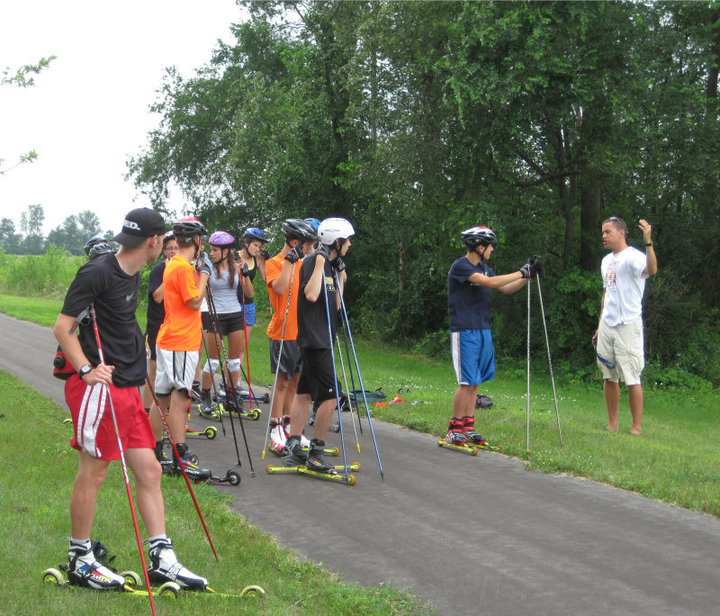
    Athletes work on skating technique (Photo: Annika Ferber)

    Because of the athletes’ wide range of experience levels and abilities, “a large goal of ours was to expose these younger skiers to a variety of training methods that they can take home and share with their teammates,” said Friedrich.  While volume occurs naturally at a camp, the primary focus of athletes and coaches alike was education and technique.

    Friedrich always hopes that the camp will inspire students to attend Gustavus, whether or not they participate in a varsity sport when they enroll.  But in terms of skiing, Friedrich says, “the highlight every year is helping skiers who just want to get faster.  I always love seeing a skier who has a ton of potential and encouraging them to pursue a higher level of ski racing.”

  • Inspiring the Next Generation

    Inspiring the Next Generation

    Where do you start when you have one day to teach all that is cross-country skiing?  The Central Cross-Country Ski Association (CXC) gave it a shot, hosting a youth camp for children ages 8 through 11 at Lakewoods Resort in Cable, Wisconsin on Monday, July 26.

    Coach Gus Kaeding works on striding uphill (Photo: CXC)

    The day’s schedule was a busy one, as the campers bounced from one exercise to another, including ski-specific warm-ups, bounding, light strength, plyometric strength, swimming, Ski Erg races, laser rifle biathlon, and capture the flag.

    “The goal was to inspire kids and show them that cross-country skiing is more than simply walking in the woods with Mom and Dad in the winter,” said Garrott Kuzzy, a CXC team member and 2010 Olympian who helped with coaching at the camp.  The most valuable part of the camp is “teaching kids that cross-country skiing is a fun sport that a lot of other kids are interested in and that can be taken to the highest levels of competition,”

    The fierce competition continues (Photo: CXC)

    Keeping the campers going all day long was no challenge.  With two Ski Ergs set up next to each other, poling as hard as possible for 30 seconds instantly turned into a grueling competition.  “Each time they stepped up, they tried to go faster than their previous record.  We literally had to unplug the machines to get them to stop when it was time for lunch,” reported Kuzzy.

    The USSA suggests that serious skiers commit to summer training around the age of 15, or at the J2 level, so the kids attending the CXC camp were a few years too young to be hammering out intervals on a weekly basis.  At this age, what’s most important is encouraging enthusiasm and a love for the sport.

    “If they rush into the basement, pull out their ski equipment, and hammer around the yard during the first snowfall of the year,” Kuzzy reflected, “that’s what I’d like to see them take away from this camp.”

    CXC's Caitlin Compton demonstrates skate bounding technique (Photo: CXC)
  • CXC Looks to Create Worldloppet Team

    Racing for hours at a time is an entirely different kind of challenge than racing a 5 or a 10k and especially in the United States, the longer of these challenges tends to receive far less attention on the professional level.

    However, the Central Cross-Country Ski Association (CXC) is making plans to move ahead with the creation of an elite Worldloppet team.  Athletes on the team would compete in the American Birkebeiner and Vassaloppet, the Norwegian Birkebeiner, and the Swedish Vassaloppet among other events.

    “The CXC Worldloppet Team will not only provide an opportunity for our top athletes to race overseas, but will also provide a great opportunity for our fans, especially CXC Masters Team members, to rub shoulders with our best marathon athletes,” explained CXC Executive and Athletic Director Yuriy Gusev.

    The Worldloppet Team roster will be comprised of current CXC athletes, to be selected based on results after the American Birkebeiner.  Coaching for the Worldloppet Team would simply become another title for CXC Elite Team coaches Jason Cork and Gus Kaeding.  “It will not be any additional work,” Gusev noted, “because most of the athletes will be the same.”

    For skiers who don’t make the World Championship team, the Worldloppet Team will provide a fantastic opportunity to race internationally in Europe.

  • Not Sitting This One Out

    Not Sitting This One Out

    The athletes are far fewer in number and the competitions receive even less press than most Nordic ski races, but the adaptive ski community is steadily growing and gaining momentum.  And now the Central Cross-Country Ski Association (CXC) is getting involved.

    Racing with a sit ski (Photo: www.flyingpointroad.com).

    Over the past year, CXC has distributed over 120 sit skis to disabled athletes across the country.  The first ten sit ski prototypes were produced by engineering graduate students at the University of Wisconsin-Madison, and the project has now been taken over by Isthmus Engineering, a private firm located in Madison.

    Several engineers and manufacturing companies have donated their time and supplies to the project, reducing the cost of a single sit ski down to a mere $300.  An athlete looking to purchase a sit ski outside the CXC program would pay over $1000.

    The program reaches out to ski clubs, ski organizations, and adaptive recreational programs as well as the U.S. Adaptive Ski Team and U.S. Paralympics to provide sit skis for athletes in need.  Equipment has also been provided to several individuals who have contacted CXC directly.

    The sit skis manufactured by the CXC program are intended for introductory programs, and they are fully adaptable to suit almost any type of disability.

    CXC is working to develop a pipeline for sit ski athletes to mirror the pipeline in place for nordic skiers.  Reaching out to disabled youth, working with aspiring young athletes and encouraging sit skiers of all ages who want to compete, the program will provide opportunities that make sit skiing a lifelong sport–just like nordic skiing.

    “This is the mission of CXC, and that holds true when we talk about Adaptive Programming,” CXC Executive and Athletic Director Yuriy Gusev told FasterSkier.  “We know that this is the right thing to do, and continue to work hard to make the adaptive program a sustainable reality.”

  • Beckman, Liebsch Take 10th Annual Ringer Roll

    Beckman, Liebsch Take 10th Annual Ringer Roll

    Skiers from all over the Midwest converged on Baker Park in Maple Plain, Minnesota Friday morning.  The occasion? The 10th annual Ringer Roll.

    The 10 kilometer rollerski race was established in honor of Chris Ringsven, a skier and coach who was killed in a whitewater rafting accident on December 2, 2000.  The event is the largest rollerski race in the Midwest.

    Racers pick up speed 1k from the finish (Photo: Bruce Adelsman/skinnyski.com)

    A smoothly-paved bike path provides a relatively flat course, but competitors had plenty to think about as they swerved to avoid bikers and the occasional deer.  The race attracts a wide range of ages and abilities, this year ranging from youngest competitor 12-year-old Margie Freed to Ringsven’s mother, Renatae, who toured the course on rollerblades.

    Racers decide for themselves whether to classic or skate, giving race organizers a challenge in calculating results.  In addition to technique, there are different categories for age as well as style and brand of rollerski, giving more athletes a chance to take home one of the prizes donated by local ski shops Gear West, Finn Sisu, and Pioneer Midwest.

    The men’s overall champion was Matt Liebsch (Go! Training/CXC), whose time of 18:55 on the second lap of his 20k effort put him in first place by over 2 minutes and set a new course record.  (The split on his first lap also earned him fifth place overall).  Scott Williams and Luke Gossen of the Minneapolis Ski Club, both 17, finished in second and third place, respectively.

    Caitlin Compton looks back to encourage Eleanor Magnuson (Photo: Bruce Adelsman/skinnyski.com)

    Jenny Beckman (Go! Training) was the fastest woman of the day with a time of 25:00.  Eleanor Magnuson (Go! Training) narrowly edged out 2010 Olympian Caitlin Compton after skiing with her for the duration of the race to place second with a time of 26:02.

    Claire Galvin posted the fastest classic time for women, finishing in 31:17, while Alex Cross took the men’s classic title in 28:28.  Renatae Ringsven won the rollerblade division in 45:00.

    Full results and pictures from the race can be found at http://www.skinnyski.com/result.asp?Id=19597

  • The Search for Summer Snow

    The Search for Summer Snow

    Getting a little bit tired of your rollerskis?  Feeling bogged down by heat?  Yearning for snow?  The St. Scholastica team has found the answer we’ve all been waiting for.  The only problem is the airfare to Sweden.

    Lead by coach Chad Salmela, members of the College of St. Scholastica Nordic team, based out of Duluth, Minnesota, headed out to Scandinavia on July 28th, and will spend two weeks training at a ski tunnel in Torsby, Sweden, and its surrounding area.

    Skiing in the tunnel. (Photo: Chad Salmela)

    The Fortum Ski Tunnel, completed about three years ago, provides athletes with a 1.3km loop following the natural terrain, filled with preserved snow and groomed daily.  “The skiing is remarkably good, as is the terrain, considering it’s a tunnel,” Salmela reported in a recent e-mail to FasterSkier.

    Because of the expense of the trip, only five athletes, all men, were able to make the journey.  Salmela says that the team will try to fundraise the next time around, three years from now, so that more of the team can share the experience.  (NCAA rules allow a training trip out of season once every three years).

    “This trip was designed to be a cultural awakening to the sport these kids are training for, while delivering a top-level training environment,” said Salmela. He said the idea for the trip came after a visit to Finland last summer in which he was blown away by the country’s training infrastructure.

    “I also reflected on my times traveling as an athlete and seeing the world, particularly other countries who take nordic skiing seriously, and I wanted my athletes to have the opportunity to see and feel it as I did,” he said.

    Some dryland training (Photo: Chad Salmela)

    This is the first trip to Scandinavia for all five athletes, and the group has made tourist expeditions to Oslo, Norway, to see the Holmenkollen ski jump, as well as a trek through the city of Karlstad, Sweden.  But sight-seeing has taken a backseat to training, as the team puts in its highest ten days of volume while all other responsibilities are on hold.

    “These guys are trying to be as good at ski racing as they can be, with the resources available to them,” said Salmela.  “The trip has been successful in achieving all of our goals.”

    Members of the St. Scholastica team in Oslo. (Photo: Chad Salmela)
  • Rubbing Elbows with the Pros: Alaska REG

    Rubbing Elbows with the Pros: Alaska REG

    This summer’s Alaska Regional Elite Group (REG) camp, held in Anchorage, proved to be a challenging and valuable week of training for all involved.  Just like the Eastern, Central, and Western REG camps held earlier, the Alaska camp included a variety of distance, strength, technique, and intensity workouts as well as two time trials.

    The Alaskan REG crew. (Photo: Pete Leonard)

    “I think the main objective and goal of the week was to give the REG athletes an opportunity to bang heads with each other and some of the top senior level athletes in the region,” said coach Pete Leonard in an email to FasterSkier.

    Video taken of nearly every rollerski session was reviewed every evening, affording athletes a chance to perfect their technique with top coaches including the US Ski Team’s Chris Grover.

    Striding it up the hill. (Photo: Pete Leonard)

    Thursday morning heralded an event not seen at any of the other REG camps: a sprint time trial on skate rollerskis, followed by speed work.  On Friday morning, athletes competed in a classic rollerski time trial where they were joined by several elite athletes including Olympian and Alaska native Kikkan Randall.

    “I think having senior athletes at the time trial is good because it allows the junior to know where they stack up in the grander scheme of things,” Leonard remarked.  “Nothing worse for an athlete than getting complacent.”

    Randall was around earlier in the week as well, as she worked with the women on double-pole technique during Thursday’s easy distance rollerski.  “I don’t think I’ve ever seen a group of 15 junior females all as attentive and ready to soak up every detail,” said Leonard of the technique session.

    Kikkan Randall discusses double-pole technique with the girls. (Photo: Pete Leonard)

    The camp ended with a mixed OD on Saturday morning, the toughest part of the week for many participants.  The last and hottest workout of the week began with a steep and slippery uphill run and continued with a long classic rollerski which included the grueling classic time trial climb.

    Many of the athletes also jumped in to the Cuddy Roller Ski Race on Sunday morning.  An optional workout that was not officially part of the camp, the 2x3x700 meter relay sprint was a fun conclusion to a demanding week.

  • Mythbusters: Protein

    Mythbusters: Protein

    Protein is a very important component of any athlete’s caloric intake, but it can be difficult to sort myth from fact when judging how much protein to incorporate into your diet.   In the next few paragraphs, I hope to debunk some myths and provide you with a new pieces of information that might improve your diet and subsequently enhance your training.

    As meaty as it gets.

    Myth: You only get protein from meat.
    Fact: While this is a bit exaggerated (I doubt that anyone reading FasterSkier actually believes that protein is only found in meat) there are a lot of misconceptions about how easy it is to get protein outside of a steak.  It is true that meat products contain lots of good protein, but plant-based foods can provide more than enough, and they have the additional benefit of being low in fat and cholesterol.  The chart at the end of this article provides a list of good protein sources, both animal and plant.

    Myth: More protein means more muscle.
    Fact: This myth is enthusiastically promoted by companies selling a vast array of protein bars, protein shakes, and protein powders with the claim that their products will enhance athletic performance.  The truth is that these kinds of products are really unnecessary if your diet already contains the right amount of protein, and an excess of protein is completely useless in terms of muscle-building capability.  An athlete training for aerobic events – like Nordic skiing – needs approximately 1.3 grams of protein per kilogram of bodyweight, or about 0.6 grams per pound, every day.  That means, for instance, a 150-pound skier should be consuming somewhere around 90 grams of protein in a day.

    Quinoa, a grain, is a full protein.

    Myth: Protein is fattening.
    Fact: This is only partially a mythical statement.  Protein itself is not fattening, but an excess of protein can be.  When there is too much protein in the system, amino acids that make up proteins are released into the bloodstream.  Other cells take up the amino acids from the blood and metabolize them to create excess pyruvate, which is stored in your body as fat.

    The average American gets up to thirty percent of their daily calories from protein, which is far too much for a healthy diet.  Don’t be average.

    Food                                           Serving            Protein Content
    Boneless Chicken Breast             3 oz                27g
    Roasted Turkey                             3 oz                25g
    Soybeans                                        1 cup                22.3g
    Lentils                                             1 cup                17.86g
    Tempeh                                          4 oz.                17-21g
    Split peas                                       1 cup                16.35g
    Oat bran (raw)                              1 cup                16.3g
    Baked Beans                                 1 cup                12.17g
    Low-fat yourt                               1 cup                12g
    Quinoa                                           1 cup                11.0g
    Tofu                                                1/2 cup                10g
    Spinach                                          1 cup                6.0g
    Whole Wheat Bread                    2 slices                5.0g

    Sources: (I apologize for not including these originally as I should have done.)

    • Steve Swoap, Professor of Biology, Williams College
    • The Nutrition Source, Harvard School of Public Health
    • Protein Requirements for Endurance Athletes, Mark Tarnopolsky, McMaster University
    • The China Study, T. Colin Campbell
  • Summer School

    Summer School

    A business primarily known for being the only US importer of Marwe rollerskis, Finn Sisu Sauna and Ski Shop has even more to offer this summer.  Monday, July 12 kicked off the Sisu Summer Lecture Series.

    The lectures, held at Finn Sisu’s new store location in Lauderdale, Minnesota, will take place every Monday night at 6:00pm.

    Last week’s first lecture was delivered by Toby Markowitz and focused on the WAMXC masters training group based out of the Twin Cities.  WAMXC, which loosely stands for Woman and Men who Cross-Country Ski, is exactly what it sounds, although in addition to being a group of adults who gather to train for ski season, they profess an undying love for coffee.  You can view their highly entertaining website at wamxc.org.

    Monday’s attendees witnessed a presentation on running and marathons, delivered by elite local marathoner Nichole Porath.

    Future Monday nights will provide the opportunity to hear Ritva Taipale talk about her current PhD research on the Biology of Physical Activity and about how to train smart, personal trainer Chrissy Bloemendal answer questions about strength training, and elite skier Hilary Patzer speak about the prevention and treatment of sports injuries.

    The full lecture schedule and further details can be found on Finn Sisu’s website, at http://www.finnsisu.com/t-events.aspx.

  • Running Up Hills: Eastern REG Camp

    Running Up Hills: Eastern REG Camp

    High-caliber junior athletes flocked to Craftsbury Outdoor Center in Vermont on June 25 for the five-day Regional Elite Group (REG) camp.  The week provided attending skiers with a chance to train with and learn from some of the country’s best coaches.

    Eastern REG athletes out for a rollerski (Photo: NENSA)

    This year saw some changes to the general REG plan, including more time trials and the requirement that athletes wear numbered bibs for all workouts, fostering a greater spirit of competition and professionalism.  “I think the camps really took a turn for the better,” Matt Whitcomb, US Ski Team Development Coach, told FasterSkier in an interview.  “I’m really encouraged.  The coaches and clubs are educating these athletes, and they hit the ground running,”

    The camp featured two time trials, including the always-painful uphill running time trial, a fantastic  measurement of vo2max and pure fitness.  “It’s a hell of a mental training test as well,” Whitcomb acknowledged.

    A number of senior athletes jumped in for many of the workouts, including the running time trial, in which Ida Sargent took home the win for women while teammates Tim Reynolds and Dylan McGuffin tied for the men’s trophy.

    Athletes work on their double-pole. (Photo: NENSA)

    A highlight of the week was the OD rollerski on rolling country roads and smooth pavement.  “It was one of the better workouts in my opinion,” Whitcomb reported.  “There was very little chitter-chatter, very little waste of time.”

    The overall feeling was one of improvement and success, both coming into the camp and leaving.  Coaches were pleased by the level of professionalism the athletes brought to the week and saw a group that was technically proficient, good on their rollerskis, and prepared to work hard.

    Video by David Loney:

    2010 Camp Roster:
    Rachel Hall, SMS
    Elizabeth Anderson, Ford Sayre
    Skyler Davis, SMS
    Briger Tyler, SMS
    Gage Fichter, SMS
    Isabel Caldwell, SMS
    David Sinclair, GMVS
    Welley Ramsey, MWSC
    Ben Lustgarten
    Hans Halvorsen, GMVS
    Chris Stock, CSU
    Austin Caldwell, SMS
    Magnus Bigelow, SMS
    Patrick Caldwell, Ford Sayre
    Charlie Bencze, Mid A
    Austin Cobb, SMS
    Reed Likly, Mid A
    Mitch Prevot, Burke
    Heather Mooney, SMS
    Heidi Halvorsen, GMVS
    Megan Killigrew, Dartmouth
    Keely Levins, Middlebury
    Hannah Smith, CSU
    Elizabeth Izzo, NYSEF
    Green Racing Project Athletes:
    Chelsea Little
    Ollie Buress
    Dylan McGuffin
    Lauren Jacobs
    Matt Briggs
    Hannah Dreissigacker
    Ida Sargent
    Pat Obrien
    Coaches: Matt Whitcomb, USST; Janice Sibilia, NENSA; Cami Thompson, Dartmouth; Jason Hettenbaugh, Rochester Nordic; Eileen Carey, MWSC; Pepa Milocheva, Craftsbury/GRP, Nick Brown, and David Loney

  • Smooth Is Fast: Relaxation Key to Good Technique

    Relaxed and fast may seem like contradictory adjectives, but any successful skier can tell you otherwise.  Learning to relax while skiing is essential to racing fast at a high level.

    Nerves and tension are natural components of any athletic competition, but if untamed they lead to choppy technique, inefficient movement, and a needlessly tiring struggle.  “You can be as fit and strong as anybody but still not be able to hang on… You cannot power your way to win a World Cup race,” says Trond Flagstad, ski coach at the University of Alaska Anchorage.

    Holly Brooks demonstrates a smooth glide (Photo: Swix Sport USA)

    It requires logging hundreds of kilometers and achieving a high level of comfort on skis, but learning to relax can be the difference between the middle of the pack and the front, or between silver and gold.  “When you are relaxed your body is working at its optimal efficiency and you are getting every ounce out of each movement,” says three-time Olympian and US Ski Team member Kikkan Randall.

    “Athletes that are able to keep cool and calm before big races often perform better – ski more efficiently and effectively,” agrees Holly Brooks, 2010 Olympian and coach of Alaska Pacific University (APU).  “I find that when I’m not relaxed, my technique falls apart.”

    So how do you do it?  Randall recommends picking a few cue words like SMOOTH, STRONG, or FAST and repeating them over and over in your mind.  “I block everything else from my mind and just repeat these words,” she says.  “Pretty soon, my body just takes over and starts going SMOOTH, STRONG, FAST!”

    When you’ve mastered the trick of relaxation, you’ll find yourself able to ski faster, glide farther, recover more easily, and probably enjoy racing more.  Flagstad avows, “When you can ski relaxed, you have discovered how to really ski.”

  • Through Time Trials and Tug-of-War: Central REG Camp

    Through Time Trials and Tug-of-War: Central REG Camp

    Friday marked the end of the Central Regional Elite Group (REG) training camp at the Cresthill Resort in Hayward, Wisconsin.  Top athletes from throughout the Central region arrived on Saturday, July 3 for a week of tough competition, quality training, and phenomenal coaching.

    Athletes compete in a high-stakes game of tug-of-war (Photo: CXC Skiing)

    One of the great values of the REG camps is the educational component, as athletes attended lectures presented by the coaches almost every night.  The star-studded coaching staff included Bryan Fish (US Ski Team (USST) Continental Cup Coach), Matt Whitcomb (USST Development Coach), Gus Kaeding (CXC Elite Development Coach), Igor Badamshin (CXC Junior Development Coach), Justin Easter (CXC Director of Sports Education), and Yuriy Gusev (CXC Athletic Director).

    Athletes celebrated the country’s independence with a vo2max test on their first full day of camp, followed by a 3000 meter running time trail, medals strength testing, and an obstacle course throughout the rest of the week.

    Training concluded with the “OO” 5k skate time trail beginning at the Sawmill Saloon in downtown Hayward and ending at the halfway point of the American Birkebeiner trail, the top of the infamous “OO” hill.

    Jessie Diggins fights her way up the "OO" time trial. (Photo: CXC Skiing)

    Members of the Central Cross-Country Association (CXC) Elite Team, taking part in their own nearby training camp last week, joined in on both time trails, making for some highly competitive races.

    “It was obvious that the REGers took aim at taking down some of the elite team.  Watching the REG skiers hang everything on the line to stay with some of America’s fastest skiers was awesome,” coach Gus Kaeding told FasterSkier in an email.

    The camp was, as always, an overall success as all athletes learned from the coaches, from themselves, and from each other in order to improve and become faster skiers.

  • How Did You Celebrate the 4th? Alaskans do it Right with Mount Marathon

    How Did You Celebrate the 4th? Alaskans do it Right with Mount Marathon

    For many of us, July 4th is a day to spend with friends and family, take in a parade, eat a lot of good food and maybe watch some stuff blow up, but in Alaska, Independence Day means one thing: Mount Marathon.  Sunday marked the 83rd annual running of the grueling competition in which runners climb almost 3,000 feet in elevation over 3.5 miles before turning around to run back down.

    The race ends on Main Street in Seward, Alaska, where ten thousand screaming Alaskans line the streets, waiting to cheer the finishers.  Mount Marathon attracts hundreds of athletes every year, usually including several pre-eminent Nordic skiers, and this year was no exception.

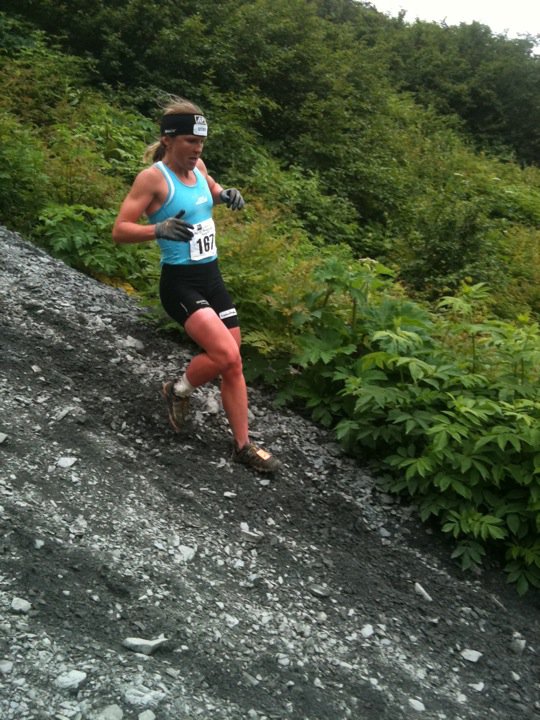
    Holly Brooks negotiates the treacherous descent. Photo: Holly Brooks

    “I feel like it epitomizes Alaska in many ways.  Our state is full of tough individualists who like to work hard and don’t mind getting dirty.  That is exactly what the race is – incredibly hard, with an element of danger and risk,” said Holly Brooks, a member of the 2010 US Olympic cross-country skiing squad who finished in second place just behind seven-time champion Cedar Bourgeois.

    “It’s an iconic Alaskan event,” agreed three-time Olympian Kikkan Randall, who finished third.  “In terms of atmosphere, it’s right up there with the Olympics and World Championships.”

    Brooks not only avoided a repeat of last year’s mid-race trip to the emergency room but held the lead from the twelve minute mark until Bourgeois passed her with only two blocks left in the race.  She also set a personal best by 3:31, while Randall, a four-time Mount Marathon runner-up, set a PR by 2:35.

    Hiking up the mountain early in the race Photo: Reese Hanneman

    Both Randall and Brooks hope to take home the gold sometime in the future.  “It probably goes without saying that next year I would like to win,” said Brooks.  Randall, whose mother won the race in 1975 and whose aunt is a three-time champion, is less concerned about next year’s race, reporting, “My goal going forward is just to continue to improve my PR times and make it down the mountain safely.  I would love to win someday but at this point my goal is to give my best.”

    The men’s podium was also graced with a strong Nordic skiing presence.  University of Alaska Anchorage ski coach Trond Flagstad took the title for the second time in three years and became one of only three men in history to finish in less than 45 minutes multiple times.

    With his wife Lindsey due to deliver their second child sometime this week, Flagstad almost decided not to race, but he was happy with his decision at the finish line.  “I had one of those rare days when you don’t get tired. I felt I could just push as hard as I wanted and even wished the climb wouldn’t have ended so soon,” he told FasterSkier after adding a new 40-49 age-group record to the 30-39 record he set in 2008.

    “Whether you are a runner trying to conquer the mountain or a spectator there to watch the carnage of the mud-covered and blood-crusted runners coming down on rubbery legs, it’s a nerve-wracking and exciting day,” said Randall. Mount Marathon is an essential Alaskan tradition, the perfect way to celebrate the country’s independence.  As Flagstad put it, “everyone finishing the races -winners down to last place- is hailed as a hero, a crazy person, a real Alaskan.”

    Some leaders in the men's field Photo: Reese Hanneman

    Complete results can be found here: http://www.adn.com/2010/07/04/1353880/mount-marathon-results.html

    You can read about Reese Hanneman’s experience of the event on his blog: http://blogs.fasterskier.com/reesehanneman/2010/07/05/mount-marathon/

  • SPF: Slather it on

    SPF: Slather it on

    The summer sun is enticing to outdoor enthusiasts like most of us skiers, but it can be more dangerous than we realize.  We all grew up with Mom chasing embarrassingly after us with a bottle of SPF 200, but it turns out Mom was right.  Skin cancer is the most common cancer in the United States, and studies have shown that endurance athletes are at a greater risk due to the extended hours spent in the sun.

    Ouch.

    It’s easy to dismiss the need for sunscreen when you’re in a hurry, or to decide that the phenomenal tanlines you’ve already developed are dark enough to protect you from further burns, but no matter how dark you get that’s just not true.

    Even when the burn isn’t visible, sun damage can still occur.  “Tans only minimally protect your skin from further sun damage,” says Dr. Stanley J. Miller, Professor of Dermatology at Johns Hopkins University.  “Tanning is a sign of sun exposure and all exposure is damaging in a cumulative fashion.”

    “I usually recommend to my patients to use an SPF of 30 or higher,” says Miller.  “It’s been shown that most people put sunscreen on much more thinly than is put on when the sunscreen is tested, so most people are only starting with a 10 instead of a 15. Then, if you sweat or swim over the next few hours, your 10 drops to a 6. At this point your protection is inadequate.”

    Take it from this irresponsible rollerskier who now has some strange lines and painful burns on her back, sunscreen is a good thing.  Plus, who wants a sunglasses and helmet tan? It’s just not attractive.

    Tan lines: the ultimate fashion accesory.
  • Both Speed and Smarts Make One Athlete Successful

    Both Speed and Smarts Make One Athlete Successful

    Annie Hart of St. Paul, Minnesota is the 2009 Minnesota State High School Champion, 2010 State runner-up, a three-time All State recipient, 2010 Junior 5k champion, three-time Junior Olympian, and a U.S. World Junior team member.

    Hart takes the lead for a section during the 2010 State Meet. Photo: Bruce Adelsman/skinnyski.com

    But skiing isn’t all that Hart can do well. She also ran on the St. Paul Academy cross-country and track teams and excelled academically throughout her high school career, earning her the honor of being named 2010 Star Tribune Scholar-Athlete of the Year. The Minneapolis Star Tribune selected Hart and male counterpart Eric Satterthwaite, a swimmer, for having “reached the peak of high school athletic achievement” in having won a state championship in addition to their enviable academic records.

    Hart at Senior Nationals.

    While not on the ski trails, Hart worked hard at her academic pursuits, earning a 3.85 GPA, two Distinguished Honors for Excellence in science and English, and winning an award in the Minnesota High School Press Association sportswriting competition as three-time editor of her student newspaper. “I’d say the most challenging part about so being involved was finding a way to stay relaxed, rested, and happy through it all. It is a skill that I think will help me no matter where I end up going.”

    “I think the best lesson I learned is to never give up,” Hart told FasterSkier of her experiences. “There were so many times when it would have been so much simpler to move on and say well maybe next time, but I have achieved things that I never would have had I taken the easy path.” She will certainly not be taking the easy path now that the challenges of high school are over. Dartmouth College is expecting another high-caliber addition to their already impressive Nordic team. Dartmouth “would be a difficult place to turn down,” Hart said. “Not only do they have amazing academics, but the ski team is equally stunning.”

    After a summer living at home and working with Minneapolis Ski Club (MSC) and with the Central Cross-Country Ski Association (CXC) at a regional camp, Hart will begin her training with Dartmouth coaches and team. “I think I will miss some of it,” she admits, referring to the unique atmosphere of the Minnesota high school Nordic circuit. But, “I’d say that I am in fact ready to move out and move on.”

  • Sweden Dominates in Chinese Summer Ski Tour

    Sweden Dominates in Chinese Summer Ski Tour

    The women battle to the finish. Photo: Nordicways.com

    Skies were sunny and conditions were fair as racers competed in the fourth annual Chinese Summer Ski Tour sprint race last Monday. The 1.5 km course was constructed from snow that has been stored since the end of winter, and athletes said that the snow was surprisingly good throughout the day.

    The Chinese team was extremely pleased with the day’s results, as the team was able place a skier on the women’s podium. Jenny Hansson of Sweden took the women’s crown after Sanna Hallberg, her toughest competition in the quarterfinals, was taken out by a fall. Betty Ann Bjerkreim Nilsen of Norway placed second and China’s Wang Libo took third.

    The men's final. Photo: Nordicways.com

    Norway’s Teodor Peterson took the men’s crown, closely followed by Sweden’s Anders Hogberg as Kjetil Hagtvedt Dammen, also of Norway, filled out the podium. “It’s a little different to compete here and it feels very exotic. I’m really happy that I got the chance to come,” Peterson said of the experience.

    The skiing portion of the Summer Ski Tour concluded on Wednesday with a mixed relay that was equal parts competition and publicity stunt. The race took place indoors at Qiaobo Ice and Snow World, a year-round alpine ski facility in Beijing. The central Chinese sports network filmed the race and plans to broadcast it after coverage of the World Cup in South Africa is over, saying that the event will be “a brand new experience, appealing to the audience.”

    A victorious David Frisk (SWE) swoops up teammate Betty Ann Bjerkreim Nilsen (NOR). Photo: Nordicways.com

    The relay, run in heats, was 3km in total with each athlete on the two-person team skiing three laps of 500m. The international team of David Frisk (SWE) and Bjerkreim Nilsen finished first in the event. Sweden dominated the rest of the podium as the team of Peterson and Therese Karlsson placed second, followed by David Jansson and Jenny Hansson in third. The Swedish team of Peter Larsson and Sanna Hallberg filled out the final heat, placing fourth.

    The tour continued on Saturday as some of the athletes switched ski boots for running shoes to compete in the Lidingloppet, a 30k cross-country race.