From the FasterSkier archive — posts syndicated from athletes’ and coaches’ own blogs between 2004 and 2012, kept online as published. Current coverage is at fasterskier.com.

Author: Matthew Voisin

  • ‘Let Your Ego Go’: Lars Dewall on the Ski Training Behind a 2:12 Marathon

    ‘Let Your Ego Go’: Lars Dewall on the Ski Training Behind a 2:12 Marathon

    This article was made possible through the generous support of our voluntary subscribers. If you value coverage like this, please support FasterSkier with a voluntary subscription.
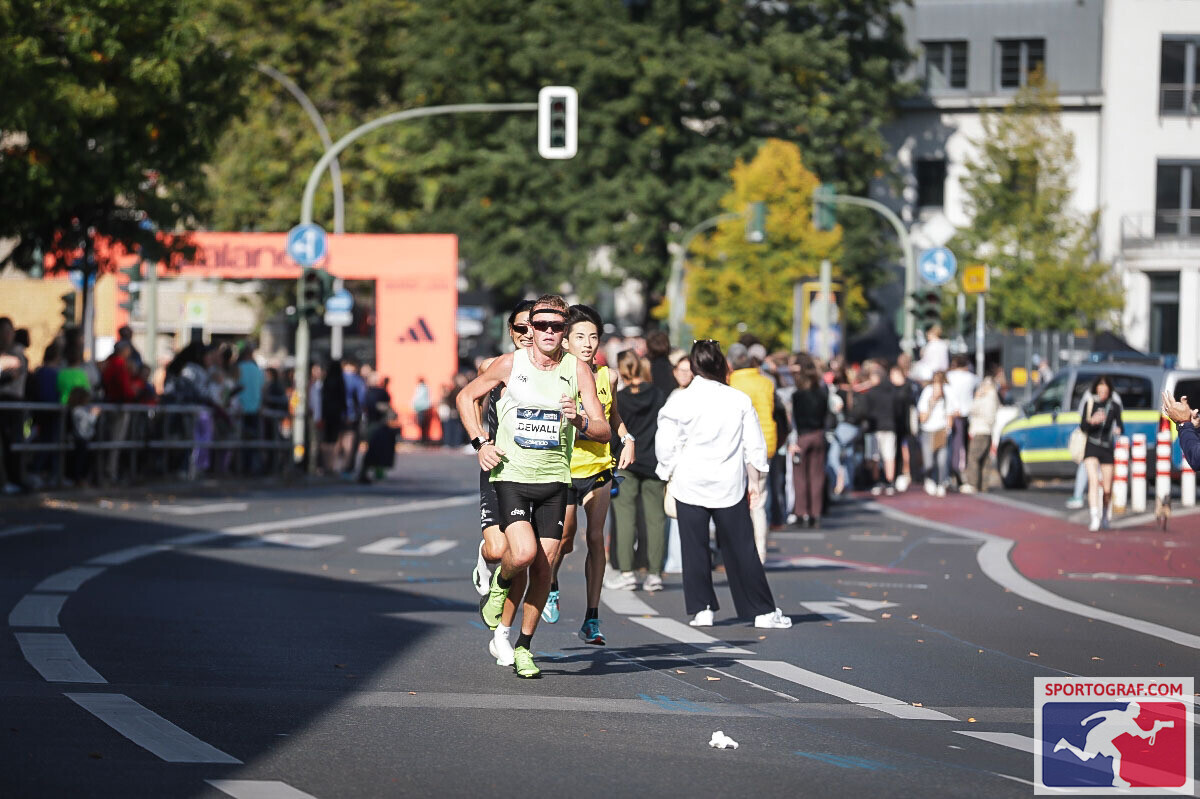
    Lars Dewall in a lime green Puma singlet, headband and sunglasses running at the front of a small group on a Berlin street, with spectators and a police van behind.
    Lars Dewall leads a small group through Berlin on September 27. He finished the BMW Berlin Marathon in 2:12:13, third among the Americans. (Photo: Sportograf)

    The summer before he started college, Lars Dewall ran his easy miles at a nine-minute pace.

    He had run 4:26 for the mile in high school. He had been an all-state skier at Stillwater Area High School in Minnesota, the same school Jessie Diggins skied for. And the coach waiting for him at the College of St. Scholastica in Duluth had given him one rule for his easy days: keep his heart rate under 140 beats per minute.

    For a runner like Dewall, on the road, that was a jog.

    “That’s how slow I was going,” he said. “It just doesn’t feel fun, and it takes a long, long time.”

    People tell him now that he runs his easy days fast.

    “I’m like, yeah, five years ago I was running nine-minute pace, though,” he said. “I had to be so disciplined about that for so long.”

    On September 27 he ran 2:12:13 at the BMW Berlin Marathon, 31st overall and third among the Americans, behind Charlie Sweeney and Will Nation. It was his fourth marathon and his fourth personal best. He debuted with 2:22:57 at Grandma’s in June 2025, ran 2:14:15 at the California International Marathon that December, comfortably under the 2:16 standard for the 2028 Olympic Marathon Trials, and then ran 2:12:30 at Boston in April. In between, back in Duluth, he won the Park Point 5-Miler and broke a race record that had stood since 1975. It belonged to Steve Hoag, who finished second at Boston that spring.

    Earlier this month his college coach, Chad Salmela, made the case in these pages for what American distance runners could learn from cross-country skiers, and called Dewall “my living thesis.” Salmela, who also calls cross-country skiing for NBC, describes his role these days as a sounding board on broad direction.

    Dewall teaches sixth, seventh and eighth graders in San Diego and trains with a group called Lane Zero Athletics. When we spoke on a Sunday in October he had already done his long run with the team, slept for about an hour, and was getting the coffee going at one in the afternoon.

    “It’s kind of like the day’s actually starting,” he said.

    He talked for most of an hour and needed very few questions to do it. Nearly every answer came back around to the same place. The hardest thing a distance runner has to learn is how to go slowly, and skiers worked that out a long time ago.
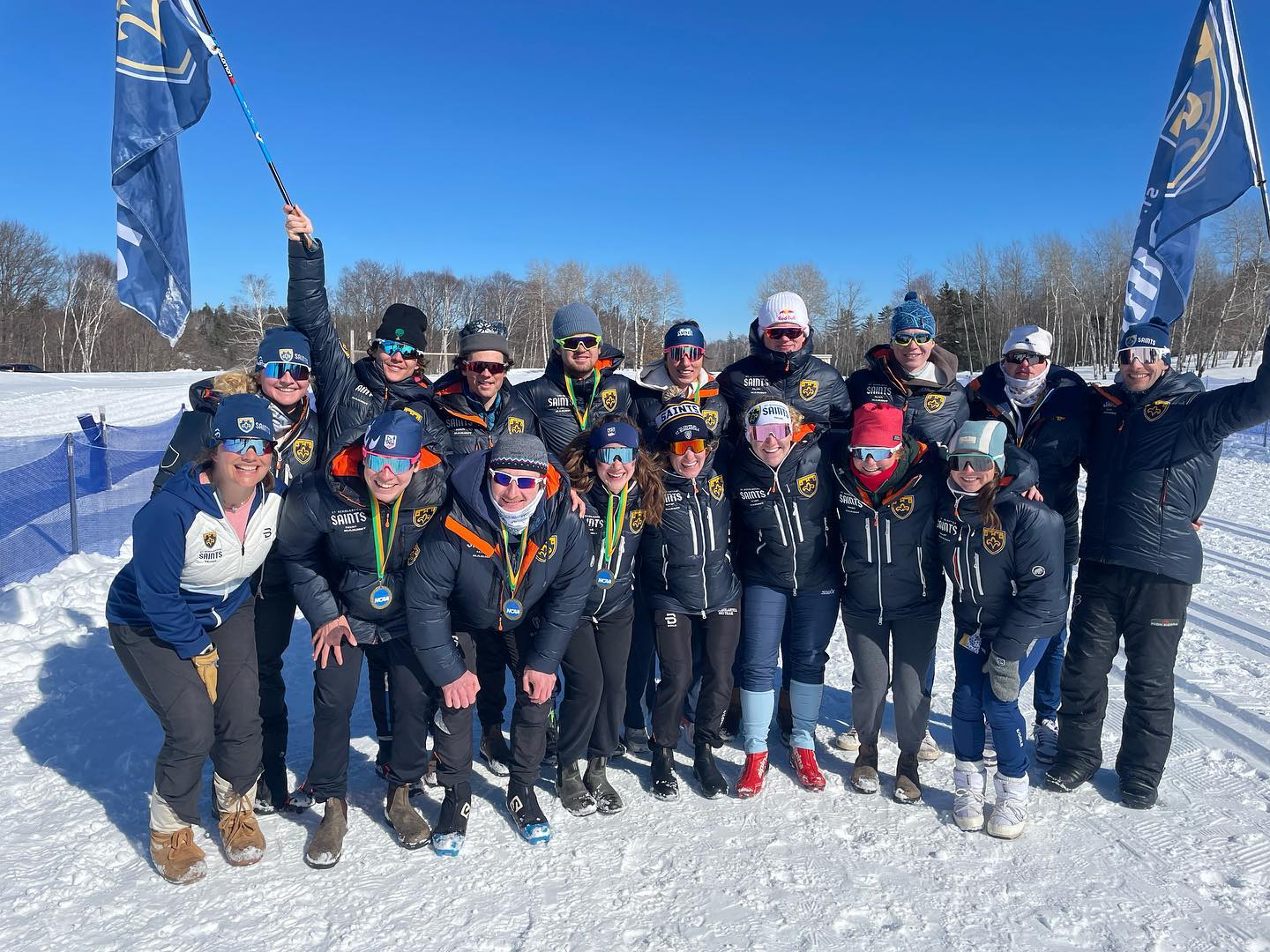
    The St. Scholastica ski team in navy Saints jackets and sunglasses posing on snow under blue sky, several holding NCAA medals, with two blue team flags raised behind them.
    St. Scholastica’s skiers after the men’s team won the NCAA Central Region team title in 2023, a first for the program. Dewall raced for the Saints on snow as well as on the track and the cross-country course. (Courtesy photo)

    Lying down in the tracks

    Skiing came first, in a way, and he did not care for it.

    His father was a serious skier, good enough to have raced against Salmela at some point, though Dewall is not sure exactly when. He took his son out on snow when the boy was small.

    “I just didn’t really like it that much, and it was kind of painful,” Dewall said and continued in his father’s voice. “He always describes it. He’s like, yeah, I’d take you out and you’d just go a little bit and lay down in the tracks or in the snow and just kind of goof around.”

    Football was the thing. He ran cross-country and track in middle school, but he cared more about football than any of it. In seventh grade he took track seriously and ran somewhere around 5:15 for the mile. In eighth grade, still a middle schooler, he trained with the high school team.

    “I look back on that and I’m like, that was a pretty big turning point, because you’re putting yourself in a situation with older guys,” he said. “I remember learning a lot more, and that, looking back on it, I feel like was more important than how I performed at that age. Although I performed well.”

    He planned to play football as a sophomore. That fell through, which he calls “a whole nother story,” and he abandoned ship for cross-country after the season was already underway. He was “aerobically pretty naturally talented,” he said, but there was not enough time left to get fit.

    Nordic skiing started around eighth or ninth grade, and it humbled him.

    “You can be really fit, but that doesn’t make you good at skiing,” he said. “It’s very, very different.”

    The technique took a couple of years. By his senior winter he was all-state, and he remembers finishing 22nd or 23rd at the state meet, which was enough to make him consider skiing in college. The trouble was that he had already committed to run at Western Washington University in Bellingham.

    After that ski season he toured St. Scholastica and met Salmela, who had been the school’s first nordic head coach for ten years before taking over cross-country running in 2016. Dewall would not have to choose.

    “I was really into the idea of being able to both nordic ski and run,” he said. “Especially at that age, I think it was really good for me to continue to do both for some years, because I didn’t know which one I really wanted to do at that point. And looking back on it now, they both really complemented each other for a really long time.”
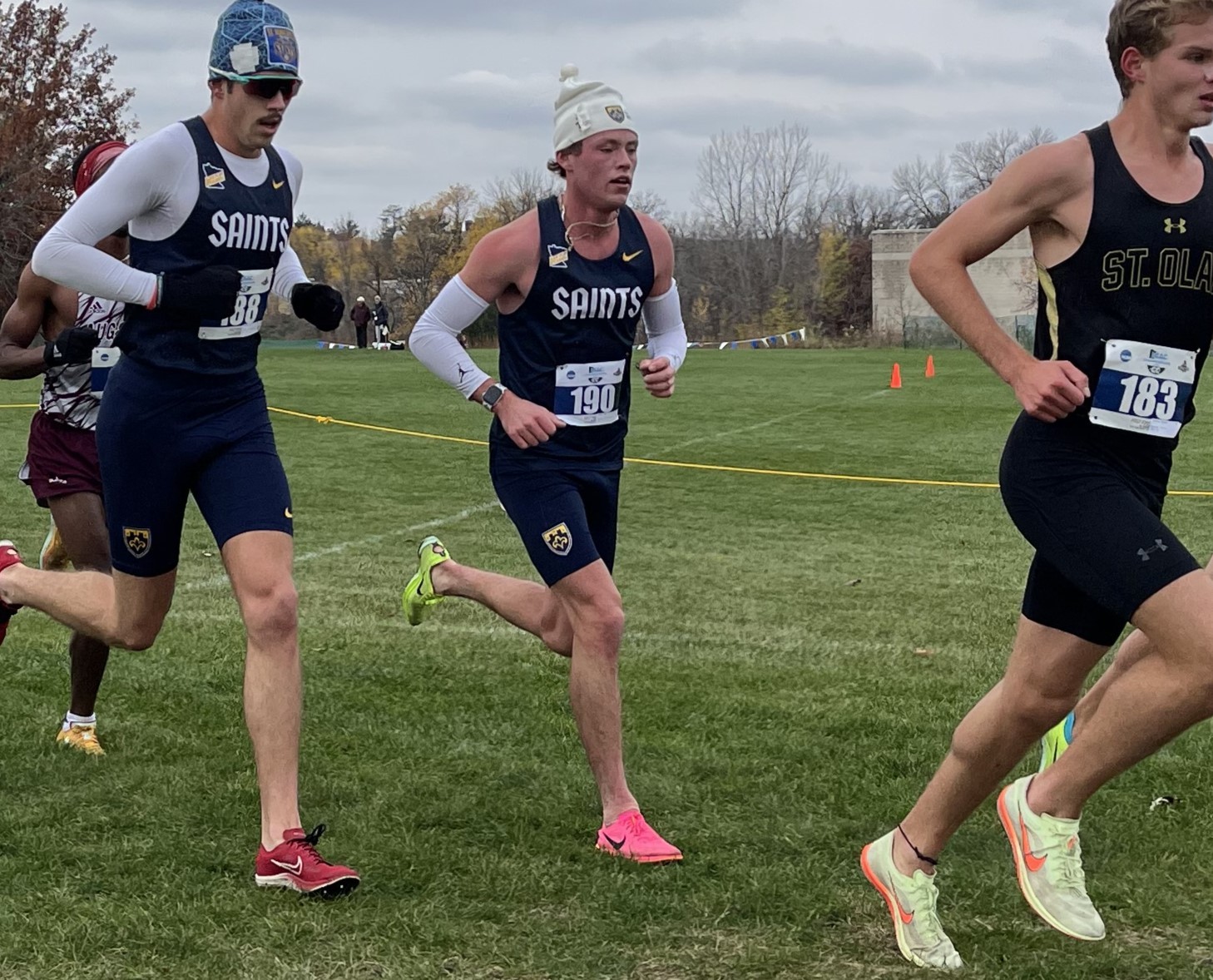
    Three college runners on a grass course, the one in the middle wearing a white knit hat, a St. Scholastica singlet and bib 190.
    Dewall (190), center, racing cross country for St. Scholastica. Under the 140-beat rule, his easy runs on Duluth’s trails went as slow as 10- and 11-minute pace. (Courtesy photo)

    The ‘Under 140’ Rule

    The running in high school was built for the mile and the two-mile. His coach at Stillwater was Scott Christensen, whose program produced four sub-four-minute milers by 2012, the most of any American high school at the time. Dewall puts the number at four or five.

    “My training was very VO2 max centered,” he said. “We’re running the mile and two-mile. There was no 5K.”

    Most of the rest of his running, he said, sat in “that level two zone, which at the time I didn’t even really know what that meant.”

    His best times were good and, he will tell you himself, not extraordinary: 4:26 for the mile, around 9:40 for two miles, 15:55 for 5,000 meters. He graduated in 2019 and doubts those marks would get him in the door at Western Washington now.

    “I guarantee those times would not,” he said. “They’d be like, nah, sorry.”

    What he remembers from those years is not a time.

    “I was running faster on my recovery or easy days in high school than I am now,” he said.

    The easy runs went at 6:30 to 7:15 a mile, with his heart rate at 150 to 160.

    “You’re in that zone where you’re just burning glycogen,” he said. “You can’t call it recovery, because you’re not recovering. You’re just burning through your tank every day, and you might get fit pretty quickly.”

    He has nothing against that kind of training. He just thinks it answers a different question.

    “If you gave me an athlete and were like, okay, we need to get this athlete as fit as possible in two to three months, you’re gonna do a lot of that zone two, because it’s gonna have the most bang for your buck,” he said. “But if you were to give me an athlete and say, we need to make this athlete the best version of themselves, and we have eight years to do it, well, you’re gonna do things a lot differently in terms of the intensity on your easy days.”

    Zone two sits well below threshold but above the genuinely easy work of zone one. On the Olympiatoppen scale most skiers know, the Norwegian system, it runs from roughly 72 to 82 percent of maximum heart rate. It builds fitness quickly. Plenty of coaches believe it also costs more recovery than easier efforts without giving much more back, and that is the trade Dewall is describing.

    He also thinks, looking back, that he was never really a miler.

    “I think I was a true distance runner who had the ability to run well at the mile and two-mile still, just by default almost,” he said.

    In Duluth, Salmela made it simple. Keep the heart rate around 140 or below on easy days. Dewall did not buy in right away.

    “It took me a little while to buy into it, and I was kind of half in, half out for a while,” he said. “But eventually I started taking it very seriously.”

    His first college cross-country season started well and ended with an illness and a disappointing finish. The principle held anyway. The nine-minute miles on the road were the hard part. Duluth had trails, and the trails helped.

    “The trails made it easy to really soak up, let’s just say, two hours at 135 BPM, but we were running maybe 10-, 11-minute pace on technical trails,” he said. “It made it mentally easy to let your ego go and just accept that it’s going to be a slow run and low heart rate, and that’s okay.”

    The return took years. When he is fit now he can run 6:45 a mile with his heart rate close to 130. He measures that against the high schooler who ran his easy days at about the same pace and 25 beats higher.

    “It’s huge,” he said. “It’s everything.”

    By the time he carried that discipline onto snow, the skiers around him already had it.

    “The skiers have a much better concept and notion of easy training than runners,” he said. “I would say it’s not even close. I feel like I’ve done more running than I have skiing, but I’ve done enough skiing to confidently say that the skiers are much more on top of their intensities, and cognizant about what they’re doing every day.”

    He has a theory about why.

    “Maybe it’s just the simple idea that you’re skiing, the terrain is varying,” he said. “Skiing feels a little bit more social to me than running does, because you’re out there and it’s different all the time. But running, I think people just get way too caught up in the pace per mile and all of that.”
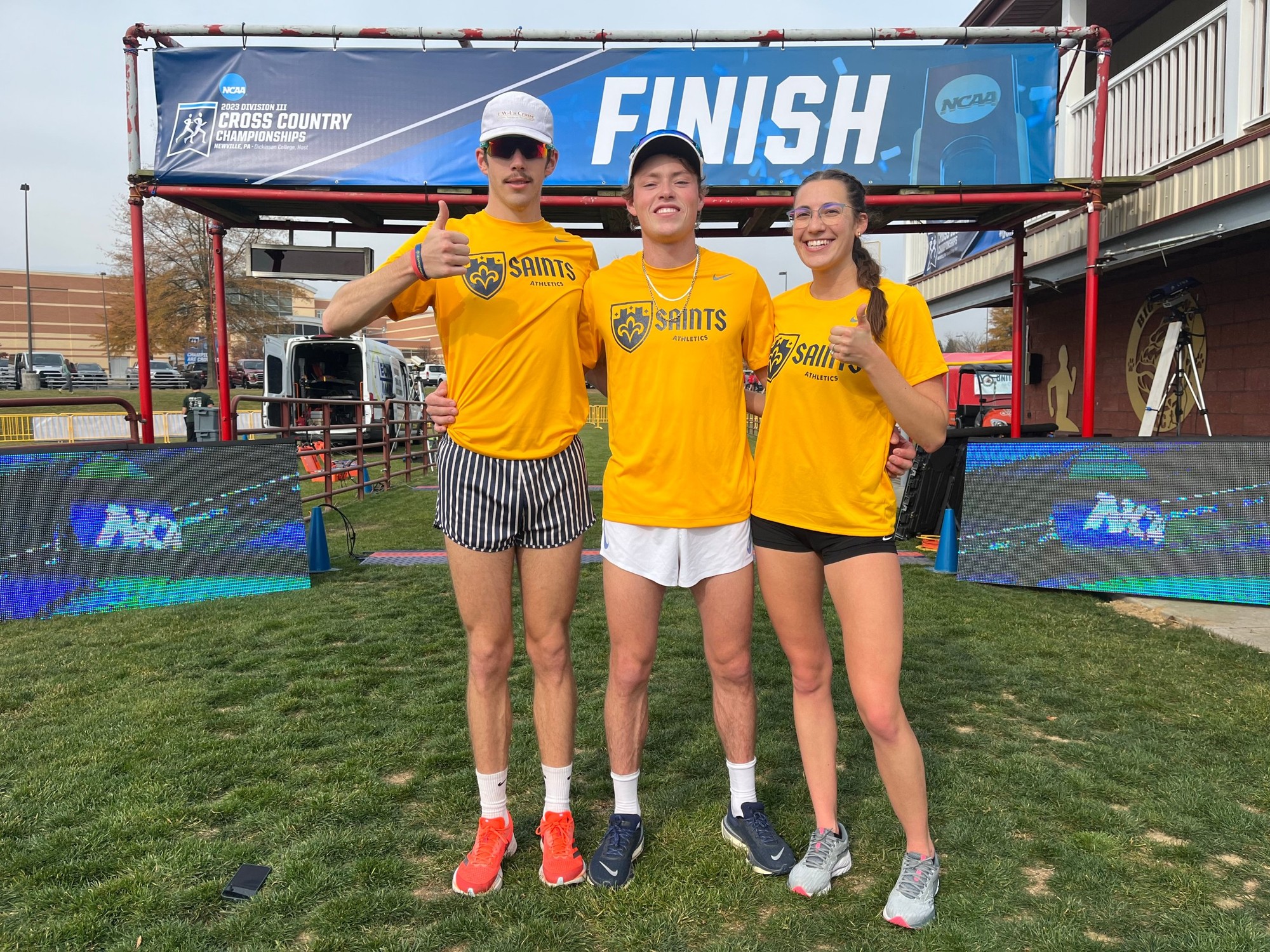
    Three St. Scholastica runners in gold Saints shirts smiling and giving a thumbs up beneath an NCAA cross country championships finish banner.
    St. Scholastica runners, Dewall among them, under the finish banner at the 2023 NCAA Division III Cross Country Championships in Newville, Pennsylvania. (Courtesy photo)

    Eight hundred hours

    In college he stopped counting miles and counted hours: run, ski, bike, lift. Some years, he said, came out between 800 and 900.

    “I was pushing it pretty heavy,” he said. “And again, obviously a lot of that is cross-training and not running.”

    Not all of it paid right away, even in a college career that included All-America honors in cross-country in 2023. The 5,000 and 10,000 meter results did not match the workload, and the skiing never got where he wanted it. He still turns that over.

    “I felt like I was decent at skiing, but I don’t know what it was, and I still think about it sometimes. I felt like it just couldn’t push to that top level,” he said. “I felt like I maybe didn’t start early enough, or maybe naturally just didn’t have it in that sport, and that’s okay. But I still really enjoyed it, and I think there was a huge payout later on in the running world with all the skiing.”

    The year had a rhythm. Winter was mostly skiing, with a little running. Cross-country season was a mix. In the spring he let the volume slide so he could sharpen for track.

    “You’re not going to run well in track if you’ve got heavy ski legs,” he said.

    What he and Salmela watched was the line from one year to the next, not any single season. It has only gone one way.

    “There hasn’t been a year since I started working with Chad where I haven’t gotten better, like PR’d in something or seen improvement in some way or another,” he said. “There were some years where maybe a nordic ski season or a track season or even a cross-country season didn’t go perfectly, and that’s sport. But across the board, since 2019, I can confidently say there hasn’t been a year where I haven’t gotten better.”

    He plans to do this for a lot more years and sees no reason for the line to bend. “I haven’t dramatically changed anything,” he said.

    The volume is lower now, because a runner cannot absorb hours the way a skier can.

    “You can try, but something’s gonna give at some point,” he said. “You’re gonna get hurt, essentially.”

    What crossed over intact was the mindset.

    “I’m really good about training like a skier, in the mindset of, I go out there and I know exactly what intensities I need to hit every day,” he said. “And I’ve done a really good job of letting the ego side of running go.”

    That means running alone, often. If the group heads out on a recovery day at 6:45 pace and his heart rate says no, he lets them go.

    “I have no issue going out and letting people go too fast, and I won’t go with them,” he said. “I’ll run alone. But that takes a lot of discipline.”

    He is not perfect at it. Where he still slips is in workouts, when somebody wants one more fast rep.

    “I can look back even at my block going into Berlin, and look at a couple workouts and be like, did I really need to do that?” he said. “Did that really help me more than it hurt me? But I think just being critical about all that helps you prepare for the future too.”

    The culture of the sport pulls the other way, he thinks, and social media has made it worse, especially for younger endurance athletes.

    “I feel like there’s also a side of them that’s chasing likes on Strava, or a fast run, or an Instagram post,” he said. “All that stuff is great, but if you’re skewing your training around social media, that’s no good.”

    His advice to the younger ones is short.

    “Wait for the race to do that,” he said. “Put the race down. The training is just the building blocks.”

    Every day should have a reason, a purpose.

    “Look at every day and be like, what am I going to do to get better today?” he said. “Instead of just kind of hither and yon, like, oh, let’s show up and run.”
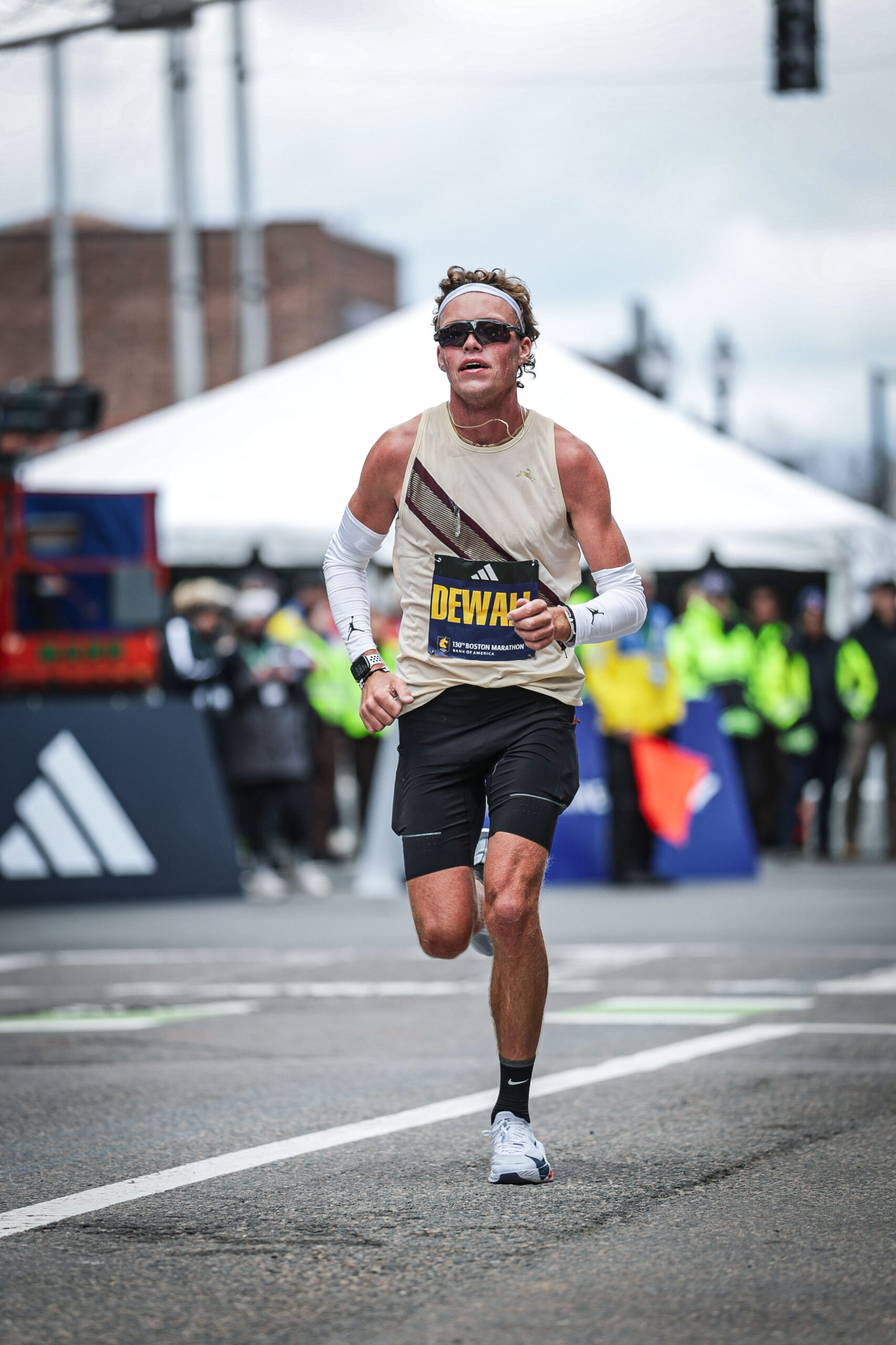
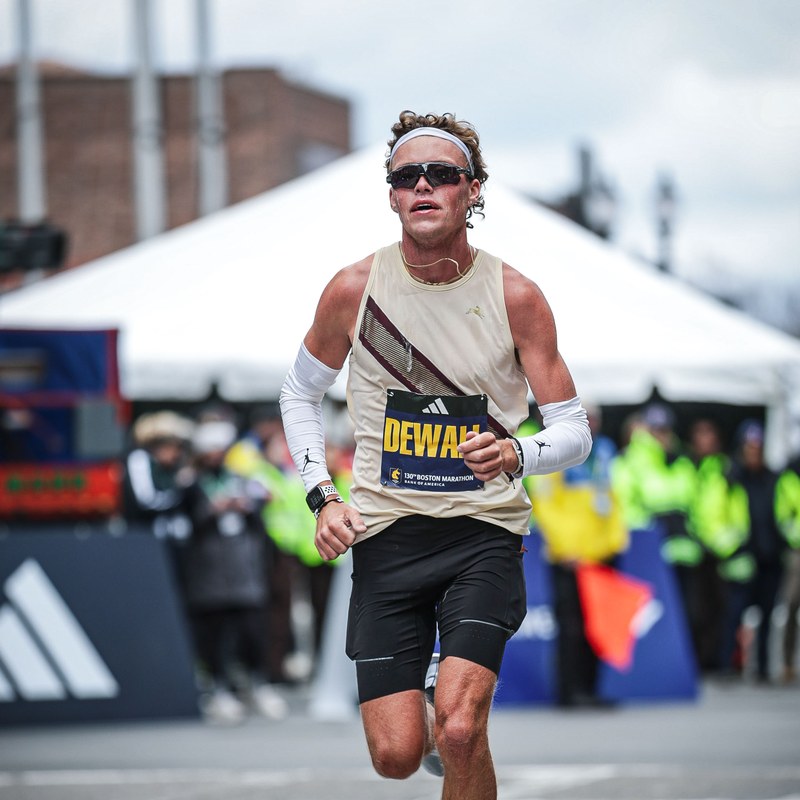
    Lars Dewall in a cream singlet with a maroon sash, white arm sleeves, headband and dark sunglasses running toward the camera at the Boston Marathon, a white tent and race volunteers behind him.
    Dewall at the 130th Boston Marathon on April 20, where he ran 2:12:30 off a build with no double threshold sessions in it. (Courtesy photo)

    Boring on purpose

    Ask what a skier’s background gives a marathoner that most marathoners do not have, and his first answer is something he does less of.

    “I’ve always found that I do a lot less VO2 max than most people, and I’ve been asked why,” he said. “The answer is always, VO2 max has a place. You have to touch VO2 max to be able to race well. But it’s less of a factor in the marathon.”

    When he leaned on it in high school and college, he would string together a couple of great weeks and then slide.

    “I felt like the engine would get flat,” he said. “And it’s so much harder to recover from a hard VO2 max session than a threshold session that’s done very well.”

    So he replaced some of it with threshold and what he calls efficiency work. He is sure he does more threshold than the average marathoner. The gap can look small on paper, maybe one session in fourteen days, and he thinks it compounds.

    “It’s hard to weigh how much even one workout every 14 days makes over the course of an eight to 12 week training period,” he said. “It adds up.”

    The second answer is strength, and with it the ability to carry mileage. He has gone from about 100 miles a week to about 135.

    “I don’t want to say that for sure, but I definitely think that the skiing background, the strength, the amount of volume that I was doing all those years has helped me being able to go from, okay, I was running 100 miles a week, that’s a lot. But to be able to jump from that to 135 and still feel pretty dang good,” he said. “To be able to make jumps like that, I feel like the ski background definitely is a part. Someone will go, oh, it’s just 35 more miles. But that jump in your nervous system and fatigue and all of that, it’s an exponential number. It’s hard to even measure.”

    The odd part is that in college he barely lifted for running at all.

    “I really did none,” he said. “I just didn’t really want to. I was just kind of lazy, and I didn’t believe that it would make me better at running.”

    What he did in the weight room was for skiing: upper body, core, pull-ups. For about a year now he has followed a running strength program built to take 20 minutes. Heavy half squats. Step-ups holding about 60 pounds. A Bulgarian split squat done as a jump, with no weight. Romanian deadlifts. Two sets of eight of each, three minutes between, and he spends the three minutes stretching, on core, or on whatever is sore. He lifts two or three times a week, soon after a workout or a long run once he has refueled, and never on a recovery day.

    “It comes at a cost, and strength is strength,” he said. “You’re still adding fatigue.”

    Then there is the session everybody in marathoning is arguing about. He ran 2:12:30 at Boston with no double threshold days in his build. He ran 2:12:13 in Berlin after a lot of them.

    “It’s hard to weigh,” he said. “If I would’ve ran 2:10 in Berlin, would I answer that question differently? Maybe. I just need more races to be able to answer that question. I think they’re both good.”

    His complaint is with how a lot of people do it.

    “You want fatigue to be the thing that’s stopping you, not lactate being too high,” he said. “People are like, oh, I’m done, my lactate’s high. And most people aren’t even monitoring that. I just like to let time be the thing that makes you tired. Time on feet.”

    Going into Berlin, where the goal was to break 2:10, the pace for it, around 4:57 a mile, felt easier than it ever had in his career. He gives double threshold some of the credit and plans to keep it, perhaps every other week instead of every week.

    “It’s taxing,” he said.

    After the first story ran, Salmela wrote that Dewall was basing most of his current training on cutting-edge running technology. Dewall found the phrase funny.

    “I would say that a lot of my training looks pretty boring, because it’s a lot of the same stuff over and over and over,” he said. “But the consistency is there, and the focus and discipline and being a mature runner is there.”

    Lactate testing and heart rate data matter, he said. But he thinks what Salmela meant is simpler than any of the gadgets.

    “In the running world specifically, people aren’t out there constantly monitoring heart rate and all that data, and getting useful information from it,” he said. “Even in the pro world in running, there are people who are doing a really good job of it, but there’s people out there who are just showing up, like, let’s go run.”
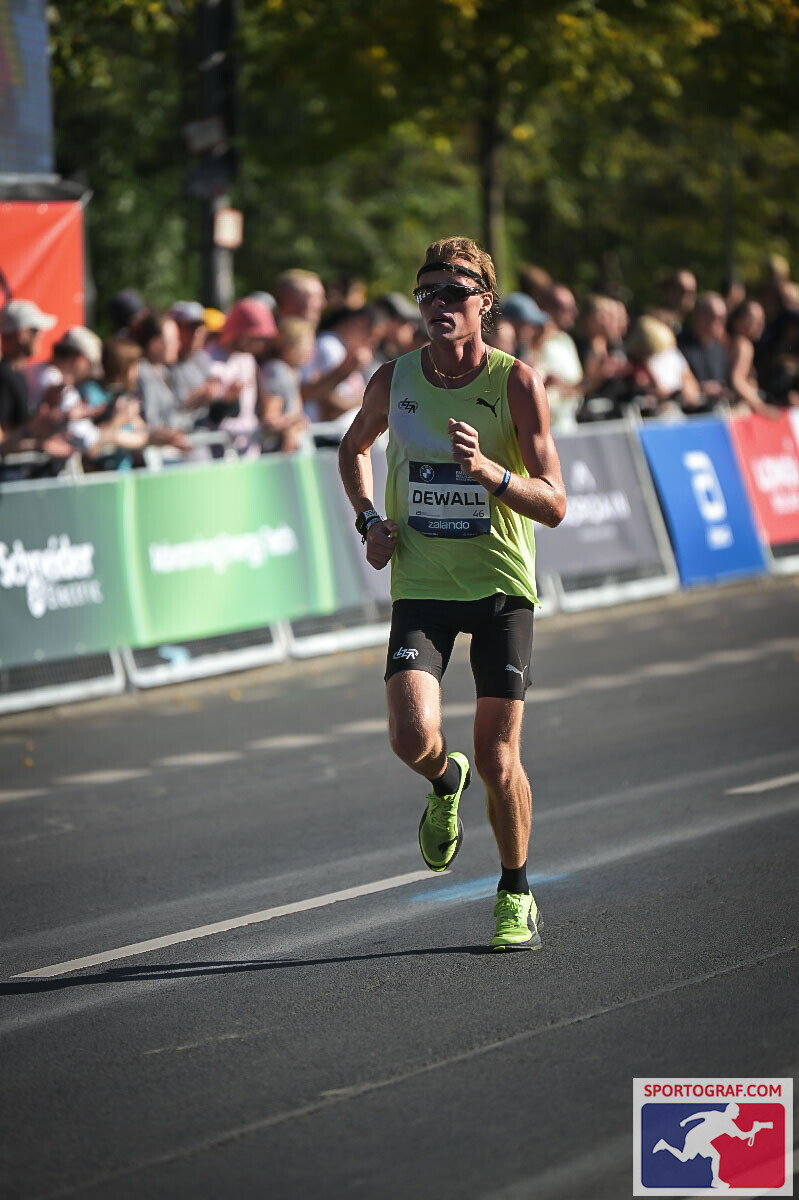
    Lars Dewall in a lime green singlet and bright yellow shoes running alone down a sunny road lined with barriers and spectators.
    Dewall on the road in Berlin, his first race in Europe. He called it the most organized and efficient race he has been to. (Photo: Sportograf/courtesy photo)

    The road to St. Louis

    The Olympic Marathon Trials are in St. Louis on March 25, 2028. Dewall has had the qualifying time since CIM, and he is not alone at home. Three or four of the Lane Zero runners, Dewall included, have met the 2:16 standard.

    “Although San Diego’s a big city, that’s a lot of qualifiers for even a big city,” he said. “Those are the guys that can push me in workouts and really make me better in workouts.”

    Puma backed him through Berlin under its PROJECT 3 program for sub-elite marathoners, and after the race the company told some of those athletes it would support them through the Trials. He does not yet know what that will look like. He doubts it will be money.

    “But free gear and travel and stuff like that, and that’s pretty huge,” he said. “So I’m stoked about that.”

    He knows where the next line is.

    “Two-ten is the number that most of these companies are looking at to be like, okay, let’s get you on an actual contract,” he said.

    For now he is letting his body decide what comes next. Berlin was three weeks old when we spoke, and the job was to recover without giving back fitness. There might be a race before the end of the year. He expected to know soon.

    Early 2027 is for going shorter: road 5Ks and 10Ks, maybe a 3,000 or a mile, even a time trial. His 5,000 best is 14:37, and he thinks 14:10 is there at the least. He would like to get under 29 minutes for 10K. His mile best is 4:10 from college, and before Berlin he ran 4:22 at the end of a workout without trying very hard.

    “I was like, to my buddies, I think I could have PR’d in the mile right now at the end of this workout if I would’ve went for it,” he said. “Who doesn’t want to have a faster mile PB, even if you’re a marathoner?”

    The bigger target is the half marathon standard for the Trials, 1:03:00. The window for half marathon qualifiers opens January 1, 2027. His best is 1:04:06, from the Garry Bjorklund Half Marathon at Grandma’s in June, in conditions he called humid-ish. He is already qualified for St. Louis, so the half would change nothing about his place there. He wants it anyway, and he is looking at a half in March.

    “It’s a nice accolade to have,” he said. “It’s no gimme. That’s gonna take some really specific prep.”

    He expects to run one marathon in 2027. Boston again, maybe London, maybe Chicago, nothing later in the year than that. He would think about Berlin again if teammates were going, because of how well the race took care of its elite field.

    “That was the most organized and efficient race I’ve ever been to,” he said. “And that’s worth a lot.”

    He wonders whether getting there three or four days earlier would have bought him something. He does not know. He also admits he remembers very little of the course.

    “I always laugh when people ask me about the course in those races, and I’m like, I don’t even know,” he said. “You’re going pretty fast, but you’re also in a group like that, and the only thing you’re looking at is just the person in front of you.”

    On Monday mornings he is back in front of his middle schoolers. He is not a morning person, which makes running before school a grind in the long weeks.

    “I wish I could start my teaching day at 9 or 10 a.m., but that’s not how the real world works,” he said.

    He would not trade it.

    “When you don’t have that job, it’s easy to get almost obsessed with the training and the running,” he said. “As much as that’s great and it’s exciting, I think it’s good to have something to force me to not think about running.”

    The classroom gives some of it back.

    “It’s fun teaching kids and making a difference in their life,” he said. “I feel like they take interest in the marathon stuff too, and ask questions, and always want updates.”

    He wants to coach someday, probably once his own career is over, and he knows which sport.

    “I think I’d like coaching running more,” he said. “A little more straightforward. Less variables, less factors.”

    No wax, no kick, no temperatures, as he put it.

    The 2:10 is still out there, and he knows how close 2:12 is.

    “I’m scratching,” he said. “I just gotta connect on the right day.”


    Help Support Our Coverage!

    If you value the thoughtful work and access FasterSkier provides, please consider becoming a Voluntary Subscriber. Your support directly fuels our work to cover the people, places, and moments that make our sport special.

    Join the FasterSkier community!
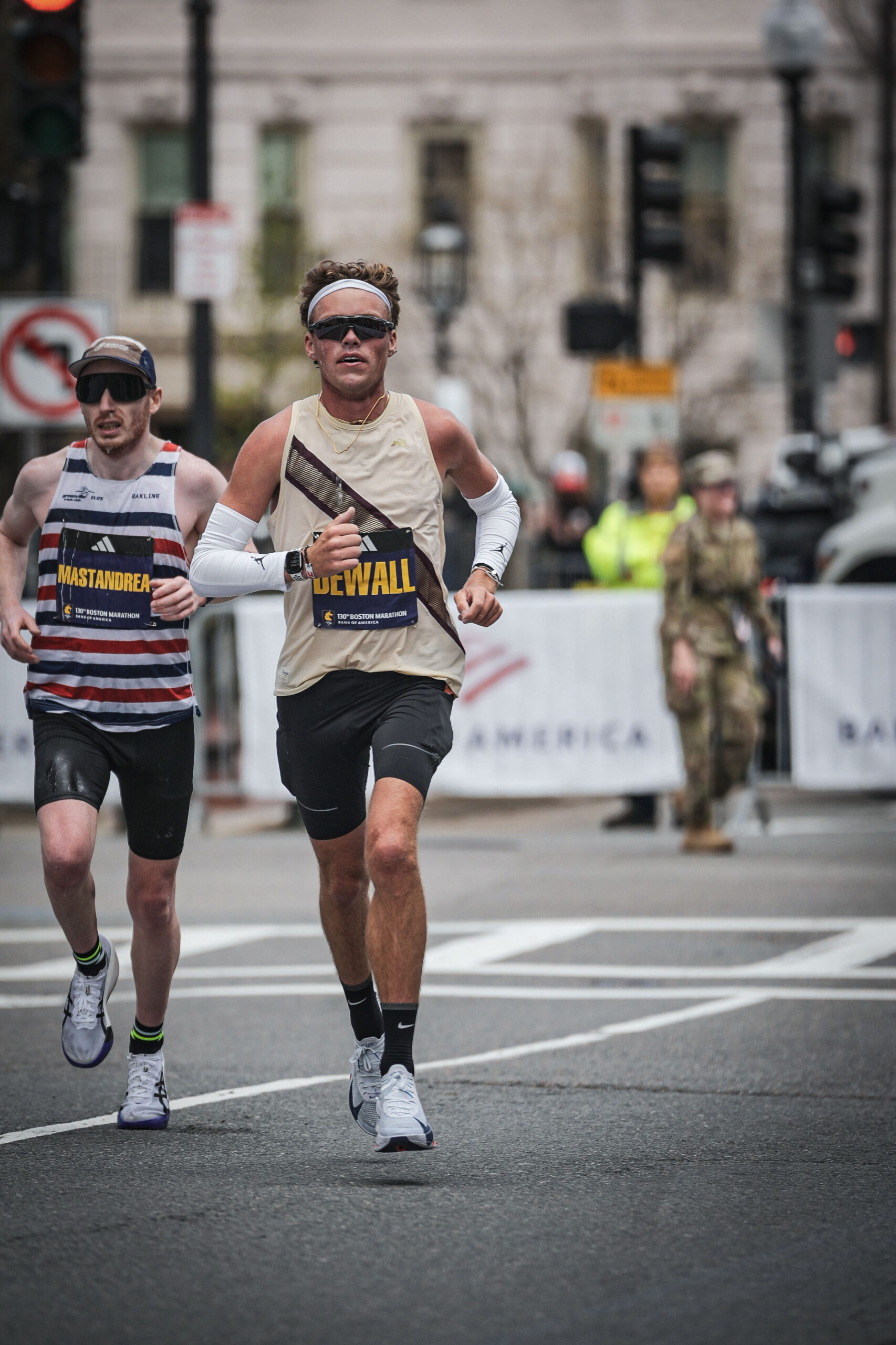
     

    Lars Dewall in a cream singlet and white arm sleeves running a city street at the Boston Marathon, a runner in a striped singlet a step behind him.
    Dewall at Boston in April. He expects to run one marathon in 2027, and Boston is on the list. (Photo: T. Wherry)
  • ‘Mileage Is a Distance, Not a Volume’: Chad Salmela on What Runners Can Learn From Cross-Country Skiers

    ‘Mileage Is a Distance, Not a Volume’: Chad Salmela on What Runners Can Learn From Cross-Country Skiers

    This article was made possible through the generous support of our voluntary subscribers. If you value coverage like this, please support FasterSkier with a voluntary subscription.

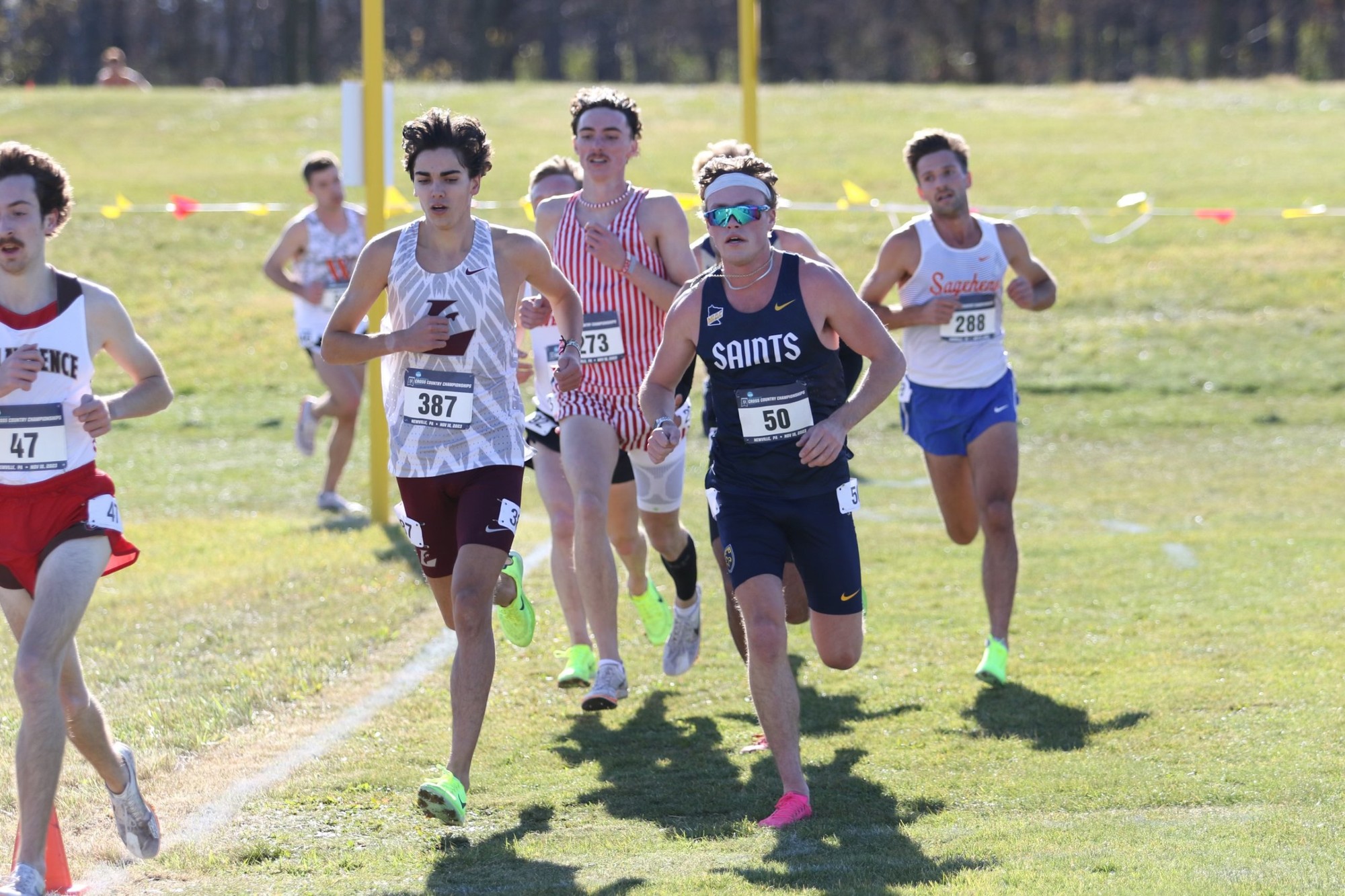
    Lars Dewall in a navy St. Scholastica Saints singlet and bib 50 running in a pack of college runners on a grass cross country course.
    Lars Dewall (50) races for St. Scholastica at the 2023 NCAA Division III Cross Country Championships in Newville, Pennsylvania. (Courtesy photo)

    Lars Dewall has run four marathons and he has never run a slow one.

    The debut was Grandma’s in June of last year, 2:22:57. Then California International in December, 2:14:15. Then Boston in April, 2:12:30. Then Berlin in September, 2:12:13, third American across the line. Four races, four personal bests, each one faster than the last, which is not how marathon careers usually go.

    Dewall came out of Division III. He ran at the College of St. Scholastica in Duluth and was an All-American there in 2023, one of the first two the cross-country program ever produced. He now teaches middle school social studies in San Diego. His training sounding board on broad direction is his college coach, Chad Salmela, who coaches cross-country at St. Scholastica, called the women’s team sprint in PyeongChang for NBC, and spent eight years on the US biathlon team before either of those things.

    Salmela has a theory about why Dewall keeps getting faster, and it is not a comfortable one for American distance running. He has been making the argument for most of two decades, in a sport that was not his first one, and until recently he did not have a runner fast enough to make anybody listen.

    “He’s like my living thesis right now,” Salmela said. “He’s actually texting me as we’re talking.”

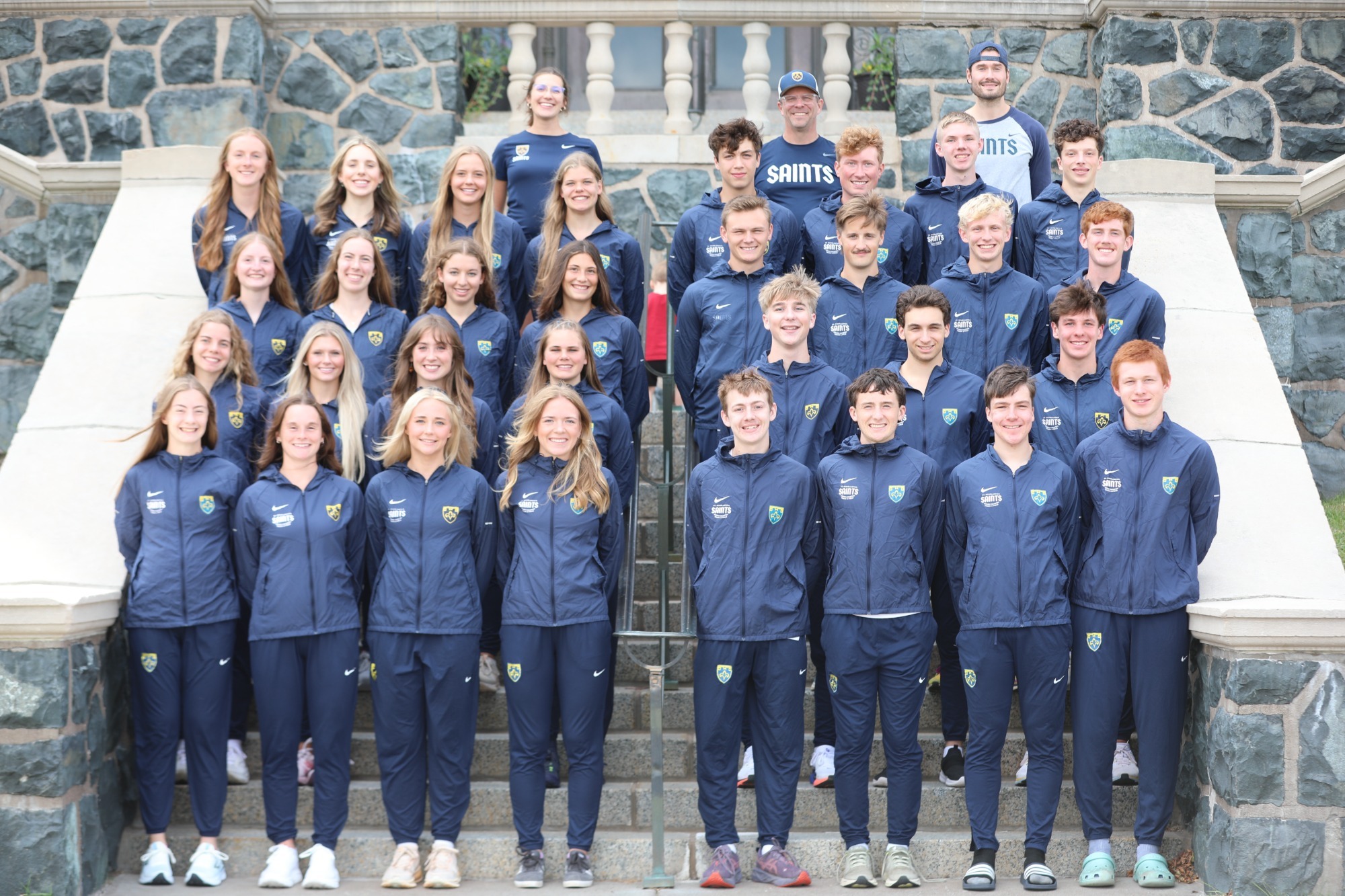
    The St. Scholastica cross country team in navy warm-ups posed in rows on stone steps, women on the left and men on the right, with the coaches standing at the top.
    Chad Salmela, back row center, with the 2026 College of St. Scholastica cross country team. In more recent years, Salmela has given up the nordic coaching role to concentrate on broadcasting during the ski season, which we will cover soon in part two of this series. (Courtesy photo)

    Mileage is a distance, not a volume

    The sentence above is his, written rather than spoken. It appears in the letter he sends to recruits, which is less a sales pitch than a seven-paragraph argument about exercise physiology, and it is the cleanest statement of the thing he believes.

    “Mileage tells you how far you’re running,” he said. “It doesn’t break down what you did in that distance.”

    He has been resisting the number for years and he still resists it.

    “You can have a huge mileage week on threshold. You can have a small mileage week on relatively aerobic,” he said. “Two to three two-hour-plus workouts, that’s going to be fewer miles than three threshold workouts. So that mileage metric, I feel like it kind of misshapes things in people’s minds.”

    Ninety-mile weeks are not the problem, in other words. What is in them is.

    “Ninety-mile weeks at a lactate of 2.5 as opposed to a lactate of 1 is going to have a way bigger consequence down the road,” he said.

    This is where the skiing comes in, and it is worth being precise about the lineage, because Salmela is. The interval sessions he leans on are not his. The one he uses the day before a race, a minute on and thirty seconds off, he calls “a complete ripoff from the Ingebrigtsens,” though the session appears in Marius Bakken’s own published account of the Norwegian model, as does the 45-seconds-on, 15-off session Salmela started using this autumn. Bakken, a Norwegian physician and former 13:06 5,000-meter runner, built the method out of more than 5,500 lactate measurements and mentored Gjert Ingebrigtsen (Jakob’s father) directly between 2011 and 2013. The family made it famous. Bakken wrote it down first.

    What Salmela did was carry it sideways, out of a sport where lactate testing has been routine for forty years into one where it mostly has not. He is blunt in the recruiting letter about why that gap exists and what it costs: the discovery was “established decades ago in the early 1980s, and has been adjusted in many other endurance sports, yet somehow continues to evade American distance running.”

    His own estimate of what the ceiling looks like is deliberately large.

    “If you can train as a runner seven or eight hundred hours of aerobic training, it doesn’t have to all be running; you can improve way more than you think as a runner,” he said. “But how do you get those 800 hours? You can’t do it running. You’re probably going to start having a limitation there.”

    That is a skier’s number, and he knows it. It is also the number he says Dewall has been running at for two years.

    A runner bounding uphill with ski poles beneath a chairlift, a second runner far behind him.
    St. Scholastica’s Paul Schommer, foreground, and Joe Dubay bounding up Spirit Mountain in Duluth, Minnesota, in the fall of 2014. (Photo: Chad Salmela)

    Injury is not the cost of doing business

    The recruiting letter contains three words in capitals: “Injury is NOT necessary.” He gets more animated about this than anything else in our ninety-minute conversation.

    “The first thing that always drove me nuts as a skier coming into the running world, before I even started coaching, was just the acceptance of injury as part of the deal,” he said.

    He is careful to say he might be wrong, and then says why he does not think he is.

    “Anytime you’re asking your body to do something it’s not able to do, you’re doing something wrong,” he said. “I think that’s a very important thing to remember. If you build the strength and you build the motor to handle it, you can pretty much avoid injury.”

    Then the qualifier, offered without being asked for, which is the mark of someone who has actually thought about the limits of his own claim: “maybe I’ve just never taken anybody to their very maximal capacities so far, and that could be it.”

    The mechanism he proposes is fuel. His argument is that a runner who has never taught their body to burn fat at easy intensities is spending glycogen on workouts that were supposed to be building aerobic efficiency, and that the bill arrives later.

    “You’ve got to define where your aerobic threshold is running, and you have to make sure that you’re burning fat there,” he said.

    He has a blunt way of describing the high school runner doing it wrong.

    “You can’t be running 6.5-minute miles and you got a PR at 15:30. That doesn’t even compute. It’s not easy enough,” he said. “You’re still going to have better immediate success. But somewhere down the road, if you don’t learn how to burn fat, you’re going to probably get hurt.”

    The same protectiveness shows up somewhere less expected, which is how he handles a team that is getting sick. Two weeks before we spoke, a freshman turned up to a threshold session with a sore throat and told nobody until afterwards. Three of the four men in his suite went down. By Thursday the squad was, in Salmela’s description, a shell of itself, and on Saturday fourteen of thirty made the workout.

    The athlete who did not get sick was the fittest one in the room, and Salmela pulled him out of the hard session anyway.

    “I’m not putting you through a level four workout right now when you’re rooming with three guys who probably are carrying the bug, because you’ll be sick by Saturday if we do it,” he said. “He was pissed, but I didn’t let him do it.”

    The rule for everyone else is not negotiable and the arithmetic behind it is simple.

    “If you’re sick today, you’re not training tomorrow,” he said. “The best case scenario is you catch it, you stop, and you have four days that you’re not training. That’s going to be the minimum.”

    Against that he sets what a season costs. His athletes are chasing a minute off an 8k, and he does not think a sick athlete who races anyway gets it.

    “They’re not running a minute faster in 8k this year, and they will not do it if they get sick,” he said. “They won’t do it.”

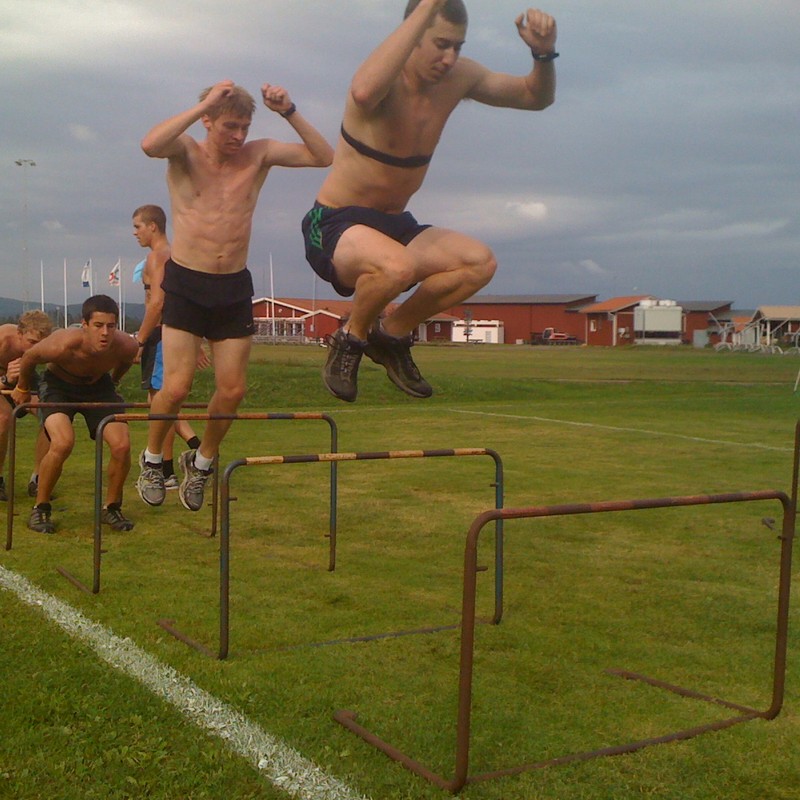
    Five athletes bounding over low hurdles on a grass field under a grey summer sky.
    Hurdle bounding at a St. Scholastica dryland session. Salmela believes in the work and is his own cautionary tale about too much of it; a winter of jumps in his last season as a biathlete left him convinced he had compartment syndrome. (Photo: Chad Salmela)

    What he got wrong first

    Salmela is a strength evangelist who will tell you, unprompted, about the year he ruined a team with it.

    “I loaded too much strength on some of my early teams coaching, and they got flat,” he said. “They got super slow, didn’t stay quick.”

    What he settled on instead is periodized and, more importantly, individual. December is a strength block for everybody. In season it drops to maintenance and bodyweight work. Beyond that he decides person by person, and he is explicit that the people who say runners need strength and the people who say they do not are both partly right.

    “You need a minimal amount of strength just to stay healthy,” he said. “And then some people need strength to be stronger, to be faster as a runner. They actually need strength to be a part of the catalyst that makes you your best.”

    He has a sophomore who worked this out for herself before he did. She ran in high school, never lifted, went through the Air Force, got strong there, and arrived at the conclusion that the strength was the thing she had been missing all along. She now does three sessions a week on her own, more than Salmela gives anyone else on the roster.

    Plyometrics get the same treatment, and the same warning, which comes from his own body. In his last season as a biathlete he loaded up on jumps and spent January and February convinced he had compartment syndrome.

    “Really what it was is I had incredible anaerobic power and the racing season just kind of started having catabolic reactions in my shins,” he said. He credits Dave Bacharach, the exercise physiologist at St. Cloud State, with talking him out of the diagnosis: a lot of type 2 fibre, suddenly drowning in lactate every weekend.

    “You have to be careful with plyos for aerobic sports because it’s anaerobic work, and it’s going to steal some of it,” he said.

    The archaic notion

    Ask him about tapering and he does not hedge.

    “I think the taper is an archaic notion,” he said. “I think some people need a taper. You have to find the person who needs a taper. And there are some people out there, but I’d say they’re the minority.”

    His team runs six to nine hours a week regardless of where the season is. The reasoning is that fitness is the thing being protected, and that the races themselves do the damage a taper is usually blamed on.

    “Great races kick your ass, man,” he said. “They are hard to recover from. So if you want to have two or three great races in a row, you better watch that.”

    When he does drop volume it is recovery, not peaking, and he says so. The most persuasive evidence came from a senior who diagnosed her own pattern and brought it to him: three straight years of running a personal best at conference and then one of her worst races of the season at regionals a week later.

    “She goes, can we fix that? And I’m like, yeah,” he said. “We’re going to keep the volume high. We’re not going to taper.”

    What replaces the taper is a race week with a shape to it, and this is the most directly usable thing he says all afternoon. A maximal effort five days out, long enough to spend real time at max heart rate. Then the Bakken session the day before.

    “The reason I think you need that is because your heart will not be ready to respond to the work if you don’t do that,” he said of the hard day. “And if you do it any closer to the race, you’ll still be trying to recover from it.”

    The day before, he keeps it short: five to eight repetitions of a minute on, thirty seconds off, in the tempo zone, perhaps five minutes of actual work.

    “It’s the best pre-race workout I’ve ever found. Works almost universally,” he said. “Up until that point, I had found some workouts that work for some people and not for others.”

    He does not prescribe the number. He hands the athlete a rule instead, and it is a small masterpiece of coaching.

    “As long as the one you did last feels better than the one you just did before that, do the next one,” he said. “As soon as you feel like you’re working at all, you’re done.”

    Three St. Scholastica coaches in Saints shirts standing at the foot of a wide stone staircase, Chad Salmela in the middle in a cap and light blue shorts.
    Salmela, center, with his St. Scholastica cross country coaching staff in August 2026. (Courtesy photo)

    Leave the gait alone

    There is one more piece, and it runs against most of what a modern running program sells.

    “Meddling with natural biomechanics is kind of a no-no in my book,” Salmela said.

    His most successful runner, he said, had a gait nobody admired and plenty of people wanted to correct. She was never injured until she stopped doing strength work.

    “Her gait wasn’t pretty, but it worked, you know, and I recognized that,” he said.

    His evidence for leaving well alone is a runner who arrived last year from a small high school program, had not scored for his team, and spent his first season trying to prove he belonged by going too hard at everything. It did not work. Salmela sent him away for a summer with an instruction to run more, at the intensity he was told and no harder.

    “He comes in here, he looks so good. All the coaches are like, man, his running has improved a ton,” he said. “He had clodhopper feet last year, because he wasn’t a real runner. He hadn’t run enough yet. Comes in this year and he just comes off the ground, he looks natural, he looks like a runner now.”

    Then the part he seems to enjoy most.

    “And I did nothing,” he said. “I didn’t have to tell him anything other than follow the right intent.”

    Lars Dewall in a St. Scholastica singlet, headband and sunglasses running at the front of a large field, with white event tents behind.
    Dewall early in the race at the 2023 NCAA Division III Cross Country Championships, the fall he became one of the first two cross country All-Americans in St. Scholastica history. (Courtesy photo)


    Which is more or less the argument in miniature. Dewall ran 110 to 130 miles a week building for Berlin, more than he had ever run, a third of it on soft surfaces, the intensity governed by lactate rather than by what the paces are supposed to look like. He got support from Puma’s PROJECT 3 program for the race. He went 2:12:13 and took seventeen seconds off a personal best he had set five months earlier in Boston. Salmela is careful not to claim all of it. Dewall now builds most of his training around cutting-edge running technology that Salmela admits he is “not terribly well-versed” in. “Still, I think the thesis IS a huge reason he is blowing minds, and why he can do these workloads,” Salmela wrote after our interview. “But not the only.”

    Salmela has been saying for years that nordic volume would do this to a distance runner if anyone ran it properly. It took him until his fifties to find the runner who would.


    Help Support Our Coverage!

    If you value the thoughtful work and access FasterSkier provides, please consider becoming a Voluntary Subscriber. Your support directly fuels our work to cover the people, places, and moments that make our sport special.

    Join the FasterSkier community!
     

    A wooden plank walkway running between boulders toward a calm sea at sunset.
    A path to the Gulf of Bothnia near the Salmela family farm in Finland. The training ideas he has spent most of two decades carrying into American running came out of that part of the world. (Photo: Chad Salmela)
  • Matt Dougherty Inherited One Skier at Paul Smith’s, Six Seasons Later, Two USCSA National Titles

    Matt Dougherty Inherited One Skier at Paul Smith’s, Six Seasons Later, Two USCSA National Titles

    This article was made possible through the generous support of our voluntary subscribers. If you value coverage like this, please support FasterSkier with a voluntary subscription.

    Matt Dougherty has a way of knowing in September exactly what he is going to say in February.

    It usually happens on the second day of the Adirondack Canoe Classic, the three-day, ninety-mile paddle from Old Forge to Saranac Lake that everyone in the North Country calls the 90-Miler. By then his skiers have been in a boat for two days. They have carried it over roughly five miles of portage trails. They are, by his description, flat on the ground.

    “It was six hours of just going as hard as you can, which is still low on the L zones, but you’re putting out power for hours and hours and hours,” Dougherty said. “And then you get back in the boat.”

    Dougherty is the head nordic ski coach at Paul Smith’s College, and also its head marathon canoe coach, which is not a combination most ski programs carry. In March his men won the USCSA national championship at Mount Van Hoevenberg, 68 points to St. Olaf’s 108, the program’s second national title in five seasons. His women finished second, as they did in 2022 when the men won the first one. He took the ski program over in the fall of 2020 with one skier on the roster and no recruits, at a college in the woods with fewer students than most high schools.

    He is also, as of this year, the subject of a feature documentary, which is a strange thing to happen to a coach at a school of this size and which he did not see coming at all.

    Four Paul Smith's College athletes hold
    Paul Smith’s paddlers with their first-place plaques after the Adirondack Canoe Classic, the three-day, ninety-mile race the North Country calls the 90-Miler. Head coach Matt Dougherty runs the marathon canoe team as well as the ski team. (Courtesy photo)

    Three days in a boat

    The marathon canoe team is not a requirement for skiers at Paul Smith’s. A lot of them do it anyway.

    “It gives me the opportunity to do the important lessons,” Dougherty said. “The 90 mile canoe race is super hard, and I can go back and be like, look at what we can do when we put our mind to it.”

    The boats are the point. In the Voyageur class, where Paul Smith’s entered a seven-paddler crew in 2024 and won its division by two hours, the craft itself becomes part of the problem.

    “It’s raining and you paddled,” Dougherty said. “You had to carry a boat that’s 300 pounds if you’re in the Voyageur canoe up and over a literal side of a mountain in a race.”

    He is after two things. One is the plain demonstration that his athletes can do more than they think, a claim coaches make constantly and almost never get to prove in September.

    “A lot of times our preconceived notion of what we can do is only limited by our own mind,” he said. “If you ask them at the end of day one, they’re like, there’s no way I can do that again. Day two, and you keep doing that, and you’re like, but what can you actually do if you open up your mind and say, like, I’m just willing to see, I’m willing to test those boundaries?”

    The other is more useful to him in February.

    “To affect change, you got to have shared experiences, even with a coach involved in it,” he said. “That say, like, we shared this really hard time, and there’s this high level of trust, and we can do super hard things. From there, we can then we can get into the training, and we can say, yeah, we’re gonna do 44 weeks of training next year, and you’re gonna put on 10 pounds in the weight room, and things that they’re like, what? But now it’s like, okay, we have a place to start from.”

    There is a third thing, which he raises without being asked.

    “It’s really hard for college students to understand all the hard things you’re going to go through in life, and I want them to be tempered and ready,” he said. “This is going to be hard to experience all of the emotions, sadness, grief, pain, but also to be like I can endure this.”

    A line of Paul Smith's College skiers in
    The roster Dougherty built. He took the program over in the fall of 2020 with one skier on it and no recruits. (Courtesy photo)

    The long way back to Saranac Lake

    Dougherty graduated from Saranac Lake High School in 1997 and got a running scholarship to Houghton University, then a small NAIA school in western New York, which is where the pattern that governs everything else started.

    “Sport was an avenue to change my circumstances in life,” he said. “It changed my life because it got me to college. I paid for college. I got a degree, and then changed my circumstances drastically.”

    He has two degrees, an undergraduate in outdoor education and ceramics, and a master’s in education from St. Lawrence in what he describes as cognitive behavior. He coached track and field for two decades before this, and he spent some of those years around people whose approach he took wholesale. One of them was Clyde Hart, the Baylor coach who put Michael Johnson, Jeremy Wariner and Sanya Richards-Ross on Olympic 400-meter podiums.

    “You’d think, man, you have like three gold medalists on your team right now,” Dougherty said. “And you’d see him interact with his athletes, and you’d be like, wow, it’s always the person first. It is what’s going on in your life today, what’s going on the person before the athletic part.”

    As a coach, he had chances to move up into Division I teams. He turned them down, and he credits his wife with the reasoning.

    “What I realized then is, it’s a numbers game and it’s not a person game,” he said. His wife, he said, put it to him as a trade: “If you do this, you lose that, and it’s going to be miserable for you.”

    He is now coaching three miles up the road from where Bill Demong grew up, at a college where Tim Burke’s father was a vice president for thirty-five years. He has a theory about what sticks from a life in that company.

    “He would probably just hide his Olympic gold and silver medal for the rest of his life,” Dougherty said of Demong, who won gold and silver in nordic combined at the 2010 Vancouver Games. “But he would happily talk about what sport did, like what those experiences were.”

    Members of the Paul Smith's College nord
    The hardware from a season in which the Paul Smith’s men won the USCSA national title and the women finished second. The team never set winning it as a goal. (Photo: Timo Ziegler)

    Goals that do not squeeze anyone out

    Paul Smith’s does not set a team goal of winning a national championship, even in years when it wins one.

    “We just set process goals, because that’s the only thing we can control is what we do there,” Dougherty said. “And we caveat that with a little like, what do we hope that gets us. If we do all those things, we hope it can lead us to contending for a national title.”

    The reason is not modesty. It is arithmetic about who a team goal excludes.

    “I take such an individualized version of goal setting,” he said. “If we put a performance metric behind it, it often squeezes out other people in the program. It doesn’t allow their goals to exist.”

    Last season one of his athletes was named to a US biathlon team for an international championship, which meant flying back from Germany and landing roughly a day before the national championships started.

    “If the women’s team had said like our goal is to only win nationals and they were second overall, like that would have put her in a position where she’s like, well, I’m taken away from the team by going to World Juniors,” Dougherty said.

    She went. The team finished second anyway. Nobody had to choose.

    The team does have expectations, two of them, and he recites them the way people recite things they have said several hundred times.

    “To be on this team, you got to be a good teammate first, and then maximize your opportunity,” he said.

    What that produces, in his telling, is a program where the standard gets set from the back of the group.

    “When a star is like, oh, I’m tired today, or this morning it’s raining and it’s 38 degrees, no one wants to ski, but they see the slowest guy kitting up and going out, then it allows all of us to kind of gain from that,” he said.

    A lone cross-country skier on a groomed
    An ordinary training day on the trails at Paul Smith’s. Dougherty says his job is to make room for whatever an athlete is carrying, without asking for it directly. (Courtesy photo)

    The person before the athlete

    The documentary spends real time on mental health, and it is the part of the conversation Dougherty warms to fastest. He starts from what he does not know.

    “I only get a piece of the story of this athlete,” he said. “We don’t know if they came from rough family life or they just feel like they don’t belong. All these things. Mental health issues are real, and I need to know about those. But I have to allow space for them to come up organically.”

    “I can’t be like, who has mental health issues?” he said. “I’ve got to create the space for that.”

    The space, in practice, is a rule about curiosity that the team applies to each other.

    “We’re constantly like, we’re not judgmental on this team. Let’s be curious,” he said. “If as we look at a teammate and we wonder what they’re going through, instead of saying like whatever, we say like, oh, what’s the source of that?”

    The same approach applies when he already knows an athlete is struggling. The problem then is how to open the door without making the asking the event.

    “The really hard thing is when you get to the point where you know stuff’s going on, finding the way to indirectly be direct,” he said. “What do you need?” is the question he finds himself asking, and it generally opens the door.

    That extends to how he thinks athletes should hold their own results. A race result, in his view, is a terrible place to store your sense of self.

    “Their performance isn’t who they are, and it’s not anything connected to their value,” he said. “Whether we win by 20 points, lose by 20 points, doesn’t change their person or their value as a person.”

    As he has gotten older he has become more concerned with sportsmanship, and he treats it as something other than a courtesy. It is how he teaches athletes to handle a disappointment and to recognize somebody else’s work.

    “When you can say like, yeah, I didn’t have a great race today, instead of being sad and dour, if you go to celebrate someone you know who’s trained hard for a year and had a great day, you can’t be sad anymore,” he said. “It just changes you.”

    He means it specifically. Clarkson won the USCSA men’s title at Mount Van Hoevenberg in 2024 and Paul Smith’s finished second, and Dougherty’s response was to have his team look closely at what the Clarkson skiers had done to get there.

    “Even though we’d love to win, when you see someone perform like that, it’s actually inspiring,” he said. “The more we can be open to looking at performance and saying like other teams did great, but there’s value in me not just celebrating them, but seeing what they did and honoring it. I think it makes us better athletes in the end.”

    A cross-country skier races past a group
    Teammates and the Bobcats flag trailside. At a college of roughly 750 students, Dougherty says, everyone on campus knows the ski program. (Courtesy photo)

    A small college and a film crew

    Paul Smith’s enrolls roughly 750 students by the college’s own count, on 14,000 acres at the northern edge of the Adirondack Park. Nearly half the bachelor’s degrees it awarded last year were in natural resources and conservation. It is the kind of place where a skier’s Saturday gets rearranged by a professor.

    “When you come here, it’s individualized; it is a personal relationship school,” Dougherty said. “My students are working with a professor; he takes an interest, he gets to know them, and then I find out, well, Saturday we’re actually going out with this professor. He’s taking us into the mountains to show us this specific part of our research.”

    “It is harder when you have 700 students. Everything about that is harder: recruiting, getting people here,” he said. “But because of that, we live in a culture where everyone on campus knows the ski program.”

    That extends past the campus. Dougherty calls the Saranac Lake and Lake Placid community around the program super fans, and he puts the college president, Dan Kelting, in that category.

    “He shows up at ski races and he’s not just there to like cheer,” Dougherty said. “He’s also there like, what do you guys need? What does the program need? What do we need to keep bringing in great students as a ski program?”

    His summary of the whole arrangement is that it could not exist anywhere else.

    “It’s this weird subculture that probably could only exist in the Adirondacks,” he said.

    Which brings up the film. A donor with a seasonal home on one of the lakes near the college met the team at an event, decided there was a story, and asked whether Dougherty would sit down with a documentary crew. Dougherty said yes without any clear idea what he was agreeing to.

    “I expected a three to five minute kind of like infomercial type thing for YouTube,” he said.

    What arrived was Adrenaline Films, an Orlando company that Dougherty said had got its start on the early seasons of Survivor and had lately been following a ballet company through the war in Ukraine. The crew embedded with the ski team for close to two years.

    “This was like pretty legit documentary crew following us for a long time,” Dougherty said.

    The result is Coach Matt and the Outdoor ‘Cats, directed by Robert Jury and produced by Michael Murray and Tim Ranzetta. It runs about 95 minutes, and it is free to watch, with ads, on Amazon Prime Video and on Tubi. Its spine is the 2024 season, in which the Paul Smith’s men lost the national title by two points.

    “They’re really just telling the story of a team,” Dougherty said. “Small, tiny school in the woods is really another theme there. You can do anything, anywhere, kind of an idea.”

    Any money the film makes goes back to the program, and he doubts there will be any.

    “My guess, without knowing all the specifics of cost, is that this is a net loss,” he said.

    The team that lost by two points in that film won by 40 in March. Nobody set that as a goal.

    Help Support Our Coverage!

    If you value the thoughtful work and access FasterSkier provides, please consider becoming a Voluntary Subscriber. Your support directly fuels our work to cover the people, places, and moments that make our sport special.

    Join the FasterSkier community!
     

    A canoe with several paddlers silhouette
    First light on an Adirondack lake. The canoe season comes first, and it is where Dougherty does his most important coaching. (Courtesy photo)
  • ‘We have no films to our name’: Lars and Torsten Brinkema on how Threshold got made

    ‘We have no films to our name’: Lars and Torsten Brinkema on how Threshold got made

    This article was made possible through the generous support of our voluntary subscribers. If you value coverage like this, please support FasterSkier with a voluntary subscription.

    Torsten and Lars Brinkema were two brothers from Minneapolis with a GoPro, a film school semester between them and no feature credits at all when they talked their way into a U.S. Cross-Country Ski Team camp in Bend, Oregon, in the summer of 2023. They spent the following World Cup season inside the team, paid their own way through it, and came home with roughly 500 hours of footage. What they cut it into is Threshold, the documentary about Jessie Diggins and her eating disorder that premiered on Peacock in February and is now available to rent in the United States and Canada.

    Earlier this month we published head coach Matt Whitcomb’s account of that winter and what the team changed because of it. This is the other half: the brothers’ own version, recorded before the rental release. Torsten is 26 and lives in Brooklyn. Lars is 23 and splits his time between Minneapolis and Los Angeles. They are still working as a duo.

    Below is a transcript of the Brinkemas’ conversation with FasterSkier. It has been lightly edited and condensed for clarity. LB is Lars Brinkema, TB is Torsten Brinkema, MV is Matthew Voisin.

    A filmmaker mid-stride on cross country skis carrying a cinema camera rig, with an athlete skiing ahead of him on a groomed snow trail.
    Lars Brinkema filming on snow at a U.S. Ski Team camp in Bend, Oregon, chasing Jack Young up the trail. The brothers had done the workouts themselves, which is the reason the team let them near one. (Photo: Patrick Conroy)

    MV: I would love to back up a little and just hear about you two as young guys, how this all manifested.

    LB: To start at the very beginning, Torsten and I were both born in Minneapolis and grew up in that whole Minneapolis ski world. We had skis on right when we started walking. So we really grew up in the same community that Jessie had grown up in, and she was kind of just this idol that we looked up to. We both remember where we were when we were watching that gold medal race in Pyeongchang. And then fast-forward to when we were getting older, just always carrying cameras around, usually a small GoPro on our ski trips. Torsten ended up skiing for Colby College, and that is where he met Ben Ogden, racing against him on the collegiate circuit.

    TB: I got my ass kicked by Ben in most of the EISA college races. But I was always interested in shooting a lot of ski trips. I left school trying to figure out how to put those two pieces together, because I knew I was not good enough to be a professional skier, but I also wanted to capture the sport that I loved so much. It took a year of trial and error doing gigs for outdoor brands and whatnot.

    Then, when we figured out the World Cup was coming to Minneapolis, I talked with the Loppet Foundation, which is the club Lars and I grew up skiing for. I was kind of like, listen, do you guys need any promotional materials? People should be getting excited for this event that is happening at Wirth Park. I convinced them on a shoestring budget to send me to Holmenkollen in the spring of 2023. I stayed with a family friend out there, reconnected with Ben, and met a lot of the other skiers on the team. I think they were kind of surprised to have an American photographer out there with them, just because they are not getting much coverage once they leave. Ben was sort of like, we have to figure out how you guys can stick around with the team a little bit longer. It was just me at this point, but Lars was in film school. So Ben pitched Matt Whitcomb that he should invite us to their Bend, Oregon camp.

    MV: What did you think you were making at that point?

    TB: Lars and I basically bought cinema cameras and showed up at camp. We were definitely inspired by a lot of other sports documentaries at the time, niche sports finding success in that genre, people going, oh my god, look at Formula One, I have never heard of this sport before but I am really loving the series. And we were like, we could probably do something like that with skiing. Make it look really cool.

    I think the team was happy to see filmmakers who could not get in the way of their workouts. Jessie had experiences in the past with a brand interrupting an interval session, asking her to do another interval. This is just something that would never even cross Lars and my mind, to alter the workout, because we know how intense they are. We know the workouts. We have done them before. So we were kind of flies on the wall, and I think that proved our ability both as skiers and as filmmakers, to be in that documentary position and not get in the way.

    MV: What were you envisioning before it started to become more about the eating disorder and the mental health challenges?

    LB: Just bringing this sport that we grew up in and that we loved to the masses. We had seen smaller endurance sports, whether it was a YouTube channel or on Netflix, sports that we loved but not a lot of people in the U.S. tracked. And there was always this element to the successful films about sports that was more the human side of the story. We approached it very open-ended. We kept those options really open for a majority of our filming. We were still capturing when we went on the World Cup, talking to European athletes, we had some fun conversations with Klaebo on camera. We just spent every waking moment following different stories.

    I would say we were definitely, kind of subconsciously, following Jessie’s story more than others, and that just developed over the time of filming. Not until the editing process is when it really shaped. We had 500 hours of footage, so many different interviews with so many different athletes, doctors, staff on the U.S. team. And as we started to screen rough cuts to film industry people around Los Angeles and New York, we were getting so much feedback that Jessie’s story was the most resonant of all of them.

    MV: You have 500 hours, and then at some point you have to make the decision that almost all of it is hitting the cutting room floor. How do you feel your way through that?

    TB: Having an editor who had never cross-country skied before was totally instrumental in figuring out what would resonate with the wider audience we knew we had to appeal to. And there are also those moments where Lars and I were deep in the Arctic Circle, freezing our butts off, trying to get a time-lapse of the northern lights, out there for two hours and so attached to this one shot that we worked so hard for. I remember being in the cutting room and him saying, it is not serving the story, you have to cut it. Those were the things that were so hard to let go of.

    And of course all these other stories, U.S. Ski Team members, Klaebo, Emma Ribom, Pellegrino, people that we really looked up to, and all of their stories deserve to be told. But at the end of the day, when you have this Jessie story that is so compelling, you cannot really deviate from it if you want to give her story the time it deserves. At the industry screenings, Lars and I walked in with a lot of questions about what would resonate with a non-skier audience, and people just kept saying, Jessie, Jessie, we want more Jessie.

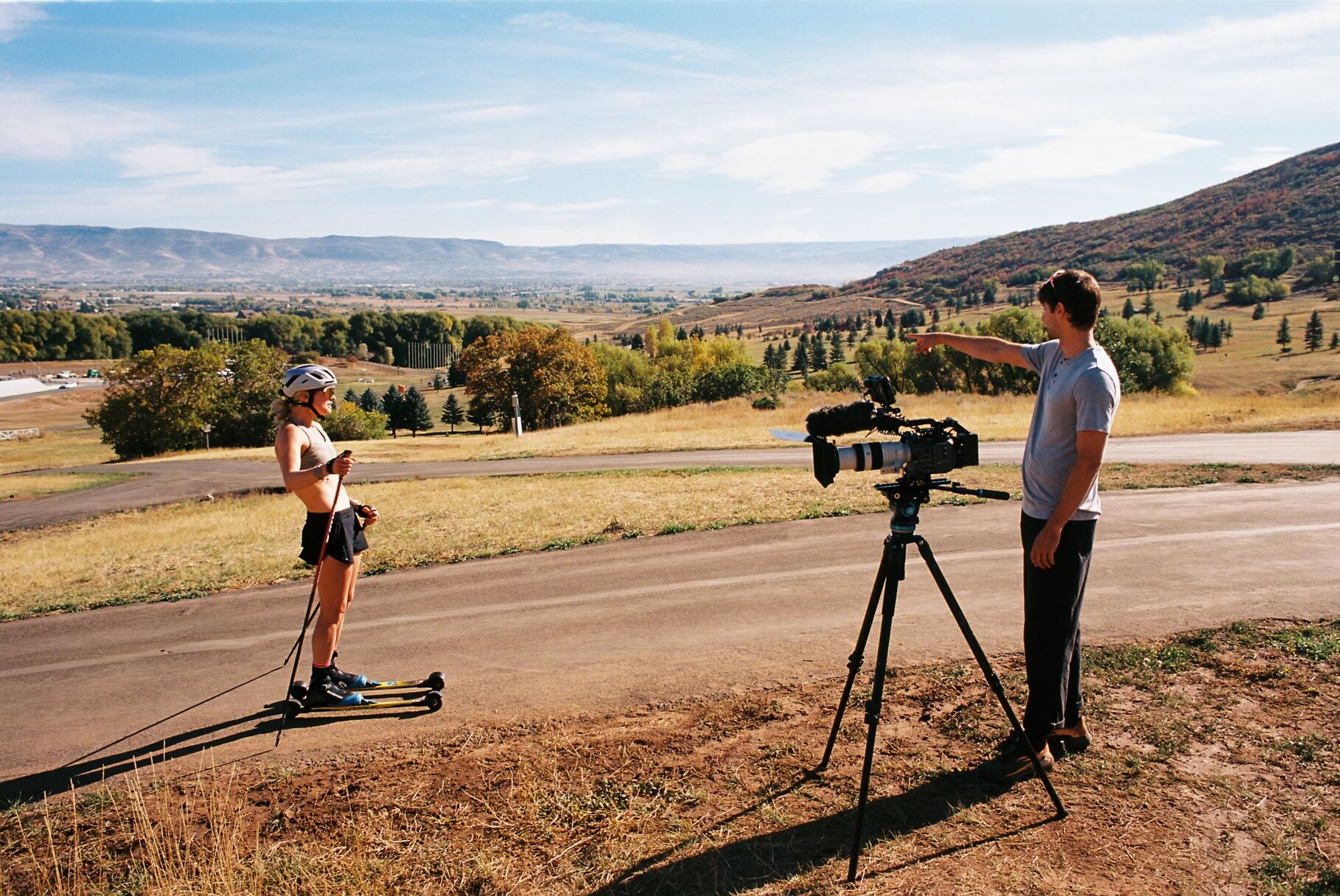
    A skier on roller skis stands on a paved path while a filmmaker directs from behind a tripod-mounted cinema camera, with a wide valley behind them.
    Jessie Diggins and Torsten Brinkema at the team’s Park City camp, in the open-ended stretch of filming before anyone knew what the story was. (Photo: Willie Maahs)

    MV: How did you get hooked up with Patrick Dempsey?

    LB: It was about six months into filming, right after the Tour de Ski, at a camp between that and the next World Cup stop. Growing up in the Midwest, we did not have any connections to the whole Hollywood world, but we definitely needed to find someone to help us get a foot in the door. So we asked Jessie if she had anyone in her directory who worked in that space. She remembered that Patrick had supported the ski team, and she was able to just send him an Instagram DM. He responded right away and said to send Torsten to his house in Maine. A couple of months later we showed up at his doorstep and pitched him on the idea. He had grown up cross-country skiing in his backyard in Maine, so he is very connected to the sport and a huge Jessie fan.

    MV: Jessie is big, but Dempsey is on another level. What was that like?

    TB: It was pretty wild. We knew this was a ticket for us into a new world that we had always hoped to get the keys to. And credit to him for inviting us over, because the roadblock we hit at every stage of this process is that we have no films to our name. We have a couple of short projects that nobody has seen. So we are asking someone with the credits that he has to trust us with nothing to see for it. Obviously Jessie’s word goes a long way with him. We had to swallow our awe of him and realize this was a huge opportunity, and tell him what we really believed: that there was a story in those 500 hours. At that point we had not really cut anything. He became a very important part of shaping it down to what it became in the end.

    MV: What other filmmakers have inspired you? What did you grow up watching?

    LB: One huge one was Jimmy Chin, especially with Free Solo. That may have been the first ever documentary I saw in a theater. This niche sport was brought to a thousand theaters across the country… such a huge story and such an interesting character. That was one of the times we were like, wow, we could bring a sport that we love to the big screen in an impactful way.

    TB: To add to that, I remember, I think it was actually while we were filming on the season, I saw a really old Herzog documentary from the 1970s called The Great Ecstasy of Woodcarver Steiner. Herzog was in his late twenties, early thirties, and he dedicated basically a whole year to following the ski jumping circuit, when it was at that really gnarly phase of people pushing the boundaries on these jumps, ending up jumping all the way to the flats, a whole bunch of drama between the jumpers and the officials. The fact that he was caught up in this story when he was around our age, and it felt like we were doing a similar thing, dropping everything to follow this circuit in unfamiliar landscapes. That just felt like, wow, if one of these great documentarians dropped everything for a ski documentary, we must be doing something right.

    MV: It is expensive to travel around Europe for a whole season, and the ski team is pretty transparent that their budget is tight. How did you make those numbers work?

    LB: We definitely had to pay our whole way through that season. There was not support from the ski team, in that they did bring us on, we were marked as members of the team crew, so we got our bibs and access to the races. But we basically had the ski team and Jessie help us find people who in the past had supported the ski team. It is not funded by the government; the ski team lives off these people who donate. So we went through their list of people who were instrumental in making sure the ski team could have success, people who paid for the wax van they use to this day. Over the course of filming we were always having to fundraise more and more money.

    Later on, when we were fine-tuning the edits, there were still a lot of payments to be made. We talked to Jessie’s sponsor, the Emily Program. That was a really cool opportunity, because now they are supporting the film, but they are also bringing it around the country to treatment centers and educational screenings.

    MV: You set out to tell a fun story and ended up helping people with something that is a real medical issue. Do you take a beat to think about that?

    TB: That is kind of the goal right now. We had a release with Peacock, which in a way felt like being viewed by this Olympic ski audience, but not everyone in the U.S. has Peacock, so right now we are figuring out how we can reach the people we did not reach in that initial release. For sure our target audience is this young group of impressionable people who are growing up either struggling with this disorder or who have people around them who have struggled with mental health. We have heard from people who have never skied before who say they were so moved by Jessie’s story. That is the biggest compliment we can get.

    It is a really hard thing to do, for her to pass one of the hardest years of her life on to us, filmmakers who had never made a film before, to then put out to the world. I remember when we showed her one of the rough cuts. She told us that this is the story her 18-year-old self desperately needed to hear. When we got her blessing, and when she said that, we took it and we ran with it, because we knew we could have that impact on countless other people who were struggling. That was a huge motivator for us.

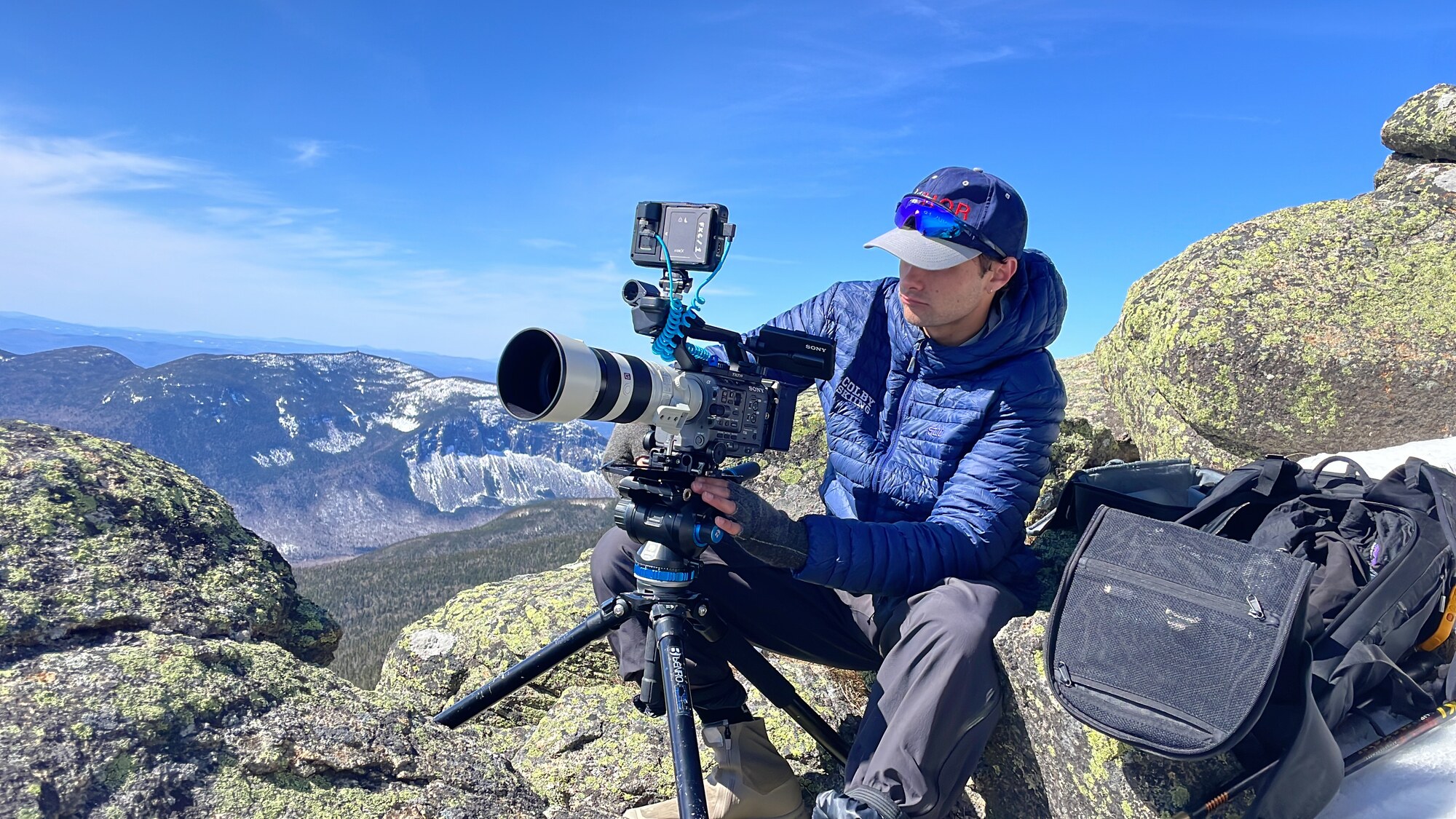
    A filmmaker sits on a rocky summit behind a tripod-mounted cinema camera with a long telephoto lens, snow-streaked mountains behind him.
    Torsten Brinkema on a summit in the White Mountains of New Hampshire in April 2024. This one never made the film either. (Photo: Brinkema Brothers)

    MV: Can you give me a specific memory from being in Europe?

    TB: Mine jumps to not a specific story, but this life on the road, which was so crazy for Lars and me. It was crazy to see the athletes, but also the staff who have done this year in, year out. It really is a wild lifestyle, packing up and going to a hotel room in the middle of nowhere in Finland, where there is light for five hours out of the day, then getting up and packing up and going to the next location in Sweden. The dedication these crews have is crazy, away from their families, away from the normal comforts of living in the States, and the fact that they repeat it every year.

    We pretty much joined every training session and filmed as much as we could, then charged the cameras and packed all the footage onto a hard drive. I always loved those nights when we were really tired, it is super dark out, there is nothing to do, and we would walk over to the wax truck and see what those guys were up to. It was always something fun. They are always blasting music, maybe having a shot of Jägermeister. I think they liked having us around because we were these young people who were totally oblivious to the waxing scene, so we could pick on whoever was not busy at the time. They had been living this life for five, ten years, and Oleg has been around, I do not want to quote how many. These guys are putting everything on the line and being away from their families to make the fastest skis in the world.

    MV: You mentioned the cameras. What was the gear you used to capture these moments?

    TB: We were rocking two Sony cameras, the FX6 and the FX3. That was a progression from, honestly, GoPros. Lars and I just loved being able to carry a camera that would not get in the way of anything, which was so important. We did a 20-mile run with Zanden, Gus, Luke and JC in Alaska, and we carried both our cameras and the drone in a backpack. We always wanted to be able to carry everything we had with only a backpack. That was the goal. In the winter we did a ton of skiing without poles, carrying those cameras, setting up a shot for a while and then skiing alongside people and trying to get it.

    The drone was another really key part of the setup, because it let us get beautiful shots of people when we could not keep up with them, which was most of the time. We could only set up these flyby shots for a 20-second clip before they sped past us. We are super proud of those shots, because it took thousands of them to get the five or six that appear in the movie of Jessie flying by in a training session. We also had to figure out how to make the cameras work in the cold, which was something we had not really experienced before. It involved a lot of hand warmers and duct tape, but we eventually figured out a system that worked even at minus five in Finland.

    MV: I have used hand warmers to keep my batteries warm too, but what is the duct tape for?

    TB: Taping the hand warmers to the battery on the camera, right on the part of the camera where the battery is.

    LB: We would have extra ones in our jacket pocket or in our pants, trying to keep them close to body heat so we could swap them out.

    MV: Lars, what stands out for you?

    LB: Just seeing the sport in Scandinavia was this insane experience. I remember the first Holmenkollen that we followed. I am sad it did not make the movie, but it was absolute mayhem. More people than are in the stadium for the Super Bowl. A hundred some thousand people in the woods watching these skiers who are going by maybe once every 20 minutes. It was not for a sprint, it was not for high impact crashes, it was just to watch these skiers go by, and they were so into it. I remember the big races in the U.S., high school meets, maybe the state meet, have a lot of people out there watching. But seeing all the young fans in Scandinavia watching this sport and being so jazzed up about it, maybe drinking a little too much during the race, it was such a cool experience that you do not get in the U.S.

    TB: It was crazy to experience that and compare it to Minneapolis. We had plenty of those fan experiences, not to the scale of Holmenkollen, seeing the Swedes, seeing the Finnish people. But then coming back to Minneapolis, everyone who was there, most of them traveling long distances, doing crazy things to be there to watch the sport they had been waiting so long to see. That was insane in its own right, because here we are almost matching the energy of Holmenkollen on the trails Lars and I grew up skiing on. We learned how to ski on the 5k Wirth course.

    Then I did a warm-up lap with Jessie before the 10k, and I started crying skiing down the sledding hill, because it was insane. The people, the roar of the crowd, traveling with her as she went around that loop. I feel like we were so blessed to be able to have that finish the movie, because it really felt like a homecoming for Jessie, and a realization of the legacy she has left, both in Minnesota and in the ski world.

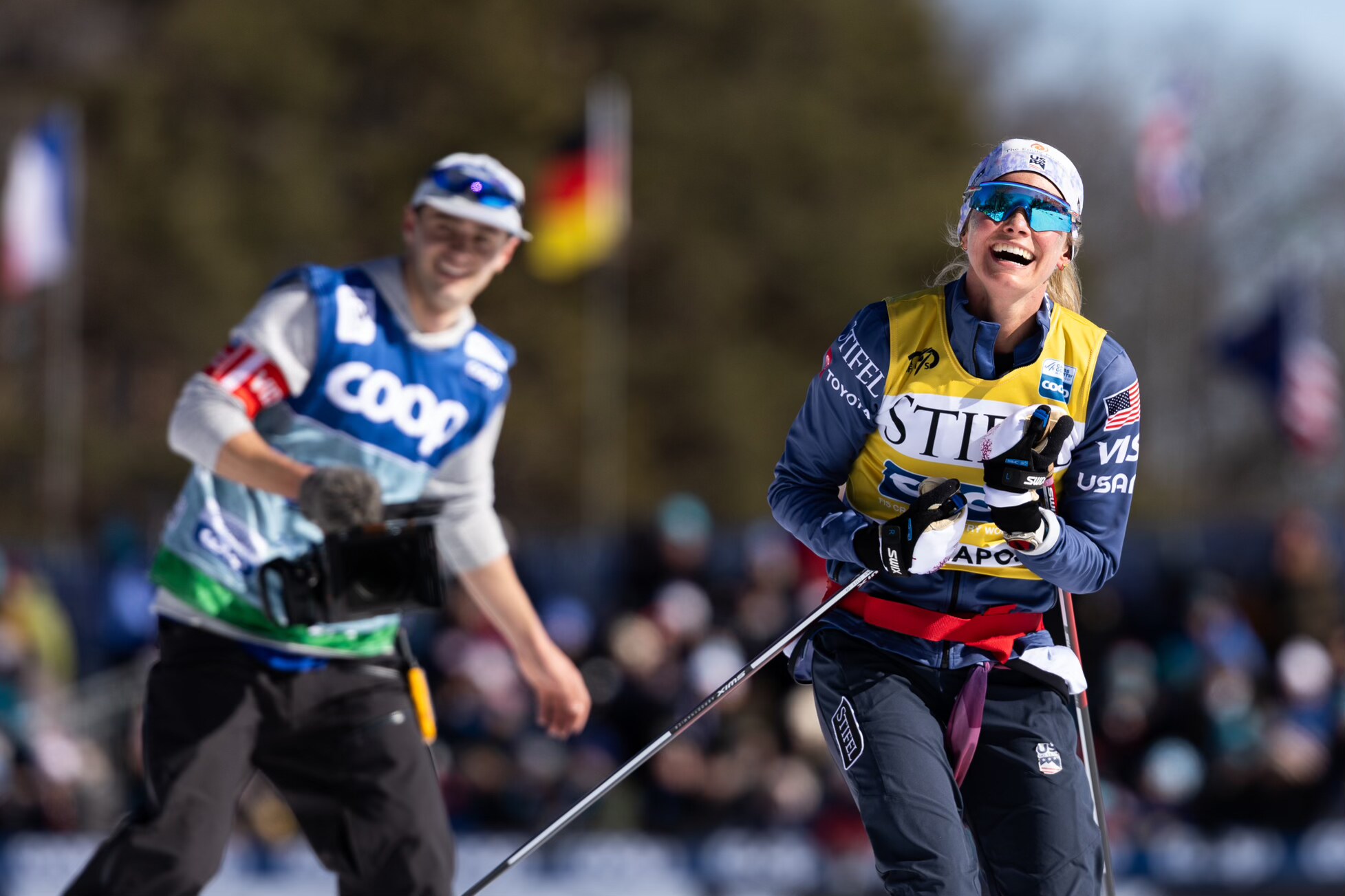
    Jessie Diggins laughs on a warm-up lap while a filmmaker in a media bib skis alongside her carrying a camera, a blurred crowd behind them.
    Torsten Brinkema, left, on the warm-up lap with Jessie Diggins before the 10-kilometer freestyle at Theodore Wirth Park in Minneapolis, February 2024. (Photo: Dustin Satloff)

    MV: What is something you are each really proud of?

    LB: Just coming into the film with such an open idea about what it could be, and that every step of the way we had trust in each other that we were going to make this happen and get it to a large audience. As Tor mentioned, we stepped into a really hard time in documentaries to get one out into the world and make an impact through film. I think we just trusted at every step of the process that we were going to figure this out. Being able to do that and show it in person in Lake Placid and Minneapolis has been such an incredible experience.

    TB: Going off of that, it felt like we were in such a unique position to tell this story. I am so proud of those POV shots we got on skis with the athletes. Again, that is the one percent of all the shots we did. But it is a crazy feeling, in a really crowded documentary landscape, to be one of a handful of people in the U.S., maybe even in the world, who can hold a cinema camera while going 30 miles an hour and pull focus and get that shot. It felt like a really proud moment just being like, wow, these turned out, and they are going to make it a better film, because you sort of feel like you are skiing with them.

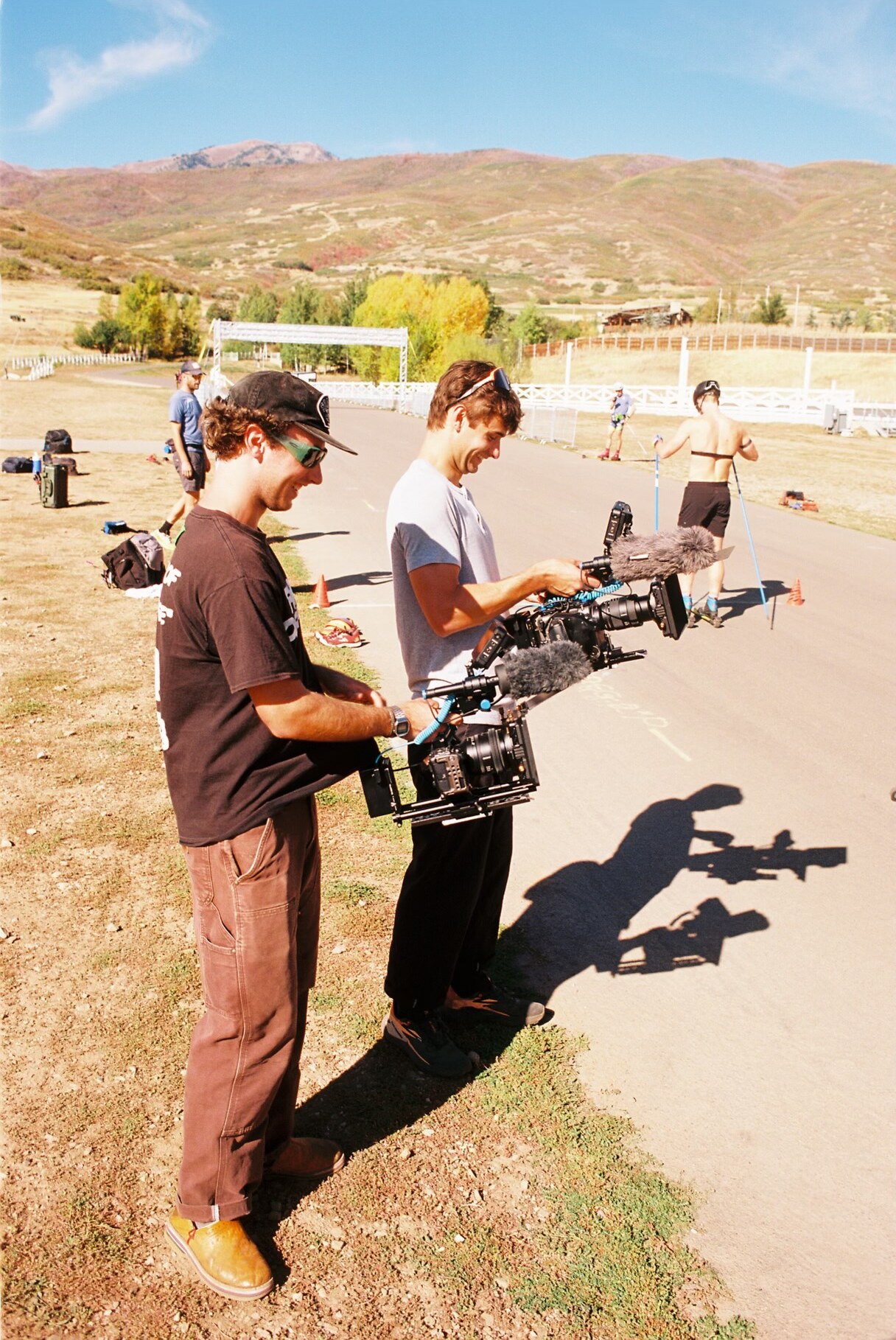
    Two filmmakers stand in profile at the edge of a paved roller ski loop, each holding a cinema camera with a microphone mounted on top.
    Lars, left, and Torsten Brinkema working the roller ski loop at the Park City camp, with the two Sony bodies that shot the season. (Photo: Willie Maahs)

    MV: What was it like working with FIS? Those rights can be really muddy.

    TB: It was definitely a headache to navigate Infront, basically a huge Italian conglomerate that controls a lot of these rights. We had a lot of negotiation with them, because we did want the context of the broadcast footage to feed into the intensity of the race segments. We wanted the tracker of kilometers to go. We wanted Chad and Kikkan announcing, which is so special and I think really leads the film in a way, because Lars and I never really wanted our voices narrating any of this. So we relied on the broadcast to be that context and the hype. It was an absolute pain in the ass, and that is kind of all that I will say.

    MV: What is next?

    LB: In line with Threshold, it was really special to bring something that is a subject matter so personal to us, skiing and mental health. So I think we will continue to create stories that are close to home. We are working on a film that will be set in Minnesota. It was such an incredible experience to show our city and our race course on the big screen.

    TB: We are excited to push our own limits again, and I think this round that will be writing a script, so not a documentary for the next one. But we still definitely want to work together, because having this balance of brother filmmakers, we rely on each other for the things we do not know or that we are not good at. Again, feeling that itch to both tell a story about home and push our comfort zones, which this project definitely did.


    Where to watch: Threshold is available to rent on Apple TV, Amazon Prime Video and YouTube in the United States and Canada. It premiered on Peacock in February, and a European release is planned for later this year.


    Help Support Our Coverage!

    If you value the thoughtful work and access FasterSkier provides, please consider becoming a Voluntary Subscriber. Your support directly fuels our work to cover the people, places, and moments that make our sport special.

    Join the FasterSkier community!
     

    A filmmaker sitting in the snow holding a tall glass pyramid trophy, with race sponsor banners behind him.
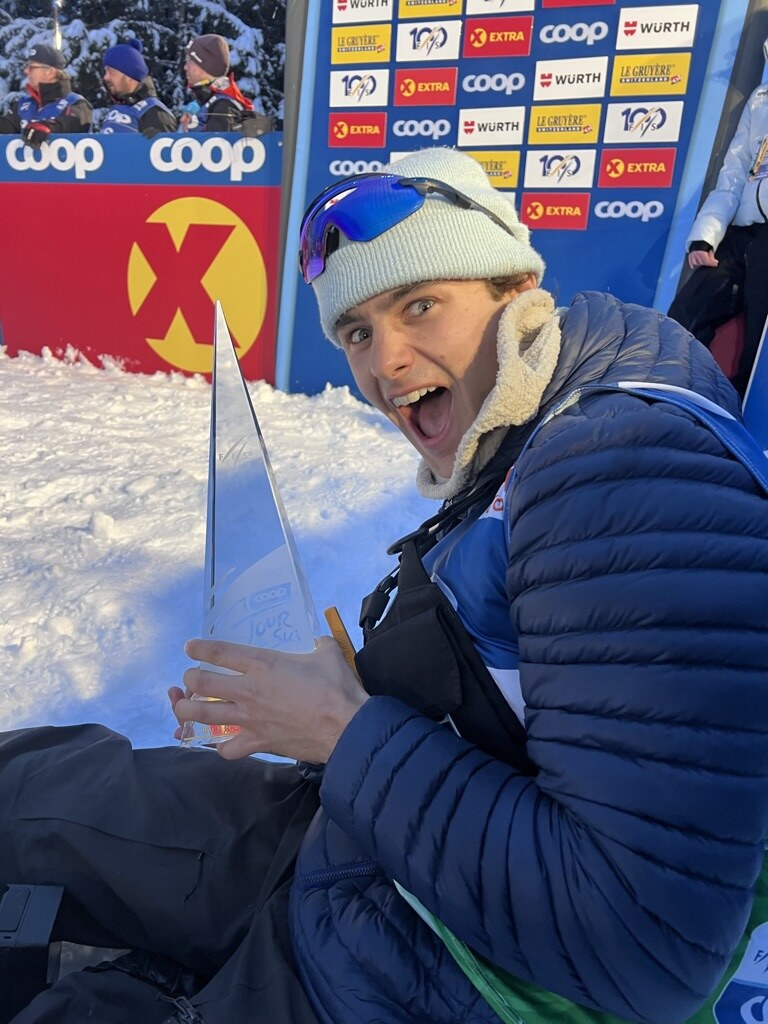
    Torsten Brinkema at the foot of the Alpe Cermis final climb in Val di Fiemme, holding Jessie Diggins’ Tour de Ski trophy in January 2024. (Photo: Leann Bentley)
  • What the U.S. Ski Team Changed After Threshold

    What the U.S. Ski Team Changed After Threshold

    This article was made possible through the generous support of our voluntary subscribers. If you value coverage like this, please support FasterSkier with a voluntary subscription.

    When I asked Matt Whitcomb what surprised him about Threshold, the head coach of the Stifel U.S. Cross-Country Ski Team started by admitting he was tempted to make something up.

    “This is the hardest question for me to answer, … but I haven’t watched it. I know it’s life-changing, but I don’t want to go back to that winter,” Whitcomb said. “I did my best as a coach, we all did, and it wasn’t good enough, and I’ve come to terms with my personal experience with it all.”

    The winter in question is 2023-24, the season Torsten and Lars Brinkema spent inside the American team with two Sony cinema cameras, a drone, and no feature film credits between them. What came out of it is a documentary about Jessie Diggins and her eating disorder that premiered on Peacock in February and, as of last Friday, is available to rent on Apple TV, Amazon Prime Video and YouTube in the United States and Canada. A European release is planned for later this year.

    Whitcomb is the person who let the cameras in. He is also, by his own account, the film’s loudest advocate.

    “I know from the response that the film is excellent, and I know it’s changing people’s lives and is being featured in college curricula. I recommend it to everyone I speak to,” he said. “I’m very proud of Torsten and Lars and am grateful for the film. I support it completely.”

    A filmmaker on cross country skis carries a cinema camera rig on a groomed snow trail while an athlete skis ahead of him.
    Lars Brinkema skiing with a cinema camera at a U.S. Ski Team camp in Bend, Oregon, chasing Jack Young on the trail. The brothers had done these workouts themselves, which is why it never occurred to them to ask an athlete to run one again for a better take. (Photo: Patrick Conroy)

    “A couple of brothers got a camera for Christmas”

    His first answer was no.

    “I figured a couple of brothers got a camera for Christmas, had a couple beers, and then came up with a fun way to spend a year,” Whitcomb said. “I normally would’ve erred on the safe side and told them to take a hike, but Ben doesn’t toss around ideas lightly and so I followed up to hear more.”

    Ben is Ben Ogden, who raced against Torsten in college on the EISA circuit and had watched him work at the World Cup in Norway that spring. Torsten had gotten there on a shoestring, having talked the Loppet Foundation, the Minneapolis club he and Lars grew up in, into sending him to shoot promotional material ahead of the 2024 World Cup at Theodore Wirth Park.

    “I think they were kind of surprised to have an American photographer out there with them,” Torsten said, “just because they aren’t getting much coverage once they leave.”

    Ogden pitched Whitcomb on inviting the brothers to the team’s Bend, Oregon camp that summer. The brothers bought cinema cameras and showed up.

    What they had in mind at that point was not a film about an eating disorder. It was a film about a sport nobody in America watches, made in the shape of the niche-sport documentaries that had broken through elsewhere.

    “We could probably do something like that with skiing,” Torsten said of the pitch they were making to themselves. “Make it look really cool.”

    They had one asset that mattered more than the cameras, which is that they were skiers. Diggins had been through the alternative, brand shoots that treated an interval session as something you could run again for a better take.

    “This is just something that would never even cross Lars and my mind, to alter the workout, because we know how intense they are,” Torsten said. “We know the workouts. We’ve done them before.”

    Two young filmmakers stand side by side on a paved roller ski loop holding cinema cameras, with autumn hills behind them.
    Lars, left, and Torsten Brinkema at the U.S. Ski Team’s Park City camp. On the road the athletes called them Larry and Toasty. (Photo: Willie Maahs)

    Toasty, Larry, and a problem with FIS

    Whitcomb’s worry was culture, which he describes as something you protect rather than something you have.

    The brothers had promised the arrangement would run both ways, that athletes would get usable footage of themselves out of it, and Whitcomb says they delivered. They also collected nicknames. Torsten became Toasty. Lars became Larry, or Lawrence in formal settings.

    “These guys were ghosts at times where they would disappear for the day and nobody would see them,” Whitcomb said. “And then we’d see them at dinner and they’d be showing athletes their incredible footage of the team training or racing together.”

    They washed dishes. They helped with wax testing. Whitcomb says everyone came to regard them as an addition to the team environment rather than a cost of doing business.

    It was not frictionless. At the first race of the season in Finland, Whitcomb watched one of the brothers get chewed out in the finish area by a FIS official for filming in a zone reserved for the television production company. Later, on course in Toblach, he got a text from FIS with a screenshot attached.

    “Larry running through the pines, keeping pace in his flatbrim hat and knit sweater, filming the lead pack. He was prominently within the TV feed,” Whitcomb said. “They asked if I could kindly remove him from the world feed. And you know what happened? Nothing. These guys said they were sorry and got a hand slap in each instance. Everyone likes them. They say things like thank you and sorry.”

    The rights question got more expensive than a hand slap when it came time to actually build the film. The brothers wanted broadcast footage in the race sequences, the kilometer counters and the commentary, partly because they had decided early that they would never narrate the film themselves. That meant negotiating with Infront, which controls FIS media rights.

    “It was an absolute pain in the ass, and that’s kind of all that I’ll say,” Torsten said. “Very expensive.”

    The money came from nowhere institutional. The brothers paid their own way through the season and kept fundraising as they went, working through the list of private donors who already keep the U.S. team on the road. The Emily Program, which sponsors Diggins, came in later during the edit and is now bringing the film into treatment centers and educational screenings.

    The Hollywood end of it started with a question the brothers asked Diggins at a training camp between the Tour de Ski and the next World Cup stop. They had no connections in that world and needed someone who did. Did she know anybody.

    She remembered that Patrick Dempsey had supported the ski team before, and sent him an Instagram message. He answered immediately and told her to send Torsten to his house in Maine, where Dempsey grew up skiing. A couple of months later Torsten showed up at the door and pitched him.

    “We have no films to our name. We have a couple short projects that nobody has seen,” Torsten said. “And so we’re asking someone with the credits that he has to trust us with nothing to see for it.”

    Dempsey signed on as an executive producer and, by the brothers’ account, became a real voice in shaping the cut. Whitcomb offers it as a character reference. “I mean, Patrick Dempsey signed on with these guys. That should tell you something.”

    Two filmmakers set up cameras on a patio to interview a skier seated in a chair with mountains in the background.
    Filming an interview with Johannes Høsflot Klæbo in Park City in October 2023. The brothers came home from the season with roughly 500 hours of footage and interviews across several national teams. (Photo: Daniel Sannum Lauten)

    The pivot happened the following summer

    This is the part Whitcomb wanted on the record, because he thinks people have the sequence backward.

    “From the start, this movie was meant to highlight the entire team, and not just Jessie,” he said. “Months after the winter concluded, I think the Brinkema brothers realized that the film needed to hone in on the topic of mental health to have a clear storyline. I understood and supported that pivot, but the point is that the winter filming was not targeted at just Jessie. That filming happened the next summer.”

    The brothers describe the same thing from inside the edit. They came home with roughly 500 hours of footage and interviews with athletes across several national teams, including Johannes Høsflot Klæbo, Emma Ribom and Federico Pellegrino. Their editor, Yaniv Elani, had never cross-country skied, which they now regard as the reason the film works.

    Elani is also the one who made them cut the northern lights. The brothers had stood out in the Arctic Circle for two hours in the cold to get a time lapse they were proud of.

    “It’s not serving the story. You got to cut it,” Torsten remembers him saying.

    Then came the screenings for film industry people in Los Angeles and New York, where the brothers went in hoping to learn what a non-skiing audience would care about.

    “People just kept saying, Jessie, Jessie, we want more Jessie,” Torsten said.

    A coach stands in green summer woods facing a filmmaker who is holding a camera in the foreground.
    Matt Whitcomb during an interview with the Brinkema brothers in Burke, Vermont. “We missed the mark on supportive team culture as an entire team,” he said of the winter the film covers. (Photo: Brinkema Brothers)

    “Our culture was at a 15 or 20-year low that winter”

    Whitcomb does not soften the season the film covers.

    “For anyone who has seen the movie, I think it’s no secret that our culture was at a 15 or 20-year low that winter. We had major struggles,” he said. He has thought about whether the presence of a film crew contributed to that, and concluded it did not.

    He is also insistent that the winter was not one athlete’s crisis with everyone else watching. “It was one of the hardest times for several other athletes and coaches, too. This wasn’t just a Jessie issue. We missed the mark on supportive team culture as an entire team.”

    Asked how he handled protecting Diggins against letting the story be told honestly, he rejected the premise.

    “I never felt like I had to protect Jessie from the film. She was a part of the team-wide decision to allow the Brinkema brothers into the team for the year, and that was the main gate we kept,” he said. When the brothers asked him whether they could film something sensitive, a one-on-one meeting for instance, he sent them back to the athlete. “I would usually just tell them to ask Jessie what she was comfortable with.”

    He watched her closely all the same, and says that had nothing to do with coaching. “That’s just because she’s a close friend, and friends look out for each other. But I had 100% trust in these guys, which is saying something because Lars was 19.”

    A filmmaker and a team communications manager pose together in a sunny finish area, raising ski poles overhead.
    Torsten Brinkema and Leann Bentley at the World Cup finals in Falun, Sweden, in March 2024. Bentley handles press for the cross-country and Para Nordic teams and appears in the film mostly doing her job in the background of somebody else’s scene. (Photo: Brinkema Brothers)

    The person in the hotel room

    Leann Bentley is the U.S. Ski & Snowboard communications manager who handles press for the cross country and Para Nordic teams, and she is in the film, mostly doing her job in the background of somebody else’s scene.

    She was in the room when the coaching staff decided whether to say yes, and she remembers it being straightforward. Here were two people willing to spend a year telling a story she could not tell herself, and one of them had raced against these athletes in college.

    The question she was asked for this story was how she decided where to draw the line once the film’s center became Diggins’ mental health. Her answer was that the question does not describe what happened.

    “Short answer, no, I never had to tell them no,” Bentley said. “Long answer is I of course will always protect my athletes. But at the same time, they’re protecting themselves. And throughout this entire process, Jessie was protecting herself. She knew what she wanted to give, and she knew maybe what she didn’t, but she was in charge of it from the very start. And so were all the athletes.”

    The scene she keeps coming back to is a hotel room in Ruka before the press conference where Diggins told the assembled media she was dealing with her eating disorder again. Bentley says it was one of the most heavily attended press conferences she has run with her.

    “There was a scene where I told her that it’s okay to be vulnerable. And I don’t remember saying that to her,” she said. “It really goes to show that when I work with these athletes, I’m working with them as people, and I’m really glad that came across in the film.”

    Most of her season is not spent in hotel rooms in Finland. It is spent in Salt Lake City, awake in the middle of the night, watching the same feed as everybody else and then turning it into the clips and quotes that hundreds of thousands of people see, for twelve teams and more than 240 athletes.

    Asked what the film got right about the parts of team life that press coverage never reaches, she was blunt about why the question has an easy answer.

    “It got everything right because it was showing exactly what was happening,” Bentley said. Athletes race for a few minutes at a time, a few times a weekend. The rest of it is chess and cards and laundry and going for a run. “I don’t think a lot of people understand that being a professional athlete, you train so hard mentally and physically for what you do on the weekends during a race. And then that race ends and you have, I don’t know, ten more hours of the day left.”

    Both she and the brothers land in the same place when asked for a favorite corner of that life, which is the wax truck, known on the road as Yolanda. Torsten’s version involves showing up on dark nights with nothing to do, music playing, occasionally a shot of Jägermeister, and a group of technicians who had been living this way for a decade or more and had stories nobody had ever asked them for.

    I interviewed the American wax techs last winter in the lead-up to the Olympics, and they remain the most enjoyable conversations I have had for this site, so I will just agree with him.

    Two filmmakers with cameras stand on a paved loop while a coach talks with two athletes on roller skis.
    Torsten Brinkema, left, and Lars Brinkema, right, filming Jessie Diggins, coach Jason Cork and Renae Anderson during a roller ski session at the Park City camp. (Photo: Willie Maahs)

    What actually changed

    The most concrete thing to come out of that winter is not on screen.

    Whitcomb describes an Athlete Wellness Passport, a monitoring system covering roughly eight health areas for every athlete on the team, men and women, including bone density, blood panels, caloric balance assessment, menstrual health and a mental health questionnaire. The team dietitian tracks each category for each athlete, and a licensed professional is brought in when a category calls for it.

    “It’s a safety net for the whole team,” he said.

    What that system did not have in 2023-24 was a ceiling.

    “What we were missing in the winter of 2023-24 was a plan for what happens when an athlete’s issue, like an eating disorder, advances beyond the qualifications of our professionals,” Whitcomb said. “In this case, we needed an eating disorder specialist MD on call, and we didn’t have one. We’ve debriefed on the experience extensively and have brought in the person we wish we already had in place going into that winter.”

    For coaches who watch the film and want something to do on Monday, his answer starts with an assumption rather than a policy.

    “If you coach a team of athletes, you likely coach some athletes who struggle with disordered eating, and you may never know who they are,” he said. He has had male and female athletes tell him about it years after they finished competing.

    On his team the practical version is a conversation about meals, held once a year, in which everyone agrees to treat mealtime as a place where safety matters more than opinions.

    “Everyone’s plate looks different, and everyone’s dietary needs and goals are different, and many of us are insecure, so the environment is ripe to be judgy and toxic,” Whitcomb said. “Talking it out isn’t perfect, but it helps.”

    He got there by getting it wrong first, and he tells that story without cushioning it.

    “As a young coach I used to think I could talk openly with athletes about their challenges with eating, body image, and weight. Then I learned from a parent that a comment I made to them regarding weight was harmful. Yeah, I know, duh. But I was 23 and some of you are now, too.”

    His correction was to stop talking about any of it and refer everything to professionals, which he now says was better but too absolute. The current version is that he will talk with an athlete who wants to talk, if the trust is there, while being honest about where his expertise ends and activating someone qualified.

    Three people stand in front of a cinema screen taking questions from a seated audience in a darkened theater.
    Lars Brinkema, Torsten Brinkema and Andrew Peterson take questions after a private screening of Threshold in Minneapolis in January. Diggins has asked teams to treat the film as “a visual book club.” (Photo: Sawyer Brice)

    What Diggins wants out of it

    Diggins raced her last World Cup in Lake Placid in March. She did not do a new interview for this piece, but she wrote at length on Instagram when the film went back out on Friday, and the argument she made was that the documentary is not really about her.

    Her request to teams, high school through professional, was that they treat it as “a visual book club.” Watch it, then talk about it. What pressure does this sport put on you. What kind of team do you want to be. And for coaches, find out now where you would send an athlete who comes to you, before one does.

    She also made a point the film cannot make on its own, which is that the recovery in it happened in hundreds of hours of therapy and clinical work that were never filmed and could not have been.

    Two filmmakers in Team USA bibs stand with their arms around a skier wearing the yellow overall World Cup leader bib.
    Torsten Brinkema, left, Jessie Diggins and Lars Brinkema in the finish area in Falun, Sweden, in March 2024, after Diggins wrapped up the overall World Cup title. (Photo: Modica/NordicFocus)

    When the film premiered in February, she put the goal simply in a U.S. Ski & Snowboard release: “I wanted to help others feel less alone.”

    The brothers are working on a scripted film now, set in Minnesota, still as a duo.

    Whitcomb, meanwhile, is not planning to watch. He described where the last two years have left him without much interest in tidying it up.

    “We’ve made improvements to our system because of lessons from that winter, and we became better coaches and teammates. I’m moving forward as an improved coach.”

    And then the part that sounded most like a coaching philosophy: “Your coaches and staff must truly care about the human condition. That’s your foundation. Get rid of the ones who don’t and add more who do.”

    Where to watch: Threshold is available to rent on Apple TV, Amazon Prime Video and YouTube in the United States and Canada. It premiered on Peacock in February, and a European release is planned for later this year.


    Help Support Our Coverage!

    If you value the thoughtful work and access FasterSkier provides, please consider becoming a Voluntary Subscriber. Your support directly fuels our work to cover the people, places, and moments that make our sport special.

    Join the FasterSkier community!
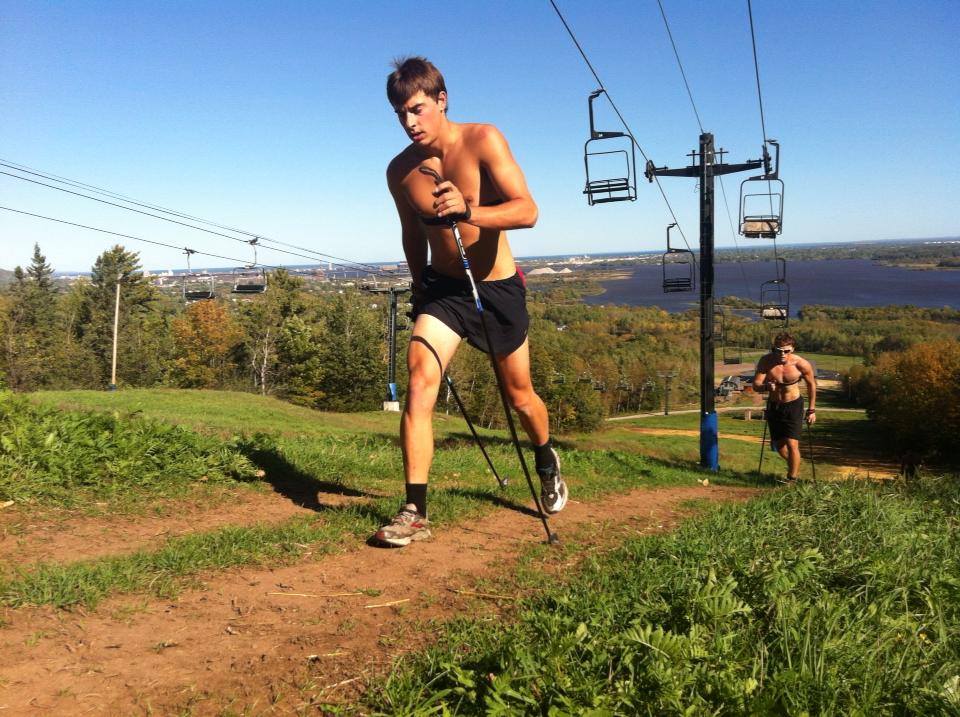
     

  • Biathlon at a Crossroads: Inside the Alliance That Could Reshape the Sport in America

    Biathlon at a Crossroads: Inside the Alliance That Could Reshape the Sport in America

    This article was made possible through the generous support of our voluntary subscribers. If you value coverage like this, please support FasterSkier with a voluntary subscription.

    U.S. Biathlon’s board votes Wednesday on a formal operating alliance with U.S. Ski & Snowboard. Supporters call it the stability the sport has always lacked. Skeptics call it a surrender of independence. Both are working from the same set of facts. Here is what the deal actually says, and what it would and would not change.

    The U.S. Biathlon board of directors is scheduled to meet tomorrow, Wednesday, July 29, at 4 p.m. Eastern. This account is based on interviews conducted by FasterSkier with the chief executives of both organizations, a U.S. Biathlon athlete representative, the U.S. Biathlon head physiology coach, a written statement from the U.S. Olympic & Paralympic Committee, and a review of the alliance term sheet, three community working-group reports, and correspondence circulated by members opposed to the deal. All of these documents were posted publicly by U.S. Biathlon or provided to FasterSkier.

    Campbell Wright (USA) during the biathlon sprint at the XXV Olympic Winter Games in Antholz (ITA). (Photo: Thibaut/NordicFocus)

    Every winter, for a few weeks in February, cross-country skiing and biathlon stop being niche pursuits in the United States. During the last Olympic period, FasterSkier drew more than 180,000 unique readers in a single February, most of them people who do not know the sport’s governance history and have never heard of the Ted Stevens Olympic and Amateur Sports Act. On Wednesday afternoon, a board most of those readers could not name will vote on a decision that could reshape how one of their sports is run for the rest of the decade and beyond.

    The question in front of the U.S. Biathlon board is whether to enter a “Strategic Operating Alliance” with U.S. Ski & Snowboard, the far larger national governing body that oversees Olympic and Paralympic skiing and snowboarding. Under the proposal, U.S. Biathlon would remain a legally separate organization and the recognized governing body for the sport, but would hand much of its day-to-day operation to U.S. Ski & Snowboard under a services agreement. To its architects, it is a way to give a chronically under-resourced sport the stability and commercial muscle it has never had. To its critics, it is the moment a proud, independent program stops steering its own ship.

    The two sides do not disagree much about the facts. They disagree about what the facts mean.

    What is actually being proposed

    Strip away the temperature of the debate and the structure is specific, and it has changed meaningfully since the idea first surfaced publicly in the spring. The current terms, which U.S. Biathlon posted for its members on July 27, describe an alliance rather than a merger in the dictionary sense. No organization dissolves.

    Under the agreement summary, U.S. Biathlon “will remain a separate legal entity,” keeping “its own corporate existence, financials, and independent audit.” It stays the governing body recognized by the U.S. Olympic & Paralympic Committee under the Ted Stevens Act, and keeps its membership in the International Biathlon Union, the sport’s world federation. Its name, logo, and trademarks remain owned by U.S. Biathlon and are licensed to U.S. Ski & Snowboard.

    What changes is who runs the operation. Under a services, or operating, agreement, U.S. Ski & Snowboard would take over “staffing, programs, events, and administration for biathlon,” giving the smaller sport access to a chief financial officer, general counsel, marketing and revenue staff, medical and sport-science support, and technology infrastructure it cannot afford on its own. U.S. Biathlon’s own staff, its leaders say, would remain responsible for running the sport itself. A new Biathlon Sport Committee would be created inside U.S. Ski & Snowboard, mirroring the structure the larger body already uses for cross-country and its other disciplines.

    Jack Gierhart, U.S. Biathlon’s president and chief executive, described the mechanism plainly in an interview. “The mechanics of this are like an operating agreement between U.S. Biathlon and Ski and Snowboard where they take over operations,” he said. “That’s how we’re honoring and satisfying the Ted Stevens Act.”

    Sophie Goldschmidt, president and chief executive of U.S. Ski & Snowboard, framed the same structure around what biathlon keeps. “We would keep the biathlon entity. In fact, we keep the biathlon name, the biathlon logo,” she told FasterSkier. “From a legal perspective, it would also have its own entity. With that, it would have its own board. So very much operating like it does today, but sitting within a larger framework so that it can benefit from the other resources and shared knowledge, extra funding that we can provide.”

    That phrase, “operating like it does today,” sits at the center of the argument, because a great deal depends on how much a board that has delegated its operations still actually decides.

    USBA CEO Jack Gierhart poses with Max Cobb (IBU Secretary General) (l-r) at the IBU World Cup in Annecy-Le Grand Bornand (FRA) last December. (Photo: Manzoni/NordicFocus)

    How the sport got here

    By the account of the people who built it, this did not begin as a takeover. It began, Gierhart said, as an attempt to solve a problem every small Olympic sport shares.

    Gierhart arrived at U.S. Biathlon in September 2022, as longtime leader Max Cobb was leaving for the IBU. The organization was early in a strategic plan aimed at growing the sport, and a central piece of that plan was working more closely with the cross-country community, since most American biathletes come from skiing. “From my experience being in sport for 25 years, when you offer people more options, more pathways, you increase retention and you grow the pie,” he said. “It’s like, this should be a no-brainer, but then you run into the cultures and communities.”

    Those conversations, Gierhart said, drew in the U.S. Olympic & Paralympic Committee, which oversees and funds the country’s Olympic sports. “The USOPC started to suggest, hey, we’ve got a lot of these small NGBs, why don’t you guys think about something a little more formal?” he said. That was roughly a year and a half ago. The organizations sketched the basic terms, paused through the Olympic and Paralympic Games so as not to distract athletes, then brought the concept to a wider audience in the spring.

    Goldschmidt described the same arc and made the case for why her organization wants biathlon at all. U.S. Ski & Snowboard already runs multiple sports under one roof, she said, which means it can absorb the compliance and administrative costs that crush small governing bodies. “The central costs can really be absorbed and be a real cost saving for those organizations,” she said. “Legal, finance, safe sport compliance, all of that, which is quite a big burden, especially on some smaller NGBs. We can absorb that quite easily without having to increase the cost base, which means practically more money is going directly to the athletes.”

    The rollout did not land smoothly. After town-hall meetings drew pointed questions, the two organizations convened three joint working groups, on governance, sport development, and high performance, that met through the back half of July. Twenty-eight to twenty-nine participants, including athletes, coaches, club leaders, and staff, spent two weeks documenting what a successful alliance would require and what worried them. Their reports, posted publicly, have become some of the most revealing documents in the whole debate, in part because they capture both the community’s hopes for closer collaboration and its doubts, in the community’s own words.

    Sophie Goldschmidt speaking at the Alpine World Cup in Killington, Vermont in 2024. (Photo: U.S. Ski & Snowboard)

    The money, and the question at the center of it

    Almost everyone involved agrees that money is the engine of this deal. What they do not agree on is how to describe the pressure behind it.

    The clearest number comes from Gierhart. For the coming season, he said, the USOPC reduced U.S. Biathlon’s grant by 22 percent. The reason, in his telling, has less to do with the alliance than with a shift in how the USOPC allocates money. Roughly three years ago, he said, the committee created an investment framework weighted toward medal potential. “They told us a couple of years ago, you guys are one of the highest funded sports, you haven’t delivered medals,” Gierhart said. “There’s a good probability you’re going to get a cut. And that’s what happened. They cut us,” a reduction he put at 22 percent for this year.

    Crucially, Gierhart rejected the idea that the cut is a lever to force the alliance. “It hasn’t been like, if you don’t do it, we’re taking away money,” he said. “It was, we’re taking away money because you’re over-resourced from our model standpoint and you’re not delivering. But if you go in this direction, which we believe will be beneficial in the long term, we want to help you do that.” Asked directly in a later FasterSkier interview whether it was a threat, he drew the distinction again. “They gave us our grant for this year, and it’s the 22 percent reduction. But they said that if we move in this direction with this alliance, they want to invest more in us. And they will find a way to do that,” bringing biathlon “back to where we were.”

    Goldschmidt, in interviews with FasterSkier, likewise described the reduction as reversible if the alliance proceeds, and tied it to the USOPC’s belief that a more efficient biathlon can compete for medals.

    The U.S. Olympic & Paralympic Committee, asked to confirm the figures and to say whether restoration of the funding is contingent on the alliance being approved, declined to address specifics. In a written statement, spokesman Jon Mason said the committee “is aware of and engaged in the discussions between U.S. Biathlon and U.S. Ski & Snowboard, and we support them taking a deliberate, transparent, fact-based approach to exploring a future relationship that complies with the Ted Stevens Olympic & Amateur Sports Act.” The committee, he added, is “supportive of outcomes that can build long-term stability and create opportunities for current and future generations of athletes.” The statement did not confirm the size of the cut, and it framed compliance with the Act as a goal the parties must meet rather than a settled fact.

    What the alliance would add is documented. According to the high-performance working group’s summary, biathlon “would receive a ~$600k increase from current FY27 revenue projections” in the first year, with U.S. Ski & Snowboard guaranteeing an increase “from this year-one level through year 4.” Gierhart put the combined total, new revenue and shared-services savings together, at “at least” $3.3 million over four years. That money, in principle, flows back into programs.

    Set against U.S. Biathlon’s roughly $3.5 million in annual revenue, those are not small numbers. And they arrive alongside a promise that biathlon’s existing money stays biathlon’s. Under the agreement, “all funding designated for biathlon, including IBU and USOPC support, existing sponsorship contributions, charitable donations, and other biathlon-specific revenue, will remain ring-fenced and used exclusively to support biathlon.”

    Here Goldschmidt was careful to correct what she called a misunderstanding. The ring-fence, she said, is permanent, not a four-year arrangement. “All of the money that they generate that is ring-fenced for biathlon will continue to go to that program. That will be a contractual commitment,” she said. “Some people have got confused that we’re only committing to four years to ring-fence and provide them funding. That’s not accurate.” The four-year commitment, she clarified, applies to the additional commercial funding U.S. Ski & Snowboard brings to the table, which depends on the sponsorship deals it can renew.

    Gierhart described the same two-part structure, and pushed back on the idea that biathlon falls off a cliff when the four years are up. “This gives us a platform for four years of sort of guaranteed increased revenue to build momentum and to implement the things that we know are going to help us,” he said. “Without that, we’re going to live year to year, and we’re already in maintenance mode as opposed to growth mode.” In four years, he argued, biathlon would be “in no different a situation than we are today. In fact, we’ll be better, because we’ll have a lot more resources to work with over the next four years.”

    That distinction defines exactly where the community’s deepest financial fear lives. The money biathlon already raises is protected by contract. The new money, the actual growth case, is guaranteed for one Olympic cycle, through 2030, and after that depends on the USOPC and on sponsors, the same as it would if biathlon stood alone.

    While much of the US biathlon community debates governance, the USBA’s Campbell Wright, Vincent Bonacci, and Maxime Germain (l-r) gets after their summer training in Font-Romeu (FRA). (Photo: Authamayou/NordicFocus)

    The Ted Stevens question

    No part of the debate has generated more heat than the law. A group of members, some of whom helped establish U.S. Biathlon as an independent governing body decades ago, argue that the alliance violates the Ted Stevens Act. Their case rests on two provisions.

    The first is the single-federation rule. Under 36 U.S.C. 220522, a national governing body must be “a member of no more than one international sports federation that governs a sport included on the program of the Olympic Games.” U.S. Ski & Snowboard belongs to FIS, the International Ski and Snowboard Federation. Biathlon answers to the IBU. Critics contend that if U.S. Ski & Snowboard effectively governs an IBU sport, the arrangement collides with that rule.

    The second is autonomy. The same statute requires a governing body to be autonomous, in that it “independently decides and controls all matters central to governance” and “does not delegate decision-making and control of matters central to governance.” Arthur Stegen, a former U.S. Biathlon board member and part of a group called Team Independent Biathlon, laid out the objection in correspondence circulated to other members and shared with FasterSkier: a services agreement that assigns operational responsibility to U.S. Ski & Snowboard, he argues, is by definition a delegation of control, and reducing the biathlon board to a sport committee “would appear to relinquish its governance responsibilities to another organization.” Stegen wrote that he is “completely against this potential merger.”

    The written terms were plainly built to answer that challenge. The agreement summary includes a section titled “Reserved Governance Authorities,” which states that “notwithstanding any operational responsibilities delegated to U.S. Ski & Snowboard,” U.S. Biathlon “will retain sole authority over all matters required by the Ted Stevens Act or otherwise reserved to the National Governing Body,” including “oversight of the organization, approval of the biathlon budget, and all authorities reserved to the NGB.” In other words, the deal’s authors say operations are delegated while governance is reserved.

    Goldschmidt said the structure was designed to align with the statute from the start. “We’ve worked with the USOPC and others to ensure it fits all of those criteria, which it does,” she said. Gierhart said U.S. Biathlon has already received an opinion on the point. “We’ve gotten the opinion from the USOPC’s legal counsel on the terms as they’re written now, and their opinion is that it meets the requirements and is in compliance with the Ted Stevens Act,” he said.

    He was also clear about sequence, and described it as the normal way such deals come together. Wednesday’s vote is on the foundational terms, the fundamentals both sides have agreed to. “You’ve got to agree on the fundamentals, and then that’s what’s going to drive the detailed operating agreement,” he said. That more extensive agreement, covering licensing of the biathlon trademarks, the function of the board, and the bylaws, would be drafted next, “vetted by independent counsel” to confirm it complies with the Act, and then brought back to the U.S. Biathlon board, athlete representatives included, for a separate vote to approve it.

    That staging is itself contested ground. Supporters see a standard process: agree on principles, then build and independently vet the detailed contract. Skeptics see a board being asked to commit before the full agreement exists and before the independent legal review happens, and some argue a binding vote should wait until both are done. What Wednesday’s vote actually authorizes, the concept or a finished deal, is a distinction worth watching closely as the meeting unfolds.

    The USOPC, for its part, did not put its weight behind a declaration that the current structure is legal. It said it supports the parties “exploring a future relationship that complies” with the Act, language that leaves compliance as something still to be demonstrated.

    There is precedent for the skepticism, and for U.S. Ski & Snowboard’s interest in expansion. The organization previously pursued governing roles in surfing and skateboarding, efforts that critics cite as evidence of a broader ambition to build a multi-sport governing body, the very kind of concentration the Ted Stevens Act was written to prevent. Goldschmidt described those episodes as different in kind. Surfing, she said, “just got too political,” and the organization walked away; skateboarding remains “ongoing” with “no immediate decisions.” Biathlon, she argued, is a natural fit that most European countries adopted long ago. “I get asked all the time, why is biathlon not integrated within your organization,” she said. “It’s a natural fit in many ways.”

    Who controls the board

    Because the autonomy argument turns on control, the composition of the board is more than a technicality, and it is an area where early rumors and current terms diverge sharply.

    Gierhart was emphatic that the U.S. Biathlon board does not shrink or change hands. “The board is going to continue at the same size it is by the bylaws. It’s 12 to 15 members. They’re voted on by the membership,” he said. Those voters remain biathlon’s own roughly 1,500 members, whose categories will be tracked separately even after membership systems migrate to U.S. Ski & Snowboard’s platform in the 2027-28 season. “Our board size is not going to change. The composition is not going to change,” Gierhart said.

    Just as important, he said, is what that board keeps deciding. Among the authorities it retains is control of the budget and the annual plan, meaning that where biathlon’s money is spent would still be approved by the U.S. Biathlon board of directors.

    The new layer is the Biathlon Sport Committee, which the agreement describes as being drawn from the existing board, “6 to 8 members,” and maintaining the 33 percent athlete representation required by USOPC bylaws. The chair of that committee and one athlete representative would sit on the U.S. Ski & Snowboard governance board, giving biathlon two seats and a direct voice in the larger organization. The arrangement runs in both directions: U.S. Ski & Snowboard would, in turn, have representation on the U.S. Biathlon board.

    Athlete voice, a recurring worry, is addressed specifically. Rather than being folded into U.S. Ski & Snowboard’s athlete representation, “biathlon would still maintain its separate voice of athletes on the Team USA [Athletes’] Commission,” Gierhart said. “We’d have our own.”

    Even though Jake Brown officially retired from the IBU World Cup after last season, he has played an active role as an athlete rep throughout this process. (Photo: Authamayou/NordicFocus)

    What changes for the athletes

    For the people who actually race, the alliance is not an abstraction about governance. It is a question about who pays for the plane ticket to Europe.

    U.S. Biathlon funds its athletes to a degree unusual among American winter sports. “Our athletes within biathlon are better funded and supported than in any other winter sport,” Gierhart said, noting that the program fully funds its World Cup athletes and nearly fully funds its IBU Cup athletes. Revisiting the specifics, he said U.S. Biathlon provides its athletes $48,000 in direct athlete support, $35,000 in need-based assistance, and $30,000 in performance bonuses, and secures roughly $36,000 a year for its top competitors. Cross-country, by contrast, does not pay national-team skiers to compete on the World Cup; much of that burden falls to clubs and to community fundraising.

    That gap is the source of the athletes’ most concrete fear. Jake Brown, who retired from biathlon this year and sits on the U.S. Biathlon board as an athlete representative, said the worry he hears most is that biathlon’s funding model quietly converts to the ski-team model once the sports combine. He is careful to add nuance. “There’s nothing guaranteed that U.S. Biathlon will continue funding World Cups either,” he said. “The funding has to be there.” Biathlon also draws money from the IBU for each athlete who starts a race, which makes subsidizing those starts partly self-financing, and the sport has leaned into keeping athletes in the pipeline rather than cutting them early. “We can’t afford to lose them,” Brown said.

    The agreement attempts to lock that model in place, but only for a defined window. The current athlete support model “will continue through the 2030 Olympic quad,” it says, with “National Team, World Cup, IBU Cup, Youth, and Junior athlete support structures” remaining “in place unless changes are jointly approved by the Biathlon Sport Director and the U.S. Biathlon Board.” As with the incremental funding, the guarantee runs one cycle. What happens after 2030 is precisely what no document can promise, though, as Gierhart notes, biathlon cannot promise that to itself every year either.

    No voice in this debate has lived that risk more directly than Justin Wadsworth, the former U.S. Olympian who now is U.S. Biathlon’s Head Physiology Coach (working with both the men’s and women’s national teams) and who spent years coaching in Canada, including a stretch as a high-performance director there. Wadsworth described watching Biathlon Canada’s funding collapse. “Over the last eight to ten years, we’ve seen organizations having funded the athletes for all camps, all trips, everything, to now athletes paying for training camps, paying for trips,” he said. “That’s basically what’s really pulled Biathlon Canada down. The athletes just can’t afford to go on trips or training camps.”

    The damage, he said, was not only financial. “It really changes the dynamic with the team,” Wadsworth said. “As a coach and as an organization, it’s much harder when athletes are paying for everything.” His wife, Beckie Scott, the Olympic champion who now leads Nordiq Canada, made cutting athlete fees a priority for exactly that reason. Asked what U.S. Biathlon should guard most carefully, Wadsworth did not hesitate. “The number one is just, are the athletes going to continue to be getting funded when they’re absorbed with U.S. Ski and Snowboard.”

    Brown framed the same anxiety in a different register, as a question of trust. “There is a strength in independence,” he said. “You have a trust that your leader, when they put their head on the pillow every night, is trying to figure out how to make biathlon better in the country, and not trying to figure out how to prioritize what sport within a larger organization.” That, more than any statute, is the emotional core of the opposition: the fear that biathlon becomes one line item among many, advocated for by executives whose attention is divided.

    The community’s own working group named the same items. The high-performance group’s report listed what “must be protected”: the centralized national team model, athlete stipends and need-based aid, the pathway that recruits skiers into biathlon, the world-class ski-service program, the Montana State University sport-science partnership, and “athlete-centered decision making.” It also warned, in writing, of the risk that unites the skeptics and the supporters, that “differences in stipends, housing, and athlete funding philosophies will be inequities across sports,” and that “the reasoning behind this must be explained well, or there is high risk of tension between sports.”

    The case for

    Set the fears aside and the argument for the alliance is not hard to follow, and some of its most persuasive versions come from people with no stake in the outcome.

    Wadsworth, who says he has “no real skin in the game” and is “just trying to coach right now,” makes the efficiency case from painful experience. A small governing body cannot carry the overhead a large one can. “An appeal, from an athlete and the organization needs to get a lawyer for that, a single appeal can cost 30 to $50,000,” he said, “and if that’s 5 percent of your budget, that’s a big hit.” Fold biathlon into a larger organization with in-house counsel, fundraising staff, a training center, and sport scientists, he said, and those costs largely vanish. “Those efficiencies are really the positive side.”

    Goldschmidt’s version is about scale on the revenue side. U.S. Ski & Snowboard, she wrote to biathlon’s members, generated “more than 900 million social media impressions and 7 billion earned media impressions last season,” counts more than a million social followers, and has “more than doubled our commercial revenue over the last four years,” with “nearly 85 percent of that revenue going directly to athletics.” Biathlon, by her argument, brings a genuinely valuable and telegenic property, the IBU World Cup is among the most-watched winter sports in Europe, that a 35,000-follower organization cannot monetize on its own. “One plus one can equal a lot more than two,” she said, “most importantly for biathlon.”

    Gierhart’s case is about the limits of the status quo. “We’ve been doing the same thing for 60 years,” he said. “We’re a small sport, we have limited resources. We’ve always had a thin bench. But the formula isn’t changing. And if we’re going to try to drive transformational change, we’ve got to look at some things a little differently.”

    And there is the pipeline, the argument that biathlon and cross-country are natural partners that have been kept artificially apart. Today a club that wants to offer both sports contends with two governing bodies, two memberships, two coaching-education systems, two calendars. The sport-development working group’s central recommendation was to merge those tracks, shared coach education, coordinated regional calendars, laser biathlon introduced to youth skiers, so that, in Brown’s words, the “big potential benefit comes in the sport development space.” Wadsworth added the practical constraint that enthusiasm tends to skip past: it comes down to shooting ranges. “The number one thing for biathlon is you need a range, and so that’s probably a limiting factor,” he said. “If U.S. Ski and Snowboard decides they really want to focus on the development side, they’re going to have to build more biathlon ranges. If you build it, they’ll come.”

    Campbell Wright (USA), Maxime Germain (USA), Margie Freed (USA), and Deedra Irwin (USA), (l-r) after the IBU World Cup Biathlon mixed relay in Otepaeae (EST). (Photo: Manzoni/NordicFocus)

    The case against, in the community’s own words

    The sharpest questions about the alliance do not come from the members trading accusations online. They come from the process U.S. Biathlon itself ran. The working groups produced plenty of enthusiasm for closer collaboration, and their reports document at length the benefits participants believed an alliance could unlock. But the same reports surfaced a recurring doubt.

    Across all three groups, participants returned to a single question: if the goal is collaboration between biathlon and cross-country, why does it require a formal alliance? The consolidated report notes that “several participants observed that many of these initiatives could theoretically be pursued without a formal alliance.” The sport-development group put it more bluntly in its written takeaway: “Some expressed confident progress could be made without an alliance. It is not accountability that will move this from conversation to action. It is the passion of the people involved in both sports.” (U.S. Biathlon cautions on every page that the working-group notes were “generated during meetings in which judgment was not applied” and “do not represent the decisions or strategies” of the organization.)

    The governance group’s “parking lot” of unresolved issues reads like a checklist of the skeptics’ concerns: “Ted Stevens Act compliance,” “an escape path if integration fails,” “what autonomy does Sport Committee have to direct USSS operations,” and whether a replacement is needed for the athletes’ advisory council “to preserve biathlete input.” The high-performance group flagged “budget flexibility,” asked “which proposed benefits truly require an alliance, and which can already be achieved through partnership,” and wondered whether biathlon could build its own dedicated fundraising vehicle, an equivalent of the National Nordic Foundation, without merging at all.

    U.S. Ski & Snowboard’s answer to the “why not just collaborate” question is that informal collaboration has been tried, and has not delivered. The alliance-alignment document U.S. Biathlon distributed argues that, while the two organizations “have collaborated successfully for many years, this formal Alliance creates a level of commitment, coordination and accountability that cannot be achieved through informal collaboration alone.” Gierhart put it more sharply. He said he disagrees “wholeheartedly” with the notion that passion alone will carry the work forward. “You need accountability,” he said, describing what he sees as a fundamental difference within the community over how things actually get done. Goldschmidt made the same point about incentives: absent a formal structure, she said, no one at a big organization is measured on whether they helped a small one. “Why would I help another sport if that’s not how I’m measured?”

    Then there is the matter of process and speed, which even supportive athletes acknowledge. Brown said the spring rollout caught the community off guard. “It kind of came out in the springtime. It was a little bit surprising, and it took us some time to understand why,” he said. “Most of the membership and the athlete body, we had some catching up to do.” The working groups were themselves a response to feedback that the process had moved too fast with too little consultation, and some members continue to argue that a binding vote should wait for the final agreement and its independent legal review, both of which, by U.S. Biathlon’s own account, come after Wednesday.

    The exit, and what the fine print says

    If there is a single provision that will decide how much reassurance skeptics take from this deal, it is the exit. Gierhart is adamant that it is a last resort, not a trap door.

    He described a defined process. Goals and key performance indicators would be set at the outset, with an assessment after the first year and a comprehensive review at the end of the quad. “If we get to a point where there’s irreconcilable differences,” he said, “then there is an option to move towards a different operating structure, which could mean that U.S. Biathlon becomes an independent operating entity again. And that is a choice that can be made by either party. It doesn’t have to be mutually agreed upon.”

    He was careful to say that does not mean either side can simply walk away on a whim. The written summary describes an interim assessment after the 2026-27 season and a comprehensive review after 2029-30, and says that “should significant challenges arise that materially impair the objectives of the alliance, the organizations will first implement a corrective action plan.” Only “if substantial concerns remain unresolved after those efforts” would “alternative organizational structures, including the return of U.S. Biathlon to an independently operated organization, be considered.” That, Gierhart said, matches what he meant: a process of measuring progress against shared goals, trying to fix what is not working, and only then, if the problems prove irreconcilable, allowing either party to end the alliance without the other’s consent.

    “I don’t want it to sound in any way that in four years there’s an exit ramp that’s most likely going to happen,” he said. It is less an exit ramp, in his framing, than a runaway-truck ramp: an emergency measure, rarely used, that exists only for the case where nothing else has worked. The distinction that matters, he said, is that the eventual decision does not require both sides to agree. “It would probably be the board of directors of U.S. Biathlon that would say, we can’t resolve these differences and we want to make a change. Or Ski and Snowboard would say this is not working.”

    Emil Bormetti (ITA); Coach Team USA, Bjorn Westervelt (USA), Vincent Bonacci (USA), Campbell Wright (NZL), Maxime Germain (USA), Vaclav Cervenka (USA), (l-r) summer training in Font-Romeu (FRA). (Photo: Authamayou/NordicFocus)

    What happens Wednesday

    The board meets Wednesday at 4 p.m. Eastern. By Gierhart’s account, directors received an extensive board package over the preceding weekend, and the athlete representatives, who under USOPC rules make up a third of the board, have been closely engaged.

    What the vote settles may be narrower than the noise around it suggests. If the board approves the foundational terms, the more detailed operating agreement, and its independent legal review, would follow, along with a further board vote to approve it. If the board balks, or postpones, the timeline slides. Either outcome will be read as a verdict on a process that many in the community found rushed and many others found overdue.

    The stakes are real in both directions, which is why the debate has been so bitter. If biathlon stays independent, it does so facing a documented funding cut and the same structural constraints that have kept it small for six decades. If it joins, it trades a measure of autonomy for stability, resources, and a commercial platform it has never had, and it does so on the promise, guaranteed for four years and asserted in perpetuity, that the sport it has built will not be diminished inside a larger one.

    The people on every side of this insist they want the same thing. “Whichever way the board decides,” Brown said, “I really want to be able to take our membership with us in whichever direction we go, and maintain good relationships with our full community. Because otherwise, we lose.”

    On Wednesday afternoon, fifteen people will decide which way that goes.

    FasterSkier will report the outcome of Wednesday’s vote. Reporting for this article included interviews with U.S. Ski & Snowboard president and CEO Sophie Goldschmidt, U.S. Biathlon president and CEO Jack Gierhart, U.S. Biathlon athlete representative Jake Brown, and U.S. Biathlon head physiology coach Justin Wadsworth, a written statement from the U.S. Olympic & Paralympic Committee, and a review of the alliance term sheet, the July 2026 community working-group reports, and correspondence from members opposed to the deal.

    Because the details of this proposal are complex, quotations attributed to U.S. Ski & Snowboard and to U.S. Biathlon were provided to each organization in advance of publication so they could verify the accuracy of their own statements and clarify technical details. FasterSkier retained full editorial control over the content, framing, and conclusions of this article.


    Help Support Our Coverage!

    If you value the thoughtful work and access FasterSkier provides, please consider becoming a Voluntary Subscriber. Your support directly fuels our work to cover the people, places, and moments that make our sport special.

    Join the FasterSkier community!
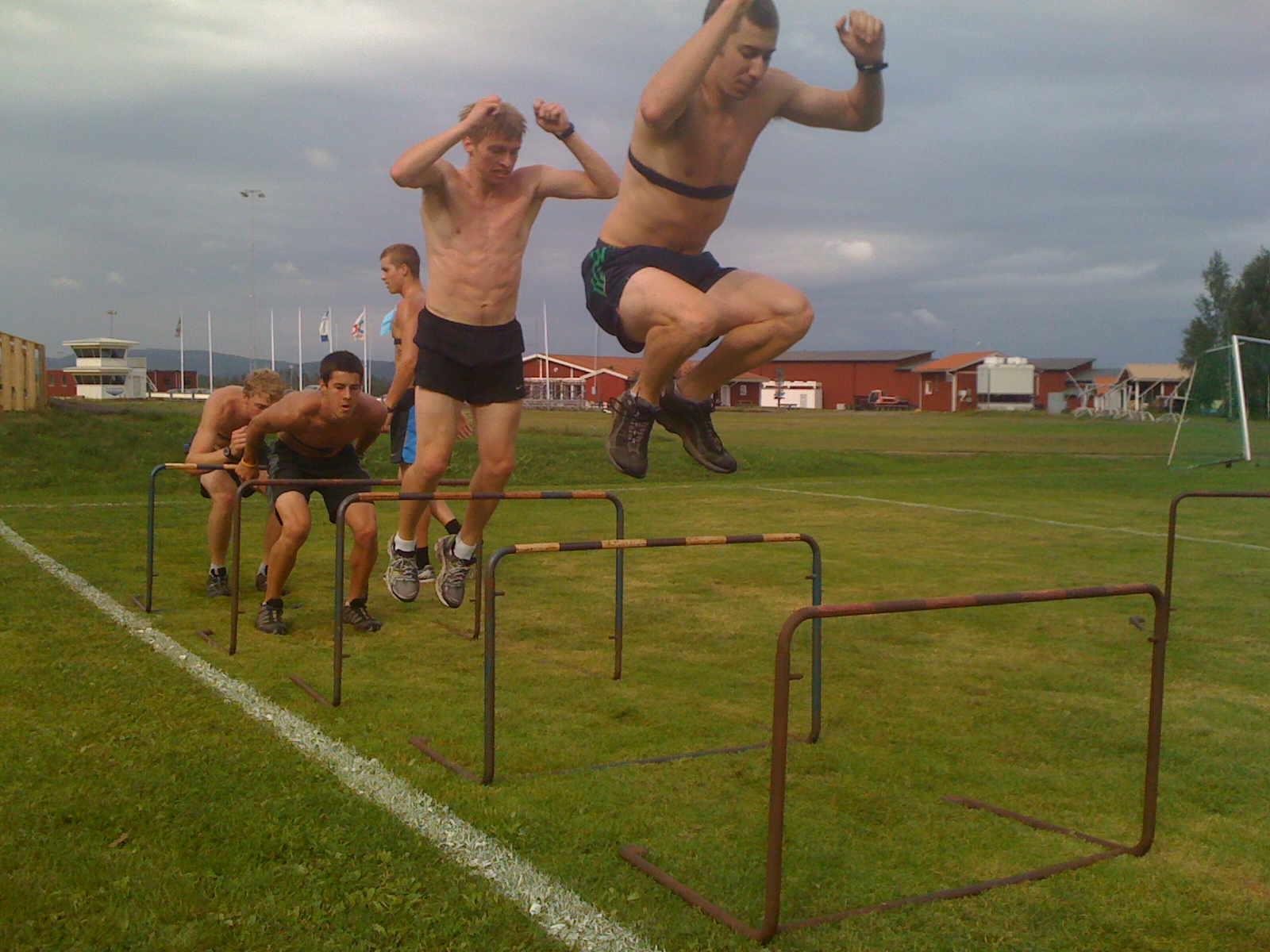
     

    At this moment, we don’t know what is down the road for USA Biathlon, but hopefully we will stay a community that supports the sport and the hard work of the athletes and coaches doing their best to perform at the highest level. (Photo: Authamayou/NordicFocus)
  • The Spice in the Soup: How Adam St. Pierre Thinks You Should Train

    The Spice in the Soup: How Adam St. Pierre Thinks You Should Train

    This article was made possible through the generous support of our voluntary subscribers. If you value coverage like this, please support FasterSkier with a voluntary subscription.

    Part two of a two-part series. Read part one here.

    A parent once cornered Adam St. Pierre to complain that he was letting the kids play games. St. Pierre had ten-year-olds on skis running sharks and minnows, shrieking and chasing each other across the snow, and the parent was not paying club dues for that. “I want coaching and training,” the parent told him. “This is…” and you can fill in the disappointment.

    St. Pierre thinks sharks and minnows on skis is one of the most effective training tools there is. He was lucky, he says, to have a parent board that backed him up in those rare confrontations, because he had no intention of stopping. Kids who are laughing are kids who come back, and kids who come back are the only kids who ever get good.

    That belief sits at the center of a coach who, on paper, should be the last person preaching simplicity. St. Pierre has a master’s in exercise science, a background running lactate and VO2 tests on athletes, and a relationship with a Montana State physiology lab that has done extensive work with U.S. Biathlon on both the metabolic and biomechanical sides. He reads the research. He can talk ratios and thresholds for as long as you’ll let him. And his most strongly held convictions keep coming out disarmingly plain. Go easy most of the time. Be consistent. Make it fun enough that people stick around. The science, in his hands, mostly ends up confirming things your grandmother could have told you.

    Consistency over the big block

    Start with periodization, the idea that a training year should be built in escalating blocks toward a peak. St. Pierre is skeptical of the old-school version of it, and his reasons are specific. A lot of that model, he points out, traces back to weightlifting research, some of it from an era when the subjects were quietly using anabolic steroids, which is not a foundation you want under your training plan. The rest tends to come from single-event sports. “In the marathon world or the Ironman world, you’ve got one event,” he said. “You just need to be good for that one event, like on August 2nd or whatever.” Skiing is not that. A ski racer has to be good across a whole season, weekend after weekend, from November into March.

    He points to a meta-analysis, published fairly recently, that looked at the day-to-day training of today’s top Norwegians. The finding was not a secret block of magic. “It really is consistency,” he said. “They’re not doing a big August and a big October. They do big weeks and recovery, and it’s just a very consistent progression.”

    The metaphor he keeps coming back to is one he borrows from Marius Bakken, the former Norwegian runner he half-jokingly calls a father of the Norwegian method. Intensity, in this telling, is not the meal. It is the seasoning. “The base of the soup is your endurance training,” St. Pierre said, “and then you add in a little bit of zip here and there. But if you put in too much zip, the soup is not going to be very good.” Roughly 90 percent of the work, whether on foot, on roller skis, on snow, or on a bike, is easy volume. The intensity is the spice, and Americans, he thinks, are forever dumping in too much.

    Only what’s livable

    There is also a question underneath all of this that the textbooks tend to skip, which is whether any of it is actually livable. St. Pierre still remembers sitting in a USA Triathlon coaching course, listening to a periodization lecture, and asking what he thought was the obvious question. What about a working person who cannot train 24 hours a week but could manage 16? What do you do with them? The answer from the front of the room was that they should take a vacation day and get the training in. “That’s not it,” he said. “That doesn’t work.” His approach is the reverse. Figure out what someone can actually do, how many hours are genuinely available, and then fill those hours with the best workouts possible.

    At MSU that math is dictated by a school calendar, and he has stopped fighting it. His athletes train before 10 a.m. so they can make a 10 o’clock class, and again in the afternoon, with nothing scheduled after 4 or 4:30. That produces a seven-day rhythm rather than the ten-day cycles some coaches prefer. Tuesday is intensity, usually threshold or VO2 work. Wednesday is a double of easy distance, with a few technique drills thrown in at the start to get the neurons firing before the athletes head out. Thursday morning is pure speed. Saturday brings intensity again, often paired with the long distance day. You cannot send skiers out for a two-hour roller ski on a Wednesday morning if they have class at ten, so you don’t. “There’s lots of ways to make a great soup,” he said, and it is not worth inducing a pile of needless stress to chase a perfect one.

    Two tests without a lab

    For readers without a lab down the hall, two of St. Pierre’s tools travel well. The first he calls a VT1 run, VT1 being the top of the easy zone, the hardest you can go while staying genuinely aerobic. Once a week, on flat ground, his athletes run 20 to 30 minutes at that effort and note the relationship between pace and heart rate. Flat terrain because it is the most reproducible. The point is twofold. It tracks fitness: if you run nine-minute miles at 150 beats in early summer and eight-minute miles at 150 by August, you have improved. And it works as an early-warning system. “One of the first signs of overreaching is a change in that heart rate to workload ratio,” he said. If the pace slows at the same heart rate, and it is not 105 degrees out and you are not dehydrated, it is probably time to rest. The signal can run the other way too. An athlete who normally sees 180 during intervals but suddenly cannot push the heart rate above 160 is, in his words, showing a pretty golden sign. Take some rest.

    The second tool he lifted from cycling: a five-minute maximal effort, a long recovery of maybe half an hour with some refueling, then a 20-minute maximal effort. The ratio between the two tells you whether an athlete leans anaerobic and sprint-oriented or aerobic and distance-oriented, no lab required. He built a version of it into his athletes’ training plans. He is quick to add the caveat that governs all of this, in the field or in the lab. Heat, dehydration, and altitude bend every number, and even a lab lactate value shifts with hydration. “No one metric is the god metric,” he said. “You’ve always got to have that context.”

    Montana State students conduct physiologic and biomechanical assessments for U.S. Biathlon. (Photo: Montana State University)

    Building complete skiers

    The individualization matters more now because the college game is about to change. Sprinting is coming to the NCAA Championships, a change St. Pierre cares about personally, because he wrote the proposal years ago and watched it slowly work its way toward reality. In anticipation, he is nudging the team’s intensity mix, keeping most of the hard work at threshold but adding more VO2 and anaerobic speed than a pure distance program would. One test the MSU lab ran compares an athlete’s VO2 at threshold to their VO2 max. A skier sitting well above the roughly 90 percent that is typical probably skews distance and might gain from more VO2 work to lift the ceiling. A skier down in the low numbers might benefit from more threshold. Even so, his priority is all-around development. The sprinters still do threshold. The distance skiers still do speed. He wants complete skiers, partly because a race does not always let an athlete choose its terms. If a distance race comes down to a mass sprint, a distance skier who cannot find another gear finishes 20th.

    The place where St. Pierre thinks American skiing has a real and underrated advantage is strength. He knows the reputation, that Norwegians do not lift, and allows it may be true of many of them. He also knows that the Norwegians who have come through his own program found the strength work novel. As part of a university, MSU has a strength coach, Benito, a former mountain bike racer at UVM and one of the rare ones who understands endurance sport, and the two of them build a program meant to complement the skiing rather than pull against it. St. Pierre credits it for keeping his team generally healthy, and he pushes back on the notion that skiers only need core and pull-ups. “If you can produce power with your legs,” he said, “that’s necessary.”

    He connects strength to a broader idea about movement economy, and here he reaches, carefully, for the Nike Oregon Project. Setting aside the doping and the scandal that eventually swallowed that program, he finds one lesson from it genuinely useful. Its coach had noticed American distance runners getting outkicked, so the group attacked the last 400 meters with sprint work, max strength, and plyometrics. The athletes did improve their finishing kick. They also got faster over the first 9,600 meters of a 10k. Better economy, it turned out, does not just help you sprint. It lets you hold a faster pace all day.

    Montana State biomechanics students provide testing for para Nordic athletes. (Photo: Montana State University)

    The long game

    If that all sounds relentlessly optimized, it is worth returning to the sharks and minnows, because the fun is not a break from the method. It is the method. His college team plays ultimate on skis, using a ball instead of a frisbee to remove the throwing barrier, usually after a track workout, and they lobby to play more. For the youngest kids, he has long argued that the travel race is not really about the race. A ten-year-old drives across the state to ski a 1k, and the actual point is the hotel pool, the snowbanks, the hide-and-seek, the exhaustion on day two that horrifies the parents. “This is why kids get into ski racing,” he said. “It’s not the ski race. It’s hanging out with your friends in the hotel room.” Those bonds are what turn a ten-year-old into a fifteen-year-old who wants to go do a long mountain run with the same crew, and a fifteen-year-old who stays in the sport into an adult who never leaves it.

    Which is finally how St. Pierre defines success, and it is not a medal count. He worries a little about the sport’s fixation on the Nations Cup, because doing well in it requires a lot of athletes racing a full season well, and he is not sure the American pipeline has that base yet. He points to Jessie Diggins as the rare skier who reached the level where she could show up week in and week out and land in the top five every time. Whether that season-long consistency cost her an Olympic medal or two is, he admits, a whole separate and unanswerable question. Finding metrics for development beyond international results is genuinely hard, which is part of why he has soft-started a PhD. The idea is to pull two decades of national points lists and track individual athletes year over year. Are American skiers actually getting better as they age, or do they wash out? The kid who was brilliant at 18 and gone by 22 is memorable, he notes, but memorable is not the same as typical. “Is that the rule or the exception? I think that’s the exception,” he said. “I’d like to have some data to back up my opinion.” The numbers are public. He just needs the time.

    His personal definition is quieter. He wants his athletes to develop far enough that the door to international racing is open if they want to walk through it, and he wants the ones who don’t to keep loving skiing anyway, as coaches, as parents raising their own little skiers, or simply as people who stay active and outdoors for the rest of their lives. He tries to live it as a father, chasing his own two kids up mountains in the summer and out onto snow in the winter. “There’s so much outside of skiing,” he said, “that makes skiing great.”


    Help Support Our Coverage!

    If you value the thoughtful work and access FasterSkier provides, please consider becoming a Voluntary Subscriber. Your support directly fuels our work to cover the people, places, and moments that make our sport special.

    Join the FasterSkier community!
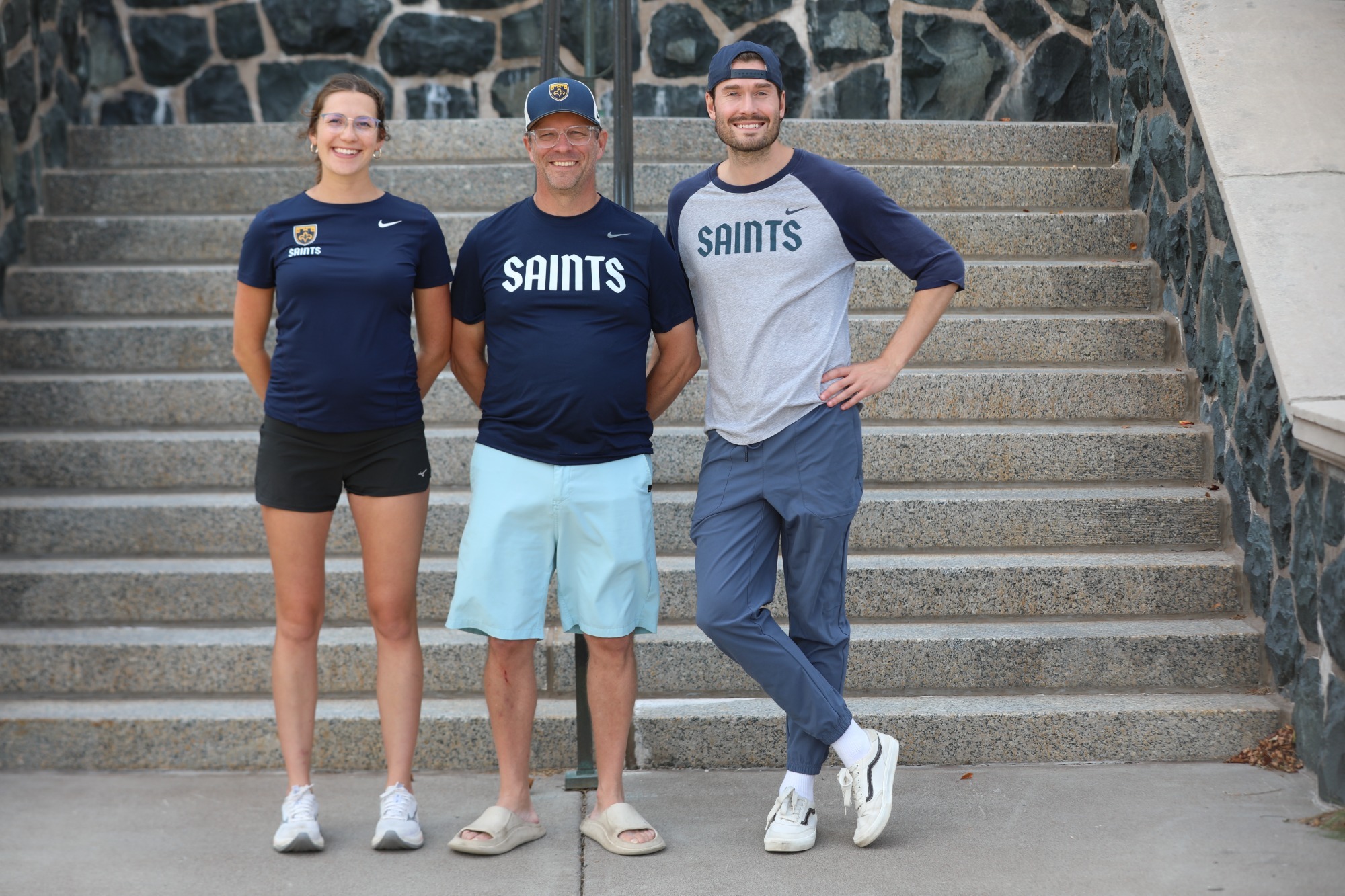
     

  • The Only Kid He Beat Hit a Tree: How Adam St. Pierre Backed Into a Life in Skiing

    The Only Kid He Beat Hit a Tree: How Adam St. Pierre Backed Into a Life in Skiing

    This article was made possible through the generous support of our voluntary subscribers. If you value coverage like this, please support FasterSkier with a voluntary subscription.

    Part one of a two-part series.

    Adam Coaching at US Nationals in Alaska. (Photo: Tobias Albrigtsen)

    Adam St. Pierre finished second to last in the first cross-country ski race of his life. The one skier he beat had crashed into a tree.

    He was a sophomore at Fall Mountain Regional High School, a rural school in Charlestown, New Hampshire, and he tells the story with the flat delivery of a man who has told it before and enjoys it every time. “Charlestown doesn’t really have a claim to fame,” he said. Forty-five minutes due south of Hanover, close enough to know Dartmouth was up the road, far enough that the world of club skiing might as well have been on another continent. He had never heard of it. What he knew was soccer, basketball, and track, in roughly that order, and he had no intention of adding a fourth sport that involved falling down in the cold.

    Then his freshman year fell apart. He hurt his knee playing soccer. He slogged through a basketball season he had come to hate. And in the spring, his track coach, who happened to also coach the ski team, made him an offer that sounded reasonable at the time. Come out for skiing next winter, the coach said. It will get you in better shape for soccer and track.

    So he showed up. That first race was a classic race, and he had only ever skated. He survived it, barely, ahead of the kid who met the tree, and somewhere in the weeks after, the thing that has kept a lot of people in this sport quietly got its hooks into him.

    Fall Mountain was not a fancy place, and that turns out to be central to the story. It was a working rural school with a barn, animal husbandry classes, agricultural mechanics, a metal shop, and forestry classes that maintained the trails and tapped the maple trees where the team ran and skied. The ski coach was the metal shop teacher. When the program needed grooming, the metal shop and ag-mechanics kids bought an old PistonBully and kept it running themselves. St. Pierre came up through a program held together by shop-class ingenuity and a snowbank at the edge of the football field, and he has never once been snobbish about it.

    “I have a high respect for high school skiing, because it is an entry point,” he said. “Otherwise I wouldn’t have found the sport.”


    A team that needed a fifth man

    He nearly didn’t find the next part either. Right before he graduated, his coach, Larry Sayers, told him that Colby College’s ski team wasn’t very good and that St. Pierre could probably walk on. He filed it away and didn’t think much of it. He had his sights on soccer and track. But once he got to Colby and started running into the skiers at various events around campus, something clicked, and it had nothing to do with the skiing.

    “These are the kind of people I like,” he remembered thinking.

    The timing was almost comically good. The coach, then Tracey Theyerl, now Tracey Cote, was 29 and in her second year running the team. She had just cut most of the upperclassmen, which left her with four men and an opening. St. Pierre walked on as the fifth. His introduction to roller skiing came shortly after, when Cote put him on a pair of classic roller skis and sent him out for a time trial. “I survived,” he said. From that point on, he was in, and again, the pull was the people as much as the training.

    Adam St. Pierre (left) and former Bowdoin skier and BNJRT coach Sam Shaheen at the start of the 2019 American Birke. (Photo: courtesy Adam St. Pierre)

    From the lab to the wax room

    He majored in physics at Colby and minored in biochemistry, and when he graduated, he had no clear idea what came next. He looked at teaching jobs. Nothing landed. Then a skier friend from high school told him about a graduate program at the University of New Hampshire where, as St. Pierre understood it, they paid you to study exercise. That sounded like a good deal. He enrolled in a master’s program in kinesiology and exercise science, working under a UNH physiologist whose research centered on hydration and thirst. His thesis was, in his words, pretty brutal to run: sensations of thirst in dehydrated subjects in cold versus ambient environments. “A little bit of everything when it comes to making people uncomfortable,” he said.

    It was during those UNH years that the sport handed him his first coaching job, and it did so in the roundabout, relational way that his whole career seems to follow. He had started dating a Bowdoin College skier while he was at Colby. She was a year behind him, still racing, and he was driving up to Brunswick most weekends to see her. Her coach was Marty Hall.

    Anyone who knows North American skiing knows the name, yet St. Pierre’s version of a Marty Hall story is smaller and more human, and it starts with the legend sizing up the kid who kept turning up in his wax room.

    “I need an assistant coach,” St. Pierre remembers Hall telling him, and he does a passable Marty voice when he gets there. “And you’re up here every weekend anyway. You want the job?”

    He took it. He thinks he was paid around 1,500 dollars total, which covered the gas. He coached under Hall for two years, and it confirmed something he had already begun to suspect: he wanted to spend his life doing this.

    Adam and his family out for a ski.

    Building from the bottom in Boulder

    When his wife got into law school at the University of Colorado, the two of them moved to Boulder, and St. Pierre walked into the next accident of his career. He had been hired to be the head coach of the Boulder Nordic Junior Racing Team, replacing Eric Pepper. Then Pepper decided to stay. Rather than lose St. Pierre, the club invented a role for him and made him its first development coach, responsible for the youngest kids, the u14s and u12s, or as they were then called, the j3s and j4s. Many of them were the little siblings of the older racers. His whole job was to grow the program from the bottom.

    Boulder Nordic Junior Racing Team athletes prepare for the start of a 3,000 kilometer running time trial on the track in 2013. (Photo: Adam St. Pierre)

    He did. When Pepper eventually moved on and St. Pierre took over as head coach and program director, he watched the club climb from 15 or 20 kids to nearly 70 at its peak, in a place he is quick to say is a genuinely hard town to be a skier. There is no snow in Boulder itself. You drive for it, and it is expensive, and the parents who commit anyway earn their real respect.

    One of those little kids was Lauren Jortberg. St. Pierre started working with her when she was six or seven, and he coached her through high school. She was, by his telling, agonizingly consistent at exactly the wrong number: four straight Junior National Championships and 11th place in what felt like every race. “All she wanted was that top 10,” he said. She had setbacks. She stuck it out.

    Years earlier, in his first season of coaching in Boulder, St. Pierre had said out loud that one of his goals was to someday coach a kid who would reach the Olympics. This past February, Jortberg made the U.S. team for the Milano-Cortina Games and qualified for the quarterfinals of the Olympic sprint, the culmination of a long and interrupted road that ran through back surgery, ankle surgery, and a lost senior season at Dartmouth. St. Pierre is careful not to claim more than his share.

    “I can’t take responsibility for much,” he said, and then, a beat later, “Goosebumps. Proud of her.”

    Boulder was where the rest of his professional life took shape, too. He worked at the Boulder Center for Sports Medicine as a clinical physiologist, running lactate thresholds and VO2 max tests and metabolic evaluations, and working alongside physical therapists on running biomechanics, teaching and reteaching people how to run without breaking. He got into ultrarunning and knocked off a number of 100-mile races, mostly for the pleasure of being out in the mountains all day. Around 2016 or 2017, he left the Boulder Nordic team and hung out his own shingle as an online coach. The flexibility made sense with two young kids and a wife commuting to Denver. But he missed the in-person part, the standing-in-the-snow part, more than he expected to.

    Adam repping the MSU team flag in Houghton, Michigan. (Photo: Tobias Albrigtsen)

    The job he had been aiming at

    He had known for a long time where he wanted to end up. College coaching had been the goal since around 2009. The appeal was simple: at the junior level, a coach spends a lot of energy convincing kids they might want to be ski racers, keeping every other door open in case they choose running or mountain biking instead. At the college level, the athletes have already decided. “They’ve decided they are cross-country ski racers,” he said. “I wanted to coach ski racers.”

    The Montana State job had come open once before, in 2015, and he had applied and been the runner-up. When it opened again during the strange fall of 2020, he jumped. He was hired that November and moved to Bozeman alone that winter while his wife and kids finished out the year in Boulder, riding out the online-school chaos he credits her with surviving. The family joined him the following June. Bozeman had been near the top of the short list of places they wanted to live anyway, a real ski town with snow in town, Crosscut 20 minutes up the road, and Bridger Bowl close enough to grab powder runs before cross-country skiing in the afternoon.

    Which is to say, the kid who finished second to last, who backed into the sport to get in shape for soccer, who took a coaching job largely because he was already driving to Brunswick every weekend, ended up exactly where he had been quietly aiming for a decade. The path was accidental in its particulars and not accidental at all in its direction. He kept following the people, and the people kept turning out to be skiers.

    What he does with those skiers once he has them, and why he thinks so much of American training gets the easy days wrong, is its own story. That is part two.


    Help Support Our Coverage!

    If you value the thoughtful work and access FasterSkier provides, please consider becoming a Voluntary Subscriber. Your support directly fuels our work to cover the people, places, and moments that make our sport special.

    Join the FasterSkier community!
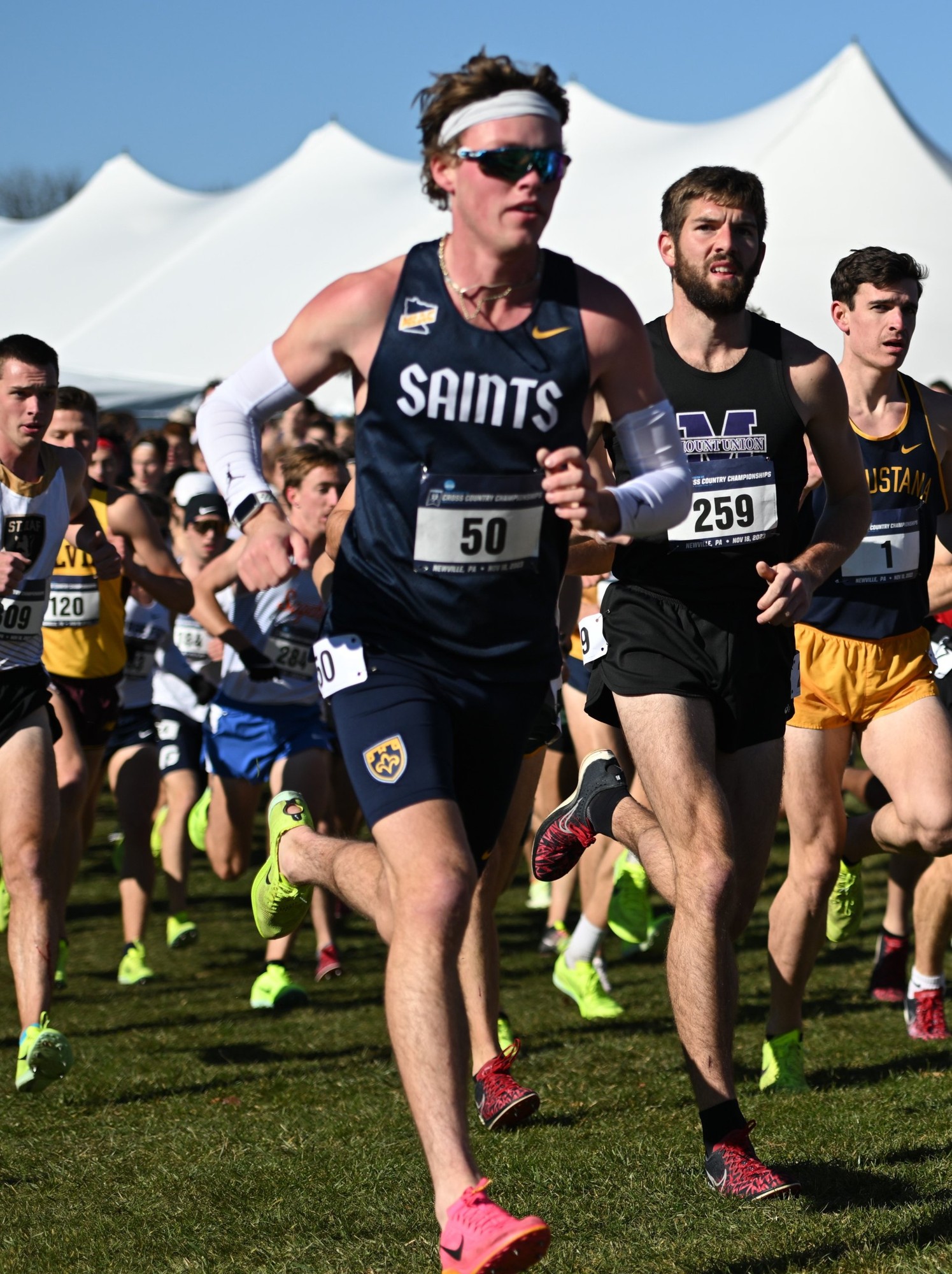
     

    Adam preparing skis for the Montana State University Nordic ski team at the RMISA Championships in 2026 in Heber City, Utah. (Photo: Colter Peterson)
  • Beckie Scott: The Olympic Champion Rebuilding Nordiq Canada

    Beckie Scott: The Olympic Champion Rebuilding Nordiq Canada

    This article was made possible through the generous support of our voluntary subscribers. If you value coverage like this, please support FasterSkier with a voluntary subscription.

    The five minutes Beckie Scott spent at the finish line in Soldier Hollow on February 15, 2002, lasted longer than most things in her career. She had crossed the line in what felt like third place. She thought she had a medal. She did not yet know.

    “It was actually a photo finish,” Scott said. “There were about five full minutes where we didn’t know. And then it was announced.”

    Her teammates, her coaches, and the wax technicians were already gathered in the pit, standing in the cold. The result came over the loudspeaker. Bronze. Canada. Beckie Scott.

    “We went ballistic,” she said. “It was magic. By that point, a lot of the coaches and wax technicians had made their way down to the pit. We were sort of standing there all waiting, and then when it was announced, it was just chaos. But in the best possible way.”

    The Canadian flag went up the pole in third position. The bronze, in the moment, was a win.

    “There was no disappointment. We celebrated that medal like it was platinum. This was the first medal for Canada. It was a long shot. It was absolutely incredible and powerful to stand on. In that moment, I got to celebrate that and have that day, and that feeling, and all the joy that comes with it.”

    What happened next is now part of cross-country skiing’s history. The two Russian skiers who finished ahead of her were caught for doping. The bronze turned to silver, then to gold. The flag that had risen for her in third place was wrong, but only because the truth had not yet caught up to the racing.

    It would catch up eventually, though, and so would Scott, now an Olympic champion.

    Beckie Scott with the gold medal she was awarded at a ceremony in Vancouver in June 2004. A former Canadian cross-country skier, Scott finished third in the 5 k pursuit at the 2002 Olympics but was later awarded gold when the two women ahead of her were disqualified for using performance-enhancing drugs. (Photo: Cross-Country Canada)

    Scott grew up in Vermilion, Alberta, a rural community in the province’s northeastern region. Her parents were avid cross-country skiers and members of the local club. The trails started at the back of their property and ran into the provincial park. She could ski out the back door.

    When the Jackrabbit program — the Canadian equivalent of the Bill Koch Youth Ski League in the United States — rolled out across Canada in the early 1980s, her mother adopted it in Vermilion and Scott came up through it.

    “I developed just a real affinity and love for the sport, right from the start,” she said. “I was very inspired by the community. I really loved the community. I loved competing, and I just loved the idea that the harder you worked at something, the better you could do. So as a kid, it was all very exciting, and a lot of fun.”

    The Vermilion club is now more than 50 years old. The trails are well used. It remains a rare facility for a rural Alberta town.

    What was not rare, in the late 1990s, was the experience of a North American woman struggling on the World Cup. Scott was at the front of a group that did not yet exist. She was the best of her cohort, which was a difficult thing to be.

    “Even when we started on the World Cup, when I was there, the results were abysmal. It was very, very poor performances. The results were nowhere near successful, that’s for sure.”

    She remembers it now with a kind of dry humor. “I think it’s good that we had a good sense of humor, because there were a lot of days, if we weren’t laughing, we would have been crying. I do remember being completely devastated, often. Not just by being so far down the list, but by how far behind I was. That, to me, just seemed almost impossible. To see the gaps that I was seeing when I first started, in the era, I think we all know why the Russian women were skiing as fast as many of the men.”

    She did not know that at the time. She thought she was just a weak competitor.

    The way through, she said, started with a single word.

    “The first step was approaching it as a professional. Leveling up the approach to my career as a cross-country skier, as a professional. I don’t think I was doing that in the early days, and I didn’t even understand what that meant, necessarily. So that was a big shift. And then it was increasing training hours, getting serious about strength training, and technique. Taking every single piece of what a performance needs and addressing it separately, and eventually collectively. But the biggest shift for me was the mental, socio-emotional approach. Shifting the paradigm to being a professional.”

    She offers this as the lesson she most wants to pass on. The hardest part, she said, was maintaining belief.

    “In the early days, I just didn’t know at first if this was even possible, or what it was going to take, or how to get there. I had this incredibly aspirational ideal of what I wanted to be, and I was so far from that when I first started.”

    The first glimmer of light came at a World Cup in Val di Fiemme, Italy. She does not remember the exact year when we spoke, but it was in December of 1997. After seasons of trying to crack the top 30, she finished eighth.

    “That was it. That was the moment. It’s like, okay, 100 percent this can be done. And this isn’t going to be a one-off. It was totally exciting and inspiring, and I just wanted more.”

    Beckie Scott racing in Val di Fiemme (courtesy photo)

    By Salt Lake City, she was a contender. Not a sure thing, but a contender.

    “We had the belief, even years leading into Salt Lake City, that this was a golden opportunity that we shouldn’t and couldn’t pass up. We had spent our years living and training in Europe, constantly dealing with jet lag, living in hotels, foreign language, foreign food. And this was a magical opportunity on our doorstep to effectively race at home.”

    The 2002 women’s pursuit was a five-kilometer classic followed an hour and a half later by a five-kilometer skate. The format played to her strengths.

    “I could do both techniques well. There’s this powerful energy that’s created when you have a home crowd behind you. It really does change things for athletes in a way that’s hard to describe. There’s an uplift that’s just incredibly powerful. I felt it. I remember it to this day, twenty years later.”

    Then came the five minutes of waiting, and the chaos in the pit, and the medal that was, eventually, the right color.

    The irony of becoming the public face of clean sport in cross-country skiing was not lost on her. She had been vocal before Salt Lake, after most of the Finnish team was caught for doping at the 2001 World Championships in Lahti.

    “It was deeply frustrating to know that we were doing everything we could do to compete at the highest level in this sport, and we were constantly being thwarted by athletes who were using performance-enhancing drugs. That was incredibly aggravating. And it was shared. Not just by me, but my coaches, technicians, fellow teammates. This was not just unique to me.”

    When the Russians were caught in Salt Lake, her first reaction was surprise.

    “It was an open secret how much performance-enhancing drug use was going on in our sport, in particular by the Russian team. I was surprised because I did not have much belief, faith, or confidence in the anti-doping systems at that time. When I learned later about what actually happened at Salt Lake City to have those tests revealed as positive during those games, it was a remarkable series of events.”

    That path eventually led her to the World Anti-Doping Agency and a long career in sport integrity work.

    Canada’s Beckie Scott (right) and Sara Rennner receiving their silver medal in the team sprint at the 2006 Olympics in Torino, Italy. That was two years after Scott belatedly received the gold medal she won at the 2002 Olympics, after fighting long and hard to earn it when the first two finishers were found to be doping. (Photo: courtesy photo)

    In 2006, in Turin, she won another medal. This one is remembered less for who lost it and more for who gave it.

    In the women’s team sprint, her teammate Sara Renner broke a pole. A Norwegian coach, Bjørnar Håkensmoen, standing on the side of the course handed Renner one. Renner finished the leg. Canada finished second. Norway dropped to fourth.

    “It really lived long in the hearts of people, I think, because of the sportsmanship element,” Scott said. “The Norwegian coach giving her the pole, which moved the Norwegians back to fourth and gave us the opportunity to have a silver that day. That piece was so encouraging and heartening, and really in the spirit of what we like to think the Olympics should be about.”

    The other piece, for her, was personal. The team sprint silver was the last medal of her career, won with Renner, with whom she had been racing for eleven years.

    “That was the culmination of 11 years of traveling and racing World Cups, World Championships, and Olympic Games together. And then we could stand on the podium together, in what would be the last year of my career. As teammates, but also very good friends, lifelong friends. We’re friends today. There was a dual component to that experience. It was, I think, lovely and inspiring in a lot of different ways.”

    Beckie Scott shares her silver and gold Olympic medals with a Spirit North participant. (Photo: Spirit North)

    When she retired from racing, she was invited to be an ambassador for a Learn to Ski program sponsored by an oil and gas company in northern Alberta. The program ran in indigenous communities. She would visit a community five or ten times a year, ski with the kids, show the medals, give a talk, then go home.

    She kept going home, and she kept thinking about what she had seen.

    “I began to notice many things. First, the disparity in the socioeconomic conditions of how indigenous people in this country live versus non-indigenous people. The lack of opportunity that kids were really able to access for sport and play. And then just the paradox of my own life and the opportunities that I had through sport, and my own kids were having through sport.”

    It struck her, she said, as deeply unfair.

    “An entire population of people was effectively kept out of that arena, and for no valid reason that I could see or think of.”

    The Truth and Reconciliation Commission published its final report in 2015. Among its 94 calls to action were several related to sport. Scott read the report. She had, she said, a hard time just letting things be.

    “I have a hard time just turning away and saying, not my problem. So I started a nonprofit.”

    She started with four communities in northern Alberta. The organization, Spirit North, is now national. It operates in 160 communities across Canada. It serves roughly 20,000 kids a year. It is among the largest sport for development organizations in the country.

    “The lesson there is that you can make a difference. I didn’t know anything about starting a nonprofit. I didn’t even really know much about indigenous culture and ways of being and knowing. But being open to learning, being super curious, and being driven by a vision of what change could look like, and meaningful action. That resulted in that organization.”

    Beckie Scott gives a speech while she served as the Chair of the World Anti-Doping Agency (WADA) Athlete Committee. She also served on the Compliance Review Committee. (Photo: courtesy photo)

    In March of 2025, Scott started a new job as CEO of Nordiq Canada. The skills, she said, transfer. Spirit North was a nonprofit. So is Nordiq Canada. There is a board, staff management, fundraising, finance, HR, and strategy.

    “A big part of our job at Spirit North was setting the strategy. A big part of our work here at Nordiq Canada is setting the strategy. Putting the activities together. How are we going to get to where we want to go. Many, many parallels.”

    The job she walked into was harder than the parallels suggest. The federal government had frozen its core contributions to National Sport Organizations for 20 years. The core funding that Nordiq Canada received from Sport Canada when she started last year was the same dollar figure as when she was racing two decades earlier.

    “Think about that in terms of the cost of living, inflation, and the rising demands on an NSO. It really crippled the organization in terms of capacity and what it was able to deliver.”

    She brought her CFO, Sian Bolton, from Spirit North with her. They streamlined operations. She went out and raised money.

    “I just started knocking on doors and pounding the pavement, trying to raise money for the organization. The response in the community has been encouraging. We signed on a number of new donors and had some major gift contributions. People recognize that we have a lot of talent right now in our programs in this moment. And if we don’t get behind them, we’re going to lose them. People heard that message loud and clear.”

    Then, after Milano, the federal government announced a $755 million investment in sport over the next five years.

    “It’s transformational. We are going to benefit from that. I am very optimistic about our future financial state because of the government’s recent announcement and because of our fundraising success.”

    The total budget at Nordiq Canada now sits just under $5 million, covering both the Olympic and Paralympic programs. About $2 million of that is core federal funding. Scott would like to add another $1.5 to $2 million.

    She conducted a ‘listening tour’ after taking the role. The thing she heard most often from athletes was a lack of trust in the high-performance system.

    “As an athlete, you want to believe more than anything that your NSO has got their act together and knows what they’re doing when it comes to high performance. That was one of the biggest areas that needed to be addressed.”

    She restructured the leadership team quickly. “It was time to make a fresh start. The organization needed to be right-sized for the budget and the financial situation we were in. But we also needed the right skill sets and the right roles.”

    She has, she said, four near-term goals. Podium results. Financial stability. Restoring trust and credibility. Unifying the community.

    “It’s a bit fractured,” she said of Canadian skiing now. “I think we can do a much better job of pulling together, remembering why we’re all here. Unifying as a nation behind our athletes and our programs and our development and our organization.”

    The fifth goal, on a longer arc, is coaching development.

    “I see a huge opportunity for closing the gap in coaching in this country. I look to the U.S. and what the U.S. has done to generate so many really highly qualified coaches, and not bringing them over from Europe all the time. For me, for the next four to five years, coaching development is going to be a big focus.”

    Beckie Scott and Justin Wadsworth pose with their family. (Photo: courtesy photo)

    Scott is married to Justin Wadsworth, who spent six years as head coach and high-performance director for Biathlon Canada and is now consulting for U.S. Biathlon. They try not to talk about work over dinner.

    “It’s hard. We’re living it every day, and our kids are both in it. But dinners are generally pretty lighthearted. We don’t avoid talking about work, but we certainly don’t do it all the time.”

    She is writing her report for the upcoming Nordiq Canada AGM. When she looks back on her first year, she said, it has been a remarkable one.

    “It was a lot of transformational change. New leadership in finance, high performance, events, athlete support. But at the same time, we managed to do that without destabilizing our teams. Our athlete performances continued to rise at the Olympic Games, at the Paralympic Games, at the World Juniors. We have so much to celebrate and be proud of when we think about this last year in terms of performance. The organization is on solid ground, and it’s really full steam ahead.”

    It could seem strange that the woman who became the first North American to win an Olympic gold medal in cross-country skiing now spends her days raising money, restructuring boards, and writing AGM reports. Alternatively, maybe the trail Scott got on out of her backyard in Vermilion had been leading her all along to this moment, and she has proven she is ready for it.


    Help Support Our Coverage!

    If you value the thoughtful work and access FasterSkier provides, please consider becoming a Voluntary Subscriber. Your support directly fuels our work to cover the people, places, and moments that make our sport special.

    Join the FasterSkier community!
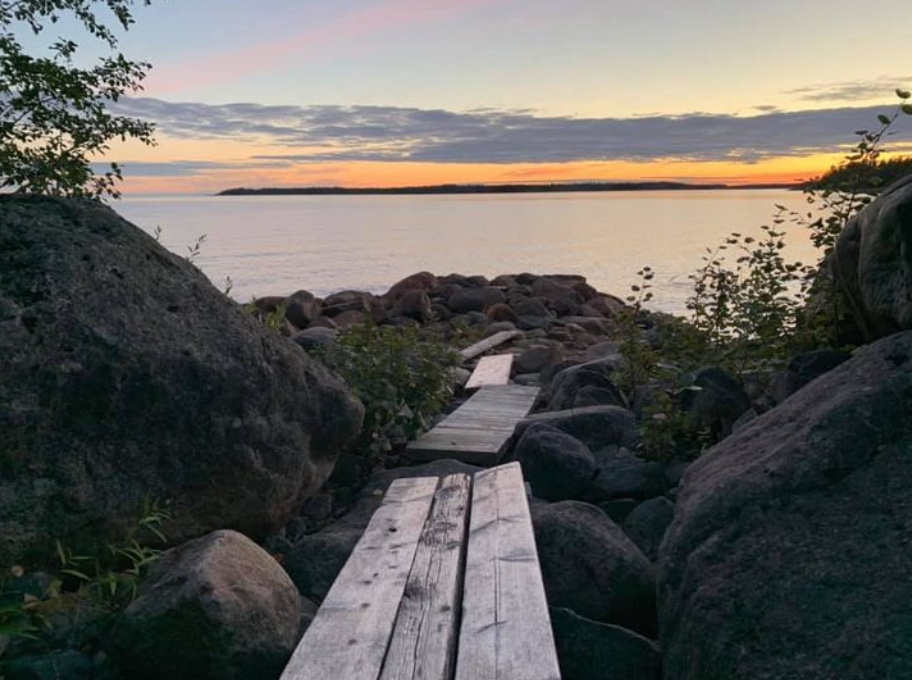
     

  • The Wrong 30,000

    The Wrong 30,000

    This article was made possible through the generous support of our voluntary subscribers. If you value coverage like this, please support FasterSkier with a voluntary subscription.

    Quinn Holan on his way to a top 5 junior finish at US Nationals Lake Placid. (Photo: Courtesy Photo)

    Will Sweetser thinks American Nordic skiing is recruiting in the wrong places. Here is what he is building on Donner Pass to prove it. This is the second of two parts — be sure to read part one, to learn about Sweetser’s background and coaching philosophy — Keep Showing Up: Will Sweetser’s Unglamorous First Principle

    The number Will Sweetser carries around is thirty.

    That, he says, is roughly how many development and junior racers a competitive Nordic ski club will produce from any 30,000 Americans with access to snow. The figure does not move much. Aroostook County, Maine, from Houlton to Fort Kent, about that. Stratton, Vermont, about that. Truckee, California, where he lives now, about that. He has been watching the number hold for thirty years.

    “Maybe it’s a little richer in some of these alpine resort towns like Jackson or Aspen,” Sweetser said. “But in general, I think that’s a pretty good estimation of what you’re going to get.”

    If he is right, the implication cuts against how most American Nordic clubs are organized. Truckee has three programs competing for that local pool. Each ends up with roughly ten development-age athletes. Sweetser, who runs the Nordic operation at Royal Gorge on Donner Pass, calls the result “not functional. And actually bad for athlete development.”

    His conclusion is the one most clubs in snow country do not want to hear. He thinks they are fighting over the wrong 30,000 people.

    Quinn Holan, Walker Rawlinson and Cabot Godoy celebrating learning at Jackson Hole International Spring Series 2023. (Photo: Courtesy Photo)

    The 30,000 that interest Sweetser sit on the other side of the Sierra crest.

    The Reno valley, by his count, holds about 650,000 people. The slice he is targeting — the corridor running from Gardnerville up through northwest Reno into Verdi, Nevada — is roughly 140,000 of that. He likes to compare it to the state of Vermont, where the total population is about 648,000. From west Reno to Royal Gorge is under 50 minutes. To Auburn Ski Club, the next program over, it is 40.

    That, he points out, is shorter than what plenty of Vermont families drive to ski on Saturday mornings. It is shorter than what he himself drove from Bates to find usable snow in the 1990s.

    “Why am I fighting over the 30,000 who live in Truckee,” Sweetser said, “who are frankly inundated with sports options?” Lacrosse. Soccer. Dance. Most of his daughter’s friends, he said, are doing two or three sports a season through elementary school. “How do you compete? Do cross-country ski training on top of all of that?”

    There is a second front in the same argument. Truckee is a snow-sport town, but it is also a freeride town, and Nordic, in his telling, is losing the adolescent attention war to a sport that was built for the camera roll. “It’s never going to look as good as huck yourself off of a classic line at Palisades or Sugar Bowl or Heavenly,” he said. “You’re just not going to.”

    Quinn Holan, Walker Rawlinson and Cabot Godoy. (Photo: Courtesy Photo)

    So Royal Gorge is being repositioned. Sweetser describes it as a destination training center, by which he means destination for both racers and resources. The piece that interests him most is the labor pool.

    A generation of Eastern Intercollegiate Ski Association graduates moved to the Bay Area for jobs in tech and finance over the last decade or so. Sweetser, off the top of his head, can name seven or eight. Widen the age range and he says he can name another thirty. They are not coaches by trade. Most of them make considerably more money than coaching pays. But they are skiers, and Sweetser’s bet is that a meaningful number of them would take three and a half hours twice a week — a Tuesday and a Thursday morning, say, or a Tuesday and a Saturday — to be paid by Royal Gorge to run a session in the Bay.

    “The ones who are older don’t care about the money. They’ll do it anyway,” he said. “But the younger guys probably care about the money even less. They’re psyched to be out.”

    He has tried this before with a Bay Area satellite through Sugar Bowl Academy and lost it to a turnover in headmasters. The current effort is being underwritten by Royal Gorge, whose general manager, Tom Miner, took over a few years ago and has been, in Sweetser’s description, the institution willing to write the checks. Bay Area families would still drive up Thursdays and Fridays for weekend training; the satellite sessions supplement, they don’t replace. “Four to five sessions of skiing per week,” Sweetser said. “Which is pretty crazy if you think about it. You can develop a lot.”

    His reference point was his own résumé. He coached at Bates in the 1990s, when the team was off Mondays, didn’t ski Tuesdays or Wednesdays most weeks, and drove an hour each way the rest of the time or just left on Thursday for the next carnival stop. “I don’t think it’s the worst development plan for kids who want to ski in college,” he said. “Nor do I think it’s going to hurt your lifelong love of the sport to ski three or four days a week instead of six.”

    JC Schoonmaker and Emma Ribom giving back at a Far West dryland clinic. (Photo: Courtesy Photo)

    “I think it’s also a thought exercise more than a practicality,” he said. The snow-belt population is small to begin with, he argued, and within it, Nordic competes against alpine, against freeride, against every other thing a kid with a phone can see. He went looking for the counterexample and landed on Great Britain. Their entire cross-country skiing base, he estimated, is “maybe a thousand” people. Three British men finished in the top eight of a World Cup race in the lead-up to last year’s Olympics. The United States, from a population orders of magnitude larger, did not have three.

    “So I think we have to apply both systems simultaneously,” he said. “You want the best possible resource application and preservation, as well as the recruiting.”

    The recruiting, in his version, is what is taking him to Reno and to the foothills around Auburn and Grass Valley, towns at 2,000 feet of elevation, with populations several times Truckee’s, that have a history of ski teams without a current knowledge base. He has also been watching California middle-school track results, the way a baseball scout reads box scores. He is looking for the eleven- and twelve-year-olds who will hit puberty, stop being runners, and still have an engine.

    Long view of program and athlete development. (Photo: Courtesy Photo)

    The institutional pieces have been moving in the meantime, some faster than others.

    Sweetser submitted a bid this month to host the 2028 Junior Nationals at Royal Gorge. The bid still needs approval from the sport committee and the junior working group, and the organizing committee is largely the one already preparing for an earlier event. He said the bid is in part a consequence of another organization having stepped back, and would not elaborate.

    He is also in the middle of homologating four race courses at Royal Gorge — a sprint, a 2.5, a 3.3, and a 3.75 kilometer loop, with options for a 5K and additional sprint variants. Sweetser did the initial mapping himself; a professional GIS contractor is doing the formal version now.

    The third moving piece is administrative. Sweetser owns a company called Ydalir, which is the U.S. importer for the Italian wax brand Maplus and the holding entity for his coaching operation. Ydalir’s junior and weekend programs are being folded into the Royal Gorge brand. “Weekend program up through juniors is branded Royal Gorge cross country,” Sweetser said. The older athletes — gap-year skiers, elite development athletes, masters groups — sit one tier up, with the financial arrangement still being worked out.

    The deal makes sense to him because of what an institution provides. “I can’t just be running around in the woods all the time,” he said. “I need a home.”

    Walker Rawlinson (Menlo CA) in a breakthrough race Jackson Hole 2023. (Photo: Courtesy Photo)

    The home matters because of who he wants in it.

    The NCAA is on the verge of changes that will give skiers a five-year clock from high school graduation, capped at age 24, in which to use four years of eligibility. Sweetser thinks the new rule will quietly squeeze out the gap-year athlete — the kid who could use a year at a prep school, the kid who is simply not ready at 18, the kid who would be a different athlete and a different person at 20. The five-year window is generous in theory and tight in practice.

    What Royal Gorge can offer those athletes, Sweetser said, is a landing pad. Last year the resort gave passes to the three older skiers he was coaching. This year, in addition to the passes, it will offer them paid work with the ability to ski before and after a shift.

    “It’s a pretty decent deal when you’re trying to make it,” he said.

    None of this is new in concept. The Maine Winter Sports Center built something close to it in the 2000s, and produced a long run of national-team athletes from it. Sweetser was part of that operation. The Royal Gorge version inherits the DNA and adds a piece Maine never had: a population base on the other side of the mountains big enough to recruit out of.

    Whether his thirty-out-of-30,000 math holds in California the way it held in Aroostook is the experiment.

    “You take an 18-year-old and go out as a 20-year-old,” Sweetser said, “you’re a different person.”


    Help Support Our Coverage!

    If you value the thoughtful work and access FasterSkier provides, please consider becoming a Voluntary Subscriber. Your support directly fuels our work to cover the people, places, and moments that make our sport special.

    Join the FasterSkier community!
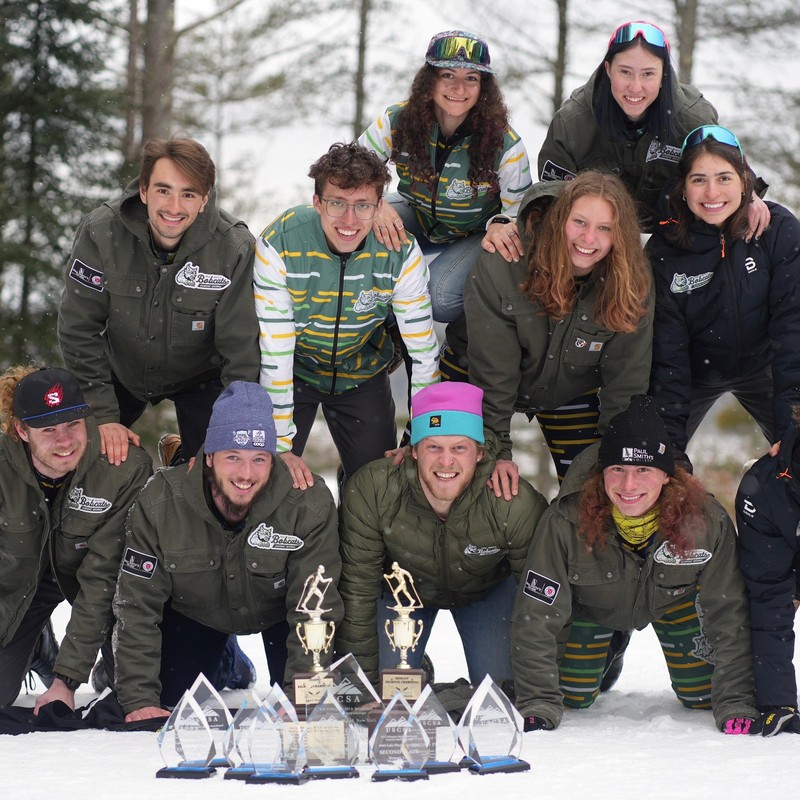
     

    Superfluous photo of Sweetser’s dogs… but we love dogs too, so had to include this photo! (Photo: Courtesy Photo)
  • Keep Showing Up: Will Sweetser’s Unglamorous First Principle

    Keep Showing Up: Will Sweetser’s Unglamorous First Principle

    This article was made possible through the generous support of our voluntary subscribers. If you value coverage like this, please support FasterSkier with a voluntary subscription.

    Two older girls on the Edward Little ski team went looking for bodies. It was the mid-1980s, the boys’ Nordic program at the Auburn, Maine, high school was thin and not very good, and the girls’ team was strong. The two girls, Becky Flynn (SVSEF) and Sarah Pribram (NWVE), knew a freshman who had skied a little in middle school. They asked him if he wanted in.

    Will Sweetser’s second cross-country ski race ever was the Maine High School State Championship, he finished 34th, the best result on the team.

    The next winter Edward Little won the state title. Sweetser placed seventh in the state — and fourth on his own squad. “I was the fourth guy running, I was the fourth guy skiing,” he said. The sport was tilting toward skating then, and almost nobody his age had figured out how to skate yet. Technique was a wash. So the results sorted themselves out the only way they could.

    “It turned out that engines won,” Sweetser said.

    That phrase could serve as an epigraph for everything he has done since, except for one inconvenient fact. His own engine was nothing special, at least by his own standards.

    He learned exactly how unspecial his was as a freshman skier at Dartmouth, when the team did VO2 max testing. The results put Sweetser, the slowest man on the roster, “squarely in the bottom half of the women’s team.” He ran the numbers on his own future and did not like the answer. “I was already running almost the times they suggest for my VO2 max,” he said. The writing, he decided, was on the wall.

    If the engine couldn’t get bigger, the speed had to come from somewhere else.

    “Wax makes things faster. Strength makes things faster. I better learn technique,” Sweetser said. “Maybe I was a genetic predeterminist, and that’s why I started learning all the physiology.”

    After graduating from Dartmouth, Sweetser took an assistant coaching position at Bates College in Lewiston, Maine, where he went to the library and more or less stayed there.

    At Bates, Sweetser became a fixture in the stacks while living with his grandfather, working into the evening. “I literally was in the library more than the team,” he said. For two years, he averaged four or five interlibrary-loan requests a week. He calls what he built in that period “a self-taught, master’s-level survey course” in exercise physiology. He was also, by his own account, one of the first coaches in the country mailing away for VHS tapes of World Cup races, freeze-framing technique frame by frame because there was no other way to see it.

    Will Sweetser (right) has worked with Olympian JC Schoonmaker (left), who now lives in Alaska and races for APU, since Schoonmaker was a young skier.

    Three decades later, that reading has produced one of the more idiosyncratic coaching minds in American skiing. Sweetser is now based in Soda Springs, California, high on Donner Pass, after a long stretch running the program at the Maine Winter Sports Center. And the first principle he’ll hand you is almost aggressively unglamorous.

    It’s consistency. Just showing up.

    Sweetser points to a Norwegian study he came across years ago — his recollection puts it around 2006 to 2008 — that examined the country’s top 14 nationally ranked women, essentially its entire World Cup pipeline. Researchers measured everything: VO2 max, speed broken into 20-second segments, correlation after correlation. The single factor that most cleanly separated the top seven from the next seven, Sweetser says, wasn’t engine size or top speed. It was days lost to illness and injury. The lower group averaged roughly two weeks of missed training a year. The top group averaged two or three days.

    “That seems to be the most correlated thing,” he said. Stretch it across a four- or five-year Olympic cycle and the gap stops being trivial.

    It sounds obvious. It is also not how a great many junior programs actually behave, which is where Sweetser’s second idea comes in, and that one is stranger.

    He builds training around fiber type, and he has a field test for sorting it. He’ll have an athlete — 15 or older — run a 400 meters, rest 20 minutes, then run a 3,000 meter. Then he looks at the ratio. A “normal” distance athlete, he says, holds about 76.5 percent of 400-meter pace over 3k. He can quote the figure to the hundredth. Drop below 68 percent and the athlete is built to sprint; climb above 82 and they’re built to grind. “This is how specific they are,” he said of the research he leans on.

    The athletes all come to the same session. What changes is the leash. The sprinter types get a short one, where Sweetser wants the heart-rate alarm to go off the instant it “faintly whispers” the next zone, because those athletes overshoot every interval.

    Where the distance types might run eight intervals, the sprinters run five or four. Body position stays the same for everyone. Cadence and power output are already different on their own. What he actually teaches, he says, is tactics — where on the course to spend, and where to wait based on each athletes strengths and weaknesses.

    This is also why he keeps reaching for the treadmill. It is measurable and it is controllable, and that combination lets him do something he values more than almost anything: build what he calls “an athlete persona that’s rooted in belief, not hope.”

    The clearest proof he offers was from an athlete he met at Bates, Sarah Dominick — the woman who would later become his wife and is now his coaching partner. At Bates, her running coaches kept pushing her mileage up, and every time she got much past 25 miles a week, she broke down. It made sense to Sweetser: she had a sprinter’s makeup, but was being asked to train like a distance runner. She was miserable enough that she sat out her junior year of competition entirely.

    When she came back as a senior wanting to race the 3k and 5k, Sweetser says her coach called it a waste of time.

    His plan went the other direction. He capped her running at roughly three hours a week and backfilled the volume with cycling and roller skiing. Warm-ups and cool-downs were run on grass, in the opposite direction around the track, to spare the leg that always flared. The key session, twice a week, was deceptively small: two sets of 15-seconds-on, 15-seconds-off at 3k race pace, jogging the corners, six minutes of rest between sets. Start to finish, it took about an hour.

    She went from 11:38 to 10:00 for 3,000 meters in a month. She became a Division III All-American and set a school record. The following year, training off skiing and running on a dirt road at altitude, she ran 9:27.

    The lesson Sweetser took from it is the one he now spends most of his time trying to give away. “Your best training computer is still between your ears,” he said.

    Will Sweetser doing lactate testing during a hill-bounding session two season ago with Quinn Holan.

    You can see what that looks like in Quinn Holan, the 18-year-old Sweetser coaches most directly and has worked with since the athlete was 11. These days, Holan, Far West’s standout U20 skier, writes his own training plans and brings Sweetser the questions, not the other way around. Increasingly, when the two disagree, the athlete keeps his own counsel, which is exactly the point. “You can call me his coach,” Sweetser said, “but it’s sort of like Klæbo’s grandpa is his coach.”

    It is a strange arc for a man who started with so little to work with. Sweetser was the high school freshman recruited because the team needed a warm body, the college skier in the bottom half of the women’s VO2 results, and the coach who had to teach himself the sport one interlibrary loan slip at a time. Thirty years on, the whole project — the fiber-type tests, the treadmill data, the athlete who outgrows his coach — is really just an effort to spare the next kid the loneliness of that library.

    Sweetser never did get the engine he wanted as an athlete, but as a coach, he has built something much more durable.

    Next: why Will Sweetser thinks American skiing is fighting over the wrong 30,000 people — and what he’s building on Donner Pass to prove it.


    Help Support Our Coverage!

    If you value the thoughtful work and access FasterSkier provides, please consider becoming a Voluntary Subscriber. Your support directly fuels our work to cover the people, places, and moments that make our sport special.

    Join the FasterSkier community!
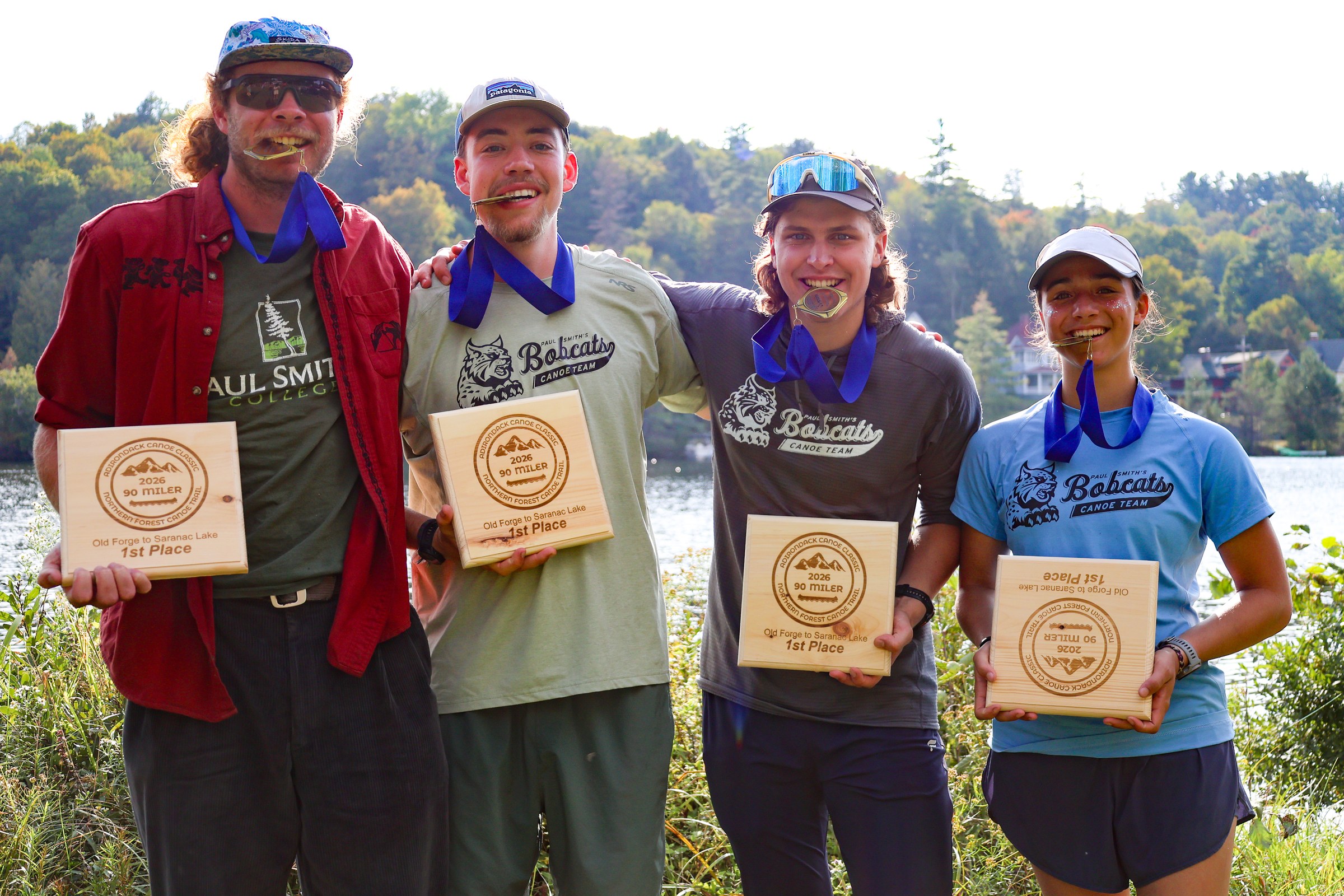
     

    Will Sweetser and Matt Seline
  • Taiwan’s Olympic Closing Ceremony Flag Bearer, Sophia Tsu Velicer, Soaks Up the World Cup Finale in Lake Placid

    Taiwan’s Olympic Closing Ceremony Flag Bearer, Sophia Tsu Velicer, Soaks Up the World Cup Finale in Lake Placid

    This coverage is made possible through the generous support of Marty and Kathy Hall and A Hall Mark of Excellence Award. To learn more about A Hall Mark of Excellence Award, or to learn how you can support FasterSkier’s coverage, please contact info@fasterskier.com.

    Sophia Tsu Velicer (TPE) during the World Cup Finals 20 k Freestyle on Sunday in Lake Placid, New York. (Photo: Thibaut/NordicFocus)

    Taiwanese-American skier Sophia Tsu Velicer on racing in the U.S., representing Taiwan, and her mission to open doors for the next generation.

    LAKE PLACID, N.Y. — Sophia Tsu Velicer didn’t mince words when FasterSkier caught up with her in the mixed zone after Sunday’s 20-kilometer mass start freestyle at the Stifel Lake Placid Finals.

    “It was kind of brutal,” she said, still catching her breath, “but kind of super duper fun.”

    That pretty much captures Velicer’s entire approach to cross-country skiing: an honest acknowledgment of how hard it is, paired with an irrepressible love for it. The 26-year-old, who represents Taiwan (Chinese Taipei), finished 52nd in the 20 k Freestyle Mass Start in 52:50, four and a half minutes behind the winner. She’d posted a nearly identical placement in Friday’s 10-kilometer classic interval start, crossing in 33:19 for 52nd. But for Velicer, the weekend was never really about the result sheet.

    “Hang on and soak up the crowd”

    Her strategy for the final race of the season was refreshingly uncomplicated.

    “My strategy was kind of to just hang on as long as I could and try to find a group and really just soak up the crowd and enjoy this,” she said. “It’s the last race of a long season. So I think that was our strategy.”

    And what a season it’s been. Velicer arrived in Lake Placid fresh off her first Olympic Games, where she became the first woman ever to represent Taiwan in Olympic cross-country skiing. She placed 52nd in the Skiathlon and then turned heads with a 22nd-place finish in the 50-kilometer classical, the best result by any athlete from an Asian country in that event. At the closing ceremony, she carried the Taiwanese flag.

    Sophia Tsu Velicer (TPE) comes to the finish of Friday’s 10 k Classic while Jessie Diggins (USA) catches her breath. (Photo: Thibaut/NordicFocus)
    A homecoming – in the loosest sense

    Velicer was born in Michigan and grew up in Bloomington, Indiana, before eventually basing herself in Europe to train and compete. So when asked whether racing at Mt. Van Hoevenberg felt like a home World Cup, she laughed.

    “Yeah, kind of in the loosest sense of the term,” she said. “I lived in the States when I was a kid. I was born in Michigan, and then I lived in southern Indiana. So not really close to here, but the U.S. does feel very, very homey.”

    She paused, and her voice picked up.

    “It’s just so exciting to be back and to be surrounded by all these people who are just stoked to be here and love the sport,” she said. “You don’t really get this in the same way in Europe, and it’s really special.”

    Anyone who was at Mt. Van Hoevenberg over the weekend, the thousands who braved wet snow and packed every corner of the course, would be hard-pressed to argue with that.

    Opening doors for the next generation

    Velicer’s path to the highest levels of the sport was not a straightforward one. Representing a nation with essentially no cross-country skiing infrastructure meant navigating bureaucratic and logistical hurdles that most European or North American skiers never have to think about. Now, she wants to make sure those who follow her don’t face the same barriers.

    “My general goal is to just improve as much as I can and have fun,” she said of next season. “I do want to try to make it easier for younger Taiwanese skiers to enter the highest level of sport, if they’re able to, if they have the level for it, because it was really difficult for me to get here. So to make that easier for them.”

    At the 2025 FIS Nordic World Ski Championships in Trondheim, Velicer placed 38th in the 10-kilometer individual. She has her sights set higher for the 2027 edition.

    “I would love, love, love to get a top 30 result at World Champs next year,” she said.

    Given the trajectory of her career, from a kid racing the North American Vasa in Traverse City to Olympic flag bearer for Taiwan in the span of 15 years, it would be unwise to bet against her.

    FasterSkier’s Luke Dykowski reported from the mixed zone throughout the Stifel Lake Placid Finals at Mt. Van Hoevenberg.


    Love Stories Like This? Help Keep Them Coming.

    Feature stories like this one take time, access, and care to produce. If you value thoughtful storytelling and independent ski journalism, please consider becoming a Voluntary Subscriber. Your support directly fuels the work we do to cover the people, places, and moments that make our sport special.

    Andzelika Szyszka (POL) and Sophia Tsu Velicer (TPE), (l-r) during the 20 k Freestyle Mass Start in Lake Placid (USA) this past Sunday. (Photo: Thibaut/NordicFocus)
  • No One Lives Here,” They Said. Then 10,000 Plus Fans Showed Up in Lake Placid

    No One Lives Here,” They Said. Then 10,000 Plus Fans Showed Up in Lake Placid

    This coverage is made possible through the generous support of Marty and Kathy Hall and A Hall Mark of Excellence Award. To learn more about A Hall Mark of Excellence Award, or to learn how you can support FasterSkier’s coverage, please contact info@fasterskier.com.

    Jessie Diggins during the quarterfinals of the Freestyle Sprint on Saturday in Lake Placid, New York, USA. (Photo: Voisin / FasterSkier)

    Lake Placid, N.Y. — The French coaches had questions. Two days before racing began at Mount Van Hoevenberg, they were standing in Saranac Lake — 55 degrees, windy, woods in every direction — wondering who exactly was going to show up to watch cross-country skiing in the middle of the Adirondacks.

    By Saturday, an estimated — rumored to be fair — 14,000 people had answered.

    Today, as Jessie Diggins lines up for the 20-kilometer mass start freestyle, the final race of her career, this corner of upstate New York will try to top itself one more time.

    Screaming fans, chainsaws, flags, signs, and glitter all over the course in Lake Placid, New York, USA. (Photo: Voisin / FasterSkier)
    A Weekend That Kept Building

    The first sign that Lake Placid was going to be different came Friday, and it wasn’t entirely smooth. With an initial estimate of 10,000 fans on Friday, the transportation system to and from Van Hoevenberg buckled under the demand. Some fans waited over two hours to get to the venue.

    Diggins finished fifth and clinched her fourth career overall Crystal Globe — her third in a row. She told reporters afterward that the crowd was so loud she couldn’t hear herself breathe. Johannes Høsflot Klæbo returned to win the men’s 10k, leading a Norwegian sweep of the top five.

    ORDA adjusted to the shuttle demand on the fly, pulling in school buses from across the region to shuttle people up the mountain, and by the time Saturday got started, things felt even bigger at the venue. The sprint course was packed — 14,000 fans by some estimates — as Sweden’s Linn Svahn dominated the women’s sprint and Maja Dahlqvist locked up the sprint Crystal Globe. And Federico Pellegrino, in his own final World Cup sprint, scripted the perfect ending with a masterful win — a retirement farewell that carried echoes of what’s coming today for Diggins.

    US Head Coach, Matt Whitcomb, after the races yesterday in Lake Placid was really happy because the standout performance was not one of his athletes, but instead the North American ski community that showed up in droves and created an electric atmosphere. (Photo: Voisin / FasterSkier)
    “Only Holmenkollen and Minneapolis”

    U.S. Ski Team head coach Matt Whitcomb has been on the World Cup circuit for years. He said the only events throughout his career that have ever rivaled the atmosphere here this weekend in Lake Placid are the Holmenkollen in Oslo — the sport’s grand prix if you will — and Minneapolis two years ago.

    That’s the company Lake Placid is keeping. And for those who were in Minneapolis, the comparison lands. Diggins said earlier this week that Minneapolis was the most special day of her career.

    “It was the most I’ve ever cried,” she said at Wednesday’s press conference. “I got to race in front of some of my grandparents who haven’t been able to travel overseas. They got to see me race for the very first time in a World Cup. And having so many friends and family and getting to share the thing that I love doing with them — that is the most incredible thing ever.”

    She paused, then added: “I think this weekend’s probably going to join that.”

    College skiers from all over the Northeast came in force to the trailside in Lake Placid, New York, for the races this weekend. (Photo: Voisin / FasterSkier)
    The Scene on the Ground

    What the numbers don’t capture is the texture. Young kids running around the venue in their NNF fan bibs — the ones with athletes’ faces printed on them — clutching Sharpies, hoping to meet their heroes. Fans who drove and flew from Vermont, from Alaska, from Minnesota, who planned vacations around this weekend months ago. The school buses that became part of the story, ferrying the faithful up the mountain road when the original plan couldn’t hold.

    This is what U.S. cross-country skiing looks like when it gets the stage. Not a packed NFL stadium or a sellout basketball arena — but thousands of people standing in the woods, screaming themselves hoarse for athletes from every country, because they love this sport and they know how rare these weekends are.

    The fans — especial the college skiers — made it sound like the race was happening in Davos, Switzerland with the chainsaws out on course. (Photo: Voisin / FasterSkier)
    One More Race

    Diggins has spent this weekend doing exactly what she said she would — being present, soaking it in, putting on a show. She clinched the Crystal Globe on Friday. She raced the sprint on Saturday. And now there’s one more.

    At Wednesday’s press conference, she talked about the way her mindset around suffering has evolved — how she’s learned to see the pain cave not as something to dread but as confirmation that she’s doing what she came to do.

    “This is what 100 percent feels like,” she said. “And sometimes this is what it looks like, and it’s some ugly scene, but that’s okay. It just has to be all heart and all effort, and that’s what I have to give in that moment.”

    She also made one thing clear about the team she’s leaving behind: “The team is going to be just fine without me. And I feel like that’s how I know I did my job.”

    Then, with a smile: “I’m excited to be a fan on the other side of the fence and get to cheer for them.”

    Today, in just ten minutes, Jessie Diggins will clip into her bindings for the last time as a World Cup racer. The 20-kilometer Mass Start Freestyle.

    And based on everything this weekend has shown us, “no one” will be watching.


    Love Stories Like This? Help Keep Them Coming.

    Feature stories like this one take time, access, and care to produce. If you value thoughtful storytelling and independent ski journalism, please consider becoming a Voluntary Subscriber. Your support directly fuels the work we do to cover the people, places, and moments that make our sport special.

    Join the FasterSkier community!
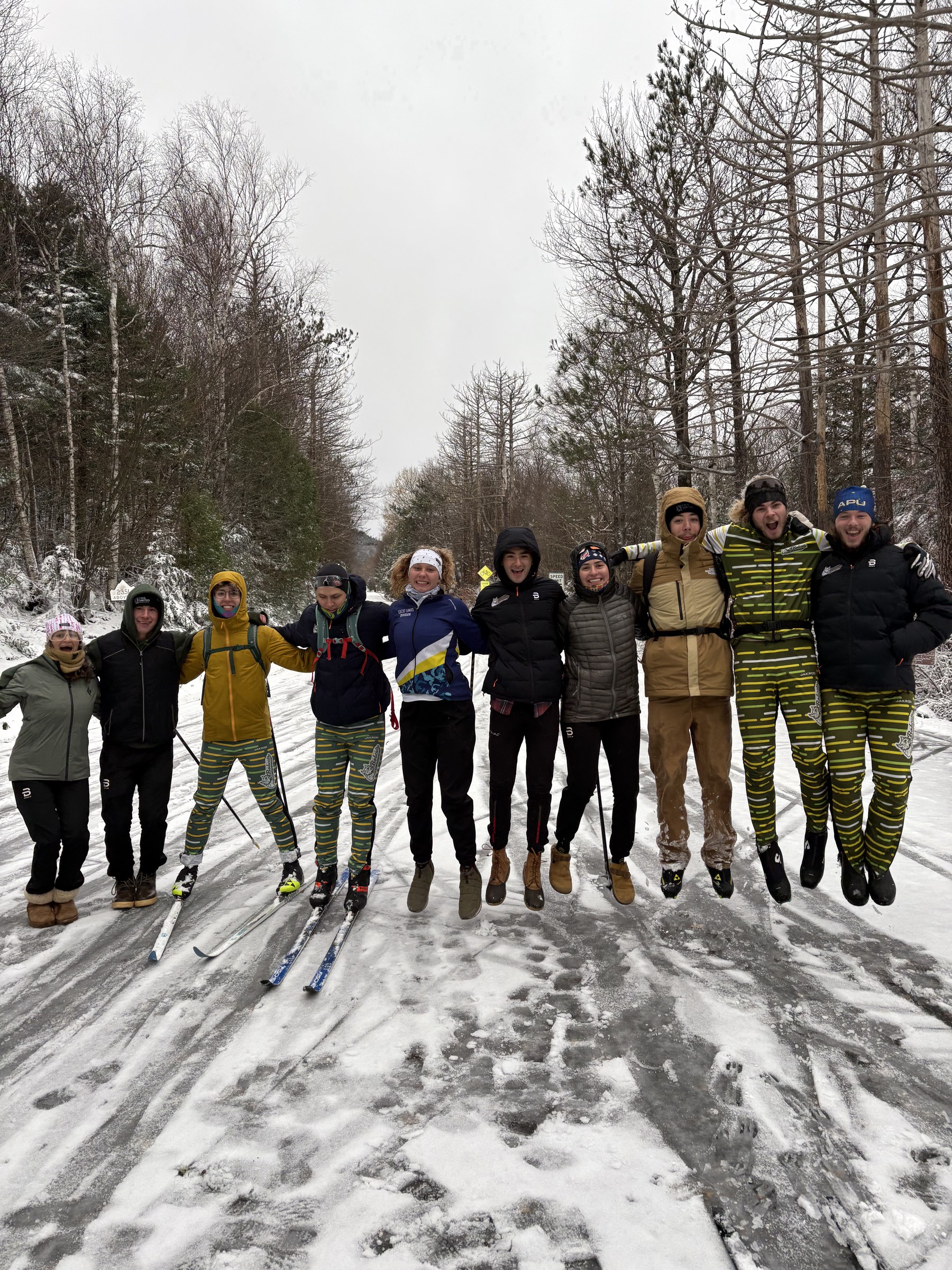
     

    When the sun finally came out the crowd got especially excited. (Photo: Voisin / FasterSkier)
  • Glitter, Knitting, and a Phone Call from Bill Koch: The U.S. Ski Team Is Ready for Lake Placid

    Glitter, Knitting, and a Phone Call from Bill Koch: The U.S. Ski Team Is Ready for Lake Placid

    This coverage is made possible through the generous support of Marty and Kathy Hall and A Hall Mark of Excellence Award. To learn more about A Hall Mark of Excellence Award, or to learn how you can support FasterSkier’s coverage, please contact info@fasterskier.com.

    Jessie Diggins answering questions at the press conference before the World Cup in Lake Placid, New York. (Photo: Voisin/FasterSkier)

    Lake Placid, N.Y. — The eve of the World Cup finals at Mount Van Hoevenberg brought press conferences, sound checks that went sideways, and three American skiers who couldn’t stop making each other smile.

    Jessie Diggins, Ben Ogden, and Gus Schumacher sat side by side Wednesday afternoon — the same trio that has turned the 2025-26 season into something U.S. cross-country skiing has never seen before. Between them: Olympic medals, historic podiums, a 50-year drought shattered, and one very good birthday cake.

    But with three races left and Diggins’s retirement looming, the mood wasn’t heavy. It was loose, funny, and deeply human — exactly the way this team tends to do things.

    “Probably Glitter”

    Asked to define her legacy heading into her final World Cup weekend, Diggins did what Diggins does: she went somewhere unexpected.

    “I think I define my legacy honestly, completely outside race results,” she said. “I am more proud of the things I have done off the course. I think my legacy is going to be in my advocacy and the way that I have spoken about mental health and eating disorders specifically, and the way I’ve tried to make really hard conversations less hard for people to have.”

    She pointed to her work with Protect Our Winters and Share Winter, to the energy she’s poured into the team’s culture over the years. And then she landed the dismount.

    “And probably glitter. I think there’s a lot more glitter in ski races now, and that’s always a great thing — as long as it’s biodegradable.”

    Diggins has spent the season saying goodbye in pieces — a little cry leaving training camp in Bend, quiet moments at each World Cup stop. She knows what’s probably coming Sunday.

    “I suspect it’s probably going to hit like a dump truck on Sunday, and there’s probably going to be a lot of tears.”

    But she’s ready. And what she’s ready for is maybe the most Jessie Diggins thing of all: she sees ski racing as performance art, and she wants her final show to leave people wanting to go run up a mountain or sign their family up for ski lessons.

    “I realized that I can do that moving forward, but just with my story and with my words, and I don’t have to push my body so hard, but I can still leave people inspired and motivated.”

    In the meantime, she’s looking forward to being able to wash her clothes when they’re dirty, cook whatever she wants, and bake cookies on the weekend instead of training and racing all day.

    Ben Ogden answering questions at the press conference before the World Cup in Lake Placid, New York. (Photo: Voisin/FasterSkier)
    “Your Life Is Not Going to Be the Same”

    Ben Ogden grew up in Landgrove, Vermont. American skiing legend Bill Koch lived close by in Peru, Vermont. Same zip code, as Ogden puts it — “not so different.”

    Fifty years separated Koch’s 1976 Olympic medal from Ogden’s silver this season, and when Ogden finally got on the phone with his neighbor and mentor after breaking the drought, Koch didn’t mince words.

    “Bill just sort of said, ‘Hey, congratulations, and your life is not going to be the same from this point forward.’ And that was kind of crazy to hear.”

    Ogden hopes to see Koch at the races this weekend. And racing at Van Hoevenberg carries its own weight for him — not just because of Koch, but because of his father, who was deeply embedded in the New England ski racing community.

    “I think it’s really hard for me to come race in the U.S. and look around and not just, like, constantly think about him, because this was his scene,” Ogden said, his voice softening. “He would have been in such paradise on the side of the trail here in Lake Placid. And I’ll be thinking about him a lot this weekend, for sure.”

    This is technically Ogden’s first home World Cup — he was sick for Minneapolis — and it’s hitting him right. He grew up racing the NYSEF Festival series at Lake Placid, bringing crews of Vermont kids over for slushy late-season races.

    “It’s not my home, but it feels like it.”

    Gus Schumacher answering questions at the press conference before the World Cup in Lake Placid, New York. (Photo: Voisin/FasterSkier)
    Aspirations, Not Goals

    Gus Schumacher has been doing some linguistic rebranding.

    “I’ve been calling them aspirations for a few years now,” he said of his season targets, “because I feel like the pressure of goals was kind of weird for me.”

    The distinction matters to Schumacher. He sets plenty of small goals — the daily, tactical kind — but the big ones, like winning an Olympic medal or finishing in the top 10 of the overall World Cup standings, he holds more loosely. They’re aspirations: things he wants, things he’ll chase, but things he won’t let crush him if they don’t happen.

    “Those are things I want to do, but if they don’t happen, it won’t be because I didn’t try.”

    He accomplished the Olympic medal. He entered this final weekend ranked sixth in the world, with a top-10 finish still in play. And he’s approaching Lake Placid the same way he approached Minneapolis, where he won his first World Cup in front of a hometown crowd: just be happy to be racing, and feed off the energy.

    “Already today, it was really cool to have people cheering us on in the race prep, which doesn’t really happen much on the World Cup ever.”

    Schumacher also dropped maybe the best origin story of the press conference: the formative moment that lit a fire under his career was Luke Jaeger beating him at an Anchorage cup race.

    “That kind of put a fire under my belly to really start training, because I didn’t want him beating me anymore.”

    The Knitting Club, the Water Pump, and the Greenhouse

    The press conference’s best stretch might have been when someone asked the athletes how they decompress.

    Schumacher keeps it clean: headphones, 10 to 20 deep breaths — four seconds in, eight seconds out. Standard operating procedure.

    Ogden? He knits. And he’s not shy about it.

    “After races, I’ve been doing a lot of knitting and stuff like that. Helps me just relax really quick.” After the season, it’s bigger projects: car work. “You can feel like you’re the king of the world after a couple medals, but go and try and replace a water pump on a Forerunner, and that’ll make you feel completely incompetent.”

    Diggins revealed there was a full-on knitting club on the team this winter. Her own reset button is simpler: she calls her husband.

    “He’s my absolute center of my world. The race could have been amazing, and it could have been also completely horrible. And we’re just talking about what I want to do with the garden, and how I want to start a greenhouse. And he’s like, ‘Uh huh, yeah, sure, I’ll support you in that.’”

    One More Thing

    Almost as a throwaway, Ogden mentioned that Andy Newell — “the original Nordic ski backflip guy” — is in Lake Placid this weekend. And Ogden himself has had a backflip dialed since he was 17.

    “I’m hoping on Sunday we can kick up a little ski jump. I’m looking to take another one Sunday afternoon. So stay tuned.”

    Three races to go. A retirement to honor. A culture to celebrate. And maybe a backflip.

    It’s going to be a weekend.


    Love Stories Like This? Help Keep Them Coming.

    Feature stories like this one take time, access, and care to produce. If you value thoughtful storytelling and independent ski journalism, please consider becoming a Voluntary Subscriber. Your support directly fuels the work we do to cover the people, places, and moments that make our sport special.

    Join the FasterSkier community!
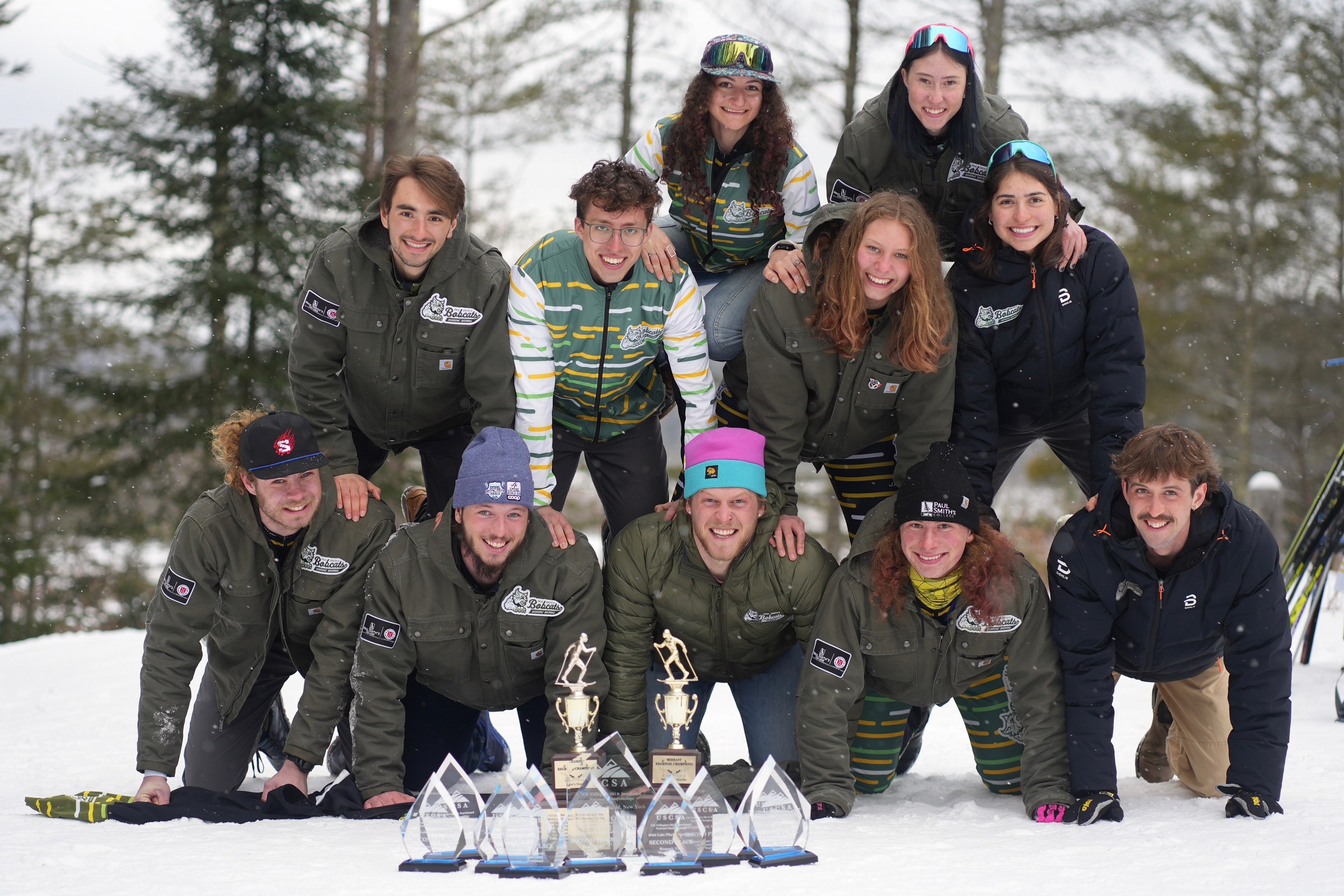
     

  • Klaebo Is Coming to Lake Placid

    Klaebo Is Coming to Lake Placid

    This coverage is made possible through the generous support of Marty and Kathy Hall and A Hall Mark of Excellence Award. To learn more about A Hall Mark of Excellence Award, or to learn how you can support FasterSkier’s coverage, please contact info@fasterskier.com.

    Johannes Hoesflot Klaebo (NOR) took all six gold medals awarded in men’s cross-country skiing at the Olympics last month. (Photo: Barbieri/NordicFocus)

    Johannes Hoesflot Klaebo made the call late Tuesday night… he’s racing.

    According to the Scandinavian press, Klaebo departed Oslo’s Gardermoen airport at 6:25 Wednesday morning, beginning a roughly 20-hour journey to Lake Placid, where he’ll arrive about a day and a half before Friday’s 10-kilometer classic interval start. The Norwegian Ski Federation confirmed the news in a press release on Wednesday morning.

    “I can see this isn’t going to be an optimal buildup, both with the long travel and not being able to adjust to the time difference,” Klaebo said. “But I want to be part of the World Cup finale in the USA.”

    The decision came after Klaebo did a training session on Tuesday morning in Trondheim and responded well. National team doctor Ove Feragen gave him the green light.

    Ben Ogden (USA) checks on Johannes Hoesflot Klaebo (NOR) after their crash eliminated them from the race in Drammen, Norway. (Photo: Nordnes/NordicFocus)

    “After the fall during the sprint in Drammen, and some quiet days at home, Johannes has gradually resumed training and normal activity,” Feragen said. “He has responded well to this, without any recurring symptoms after the fall. After observation and further examinations, we have concluded that he is fit to compete.”

    Klaebo has been sidelined since March 12, when American Ben Ogden fell across the Norwegian’s skis during Classic Sprint semifinals in Drammen, Norway. The resulting crash sent Klaebo’s head into the hard-packed snow. He was diagnosed with a mild concussion, withdrew from the Holmenkollen 50k, and scrapped a planned media tour in New York City that included sit-downs with CNN, NBC, the New York Times, and the Wall Street Journal.

    Now the question shifts from whether Klaebo will race to how much he’ll race. He’s not committing to the full program.

    Harald Oestberg Amundsen (NOR), Johannes Hoesflot Klaebo (NOR), and Martin Loewstroem Nyenget (NOR), (l-r) share the Skiathlon podium in Falun, Sweden, on March 1st, 2026. (Photo: Thibaut/NordicFocus.)

    “My expectations for performance are not sky-high,” Klaebo said. “I’ll do my best despite a poor buildup and potential jet lag. Whether I race one, two, or three events in Lake Placid, I’ll decide once I get to the USA and get skis on my feet.”

    The stakes are real despite the measured tone. Klaebo has already clinched the overall World Cup — his sixth, tying Bjoern Daehlie — and the sprint globe. But he trails Harald Oestberg Amundsen by three points in the distance standings after missing the Holmenkollen 50k. Two distance events remain: Friday’s 10 k Classic and Sunday’s 20k Freestyle Mass Start. A clean sweep of the overall, sprint, and distance globes would be a first in Klaebo’s career.

    “For cross-country skiing, it’s especially important to have World Cups in the USA,” Klaebo said. “I’ve been looking forward to this finale for a long time.”

    Racing begins Friday at Mt. Van Hoevenberg. Klaebo will be on the start line — jet lag and all.


    Love Stories Like This? Help Keep Them Coming.

    Feature stories like this one take time, access, and care to produce. If you value thoughtful storytelling and independent ski journalism, please consider becoming a Voluntary Subscriber. Your support directly fuels the work we do to cover the people, places, and moments that make our sport special.

    Join the FasterSkier community!
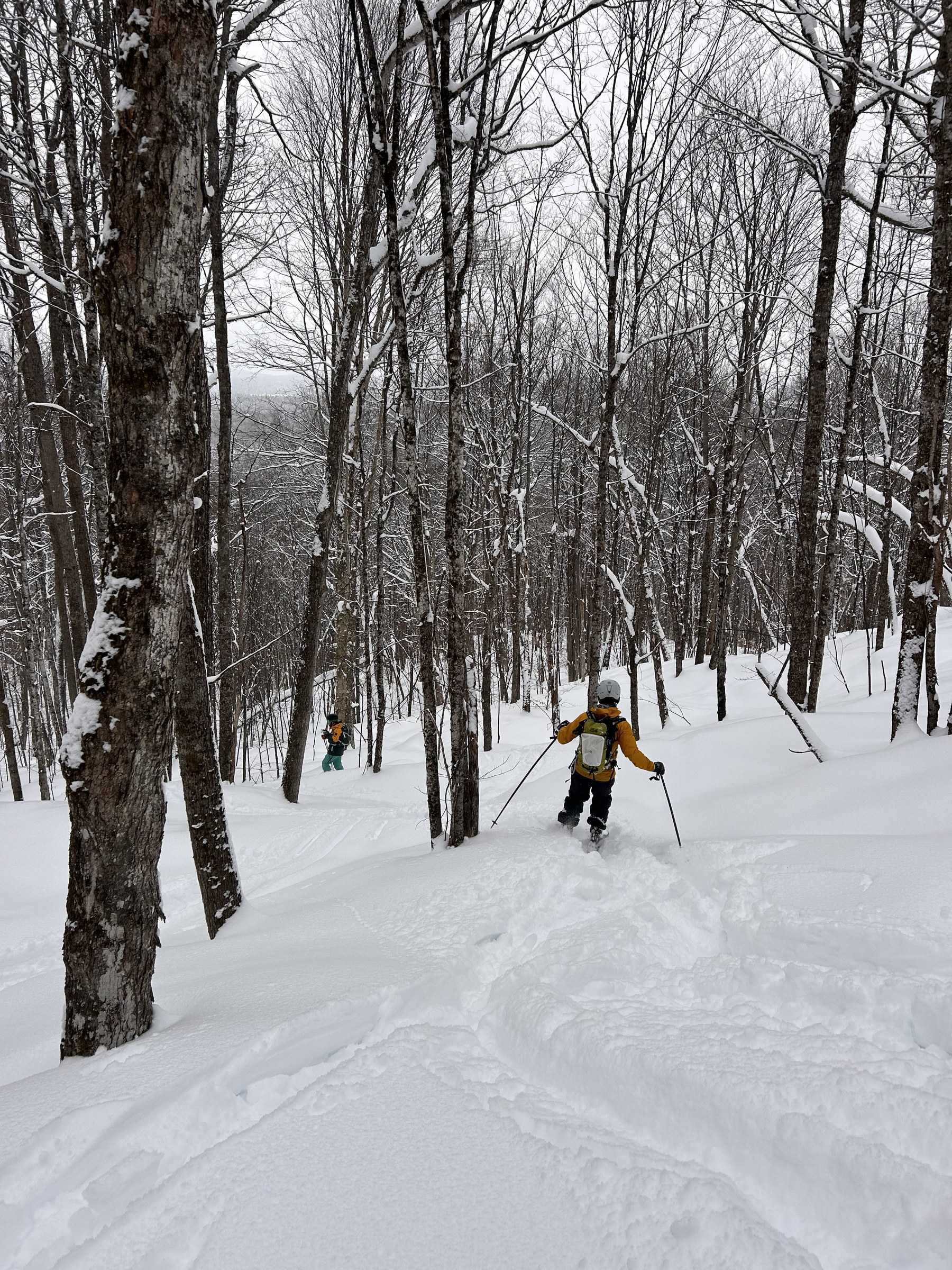
     

    Ben Ogden (USA) and Johannes Hoesflot Klaebo (NOR), along with Oskar Opstad Vike (NOR), (l-r) on the Olympic sprint podium last month.  It should be made clear that Ogden and Klaebo have a strong respect for one another, to say the least. (Photo: Vanzetta/NordicFocus)
  • What to Do in Lake Placid When You’re Not Watching World Cup Racing

    What to Do in Lake Placid When You’re Not Watching World Cup Racing

    You’ve got your tickets. You know the race schedule. You’re making the trip to Mt. Van Hoevenberg for the first World Cup finals ever held on American soil. But the racing doesn’t fill every hour of the day, and Lake Placid is the kind of town that rewards a little wandering. Over the last 15 years, my family and I have spent a lot of time in Lake Placid, and here’s what we’d suggest for filling in the gaps — whether you’re traveling solo, with a crew, or with kids in tow.

    Fuel up

    Start the morning at Big Mountain Deli & Crêperie on Main Street. They’ve got 46 sandwiches named after Adirondack high peaks, plus breakfast burritos, crepes, and all the espresso drinks you need to survive a cold morning in the stadium. A word of advice: order online in advance. The line moves faster if your food is already being made. Note that they’re closed on Wednesdays, so plan accordingly if you’re arriving midweek.

    If you’d rather sit down and take your time, The Breakfast Club is just up the street and serves a proper breakfast and lunch with views of Mirror Lake. The portions are generous, the pancakes are legit, and if you’ve got kids, the hot cocoa is a guaranteed win. They open at 8 a.m. daily and close at 1, so don’t dawdle.

    Lunch and dinner

    For a real meal, Lisa G’s is our pick. It’s a short drive from Main Street on Sentinel Road, with a menu that leans American but doesn’t phone it in — think elevated pub food with creative wings, excellent fish and chips, and a solid beer list. They serve lunch on Fridays through Sundays starting at 11:30, and dinner Thursday through Monday. Closed Tuesdays and Wednesdays, so keep that in mind for early-week arrivals.

    For something more upscale, the Mirror Lake Inn is one of the classic Adirondack properties — a lakefront resort with a polished dining room and views to match. And if you want something a bit more casual but still special, check out The Cottage, also on the Mirror Lake Inn grounds. It’s a cozy spot right on the water where you can grab dinner or a drink in an old gondola. It’s open Tuesday through Sunday — closed Mondays.

    If you’re looking for a spot that can handle a crowd, Dancing Bears at the High Peaks Resort is worth a look. It’s at the far end of Main Street and has plenty of space — which matters on a weekend like this one, when every restaurant in town is going to be slammed. We’re fans of the food here, especially the salmon. It’s a reliable pick when other spots have a 45-minute wait.

    Breweries

    Lake Placid has two breweries worth your time, and both serve food if you’re looking to make a full stop of it.

    Lake Placid Pub & Brewery has been an institution on Mirror Lake Drive for years. The beer list is deep, the vibe is pub-casual with college banners lining the walls, and the upstairs bar is a solid spot to post up after a day at the races. They’re open daily from 11:30 a.m. (noon on Sundays) and stay open late — midnight on weeknights, 2 a.m. on Fridays and Saturdays. If you can only try one drink, ask about the Smoked Berry Old Fashioned.

    Big Slide Brewery & Public House is out on Cascade Road, about a five-minute drive from downtown and right near the Olympic Jumping Complex — which makes it an obvious stop if you’re heading to the Skirious Problems live recording Saturday evening. The beer ranges from fruit-forward lighter options to solid IPAs and porters, and the food holds its own. The burgers are good, the pizza is legit, and the buffalo wings have a bit of a cult following. They’ve also got outdoor seating with fire pits and Adirondack chairs if the weather cooperates. Open daily from 11:30 a.m. (10 a.m. on Sundays).

    Catch some NCAA March Madness

    The World Cup finals land smack in the middle of the NCAA basketball tournament, and if you need a screen and a cold beer between race sessions, Lake Placid has you covered. Wiseguys Sports Bar & Grill on School Street is the classic move — TVs everywhere, good wings, no pretense. They’re open Wednesday through Sunday. Players Waterfront Eatery on Main Street is another solid option with screens and lakeside seating if the weather cooperates.

    Stroll and Explore Main Street

    Don’t underestimate a good Main Street stroll. Lake Placid’s downtown is walkable and full of shops worth ducking into.

    Saratoga Olive Oil Company is one of those places you walk into out of curiosity and end up spending way longer than you planned. They’ve got dozens of flavored olive oils and balsamic vinegars you can taste — some combinations will surprise you, and it’s a genuinely fun challenge for your taste buds. Great for picking up a gift or just entertaining yourself for half an hour.

    The Maple Shop is exactly what it sounds like — a deep dive into maple syrup and all things maple. But it’s more interesting than you might expect. They carry different varieties and grades, and tasting your way through the range is a quick education in how much variation there is in something most people think of as one flavor.

    Adirondack Popcorn Co rounds out the Main Street tasting tour. They specialize in creative popcorn flavors — some classic, some funky — and it’s the kind of snack you can grab and take with you to the races or back to wherever you’re staying.

    Get Outside

    You’re in the Adirondacks. Get some fresh air.

    Though having recently CLOSED at the end of the 2026 season, Olympic Speed Skating Oval is open for public skating and is one of the few outdoor refrigerated ovals in the country. If the oval’s schedule doesn’t line up with yours, Mirror Lake itself often has a maintained skating area — check conditions locally when you arrive.

    Get out on the Ironman Lake Placid course on Mirror Lake Drive — hopefully it won’t be raining — like IMLP Champion Trevor Foley. (Photo: Voisin / FasterSkier)

    For our money, no trip to Lake Placid is complete without a walk or jog around Mirror Lake. The loop is about 2.7 miles on a paved path, it’s flat and accessible, and the residential architecture along the shoreline is worth the trip on its own — beautiful old Adirondack homes mixed in with classic lake houses, all set against the mountains. It’s a perfect way to shake out your legs before or after a day in the stadium.

    If you’re looking for something a bit more rugged, there are dozens of short hikes in the area, but be warned: this time of year, trail conditions are unpredictable. You might hit packed snow, mud, ice, or all three in the span of a quarter mile. Bring traction devices if you have them, and dress for the mess. Cobble Hill is a nice short option with a rewarding view at the top — nothing too long or steep, but enough to feel like you earned it.

    Need to get out for a Nordic Ski

    If you’re itching to actually ski while you’re up here, your options may be limited. Mt. Van Hoevenberg’s trails will almost certainly be closed to the public during the World Cup weekend. But if you’re willing to make the drive, the Paul Smith’s College VIC in Paul Smiths — about 30 minutes north of Lake Placid — is a strong option. We checked in with Paul Smith’s head Nordic coach Matt Dougherty, who had his team out on the trails Wednesday morning for biathlon practice. “It was actually fantastic,” Dougherty told FasterSkier. “Conditions will reflect the temperatures — normal spring skiing.” Most trails are open and being groomed daily with the college’s PB 100, though a few trails that got washed out last week are closed for the season. The VIC maintains over 25 miles of trails, including more than 10 kilometers of FIS-homologated courses and 25 kilometers of skate skiing. The system benefits from heavier snowfall than other parts of the region, which tends to keep trails skiable even when conditions elsewhere are lean. Trail conditions are updated on their Nordic Pulse page. The VIC’s winter season runs through April 1.

    Saturday Evening at the Jumps

    After the sprint finals wrap up on Saturday, head over to the Olympic Jumping Complex on Cascade Road for a live recording of the Skirious Problems podcast at 6:00 p.m. Hosts Mika Vermeulen and James Clugnet will be joined by Ben Ogden, Frida Karlsson, and Federico Pellegrino. It’s free, but organizers are suggesting it may already have sold out — check the World Cup Finals event page for the link. After that, the Palace Theatre downtown is screening Threshold at 7:00 p.m.

    Family-friendly fun

    The Lake Placid Toboggan Chute on Mirror Lake is one of those only-in-Lake-Placid experiences — a 30-foot wooden tower that launches you and a toboggan out across the frozen lake. Warmer spring temperatures have caused the chute’s closing for this season, but it’s typically open Friday evening and Saturday and Sunday during the day. Lines can build, but it’s worth the wait.

    If you’re already out at Mt. Van Hoevenberg, the Hi Notch Indoor Climbing center is right inside the Mountain Pass Lodge. It will be CLOSED during the FIS World Cup finals, but other days you’ll find a 30-foot top rope wall with over 1,500 square feet of climbing space, plus bouldering and traverse walls. All gear is provided, and instructors are on hand during daytime sessions. It could be busy this weekend, given the crowds, but it’s a great option for families or anyone who needs to burn off some energy between races.

    If you’ve got a free morning or want a half-day excursion, the Wild Center in Tupper Lake is about 45 minutes west and worth every mile. It’s a natural history museum with live animals, hands-on exhibits, and the Wild Walk — a series of treetop bridges with panoramic views of the Adirondacks. It’s open Friday through Sunday, so you could pair it with a race day or build it into your travel schedule. Just know you’ll have to choose between the Wild Center and a morning at Van Hoevenberg if you’re trying to do both.

    Closer to town, the Palace Theatre on Main Street is a beautifully maintained old single-screen movie house — a perfect way to wind down after a long day in the cold. And if your group wants something more active, Lake Placid Lanes (also known as Big Z’s) has bowling, arcade games, shuffleboard, darts, and a full bar. Reservations are recommended, especially on weekends — this place fills up.

    Lake Placid has been hosting the world’s best winter athletes since 1932. The town knows how to do this. Get out there and enjoy it.

  • Klaebo’s Lake Placid Decision Day Is Today

    Klaebo’s Lake Placid Decision Day Is Today

    This article was made possible through the generous support of our voluntary subscribers. If you value coverage like this, please support FasterSkier with a voluntary subscription.

    Fans from across the United States who will be in Lake Placid are anxiously hoping Johannes Hoesflot Klaebo (NOR) is well enough to travel and race in Lake Placid this weekend. (Photo: Authamayou/NordicFocus)

    Johannes Hoesflot Klaebo has been included in Norway’s 22-athlete squad for this week’s World Cup finals at Mt. Van Hoevenberg in Lake Placid, N.Y., BUT the six-time Olympic gold medalist’s participation hinges on a decision being made today.

    Klaebo, 29, suffered a mild concussion in a dramatic crash during the sprint semifinals at last Thursday’s World Cup in Drammen. American sprinter Ben Ogden lost his footing on the icy course and fell across Klaebo’s skis, sending the Norwegian backward and slamming the back of his head into the hard-packed snow. Klaebo lay on the ground for several minutes before being helped off course and transported to a hospital for evaluation.

    The Norwegian Ski Federation confirmed the concussion diagnosis on Friday, and Klaebo withdrew from Saturday’s 50-kilometer race at Holmenkollen.

    “He shall make an evaluation together with the national team doctor on Tuesday and would potentially travel on Wednesday,” Klaebo’s manager, Lasse Gimnes, told Norwegian broadcaster NRK on Monday. If cleared by national team doctor Ove Feragen, Klaebo would travel to New York on Wednesday — arriving just two days before Friday’s 10-kilometer classic interval start.

    The crash also disrupted a planned trip to New York City for media appearances with CNN, NBC, the New York Times, and the Wall Street Journal — a reflection of the enormous international attention Klaebo has drawn since his record-setting six-gold performance at the Milano Cortina Olympics. Those in-person interviews have been scrapped, though some may shift to virtual formats.

    Johannes Hoesflot Klaebo (NOR) poses with the FIS Crystal Globes he won last season at World Cup Finals in Lahti, Finland. (Photo: Thibaut/NordicFocus)
    The distance globe is on a knife’s edge

    The distance cup title is the central subplot heading into the finals. Before Holmenkollen, Klaebo held a 128-point lead in the distance standings. But with the Norwegian watching from home on Saturday, Amundsen’s 131-point haul vaulted him into the distance lead: Amundsen now sits at 939 points, three ahead of Klaebo’s 936. Martin Loewstroem Nyenget climbed to 914 in third. Just two distance events remain — Friday’s 10-kilometer classic interval start and Sunday’s 20-kilometer freestyle mass start. If Klaebo can travel and race, the margin is thin enough that a single strong result could flip the standings again. If the concussion keeps him out, the distance globe almost certainly goes to Amundsen.

    Klaebo has already clinched both the overall World Cup — his sixth, tying Bjoern Daehlie’s all-time record — and the sprint globe.

    Norway’s men’s squad: Harald Oestberg Amundsen, Martin Loewstroem Nyenget, Einar Hedegart, Andreas Fjorden Ree, Mattis Stenshagen, Emil Iversen, Johannes Hoesflot Klaebo, Lars Heggen, Even Northug, Ansgar Evensen, and Even Solem Michelsen.

    Jessie Diggins soaks in all the energy from the home crowd during her warmup in Minneapolis — the last time the World Cup was on American snow. (Photo: Leann Bentley/USST)
    Diggins’s farewell, and notable absences

    The Lake Placid finals will serve as the final competitive races for Jessie Diggins, the most decorated cross-country skier in U.S. history. The women’s overall cup and distance cup are both decided, with Diggins winning with a comfortable margin over Sweden’s Moa Ilar in second. The three-time Olympic medalist and three-time overall World Cup champion announced before the season that this would be her last, and a farewell on home snow in front of an American crowd at the first-ever U.S.-hosted World Cup finals is about as fitting a send-off as anyone could script.

    Klaebo is not the only notable question mark heading into the weekend. Norway’s Kristine Stavaas Skistad and Mathilde Myhrvold have opted to skip the finals to prepare for part two of Norwegian nationals in Harstad next week. Sweden’s Ebba Andersson has also pulled out.

    Norway’s women’s squad for Lake Placid includes Astrid Oeyre Slind, Heidi Weng, Kristin Austgulen Fosnaes, Karoline Simpson-Larsen, Nora Sanness, Karoline Groetting, Julie Bjervig Drivenes, Tiril Udnes Weng, Julie Myhre, Lotta Udnes Weng, and Milla Grosberghaugen Andreassen.

    The men’s freestyle mass start gets started at the US National Championships in Lake Placid, NY, 1/8/26. (Photo: Nancie Battaglia)
    A historic venue

    The Lake Placid finals mark the first Cross-Country World Cup finals ever held in the United States and the return of World Cup racing to Lake Placid for the first time since 1979. Racing kicks off Friday at Mt. Van Hoevenberg with the 10-kilometer classic interval start, followed by a freestyle sprint on Saturday and a 20-kilometer freestyle mass start on Sunday.

    This is a developing story. FasterSkier will update when Klæbo’s decision is announced.


    Help Support Our Olympic Coverage!

    If you value the thoughtful work and access FasterSkier provides, please consider becoming a Voluntary Subscriber. Your support directly fuels our work to cover the people, places, and moments that make our sport special.

    Join the FasterSkier community!
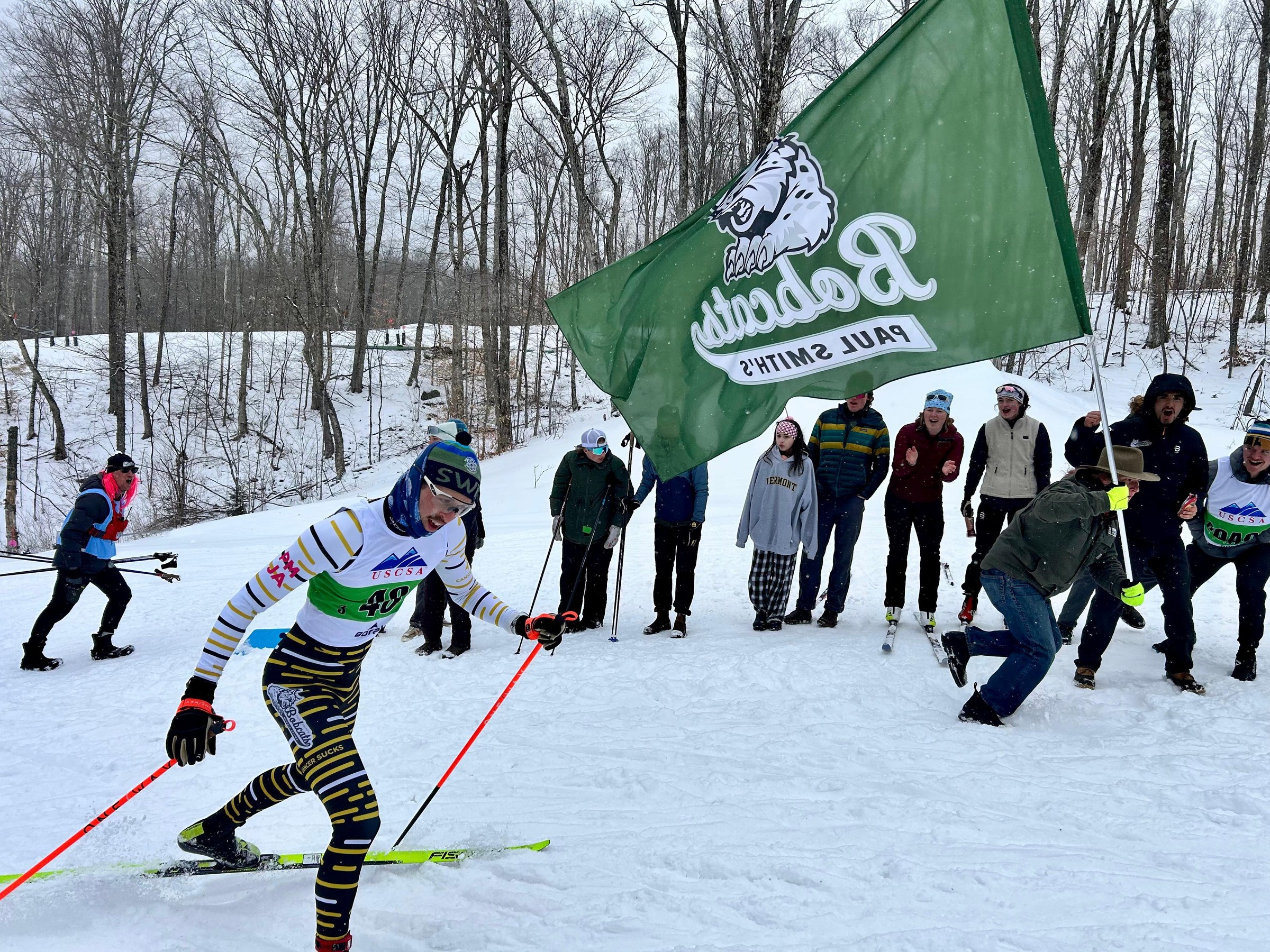
     

  • Hedegart Emerges From the Fog to Win Holmenkollen 50 k as Klæbo’s Absence Reshuffles the Distance Globe

    Hedegart Emerges From the Fog to Win Holmenkollen 50 k as Klæbo’s Absence Reshuffles the Distance Globe

    This coverage is made possible through the generous support of Marty and Kathy Hall and A Hall Mark of Excellence Award. To learn more about A Hall Mark of Excellence Award, or to learn how you can support FasterSkier’s coverage, please contact info@fasterskier.com.

    The start of the Holmenkollen Men’s 50 k Freestyle in Oslo, Norway. (Photo: Authamayou/NordicFocus)

    For nearly two hours on Saturday, 77 men disappeared into a stubborn curtain of fog that clung to the hillsides above Oslo, their figures swallowed by the mist somewhere between the stadium and the high point at Frognerseteren. When it was over, only one emerged with his arms in the air, and it was the one freestyle specialist who had been topping shorter freestyle distance races most of the season.

    Einar Hedegart, the 24-year-old former biathlete who only committed fully to cross-country skiing in November, surged past Harald Oestberg Amundsen in the final meters to win the Holmenkollen 50 k Freestyle in 1:51:38.2 — his first victory on cross-country skiing’s most storied stage, in just his seventh World Cup start.

    “This is the greatest feeling I’ve ever had,” Hedegart said after the finish. “This is just a nostalgia stadium. [A] legendary race, almost all my heroes have won this race, and especially Petter Northug. This might be the reason why I’ve been so motivated my whole life to be a cross-country skier.”

    Einar Hedegart (NOR) celebrates winning Norway’s most iconic race. www.nordicfocus.com. (Photo: Authamayou/NordicFocus)

    But the result that will echo loudest across the sport happened away from Oslo. Johannes Hoesflot Klaebo, the overall World Cup leader, was home nursing a mild concussion from a hard crash in the Drammen sprint two days earlier. Klaebo, who has already compiled a nearly perfect season, winning the Tour de Ski, all six Olympic races, secured the FIS Overall Crystal Globe, the FIS Sprint Crystal Globe, and only needed to keep racing the remaining distance races to take the clean sweep of the season with the FIS Distance Crystal Globe. BUT his absence from the start line meant zero points scored in the distance standing today. And with Amundsen’s second-place finish today, the distance crystal globe race was blown wide open: Amundsen now leads the distance standings by three points, 939 to 936, with two distance races remaining at the World Cup Finals in Lake Placid.

    Klaebo posted to Instagram yesterday: “Took a fall yesterday and hit my head pretty hard, but luckily everything is all good in the hood. Ended up with a concussion, so I’ll take some days off from both training and the internet just to make sure everything settles properly. Only got one head, so have to take good care of it.”

    He had been scheduled to fly to the United States on Sunday, but will now stay in Norway for a few extra days, hoping to recover in time for Lake Placid.

    Einar Hedegart (NOR) emerges from the fog to take the win. (Photo: Nordnes/NordicFocus)
    A Race Defined by Fog

    The Holmenkollen 50 k — first raced in 1888, a fixture of the World Cup since 1982, and a race that draws an estimated 100,000 fans to the forested hills above Oslo — returned to the calendar Saturday after a one-year absence. For the first time, the men’s and women’s 50 k races were held on the same day, the women starting 45 minutes behind the men in a format designed to create an all-day spectacle. The fog, however, had other ideas. Conditions were so thick that spectators along the course could hear the racers before they could see them.

    The course — six laps of 8.3 km with 334 meters of climbing per lap — was firm and fast after overnight salting despite an air temperature of 5.0°C. The salted, compact surface was ideal for skating, and the winning time of 1:51:38 came in roughly four minutes faster than the last time the Holmenkollen 50 k was contested in freestyle.

    Harald Oestberg Amundsen (NOR) on his way to second place. (Photo: Authamayou/NordicFocus)

    Through the first three laps, the race unfolded as a cautious tactical affair. A large pack of roughly 40 skiers stayed together, with Martin Loewstroem Nyenget, Mattis Stenshagen, and Federico Pellegrino taking turns at the front. The first athlete to make a decisive tactical move was Iver Tildheim Andersen, who changed skis early at the stadium after the third lap while the rest of the pack continued through. The fresh skis gave Andersen a burst, and when the lead group stopped for their own ski exchange one lap later, he suddenly found himself alone at the front with a roughly 15-second advantage.

    “Just stick with the field as long as possible and then hopefully be in position when the group starts swarming,” Hedegart said of his plan. “But today I was really offside, like 70 percent of the race. So I was lucky that no one took a gap.”

    The chase group — reduced to roughly eight athletes, all Norwegian once France’s Victor Lovera fell off the pace — gradually closed on Andersen through the fifth lap, with Hedegart, Simen Hegstad Krueger, Amundsen, Nyenget, Andreas Fjorden Ree, and Kasper Andersson Herland trading pulls at the front. By the time the group reached the final lap, they had swallowed Andersen, and the race became a question of who had saved enough for the final kilometers.

    Simen Hegstad Krueger (NOR) tried his best to get away for the win. (Photo: Authamayou/NordicFocus)
    Krueger’s Late Charge and Hedegart’s Final Kick

    Krueger, who was celebrating his 33rd birthday the day before, was omitted from the Norwegian Olympic team despite multiple Olympic medals in his career and was the winner of the last freestyle Holmenkollen 50 k. He drove the pace through the final lap. He pushed hard over the climbs near the iconic Holmenkollen church, stringing out the group and shedding Andersen off the back. But Krueger couldn’t sustain the pressure all the way to the finish, and as the group of seven came around the final corner and up the short, steep ramp before the descent into the home stretch, the sprint was on.

    Amundsen launched first, throwing everything he had at the final few hundred meters. But Hedegart, who had looked labored at points earlier in the race, found a gear no one could match. He came alongside Amundsen, took the lead in front of the grandstand crowd, and raised his fist in celebration as he skied across the line.

    “I felt, like, better,” Hedegart said of his position in the back of the pack through much of the race. “So I was just laying in the field, and I had to remind myself he did the same,” he added, referring to his idol Northug, whose trademark move was stalking from behind before unleashing a devastating sprint.

    Harald Oestberg Amundsen (NOR), Mattis Stenshagen (NOR), and Martin Loewstroem Nyenget (NOR), (l-r) stayed in the lead pack. (Photo: Authamayou/NordicFocus)

    Hedegart crossed in 1:51:38.2. Amundsen finished four-tenths of a second behind. Nyenget was third at +1.1. Ree took fourth (+1.5), followed by Herland (+2.1), Krueger (+3.0), Moseby (+4.8), and Andersen (+16.8) after his brave solo effort. Norway swept the top eight positions.

    France’s Lovera was the first non-Norwegian in ninth (+48.1), followed by AIN athlete Savelii Korostelev in 10th (+1:24.2).

    Zak Ketterson (USA) led the way for the Americans in the chase pack racing for 11th place; he ultimately finished 18th. (Photo: Authamayou/NordicFocus)
    Ketterson Fights for 11th in His Adopted Home

    Zak Ketterson, who spent the summer and fall living and training in Oslo, found himself in the thick of a battle for 11th place, a fight he learned about from coaches stationed along the fog-shrouded course.

    “I had heard from coaches on the side of the trail that our pack was fighting for 11th, and that was super cool,” Ketterson said. “I actually felt pretty fresh at the end and thought my finishing sprint would be pretty good, but I didn’t time it well and got really boxed in on the last couple turns into the finish.”

    Ketterson ultimately finished 18th (+1:54.2), part of a chase pack that came across the line within seconds of each other. He said everyone in the group knew a sprint was coming on the final lap.

    The fog made the tactical picture nearly impossible to read. “I couldn’t see more than 10 meters in front of me,” Ketterson said. “It definitely made it difficult to assess where I was relative to the leaders in the later laps. It also made some of the corners feel way sketchier because you couldn’t really choose an optimal line with such limited visibility.”

    For Ketterson, the race carried personal significance beyond the result. Having trained on the Holmenkollen course through the Norwegian summer and fall, he knew every climb and descent intimately. “This is definitely one of the most iconic and cool races we get to do,” he said. “It was especially special for me this year since I trained on this course all summer and fall living in Oslo. The highlight was definitely having my wife Julie and her family out there cheering me on.”

    What made the performance all the more impressive was the state of his body coming in. “I honestly feel like I am really running on fumes,” Ketterson said. “To be honest, I was not sure if I would even start this race in the morning. I felt so bad, and honestly, my body has felt super up and down in the last few weeks. I’m really curious to see how my body responds to this race. I was pleasantly surprised by how decent it felt, but I feel like the next week could go either way. Especially with the international travel tomorrow.”

    Brian Bushey (USA) gaining experience on his way to 59th place. (Photo: Authamayou/NordicFocus)
    The Rest of the North Americans

    Hunter Wonders was 45th (+5:46.9), Kevin Bolger was 48th (+6:51.3), and Brian Bushey was 59th (+12:24.9).

    Canada’s Xavier McKeever finished 41st (+5:11.4), while Thomas Stephen was 43rd (+5:18.1).

    Harald Oestberg Amundsen (NOR) takes over the FIS Distance Globe lead with just two distance races remaining. (Photo: Authamayou/NordicFocus)
    Distance Globe: Three Points

    The ramifications of Saturday’s race land squarely on the crystal globe picture. Before the race, Klaebo held a 128-point lead over Amundsen in the distance standings and a 636-point lead in the overall. With Klaebo watching from home, Amundsen’s 131-point haul (including bonus points) vaulted him into the distance lead: Amundsen now sits at 939 points, three ahead of Klaebo’s 936. Nyenget climbed to 914 in third.

    Klaebo’s overall World Cup lead, at 2,071 points to Amundsen’s 1,566, remains secure with a 505-point cushion. But the distance globe — awarded to the season’s best across distance events only — will come down to the final two races: a 10 k Classic Interval Start and a 20 k Freestyle Mass Start in Lake Placid, March 20-22.

    If Klaebo can travel to Lake Placid and race, he’ll have every opportunity to reclaim the lead. If the concussion keeps him out, the distance globe is likely to belong to Amundsen.

    Kasper Andersson Herland (NOR), who finished fifth, celebrates with Einar Hedegart (NOR), (l-r) at the finish of the Holmenkollen. (Photo: Authamayou/NordicFocus)
    A Star Made for This Stage

    Hedegart’s career trajectory is one of the season’s best stories. A junior biathlon world champion who struggled with his shooting, he drifted toward cross-country skiing after a surprising second-place finish at the Holmenkollen World Cup last season. He spent the summer training with a cross-country team while bringing his rifle to every camp, undecided. In November, after winning the popular pre-World Cup cross-country race in Beitostoelen, Norway, by a wide margin and missing eight of 20 shots in a biathlon event, he committed to leaving the rifle at home.

    Since then: an Olympic bronze in the 10 k Freestyle behind Klaebo, a team sprint gold partnered with Klaebo, victories in the Engadin Marathon, and now the Holmenkollen 50 k — a distance he had never raced at the World Cup level. He was asked whether his approach of sitting back resembled Northug’s famous stalking tactics.

    “Yeah, I felt like Petter,” Hedegart said. “So I was just lying in the field, and I had to remind myself he did the same.”

    For a race that dates to 1888, that has been won by the sport’s mythical stars, and that is contested before the King of Norway in a stadium surrounded by 100,000 fans, there is no small amount of weight to what happened Saturday at the Holmenkollen. Hedegart is, by every measure, now a cross-country skier.

    The season concludes with the World Cup Finals in Lake Placid, New York, March 20-22. Three races remain. The distance globe is separated by three points. And the world waits to see whether Klaebo can make it to the start line.


    Holmenkollen Men’s 50 k Freestyle FINAL RESULTS

    FIS Men’s Crystal Globe SPRINT STANDINGS
    FIS Men’s Crystal Globe DISTANCE STANDINGS
    FIS Men’s Crystal Globe OVERALL STANDINGS


    Love Stories Like This? Help Keep Them Coming.

    Feature stories like this one take time, access, and care to produce. If you value thoughtful storytelling and independent ski journalism, please consider becoming a Voluntary Subscriber. Your support directly fuels the work we do to cover the people, places, and moments that make our sport special.

    Join the FasterSkier community!
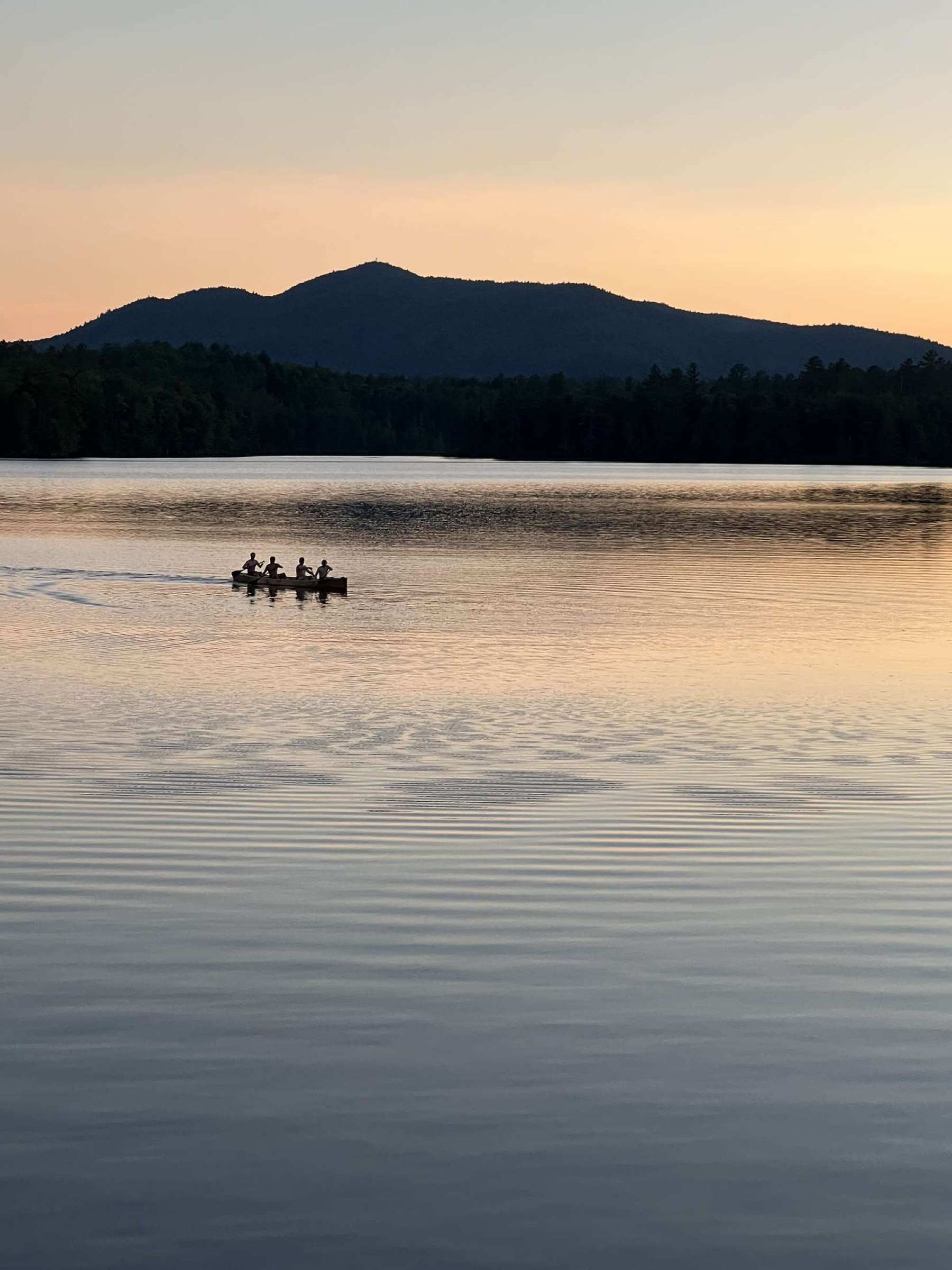
     

    Harald Oestberg Amundsen (NOR), Andreas Fjorden Ree (NOR), and Martin Loewstroem Nyenget (NOR), (l-r) share the Holmenkollen 50 k Freestyle in Oslo, Norway. (Photo: Authamayou/NordicFocus)
  • Evensen Stuns Drammen as Klaebo and Ogden Crash Out of Semifinals

    Evensen Stuns Drammen as Klaebo and Ogden Crash Out of Semifinals

    This coverage is made possible through the generous support of Marty and Kathy Hall and A Hall Mark of Excellence Award. To learn more about A Hall Mark of Excellence Award, or to learn how you can support FasterSkier’s coverage, please contact info@fasterskier.com.

    Ben Ogden (USA) and Johannes Hoesflot Klaebo (NOR), (l-r) moments after their Semifinal crash in Drammen, Norway. (Photo: Nordnes/NordicFocus)

    The greatest cross-country skier in history was lying on the snow, his arms wrapped over his face, his hands holding the back of his head, and the city of Drammen — where the man-made course magically appears on top of the streets, and Norwegian children crane from balconies to watch the racing — went very, very quiet.

    Johannes Hoesflot Klaebo did not finish on Thursday. Neither did Ben Ogden. The gold and silver medalists from the Olympic sprint classic in Milano Cortina just last month, the two men who have defined this event all season, were tangled together on the hard-packed final downhill before the hairpin, while the semifinal raced on without them.

    After the chaos of the semi-final, which took down the two fastest qualifiers, a 25-year-old Norwegian named Ansgar Evensen — who had changed into Skiathlon boots between the quarterfinals and semifinals because he felt so unsteady on his feet — surged from sixth place in the final to cross the line first.

    Evensen won ahead of Jiri Tuz, the 21-year-old Czech who earned a career-best second place. Kristian Kollerud of Norway, racing in his very first World Cup start, took a remarkable third, and Harald Oestberg Amundsen, the 2024 overall World Cup champion, finished fourth.

    It was the kind of day that maybe only Drammen — with its icy hairpin, its drafting effect, and its knack for producing chaos at precisely the wrong moment — could deliver.

    Johannes Hoesflot Klaebo (NOR), Bernat Selles Gasch (ESP), Theo Schely (FRA), Ludek Seller (CZE), and Vili Crv (SLO), (l-r) in the first Quarterfinal. (Photo: Nordnes/NordicFocus)
    Qualification and Quarterfinals

    Klaebo’s dominance was apparent from the opening qualification. He posted a 2:24.88, nearly three seconds faster than Ogden’s 2:27.47, with the next 28 qualifiers separated by less than five seconds. That kind of gap on a world-class field in sprint qualification puts his dominance in perspective.

    Klaebo, as he always does, chose the first quarterfinal heat. He won it easily — clocking 2:37.14 — compared to his qualifier, a notably conservative time that suggested he was managing his energy for the rounds ahead.

    Simone Mocellini (ITA), Ben Ogden (USA), and Aron Aakre Rysstad (NOR), (l-r) in the second Quarterfinal. (Photo: Nordnes/NordicFocus)

    Ogden, the lone American in the top 30, qualified second and chose Quarterfinal 2 alongside Italy’s Simone Mocellini and Norway’s Even Northug. He entered the bottom of the final climb up to the iconic finish on the steps of the Neo-Gothic Bragernes Church behind the leaders, but unleashed a powerful double-pole to charge into second place, advancing comfortably.

    The quarterfinals also produced some early drama. Northug, who had been enjoying a strong sprint season, was disqualified from Heat 2 after receiving his second written reprimand of the season, this time for a classical technique infraction.

    And quietly, in Heat 3, Evensen advanced as a photo-finish second behind Sweden’s Alvar Myhlback.

    Ben Ogden (USA) and the medical team check on Johannes Hoesflot Klaebo (NOR). (Photo: Nordnes/NordicFocus)
    The Crash

    The first semifinal will be remembered for the crash.

    Klaebo had won his quarterfinal from the front and appeared to be cruising. Ogden, too, looked comfortable. But on the icy final descent heading toward the hairpin around the fountain behind the start gates, the pack compressed. Klaebo held tight to the inside along the fencing, leaving him vulnerable when the skis began to cross. Contact was made. Ogden’s feet swept out from under him and fell right in front of the Norwegian. Klaebo had no place to go, skiing right into Ogden, which launched him into the air, spinning backward, ultimately hitting the back of his head on the hard-packed snow.

    Ben Ogden (USA) walks off after the crash in the Semifinals. (Photo: Nordnes/NordicFocus)

    Listening to the broadcast, the silence in Drammen was palpable. Ogden scrambled to his feet with only one ski still attached; Klaebo did not immediately follow. Replays showed Klaebo had not only hit his head on the hard snow, but may also have been struck in the head by a trailing ski as he fell. Both men would be listed as DNF — a designation almost never seen next to Klaebo’s name in a decade of dominance.

    Anton Grahn of Sweden, who had been near the front, took the semifinal win. Tuz advanced automatically in second. Alvar Myhlback of Sweden finished third but would not be fast enough to advance as a lucky loser. The crash all but guaranteed that the top four finishers from Semifinal 2 would all advance to the final.

    After the crash in Semifinal 1, Semifinal 2 with Harald Oestberg Amundsen (NOR), Kristian Kollerud (NOR), Jules Chappaz (FRA), Ansgar Evensen (NOR), Noe Naeff (SUI), and Davide Graz (ITA), (l-r) race for the finals. (Photo: Nordnes/NordicFocus)
    Semifinal 2 and the Path to the Final

    The second semifinal, then, was a race with diminished stakes but no shortage of quality. Chappaz drove the pace from the front and never relinquished it. Kollerud, the 21-year-old in his club racing suit, making his World Cup debut, finished an impressive second.

    Behind them, Amundsen and Evensen advanced as lucky losers, separated by just hundredths of a second. The final would feature three Norwegians, a Frenchman, a Czech, and a Swede — but no Klaebo and no Ogden.

    Entering the finish stretch. (Photo: Nordnes/NordicFocus)
    The Final

    Half the final field was under 23 years old. Tuz, Kollerud, and Grahn — all 21 — represented a generational shift on a day when the established order had been upended.

    Tuz, perhaps emboldened by his semifinal crash survival, went hard from the gun, leading over the opening climb. It was a brave tactic from a young racer in only his second World Cup final. Behind him, the more experienced campaigners — Amundsen, Evensen, Chappaz — bided their time, trusting that the Drammen draft would bring them back and leave them well rested for the final climb.

    It did. The group had reformed as they skied behind the fountain. As they navigated the icy turn, Grahn — who had been skiing near the front all day — lost his footing on the hairpin and crashed, his race effectively over. He would finish sixth on the day.

    The final dash for the line. (Photo: Nordnes/NordicFocus)

    Grahn’s fall opened a lane on the outside. Evensen, who had been sitting sixth, saw it and calmly worked his way around the dicy turn.

    “When Anton fell in the last corner, I had every opportunity,” Evensen said afterward. “So I took it from fifth place to first on the final.”

    What followed was one of the great finishing surges in Drammen’s long sprint history. Amundsen and Kollerud were locked in their own battle, focused on each other. Chappaz was charging. But Evensen — who had finished fourth on this same course back in 2023, who knew exactly how the final 50 meters of this city sprint played out — found a gear that nobody else could match.

    Harald Oestberg Amundsen (NOR), Jiri Tuz (CZE), Kristian Kollerud (NOR), Jules Chappaz (FRA), and Ansgar Evensen (NOR), (l-r) had an exciting finish in Drammen. (Photo: Nordnes/NordicFocus)

    He crossed the line first, fist clenched, pounding his chest. Tuz nipped Kollerud for second by four hundredths of a second. Amundsen was fourth, just 0.43 seconds off the win.

    “It was super cool and I love to ski in Drammen,” Evensen said in a post-race interview with FIS, still catching his breath. “I had to change boots to my combi boots because I felt so unbalanced in the quarterfinal. But that’s how it is. Have to stay on your feet to win. And unfortunately for Johannes and Ben, they weren’t as stable today.”

    Kristian Kollerud (NOR) waits for final confirmation of his podium. (Photo: Nordnes/NordicFocus)
    Kollerud’s Debut

    The feel-good story of the final belonged to Kollerud, who stood on the podium in his club racing suit — not the Norwegian national team uniform — soaking in a result he could not have imagined when he woke up that morning. A podium in your first World Cup start doesn’t happen. Except when it does.

    He picked up a written reprimand for a classical technique infraction during the semifinals, but it was his first of the season and carried no further consequence. What will carry forward is the confidence of knowing he can compete with the best in the world.

    Tuz, too, earned a career milestone. The Czech U23 athlete had made the final in Milano Cortina but never stood on a World Cup podium before Thursday. He now has a silver medal from Drammen.

    Jiri Tuz (CZE) celebrates his podium in Drammen, Norway. (Photo: Nordnes/NordicFocus)
    Standings and What’s Next

    Klaebo’s DNF stung, but his World Cup position remains commanding. He leads the overall standings at 2,071 points (636 points more than Amundsen in second), the sprint standings at 835 points (283 points in front of Lars Heggen), and the distance standings at 936 points (128 points in front of Amundsen).

    Barring further incident, Klaebo will sweep the overall, distance, and sprint crystal globes for the season.

    Whether he gets the chance to race for them this weekend, however, is now in question. Norwegian national team doctor Ove Feragen told TV2 that Klaebo was taken to the hospital following the crash for precautionary testing related to the head impact. Feragen said Klaebo was conscious, in stable condition, and not believed to be seriously injured, but the severity of the fall warranted evaluation. His status for Saturday’s 50 k Freestyle Mass Start at the historic Holmenkollen in Oslo remains uncertain.

    The season concludes with World Cup Finals in Lake Placid, New York, March 20-22, where Ogden and the American men will race in front of a home crowd. With four races left, a lot of exciting racing remains.


    Drammen Men’s Classic Sprint QUALIFICATION RESULTS

    Drammen Men’s Classic Sprint FINAL RESULTS


    Love Stories Like This? Help Keep Them Coming.

    Feature stories like this one take time, access, and care to produce. If you value thoughtful storytelling and independent ski journalism, please consider becoming a Voluntary Subscriber. Your support directly fuels the work we do to cover the people, places, and moments that make our sport special.

    Join the FasterSkier community!
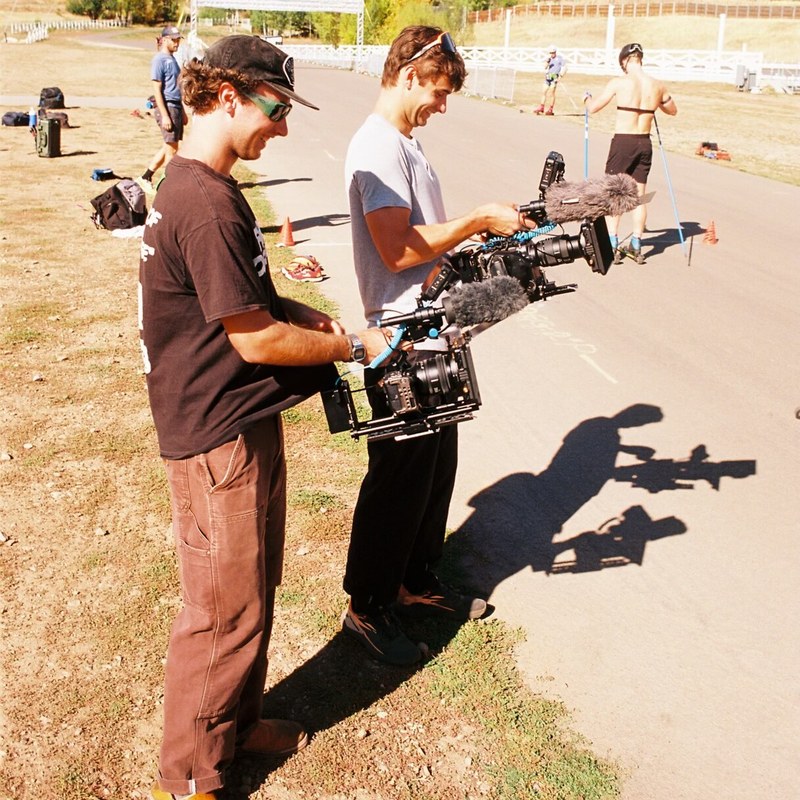
     

    Jiri Tuz (CZE), Ansgar Evensen (NOR), and Kristian Kollerud (NOR), (l-r) share the Classic Sprint podium in Drammen, Norway. (Photo: Nordnes/NordicFocus)
  • Sundling Seizes Drammen, Denying Skistad on Home Snow

    Sundling Seizes Drammen, Denying Skistad on Home Snow

    This coverage is made possible through the generous support of Marty and Kathy Hall and A Hall Mark of Excellence Award. To learn more about A Hall Mark of Excellence Award, or to learn how you can support FasterSkier’s coverage, please contact info@fasterskier.com.

    The women’s sprint final comes into the finish in Drammen, Norway with: Laura Gimmler (GER), Ane Appelkvist Stenseth (NOR), Jonna Sundling (SWE), Nadine Faehndrich (SUI), Johanna Hagstroem (SWE), and Kristine Stavaas Skistad (NOR), (l-r). (Photo: Nordnes/NordicFocus)

    The snow was trucked in, the rock band was playing near the finish, and Norwegian children cheered from second-story windows along the course. On a rare midweek World Cup race day in Drammen — a small city just southwest of Oslo where the sprint course loops through the streets, wraps around an old fountain, and finishes on the snow-covered steps of an iconic church — Jonna Sundling of Sweden took home another World Cup sprint victory.

    Sundling won the women’s classic sprint, going stride for stride with Norway’s Kristine Stavaas Skistad before pulling away in the final meters. Switzerland’s Nadine Faehndrich, racing her final classic sprint before retirement, earned the bronze.

    It was Sundling’s fifth individual World Cup victory of the season and the latest chapter in an intensifying rivalry with Skistad that has captivated ski fans, especially Scandinavian ones, for the last few seasons. From the World Championship final in Trondheim last year to the Olympic final in Milano Cortina, Sundling, with the rest of the Swedish sprinters, and Skistad have been locked in a tactical chess match. On Thursday in Drammen, it was Sundling who played the final move.

    Quarterfinal number one heads up the first climb with: Barbora Antosova (CZE), Mathilde Myhrvold (NOR), Jessie Diggins (USA), Melissa Gal (FRA), (l-r). (Photo: Nordnes/NordicFocus)
    Qualification and Quarterfinals

    Sweden’s Linn Svahn, the reigning Olympic sprint champion, posted the fastest qualification time at 2:41.87 — nearly three seconds clear of Sundling’s 2:44.39. But qualification speed, as World Cup sprinting always reminds us, is only the entry ticket.

    Two Americans advanced to the heats. Jessie Diggins, the overall World Cup leader wearing the yellow bib in what she called a “full circle moment,” qualified 17th in 2:50.91. Rosie Brennan, seeded 28th, also made the top 30.

    Diggins chose Quarterfinal 1 alongside Sundling and Skistad — a loaded heat. Skistad took the win with Sundling second via a photo finish, just 0.18 seconds separating them. Diggins fought hard for third, advancing as a lucky loser after finishing just 0.22 seconds behind Sundling.

    Rosie Brennan (USA) said after the race, “Drammen is one of my favorite races, it’s a fun course and always has a lively atmosphere.” (Photo: Nordnes/NordicFocus)

    Brennan’s day ended in the quarterfinals. Racing in Heat 3, she bobbled heading into the downhill and lost the draft, which was a costly moment on a course where the slipstream effect was enormous all afternoon. She finished fifth in her heat.

    “I was happy to get a chance in the rounds, but the conditions were very tough,” Brennan said. “They salted the course, and it was skiing great in the qualifier and then got really icy for the rounds. Anyway, I bobbled into the downhill and lost the draft and then just don’t have the power I need to pass that many people up the finish stretch, so I was disappointed to not be more in the mix.”

    Meanwhile, Svahn survived a scare of her own… as her quarterfinal rounded the fountain that anchors the bottom of the course behind the start gates, five of the six athletes ended up in a pile and Svahn seemingly had the most bodies and equipment to navigate as she got back out on the course, but somehow recovered to advance. The Olympic champion’s troubles, however, were only beginning.

    Maja Dahlqvist (SWE) and Jessie Diggins (USA), (l-r) during the second semifinal. (Photo: Nordnes/NordicFocus)
    Semifinals

    The two semifinals told entirely different stories, and the contrast between them shaped the final.

    In Semifinal 1, Skistad took the win with Sundling second, just 0.20 seconds back. Both advanced automatically. Behind them, Svahn finished third and would not advance.

    Semifinal 2 was a different race entirely. Johanna Hagstroem and Ane Appelkvist Stenseth pushed the pace from the gun, stringing the field out over the first climb. But on the long downhill, the draft did its work. Faehndrich and Laura Gimmler of Germany surged past, using the slipstream to slingshot into the lead.

    Nadine Faehndrich (SUI), who is planning to retire after the season, found a little extra Drammen magic today as she finished on the podium in third. (Photo: Nordnes/NordicFocus)

    Faehndrich won the heat decisively. Gimmler was second. The fast overall times meant Hagstroem would advance along with Stenseth, who just out-lunged Diggins for fourth and the second lucky loser position.

    For Diggins, the day ended in 10th. But she left Drammen at peace.

    “This was really cool because the Drammen area was my first ever World Cup start and it was a skate sprint,” Diggins said. “So it’s kind of a very full circle moment to close it out with a classic sprint here as the last classic sprint of my career.”

    She had tried something new in the heats, sitting in the draft instead of going to the front, a departure from her usual aggressive approach. “Normally, because literal strength is not my strength, I usually just try to go really, really hot and try to go off the front,” she said. “I was like, nope, I don’t think that’s gonna work for me here with the crazy draft and slingshot effect. I was taking a lot of notes in warm-up, and in the quarterfinal, I had the smallest tuck of my life. It was just really fun to try to believe in myself as more of a pure sprinter and to try to be a little more tactical.”

    She acknowledged she ran out of power in the semifinal, but had no regrets. “I still felt like I executed my plan to the best of my ability, and that’s always a cool feeling.”

    Jonna Sundling (SWE) crosses the finish line just ahead of Kristine Stavaas Skistad (NOR) for the win in Drammen, Norway. (Photo: Nordnes/NordicFocus)
    The Final

    Six women lined up for the final: Sundling and Hagstroem for Sweden, Skistad and Stenseth for Norway, Faehndrich for Switzerland, and Gimmler for Germany. Svahn and Maja Dahlqvist, the Olympic gold and bronze medalists in the sprint classic, were both absent.

    On the opening climb, Skistad sat behind Sundling in a familiar posture — patient, conserving, waiting for the right moment. As Kikkan Randall mentioned on the broadcast, Skistad almost never leads into a downhill. She baited Gimmler into taking the front position, then tucked into her slipstream.

    Coming off the descent and around the final hairpin, Faehndrich made her bid, surging past Gimmler and into third. But the race was between the two women everyone expected.

    Sundling and Skistad skied side by side on the final climb, and what followed was a scene that encapsulated their rivalry. Stride for stride, shoulder to shoulder, neither yielding a centimeter. Sundling’s transition from double pole to striding was fractionally sharper — she carried more momentum through the final meters — and she crossed the line with a small advantage.

    “It is usually very tight in Drammen, but today it was extremely tight,” Sundling said on air afterward. “Till the last meter. I was like, okay, I need to continue all the way over the finish line. It was tough, but I’m happy that I was the first person over the line.”

    For Faehndrich, the bronze was a fitting farewell. The 30-year-old Swiss racer, who announced her retirement this season, now sits third in the sprint World Cup standings at 700 points — just behind Hagstroem (708) and within striking distance of leader Dahlqvist (720) heading into the final sprint of the season in Lake Placid next weekend.

    Jessie Diggins (USA) gave her fans something to cheer about during her quarterfinal when she charged to the finish line. (Photo: Nordnes/NordicFocus)
    Looking Ahead

    Diggins continues to lead the overall World Cup standings with 1,961 points, 275 points ahead of Sweden’s Moa Ilar, a margin that appears insurmountable with four races remaining. The distance globe, too, seems firmly in her grasp. But the sprint crystal globe race is wide open: Dahlqvist, Hagstroem, and Faehndrich are separated by just 20 points at the top of the standings, and the final sprint in Lake Placid could decide everything.

    For Diggins, there’s another milestone ahead — she’s only a few nights away from sleeping in her own bed before racing in front of an American crowd at the World Cup Finals. “Very, very, very excited about that,” she said.

    The World Cup moves to the historic Holmenkollen venue in Oslo on Saturday for the Women’s 50 k Freestyle Mass Start, before the season concludes in Lake Placid, New York, March 20-22.


    Drammen Women’s Classic Sprint QUALIFICATION RESULTS

    Drammen Women’s Classic Sprint FINAL RESULTS


    Love Stories Like This? Help Keep Them Coming.

    Feature stories like this one take time, access, and care to produce. If you value thoughtful storytelling and independent ski journalism, please consider becoming a Voluntary Subscriber. Your support directly fuels the work we do to cover the people, places, and moments that make our sport special.

    Join the FasterSkier community!
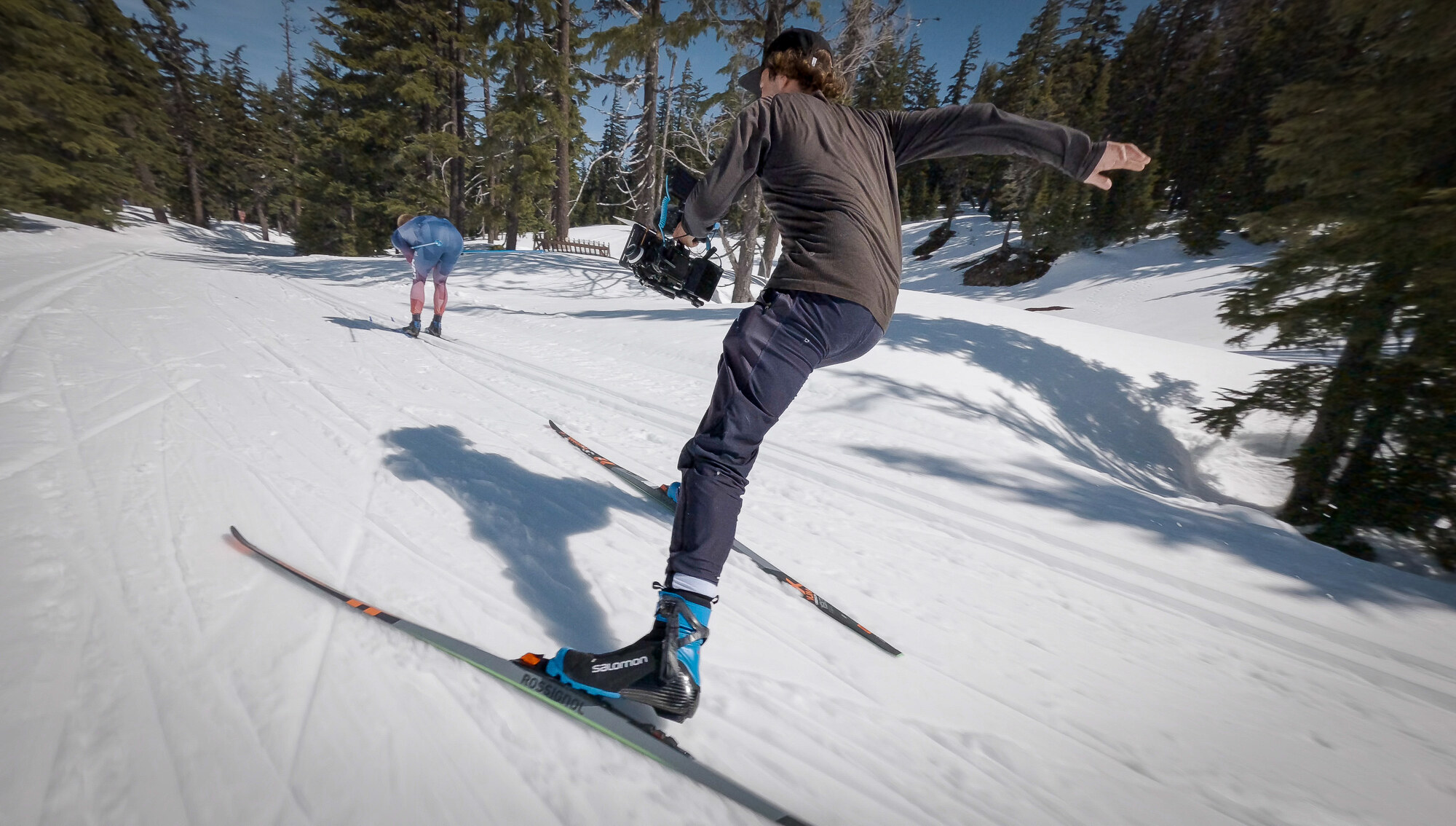
     

    Kristine Stavaas Skistad (NOR), Jonna Sundling (SWE), and Nadine Faehndrich (SUI), (l-r) share the Classic Sprint podium in Drammen, Norway. (Photo: Nordnes/NordicFocus)