From the FasterSkier archive — posts syndicated from athletes’ and coaches’ own blogs between 2004 and 2012, kept online as published. Current coverage is at fasterskier.com.
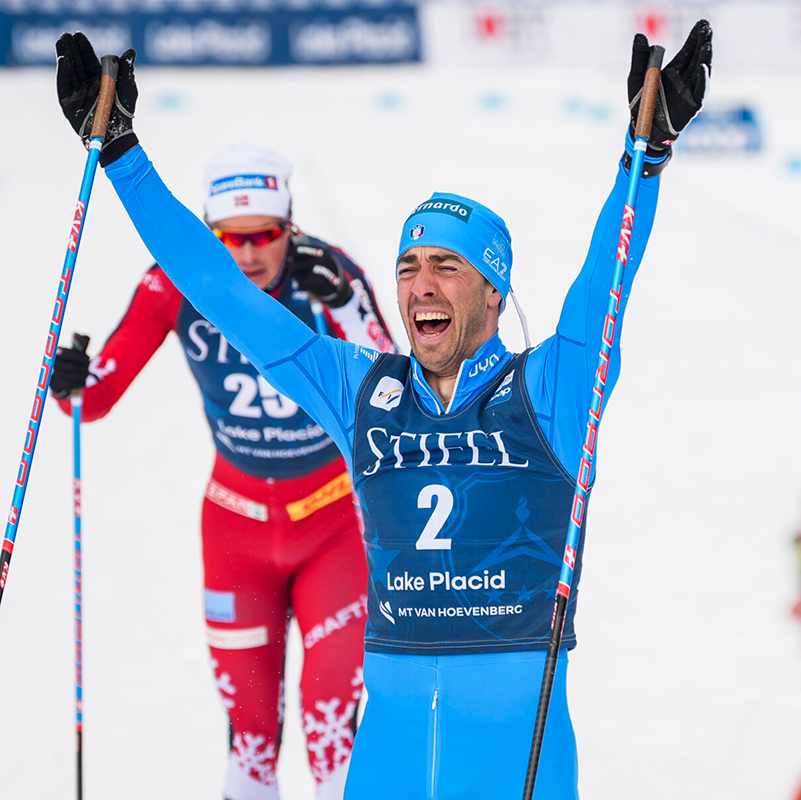
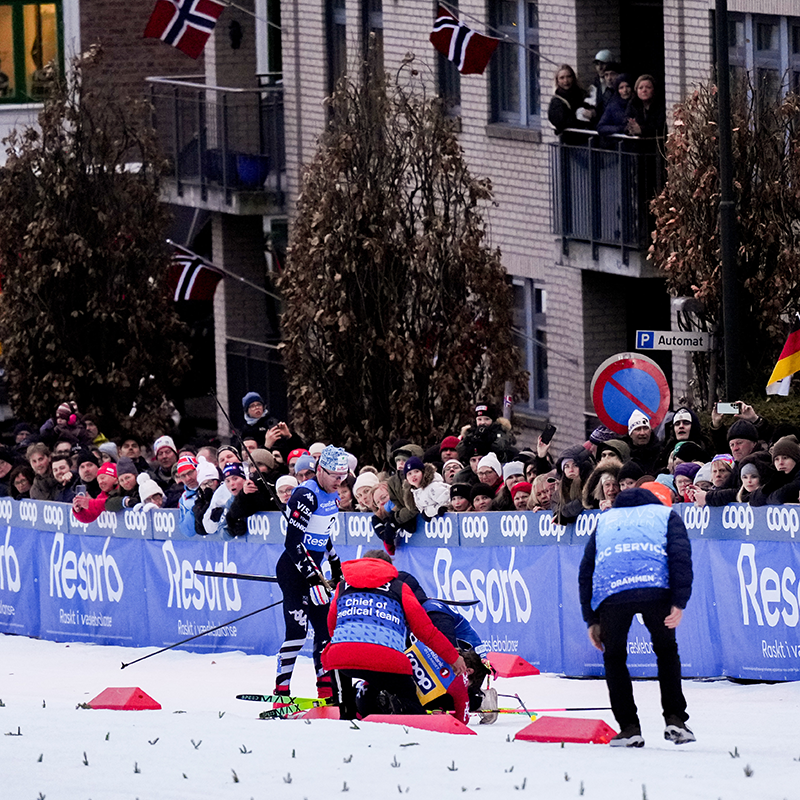
Yeah…the Olympics really took it out of us. But we’ve finally rallied the troops, plus a special guest, for our last episode of the season. We recap Oslo and the Lake Placid World Cups before signing off.
We’ll be out getting our last kilometers of the year, but will read your emails when we’re back: devon[at]fasterskier.com and nat[at]fasterskier.com. Enjoy the spring skiing.
We had to take a break after our three-week Olympic sprint, but we’re back to catch up on a couple of weeks of World Cup racing.
Devon and Nat take a quick run-through of events in Sweden, Finland and Norway. We’ll be back after the marathons at Holmenkollen.
Reach us at devon[at]fasterskier.com and nat[at]fasterskier.com.
A reminder: This is a homegrown podcast done by two guys working long hours and late nights. We also paid real money to be in Italy for the Olympics. If you can, support the show and FasterSkier’s ongoing coverage with a voluntary membership.
Help Support Our Olympic Coverage!
FasterSkier had our own Nat Herz on the ground at the Olympics, which, to be honest, was a very big financial lift for us. If you value the thoughtful work and access FasterSkier provides at championships like this one, please consider becoming a Voluntary Subscriber. Your support directly fuels the work we do to cover the people, places, and moments that make our sport special.
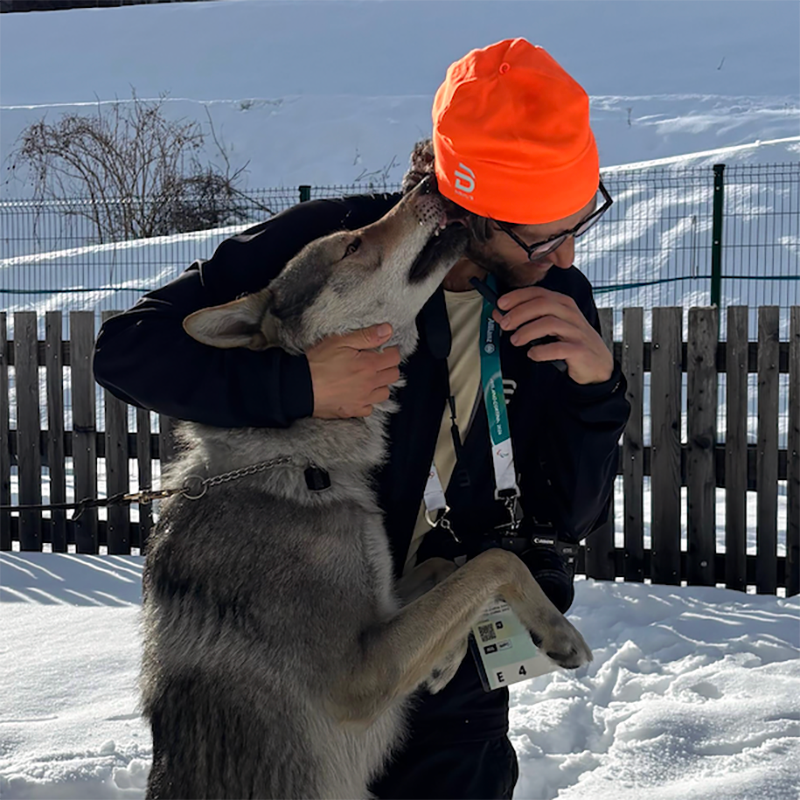
Reporter Nat Herz bonds with Nazgul, the infamous Olympic wolfdog. (Courtesy Alice Varesco)
Ciao a tutti!
Greetings from Torino, where this fatigued Olympics correspondent has retreated to recover through bike rides and repeated doses of pizza with family.
I had the chance to attend the closing ceremonies — mostly as a spectator — in Verona on my trip down from the mountains. After more than a dozen Olympic features, not to mention podcasts and race coverage, I’m now about to unplug for a couple of weeks.
But first, I couldn’t resist one last quick post: a roundup, in abbreviated, Reader’s Digest form, of some of the stories that were still on my list as the Olympics ended.
That’s below. In the meantime, I wanted to reiterate my gratitude to the many readers, fans and news organizations who stepped up to support my on-site Olympic coverage. The money you provided was enough to make a real difference in what I was able to do, and gives me the confidence that there’s the support to do this again in the future.
While the past few weeks were a lot of work, it was also an enormous, ravioli-filled privilege and pleasure — one where I made new friends, drank innumerable espresso macchiatos and got to cross-country ski downhill to the “office” every morning.
As I told a friend yesterday: If anyone ever offers you an assignment in Italy, take it.
With that, and with these brief items, we’ll see you next year. Or maybe, in Lake Placid.
American road warrior ski techs grind on
If you thought the work stopped once the Olympic torch flame was extinguished, think again.
That’s definitely not the case for the indefatigable crews that do the work of waxing, cleaning and tuning skis for Olympic cross-country teams.
Top teams, including the U.S., each have their own massive semi truck that they use as a mobile work quarters while traveling all winter around the European World Cup circuit. Those trucks were all in northern Italy for the Olympics — until the last race ended Sunday afternoon.
Soon afterward, the American truck — named Yolanda, after a character in the cult classic film Pulp Fiction — pulled out of the Olympic venue in Lago di Tesero. Or, at least, it tried to: With the warm weather, the truck got stuck in the mud, and required a tractor from organizers to pull it out, said Chris Hecker, one of the U.S. team’s service crew.
U.S. Ski Team service staff member Tim Baucom at the wheel behind one of the squad’s trucks, and at the table on the crew’s Italy-to-Sweden road trip after the Olympics. (Courtesy Chris Hecker)
After a four-hour drive Sunday through the Dolomites, Yolanda and its three staff members rendezvoused with a secondary truck driven by two other ski service technicians in Munich. A six-hour drive on Monday took them to an overnight ferry from northern Germany to Sweden — which would be followed by a nine-hour drive to the Swedish community of Falun, where the World Cup circuit resumes this coming weekend.
The distance, according to Hecker, adds up to 1,100 miles.
One key pit stop was a McDonald’s in a mountain pass leaving Northern Italy known for its beautiful view.
The trucks were also well-stocked by the U.S. team’s nutritionist, Hecker said: sandwiches, water, gummies, chips, Red Bull and cookies.
“All the important things a tech needs to keep driving throughout the day,” he added.
A diminished Chinese team
The 2022 Winter Olympics in Beijing were marked by an enormous investment by the Chinese government in training and building up the nation’s cross-country ski team.
Well before the Beijing Games, China hired a huge number of veteran European coaches and support staff that included retired Olympic athletes like Russia’s Nikita Kriukov and Norway’s Terje Langli. The country also spent freely on equipment and even built an indoor ski tunnel for summer training.
This time around? China’s Olympic cross-country ski team was a shadow of its former self, with just a single coach in Italy. Wang Qiang, who during the 2022 Olympic season became the first-ever Chinese athlete to stand on the podium in an elite-level World Cup race, placed 37th in his best event, the sprint, at this year’s Games.
Meanwhile, the government has asserted “serious violations of discipline and law” by Zhang Bei, the bureaucrat who led the cross-country ski team effort at the last Olympics, and Chinese news sources report that she’s been “taken away” by police amid an investigation for “suspected economic crimes.”
Meanwhile, Gou Zhongwen, the Chinese sports minister who’d prioritized government investment in cross-country skiing, has been purged from power. In 2024, the government placed Gou — the former chair of the Chinese Olympic Committee and of the 2022 Winter Olympics organizing committee — under investigation, then expelled him from the party.
China’s former sports minister, Gou Zhongwen, stands during court proceedings in this photo published by the Chinese government.
In December, he was sentenced for taking what the government said was more than $30 million in bribes, among other alleged transgressions. Gou’s official sanction was the death penalty, though it comes with a two-year reprieve, and experts say such a sentence is typically converted to life in prison.
A spokesperson at the U.S.-based Chinese embassy said in an email last week that the country has “consistently placed high importance on the development of winter sports.”
“Chinese cross-country skiing and biathlon have achieved and will continue achieving significant progress,” the spokesperson said.
Klaebo’s post-Olympics: a return to World Cup, chicken wings and a trip to America
Norwegian Johannes Høsflot Klæbo, the winningest winter Olympian in history after sweeping six golds in this year’s games, says he plans to compete at the season-ending World Cup races in Lake Placid, New York.
At a news conference Saturday after winning his last event, the 50-kilometer classic race, Klæbo said he needs a “couple of weeks, now, to really recover,” but after that it’s his goal to participate in March in Lake Placid — only the second weekend of World Cup racing in the United States in more than two decades.
“My personal opinion is that we should have a World Cup event (in the U.S.) every single year, but I’m not in charge,” Klæbo said. “I think we are all looking forward for Lake Placid. I think it’s going to be a fun weekend to finish up this amazing season.”
Klæbo is also on the Norwegian team for this upcoming weekend’s World Cup races in Sweden.
But he did let himself indulge, at least briefly, in a break from his notoriously fastidious diet following the Olympic closing ceremonies in Verona, where he acted as Norway’s flag bearer.
Johannes Høsflot Klæbo orders chicken wings at a McDonald’s after the Olympic closing ceremonies in Italy. (Pien Huang/NPR, used with permission)
Afterwards, an NPR reporter, Pien Huang, spotted Klæbo and some teammates “putting in a big order for chicken wings” at a local McDonald’s.
In a text message, Klæbo’s father Haakon confirmed Huang’s report, saying his gluten-intolerant son had turned to fast food “when I said I was not able to order gluten-free pizza.”
An Olympic cheese tour
What’s the point of a reporter traveling to Italy if he can’t con his way into a tour of a cheese factory?
Yes, dear reader, after these Olympics, I am not just a ski correspondent. I am also now an expert on a raw milk cheese called Puzzone, which is native to the area, Val di Fiemme, that hosted the Olympic cross-country ski races.
The backstory: One morning at the competition venue, I was having a chat with an Italian ski industry professional, whom I was told was from the town of Asiago. Ah, I said, you guys have some good cheese. Yes, the guy responded, I’m not really a cheese guy, but here in Val di Fiemme, you should really try the local delicacy called Puzzone — an Italian word that translates roughly to “stinker.”
This being a busy assignment at the Olympics, I filed this fact into the corner of my brain where stories go to die.
A day later, though, I was taking a walk from my apartment to a nearby cross-country ski trail when I stopped dead: There was a sign on the side of the road that said: Puzzone di Moena. (Moena is a nearby village.) It was next to a nondescript building that, upon further inspection, contained a cheese shop and a workspace that looked to me like a cheesemaking area.
I tasted some Puzzone in the store — it was sharp and pungent, especially the more aged varieties — then left with a chunk that I shaved onto eggs and toast. But feeling a little unresolved, the next time I passed the building, I knocked on the door to the workspace, and asked if I could check it out.
Which was how, a few days later, I ended up exchanging some messages with the “boss” — Andrea Morandini, the son of one of the farmers in the local cheese coop. He told me, in his Italian accent, to meet him the next morning at “da place.” I did, where he walked me through the history and current status of Puzzone — which, he said, acquired its name when an agricultural expert, on a national radio program in 1974, was tasting and describing area cheeses.
The inside of the Puzzone cheese factory in Predazzo. (Nathaniel Herz/FasterSkier)
“They are trying and smelling it — the one from Cavalese, the one from Predazzo. And when they are speaking about the one from Moena…they say, ‘Wow, it’s strano (strange), this is Puzzone,’” said Morandini. “So, it’s born live.”
Puzzone, Morandini told me, had its roots in Val di Fiemme’s agrarian history, when families would keep a cow or two and trade milk to local dairies in exchange for a share of the cheese produced. In a diet that otherwise depended on potatoes and polenta, cheese was a welcome addition of flavor, Morandini said.
The particularly stinky character of Puzzone is because it’s what’s known as a “washed rind” cheese — with its rind brushed regularly with salty water that encourages the growth of bacteria.
After my history lesson, Morandini took me backstage. What I thought was a workroom was actually a dressing room, where I donned a hairnet, slippers and vest; we then walked through a cavernous industrial space with vats and tanks, where cheese had been made earlier that morning.
Down a flight of stairs, we found the racks where wheel upon wheel of cheese is stored. In the deepest, darkest room, I hit a wall of ammoniac haze that made my eyes water and my lungs tickle.
The cooperative, Morandini told me, includes 11 farmers, most of whom own some 50 cows each. In the winter, the cows stay close to home, but in the summer, they’re sent outside to feast on grass, which gives the cheese made in that season a special flavor, according to Morandini.
One full wheel of aged Puzzone, a foot or so across, will set you back about 300 euros, or some $350. A wheel of younger cheese goes for some 170 euros, Morandini said. Some 70% of the factory’s production is consumed in the region, while a portion of it goes to customers in the United Kingdom and France, he added.
Andrea Morandini points to a wheel of Puzzone cheese that’s aging on a rack in the factory basement. (Nathaniel Herz/FasterSkier)
In a subsequent taste test I conducted with U.S. Olympic silver medalist cross-country skier Ben Ogden — a Vermonter who grew up eating raw milk cheese — Ogden described the young Puzzone as a solid “daily driver” cheese he could eat on the regular.
The aged stuff?
“Oh, God, that has got a taste,” Ogden said. “Holy crap.”
He added: “There are acquired tastes out there. And this is not one that I’ve acquired; it tastes like compost, a little bit.” “I’m sorry,” he said. “I hope the Italians don’t listen to this.”
Schumacher eyes medal celebrations — and maybe some free drinks
Anchorage’s Gus Schumacher, who last week became only the third ever American man to win an Olympic medal in cross-country skiing, says he’s looking forward to sharing his silver hardware with the next generation of U.S. athletes when he arrives back in Alaska.
“I’ll do whatever anyone asks me to do — but I’m excited to get some wear and tear on that thing,” Schumacher said in an interview a few days after his medal, which he earned with his podium finish in the team sprint with Ogden. “Not that I’ve not been a role model at home, but to have that carry a little more weight is pretty exciting.”
Schumacher, who grew up inspired by Alaska Olympic gold winner Kikkan Randall, said he’s seen how beat up and worn her medal is, along with those won by Jessie Diggins, the star American skier from Minnesota, “and I think that’s the coolest thing ever,” he added.
“I’m really glad they make them heavy — it could be lead in there for all I care,” said Schumacher, 25. “But you feel the weight when you touch it. And I think for people to be able to see it in person is cool.”
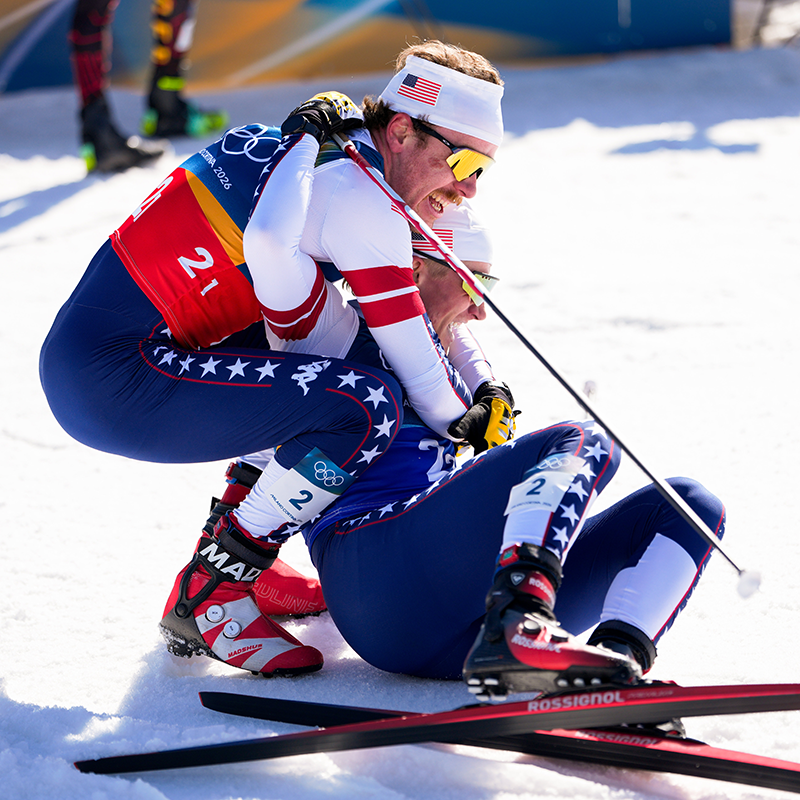
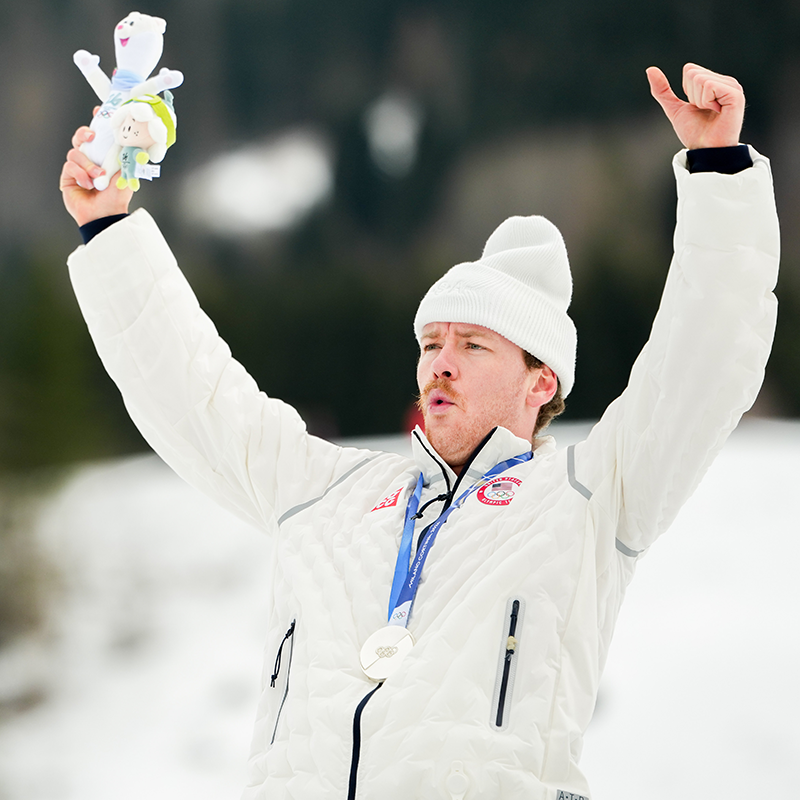
Gus Schumacher, left, and Ben Ogden show their silver medals after the Olympic team sprint. (Davide Barbieri/NordicFocus)
Schumacher will also race in Lake Placid before finishing his season, and it’s possible he could take a vacation in Central America after that. But he also likes being home, he said.
His life hasn’t changed much, Schumacher added, and even if a big sponsor showed up at his doorstep, he might still turn it down if it required too much work. He makes enough money from prize money and ski sponsorship, he said, to cover his expenses — especially since he still lives at home with his mom.
One thing he will be accepting: An offer of free water or beers at Creekbend, a popular concert venue in the community of Hope, outside Anchorage, that Schumacher has visited occasionally.
“I’ll definitely be cashing that one in,” he said, adding: “If I’m really milking the whole medal thing, I probably won’t have to pay for a ton of beers this spring.”
Help Support Our Olympic Coverage!
FasterSkier will have our own Nat Herz on the ground at the Olympics, which, to be honest, is a very big financial lift for us. If you value the thoughtful work and access FasterSkier provides at championships like this one, please consider becoming a Voluntary Subscriber. Your support directly fuels the work we do to cover the people, places, and moments that make our sport special.
We’re done and dusted at the Olympics after a rockin’ women’s 50 k — the first-ever at the Games. Devon and Nat smash out a recap of the epic breakaway and the knock-down-drag-out battle for bronze.
We’ll be back next week. Reach us in the mean time at devon[at]fasterskier.com and nat[at]fasterskier.com. We’re really grateful for all the support during the Olympics — thanks for notes and encouragement.
A reminder: This is a homegrown podcast done by two guys working long hours and late nights. We’re also paying real money to be here in Italy. If you can, support the show and FasterSkier’s ongoing coverage with a voluntary membership.
Help Support Our Olympic Coverage!
FasterSkier will have our own Nat Herz on the ground at the Olympics, which, to be honest, is a very big financial lift for us. If you value the thoughtful work and access FasterSkier provides at championships like this one, please consider becoming a Voluntary Subscriber. Your support directly fuels the work we do to cover the people, places, and moments that make our sport special.
We’ll keep it short and sweet: Here’s a recap of the men’s 50 k. It was a fun race to watch and left us with a lot to discuss.
We’ll be back after Sunday’s race. Reach us at devon[at]fasterskier.com and nat[at]fasterskier.com. We’re really grateful for all the support during the Olympics — thanks for notes and encouragement.
A reminder: This is a homegrown podcast done by two guys working long hours and late nights. We’re also paying real money to be here in Italy. If you can, support the show and FasterSkier’s ongoing coverage with a voluntary membership. We’re also offering a bonus during the Olympics: a WhatsApp group with notes on Nat’s experiences in Italy, the food he’s eating, interview transcripts and more.
Send nat[at]northernjournal[dot]com a confirmation of your voluntary membership and the number he should use for WhatsApp and we’ll get you signed up. You can also Venmo him directly at @nat-herz if a membership isn’t for you. We’re suggesting a minimum of $10, but we also won’t turn anyone away who wants to join because of an inability to pay.
Help Support Our Olympic Coverage!
FasterSkier will have our own Nat Herz on the ground at the Olympics, which, to be honest, is a very big financial lift for us. If you value the thoughtful work and access FasterSkier provides at championships like this one, please consider becoming a Voluntary Subscriber. Your support directly fuels the work we do to cover the people, places, and moments that make our sport special.
Norwegian ski testers Pål Trøan Aune, left, and Mats Iversen carry bags back to the country’s service truck at the Olympic cross-country ski venue in Lago di Tesero, Italy. (Nathaniel Herz/FasterSkier)
This article was made possible through the generous support of our voluntary subscribers who have helped put our Nat Herz on the ground at the Olympics. If you value coverage like this, please support FasterSkier with a voluntary subscription.
LAGO DI TESERO, ITALY — A day before Norway’s Johannes Høsflot Klæbo won his fourth straight gold medal in cross-country skiing at the Winter Olympics, a strange sight was unfolding next to the race trails in Northern Italy.
Two figures, dressed in Norwegian team suits, were skiing loop after loop on a tiny test track — in search of the most infinitesimal edge over rivals from France, Finland, Italy and America.
Neither figure was Klæbo: The superstar was back at his hotel room playing video games and resting up for the next day’s race.
Instead, the two men were retired ski racers hired by the Norwegian team for one of the strangest jobs of the Olympics: sprinting for miles over the same small patch of snow to help identify which waxes and other products can be applied to the surface of cross-country skis to make them faster.
While Klæbo spent much of Saturday in bed, one of the testers, Mats Iversen, skied dozens of laps adding up to more than 15 miles. Earlier in the Games, Iversen was skiing even more: as far as 44 miles a day, and just over 200 miles in his first week in Northern Italy, according to numbers he logs on the Strava tracking app.
Screenshots from the Strava workout tracking app that show a map of one of Mats Iversen’s testing days, and some of the times he skied on a test loop.
There’s no question that Iversen is skiing “way more” than the athletes competing at the Olympics, Klæbo said at a news conference Wednesday after winning his fifth straight gold.
Iversen’s one 44-mile day is “close to what I’ve done the whole week,” said Klæbo, whose race Wednesday totaled just over six kilometers, or some 3.5 miles.
“They’re amazing, and they are doing an amazing job to help us have the best possible skis,” Klæbo said. Referring to the winners’ podium, he added: “None of us would be able to sit here if it wasn’t for them.”
In a 45-minute interview after a 22-mile day last week, Iversen, his fellow tester, Pål Trøan Aune and their boss Tord Hegdahl offered a behind-the-scenes glimpse of the huge investment of equipment, technology and manpower that go into preparing the Norwegian team’s skis.
Aune and Iversen relax on the top floor of Norway’s service truck. (Nathaniel Herz/FasterSkier)
They spoke in a lounge area on the upper floor of an enormous, customized truck that houses hundreds of pairs of skis, along with work stations for staff members who prepare them for testing and racing. Iversen and Aune are, essentially, the engines of an intricate machine — with others operating the controls.
“You don’t need a 200 IQ to be a ski tester,” Iversen said. Pointing to the lower floor, where the technicians work, he added: “The brains are in here.”
‘Dizzy’ from all the loops
The Norwegian truck is parked in a big lot beside the competition trails in Italy where other nations like France, Sweden and the Czech Republic have their own vehicles and trailers.
The American team truck cost some $750,000 and is named Yolanda — a reference to a line from actor Samuel L. Jackson’s character in the cult classic film Pulp Fiction, according to NPR.
Inside the trucks, teams of technicians work to identify the skis and products that will slide the fastest given a specific set of snow conditions.
The work has several layers. Each athlete may have dozens of pairs of skis, and teams have to find the best ones for each day. Then, there’s what’s known as the “stone grind” — a pattern of tiny etchings that a machine can apply on the bottom side of a ski to help it move more easily over different types of snow crystals.
Finally, there’s wax, which can be applied to the ski base to give athletes even more of an edge. Dozens of products and brands exist in block, powder and liquid form, which can be melted or rubbed into the skis with waxing irons or obscure tools like a rotating wool brush attached to a drill.
A staff member prepares skis inside the Norwegian service truck. (Nathaniel Herz/FasterSkier)
Testers like Iversen and Aune help identify which combinations of skis, wax and grind work best in a given set of circumstances.
Every country does some level of testing. But Norway’s big budget for staff has afforded the team the luxury of an unusual level of specialization at the Olympics, with Iversen and Aune doing very little other than skiing — while other teams’ can mix testing in with other staff responsibilities, like waxing.
“We are terrible waxers,” Iversen said. Addressing a reporter, he said: “I think you are probably better.”
The Americans, by contrast, sometimes lean on coaches to test waxes on the trails, freeing up their specialized technicians to focus on picking skis with the athletes.
“If you take a look at our skis — we might have three bags and a couple of racks out before the race” for testing, said Matt Whitcomb, one of the U.S. coaches. “Norway will have two or three times that.”
Australian technicians Leopold Hensler and Toni Escher take a break from testing on the Olympic trails in Italy. (Nathaniel Herz/FasterSkier)
Canada’s team, meanwhile, employs two Italian “ski pilots” who, like Aune and Iversen, focus on testing at big events during the winter — often skiing upwards of 15 miles in a day. The rest of the year, one of them, Thea Schwingshakl, is a research biologist, while the other, Sara Hutter, markets Tyrolean apples.
Like Aune and Iversen, they spend their days in the tiny testing area, where Schwingshakl joked that they get “a bit dizzy there, from all the loops.”
But, she added: “It’s good for the whole team. We can just focus on skiing and testing, and they focus more on the product and on the wax and structures.”
Canada’s ski pilots, Sara Hutter, left, and Thea Schwingshakl ski upwards of 15 miles a day. (Nathaniel Herz/FasterSkier)
It’s not so much that the right skis, wax and grind will produce an Olympic medal — though they certainly help — as much as the wrong ones can put an athlete out of contention. After the men’s cross-country relay last weekend, American Johnny Hagenbuch suggested that his inability to keep up with rivals on the downhills had to do with his equipment.
“I was with everyone at the top of the climb and then — yeah, no longer,” he said. “There was nothing I could do.”
‘Simple and boring’ work
Iversen and Aune are part of a larger Norwegian project aimed at boosting numerous Olympic snow sports — not just cross-country skiing, but also Nordic combined and biathlon, said Hegdahl, their boss.
The effort includes a stone grinding machine that Norway operates near the cross-country race trails; Iversen and Aune help test patterns that can be used across those sports.
Another staff member has the sole task during the Games of driving skis over the mountains to the biathlon venue, said Hegdahl, who leads the Norwegian cross-country service staff.
One of the essential tasks that Aune and Iversen perform is the “paired glideout.” At the top of a small hill in the test track, the men stand side by side, then push themselves forward. As they start moving, Iversen equalizes their speed by grabbing ahold of a ski pole that Aune holds firm.
A French team member stands in the testing track at the Olympic trails. (Nathaniel Herz/FasterSkier)
Then, they let go without accelerating or jostling and see which of the different waxes or structures beneath their feet is faster.
Typically, they’re assessing sets of eight pairs of skis that — aside from the products underfoot — have been chosen because they’re perfectly matched. That, in turn, allows the technicians to more precisely measure the impact of the wax and grind patterns on speed.
The testing is set up like a single-elimination tournament, with quarterfinals, semifinals and a final. Results are transmitted back to technicians in the truck via WhatsApp messages or a GPS watch.
The matching of the eight pairs is so precise that, after the final test, Aune and Iversen take extra laps on the skis that are knocked out early to equalize them with the top pairs, to make sure the winning skis aren’t getting extra wear. Which also means that a mishap during a test lap requires three extras, to keep the six other pairs even.
Teams leave skis alongside the race trails for testing. (Nathaniel Herz/FasterSkier)
The whole process — from the unending right turns down to the bending over to take each pair of skis off and put the next set on — is hard on the body. They can ski 200 or more laps of the test track in a day.
But Iversen and Aune are both fit, and capable of the workload, according to Hegdahl.
“Testing is quite simple and boring. But we need guys to do the skiing who have the feeling of the skis,” Hegdahl said. “They’ve done a lot of skiing together with some of the best athletes, as well. So they know a bit.”
Aune and Iversen have also been friendly for years, and enjoy the camaraderie and the chance to participate at a championship event that neither reached as an athlete.
Mats Iversen’s brother Emil has had a standout season this winter. (Vianney Thibaut/NordicFocus)
Iversen’s brother Emil is competing for Norway in Italy, and won a gold medal with the men’s team in the relay.
“It’s very special — it’s our best friends who are racing,” said Aune. “I think they trust that we will do all we can.”
The work can get boring, Iversen conceded. “But it’s nice to be with a friend,” he said.
They’re “better than most” with their team spirit, Iversen added. But Hegdahl, their boss, acknowledged that the testers might need a little time off after three weeks of rooming and working together through the Olympics, which conclude Feb. 22.
“I’m not sure Pål will be at Mats’ place for a glass of wine on the 24th,” said Hegdahl. “But maybe the 28th.”
Help Support Our Olympic Coverage!
FasterSkier will have our own Nat Herz on the ground at the Olympics, which, to be honest, is a very big financial lift for us. If you value the thoughtful work and access FasterSkier provides at championships like this one, please consider becoming a Voluntary Subscriber. Your support directly fuels the work we do to cover the people, places, and moments that make our sport special.
This article was made possible through the generous support of our voluntary subscribers who have helped put our Nat Herz on the ground at the Olympics. If you value coverage like this, please support FasterSkier with a voluntary subscription.
Ben Ogden, left, celebrates his Olympic silver medal in the team sprint with Gus Schumacher. (Davide Barbieri/Nordic Focus)
TESERO, ITALY — After Gus Schumacher and Ben Ogden on Wednesday won only the third-ever U.S. men’s medal in cross-country skiing at the Olympics, one of the biggest grins in the stadium was on the face of their teammate, JC Schoonmaker.
Schoonmaker, who lives in Anchorage and trains with Schumacher at the Alaska Pacific University Club Program, was basking in his teammates’ silver glow.
But he was also already starting to dream about when he and Schumacher return home to Alaska, medal in tow.
“There’s going to be so many juniors out skiing, just so hyped. And that’s the coolest part, I think,” Schoonmaker said.
Schoonmaker, 25, had his own standout performance at the Olympics, finishing eighth in the individual sprint last week. He said he was himself inspired by the 2018 gold claimed by Americans Kikkan Randall and Jessie Diggins — underscoring how medals can plant the seeds of future medals.
“I liked Nordic skiing,” Schoonmaker said. “But watching that, I was like, ‘I need this.’ That gave me such a drive.”
Eight years later, Schoonmaker’s teammates will be bringing their own hardware to their homes at far ends of the country — Schumacher to Alaska, and Ogden to Vermont.
And unlike Diggins, who is retiring at the end of the season, Ogden, 26, and Schumacher are still just getting started — with long careers, and likely more medals, still in front of them.
Schumacher has spoken openly about competing through the 2034 Olympics, which will take place on U.S. soil in Utah.
“You just see these guys, the energy building,” Erik Flora, Schumacher’s coach in Anchorage, said in an interview in Italy after Wednesday’s race. “You have this momentum now.”
Gus Schumacher and Ben Ogden (USA), (l-r) celebrate finally getting onto the Olympic podium together. (Photo: Barbieri/NordicFocus)
Both American medal winners were talented juniors, with Schumacher featured in news coverage at age 13. And early in their careers, each man found success in the events where they perhaps had more natural talent — Schumacher in longer distance races, and Ogden in shorter-distance sprints.
The team sprint event that the Americans medaled in Wednesday is unusual in the way it demands both the speed that’s Ogden’s strength, and the fitness that Schumacher is known for. The two athletes, and their coaches, said that the podium performance was a reflection of focused training that Schumacher and Ogden did in an effort to become more well-rounded.
The work Ogden and Schumacher did to put themselves in medal contention Wednesday didn’t happen overnight, though. It took years, with strong teammates pushing them and elite coaches to advise them — building on a foundation of years more of junior racing and playing on skis with their local clubs, said Matt Whitcomb, a longtime coach of the U.S. team.
“It’s just not about this last year’s training plan,” he said. “It’s about the very first coach, the support their parents put in, their siblings, the camaraderie there with their friends.”
Which is one of the things that Whitcomb and other team members say is great about winning an Olympic medal: the chance to share it with everyone who pitched in along the way.
Ogden, in an interview after his first medal, described feeling anxious as he worked with a press officer to draft an initial Instagram post: What if he forgot to mention someone?
“It’s so overwhelming to think of all the people you want to thank,” he said. “When the time comes, you’re just like, ‘Oh, my God. This is too many. It’s too hard.”
He added: “There were so many people that went into that success.”
Schumacher described feeling the same kind of gratitude as he crossed the finish line Wednesday — for a chance to share his elation with the many teammates, family members and others who were in Italy to witness it in person.
Flora, his coach, said that “maybe the best thing about this Olympics is all the people that it touches.”
“Everyone that’s been involved. Everyone that’s a fan of skiing, all the coaches that worked with all these people. All the athletes that are buddies and helped push — it’s just a very collective good feeling,” Flora said.
The Americans still have a few weeks of racing left on the international circuit after the Olympics close Sunday, capped with a final weekend of World Cup racing on home snow in Lake Placid, New York.
Then, after a chance to celebrate the medals and a few weeks away from training, it will be back to work — likely alongside newly inspired teammates.
Gus Schumacher and Ben Ogden (USA), (l-r) on the podium showing their silver medals to their fans after the Olympic Men’s Team Sprint. (Photo: Barbieri/NordicFocus)
“Everyone’s going to be so pumped and motivated and just firing, ready to go,” said Schoonmaker, the Olympian who trains with Schumacher in Anchorage. “It’s just going to be sick.”
Fed by that kind of energy, the Americans were eager to talk about how the results might look different, and better, by the next Games. Schumacher’s charge up the final hill, where he largely kept pace with Norwegian superstar Johannes Høsflot Klæbo — who’s undefeated in five races in Italy — had his coach’s head spinning.
“To see him put his head down and try to chase him, and he was holding his own, was unbelievable,” Flora said. “That he could fight with Klæbo in the future? I think so.”
Flora added: “I think he’s just going to get better. We’re just starting to see what the potential is.”
Help Support Our Olympic Coverage!
FasterSkier will have our own Nat Herz on the ground at the Olympics, which, to be honest, is a very big financial lift for us. If you value the thoughtful work and access FasterSkier provides at championships like this one, please consider becoming a Voluntary Subscriber. Your support directly fuels the work we do to cover the people, places, and moments that make our sport special.
The highs were high and the lows were low in the Olympic team sprint in Italy, with the Ogden-Schumacher men’s team claiming silver and the Diggins-Kern women’s pair finishing out of the medals. Devon and Nat break the whole thing down.
We’ll be back after Saturday’s men’s 50 k. Reach us at devon[at]fasterskier.com and nat[at]fasterskier.com. We’re really grateful for all the support during the Olympics — thanks for notes and encouragement.
A reminder: This is a homegrown podcast done by two guys working long hours and late nights. We’re also paying real money to be here in Italy. If you can, support the show and FasterSkier’s ongoing coverage with a voluntary membership. We’re also offering a bonus during the Olympics: a WhatsApp group with notes on Nat’s experiences in Italy, the food he’s eating, interview transcripts and more.
Send nat[at]northernjournal[dot]com a confirmation of your voluntary membership and the number he should use for WhatsApp and we’ll get you signed up. You can also Venmo him directly at @nat-herz if a membership isn’t for you. We’re suggesting a minimum of $10, but we also won’t turn anyone away who wants to join because of an inability to pay.
Help Support Our Olympic Coverage!
FasterSkier will have our own Nat Herz on the ground at the Olympics, which, to be honest, is a very big financial lift for us. If you value the thoughtful work and access FasterSkier provides at championships like this one, please consider becoming a Voluntary Subscriber. Your support directly fuels the work we do to cover the people, places, and moments that make our sport special.
We took a couple of days off to do the necessary things, like eat pizza and ski. (And, rest assured, we were working, too — just not on the podcast.) We’re back now to recap the men’s relay and preview Nat’s favorite championship event, the team sprint.
We’ll be back after that race tomorrow. Reach us at devon[at]fasterskier.com and nat[at]fasterskier.com. We’re really grateful for all the support during the Olympics — thanks for notes and encouragement. And even the anti-eating-on-the-podcast messages.
A reminder: This is a homegrown podcast done by two guys working long hours and late nights. We’re also paying real money to be here in Italy. If you can, support the show and FasterSkier’s ongoing coverage with a voluntary membership. We’re also offering a bonus during the Olympics: a WhatsApp group with notes on Nat’s experiences in Italy, the food he’s eating, interview transcripts and more.
Send nat[at]northernjournal[dot]com a confirmation of your voluntary membership and the number he should use for WhatsApp and we’ll get you signed up. You can also Venmo him directly at @nat-herz if a membership isn’t for you. We’re suggesting a minimum of $10, but we also won’t turn anyone away who wants to join because of an inability to pay.
Help Support Our Olympic Coverage!
FasterSkier will have our own Nat Herz on the ground at the Olympics, which, to be honest, is a very big financial lift for us. If you value the thoughtful work and access FasterSkier provides at championships like this one, please consider becoming a Voluntary Subscriber. Your support directly fuels the work we do to cover the people, places, and moments that make our sport special.
This article was made possible through the generous support of our voluntary subscribers who have helped put our Nat Herz on the ground at the Olympics. If you value coverage like this, please support FasterSkier with a voluntary subscription.
Astrid Øyre Slind races in Norway earlier this season (Federico Modica/NordicFocus)
PREDAZZO, ITALY — When Astrid Øyre Slind was 26, she almost retired from cross-country skiing.
She was a good skier, just not quite good enough to break into the international circuit from her home country of Norway, where competition in cross-country is cutthroat. She was, in her own words, “stuck,” feeling like being an athlete wasn’t worth it any more.
“If you try for the same thing for 10 years, you get disappointed in yourself that you’re not getting better,” she said. “You’re working your ass off, and you’re still not there.”
But Slind didn’t retire. Instead, she mixed up her training plan, found a new coach and spent years racing on a lower-level long-distance circuit — the minor league baseball of cross-country skiing.
Nearly a decade later, in 2022, she returned to the international stage, and soon after made her first-ever World Cup podium, against Olympic-caliber competition.
This season, she finally qualified to race at her first Olympics, at age 38.
In Thursday’s 10-kilometer freestyle race, Slind finished a painful fourth place, just seconds from a medal. But on Saturday, she led the Norwegian women’s relay team to gold — punctuating a career arc that few novelists could have scripted.
“Her story, I think it’s really important to tell,” said Pål Golberg, another Norwegian skier who found success late in his career.
Slind, he said, was not an athlete with exceptional physical talent, nor especially good technique, and at times she was “struggling to find her way.”
But there’s still a message embedded in her success.
“You can get really far just by hard working,” Golberg said. “And she’s a perfect example.”
At a news conference after Saturday’s relay, Slind said she’d accomplished something she’d been working toward since childhood.
Slind, at lower left, celebrates her Olympic relay medal with, in clockwise order, Heidi Weng, Karoline Simpson-Larsen and Kristin Austgulen Fosnaes. (Federica Vanzetta/NordicFocus)
“It’s kind of crazy to say, but it’s actually been a dream for 30 years,” she said. “And it’s something I’ve given up on during the way there — and then started to believe again.”
She added: “It’s nice to finally make it.”
Not a top prospect
Cross-country skiers can be competitive into their late 30s, but few of them stay in the sport that long. In Thursday’s freestyle race, Slind was the oldest competitor, and one of just two of the 111 athletes who was born in the 1980s.
Slind grew up in the village of Oppdal in Central Norway, in a family of skiers. Her father, Peder Einar Slind, is a ski coach who once spent a year in Western Massachusetts on an exchange with a collegiate cross-country ski coach there.
Astrid also has two ski racing sisters: a younger one, Kari, and a twin, Silje.
Both still compete at a high level on European circuits. Kari, in fact, had the first breakthrough at the international level, nearly landing on the World Cup podium in her mid-20s. Experts thought she would be “the biggest of them,” said Birger Lofaldli, a reporter at Adresseavisen, the Slinds’ local newspaper.
In this archival photo, Kari Øyre Slind, center, poses with American skier Jessie Diggins and Slind’s friend Ragnhild Haga after a strength training session in Norway years ago. (Roar Hjelmeset)
“But Astrid came back,” Lofaldli said. “And now she’s greater than ever.”
Astrid did not grow up as a top prospect.
Unlike Kari, she never qualified to represent Norway at the World Championships for juniors, a proving ground for young athletes.
But Astrid was always skiing, she said in an interview in November. Her father would take the sisters out to play on skis; the twins were always pushing each other, with Kari “chasing us behind,” Astrid said.
At three years old, she added, the twins were “crying ourselves in” to local club races in Oppdal, where their parents initially didn’t want them to compete.
“Silje and I really wanted to go,” Astrid said. “From that day, we’ve just been skiing as long as the snow is out, and loving it.”
‘Crazy training’ with a new coach
After failing to break into Norway’s national team and the top-level World Cup circuit in her 20s, Slind spent years racing on a tour called the Ski Classics. The circuit features distance races as long as 90 kilometers, or 56 miles.
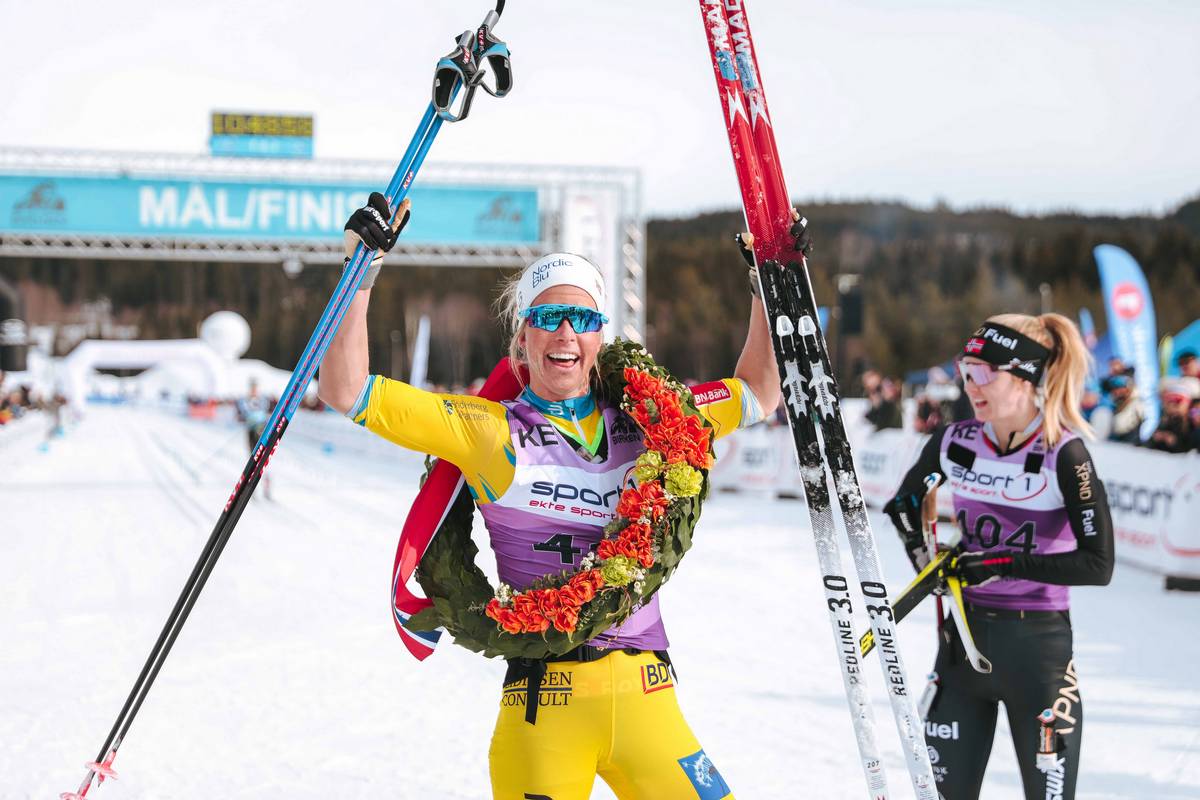
Slind celebrates winning the Birkebeiner, a long-distance race that finishes in Lillehammer, Norway. (Federico Modica/NordicFocus)
She had her ups and downs there, too. In one especially tough year, Slind said, she had trained too much — so much, that she could barely race — and was again thinking about quitting the sport.
Instead, she started talking about her problems with a teammate, Chris Jespersen, another Norwegian who was a few years older and had also struggled to stay at the highest level of the sport.
“He was like, ‘You know what? I really think I can make a good skier out of you — I’ve made all the mistakes myself. I can see what you’re doing. Let’s try to figure it out together,’” Slind said.
Jespersen, at the time, was not a coach, just an “athlete who had ideas,” Slind said.
But at that point, Slind said, she had nothing to lose, so the two started working together. They made a deal: When they disagreed — if Slind, for example, wanted to push herself to do more training but Jespersen thought it was too much — Jespersen would get the last word.
It turned out that Jespersen had a knack for explaining what Slind needed to do differently with her ski technique, in a way that she could understand. He was also a good check on what Slind describes as her impulse to do “crazy training” — things like a six-hour session of skiing with the arms-only double pole technique, with hard intervals in the middle of it, or workouts where she’d try to keep up with her team’s strongest men.
Slind had done more of those kinds of sessions as she moved into the Ski Classics circuit, where she discovered that she “needs a lot of training to be at a good enough level.”
“I think it was what put a spark in my skiing again,” she said.
But Jespersen, she added, helped rein her in when the crazy training got a little too crazy.
“He wasn’t too eager, and he wasn’t too defensive,” she said. “It was kind of the perfect balance for me.”
A breakthrough, and medals
Slind’s breakthrough came in the winter of 2022-2023, when she finally qualified to return to the World Cup circuit after a nearly nine-year absence.
Two months into the season, after nine races, Slind stood on the podium for the first time. Later that season, she won a bronze medal at the World Championships in the skiathlon, and a gold medal with Norway’s relay team.
Still, it hasn’t always been easy since then.
Last season, she raced at what was effectively a home World Championships, in the city of Trondheim just a two-hour drive from her hometown. Amid challenging snow conditions and constant rain, her results were disastrous, including a mishap with a ski during the skiathlon, and she finished with no individual medals — just a silver from the relay.
Then, at the Olympics this year, she was oh-so-close to a medal in the 10-kilometer freestyle race in fourth, just 3.3 seconds behind bronze medal-winner Jessie Diggins of the U.S.
Slind was also painfully close in her first Olympic race, the skiathlon, where she was skiing in medal position before being overtaken by a teammate and ultimately fading to eighth.
“I completely died out there,” Slind said in an interview afterward. “I’m not a good enough skier today.”
In Sunday’s relay, though, Slind was one of the strongest athletes in the race, putting pressure on the Swedish star Ebba Andersson, who ultimately crashed twice and cost her team the gold medal.
Slind leads the Olympic relay on Saturday. (Nathaniel Herz/FasterSkier)
The performance caps a storybook turnaround — one so improbable that Slind probably wouldn’t have believed it herself, said Jostein Vinjerui, a Norwegian coach who works with Slind’s club team, Aker Dæhlie.
“If you’d have asked her during the Beijing Olympics, four years ago, if she’d be able to do the Olympics in four years time, I think she would have laughed, I’m pretty sure,” Vinjerui said. “It’s just an amazing story, being 38 years old now and winning a first gold medal.”
More Olympic medals are possible for Slind: The Norwegian coaches have named her to the two-person team sprint squad, and she and Julie Bjervig Drivenes will be podium contenders in the event Wednesday. Slind is also expected to vie for medals Sunday in the longest race of the Games, the 50-kilometer competition in the classical technique.
After the relay gold, Slind said at the news conference that she’s good at turning depressing results into motivation for the next event.
“Maybe the two other races just made me more on fire for today, and really wanting to show what I’m good for,” she said. “And I will take that with me into the 50 k.”
Help Support Our Olympic Coverage!
FasterSkier will have our own Nat Herz on the ground at the Olympics, which, to be honest, is a very big financial lift for us. If you value the thoughtful work and access FasterSkier provides at championships like this one, please consider becoming a Voluntary Subscriber. Your support directly fuels the work we do to cover the people, places, and moments that make our sport special.
This article was made possible through the generous support of our voluntary subscribers who have helped put our Nat Herz on the ground at the Olympics. If you value coverage like this, please support FasterSkier with a voluntary subscription.
Johannes Klæbo stands with his father, Haakon, during a water break on a rollerski workout in Utah in 2023. (Nathaniel Herz/FasterSkier)
PREDAZZO, ITALY — Johannes Høsflot Klæbo is four for four — and officially the most golden Winter Olympian in history.
By anchoring Norway’s relay team to first place Sunday, Klæbo claimed his ninth Winter Olympic gold — moving him out of a tie, with two other Norwegian cross-country skiers and a Norwegian biathlete, for the most ever.
At a news conference afterward, Klæbo said he’d been drained by the effort it took to win Friday’s 10-kilometer individual start skate race — the first time he’d ever won an event in that discipline.
The next day, he said, “the only thing I did was lay in the bed and play on my PlayStation.” But by the time he woke up Sunday morning and checked his heart rate, he said, “it looked pretty good.”
After Sunday’s relay win over France and Italy, Klæbo is now poised to win the last two cross-country events at the Games, both of which — a team sprint, and a 50-kilometer mass start race in the classical technique — favor him.
At the news conference, he said he’s still taking it one day at a time. “We’ll see where we end up at the end,” he said. “But it feels, so far, so good.”
In search of some more revealing answers, we went looking for Klæbo’s father.
Haakon Klæbo, for the past week, has been a ubiquitous presence at the Olympic cross-country ski venue, watching races with the masses alongside the race trails with friends and family. We found him walking alone behind the stadium — where he was happy to answer a few questions before others broke in.
Nathaniel Herz: Are the Olympics a platform where Johannes is starting to go from a Norwegian to a global star, with these viral videos of him running up the last hill in the sprint race?
Haakon Klæbo: Yeah, it looks like at least it is. It is a huge interest in him. Olympics is really big in the U.S. But I also think that more U.S. citizens are learning how much time he spent there. He’s linked with (Utah physiotherapist) Megan (Stowe). She is really the one that has made his strength program, which is — it’s not that it’s secret, but if you look into it, he’s doing a lot of core strength. This is a program that he also follows at home (in Norway).
NH: How nervous were you for the 10-kilometer skate race two days ago?
HK: I was really nervous for the 10 k, and I knew that it was his weak point, or Achilles, in a way. We have to remember that he has never won a 10 k skate before, never — and this is in his whole career. I think that he has been in good enough shape, but this has been something in his head — and something that if you do not accomplish, it starts to become even more problematic.
Devon Kershaw, a retired Canadian World Championships gold medalist in cross-country skiing, who’s working as an expert TV commentator at the Olympics, walks up: Congratulations.
Herz, to Klæbo: You know this guy?
HK: No.
NH: This is Devon Kershaw.
DK. Congratulations, it’s been quite the show.
HK: Oh! Yeah — it is a little unbelievable, because you don’t expect it. And we had these crazy days in (the World Championships in) Trondheim last year, in which were hoping for like two or three (medals). (Klæbo won gold in all six events.)
And now, with four.
NH: Do you think going through this whole Trondheim experience last year is making this a lot easier for him now?
HK: Yeah. He had been training for that since he heard Trondheim would host the World Championships, and he has been the front figure. They used him (in their marketing materials), saying, ‘Born and raised.’ He’s standing there, like 18 years old — he had one pair of Leki ski poles at that time. He was wearing a suit that he had borrowed from a friend that was on the team. He was like, ‘This is my dream.’ And then he managed to do it. So, I think he was really stressed for it.
This season, it has just been fun. We’ve been together with (teammate and friend) Emil (Iversen). Me and him and Emil have been traveling around — it’s like being there with two boys playing around. So, I think he’s really much more relaxed. And you can see, also — I think he is even stronger, here, if you look at his sprint.
DK: I agree with you, 100%. Everyone made such a big deal of it, but winning the individual start skate. That’s the biggest thing to me, as a fan and a person that raced his whole life. I’m getting goosebumps thinking about what I saw two days ago. When you win that, then you’re really the king.
HK: And I said to Nathaniel that I think that he has been strong enough to do it for years. But it has been something up here (points to his head). He’s never won it.
NH: Do you think that’s his best accomplishment ever?
HK: Yeah, I think it is. And he was really tired after — he has been working really, really hard. I was afraid for this relay today — that he wouldn’t be able to run, because I think he put so much into the 10k. So much energy spent.
Johannes Høsflot Klæbo celebrates one of his four Olympic gold medals in Italy. (Davide Barbieri/NordicFocus)
NH: Was he at a disadvantage being first, in this individual time-trial style race, of all these Norwegian guys? That meant that he wouldn’t get as much information on the course from his coaches about how his times compared to the others.
HK: Actually, his best races from skate individual start are when he is just doing his own thing — just making his own pace, and doing what he’s good at. You could see that for the others, it was a disadvantage. I think, for (rival-teammate) Einar (Hedegart), it was trying to push on Johannes’ time (that was the problem). If you look at the two of them, racing, they’re pretty similar in taking it a little slow in the first two kilometers. Then starting to get faster and faster and faster, and having a crazy second half.
I think that that was what made Einar lose the silver. He pushed too hard — and he got burned and he lost 20 seconds in the last 1,000 meters.
NH : Will you be very stressed about the 50 kilometer race, the last event? Or do you feel like, once you get to the 50 k, so much has already been done that you can relax a little.
HK: The 10 k was what I was really afraid of. And now, I don’t know — we’re just here here enjoying and having fun. And then, everything can happen. And even if he is getting sick tomorrow, we’ve had four gold medals, and you’re the best Winter Olympian — and still, you can race for another Olympics. I think if you ask him, his dream Olympics would be to do a 50 k in Soldier Hollow (in Utah) — which is his home.
A middle aged fan carrying a Finland flag breaks in, screaming: “Klæbo! Klæbo! Number one!” The fan demands a photo, then ushers Klæbo away.
Help Support Our Olympic Coverage!
FasterSkier will have our own Nat Herz on the ground at the Olympics, which, to be honest, is a very big financial lift for us. If you value the thoughtful work and access FasterSkier provides at championships like this one, please consider becoming a Voluntary Subscriber. Your support directly fuels the work we do to cover the people, places, and moments that make our sport special.
That was a banger. We’re deep into the Olympics now, and Devon and Nat return for the third straight night to recap the women’s relay. One more race — the Norwegian men versus the world — and then everyone gets two days off.
Reach us at devon[at]fasterskier.com and nat[at]fasterskier.com. We’ll be back tomorrow.
A reminder: This is a homegrown podcast done by two guys working long hours and late nights. We’re also paying real money to be here in Italy. If you can, support the show and FasterSkier’s ongoing coverage with a voluntary membership. We’re also offering a bonus during the Olympics: a WhatsApp group with notes on Nat’s experiences in Italy, the food he’s eating, interview transcripts and more.
Send nat[at]northernjournal[dot]com a confirmation of your voluntary membership and the number he should use for WhatsApp and we’ll get you signed up. You can also Venmo him directly at @nat-herz if a membership isn’t for you. We’re suggesting a minimum of $10, but we also won’t turn anyone away who wants to join because of an inability to pay.
Help Support Our Olympic Coverage!
FasterSkier will have our own Nat Herz on the ground at the Olympics, which, to be honest, is a very big financial lift for us. If you value the thoughtful work and access FasterSkier provides at championships like this one, please consider becoming a Voluntary Subscriber. Your support directly fuels the work we do to cover the people, places, and moments that make our sport special.
American Gus Schumacher competes in his first race at the 2026 Olympic Games at the cross-country ski venue in Tesero, Italy. (Federica Vanzetta/Nordic Focus)
Gus Schumacher is one of the stars in U.S. cross-country skiing, and he was one of the team’s top medal hopefuls coming into the Winter Olympics in Italy.
Against the same field that competes at the Games, the Alaskan won a World Cup race in Minnesota in 2024. Then, Schumacher, 25, was on the World Cup podium twice more just last month, in Switzerland.
So far, though, his Olympics haven’t gone as planned, with tough results in several races. In his first one, he crashed. In the subsequent sprint — one of the disciplines where Schumacher was on the podium last month — he had another tough day, while his roommate and close friend, Ben Ogden, won a silver medal.
Speaking with media Friday, after his third race, Schumacher bristled, a bit, at a question from a reporter who asked him if, maybe, he was not having the best time at the Olympics. He said he was actually having a good time, and in a good place in spite of his results.
A day later, reporter Nat Herz asked Schumacher if he’d be willing to expand on his comments — but also offered him an out if he didn’t have more to share. He responded quickly by text: “Let’s do it. I’d rather get a story out there than have people make their own conclusions.”
Here’s Schumacher in his own words.
Nat reached out to me yesterday to ask if I was up for an interview. His timing was good, because I almost for sure would’ve said no most of the last six days. The opening of my Olympics has been hard, and processing it has taken time and effort, but I’m so proud to have been able to get through some rough days and be ready to fight again and again.
For context, my hard races have involved a crash, an anomalous sprint qualifier, and a day where I think my skis had me out of the race in the second half. On top of it, my teammate and one of my best friends did something we’ve all wanted to do for years. I’m stoked for Ben, but it’s also still hard, and that’s fine! The real miss would be an inability to talk it out and move forward to race another day.
I’m proud of my team, and I’m proud of myself for how I’ve handled a rough start, because this thing isn’t over and I’ve still got skiing to do!!
Below is a transcript of Schumacher’s conversation with Herz. It’s been lightly edited and condensed for clarity.
Nat: I don’t want to put words in your mouth — so maybe you could start by describing how it’s been for you here?
Gus: I can set the stage for people who are listening. So I finished this (10-kilometer freestyle race Friday) and I wasn’t even on the results board — I knew I was far back. It was not what I wanted. And (a reporter) said, ‘So, I assume you’re having a really bad week here.’ And I was like, ‘Okay.’ First off, I wasn’t in a great mood then. But I’ve had a lot of things I’m really proud of. And I think, just, blanket statement, horrible week — it just goes to show you can’t really assume how people are feeling, because you don’t know.
I understand, obviously, yeah: It’s not how I want to be skiing. In that sense, it hasn’t been great. But I wouldn’t just say I’ve had a horrible week, because these things make you better overall.
Gus Schumacher, left, celebrates his podium finish at a World Cup race in Switzerland last month. (Augustin Authamayou/NordicFocus)
NH: Can you take us back to the beginning of your time here?
GS: I fell in the first lap of the skiathlon (the first Olympic race, which features legs in two different techniques, classical and skating). Someone fell right in front of me. There’s just a chain reaction, and maybe I could have put myself in a bit of a different place. I could have set myself up otherwise. But it was a crazy corner. I crashed there, 30 seconds back pretty quickly, and the pace was hot. In hindsight, I wasn’t going to have a chance of catching the leaders, which is where I wanted to be skiing.
And I skied well — I think the classic went really well. In the skate, I think my motivation flagged a little bit. And I realized I have a lot more racing, and it wasn’t worth it to push super hard to get into 20th or something. But, you know, there were still some good things about how I skied.
But it’s also still hard to really feel good in that situation, because you’re kind of swimming upstream.
I left that, and I was just already on the back foot, needing to refocus — basically, not having a super confidence inspiring race, even if I was skiing pretty well. Objectively, it still wasn’t the result that I wanted. And then two days later, in the classic sprint, I didn’t qualify (as one of the top 30, who move into heat rounds), in an event where I’ve been pretty solidly qualifying lately. And I was really far back. I wasn’t in the realm of where I feel like I’ve been skiing lately. So that was another bummer.
I want to say it was (problems with my) skis. I know there’s not super conclusive evidence of that. But I think that’s the best way for me in a championship to go forward — because I can’t change anything now, and I need to believe in my fitness, and I do. It’s just to say there’s something going on under the feet, and whatever: I’m racing again soon.
And then (teammate and close friend) Ben (Ogden) got a medal (in the sprint). And that was a crazy event for all of us, especially me. Definitely took some thinking and processing to go through — especially given my tough start. I think I did a great job of getting back to a place where I’m just excited to ski and do what I can do.
Ben Ogden celebrates his silver medal in the Olympic sprint Tuesday. (Federica Vanzetta/Nordic Focus)
And then in (Friday’s) 10 k, again, I just really struggled. And I opened well, I feel like I skied really well. And again, something just didn’t line up, didn’t work. And I’m just gonna go with the skis again, basically. I don’t know exactly what it was. I think it probably has something to do with how they were actually pushing, and pressure stuff, which is kind of weird. But for my own sake, for these next races, I do still think I’m skiing well, and my movements are good and my energy is good.
NH: Fair to say this is about as hard an environment as exists to have to deal with this stuff, though?
GS: Yeah. In a normal World Cup weekend — and I had this at the beginning of the season, and it was still hard — you’ve just got another race the next weekend. And it’s easy to just say, ‘Yep, first race of the season. Shit luck. We got time.’
But right now, I’m getting interviewed by NBC before every race. And everything’s going viral on social media. And it’s just a big moment, as people like to say. And it’s when everyone wants to be at their best. Part of what’s so hard about winning the Olympics, or medaling, is just that your timing has to be good. And my timing’s been great before. You know, Minneapolis, I still think, is the craziest timing ever. (In Minneapolis, Schumacher took his first-ever World Cup win when the circuit was on its first swing through the United States in more than two decades.)
But, yeah, it’s really hard place to deal with tough results. Even if they’re not entirely because of me, or they’re a little bit out of my control, it doesn’t really matter.
At the end of the day, to all the people that never watch skiing — it sucks, in my head, to feel like all those people won’t recognize me. And I know that’s somewhat vain — but, you know, a lot of this is vain. And there’s a part of me that’s, just — I want to be a ski star. I want to be really good, and I am, and it’s just through the first half of this championship, it hasn’t worked out amazingly. But there’s still time. At the end of the day, I just want to be skiing fast, in general. Skiing fast is what’s fun to me. And it’s cool if it’s at the Olympics — but it’s also cool if it’s at the Tuesday night race (in Anchorage, Schumacher’s home town), in April.
Gus Schumacher stands with his club coach, Erik Flora, during a training session at the Olympics in Italy. (Nathaniel Herz/FasterSkier)
NH: I talked yesterday with Ben Ogden about how you guys have been navigating since he won the first men’s Olympic medal in cross-country skiing in half a century — which is something that many of you guys on the men’s team are gunning for, but only one of you got.
He spoke about how that’s obviously a challenging dynamic, but said you guys have been navigating it really openly. He’s also your roommate here in Italy.
Can you talk about all that?
GS: I mean, it’s been, honestly, great. It’s super hard. But having it be Ben is so nice. But he’s so good in that situation.
Obviously, it’s really cool and big for all of us. But everyone wants to be the guy to break the drought, right? And I, for sure, wanted to be that guy. But I also wanted to win the green bib (of best under-23 skier on the World Cup). And I didn’t do that, because I wasn’t skiing that fast, and he did. And that was really cool, that he did that. And then, I’m sure he wanted to compete (at the World Cup) in Minneapolis, but he got mono, and I won.
It’s not just Ben and I. (American) JC (Schoonmaker) got the first podium of any of us, and Ben was fourth that day. We all know how it feels to be on the other side.
Ben came back in the room at 5 p.m., after a one o’clock finish — he’d had a crazy afternoon. I know he had interviews lined up, and I’d just been at home, basically stewing about myself and about the whole situation. And I can’t remember exactly what he said, but the first thing he said, basically, when he came in the room, was: I’ve been thinking about you.
And that meant so much to me. That he would go through all of this, and enjoy himself — I know he was really enjoying himself, and I would not want him to not enjoy himself — but to have your teammate just immediately recognizing: Yeah, I know how it feels to be on the other side.
It made it so much easier for me. And I’ve been clear with him, too, that yeah, it’s kind of hard. But I’m also really proud of him, and it’s really cool that he (won silver). One of us needed to do it, and it’s so, so cool that one of us did. And I also really want to be racing faster, and those things can be true together.
It’s hard. But the hard things are what’s cool about sport, and the Olympics. And the hard times are a lot of what I enjoy about what I do, because I think it makes me a better person. It just makes everything else in life feel so much easier.
To have a team like this, that can have those conversations and be real about it is so nice. Because obviously, it’s not sunshine and rainbows, no matter what it is. You can love someone with all your heart, and if they get something that you wanted, that you can’t have, or you didn’t get, it’s hard. And I’m really glad we don’t just say, ‘I’m so happy for you. Nothing but tears.’ Because it’s not always true. At least for me, honesty is the best policy. And to be able to air stuff makes it so much easier to just go on with it, and talk about the real things.
Gus Schumacher and Ben Ogden celebrate a podium finish in a World Cup team sprint event in Switzerland last month. (Augustin Authamayou/NordicFocus)
NH: Maybe this is touchy, but just to put a fine point on it: It’s not just that you and Ben both wanted a medal, any medal. He won this medal in a specific event that you were also racing in, and could very well have won a medal in.
GS: Yeah. I mean, watching him, it felt a lot like what I did two weeks ago. (Schumacher finished second in a World Cup sprint race in Switzerland in late January.) He looked amazing, and I felt really good in (Switzerland), and I didn’t even really get tired — and the other guys were sort of tired in that final, and it was so similar.
So, yeah, it felt like, ‘Fuck, it’d be awesome if that was me.’ But that’s just how it works in sport. Sometimes you’re there, sometimes you’re not. And if it was always the same, it would get boring.
NH: I’ve been thinking back to the Beijing Olympics four years ago. You had a pretty hard time there, but I wonder if you think it’s right to say that you are experiencing things here in a different way — maybe with more resilience based on that past Olympics experience.
GS: For sure. Everything I do, I think, makes it easier. But four years ago is, for sure, different — a different type of disappointment. And I’d rather have this one — I’d so much rather be in a true contender seat, where I feel like I have a shot at medals. I’d so much rather have that than not be recognizing my body — not be, just, super tired going up the hills.
I learned a lot from Beijing, and I got a lot better after that. Mentally, it’s been a really cool experience to go through these emotions, feel them really well, write them down, pay attention to it, and talk to a bunch of people that can think with me. And I can just, sort of, rant, or do whatever, and get through it and be ready for the next one, because that’s what you need to do, when you’re feeling good, especially.
I’m still feeling good. And it would be such a shame to have a couple bad races and mentally throw in the towel, because it’s hard to draw confidence from a race where you fell in. That’s silly. I can draw confidence from so many things, and that’s what I’m doing. The most recent experience I have, which is the easiest one to go on, is not great. But I’ve got a lot more in the tank to draw from, and I’m really excited to go out there and do what I do.
NH: Fair to say you feel like you are mentally prepared to show up on the start line of the men’s relay tomorrow with a clear head and some confidence in your fitness?
GS: Yeah. I think I’m ready to ski with the best, no matter what has happened so far. And that’s where I want to be. And I feel confident that that’s where I am. And I’m really excited to lay it out there for the team tomorrow, because I think we have a really strong team right now. I maybe alluded to, ‘Ben got something that I didn’t get.’ But this Games isn’t over — and we’ve got more Olympics (in four and eight years), too. I feel confident that I’ve still got time, which is nice.
NH: I think I want to print this just as an unadulterated Q&A. Do you feel good about that?
GS: Yeah — I think it’s important to talk about some of the hard things. It’s what makes our team strong. And I think it is something that is often so much more helpful than I even know for people to hear. Because a lot of this stuff is pretty applicable not just to sports, but even just day-to-day life.
Shit happens, and sometimes it happens when you really don’t want it to. You’ve got to move through it, and it’s so much easier said than done. But I think talking about it — and hopefully I shed enough light on it to maybe inspire people, to help them understand — I think it’s a good message. It makes me proud to know that I’m still in the fight because of how I’ve gone about it.
We’re back for the second day in a row with a recap of a lights-out 10-kilometer freestyle race. It was a good one. Devon and Nat are here with the deets.
It’s been surprisingly light on the hate mail recently. Reach Devon at devon[at]fasterskier.com and Nat at nat[at]fasterskier.com.
A reminder: This is a homegrown podcast done by a crew working long hours and late nights. We’re also paying real money to be here in Italy. If you can, support the show and FasterSkier’s ongoing coverage with a voluntary membership. We’re also offering a bonus during the Olympics: a WhatsApp group with notes on Nat’s experiences in Italy, the food he’s eating, interview transcripts and more.
Send nat[at]northernjournal[dot]com a confirmation of your voluntary membership and the number he should use for WhatsApp and we’ll get you signed up. You can also Venmo him directly at @nat-herz if a membership isn’t for you. We’re suggesting a minimum of $10, but we also won’t turn anyone away who wants to join because of an inability to pay.
Help Support Our Olympic Coverage!
FasterSkier will have our own Nat Herz on the ground at the Olympics, which, to be honest, is a very big financial lift for us. If you value the thoughtful work and access FasterSkier provides at championships like this one, please consider becoming a Voluntary Subscriber. Your support directly fuels the work we do to cover the people, places, and moments that make our sport special.
America’s first man to win an Olympic medal in cross-country skiing, Ben Ogden, joins the show for a cheese-tasting and a description of his past 72 hours. He covers everything from the doping test to the phone deluged with texts to Ogden dream sponsors — he only wants old cars, not new cars. And Ogden also shares his lifelong dream to meet Bernie Sanders.
Ben Ogden, a U.S. cross-country skier who won a silver medal in the sprint race Tuesday, samples a slice of Puzzone, a cheese local to the area where Ogden is competing. (Nathaniel Herz/FasterSkier)
Reach Devon at devon[at]fasterskier.com and Nat at nat[at]fasterskier.com. We’ll be back with a men’s 10 k recap a bit later.
It’s really expensive to be here in Italy. If you can, support the show and FasterSkier’s ongoing coverage with a voluntary membership. We’re also offering a special bonus to our members during the Olympics: an insider’s WhatsApp group featuring notes on Nat’s experiences in Italy, the food he’s eating, links to international coverage of cross-country skiing and more. Send nat[at]northernjournal[dot]com a confirmation of your voluntary membership and the number he should use for WhatsApp and we’ll get you signed up. You can also Venmo him directly at @nat-herz if a membership isn’t for you. We’re suggesting a minimum of $10, but we also won’t turn anyone away who wants to join because of an inability to pay.
Help Support Our Olympic Coverage!
FasterSkier will have our own Nat Herz on the ground at the Olympics, which, to be honest, is a very big financial lift for us. If you value the thoughtful work and access FasterSkier provides at championships like this one, please consider becoming a Voluntary Subscriber. Your support directly fuels the work we do to cover the people, places, and moments that make our sport special.
Ben Ogden celebrates his silver medal in the Olympic sprint in Tesero, Italy. (Federica Vanzetta/Nordic Focus)
PREDAZZO, ITALY — Ben Ogden, the U.S. cross-country skier, was ready to celebrate his historic Olympic silver Tuesday with his signature backflip off the podium.
But there was a problem: He had to pee.
After Ogden won the first men’s medal in cross-country skiing in a half-century, doping testers needed a urine sample. So, he did the obvious thing and “drank, like, three bottles of water, immediately,” he said.
The need to relieve himself, he said, was probably the biggest concern on his mind as he contemplated the backflip while the podium ceremony played out. “When I was standing up there, I definitely reconsidered a couple of times,” he said.
Ogden went for the backflip anyway. Afterward, he still had to walk through a maze of reporters called the mixed zone, where — unlike at non-Olympic races — everybody wanted to talk. Then straight to a news conference, and finally, a wait when he arrived at doping control: The other medal-winners had already arrived.
Ben Ogden speaks with media in the mixed zone after his Olympics silver. (Nathaniel Herz/FasterSkier)
“It was really, honestly, pretty miserable. I haven’t had to pee that bad since I was a little kid on a road trip,” Ogden said. “I didn’t really realize the whole situation after you get a medal at the Olympics.”
But Ogden wasn’t complaining.
At a reporter’s request, he was laying out the specifics of what happens in the hours and days immediately following something that many athletes dream of but few actually experience: winning an Olympic medal.
In a conversation Friday at his hotel in Italy — outdoors, to minimize infection risk from a reporter who has been outside the U.S. team’s bubble — Ogden described a phone deluged with messages and a dayslong-sprint of interviews and TV appearances over Zoom. But he also took time the day of the medal to enjoy a sauna with some teammates he’s known for years. He said the time in the sauna was important because it gave him time to process an accomplishment that all of them have aspired to but just one of them has achieved.
“If you win an Olympic medal, it’s like your life changes overnight,” said Jessie Diggins, one of the three other American cross-country skiers in history who can relate to Ogden’s medal-winning experience. “Which is really cool, but it’s a lot of pressure, and it’s a lot of obligations that come afterward.”
She added: “I’m just really proud of him for taking in all of the energy that comes in surrounding that.”
“The toll is real”
Ogden, 26, has had a few podium finishes on the World Cup against Olympic-level competition. But the Vermonter was far from a lock for a medal in Tuesday’s sprint race, where he was nearly eliminated after failing to place in the top two in his semifinal heat and only advanced to the final as a “lucky loser” based on his finish time.
In the finals, though, he made a powerful charge up the final hill and finished trailing only Johannes Høsflot Klæbo of Norway, who’s won all three cross-country events in Italy so far and is widely seen as the greatest athlete his sport has ever produced.
The result was huge not just for Ogden but for his teammates and the American staff – a large group of athletes stayed at the race trails to congratulate him and attend the medals ceremony.
American Olympic cross-country skier Julia Kern takes a selfie with Andrea Ogden, the mother of silver medalist Ben Ogden, just before Tuesday’s medals ceremony. (Nathaniel Herz/FasterSkier)
For some of those athletes, the thrill of Ogden’s medal and their proximity to it left them so exhausted that they scaled back their own workouts the next day, said Chris Grover, the U.S. cross-country’ team’s director.
“It really hit them not only emotionally, but it hit them physically,” he said in an interview Thursday.
The impact on teammates, Grover added, underscores that for Ogden himself, “the toll is real.”
One example: The night of the medal, Ogden said, “it was incredibly hard to wind down, just thinking about everything.” It took until 2 a.m. to fall asleep, and by 7 a.m., he was wide awake, with a “crazy” schedule of media appearances — including Good Morning America, on ABC.
All Ogden had to drink the night before was a little champagne. Still, on TV, he said, “I had some bags under my eyes, I was pretty tired, I hadn’t shaved. And I was looking at myself in the camera and I was like, ‘Oh my God, I’ve got to tighten it up a little bit.’”
“I’m sure that they all wanted me to say I was out drinking and carrying on. And I didn’t say that,” he said. “But they probably thought I was, based on how I looked.”
Ben Ogden celebrates his Olympic medal Tuesday. (Federica Vanzetta/Nordic Focus)
The cross-country team’s press officer, Leann Bentley, coordinated the string of media appearances. She also helped Ogden draft an Instagram post that, he said, was hard to compose.
“It’s so overwhelming to think of all the people who you want to thank,” Ogden said. “You’re just like, ‘Oh, my God, there’s too many. It’s so hard.’”
As for the phone? Ogden had left it in his backpack in the hours immediately following the race. When he picked it up, initially, there were so many messages coming in that it made it difficult to find the threads he needed to use to communicate with his ski technician and his mother.
“Their text exchanges just get buried, immediately,” he said. “Then you start pinning them — but all of a sudden you have 10 pinned messages and that gets confusing. So, I’m sure I’ve missed a lot of important stuff.”
A meeting with Bernie?
On Friday, Ogden was expected to be one of the U.S. team’s four starters in the next Olympic cross-country event, the 10-kilometer freestyle, and he wanted to race.
But amid the intensity of the medal-winning experience, U.S. staff encouraged him to stand down, according to Grover, the team’s director. “He’s just had so much emotion,” Grover said. “And there’s been a lot of media.”
Chris Grover, one of the U.S. Ski Team’s coaches, skis at the Olympic venue in Italy. (Nathaniel Herz/FasterSkier)
Ogden has traditionally been stronger in shorter distances. And the upcoming relay race Sunday — with four 7.5-kilometer legs — and the team sprint scheduled for Wednesday represent “really big opportunities for us,” Grover said.
Ogden, nonetheless, was keen to race Friday, in spite of his coaches’ position.
“They don’t ever make decisions for us. But I think that was the closest I’ll ever get to them telling me they’re not going to start me. They were really adamant that they wanted me to sit it out,” he said. “You kind of train a lot, and you’re trying to put yourself in good shape — and then when you are, it’s nice to race.”
Since those conversations, though, Ogden acknowledged that he’s “crashed a little bit, energy-wise — as they sort of speculated would happen.”
“You can only ride a high for so long before it comes down,” he said. Skipping the event, he added, was ultimately a “good call,” given the upcoming team events.
In the days since the medal, Ogden said, he hasn’t had much time to consider what it means, and how it might affect him. But he did acknowledge that his view of himself and where he sits in his sport has “changed, a little bit.”
Earlier in his career, Ogden said, he felt some awkwardness in describing himself as a “professional skier.” “You’re not getting paid. You’re not really making money, you don’t have results to show for it, too much,” he said. “It’s kind of hard to believe it.”
He added: “Over the years, as you get more established, it starts to be easier. And I think now, it will be really easy.”
Nonetheless, Ogden still has no agent. And no companies have landed in his inbox pitching endorsement deals — unless, he added, they’re in his DMs and he hasn’t seen them yet.
More than anything else, he said, his “peak goal” is leveraging his medal into some time with Bernie Sanders, the populist U.S. senator and former presidential candidate from Ogden’s home state.
“And I really want to meet him and talk to him, too. Not just, like, a handshake,” Ogden said.
“I know it’s political and everything else. But Bernie is just an ambassador for Vermont, and has been for so long. And he’s been someone who I’ve looked up to and respected, and I just couldn’t ask him — he’s a busy man,” Ogden said. “But I think maybe now — maybe now — I can take this medal and figure out a way to meet him.”
The one Jessie Diggins was waiting for: Nat and Devon were both on hand for the Olympic 10-kilometer freestyle and have this recap. It gets pretty heated! But in a good way.
We’ll be back tomorrow after the showdown between Johannes Klaebo and Einar Hedegart in the men’s race. Nat wrote a profile of Klaebo-killer Hedegart — the biggest threat to what could otherwise be a golden sweep of the Olympics by the cross-country skiing king.
Reach us at devon[at]fasterskier.com and nat[at]fasterskier.com. We’ll be back tomorrow.
It’s really expensive to be here in Italy. If you can, support the show and FasterSkier’s ongoing coverage with a voluntary membership. We’re also offering a special bonus to our members during the Olympics: an insider’s WhatsApp group featuring notes on Nat’s experiences in Italy, the food he’s eating, links to international coverage of cross-country skiing and more. Send nat[at]northernjournal[dot]com a confirmation of your voluntary membership and the number he should use for WhatsApp and we’ll get you signed up. You can also Venmo him directly at @nat-herz if a membership isn’t for you. We’re suggesting a minimum of $10, but we also won’t turn anyone away who wants to join because of an inability to pay.
Help Support Our Olympic Coverage!
FasterSkier will have our own Nat Herz on the ground at the Olympics, which, to be honest, is a very big financial lift for us. If you value the thoughtful work and access FasterSkier provides at championships like this one, please consider becoming a Voluntary Subscriber. Your support directly fuels the work we do to cover the people, places, and moments that make our sport special.
This article was made possible through the generous support of our voluntary subscribers who have helped put our Nat Herz on the ground at the Olympics. If you value coverage like this, please support FasterSkier with a voluntary subscription.
Einar Hedegart poses for a photo after training at the Olympic cross-country ski venue in the Dolomites in Northern Italy. (Nathaniel Herz/FasterSkier)
PREDAZZO, ITALY — Johannes Høsflot Klæbo is, almost without question, the greatest cross-country skier who’s ever lived.
The Norwegian athlete has won gold in eight consecutive championship races spread across two seasons — including the first two events at this year’s Olympics, in Italy. It’s quite possible he could walk away from the Games with gold in all six events.
His biggest threat comes from a guy who’s been a cross-country skier for less than three months.
Norwegian Einar Hedegart has beaten Klæbo all three times they’ve raced each other this winter. He’s won five of the six cross-country events he’s entered since the season began in November.
Johannes Høsflot Klæbo celebrates a gold medal at the Olympics in Italy. (Davide Barbieri/NordicFocus)
November is when, at least according to Hedegart, he finally accepted the label of cross-country skier. Before that, he’d still been, at least partially, a biathlete — the Olympic discipline that combines cross-country skiing with precision shooting.
In biathlon, Hedegart was a fast skier, but not always a reliable shooter. Last season, he jumped into a World Cup race against cross-country skiing’s best competitors, and finished a surprising second place.
That result set off a chain of events that have led him to Italy on Norway’s Olympic cross-country team, with a specific focus on the 10-kilometer freestyle event. That’s where, on Friday, he’s expected to challenge Klæbo for Olympic gold.
“We’re looking forward to Friday,” Emil Hosøy, the coach of Hedegart’s club team in Norway, said in a phone interview this week. “It will be a hard competition.”
In a brief interview Tuesday after training with a teammate at the Olympic venue in the Dolomites, Hedegart said he’s prepared for the showdown.
“Everything has gone according to plan,” he said.
Biathlon vs. cross-country
Hedegart’s meteoric rise has enlivened a long-running, colorful debate between cross-country skiers and biathletes over which discipline is superior, and who’s faster. Biathletes have periodically crossed over and notched competitive results, though it doesn’t happen often.
Swedish cross-country star William Poromaa sparked a furor in Scandinavia two years ago by joking that biathlon, with its stops for target shooting, was for athletes who need a rest between ski sessions.
Hedegart is the latest test case — showing that on today’s racing circuits, elite biathletes can be, at a minimum, competitive with the best cross-country skiers.
“I think a lot of cross-country skiers underestimate the level biathlon is at, and the amount of training we are doing,” Hedegart told two cross-country Olympians on their podcast, Skirious Problems. “You guys have to give us some credit, please.”
Hedegart, 24, is from a little north of Trondheim, a city in central Norway that’s produced some of the world’s best cross-country skiers, including Klæbo.
As a kid, he watched cross-country skiing on television, because the Norwegian superstar Petter Northug Jr. came from his area. But Hedegart’s focus was biathlon, and he showed promise early — winning medals at the World Junior Championships and, in 2023, reaching the top 30 in the World Cup, the sport’s highest level of competition.
Einar Hedegart competes in a cross-country World Cup race in Switzerland (Federica Vanzetta/NordicFocus)
Hedegart would also, from time to time, enter elite cross-country races. Some of those decisions were happenstance — one because he didn’t have a partner for a biathlon relay on the same day, and another that he entered on a whim after a registration deadline.
But in both of those cases, he won.
His results earned him an entry into a cross-country World Cup race in Oslo last year, where he placed second — prompting questions from Scandinavian pundits about whether Hedegart was focused on the right sport.
So, over the summer, Hedegart hedged his bets: He switched from training with biathlon teams to training with a cross-country ski team — albeit one that would allow him to keep shooting his rifle and compete in biathlon.
“All the way from May to November, I was 50-50,” Hedegart said. “I brought my gun to every camp and shot a lot.”
At the start of this winter, Hedegart entered two sets of races over two weekends — biathlon and cross-country — to help decide how he would spend the rest of the season.
In biathlon, he shot poorly. In one race, he missed eight of 20 shots; only one athlete out of 59 competitors missed more.
The cross-country race, meanwhile, he won by a big margin — besting not just Norway’s top skiers but other top talents from France and Austria. That was the day things changed, Hedegart said.
“I’m a cross-country skier this winter season,” he said.
Klæbo, whose championship winning streak is at risk, has taken notice of Hedegart’s rise, which resulted in him being named to Norway’s Olympic cross-country team early in the winter.
“It’s impressive, what he has done,” Klæbo said. “I’m going to try to give him a good match.”
The best skater of all time?
Both Klæbo and Hedegart himself credit Hedegart’s success this season to a unique aspect of his training.
Cross-country skiing, both on the World Cup circuit and at the Olympics, features events in two techniques — the traditional forward striding and poling known as classical, and the side to side pushing called skating.
Biathletes compete only in skating, and Hedegart, this past year, has focused his training almost exclusively on that technique. He hasn’t even bothered to contest classical cross-country competitions this winter.
Hedegart said on the podcast, in November, that he’d spent less than 12 hours practicing classical style in the previous six months — a tiny fraction of the hundreds of hours he’d spent training in total. Top cross-country skiers, meanwhile, typically divide their training close to evenly between the two techniques.
Einar Hedegart, center, celebrates winning a World Cup cross-country race in Switzerland. (Federica Modica/Nordic Focus)
“That is my strength, that I can use more time than anyone else ever has on skating,” said Hedegart in the interview. “I’ve just really done my thing, and that has gotten me this far.”
Hedegart’s training plan has other unconventional elements, including lots of moderately hard sessions and few extra-hard ones, which allows him to spend more time training overall, said Hosøy, his coach. Hedegart is also a “very clever” athlete who’s shown a keen awareness of his own body that’s unusual for someone his age, Hosøy added.
But it’s the added emphasis on skating that’s allowed Hedegart to take the technique “to a new level,” said Pål Golberg, a former top Norwegian skier who’s competed against Hedegart and now is working at the Olympics as an expert TV commentator.
“The training he does is out of this world,” Golberg said. “He can be the best skater the sport has seen — if he wants to do that.”
A postseason dilemma
That’s the question Hedegart will have to answer after this season — and it poses a real dilemma.
Avoiding the classical technique means he can only compete in half of cross-country’s racing schedule. And because his success, so far, has come mostly in distance events, Hedegart has not yet earned a chance to race individual sprint races for the Norwegian team, whose start slots are hotly contested.
As a result, Hedegart has started just six cross-country races this winter — far less than athletes competing in both disciplines.
“If you want to get old in this sport, maybe you have to get to compete more to have the motivation to train as much as he does,” said Hosøy, the coach.
But training and racing in the classical technique would risk the success Hedegart has found after specializing in skating.
“I wouldn’t take the chance,” said Golberg. “If he has this skating that’s so good, why would you risk it? He would never win a distance race in classic, I’m pretty sure.”
There’s also the question of whether Hedegart will ultimately return to biathlon — which, he said, would make it pointless to try to improve his classical technique, since it’s not used on the biathlon circuit.
Hedegart celebrates a podium finish at a cross-country World Cup race in Finland earlier this year. (Federico Modica/NordicFocus)
At the start of the season, Hedegart said, he still planned to go back to biathlon next year. Now, he added, he’s pretty sure he’s changed his mind: If he’s offered a spot on Norway’s national cross-country team for next year, he’d take it, at least for one season.
But in 2029, the biathlon World Championships will be held in Oslo — a chance to compete in a marquee event in Hedegart’s home nation. “That is a big, big dream of mine,” he said. “And I really hope that I can compete there.”
“That is the back and forth I have to do,” Hedegart added, referring to the balance between the two sports.
If Hedegart’s success this season has complicated his career planning, it’s at least provided Scandinavians with a compelling new storyline — particularly in men’s cross-country skiing, where some pundits complain that Norwegian dominance is making the sport boring.
“Norwegians are pretty tired of watching one Norwegian fighting with another,” said Golberg. “But now, suddenly, you have two sports clashing together.”
Help Support Our Olympic Coverage!
FasterSkier has our own Nat Herz on the ground at the Olympics, which is a significant financial lift for us. If you value the thoughtful work and access FasterSkier provides at championships like this one, please consider becoming a Voluntary Subscriber. Your support directly fuels our work to cover the people, places, and moments that make our sport special.
This article was made possible through the generous support of our voluntary subscribers who have helped put our Nat Herz on the ground at the Olympics. If you value coverage like this, please support FasterSkier with a voluntary subscription.
Peter Hinds racing at the Olympics for Slovakia. He grew up in the 49th state, wore bib 49 in Tuesday’s sprint race, and finished 49th. (Courtesy Peter Hinds)
PREDAZZO, ITALY — On Denali in Alaska, there’s a famed climbing route called Slovak Direct — a nod to a group of skilled alpinists from Slovakia who established it in 1984.
Now, as this year’s Winter Olympics kick off, an Alaska-raised athlete is making something of a name for himself in Slovakia, competing for the nation’s Olympic team in cross-country skiing.
Peter Hinds, a 23-year-old graduate of University of Alaska Anchorage, realized last year that he could race for the country where his mother grew up — then qualified to represent it in Italy.
Call it Slovak Indirect.
Hinds competed in his first Olympic race Sunday in Italy, finishing 60th — capping a whirlwind season that’s also included a ceremonial team-naming in Bratislava with a handshake from the Slovak president, Peter Pellegrini.
Peter Hinds shakes hands with Slovakia’s president, Peter Pellegrini, in a pre-Olympics ceremony in Bratislava. (Office of the President of the Slovak Republic)
“They had the guards with the little floofy hats and the guns, standing perfectly still,” Hinds said. “It was cool — it kind of felt like royalty. And that’s the thing about something as big as the Olympics: It lives bigger in people’s minds.”
Hinds’ Olympic saga starts with the fall of the Iron Curtain, at the end of the 1980s. His mother, Elena Hinds, grew up in the Slovakia city of Bratislava when it was part of the Eastern Bloc.
“I was young, fresh out of school, just wanted to travel and see the world,” she said in an interview in Italy, after watching her son’s first Olympic race. “Landed in Los Angeles.”
There, Elena met Peter’s father, Cory, when she joined the local mountaineering club, and the couple ended up in Alaska.
Peter grew up there as an only child with, he joked, “no rights.”
“I had to do everything that the parents decided to lug me on,” he said — including being roped in with them on glaciers during alpine traverses.
A young Peter Hinds on the Eklutna Traverse, a famed climbing route in the mountains behind Anchorage, Alaska. (Courtesy Peter Hinds)
Hinds also spent time absorbing Slovak language and culture growing up, including a school year in Bratislava, where he still has family. Elena cooked Slovak foods, too, like bryndzove halušky — a gnocchi-like dumpling traditionally paired with sheep cheese and bacon bits.
“It’s so good,” Hinds said. “You get the sour blanket, white canvas taste of that cheese. And then you get a really sharp, salty bacon bit in there — it’s really a good dish.”
As a kid, Hinds trained with Anchorage’s Alaska Pacific University club program, then studied engineering at the University of Alaska Anchorage, where his results included a 14th place at the collegiate national championships. He’s also placed sixth in the sprint at the U.S. national championships.
As school was wrapping up, he went to the career fair and interviewed with several companies with offices in Anchorage; he thought maybe he could pair an engineering job with an assistant cross-country ski coaching gig. He also contemplated graduate school.
But Hinds had Slovak citizenship through his mother, who’d been following the country’s ski team, thought her son would be competitive and encouraged him to explore whether he could join. At a ski marathon last spring, he also got a nudge from an international athlete, Australian Rosie Fordham, who attends the University of Alaska Fairbanks.
Hinds eating makové slíže, a Slovak dish of potato dumplings with maple syrup and ground poppyseed. “The poppyseed is exquizite,” Hinds wrote in a text message. (Courtesy Peter Hinds)
“She was like, ‘Mate, you should totally just switch your (International Ski Federation) license to Slovakia. You’d probably be the best skier there,’” Hinds said.
He didn’t really know where to start that process, though, so he went to the internet, where he noticed that his rankings were competitive with Slovakia’s top racers. “I looked them up on Instagram, sent them a DM,” and the process unfolded from there, effectively “no questions asked,” Hinds said — though he acknowledged detecting a little skepticism, at first, from Slovak athletes at risk of being displaced by an American-raised interloper.
“I came over and I actually knew how to speak Slovak, and they were impressed,” he said.
The license change prompted an enthusiastic press release from the Slovakia ski team, which celebrated the addition of a “promising young endurance athlete.” Slovak media has also chronicled Hinds’ progress and results, with family members collecting copies of print newspapers.
A Slovak print newspaper featured a story about Hinds. (Courtesy Cory Hinds)
After training in Alaska last summer, Hinds bought a one-way ticket to Bratislava, where he has a “home base” with family. Since then, he’s been ski racing, at training camps with the Slovakia team or staying with other friends around Europe.
At stops on the top-level World Cup circuit, he’s encountered other Alaska athletes that he’s raced and trained with, like JC Schoonmaker and Gus Schumacher — both standouts on the U.S. team.
“I’m a small fish compared to those boys on the circuit, so I’ve got to know my place,” Hinds said. “But it’s cool to see them, say hi, and see that this is really where they’re able to do things that few can, you know?”
Fordham, the Australian who Hinds credits with inspiring his European experience, described him as a “good friend on the World Cup who doesn’t take things too seriously, but is pretty serious about ski racing.”
Hinds speaks with reporters after his first race at the Olympics. (Nathaniel Herz/FasterSkier)
“He’s just, like, so excited to be here,” she said. “It’s good to see someone who has such enjoyment of the sport and just wants to be out here having fun skiing fast, and with his friends.”
At the Games, Hinds got to attend one of the opening ceremonies, then found himself surprised by the gravity of the moment when he finally got to the start of his first Olympic race.
“It’s super cool to see all these people here — I mean, it was a great atmosphere. But I was genuinely nervous,” Hinds said in an interview afterward. A crash on a busy corner early in the 20-kilometer race set him back, but he made it to the finish without getting lapped and pulled out — a fate suffered by a number of athletes from other small nations.
One of the benefits of being on a small team: Hinds will get to race more events in Italy, unlike some of the athletes from the larger U.S. team who might only get a single start at the Olympics.
And while he doesn’t plan to spend time at bars, he does plan to spend some time enjoying and absorbing the Olympic experience — perhaps getting over the mountains to another satellite competition venue in the resort town of Cortina. He’ll also get time with his girlfriend and parents, both of whom are in Italy to watch.
“Nobody expected this. But he’s making it happen, and it’s pretty exciting,” Cory Hinds said. “Everybody’s cheering for Peter like crazy.”
Help Support Our Olympic Coverage!
FasterSkier has our own Nat Herz on the ground at the Olympics, which is a significant financial lift for us. If you value the thoughtful work and access FasterSkier provides at championships like this one, please consider becoming a Voluntary Subscriber. Your support directly fuels our work to cover the people, places, and moments that make our sport special.
Hinds’ parents Elena and Cory and his girlfriend Eva Weymuller take a moment to relax after watching his first race at the Olympics. (Nathaniel Herz/FasterSkier)
This article was made possible through the generous support of our voluntary subscribers who have helped put our Nat Herz on the ground at the Olympics. If you value coverage like this, please support FasterSkier with a voluntary subscription.
Ben Ogden did a round of interviews with European media outlets after winning a silver medal at the Winter Olympics in Italy on Tuesday. (Nathaniel Herz/FasterSkier)
PREDAZZO, ITALY — Particularly among the citizens of the Scandinavian nations where cross-country skiing is religion, bringing up the United States right now does not exactly elicit warm fuzzies in Europe.
U.S. President Donald Trump, after all, has done his best to shred traditional North Atlantic alliances, complained to Norway’s prime minister that he should have been awarded the Nobel Peace Prize and said he could take over Greenland by force.
At the Winter Olympics opening ceremonies in Italy last weekend, fans greeted Vice President JD Vance with boos.
All of which made for a confusing afternoon Tuesday in Tesero, Italy, where the Olympic cross-country ski sprint race unfolded: Rival athletes and spectators from Norway and Sweden were joining in the celebration of the silver medal won by American Ben Ogden, in spite of the stars and stripes on his uniform.
It was only the second-ever U.S. medal by a man in Ogden’s sport, and a vivid illustration of the Olympics’ potential — not always realized — to transcend political division.
“He’s the kind of president America should have,” said Tomas Pettersson, a veteran sportswriter and columnist with the Swedish tabloid Expressen. “Nobody thinks of Donald Trump and Ben Ogden in the same moment.”
The historic silver for Ogden — the first U.S. men’s medal in his sport in a half-century — comes as he and his American teammates have been navigating repeated questioning by Olympics journalists about the behavior of Trump and his administration.
U.S. flags mix with Norwegian ones during the medals ceremony for Tuesday’s cross-country ski sprint race at the Winter Olympics in Italy. (Nathaniel Herz/FasterSkier)
On Tuesday, the questions were about Trump calling a U.S. Olympian a “loser” after the freestyle skier had said it was “a little hard” to be representing America; earlier in the Games, the questions were about the killings of protestors by federal agents in Minnesota.
“We love our country so much, especially the ideals it was founded on, and don’t really feel like those ideals are really what’s happening right now,” Lauren Jortberg, one of the female American skiers, told reporters after Tuesday’s race. “There’s a lot of personal internal conflict. I’m not going to speak for the team, but I personally think it’s been hard to represent the States right now.”
In interviews Tuesday, competitors, teammates and friends all said Ogden embodies the qualities that he and other U.S. skiers say they’ve been trying to project at the Olympics in a difficult political moment: joy, kindness, respect.
“I don’t think they could have a better poster child, at this point so far in the Games, to fly the flag,” said Zach Caldwell, an American who’s working with a ski wax company at the Olympics. “You don’t have to know Ben very well to like him. And you’d have to really dig deep not to like him.”
He added: “He just goes around the world picking up fans. He’s just an effortlessly gracious guy.”
Caldwell would know better than most: He’s known Ogden since he was a child. Both of them live in Vermont, and Caldwell went to college and ski raced with Ogden’s father, John, who was also a beloved figure in the sport in New England.
Ben Ogden’s mother Andrea celebrates his silver medal Tuesday in Italy. (Nathaniel Herz/FasterSkier)
John died in 2023 at age 56 after a decade-long fight with cancer. At a news conference after his silver medal Tuesday, Ogden said it was most likely his father who’d imprinted the traits that have brought him so many friendships on the cross-country ski circuit, and elsewhere.
“He was a real community builder, and, you know, I miss him every single day, and I try to be like him,” Ogden said. “He cheered for everybody, and said hi to everybody, and tried to get everybody excited about what they were doing. And that’s what I try and do — and I hope people feel it.”
They do, if the comments from others in Tesero are any measure.
Maja Dahlqvist, the Swede who won bronze in Tuesday’s sprint: “People are really happy for Ben. Our team is happy for Ben.”
Johannes Høsflot Klæbo, the Norwegian gold medalist: “I think it’s hard not to like Ben, so I think we all do…it’s fun to be able to share the podium together.”
Klæbo’s father, Haakon: “I think it’s so fantastic that we have Ben in second place. It’s crazy cool.”
British skier James Clugnet, on his podcast, where he said he got “a little bit emotional” Tuesday watching Ogden: “I think it’s so well-deserved. He’s a super nice guy.”
U.S. coaches and staff members spent Tuesday afternoon fielding a deluge of congratulatory texts, calls and emails from colleagues on other teams — an indication that the warm feelings extend not just to Ogden. Somehow, the full American team seems to have largely detached itself from their European competitors’ perception of the American political system.
“I haven’t heard one single American skier back up Donald Trump’s craziness,” said Pettersson, the Swedish sportswriter. “They seem like totally normal people — as we thought the U.S. would be, forever.”
Help Support Our Olympic Coverage!
FasterSkier has our own Nat Herz on the ground at the Olympics, which is a significant financial lift for us. If you value the thoughtful work and access FasterSkier provides at championships like this one, please consider becoming a Voluntary Subscriber. Your support directly fuels our work to cover the people, places, and moments that make our sport special.