From the FasterSkier archive — posts syndicated from athletes’ and coaches’ own blogs between 2004 and 2012, kept online as published. Current coverage is at fasterskier.com.
When schedules are full, meals tend to follow the same rule as everything else: keep it simple. For many athletes, that means relying on recipes that do not require a long list of ingredients or complicated steps.
The goal is not something elaborate. It is a handful of options that are easy to prepare and flexible enough to fit different parts of the day.
Here are three recipes that fit that approach.
A yogurt base takes toppings in whatever combination is on hand. (Courtesy photo)
1. Protein Yogurt Bowl
This is the quickest of the three, and it starts with something already in the fridge.
What you need:
High protein yogurt
Fresh or frozen fruit
A handful of oats or granola
How to make it:
Add the yogurt to a bowl, then layer in fruit and oats. Adjust it to whatever is on hand.
It works because it does not require precision. The proportions can change each time and the result still holds together.
2. Simple Protein Smoothie
Smoothies earn their place in a routine because they travel well. With a few ingredients they come together in about a minute.
What you need:
1 banana
Milk or a plant-based alternative
A spoonful of nut butter
Ice
How to make it:
Blend everything until smooth. Adjust the consistency by adding more liquid if needed.
For an even simpler version, a drinkable protein yogurt works as the base and cuts the ingredient list further.
That keeps preparation short, which is usually what matters on a busy day.
3. Oat and Yogurt Mix
This one sits between a quick snack and something more filling. It can be prepared ahead or assembled on the spot.
What you need:
Rolled oats
High protein yogurt
Milk or water
How to make it:
Combine everything in a bowl or container and let it sit for a few minutes, or longer if preparing in advance.
The texture softens the longer it sits, so an overnight batch eats differently from one made on the spot.
Keeping It Practical
All three follow the same idea: few ingredients, simple steps, easy adjustments. That is what makes them repeatable.
A few reliable options beat variety for its own sake. It makes planning easier and saves rethinking meals each day.
Adapting to Different Moments
Not every recipe fits every part of the day. Some work better in the morning, others between sessions or later on.
A small set of options covers most of it without adding steps, which is what keeps things consistent when the schedule shifts.
A Simple Approach That Sticks
The recipes that last are the ones that are easy to repeat. They do not depend on special conditions or long preparation.
With a few ingredients and a straightforward approach, staying consistent from one day to the next gets easier, and eventually it stops taking any thought at all.
Cross-country skiing might look smooth and effortless from the outside, but your feet are working hard with every stride. Between snug ski boots, repetitive movement, cold temperatures, and long hours on the trail, even minor foot sensitivity can become difficult to ignore.
For skiers who deal with bunions, pressure points, or general discomfort, looking after their feet away from the snow can make a noticeable difference. Reducing unnecessary pressure during everyday life gives your feet more of a chance to recover between ski sessions.
Choose Everyday Footwear Carefully
What you wear when you are not skiing matters just as much as what you wear on the trail. Narrow shoes, stiff materials, and cramped toe boxes can all place extra pressure on sensitive areas.
Look for footwear that gives your toes enough room to move naturally and does not squeeze the sides of your feet. Women who experience bunion discomfort may find that choosing specially designed shoes for women with bunions helps reduce unnecessary rubbing and pressure throughout the day.
Your everyday footwear should feel comfortable from the moment you put it on rather than relying on a lengthy breaking-in period.
Pay Attention to Your Ski Boots
Ski boots need to provide support and control, but that does not mean they should feel painfully tight. A poor fit can create concentrated pressure around bunions, toes, and the sides of the feet, which can lead to long term problems.
When choosing or adjusting cross-country ski boots, pay attention to where pressure develops. Your heel should feel secure, but your toes should still have enough space to avoid constant rubbing. If discomfort appears in exactly the same place every time you ski, it may be worth speaking to a professional boot fitter.
Give Your Feet Time to Recover
It can be tempting to stay active every day, particularly during ski season, but recovery matters. After a long session, give your feet a break from restrictive footwear.
At home, wear comfortable slippers or supportive shoes that allow plenty of space around sensitive areas. Gentle foot stretches may also help relieve stiffness after repetitive skiing movements.
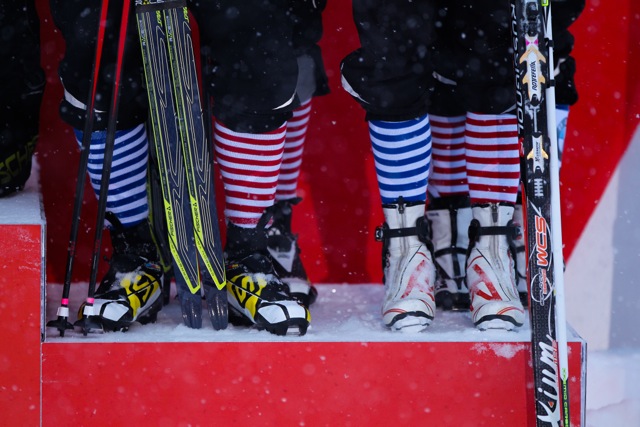
Team USA’s matching socks (Photo: Fischer / Nordic Focus)
Choose the Right Socks
Socks can have a surprisingly big impact on comfort. Thick socks are not automatically better, as they can make ski boots feel tighter and increase pressure.
Instead, choose moisture-wicking ski socks that fit smoothly without bunching. Avoid seams that sit directly against sensitive areas. Experimenting with different sock thicknesses can help you find a combination that keeps your feet warm without making your boots overly snug.
Listen to Early Warning Signs
Foot discomfort rarely improves when it is repeatedly ignored. Redness, rubbing, soreness, or numbness can all be signs that something needs adjusting.
Cross-country skiing should challenge your fitness, not leave your feet struggling for days afterward. By combining well-fitting ski equipment with comfortable everyday footwear, sensible recovery, and attention to early discomfort, you can reduce unnecessary pressure and spend more time enjoying the trails.
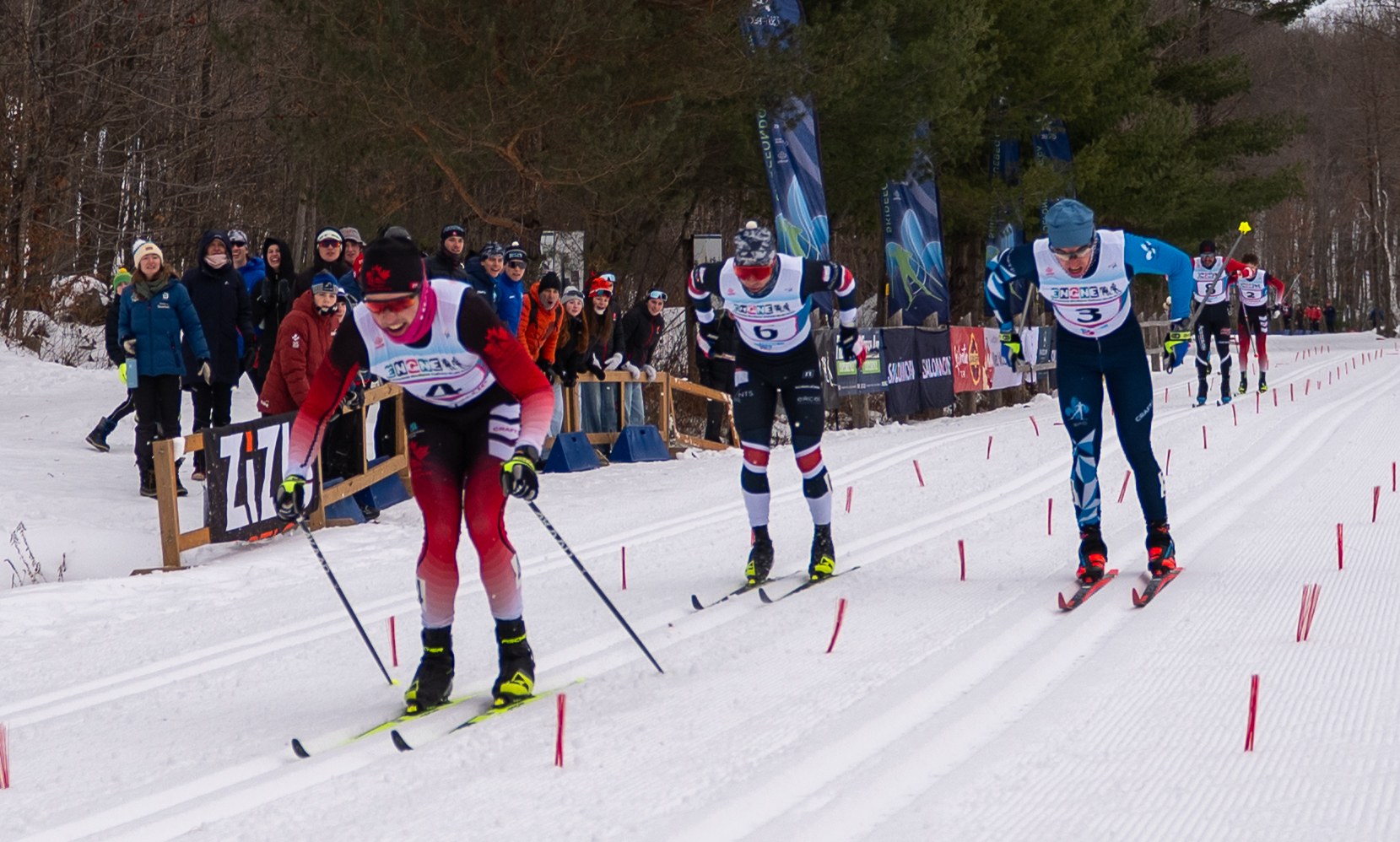
A classic sprint for the line at the Candy Cane Cup in December 2025. (Photo: Rob Smith)
The series, taking place in Gatineau, Quebec (near Ottawa), kicks off with the Canadian World Junior and U23 Championship trials, Dec. 18-21, and concludes with the Eastern Canadian Championships, Feb. 5-7. These FIS races, organized by Évènements Nordiques Gatineau Nordic Events (ENGNE), take place at Nakkertok Ski Club with the support of Ville de Gatineau and Tourisme Outaouais, longtime sponsors of the events and of skiing in the region.
Nakkertok is known for its excellent grooming and for race trails supported by an extensive snowmaking system, and for a very experienced organizing committee (nakkertok.ca).
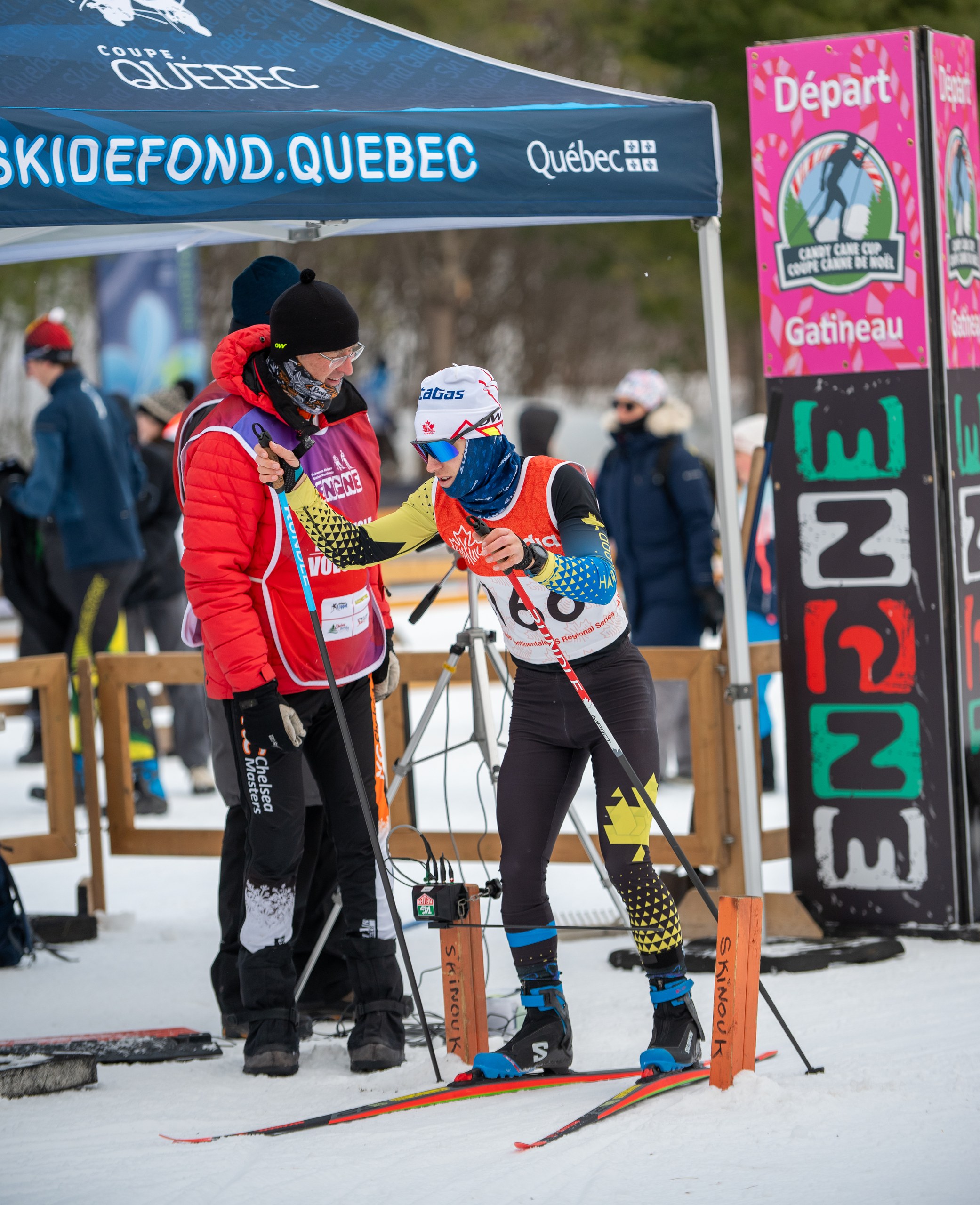
A racer leaves the start gate at the Candy Cane Cup in Gatineau, December 2025. (Photo: Rob Smith)
The Candy Cane Cup
The December races, also known as the Candy Cane Cup, will feature Canada’s best Junior and U23 athletes as they battle for positions on the Canadian team at the FIS Championships in Otepää, Estonia. The Candy Cane Cup is also the second Nordiq Canada NorAm event of the 2026-2027 season, identifying senior athletes for the Period 3 FIS World Cups. Winners in the Open class will claim $500 per race, with the overall winner receiving an additional $1,000 as a Hall Mark of Excellence (HME) Award. Junior race winners will receive $200 per race and $500 overall. Additional prize money will be awarded for other placings and categories, including ParaNordic events, with racers selected for the Canadian teams receiving an additional cash bonus.
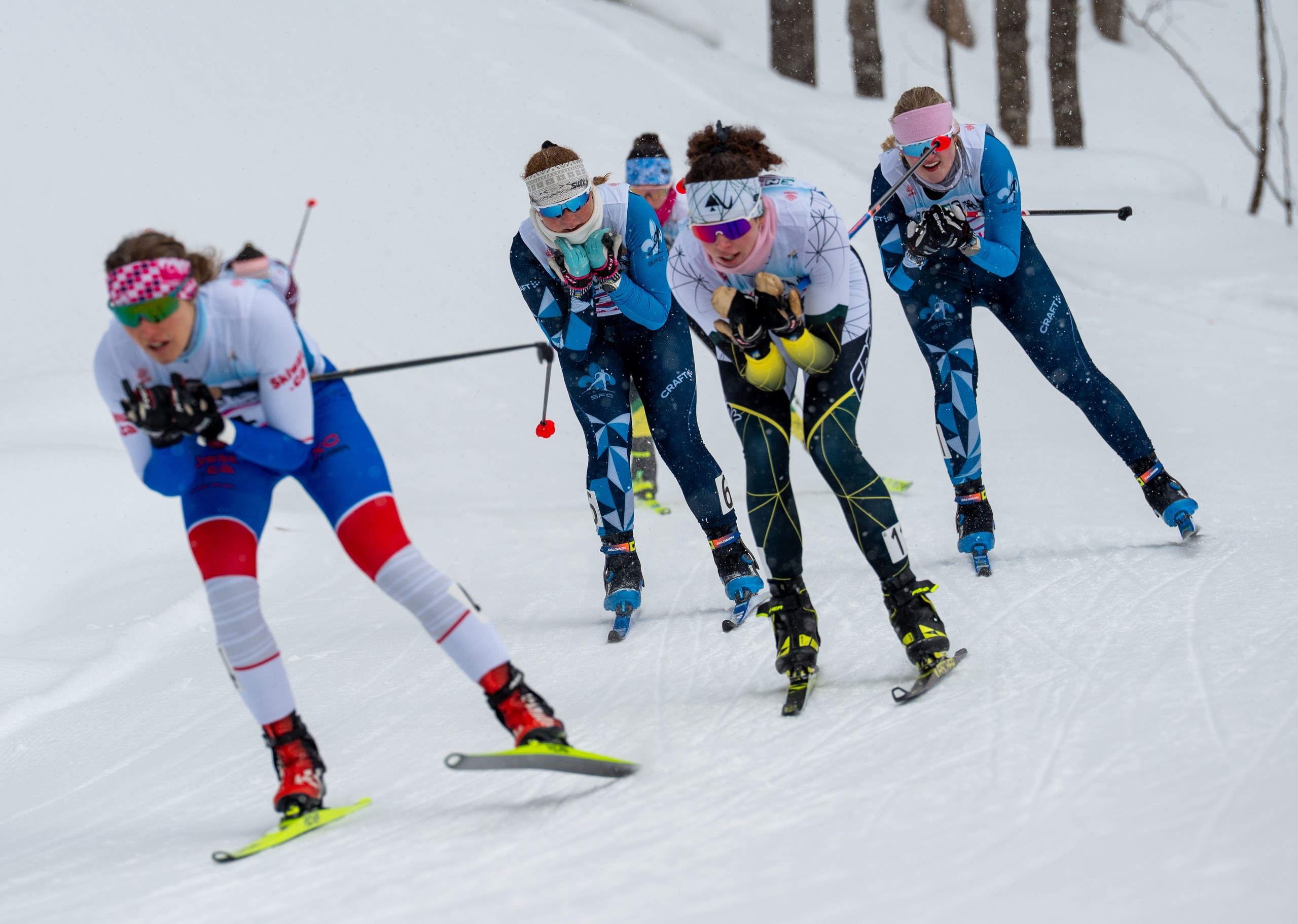
A chase group tucks through falling snow at the 2026 Eastern Canadian Championships. (Photo: Rob Smith)
The Eastern Canadian Championships
February’s Eastern Canadian Championships start the Friday following the NorAm and SuperTour races in Lake Placid, 2.5 hours “up the road,” and have a similar prize structure. Athletes who participate in both events will be eligible for the additional $2,700 in HME prize money for overall performances.
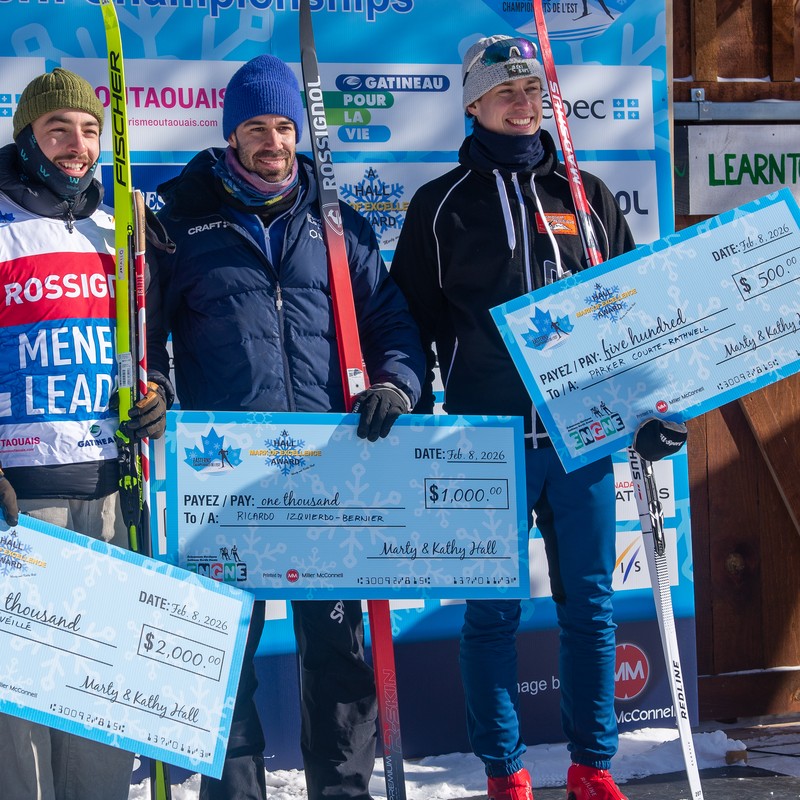
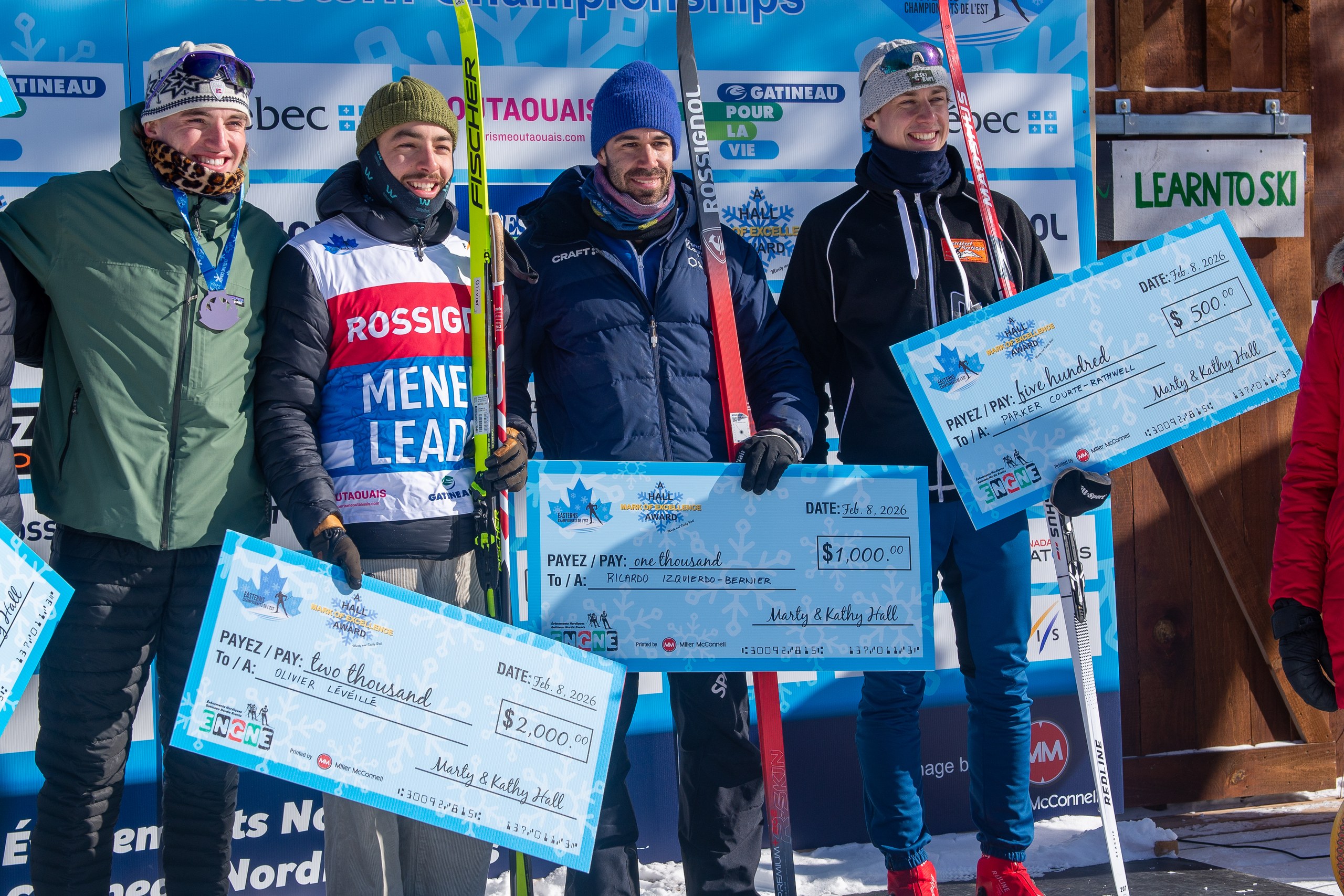
Hall Mark of Excellence checks for $2,000, $1,000 and $500 presented at the 2026 Eastern Canadian Championships, made out to Olivier Léveillé, Ricardo Izquierdo-Bernier and Parker Courte-Rathwell, respectively. (Photo: Rob Smith)
The Hall Mark of Excellence Award
The Hall Mark of Excellence Award program, founded by Marty and Kathy Hall, has provided over $70,000 of prize money at ENGNE events over the last six years, providing much needed financial support to athletes. As Kathy Hall described, “The intent of our program is to inspire and reward skiers, ultimately to enable them to continue to develop their potential and pursue their success at whatever level of skiing they choose.”
For the 2026-27 season events the HME is contributing $18,000, with an additional $17,000 provided by ENGNE and $8,600 by Nordiq Canada for the NorAm event.
“Nordiq Canada is pleased to contribute financially toward the December NorAm at Nakkertok and to work alongside ENGNE and the local organizing team to deliver a strong competition opportunity for Canada’s athletes,” said Beckie Scott, CEO of Nordiq Canada. “Investing in our domestic competition calendar is an important part of creating a high-quality pathway for athletes to develop, compete and prepare for international racing. We’re grateful to ENGNE and its partners for continuing to raise the standard of racing in the Ottawa-Gatineau region and for their commitment to supporting Canadian athletes.”
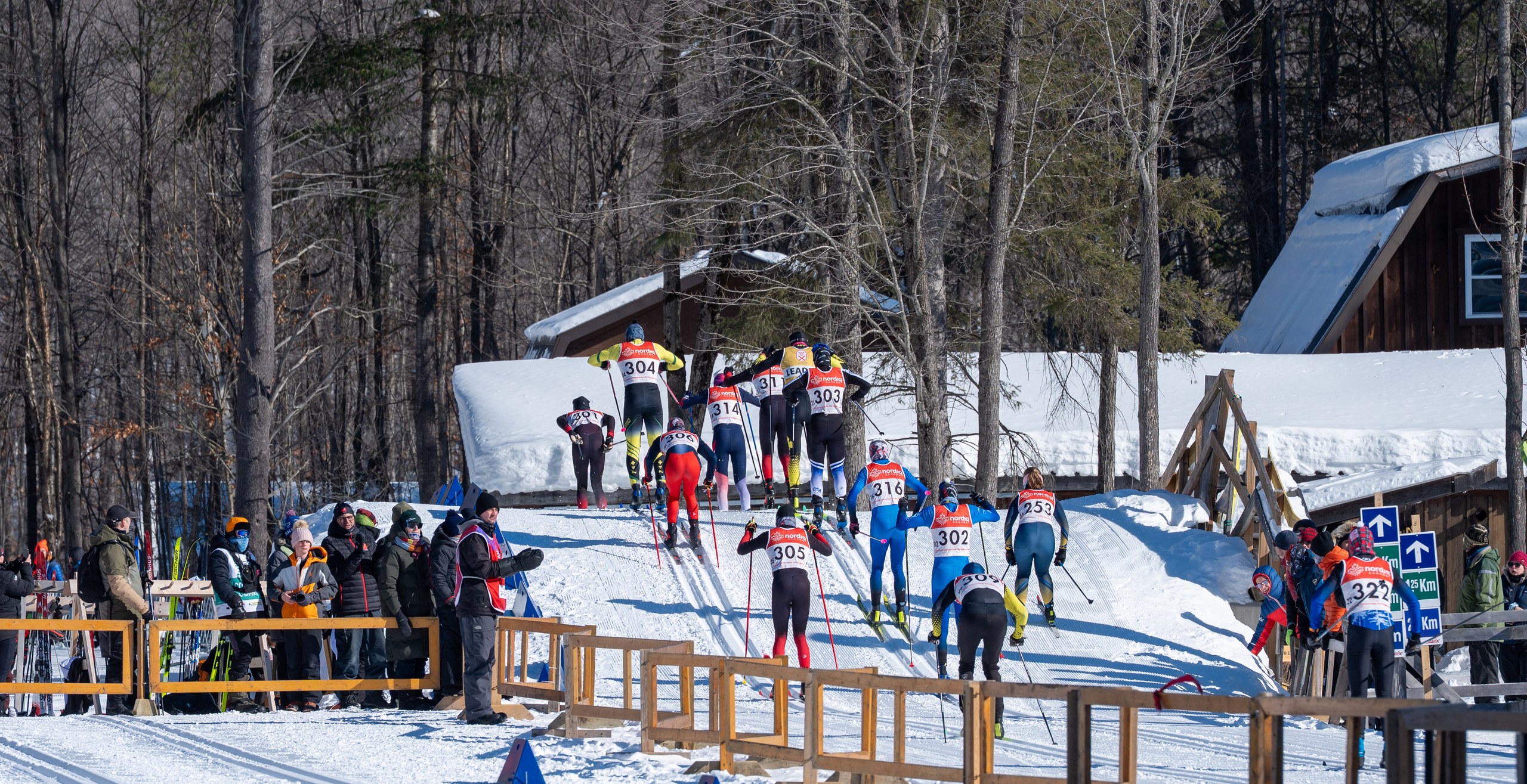
The field double-poles over a small climb early in the 2026 Eastern Canadian Championships. (Photo: Rob Smith)
A Record Year at Nakkertok
ENGNE has been organizing races in the Ottawa/Gatineau area since being formed to run the 2016 World Cup event as part of Ski Tour Canada. “A larger prize purse was important to us this season: it helps ease the financial load for athletes heading to World Championships,” said John Halvorsen, ENGNE President. “With the support of Nordiq Canada and Kathy Hall, we’ve set a record year for prize money at Nakkertok Nordic Ski Club, cementing its place as eastern Canada’s hub for world-class ski racing.”
As well as the Nakkertok trails, the Ottawa/Gatineau area has over 200 kilometres of ski trails, including Gatineau Park, home of the Gatineau Loppet, and an extensive urban trail system. It is a great area in which to train, explore and relax. We look forward to welcoming you to our winter ski home.
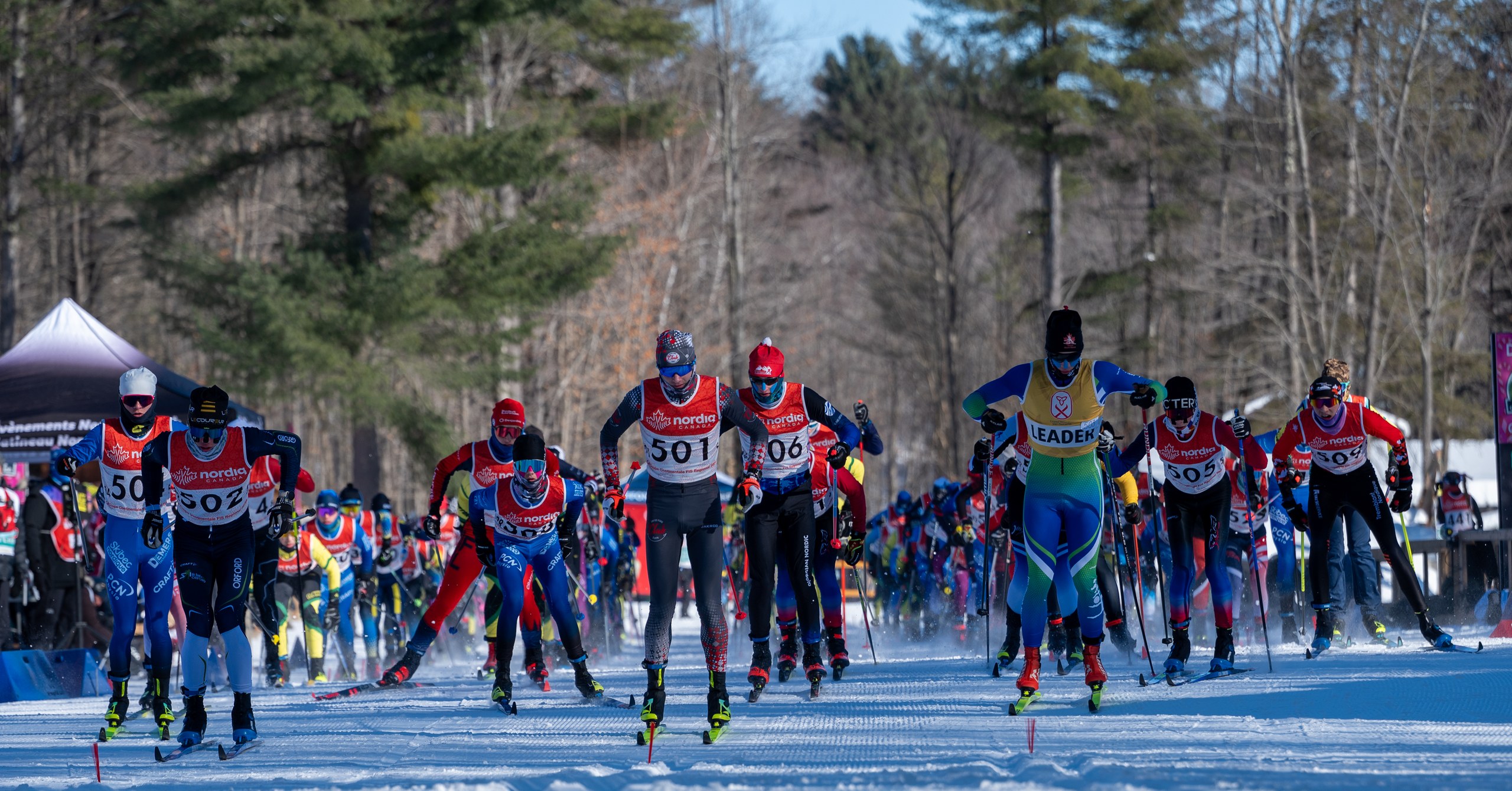
The mass start rolls out at the 2026 Eastern Canadian Championships. (Photo: Rob Smith)
Publishing press releases is a service we offer to the ski community, so please note these articles are not written by FasterSkier and therefore do not necessarily represent our thoughts and standards.
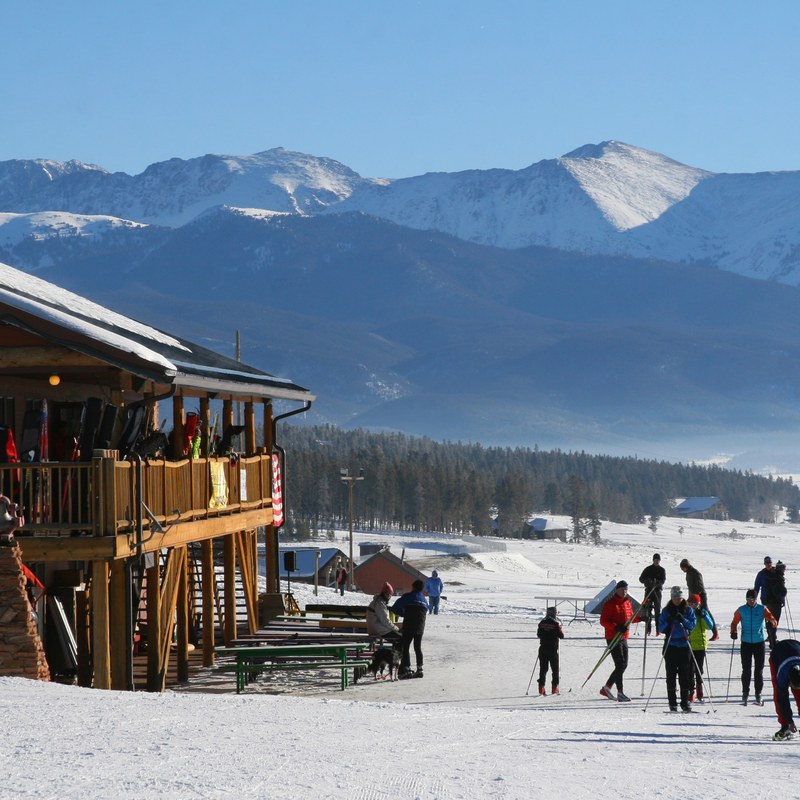
Skiers outside the Nordic Center at YMCA of the Rockies Snow Mountain Ranch. (Photo: YMCA of the Rockies)
YMCA of the Rockies Snow Mountain Ranch and SNØ Racing are joining forces, with Snow Mountain Ranch serving as the Presenting Sponsor of SNØ Racing.
The partnership connects a professional cross-country ski team committed to advancing the sport with one of Colorado’s favorite Nordic destinations. Together, SNØ Racing and Snow Mountain Ranch aim to welcome more people into Nordic skiing, support athletes and the broader ski community, and celebrate a sport built around snowy trails, hard work and the outdoors.
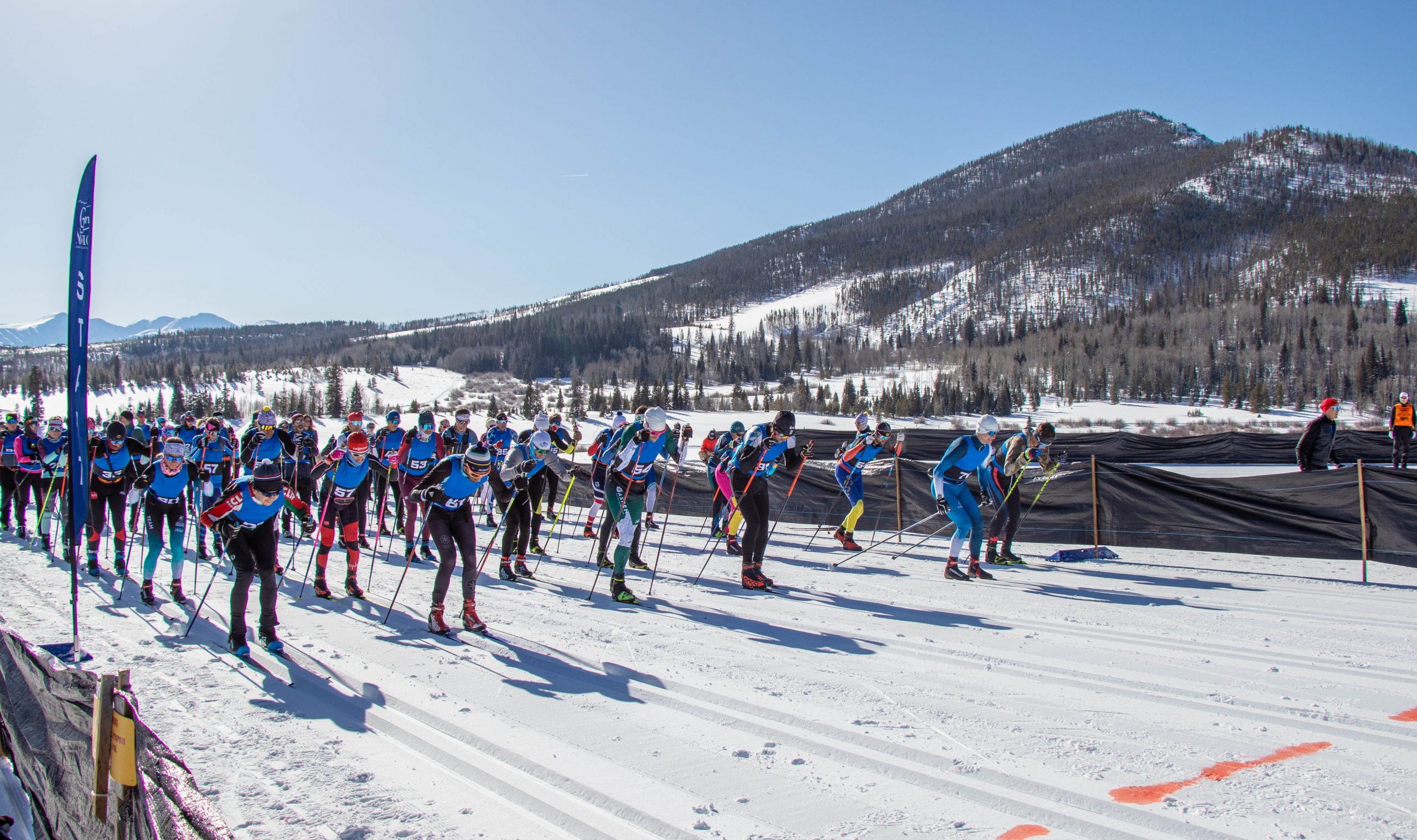
The Stampede mass start at Snow Mountain Ranch in early March. (Photo: YMCA of the Rockies)
What the Partnership Covers
“Snow Mountain Ranch has long been a place where people can experience Nordic skiing at their own pace, whether that means learning to ski for the first time, training for a race, or putting in serious Ks,” said Jeff Paulson, Nordic Director at YMCA of the Rockies Snow Mountain Ranch. “Partnering with SNØ Racing gives us an opportunity to support athletes competing at the highest levels while helping more people see that there is a place for them in this sport, too.”
As Presenting Sponsor, Snow Mountain Ranch will be featured across SNØ Racing’s public-facing team materials and marketing throughout the season. The partnership will also help introduce SNØ Racing’s community of athletes, coaches, clubs, juniors, masters, and recreational skiers to Snow Mountain Ranch as a destination for Nordic training, camps, events, lodging, meals, trail access and meeting space.
Based in Minneapolis, SNØ Racing is a professional cross-country ski team with athletes competing at the FIS World Cup, U.S. SuperTour, and regional levels. The team is focused on advancing skiing in the Central Region while promoting athlete development, partnership, and community engagement.
“Snow Mountain Ranch understands that Nordic skiing is bigger than race day. It’s about the people you ski with, the places that challenge you, the experiences that create lifelong memories, and the community that keeps you coming back. We’re proud to have them alongside our team this season,” said Yuriy Gusev, Chair of the Board of Trustees of SNØ Racing.
The Nordic Center grooms more than 80 kilometers of trail across 5,100 acres at Snow Mountain Ranch. (Photo: YMCA of the Rockies)
Eighty Kilometers at Snow Mountain Ranch
At Snow Mountain Ranch, that community has plenty of room to ski. The Snow Mountain Ranch Nordic Center offers over 80 kilometers of groomed trails across 5,100 acres of terrain, with routes winding through pine and aspen forests, open meadows and challenging climbs with expansive views of the Rocky Mountains. The trail system welcomes skiers across ages and ability levels, from first timers learning classic or skate techniques to experienced athletes looking for big training days.
The partnership also creates an opportunity to connect the Nordic community with the broader mission of YMCA of the Rockies. Snow Mountain Ranch is built around belonging, time together, outdoor experiences, and making the mountains accessible to more people. For both organizations, that shared sense of community is what makes the partnership a natural fit.
“Nordic skiing has a wonderful way of bringing people together,” said Paulson. “You can be chasing a podium or simply chasing a good glide on a bluebird morning. Either way, you belong on the trail. We’re excited to support SNØ Racing and grow that community together. And, stay tuned for the announcement of an exciting new event at Snow Mountain Ranch!”
To learn more about SNØ Racing and follow the team this season, visit snoracing.org. To explore Nordic skiing, lodging, lessons and winter experiences at YMCA of the Rockies Snow Mountain Ranch, visit ymcarockies.org.
Alongside the Nordic Center, Snow Mountain Ranch offers lodging, dining and meeting space. (Photo: YMCA of the Rockies)
Publishing press releases is a service we offer to the ski community, so please note these articles are not written by FasterSkier and therefore do not necessarily represent our thoughts and standards.
Snow is the first question anyone asks about a ski trip. It is rarely the one that decides whether the trip was any good.
Plenty of skiers have booked a week somewhere with a meter of base and come home flat, because the grooming was inconsistent, the trail network was a single 5-kilometer loop repeated until it went stale, or the lodging was a forty-minute drive from the tracks. The destinations people return to year after year get a handful of less obvious things right at the same time.
Here are seven worth checking before you book. Winter travel outfits likeAlpine Elements build packages around most of them, but the list applies whether you are booking through an operator or piecing a trip together yourself.
Photo: Tourism Whistler
1. Snow reliability, not just snowfall
The quality of any cross-country skiing holiday depends heavily onsnow conditions. Average annual snowfall is the number resorts advertise. It is not the number that matters most. What matters is how consistently a place holds skiable snow through the window when you can actually travel.
Altitude does a lot of the work here. Higher trail systems stay cold enough to keep a base intact through a February thaw that wipes out valley tracks. So does snowmaking. A growing number of Nordic centers now blow snow on a core loop, typically 3 to 5 kilometers, which guarantees you something to ski on even in a bad year. That loop will not carry a full week on its own, but it is real insurance.
Look up the last five seasons rather than the thirty-year average. Early December and late March are the risky bookings. Mid-January is almost always safe.
2. Grooming you can count on
Scenery does not save a badly groomed track. Nothing does.
The questions to ask are specific ones. How often does the center groom, and does it groom after a storm or wait for it to settle? Are classic tracks set on both sides of the skating lane, or does the skate deck take priority when the cats are short on time? Is there night grooming, so morning corduroy is a given rather than a coin flip?
Most serious centers post a daily grooming report. Read a few weeks of them before you commit. A center that logs conditions honestly, including the days when things were icy, is telling you something useful about how it operates.
Skating has been shown exacerbate CECS, even more than classic skiing. (Photo by Thomas Dils on Unsplash)
3. Terrain that matches the skiing you actually do
Cross-country skiing is unusually welcoming across ages and ability levels, which is exactly why destinations vary so much in who they suit.
A newer skier wants gentle, wide, well-signed terrain and a lesson program worth taking. Someone comfortable on skis wants 40 or 50 kilometers of connected trail with real climbing and descending, so a full day out does not mean skiing the same loop four times. A racer or a distance skier wants a network that supports a three-hour effort and, ideally, a hill they can do intervals on.
Beginners often benefit from gentle terrain, dedicated practice areas and professional tuition, whileintermediate skiers may prefer destinations offering longer routes with a mixture of climbing, descending and varied scenery. Experienced skiers and endurance enthusiasts are likely to appreciate extensive trail systems that provide technical challenges and opportunities to cover greater distances.
Groups complicate this. If you are traveling with a partner who skis twice a year and a kid who wants to go hard, a center with one difficulty band will frustrate somebody every day. Trail maps are free and they answer this question in about two minutes.
4. Where the trails go
Skiing is the rare winter sport that moves you through a landscape rather than down it. You cover ground at a pace that lets you see it.
That makes the setting a genuine part of the product, not a marketing photo. Trails that thread through old-growth forest, cross a frozen lake, or open onto a valley floor at the right hour give you something a treadmill of a loop through a parking-lot perimeter never will. Light matters more here than people expect. Low winter sun on fresh snow at nine in the morning is most of the reason skiers get out of bed on vacation.
Recreational skate. (Photo: Phillip Belena)
5. Lodging close enough to matter
Ten minutes from the trailhead and thirty-five minutes from the trailhead are different trips. The second one costs you an hour a day and quietly kills the second ski.
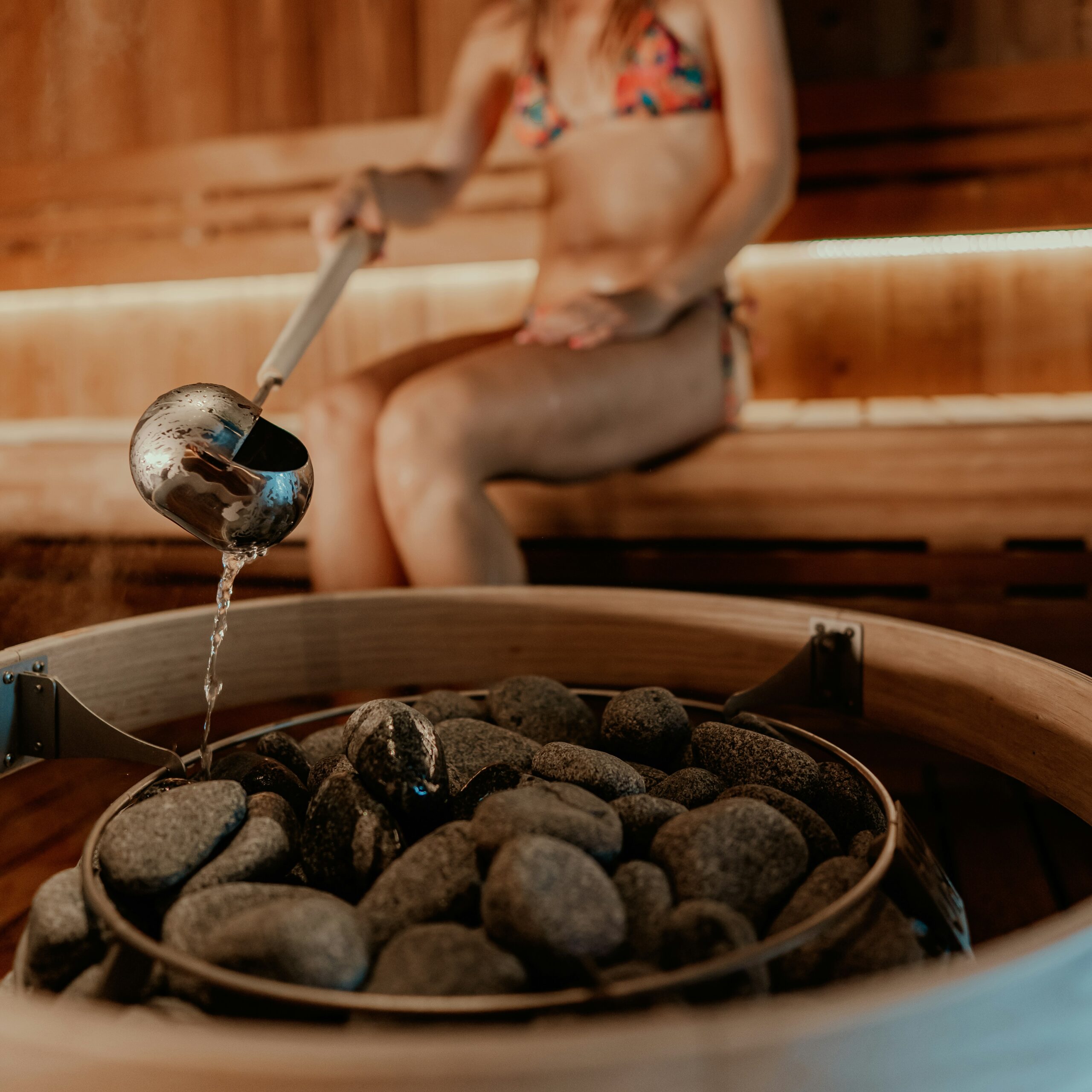
Beyond distance, the practical stuff is what separates a place that understands Nordic skiers from a place that rents rooms. Heated wax and boot rooms. Somewhere to dry gloves. A kitchen or a breakfast that runs early enough to eat before you go out. A sauna, which is not a luxury after four hours in the cold so much as a piece of recovery equipment.
6. What happens when the skiing stops
You are probably skiing three or four hours a day. That leaves a lot of day.
Towns with something going on, a bakery, a decent restaurant, a bar where people who ski actually go, turn the rest of the day into part of the trip instead of downtime in a rental. It also matters if you are traveling with someone who does not ski every day. Snowshoe trails, winter walking paths, a market, a hot spring, all of that keeps a group happy without forcing everyone onto the same schedule.
7. Getting there and getting outfitted
Logistics are boring right up until they eat a day of your trip.
Check the transfer time from the nearest airport or rail station honestly, including the last leg, which is often the slow one. Check whether you need a car once you arrive or whether a shuttle connects the lodging to the trails. If you are flying with skis, check the airline’s oversize policy before you buy, not after.
Rental quality is the other one people underestimate. A center with a real shop, current skis, a waxing service, and staff who ski themselves will get you on decent equipment in twenty minutes. A center without one will hand you a pair of rock skis from 2009 and wish you luck.
Recreational skate. (Photo: Pierre Jarry)
The right destination is the one that fits how you ski
Some skiers want distance and a network big enough to get lost in. Some want a quiet loop through the woods and a long lunch. Neither is looking for the same trip, and neither is served by picking whichever place claims the most kilometers.
The places worth returning to are the ones where reliable snow, honest grooming, terrain that suits you, and lodging you can walk to from the tracks all show up in the same week. Get those four right and the rest of it, the light on the snow, the pace, the quiet, takes care of itself.
Cross-country skiing demands stamina, coordination, and resilience. It’s not always easy to balance developing those skills with the demands of “real life”: work, family, and other commitments. But should you spend all of the time that you do have on improving your skiing directly, or cross-training?
For cross-country skiers, cross-training might include strength training, martial arts, running, cycling, swimming, roller skiing, tennis, and any number of other activities. Is such variety necessary, or even beneficial? The answer depends on how cross-training is planned and how well it supports the specific demands of skiing.
Pepa Miloucheva (l), head coach of the Craftsbury Green Racing Project, giving biathlete Susan Dunklee some sculling instruction at the Craftsbury Outdoor Center in June 2012. (Photo: Susan Dunklee)
Cross-training
As a skier, you’ll know that your aerobic endurance, upper body strength, and lower body strength are all challenged. Skiing requires efficient technique, balance, and the ability to sustain effort across varied terrain. Amateur skiers often have limited on-snow time, especially if they live in areas with short winters. Cross-training can help fill those gaps.
To develop your aerobic capacity, running, cycling, and rowing (for example) develop the cardiovascular system in ways that transfer well to skiing. These all allow skiers to maintain or build endurance during the off-season and during periods when snow conditions are not ideal.
Without strength training, you might plateau or risk overuse injuries. Resistance exercises like squats, lunges, pull-ups, and core work can improve power and stability. Even bodyweight routines performed at home can make a difference.
Cross-training can also provide mental variety. Repeating the same workout can lead to boredom, especially if you’re training alone (though some people enjoy the solitude). Mixing in new activities keeps motivation high and can help athletes stay consistent in the long term.
The principle of cross-training isn’t limited to physical sports. In many strategy-based activities, participants also improve by practising related formats that challenge similar skills. Poker players, for example, often sharpen their decision-making and probability assessment by playing other card games that require reading patterns, managing risk, and adapting to changing situations. This kind of variation helps develop the underlying skills that apply across multiple games, just as cyclists or swimmers might build endurance that later benefits their skiing performance. Players interested in exploring how different online card and casino games are structured can learn more about the platforms available to Canadian users, including how game formats, security standards, and payment systems vary between sites.
On snow or rollerskis, Brennan just keeps grinding away. (Photo: Rosie Brennan)
Types of cross-training that support skiing performance
Not all cross-training methods are equally useful. The most effective options mirror the movement patterns and energy systems used in skiing.
Roller skiing might be the closest substitute for on-snow training. You can practice technique, balance, and poling mechanics during the off-season. It requires specific equipment and safe pavement, but the skills transfer well.
Trail running echoes the varied terrain of many courses. Anyone who’s run up hills knows the cardio and strength demands. Downhill sections can help improve coordination and control.
Cycling is a good, low-impact way to build aerobic capacity. If you’ve had knee or ankle issues, it can provide endurance benefits without the repetitive pounding of running.
Swimming is good for the upper body and also promotes active recovery. It doesn’t replicate skiing movements very closely, but enhances lung capacity and muscular endurance while reducing stress on joints.
Julia Kern biking up New Hampshire’s Kancamagus Highway at a recent training camp. (Courtesy photo)
Managing injury risk and recovery
Professionals have dedicated coaches and medical support, but injury prevention can be trickier for amateurs. Cross-training can reduce overuse injuries by distributing stress across different muscle groups and movement patterns.
Skiing relies heavily on repetitive motions. When training consists only of skiing or ski-specific drills, certain muscles and joints bear the brunt of the workload.
Low-impact cross-training is particularly useful during recovery from minor injuries. For example, a skier with shin splints from running might switch to cycling or swimming to maintain their aerobic conditioning. Strength training can also address muscle imbalances that contribute to recurring issues.
Amateur athletes often underestimate the importance of rest days. Cross-training shouldn’t mean training harder every day. Light sessions such as easy swimming, gentle yoga, or tai chi can serve as active recovery, helping muscles repair while preserving mobility. Tai chi and yoga can also reduce inflammation and stress.
Active recovery differs from passive recovery – what you might think of as sitting on the couch. Passive recovery is important if you’re injured or in pain. You might also benefit from simply staying still if you’re particularly tired, either mentally or physically. A draining competition after much excitement and adrenaline leading up to the event, for example, might call for a more sedentary day (or days).
In short, a good approach to cross-training involves considering the skills you most need to improve, your physical and mental readiness, and your available time.
Cross-country skiing is among the most physically demanding winter activities. Long hours on the trails can leave your legs tired, your energy depleted, and your body in need of proper recovery.
It’s true: the sport is known for its peaceful surroundings and endurance benefits. However, recovery is just as essential as performance itself. Get the right post-ski routine in place, and you can restore energy levels to prepare for another day outdoors.
This guide details how to do this successfully.
Warm Up Properly After Leaving the Trails
After your skiing session is done, one of the first priorities is to bring your body temperature back to a comfortable level. You don’t want to remain in damp base layers for too long. This can leave your muscles feeling stiff and uncomfortable, particularly during colder weather.
After finishing for the day, it’s common for experienced skiers to change into dry clothing immediately and spend time warming up gradually indoors. From warm drinks and heated lounges to calm surroundings, there are various ways to support your body’s transition out of high physical activity without feeling abrupt.
Refuel with the Right Food and Drink
Cross-country skiing burns a significant amount of energy. That’s certainly the case when engaging in longer sessions or tackling difficult trail conditions. Recovery becomes much harder without proper hydration and nutrition afterwards.
After any endurance-based activity, meals containing carbohydrates and protein are recommended because they replenish energy while supporting muscle recovery. Hydration is equally important, even during cold weather when dehydration is easier to overlook.
Whether it’s a hearty soup or an electrolyte-rich drink, it can be beneficial after a demanding day on the snow.
Stretch and Relax Your Muscles
Legs, hips, shoulders, and lower back muscles, they all work heavily during cross-country skiing. Without proper stretching afterwards, stiffness can build quickly. That would make the following day much more uncomfortable.
Gentle stretching and light mobility exercises can reduce tension while enhancing flexibility. After spending hours in freezing conditions, some skiers also opt for saunas or warm baths to relax those sore muscles.
Just remember that recovery routines don’t need to be intense. In a lot of cases, slower, more controlled movement works best after long-distance skiing sessions.
Prioritize Quiet Evening Downtime
After spending hours outdoors, packed schedules and busy nightlife sessions are not the answer. Calm, low-energy evenings are a much better fit. After all, recovery is not only physical. Mental relaxation is also important.
Quiet evenings in your lodge or hotel room become part of the overall experience. While recovering indoors, some travelers read. Others watch films or enjoy light digital entertainment. The latter includes a flexible mobile platform like kanuuna.com. Kanuuna fits naturally into quieter moments because sessions can be short and casual. Whether you prefer action-packed slots or slower-paced card games, online casino play doesn’t demand too much attention after an exhausting day on the trails.
Get Rest and Quality Sleep
Sleep remains one of the most effective recovery tools available. Long skiing sessions put strain on muscles and energy reserves, and proper sleep gives the body time to repair itself naturally.
Another advantage: a well-rested body is far better prepared for another full day of skiing. This is key for multi-day trips where consistent recovery is essential.
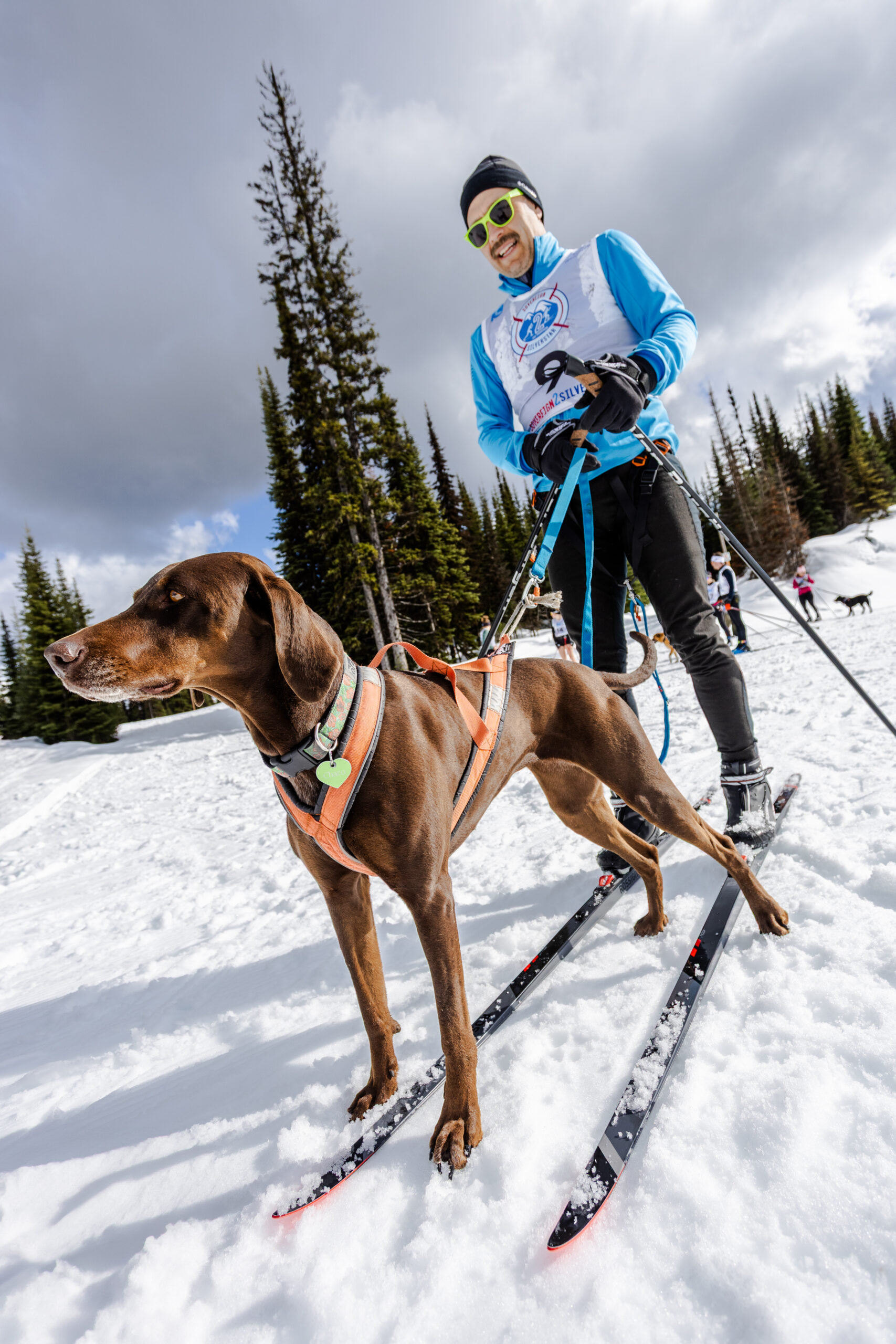
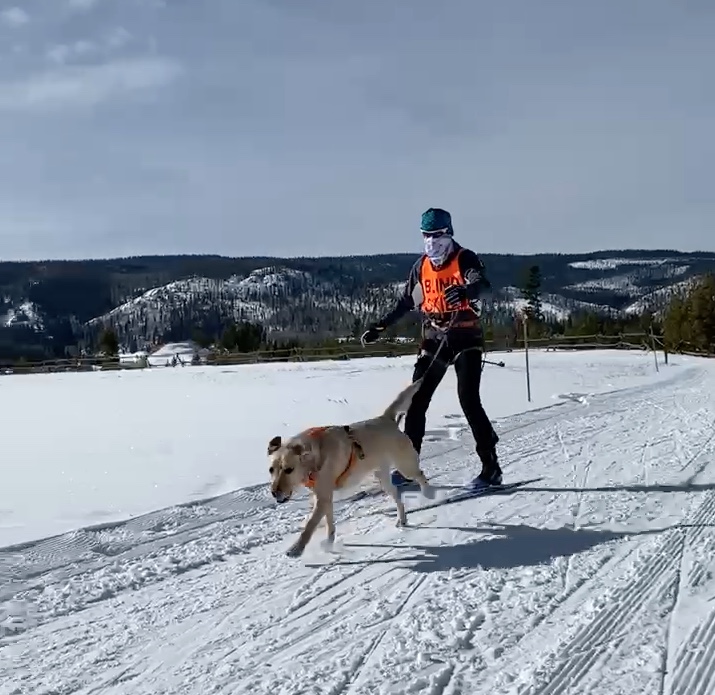
That is the moment when most newcomers to skijoring understand the bargain. One second you are a cross-country skier, in charge of your own pace and direction. The next, a dog has decided that the trail is hers, and you, all sixty or eighty or a hundred and seventy pounds of you strapped into a hip belt and a bungee line, are merely the most interesting thing she has ever towed.
There is, in that first lurch forward, a particular kind of laughter that comes out involuntarily. People who skijor know it. It sounds a little like surprise and a little like joy and quite a lot like the noise you made the first time you went down a sledding hill as a kid.
Skijoring, whose Norwegian-derived name translates roughly to “ski driving,” is one of those winter sports that sits politely in the corner of the room until someone finally asks about it, at which point everyone in the room wants to try. The recipe is disarmingly simple: a willing dog in a sled-style harness, a stretchy line about eight to ten feet long, a wide belt on the skier, and a set of cross-country skis. Together, the team moves through snow at speeds that would be hard, and in some cases impossible, to reach on skis alone.
The sport’s roots are Scandinavian, but its DNA is much older. For centuries, people in northern Europe have been hitched to draft animals on snow: horses, reindeer, and dogs. Equestrian skijoring still exists as a niche-but-spectacular oddity in places like Leadville, Colorado and St. Moritz, Switzerland, where galloping horses tow racers over jumps and through gates. At the 1928 Winter Games, in fact, equestrian skijoring appeared as a demonstration sport on the frozen lake. The dog-powered version is the offshoot that has quietly taken root in North America, especially in New England, the Upper Midwest, and across Canada, where it shares blood and culture with the older world of mushing.
It is also, importantly, the version most people can actually do.
The dog
The first question any prospective skijorer asks is which dog. The romantic answer is a Siberian husky or an Alaskan malamute, with a face built for sled-team posters and a genetic memory for pulling weight across snow. The realistic answer is broader. German shorthaired pointers, Australian shepherds, labradors, border collies, Belgian malinois, and a great many mutts have all proven themselves capable. The rough rules of thumb: thirty pounds or more, healthy joints, a coat that handles cold, and, most important, a temperament that wants to go forward on a line rather than circle back to sniff something off-trail.
Almost every veteran skijorer will tell you the same thing about the dog: the relationship matters more than the breed. A dog who likes to please you, who has been taught to keep the line tight, and who finds the activity genuinely rewarding will outwork a high-pedigreed sled dog who would rather be home on the couch.
The gear
The list is short, but every piece matters. A skijoring harness is cut differently from a daily walking harness: it distributes load across the dog’s chest and shoulders, with the tow point at the base of the spine near the hips, where the dog can pull most efficiently and the line clears the skier’s tips. The skier’s belt is wide enough to spread the force across the lower back rather than dig into one hip. The line itself, usually six to ten feet long with a built-in bungee section, absorbs the small explosions of speed that happen when a squirrel becomes relevant.
Two design details matter more than they appear to. The first is a quick-release on the belt. If the dog bolts after a deer and you, on skis, would rather not follow into the brush, you want to be able to drop the line in half a second. The second is the absence of metal edges on the skis. Classic touring or skate skis without sharp edges are gentler if the team tangles. Skate gear is preferred by racers for sheer speed; for most recreational skijorers, well-waxed classic skis are perfectly fine.
Visually impaired skiers use dogs to get out on the trails as well. Michael Stone skiing with his guide dog Geo. (Courtesy photo)
The vocabulary
It is borrowed wholesale from mushing. Gee means right. Haw means left. On-by means ignore that dog, that smell, that picnicker eating a sandwich. Whoa means slow down, please, the hill is steeper than I’d like. There is no command for stop, exactly, because dogs in harness do not really stop the way cars stop; they slow until they think it is time to go again. New skijorers learn to talk constantly, not yelling, just keeping up a stream of warm, encouraging chatter that tells the dog the team is still working together.
Training and fuel
Off-season training is its own subculture. Canicross, which is running with a dog tethered the same way, is the warm-weather equivalent. Bikejoring substitutes a bike for the skis. Both keep the dog’s pulling instinct sharp and the human’s cardiovascular system honest. So does paying attention, year-round, to what the dog eats. A working dog burns through calories the way an Ironman athlete burns through gels, and skijoring owners tend to be opinionated about nutrition. Many experiment with high-protein options, including raw and minimally processed beef dog food formulated for active animals, then dial it in across the season as mileage rises. The goal is the same as for any endurance athlete: enough fuel to perform, clean enough sources to recover.
The trail
Trails are the other variable, and they change by the hour. Groomed cross-country courses, when they allow dogs, are the gold standard: predictable surface, no surprises buried under the snow, room to pass. A growing number of Nordic centers in New England, Vermont, Quebec, and the Upper Midwest now host dog-friendly days or designated dog loops. Beyond the groomed network, snowmobile trails, frozen logging roads, and quiet rail-trails all work. The two enemies are crust and ice. Hard, crusty snow can slice a dog’s paw pads, and slick ice gives a hard-pulling dog nothing to brake against. Booties and paw balm help; reading the forecast and the thermometer helps more.
The community
The community around the sport is small enough to be neighborly. The New England Sled Dog Club, founded in 1924, is the oldest organization of its kind in North America, and along with regional groups like the Down East Sled Dog Club in Maine and the Pennsylvania Sled Dog Club, it hosts winter races whenever the weather cooperates. National-level competition runs through organizations like Skijor USA, which has been quietly lobbying for the sport’s broader recognition. The Skijor National Championships, held annually in Minneapolis, draw competitors from across the country and have produced a small constellation of standout racers, several of them, notably, college-age Nordic skiers who have discovered that their endurance fitness translates beautifully onto a tow line.
What is striking, at a race or even at an informal Saturday-morning meetup at a Nordic center, is how little hierarchy there is. Beginners line up next to athletes who have podiumed in Quebec. A first-time skijorer in a borrowed rock-climbing harness gets the same coaching as the racer in carbon poles. The dogs do not particularly care about the human’s résumé.
Why now
There is a reason, beyond novelty, that the sport keeps drawing new converts. Winter in the eastern United States has become moodier and less reliable; cross-country skiers have learned to take their days where they find them. Skijoring stretches the season, in a way. A trail that is too thin for a good kick-and-glide can still hold a dog and a willing skier. A snowfall that would feel ordinary on foot becomes, with eighty pounds of husky strung out in front of you, an entirely different thing.
It also restores something that more performance-focused corners of endurance sport sometimes lose, which is the simple presence of another living creature whose enjoyment is the point. Skijoring is not really faster running. It is not exactly skiing. It is a collaboration, in which the human contributes balance and judgment and the dog contributes everything she has ever wanted to be allowed to do. The bargain works because both parties think they are getting the better end of it.
On a good day, on a packed-down trail in the long light of a February afternoon, the leash goes taut and the dog hits her stride and the trees on either side begin to blur. The only sound is the hush of skis on snow and the soft, ridiculous laughter of a person being towed somewhere they had not quite planned to go this quickly. The day ends with the dog asleep before dinner and the skier sore in muscles they did not know they had. Both, almost certainly, will be ready to do it again tomorrow.
There’s a special kind of peace that settles over a cross-country trail in winter. The sound of skis gliding over snow, the rhythm of your breath syncing with each push, and the endless stretch of white ahead create a feeling that’s both grounding and exhilarating. That serenity doesn’t come from chance. It’s built on preparation, the quiet, intentional steps that make your day on the trails seamless and strong.
The Foundation of Comfort and Performance
Cross-country skiing is as much about endurance as it is about balance. The terrain changes constantly, and your body must adjust with every shift. To stay comfortable and focused, preparation begins before you even step outside. It starts with understanding your body, the weather, and how the two interact through your gear.
Mastering the Art of Layering
Layering is a ritual in itself. The right combination keeps you warm without overheating, dry without feeling restricted. Start with a moisture-wicking base layer that regulates temperature as your effort increases. Add a breathable mid-layer to trap heat while allowing airflow, and finish with a lightweight shell that protects against wind and snow. This harmony of materials allows your body to move freely while maintaining comfort, even when the temperature drops sharply.
Don’t Forget the Feet
Feet often get overlooked, yet they’re the foundation of every stride. Cold toes can end a good day before it starts, and poorly chosen socks can cause friction that distracts from the rhythm you’ve worked so hard to find. Choosing high-quality socks with wool ensures insulation, moisture control, and cushioning without the bulk that slows you down. The natural fibers wick away sweat and hold warmth even in damp conditions, creating a reliable barrier between your skin and the elements.
Recreational classic. (Photo: Phillip Belena)
Fueling Your Body for the Trail
Hydration and nutrition also play a quiet but essential role in endurance. Cold air can trick your body into feeling less thirsty, but dehydration creeps in unnoticed, reducing energy and focus. Drink steadily before and during your ski session, even in the cold. Small, nutrient-dense snacks, like nuts or dried fruit, can help maintain stamina through long stretches.
Building Mental Strength
Mental preparation matters just as much as physical readiness. Cross-country skiing is meditative by nature, but it can test patience and resilience when the trail feels endless. Setting small goals, like reaching the next bend or maintaining a steady pace, turns the experience into a rhythm rather than a race. It’s this mindset that transforms distance into discovery.
Recreational classic in the backcountry. (Photo: Jean Bapiste)
Safety and Awareness
Finally, respect the conditions. Check weather forecasts, understand snow quality, and bring safety essentials such as a small repair kit and navigation tools. The more you anticipate, the freer you’ll feel once you’re out there.
Finding Balance in Motion
A perfect ski day isn’t just about perfect snow. It’s about balance, the alignment of gear, body, and mind. When everything works together, distance stops being a barrier. It becomes an invitation to explore further, glide smoothly, and find strength in motion. In that harmony, the trail is no longer something to conquer. It’s something to experience, fully and without limits.
Cross-country skiing is one of the most physically demanding and rewarding sports out there. It requires a balance of endurance, strength, coordination, and focus that few other activities can match. But what many skiers overlook is that staying strong and improving performance on the trails isn’t just about what you do in the snow season. The secret lies in how you train all year round and how much variety you bring into that training.
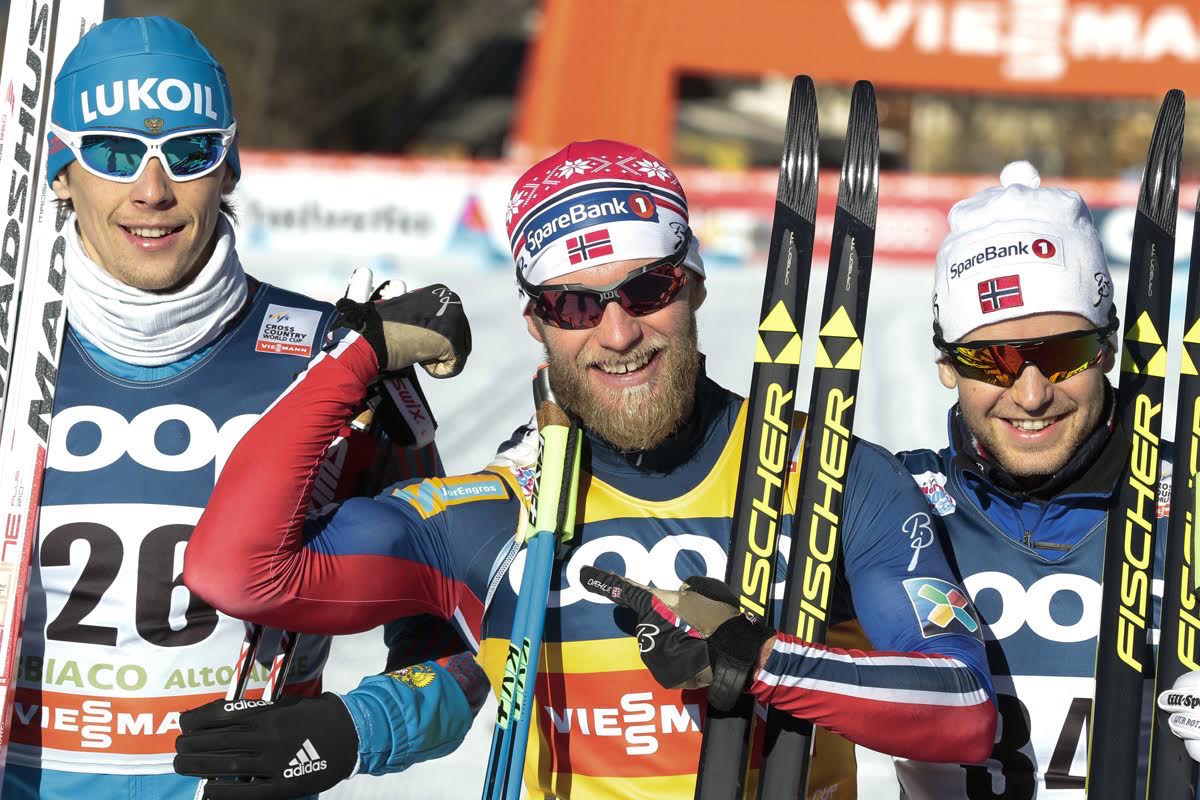
Norway’s Martin Johnsrud Sundby shows off his arm strength after double poling the entire 15 k classic at the World Cup in Toblach, Italy. He won by 12.6 seconds over Russian runner-up Alexander Bessmertnykh (l) and Norwegian teammate Sjur Røthe (r) in third. (Photo: Fischer/NordicFocus)
Building a Foundation That Lasts
Skiers often focus on long-distance endurance and aerobic capacity during the winter, but the off-season is the perfect time to focus on complementary skills. Incorporating resistance training, mobility work, and other sports ensures that the body stays balanced and injury-free. Strength training builds the muscles that support your stride, while flexibility and mobility exercises improve fluid movement and recovery.
When you include variety in your fitness plan, you keep your body guessing and engaged. This helps prevent overuse injuries that come from repetitive movements, giving your muscles and joints the time they need to rest and rebuild.
Martin Loewstroem Nyenget (NOR), Johannes Hoesflot Klaebo (NOR), Harald Oestberg Amundsen (NOR), (l-r) – FIS Nordic World Ski Championships Cross-Country, skiathlon men, Trondheim (NOR). (Photo: Modica/NordicFocus)
The Benefits of Cross-Training
Cross-training keeps your workouts exciting while improving your overall performance. Activities such as running, cycling, and swimming enhance cardiovascular endurance, while sports like climbing or rowing add a new layer of strength and coordination. Each one brings unique benefits that complement the motion and energy demands of skiing.
Adding a sport like hockey can also help maintain stamina and reaction time through dynamic, fast-paced movement. For those in the Washington, D.C. area, an ice hockey camp near DC offers a chance to build balance, speed, and leg strength in a fun and competitive way. The lateral motion and core control in skating are especially beneficial for cross-country skiers looking to sharpen agility and coordination.
Richard Jouve doublepoles up an incline during a team training camp in Tignes, FRA. (Photo: NordicFocus)
Keeping the Mind Fresh
Variety doesn’t just keep the body in shape; it keeps the mind sharp and motivated. Doing the same type of training every week can lead to burnout, while mixing in new sports or outdoor adventures keeps things fresh. When athletes challenge themselves in new ways, they build mental flexibility and resilience, two traits essential for tackling long climbs and grueling races.
Trying different environments, like trading ski poles for a paddleboard or roller skis for mountain bike trails, can reignite your love of movement. These changes help athletes reconnect with the joy of being active, which often translates to renewed motivation when ski season returns.
Campbell Wright (USA), Otto Invenius (FIN), and Paul Schommer (USA), (l-r) climbing the Stelvio Pass, Livigno (ITA), in July. (Photo: NordicFocus)
Training with Intention
The best cross-country skiers approach training as a full-year commitment. That doesn’t mean constant intensity, but rather intentional cycles of strength, speed, and rest. By combining different types of movement, you maintain a high level of overall fitness and avoid stagnation.
Whether you’re building explosive power through sprint intervals, stabilizing your core with yoga, or enjoying a high-energy skating session, each element contributes to a well-rounded athletic foundation.
A Stronger Athlete, On and Off the Snow
Year-round training built on variety ensures that skiers return to the snow season stronger, faster, and more adaptable than before. The mix of sports, rest, and mental recharge creates not only better athletes but also more fulfilled ones.
Staying curious, trying new activities, and balancing structured workouts with play are what make great skiers even greater. Variety isn’t just good for fitness; it’s the key to lasting passion for the sport.
There’s more to life than skiing. Mountain biking opportunities abound to create a change of pace. (Photo: Julia Kern)
Conventional thinking has long prioritized endurance and cardiovascular fitness for cross-country skiers, but new research suggests that strength and power are just as important for better skiing. Cross-country skiers that did just between six to twelve weeks of strength training showed noticeable improvements in their performance compared to those who didn’t, a recent systematic review found. The way strength training pays off is that stronger muscles generate more power with each movement. This means you ski faster and cover more ground without exhausting yourself. Strength training also helps your brain and body work together better for more efficient skiing. Interestingly, similar benefits can be achieved with cross-training with other winter sports like snowboarding, which can also help you develop the balance and control you need to ski at your best.
Jessie Diggins shows what a well fueled muscular body is capable of. Diggins seeks to use her platform as an elite ski racer to raise awareness about eating disorders in sport and to inspire youth to take pride in what their well-fueled bodies are capable of. (Photo: Instagram @jessiediggins)
Stronger muscles for easier skiing
Several studies in the review found that skiers who added high-load or explosive strength training to their routine saw significant gains (anywhere between 7-52%) in their work economy. What does this mean exactly? Basically, that strength training can help you improve your performance on the trails while expending less energy. Stronger muscles deliver more power with each movement, and this translates to a more efficient skiing style where you cover more ground with each push. Two exercises that can help with this are the bench press and bench pull. The bench press targets the shoulders, chest, and triceps, while the bench pull strengthens the back and biceps. These are all muscles heavily used for double-poling. Together, these moves can help you can ski with more power without burning as much energy.
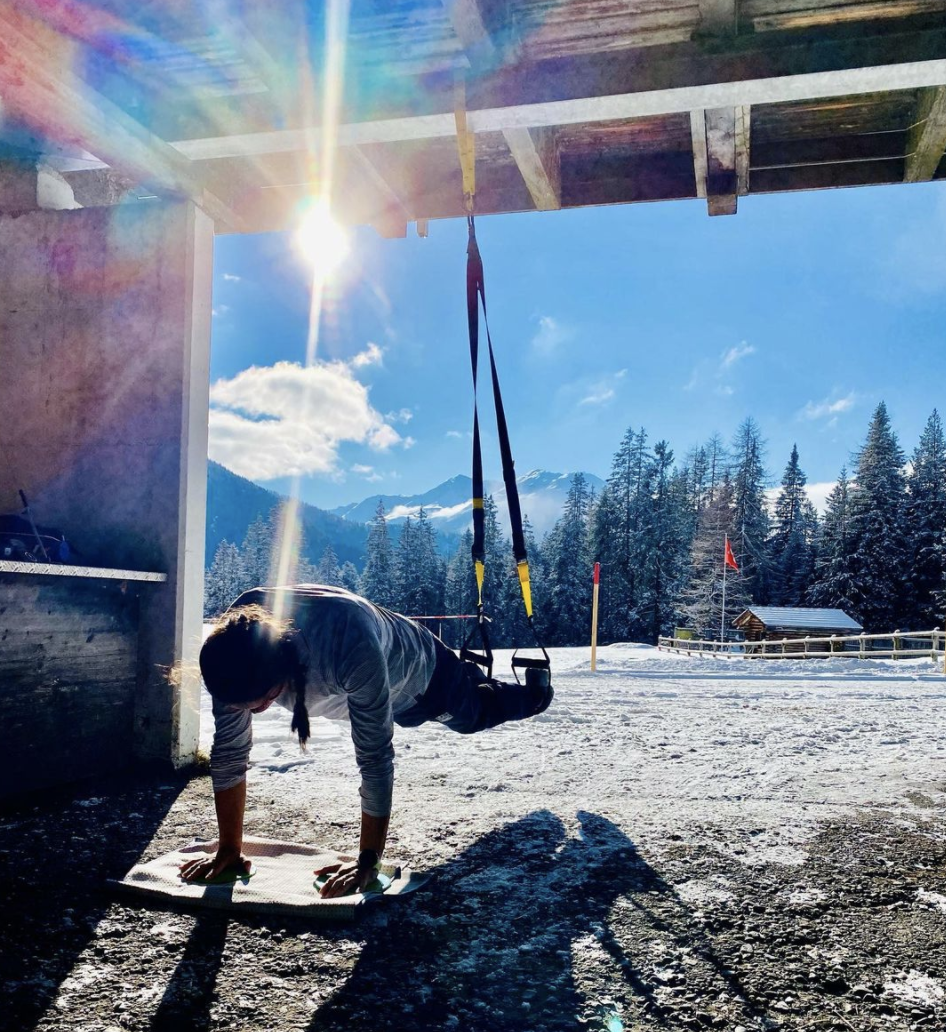
Julia Kern enjoying sunny Davos for some outdoor strength, seen here using TRX bands. (Photo: Kern’s IG)
Improve neuromuscular coordination with cross-training
Research also shows that strength training helps your brain and muscles work together better (what’s known as neuromuscular adaptation). This can make a huge difference for cross-country skiers. Using the right muscles at the right time means you ski faster with less effort. But strength training isn’t the only way to achieve this benefit, and cross-training with other sports, like snowboarding, can also help you get even better at controlling your body. Snowboarding trains your neuromuscular system to improve balance, which can complement your skiing nicely. There’s actually research to back this up. In a Polish study, a group of snowboarders saw great improvements in their balance after just nine days of practice. Their overall stability index dropped from 2.21 to 1.85, which means they developed better body control. So, snowboarding can work well with strength training for better skiing. Just remember to gear up properly before you hit the slopes. A good pair of boots will give you the control and stability you need to practice new moves without worrying about falls. The range of boots at Tactics includes all-mountain designs that provide support and stability across any terrain.
Build maximal strength for more power
Strength training also improves maximal strength in cross-country skiers by up to 24%. Maximal strength is the maximum amount of force your muscles can generate in a single effort, and helps cross-country skiers produce more power on the trails. In particular, the seated lat pulldown can help you develop a more powerful double poling technique. This is because it primarily works the latissimus dorsi muscle on your back, which is the main muscle used in double poling. Another useful exercise is the squat jump. This move has been linked to faster peak velocity (or more explosive leg power) in diagonal stride, thanks to its focus on leg and glute strength.
Strength training can help you become a better cross-country skier. When you build stronger muscles and improve neuromuscular coordination, your efforts will pay off with a faster, more efficient performance on the trails.
The Loppet Foundation has been awarded a $500,000 multi-year Conservation Partners Legacy (CPL) Grant through the Minnesota Department of Natural Resources, launching a three-year habitat restoration effort at Theodore Wirth Park.
The project will focus on restoring 50 acres of woodland, prairie, and savanna surrounding The Trailhead, aligning with the Loppet’s mission of connecting people to the outdoors while fostering stewardship of Minnesota’s natural landscapes.
A Transformational Restoration Project
Working alongside Minnesota Native Landscapes (MNL) and a growing team of dedicated volunteers, the Loppet will implement a wide-ranging restoration plan. The work includes invasive species removal, turf grass conversion, prairie burns, reseeding with native plants, and long-term habitat maintenance.
“This collaborative effort marks a shared commitment to ecological restoration, climate resilience, and public engagement with Minnesota’s native ecosystems,” said a spokesperson for Minnesota Native Landscapes. “We’re helping to heal the earth and restore the connection between people and the outdoors while growing the community.”
The effort builds on two summers of volunteer-driven invasive species removal and represents a step forward in establishing resilient native habitats.
Protecting a Vital Urban Park
Theodore Wirth Park is one of the Twin Cities’ most iconic outdoor spaces and a cornerstone for Nordic skiers, runners, mountain bikers, and outdoor enthusiasts. With over one million annual visits, the park serves as both a recreational hub and an ecological resource.
“Theodore Wirth Regional Park is essential to the ecological health of our region, and with more than one million annual visits, vital to the well-being of so many people who connect to the outdoors at the park every day,” said Minneapolis Park and Recreation Board Superintendent Al Bangoura. “We’re incredibly grateful to have partners like the Loppet and DNR, along with countless volunteers, who recognize the importance of protecting and improving Wirth Park’s valuable natural areas.”
Community Involvement
Volunteer efforts remain central to the project. Community members gather weekly on Tuesdays from 5:30–7:00 p.m. at The Trailhead (1221 Theodore Wirth Parkway, Golden Valley, MN) to contribute to the ongoing restoration. Efforts will continue through October 28 before resuming in the spring.
The Loppet’s community-driven approach ensures that the restoration not only improves habitat for pollinators, birds, and wildlife, but also serves as a living example of land stewardship for all who visit the park.
Habitat Restoration Timeline
Summers 2023 & 2024: Loppet volunteers organized regular invasive species removal near The Trailhead.
Winter 2024–25: CPL grant awarded through Minnesota DNR.
Summer 2025: Loppet contracted with Minnesota Native Landscapes to guide restoration efforts and expand volunteer activities.
Now – Fall 2027: MNL projects will restore native savanna, woodland, and prairie habitats through a variety of methods, including prescribed burns, reseeding, invasive species removal, and ongoing maintenance.
About the Loppet
The Loppet Foundation is a Minneapolis-based nonprofit dedicated to connecting people to the outdoors through year-round programs and events. Each year, the Loppet welcomes over 40,000 participants to its diverse range of events, including cross-country skiing, mountain biking, trail running, paddling, and adventure programming.
With this grant, the Loppet is extending its commitment beyond sport and recreation, investing in the long-term health of the landscapes that make outdoor experiences possible.
Skiing is often celebrated for the thrill of carving turns on fresh powder and the endurance needed to spend hours on the trails. But what happens once the skis come off is just as important. Nutrition and recovery play a huge role in sustaining energy, preventing injury, and ensuring you’re ready to perform again the next day. For many skiers, what they eat and how they rest in the lodge can make or break the season.
Recreational skate. (Photo: Pierre Jarry)
Fueling Up After a Day on the Trails
Skiing is a full-body workout that demands both explosive power and sustained endurance. By the time you return to the lodge, your muscles have depleted much of their stored glycogen, and your body needs fuel to repair and recharge.
Carbohydrates: Essential for restoring energy. Opt for whole grains, roasted vegetables, or hearty pasta dishes.
Protein: Repairs muscles stressed by the day’s activity. Lean meats, eggs, and beans are good choices.
Fats: Healthy fats like avocado, nuts, and olive oil help with sustained energy release.
A well-stocked kitchen is essential for skiers who want to maintain their peak performance. That’s why many lodges and mountain homes make space for reliable appliances, such as a Liebherr fridge freezer in Australia, which is known for preserving both fresh produce and prepared meals in peak condition.
Hydration Is More Than Just Water
Cold weather often masks dehydration. Skiers lose fluids through exertion and altitude, but don’t always feel thirsty. Proper hydration extends beyond simply drinking water — it also includes electrolytes to maintain bodily balance. Soups, herbal teas, and electrolyte-rich drinks can all help with recovery.
Tips for Staying Hydrated:
Drink a glass of water before hitting the slopes.
Sip fluids throughout the day, not just when you feel thirsty.
Include hydrating foods such as fruits and soups in lodge meals.
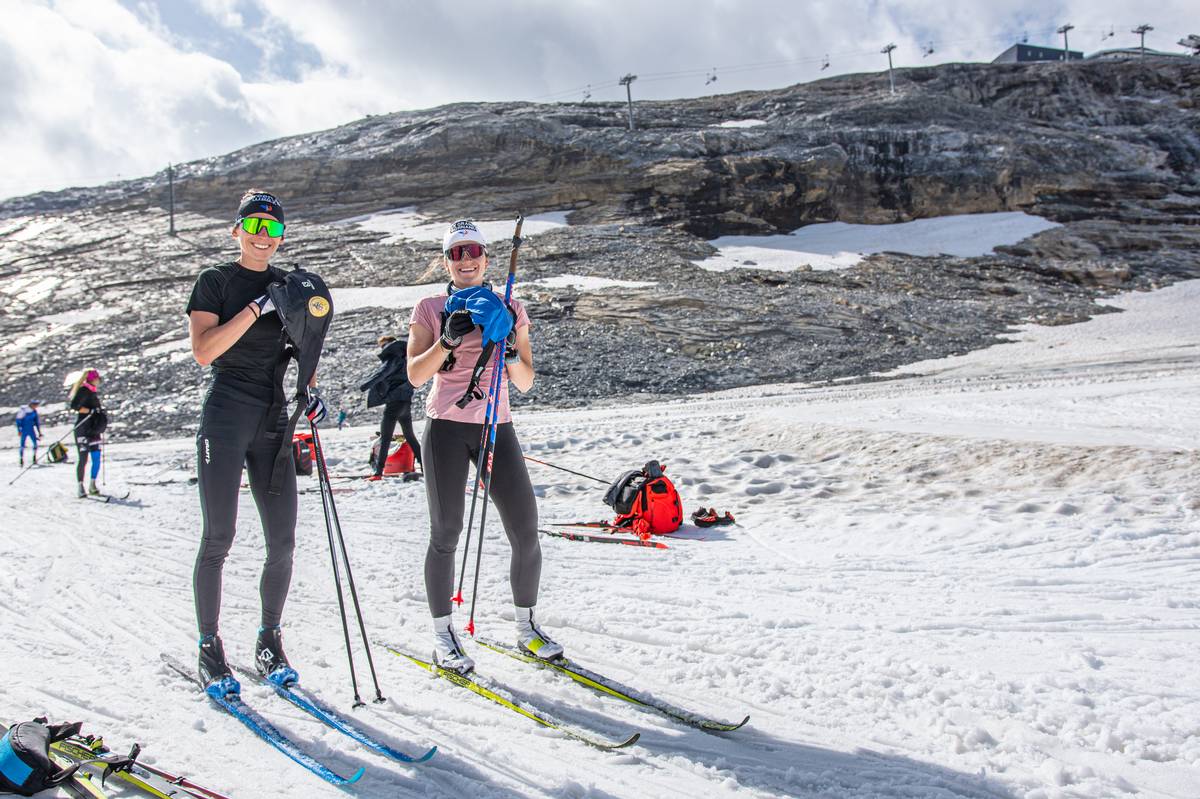
French skiers Delphine Claudel and Lena Quintin stop to refuel during a training camp on the Glacier de la Grande Motte near Tignes, FRA. (Photo: NordicFocus)
The Role of Recovery Meals
Timing is as important as the food itself. The “golden window” for recovery — within 30–60 minutes of finishing your ski session — is when your body absorbs nutrients most effectively. A balanced snack, such as yogurt with fruit or a sandwich with lean protein, can make the difference between feeling sluggish the next morning and being ready to perform again.
Sleep and Rest: The Overlooked Performance Boost
It’s easy to get caught up in the social atmosphere of lodge life, but cutting sleep short undermines recovery. Deep sleep is when your body releases growth hormone, essential for muscle repair and energy replenishment.
To improve sleep after a ski day:
Avoid heavy meals too close to bedtime.
Reduce screen time in the evenings to allow natural melatonin production.
Create a comfortable sleep environment with minimal noise and consistent room temperature.
Quadriceps stretch with added thoracic rotation; the Bretzel. Hold 20 seconds each side.
Stretching and Active Recovery
Recovery isn’t only about food and rest. Light stretching, yoga, or even a short walk around the lodge can prevent stiffness and aid circulation. Skiers who build in 15–20 minutes of stretching after their day often find they’re less sore and more agile the next morning.
Creating the Right Lodge Lifestyle
Performance isn’t just about what happens on the slopes. It’s the result of consistent choices in the lodge — from how you store your food, to when you eat, to how you unwind before bed. Nutrition and recovery routines create the foundation that allows skiers to push harder, enjoy longer days on the mountain, and reduce the risk of injury.
When lodge life supports recovery, skiing becomes more than a sport — it’s a sustainable lifestyle. And for anyone serious about getting the most out of every run, the hidden side of performance is just as important as the visible one.
There is something especially satisfying about pairing a thrilling day on the slopes with an evening of hedonistic excess. For skiing enthusiasts, the growing popularity among casino resorts in the world’s top ski destinations offers just that combination, an easy mix of alpine excitement and opulent downtime.
It isn’t a coincidence. It’s a result of strategic planning, personalized experiences, and a growing preference to travel beyond skiing or snowboarding. Today’s winter vacationers desire a little more attitude with their winter vacations, and these resorts are delivering it in ways they didn’t anticipate.
Where slopes meet sophistication
At places like Lake Tahoe or the Swiss Alps, walking in from the cold doesn’t necessarily mean hot chocolate by the fire. More likely than not, it means walking into the busy atmosphere of a casino, where twinkling lights and the buzz of action provide a jarring juxtaposition to the quiet whiteness of the slopes.
Take Harveys Lake Tahoe, for instance, just a stone’s throw from Heavenly Mountain. This resort doesn’t just have gamers in mind; it is also designed for skiers, with concierge sales of lift tickets. That’s the kind of convenience that attracts the type of travelers who don’t want to have to choose one over the other.
These resorts don’t make casino gaming an afterthought. At places like the Hard Rock Hotel & Casino Lake Tahoe, the slope-to-slot transition is all but choreographed. Guests can drop off ski gear, grab dinner, and step into a 25,000-square-foot gaming floor without missing a beat. It’s the kind of choreography that makes the whole experience less like a typical vacation and more like a well-staged production.
Beyond the tables and trails
But proximity is only part of it. Casino resorts are investing in the whole experience, making a place where guests are pampered every step of the way. Colorado’s Ameristar Casino Resort Spa, for example, realizes that après-ski doesn’t have to be a hot drink.
Its facilities extend to spa treatments, indoor pools, and mountain-view suites, an acknowledgement of relaxation as much as visual opulence. These touches offer more than they appear; they are representative of a broader trend in travel where tourists desire immersion over entertainment.
European resorts mirror this trend. The Casino de Crans-Montona in the Swiss Alps marries alpine village ambiance with gaming floor opulence set against an expansive mountain range backdrop. In Austria, Casino Seefeld also aims for thoughtful arrangement, ski-and-play packages, fine dining, and peaceful spa nooks to unwind tourists after high-altitude exertion.
One might ask: is this about gambling, or is it about something else entirely? In a way, these resorts have become multi-sensory playgrounds, not just for chance-seekers, but for anyone who finds joy in a mix of the active and the indulgent. It’s this blend that makes the experience unique. One moment you’re carving down a slope under a clear blue sky, the next you’re sipping champagne at a blackjack table in a velvet-lit room.
The appeal is in the details
What truly sets these destinations apart is their psychology of guest preferences. Deals that combine lift tickets with game credits, ski rentals with spa treatments, or poker tournament entries with après-ski cocktails aren’t marketing gimmicks.
They’re a sign of a broader hospitality revolution in which personalization reigns supreme. Resorts aren’t just offering accommodations; they’re offering narrative, one that guests can step into and shape as they go.
Social media plays a growing role, as well. Whether it’s a base lodge photography contest or social media influencer-produced ski weekends that culminate in casino lounges, the digital touchpoints of these resorts extend well beyond the front desk. It’s all aspirational, not merely the snowy summits or casino floors, but the concept of a lifestyle that includes space for speed and spectacle.
In closing
Ski resort casinos aren’t trying to be everything to everybody, and that’s the very reason they’re succeeding. They’ve developed a niche space that’s both unexpected and exactly on-time, especially in a travel culture where hybrid experiences are more appealing than ever.
For those who enjoy skiing and snowboarding but are hungry for something more than powder and trees, these resorts offer a different adrenaline rush, one that lasts long after the last run of the evening.
And maybe the real allure is that. Not the dice or the ski lifts themselves, but how they’re being reimagined into something different. A carefully balanced mix of thrill and getaway, where the mountain and the moment come together.
PRESS RELEASE – The International Biathlon Union (IBU) and the Biathlon Integrity Unit (BIU) welcome the decision of the Swiss Federal Tribunal to reject the appeals of former Russian biathlete Evgeny Ustyugov. These final rulings uphold the previous decisions of the IBU Anti-Doping Hearing Panel and the Court of Arbitration for Sport (CAS), confirming sanctions for anti-doping rule violations.
Mr. Ustyugov was sanctioned based on abnormalities in his Athlete Biological Passport and evidence from the Moscow Laboratory Information Management System. The upheld decisions result in the disqualification of all his competitive results from January 24, 2010, through the end of the 2013/2014 season — explicitly including his results from the Vancouver 2010 and Sochi 2014 Olympic Games — and a four-year period of ineligibility.
Evgeniy Ustyugov (RUS) and Jena Guillaume Beatrix (FRA).
The decisions of the Swiss Federal Tribunal represent the final instance of appeal. With this ruling, the verdicts of the IBU Anti-Doping Hearing Panel and the Court of Arbitration for Sport now become legally binding. It is now the responsibility of the International Olympic Committee (IOC) Executive Board to decide on the reallocation of medals from the 2010 and 2014 Olympic Winter Games.
Greg McKenna, Head of the BIU said: “These decisions from the Swiss Federal Tribunal brings finality to a long-running case and stands as an important step in upholding clean sport. While we regret the time it has taken to reach this point, the ruling reinforces the principle that doping violations will be identified and sanctioned, however complex the process may be. We continue to encourage all institutions involved in sports arbitration to work towards more timely resolutions, so that the integrity of competition is preserved and clean athletes are protected.”
Cross-country skiing is more than a test of endurance; it’s a celebration of history, identity, and artistry. While athletes strive for podium finishes, the medals they earn often tell a deeper story, reflecting the traditions, landscapes, and values of the host nations. From the frost-kissed forests of Scandinavia to the rugged peaks of the Alps, these awards are tangible connections to the soul of the sport. Let’s explore how cultural symbolism, craftsmanship, and historical legacy converge in the design of cross-country skiing’s most coveted prizes.
The women’s freestyle sprint podium receives their Olympic medals: Sweden’s Jonna Sundling took gold ahead of teammate Maja Dahlqvist and Jessie Diggins (USA). (Photo: NordicFocus)
The Historical Roots of Medal Symbolism
The tradition of awarding prizes in cross-country skiing dates back centuries, celebrating the sport’s rich heritage and honoring athletes’ endurance, skill, and dedication across generations.
In 18th-century Norway, military ski contests rewarded winners with practical items like rifles or tools, embedding competition into Nordic culture. By the 19th century, public races in Tromsø pioneered wagering systems, setting the stage for today’s prize structures and fueling the sport’s competitive spirit and widespread appeal.
Early medals were simple tokens, but as the sport globalized, hosts began crafting awards adorned with regional motifs, transforming them into cultural emblems that celebrate local heritage and unite athletes worldwide through shared traditions. For example, Sweden’s legendary Vasaloppet—one of the world’s oldest and most celebrated ski marathons, honors the 16th-century rebellion led by Gustav Vasa with medals intricately designed to feature Dalarna’s iconic red cottages and pine forests, blending historical legacy with regional artistry.
This evolution in award design mirrors the sport’s transformation from a vital survival skill rooted in local tradition to a global spectacle that celebrates endurance, community, and cultural identity on the world stage. Today, bespoke medal customizations and designs honor local legends, landmarks, and folklore, transforming medals into heirlooms that athletes treasure long after races end.
The women’s freestyle sprint podium (Photo: NordicFocus)
Crafting Identity: Materials and Motifs
The modern medal design balances aesthetics with storytelling. Host regions often collaborate with artisans to create pieces that resonate with their heritage. Consider Norway’s Birkebeinerrennet, a legendary ski race inspired by the daring 1206 rescue of infant prince Haakon Haakonsson—a saga of endurance and courage that continues to unite thousands each year in celebration of Norway’s medieval heritage. Its medals frequently depict the Birkebeiner warriors who rescued the prince by skiing through treacherous terrain, a nod to resilience and national pride. Similarly, Austria’s Streif Vertical Up race, though alpine in nature, awards finishers with medals echoing Tyrolean craftsmanship, using motifs like edelweiss flowers or alpine peaks.
Materials matter. Eco-friendly metals, local wood, or sustainable textiles transform awards into symbols of cultural pride and environmental responsibility. While early medals were cast in basic metals, contemporary designs incorporate recycled alloys or locally sourced elements. For instance, the Greenland Arctic Circle Race has experimented with incorporating glacial stone fragments into awards, symbolizing the region’s stark beauty and environmental consciousness.
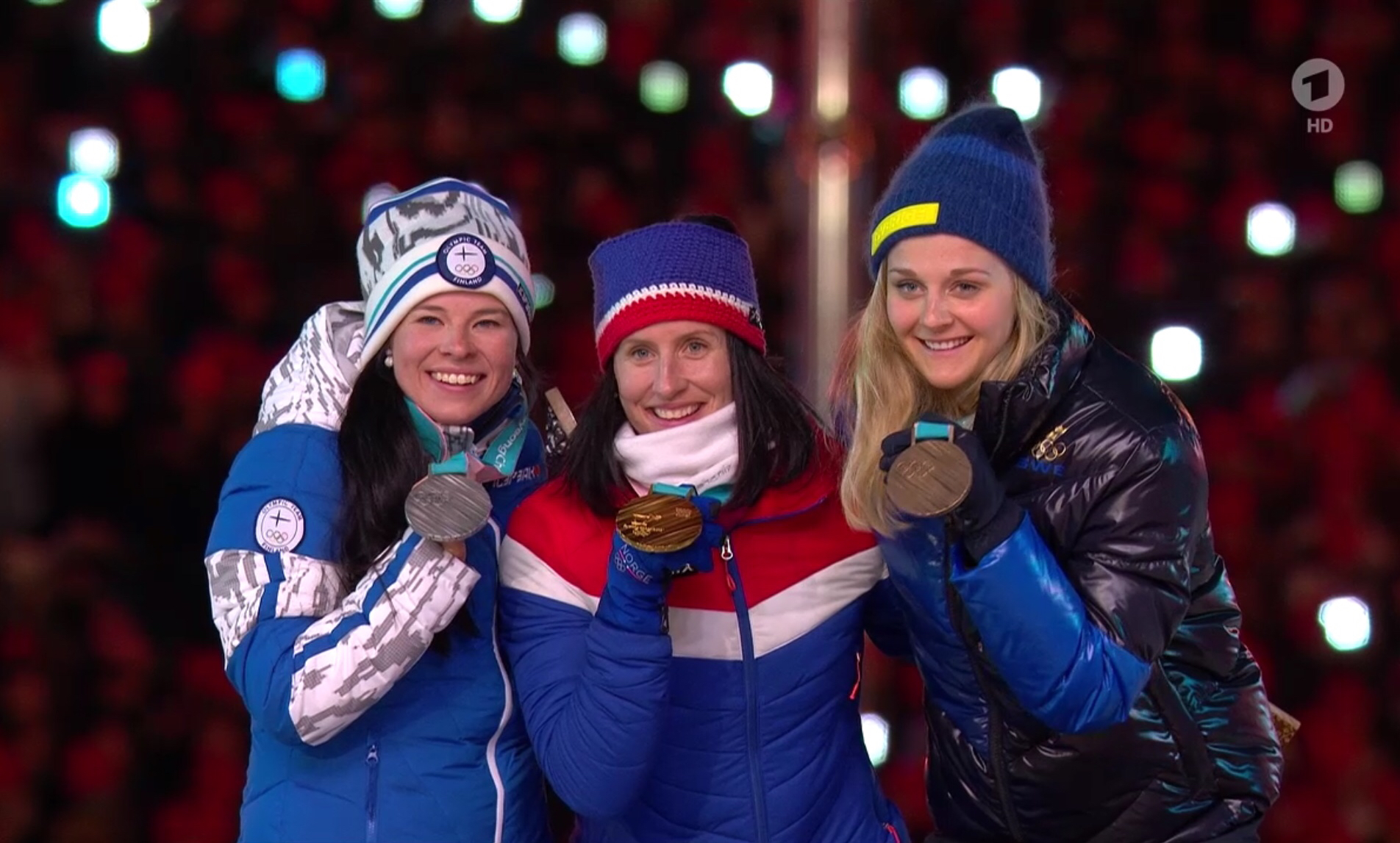
The women’s 30 k classic mass start medalists at the 2018 Olympics Closing Ceremony, with Norway’s Marit Bjørgen (c) in first, Finland’s Krista Pärmäkoski (l) in second, and Sweden’s Stina Nilsson (r) in third in PyeongChang, South Korea. (Screenshot: ARD broadcast)
The Athlete’s Perspective: Medals as Legacy
For competitors, medals are more than accolades; they’re keepsakes of personal and collective triumph. Norwegian cross-country skier medalist Marit Bjørgen, holder of 15 Olympic medals, once remarked that her collection reflects “every landscape I’ve raced through, every community that welcomed us”. This emotional connection is amplified when designs highlight shared heritage. At the 2022 Beijing Olympics, medals featured concentric circles inspired by ancient Chinese jade pendants, symbolizing unity between athletes and the Earth.
Amateur races also embrace this ethos. Michigan’s Hornbogen Memorial Ski Race awards a “Golden Chair” trophy, honoring local ski pioneers while inspiring future generations. Such traditions reinforce skiing’s role as a bridge between past and present.
Alexander Bolshunov displays four of the five Olympic medals he collected in Beijing, bringing his career total to nine medals earned over two Olympic Games. (Photo: NordicFocus)
Answering Key Questions
Q: How do medal designs celebrate cross-country skiing’s cultural heritage and global spirit?
A: Medals encapsulate a race’s spirit, offering athletes and fans a tangible link to the host’s culture. They also enhance event branding, making competitions memorable in a crowded sporting landscape.
Q: How are modern medals different from historical prizes?
A: Early rewards were utilitarian, but today’s medals prioritize artistry and storytelling. Advances in custom medal manufacturing allow for intricate details, such as engraved topographic maps or QR codes linking to race histories.
Q: What trends are shaping future designs?
A: Sustainability is key. Events like Norway’s Ski Classics now award medals made from recycled materials, aligning with eco-conscious values. Personalization is another trend, with organizers offering bespoke engravings to celebrate individual achievements.
Paris Olympic Games Gold Medal
Conclusion: Medals as Cultural Ambassadors
In cross-country skiing, every medal acts as a cultural microcosm, distilling the host nation’s identity into tangible artistry—celebrating heritage, inspiring athletes, and uniting global communities through shared traditions. From the Viking-inspired motifs of Scandinavia to the alpine grandeur of Central Europe, these awards ensure that the sport’s rich heritage endures. As competitions evolve, so too will their symbols, blending tradition with innovation to honor both the athletes and the lands they race across.
For organizers aiming to create culturally resonant awards, collaborating with skilled artisans ensures that every piece tells a story. After all, a medal isn’t just a prize, it’s a legacy cast in metal.
Oksana Masters goes three-for-three, adding a silver medal to her growing collection in the sitting middle-distance biathlon competition. (Photo: Mark Reis / Team USA)
Several athletes have etched their names in the world of professional snow sports, including Molly Bloom (skier), Ingemar Backman (snowboarder), and Petter Northug (skier). These pros have conquered challenges on the slope, but their athletic prowess hasn’t stopped there — they’ve also proven that they can dominate on the poker felt. After all, poker and winter sports are more connected than you think.
Petter Northug stares down his poker competitors just like he does on the ski trails.
According to ski guide Mike Austin, playing or experiencing the high-stakes nature of poker can boost decision-making when navigating complex situations like avalanche terrains. This is because poker forces players to acknowledge uncertainties and craft strategies to avoid costly losses. Thus, playing the card game can help backcountry skiers and snowboarders enhance their situational awareness by looking for early signs of trouble when navigating high-consequence terrain. In other words, skiing or snowboarding in complex terrain is like playing high-stakes poker: one should learn to calculate if the risks are worth the reward, and when to fold or walk away from danger.
This link between poker and winter sports is partly the reason why quite a few snowboarders and skiers have tried their hand at the card game. This is coupled with the card game’s widespread popularity, with a YouGov survey finding that 60% of Americans play poker. If you’re still not quite sure how the two fields intersect, take a look below at three prominent examples of skiers and snowboarders who have ventured into the world of poker.
Petter Northug (NOR) – FIS world cup cross-country, Tour de Ski, mass men, Lenzerheide (SUI). (Photo: NordicFocus)
Molly Bloom
Molly Bloom is a former U.S. Ski Team member who ranked third in the North American Cup for moguls. She was well on her way to qualifying for the Olympics before a crash derailed her career. Since then, Bloom faced a significant career shift, turning to the world of poker as an alternative. Bloom was helped in part by the poker boom ignited by Chris Moneymaker, an ambassador for the US online poker platform Americas Cardroom who is best known for winning the 2003 World Series of Poker and making history as the first champion to qualify for the tournament through online poker. Moneymaker’s poker boom contributed to the card game’s popularity, allowing personalities like Bloom to set up their own poker careers. Bloom, also known as the “Poker Princess,” ran an underground poker empire in the 2000s, reportedly earning $4 million annually. Her venture into poker was featured in the film Molly’s Game, as well as in her book of the same title.
Ingemar Backman
When it comes to making a mark on snowboarding history, nobody has done it quite like Ingemar Backman. The Swedish professional snowboarder made history by setting a world record for the highest air out of a quarter pipe, reaching an impressive height of 8.5 meters, in Riksgransen in 1996. Since then, Backman continued to tally impressive performances, appearing on top of the podium twice in the Air & Style snowboarding contest in Innsbruck, Austria, and cementing his spot in the upper echelon of professional snowboarding. Aside from creating an iconic legacy in the winter sport, Backman has also made a name for himself in professional poker. In 2005, Backman participated in the European Poker Tour (EPT) Main Event, finishing 5th and winning $48,899. Backman currently has $147,682 in total live earnings, according to his Hendon Mob database.
Petter Northug Jr.
Petter Northug anchoring the Norwegian men’s relay to gold at the 2015 World Championships in Falun, Sweden. As of Sept. 14, 2015, Northug is no longer part of the Norwegian team and will not be able to compete on the World Cup or Tour de Ski this season. (Photo: Fischer/NordicFocus)
Norwegian skiing legend Petter Northug Jr. knows a thing or two about having a stellar career in the winter sport. After all, he has a total of 13 World Championships, two Winter Olympic gold medals, and 18 FIS Cross-Country World Cup wins with 13 podium finishes. Aside from an impressive skiing record, Northug also boasts several victories in high-stakes poker tournaments, with almost $40,000 in live earnings. In 2010, Northug participated in the 2010 World Series of Poker $10,000 World Championship – No Limit Hold’em event, finishing 653rd and raking $21,327. He also joined the Norwegian Poker Nationals, according to FasterSkier. In 2012, Northug finished 7th in the EPT No Limit Hold’em event in Barcelona, where he won $7,126.
Apart from their talent in winter sports, these athletes’ success in poker is what sets them apart from other skiers and snowboarders, proving their versatility and skills go beyond the slopes. For more cross-country skiing stories, visit the FasterSkier website.
Ryōyū Kobayashi’s recent victory on the Holmenkollbakken [HS134] hill in Oslo on March 13, 2025, made it three wins in a row for one of the world’s greatest-ever ski jumpers. Many people say that there is still a lot more to come from the 28-year-old Japanese athlete and predict that he will unquestionably be the future king of ski jumping.
Let’s dive straight in to learn more about this talented star and find out which major ski jumping events he has already won and which records he has broken throughout his glittering career.
Who is Ryōyū Kobayashi
Ryōyū Kobayashi is a 28-year-old men’s professional ski jumper. He was born in Hachimantai, Iwate, Japan, on November 8, 1996. The 5 ft 8 in ski jumper is a Team Roy ski club member. His personal best [national record] occurred on the Letalnica bratov Gorišek (one of the world’s two largest ski flying hills) in Slovenia on March 24, 2019, when he covered a distance of 252 m (827 ft) – the third longest ski jump in the sport’s history.
In April 2024, Kobayashi covered a whopping distance of 291 m and was in the air for approximately 10 seconds before making a smooth landing at a nonofficial event in Iceland near Akureyri. This became recognized as an unofficial world record because it was not considered a new sky-flying world record by FIS (the International Ski and Snowboard Federation).
He is one of the most-watched ski jumpers in the world and one of the most bet-on winter sports athletes on today’s online betting sites. In most events he participates in, he is typically one of the best-priced ski jumpers with the most favorable odds. On today’s biggest sports streaming platforms, he is one of the most exciting jumpers to watch in action and see being interviewed.
Kobayashi made his World Cup debut in January 2015, and since then, he has had a successful career that is far from done. Soon after the 2022/23 season ended, and after spending eight years at Tsuchiya Home Ski Team, he left and formed Team Roy.
A look at Kobayashi’s major tournament wins
Kobayashi has won numerous major ski jumping tournaments, and many fans and experts who closely follow this sport say there is still a lot more to come from the 28-year-old. His older brother, Junshiro Kobayashi, also a ski jumper, inspired him to start ski jumping.
Here is a quick look at some of his most notable personal achievements so far throughout his career, which officially started in 2015 when he joined the Tsuchiya Home Ski Team (the Japanese ski jumping team):
Placed seventh on his debut at the 2016 FIS World Cup in Zakopane, Poland
Gets his first career win at the 2018 FIS Ski Jumping Grand Prix in Hakuba
Sets even more consecutive records during the 2018/19 season and entered the history books as the first Japanese competitor to be crowned the FIS Ski Jumping World Cup outright champion. He picked up 13 individual wins during this season and won all six possible titles
In April 2024, Ryōyū Kobayashi achieved the longest ski jump world record after several warm-up attempts, eventually covering a distance of 291 meters and flying for over 8 seconds in Akureyri, Iceland. He smashed the previous record by 37.50 meters
He has 35 individual World Cup career wins and has made it to the podium 70 times
He has 3 World Cup Four Hills titles (2019, 2022, and 2024), 1 Sky Flying World Cup title (2019), and 1 Raw Air World Cup title (2019)
He won gold and silver medals at the 2022 Beijing Olympic Games, silver at the 2023 Planica World Championships, bronze at the 2019 Seefeld World Championships, and bronze at the 2025 Trondheim World Championships. At the 2022 Beijing Olympics, he became only the third Japanese ski jumper to win a gold medal at the Winter Olympics
Over the coming years, Kobayashi is expected to achieve greatness and become the world’s best-ever ski jumper, provided he can remain in good health and peak physical shape.
Fun facts about Ryōyū Kobayashi
Here are a few fun and interesting facts you may or may not already know about Ryōyū Kobayashi. In 2023, he made it onto the Forbes 30 under 30 list. According to reports, he enjoys collecting sneakers and has an extensive collection from top brands like Air Jordan and Chuck Taylor. He is also a huge sports fan, enjoying volleyball, baseball, and football, among other sports.
Many also regard him as one of the world’s most stylish and best-dressed athletes. He is a man of many looks, often wearing fashionable attire and promoting some of the world’s most famous clothes and accessories brands.
Despite recent struggles, Kobayashi maintains a positive attitude and believes he can keep winning medals with the right mindset. He said that one of his key skills is mentally analyzing jumps before attempting them, stating that good visualization [and having good equipment] is essential and the key to success.
He has also stated that his mental preparations are fundamental to his success and that the sooner he can focus on the task at hand, the quicker he can return to the podium.
More that just big air
Ryōyū Kobayashi is the world’s number one ski jumper who is singlehandedly helping to redefine the sport and make it more appealing to newer and younger audiences. In the ski jumping world, he is a household name, but he has also transcended his sport and is now one of the world’s most recognized sports heroes.
Some other ski jumpers who have also helped grow the ski jumping global profile and push the boundaries of what is possible in this sport are Matti Nykänen, Adam Matysz, Kamil Stoch, and Simon Ammann, to name just a few.
These iconic ski jumpers have soared astonishing distances throughout their careers and helped make the sport more exciting. Kobayashi and these other famous athletes have elevated their sport with impressive achievements and helped it reach extraordinary new heights.
Ebba Andersson (SWE) – FIS Nordic World Ski Championships Cross-Country women’s relay in Trondheim (NOR) in March. (Photo: NordicFocus)
Ebba Andersson is one of the best skiers in the world. There’s no debating it. The 27-year-old Swedish cross-country skier has proved time and time again that she has the raw talent needed to dominate the sport, and Sweden couldn’t agree more. In 2024, she was awarded the prestigious Jerring Award, the Swedish ‘people’s prize.’
And it’s not just what we or the people of Sweden think. The Jerring Award might be the most prestigious from her country’s people, but she has countless titles to her name that show she’s not just dominating cross-country skiing now; it’ll be for years to come.
Read on to learn more about the cross-country champion skier Ebba Andersson and why she’ll be at the top of the sport for the foreseeable future.
Ebba Andersson (SWE) – after winning the FIS Nordic World Ski Championships Cross-Country Skiathlon title in Trondheim (NOR). (Photo: NordicFocus)
The Latest World Skiathlon Title
Ebba Andersson recently put in an incredible performance to come home with the World Skiathlon title. Closely followed by another talented skier, Therese Johaug, Andersson powered across the finish line two seconds ahead of Johaug. It really was a nail-biting championship to watch. The race was pretty much over with 4km left to go. Jonna Sundling, another Swedish cross-country skier, fell on a turn, leavingJohaug and Andersson to power ahead.
The Skiathlon event, a 10km classic and a 10km freestyle portion, is one of the most respected titles to win—Ebba Andersson has two of them. A lot of the competitors were from her home country.
The different skiing disciplines have grown across the world in recent years. Each country has its own notable name attached to one discipline. For instance, now that alpine skiing is one of the top sports in New Zealand, Alice Robinson’s name is a household one. The USA’s Mikaela Shiffrin is one of Alice Robinson’s key competitors in alpine skiing, while Germany’s Andreas Wellinger leads the way in his home nation as a ski jumper. Ebba Andersson sets the national standard in Sweden.
If you didn’t see the championship held in Trondheim on March 2nd, 2025, you can see some of the highlights on YouTube to see Andersson in action.
Therese Johaug (NOR) and Ebba Andersson (SWE), (l-r) lunge for the line and the win. (Photo: Modica/NordicFocus)
Other Notable Titles
Ebba Andersson showed her raw talent to win the two Skiathlon championship events, but there’s a long list of titles and impeccable performances that prove she’s a champion for the foreseeable future.
Athletes are not machines, and every one of them goes through mental and physical struggles to consistently perform at the top of their game. Ebba Andersson is no different.
She recently opened up about her physical and mental health struggles during a heartwarming interview. Andersson revealed the difficulties she faced with adjusting to the growing media attention, the physical challenges of the 2024 season after returning to cross-country skiing following COVID health complications, and even life as a new homeowner.
To be world champions, athletes put their minds and bodies through more than the average person can ever comprehend.
Ebba Andersson (SWE) hadn’t won a World Cup race since 2023 in Trondheim, a drought that she broke in dramatic fashion with her striking victory in Falun’s 10 k Classic Interval Start. (Photo: NordicFocus)
Why We Think Andersson Will Continue to Dominate Cross-Country Skiing
Ebba Andersson has something that not every athlete has, and that is relentless drive.
She continues to push herself harder with each season, even when she could easily rest on her victories. Her technical skill, combined with pure endurance and mental strength, makes her a force to be reckoned with. Watching her ski is like watching poetry in motion, yet you can feel the raw power in every stride. Andersson also has youth on her side, and with years ahead of her, it feels almost inevitable that she will carve her name even deeper into skiing history.
Ebba Andersson is not just a flash in the pan; she is a legend in the making. If she continues with the same spirit and determination, there will be no stopping her. Ebba Andersson is the future, and the world is lucky to watch her story unfold, race after race.
The Thrill of the Chase: What Cross-Country Skiing and Online Pokies Have in Common
At first glance, cross-country skiing and online pokies seem worlds apart. On the one hand, skiing is a physically demanding outdoor sport on snowy trails. Online pokies are some of the most popular games in online casinos that you can play from the comfort of your home. So, what could these two possibly have in common?
In this piece, we will highlight and discuss the confluence between cross-country skiing and online pokies. Do you want to know the possible connection between skiing and pokies? Read on to get all the details.
Photo: Tourism Whistler
Common Grounds Between Cross-Country Skiing and Online Pokies
The common thrill of the chase between cross-country skiing and online pokies can be summed up under a few sections. These sections include:
The ultimate endurance test
Cross-country skiing is often about endurance. Every skier must put in a steady effort to reach the finish line no matter how distant it appears. You just have to keep moving until you reach the finish line.
Online pokies, too, can feel like a marathon. You may have to continue to spin through dry spells to win eventually. Conversely, you may play online real money pokies where the prize grows as often as you play. In this regard, quitting at the early stages means you will not get the ultimate prize. You may have to fight your way through a leaderboard to qualify for the ultimate prize and other bonuses.
The blend of skill and luck
Cross-country skiing requires technique; you can’t possibly do skiing without proper glide, stamina, and navigation. However, unpredictable factors like the weather and snow terrain can totally change the game’s outcome. The same happens with pokies.
It is common knowledge that pokies are largely chance-based; however, players can exert a sense of control by choosing familiar slots with high RTPs, and they can also determine the bet size. This way, the player decides how much and how often they win.
The subtle immersion
You may be wondering what “immersion” has to do with skiing and pokies; we will explain in the next few paragraphs. Cross-country skiing can immerse you in a” winter world”. Think of the crisp air, crunching snow, and your heart racing as you glide through the snow, following the rhythm of your breath. Now that’s immersion. You will find yourself adapting to the environment. Online pokies have about the same effect.
Imagine sitting in the comfort of your home and playing your favorite online pokies, going from win to win, and increasing your bet as you go. Sounds familiar? You will gradually begin to explore the different pokies themes. It can become a form of escapism where you explore your options in a whole new world of your favorite pokies.
Recreational skate. (Photo: Greg Rosenke)
Social bonding
While skiing in itself is solitary participation, it presents an opportunity for you to meet other skiers and create a social bond. You can meet other skiers, compare routes or time, learn new skills, and even celebrate your achievements together. What better way to build lasting friendships than with people who already have at least one shared interest with you?
Social bonding is also possible at online casinos. Remember that leaderboard mentioned in the last section? Well, you can build close online bonds with people on the leaderboard. The fact that they appear on the list suggests that they at least have one common interest with you. Many online casinos also have communities that encourage social bonding, so you will always find a group of people to discuss your favorite slot with.
High risk
Yes, there’s a lot of risk in skiing and playing very rewarding online pokies. Let’s start with skiing. Accidents in the snow are not new; people have had major injuries like trauma to the head, sprains, strains, and even broken bones despite the protective gear and years of experience.
If not properly managed, online pokies could cause players to overspend. This can lead to debts and other financial challenges. This is why online casinos need to have responsible gambling tools that protect players.
Recreational backcountry. (Photo: Phillip Belena)
Conclusion
In the end, it’s pretty interesting how cross-country skiing and online pokies, two things that couldn’t seem more different, share so many similarities. Both hook you with that addictive thrill of chasing something big, whether it’s the finish line at the Spring National Sprint or a jackpot. They demand a mix of skill and luck, pull you into their worlds, and test your grit over the long haul. Plus, they’ve got this knack for bringing people together, even if it’s just swapping stories about epic runs or epic wins.
Although online pokies and cross-country skiing come with some risks, they are really all part of the fun. Who knew a snowy trail and a slot screen could feel like such close cousins?