From the FasterSkier archive — posts syndicated from athletes’ and coaches’ own blogs between 2004 and 2012, kept online as published. Current coverage is at fasterskier.com.
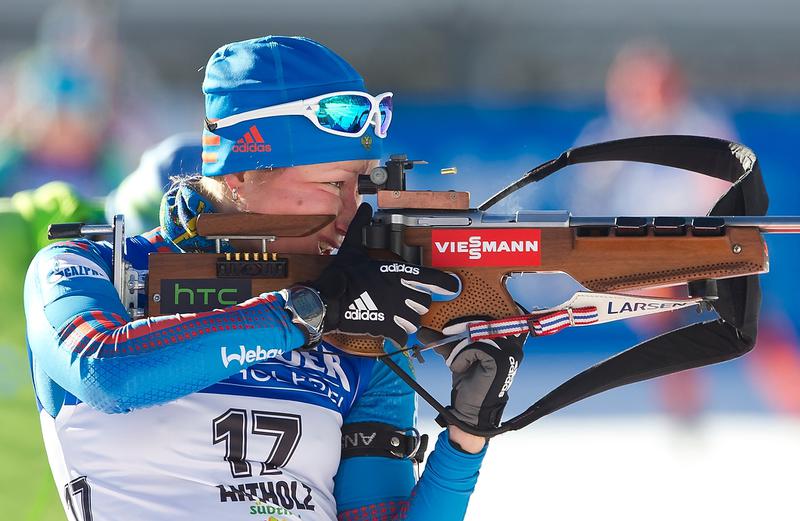
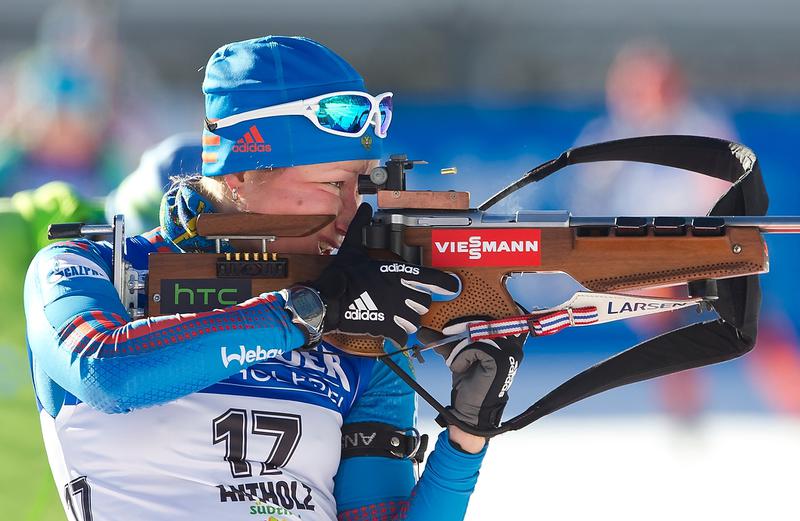
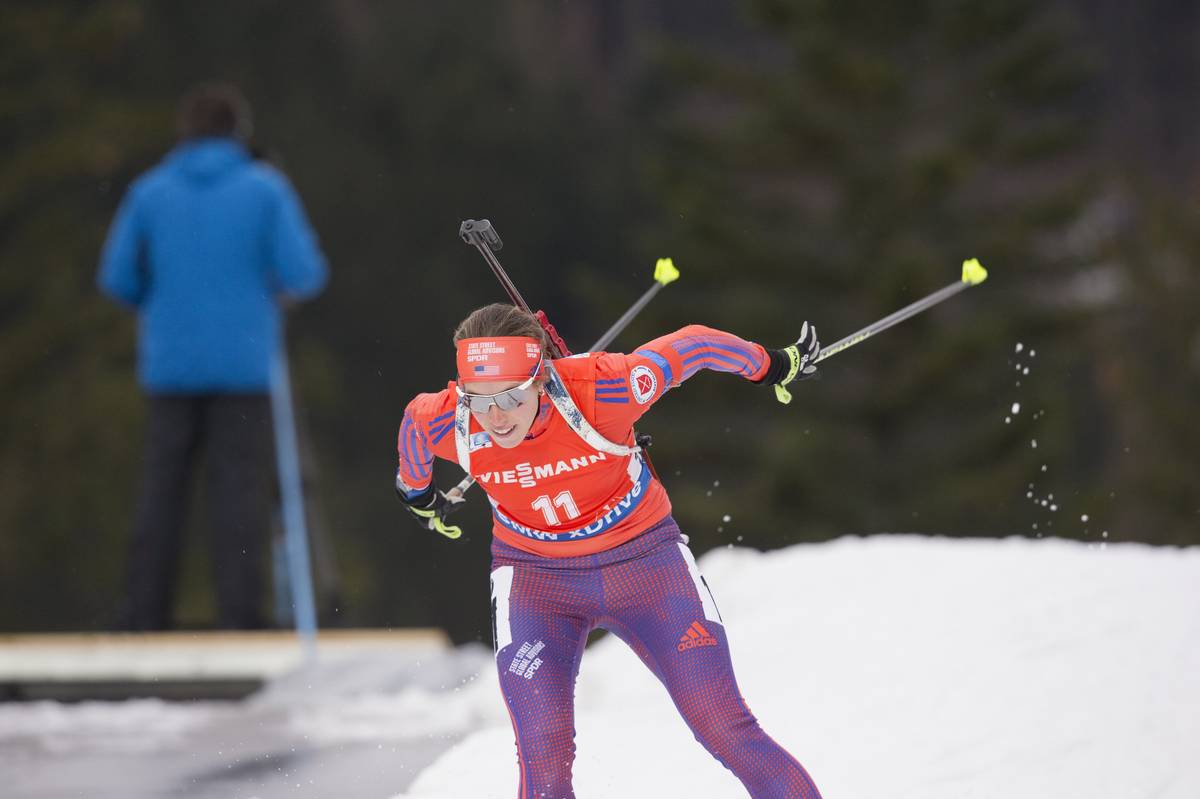
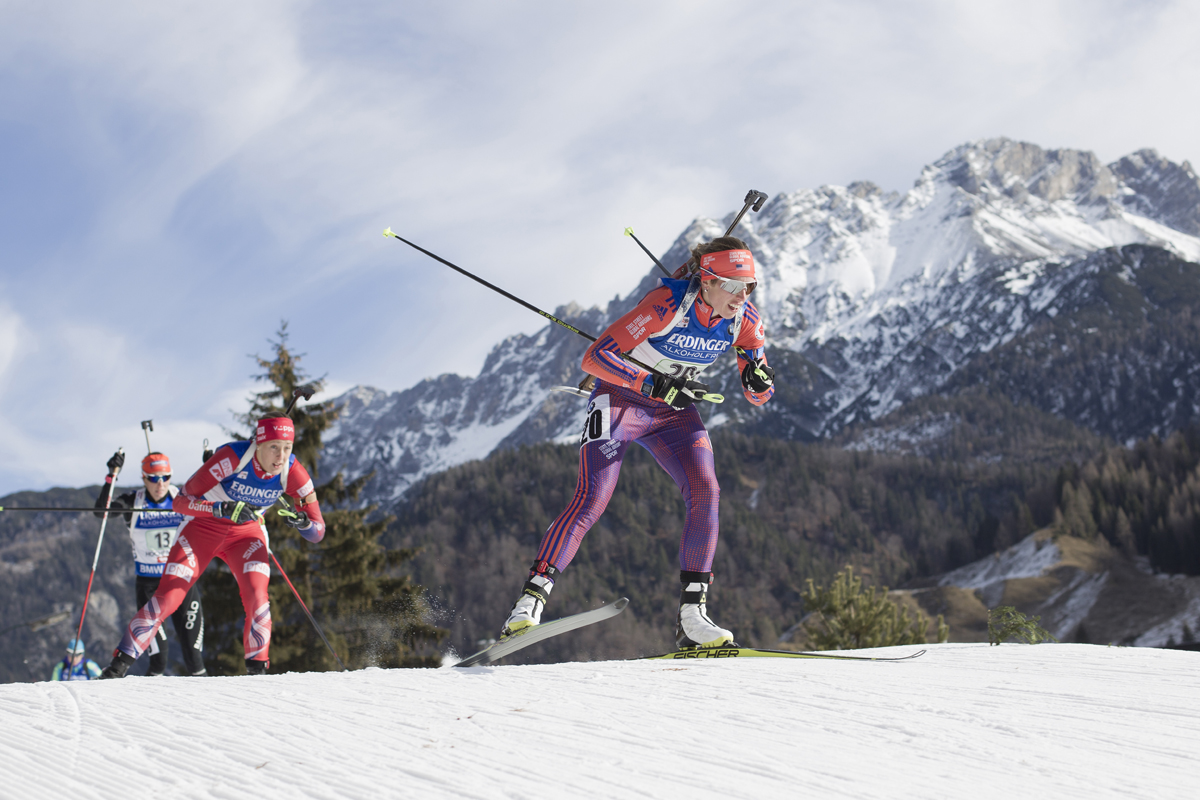
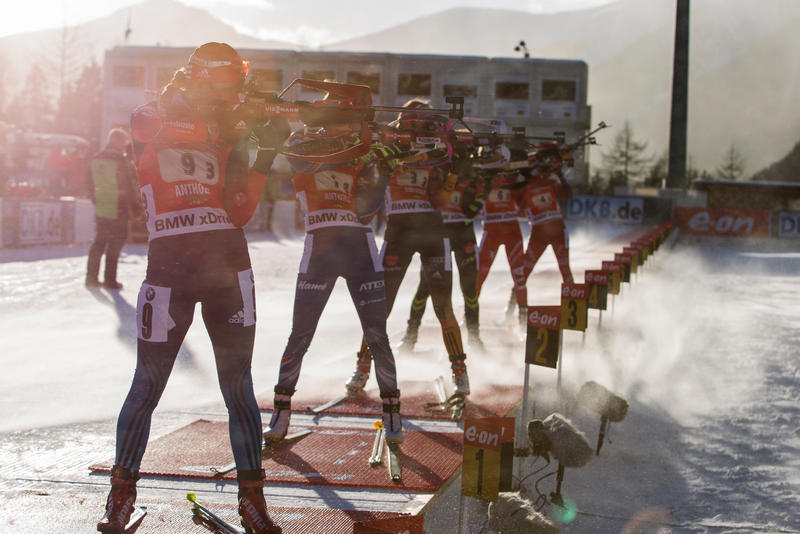
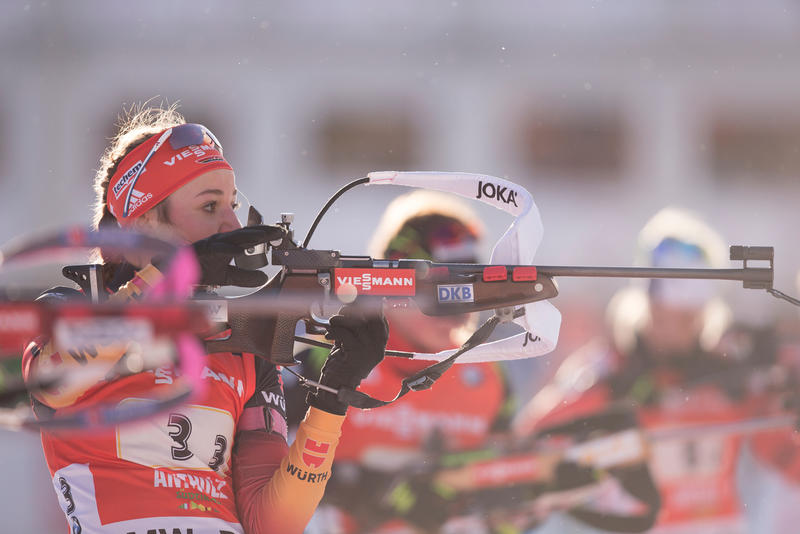
Russian Olga Podchufarova hit 10 out of 10 targets in Thursday’s 7.5-kilometer sprint in Antholz, Italy, to take her first World Cup win. (Photo: IBU/Rene Miko)
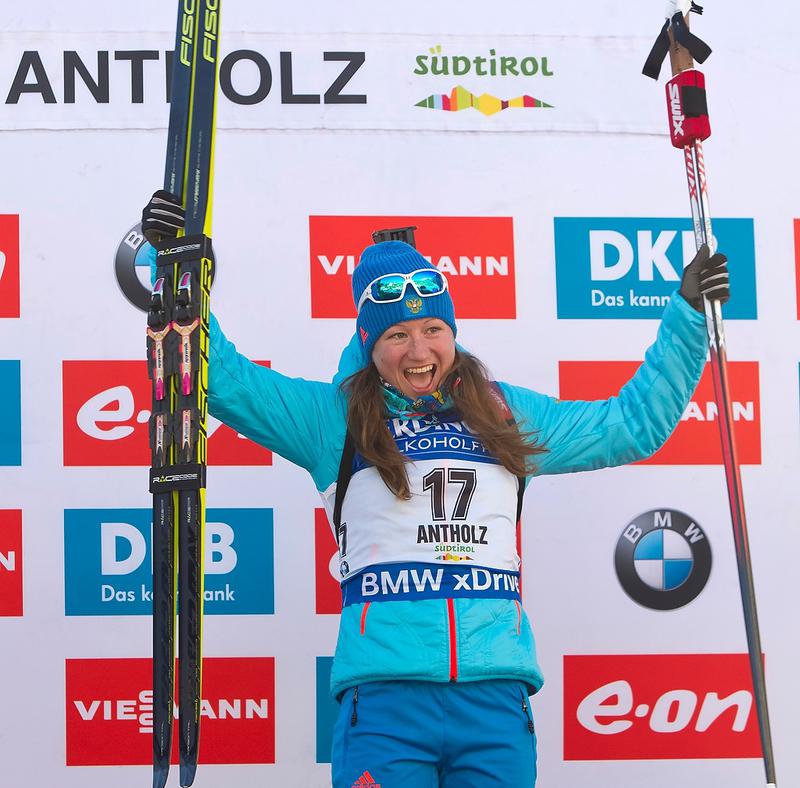
Olga Podchufarova stood atop the International Biathlon Union (IBU) World Cup podium on Thursday in Antholz, Italy, for the first time in her career. The 23-year-old Russian biathlete shot clean in the 7.5-kilometer sprint to claim her first-ever win in 21:01.9, saying that it was something that she has been looking for all season.
“I understood [this year] that I became stronger, not only physically, but mentally,” she said in an English interview with Eurosport. “And I understood that I was ready for better results than previous year.”
The 17th starter, she established a pace and finishing time no one else could match. Overall, her course time ranked ninth, and she was one of five women in the top 20 (and two in the top three) to shoot clean. For Podchufarova, it was her second-career IBU World Cup podium; earlier this season she placed third in the mass start in Pokljuka, Slovenia.
After starting immediately behind her in bib 18, Italy’s Dorothea Wierer took second in front of an enthusiastic crowd, finishing 8 seconds off Podchufarova’s time with one miss in standing. She was happy with her performance, saying that racing in Italy is stressful due to increased press coverage and pressure.
“Of course it hurts when you make one [penalty] … I was good on skis today…,” Wierer said in a post-race interview, implying that she knew that that one penalty was what kept her from the top spot on the podium. “I was also happy that I missed only one because I was shaking so much in standing. I am happy with this,” she concluded with a laugh.
The third spot on the podium went to another Russian, Ekaterina Yurlova (+22.1), who started 40th and shot clean to land in the top three. She bumped France’s Anais Bescond, in bib 23, to fourth (+24.7), after Bescond had a single prone penalty. When a Eurosport announcer asked Bescond if she was the “queen of fourth place” after her third fourth-place finish this year, she laughingly agreed, noting that fourth is “better than fifth, or 30th, or 60th.”
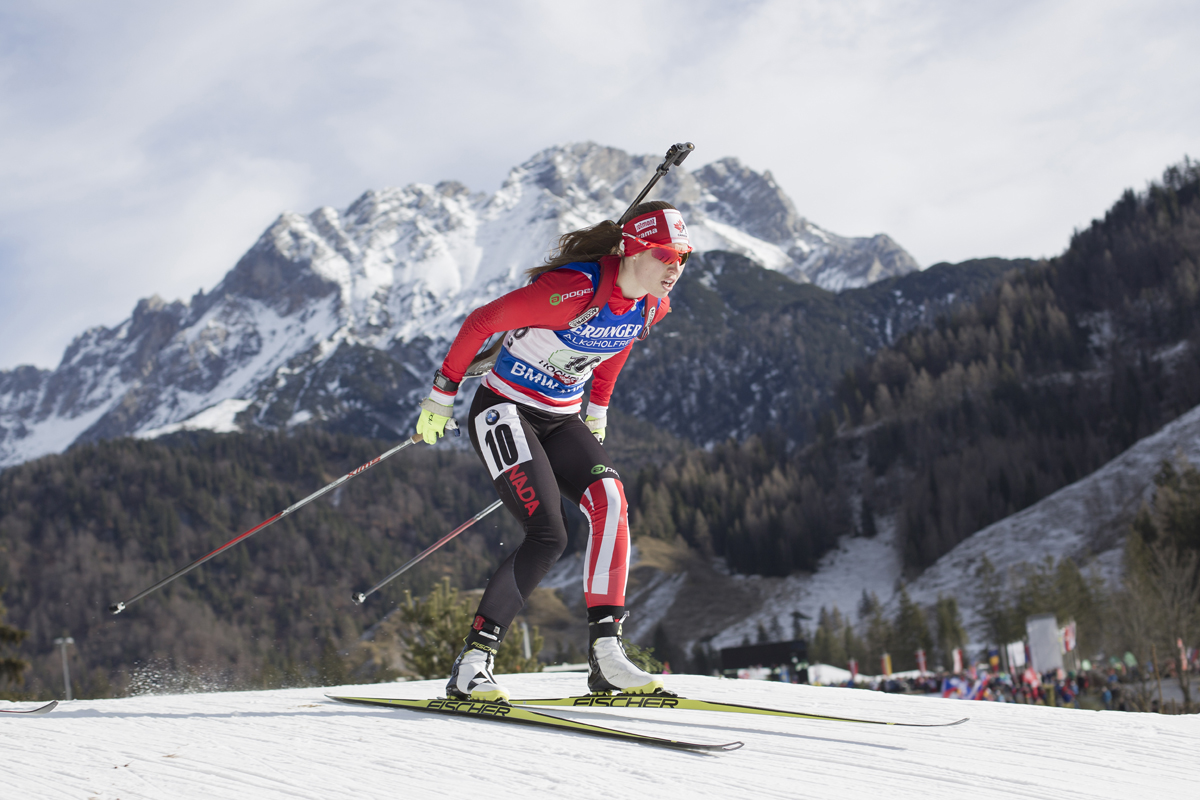
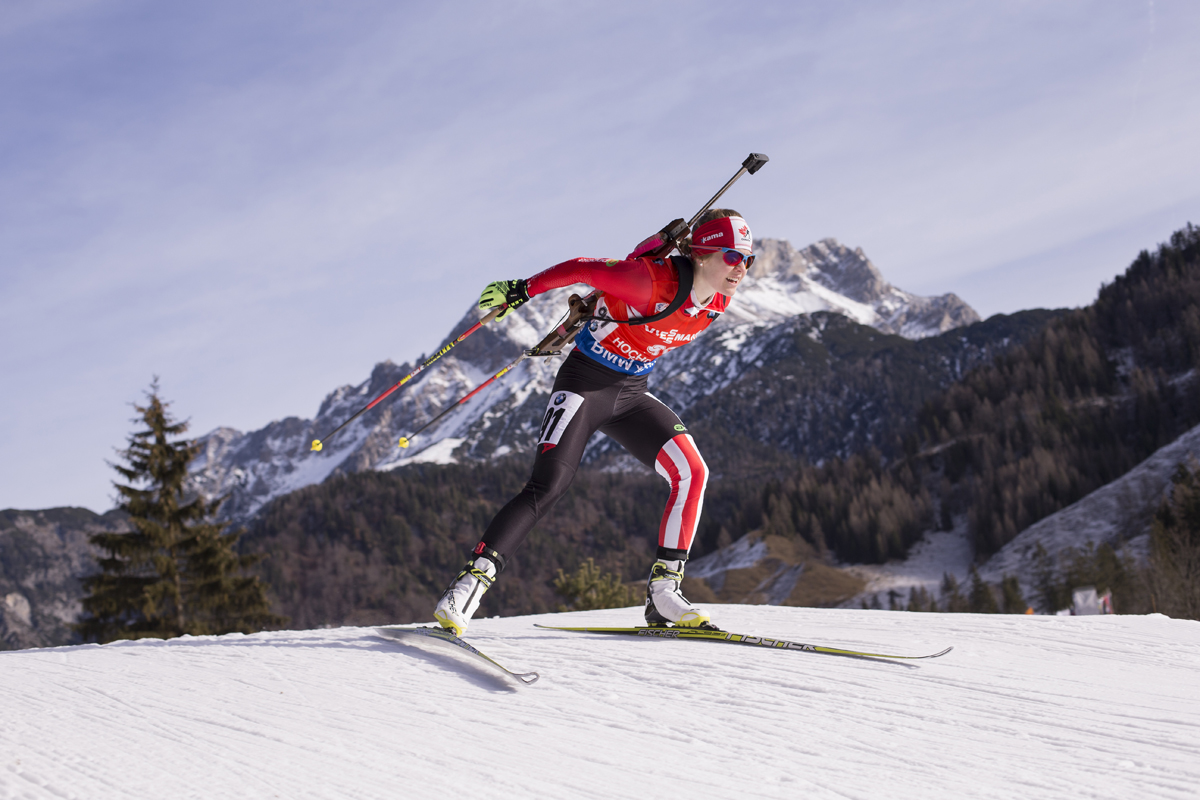
Canada’s Rosanna Crawford was the top North American in 33rd (+1:24.6) after cleaning prone but missing one in standing. American Susan Dunklee was not far behind in 37th (+1:30.1) with one miss in each stage. Neither of the two women were very pleased with their results:
“Even though I train and live at altitude, I don’t seem to be able to race at it very well!” Crawford wrote in an email, referring to Antholz’ relatively high elevation of 1600 meters (5200 feet). “I’ve always had a hard time with ski speed here and today was no exception. My first two laps were ok, but I lost a lot of time on my final 2.5km loop.”
Russian Olga Podchufarova celebrates her win in Thursday’s IBU World Cup 7.5-kilometer sprint in Antholz, Italy. (Photo: IBU/Rene Miko)
“I love racing here,” Dunklee wrote in an email. “It’s a place where I have often done well. I usually start to come alive towards the end of the trimester when everyone else is starting to struggle, but today I was the one struggling. My skiing felt extremely flat and I couldn’t hold my normal pace.”
“It was a nice sunny Italian day,” Crawford added. “No wind and fair conditions. It’s a hard course here with not a lot of rest, you always have to be working.
“Shooting has been solid this year and I was confident going into the race,” she continued. “I took a couple extra breaths before my first prone shot but still was able to hit them relatively quickly. Girls really slow down it seems here, because of the altitude, but I practiced the range entry quite a few times in the two days leading into the race and was confident I could keep my normal range rhythm. My standing miss was disappointing, I just hadn’t quite moved onto the target when I pulled the trigger.”
“Antholz brought out its best today: sunshine, hard packed conditions, and an animated crowd of spectators,” Dunklee concluded. “I’m going to put this one behind me and enjoy the challenge of pack racing in the pursuit.”
The top-60 finishers in Thursday’s sprint qualify for the pursuit on Saturday. Crawford and Dunklee will be joined in that race by Canadian Julia Ransom, who finished in 46th (+1:47.2) on Thursday, who shot 9-for-10 with one standing penalty.
Also in Thursday’s sprint, Canadian Zina Kocher finished 66th (+2:29.0) with three penalties (2+1), American Clare Egan was 67th (+2:31.8) after a clean prone but three standing penalties, Canadian Megan Tandy in 72nd (+2:49.1) with three misses as well (1+2). Also for the U.S., Joanne Reid, in her second World Cup weekend, placed 74th (+2:51.1) with three standing misses (0+3) and Annelies Cook in 75th (+2:51.4) shot 70 percent as well (2+1).
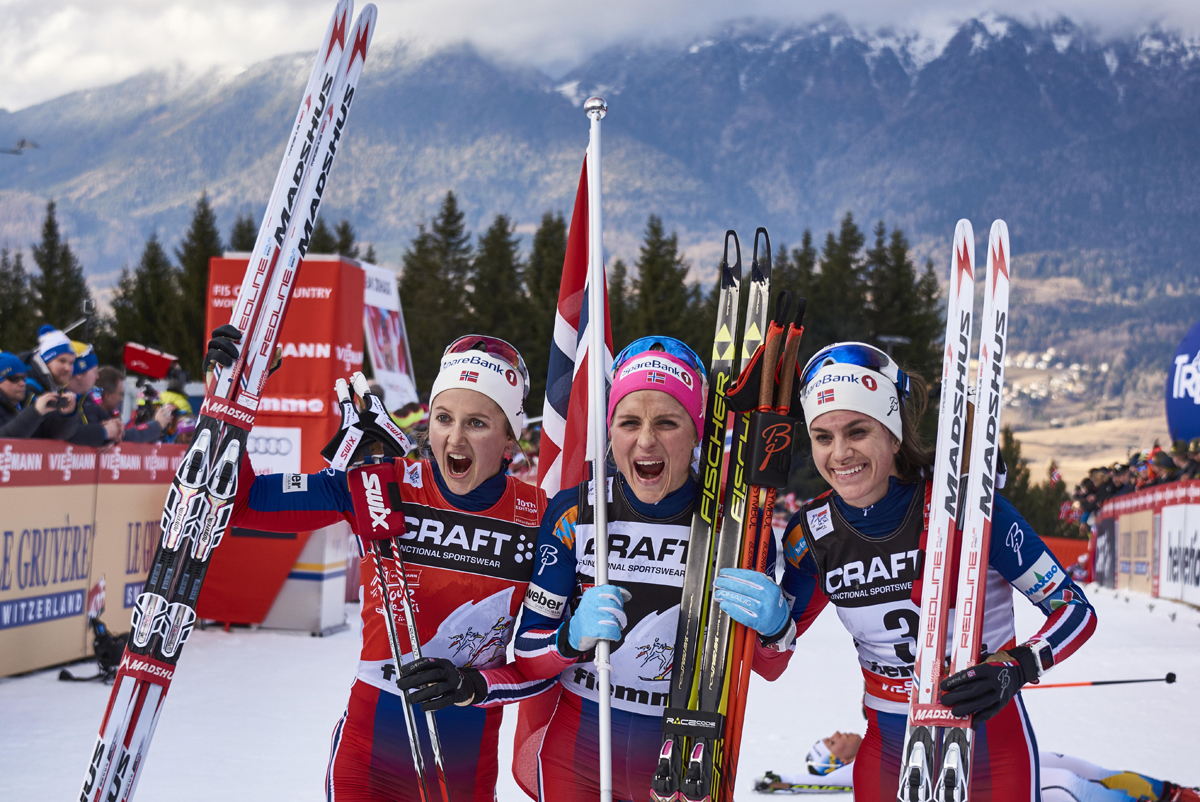
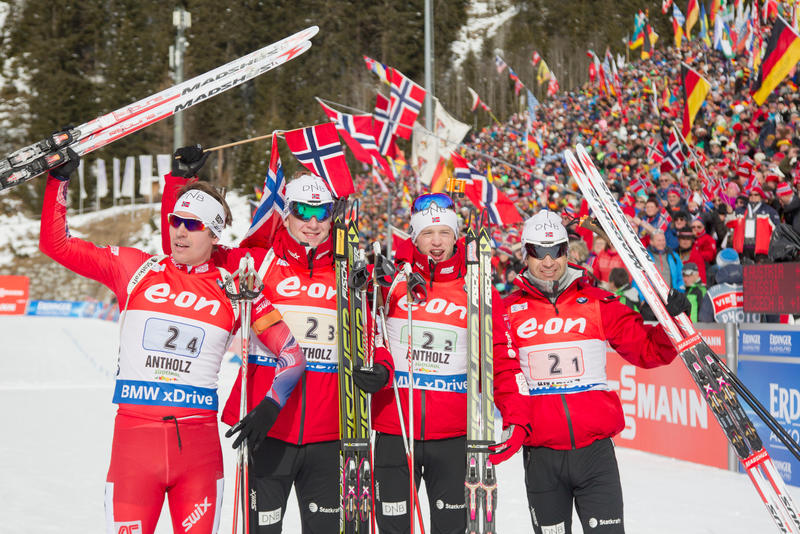
2016 Tour de Ski overall runner-up Ingvild Flugstad Østberg (l), champion Therese Johaug (c) and third-place finisher Heidi Weng (r) celebrate Norway’s sweep of the podium at Sunday’s Stage 8 final climb in Val di Fiemme, Italy. (Photo: Fischer/NordicFocus)
The image of several Norwegians sprawled in the snow at the top of Alpe Cermis, while Therese Johaug, also of Norway, kneels to congratulate them on their efforts, says a lot.
“It was a good fight, Ingvild,” Johaug said to second-place finisher, teammate Ingvild Flustad Østberg, as she sat next to her on the ground.
Østberg was second to — who else? — but Johaug, who had just bested her to the top of the mountain by nearly two and half minutes after starting 39 seconds behind in the final stage of the Tour de Ski, the notorious 9-kilometer freestyle pursuit up Alpe Cermis in Val di Fiemme, Italy.
“I hoped I could take some seconds on Ingvild before the climb. It worked better than I had hoped,” Johaug told FIS afterward.
Norwegian women swept the podium, with Johaug landing at the top with a finishing time of 33:53.5, Østberg reached the summit in second (+2:20.9), and Heidi Weng started third, 2:27 behind Østberg, and held onto third across the line (+3:13.9).
The event was a pursuit, with start times based on cumulative times over seven World Cup stages in nine days. Sunday marked the eighth and final stage on the 10th day of the Tour. Fatigue was the shared theme among 43 women who started and completed the final climb, thus completing the Tour.
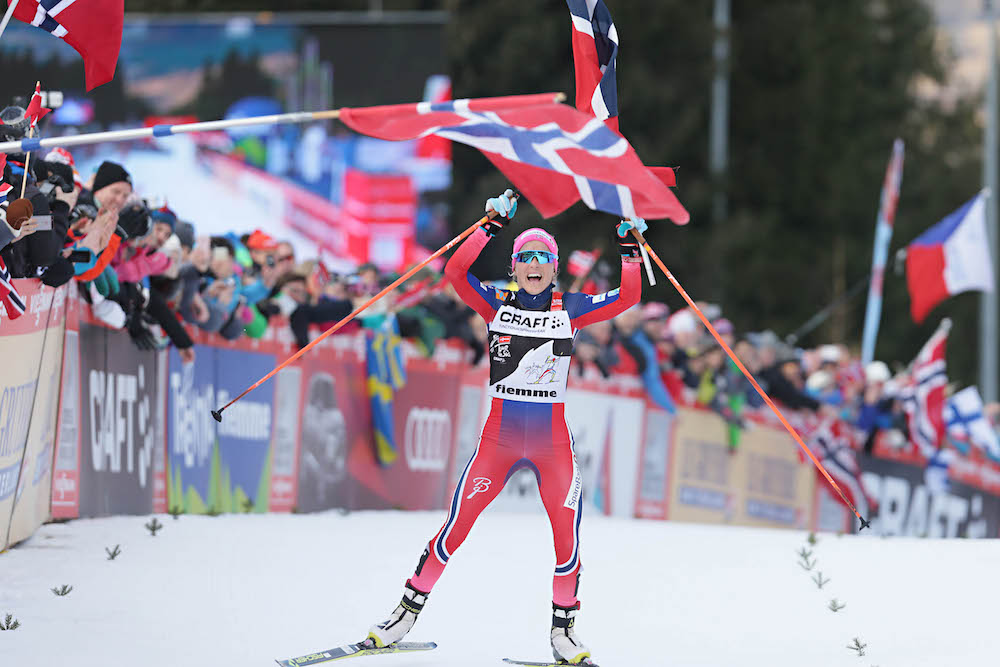
Norway’s Therese Johaug approaches the finish of the 9 k final climb at the last stage of the 2016 Tour de Ski with enough time to grab a Norwegian flag and celebrate her win. It was Johaug’s second overall Tour de Ski victory since last winning in 2014. (Photo: Fiemme World Cup)
While Johaug started the eight-stage series by earning the leader’s bib on Day 1 in Lenzerheide, Østberg took control after winning the 5 k pursuit in Lenzerheide at Stage 3. From that point on, the 25-year-old Østberg continued to lead the Tour, up until about 17 minutes into the final climb, when Johaug caught and passed her.
Still 14 seconds ahead of Johaug at 6.2 k, shortly after the course began to ascend up the mountain at a brutal grade, Østberg hung onto first for another minute before Johaug reached her. Wasting no time, Johaug pushed on, putting 17 seconds between her and Østberg by 7.1 k. One kilometer later, she was 1:26 ahead and in the clear for the win.
Following the zig-zagging course to the top, the 27-year-old Johaug V1-ed past excited spectators before a multitude of waving Norwegian flags greeted her at the finish. She grabbed one a few meters before the line and held it up in elation.
“It was my dream and big goal to win the Tour de Ski,” Johaug said after claiming her second overall title since winning the 2014 Tour. “Ingvild has pushed me at every stage of the Tour this year. I think this was my [best] Tour de Ski ever.”
According to reporters at the summit, Johaug asked Østberg afterward, “Are you tired now?”
“Yes,” Østberg replied.
(Article continues below)
(Photo: Fiemme World Cup)
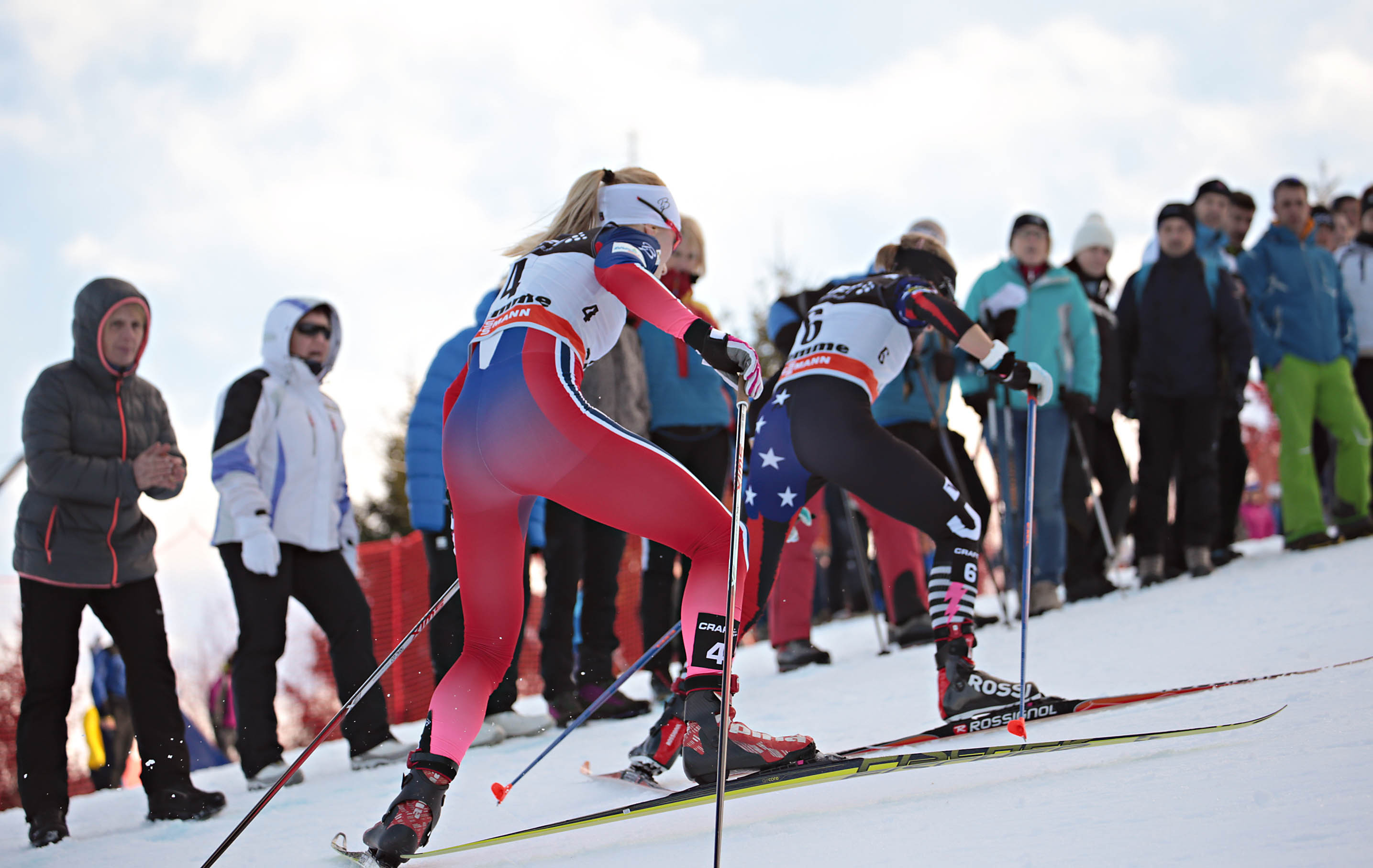
Norway’s Ingvild Flugstad Østberg pushes toward the top of the 9 k freestyle hill climb, the final stage of the 2016 Tour de Ski. She went on to place second, 2:20 behind teammate Therese Johaug (not shown). (Photo: Fiemme World Cup)
Winner Therese Johaug jumps for joy after taking the overall win at the 2016 Tour de Ski in Val di Fiemme, Italy. (Photo: Fischer/NordicFocus)
Therese Johaug (Norway) after winning her second Tour de Ski title with a victory in the final climb in Val di Fiemme, Italy. (Photo: Fischer/NordicFocus)
Diggins 10th, Bjornsen 14th Overall
After starting 9:01 back in 10th and finishing 10th (+11:20.4), Jessie Diggins led the U.S. women in the final Tour standings. It was the end to an eventful Tour for Diggins, after her first individual World Cup win on Friday.
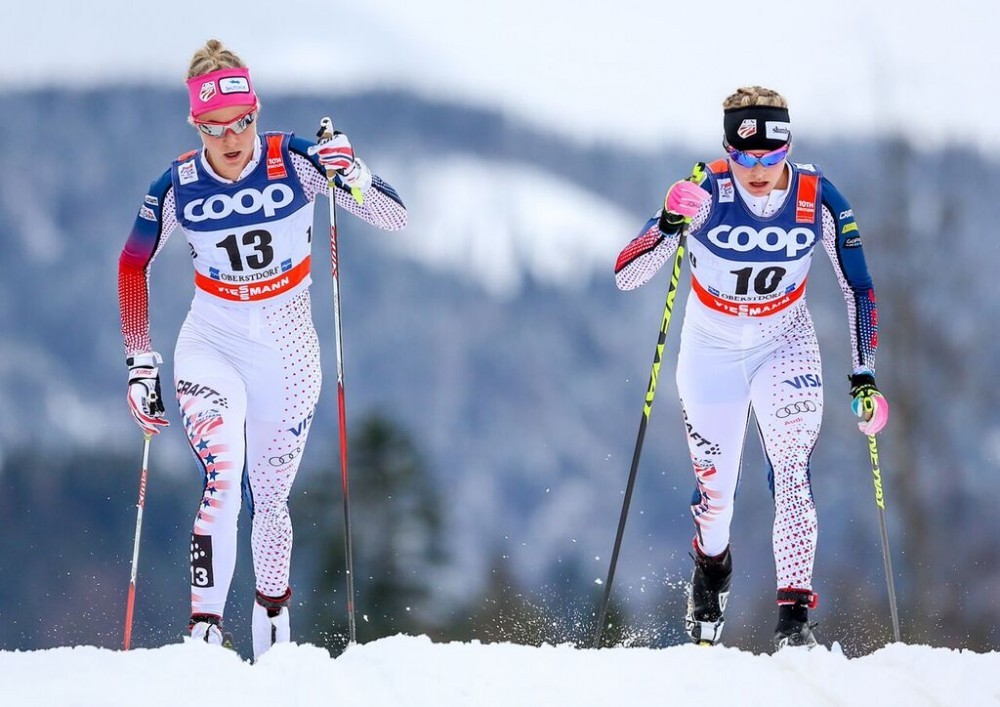
U.S. Ski Team members Sadie Bjornsen (l) and Jessie Diggins (r) started near each other in the fifth stage of the Tour de Ski, a 10 k classic mass start in Oberstdorf, Germany. (Photo: Marcel Hilger)
“One of my big goals for the season was to finish the Tour in the top 10, so I made that goal today!” she wrote in an email to media.
While Diggins didn’t finish the Tour last year because of illness, she did in 2014 and placed 13th overall.
“That climb is brutally hard hard and I was in a world of pain, but I had to tell myself to just keep my feet moving!” she reflected on Sunday. “It was a real mental battle out there so I was happy to be able to hang tough.”
Following her to the top of the downhill ski area was Sadie Bjornsen, who started 12th, 9:32 after Østberg, and slipped two spots to finish in 14th (+12:24.1). This year was her first time completing the Tour, after withdrawing after Stage 5 last year despite being in the top 10.
“I just had no idea what to expect,” Bjornsen said in a phone interview. “I’d done some hill climbs in the U.S., but never against a World Cup field. So I was definitely very nervous because I had a number of people quite close behind me. I decided that I just had to look up the hill, instead.”
“Sadie will tell you that she’s not a climber,” U.S. Ski Team Women’s Coach Matt Whitcomb said. “But she did great today – she only lost two places on Alpe Cermis. She’s skating at a high level now as well classic skiing … Fourteenth place is just a super result for Sadie and for our team.”
Stephen Third Fastest on Course, 2nd on Actual Climb
The U.S. team’s best individual performance in Stage 8 came from Liz Stephen, who climbed six places from 25th to 19th (+13:27.8) and posted the third-fastest time of the day. Stephen’s time was 1:29.5 behind Johaug, who earned “fastest of the day” accolades on Alpe Cermis for the sixth-consecutive year, according to a FIS press release.
American Liz Stephen led Norway’s Ragnhild Haga during last year’s final climb, the seventh stage of the 2015 Tour de Ski in Val di Femme, Italy. She placed fifth overall. (Photo: Fiemme World Cup)
Weng clocked the second-fastest course time, less than four seconds ahead of Stephen’s time.
In her fifth Tour de Ski, Stephen also had the second-fastest split on the climbing portion of the course, the final 3 k to the finish. Only Johaug was 31.7 seconds faster, besting Stephen’s climbing time of 19:18.3.
“I kind of just did my thing on the uphill and went to go catch as many people as I could,” Stephen said in a phone interview. “I felt really strong today, and I had great skis. It’s my favorite race of the year – not a single downhill. I like just getting into that zone and just grinding.
“Today was just my ideal conditions,” she added. “I love it when it’s just soft and wet and sloppy and just wonderful.”
According to Whitcomb, Stephen was coming off a tour that was “stacked against her strengths.” While the U.S. Ski Team veteran, who turns 29 on Tuesday, excels in longer skate races, the tour had a lot of shorter, classical races. Stephen was fifth overall in last year’s Tour – the best result ever for an American at the Tour de Ski.
“She didn’t put together the Tour she wanted,” Whitcomb said. “But we knew that today would test something that is her strength, and would be a good indicator as to where she is physically. She skied better than she did last year during this race – you can’t compare times – but she was able to maintain form and she paced it better, so I think she’s in a confident place.
“Third on time of day and only four seconds off of second — that’s something to be proud of,” he added. “She can leave Italy with some confidence.”
Also for the U.S., Rosie Brennan started 31st and slipped one place to 32nd overall (+20:06.1), and Caitlin Gregg started 38th and finished 42nd (+23:57.6). Both completed their first Tours.
Unsurprisingly, Whitcomb was pleased with the performance of his team.
“I’m really excited with having seven athletes finish the Tour [Diggins, Bjornsen, Stephen, Brennan, Gregg, Noah Hoffman and Erik Bjornsen]. I think it’s a little bit of an unlikely circumstance – battling illness and fatigue, even injury in some cases, anything can happen during the Tour,” he said. “So to have seven athletes finish and have seven athletes stay healthy, that’s a big sign of success for a group of athletes. It means that they’re absorbing the [racing] rather than just getting buried by it.”
Without a World Championships or Olympics this year, the U.S. coaches decided it was safe to have their athletes dig deeper than they otherwise might during the Tour.
“We were able to afford having a few extra athletes that were well beyond their comfort zones finish the Tour, despite it perhaps burying them for the next week or two,” Whitcomb explained.
Sprint specialists Sophie Caldwell, Ida Sargent, Simi Hamilton, and Andy Newell all withdrew from the Tour early, with the intention of saving themselves for two days of skate sprinting at next weekend’s World Cup in Planica, Slovenia. The seven skiers that finished the Tour will sit out the Planica sprints to rest for the Nove Mesto (Czech Republic) World Cup the following week.
But the fatigue runs deep.
“I’m looking forward to the next tour we have,” Stephen said of the Ski Tour Canada from March 1-12. “Which is crazy that we have another one. Thinking about that today was actually a little bit sickening – we’re just so tired that the thought of doing another [eight-stage] tour later on this year is a little bit tiring just to even think about. But I’m sure by then I’ll be really ready and really excited, and of course skiing in Canada is awesome.”
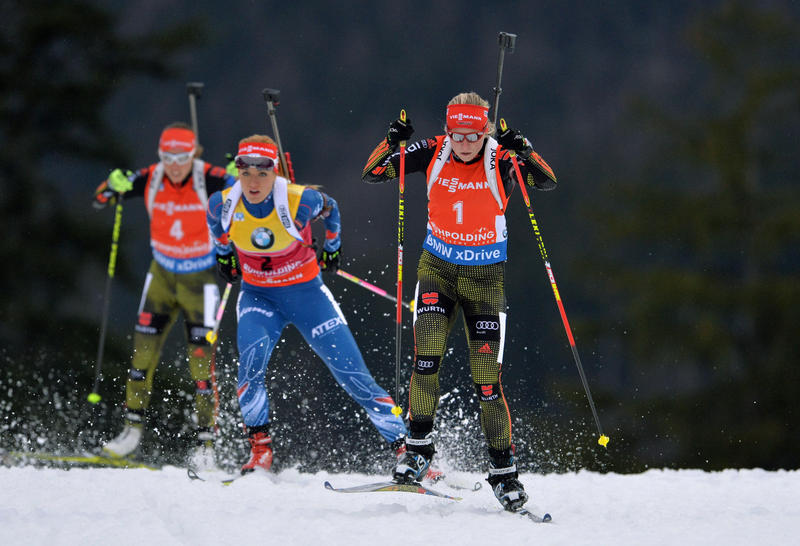
Germany’s Franziska (1) leads Gabriela Soukalova of the Czech Republic (2) and German teammate Laura Dahlmeier in the women’s 10 k pursuit at the IBU World Cup in Ruhpolding, Germany. Dahlmeier started fourth and finished first, 7.3 seconds ahead of Soukalova. (Photo: IBU/Eberhard Thonfeld)
It was a pursuit race, but it must have felt more like a mass start.
The first four women all started within the first three seconds of one another in Saturday’s 10-kilometer pursuit at the IBU World Cup in Ruhpolding, Germany. Franziska Hildebrand of Germany started first, followed by Gabriela Soukalova of the Czech Republic, Finland’s Kaisa Mäkäräinen, and another German, Laura Dahlmeier in fourth.
Hildebrand and Mäkäräinen didn’t hold on to their top spots, each accruing too many penalties in such a tight field to remain competitive for a spot on the podium. After an initial miss in the first prone shooting took her out, Hildebrand ended up ninth and 1:24.3 behind the eventual winner with four penalties (1+0+1+2). Behind her, Mäkäräinen took 13th (+1:52.1) after skiing five penalty laps (0+1+2+2).
But Dahlmeier and Soukalova stayed neck-and-neck at the front of the race, each earning one penalty — Dahlmeier on the second-to-last stage, Soukalova on the final standing stage. Dahlmeier passed Soukalova on the last lap, much to the delight of the German crowd, holding on to win by 7.3 seconds in 32:35.9.
Ruhpolding’s already-sloppy course got worse, along with the weather, as the race went on. Light rain ensured mushy conditions, a factor that Soukalova cited in losing her lead to Dahlmeier. “Traditionally, I am not very strong on the last loop,” the runner-up said in a post-race press conference. “Besides, I am not very light for this kind of snow.”
Italy’s Dorothea Wierer moved up from sixth to claim the final podium spot in third (+53.6) despite two penalties (0+1+0+1). She led a tight pack into the finish, including Norway’s Tiril Eckhoff in fourth (+57.3), France’s Marie Dorin Habert in fifth (+57.5), and Slovakia’s Paulina Fialkova in sixth (+1:01).
Susan Dunklee (US Biathlon) racing to 15th in the IBU World Cup women’s 10 k pursuit on Saturday in Ruhpolding, Germany. (Photo: USBA/NordicFocus)
American Susan Dunklee started 11th and finished 15th (+2:04.1) in a sprint to the line with Karin Oberhofer, edging the Italian by 0.1 seconds.
Over the four-stage race, Dunklee accrued three penalties, all of which came in the last two standing stages (0+0+2+1).
“It was one of those days when it is difficult to apply any sort of power effectively without simply wasting energy,” Dunklee explained in an email. “The race started great. … I moved up as far as 6th.”
However, she experienced some technical difficulties, and lost a clip while putting her rifle back on after the second prone stage. She got a new one, but “I didn’t do a perfect job of regaining control of my focus before beginning shooting,” she explained. She missed two shots in next shooting stage.
Julia Ransom was Canada’s top finisher, gaining four spots to finish 45th (+4:19.6), with two misses (0+0+1+1), followed by teammate Sarah Beaudry, who improved one place to 54th (+6:12.4) with three penalties (0+1+0+2). American Annelies Cook started 43rd and finished 58th (+7:50.6) with eight penalties (1+2+3+2).
“I had an exciting sprint battle with Karin Oberhofer of Italy for 15th place,” Dunklee wrote. “Inspired from watching the Tour de Ski all week, I thought it was the perfect opportunity to use a finishing lunge. The good news: I outlunged Karin. The bad news: I broke my rifle stock when I crashed after the line.”
Was it worth it?
“Worth it, I think. The stock will be fixed by tomorrow.”
Dunklee will start Sunday’s 12.5 k mass start in bib 23 (of 30). Race starts at 8:45 a.m. Eastern time. Watch here.
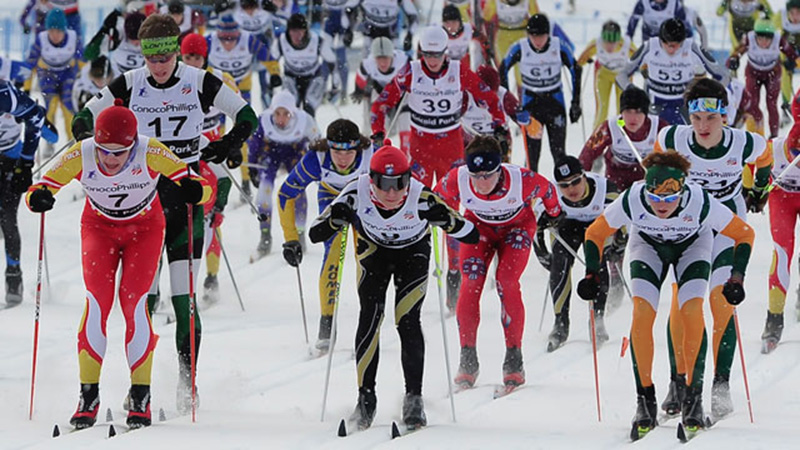
The scene from an Alaska Nordic Skiing State Championships mass start. In Anchorage, high-school nordic coaches recently agreed to ban fluorinated glide wax in non-championship races throughout the 2015/2016 season. (Photo: asaa.org)
Anchorage-area schools decided that it had gotten out of hand, so they called a truce.
“Anchorage region coaches agreed to not use fluorinated glide waxes during all non-championship races,” Anson Moxness, head coach at West Anchorage High School in Anchorage, Alaska, wrote in an email. “Because flouros are expensive and bad for your health. None of the schools really have adequate ventilation systems and many are doing waxing around the skiers.”
Such bans on fluorinated waxes are becoming increasingly common around the country. Moxness cited various divisions and regions around the country that had agreed to similar bans, including the Eastern Intercollegiate Ski Association (EISA).
Different coaches had different reasons for supporting the ban, but among coaches interviewed, support was unanimous:
“I am all for this for many reasons,” Cory Schwartz, head coach of the University of New Hampshire (UNH) nordic team, wrote in an email. “First is the health concerns around putting on powders — even though we all use masks and try to the best of our ability adhere to safety suggestions, none of the college teams have a ventilated wax truck. So we are using masks while ironing on and brushing but the powder gets all over the truck, our skis, and body.”
Evidence suggests that there are health risks associated with fluoro waxes. Fluorinated compounds are useful in waxes for their ability to repel water, making the skis faster. But they’re also much more expensive.
“We’re looking at an order of magnitude difference in per gram wax costs of CH and HF waxes,” Moxness wrote. “I don’t see a reason to be spending that much money on waxes for non-championship races.”
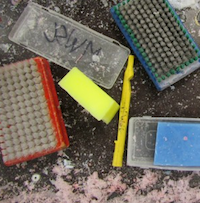
Tools of the trade: Anchorage-area high schools will have one less variable to worry about with the recent decision to ban fluorinated glide waxes for all non-championship races.
He added that the success of this rule depends on coaches’ compliance.
“If skiers choose to wax skis at home, which some of them do, we have no control over what they put on their skis. If we establish that it is cheating to use anything with fluorination and are consistent in our message, I think it will succeed,” Moxness wrote.
“Where this will fail is if the coaches aren’t fully behind the fluoro ban, which we all were at our preseason meeting. From what I’ve seen, my skiers realize what we’re doing and the reasons behind it and they respect the ban.”
“I think the success of the ban lies on the shoulders of the coaches and the parents,” South Anchorage High School Coach Sam Sterling wrote in an email. “If they advertise it as something that is good for the sport, I think it will succeed. If they give their athletes reason to doubt it … then, maybe it won’t. Hopefully, in a couple years the ban will just be a normal part of the AK high school ski scene and nobody will give it a second thought.”
Chugiak High School in nearby Eagle River is one of the schools involved in the truce. Head coach Cody Priest also supported the ban.
“Another reason it’s nice,” he wrote in an email, “is that I don’t have to ‘draw the line’ on my team on who gets what wax. With a competitive girls team I would want to use expensive wax on at least my first five, then maybe not the others. How do you explain that to the team?
“Plus on race day I wont be testing different top coats,” he continued. “I will be just ensuring that I have the correct hardness of base wax.”
The coaches contacted were also unanimous that the extra time spent testing skis with fluorinated wax was not time well spent.
“The main thing I see is that [the ban] allows the coaches to actually… coach,” Sterling explained. “The impact of the ban goes beyond the obvious benefits of decreasing exposure to fluoros and reducing overall expenses for high school programs. Each team ranges from junior national champions to foreign exchange students who have never seen snow until coming to Alaska. The more time coaches can spend working with these athletes, and not dealing with waxing, the better off the sport will be.
Sterling sees it as a simple misallocation of resources.
“There’s a lot of [coaching] experience and motivation in Alaska high school skiing,” he wrote. “It’d be great to see this resource going more to the development of the athletes, and less towards making a fast pair of skis. It’s a step in the right direction and it was great to see unanimous approval from the Region IV coaches in adopting the ban.”
Schwartz explained that in the East, there is some concern their region is falling behind others when it comes to testing wax in different snow conditions, “But I do not agree with that,” he wrote. “I actually am more excited to go to the race to see the race instead of being in a wax trailer all day.”
In addition to being better for individual families bottom lines, Sterling and Moxness explained it’s better for the sport as well.
“It also lowers barriers of entry into the sport,” Moxness wrote. “If a parent is interested in waxing their kid’s skis and they only have to invest maybe $50 in waxes to have skis that are competitive, instead of $300, they are much more likely to get and stay involved.”
“That means more growth of the sport and parents who may be more likely to invest that saved money in better quality equipment, which makes way more of a difference than wax.”
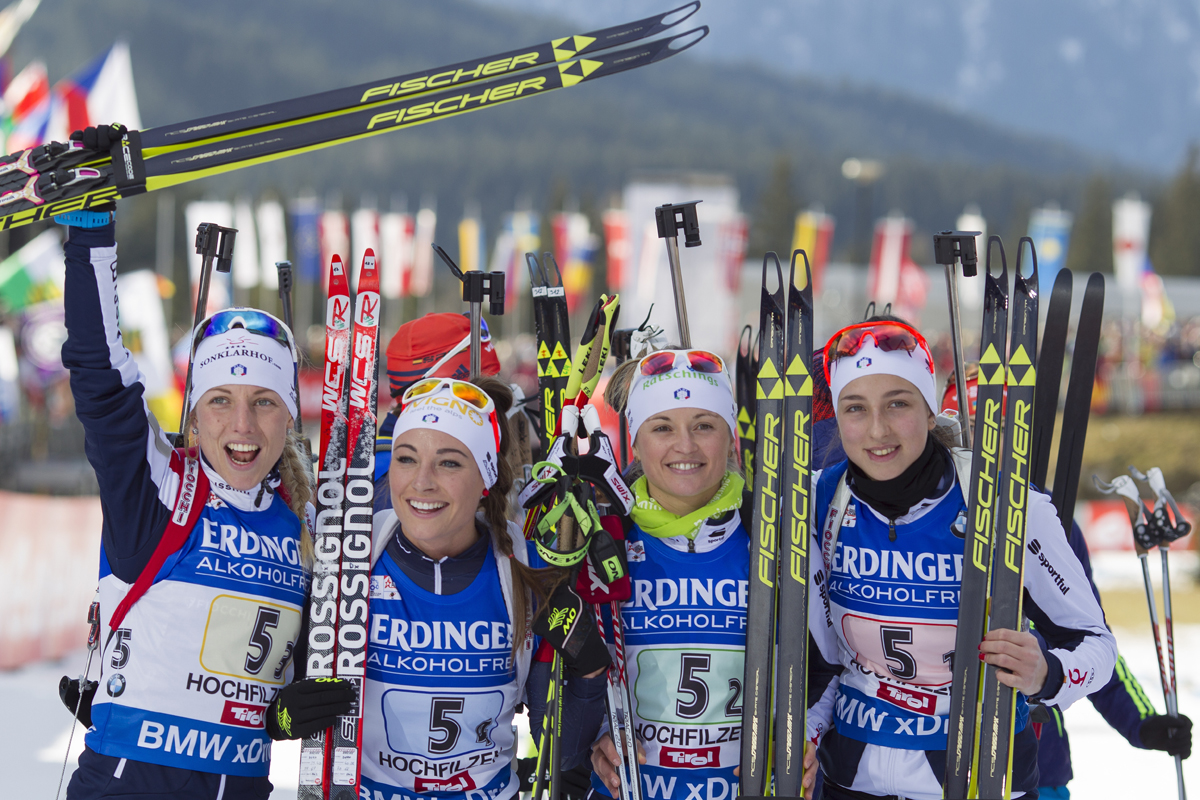
The victorious Italian women’s 4 x 6 k relay, with (from l to r) Federica Sanfilippo, Dorothea Wierer, Karin Oberhofer, and Lisa Vittozzi at the Hochfilzen World Cup on Sunday in Austria. (Photo: Fischer/NordicFocus)
The women’s biathlon 4 x 6-kilometer relay, marked by good shooting performances, perfect weather, and several unusual lineup choices came down to the wire, with the race decided on the last lap in a sprint between Italy’s anchor Dorothea Wierer and Germany’s Franziska Preuss. Wierer lunged over the line first by less than a ski length, in a time of 1:05:32.6. This secured the first World Cup win for an Italian women’s relay in history, celebrated extensively by her teammates and coaches in the finish.
After a number of changes between several countries vying for the final spot on the podium, Ukraine prevailed in the end, taking third 13.1 seconds behind the Italians. None of the three teams on the podium suffered a penalty lap, with Italy having to use eight spare rounds, Germany seven, and Ukraine 10.
After sweeping the podium in the sprint and securing first and second place in the pursuit race this weekend, Germany’s women had to be considered the overwhelming favorites for the relay. But on Sunday, Germany opted for a lineup of Franziska Hildebrand, Maren Hammerschmidt, Vanessa Hinz and Franziska Preuss, a group of athletes who had never been in a relay team together.
They were not alone in trying something new, with teams such as the Czech Republic, Italy, France, Russia, Ukraine, the United States, and Canada also experimenting with new athletes or at least order changes.
Germany’s Laura Dahlmeier, the winner of the pursuit race on Saturday and anchor of the gold-medal-winning relay at the 2015 IBU World Championships, rested on Sunday.
“This was my own decision,” she explained in an interview with German broadcaster ARD before the race. “The season is long enough, and the World Championships are what matters. And I believe as strong as we are as a team right now, the other four girls can do well without me.”
The German coaches are happy that they still have an ace up their sleeve for the next relays. “We know that there still is a long and tough season ahead of us,” Women’s Head Coach Gerald Hönig said. “We are planning with an eye towards the [2016] World Championships in Oslo in March. So a deep team is a nice problem to have, in contrast to always having to use the same two or three top performers.”
Miriam Gössner, who achieved a third place in the sprint on Friday, also took a break from racing on Sunday.
American Susan Dunklee racing the second leg of the IBU World Cup women’s relay on Sunday in Hochfilzen, Austria. (Photo: Fischer/NordicFocus)
With the Germans explicitly stating their goal to reach the podium, the day got off to a problematic start for Germany, with other teams charging ahead.
Hildebrand, the winner of the sprint race on Friday and fourth place in the pursuit on Saturday, skied a controlled race at first, and cleaned the prone stage with perfectly centered shooting. But then she required two spare rounds in the standing position and had trouble inserting them, setting her back to 14th position. After a good final round, she tagged off at the first exchange 11 seconds behind in eighth.
“Still in sight of the leaders,” Hildebrand recalled in the ARD interview. “And the other girls then turned it around.”
Italy’s first skier, Lisa Vittozzi, who also scrambled for Italy’s bronze-medal relay at World Championships last March, fared better, shooting perfectly (0+0, 0+0) and tagging off just 4.2 seconds behind the Czech Republic who was in first at that time. On the second leg, Karin Oberhofer kept Italy near the front, requiring only one spare round (0+0, 0+1), and tagged Italy just 1 second behind.
Throughout the race, Germany struggled a bit with technical details. Maren Hammerschmidt, the surprise second-place finisher in both of the previous races, had two misses (0+1, 0+1) and doubled the deficit she had been handed by Hildebrand. In slow-motion replays from the shooting range, she could be seen desperately trying to insert a spare round into her rifle, before it fumbled back out.
“That was a technical malfunction today, nothing I could do about it,” Hammerschmidt said an interview with ARD. “A shot hung up in the ammunition magazine. I did not expect this, and will have to check that clip again at home.”
She tagged 22.2 seconds behind the leaders in ninth place, one behind Canada’s Megan Tandy.
“I hope we can still secure a podium finish,” Hammerschmidt said in a mid-race interview.
It then fell to Vanessa Hinz, who placed 15th in the Hochfilzen sprint and 29th in the pursuit, to bring Germany back into contention. With two fast shooting performances (28 seconds prone) and requiring only one spare round, she steadily moved up through the ranks, and handed over to Franziska Preuss in first.
“I was really happy about the nomination [for the relay], and glad that it worked so well today,” Hinz later said.
On the third leg of the relay, Italy struggled a bit. Federica Sanfilippo, a surprising podium finisher during the first World Cup weekend in Östersund, Sweden, and not a member of Italy’s bronze-medal relay at World Championships, required five spares to clean her targets. She had the toughest time in standing (0+2, 0+3), but avoided the penalty and skied the fastest lap of the field, handing off to Wierer 21.6 seconds behind.
For Preuss, the 2014 Olympics ended in a minor drama during the relay, when she started for Germany at the age of 19 and crashed twice, getting snow into the sights of her rifle and costing her team their chance at a medal. Since then, Preuss has usually raced the second or third leg in relays.
But on Sunday, with her close friend Dahlmeier taking a break, she was called up to anchor the relay. Preuss headed out strong and required only one spare round to clean prone. But by the time she came back to the range for the final shooting, a group of athletes that included Wierer had caught up to her.
Preuss hit the first four targets, and was convinced that her fifth shot had also hit, closing the protective flap on the sights of her rifle, before realizing it was a miss. This forced her to load the spare and take aim again, hitting the target, and left the range with Wierer, who had also required one spare, right behind her.
On the last lap the lead changed back and forth. Preuss later told ARD she deliberately let Wierer overtake her. Then she accidentally stepped on the tails of Wierer’s skis near the top of the first climb, causing both to stop briefly, but neither Preuss nor Wierer fell or broke their poles. At the halfway checkpoint, they were just 0.3 seconds apart.
Preuss then decided to try and force a decision before the stadium by “slogging away on the last climb from the bottom to the top, 100 percent,” and managed to create a small gap. But Wierer refused to be dropped, and caught the end of Preuss’ skis again as they entered the arena. After a right turn into the closing stretch, Wierer double poled past her taking the middle lane, with Preuss on her right trying to hold on. But Wierer had more power left, and lunged over the line 0.2 seconds ahead, into the arms of her excited teammates.
“I know I’m not the best female sprinter. I have to work on that again,” Preuss confided to ARD during a group post-race interview. “The second place is a great result, I think we are all satisfied with that”.
Canada’s Megan Tandy blasts through the second leg of the women’s relay at the IBU World Cup in Hochfilzen, Austria. Tandy’s clean shooting helped Canada move into eighth place at the end of her leg. (Photo: Fischer/NordicFocus)
Her teammates also agreed with her that the Hochfilzen arena poses a difficult challenge for a finishing sprint, with a noticeable incline the last 100 meters.
Wierer had already beaten Preuss and Hildebrand in a sprint to the line in Östersund this season, so she had every reason to be confident that she could do it again.
“I was only thinking that I should run as fast as you can. She was close in front of me. I was hoping I could win in the final sprint,” Wierer told the IBU.
Afterward, both teams seemed happy with their results, with the women all smiling and posing for pictures.
“You can hardly ask for a better selling point for biathlon [than this race],” German coach Hönig said with a laugh. “That’s why millions of people watch us on TV and the arenas are full.”
Asked later why the Italians didn’t seem even more jubliant about their first-ever victory in a women’s relay, Wierer tried to explain: “I think we are just all so tired.”
The Czech Republic, who frequently had the best relay performances last season, also had been in the lead early in this race, thanks to Eva Puskarcikova and Olympic silver medalist Gabriela Soukalova. But then team rookie, Lucie Charvatova – who was sixth in Friday’s sprint and replaced Jitka Landova on Sunday – could not clean her standing shooting with the three spare rounds and thus incurred a penalty lap. After another difficult shooting by anchor Veronika Vitkova, they finished the race in sixth place (1+12), 29.8 seconds back from Italy.
Chervatova only recently took up biathlon training when she failed to qualify for the Czech cross-country senior national team again, and her new teammates are expecting great things from her.
“Just watch, she is incredible, her body is all muscle. In a few years she will be frequently at the top,” veteran Soukalova told the media in Hochfilzen.
The podium was in hot contention with 22 countries at the start line, and with the Czech Republic, Sweden, Austria, France, Ukraine, and Belarus (this year having to race without defending World Cup champion Darya Domracheva) in the top three at various points of the relay.
In the end, Ukraine’s team claimed the third, with anchor Olga Pidrushna requiring three spares but skiing the second best time on the final round. Overall the team, usually known for their excellent shooting, required ten spare rounds to clean all the targets.
“I think there are some things we could improve, so we will work on them this season,” starter Yuliia Dzhyma said in the press conference.
Poland placed fourth, 27.5 seconds back, while France was fifth, (+28.8).
Canada 10th, U.S. 15th
For the relay in Hochfilzen, Biathlon Canada put up a different lineup and order than in the last World Championships in Kontiolahti, Finland. Canada advanced as high as eighth in split times during the race.
Starting in the fourth row in bib 10, Julia Ransom kept the leaders within viewing distance.
“I always like relays so was excited for today!” Ransom wrote in an email. “My legs weren’t as snappy as usual the past two races but things came together for today and I felt much better. I am new to starting relays but I have a background racing cross country and feel comfortable in a mass. This helps with navigating the more technical areas of the course with a group.”
The 22 year old needed two spares to clean the first shooting, then one more in the standing stage. Ransom tagged Tandy in 11th, 20.6 seconds back.
Tandy was able to keep her gap to the best athletes at the top of the field and even improved position, largely helped by two clean stages (0+0, 0+0) and the shortest range time on her leg. At the exchange, she handed off 21.5 seconds back in ninth place. At that time Canada was ahead of top teams like Germany, Norway and Russia.
Emma Lunder took over, and while the 24 year old lost about a minute to the leaders and required four spare rounds (0+1, 0+3), Lunder avoided a penalty lap in the standing shooting. She tagged Canadian anchor Rosanna Crawford 1:23 back in 12th place.
“The 2 k course here is quite easy and has a lot of rolling flat sections, which really plays to my strengths in two skate and one skate,” Crawford wrote in an email. “It’s also a really fast 6 k — the race was only taking 16-17min, which is super fast for a relay. Skiing felt a lot better than it has this year and we had some super fast skis, thanks to our techs.”
Crawford cleaned her prone shooting stage, and only required one spare round in the standing position (0+0, 0+1), making up ground to the top by skiing the fourth-fastest course time on her leg.
“Prone has been feeling really good all year, but I’ve been struggling with one miss standing far too often!”
She finished the relay for Canada in 10th, 1:08.7 behind Italy and just 4.3 seconds behind the Russian team.
“I think this will be a great learning experience for our younger girls on the team,” Crawford continued. “Feel that excitement of doing well in a relay and allow them to be better prepared for the next relay. Overall we are happy as a team, but know with a few less spares that top 8 is within reach!”
“Canada did great today!” Ransom wrote. “All of us had solid races and were in the mix for the most part. I think this was a great place to start from for the season.”
The US Biathlon women’s team also experimented with a new order. Susan Dunklee, who has been the starter for several years, moved to the second leg while Annelies Cook started.
Canadian Emma Lunder racing the third leg of the women’s relay at the IBU World Cup in Hochfilzen, Austria. (Photo: Fischer/NordicFocus)
“We are experimenting [with our relay order] to see what combinations work best for the team as a whole,“ Dunklee wrote in an email. “Traditionally I have started off the first leg, which involves a lot of tactics and is exhilarating, but today Annelies tried it instead and did a fantastic job.”
In her first season starting on the World Cup circuit, Clare Egan, who anchored the team at World Championships and in the last relay of last season, was moved to the third position, with Hannah Dreissigacker closing out the race instead.
“My job today was to try the second leg and chase down the lead pack not far ahead,” Dunklee continued. ” Skiing feels strong and I had nearly regained contact with the leaders, then my extra rounds in standing set us back again. We didn’t have a perfect day and we look forward to improving on our 15th place in the future.”
Based on the U.S. relay performances last season, Cook started back in the seventh row in bib 20. She opened her race with two misses in prone, then one more in standing (0+2, 0+1), and tagged off to Dunklee 32.0 seconds behind the leader in 14th place.
Dunklee made up some positions, entering the prone stage in 13th place, then cleaned it. On the next lap she caught up with a few more athletes to move into seventh. But then she used all of her spare rounds in standing, narrowly avoiding a penalty lap but losing a lot of valuable time with the reloads. At the second exchange, she tagged Egan 41.8 seconds behind in 11th place.
On her standing stage, Egan struggled, missing four shots in a row and thus running out of spare rounds. In the end, she had to circle the 150-meter penalty lap twice (0+1, 2+3), and tagged off to Dreissigacker 3:08.6 minutes behind.
Dreissigacker fared better, cleaning her prone stage and using two spares in standing (0+0, 0+2). While the clean prone helped her catch a few teams ahead of her, Dreissigacker lost time on the final loop before the finish and ended up 15th (+4:10.9).
In the women’s Nation Cup rankings — important not only for prestige as an own end-of-season award, but also determining the number of starters a country can use in World Cup event — Germany is in the lead after this weekend’s races. Canada ranks 10th and the U.S. stands in 16th.
Kaisa Mäkäräinen of Finland celebrates after a last-lap move brought her into first place in the 10 k pursuit in the final day of racing at the IBU World Cup in Östersund, Sweden. (Photo: Fischer/NordicFocus)
The final event of the IBU World Cup in Östersund, Sweden, Sunday’s 10-kilometer women’s pursuit, was decided under clear skies with calm winds. And it came down to the final leg, when Finland’s Kaisa Mäkäräinen made her move, beating four other women to the finish to win ahead of Italy’s Dorothea Wierer by 1.9 seconds in 30:45.1, with two penalties (1+0+1+0).
Wierer had one penalty in the first standing stage, while Germany’s Franziska Hildebrand had no penalties and took third (+3.3). Fourth place was nearly 10 seconds back, as Marie Dorin Habert of France came in 12.5 seconds behind Mäkäräinen, barely edging the Czech phenom Gabriela Soukalova, who took fifth (+12.8). Habert and Soukalova had three and two penalties, respectively.
Canada’s Rosanna Crawford was the top North American, started 22nd and finished 23rd (+2:40.9) with five penalties (1+2+1+1). In a post-race email, she wrote that she felt good on skis, but that she couldn’t be happy with the way she raced due to imperfect shooting.
“My hits were centre and misses off,” she wrote. “So just didn’t have the focus for prone. I’ll work on my shooting next week, to get that confidence back.”
Clare Egan (US Biathlon) started 16th and finished 45th in Sunday’s pursuit, the final race of the IBU World Cup in Ostersund, Sweden. (Photo: USBA/NordicFocus)
The top American was Clare Egan, who finished a career-best 16th in the Saturday’s sprint. On Sunday, she finished 45th and cited fatigue, finishing 4:01.6 behind the winner with five penalties (+1+2+1+1).
“I definitely did not have the same energy on course today as I had in the previous races here in Ostersund,” Egan wrote in an email. “The first three races took a lot out of me mentally, and physically I really struggled to eat enough this week with the odd training and racing times so I was running on empty.”
“I was disappointed with my three prone misses, having cleaned prone in the last two races. However in standing I overcame first-shot misses in both stages to hit the next four.”
In her second season of international racing, the 28-year-old Egan explained that she is still adapting to being on the World Cup, saying that she has learned a lot this week.
“Part of the challenge at this level is figuring out how to push your body and mind through four races in one week — and then do it again the next week,” she added. “Overall I am thrilled about how this week went, and I’m looking forward to resting, recovering, and racing again!”
Annelies Cook on her way to 53rd in the 10 k pursuit on Sunday at the IBU World Cup in Ostersund, Sweden. She started 25th but slipped with six misses. (Photo: USBA/NordicFocus)
The only other American to qualify for the women’s pursuit was Annelies Cook, who finished 53rd (+4:32.8) after two clean prone stages followed by three misses in each of her standing stages.
“Today was a textbook example of a biathlon meltdown,” Cook wrote in an email. “Things were going really well in the first half. Although I was definitely tired in my body after a hard week of races, I felt comfortable with the group of athletes I was around.”
At first she succeeded, she explained, and moved up 10 places after cleaning both prone stages.
“I had a total mental fail in standing and eventually missed 6 total,” Cook wrote. “I tried not to let the first three bother me, but the penalty loop was icy and really hard to go around with any speed and so it did bother me a bit.”
She tried to pull it together.
“I was just tense and not able to follow a good rhythm. It was a big bummer and I fought hard to the finish. But it does take some spunk out of your legs when you mess up like that,” she wrote.
Four Canadian women qualified for the pursuit, with Megan Tandy starting 46th and finishing 25th (+2:42.9) after three-straight clean stages and one miss in the final standing. Julia Ransom started 32nd and placed 36th (+3:34.0), with four penalties (2+0+2+0), and Zina Kocher placed 51st (+4:27.5) after starting 27th and ending up with seven penalties (1+0+3+3).
Nathan Smith of Canada racing to 10th in Sunday’s IBU World Cup 12.5 k pursuit in Ostersund, Sweden. (Photo: Fischer/NordicFocus)
The names of those chasing him change, but France’s Martin Fourcade remained on top on Sunday in the 12.5-kilometer pursuit at the International Biathlon Union (IBU) World Cup in Östersund, Sweden.
Martin Fourcade of France after winning Sunday’s pursuit for his second-consecutive win at the IBU World Cup in Ostersund, Sweden. (Photo: IBU/Evgeny Tumashov)
Fourcade took first in 31:22.4, with three penalties in four rounds of shooting (1+0+1+1). It was still good enough to finish 35.1 seconds ahead of second place, which went to Arnd Peiffer of Germany.
Peiffer shot nearly perfectly — he missed one in the second prone stage — which was enough to make up approximately 25 seconds on Fourcade after starting second, approximately 50 seconds back, but not enough to close the gap.
Fourcade’s teammate, Quentin Fillon Maillet moved up one spot to reach the podium in third with two penalties (+55.2).
For the second-straight day, the Canadian men reached the top 10, with Nathan Smith in 10th after starting ninth. He had three penalties (1+1+0+1) and finished 1:15.1 after Fourcade and less than 20 seconds out of third. The podium would have been Smith’s second of the week; he placed second in the single-mixed relay last Sunday with Rosanna Crawford.
“I knew going into the final standing shooting that I was fighting for a podium position,” Smith wrote in an email after the pursuit. “I ended up missing one and leaving the range with guys like [Norway’s] Tarjei Bø and [Germany’s Benedikt] Doll, with [Norway’s Emil Hegle] Svendsen just ahead. Tough company to fight on a last lap! I was a little fatigued from skiing most of the race by myself and just couldn’t hang on.
“It could’ve been even better,” Smith continued. “But that is how the sport works. It feels good to know that it doesn’t take a perfect race anymore to be top-10.”
Macx Davies of Canada racing to 10th in Saturday’s IBU World Cup 10 k sprint in Ostersund, Sweden. It was his career-best result by 30 places. (Photo: Biathlon Canada/NordicFocus)
Canada had two in the top 30 after Macx Davies, coming off 10th on Saturday in his fifth World Cup race, finished 30th (+2:48.8) with three penalties (1+0+1+1). Despite slipping 20 places from starting in 10th, for 22-year-old Davies, 30th stood as the second-best result of his career in his first-ever pursuit.
“Starting in 10th made me realize just how good yesterdays race was!” Davies wrote in an email. “When I got into the lanes and ahead of me is [Norway’s] Johannes Bø and beside him is Svendsen, Then Nathan was beside me. It was all a crazy experience!
“Still very excited with two top 30s in the first [World Cup]!” Davies continued. “And though I believe it more now, I am still a little in the clouds! It has just been an amazing weekend! And now I am looking forward to Hochfilzen next weekend!!! Can’t wait to try again!”
After starting 55th, Canada’s third man, Brendan Green improved to 38th (+3:21.4) with two penalties (0+1+1+0). Green was happy about the more amicable weather on Sunday, which helped him shoot well.
“It felt good to be able lay down on the shooting mat and just shoot without having to try and work through changing wind or getting hit with a gust,” Green wrote in an email. “I am very happy with my shooting today and satisfied with my overall performance. I’m disappointed with my ski performance here in Östersund and was hoping for a lot more, but hopefully that will turn around soon.”
Tim Burke (US Biathlon) after placing 39th in the IBU World Cup pursuit in Ostersund, Sweden. He started 45th, cleaned three out of four stages and finished with three penalties. (Photo: USBA/NordicFocus)
A half a second behind Green was the top American, Tim Burke, who finished 39th (+3:21.4). After starting 45th and cleaning three stages, he was happy with his race, calling it “decent” and “solidly executed.”
He accrued all three of his penalties in the first standing, writing in an email that he was “a little too cautious … and it ended up throwing off my timing. I recognized the mistake and adjusted for the last stage.” He shot clean in the last stage.
“I went into this week’s races with a training focus,” Burke continued. “I ended up getting sick shortly after arriving to Norway so I missed out on a lot of snow time and intensity training. I was definitely off of my normal ski form here, but I feel like these races will help get me back on track for [next week’s World Cup in Hochfilzen].”
The only other American in the pursuit was Sean Doherty, who opened the season with career-best results this week. He slipped 21 spots, from starting in 25th to finish 46th (+3:54.5) with seven penalties (1+2+2+2), but the 20-year-old still has a lot to be happy about.
The IBU World Cup will pick back up again on Friday, Dec. 11, in Hochfilzen, Austria, with men’s and women’s sprints.
Macx Davies of Canada racing to 10th in Saturday’s IBU World Cup 10 k sprint in Ostersund, Sweden. It was his career-best result by 30 places. (Photo: Biathlon Canada/NordicFocus)
Note: This article has been updated to include additional comments from Macx Davies.
It was a big day for Canadian men in Saturday’s International Biathlon Union (IBU) World Cup sprint in Östersund, Sweden. Two Canadians broke into the top 10, led by Nathan Smith in ninth, with one miss in both standing and prone. He finished 1:22.3 behind France’s Martin Fourcade, who won the 10-kilometer race in 24:02. And 22-year-old Macx Davies had the race of his career so far, finishing 10th, 10.9 seconds after his teammate Smith.
The up-and-coming Canadian biathlete’s previous best was 40th in a World Cup sprint two seasons ago in Oberhof, Germany.
Davies’ secret was simple: be the best shooter of the day. It was windy in Östersund, and he was the only man in the field to shoot clean on Saturday.
How he got to be the best shooter was more complicated. Certainly not by being the fastest — he forgot to load a second clip and had to load each bullet individually in standing.
“That really allowed me to stop thinking about results and focus on hitting every target,” Davies said, according to a Biathlon Canada press release. “I had to push each bullet in by hand, which slowed down my shooting and again forced me to think of each shot more individually than as a whole. It is funny now, but I think this really slowed me down and made me focus more.”
It wasn’t until the last lap that he realized how well he was doing.
“I was the whole Canadian wax crew that was yelling at me on the last lap, and my coach Roddy Ward,” he explained in an email. “I was a little in disbelief at the finish. First of all I was excited to have not lost a position on the last loop. Proving that I can ski with the best guys. And then I just was over the moon after it sunk in that I was 10th!”
Davies cleaned an IBU Cup sprint last season in Obertilliach, Austria. Saturday’s race marked his fifth World Cup.
“This result means I am doing something right with my training and that as a whole the Canadian team is ready to show off what we can do this season,” he wrote.
In an email, Canada’s head coach Matthias Ahrens explained the team aimed to start the season strong “for confidence and also Nation Cup points,” he wrote.
“The first World Cup is always a big question mark due to North America’s isolation during the training year,” he added.
While a strong start was ideal, Ahrens wasn’t expecting this from Davies — at least not right now.
“I did not expect this to happen so early since he had a period of sickness in the last training block, but I know that he is a great skier especially when he switches to snow,” he wrote. “Today everything aligned for him with good skiing and shooting in a challenging race were others had trouble in the shooting range.”
Meanwhile, Smith placing ninth, after he earned silver at 2015 IBU World Championships, was more on par with expectations, Ahrens explained.
Perhaps less surprised with Davies’ performance was Canadian National Team Coach, Roddy Ward.
“Macx can really throw down amazing performances each year. Now he has been given another World Cup opportunity and he has delivered another one of those special performances,” Ward wrote in an email. “He is very dedicated and has belief in himself that he can improve and be among the best. Results like today re-enforce that the effort is paying off.”
“Everything feels surreal at the moment,” Davies said in the press release. “I keep seeing the result sheet and not believing that I’m actually in the top-10. I knew today that good shooting would make a big difference and I felt good on my skis from the start of the race so I really tried to push myself as far as I could go. This result provides me with the confidence that the big names I have idolized growing up are in fact human, and I am competitive with them.”
Another standout performance among North American men belonged to another youngster, 20-year-old American Sean Doherty, who posted a career-best 17th on Wednesday in the 20 k, the first individual World Cup of the season. On Saturday, Doherty placed 25th (+2:13.4). for his second-best result to date, with one penalty in standing and two in prone.
“The sprint today was an interesting race,” Doherty said in a US Biathlon press release. “The wind conditions were very difficult. I felt strong on the course and I am very excited to start the pursuit in the middle of the action. Should be a lot of fun.”
Perennially atop the podium, Fourcade had a commanding victory, finishing 51.6 seconds ahead of second-place Arnd Peiffer of Germany. Crediting fast skis, Fourcade’s victory came in spite of two penalties — one in each stage. But while his competitors tried to wait out the gusting wind on the course, Fourcade shot quickly in order to get the 150-meter penalty loop over with. Peiffer’s clean shooting in prone gave him what he needed to edge Norway’s Ole Einar Bjørndalen, who took third place (+55.2) with two penalties.
Also qualifying for Sunday’s pursuit with a top 60 in the sprint, American Tim Burke placed 45th, (+2:45.8) with four penalties (1+3) and Canada’s Brendan Green was 55th (+3:12.2) with five misses (2+3).
Among the other U.S. finishers, Leif Nordgren placed 64th (+3:39.8) with four penalties (2+2), and Lowell Bailey was 68th (+3:46.7) with six misses (1+6). Canada’s Gow brothers, Scott Gow was 67th (+3:44.5) with five misses (3+2) and Christian Gow placed 70th (+3:49.5) with five missed targets as well (2+3).
The Mount Marathon Race is one of the oldest continuously run races in North America and is known as the Super Bowl of Alaska. Though only five kilometers long, the course climbs a grueling and treacherous seaside mountain for 3,022-feet, before turning around and plunging back down to the start line in town. After professional mountain runner Rickey Gates told his friend and teammate Kilian Jornet that he couldn’t beat the locals on their home turf, Jornet, who holds countless speed records throughout the world, showed up to turn up the heat.
Though Mount Marathon is famous in Alaska, its home in Seward is far from my home in Fairbanks, and I had never been to watch. This year I promised my friend Nick Elson that if he got in, I would go to support him. I knew it would be fun. It was.
15 year-old Luke Jager handily won the junior race, which turns around mid-mountain, in 27:39. Here he descends The Cliffs, the final portion of the descent before the road race to the finish line.
Certain of his victory at the bottom of the descent, Boy Wonder hams it up for the crowd.
Riana Boonstra, a former classmate of Allie Ostrander at Kenai Central High School in the nearby town of Kenai, ran away with the girls title in 32:38.
Mount Marathon is renown for attracting enormous crowds of spectators that line the race course.
Local superstar Allie Ostrander works her way down the hill in second place. It was 18 year-old Ostrander’s first year in the senior category after claiming the overall win in the junior category in 2014.
Winner Emelie Forsberg’s descent is already the stuff of modern legend, having descended in 11:32, only 2 seconds slower than 2nd place men’s finisher Rickey Gates that same day and blowing away the old women’s record. She came by so fast, in fact, that I was standing there with my hands in my pockets and my camera not ready. Though I can’t prove it, I can confirm the shocking speed of her descent, and can also confirm the rumors that she smiled all the way past. Pictured here is Allie Ostrander.
5th-place finisher Denali Foldager-Strabel dashes past. Foldager-Strabel married defending men’s champion and APU ski coach Eric Strabel only the week before.
Former US Ski Team member Aubrey Smith runs to a 6th place finish.
Aubrey Smith.
APU Skiing Elite Team member Lauren Fritz runs into 22nd place.
In spite of the presence of international superstars, the hometown crowd remained loyal to its own. Here a fan shows her support for Anchorage favorite Jim Shine.
Midway up the 1,000-meter climb, the men’s field climbs past, with Salomon’s Rickey Gates in the lead, followed by Spanish superstar Kilian Jornet, while Jim Shine represents for Alaska.
I could hardly claim to be an impartial observer of the race, as my good friend Nick Elson chased the front runners in a close fourth. Nick is from Squamish, BC, and entered largely at my suggestion. He keeps a low profile and was almost entirely unknown to the crowd except for the few that follow the esoteric sport of Skimo racing, at which Nick excels. I enjoyed overhearing other spectators saying “wait, who is that guy??”
Favored to win, Kilian Jornet delivered a remarkable performance, turning it on on the downhill to dust the rest of the competition.
Rickey Gates chased close behind, finishing second.
Jim Shine stormed by in third.
Jim Shine.
The newly-married Eric Strabel, the previous record holder, is legendary as a ferocious descender. The staggering speed of the ascent was too much for him to make up, however, and he finished in fourth.
Nick Elson was back and forth with Strabel, including briefly passing him in a fiery descent off the very top of the mountain. His legs quickly turned to “jello,” however, and he had to dial it back for the remainder of the descent. Nick held on for 5th, however, the 2nd-ranked rookie, behind Jornet.
Racers descend a steep section of scree low in the course, known as The Gut.
9th place finisher, and last year’s runner up, Matias Saari literally runs to the awards banquet while eating potato chips.
Allie Ostrander, left, receives her first award in the senior division. To the right are Christy Marvin, Najeeby Quinn, and Denali Foldager-Strabel.
Ostrander receives a standing ovation from the crowd for her record-breaking performance.
Ever gracious, the Alaskan crowd stayed on its feet for the new queen of the mountain, Emelie Forsberg, who broke the 25 year-old record set by Nancy Pease by nearly three minutes.
The men’s podium, left to right – Kilian Jornet, Rickey Gates, Jim Shine, Eric Strabel, and Nick Elson. I apologize for the quality of these photos – sometimes I forget to keep an eye on what my camera is up to.
Winning the hearts of Alaskans on the Fourth of July, Kilian Jornet does a keg stand while his girlfriend, Emelie Forsberg, operates the tap. I can confirm that Jornet is fun in addition to being fast.
Apparently there is a Catalan (the region in Spain that Jornet comes from) tradition that if one passes you a drink and you receive it with your right hand, you have to chug it. I’ll leave this person, who was not such a hapless victim, unnamed, but he has been profiled in FasterSkier. Also, he’s drinking out of the victor’s chalice – another tradition, though this one more local. As the increasingly-rowdy party moved to the bar, there was a well-attended streak to a another house about a block away. I opted to be a gentleman and not take any pictures, a regret that I will take to my grave.
Patrick Stinson, Nick Elson and Rickey Gates on the summit of Bear Mountain during the traditional “hangover hike” the following morning. Some earned this title more than others.
The African Attachment, the Team Salomon camera crew, came along as well. Here they set up some shots.
Nick Elson, Christie Haupert and Brian Harder jog back down to Seward.
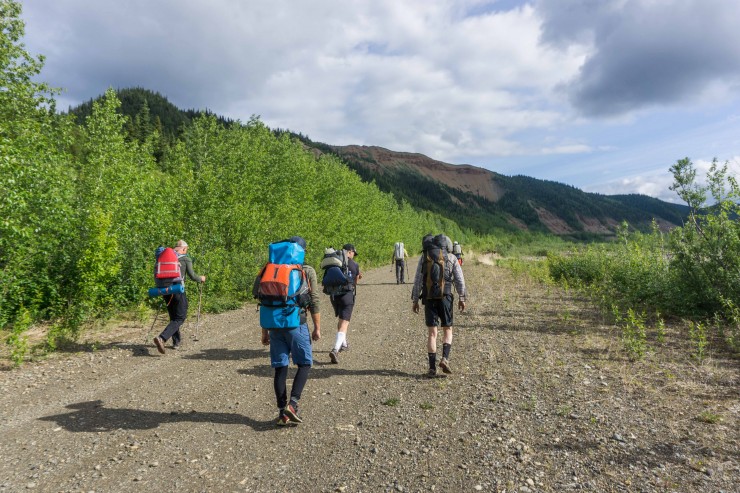
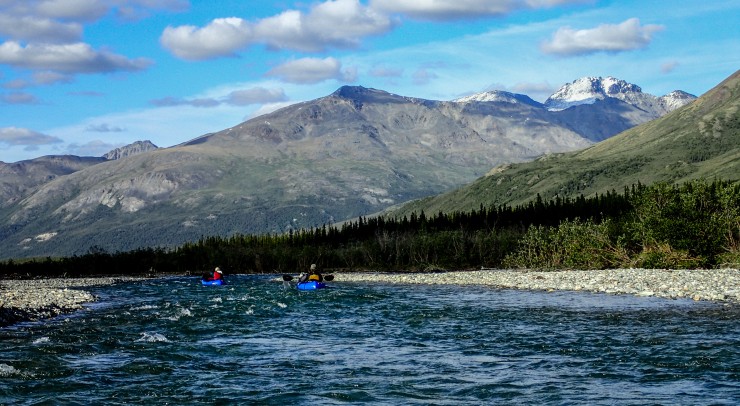
In mid-June, I competed in a wilderness race across the north side of the eastern Alaska Range. The race, called the AlaskAcross, is a point A-to-B format that is gaining popularity in the state. I was coming back from work and injury and wasn’t feeling fit enough to be very competitive, but I knew that it would be fun, and so I entered to see what would happen. It was the first year using this route for the AlaskAcross (which rotates courses irregularly), and it turned out to be a beautiful course, well-suited to wilderness racing. I hope the popularity of the event increases. The overall winners were Andrew Cyr, John Harley and Jeremy Vandermeer in 31 hours, 44 minutes. A summary of the event ran in the Fairbanks Daily News Miner.
There is something unique about wilderness racing.
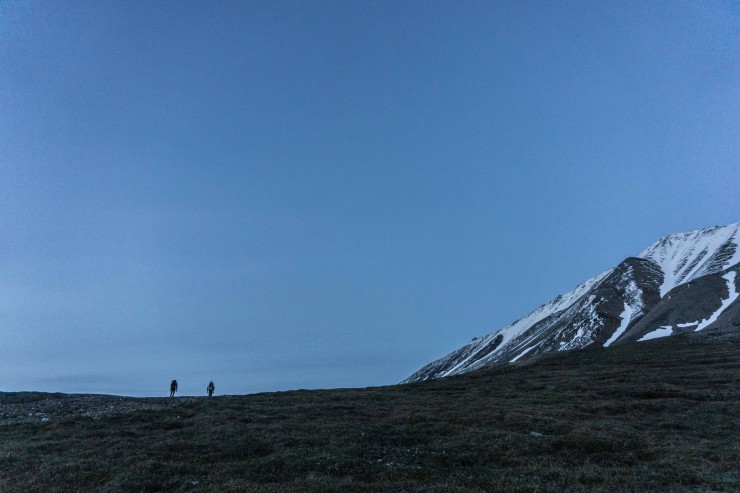
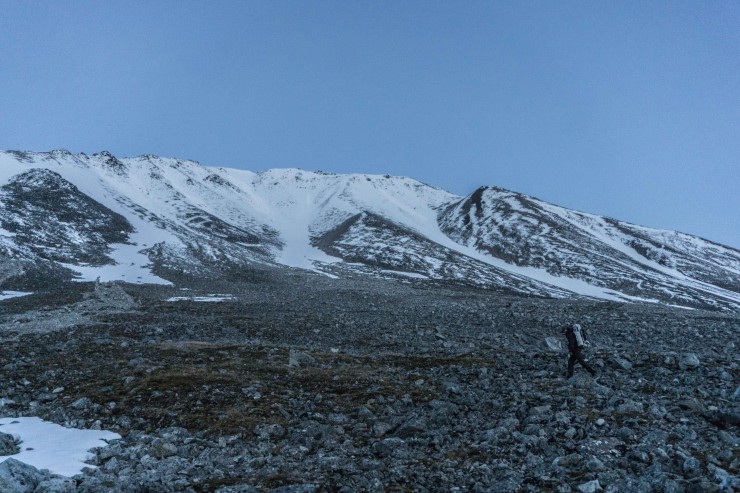
Bob, Drew and my steps up through the tundra had begun to drag. Late night is always the crux – it’s when your brain is sending the strongest signals that you should be sleeping – and for us late night happened on the biggest climb of the trip. I was excited because we’d just seen the unmistakably asymmetrical lope of a wolverine running across the tundra, but I knew that neither another caffeine pill nor the beauty of our surroundings could wipe the fatigue from behind my eyes. I’d have to wait for sunrise, just a couple of hours away, to hit my eyes and wipe away the greyness of the sub-arctic “night”. And in the meantime, I’d have to take another step. And another. And another.
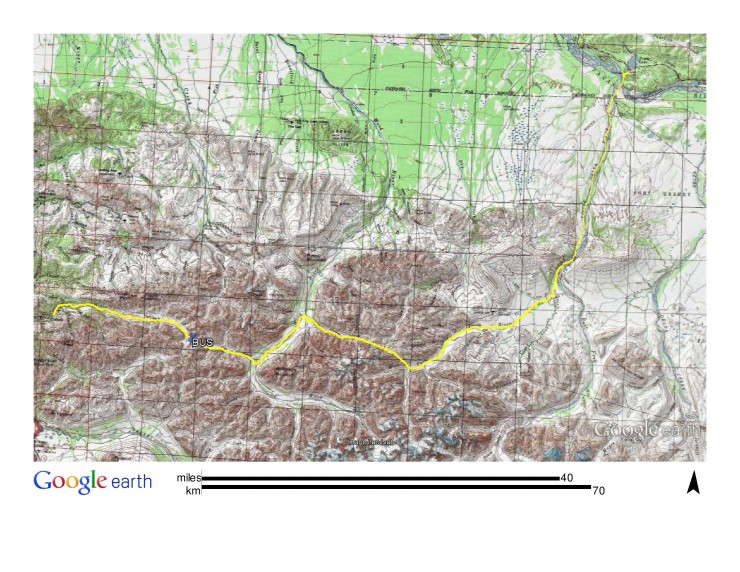
A GPS track of our route., which started just east of Healy (near the entrance to Denali National Park, to the west) and finished south of Fairbanks. Map courtesy Drew Harrington. A topo map of our route with scale is in the photo gallery.
We were racing in the AlaskAcross, a Fairbanks-based wilderness race. It’s a point-to-point race, where the only rules are that travel has to be human-powered, and can’t follow the road corridor. We started just east of Healy, along the Healy River, and ended at Lost Lake, on the Richardson Highway about an hour from Fairbanks. If it wasn’t a race, the trip would take the better part of a week.
“I wanted to cap it at 100 miles,” Mark Ross, the race organizer and mastermind of the course, said in an offhand comment. “So that it fits into a weekend.”
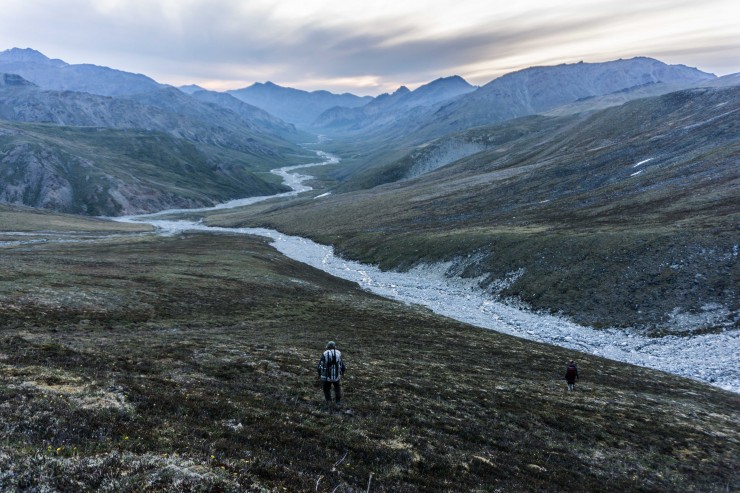
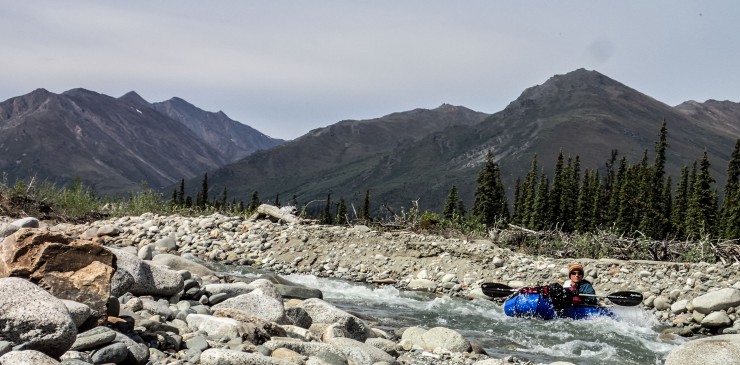
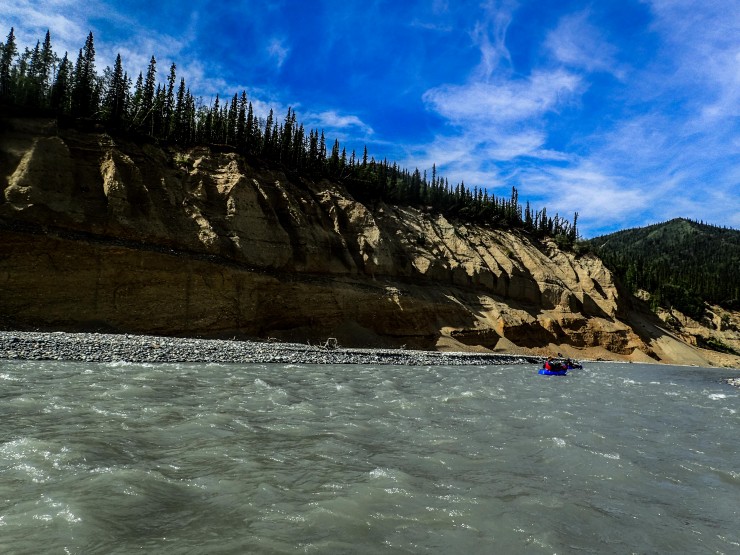
Fitting 100 miles of cross country travel into a weekend means no sleep. We walked up the Healy River, across Cody Pass, to the Wood River. That was about 27 miles. We floated down the Wood River for about seven miles, then hiked overnight up Kansas Creek and dropped into an unnamed creek to the West Fork of the Little Delta, another 15 or so miles. On the shores of the Little Delta we stopped to look at a map. A sudden wave of dizziness struck me, and I dropped immediately to my knees to avoid falling over.
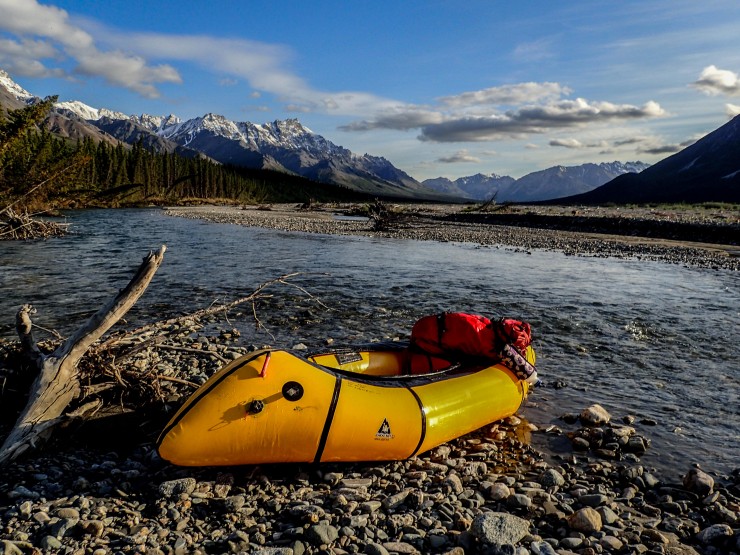
Packrafting the Wood River.
“Are you going to be okay?” Bob said, concern pinching his voice.
“I think so,” I said, rising unsteadily back to my feet. “I think… I think I just feel shitty.”
Bob Gillis and Drew Harrington started as a team. I started as a solo racer. But we were going the same speed, and so eventually the pretense of being competitors was dispensed with entirely. We’re all friends, and this was not our first time being strung out in a wilderness race together. I needed their encouragement. And I wanted to look over their shoulder at their maps, too.
The startline. From left: Jeremy Vandermeer, Steve Duby, Andrew Cyr, Mark Ross, John Harley, Seth Adams, Bob Gillis, Alex Gould, Drew Harrington, Rob Wing, Sam Herreid and Eli Sturm.
The racers begin the slow process of walking up trails on the Healy River.
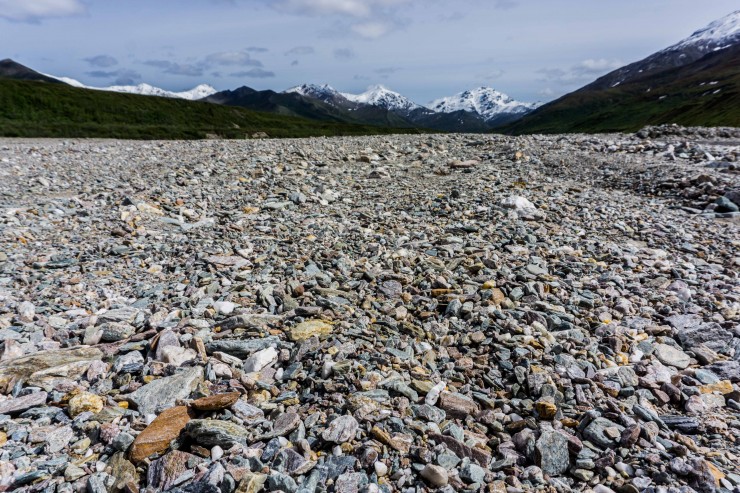
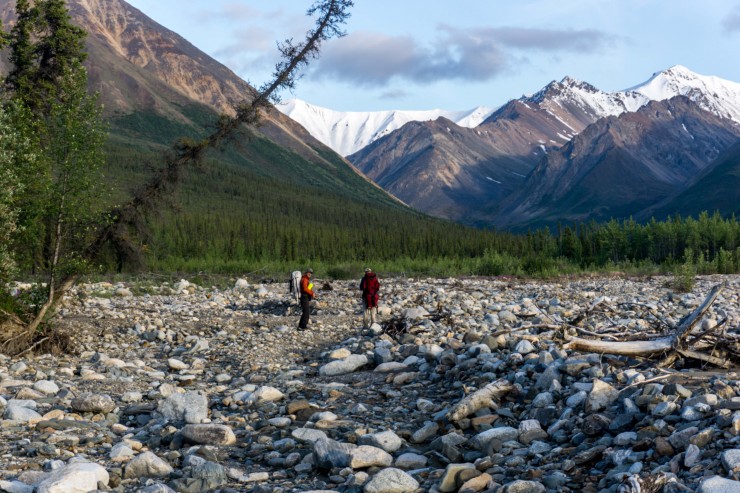
Cobbles on the Healy River.
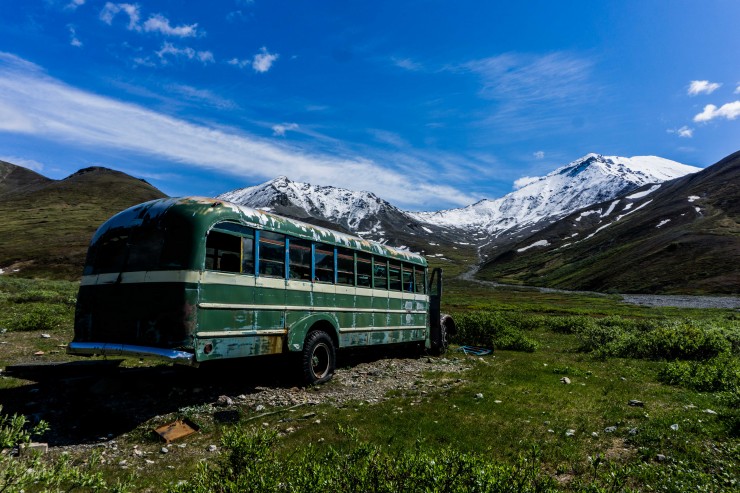
A beautiful place to park.
This is not the bus made famous by Into the Wild, but one of many buses abandoned around Alaska as a part of a semi-permanent hunting or mining camp.
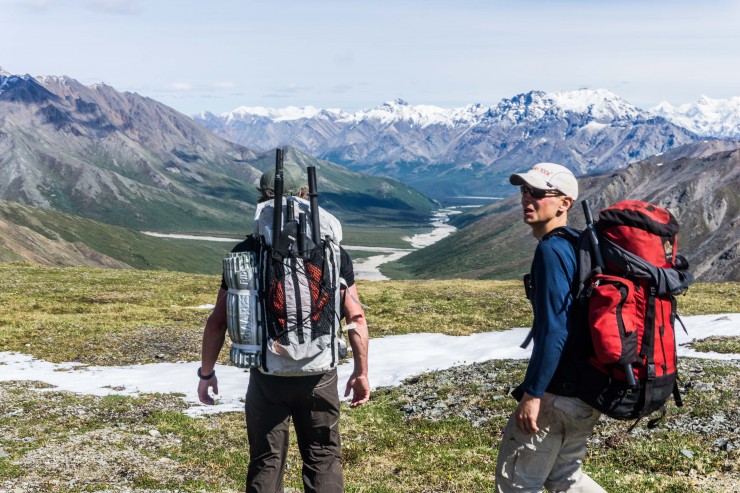
Bob Gillis and Drew Harrington at Cody Pass, looking into the Wood River.
Bob and Drew on the Wood River in the evening sun.
Packrafting the Wood River.
Bob and Drew stop as they realize that we’re walking up the wrong drainage.
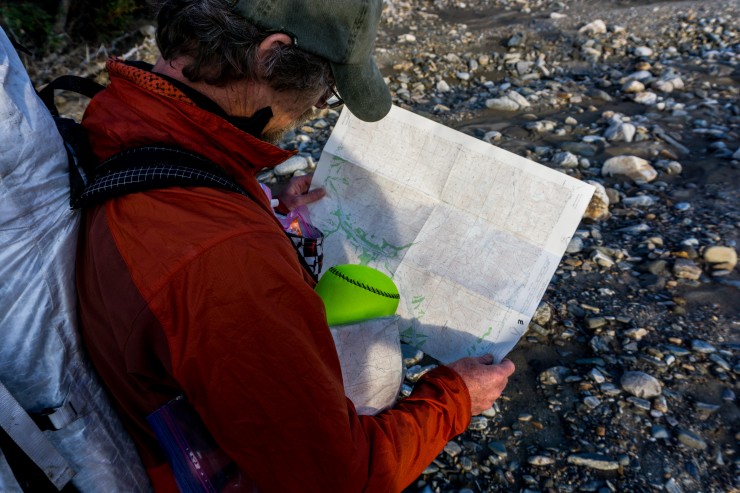
Bob consults the map.
A course correction required walking through this spruce forest – fortunately, it was open and the walking was easy.
Kansas Creek.
Bob and Drew walk up Kansas Creek in the dying light of the late evening.
Bob Gillis.
Drew Harrington.
Crossing over a pass between Kansas Creek and Dry Creek in the twilight of the subarctic night – this photo was taken at 2:37am.
Bob cruises through the rocky tundra at 3:08am.
Beginning the 1,700-foot descent to the West Fork of the Little Delta River.
Drew packrafts in the thin waters of the West Fork of the Little Delta River.
Floating out through the final foothills before entering the Tanana Flats on the Little Delta River.
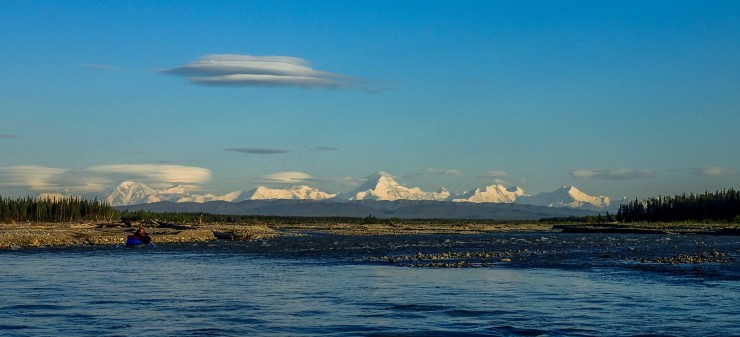
Looking back across the Tanana Flats at the Hayes Range. Mt. Hayes is in the center of the photo, its summit obscured by a small lenticular.
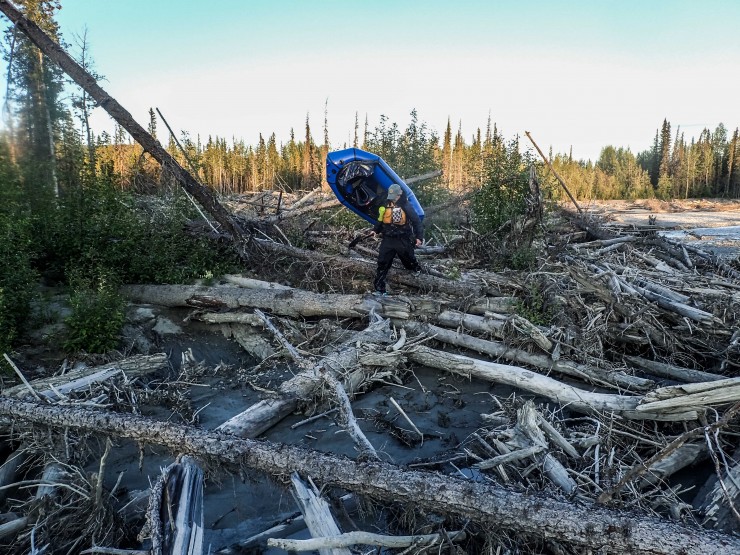
The trip that wouldn’t end – Bob portages through log jams late on the second day.
Topo of final route taken by our team. Map courtesy Drew Harrington.
We looked apprehensively toward the river. “Would it or wouldn’t it?” we wondered. Would it have enough water to float the packrafts we’d carried all this way? Thirty-five miles of cobble river beds had taken their toll on our feet, and the idea of walking down river an unknown distance to find sufficient flow wasn’t something any of us wanted to consider. It was 6am on Sunday, we were in the Hayes Range and we were headed to the far side of the Tanana Flats, 50 river miles away. We wanted to be done that day.
Drew Harrington.
The West Fork had enough water, but barely. The emotional crux of the trip was the butt-dragging down the river in our tiny boats. Our butts constantly bounced off rocks, and each of the hundreds of times we had to get out after being grounded on a gravel bar was one more aggravation.
Bob Gillis.
Nodding off in the boat became common. But once in the faster current of the Little Delta, the miles sped by. We followed each other, and when one person chose the wrong river channel they got fired from their job, and another of us took over.
We took out together late Sunday night on the banks of the Tanana River. We packed our boats and thrashed through the woods to get to the finish line at Lost Lake. It wasn’t supposed to be far, but it felt like an eternity. Eventually, we stumbled into the Lost Lake Boy Scout camp together. But for the final walk down the road through the camp, I couldn’t keep pace. My soaked socks and water-softened skin had me hobbling on blistered feet. When I arrived at the Lost Lake boat launch at nearly 2am on Monday, Bob and Drew had their shoes off. According to Drew’s GPS we had gone about 108 miles.
I took the clipboard that Mark had stashed behind the sign board at the boat launch, and wrote my official finishing time down with Bobby and Drew’s: 39 hours and 54 minutes.
–Seth Adams is a contributing reporter to FasterSkier
Nick Crawford, 28, who headed the Bogus Basin Nordic program as well as the Lathrop High School ski team, will assume the role of head coach of the University of Alaska Fairbanks nordic and cross-country running teams in July. (Courtesy photo)
After a four-year hiatus from Alaska, Nick Crawford is returning to Fairbanks to take over as the new head nordic and cross-country running coach at University of Alaska Fairbanks (UAF).
Originally from Hawley, Mass., Crawford skied for Bowdoin College in Brunswick, Maine, and spent two years in Fairbanks from 2009 to 2011 as the assistant coach for Fairbanks Cross Country and head coach at Lathrop High School. While at Lathrop, he coached Logan Hanneman to the Alaska state Skimeister title in 2011. Hanneman swept the individual freestyle and classic races that year.
Crawford, 28, recently finished a master’s degree in exercise science from Boise State University and applied for the opening at UAF in April. In addition to his studies, Crawford was head coach and program director of the Bogus Basin Nordic Team in Boise, and oversaw its youth ski programs.
“This is really perfect timing for me to return to Fairbanks because it’s a place I really love to be a skier, an excellent community and a fantastic program with Alaska Nanooks,” Crawford said in a phone interview last week.
The coaching position opened suddenly, as Scott Jerome, head coach of the Nanooks’ nordic and cross country teams for 10 1/2 seasons, was put on administrative leave shortly before the 2015 U.S. Cross Country Championships took place in January. His contract expires June 30 and will not be renewed.
Citing confidentiality policies regarding personnel, UAF officials did not comment on the circumstances surrounding Jerome’s departure. In January, UAF spokeswoman Marmian Grimes told the Fairbanks Daily News-Miner that his leave was not a result of NCAA eligibility sanctions placed on UAF last November.
“It’s not related to the past NCAA violations; it’s not new violations that prompted this issue,’’ Grimes said. “It was just us [UAF] needing to go in a different direction with coaching for these teams.”
During his senior season on the team, Jonas Lӧffler told the Nanooks’ Sun Star in February that the skiers themselves vocalized a need for a leadership shift.
“We athletes were involved in the whole process of Scott leaving. We were the initial people to say we needed change,” Lӧffler said.
Scott Jerome, former head coach of the UAF cross-country running and nordic teams. (Photo: UAF.edu)
Jerome was one of several switchups in the UAF athletics department. Also this past winter, volleyball head coach Mallory Larranaga was let go after two seasons “following the self-reporting of violations of NCAA rules on Jan. 13,” according to the Star.
“There are many rumors swirling on why Larranaga was fired on Feb. 12, from the less than stellar record of 7-48, to the NCAA violations that happened with a recruit this past summer [of 2014], which included the filming of visits and practices,” the Star stated.
As of mid-May, UAF was looking to fill the vacancies left by its outgoing women’s basketball assistant coach Greg Bruce, who retired in April after 30 years with the program, and sports information director Drew Desrosiers, who planned to step down when his contract ends June 30, the News-Miner reported.
Jerome, 44, coached 17 All-Americans, including Marius Korthauer, who became the Nanooks’ first national champion at 2008 NCAA Skiing Championships in the men’s 20-kilometer classic race.
More recently in 2014, senior Max Olex placed second in the 20 k freestyle at NCAAs and Nichole Bathe finished fourth as a freshman at the championships. Before joining UAF in 2004, Jerome spent four years heading the nordic and cross-country teams at Gustavus Adolphus College in St. Peter, Minn.
In an email to FasterSkier, Jerome wrote that he was still in Fairbanks and had “begun a PhD program in biochemistry at UAF focusing on human performance, specifically overtraining syndrome.”
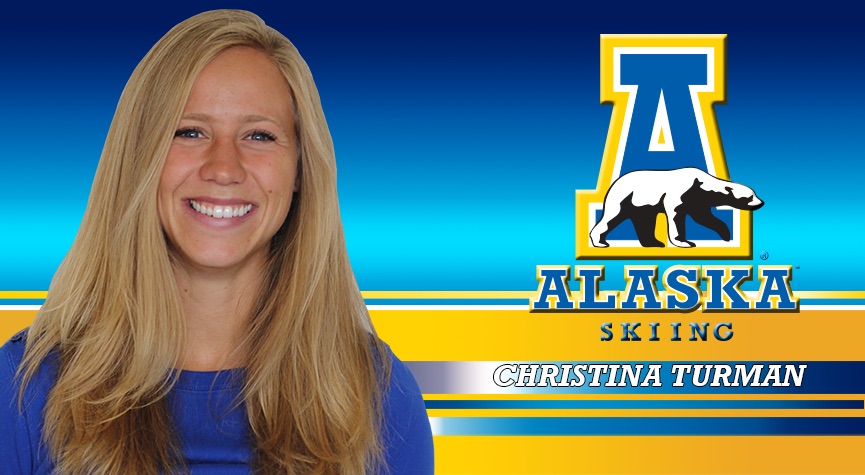
Following his departure in January, assistant nordic coach Christina Turman took over as interim head coach, with support from Josh Eide, of Marquette, Mich. She will remain in the position until Crawford officially starts in July.
Christina Turnman came on as UAF assistant nordic coach in 2013. (Photo: UAF.edu)
Turman, 27, did not apply for the head-coach position, but said she felt pressure from university’s administration, friends, family, and athletes to do so. She explained she preferred to remain an assistant, to work and learn under someone else to develop as a coach while preserving time for her family. She will remain assistant coach.
“I’m delighted to have her stay on,” Crawford said. “I think the program has done really well under her tenure as interim head coach. I look forward to working with her. ”
For Turman’s part, she’s excited for the future of the team.
“I think the future is bright. I’m excited to be back with the program for a third season next year, we have some really solid returning athletes and some good ones coming in,” she said in an interview in her UAF office. “There’s no reason UAF shouldn’t have one of the most competitive teams in the nation. We have the resources, we have the trails, we have the climate for it, so I look forward to continuing to be with the program and watch it build and become more and more successful.”
“There’s no reason UAF shouldn’t have one of the most competitive teams in the nation.” — Christina Turman, assistant coach entering her third season with the UAF nordic team
UAF has a young team, with most of its returning women being either sophomores or juniors, and a lot of depth in the men’s team as well. This season, they picked up incoming freshmen Max Donaldson, three-time Alaska state Skimeister and 2015 Junior National champion. Turman coached him while head coach of West Valley High School before starting at UAF.
As for Crawford, he said that he is joining a successful program and doesn’t want to change too much too soon. Both he and Turman said that they have already discussed working together on what to tweak and what to keep the same in order to continue to build on the Nanooks’ success.
“You really want to make sure you have a good philosophical fit with the program,” UAF Athletics Director Gary Gray said in an interview at UAF, referring to Crawford. “It’s also important – this happens sometimes – we’ll hire someone from the lower 48, and in a year they’re homesick. And that’s not completely unusual. So it’s trying to find someone that is that right fit, of someone that we think is going to give that stability to the program.
“Things that attracted us to Nick included his familiarity with this community,” Gray continued. “He has coached here, he has recruited here. He had some successful results with his club program in Boise. … The fact that Nick has been here before and was part of this community, that seems to speak well of his fit to Fairbanks.”
“The fact that Nick has been here before and was part of this community, that seems to speak well of his fit to Fairbanks.” — UAF Athletics Director Gary Gray
Crawford is also a close personal friend of FasterSkier’s former editor, Nat Herz, who also skied for Bowdoin.
“Nick’s decision not to use me as a reference has clearly paid off again,” Herz wrote in an email. “I look forward to testing his mettle when we both race in next year’s Oosik Classic in Talkeetna. Also, his athletes should ask him about that time he tried — and failed — to complete the gallon challenge when we were in college together.”
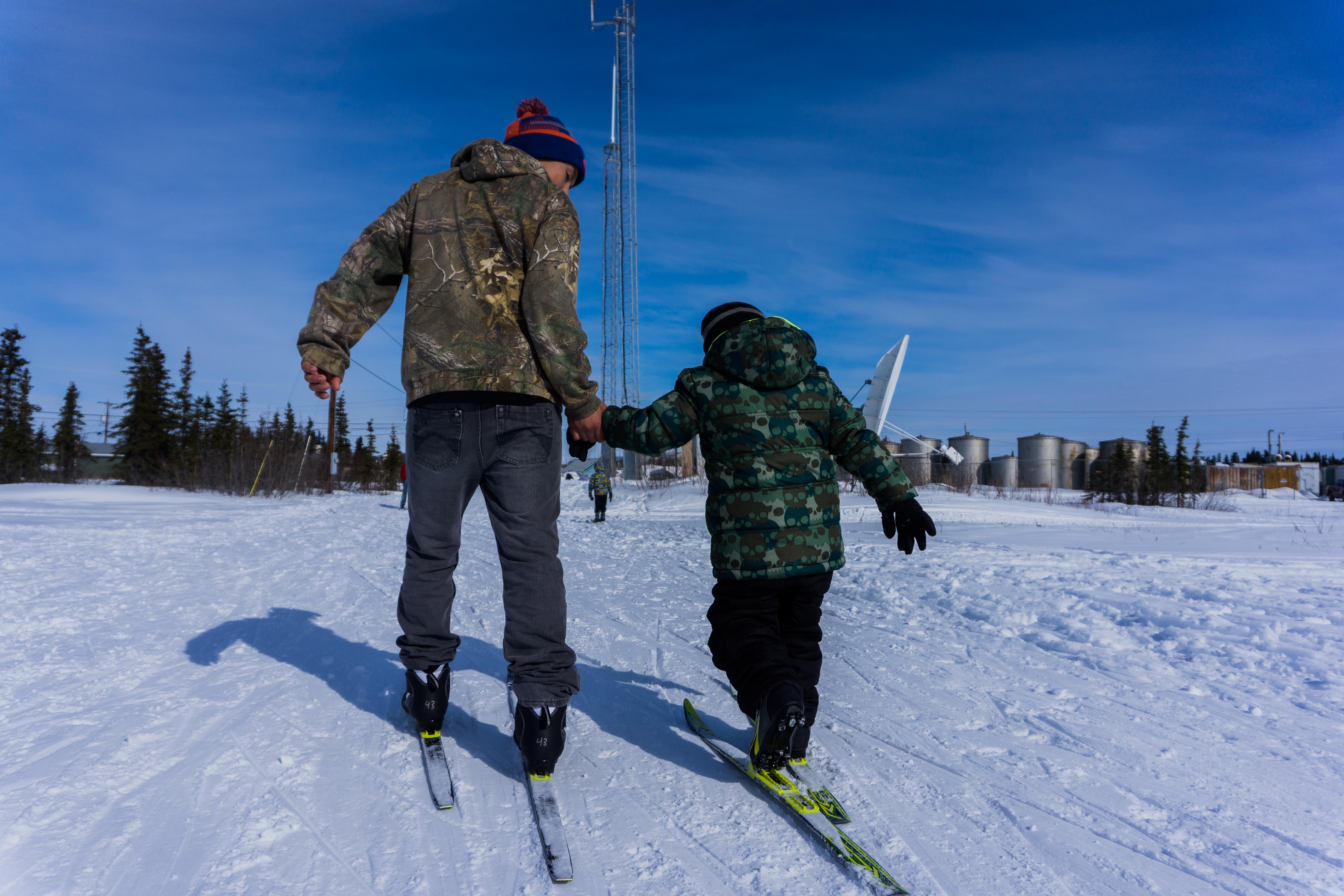
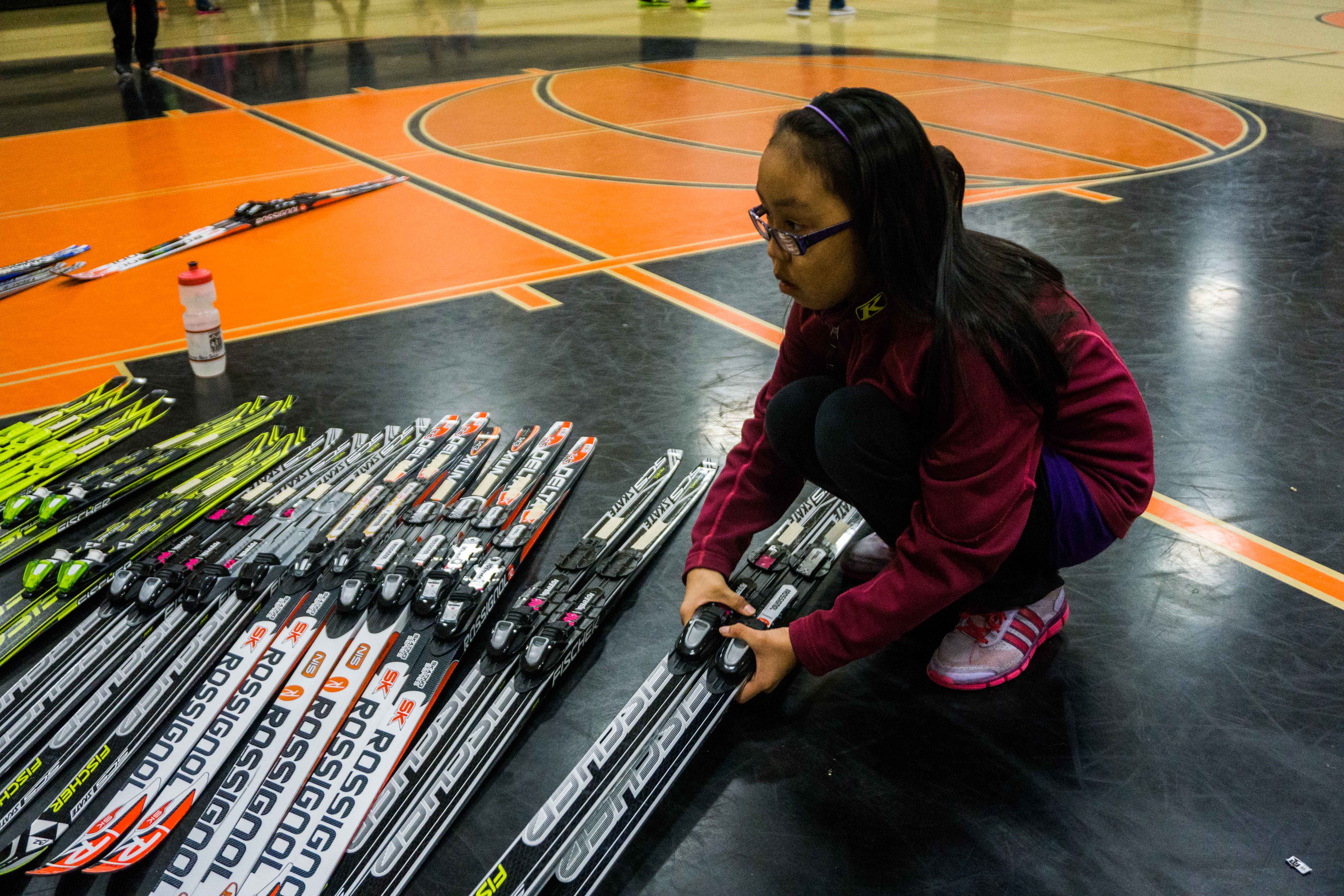
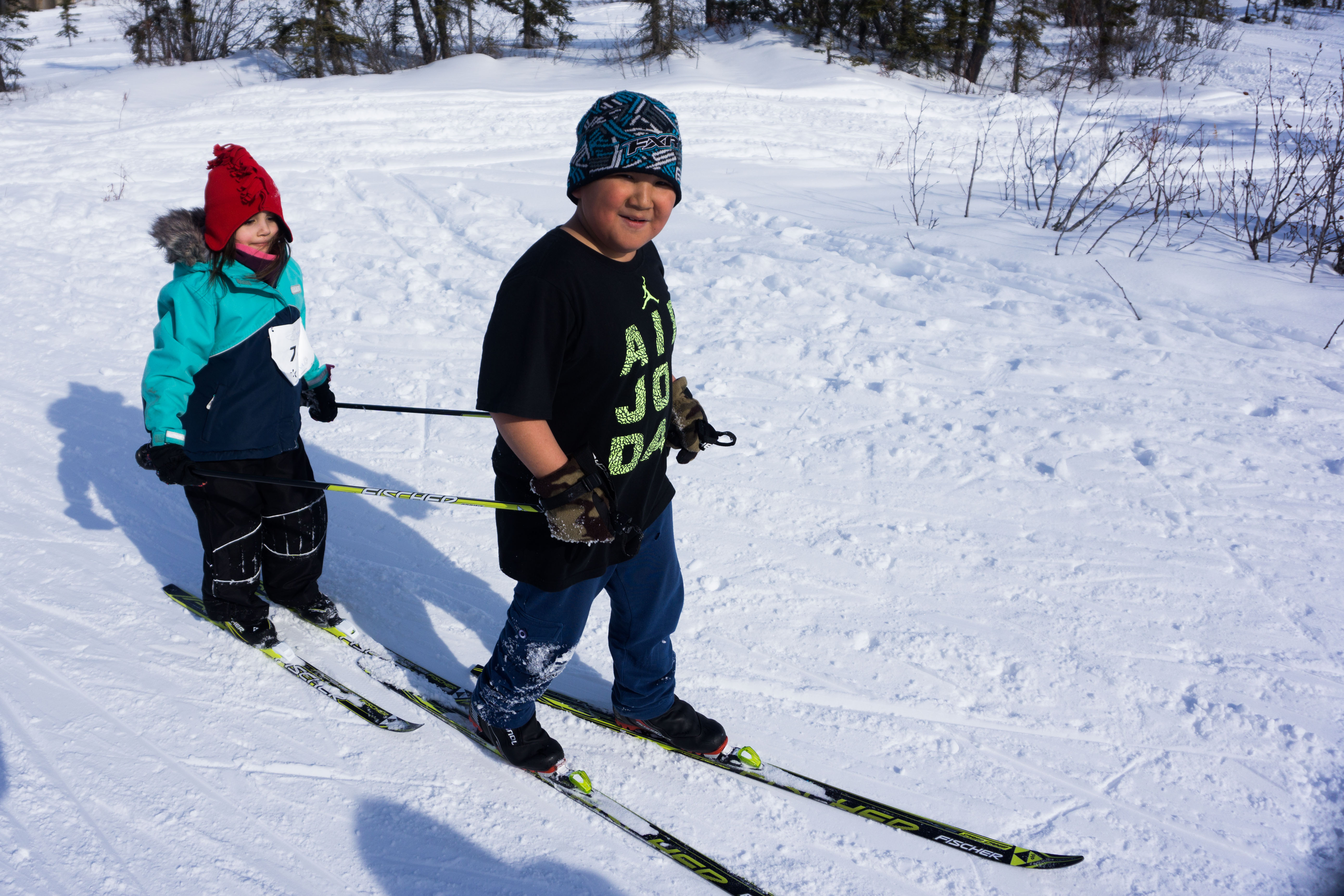
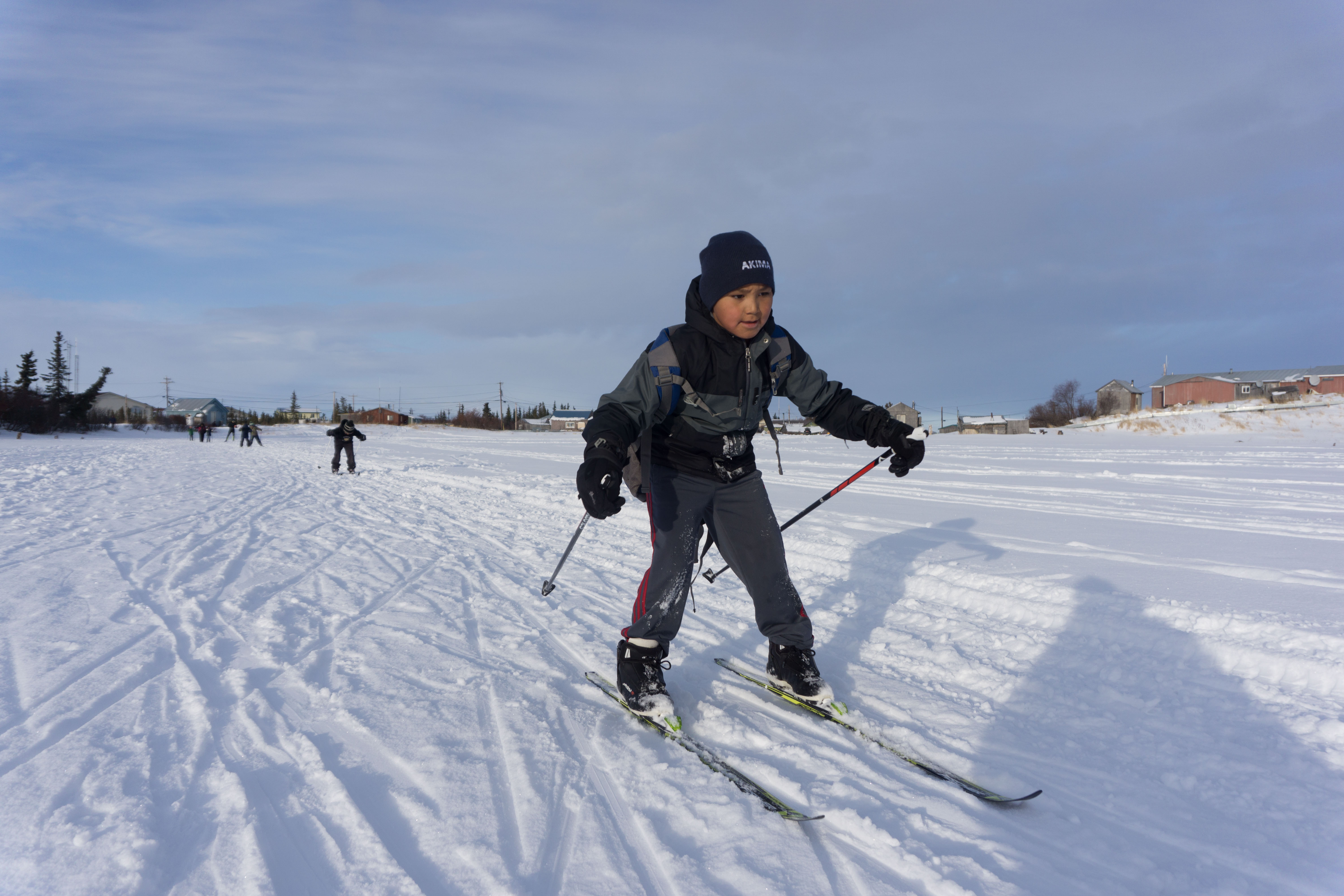
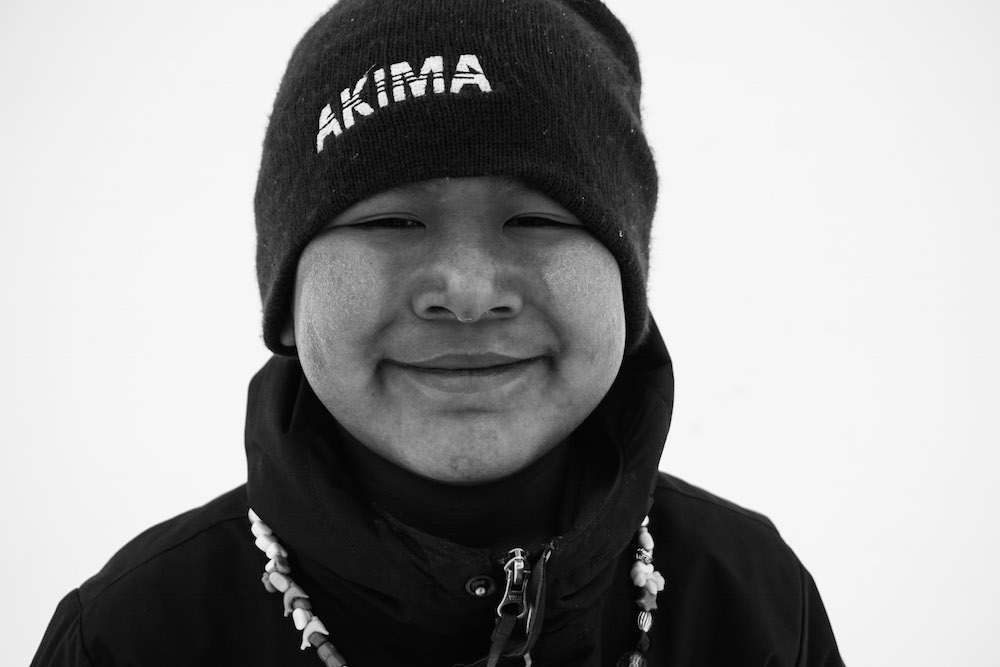
NANANordic has been covered extensively by FasterSkier in the past, most recently in May 2014. Now in its fourth year, NANANordic sends elite cross-country ski racers to Alaskan villages to teach skiing to school children, with the goal that skiing become a lifestyle activity in rural Alaska.
Seth Adams, a FasterSkier contributor who lives in Fairbanks, Alaska, joined the ranks of the volunteers this spring. Some of his photos from NANANordic in Noorvik appeared on this site in April. All opinions expressed here are his own.
I don’t remember what I said.
“Well, no. Not exactly,” Lars Flora responded, sounding pained. “That’s a common misconception among city Alaskans about the villages.”
I was interviewing Lars for an article I wrote last year about NANANordic, a program that Lars began in 2012 to teach skiing to kids in remote Alaskan villages.
As I write these words, a year after that interview with Lars, whatever I was wrong about wasn’t important enough to me to remember. But the take-home point was important to me. Although Lars was trying to be nice, the message was loud and clear — I thought I knew something, but I didn’t know anything. And I was part of the problem.
I’m from Fairbanks, Alaska, the state’s second-largest city. Although Alaska’s cities contain most of the state’s population, there are far more villages than there are cities. And Alaska’s cities are majority white population (like me), while the villages are almost-exclusively Alaska Native.
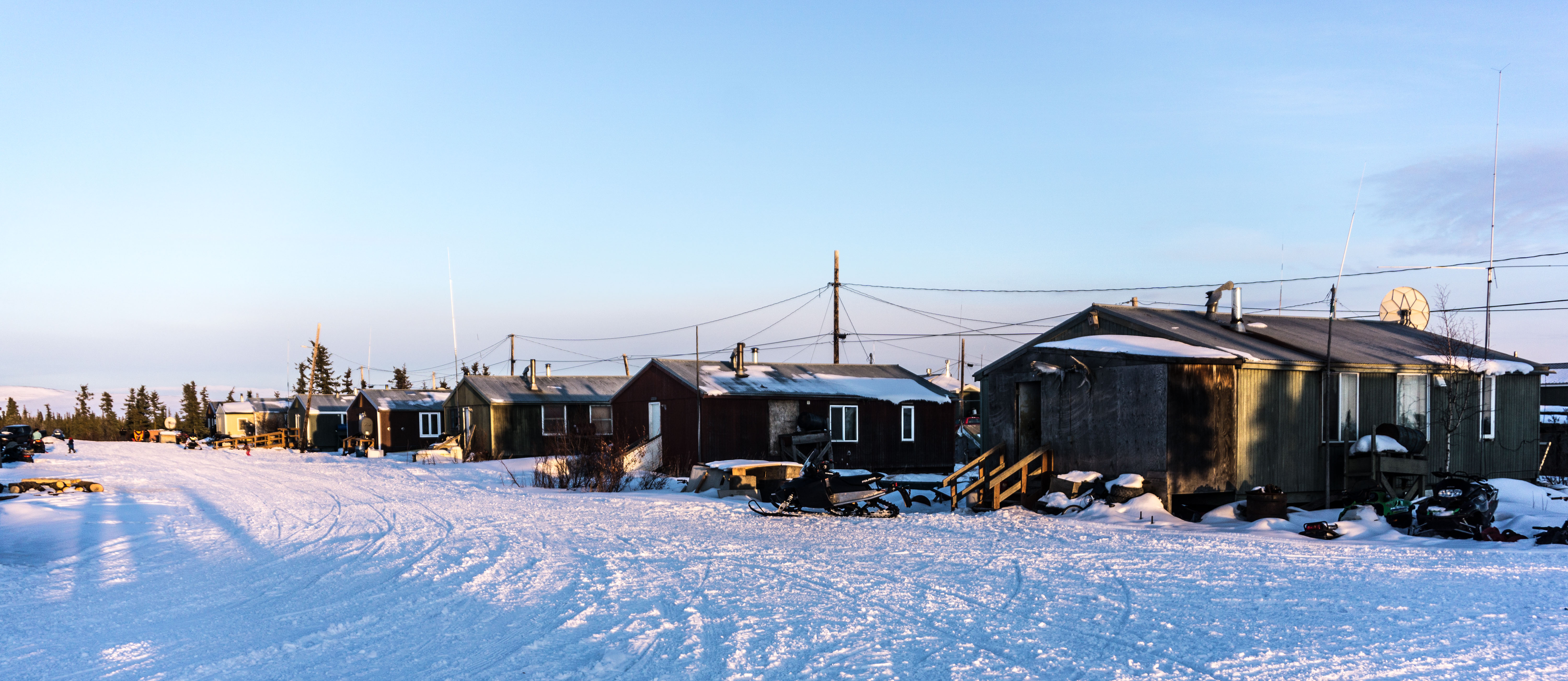
I’d never really been to any of the villages. And among white, city Alaskans, that is not at all uncommon. Most of the villages aren’t accessible by road — the only way in or out is by snowmobile, airplane or boat. And without a specific reason to go to one of the villages, most people don’t. City Alaskans often view them as grim places — devoid of economy or diversion, where alcoholism and domestic violence are more the rule than the exception.
But in spite of our lack of firsthand experience with village life and our negative opinion of what we think we know, city Alaskans tend to not be indifferent to the villages. We see these places as an integral part of our state identity and their existence as a part of the Alaskan experience.
We see these places as an integral part of our state identity and their existence as a part of the Alaskan experience.
And so when I was told that some of my preconceived ideas were wrong, it cut deep. What else didn’t I know? I decided it was time to see for myself. Besides, volunteering with NANANordic sounded fun.
Noorvik
After a hectic schedule of personal travel, I had a cold. I met my fellow coaches in the Anchorage airport at a truly uncivilized hour on the morning of April 5 to catch our flight to Kotzebue. There were a gaggle of NANANordic volunteers swarming the check-in line, all headed to different villages in the Northwest Arctic region.
I would be headed to Noorvik with four other coaches — three veterans of NANANordic: Alaska Pacific University’s Lauren Fritz, Lauren’s boyfriend and Australian National Team member Paul Kovacs, and U.S. Paralympics Nordic Development Coach Robert Rosser. And one other newbie — 15 year-old Anchorage high school skiing standout Luke Jager.
We boarded an Alaska Airlines 737-combi (half of the passenger compartment is converted to cargo space) for the hour-and-a-half flight to Kotzebue. After some shuffling and waiting for winds to calm, we settled into an eight-seater Bering Air single-engine prop plane for the 30-minute flight from Kotzebue to Noorvik. After a remarkably smooth landing amidst the whipping wind in Noorvik, we loaded our bags into a van driven by the school principal.
“The skiers are here!” the kids exclaimed as we carried our bags into the school. The school would be our home for the rest of the week. We looked around approvingly.
In the afternoon we went out to ski around and get oriented. Luke stood with his skis braced against the wind. He straightened his skis and began accelerating across the icy school yard as the wind pushed him backwards.
At some point during the school day, each teacher brought every kid in the school to the gym to ski. I don’t know whether or not they were forced to ski with us — but it didn’t matter seem to matter, because almost to a student, including the surly high schoolers, they wanted to.
NANANordic 2015 (Photo: Seth Adams)
NANANordic 2015 (Photo: Seth Adams)
NANANordic 2015 (Photo: Seth Adams)
NANANordic 2015 (Photo: Seth Adams)
NANANordic 2015 (Photo: Seth Adams)
NANANordic 2015 (Photo: Seth Adams)
NANANordic 2015 (Photo: Seth Adams)
NANANordic 2015 (Photo: Seth Adams)
NANANordic 2015 (Photo: Seth Adams)
NANANordic 2015 (Photo: Seth Adams)
NANANordic 2015 (Photo: Seth Adams)
NANANordic 2015 (Photo: Seth Adams)
NANANordic 2015 (Photo: Seth Adams)
NANANordic 2015 (Photo: Seth Adams)
NANANordic 2015 (Photo: Seth Adams)
NANANordic 2015 (Photo: Seth Adams)
NANANordic 2015 (Photo: Seth Adams)
NANANordic 2015 (Photo: Seth Adams)
NANANordic 2015 (Photo: Seth Adams)
NANANordic 2015 (Photo: Seth Adams)
NANANordic 2015 (Photo: Seth Adams)
NANANordic 2015 (Photo: Seth Adams)
NANANordic 2015 (Photo: Seth Adams)
NANANordic 2015 (Photo: Seth Adams)
NANANordic 2015 (Photo: Seth Adams)
NANANordic 2015 (Photo: Seth Adams)
NANANordic 2015 (Photo: Seth Adams)
NANANordic 2015 (Photo: Seth Adams)
NANANordic 2015 (Photo: Seth Adams)
NANANordic 2015 (Photo: Seth Adams)
NANANordic 2015 (Photo: Seth Adams)
NANANordic 2015 (Photo: Seth Adams)
NANANordic 2015 (Photo: Seth Adams)
NANANordic 2015 (Photo: Seth Adams)
NANANordic 2015 (Photo: Seth Adams)
NANANordic 2015 (Photo: Seth Adams)
NANANordic 2015 (Photo: Seth Adams)
NANANordic 2015 (Photo: Seth Adams)
NANANordic 2015 (Photo: Seth Adams)
NANANordic 2015 (Photo: Seth Adams)
NANANordic 2015 (Photo: Seth Adams)
NANANordic 2015 (Photo: Seth Adams)
NANANordic 2015 (Photo: Seth Adams)
NANANordic 2015 (Photo: Seth Adams)
Personally, the naturally athletic kids that easily picked up skiing weren’t the most rewarding to work with; it was the strugglers that were the most interesting.
Take a first-grader, we’ll call him Casey, as a case study. During his first time on skis, Paul and I stayed back with him, and at the end of the session we both agreed that our backs were sore from repeatedly helping him onto his feet. He could stand for only seconds at a time and asking him to untangle himself once on the ground and get back on his feet on his own seemed a bit like asking him to fly the space shuttle. There were tears and there was whimpering.
But after school, when returning to ski was their own prerogative, Casey was back. As were many other kids that we did not expect to see. Out of the 190 kids in the school, over 60 were neatly lined-up outside the gymnasium door to ski again — fully one third of the school was back to ski for a second time that day. You would definitely not see this in Fairbanks or Anchorage.
… One third of the school was back to ski for a second time that day. You would definitely not see this in Fairbanks or Anchorage.
Casey constantly asked for help with everything. Like many of the kids, he was naturally quiet and rarely used words, expressing many of his emergencies in pantomime. But there seemed to be no minimum to how ridiculous his emergencies might be. One time, he frantically gestured at me that his sock had come off and stayed in his boot after he took the boot off.
“So pull it out and put it back on,” I said.
He held up his gloved hand in alarm, to show he could not possibly remove the sock from the boot by himself, since he was hamstrung by the glove.
Casey tows another kid on our last day in the village.
“Take the glove off, Casey,” I said with a laugh. He shrugged in disappointment, and did it. He was perfectly capable of everything everyone else was, but somehow being helped filled a need for him.
Casey probably isn’t going to become a heroic story of having won the race or landed a 360. But he kept skiing all week, and although he never outwardly seemed to love it, at the end of each session he unfailingly asked when he could ski again. As did many of the others. The bottled-up enthusiasm for skiing and for being outdoors was something that we all found remarkable.
At the end of each day we were exhausted. We skied for at least nine hours a day, usually no-pole and in a rush to tend to one “emergency” or another. Then it was at the end of each day that we had the biggest group. We often led the whole group fairly far away from the school, with the smallest kids desperate to keep up with the biggest. At the end of the session, getting everyone back was a huge chore.
Occasionally the frayed ends of Paul’s nerves would show, which resulted in me calling him “the cranky Australian.” But I could understand why was frazzled. We’d taken the kids out to the Kobuk River on the far side of town, and they were scattered as far as we could see. It was getting late, but Luke, who is a high schooler himself, was hitting a jump with a group of older kids on the far side of the river. Paul’s jaw was repeatedly clenching and unclenching.
Right then a woman and two kids pulled up on a snowmobile and told one of the kids to get on. Another kid grabbed onto the back of the sled and got towed, face dragging through the snow as he held tight to the snowmachine, until the woman realized he was back there and scolded him off. He stood up grinning a mischievous grin.
I didn’t know who the woman was, didn’t remember the name of the kid she’d scooped, and was unsure if we’d get the skis and boots back. I looked at Paul and shrugged — we were visitors in a strange land, and our job was to teach skiing.
It’s difficult to overstate the tightness of the social fabric Noorvik. Nearly everyone is related in some way, and there is no need to be accountable for where the kids are, since everyone watches out for everyone. But this was hard for us to remember; the idea that small kids can run loose through a town and be perfectly safe is not a part of our cultural experience. We reminded ourselves that we were the only ones that were overwhelmed; for everyone else this was daily life. Except that usually they don’t have skis.
“The little kids won’t head back to the school until you guys stop hitting that jump and head back yourselves,” I told the high schoolers, trying not to beg. “Do you mind just heading back? Because otherwise we’ll be out here all night getting the small kids back.”
The count of skis and boots at the end of the day was exactly right. No equipment was missing. The woman must have returned her child’s skis and boots.
The week was a bit of a blur of chasing kids, clicking boots into skis, offering encouragement, and answering endless questions about when the next chance to ski would be. But being in Noorvik I was reminded of the conversation I’d had with Lars. I looked around, waiting to have one of my preconceived notions shattered in lightning bolt epiphany.
Noorvik wasn’t overly different from what I’d expected. Life there isn’t easy, but it wasn’t as tough as I’d imagined. Perhaps it was just seeing it that mattered and seeing how tight the social bonds are, witnessing how the older siblings watch out for the younger ones with no trace of resentment, and that all the adults in town are essentially guardians for all the kids.
Noorvik wasn’t overly different from what I’d expected. Life there isn’t easy, but it wasn’t as tough as I’d imagined.
“I like what you’re doing with our kids,” one man told me as he walked past.
A couple of hours later when he walked back by, I invited him to join us.
“No,” he replied, then, apologetically, “I’m drinking now.” The kids continued to ski in excited circles all around us.
Noorvik is a dry village, which means any possession of alcohol is prohibited. He excused himself, and I invited him back another day, but he never came. The kids, however, were all hooked on skiing. And they kept coming back.
FasterSkier contributor and NANANordic 2015 volunteer Seth Adams during his weeklong visit to Northwest Alaska.
At the end of the week, all five coaches skied 55-kilometers from Noorvik to the village of Selawik. Read about it and see pictures on Seth’s personal blog.
FasterSkier’s Seth Adams caught the NANANordic bug this season and recently headed up to Noorvik, a city of fewer than 700 people in Northwest Alaska, to volunteer with NANANordic from April 6-11. Here are some photos from his escapades so far:
NANANordic 2015 (Photo: Seth Adams)
NANANordic 2015 (Photo: Seth Adams)
NANANordic 2015 in Noorvik, Alaska (Photo: Seth Adams)
NANANordic 2015 (Photo: Seth Adams)
NANANordic 2015 (Photo: Seth Adams)
NANANordic 2015 (Photo: Seth Adams)
NANANordic 2015 (Photo: Seth Adams)
NANANordic 2015 (Photo: Seth Adams)
NANANordic 2015 (Photo: Seth Adams)
NANANordic 2015 (Photo: Seth Adams)
NANANordic 2015 in Noorvik, Alaska (Photo: Seth Adams)
Caitlin Patterson (Craftsbury Green Racing Project) racing to 51st the classic-sprint qualifier on March 11 in Drammen, Norway. (Photo: Fischer/NordicFocus)
Caitlin Patterson, a member of the Craftsbury Green Racing Project, recently returned to the U.S. after her first time racing the World Cup in Europe. In February, she traveled to Rogla, Slovenia, to compete in two Alpen Cup races before making her World Cup debut on March 7 in Lahti, Finland.
Patterson, 25, competed in a sprint and a 10-kilometer classic in Lahti, followed by the Drammen city sprints in Norway and the 30 k freestyle mass start at Holmenkollen in Oslo, Norway. She placed between 50th and 53rd in each of her four World Cup starts.
Prior to earning those starts, Patterson explained in an email she was consumed by the busy spring race season and overlooked the points calculation, despite usually being attentive to results and rankings. So when U.S. Ski Team coaches sent her an email explaining that she would likely earn World Cup starts as the SuperTour distance leader, it caught her by surprise.
“It was actually good timing for me personally,” Patterson wrote. “I had been extremely sick and then was still recovering during the Craftsbury race weekend and had sub-par races that I was not particularly happy about. So finding out about the World Cup opportunity really helped me recover and get healthy so I could get back to training.”
Though she did not explicitly set World Cup starts as a goal, she did aim for overseas starts in the form of the OPA/Alpen Cup to continue building race experience.
“World Cup starts were ‘on the radar’ as something I really wanted to earn,” she explained. “A way to make progress towards racing faster, but I also aimed to qualify for the US OPA Cup trip, to be able to race in Europe in at least some capacity to test myself against a larger variety of racers and deep competitive fields.”
In December 2012, Patterson qualified and competed in three World Cup races in Canmore, Alberta, where she notched a personal best of 44th in the 15 k skiathlon. Her decision to not make the World Cup a specific goal this year was one of several careful calculations she made in managing her season.
“I usually set up my goals not so much in terms of specific results, but as overall objectives that may be a little more ambiguously interpreted,” the Anchorage, Alaska, native explained. “I have high expectations for myself, but I also feel that setting strict results goals may not be productive, if it opens up the possibility to make me unhappy if I do not achieve the goals.”
She allowed herself one specific objective: to earn at least one podium at U.S. nationals in January. She achieved it, placing second in the 20 k classic mass start in Houghton, Mich.
Apart from that, she kept her racing goals non-specific.
“Warm up really well for every race, work on being able to sustain higher tempo for races, learn something about [myself] or how to ski faster from every race and then apply it, and enjoy racing,” she wrote.
‘Don’t Get Derailed’
Caitlin Patterson (Craftsbury Green Racing Project) racing to fourth in the women’s 10 k freestyle at 2015 Cross Country Championships in early January in Houghton, Mich. Patterson also notched second in the 20 k classic mass start at nationals.
In terms of setting goals, Patterson gave a detailed description of her thought process.
“I tried to approach the races as I would any other racing event,” she wrote. “Don’t get derailed by course closures or last-minute changes of plans, test wax and skis decisively, warm up well, arrive at the start ready to go, and push myself to ski as fast as possible during the race.”
At the highest international level, keeping that process on track can be difficult.
“Nothing is quite the same at the World Cup, with different wax techs, stricter rules about course access, and the stars of the World Cup circuit zooming around passing you during warm up like you’re standing still,” Patterson explained. “I didn’t quite manage to keep my preparation under control the way I wanted it to be [at my first World Cup], and a combination of factors caused me not to be able to kick my classic skis in the 10k race in Lahti, which was brutally tough on the steep climbs of Lahti.”
She finished 50th in that classic distance race, a day after placing 51st in the freestyle sprint in Lahti.
For most North American skiers, it’s a massive transition to the big stage and the crowds of European World Cup racing. In the classic-sprint qualifier in Drammen, Patterson had an “only-at-the-World-Cup” experience.
“I was sprinting up towards the finish, looking up the last bit of the hill towards the finish line, zeroing in on where I needed to get to as fast as possible,” she wrote. “There is a giant screen behind the finish, showing racers from around the course, and as I strode towards the finish I caught a glimpse of the screen, and my thoughts went something like ‘Who’s that? Oh, that’s me! I better go faster, it doesn’t really look like I’m sprinting fast enough.’ It’s funny to have the immediate-feedback of a live video screen come across your vision during a race, it caught me by surprise to see myself.”
Asked specifically about Holmenkollen, Oslo’s flagship venue, Patterson explained it was hard to put into words.
“Some of the photos of the races come close to capturing the essence, but even that doesn’t give you an idea of the sound,” she wrote. “There are still clear, wide ribbons of snow to race along, just like every race, but the sound of the crowd overwhelms just about all other senses. And you feel as though you are always in the spotlight, many eyes follow you around the course. The cheering is great — I was skiing by myself for the last 10-15k of the 30k, and all along the course I was engulfed in cheers of ‘U-S-A’ and ‘Cait-lin–Cait-lin…’ ”
“The sound of the crowd overwhelms just about all other senses. And you feel as though you are always in the spotlight, many eyes follow you around the course…” — Caitlin Patterson, on racing the Holmenkollen 30 k for the first time
Mixed Feelings
Caitlin Patterson (Craftsbury Green Racing Project) racing to ninth in the 10 k classic individual start on March 21 at 2015 Super Tour Finals in Sun Valley, Idaho.
Looking back, Patterson couldn’t pinpoint a particular World Cup race she was most proud of: “They all had high and low points and most of all many chances for learning how to race better,” she wrote. “I’m proud that I approached each race as a new day and believed in myself, and gave everything I had on that day.”
Even after coming out on top in the SuperTour and making it to her first European World Cups, Patterson had a hard time fighting the feeling that she didn’t meet her potential.
“I’m feeling happy with some of the season, but also more than some years, I feel like I have had relatively few races where I’ve really put together my fitness with good skis, competitive fields, and the right preparation to show how well I can actually race,” she wrote. “It takes many pieces coming together to have a truly excellent race, and I need to get better at putting the pieces together on the right day.”
“The World Cup experience was a highlight — racing in Finland and Norway and the opportunity to race against the best in the world, and to start learning how to become competitive with them,” she added. “But the way I felt in the World Cup distance races particularly was not good. I have had a few races this season that stand out as highlights — the 20 k classic at US Nationals and the 20 k classic at Craftsbury where I won my first Supertour, and actually I felt the very best of this season so far in a 5 k skate race in January in Rumford that was a combined Eastern Cup and college carnival.”
For Patterson, now it is about learning how to use her racing this season to build towards bigger things in the future. She is particularly focused on race preparation and identifying weaknesses, being consistent across all event formats and distances, skiing with greater confidence and power, “and most of all faster.” She’s also aiming for more World Cup starts next season.
“I don’t want to be a 50th-plus place World Cup skier, but I’ll have to live with those results until I can earn the chance to prove to myself and everyone else that I can ski better,” she wrote. “I’m dreaming of being truly competitive in the World Cup in the future!”
Germany celebrates their victory in Sunday’s 4×6-kilometer relay. (Photo: IBU/Christian Manzoni)
It would have been oddly quiet on the firing range, given that there were ten women lined up and ready to fire, if it had not been for the howling of the wind.
The dominant theme of the final day of World Cup competition in Antholz, Italy, Sunday was wind. Wind, and lots of it. Three weeks of back-to-back World Cup racing concluded this weekend, capped off with the 4 x 6 k women’s relay. While the men’s competition was plagued by a cold wind, the women’s competition was defined by it, as the wind whipped down the valley during the second leg.
The Czech Republic, which eventually finished second, was the only team in the entire field to escape without a penalty loop; Russia, placing fourth, was the only team with less than 10 spare rounds. Far more common was a tally of two or three penalty loops and 13-16 spares.
At the first handoff, the Czech Republic had the lead, the United States was in second after Susan Dunklee’s phenomenal first leg, and Poland was in third.
“I had some wind in standing,” Dunklee wrote in an email, “but luckily most of the people around me struggled too.”
Shooters struggle to fire in the howling wind. (Photo: IBU/Christian Manzoni)
On the second leg, however, the wind picked up.
During the second shooting stage, ten teams were standing on the mats, and the leader still hadn’t finished firing as all the women waited for the wind to die down. Snow swirled and flags whipped, but no bullets were fired. Gabriela Soukalova, of the Czech Republic, was the first into and out of the range, and her range time was 2:14. In contrast, her time on the previous round – before the wind picked up – was exactly one minute, including loading and shooting a spare round.
After Soukalova finally shot her third spare bullet and knocked over the final target the incentive to speed up firing returned. U.S. biathlete Hannah Dreissigacker, who had been in second place at the start of the standing leg, skied away with three targets left up. By the end of the leg, the U.S. had slipped to 12th.
By the exchange, Czech still had the lead, followed closely by Russia, then Ukraine, then Germany, then Italy.
The third leg was a grab bag of leads and exchanges, as one skier took the lead in prone only to lose it in standing. Tears streamed down the competitors’ cheeks as the wind and snow battered their eyes.
By the end of the third leg, Ekaterina Shumilova of Russia was in first, but barely. Germany’s Luise Kummer and Ukraine’s Olga Abramova were not far behind. And the bottlenecks at the last shooting had compressed the top ten teams to within 1:15, whereas they had been spread out over 2:34 after the prone stage – the wind had actually calmed as later competitors came onto the range, whereas the leaders had taken longer to shoot. At the tag, it was Russia, Germany and then Ukraine.
Dahlmeier, Germany’s anchor leg, ignored the swirling gusts of wind and coolly shot the five targets, leaving the standing leg 23 seconds ahead of Russia’s Ekaterina Glazyrina. After Dahlmeier cleaned standing, it was clear that she would ski away with the win.
Veronika Vitkova of the Czech Republic skied out in second, with Valj Semerenko and Glazyrina leaving the range at nearly the same moment, leaving the final 2 k ski as the battleground for the final spot on the podium. It was a battle won by Vikova.
The North Americans
“I had a great ‘open body’ feeling today on skis and during the last lap went into chase mode with little regard for pacing,” American Susan Dunklee wrote in an email. “It felt great to reel people in.”
Dunklee indeed had a strong final, passing four skiers and posting the fastest lap time for that leg. She tagged Hannah Dreissigacker into second place.
“The wind was unpredictable and hurricane-like at times, and then perfectly still,” Dunlee wrote in an email. “So shooting was a lottery Hannah and [anchor leg Clare Egan] had some bad luck with the timing of the strongest gusts.”
It was Egan’s first appearance on the World Cup – a difficult debut.
“Clare faced some incredibly difficult conditions in her first World Cup, but handled them admirably,” Dunklee continued. “She has a lot of potential and I can’t wait to see what she does once she starts to feel comfortable at this level.”
Annelies Cook skied the third leg, missing some shots but avoided the penalty loop. Cook tagged Egan to bring in the team in. Egan tried to take the day like any other.
“My goals for the day were to do my job well, just like any other day of training,” she wrote in an email. “Of course when I set my poles down on the shooting mat for the prone stage and they almost got blown away by gusting winds, I had to slightly adjust the ‘just like any other day of training’ part of my strategy.”
But her first time on the World Cup, and she had to modify her plans.
“I started shooting prone the same way I always do, in a rhythmic cadence that alternates breathing and pulling the trigger, but after missing the first three shots I took a different approach, waiting with the trigger half-pulled for any tiny break in the wind. That worked for me and I hit my last two targets and then all three spares, so I avoided going in the penalty loop.
“The wind was also a factor on the open parts of the course where snow had blown over the trail making it super slow, and there were strong headwinds. I was trying to channel Lindsey Vonn with a super strong tuck with my elbows in front of my knees at one point.”
The Canadian women placed tenth overall. Led by Megan Heinicke, the team consisted of Julia Ransom, Rosanna Crawford and Audrey Vaillancourt. It was this group’s first time doing a relay together, and they are optimistic:
“I think we can all be proud of our efforts today!” Ransom said, according to a press release from Biathlon Canada. “The wind was quite tricky with huge gusts coming from every direction.
“This was the first time us four girls have been a relay team together. This is a great starting block and I believe good things are going to come from this team!”
The Norwegian men celebrate after winning the 7.5 k team relay in Antholz Sunday. (Photo: IBU/ChristianManzoni)
A spell of nice weather in Antholz, Italy broke Sunday with a cold wind blowing across the team relay competition to conclude an extremely busy month of IBU World Cup action.
As competitors overcame the packed schedule, the thin air of the South Tyrol mountains wasn’t done with them yet, as a steady breeze made shooting a toss-up. The 7.5-kilometer course was composed of three laps of skiing and two rounds of shooting for each of the four competitors.
Norway took the men’s relay victory, with only five spare rounds used by the four men in 16 rounds of shooting. Germany was close behind, in second (+16.4), with seven spares used. France, who was missing their ringer, Martin Fourcade, took third (+42.0) also with five spares used.
Both the United States and Canada made the top-10, with the U.S. in eighth (+3:28.9) after three misses in prone and 17 in standing. Canada finished in ninth (+3:36.1) with one miss in prone and 15 in standing.
Germany took the lead early on, with Erik Lesser shooting clean and taking first, barely holding France’s Simon Fourcade to second place after also shooting clean. Norway’s Ole Einar Björndalen missed one shot in standing to bring Norway in in third.
On the second leg France briefly pulled into the lead as Quentin Fillon Maillet out-skied and out-shot Germany’s Daniel Boehm. The lead did not last, as Norway’s Johannes Thingnes Bø had a remarkable third leg, cleaning and bringing Norway from third to first place. Germany’s Arnd Peiffer was hot on his heels, only a half-second behind after only missing one in standing. France’s Simon Destheiux struggled on the range and course during his second and third laps, and moved France back to third place.
Meanwhile, Norway’s Emil Hegle Svendsen took the tag just moments ahead of Germany’s Simon Schempp, and opened his lead with perfect shooting, allowing Norway to take the win. France finished nearly half-a-minute back, battling with Austria’s Simon Eder, who took fourth (+49.8) with seven spare rounds used by the team. Russia took fifth (+58.5), with six spare rounds used.
For the Americans, Lowell Bailey started and stayed ahead of Canada’s Christian Gow. However, Gow used only one spare in each shooting stage compared to Bailey’s three, putting Canada in ninth and the US in tenth. On the second leg, American Sean Doherty moved the U.S. into eighth, while a long time spent shooting by Brendan Green moved Canada to tenth. Tim Burke kept the U.S. in eighth in spite of struggling with shooting in the second round, using all of his spares in standing and prone. Canada’s Scott Gow moved Canada back to ninth on the third leg. Leif Nordgren skied the final leg for the U.S., with Nathan Smith finishing for Canada. On the first lap Smith pulled ahead of Nordgren, but Nordgren was able to pass Smith back to take eight place, eight seconds ahead of Canada.
The teams will get a break until World Cup resumes in Nove Mesto on February 6th.
Martin Fourcade in Sunday’s 15-kilometer race. (Photo: IBU/Eberhard Thonfeld)
On Sunday, Martin Fourcade reminded the world that no one can touch him in the 15-kilometer mass start in Oberhof, Germany. Fourcade, of France, used a combination of quick skiing and exceptional shooting to make sure that no one could challenge his reign of the course.
Though he never posted the fastest course time on any of the five laps, Fourcade’s consistent skiing allowed him the luxury of slower shooting. Fourcade shot perfectly, and in fact was the only racer of the day to have less than three misses. He took first place by 13.1 seconds over Russia’s Anton Shipulin, who missed one shot in each stage, for a total of four misses.
Shipulin’s teammate, Dmitry Malyshko, was third (+30.7) with three penalties, Bulgaria’s Krasimir Anev missed the podium by just over a half a second, taking fourth (+31.4) with three misses, while Czech Michal Slesingr missed three as well to place fifth (+37.8).
Fourcade, the overall IBU World Cup leader, had a nearly 30-second lead heading into the final stage. However, upon arriving at the final stage, the wind picked up. Fourcade demonstrated exceptional patience, waiting at the range for the wind to die.
Of the 29 competitors final competitors, Fourcade’s fourth-stage range time ranked 28th; he spent over a minute and a half on the range. Though Shipulin, among several other competitors, came in while Fourcade was shooting and exited the range ahead of him, they missed shots and were forced to ski penalty loops. Fourcade went straight on to his final loop and the victory.
‘Mediocre’ and ‘Really Bad’ Days for Smith, Bailey
The start of the men’s 15-kilometer mass start. (Photo: IBU/Eberhard Thonfeld)
Two North Americans entered the race, Canadian Nathan Smith and American Lowell Bailey. American Tim Burke was slated to race, but withdrew in the morning due to illness.
“Unfortunately, I woke up this morning with a small head cold,” Burke wrote in an email. “I made a promise to myself not to race this year with any sickness. This year I am also only interested in fighting for top results and I don’t really care about the World Cup rankings. With my feeling today, I would have little chance at a top result and it would set me back for the next weeks.”
Neither Bailey nor Smith were happy with how their day turned out. Bailey had a particularly rough day, finishing last of 29 men with 10 penalties, 4:36 behind Fourcade.
In a US Biathlon Association press release, Bailey said, “It’s easy to start looking for answers when you have a bad day. You start to look back at your training and think, ‘Did I make the right choice there? Should I have taken more rest here? More shooting there?’ But the fact of the matter is that I have no excuses. Sometimes you just have a bad day. Sometimes it’s a really bad day!”
Smith, who tied Sweden’s Frederik Lindström in 20th (+1:51.4) with six misses, called his race “mediocre.”
“I think my skiing was pretty strong but poor shooting at the beginning and end of the race put me out of contention for a top 8 result,” Smith wrote in an email. “I will definitely spend some time to think of strategies for the last shooting. It’s been a bit of a weakness this season so far and I would like to turn it into a strength.”
Due to a lack of snow at the venue, the first “lap” was in fact two 2.5 k loops to the first shooting stage. Without a shooting stage to break up the pack, many of the skiers initially stayed together.
“Everyone was together the entire time and the pace was somewhat leisurely,” Smith wrote. “It was an odd feeling to ski like that for so long. It was [how I would imagine] a cross country race, until after the first trip to the range, when the real racing started.”
In an email, Bailey wrote that he was confident in his training, adding that he always tries to “salvage any redeeming qualities from a race, even if it’s going poorly.”
“It was definitely a bad day,” he wrote, “but I jut tried to stay focused through the end and work on ski technique. The best and worst part of biathlon is that it is a volatile sport; one day you are on top of the world and everything seems easy, the next day nothing goes right. It’s just a matter of keeping things in perspective.
“Ruhpolding is up next and it’s a whole new set of races,” Bailey added.
Dario Cologna attacking his way to a stage win in the Tour de Ski in Oberstdorf, Germany. (Photo: Marcel Hilger)
Even though he has two Olympic gold medals to his name from Sochi, it has been almost two years since Dario Cologna stood atop the podium in a World Cup. The Swiss star, a three-time Tour de Ski champion, broke that streak in grand fashion in Saturday’s 4.4-kilometer freestyle race in Oberstdorf, Germany, the prologue event to this week’s Tour de Ski.
Sweden’s Calle Halfvarsson racing to second in the 4.4 k freestyle prologue, the first stage of the 2015 Tour de Ski on Saturday in Obertsdorf, Germany. (Photo: Fischer/NordicFocus)
Cologna won soundly in 9:54.2, besting Sweden’s Calle Halfvarsson by five seconds, with Norwegian superstar Petter Northug close behind Halfvarsson (+5.5). Ilia Chernousov of Russia and Marcus Hellner of Sweden were fourth and fifth, respectively.
Despite a strong end to the 2014 season, an injury early last year resulted in reduced racing. On Saturday, there was no sign he had ever been gone, as he posted the second-fastest splits through the first lap of the two-lap course behind Russian Andrey Larkov. In the end, Larkov couldn’t hold the pace and ultimately finishing seventh. Where Larkov floundered Cologna thrived, and by the 4 k mark, Cologna was in first — a spot he maintained to the finish.
Cologna’s sprinting has not been up to previous standards since last year’s ankle surgery for a torn ligament.
He even surprised himself with his prologue performance.
“I did not expect to be on the podium today,” he told FIS after the race. “I knew I was in better shape than before. I had a good training during the Christmas. I did not expect to win but I felt I was in good shape.”
Cologna was cautiously optimistic regarding the implications for more racing.
“Prologue is just the first competition but it is good to see everything is working well,” he said.
In second place, Halfvarsson earned his first World Cup podium of the season. He’s been here before, as two of his three career World Cup individual podiums are in the Tour de Ski prologue.
The podium from the men’s 4.4 k prologue (l-r): Sweden’s Calle Halfvarsson in second place, Switzerland’s Dario Cologna in first and Norway’s Petter Northug in third. (Photo: Marcel Hilger)
“Prologue fits me quite good,” Halfvarsson said to FIS. “The race itself was very good. I started slower in the first lap and skied harder in the second lap.”
Halfvarsson was not exaggerating. By the 1.8 k mark he had the 14th fastest split but advanced through the rankings steadily to the finish line to surpass 12 skiers. Halfvarsson has emerged as the surprise leader of the Swedish team this year. Out of 14 FIS starts this season, he has been in the top 10 in 11 of them.
Halfvarsson does not seem to be surprised by his own strong showing, however, favorably comparing himself to Norwegian Petter Northug in an interview with Swedish newspaper Aftonbladet.
“I’m faster than Petter at the finish usually,” he said, according to a translation.
While Cologna and Halfvarsson were happy with their results, Northug was expecting better.
“I had hoped for a better second lap,” he said to FIS. “I am happy to be on the podium. My finish was ok but I hope I will be better as the season progresses.”
Lars Spurkland skis to second-place in the 100-kilometer Homer Epic in 2013. (Photo: Don Pitcher)
A towering bundle of energy was extinguished on Dec. 12, when Nordic Skiing Association of Anchorage (NSAA) President Lars Spurkland died of an aneurysm.
Spurkland, 39, was known widely throughout the Anchorage outdoors community for his towering physique (he was 6-foot-7), good nature and boundless energy.
“‘What didn’t he do?’ might be a better question to ask,” his younger brother, Jan Spurkland, wrote in an email to FasterSkier. “Lars coached high school kids, taught beginner ski lessons, served as a race volunteer, and jumped in any race that he was in town for. ”
Jan recounted a story of skiing at National Masters Championships this past spring, when his older brother spent the day setting up the race, did the race, and then, while everyone else was resting after the race, jumped on a snowmachine and picked up the course markers.
But within the greater Anchorage community, Spurkland was known for much more than being a cross-country skier. When the Alaska Dispatch News published an article about his death, it featured a photo of him carving a telemark turn at Turnagain Pass.
The long comment thread on the article is filled with remembrances of his skill as an engineer (Spurkland was owner and principle engineer at Spurkland Engineering, which was founded by his father, Tobben Spurkland); his grace and skill as a competitor, going all the way back to his junior career and racing at Dimond High School in the early 90’s; his skill as a telemark skier; and the effect he had on young peoples’ lives as a ski coach.
East High School Coach Lars Spurkland carves a telemark turn at Turnagain Pass in January 2012, on a ski day with APU coach Charlie Renfro and Corky Still, who was Spurkland’s co-coach at East High at the time. (Photo: Charlie Renfro)
“He had a passion for skiing that covered all disciplines,” his brother explained. “He never seemed to worry about his fitness, or where he would place on a result sheet, he simply loved to be out there skiing.”
‘Tele skiing was his identity’
“Lars was a tele skier born and bred,” Jan continued. “He tried to get out on his tele boards several times a week, with a short list of local backcountry runs that he could steal in after quitting work early. It was also through tele skiing that he met his future wife, Raye Ann.”
“Lars is so exceptional,” Spurkland’s wife, Raye Ann Neustel, wrote in an email.
Neustel and Spurkland traveled extensively, going on backcountry ski trips in British Columbia, Colorado, the Sierras, the Mt. Blanc massif and other areas in Europe. They took peak-bagging trips to Mexico, Peru and the Himalayas. In 2010 they summited and skied Denali together.
“Lars’ priority was to recreate,” she continued, alternating between present and past tense when discussing Spurkland. “[He] was an exceptional athlete.”
“I really do believe that Lars enjoyed himself the most high in the mountains, and he spent as much time there as he could,” Jan wrote.
“He had a passion for skiing that covered all disciplines. He never seemed to worry about his fitness, or where he would place on a result sheet, he simply loved to be out there skiing.” — Jan Spurkland, about his older brother Lars
Alaska Dispatch commenter Billy Finley posted about a day of after-work backcountry skiing in bad conditions in the Chugach Front Range, just outside Anchorage. He wrote about what Spurkland did while Finley tentatively made his way down steep, icy terrain.
“Lars waited patiently,” he wrote, “and when I was settled he slid off the top onto solid 40 degree ice. He took two turns and then spun around backwards and skied the rest of the run. Backwards. In tele skis. Perfectly.”
Spurkland wasn’t just a skier. Longtime friend and noted-Anchorage mountaineer Sam Johnson recounted in a recent Facebook post the grim tale of a 2003 attempt on Mt. Foraker early in their climbing careers. He and Spurkland were trying to climb a ridge on the giant mountain, but during the ascent a massive cornice broke underneath Spurkland, sending him tumbling into space. Johnson leapt off the other side of the ridge, a desperate maneuver known as the “Fairbanks belay.” Only the counterbalance of the two men’s weight with the rope over the ridge held them on the mountain.
“I knew, just knew, that we were both going to die, and I imagine Lars did too,” Johnson wrote.
But Spurkland was unhurt in his massive, upside-down fall off the mountain and was able to climb back up to the ridge.
“Thanks Lars for changing my life,” Johnson concluded. “I’m glad you got another 11 years.”
Lars Spurkland (l), Jan Spurkland (r) and Fischer Spurkland, Lars’s nephew, at the Friends and Family Relay at Kincaid in 2012. (Photo: Megan Spurkland)
‘I wish I knew how to inspire the next generation to be more like him’
Spurkland’s legacy, however, will not just be memories of days in the mountains, but also in the way he shaped the lives of others.
As is the case for so many people, Tamra Kornfield did not consider the influence Spurkland had on her life until this week.
“Lars has, unexpectedly, been one of the most influential people on where my professional life has taken me,” she wrote in an email. “I met Lars when we volunteered together at U.S. Nationals helping set up the course. … The next fall I was in grad school and ran into Lars who said he was desperately seeking a female assistant coach for the East High Ski Team.
“I said, ‘Absolutely not, I don’t have time for that,’ ” Kornfield continued. “And he said I could be the ‘fun’ coach and that it would be a good time and an easy gig. So I said yes, and never regretted it for a moment. Coaching with Lars at East was hands-down the BEST ‘job’ I’ve ever had. Lars was the most easy-going coach who loved what he was doing. I never once saw him fazed or stressed out about anything, from wax to missed starts. He simply went with the flow and encouraged everyone to have as good a time as he was having.”
Spurkland’s influence on Kornfield’s life did not stop there, however. She admired the flexibility he had in his engineering work.
“There were plenty of days when Lars would go out for a back country ski and still make it to practice at East by 2pm. I coached for two years and then decided it was time to get an engineering job,” she wrote.
However, after a couple of years of work as an engineer, Kornfield wasn’t sure it was for her. Spurkland continued to to encourage her to pursue what made her happy, offering her a position as program director at the NSAA.
“I had a serious talk with him about ruining my chances at becoming an engineer. He said he too had taken a break from engineering and still earned his [professional engineering license] after returning to work. He added that I would be building excellent skills that would be beneficial to any future work I chose to do. I think he also knew how much I would enjoy working at NSAA,” she wrote.
“He was probably the best person I’ve ever met at balancing fun and work. Once I began working at NSAA I realized how many hours he actually put into the Ski Club. I wish I knew how to inspire the next generation to be more like him.”
‘A MOUNTAIN of a man’
“The Big Guy doing his thing.” Spurkland at Spring Nationals at Kincaid in 2014. (Photo: Charlie Renfro.)
But in the weeks before his death, Spurkland had not been feeling like himself. In a blog post titled “#larswouldgo” sister-in-law Megan Spurkland wrote that Spurkland’s illness came to a head on Wednesday, Dec. 10:
“On Wednesday morning, for the first time, Lars didn’t go. I woke up with an urge to talk to him. I couldn’t picture sitting in a room to talk, so I invited him for a ski.”
Spurkland didn’t go, saying he had a doctor’s appointment, and didn’t feel well. That same day a blood vessel in his brain ruptured, causing a massive intracranial bleed.
“The doctor would [have called] on Friday afternoon to tell Lars that he had Leukemia,” Megan wrote in her blog post. “On Friday morning Lars’ family would be holding vigil around him as his heart slowly came to a stop.”
The acute myeloid leukemia likely caused the aneurysm, according to Megan. The pressure from the bleeding put pressure on Spurkland’s brain stem, stopping his heart.
‘Just about the most likable guy out there’
Kathy Sarns had been Spurkland’s coach in Junior Nordics in the 1980s, and when she recently needed her well and septic tested, she hired Spurkland’s engineering firm. When she got the invoice, she was surprised to see that Spurkland had deducted the “Anchorage Junior Nordic League Coaches Discount.”
“This kind gesture brought tears to my eyes,” she wrote in an email, “[I was] moved that he remembered those JN days from when he was a kid — so many years ago.”
As an adult, Spurkland worked hard for the ski programs he grew up with. The day after his death, an impromptu high-school ski race was organized after a sanctioned race was canceled. It was called the Lars Spurkland Scramble.
“Lars did so much for our Nordic community up here in Anchorage,” according to his friend Charlie Renfro. “Because of his high school coaching, race organization and his involvement with NSAA, he was interacting with a huge number of people almost every day during the winter — and everyone liked him.”
“He [interacted] with a huge number of people almost every day during the winter — and everyone liked him.” — Charlie Renfro, about Lars Spurkland
“Lars would always want a community of amazing skiers to inspire each other and create new skiers,” Neustel wrote of her husband. “Lars found humor in every situation, and had a graceful way of not ever coming close to having an ego.”
“He never let anyone anger him,” she continued. “[Never] did he ever consider anything other than instant forgiveness. He was the gentle giant, many people have referred to him as such.”
“He was a great friend to many of us and he will be dearly missed by all who knew him,” Renfro said of his friend.
“When someone leaves,” Sarns concluded her email, “what we remember most ‘is the way they made us feel,’ and that is a gift that no one can take. Thank you Lars.”
Emily Nishikawa (Canadian Development Team) powers her way to a career-best 29th in the World Cup 10 k classic on Saturday in Davos, Switzerland. (Photo: Chelsea Little/FasterSkier)
No stranger to top World Cup results, Canadian Alex Harvey still managed to break new personal ground on Saturday, earning his first top-30 in a distance race in Davos, Switzerland, where he was 17th and 1 minute, 5.8 seconds behind Norwegian winner Martin Johnsrud Sundby in the 15-kilometer classic individual start.
And in another first, Emily Nishikawa, Canada’s sole female entrant in the 10 k classic, placed 29th, 2:31.9 behind Norwegian winner Therese Johaug, for a career best and first time into the World Cup points.
The 5 k loop — largely made of snow trucked-in from the nearby mountains — is known on the World Cup circuit for a lack of steep hills. For the men, this created a dilemma — skate or classic skis? Most went with classic, though Harvey was not so sure of his decision.
Canadian World Cup Team member Alex Harvey on his way to 17th in the World Cup 15 k classic on Saturday in Davos, Switzerland.
“It was [a good race], but maybe I should have gone on skate skis,” Harvey told FasterSkier’s on-site reporter Chelsea Little after the race.
With classic skis, Harvey explained that he did not gain any time on Switzerland’s Dario Cologna, who used skate skis en route to finishing third, on the course’s featured climb: the Cologna-Stutz. Theoretically, classic skis should have been faster on the uphills.
“I wasn’t even faster on the uphill. I was with him at the top of the downhill,” Harvey said. “He dropped me, and I was pushing super hard on the double pole. So I caught back up on this last little rise, but then instantly he dropped me again.
“But [to use skate skis in this race] you have to be super strong in the arms,” he continued, suggesting that he was unsure that skate skis were a good idea. “I just didn’t think of it. That was clever of [Cologna] and [Norway’s Petter Northug]. I just saw Petter leading on skate skis, I was like,’Oh, maybe we should have thought about it.’ ”
For Canada’s second man, Devon Kershaw, who just missed the points in 32nd (+1:45.5), there was no doubt about whether or not to use skate skis.
“No. That’s insanity. That’s crazy. Absolutely not. I’m not strong enough for that, no way,” he said.
Kershaw called his first two laps “great,” but said he struggled on the third lap.
“Things got really, really difficult on the Cologna-Stutz,” Kershaw said. “That climb, there things got really really ugly for me. So that’s too bad because it was a good race until then.”
Overall, he was pleased with his performance, given that he did not get any significant help in the form of skiing on anyone else’s tails during the race. At the end of the second lap, Canada’s World Cup coach Tor-Arne Hetland shouted to Kershaw, “This is the perfect ride!” as Kershaw pushed to get behind Norway’s Pål Golberg.
Canada’s Devon Kershaw (r) attempts to catch a ride from Norway’s Pal Golberg in the World Cup 15 k classic today in Davos, Switzerland. Kershaw passed Golberg shortly thereafter when he said Golberg “exploded.”
“That ride was awful, because he died,” Kershaw said. “He dropped me a little bit and then he just completely exploded and I dropped him easily, so that wasn’t a ride. He was only ahead of me for about 2 k. So that didn’t help. No rides.”
Golberg did not finish.
At the end of the day, Kershaw reflected that he started conservatively according to plan.
“I’m just not in my top shape right now; I can’t hold it,” he said. “But you know, it was a difficult day. I did it all by myself, no rides whatsoever. It was hard.
“It wasn’t great, but it wasn’t bad. It was just solid,” he added.
If Harvey was uncertain of whether he made the right ski choice, and Kershaw was grudgingly satisfied with his race, Nishikawa had no such reservations about her career-best World Cup result:
“So happy!” she exclaimed in a Skype interview. “This has been a big goal for me for a while now. I’ve been close a few times, but to actually do it feels really good!”
Graeme Killick (Canadian Development B-Team) on his way to 41st in the World Cup 15 k classic on Saturday in Davos, Switzerland.
Though the 25-year-old Whitehorse native and national-development team member explained she prefers hillier courses — like at her training base in Canmore, Alberta — she added that she exceeded her own expectations on Saturday.
“I started fairly early, so I didn’t know where I was standing in the overall field,” she explained. “It felt really hard out there! … But today I felt strong double poling, and there was a lot of that on this course!”
She hopes to continue on what she considers a positive trajectory.
“I’m racing better than I ever have, so I’m very happy about that,” she added. “I think it’s just been a steady progression, and I hope it will continue that way!”
Also for Canada, development B-team skier Graeme Killick placed 41st (+2:08.0), for one of his best World Cup finishes after placing 39th in Toblach, Italy, in the same event last season and 40th in two distance races in Canmore.
In his first World Cup of the season, Kevin Sandau, of Canada’s development team, finished 70th (+4:07.4).