Author: Tommy Wisdom

  • Johaug Revels in First Kuusamo 10 k Classic Win: ‘I’ve Never Been So Good in Classical Ever’

    Johaug Revels in First Kuusamo 10 k Classic Win: ‘I’ve Never Been So Good in Classical Ever’

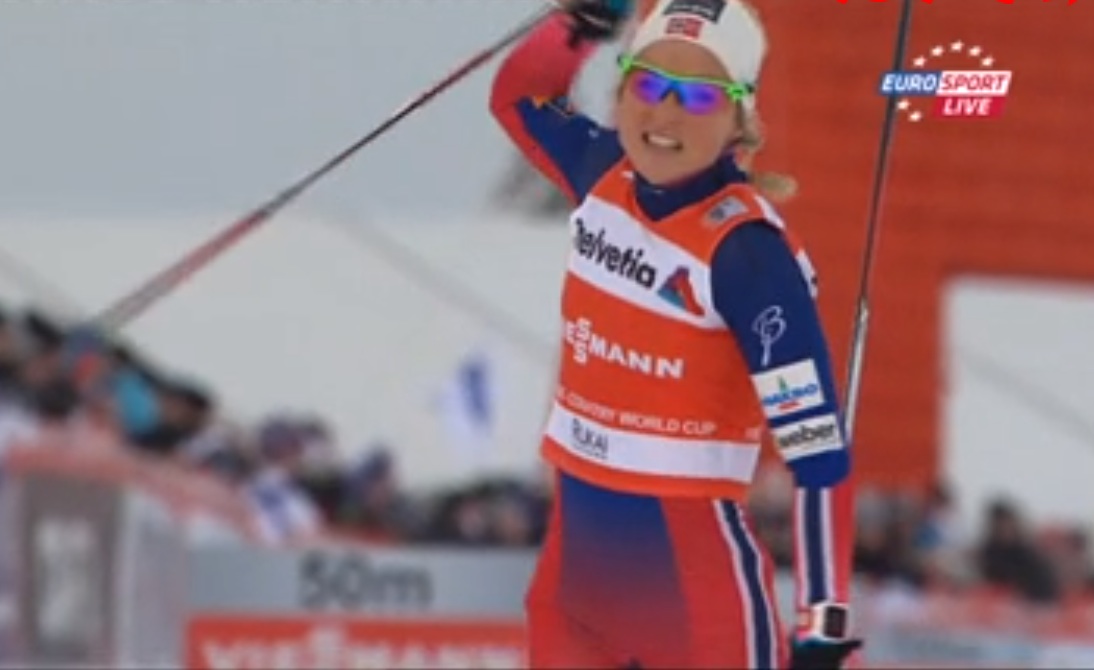
    Therese Johaug celebrates her dominant performance in Sunday's 10 k classic in Kuusamo, Finland, which she won by more than 42 seconds over Norwegian teammate Marit Bjørgen.
    Therese Johaug celebrates her dominant performance in Sunday’s 10 k classic in Kuusamo, Finland, which she won by more than 42 seconds over Norwegian teammate Marit Bjørgen.

    In the opening distance race of the World Cup season, Therese Johaug of Norway dominated from the start and walked away with her first-ever World Cup win in a 10-kilometer classic.

    From the moment Johaug, 26, set out on the course during Sunday’s race in Kuusamo, Finland, it was clear that the rest of the women’s field would be racing for second.  Even the ever-dominant Marit Bjørgen of Norway, who was coming off a win in the 1.4 k classic sprint the day before, knew that Johaug was going to win.

    “I knew after four kilometers that Therese was 25 seconds ahead and I understood I would be fighting for second place,” Bjørgen told FIS after finishing second, 42.2 seconds back from Johaug, who won in 25:47.2. “I was pushing as much as I could to take second place.”
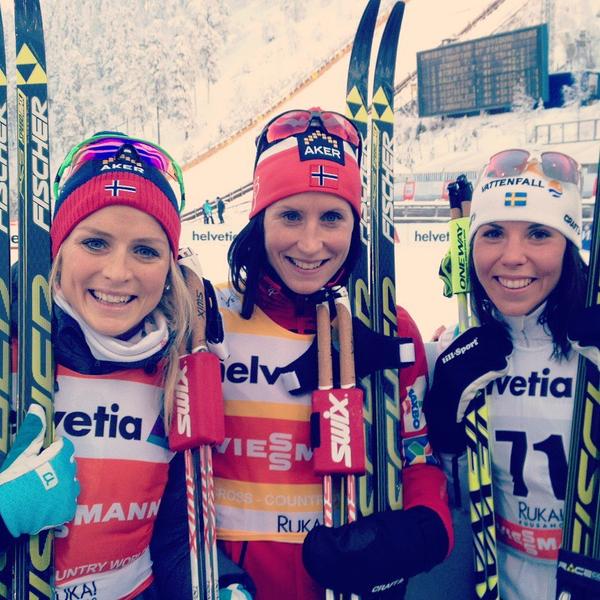
    The women's 10 k classic podium on Sunday in Kuusamo, Finland: with winner Therese Johaug (l), runner-up Marit Bjørgen (c) and Charlotte Kalla in third. (Photo: FIS Cross Country/Twitter)
    The women’s 10 k classic podium on Sunday in Kuusamo, Finland: with winner Therese Johaug (l), runner-up Marit Bjørgen (c) and Charlotte Kalla in third. (Photo: FIS Cross Country/Twitter)

    A two-time winner of the Kuusamo 10 k classic in 2005 and 2007 (the last time it was held was 2008), Bjørgen, who started last of 77 women, appeared to ski a very controlled-and-tactical race. She passed through the 3.1 k checkpoint in fourth behind Johaug in the lead, Poland’s Justyna Kowalczyk in second, and Sweden’s Charlotte Kalla in third.

    At each subsequent time check, Bjørgen moved up in the rankings. She was in third at the halfway point and slid into second by 8.1 k, but only by a razor-thin margin of one-tenth of a second over eventual third-place finisher Kalla (+44.1).

    Rounding the final bend, Bjørgen put in a hard kick and barely bested Kalla, finishing 1.9 seconds ahead of the her.

    Bjørgen was the overall victor in last year’s “Ruka Triple” in Kuusamo. This year, there were just two races — both of which counted for full World Cup points. Bjørgen’s win on Saturday put her in the overall World Cup leader’s bib for 2014/2015, and she remained 70 points ahead of Johaug after Sunday.

    Last year, a 5 k classic was held on Day 2, when Kowalczyk took the win, Bjørgen placed second and Johaug finished third.

    On Sunday, Kowalczyk was consistently in second for the first half of the race. However, by 8.1 k, she had faded and slipped to fourth where she would ultimately finish.

    “I thought that the gap will be more… It hurt, but it’s a good position [for the start of the season],” she wrote in on Facebook, according to a translation.

    “I knew after four kilometers that … I would be fighting for second place.” — Marit Bjørgen, 2nd in Sunday’s 10 k classic after Norwegian teammate Therese Johaug

    Knowing Johaug and how pumped she was about Sunday’s 10 k, Norwegian Woman’s Head Coach Egil Kristiansen worried she might start too hard.

    “I noticed that she was very excited after Saturday’s sprint … I was almost afraid that she would open too hard,” Kristiansen told Langrenn.com, according to a translation. “The skis were good, technique set and everything was correct. I cannot remember the last [time] there was such a victory margin. A fantastic race.”

    “I am really happy now because this is my first victory in [a 10 k] classic,” Johaug told FIS afterward. “I’ve never been to the top of the podium in this race [until] today.”

    Approaching the finish, Johaug appeared fatigued, but continued to attack until the end. About a meter before the finish, she pumped her right fist into the air and let out a scream before collapsing her hands to her knees after the finish. She had essentially just won it — even with Bjørgen — still on course, she gave herself the liberty of a small celebration as her foot crossed the line.

    “I think I’ve never been so good classical ever, especially in kick-double-pole,” Johaug told NRK. “I heard 20 seconds, then 30 and 40 … ‘This is your victory,’ I told myself.”
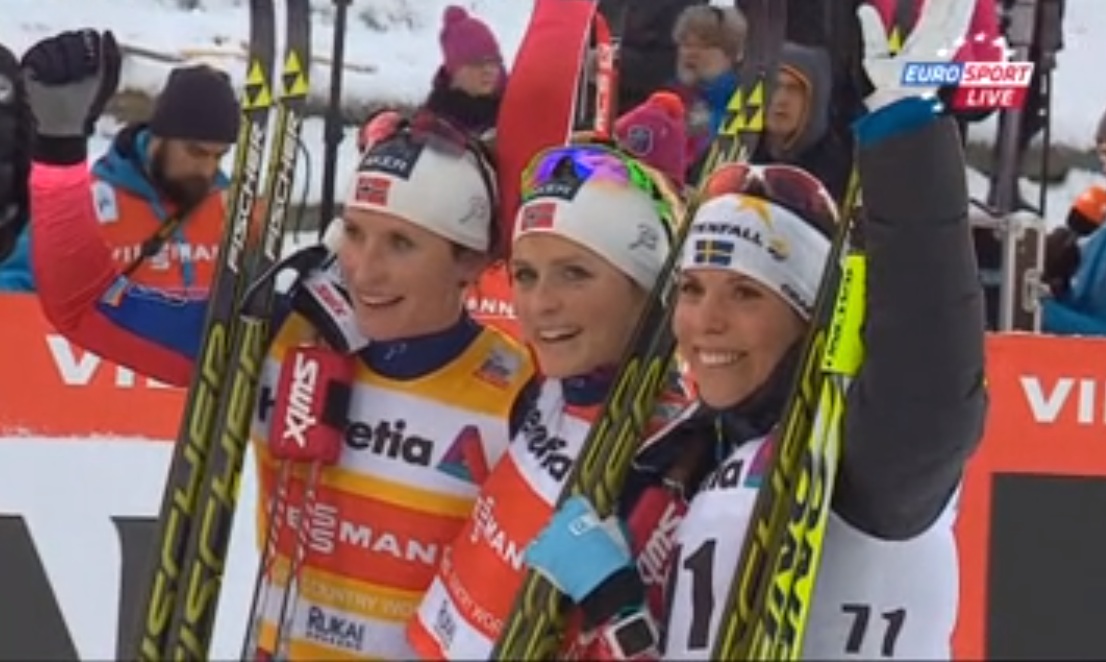
    Bjørgen (l), Johaug (c) and Kalla get together after the women's 10 k classic on Sunday, the first World Cup distance race of the season in Kuusamo, Finland.
    Bjørgen (l), Johaug (c) and Kalla get together after the women’s 10 k classic on Sunday, the first World Cup distance race of the season in Kuusamo, Finland.

    Kalla, who did not compete in Saturday’s sprint race but swept three FIS races in Bruksvallarna the weekend before, had a stellar performance, nearly holding off Bjørgen. She told FIS after the race that she spent a lot of time working on her classic technique.

    “I am very satisfied with the third place,” Kalla said. “I felt very good last week at the national opening and I’m glad I could keep the good shape to Ruka. I tried to do my very best today.”

    Kristiansen had some praise for the 27-year-old Swede: “Charlotte’s strong and we knew in advance,” he told Espressen.se. “It’s good for us that we have two ahead of her.”

    Norway took three of the top five, with Ingvild Flugstad Østberg in fifth, putting her third in the overall World Cup standings. Russia’s Yulia Tchekaleva finished sixth, Krista Parmakoski was the top Finnish woman in seventh, Norway’s Heidi Weng was eighth, Austria’s Katerina Smutna ninth, and Finland’s Kerttu Niskanen 10th.

    With the opening weekend behind the World Cup athletes, they will move onto Lillehammer, Norway, for a three-day series next weekend, including freestyle sprints on Friday,  5/10 k freestyle races on Saturday, and 10/15 k classic pursuits on Sunday.

    Results | with Splits

  • Brandsdal Defends Kuusamo Sprint Title, Norway Takes Top Four with Russia in Hot Pursuit 

    Brandsdal Defends Kuusamo Sprint Title, Norway Takes Top Four with Russia in Hot Pursuit 

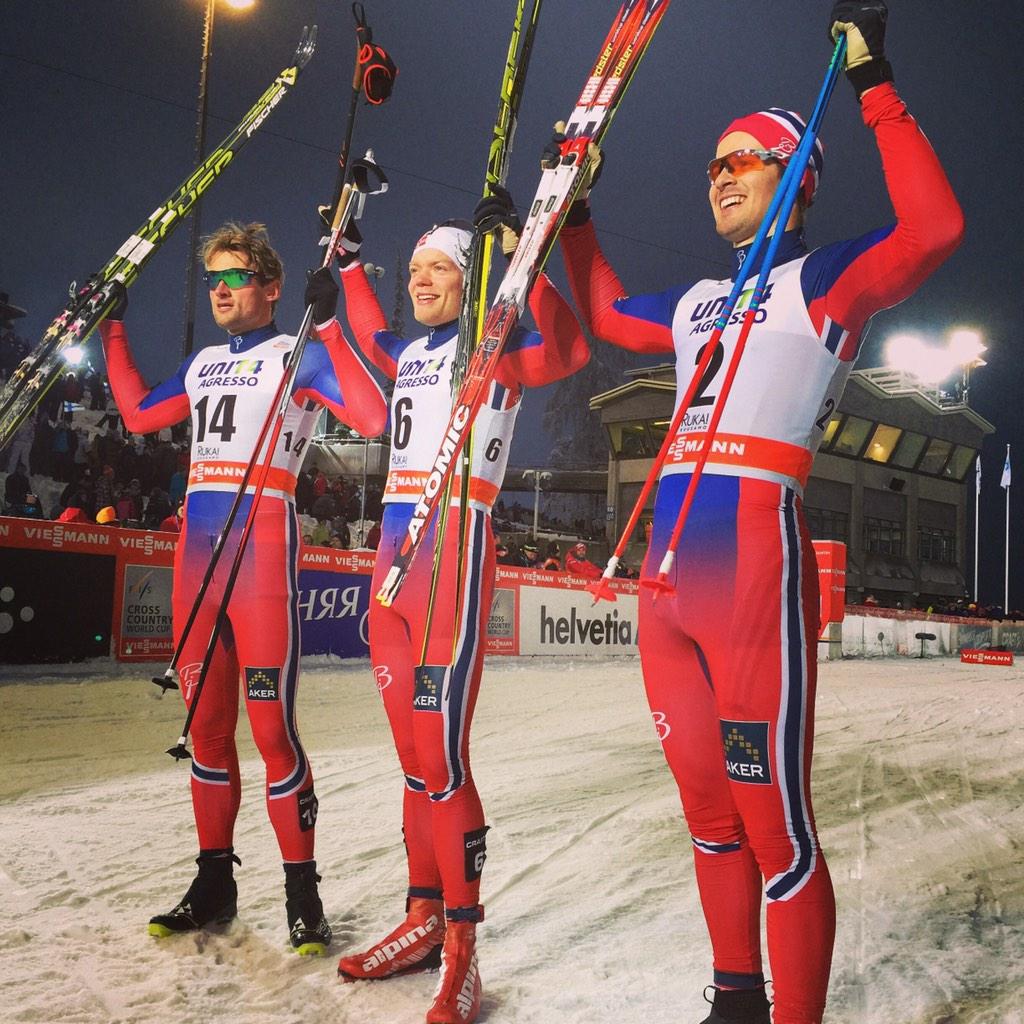
    An all-Norwegian men's podium on Saturday at the 1.4 k classic-sprint World Cup opener in Kuusamo, Finland. Eirik Brandsdal (c) won it, Petter Northug (l) was second and Sondre Turvoll Fossli notched a career-best third in his first World Cup final. (Photo: FIS Cross Country/Twitter)
    An all-Norwegian men’s podium on Saturday at the 1.4 k classic-sprint World Cup opener in Kuusamo, Finland. Eirik Brandsdal (c) won it, Petter Northug (l) was second and Sondre Turvoll Fossli notched a career-best third in his first World Cup final. (Photo: FIS Cross Country/Twitter)

    The World Cup season got off to a blistering start on Saturday in the northern reaches of Finland with a 1.4-kilometer classic sprint. Eighty-seven men toed the line for the prologue on a gray day in Kuusamo, Finland.

    Alexander Panzhinskiy of Russia put down the best qualifying time of 2:38.35, two-tenths of a second ahead of Norway’s Sondre Turvoll Fossli in second place and 5 1/2 seconds faster than the last man to make it to the heats, Martin Jaks of the Czech Republic.

    Norway managed to put eight men into the heats with host nation, Finland, grabbing seven of the 30 qualifying slots.  Three North Americans — Simi Hamilton (USA), Alex Harvey (CAN), and Andy Newell (USA) — qualified in 16th, 17th and 24th, respectively. Harvey went on to place 14th, Hamilton was 26th and Newell 28th after being eliminated in the quarterfinals.

    Just-below-freezing variable conditions combined with the hilly course made for difficult waxing conditions, which were evident through the day as the skiers attacked each round.

    When asked how the conditions affected wax choice on Saturday, U.S. Ski Team wax technician Gus Kaeding wrote, “Finding kick wasn’t a problem, managing icing with [a] mix of dry powder and ice was. It took a combination of wax, correct application, athletes skiing the conditions, and patience to pull off good skis.

    “When everything comes together we see a career best! Congrats Ida!” he added, referring to American Ida Sargent’s career-best fifth-place finish in the women’s sprint.

    Two memorable moments from the men’s race came from Fossli and Italy’s Federico Pellegrino in the quarterfinals. Fossli was leading the fourth quarterfinal coming into the last turn before the finishing straight, when it appeared that his pole or strap broke leaving him to cover the last few hundred meters with a single pole.  Striding hard nonetheless, he watched his teammate Finn Hågen Krogh pass him, and Krogh seemed to consider, if only for a moment, letting Fossli win.  Better safe than sorry, and he led Fossli into the finish in first and second, and the two moved on to the semifinals.

    The second moment came with Pellegrino as his heat entered the final climb before the stadium. Sitting in sixth at the base of that hill, Pellegrino swung to the outside and put in some extremely fast and hard striding, opening up a sizable gap between himself and the rest of the field by the top.  He was unable to repeat his performance in the semifinal and finished third in that heat for seventh overall.

    The final turned out to be a battle between Norway and Russia with four Norwegians and two Russians in the mix. The finalists jumped out to a clean start with the Norwegians leading the Russians into the first corner.  At the bottom of the first climb, Russia’s Sergey Ustiugov put in a brief kick to attempt to take the lead, but settled into third at the crest.

    Norway’s Petter Northug, whose technique and power had been less than stellar in his previous two heats, seemed to put it together on the final climb, looking strong and composed while powering from fourth to the front as the Russians faded.

    Northug’s teammate, Eirik Brandsdal led Fossli, Ustiugov and Northug, the last two of which were side by side, in the flat before the climb, followed by Russia’s Alexey Petukhov and Krogh. Northug moved up at the base, passing Ustiugov and Fossli. Brandsdal remained in the lead and the Norwegians kept charging ahead while the Russians appeared to lose steam with a not as much kick.

    Rising up and over the top, Northug inched ahead of Brandsdal, who slipped on his kick momentarily. Fossli moved to third ahead of Krogh. Around the last turn, Northug and Brandsdal skied alongside each other, and Brandsdal held stronger to the finish — winning in 2:34.84 by 0.47 seconds.

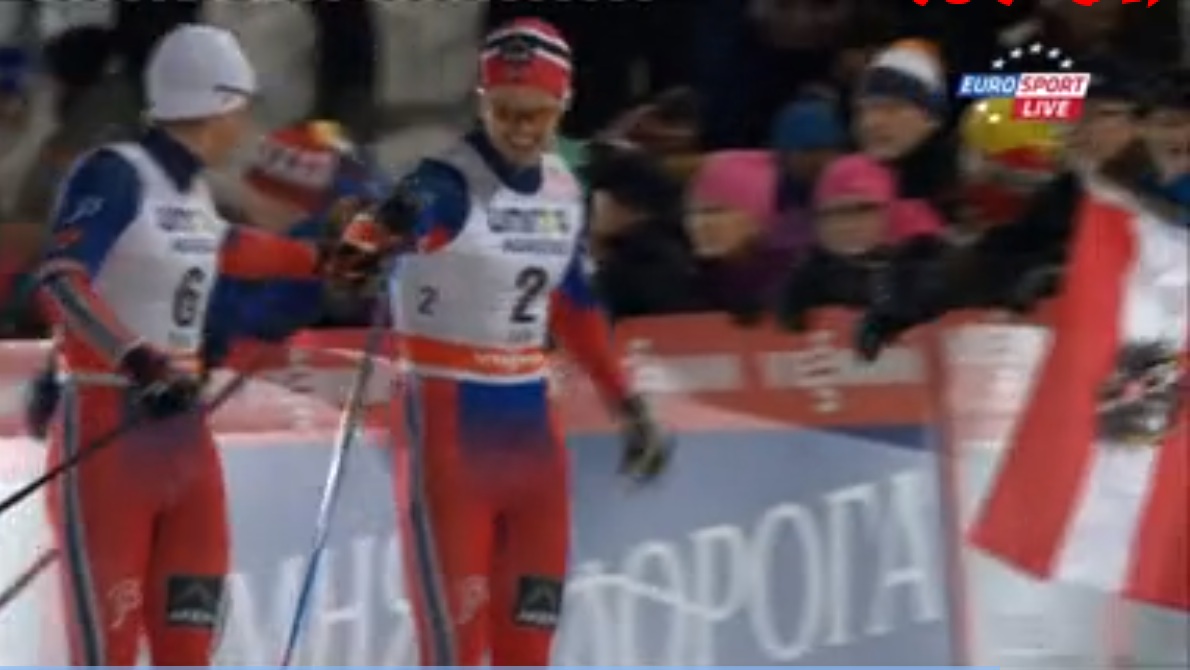
    Saturday's winner, Brandsdal congratulates fellow Norwegian Fossli, who placed third, at the finish of the men's classic sprint final in Kuusamo, Finland.
    Saturday’s winner, Brandsdal (l) congratulates fellow Norwegian Fossli, who placed third, at the finish of the men’s classic sprint final in Kuusamo, Finland.

    Norway swept the podium with Fossli placing third (+1.18), and Krogh took fourth (+1.69) ahead of Petukhov in fifth (+4.54) and Ustiugov in sixth (+14.63).

    For the second-straight year, Brandsdal, 28, won the Kuusamo classic-sprint (last year beating Russia’s Anton Gafarov and Sweden’s Teodor Petterson, respectively). It was his sixth World Cup victory.

    “I felt from the beginning it was my day,” he told FIS after the race. “I had also perfect skis. I struggled a little bit in the quarterfinal when I did not ski up the hill as I had planned, but the semifinal was much better. In the final I managed to keep calm and go for the victory. Sprint World Cup is one of my goals and it is great to start the season with the victory.”

    Brandsdal won both his quarterfinal (by 0.5 seconds over Sweden’s Teodor Peterson) and semifinal (by nearly two seconds over Northug). And for now, he’s in the lead for the overall 2014/2015 World Cup.

    “I saw the eyes of Peter. It will be tough next time,” Brandsdal told VG. “He is set on the [overall] yellow jersey.”

    Northug was probably the most talked about athlete competing today.  After a summer of legal battles and a 50-day jail sentence stemming from a drunk-driving incident in May, he stepped onto the course with intensity.

    “It’s good to get a good start. I was only double poling in Beitostølen,” he said of his FIS classic-sprint win in Norway last week. “Today I was on grip wax and it is a tough course, and I am happy to be on the podium. On the last climb I did not have any power left. When Eirik attacked I could not react, but I am happy for the second place.”

    Fossli, 21, was excited about a podium in his first World Cup final, and told FIS he felt strong all day.

    “I was lucky in the quarterfinal to make it to the semifinal with one pole,” he said. “It feels great to be on the podium. I was second in Beitostølen and it is great to start the World Cup season with a podium.”

    The World Cup continues Sunday in Ruka with a 10/15 k classic and then moves to Lillehammer, Norway, for a series of three races next weekend.

    Results | Heats

    ***

    About the author: Tommy is a former Stratton Mountain School and Middlebury College skier.  After college, he took a different route from skiing and spent nine years flying attack helicopters for the Marine Corps. After too many winters spent in hot dusty climates, he left the Marines and is back in Vermont where he couldn’t be happier.