From the FasterSkier archive — posts syndicated from athletes’ and coaches’ own blogs between 2004 and 2012, kept online as published. Current coverage is at fasterskier.com.

Author: Topher Sabot

  • Johaug Drops Bjørgen, Builds Lead for World Cup Showdown

    Johaug Drops Bjørgen, Builds Lead for World Cup Showdown

    The Olympics seem a distant memory as 2014 roles into March, and Norwegian Therese Johaug has shifted her sights with the same level of intensity she brings to her high-tempo racing style, to the overall World Cup Title.

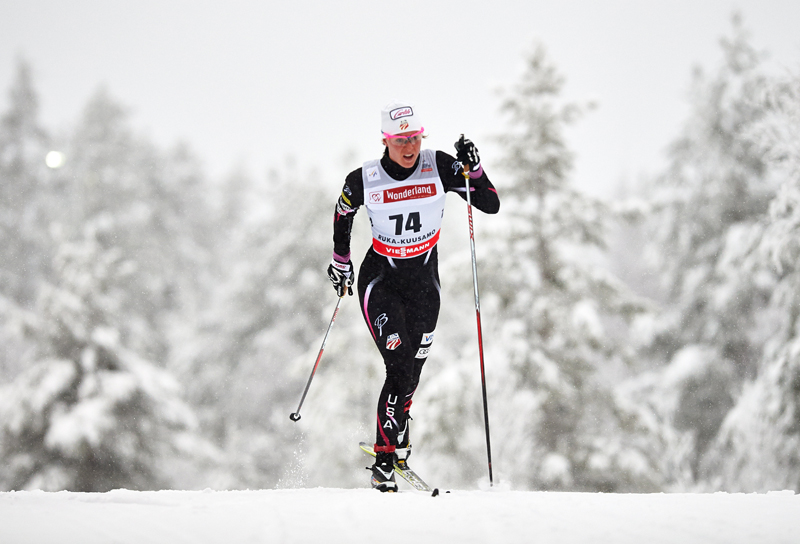
    Saturday’s World Cup Finals skiathlon in Falun, Sweden demonstrated just how serious she is. Johaug dropped her teammate, the superstar Marit Bjørgen, like she was a rookie off the OPA Cup circuit, to post a 33.8 second victory.

    Kerttu Niskanen of Finland used a strong skate leg in the 15 k event to finish third, 25 seconds down on Bjørgen and nine up on another Norwegian, Heidi Weng.

    The excitement, however, was at the front, with all observers wondering if Johaug had any chance of building a lead before Sunday’s World Cup Finals pursuit. She entered the day a mere three points ahead of Bjørgen in the overall standings, the lead she built with her Tour de Ski victory dwindling over the last two months.

    Johaug has never been one to be intimidated, and the fact the Bjørgen had come out on top in every head-to-head World Cup race since the Tour was irrelevant once the gun sounded and the racers took to a redesigned Falun course.

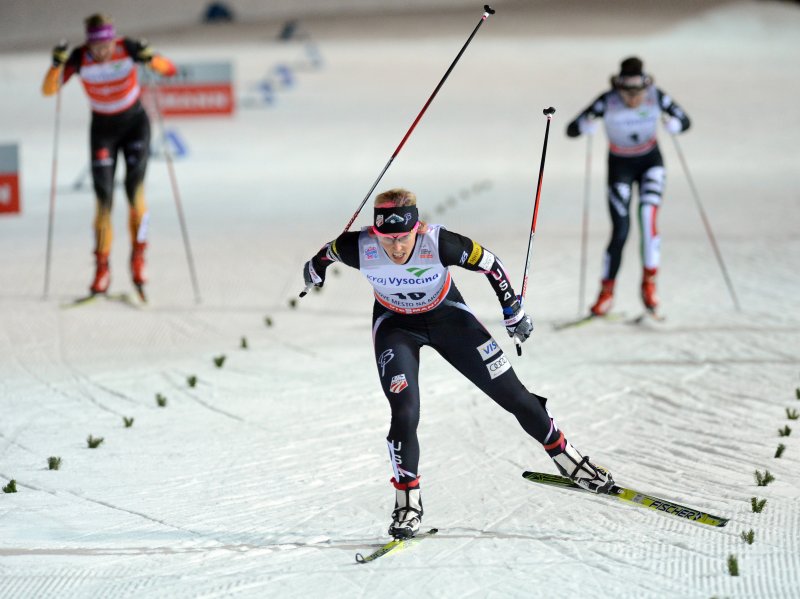
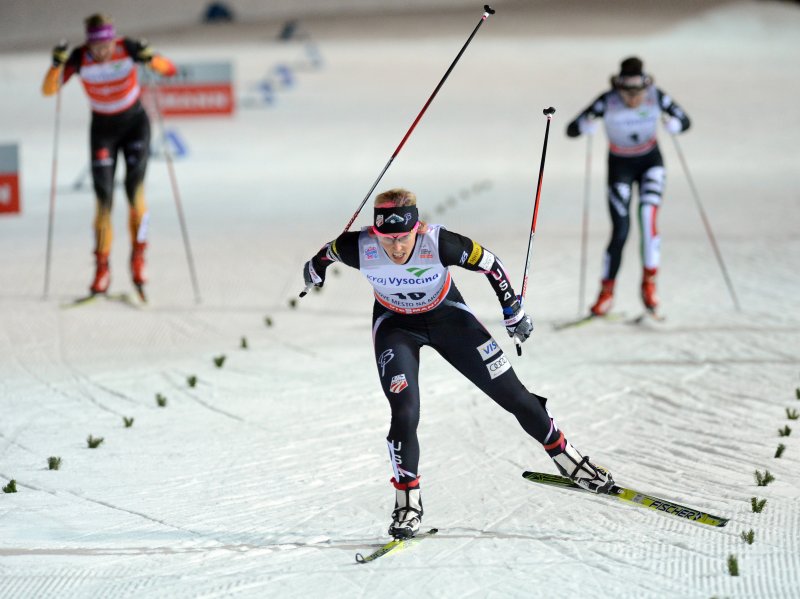
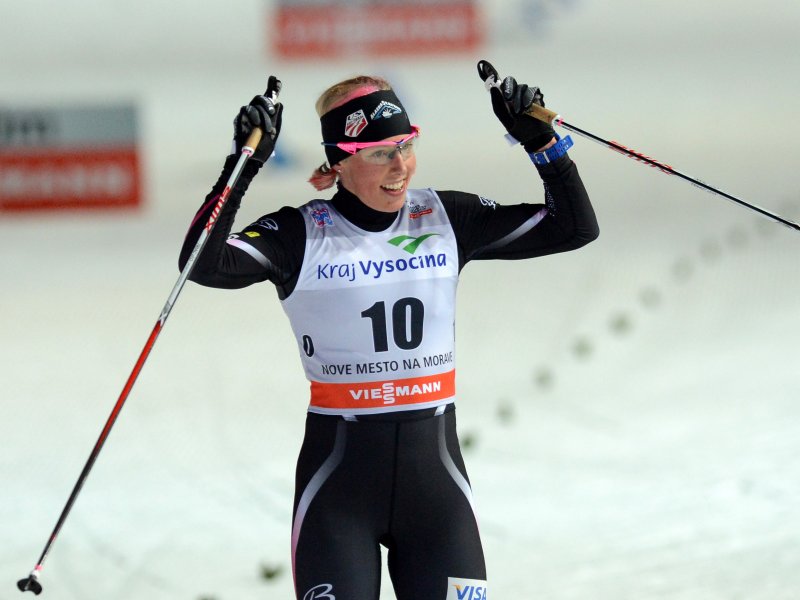
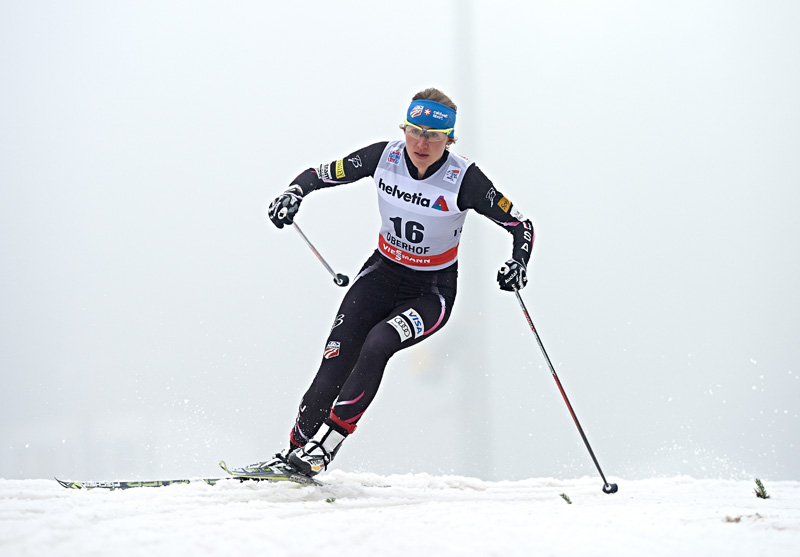
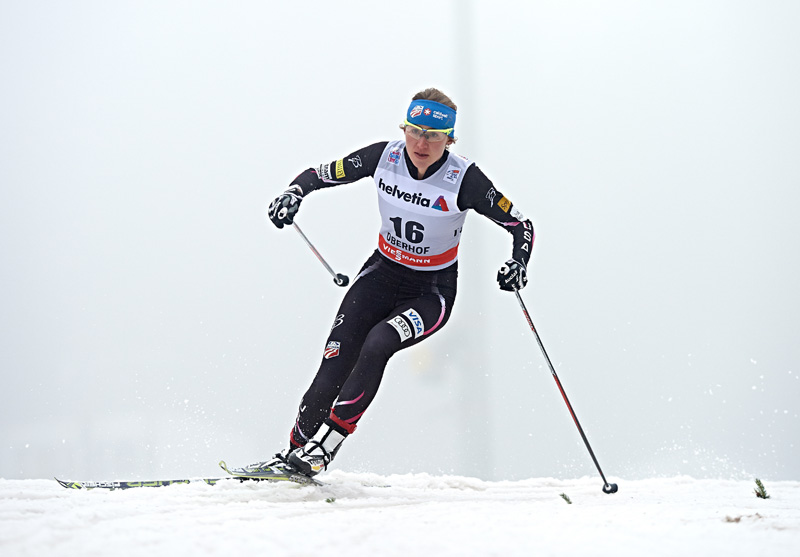
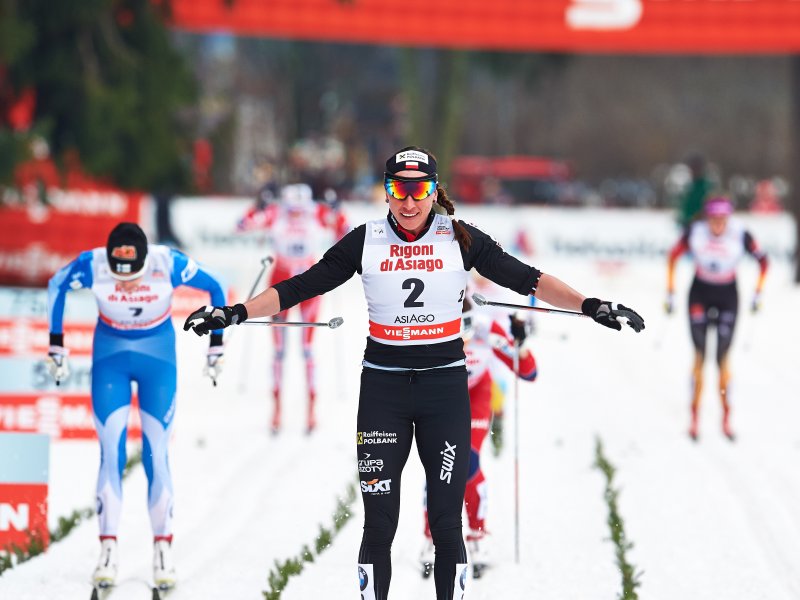
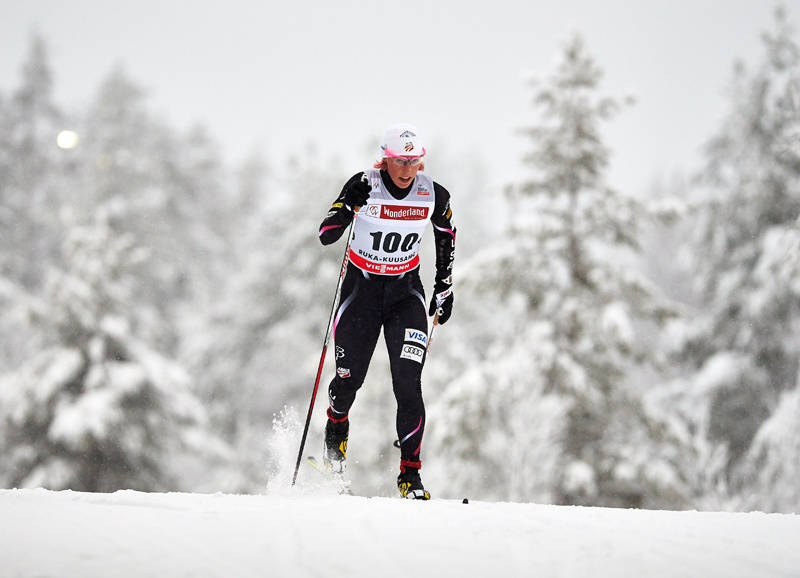
    Therese Johaug racing in Oslo last weekend has maintained her grip on the yellow bib. Photo: Fischer/NordicFocus
    Therese Johaug racing in Oslo last weekend has maintained her grip on the yellow bib. Photo: Fischer/NordicFocus

    By 2.2 k the pair had already split the field and while the chase pack remained relatively close through the end of the first 3.75 k classic loop, any hope of another skier cracking the top two was short lived.

    Heading into the the second lap, Johaug dropped the hammer, shattering any semblance of a pack, and quickly opening a large gap with Bjørgen locked in on her tails. As the big climbs approached, Johaug appeared to increase the pace yet again, and Bjørgen showed signs of faltering. At first it was just a missed kick here and a slip there. But the writing was on the wall, and on the famous Mördarbacken climb, she lost contact.

    Johaug tallied just over eight seconds when the climbing was done, a margin that shrank on the descents to the stadium. Bjørgen was still very much in contention, just five seconds back at the ski exchange.

    A sprint finish would not be to Johaug’s advantage however. While she has improved her short distance racing in recent years, showing the speed to advance into the heats, Friday’s classic sprint illustrated the differences between the two women — Bjørgen won the race, while Johaug managed a 17th.

    Not only did Johaug want the win today, she needed as many seconds as she could find, trying to create as big a cushion as possible for the final event of the season — the mini tour pursuit that would determine the overall World Cup winner.

    Bjørgen looked strong, but amazingly enough, Johaug even stronger, especially on the climbs. Everytime the elder Norwegian closed a little, Johaug would respond, before landing the knockout punch on the big climbs. There was little question a 15 second lead wold suffice, short of a crash or similar disaster.

    Such bad luck would spare Johaug, and she had the power left to stage a furious sprint to the line, culminating up the brutal homestretch, a relatively steep pitch to the finish.

    By the end she had opened a lead of over 30 seconds. The win gave her just four points more than Bjørgen, but the margin is irrelevant with the crystal globe going to Sunday’s winner. With nine more bonus seconds than Bjørgen in today’s race, Johaug has 15 seconds even for the start of the pursuit, a significant gap in the 10 k freestyle affair.

    Niskanen, who is in the process of wrapping up a successful 2014 campaign, is over a minute back of Bjørgen, and is tasked with holding off the extremely dangerous duo of Charlotte Kalla of Sweden and Weng, who start two seconds apart, 18 down on the Finn.

    The Americans turned in a strong showing, placing three skiers in the top-21, led by Liz Stephen in 15th. Kikkan Randall was 20th 4.2 seconds ahead of teammate Sadie Bjornsen in 21st. Stephen, unsurprisingly, was brilliant in the skate, skiing up from 34th at the halfway mark. A full report on the Americans will follow.

    Results

    Of Note:

    – Falun is hosting the 2015 World Championships and these World Cup Finals serve as the pre-Championship events.

    – Last year the World Cup Finals were the site of significant controversy as athletes threatened to boycott the races due to descents they view as unsafe.

    – The NOrwegian women placed five skiers in the top 10.

    – Two Swedes are within striking distance of the World Cup Finals podium. Charlotte Kalla in 5th and Emma WIken in 7th will try to please the home crowd.

    – Eva Vrabcova-Nyvltovla of the Czech Republic placed ninth, her sixth top-10 result of a breakout 2014 campaign. She had tallied just three top 10’s in her career entering the season.

    – Niskanen, who earned two silvers in Sochi — in the the team sprint and 4×5 k relay, earned her third individual podium of the year.

  • Canadian Youth Men Win World Junior Silver, Russia Dominates for Win

    Canadian Youth Men Win World Junior Silver, Russia Dominates for Win

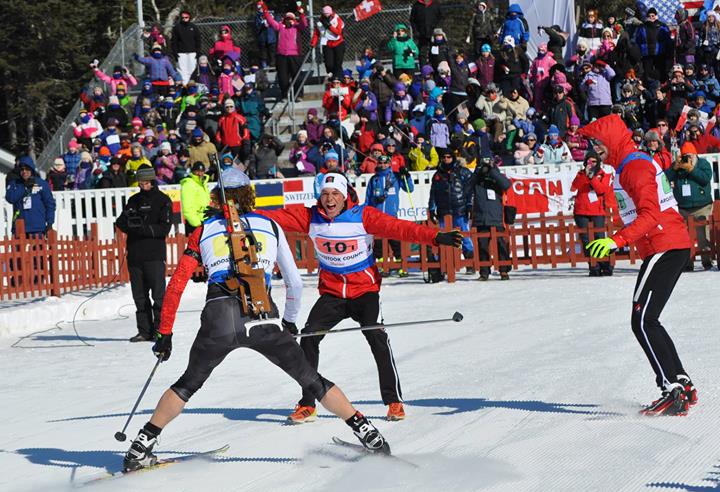
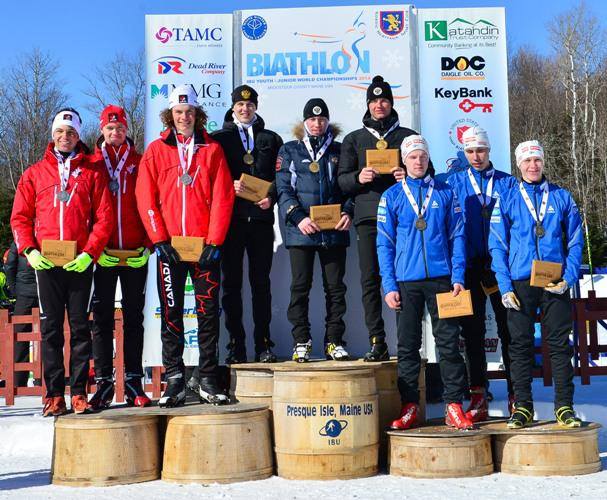
    Canada (l) won silver in the youth men's relay. Russia (c) took first and Finland (r) was third. Photo: Biathlon Canada.
    Canada (l) won silver in the youth men’s relay. Russia (c) took first and Finland (r) was third. Photo: Biathlon Canada.

    The Canadian biathlon team has turned in impressive results at the highest level over the past years, but as several top athletes wind down their careers, questions about the future of the program arise.

    Alex Dupuis, Aidan Millar and Jules Burnotte may not have answered those queries definitively, but they certainly gave a resounding reason to be optimistic.

    The trio teamed up to win silver in the youth relay at the biathlon World Youth/Junior Championships in Presque Isle, Maine, edging out Finland by just 3.7 seconds.

    After a week of strong results, with all three men posting individual top-10 results, Canadian coach Roddy Ward was not surprised to see his squad on the podium.

    “Last night we told the Youth Men that they would not need to do anything special – just have 3 solid legs. 3 normal performances and they would have a good result. Using some spares would be fine but they needed to be sure they are in control in the range to avoid the penalty loop,” Ward wrote to FasterSkier in an email.”

    The Canadians did just that, finishing the day as the only team to ski just a single penalty lap. Russia, who ran away with the win by over two minutes, used one less spare round — nine to Canada’s ten — but finished with two penalties.

    Dupuis started strong, needing just one spare in prime and two in standing to tag off in second, 28.7 seconds down on Yaroslav Kostyukov of Russia.

    “Alex started off really strong, skiing near the front and just a normal routine in the range. He is a fighter by nature and created the momentum for the team,” Ward wrote of his scramble skier.

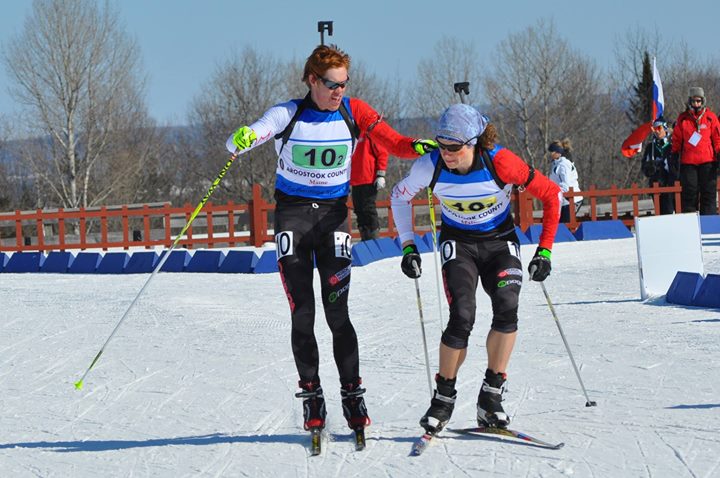
    Millar tags Burnotte for the third leg. Photo: Biathlon Canada
    Millar tags Burnotte for the third leg. Photo: Biathlon Canada

    Millar took over, shooting identically to his teammate, and keeping the Canadians in the medal hunt. He dropped to third, behind the U.S.

    “Aidan’s job was to run his own race, pace it smart and take his time on the range to ensure he avoided the penalty loop. Aidan had a great leg,” Ward explained.

    “I just wanted to ski my own race race and not worry about positions or anything,” Millar wrote in an email to FasterSkier. “The shooting went well and I was able to focus on my shooting and execute properly. My skiing felt fast and I just left everything on the course.

    Olympian Sean Doherty moved the Americans from 6th, +1:09 up to second with a blistering second leg. Doherty used a single spare in both prone and standing while taking nearly third seconds out of the next fastest racer, Poland’s Mateusz Janik.

    It was not meant to be the American’s day however. Brian Halligan ended up with two penalties in prone, and another in standing, to drop the team back to 5th, where they would ultimately finish.

    Canada, on the other hand, moved in the other direction. The towering 6’5” Burnotte earned a penalty in prone, but kept his composure, and bested Finland in a sprint to the line.

    “We figured Jules to be the guy to battle in the last standing, that is why he was chosen for the final leg,” Ward wrote. “He has a carefree personality and we thought that would serve him well under stress. We also knew Jules had great speed for that final loop and at 6’5″ had the pure speed if it came down to a sprint. The race ended up playing out as expected, Jules kept his composure perfectly and won a sprint to the finish against Finland.”

    Millar wrote that he didn’t know exactly how to describe the feeling of winning a medal, saying, “it was more then happiness and excitement. It’s unbelievable.”

    The Canadians celebrate as Brunotte crosses the line for silver. Photo: Biathlon Canada.
    The Canadians celebrate as Brunotte crosses the line for silver. Photo: Biathlon Canada.

    Ward witnessed a distinct difference between the winning Russians and the Canadians. The victors, he wrote, looked “relived and happy” in the finish area. “Our guys looked like they just won the lottery when they crossed the finish line!”

    He explained that the teams came in different expectations and that he doesn’t think he has ever seen athletes as excited as his team.

    “The whole finish, medal ceremony and press conference was pretty fun to watch, they were just buzzing with excitement!” Ward wrote.

    And looking forward?

    “This season has been fun with great results at all levels (Olympics, WC, IBU Cup and WJYCH). We have some serious momentum going so we need to plan smart and empower all our programs across the country to keep this momentum moving forward,” Ward concluded. “This week has shown that we have good depth in our ranks, which bodes well for the future of course.”

    Results

  • Sundby Extends World Cup Lead With Lahti Win

    Sundby Extends World Cup Lead With Lahti Win

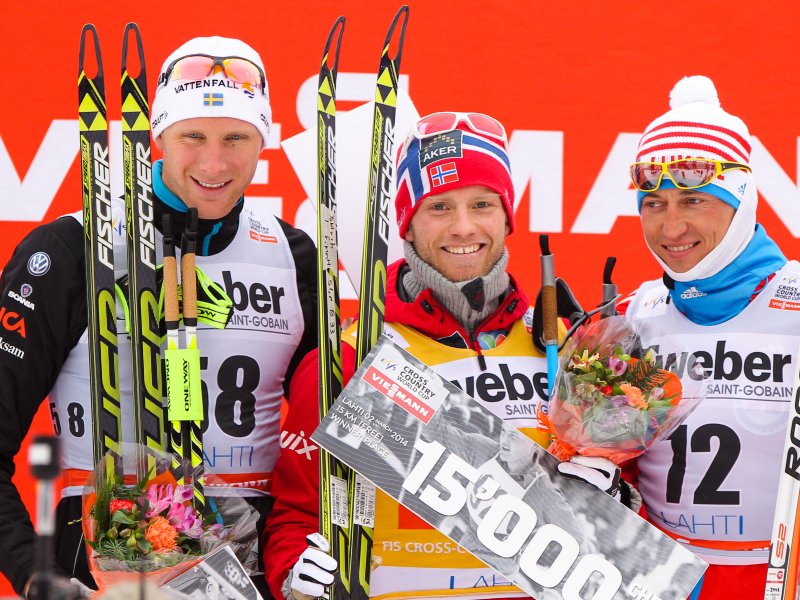
    Norwegian Martin Johnsrud Sundby is back on top following a disappointing Olympics, winning the men’s 15 k freestyle in Lahti, Finland.

    Sundby entered the Olympics as the overall World Cup leader after winning the 2014 Tour de Ski, but managed just a bronze in the opening skiathlon in Sochi, before notching a thirteenth and two fourths.

    He took a measure of revenge today, however, besting Sweden’s Daniel Richardsson by 10.7 seconds with Alexander Legkov of Russia another half second back in third.

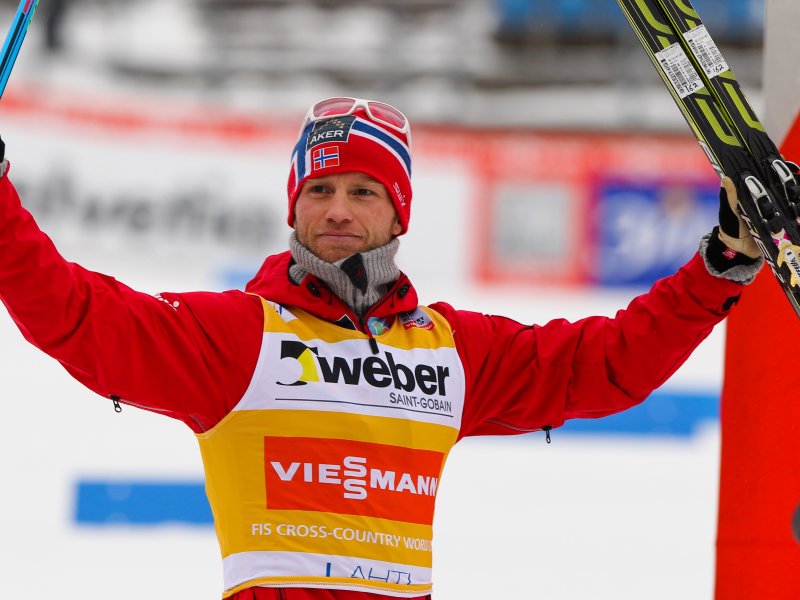
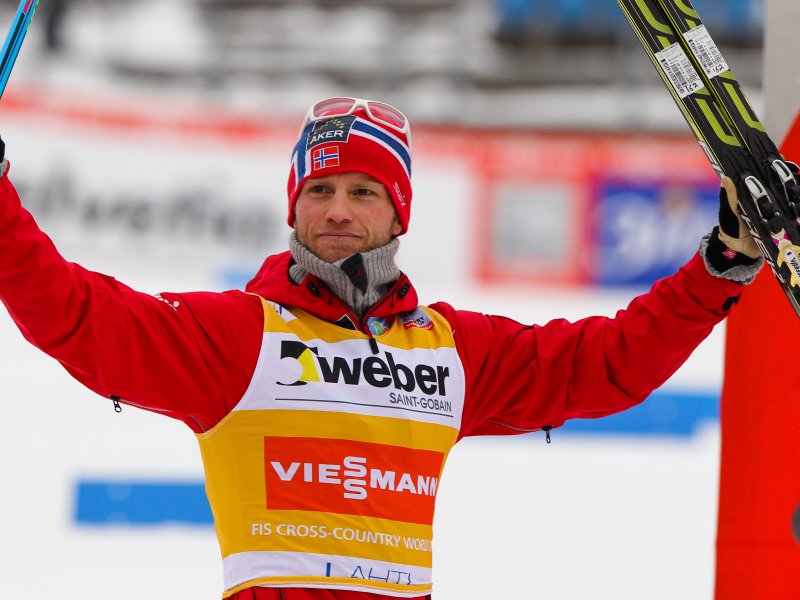
    Martin Johnsrud Sundby (NOR) celebrates his win in the Lahti 15 k freestyle. (Photo: Fischer/NordicFocus)
    Martin Johnsrud Sundby (NOR) celebrates his win in the Lahti 15 k freestyle. (Photo: Fischer/NordicFocus)

    Legkov won the Olympic 50 k in which Sundby was fourth, and Richardsson took third in the 15 k classic, arguably Sundby’s strongest event, and was part of the gold medal winning relay team.

    “I wanted to ski good today,” Sundby told FIS News after the race. “I was very motivated to succeed again.”

    Shut out of the medals in four of six Olympic races, the trip to Russia was disaster for the Norwegians. Sundby, however is now looking ahead with the goal of earning his first overall World Cup title.

    “The Games did not go the way I wanted, so I wanted to be ready to fight for the yellow bib,” he said after the race.

    Sundby led from 3.4 k on, trailing only Great Brittain’s Andrew Musgrave at the first checkpoint 1.5 k into the race.

    The Norwegian made his move with approximately 3 k to go. Until that point, both Legkov and Richardsson stayed within just a few seconds of the top spot, but between 11.3 and 13.4 k, Sundby extended his lead to 10 seconds, cementing the victory.

    The men's podium in Lahti (Photo: Fischer/NordicFocus)
    The men’s podium in Lahti (Photo: Fischer/NordicFocus)

    Richardsson overcame a 2.2 second deficit on Legkov over the last 1.6 k to take second.

    Legkov said he felt “very good” in the race, but that it was “not easy to concentrate on the World Cup again after the gold medal in Sochi.”

    Richardsson also felt good, similarly pleased to maintain form after the Olympics.

    With warm temperatures, the course was soft and icy, but according to Sundby, it did not break down further during the race.

    “I think it was the same for everybody. There was not a big difference during the laps,” he said.

    Sundby now leads the overall World Cup by 388 points over teammate Chris Andre Jespersen. Legkov is in third, 441 back.

    Of Note:

    – Jespersen did not race for Norway

    – With Anders Glørssen in fourth, Finn Hågen Krogh in fifth and Sjur Røthe in sixth, Norway placed four skiers in the top six. Norway ended the day with seven in the top thirteen.

    – Early leader Musgrave finished 27th.

    – 20-year-old Florian Notz of Germay was 7th in his first World Cup race. He was 10th in the 15 k classic at U23 Championships.

    – Olympic sprint bronze medalist, Emil Jönsson of Sweden finished 30th.

    Results


  • Hattestad Flawless in Olympic Tune-Up Win

    Ola Vigen Hattestad (NOR) celebrates his victory in Toblach, Italy.  Photo: flyingpointroad.com
    Ola Vigen Hattestad (NOR) celebrates his victory in Toblach, Italy. Photo: flyingpointroad.com

    It is difficult to pick a favorite in the men’s Olympic sprint, but Norwegian Ola Vigen Hattestad made a strong case for that designation, winning the final pre-Games tune-up in Toblach, Italy.

    Teammate Eirik Brandsdal finished second and German Josef Wenzl rounded out the podium in third.

    “I was told after Norwegian Championships that I wasn’t ready for Sochi but I think today I showed that I am,” Hattestad said after winning each of his heats in the skate event.

    The 2009 World Champion in the skate sprint, Hattestad does not have an Olympic medal, placing ninth in 2006 and a heart-breaking fourth in 2010. He famously gave up his spot in the team sprint in 2010, missing another shot at Olympic hardware.

    The Toblach course, with a one steep climb, specs out as relatively flat compared to Sochi, but Hattestad showed top form against a robust field that was missing only a handful of the World’s best sprinters.

    Hattestad qualified in seventh, just over a second behind the fastest man, Jovian Hediger of Switzerland.

    He then proceeded to execute flawlessly in the quarterfinals and semis, maintaining position toward the front while remaining patient, and taking advantage of the draft on a long gradual descent through the backstretch in the stadium.

    In the quarters he waited until halfway down the stretch before stepping out from behind Roman Schaad of Switzlerand. Driving a strong no-pole skate, Hattestad blew by the leader to take the lead around the hairpin into the home straight to advance easily.

    The semis played out in nearly identical fashion with merely a change of Swiss leader. This time it was Jovian Hediger who led Hattestad down the final descent. Once again the Norwegian stepped out, and once again he slingshotted into first, and skied away to a spot in the finals.

    In both the quarters and semis, Wenzl followed Hattestad drafting his lanky competitor to set up a clear run to the line. In the first heat, Wenzl lost out to Schaad but advanced as a lucky loser, while in the semis he bested Brandsdal in a photo finish, leaving the Norwegian to wait for a lucky loser slot in the finals.

    In the final, Hattestad gambled on his strength and shifted strategies, moving to the lead early. He held his position over the last climb and into the descent, a bold move given his own success following in earlier heats.

    In the women’s race, completed just minutes earlier, American Kikkan Randall employed similar tactics with unfortunate results. Randall was swept up by the pack and pinched out around the last corner. It was Marit Bjørgen (NOR) and Denise Herrmann (GER) in the top two spots — women who were bringing up the rear entering the descent.

    Hattestad, however, opted to be aggressive, and at the crux, did what he needed to do. Over the top of the final climb, he gained a small gap, just enough space to break the draft. He was first into a no-pole skate as the terrain flattened, and Brandsdal, leading the chasers, had no chance of closing.

    Afterward Hattestad said that he executed as planned, knowing he was “strong enough to lead” in the finals.

    Brandsdal and Wenzl duked it out for second, with Wenzl showing no disappointment in his third place result.

    The German jumped across the line, letting out a yell that matched Hattestad’s finishing celebration.

    “This was a really great result for me today,” Wenzl said at the post-race press-conference. “I have been quite strong this season and I am glad that it continues. Sochi will be difficult. It will be a much harder course than today so we will see what happens. But today was great.”

    He earned his second podium of the season while making his third finals appearance — all in freestyle sprints.

    Brandsdal was also pleased, seeing no shame in losing out to Hattestad.

    “Ola was very strong but I did my best,” Brandsdal said. “I think my shape is where it should be and it feels good heading to Sochi.”

    Brandsdal will be making his Olympic debut, while Wenzl will be looking to improve upon his thirty-first in the classic sprint at the 2010 Games.

    Of Note:

    – Just 4.01 seconds separated the first and thirtieth qualifiers.

    – Great Brittain’s Andrew Musgrave was the first man out, missing the heats by .07 seconds.

    – Musgrave was followed by Dario Cologna (SUI) who appears in good form after revering from an injury.

    – Hediger crashed in the finals, tripping entering the last hill. It appeared to be an unforced error. Despite the crash, Hediger still set a personal best, placing sixth.

    – Emil Joensson (SWE) crashed in the semis after qualifying second. A favorite in the 2010 Olympic sprint, Joennson failed to make the finals in Vancouver.

    – Several Russian Olympic distance skiers, including Alexander Legkov and Illia Chernousov, started the sprint. Legkov was 58th and Chernousov 63rd.

    Results

    Eirik Brandsdal (NOR), Ola Vigen Hattestad (NOR) and Josef Wenzl (GER) claim the podium in Toblach.  Photo: Fischer / Nordic Focus.
    Eirik Brandsdal (NOR), Ola Vigen Hattestad (NOR) and Josef Wenzl (GER) claim the podium in Toblach. Photo: Fischer / Nordic Focus.
  • Caldwell Leads ‘Best of the Rest’ for U.S., Jones 10th for Canada

    Caldwell Leads ‘Best of the Rest’ for U.S., Jones 10th for Canada

    Kikkan Randall won the race, and Jessie Diggins wasn’t far behind in fifth, but the rest of the American sprinters shouldn’t be forgotten as the U.S. placed a Norwegian-like five skiers in the top 15.

    Sophie Caldwell led the rest of the squad in seventh, the first skier on the outside of the finals looking in.  She started her day off strong, skiing to fourth in the qualifier, 1.35 seconds in back of Greta Laurent of Italy, and 2.44 seconds ahead of Randall.

    Caldwell wrote to FasterSkier in an email that she tried to “maximize glide” on the flat Szklarska Poręba course.

    In the heats, she wrote that this was harder to accomplish, given the narrow course and sharp corners. “It was harder to change positions, and there was a lot of pushing and tumbling,” she wrote.

    Sophie Caldwell gliding to fourth in qualification. Photo: Fischer/NordicFocus
    Sophie Caldwell gliding to fourth in qualification. (Photo: Fischer/NordicFocus)

    Undaunted by the tight quarters, Caldwell kept her head in a quarterfinal that was “all over the place.” She told FasterSkier that she thinks she skied in every position (first through sixth) in the heat, before ultimately slipping into the lead on the inside of the last tight corner, a position she would not relinquish.

    In the semis, she matched up with Randall and took off with the strategy to “do whatever Kikkan did.”

    She sat on Randall’s tails for most of the heat, but when the veteran moved up into the lead around the tight corner, Caldwell was pinched and dropped back to fourth. She ultimately out-lunged Gaia Vuerich (ITA) at the line to finish third in the heat.

    Overall she felt her strategy “worked okay,” but felt she needed to be further up heading into the final corner.

    “I couldn’t quite get as far up as I would have liked before the finish stretch. We came into the second to last corner pretty tight, and I had a little bobble and bounced back to 4th.” she explained. “I tried my same strategy of staying to the inside for the final corner, and it worked well but wasn’t quite enough.”

    “It’s not that it’s her second best result ever in sprinting, it’s that she’s been putting together these consistently crafty races out there,” USST Women’s Coach Matt Whitcomb said in a phone interview. “She’s putting together fast qualifications, consistently qualifying, and then making some very clever moves that require a ton of skill, and she’s clearly a natural.”

    Caldwell was followed by teammates Ida Sargent in thirteenth, and Liz Stephen in 15th.

    Sargent, a strong climber, wrote in an email that she generally prefers hillier terrain, but was pleased with her qualifier. In the heats, she was undone by the narrow course, unable to move up out of third place despite repeated efforts.

    “I tried on the hill since we were not going that fast, but the hill was only wide enough for one skate lane. So then I tried again on the downhill but wasn’t able to move into second, so I stayed in third.  On the final corner, I tried one last time to pass Fabjan [of Slovenia] and Van der Graaff [of Switzerland],” she wrote.

    She attempted to emulate Caldwell’s move, getting by on the inside, but stumbled on some ice and slipped to fourth. She fought back on the homestretch to take third in the heat.

    “Ida certainly has much more to offer than thirteenth but I think today pointed that it’s coming soon,” Whitcomb said.

    Sargent on course in qualifications. Photo: Fischer/NordicFocus
    Sargent on course in qualifications.(Photo: Fischer/NordicFocus)

    The result was Sargent’s second-best of the season, trailing only a tenth she earned in the Asiago, Italy classic sprint.

    While every American woman skied a strong race, the surprise of the day had to be Stephen. She qualified for just her second World Cup heats, and nearly advanced out of the quarters, out-lunging the home favorite Justyna Kowalczyk at the line for third in her heat.

    She just missed advancing as lucky loser, but still had her top sprint finish ever.

    “I’m encouraged by her performance not so much because it’s a really exciting sprint result, but because it’s indicative of having absorbed the Tour and some of the training afterwards,” Whitcomb explained. “I’m confident with the direction she’s going.”

    The door was open for top results with Norway, Sweden and Finland all opting to skip the World Cup weekend. Just 13 seeded skiers started the race. But Randall pointed to Denise Herrmann of Germany and Laurien Van der Graaff of Switzerland as an indication that there was plenty of speed on the high end.

    The U.S. squad was rounded out by Caitlin Gregg in 33rd, 1.1 seconds behind the final qualifier, Perianne Jones of Canada.

    “The sprint course was really challenging for me!” Gregg wrote in an email. “I have spent the last 3-1/2 months at altitude preparing for the early season races and potential races in Sochi! Coming to sea level and racing flatter, faster courses is super hard right now! I still feel like I am getting faster and faster each day though :)”

    Jones, who got a late start to her world Cup season, finished a season-best tenth.

    “It was close to being a pretty bad day,” Jones said. “I qualified 30th and I didn’t feel great during the qualifier.

    In the quarters, Jones looked to follow Randall, a strategy she said “worked out perfectly.”

    She avoided crashes and was “able to just sneak right in behind Kikkan and ski with her pretty relaxed and just follow what she was doing.  We had really great skis so that was super smooth.”

    She advanced after holing her second spot in the heat, but was unable to keep the magic alive in the semis.

    With a poorer start, she was unable to move up on the narrow course and had to settle for fifth.

    The effort was still good for a career-best freestyle sprint result.

    “I haven’t had the best fall and winter so far, so it is really great to see all the patience and work that we have put in is paying off,” she said. “I have started to feel a lot better in the last few weeks, but it is just so nice to just see it in the results not just feel it in my body because it is getting close to February.”

    Her teammate, Dasha Gaiazova, finished 23rd.

    Racing continues on Sunday with a 10 k classic mass start.

  • Newell, Hamilton Crack top-20 in Nove Mesto

    Newell, Hamilton Crack top-20 in Nove Mesto

    Americans Andy Newell and Simi Hamilton were both left wanting more after being eliminated in the quarterfinals of the freestyle sprint in Nove Mesto, Czech Republic.

    Newell qualified in second before finishing seventeenth on the day, while Hamilton, racing his first sprint since his Tour de Ski stage victory, placed twentieth.

    “I’m really frustrated with today,” Newell wrote in an email to FasterSkier. “I was feeling great, and I think the conditions and course were perfect for me to have a go in the final.”

    Andy Newell (U.S. Ski Team) racing to 20th in the 4.5 k freestyle prologue, the first stage of the Tour de Ski. (Photo: Fischer/Nordic Focus)
    Andy Newell (U.S. Ski Team) racing to 20th in the 4.5 k freestyle prologue, the first stage of the Tour de Ski 2013-2014. (Photo: Fischer/Nordic Focus)He skied a blistering qualification round, taking advantage of the gradual V2 terrain and fast finish to clock in behind only Sergei Ustiugov of Russia.

    In the quarters, he got off the line quickly after a false start brought the six men back to the line.

    He led through the first part of the course, and into the long climb, putting in a short burst over the top and around a hairpin turn into the descent.

    “I did a little acceleration over the top of the steep hill just so I could hold my position better on the downhill,” Newell wrote. [I’m] not the biggest guy out there so I have to do things like that. It worked pretty well, and I was in great position going up the final climb.”

    He was still in good position dropping down to the stadium, but according to U.S. Ski Team Head Coach, Chris Grover, a tactical error cost him the chance to move on.

    On the final corner, Newell stayed in behind Teodor Petersen of Sweden, instead of stepping wide, and using the draft to move by.

    “He just made one bad move … staying behind Teodor Petterson instead of jumping out to the left and basically blocking the guys that were slingshotting around,” Grover explained. “He should have been taking that line and slingshotting it.”

    Newell concurred, writing that he rode up on Peterson, and lost momentum over the final rise before the homestretch.

    “My energy was good in the finish, just not a great execution, which makes it tough,” he concluded.

    Hamilton’s day did not start with the same vigor as Newell’s, but ended in similar fashion — one and done in the heats.

    He qualified in 25th, not feeling great.

    “I felt so-so during qualification,” Hamilton wrote in an email. “Not great but not terrible either. My legs were a little tired for some reason entering the day, and I didn’t feel 100% comfortable on the snow which was squirrely in some places and soft in others. Still, I think my ability to adapt my technique to different kinds of conditions is improving, and I’m excited about that.”

    Simi Hamilton (U.S. Ski Team) leads his quarterfinal in the third stage of the Tour de Ski. (Photo: Fischer/Nordic Focus)
    Simi Hamilton (U.S. Ski Team) leads his quarterfinal in the third stage of the Tour de Ski. (Photo: Fischer/Nordic Focus)

    Hamilton won his first ever World Cup race – albeit a Tour de Ski stage – just over a week ago, capturing the top spot in something of an upset in Lenzerheide, Switzerland.

    There would be no repeat of that magical day in this race.

    Hamilton was pushed around early in a physical heat, and when he tried to make a move on the long climb, he said he “had the door closed on me immediately, and just couldn’t get to the front on the extremely tight course.”

    He stayed with the pack, but was not able to get in position for a run at the line.

    “I’m certainly not totally thrilled about how today turned out, but I prepared myself mentally after Lenzerheide, and I understand that not every day is going to be perfect,” Hamilton wrote. “At this level, the difference between being totally on top of your game and having a great day and being outside of the points is pretty darn small, so I’m happy to have been in the mix today.”

    Newell and Hamilton ended the day ranked 15th and 19th respectively in the Sprint Cup. Newell, as usual, has scored World Cup points in every sprint this year, though he has yet to reach the finals.

    Hamilton has points in four of six sprints.

    The only other American to race was Brian Gregg, fresh over from the U.S., who finished 87th of 88 skiers.

    — Matt Voisin contributed reporting

  • Ustiugov Claims First World Cup Win

    Ustiugov Claims First World Cup Win

    Sergey Ustiugov (RUS) celebrates his sprint victory. Photo: Fischer/NordicFocus
    Sergey Ustiugov (RUS) celebrates his sprint victory. Photo: Fischer/NordicFocus

    Twenty-one-year-old Sergey Ustiugov of Russia started his sprint day in Nove Mesto, Czech Republic by winning the qualification by an astounding 3.51 seconds over American Andy Newell.

    He ended it just as much the victor, powering away in the final to capture his first career World Cup victory.

    The lanky former World Junior Champion won each of his heats on the way to the win, and overcame challenges from Italian Federico Pellegrino and teammate Alexey Petukhov, who finished second and third respectively.

    Norwegian Eirik Brandsdal took an early lead in the final with three Russians – Ustiugov, Petukhov and Nikolay Morilov bringing up the rear.

    Usitugov moved up rapidly on the first climb, and just missed squeaking by Brandsdal before the hairpin turn at the top.

    He dropped into second with Pellegrino just behind for the descent.

    On the next climb, Petukhov came back hard, reprising the patience of the his first two heats, where he quickly moved through the field from the back of the pack to take control.

    He couldn’t get by Ustiugov, however, and had to settle for third heading into the final descent toward the stadium, Brandsdal, Swede Teodor Peterson, and Morilov struggling to keep up.

    The top three held a comfortable gap into the homestretch, with Ustiugov running in pole position entering the final 100 meters.

    Pellegrino initially closed up , leaping off the snow with each V2 alternate stroke, but Ustiugov would not be denied, and accelerated to keep the lead constant to the line.

    Pellegrino stood on the podium for the fifth time in his World Cup career, matching his best-ever finish.

    “It’s been an incredible day. I felt very strong already in the qualification,” Ustiugov told FIS news. “In the heats I was confident I can always make it through. In the finals Federico was following and was quite close but I am happy I could win my first World Cup.”

    Gunning for Olympic gold in the sprint, Pellegrino was pleased with his seocnd-place, though the near victory left him confident.

    “Ustiugov was very strong today but I think I could beat him,” Pellegrino said. “There are still some skate sprints this season but my goal is to win the one in Sochi.

    Pethukhov, who hadn’t been on the podium since last December, was happy to be back in the top-3, and pleased to see the Olympic host nation put three skiers in the final.

    Results

  • Greggs Undaunted by Travel, Take Advantage of World Cup Opportunity

    Greggs Undaunted by Travel, Take Advantage of World Cup Opportunity

    Just three days ago Caitlin Gregg was winning the U.S. National Championship 20 k by a stunning three-and-a-half minutes, while husband Brian battled to second in the men’s 30 k.

    And now, after traveling from Utah to the Czech Republic, they are reflecting on their first World Cup experience of the year.
    The couple arrived in Europe on Thursday, leaving little time to prepare for Saturday’s freestyle sprint in Nove Mesto.

    In an email, Caitlin wrote that the travel was smooth, aided by family in the U.S. and the U.S. Ski Team in Europe.

    With an exit row and plenty of food and water, they were able to get some sleep, and minimize the impact of the trans-atlantic flight.

    With the 20/30 k at Nationals playing an important role in their quest for an Olympic berth and a spot in the 30/50 k, the two were unable to head to Europe earlier.

    Brian struggled in the men’s sprint, finishing 87th out of 88 skiers.

    “I feel that I executed the race well but am disappointed with my result,” he wrote. “To be twenty-five seconds out is really bad. My skis were really good, and I feel bad I couldn’t do them justice.”

    Brian Gregg  (Team Gregg/Madshus) on his way to winning the 15 k freestyle individual start, in the Sovereign Lake NorAm races last month.
    Brian Gregg (Team Gregg/Madshus) on his way to winning the 15 k freestyle individual start, in the Sovereign Lake NorAm races last month.

    He entered the race with a goal of being ten seconds of the lead in qualification, and while he was well off that, he generally enjoys the short events.

    “I have been pegged as a distance racer, but actually really enjoy sprints and still feel that I can do well in them especially if the course is long and challenging,” Brian wrote.

    Based on his performance today, he said he may skip the next World Cup sprint, focusing exclusively on the 15k classic in Poland.

    “I don’t want to waste the team’s time and energy if I am not competitive,” he explained.

    His goal for the 15 k next weekend is to crack the top-40. His strongest events are longer freestyle races, but will take whatever World Cup starts he can get.

    Caitlin was more positive about her race. She placed 64th out of 69 skiers and wrote that she”felt really good considering the racing and travel!”

    In hindsight she feels that her sprint lacked some power, but that her “energy was high.”

    With her sights focused squarely on distance races, particularly the Olympic 30 k, Caitlin was unconcerned by her sprint result.

    Caitlin Gregg dominating the 20k freestyle at 2014 US National Championships.
    Caitlin Gregg dominating the 20k freestyle at 2014 US National Championships.

    “These first few events are not a huge focus, but we thought they would bring some good perspective and learning potential!” she wrote. “This is only my third sprint World Cup ever and it’s always a humbling experience when you are a ways out. I like getting my butt kicked though, it keeps me hungry and focused on my future races!”

    Some easy training, mainly shorts skis and jogs to aid with adjustment, will be followed by some intensity and the distance race next Sunday.

    The couple are currently scheduled to fly back to the States on the 20th, but if they make the Olympic Team, Brian said they might try to stay in Europe and find a place to train at altitude.

  • Rested Randall Overpowers Field, Romps to World Cup Sprint Win

    Rested Randall Overpowers Field, Romps to World Cup Sprint Win

    Kikkan Randall (USA) skiing to victory in Nove Mesto, Czech Republich. Photo: Fischer/NordicFocus
    Kikkan Randall (USA) skiing to victory in Nove Mesto, Czech Republich. Photo: Fischer/NordicFocus

    American Kikkan Randall showed no signs of rust, coming off a three week break from racing to win the World Cup freestyle sprint in Nove Mesto, Czech Republic.

    “It was just the day I was hoping for after a three week break,” Randall said in a phone interview after the race. “You’re never quite sure which way you are going to come out, so it just solidifies that the plan to take some time off and do some training was a good one.”

    The defending Sprint Cup champion qualified in tenth and then proceeded to ski from the front the rest of the day, winning each of her heats en route to victory.

    Laurien Van der Graaff of Switzerland placed second, just ahead of Norwegian Ingvild Flugstad Oestberg.

    Van der Graaff earned just her second World Cup podium, and first since December of 2011, while Oestberg continued a strong run, cracking the top-3 for the third consecutive sprint.

    Katja Visnar of Slovenia set the time to beat in qualification, just ahead of Swede Ida Ingermarsdotter and Van der Graff. But once the heats started it was all about Randall.

    The course, a narrow ribbon of snow surrounded by green and brown, was relatively short, clocking in at roughly 2:45 per lap, and featuring several gradual climbs.

    “It seemed like a tough course to find places to pass,” Randall said.  “So I felt like the safest strategy was to go out front and control the pace.”

    With a relatively short finish stretch coming off a descent, she was looking to build a lead early and leave nothing to chance.

    “We knew it was going to be hard to pass and that if you were skiing in the front and skiing relaxed it was going to be tough for people to get around you and a little bit easier to defend your position, especially coming into the finish,” U.S. Ski Team Head Coach Chris Grover explained.

    Randall executed the strategy to perfection, saving the best for last in the final, moving to the front right off the line.

    A surprising Gaia Verich of Italy, along with Van der Graaff and Oestberg slotted in behind Randall, Ingermarsdotter and Denise Herrmann of Germany a bit behind.

    Ingemarsdotter, who like Randall, looked strong in the earlier heats, attacked hard on the first climb, skiing wide to move up the field. She was able to pull alongside Vuerich in second, but as the race wound back down, the American and Italian opened a small gap.

    The field compressed heading into the second climb, and when the pitch steepened, Randall shifted into a higher gear, using a powerful jump skate to accelerate.

    At first the other women followed, Ingermarsdotter and Oestberg continuing to V2 while Veuerich and Van der Graaff matched Randall’s V1.

    Halfway up Randall shifted back to V2 herself, before hitting the turbo V1 again on the final pitch.

    This time the field could not respond, and Randall held a five meter lead over the top, an insurmountable gap that she continued to widen.

    “I felt stronger and stronger as I went through the rounds,” Randall said. “The qualification was okay, but I knew that things could be a little bit better.”

    Ingemarsdotter, spent from her efforts to fight for the win, quickly faded back, drifting down to Herrmann who was never in the running.

    The remaining three battled for second. Vuerich, in her first World Cup sprint final, was unable to match Van der Graff and Oestberg, and ended up barely holding off a late breaking Herrmann for fourth.

    Vuerich actually held the second spot swinging down in to the homestretch, but Van der Graaff swung wide and sling shotted by, followed closely by Oestberg.

    The Swiss skier took advantage of her first step lead into the homestretch, and held of the Norwegian.

    Herrmann finished fifth and held on to the top spot in the Sprint Cup.

    Randall had opted to skip the Tour de Ski, missing two skate sprints, a challenge, even with her focus on the Olympics next month.

    “Watching the races on TV was even harder than I thought it would be,” Randall said. “Luckily I had teammates in the races to cheer for and they skied great, but it was really hard not to be there racing myself, especially with the skate sprint in Lenzerheide on my birthday, but that just put more fire in the belly …”

    Kikkan Randall (USA) victorious in Nove Mesto, Czech Republich. Photo: Fischer/NordicFocus
    Kikkan Randall (USA) victorious in Nove Mesto, Czech Republich. Photo: Fischer/NordicFocus

    Grover was impressed with his top skier’s performance and her ability to stay focused on the big picture.

    “It took a lot of discipline for her to stick with her plan and really invest in that plan of training and preparing over that period,” Grover said. “Obviously it paid off today and you really saw it in her spark and her way of being able to go out there and control a lot of racing.”

    Last year she raced right through the Tour, an effort that she said left her “feeling a little flat in the middle of the season.”

    This year, she opted for extra rest, and some volume training in Davos, Switzerland.

    “We have really learned some good lessons over the years that when I am in a good balanced state where I have some good training behind me, but also some good racing under my belt, and I am rested and I’m healthy, then I am skiing at my best,” Randall explained.

    And that will be her goal leading up to the Olympics — balance training and racing, stay healthy, and enjoy the process. With two more skate sprints before the Games, she will have two more opportunities to hone her skills in her marquee event.

    “Some of the stuff you can simulate in workouts and some of the stuff you don’t really get to try out until you race,” she explained.

    Results

    — Matt Voisin contributed reporting

  • Caldwell Follows Randall to Heats, Sargent Unable to Breakthrough; Gaiazova 12th

    Caldwell Follows Randall to Heats, Sargent Unable to Breakthrough; Gaiazova 12th

    The story of the day for the Americans may have been Kikkan Randall, but Sophie Caldwell quietly turned in another strong performance, earning points in her fifth consecutive World Cup sprint.

    Now ranked thirteenth in the Sprint Cup, Caldwell skied to fifteenth in the Nove Mesto, Czech Republic freestyle sprint, just missing advancing to the semifinals.

    Caldwell wrote in an email that she “felt great” in qualification, skiing well on a course that she described as “really flat.”

    Sophie Cladwell (U.S. Ski Team) racing in the qualification rounds. She now sits in 13th in the overall Tour rankings. (Photo: Fisher/Nordic Focus)
    Sophie Cladwell (U.S. Ski Team) racing in the qualification rounds earlier this season. (Photo: Fisher/Nordic Focus)

    In the quarterfinals, she got off to a good start, and sat comfortably, shifting between third and fourth through the first part of the race.

    But as she stepped out to move around a fading skier on the last climb, they tangled briefly.

    The two ended up just off the back, and appeared out of the running.

    But Caldwell closed the gap on the final gradual descent into the stadium.

    “It’s a gradual downhill finish, which is a little awkward because I didn’t really know which technique to use,” Cladwell wrote. “Kikkan [Randall] was rocking the no-pole skate, some people were V2 alternating, and some people were V2ing. I can’t remember exactly what I did, but I think I tried a little of everything.”

    Round the final corner, Caldwell said she decided to cut inside, a move that worked well as the shorter line led her to an open lane for the homestretch.

    “I don’t remember which technique I used, but I know there was a girl coming up from behind and two right in front of me, so I just tried to put my head down and go,” she wrote.

    She ran out of snow however, and ended up no more than 12 inches out of second, behind Norwegian Kathrine Harsem.

    Caldwell raced the first five stages of the 2014 Tour de Ski, before withdrawing as planned. She caught a cold immediately after the Tour, but said she has been feeling good over the past several days.

    The 23-year-old burst onto the World Cup scene last year with a pair of top-30 performances in the Canadian World Cups. She earned a trip to Europe and World Championships, where she continued to show her potential.

    This year she has raised her game to another level, and with each race her confidence is improving.

    “It’s a good feeling to know I can be right in there on a good day … Sometimes it’s hard because you get a taste of a top 10 or an A final and you want to keep improving each weekend and think you should now be doing that each time,” Caldwell wrote. “That’s realistic for someone like Kikkan, but I’m not at that level yet, so I remind myself after a day like today that this is still a really good result for me. I think it’s important to keep things in perspective, but it’s also definitely okay to dream big because that’s the only way you will find yourself at the top.”

    U.S. Ski Team head Coach Chris Grover had nothing but praise for the World Cup sophomore.

    “I was psyched about the way she skied,” Grover said in a post-race phone interview. “She was really aggressive out there, and she made some awesome moves at times too.”

    Ida Sargent was unable to match her teammates, failing to advance to the heats, and finishing fiftieth on the day.

    “The qualifier was really horrible today,” Sargent wrote in an email.

    Despite the disappointing performance, she said she feels like she is in a “great place” coming off a training block, and will focus on building speed as the Olympics approach.

    Grover said that Sargent was “a little baffled” at her result, but he is unconcerned.

    “She felt like she skied pretty well. I have a feeling for Ida that she has been out training on her own over the Christmas period so she just needs to get back into racing to get going,” he said.

    Two Canadian women raced, with Dasha Gaiazova leading the way in thirteenth.

    After a strong start in her quarterfinal, Gaiazova appeared to fade before staging a comeback similar to Caldwell’s. She came down the homestretch in a hurry, losing out to Swede Stina Nilsson in a photo finish for second in the heat.

    Perianne Jones was 39th.

    — Matt Voisin contributed reporting.

  • Johaug Wins First Norwegian Tour de Ski Title, Leads Podium Sweep

    Johaug Wins First Norwegian Tour de Ski Title, Leads Podium Sweep


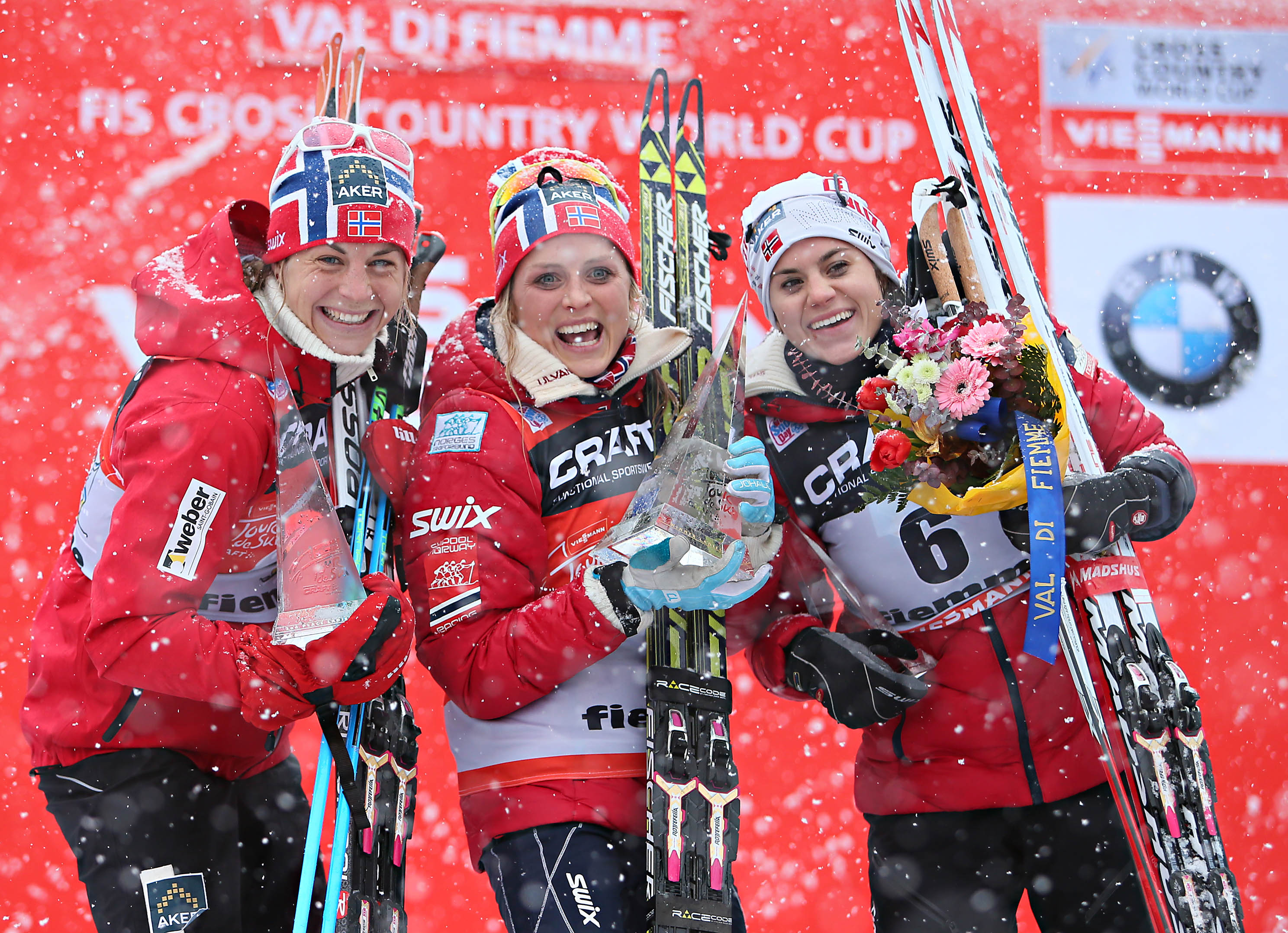
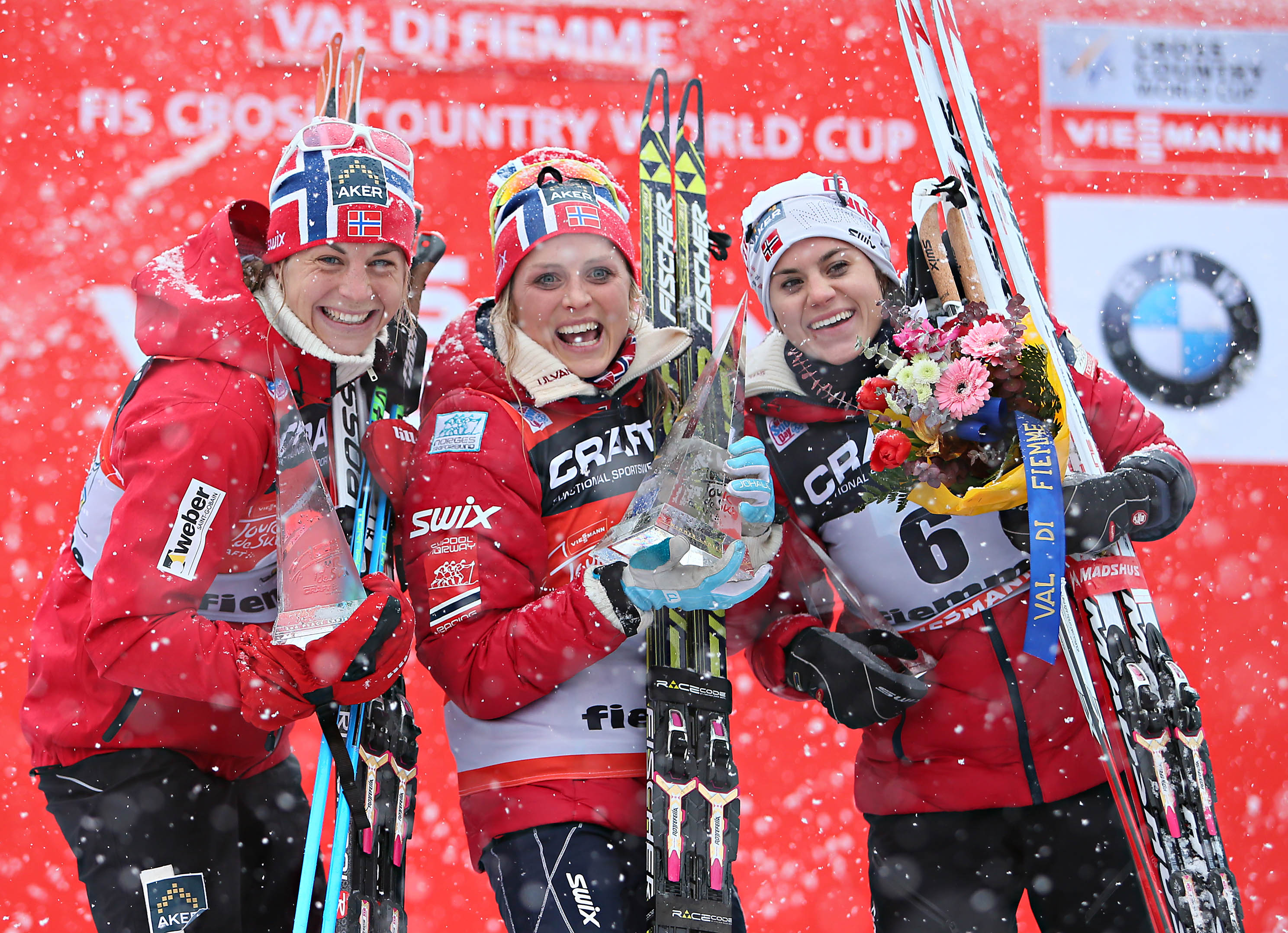
    Astrid Jacobsen, Therese Johaug and Heidi Weng (l-r) on the podium at the conclusion of the 2014 Tour de Ski. Photo: Fiemme Ski World Cup
    Astrid Jacobsen, Therese Johaug and Heidi Weng (l-r) on the podium at the conclusion of the 2014 Tour de Ski. Photo: Fiemme Ski World Cup

    Norway has suffered few droughts in the history of competitive cross-country ski racing, with periods of total dominance interrupted by slumps that would be the envy of most other nations.

    But over the course of the last decade, there has been one event where victory has eluded the sea of red that has ruled the major championships and regular season alike.

    No Norwegian had won the Tour de Ski, the grueling stage race modeled on the multi-day event popular in elite cycling, though there were plenty of close calls.

    In the seven years the event had run, Norway totaled 11 podium finishes and five sprint cup victories. Petter Northug finished second three times and Marit Bjørgen and Therese Johaug two each.

    That all changed on a sopping day on the Alpe Cermis, site of the renowned Final Climb. The Norwegian women, led by climber extraordinaire Johaug, swept the podium in definitive fashion.

    As expected Johaug overtook teammate Astrid Jacobsen on the three kilometer ascent, and skied away to a clear victory. Jacobsen maintained her lead on the rest of the field to take second, while 22-year-old Heidi Weng held off an impressive comeback by Finland’s Krista Lahteenmaki to round out the podium.

    Johaug became just the fourth woman to win the Tour in eight years, joining four-time defending champion Justyna Kowalczyk of Poland, two-time winner Virpi Kuitunen (FIN) and Sweden’s Charlotte Kalla.

    Jacobsen, a somewhat surprising force on the Tour this year, had planned to withdraw after four stages, but with a chance to win, and a podium spot firmly in grasp, she kept racing.

    She entered the final stage with a 23.8 second lead on Johaug, substantial, but in her mind, not enough. In the days leading up to the Final Climb she consistently pointed to Johaug as the favorite, a claim not based in false modesty.

    Entering this season, Johaug completed the Tour five times. Her first season in the event, 2008, she was fourth in the last stage before reeling off four consecutive Final Climb victories, often by a large margin.

    Jacobsen, a tall powerful skier, excels on more gradual terrain, and she left the start in a hurry, pushing through the earlier flats and descents. Johaug, however, kept pace, and while Jaccobsen did not falter on the hill, she was no match for the high tempo and light step of Johaug.

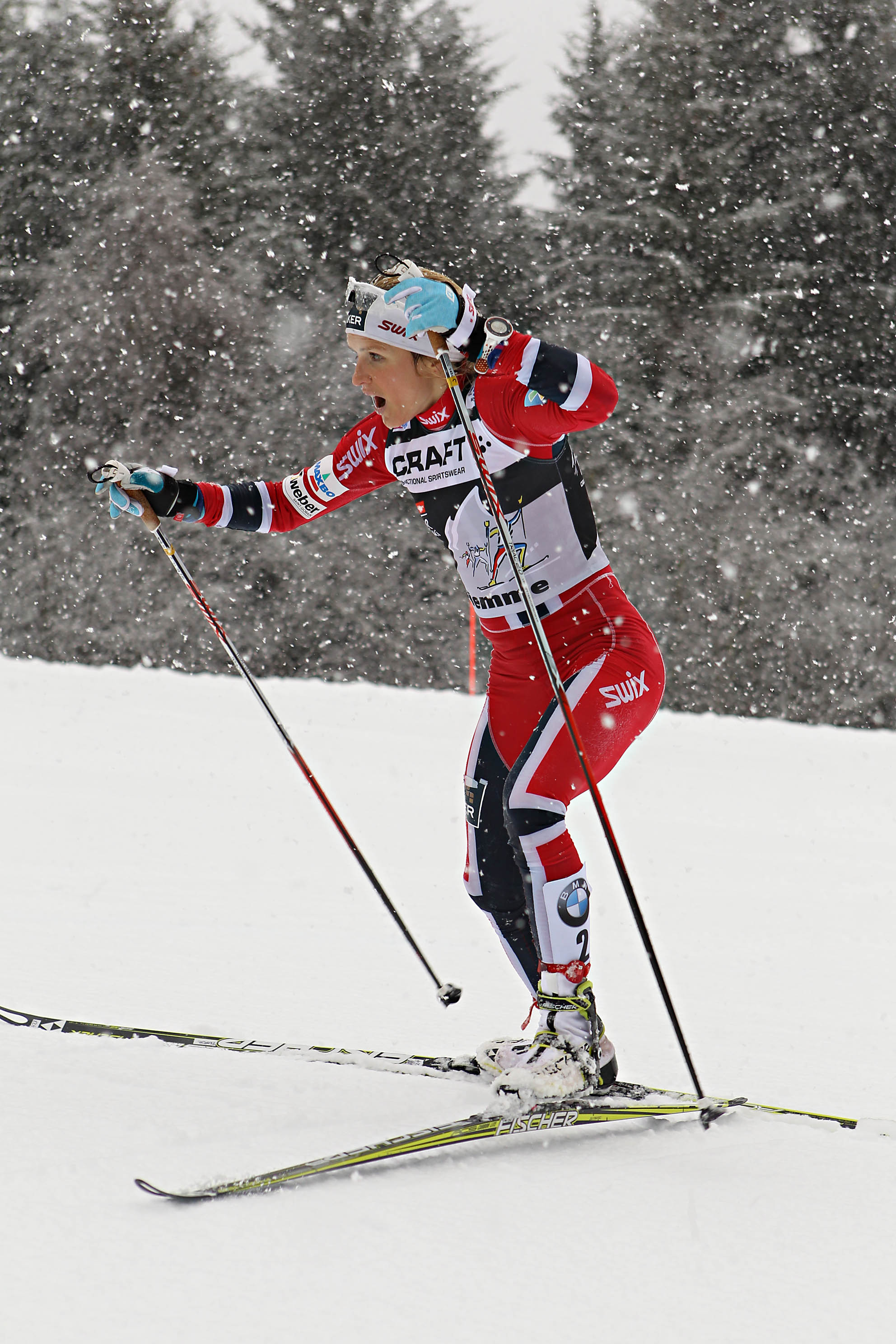
    Johaug climbing. Photo: Fiemme Ski World Cup
    Johaug climbing. Photo: Fiemme Ski World Cup

    Johaug came up from behind, and did not hesitate, moving right by her teammate, and immediately opening a gap on the 28 degree headwall half way up. With Jacobsen single-sticking and Johaug in a V1, the lead grew.

    Jacobsen said after the race that she was focused on her own race.

    “I knew Therese is a strong climber,” she told FIS News. “I skied my own speed. Therese passed me fast.”

    As the terrain became more skiable again, Jacobsen slowed the bleeding, but the damage was done. Johaug, not taking anything for granted, looked back several times, confirming her lead was secure.

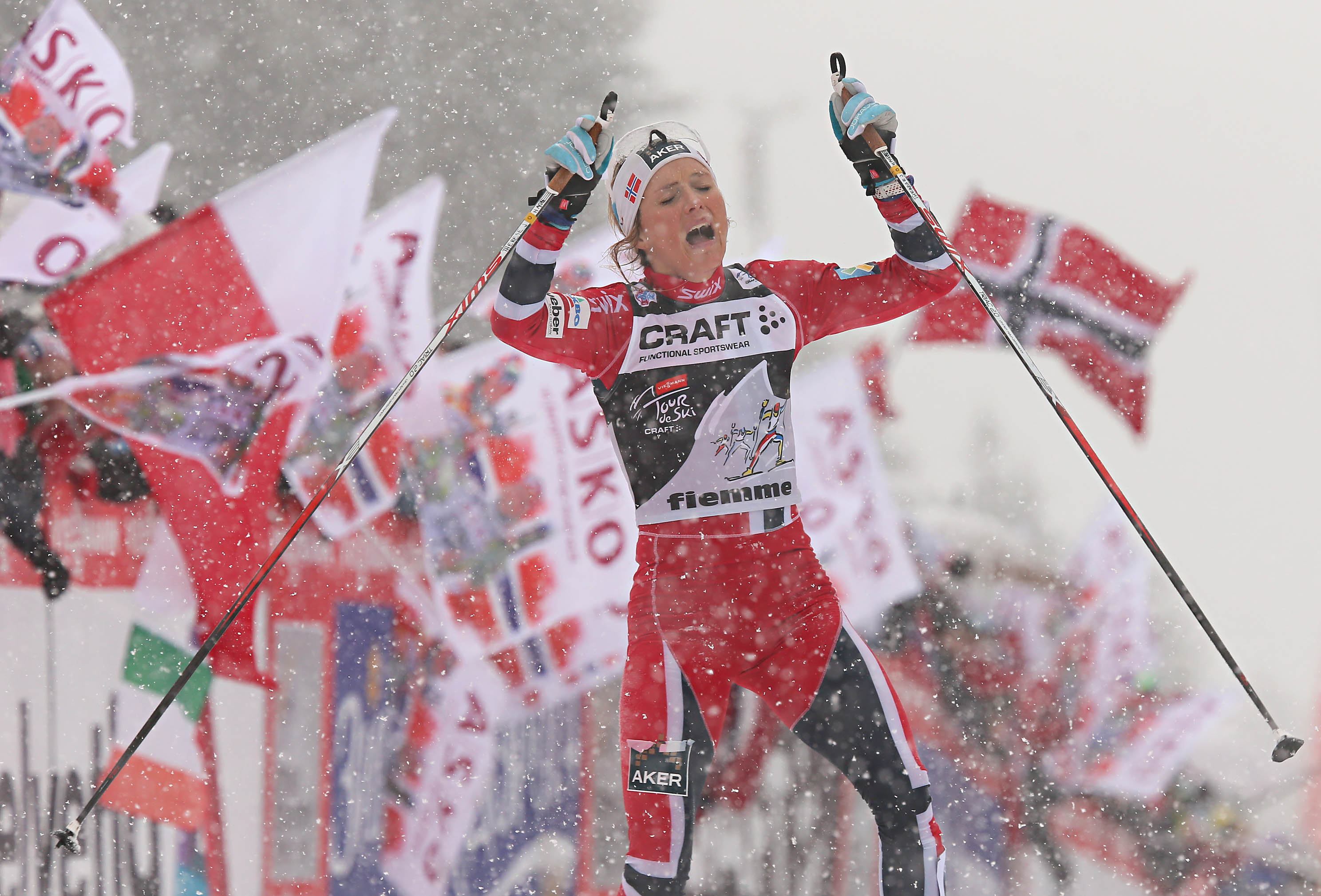
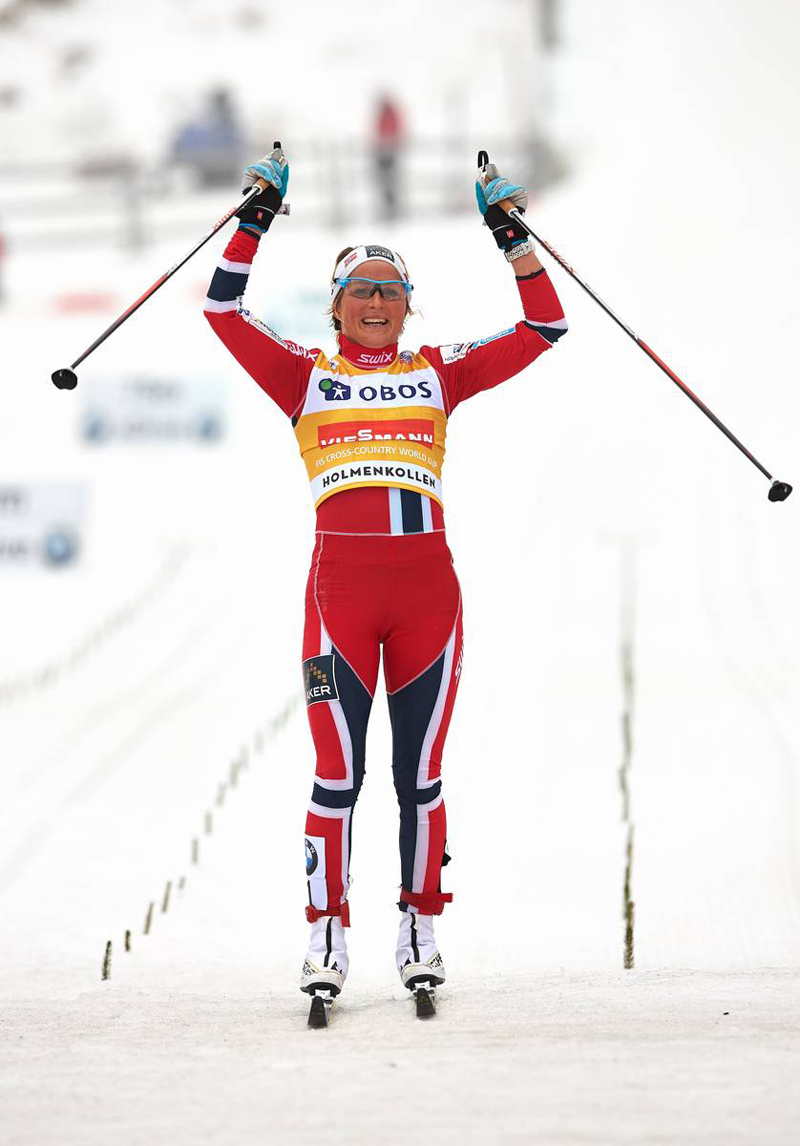
    She crossed the line with a pump of her arms and a yell, before collapsing into the new wet snow. Jacobsen followed 20 seconds later, falling into her own gasping heap.

    The pair had some time to recover before the rest of the field trudged into sight. Anne Kylloenen (FIN) started in third, +1:31.5, and lost ground from the start.

    Weng, in bib 6, quickly formed up with two more Finns, Lahteenmaki and Kerttu Niskanen, and set about hunting Kylloenen, the trio staying together into the climb.

    Niskanen was the first to drop, unable to manage the pace. Weng, doing most of the leading, pulled Lahteenmaki by Kylloenen, with the later looking exhausted.

    Racing in her second Tour, Weng appeared the more controlled, and when she pulled away from Lahteenmaki on the big switchbacks, it appeared the podium would be solid red.

    But the steep grade makes distance meaningless. Eight hundred meters straight uphill takes a long time, and with the focus on the top two, Lahteenmaki made one last charge, closing back up on Weng, catching her with just 65 meters to go. Sprint finishes are usual in the Tour, particularly for the podium, and they are always agonizing, the athletes trying to eke one last push out of exploding muscles and lungs.

    At the 50 meter mark, Lahteenmaki pulled alongside Weng, trying to gain the advantage, but the Norwegian had something in reserve, accelerating, and leaving Lahteenmaki meters back in fourth.

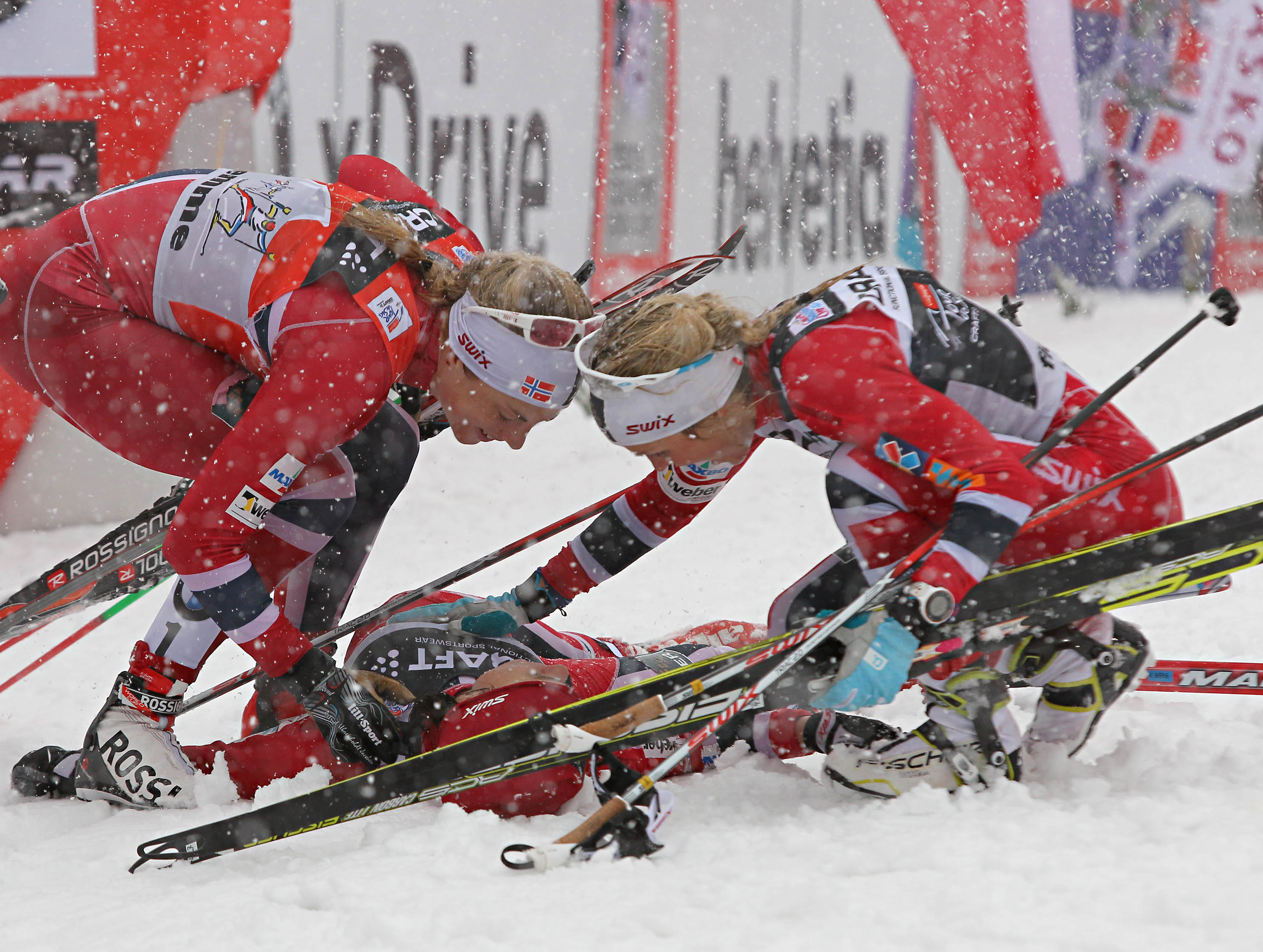
    Johaug and Jacobsen waited across the line cheering voraciously. As Weng collapsed in the snow, the top two fell on top of her, celebrating over their nearly comatose teammate, finally rising and high-fiving.

    Jacobsen and Johaug greet Weng at the finish. Photo: Fiemme Ski World Cup
    Jacobsen and Johaug greet Weng at the finish. Photo: Fiemme Ski World Cup

    The trio were the only Norwegians to finish the whole event, with star Marit Bjørgen dropping out due to illness, and last year’s bronze medalist, Kristin Stoermer Steira also withdrawing, with bronchial issues.

    Niskanen followed Lahteenmaki in fifth, and Kylloenen was sixth before American Liz Stephen broke up the Norwegian/Finnish parade.

    Johaug posted the fastest time of the day, 44.2 seconds ahead of Jacobsen. Stephen was third best, another 14.5 back, followed by Weng.

    “It’s a dream come true for me,” Johaug told FIS News after the race. “It is amazing to become the first Norwegian to win the Tour, and even better when Astrid and Heidi could join me on the podium.”

    Heavy rain turning to wet snow made for soft, slow conditions, and perhaps the toughest Final Climb ever. Norwegian coach Egil Kriastensen describes the snow as “like glue” to Norwegian broadcaster NRK.

    “There are many thoughts through your head when you pass the finish line,” Johaug told NRK. You are quite tired, and many of the thoughts turn to how much I have sacrificed…Now it’s absolutely worth it.”

    Johaug with little energy left for celebration. Photo: Fiemme Ski World Cup
    Johaug with little energy left for celebration. Photo: Fiemme Ski World Cup

    Jacobsen was also thrilled with her performance.

    “I have good reason to be proud. I’m number two behind Therese. Who’d have thought it?” she said to NRK.

    Jacobsen won the World Championship sprint in 2007 in Sapporo, Japan, but while she has turned in plenty of strong results, her career has been interrupted by a combination of illness and serious injury.

    The young Weng has plenty to look forward to, and is ready to head home to start recovery.

    She described the experience as “almost like World Championships” last year in Val di Fiemme, where she took bronze in the skiathlon and was a member of the gold medal winning relay team.

    “Now I will go home and eat everything I come across,” Weng told NRK.

    Of Note:

    – Maako Ishida (JPN), usually a force in classic, was fifth fastest on the day

    – Eva Vrabcova-Nyvltova (CZE) was a surprising eighth overall. The 27-year-old has never stood on a World Cup podium and has just six top-10 results in her career, two of which came in this Tour.

    – Twenty-year-old Julia Svan, daughter of the great Swedish skier Gunde Svan, placed 41st out of 42 skiers.

    – Overall 38 skiers withdrew from the Tour, including Kowalczyk and Anastasia Slonova (KAZ) both of whom did not start the first stage.

    – Kowalczyk did not start in protest of the format, particularly the number of skate events.

    – Valentina Schevchenko (UKR) completed her eighth Tour at age 38. She is the only person to ski every Tour de Ski. She finished 14th. Schevchenko was third in the inaugural Tour back in 2007.

    – Jacobsen won the Sprint Cup for best Tour sprinter. The ranking combines the sprint races with additional sprint bonuses from distance races. She was the first Norwegian woman to win the Cup. Ingvild Flugstad Oestberg was second and Johaug third.

    – Johaug helped herself with continued improved sprinting. She set a career-best Tour sprint mark by placing 7th in Oberhof, Germany and was 24th in Lenzerheide, Switzerland, picking up valuable bonus seconds.

    Results

    Time of Day (PDF)

    Final Tour de Ski Standings 

  • Harvey, Kershaw End Tour on Opposite Notes, Babikov Last Canadian Standing

    Harvey, Kershaw End Tour on Opposite Notes, Babikov Last Canadian Standing

    Alex Harvey can walk away from the 2014 Tour de Ski with his head held high. After finishing fifth in the 10 k individual classic on Saturday, Harvey ranked fourth in the overall Tour standings.

    Harvey suffers from an issue with his legs that makes skating up steep hills for an extended period of time both painful and debilitating. As such, he will not start the Final Climb on Sunday.

    “The leg feels 100% now, but its when I go on steep uphills like that it gets pretty bad,” Harvey told FasterSkier. “Kind of like last year heading into the Tour I knew I wasn’t going to finish. I know I am probably never going to finish the Tour de Ski ever again in my life. It’s not that hard of a decision for me. Even though I am in a good position, I just know that is not good for me to go up that hill with the condition I have.”

    “Our focus the whole year has been the Olympics and we don’t want to lose sight of that even though Alex has had an amazing Tour,” Canadian National Team Head Coach Justin Wadsworth said on a conference call.

    Harvey strides out en route to a fifth place finish in the 10 k classic. Photo: Fischer / Nordic Focus.
    Harvey strides out en route to a fifth place finish in the 10 k classic. Photo: Fischer / Nordic Focus.

    Wadsworth had no doubt that it is the right decision, and is pleased with how the Tour has gone for the team. But he said that for Harvey and Devon Kershaw, “it is time to recover and prepare for the Olympics.”

    Kershaw struggled in the 10 k, placing 52nd in the 63-skier field, just over two minutes behind winner Petter Northug of Norway.

    He has had an up-and-down Tour, kicking off the seven stage event by combining with Harvey to finish first and second in the opening prologue. But he has been unable to find consistency, and Wadsworth said Olympic preparation trumps any desire to finish off the Tour.

    Harvey ends his run with three podium finishes and two more results in the top-11. His only poor finish was a 40th in the mass start, a performance he attributed in large part to poor skis.

    He skied an even race, ranking fifth at each check point and ultimately finished 35.5 seconds behind Northug and just 2.5 seconds ahead of sixth place finisher Hannes Dotzler of Germany.

    The lone Canadian who will tackle the Alpe Cermis, Ivan Babikov, finished 27th, +1:17.1.

    The result left him in 21st overall, just over a minute out of the top-15.

    “Ivan is in good shape,” Wadsworth said. “He has had a couple of solid classic races and he heads into tomorrow in good position.”

    Babikov, an excellent skater and one of the premier hill climbers in the world, has won the Tour de Ski Final Climb in the past, and will be on course with the support of his teammates, who will cheer him to the summit.

    “We are really excited for Ivan. It is still a day tomorrow where we could get another podium,” Wadsworth said.

     — Matt Voisin contributed reporting


  • Norway Sweeps Men’s Podium, Solidifies Tour Rankings

    Norway Sweeps Men’s Podium, Solidifies Tour Rankings

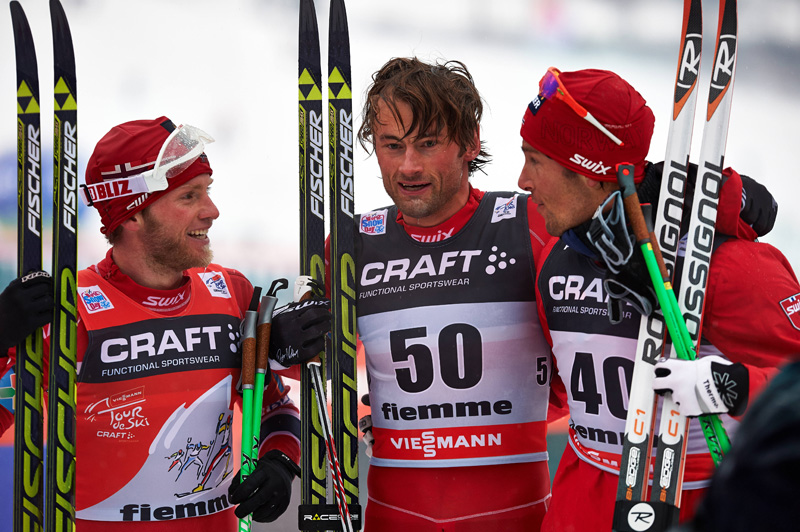
    Northug (bib 50) is congratulated by teammates Martin Johnsrud Sundby (left) and Chris Jespersen (right) after the trio swept the podium in the 10 k classic race at the 2014 Tour de Ski. Photo: Fischer / Nordic Focus.
    Northug (center) is congratulated by teammates Martin Johnsrud Sundby (left) and Chris Jespersen (right) after the trio swept the podium in the 10 k classic race at the 2014 Tour de Ski. Photo: Fischer / Nordic Focus.

    Total dominance in a race has been the purview of the Norwegian women over the past several years, with the team running away with the Nations Cup title, and packing the top-10, particularly in distance skate races. But in a performance reminiscent of classic races in the early 2000’s the men’s squad captured the top four places in the penultimate stage of the 2014 Tour de Ski, demonstrating they can hold their own with their female counterparts.

    Overall five Norwegians cracked the top-7 in the 10 k individual classic event.

    Tour leader Martin Johnsrud Sundby maintained his hold on the overall lead, but it was teammate Petter Northug who took the win, 9.7 seconds ahead of Sundby.

    The win was Northug’s first of a tough season. The Norwegian star has started slowly, racing into top form as he looks to bounce back from illness that set back his training in the fall.

    Over the first months of the season, Northug has steadily crept up the result sheet, and showed a flash of his old self in Friday’s pursuit, breaking out his trademark sprint finish to win the race for second over the chase pack.

    But until today, Sundby has dominated the headlines, winning the season opening Kuusamo mini-tour and consistently placing in the top-10 through the early part of the season.

    Northug striding to victory in Val di Fiemme. Photo: Fischer / Nordic Focus.
    Northug striding to victory in Val di Fiemme. Photo: Fischer / Nordic Focus.

    Northug started uncharacteristically fast, passing the 1.3k mark in second, a mere .3 seconds ahead of Sundby. Five kilometers later he had opened up a gap he would not relinquish, overtaking first starter and early leader Stanislav Volzhentsev of Russia for a 10 second lead.

    Volzhentsev could not maintain his quick start, slipping down to 12th at the finish.

    Sundby and eventual third place finisher Chris Jespersen flipped spots over the last four kilometers. Between 6.3 and 8.3 k, Sundby picked up 5.1 seconds on Jespersen, a lead he extended slightly before the finish.

    Jespersen crossed an even 16 seconds behind Northug with Sjur Røthe another 13 seconds back in fourth.

    A frequent member of the Norwegian relay team, Røthe has been relatively quiet this year, cracking the top-10 for the first time earlier this week in the 15 k mass start in Lenzerheide, Switzerland.

    Canadian Alex Harvey continued his strong Tour, placing fifth in what will be his final race of the event. Harvey has announced he will not start the Final Climb on Sunday.

    Sundby told FIS News after the race that he felt tired following the 35 k pursuit on Friday.

    “I have to recover well today and get ready for the Final Climb. It will be a pure pain,” Sundby said.

    Waxing was challenging with warm temperatures leaving a choice between n0-wax “hairies” and klister. According to Harvey there was a mix of both in the race, even on the Norwegian team.

    No Norwegian has ever won the Tour de Ski, but with the women currently holding the top two spots and the men the first three, with Sundby, Northug and Jespersen, the odds are good that will change this year.

    Sundby, exhausted at the finish. Photo: Fischer / Nordic Focus.
    Sundby, exhausted at the finish. Photo: Fischer / Nordic Focus.

    Sundby will start 48.5 seconds ahead of Northug, who has struggled on the Final Climb in recent years. But  he told Norwegian Broadcaster NRK that he has been feeling better as the Tour has progressed, a change from the recent past.

    He looks to match his 2011 performance — he posted the fifth best time up the Alpe Cermis that year.

    “I am happy with my fitness. I am getting stronger with each competition,” Northug told FIS news. Regardless, he says he does not think he can catch Sundby, though he told NRK that he is lighter than in past years, a fact he sees as a significant benefit on the brutal climb.

    Jespersen will start 1:26.8 behind Sundby, and with Harvey, who sits in fourth overall, withdrawing, the surprising Johannes Duerr of Austria will lead the chase pack at two minutes back.

    He will head out with Swede Calle Halfvarsson and Russian Ilia Chernousov just behind. Defending Tour Chanpion Alexander Legkov starts in eighth, +2:21.3

    Overall, Norway enters the last day of the Tour with six of the top-12 spots.

    Of Note:

    – Northug has jokingly called himself “fat” in the past when explaining his poor performances in the Final Climb.

    – The 26-year-old Duerr had never cracked the top-30 in a World CUp race prior to last season. He placed 24th in the 2013 Tour, and has been on a steady ascent ever since.

    – The seemingly ageless Sergei Dolidoich of Belarus, a solid 40-years-old, was 13th and is 37th overall

    – Sundby has only started a single non-stage World Cup sprint, the Davos freestyle event in December. He placed 48th. In the 13 sprints he had started prior to this Tour, Sundby qualified for the heats five times, never advancing out of the quarterfinals. He placed third in both 2014 Tour de Ski sprints.

    – The youngest skier in the race, Gustav Eriksson (SWE) at 22-years-old, placed 50th.

    – China took three of the last four spots, with only Robin Duvillard of France breaking up the trio in third-to-last.

    Results

    Overall Tour Standings


  • Harvey Back on the Podium in Tour Pursuit

    Harvey Back on the Podium in Tour Pursuit

    Alex Harvey (CAN) takes a pull at the front of the chase pack during the 35 k pursuit.  Photo: Fischer / Nordic Focus.
    Alex Harvey (CAN) takes a pull at the front of the chase pack during the 35 k pursuit. Photo: Fischer / Nordic Focus.

    Canadian Alex Harvey skied back onto the Tour de Ski podium, finishing third in the 35 k freestyle pursuit, his third podium of the seven stage event.

    In a post-race phone call, Harvey said he woke up feeling good, always a positive sign in a stage race.
    “I was pretty  happy to feel that my legs were pretty light in the warmup,” he said.
    Starting in bib 3, Harvey maintained position, skiing with the main pack. The group was unable to close on eventual winner Martin Johnsrud Sundby of Norway, and numbered seven for the final sprint.
    Harvey lost out only to Peter Northug (NOR) in the chase pack, edging Swede Calle Halfvarsson and defending Tour champion Alexander Legkov of Russia.
    The course winds gradually up for the first 12 kilometers, and Harvey said the pace was not overly taxing.
    Last year Legkov attacked hard on that same section of the course, but Harvey said the Russian was “not as much of a beast” this time around.
    With no one pushing, Harvey even took a turn at the front, unusual he explained because “I feel like in climbing that I’m not as strong as these guys, but the pace was just that slow.”
    Alex Harvey (CAN), Alexander Legkov (RUS), Johannes Duerr (AUT), Chris Jespersen (SWE), (l-r) share the load behind Martin Johnsrud Sundby (NOR).  Photo: Fischer / Nordic Focus.
    Alex Harvey (CAN), Alexander Legkov (RUS), Johannes Duerr (AUT), Chris Jespersen (SWE), (l-r) share the load behind Martin Johnsrud Sundby (NOR). Photo: Fischer / Nordic Focus.

    Harvey was especially pleased as he has not skied well in this stage the past several years. He entered the day aiming to stay with the chase pack over the crest of the climb and into the gradual descent.

    “The goal was to stay in the top group and fight for the podium at the end,” Harvey said. “Looking at my last two years, I was starting with the similar group but then getting popped two-thirds of the way and ending in a group fighting for sixth or seventh place.”
    Harvey described the finish as “a bit messy” despite featuring only seven skiers.
    With the likes of Legkov and Austrian Johannes Duerr, who posted the fastest time of the day, there were several non-sprinters gunning for the podium.
    Harvey described those two as specifically being “all over the place” at the end.
    “He [Duerr] was kind of switching from left to right lane with 500 meters to go … I was just following Petter … but I just smashed his pole.  I got a bit out of position, but I was able to generate some speed out of the final corner.”
    He got by Halfvarsson and one other skier whom he couldn’t identify in the final 200 meters, leaving only Northug.
    “Petter had his usual finish and I just couldn’t quite match that, but I was happy,” Harvey said.
    “We are happy with where the guys are at and to have Alex on the podium again,” Canadian Head Coach Justin Wadsworth said in a Cross-Country Canada press release. I think he did a great job conserving energy for the final weekend, whereas Sundby worked pretty hard on his own today so it will be interesting to see what he has tomorrow.”
    Harvey will race Saturday’s individual 10 k classic, but at this point he is not planning on tackling the Final Climb up the Alpe Cermis. Suffering from a chronic leg issue that is exacerbated by extended steep climbing, Harvey has struggled mightily on the ascent up the alpine slope.
    — Katie Bono contributed reporting
  • Babikov Foiled by Broken Pole, Kershaw Slips in Standings

    After breaking a pole early in the 35 k Cortina to Toblach pursuit, Canadian Ivan Babikov was still able to move up the rankings in the Tour de Ski.

    Babikov broke the pole just a kilometer into the race, and was forced to ski a solid 4 k before picking up a replacement from a Swedish technician at the first aid station.

    In most World Cup races, held on relatively short loops close to the stadium, a broken pole is usually replaced in seconds. The Cortina to Tobalch race is unique, and skiers head out into the woods, all alone for kilometers at a time.

    Babikov told FasterSkier that his goal was to pick off as many spots as possible as he gears up for the Final Climb. He was feeling good, but ended up by himself on a gradual course that favors pack skiing.

    He still moved up four places, climbing from 32nd to 28th in the overall standings, helped in large part by a dozen skiers dropping from the Tour prior to the race.

    “Ivan skied a really strong race after having some bad luck breaking his pole one kilometer in the race at a spot that is difficult to get too,” Canadian Head Coach Justin Wadsworth said in a Cross-Country Canada press release.

    One of the best climbers on the circuit, Babikov has won the Final Climb once before, and placed seventh in the overall Tour last season. The top-20 is just seconds away, and the top-10 not outside the realm of possibility.

    Sounding discouraged after the race, Babikov said of his race, “I had way more than that today.”

    He is 3:21.3 behind overall leader and today’s winner, Martin Johnsrud Sundby of Norway, and sits less than two seconds out of twentieth, and 1:10.7 out of tenth.

    Devon Kershaw continued an up-and-down Tour, posting the 34th fastest time of the day while losing just a single place in the overall standings. He now sits in 23rd overall.

    Kershaw finished fourth in the Tour in 2012, but at 3:20.3 back from leader Martin Johnsrud Sundby of Norway, he will be hard pressed to match that.

    — Katie Bono contribute reporting

  • Stephen Leads U.S. in Tour Mass Start

    Stephen Leads U.S. in Tour Mass Start

    Following on the heels of stellar sprint day, the U.S. Ski Team managed to place a single skier in the top-30 as the Tour de Ski continued in Lenzerheide, Switzerland.

    Liz Stephen led the way in the women’s 10 k classic mass start, placing 26th, 54.6 seconds behind winner Kerttu Niskanen of Finland.

    Seeded based on the Tour standings, Stephen started in the middle of the pack with bib 37. She described the start as “chaotic” especially with the first kilometer covering the previous day’s sprint course.

    Liz Stephen (U.S. Ski Team) on her way to 34th in Saturday's 3 k freestyle prologue at the first stage of the Tour de Ski in Oberhof, Germany. (Photo: Marcel Hilger)
    Liz Stephen (U.S. Ski Team) on her way to 34th in Saturday’s 3 k freestyle prologue at the first stage of the Tour de Ski in Oberhof, Germany. (Photo: Marcel Hilger)

    “With 75 girls all on classic skis and bunched together as it was only one minute into the race it made for an exciting and slightly sketchy situation right off the bat,” Stephen wrote in an email to FasterSkier. “Luckily there were no crashes that I saw, though one very close call which would have taken out more than half the field had it all played out.”

    Stephen wrote that she was gunning for the top-10, but with the altitude of the Swiss venue, she knew she had to be patient, skiing “relaxed and strong,” until “dropping the hammer” with a lap to go.

    While she didn’t make it up to the top-10, she was pleased with her race. Her goals entering the day were to crack the top-30, and put herself in better position prior to the Toblach pursuit.

    “I feel really good about the outcome as I accomplished both of those things and will have some great people to ski with on Friday,” Stephen wrote.

    Teammates Jessie Diggins and Sophie Caldwell were not far behind in 32nd and 33rd respectively. The pair finished just under a minute-and-a-half off the lead.

    Diggins, a stronger skater, was 7.4 seconds out of the points, with Caldwell another 4.7 back.

    The result was a career-best for Caldwell in a World Cup distance race. She will drop out of the Tour ranked 16th overall, leading the U.S. women.

    Holly Brooks rounded out the squad in 50th.

    On the men’s side, Noah Hoffman led the way in 55th, 1:18.8 seconds behind winner Alexey Poltaranin of Kazakhstan.

    Hoffman, starting with bib 89, advanced through the pack, moving up consistently throughout the race.

    Andy Newell, and Tuesday’s sprint winner, Simi Hamilton, placed 68th and 74th respectively.

    Newell wrote to FasterSkier in an email that he has been hoping to battle for the points, but faded at the end, and dropped significant time.

    He began the day in 6th overall, and had a good position at the front of the pack.

    “I don’t mind starting out front, if anything it’s nice to get out near the leaders and stay out of trouble,” Newell wrote. “Typically with mass start races I just try to ski with the leaders and stay relaxed, which is what I tried to do today.”

    Simi Hamilton (U.S. Ski Team) leads his quarterfinal in the third stage of the Tour de Ski. (Photo: Fischer/Nordic Focus)
    Simi Hamilton (U.S. Ski Team) leads his quarterfinal in the third stage of the Tour de Ski. (Photo: Fischer/Nordic Focus)

    But after the second of two intermediate bonus sprints the pace started to feel “a bit fast,” and he dropped off the main pack.

    “Starting my last lap I had a hard time skiing with some of the people that were skiing through me. Even when the Hoff [Hoffman] passed me I should have tried to ski with him ,but was already shutting it down by then … I needed a bit of a rest. So it wasn’t a great day for me,” he concluded.

    Like Caldwell, and Hamilton, Newell’s Tour has now come to an end. This was the plan all along, regardless of performance.

    Hamilton, who has never cracked the top-30 in a World Cup distance race, struggled to find his rhythm after what he described as a “freak crash” just 5 k into the 15 k event.

    “My body just tensed up and I couldn’t get back into that relaxed classic feeling that is necessary to ski those 15 k’s with. In the end, I felt like I had a good last lap and it was just nice to get out there for another distance start without much pressure,” Hamilton wrote in an email.

    Hamilton fell when he got squeezed on a sharp turn into the steepest climb on the course.

    “I had a middle line in the very center of the big pack,” he explained. “I got pinched in tight and both of my skis got stepped on simultaneously as I was cornering which ended up with me face first in the track.”

    The combination of the adrenaline from his victory, and a fireworks show lasting until 2 AM near the team’s lodging left Hamilton under-rested. Yet he was still ready to go.

    “I woke up this morning with a huge smile on my face because I realized what I had accomplished yesterday and it was basically the best feeling in the world,” Hamilton wrote. “I had a great feeling going into the 15 k today, but I think my body was a little bit on the tired side, and I didn’t ski the race like I envisioned it going.”

    Those athletes not continuing with the Tour headed to Davos, Switzerland for recovery and training prior to the next World Cup weekend in Nove Mesto, Czech Republic.

    Tour de Ski racing continues on Friday with 15 k freestyle pursuit for the women, and the Cortina to Toblach 35 k pursuit for the men.

     — Alex Matthews contributed reporting

  • Poltaranin Climbs Tour Standings with Mass Start Victory

     Alexey Poltaranin (KAZ) finishes for the win in Lenzerheide, Switzerland. Photo: Fischer/NordicFocus

    Kazakhstan’s Alexey Poltaranin used a powerful kick to claim victory in the fourth stage of the 2014 Tour de Ski, sprinting away from a surprising Hannes Dotzler of Germany.

    Russian Stanilav Volzhentsev was third in the 15 k classic mass start event, besting another German, Thomas Bing, in a photo finish.

    Despite temperatures rising above freezing, tracks remained firm on the Lenzerheide, Switzerland course. Skiers lined up for the four lap race seeded by the current Tour standings, with Canadian Alex Harvey in the pole position.

    Despite an early move by Norwegian Didrik Tonseth, resulting in a five second gap, there was little excitement over the first two-thirds of the race. As expected the pack stayed large, stringing out on the climbs and compressing on the descents.

    Approaching the first of two intermediate bonus sprints, Martin Johsnrud Sundby (NOR) accelerated up the gradual climb, just a half pace in front of defending Tour champion Alexander Legkov (RUS).

    Sundby leads early in the race. Photo: Fischer/NordicFocus
    Sundby leads early in the race. Photo: Fischer/NordicFocus

    The two skied clear and Legkov surprisingly did not challenge Sundby for the top spot. There was little concern for the remaining bonuses as the field streamed thorughwith no one working to pick up extra seconds.

    Sundby, Legkov, and Ilya Chernousov (RUS) opened a small gap after the bonus, but did not attempt to extend.

    The first legitimate attack came from the 2011 World Champion in the 15 k classic, Matti Heikinen of Finland.

    Heikkinen, who worked his way up from his start position in bib 60, pushed hard over the crest of a large climb just before the 9 k mark. He earned a small gap, and maintained pressure on the next climb, but Legkov led the pack back up in time for the second and final bonus sprint.

    Sundby was again the most willing to expend energy, and use a late charge to slip across first, just ahead of teammates Toenseth and Peter Northug, leaving Legkov in 4th.

    Heikkinen cruised through in fifth and did not wait long to resume his attack. He met with greater success initially, pulling away from the field, and opening up up a nearly ten second lead. Bing, of Germany, bridged up, and took his own turn at the front. At 11.5 k the pair held a doomed six second lead.

    The Finn battled valiantly, continuing to push over the top of of one of the long climbs despite having the field right back on his heels. His chance was shot, however, and skiers looked to setup for the final push with under two kilometers to go.

    Poltaranin had remained quiet in the middle of the pack for most of the race, ignoring the bonus seconds, and making no effort to ski at the front. But as the race entered the the closing stages, he cooly worked up to the front.

    Volzhentsev led into the final hill with Poltaranin a few meters back in second. The Kazakh climbed back on, and the two upped the pace.

    Poltaranin navigating a corner on his way to the win. Photo: Fischer/NordicFocus
    Poltaranin navigating a corner on his way to the win. Photo: Fischer/NordicFocus

    Dotzler put on a burst of his own, working to close up into the descent. The trio led down toward the stadium, with a strung out pack picking seconds back up.

    Running fast skis, Poltaranin had the first step into the stadium, his five meter lead good enough for the win. Doetzler held on for second while Volentzhev mad a furious double pole charge past a resurgent Bing to round out the podium.

    Poltaranin claimed his first win of the season, pleased with a strategy the left him strength for the final sprint.

    Despsite crossing back in 14th, Sundby took over the overall lead, moving 31.7 seconds ahead of Calle Halfvarsson of Sweden.

    “The most important goal today was to keep Legkov and Halfvarsson behind me,” Sundby told FIS News after the race.

    He added that the Norwegian squad worked together as a team, communicating during the race with usual star Northug being particularly helpful.

    After a day off on Thursday, the Tour will resume in Italy with the traditional Cortina to Toblach 35 k freestyle pursuit.

    Results

    Tour Standings

    Men's podium - Volzhentsev, Poltaranin, Dotzler. Photo: Fischer/NordicFocus
    Men’s podium – Volzhentsev, Poltaranin, Dotzler. Photo: Fischer/NordicFocus


  • Kowalczyk Continues Classic Dominance in Italy

    Kowalczyk Continues Classic Dominance in Italy

    Justyna Kowalczyk (POL) celebrates her victory in the Asiago, Italy city sprint Photo: Fischer/Nordic Focus
    Justyna Kowalczyk (POL) celebrates her victory in the Asiago, Italy city sprint Photo: Fischer/Nordic Focus

    Poland’s Justyna Kowalczyk remained unbeaten in the classic technique this season, skiing to an uncontested win in the World Cup sprint in Asiago, Italy.

    Anne Kyllönen of Finland finished second with Norwegian Maiken Caspersen Falla in third.

    The day, however, was all about Kowalczyk. She qualified second, and was never seriously threatened as she romped through the heats.

    Through four classic races, including two sprints, Kowalczyk remains unbeaten and is showing top form early in the season.

    The defending World Cup overall champion, Kowalczyk has traditionally started the season slowly, training hard into the early part of the competition schedule. Thus far, however, she has held nothing back, and is establishing herself as the favorite in the classic events entering the Olympics.

    After Katja Visnar of Slovenia skied a faster qualification, Kowalczyk served notice in the first quarterfinal that she would be taking no prisoners.

    Anne Kyllönen (FIN) crosses the line in second. Photo: Fischer/Nordic Focus
    Anne Kyllönen (FIN) crosses the line in second. Photo: Fischer/Nordic Focus

    German Hanna Kolb tried her best to hang with the Pole on the first climb, but by the top had succumbed to the furious pace and dropped back to the pack. On the gradual terrain, a resurgent Aino Kaisa Saarinen of Finland pulled the group back up, but Kowalczyk easily accelerated away in the homestretch.

    The semis were similar, with another German attempting to keep pace. Denise Herrmann, off to a strong start this season, tailed Kowalczyk, along with Norway’s Kari Vikhagen Gjeitnes.

    Kowalczyk was unable to get free, but was clearly in command at the front. She pulled away in the homestretch, leaving Gjeitnes in second and Herrmann content to advance to the finals as a lucky loser.

    Falla won her quarterfinal going away while Kyllönen duked it out with Britta Norgren Johansson of Sweden.

    Norgren Johansson was one of just several women to double pole the course on skate skis. The strategy worked initially as she edged out Kyllönen.

    The two matched up again in the semis, this time with Falla as well. Visnar, who had also double poled the quarterfinals, was on classic gear, but struggled to maintain the pace and was quickly off the back.

    Falla took the lead early and set a fast pace with Kyllönen on her heels. The pair pulled away from the field while Norgren Johansson looked to make up ground. She had dropped back on the early climbs, but as the terrain flattened, her superior ski speed came into play, and by the homestretch she had closed up on Switzerland Laurien Van der Graaff, powering by to take third, and a lucky loser spot in the last round.

    The top-3 in Asiago. Photo: Fischer/Nordic Focus
    The top-3 in Asiago. Photo: Fischer/Nordic Focus

    The finals featured little drama. Falla and Kyllönen tried to change things up, breaking in front early and leaving Kowalczyk in third. The pace was furious, but the pair couldn’t create space, and Kowalzcyk took the lead by the end of the first climb.

    The Norwegian and Finn battled gamely, maintaining contact with the unstoppable force that was Kowalzcyk, but had little hope of overcoming her.

    By the end Kowalczyk was well clear in first, Kyllönen by herself in second, and Falla alone in third.

    Norgren Johansson doubled poled again, powering to fourth place ahead of Herrmann and Gjeitnes.

    Falla, who finished in the top-6 in the Sprint Cup standings the last three years, earned her first podium of the season. Kyllönen also stepped on the podium for the first time in 2014.

    Kowalczyk took over the red Sprint Cup leaders bib from American Kikkan Randall. Randall was eliminated in the quarterfinals and placed twentieth. Kowalczyk leads the sprint rankings with 156 points, eight points ahead of Herrmann and 19 in front of Randall.

    Kowalcyk still trails Marit Bjørgen (NOR) by 125 points in the overall World Cup. Bjørgen is skipping the sprint weekend in Italy.

    Of Note:

    – Norway qualified six women for the heats. The United States and Sweden both advanced four.

    – Eight nations were represented in the top 12.

    – Caspersen Falla was given a written reprimand for not following the marked course in her quarterfinal.

    – Gaia Vuerich was the only Italian to make the heats. She finished 27th.

    – Aino Kaisa Saarinin (FIN) finished eighth, matching her season best result. She has not finished with a better place since last year’s Tour de Ski.

    Results

  • Defending Olympic Champ Kriukov Holds off Poltaranin for Classic Sprint Victory

    Defending Olympic Champ Kriukov Holds off Poltaranin for Classic Sprint Victory

    NIkita Kriukov (RUS) edges Alexey Poltaranin (KAZ) for the victory in the classic sprint in Asiago, Italy. Photo: Fischer/Nordic Focus
    NIkita Kriukov (RUS) edges Alexey Poltaranin (KAZ) for the victory in the classic sprint in Asiago, Italy. Photo: Fischer/Nordic Focus

    Showing strong form as World Cup period I winds down, Russian Nikita Kriukov held off Kazakh Alexey Poltaranin at the line to take the win on a soft and slow course in Asiago, Italy.

    Kriukov, who won the freestyle sprint at the 2010 Olympics in Vancouver, Canada, qualified in seventh in today’s classic event, and looked strong throughout the day on a twisting course in the Italian Alps.

    He overcame a late move by Poltartanin, who briefly took the lead entering the homestretch, and earned his fourth World Cup victory, all in classic sprints.

    Switzerland’s Gianlucca Cologna, the younger brother of injured superstar Dario, made his first World Cup podium appearance in his twelfth start at the highest level.

    The loop, which took the men well over four minutes, featured several long gradual climbs, but not enough elevation to deter most of the men from double poling on skate skis.

    Just one, Federico Pellegrino, racing for the host nation, kicked on classic gear, albeit with little success. He was never in the running in his quarterfinal, unable to make up enough ground on the steeper climbs.

    The Asiago course, a thin ribbon of snow, winding through small sections of woods and open terrain on an Italian golf course, featured stunning vistas of the surrounding mountains. The athletes, of course, had no time to admire the view.

    Despite the lack of steeper hills, there was plenty of terrain, and a number of technical corners, including a big sweeping left hander that claimed American Andy Newell in the quarters.

    The extended gradual climbs, soft snow and relatively long sprint distance made for a challenging race.

    Skiers took different approaches, with some attempting to break off the front early and hold a gap, while others were more content to follow. There was no consistent pattern, with a mix of heats breaking apart and others closely contested.

    Kriukov advanced out of his quarter, finishing second to Norwegian classic specialist Eldar Rønning, and ahead of teammate Alexey Petukhov.

    Petukhov led early in the heat, and even opened a gap. But Rønning closed up on the most aggressive climb, and took over the lead.

    The few hundred meters leading to the homestretch were critical. Consisting of several quick twists on flat terrain, this section proved a game changer in many heats. Positioning and choice of line could alter the race in moments, unusual for such a mellow grade.

    Rønning took advantage, and cemented his potion in front, with Kriukov clear behind.

    The third quarter was more closely contested, coming down to a photo finish, with third just out of the running. Eventual runner-up Poltaranin was edged by another Russian, Alexander Panzhinskiy, and a strong Ales Razym of the Czech Republic was the unlucky loser.

    Cologna demonstrated exceptional double poling power, and a excellent strategy in winning the fourth quarter. The 23-year-old bided his time through the first half of the course before attacking up and over the top of one of the bigger climbs.

    The course swung right as the crest approached, and Cologna powered by on the inside, moving from the back up into second behind Emil Jönsson of Sweden.

    The defending Sprint Cup champion, Jønnson has been off to a slow start, struggling last week in Davos, Switzerland. He was back in form today, however, posting the second fastest qualifying time. He led the heat early, pushing hard, but still rounding into race shape, was unable to hold his lead.

    After the long sweeping downhill, Cologna moved again on the steepest hill, moving by the Swede, and quickly opening a significant lead. As the pitch increased, Cologna pulled away further, leaving Jönsson at the front of the chasers.

    Despite a gap of more than 15 meters, the race was not over. On the flatter sections, Jønsson came back, and when he caught Cologna in the homestretch, the Swiss skier let up, unthreatened by anyone else, and choosing to conserve energy for the later rounds.

    Kriukov matched up with Poltaranin, Rønning and top qualifier, Norwegian Ole Vigen Hattestad in the first semifinal.

    Hattestad set the pace early, but had little chance of pulling away. The group stayed closely packed through the first climbs and descents, before Rønning moved into the lead up the final big hill. Kriukov was right there, however, and Poltaranin and Hattestad would not be shaken.

    Kriukov won pole position heading into the final twists, and held first step into the homestretch. Poltaranin, barely ahead of Rønning, made a nifty move, switching tracks cleanly, to cut off the Norwegian, and ensure a spot in the finals.

    Cologna and Jönsson matched up once again in the second semi, with the Swiss reprising his quarterfinal attack. He dropped the hammer in the same place, earning the top position, a spot he would cement on the bigger hill.

    After the race Cologna told FIS News that he wanted to ski from the front.

    Jönsson led Panzhinskiy and yet another Russian, Anton Gafarov back up as the race wound down. The four men finished in a line, with little drama at the end, the times reflecting a fictionally closer finish.

    One lucky loser came from each semi, giving Rønning and Panzhinskiy a spot in the finals.

    Despite his always powerful double pole, Jönsson appeared to be missing his top gear, but never even had a chance to prove otherwise in the finals. On the tricky downhill corner, he crashed after appearing to be through safely. As he poled out of the turn, taking a skate stride, he went down hard, taking out a trailing Panzhinskiy, and leaving a four-way fight for the podium.

    Cologna had tried his now-signature move yet again, but could not find the space to get into the lead before the big climb. This time it was Kriukov in command, and when Rønning tripped just before the homestretch, only the order of the top-3 was left to be determined.

    Kriukov looked to be in control, but Poltaranin executed the twists into the homestretch perfectly, and slipped by into the lead. But the Russian would not be denied, accelerating in the final 50 meters to take the win.

    “I liked the course but the snow conditions were not that good for me,” Poltaranin told FIS News. “In the finals I chose to double pole. We worked a lot during the summer on the upper body. Unfortunately I was not as strong as Nikita [Kriukov].”

    For his part, Kriukov was ecstatic about his win. He already has both Olympic and World Championship gold medals, but had not yet earned a the top spot in a non-stage World Cup race. Per FIS rules, stage race wins do not technically count as World Cup victories, so by that measure Kriukov’s performance was another milestone for the Russian veteran.

    Cologna faded at the end, and had to be satisfied with third, still an impressive benchmark as he joins the elite sprinters.

    With World Cup period I ending on Sunday with a team sprint, rankings are set. Kriukov currently leads the Sprint Cup with 159 points, 35 ahead of Poltaranin.

    Martti Jylhae of Finland is a close third, three points back of Poltaranin. He was twentieth in today’s race.

    Of Note:

    – Yunichi Onda (JPN) broke a pole on the first climb of his quarterfinal, ending any hope of a spot in the semis.

    – All eight Norwegians in the race qualified for the heats, with three advancing to the semifinals.

    – John Kristian Dahl (NOR) awl relegated to last in his quarterfinal for skating.

    – Several written reprimands were given out for not skiing on the marked course.

    – The top Italian was Dietmar Noeckler in 19th.

    – Maciej Starega of Poland advanced to his first World Cup sprint semifinal. Starega placed ninth. The 23-year-old is a sprint specialist at this point in his career.

    – Tomas Northug (NOR), younger brother of Petter, finished tenth, looking strong, though he obviously lost the battle of famous younger brothers to Cologna.

    – Robin Bryntesson (SWE), who like Kris Freeman (USA) has Type I diabetes, place twenty-fourth.

    – Canadian Alex Harvey and Czech Ondrej Horyna were disqualified in qualification, giving Pellegrino a spot in the heats.

    Results


  • Bjornsen Becoming a Regular, Leads U.S. in Seventh

    Bjornsen Becoming a Regular, Leads U.S. in Seventh

    Sadie Bjornsen (USST) in the leader's chair at Saturday's World Cup 10 k classic individual start in Lillehammer, Norway. She was the fastest on the board for about five minutes and placed seventh overall to tie a career best. (Photo: Liz Stephen/Twitter)
    Sadie Bjornsen (USST) in the leader’s chair at Saturday’s World Cup 10 k classic individual start in Lillehammer, Norway. She was the fastest on the board for about five minutes and placed seventh overall to tie a career best. (Photo: Liz Stephen/Twitter)

    Just four races into the 2014 World Cup season and American Sadie Bjornsen already has two top-10 results, and the recognition that comes with it.

    “It is fun to get a compliment from the people you are racing with … to get Bjørgen [Norwegian star Marit] to come and tell you ‘good job’,” Bjornsen said after placing seventh in the 1o-kilometer classic in Lillehammer, Norway.

    She skied to the same place in the 5 k classic a week ago in Kuusamo, Finland, and has quickly served notice that last year’s strong results were no fluke.

    Several years ago after the annual Holmenkollen marathon in Oslo, Norway, Bjornsen remembers Bjørgen telling her that she “would be fast some day,” training with teammate Kikkan Randall and other promising Americans. At the time, Bjornsen was shocked that the Norwegian knew who she was and who she trained with. Now she is a threat on the race course.

    Sadie Bjornsen (USA) on her way to seventh place.  Photo: Fischer / Nordic Focus.
    Sadie Bjornsen (USST) on her way to seventh place in the Kuusamo mini-tour. (Photo: Fischer/Nordic Focus)

    On an extremely challenging course, pacing was critical, and Bjornsen executed with aplomb.

    Pointing to splits of 17th, 10th, and ninth at 2.1 k, 5.8 k and 7.1 k, US Ski Team Women’s Coach Matt Whitcomb described her performance as “a really well-crafted race.”

    Bjornsen pointed to the need to go out slowly and mix her tempo.

    “I had to be aware of switching my striding up,” she explained. “Not just long striding. There are so many different grades here. It is important to be clued in the whole race.”

    She ended the day 1:18.3 behind winner Justyna Kowalczyk, of Poland, and has now more than doubled her distance World Cup points from last season.

    While she received at least one split on the course, Bjornsen didn’t pay too much attention. Starting with bib 43, most of the fastest skiers were behind.

    “I never listen to splits too carefully because I go out so slow,” Bjornsen said. “I would almost rather not know where I am … “Splits are just a reminder ‘keep going harder, ’cause there is still more ground you have to make up’.”

    The only split that truly matters is the one at the finish line, and her strong race, coupled with a middle of the pack start position gave Bjornsen the opportunity to settle into the leader’s chair, replete with warm blankets and a personal television screen to watch the remaining racers.

    “I was afraid it wasn’t going to last that long,” Bjornsen said of her time in the veritable throne at the finish. I tried to dress really fast so I had time in there.”

    She ended up with an estimated five minutes and an experience that she said “just adds another component of excitement.”

    Whitcomb was unsurprised with the result, pointing to good fitness and a course that suits Bjornsen.

    “Huge hard hills, but really skiable hills too. Just a perfect course for Sadie. She can really dig in and stride out,” he said.

    Bjornsen was followed by Randall in 16th, the second straight classic distance top-20 for the leader of the U.S. team.

    “Just great consistency, sending a good message that she is strong,” Whitcomb said of Randall, who placed 5th in the Kuusamo mini-tour. “Probably like everybody else, she is  still under a little bit of load of training, which is by design.”

    Randall was pleased with her overall performance, but in hindsight wishes she had been more aggressive.

    As she was starting, a Finnish skier, who was skiing well, came through the lap after completing the first of two 5 k circuits.

    “I kind of sat on her tails for a little bit, but I think that maybe started off things a little too gradually,” Randall explained.  “So at about 2 k I took my own pace and tried to wrap everything up. But I just still didn’t feel like I was in that final race gear.”

    Randall striding it out in Kuusamo.  Photo: Fischer / Nordic Focus.
    Randall striding it out in Kuusamo. (Photo: Fischer/Nordic Focus)

    While the steep climbs called for caution early in the race, Randall also felt it was necessary to get her body firing hard so she could get to top speed later on.

    Bjornsen and Randall were joined in the top 30 by teammate Jessie Diggins.

    “Any day we have three in the points, particularly in classic for this group, we are really excited,” Whitcomb said.

    Despite sitting in 37th at 2.1 k, before finishing 30th, Diggins felt she did not pace well. Excited with excellent kick and glide that allowed her to feel like she was “actually classic skiing like a classic skier not like a runner,” she said she got carried away.

    “I went out a little too hard and just kind of flooded at the end of my first lap … The second lap I was trying to pull it through but I was definitely losing some time.”

    A stronger skater, Diggins has been working on her classic skiing, and was pleased with her technique on sections of the course.

    “It felt good to have a race where there were definitely sections of the course where I was getting on top of my ski, getting quick kick and longer glide,” Diggins said. She feels like she is on the right track with her classic skiing, improving efficiency, but knows she still has much work to do.

    It was a mixed bag for the rest of the U.S. squad.

    Neither Ida Sargent nor Holly Brooks was satisfied with their performances.

    Brooks described her day as “the roughest race I’ve had in awhile.” After hitting several of the steep hill too hard, she had trouble recovering. “My legs flooded, and I was toast,” she wrote.

    Sargent, a strong classic skier, felt the course would suit her, but after starting slowly, she was unable to pick it up. She speculated that she wasn’t fully recovered from last weekend’s mini-tour.

    Sargent, gunning for a top 30, finished 39th, while Brooks was back in 65th.

    Both women are looking forward to Sunday’s relay. With the U.S. able to field two women’s teams, all eight skiers in Europe will be able to start.

    “I’m really looking forward to changing gears and going 5 k skate tomorrow,” Brooks wrote. “I’m really hoping that I can turn it around and have a good race tomorrow — I need it!”

    Randall will scramble for the first team, followed by Bjornsen, Liz Stephen, and Diggins.

    Whitcomb said the choice to run Bjornsen second was made based on today’s results. According to Whitcomb, that second leg is where the race often breaks apart, and the decision was to send whomever was skiing fastest in classic.

    Sophie Caldwell, Sargent, Brooks and Rosie Brennan will make up the second American team in the race.