From the FasterSkier archive — posts syndicated from athletes’ and coaches’ own blogs between 2004 and 2012, kept online as published. Current coverage is at fasterskier.com.
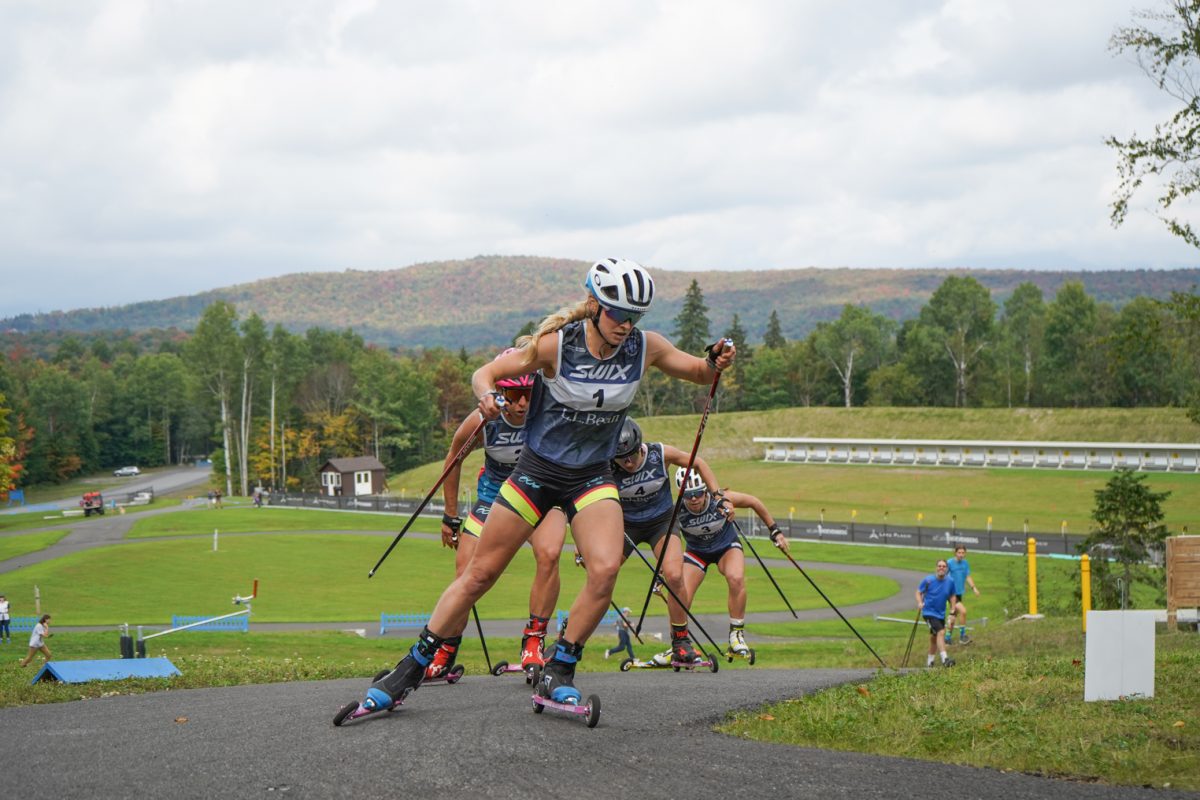
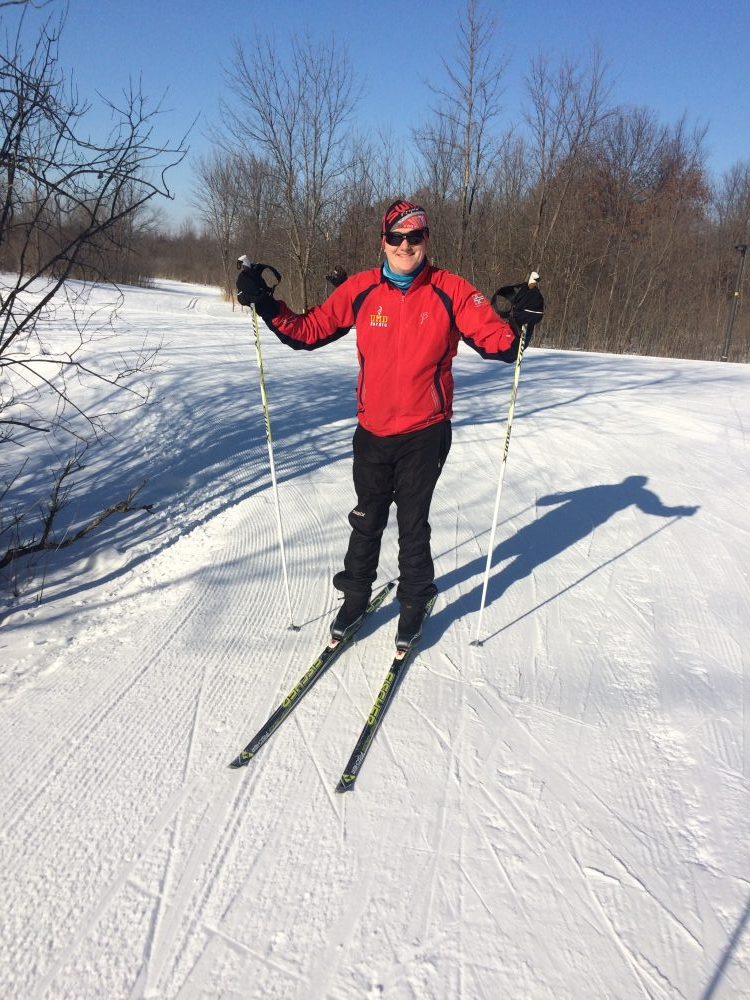
Patrick Cote (front), Silas Eastman, Tracey Cote (rear)
When the Saba Ski Festival Instagram page launched, there was almost immediate reaction from a variety of ski teams, skiers, and ski clubs from North America and Europe saying the idea was fantastic. Then they tended to ask how the whole idea would work, by which they often meant how the whole idea could possibly work or whether it was, literally, fantastic.
Fair question.
Former Colby College Nordic Ski team captain and current head groomer at Jackson Ski Touring in Jackson, NH, Silas Eastman, was part of the proof of concept team that spent a week last May on Saba. He had his doubts, too: “When I first saw Saba from the ferry I couldn’t see any roads, just the steep hillsides rising up out of the ocean. Then as the ferry approached the harbor, I could see the road snaking its way up and thought that it was the steepest road I had ever seen (and that’s not an exaggeration). It turns out that it wasn’t even the steepest road on the island, although it was a close second.”
The team still had to get to its base camp at The Cottage Club in the village of Windwardside, a ten-minute drive along Saba’s main artery, known instructively as “The Road.” Eastman’s “first reaction that evening driving to our cottage was that we were crazy for trying this.”
Now, looking back on the experience, he reflects that it “may still be true [that we were crazy for trying this], but it turned out to be some of the most fun I’ve had roller skiing in a long time.”
Saba is a small (5-square mile) volcano-cum-island in the Caribbean, about 21 miles from Sint Maarten, a hub for several daily flights from the U.S. east coast. It is part of the Netherlands and the summit of the volcano (named, in keeping with the island’s penchant for descriptive cognomens, Mount Scenery) is the highest point in the Kingdom of the Netherlands, offering visitors an opportunity for an unexpected summiting selfie.
The Saba Ski Festival offers an out-of-the-box but utterly compelling and rewarding week-long roller skiing vacation or camp that will test fitness, classic technique, and endurance in a compact yet experience-rich setting that also offers hiking, snorkeling, diving, and a range of accommodation and restaurant options. Participating skiers will get free entry to the second annual island 10K race, scheduled for Sunday May 5 (allowing for a Saturday arrival on Saba) as well as discounts on accommodation. Finally, for participants who wish to extend their stay, organizers of the island’s famed triathlon, “where even the swimming is uphill,” are offering 50 percent off entry to that event.
Best of all, the festival offers an opportunity for a genuinely unique Christmas / holiday gift to treat yourself with and to surprise a partner to help you both celebrate the season and have a reward awaiting you just as the last snow disappears and it’s time to think “transition to summer.”
As for roller skiing there? Well, when the festival organizers approached the person behind the island’s existing race schedule and so the obvious best bet for time keeping, race registration, and making sure the necessary support is in place, Jochem Batstra, had first to take a few minutes to google “roller skiing” and then asked the obvious question: “How do you stop?”
Saba climb 3
Then, he remembers thinking, “That sounds fun and crazy! Is that going downhill? wouldn’t that be dangerous?”
Answering that question / objection was critical to persuading the island’s governing council and tourism board that the idea was not, in fact, dangerous, though it might well be both fun and crazy. Hence, the visit of the test team last May.
So how did it go? “After looking at the roads in the daylight, we quickly decided that most downhills were out of the question, but that there were several options for hill climbs, all with breath-taking views. My advice to anyone considering roller skiing on Saba is that it’s going to be hard, but it is more than worth it. Let’s be honest, if you enjoy Nordic racing, you don’t mind a little pain, you might even enjoy it,” Eastman reflected.
Batstra was left thinking that roller skiing Saba is ‘doable but tough. And it’s unique to do this sport here on a Caribbean island: not the first climate you would think of for doing this!”
“When I was first approached about the idea,” island councilor Vito Charles said, “I had never really heard about roller skiing so I thought it was a crazy idea because I couldn’t imagine someone going downhill on these roads. I figured you’d have to a bit mental to try it, but when I finally saw the skiers in action, I was really intrigued. I saw the possibility for people who love the outdoors to visit for reasons other than diving.”
That is the niche that Saba, a Caribbean island almost unique in having no casinos or mass market hotels, and no cruise ship harbor, is seeking to develop: eco-friendly, outdoor, customizable rather than off-the-shelf experiences.
It’s a niche that seems almost perfectly designed for off-season Nordic skiers, as Colby College Nordic head coach Tracy Cote discovered when she joined the test team in May. Like Eastman, Cote “was in awe” when she “saw Saba Island coming in on the ferry. It’s so incredibly beautiful and I had never seen another island like it.
“I didn’t think much about roller skiing it until we got in our taxi to go to the hotel. It was dark and I could only see the small stone walls on the edge of the road and could tell there were steep drops to every side beyond those walls. I remember thinking, this could be really interesting.”
The next morning, “when we woke up” Cote was “so excited to see every inch of this beautiful place that I was ready to hop on my roller skis and start exploring—and I may have quickly recommended we do a lot of uphill skiing!”
The festival will offer three race courses with the final finishing order calculated from cumulative times, but you don’t have to be too hard on yourself as organizers are offering a touring, citizens option for all the courses, leaving you free to take your time and enjoy the views while benefitting from the race support. [Key tips from the test team: classic style is the way to go and sharp pole tips and back ratcheted roller skis will make your life much easier given the steepness of the hills.]
Saba trail
All the courses end at trail heads, so if you want to combine a ski and a hike creating your own Caribbean biathlon, you’re free to do so. Support vehicles will return your skis and polls to your hotel while you hike or trail run back along well back but technically demanding routes.
The festival will also see the launch of a “Saba Straight Up” course from the lowest trailhead below Mount Scenery to the very summit, a name lifted from the iconic Norwegian “Skåla rett opp” challenge but also paying tribute to Saba’s budding reputation as the home to a range of local rum drinks that can be drunk “straight up” or sipped with dessert. The route is designed to allow a gut-busting trail run from barely above sea level to the highest point in the Netherlands in pursuit of the KoM or QoM title, or a challenge motivated only by self-determination.
As Cote said, “Saba is a must see for anyone who loves the outdoors. The roller skiing will add a unique and fun twist to your Caribbean vacation, especially for those of us who want some adventure on our vacations. The running and hiking trails allow you to see every inch of this beautiful place and you’ll never be bored.
“The designed courses are short, but spectacular. More than the workout, you’ll never regret getting the opportunity to do something so unique while enjoying the warm hospitality of Saba.
“As soon as I left, I couldn’t wait to go back!
Contact details for the festival and for additional information about hotel discounts, customizable options, and travel advice: sabaskifestival@gmail.com
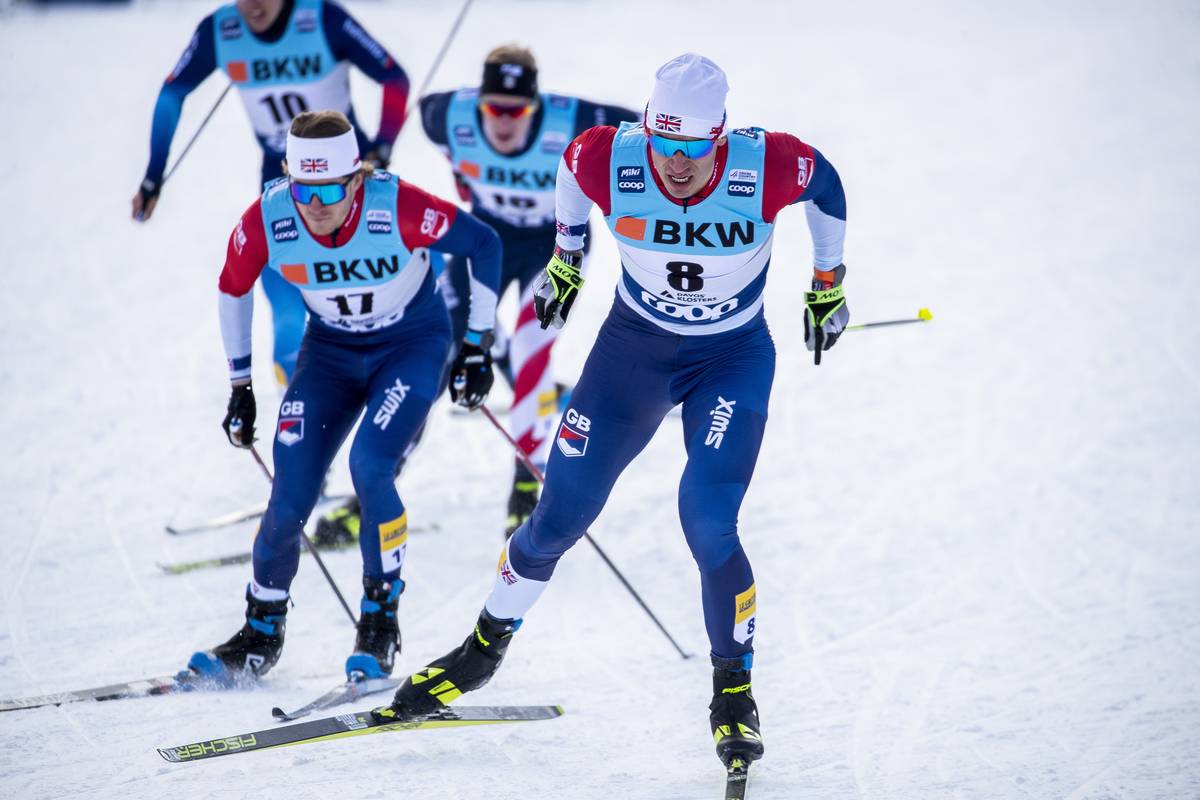
Andrew Musgrave (GBR) finds a tuck, Musgrave finished 8th. (Photo: NordicFocus)
Forget Eddie the Eagle, Great Britain has provided skiers who could actually compete at Olympic level. While it may be fair to say that the country has failed to make a mark in the jumping events, there are other disciplines that have yielded a moderate level of success.
The biggest prizes continue to elude the British teams, but there have been some groundbreaking athletes on the snow over the years. Here are some of the best.
Looking Ahead
Great Britain may have been disappointed not to have scraped a medal at the 2022 Winter Olympics in China. They sent a promising team to the Games, but the established nations ultimately proved to be too strong.
Attention will now focus on the next Winter Olympics which will be held in Italy in 2026. Cortina is the venue for the skiing element and the Brits will remain hopeful of causing an upset.
Can Great Britain pull it off? A useful independent viewpoint is traditionally provided by the sports betting industry ahead of the Games. In the lead up to Milano Cortina 2026, online betting sites linked to SBO.net will publish markets for the main online skiing disciplines.
Those interested in winter sports can take their time to assess the figures while taking in any additional information that can appear. News stories and blog posts are often accompanied by useful betting guides and sportsbook reviews.
If anyone visiting the site wishes to get involved in the winter sports markets, it’s possible to do so. All operators listed are willing to take on new players and many list welcome promotions to get the account moving.
Following a swift and secure registration process, verification follows and players should add funds to cover qualifying bets. A range of deposit and withdrawal options are available to handle those transactions while help operators will step in if assistance is needed.
As the account moves forward, there will be other benefits. Most bookmakers offer live betting and mobile apps, while many provide live streaming for those that maintain a funded account.
It’s the site with which to follow Winter Olympics betting but can Great Britain ever hope to mount a genuine challenge? In the meantime, here are the some of the best British skiers.
Chemmy Alcott
Brighton’s Chemmy Alcott was one of the most versatile British skiers of all time. Across her career, she competed in five disciplines and was dominant at national level between 2002 and 2009.
Alcott could sometimes compete with the best on the international stage, but she would finish her career without an Olympic or World Championship medal. Her best result came at the Winter Games in Torino in 2006 where she finished in 11th place in the downhill.
Konrad Bartelski
Konrad Bartelski shocked the skiing world when he recorded a second place in a world cup event. It was the best result for a British skier at the time and it’s fair to say that it came from nowhere.
That runners up slot came in the downhill at Val Gardena in 1981 and he came within 0.11 seconds of upsetting the winner Erwin Resch. It led to a long media career but, sadly, Bartelski was unable to replicate his success on the slopes.
Divina Galica
A multi-talented sportswoman, Divina Galica was a groundbreaker in both winter sports and motorsport. As a skier, she competed in four Winter Olympics, captaining the team in 1968 and 1972. She even made an unlikely return in 1992 at the speed skiing in Albertville.
In between times, Divina Galica blazed a trail for women in motorsport. She entered three World Championship Formula One Grand Prix and competed consistently in the Sports Cars discipline.
Dave Ryding
He hasn’t exactly inherited a great legacy and he doesn’t have a lot of competition, but Dave Ryding is widely regarded as the greatest British skier of all time. He is the first, and so far, only man to have won a World Cup event via success in the slalom at Kitzbuhel in 2022.
Ryding has already competed in four Winter Olympics but he will be 39 by the time the Games return to Cortina in 2026. He remains as Great Britain’s best hope for a medal but time is running out.
Petter Northug (L) and Marcus Hellner (center) playing a one-on-one game of Texas Hold’em at the Palms Casino in Las Vegas.
Humans have a natural affinity for games and playing from an early age. Playing is the finest way for children to learn, and what’s more? Playing is a great way for adults to pick up new skills and the majority of people might benefit from playing for the sheer joy of it.
It’s been shown time and time again that everyone, regardless of age, may benefit from playing video games. Online gaming has grown exponentially since its inception in 1980, thus the narrative is far from over. As technology improved and the internet became more accessible, so did online gaming. It’s only natural that games become more popular, engaging, and high-quality as these three technologies evolved.
This includes online casino games, which are played by millions of individuals throughout the globe. Online gaming systems were developed by brick-and-mortar casinos as soon as it became clear that new generations of players preferred the flexibility of playing from any location at any time. Again, this was largely due to developments in technology. Online games are accessible to everyone with a smartphone or other portable device.
When it comes to online casino games, slot machines are unquestionably the most well-liked. Slots have also evolved throughout time since they are simple to play, have fantastic visuals, and most come with free sign-ups and bonuses. Winter sports may be played for enjoyment or as a means to an end. Whatever your favorite pastimes may be, you may find a slot game to suit your interests. In this article, we’ll review the most popular winter sport-themed online casino games, including:
Winter Gold
Queen of Winter Wins
Ski Jump
Ice Hockey
Hockey League
Winter Gold – Popular Online Casino Slot
Microgaming created and published this video slot in time for the 2010 Winter Olympics in Vancouver, Canada. Speed skaters, bobsleighs, ski jumpers, and biathlon are the most valuable symbols in this 5-reel, 15-pay line slot machine. Traditional card symbols 9 through Ace are the low-paying symbols in this slot game. All other symbols may be substituted except for the Scatter symbol, which is the Gold Medal. You may earn a whopping 100,000 coins while playing in an online casino if you get five wilds in a row. Free spins and extra coins may be won in a fun bonus round triggered by the scatter symbol. Up to 120,000 coins might be yours with the scatters in play.
Winters Gold includes a unique bonus game that may be activated and is also a slot where the base game alone can easily spin in some large winning combinations. A Microgaming slot means that if you want to play it, you will need to visit Wild Fortune casino, which is a reputable and credible online casino with a plethora of entertaining games.
Queen of Winter Wins
As far as winning streaks go, Queen of Winter Wins is your best bet. Once a player has three matching symbols on a single spin, the following spin will hold them in place.
Bonuses are available for locking a complete reel in the game. An icicle dropped by the Ice Queen causes all symbols to go wild.
Among online slot games, this form of symbol stacking is a rarity. Your odds of landing a huge win improve in direct proportion to the number of matching symbols you manage to collect.
The Queen of Winter Wins slot, like other 5-reel slots, is enjoyable to play. They put forth a lot of effort to produce a game this fantastic in such a short period. An arctic journey may be brought to life using pictures such as the owl, the crown, the amulet, and the owls. Because it’s so fantastic, the slot machine had me glued to the screen for quite some time.
There is no denying that the slot bonus feature in Queen of Winter Wins is its most important component. To learn more about the other prizes up for grabs, read on. The bonus round is activated when three winning symbols appear on a single pay line. Good money may be made from this Winning Streak. This bonus round, like all others, may help you turn your bankroll around and move to a position of strength. Queen of Winter Wins has the finest bonus game in current slot machines, which is why it’s so popular.
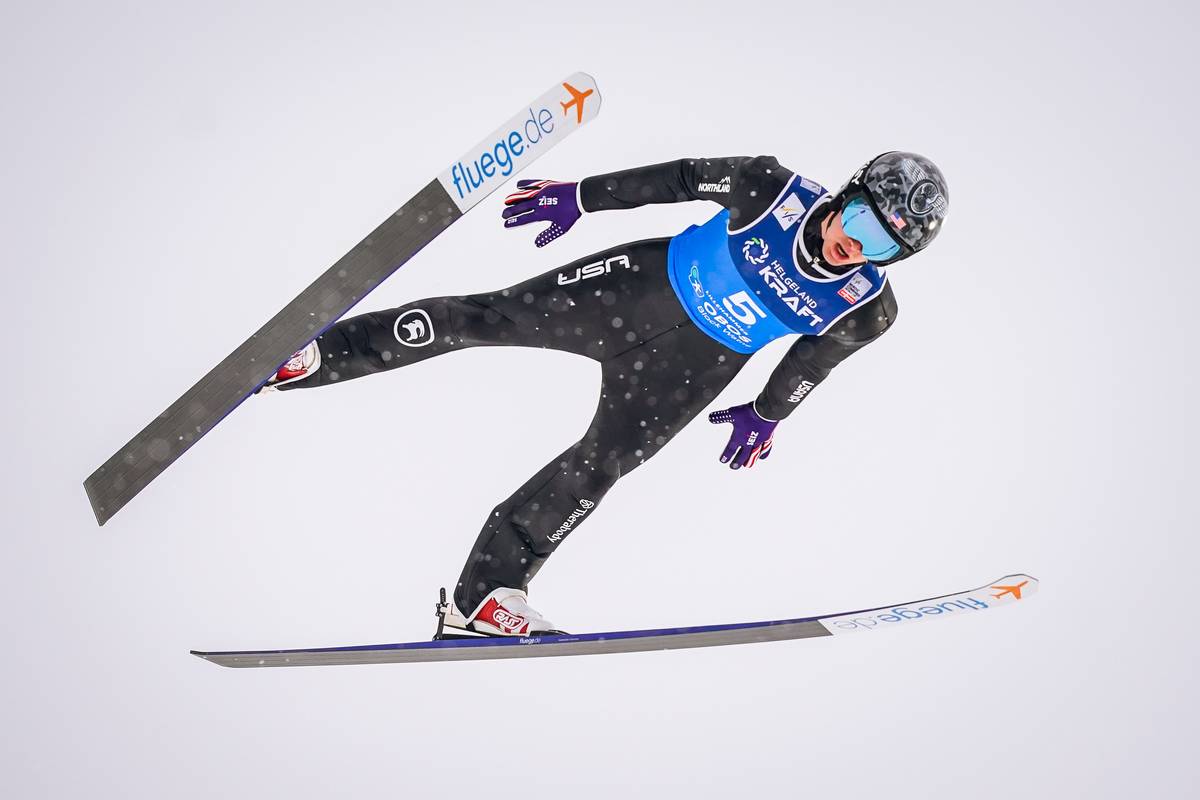
Jasper Good jumps in a December, 2021 World Cup competition in Lillehammer, Norway. (Photo: NordicFocus)
Ski Jump
With its daring and risky nature, the ski jump during the Winter Olympics is a delight to see. Five-reel, 10-pay line slot from Genesis Gaming honors those who put their lives on the line for a chance at gold. Symbols including ski goggles, ski boots, skis, helmets, Olympic medals, prize bouquets, and trophies may be found on the game’s reels. Extra wilds and the cowbell, the slot’s scatter symbol, are included in this game’s additional bonuses. A chance to leap for glory is yours if you manage to land three or more cowbells anywhere on the reels throughout the game. In order to increase your chances of winning, the ski jump wild feature may appear at any moment and turn reels 2, 3, or 4 wild. Those who like ski jumping should check out this online slot machine.
A look at the Ski Jump’s paytable is the best way to see just how much you can win while playing it, and there are several reasons why it should be on your list of favorites.
When it comes to stake levels, you’ll always be in the driver’s seat since the coin value settings may be altered by players, unlike many other slots with a reasonable number of pay-lines.
If you’d like to play the Ski Jump slot on your tablet or smartphone rather than your computer, no download versions of the game are available for both the desktop and mobile versions of the Ski Jump slot machine.
Ice Hockey
It’s worth checking out Playtech’s Ice Hockey slot if you want to play an ice hockey-themed slot machine game at an online casino. For example, you may match the United States and Canada against one other in this spot, which is a tremendous perk. The game’s standard icons are animated ice hockey players and the card values 9-A, and it has five reels and fifteen paylines (each one with a different ice hockey item on it). To win, and get more out of playing, each participant must expose an additional sum of money by passing the puck around. Playing this slot all year long is a joy because of its blend of superb sound effects, arcade visuals, and amusing bonuses. Consider taking on some hockey players by playing this slot machine.
Players will be able to choose one of seven teams before the game starts. There is a flag-based team list on the right side of the screen. Playing card symbols such as Am, K, Q, J, 10, and 9 are included in the game’s visuals. Additionally, there are six hockey-themed emblems, including three that symbolize the club you’ve decided to support.
There are crazy hockey goals in the game, which may be exploited to form some fantastic winning combos. When all other symbols save for the scatter and bonus symbols have been replaced by the wild, the game benefits greatly. When two or more of the game’s logos appear anywhere on the reels, players will get a generous payoff. In addition to being wild, the game’s Pass the Buck symbol also acts as a scatter.
Hockey League
Pragmatic Play created this hockey-themed video slot. There are high expectations for this game if you’ve played any of their slot games previously, and we can assure you that it won’t disappoint. Stickman hockey players and the Cup wild symbol adorn the five reels, which are situated in front of an ice hockey field. To win up to 50x your investment, you need to keep an eye on the Coach sign among the normal symbols.
Getting three or more pucks on the reels triggers the Most Valuable Player extra feature, which awards 120 free spins and may be retriggered. Even the lowest-paying symbols in this slot pay out far more than the lowest-paying symbols in other slots. If you have a budget of only £0.20 each spin, you can play this game, and if you have £100 per spin, you can play it.
Taking cues from the original slot, the design of Hockey League Wild Match has the same three players that appear on the A to J playing cards. The referee is the highest-paying symbol once again, with a 5-in-a-row payoff of 200 coins.
The wild symbol is represented by a Stanley Cup-style trophy, and it may be used to replace all other symbols except the scatter to ensure payment, although a little one. You can win up to 5,000 coins if you get five of a kind on an active pay line. Any of the three middle reels may be taken over by these wilds, which can appear in any position and fill the whole reel set.
Hockey League Wild Match follows the tradition of Pragmatic Play’s first ice adventure with a basic but effective design. They’ve been done in a cartoon-like fashion. The best accompaniment recording involves slaps of the puck against the boards, as well as a lot of organ accompaniment.
After a brief break, the SuperTour picked up in Lake Placid this weekend, with a fluoro-free Period III kicking off with a 1.5-kilometer classic sprint. The frigid forecast called for overnight lows of -5 Fahrenheit, with a wind chill as low as -23F. Highs during the day were only predicted to climb into the low single digits. Qualifiers were scheduled for 10/10:45 am, with quarterfinals for the open men beginning at noon – hopefully, enough time for a few degrees of warmth to reach the trails.
The weekend competitions would be hosted on Mt. Van Hoevenberg’s new World Cup trails, which are paved for rollerski use in the summer, and played host to NENSA’s “Keys to the Castle” sprint event in September. For those familiar with the venue, the new courses are tucked into the north-facing hillside, just south of the 1980 Olympic stadium and biathlon range. The new serpentine loop intersects with the final Ks of the classic “Ladies 5” outer loop, but overall remains closer to the stadium to allow access to the recently improved snowmaking system.
Jessie Diggins (SMS T2/USST) pushes over the climb during the final round of the Keys to the Castle sprint. (Photo: Matt Whitcomb)
With a large reservoir and advanced technology, this new World Cup loop can be made winter competition ready within four days, though Van Hoevenberg’s nearly 50k of open trail might suggest that coverage is not currently an issue.
There was praise for the course from many athletes, including those that have seen both Lake Placid, and everywhere in the world beyond Lake Placid.
“It raced much more like a world cup course!” said Alayna Sonnesyn (SMS), in an email to FasterSkier. Katharine Ogden (SMS) too, said of the course, “it was WAY more fun than the old one…[which] was pretty flat.”
The course designers at Lake Placid seem to have carefully been taking notes on what makes sprint racing exciting over the course of its evolution as a discipline in the sport. An historic venue for American skiing, these developments may be a long-time coming for Mt. Van Hoevenberg, but it’s clear that they were executed with mastery so VanHo can continue to expand upon its legacy in the decades to come.
This course featured a long, final uphill climb to test a skier’s mettle, then a short, technical downhill into the finish to test their tactical brains. And in between; transitions, transitions, and more transitions.
Becca Rorabaugh (APU) said of this : “The final climb always turned into a drag race, and I liked the pitch because it favored a bit of a stride over an all-out run. Skiers still had to be alert through the downhill and finish, though; positions often changed in the stadium.”
The weekend, hosted by the Olympic Regional Development Authority (ORDA) in Lake Placid, also served as the second NENSA Eastern Cup weekend. Thus, senior athletes from American elite clubs lined up alongside regional junior racers, eastern collegiate racers, and Canadian athletes who traveled from Quebec, Ontario, and beyond. 382 athletes, 176 women and 206 men, on the start lists for the qualifier, and separate heats were run for the U18/U20 and U16 categories.
Without livestream, FasterSkier has relied on live timing and athlete interviews to shed light on how the sprint races unfolded.
Men’s 1.5-kilometer Classic Sprint
After returning from a stint in Europe where he raced the Tour de Ski, Team Birkie’s Zak Ketterson set the mark in the men’s qualifier, stopping the clock at 3:04.79. Sun Valley’s Peter Holmes skied the next fastest time in qualification (+0.72), while Étienne Hébert was just behind in third (+1.41). Hébert hails from Quebec and currently trains at the Centre National d’Entraînement Pierre-Harvey (CNEPH), based at Mont Ste Anne.
Each of these men moved smoothly through the rounds, with Ketterson getting edged out by Bill Harmeyer (SMS T2) in the first semi, and Homes and Hébert going 1-2 in the second. Racing in the second semi saw a tighter spread and faster times, bringing Julien Locke (Black Jack Ski Club) and Logan Diekmann (BSF Pro) who had finished a close third and fourth, respectively, along to the final as lucky losers.
The final featured a tight finish among the top four men, with Ketterson off the front to finish in 3:04.71, earning his second consecutive classic sprint victory. Ketterson had dominated the classic sprint in Cable, WI, and stood at the top of the SuperTour leaderboard, thereby earning start spots for the Tour de Ski. The timing of the Tour caused him to miss the subsequent classic sprint in Soldier Hollow, UT.
During the Tour, his first World Cup starts, Ketterson was less than a second shy of qualifying for the classic sprint heats in Oberstdorf, Germany, and had been roughly five second out of the Top-30 the day prior in a 15k skate. He was the only American on the men’s team to finish the Tour. After the Tour, Ketterson made a quick turnaround to attend the weekend of distance racing in Sun Valley, Idaho, where his results (15th in the 15k classic and 34th in the 10k free) were far below what might be expected from him.
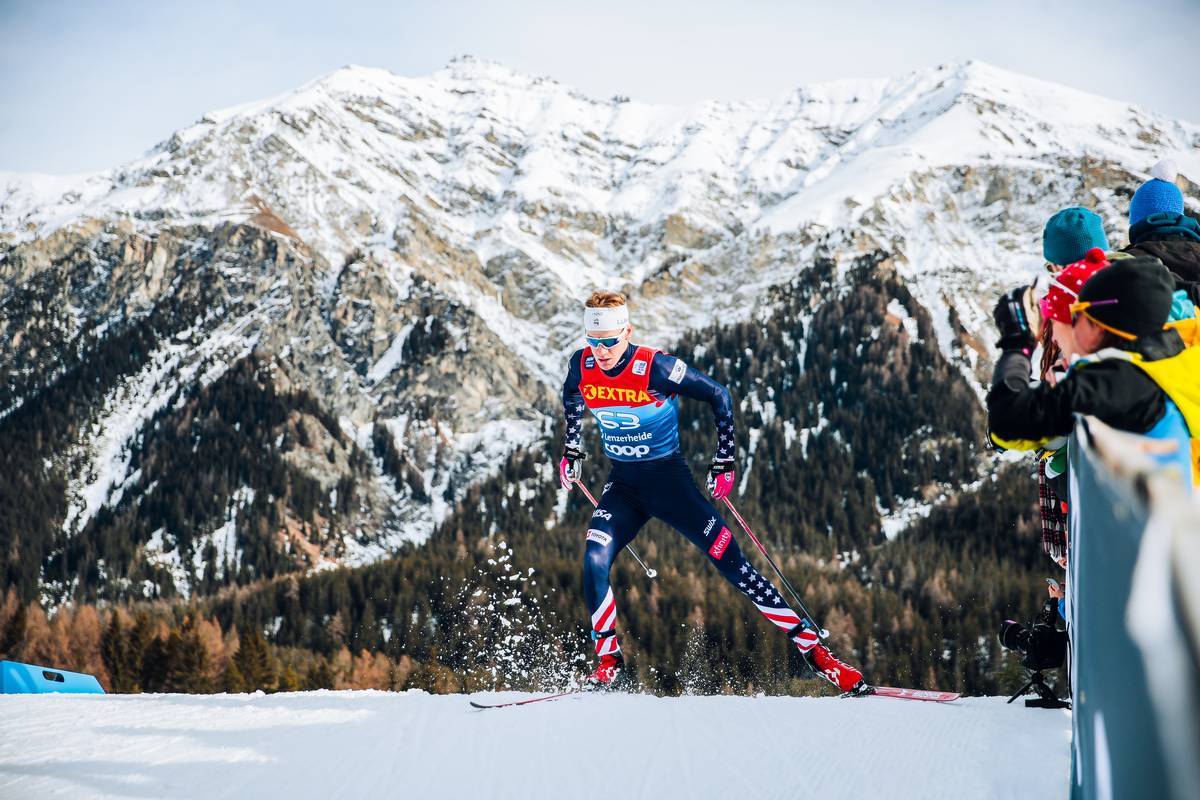
Zak Ketterson races the freestyle sprint qualifier in Lenzerheide, SUI, the first event of the 2021/22 Tour de Ski. (Photo: NordicFocus)
In a post-race email to FasterSkier, Ketterson shared how he felt about the Tour and what the recovery process has been like for him.
“The Tour de Ski was a fantastic learning experience with lots of ups and downs. I am pretty happy with my performance on the Tour given it was my first time on the World Cup, but I definitely think I will be faster next time around now that I have had the experience. Post Tour I was incredibly empty, both physically and mentally. To have to change gears pretty much immediately after the last stage of the Tour and head straight to Sun Valley for some super competitive SuperTour races at high altitude was definitely a recipe for disaster on my body. I felt like I was just going through the motions and my body wanted nothing to do with those races.
“These last few weeks at home in Minneapolis provided me with some long-overdue recovery. My hunch after some really lackluster racing in Sun Valley was that there was no need to overthink anything and that the issue was probably just that I was tired. I took time at home to mentally and physically reset and started to feel a lot more like myself as the Placid races approached. Today, it all came together and I felt a lot more race-ready.”
Ketterson also commented on the improvements that have been made at the Mt Van Hoevenberg venue, explaining how it supports the growth and elevation of domestic skiing.
“I am blown away with the venue at Mt. Van Hoevenberg! The venue truly feels like it’s ready for World Cups, or even another Olympics. It’s really inspiring to see big investments into nordic skiing venues in the United States, and I can’t stress enough how big it is for us athletes. I can’t wait to come back to Lake Placid sometime later to really experience this place because I think it’s so awesome here.”
Behind Ketterson, just 0.26 seconds separated second through fourth in the men’s final. Holmes won the boot slide to snag second (+0.72), while Harmeyer took the final podium spot in third (+0.92). Hébert was just 0.06 seconds shy of the podium, ending the day in fourth (+0.98).
Harmeyer provided insights into his approach to the day, along with insights into the moves that contributed to the excitement at the finish line.
“I felt really good in the heats today,” he wrote via email. “The course was certainly difficult and tactical. Placement in the group was really important and that was especially apparent in the final. We had a group of four dudes going over the top of the final climb into the long descent before the finish. It was an absolute scramble trying to get into the tracks on that final downhill. At one point, I had my left ski in the right part of the track and Étienne had his right ski in the left side of the track. Not easy to squeeze two guys going 30+ mph into a single track but somehow, I came out ahead which was just enough to lunge at the finish for third.”
During Period I, Harmeyer took third in the classic sprint final in Cable, and was just off the podium in fourth the weekend prior after the freestyle sprint in Duluth, MN. After qualifying in fifth, a crash in the quarterfinal left him 24th in the freestyle sprint in Soldier Hollow during the U.S. Cross Country Championships. A few days later, he was 51st in the 15k classic. In the Soldier Hollow SuperTour classic sprint, Harmeyer qualified in fourth, and just missed the final to end his day in eighth.
Reflecting on the season as a whole, Harmeyer wrote, “I had a really good start to the season with some strong races in the Midwest. But overall, things have been frustrating. I’ve been struggling with some cold weather triggered exercise induced asthma that got really bad after the first supertours in the Midwest. I continued to struggle with it through a disappointing Senior nationals and decided to take a bit of time off to reset, recover and do some testing. I’m hopeful the worst is behind me and that I’ve got some good protocols lined up to prevent anything from happening in the future. My primary goal for the remainder of the season is to win the Stowe Derby, specifically the derby meister.”
Wrapping up with a comment on the venue, Harmeyer added, “The new courses at Lake Placid are sweet! The sprint course is incredibly tactical but also rewards tough, explosive skiing. I had an absolute blast out there in the heats. The distance courses are hard but I’m excited to be doing a mass start on those for this Sunday. Overall, Van Ho has done a great job with course management and their snowmaking to put together some killer courses.”
After a gap, Diekmann crossed the line in fifth (+5.81), while Locke rounded out the men’s final in sixth (+9.11).
The women’s field began right where it left off in SuperTour classic sprints, with the winner of the last race at Soldier Hollow, Katharine Ogden, (SMS) finishing the qualifier in first place (3:40.49). She was followed by Lauren Jortberg (BSF Pro Team) in second (+2.2), and Ava Thurston (Mansfield Nordic Club) in third (+6.1). The qualifier indicated, again, the overall strength of the field that has characterized this year’s SuperTour, with the heat qualifiers all within 30-seconds of each other (26.0 seconds to be exact).
That field remained tight in the quarterfinals as well. All five quarterfinals saw winning times within a mere five seconds of one other, with Katharine Ogden turning in the fastest time of the round at 3:42.77, and Alayna Sonnesyn winning her heat in 3:46.12.
Ogden commented to FasterSkier that she “didn’t really have any strategy in particular. I find that it is better for me to make strategy in the moment during sprint heats because you never know what’s going to happen out there… I just tried to conserve as much energy as possible in the quarter and semi.” It would pay off later on.
Meanwhile, also progressing to the semifinals was the APU one-two punch of Rosie Frankowski and Becca Rorabaugh out of quarterfinal 2. Despite being primarily known as a distance racer, Frankowski, came into today leading the SuperTour sprint classification and “set a blistering pace,” according to teammate Rorabaugh. With it, she pulled the duo into the semifinals together.
After all the quarterfinals were through, the semifinals were set with a who’s-who at the top of the SuperTour sprint standings, rounded out by Canadian Katie Weaver (Hollyburn XC Ski Club) and Minnesotan Margie Freed (Craftsbury).
The first semifinal featured a battle between two SMS T2 teammates, Katharine Ogden and Alayna Sonnesyn, and two APU teammates, Rosie Frankowski and Becca Rorabaugh. Frankowski again set the pace for the heat, with teammate Rorabaugh commenting that “[Rosie] is so strong on the uphills that she pulls the whole heat to a faster time.” Frankowski, however, couldn’t quite outlast Ogden and Sonnesyn, who used the downhill after the final climb to launch into the first two positions. Ogden won the heat in a time of 3:39.23, with Sonnesyn and Frankowski in second and third, respectively, by less than a second. Rorabaugh finished fourth, but along with Frankowski won the lucky loser spots into the finals – setting up another round of the SMS-APU duel.
In the other semifinal, a close battle throughout yielded a win for Lauren Jortberg (3:45.15) and a second place for Erika Flowers (+0.90). The result sent another teammate pairing into the finals, with both skiers coming from Bridger Ski Foundation (BSF).
At Lake Placid – a place that has over the past century proved to be able to gather the entire world around skiing – it was perhaps appropriate that the women’s final would bring together three teams from across the American continent. Two from Vermont (SMS), two from Montana, two from Alaska (APU), and away they went!
Katharine Ogden commented that the field didn’t waste any time: “It was pretty hard from the gun, as per usual.”
Rorabaugh, meanwhile, made a change in strategy, deciding to follow her teammate Frankowski more closely in the early part of the race. “I was trying to stay closer to the front of the pack since I had let a large gap form in the semifinal that I couldn’t make up,” she explained.
That adjustment was one that helped create a pack that was tight throughout the race, and that was a bit harder to find a position in.
Sonnesyn commented that this led to her having to adjust. “I had great energy but got tangled up a few times on the second hill, so I really had to ski from behind in the second half of the race,” she wrote. “Luckily, I had great skis and remained calm and was able to push through the final stretch.”
In that final stretch, on the final hill, a “drag race,” as Rorabaugh described it, ensued. It was instigated by Ogden, who saw the final climb as the place to make her move, and made it. She came over the top in first place.
“[I] got lucky,” she told FasterSkier. “Pat [O’Brien, SMS T2 head coach] had provided me with some really fast skis that allowed my move to stick going back down the hill.”
Perhaps it wasn’t all luck though. Ogden came across the finish line in first place (3:40.13) after winning the qualifier, her quarterfinal, and her semifinal. It was an all-around dominant performance for one of the U.S. brightest stars in the classic sprint.
Meanwhile, Becca Rorabaugh had powered through the transition into the final downhill and came up with the reward of second place (+3.40), She was followed by Alayna Sonnesyn, who remained cool, calm, and collected as she skied her way through the pack to third place (+4.29).
The final was rounded out by fourth place Rosie Frankowski (+4.74), fifth place Lauren Jortberg (+5.63) and sixth place Erika Flowers (+17.77).
The result was reached at the end of an exciting day that encapsulated the beauty of ski racing – with excitement and energy perfectly juxtaposed against the extreme absence of that energy in the air. Preparing for cold temperatures that are forecasted again for the 10k freestyle mass start tomorrow, the top finishers today all expressed that the temps are part of the appeal in the northeast this weekend.
From Rorabaugh, “I don’t mind cold temperatures – I grew up in Fairbanks, Alaska!”
From Sonnesyn, “I like to think the Midwesterner in me prepared well!”
And from Ogden, the perfect Vermont tip: “As Sverre [Caldwell] told us last night, tricky race conditions can work to your advantage if you prepare better than anyone else. Wise man :)”
PARK CITY, UTAH (January 20, 2022) — U.S. Ski & Snowboard announced today its nominations for the U.S. Olympic Cross Country Team to represent Team USA at the Olympic Winter Games Beijing 2022 from February 4-19, 2022. Nominations are to be confirmed by the United States Olympic & Paralympic Committee when it formally announces the U.S. Olympic Team.
Fourteen athletes were nominated to Team USA, including the 2018 Olympic gold medalist and defending World Cup overall and distance champion Jessie Diggins, and two-time World Cup winner Rosie Brennan. Brother and sister Caitlin and Scott Patterson, both 2018 Olympians, are also nominated to return to the Games. The 10 remaining nominated athletes will be competing in their first Olympic Winter Games.
“We are incredibly excited to be welcoming so many athletes to their first Olympic team,” said U.S. Ski & Snowboard Cross Country Director Chris Grover. “We’ve been watching this American talent emerge at World Juniors for the past five seasons, and now these very same athletes that have brought home so much hardware are populating the Olympic team. Beijing will be such a valuable experience for them as they progress towards being medal contenders at the highest level. We are also lucky to have the experience, leadership, and professionalism of athletes like Jessie Diggins and Rosie Brennan to show these young athletes what it takes to be successful at this level.”
Athletes were selected based upon World Cup results, World Cup rankings, SuperTour results, and the recently completed U.S. Cross Country Championships.
The 2022 Olympic Winter Games will feature 12 cross country events, including four individual events for both men and women and two team events for each gender, including the team sprint and the team relay. At each Olympics, disciplines swap between freestyle and classic techniques. For example, Diggins and Kikkan Randall won the freestyle team sprint at the 2018 Games—the first-ever Olympic gold medal for the USA in cross country skiing. The team sprint hosted at the 2022 Games will be held in the classic technique.
JC Schoonmaker was the top U.S. qualifier in the Davos sprint, placing 5th. (Photo: Nordic Focus)
Cross country kicks off the 2022 Games with its first medal event, the women’s 15k skiathlon on Saturday, February 5. The event features two 7.5k legs, with the athletes skiing the classic technique for the first 7.5k, then switching to the freestyle technique for the second 7.5k. The men will compete in the 30k skiathlon on Sunday, February 6— a 15k classic followed by 15k freestyle. The complete Olympic cross country program is listed below.
2022 U.S. OLYMPIC CROSS COUNTRY TEAM
(Name, Hometown; Birth Date; Club; Past Olympics)
Women
Jessie Diggins, Afton, Minnesota and Stratton, Vermont; 8/26/91; Stratton Mountain School Elite Team (Olympics: 2014, 2018)
Rosie Brennan, Park City, Utah; 12/2/88; Alaska Pacific University Nordic Ski Center (Olympics: 2018)
* Julia Kern, Waltham, Massachusetts 9/12/97; Stratton Mountain School Elite Team
* Hailey Swirbul, El Jebel, Colorado; 7/10/98; Alaska Pacific University Nordic Center
* Sophia Laukli, Yarmouth, Maine; 6/8/2000; University of Utah
* Novie McCabe, Winthrop, Washington; 12/15/2001; Methow Valley Nordic Team
* Hannah Halvorsen, Truckee, California; 2/19/1998; Alaska Pacific University Nordic Ski Center
Caitlin Patterson, Craftsbury, Vermont; 1/30/90; Craftsbury Green Racing Project (Olympics: 2018)
Putting together another highlight weekend in Davos, Rosie Brennan skis to 4th in the 10k individual start skate. (Photo: NordicFocus)
Men
* JC Schoonmaker, Tahoe City, California; 8/12/2000; University of Alaska Anchorage
* Kevin Bolger, Minocqua, Wisconsin; 4/11/93; Sun Valley Ski Education Foundation
* Ben Ogden, Landgrove, Vermont; 2/13/2000; University of Vermont / Stratton Mountain School Elite Team
* Luke Jager, Anchorage, Alaska; 1/7/2000; University of Utah/Alaska Pacific University
“I’m honored and excited to be representing my country once more as a member of the 2022 Olympic team! This will be my third Olympics and I’m so proud of all the hard work and dedication from all our athletes to make this team. I’m also incredibly thankful for the support from so many people who have helped me prepare for the Games! I won’t be racing for just myself out there.”
Julia Kern
“I am very excited to be named to the Olympic team, it is a dream come true! I believe the team we are bringing is really strong and will do great things at the Olympics. It takes a massive support system to get there and I am extremely thankful for all of the people who have been a part of this journey.”
Rosie Brennan
“I am honored to be representing Team USA in another Olympic Games. I am very excited to be on this team and to be in a place where we can fight with the best. I am looking forward to getting there and getting the races started.”
Hailey Swirbul skis to 6th place in the 10k individual start skate in Davos. (Photo: NordicFocus)
Hailey Swirbul
“More than anything, I feel honored to represent my country on the world stage at the Olympics. I have dreamed of the opportunity to do this since I was a kid and it hasn’t totally set in for me yet! I think it won’t feel real to me until we actually arrive in Zhangjiakou. I am really looking forward to finishing my preparations knowing I am ready to fight with everything I have out on the race courses. Going into my first Olympics, I’m not sure what to expect, but I am going to try to stay true to myself and do what I know how to do!”
Novie McCabe
“I am super excited! The Olympics have always been the dream and it’s surreal to have actually made the team! Going into this season I was very uncertain of what it would hold, but it’s been full of so many great experiences and it’s pretty hard to believe that I also get to go to the Olympics. Just overall, I’m feeling quite happy about things and very thankful for everyone who has helped make all of it possible!”
Sophia Laukli
“I’m so so excited. It’s pretty incredible to actually be named to the Olympic team and I still haven’t fully wrapped my mind around it. Even just a year ago, the Olympics seemed far-fetched, so it feels pretty surreal. That being said, I am so excited and grateful for the opportunity. It’s definitely a proud moment and I’m looking forward to the whole experience and learning a lot from it, and I especially can’t wait to see what the U.S. team can do this year!”
Caitlin Patterson
“I’m very excited to be heading to my second Olympic Games! The U.S. is bringing a strong group of cross-country athletes and I’m looking forward to seeing what we can do!”
Hannah Halvorsen
“All of my emotions are on overload. I am beyond proud, beyond grateful, and beyond excited and honored to be on the 2022 Olympic Team.”
JC Schoonmaker
“I’m super pumped to be named to my first Olympics! Pretty crazy feeling. It’s still kinda hard to believe it! Can’t wait to get over there, enjoy the experience and race the best I can!”
Kevin Bolger
“It’s every kid’s dream come true. It’s something I’ve been shooting for and dreaming of for a long time. And to be able to call my family and give them the news is just as satisfying as getting the news myself—they are just as much a part of this journey as anyone. So now making the team is the last stepping stone to my ultimate goal and that is to return from Beijing with the result I want! And I couldn’t be more excited about the men’s team I get to travel there with. It goes without saying the men’s team is putting up big results on the World Cup, and now I think we can expect some big results at the Olympics! Time to go have some fun!”
Ben Ogden leads teammate Luke Jager up the first climb during the quarterfinal of the classic sprint in Ruka. (Photo: NordicFocus)
Ben Ogden
“I’m really excited to be named to the Olympic team. Growing up in southern Vermont, I have been inspired by Olympians my whole life, and becoming one myself has always been a dream. I am excited to race hard and have some fun in China.”
Gus Schumacher
“I really have to stop and give myself some credit because it’s a lifelong dream coming to fruition, but at the same time my goals keep coming, and just making the team isn’t the end of the road. I wanna race fast! But overall I’m very excited for the opportunity to represent the U.S. on the highest level in my sport.”
Luke Jager
“This is a dream come true for me! I remember being a little kid watching Kikkan (Randall) and Andy (Newell), Simi (Hamilton), and crew at the Olympics and getting so fired up. Feels pretty crazy to get to be here now a few years later with my best friends. I feel so thankful for all the people that have worked so hard over the years to help us get here!”
Scott Patterson
“Races at the 2022 Olympics have been on my goal list for a long time. I’m excited to return to the Olympics and build on the successes I had in 2018. We have a strong contingent of U.S. athletes and I look forward to being a part of it!”
2022 Olympic Winter Games Cross Country Schedule
Saturday, Feb. 5
Women’s 15k Skiathlon
Sunday, Feb, 6
Men’s 30k Skiathlon
Tuesday, Feb. 8
Men and Women’s Freestyle Sprint
Thursday, Feb. 10
Women’s 10k Classic
Friday, Feb. 11
Men’s 15k Classic
Saturday, Feb 12
Women’s 4x5k Relay
Sunday, Feb. 13
Men’s 4x10k Relay
Wednesday, Feb. 16
Men and Women’s Classic Team Sprint
Saturday, Feb. 19
Men’s 50k Freestyle Mass Start
Sunday, Feb. 20
Women’s 30k Freestyle Mass Start
Jessie Diggins celebrates a podium effort with team sprint partner, Julia Kern, who anchored the team to 2nd place in Dresden, GER. (Photo: NordicFocus)
About U.S. Ski & Snowboard
U.S. Ski & Snowboard is the Olympic National Governing Body (NGB) of ski and snowboard sports in the USA, based in Park City, Utah. Tracing its roots directly back to 1905, the organization represents nearly 200 elite skiers and snowboarders in 2021, competing in seven teams; alpine, cross country, freeski, freestyle, snowboard, nordic combined and ski jumping. In addition to the elite teams, U.S. Ski & Snowboard also provides leadership and direction for tens of thousands of young skiers and snowboarders across the USA, encouraging and supporting them in achieving excellence. By empowering national teams, clubs, coaches, parents, officials, volunteers and fans, U.S. Ski & Snowboard is committed to the progression of its sports, athlete success and the value of team. For more information, visit www.usskiandsnowboard.org
Precipitation was no longer a threat for the final day of racing in Soldier Hollow on Friday, a 1.5-kilometer classic sprint offered alongside the 2022 U.S. Cross Country Championships, yet classified as SuperTour only. However, athletes still faced unseasonably warm weather as blazing sun brought temperatures into the low 50’s on course during the midday heats.
Howling wind and rippling bibs could be heard as background noise as Adam Verrier called the event on the livestream, creating extra work for the athletes who would fight through degrading course conditions throughout the heats. This extra work showed in the times on course; with the combination of freestyle technique and significantly faster course conditions, Sunday’s sprint races featured times over a minute faster on average. A similar difference was seen even between the qualifier today at 9 a.m., when temperatures were still colder and tracks firmer, and the heats which began at 12:30 p.m.
Warm temperatures, degrading tracks, and loose granular spray set the stage for a challenging classic sprint in Soldier Hollow. (Photo: Tobias Albrigtsen / @untraceableg)
“Sprint” seemed to perhaps be a misnomer, as times in the women’s heats climbed over five minutes and were well above four minutes in the men’s heats. Combined with a qualifier, this meant athletes who raced through the final saw between 16 and 20 minutes of racing, testing their endurance and fitness differently from the average sprint event.
Women’s Race: Katharine Ogden on Top from Qualifier to Final
On the heels of a second place finish in yesterday’s 15k classic, Katharine Ogden (USST/SMS T2) set the bar in the qualifier, finishing in 3:51.79.
Julia Richter (U of Utah) was the second fastest qualifier (+0.77), ahead of Lauren Jortberg (BSF Pro) in third (+1.48). Both Ogden and Jortberg won their quarterfinal to advance comfortably into the semis, however, Richter took fifth in Heat 4 and did not advance.
In the first semifinal, two Craftsbury teammates Annika Landis and Caitlin Patterson led the way in the opening climb, with Ogden and Sydney Palmer-Leger (USST/U of Utah) sitting in third and fourth a few strides behind. Descending from the high point, a third Craftsbury racer, Michaela Keller-Miller, had pulled to the front, but was quickly overtaken by Patterson and Ogden as the pack headed into the final short herringbone climb before the long descent toward the stadium. Patterson and Ogden sat in low tucks, letting their fast skis glide as long as possible before transitioning to doublepole as they headed over the bridge and into the finish.
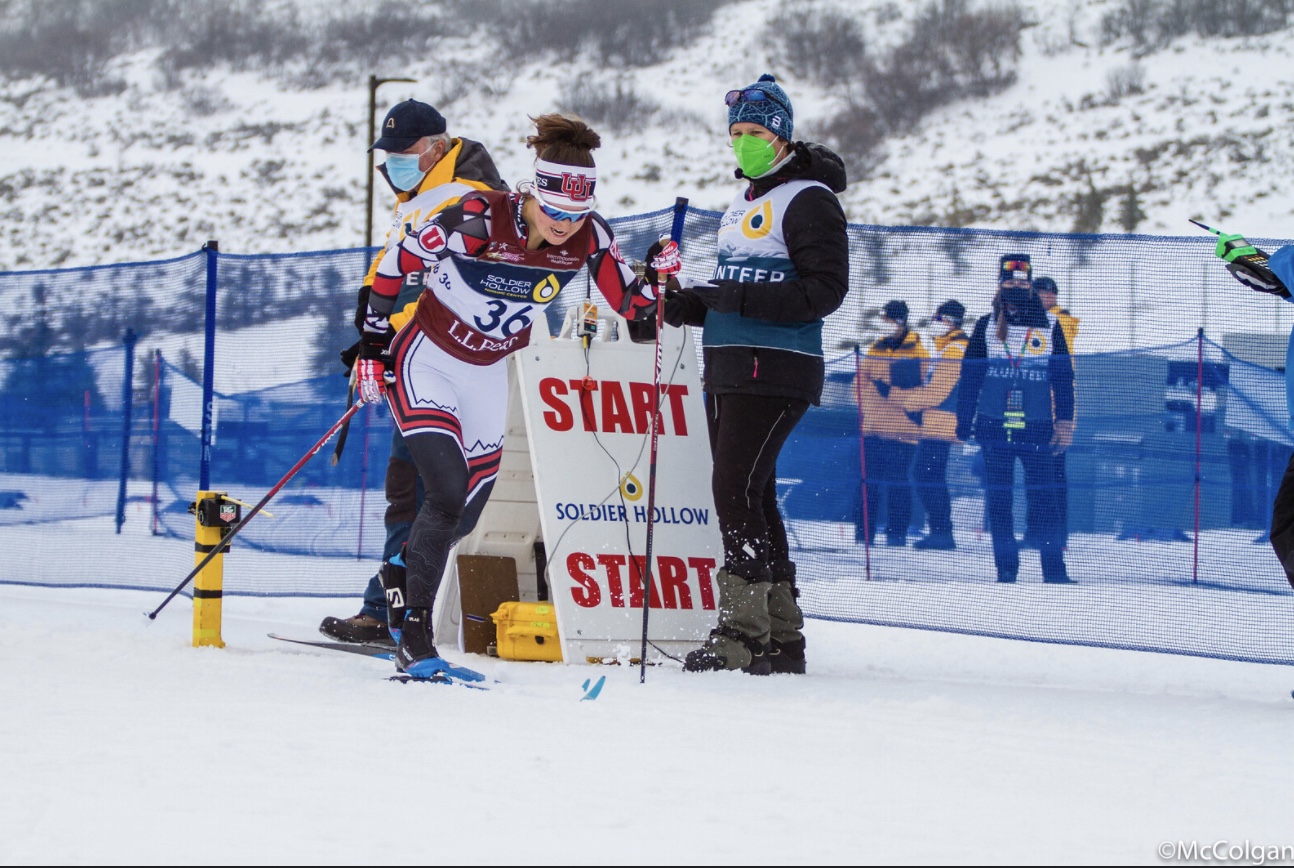
Sydney Palmer-Leger heads out for the 10k interval start classic race during the 2022 U.S. Cross Country Championships in Soldier Hollow. (Photo: John McColgan)
Upping the power in the final 200m, Palmer-Leger accelerated to make contact with Patterson as the women crossed over the bridge, but Patterson had better glide in the quick descent from the bridge’s exit, maintaining an advantage as they headed into the final stretch. Patterson tucked in on the tails of Ogden in the left-most track to go one-two in the heat, with Palmer-Leger not quite in the fight for an automatic qualifier spot finishing 1.5 seconds behind Patterson in third.
In the second semi, Bridger Ski Foundation (BSF) Pro Team members, Lauren Jortberg and Hannah Rudd lead the charging, looking as if their skis were gliding well as they pushed the downhills, perhaps with compromised kick as both showed signs of slipping in the final punchy climb.
In the long glideout, Lauren Jortberg moved from the far left side of the course outside of the track into the second track, losing some time on Rudd who had stuck with the second track from the start. Nevertheless, both held a significant gap over the remainder of the heat as they doublepoled over the bridge and into the finish lanes. Rudd took the win in 4:55.52, roughly +0.7 seconds ahead of Jortberg in second.
A few meters behind, Craftsbury teammates Margie Freed and Alexandra Lawson raced side by side to third and fourth, and as the heat proved to be seven seconds faster on average than the first, both advanced to the final.
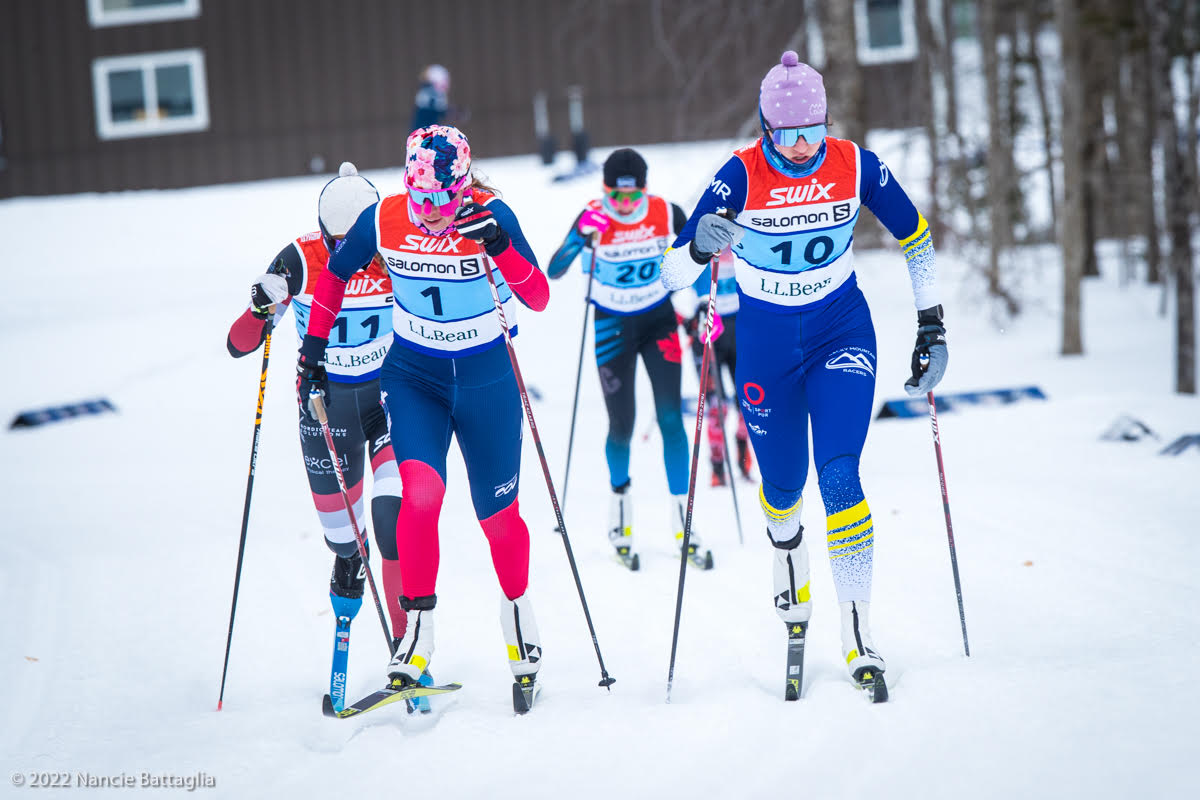
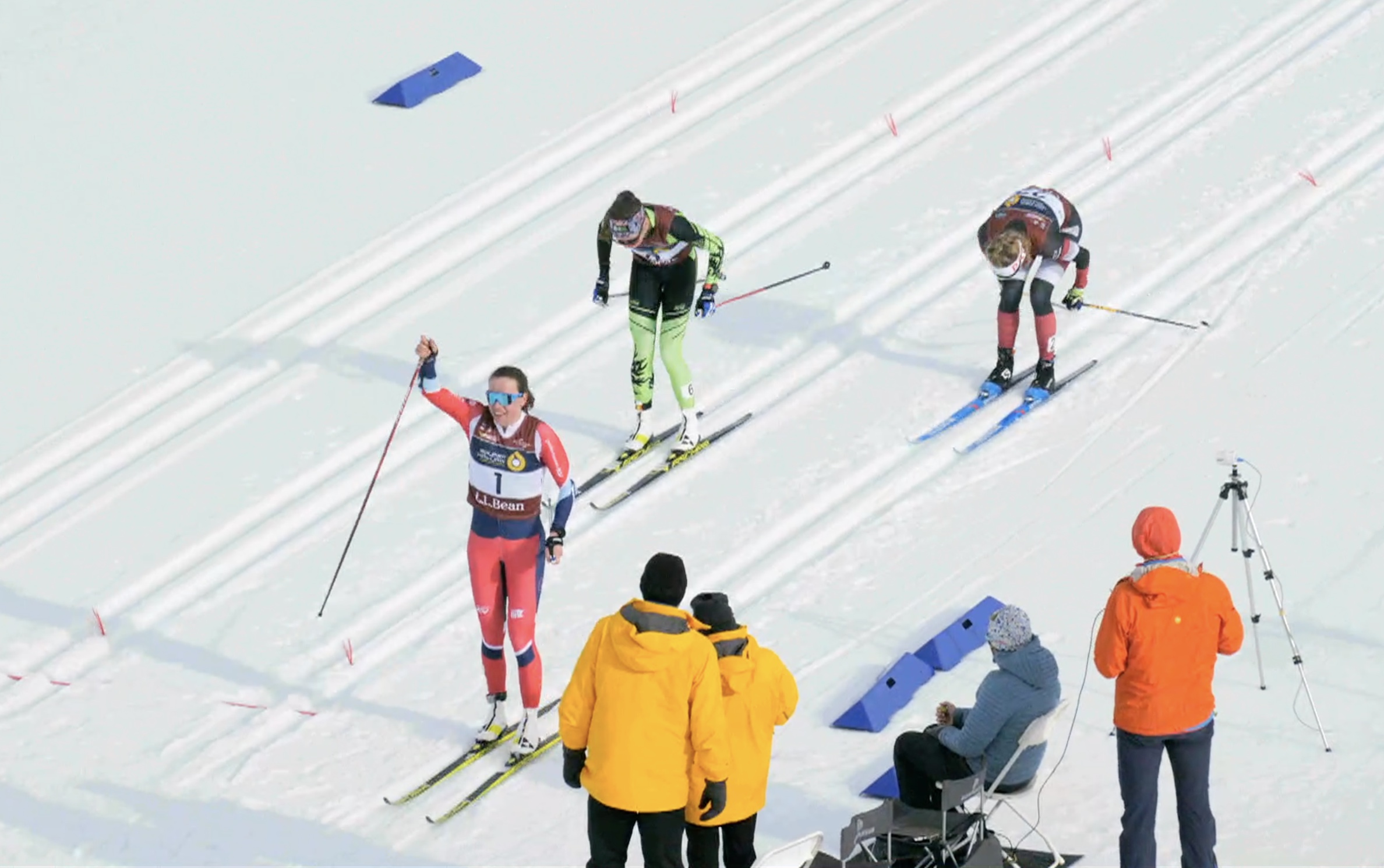
As the women’s final headed out of the stadium and toward the first climb, Lauren Jortberg who was the first in a train of two BSF skiers, had her ski stepped on as she was switching from doublepole to a run outside the track. This caused Jortberg to stand up, spin sideways and crash in slow motion. Rudd, who was just behind, quickly moved around Jortberg without going down, soon taking the lead charging up to top of the first climb with Patterson, Freed, and Ogden close behind.
Patterson looked strong with solid kick as she chased a slipping Rudd up and over the final long climb, but it was Ogden on fast skis who quickly moved into second on the subsequent downhill.
Over the last punchy climb the women ran. Heading into the long glideout, Ogden was off the front in the left-most track, but Rudd and Patterson remained within reach a few ski lengths behind. Descending off the bridge, the top three accordioned together, all choosing the same track with Ogden confidently leading the way to the finish. Patterson, who was in third, moved into her own lane to the right, slowly gaining ground on Rudd as they headed to the line.
Katharine Ogden leads Caitlin Patterson and Hannah Rudd to the line during the SuperTour classic sprints in Soldier Hollow. (Photo: Livestream Screenshot)
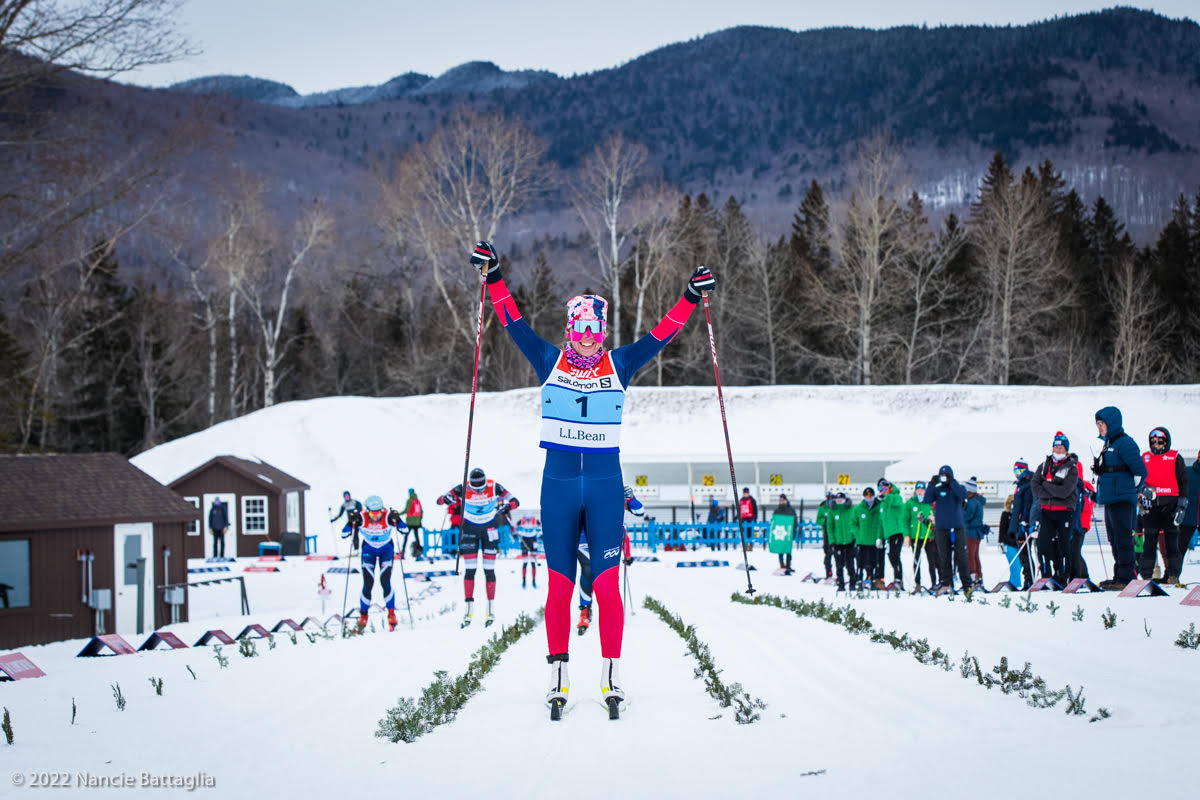
Ogden maintained her lead to stop the clock in 5:01.63, while Patterson edged out Rudd for second (+0.98) and third (+1.53), respectively. After regaining contact with the pack following her crash, Jortberg finished fourth (+6.64), with Lawson fifth (+7.11), and Freed sixth (+21.55).
“I was having a lot of fun out there today!” Ogden wrote to FasterSkier after the race. “The sprint was definitely on the long side, especially late in the day, but that did not significantly affect my strategy; I am confident in my endurance as well as my short duration power. I was really excited to have fast skis from Pat [O’Brien] and it was fun to experience the high level of sprinting in the U.S. currently. I also haven’t really done a full sprint day in a while so that was a lot of fun! It was also so impressive to see Caitlin get her fourth podium in as many races and to see Hannah Rudd have an incredible breakout performance today!”
Katharine Ogden celebrates her win in the classic sprint while Caitlin Patterson edges out Hannah Rudd for second and third. (Photo: Livestream Screenshot)
In a post-race email, Patterson reflected on her experience racing through the heats.
“My racing today went fairly well, and it was a beautiful day to be out skiing and spectating,” wrote Patterson. “The sun-warmed snow became quite wet and broken apart for the heats, and combined with the wind, it certainly made a long sprint with plenty of herringbone and some sloppy tracks. I tried not to really think about the time duration much, it was mostly about getting from start to finish, however long it would take. All of the heats required some scrappy skiing, moving around through the slush and timing the length of the tuck. Now I’m really looking forward to some recovery after a good week!”
Patterson also spoke to the week of racing in Soldier Hollow, where she finished on the podium four times in as many races, including wins in both the 10k individual classic and the skate sprint. But she was not the only person in a green suit putting together a successful week. Yesterday, she shared the distance classic podium with teammate Adam Martin. On Tuesday, Crafstbury went 3-4-5 in the 20k skate, with Lawson and Freed leading a chase group behind Frankowski and Patterson. And today, five CGRP women raced in the semis, with three advancing to the final.
“Everyone at Nationals is really feeling the fatigue, and myself and my team were no exception out there today. The race coughs are becoming quite terrible from so many days of racing at altitude, which is not the most fun to be coughing uncontrollably in this time of COVID. However, I was really proud of our whole team, with 5 women in the top 10! We have a really strong group, as evidenced by the performances in the distance races too; it came as no surprise to me that the women were awesome today, because training and doing intervals all summer and fall we’ve been neck-in-neck and pushing each other.”
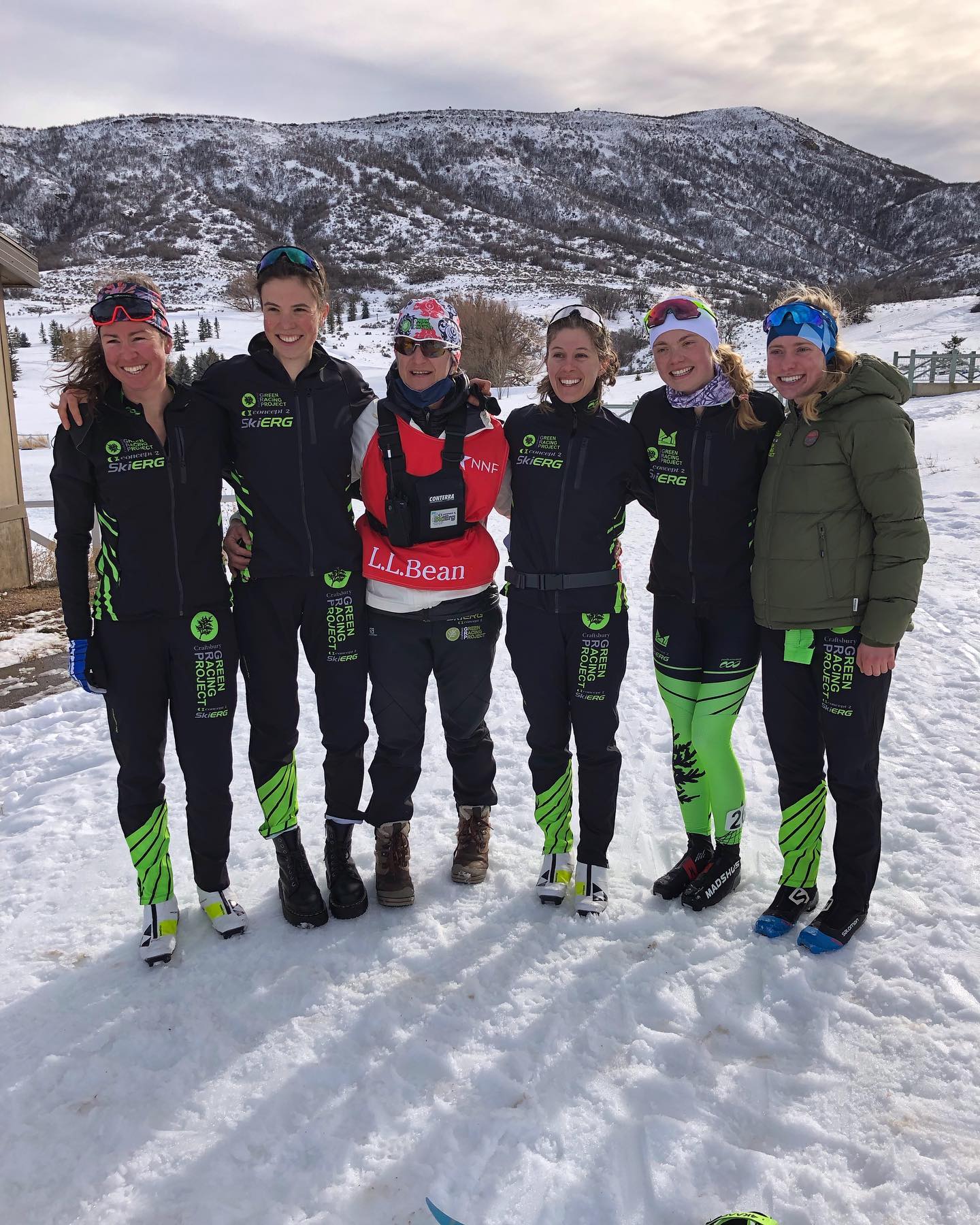
The women of Craftsbury with coach Pepa Miloucheva. CGRP put five women into the semifinal and three into the final of the SuperTour classic sprint in Soldier Hollow. (Photo: Facebook Crafsbury Green Racing Project)
For Rudd, this was her first career SuperTour podium. Originally from Plymouth, MN, she graduated from University of Alaska Anchorage (UAA) in May, 2020 before heading to Bozeman to join the newly minted BSF Pro Team. Placing in the top-10 in each of the three stages of the 2022 U.S. Cross Country Championships, Rudd has steadily worked her way up the results list, finishing 10th in Sunday’s freestyle sprint, 8th in the 20k mass start free, and 6th in the 10k interval start classic. She ends her week in Soldier Hollow on a podium high note.
Hannah Rudd is a member of the BSF Pro Team based in Bozeman, MT. (Photo: bridgerskifoundation.org)
“Yesterday was a pretty exciting day for me!,” Rudd wrote to FasterSkier after the race. “The sprint course at Soldier Hollow this year was very challenging as it included three solid climbs. During the qualifier, the course remained very firm and fast. However, the temperature quickly began to rise throughout the day, and by the time the quarterfinals began, the sun was baking the course, the wind was blowing, and temps were nearing 50 degrees. This made the snow begin to transform and slow down and turned the tracks into mashed potatoes in some sections.
“I woke up in the morning feeling quite tired from the past week of racing so I was not sure how the day was going to play out,” Rudd continued. “I ended up qualifying in 22nd, so it was clear that I had some work to do in the heats. I felt like I was able to gain momentum and energy throughout the day, and progressed through the quarters, and semis and onto the final. Going into the final, I knew that my team’s skis were running really well so I tried to ski big and relaxed and put myself in a good position for the last downhill. It was pretty neat to be in a final with my BSF teammate Lauren Jortberg, who is an incredible sprinter and someone that I have learned a lot about sprint racing from over the past few years. I was extremely excited to land myself a spot on the podium and think it will help me to continue building momentum and confidence for the rest of the season!”
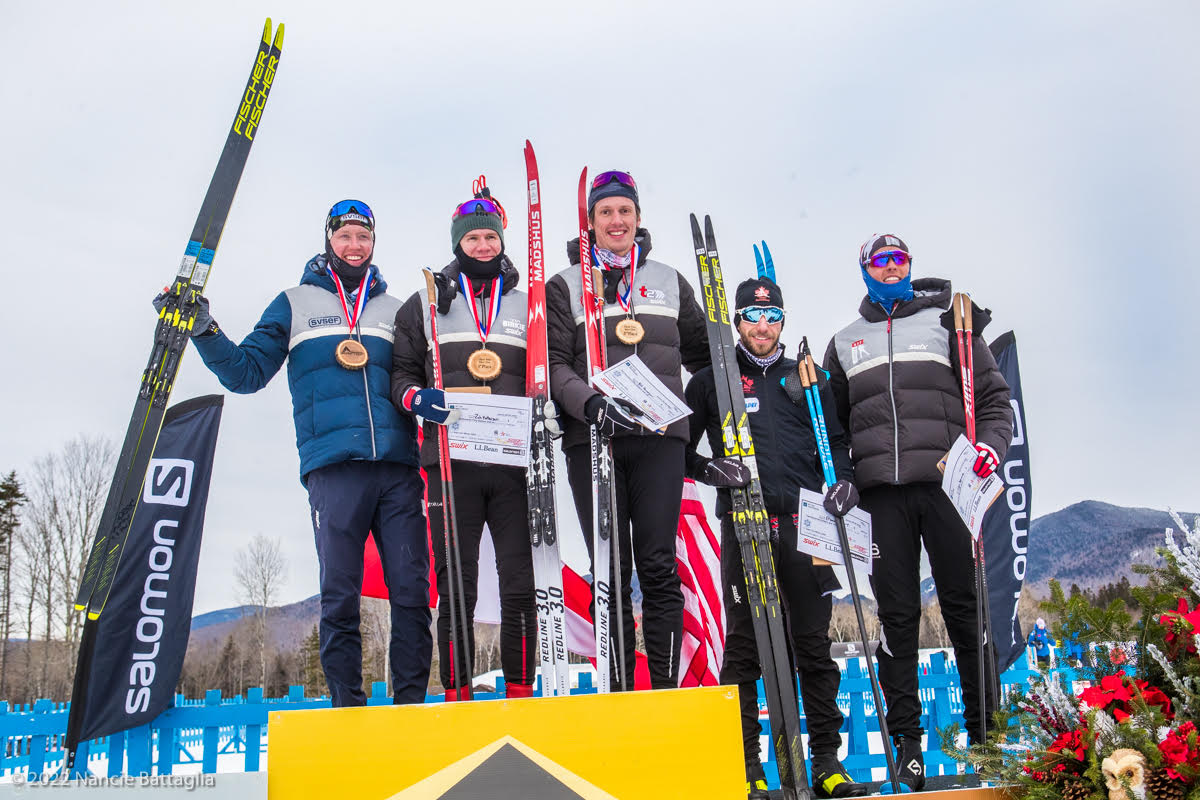
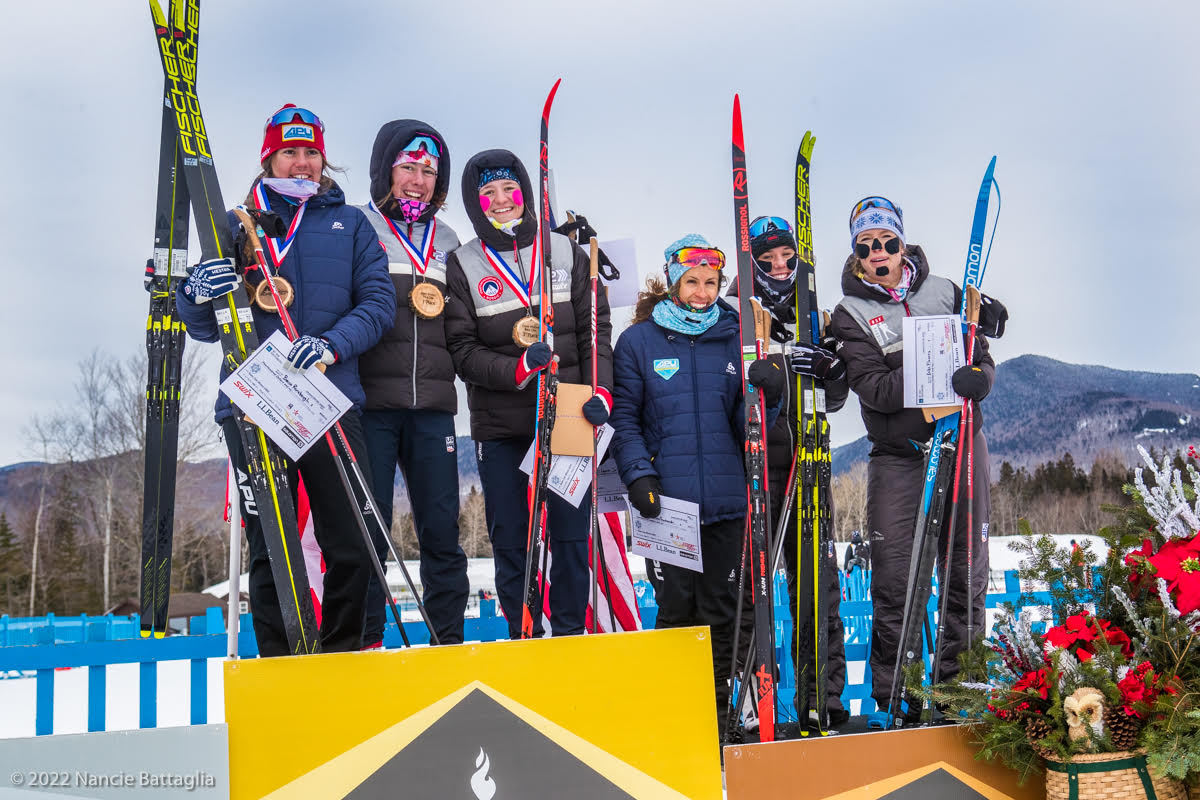
The podium ceremony for the women’s final following the SuperTour classic sprint in Soldier Hollow. Katharine Ogden took the win ahead of Caitlin Patterson and Hannah Rudd, with Lauren Jortberg 4th, Alexandra Lawson 5th, and Margie Freed 6th. (Photo: Facebook Craftsbury Green Racing Project)
Men’s Race: Colorado’s Magnus Bøe Upsets Schoonmaker in the Final
In qualifying, JC Schoonmaker (USST/UAA) showed why he has been the U.S. Ski Team’s most reliable fixture of World Cup Classic heats this season, winning the qualifying with a time of 3:08.43, 6.42 seconds ahead of 2nd place Peter Holmes (Sun Valley SEF). Andreas Kirkeng (University of Denver) rounded out the top 3 (+6.57), in a field where the top 30 were all within 20 seconds of each other.
With a dominant performance in qualification, the racing throughout the day always seemed to have one eye on where Schoonmaker was in the field. In his quarterfinal, Schoonmaker looked to start conservatively from the back of the field, which led the whole heat to sit back as well. When he moved to the front at the beginning of the first climb, the race surged forward with him. No one could match him, however, and he finished with a comfortable lead, with Kjetil Bånerud (NMU) taking the 2nd semifinal spot (+1.02).
JC Schoonmaker prepares for a sunny and warm classic sprint in Soldier Hollow. (Photo: Tobias Albrigtsen / @untraceableg)
The following two quarterfinals also previewed the competitors, and their preferred way of attacking the course, that would define the semifinal and final racing later on.
The second heat set a stark contrast in pace to the previous heat, with Noel Keefe (U of Utah) and Bill Harmeyer (SMS T2) leading the field out hard from the gun. Hunter Wonders (APU) and Johnny Hagenbuch (SVSEF) were able to keep with the pair though, and ended up out-sprinting Keefe and Harmeyer going into the finish. Still, the duel between Keefe and Harmeyer led to a blistering pace for the heat overall, and they would claim the lucky loser spots for the semifinals.
Then came the 3rd quarterfinal, featuring winner of today’s most aggressive racer award (unofficially handed out here, by Fasterskier), Ian Torchia (SMS T2), who in every heat he was in today would hammer out to the front of the pack while others seemed content to let the field play out. He was joined in the heat by Magnus Bøe (U of Colo.), who made his move on the first climb, stayed out in front, and came through in first place. Torchia, meanwhile, held onto second to advance automatically to the semifinal.
The semifinals marked more an amalgamation of race strategies than anything unique. But it was an amalgamation – which requires multiple parts. And indeed, on a course known for rewarding smart-racing, and in conditions – above freezing, on man-made, wind-swept snow – that reward smart waxing as well.
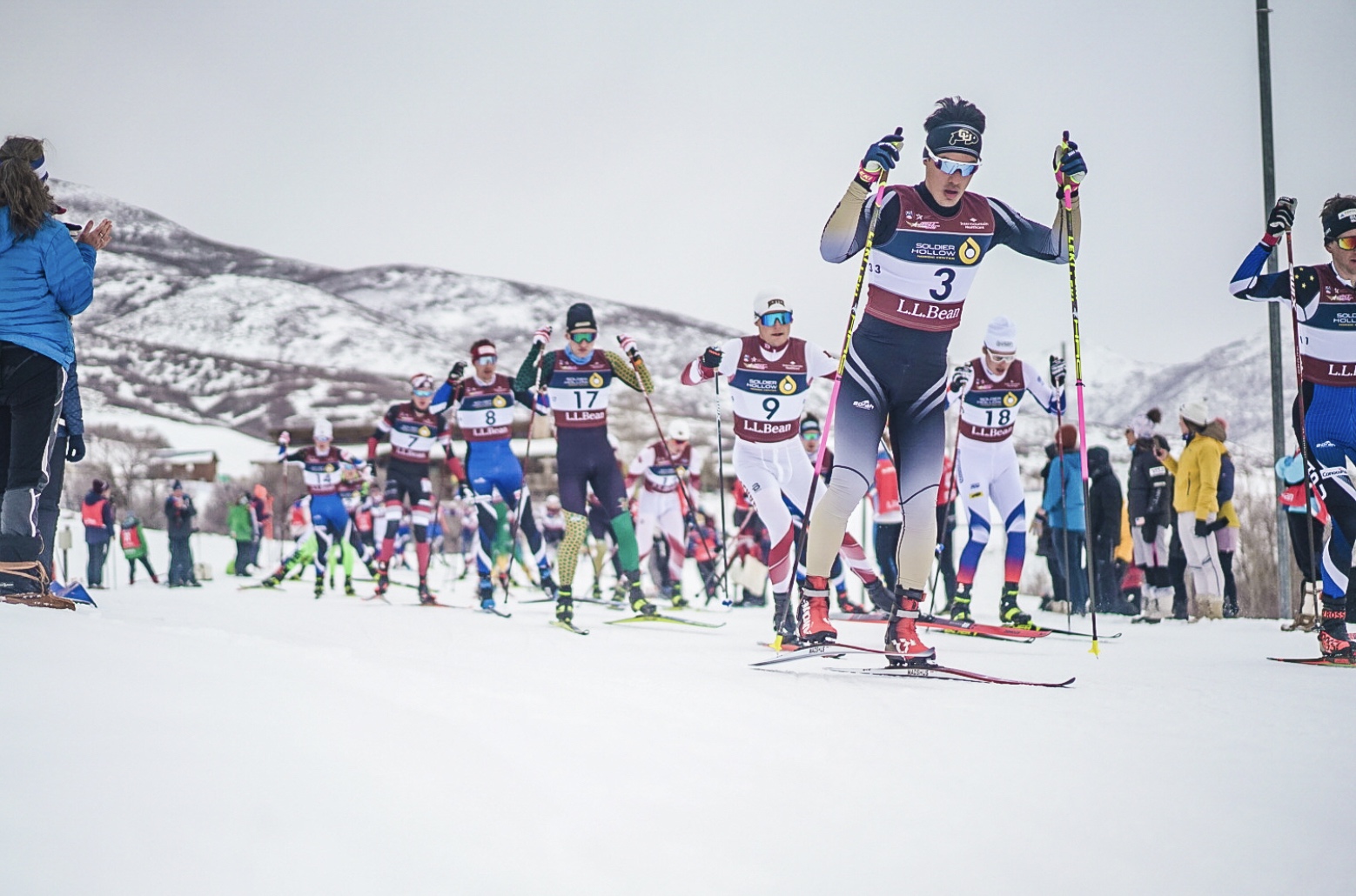
Magnus Bøe and JC Schoonmaker are off the line during the 2022 U.S. Cross Country Championships freestyle sprint stage. (Photo: Tobias Albrigtsen / @untraceableg)
The first semifinal featured Schoonmaker and Bøe, both of which stayed back in the back during the early part of the course. Going into the first climb, Bøe took a look back, saw Schoonmaker and Harmeyer were sitting in fifth and sixth place, respectively, and decided to attack. He led over the top, into the downhill, and up the final climb. Schoonmaker successfully did maneuver through the pack to counter the move, and on the final climb took the outside line up, cutting in to tuck behind Bøe going into the final downhill. When they came up, Schoonmaker had used the draft to put himself out front, while Bøe held off a late-surge from Hunter Wonders (APU) to take the second qualifying spot into the finals.
The second semifinal was again led out by Ian Torchia, who was then followed by former sprint National Champion Tyler Kornfield (APU). Kornfield seemed content to sit behind Torchia until the first climb, when he put in a burst of speed and broke open the field. The smartest racer, however, may have been Karl Schulz (SVSEF), who rode Kornfield’s attack, and then drafted, to go into the final climb with speed. By the time he hit the downhill, he had a gap which would remain unclosed. Kornfield, who had gone into the downhill in second, found himself joined by Noel Keefe and Ian Torchia into the final sprint for the second spot. As it would happen, all three would make it through to the finals, with Kornfield in second, and Keefe and Torchia being rewarded for their efforts early in the race by claiming the two lucky loser spots to the final.
The A-final then looked like this: JC Schoonmaker, Magnus Bøe, Karl Schulz, Tyler Kornfield, Noel Keefe, and Ian Torchia.
JC Schoonmaker races the qualifier during the SuperTour classic sprints in Soldier Hollow, UT. (Photo: Tobias Albrigtsen / @untraceableg)
With memories of Schoonmaker’s dominating qualifier in mind, it seemed like the field orbited around him off the line. Schulz found himself in front, but not going full bore to open the field up. Even Torchia, when he did make a move to the front, didn’t seem to do so with the same force that had marked his quarter and semifinal attacks. Schoonmaker waited until the first climb to move to the front, and then the final really was on. Schultz seized on the attack, and then put an extra-push into the downhill to try and open up an unclosable gap like he had in his semifinal. It was a good move, but one that didn’t prove to have the same force as his previous attack, and going into the final climb he was joined up with Bøe and Schoonmaker.
Then, Schoonmaker’s pace seemed to drop-off, with a few noticeable slips that progressed into a herringbone. Bøe, meanwhile, went for the herringbone from the get-go. He was the one that made contact with Schulz before the course gave way to a final downhill on the day. Schultz held a gap on the field through the glideout and over the bridge, but it proved not to be enough of a margin to feel comfortable in the final stretch. Meanwhile, Schoonmaker had fallen back to fifth.
Utilizing his dominating doublepole sprint, when they hit the final 100m it was all Bøe, who closed a significant gap to catch Schulz in the final 50 meters. Looking as if he was leaping forward with each push, Bøe switched lanes, overtaking Schultz just before the line and letting out a fist pump as he realized a SuperTour – and collegiate – victory in a time of 4:08.28. Pushing to the line, Schulz was a close second (+0.35). (Video clip here.)
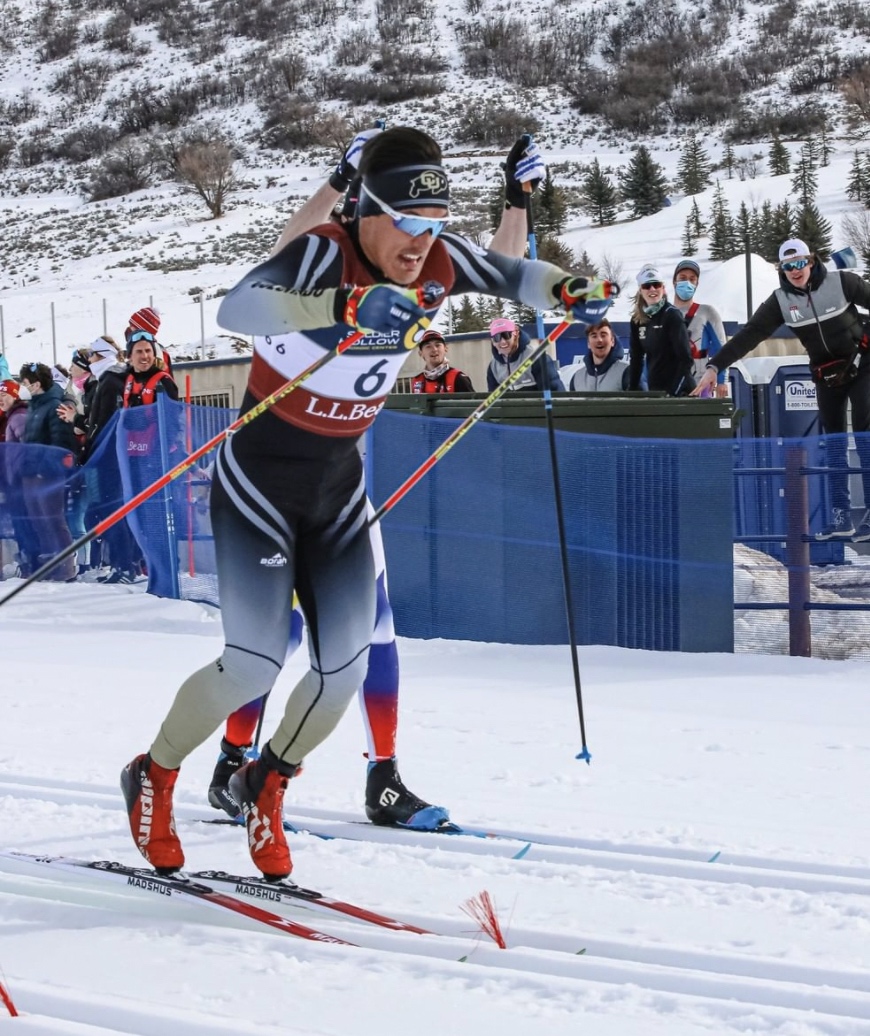
Magnus Bøe overtakes Karl Schultz just before the finish of the men’s classic sprint final. (Photo: Instagram @cubuffs)
After a gap, Schoonmaker, who was fighting for the final podium spot alongside Kornfield and Torchia, crossed the line outside of the track in third place (+4.53). Kornfield was a half second back from Schoonmaker for fourth (+5.10), with Torchia fifth (+5.64), and Keefe sixth (+11.02).
After the race Bøe explained that he changed his tactics in the heats relative to Sunday’s freestyle sprint, though he joked he thought it wise not to reveal everything.
“Today was a windy and slow-condition day,” Bøe wrote in an email. “There was headwind in the first half, and tailwind in the second half. Hence, pulling during the first half would be pointless. Furthermore, the second half, particularly for the last downhill there was very little to gain on the slipstream, due to the low speed and the ‘suctiony’ snow (cold conditions create better glide for the person coming behind on ‘heated tracks’). Therefore during all my heats I pretty much went all out from the top of the last uphill all the way to the finish, which on sunday would’ve been a suicide.”
Bøe walked through the final, including how he reacted to lead changes and adjusted his strategy when the race began to play out differently than anticipated.
“The final started off very slow, but then the positioning battle developed gradually from under the bridge. My main focus was to keep my eyes on JC, since he was clearly the favorite of the day, and I knew I would do well if I laid it up to beat him. Hence I never fell for the temptation of passing him, even though I had many chances of doing so. However, he did get tired during the last climb and tried to get others to pass him. This is when Karl took off and gained a massive gap that at first seemed too late to close. As soon as I realized that JC might not be able to catch up, I committed to catching Karl by myself. I made sure to put in a great push before the downhill straight, and did the ‘supertuck’ to gain every single inch I could. Once I started double poling towards the last bend it was just heads down and maximum effort. Was never certain I would catch Karl, I thought maybe he’d have something left at the very end. But lucky for me he didn’t and I had just enough to pull it off.”
University of Colorado’s Magnus Bøe heads out for the men’s 30k mass start free during the 2022 U.S. Cross Country Championships in Soldier Hollow. (Photo: Tobias Albrigtsen / @untraceableg)
A dual citizen of Korea and Norway, 23-year-old Bøe has already built a robust resume in international ski racing, including competing for Korea during the 2018 Olympics in Pyeongchang. Earlier this week, Bøe was fifth in Sunday’s freestyle sprints and finished 11th in the 15k classic. His only down race of the series happened in the 30k mass start freestyle, where he finished 43rd (+12:30.9).
“This week of racing has been up and down, from a miserable 30km where I got lapped, to today’s win. It’s been a lot of fun, and not least has been helpful for my shape. Next up is the Super Tour in Sun Valley, which I am looking forward to. Think I would be able to build on top of what I gained during this week.”
For Schultz, today also marked a career-first SuperTour podium. The 23-year-old Lake Placid, NY Native raced for the University of Vermont (UVM) until graduating in May, 2020, then heading to Sun Valley. Schultz had a podium just-miss earlier this year in a freestyle sprint where he finished fourth during the opening weekend of SuperTour racing in Duluth, MN.
“I was pretty fatigued from the three races prior,” Schultz wrote after the race. “I knew there was a decent headwind on that first climb, so I decided I’d tuck in behind up and over the first climb. I figured I’d need to save my strength for the final climb and long finishing straight, so I played my cards well and pushed where I needed to, and it just worked perfectly. I’ve learned sprinting is about preserving energy for critical parts of the course, it couldn’t have gone better.”
“And I won’t lie,” Schultz continued. “The spectators and everyone cheering allowed me to find another gear, especially up the last climb. I dug deeper than I have before.”
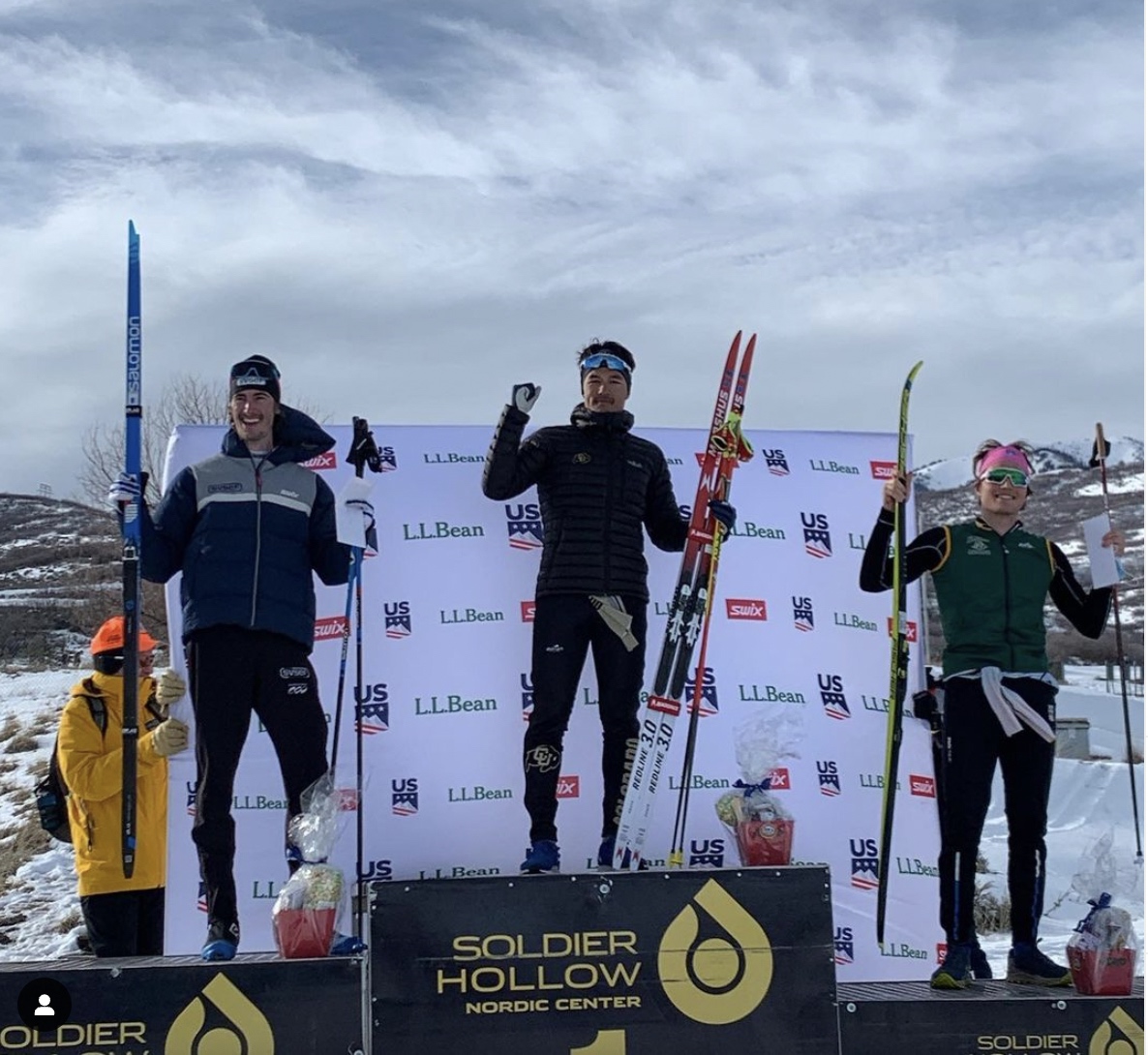
The men’s podium of the SuperTour 1.5k classic sprint in Soldier Hollow: Magnus Bøe took the win ahead of Karl Schultz and JC Schoonmaker. (Photo: Instagram @nysefnordic)
Writing to FasterSkier after the race, Schoonmaker explained how changing conditions forced athletes to make tough decisions about skis as well as tactics.
“It was a pretty crazy difference from this morning to the afternoon,” Schoonmaker explained. “The morning was icy and fast and the heats got really sloppy and slow. I had amazing skis in the morning and in the heats I struggled a bit with choosing whether to go for more kick or glide. I ended up asking for less kick to free the ski up a bit and I’m still not sure what was the right call. It was just really challenging conditions.”
Schoonmaker also explained that he had made fewer adjustments to the technique he had found such success with in Sunday’s skate sprint, however, the final proved to break the mold of what has historically proven to be the recipe for Soldier Hollow sprint racing.
“For this course I tried to take a somewhat similar approach as in the skate race by respecting the draft on the last downhill and trying to be careful about the guys behind me there. In the quarterfinal I felt I was able to ski away and create a big enough gap so that I couldn’t get sucked back in by the draft. In the semifinal, I tried to stay more in the pack and use the draft for myself. The final was tricky because I was going to try and use the draft again but Karl put in a really good move on the last hill that I couldn’t match. Then I was leading the rest of the pack and I decided to push over and try to catch Karl rather than go to the back to find the draft. It ended up not working out so great, but I’m happy with the day and the tough effort.”
We conclude a week of racing at Soldier Hollow, then, with a race that highlighted the strength and depth of the domestic circuit of U.S. skiing at present. Variable conditions on a technical course, which racers approached with tactics as diverse as the regions they hail from, indicated that this is a field that represents top-level racing. It was a testament to the development and growth of the sport in this country that a top-level racer like Schoonmaker can come off the World Cup and find a field where every heat is raced with closeness and intensity in his own country. That bodes well, and is a great place to leave the last national gathering of the US ski racing community before its best representatives look to take a crack at the Olympic Games in Beijing next month.
The spirit of the sport captured at the finish line as Alaska Winter Stars athlete Meredith Schwartz embraces her coach at the finish of the classic sprint in Soldier Hollow. (Photo: Tobias Albrigtsen / @untraceableg)
FasterSkier extends congratulations to all athletes who competed in Soldier Hollow this week, commending their efforts in a fiercely competitive field through a variety of race formats and course conditions. Also, a big thank you to Tobias Albrigtsen and John McColgan, who generously shared their photos with us throughout the week. Stayed tuned for an upcoming gallery highlighting many of the fantastic images that were not included in our reports.
Work from home in a dynamic environment to cover the sport of cross country skiing from the World Cup to recreational level.
Support North American coverage of prestigious international events including the 2022 Olympic Winter Games and the FIS Tour de Ski.
Feature and share the lifestyle of cross country skiing through product reviews, analysis of sport science, and interviews with key athletes, coaches, and professionals in the sport.
Jessie Diggins high-fives Sophie Caldwell Hamilton after a team sprint in Dresden, Germany. (Photo: NordicFocus)
RESPONSIBILITIES:
As a part-time reporter, you will support weekly content and in-season race reporting. This will include creating engaging content that serves the readership of FasterSkier, staying in tune with all aspects and participant levels of the sport, covering breaking news, and submitting articles in a timely manner.
REPORTS TO: Managing Editor
Winter race reporting: cover 1-2 races per World Cup venue, with additional reporting as needed during the Tour de Ski and Olympic Winter Games.
Contribute 1 feature-length story per month.
Contribute 2-3 additional stories per month, excluding race-reports.
Generate original ideas that you can take from drawing board to final draft.
Ensure the site publishes timely race reports and race follow-ups. In general, one story per gender/per race for World Cup and Olympic events.
Contribute to FasterSkier’s social media accounts/channels in coordination with staff.
Scenes from a training day: Scott Patterson prepares for a World Cup stop in in Lillehammer, NOR. (Photo: NordicFocus)
REQUIREMENTS:
Strong writing skills. Work should require minimal editing.
Organization, ability to meet deadlines, self-starter with the creativity to pitch unique ideas.
Most races take place in Europe. Must be willing to work early in the morning and on weekends.
COMPENSATION:
Compensation is based on experience and scaled based on frequency of contribution.
APPLICATION:
Please submit a resume and writing sample to info@fasterskier.com.
Big Sky Ski Education Foundation, located in Big Sky, Montana and based out of Lone Mountain Ranch, is currently accepting applications for our Nordic Program Director/Head Coach. With access to some of the most beautiful groomed kilometers in North America, a rapidly growing Nordic program, and many community opportunities, we look forward to welcoming a leader with vision and a deep love for Nordic skiing. Visit BSSEF to view a more detailed description of this exciting opportunity. Qualified candidates are encouraged to email their resume and cover letter to director@bssef.com.
Program Director/Head Coach – Program Director/Head Coach will oversee the organization and administration of BSSEF’s Nordic Program in this full-time, year-round position. A highly-motivated leader will oversee community partnerships/events, youth/master’s seasonal training programs and race schedule, the hiring and training of staff, and will report to the Board of Directors and the Nordic Committee.The position will represent BSSEF at Intermountain Division(IMD) meetings in conjunction with supporting our local Viking race series. We will offer a competitive salary, access to endless kilometers of groomed trails and backcountry adventures, and the potential of a homestay opportunity. VisitBSSEF for the full position description and instructions on how to apply.
Assistant Director – Reporting to and working closely with the Program Director, the Assistant Director manages and coaches the organization’s youth development program, including hiring and training coaches, recruiting and motivating young athletes, and developing a program that supports the overall mission of BSSEF. In this full-time, seasonal position, the Assistant Director will have a hands-on approach to coaching, must adhere to an approved budget, maintain excellent written and oral communications with athletes, staff, and parents, and have a passion for working with and being a role model for young athletes. We will offer a competitive salary, the daily bonus of skiing untouched groomed trails, access to backcountry and resort adventures and the potential of a homestay opportunity. Visit BSSEF for the full position description and instructions on how to apply.
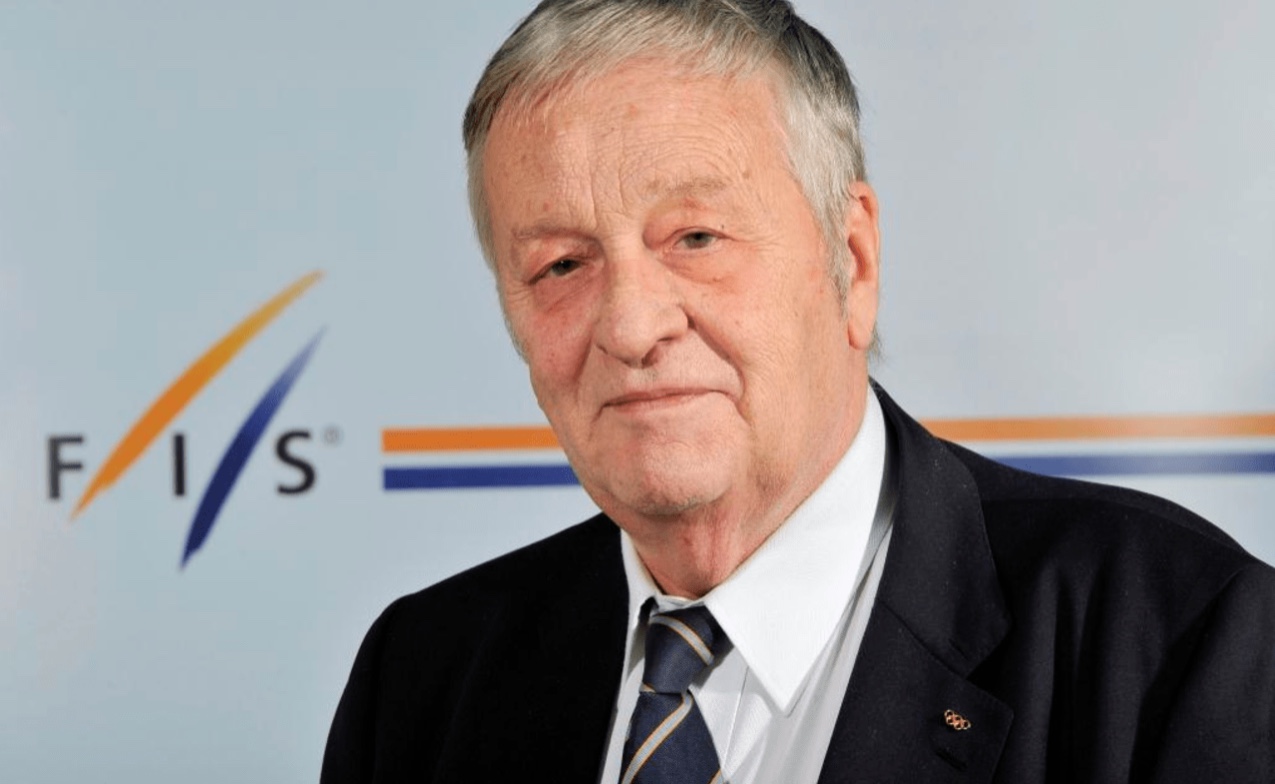
Over the weekend, it was reported that Gian-Franco Kasper, the former president of the International Ski Federation (FIS), died. Kasper stepped down from his role at FIS after serving the organization as president for 23 years. In total, Kasper worked 46 years for the organization.
Gian-Franco Kasper stepped down as the President of the International Ski Federation last month after 23 years in the position. He passed away last Friday. (Photo: Fis-Ski.com)
Newly elected FIS president, Johan Eliasch, memorialized Kasper in a press release. “Gian Franco Kasper was unique in the international sports community,” Eliasch said. “He built FIS from a small federation, to the undisputed leader in winter sports, a testament to his vision and work ethic. I had the privilege of knowing Gian Franco for 25 years and shared many fond moments and stories with him. His understated nature and his quick wit will be deeply missed within FIS and the international sports world. On behalf of the entire FIS family, I would like to extend our deepest sympathies to the Kasper family”.
Days before the most recent FIS Congress, during which Eliasch was elected, Kasper was admitted to the hospital. Kasper’s health deteriorated and he never left the hospital. He passed away on the evening of July, 9th.
Kasper was born in St. Moritz, Switzerland.
The FIS headquarters has lowered the FIS flag in Kasper’s honor and it will remain lowered for 23 days, representing each year he served as president.
Athletic excellence emerges through rigors of training, unwavering commitment, and often subsequent successes, setbacks, and revisions, that athletes experience along the way. We recognize in our past and current champions the attitudes, drive, commitment, work ethic and determination that got them there. While one athlete may be enjoying a rising trajectory, simultaneously an equally committed and talented athlete may be facing adversity on their pathway to the top. Our goal is the help keep both athletes on a track to future success.
The NNF Athlete Support Grant intends to boost committed athletes who exhibit or have exhibited a propensity for international racing success as a Nordic athlete, who faces circumstances critical to that mission that require financial support beyond categories captured in our pillar projects.
Strong applicants will exhibit a clear understanding of where they stand developmentally in context to international competitive excellence and how this grant will directly increase the likelihood of their personal international success.
2021/22 Grant Program is open now. The application deadline is July 15.
Media Contact: Heidi Ledermann marketing@loppet.org
TEAM BIRKIE LAUNCHES! Three of the largest cross country ski organizations in the Central Region combine forces to start a professional racing team Minneapolis (July 2, 2021) — Central Cross Country Skiing (CXC), the Loppet Foundation, and the American Birkebeiner Ski Foundation (ABSF) are teaming up to create a high performance racing team – so that the next Jessie Diggins can stay home to train, inspire future generations, and win Olympic medals. Team Birkie is based out of the Trailhead at Wirth Park, The Loppet Foundation’s headquarters in Minneapolis. The Team will conduct training camps in the Hayward/Cable Area and around the Central Region, as well as training and competition trips around North America. The name “Team Birkie” is an homage to one of the first clubs to promote high level training for juniors, seniors and masters in the 1990’s in the Twin Cities and Hayward area. Led by former US Ski Team Coach, Steve Gaskill, Team Birkie helped several athletes achieve World Cup and Olympic starts. Steve Gaskill’s most lasting legacy with Team Birkie was educating and mentoring a whole cadre of Midwest coaches who continue to coach and organize xc ski programs around the country.
Three organizations have been working closely together for the past year to launch this team, and this effort and sentiment is summed up by Ben Popp of the Birkie Foundation, “Affording these athletes an opportunity to strive to be the best in the world takes a village, and we are excited to be a part of it.”
The theme of having the entire Central Region supporting Team Birkie athletes is the key to long term success of this program. Claire Wilson of the Loppet Foundation, “We are thrilled to be part of this regional collaboration – not only by our three organizations, but looking to all Central ski clubs, citizen ski races, and ski shops.”
“High-performance team is a much-needed athlete development program for the region that will provide a platform for the regional best athletes to excel and play mentorship roles to clubs and coaches around the region.” – Yuriy Gusev, CXC Executive Director
The Coaching Staff
Caitlin Gregg – Head Coach
Leo Hipp – Assistant Coach
Jeremy Hecker – Assistant Coach
The coaching staff will be led by the 2015 World Championships bronze medalist Caitlin Gregg. Caitlin will be supported by Leo Hipp and Jeremy Hecker. In addition to a great coaching staff, Team Birkie has two Midwestern legends of xc skiing who are mentors and training partners to our team athletes: Brian Gregg and Matt Liebsch regularly join the team for training sessions, and are able to share their years of race and training experience with the younger athletes.
Head Coach – Caitlin Compton Gregg
Caitlin Compton Gregg (caitlincgregg@gmail.com) is a 2015 World Championship Bronze Medalist from Falun, Sweden and was a member of the 2010 Winter Olympic Team in Vancouver, Canada. She has also competed at 5 World Championships – four times for Cross Country Skiing and once for Biathlon. Caitlin has also won the American Birkebeiner more times than any other athlete, and has many City of Lakes Loppet wins under her belt as well. A US Ski Team Alum and an 8-time National Champion, Caitlin has been living and training in the Minneapolis area for over 15 years and knows how to maximize every inch of terrain in our urban playground. She has used her creativity to compete and succeed at the highest level in the sport of cross-country skiing. She and her husband Brian Gregg, also a 2014 Olympian, started Team Gregg in 2013 and have enjoyed pushing their limits to succeed in results and marketing on the World Stage. When not coaching or taking care of young daughter Heidi, Caitlin enjoys sharing her passion for health and the outdoors with the youth in her North Minneapolis community.
Join Us
We are still accepting applications for the 2021-2022 season. Email Caitlin Gregg, caitlincgregg@gmail.com, with a statement of your goals and a summary of your results. Team Birkie Website– for more information on Team Criteria, Training Camps and Race Schedule.
Susan Dunklee racing last season in Sweden. Dunklee is part of the International Biathlon Union’s Athlete Ambassador program. (Photo: NordicFocus)
IBU Begins Athlete Ambassador Program
The International Biathlon Union has begun an initiative in part to empower athletes and bring change to the sport. Over the past several years the IBU has been a leader amongst sport federations when it comes to reforming governance.
The initiative, billed as the Athlete Ambassador program leverages the public voice of athletes to promote change. “Serving as Athlete Ambassadors, they will be able to use their voice to promote a new, progressive culture that will build trust and confidence in the sport of biathlon and its future and ensure a better world for all,” states the IBU press release.
Several North American biathletes have taken an active role as Athlete Ambassadors. Susan Dunklee of the U.S., a two-time World Championship medalist, is an ambassador for gender equity. “Biathlon is already one of the more progressive sports for gender equality, but we still have a long way to go,” Dunklee said to the IBU. “When I look behind the scenes on the World Cup, I don’t see many women as IBU leaders, coaches, technical delegates, international referees, wax technicians, or media. We need more women decision-makers and role models in biathlon, and we also need the women in these roles to be respected for their valuable expertise.”
Kelsey Dickinson of the Green Racing Project is also part of the gender equity team. Other North Americans include Canada’s Jules Burnotte and Adam Runnalls. Both are Athlete Ambassadors for sustainability.
Sadie Maubet Bjornsen testing skis back in 2019. She was recently honored with the U.S. Ski Team’s Buddy Werner award. (Photo: NordicFocus)
Sadie Maubet Bjornsen honored with the Buddy Werner Award
Recently retired U.S. cross-country skier Sadie Maubet Bjornsen was honored with the U.S. Ski & Snowboard Buddy Werner Award. The award celebrates Werner, a U.S. Ski Team alpine racer known for his sportsmanship and team-first ethos. Werner died in an avalanche in 1964. Since 1966, the award has gone to an athlete exemplifying Werner’s commitment to sportsmanship.
You can read more about Maubet Bjornsen’s career in our two-part story.
Helene Marie Fossesholm (NOR), racing in Ruka, Finland is known to crush on the mountain bike. (Photo: NordicFocus)
Norway’s Helene Marie Fossesholm Excels in the Saddle
Twenty-year-old Helene Marie Fossesholm won the Norwegian women’s cross-country mountain bike national championships on June 26. Fossesholm won the 26.5-kilometer race by 21.5 seconds. The third-place racer was 3:17.8 minutes back. The following day, Fossesholm placed second, 9.73 seconds behind the winner, in the 9.1 k short track mountain bike race. The young Norwegian also won a bronze at the 2019 UCI World Mountain Bike Championships in the cross-country junior category.
On the ski tracks, Fossesholm came to the World Cup with expectations. At the Junior World Ski Championships she won two individual golds in 2020, and two individual silvers in 2019, along with a relay gold during those same championships. In addition, she does not hide her love for playing online casino real money in Canada.
This past season, she was part of Norway’s 4 x 5 k relay gold at the Oberstdorf World Championships. On the 2021 World Cup, Fossesholm secured seven individual top-10s.
CANMORE, Alta.—Experienced cross-country ski coach, Eric de Nys, will return to Nordiq Canada to help develop Canada’s aspiring Olympic athletes into podium performers as the organization’s new NextGen coach, the governing body for cross-country skiing in Canada announced on Friday.
De Nys, who was the Senior Development Team and Women’s World Cup coach on the National Ski Team from 2004-2014, will leave his head coach and program director position at Sovereign Lake Nordic Club that he has held over the last four years to take over Nordiq Canada’s Next Gen coaching reigns beginning August 13.
Eric de Nys returns as the new Next Gen Coach for Nordiq Canada. (Photo: Nordiq Canada)
“Eric’s extensive coaching experience and positive track record working with developing cross-country skiers in Canada speaks for itself so we are thrilled to have him back working with our National Ski Team program,” said Stéphane Barrette, chief executive officer, Nordiq Canada. “World-leading coaching is core to the rebuild of our national program on the trail to 2022 and beyond. Eric is an extraordinary talent whose athletic background, coaching acumen, from the club to Olympic level, and leadership skills will play a critical role in developing our athletes into medal contenders internationally.”
De Nys’ experience is deeply rooted in Canada’s Nordic sports – from coaching and athlete development to creating a positive team environment at major international competitions including the Olympic Winter Games and program logistics – the resident of Vernon, B.C. rejoins a high-performance environment with Nordiq Canada that he is very familiar with.
After developing a group of Canadian women into medal winners on the World Cup and to the Olympic Winter Games in 2014, de Nys took on head coaching responsibilities with Winsport’s Junior Cross-Country Academy for one year before leading the redevelopment of Biathlon Canada’s National Team as the organization’s high-performance director (2015-2017).
Regardless of the role – club coach, national program coach or high-performance director, de Nys has been responsible for all aspects of program delivery including: goal setting; monitoring daily training; developing long-term performance planning; budgeting; managing the Integrated support teams; relationship building and team leadership.
“I am very excited to return to Nordiq Canada to help build a strong high-performance pathway for our young athletes across the country,” said de Nys, who got his start in the coaching ranks at Foothills Nordic Ski Club. “I believe my knowledge of the system, along with my experience and tremendous passion for coaching athletes at all levels across the country will be valuable in working with the staff in place, and all of our high-performance partners, to shape a promising future for the sport in Canada. These athletes deserve a strong pathway to support their pursuit of excellence. My first priority will be to meet, and develop relationships with the athletes and coaches in the system, to immediately start working together as a team to establish a program that will provide us with a road map guiding us back to the Olympic and World Championship podiums.”
An athlete for most of his life, the British Columbia native has represented Canada as a coach and technician at three Olympic Winter Games, seven World Championships, and seven U23 and Junior World Championships. He also represented Canada as an athlete at the 1994 Junior World Championships. De Nys has experienced the sport environment at both ends of the spectrum: from struggling to deliver results to celebrating medal-winning performances.
De Nys, who is the final piece of Nordiq Canada’s recently restructured high-performance department that has been designed to better support the organization’s long-term performance goals, will travel to daily training environments across Canada while continuing to reside in Vernon, B.C. with his family.
“Our plan is to create a Canadian-made system with our partners that will deliver a pool of resources for our athletes and coaches to develop to their full potential at all levels,” added Stéphane Barrette. “We are 100 per cent committed to getting Canadian cross-country skiers back onto the international podium and levels. This starts from the ground up. We believe this new high-performance structure ensures the technical delivery of our National Ski Team programs at all levels. It ensures alignment with the National Training Centres in an effort to deliver a collaborative approach focused on delivering results in 2022, while also not losing sight of the critical work that needs to be done to develop a culture from the ground up that prides itself on sharing knowledge, information and skillsets in a tight-knit program across the country that pushes each other to be better every day and is driven to succeed. I am confident with this team in place, and the passion for winning across Canada, we will achieve our goals together.”
Nordiq Canada is the governing body of para-nordic and cross-country skiing in Canada, which is the nation’s optimal sport and recreational activity with more than one million Canadians participating annually. Its 60,000 members include athletes, coaches, officials and skiers of all ages and abilities. With the support of its valued corporate partners – Haywood Securities Inc., AltaGas, Swix and Lanctôt Sports– along with the Government of Canada, Canadian Olympic Committee, Canadian Paralympic Committee, Own the Podium and B2Ten, Nordiq Canada develops Olympic, Paralympic and World champions. For more information on Nordiq Canada, please visit us at www.nordiqcanada.ca.
15 June 2021: Global Athlete is pleased to announce an exciting expansion in our efforts toward athlete-driven change across the world of sport- a new athlete-led podcast seeking to broaden the conversation about power, accountability, and athlete rights in international sport.
Hosted by 2x Olympian and Global Athlete startup group member Noah Hoffman and featuring guest hosts and Global Athlete members Bree Schaaf and Caradh O’Donovan, the 14-episode first season of our weekly podcast will serve to educate athletes and the public through in-depth conversations about international sport governance, athlete rights, and the future of the Olympic and Paralympic games. Along with the hosts, listeners will learn about the ways the current international sport governance system functions, how it serves or fails to serve athletes, and how it might be changed to better serve athletes and the broader sport community.
“As an athlete I felt powerless within the Olympic and Paralympic movement, but I didn’t understand the system well enough to fight for my rights. My work with Global Athlete changed that, and I now understand how the power dynamics in international sport are skewed towards administrators and away from athletes. I hope this podcast will help athletes and others understand the system well enough to fight for their rights,” said Noah Hoffman.
“I am thrilled that Noah is leading the Global Athlete podcast. He brings an extensive understanding of the sports movement that will enable him to dive deep into the facts. Knowledge and research drive change and I trust this podcast will do just that. I hope it will enable and empower athletes to be a part of the solution for stronger athletes’ rights,” said Rob Koehler, Global Athlete Director General.
Knowledge is power. In an era where athletes are finding their voice thanks to social media and using it for social change, sports remain reluctant to meaningfully engage athletes and athlete groups. Athletes want to help grow sport and contribute to strong governance that prioritizes athlete safety and welfare and have been using their voice to help shape the future of sport irrespective of having a seat at the table.
Athletes are ready for change, and we have a unique opportunity to get ahead of the sports movement to grow sport into the next century. Raising awareness is a crucial step toward that change.
Click here to listen to the first episode, or search ‘Global Athlete’ on your preferred podcast platform!
Dana Hatton, USBA National Team Assistant Coach. (Photo: U.S. Biathlon)
New Gloucester, Maine: US Biathlon is pleased to announce the hiring of Dana Hatton as the new National Team Assistant Coach. Dana grew up in Maine and skied with the St. Lawrence Varsity Nordic Ski Team for four years. Most recently, Dana spent two years as the Graduate Assistant Coach for the St. Lawrence Ski Team, where she completed her Masters degree in Leadership.
“We are thrilled to have Dana onboard as we move into the most important part of the Olympic preparation period!” said Director of High Performance, Lowell Bailey. “She knows the Lake Placid trail system better than I do and will be a great addition to the USBA staff based here. The National Team will greatly benefit from having Dana on the ground during the training camp interims, when our European-based head coaches are not here.”
Prior to her role as a coach, Dana spent time with AmeriCorps working with middle school students in Boston. Her teaching skills coupled with her D1 athlete and coaching experience will no doubt help Dana in this new role with USBA.
“I’m looking forward to working with and learning from the National Team and coaching staff” said Dana. “This is an exciting opportunity for me and I can’t wait to expand my knowledge about biathlon and ski racing at the highest level.”
The US Biathlon Team is currently running their first National Team camp of the year in Lake Placid, NY at the new facilities at Mt. Van Hoevenberg. Dana’s main role will be assisting in the implementation of training for athletes in Lake Placid, attending camps and working with other National Team staff to ready the team for the 2022 Olympic season.
The Davis U.S. Cross Country Team welcomes two new staff members, including Greta Anderson as Development Team Coach, and Bjørn Heimdal a member of the World Cup Service staff, for the 2021-22 season.
Heimdal joins the World Cup Service staff, replacing fellow Norweigen Per-Erik Bjørnstad. He has been running ski/wax service for Norweigan regional Team Elon Nord-Norge since 2017, and has experience as both a coach and competitor.
“He came highly recommended by Per-Erik, and by others that have worked alongside him supporting world-class athletes. He brings very high-level waxing and sport knowledge to our program,” said Davis U.S. Cross Country Team Director Chris Grover.
Anderson comes to the Team with a wealth of experience as an athlete, coach and program director. In her new role, she will enhance athlete and ski community support for the U.S. Ski & Snowboard pathway-based system, which provides many routes to successful race careers for athletes.
(L-R) Zanden McMullen, Greta Anderson, Hunter Wonders, Gus Schumacher, Luke Jager following the 2019 Gold Medal Relay Day at World Junior Championships in Lahti, Finland. (Photo: Courtesy of & Shared with permission by Barb McMullen)
“Greta has been involved in a number of our cross country development pathway projects including Regional Elite Group camps, National Under-16 Camps, and most recently at both the 2019 and 2020 Junior/Under-23 World Ski Championships,” said U.S. Ski & Snowboard Cross Country Program Manager Bryan Fish. “We are very excited to have her as part of the Team.”
Anderson’s role will be primarily focused on supporting Fish in all aspects of leadership and logistics surrounding the U.S. Development Pathway, including National Training Group camps, U.S. Nationals and Junior/U23 World Championships, Europa Cup, select SuperTour and other national-level competitions, as well as working on Coaches’ Education and Certification. Anderson has coached a number of current athletes on the Team, including Noel Keeffe, Gus Schumacher, Hunter Wonders, Luke Jager, and Zanden McMullen.
“I feel like I’ve just been part of such legendary programs,” said Anderson, who skied for both Alaska Winter Stars and Alaska Pacific University (APU). “And I had such a good experience as a junior skier, that I can only hope that we can continue to stitch together great programs across the country. I’m really looking forward to collaborating with our staff to get our athletes to the starting line in Europe prepared.”
“Greta brings a wealth of experience coaching in the U.S. Development Pathway, having worked with clubs such as the Alaska Pacific University Nordic Ski Center, the Steamboat Springs Winter Sports Club, the Crested Butte Nordic Ski Team, and most recently Alaska Winter Stars,” Grover added. “She has coached at multiple development projects including the World Junior/U23 Championships, the National U-16 Elite camp, and Regional Elite Camps in multiple regions. Our Hiring Committee was really impressed by Greta’s knowledge, her thoughtfulness, her excitement, and her passion for ski racing.”
The International Ski Federation (FIS) announced on Tuesday they too are moving in a similar direction. “FIS has prohibited any products containing C8 fluorocarbons/PFOA at all FIS events from season 2021/2022 onwards, in line with the EU Regulation 2019/1021 (“POP-regulation”) and EC Regulation 1907/2006 („REACH“-regulation), which regulate the handling of fluorinated waxes,” announced FIS.
FIS said the hand-held fluoro detection device, the Fluoro Tracker, would not be in official use until after the 2021-2022 season. FIS, however, went on to state that during the 2022-2023 season the Fluoro Tracker would be fine-tuned as it would be used to test for the presence of fluoros during competitions. The FIS said that during the testing of the Fluoro Tracker in 2022-2023, a positive test for fluoros on a ski base would incur no penalty. The FIS said, “the device will be further tested in the real implementation process during the competition season, without penalisation.”
A New FIS President Coming:
This week FIS will elect a new President. The current President, Gian Kasper, is stepping down after holding the position since 1998.
Four candidates are confirmed as running for Kasper’s position. The most notable is former FIS secretary general Sarah Lewis. Lewis held that position for 20 years before being ousted in October of 2020. If Lewis wins, she will be the first woman to hold the position since the inception of FIS.
Also in the running for the FIS presidency are Mats Årjes of Sweden, Switzerland’s Urs Lehmann, and another Swede, Johan Eliasch. The new president is scheduled to be elected on June 4th.
Here Comes Minneapolis:
And finally, North American cross-country fans have light at the end of the scheduling tunnel. The long-awaited Minneapolis World Cup that had been canceled in March of 2020 as the pandemic began to rage, has been rescheduled. In the proposed 2023-2024 draft World Cup calendar, the race series will swing through North America from February 2 – February 24. The series begins in Canmore with a three-race stop (Friday, Saturday, Sunday). The following Friday, racing kicks off in Minneapolis for another three-race stint. Racing in the U.S. will conclude in Cable, Wisconsin. The Cable races are currently slated for Thursday, February 22, and Saturday, February 24.
The draft race calendar does not provide information on the type of races to be held during the potential North American World Cup swing.
Sweden’s Sebastian Samuelsson training in Nove Mesto (CZE). (Photo: NordicFocus)
With time to spare before the 2021-2022 race season, the International Biathlon Union clarified on Monday their fluoro wax policy. In a press release titled “IBU bans harmful fluor products from biathlon events,” the sport governing body banned the use of C8 fluorinated products. C8 compounds, also known as PFOAs, are eight chain fluorocarbons that have historically been used to enhance ski speed in certain conditions.
The IBU’s stance brings it into compliance with current European regulations regarding compounds containing C8. The IBU’s announcement also brings some clarity to a rather murky year or two when it comes to enforcing a potential ban of fluoro ski waxes.
However, the IBU did not ban fluorinated products outright for the 2021-2022 season. Ski speed products containing C6 fluoros are allowed. (Within the EU, C8 products are not allowed to be produced, sold, or used. C6 compounds are still allowed to be produced, sold, and used in the EU.)
The ban on C8 and permitted use of C6 in IBU sanctioned events will rely on a signed behavior contract by all relevant stakeholders. “To implement the ban, all National Federations and wax companies accredited for an IBU event are required to sign a declaration stating that their teams and staff participating in IBU events will follow the IBU rules and EU / ECHA regulations. Participation in an event without prior consent will not be permitted,” states the press release.
The enforcement of a fluoro ban has been a hotly debated topic the past few years as both the IBU and the International Ski Federation (FIS) floated then repealed a total ban on fluorinated wax, powders, gels, and liquids in the ski-prep process. The Fluoro Tracker, the handheld device in development to detect trace amounts of fluoros in real-time, has been held up due to issues with accurately detecting fluoros. According to the IBU, the Fluoro Tracker will not be introduced until after the upcoming race season.
With no real specifics mentioned, the IBU expressed that it would be enforcing their C8 ban by performing “analyses of materials produced for, or used in, the preparation of skis to confirm compliance with the IBU rules and EU / ECHA regulations. This includes spot checks of materials in use by teams or ski wax companies and individuals at IBU events. Such analyses will be conducted by experts from external and certified laboratories.”
Historically, testing for fluoros on a ski base has involved swabbing the base and sending the sample to a remote lab for analysis. This often involves a multi-day timeline as the sample is shipped, analyzed, and formal results worked up.
In their statement, the IBU claimed it was committed to a total ban on fluoros in the future.
Racing during the 2021 men’s team sprint in Ulricehamn, Sweden. (Photo: NordicFocus)
Last week, the International Ski Federation (FIS) held spring meetings to discuss the 2021-2022 cross-country race season. The Cross-Country Committee made several proposals that remain to be approved by the FIS Council.
A familiar-looking draft of the 2021-2022 World Cup calendar was proposed. Ruka, Finland will kick off racing with a three-race weekend at the end of November. This series, however, will not be organized as a mini-tour. Period I advances with three races in Lillehammer, Norway then moves to Davos, Switzerland and Dresden, Germany. The early season’s main event, the Tour de Ski (Period II), consists of six races. The most recent edition of the Tour, won by American Jessie Diggins, was eight stages.
Period III begins with three races in Les Rousses, France and concludes in Planica, Slovenia on January 23. Afyter Period III, the World Cup takes a hiatus for the Beijing Olympics which runs between February 4-20.
The final moments of the women’s World Championship team sprint in Oberstdorf, Germany. (Photo: NordicFocus)
More changes were proposed for the team sprints. This past season, the rules clarified several paths to the finals. If the semis were timed, the top two teams from each semi auto-advance. The remaining final’s spots were earned by the six fastest teams (ranked 3rd – 8th) overall between the two semis. In instances where the semis were untimed, the top-five teams from each respective semi advance to the finals.
The new proposed team sprint qualification rules promote the top four teams from each semi to the final. The next two fastest teams overall (considering both semis) will be considered “lucky losers” and advance to the finals.
Finally, FIS also claims to be discussing inequities when it comes to race ski preparation at the World Cup Level. For nearly a decade, as some countries have purchased mobile wax buses and expanded their ski-prep-staff, a debate between the haves and have-nots has festered. The most recent statement from FIS claims to be addressing the unsustainable nature of the ski-prep arms race.
“The working group will be challenged to completely re-think the status of ski preparation as the current system is interfering with the set focus to make the World Cup more sustainable, stated FIS. “A main point for the working group to focus on will also be the big impact the different possibilities of ski preparation between larger and smaller nations have on race results and their financial possibilities.”
Cross-country skiing is a family oriented, healthy activity for people of all ages. photo: Fischer
Skiing is one of the greatest thrilling sports in the world that is played on the ice. Cross-country skiing is a type of game where the players do not take help from any machine to play the game. In this type, the players use their momentum. Unlike the computer games like online roulette, cross-country skiing helps get better physically.
Health Benefits of Cross-Country Skiing
The cross-country skiing is a healthy sport, but it is also a classic mode of transport in some areas of the world. There are many benefits to our health when we compete in cross-country skiing.
Best Workout
Cross-country skiing is one of the few sports in which you help your whole body compete. In this type of Skiing, you will need to include your lower body and upper body muscles simultaneously. The game has both the pulling and pushing functions for the muscles. Also, you will need to use your momentum to push forward instead of using a machine. Thus, all the body is going through the hardcore workout.
Improves Endurance
Unlike other workout methods, cross-country skiing focuses on the whole body instead of a single muscle. This process helps us to continue skiing for many hours. Skiing increases the heart rate in the human body. As we maintain the heart rate at a higher level, it will increase endurance and will be helpful for cardiac health.
Social Meetings
Although, it is not possible to have a social interaction in the current environment due to the pandemic. But, in the normal situation, Skiing is one of the top events of social interactions. At every skiing event, a lot of people participate in both fitness and fun. These events are the best way to meet new people and grow your social circle.
Reasons to Participate in Cross-Country Skiing
There are many benefits of cross-country skiing that we discussed earlier. But along with those benefits, this sport has its reasons for popularity.
Minimum Waiting Time
In all the public sports events, you will go through a detailed process before starting the game. There are queues and need special gear, etc., to start the sport. But cross-country skiing has minimum waiting time due to its nature. You do not have to wait for any machine to start the game. The process is simple, as all you need is your skis and your momentum to enjoy the sport.
Easy
You will not have to spend a lot of time learning the sport. The process is simple. The skiing equipment is light and easy to get. All you must do is put on your gear and get to the top of the hill or mountain. Your body momentum will do all the work, and then it is simple physics to control your direction.
Kids and Pet Friendly
Only a few sports allow you to bring in your kids and pets with you. Skiing can be an ideal family spot for picnics and fun. Also, your dog can go Skiing with you as well.