From the FasterSkier archive — posts syndicated from athletes’ and coaches’ own blogs between 2004 and 2012, kept online as published. Current coverage is at fasterskier.com.
This reporting costs money. Please support this coverage with a voluntary subscription (below) so FasterSkier can provide this level of access to the sport we all love year-round.
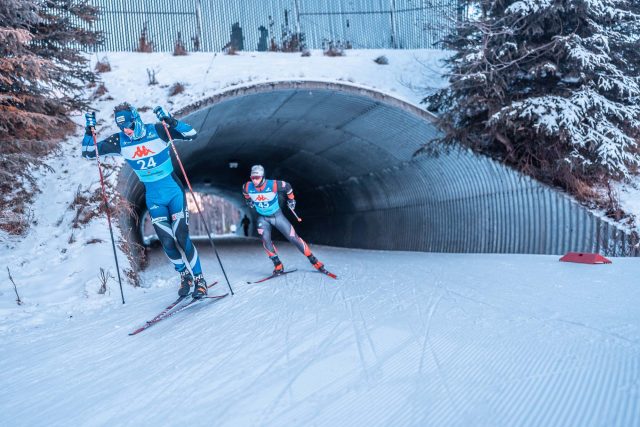
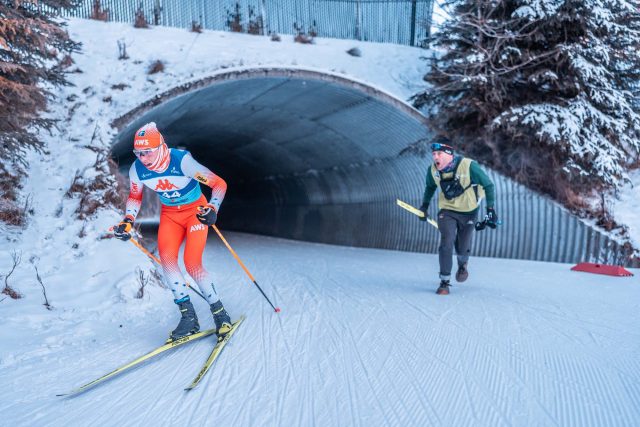
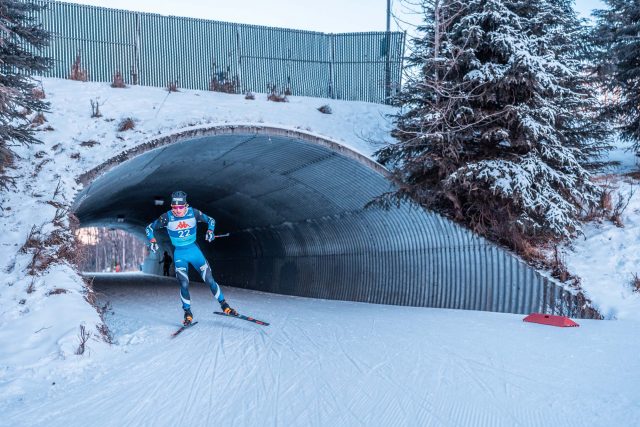
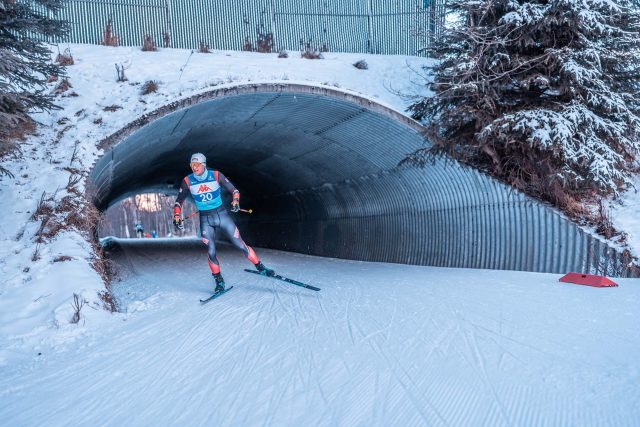
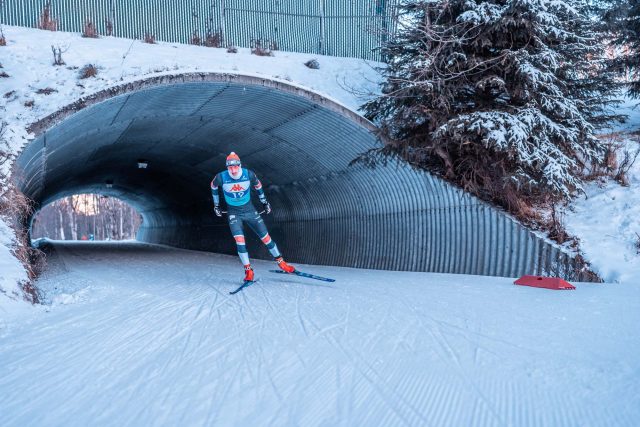
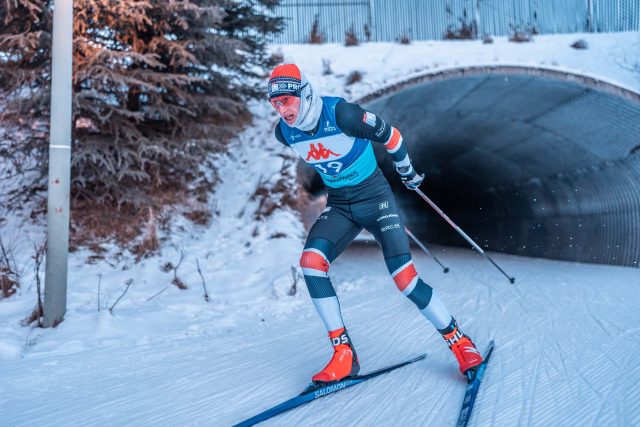
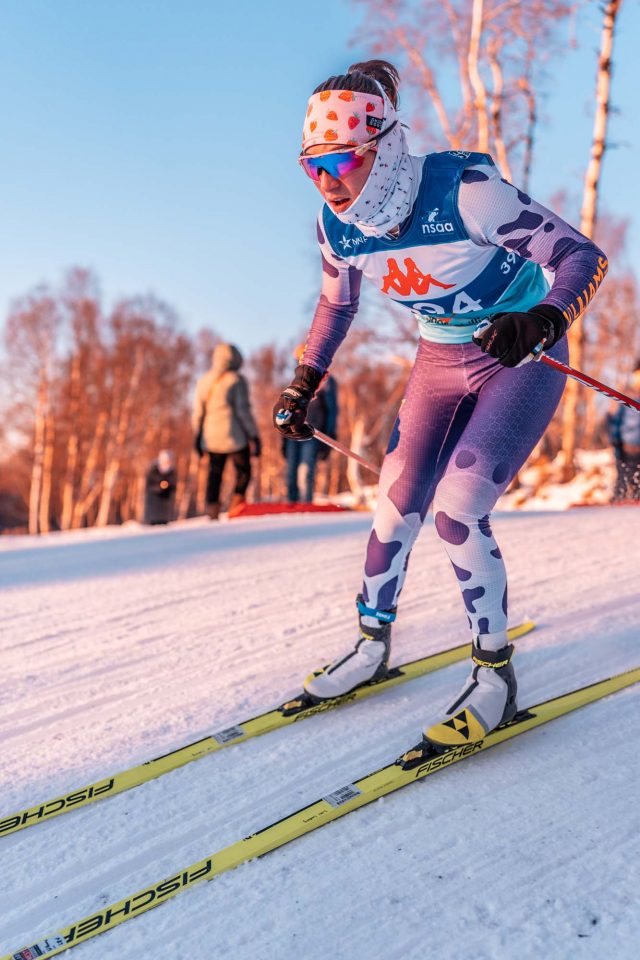
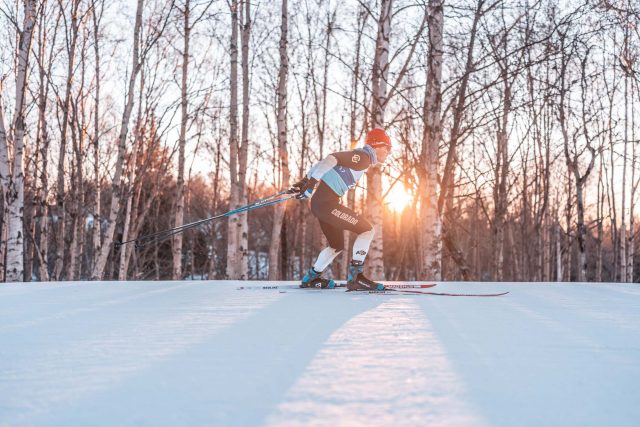
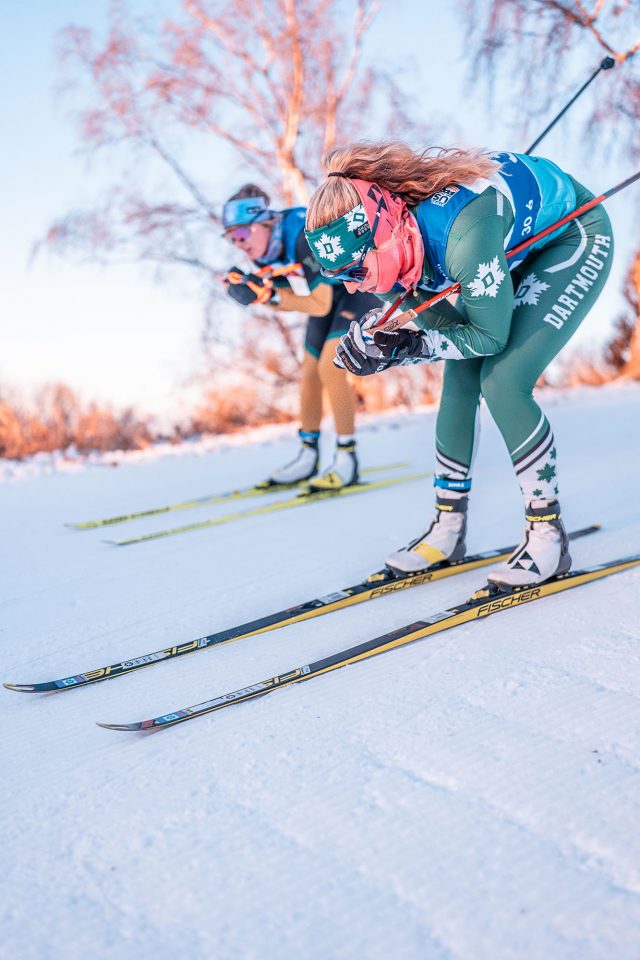
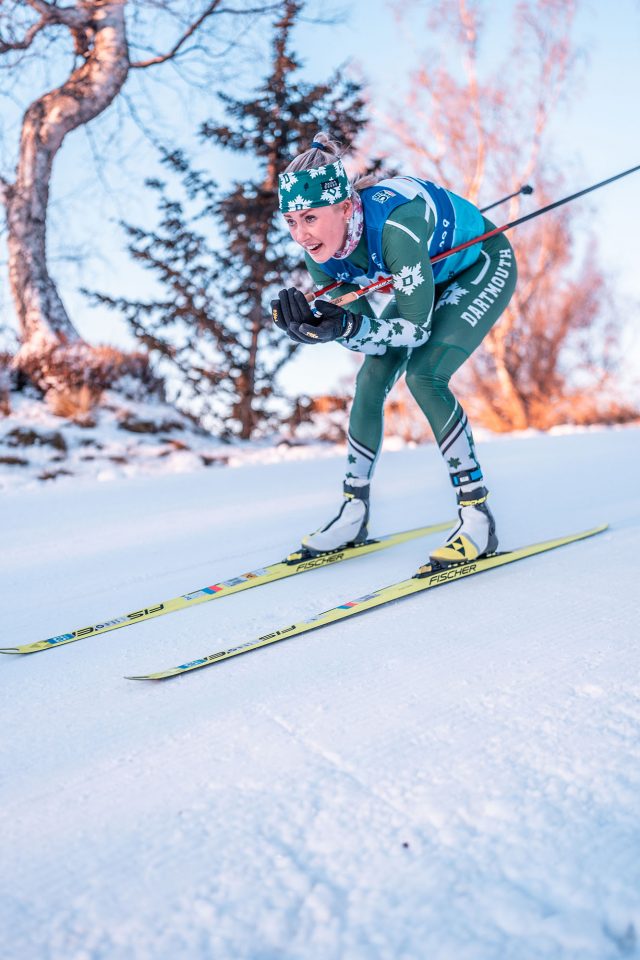
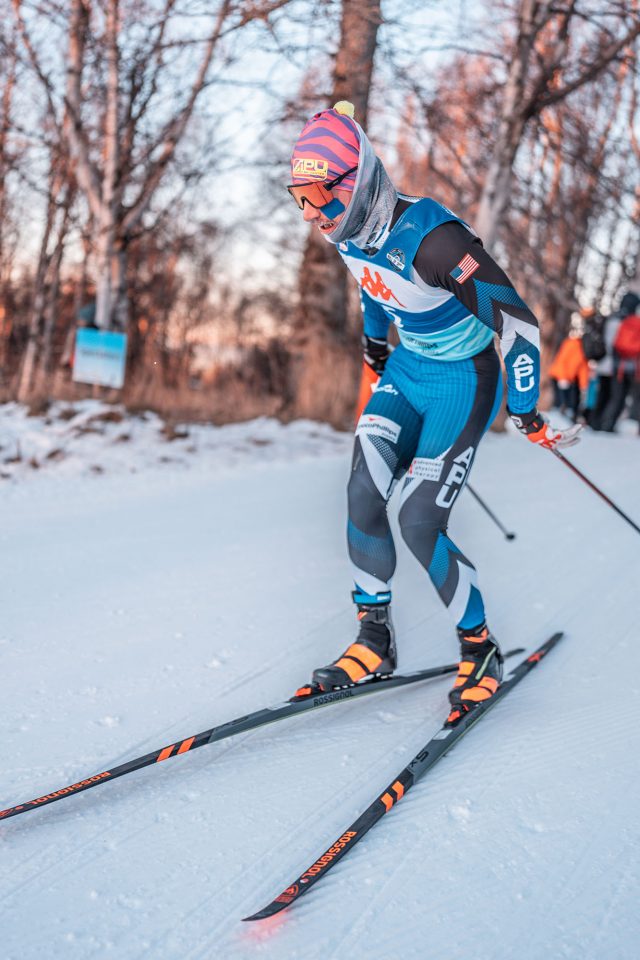
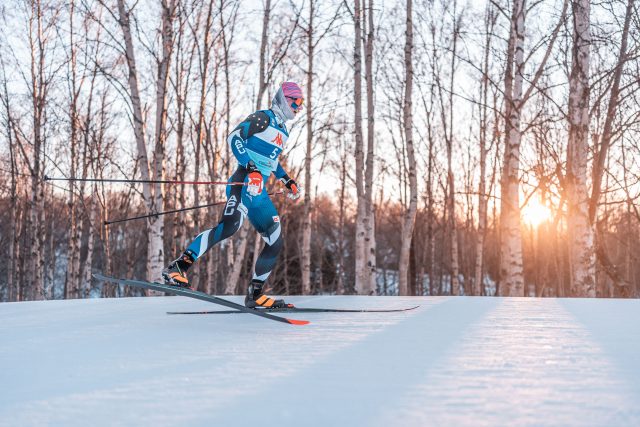
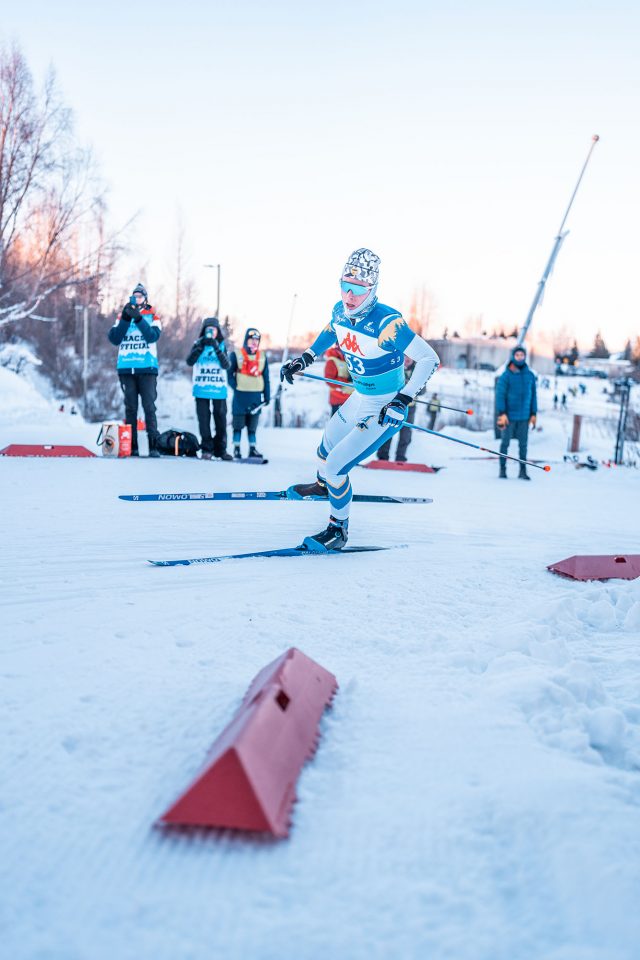
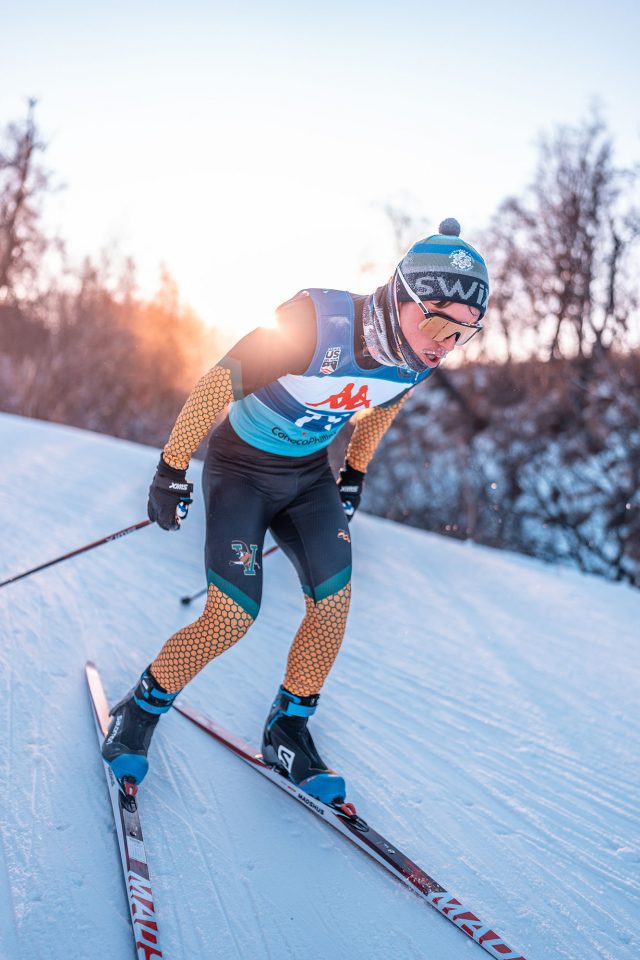
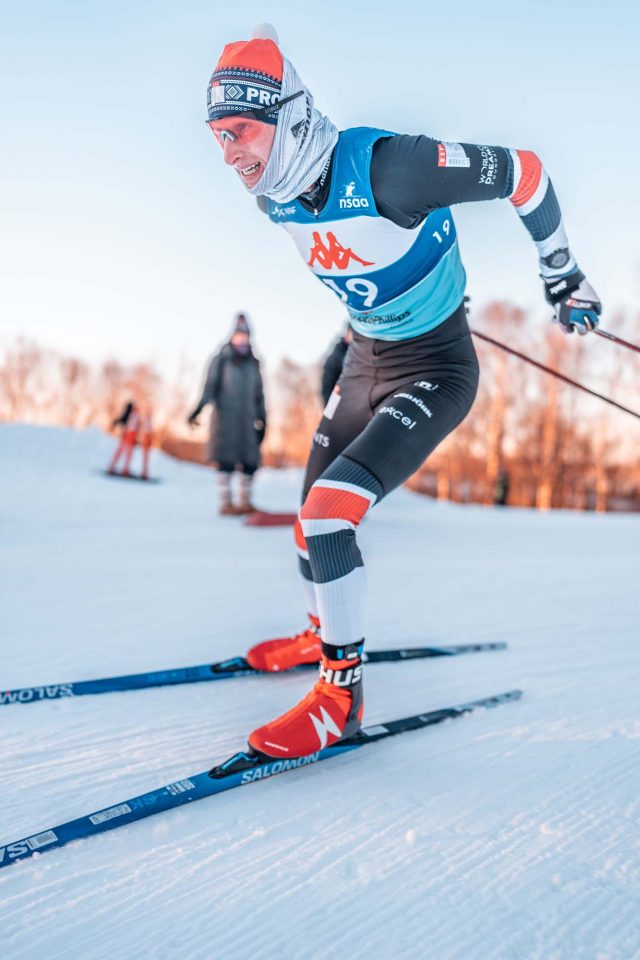
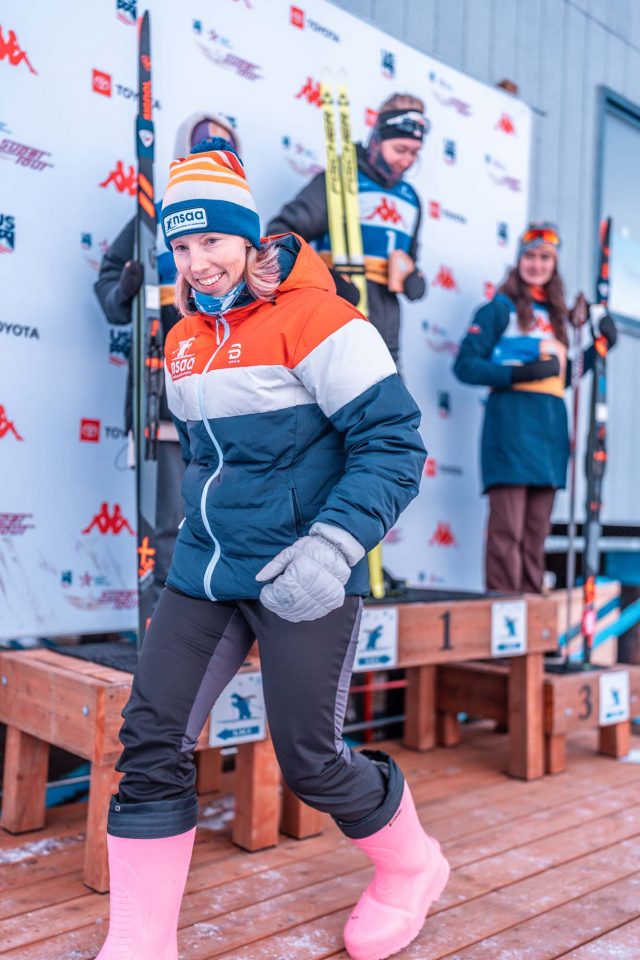
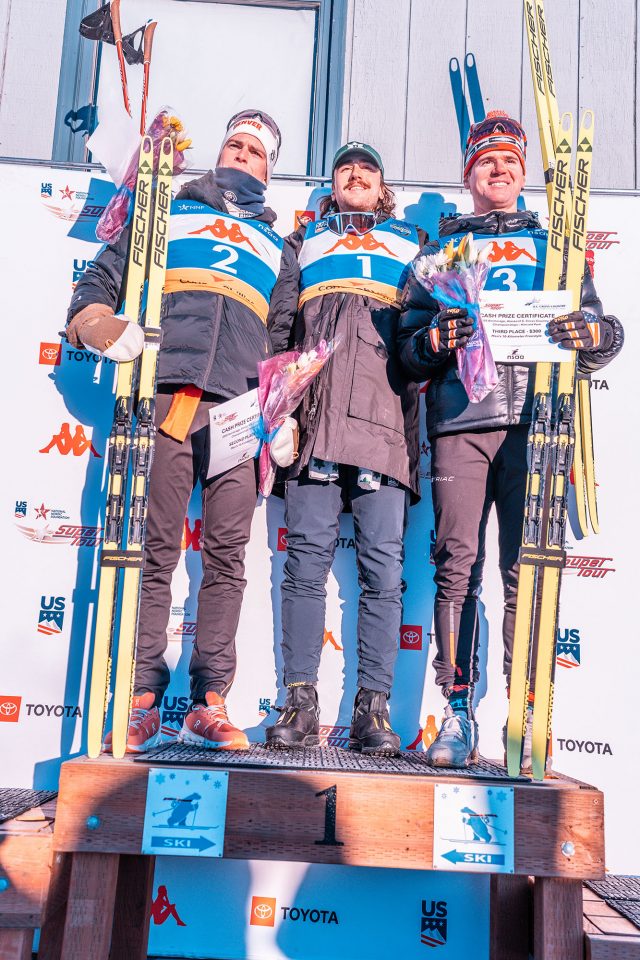
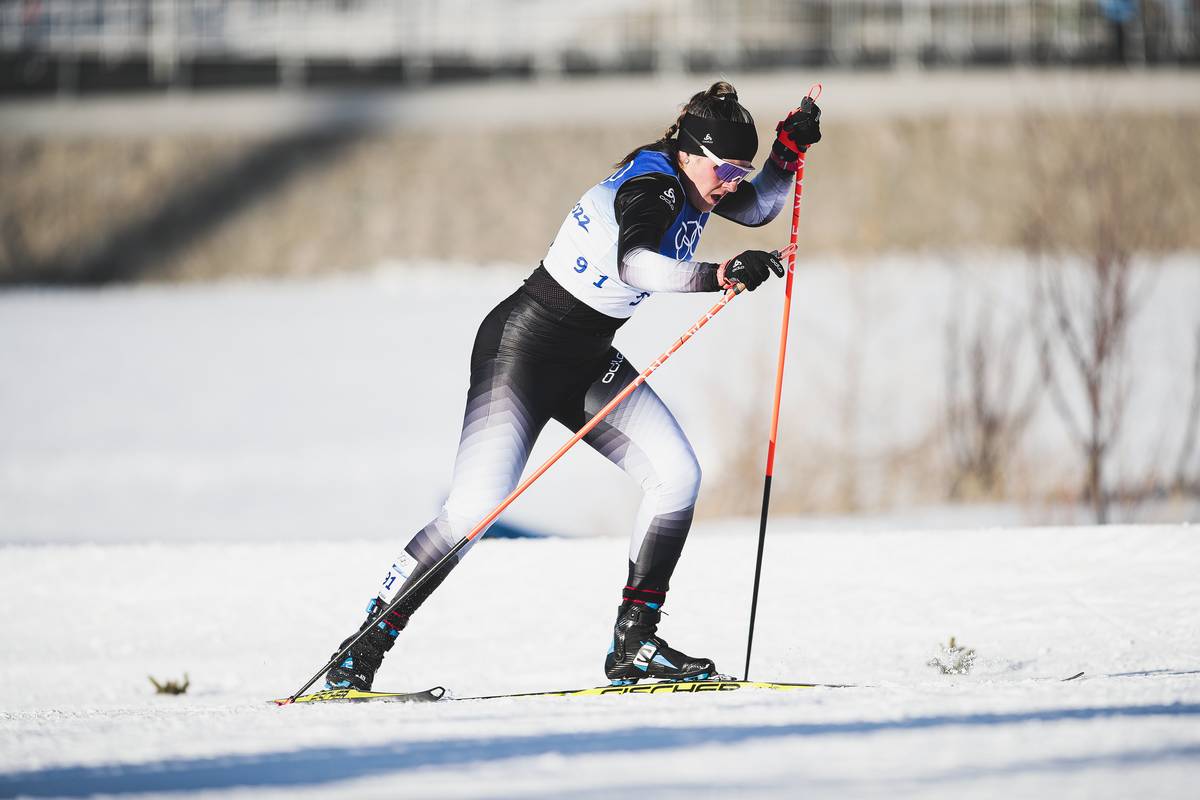
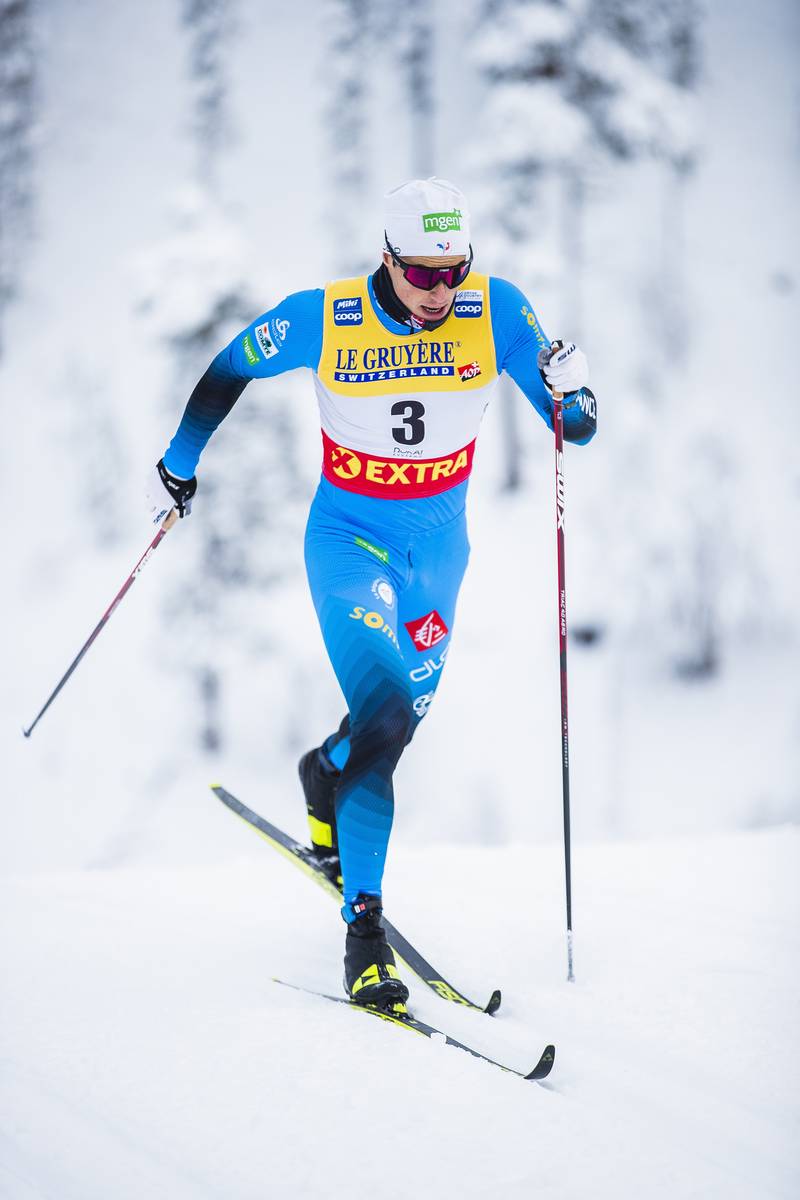
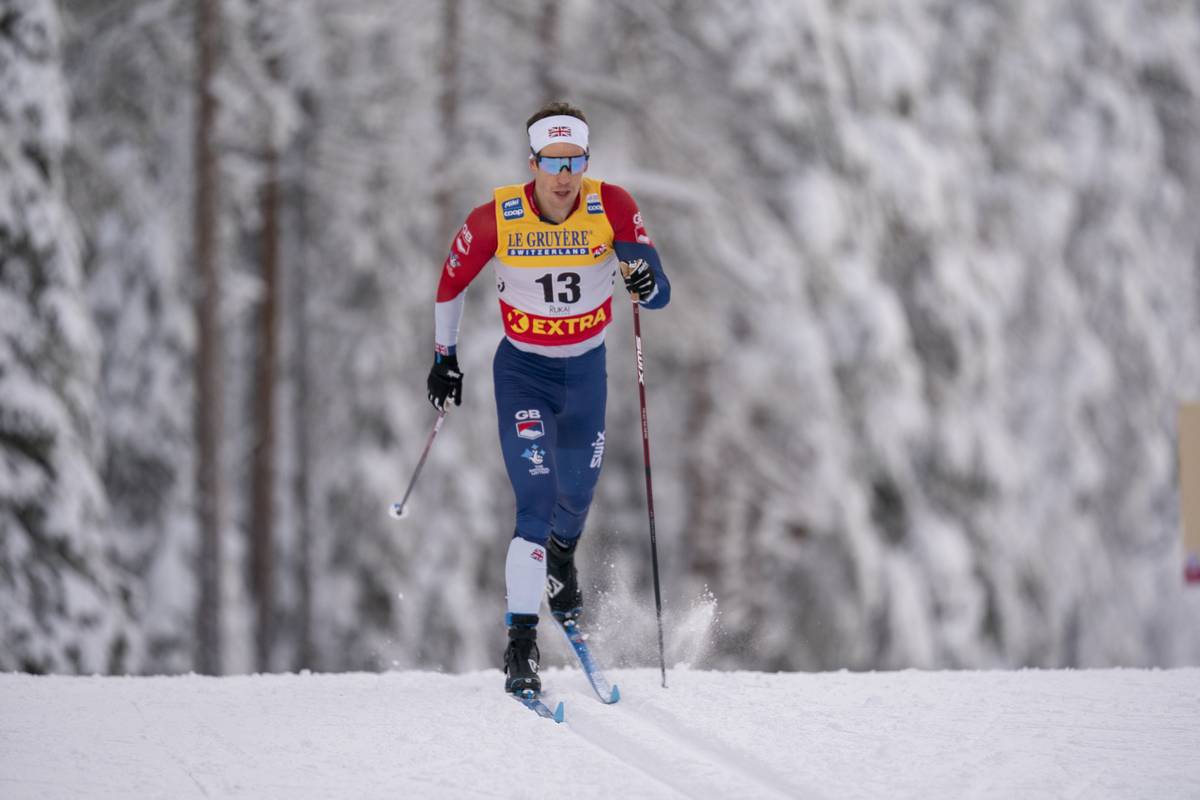
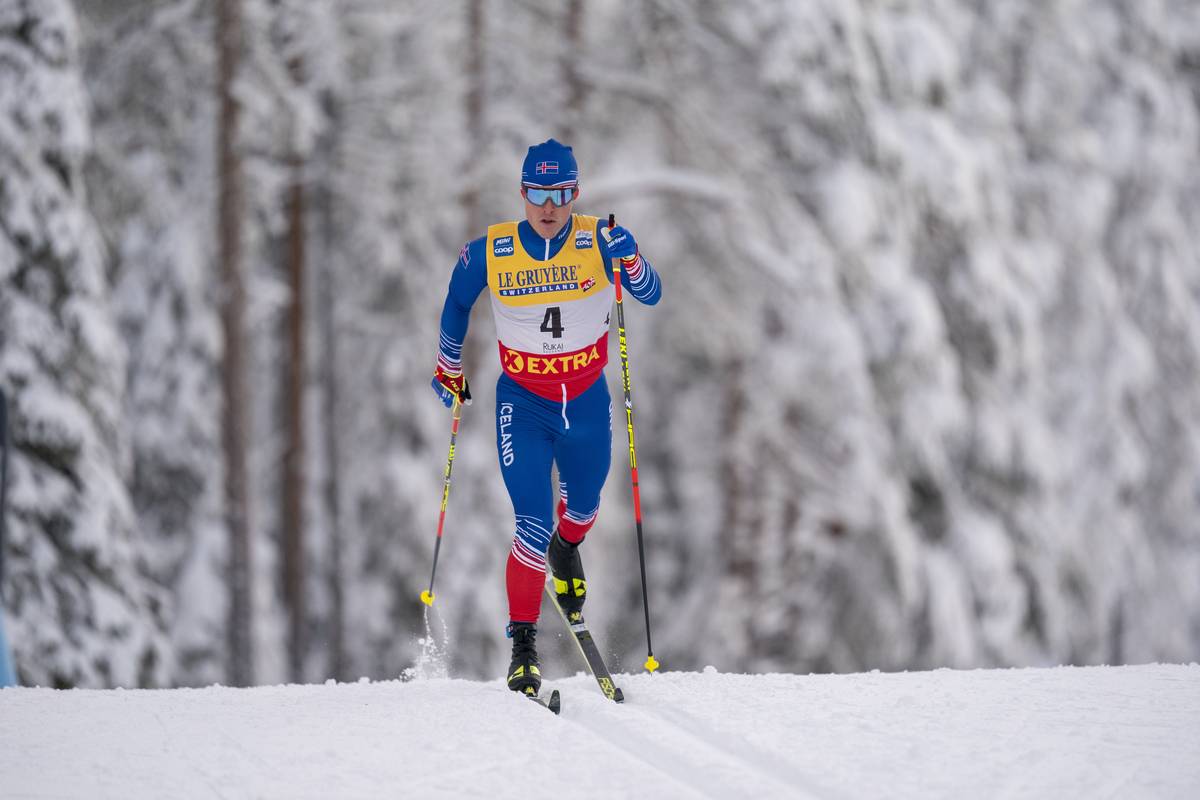
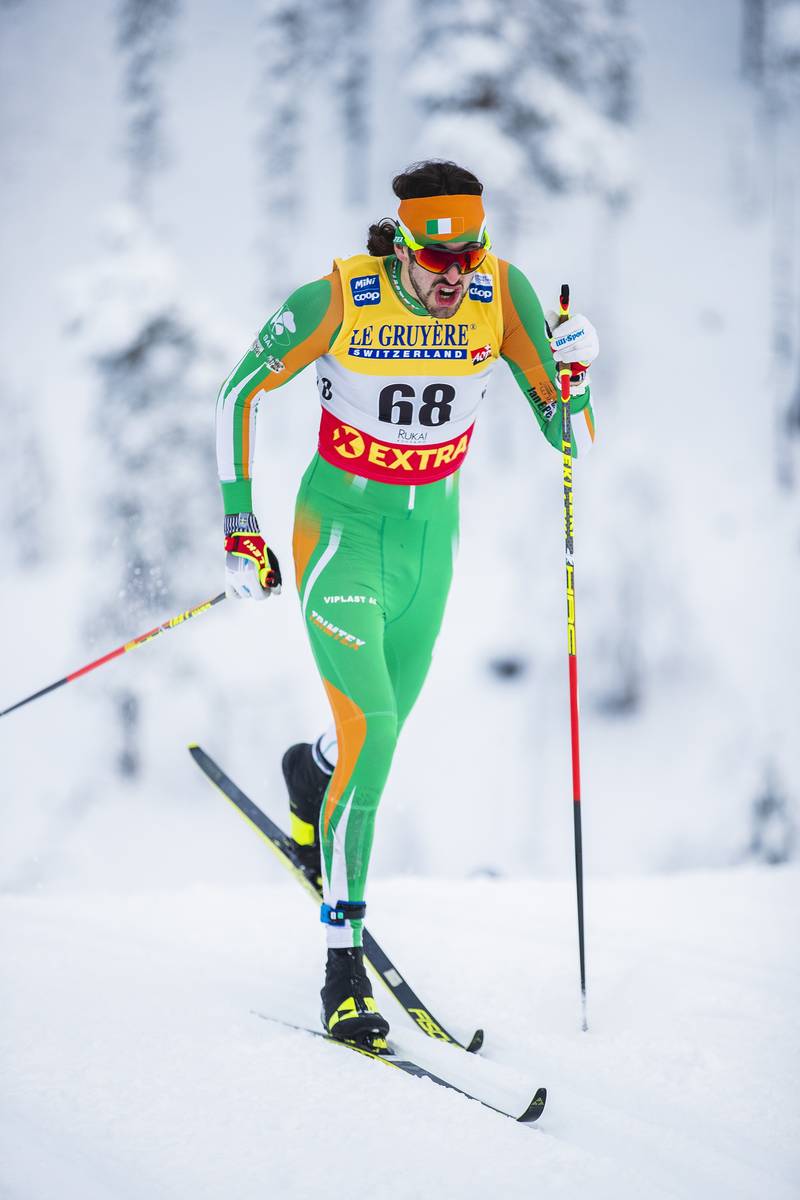
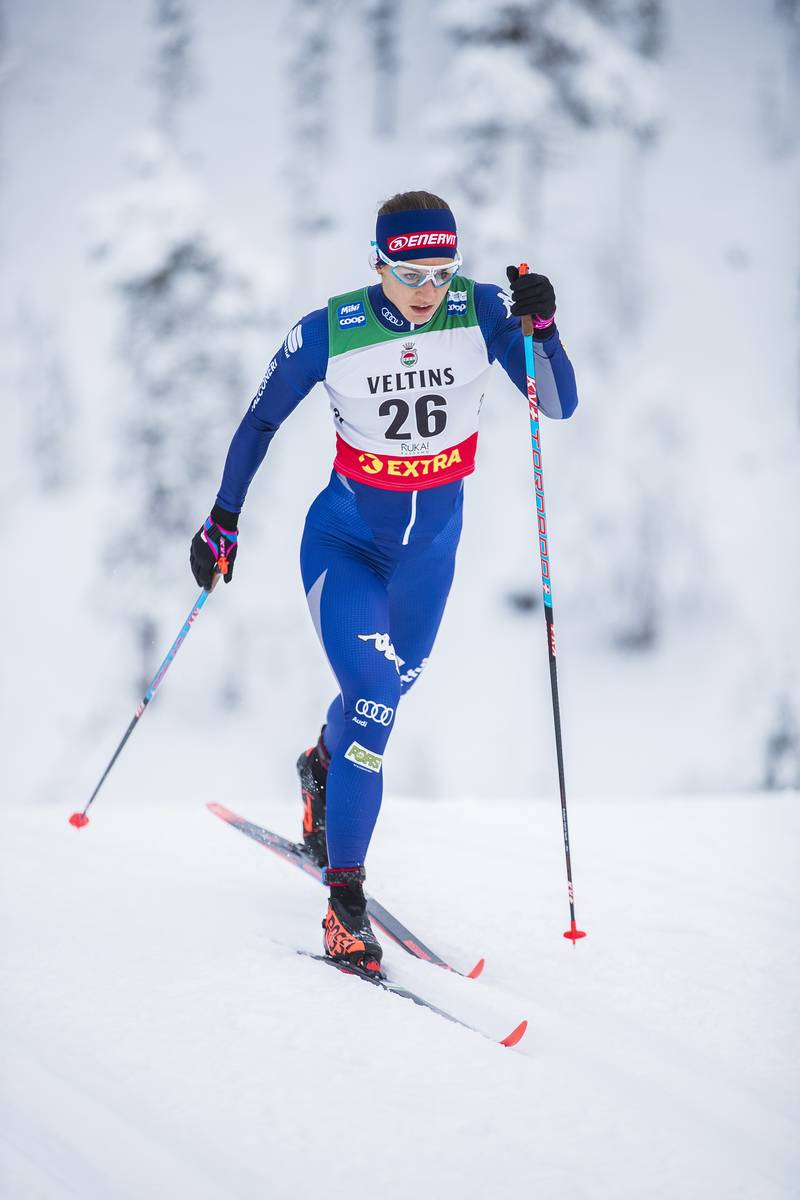
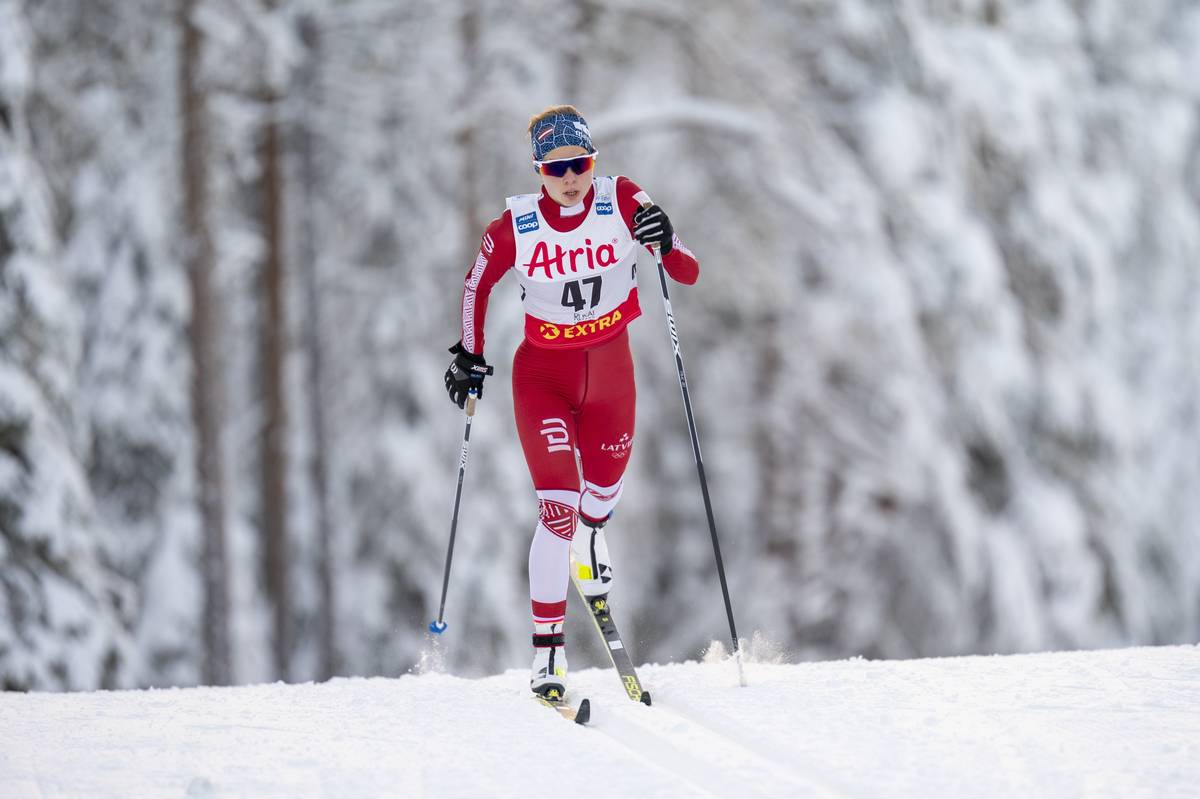
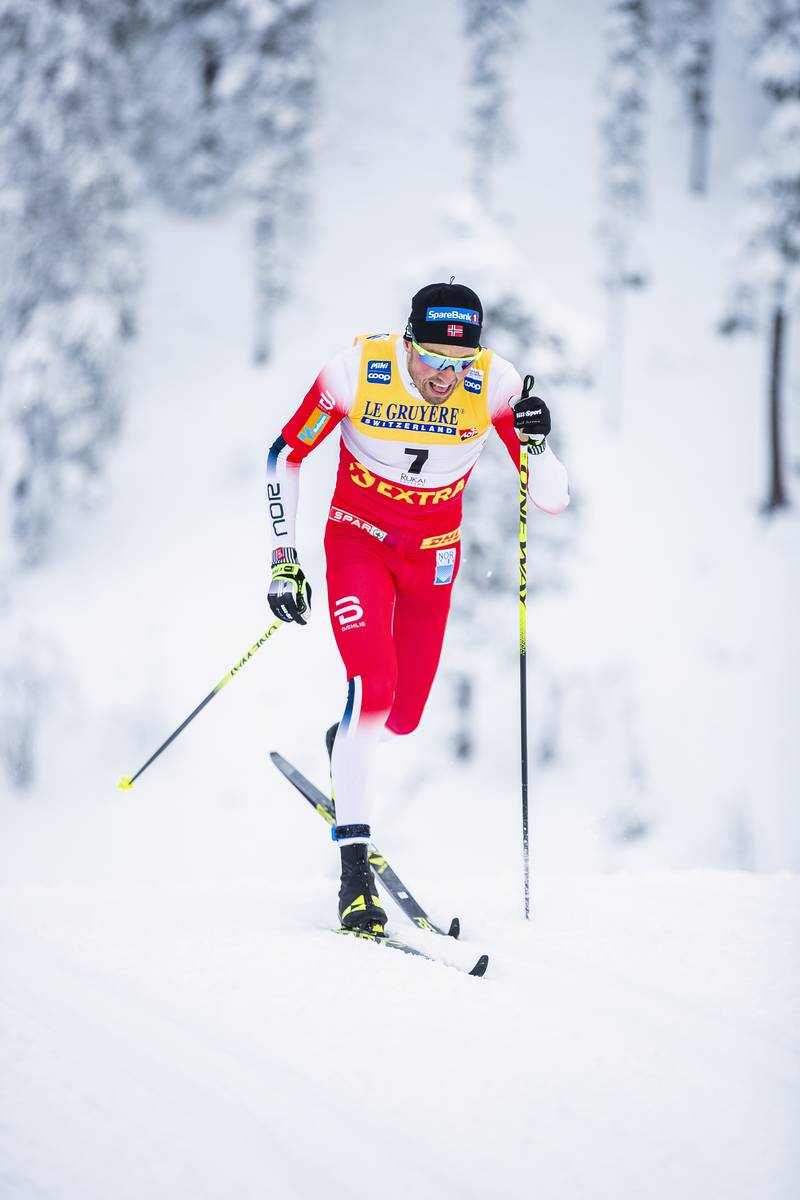
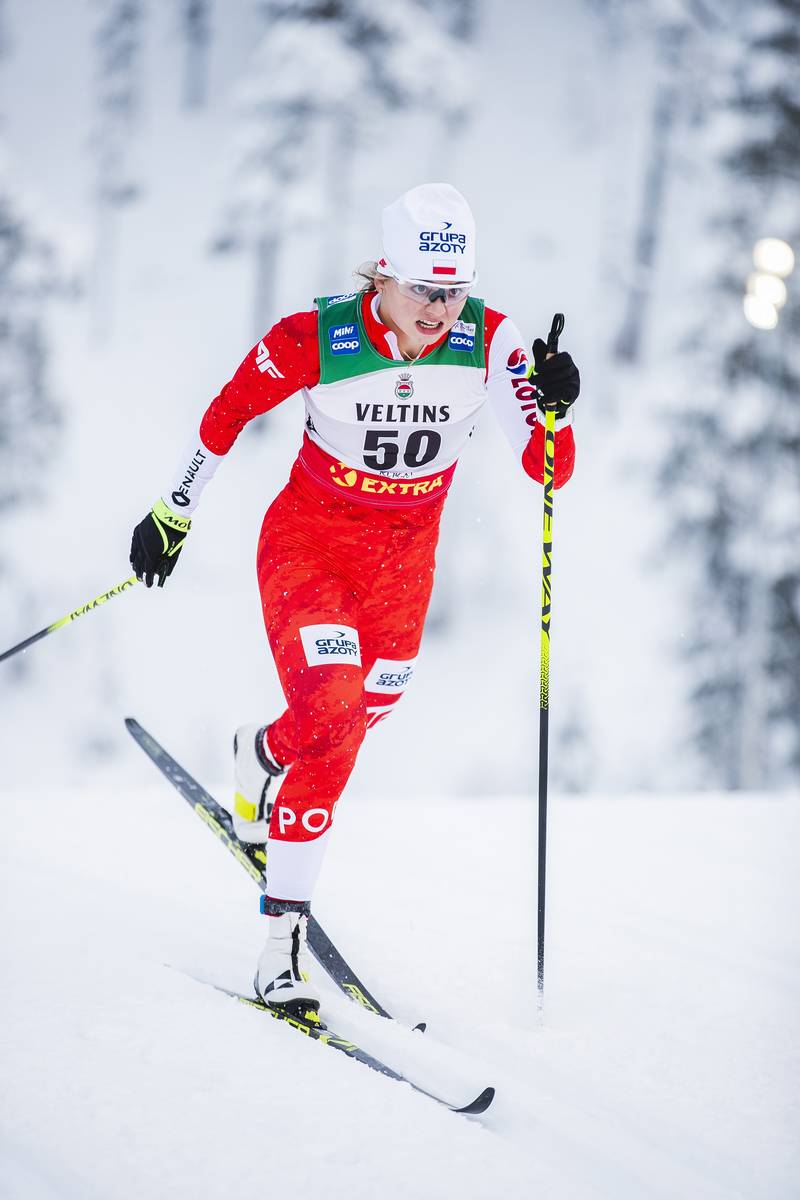
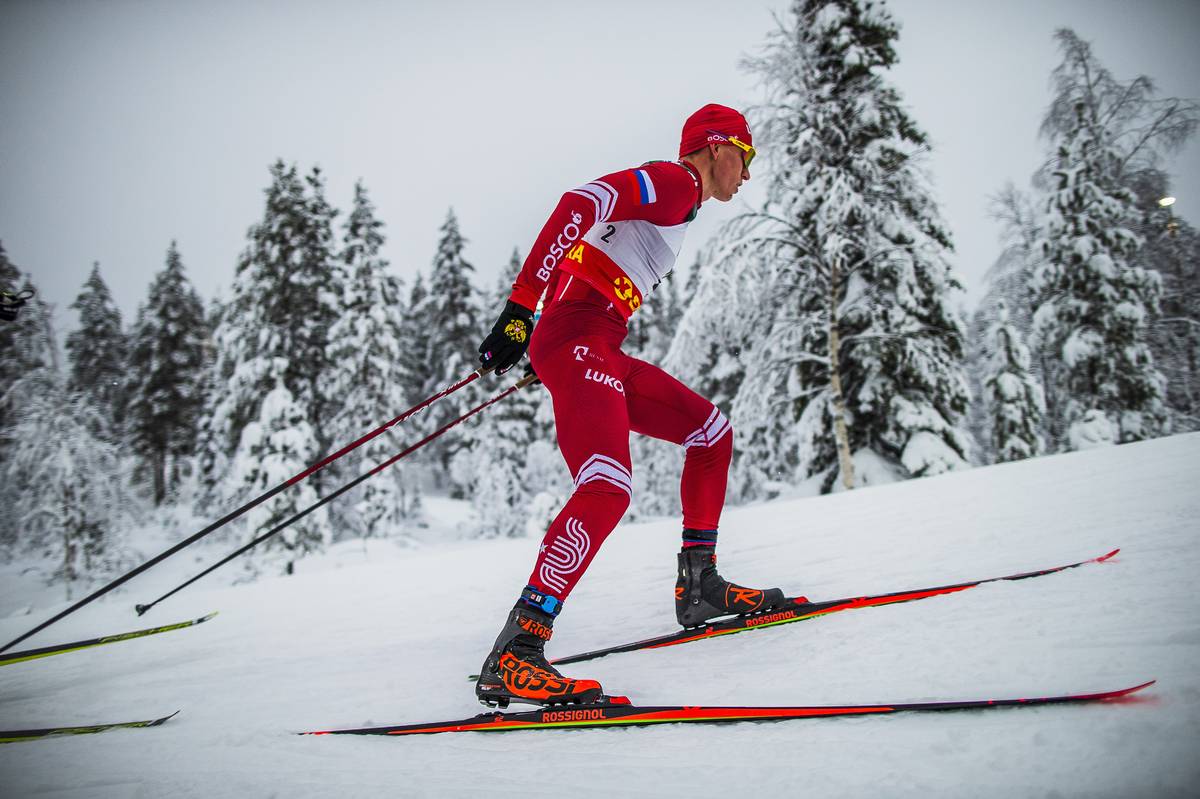
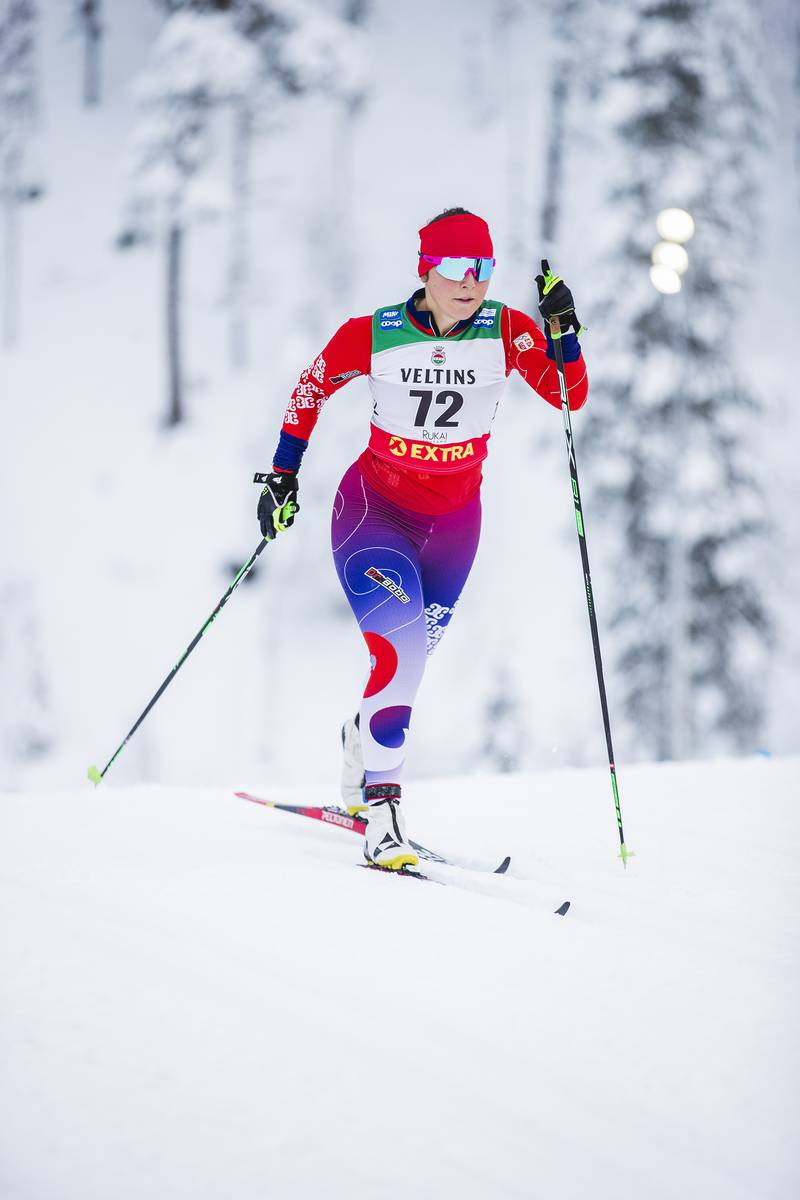
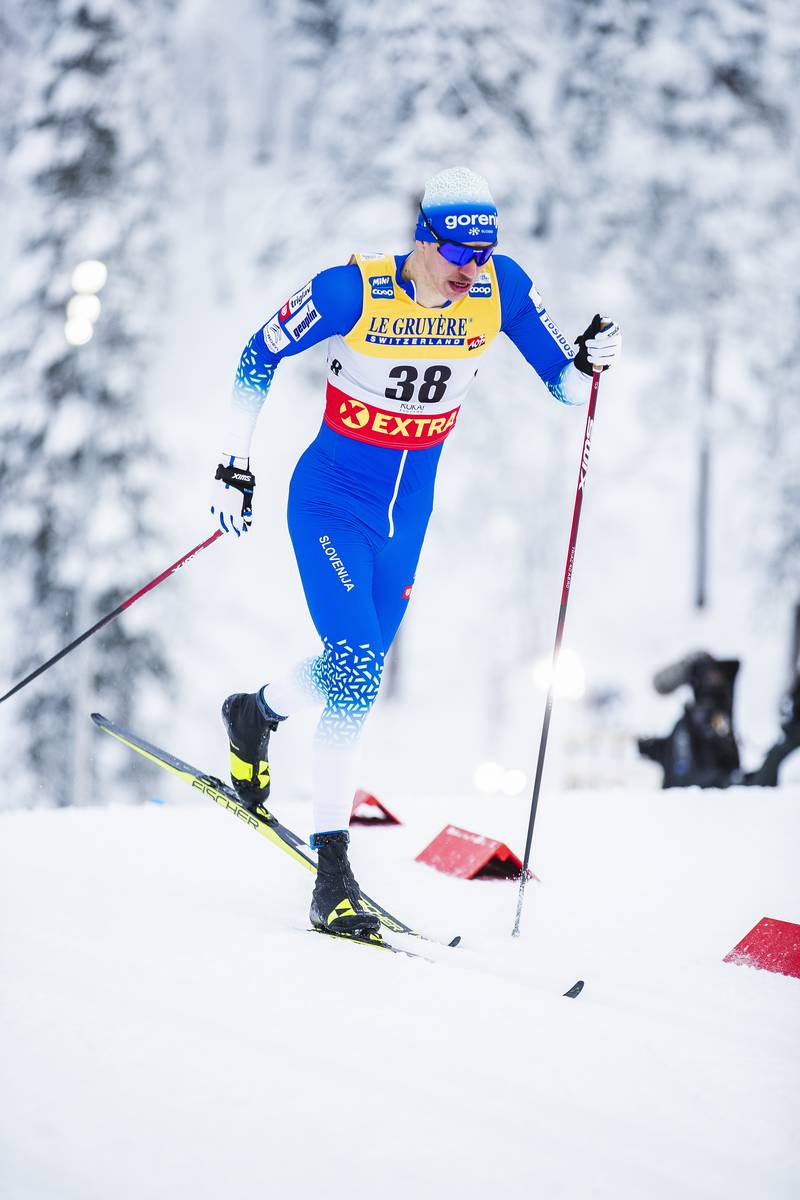
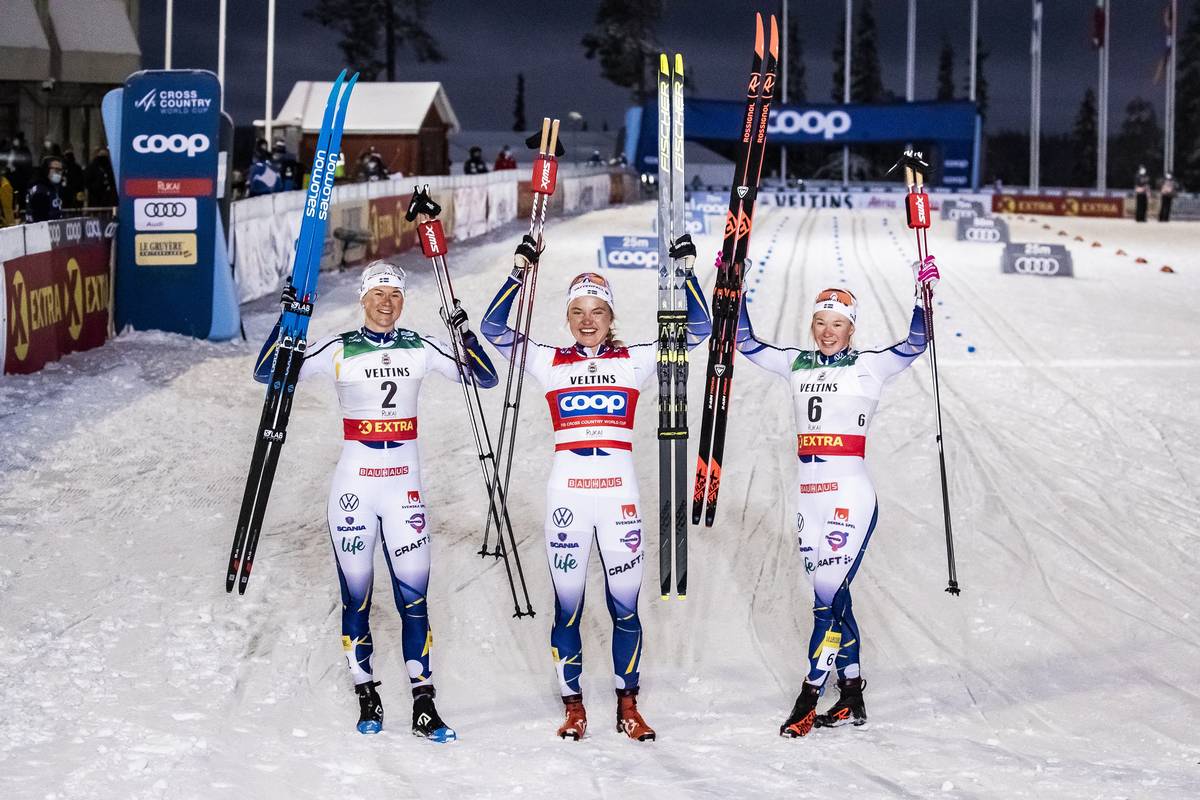
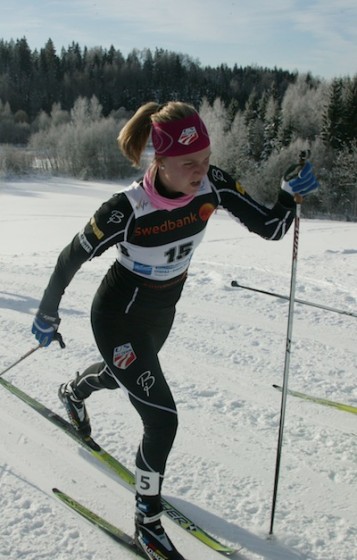
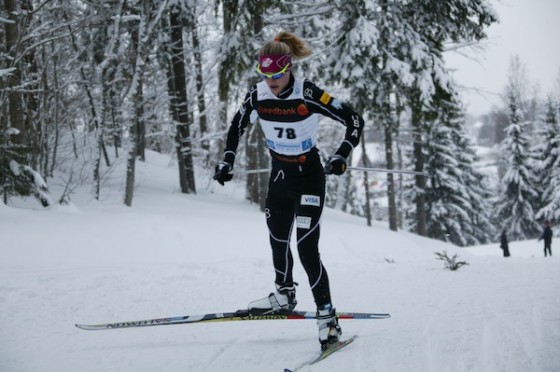
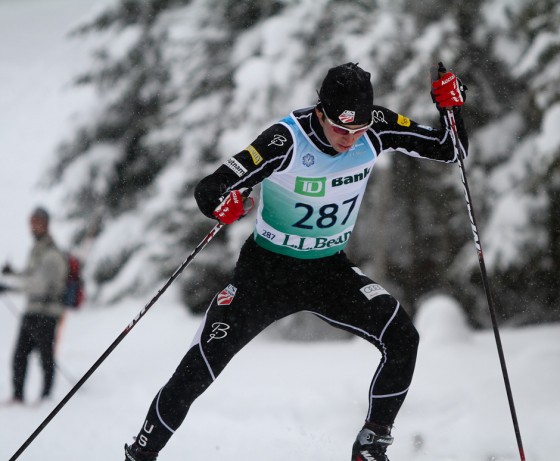
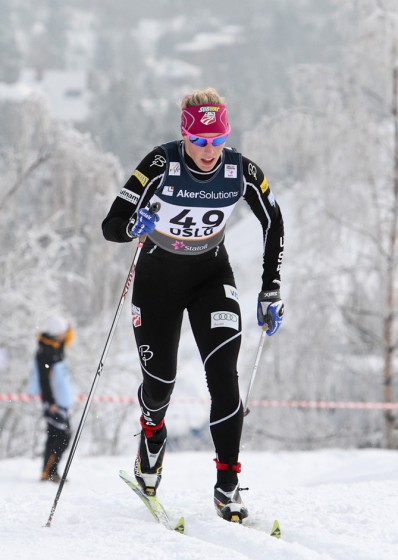
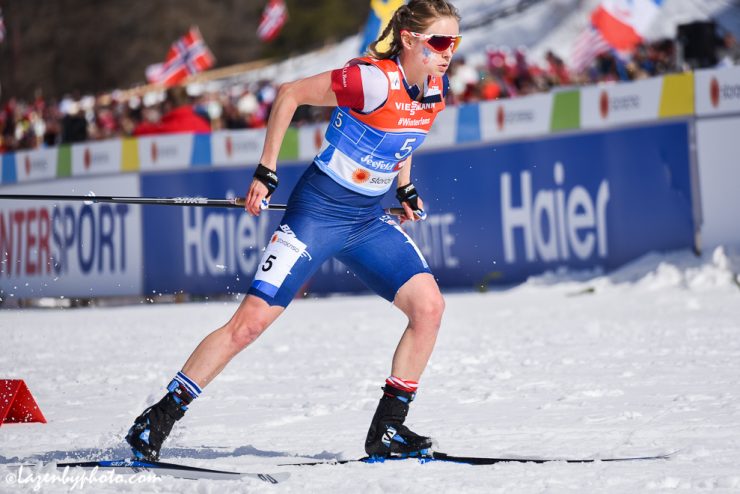
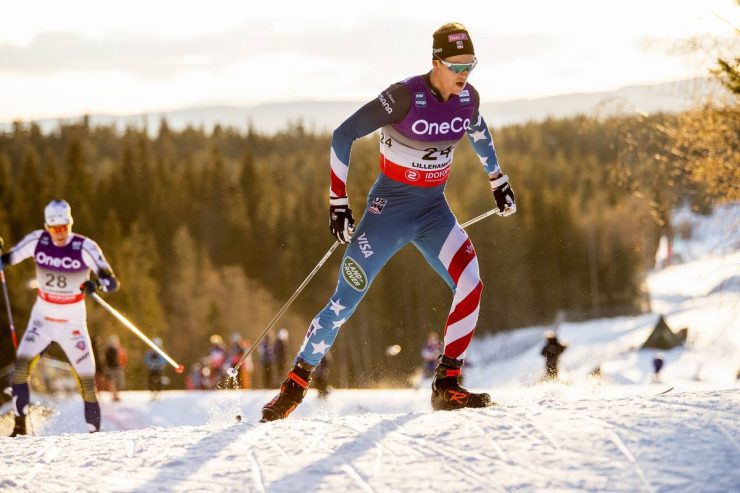
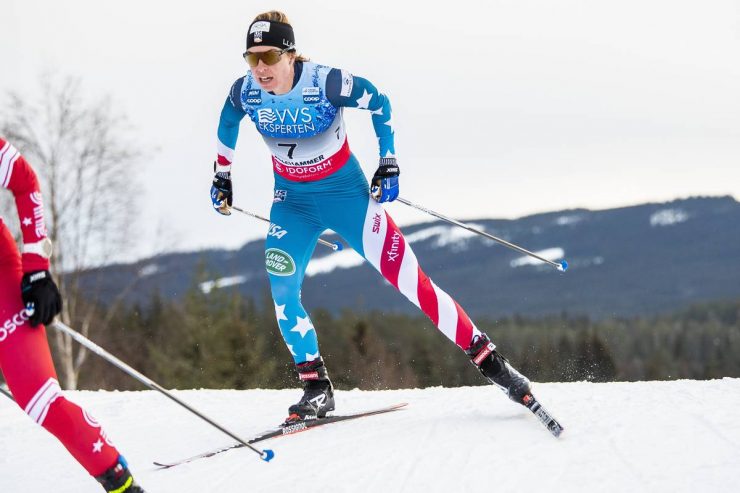
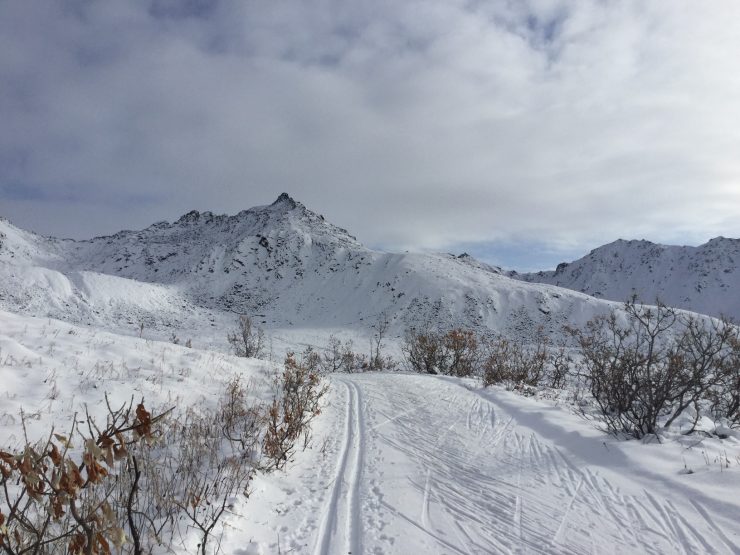
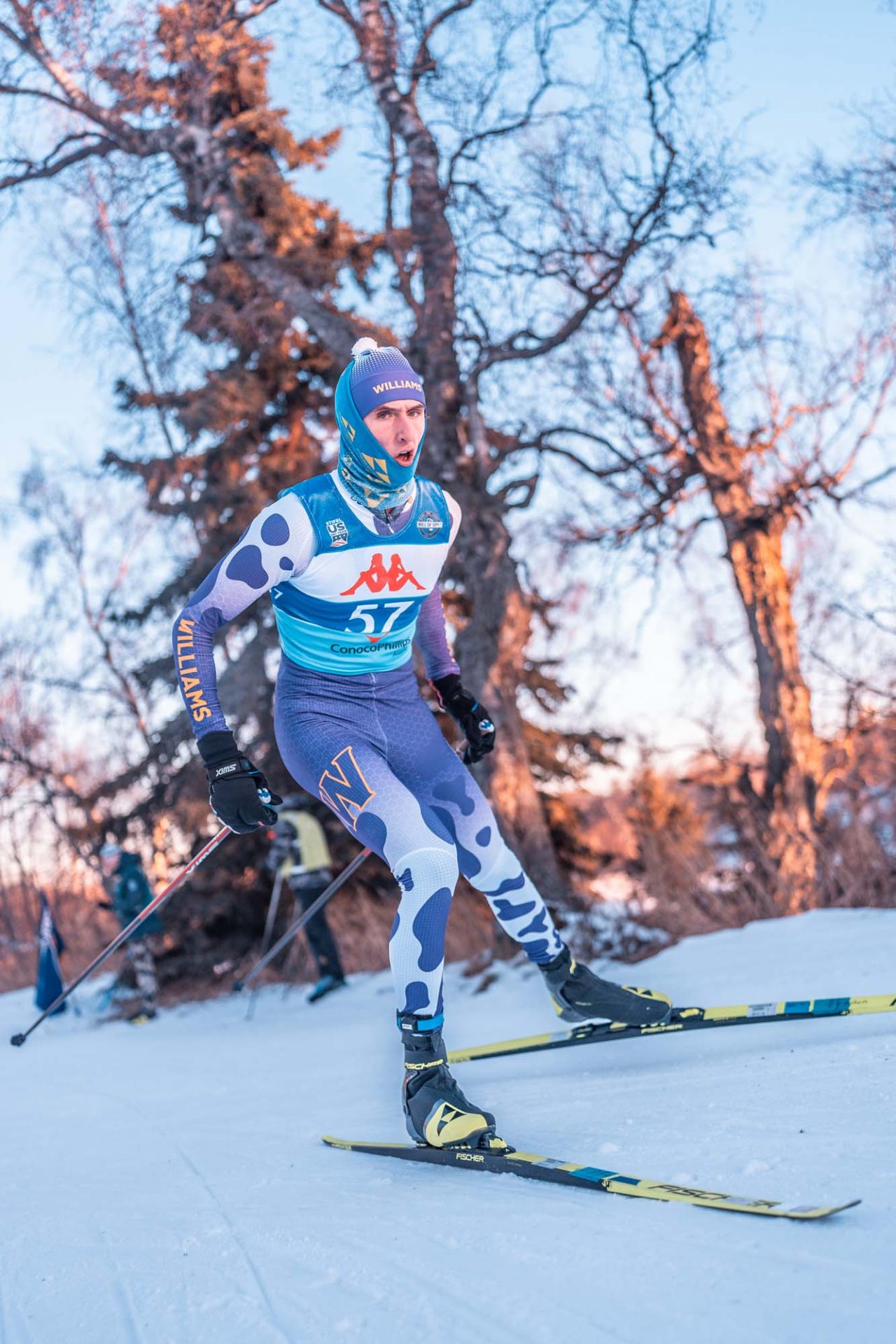
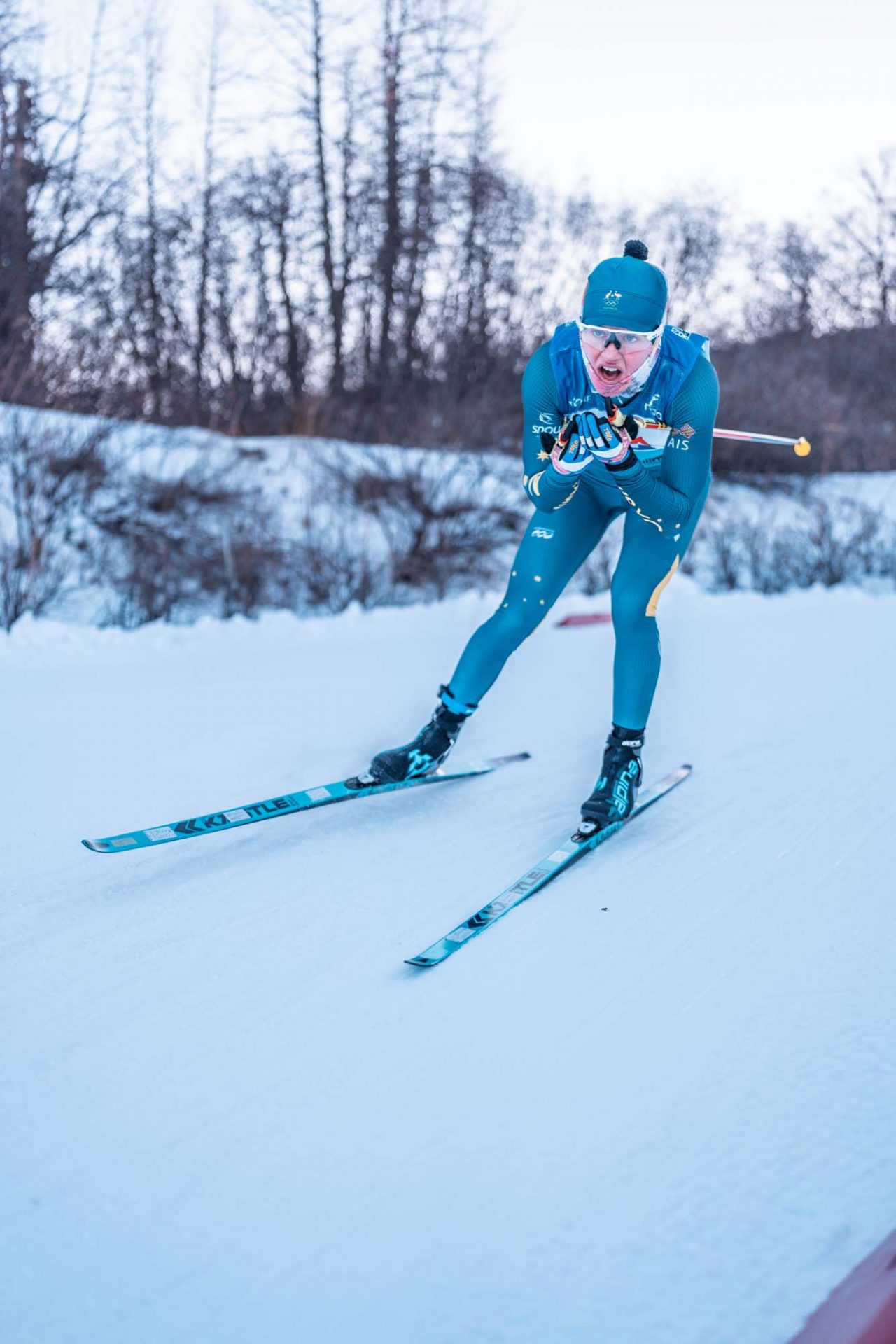
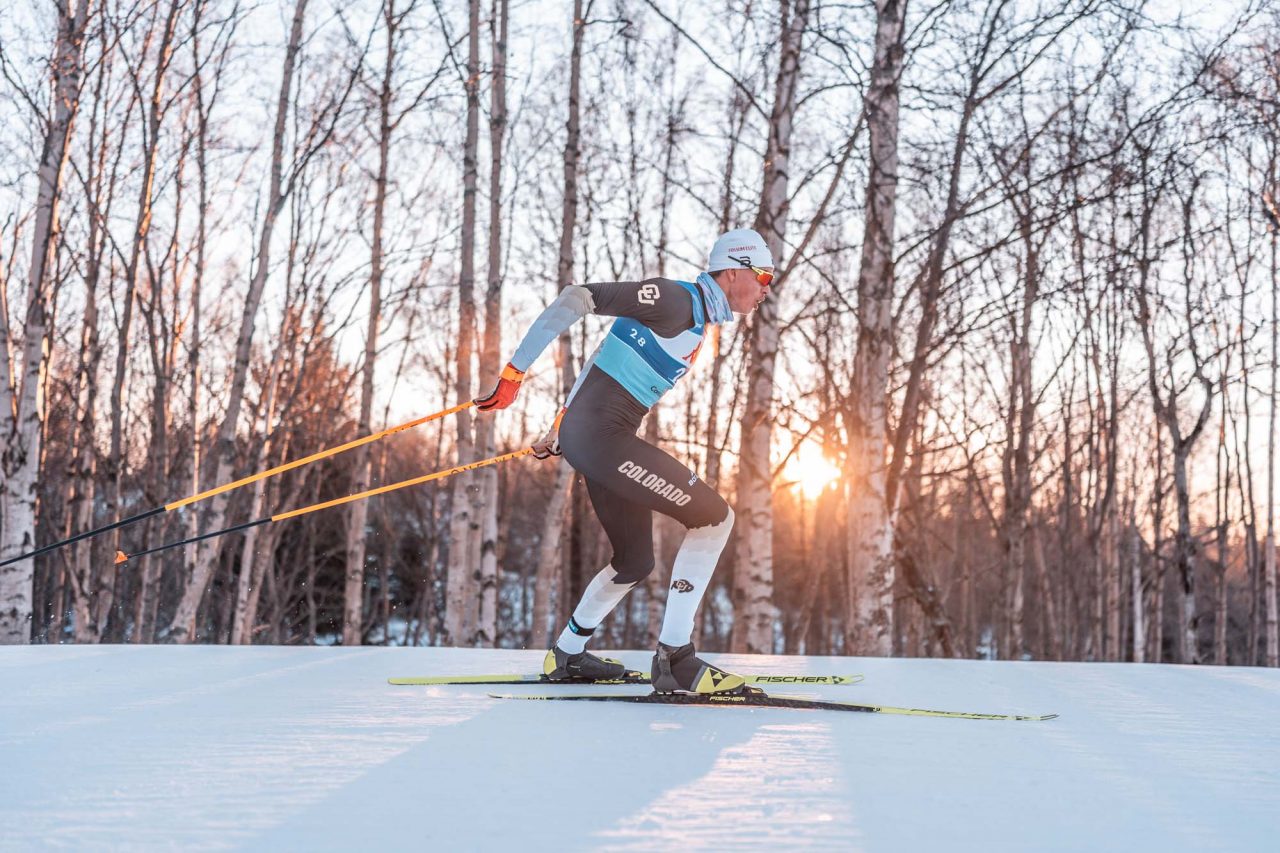
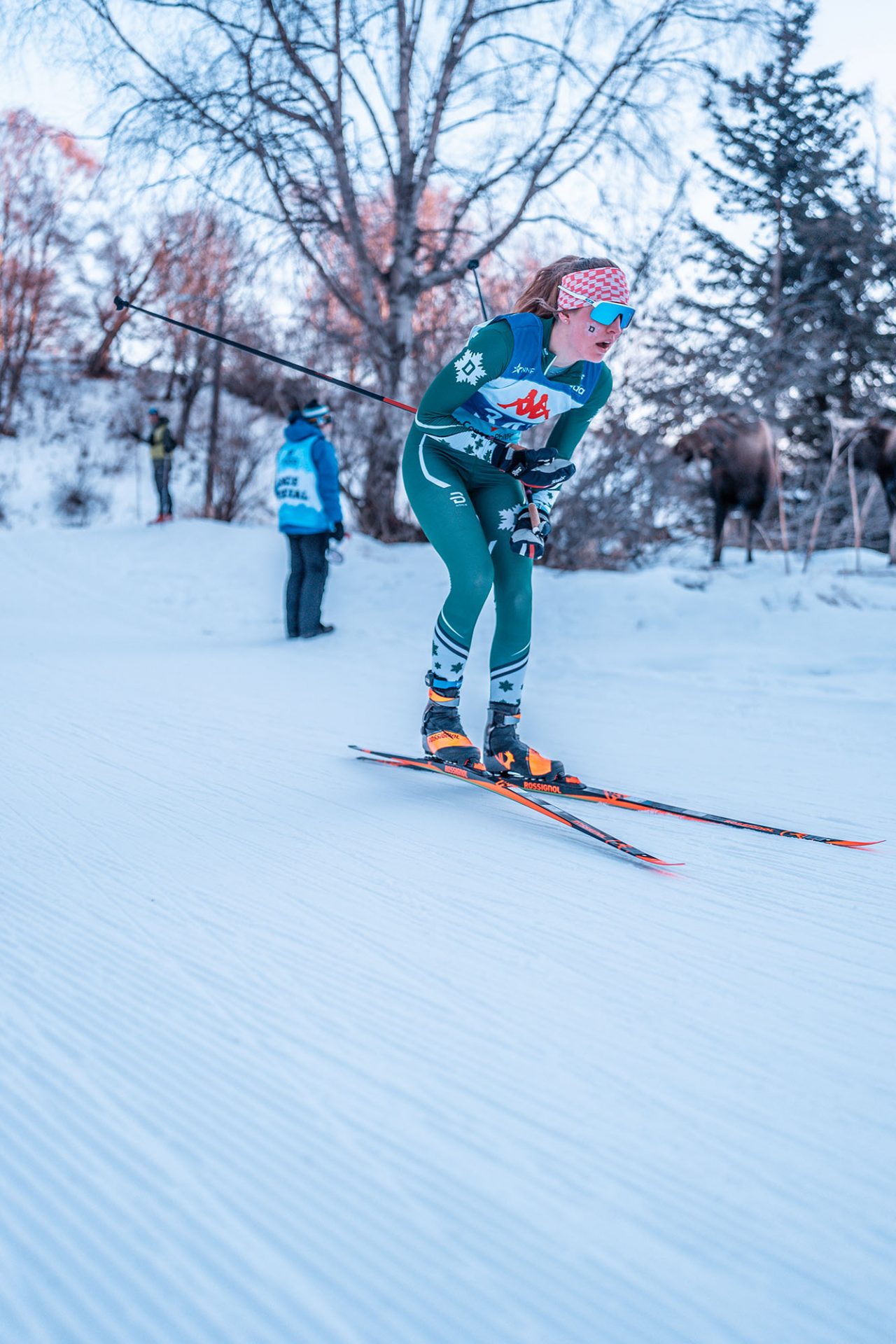
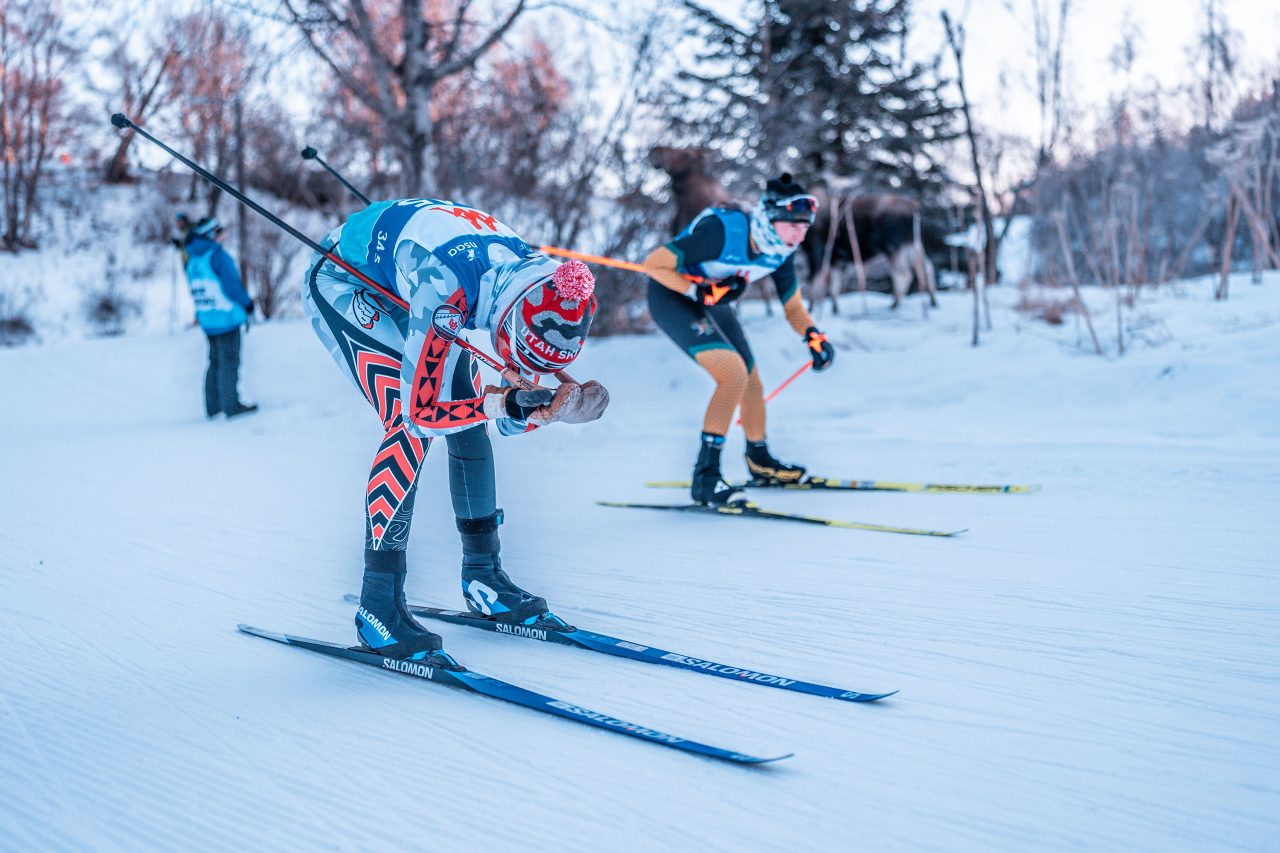
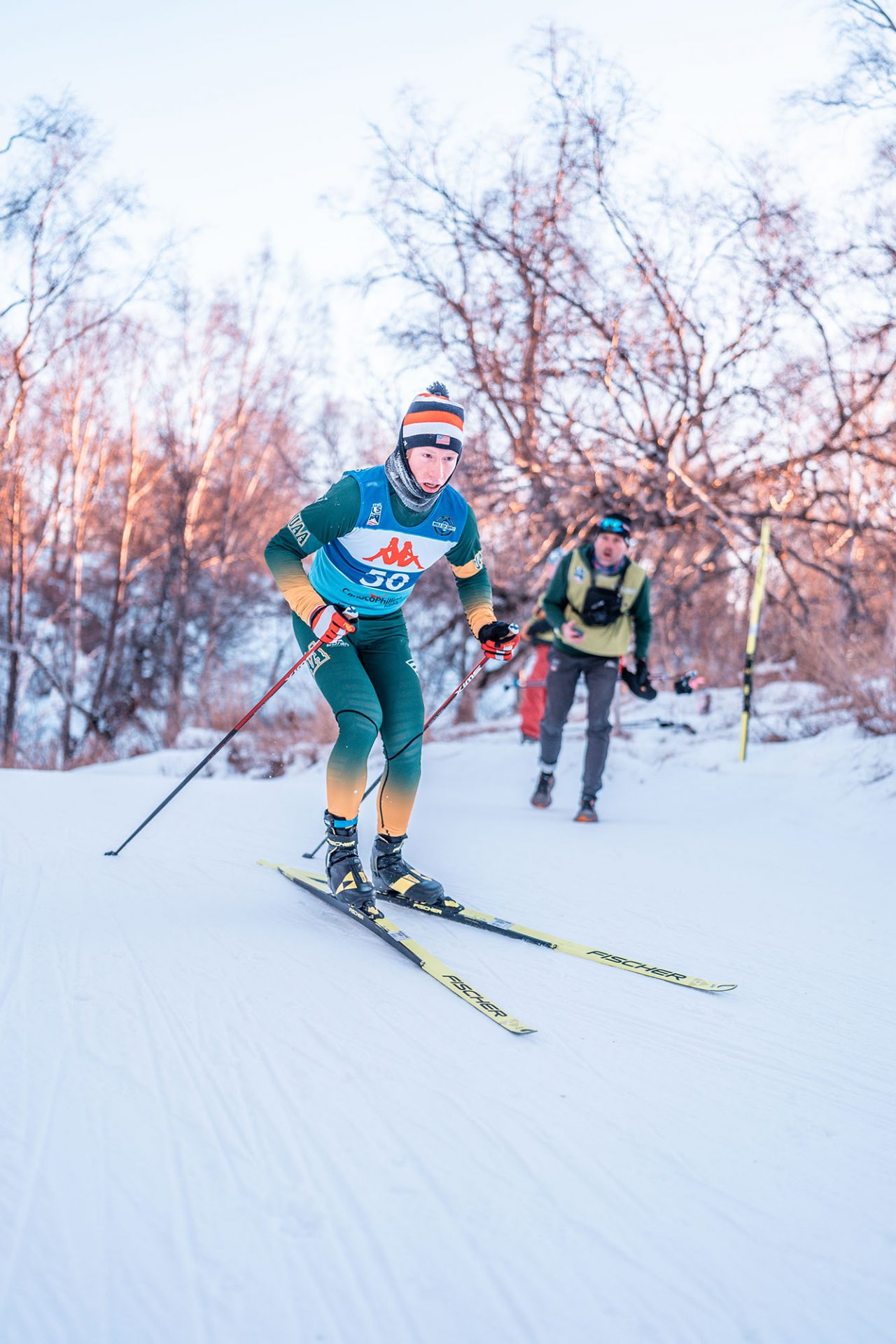
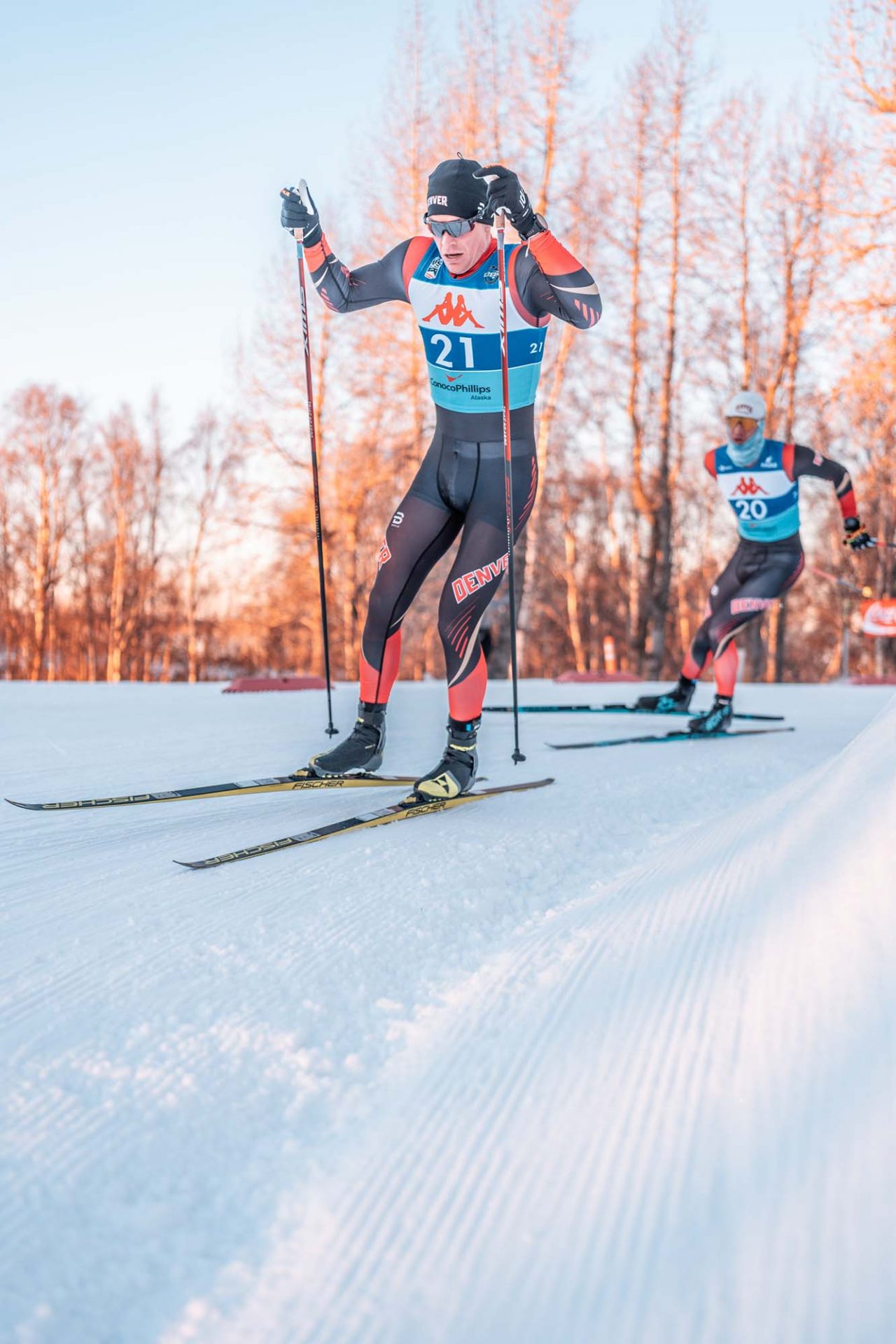
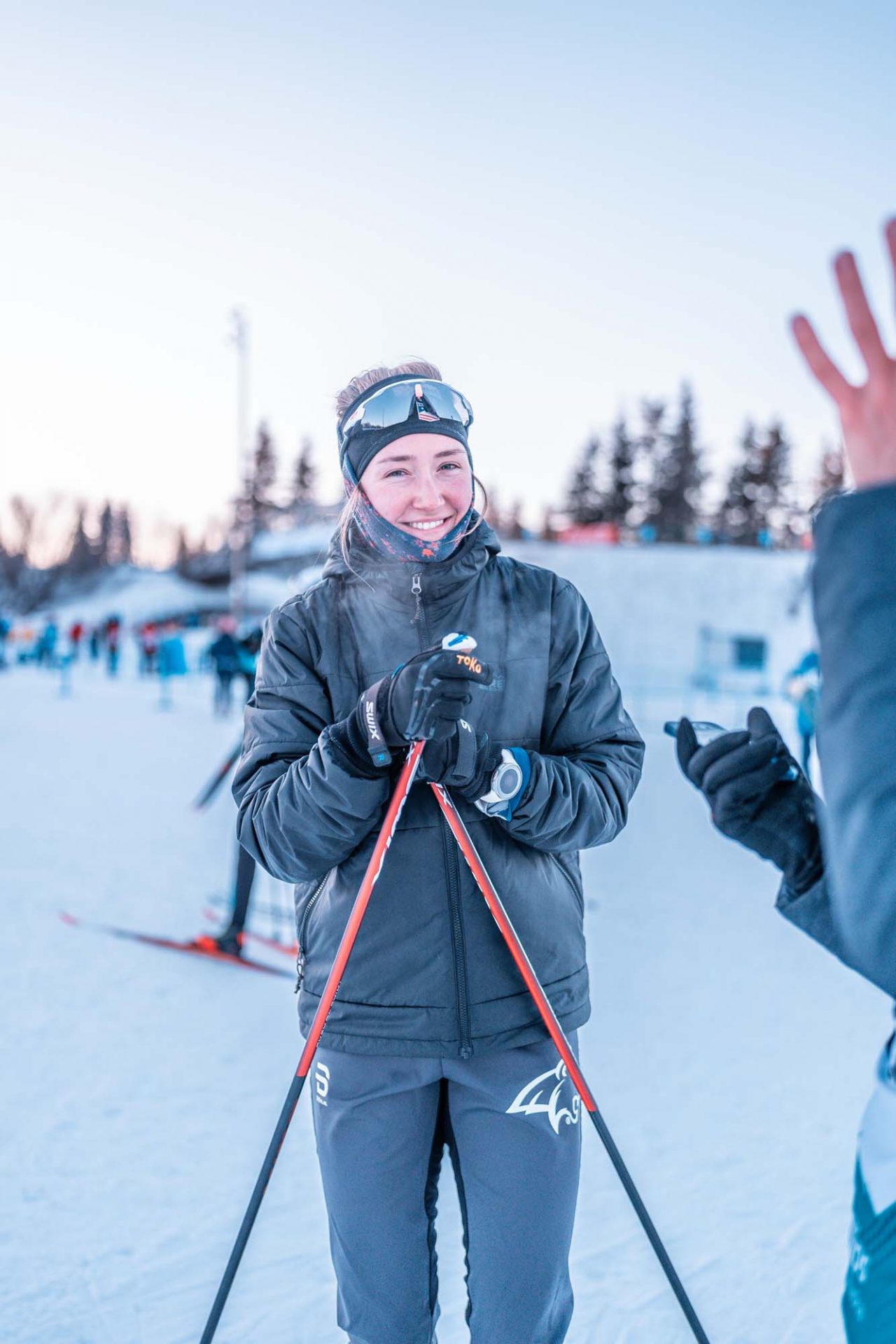
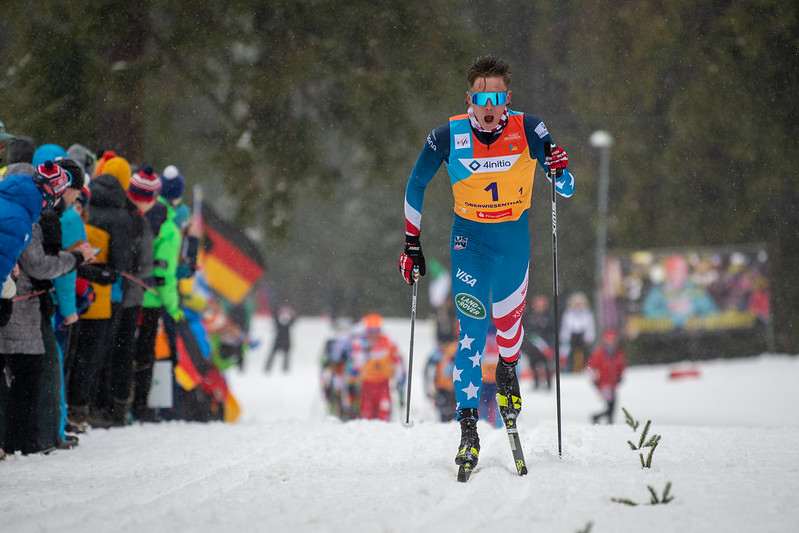
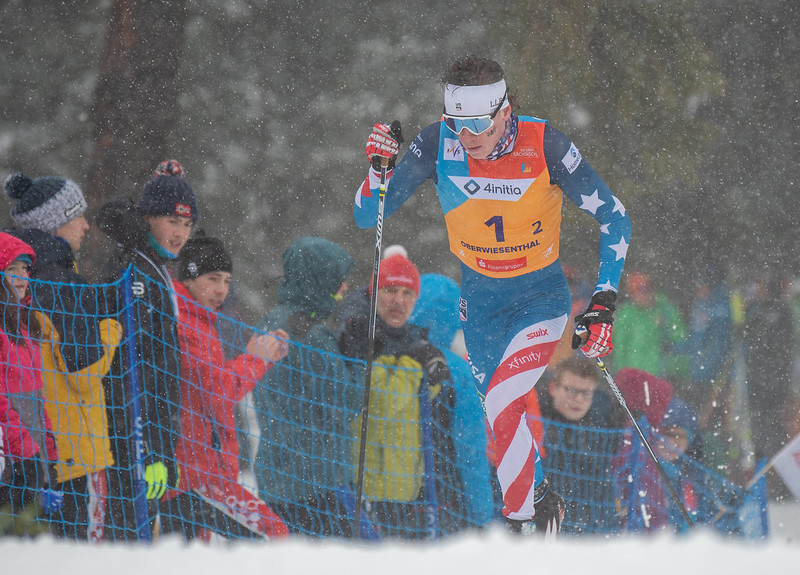
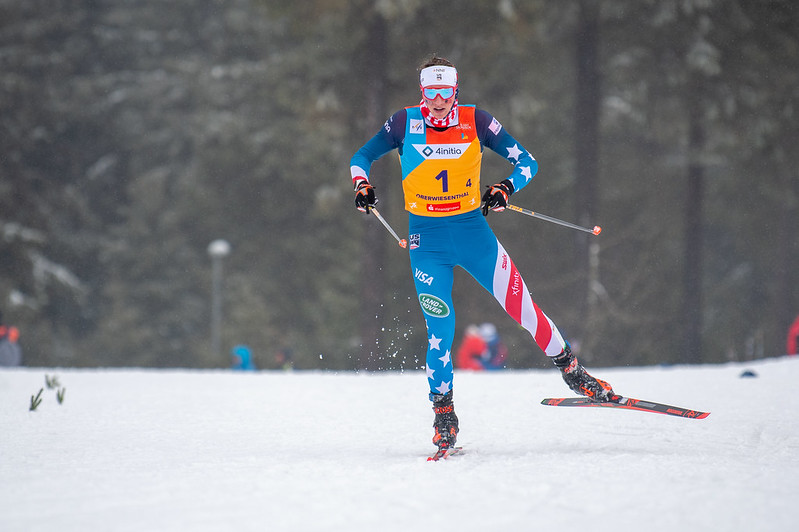
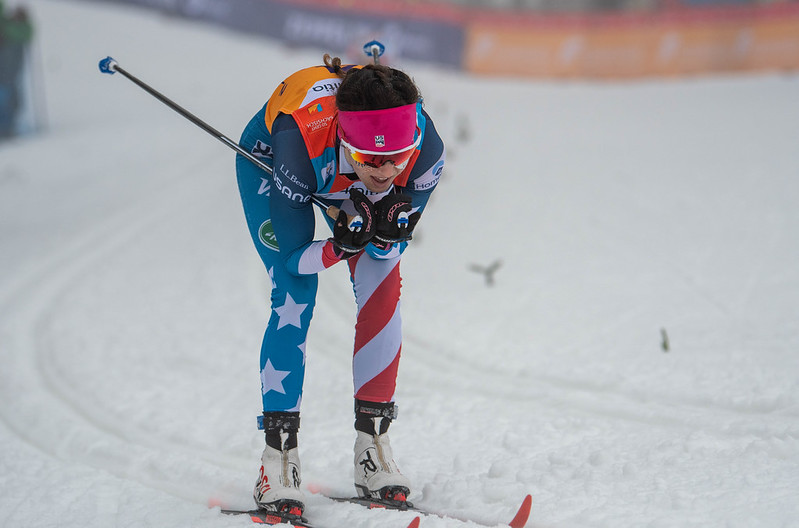
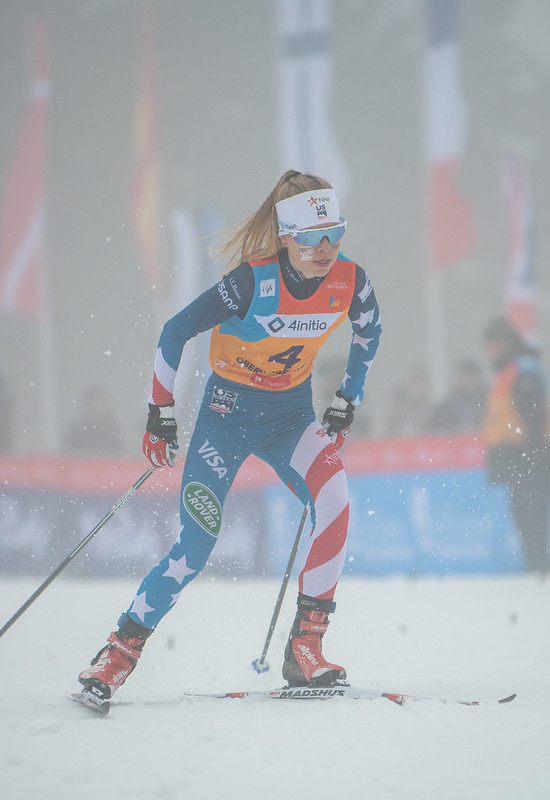
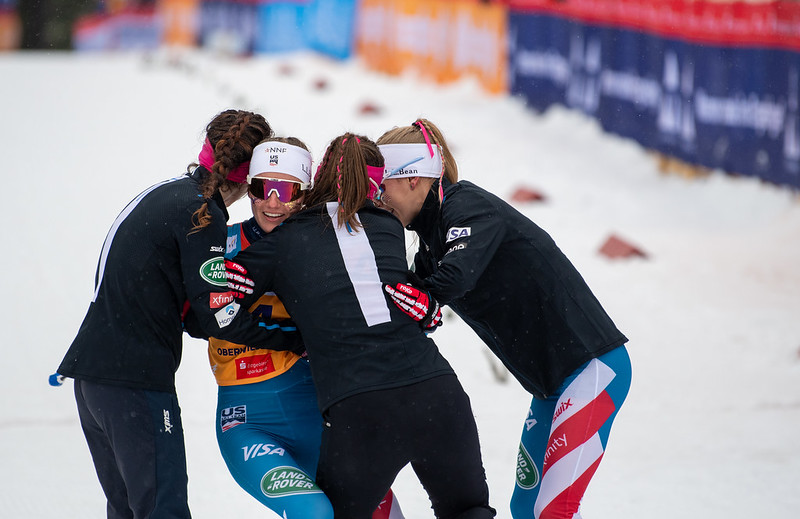
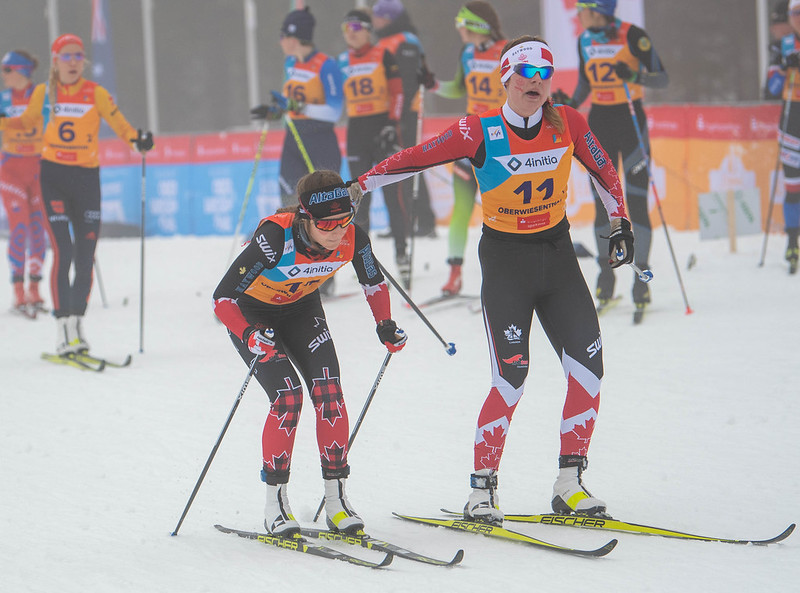
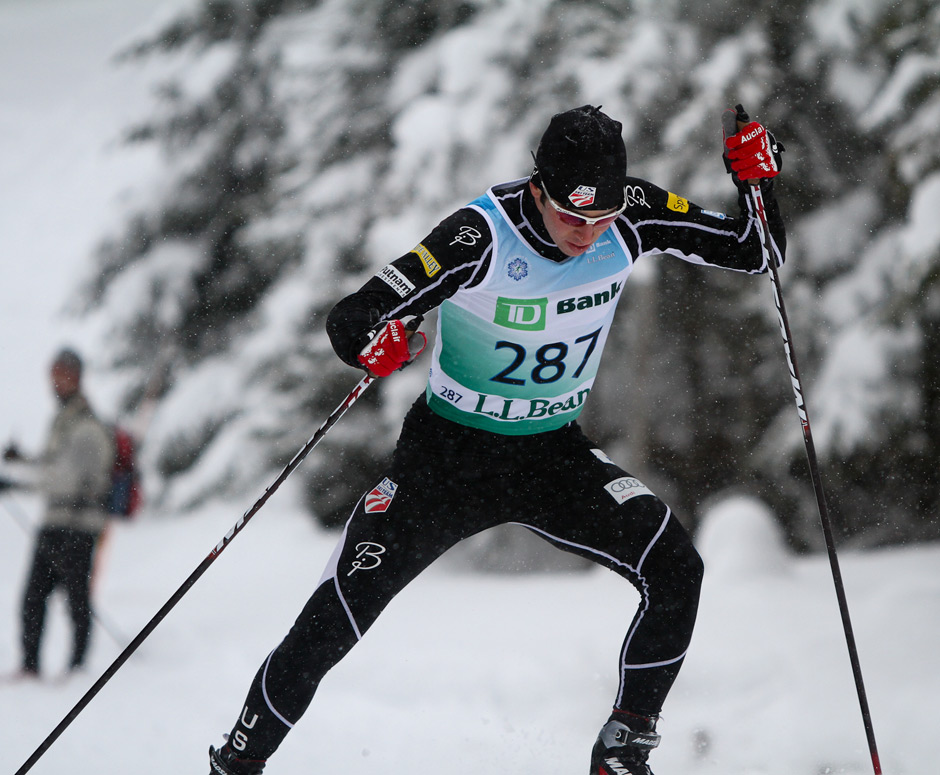
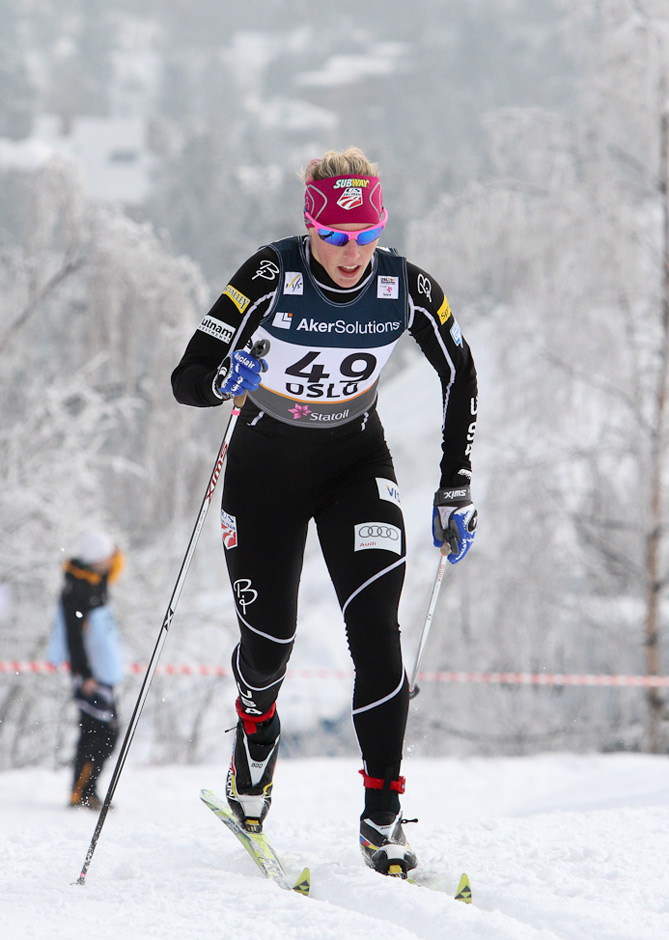
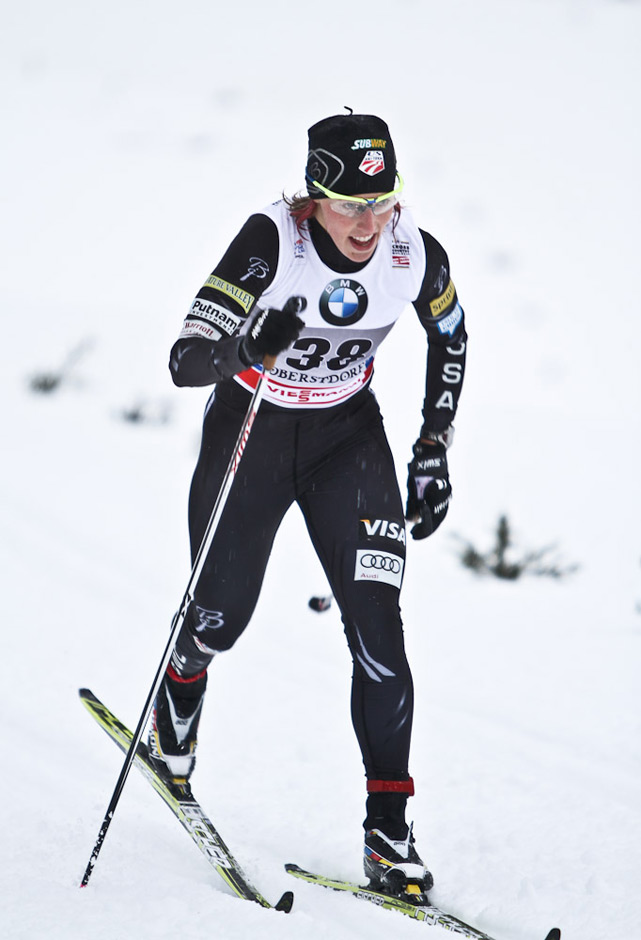
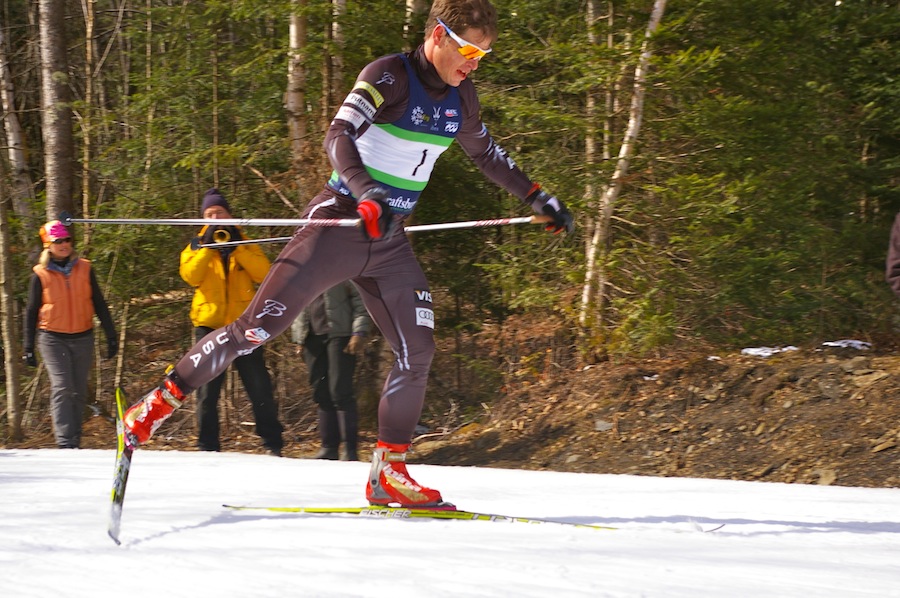
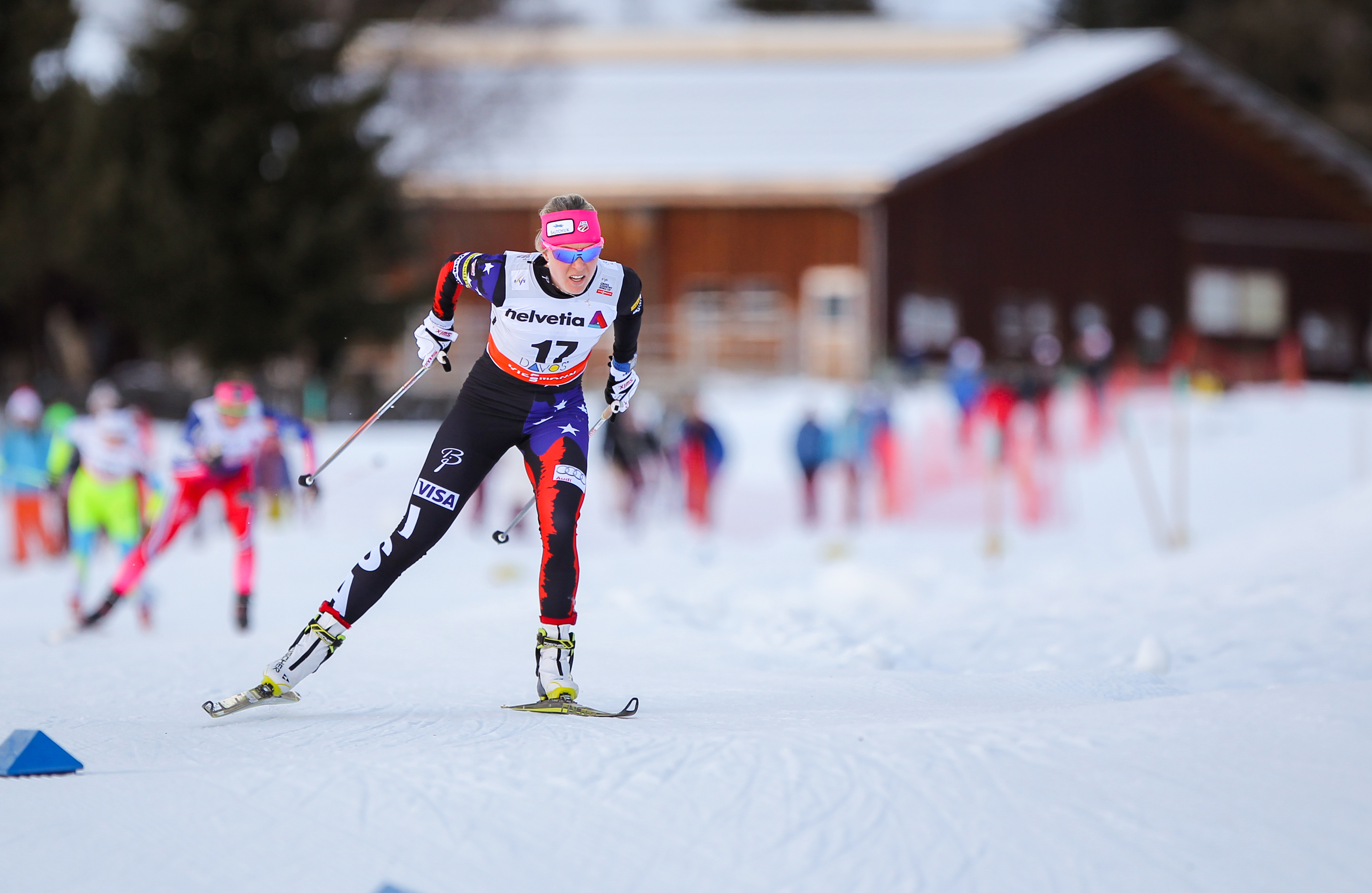
ANCHORAGE — The 2025 US National Championship started yesterday at Kincaid Park in Anchorage, Alaska, with the 10 k Individual Start Freestyle. Photographer and coach Tobias Albrigtsen (@untraceableg) gives us a look through his lens.
(click on the first photo and then click on ‘start’ just above the image to play the slideshow)
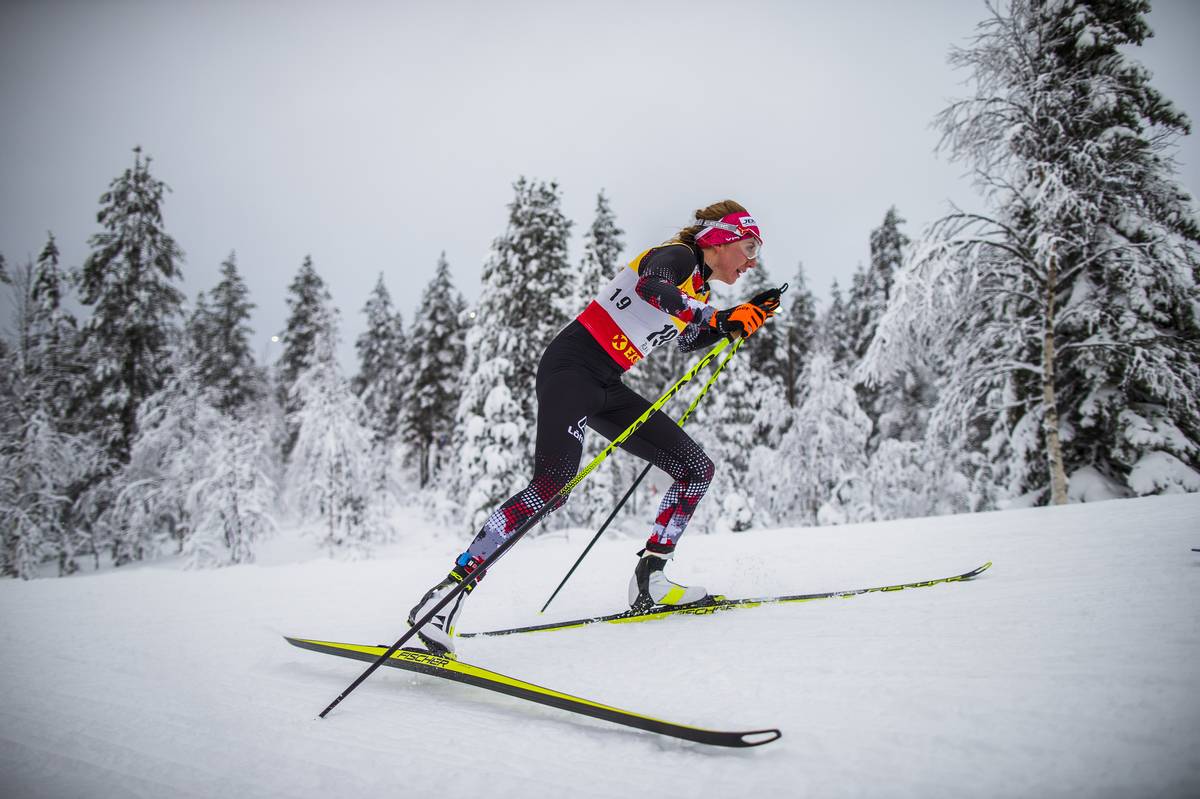
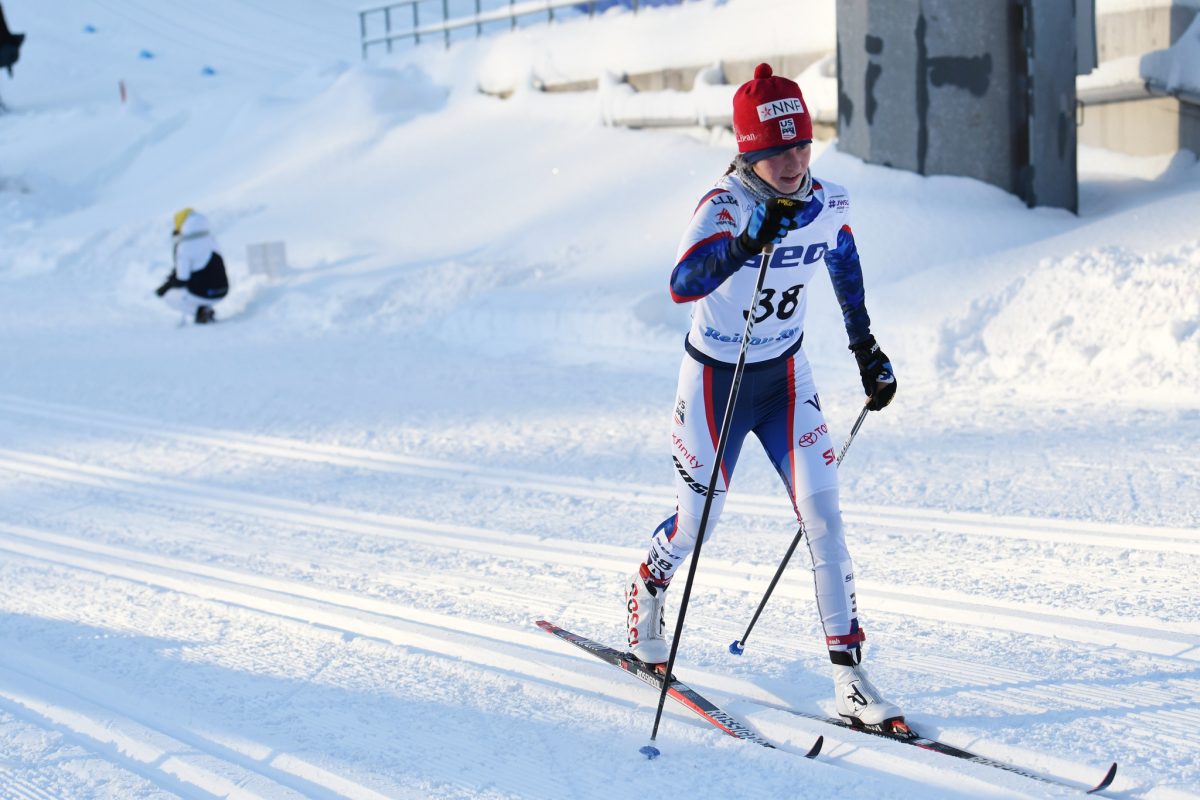
2025 US National Championship, 10 k Individual Start Freestyle. (Photo: Tobias Albrigtsen / @untraceableg)
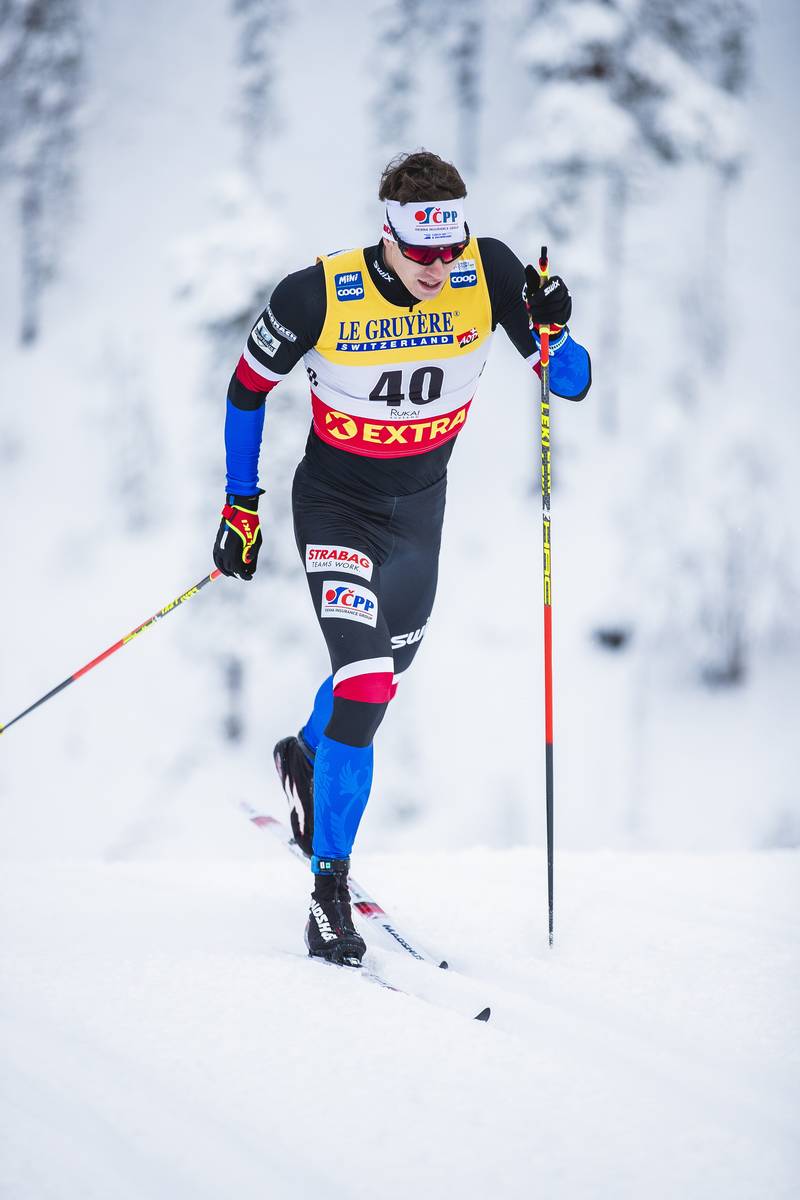
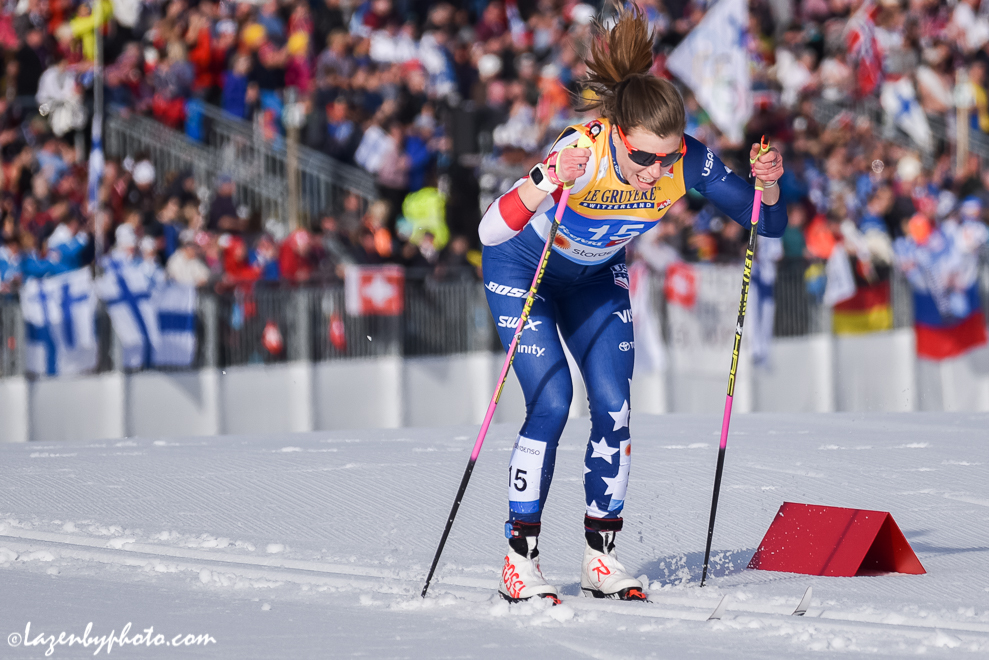
2025 US National Championship, 10 k Individual Start Freestyle. (Photo: Tobias Albrigtsen / @untraceableg)
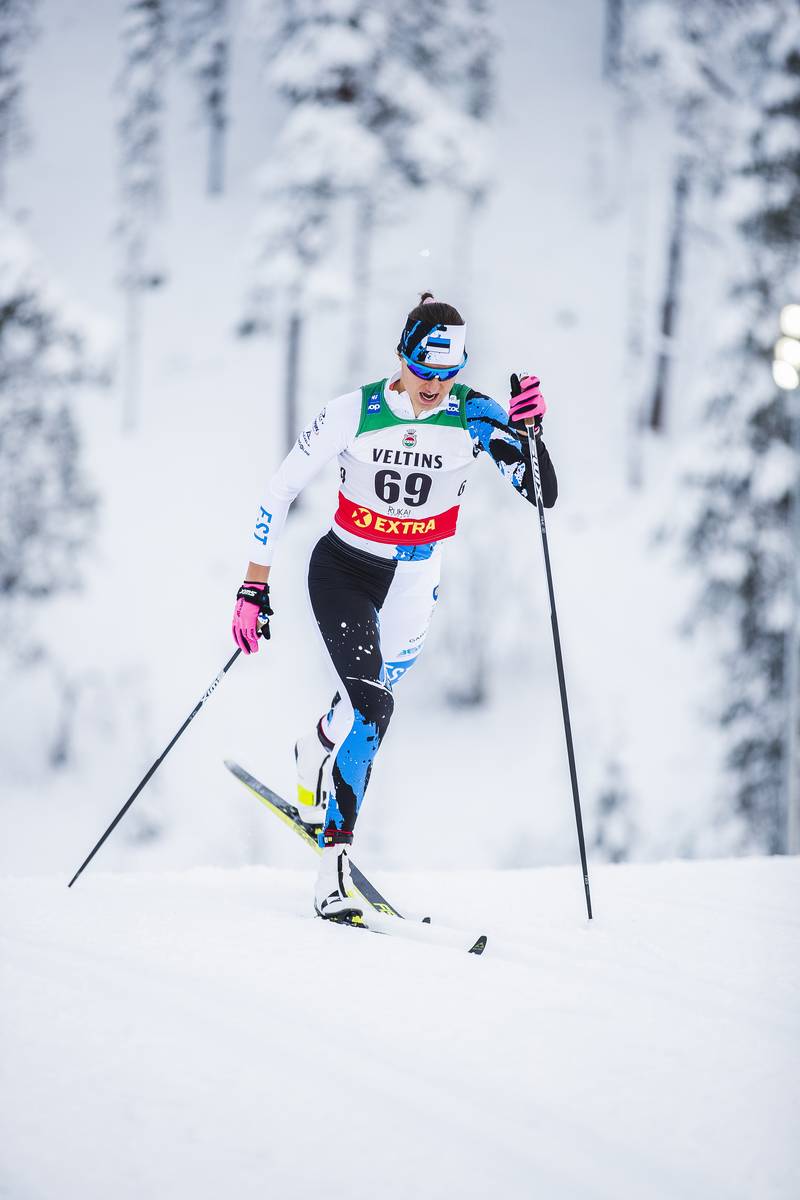
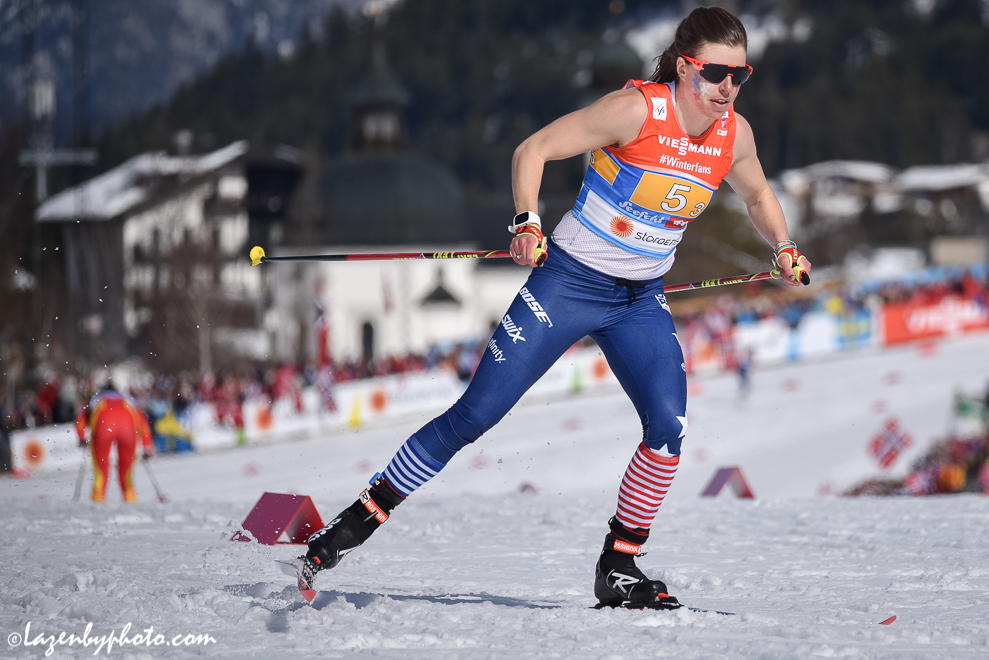
2025 US National Championship, 10 k Individual Start Freestyle. (Photo: Tobias Albrigtsen / @untraceableg)
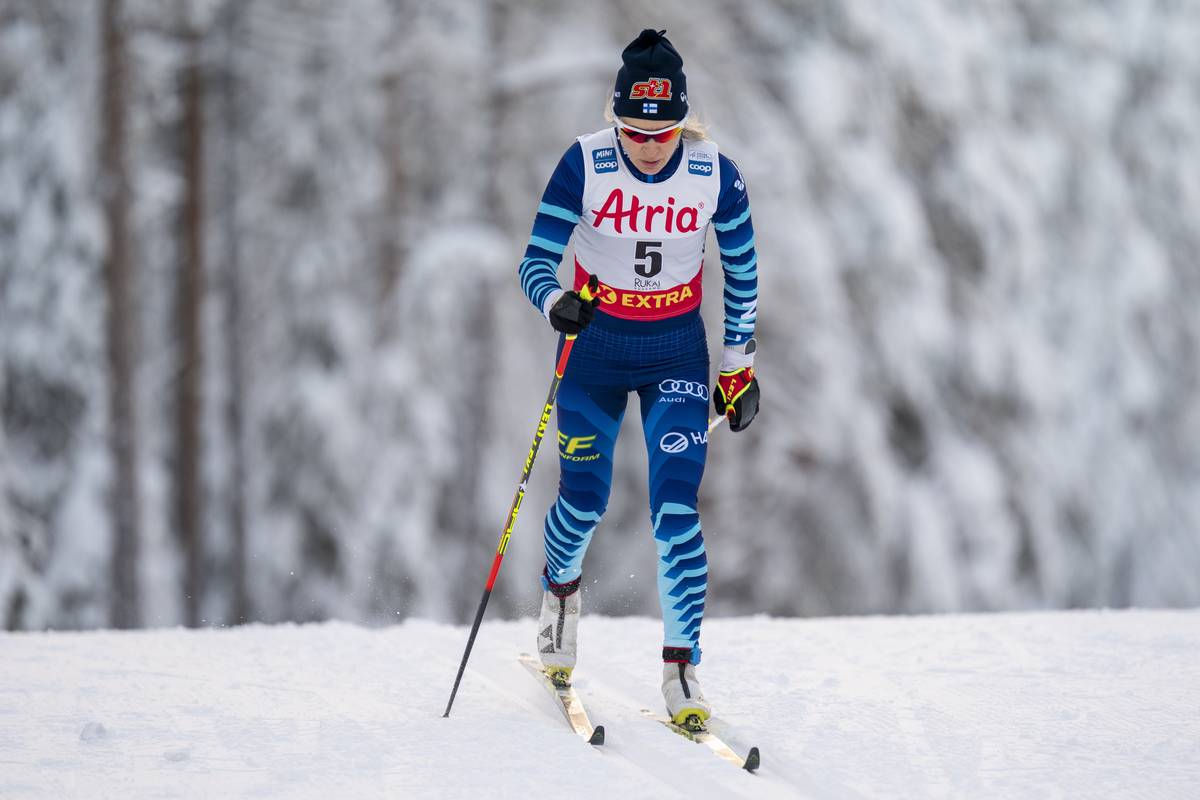
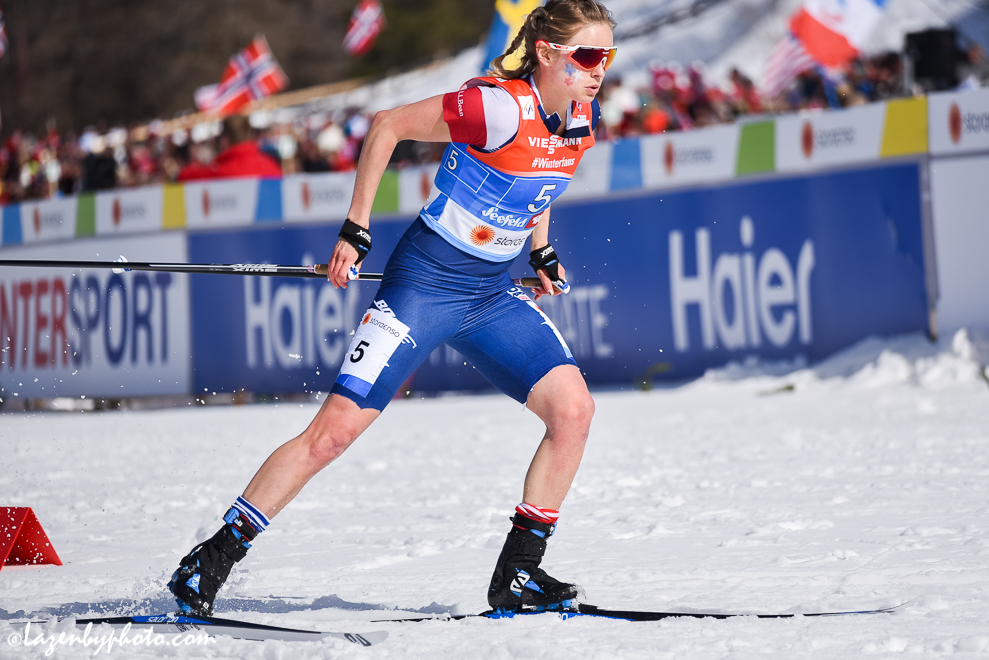
2025 US National Championship, 10 k Individual Start Freestyle. (Photo: Tobias Albrigtsen / @untraceableg)
2025 US National Championship, 10 k Individual Start Freestyle. (Photo: Tobias Albrigtsen / @untraceableg)
2025 US National Championship, 10 k Individual Start Freestyle. (Photo: Tobias Albrigtsen / @untraceableg)
2025 US National Championship, 10 k Individual Start Freestyle. (Photo: Tobias Albrigtsen / @untraceableg)
2025 US National Championship, 10 k Individual Start Freestyle. (Photo: Tobias Albrigtsen / @untraceableg)
2025 US National Championship, 10 k Individual Start Freestyle. (Photo: Tobias Albrigtsen / @untraceableg)
2025 US National Championship, 10 k Individual Start Freestyle. (Photo: Tobias Albrigtsen / @untraceableg)
2025 US National Championship, 10 k Individual Start Freestyle. (Photo: Tobias Albrigtsen / @untraceableg)
2025 US National Championship, 10 k Individual Start Freestyle. (Photo: Tobias Albrigtsen / @untraceableg)
2025 US National Championship, 10 k Individual Start Freestyle. (Photo: Tobias Albrigtsen / @untraceableg)
2025 US National Championship, 10 k Individual Start Freestyle. (Photo: Tobias Albrigtsen / @untraceableg)
2025 US National Championship, 10 k Individual Start Freestyle. (Photo: Tobias Albrigtsen / @untraceableg)
2025 US National Championship, 10 k Individual Start Freestyle. (Photo: Tobias Albrigtsen / @untraceableg)
2025 US National Championship, 10 k Individual Start Freestyle. (Photo: Tobias Albrigtsen / @untraceableg)
2025 US National Championship, 10 k Individual Start Freestyle. (Photo: Tobias Albrigtsen / @untraceableg)
2025 US National Championship, 10 k Individual Start Freestyle. (Photo: Tobias Albrigtsen / @untraceableg)
2025 US National Championship, 10 k Individual Start Freestyle. (Photo: Tobias Albrigtsen / @untraceableg)
2025 US National Championship, 10 k Individual Start Freestyle. (Photo: Tobias Albrigtsen / @untraceableg)
2025 US National Championship, 10 k Individual Start Freestyle. (Photo: Tobias Albrigtsen / @untraceableg)
2025 US National Championship, 10 k Individual Start Freestyle. (Photo: Tobias Albrigtsen / @untraceableg)
2025 US National Championship, 10 k Individual Start Freestyle. (Photo: Tobias Albrigtsen / @untraceableg)
2025 US National Championship, 10 k Individual Start Freestyle. (Photo: Tobias Albrigtsen / @untraceableg)
2025 US National Championship, 10 k Individual Start Freestyle. (Photo: Tobias Albrigtsen / @untraceableg)
2025 US National Championship, 10 k Individual Start Freestyle. (Photo: Tobias Albrigtsen / @untraceableg)
2025 US National Championship, 10 k Individual Start Freestyle. (Photo: Tobias Albrigtsen / @untraceableg)
2025 US National Championship, 10 k Individual Start Freestyle. (Photo: Tobias Albrigtsen / @untraceableg)
2025 US National Championship, 10 k Individual Start Freestyle. (Photo: Tobias Albrigtsen / @untraceableg)
2025 US National Championship, 10 k Individual Start Freestyle. (Photo: Tobias Albrigtsen / @untraceableg)
2025 US National Championship, 10 k Individual Start Freestyle. (Photo: Tobias Albrigtsen / @untraceableg)
2025 US National Championship, 10 k Individual Start Freestyle. (Photo: Tobias Albrigtsen / @untraceableg)
2025 US National Championship, 10 k Individual Start Freestyle. (Photo: Tobias Albrigtsen / @untraceableg)
2025 US National Championship, 10 k Individual Start Freestyle. (Photo: Tobias Albrigtsen / @untraceableg)
2025 US National Championship, 10 k Individual Start Freestyle. (Photo: Tobias Albrigtsen / @untraceableg)
2025 US National Championship, 10 k Individual Start Freestyle. (Photo: Tobias Albrigtsen / @untraceableg)
2025 US National Championship, 10 k Individual Start Freestyle. (Photo: Tobias Albrigtsen / @untraceableg)
2025 US National Championship, 10 k Individual Start Freestyle. (Photo: Tobias Albrigtsen / @untraceableg)
2025 US National Championship, 10 k Individual Start Freestyle. (Photo: Tobias Albrigtsen / @untraceableg)
2025 US National Championship, 10 k Individual Start Freestyle. (Photo: Tobias Albrigtsen / @untraceableg)
2025 US National Championship, 10 k Individual Start Freestyle. (Photo: Tobias Albrigtsen / @untraceableg)
2025 US National Championship, 10 k Individual Start Freestyle. (Photo: Tobias Albrigtsen / @untraceableg)
2025 US National Championship, 10 k Individual Start Freestyle. (Photo: Tobias Albrigtsen / @untraceableg)
2025 US National Championship, 10 k Individual Start Freestyle. (Photo: Tobias Albrigtsen / @untraceableg)
2025 US National Championship, 10 k Individual Start Freestyle. (Photo: Tobias Albrigtsen / @untraceableg)
2025 US National Championship, 10 k Individual Start Freestyle. (Photo: Tobias Albrigtsen / @untraceableg)
2025 US National Championship, 10 k Individual Start Freestyle. (Photo: Tobias Albrigtsen / @untraceableg)
2025 US National Championship, 10 k Individual Start Freestyle. (Photo: Tobias Albrigtsen / @untraceableg)
2025 US National Championship, 10 k Individual Start Freestyle. (Photo: Tobias Albrigtsen / @untraceableg)
2025 US National Championship, 10 k Individual Start Freestyle. (Photo: Tobias Albrigtsen / @untraceableg)
2025 US National Championship, 10 k Individual Start Freestyle. (Photo: Tobias Albrigtsen / @untraceableg)
2025 US National Championship, 10 k Individual Start Freestyle. (Photo: Tobias Albrigtsen / @untraceableg)
2025 US National Championship, 10 k Individual Start Freestyle. (Photo: Tobias Albrigtsen / @untraceableg)
2025 US National Championship, 10 k Individual Start Freestyle. (Photo: Tobias Albrigtsen / @untraceableg)
2025 US National Championship, 10 k Individual Start Freestyle. (Photo: Tobias Albrigtsen / @untraceableg)
2025 US National Championship, 10 k Individual Start Freestyle. (Photo: Tobias Albrigtsen / @untraceableg)
2025 US National Championship, 10 k Individual Start Freestyle. (Photo: Tobias Albrigtsen / @untraceableg)
2025 US National Championship, 10 k Individual Start Freestyle. (Photo: Tobias Albrigtsen / @untraceableg)
2025 US National Championship, 10 k Individual Start Freestyle. (Photo: Tobias Albrigtsen / @untraceableg)
2025 US National Championship, 10 k Individual Start Freestyle. (Photo: Tobias Albrigtsen / @untraceableg)
2025 US National Championship, 10 k Individual Start Freestyle. (Photo: Tobias Albrigtsen / @untraceableg)
2025 US National Championship, 10 k Individual Start Freestyle. (Photo: Tobias Albrigtsen / @untraceableg)
2025 US National Championship, 10 k Individual Start Freestyle. (Photo: Tobias Albrigtsen / @untraceableg)
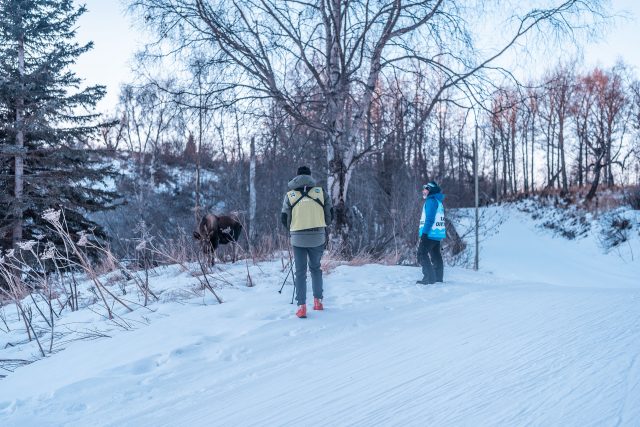
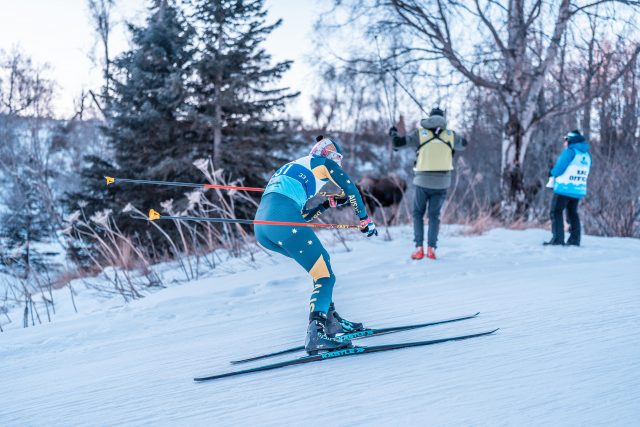
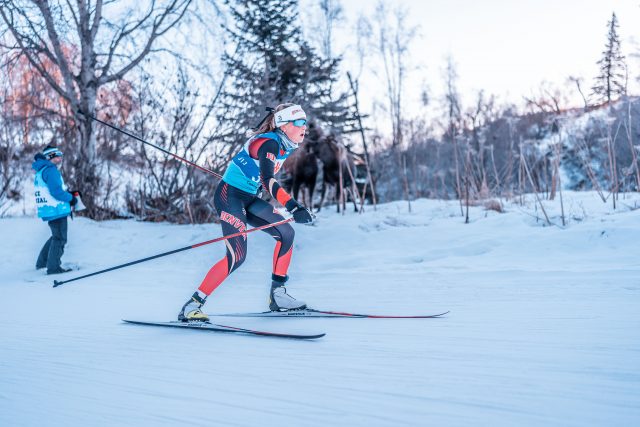
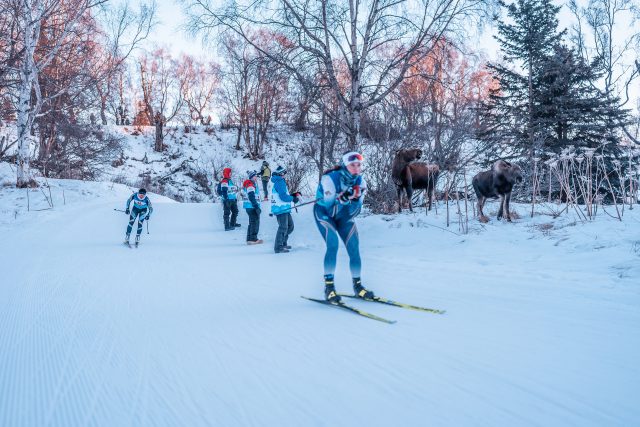
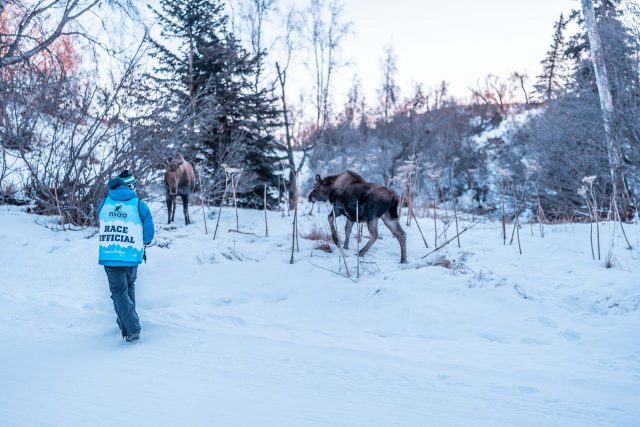
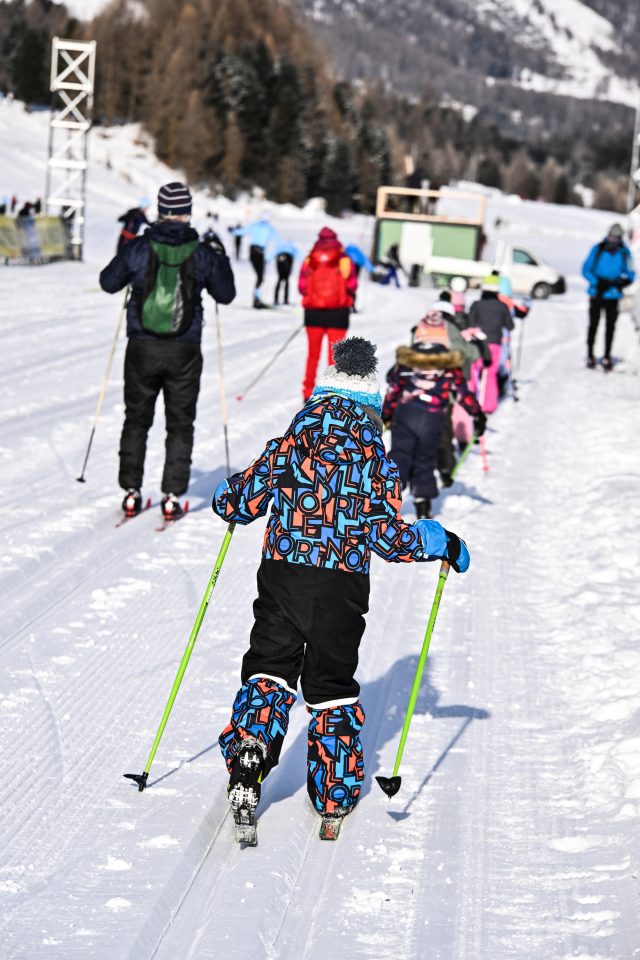
A real Alaskan experience for the racers visiting for the 2025 US National Championship. (Photo: Tobias Albrigtsen / @untraceableg)
2025 US National Championship, 10 k Individual Start Freestyle. (Photo: Tobias Albrigtsen / @untraceableg)
2025 US National Championship, 10 k Individual Start Freestyle. (Photo: Tobias Albrigtsen / @untraceableg)
2025 US National Championship, 10 k Individual Start Freestyle. (Photo: Tobias Albrigtsen / @untraceableg)
2025 US National Championship, 10 k Individual Start Freestyle. (Photo: Tobias Albrigtsen / @untraceableg)
2025 US National Championship, 10 k Individual Start Freestyle. (Photo: Tobias Albrigtsen / @untraceableg)
2025 US National Championship, 10 k Individual Start Freestyle. (Photo: Tobias Albrigtsen / @untraceableg)
2025 US National Championship, 10 k Individual Start Freestyle. (Photo: Tobias Albrigtsen / @untraceableg)
2025 US National Championship, 10 k Individual Start Freestyle. (Photo: Tobias Albrigtsen / @untraceableg)
2025 US National Championship, 10 k Individual Start Freestyle. (Photo: Tobias Albrigtsen / @untraceableg)
2025 US National Championship, 10 k Individual Start Freestyle. (Photo: Tobias Albrigtsen / @untraceableg)
2025 US National Championship, 10 k Individual Start Freestyle. (Photo: Tobias Albrigtsen / @untraceableg)
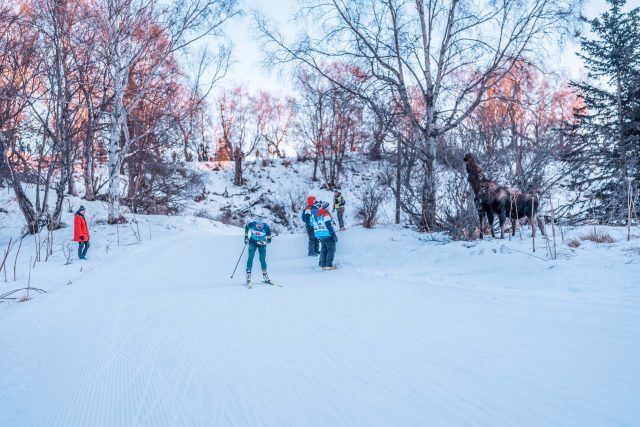
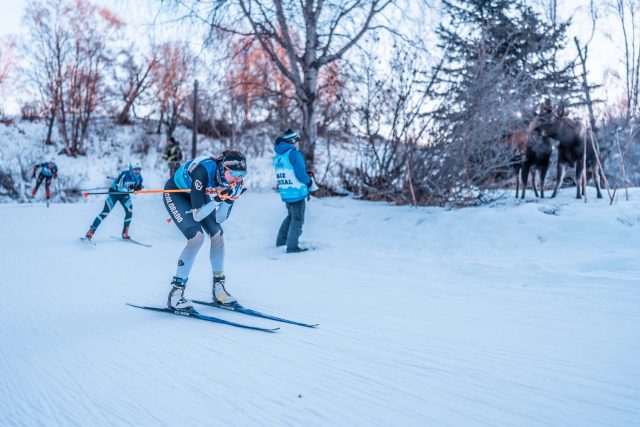
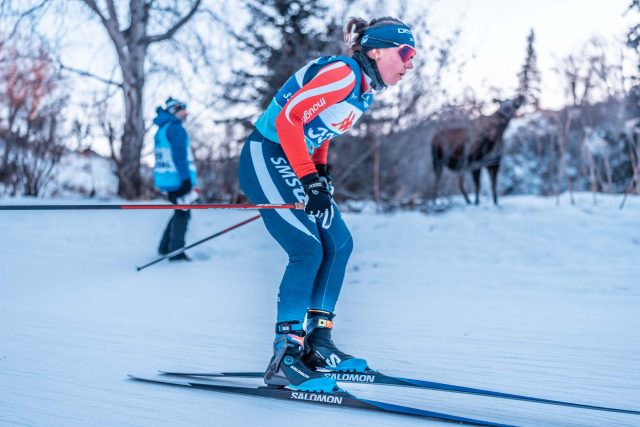
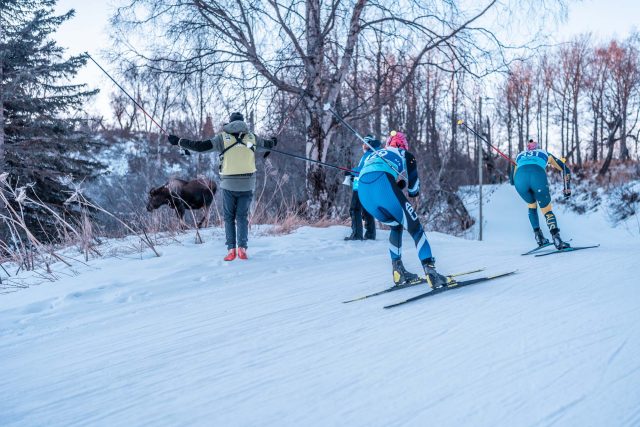
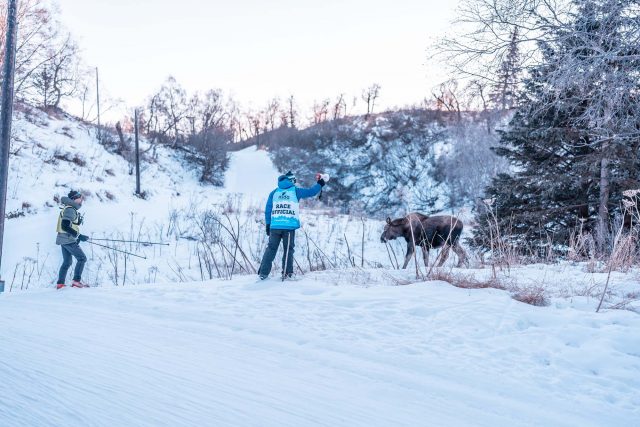
No athletes nor moose were harmed in Thursday’s ski race. (Photo: Tobias Albrigtsen / @untraceableg)
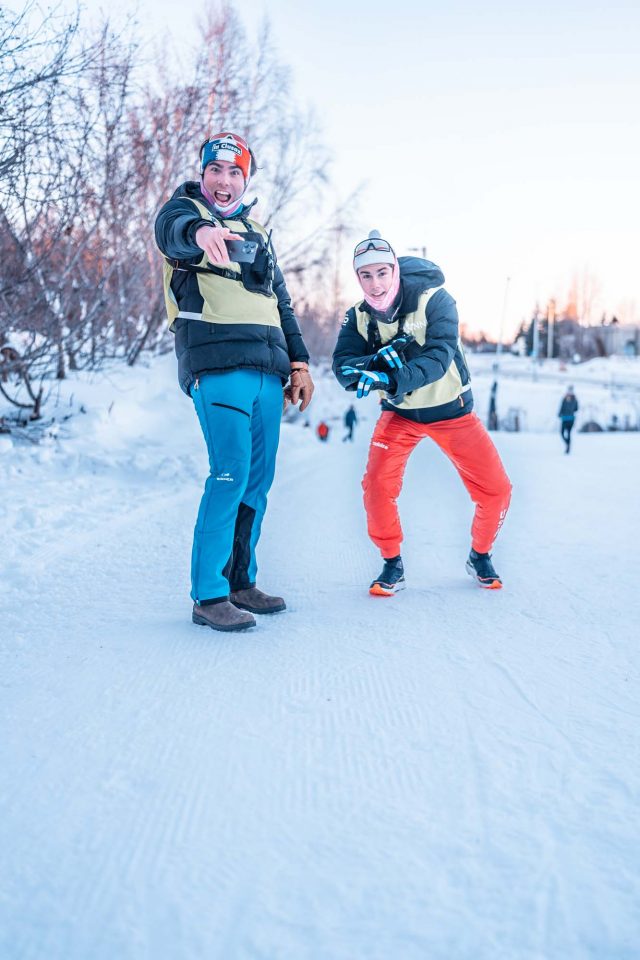
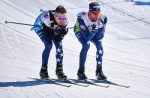
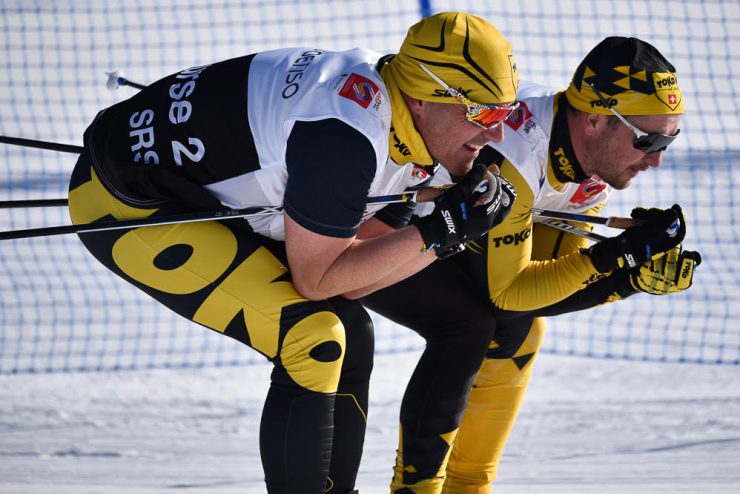
Trond Flagstad, left, and Jeremy Littell employ “moose intimidation tactics” near the five-kilometer race loop. (Photo: Tobias Albrigtsen / @untraceableg)
2025 US National Championship, 10 k Individual Start Freestyle. (Photo: Tobias Albrigtsen / @untraceableg)
2025 US National Championship, 10 k Individual Start Freestyle. (Photo: Tobias Albrigtsen / @untraceableg)
2025 US National Championship, 10 k Individual Start Freestyle. (Photo: Tobias Albrigtsen / @untraceableg)
2025 US National Championship, 10 k Individual Start Freestyle. (Photo: Tobias Albrigtsen / @untraceableg)
2025 US National Championship, 10 k Individual Start Freestyle. (Photo: Tobias Albrigtsen / @untraceableg)
2025 US National Championship, 10 k Individual Start Freestyle. (Photo: Tobias Albrigtsen / @untraceableg)
2025 US National Championship, 10 k Individual Start Freestyle. (Photo: Tobias Albrigtsen / @untraceableg)
2025 US National Championship, 10 k Individual Start Freestyle. (Photo: Tobias Albrigtsen / @untraceableg)
2025 US National Championship, 10 k Individual Start Freestyle. (Photo: Tobias Albrigtsen / @untraceableg)
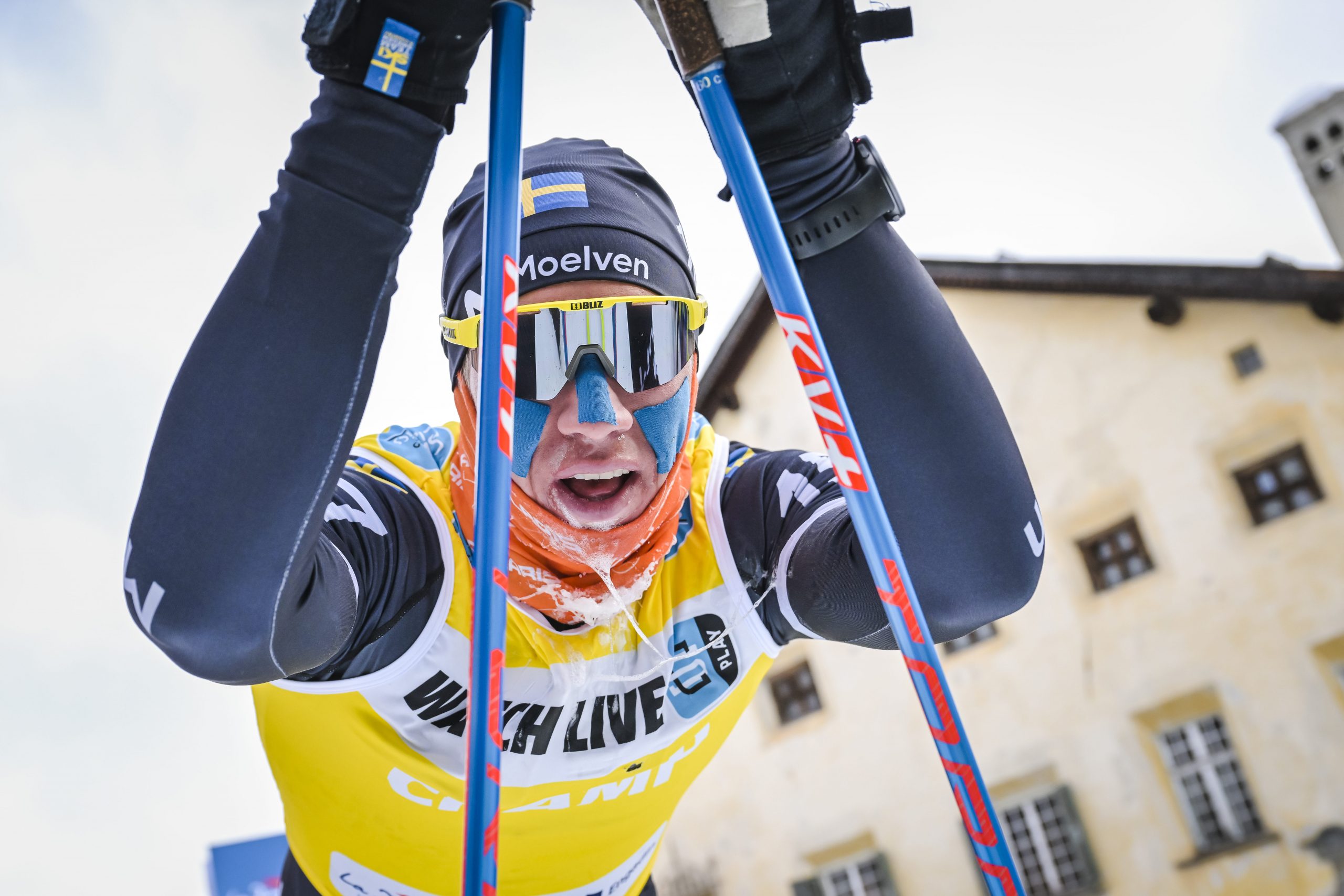
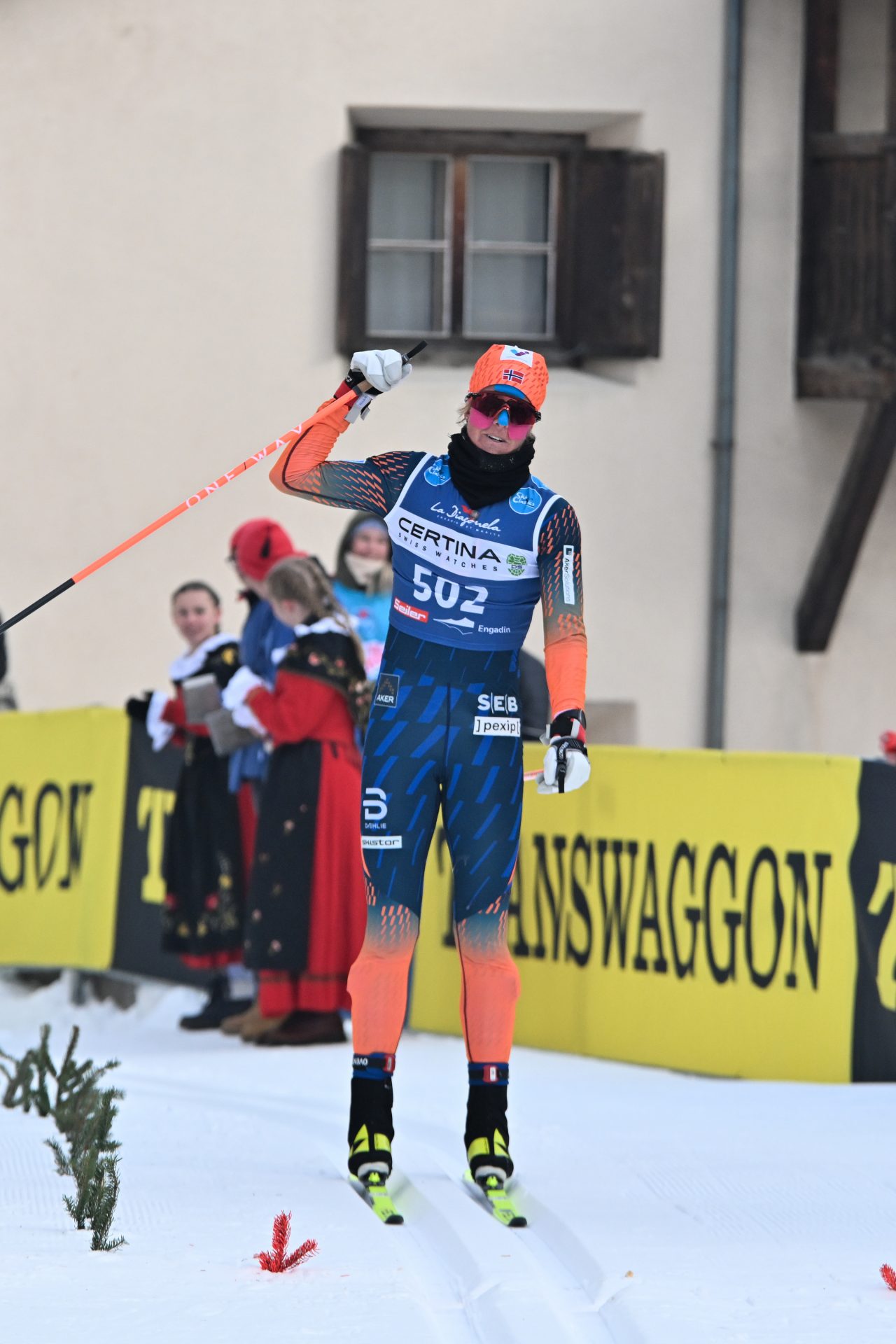
Season XIV’s sixth Ski Classics event, 48-kilometer Engadin La Diagonela in Switzerland, saw Astrid Øyre Slind, Team Aker Dæhlie, and Emil Persson, Lager 157 Ski Team, winning the race in superior style.
The race that started in Pontresina and finished in Zuoz saw Emil Persson, Lager 157 Ski Team, and Astrid Øyre Slind, Team Aker Dæhlie, dominating their respective races and winning Engadin La Diagonela 2023, the sixth event of Ski Classics Season XIV.
ENGADIN LA DIAGONELA – MEN’S RACE
In the men’s race, which started at 8:55 CET, the action started early at the Sprint checkpoint in Samedan, 5.3km into the race, with Vebjørn Moen, Team Aker Dæhlie, crossing first, followed by Alfred Buskqvist, Team Ramudden, and Lorenzo Busin, Team Internorm Alpenplus Trentino.
With about 37km to go, after crossing the railroads, the skiers hit the steepest climb of the day, with Tord Asle Gjerdalen, Team XPND Fuel, Johannes Eklöf, Team Ramudden, and Oskar Kardin, Team Ragde Charge, leading the group and controlling the pace, but no decisive action yet.
The second and last Sprint checkpoint of the day, 24.7km into the race at Lej da Gravatscha, saw fast man Alfred Buskqvist, Team Ramudden, taking the most points, closely followed by Fabián Štoček, Vltava Fund Ski Team, and Marcus Johansson, Lager 157 Ski Team. From there, the leading group of contenders kept together for the race.
At the last 10km of the race, about 35 skiers were still strong in the front, but the significant action came on the final kilometers.
With about 7km to go, Thomas Ødegaarden, Team XPND Fuel, was on the offensive at the front, setting the pace and trying to reduce the remaining 30 skiers’ group. With 3km to go, Team Ragde Charge upped the pace and tried to stretch the field.
With 1.5km to go, Andreas Nygaard, Team Ragde Charge, upped the pace but soon faded, leaving the front group open for the sprint fight.
In the end, Emil Persson, Lager 157 Ski Team, had an impressive sprint and won his fifth individual Ski Classics Pro Tour event this season, followed by Max Novak, Team Aker Dæhlie, 0.5 seconds back. Stian Hoelgaard, Team Aker Dæhlie, completed the podium in the third position, 3.1 seconds behind the winner.
Engadin La Diagonela – Top 3 Men
1. Emil Persson, Lager 157 Ski Team 2:00:10.4
2. Max Novak, Team Aker Dæhlie +0.5
3.Stian Hoelgaard, Team Aker Dæhlie +3.1
ENGADIN LA DIAGONELA – WOMEN’S RACE
In the women’s race, which started 5 minutes after the men, at 9:00 CET, we had good action already at Samedan 5.3km mark Sprint. Anikken Gjerde Alnæs, Team Ragde Charge, crossed first, followed by Magnis Smedås, Team Eksjöhus, and Jenny Larsson, Team Ragde Charge.
Right after the railroad crossing and into the steepest climb of the race, Astrid Øyre Slind, Team Aker Dæhlie, upped the pace, and only Emilie Fleten, Team Ramudden, could follow. The chasing group, formed by Anikken Gjerde Alnæs, Team Ragde Charge, and Magnis Smedås, Team Eksjöhus, tried to close the gap but was already 18 seconds back after a couple of kilometers.
The leading duo kept working together and, with 34km to go, increased the gap to the chasers to 37 seconds. Anikken and Magni were fighting hard, and Kati Roivas, Team Næringsbanken Stora Enso, could enter the chasing group.
At Val Roseg, 14.6km into the race, Fleten and Øyre Slind crossed first, with the chasing trio of Roivas, Smedås, and Gjerde Alnæs one minute back.
At Lej da Gravatscha 24.7km Sprint split, it was time for Astrid Øyre Slind,Team Aker Dæhlie, to cross first, followed by Emilie Fleten, Team Ramudden, 0.5 seconds back, and Anikken Gjerde Alnæs, Team Ragde Charge, 1:43.5 behind.
From there, the front of the race was established. With about 16km to go, the chasing trio was still together, with Roivas, Smedås, and Gjerde Alnæs two minutes behind, and the gap still growing.
With 1km to go, it was a fight between Astrid and Emilie for the top place on the podium.
In the end, with 300m to go, Astrid Øyre Slind, Team Aker Dæhlie, attacked and used all her power to win Engadin La Diagonela 2023 in a convincing performance. Emilie Fleten, Team Ramudden, crossed the line 15.6 seconds back, and Magni Smedås, Team Eksjöhus, managed to get the third podium place, 3:47.7 behind the winner.
Engadin La Diagonela – Top 3 Women
1. Astrid Øyre Slind, Team Aker Dæhlie 2:18:23.6
2. Emilie Fleten, Team Ramudden +15.6
3. Magni Smedås, Team Eksjöhus +3:47.7
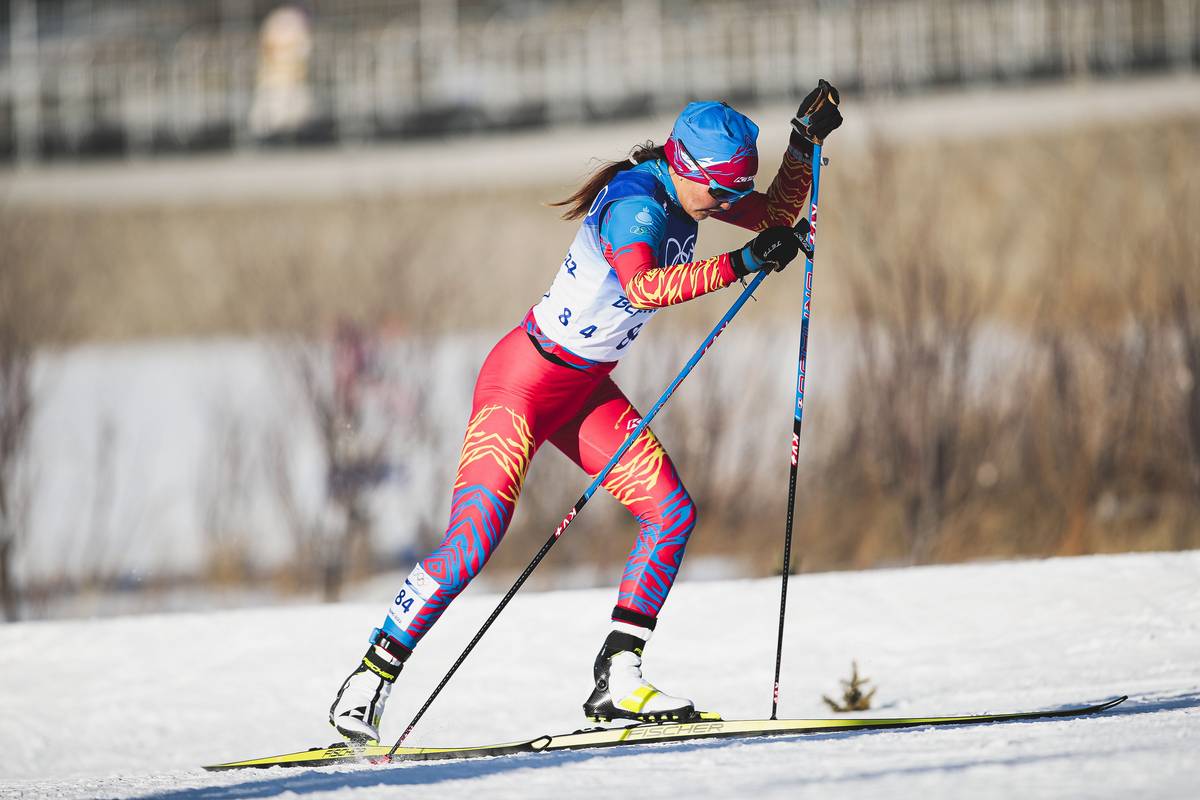
Enkhtuul Ariunsanaa of Mongolia skis in the women’s skate sprint qualification at the 2022 Winter Olympic Games. (photo: NordicFocus)
We recently brought you a roundup of Olympic race suits from some more traditional nordic powers, focusing on those nations that had at least four men on site in Zhangjiakou and so were able to field a team in the men’s 4 x 10-kilometer relay. This article now turns its attention to athletes from some countries that you might not initially think of when you think of nordic skiing, as well as more traditional ski countries (Poland, Ukraine) that did not field a team in the men’s relay.
These photos, all of which are copyright NordicFocus, are from the qualification round of the women’s freestyle sprint, early in the Olympic Games on February 8.
Argentina
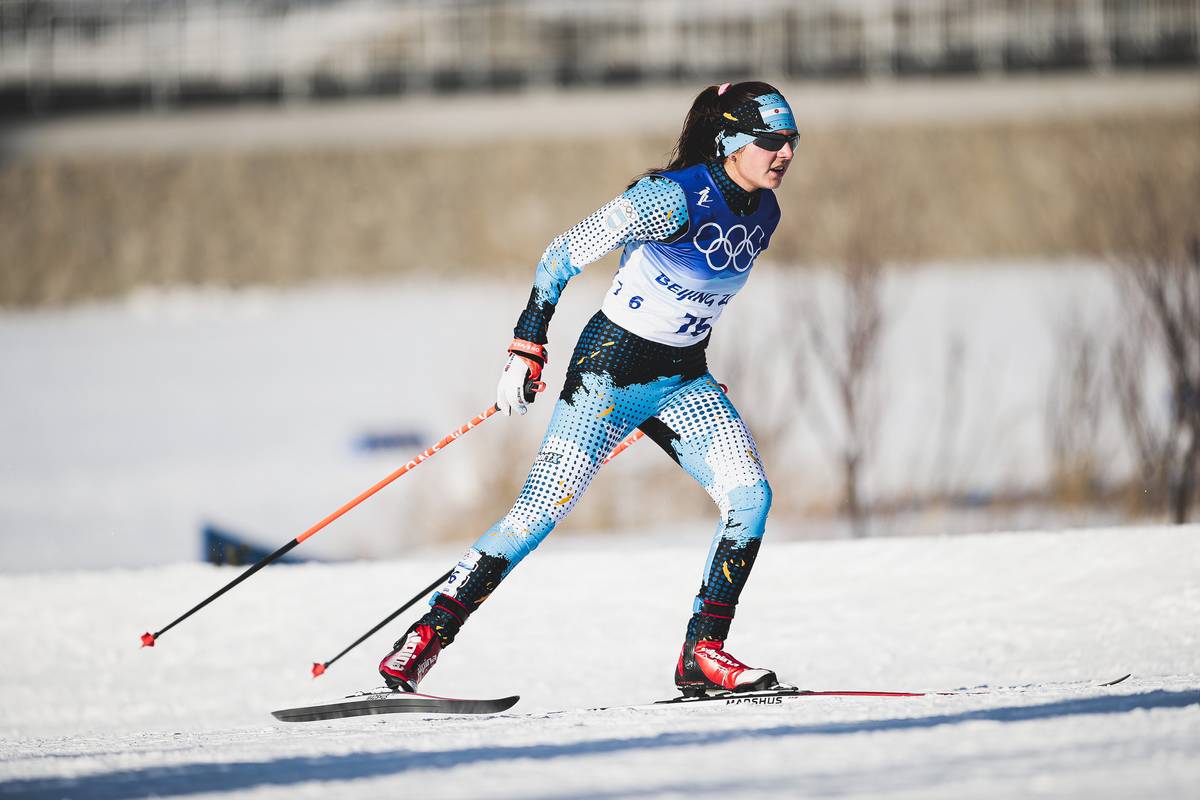
Nahiara Díaz González (ARG) skis in the women’s skate sprint qualification, Feb. 8. (photo: NordicFocus) Her uniform evokes the “sky blue and whites” of the better-known Argentine national football team, La Albiceleste.
Armenia
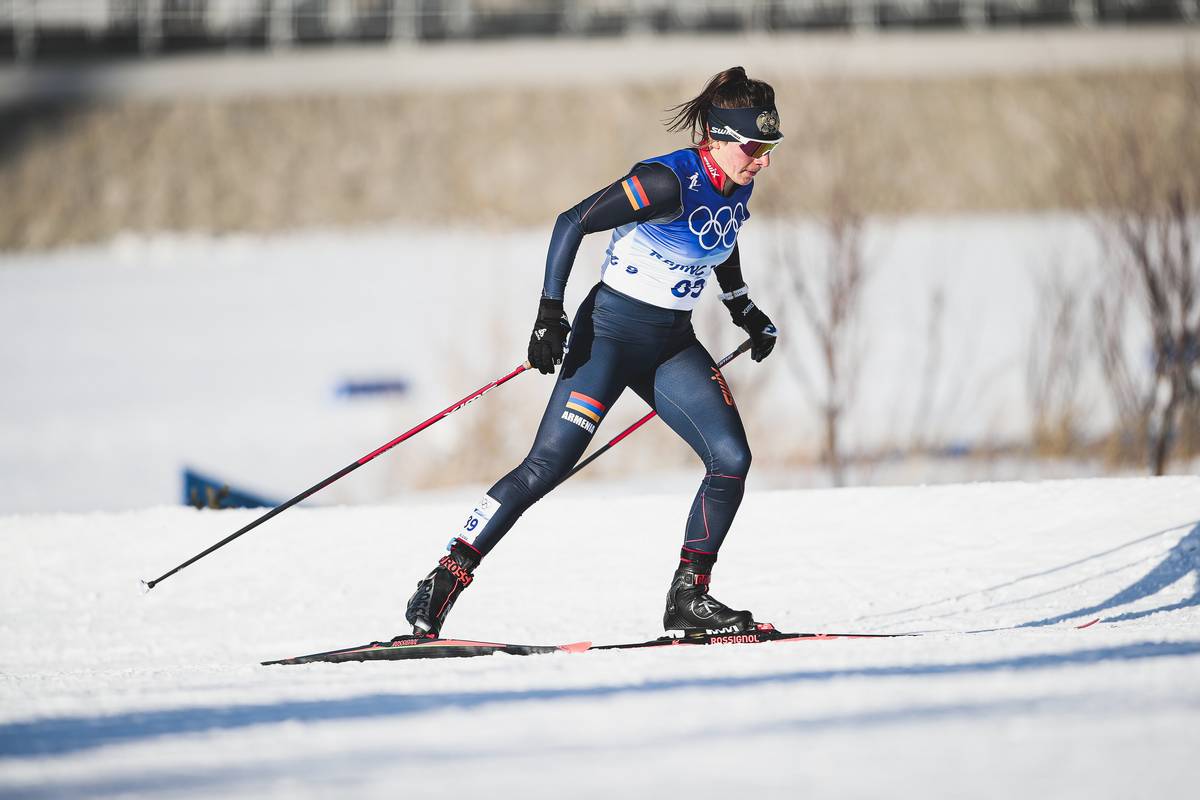
Katya Galstyan (ARM) skis in the women’s skate sprint qualification. (photo: NordicFocus) Her suit is a largely stock dark Swix model, with the Armenian flag on the right leg and shoulder. The Armenian coat of arms, which features an eagle regardant dexter and a lion regardant sinister, is on her headband.
Australia
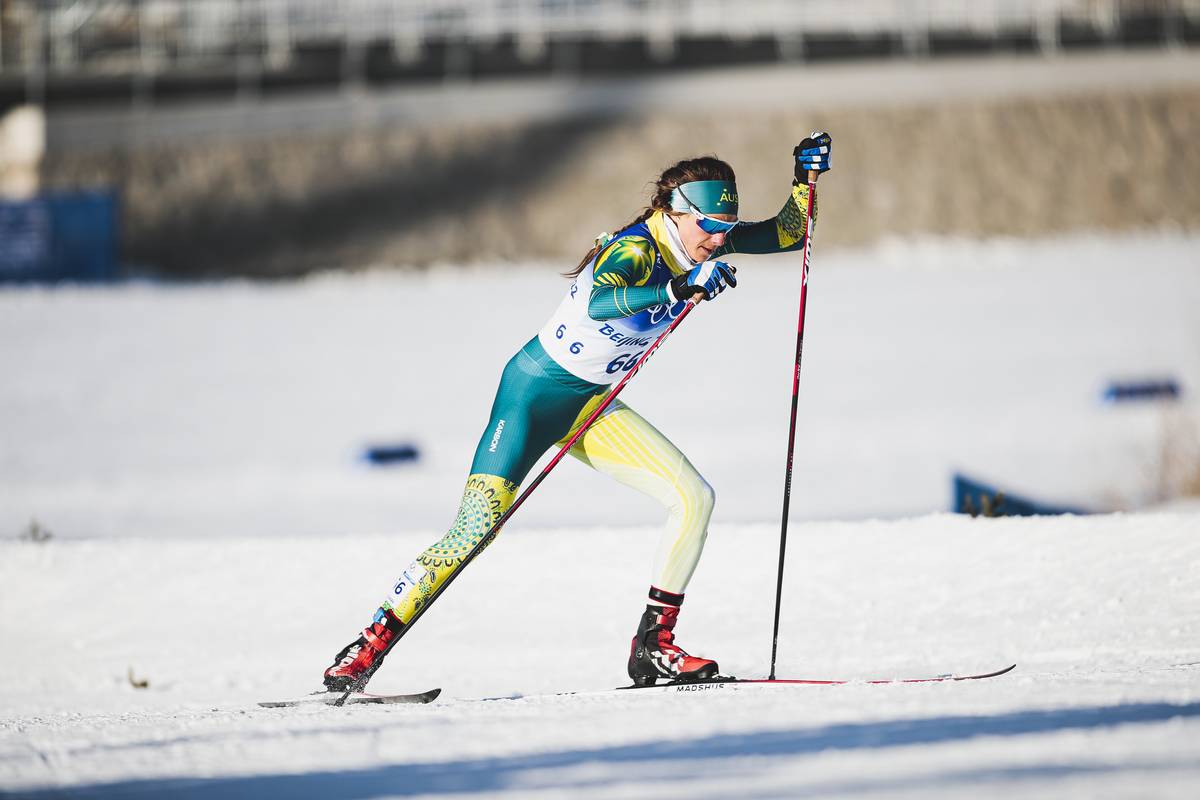
Jessica Yeaton (AUS) skis in the women’s skate sprint qualification. (photo: NordicFocus) Yeaton, who grew up largely in Anchorage and skied for the same high school (South Anchorage High School) as double Olympic siblings Scott and Caitlin Patterson, sports a green and yellow uniform typical of Australian teams in international sport. Wikipedia explains, “although the country’s flag has the colours blue, red and white, the [national football team] uses shades of green and yellow. That’s because, unlike many national teams, who base their colours on the flag, the Australian team uses as a base the colours of a typical plant in the country, the acacia, which has green leaves and yellow flowers.” When Yeaton teamed up with fellow Anchorage expat Casey Wright (Wright skied collegiately for the University of Alaska Anchorage) for the team sprint a few days later, they augmented their face tape with “Aussie Aussie Aussie / Oi Oi Oi” on alternating cheeks.Austria
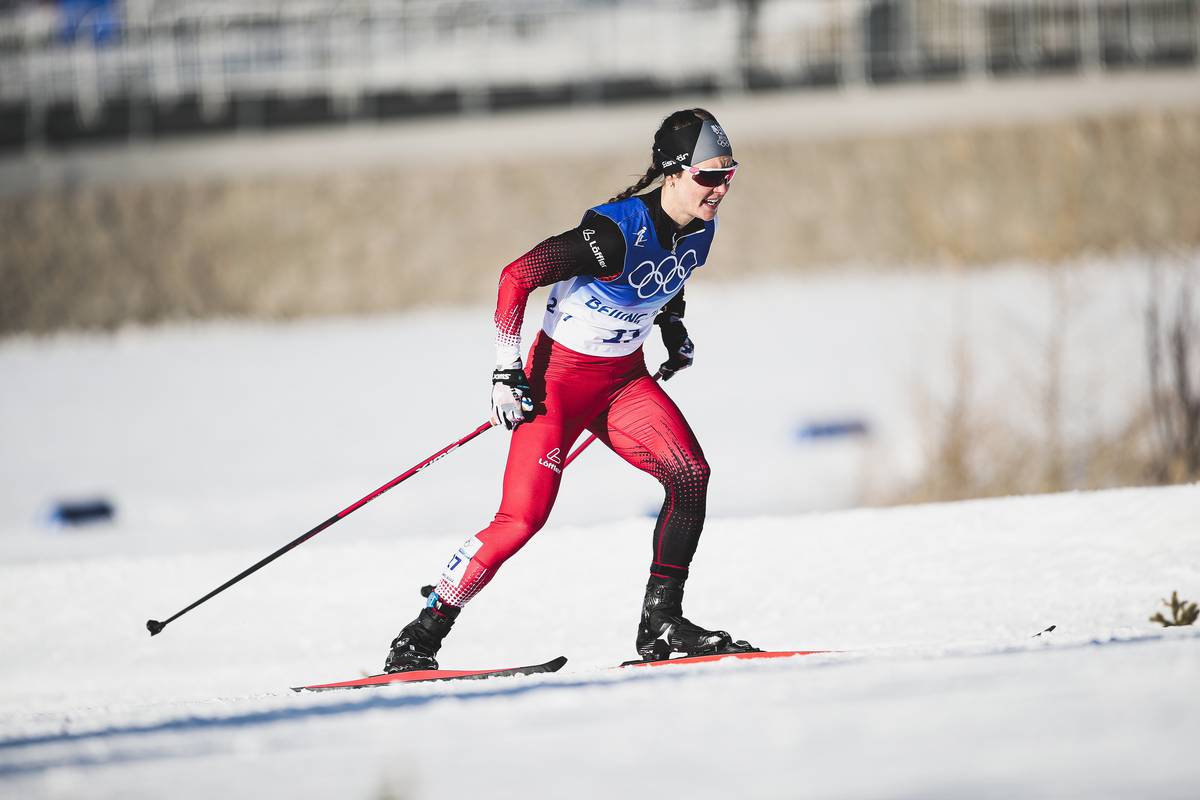
Lisa Unterweger (AUT) skis in the women’s skate sprint qualification. (photo: NordicFocus) Her kit largely tracks the two colors of the Austrian flag, white and red.
Bosnia and Herzegovina
Sanja Kusmuk (BIH) skis in the women’s skate sprint qualification. (photo: NordicFocus) Her kit appears, awkwardly, to be precisely the same design, on an Odlo race suit, as both Switzerland and France, though with different colors. You may decide for yourself who wore it better.
Brazil
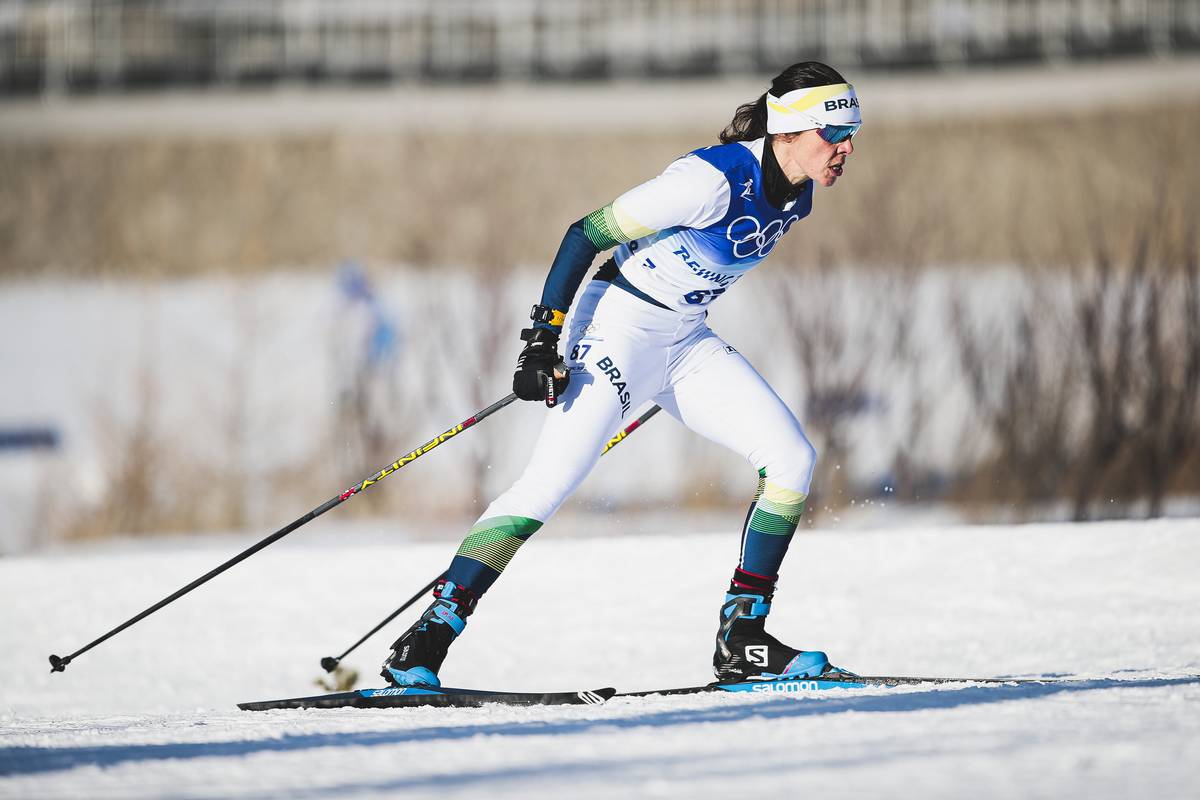
Jaqueline Mourão (BRA), who is 46 years old and representing Brazil in her eighth Olympic Games (three summer games and five winter games since 2004), skis in the women’s skate sprint qualification. (photo: NordicFocus) The suit incorporates the blue, yellow, and green of the Brazilian flag on the extremities, while white predominates through the torso and upper legs. Her ski poles appear to be from bespoke manufacturer Zaveral Racing Equipment, based in Wells Bridge, New York.
Croatia
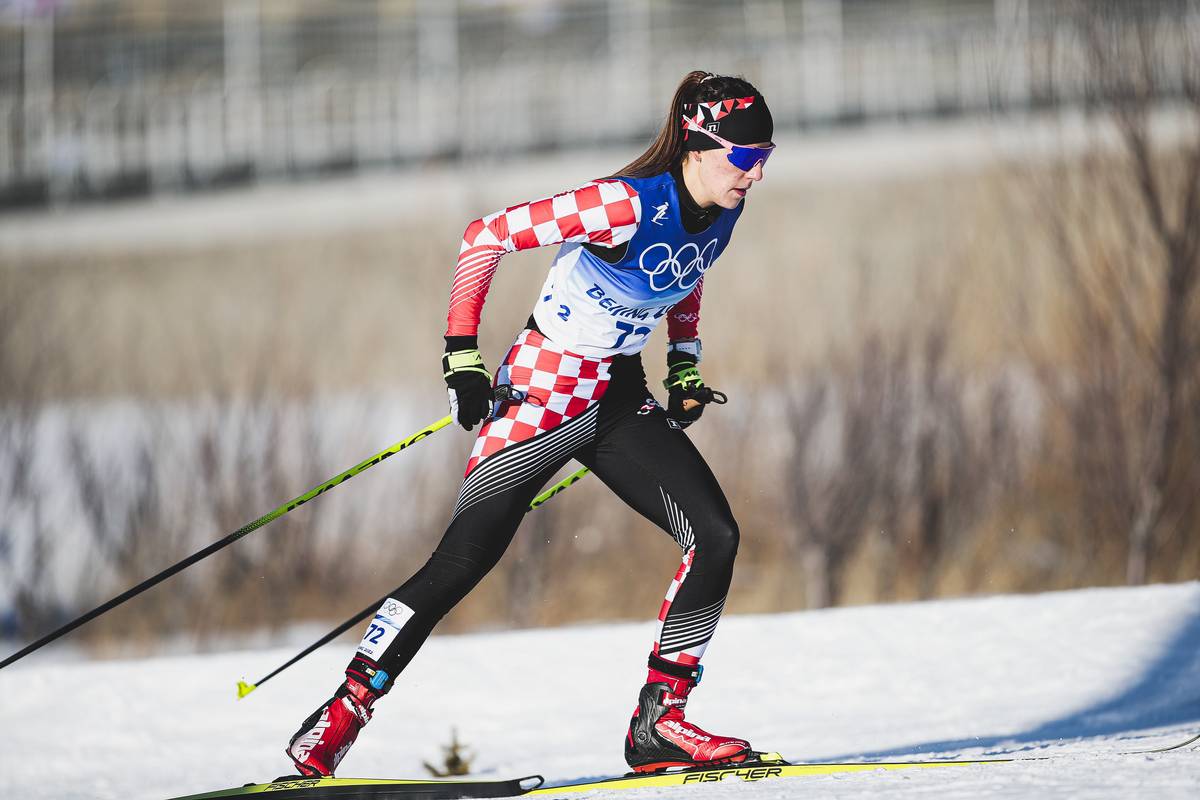
Tena Hadžić (CRO) skis in the women’s skate sprint qualification. (photo: NordicFocus) The checkerboard design is instantly recognizable to anyone who follows international sport (you may remember this design from such sporting events as the 2018 France–Croatia men’s World Cup Final); per Wikipedia, “The red and white motif is based on the Croatian checkerboard (šahovnica), which has been used to represent Croats since the Middle Ages.” But not used to represent Hadžić since any time before 2004, which is when she was born: yes, Hadžić logged three Olympic starts before her 18th birthday. And what are you doing with your life?
Greece
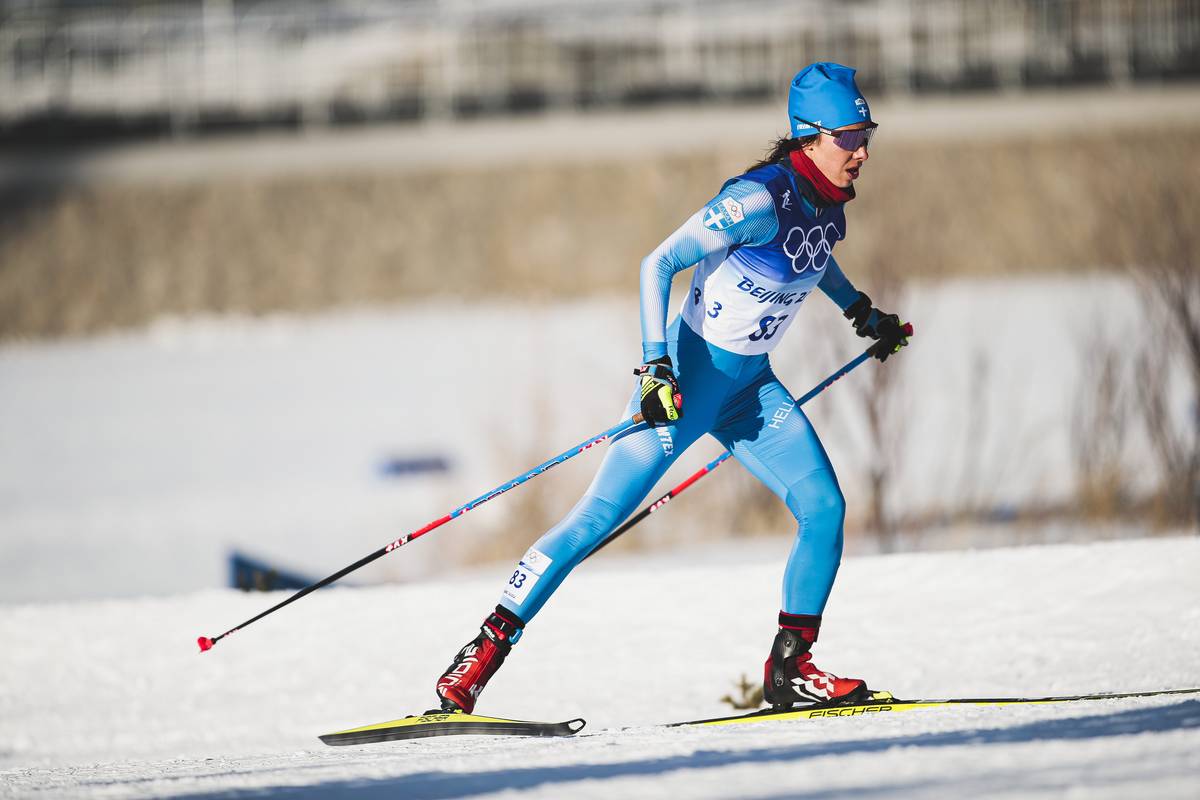
Μαρία Ντάνου, or Maria Ntanou (GRE), skis in the women’s skate sprint qualification. (photo: NordicFocus) Her suit neatly evokes the flag of Greece, “popularly referred to as the ‘blue and white’ (Greek: Γαλανόλευκη) or the ‘sky blue and white’ (Κυανόλευκη),” per Wikipedia.
Iceland
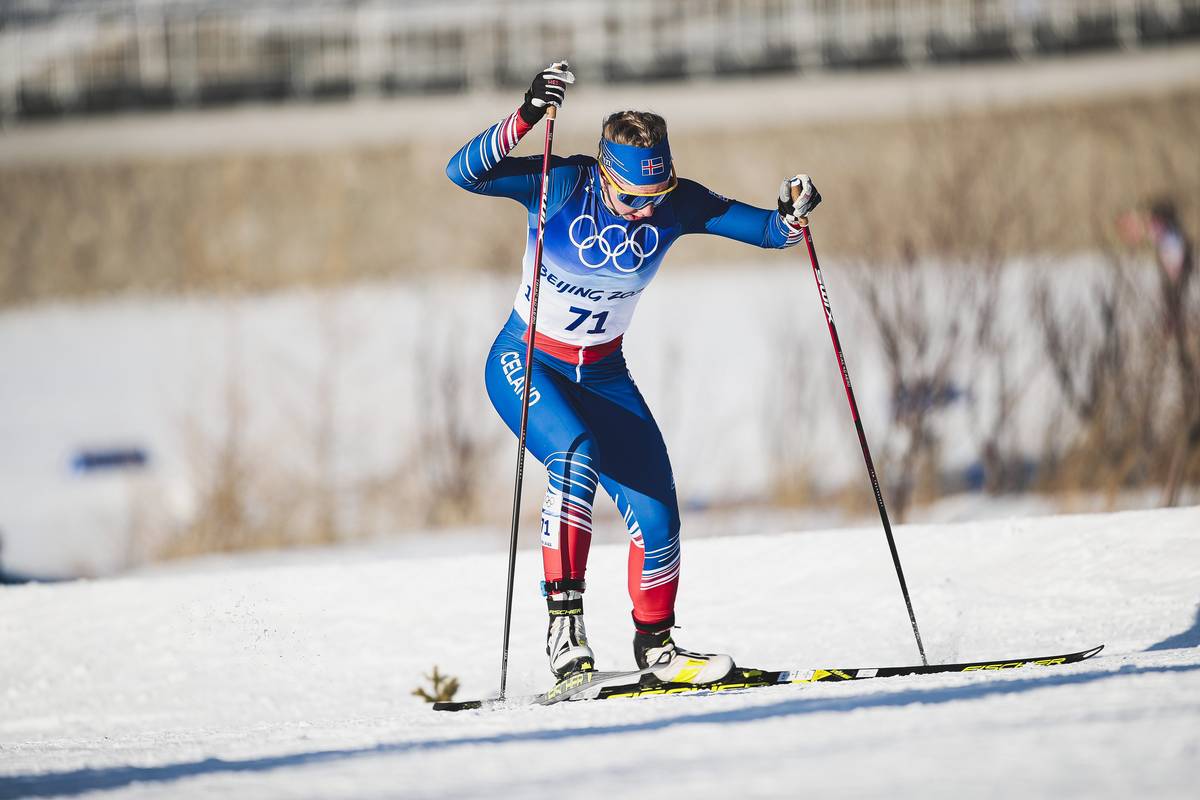
Kristrún Guðnadóttir (ISL) skis in the women’s skate sprint qualification. (photo: NordicFocus) Her suit uses the three colors of the Icelandic flag, red, white, and blue, though it does not specifically represent the Nordic cross that the flag contains.
Kazakhstan
Irina Bykova (KAZ) skis in the women’s skate sprint qualification. (photo: NordicFocus) Her suit incorporates the gold and blue colors of the Kazakh flag. Per Wikipedia: “The sky blue background symbolises the peace, freedom, cultural, and ethnic unity of Kazakh people … . The sun represents a source of life and energy. It is also a symbol of wealth and abundance; the sun’s rays are a symbol of the steppe’s grain which is the basis of abundance and prosperity.”
Latvia
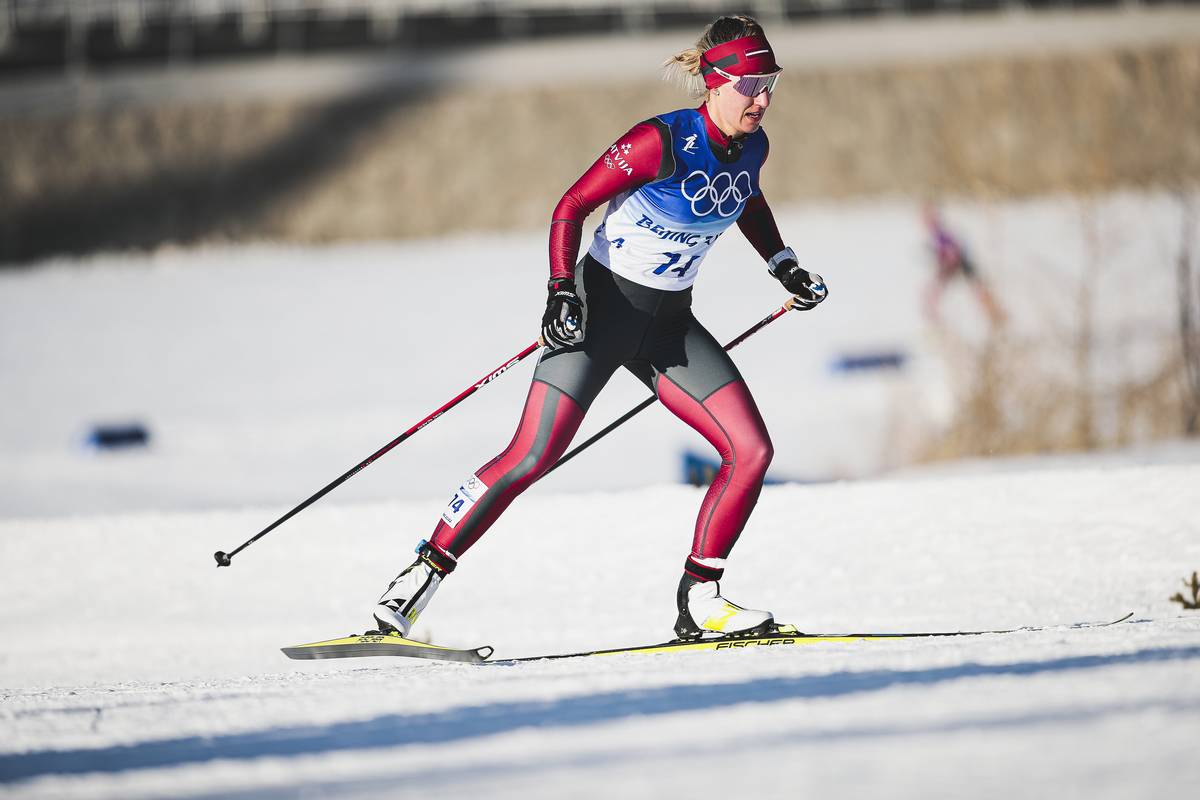
Kitija Auzina (LAT) skis in the women’s skate sprint qualification. (photo: NordicFocus) The Latvian flag is described as a “carmine field bisected by a narrow white stripe,” as visible on Auzina’s headband. The suit ably incorporates the carmine (dark red) of the flag, though it has black, rather than white, as a contrasting color. That said, the coordination with the Swix Triac 4.0 Aero poles is superb; it would only be better if she were on red and black Alpina skate boots.
Lithuania
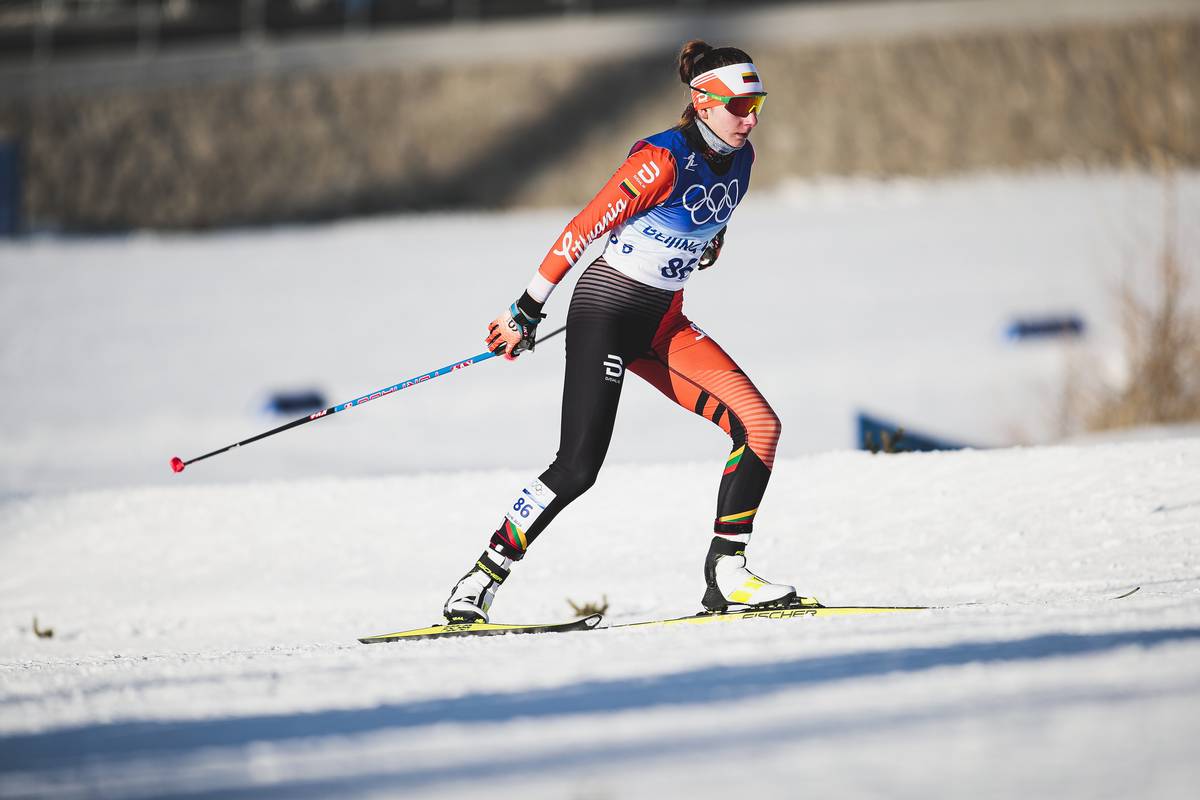
Ieva Dainytė (LTU) skis in the women’s skate sprint qualification. (photo: NordicFocus) Which possibly occasioned a doubletake from anyone who watched U.S. Olympian Luke Jager race as a junior for West Anchorage High School (Jager is on the left of the linked image, fellow Olympian Gus Schumacher, who skied for Service High School, on the right). You may, once more, decide for yourself, who wore it better?
Mongolia
Enkhtuul Ariunsanaa (MGL) skis in the women’s skate sprint qualification. (photo: NordicFocus) The colors of the Mongolian flag are red, blue, and yellow, all of which are present in this suit. “The blue stripe represents the eternal blue sky, and the red stripes thriving for eternity,” Wikipedia explains. The coordination with the red and blue KV+ Tornado poles is a nice touch.
Poland
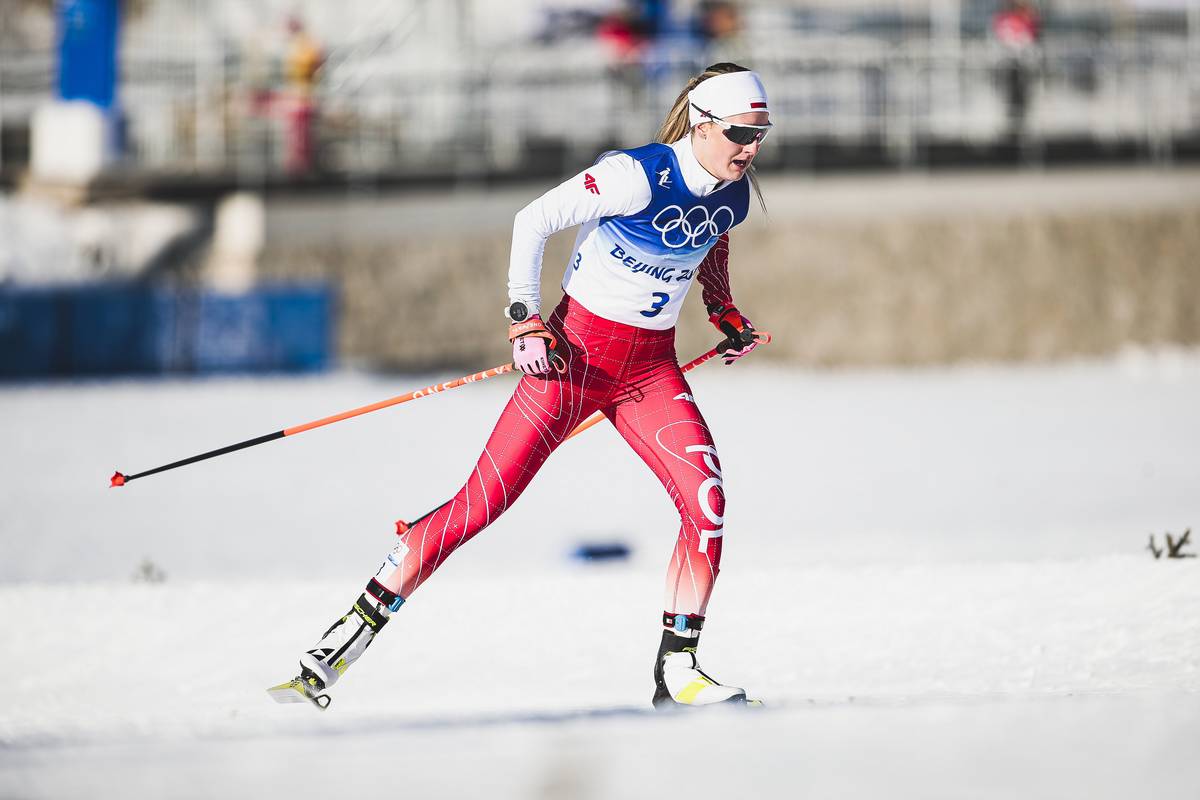
Weronika Kaleta (POL) skis in the women’s skate sprint qualification. (photo: NordicFocus) Kaleta skis collegiately for the University of Colorado and has raced both European World Cup and American SuperTour races this year. Her suit features the two colors of the Polish flag, which is a relatively simple horizontal bicolor of red and white.
Romania
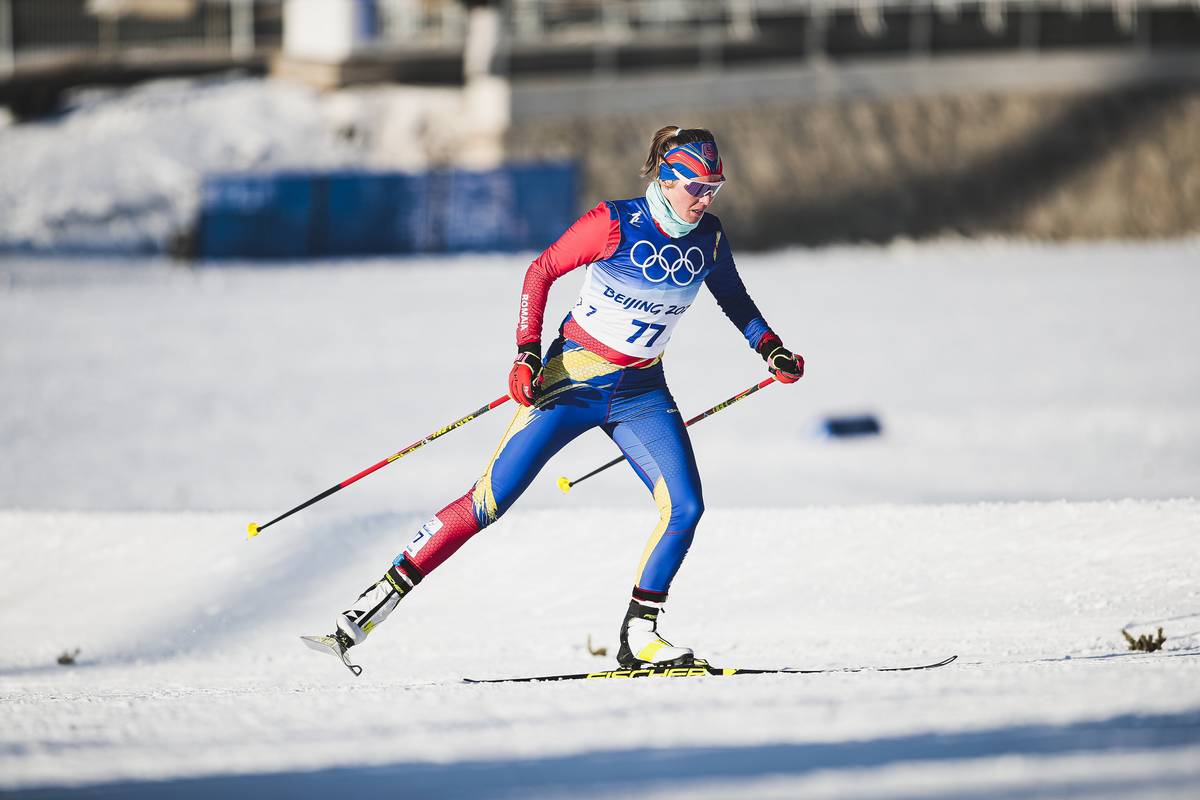
Tímea Lőrincz (ROU) skis in the women’s skate sprint qualification. (photo: NordicFocus) The three stripes of the Romanian tricolor flag are cobalt blue, chrome yellow, and vermilion red. These three colors, and no others, are present in this race suit. Lőrincz represented Romania in her third Olympics. Her name contains the rare double acute accent, on ő.
Slovakia (ft. alt. national-team race suit)
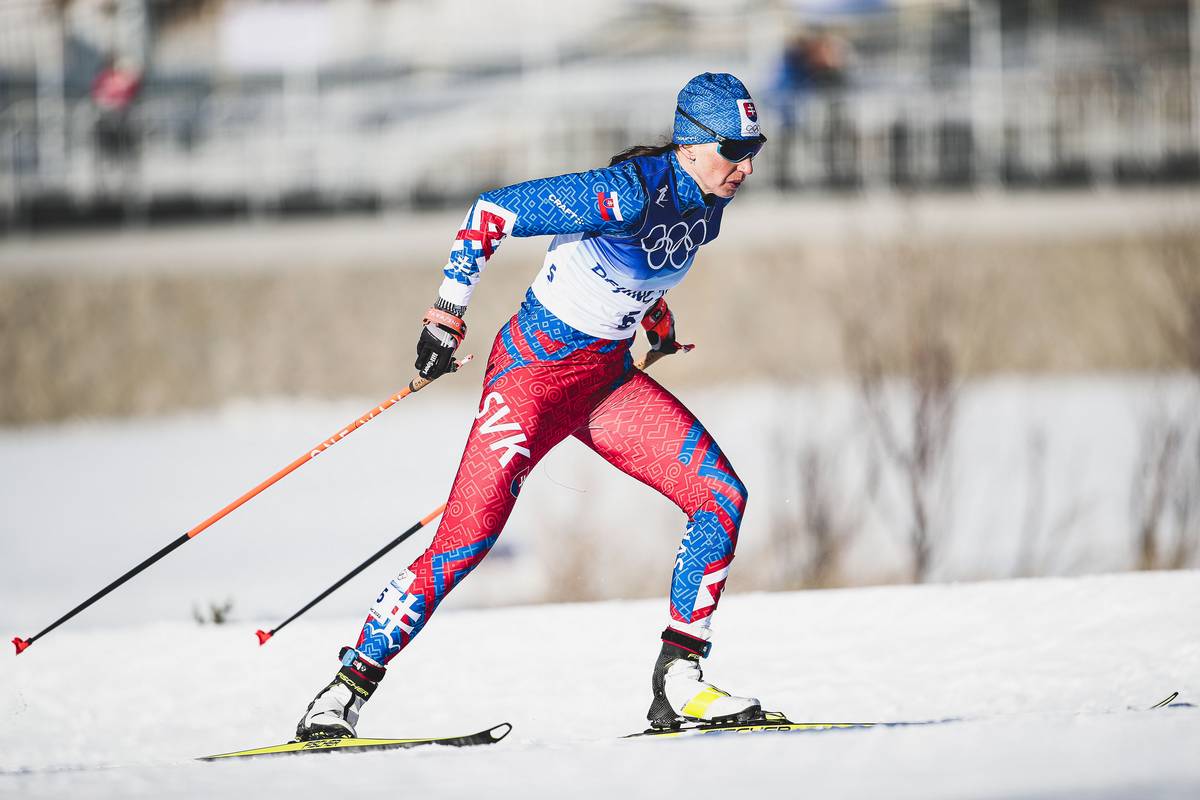
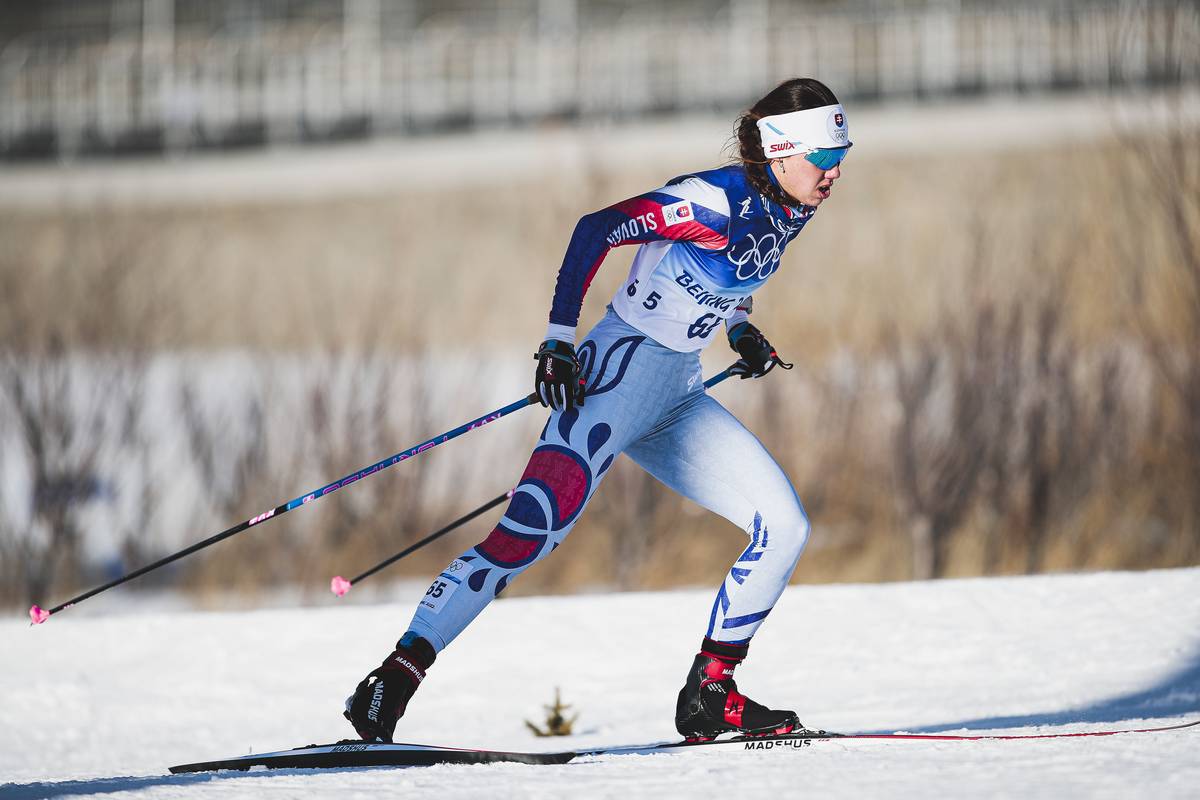
Alena Procházková (SVK) skis in the women’s skate sprint qualification. (photo: NordicFocus)Barbora Klementová (SVK) skis in the women’s skate sprint qualification, same race, same day, wearing a completely different version of the Slovakian kit. (photo: NordicFocus) The flag of Slovakia looks like this: 🇸🇰. While both race suits are very neat, Procházková’s version more ably evokes the Slovakian coat of arms, which feature on the hoist side of the flag and the lower right leg and arm of Procházková’s race suit.
South Korea
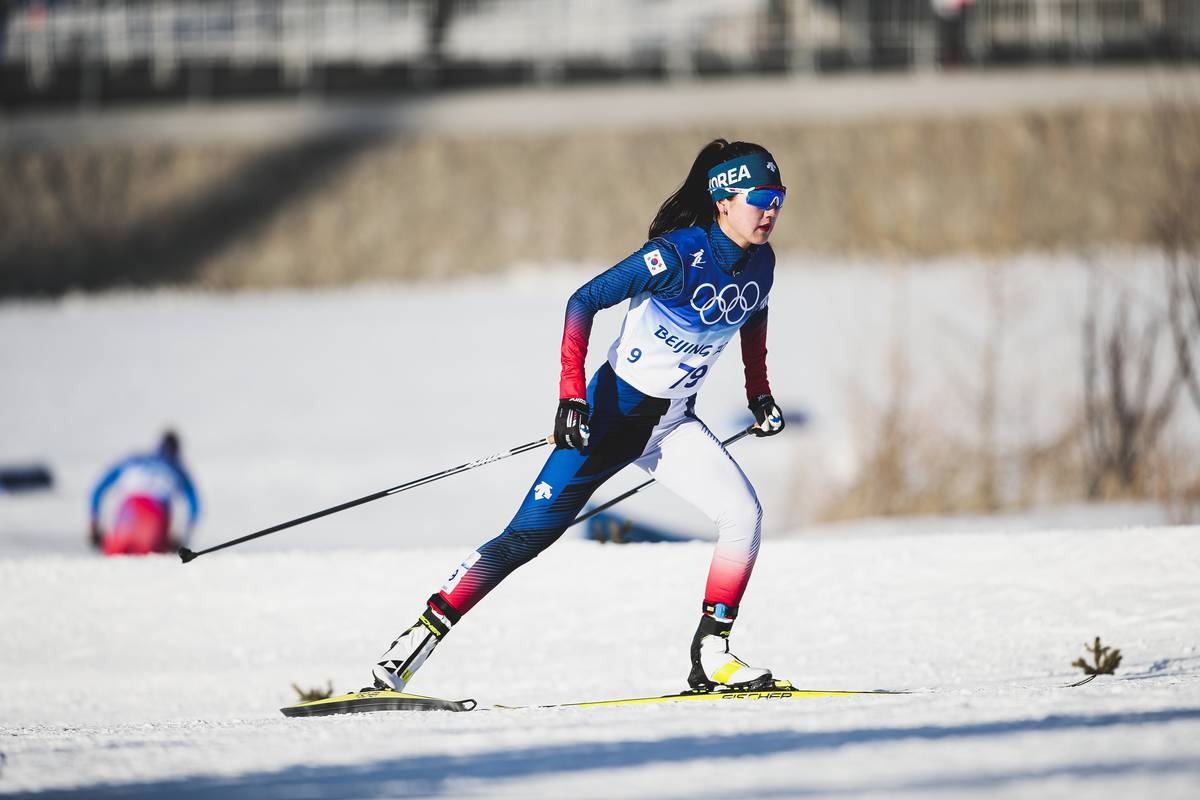
Dasom Han (KOR) skis in the women’s skate sprint qualification. (photo: NordicFocus) The colors of the flag of South Korea are black, white, red, and blue, in an intricate design present in the patch on Han’s right shoulder. The logo on the right leg is for the suit manufacturer, Descente.
Thailand
Karen Chanloung (THA) skis in the women’s skate sprint qualification. (photo: NordicFocus) Her suit mirrors the red, white, and blue of the Thai flag, augmented by blue Salomon boots and skis and KV+ poles with all three colors. The colors of the Thai flag are “said to stand for nation–religion–king, an unofficial motto of Thailand: red for the land and people, white for religions, and blue for the monarchy,” per Wikipedia.
Turkey
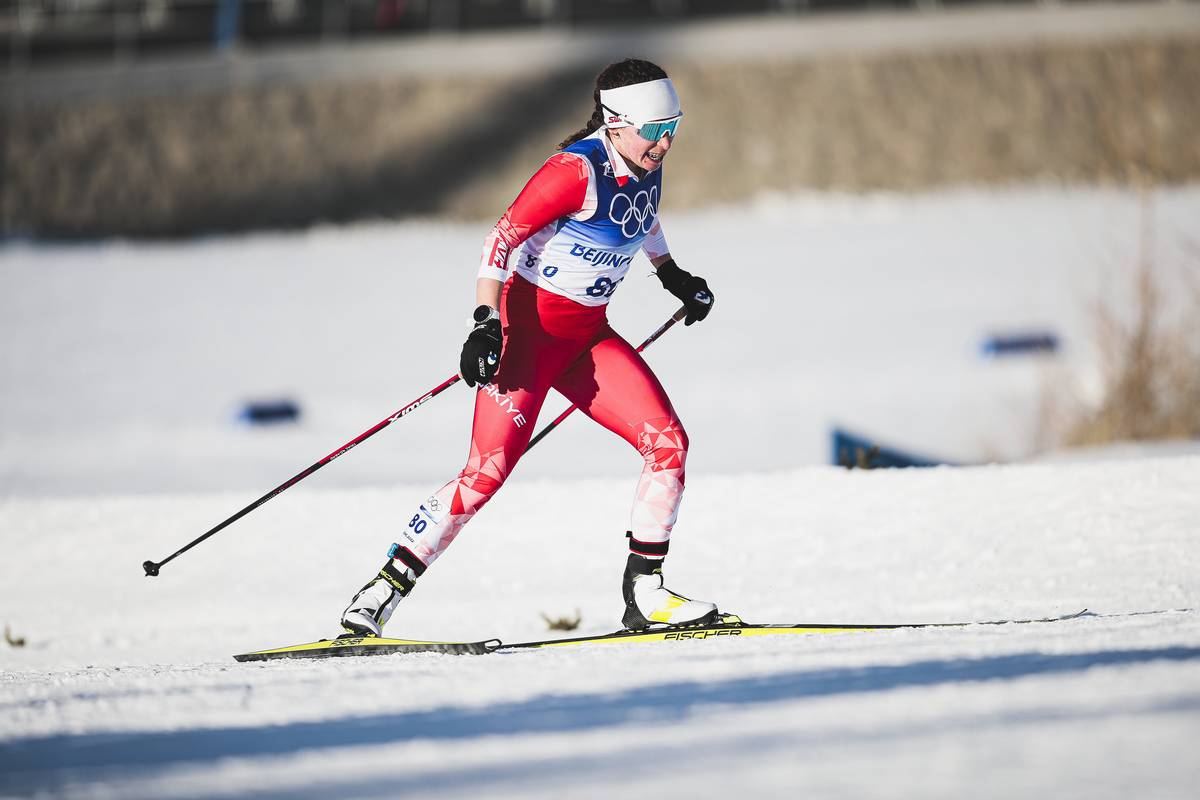
Ayşenur Duman (TUR) skis in the women’s skate sprint qualification. (photo: NordicFocus) Her suit features the red and white of the Turkish flag. It does not appear to specifically depict or evoke the white star and crescent that are present on the flag.
Ukraine
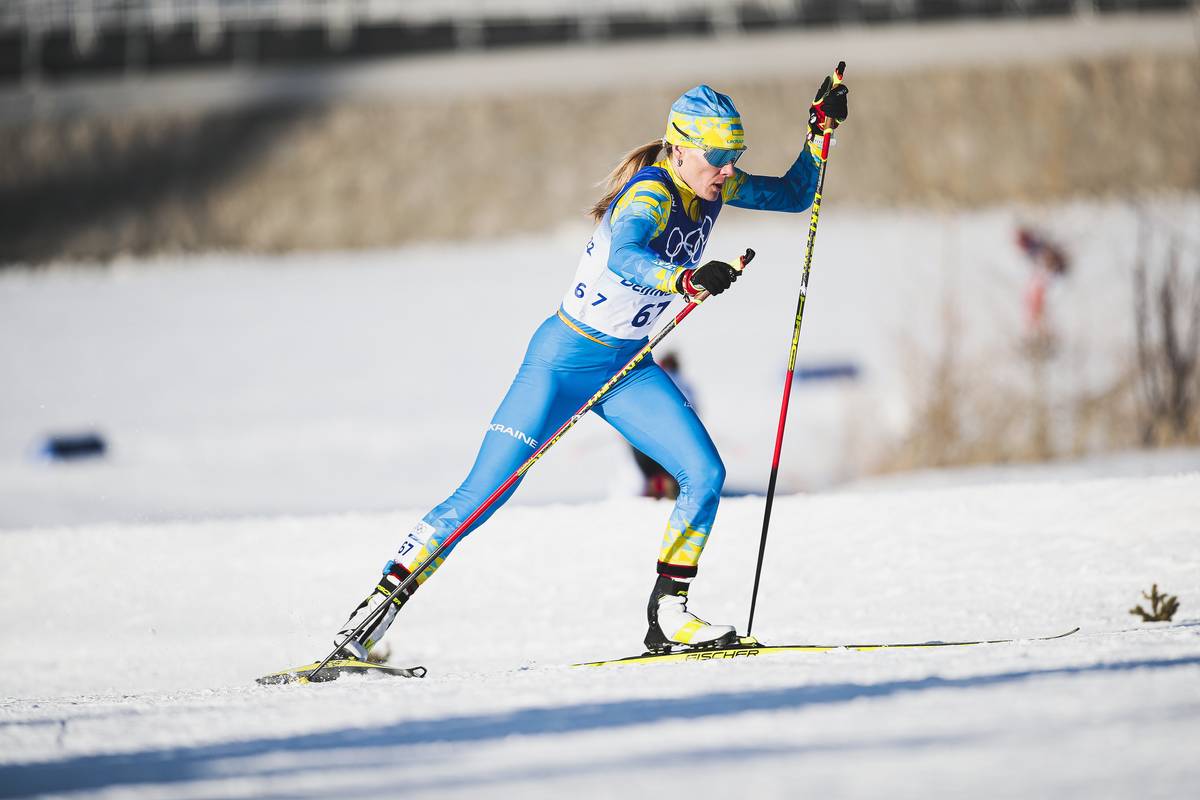
Maryna Antsybor (UKR) skis in the women’s skate sprint qualification. (photo: NordicFocus) Her suit incorporates the two colors of the Ukrainian flag, a blue and yellow bicolor.
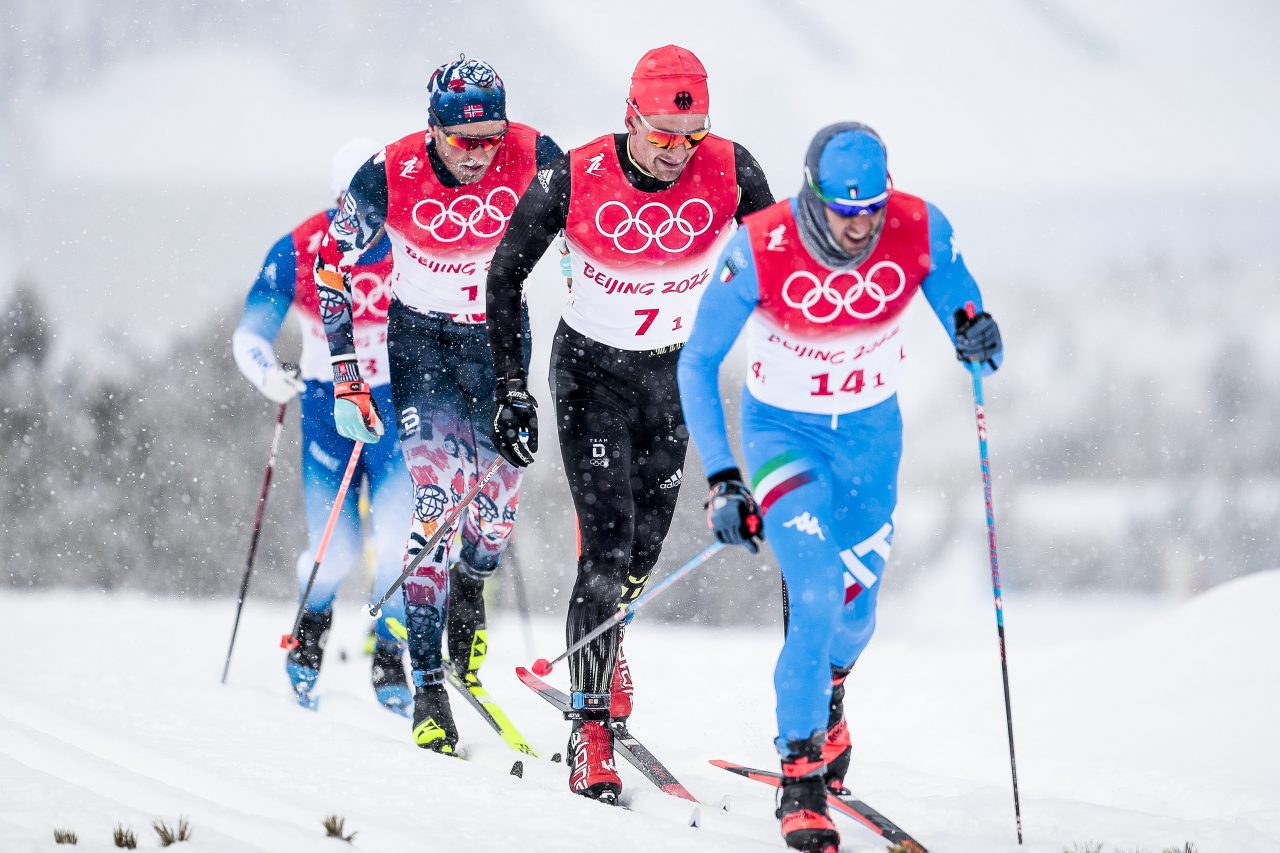
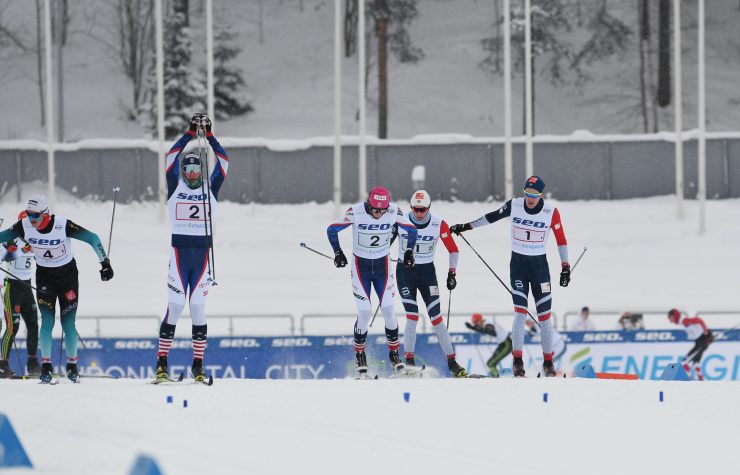
Federico Pellegrino of Italy leads, from right, Janosch Brugger of Germany and Emil Iversen of Norway, men’s 4 x 10 k relay, Feb. 13. (Photo: NordicFocus)
FasterSkier previously surveyed the national-team uniforms from last year’s World Cup fashion season, starting with more traditional nordic powers (Norway, Russia, et al.) but also taking a look at some more outré ski countries (Brazil, Nigeria, Thailand). We didn’t run a comparable article at the start of this season, as there was relatively little change in most nations’ World Cup kit from last year to this year.
But when the Olympics arrive, however, all bets are off. Sponsor logos are out. Direct evocation of a nation’s flag is typically in. Unless you’re Norway, or Russia, albeit for different reasons.
There are lots of countries that sent cross-country skiers to this year’s Winter Olympic Games (54, in fact). Compiling photos of all of them would make for a very long article. Instead, this article surveys those countries that entered a team in the men’s 4 x 10-kilometer relay, using relay participation as a general proxy for international competitiveness. A follow-up article will focus on the women and on some less traditional nordic nations, by means of surveying finishers from the bottom half of the women’s skate sprint results sheet.
This article undertakes to rank the men’s relay race suits in, roughly, descending order of vexillological evocativeness, that is, how much does each race suit look like that country’s flag. This is a necessarily subjective inquiry; your own rundown may differ. No offense is intended toward countries in the bottom half of this list: A lower ranking does not mean that a suit is “bad,” just that it is less readily flag-like.
Note well, a handful of photos in this article come from races earlier in the Games, not from Sunday’s relay; it appears that there were no relay photos for these nations in the typically comprehensive NordicFocus library. Relatedly, all shots in this article are copyright NordicFocus, which has been doing an amazing job throughout the Olympics.
Finland
Finland’s Iivo Niskanen skis in the men’s relay. (Photo: NordicFocus)
The Finnish flag looks like this: 🇫🇮. Iivo Niskanen’s suit looks effectively the same. If one were, hypothetically, a Finnish athlete putting down an all-time relay performance to drag one’s team back up toward the front of a splintered men’s 4 x 10 k relay, there would be little doubt what nation you represented while you did so. This suit has the two colors of the Finnish flag, the dominant design element of the Nordic cross, and little more. It sure looks like the flag of Finland.
United States of America
Kevin Bolger skis in the men’s relay. (Photo: NordicFocus)
The American flag, you are likely aware, looks like this: 🇺🇸. There are two main elements in the American flag, the stars and the stripes; both are represented here. (Added points for the relay socks, an after-market add-on that further emphasize the “stripes” aspect.) America should arguably be ranked below Sweden, for the dominant use of a color, black, not present in the nation’s flag, but has been slotted in here in second because the stars and stripes for America seem more flag-like than the evocation of a Nordic cross does for Sweden. You can find much more about historical American uniforms, both Olympics and World Cup styles, here.
Sweden
Johan Häggström skis in the men’s 15 k classic, Feb. 11. (Photo: NordicFocus)
The Swedish flag looks like this: 🇸🇪. This uniform does not really depict the Nordic cross per se, but the consistent use of yellow and blue, augmented by only the neutral white, means that the overall evocation of a flag is quite strong.
Czech Republic
Petr Knop skis in the men’s relay. (Photo: NordicFocus)
The flag of the Czech Republic looks like this: 🇨🇿. This suit does not precisely portray the flag outline, but otherwise ranks high for featuring only the three colors from the flag, and nothing else. Could conceivably be pressed into service as a U.S.A. alternate suit, or maybe the current American biathlon suit.
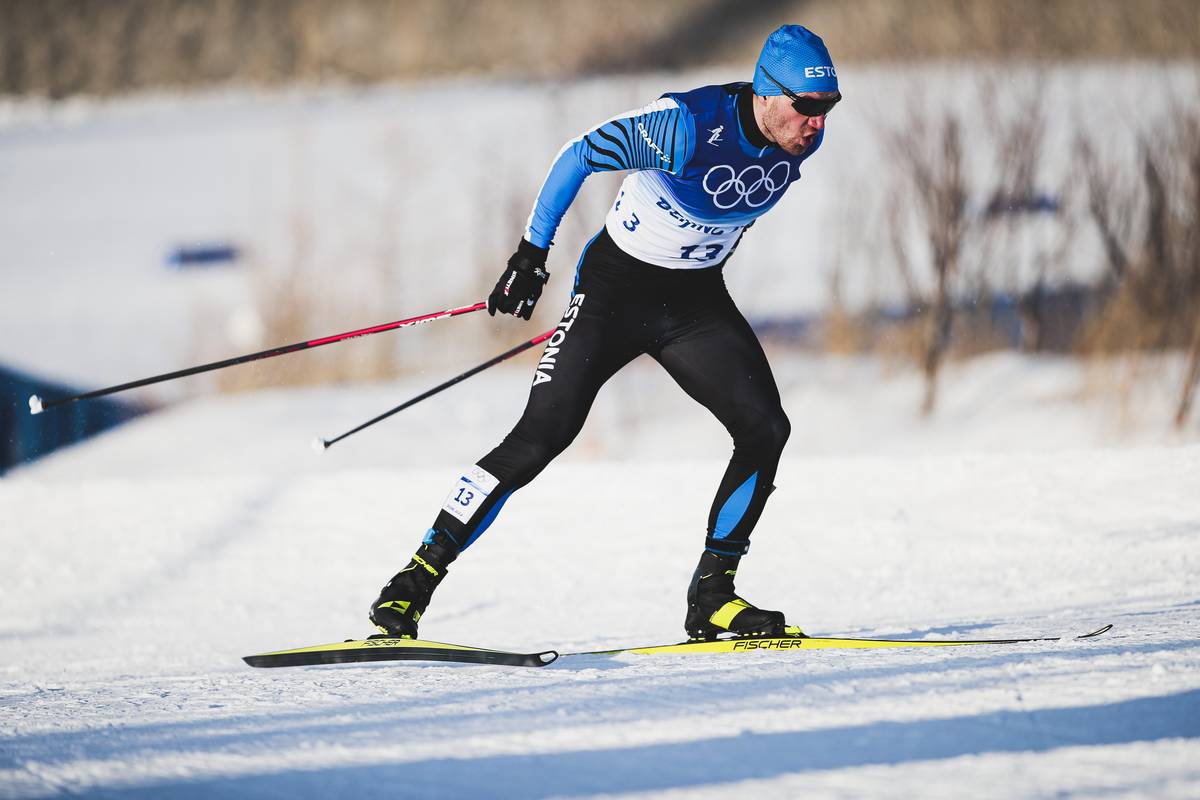
Estonia
Marko Kilp skis in the qualification round of the men’s skate sprint, Feb. 8. (Photo: NordicFocus)
The flag of Estonia looks like this: 🇪🇪. Much as with the Czech flag, Kilp’s ensemble does well by using only the relevant three colors from the national flag. The overall effect is aided by the coincidental use of blue and white in this race bib from the skate sprint, which differs from those used for three legs of the four-leg relay.
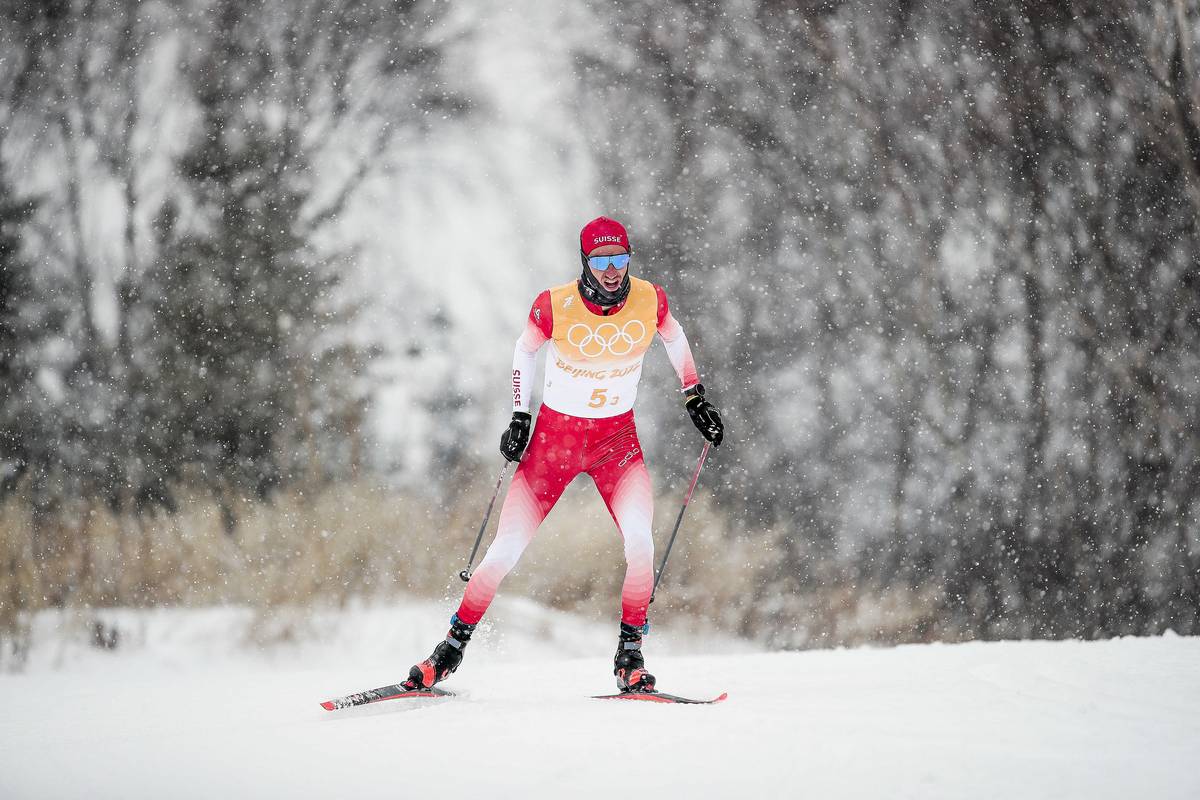
Switzerland
Candide Pralong skis in the men’s relay. (Photo: NordicFocus)
The flag of Switzerland looks like this: 🇨🇭. This suit does well in that it uses only the relevant two colors. It does less well in that the instantly recognizable visual element of the flag, the Swiss cross, is not present here. (In Switzerland’s defense, it has the rare square national flag, so translating this to race-suit format may be difficult.) Also, the red–white ombre through the legs is trippy; cf. France, infra, which does much the same with blue and white.
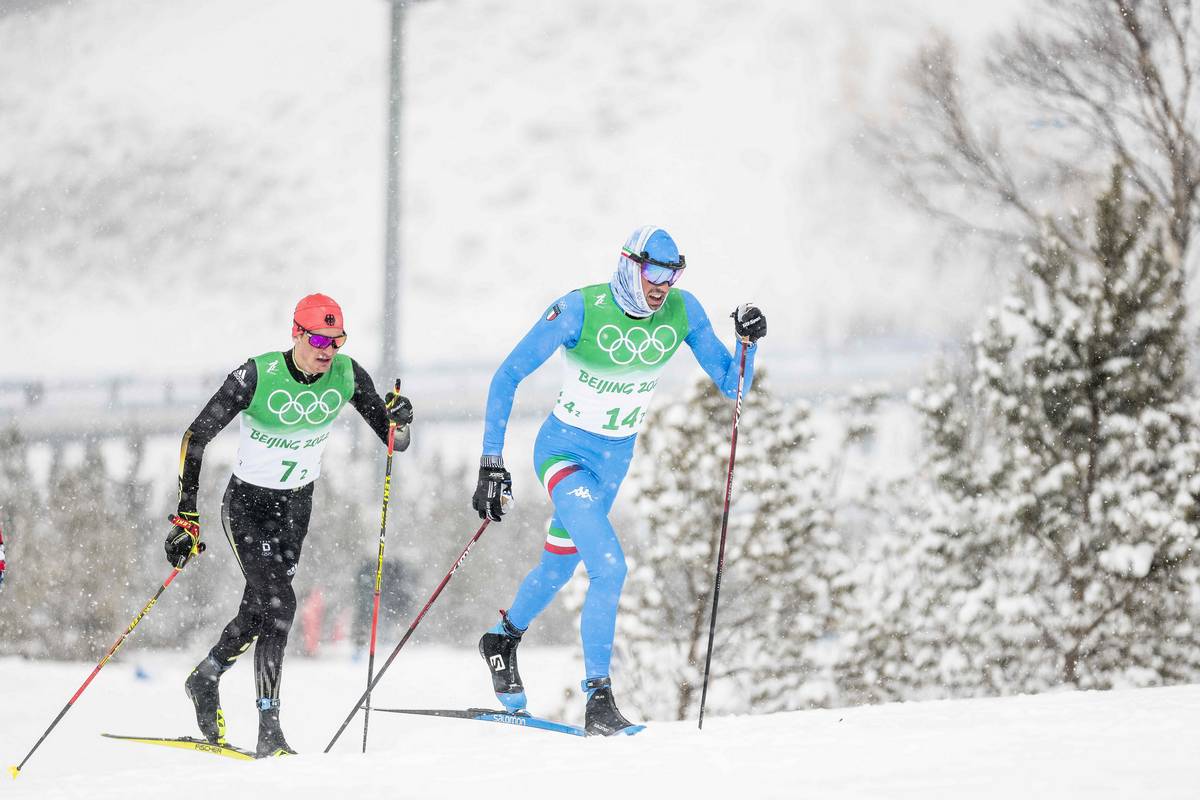
Italy
Francesco De Fabiani, right, leads Friedrich Moch of Germany in the men’s relay. (Photo: NordicFocus)
The flag of Italy looks like this: 🇮🇹. The dominant hue in this uniform, blue, evokes “the traditional paint of the royal House of Savoy, which reigned over the Kingdom of Italy from 1860 to 1946,” per Wikipedia, and is characteristic of Italy’s international sports teams, such as the national football team known as gli Azzurri. The tricolor bands on both upper legs, mirrored on the right shoulder, do a surprisingly successful job of typing this uniform as Italian against this blue background.
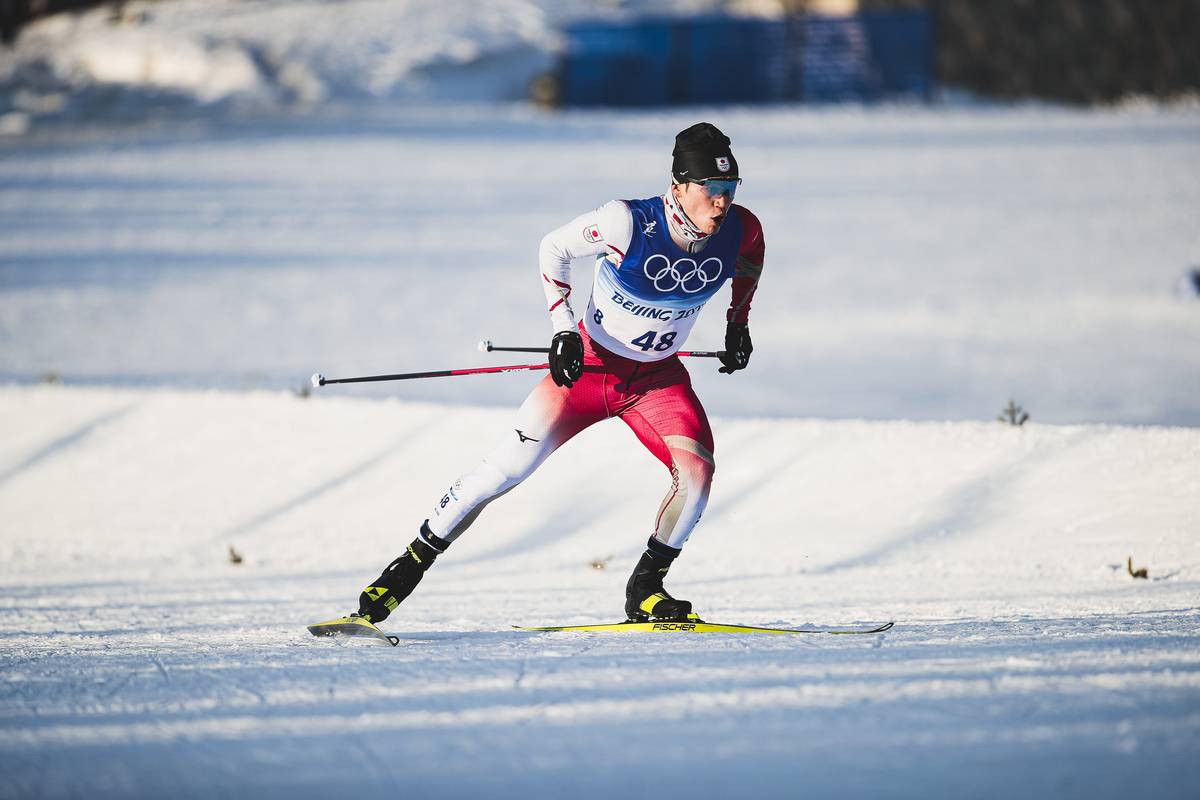
Japan
Hiroyuki Miyazawa skis in the qualification round of the men’s skate sprint. (Photo: NordicFocus)
The flag of Japan looks like this: 🇯🇵. This uniform falls into roughly the same category as Switzerland’s: instantly recognizable design element (the flag is “more commonly known in Japan as the Hinomaru (日の丸, ‘circle of the sun,’” per Wikipedia) that is not really present in the suit. Ranked below Switzerland due to the use of additional colors beyond just red and white; there is a sense of gold accents along the lower left leg, which works well aesthetically but falls outside of the flag palette.
People’s Republic of China
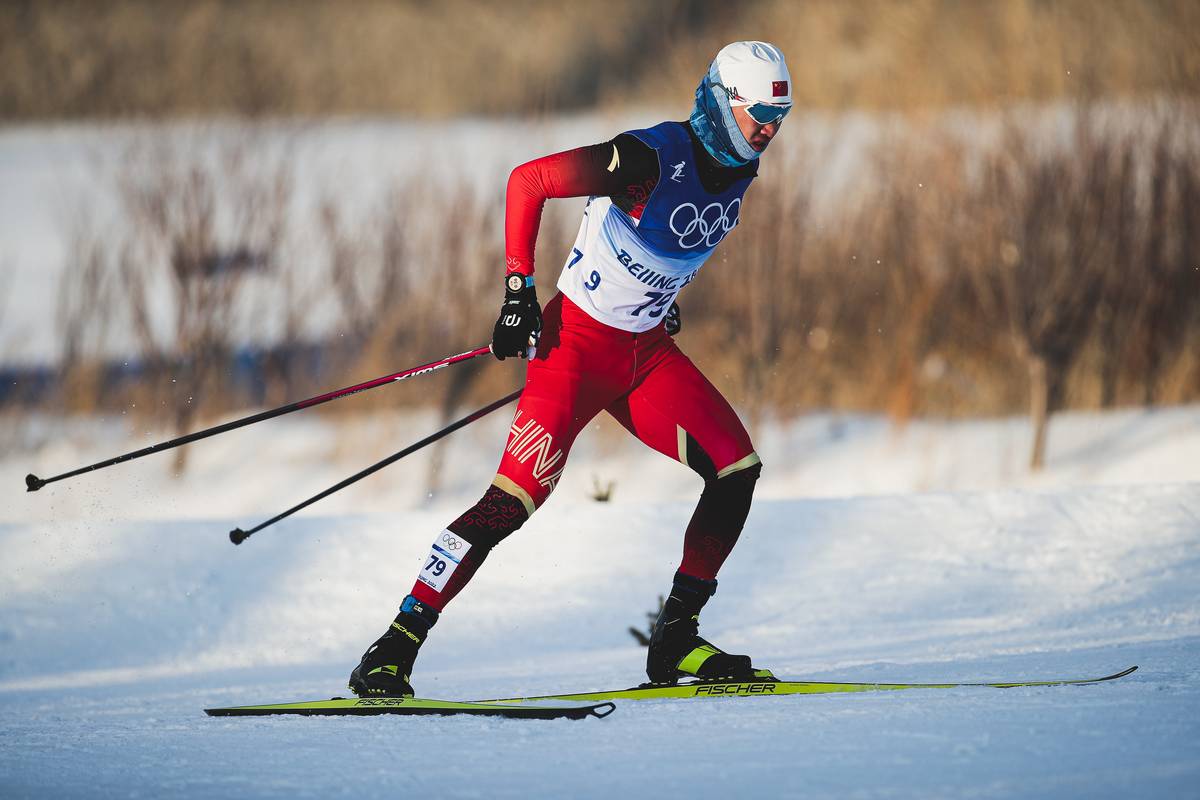
Liu Rongsheng skis in the qualification round of the men’s skate sprint. (Photo: NordicFocus)
The flag of China looks like this: 🇨🇳. This uniform is ranked relatively low, when it comes to evoking a country’s flag, because the distinctive five stars (“the five stars and their relationships to each other represent the unity of the Chinese people under the leadership of the Chinese Communist Party,” Wikipedia advises) do not seem to be present. Zooming in on the hi-res version of this image suggests that the detailing on the torso and lower legs is variegated and visually compelling, but also does not look like stars. It is a fine suit, but ranks low on the specific axis of flag–suit evocation.
Canada
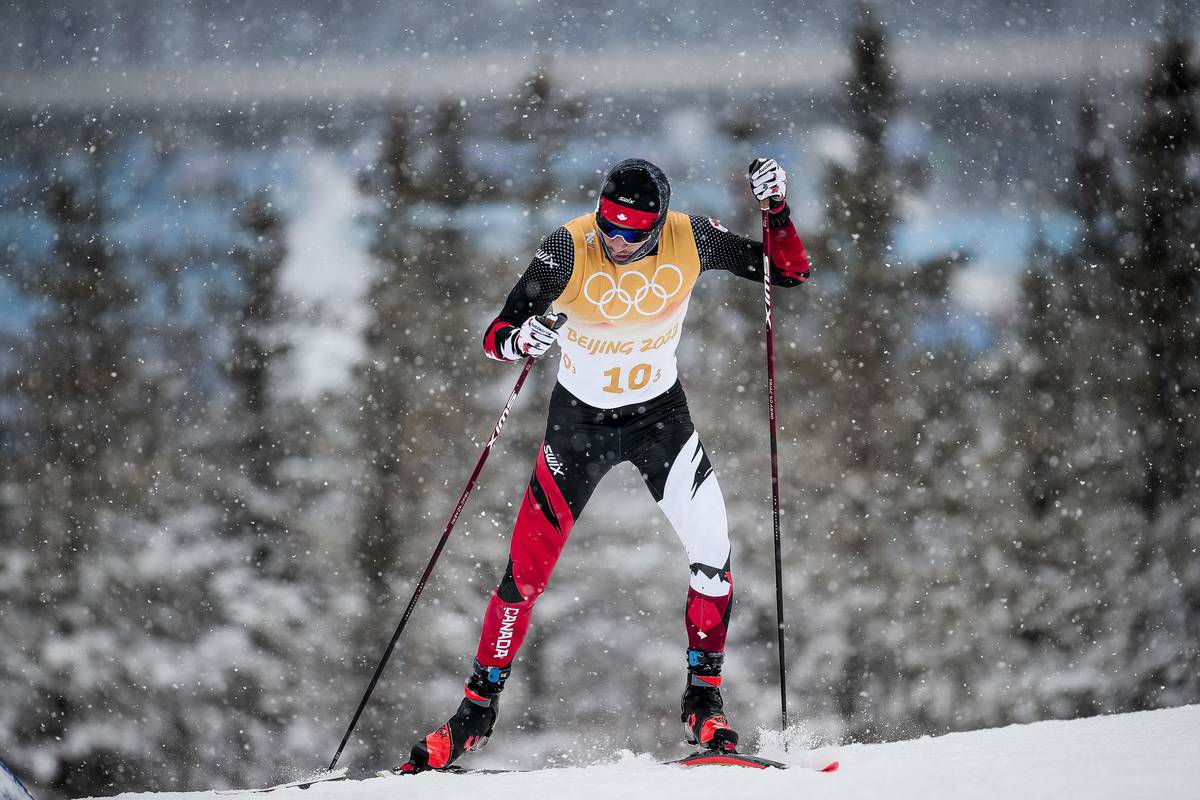
Olivier Léveillé skis in the men’s relay. (Photo: NordicFocus)
The flag of Canada looks like this: 🇨🇦. It is universally known as the Maple Leaf (note Léveillé’s headband, for example, or the Canadian World Cup suit that literally features flannel-patterned maple leaves on the lower legs). This suit is ranked low here because the presence of a maple leaf is subtle at best, and for the dominating use of black, a non–flag color, through the torso.
France
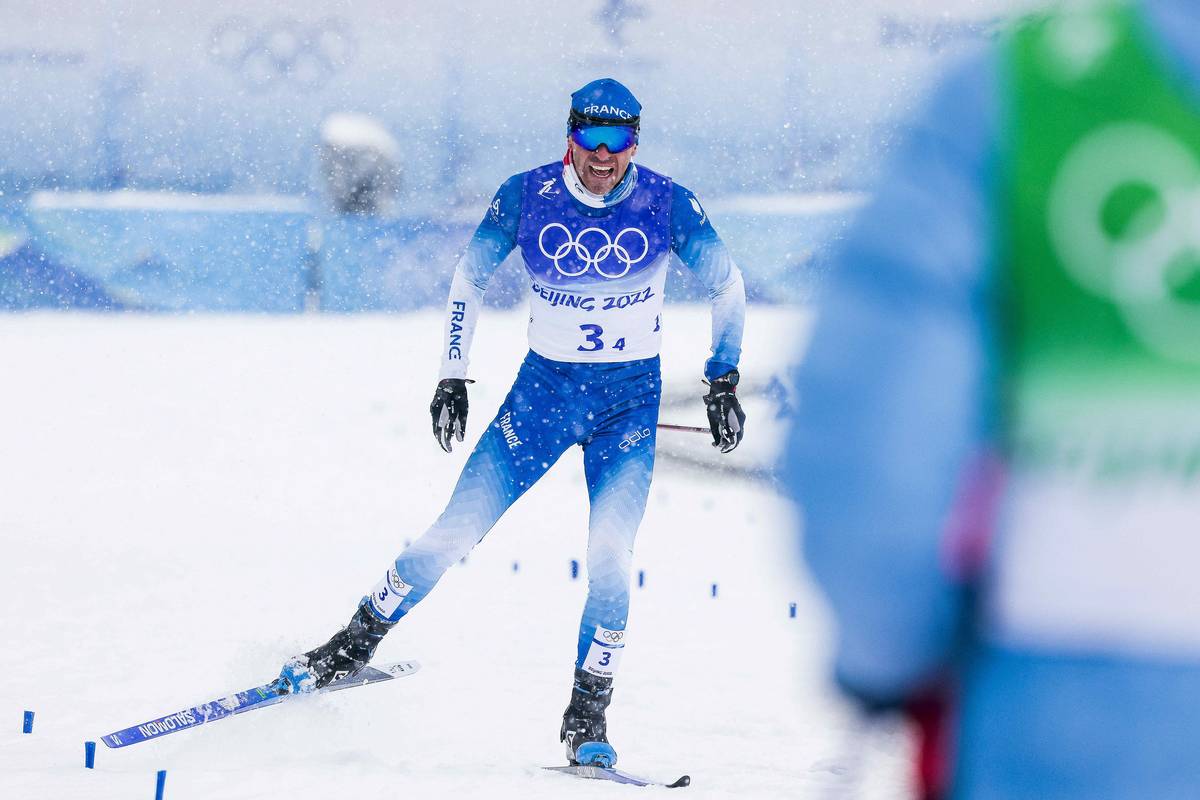
Maurice Manificat skis in the men’s relay. (Photo: NordicFocus)
The flag of France looks like this: 🇫🇷. It is also known as the Tricolore, or, well, “three colors.” The suit is ranked low, in this compilation, because only two of the three colors are present here. That said, the coordination with the blue and white Salomon skis and boots is sublime, though the suit overall looks suspiciously like it came from the same template as Switzerland’s, q.v., supra.
Germany
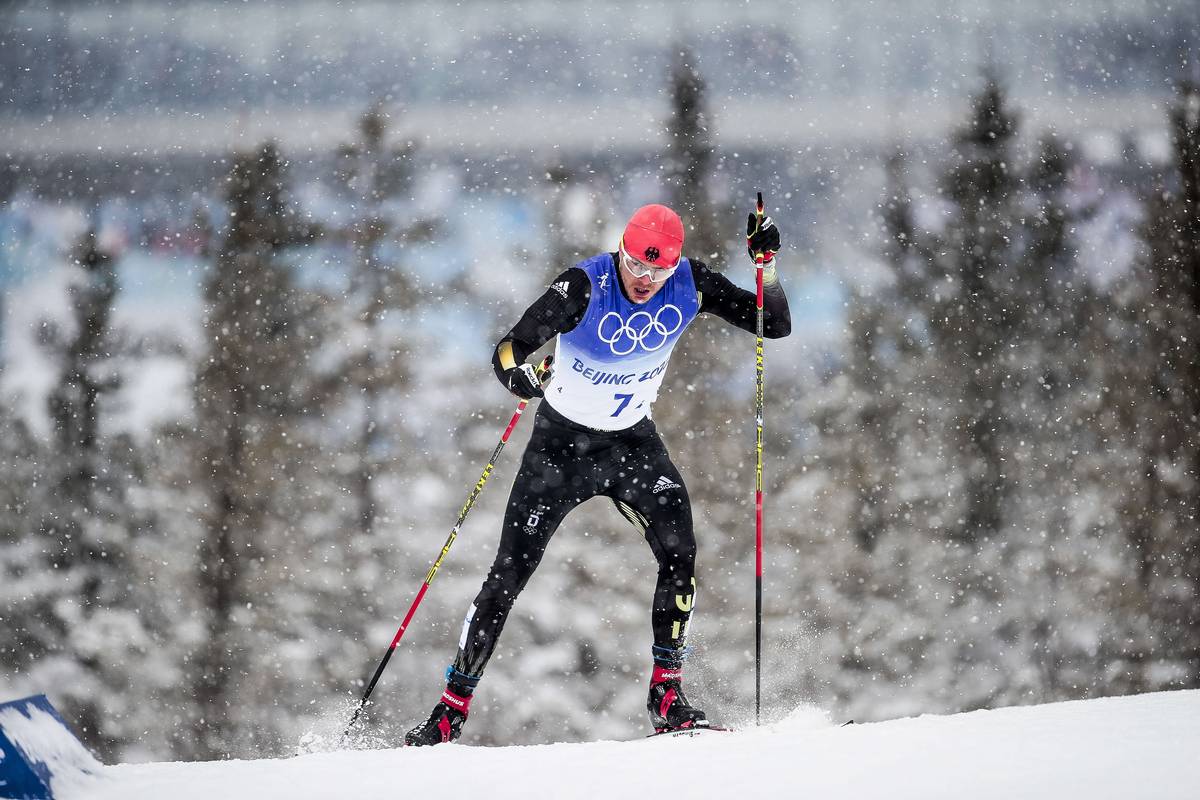
Lucas Bögl skis in the men’s relay. (Photo: NordicFocus)
The flag of Germany looks like this: 🇩🇪. Much like France, the German flag has three colors, in this case the national colors of black, red, and gold. The suit is scored low in this compilation because of the extent to which the first of these colors overpowers the other two (indeed, it is not clear that red is apparent anywhere within the suit itself, as opposed to on the hat). It is a stark and imposing suit, it just does not look very much like the Flagge Deutschlands.
Slovenia
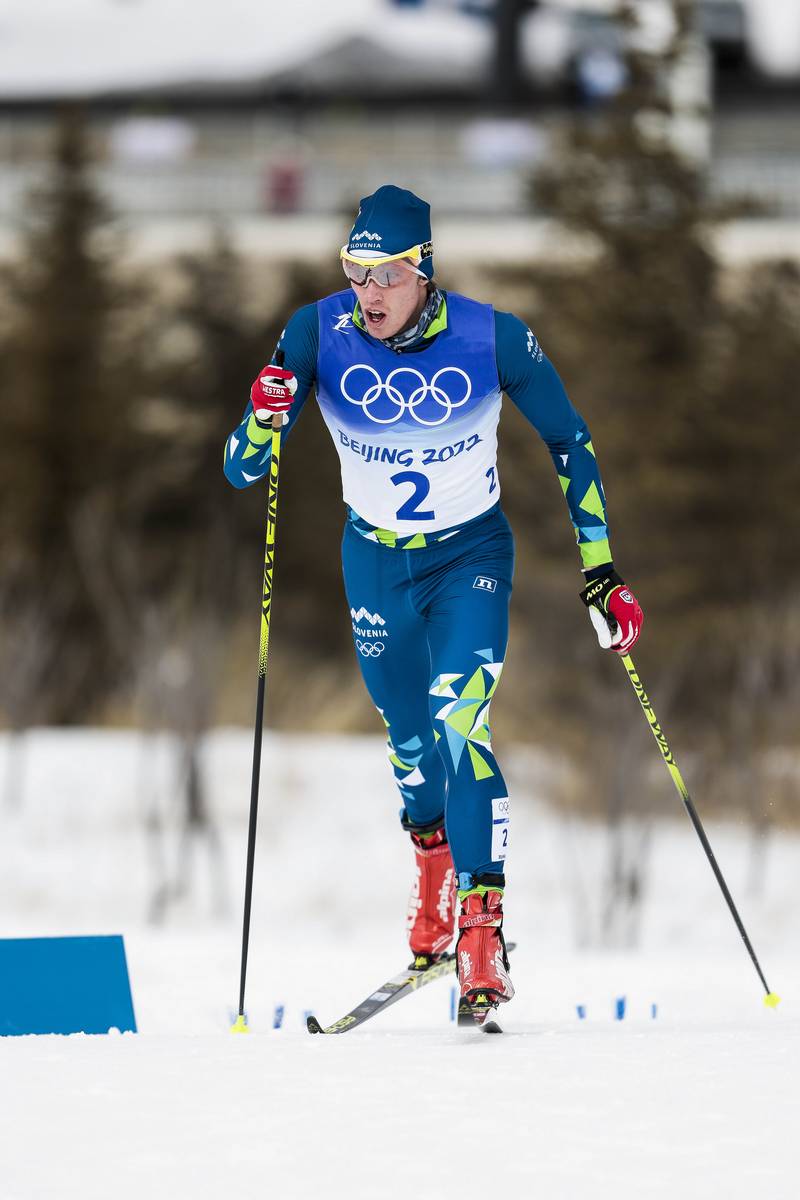
Miha Ličef skis in the men’s 15 k classic. (Photo: NordicFocus)
The flag of Slovenia looks like this: 🇸🇮. This suit is imho amazing, and I frankly love it, but I had to rank it this low because it does not exactly evoke a red, white, and blue flag. (For purposes of comparison, here is last season’s Slovenian World Cup suit, which is notably more flag-like.) If you are from Slovenia and can explain to me why these colors and this design showed up in this year’s Olympic suit, please let me know: gavin (at) fasterskier.com. I am not making fun; I am just sincerely curious. Also, I honestly love this suit, even if at first glance I thought it was the suit of Ukraine or Australia.
Norway
Pål Golberg skis in the men’s relay. (Photo: NordicFocus)
This is… certainly a look. This suit puts the “illogical” in “vexillological.” This is the flag of Norway: 🇳🇴. This suit is notably memorable, and has occasioned strong reactions throughout the Olympics. It does not, however, whatever else you may say about it, look particularly much like the Norwegian flag.
Russian Olympic Committee
Denis Spitsov skis in the men’s relay. (Photo: NordicFocus)
The Russian flag looks like this: 🇷🇺. Russia is not officially competing in these Games, just athletes representing the “Russian Olympic Committee.” It’s complicated. One result of these complications is that “Russian” athletes are racing in a suit that does not really resemble the flag of Russia. Again, it is a fine suit, just not particularly Russian flag–like.
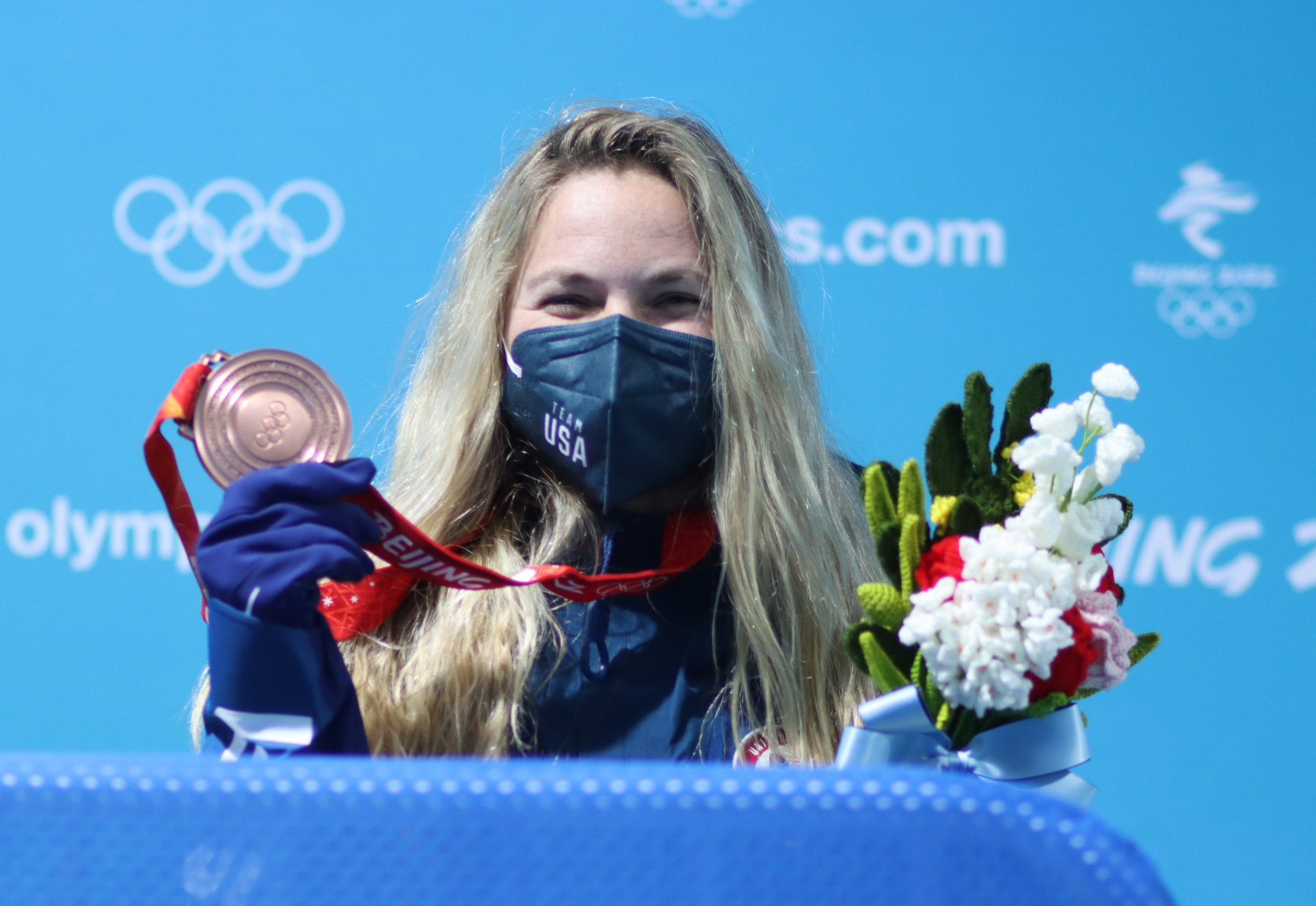
Jessie Diggins earns a historic bronze medal in the women’s freestyle sprint, becoming the first American woman to earn an Olympic medal in an individual cross country ski event. (Photo: Nat Herz/FasterSkier-ADN)
The first.
With a perfect storm of tactics, technique, and peak race form, Jessie Diggins fought to the line to finish third behind Swedish sprint phenoms Jonna Sundling and Maja Dahlqvist in the women’s 1.5-kilometer freestyle sprint. This historic result makes her the first American woman to win an Olympic medal in an individual cross country ski event.
“It’s overwhelming, but in a good way,” Diggins said in the press conference. “It’s just really emotional for me because this really belongs to the whole team. It has taken so many years to get here, to have us come and have an individual medal. And that’s something that doesn’t happen alone. It doesn’t happen without a lot of help. So I’m just so thankful for our team – it’s been a lot of people working really hard for a long time.”
Her bronze medal adds to a collection started in 2018 when she won gold with Kikkan Randall in the freestyle team sprint in PyeongChang. Diggins is now the second American in history to win an individual Olympic medal in cross country skiing, the first was Bill Koch who earned silver in the 30 k during the 1976 Games in Innsbruck, Austria. She is the only American cross country skier to earn multiple Olympic medals.
Diggins entered the 2022 Games as a medal favorite, with the eyes of the media creating undeniably feeding external pressure and expectations. To handle these pressures, Diggins’ approach was quite different from the “eye on the prize” medal-focus one might expect.
“For me, it was just important to make sure I could still focus on the process. And so I wasn’t focused on winning, I wasn’t focused on metals, I was just focused on doing my best every single day. So I could come here prepared and happy and in a good place.”
And it worked.
Click a photo to view as a slideshow.
Jessie Diggins (Photo: NordicFocus)
Jessie Diggins (Photo: NordicFocus)
Jessie Diggins (Photo: NordicFocus)
Jessie Diggins (Photo: NordicFocus)
Swedish Women Earn Silver and Bronze
In their first Olympic appearance, Sweden’s Jonna Sundling and Maja Dahlqvist went one-two in the freestyle sprint.
For those who have followed the sport over the last Olympic cycle, seeing these women atop the podium was no surprise. The two were partners in the freestyle team sprint during the 2021 World Championships in Oberstdorf, Germany, where they controlled the race from the front, adding a final surge to take the win ahead of Switzerland and Slovenia.
It might have been more surprising for them not to have earned these medals.
Click a photo to view as a slideshow.
Jonna Sundling (SWE) (Photo: NordicFocus)
Maja Dahlqvist (Photo: NordicFocus)
The women’s freestyle sprint podium (Photo: NordicFocus)
Maja Dahlqvist (SWE) (Photo: NordicFocus)
Jonna Sundling (SWE) (Photo: NordicFocus)
Klæbo, Pellegrino, and Terentev Collect Men’s Medals
The men’s sprint also saw familiar names earning gold and silver medals.
Norway’s sprint champion Johannes Høsflot Klæbo put on a thrilling show to bring home a gold medal in the men’s freestyle sprint, defending his 2018 Olympic title. His day nearly ended in the semifinal, when he laid off the gas before the line, taking second to Italy’s Federico Pellegrino, with the third and fourth skiers in the heat crossing the line just 0.14 and 0.18 seconds behind him. Had he not been in the top two, he would not have moved on to the final round.
Since his Olympic gold in 2018, which was contested classic, Klæbo won the freestyle sprint in the 2019 World Championships in Seefeld, Austria, repeating his victory in the classic sprint during the 2021 World Championships in Oberstdorf, Germany. He has won 40 World Cup sprints since he stepped up to that level at 20-year-old in 2017.
Earning silver was a man who has become accustomed to standing next to Klæbo on the podium. Italy’s Pellegrino earned the silver medal in the 2021 World Championships in Oberstdorf, after winning the freestyle sprint in 2017 during the World Championships in Lahti, Finland, before Klæbo’s rise to stardom. Pellegrino also earned silver during the 2018 Olympic Games in PyeongChang, again standing beside the young Norwegian.
With a World Cup podium resume that dates back to 2011, Pelle has long been a freestyle sprint contender at the international level. Despite a slow start to the current season, it would have been unwise to rule him out as a medal favorite in Beijing.
Click a photo to view as a slideshow.
Johannes Høsflot Klæbo (NOR) (Photo: NordicFocus)
Johannes Høsflot Klæbo (NOR) (Photo: NordicFocus)
Federico Pellegrino (ITA) (Photo: NordicFocus)
Federico Pellegrino (ITA) (Photo: NordicFocus)
Federico Pellegrino (ITA) and Johannes Høsflot Klæbo (NOR) (Photo: NordicFocus)
At 22-years-old, Alexander Terentev (ROC) added a fresh face to the podium. Terentev made headlines after upsetting Klæbo in the opening World Cup sprint in Ruka, Finland last November, winning the qualifier and continuing through the rounds to beat the Norwegian at his own game: the sit and kick. His power was unmatched on the day, bringing to the line a ski length ahead of Klæbo for the win.
Terentev is the 2021 U23 World Champion in the classic sprint, though his win in Ruka is his only World Cup podium – for the time being.
Click a photos to view as a slideshow.
Alexander Terentev (ROC) (Photo: NordicFocus)
Alexander Terentev (ROC) (Photo: NordicFocus)
Adding to the excitement of the medal ceremony, athletes enjoyed live musical performances that echoed through the amphitheater.
There have been, by FasterSkier’s calculation, 37 distinct nations that have seen at least one athlete start a World Cup race this season. The first 22 of them were surveyed following the opening weekend of racing in Ruka, in what now seems like a dispatch from another era in which all Scandinavian countries competed and Jessie Diggins was still rounding into form. This article surveys the next 15 who competed on subsequent World Cup weekends, from more traditional Nordic nations (Canada, Slovakia) to more outré participants on the World Cup (Brazil, Nigeria, Thailand).
All photos in this article are taken and copyrighted by NordicFocus photo agency.
Andorra
Carola Vila Obiols races in the 10-kilometer skate in Davos in December 2020. Photo: NordicFocus.
Armenia
Katya Galstyan races in the 10-kilometer skate in Falun in January 2021. Photo: NordicFocus.
Australia
Kat Paul races in the skate sprint qualifier in Davos in December 2020. Photo: NordicFocus.
Belarus
Polina Seronosova races in the skate sprint qualifier in Dresden in December 2020. Photo: NordicFocus.
Bosnia and Herzegovina
Strahinja Erić races in the skate sprint qualifier in Dresden in December 2020. Photo: NordicFocus.
Brazil
Steve Hiestand races in the skate sprint qualifier in Davos in December 2020. Photo: NordicFocus.
Bulgaria
Daniel Peshkov, 17 years old, races in the 15-kilometer skate in Davos in December 2020. Photo: NordicFocus.
Canada
Cendrine Browne races in the skiathlon in Lahti, Finland, in January 2021. Photo: NordicFocus.
China
Dinigeer Yilamujiang races in the skate sprint qualifier in Davos in December 2020. Photo: NordicFocus.
Greece
Maria Ntanou races in the skate sprint qualifier in Davos in December 2020. Photo: NordicFocus.
Nigeria
Samuel Uduigowme Ikpefan races in the 10-kilometer skate in Falun in January 2021. Photo: NordicFocus.
Romania
Petrică Hogiu races in the skate sprint qualifier in Davos in December 2020. Photo: NordicFocus.
Slovakia
Alena Procházková races in the skate sprint qualifier in Davos in December 2020. Photo: NordicFocus.
Spain
Jaume Pueyo races in the skate sprint qualifier in Davos in December 2020. Photo: NordicFocus.
Thailand (his and hers suits edition)
Karen Chanloung, who has had Italian–Thai dual citizenship since birth and is Mark Chanloung’s sister but has a different race suit than him, races in the skate sprint qualifier in Davos in December 2020. Photo: NordicFocus.Mark Chanloung, who has had Italian–Thai dual citizenship since birth and is Karen Chanloung’s brother but has a different race suit than her, races in the skate sprint qualifier in Davos in December 2020. Photo: NordicFocus.
Bright colors in the woods: Kerttu Niskanen, Lotta Udnes Weng, and Anne Kjersti Kalvaa (left to right, bibs 10, 9, and 13) race in the 2020 Ruka pursuit. (Photo: NordicFocus)
No one knows what the 2020/2021 World Cup season will bring by its end, but for three days, at least, its beginning felt like a spectator-less success. While a handful of familiar nations clogged the top of the results sheet – Norway, Sweden, Russia (plus Rosie Brennan’s time-of-day podium in the pursuit!) – there were in fact athletes from a total of 22 nations racing in the opening World Cup weekend in Ruka. That means 22 different national-team suits on the tracks in northern Finland.
We previously brought you a diachronic look at the U.S. Ski Team suit over the past decade-plus… in this installment of Uniform Watch, please enjoy this synchronic look at the multiplicity of suits currently on the World Cup. Hopefully this can help tide you over till World Cup racing returns in Davos. Additionally or in the alternative, if the roll call of nations withdrawing from international racing continues and World Cup racing this season becomes cancelled or farcically unrecognizable, at least you can have this reminder of what it looked like in Ruka for three glorious, sort of normal days.
Teresa Stadlober in the Ruka pursuit. Photo: NordicFocus. The Austrian flag has three equal horizontal bands of red, white, and red; per Wikipedia, “it is considered one of the oldest national symbols, with its first recorded use in 1230.” The red and white are present here on the extremities of the arms and legs, but the lion’s share of the suit is black.
Czech Republic
Luděk Šeller in the Ruka sprint. Photo: NordicFocus. The Czech flag is one of multiple flags in this roundup featuring red, white, and blue. Šeller’s uniform, much like Stadlober’s for Austria, features the red, white, and blue below the knees and past the elbows, while sticking with black for the torso and upper legs.
Estonia
Aveli Uustalu in the Ruka sprint. Photo: NordicFocus. The Estonian flag, visible in the headband, is colloquially called the sinimustvalge (literally “blue-black-white”), Wikipedia once more instructs. Uustalu’s uniform ably checks off all three colors, here with a distinctly early-90s vibe. A matching headband completes the ensemble. The country code, “EST,” is visible on the right arm and left thigh.
Finland
Riitta-Liisa Roponen, who was born in the 1970s and still racing World Cups, in the Ruka classic race. Photo: NordicFocus. The Finland flag features a blue Nordic cross on a white background. This interpretation emphasizes the “blue” part of the flag, here visible in multiple shades and gradients. The left forearm is labeled with the country code, “FIN.”
France
Lucas Chanavat in the Ruka sprint. Photo: NordicFocus. The French flag, much like the Czech flag, contains red, white, and blue. Of the three colors of the Tricolour, blue features most prominently here, much as with Finland. The home kit for the national football team (“Les Bleus”) is similarly blue-dominant for the jersey and shorts, though with red for the stockings covering the shin pads.
Germany
Nadine Herrmann, Sofie Krehl, and Laura Gimmler (l-r) in the Ruka pursuit. Photo: NordicFocus. This photo appears to have been staged in anticipation of this article, but was nonetheless taken live during Sunday’s race. The three colors of the German flag are black, red, and gold, in equal horizontal bands. The German uniform ably incorporates all three colors. The lettering on the lower left leg, as read from the bottom up, reads “GER.”
Great Britain
Andrew Musgrave in the Ruka classic race. Photo: NordicFocus. The Union Jack would appear to share in common with the flags of the Czech Republic and France (and, forthcoming, Iceland, Norway, Russia, Serbia, Slovenia, and the U.S.) that its colors are “red, white, and blue.” However, its colors are actually “gules, argent, and azure” (and they’re actually more precisely tinctures, not “colors”). The Great Britain uniform incorporates all three tinctures. (Musgrave is listed in FIS results sheets as representing “GBR,” or Great Britain, as opposed to the United Kingdom.) “GB” is printed on both arms and the upper right leg, with a flag on the headband and on the lower right leg.
Iceland
Snorri Eythor Einarsson in the Ruka classic race. Photo: NordicFocus. The Law of the National Flag of Icelanders and the State Arms, enacted in 1944 when Iceland became a republic, describes the country’s colors as “blue as the sky with a snow-white cross, and a fiery-red cross inside the white cross.” The blue and the red predominate in Einarsson’s suit, but the full-length zipper adds a white accent through the torso. The flag is visible on the hat, and at least on the right arm (the left arm is not visible). The upper right leg reads “ICELAND” in white.
Ireland
Thomas Hjalmar Maloney Westgård in the Ruka classic sprint. Photo: NordicFocus. Westgård has a Norwegian father and an Irish mother; he is a dual citizen of both countries. He is shown here competing for Ireland, which he has represented in World Cup skiing, as well as the World Championships and the Olympics, since 2016. The flag of Ireland is a tricolour (trídhathach, in Gaelic), of green, white, and orange. Although green is dominant in this kit, all three colors are present. The Irish flag is visible on the headband.
Italy
Greta Laurent in the Ruka classic sprint. Photo: NordicFocus. The colors of the Italian flag are green, white, and red. This all-blue uniform contains, well, no green or red, and only minimal white. However, the uniform is in keeping with the branding for Italy’s international sports teams; you may know its football team as Gli Azzurri, or “The Blues.” Per Wikipedia, “Savoy blue is the common colour of the national teams representing Italy, as it is the traditional paint of the royal House of Savoy, which reigned over the Kingdom of Italy from 1860 to 1946.”
Japan
Masako Ishida, who is 40 years old and still racing, in the Ruka classic sprint. Photo: NordicFocus. The Japanese flag features a red disc centered on a white background. Continuing a theme of de-emphasizing white in national team uniforms (unless you’re Sweden), Ishida’s uniform intersperses red with gray. The Mizuno logo, on the right leg and both upper arms, is described on a company website as the “beautiful, free-flowing, graphic emblem of the Mizuno brand, the RunBird.” The red and black on the bottom half of Ishida’s KV+ poles complement the uniform color scheme. A national flag is featured on the headband.
Latvia
Patricija Eiduka in the Ruka 10 k classic. Photo: NordicFocus. The flag of Latvia is “carmine red,” with a white horizontal stripe – the flag is faintly visible on the left side of Eiduka’s headband. The red is “a particularly dark shade, which is composed of brown and purple,” per Wikipedia. This comes through in Eiduka’s uniform, in which the red is noticeably darker than that present in Japan or Germany’s kit. An upgrade to the new Triac poles (see Lithuania below) would further the effect.
Lithuania
Tautvydas Strolia in the Ruka classic sprint. Photo: NordicFocus. The flag of Lithuania is a horizontal tricolor of yellow, green, and red, visible on Strolia’s upper left arm. Bands of the same colors are present on the right hip. The right leg reads “LIETUVA” in yellow, and the left arm reads the same in white. Nearly the entire rest of the uniform is black. Strolia’s choice of black Fischer boots and black Speedmax skis coordinates well with the dominant color scheme.
Norway
Emil Iversen in the Ruka classic sprint. Photo: NordicFocus. The flag of Norway is, like others in this roundup, red, white, and blue – or, more precisely, “red with an indigo blue Scandinavian cross fimbriated in white.” Norway’s uniforms have consistently emphasized red for decades now. Despite the consistent look, and being one of the most recognizable uniforms currently on the World Cup circuit with ample screen time in television broadcasts, the uniform nonetheless states “NOR” on the lower right arm, in case there was any doubt. The brand is DÆHLIE, née Bjørn Dæhlie, also visible in Latvia’s current kit and some former American uniforms.
Poland
Monika Skinder in the Ruka classic sprint. Photo: NordicFocus. The flag of Poland is red and white, two horizontal stripes of equal width with white on top – you can see this in the flag on Skinder’s hat. Red predominates in this interpretation of the two-tone color palette, with white at the extremities. The order of red and white is reversed between the two arms, yielding an asymmetrical effect. The lower right leg states “POL” at the bottom of the red field.
Russia
Alexander Bolshunov in the Ruka pursuit. Photo: NordicFocus. The Russian flag is yet another tricolour, and yet another red, white, and blue (readily visible on Bolshunov’s right biceps). In practice, however, red is dominant in the Russian national kit, another uniform that, like Norway’s, has long been near the front of the men’s field, and has had a consistent color theme for many years that makes it easily recognizable. Nonetheless, the lower right leg states “RUS,” in a 70s-era curving script, in case there is any doubt. The red of the Swix Triac 4.0 Aero poles completes the effect; the Rossi boots and S2 skis don’t hurt, though the sidewalls appear closer to orange in this photo. Bolshunov’s glove contains the Russian coat of arms on the back, and a subtle flag on the ring finger.
Serbia
Anja Ilic in the Ruka classic sprint. Photo: NordicFocus. The Serbian flag is, well, another red-white-and-blue tricolour. That is expressed here as a subtle fade through all three colors, passing through something closer to purple around Ilic’s midsection, and with abstract whorls on the lower right leg. There is what may potentially be the Serbian coat of arms near the left shoulder, though it is difficult to tell for sure. The design elements on the right arm and lower left leg represent the four firesteels of the Serbian coat of arms, which is visually a relatively low-key part of this race suit but may conceptually be the coolest thing in this entire article.
Slovenia
Janez Lampič in the Ruka classic sprint. Photo: NordicFocus. The Slovenian flag is, well, another red-white-and-blue tricolour, though the flag also contains the Slovene coat of arms on the upper hoist side. Iconography for the coat of arms does not seem to be present in this suit. Rather, it emphasizes the blue of the red/white/blue color scheme through the torso, fading to white at the extremities. “SLOVENIJA” is spelled out on the upper right leg. There are more sponsor logos on the arms, and fewer on the legs, than is often the case for World Cup uniforms. (This is by convention rather than by regulation; while the total surface area of all commercial markings on a race suit has an upper limit, “The number of markings is not restricted,” per the relevant FIS regulation, and they are proscribed only in the torso area covered by the bib.)
Sweden
Lots of Sweden on the podium in the Ruka classic sprint: (l-r) Maja Dahlqvist in second, Linn Svahn first, and Jonna Sundling third. (Photo: NordicFocus.) The Sweden flag features a yellow or gold Nordic cross on a blue background; at the risk of being a culturally illiterate American, you may recognize this from such stores as IKEA. The Swedish suit, however, foregrounds white, and has for many years. Blue is present at the extremities, with some yellow bands. As for sponsors, Sweden reverses the logo placement of the Slovenian suits: relatively little on the arms, but three large logos down each leg, plus a horizontal “BAUHAUS” across the waistband.
Switzerland
Nadine Fähndrich in the Ruka pursuit. Photo: NordicFocus. The Swiss flag features a white cross in the middle of a square red field. There is some red, on the left arm of this suit, but not much, and scant white. This comes in contrast to other Swiss national team kits; the first colours for the national football team are red and white, and have been since 1895. Dario Cologna, similarly, won Olympic gold in 2010, 2014, and 2018 in three variations on red and white, though the overall effect was tending more toward red and black by 2018, and the Swiss World Cup race suit has in recent years been predominantly black. The blue of Fähndrich’s suit does evoke the flag and coat of arms of both the Zürich and Lucerne cantons, which are blue and white.
Ukraine
Ruslan Perekhoda in the Ruka classic sprint. Photo: NordicFocus. The flag of Ukraine is a horizontal bicolour of blue (representing the sky) and yellow (representing wheat); it is shown on Perekhoda’s hat, and again on his upper right arm. Blue is present throughout the torso, yielding to a mesmerizing pattern of fluorescent yellow geometry through the arms and knees. I love this suit so much. Then again, this reporter once raced at U.S. Nationals looking like this, and at World Masters looking like this, so, caveat lector.
United States of America
Hailey Swirbul in the Ruka classic sprint. Photo: NordicFocus. This year’s American suit represents only a slight change from last year’s: there is a darker shade of blue used for the background, and some of the sponsors on the arms have changed. Otherwise, however, this is the “candy cane stripes” kit from last season. Stars are present on the lower right leg and left arm, with stripes on the left leg and lower right arm.
Luke Jager for the US, bib 1, a deep breath before the scramble leg beat down. (Photo: Doug Stephen)
Luke Jager: onward. He gapped the field by 25 seconds on the scramble leg. (Photo: Doug Stephen)
Ben Ogden for the U.S. on his solo journey to keep his team way off the front. (Photo: Doug Stephen)
Ben Ogden tags to Johnny Hagenbuch for the first skate leg. (Photo: Doug Stephen)
Gus Schumacher: The Closer. (Photo: Doug Stephen)
The Win. (Photo: Doug Stephen)
Canada’s Turn
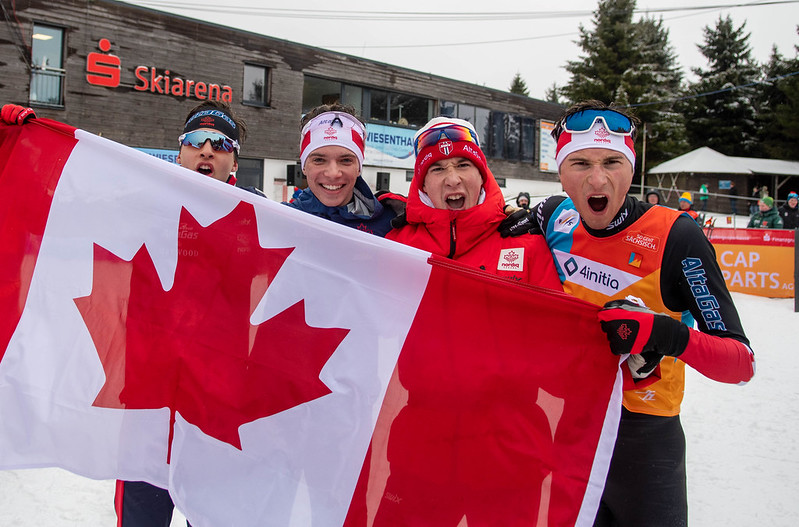
From left to right: Canada’s Olivier Léveillé, Tom Stephen, Xavier McKeever, and Rémi Drolet. Second overall in the World Junior’s 4 x 5 k relay. (Photo: Doug Stephen)
Bib 11, Xav McKeever for Canada fighting for position on the scramble leg. (Photo: Doug Stephen)
Leg 2, Canada’s Olivier Léveillé leading the chase. (Photo: Doug Stephen)
Where they belong: Canada’s Tom Stephen taking the pull on the front chase group. (Photo: Doug Stephen)
Rémi Drolet — closing it out. (Photo: Doug Stephen)
Drolet, almost there. (Photo: Doug Stephen)
The maple leaf group hug. (Photo: Doug Stephen)
Junior Women’s Relay:
Sydney Palmer-Leger (bib 4) during the scramble leg. (Photo: Doug Stephen)
Kendall Kramer on the second classic leg. (Photo: Doug Stephen)
Leg 3 for the U.S., Sophia Laukli (Photo: Doug Stephen)
Novie McCabe on the fourth leg for the U.S. (Photo: Doug Stephen)
The U.S. takes second overall. (Photo: Doug Stephen)
Canada’s Molly Miller tagging Jasmine Drolet: Leg one to two. (Photo: Doug Stephen)
Leg three to four: Canada’s Lilian Gagnon tags Elizabeth Elliott. (Photo: Doug Stephen)
Let’s not forget the Swiss who had a fine day. Here’s Swiss skier Anja Lozza closing down for the team win. (Photo: Doug Stephen)
Hailey Swirbul (bib 28) of the U.S. Ski Team on her Davos journey where she scored her first World Cup points in Saturday’s sprint and followed that with an in-the-points performance in Sunday’s 10 k skate. (Photo: NordicFocus)
Cross-country World Cup sprinters are prepping in Planica, Slovenia where the snow is sparse and the wax buses look lonely.
Webcam shot from Planica, where winter currently lacks snow. (Photo: sreenshot https://www.nc-planica.si/en/webcam1/)
So as Period I on the World Cup comes to a close this weekend, it’s worth taking a look back at an ideal Davos winter-mix: snow and sunshine. Choosing between a Polycarbonate & PVC fake id can be a tricky decision. That fake is going to serve as an asset for years to come. What happens if you get caught using a fake ID? The best way to get a fake id is to search for a number of factors which involves taking a good fake ID photo & selecting the most suitable <b>fake ID</b> state.
All Photos from NordicFocus. Double click images to enlarge.
Davos, Switzerland Ski Testing
FIS world cup cross-country, training, Davos (SUI)
FIS world cup cross-country, training, Davos (SUI)
FIS world cup cross-country, training, Davos (SUI)
FIS world cup cross-country, individual sprint, Davos (SUI)
FIS world cup cross-country, individual sprint, Davos (SUI)
FIS world cup cross-country, training, Davos (SUI)
Sprints
Jessie Diggins of the U.S. Ski Team.
Maiken Caspersen Falla of Norway.
Johannes Hoesflot Klæbo was a lock for the men’s sprint win.
Linn Svahn, the women’s sprint surprise winner.
A bluebird Davos sprint day. Photo: Nordic Focus
Linn Svahn (bib 14) and Sophie Caldwell (bib 1).
Distance
Norway’s Emil Iversen 15 k skate.
Jessie Diggins 10 k skate.
Canada’s Dahria Beatty– 2019 Davos 10 k. (Photo: NordicFocus)
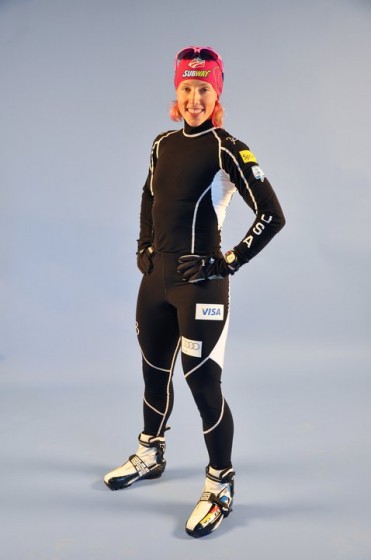
From October 2010: Kikkan Randall modeling the U.S. Ski Team suit for the 2010-2011 season. Photo courtesy of the U.S. Ski and Snowboard Association.
A national team uniform for cross-country skiing has to do a lot of things. At the most utilitarian level, it has to wick sweat and aid performance while an athlete pursues one of the world’s most demanding sports at temperatures between –4 F and 40, in steady snow or driving rain or anything in between. At the functional level, it has to let spectators and coaches identify where their athlete is out on the course, while distinguishing them from athletes from other countries. And at the symbolic level, it lets the athlete know that he or she is competing on behalf of their country, for everything that that means. Ask a skier who has represented the United States in international competition what it meant to them to pull on a national uniform for the first time. They’ll probably be able to tell you.
(And if they ever forget, this detailing from Craft and L.L. Bean on the American uniforms, ca. 2015/2016, is there to remind them. “You are representing the United States of America,” a slogan intones, above a martial-looking eagle, with a U.S. Ski Team master mark for its aegis, gripping an olive branch (?) in its dexter claw and a skis and ski poles fasces in its sinister. “Pretty fun to be representing an American brand with our American uniforms!,” wrote Sadie Bjornsen in a blog post describing the uniforming process.)
For whatever reason, the period roughly one decade ago represented the highwater mark for domestic and global coverage of ski uniforms on this website. There was “US Ski Team Brings Suit Consistency,” from Jan. 2009 (lede: “After years of a remarkable level of wardrobe schizophrenia, the US Ski Team has ushered in a new era of racing suit consistency that should make it easier to follow our favorite US athletes on the race course.”); “The costume disciplinarian speaks: Is it better to look good than to ski fast?” from July 2009; “The Best and Worst (Suits) of the Olympics,” from Feb. 2010; and “USST Goes Black for 2010-2011,” from Oct. 2010 (lede: “In the sport of cross-country skiing, most people would agree that competing with New Zealand is probably smarter than picking a fight with Norway.”).
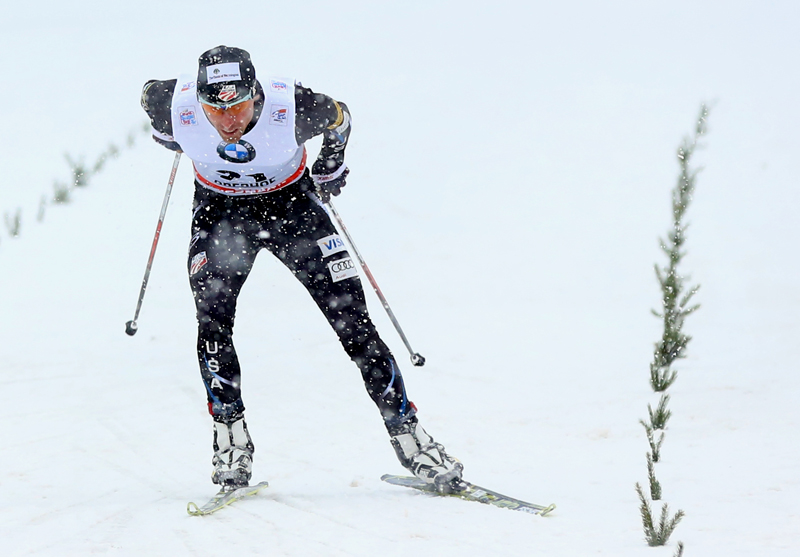
So it seems to have been nearly 10 years since the last sustained attention to the uniforms of the Davis U.S. Cross Country National Team Program (néeU.S. Ski Team). To fill that gap, FasterSkier hereby presents A Visual History of the United States Ski Team National Team Uniform, 2008–2019.
(Why 2008 for the starting point? Mostly for the simple logistical reason that the image library in the current FasterSkier content management system, WordPress, only goes back to 2008, so this article can be written while using only images that FasterSkier may legitimately post on this site. To go back to closer to the start of this century would require a lot of external links to Getty Images and not that many photos to actually look at on this website. That said, this piece from 2009 has a nice visual roundup of the plethora of different USST designs worn from 2006–2008, which takes you back two more years. Before that, well, just imagine Kikkan Randall and a lot of other skiers you probably haven’t thought about for a while — Wendy Wagner, anyone? Rebecca Dussault? Sarah Konrad? — wearing various iterations of early-aughts red and black.)
2008/2009 World Cup season: Red
January 2009: No question who is from the US here… Kikkan Randall in the women’s Team Sprint in Whistler
January 2009: Kris Freeman preferred the orange to silver in the men’s pursuit
As a contemporary uniform article explained, “There are currently two suit variations being used by US Ski Team athletes, and athletes racing for the US in international events. They are so similar, that for practical purposes (identifying US skiers in a race) they may as well be the same. Both suits are predominantly red, with one version having patches of orange, and the other silver.” Both were manufactured by Norwegian company Bjørn Dæhlie.
There appears to have been no change to the basic World Cup design for the 2009 World Championships in Liberec, Czech Republic:
Freeman at the 2009 World Championships in Liberec. (Photo: Swix Sport)
2009/2010: Still red Bjørn Dæhlie
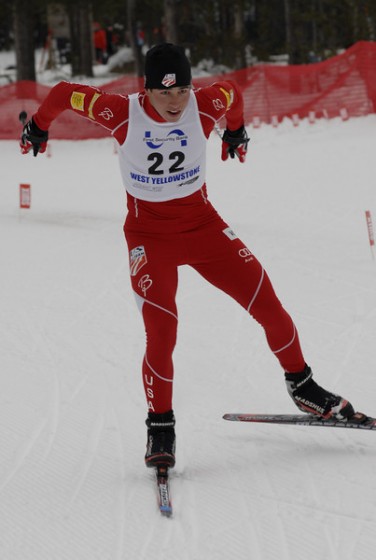
November 2009: Tazlina Mannix (APU, USST) racing in West Yellowstone.
November 2009: A very young Noah Hoffman (USST) racing to 3rd in a distance race in West Yellowstone.
Honorable mention, domestic suits division:
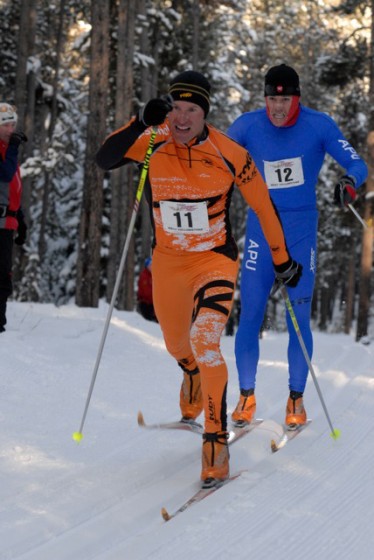
November 2009: This is a very orange suit. Kevin Hochtl (Rossignol) – 32nd – leads Anders Haugen (APU) – 7th – to the finish in a West Yellowstone race.
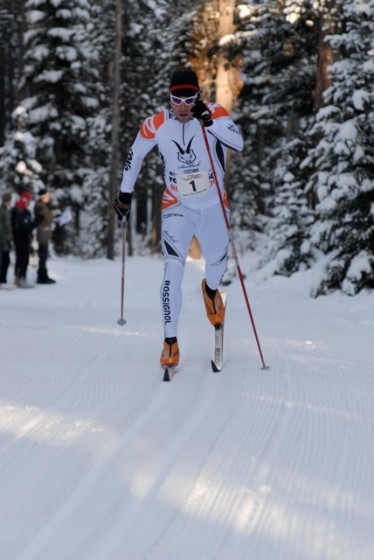
November 2009: This is one hell of an ibex. Chris Cook (Steinbock Racing) – 12th – sporting the new Steinbock Racing uniform
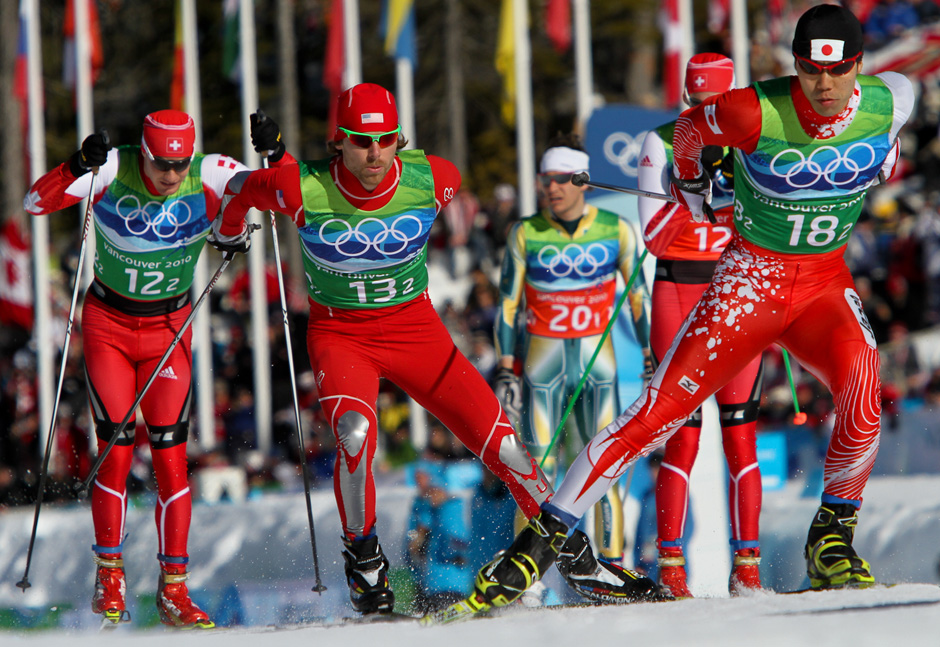
2010 Winter Olympics, Vancouver: Red and silver
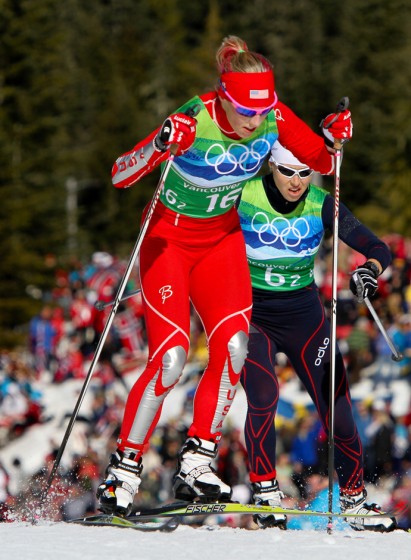
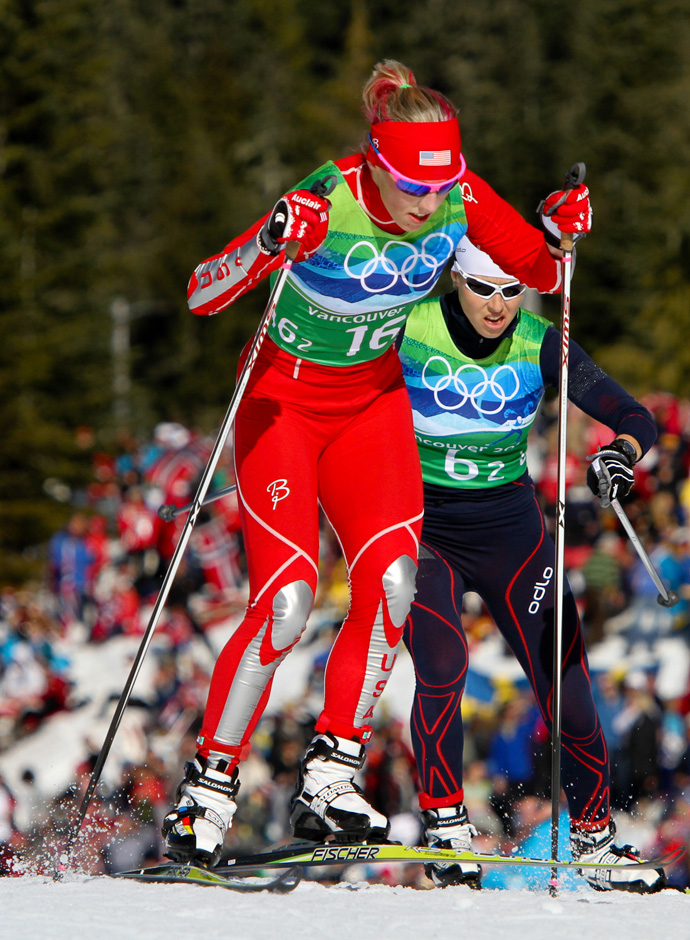
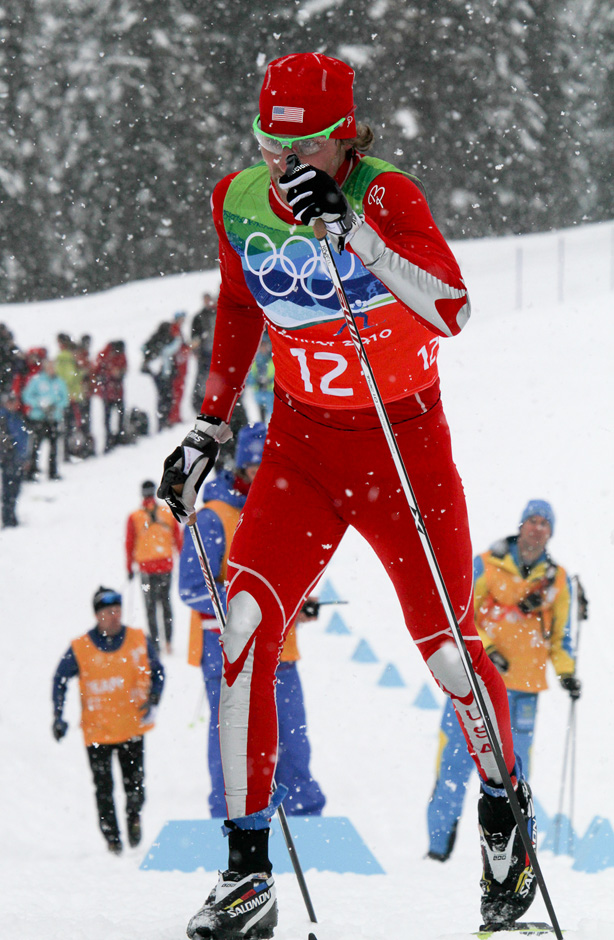
For the Olympics, the Americans appear to have taken their World Cup template – Bjørn Dæhlie suit, largely red – but have changed it by, inter alia, lightening the shade of red, adding “USA” on the right arm and left leg, adding silver accents, and of course removing all sponsor logos. Kikkan, already skiing in her third Olympics, coordinated with a red headband, red gloves, and her famous pink highlights. Andy Newell went with the red hat (he may not have had a choice), but was otherwise somewhat less vermilion.
Feb. 2010: Kikkan RandallFeb. 2010: Andy Newell on the big climb during the men’s 4 x 10 k relay.
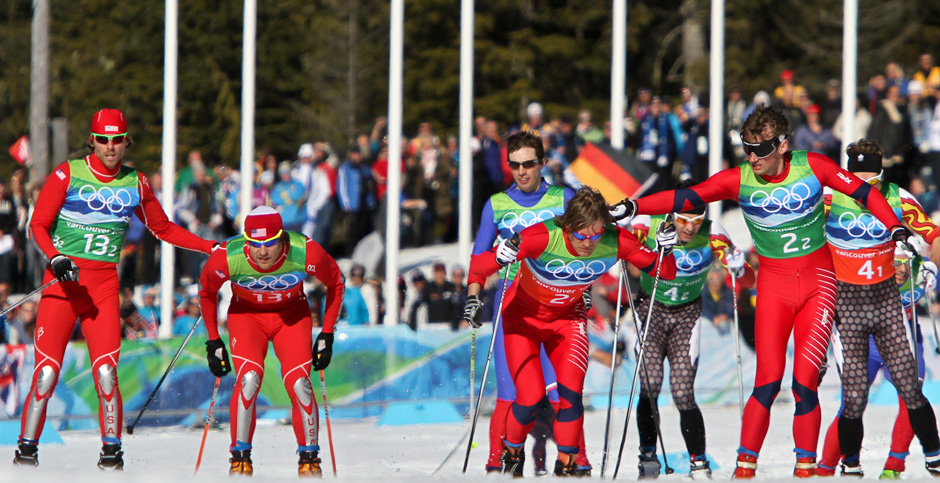
There was a lot of red in Vancouver. For example, here’s Andy Newell (far left, bib no. 13-2) tagging Korin Koos for the U.S. in the team sprint, while Petter Northug (far right, bib no. 2-2) tags Øystein Pettersen (middle right, bib no. 2-1) for Norway. (An entire standalone article could likely be written on the Canadians’ infamous kit (bib no. 4, back right).)
Newell tags Koos (left) and Northug tags Pettersen (right) at the 2010 Vancoulver Olympics.
Or here’s Newell in the middle, between Switzerland’s Dario Cologna (bib no. 12) and Yuichi Onda of Japan (bib no. 18):
Newell in the semis of the skate sprint: 2010 Vancouver Olympics.
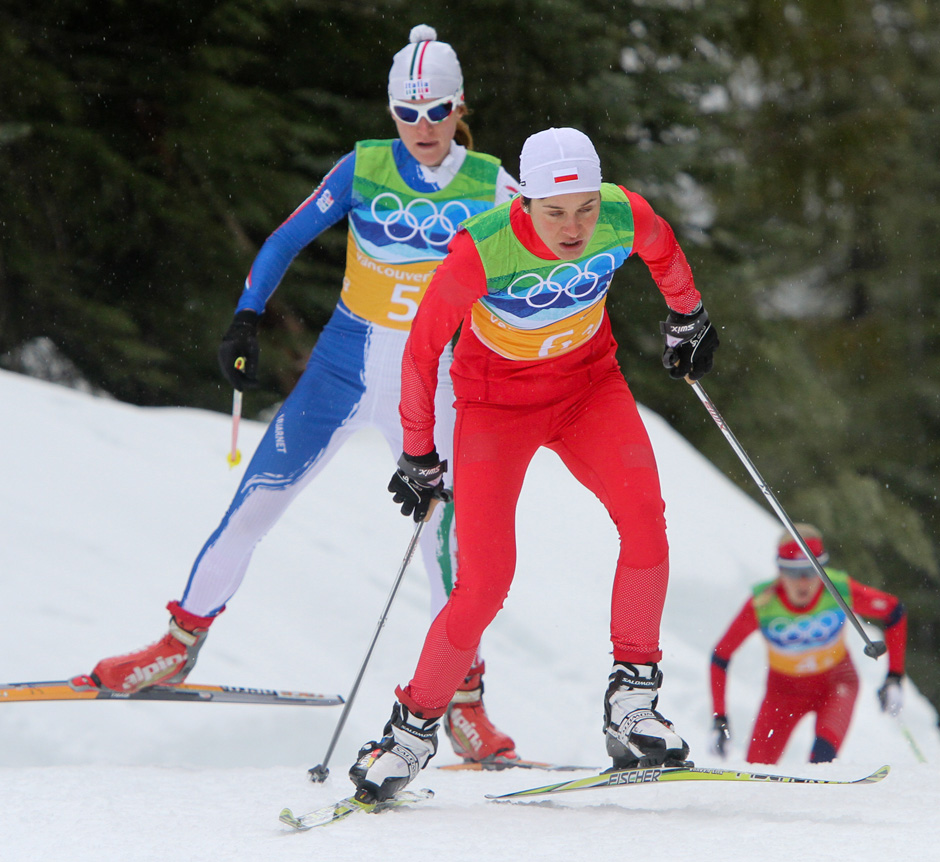
Finally, Poland (shown here: Sylwia Jaśkowiec, bib no. 6) was just red:
Poland 2, 2010 Vancouver Olympics.
2010/2011: The black era begins
Perhaps as a natural reaction to the dominance of a single color across multiple nations, the U.S. made a significant shift for the 2010/2011 World Cup season: black. The color does not appear on the national flag or in other common American iconography, but it is certainly distinctive. Bjørn Dæhlie remained the suit manufacturer.
Or, as then-FasterSkier reporter Nat Herz wrote in fall 2010, “After any number of years of being drowned out by a sea of Norwegian crimson, U.S. Ski and Snowboard Association Nordic Director John Farra said that the USST will be ‘distinctly not red’ for the 2010-2011 season—including at World Championships in Oslo. ‘We went in a very different direction, in part from our experience in Oslo, where they [Norway] have a nation’s group of ten, and we can barely see our athletes in the group,’ he said.”
January 2011: A 21-year-old Sadie Bjornsen races to 17th at U23 World Championships in Otepää, Estonia.
January 2011: Jessie Diggins, then aged 19, races to 7th at Junior World Championships in Otepää.
January 2011: Noah Hoffman at a SuperTour race in Lake Placid.
February 2011: No change for World Champs: Kikkan Randall racing at 2011 World Championships in Oslo.
2011/2012: Still black Bjørn Dæhlie
December 2011: Kikkan Randall sprinting during the Tour de Ski.
March 2012: Kris Freeman (SSCV/USST) on his way to claiming the US Distance Nationals 50 k freestyle title on Saturday morning in Craftsbury.
2012/2013: Still black
December 2012: Noah Hoffman in the Tour de Ski.
December 2012: Kikkan Randall blasting to victory in the Tour de Ski opening prologue on Saturday. She skied to 14th in the pursuit on Sunday and is leading the U.S. women in the Tour de Ski standings after two stages. Photo: Marcel Hilger.
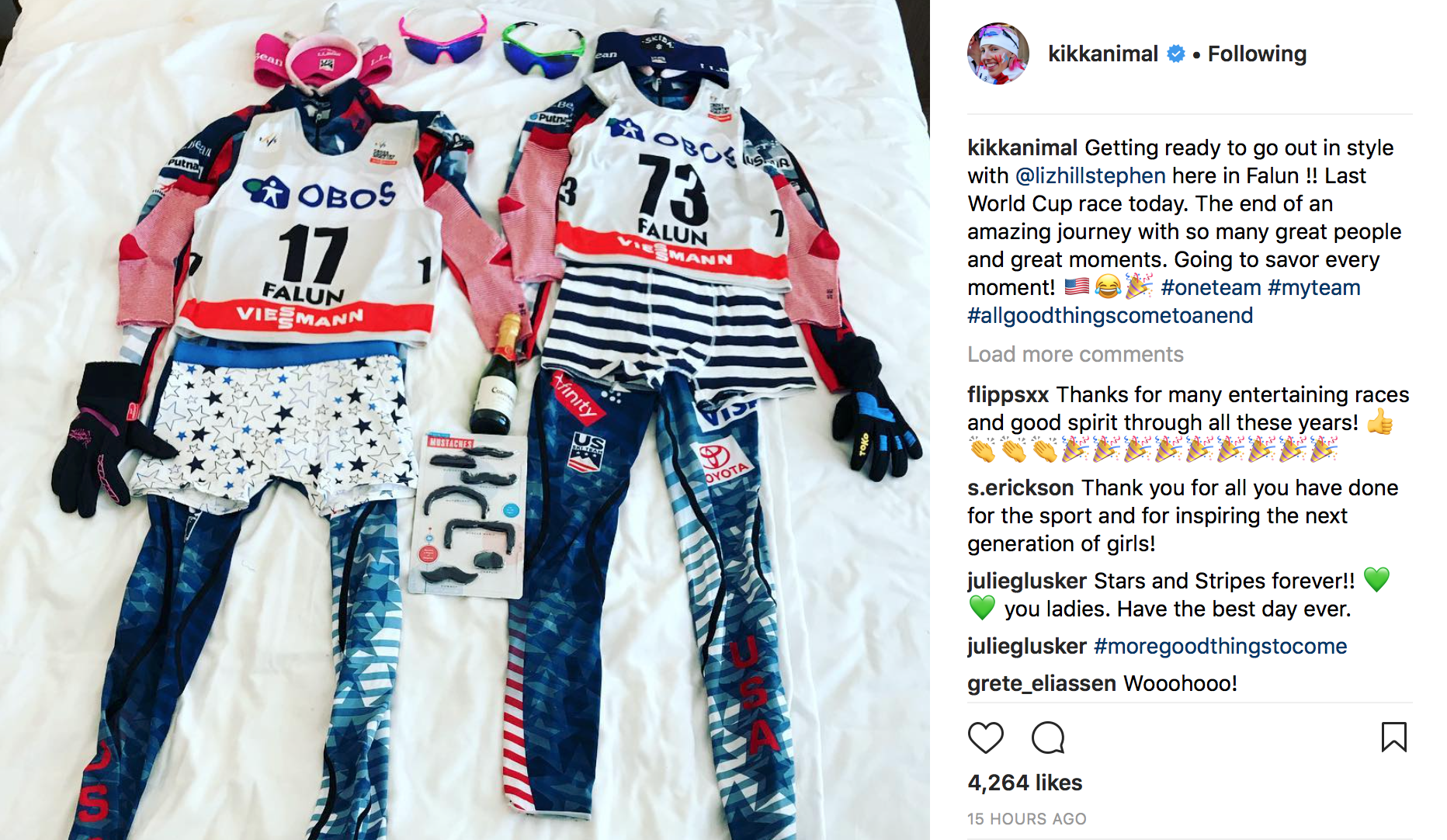
February 2013: Diggins and Randall won gold in the team sprint at 2013 World Championships in Val di Fiemme, Italy, which was awesome, but, for purposes of this article, mostly relevant for the addition of the epochal relay socks but otherwise no change to the standard World Cup uniform.
2013/2014: Yup, still black
December 2013: Liz Stephen (U.S. Ski Team) on her way to 34th in Saturday’s 3 k freestyle prologue at the first stage of the Tour de Ski in Oberhof, Germany. (Photo: Marcel Hilger)
December 2013: Andy Newell (U.S. Ski Team) qualified 12th and finished 10th overall in Sunday’s freestyle sprint. (Photo: Marcel Hilger)
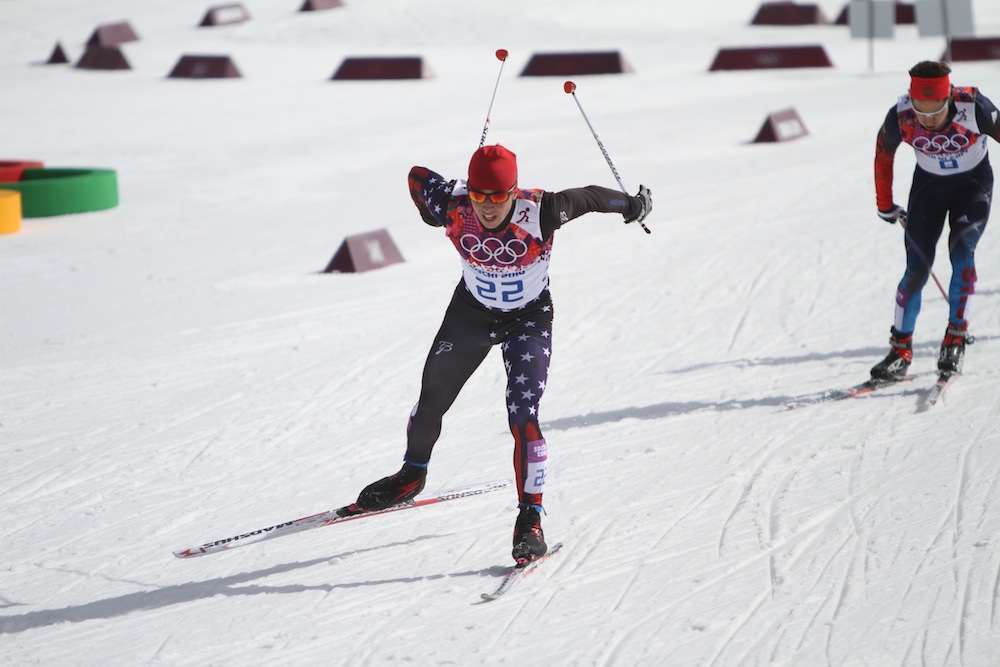
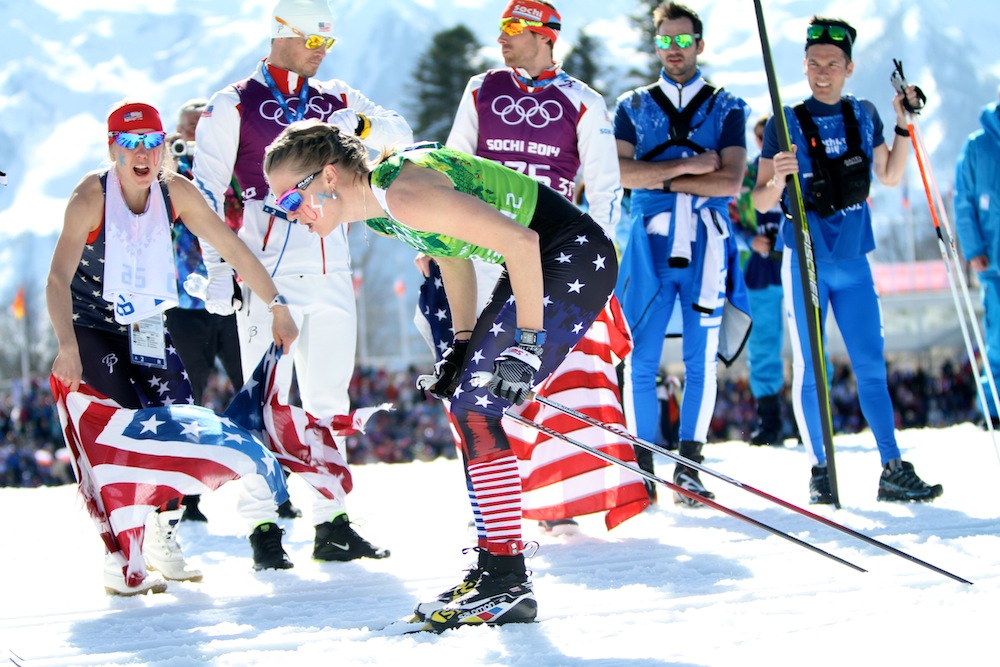
2014 Winter Olympics, Sochi: Stars and stripes
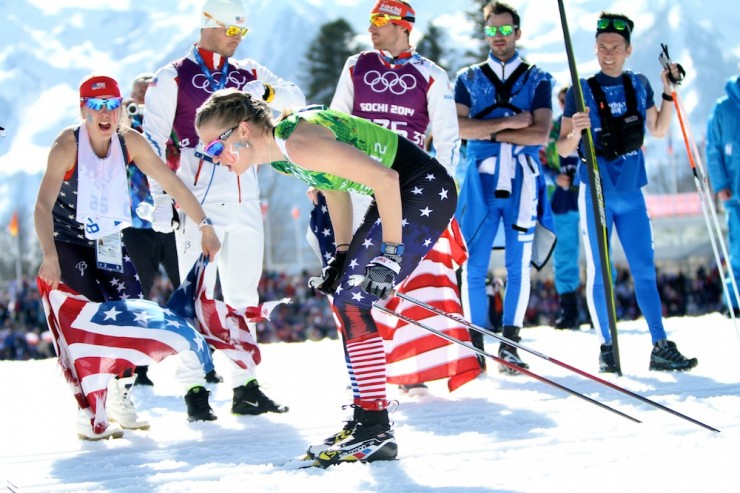
The 2014 Winter Olympics, in Sochi, Russia, were known at the time for Kikkan Randall’s disappointing result in the individual skate sprint, and after the fact for the revelation that Russia was engaged in a massive state-sponsored doping scheme and cover-up. They were also significant for a change in uniforms: stars and stripes on the right arm and left leg, and a large “USA” on the right leg. The left arm was relatively plain. Also, several of the U.S. women drew attention for racing sleeveless in warm temperatures. Bjørn Dæhlie continued to be the brand logo featured on the upper right quad. (Pictured below: Noah Hoffman, in a solo race, and Sadie Bjornsen, in the women’s relay.)
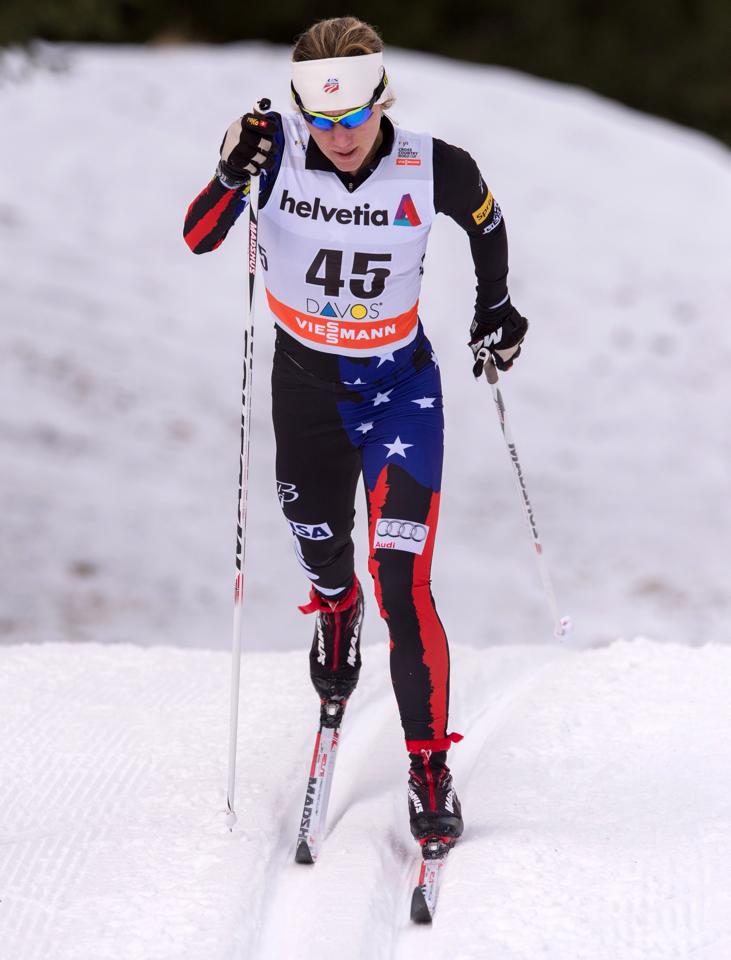
2014/2015: Stars and stripes redux
Athletes took to the trails next season with a slightly modified version of the recent Olympics uniform: Larger stars on the left upper quad, with a deeper blue background. The stripes on the left leg became more pronounced and stretched farther up the race suit, to above the knee. Also, once the non-commercial period of the Olympics had passed, there was space for sponsor patches on the arms and legs.
December 2014: Caitlin Gregg (Team Gregg) skiing to 56th place in the Davos World Cup 10 k classic, Dec. 13. (Photo: Toko)
USST’s Sadie Bjornsen racing to 29th in the Davos World Cup 10 freestyle, Dec. 20, 2014. (Photo: Fischer/Nordic Focus)
World Championships, in Falun, Sweden, brought a mostly-white version of the uniform, helpful for the warm temperatures and soupy conditions that characterized many of the races. Here’s Sadie Bjornsen in Falun in February 2015:
2015/2016: Red, white, and blue
By fall 2015, the move away from black, and towards red, white, and blue, was complete. Athletes now had the option of being attired in a predominantly white color scheme, which would aid in preventing overheating on warm days, while thankfully solving the transparency issues that had plagued recent all-white suits for Sweden or Italy. An alternate version had roughly the same patterning, but with blue as the primary color. Notably, the Americans also moved to a race suit manufactured by the Swedish company Craft for the first time in this survey.
December 2015: Sadie Bjornsen (U.S. Ski Team) racing to her best-ever sprint qualifier in sixth at the World Cup freestyle sprint in Toblach, Italy. She went on to make the semifinals and place 10th overall. (Photo: Fischer/NordicFocus)
December 2015: Simi Hamilton (U.S. Ski Team) racing to his first non-stage World Cup podium on Saturday in Toblach, Italy, where he placed second in the freestyle sprint. (Photo: Fischer/NordicFocus)
December 2015: American Andy Newell (r) and Great Britain’s Andrew Young (c) trail Norway’s Håvard Solås Taugbøl (2) in the quarterfinal at the Davos World Cup freestyle sprint on Sunday in Switzerland. Taugbøl won the heat, Young placed third, and Newell was fifth after missing out on a photo finish for fourth. Newell finished the day 23rd overall. (Photo: Marcel Hilger)
January 2016: Ida Sargent (U.S. Ski Team) teamed up with Sophie Caldwell (not shown) to place fifth in the 6 x 1.2 k freestyle team sprint at the World Cup in Planica, Slovenia. (Photo: Madshus/NordicFocus)
Honorable mention: Trending towards “purple cobras” for American biathlon but not there yet.
American Claire Waichler started 58th and finished 33rd in the youth women’s pursuit on Sunday at IBU Youth/Junior World Championships in Cheile Gradistei, Romania. (Photo: IBU YJWCH Cheile Gradistei 2016/Facebook)
2016/2017: More red, white, and blue
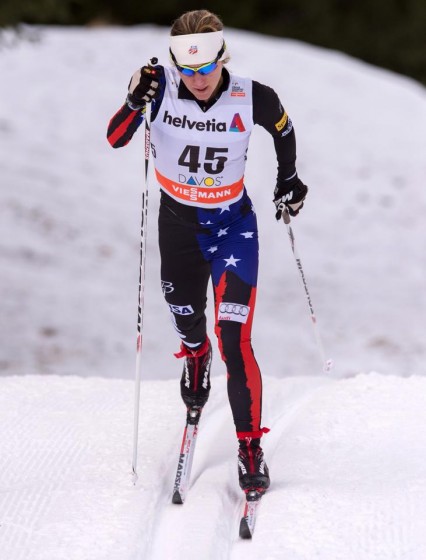
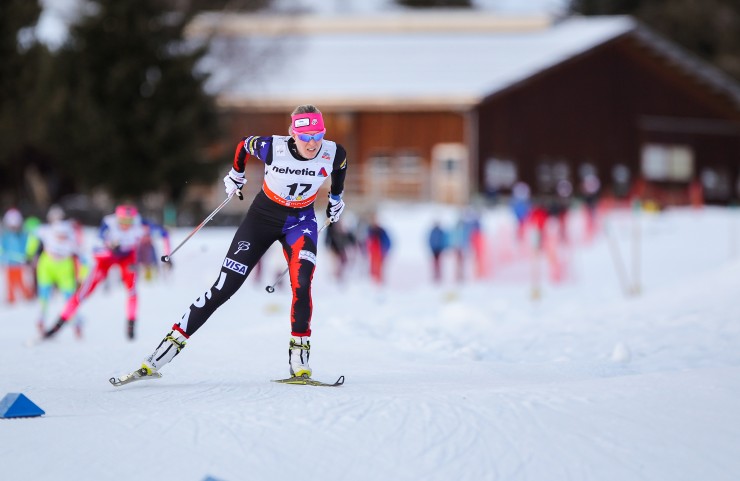
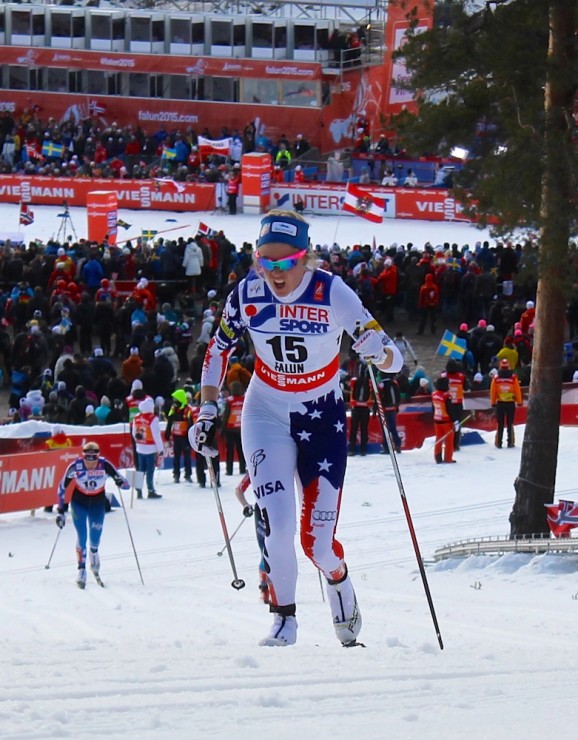
An interpretation of red, white, and blue, still on a Craft suit, remained in place for the 2016/2017 World Cup season, which was marked within the team by Randall and her husband, Jeff Ellis, traveling the European race circuit with a newborn in tow. The changes to the USST uniform were less dramatic than Randall’s familial status: Still red, white, and blue, though now with blue as the dominant color. The entire left leg, and the bottom half of the right leg, had markings, somewhere between subtle striations and full-on stripes, that evoked the stripes of the American flag. (Let’s put aside for the moment the fact that the stripes on the actual flag are white and red, not white and blue.) The pattern was repeated on the lower right arm. An understated evocation of blue or white stars marked both lower legs, with more pronounced stars scattered around the bottom of the torso (possibly the top as well, but nearly all of one’s torso is typically covered by the standard race bib). The left arm and left leg both proclaimed “USA” in red lettering.
The vehicular logo on the legs remained that of Audi, as it had been since the start of this history.
There appears to have been no change for the 2017 World Championships. At least to the uniforms; on the race course, the Americans won an unprecedented three medals.
December 2016: Jessie Diggins (U.S. Ski Team) racing to ninth in Saturday’s 1.5 k freestyle sprint qualifier in Val Müstair, Switzerland. Diggins went on to place sixth in the final. (Photo: Salomon/NordicFocus)
January 2017: Sophie Caldwell (U.S. Ski Team) racing to third in the qualifier of Saturday’s 1.4 k freestyle sprint in Falun, Sweden. She went on to finish 16th overall (Photo: Fischer/NordicFocus)
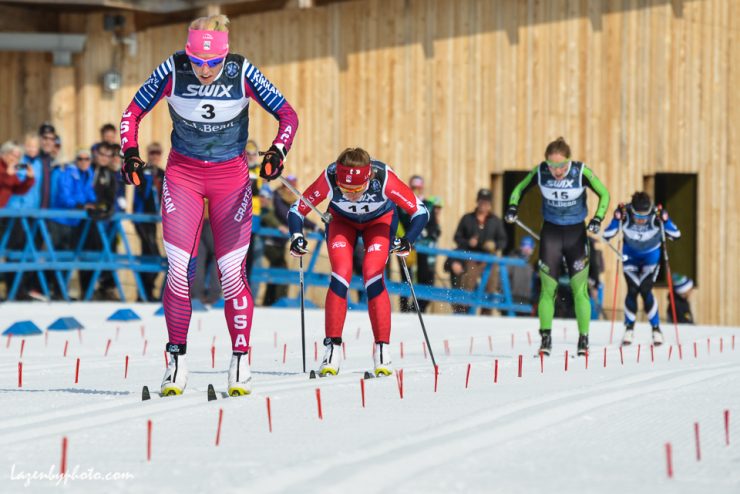
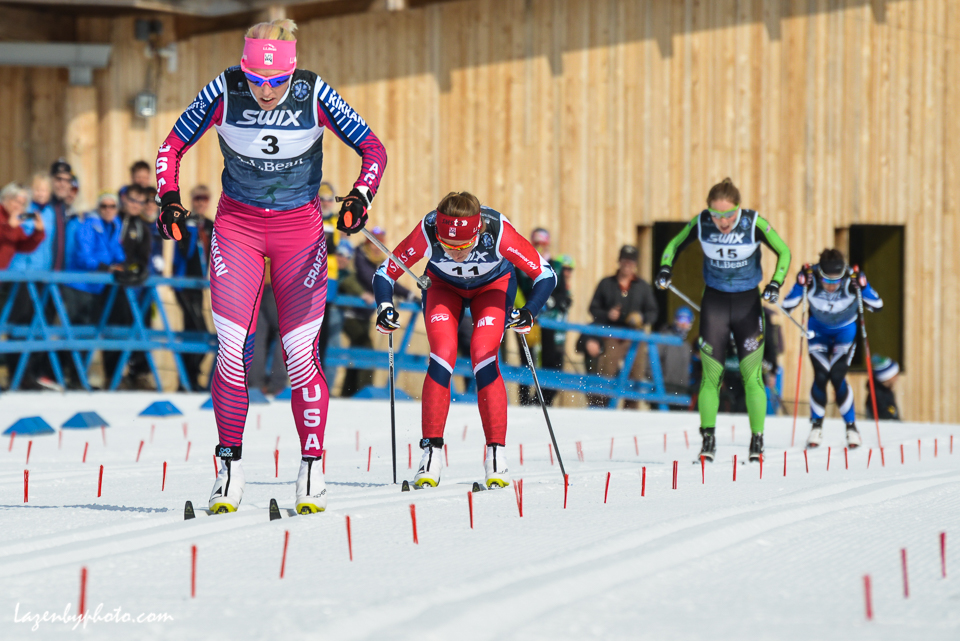
February 2017: Kikkan Randall (U.S. Ski Team) racing to 26th in the women’s 10-kilometer classic individual start at the 2017 Nordic World Championships on Tuesday in Lahti, Finland (Photo: John Lazenby/Lazenbyphoto.com)
Meanwhile, biathlon saw the advent of the beloved “purple cobras” era:
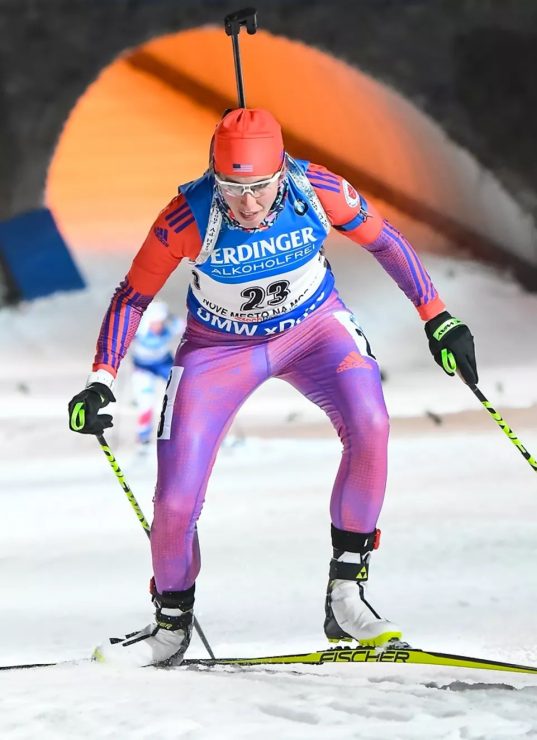
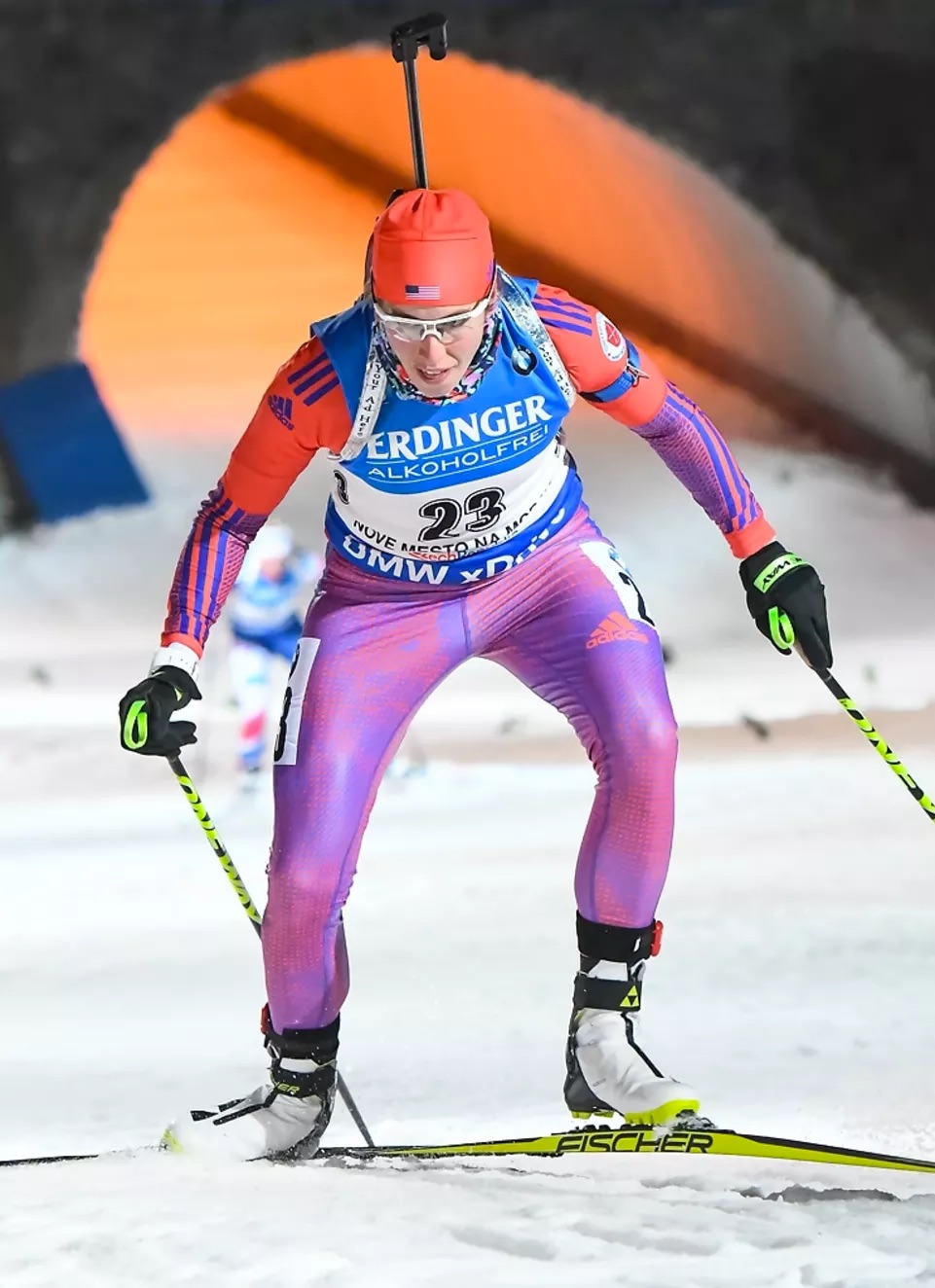
US Biathlon’s Susan Dunklee on her way to finishing third in the women’s sprint at the IBU World Cup in Nove Mesto, Czech Republic. It was the third podium of her career. (Photo: IBU)
2017/2018: Red, white, and blue redux
There appears to have been no change for the 2017/2018 World Cup season: still red, white, and blue, but mostly blue, on a Craft suit. The most notable change may have been to the car sponsor… for the first time since at least the scope of this article, a Toyota logo was on the leg, not Audi. Nichts ist unmöglich (“Nothing is impossible”), as the company’s European slogan proclaims.
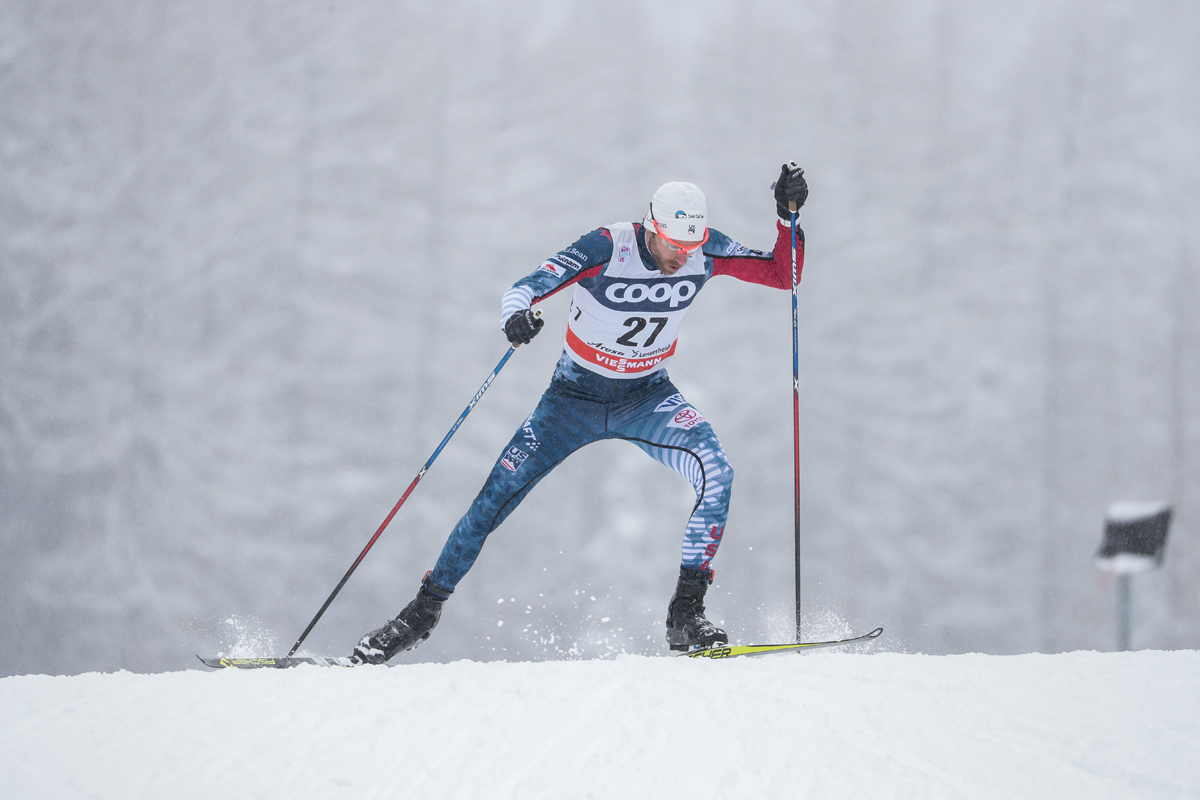
American Andy Newell racing the men’s 1.5 k freestyle-sprint qualifier at Stage 1 of the Tour de Ski on Saturday in Lenzerheide, Switzerland. He qualified 20th and went on to finish 19th overall. (Photo: Fischer/Nordic Focus)
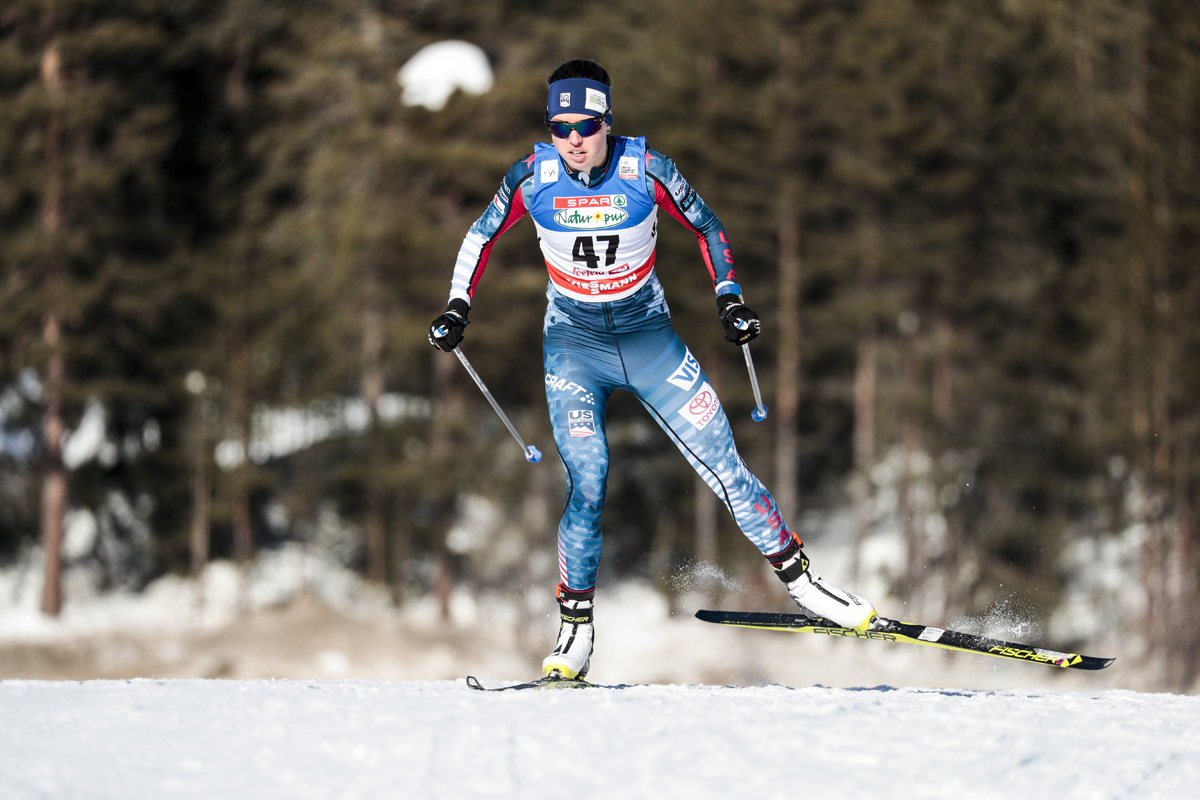
Caitlin Patterson (Craftsbury Green Racing Project) racing to 52nd in the freestyle sprint qualifier at the last World Cup on Jan. 27 in Seefeld, Austria. The next day, she placed 23rd in the 10 k freestyle mass start. (Photo: Fischer/NordicFocus)
2018 Winter Olympics, Pyeonchang: Red, white, and blue, and a lot of stripes
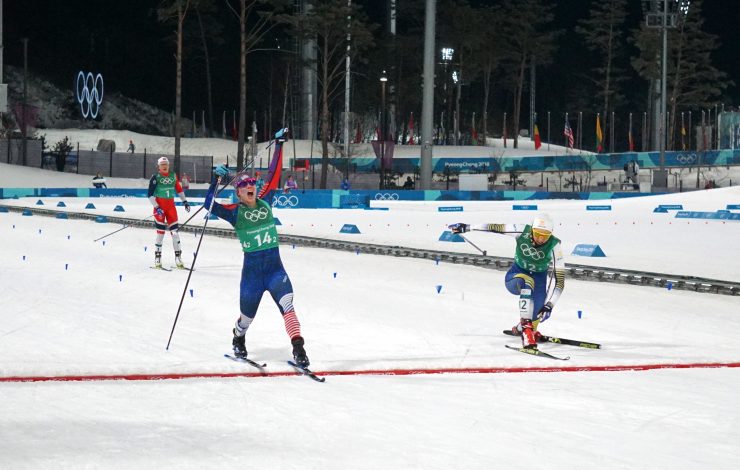
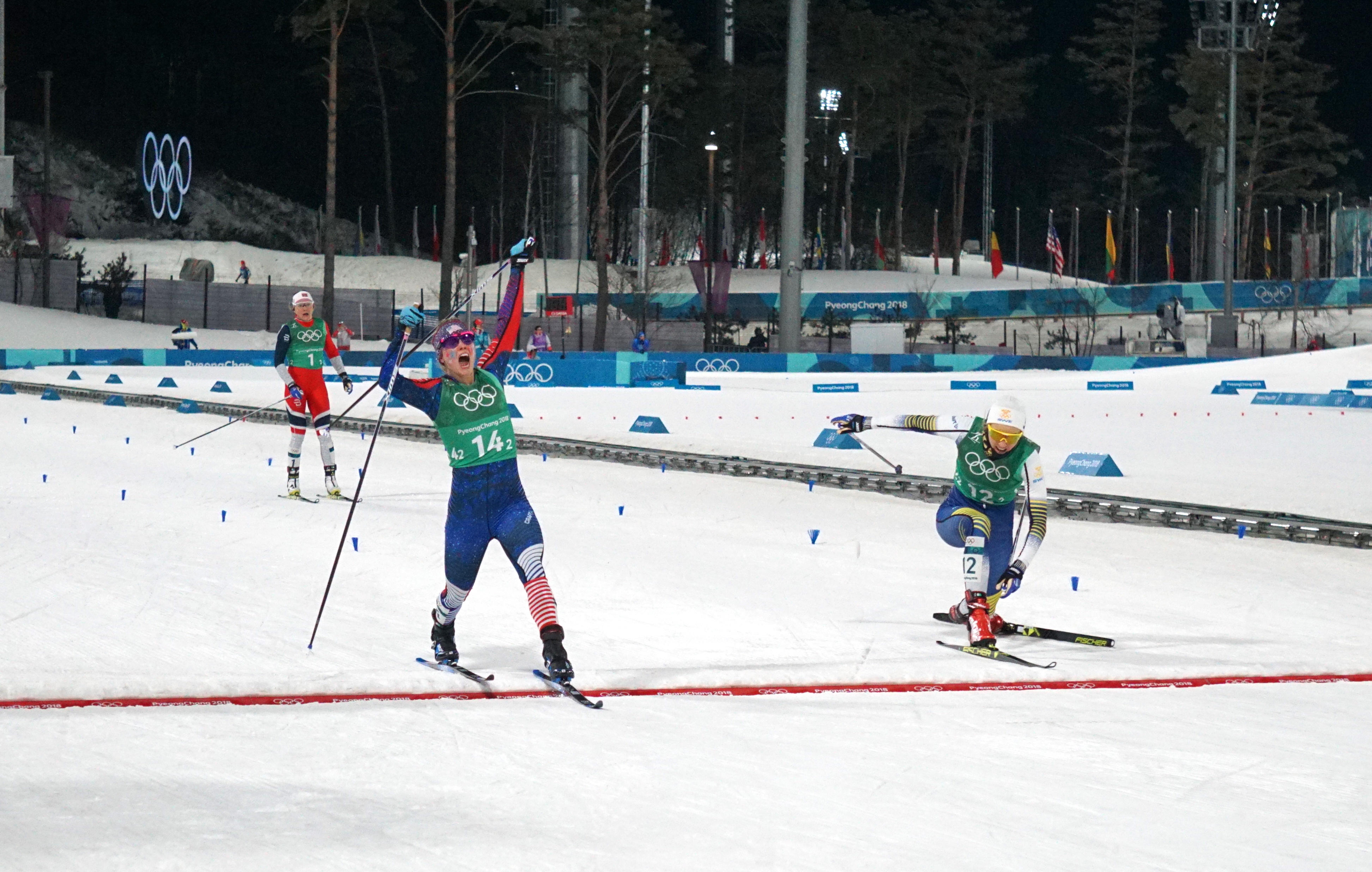
There is a somewhat famous picture from the 2018 Winter Olympics that you may already be familiar with. In the picture, Jessie Diggins, on the lefthand side of the frame, stretches her left foot across the finish line to secure an historic Olympic gold medal for the United States. Her left arm mirrors the gesture, punching the air above her in what is presumably an instinctual counterbalance to the lunge but also appears, in a frozen moment in time, to be a triumphant fist-pump. In the middle, her face is rent in a rictus of exertion and triumph. On the righthand side of the frame, Stina Nilsson of Sweden lunges as well, 0.19 seconds behind Diggins. Mute V-boards and still flags fill in the background of the image, as Maiken Caspersen Falla of Norway appears to stand up and stop skiing in order to watch the finish unfold.
It was a few seconds before 7:16 p.m. in Pyeongchang, 4:16 a.m. in Afton, Minnesota, and 1:16 a.m. in Anchorage, Alaska. If you’re reading this website, you may remember where you were at that moment.
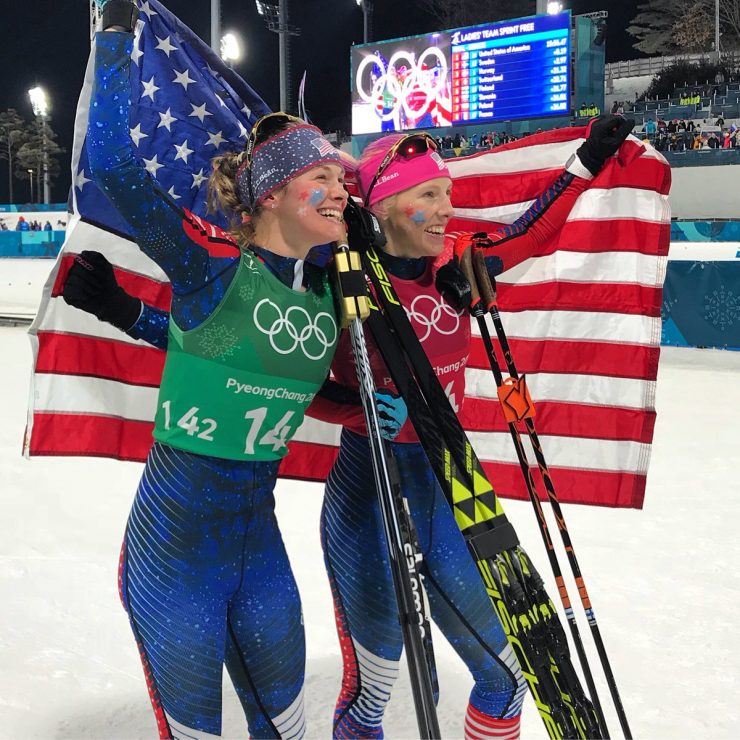
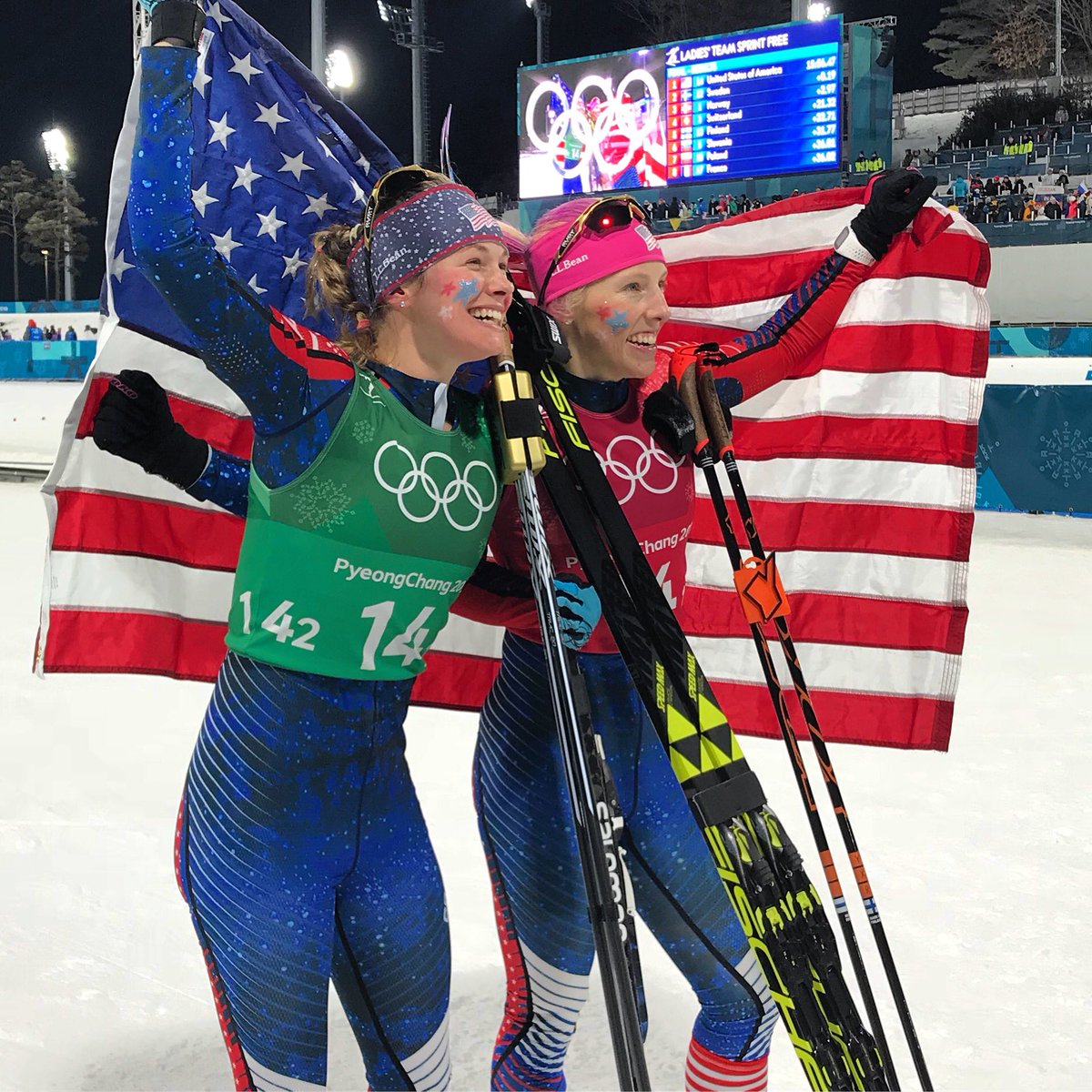
February 2018: Jessie Diggins (14) edges Sweden’s Stina Nilsson (r) for gold, while Norway’s Maiken Caspersen Falla (far left) races to bronze, in the women’s freestyle team sprint final at the 2018 Olympics in PyeongChang, South Korea. (Photo: Noah Hoffman)
But let’s talk about the uniform. Another Craft product, the dominant impression is once again blue; in the photo above, taken at whatever distance from the finish Noah Hoffman was allowed to stand while there was a race on, there is a whole lot of blue approaching the finish line between the American suit and the Swedish one. Some white stripes are visible around the knee of Diggins’s suit, trending down the lower leg, though they are soon subsumed by The Relay Socks.
On closer inspection, however (see next picture, below), there are a lot of stripes going on in this uniform. The entire legs are striped, with stronger white stripes on the sides of the torso fading to fainter stripes at the top of the leg. The knees have white stripes on a blue background, with the width of the white stripes gradually decreasing and the extent of the blue interstices gradually increasing across the course of the knee. As shown in more detail here, the patterning gives way to thin red stripes against a blue background, on the lower right leg, and a bold white “USA,” on the lower left.
The right arm has white splotches, potentially stellar in nature, against a blue background. The left arm has red and white stripes to midway down the biceps, which then transition to blue and red stripes.
The torso has a subtle blue and black patterning perhaps best described as “Swedish forest camo.”
Finally, although it is not apparent in either picture, “USA” was written in white letters against a blue background on both the right arm and lower left leg, as shown in the images available here (lettering on arm) and here (lettering on leg).
February 2018: Jessie Diggins (l) and Kikkan Randall soak up their win in the women’s freestyle team sprint on Wednesday at the 2018 Olympics in PyeongChang, South Korea. (Photo: FIS Cross Country/Twitter)
Here is another fine picture of Diggins and Randall from the evening of February 21, 2018. This one does not show the famous American relay socks, but does show the equally renowned facepaint and glitter. As Diggins has written, in what is both a pro-glitter cri de cœur and “a brief message for [the] high school officials” who harshed on her glitter as a junior racer, “Putting on glitter before my race is a salute to the little girl who just wants to ‘go super speed!!!’ It’s a promise to myself that I will race my absolute hardest that day. It’s a ritual that gets me in the right mindset to get out of the start gate and give it everything I have. It’s harmless, doesn’t negatively impact anyone, but to me it’s a huge part of my race morning. . . . And on relay days? Oh man. I get so excited about relay days. I get to paint the flag, ‘USA’ and stars on the faces of my teammates, and one of them will paint it on me as well. Then I put glitter over everything! It’s a special time when everyone is nervous, and excited, to be representing our country and we get together early in the morning to help each other get ready and deal with our pre-race nerves. It’s a little bit like our special striped relay socks…it’s part of what we do, as a team.”
End of the 2017/2018 season: Farewell tour
Honorable mention for the 2017/2018 season, World Cup edition: Randall and Liz Stephen’s outfits for their final World Cup race (standard Craft base, but with a whole lot of flair):
March 2018: The last-race outfits worn by Kikkan Randall and Liz Stephen for Sunday’s World Cup Finals pursuit. (Photo: Kikkan Randall/Instagram)
Honorable mention, domestic edition: Randall’s bespoke pink and blue Craft USST/APU suit (essentially the Olympics suit but with different patterning) that she wore for her final race as a professional skier, at Spring Series in Craftsbury. The suit said “USA” on the right arm and left leg, “APU” (for Alaska Pacific University, her club team of 19 years) on the left arm, and “Kikkan” on the left arm and right upper leg.
March 2018: Kikkan Randall (3) racing for third place in the women’s 30 k classic mass start at 2018 U.S. Distance Nationals in Craftsbury, Vt., ahead of Sophie Caldwell (second from l), Ida Sargent (second from r), and Rosie Frankowski (r). (Photo: John Lazenby/Lazenbyphoto.com)
Honorable mention, face paint edition: This remarkable evocation of Randall and Stephen on Diggins’s left cheek at Spring Series.
March 2018: Jessie Diggins with a photo of her retiring U.S. Ski Team teammates Kikkan Randall and Liz Stephen on her cheek at 2018 U.S. Distance Nationals in Craftsbury, Vt. (Photo: John Lazenby/Lazenbyphoto.com)
2018/2019: Red, white, and blue, but with larger color blocks. Also, a move to Swix.
Randall retired. Stephen retired. Randall got breast cancer. Randall was treated for breast cancer. Diggins worked hard to — successfully — bring a World Cup ski race to Minneapolis. And the Americans kept racing in red, white, and blue, albeit now with a move from Craft to Swix for the suit manufacturer. This year’s interpretation of the theme brought a shift to white as the dominant color, with blue through the torso and upper legs, as well as on the arms. Red was the least-pronounced color this year, limited to accents alongside the larger blocks of blue.
While the Americans continued their perhaps now-accustomed success at the World Cup level, American juniors served notice at World Juniors that they were a force to be reckoned with, taking a gold in the men’s relay, a fourth in the women’s relay, two fourths in classic distance races, and multiple other top-tens. Here are two shots from a frigid Lahti:
January 2019: Luke Jager (middle left, hands in air) after tagging off to Ben Ogden (bib 2, middle right, pink hat) in the U20 men’s 4 x 5 k relay at Junior Worlds in Lahti, Finland. (Photo: Doug Stephen)
January 2019: Kendall Kramer on her way to fourth place in the U20 15 k classic mass start at World Juniors in Lahti, Finland. (Photo: Doug Stephen)
Back to the World Cup (where senior athletes wore the same uniform shown above on the juniors for the regular season), 2019 World Championships, in Seefeld, Austria, brought something new. The dominant hue in the race suit was now blue instead of white, and the large color blocks of the 2018/2019 World Cup regular season were gone. White stars were added to the lower left leg, making the evocation of the American flag far more apparent. Red and white stripes, on the right arm, continued the vexillological theme. While the four sponsor logos on the legs remained the same (Bose, Xfinity, Visa, and Toyota), the Swix logo shifted from the lowest position on the left leg to the middle position on the right.
A Swix press release about the new suits advised: “Featuring bold stars and sharp American colors, the focus was on visibility in mass start events and an iconic look.”
February 2019: Rosie Brennan races in Seefeld.
Honorable mention: Bare arms and cutoffs. It was hot in Seefeld. Like, over 50° F hot. Erik Bjornsen raced the 15 k classic with nothing underneath his race bib (sun’s out…), attire typically befitting Eagle Glacier in July more so than Austria in February. Brennan raced the relay with only a t-shirt on top, and no gloves. And Jessie Diggins drew widespread attention for her DIY cutoff look for the relay (which still featured the iconic relay socks, albeit rolled down so they wouldn’t counteract the shorts by covering most of her lower leg).
As Diggins later wrote on her blog a month after World Champs: “Let me start by saying this; no, I was not cold racing in shorts and short sleeves, yes, you should try it sometime, and yes, it was refreshing to have the cold slush hitting my legs! Somehow, the sight of me racing in a short suit was more interesting and befuddling to most reporters than the actual race itself. Clearly, they haven’t ever experienced a Minnesota cold snap. Now THAT is cold weather! … Honestly, it’s hard to describe the amount of distress overheating puts me in, but let me put it this way; racing is already one of the most painful things you can do. If I have to deal with being incredibly uncomfortable, dizzy, and feeling my body start to shut down because I’m way too hot, it becomes even harder to continue pushing my body to the limit, because it’s already that much closer to the limit! And besides, everyone needed the laughs by the time we got to the end of the races.”
Erik Bjornsen of the U.S. skiing to 17th overall during the 15 k classic at the 2019 World Championships in Seefeld, Austria. (Photo: John Lazenby/lazenbyphoto.com)
Rosie Brennan of the U.S. during the third leg of the 2019 World Championship 4 x 5 k relay in Seefeld, Austria. (Photo: John Lazenby/lazenbyphoto.com)
Custom race suit for Jessie Diggins of the U.S. She anchored the fifth place U.S. team during the 2019 World Championship 4 x 5 k relay in Seefeld, Austria. (Photo: John Lazenby/lazenbyphoto.com)
2019/2020: Candy cane stripes!
Finally, the start of this season brought the dawn of what has variously been called the “candy cane stripes” or “barber pole stripes” suit (#wellactually a barber’s pole historically has alternating red and blue stripes, not just red stripes as on the current U.S. suit). The left leg features red and white stripes, in a color-appropriate rendition of the American flag. The right leg has white stars on a blue background, again in patterning true to the actual flag. The stars are repeated on the left arm, and the stripes are briefly evoked on the right.
The car sponsor has once again changed, this time to Land Rover.
Here’s Kelley Roche, Soft Goods Product Manager for Swix Sport US, explaining the backstory for this year’s suit design in an email to FasterSkier: “Swix worked with Garen Riedel who owns his own design firm, Riedel Creative in New York. Garen worked closely with the athletes to design a suit that graphically works and they were excited to compete in. The goal is to design a suit that you can pick out of the pack and immediately and know it is a US athlete! This is important for the fan but really important for the coaches who support the athlete during the race. We ended up going with an asymmetric design, a continuation of the Seefeld suit design from 2019 and a retro reference to some of the suits of old, leveraging the iconic and patriotic American flag color palette with a slight color fade across the body.”
Roche added that the suit itself is made out of mesh, which in addition to being flexible and breathable “acts likedimples on a golf ball, balancing the lift and drag of the athlete.”
December 2019: Erik Bjornsen during the skate leg of the 2019 30 k skiathlon in Lillehammer, Norway. (Photo: NordicFocus)
December 2019: Lillehammer, Norway (NOR): Rosie Brennan (USA). (Photo: NordicFocus)
If you have read this far: For one, congratulations. For another, there is a wealth of historical material available in the FasterSkier archives. If you would have any interest in future compilations with a different focus — American biathlon, say, or best and worst of domestic American race suits over the past decade — please comment below, or email the author directly: gavin (at) fasterskier (dot) com. Thanks, and thanks for reading.
Skiers are framed by cow parsnip in front and mountains behind on the groomed trails at Hatcher Pass, above Palmer, Alaska, on Oct. 6, 2019. (all photos: Gavin Kentch)
HATCHER PASS, above Palmer, Alaska — The phrase “early season skiing” tends to evoke several things for your average skier: Dark. Cold. Rock skis. November. And so on. Think a training opportunity to be endured as much as enjoyed.
Happily enough, none of these things was in evidence Sunday morning at Hatcher Pass, elev. 3,500′, in Independence Mine State Historical Park in the Talkeetna Mountains above Palmer, Alaska. The sun was out. The views were expansive. The tracks were set; the coverage was good. It was literally Extra Blue conditions for classic skiing, with air temps in the 20s. No one could remember ever being this warm at Independence Mine for early-season skiing. Oh, and it was October 6.
As snowfall flirted with webcams over the past week, and the Mat–Su Ski Club moved its equipment into place and announced potential plans for the season’s first grooming depending upon accumulation, local skiers passed around weather reports like samizdat.
Then, Sunday morning, following roughly 10″ snowfall over the past few days, the pilgrimage to an area once described as like “skiing through an Old West ghost town turned collectible Christmas village” began. The parking lot filled with vehicles bearing themed plates expressing a love for moving across snow, whether on skis or dogsled runners. SKI4VR. XCMOM. IDT105. (An Iditarod Finisher license plate with the IDT prefix is available only upon presentation of one’s Iditarod Trail Committee finisher number to the Alaska DMV.)
A range of jackets and drinkbelts accumulated at the unofficial drop spot in the middle of the mine loop, the universal sign of a bevy of skiers out training somewhere nearby. There were many branded jackets, with Alaska as a common theme: Alaska Winter Stars, Alaska Pacific University, Alaska Nordic Racing, University of Alaska Anchorage, Team Alaska.
The skiers present had roughly the qualifications you would expect for a group of athletes logging a 2-hour on-snow OD over hilly terrain on October 6. The juniors had Besh Cup podium finishes and Junior Nationals starts for Team Alaska; the seniors had SuperTour wins and national championships and World Cup and Olympic starts; the masters had Birkie age group wins and Masters World Championships medals. The median age was somewhere south of 25; the median VO2Max, somewhere north of 50; the SPF of the sunscreen, at least 30. And everyone, young or old, training or touring, was smiling very, very broadly as they made their way around the historic gold mine buildings.
Then eventually, as morning stretched into afternoon, the sky turned first scumbled, then leaden. A light snow began to fall. It was time to go home.
Whether winter is already upon you, or is just a glimmer of hope somewhere on the horizon, please enjoy these pictures from opening day at Hatcher Pass.
Full disclosure, the author donates to the Mat–Su Ski Club each year to help support trail grooming.
Into the light during the Québec City World Cup. (Photo: John Lazenby/lazenbyphoto.com)
As we start to close out the race season, we wanted to provide a link to John Lazenby’s gallery from the Québec City, Canada World Cup finals.
The dichotomous weekend was the World Cup beginning for some and a stop for others like Canada’s Alex Harvey and the U.S. Ski Team’s Ida Sargent — both are retiring from World Cup racing.
Alex Harvey of Canada racing in Québec City at the 2019 World Cup finals. (Photo: John Lazenby/lazenbyphoto.com)
Ida Sargent of the U.S. Ski Team racing in Québec City at the 2019 World Cup finals. (Photo: John Lazenby/lazenbyphoto.com)
Although the Québec City World Cup’s were not her first races at this level, Hailey Swirbul of the U.S. Ski Team (D-Team) proved the USST’s women’s team remains deep. (Photo: John Lazenby/lazenbyphoto.com)
Simi Hamilton of the U.S. Ski Team earned a time of day podium during the Québec City World Cup’s freestyle pursuit. (Photo: John Lazenby/lazenbyphoto.com)
Jonna Sundling of Sweden during the Québec City World Cup. (Photo: John Lazenby/lazenbyphoto.com)
Seekirchl church in Seefeld. (Photo: John Lazenby)
Vermont based photographer John Lazenby was recently immersed in Seefeld, Austria shooting images of the World Championships. We’re posting this gallery with a few select images from Lazenby’s shots. There’s some culture and some race grit.
Two weeks at the world nordic ski championships in Austria meant a lot of people met, a lot of stories seen and heard, and a lot of photos taken, from the ski jumper flying toward the Alps to the Seekirchl (church by the lake) in Seefeld by moonlight, to all the faces of nordic ski sport. Here’s the link to a big gallery. When you get to it, you can mouse over and click the images on the right-hand side arrow to speed up the slide show. Aide juridictionnelle, avocats en droit de la famille, services juridiques, conseil juridique en ligne www.avocats.link Or just relax with a cup of something and let the show run. You’ll get a feel, I hope, for what it was like.
Norway’s World Cup patriotism — Norway’s version of the NFL tailgate party. (Photo: John Lazenby)
A star is born: this is Sweden’s Frida Karlsson. (Photo: John Lazenby)
Flying through a bluebird day in Seefeld. (Photo: John Lazenby)
Seekirchl church in Seefeld. (Photo: John Lazenby)
This is Johaug. (Photo: John Lazenby)
Snowie, bottom right — the official mascot of the 2019 World Champs. Here Snowie has some off time away from fans. (Photo: John Lazenby)
Kids — cross-country skiing is a healthy sport. We do not promote smoking. This image of a fan is to simply contrast the active lifestyle of those racing around the ski loop. (Photo: John Lazenby)
World Championship crowds in Seefeld. Can you find Waldo? (Photo: John Lazenby)
Ready, get set, go! Sprint day at Junior Nationals (Photo: weymullerphotography.com)
It’s Junior National time in Anchorage, Alaska. These photos come to FasterSkier from photographer EA Weymuller who is shooting the race scene in Anchorage and cheering his daughter on. Weymuller has begun creating a larger gallery from the Anchorage races which can be found here.
Cross country and nordic combined athletes have arrived in Seefeld, Austria to prepare for the 2019 FIS Nordic World Ski Championships which begin on Thursday, Feb. 21. To ready themselves for the competitions, athletes, techs, and coaches are trying out the courses and testing wax. Nordic combined athletes are also practicing on the Olympic jump at Innsbruck.
Click each photo in the gallery below to enlarge.
Photos courtesy of John Lazenby / lazenbyphoto.com
Testing skis and wax in Seefeld, Austria on Tuesday – site of the 2019 Nordic Ski World Championships. (Photo: John Lazenby/lazenbyphoto.com).
Athletes, coaches, and techs test skis on the 2019 World Championships course in Seefeld, Austria. (Photo: John Lazenby/lazenbyphoto.com).
Athletes, coaches, and techs test skis on the 2019 World Championships course in Seefeld, Austria. (Photo: John Lazenby/lazenbyphoto.com).
Athletes, coaches, and techs test skis on the 2019 World Championships course in Seefeld, Austria. (Photo: John Lazenby/lazenbyphoto.com).
Athletes, coaches, and techs test skis on the 2019 World Championships course in Seefeld, Austria. (Photo: John Lazenby/lazenbyphoto.com).
Athletes, coaches, and techs test skis on the 2019 World Championships course in Seefeld, Austria. (Photo: John Lazenby/lazenbyphoto.com).
Athletes, coaches, and techs test skis on the 2019 World Championships course in Seefeld, Austria. (Photo: John Lazenby/lazenbyphoto.com).
Benjamin Lustgarten (Craftsbury Green Racing Project) tests skis on the 2019 World Championship course in Seefeld, Austria. (Photo: John Lazenby/lazenbyphoto.com).
APU Head Coach Erik Flora and Sadie Bjornsen (USST) test skis and wax on the 2019 World Championship course in Seefeld, Austria. (Photo: John Lazenby/lazenbyphoto.com).
Flags from each nation fly over the stadium in Seefeld, Austria for the 2019 World Championships. (Photo: John Lazenby/lazenbyphoto.com).
Andy Newell (right) with U.S. Ski Team wax tech Patrick Moore (left). (Photo: John Lazenby/lazenbyphoto.com)
Athletes, coaches, and techs test skis on the 2019 World Championships course in Seefeld, Austria. (Photo: John Lazenby/lazenbyphoto.com).
US Ski Team wax tech Jean-Pascal “JP” Laurin enjoying the sun on a wax testing day before the 2019 World Championships in Seefeld, Austria. (Photo: John Lazenby/lazenbyphoto.com).
Wax Tech Nick Brown of Craftsbury Green Racing Project smiles on a sunny testing day in Seefeld, Austria before the 2019 World Championships. (Photo: John Lazenby/lazenbyphoto.com).
Athletes, coaches, and techs test skis on the 2019 World Championships course in Seefeld, Austria. (Photo: John Lazenby/lazenbyphoto.com).
Grant Andrews, US Nordic Combined, tries out the 2019 World Championships course in Seefeld, Austria. (Photo: John Lazenby/lazenbyphoto.com).
Rosie Frankowski (APU) tests skis on the 2019 World Championship course in Seefeld, Austia. (Photo: John Lazenby/lazenbyphoto.com).
Logan Hanneman (APU) test skis on the 2019 World Championships course in Seefeld, Austria. (Photo: John Lazenby/lazenbyphoto.com).
Athletes, coaches, and techs test skis on the 2019 World Championships course in Seefeld, Austria. (Photo: John Lazenby/lazenbyphoto.com).
The Olympic rings at the ski jumps in Innsbruck, Austria. (Photo: John Lazenby/lazenbyphoto.com).
In stadium sprint viewing at the 2019 Junior World Ski Championships in Lahti, Finland. (Photo: Doug Stephen)
Images from the U20 women’s 1.4-kilometer classic sprint from the 2019 Junior World Ski Championships in Lahti, Finland. (U.S. in white/blue, Canada in red/black.)
Mara McCollor during the 1.4 k classic sprint qualifier at Junior World Ski Championships in Lahti, Finland. (Photo: Doug Stephen)
Sophia Mazzoni during the 1.4 k classic sprint qualifier at Junior World Ski Championships in Lahti, Finland. (Photo: Doug Stephen)
Anna Pryce during the 1.4 k classic sprint qualifier at Junior World Ski Championships in Lahti, Finland. (Photo: Doug Stephen)
Molly Miller during the 1.4 k classic sprint qualifier at Junior World Ski Championships in Lahti, Finland. (Photo: Doug Stephen)
Isobel Hendry during the 1.4 k classic sprint qualifier at Junior World Ski Championships in Lahti, Finland. (Photo: Doug Stephen)
Waverly Gebhardt during the 1.4 k classic sprint qualifier at Junior World Ski Championships in Lahti, Finland. (Photo: Doug Stephen)
Images from the U20 men’s 1.4-kilometer classic sprint from the 2019 Junior World Ski Championships in Lahti, Finland. (U.S. in white/blue, Canada in red/black.)
Pierrick Sarthou during the 1.6 k classic sprint qualifier at Junior World Ski Championships in Lahti, Finland. (Photo: Doug Stephen)
Remi Drolet during the 1.6 k classic sprint qualifier at Junior World Ski Championships in Lahti, Finland. (Photo: Doug Stephen)
Xavier McKeever during the 1.6 k classic sprint qualifier at Junior World Ski Championships in Lahti, Finland. (Photo: Doug Stephen)
Thomas Stephen during the 1.6 k classic sprint qualifier at Junior World Ski Championships in Lahti, Finland. (Photo: Doug Stephen)
Luke Jager checking results during the sprint 1.6 k classic sprint at Junior World Ski Championships in Lahti, Finland. (Photo: Doug Stephen)
Bend Ogden during the 1.6 k classic sprint qualifier at Junior World Ski Championships in Lahti, Finland. (Photo: Doug Stephen)
Gus Schumacher during the 1.6 k classic sprint qualifier at Junior World Ski Championships in Lahti, Finland. (Photo: Doug Stephen)
Russia’s Alexander Terentev wins the 1.6 k classic sprint final at the 2019 Junior World Ski Championships in Lahti, Finland. (Photo: Doug Stephen)
Noel Keeffe during the 1.6 k classic sprint qualifier at Junior World Ski Championships in Lahti, Finland. (Photo: Doug Stephen)
Noel Keeffe, pictured above (left), placed 12th overall for the U.S. in the U20 men’s field. He is currently enrolled at the University of Utah where is also a member of the cross-country ski team. Keeffe grew up skiing with the Steamboat Winter Sports Club. He earned his first U.S. National’s podium recently in the skate sprint.
“The sprint race was a tough one,” Keeffe wrote in an email explaining his U20 Worlds experience. “The course was super challenging because of a pretty large sustained hill right out of the start. I believe it was one of the hardest courses I have ever raced.
“I am super stoked with my performance and the performance of the team. We were one of the best nation’s out there. It’s pretty cool when the top skiers from every nation start watching out for the kids in the red, white, and blue.”
This morning we’re running a few remaining Dresden, Germany city sprint images sent to FS from former U.S. Ski Team athlete and Lumi Experiences founder Garrott Kuzzy.
Sophie Caldwell (USST) during the World Cup sprints in Dresden, Germany. (Photo: Garrott Kuzzy)
Andy Newell (Salomon/SMS T2) in bib 15 cresting a hill during the team sprint in Dresden, Germany. (Photo: Garrott Kuzzy)
Keeping balance, keeping form, Andy Newell (Salomon/SMS T2) during the Dresden, Germany World Cup team sprint. (Photo: Garrott Kuzzy)
Erik Bjornsen of the U.S. Ski Team (bib 15) during the World Cup’s team sprint in Dresden, Germany. (Photo: Garrott Kuzzy)
Sophie Caldwell (USST) hugging first time World Cup starter Hannah Halvorsen (USST D-Team). (Photo: Garrott Kuzzy)
Focus. Sophie Caldwell (USST) during the World Cup team sprint in Dresden, Germany. (Photo: Garrott Kuzzy)
Sophie Caldwell (front) and Hannah Halvorsen (rear) during the semifinals of the World Cup team sprint in Dresden, Germany. (Photo: Garrott Kuzzy)
In bib 4, Julia Kern (USSTD-Team) stays in the hunt during the World Cup team sprint in Dresden, Germany. Erik Bjornsen of the U.S. Ski Team (bib 15) during the World Cup’s team sprint in Dresden, Germany. (Photo: Garrott Kuzzy)
Ida Sargent (USST) leads Julia Kern (USST D-Team) during the first semi of the World Cup team sprint in Dresden, Germany. (Photo: Garrott Kuzzy)
She could go by her last name only: Falla. Maiken Caspersen Falla of Norway leads the sprint train during the World Cup sprints in Dresden, Germany. (Photo: Garrott Kuzzy)
A Craftsbury volunteer removes the timing chip of a Northern Michigan University skier after the men’s 50 k classic mass start at 2018 U.S. Distance Nationals in Craftsbury, Vt. (Photo: John Lazenby/Lazenbyphoto.com)
Here at FasterSkier, the primacy of the written word is often emphasized. We remain text driven, but we have delved into videos to help our readership learn more about the sport and of course, we rely on the eyes and vision of sport photographers to deliver visual stories in a way words simply cannot.
John Lazenby is a model of the artist and the deep-in-the-trenches photographer who creates some of the images we feature on FasterSkier. Lazenby lives in Vermont where he practices his craft. You can check out some of his work at his website.
At major nordic ski events, Lazenby remains chill, and is rattle-proof. Sub-zero Lahti, Finland cold is not too cold for Lazenby. Sleep deprived and on a Vermont sunrise internal time-clock is no deterrent to cover the action and send photos our way. His workhorse persistence is an asset to our community. We are better for it.
Lazenby will be shooting for FasterSkier in Seefeld, Austria this February at the Nordic Ski World Championships. Well before then, we wanted to pull together a sample of Lazenby’s kind work as we bring him out, just a little bit, from behind the lens.
Click the image twice for a big look.
Sweden’s Stina Nilsson, Ebba Andersson, Charlotte Kalla and Anna Haag faced the cameras after winning the silver medal in the women’s relay at the 2017 Nordic World Championships in Lahti. (Photo: John Lazenby)
World Championship enthusiasm from these Swedish fans at Lahti in 2017. There’s more to covering a race than just what happens on the track, and fans are a big part of that.
Jessie Diggins (left) and Sadie Bjornsen wear the USA’s lucky relay socks as they stand on the podium after taking third place in the women’s classic team sprint at the 2017 Nordic World Championships in Lahti.
Eventual winner Sweden’s Tove Alexandersson in the middle distance race at the International Orienteering Federation World Cup at Craftsbury Outdoor Center, Craftsbury, VT.
Preparing for racers to arrive at the map exchange in the distance race at the International Orienteering Federation World Cup at Craftsbury Outdoor Center, Craftsbury, VT.
Sometimes it seems wrong to get your camera wet in falling snow: but what’s skiing without skiing in newly falling snow and what’s ski photography with images of a snowstorm? I usually keep at least a small camera with me in a belt pack when skiing.
As the sun set, it was so cold that the battery in my camera froze into a non-working lump during this late afternoon masters’ training session at Craftsbury Outdoor Center last January. But the masters kept skating in the cold, squeaky snow and I was able to get this image before the battery went dead.
Finland’s Aino-Kaisa SAARINEN discards a drink during the 2017 30-kilometer competition at the World Nordic Ski Championships in Lahti, Finland.
USA’s Sadie Bjornsen competiing in the 2017 World Cup finals on the Plains of Abraham, Quebec City, Quebec, Canada. Behind her is Charlotte Kalla, Sweden.
Italy’s Federico Pellegrino reaches up to shake the hand of Russia’s Sergey Ustiugov after Pellegrino won his first World Championship gold in the sprint in Lahti in 2017. I liked the simplicity of the situation and the fact the Pellegrino, having finally achieved this goal, was flat-out on the ground.
Canadian para athlete Yves Bourque, of Quebec, a veteran of the 2014 Sochi Paralympics
Norway’s Marit Bjorgen with her son, Marius Bjorgen Lundberg, after she won the 15-k skiathlon at the 2017 World Championships, Lahti, Finland. There’s often a lot going on on the sidelines of a race.
“Klaeboing” up a hill is the well-known trademark of Norway’s Johannes Hosflot Klaebo, but it was fairly new when he simply stepped out of the classic track and ran up the big hill just outside the ski stadium in the team sprint in the 2017 World Championships, Lahti, Finland. I was pretty far away, but was able to get fairly close with a telephoto. You can see the technique in the way he lift his right ski.
Considered one of the most popular men in Finland, big Juha Mieto’s racing days were in the 1960s and ’70s, but the four-time Olympian, unmistakable because of his size and his big personality, was out greeting the crowds at Lahti in 2017.
What makes Jessie Diggins Jessie Diggins? Talent, skill, work ethic, toughness, persistence, and sparkle, yes, but also the fact that when she is in contention she simply will not be denied. This photo demonstrates that attitude as she out sprints Sweden’s Stina Nilsson at the 2017 World Championships in Lahti, Finland for a bronze medal in the team sprint with Sadie Bjornsen.
Craftsbury Nordic Ski Club racer Jack Young of Jay, VT, gets some help from his father, Chris, to adjust his pole straps in the start corral, NENSA Eastern Cup. (Photo: Craftsbury Outdoor Center, December 2016)
2017 Lahti FIS Nordic World Ski Championships; Norway’s Emil Iversen skiing with a broken pole down the finishing stretch after tangling with Finland’s Iivo Niskanen; 200 meters from the line; which cost Norway gold in the men’s classic team sprint at the 2017 Nordic World Championships in Lahti; Finland.
(Left to right) Canada’s Emily Nishikawa; 2017 Lahti FIS Nordic World Ski Championships; Cendrine Browne; Dahria Beatty; Finland.; and Katherine Stewart-Jones after placing 10th in the women’s 4 x 5 k relay at the 2017 Nordic World Championships in Lahti
Marit Bjørgen at the 2017 World Champs – winning the 4 x 5 k relay. (Photo: John Lazenby)
US paralympic team member Andy Soule prepares for a race at the US Paralympics Nordic Skiing Festival at Craftsbury Outdoor Center in January of 2016. Soule joined the Army after the September 11, 2001, terrorist attacks and lost both legs when an IED detonated next to his Humvee.
Last week was a big one for the New England Nordic Ski Association (NENSA).
On Wednesday, Aug. 8, in conjunction with a U.S. Ski Team U16 (under-16) camp, NENSA hosted rollerski events at the Olympic Jumping Complex in Lake Placid, N.Y., starting with agility courses designed by NENSA Competitive Program Director Justin Beckwith and Olympian and former nordic combined national-team coach Joe Lamb (complete with rollers, gates, jumps, backward skiing, and a grass runup).
Then it was onto the Lake Placid Super Sprint (a.k.a. NENSA 100), where athletes could test their 100-meter sprinting skills in head-to-head races. In the banner event of the day, Olympian and former U.S. Ski Team member Andy Newell (a coach at the U16 camp) challenged Norway’s Ludvig “Ludde” Søgnen Jensen (the world-record holder in the 100-meter ski sprint) on pavement, where Ludde took the win in 11.69 seconds (Newell followed with a still-blistering time of 12.1). (Ludde’s world record is 11.03 seconds, set on snow in March of 2017.)
Three days later on Aug. 11 in Vermont’s Green Mountains, NENSA hosted the 10th annual App Gap Challenge, the first event of its Bag Balm Rollerski Race Series. Caitlin Patterson of the Craftsbury Green Racing Project won the women’s 5-kilometer race (which switches from skate to classic at Mad River Glen) up Route 17 in the Appalachian Gap, setting a course record of 22:20. Kyle Bratrud of the Stratton Mountain School T2 Team won the men’s 7.5 k race in 25:44.
In addition to the Lake Placid Agility and Super Sprint video at the top of this article, check out the photo galleries below, all courtesy of Reese Brown/US Ski and Snowboard. Click each photo to enlarge.
***
Lake Placid Super Sprint (a.k.a. NENSA 100) and Agility (Aug. 8)
Athletes try out a rollerski agility course, constructed by NENSA, on Aug. 8 in Lake Placid, N.Y.
Norway’s Ludvig Sognen Jensen tries out a rollerski agility course, constructed by NENSA, on Aug. 8 in Lake Placid, N.Y.
Andy Newell shows his skills on rollerski agility course, constructed by NENSA, on Aug. 8 in Lake Placid, N.Y.
Andy Newell shows his skills on rollerski agility course, constructed by NENSA, on Aug. 8 in Lake Placid, N.Y.
Andy Newell in Lake Placid, N.Y., on Aug. 8 for NENSA’s Super Sprint and Agility challenge.
Athletes try out a rollerski agility course, constructed by NENSA, on Aug. 8 in Lake Placid, N.Y.
Athletes try out a rollerski agility course, constructed by NENSA, on Aug. 8 in Lake Placid, N.Y.
Athletes try out a rollerski agility course, constructed by NENSA, on Aug. 8 in Lake Placid, N.Y.
Athletes try out a rollerski agility course, constructed by NENSA, on Aug. 8 in Lake Placid, N.Y.
Athletes try out a rollerski agility course, constructed by NENSA, on Aug. 8 in Lake Placid, N.Y.
Athletes try out a rollerski agility course, constructed by NENSA, on Aug. 8 in Lake Placid, N.Y.
Athletes try out a rollerski agility course, constructed by NENSA, on Aug. 8 in Lake Placid, N.Y.
Athletes try out a rollerski agility course, constructed by NENSA, on Aug. 8 in Lake Placid, N.Y.
Athletes try out a rollerski agility course, constructed by NENSA, on Aug. 8 in Lake Placid, N.Y.
Norway’s Ludvig Sognen Jensen and Andy Newell pose with NENSA juniors after the inaugural NENSA 100, a 100-meter rollerski race, on Aug. 8 in Lake Placid, N.Y.
Norway’s Ludvig Sognen Jensen and Andy Newell pose with NENSA juniors after the inaugural NENSA 100, a 100-meter rollerski race, on Aug. 8 in Lake Placid, N.Y.
Norway’s Ludvig Sognen Jensen and Andy Newell go head to head in the inaugural NENSA 100, a 100-meter rollerski race, on Aug. 8 in Lake Placid, N.Y.
Norway’s Ludvig Sognen Jensen and Andy Newell go head to head in the inaugural NENSA 100, a 100-meter rollerski race, on Aug. 8 in Lake Placid, N.Y.
Andy Newell during the inaugural NENSA 100, a 100-meter rollerski race, on Aug. 8 in Lake Placid, N.Y.
Andy Newel tries out a rollerski agility course, constructed by NENSA, on Aug. 8 in Lake Placid, N.Y.
Norway’s Ludvig Sognen Jensen tries out a rollerski agility course, constructed by NENSA, on Aug. 8 in Lake Placid, N.Y.
Andy Newell during the inaugural NENSA 100, a 100-meter rollerski race, on Aug. 8 in Lake Placid, N.Y.
Andy Newell during the inaugural NENSA 100, a 100-meter rollerski race, on Aug. 8 in Lake Placid, N.Y.
Norway’s Ludvig Sognen Jensen and Andy Newell after the inaugural NENSA 100, a 100-meter rollerski race, on Aug. 8 in Lake Placid, N.Y.
Norway’s Ludvig Sognen Jensen and Andy Newell after the inaugural NENSA 100, a 100-meter rollerski race, on Aug. 8 in Lake Placid, N.Y.
Athletes go head to head in the inaugural NENSA 100, a 100-meter rollerski race, on Aug. 8 in Lake Placid, N.Y.
Athletes go head to head during the inaugural NENSA 100, a 100-meter rollerski race, on Aug. 8 in Lake Placid, N.Y.
Andy Newell and Ludvig Sognen Jensen after a rollerski agility course, constructed by NENSA, on Aug. 8 in Lake Placid, N.Y.
Sprint and agility podium: Ludvig Sognen Jensen
Sprint and agility podium: Andy Newell
Sprint and agility podium: Will Koch
Sprint and agility podium: Will Koch
Sprint and agility podium: Andy Newell
Sprint and agility podium: Quincy Massey-Bierman
Sprint and agility podium: Andy Newell, Ludvig Sognen Jensen, Will Koch, and Quincy Massey-Bierman
App Gap Challenge (Aug. 11)
Caitlin Patterson at NENSA’s 2018 App Gap Challenge rollerski race, up the Appalachian Gap in Fayston, Vt., on Aug. 11.
NENSA’s 2018 App Gap Challenge rollerski race, up the Appalachian Gap in Fayston, Vt., on Aug. 11.
NENSA’s 2018 App Gap Challenge rollerski race, up the Appalachian Gap in Fayston, Vt., on Aug. 11.
NENSA’s 2018 App Gap Challenge rollerski race, up the Appalachian Gap in Fayston, Vt., on Aug. 11.
NENSA’s 2018 App Gap Challenge rollerski race, up the Appalachian Gap in Fayston, Vt., on Aug. 11.
NENSA’s 2018 App Gap Challenge rollerski race, up the Appalachian Gap in Fayston, Vt., on Aug. 11.
Caitlin Patterson at NENSA’s 2018 App Gap Challenge rollerski race, up the Appalachian Gap in Fayston, Vt., on Aug. 11.
Kelsey Phinney at NENSA’s 2018 App Gap Challenge rollerski race, up the Appalachian Gap in Fayston, Vt., on Aug. 11.
Sophie Caldwell at NENSA’s 2018 App Gap Challenge rollerski race, up the Appalachian Gap in Fayston, Vt., on Aug. 11.
NENSA’s 2018 App Gap Challenge rollerski race, up the Appalachian Gap in Fayston, Vt., on Aug. 11.
NENSA’s 2018 App Gap Challenge rollerski race, up the Appalachian Gap in Fayston, Vt., on Aug. 11.
NENSA’s 2018 App Gap Challenge rollerski race, up the Appalachian Gap in Fayston, Vt., on Aug. 11.
Kelsey Phinney at NENSA’s 2018 App Gap Challenge rollerski race, up the Appalachian Gap in Fayston, Vt., on Aug. 11.
Top women enter the exchange zone at NENSA’s 2018 App Gap Challenge rollerski race, up the Appalachian Gap in Fayston, Vt., on Aug. 11.
Top women enter the exchange zone at NENSA’s 2018 App Gap Challenge rollerski race, up the Appalachian Gap in Fayston, Vt., on Aug. 11.
NENSA’s 2018 App Gap Challenge rollerski race, up the Appalachian Gap in Fayston, Vt., on Aug. 11.
Julia Kern at NENSA’s 2018 App Gap Challenge rollerski race, up the Appalachian Gap in Fayston, Vt., on Aug. 11.
NENSA’s 2018 App Gap Challenge rollerski race, up the Appalachian Gap in Fayston, Vt., on Aug. 11.
Kyle Bratrud and his SMST2 teammate Simi Hamilton (r) providing support up the Appalachian Gap at NENSA’s 2018 App Gap Challenge on Aug. 11
Simi Hamilton provides roadside support while biking up the Appalachian Gap at NENSA’s 2018 App Gap Challenge on Aug. 11.
Ben Saxton at NENSA’s 2018 App Gap Challenge rollerski race, up the Appalachian Gap in Fayston, Vt., on Aug. 11
NENSA’s 2018 App Gap Challenge rollerski race, up the Appalachian Gap in Fayston, Vt., on Aug. 11.
NENSA’s 2018 App Gap Challenge rollerski race, up the Appalachian Gap in Fayston, Vt., on Aug. 11.
NENSA’s 2018 App Gap Challenge rollerski race, up the Appalachian Gap in Fayston, Vt., on Aug. 11.
NENSA Competitive Programs Director Justin Beckwith at NENSA’s 2018 App Gap Challenge rollerski race, up the Appalachian Gap in Fayston, Vt., on Aug. 11.
SMST2 coach Patrick O’Brien at NENSA’s 2018 App Gap Challenge rollerski race, up the Appalachian Gap in Fayston, Vt., on Aug. 11.
Caitlin Patterson at NENSA’s 2018 App Gap Challenge rollerski race, up the Appalachian Gap in Fayston, Vt., on Aug. 11.
(From L to R) Katharine Ogden, Alayna Sonnesyn, Kelsey Phinney, and Ida Sargent at NENSA’s 2018 App Gap Challenge rollerski race, up the Appalachian Gap in Fayston, Vt., on Aug. 11.
NENSA’s 2018 App Gap Challenge rollerski race, up the Appalachian Gap in Fayston, Vt., on Aug. 11.