From the FasterSkier archive — posts syndicated from athletes’ and coaches’ own blogs between 2004 and 2012, kept online as published. Current coverage is at fasterskier.com.
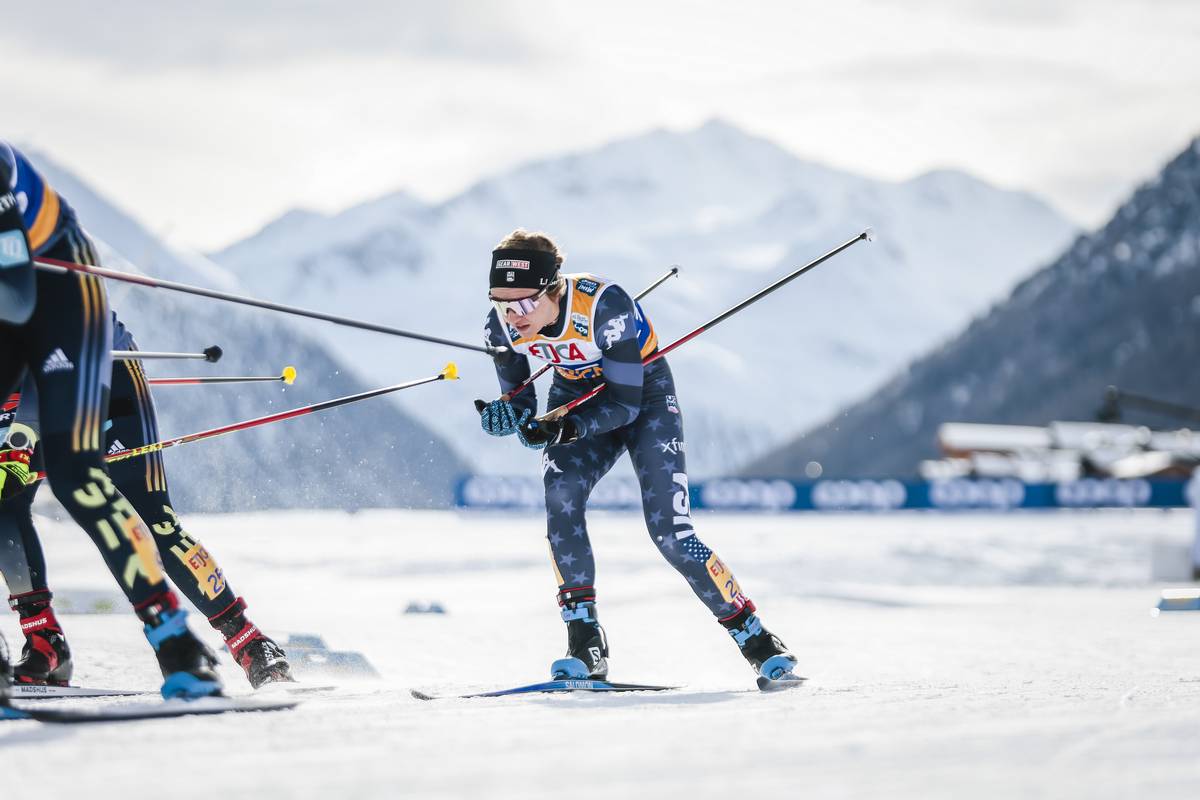
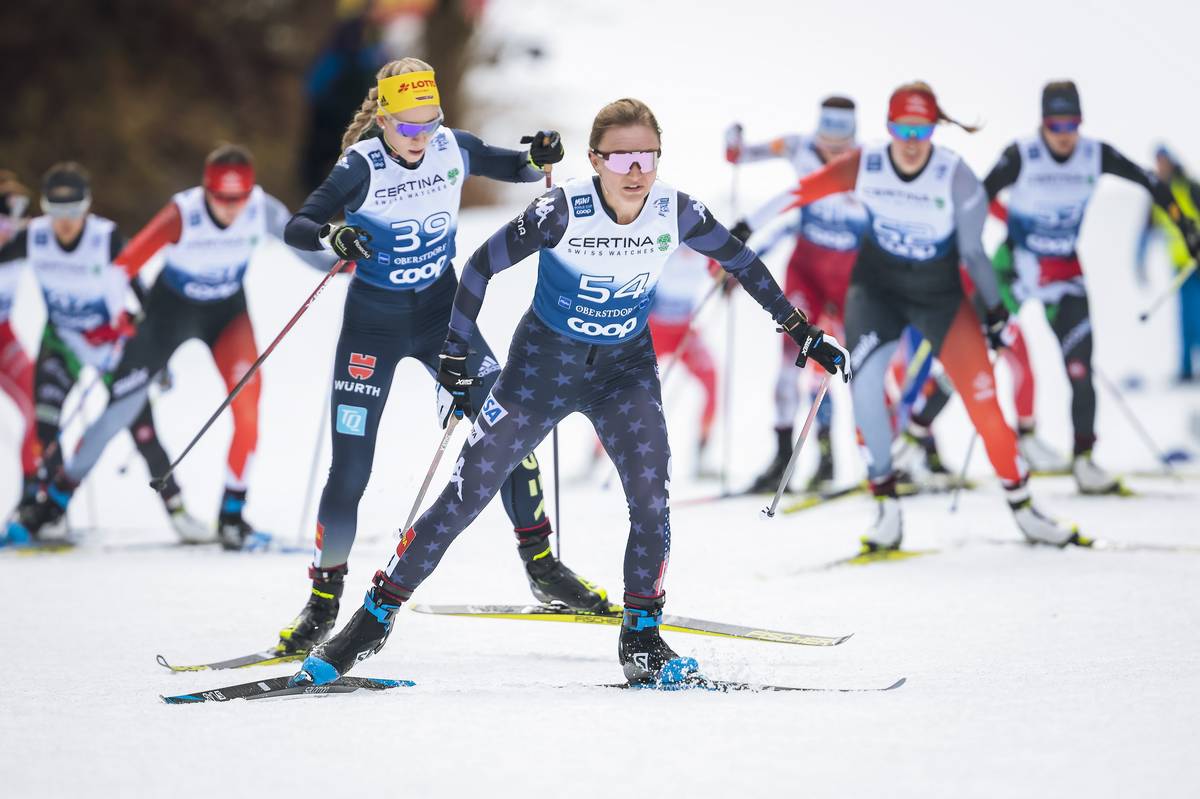
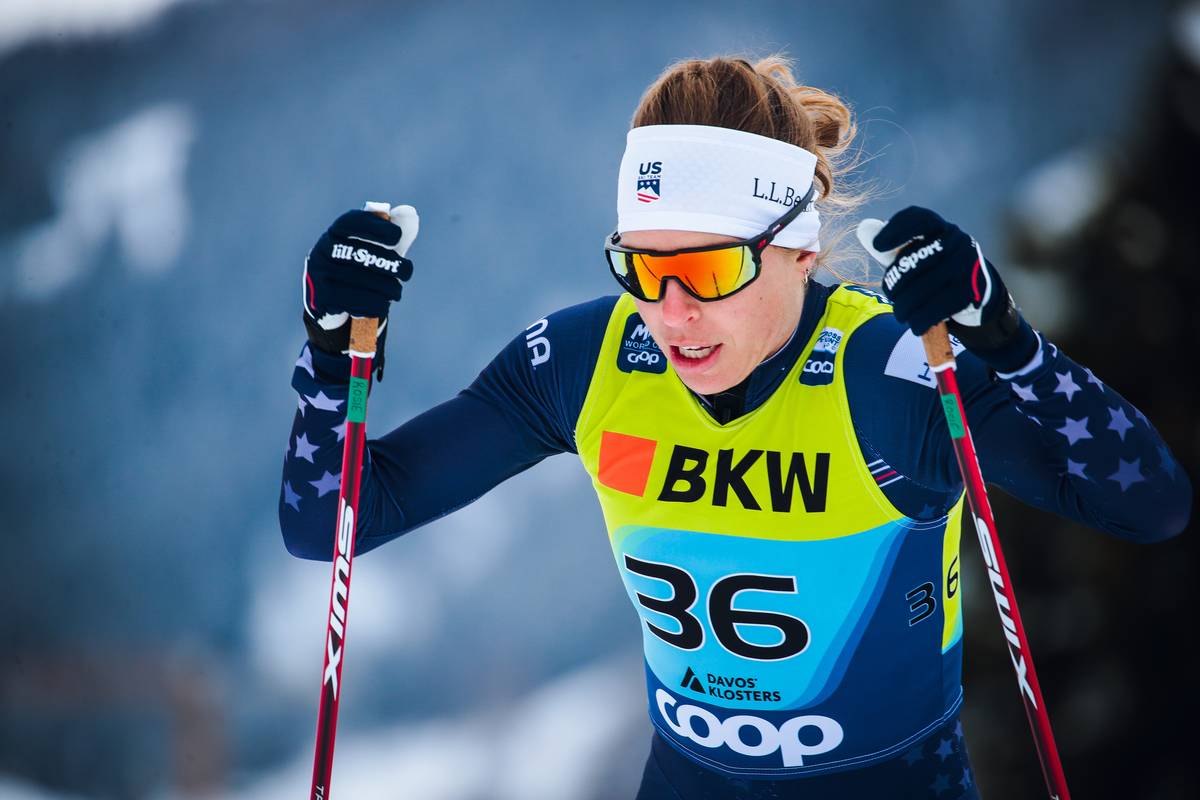
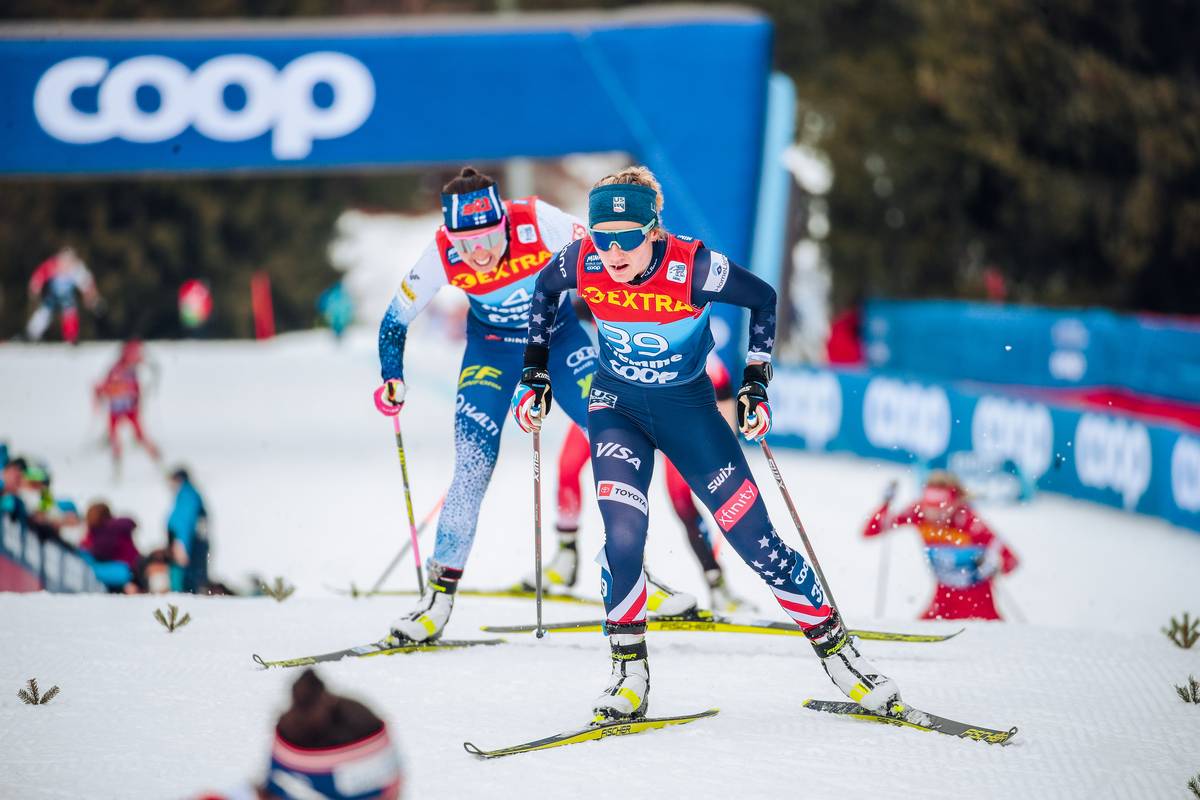
Alayna Sonnesyn clocks the 5th fastest time of ski during a 10k skate pursuit in Stage 4 of the 2023 Tour de Ski. (Photo: NordicFocus)
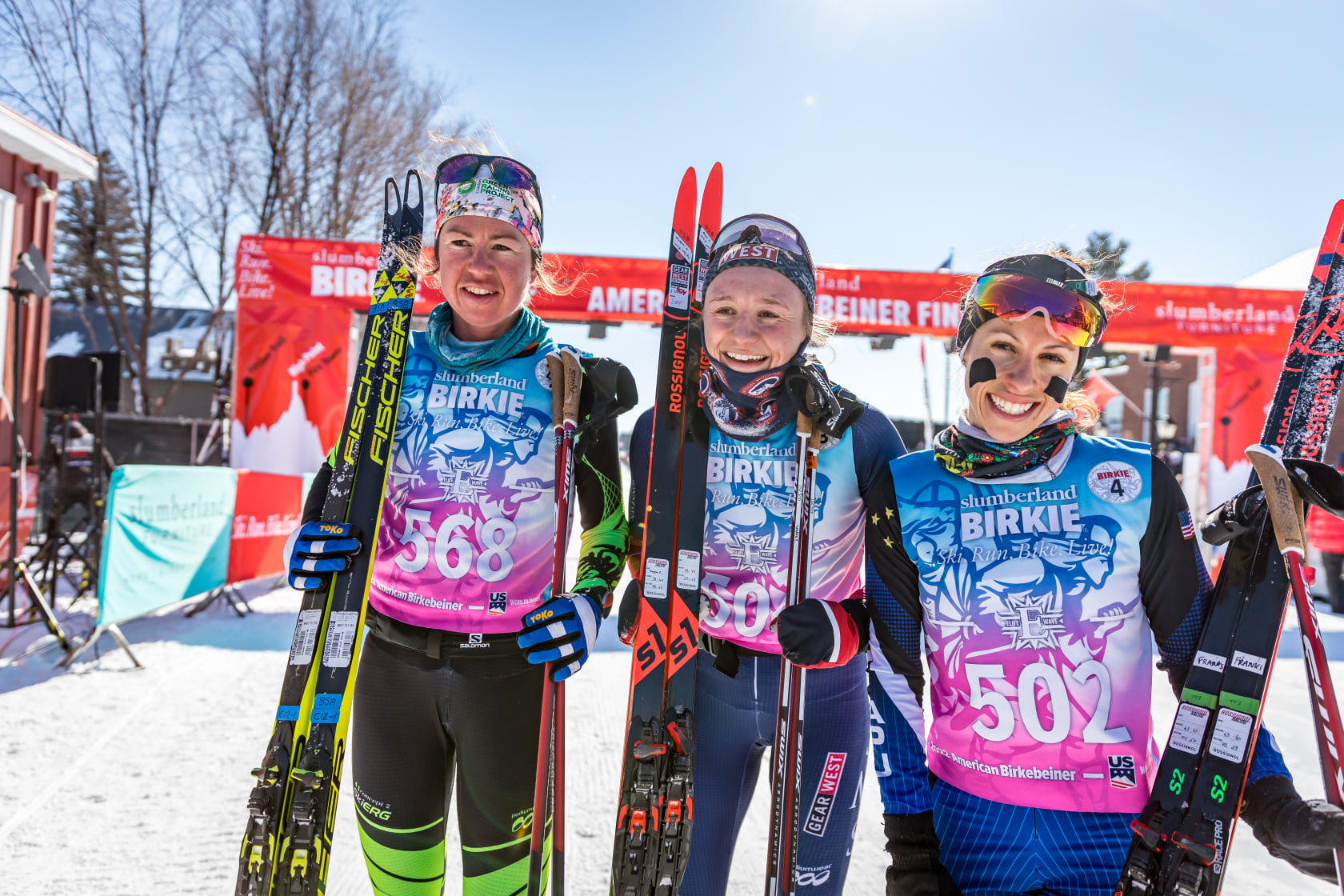
In this episode, we talk with Alayna Sonnesyn (SMS T2), who is coming off of her fourth consecutive victory at the American Birkebeiner in Hayward, Wisconsin. But the path between these victories, especially over the last two seasons, has not been smooth or direct.
Alayna has had standout results on the SuperTour, but that has not directly translated into consistent results on the World Cup, leaving her navigating the tricky waters of being what is often dubbed a “bubble athlete”. Last season, her reach goal was to make the Beijing Olympic Team, which would require putting all of her eggs into whichever race-pathway basket was most likely to get her there. Ultimately, she was not named to the team, and a positive COVID test shortly thereafter rubbed salt in the wound. She also ended the season one FIS point shy of making the objective criteria for National Team selection in 2022.
Alayna has been open about all of these setbacks both on social media and her blog – in particular, how difficult they can be to process in the moment. However, on paper, she has translated this journey into a career-best season. She’s cracked into the heats of two World Cup freestyle sprints, finished 26th in a 20k skate in Davos, and clocked the 5th fastest time of day in the same event during Stage 4 of the Tour de Ski in Oberstdorf, GER. She even beat SMS T2 teammate Jessie Diggins on a downhill segment.
Alayna talks through these experiences, where she’s at now, and of course, the Birkie during this episode. We also chat about her new podcast project, Extra Blue – which is well worth a listen – and who her dream guest and conversation would be. The answer is surprising.
Just a heads up – we did have a few connection issues which caused a few audio bumps. Thanks for listening!
In this episode, we chat with Hailey Swirbul, who – at just 24 years old – has been competing at the top end of the sport for quite some time. A bronze medal in the 4 x 3.3k relay at the 2017 Junior World Championships in Soldier Hollow put Hailey – and relay teammates Julia Kern, Hannah Halvorsen, and Katherine Ogden – on the map in a big way in US Skiing. Hailey has gone on to spend the better part of the last four years racing on the World Cup, earning 48 World Cup starts and one individual podium in the 10k skate in Davos in 2020. She’s currently preparing for the upcoming World Championships in Planica, Slovenia, which starts on February 22nd.
Following last year’s Beijing Olympics, Hailey opened up about the contrast in expectation versus reality in the Olympic experience, and how the high stress, high pressure environment of life in Europe, particularly in the lead-up to the Olympics, negatively impacted her mental health and felt increasingly unsustainable. She questioned whether she wanted to keep skiing at all, but eventually decided to keep at it, with a new approach. She took a full time engineering job in the summer, and decided to forego period one and two on the World Cup, racing the SuperTour and US Nationals domestically instead.
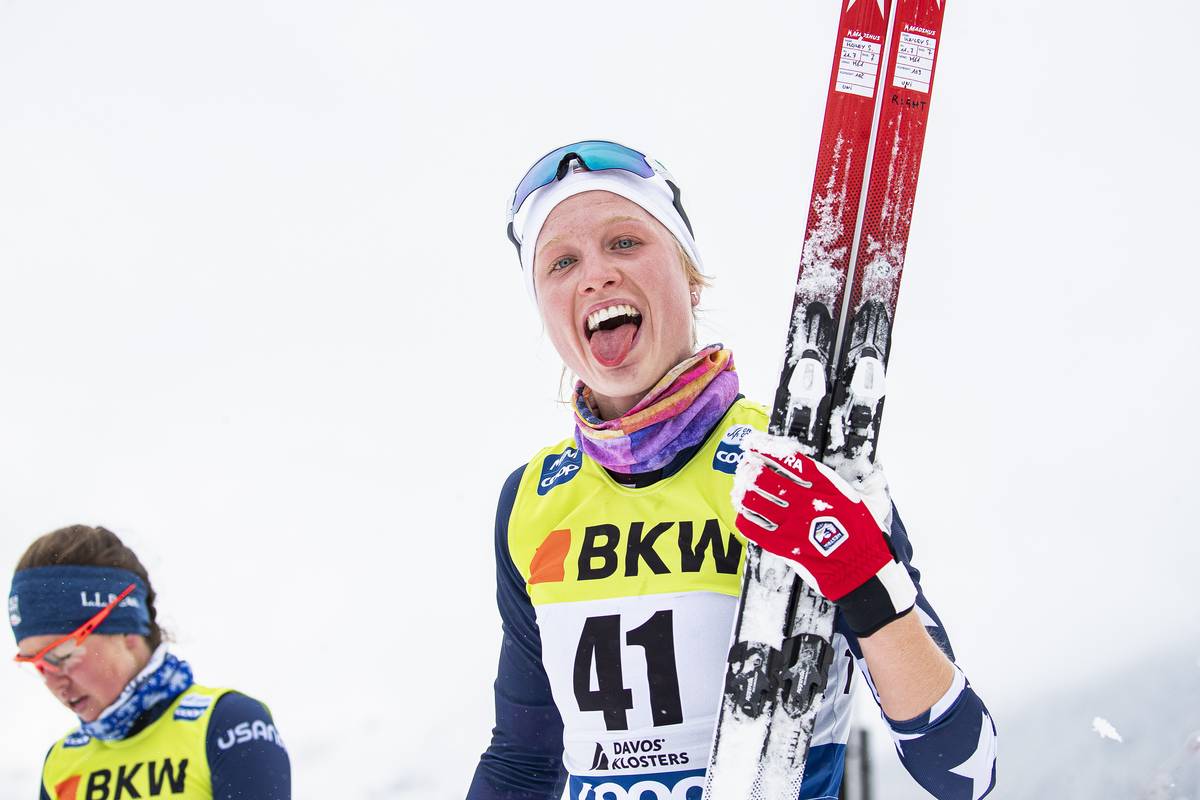
Hailey Swirbul enjoys her time in the leader’s chair after a solid performance in the 10k skate in Davos in December 2021. (Photo: NordicFocus)
As we discuss, this approach has rejuvenated her love for the sport and her motivation for the training and sacrifices it requires. And, it’s contributed to an outstanding season of racing, both domestically and internationally. She remains the SuperTour Leader as of recording, having earned a spot on the podium in all but one event, and swept all four events at the National Championships in Houghton, MI in early January. She seamlessly transitioned back onto the World Cup in Les Rousses, FRA where she raced into the semifinal of the classic sprint, followed by a top-20 result the following day in the 20k mass start classic. She qualified for the sprint heats again the following weekend in Toblach, ITA, was 26th in the 10k free the next day, and capped off the long weekend by scrambling for the US women’s relay team, which ended the day in bronze medal standing.
Thanks for listening, and thanks to Concept2 for supporting this podcast.
Hailey Swirbul pushes to the finish of the 10 k individual start classic during the 2022 Olympic Winter Games. (Photo: NordicFocus)
Ben Ogden finds himself in the rough during the classic sprint semi final in Les Rousses, FRA. (Photo: NordicFocus)
It’s been a minute! With the arrival of host Rachel Perkins’ second baby in July and a subsequent job shift, Nordic Nation has been on pause, but we are excited to relaunch now with the hope of producing these regularly over the coming months!
Our first guest of 2023 is the one and only Ben Ogden, who’s had a standout season of racing on the World Cup. Ben has cracked into the semifinals in four sprint races, while posting breakthrough results in distance racing also, like a 6th place finish in the 10k classic in Oberstdorf during the Tour de Ski. He finished the overall Tour in 13th, which is an historic result for the American men’s team. Following the Tour, he headed back home to Vermont, where he hopped into two EISA Carnival weekends – winning four for four – while wearing his UVM Catamounts kit for the final time. He returned to Europe in time for Les Rousses, where Ben qualified in 7th for the classic sprint, finishing 11th after a quick trip outside the V-board in the semis.
In this conversation, we discuss the factors that have contributed to his development as a professional skier, from mindset, to training, to an effort to make the World Cup lifestyle sustainable long term. We also discuss his recent trip back to the Northeast, what has made collegiate racing “special”, and more.
Thanks for listening!
Ben Ogden prepares for the final stages of the 2023 Tour de Ski in Val di Fiemme, ITA. (NordicFocus)
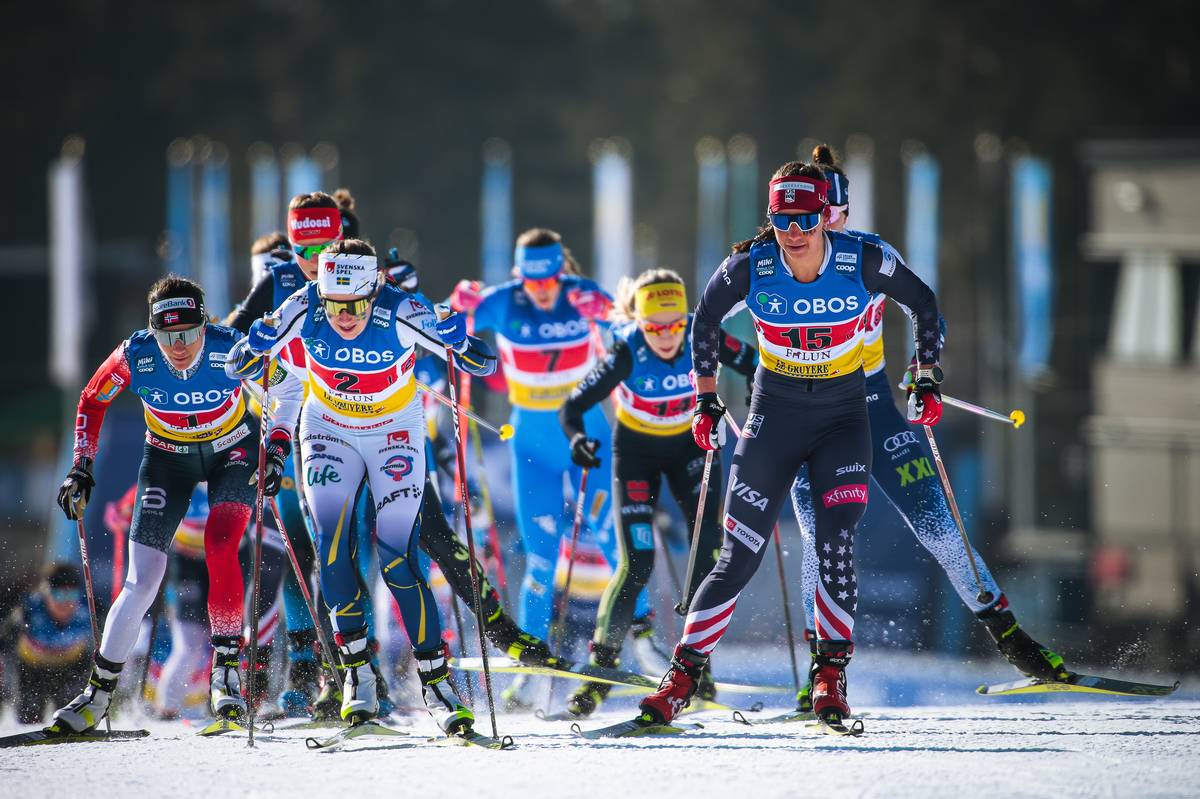
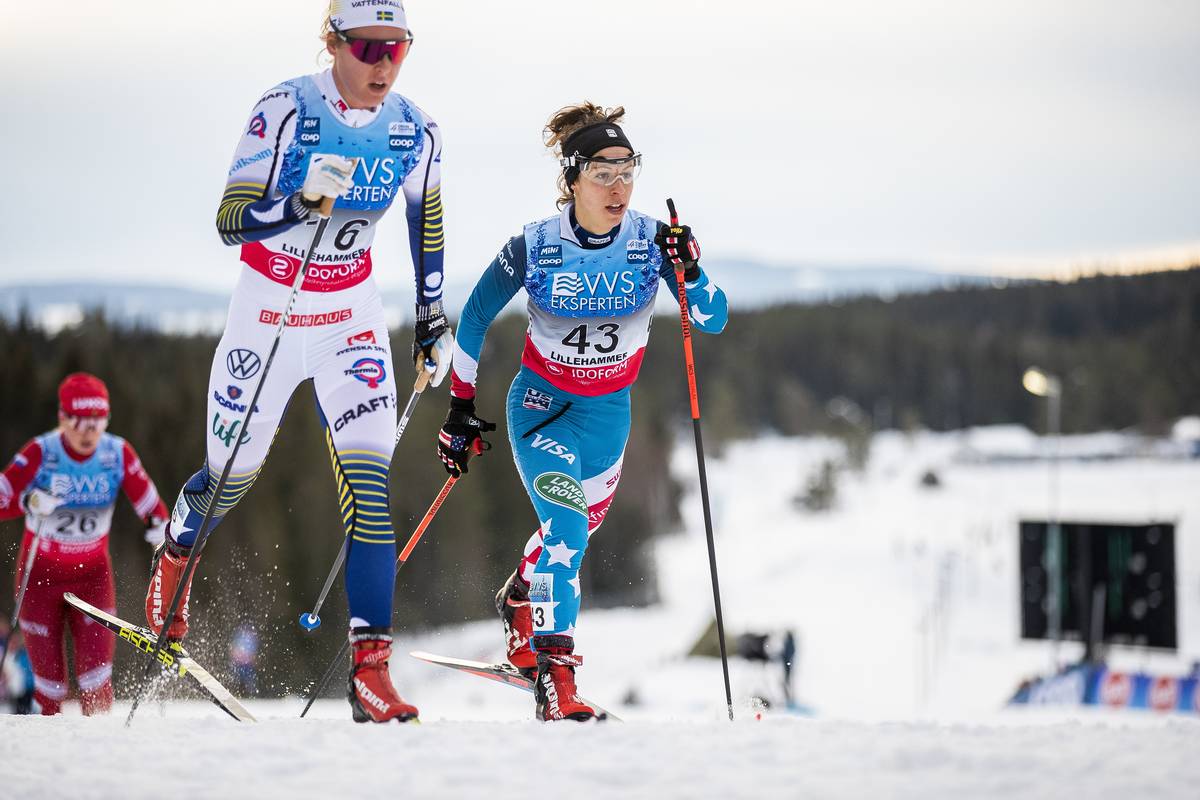
Julia Kern leads the pack during the first leg of the 4 x 5 k mixed relay in Falun, SWE in March 2022. (Photo: NordicFocus)
At 24-years-old, Julia Kern is quickly becoming a seasoned veteran in her 7th year on the U.S. Ski Team. However, her career trajectory has been stepwise, not exponential.
After making breakthroughs during the 2019-20 season, including her first World Cup podium in a skate sprint in Planica, Slovenia, she faced injuries and setbacks heading into the following season in 2020-2021, leaving her walking away from that season feeling disappointed in both her World Cup and World Championship racing. Reflecting on her takeaways in an interview that summer, she said “Progress isn’t linear from season to season.”
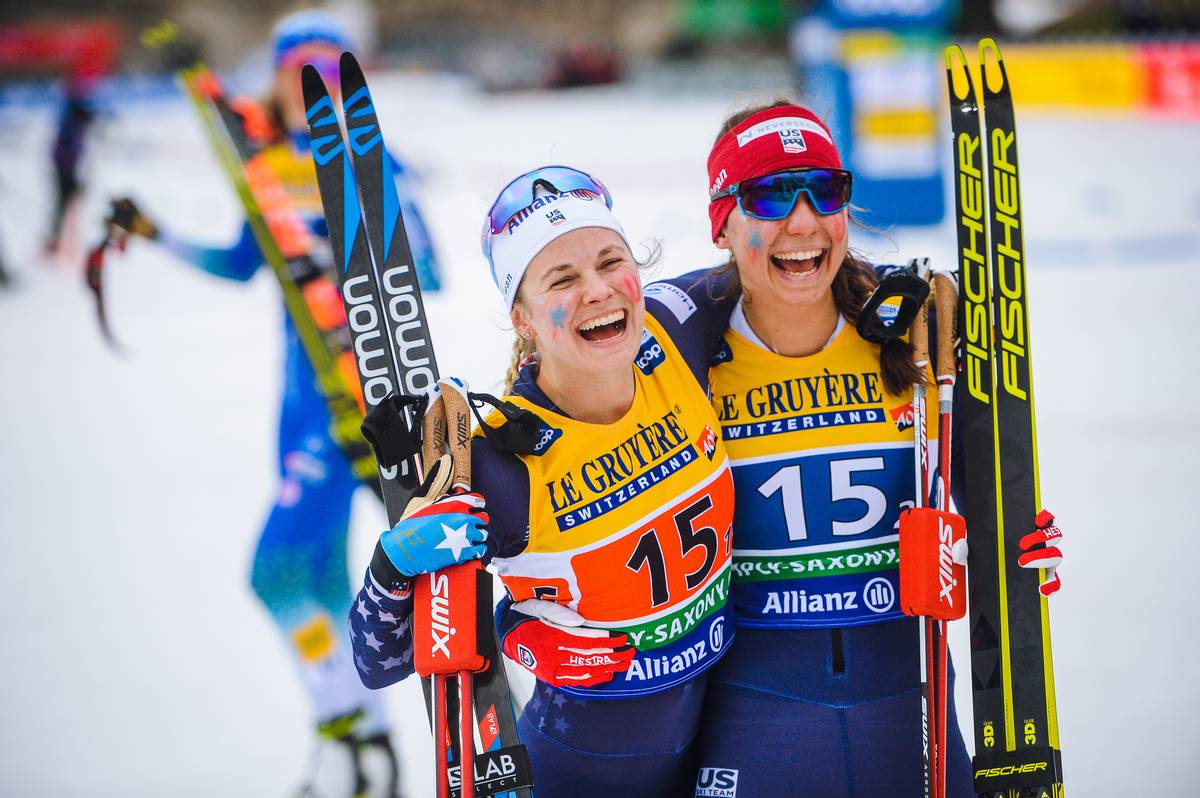
Hailey Swirbul (bib 19) and Julia Kern embrace at the finish of their first Olympic appearance in the 15 k skiathlon. (Photo: NordicFocus)
Recently named the recipient of the US Nordic Olympic Women’s Gold Rush Award for her grit and grace as a professional skier, Julia has demonstrated what it takes to rebound, reframe, and move past these challenges. As she describes in this conversation, the start of Julia’s 2021-22 race season happened in fits and starts – some strong early-season results with promising body sensations followed by a series of untimely mild illnesses. After catching a cold midway through the Tour de Ski in early January, she suddenly was faced with the reality that she would not have any opportunities to race until arriving in Zhangjiakou for the Olympics over a month later – the longest race break of her career.
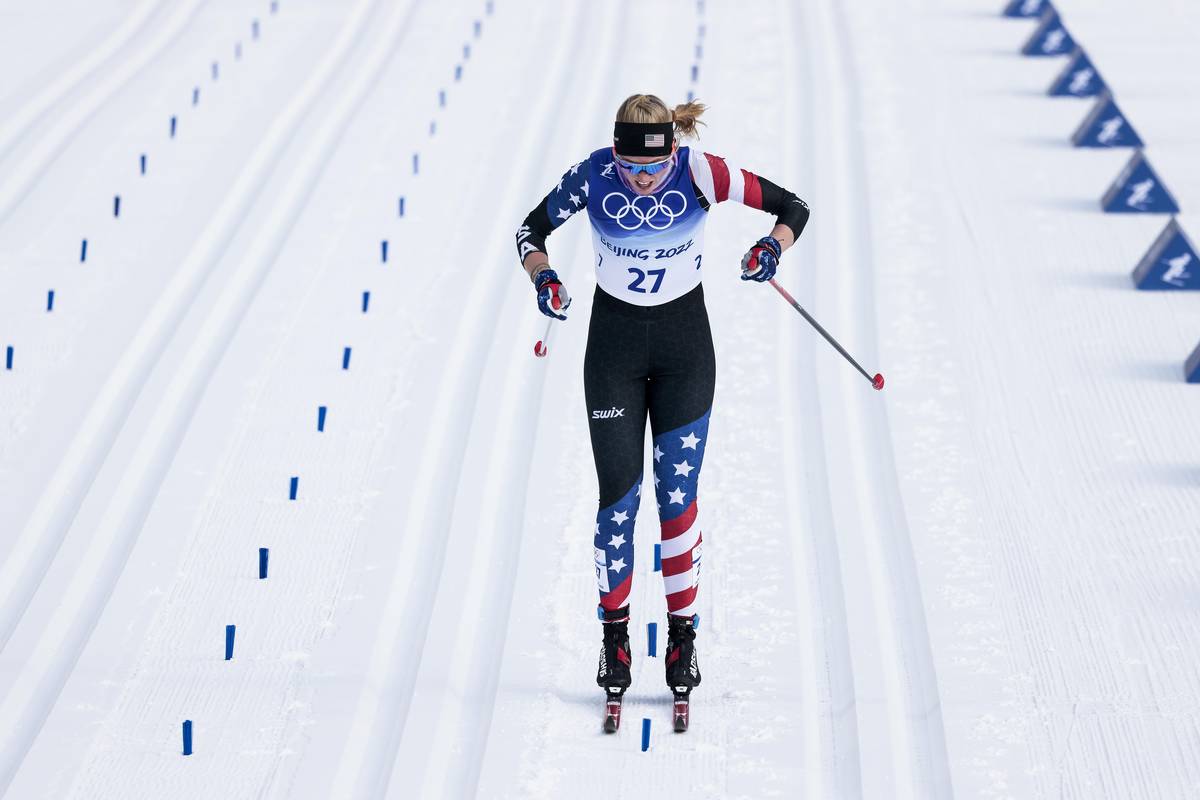
Her first Olympic appearance took place in the opening event, the 15 k skiathlon, where Julia finished 53rd. The individual freestyle sprint three days later was her goal race; Julia qualified in 14th and raced a gutsy quarterfinal, ultimately finishing fourth in the heat and 18th overall on the day. A myriad of factors left her wanting more from this first Olympic experience, though she approached it without placing high expectations on herself.
Jessie Diggins and Julia Kern take second in the team sprint in Dresden, GER in December 2021. (Photo: NordicFocus)
Rebounding once more after the Games, Julia began a tear of World Cup sprints in Period IV. She was 8th in the freestyle sprint in Lahti, 7th in the classic sprint the following week in Drammen, and finished just off the podium in fourth in the World Cup Finals in Falun. From there, she headed to Whistler to finish the season at the joint Canadian National Championships and U.S. SuperTour Finals, where she took second to Jessie Diggins in Jessie’s signature 5 k freestyle event, and won the remaining three races.
During this conversation, Julia discusses the highs and lows of the season, as well as how she has been able to compartmentalize and move past setbacks over the past few years of navigating the transition to the World Cup. We also discuss her start in the sport, why the Stratton Mountain School (SMS) T2 Team has been a good fit for her, and how leaning into other creative outlets, passions and work helps energize her for the long haul.
Thanks for listening and thanks to New Moon Ski and Bike for supporting this podcast.
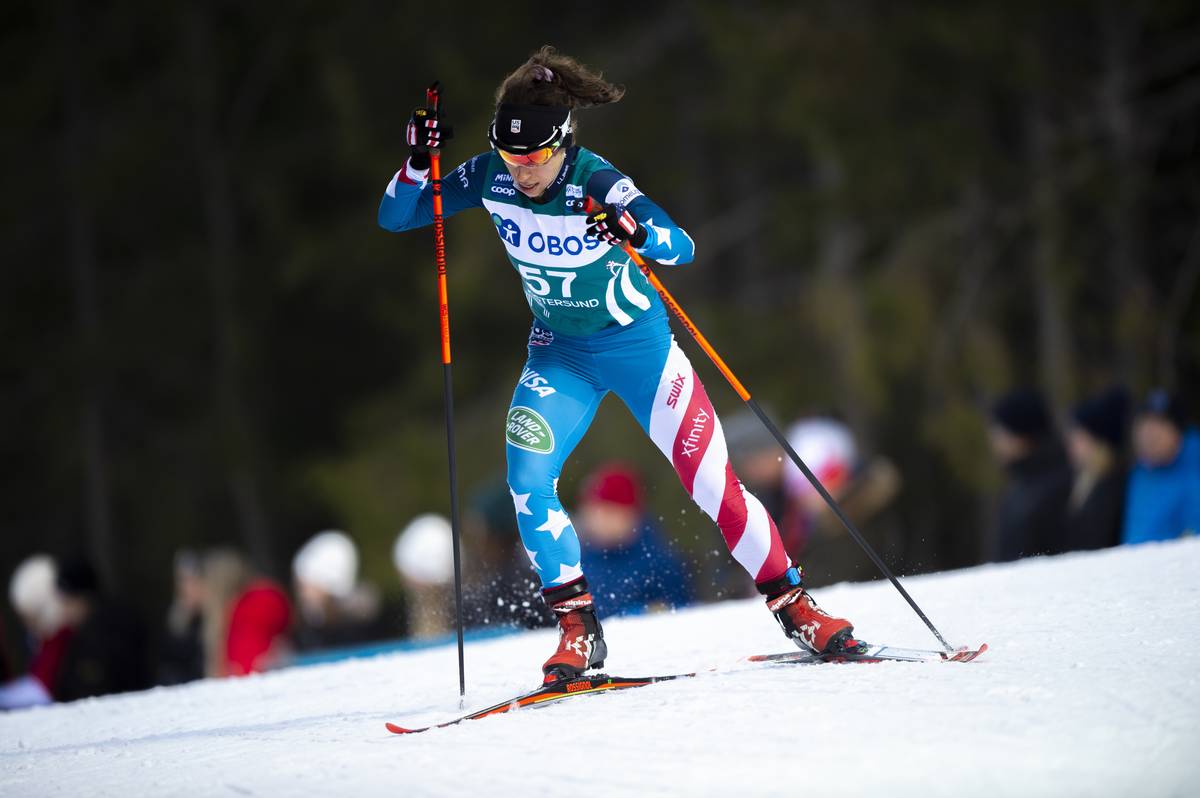
Julia Kern races the quarterfinal of the individual freestyle sprint in Zhangjiakou during the 2022 Beijing Olympic Winter Games. (Photo: NordicFocus)
Rosie Frankowski races a December 2019 skiathlon World Cup event in Lillehammer, NOR. (Photo: NordicFocus)
The Olympic Dream.
Perhaps the opportunity to compete at the highest level of sport would not be as sought-after and revered were it not for the inherent scarcity of opportunities to achieve it. This year, only eight women and six men were able to represent the United States in cross-country skiing in Zhangjiakou, down from a total of twenty – 11 women, 9 men – who were selected for PyeongChang in 2018.
Among those who came up just shy was 30-year-old Rosie Frankowski, who has spent the last eight years training with APU under head coach Erik Flora. Frankowski is a 2018 Olympian and 2019 World Championship competitor, finishing inside the top-30 in both places – 21st in the 30 k classic in Korea and 24th in the 15 k skiathlon in Seefeld.
Rosie Frankowski skis through wet falling snow to win the women’s 10k at the opening SuperTour weekend in Duluth, MN. (Photo: Jordan Woods/Woods Creek Productions)
After strong early season results that included two wins and three third place finishes in early season SuperTours, Frankowski lined up in Soldier Hollow for a two-week stretch of racing that felt like it was for all the marbles. As many women had already met the objective criteria for team selection via results on the World Cup, it was only the final few spots that remained open for domestic racers; in the hungry pool all fighting for these spots via some combination of U.S. Nationals, Sun Valley SuperTour, and Tour de Ski results were Frankowski, Caitlin Patterson, Alayna Sonnesyn, Katharine Ogden, Novie McCabe, and Sophia Laukli.
As Frankowski describes in this episode, her opening races – the freestyle sprint and the 20-kilometer mass start skate – of U.S. Nationals went remarkably well; despite being known as a distance specialist, she won the sprint qualifier and finished sixth in the final, then won the race for second place in the 20 k skate, behind Rosie Brennan who had dropped the field from the start. From there, Frankowski faced a series of challenges – slick skis and variable klister conditions in the 10 k classic, a fall in the classic sprint, and a sublexed shoulder in the opening race in Sun Valley.
Rosie Frankowski on course during a February 2020 World Cup in Östersund, SWE. (Photo: NordicFocus)
The official team nominations for the 2022 Beijing Olympics were released the following week, and Frankowski was named as the second alternate for the women’s team. Five months later, Frankowski finds herself at a transition point in her career. It’s not a cut and dry retirement as she has earned Period I starts on the World Cup and has other race objectives next winter, but it’s a shift in focus as she and her partner prepare to relocate from Anchorage, AK to Durango, CO.
In this conversation, Frankowski shares the highlights and challenges of the 2021-22 race season, and provides invaluable insights into the experience of spending her career as a “bubble athlete”, fighting for international race opportunities and team selection, while juggling the financial realities of supporting her professional ski racing career. She reflects on her time with APU, and discusses defining success when surrounded by “more-accomplished” teammates, and how she expects the ratio of mountain running to ski-specific training to shift after this transition.
Thanks for listening and thanks to Concept2 for supporting this podcast.
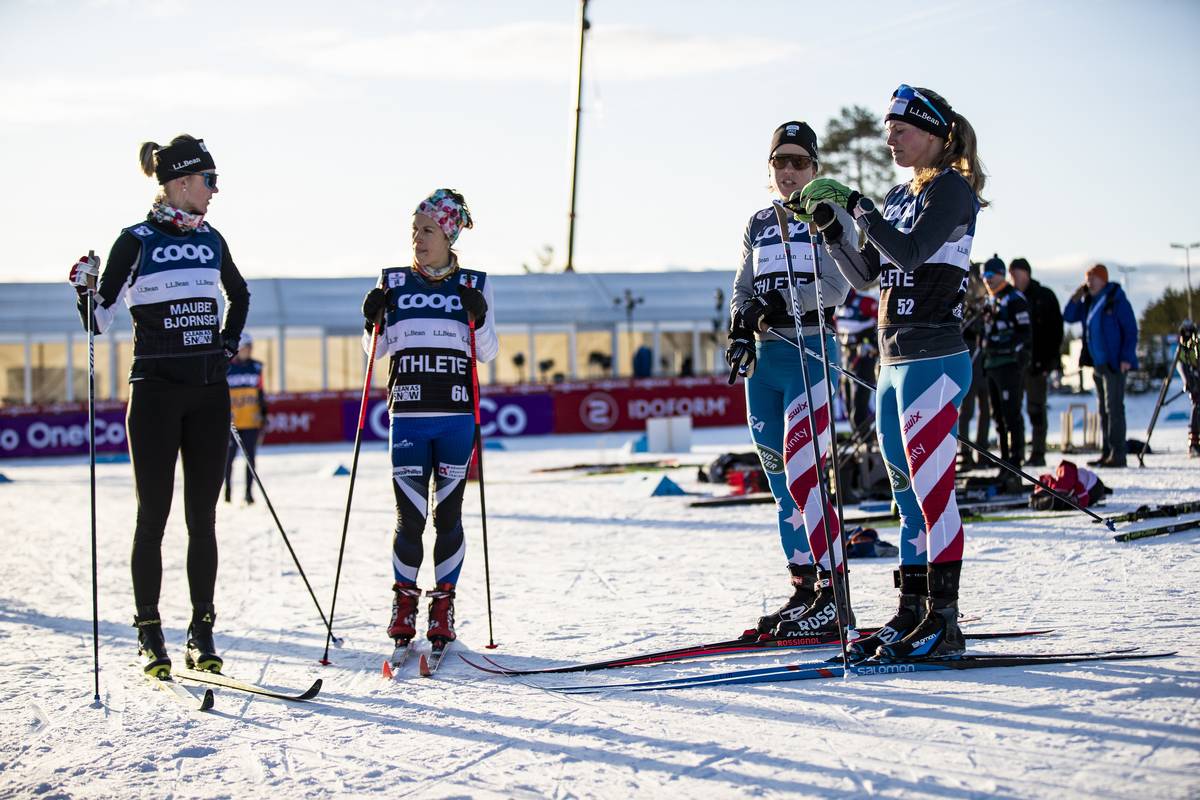
Scenes from a training day in Lillehammer in December 2019. From left to right, Sadie Maubet Bjornsen, Rosie Frankowski, Rosie Brennan, and Jessie Diggins. (Photo: NordicFocus)
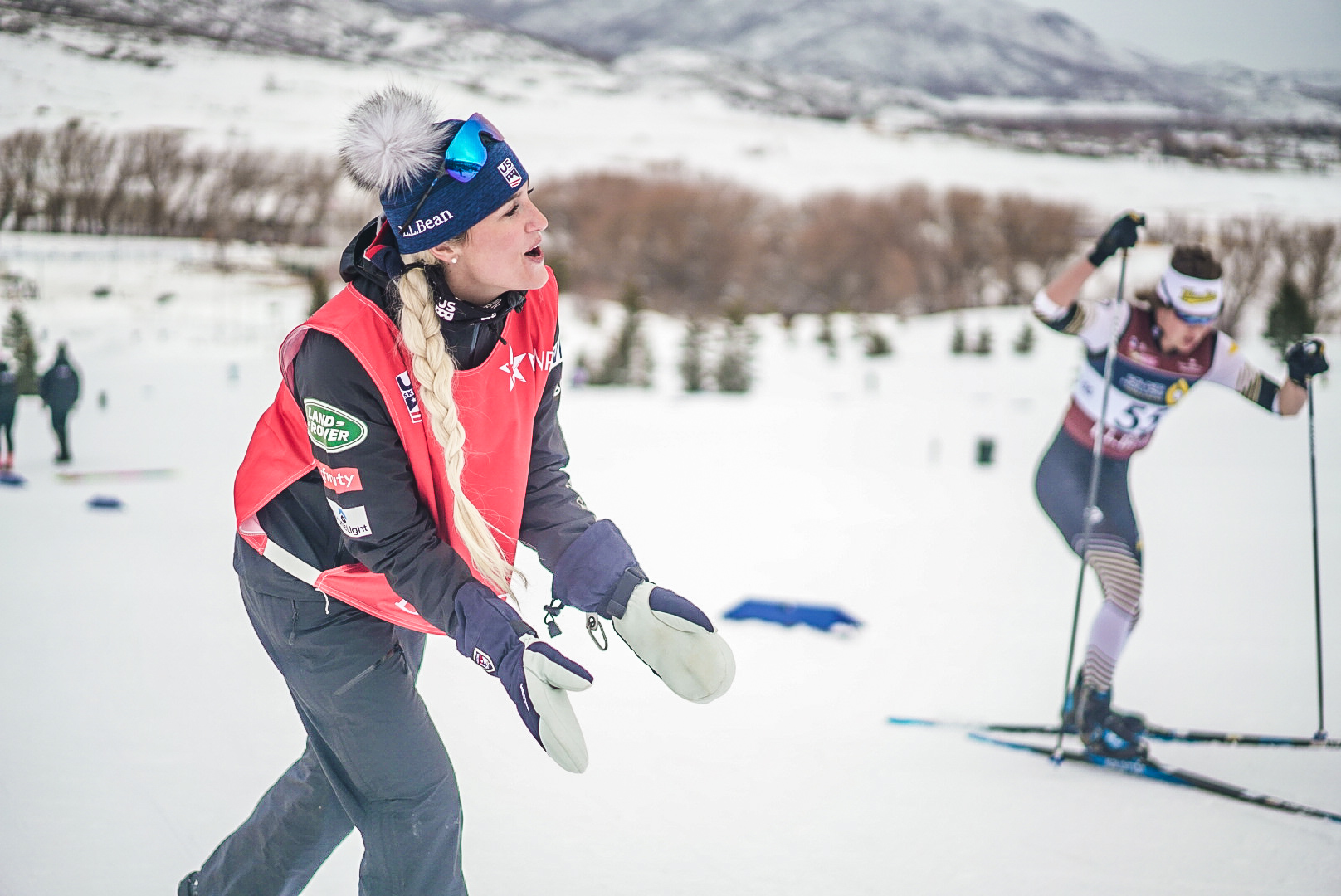
U.S. Ski and Snowboard Development Team Coach Greta Anderson encourages athletes racing the men’s 30k distance race during the 2022 U.S. Cross Country Championships in Soldier Hollow. (Photo: Tobias Albrigtsen / @untraceableg)
Last June, U.S. Ski & Snowboard announced the hiring of Greta Anderson as Development Team Coach, supporting Cross Country Program Manager Bryan Fish in “all aspects of leadership and logistics surrounding the U.S. Development Pathway, including National Training Group camps, U.S. Nationals and Junior/U23 World Championships, Europa Cup, select SuperTour and other national-level competitions, as well as working on Coaches’ Education and Certification.” (Read an in-depth interview with Anderson following the announcement here.)
As she described it, joining the U.S. Ski Team staff during an Olympic year while the COVID-19 pandemic raged on was a bit of “trial by fire.” Nonetheless, Anderson thrived in her new role, approaching the position with humility and open-mindedness as she learned the ropes. With a holistic view of athlete development, which emphasizes the importance of creating an environment where the athlete can be both happy and supported, Anderson had the opportunity to support athletes from the U16 to U23 level across the spectrum of international and domestic clubs and races. She played key roles during the 2022 FIS Junior/U23 World Ski Championships in Lygna, Norway, and had her first experience as the primary trip leader during the Opa Cup Finals pre-camp and competitions in Sappada, Italy.
U.S. Ski Team development coach Greta Anderson discusses the highlights and challenges of her first year in the role, as well as insights into the philosophy, projects, and initiatives of the national team development program more broadly. (Photo: Tobias Albrigtsen / @untraceableg)
In this conversation, you’ll hear more about Anderson’s contributions to the development program thus far, and she shares insights into the philosophy, projects, and initiatives the U.S. Ski & Snowboard staff are working on to continue the growth and support of athletes ascending the pathways from junior to senior racing. We also discuss standout performances of the World U23/Junior Championships, and some of the athletes who have been recently named to the 2022-23 U.S. Cross Country Team.
Thanks for listening, and thanks to Boulder Nordic Sport for supporting this podcast.
Note: One of the athletes whom Anderson discusses is Finn O’Connell, who skis for the Bridger Ski Foundation Pro Team in Bozeman, MT. While he was supported by development team coaches at the Opa Cup Finals, his nomination was to the B-Team, not the D-Team.
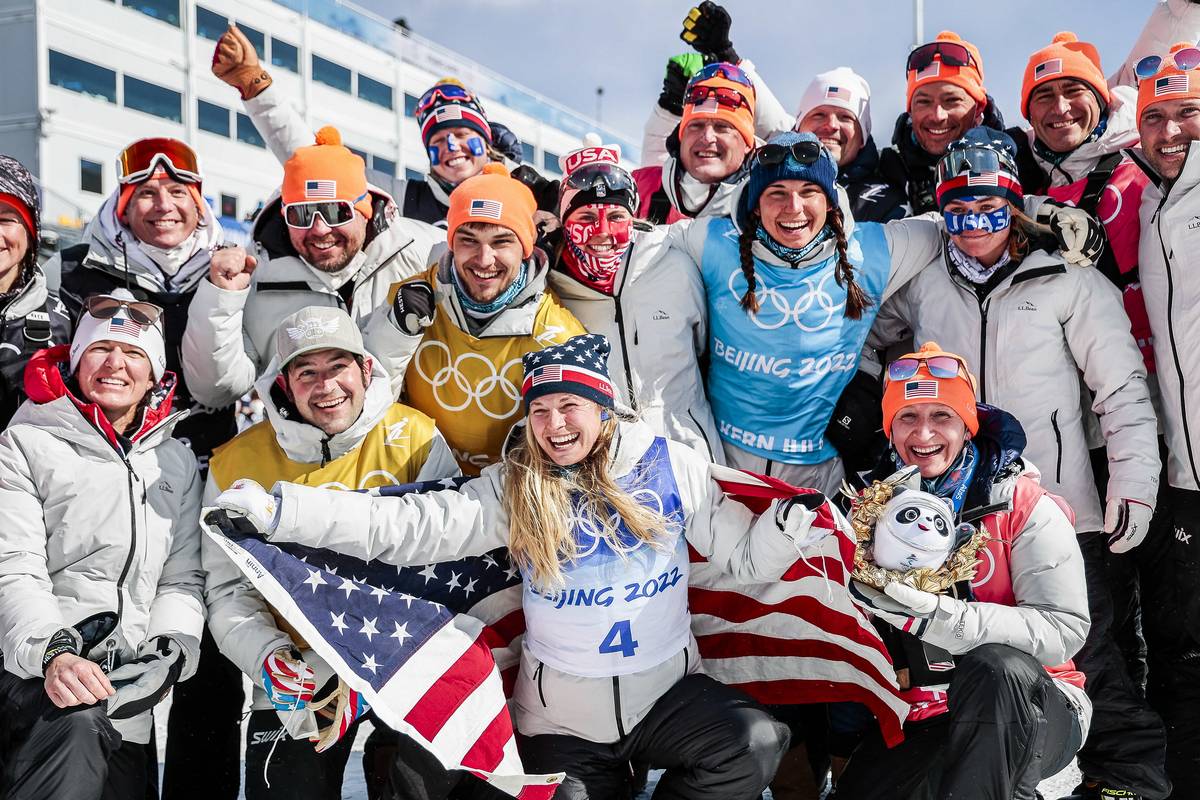
Celebration abounds following Jessie Diggins’ Olympic silver medal in the 30 k mass start skate in Zhangjiakou, CHN. U.S. Ski Team head coach Matt Whitcomb and cross-country program director Chris Grover wear orange hats near the top-right corner. (Photo: NordicFocus)
I think we can all agree that the last two years have been a wild ride.
For those at the helm of the cross-country program at U.S. Ski & Snowboard, added layers of COVID safety precautions and expensive testing have increased the otherwise mounting demands of preparing for an Olympic Games. There have been numerous domestic and international competitions canceled, including a full season of SuperTour racing in 2020/2021, numerous World Cups canceled, and three consecutive years where the World Cup finals were either rescheduled or canceled. Amidst ever-changing travel policies country to country, the U.S. Ski Team tested, masked, and problem solved their way through two race seasons.
U.S. Ski & Snowboard XC Program Director Chris Grover oversees training during a 2019 U.S. Ski Team camp in Bend, OR. (Photo: FS Archives)
Throw into the mix preparations for an Olympic Games at a brand new venue where teams would be arriving site unseen and COVID testing protocols were extreme, and cap the season with the invasion of Ukraine and subsequent ban of the Russian cross-country powerhouse – there’s simply been a lot of curveballs thrown.
But as the 2022/2023 season approaches, we also sit at a transition point for World Cup racing that perhaps marks a few steps forward with gender parity. Namely, a move toward equal distance racing and the adoption of an initiative proposed by U.S. Ski & Snowboard to the FIS to incentivize supporting and developing more women to become ski technicians at the World Cup level. In this proposal, an additional set of course access bibs which could be used to test skis and product at World Cup events would be available only to women; therefore, a country could increase the size of its service staff by investing in the development of women techs and utilizing these women at World Cups.
Though Grover explains this may best serve the nations with the biggest budgets – which does not include the United States – it’s greater purpose aligns with other grassroots initiatives at U.S. Ski & Snowboard to hire, develop, and support women in coaching and leadership to improve the balance of men and women representing all levels of the sport.
There’s also a recently-released 2022-23 roster of U.S. Ski Team athletes, featuring a bloom of young talent on the men’s side whose trajectory may enable a full field of men and women to race at the 2026 Olympic Games in Milano Cortina. And, there’s momentum building for a Minneapolis World Cup in 2024, followed by a trip to the Northwoods of Wisconsin for a super-Birkie – i.e., a World Cup sprint and 50k on the Birkie trails.
In short, there were no shortage of talking points for this insightful conversation with cross-country program manager Chris Grover, who joined us from his home in Hailey, ID upon returning from the U.S. Ski Team’s first training camp of the season at the Mt. Bachelor Nordic Center in Bend, OR.
Thanks for listening.
Masked up, Jessie Diggins and Ebba Andersson (SWE) congratulate one another on podium performances in the 10 k skate in Falun in Mar. 2022. (Photo: NordicFocus)
It’s likely that today’s guest needs no introduction. Over the last decade, she has steadily worked to become the most decorated American cross country skier in history. As she gained more recognition beyond the niche of cross country skiing, she began to use her platform to become an advocate for causes she felt passionately about, opening up about her own experience struggling with an eating disorder and working hard at recovery through the Emily Program, and also becoming an athlete ambassador for Protect Our Winters (POW) to advocate for policy changes to combat climate change.
Jessie Diggins takes Olympic bronze in the individual freestyle sprint in Zhangjiakou. (Photo: NordicFocus)
Heading into the Olympics in February, Jessie Diggins received more media attention than ever before, landing on the cover of Sports Illustrated and having her profile featured on major news outlets like the New York Times. There was an entire category for her career highlights on the Olympic cross country ski tab on NBC’s Peacock streaming platform.
From all of the coverage focused on Diggins surrounding the Games, one comment in particular received attention and push back from the athlete community. The line in a February 8th story in the NY Times suggested that Diggins looked “like a sprite in her racing suit,” comparing her body to her competitors’ who had “massive shoulders and thighs.” It was seen as inaccurate, inappropriate, and potentially harmful to those reading it.
To discuss the topic of body comments in sports journalism and why they might be harmful in the broader scope of athlete mental health, the Nordic Nation podcast recently hosted a discussion among the panel of Rosie Brennan, Corrine Malcolm, Brian Metzler, and Nat Herz, who span the breadth of athlete and media representative. Following the conversation, FasterSkier received feedback that the topic had already been given enough attention, and it remained clear that there was not unanimous understanding of why commenting on athletes’ bodies was deemed problematic.
Seeking to add clarity to this side of the story, along with her own perspective as someone who has experienced an eating disorder and since become an advocate for awareness and support in that realm, Diggins reached out to FasterSkier asking to add her voice to the conversation.
To be clear, neither Diggins nor FasterSkier aims to “cancel” NY Times author Matthew Futterman, nor to attack the NY Times for running the comment. The purpose of this discussion was to consider how a comment on an athlete’s body might be triggering to a reader who is primed to fall into the eating disorder trap, and how writers, parents, coaches, and teachers can be mindful of the impact and importance of what they say.
Jessie Diggins races through the heats during the Olympic freestyle sprint in Zhangjiakou, China. (Photo: NordicFocus)
Diggins also reflects on the 2021/2022 race season and what was an historic string of Olympic appearances. She discusses the success of the US Ski Team as a whole, in particular, the younger generation of athletes like Novie McCabe, Sophia Laukli, Ben Ogden, JC Schoonmaker, and Gus Schumacher, who have transitioned onto the World Cup over the last two seasons and earned spots on the 2022 Olympic Team.
Thanks for listening.
Additional Resources and Related Reading & Listening:
WithAll Foundation and the What to Say Campaign. As discussed in the episode, Diggins and Gus Schumacher participated in a live discussion with this organization on March 31st titled “What America’s Top Athletes Know About Health & Performance”, which can be viewed here.
The Emily Program: A leader in eating disorder treatment and outreach, and partner of Diggins’
FasterSkier also shared two OpEd pieces surrounding this topic, one from our own contributor Ben Theyerl and a second from reader Ivy Spiegel Ostrom, highlighting individual responses to the NY Times comment and underlying issues of body comments in the media, along with another separate OpEd by Rachel Bachman Perkins on the prevalence of eating disorders and disordered eating in sport.
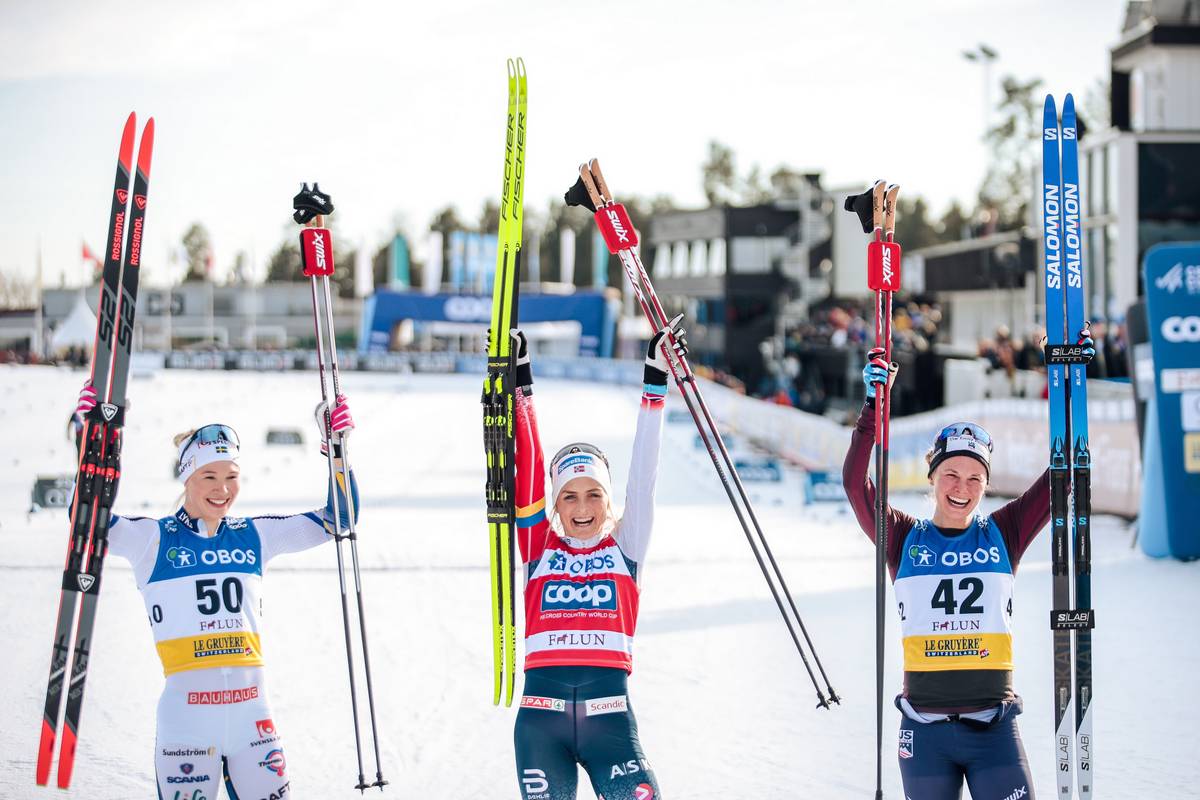
Jessie Diggins races onto the podium in the 10 k free during the 2021/2022 World Cup Finals in Falun, Sweden. Norway’s Therese Johaug took the win, with Sweden’s Jonna Sundling in second. (Photo: NordicFocus)
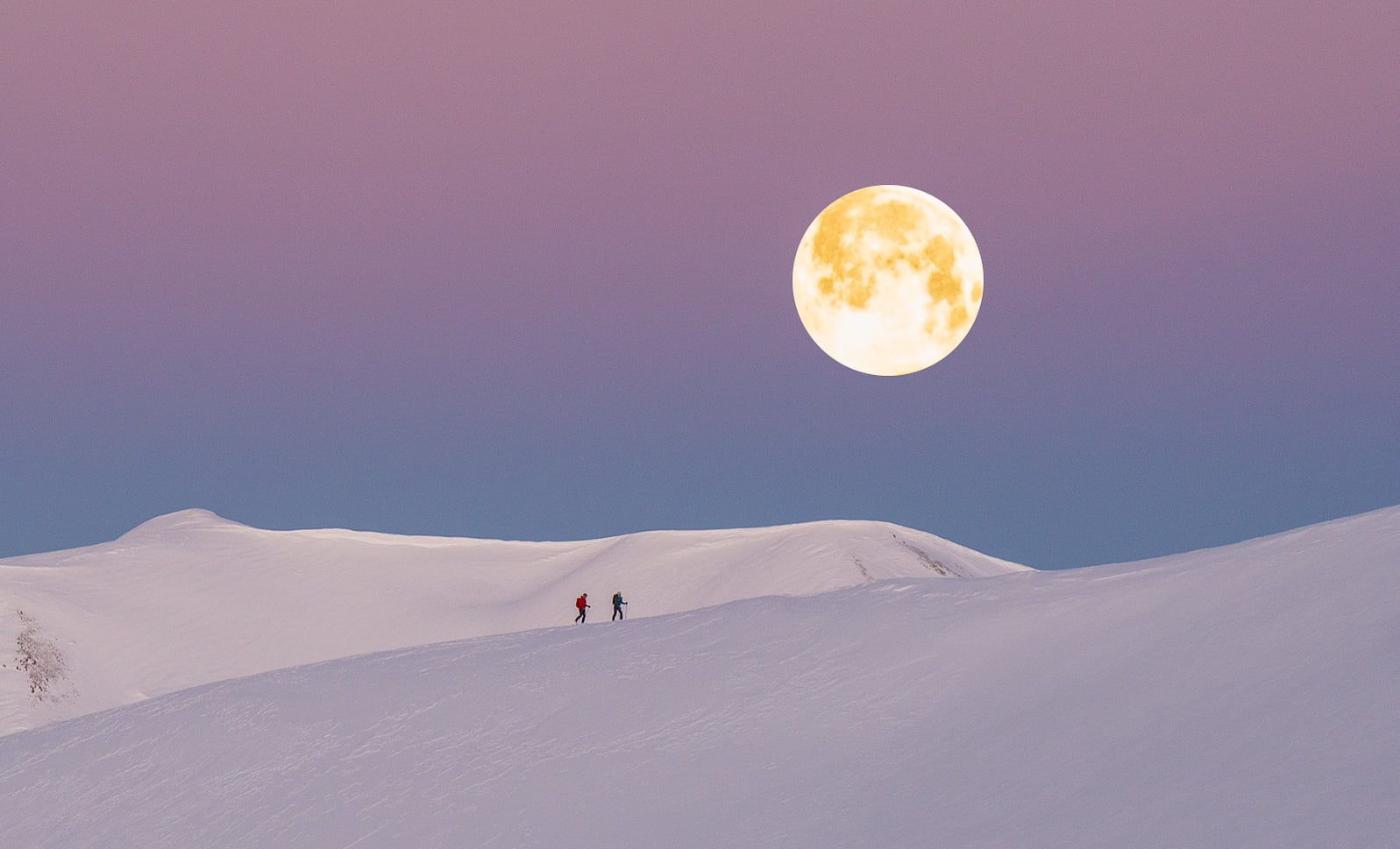
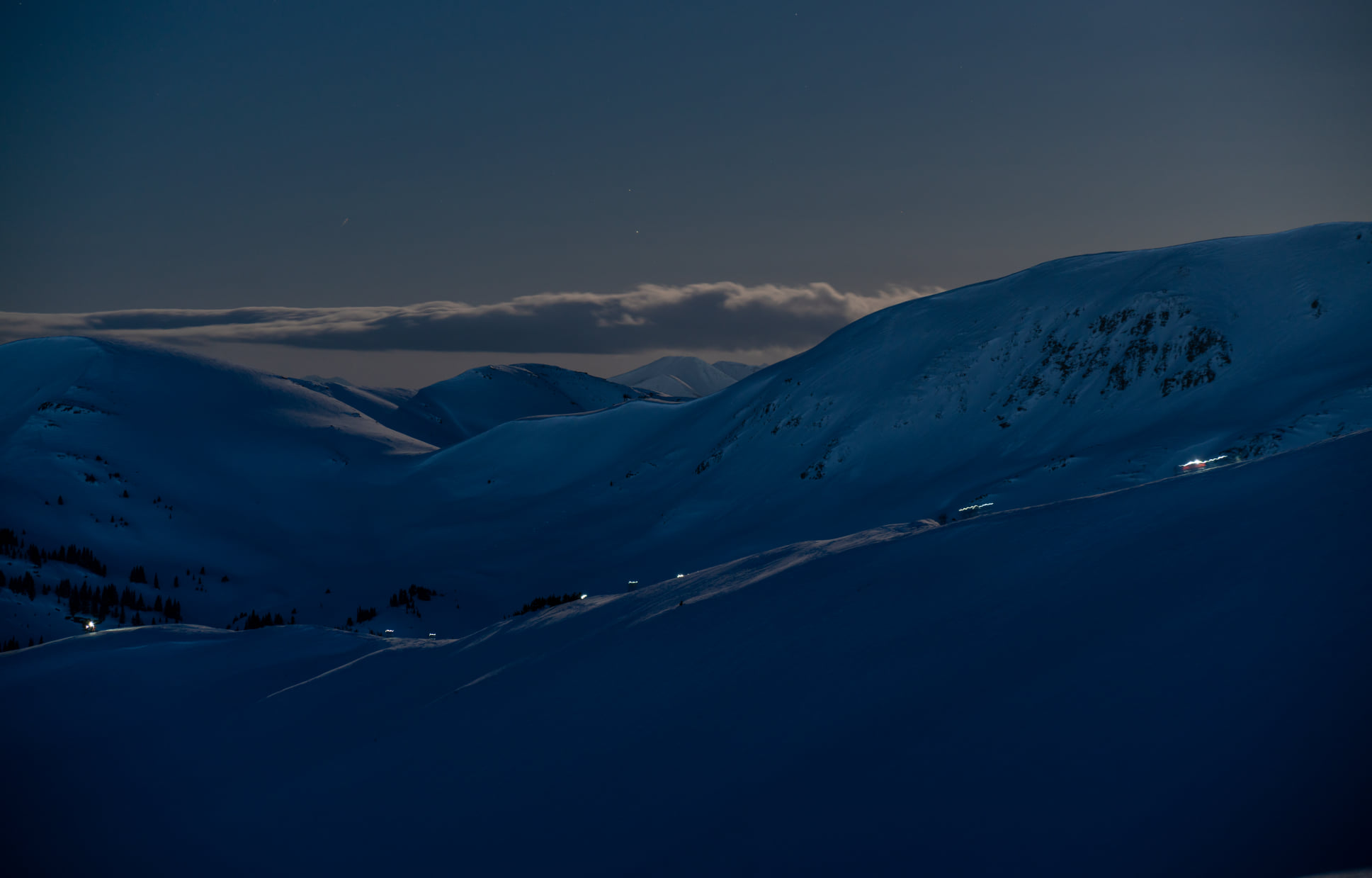
The 2021 Grand Traverse saw a magical full moon under clear skies and mild temperatures. (Photo: Jesse Levine / Crested Butte Nordic)
Tucked deep into snowy valleys, the tiny iconic Colorado mountain towns of Aspen and Crested Butte are separated by a mere 40 miles by foot, but roughly 200 miles by car in the winter. Separating the two is the expanse of the rugged Elk Mountain range, which features six of Colorado’s 14’ers, peaks that reach above 14,000’.
Now meccas of outdoor recreation, the two towns were historically established as profitable coal and silver mining sites, following the forced removal of the native Ute residents in the late 1800’s. In those days, communication between towns during the winter relied on the fortitude and alpine savvy of mail carriers, who skied back and forth between towns through burly terrain across a notoriously unstable snowpack.
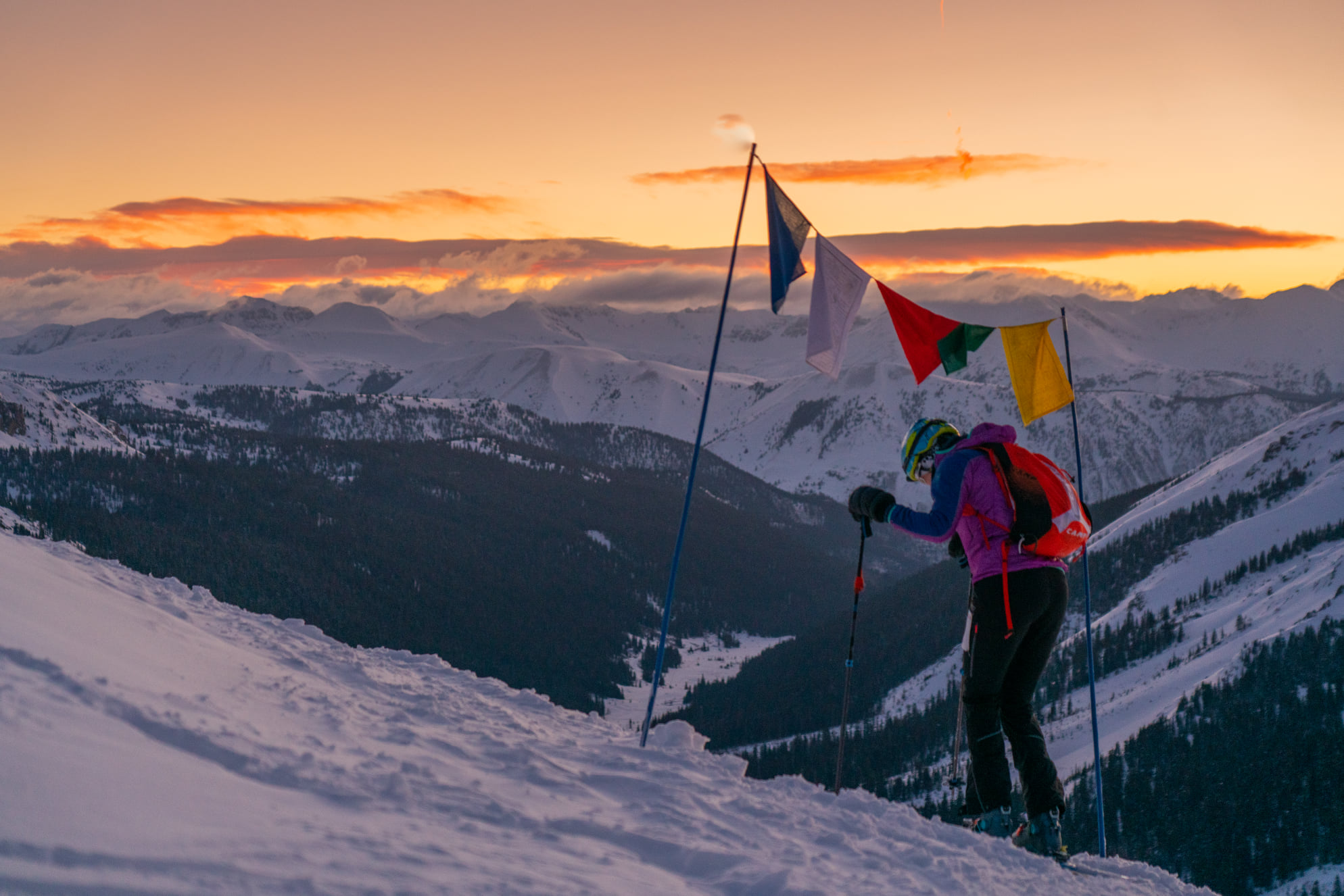
A 2021 Grand Traverse racer descends off of Star Pass at sunrise. (Photo: Jesse Levine / Crested Butte Nordic)
In 1998, this historic route was revived as a backcountry ski race called the “Grand Traverse”, which begins at the base of the Mt. Crested Butte ski resort and travels north over two 12,000-plus foot passes, with roughly 8,000 feet of elevation gain spread over the roughly 40 mile route. The inaugural winners (athletes must race in pairs), racing on metal edged cross country skis, were Aspen’s Travis Moore and Pierre Wille, local legends, and accomplished cross country skiers and alpinists. Moore, who taught at Aspen High School for more than 20 years and continues to coach the cross country ski program, eventually became the coach of a young Aspen resident, Simi Hamilton.
For many living in the Roaring Fork or Gunnison river valleys, the Grand Traverse (GT) is a storied annual pilgrimage, respected for the unique and burly nature of the route and its local lore as a rite of passage for endurance enthusiasts. Adding to the mystique, the race begins at midnight, allowing racers to cross the highest avalanche risk sections while snow is presumably frozen, firm, and at its most stable. The avalanche safety arsenal of beacon, shovel, and probe are part of a long list of items athletes must carry for safety, along with extra layers, an emergency shelter, and other items that reflect how deep into the backcountry the route leads and what it might take to survive a night out in the elements should something go awry.
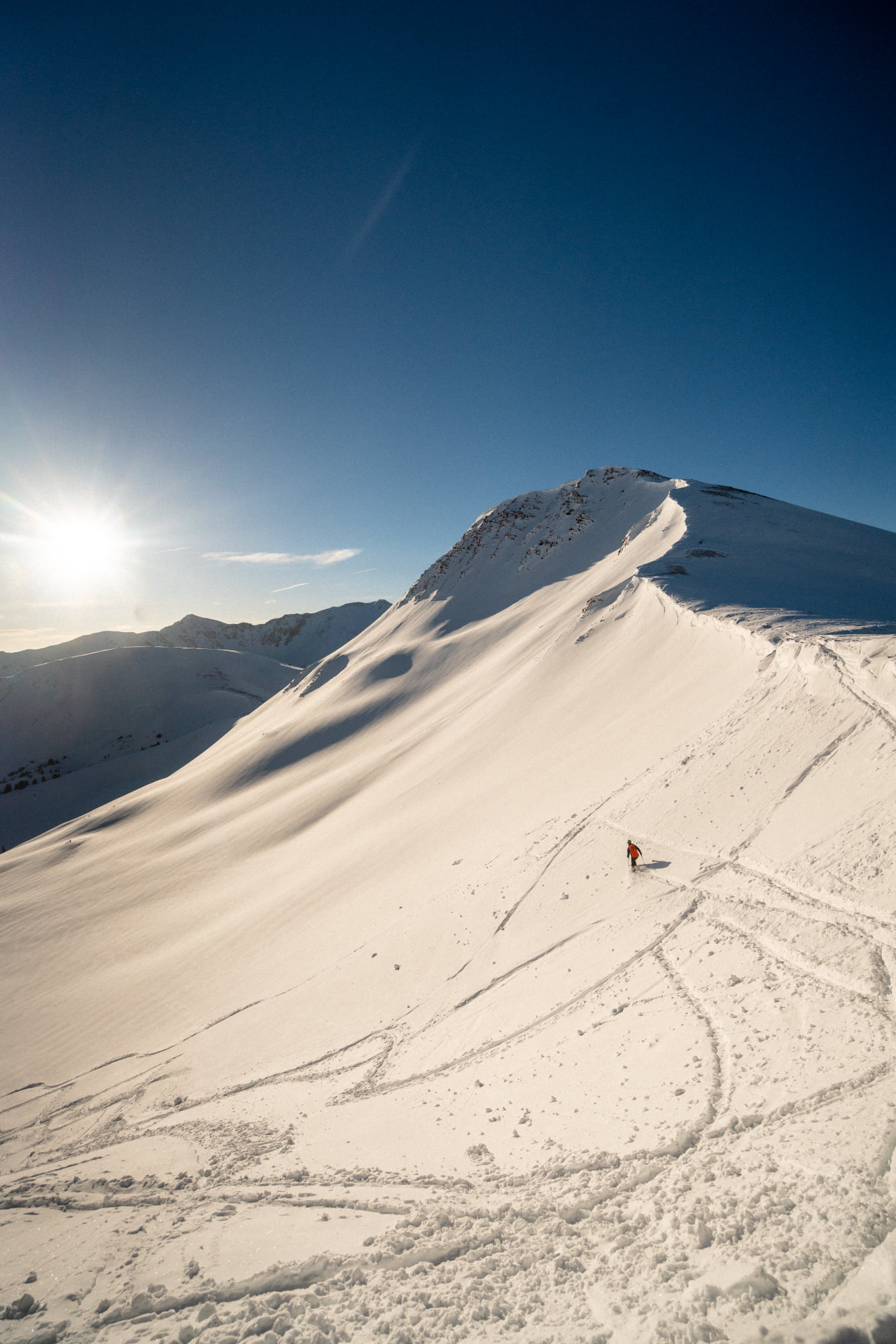
A 2021 Grand Traverse racer receives instructions for the descent off of Star Pass from the safety dispatch stationed there. (Photo: Jesse Levine / Crested Butte Nordic)A racer descends off of Star Pass during the 2021 Grand Traverse ski race. (Photo: Jesse Levine / Crested Butte Nordic)
With the rapid advancements in ski mountaineering technology, few still commit to cross country skis for the GT – SkiMo race skis with AT bindings or lightweight backcountry or telemark gear are more stable and typically handle better descending off the passes. But this year, the team of “Yeah, but we can skate” showed skinny skis aren’t yet an antiquated option for success at the GT, particularly if you’ve got the skills of two Olympians who have continued to foster their love for mountain adventures on boards less than 43 mm underfoot.
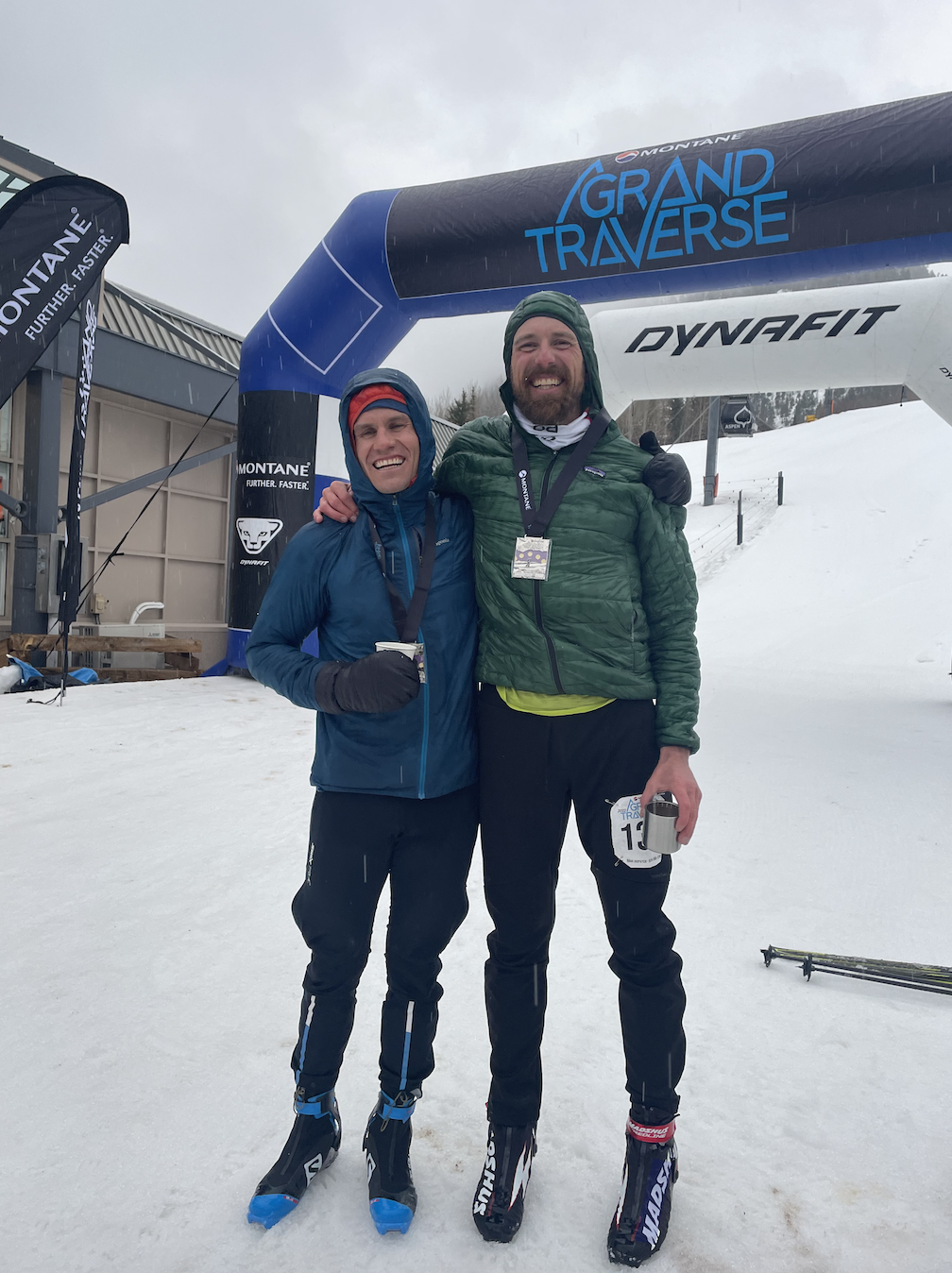
The duo was Simi Hamilton and Ben Koons, who lined up on Fischer skate skis. After a fast start skating out of Crested Butte, the team leapfrogged with eventual winners and top SkiMo athletes Cam Smith and John Gaston, who eventually broke away as conditions favored wider skis and metal edges. Smith and Gaston made it to Aspen in 6:13:15.4, just over 36 minutes ahead of Hamilton and Koons. (Results here)
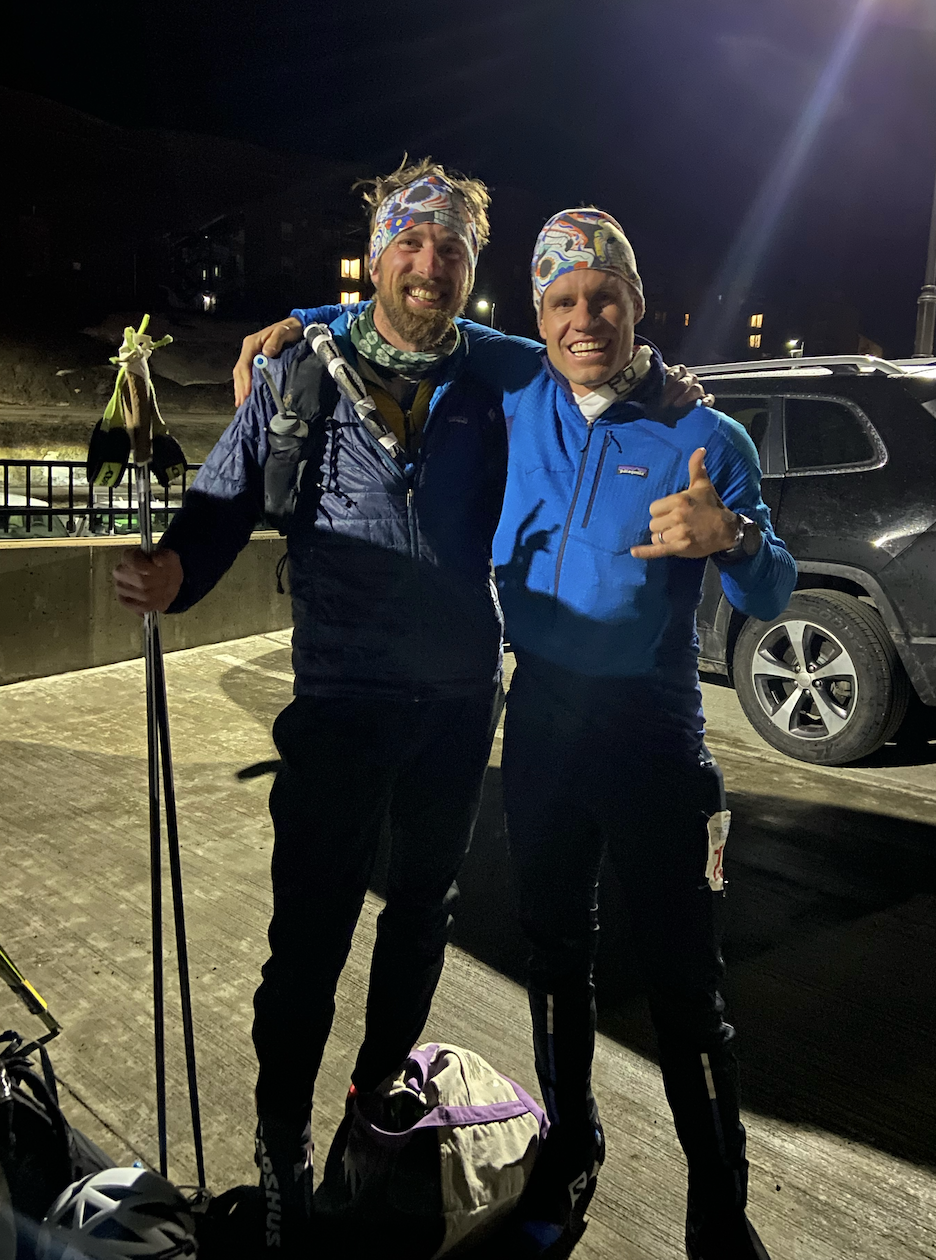
Before and after: still smiling. (Photos: Sophie Caldwell Hamilton)
Though Hamilton won the GT running race in early September, 2021, it was his first crack at the storied winter event. For Koons, it was his sixth crack at chasing the ideal crust cruising conditions that might allow a strong skater with some backcountry experience under their belt to smash the course record and take the win on skinny skis. The two have shared a number of big adventure days in the mountains on ski, foot, and bike, often with a third friend, Linden Mallory, who grew up in Aspen with Hamilton and raced on the Dartmouth ski team with Koons, and later became one of his GT partners.
While last year boasted perhaps the most ideal conditions, with athletes racing on firm and stable snow under a full moon in mild temperatures with minimal wind, this year, mother nature had a few twists up her sleeve. The week leading into the race saw a little bit of everything springtime in the mountains has to offer: warm sunny days, heavy wet snow, rain, wind, and plenty of freeze-thaw cycles. Consequently, this was shown in the snowpack, leaving Hamilton and Koons with far less skateable conditions, lots of breakable crust, some “spicy” downhills. Nevertheless, with only one broken pole, they were still smiling at the finish, and seemingly aren’t ready to accept defeat just yet.
A train of headlamps climbs Star Pass during the 2021 Grand Traverse. (Photo: Jesse Levine / Crested Butte Nordic)
For more with Hamilton and Koons, you can head to the Grand Traverse Instagram account, where the duo was interviewed pre and post-race, along with a video capture of their finish, in the rain, at the base of Aspen Mountain. For those interested in testing their mettle in next year’s Grand Traverse ski, registration opens at midnight on December 1st and spots fill very quickly. For those looking to explore the route in the summer, there is also a Grand Traverse run and bike race happening Labor Day Weekend. The events are among the primary fundraisers for the Crested Butte Nordic Center.
Though the FasterSkier team would select other highlights from the 2022 Beijing Olympic Games, one of the most read articles we produced featured the responses of members of the ski community to a story published on February 8th by the New York Times, which included the following quote:
“In a sport that has so many women with massive shoulders and thighs, Diggins looks like a sprite in her racing suit, and it’s not clear exactly where she gets her power. But the power is there, as she flies up hills, and comes off climactic turns with a burst. On the downhills, she tucks low and cuts through the air.”
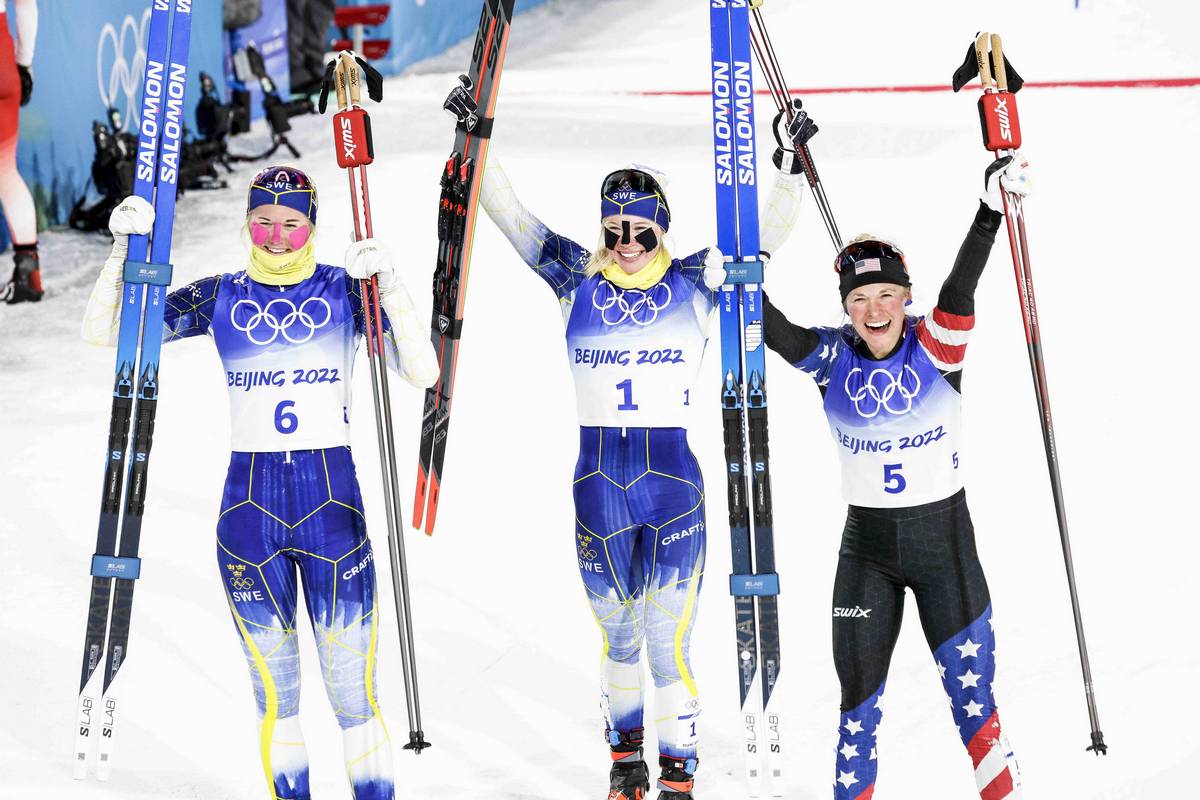
The women’s Olympic 1.5-kilometer freestyle podium: Sweden’s Jonna Sundling took gold ahead of teammate Maja Dahlqvist and American Jessie Diggins. (Photo: NordicFocus)
Following the initial backlash sparked by the quote has prompted a number of insightful conversations – and questions – on how athletes, men and women, are portrayed by the media, whether there is room for descriptions or comparisons of athletes’ bodies to narrate a scene for a reader, and how the landscape of sports media has shifted with time.
For this discussion, FasterSkier brought together a panel that spans both the athlete and media perspective on the issue.
Perhaps needing the least introduction for this audience, the first voice you’ll hear belongs to Rosie Brennan. In addition to her role as one of the top American cross country skiers for more than a decade, Brennan is also an advocate for the organization Voice in Sport which provides mentorship for developing female athletes across all sports. And she was a member of the women’s Olympic skate sprint final in Zhangjiakou, taking fourth place just behind Diggins, the race which sparked the discussion in the first place.
Putting together another highlight weekend in Davos, Rosie Brennan skis to 4th in the 10k individual start skate. (Photo: NordicFocus)
The second belongs to professional trail and ultra runner Corrine Malcolm, whose first go at professional endurance sport was in biathlon, from which she retired in 2014 after experiencing overtraining syndrome, likely coupled by relative energy deficiency in sport (RED-S). Alongside her athletic career, Malcolm has become a coach for other endurance athletes, while also becoming an advocate for women in sport, and has also engaged with this topic from the media side of the coin while calling some of the top ultra running events worldwide, including the Western States Endurance Run in California and the Ultra Trail du Mont Blanc (UTMB) which begins and ends in Chamonix, France. She’s also the co-host of an engaging podcast called Trail Society, which dissects challenging topics in the trail and ultra-running space.
Biathlete turned professional trail and ultra runner Corrine Malcolm discusses body comments in the media on the Nordic Nation podcast. (Courtesy photo)
We’ve also got Brian Metzler, an award-winning veteran journalist and author in the endurance space who currently writes for a number of publications including Outside, Competitor, Women’s Running, Triathlete, and Trail Runner magazines. Writing with perspective from his own athletic career, Metzler is Colorado Running Hall of Fame inductee (2015) who adventures on foot, ski, and sometimes alongside a burro, throughout the high country of Colorado.
Long-time sports journalist and author Brian Metzler joins FasterSkier’s panel to discuss body comments in the media. (Photo: brianmetzler.com)
Lastly, you’ll hear a cameo from our own Nat Herz, on lunch break from his “real job” as a full-time reporter for the Anchorage Daily News. Having written for FasterSkier from 2009 through 2015 before making a return this year as our 2022 Olympic Correspondent and co-host of the Devon Kershaw Show, Herz shares insights from his time covering cross country skiing paired with those from behind a very different desk.
Some of the talking points discussed include:
Initial responses to the NY Times story
A writer’s responsibility to be informed on the sport being covered, in addition to the physical and/or mental health challenges that may be pervasive in that setting
Differences between American and European media, and shifts in focus, norms, or trends in sports media
Differences, or lack thereof, of covering athletes of different genders
Please note that the Craftsbury Green Racing Project Ski and Biathlon teams and U23 summer programs are currently accepting applications for the upcoming training year, which will close on April 10th. Click here for more information.
Jessie Diggins (USA) and Rosie Brennan find their position in the early moments of the women’s freestyle sprint final. (Photo: NordicFocus)
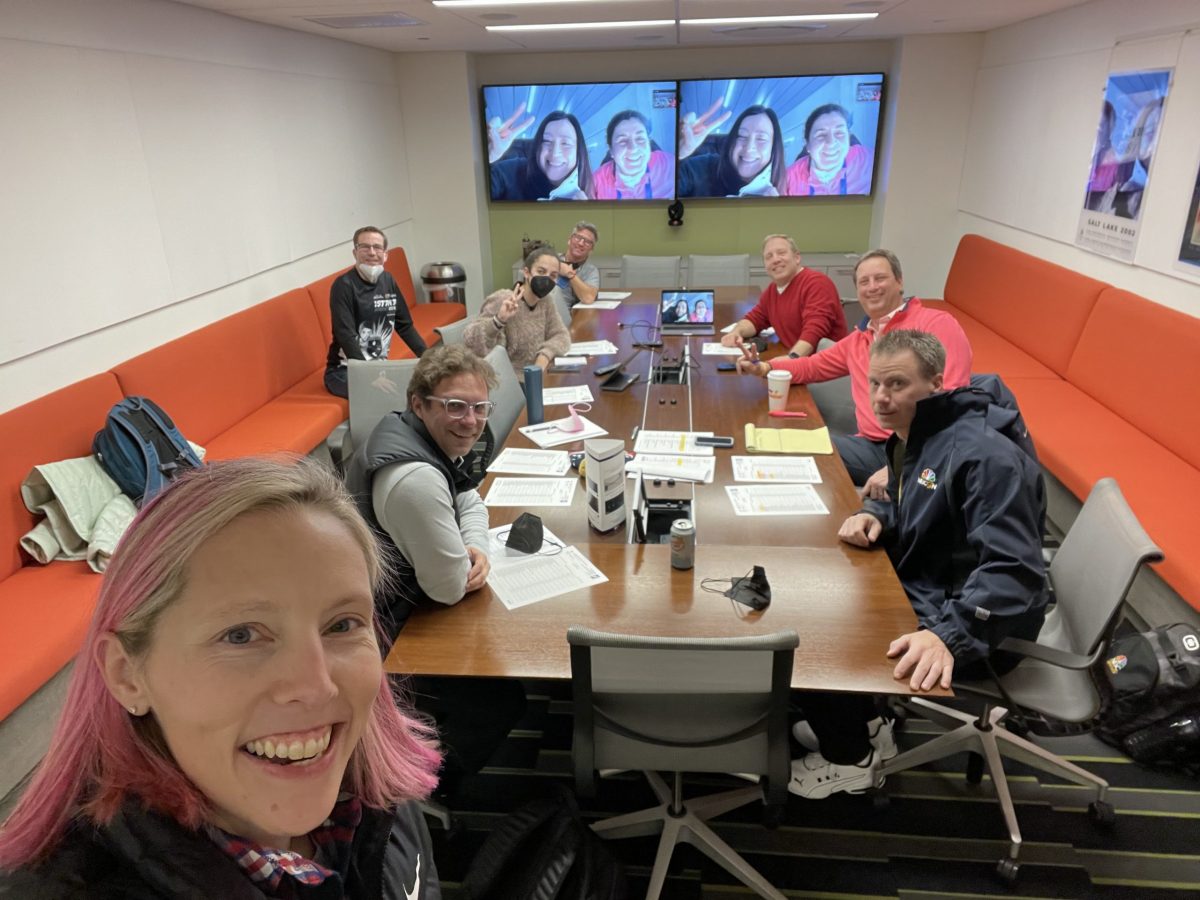
In this episode, we’ve got Chad Salmela and Kikkan Randall on to discuss the experience of calling the 2022 Beijing Olympic Winter Games, live from a booth in Stamford, CT. The duo worked as cross country analysts, alongside long-time NBC play-by-play announcer Steve Schlanger. While Chad is a veteran in the role, this was Kikkan’s first Olympics inside the booth.
Kikkan Randall snaps a selfie with Chad Salmela and the NBC production crew during the 2022 Olympic Winter Games. (Courtesy photo)
During the call, Kikkan and Chad field a variety of questions on their experience – everything from staying fresh while calling races in the middle of the night for two weeks straight, to maintaining professional composure while watching your former teammates and long-time friends win Olympic medals – or come up short – and even, why are you suddenly pronouncing the Norwegian distance champion’s name “You-haug”?
Full of insights and laughs, this conversation was a treat, and it’s clear that both Chad and Kikkan are deeply invested in growing and serving the cross country ski community in the US.
Kikkan Randall and Chad Salmela discuss their experience as NBC’s cross country ski analysts during the 2022 Beijing Olympic Winter Games. (Courtesy photo)
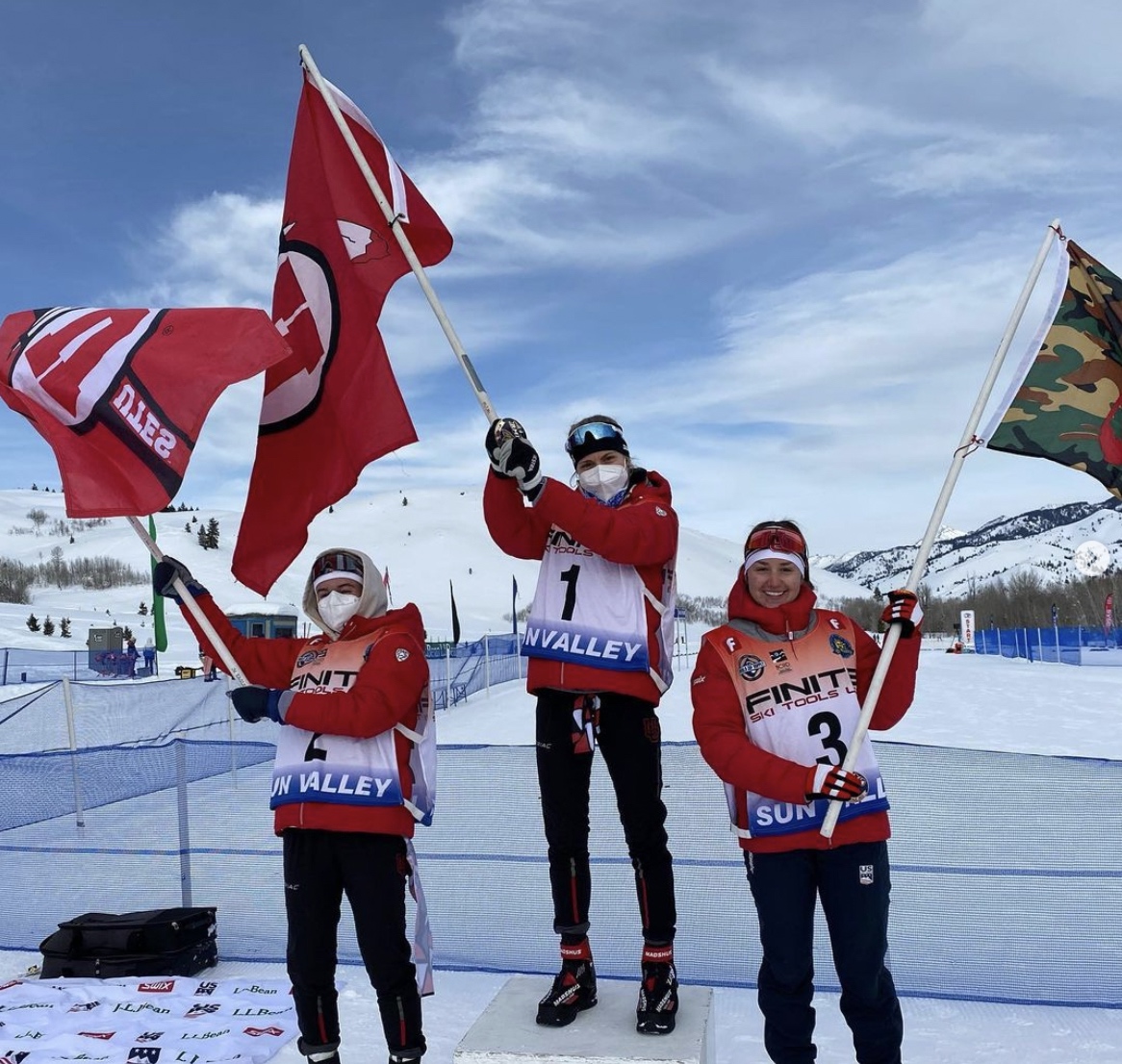
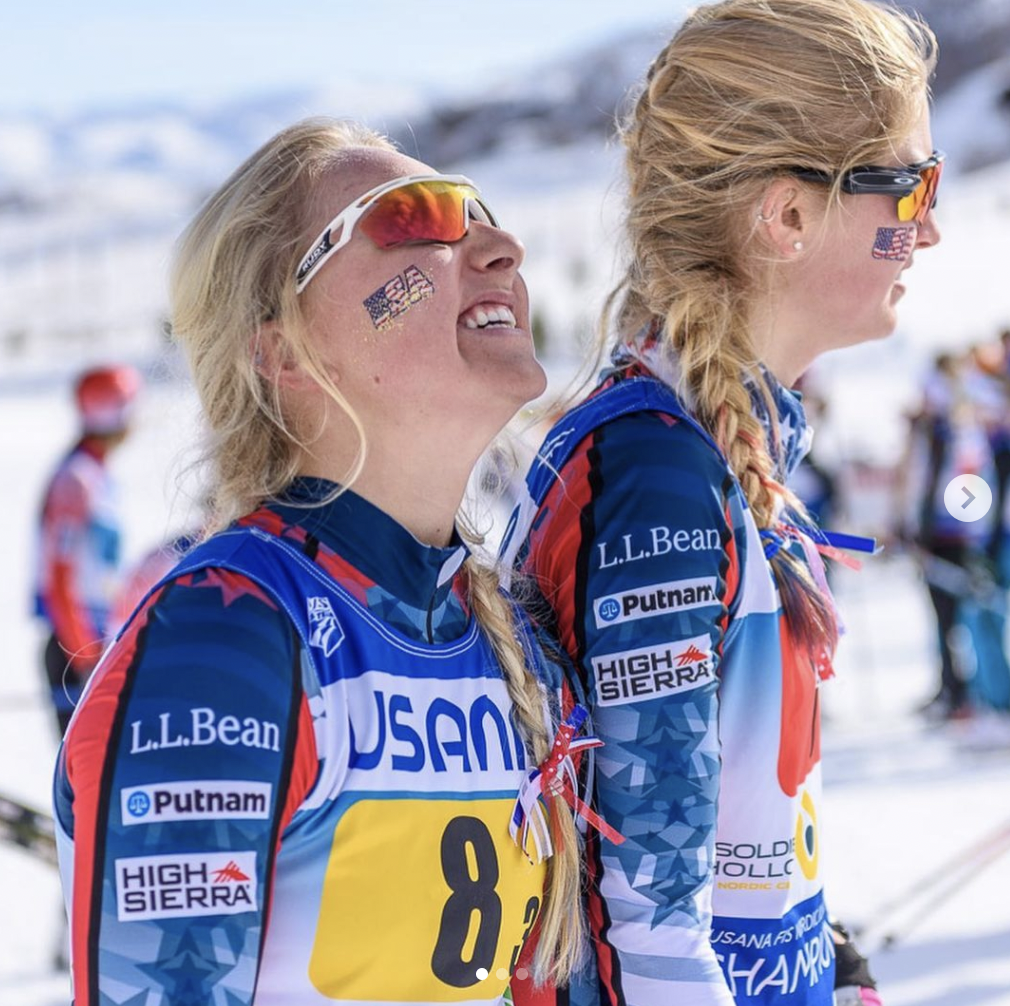
In this episode, we have Sydney Palmer-Leger, Sophia Laukli, and Novie McCabe. Each is a member of the U.S. Cross Country team, and they are also all teammates at the University of Utah (UU), where they are coached by Miles Havlick and Fredrik Landstedt.
Utah teammates Sophia Laukli, Novie McCabe, and Sydney Palmer-Leger went 1-2-3 in the RMISA collegiate standings at the recent 5k interval start freestyle in Sun Valley. (Photo: Instagram @utahskiteam)
Laukli and McCabe were recently named to the 2022 Olympic Team and are soon headed to Beijing, while Palmer-Leger will race in the RMISA collegiate circuit for the next few weeks before flying to Norway for the FIS Junior World Championships in Lygna. Laukli and McCabe were named to the FIS U23 World Championships, but declined their spots due to scheduling conflicts between the Olympics and the NCAA championships, which will be hosted by UU in early March.
Each already accomplished in her own right, these women discuss their experiences so far as they set their sights on long-term goals for what they hope will be long careers in the sport.
While each had strong performances as they progressed through high school, the trio perhaps first made their names more widely known in March 2020 when they earned a silver medal in the women’s 4 x 3.3-kilometer relay at the FIS Junior World Ski Championships in Oberwiesenthal, Germany with fourth teammate Kendall Kramer. This historic result improved on the 2017 bronze medal earned by a team of Julia Kern, Hannah Halvorsen, Hailey Swirbul and Katherine Ogden – not too shabby.
The day before the relay, Laukli had taken 5th in the 15k mass start freestyle, a top individual result which she repeated in February 2021 by taking 5th in the 10k freestyle at U23s in Vuokatti, Finland. McCabe also has two top-10 finishes at World Juniors/U23s; she was 10th in the 15k classic in 2019, and 9th in the 15k free in 2020. Currently 19-years-old, this is Palmer-Leger’s final year racing at World Juniors, and she expresses her hope for peak performances during these events. (Due to positive test results on the team and subsequent quarantines for close-contacts, Palmer-Leger and McCabe were unable to compete in the 2021 World Junior Championships.)
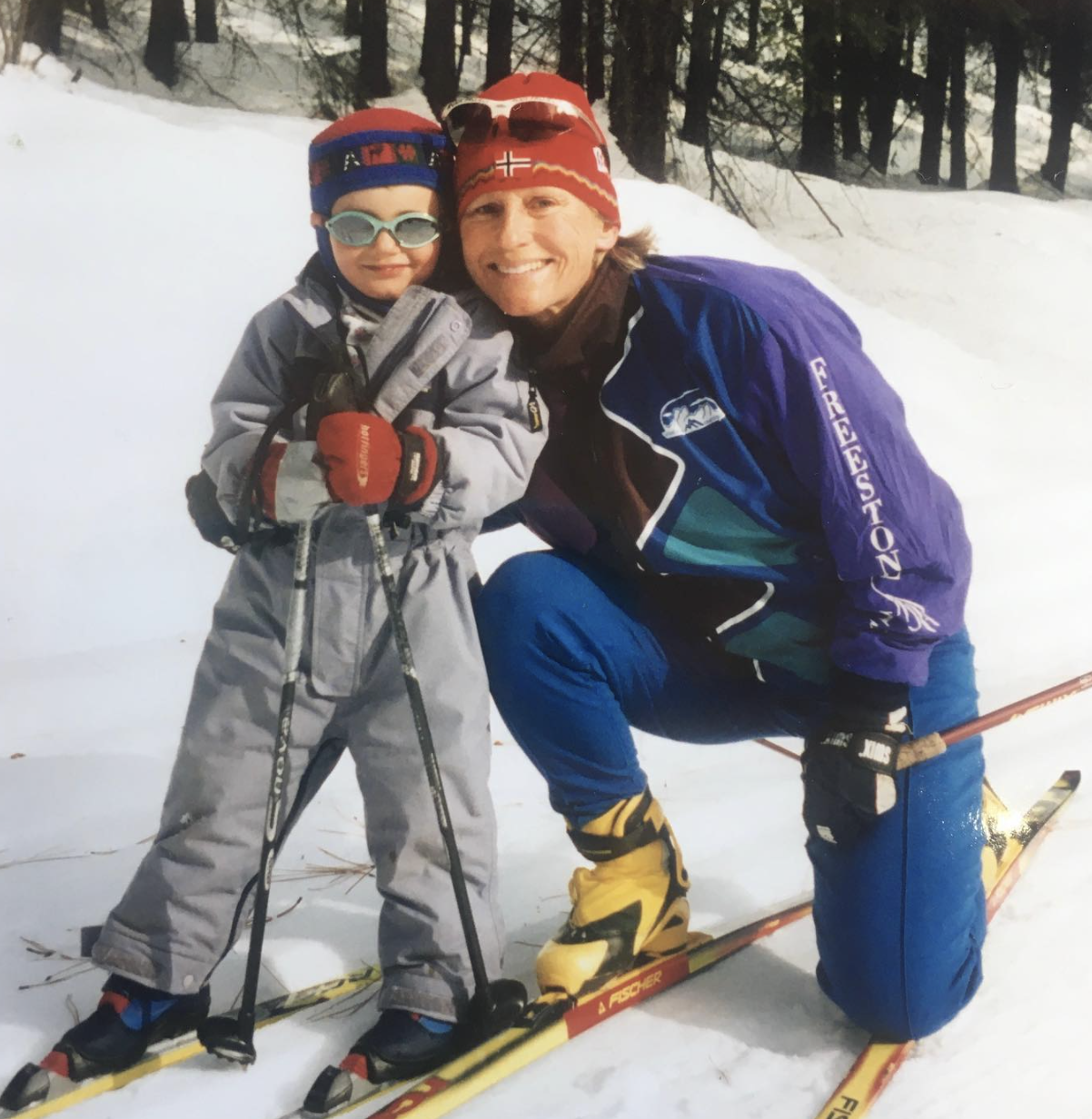
Novie McCabe gets an early start in cross-country skiing, following in the footsteps of her two-time Olympian mother, Laura. (Photo: Instagram @novie.mccabe)
Going further back, McCabe is the daughter of two-time Olympian Laura McCabe (’94 and ’98) who maintained a competitive ski career after giving birth to two girls: Novie and her younger sister, Dashe. Bringing Novie along both for training and to sessions she was coaching instilled a love of the sport in her daughter from infancy. Growing up in the Methow with her mother and close family friend Leslie Hall, a three time Olympian (’88, ’92, and ’94), as her coaches and mentors fostered both her passion for cross country skiing and her talent, eventually leading her onto the World Cup and soon to the Olympics. (For more on the McCabe family, read this beautiful piece on integrating family into the lifestyle of a competitive skier and coach written by Laura McCabe for Enjoy Winter.)
Laukli also grew up in a family with deep roots in the sport; her father is originally from Norway and raced for the University of Colorado Boulder, though she grew up in Yarmouth, Maine. With dual citizenship and family connections in Norway, Laukli has had the opportunity to train and race overseas, including some FIS and Norwegian National Championship racing in January, 2021 where Laukli finished 13th in the 15k skiathlon and 16th in the 10k freestyle. These results earned her World Cup starts, allowing her a whirlwind of international racing in the 2021 season which she had not foreseen when facing season cancellation and tight COVID-19 restrictions through the fall 2020 semester at Middlebury College. (Laukli transferred to UU in Fall 2021.)
Novie McCabe finishes 7th overall in the 2022 climb up the Alpe Cermis. (Photo: NordicFocus)
Perhaps their most noteworthy result this season, Laukli and McCabe were fifth and seventh, respectively, in the final stage of the Tour de Ski, the infamous hill climb up the Alpe Cermis.
Originally from Park City, UT, Palmer-Leger was also raised in an active family, enjoying the myriad of outdoor activities available in the Park City region as a kid. Eventually, two sports moved to the forefront of Palmer-Leger’s focus: cross-country skiing and mountain biking. She found success in both through high school, earning five national titles in mountain biking before deciding to focus solely on her skiing. After racing period 1 on the World Cup, Palmer-Leger headed back to Utah to race at the U.S. Cross Country Championships, where she was third in the freestyle sprint, 7th in the 20k mass start freestyle, and 6th in the 10k interval start classic; she was the top collegiate athlete in each race.
Sydney Palmer-Leger races the classic sprint qualifier during the opening World Cup weekend in Ruka in November, 2021. (Photo: NordicFocus)
In this episode, we have Jake Adicoff and Sam Wood, calling in from Lillehammer as the duo races as athlete and guide at the Para World Championships. Jake is a visually impaired athlete from Sun Valley who grew up racing with the SVSEF cross country program and now trains with the Gold Team. He has raced at both the 2014 Paralympics in Sochi, and the 2018 Games in Pyeongchang, where he won a silver medal in the 10k classic, as well as placed 4th in the classic sprint and 5th in the 20k free.
Jake Adicoff and his guide Sam Wood put together a gold medal performance on the opening day of racing at the Para World Championships in Lillehammer, NOR. (Photo: Alex Livesey/Getty Images)
Meanwhile, Sam is also a member of the SVSEF Gold Team, balancing his own training and race goals with his support of Jake this season. Sam finished in the top-10 twice in the opening SuperTour weekends this season, and was in the Top-25 in both distance races at the U.S. Cross Country Championships in Soldier Hollow. (Jake also raced, independently, at U.S. Nationals
While it has included career best results, this year of racing was not originally in Jake’s plans. He retired from professional skiing in 2018, heading to San Francisco to work as an engineer for Uber, having graduated from Bowdoin College that spring with a degree in Mathematics and Computer Science. When the pandemic hit, he began to work remotely from his parents’ house in Sun Valley (thinking it would be just for two weeks – remember that?) and ended up “casually” hopping into training with his friends on the Gold Team. With a few nudges from US Para Nordic and teammates like Sam, Jake began to realize he was still passionate about ski racing and quite fit again, and he began to set goals for the upcoming 2022 Paralympics.
Jake Adicoff follows Sam Wood on a long training run near Sun Valley, ID with the SVSEF Gold Team. (Photo: Instagram @svsefxcgoldteam)
At the time of the call on Friday January 21st, Jake had already earned a World Championship gold medal in the 10k classic on Sunday the 16th, and a bronze medal in the 15k skate on Tuesday the 18th. The morning after the call, the pair raced to second place in the 1.5k classic sprint. Three races, three medals. This week made it clear that Jake is in top form and will be a medal contender in Beijing.
In this conversation, we get into the dynamic of the athlete-guide partnership, as well as how being long-time friends and teammates has contributed to their success racing as a pair this season.
Friends, teammates, and now athlete-guide pair, Sam Wood (left) and Jake Adicoff (right) keep it fun on a sprint ski near Sun Valley, ID. (Photo: Instagram @svsefxcgoldteam)
To follow along with Jake’s racing this season, you can find race recaps with athlete quotes on the US Paralympics Nordic Skiing tab on the Team USA website, or follow the team on Facebook and Instagram.
A quick heads up on the audio, you’ll notice a bit of crackling and some poor connection toward the end of the podcast. Thanks for listening.
In this episode, we have Matt Whitcomb back to debrief the 2021/22 Tour de Ski, including highs and lows, overcoming setbacks, and managing a circulating head cold. We also discuss the cancellation of the upcoming World Cup races in Les Rousses, FRA, covid safety in a critical window before the Olympics, and the racing happening in Soldier Hollow during the 2022 US Cross Country Championships.
Thanks for listening.
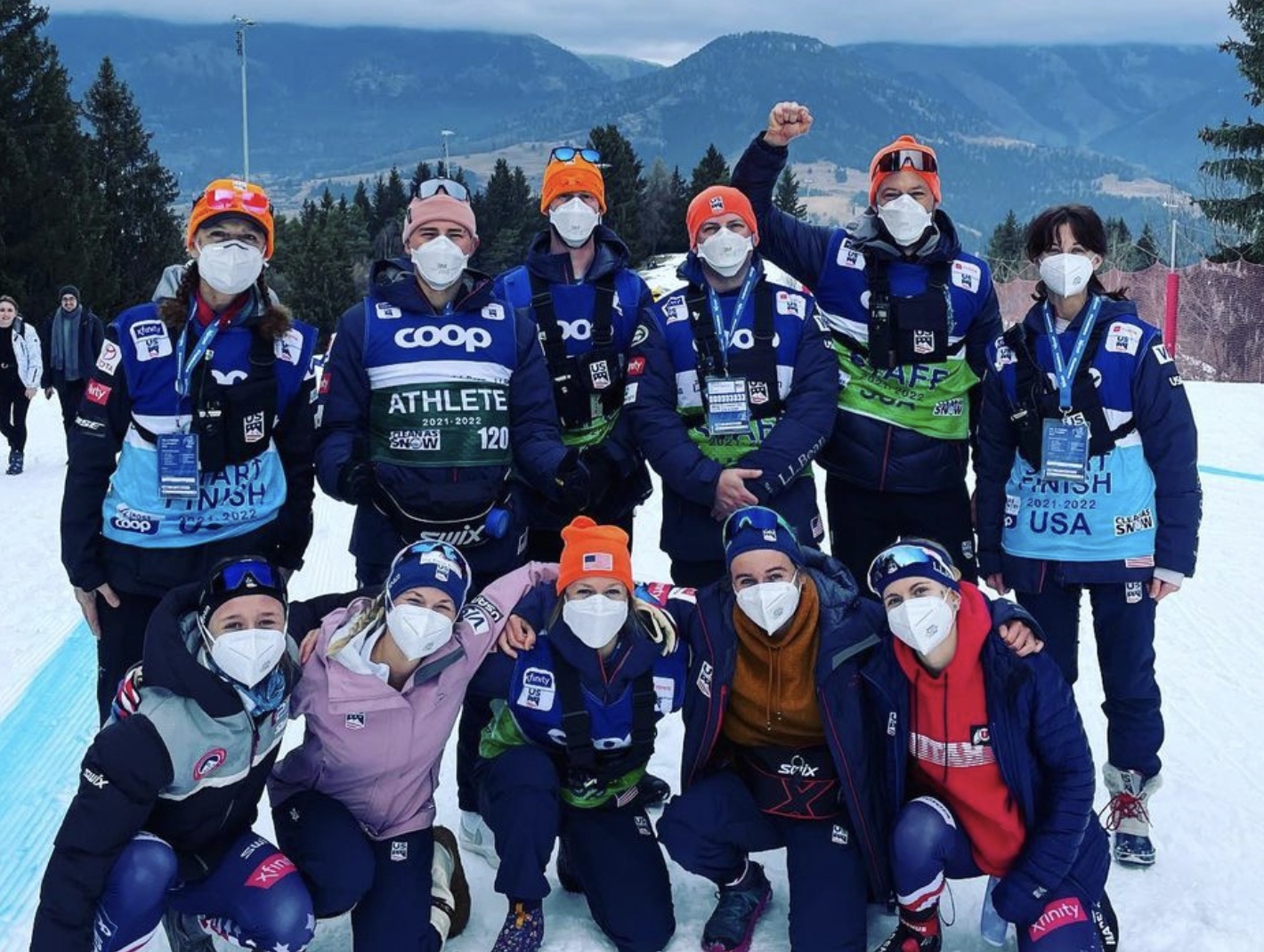
The American women who finished the 2021/22 Tour de Ski pose with coaches and support staff at the top of the Alpe Cermis. (Photo: Tom Horrocks / Instagram @jessiediggins)
In this episode, we have Ben Ogden, Gus Schumacher, and JC Schoonmaker coming to us from Davos, SUI. These athletes are key members of the new generation of American men who have found success at the junior level internationally, and are now transitioning onto the World Cup as athletes to follow. In this conversation, we explore this transition from a variety of angles, along with goal setting, team dynamics, and navigating the challenges of competing for very limited and selective Olympic spots without compromising the friendship and culture the team has developed.
For those unfamiliar with these athletes before they became a presence on the World Cup, each athlete is 21 years old. Both Schumacher and Ogden were members of the World Junior relay team that won back-to-back gold medals in 2019 and 2020, building upon their silver-medal performance in 2018. Both athletes also have top-10 results at World Juniors, with Schumacher winning the 10k Classic in 2020, the first gold medal at World Juniors for American men. Ogden earned two top-10 results in 2020, with Schoonmaker finishing just outside the top-10 in 13th during the freestyle sprint.
JC Schoonmaker on his way to an 11th place finish during the freestyle sprint in Lillehammer, NOR. (Photo: NordicFocus)Ben Ogden races the second classic leg of the 4 x 7.5 k relay in Lillehammer, NOR. (Photo: NordicFocus)
Each has taken slightly different paths in their transition from junior to senior level racing. Ogden stayed close to his hometown of Landgrove, VT by enrolling full time at the University of Vermont. Schoonmaker also went the NCAA skiing route, but traveled much further, from his home of Tahoe City, CA to the University of Alaska Anchorage. Schumacher opted to prioritize skiing, choosing part-time college in Anchorage while sticking with his junior coach Jan Buron, with whom he’d made steady progress.
As Devon Kershaw has explained many times on his podcast, success at World Juniors does not directly correlate with success on the World Cup. The trajectory is often non-linear, with exceptions like Johannes Høsflot Klæbo and Alexander Bolshunov who immediately began dominating the World Cup circuit upon arrival. The task of making this transition is coupled with pressure and attention as American ski fans closely monitor, and perhaps critique, these young men as they attempt to build upon the results of leaders who came before them, to carry the stars and stripes to results that consistently mirror those of the women’s program.
While it remains to be seen what kind of results these men will have in their senior racing careers, it is evident from the laughter throughout this conversation that they are enjoying the ride. Separate from skiing, as individuals, these men are academically motivated, supportive of their teammates, and genuinely charismatic, making them easy to root for regardless of World Cup or Olympic outcomes.
Gus Schumacher navigates a high speed turn on course in Davos, SUI. (Photo: NordicFocus)
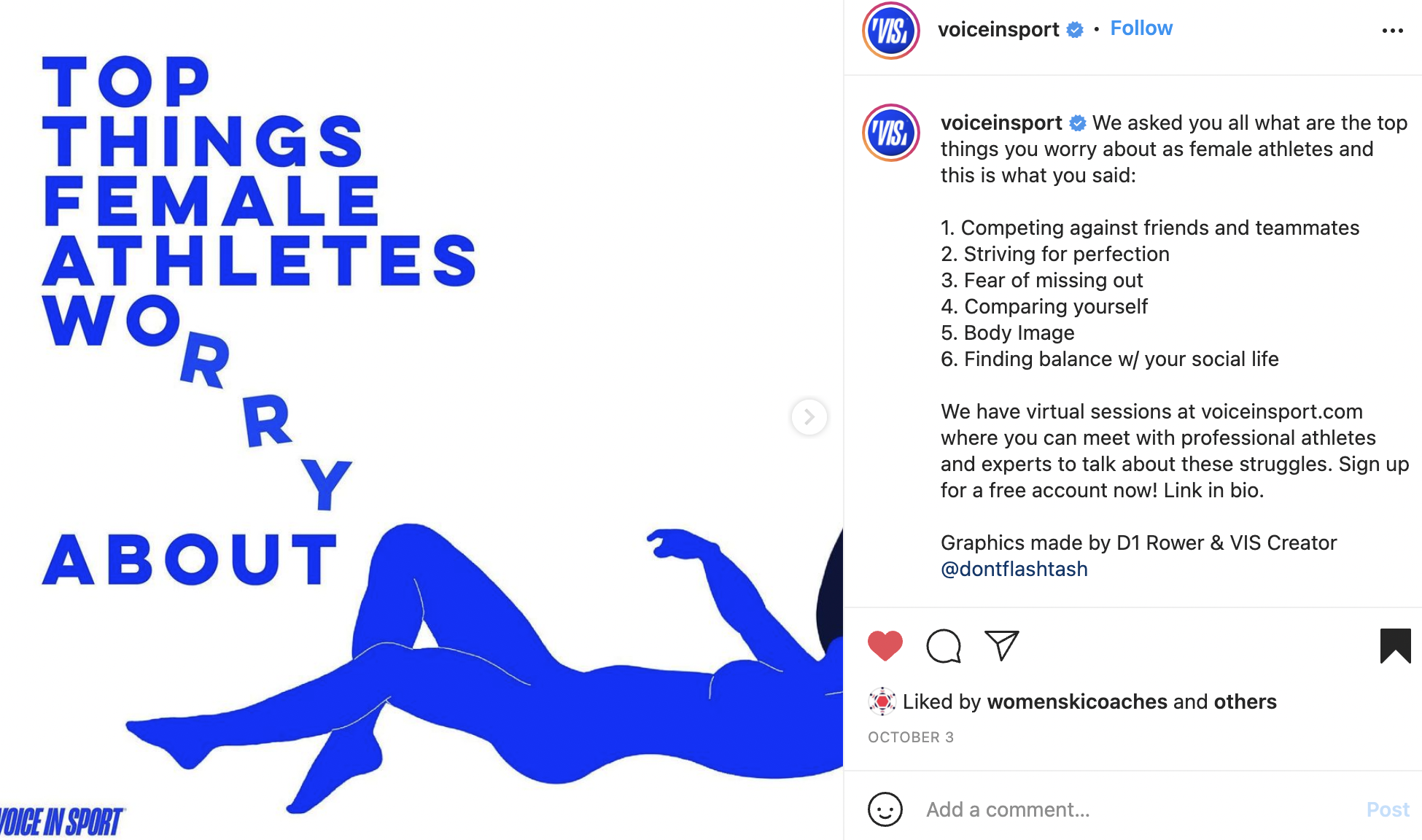
In this episode, we have U.S. Ski Team members Hannah Halvorsen and Hailey Swirbul along with development team coach Kate Barton. The original idea behind the conversation was to discuss a variety of challenges female athletes of all levels experience during their careers based on an infographic posted by the organization Voice in Sport, shown below.
An infographic from Voice in Sport showing some of the top challenges female athletes face. (Photo: Instagram @voiceinsport)
As the conversation evolved, it became clear that this conversation will resonate with athletes of all genders, ages, and level of competition. Yes — being one of the fittest women in the world and getting to travel the world is a wonderful privilege that many of us might fantasize about, however, we often only see the highlight reel. From social media to pressure, and “balance” to competition between teammates, these women shared powerful insights into their lives as athletes and coaches at the highest level of our sport. Hopefully, this perspective helps listeners recognize and support the whole person inside the lycra, on days where the pieces come together on the World Cup, the days they fall short of the goal, and all the days in between.
Hailey Swirbul and Hannah Halvorsen, along with D-Team coach Kate Barton, discuss the challenges of the pro-athlete journey in today’s episode of Nordic Nation. (Photo: Instagram @hannah.g.halvorsen)
In this episode, we have Tara Geraghty-Moats, a trailblazer in women’s nordic combined who made the switch this season to biathlon. As we discuss in this conversation, women’s nordic combined could be put on display as an example of gender inequity in sport. Despite the fact that men have competed in nordic combined at the Olympics since the first Winter Games in 1924 and the FIS has organized a men’s World Cup season since 1983, the women’s counterpart is still not included in the Olympics and only saw its first World Cup season last year.
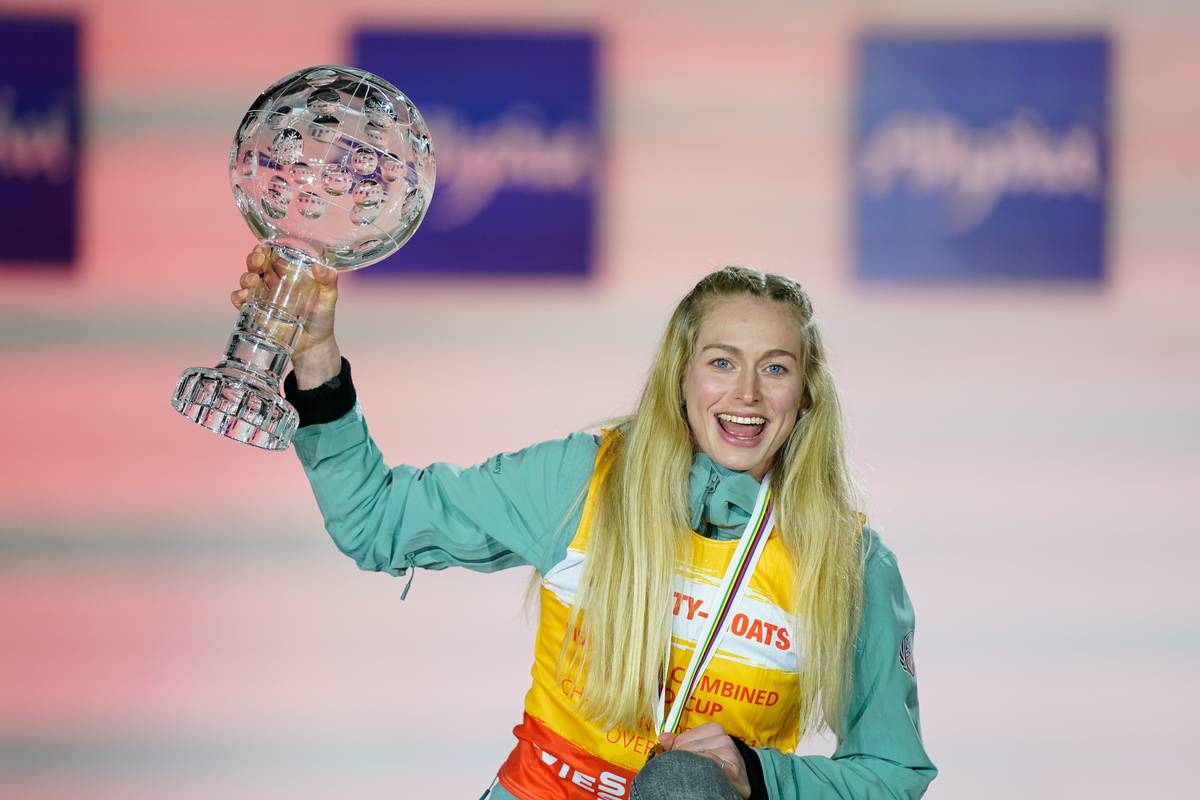
The original 2020-2021 World Cup schedule included four venues, plus the World Championships in Oberstdorf, Germany, but due to COVID cancellations, only one event took place. As Tara won this event in Ramsau, Austria, she was later named the overall World Cup winner and took home the first ever women’s World Cup crystal globe.
Tara Geraghty-Moats hoisting the first-ever awarded overall World Cup crystal globe for women’s nordic combined. (Photo: NordicFocus)
While she has goals remaining in nordic combined, Tara feels the move to biathlon was the right one, which you’ll hear about conversation. Tara also discusses her background in winter sports, the state of women’s nordic combined in the U.S., what her training and travel looked like during the transition, and her goals for the upcoming season.
Thanks for listening.
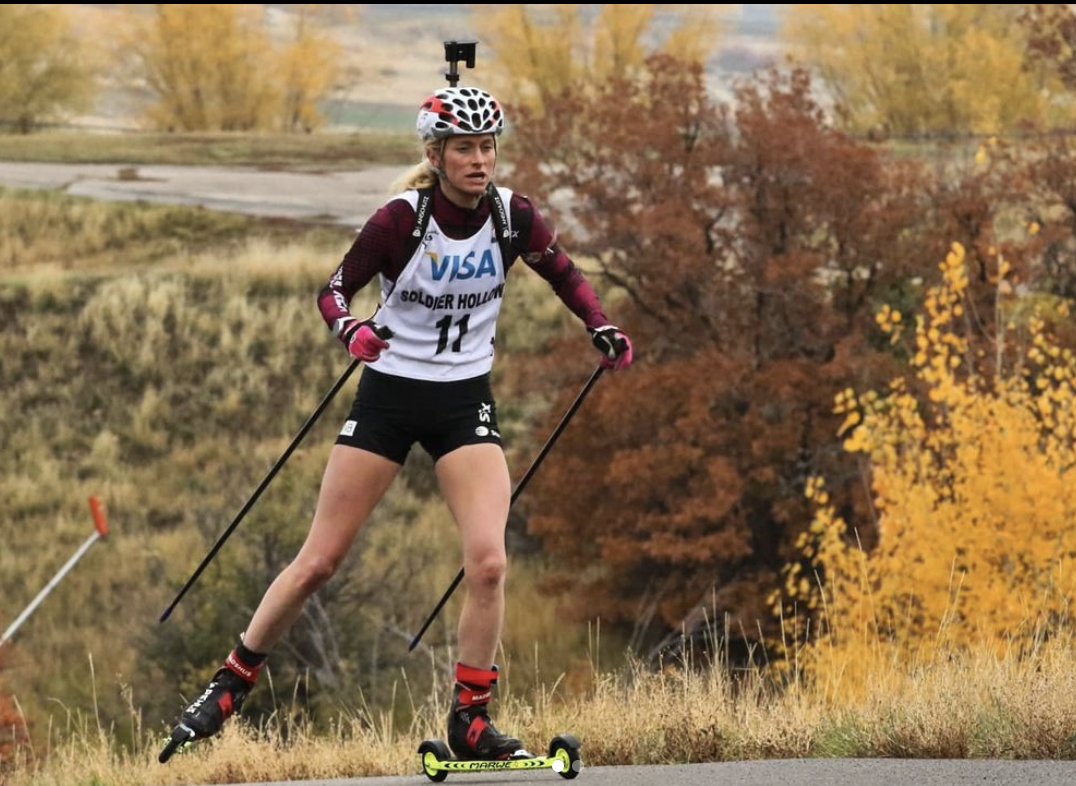
Tara Geraghty-Moats on course in Soldier Hollow during fall biathlon trials, where athlete vie for early-season starts on the World Cup. (Instagram: @tarageraghtymoats)
Jim Galanes, a legend in the sport, offers insight into training for masters athletes. Galanes offers coaching services through his business, EPOC Performance Training. (Courtesy photo)
In this episode, we have Jim Galanes to discuss some guiding training principles for masters athletes. If you enjoy the endurance athlete lifestyle, or are juggling a career and family, but still enjoy trying to get fitter and faster as in this fickle sport, this interview has plenty of exercise physiology insight to chew on.
Galanes may need no introduction — he’s been a noteworthy member of the cross country ski community for more than four decades now. He is a three time Olympian, first in the 1976 Innsbruck Olympics where he competed in nordic combined, then again in the 1980 Lake Placid Games and the 1984 Sarajevo Games competing in cross country.
After retiring from his athletic career, he spent six years as a coach of the national team, followed by a few years with the program at Stratton Mountain School. He then moved to Anchorage to start and coach the now-thriving APU program. Originally from Brattleboro, VT, Jim now lives in Frisco, CO where he coaches online and in-person through his business EPOC Performance Training. On his coaching platform, Galanes regularly weighs in on the latest research or trends in exercise science, and provides examples from his athletes and self-experimentation into the effectiveness of his training programs, making it clear that his finger remains ever on the pulse of best practices in endurance training.
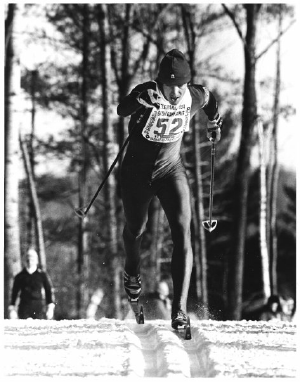
A scene from Galanes’ racing days. (Courtesy photo.)
Traveling through the decades and development of professional cross country skiing is a fascinating topic in its own right, and Galanes has been there to see it all. If you’d like to learn more about this history, his time as an athlete, and the interplay between global events and life on the World Cup circuit, Galanes did an in-depth interview on these topics with Toko US Brand Manager Ian Harvey on his podcast, which can be found here or on Apple Podcasts.
Quick reminder:This episode is brought to you by the Alberta World Cup. To all masters skiers out there, the Rocky Mountains of Canada and the Masters World Cup 2022 are calling. This coming March, masters skiers from around the world will come together in Canmore, Alberta to celebrate a shared passion for cross country skiing. This event will be a great opportunity to race in Canmore at the world renowned Canmore Nordic Centre Provincial Park.
Go to MWC2022.COM for details. There you can find COVID Plan information, and airline and rental car promotions. If you register before Dec 31st, you’ll also get a free pair of commemorative socks.
In this episode, we connect with US Ski Team Head Coach Matt Whitcomb following the US Ski Team and National Training Group camp in Park City. Whitcomb answers a variety of questions to provide insight into the upcoming season leading up to the 2022 Beijing Olympics.
Matt Whitcomb. (Photo: Twitter)
A couple of notes:
Firstly, you’ll notice some crackling in the audio on our end. We’re working out the kinks. Thanks for your patience.
Also, if your interest has been piqued, FasterSkier has an upcoming article providing a deeper look into the pace project that Whitcomb discusses here.
(13:30) Whitcomb’s cross country road trip and seeing various junior club programs
(15:30) The generational shift happening on the U.S. Ski Team following several notable retirements, and its implications for leadership and team dynamics
(19:30) Outlook for the men’s program as the crop of athletes successful at the junior level moves into the Olympic season
(25:00) Altitude training camps leading into Beijing: the when, where, and why.
(30:15) Olympic team selection and athlete quotas
(35:00) Season planning: decisions around competing at the Tour de Ski and other World Cup weekends
(40:30) Managing athlete and personal wellbeing and holistic health, in the wake of Simone Biles decision to withdraw from the Tokyo Olympics
A colorful rollerski session during the fall 2021 U.S. Ski Team and National Training Group camp in Park City, UT. (Photo: Alayna Sonnesyn/SMS T2 team blog)
Moms Matter Now founders Calisa Kastning (left) and Holly Brooks (right) with their five children. (Photo: Orzel Photography)
In this episode, we discuss the topic of maternal mental health with Holly Brooks and Calisa Kastning. On Mother’s Day, the partners announced the launch of their passion project, Moms Matter Now with the aim of supporting and empowering women as they transition into motherhood.
Moms Matter Now co-founders Calisa Kastning and Holly Brooks aim to support and empower women as they transition into motherhood. (Photo: Orzel Photography)
For those unfamiliar with these names, Brooks is a two-time Olympian and U.S. Ski Team alumna who became a licensed professional counselor after retiring from professional skiing in 2016. After struggling with infertility as a result of RED-S, Brooks successfully conceived and became the mom to twins, born in August, 2017. Kastning moved to Anchorage from Montana ten years ago, just a few weeks before the birth of her first of three children. She and her husband, Andrew, were led to Alaska by the job as head coach of University of Alaska Anchorage (UAA), which Andrew ultimately accepted. Kastning is now the executive director of Skiku, a nonprofit which brings cross country skiing to children in remote towns in the far reaches of the Last Frontier.
As we discuss, there is so much more to this topic than clinical postpartum depression and anxiety. The transition to motherhood is a time in many women’s lives where it is common to experience feelings of identity loss, isolation, resentment, body frustration, and sadness, despite also feeling excited and happy to be a new parent. Brooks explains that endurance athletes are perhaps especially primed for these feelings.
Filling their own cups, Moms Matter Now co-founders Holly Brooks (left) and Calisa Kastning (right) enjoy the Alaska backcountry. (Courtesy photo)
Through the Moms Matter Now platform and the online courses they are building — their pilot group launched on September 22nd — they hope to provide women with the tools to prepare for the emotional and psychological changes they might experience surrounding pregnancy and into motherhood. They also aspire to empower each participant to prioritize her own well-being in order to be the mother, partner, athlete, employee, and more, that she wants to be.
To follow Moms Matter Now, you can subscribe to email updates via their website, momsmatternow.com or follow them on Facebook and Instagram @momsmatternow. If this conversation resonates with you, you can also support Moms Matter Now by becoming a startup booster. Donations can also be made through Venmo with the handle @momsmatternow. Thanks for listening.
Practicing what they preach, Kastning and Brooks make time for themselves and head out on a backpacking trip. (Courtesy photo)