From the FasterSkier archive — posts syndicated from athletes’ and coaches’ own blogs between 2004 and 2012, kept online as published. Current coverage is at fasterskier.com.
This is Part II of an article reporting on the recent appearance of the SMS T2 team at an evening where FasterSkier partnered with The Memory Clinic of Bennington, Vermont. The video posted below features the entirety of a wide-ranging Question & Answer session that involved most of the SMS T2 team, including Julia Kern, Jessie Diggins, and Ben Ogden. It was a treat to be among so many of our skiing heroes, and to hear how they responded to questions from the audience.
We also want to thank our industry partners Atomic, Alpina and Salomon for providing prizes at the event.
Be sure to check out Part One, where Julia Kerns talked about how to Strengthen You Mental and Physical Self.
The world of professional skiing is big and broad, but each professional team has a community they call “home.” For SMS T2, they are definitely the Home Team in the Nordic community of southern Vermont and western Massachusetts. It’s always fun and inspiring when the team and the community get to come together (as SMS T2 has always been devoted to doing) for events, for conversations, for competitions, and for cameraraderie. FasterSkier recently teamed up with our friends at The Memory Clinic in Bennington, Vermont for an evening with Olympic skier and 2023 World Championship medalist Julia Kern and her SMST2 teammates, including Jessie Diggins and Ben Ogden. Julia was kind enough to serve as the keynote speaker for the evenings festivities:
FasterSkier would also like to thank our industry partners Atomic, Alpina and Salomon for providing prizes at the event.
In an article scheduled to follow this one, FasterSkier will also provide video coverage of the entire SMS T2 Team engaged in an open Q&A devoted to the discussion of big dreams, goal setting, nutrition, and mental health. It was a great night to be in southern Vermont, and we’re happy to share it with you. Stay tuned!
As Birkie Fever is fully here with the 2020 race starting in just eight days, Hayward’s Steve Morales brings us back to the early days of the race and the beginning of New Moon Ski and Bike Shop.
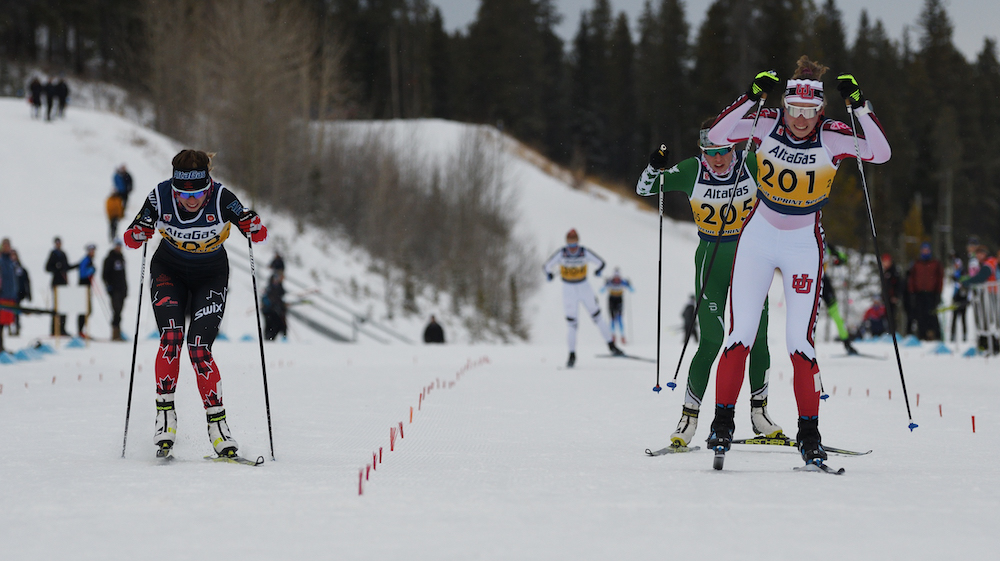
Katherine Stewart-Jones powering to another second place in the 5km classic. (Photo: Doug Stephen)
Day two of the first NorAm and SuperTour weekend was interval start classic, with 10km for the men and 5km for the women.
The US SuperTour athletes took the chance to show their depth today, packing the top ten of the open categories.
The 154 men raced first, with the U.S. Ski Team’s Zak Ketterson winning comfortably in 27:33.1. National team member Antoine Cyr was second at 15.0 back, followed by CGRP’s Ben Lustgarten at 20.4 seconds.
Dartmouth’s Katharine Ogden won the 5km in 14:58.1, 19.7 seconds ahead of national team member Katherine Stewart-Jones and 36.5 seconds ahead of Sun Valley’s junior Sydney Palmer-Leger. 119 women finished today.
While the open categories got the headlines, they aren’t the only people racing. In a throwback to 2009, Tasha Betcherman beat out Olympic medallist Sara Renner in the masters women’s 10km. In total, 33 masters and 268 younger athletes raced today, for a total of 578 finishers.
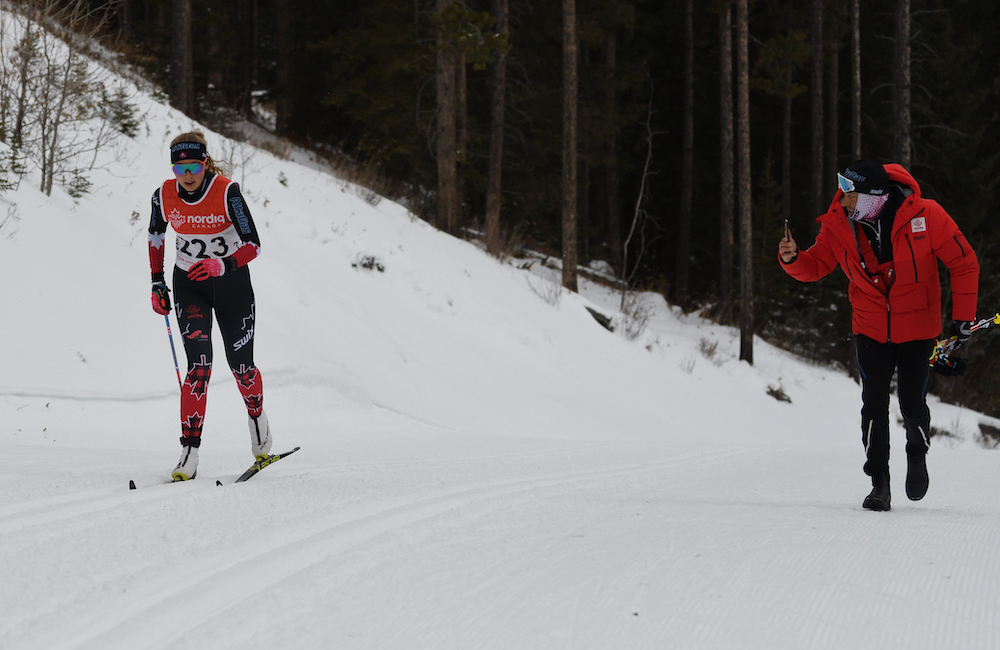
National team’s Natalie Wilkie attacks a climb while coach Robin McKeever shoots video. (Photo: Doug Stephen)
Mexico crowned the second ever national champion, with Jonathon Moreno taking the title in 41:25.7, 1:47.5 ahead of yesterday’s winner, Rodrigo Rangel Fernandez.
Rangel Fernandez was excited by the progress Mexico is making, throwing down a challenge to Johannes Høsflot Klæbo.
Full results for the weekend are on zone4, including live timing again for Sunday. The timers included separate climb results for Saturday; Canmore is the head office of the Zone4 timing company, and once again they added some detail that isn’t usually included at this level of racing.
Doug Stephen’s gallery has 162 full-res photos today.
Full-time student Jess Cockney was happy to win again in Canmore. (Photo: Doug Stephen)
The NorAm series fully lived up to the North American Cup label in Canmore Friday with 1.3km free technique sprints to kick off a combined NorAm, SuperTour, and Mexican National Championships weekend.
Full results for the weekend are on zone4, including live results every day. Friday featured sprints for the older age groups only (282 racers): Saturday is interval start classic, and Sunday’s race an interval start free.
Before the races, there was chatter about the importance of increasing the level of competition and a dash of fear that the American visitors would school the host country. The competition level was up and fear was not needed this day. The open women’s final featured two Germans, two Canadians, and two Americans before the open men’s final skewed Canadian. (Heat brackets and final results.)
Julia Richter takes the win ahead of Katherine Stewart-Jones and Katharine Ogden. (Photo: Doug Stephen)
There are a few race videos in @NordiqCanada’s Instagram story.
Nordiq Canada’s new Events Coordinator Jeff Ellis took time from his Race Director role to shoot video interviews with the top athletes, including the first ever Mexican National Champion Rodrigo Rangel Fernandez. Edited versions of some of these interviews are also on @NordiqCanada’s Instagram.
University of Utah’s Julia Richter won the qualifier and all the heats to take the win in 3:10.52, 0.08 seconds ahead of the national team’s Katherine Stewart-Jones and 0.63 seconds clear of Dartmouth’s Katharine Ogden.
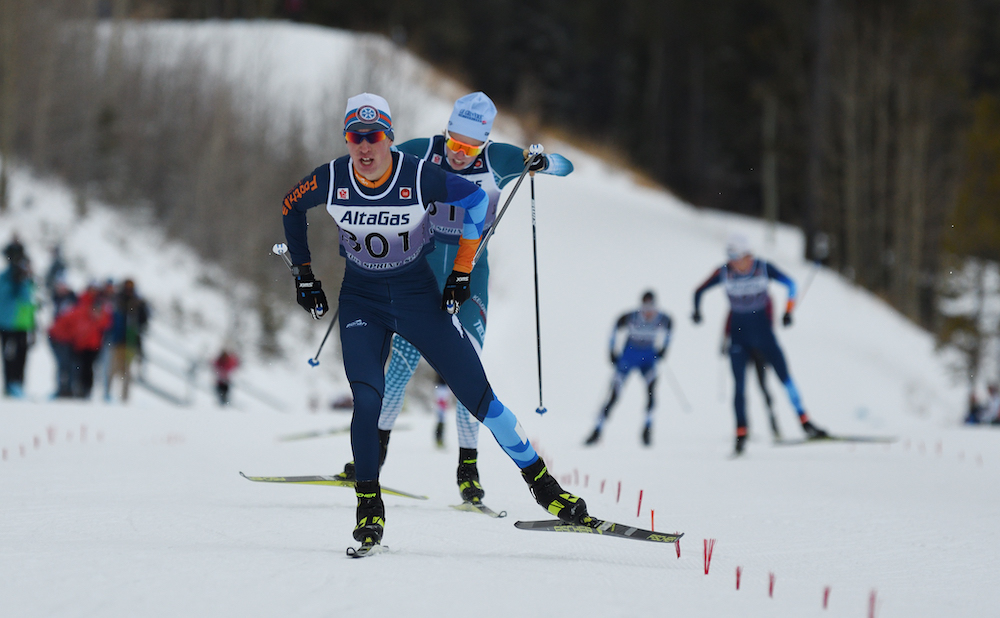
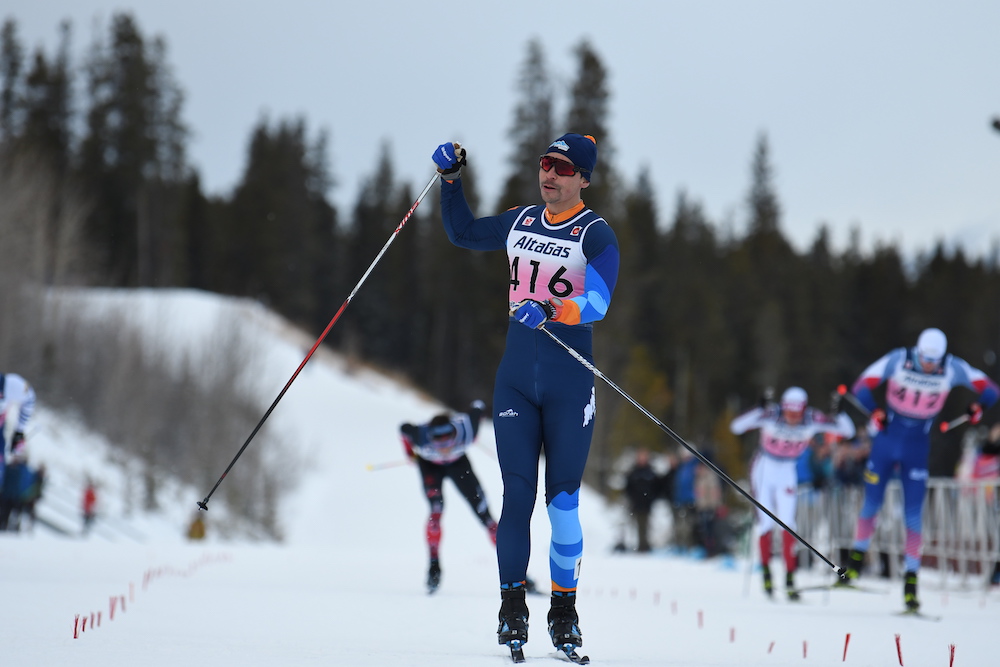
Full-time student Jess Cockney (Team ULLR) turned in another solid sprint performance at home, winning the men’s final in 2:46.18, over two seconds ahead of SVSEF Gold Team’s Peter Holmes and Canadian National Team member Graham Ritchie.
National team junior Anna Pryce qualified 4th overall before winning all her heats. She finished the 1.3km final in 3:18.40, 0.38 seconds ahead of AWCA’s Elizabeth Elliott and 0.43 seconds from CNEPH’s Liliane Gagnon. Seventy-three U20 women competed, making that cohort the largest age group.
Xavier McKeever (Team ULLR, CNST) won the U20 sprint after qualifying 20th overall. His 2:42.02 bested Telemark’s Ian Williams by 0.85 seconds and ULLR teammate Joe Davies by 5.30 seconds.
The first Mexican National Championship sprint featured four athletes. Rangel Fernandez won comfortably in 3:37.33, completing a major step forward for the federation in Mexico. Vadovų paieška, personalo atranka, mokymai vadovams ir darbuotojų paieška primumesse.lt
Canmore-based photographer Doug Stephen was in the thick of the action. Athletes can use full-resolution photos from his gallery if they credit ‘Doug Stephen’ or @vr45photography.
Katherine Stewart-Jones leads BSF’s Erika Flowers in the quarter final. (Photo:Doug Stephen)
“We want to see the sport thrive, we want to see more people on skis. The collection of youth game videos, those are like a gift to the cross country ski community.” — Kim McKenney, XC Ski Nation
(If the video doesn’t play in your browser, click here)
XC Ski Nation and Nordiq Canada recently created a series of ski game videos for kids. While these games teach many skills, the primary goal is to have fun on snow, which keeps the kids coming back. These games are freely available on the internet in both English and French.
“Stephen Novosad, [Nordiq Canada’s] Technical Coordinator, Coach Development, was my partner on the project. He’s the brains behind the games. As you can see in the videos, he has a wonderful sense of fun and is exceptionally creative when it comes to inventing games. He’s very much a kid at heart!” — Kim McKenney, XC Ski Nation
XC Ski Nation’s core business is providing online video coaching and support to their subscribers. For $33US/year, skiers get access to a large collection of technique video featuring national team skiers and elite coaches. Many of the subscribers posting on the forum are coaches looking for new ways to teach.
In 2017, Nordic Canada partnered with XCSN to create a series of technique and coaching videos which are available exclusively to NCCP-certified coaches in Canada.
“The partnership was facilitated by the fact that one of the founders/owners of XC Ski Nation is Chris Jeffries, long time head coach of the Alberta World Cup Academy and coach of several NST members. It allows us to work collaboratively on producing videos for which NC controls the content but getting a professional editing service while complementing these joint productions with many more from XCSN’s own library.” — Stéphane Barrette, NC’s Directeur du développement des athlètes et entraîneurs
We commonly hear that games are for kids, fun is for kids, games are just a way to teach kids without them complaining. We should also admit that masters can learn a lot from games: mobility and balance are useful to any skier, even if the goal is just to reduce skiing time lost to injury.
One of the coaches who has influenced me most used to say to adult skiers “You are not going to the Olympics. You need to enjoy your training.” The phrasing changed, the number of short anglo-saxon words used for emphasis changed to suit the audience, but the message was always the same: you need to have fun.
Games like these may take your masters group way out of their comfort zone, but rapid improvement in your skiing while laughing at your peer group is never a bad thing.
“What do we live for, but to make sport for our neighbours and laugh at them in our turn?” — Mr Bennet
Ski testing has ensued. The wax buses and trailers are humming. And you can bet the athletes’ gathered in Seefeld, Austria are revving the engines too.
On Thursday of this week, the sprinters will have a go on the first regular day of competition at the 2019 World Nordic Ski Championships. The women and men race a freestyle sprint on the same courses used for last season’s World Cup test-event. American Sophie Caldwell and Switzerland’s Laurien van der Graaff tied for first in that women’s sprint, while Johannes Høsflot Klæbo won the men’s event.
If you haven’t already viewed the video up top, check it out. Former U.S. Ski Team athlete and current U.S. World Championship Team member Andy Newell helps out with this Seefeld sprint course preview.
Ben Ogden (left foreground) and Luke Jager (right foreground) await the arrival of teammate Gus Schumacher (center background) in the U20 men’s relay at Junior World Championships in Lahti, Finland, in January 2019. (photo: JWSC2019 FIS broadcast screenshot)
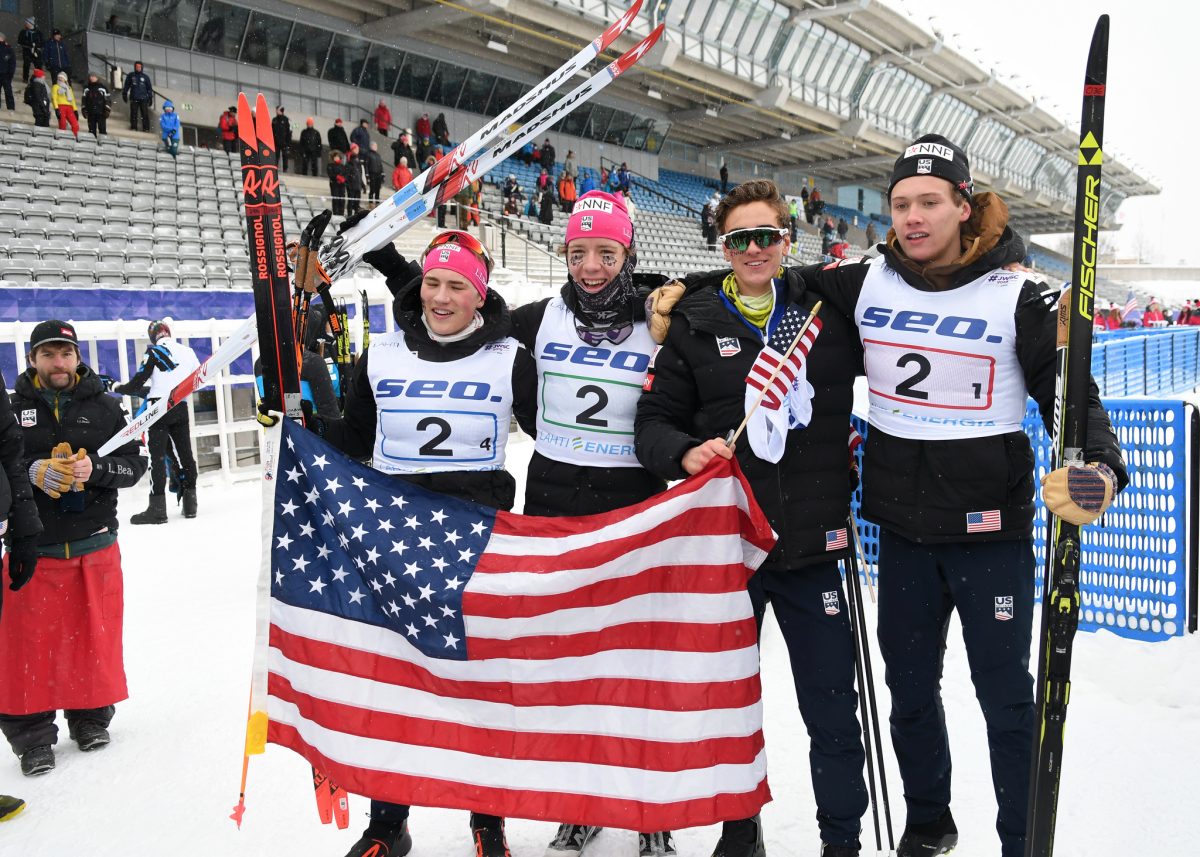
Last Saturday, the American women placed fourth in the U20 relay at 2019 World Junior Ski Championships. In any other year before 2017 this result would probably be headline news; considering that the Americans had the youngest team in the race (you can compare athlete birthdates from the women’s race here if you really want to get into the minutiae), this may well be headline news next year, or the year after that, when the same athletes are potentially contending for the podium.
But a couple hours later, the U20 men went out and won their race, taking home a historic relay gold and deservedly garnering most of the headlines for the weekend.
Both races started in the middle of the night for most of this continent, and a daily viewing pass cost 9 Euros. You could be forgiven for not having woken up to watch it live. If you didn’t, or even if you did and you’d like to see it again, below are full replays of each race, courtesy of what appears to be a Russian YouTube user. (The same user also uploaded full broadcasts of the U20 women’s 5-kilometer freestyle interval start, U20 men’s and women’s classic sprint, and U23 men’s and women’s classic sprint if you’re looking for more.)
Here are time stamps for the start of each leg in both races, as well as a few choice moments from the end of the men’s race (all times are in reference to a point on the YouTube video, not the time on the live timing race clock, which is a few minutes behind the video timestamp):
3:57, the race begins, with Luke Jager skiing the scramble leg
15:37, first exchange: Jager tags off to Ben Ogden in first place
27:23, second exchange: Ogden tags off to Johnny Hagenbuch in first place
38:32, third exchange: Hagenbuch tags off to Gus Schumacher in third place, 2.0 seconds out of first
43:40, Schumacher and Germany go to the front and start pushing the pace, Schumacher visibly elevating as he V2s up a hill to cover Germany’s attack
46:08, with roughly a kilometer to go, the camera cuts to the Americans waiting in the stadium, cheering on Schumacher. “Team U.S. is cheering,” says the announcer. “But I have to say that Team U.S. is always cheering. It doesn’t matter if they win, or if they are number five or number six; they always have great team spirit up and running.” (Jessie Diggins said in response to this remark from the broadcast, in an ephemeral Instagram video, “that’s right.” If you were following social media on Saturday, you would have noticed basically the entire U.S. Ski Team assembled for watch parties to cheer on the U20 men and women, several of them doing so in advance of their World Cup freestyle races in Ulricehamn later that day.)
46:39, it’s Germany – America – Russia at the top of the penultimate hill, with a visibly tired Russia digging deep with labored technique but nonetheless staying with Schumacher
47:30, it’s now America – Germany – Russia by the bottom of the hill
Schumacher unleashes a devastating jumpskate … . The Finnish announcer exults, in slightly broken but endearing English, “And look at Schumacher bouncing! Schumacher is bouncing like maniac!”
47:50, approaching the top of the final uphill, Schumacher unleashes a devastating jumpskate, creating the separation from Russia and Germany that he will carry all the way to the finish. The Finnish announcer exults, in slightly broken but endearing English, “And look at Schumacher bouncing! Schumacher is bouncing like maniac!”
47:57, there are literally as many USST jackets on course here as there are representatives from all other nations combined. Several Americans sprint to follow Schumacher over and around the crest of the hill, waving flags and screaming their heads off.
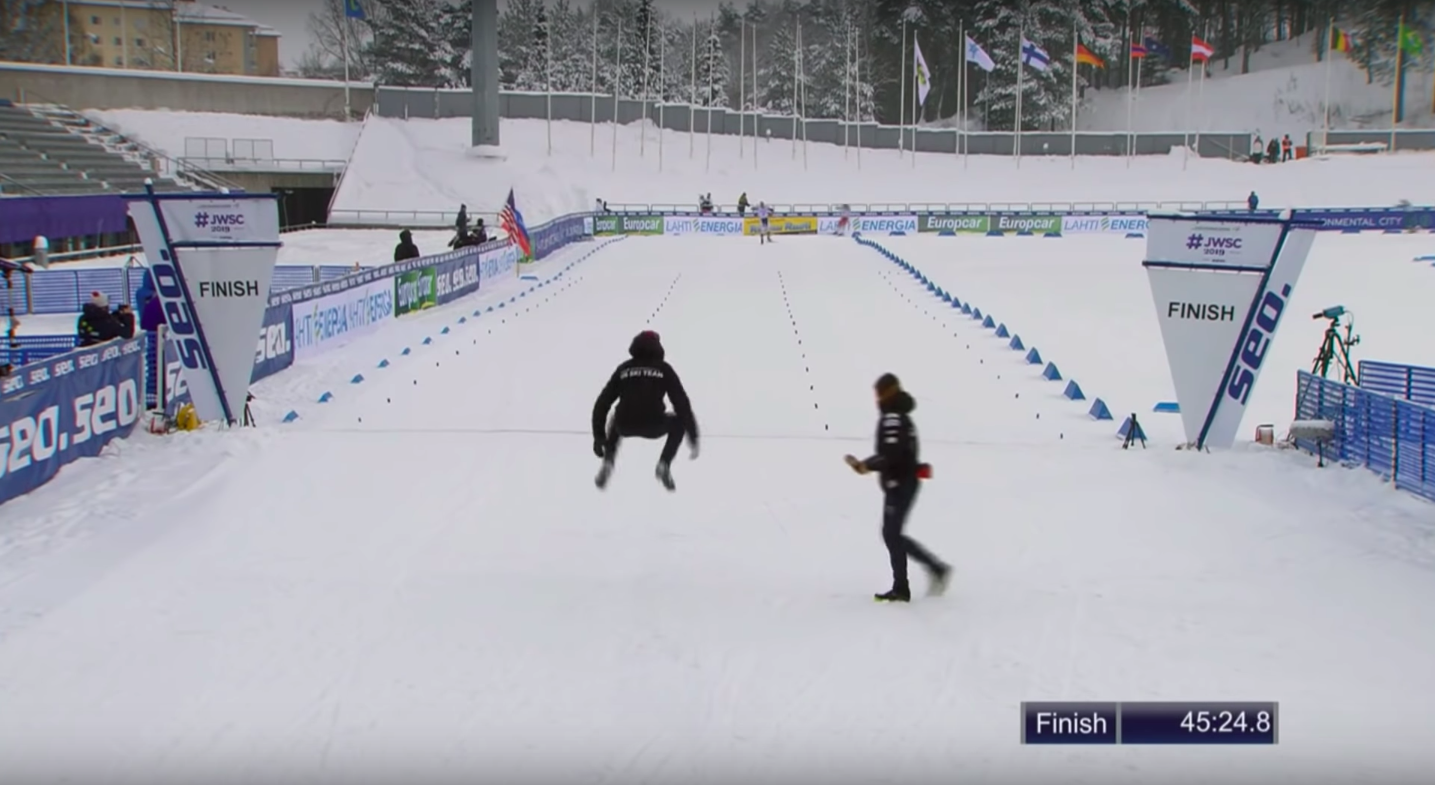
49:22, camera angle straight down the finishing stretch, with Schumacher narrowly but inexorably leading in Alexander Terentev of Russia. A meter past the finish line, Ogden is jumping 3 feet off the ground while Jager applauds.
49:32, Schumacher crosses the line in first. Ogden and Jager tackle/hug him.
This weekend in Davos, Switzerland the World Cup returns for the high life. Many World Cuppers consider Davos to be a high elevation venue and with the thinner air comes a tinge of lung burn as skiers pace themselves around the 5-kilometer loop used for distance events. (Davos sits around 5,000 feet in elevation.) The 5 k loop features a long and steady climb up and out of the valley. Then a technical descent with a few dicey turns ensues when skiers tip down over the high point.
On Sunday, the women race a 10 k skate individual start, while the men ski three times around the course for 15 k.
The sprint course is simple enough. Skiers loop twice around a mostly oval circuit with a few climbs and turns thrown in before diverting from the loop for the burn down the final straight. The sprints are scheduled for Saturday.
In this Davos World Cup preview, Andy Newell gives the low down on how to thrive on the sprint course and keep the effort in check on the Davos distance course.
Andy Newell of Nordic Team Solutions provides a video course preview of the Lillehammer Triple.
Starting Friday, the World Cup returns to Lillehammer, Norway. The racing begins with Friday’s freestyle sprint. The men’s and women’s courses are slightly different. The men sprint 1.6 kilometers, the women 1.3 k.
The Friday sprints are followed by a 10 k/15k individual skate. The women and men race on the same 5 k loop. Sunday features a 10 k/15 k classic pursuit on the same 5 k loop from Saturday. The first skier across the line Sunday is the overall Lillehammer Triple winner.
On Saturday Nov. 24th, Ruka, Finland will host the season opening World Cup race, a 1.4 kilometer classic sprint. It’s the eleventh time in a row Ruka will host the first World Cup sprint of the season.
The Ruka course is iconic with it’s steep stride-then-run decisive hill before the finishing straight. Former U.S. Ski Team member (USST) Andy Newell provides insight into how athletes race the Ruka classic sprint course.
In our course preview video, Newell contrasts how Norway’s Johannes Høsflot Klæbo literally ran away from the men’s field with how the USST’s Sadie Bjornsen played keen pack-skiing tactics to win her sprint heat during last season’s Ruka classic sprint.
Last week was a big one for the New England Nordic Ski Association (NENSA).
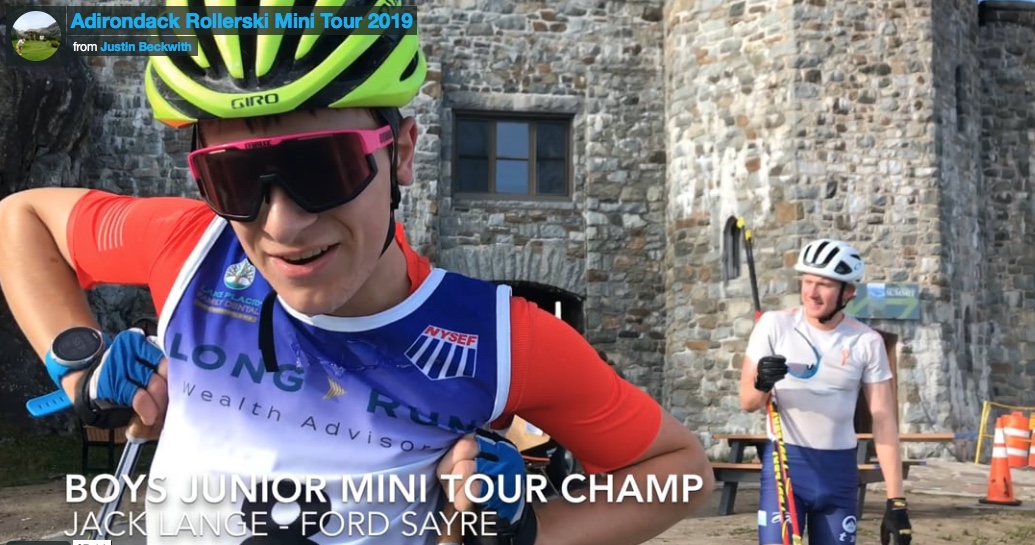
On Wednesday, Aug. 8, in conjunction with a U.S. Ski Team U16 (under-16) camp, NENSA hosted rollerski events at the Olympic Jumping Complex in Lake Placid, N.Y., starting with agility courses designed by NENSA Competitive Program Director Justin Beckwith and Olympian and former nordic combined national-team coach Joe Lamb (complete with rollers, gates, jumps, backward skiing, and a grass runup).
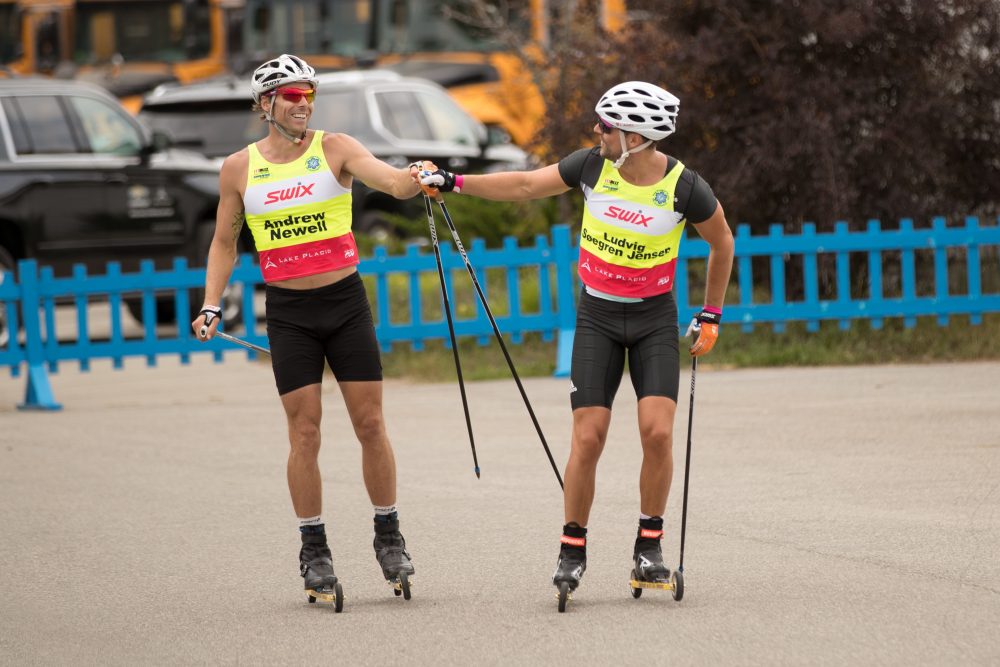
Then it was onto the Lake Placid Super Sprint (a.k.a. NENSA 100), where athletes could test their 100-meter sprinting skills in head-to-head races. In the banner event of the day, Olympian and former U.S. Ski Team member Andy Newell (a coach at the U16 camp) challenged Norway’s Ludvig “Ludde” Søgnen Jensen (the world-record holder in the 100-meter ski sprint) on pavement, where Ludde took the win in 11.69 seconds (Newell followed with a still-blistering time of 12.1). (Ludde’s world record is 11.03 seconds, set on snow in March of 2017.)
Three days later on Aug. 11 in Vermont’s Green Mountains, NENSA hosted the 10th annual App Gap Challenge, the first event of its Bag Balm Rollerski Race Series. Caitlin Patterson of the Craftsbury Green Racing Project won the women’s 5-kilometer race (which switches from skate to classic at Mad River Glen) up Route 17 in the Appalachian Gap, setting a course record of 22:20. Kyle Bratrud of the Stratton Mountain School T2 Team won the men’s 7.5 k race in 25:44.
In addition to the Lake Placid Agility and Super Sprint video at the top of this article, check out the photo galleries below, all courtesy of Reese Brown/US Ski and Snowboard. Click each photo to enlarge.
***
Lake Placid Super Sprint (a.k.a. NENSA 100) and Agility (Aug. 8)
Athletes try out a rollerski agility course, constructed by NENSA, on Aug. 8 in Lake Placid, N.Y.
Norway’s Ludvig Sognen Jensen tries out a rollerski agility course, constructed by NENSA, on Aug. 8 in Lake Placid, N.Y.
Andy Newell shows his skills on rollerski agility course, constructed by NENSA, on Aug. 8 in Lake Placid, N.Y.
Andy Newell shows his skills on rollerski agility course, constructed by NENSA, on Aug. 8 in Lake Placid, N.Y.
Andy Newell in Lake Placid, N.Y., on Aug. 8 for NENSA’s Super Sprint and Agility challenge.
Athletes try out a rollerski agility course, constructed by NENSA, on Aug. 8 in Lake Placid, N.Y.
Athletes try out a rollerski agility course, constructed by NENSA, on Aug. 8 in Lake Placid, N.Y.
Athletes try out a rollerski agility course, constructed by NENSA, on Aug. 8 in Lake Placid, N.Y.
Athletes try out a rollerski agility course, constructed by NENSA, on Aug. 8 in Lake Placid, N.Y.
Athletes try out a rollerski agility course, constructed by NENSA, on Aug. 8 in Lake Placid, N.Y.
Athletes try out a rollerski agility course, constructed by NENSA, on Aug. 8 in Lake Placid, N.Y.
Athletes try out a rollerski agility course, constructed by NENSA, on Aug. 8 in Lake Placid, N.Y.
Athletes try out a rollerski agility course, constructed by NENSA, on Aug. 8 in Lake Placid, N.Y.
Athletes try out a rollerski agility course, constructed by NENSA, on Aug. 8 in Lake Placid, N.Y.
Norway’s Ludvig Sognen Jensen and Andy Newell pose with NENSA juniors after the inaugural NENSA 100, a 100-meter rollerski race, on Aug. 8 in Lake Placid, N.Y.
Norway’s Ludvig Sognen Jensen and Andy Newell pose with NENSA juniors after the inaugural NENSA 100, a 100-meter rollerski race, on Aug. 8 in Lake Placid, N.Y.
Norway’s Ludvig Sognen Jensen and Andy Newell go head to head in the inaugural NENSA 100, a 100-meter rollerski race, on Aug. 8 in Lake Placid, N.Y.
Norway’s Ludvig Sognen Jensen and Andy Newell go head to head in the inaugural NENSA 100, a 100-meter rollerski race, on Aug. 8 in Lake Placid, N.Y.
Andy Newell during the inaugural NENSA 100, a 100-meter rollerski race, on Aug. 8 in Lake Placid, N.Y.
Andy Newel tries out a rollerski agility course, constructed by NENSA, on Aug. 8 in Lake Placid, N.Y.
Norway’s Ludvig Sognen Jensen tries out a rollerski agility course, constructed by NENSA, on Aug. 8 in Lake Placid, N.Y.
Andy Newell during the inaugural NENSA 100, a 100-meter rollerski race, on Aug. 8 in Lake Placid, N.Y.
Andy Newell during the inaugural NENSA 100, a 100-meter rollerski race, on Aug. 8 in Lake Placid, N.Y.
Norway’s Ludvig Sognen Jensen and Andy Newell after the inaugural NENSA 100, a 100-meter rollerski race, on Aug. 8 in Lake Placid, N.Y.
Norway’s Ludvig Sognen Jensen and Andy Newell after the inaugural NENSA 100, a 100-meter rollerski race, on Aug. 8 in Lake Placid, N.Y.
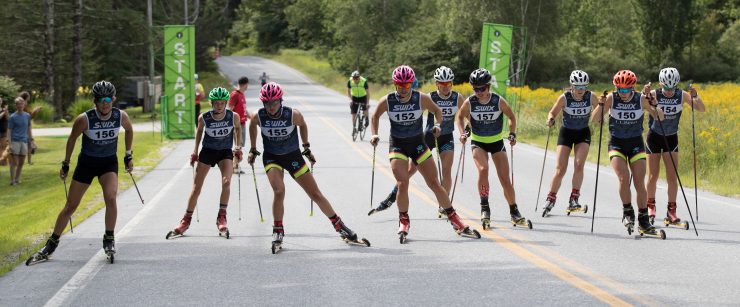
Athletes go head to head in the inaugural NENSA 100, a 100-meter rollerski race, on Aug. 8 in Lake Placid, N.Y.
Athletes go head to head during the inaugural NENSA 100, a 100-meter rollerski race, on Aug. 8 in Lake Placid, N.Y.
Andy Newell and Ludvig Sognen Jensen after a rollerski agility course, constructed by NENSA, on Aug. 8 in Lake Placid, N.Y.
Sprint and agility podium: Ludvig Sognen Jensen
Sprint and agility podium: Andy Newell
Sprint and agility podium: Will Koch
Sprint and agility podium: Will Koch
Sprint and agility podium: Andy Newell
Sprint and agility podium: Quincy Massey-Bierman
Sprint and agility podium: Andy Newell, Ludvig Sognen Jensen, Will Koch, and Quincy Massey-Bierman
App Gap Challenge (Aug. 11)
Caitlin Patterson at NENSA’s 2018 App Gap Challenge rollerski race, up the Appalachian Gap in Fayston, Vt., on Aug. 11.
NENSA’s 2018 App Gap Challenge rollerski race, up the Appalachian Gap in Fayston, Vt., on Aug. 11.
NENSA’s 2018 App Gap Challenge rollerski race, up the Appalachian Gap in Fayston, Vt., on Aug. 11.
NENSA’s 2018 App Gap Challenge rollerski race, up the Appalachian Gap in Fayston, Vt., on Aug. 11.
NENSA’s 2018 App Gap Challenge rollerski race, up the Appalachian Gap in Fayston, Vt., on Aug. 11.
NENSA’s 2018 App Gap Challenge rollerski race, up the Appalachian Gap in Fayston, Vt., on Aug. 11.
Caitlin Patterson at NENSA’s 2018 App Gap Challenge rollerski race, up the Appalachian Gap in Fayston, Vt., on Aug. 11.
Kelsey Phinney at NENSA’s 2018 App Gap Challenge rollerski race, up the Appalachian Gap in Fayston, Vt., on Aug. 11.
Sophie Caldwell at NENSA’s 2018 App Gap Challenge rollerski race, up the Appalachian Gap in Fayston, Vt., on Aug. 11.
NENSA’s 2018 App Gap Challenge rollerski race, up the Appalachian Gap in Fayston, Vt., on Aug. 11.
NENSA’s 2018 App Gap Challenge rollerski race, up the Appalachian Gap in Fayston, Vt., on Aug. 11.
NENSA’s 2018 App Gap Challenge rollerski race, up the Appalachian Gap in Fayston, Vt., on Aug. 11.
Kelsey Phinney at NENSA’s 2018 App Gap Challenge rollerski race, up the Appalachian Gap in Fayston, Vt., on Aug. 11.
Top women enter the exchange zone at NENSA’s 2018 App Gap Challenge rollerski race, up the Appalachian Gap in Fayston, Vt., on Aug. 11.
Top women enter the exchange zone at NENSA’s 2018 App Gap Challenge rollerski race, up the Appalachian Gap in Fayston, Vt., on Aug. 11.
NENSA’s 2018 App Gap Challenge rollerski race, up the Appalachian Gap in Fayston, Vt., on Aug. 11.
Julia Kern at NENSA’s 2018 App Gap Challenge rollerski race, up the Appalachian Gap in Fayston, Vt., on Aug. 11.
NENSA’s 2018 App Gap Challenge rollerski race, up the Appalachian Gap in Fayston, Vt., on Aug. 11.
Kyle Bratrud and his SMST2 teammate Simi Hamilton (r) providing support up the Appalachian Gap at NENSA’s 2018 App Gap Challenge on Aug. 11
Simi Hamilton provides roadside support while biking up the Appalachian Gap at NENSA’s 2018 App Gap Challenge on Aug. 11.
Ben Saxton at NENSA’s 2018 App Gap Challenge rollerski race, up the Appalachian Gap in Fayston, Vt., on Aug. 11
NENSA’s 2018 App Gap Challenge rollerski race, up the Appalachian Gap in Fayston, Vt., on Aug. 11.
NENSA’s 2018 App Gap Challenge rollerski race, up the Appalachian Gap in Fayston, Vt., on Aug. 11.
NENSA’s 2018 App Gap Challenge rollerski race, up the Appalachian Gap in Fayston, Vt., on Aug. 11.
NENSA Competitive Programs Director Justin Beckwith at NENSA’s 2018 App Gap Challenge rollerski race, up the Appalachian Gap in Fayston, Vt., on Aug. 11.
SMST2 coach Patrick O’Brien at NENSA’s 2018 App Gap Challenge rollerski race, up the Appalachian Gap in Fayston, Vt., on Aug. 11.
Caitlin Patterson at NENSA’s 2018 App Gap Challenge rollerski race, up the Appalachian Gap in Fayston, Vt., on Aug. 11.
(From L to R) Katharine Ogden, Alayna Sonnesyn, Kelsey Phinney, and Ida Sargent at NENSA’s 2018 App Gap Challenge rollerski race, up the Appalachian Gap in Fayston, Vt., on Aug. 11.
NENSA’s 2018 App Gap Challenge rollerski race, up the Appalachian Gap in Fayston, Vt., on Aug. 11.
In his own unique style, special guest Cosmo Catalano from Cyclocosm.com breaks down how Kikkan Randall and Jessie Diggins won Olympic gold in Pyeongchang, South Korea.
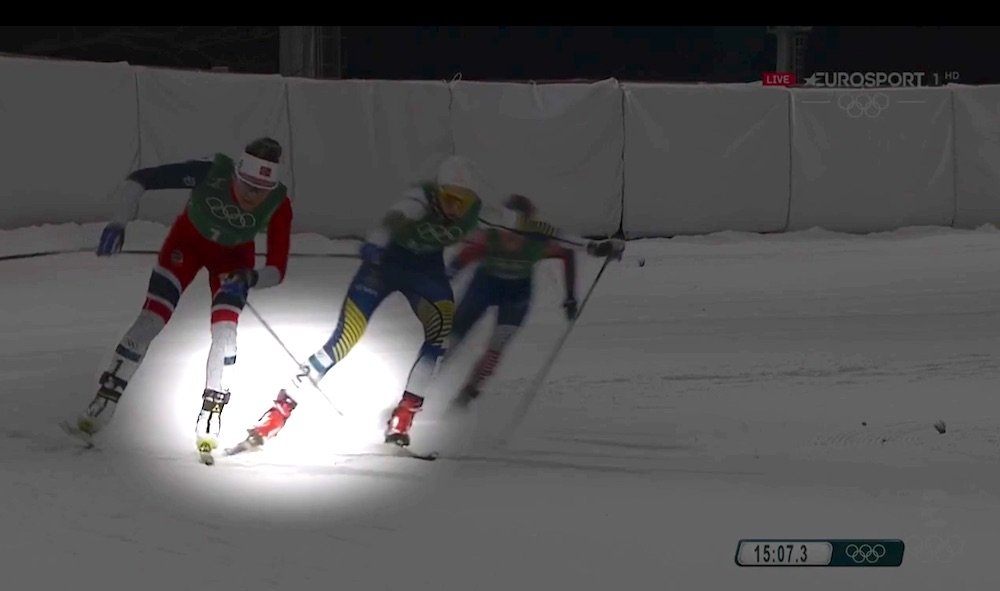
Jessie Diggins doing her thing and anchoring her team, with teammate Kikkan Randall, to the first U.S. gold in the Olympic cross-country skiing history. They won Wednesday’s freestyle team sprint, holding off Sweden and Norway. (Photo: FlyingPointRoad)
If you’re a diehard fan of U.S. cross-country skiing at the highest level (or even just into North American skiing in general), you’re gonna want to find a replay of the women’s freestyle team sprint from earlier today at the 2018 Winter Olympics in PyeongChang, South Korea. And if you’re in the U.S., check out NBCOlympics.com.
Here’s what Kikkan Randall had to say of the moment captured below:
“I was standing in the finish with Charlotte [Kalla of Sweden], and we were both screaming at the top of our lungs for our teammates so we were having our own little competition,” Randall said at the post-race press conference. “From our perspective, it was really hard to tell who was going to be ahead so it was a nail-biter all the way up until that finish line.
“When Jessie won, I looked over at the scoreboard and I saw United States number 1 and just let out a big scream and ran over and tackled Jessie,” Randall continued. “And she said, ‘Oh my gosh, did we just win the Olympics?’ And I said, ‘Yeah!’ ”