From the FasterSkier archive — posts syndicated from athletes’ and coaches’ own blogs between 2004 and 2012, kept online as published. Current coverage is at fasterskier.com.
Paul Smith’s College is hiring a Nordic Center Manager to run the ski operation at its Visitor Interpretive Center, the 25 miles of ski, snowshoe and hiking trails on the college’s campus in the northern Adirondacks of New York.
The job is full time and covers nearly everything that happens on snow at the VIC: races and events, lessons and youth programs, passes and partnerships, trail and course readiness, and the student staff and volunteers who keep the place running. The college sees the VIC/Outdoor Center as a regional ski destination, an event venue, a classroom and an earned-revenue business all at once, and it wants a hands-on manager who can grow how much the center gets used in every one of those roles.
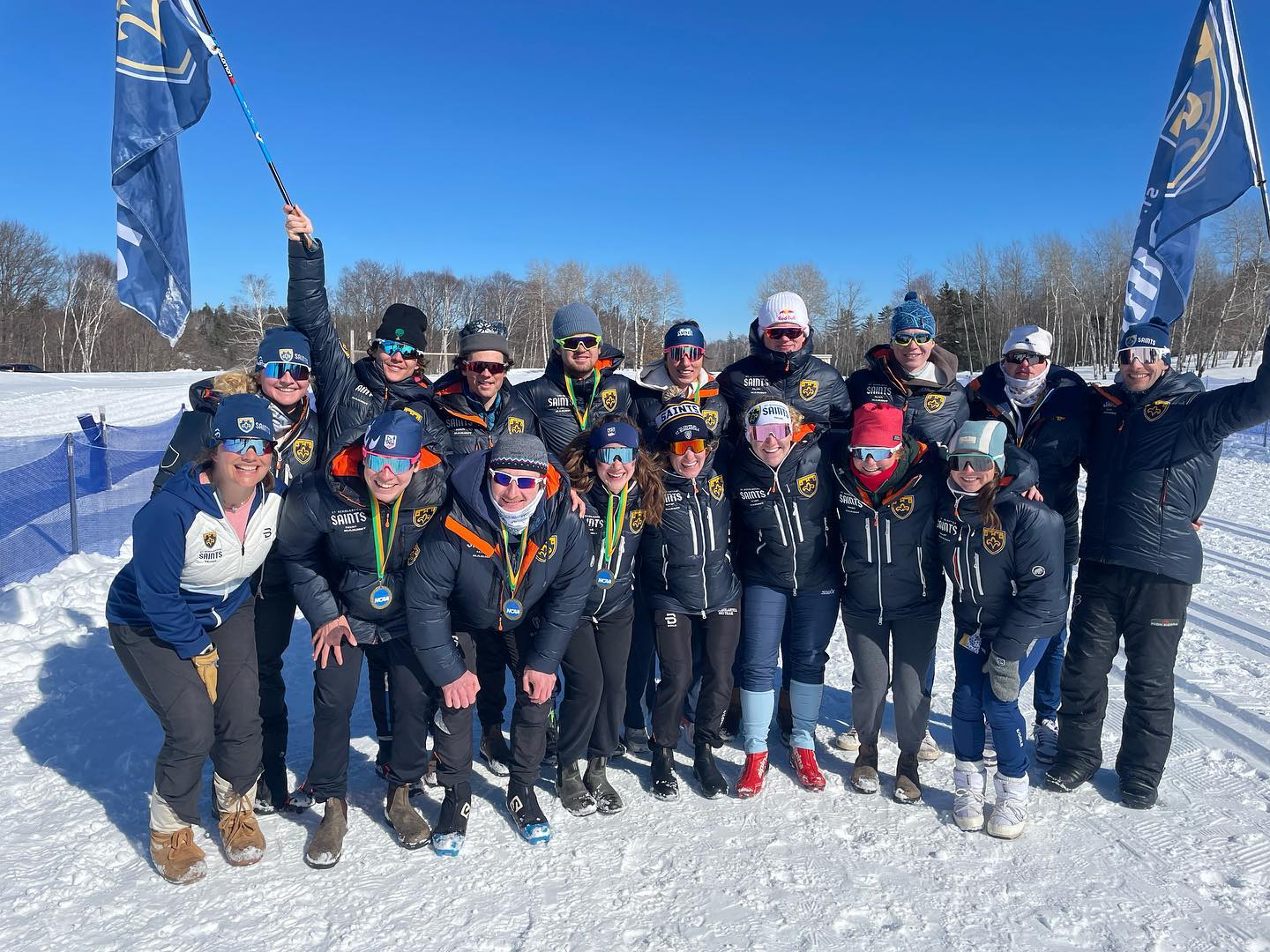
The trails are also home to one of the strongest programs in the U.S. Collegiate Ski and Snowboard Association. Head coach Matt Dougherty’s Paul Smith’s men won the 2026 USCSA national title and the women finished second, a run FasterSkier wrote about this month. The new manager will work alongside the VIC Director, the Trails & Facilities Manager and Athletics to balance what the team needs with public access, programs and events.
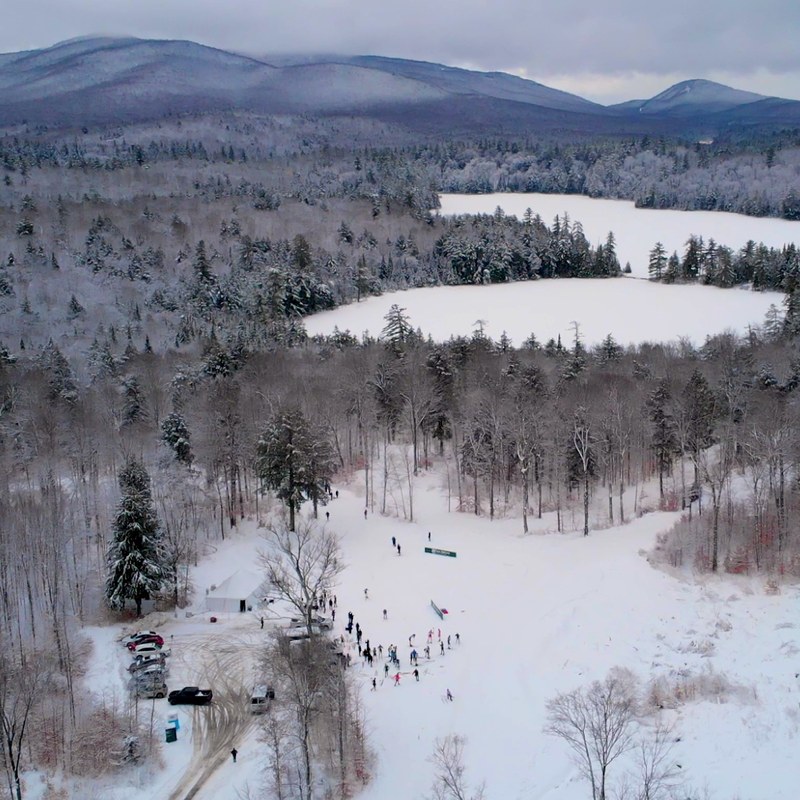
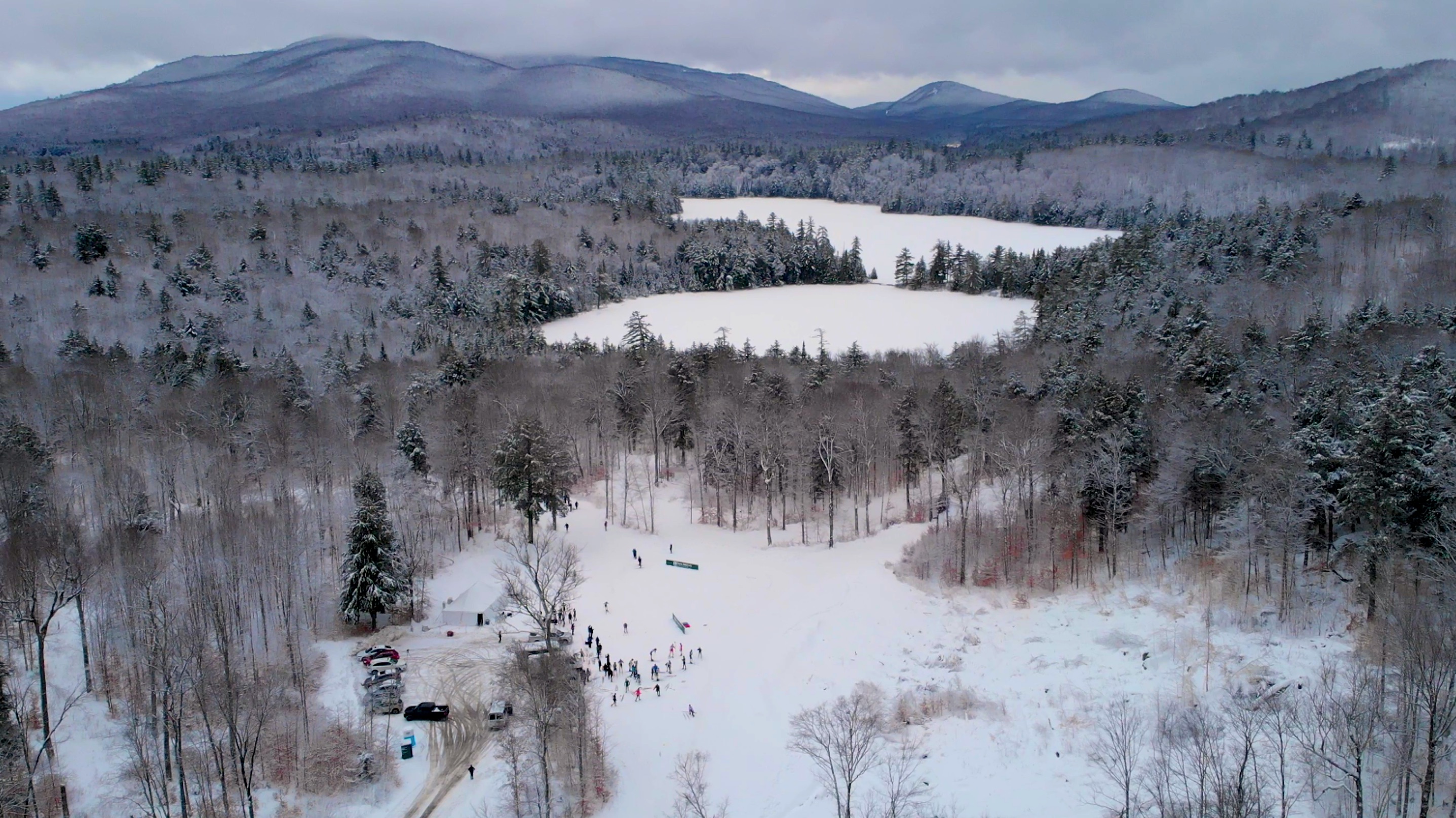
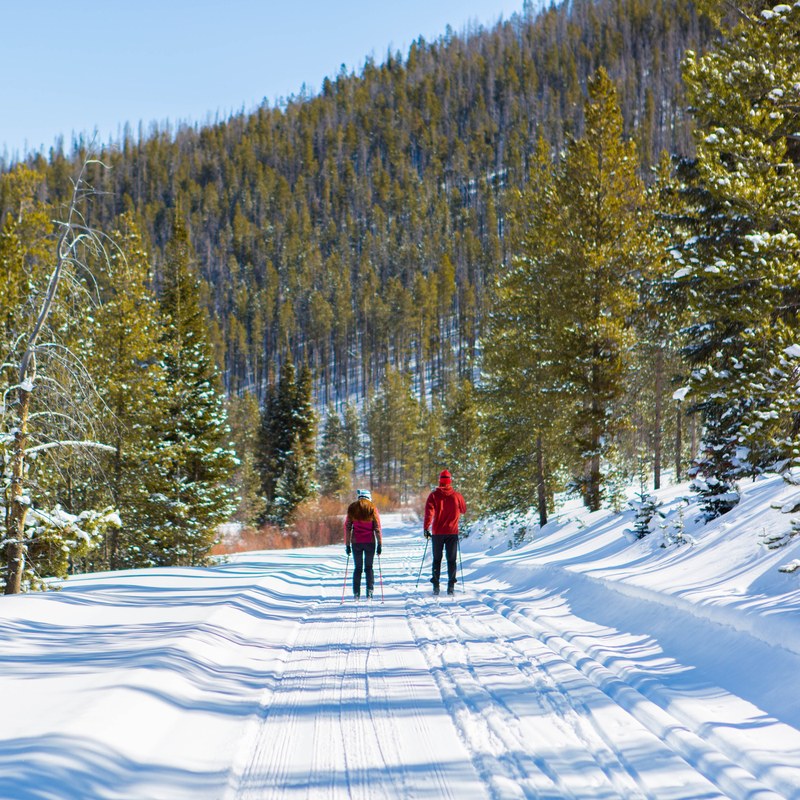
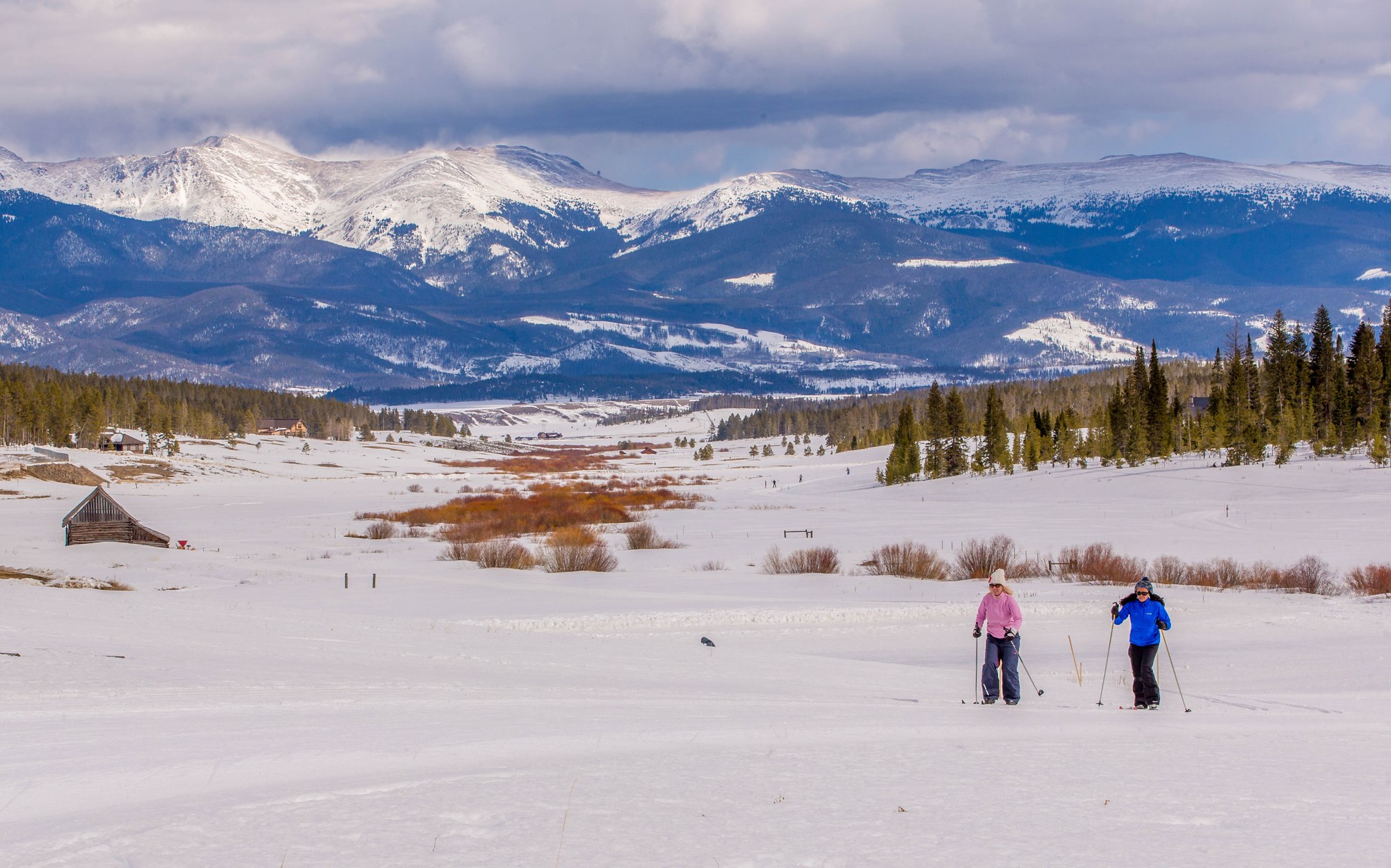
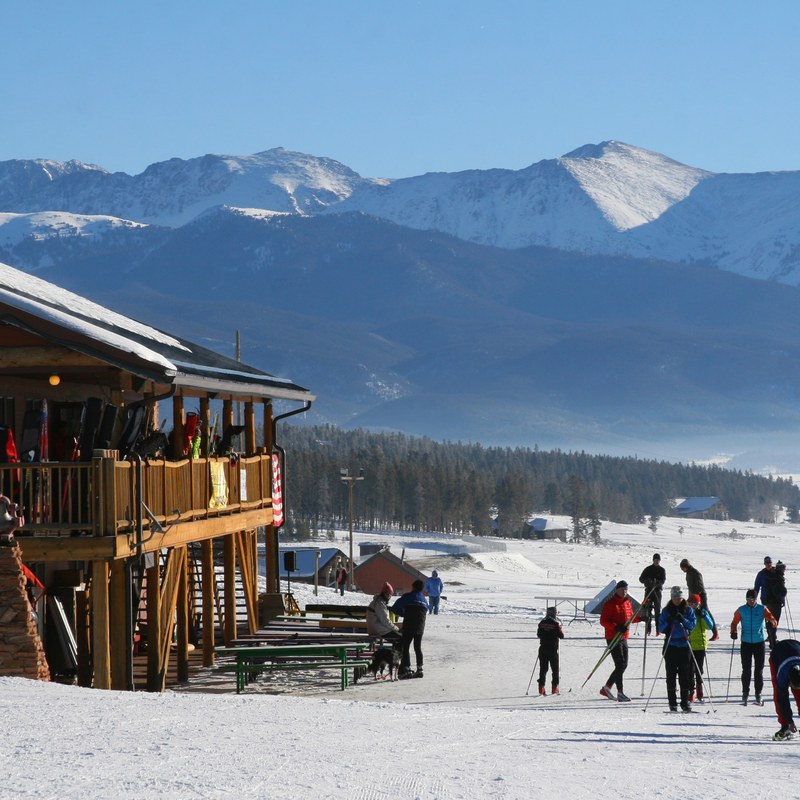
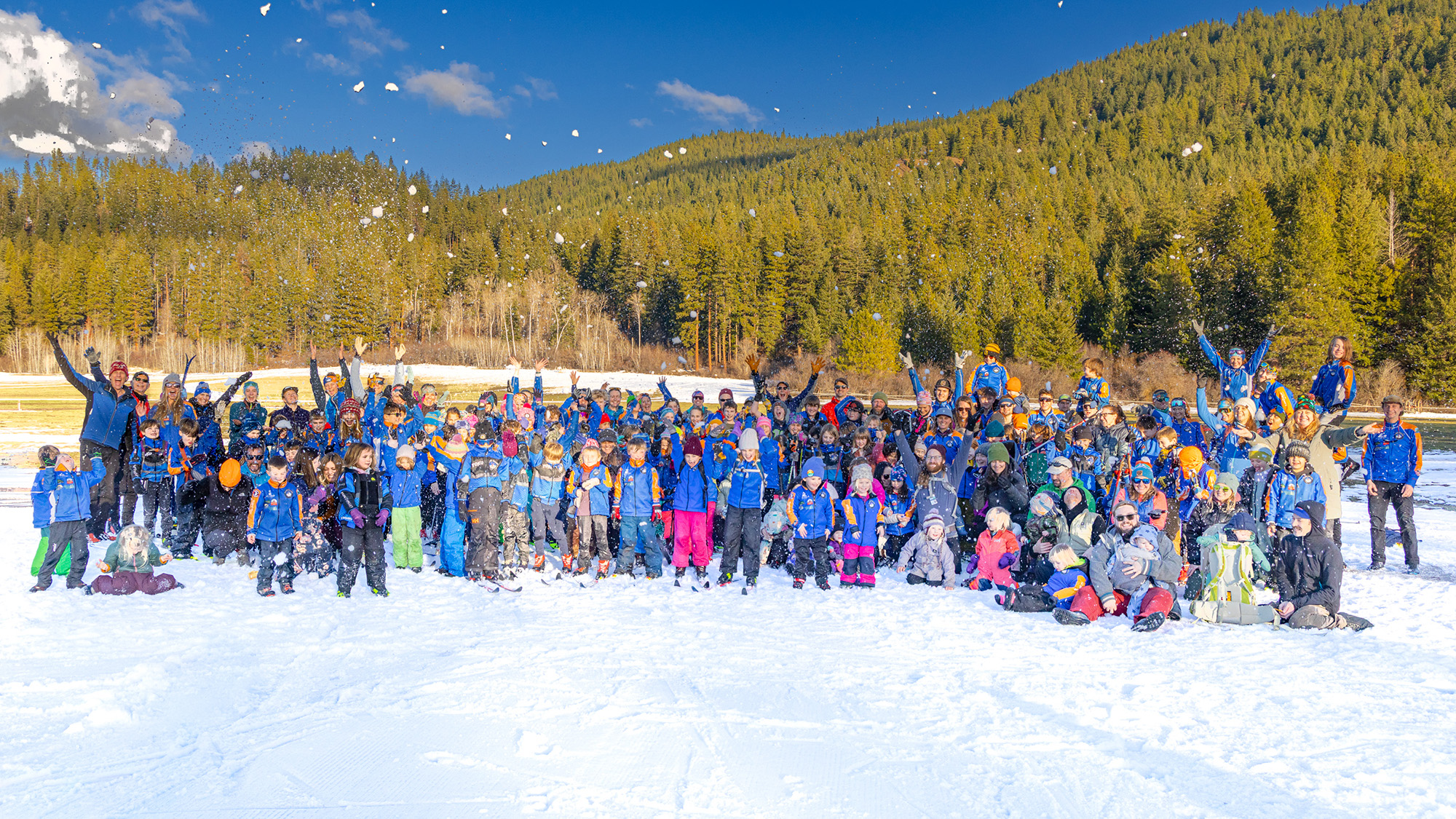
Skiers gathered on the Paul Smith’s College trails, with the Adirondacks beyond. (Photo: Paul Smith’s College)
The Position
Nordic Center Manager, regular, full time, exempt
Department: Paul Smith’s College Outdoor Center / Visitor Interpretive Center (VIC)
Reports to the Director of the Outdoor Center / VIC
Salary: $62,353.20 to $68,000
Health, dental and vision insurance, paid time off, and a 403(b) to which the college contributes 5 percent of salary
Tuition remission for employees and their dependents, plus free use of the college’s gym, athletic facilities and the VIC trails
Early mornings, evenings, weekends and holidays come with the job in winter
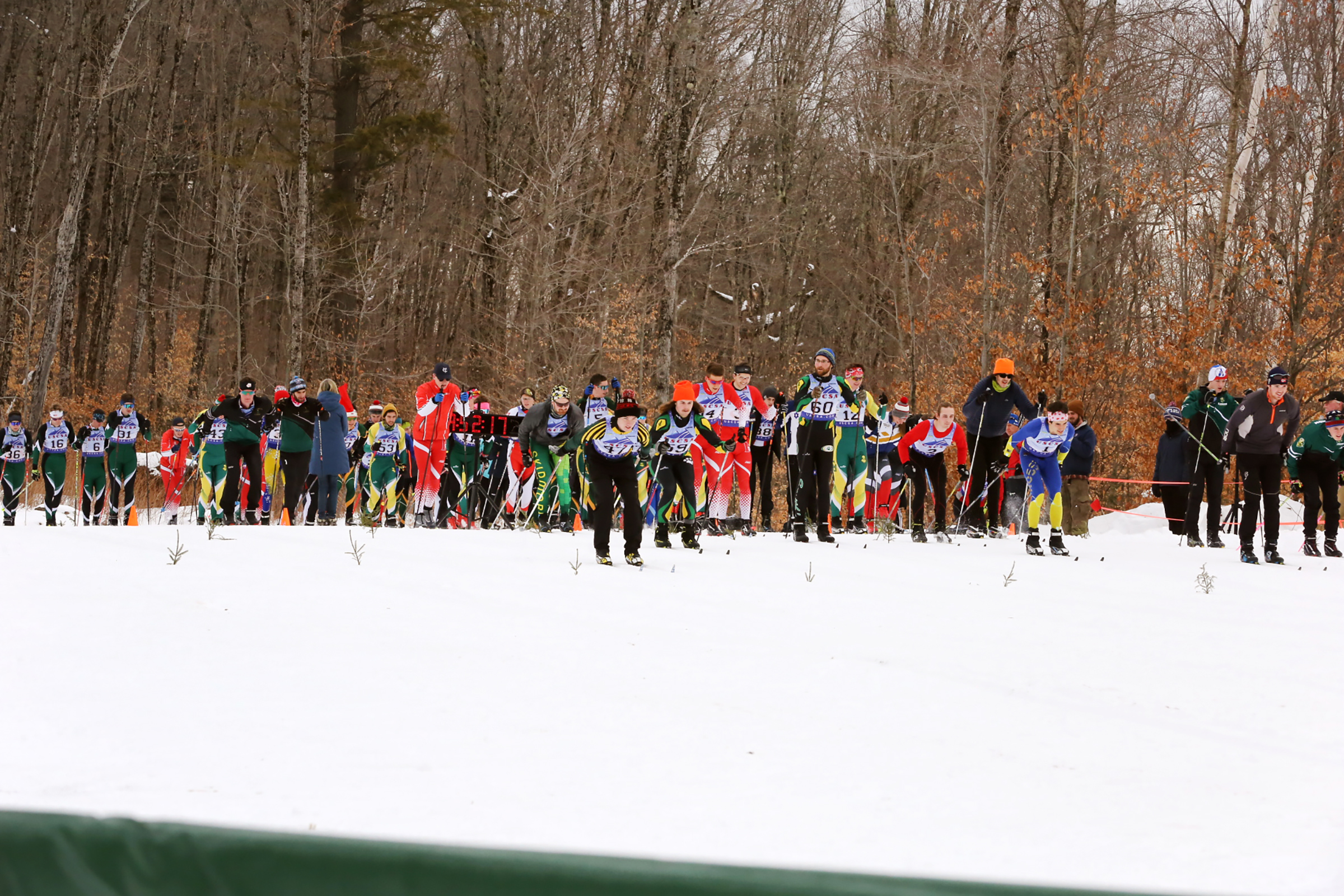
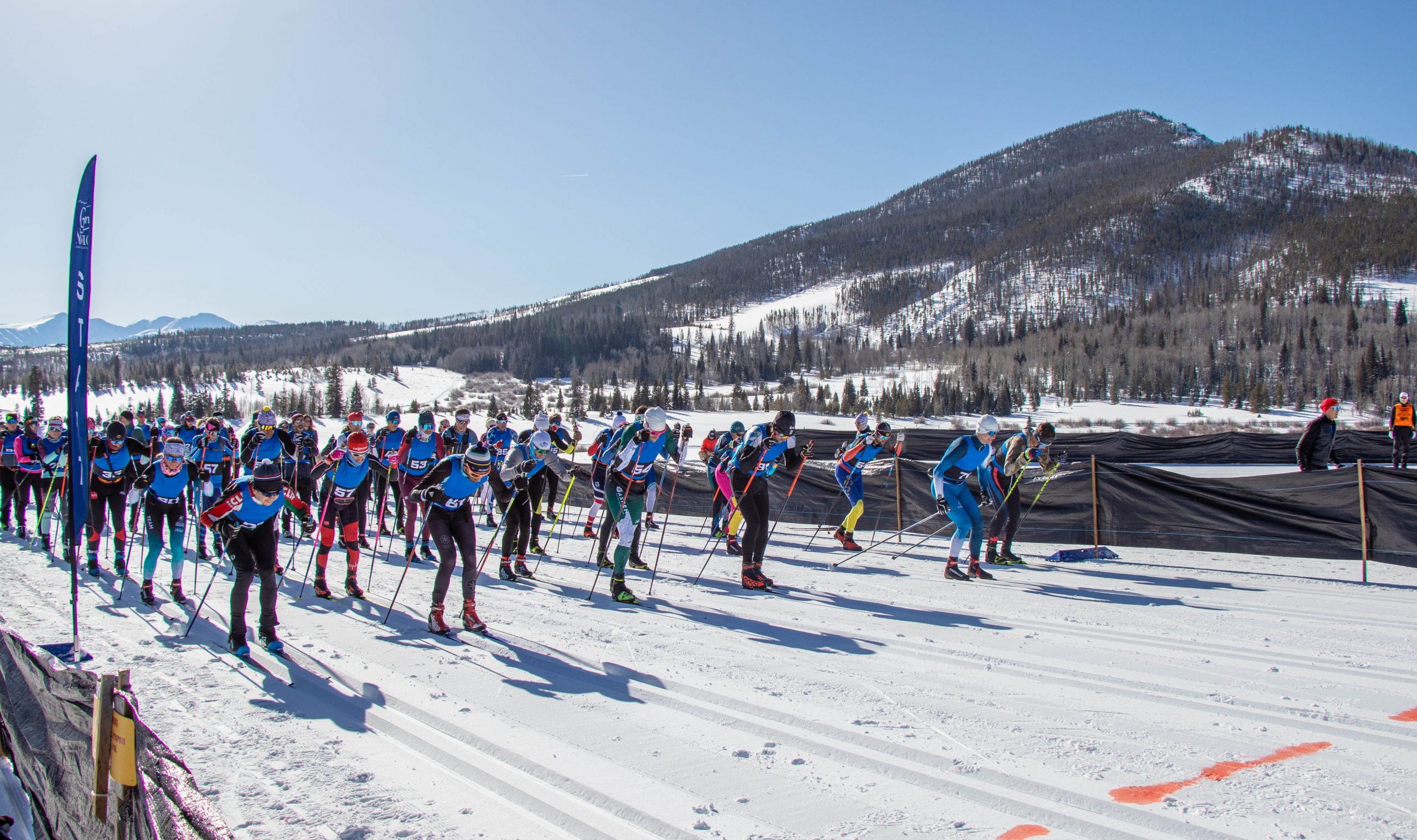
The start of the 2020 Paul Smith’s College Bobcat Invitational. (Photo: Pat Hendrick)
Events, Programs and Partners
The first half of the job is getting more people onto the trails. The manager will:
Keep developing the Nordic Center as a welcoming, high quality regional destination for students, teams, visitors and the local community
Find, plan, promote and support races, training opportunities, clinics, youth programs, community events and group outings
Build public programming, including learn-to-ski sessions, skills clinics, school and youth programs, camps, guided outings and community races
Build relationships with Nordic clubs, race directors, coaches, schools, collegiate programs, tourism partners, outdoor recreation organizations and local businesses
Grow visits and earned revenue through passes, programs, events, facility use, partnerships and sponsorships
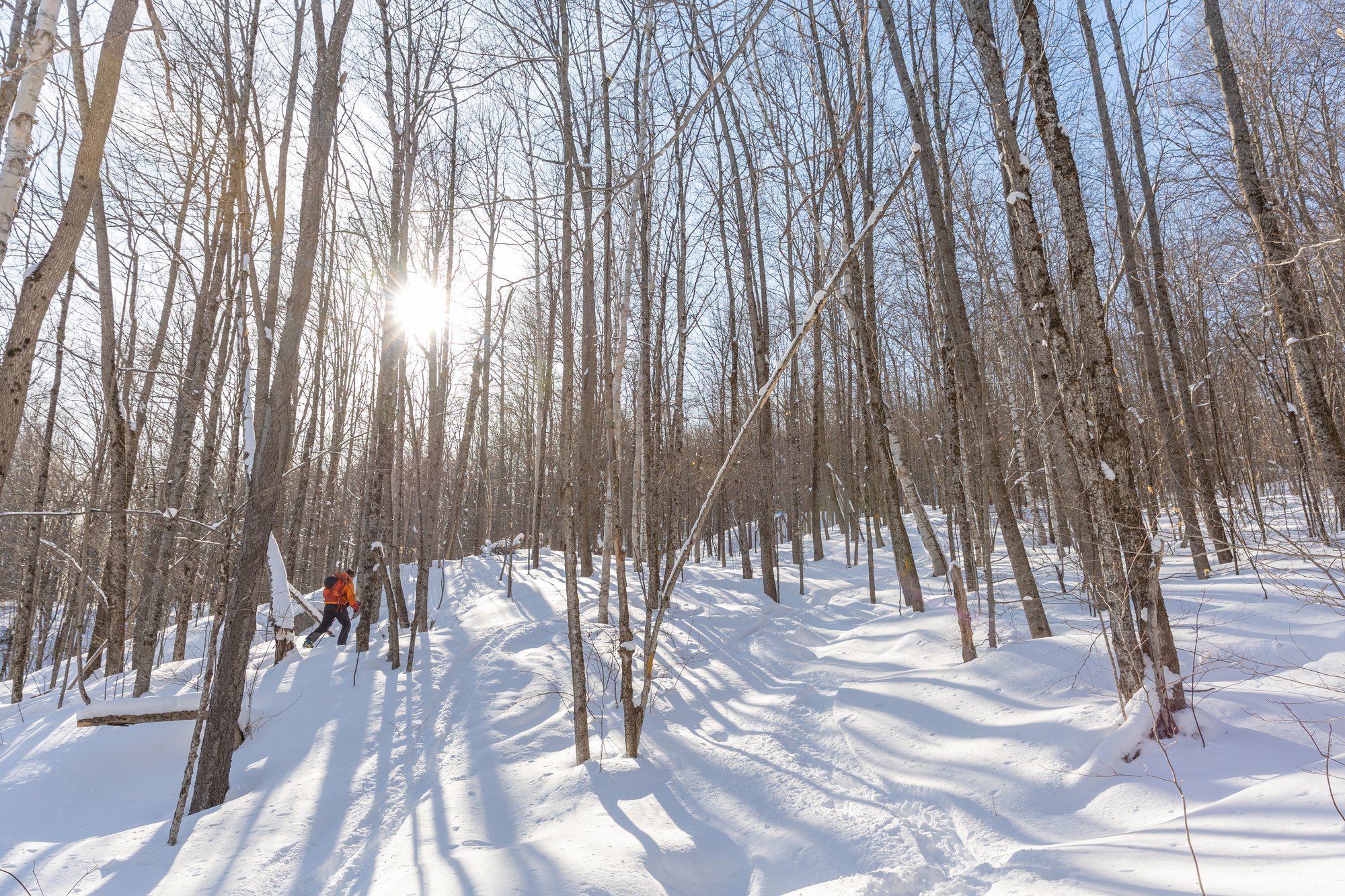
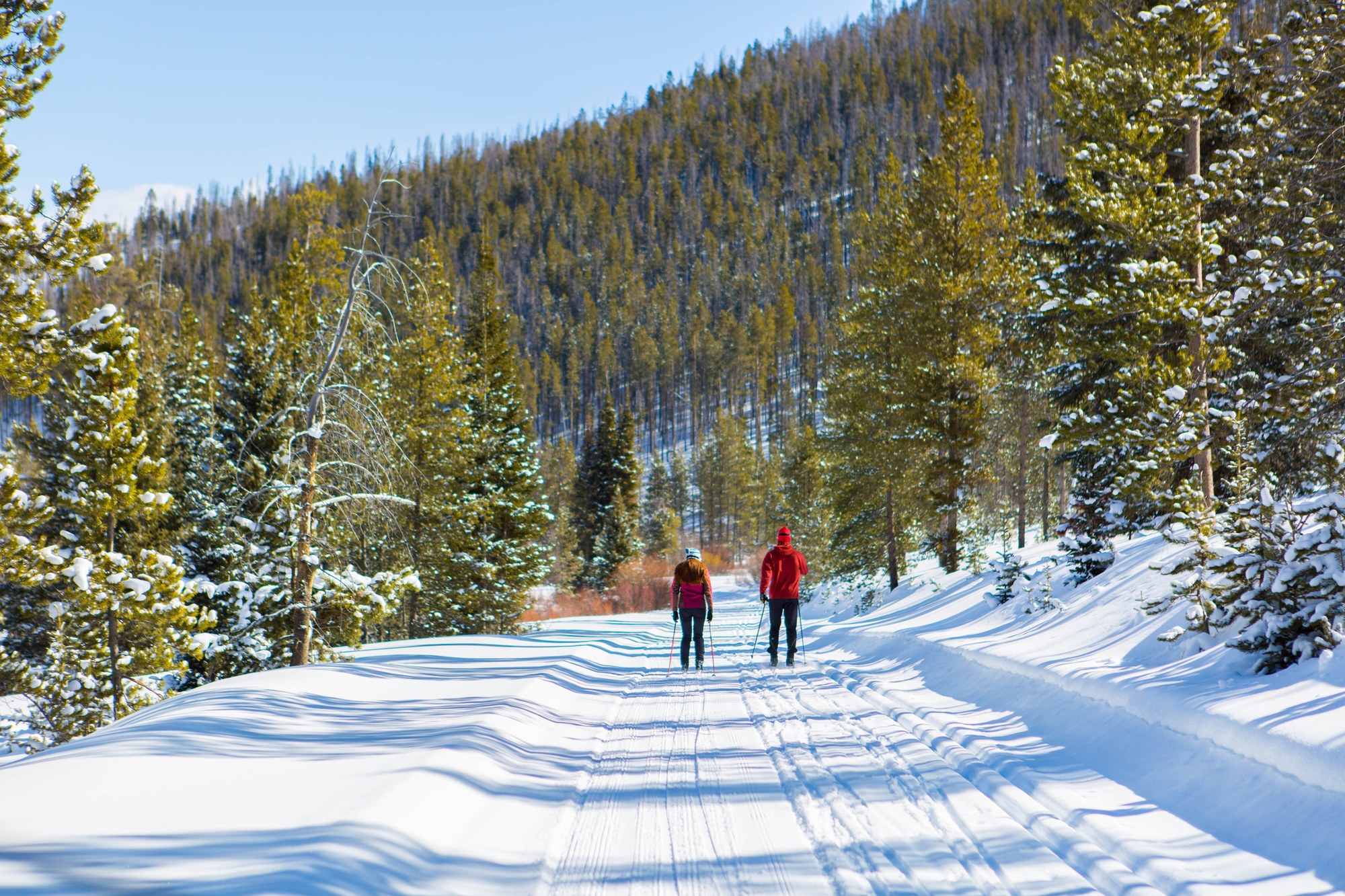
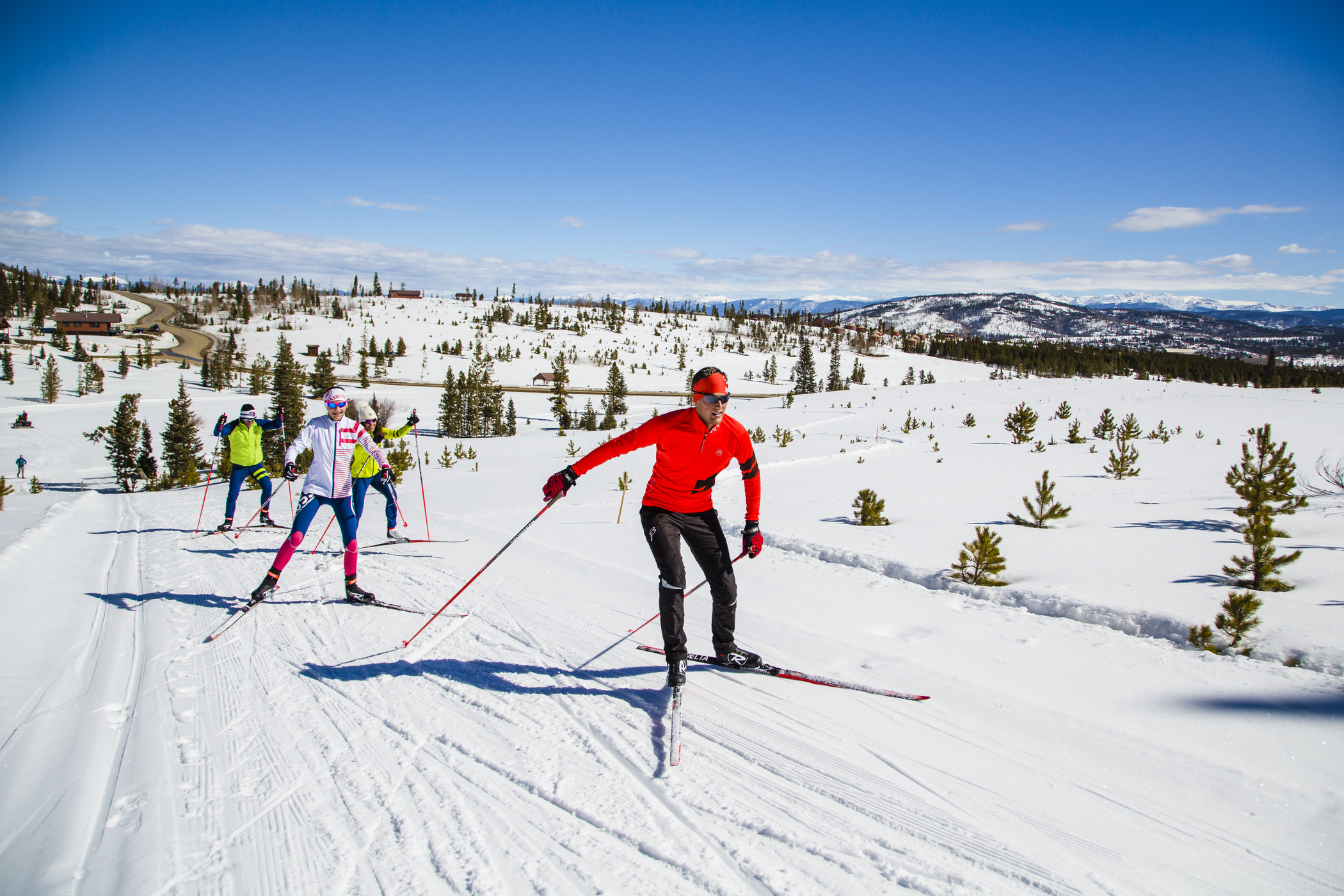
A skier in the hardwoods at the Paul Smith’s College Visitor Interpretive Center. (Photo: Paul Smith’s College)
Running the Venue
The second half is the daily operation. The manager will:
Coordinate the day-to-day Nordic Center experience, from public access and trail and course readiness to user communications, scheduling, safety procedures and service standards
Recommend trail, course, facility, equipment, signage and visitor service improvements that make the venue more reliable, more accessible and better prepared for events
Recruit, train, schedule, supervise and mentor student employees, seasonal staff and volunteers
Serve as Manager on Duty
Depending on the experience and strengths of the person hired, the role can also lead, oversee or share the work in one or more of these areas:
Winter grooming, including grooming schedules, trail condition updates, and operating and maintaining the grooming equipment
Supervising staff and students on sustainable trail construction and maintenance
Race recruitment and operations, including regional, high school, collegiate and club relationships and course planning for specific competitions
Clinics, camps, youth programming, school partnerships and inclusive community recreation
Pass sales, rentals, retail, sponsorships, marketing, tourism partnerships and social media
Long-range planning for trails, courses, facilities, amenities and capital improvements
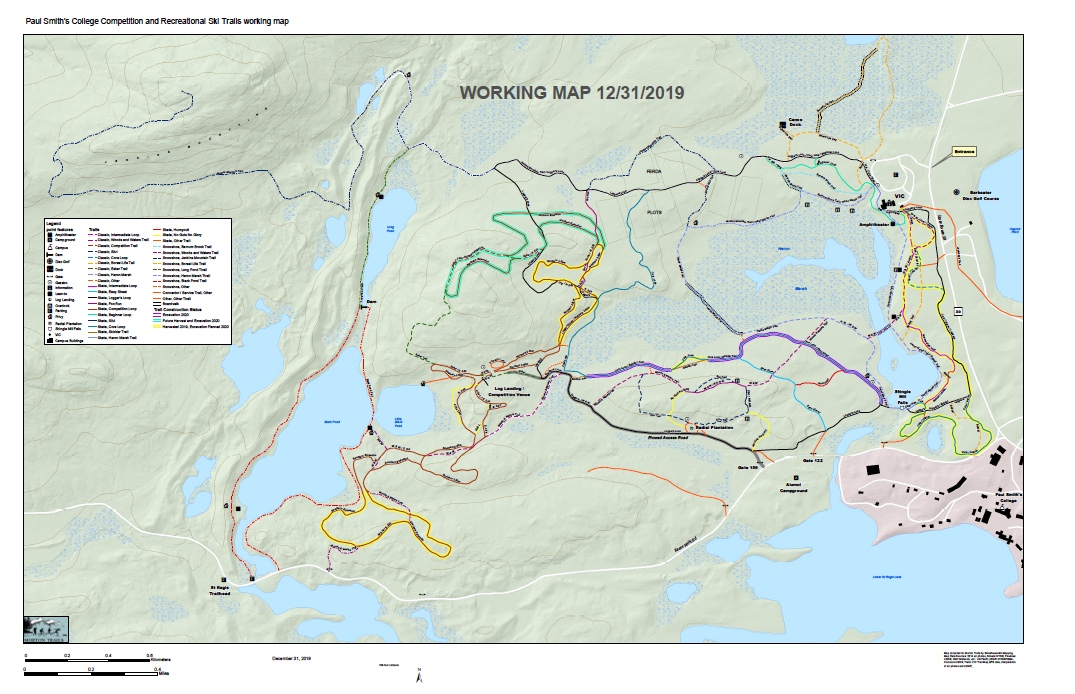
The 2019 working map of the competition and recreational ski trails Morton Trails laid out on the Paul Smith’s College campus. (Map courtesy of Paul Smith’s College)
Qualifications
Required:
Experience in outdoor recreation, event management, hospitality, community programming, destination development, customer service, Nordic skiing or a related field
A track record of helping develop and deliver events, programs, services, partnerships or customer experiences, with strong planning, communication, relationship building and problem solving skills
Ability to supervise and mentor student employees, seasonal staff, volunteers or crews, and to work across campus and with outside partners
Ability to work outdoors in variable winter conditions, on early mornings, evenings, weekends, holidays and changing hours
Strong computer and administrative skills, including email, spreadsheets, scheduling and digital recordkeeping, and the ability to learn point-of-sale, rental and reservation, equipment inventory and trail condition systems
Preferred:
Experience managing a Nordic center, winter recreation venue, trail system, outdoor recreation business, event operation or comparable public-facing operation
Experience with pass or membership programs, registration, earned-revenue services, marketing, sponsorships, tourism partnerships, Nordic events or cross country ski racing
Experience with or strong knowledge of Nordic grooming, snowmobile operation, grooming equipment, trail maintenance or winter trail operations
Physical requirements: The manager must be able to move safely on foot over icy, snow-covered and steep trails, lift and move equipment weighing up to 50 pounds, operate or learn to operate winter utility vehicles including snowmobiles and tracked UTVs, and have the endurance to respond quickly in deep snow.
How to Apply
Paul Smith’s College is accepting submissions through November 20, 2026. Apply through the college’s careers site:
Questions about careers at the college can go to Paul Smith’s College human resources at 518-327-6179. Paul Smith’s College is an equal opportunity employer.
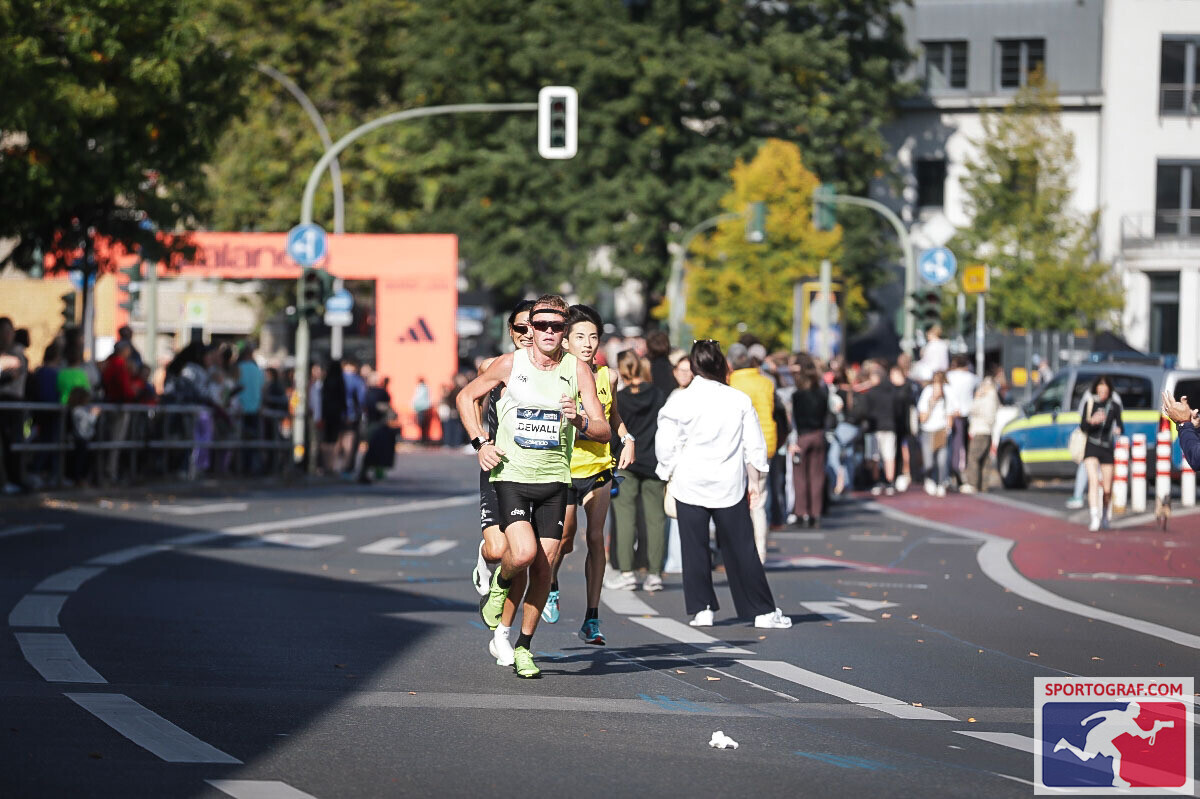
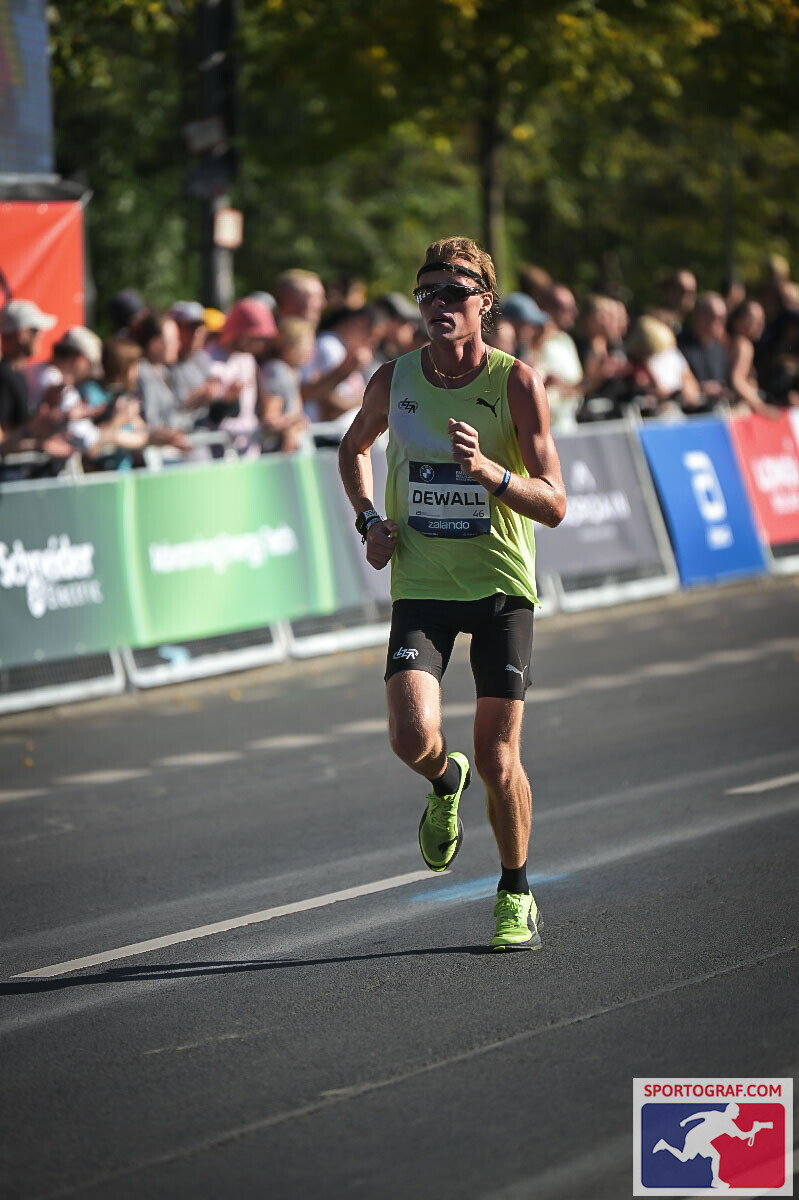
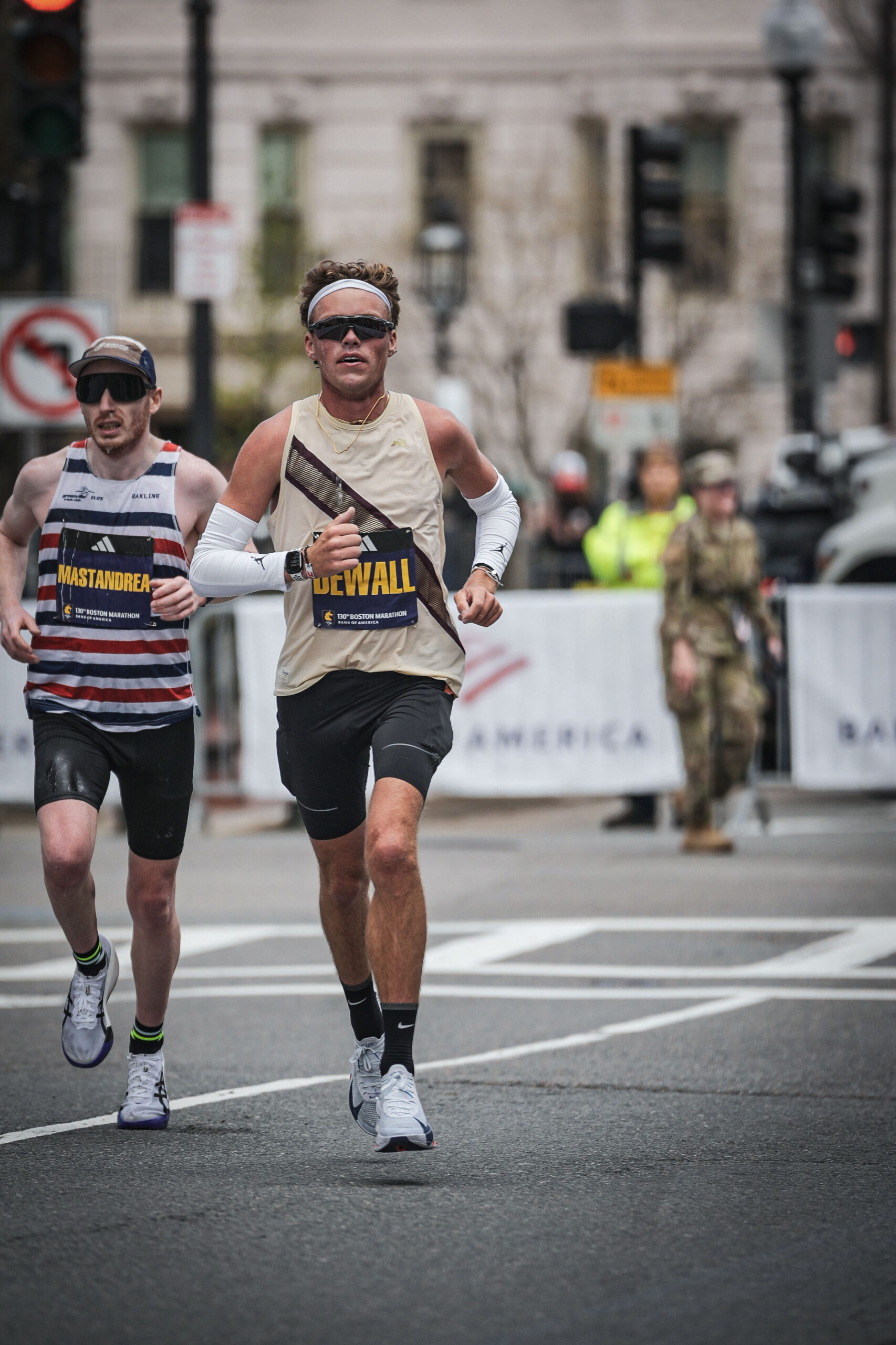
Lars Dewall leads a small group through Berlin on September 27. He finished the BMW Berlin Marathon in 2:12:13, third among the Americans. (Photo: Sportograf)
The summer before he started college, Lars Dewall ran his easy miles at a nine-minute pace.
He had run 4:26 for the mile in high school. He had been an all-state skier at Stillwater Area High School in Minnesota, the same school Jessie Diggins skied for. And the coach waiting for him at the College of St. Scholastica in Duluth had given him one rule for his easy days: keep his heart rate under 140 beats per minute.
For a runner like Dewall, on the road, that was a jog.
“That’s how slow I was going,” he said. “It just doesn’t feel fun, and it takes a long, long time.”
People tell him now that he runs his easy days fast.
“I’m like, yeah, five years ago I was running nine-minute pace, though,” he said. “I had to be so disciplined about that for so long.”
On September 27 he ran 2:12:13 at the BMW Berlin Marathon, 31st overall and third among the Americans, behind Charlie Sweeney and Will Nation. It was his fourth marathon and his fourth personal best. He debuted with 2:22:57 at Grandma’s in June 2025, ran 2:14:15 at the California International Marathon that December, comfortably under the 2:16 standard for the 2028 Olympic Marathon Trials, and then ran 2:12:30 at Boston in April. In between, back in Duluth, he won the Park Point 5-Miler and broke a race record that had stood since 1975. It belonged to Steve Hoag, who finished second at Boston that spring.
Earlier this month his college coach, Chad Salmela, made the case in these pages for what American distance runners could learn from cross-country skiers, and called Dewall “my living thesis.” Salmela, who also calls cross-country skiing for NBC, describes his role these days as a sounding board on broad direction.
Dewall teaches sixth, seventh and eighth graders in San Diego and trains with a group called Lane Zero Athletics. When we spoke on a Sunday in October he had already done his long run with the team, slept for about an hour, and was getting the coffee going at one in the afternoon.
“It’s kind of like the day’s actually starting,” he said.
He talked for most of an hour and needed very few questions to do it. Nearly every answer came back around to the same place. The hardest thing a distance runner has to learn is how to go slowly, and skiers worked that out a long time ago.
St. Scholastica’s skiers after the men’s team won the NCAA Central Region team title in 2023, a first for the program. Dewall raced for the Saints on snow as well as on the track and the cross-country course. (Courtesy photo)
Lying down in the tracks
Skiing came first, in a way, and he did not care for it.
His father was a serious skier, good enough to have raced against Salmela at some point, though Dewall is not sure exactly when. He took his son out on snow when the boy was small.
“I just didn’t really like it that much, and it was kind of painful,” Dewall said and continued in his father’s voice. “He always describes it. He’s like, yeah, I’d take you out and you’d just go a little bit and lay down in the tracks or in the snow and just kind of goof around.”
Football was the thing. He ran cross-country and track in middle school, but he cared more about football than any of it. In seventh grade he took track seriously and ran somewhere around 5:15 for the mile. In eighth grade, still a middle schooler, he trained with the high school team.
“I look back on that and I’m like, that was a pretty big turning point, because you’re putting yourself in a situation with older guys,” he said. “I remember learning a lot more, and that, looking back on it, I feel like was more important than how I performed at that age. Although I performed well.”
He planned to play football as a sophomore. That fell through, which he calls “a whole nother story,” and he abandoned ship for cross-country after the season was already underway. He was “aerobically pretty naturally talented,” he said, but there was not enough time left to get fit.
Nordic skiing started around eighth or ninth grade, and it humbled him.
“You can be really fit, but that doesn’t make you good at skiing,” he said. “It’s very, very different.”
The technique took a couple of years. By his senior winter he was all-state, and he remembers finishing 22nd or 23rd at the state meet, which was enough to make him consider skiing in college. The trouble was that he had already committed to run at Western Washington University in Bellingham.
After that ski season he toured St. Scholastica and met Salmela, who had been the school’s first nordic head coach for ten years before taking over cross-country running in 2016. Dewall would not have to choose.
“I was really into the idea of being able to both nordic ski and run,” he said. “Especially at that age, I think it was really good for me to continue to do both for some years, because I didn’t know which one I really wanted to do at that point. And looking back on it now, they both really complemented each other for a really long time.”
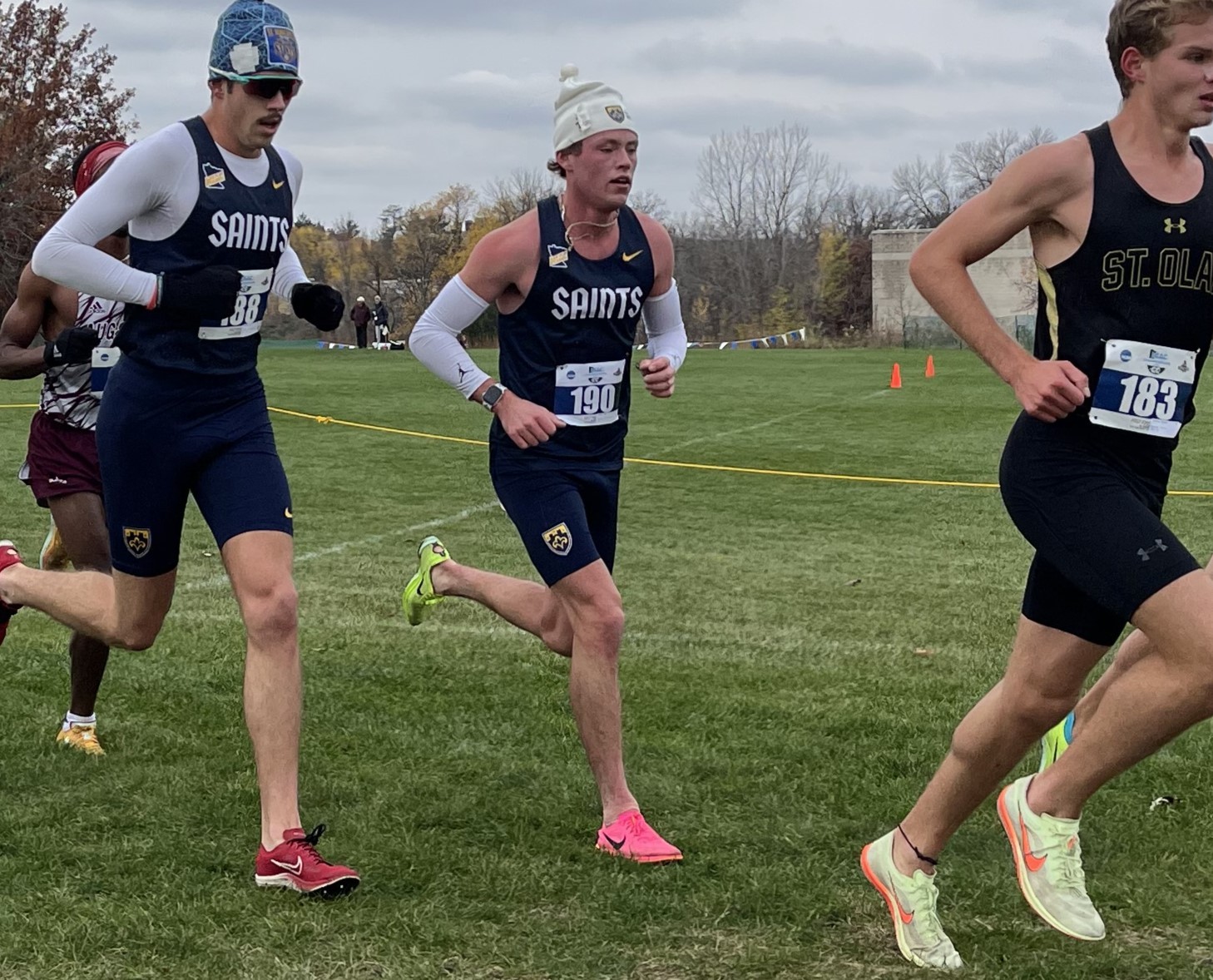
Dewall (190), center, racing cross country for St. Scholastica. Under the 140-beat rule, his easy runs on Duluth’s trails went as slow as 10- and 11-minute pace. (Courtesy photo)
The ‘Under 140’ Rule
The running in high school was built for the mile and the two-mile. His coach at Stillwater was Scott Christensen, whose program produced four sub-four-minute milers by 2012, the most of any American high school at the time. Dewall puts the number at four or five.
“My training was very VO2 max centered,” he said. “We’re running the mile and two-mile. There was no 5K.”
Most of the rest of his running, he said, sat in “that level two zone, which at the time I didn’t even really know what that meant.”
His best times were good and, he will tell you himself, not extraordinary: 4:26 for the mile, around 9:40 for two miles, 15:55 for 5,000 meters. He graduated in 2019 and doubts those marks would get him in the door at Western Washington now.
“I guarantee those times would not,” he said. “They’d be like, nah, sorry.”
What he remembers from those years is not a time.
“I was running faster on my recovery or easy days in high school than I am now,” he said.
The easy runs went at 6:30 to 7:15 a mile, with his heart rate at 150 to 160.
“You’re in that zone where you’re just burning glycogen,” he said. “You can’t call it recovery, because you’re not recovering. You’re just burning through your tank every day, and you might get fit pretty quickly.”
He has nothing against that kind of training. He just thinks it answers a different question.
“If you gave me an athlete and were like, okay, we need to get this athlete as fit as possible in two to three months, you’re gonna do a lot of that zone two, because it’s gonna have the most bang for your buck,” he said. “But if you were to give me an athlete and say, we need to make this athlete the best version of themselves, and we have eight years to do it, well, you’re gonna do things a lot differently in terms of the intensity on your easy days.”
Zone two sits well below threshold but above the genuinely easy work of zone one. On the Olympiatoppen scale most skiers know, the Norwegian system, it runs from roughly 72 to 82 percent of maximum heart rate. It builds fitness quickly. Plenty of coaches believe it also costs more recovery than easier efforts without giving much more back, and that is the trade Dewall is describing.
He also thinks, looking back, that he was never really a miler.
“I think I was a true distance runner who had the ability to run well at the mile and two-mile still, just by default almost,” he said.
In Duluth, Salmela made it simple. Keep the heart rate around 140 or below on easy days. Dewall did not buy in right away.
“It took me a little while to buy into it, and I was kind of half in, half out for a while,” he said. “But eventually I started taking it very seriously.”
His first college cross-country season started well and ended with an illness and a disappointing finish. The principle held anyway. The nine-minute miles on the road were the hard part. Duluth had trails, and the trails helped.
“The trails made it easy to really soak up, let’s just say, two hours at 135 BPM, but we were running maybe 10-, 11-minute pace on technical trails,” he said. “It made it mentally easy to let your ego go and just accept that it’s going to be a slow run and low heart rate, and that’s okay.”
The return took years. When he is fit now he can run 6:45 a mile with his heart rate close to 130. He measures that against the high schooler who ran his easy days at about the same pace and 25 beats higher.
“It’s huge,” he said. “It’s everything.”
By the time he carried that discipline onto snow, the skiers around him already had it.
“The skiers have a much better concept and notion of easy training than runners,” he said. “I would say it’s not even close. I feel like I’ve done more running than I have skiing, but I’ve done enough skiing to confidently say that the skiers are much more on top of their intensities, and cognizant about what they’re doing every day.”
He has a theory about why.
“Maybe it’s just the simple idea that you’re skiing, the terrain is varying,” he said. “Skiing feels a little bit more social to me than running does, because you’re out there and it’s different all the time. But running, I think people just get way too caught up in the pace per mile and all of that.”
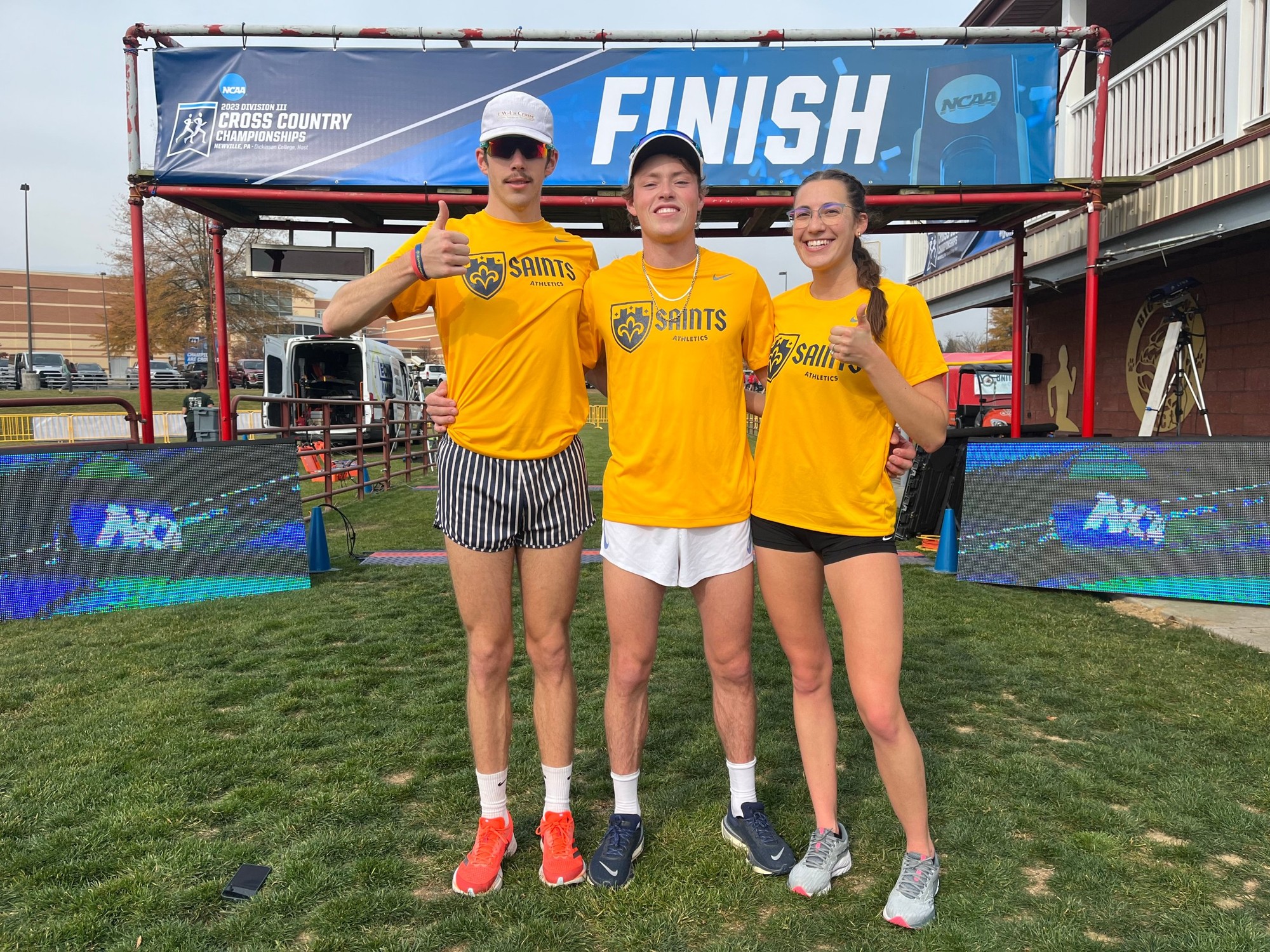
St. Scholastica runners, Dewall among them, under the finish banner at the 2023 NCAA Division III Cross Country Championships in Newville, Pennsylvania. (Courtesy photo)
Eight hundred hours
In college he stopped counting miles and counted hours: run, ski, bike, lift. Some years, he said, came out between 800 and 900.
“I was pushing it pretty heavy,” he said. “And again, obviously a lot of that is cross-training and not running.”
Not all of it paid right away, even in a college career that included All-America honors in cross-country in 2023. The 5,000 and 10,000 meter results did not match the workload, and the skiing never got where he wanted it. He still turns that over.
“I felt like I was decent at skiing, but I don’t know what it was, and I still think about it sometimes. I felt like it just couldn’t push to that top level,” he said. “I felt like I maybe didn’t start early enough, or maybe naturally just didn’t have it in that sport, and that’s okay. But I still really enjoyed it, and I think there was a huge payout later on in the running world with all the skiing.”
The year had a rhythm. Winter was mostly skiing, with a little running. Cross-country season was a mix. In the spring he let the volume slide so he could sharpen for track.
“You’re not going to run well in track if you’ve got heavy ski legs,” he said.
What he and Salmela watched was the line from one year to the next, not any single season. It has only gone one way.
“There hasn’t been a year since I started working with Chad where I haven’t gotten better, like PR’d in something or seen improvement in some way or another,” he said. “There were some years where maybe a nordic ski season or a track season or even a cross-country season didn’t go perfectly, and that’s sport. But across the board, since 2019, I can confidently say there hasn’t been a year where I haven’t gotten better.”
He plans to do this for a lot more years and sees no reason for the line to bend. “I haven’t dramatically changed anything,” he said.
The volume is lower now, because a runner cannot absorb hours the way a skier can.
“You can try, but something’s gonna give at some point,” he said. “You’re gonna get hurt, essentially.”
What crossed over intact was the mindset.
“I’m really good about training like a skier, in the mindset of, I go out there and I know exactly what intensities I need to hit every day,” he said. “And I’ve done a really good job of letting the ego side of running go.”
That means running alone, often. If the group heads out on a recovery day at 6:45 pace and his heart rate says no, he lets them go.
“I have no issue going out and letting people go too fast, and I won’t go with them,” he said. “I’ll run alone. But that takes a lot of discipline.”
He is not perfect at it. Where he still slips is in workouts, when somebody wants one more fast rep.
“I can look back even at my block going into Berlin, and look at a couple workouts and be like, did I really need to do that?” he said. “Did that really help me more than it hurt me? But I think just being critical about all that helps you prepare for the future too.”
The culture of the sport pulls the other way, he thinks, and social media has made it worse, especially for younger endurance athletes.
“I feel like there’s also a side of them that’s chasing likes on Strava, or a fast run, or an Instagram post,” he said. “All that stuff is great, but if you’re skewing your training around social media, that’s no good.”
His advice to the younger ones is short.
“Wait for the race to do that,” he said. “Put the race down. The training is just the building blocks.”
Every day should have a reason, a purpose.
“Look at every day and be like, what am I going to do to get better today?” he said. “Instead of just kind of hither and yon, like, oh, let’s show up and run.”
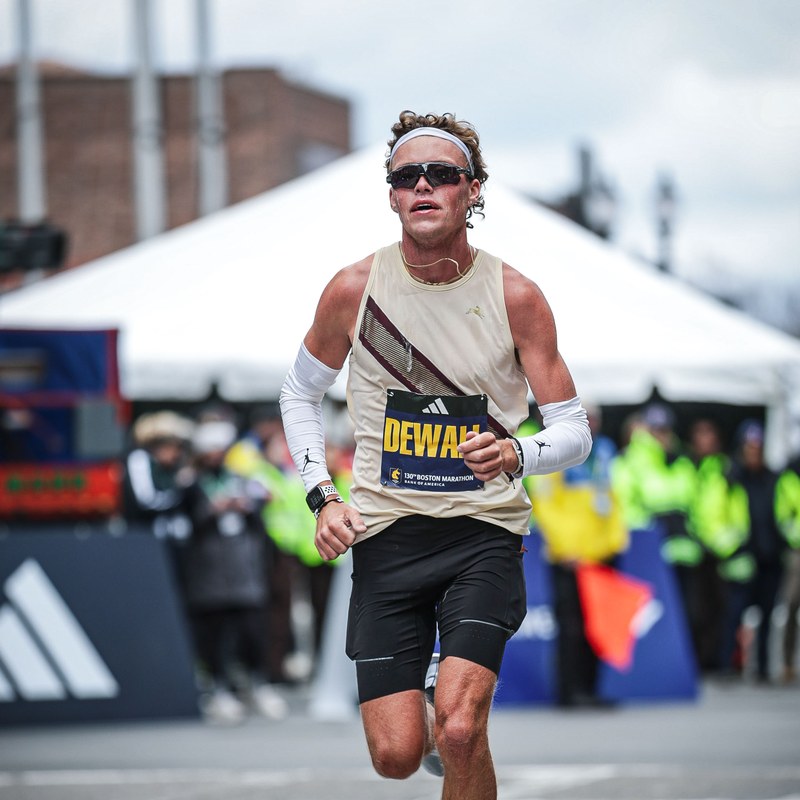
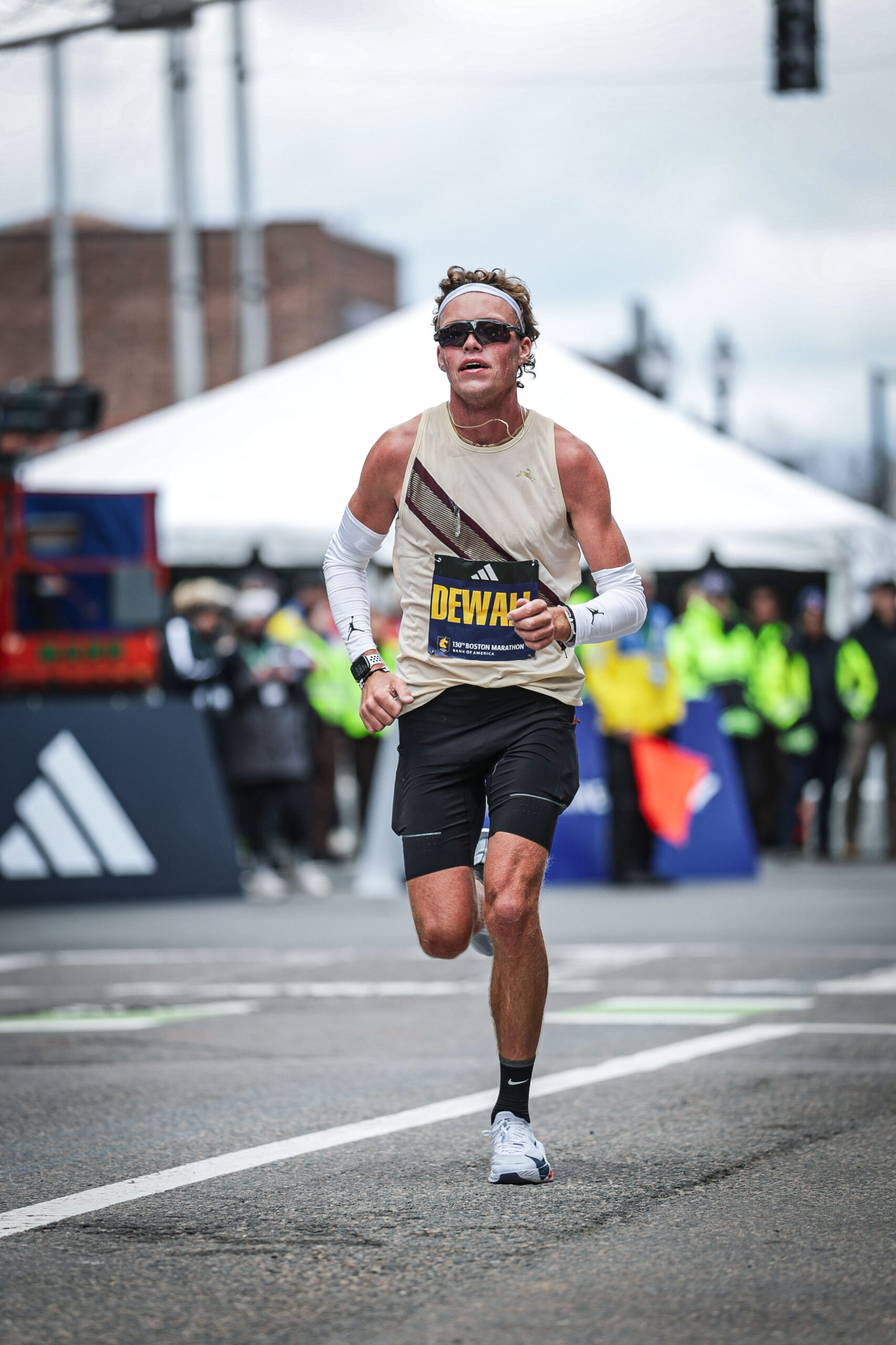
Dewall at the 130th Boston Marathon on April 20, where he ran 2:12:30 off a build with no double threshold sessions in it. (Courtesy photo)
Boring on purpose
Ask what a skier’s background gives a marathoner that most marathoners do not have, and his first answer is something he does less of.
“I’ve always found that I do a lot less VO2 max than most people, and I’ve been asked why,” he said. “The answer is always, VO2 max has a place. You have to touch VO2 max to be able to race well. But it’s less of a factor in the marathon.”
When he leaned on it in high school and college, he would string together a couple of great weeks and then slide.
“I felt like the engine would get flat,” he said. “And it’s so much harder to recover from a hard VO2 max session than a threshold session that’s done very well.”
So he replaced some of it with threshold and what he calls efficiency work. He is sure he does more threshold than the average marathoner. The gap can look small on paper, maybe one session in fourteen days, and he thinks it compounds.
“It’s hard to weigh how much even one workout every 14 days makes over the course of an eight to 12 week training period,” he said. “It adds up.”
The second answer is strength, and with it the ability to carry mileage. He has gone from about 100 miles a week to about 135.
“I don’t want to say that for sure, but I definitely think that the skiing background, the strength, the amount of volume that I was doing all those years has helped me being able to go from, okay, I was running 100 miles a week, that’s a lot. But to be able to jump from that to 135 and still feel pretty dang good,” he said. “To be able to make jumps like that, I feel like the ski background definitely is a part. Someone will go, oh, it’s just 35 more miles. But that jump in your nervous system and fatigue and all of that, it’s an exponential number. It’s hard to even measure.”
The odd part is that in college he barely lifted for running at all.
“I really did none,” he said. “I just didn’t really want to. I was just kind of lazy, and I didn’t believe that it would make me better at running.”
What he did in the weight room was for skiing: upper body, core, pull-ups. For about a year now he has followed a running strength program built to take 20 minutes. Heavy half squats. Step-ups holding about 60 pounds. A Bulgarian split squat done as a jump, with no weight. Romanian deadlifts. Two sets of eight of each, three minutes between, and he spends the three minutes stretching, on core, or on whatever is sore. He lifts two or three times a week, soon after a workout or a long run once he has refueled, and never on a recovery day.
“It comes at a cost, and strength is strength,” he said. “You’re still adding fatigue.”
Then there is the session everybody in marathoning is arguing about. He ran 2:12:30 at Boston with no double threshold days in his build. He ran 2:12:13 in Berlin after a lot of them.
“It’s hard to weigh,” he said. “If I would’ve ran 2:10 in Berlin, would I answer that question differently? Maybe. I just need more races to be able to answer that question. I think they’re both good.”
His complaint is with how a lot of people do it.
“You want fatigue to be the thing that’s stopping you, not lactate being too high,” he said. “People are like, oh, I’m done, my lactate’s high. And most people aren’t even monitoring that. I just like to let time be the thing that makes you tired. Time on feet.”
Going into Berlin, where the goal was to break 2:10, the pace for it, around 4:57 a mile, felt easier than it ever had in his career. He gives double threshold some of the credit and plans to keep it, perhaps every other week instead of every week.
“It’s taxing,” he said.
After the first story ran, Salmela wrote that Dewall was basing most of his current training on cutting-edge running technology. Dewall found the phrase funny.
“I would say that a lot of my training looks pretty boring, because it’s a lot of the same stuff over and over and over,” he said. “But the consistency is there, and the focus and discipline and being a mature runner is there.”
Lactate testing and heart rate data matter, he said. But he thinks what Salmela meant is simpler than any of the gadgets.
“In the running world specifically, people aren’t out there constantly monitoring heart rate and all that data, and getting useful information from it,” he said. “Even in the pro world in running, there are people who are doing a really good job of it, but there’s people out there who are just showing up, like, let’s go run.”
Dewall on the road in Berlin, his first race in Europe. He called it the most organized and efficient race he has been to. (Photo: Sportograf/courtesy photo)
The road to St. Louis
The Olympic Marathon Trials are in St. Louis on March 25, 2028. Dewall has had the qualifying time since CIM, and he is not alone at home. Three or four of the Lane Zero runners, Dewall included, have met the 2:16 standard.
“Although San Diego’s a big city, that’s a lot of qualifiers for even a big city,” he said. “Those are the guys that can push me in workouts and really make me better in workouts.”
Puma backed him through Berlin under its PROJECT 3 program for sub-elite marathoners, and after the race the company told some of those athletes it would support them through the Trials. He does not yet know what that will look like. He doubts it will be money.
“But free gear and travel and stuff like that, and that’s pretty huge,” he said. “So I’m stoked about that.”
He knows where the next line is.
“Two-ten is the number that most of these companies are looking at to be like, okay, let’s get you on an actual contract,” he said.
For now he is letting his body decide what comes next. Berlin was three weeks old when we spoke, and the job was to recover without giving back fitness. There might be a race before the end of the year. He expected to know soon.
Early 2027 is for going shorter: road 5Ks and 10Ks, maybe a 3,000 or a mile, even a time trial. His 5,000 best is 14:37, and he thinks 14:10 is there at the least. He would like to get under 29 minutes for 10K. His mile best is 4:10 from college, and before Berlin he ran 4:22 at the end of a workout without trying very hard.
“I was like, to my buddies, I think I could have PR’d in the mile right now at the end of this workout if I would’ve went for it,” he said. “Who doesn’t want to have a faster mile PB, even if you’re a marathoner?”
The bigger target is the half marathon standard for the Trials, 1:03:00. The window for half marathon qualifiers opens January 1, 2027. His best is 1:04:06, from the Garry Bjorklund Half Marathon at Grandma’s in June, in conditions he called humid-ish. He is already qualified for St. Louis, so the half would change nothing about his place there. He wants it anyway, and he is looking at a half in March.
“It’s a nice accolade to have,” he said. “It’s no gimme. That’s gonna take some really specific prep.”
He expects to run one marathon in 2027. Boston again, maybe London, maybe Chicago, nothing later in the year than that. He would think about Berlin again if teammates were going, because of how well the race took care of its elite field.
“That was the most organized and efficient race I’ve ever been to,” he said. “And that’s worth a lot.”
He wonders whether getting there three or four days earlier would have bought him something. He does not know. He also admits he remembers very little of the course.
“I always laugh when people ask me about the course in those races, and I’m like, I don’t even know,” he said. “You’re going pretty fast, but you’re also in a group like that, and the only thing you’re looking at is just the person in front of you.”
On Monday mornings he is back in front of his middle schoolers. He is not a morning person, which makes running before school a grind in the long weeks.
“I wish I could start my teaching day at 9 or 10 a.m., but that’s not how the real world works,” he said.
He would not trade it.
“When you don’t have that job, it’s easy to get almost obsessed with the training and the running,” he said. “As much as that’s great and it’s exciting, I think it’s good to have something to force me to not think about running.”
The classroom gives some of it back.
“It’s fun teaching kids and making a difference in their life,” he said. “I feel like they take interest in the marathon stuff too, and ask questions, and always want updates.”
He wants to coach someday, probably once his own career is over, and he knows which sport.
“I think I’d like coaching running more,” he said. “A little more straightforward. Less variables, less factors.”
No wax, no kick, no temperatures, as he put it.
The 2:10 is still out there, and he knows how close 2:12 is.
“I’m scratching,” he said. “I just gotta connect on the right day.”
Help Support Our Coverage!
If you value the thoughtful work and access FasterSkier provides, please consider becoming a Voluntary Subscriber. Your support directly fuels our work to cover the people, places, and moments that make our sport special.
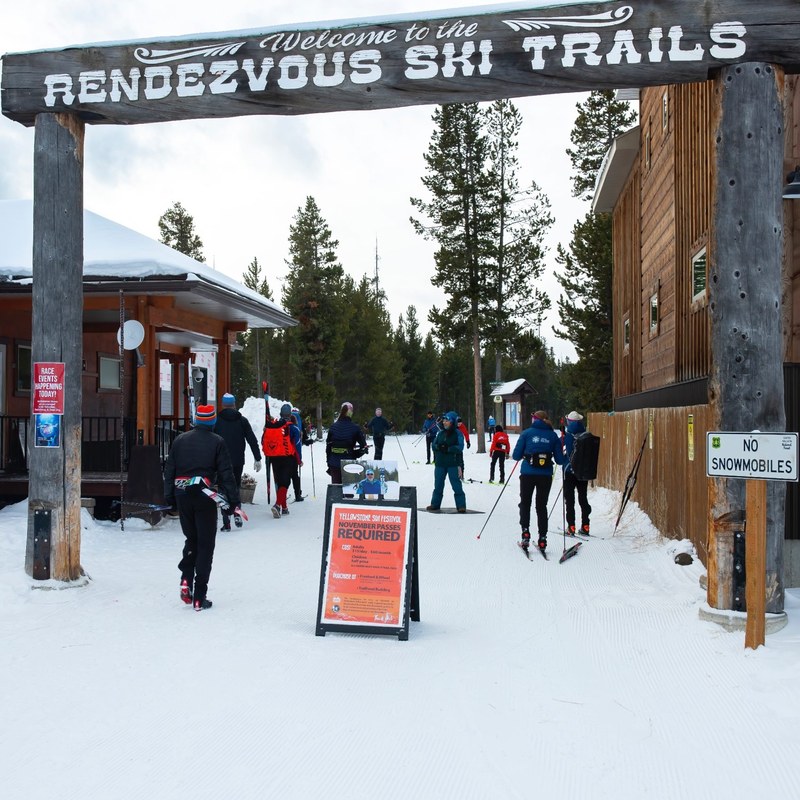
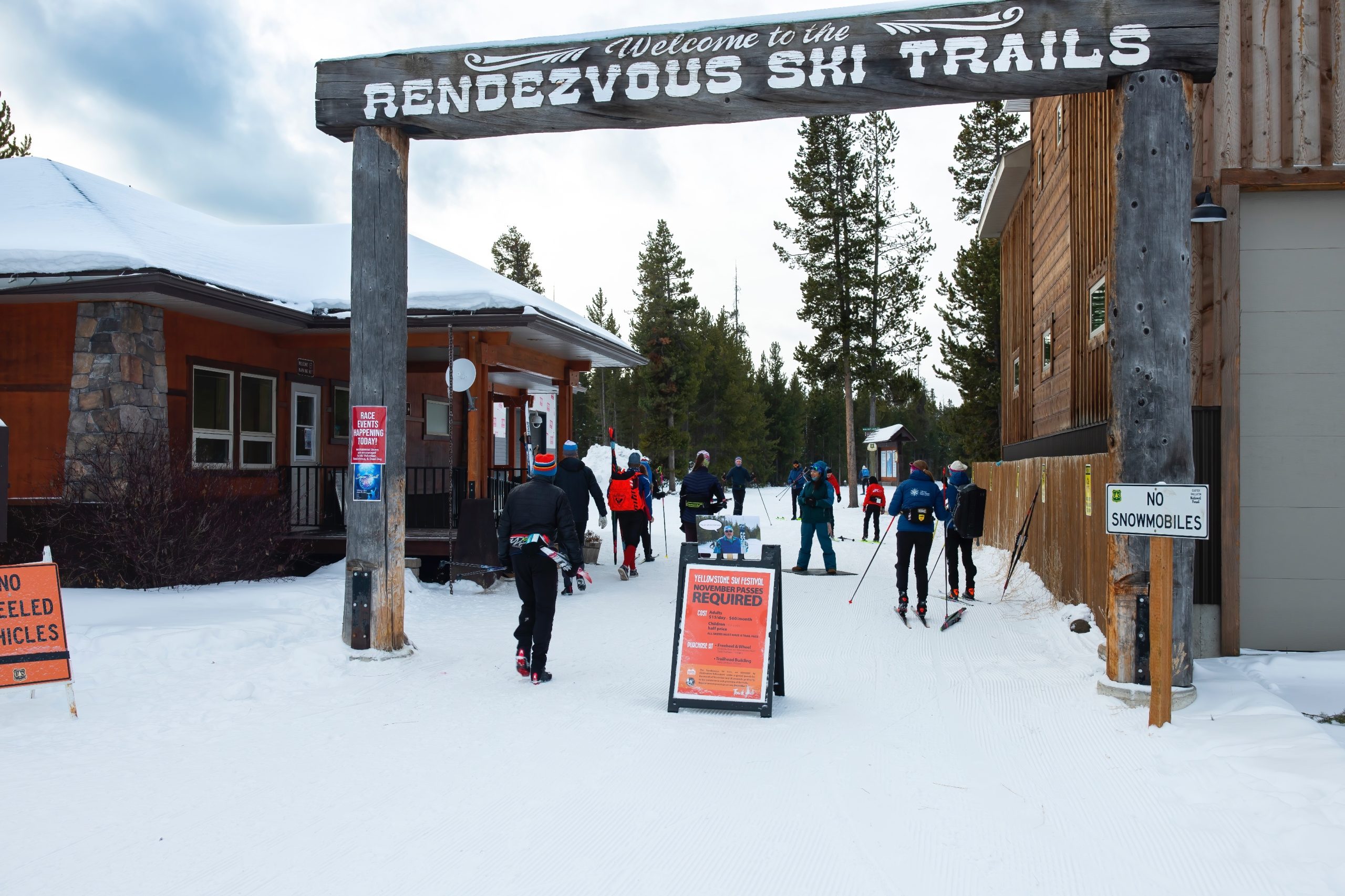
Skiers head under the arch at the Rendezvous Ski Trails, where a November pass is required for festival week. (Courtesy photo)
Hello, XC skiers!
Excitement is building in West Yellowstone after our first snow. It won’t be long before we’re back out on the trails, enjoying the fresh air, great skiing and the start of another season. Now is the time to make your plans for the 2026 Yellowstone Ski Festival, Nov. 21 through 28 on the Rendezvous Ski Trails.
Our trail crew has been working hard to get the trails ready, and we look forward to welcoming everyone back to regular grooming and miles of outstanding skiing. From first tracks in the morning to an easy ski with friends in the afternoon, there’s nothing better than getting out on the snow and enjoying everything West Yellowstone has to offer.
A skier strides through fresh classic tracks on the Rendezvous Ski Trails during the 2014 festival. (Photo: Lander Karath)
Eight Days on Early Snow
Thanksgiving week in West Yellowstone has belonged to skiers for a long time. Competitive athletes, first-timers and whole families come from all over to get on snow while most of the country is still waiting for winter. There is skiing every day of the festival, clinics for every level, biathlon on the range and a race to close out the week.
The tradition reaches back to 1979, when the U.S. Ski Team began bringing coaches to West Yellowstone each November to train them. FasterSkier told that story last fall in a look inside the festival and its clinics, and it is worth a read before you come.
A November trail pass is required for all of November and during the festival, and it is good through Nov. 30. From Dec. 1 through March 31, season and day passes are sold by the U.S. Forest Service at the Hebgen Lake Ranger Station, at Freeheel and Wheel, and at the Rendezvous Trailhead.
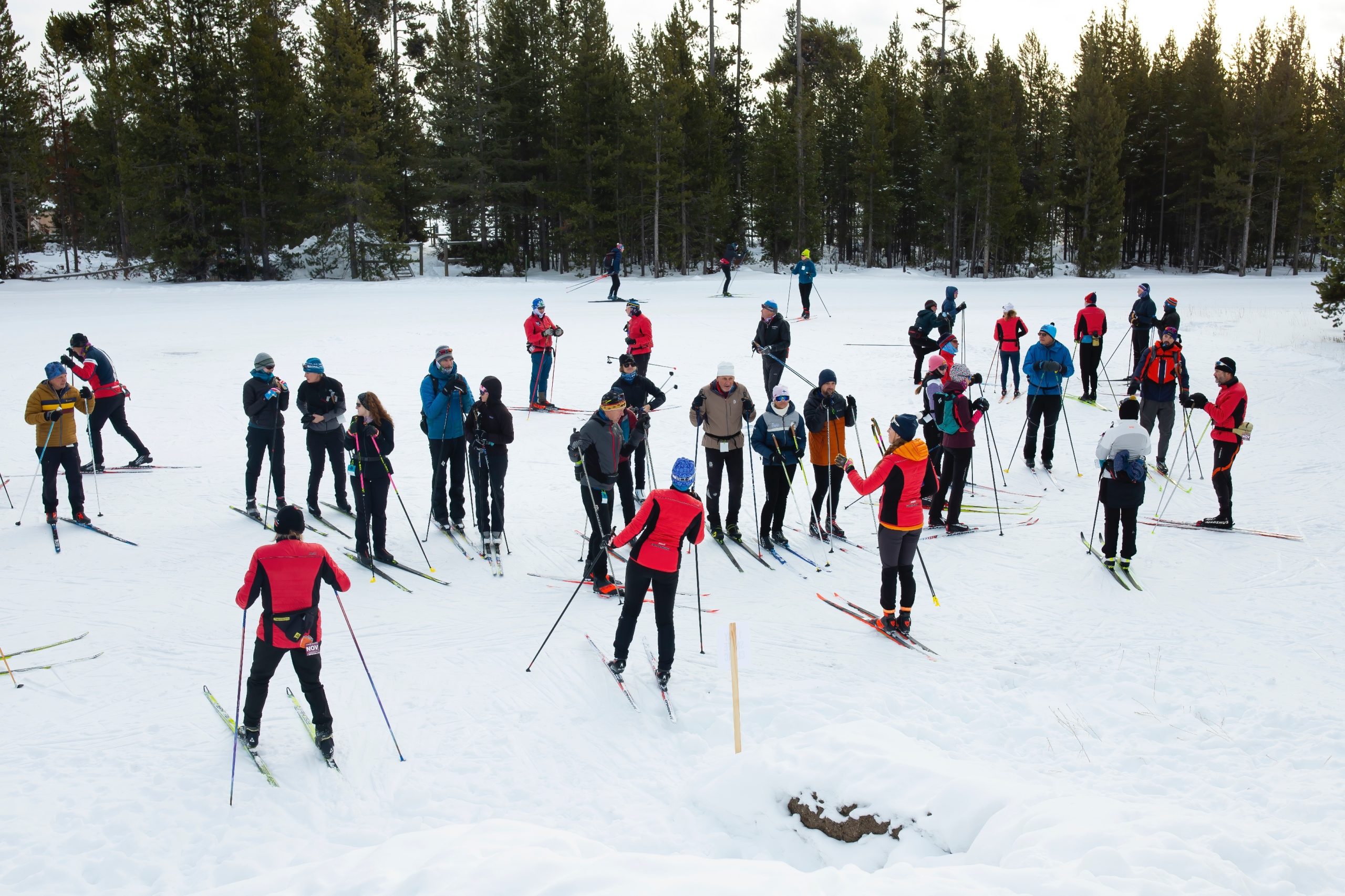
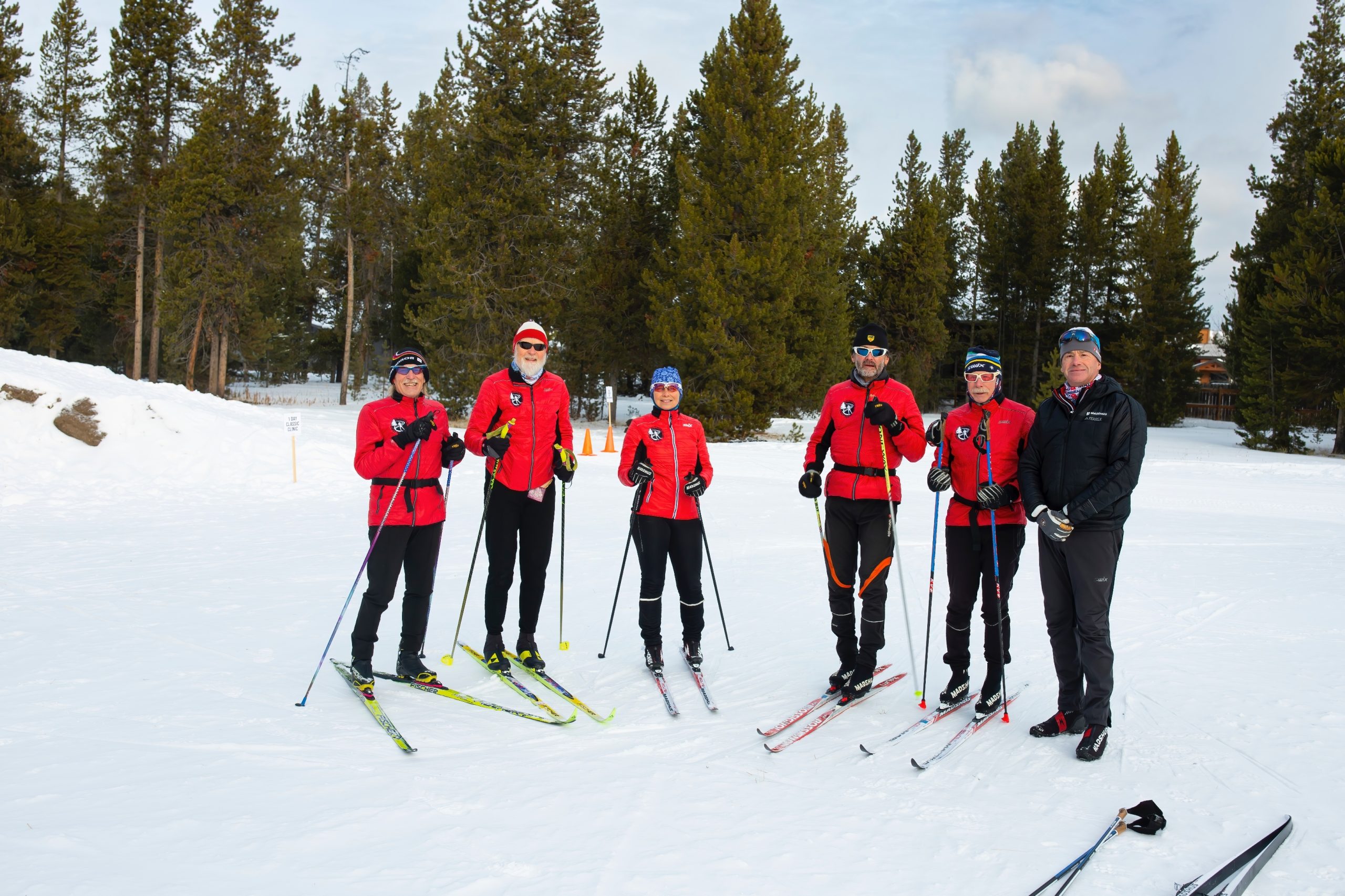
Clinic skiers sort into ability groups with coaches in red jackets at the Rendezvous Ski Trails. (Courtesy photo)
Clinics With Top Coaches
Looking to improve your skiing this season? Our clinics feature top coaches who can help you build skills, clean up your technique and get even more enjoyment out of your time on skis.
This year’s staff of 16 coaches includes Jack Hart and Todd Eastman. Every skier is placed in a group of similar ability, six to eight skiers per coach, and the coaches rotate through the groups each half day so you hear more than one voice over the week. Advanced groups also work on speed, endurance, strength, agility and race tactics.
The three-day Skate and Classic XC Fundamentals for Performance and the two-day Skate and Classic Tune Up both begin Tuesday, Nov. 24, with classic in the morning and skate in the afternoon. One-day technique clinics follow later in the week: skate on Thursday, Nov. 26 or Saturday, Nov. 28, and classic on Friday, Nov. 27.
Don’t wait to sign up. Any clinic with fewer than six skiers registered by Nov. 19 will be canceled. Find clinic details here and register here.
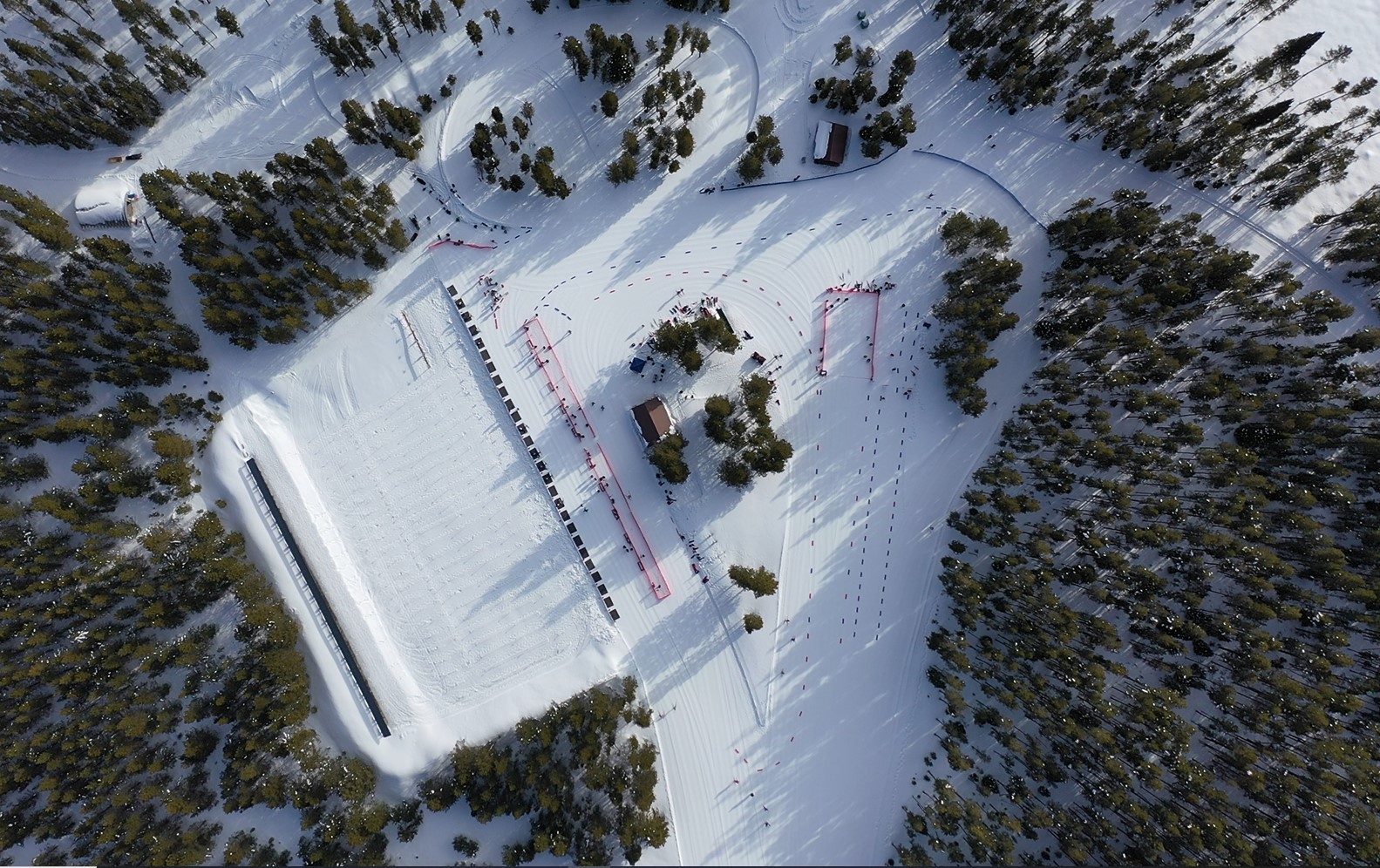
The stadium and biathlon range at the Rendezvous Ski Trails, seen from above. (Photo: WYSEF)
Biathlon, a Race and Après-Ski
Biathlon newcomers get a proper start. A Try-It clinic on Tuesday runs two sessions of up to 50 skiers each, and anyone planning to race the novice biathlon for the first time needs to attend it. The biathlon sprint and novice races follow on Wednesday, Nov. 25, at the stadium and range.
Friday afternoon brings après-ski at the Rendezvous Trailhead. On Saturday, Nov. 28, the week wraps up with a fun 5 km and 10 km freestyle mass start, open to all ages and abilities and capped at 200 skiers. Watch for race registration to open in the coming weeks.
Wax clinics, a mindful movement class and an evening speaker round out the week. Everything depends on snow: low snow means modified courses, and no snow means races and clinics are canceled, with clinic fees refunded less a small administrative fee. The full festival schedule is online and will be updated as November gets closer.
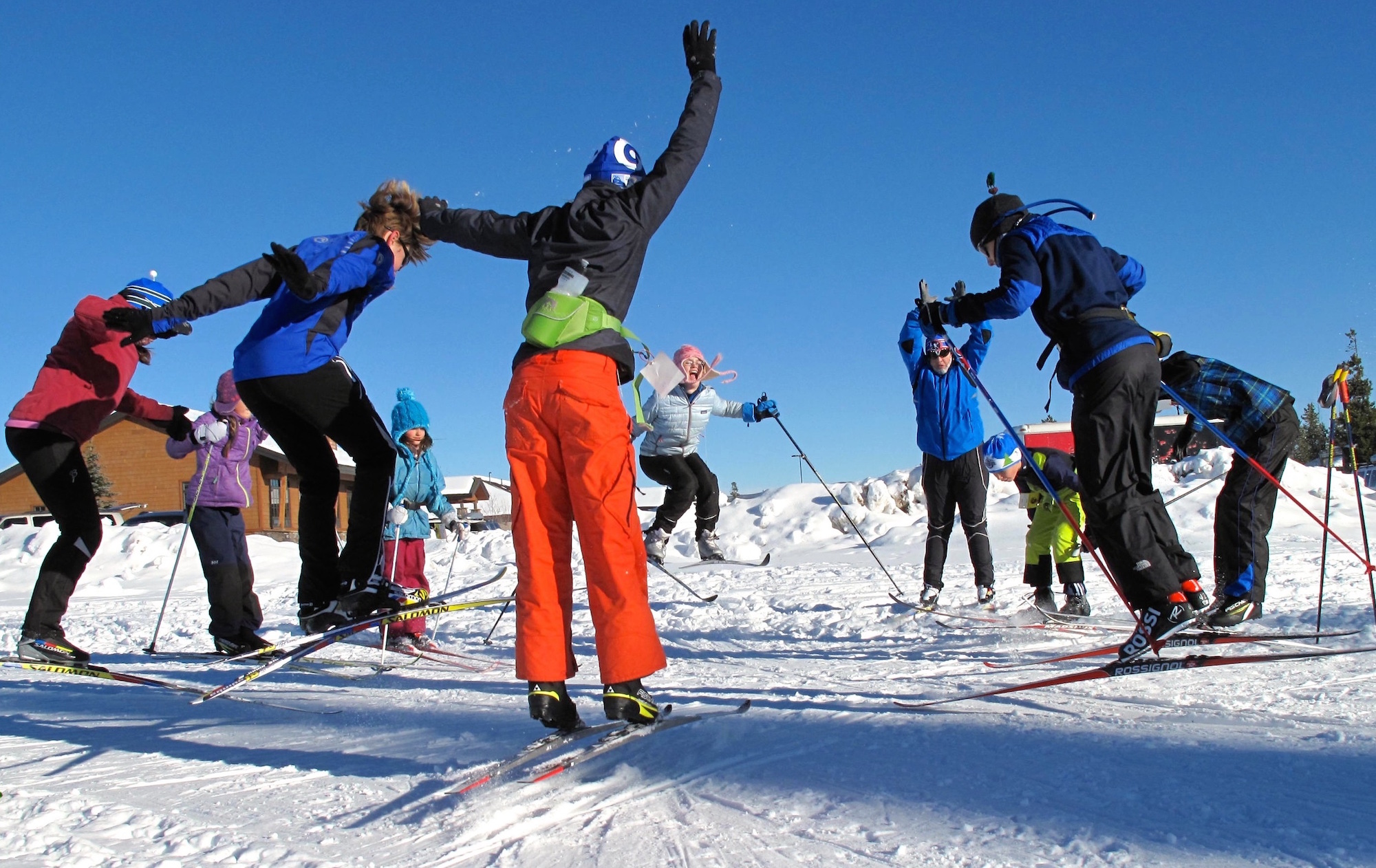
Young skiers warm up together in the sun at the Rendezvous Ski Trails. (Photo: WYSEF)
Places to Stay and Visit
When booking your stay, please consider our festival sponsors. They support our ski community, and we appreciate your support of their businesses.
While you’re in town, stop by Freeheel and Wheel for the latest ski gear, great coffee and a chance to catch up with fellow skiers before heading out on the trails.
If the snow is slow to arrive, there are still great ways to get outside: roller ski or bike the road into Yellowstone National Park, or head out on the nine miles of paved Shortline Trail. Destination Yellowstone has more on what to do around town.
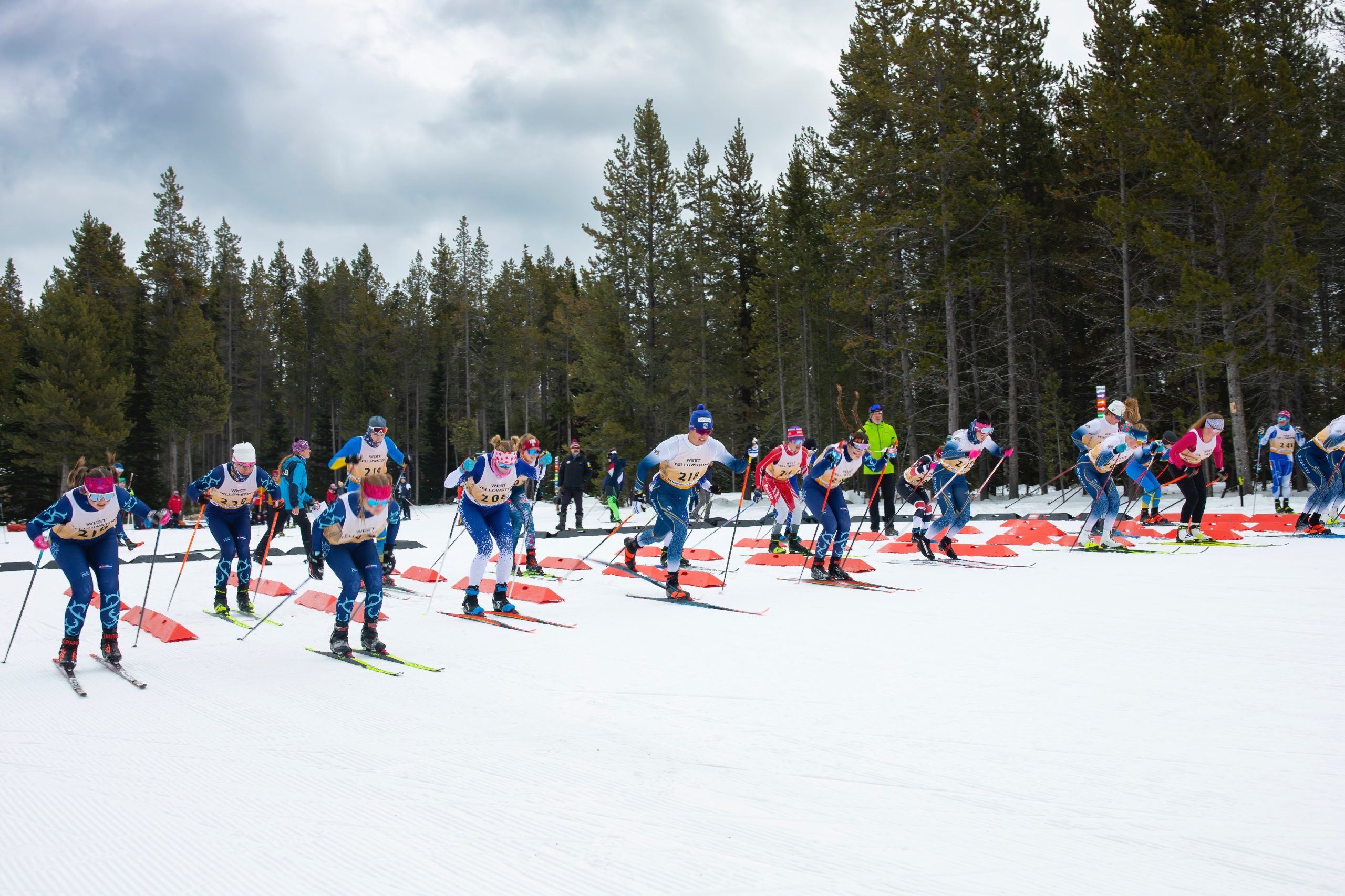
Racers push off the start in the stadium at the Rendezvous Ski Trails. (Courtesy photo)
Back in March for the Rendezvous
The season in West Yellowstone ends the way it starts, with a crowd on the trails. The Yellowstone Rendezvous Race, part of the American Ski Marathon Series, brings more than 600 skiers to town and is set for Saturday, March 6, 2027. Registration opens in November.
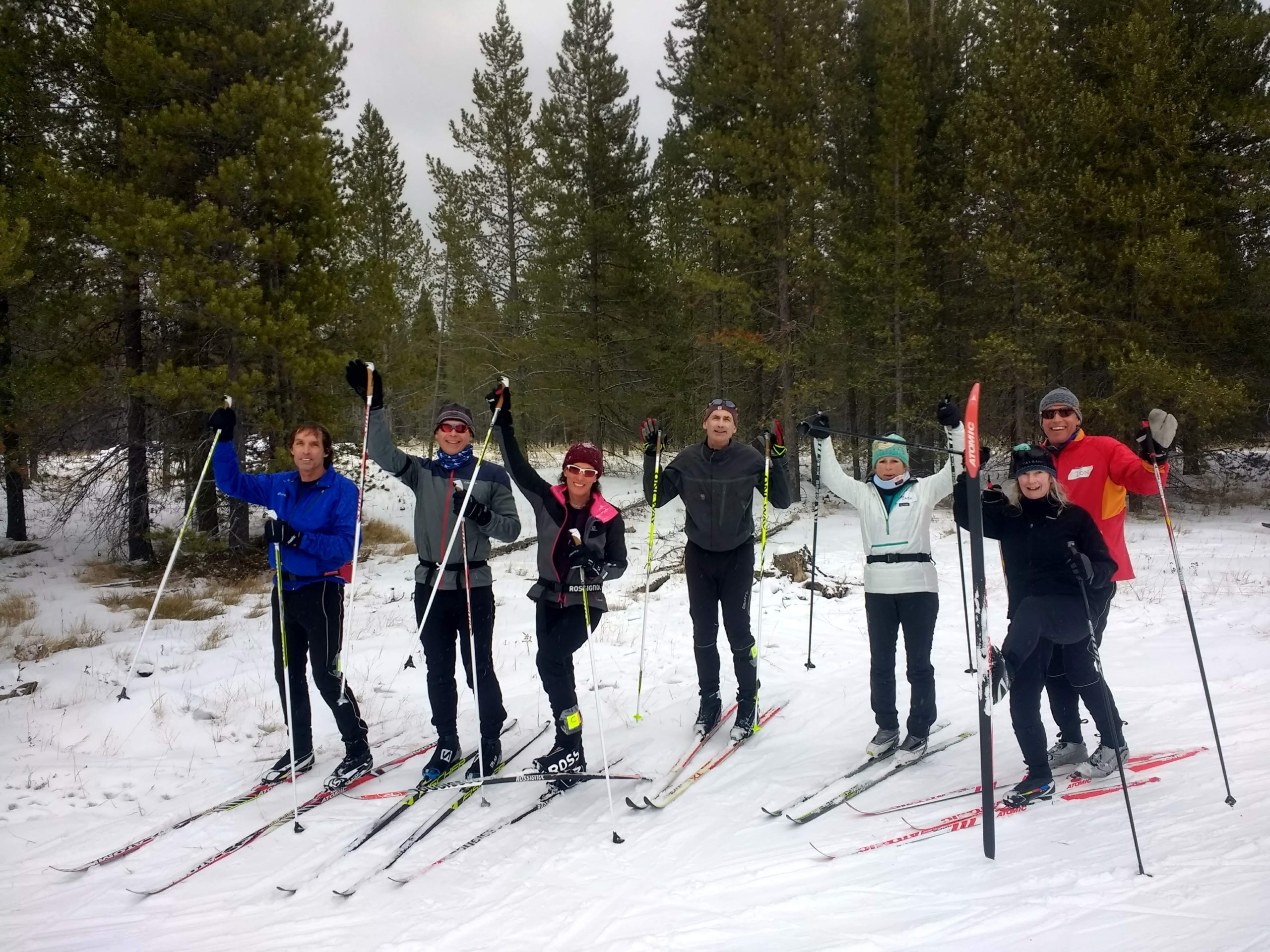
Festival skiers raise their poles on the Rendezvous Ski Trails during Thanksgiving week in 2018. (Courtesy photo)
See You on the Trails
The Yellowstone Ski Festival is a great way to kick off winter, catch up with old friends, meet new ones and get some real Nordic skiing in before December. Whether you’re joining a clinic, taking first tracks on fresh corduroy or just heading out for a relaxing ski, we can’t wait to see you. Start planning your trip, book your room and get ready for another great season in West Yellowstone.
For the latest festival information, visit skirunbikemt.com. Follow @RendezvousSkiTrails on Facebook and @Rendezvousskitrails1 on Instagram for updates and trail news.
Think snow, get excited, and we’ll see you in November!
The Yellowstone Ski Festival Committee
Clinic coaches line up on skis at the Rendezvous Ski Trails. (Courtesy photo)
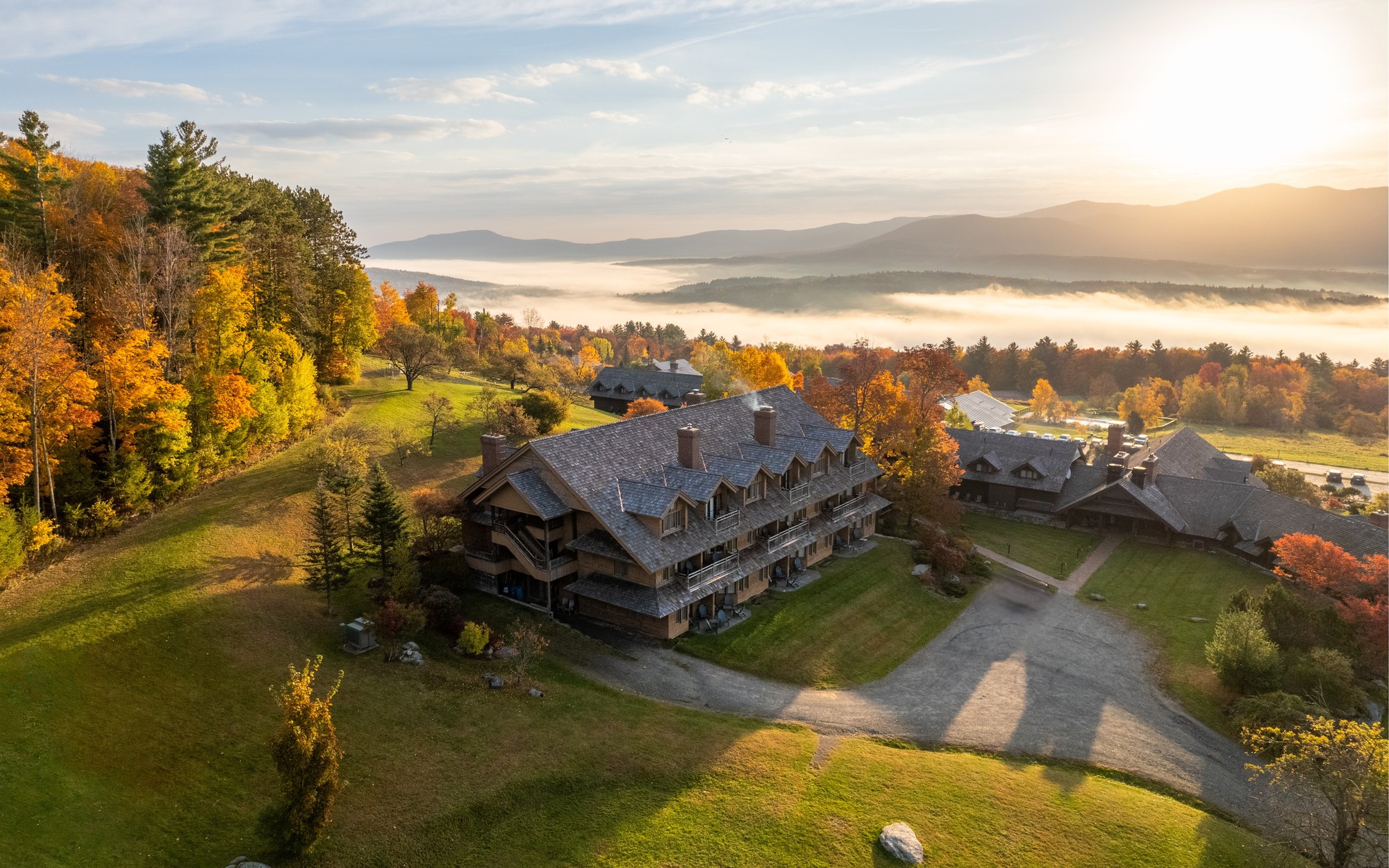
Morning fog fills the valley below the von Trapp Family Lodge & Resort in Stowe, Vt. (Photo: Chadwick Estey)
The von Trapp Family Lodge & Resort has received the Historic Hotels of America® Legendary Family Historic Hoteliers of the Year Award, announced October 15 at the 2026 Historic Hotels Annual Awards of Excellence Ceremony and Gala. The honor was conferred on the von Trapp family by Historic Hotels of America, an official program of the National Trust for Historic Preservation.
The lodge is one of more than 300 hotels and resorts in the United States recognized by Historic Hotels of America for preserving and maintaining its historic integrity, architecture, and ambiance.
“This recognition is especially meaningful to our family because it honors not only our history, but the generations of dedication that have kept our family’s legacy alive,” said Kristina von Trapp Frame, granddaughter of Maria and Georg von Trapp.
The Trapp Family Singers, who performed in more than 30 countries before and after making their home in Vermont. (Photo: von Trapp Family Lodge & Resort archive)
From Austria to Stowe
The family left Austria in 1938, months after its annexation by Nazi Germany, and spent the years that followed on the road as the Trapp Family Singers. The choir would eventually perform in more than 30 countries, and the family’s story became The Sound of Music.
In 1942 they settled in Stowe. They named their home Cor Unum, Latin for “one heart,” on a hillside looking across to the Worcester Range, and from 1945 to 1955 they ran the Trapp Family Music Camp nearby.
“What began with my grandparents’ dream of creating a home in the Vermont mountains has grown into a place where we have welcomed guests from around the world for more than 75 years,” Frame said.
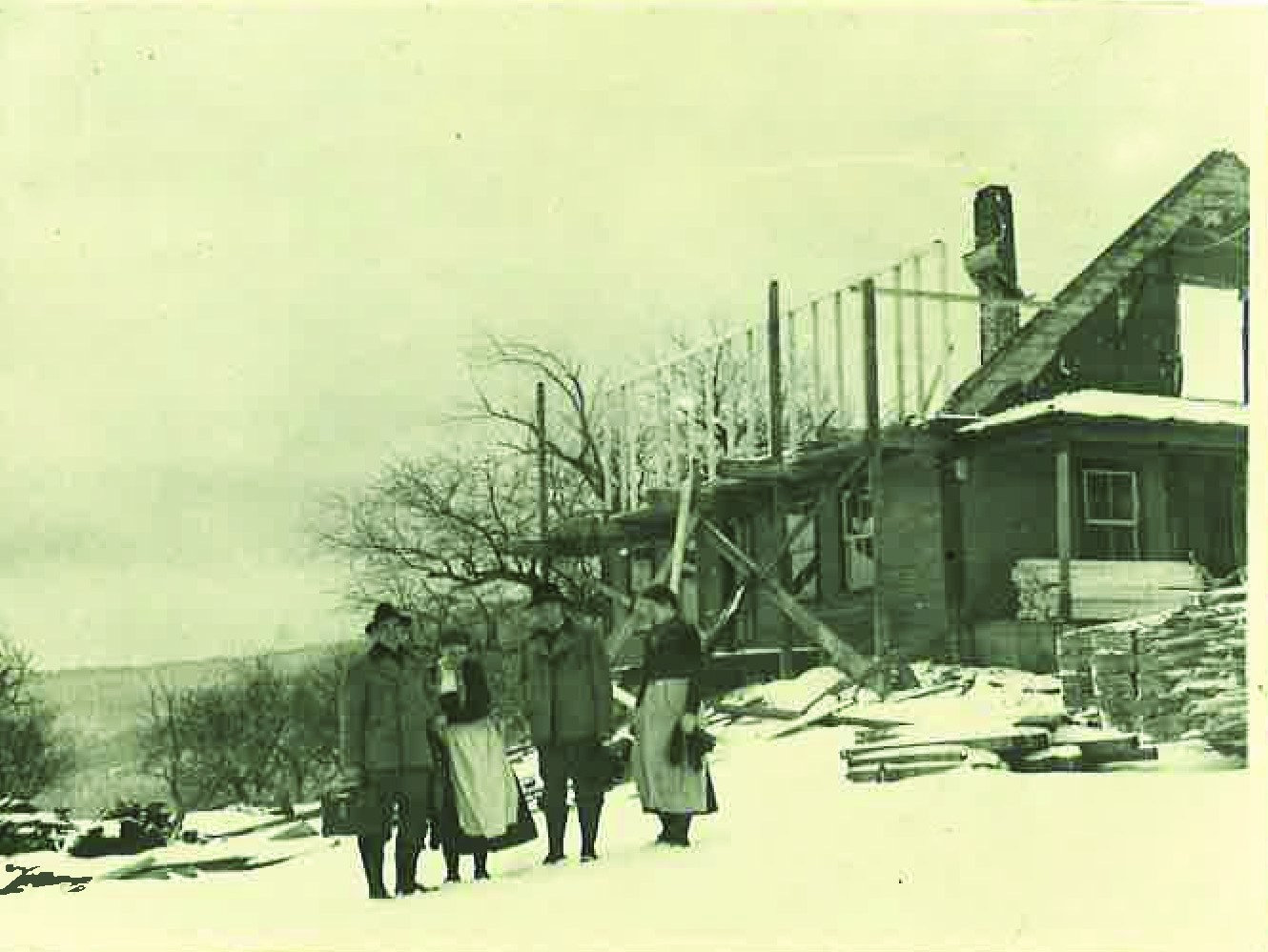
Building the family’s new lodge in Stowe, 1943. (Photo: von Trapp Family Lodge & Resort archive)
Opening the Doors in 1950
In 1950 the family opened their expanded home to guests as the Trapp Family Lodge. Maria ran it first. Her youngest son, Johannes, took over from her and turned a ski lodge into a year-round destination.
Three generations on, it is still family operated. The property covers 2,600 acres and pairs Austrian-inspired hospitality with outdoor recreation, a craft brewery that began making lager in 2010, farm-to-table dining, and wide-open mountain views.
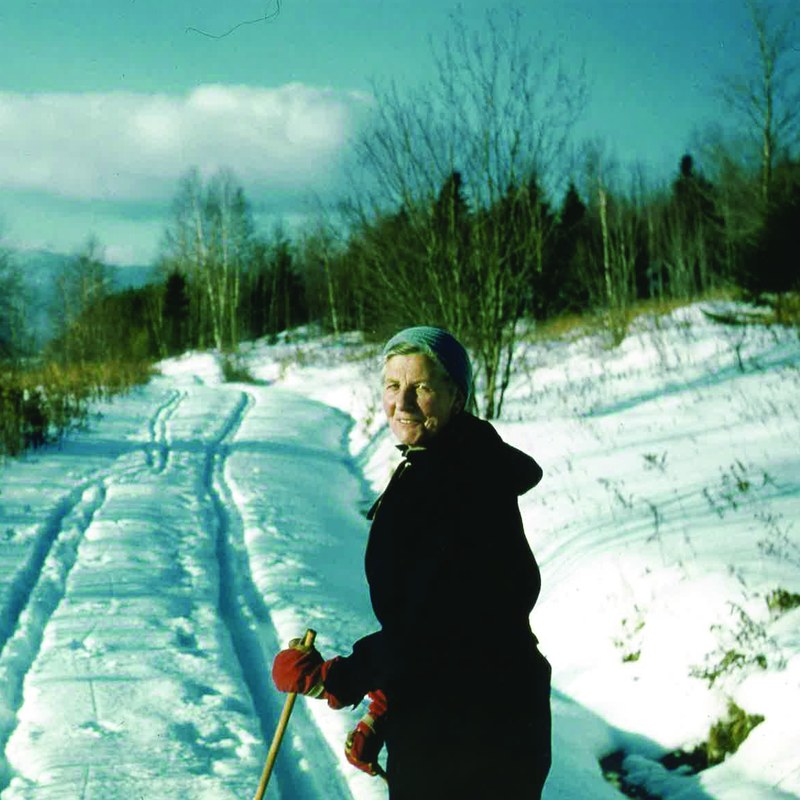
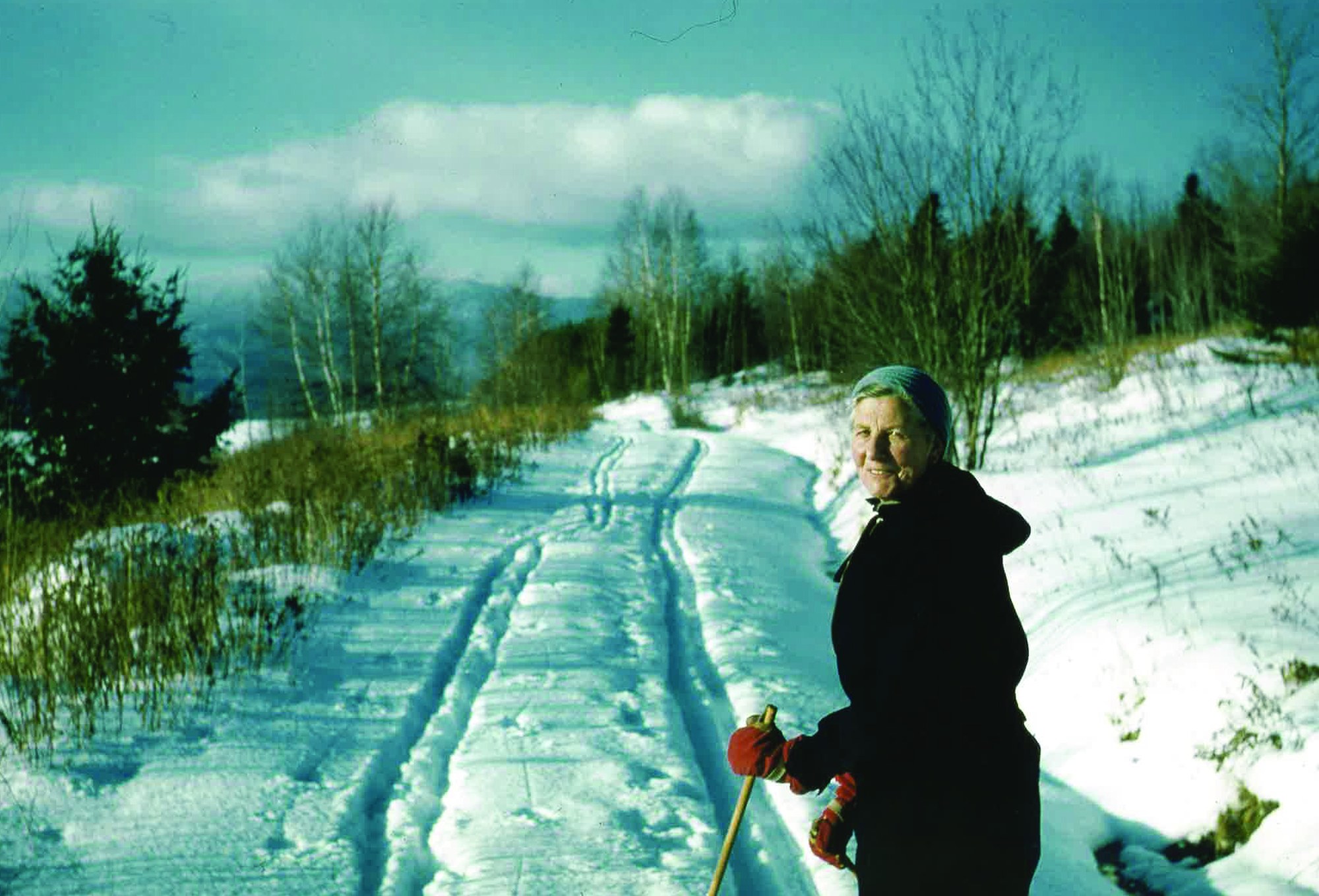
Maria von Trapp out on skis. (Photo: von Trapp Family Lodge & Resort archive)
Where American Cross-Country Skiing Got Its Start
Skiers know the place for something else. In 1968 Johannes opened a cross-country ski center at the lodge, the first in America.
The trails have stayed close to the sport ever since. Johannes helped revive the Stowe Derby in 1972, and in 2014 the lodge hosted U.S. Junior Nationals, with Johannes himself handing out the medals.
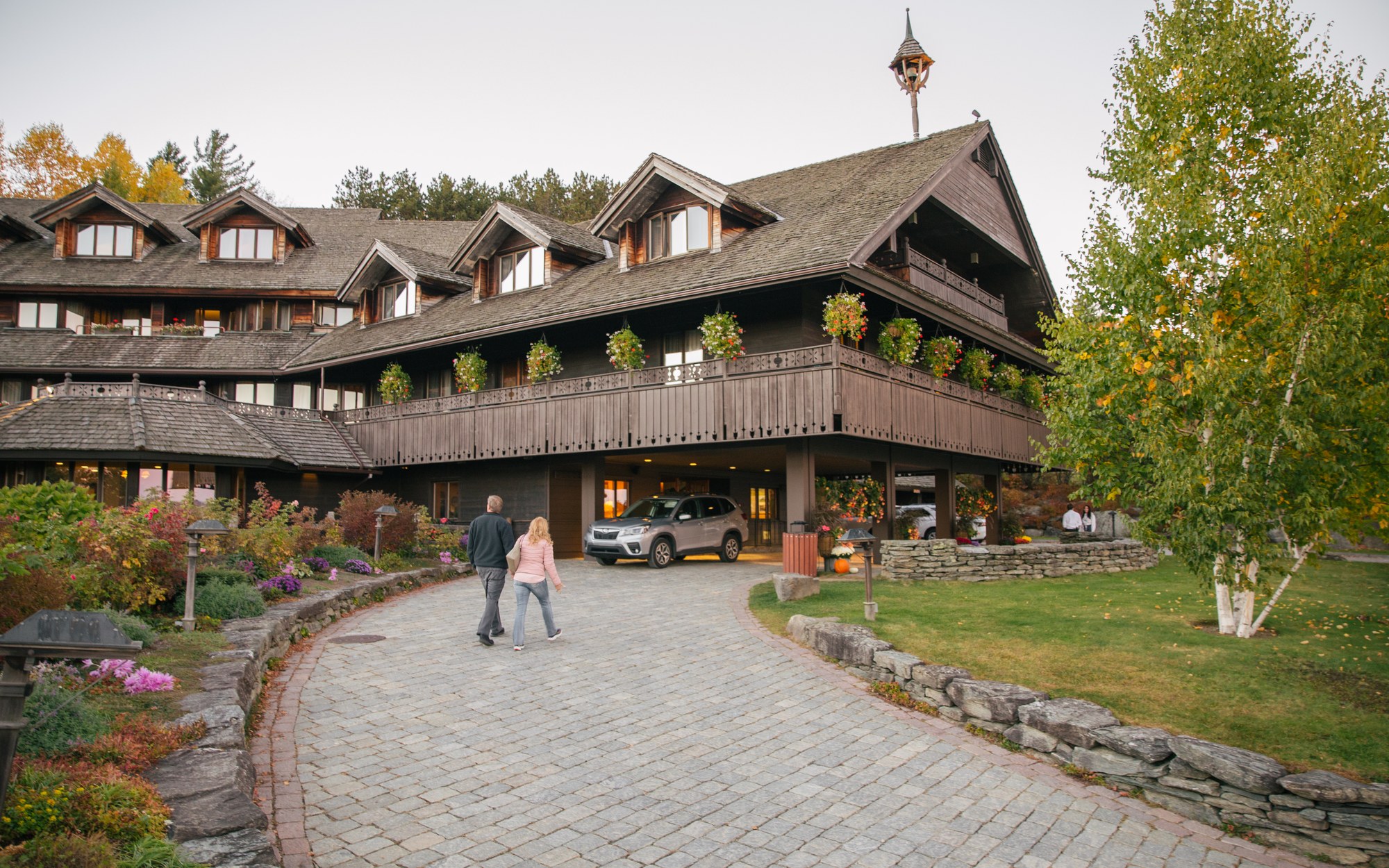
The main lodge, rebuilt in the Austrian style the family brought with them to Stowe. (Photo: Chadwick Estey)
Honored in Williamsburg
Through its Annual Awards of Excellence, Historic Hotels of America recognizes the historic hotels, hoteliers, and leadership practices that do the most to further the recognition, preservation, and celebration of these hotels and their histories. Eleven historic hotels and seven individuals were honored in 2026.
The winners were announced before an audience of owners, general managers, senior decision makers, and guests from many of the finest historic hotels in the world, at the Williamsburg Lodge, Autograph Collection (1939) in Williamsburg, Virginia. The ceremony closed the 2026 Historic Hotels Annual Conference.
“We are delighted to honor the von Trapp Family with this prestigious award. It was chosen from an exclusive group of nominees and considered for several categories. It stands among the finest hotels and hoteliers in the world,” said Lawrence Horwitz, Executive Vice President of Historic Hotels of America and Historic Hotels Worldwide. “We applaud the dedication and passion of the individuals working at these iconic and legendary historic hotels, the people who keep the stories alive from the past and make staying or celebrating special occasions at these historic hotels memorable experiences.”
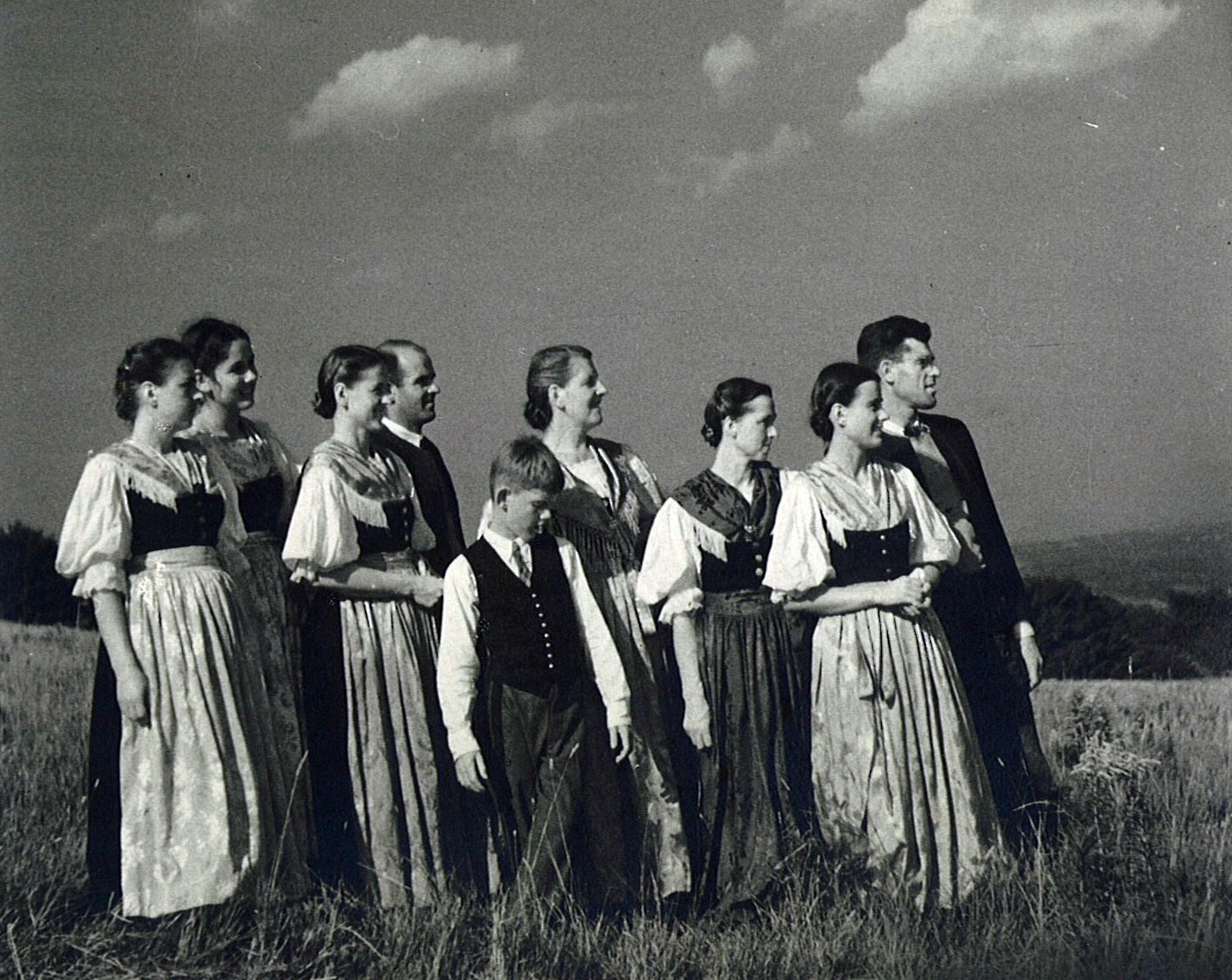
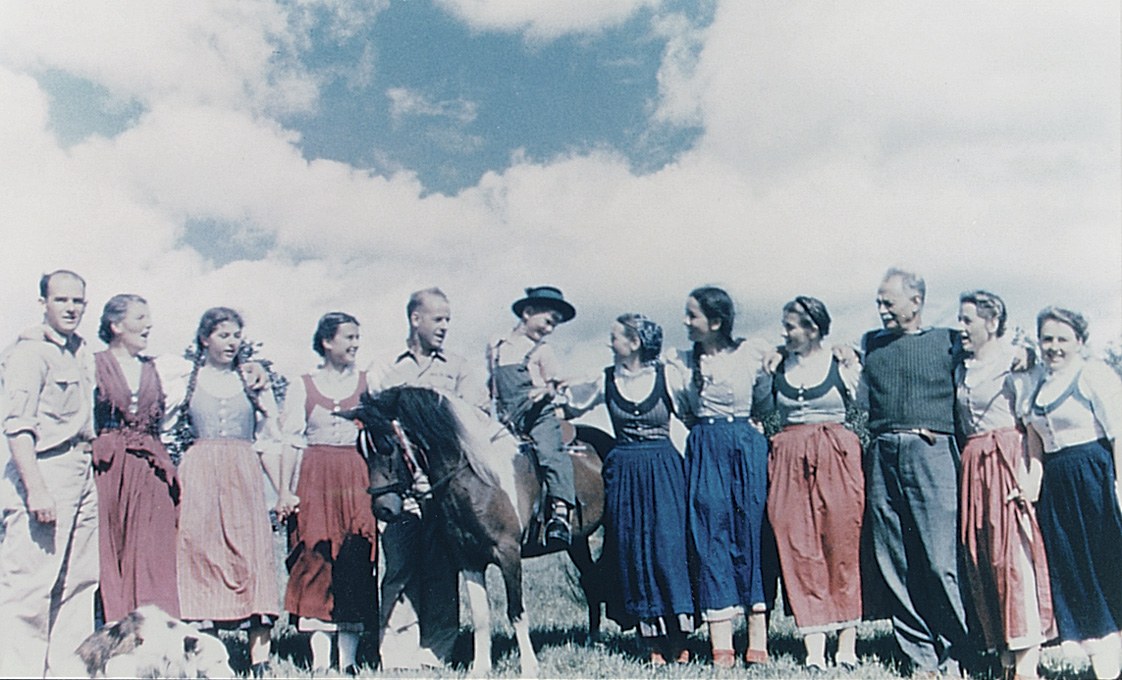
The von Trapp family lined up in a Stowe field, with Johannes on horseback. (Photo: von Trapp Family Lodge & Resort archive)
Carrying It Forward
“We are incredibly proud to carry on their traditions of warm hospitality, family, music, and a love of the outdoors,” Frame said. “Receiving the Legendary Family Historic Hoteliers of the Year Award is a wonderful tribute to our family, our dedicated employees, and the countless guests who have become part of our story.”
About von Trapp Family Lodge & Resort
Founded in 1950 by the von Trapp family, whose story inspired The Sound of Music, the von Trapp Family Lodge & Resort is a third-generation, family-operated, four-season destination in Stowe, Vermont. Situated on 2,600 acres, the property offers Austrian-inspired hospitality, outdoor recreation, a craft brewery, farm-to-table experiences, and breathtaking mountain views while preserving the family’s rich history and traditions. Learn more at vontrappresort.com.
About Historic Hotels of America®
Historic Hotels of America is the official program of the National Trust for Historic Preservation for recognizing and celebrating the finest historic hotels across the United States. The National Trust for Historic Preservation was chartered by the U.S. Congress in 1949 and is a private 501(c)(3) nonprofit organization. To be nominated and selected for membership, a hotel must be at least 50 years old; designated by the U.S. Secretary of the Interior as a National Historic Landmark or listed in or eligible for listing in the National Register of Historic Places; and recognized as having historical significance. More than 300 historic hotels from 41 states, the District of Columbia, the U.S. Virgin Islands, and Puerto Rico have been inducted. Learn more at HistoricHotels.org.
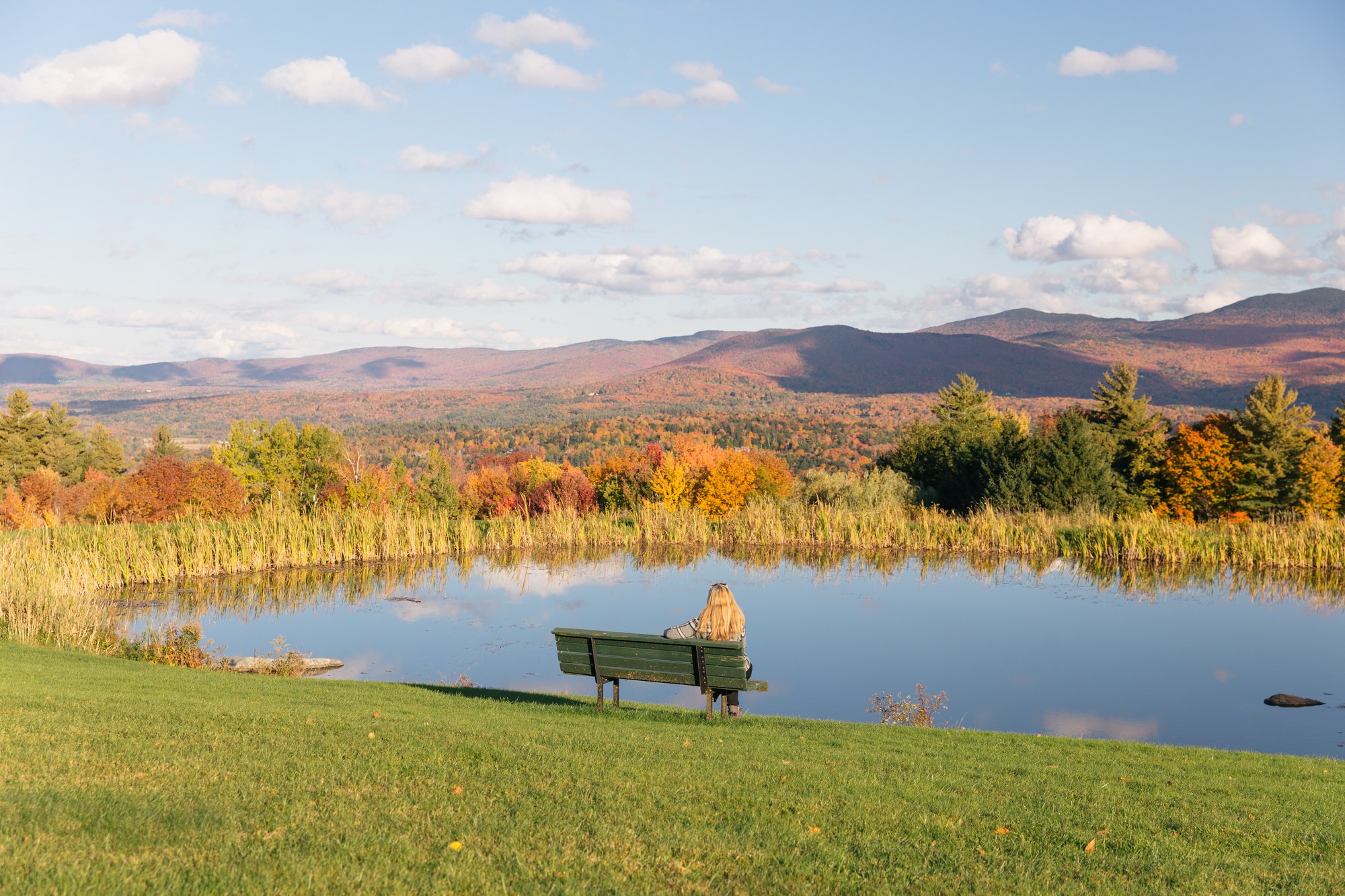
A guest takes in the view from the pond at the von Trapp Family Lodge & Resort. (Photo: Chadwick Estey)
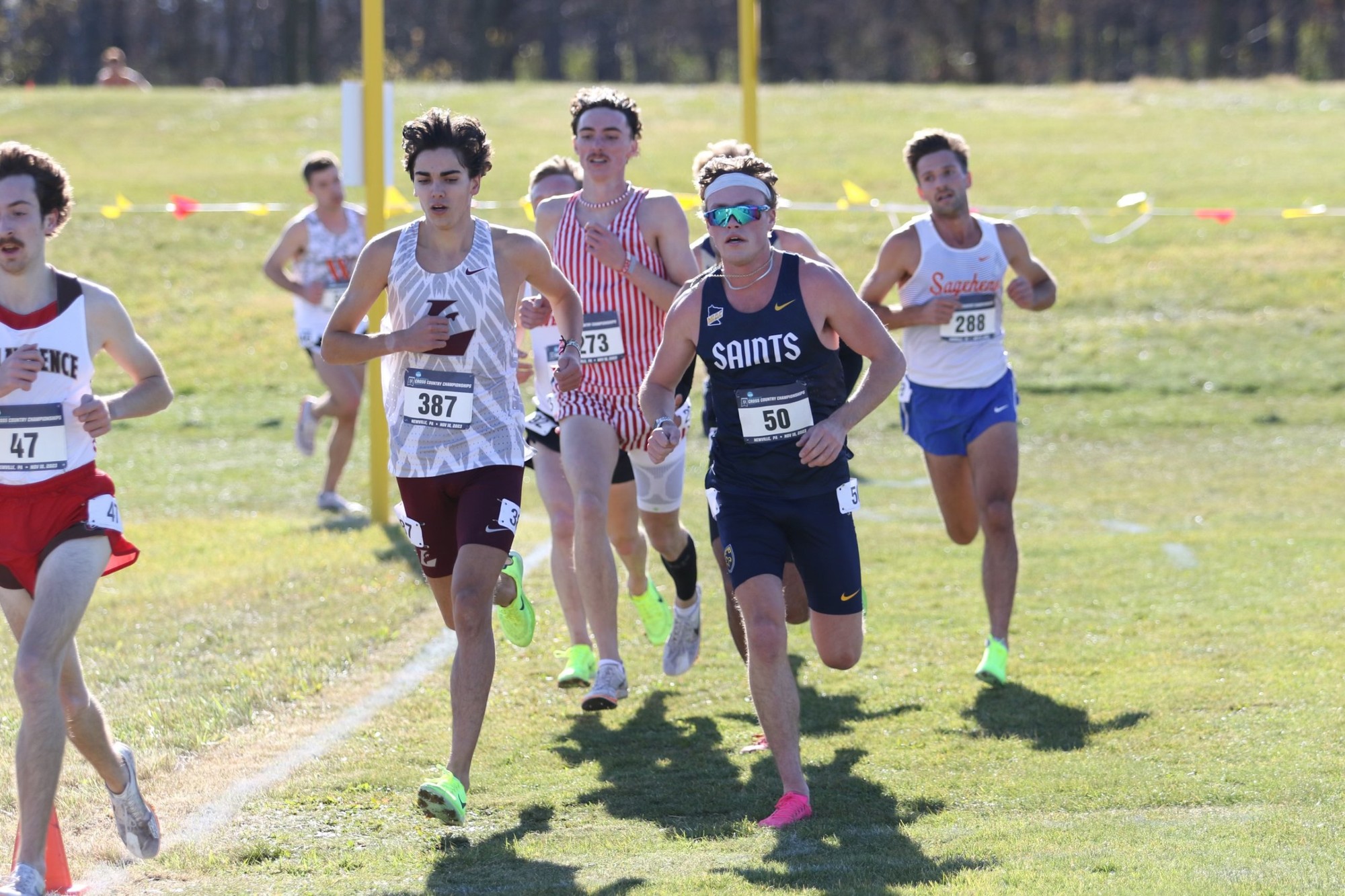
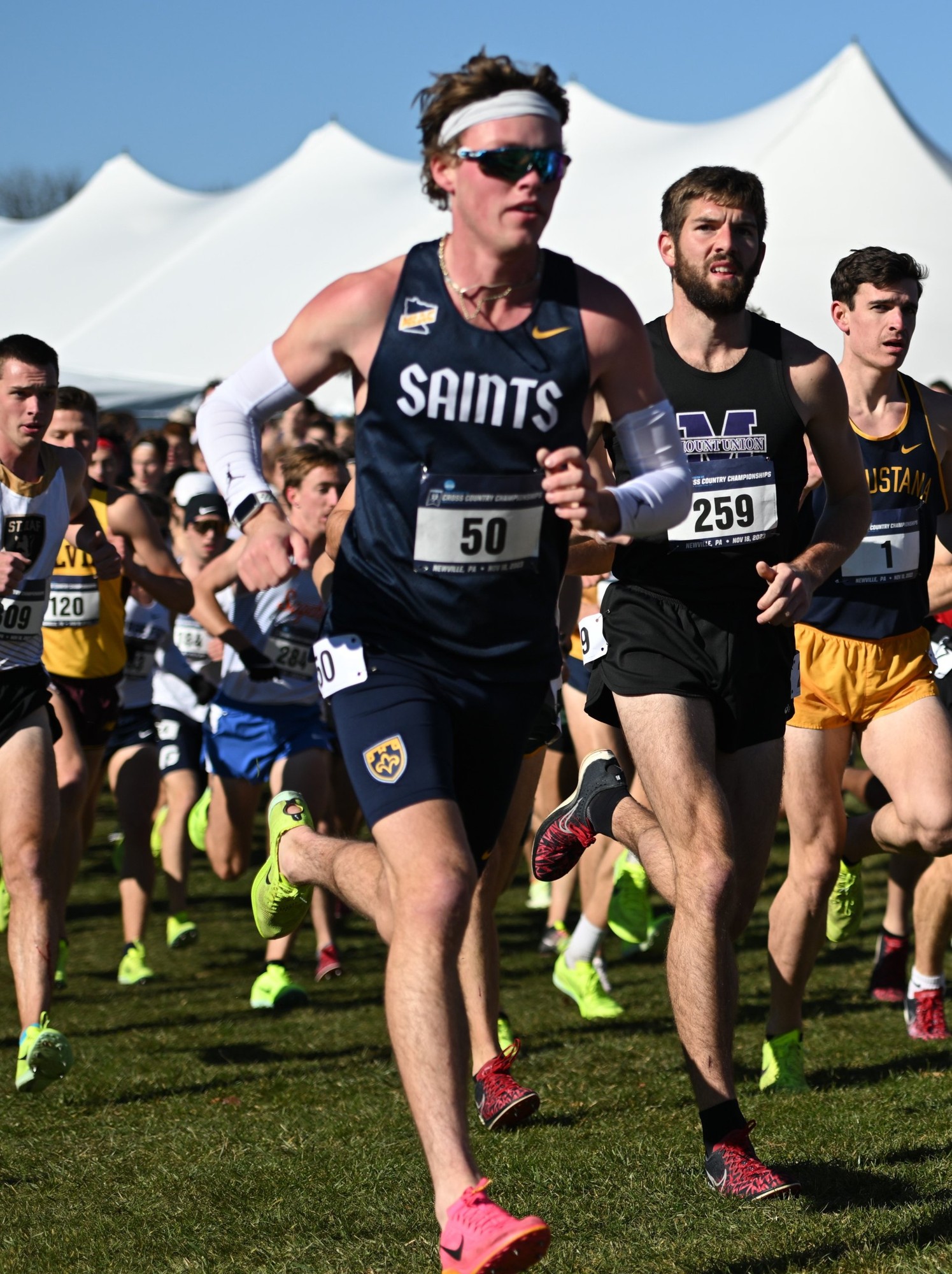
Lars Dewall (50) races for St. Scholastica at the 2023 NCAA Division III Cross Country Championships in Newville, Pennsylvania. (Courtesy photo)
Lars Dewall has run four marathons and he has never run a slow one.
The debut was Grandma’s in June of last year, 2:22:57. Then California International in December, 2:14:15. Then Boston in April, 2:12:30. Then Berlin in September, 2:12:13, third American across the line. Four races, four personal bests, each one faster than the last, which is not how marathon careers usually go.
Dewall came out of Division III. He ran at the College of St. Scholastica in Duluth and was an All-American there in 2023, one of the first two the cross-country program ever produced. He now teaches middle school social studies in San Diego. His training sounding board on broad direction is his college coach, Chad Salmela, who coaches cross-country at St. Scholastica, called the women’s team sprint in PyeongChang for NBC, and spent eight years on the US biathlon team before either of those things.
Salmela has a theory about why Dewall keeps getting faster, and it is not a comfortable one for American distance running. He has been making the argument for most of two decades, in a sport that was not his first one, and until recently he did not have a runner fast enough to make anybody listen.
“He’s like my living thesis right now,” Salmela said. “He’s actually texting me as we’re talking.”
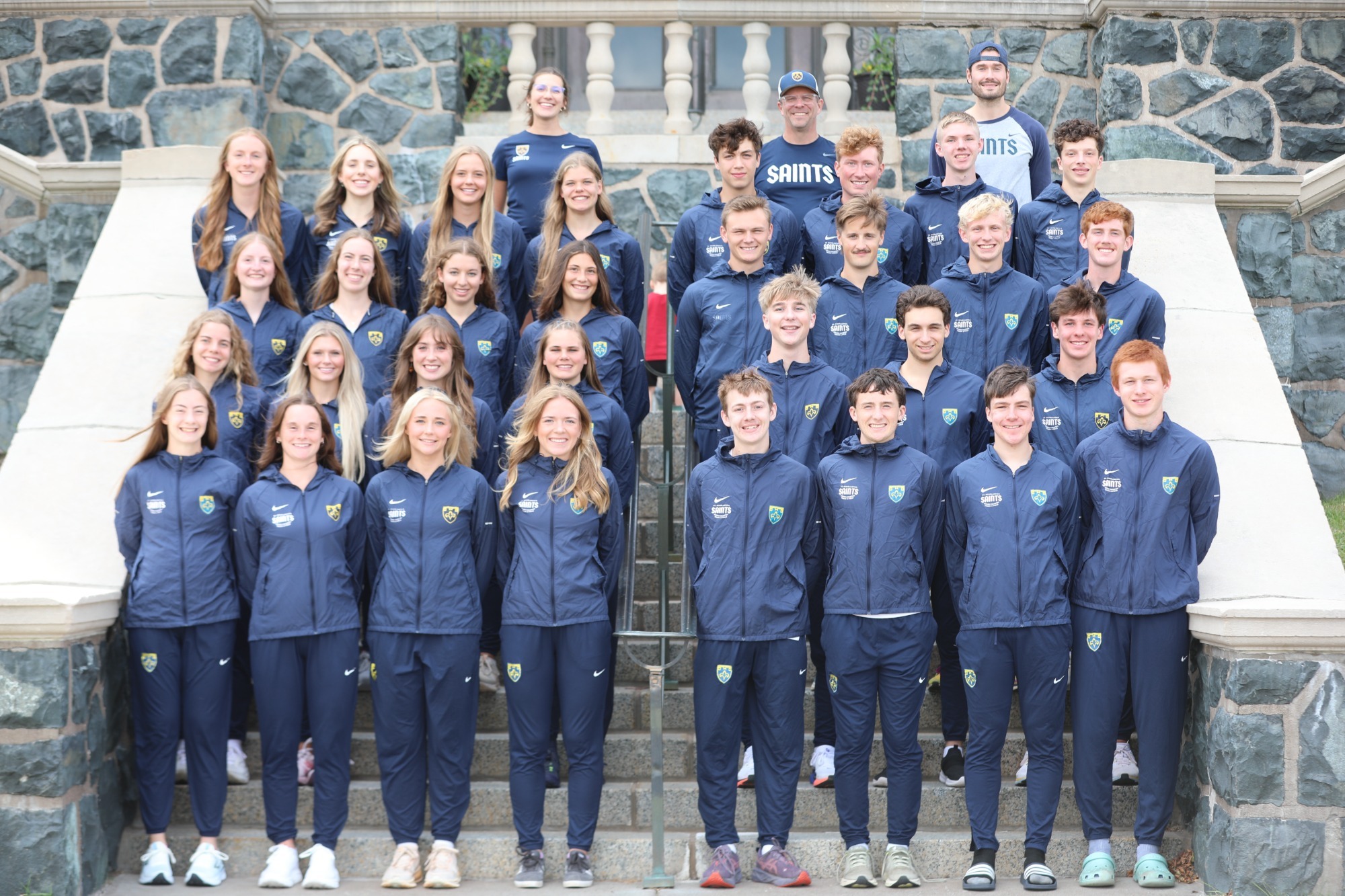
Chad Salmela, back row center, with the 2026 College of St. Scholastica cross country team. In more recent years, Salmela has given up the nordic coaching role to concentrate on broadcasting during the ski season, which we will cover soon in part two of this series. (Courtesy photo)
Mileage is a distance, not a volume
The sentence above is his, written rather than spoken. It appears in the letter he sends to recruits, which is less a sales pitch than a seven-paragraph argument about exercise physiology, and it is the cleanest statement of the thing he believes.
“Mileage tells you how far you’re running,” he said. “It doesn’t break down what you did in that distance.”
He has been resisting the number for years and he still resists it.
“You can have a huge mileage week on threshold. You can have a small mileage week on relatively aerobic,” he said. “Two to three two-hour-plus workouts, that’s going to be fewer miles than three threshold workouts. So that mileage metric, I feel like it kind of misshapes things in people’s minds.”
Ninety-mile weeks are not the problem, in other words. What is in them is.
“Ninety-mile weeks at a lactate of 2.5 as opposed to a lactate of 1 is going to have a way bigger consequence down the road,” he said.
This is where the skiing comes in, and it is worth being precise about the lineage, because Salmela is. The interval sessions he leans on are not his. The one he uses the day before a race, a minute on and thirty seconds off, he calls “a complete ripoff from the Ingebrigtsens,” though the session appears in Marius Bakken’s own published account of the Norwegian model, as does the 45-seconds-on, 15-off session Salmela started using this autumn. Bakken, a Norwegian physician and former 13:06 5,000-meter runner, built the method out of more than 5,500 lactate measurements and mentored Gjert Ingebrigtsen (Jakob’s father) directly between 2011 and 2013. The family made it famous. Bakken wrote it down first.
What Salmela did was carry it sideways, out of a sport where lactate testing has been routine for forty years into one where it mostly has not. He is blunt in the recruiting letter about why that gap exists and what it costs: the discovery was “established decades ago in the early 1980s, and has been adjusted in many other endurance sports, yet somehow continues to evade American distance running.”
His own estimate of what the ceiling looks like is deliberately large.
“If you can train as a runner seven or eight hundred hours of aerobic training, it doesn’t have to all be running; you can improve way more than you think as a runner,” he said. “But how do you get those 800 hours? You can’t do it running. You’re probably going to start having a limitation there.”
That is a skier’s number, and he knows it. It is also the number he says Dewall has been running at for two years.
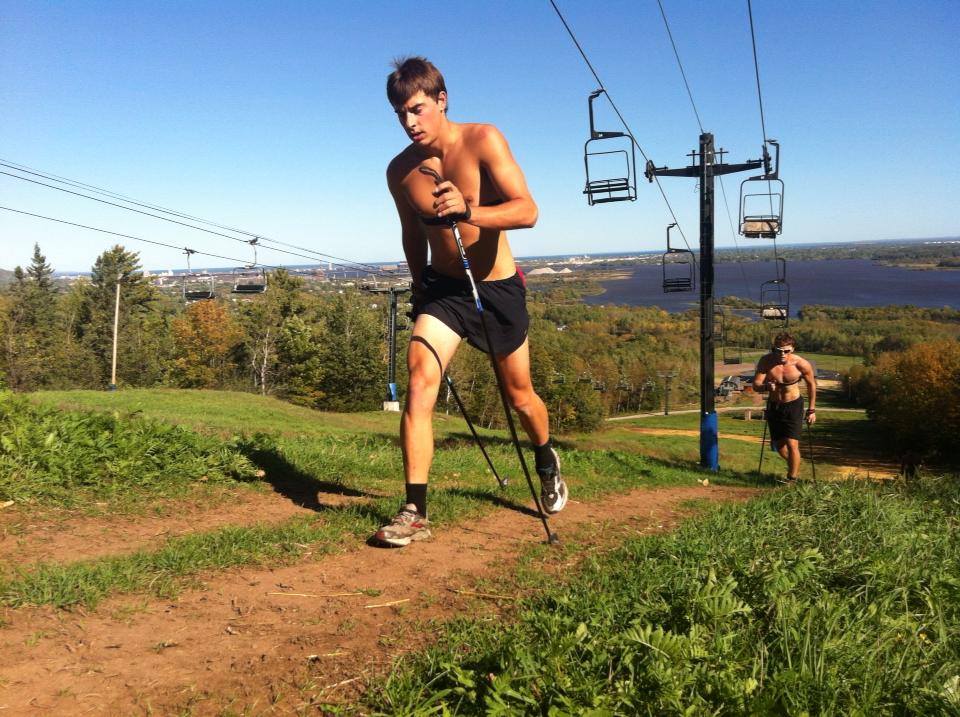
St. Scholastica’s Paul Schommer, foreground, and Joe Dubay bounding up Spirit Mountain in Duluth, Minnesota, in the fall of 2014. (Photo: Chad Salmela)
Injury is not the cost of doing business
The recruiting letter contains three words in capitals: “Injury is NOT necessary.” He gets more animated about this than anything else in our ninety-minute conversation.
“The first thing that always drove me nuts as a skier coming into the running world, before I even started coaching, was just the acceptance of injury as part of the deal,” he said.
He is careful to say he might be wrong, and then says why he does not think he is.
“Anytime you’re asking your body to do something it’s not able to do, you’re doing something wrong,” he said. “I think that’s a very important thing to remember. If you build the strength and you build the motor to handle it, you can pretty much avoid injury.”
Then the qualifier, offered without being asked for, which is the mark of someone who has actually thought about the limits of his own claim: “maybe I’ve just never taken anybody to their very maximal capacities so far, and that could be it.”
The mechanism he proposes is fuel. His argument is that a runner who has never taught their body to burn fat at easy intensities is spending glycogen on workouts that were supposed to be building aerobic efficiency, and that the bill arrives later.
“You’ve got to define where your aerobic threshold is running, and you have to make sure that you’re burning fat there,” he said.
He has a blunt way of describing the high school runner doing it wrong.
“You can’t be running 6.5-minute miles and you got a PR at 15:30. That doesn’t even compute. It’s not easy enough,” he said. “You’re still going to have better immediate success. But somewhere down the road, if you don’t learn how to burn fat, you’re going to probably get hurt.”
The same protectiveness shows up somewhere less expected, which is how he handles a team that is getting sick. Two weeks before we spoke, a freshman turned up to a threshold session with a sore throat and told nobody until afterwards. Three of the four men in his suite went down. By Thursday the squad was, in Salmela’s description, a shell of itself, and on Saturday fourteen of thirty made the workout.
The athlete who did not get sick was the fittest one in the room, and Salmela pulled him out of the hard session anyway.
“I’m not putting you through a level four workout right now when you’re rooming with three guys who probably are carrying the bug, because you’ll be sick by Saturday if we do it,” he said. “He was pissed, but I didn’t let him do it.”
The rule for everyone else is not negotiable and the arithmetic behind it is simple.
“If you’re sick today, you’re not training tomorrow,” he said. “The best case scenario is you catch it, you stop, and you have four days that you’re not training. That’s going to be the minimum.”
Against that he sets what a season costs. His athletes are chasing a minute off an 8k, and he does not think a sick athlete who races anyway gets it.
“They’re not running a minute faster in 8k this year, and they will not do it if they get sick,” he said. “They won’t do it.”
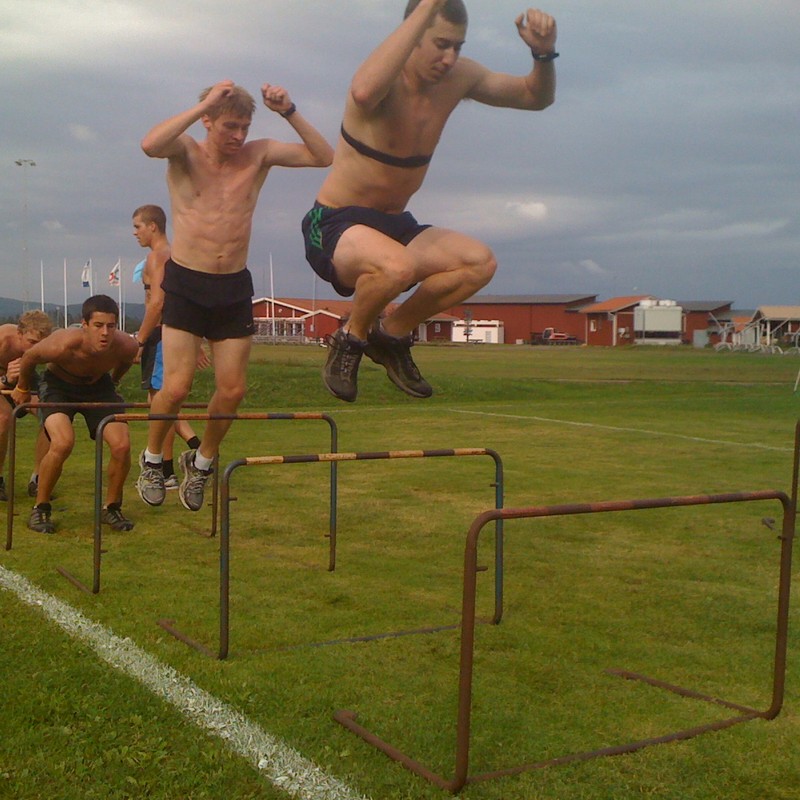
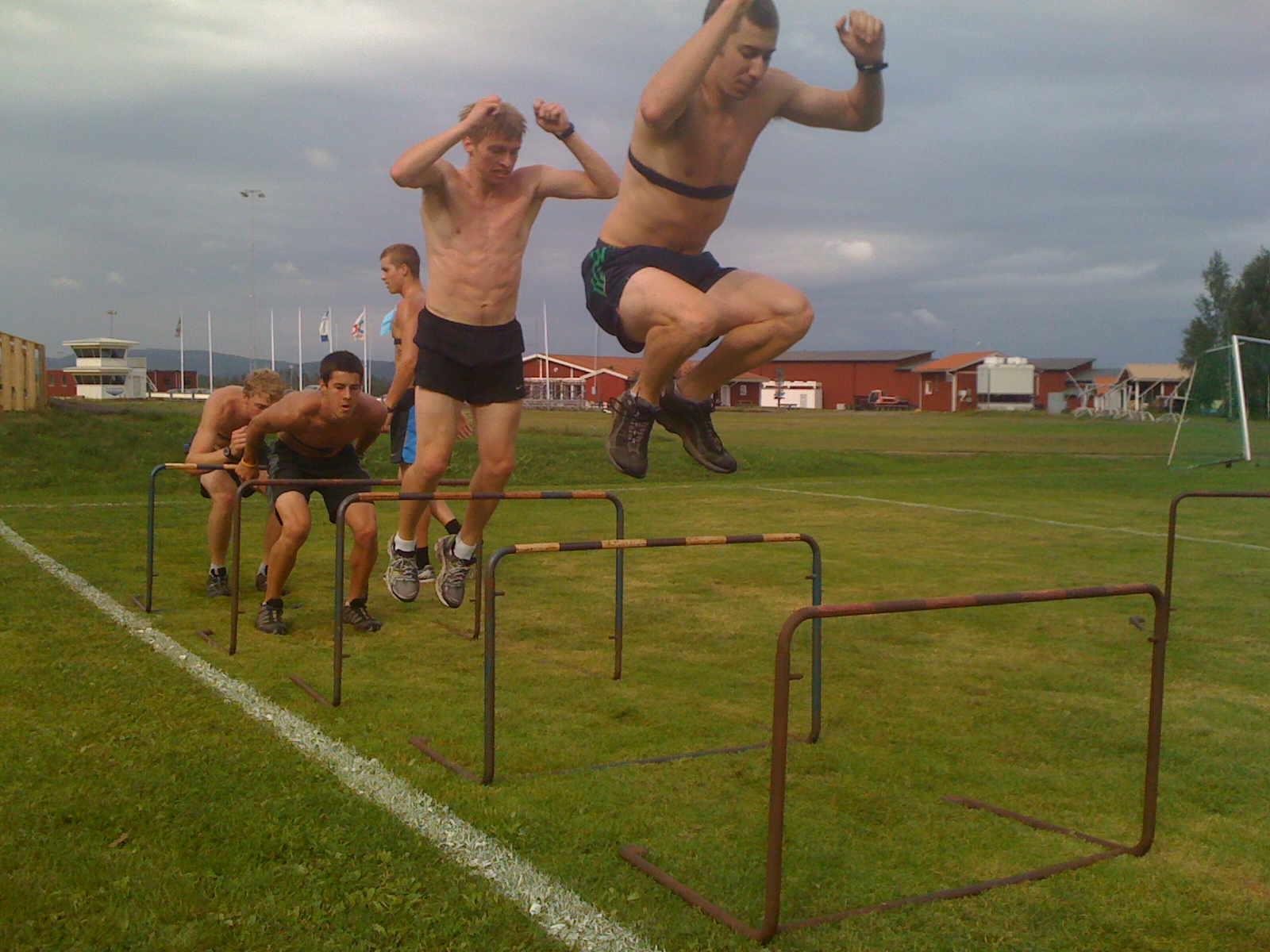
Hurdle bounding at a St. Scholastica dryland session. Salmela believes in the work and is his own cautionary tale about too much of it; a winter of jumps in his last season as a biathlete left him convinced he had compartment syndrome. (Photo: Chad Salmela)
What he got wrong first
Salmela is a strength evangelist who will tell you, unprompted, about the year he ruined a team with it.
“I loaded too much strength on some of my early teams coaching, and they got flat,” he said. “They got super slow, didn’t stay quick.”
What he settled on instead is periodized and, more importantly, individual. December is a strength block for everybody. In season it drops to maintenance and bodyweight work. Beyond that he decides person by person, and he is explicit that the people who say runners need strength and the people who say they do not are both partly right.
“You need a minimal amount of strength just to stay healthy,” he said. “And then some people need strength to be stronger, to be faster as a runner. They actually need strength to be a part of the catalyst that makes you your best.”
He has a sophomore who worked this out for herself before he did. She ran in high school, never lifted, went through the Air Force, got strong there, and arrived at the conclusion that the strength was the thing she had been missing all along. She now does three sessions a week on her own, more than Salmela gives anyone else on the roster.
Plyometrics get the same treatment, and the same warning, which comes from his own body. In his last season as a biathlete he loaded up on jumps and spent January and February convinced he had compartment syndrome.
“Really what it was is I had incredible anaerobic power and the racing season just kind of started having catabolic reactions in my shins,” he said. He credits Dave Bacharach, the exercise physiologist at St. Cloud State, with talking him out of the diagnosis: a lot of type 2 fibre, suddenly drowning in lactate every weekend.
“You have to be careful with plyos for aerobic sports because it’s anaerobic work, and it’s going to steal some of it,” he said.
The archaic notion
Ask him about tapering and he does not hedge.
“I think the taper is an archaic notion,” he said. “I think some people need a taper. You have to find the person who needs a taper. And there are some people out there, but I’d say they’re the minority.”
His team runs six to nine hours a week regardless of where the season is. The reasoning is that fitness is the thing being protected, and that the races themselves do the damage a taper is usually blamed on.
“Great races kick your ass, man,” he said. “They are hard to recover from. So if you want to have two or three great races in a row, you better watch that.”
When he does drop volume it is recovery, not peaking, and he says so. The most persuasive evidence came from a senior who diagnosed her own pattern and brought it to him: three straight years of running a personal best at conference and then one of her worst races of the season at regionals a week later.
“She goes, can we fix that? And I’m like, yeah,” he said. “We’re going to keep the volume high. We’re not going to taper.”
What replaces the taper is a race week with a shape to it, and this is the most directly usable thing he says all afternoon. A maximal effort five days out, long enough to spend real time at max heart rate. Then the Bakken session the day before.
“The reason I think you need that is because your heart will not be ready to respond to the work if you don’t do that,” he said of the hard day. “And if you do it any closer to the race, you’ll still be trying to recover from it.”
The day before, he keeps it short: five to eight repetitions of a minute on, thirty seconds off, in the tempo zone, perhaps five minutes of actual work.
“It’s the best pre-race workout I’ve ever found. Works almost universally,” he said. “Up until that point, I had found some workouts that work for some people and not for others.”
He does not prescribe the number. He hands the athlete a rule instead, and it is a small masterpiece of coaching.
“As long as the one you did last feels better than the one you just did before that, do the next one,” he said. “As soon as you feel like you’re working at all, you’re done.”
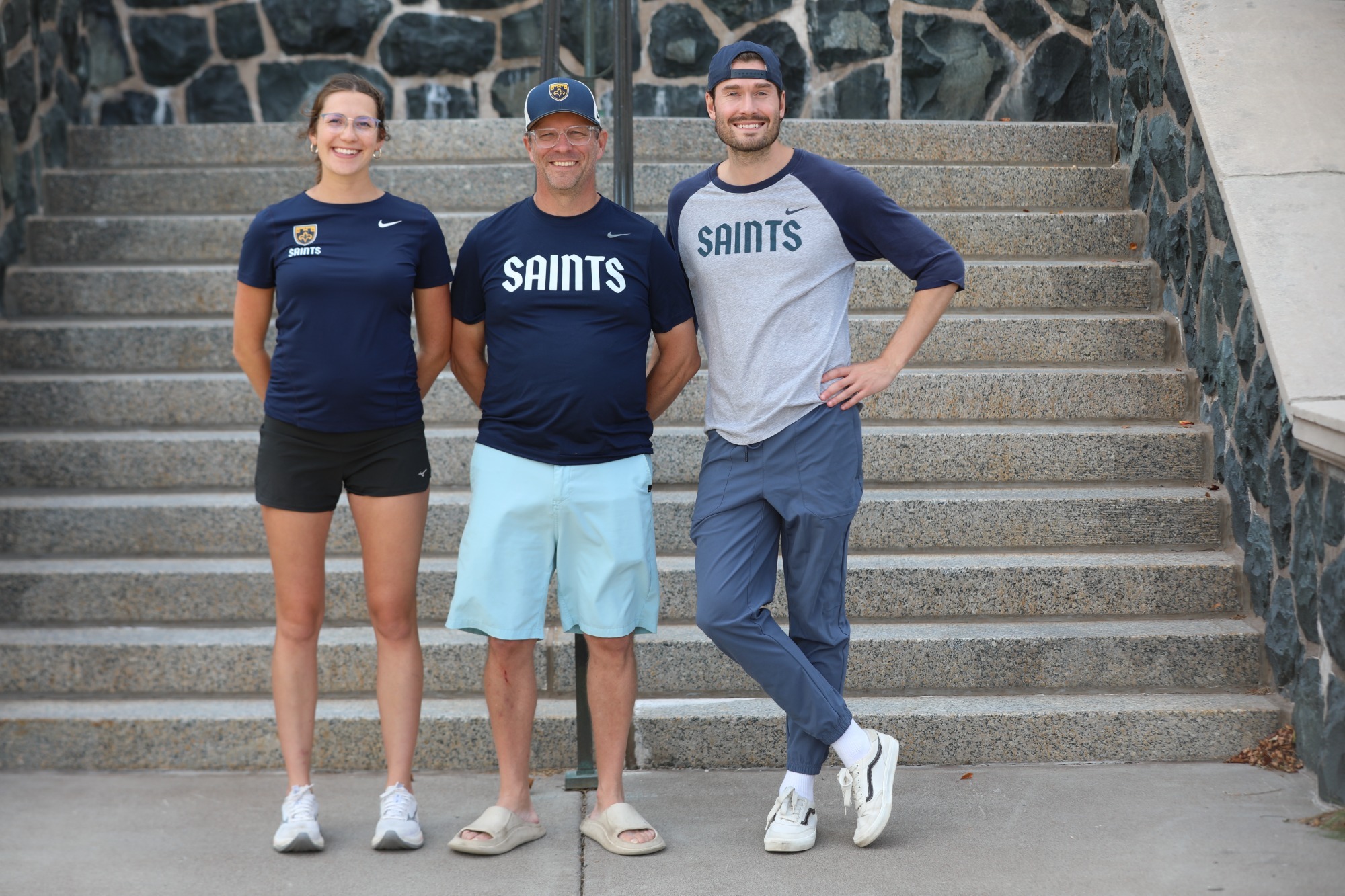
Salmela, center, with his St. Scholastica cross country coaching staff in August 2026. (Courtesy photo)
Leave the gait alone
There is one more piece, and it runs against most of what a modern running program sells.
“Meddling with natural biomechanics is kind of a no-no in my book,” Salmela said.
His most successful runner, he said, had a gait nobody admired and plenty of people wanted to correct. She was never injured until she stopped doing strength work.
“Her gait wasn’t pretty, but it worked, you know, and I recognized that,” he said.
His evidence for leaving well alone is a runner who arrived last year from a small high school program, had not scored for his team, and spent his first season trying to prove he belonged by going too hard at everything. It did not work. Salmela sent him away for a summer with an instruction to run more, at the intensity he was told and no harder.
“He comes in here, he looks so good. All the coaches are like, man, his running has improved a ton,” he said. “He had clodhopper feet last year, because he wasn’t a real runner. He hadn’t run enough yet. Comes in this year and he just comes off the ground, he looks natural, he looks like a runner now.”
Then the part he seems to enjoy most.
“And I did nothing,” he said. “I didn’t have to tell him anything other than follow the right intent.”
Dewall early in the race at the 2023 NCAA Division III Cross Country Championships, the fall he became one of the first two cross country All-Americans in St. Scholastica history. (Courtesy photo)
Which is more or less the argument in miniature. Dewall ran 110 to 130 miles a week building for Berlin, more than he had ever run, a third of it on soft surfaces, the intensity governed by lactate rather than by what the paces are supposed to look like. He got support from Puma’s PROJECT 3 program for the race. He went 2:12:13 and took seventeen seconds off a personal best he had set five months earlier in Boston. Salmela is careful not to claim all of it. Dewall now builds most of his training around cutting-edge running technology that Salmela admits he is “not terribly well-versed” in. “Still, I think the thesis IS a huge reason he is blowing minds, and why he can do these workloads,” Salmela wrote after our interview. “But not the only.”
Salmela has been saying for years that nordic volume would do this to a distance runner if anyone ran it properly. It took him until his fifties to find the runner who would.
Help Support Our Coverage!
If you value the thoughtful work and access FasterSkier provides, please consider becoming a Voluntary Subscriber. Your support directly fuels our work to cover the people, places, and moments that make our sport special.
A path to the Gulf of Bothnia near the Salmela family farm in Finland. The training ideas he has spent most of two decades carrying into American running came out of that part of the world. (Photo: Chad Salmela)
Soldier Hollow Nordic Center is hiring a Venue Operations Supervisor to run snowmaking, snowcat grooming and trail operations at the Midway, Utah venue that hosted biathlon and cross country skiing at the 2002 Olympics.
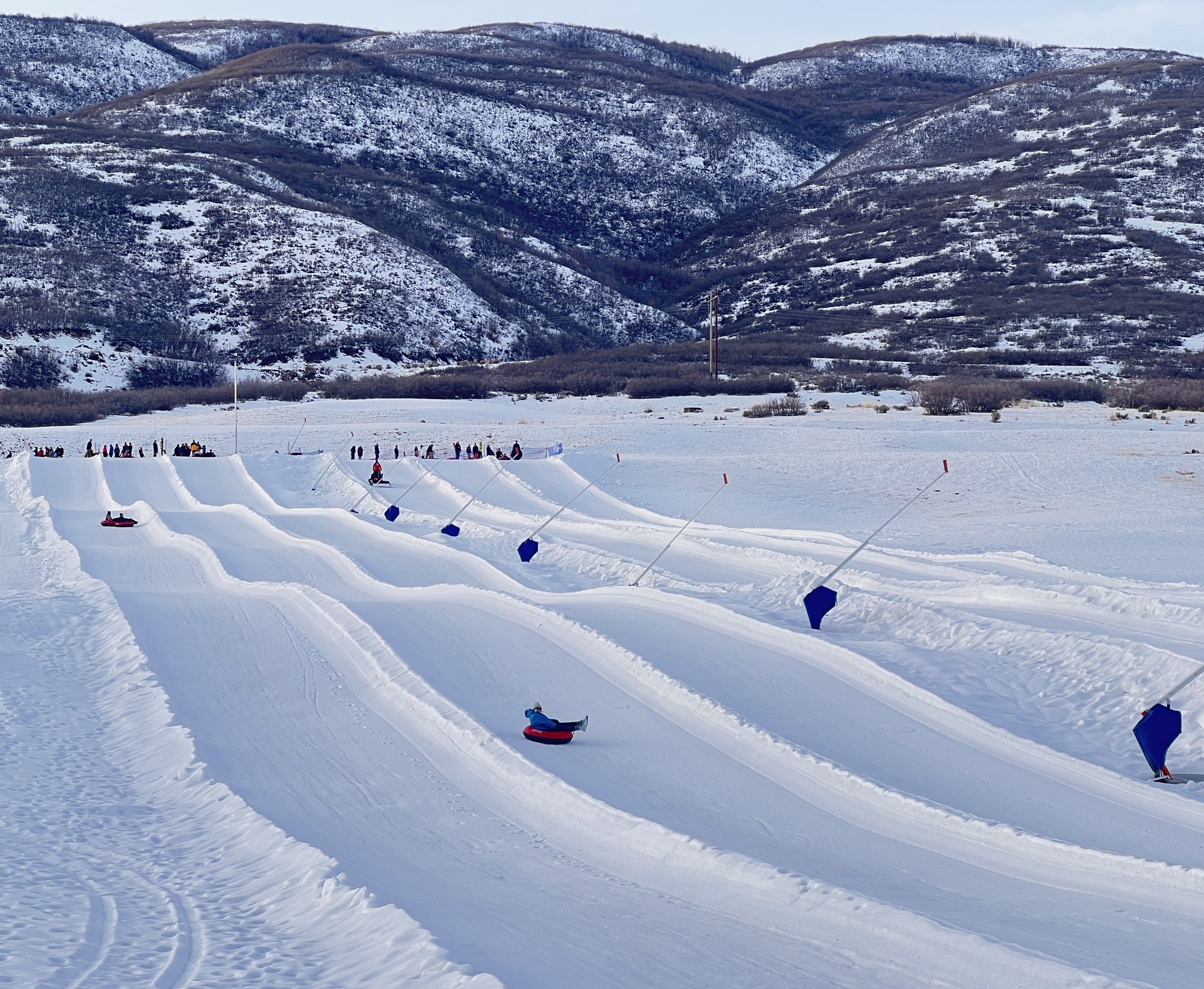
The job is full time and year round, and it sits at the center of how the venue works. Winter means building base, setting classic and skate track, shaping the tubing hill and prepping racecourses. Summer means mountain bike trail construction, roller ski trail repair, mowing and fleet maintenance across 31 kilometers of terrain.
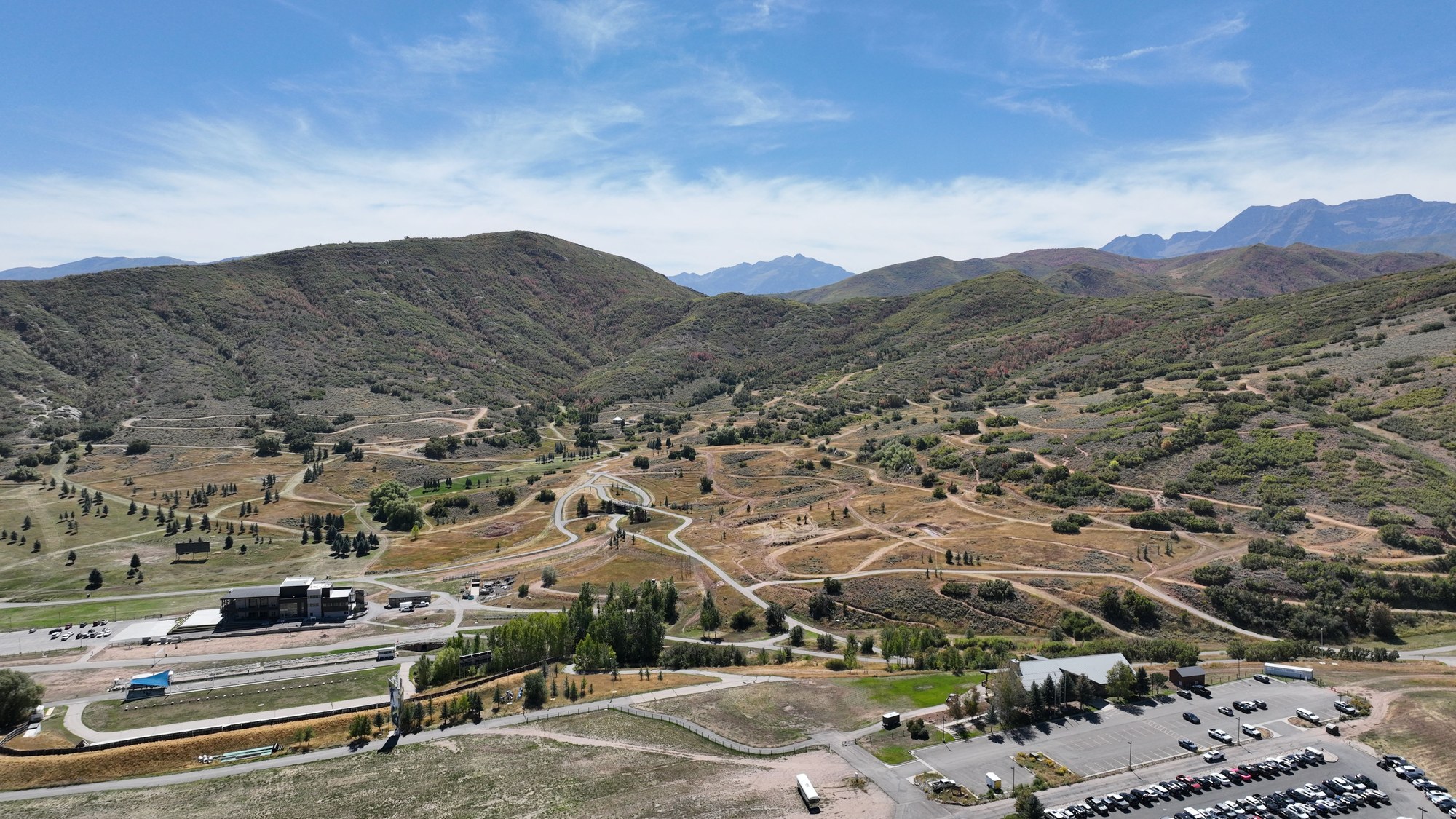
Soldier Hollow is operated by the Utah Olympic Legacy Foundation, which also runs the Utah Olympic Park in Park City and the Utah Olympic Oval in Kearns. With the Games returning to Salt Lake City in 2034, the venue crew is preparing trails that have to work for World Cup athletes and first time skiers alike.
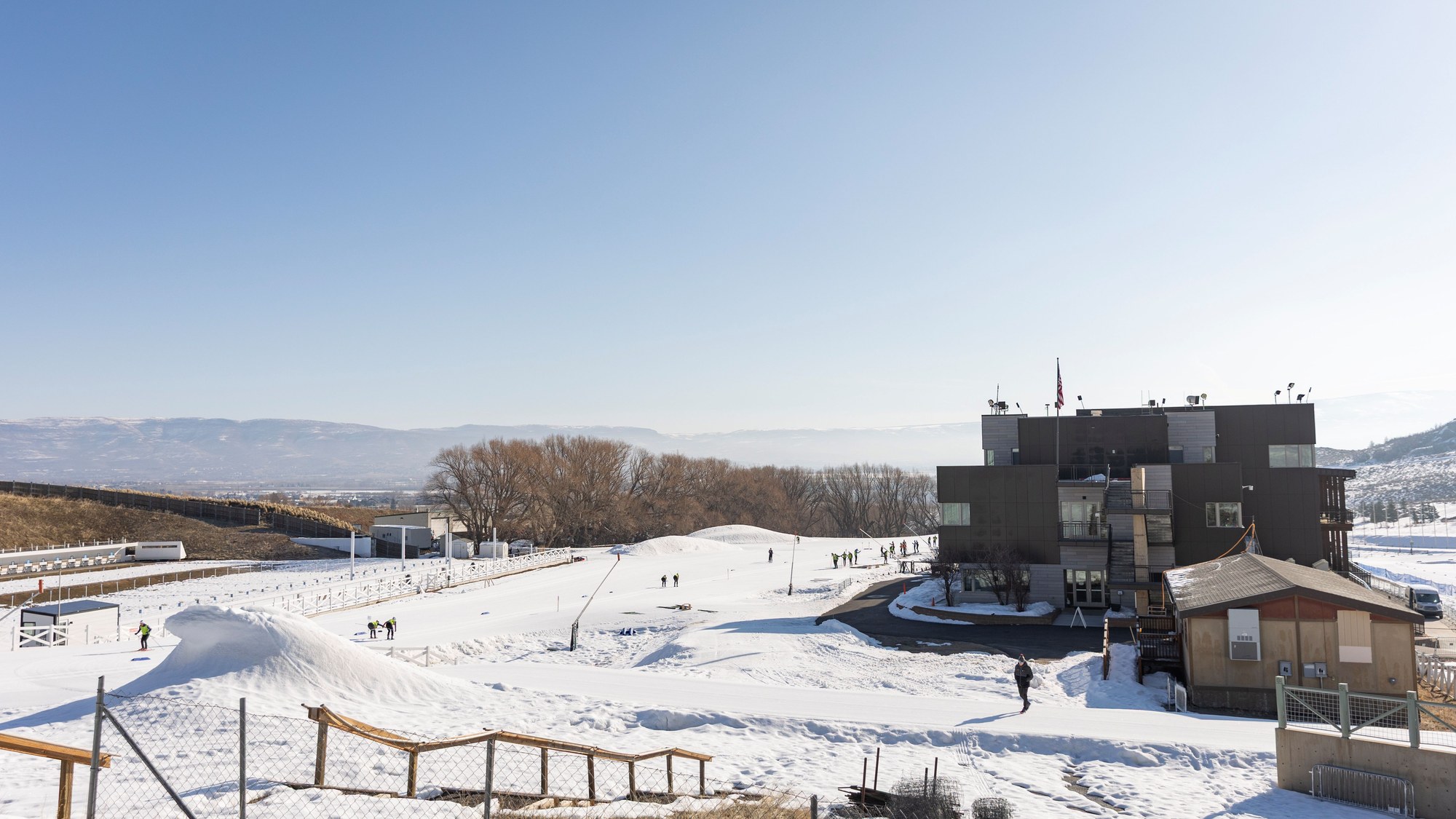
Skiers training near the biathlon range and the Sports Discovery Center at Soldier Hollow Nordic Center in Midway, Utah. (Photo: Tanzi Propst)
The Position
From the posting: “Soldier Hollow Nordic Center in Midway, Utah, is hiring a Venue Operations Supervisor to work in snowmaking, snowcat grooming, and trail operations at the Salt Lake 2002 Olympic biathlon and cross-country venue. With the Olympics returning to Utah in 2034, you’ll help prepare Olympic-caliber trails for daily skiing and events and assist with maintenance and operations of this year-round facility. If you’re a hands-on leader who knows snowcats, snow guns, and trail building, keep reading.”
Schedule, Pay and Benefits
Full time, year round, hourly position
Pay range: $24 to $30 per hour, depending on experience
Overtime eligible and expected during winter operation
Winter: the weather sets the day. Snowfall, temperatures and events shape each shift, and prime snowmaking happens overnight
Spring through fall: Monday to Friday, plus event weekends
Medical, dental and vision
HSA and 403(b) retirement with company matches
Up to $200 wellness credit
Friends and family vouchers for winter tubing, the bobsled experience, a Utah Olympic Park summer gold pass and more
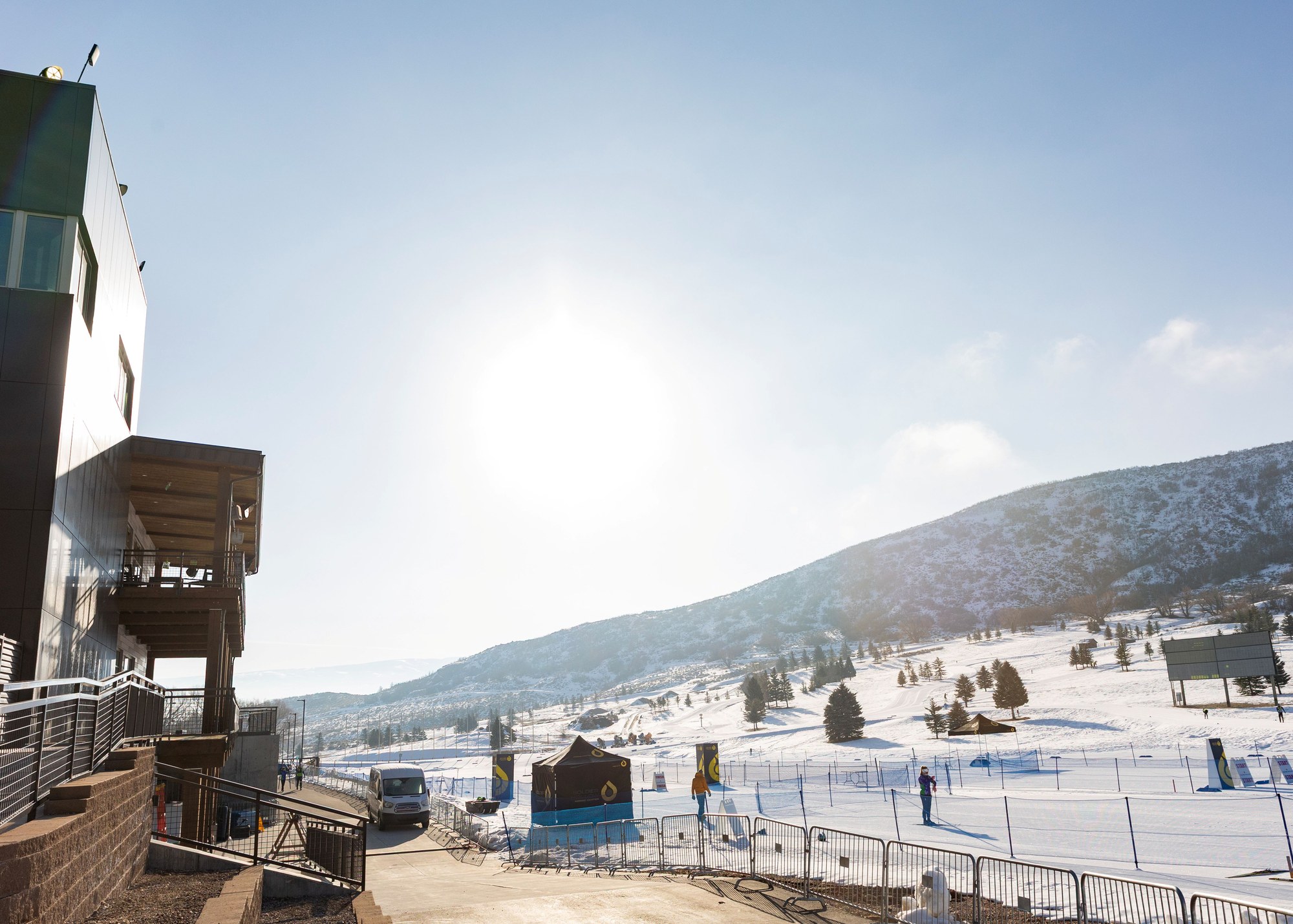
The start and finish area built for a race at Soldier Hollow Nordic Center. (Photo: Tanzi Propst)
What the Job Asks For
Must haves:
3+ years of snowcat grooming and snowmaking experience
2+ years maintaining and repairing heavy equipment, snowmobiles and vehicles
1+ years leading a field crew, including hiring, training and scheduling
Experience preparing venues and courses for events such as mountain biking, cross country skiing or biathlon races
Valid driver’s license
Comfortable with snowmaking software, equipment logs, email and the Nordic Pulse app
Ready to work outdoors in every Wasatch season
Nice to haves:
Chief of Course experience
Welding skills
Three phase electrical experience
Nordic ski area operations background
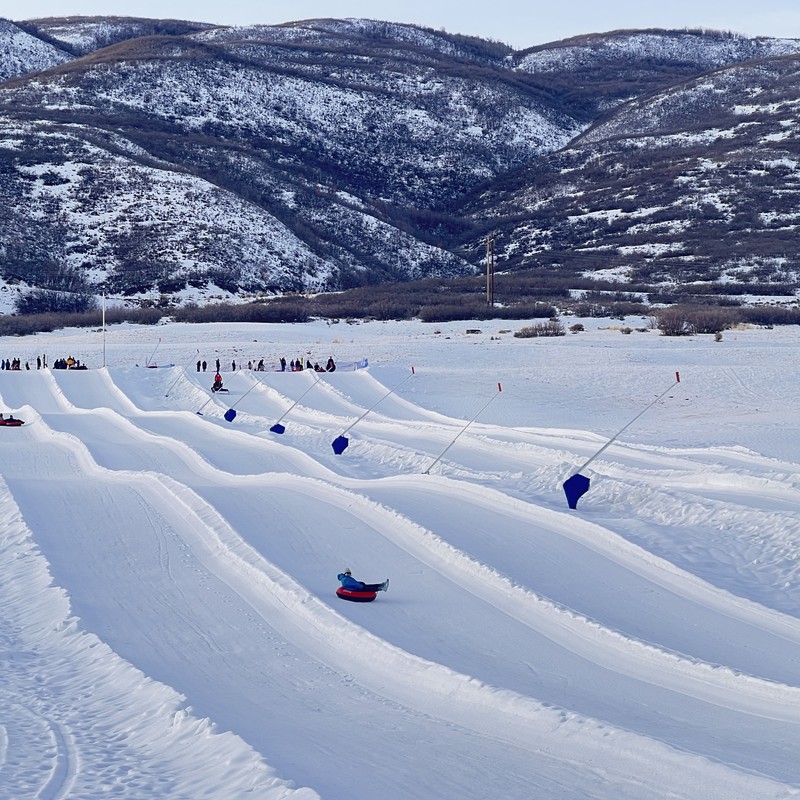
Tubing lanes built and maintained each winter at Soldier Hollow Nordic Center. (Photo: Tanzi Propst)
A Day in the Life
From the posting: “Winter starts with an aggressive snowmaking push. When temperatures drop overnight, you and your crew fire up the system and build base so the tubing hill and ski trails open on time. Once the snow is down, you set classic and skate track, shape the tubing hill, and prep racecourses. In summer, you shift to mountain bike trail construction, roller ski trail repair, mowing, and fleet maintenance. Every day, you lead alongside your crew, and every athlete, family, and racer feels the result.”
An aerial view of the trail network at Soldier Hollow Nordic Center. (Photo: Utah Olympic Legacy Foundation)
Why Soldier Hollow
“As part of the Utah Olympic Legacy Foundation, Soldier Hollow exists to cultivate champions in sport and in life,” the posting reads. “Our venue crew is preparing for 2034, and we’re not afraid to try new things. Last winter, we stored 12,000 cubic meters of snow to jump-start this season. You’ll join a crew that values fresh ideas, building trails for World Cup athletes, first-time skiers, and mountain bikers across 31 kilometers.”
The foundation describes the person it is looking for this way: “You’re happiest with grease on your hands and a plan for tomorrow’s grooming. You bring Grit to midnight snowmaking shifts and Excellence to every corduroy line, always looking for a better way. You build a strong crew through Collaboration, working right beside your team. You want your work to have Impact on athletes chasing Olympic dreams and on the Community that skis, bikes, and hikes these trails.”
How to Apply
Apply through the Utah Olympic Legacy Foundation listing:
The role is also listed on the foundation’s careers page at utaholympiclegacy.org/careers, alongside a seasonal Snowmaking, Grooming and Trail Crew Lead position at Soldier Hollow. Questions about hiring can go to hr@uolf.org or 435.658.4218.
Benilde-St. Margaret’s School is hiring a Head Nordic Ski Coach to lead its cooperative program with DeLaSalle High School for the 2026-27 winter season. BSM is a Catholic, college-preparatory school in St. Louis Park, Minnesota, on the western edge of Minneapolis, and its Nordic team brings together skiers from both schools through a long-standing partnership.
The program is replacing both its head coach and its senior assistant coach this season. The roster is young, with a strong freshman class, and the program is looking for a coach who can build on the team culture the previous staff established while developing that talent toward a run at the state meet in the coming years.
The Benilde-St. Margaret’s/DeLaSalle Nordic team last December. (Courtesy photo)
Position Overview
The head coach develops skiers of every experience level, builds a welcoming team culture and pursues competitive excellence, with student-athlete growth at the center of the program. That means setting a positive, inclusive tone for athletes from both schools, communicating clearly with families and school leadership, and building a team in which every skier feels valued and challenged. The head coach also leads and supports the assistant coaching staff, with an emphasis on consistency and a smooth transition into the season.
The Details
Head coach of the Benilde-St. Margaret’s/DeLaSalle cooperative Nordic program for the 2026-27 winter season
Stipend, commensurate with experience — $5,000 to $8,000
Reports to Matt Pryor, BSM Director of Athletics & Activities
After-school practices and meets through the winter, plus preseason planning and coordination with both schools
The selected candidate must complete BSM’s hiring, background check, Safe Environment and coaching requirements before working with student-athletes
Responsibilities
Plan and lead practices, competitions and athlete development throughout the season
Teach sound ski technique, conditioning, race strategy and safe training habits
Coordinate schedules, transportation, equipment and meet logistics with the BSM Athletics & Activities Department and DeLaSalle
Recruit, supervise and develop assistant coaches in collaboration with BSM
Communicate proactively with athletes and families, including schedule updates through BSM’s designated platform
Maintain program equipment and keep an accurate inventory
Uphold BSM’s standards for sportsmanship, student well-being and Minnesota State High School League compliance
Qualifications
Required:
Experience coaching or competing in Nordic skiing
Strong organizational and communication skills
Ability to work effectively with student-athletes at varying skill levels
Commitment to a safe, supportive team environment
Preferred:
High school coaching experience
Familiarity with Minnesota Nordic skiing competitions and the MSHSL
Experience leading a coaching staff or a cooperative program
Why Lead at BSM
BSM sets out to develop student-athletes as competitors, teammates and people, and its coaches build programs rooted in belonging, accountability, growth and Red Knight pride. The next head coach steps into a program with dedicated skiers, families and assistant coaches, has the backing of both schools, and gets to bring their own vision to athlete development and team culture.
How to Apply
Send a cover letter, résumé and references to Matt Pryor, Director of Athletics & Activities at Benilde-St. Margaret’s School: mpryor@bsmschool.org.
Applications will be reviewed as received. The opening is also listed on the BSM careers page.
YMCA of the Rockies is hiring a Nordic Center Supervisor at Snow Mountain Ranch in Granby, Colorado, a seasonal role leading the day-to-day operations of the ranch’s Nordic Center through the winter.
Snow Mountain Ranch sits on 5,100 acres of meadow, aspen and spruce forest in Grand County, about an hour and a half from Denver and near the western entrance to Rocky Mountain National Park. Its Nordic Center grooms more than 80 kilometers of trail and runs rentals, retail, lessons and Nordic programming for guests and groups, along with larger events across the season.
The supervisor works under the Nordic Director and takes charge of the center when the director is away.
Position Overview
The Nordic Center Supervisor runs daily operations of the Nordic retail and rental center and trains, schedules and supervises the center’s staff and instructors. The role coordinates ski lessons, Nordic programming and guest group activities, works with Bryan Mountain Ski Patrol on safety and emergency response, keeps inventory in order, and helps prepare for the bigger Nordic events on the calendar.
The Details
Seasonal position based at Snow Mountain Ranch, Granby, Colorado
$19 to $21 per hour
Reports to the Nordic Director
Weekend and holiday availability required during the winter season
PSIA Level 1 training, waxing knowledge and First Aid, CPR and AED certification can be provided if needed
Skiers head out across the meadows at Snow Mountain Ranch in Granby, Colorado. (Photo: YMCA of the Rockies)
What You’ll Do
Lead daily operations of the Nordic retail and rental center
Train, schedule, supervise and support Nordic Center staff and instructors
Coordinate ski lessons, Nordic programming and guest group activities
Teach beginner Nordic ski lessons based on PSIA Level 1 training
Help guests choose the right equipment and offer skiing and waxing advice
Perform and teach practical waxing for classic and skate skis
Maintain inventory and keep the Nordic Center organized and ready for guests
Coordinate with Bryan Mountain Ski Patrol on safety and emergency response
Support larger Nordic events and special programming throughout the season
Step into the leadership role for the Nordic Center when the Nordic Director is away
Groomed trail through the pines at Snow Mountain Ranch. (Photo: Brady Robinson)
Why Work Here
The trails start outside the door. The job puts you on skis, in front of guests and in charge of a team every day. At YMCA of the Rockies, staff create meaningful experiences for guests while living out the organization’s values of caring, honesty, respect, responsibility and faith.
Open meadow skiing below the forested hills at Snow Mountain Ranch. (Photo: YMCA of the Rockies)
You’ll Thrive Here If You
Love Nordic skiing and sharing it with others
Enjoy working outdoors in snow, cold and changing mountain weather
Have strong leadership, communication and customer service skills
Enjoy training and developing a team
Can ski confidently on groomed and ungroomed terrain
Like a job where no two days are exactly alike
Are comfortable working weekends and holidays during the winter season
Bring a positive, professional, problem-solving attitude to a busy environment
Mid-August is a time to reflect on the summer and start looking forward to the upcoming changing of the seasons. The long, sunny days have brought me many adventures this year, particularly to lakeside destinations like Achensee just up the valley from Innsbruck. A quick dip in the lake is an excellent way to cool down after a bike ride, hike or even rollerski, in the mountains with friends on a hot day. Soon, though, the temperatures will begin dropping and our favorite trails start preparing for the coming winter.
If you’ve been dreaming of exploring Europe’s top cross-country ski trails this winter, there is still space on several Lumi trips to the Alps and Scandinavia. Whether you’d like to check a Worldloppet event (or two!) off your list or simply sight-ski in a new country at your own pace, Lumi’s expert, local trip leaders will help make you get the most out of your ski time in Europe. Check out Lumi’s 2027 winter calendar below and start making your plans today.
Ski in Seefeld & Seiser Alm
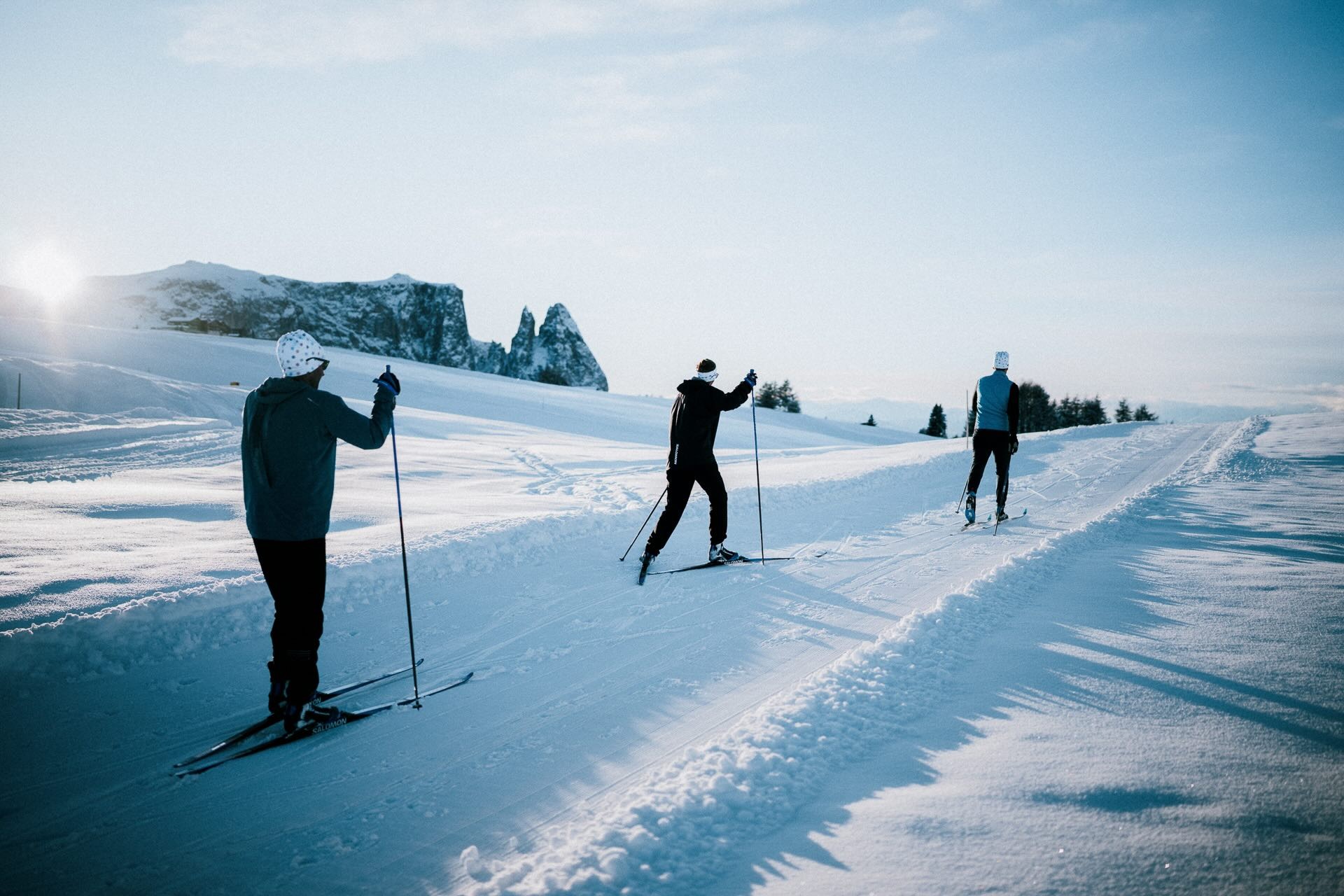
Explore the trails on Seiser Alm, one of Italy’s premier Nordic skiing destinations (Photo: Lumi Experiences)
This Winter Seefeld, Austria and Seiser Alm, Italy are renowned for their approachable, yet scenic skiing during the winter months. Start your journey on the nearly-flat trails of Leutasch outside of Seefeld, where picture-perfect mountains rise above the valley below. Trailside huts serving traditional Austrian fare, including the classic Aperol Spritz, dot the trails so you’re never far from a snack break or full meal. Continue your trip on Seiser Alm, where the higher elevations place you above the clouds and nearly at eye-level with the craggy Dolomite spires that ring this high-altitude plateau. Both locations have reliable snow-making capabilities that enable them to open the trails by November before natural snow takes over in December and beyond. The March trip is already sold out, but we still have space on both January trips to Seefeld & Seiser Alm trips. Reach out soon! Our January 20 departure only has one room remaining.
Earn Two Worldloppet Stamps Towards Your Masters Medal
Ski through Finland’s dense forests at the Finlandia-Hiihto (Photo: Finlandia-Hiihto)
If you’re craving the thrill of participating in a major ski marathon, look no further than Lumi’s Marcialonga & König Ludwig Lauf and Finlandia & Tartu trips. Both trips feature Worldloppet events on back-to-back weekends, putting you that much closer to reaching your Worldloppet Master medal. Your expert, local trip leaders assist with all race logistics, including ski waxing for each event so you can simply focus on enjoying the skiing and surroundings on your big event day. We only have a few spots left on both trips, so if you’d like to participate in two Worldloppet events on one trip we recommend reaching out soon.
The Marcialonga & König Ludwig Lauf trip features skiing in Italy, Austria and Germany over 11 days, allowing you to experience some of the best skiing and dining in each region. New for 2027 is the chance to participate in the 32 km Marcialonga “Just for Fun” event, the perfect distance for those who aren’t able to ski the full 70 km classic event. After skiing the beautiful trails in and around Seefeld, Austria, continue your Worldloppet pursuit at the König Ludwig Lauf in Germany on their newly refreshed, snow-secure course.
Whether you ski the full 70 km course or the new 32 km “Just For Fun” event, crossing the Marcialonga finish line is an exciting accomplishment (Photo: Lumi Experiences)
Later in the winter you’ll have the opportunity to ski the Finlandia-Hiihto and Tartu Ski Marathon on Lumi’s Finland & Estonia trip. Both events feature moderate terrain and a relaxed atmosphere in part due to their smaller size – especially compared to Worldloppet events like the Birken, Engadin and Vasaloppet, all of which regularly reach over 10,000 participants. In addition to enjoying both nations’ Olympic museums, cuisine and trails, guests have the opportunity to sauna every day in Finland in a variety of traditional Finnish saunas.
Join skiers from around the world in a group stretch before skiing the Finlandia-Hiihto Worldloppet (Photo: Finlandia-Hiihto)
Sight-Ski Your Way Across Norway or Slovenia & Italy
Not interested in participating in a ski marathon? Join a sight-skiing trip in Norway or Slovenia & Italy next winter. Lumi’s sight-skiing trips skip the races so you can focus on enjoying the scenery, cuisine and culture that make each destination unique.
Ski the Holmenkollen trails above Oslo before trekking north to Norway’s Sjusjøen trails (Photo: Lumi Experiences)
We have two Norway Sight-Skiing trips scheduled for mid-February next winter, each of which begins in Oslo on the Nordmarka trails before shifting north to the Olympic city of Lillehammer and the seemingly endless trails of Sjusjøen. Enjoy Oslo’s harbor from two unique angles: first from the top of the iconic Holmenkollen Ski Jump high above the city, then from the water on a floating sauna – before an optional cold plunge into the icy waters. Our February 14 departure is almost full, with just two more rooms available for up to 4 guests
Lumi’s Slovenia & Italy Sight-Skiing trip in early-March is the perfect trip for those looking to explore a quieter corner of the Alps. Your accommodations for the week-long trip are just a few minutes walk along rustic village paths to the trails, which lead directly to the famous Planica Nordic Center, site of the 2023 FIS World Championships. Ski to one of our favorite trailside huts in the Julian Alps before taking a gondola ride to a mountaintop village nearly a kilometer in elevation above the valley below. Wrap up your trip with a visit to Lake Bled, one of Slovenia’s most cherished natural wonders.
Discover the quieter trails of the Julian Alps in Slovenia and Italy (Photo: Lumi Experiences)
End Your Season Under the Auroras in Iceland
Part Worldloppet trip, part sight-seeing adventure: Lumi’s Iceland Fossavatn trip in mid-April has a little bit of everything. Start your trip off in Reykjavik before trekking northwards along Iceland’s rugged interior, with stops at volcanic craters, scenic waterfalls and geothermal springs. Upon reaching the country’s Westfjords region, you’ll find a beautiful trail network just above sea level, with stunning views of the fjord in the glacially-carved valley overlooking the Atlantic Ocean. After participating in the last Worldloppet event of the season, celebrate with your fellow skiers from around the world at the Fossavatn’s famous cake party, with dozens of delicious cakes to choose from – not to mention freshly-caught seafood served at restaurants throughout Ísafjörður. With almost no light pollution to speak of, this trip has the highest chance of seeing the northern lights of any Lumi trip.
Visit Iceland next April for the chance to see the northern lights (Photo: Annika Landis)
Space is limited on many of these trips, so if you are interested in traveling to Europe with Lumi for your next ski vacation, reach out soon to secure your spot. Message reservations@lumiexperiences.com for a detailed trip itinerary or to sign up. We look forward to hearing from you!
As the world’s premier cross-country ski travel company, Lumi Experiences offers boutique trips that introduce travelers to winter cultures where Nordic skiing is a part of everyday life — from Sweden to Slovenia. It’s a ski vacation like no other.
Media contact: Nathan Miller – Marketing & Guest Communications Manager – nathan@lumiexperiences.com
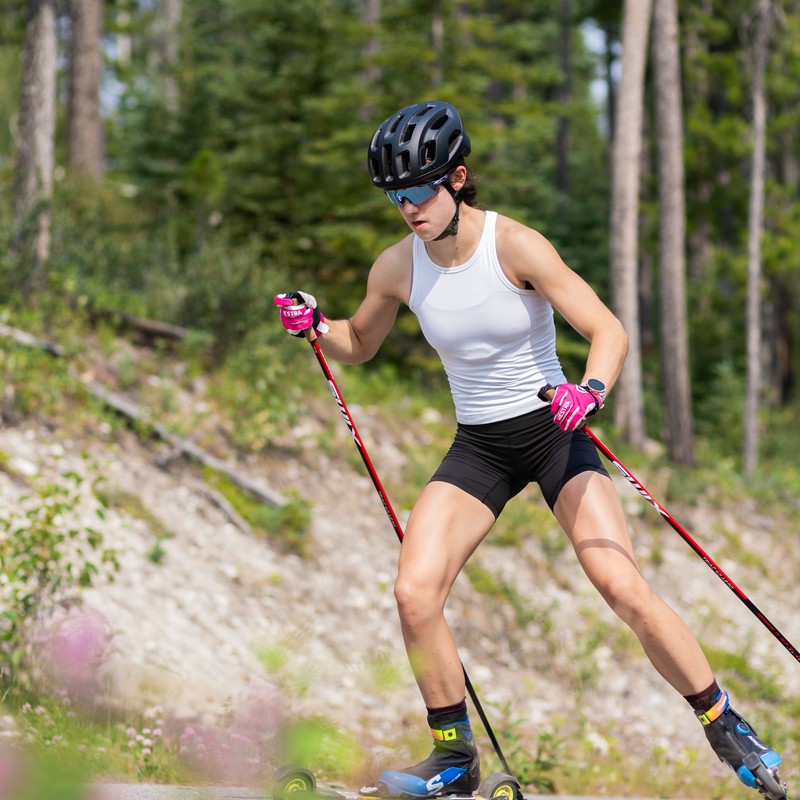
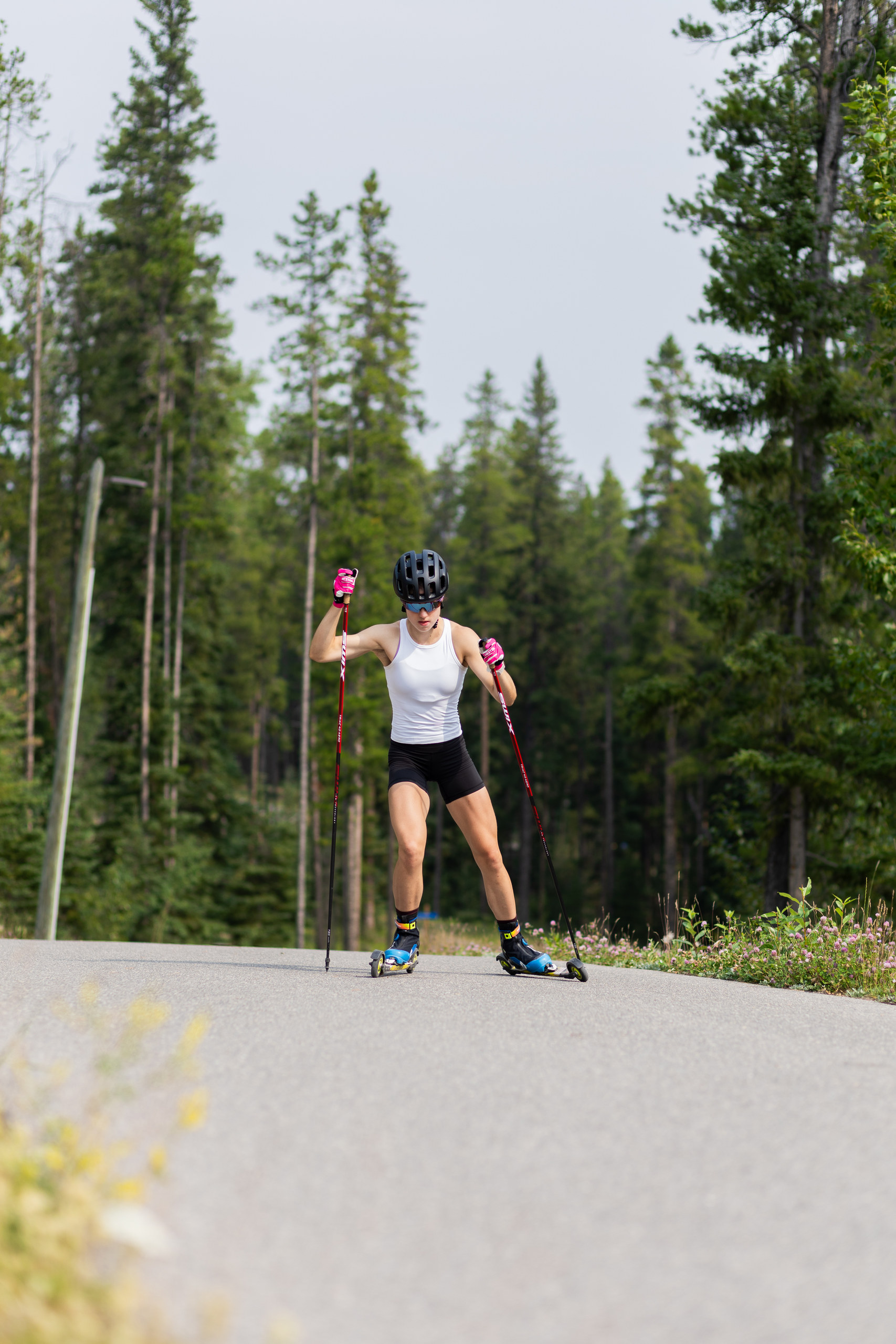
Alison Mackie rollerskiing during summer training in July. She trains with the Alberta World Cup Academy in Canmore, Alberta. (Photo: Nathaniel Mah)
For Alison Mackie, the 2024 Junior World Championships in Planica never really started.
She had arrived in Slovenia with reason to expect something. A year earlier, at 17, she had finished 13th in the 20 k at the junior championships in Whistler, British Columbia, on home snow, in exactly the kind of long, grinding distance race that suits her. In Planica she missed the qualification in the opening sprint, fell ill, and watched the rest of the week from a hotel room. She was not on the tracks when her Canadian teammates made history either: Sonjaa Schmidt won the U23 sprint, and Canada won the U23 relay.
Back at her base in Canmore, Alberta, at the end of that season, Mackie and her coaches set a target for the next one. Top five at the 2025 Junior World Championships in Schilpario, Italy.
Privately, she wanted more than that.
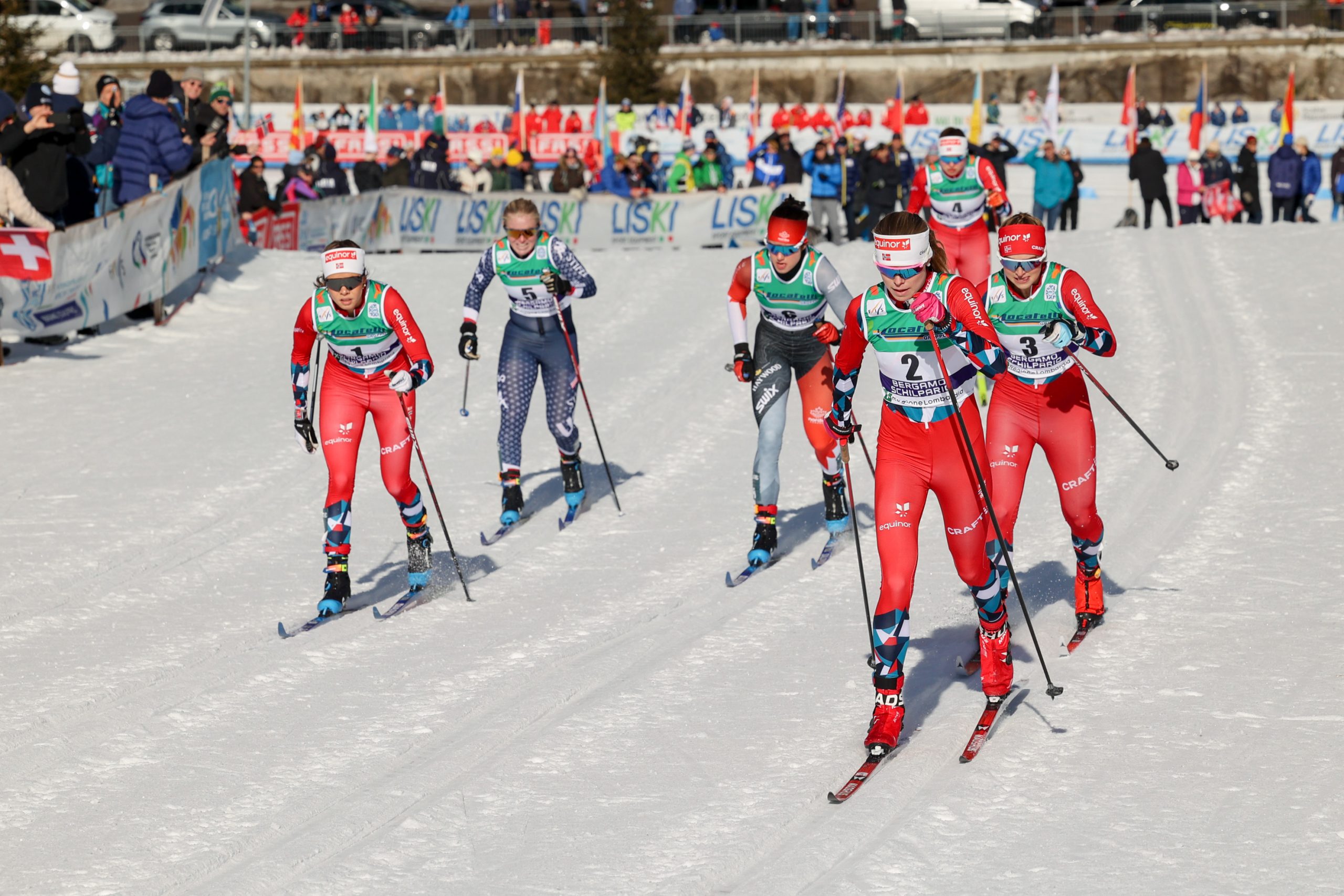
Mackie in bib 6 during the classic sprint at the 2025 Junior World Championships in Schilpario, where she finished fourth. Two bronze medals followed in the distance races. (Photo: Newspower.it)
A Comeback in Schilpario
“Yes, Junior World Championships in Schilpario were the main focus of my season that year,” Mackie said. “I trained specifically for that event to get my best shape there. But I wouldn’t say revenge, instead a kind of comeback because the year before in Planica I was pretty disappointed because I haven’t had the opportunity to race being sick.”
On the Italian tracks she won bronze in the 20 k mass start classic, then bronze again two days later in the 10 k interval start skate. She was fourth in the classic sprint. They were the first junior world championship medals won by a Canadian woman since 1989.
“I wanted a top five, and I finished with three top fours, including two medals,” she said. “The preparation we had put in proved to be correct, and I had a lot of confidence before starting the championships because I felt really good in the previous months leading up to my arrival in Italy.”
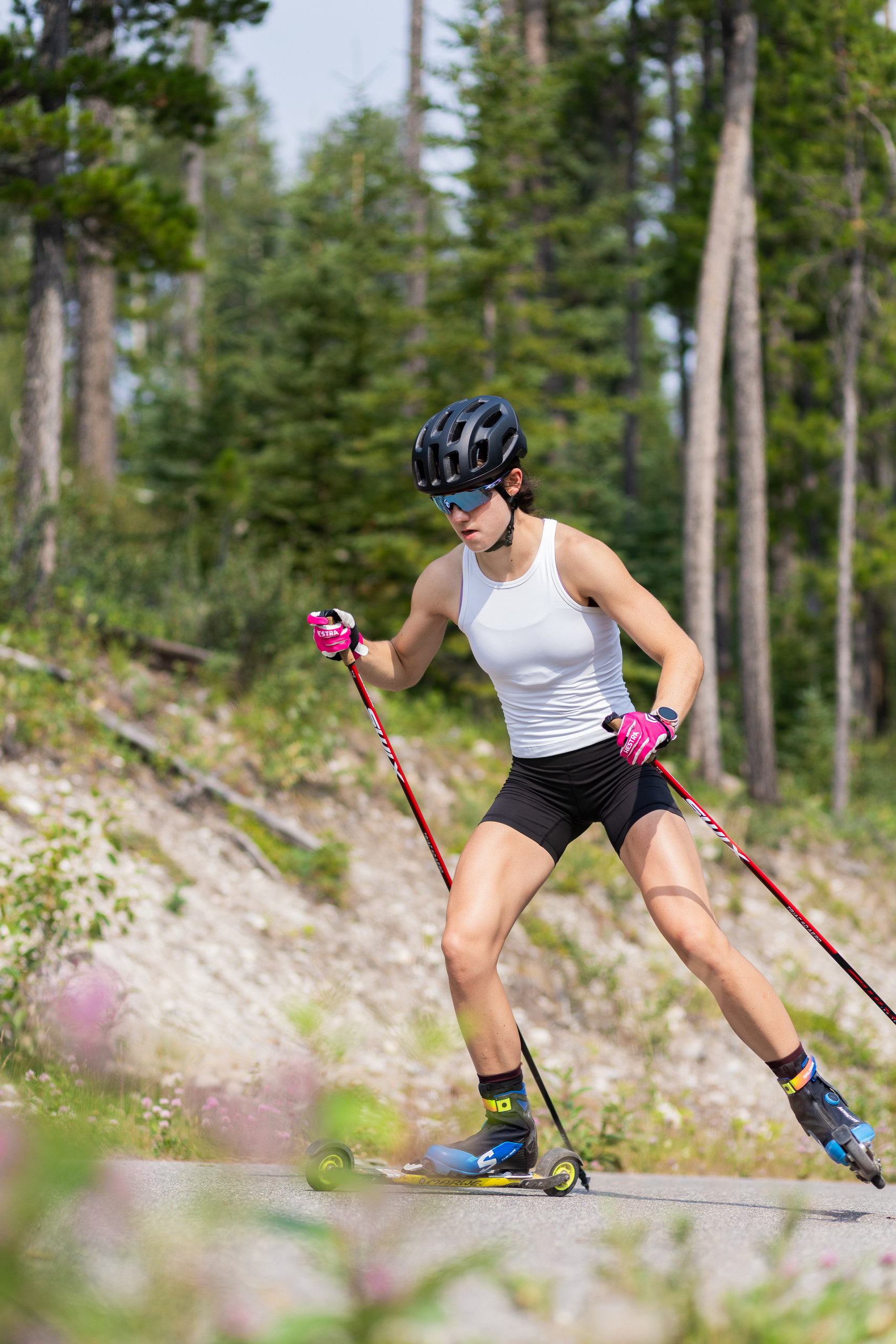
Mackie on a summer rollerski session in July. She started racing in Alberta as a teenager and won her first national title at 16. (Photo: Nathaniel Mah)
Put on Skis Before She Could Walk
Mackie was born in Montreal and raised in Edmonton, and she is 20 years old. Her mother, Jennifer, is a pediatrician. Her father, Andrew, is a pediatric cardiologist. Both of them ski, and both of them had her on skis before she has any memory of it.
“My parents put me on ski as soon as I could walk,” she said. “So skiing accompanied all my childhood. Then I took real ski lessons and I started doing racing in my region of Alberta during my teenage times. That’s till Covid period arrived and with the restrictions I had nothing else to do others than training. But anyway, I really enjoyed myself during that period, developing my technique with my coaches at Edmonton ski club and when Covid finished my very first race that I won was our National title in March 2022 as a 16 year old.”
Canada is known around the world as the home of ice hockey. Why did you choose cross-country skiing over hockey, freestyle, or swimming, following Summer McIntosh’s footsteps for example?
“In parallel with cross-country skiing, I did a lot of other sports like cross-country track and field, rock climbing, mountain biking, swimming, soccer and in all of these sports I wasn’t as super competitive as I was in cross-country skiing. I did that only for fun as an opportunity to stay healthy during summer period. Cross-country skiing has been to me the only sport I competed at my best in my early ages and my favourite discipline. That’s why I chose it.”
That first national title, won in Whistler in March 2022, is the race she keeps coming back to.
“Yes, that race in Whistler BC was one of the first big races after the Covid pandemic,” she said. “I trained a lot during that period and didn’t have the opportunity to race and see my level, and when I went to my first National Championships and won the first race, it was a special moment and made me realize that I wanted to keep pursuing cross-country skiing for even better results and seeing how far I could get.”
Mackie racing to eighth in the Olympic 10 k freestyle in Tesero on Feb. 12, the best Olympic cross-country result by a Canadian woman. (Photo: Vanzetta/NordicFocus)
Eighth at the Olympics
The line has run one direction since. Two bronze medals at Junior Worlds. Her first World Cup top 10s, in Toblach and Val di Fiemme. Eighth in the 10 k free at the Milano Cortina Olympics in her first senior season. Gold in the 20 k mass start free at the U23 World Championships in Lillehammer in March. And at the end of that season, on 548 points, the FIS U23 overall World Cup title, the first won by a Canadian woman, with the finals held at Lake Placid.
At the Milano Cortina Olympics you finished eighth in the 10 k free, after your first World Cup top 10s in Toblach and Val di Fiemme. What do you remember from those two weeks in Italy?
“It was super cool being part of that multi sport event that the Olympic Games represent. It was my dream since I was a child watching Olympics on TV and having the opportunity to compete in high level in this huge event was really special to me. Definitely they have been long two weeks, also overwhelming at the time, but made me really happy how I performed overall and the 8th place I got in 10km skating has definitely been the highlight without any doubt. Entering the top 10 has been quite a surprise to me in that moment, because there were all the best skiers at the starting line. But now looking back at all the hard work I did during the whole season and the good results I got before that race in both World Cup and in under 23 World Championships, I wouldn’t say it was a huge surprise for me. Probably demanding Val di Fiemme’s track suited me very well, given that I finished as well 8th in Tour de Ski’s Cermis climb the month before.”
What is the current situation in Canada for cross-country skiing, in terms of ski club membership, visibility in the national media, and financial support?
“I would say the current cross-country skiing community in Canada is pretty small, if compared to other European power nations, but strong and with lots of passion in developing our discipline. There are a lot of young skiers coming up and I think it is very exciting for the great results to come in the future. Our National sports organization here in Canada are working really hard to make sure our National team can get all the support we need in order to achieve some World Cup podium with both boys and girls team during the seasons to come.”
Mackie on the treadmill during a lab test in May. Distance racing is her strength, and finding speed is the summer’s assignment. (Photo: Nathaniel Mah)
Distance Strength, Sprint Homework
Describe yourself as a cross-country skier. What are your characteristics, your strengths, and the areas you are working on for the coming seasons?
“I describe myself as a pretty strong skier in distance races, while I struggle a bit in sprint not to get through the top 30 and consequently not play the sprint finals, that is an element that I am working on in next seasons,” she said. “Between classic and skate I have found more success in free technique in the past seasons, but I enjoy training both classic and skate equally. Distance races are definitely my strength but I am working to improve my speed skiing as well so I could become a really strong overall skier in order, in the future, to fight for a higher overall spot in World Cup.”
And the criticism you get from your coaches?
“More than critics I would call special feedback from my coaches. Because sometimes I have a tendency to train too much and too hard that I need. That is something I am working on this summer, knowing when to push my body and when to give the correct time to rest and recover.”
The World Cup calendar keeps skiers from outside Europe away from home for close to five months a season. How hard is that for you?
“Personally I have spent on the road, following World Cup calendar, the past two seasons, but not the full European calendar. I really enjoy travelling and being on the road, so I don’t think it is a huge struggle for me. It is tough to not see friends and family for a long time but I am really lucky that I had friends and family came and watched me on tracks while I was in Europe a couple of time during season. Next season it will be quite different for me, because I am transitioning to attend the University of Utah so I will leave World Cup a bit because I do need to go to class and represent the University of Utah in North America as well.”
Mackie at the Holmenkollen World Cup in March, a week before the tour reached Lake Placid. (Photo: Authamayou/NordicFocus)
A Winter Without Diggins
The World Cup went to Minneapolis in the last two seasons, and Lake Placid hosted the finals in March in front of enormous crowds. Why not race in North America more often?
“We do have actually Canmore scheduled for World Cup 2028, but realistically there are not so many resources for cross-country skiing in North America,” Mackie said. “It takes a lot of money and human power for the organization and preparation of those races. Of course, it will be amazing to have more opportunities to race in North America in the future but I have to be realistic and understand that organizing an event here in Canada, for example every four years, require lots of efforts and preparations from the local organization. Maybe we need more venues in North America that we currently have that are able to bring here World Cup events. I admit with huge pleasure that in the past seasons both Minneapolis and Lake Placid events showed how strong local communities are in terms of support and enthusiasm for cross-country skiing and those events have been a great boost for our discipline in North America, especially between young kids.”
After fifteen seasons, this will be the first World Cup winter without Jessie Diggins, who clinched one more crystal globe in Lake Placid in March before retiring. Will she be missed outside the U.S. team as well? Did you ever get advice from her?
“I definitely think Jessie’s presence will be missed in World Cup. Not only inside USA Team. I think she has always been a positive skier and a really amazing role model in so many ways. And 100% her presence, her ambitious way of racing and unique skiing spirit will be missed. That will definitely change some racing tactics as well. I had the opportunity to train together with Jessie in New Zealand last summer and it was a pretty cool experience and I wish all the best in her future.”
Mackie fitting a metabolic mask before a treadmill test in May. She trains in Canmore and will study medical engineering at the University of Utah this year. (Photo: Nathaniel Mah)
Canmore, Utah, and Life Off the Snow
How is the Canadian team organized, and how is training divided between the women and the men at camps and at home?
“I think Canadian skiing is gonna take a really exciting trajectory. I am really excited to work with our new Swedish coach Stefan Thomson over the next seasons but also in our group here in Canmore we have Norwegian Tormod Vatten as our assistant coach and with them we have a really strong support staff. For the Canadian National Team over the next seasons is going to be really exciting seeing where we all can go in World Cup and I am really proud to be part of this young but strong group of skiers that our Nordiq Canada are building now, under the [leadership] of former Olympic champion Beckie Scott and our amazing ski communities.”
How do you manage your studies, at Queen’s University until last year and now at the University of Utah, with training and racing that run through most of the academic year?
“I just make sure that I manage my schedule accordingly to have enough time for both my trainings and school throughout my day. I think having something other than skiing to focus on is really important for me. I was an online student at Queen’s University over the past two years and now I am transitioning to the University of Utah studying medical engineering. I think it is important the communication with the professors, making sure they know that my situation is a little bit different if compared to normal students, due to the fact that my training sessions, travels and races during winter season take my mind. But despite that my goal is to give my full focus during hours in classrooms too.”
What kind of person are you away from cross-country skiing? Your personality, your interests, what you do on days off from training and racing?
“Outside of cross-country skiing I am a pretty introvert person. I try to keep things on my own. I like studying and I really enjoy sewing clothes in my free time. I truly also love to learn new things and that is why I am excited to attend the University of Utah this year. I also love to spend time in the mountains nearby Edmonton where I grew up and in Canmore where I train myself with Alberta World Cup Academy and where I graduated in High school. Hiking, Mountain biking, running and skiing, of course, are my favourite activity when I can spend my time outside in the lush Canadian Nature.”
In 10 to 15 years, at the end of your career, you will be proud of yourself if what?
“I think, regardless of what I achieve in my future, I will be extremely proud of my career in addition to what I already accomplished. But really, my goal is just to ski because I love it and see where I can get of myself and also trying to inspire other young skiers. I think that there are a lot of young skiers in Canada right now, who have the potential to be amazing athletes. I really want to inspire them, showing them that anything is possible, it doesn’t matter what country you are from or how old you are. So regardless of what I achieve over the rest of my career I will always be proud of what I have already achieved.”
Paolo Romanò is a freelance reporter based in Italy who covers cross-country skiing and Nordic combined.
Help Support Our Coverage!
If you value the thoughtful work and access FasterSkier provides, please consider becoming a Voluntary Subscriber. Your support directly fuels our work to cover the people, places, and moments that make our sport special.
Torsten and Lars Brinkema were two brothers from Minneapolis with a GoPro, a film school semester between them and no feature credits at all when they talked their way into a U.S. Cross-Country Ski Team camp in Bend, Oregon, in the summer of 2023. They spent the following World Cup season inside the team, paid their own way through it, and came home with roughly 500 hours of footage. What they cut it into is Threshold, the documentary about Jessie Diggins and her eating disorder that premiered on Peacock in February and is now available to rent in the United States and Canada.
Earlier this month we published head coach Matt Whitcomb’s account of that winter and what the team changed because of it. This is the other half: the brothers’ own version, recorded before the rental release. Torsten is 26 and lives in Brooklyn. Lars is 23 and splits his time between Minneapolis and Los Angeles. They are still working as a duo.
Below is a transcript of the Brinkemas’ conversation with FasterSkier. It has been lightly edited and condensed for clarity. LB is Lars Brinkema, TB is Torsten Brinkema, MV is Matthew Voisin.
Lars Brinkema filming on snow at a U.S. Ski Team camp in Bend, Oregon, chasing Jack Young up the trail. The brothers had done the workouts themselves, which is the reason the team let them near one. (Photo: Patrick Conroy)
MV: I would love to back up a little and just hear about you two as young guys, how this all manifested.
LB: To start at the very beginning, Torsten and I were both born in Minneapolis and grew up in that whole Minneapolis ski world. We had skis on right when we started walking. So we really grew up in the same community that Jessie had grown up in, and she was kind of just this idol that we looked up to. We both remember where we were when we were watching that gold medal race in Pyeongchang. And then fast-forward to when we were getting older, just always carrying cameras around, usually a small GoPro on our ski trips. Torsten ended up skiing for Colby College, and that is where he met Ben Ogden, racing against him on the collegiate circuit.
TB: I got my ass kicked by Ben in most of the EISA college races. But I was always interested in shooting a lot of ski trips. I left school trying to figure out how to put those two pieces together, because I knew I was not good enough to be a professional skier, but I also wanted to capture the sport that I loved so much. It took a year of trial and error doing gigs for outdoor brands and whatnot.
Then, when we figured out the World Cup was coming to Minneapolis, I talked with the Loppet Foundation, which is the club Lars and I grew up skiing for. I was kind of like, listen, do you guys need any promotional materials? People should be getting excited for this event that is happening at Wirth Park. I convinced them on a shoestring budget to send me to Holmenkollen in the spring of 2023. I stayed with a family friend out there, reconnected with Ben, and met a lot of the other skiers on the team. I think they were kind of surprised to have an American photographer out there with them, just because they are not getting much coverage once they leave. Ben was sort of like, we have to figure out how you guys can stick around with the team a little bit longer. It was just me at this point, but Lars was in film school. So Ben pitched Matt Whitcomb that he should invite us to their Bend, Oregon camp.
MV: What did you think you were making at that point?
TB: Lars and I basically bought cinema cameras and showed up at camp. We were definitely inspired by a lot of other sports documentaries at the time, niche sports finding success in that genre, people going, oh my god, look at Formula One, I have never heard of this sport before but I am really loving the series. And we were like, we could probably do something like that with skiing. Make it look really cool.
I think the team was happy to see filmmakers who could not get in the way of their workouts. Jessie had experiences in the past with a brand interrupting an interval session, asking her to do another interval. This is just something that would never even cross Lars and my mind, to alter the workout, because we know how intense they are. We know the workouts. We have done them before. So we were kind of flies on the wall, and I think that proved our ability both as skiers and as filmmakers, to be in that documentary position and not get in the way.
MV: What were you envisioning before it started to become more about the eating disorder and the mental health challenges?
LB: Just bringing this sport that we grew up in and that we loved to the masses. We had seen smaller endurance sports, whether it was a YouTube channel or on Netflix, sports that we loved but not a lot of people in the U.S. tracked. And there was always this element to the successful films about sports that was more the human side of the story. We approached it very open-ended. We kept those options really open for a majority of our filming. We were still capturing when we went on the World Cup, talking to European athletes, we had some fun conversations with Klaebo on camera. We just spent every waking moment following different stories.
I would say we were definitely, kind of subconsciously, following Jessie’s story more than others, and that just developed over the time of filming. Not until the editing process is when it really shaped. We had 500 hours of footage, so many different interviews with so many different athletes, doctors, staff on the U.S. team. And as we started to screen rough cuts to film industry people around Los Angeles and New York, we were getting so much feedback that Jessie’s story was the most resonant of all of them.
MV: You have 500 hours, and then at some point you have to make the decision that almost all of it is hitting the cutting room floor. How do you feel your way through that?
TB: Having an editor who had never cross-country skied before was totally instrumental in figuring out what would resonate with the wider audience we knew we had to appeal to. And there are also those moments where Lars and I were deep in the Arctic Circle, freezing our butts off, trying to get a time-lapse of the northern lights, out there for two hours and so attached to this one shot that we worked so hard for. I remember being in the cutting room and him saying, it is not serving the story, you have to cut it. Those were the things that were so hard to let go of.
And of course all these other stories, U.S. Ski Team members, Klaebo, Emma Ribom, Pellegrino, people that we really looked up to, and all of their stories deserve to be told. But at the end of the day, when you have this Jessie story that is so compelling, you cannot really deviate from it if you want to give her story the time it deserves. At the industry screenings, Lars and I walked in with a lot of questions about what would resonate with a non-skier audience, and people just kept saying, Jessie, Jessie, we want more Jessie.
Jessie Diggins and Torsten Brinkema at the team’s Park City camp, in the open-ended stretch of filming before anyone knew what the story was. (Photo: Willie Maahs)
MV: How did you get hooked up with Patrick Dempsey?
LB: It was about six months into filming, right after the Tour de Ski, at a camp between that and the next World Cup stop. Growing up in the Midwest, we did not have any connections to the whole Hollywood world, but we definitely needed to find someone to help us get a foot in the door. So we asked Jessie if she had anyone in her directory who worked in that space. She remembered that Patrick had supported the ski team, and she was able to just send him an Instagram DM. He responded right away and said to send Torsten to his house in Maine. A couple of months later we showed up at his doorstep and pitched him on the idea. He had grown up cross-country skiing in his backyard in Maine, so he is very connected to the sport and a huge Jessie fan.
MV: Jessie is big, but Dempsey is on another level. What was that like?
TB: It was pretty wild. We knew this was a ticket for us into a new world that we had always hoped to get the keys to. And credit to him for inviting us over, because the roadblock we hit at every stage of this process is that we have no films to our name. We have a couple of short projects that nobody has seen. So we are asking someone with the credits that he has to trust us with nothing to see for it. Obviously Jessie’s word goes a long way with him. We had to swallow our awe of him and realize this was a huge opportunity, and tell him what we really believed: that there was a story in those 500 hours. At that point we had not really cut anything. He became a very important part of shaping it down to what it became in the end.
MV: What other filmmakers have inspired you? What did you grow up watching?
LB: One huge one was Jimmy Chin, especially with Free Solo. That may have been the first ever documentary I saw in a theater. This niche sport was brought to a thousand theaters across the country… such a huge story and such an interesting character. That was one of the times we were like, wow, we could bring a sport that we love to the big screen in an impactful way.
TB: To add to that, I remember, I think it was actually while we were filming on the season, I saw a really old Herzog documentary from the 1970s called The Great Ecstasy of Woodcarver Steiner. Herzog was in his late twenties, early thirties, and he dedicated basically a whole year to following the ski jumping circuit, when it was at that really gnarly phase of people pushing the boundaries on these jumps, ending up jumping all the way to the flats, a whole bunch of drama between the jumpers and the officials. The fact that he was caught up in this story when he was around our age, and it felt like we were doing a similar thing, dropping everything to follow this circuit in unfamiliar landscapes. That just felt like, wow, if one of these great documentarians dropped everything for a ski documentary, we must be doing something right.
MV: It is expensive to travel around Europe for a whole season, and the ski team is pretty transparent that their budget is tight. How did you make those numbers work?
LB: We definitely had to pay our whole way through that season. There was not support from the ski team, in that they did bring us on, we were marked as members of the team crew, so we got our bibs and access to the races. But we basically had the ski team and Jessie help us find people who in the past had supported the ski team. It is not funded by the government; the ski team lives off these people who donate. So we went through their list of people who were instrumental in making sure the ski team could have success, people who paid for the wax van they use to this day. Over the course of filming we were always having to fundraise more and more money.
Later on, when we were fine-tuning the edits, there were still a lot of payments to be made. We talked to Jessie’s sponsor, the Emily Program. That was a really cool opportunity, because now they are supporting the film, but they are also bringing it around the country to treatment centers and educational screenings.
MV: You set out to tell a fun story and ended up helping people with something that is a real medical issue. Do you take a beat to think about that?
TB: That is kind of the goal right now. We had a release with Peacock, which in a way felt like being viewed by this Olympic ski audience, but not everyone in the U.S. has Peacock, so right now we are figuring out how we can reach the people we did not reach in that initial release. For sure our target audience is this young group of impressionable people who are growing up either struggling with this disorder or who have people around them who have struggled with mental health. We have heard from people who have never skied before who say they were so moved by Jessie’s story. That is the biggest compliment we can get.
It is a really hard thing to do, for her to pass one of the hardest years of her life on to us, filmmakers who had never made a film before, to then put out to the world. I remember when we showed her one of the rough cuts. She told us that this is the story her 18-year-old self desperately needed to hear. When we got her blessing, and when she said that, we took it and we ran with it, because we knew we could have that impact on countless other people who were struggling. That was a huge motivator for us.
Torsten Brinkema on a summit in the White Mountains of New Hampshire in April 2024. This one never made the film either. (Photo: Brinkema Brothers)
MV: Can you give me a specific memory from being in Europe?
TB: Mine jumps to not a specific story, but this life on the road, which was so crazy for Lars and me. It was crazy to see the athletes, but also the staff who have done this year in, year out. It really is a wild lifestyle, packing up and going to a hotel room in the middle of nowhere in Finland, where there is light for five hours out of the day, then getting up and packing up and going to the next location in Sweden. The dedication these crews have is crazy, away from their families, away from the normal comforts of living in the States, and the fact that they repeat it every year.
We pretty much joined every training session and filmed as much as we could, then charged the cameras and packed all the footage onto a hard drive. I always loved those nights when we were really tired, it is super dark out, there is nothing to do, and we would walk over to the wax truck and see what those guys were up to. It was always something fun. They are always blasting music, maybe having a shot of Jägermeister. I think they liked having us around because we were these young people who were totally oblivious to the waxing scene, so we could pick on whoever was not busy at the time. They had been living this life for five, ten years, and Oleg has been around, I do not want to quote how many. These guys are putting everything on the line and being away from their families to make the fastest skis in the world.
MV: You mentioned the cameras. What was the gear you used to capture these moments?
TB: We were rocking two Sony cameras, the FX6 and the FX3. That was a progression from, honestly, GoPros. Lars and I just loved being able to carry a camera that would not get in the way of anything, which was so important. We did a 20-mile run with Zanden, Gus, Luke and JC in Alaska, and we carried both our cameras and the drone in a backpack. We always wanted to be able to carry everything we had with only a backpack. That was the goal. In the winter we did a ton of skiing without poles, carrying those cameras, setting up a shot for a while and then skiing alongside people and trying to get it.
The drone was another really key part of the setup, because it let us get beautiful shots of people when we could not keep up with them, which was most of the time. We could only set up these flyby shots for a 20-second clip before they sped past us. We are super proud of those shots, because it took thousands of them to get the five or six that appear in the movie of Jessie flying by in a training session. We also had to figure out how to make the cameras work in the cold, which was something we had not really experienced before. It involved a lot of hand warmers and duct tape, but we eventually figured out a system that worked even at minus five in Finland.
MV: I have used hand warmers to keep my batteries warm too, but what is the duct tape for?
TB: Taping the hand warmers to the battery on the camera, right on the part of the camera where the battery is.
LB: We would have extra ones in our jacket pocket or in our pants, trying to keep them close to body heat so we could swap them out.
MV: Lars, what stands out for you?
LB: Just seeing the sport in Scandinavia was this insane experience. I remember the first Holmenkollen that we followed. I am sad it did not make the movie, but it was absolute mayhem. More people than are in the stadium for the Super Bowl. A hundred some thousand people in the woods watching these skiers who are going by maybe once every 20 minutes. It was not for a sprint, it was not for high impact crashes, it was just to watch these skiers go by, and they were so into it. I remember the big races in the U.S., high school meets, maybe the state meet, have a lot of people out there watching. But seeing all the young fans in Scandinavia watching this sport and being so jazzed up about it, maybe drinking a little too much during the race, it was such a cool experience that you do not get in the U.S.
TB: It was crazy to experience that and compare it to Minneapolis. We had plenty of those fan experiences, not to the scale of Holmenkollen, seeing the Swedes, seeing the Finnish people. But then coming back to Minneapolis, everyone who was there, most of them traveling long distances, doing crazy things to be there to watch the sport they had been waiting so long to see. That was insane in its own right, because here we are almost matching the energy of Holmenkollen on the trails Lars and I grew up skiing on. We learned how to ski on the 5k Wirth course.
Then I did a warm-up lap with Jessie before the 10k, and I started crying skiing down the sledding hill, because it was insane. The people, the roar of the crowd, traveling with her as she went around that loop. I feel like we were so blessed to be able to have that finish the movie, because it really felt like a homecoming for Jessie, and a realization of the legacy she has left, both in Minnesota and in the ski world.
Torsten Brinkema, left, on the warm-up lap with Jessie Diggins before the 10-kilometer freestyle at Theodore Wirth Park in Minneapolis, February 2024. (Photo: Dustin Satloff)
MV: What is something you are each really proud of?
LB: Just coming into the film with such an open idea about what it could be, and that every step of the way we had trust in each other that we were going to make this happen and get it to a large audience. As Tor mentioned, we stepped into a really hard time in documentaries to get one out into the world and make an impact through film. I think we just trusted at every step of the process that we were going to figure this out. Being able to do that and show it in person in Lake Placid and Minneapolis has been such an incredible experience.
TB: Going off of that, it felt like we were in such a unique position to tell this story. I am so proud of those POV shots we got on skis with the athletes. Again, that is the one percent of all the shots we did. But it is a crazy feeling, in a really crowded documentary landscape, to be one of a handful of people in the U.S., maybe even in the world, who can hold a cinema camera while going 30 miles an hour and pull focus and get that shot. It felt like a really proud moment just being like, wow, these turned out, and they are going to make it a better film, because you sort of feel like you are skiing with them.
Lars, left, and Torsten Brinkema working the roller ski loop at the Park City camp, with the two Sony bodies that shot the season. (Photo: Willie Maahs)
MV: What was it like working with FIS? Those rights can be really muddy.
TB: It was definitely a headache to navigate Infront, basically a huge Italian conglomerate that controls a lot of these rights. We had a lot of negotiation with them, because we did want the context of the broadcast footage to feed into the intensity of the race segments. We wanted the tracker of kilometers to go. We wanted Chad and Kikkan announcing, which is so special and I think really leads the film in a way, because Lars and I never really wanted our voices narrating any of this. So we relied on the broadcast to be that context and the hype. It was an absolute pain in the ass, and that is kind of all that I will say.
MV: What is next?
LB: In line with Threshold, it was really special to bring something that is a subject matter so personal to us, skiing and mental health. So I think we will continue to create stories that are close to home. We are working on a film that will be set in Minnesota. It was such an incredible experience to show our city and our race course on the big screen.
TB: We are excited to push our own limits again, and I think this round that will be writing a script, so not a documentary for the next one. But we still definitely want to work together, because having this balance of brother filmmakers, we rely on each other for the things we do not know or that we are not good at. Again, feeling that itch to both tell a story about home and push our comfort zones, which this project definitely did.
Where to watch:Threshold is available to rent on Apple TV, Amazon Prime Video and YouTube in the United States and Canada. It premiered on Peacock in February, and a European release is planned for later this year.
Help Support Our Coverage!
If you value the thoughtful work and access FasterSkier provides, please consider becoming a Voluntary Subscriber. Your support directly fuels our work to cover the people, places, and moments that make our sport special.
Torsten Brinkema at the foot of the Alpe Cermis final climb in Val di Fiemme, holding Jessie Diggins’ Tour de Ski trophy in January 2024. (Photo: Leann Bentley)
A classic sprint for the line at the Candy Cane Cup in December 2025. (Photo: Rob Smith)
The series, taking place in Gatineau, Quebec (near Ottawa), kicks off with the Canadian World Junior and U23 Championship trials, Dec. 18-21, and concludes with the Eastern Canadian Championships, Feb. 5-7. These FIS races, organized by Évènements Nordiques Gatineau Nordic Events (ENGNE), take place at Nakkertok Ski Club with the support of Ville de Gatineau and Tourisme Outaouais, longtime sponsors of the events and of skiing in the region.
Nakkertok is known for its excellent grooming and for race trails supported by an extensive snowmaking system, and for a very experienced organizing committee (nakkertok.ca).
A racer leaves the start gate at the Candy Cane Cup in Gatineau, December 2025. (Photo: Rob Smith)
The Candy Cane Cup
The December races, also known as the Candy Cane Cup, will feature Canada’s best Junior and U23 athletes as they battle for positions on the Canadian team at the FIS Championships in Otepää, Estonia. The Candy Cane Cup is also the second Nordiq Canada NorAm event of the 2026-2027 season, identifying senior athletes for the Period 3 FIS World Cups. Winners in the Open class will claim $500 per race, with the overall winner receiving an additional $1,000 as a Hall Mark of Excellence (HME) Award. Junior race winners will receive $200 per race and $500 overall. Additional prize money will be awarded for other placings and categories, including ParaNordic events, with racers selected for the Canadian teams receiving an additional cash bonus.
A chase group tucks through falling snow at the 2026 Eastern Canadian Championships. (Photo: Rob Smith)
The Eastern Canadian Championships
February’s Eastern Canadian Championships start the Friday following the NorAm and SuperTour races in Lake Placid, 2.5 hours “up the road,” and have a similar prize structure. Athletes who participate in both events will be eligible for the additional $2,700 in HME prize money for overall performances.
Hall Mark of Excellence checks for $2,000, $1,000 and $500 presented at the 2026 Eastern Canadian Championships, made out to Olivier Léveillé, Ricardo Izquierdo-Bernier and Parker Courte-Rathwell, respectively. (Photo: Rob Smith)
The Hall Mark of Excellence Award
The Hall Mark of Excellence Award program, founded by Marty and Kathy Hall, has provided over $70,000 of prize money at ENGNE events over the last six years, providing much needed financial support to athletes. As Kathy Hall described, “The intent of our program is to inspire and reward skiers, ultimately to enable them to continue to develop their potential and pursue their success at whatever level of skiing they choose.”
For the 2026-27 season events the HME is contributing $18,000, with an additional $17,000 provided by ENGNE and $8,600 by Nordiq Canada for the NorAm event.
“Nordiq Canada is pleased to contribute financially toward the December NorAm at Nakkertok and to work alongside ENGNE and the local organizing team to deliver a strong competition opportunity for Canada’s athletes,” said Beckie Scott, CEO of Nordiq Canada. “Investing in our domestic competition calendar is an important part of creating a high-quality pathway for athletes to develop, compete and prepare for international racing. We’re grateful to ENGNE and its partners for continuing to raise the standard of racing in the Ottawa-Gatineau region and for their commitment to supporting Canadian athletes.”
The field double-poles over a small climb early in the 2026 Eastern Canadian Championships. (Photo: Rob Smith)
A Record Year at Nakkertok
ENGNE has been organizing races in the Ottawa/Gatineau area since being formed to run the 2016 World Cup event as part of Ski Tour Canada. “A larger prize purse was important to us this season: it helps ease the financial load for athletes heading to World Championships,” said John Halvorsen, ENGNE President. “With the support of Nordiq Canada and Kathy Hall, we’ve set a record year for prize money at Nakkertok Nordic Ski Club, cementing its place as eastern Canada’s hub for world-class ski racing.”
As well as the Nakkertok trails, the Ottawa/Gatineau area has over 200 kilometres of ski trails, including Gatineau Park, home of the Gatineau Loppet, and an extensive urban trail system. It is a great area in which to train, explore and relax. We look forward to welcoming you to our winter ski home.
The mass start rolls out at the 2026 Eastern Canadian Championships. (Photo: Rob Smith)
Publishing press releases is a service we offer to the ski community, so please note these articles are not written by FasterSkier and therefore do not necessarily represent our thoughts and standards.
Skiers outside the Nordic Center at YMCA of the Rockies Snow Mountain Ranch. (Photo: YMCA of the Rockies)
YMCA of the Rockies Snow Mountain Ranch and SNØ Racing are joining forces, with Snow Mountain Ranch serving as the Presenting Sponsor of SNØ Racing.
The partnership connects a professional cross-country ski team committed to advancing the sport with one of Colorado’s favorite Nordic destinations. Together, SNØ Racing and Snow Mountain Ranch aim to welcome more people into Nordic skiing, support athletes and the broader ski community, and celebrate a sport built around snowy trails, hard work and the outdoors.
The Stampede mass start at Snow Mountain Ranch in early March. (Photo: YMCA of the Rockies)
What the Partnership Covers
“Snow Mountain Ranch has long been a place where people can experience Nordic skiing at their own pace, whether that means learning to ski for the first time, training for a race, or putting in serious Ks,” said Jeff Paulson, Nordic Director at YMCA of the Rockies Snow Mountain Ranch. “Partnering with SNØ Racing gives us an opportunity to support athletes competing at the highest levels while helping more people see that there is a place for them in this sport, too.”
As Presenting Sponsor, Snow Mountain Ranch will be featured across SNØ Racing’s public-facing team materials and marketing throughout the season. The partnership will also help introduce SNØ Racing’s community of athletes, coaches, clubs, juniors, masters, and recreational skiers to Snow Mountain Ranch as a destination for Nordic training, camps, events, lodging, meals, trail access and meeting space.
Based in Minneapolis, SNØ Racing is a professional cross-country ski team with athletes competing at the FIS World Cup, U.S. SuperTour, and regional levels. The team is focused on advancing skiing in the Central Region while promoting athlete development, partnership, and community engagement.
“Snow Mountain Ranch understands that Nordic skiing is bigger than race day. It’s about the people you ski with, the places that challenge you, the experiences that create lifelong memories, and the community that keeps you coming back. We’re proud to have them alongside our team this season,” said Yuriy Gusev, Chair of the Board of Trustees of SNØ Racing.
The Nordic Center grooms more than 80 kilometers of trail across 5,100 acres at Snow Mountain Ranch. (Photo: YMCA of the Rockies)
Eighty Kilometers at Snow Mountain Ranch
At Snow Mountain Ranch, that community has plenty of room to ski. The Snow Mountain Ranch Nordic Center offers over 80 kilometers of groomed trails across 5,100 acres of terrain, with routes winding through pine and aspen forests, open meadows and challenging climbs with expansive views of the Rocky Mountains. The trail system welcomes skiers across ages and ability levels, from first timers learning classic or skate techniques to experienced athletes looking for big training days.
The partnership also creates an opportunity to connect the Nordic community with the broader mission of YMCA of the Rockies. Snow Mountain Ranch is built around belonging, time together, outdoor experiences, and making the mountains accessible to more people. For both organizations, that shared sense of community is what makes the partnership a natural fit.
“Nordic skiing has a wonderful way of bringing people together,” said Paulson. “You can be chasing a podium or simply chasing a good glide on a bluebird morning. Either way, you belong on the trail. We’re excited to support SNØ Racing and grow that community together. And, stay tuned for the announcement of an exciting new event at Snow Mountain Ranch!”
To learn more about SNØ Racing and follow the team this season, visit snoracing.org. To explore Nordic skiing, lodging, lessons and winter experiences at YMCA of the Rockies Snow Mountain Ranch, visit ymcarockies.org.
Alongside the Nordic Center, Snow Mountain Ranch offers lodging, dining and meeting space. (Photo: YMCA of the Rockies)
Publishing press releases is a service we offer to the ski community, so please note these articles are not written by FasterSkier and therefore do not necessarily represent our thoughts and standards.
Ute Mountaineer has owned and operated the Aspen Cross Country Center since 1985. The center sits on the Aspen Nordic Trail System, one of the largest free trail systems in the country, connecting Aspen, Snowmass Village and Basalt. It is the only full-service cross-country ski center in Aspen, offering rentals, retail, lessons, ski tuning and repair, a public waxing room, locker facilities, and expert advice on local trails and Nordic equipment.
Ute Mountaineer is heavily involved in the Nordic community. It partners with the Aspen Valley Ski Club and organizes a free demo and lesson day, the Ute Nordic Cup race series, junior seasonal rentals, and a Team Night where local juniors buy equipment at discounted prices.
Ute Mountaineer is now hiring a Manager for the Aspen Cross Country Center to oversee its winter operations.
Position Overview
The manager hires, trains, schedules and motivates a team of Nordic enthusiasts and instructors. The role also covers the ski school, rentals, retail and shop operations, working with the landlord on facilities issues, and organizing and working local Nordic events.
The Details
Full-time seasonal, October 20 through March 31, five days per week
Starting pay $32 to $35 per hour, based on the candidate
Multi-season commitment preferred
Year-round employment also available by working at Ute Mountaineer from April through October
The Aspen Cross Country Center, on the Aspen Nordic Trail System. (Photo: Ute Mountaineer)
Key Responsibilities
Staffing
Hire achievement-motivated, Nordic-loving staff using established interview processes
Create a work environment that listens to, and is responsive to, employee needs and ideas
Schedule and budget payroll according to store needs, weekly, hourly and seasonally
Provide and organize ongoing training on Nordic product, store procedures, policies, skills and sales
Evaluate employees and give feedback based on specific behavior and performance, and use it to motivate staff through further training and collaborative behavior modification
Lead by example in performing all sales associate duties
Sales and Customer Experience
Listen to and identify customer needs, and sell products that fit those uses, abilities, tastes and budgets
Provide an engaging in-store and instructional experience that shares the shop’s passion for the sport
Coach staff on sales training that joins customer needs with the shop’s experience
Learn Nordic product technology, features and benefits
Perform retail sales, rentals, shop work and possibly instruction
Find solutions to customer needs, problems and objections
Store Presentation and Operations
Create, coordinate and maintain the store merchandising plan and standards, working with staff, buyers and the general manager
Delegate and oversee retail, rental, repair shop and ski school operations
Organize and assist in local Nordic events
Requirements
Required characteristics and skills
Nordic skiing experience
Commitment to helping people
Enjoys creating, working with, training and motivating a team
Comfortable making decisions, asking for help and raising company concerns
Able to prioritize tasks and follow up to see them completed
Able to observe behavior, skills and performance, and use those observations to improve the staff and the retail experience
Flexible with time and tasks
Patient with, and approachable for, all staff
Preferred
Prior retail sales experience, ideally in the outdoor industry
Knowledge of local Nordic trail systems
Demonstrated managerial experience
What Ute Mountaineer Offers
Extensive ongoing training on managerial skills, product, procedures, policy and customer service
Seasonal sales bonus program
Exclusive employee pricing on outdoor equipment
Access to rental equipment at Ute Mountaineer and the Aspen and Snowmass cross-country ski centers
Profit sharing after two years for those who move into year-round full-time employment
Vacation pay
Full ski pass
Subsidy toward Ute Mountaineer group health insurance
Possible subsidized housing in the Roaring Fork Valley for year-round employees
When I asked Matt Whitcomb what surprised him about Threshold, the head coach of the Stifel U.S. Cross-Country Ski Team started by admitting he was tempted to make something up.
“This is the hardest question for me to answer, … but I haven’t watched it. I know it’s life-changing, but I don’t want to go back to that winter,” Whitcomb said. “I did my best as a coach, we all did, and it wasn’t good enough, and I’ve come to terms with my personal experience with it all.”
The winter in question is 2023-24, the season Torsten and Lars Brinkema spent inside the American team with two Sony cinema cameras, a drone, and no feature film credits between them. What came out of it is a documentary about Jessie Diggins and her eating disorder that premiered on Peacock in February and, as of last Friday, is available to rent on Apple TV, Amazon Prime Video and YouTube in the United States and Canada. A European release is planned for later this year.
Whitcomb is the person who let the cameras in. He is also, by his own account, the film’s loudest advocate.
“I know from the response that the film is excellent, and I know it’s changing people’s lives and is being featured in college curricula. I recommend it to everyone I speak to,” he said. “I’m very proud of Torsten and Lars and am grateful for the film. I support it completely.”
Lars Brinkema skiing with a cinema camera at a U.S. Ski Team camp in Bend, Oregon, chasing Jack Young on the trail. The brothers had done these workouts themselves, which is why it never occurred to them to ask an athlete to run one again for a better take. (Photo: Patrick Conroy)
“A couple of brothers got a camera for Christmas”
His first answer was no.
“I figured a couple of brothers got a camera for Christmas, had a couple beers, and then came up with a fun way to spend a year,” Whitcomb said. “I normally would’ve erred on the safe side and told them to take a hike, but Ben doesn’t toss around ideas lightly and so I followed up to hear more.”
Ben is Ben Ogden, who raced against Torsten in college on the EISA circuit and had watched him work at the World Cup in Norway that spring. Torsten had gotten there on a shoestring, having talked the Loppet Foundation, the Minneapolis club he and Lars grew up in, into sending him to shoot promotional material ahead of the 2024 World Cup at Theodore Wirth Park.
“I think they were kind of surprised to have an American photographer out there with them,” Torsten said, “just because they aren’t getting much coverage once they leave.”
Ogden pitched Whitcomb on inviting the brothers to the team’s Bend, Oregon camp that summer. The brothers bought cinema cameras and showed up.
What they had in mind at that point was not a film about an eating disorder. It was a film about a sport nobody in America watches, made in the shape of the niche-sport documentaries that had broken through elsewhere.
“We could probably do something like that with skiing,” Torsten said of the pitch they were making to themselves. “Make it look really cool.”
They had one asset that mattered more than the cameras, which is that they were skiers. Diggins had been through the alternative, brand shoots that treated an interval session as something you could run again for a better take.
“This is just something that would never even cross Lars and my mind, to alter the workout, because we know how intense they are,” Torsten said. “We know the workouts. We’ve done them before.”
Lars, left, and Torsten Brinkema at the U.S. Ski Team’s Park City camp. On the road the athletes called them Larry and Toasty. (Photo: Willie Maahs)
Toasty, Larry, and a problem with FIS
Whitcomb’s worry was culture, which he describes as something you protect rather than something you have.
The brothers had promised the arrangement would run both ways, that athletes would get usable footage of themselves out of it, and Whitcomb says they delivered. They also collected nicknames. Torsten became Toasty. Lars became Larry, or Lawrence in formal settings.
“These guys were ghosts at times where they would disappear for the day and nobody would see them,” Whitcomb said. “And then we’d see them at dinner and they’d be showing athletes their incredible footage of the team training or racing together.”
They washed dishes. They helped with wax testing. Whitcomb says everyone came to regard them as an addition to the team environment rather than a cost of doing business.
It was not frictionless. At the first race of the season in Finland, Whitcomb watched one of the brothers get chewed out in the finish area by a FIS official for filming in a zone reserved for the television production company. Later, on course in Toblach, he got a text from FIS with a screenshot attached.
“Larry running through the pines, keeping pace in his flatbrim hat and knit sweater, filming the lead pack. He was prominently within the TV feed,” Whitcomb said. “They asked if I could kindly remove him from the world feed. And you know what happened? Nothing. These guys said they were sorry and got a hand slap in each instance. Everyone likes them. They say things like thank you and sorry.”
The rights question got more expensive than a hand slap when it came time to actually build the film. The brothers wanted broadcast footage in the race sequences, the kilometer counters and the commentary, partly because they had decided early that they would never narrate the film themselves. That meant negotiating with Infront, which controls FIS media rights.
“It was an absolute pain in the ass, and that’s kind of all that I’ll say,” Torsten said. “Very expensive.”
The money came from nowhere institutional. The brothers paid their own way through the season and kept fundraising as they went, working through the list of private donors who already keep the U.S. team on the road. The Emily Program, which sponsors Diggins, came in later during the edit and is now bringing the film into treatment centers and educational screenings.
The Hollywood end of it started with a question the brothers asked Diggins at a training camp between the Tour de Ski and the next World Cup stop. They had no connections in that world and needed someone who did. Did she know anybody.
She remembered that Patrick Dempsey had supported the ski team before, and sent him an Instagram message. He answered immediately and told her to send Torsten to his house in Maine, where Dempsey grew up skiing. A couple of months later Torsten showed up at the door and pitched him.
“We have no films to our name. We have a couple short projects that nobody has seen,” Torsten said. “And so we’re asking someone with the credits that he has to trust us with nothing to see for it.”
Dempsey signed on as an executive producer and, by the brothers’ account, became a real voice in shaping the cut. Whitcomb offers it as a character reference. “I mean, Patrick Dempsey signed on with these guys. That should tell you something.”
Filming an interview with Johannes Høsflot Klæbo in Park City in October 2023. The brothers came home from the season with roughly 500 hours of footage and interviews across several national teams. (Photo: Daniel Sannum Lauten)
The pivot happened the following summer
This is the part Whitcomb wanted on the record, because he thinks people have the sequence backward.
“From the start, this movie was meant to highlight the entire team, and not just Jessie,” he said. “Months after the winter concluded, I think the Brinkema brothers realized that the film needed to hone in on the topic of mental health to have a clear storyline. I understood and supported that pivot, but the point is that the winter filming was not targeted at just Jessie. That filming happened the next summer.”
The brothers describe the same thing from inside the edit. They came home with roughly 500 hours of footage and interviews with athletes across several national teams, including Johannes Høsflot Klæbo, Emma Ribom and Federico Pellegrino. Their editor, Yaniv Elani, had never cross-country skied, which they now regard as the reason the film works.
Elani is also the one who made them cut the northern lights. The brothers had stood out in the Arctic Circle for two hours in the cold to get a time lapse they were proud of.
“It’s not serving the story. You got to cut it,” Torsten remembers him saying.
Then came the screenings for film industry people in Los Angeles and New York, where the brothers went in hoping to learn what a non-skiing audience would care about.
“People just kept saying, Jessie, Jessie, we want more Jessie,” Torsten said.
Matt Whitcomb during an interview with the Brinkema brothers in Burke, Vermont. “We missed the mark on supportive team culture as an entire team,” he said of the winter the film covers. (Photo: Brinkema Brothers)
“Our culture was at a 15 or 20-year low that winter”
Whitcomb does not soften the season the film covers.
“For anyone who has seen the movie, I think it’s no secret that our culture was at a 15 or 20-year low that winter. We had major struggles,” he said. He has thought about whether the presence of a film crew contributed to that, and concluded it did not.
He is also insistent that the winter was not one athlete’s crisis with everyone else watching. “It was one of the hardest times for several other athletes and coaches, too. This wasn’t just a Jessie issue. We missed the mark on supportive team culture as an entire team.”
Asked how he handled protecting Diggins against letting the story be told honestly, he rejected the premise.
“I never felt like I had to protect Jessie from the film. She was a part of the team-wide decision to allow the Brinkema brothers into the team for the year, and that was the main gate we kept,” he said. When the brothers asked him whether they could film something sensitive, a one-on-one meeting for instance, he sent them back to the athlete. “I would usually just tell them to ask Jessie what she was comfortable with.”
He watched her closely all the same, and says that had nothing to do with coaching. “That’s just because she’s a close friend, and friends look out for each other. But I had 100% trust in these guys, which is saying something because Lars was 19.”
Torsten Brinkema and Leann Bentley at the World Cup finals in Falun, Sweden, in March 2024. Bentley handles press for the cross-country and Para Nordic teams and appears in the film mostly doing her job in the background of somebody else’s scene. (Photo: Brinkema Brothers)
The person in the hotel room
Leann Bentley is the U.S. Ski & Snowboard communications manager who handles press for the cross country and Para Nordic teams, and she is in the film, mostly doing her job in the background of somebody else’s scene.
She was in the room when the coaching staff decided whether to say yes, and she remembers it being straightforward. Here were two people willing to spend a year telling a story she could not tell herself, and one of them had raced against these athletes in college.
The question she was asked for this story was how she decided where to draw the line once the film’s center became Diggins’ mental health. Her answer was that the question does not describe what happened.
“Short answer, no, I never had to tell them no,” Bentley said. “Long answer is I of course will always protect my athletes. But at the same time, they’re protecting themselves. And throughout this entire process, Jessie was protecting herself. She knew what she wanted to give, and she knew maybe what she didn’t, but she was in charge of it from the very start. And so were all the athletes.”
The scene she keeps coming back to is a hotel room in Ruka before the press conference where Diggins told the assembled media she was dealing with her eating disorder again. Bentley says it was one of the most heavily attended press conferences she has run with her.
“There was a scene where I told her that it’s okay to be vulnerable. And I don’t remember saying that to her,” she said. “It really goes to show that when I work with these athletes, I’m working with them as people, and I’m really glad that came across in the film.”
Most of her season is not spent in hotel rooms in Finland. It is spent in Salt Lake City, awake in the middle of the night, watching the same feed as everybody else and then turning it into the clips and quotes that hundreds of thousands of people see, for twelve teams and more than 240 athletes.
Asked what the film got right about the parts of team life that press coverage never reaches, she was blunt about why the question has an easy answer.
“It got everything right because it was showing exactly what was happening,” Bentley said. Athletes race for a few minutes at a time, a few times a weekend. The rest of it is chess and cards and laundry and going for a run. “I don’t think a lot of people understand that being a professional athlete, you train so hard mentally and physically for what you do on the weekends during a race. And then that race ends and you have, I don’t know, ten more hours of the day left.”
Both she and the brothers land in the same place when asked for a favorite corner of that life, which is the wax truck, known on the road as Yolanda. Torsten’s version involves showing up on dark nights with nothing to do, music playing, occasionally a shot of Jägermeister, and a group of technicians who had been living this way for a decade or more and had stories nobody had ever asked them for.
I interviewed the American wax techs last winter in the lead-up to the Olympics, and they remain the most enjoyable conversations I have had for this site, so I will just agree with him.
Torsten Brinkema, left, and Lars Brinkema, right, filming Jessie Diggins, coach Jason Cork and Renae Anderson during a roller ski session at the Park City camp. (Photo: Willie Maahs)
What actually changed
The most concrete thing to come out of that winter is not on screen.
Whitcomb describes an Athlete Wellness Passport, a monitoring system covering roughly eight health areas for every athlete on the team, men and women, including bone density, blood panels, caloric balance assessment, menstrual health and a mental health questionnaire. The team dietitian tracks each category for each athlete, and a licensed professional is brought in when a category calls for it.
“It’s a safety net for the whole team,” he said.
What that system did not have in 2023-24 was a ceiling.
“What we were missing in the winter of 2023-24 was a plan for what happens when an athlete’s issue, like an eating disorder, advances beyond the qualifications of our professionals,” Whitcomb said. “In this case, we needed an eating disorder specialist MD on call, and we didn’t have one. We’ve debriefed on the experience extensively and have brought in the person we wish we already had in place going into that winter.”
For coaches who watch the film and want something to do on Monday, his answer starts with an assumption rather than a policy.
“If you coach a team of athletes, you likely coach some athletes who struggle with disordered eating, and you may never know who they are,” he said. He has had male and female athletes tell him about it years after they finished competing.
On his team the practical version is a conversation about meals, held once a year, in which everyone agrees to treat mealtime as a place where safety matters more than opinions.
“Everyone’s plate looks different, and everyone’s dietary needs and goals are different, and many of us are insecure, so the environment is ripe to be judgy and toxic,” Whitcomb said. “Talking it out isn’t perfect, but it helps.”
He got there by getting it wrong first, and he tells that story without cushioning it.
“As a young coach I used to think I could talk openly with athletes about their challenges with eating, body image, and weight. Then I learned from a parent that a comment I made to them regarding weight was harmful. Yeah, I know, duh. But I was 23 and some of you are now, too.”
His correction was to stop talking about any of it and refer everything to professionals, which he now says was better but too absolute. The current version is that he will talk with an athlete who wants to talk, if the trust is there, while being honest about where his expertise ends and activating someone qualified.
Lars Brinkema, Torsten Brinkema and Andrew Peterson take questions after a private screening of Threshold in Minneapolis in January. Diggins has asked teams to treat the film as “a visual book club.” (Photo: Sawyer Brice)
What Diggins wants out of it
Diggins raced her last World Cup in Lake Placid in March. She did not do a new interview for this piece, but she wrote at length on Instagram when the film went back out on Friday, and the argument she made was that the documentary is not really about her.
Her request to teams, high school through professional, was that they treat it as “a visual book club.” Watch it, then talk about it. What pressure does this sport put on you. What kind of team do you want to be. And for coaches, find out now where you would send an athlete who comes to you, before one does.
She also made a point the film cannot make on its own, which is that the recovery in it happened in hundreds of hours of therapy and clinical work that were never filmed and could not have been.
Torsten Brinkema, left, Jessie Diggins and Lars Brinkema in the finish area in Falun, Sweden, in March 2024, after Diggins wrapped up the overall World Cup title. (Photo: Modica/NordicFocus)
When the film premiered in February, she put the goal simply in a U.S. Ski & Snowboard release: “I wanted to help others feel less alone.”
The brothers are working on a scripted film now, set in Minnesota, still as a duo.
Whitcomb, meanwhile, is not planning to watch. He described where the last two years have left him without much interest in tidying it up.
“We’ve made improvements to our system because of lessons from that winter, and we became better coaches and teammates. I’m moving forward as an improved coach.”
And then the part that sounded most like a coaching philosophy: “Your coaches and staff must truly care about the human condition. That’s your foundation. Get rid of the ones who don’t and add more who do.”
Where to watch:Threshold is available to rent on Apple TV, Amazon Prime Video and YouTube in the United States and Canada. It premiered on Peacock in February, and a European release is planned for later this year.
Help Support Our Coverage!
If you value the thoughtful work and access FasterSkier provides, please consider becoming a Voluntary Subscriber. Your support directly fuels our work to cover the people, places, and moments that make our sport special.
Among the world’s top ultra-marathon runners is Courtney Dauwalter. Her accolades read as a list of the world’s most challenging trail running events, followed by “win” in pretty much every one of them. Known in the running world simply as “Courtney,” she is an incredibly talented athlete, but more importantly, Courtney is an incredibly thoughtful and inspiring person.
In high school, Courtney and I were teammates on the cross-country ski team and both of us stood on top of the podium at the 2002 Minnesota State High School Ski Championships (if anyone has any photos in their archives, please let me know – this was long before digital cameras and smartphones were ubiquitous). After skiing in college for the University of Denver, Courtney spent several years teaching, before a passion for trail running eventually pulled her away from teaching and into a trail running career. We stay in touch and try to meet up when it works out.
Courtney Dauwalter explores the Seiser Alm trails with Garrott Kuzzy from Lumi Experiences (Photo: Moritz Klee)
Last fall, Courtney reached out to share that she was invited to run as a torchbearer in Italy in January 2026 and perhaps even do a little skiing afterwards: “Hey Garrott! Kev and I were just looking at the Lumi website and saw the Seefeld & Seiser Alm trip. We’d love to ski it this winter!” Fast forward a few months and we were catching up over a hot chocolate in a hut in Leutasch, Austria, getting ready to go sledding down one of my favorite trails before skiing our way back to their hotel in Seefeld. We had a blast skiing in Seefeld, Austria and Seiser Alm, Italy, where we got fresh corduroy tracks after a big snowfall and sampled cheese at one of my favorite farms in the Dolomites. It wasn’t until we were there that Courtney realized she’d been to the region before on a long trail run and pointed to the mountain she traversed during a summer trail running event a few years ago.
The iconic Schlern formation rises above Seiser Alm’s trails in Italy (Photo: Moritz Klee)
A Legend on Foot
Enjoying an evening ski on Seiser Alm (Photo: Moritz Klee)
Widely recognized as one of the world’s top trail ultrarunners, Courtney’s trademark baggy shorts, easygoing attitude and mental resilience have made her a fan favorite and an inspiration for a generation of athletes of all ages who are bucking the definition of what makes a traditional trail runner. She has shattered records worldwide and amassed repeated victories at ultrarunning’s premier events, highlighted by an unprecedented sweep of the “Triple Crown” in 2023, winning the Western States 100, UTMB (Ultra-Trail du Mont-Blanc) and Hardrock 100 all in a single calendar year.
Salut! to a day on Seiser Alm’s trails in Italy with Lumi Experiences (Photo: Moritz Klee)
Courtney continues to set the bar high this season, winning the women’s Ultra Trail Chianti Castles 120K in Tuscany this past March and placing 10th overall. In May, she tackled the grueling Cocodona 250, redeeming her previous year’s DNF by pushing through the Arizona heat to take 2nd among women and 6th overall. She followed that in July by capturing her fourth straight women’s title at the Hardrock 100, crossing the line 5th overall in 26:03:10 to set the fastest female clockwise time in the race’s history. Was it her week of skiing in Seefeld & Seiser Alm this winter that made the difference? Well, probably not, but skiing is definitely great cross-training for trail running.
Still Stellar on Skis
Snow-capped peaks make for an incredible backdrop for skiing at Seefeld, Austria and Seiser Alm, Italy (Photo: Moritz Klee)
Courtney still excels at skiing, a testament to the importance of cross training and staying fit no matter the season – not to mention the years of working on her stride early in her athletic career. Her husband Kevin is relatively new to cross country skiing, but still loved the alternative to running, exploring the trails and perfecting his ski skills.
Alpine sledding with Courtney Dauwalter and Lumi Experiences (Photo: Moritz Klee)
One of the highlights of our week together was rodeling, aka alpine sledding. We had a memorable ride down the hill through forests blanketed with snow before our ski back to Seefeld. There are plenty of ski trails and activity options suitable for everyone in Seefeld & Seiser Alm, from ultra-distance champions to beginners.
Ready for rodeling with new and old friends in Leutasch, Austria (Photo: Moritz Klee)
Ski in Austria and Italy Next Winter
Fresh snowfall made for excellent conditions on Seefeld’s trails (Photo: Moritz Klee)
Would you like to explore Austria and Italy’s best cross-country ski trails next winter? Let Lumi Experiences handle all of the hotel, transportation, and scheduling logistics so you can enjoy the trails to the fullest with your travel companions, with the help of Lumi’s local, expert trip leaders. Relax in comfortable trailside accommodations and discover regional cuisine unique to both countries. Not an ultrarunner like Courtney? Both Seefeld & Seiser Alm feature trails for all levels of skiers, even novices. There is limited space available on Lumi’s Seefeld & Seiser Alm trips next January, with two departure dates available. Reach out to reservations@lumiexperiences.com today for a detailed daily itinerary or to sign up.
Garrott, Kevin and Courtney in front of Seefeld’s Seekirchl church (Photo: Moritz Klee)
As the world’s premier cross-country ski travel company, Lumi Experiences offers boutique trips that introduce travelers to winter cultures where Nordic skiing is a part of everyday life — from Sweden to Slovenia. It’s a ski vacation like no other.
Media contact: Nathan Miller – Marketing & Guest Communications Manager – nathan@lumiexperiences.com
Auburn Ski Club (ASC) is a historic non-profit organization dedicated to providing snow sports opportunities to the greater Northern California region since 1928. Today, ASC operates a snow sports Training Center on Donner Summit that provides athletic programs, USSS/FIS competition and training venues, and youth snow sports teams ranging from entry-level to elite for Alpine, Snowboard, Nordic, and Biathlon. The Training Center’s cross-country venue also operates as a 25-kilometer Nordic Center open to the public.
ASC is now hiring a Head Coach for its Nordic Development Program.
Position Overview
The Head Coach of the Nordic Development Program leads the Devo 1 and Devo 2 teams, where U10 through U14 athletes move from learning to ski toward learning to train. This is the stage of the pipeline that determines whether a young skier stays in the sport. ASC is looking for a coach who understands that skill, confidence, and enjoyment at this age build better racers than early specialization does.
The Head Coach takes graduates of the Super Sliders program and prepares them, technically and personally, for the Competition Team. The role covers session planning and on-snow coaching, technical progression across both Devo groups, support and training of assistant coaches and parent volunteers, and steady communication with families. It suits a coach who wants ownership of a program rather than a set of practices, and who is comfortable being the person a nine-year-old remembers as the reason they kept skiing.
The Details
Annual salary based on experience
Salary structure includes coaching hours, administrative responsibilities, and flex time off
Health insurance offered
ASC 401(k) program with annual 3% salary match
Key Responsibilities
Coaching & Athlete Development
Lead the Devo 1 and Devo 2 programs year-round, on snow and in dryland
Plan and deliver weekly training across the Devo schedule, including weekday afternoon sessions under the Nordic Center lights and Saturday mornings
Build technical progressions appropriate to the age group: classic stride with coordinated pole use, skate skiing with and without poles, V1, step turns, hockey stops, terrain reading, pacing over varied distances, and smooth transitions between techniques
Run Devo 1 as a train-to-learn environment and Devo 2 as a learn-to-train environment, with a clear and deliberate step between them
Teach athletes to take care of their own equipment as they approach the Competition Team, including ski selection, basic tuning, and hot waxing
Introduce racing as something athletes look forward to, supporting Devo skiers at local and Far West Nordic events without making competition the price of admission
Identify athletes ready to move up, and prepare both the athlete and the family for that step
Keep retention and long-term participation as measures of the program’s success alongside results
Program Leadership & Collaboration
Work with Super Sliders staff so athletes arriving in Devo 1 meet a familiar teaching language and a consistent standard
Coordinate with Competition Team coaching staff to keep one continuous progression across the Nordic pipeline
Recruit, train, schedule, and support assistant coaches and parent volunteers, including the volunteer sessions Devo families are asked to fill
Support ASC-hosted racing, including Far West Nordic qualifying events held on the Training Center trails
Contribute to registration, retention, and program growth planning with Nordic program leadership
Build a culture of mentorship and sportsmanship across the ASC Nordic community
Community & Regional Engagement
Serve as a visible and positive presence in the Far West Nordic community
Work with regional programs on development events, clinics, and youth racing opportunities
Support initiatives that create access and opportunity for athletes at every level, including needs-based scholarship efforts
Potential leadership role representing ASC at the FW Junior Committee or FW Board
Communication & Family Engagement
Maintain consistent, proactive communication with athletes and families
Lead parent education on what development looks like at this age, and on what it does not need to look like
Guide families through equipment decisions, including fall meetings ahead of the season
Help families understand the pathway ahead while keeping expectations honest and athlete-centered
What ASC Offers
Leadership & Professional Growth
ASC is committed to investing in coaching development and leadership growth. The Head Coach will receive:
Support identifying and attending regional and national camps
Increased investment in coaching certifications and continuing education
Opportunities for leadership development within a growing organization
Athlete Support Philosophy
ASC believes opportunity and access are critical to athlete success. Coaches work within a system that actively supports:
Needs-based scholarships
Athlete development scholarships
Offseason camp and training support opportunities
Long-term athlete development pathways
Benefits
Use of the CA Gold pass
Opportunity to shape the foundation of Nordic skiing in the Far West region
Support for professional growth and development opportunities
Position: Program Director & Head Coach Employer: Plain Valley Ski Trails / Plain Valley Nordic Team Location: Leavenworth, Washington Reports To: PVST Executive Director, under goals set by the PVST Board of Directors Compensation: $50,000–$60,000 DOE, plus benefits Duration: Year-round, full-time Application Deadline: Open until filled
Plain Valley Ski Trails is seeking an experienced Program Director & Head Coach to lead the Plain Valley Nordic Team into its next chapter.
PVST is a 501(c)(3) nonprofit with a mission to create and sustain a high-quality ski trail system that serves the community and funds barrier-free ski educational programs that motivate individual and team achievement. PVNT provides year-round ski education in a supportive environment where young people grow as skiers and individuals.
A Unique Place to Train and an Exciting Future
PVNT has the rare advantage of training on a trail system managed by its supporting nonprofit. Plain Valley Ski Trails includes approximately 25 kilometers groomed for skate and classic skiing, while the surrounding valley offers additional ski trails and excellent opportunities for running, biking, roller skiing, and strength training.
Chelan County recently acquired the property PVST knows as the Stadium, PVNT’s treasured home for instruction, races, games, and challenge and skills courses. This acquisition secures the property for winter use and opens exciting possibilities for year-round training and recreation.
With PVST appointed as the land managers, the new Program Director & Head Coach will have a meaningful opportunity to help shape a sustainable home base for the team. Future possibilities include improved training areas, bathrooms, and, one day, an indoor space for strength training, team gatherings, education, and community building.
PVST is looking for a leader with a vision for sustaining the special team it has today while helping build its year-round future.
About PVNT
PVNT is a well-established and nationally competitive club within the Pacific Northwest Division. Its programs serve more than 120 children, from preschool through high school, with opportunities ranging from first experiences on skis to Junior Nationals competition.
PVNT athletes have earned national championships, All-American honors, and opportunities with the U.S. Ski Team. Most recently, PVNT was the highest-scoring Pacific Northwest club at the 2026 Junior National Championships. Beyond results, PVNT works to remove barriers, build confidence and resilience, and foster lifelong connections to outdoor recreation and community.
Position: Program Director & Head Coach
This full-time, year-round position leads PVNT’s youth programs and oversees approximately 120 skiers and more than 20 paid and volunteer coaches. In support of the Plain Valley Ski Trails mission, the Program Director and Head Coach’s role is to oversee all aspects of the Plain Valley Nordic Team.
Primary responsibilities include:
Leading PVNT’s culture, values, and coaching philosophy
Designing and overseeing age-appropriate, year-round training
Coaching athletes from beginner through national-level competition
Recruiting, supervising, and mentoring paid and volunteer coaches
Managing program operations, communication, staffing, budgets, equipment, practices, camps, races, and travel
Collaborating with PVST staff, families, community partners, and other Nordic clubs
Helping shape PVNT’s future programming and year-round home base
Oversee all aspects of the Plain Valley Nordic Team, including:
Planning and implementing the team’s training program
Maintaining clear, professional, and timely communication with athletes, coaches, volunteer coaches, parents, and staff
Hiring all lead coaches across all layers, in collaboration with the executive director
Supervision and support of volunteer coaches for all layers, in collaboration with the lead coaches for each layer
Preparing training schedules that foster athlete development
Providing coaching to more advanced skiers and other layers as needed
Providing coaching and on-site supervision to PVNT skiers during camps and races
Staying up to date and incorporating all USSS standards and regulations
Planning PVST-hosted youth races in coordination with the executive director
Managing equipment for the ski education program
Overseeing the care and maintenance of team vans, coordinating with PVST’s mechanic to address needed repairs or other concerns
Partnering with clubs within the Pacific Northwest to fortify the division
Representing PVNT within the Nordic Competition Committee (NCC)
Collaborating with the Trails Manager and executive director to further trail development
Requirements
The ideal candidate will be an advanced Nordic skier with competitive coaching experience, strong training-plan expertise, and demonstrated experience managing staff or volunteers, budgets, and youth programs. A USSS coaching license and associated training are required.
Experience coaching competitive skiing
Proficiency skiing at an advanced level and maintaining general fitness
USSS coaching license and associated training
Strong commitment to instructing and ensuring the well-being of youth
Prior experience managing staff or volunteers, budgets, and programs
This position requires adaptability, flexibility, and a willingness to help where needed
This position requires an understanding that vacation time cannot be scheduled during the start-ups of programs or during events, races, or camps
This position requires flexibility, regular travel, and availability for practices, camps, races, and events, including evenings and weekends.
Reporting Structure
This position reports to and works under the directives of the PVST Executive Director and the goals set by the PVST Board of Directors.
Compensation
$50,000–$60,000 annually, DOE, plus benefits
$4,000 annual Health Reimbursement Account (HRA)
$50/month cell phone reimbursement
Free program registrations and 50% camp / race registrations for dependents
14 days vacation, plus the following holidays: Thanksgiving, Christmas, New Year’s, Martin Luther King, Presidents Day, Easter, Memorial Day, and Labor Day
Any holiday worked because of ski team events will accrue a comp day that can be taken anytime during the year
.025/hour for sick leave accrued annually
Duration
This is a year-round, full-time position.
How to Apply
Please submit a resume, cover letter, and contact information for three professional references to PVST Executive Director Christie Wilder at Christie@SkiPlain.com.
Applications will be reviewed as received, and the position will remain open until filled.
The above discretionary selection process will be repeated for each period of World Cup this coming season. As always, if you have questions or concerns about this process, feel free to contact me directly.
The University of Wisconsin-Green Bay is hiring a Head Nordic Ski Coach to lead its men’s and women’s programs. The school’s goal is to build the premier program in the Central Collegiate Ski Association and send multiple student-athletes to NCAA Nationals each year, and it has backed that goal with scholarships, a full-time head coaching position, and graduate assistant support.
The head coach recruits, develops, and retains student-athletes, directs training and technique, and manages the program budget. The role also carries responsibility for fundraising, alumni engagement, and public relations for UW-Green Bay Athletics and the Phoenix Nordic program.
Responsibilities
Oversee the ski program budget.
Plan and run in-season and out-of-season practices, both team and individual.
Recruit and retain student-athletes in accordance with NCAA and UW-Green Bay rules.
Monitor academic performance to keep athletes eligible under University and NCAA standards.
Provide technical expertise and sound coaching methods to improve athletic performance.
Oversee the conduct and performance of the Nordic graduate assistant.
Comply with all NCAA, UW System, and UW-Green Bay rules and regulations.
Fundraise and take part in promotional and special events for the program.
Build alumni connections and engagement to generate financial support.
Promote positive public relations for the Department of Athletics.
Qualifications
Working knowledge of NCAA and Horizon League rules and regulations.
Strong interpersonal and communication skills working with a diverse community.
Sound judgment, including discretion with personal and confidential information.
Professional, sportsmanlike conduct at athletic events.
Conditions of Appointment
This is a full-time limited appointment based at the Green Bay campus, with occasional travel to the Marinette, Sheboygan, or Manitowoc campuses. The schedule varies and includes nights, weekends, and travel with the program. UW-Green Bay does not offer visa sponsorship for this position, so candidates must be legally authorized to work in the United States.
Compensation and Benefits
Compensation is competitive and commensurate with qualifications and experience. The position includes the Universities of Wisconsin benefits package, which covers health, dental, and vision insurance, participation in the Wisconsin Retirement System with immediate employer contributions, supplemental 403(b) and deferred compensation options, and paid holiday, personal, sick, vacation, and parental leave.
How to Apply
Apply through UW-Green Bay’s Workday portal with a cover letter addressing the essential job functions and a resume. Applications will be reviewed as they are received, and the posting will remain open until the position is filled. Questions can be directed to UW-Green Bay Human Resources at (920) 465-2390 or jobs@uwgb.edu.