From the FasterSkier archive — posts syndicated from athletes’ and coaches’ own blogs between 2004 and 2012, kept online as published. Current coverage is at fasterskier.com.
This article was made possible through the generous support of our voluntary subscribers. If you would like to see more articles like this one, please support FasterSkier with a voluntary subscription.
Testings, denials, admissions, scandals: Lance Armstrong vehemently denied doping claims before admitting to using performance-enhancing drugs in January 2012. (http://www.totalprosports.com/2013/01/17/lance-armstrong-confession-oprah-denial-ped-compilation-video/)
This final installment in the “Bad Sports” series chronicles the actions of those athletes who simply got caught. There are plenty of reasons, plenty of rationalizations, plenty of explanations, plenty of excuses that quickly follows any doping test that delivers positive results . . . but, sometimes, it’s dead simple: an athlete cheated, and testing procedures exposed them. Those are the times when a perpetrator gets caught red handed. Sport history is full of their stories, and it’s interesting (though off-putting) to observe those drug-cheats achieving levels of notoriety that they never would have earned in their athletic careers.
International Track and Field has earned a regrettable reputation for winning performances delivered by athletes who resorted to performance enhancing drugs, though a number of highest-profile cheats have been caught and punished. Ben Johnson was infamously disqualified from the Olympic 100 meters after testing positive for an anabolic steroid. Observers might’ve suspected this revelation, since Johnson is said to have set a personal record in the bench press just days before the Olympic final. Marion Jones ultimately admitted to her use of steroids—and her involvement in the Balco Scandal—that rocked the sports world. Jones also served some prison time for having lied under oath to a Federal Grand Jury.
International Swimming has long been looked upon as a murky pond of drug cheats. East Germ swimmers dominated Olympic and World Championship events for over a decade. But when their government collapsed—and the money supporting East German drug programs dried up—that dominance, and those athletes, quickly disappeared. Having evidently learned nothing from the uber-secretive East German drug program, at one point the entire Chinese swimming team was disqualified from international competition.
Major League Baseball has been a source of far too many disappointing revelations about the tactics of beloved players: Barry Bonds, Mark McGwire , Sammy Sosa, Alex Rodriguez, and a whole host of heroes and Hall of Famers.
Professional Cycling continues to suffer the highest-profile record of doping, with the ultimate revelation of years-long and professionally-systematic doping efforts of disgraced champion, Lance Armstrong (and virtually everyone around him).
Cross-country skiing is just one of many sports that has suffered with its history of athletes behaving badly. Finland’s Harri Kirvesniemi won six bronze medals in Olympic events, and eight medals at World Championships, though it was his victory in the relay at the 2001 World Championships that would be his downfall. After that race, his test results proved that he had ingested hydroxyethyl starch (HES), a banned substance that increases blood volume. Kirvisniemi and five other Finnish racers (Jari Isometsä, Janne Immonen, Mika Myllälä, Milla Jauho and Virpi Kuitunen) were disqualified. The team’s head coach, Kari-Pekka Kyrö, and three officials in the Finnish ski association were also identified and suspended for their role in the conspiracy. Kirvesniemi’s subsequent legal testimony also led to his conviction for perjury after he lied about his knowledge of prior doping in skiing. Evidently, he had seen a lot . . .
Johann Muehlegg (ESP) competing in the Olympic Winter Games in 2002. Winner of three gold medals in those Games, he was disqualified. after testing positive for darbopoetin.
Johann Muhleg (ESP) was disqualified after winning three gold medals in Salt Lake City in 2002. Viewers of the races said they that any educated observer could tell that Muhleg was juiced. In this case, Muhleg’s positive test was for the red blood cell booster, darbopoetin. His tempo was other-worldly, his pacing was manic. He skied like a man who had no limits to his endurance, no fear of fading.
Salt Lake also saw the Olympic disqualifications of Russian skiers, Olga Danilova and Larisa Lazutina who were disqualified (like Muhleg) for their use of darbopoetin. The years in the early 2000’s seemed to indicate that drug testing had caught up to the drug-cheating strategies of unscrupulous athletes and organizations. But the headlines have been eerily silent in recent years, peppered only with occasional announcements of lip balms carelessly applied, and tainted beef mistakenly eaten, and asthma inhalers innocently over-used. Are testing strategies finally deterring those who would otherwise seek unscrupulous advantages? We hope so . . .
Cross-country skiing is one of the most taxing of endurance sports. It’s no wonder that athletes and coaches discovered that certain drugs provided a boost: more speed, more power, greater endurance, speedier recovery. Our sport has been tainted by steroids and EPO, by wholesale cheating on the part of the Russian Federation, and by underhanded strategies undertaken by whole host of Scandinavians. There is simply so much at stake—athletically, politically, financially. It comes as no surprise that individuals and organizations would resort to extreme measures in order to win. But that’s simply not in line with the principles on which the Olympic Games were founded. The pervading hope, then, remains that competitions in the upcoming Olympic Winter Games of Milan-Cortina will be fair and untainted, that the best performance on the day will be rewarded, and that audiences will believe that they’ve seen competitions run legitimately and honestly.
This article was made possible through the generous support of our voluntary subscribers. If you would like to see more articles like this one, please support FasterSkier with a voluntary subscription.
These “Bad Sports”installments have allowed us to spend mid-summer days reflecting on ways that the world’s best skiers have been tempted tempted to misbehave in seasons past, and in the season to come. But the world’s best are not the only ones who may resort to seeking nefarious advantages . . . they’re just the only ones who are regularly tested and regularly caught. There are plenty of ski events where the level of scrutiny and oversight are far less strict—local races, regional races, junior races, citizen races, marathon races, master’s races—those events are likely to be affected by the efforts of skiers who resort to methods of mechanical mischief.
I imagine it would be difficult to “motorize” a ski . . . and even if we could motorize one, it would be pretty difficult to conceal that sort of propulsion device. Even so, someone’s probably out there working on just such a device, even as this article is being published. Why wouldn’t they? A motorized ski could revolutionize the cross-country ski market! Just consider the industry-fueling juggernaut that has resulted from the influence of e-bikes. More people can enjoy riding, more people can ride farther and longer, more people can enjoy riding for many more years of their lives. E-bikes are awesome, and their skyrocketing sales reflect that awesomeness. Do I have one? No . . . Would I buy one? No . . . or at least not yet. Ask me in a few more years when my knees get even worse or when my son gets too fast. Hanging up the bicycle would seem like one of the saddest days of old age. Maybe an e-bike, then?
The first modern e-bikes weren’t the hulking battery-powered behemoths we currently see on streets and bike lanes in American cities. The first electronically-motorized bikes were developed for use (i.e., cheating) during professional bike races—motors concealed within the frames of racing bikes, activated with the press of a hidden button, delivering to the rider an extra few watts of pedaling power. There are still videos purporting to show notable professional racers at the moment when they hit the button and rocketed away from their rivals on consequential climbs in UCI races. Accusations abound . . . but little proof of such cheating was ever found in the pro peloton, even after UCI began monitoring bikes in-race with infrared cameras designed to identify the heat signatures of such concealed motors.
But mechanical strategies of cheating in sport have not been limited to motorization. In 1976 (the Olympics in Montreal) a Soviet Olympic fencer/pentathlete was found to have been utilizing a trigger concealed in the handle of his épée that allowed him to register “hits” when none had taken place. The entire Norwegian ski jumping team (including coaches) was disqualified from the 2025 World Championships when it was found that they had systematically altered their competition suits to gain an aerodynamic advantage. And an American bobsled was disqualified during the 1994 Olympic Games in Lillehammer when testing suggested that the runners had been heated. It’s that heated bobsled runner that is most similar to skiing where the most likely form of mechanical cheating is less about propulsion, and more about glide.
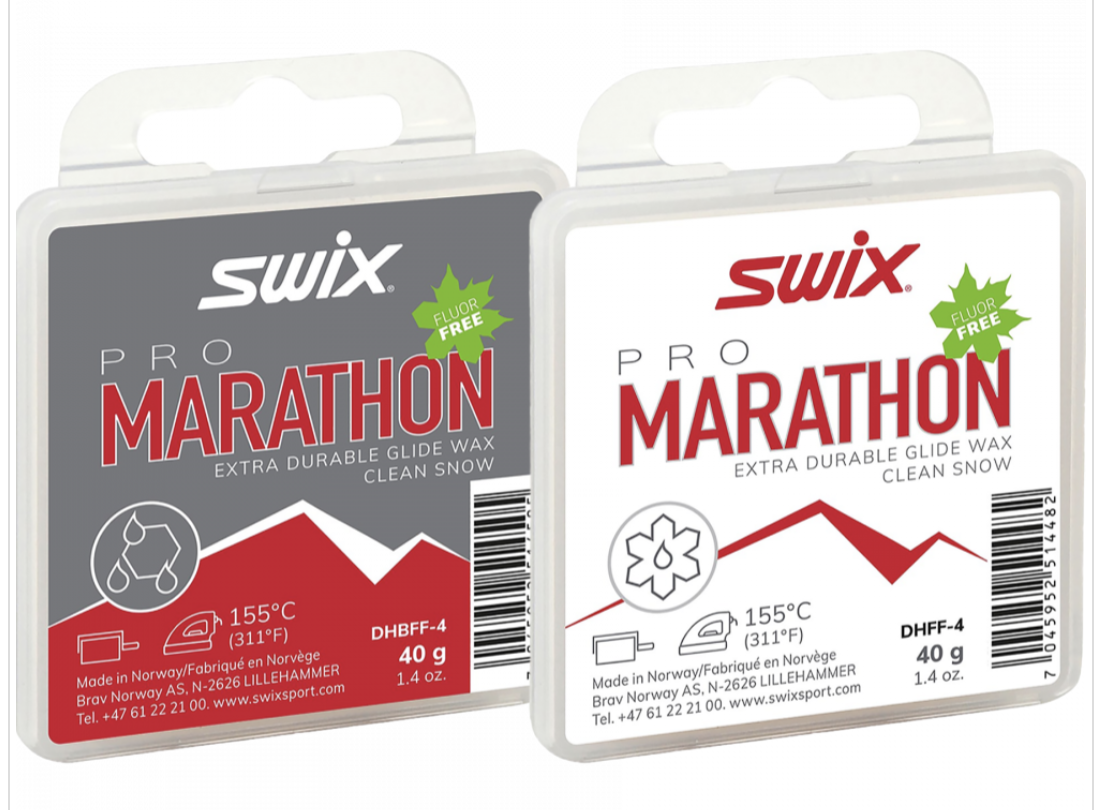
Swix Marathon Fluoro Free 40g (photo: screenshot from BNS catalog)
Fluorocarbons
With the EU banning fluorocarbons (PFAS) in 2021, the world of skiing was compelled to change. For many seasons, skiers had relied on the lubricating qualities of fluoros to create other-worldly speed under their skis. It was really fun—skis that zipped along in nearly all conditions—and it began to change the sort of athlete who dominated ski races. Endurance became less of a determining factor in race outcomes; everything was about speed. Imagine, then, the chaos that must have ensued when the very substance that gave skiers that extra velocity was taken away.
PFAS have been banned because they are “forever chemicals,” potentially harmful substances that simply won’t go away. They persist in environments and ecosystems long after their use has ended. It’s been suggested that testing in areas adjacent to cross-country ski courses has revealed surprisingly high levels of PFAS in areas that would otherwise be considered fairly pristine wild areas. Going fast was fun, but it was also poisoning the environments that many skiers enjoy and treasure. Ultimately, the European Union stepped up, the chemicals got banned, and skis got slower. But the EU ban controlled the use of fluorocarbons in those nations where most FIS-sponsored racing takes place. With those substances not yet being banned in Asian nations or North American nations, an argument could be made to continue allowing fluorocarbons in ski prep for events being staged in those locations, though that would create problems of other sorts. Fluorocarbons are notoriously difficult to clean up and/or get rid of. Skiers who utilize them stand a high chance of contaminating their “clean” skis simply by contact with the fluorocarbon prepared skis. It’s even been discovered that contamination can take place by skiing across snow after another skier who has used fluoros on their bases. So, FIS determined that fluoros would be illegal in all FIS races, regardless of location. For professional skiers, the use of fluoros was essentially over. But the potential for dipping into the fluoro supply remains a wicked temptation for non-professionals, especially in those places where PFAS are not restricted. That suggests that the potential for cheating in professional races is actually pretty low, but the potential for cheating in lesser races remains quite high. While it’s nice to think that everyone will comply with these rules simple because they’re rules, it’s a bit naive to think that no one would attempt to cheat. Fluorocarbon ski base treatments—like the silicone in Zardoz/Not Wax—are still readily available, legal to sell, legal to purchase, and legal to use in the USA. And plenty of wax boxes carried to regional races still contain tins and tubes of fluoro waxes (they were so expensive to buy—now it’s so difficult to throw them away). Few Junior races, citizen races, or collegiate races conduct ski testing, so any skier with a can of Zardoz in their pocket could easily slip on a quick layer of fluoro lubricant.
The initial FIS ban on fluoros was delayed a season when it was revealed that they really had not identified a reliable procedure to test whether or not skiers were using fluoros on their ski bases. Even after testing procedures were developed, the process remained questionable. When testing was conducted, it sometimes proved overly-invasive. When base-testing was conducted a few years at Junior Nationals, numerous skiers complained of the damage inflicted to their ski bases . . . and that just prior to racing (when it was too late to repair the damage or replace the ski). Even FIS has admitted that their base-testing procedure is far from accurate, so the problem of accurately ascertaining which ski is clean and which ski is not remains a challenge, one likely to remain until a suitable replacement for fluoros is found. Wax manufacturers have scrambled to innovate new substances that mimic the qualities of fluoros (but without the environmental/health impact, and without the risk of disqualification from ski competitions). Some progress has been made, but they haven’t unlocked the secret just yet. In the meantime, we’d like to think that cross-country skiing is a sport in which participants willingly and honestly participate in self-policing when it comes to such performance-enhancing ski products. Yep . . . that’s what we hope.
This article was made possible through the generous support of our voluntary subscribers. If you would like to see more articles like this one, please support FasterSkier with a voluntary subscription.
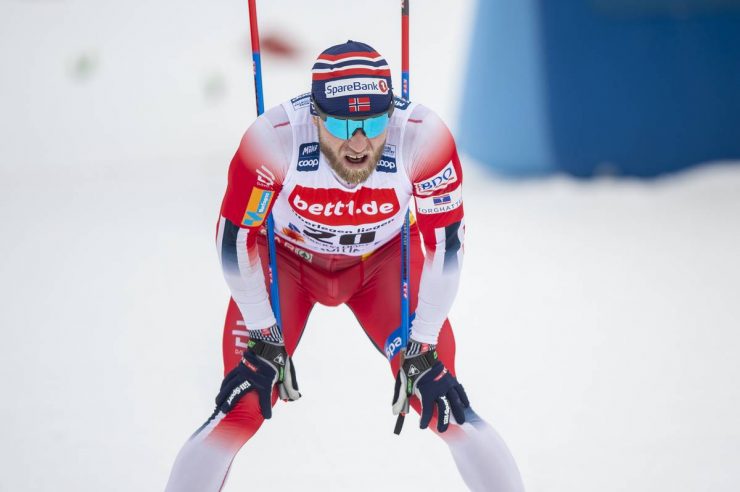
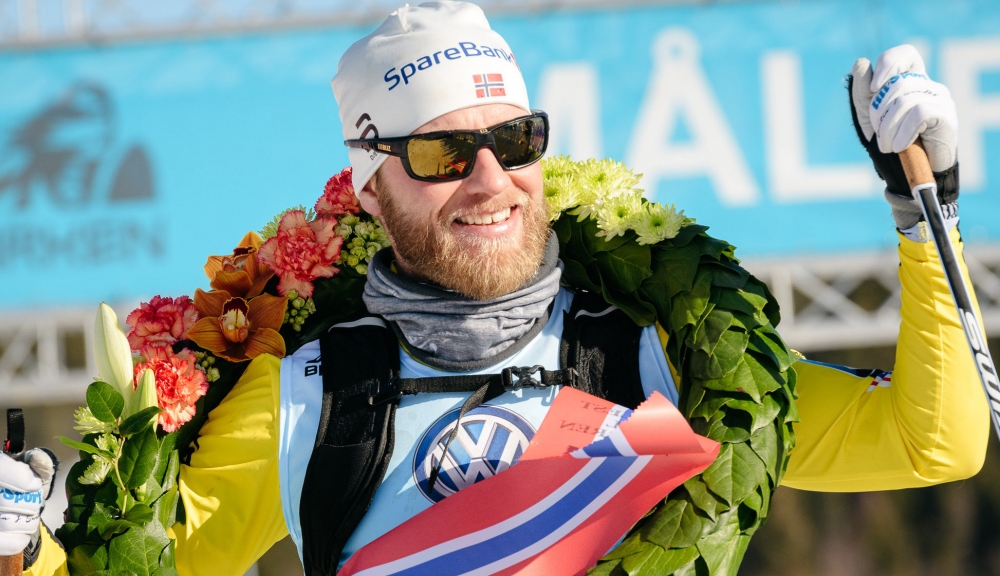
Martin Johnsrud Sundby (NOR) may have suffered the effects of athletically-induced asthma during his stellar skiing career, but his abuse of otherwise-allowed asthma medications ultimately led to his suspension. (Photo: NordicFocus)
Norway’s great champion, Martin Johnsrud Sundby, would lose his overall World Cup title and his Tour de Ski championship in 2015 over doping infractions related to the use of asthma medication nebulizers. Sundby had been the dominant figure in distance racing for a number of years before his disqualification, and the leader of a Norwegian team hounded by rumors regarding the absurdly high percentage of team members diagnosed with exercise-induced bronchoconstriction (EIB), commonly known as athletically-induced asthma. Sundby’s excessive use of a prescribed (and provisionally allowed) medication led to his disqualification.
In 2015, Sundby twice tested positive for excessive amounts of the substance salbutamol, commonly prescribed for those suffering from asthma. As an athlete who had been diagnosed with exercise-induced asthma, Sundby’s practice of administering salbutamol with a neublizer (a device that maximizes absorption) rather than a typical inhaler may have resulted in his exceeding the allowable amount (1600 micrograms over 24 hours).
That’s when the back-and-forth began . . . FIS said Sundby would not be disqualified, but the World Anti-Doping Agency (WADA) and the Court of Arbitration for Sport (CAS) ruled otherwise.
“While the medication is normally applied by a handheld metric dose inhaler (MDI), the athlete used a nebulizer to administer the prescribed salbutamol for the treatment of his asthma, which requires a higher labelled dosage than the MDI and thereby exceeded the allowed maximum dose,” FIS stated in its press release. “The FIS Doping Panel had therefore found that the athlete had not committed an anti-doping rule violation when he used a nebulizer as a legitimate means to administer salbutamol instead of a metric dose inhaler (MDI).”
WADA appealed the FIS Doping Panel’s decision, and CAS subsequently upheld WADA’s appeal resulting in Sundby receiving a two-month suspension. In contradicting the FIS ruling, CAS found that “the epithet ‘inhaled’ was meant to distinguish inhalation from other mechanics of inhalation like ingestion or injection and did not refer to the stage of administration (e.g. the amount that comes out of the device or which was eventually delivered to the athlete’s mouth or lungs). The allowed dose must be understood as the dose prescribed by the doctor, i.e. the ‘labelled’ or ‘nominal’ dose. Any higher dose, e.g. because of the need to use a nebulizer, requires a Therapeutic Use Exemption (TUE). When the tests were conducted in December 2014 and January 2015, the athlete was not in possession of a TUE and therefore found guilty of an anti-doping rule violation.”
Norway’s Marit Bjørgen orchestrated the most successful career of any cross-country skier in history. Her consistent reliance on asthma-relieving drugs—allowed through a Therapeutic Use Exemption (TUE)—also may have inspired rumors of Norwegian abuses of such drugs. (Photo: Fischer/NordicFocus)
Excessive Use
Ironically, the headlines surrounding Sundby’s infractions and suspensions did not result in comprehensive investigations of the widespread use of asthma inhalers by cross-country skiers, even though athletes and officials from rival nations had long complained of the apparent over-use of asthma medications by Norwegian skiers. Initial studies by the USOC in 2000 estimated that diagnoses of EIB among cross-country skiers that could reach 50%, an astronomically high figure suggesting problems that may exist within the sport itself. Either the athletic efforts associated with skiing actually created the condition, or athletes prone to the condition somehow gravitated toward skiing, or the methods of diagnosis were woefully inadequate. Medical descriptions of EIB admit that firm diagnosis is quite difficult because of the symptoms EIB shares with many other maladies (including asthma and heart conditions). The problem is that minor symptoms of EIB would also appear as though an athlete is merely fatigued, or simply out of shape. Amid such indefinite indicators, the diagnostic tool that most often identifies EIB is a simple question often asked by physicians: “Do you ever cough after intense and sustained athletic efforts.” That would seem to suggest that diagnoses of athletically induced asthma are disturbingly easy to receive, resulting in many skiers puffing away on inhalers prior to every race (and often every workout). Even in the junior ranks, use of inhalers is especially prevalent, and the result of such abuse has begun to be the prevalence of a suspicion that athletes who have not received such a diagnosis are competing at a disadvantage. Manufacturers and distributors of medications prescribed for EIB have repeatedly asserted that their use would offer no athletic advantage to those who do not actually suffer from the condition . . . but it’s easy to see how many could be skeptical of such claims when those medications are designed to help people breathe more easily and effectively.
EIB is a real condition, and one with which a reasonable percentage of skiers undoubtedly suffer. But as a long-time coach of junior skiers, I think we really should re-investigate the need for these medications, and the processes through which they are made so readily available to young athletes. Perhaps no solid answers will be found, but at least we will have reminded the ski community that these are drugs that our young athletes are inhaling, drugs designed to improve athletic performance. That simple step across a blurry ethical line is one that should concern us. Just ask Martin Johnsrud Sundby . . .
This article was made possible through the generous support of our voluntary subscribers. If you would like to see more articles like this one, please support FasterSkier with a voluntary subscription.
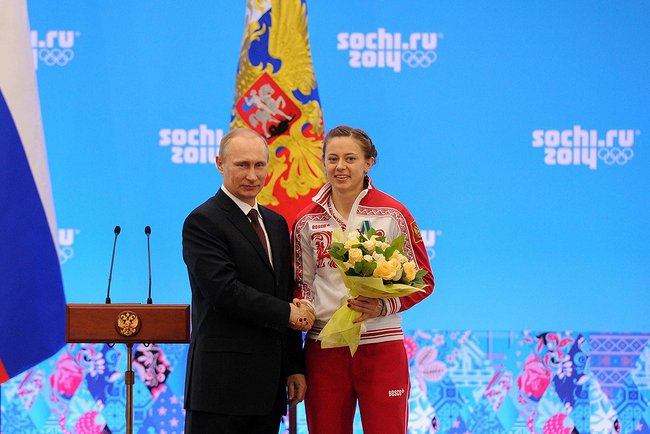
Biathlete Olga Vilukhina with Russian President Vladimir Putin at the 2014 Olympics in Sochi. Vilukhina was disqualified, stripped of her silver medal, and banned for life—decisions that were later reversed by the Court of Arbitration for Sport (CAS). (Photo: www.kremlin.ru/Creative Commons)
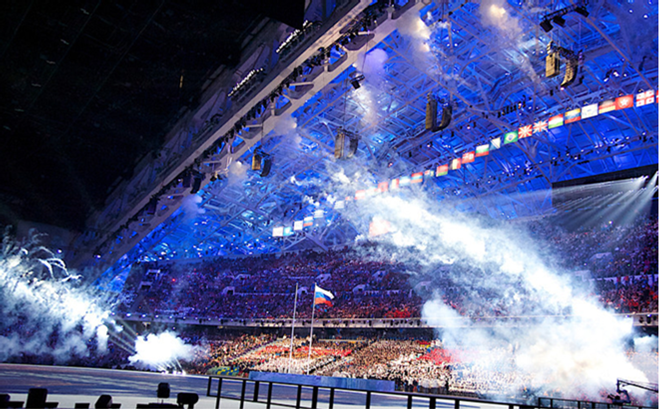
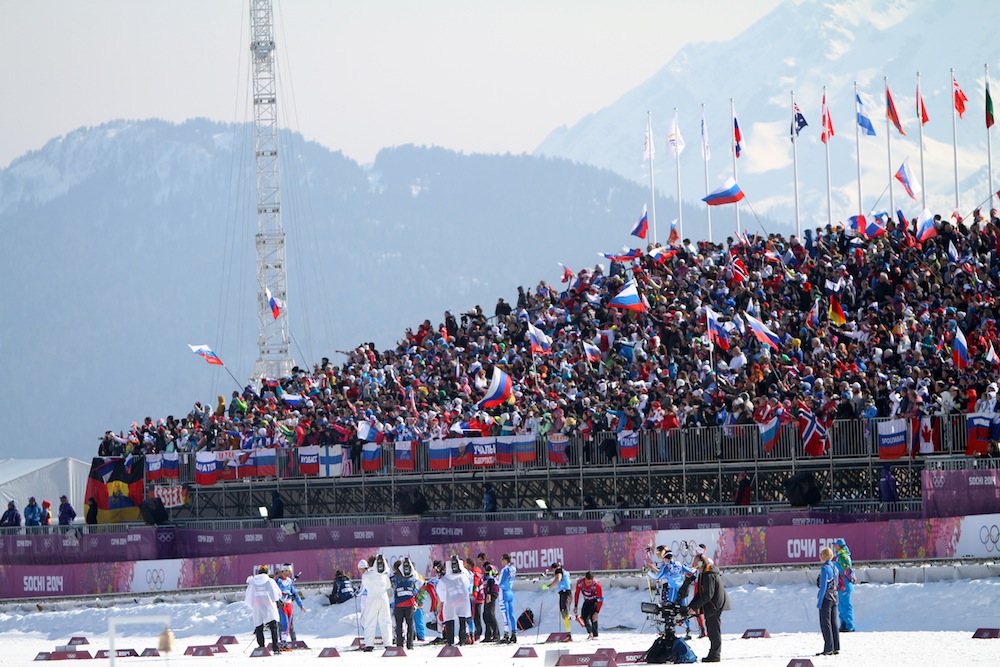
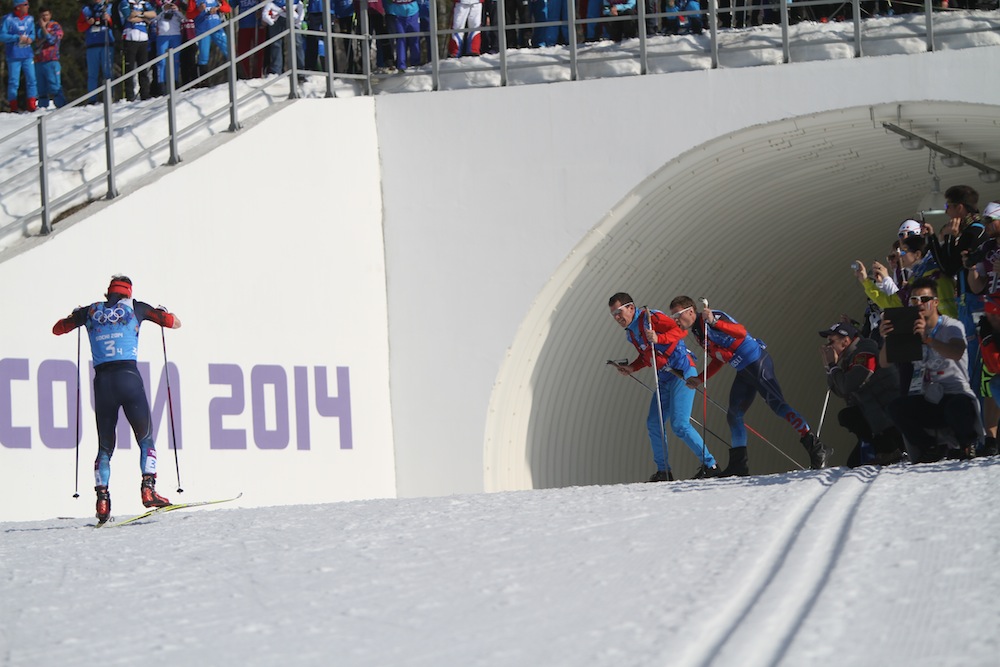
A Winter Olympics on the horizon in 2026 reminds inherently-skeptical ski-journalists of Sochi in 2014. At those Olympics, a whole host of Russian athletes were disqualified due to their involvement in a government-sponsored doping scheme. Remember that one? The secret hole in the wall of a sealed room that housed the urine samples of all tested athletes? The hole that accessed a concealed room where a Russian operative waited to exchange “clean” urine samples for those tainted samples (those that would reveal doping) of select Russian athletes? Yes, that really happened. The entire Russian system cheated (Russian athletes, Russian coaches, Russian Olympic Committee, Russian government). And they got caught. So what’s the solution? Throw them all out? Ban Russian athletes from competing in all events sponsored by IOC member organizations? That’s a cruel but elegant solution . . . and one that the IOC is prevented from considering by the generous and egalitarian policies of its own charter (a founding document that views participation in sport as a human right).
Following disclosures of Russian doping in Sochi, the head of the Russian Ski Federation, Elena Valbe (herself, a former Olympic Champion in cross-country skiing), acknowledged that six Russian skiers Maxim Vylegzhanin, Alexei Petukhov, Evgenia Shapovalova, Yulia Ivanova, Evgeiy Belov, and Alexander Legkov had been disqualified due to doping violations, and their results annulled. Russia’s 4×10 km team—which included Vylegzhanin and Legkov—was also disqualified. Over time, similar disqualifications were handed down involving a total of 14 Russian cross-country athletes.
“The athletes have been disqualified for life from taking part in the Olympic Games,” Valbe said at the time, without specifying the doping violations. Since that announcement, Valbe has stated, repeatedly, that she considers those disqualifications to have been politically motivated. Her assertion suggests plenty that is not immediately apparent, including an implication that those test results may not have been legitimate—may even have been tampered with or fraudulently created by the IOC or by technicians in its testing lab. Conversely, she may be suggesting that positive doping tests occur quite frequently without being reported . . . only this time the decision was made to publicly shame Russian athletes rather than sweeping the results under the rug as might have been done in the past. For decades, rumors have persisted that medal-winning athletes from both eastern bloc nations and western nations may have been caught cheating, only to be given a choice by sport governing bodies: retire from competition—leave and never come back—or face the public spectacle that would result from announcements of disqualifications and bans. If that’s ever happened, then we’ve all been cheated.
Maxim Vylegzhanin competing in the 10 k classic in Falun, Sweden, in 2016. Vylegzhanin was provisionally suspended while the International Olympic Committee investigated doping infractions at the 2014 Olympics. Ultimately, Vylegzhanin ‘s results from Sochi were annulled, and he received a lifetime ban. (Photo: Fischer/NordicFocus)
Certainly, revelations of cheating in Olympic events serves to tarnish the reputations of star athletes, while also darkening the image of the Olympic Games, themselves. We’d think that strict doping policies would be good for sport, but they actually turn out to harm practically everyone: athletes’ careers are ruined (though some of that ruination seems justified), individual sponsors are quick to distance themselves, Olympic sponsors are likely to pull their support, broadcast advertisers are likely to insist on lower ad rates—or to withdraw their involvement entirely—and television viewing numbers are diminished. The “value” of sport drops precipitously, which ends up being bad even for those athletes who insist on competing cleanly. Once it’s revealed that cheating is taking place, the audience just doesn’t have as much interest in watching anymore.
Here’s the dilemma: in its own charter, the international Olympic Committee identifies “the practice of sport is a fundamental human right.” What that means is the IOC can’t throw out every Russian athlete simply because the Russian system cheated. It’s not apparent that every Russian athlete was guilty of doping in Sochi (it seems strange that some of those athletes were left to compete “clean,” but that does seem to be the case). Can Russian athletes ever be trusted? No way . . . But does the International Olympic Committee grant itself the authority to drop a blanket-ban over them all? Also no . . .
The IOC and its associated sport governing bodies continue to consider whether Russian athletes wil be alllowed to participate in the 2026 Olympic Winter Games. Some governing bodies have already said “yes” (like figure skating). Other governing bodies have already said “no” (like biathlon). Still other governing bodies (like skiing) remain on the fence. Athletes remain in limbo, advertisers and sponsors remain undecided, and a worldwide viewing audience is yet to decide whether they will tune in, or not. Watching sport is great—watching cheaters, not so much. And the thought that there remain many more such cheaters (including athletes wearing national uniforms other than that of Russia) is both disturbing and unavoidable.
This article was made possible through the generous support of our voluntary subscribers. If you would like to see more articles like this one, please support FasterSkier with a voluntary subscription.
Norway’s Martin Johnsrud Sundby. Good guy? Or bad sport? He served a suspension for failed doping tests, surrendering his 2015 World Cup Crystal Globe. The lines separating those who cheat from those who play fair regularly get blurred. (Photo: Ski Classics)
“A thing worth having is a thing worth cheating for.” So said the inimitable and irascible vaudeville and film comic, W. C. Fields. We can assume his statement was made in jest . . . sort of. What we do know is that plenty of athletes have been known to cheat. From Lance Armstrong to Ben Johnson, athletes have shown that they’re willing to go to great lengths—and to stretch the rules to the breaking point—in order to gain a competitive edge. FasterSkier’s series of articles entitled “Bad Sports” is a reminder that, sometimes, those cheating athletes are stars in our favorite endurance sports, including cross-country skiing.
Olympic drug-cheating has been around since 1904, when Thomas Hicks was revived and bolstered during the Olympic marathon by his trainers’ administrations of strychnine . . . thereby becoming the first athlete disqualified from the modern Olympic Games for having used performance-enhancing drugs. While strychnine (in 1904, a widely-available rat poison) may no longer be the drug of choice, the temptation to cheat is still sufficiently enticing to those who would pad their odds in pursuit of Olympic glory. All forms of muscle builders, recovery agents, stimulants, pain killers, and oxygen transfer enablers have been experimented with by numerous generations of eager athletic guinea pigs. It’ a long-standing athletic tradition; one nobody is very proud of.
Back when sport was used as a substitute for politics (during the era when Soviet and East German sport governing bodies would do nearly anything to win), state-sponsored doping programs created and distributed performance enhancing drugs (PEDs) combined with complex and lurid strategies for beating detection. It’s come to light that most Soviet strategies involved creative ways to beat the testing procedures, while East German programs concentrated on secretly creating performance enhancing substances and doping agents so new that they had not yet been declared illegal. And those nefarious strategies weren’t limited to the devious sport-behemouths of the Eastern Bloc, either. When organizations and teams and athletes have felt the pressure to perform in front of hometown crowds, they have often resorted to measures that tested the limits of the rules. As an example, the coaches of the 1984 US Olympic Cycling Team made systematic and team-administered “blood doping” available to American athletes. While it’s well known that the most notable medalists on that team did not avail themselves of this questionable strategy, it’s also well documented that certain notable medalists did. The loophole at the time was that blood doping was still little-understood (and could not be effectively tested for); therefore, it was not technically against the rules. Since then, the IOC has altered the rules, essentially outlawing any attempt to gain an unfair advantage (even if the strategy employed might later be proven to have offered no advantage at all . . . like rat poison in 1904).
Recently, the International Biathlon Union (IBU) settled the case of accused Russian biathlete, Evgeny Ustyogov (not to be confused with notable Russian cross country skier, Sergei Ustiugov). It was a decision more than ten years in the making, the conclusion of a long series of appeals, and a re-confirmation of decisions handed down by the IBU’s Anti-Doping Hearing Panel and the Court of Arbitration for Sport (CAS). Abnormalities recorded in Ustygov’s Athlete Biological Passport indicated the use of a performance enhancer, ultimately resulting in disqualification, suspension, and reallocation of his medals from the 2010 and 2014 Olympic Games.
In the tennis world, current Men’s French Open finalist, Jannik Sinner, faced a doping investigation—and three month suspension—earlier this season. In March 2025, he twice tested positive for clostebol, a banned anabolic steroid. The investigation attributed that substance to an ingredient in a spray utilized by his physiotherapist, and found that Sinner bore “no fault or negligence” for those positive tests. Still, Sinner received a three month suspension . . . fortunately for Sinner, that suspension fit neatly between Grand Slam tournament events. Ironic, then, that Therese Johaug made nearly identical claims when she tested positive for a banned substance (attributed to ingredients in a lip balm provided to her by a team physio), but her suspension cost her two years, and a shot at Olympic history.
It’s always a conundrum: whom to believe? Whom to penalize? And to what degree? Even athletes who successfully defend their assertions that they were unaware of the infraction—or that they were victims of unknown ingredients in foods or supplements they ingested—have found themselves penalized. It’s kind of fair: they may have derived a performance benefit from the substance, so their successes should not be allowed to stand. It’s also kind of unfair: they never knowingly did anything wrong, never attempted to cheat the system. Still, they may find themselves with disqualifications and suspensions. And then there are those who cheated knowingly and got caught, high profile athletes like numerous Olympic champions and multiple Tour de France winners. Even in 2025, the skiing world was shocked to learn of the discovery of systematic cheating (via the altering of uniforms) undertaken by five Norwegian ski jumpers, their coaches, and numerous team officials at the FIS World Championships in Trondheim.
In the final analysis, W. C. Fields’ words have proven prophetic: these things that are worth having, it seems that they have been worth cheating for. And with another Olympic season about to begin, the stakes will be higher than ever.
“Worth cheating for.” The inimitable W. C. Fields.
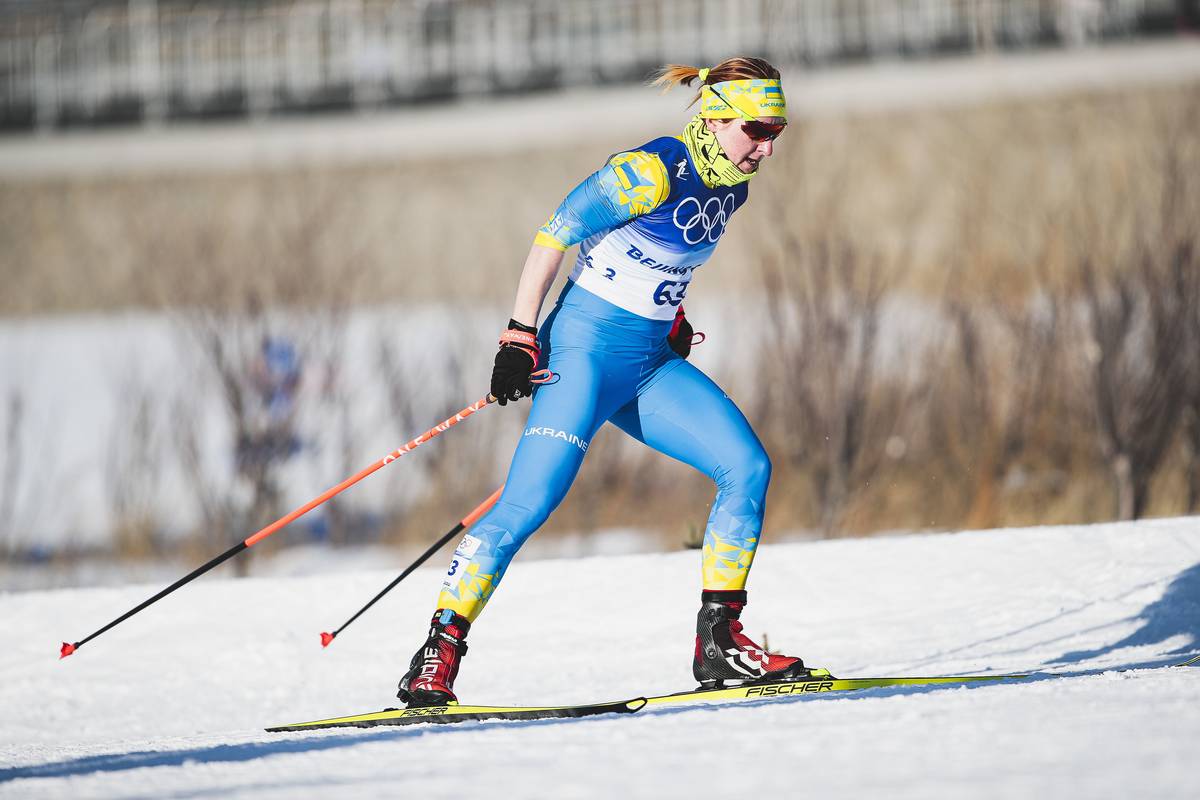
A back-of-the-pack women’s skier competing for Ukraine at the Beijing Olympics has tested positive for banned drugs, according to the agency that’s overseeing testing at the Games.
Valentyna Kaminska tested positive for a banned steroid and stimulants on the day she finished 79th in the 10-kilometer classic event, the International Testing Agency said in a statement Wednesday.
Ukrainian skier Valentyna Kaminska tested positive for banned steroid and stimulants following the 10 k classic event. (Photo: NordicFocus)
Kaminska has been provisionally suspended until the case is resolved and is banned from participating in further Olympic events, the ITA said. She can challenge the suspension at the Court of Arbitration for Sport, and she can also ask authorities to analyze her B-sample.
Kaminska competed at the 2018 and 2014 Olympics for Belarus, where she was born, before moving to the Ukrainian team. She’s never cracked the top 30 in an individual World Cup event, or at the Olympics or World Championships.
She has not responded to a request for comment sent Thursday through her Instagram account.
ZHANGJIAKOU, CHINA — Russia, and its flag, are officially barred from the 2022 Olympics in Beijing, a ruling that stems from continuing doping violations following a massive, state-sponsored scandal at the 2014 Games in Sochi that included cross-country skiers.
But other Russian cross-country skiers are still competing here, under the flag of their country’s Olympic committee.
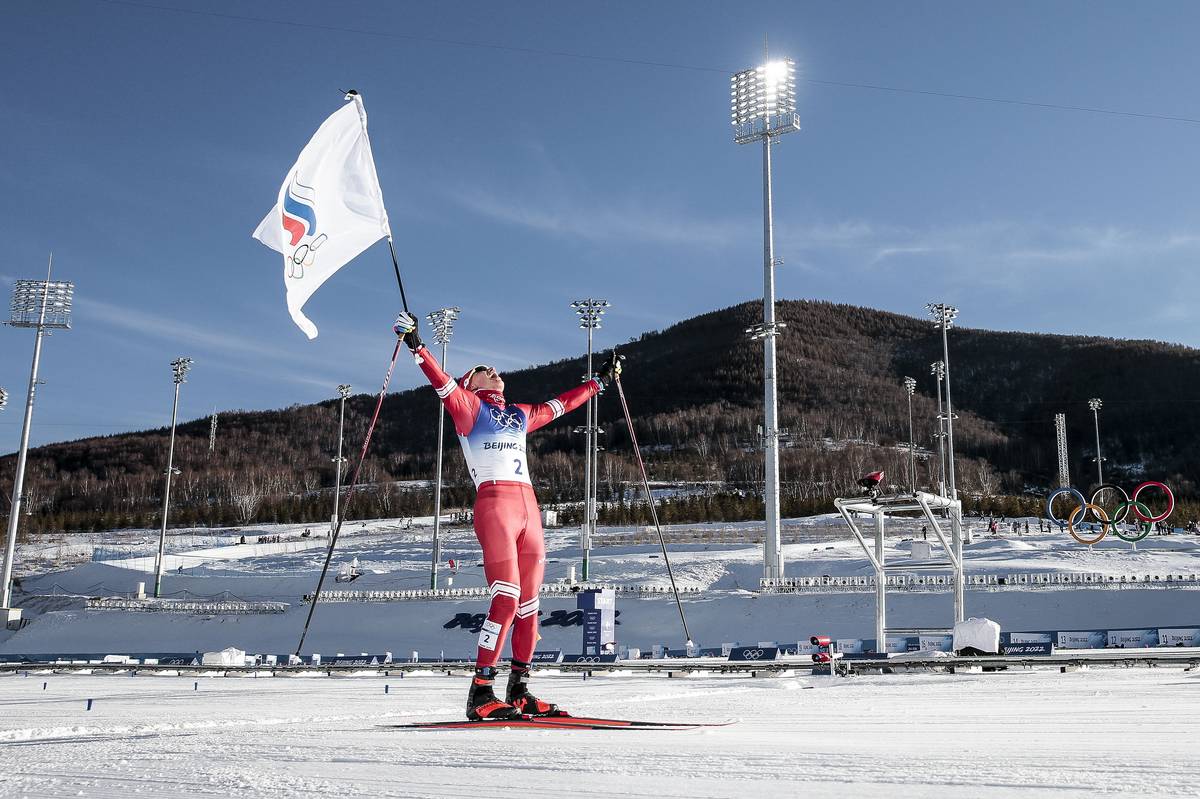
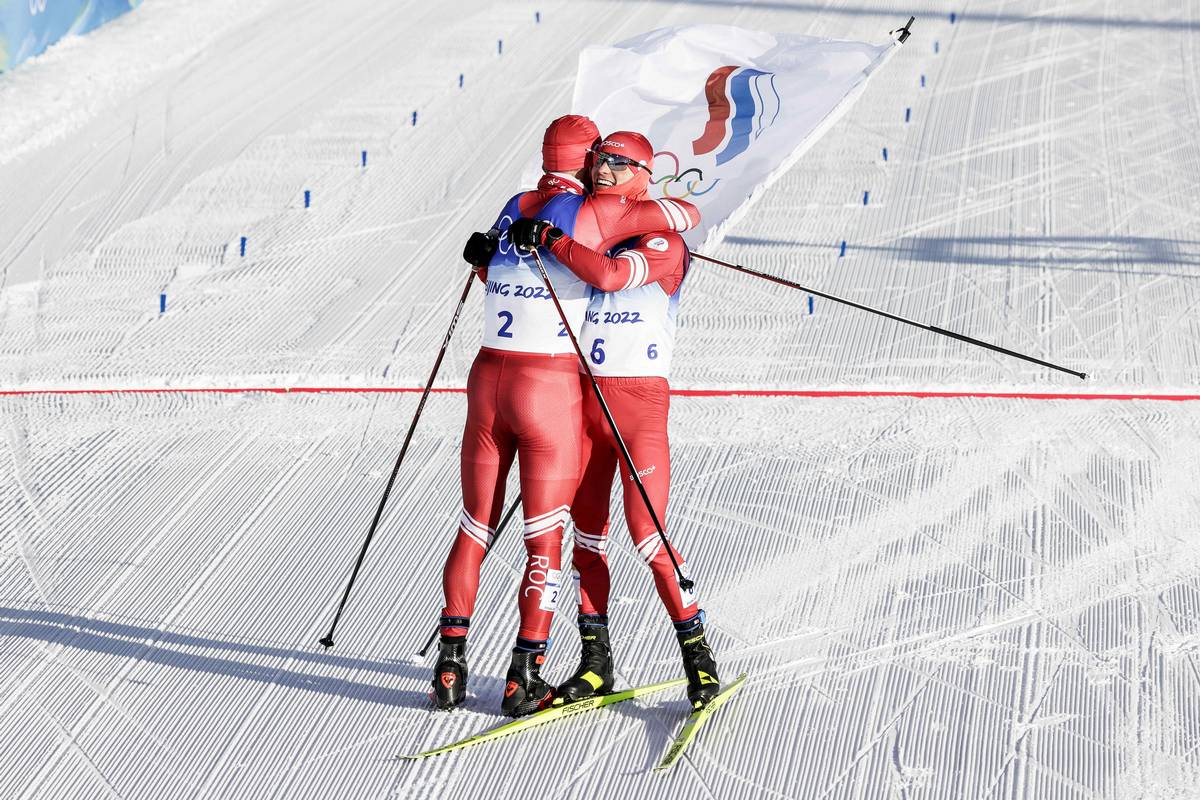
And on Sunday, in their first race of the Games, Russian men took the top two places. Star Alexander Bolshunov was so far ahead that he slowed to wave a Russian Olympic Committee flag before the finish line, and still beat third-placed Iivo Niskanen of Finland by two minutes.
Alexander Bolshunov celebrates a dominant victory, earning his first Olympic gold medal at the men’s 30 k skiathlon. (Photo: NordicFocus)
In spite of the huge winning margin, U.S. Ski Team Head Coach Matt Whitcomb said he wasn’t skeptical.
“We were all cheering for him in the coaching zone. And I don’t think all of us coaches, if we suspected any foul play, would be clapping for him,” Whitcomb said in an interview after the race. “I trust the World Anti-Doping Agency for helping keep the sport clean. I really do feel like overall, cross-country skiing is quite clean these days, compared to where we’ve come from.”
But other veteran American observers couldn’t watch Bolshunov and second-placed Denis Spitsov without asking questions. And the fact that Bolshunov will take home a gold medal when his country is still under international sanctions for doping-related offenses underscores the need for tougher penalties, critics said.
“I watched that race, and I was sad. Not because I’m 100% convinced that Bolshunov’s guilty, but because I watched it and I had a lot of doubt,” said Kris Freeman, a retired American cross-country skier who competed at the 2014 Games. “I’m angry at all the corrupt sporting bodies out there that let Russia come to these Games. They shouldn’t be there.”
Freeman’s comments came a few days before Russian media reported that a star women’s figure skater, Kamila Valieva, had tested positive for a banned drug before the Beijing Games started. A Kremlin spokesman said wait Wednesday said he was waiting for an explanation from the International Olympic Committee or Russian sports officials.
Another time, another team
Bolshunov is a decorated athlete who’s never failed a drug test. At a post-race news conference, asked by FasterSkier/the Daily News about the suspicions surrounding his performance, he emphatically rejected them.
Bolshunov said Russian athletes are under intense scrutiny, with drug testing “almost every day,” and have to constantly report their whereabouts to testing agencies.
“This should have nothing to do with sports. We have clean sportsmen, clean athletes here at the Olympics,” Bolshunov said, calling the question “irrelevant.” He added: “After you see how we train, I believe that you and your audience will never have these questions again.”
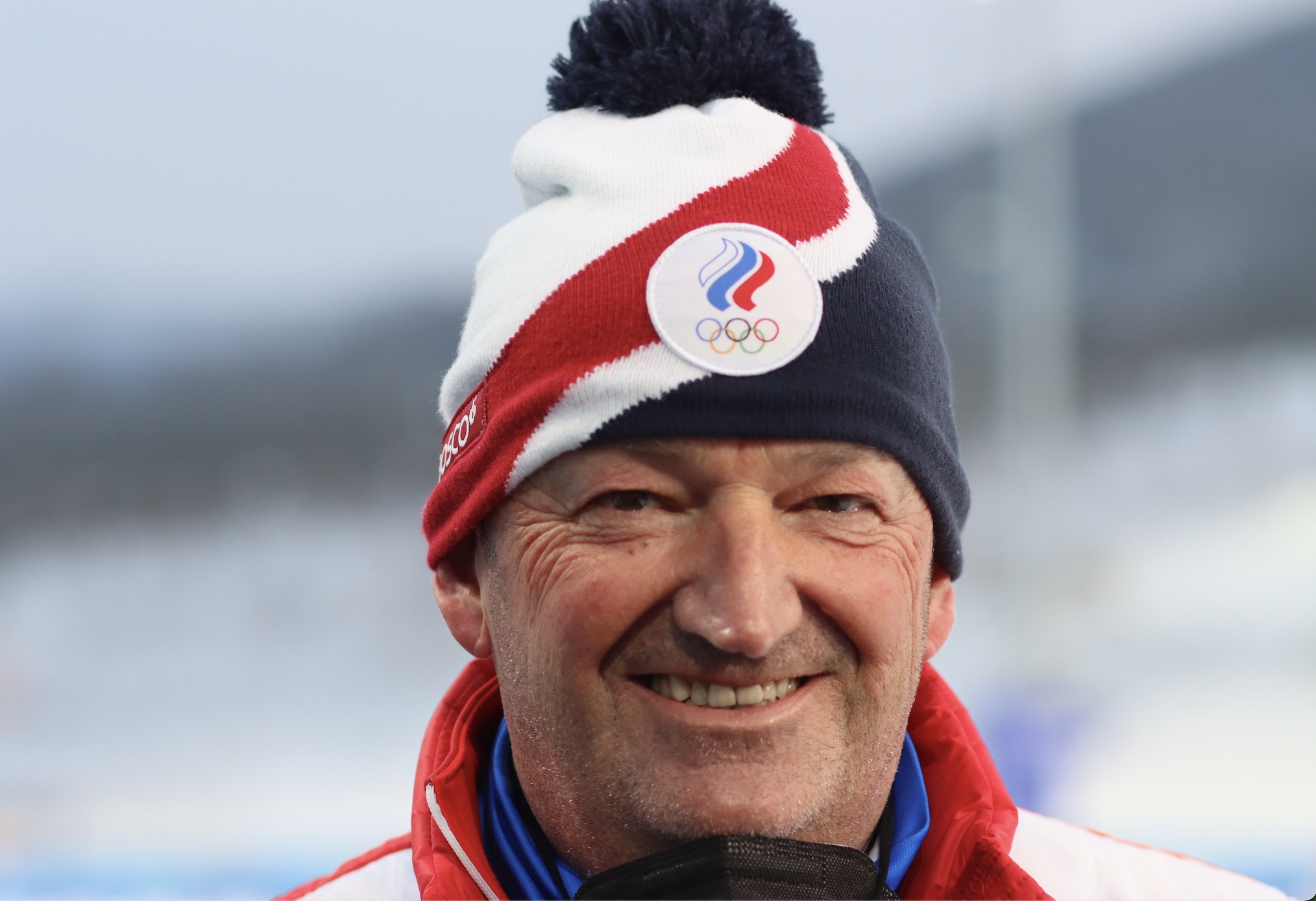
Markus Cramer, a coach of the Russian national ski team, poses for a photo at the stadium at the cross-country ski venue in Zhangjiakou, China. (Photo: Nat Herz/FasterSkier-ADN)
In a subsequent interview, Markus Cramer, a German coach who works for the Russians, said he’s “100% sure” there’s no doping on his team. He’s been affiliated with the team for seven years, and if doping was happening, he would have been able to tell.
“It’s totally another time now, and another team, and other athletes,” he said.
Reactions inside Russia, meanwhile, underscored how differently followers of the sport there viewed Bolshunov’s result. They also hinted at the ongoing geopolitical tensions between Russia and the U.S.
Russian politicians and sports commentators sharply dismissed any doubts, with one saying that the Anchorage Daily News/FasterSkier reporter who questioned Bolshunov was a “provocateur” and should have his Olympic press credential revoked.
“He could also ask what (Bolshunov) thinks about the alleged movements of military personnel,” sports journalist Dmitry Guberniev was quoted as saying, referring to the controversy about Russian troops massing near the Ukrainian border.
Scandinavian journalists at the post-race news conference said followers of cross-country skiing in those nations are less inclined to doubt the current generation of Russian athletes after growing more familiar with them.
The Russian team, in an effort to build trust after the Sochi scandal, invited Norwegian media to a training camp near Lillehammer a few years ago, Cramer said.
“Especially with the Norwegian media, we have a good contact,” he added. “And I think they understand, most of them.”
Cramer noted that no similar questions were lobbed at Norwegian superstar Therese Johaug, after she won the women’s opening cross-country event in similarly dominating fashion.
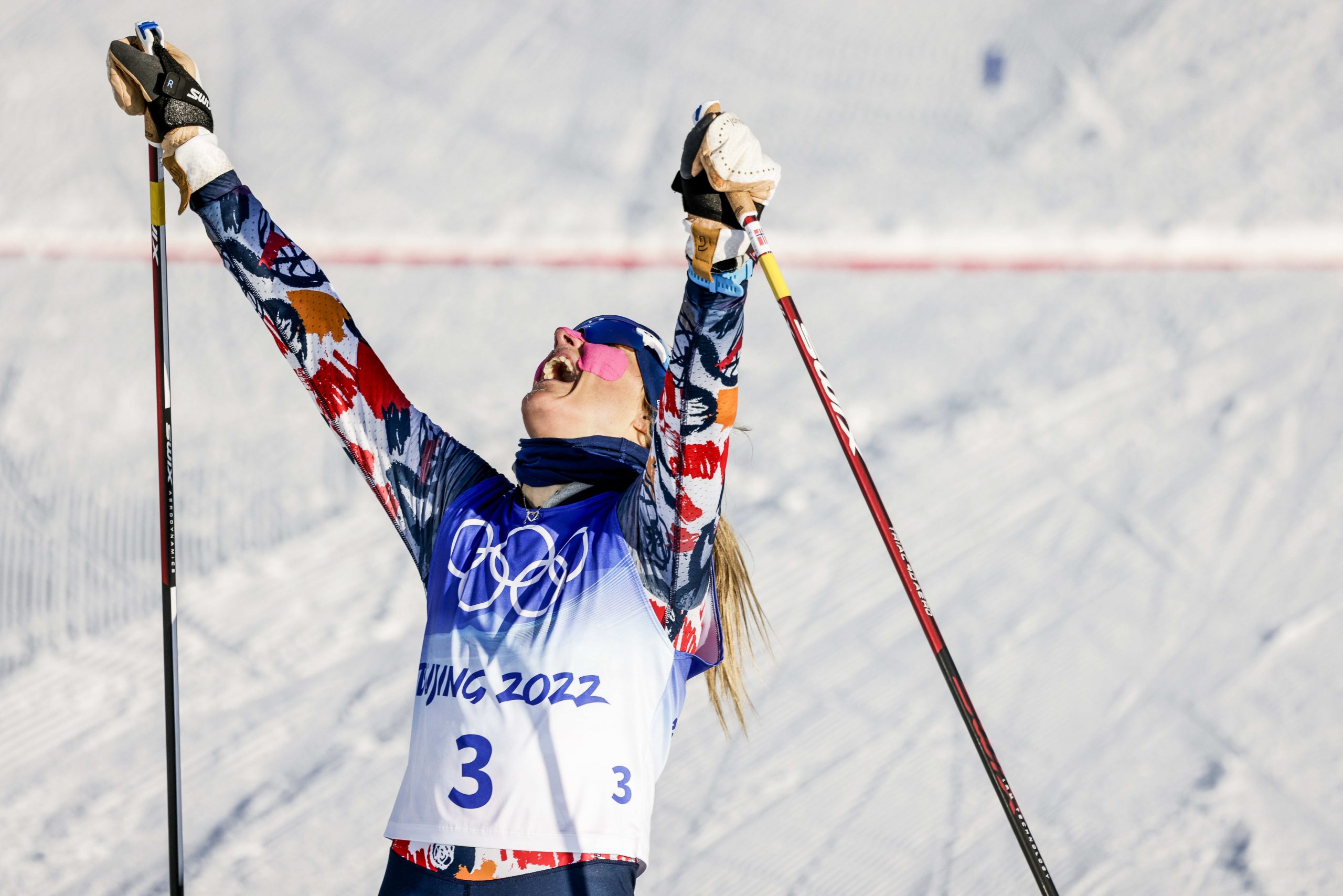
Celebration for Therese Johaug (NOR) as she takes her first ever individual Olympic gold medal in the women’s 15 k skiathlon. (Photo: NordicFocus)
Johaug missed the 2018 Games while serving an 18-month ban for using an anabolic steroid, clostebol. She said she accidentally took it while trying to treat a sunburn with lip balm — which turned out to have a “doping” warning label on the package.
At a news conference Thursday after winning her second race of the Games, Johaug said she’d finished her ban and had been training “so hard, so much.”
“People can (say) what they want, but I don’t care,” she said. “I know who I am and what I’m doing.”
Questions of accountability
Bolshunov’s result Sunday did not surprise followers of the sport, even if the size of his winning margin made an impression.
He’s also topped the overall rankings of the World Cup circuit — generally accepted as a barometer for the globe’s best all-around skier — for the past two winters. And he’s known to his peers for his work ethic and impeccable technique.
“The thing about Bolshunov is he’s a beautiful skier,” said Freeman, the retired American racer. “And I have no doubt that he works his ass off.”
One of the questions about Bolshunov’s performance is how much he should be held accountable for transgressions committed by others at a time when he was 17 years old.
Alexander Bolshunov (ROC) puts together a dominant performance in the men’s 30 k skiathlon. (Photo: NordicFocus)
Noah Hoffman, another retired American skier and anti-doping advocate, said he gives Bolshunov the benefit of the doubt.
“You can’t prove that you’re clean,” Hoffman said. “And so I refuse to assume that anybody is doping without evidence.”
On the other hand, Hoffman remains frustrated by the absence of stiffer penalties against the entire Russian team in the aftermath of the 2014 scandal.
“To the extent that a flag is making us question an athlete, that’s tragic,” he said. “And it’s because we haven’t put in place adequate deterrence to stop state-sponsored doping.”
A year ago, a European appeals court halved Russia’s four-year ban from global sports originally imposed by the World Anti-Doping Agency, or WADA, in a ruling blasted by some anti-doping advocates.
That proposed four-year penalty was not in direct response to the Sochi scheme. Instead, it was imposed after subsequent accusations by WADA that Russia had covered up positive tests in data that the nation was required to disclose in the wake of the 2014 scandal.
The result is that Russian athletes are still competing in Beijing — as they did at last year’s Games in Tokyo and in 2018 in Pyeonchang — even as Russian leaders can complain that they’re being unfairly targeted, said Hoffman.
“In both Pyeongchang and here in Beijing, they get to claim to be the victims of a Western plot while still celebrating the success of their athletes,” Hoffman said. “This is like everything Putin dreams of.”
A “big political game”
Bolshunov’s personal coach is Yuri Borodavko, who works with several other star Russian athletes.
In 2010, Russian Ski Federation leaders suspended Borodavko from working with the country’s national team for two years after Evgeny Dementiev, a skier he worked with, tested positive for blood-boosting drugs.
Today, Borodavko has a good reputation in Russia, and most fans see him and his athletes as “absolutely clean,” said Artem Kuznetsov, a journalist with the government-owned Russian news agency Tass.
Bolshunov and his teammates would be “crazy to try to cheat right now,” given the intense scrutiny on them, Kuznetsov added.
Olympic champion Alexander Bolshunov welcomes his teammate Denis Spitsov (right) to the finish of the men’s 30 k skiathlon, going one-two for the Russian Olympic Committee. (Photo: NordicFocus)
Freeman said he doesn’t lend too much credibility to Bolshunov’s history of negative tests: Lance Armstrong, he pointed out, never failed a drug test, either.
He said he was especially offended by the way Bolshunov celebrated Sunday’s win with the Russian Olympic Committee flag, and by his “defiant” response to the questions about him.
“I think he should be more aware of where his country is coming from — what they have been caught red-handed doing — and understand where the questions were coming from,” Freeman said. “Coming at it defiantly like that just makes you seem like a villain.”
Cramer, the Russian team coach, said Bolshunov is a young athlete who doesn’t understand why, given his clean personal record, he’s facing questions.
He also said Bolshunov has been criticized in the past for looking too serious when he crosses the finish line.
“What can he do?” Cramer said. He added: “We have a lot of (doping) controls. So, when he is not clean, of course, we will see.”
Andrus Veerpalu racing on the World Cup during the 2010-2011 season.
On April 14, the International Ski Federation (FIS) announced former Estonian cross-country skier Andrus Veerpalu was found guilty by the CAS Anti-Doping Division. Veerpalu was involved with “Operation Aderlass”, a blood doping scheme run by Dr. Marc Schmidt in Germany. Veerpalu’s penalty is a two-year ban from FIS sanctioned events ending on March 17, 2023.
Now retired from skiing, the fifty-year-old Veerpalu in recent years has served as a coach for team “Haanja” in Estonia. According to FIS, the ruling states Veerpalu violated Article 2.9 of the 2016 FIS Anti-Doping Rules which is defined as, “Assisting, encouraging, aiding, abetting, conspiring, covering up or any other type of intentional complicity involving an anti-doping rule violation, Attempted anti-doping rule violation or violation of Article 10.12.1 by another person.”
(No official CAS ruling regarding the current Veerpalu case is available on the CAS website. We will link to the ruling when it becomes available.)
In light of the FIS announcement, ERR news in Estonian reported today that Veerpalu has been stripped of two prestigious national awards. Since his 2002 Olympic gold in the 15 k classic, Veerpalu has been revered as a national hero.
Veerpalu is a two-time Olympic champion. Along with his 2002 Olymoic win, he won another gold in 2006. He also won a silver medal in the 2002 Olympic 50 k and two World Championship gold medals. Kris Freeman, an American cross-country skier, lost out on a medal in the 2009 championship 15 k classic, a race won by Veerpalu.
This is not the first time Veerpalu’s name has been associated with doping. In 2013, he was acquitted on a technicality after an adverse analytical finding (AAF) in both his A and B samples for recombinant human growth hormone (rhGH) back in 2011.
Team “Hannja” athletes also serving doping penalties for their involvement in “Operation Aderlass” include Karel Tammjärv, Algo Kärp, Kazakhstan’s Alexey Poltoranin, coach Mati Alaver, and Veerpalu’s son, Andreas Veerpalu.
The medical mastermind of “Operation Aderlass”, Dr. Schmidt is currently serving a nearly five-year prison sentence after being found guilty of breaking Germany’s strict anti-doping laws.
Last month, CAS made a binding decision on the case that received widespread condemnation from clean sport advocates and applause from within much of the Russian sports community. The cliff notes version of the Dec. 17 ruling halved the penalty from four to two years for Russia. WADA had sought a four-year ban from major international competitions (Olympics and World Championships for Russia).
In clear language, CAS found RUSADA to have manipulated data handed over to WADA as part of its conditional reinstatement as a compliant anti-doping agency. CAS found the data handed over to be manipulated. That much was clear. CAS also made crystal clear back in December that RUSADA had violated the terms of its reinstatement. CAS still ruled to halve the penalty. At the time, no detailed reasoning regarding the reduced penalty was forthcoming.
Russian athletes can participate in the Olympics and World Championships in the next two years, yet wearing uniforms with a modified logo. If the word “Russia” appears on the uniform, then the words “neutral athlete” must also be displayed in English.
Hand-slap is one way of describing global headlines regarding the release of the full ruling.
WADA released a statement on January 14 commenting on the full release of the CAS decision – WADA’s disappointment was palpable.
“The full CAS reasoned decision shows clearly that WADA successfully proved its case and exposed the Russian authorities’ brazen attempts to manipulate data from the Moscow Laboratory in an effort to thwart our investigations,” said WADA President Witold Bańka. “We are satisfied that this landmark decision also upholds the strong investigative and legal framework put in place by WADA in recent years that underpins the anti-doping system. In particular, the investigative powers WADA was belatedly granted and the introduction of the Compliance Standard in 2018 have proven to be game changers.
“We remain disappointed, however, that CAS did not agree with all of our proposed consequences, which we felt were proportionate to the egregious nature of the offences committed by the Russian authorities as they sought to cover up the details of their institutionalized doping scheme.”
The CAS ruling is a dense 186-page document. However, WADA and others have pulled key portions of the document to illustrate how egregious CAS found RUSADA actions regarding the Moscow Laboratory data.
“The Panel finds that, prior to the Moscow Data being retrieved by WADA in January 2019, and during its retrieval, it was subjected to deliberate, sophisticated and brazen alterations, amendments and deletions. Those alterations, amendments and deletions were intentionally carried out in order to remove or obfuscate evidence of improper activities carried out by the Moscow Laboratory as identified in the McLaren Reports or to interfere with WADA’s analysis of the Moscow Data” (para. 614)
“In what the Panel considers to be a more egregious act of misconduct, the Panel finds that alterations were made to Forum Messages in the Moscow Data in order to deceptively inculpate certain employees of the Moscow Laboratory (Dr Rodchenkov and Dr Sobolevsky) in a contrived extortion scheme while exonerating others (Mr Kudryatsev) from wrongdoing” (para. 615).
“In what the Panel considers to be a more egregious act of misconduct, the Panel finds that alterations were made to Forum Messages in the Moscow Data in order to deceptively inculpate certain employees of the Moscow Laboratory (Dr Rodchenkov and Dr Sobolevsky) in a contrived extortion scheme while exonerating others (Mr Kudryatsev) from wrongdoing” (para. 615).
The lab data was originally handed over to WADA in January of 2019. After discovering the data was doctored, WADA asked RUSADA for new data in October 2019. The recent CAS ruling stated, “That New Data also had dubious authenticity.”
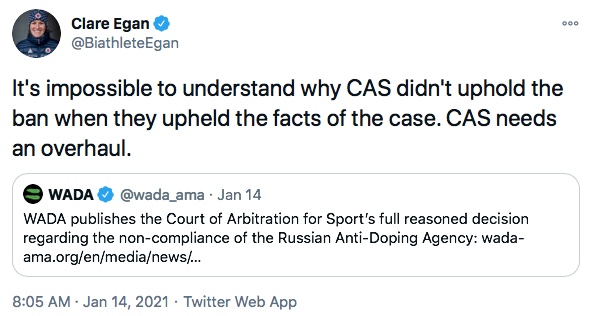
U.S. Biathlete Clare Egan was stark in her assessment of the ruling and stated via Twitter, “It’s impossible to understand why CAS didn’t uphold the ban when they upheld the facts of the case. CAS needs an overhaul.”
In the ruling, a section titled “Proportionality” stands out. In a legal context, proportionality is the tenet that the punishment should fit the crime. “The Panel bears firmly in mind at all times the paramount need to consider notions of proportionality in the imposition of Signatory Consequences,” states the CAS ruling.
The language throughout the ruling is stark in its incriminating tone when referring to RUSADA’s deeds. The Sochi doping case is well-documented. The misdeeds of the Russian authorities are well documented as they danced with WADA seeking to meet the conditions for reinstatement.
The penalties handed down might appear, in light of the evidence, disproportionate in Russia’s favor.
Of note was a section on punishment and Russia’s participation in the Youth Olympic Games.
“Although the history of improper conduct which has ultimately led to these proceedings is long and serious, the Panel considers it would be disproportionate to impose severe restrictions on the next generation of Russian athletes. In particular, as the doping schemes addressed in the McLaren Reports occurred between 2012 and 2016, the Panel considers it very unlikely that any athletes who will be participating in the Youth Olympic Games were involved in those schemes,” wrote the CAS panel in paragraph 731.
WADA had originally sanctioned RUSADA to a major competition ban of four years. Today’s CAS ruling, although seemingly in agreement with WADA’s arguments, reduced that penalty to two years.
CAS found RUSADA to be non-compliant with the WADA code for failing to deliver timely and unadulterated LIMS data from the Moscow Lab. During the ongoing saga between WADA and RUSADA, the Russians continually failed to meet deadlines and eventually handed over manipulated data. These data included anti-doping testing information for specific athletes. The WADA investigation into RUSADA wrongdoing began after the 2014 Sochi Games. WADA eventually concluded Russia was guilty of state-sponsored doping.
Similar to the penalty for Russia during the 2018 Winter Games, today’s decision allows Russians that meet the CAS standards to compete in or attend the Olympics or Paralympics to do so wearing a “neutral athlete” uniform. In PyeongChang, Russian athletes competed and marched in uniforms emblazoned with “OAR” – Olympic Athlete from Russia. The Russian flag was not flown and their national anthem not played during medal ceremonies in PyeongChang.
According to CAS, the penalties apply to World Championships “organised or sanctioned by a WADA signatory”. The International Ski Federation (FIS) is a WADA signatory.
The penalties outlined in the decision come into effect on December 17, 2020, and last for two years.
Response to today’s ruling was mixed.
WADA appeared satisfied with the ruling. “This decision confirms in large part the recommendation made in November 2019 by WADA’s independent Compliance Review Committee (CRC), which was unanimously accepted by the Agency’s Executive Committee (ExCo) on 9 December 2019,” claimed WADA’s statement.
“Today’s CAS ruling is a clear endorsement of WADA’s assertion that data from the Moscow Laboratory were intentionally altered prior to and while they were being forensically copied by WADA Intelligence and Investigations (I&I) in January 2019as part of Operation LIMS, in contravention of critical criteria set by the ExCo when RUSADA was reinstated as compliant, under strict conditions, in September 2018.”
Global Athlete, an organization bent on reforming international and Olympic sport, had harsh words. In an emailed statement, Global Athlete articulated they were unsatisfied with the water-downed ruling:
“The decision taken by the Court of Arbitration of Sport (CAS), released today, has dealt yet another damaging blow to clean sport and the athlete community. Through a series of recommendations that include reducing the 4-yr mandatory sanction imposed by the World Anti-Doping Agency (WADA), to 2-yrs, CAS has diluted and weakened an already compromised sanction – demonstrating once again they are unfit for purpose.
“The fact that Russian Athletes can compete as “Neutral Athletes from Russia” is another farcical façade that makes a mockery of the system. If athletes from Russia can still compete, it is not a sanction. Russia has not been banned; they have simply been rebranded.”
“In addition to halving the length of the “sanction”, the CAS decision demonstrated clear preferential treatment for members of the Olympic movement, by lifting previous sanctions on Russian members of the International Olympic Committee, International Paralympic Committee and elected International Federation representatives and permitting them to attend the Olympic/Paralympic Games and World Championships.”
A new anti-doping bill that criminalizes international doping conspiracies, while pointedly focusing on high-level organizers rather than on individual athletes, and that makes an expansive claim for U.S. jurisdiction over doping occurring at international competitions while excepting the most high-profile American professional sports leagues, is on the verge of becoming law. Here’s what you need to know:
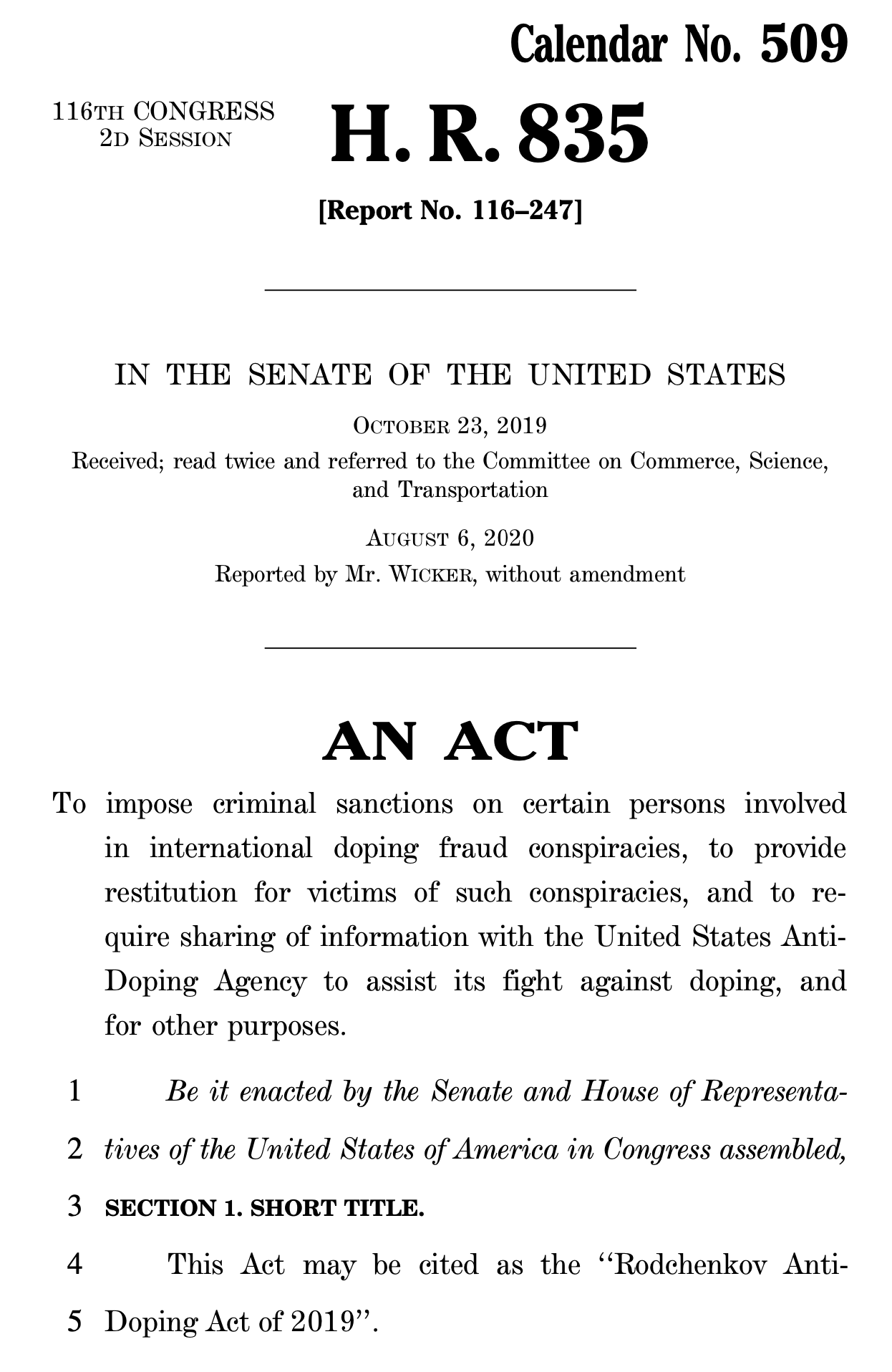
What it is: “An act to impose criminal sanctions on certain persons involved in international doping fraud conspiracies, to provide restitution for victims of such conspiracies, and to require sharing of information with the United States Anti-Doping Agency to assist its fight against doping, and for other purposes.”
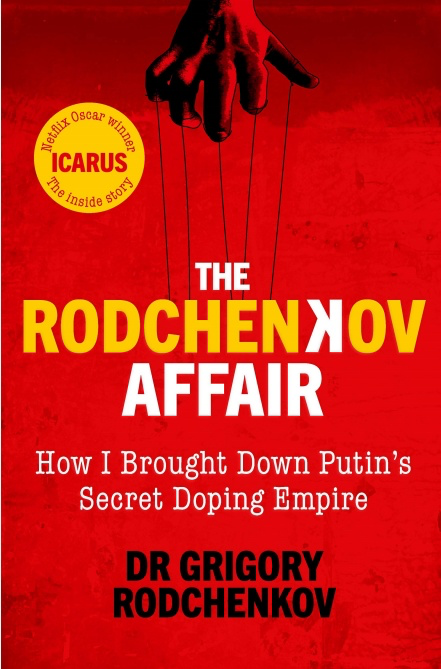
What you can more casually call it in conversation: The “Rodchenkov Anti-Doping Act of 2019,” or even just the Rodchenkov Act.
What’s its current legislative status: Passed the House, passed the Senate without amendment, sent to the President for his signature. It will become law when or if he signs it. [Update: The bill was signed into law on December 4, 2020.]
What the bill does, summary form: Per the nonpartisan Congressional Research Service: “This bill makes it unlawful to knowingly influence (or attempt or conspire to influence) a major international sports competition by use of a prohibited substance or prohibited method. A violator is subject to criminal penalties – a fine, a prison term of up to 10 years, or both – and mandatory restitution. Additionally, property may be seized and forfeited to the U.S. government if it was used or intended to be used to commit an offense or traceable to the proceeds in connection with an offense.”
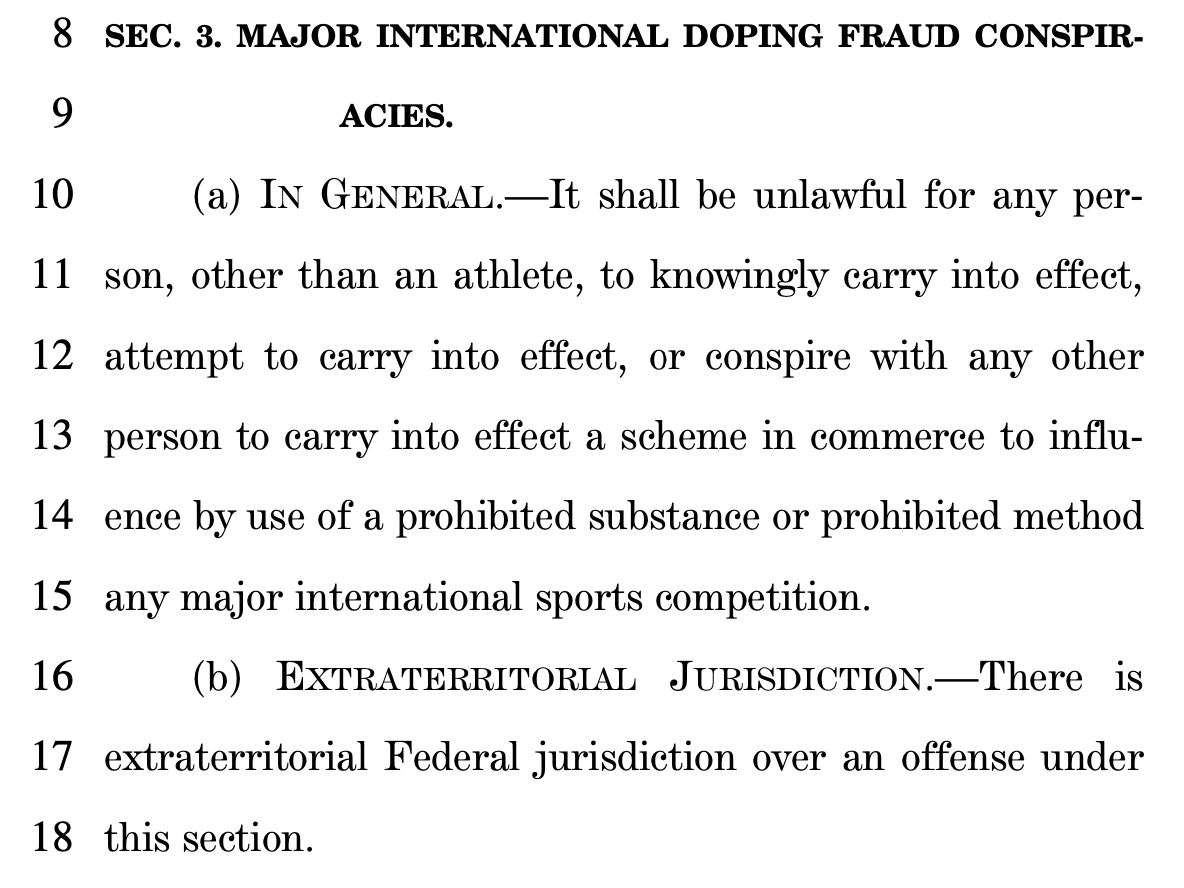
Section 3(a) of the Act provides, “It shall be unlawful for any person, other than an athlete, to knowingly carry into effect, attempt to carry into effect, or conspire with any other person to carry into effect a scheme in commerce to influence by use of a prohibited substance or prohibited method any major international sports competition.”
Section 3(b) provides for extraterritorial federal jurisdiction over an offense described in 3(a), i.e., it gives the U.S. Department of Justice legal authority to prosecute alleged criminal conduct that took place outside the physical borders of this country.
Extraterritorial jurisdiction of American criminal law is the exception rather than the rule. However, there are multiple areas where this exists, at least in theory, although in practice actions are relatively uncommon. As one overview of this issue states, “A surprising number of federal criminal statutes have extraterritorial application, but prosecutions have been relatively few. This may be because when extraterritorial criminal jurisdiction does exist, practical and legal complications, and sometimes diplomatic considerations, may counsel against its exercise.”
The rest of the Act provides some definitions. Major international sports competition means a competition featuring at least one American athlete, plus at least three other athletes from other countries, which is governed by the World Anti-Doping Agency Code (aka “WADA Code”), and where the competition organizer or sanctioning body receives sponsorship or financial support from an organization that does business in the U.S., or received money for the right to broadcast the competition in the U.S. (“Competition” is defined in this manner so as to provide jurisdiction under the capacious expanse of the Commerce Clause, in Article I of the U.S. Constitution.)
A scheme in commerce has a similarly broad definition, with the same aim of effecting Commerce Clause jurisdiction: “any scheme effectuated in whole or in part through the use in interstate or foreign commerce of any facility for transportation or communication.” Bottom line, if you send a text or email in support of your doping scheme (at a qualifying, multi-national competition subject to the WADA Code), the U.S. is going to have jurisdiction over you.
… if you’re “any person, other than an athlete,” that is. (Write your own John Kruk joke here.) If you’re an individual athlete who has allegedly doped, this Act, by its explicit terms – “other than an athlete” – does not apply to you. You obviously remain bound by the WADA Code, as well as by American state and federal law (if you’re an American athlete), but this Act does not apply to you. The title of Section 3 in the Act hints at its true target: “Major international doping fraud conspiracies.” Individual athletes are, well, not off the hook, but also not targeted by this Act.
Individual athletes are, however, eligible to receive restitution if they are defrauded as the result of someone else’s doping scheme. The Act amends 18 U.S.C. § 3663A, “mandatory restitution to victims of certain crimes,” to provide that someone who suffers financial damage as a result of someone else’s international doping fraud conspiracy is eligible to receive restitution. The Act itself provides for substantial fines for someone found guilty of violating it: $250,000 for individuals, $1,000,000 for associations or other groups. Jail time, of up to 10 years, may also be imposed.
Restitution provisions are well and good, but as any family law attorney who has ever tried to collect alimony from a former spouse can attest, you can’t get money if it’s not there. Another provision of the Act, regarding forfeiture, provides broad powers for criminal forfeiture to the U.S. Department of Justice, for property used, or intended to be used, to commit or facilitate an international doping conspiracy. At least in theory, the U.S. DOJ could prosecute the bad guys, seize their assets, and financially compensate the American athletes who were harmed. In theory.
The bill’s drafters certainly intended to provide protection to whistleblowers (that is, people who expose alleged doping conspiracies). The original version of S. 259, when it was first read in the Senate, contained a number of findings, including that “whistleblowers … can play a critical role in exposing doping fraud conspiracies and other fraudulent acts in international sport.” The final finding stated, “These whistleblowers, including Dr. Grigory Rodchenkov and Yuliya and Vitaliy Stepanov, often expose major international doping fraud conspiracies at considerable personal risk. By criminalizing these conspiracies, such whistleblowers will be included under existing witness and informant protection laws.”
On the one hand, it is accurate to state that the drafters of the Act intended to provide some protection to whistleblowers, rather than not to provide such protection. That’s what the final sentence quoted above says. On the other hand, it is also accurate to conclude that the Act itself (that is, the statutory language actually enacted, which does not contain any findings) says nothing at all about whistleblowers, and that anyone coming forward to expose an alleged conspiracy will be protected, if at all, only under general criminal laws as they relate to whistleblowers.
This reporter has worked as a criminal defense attorney for most of the past seven years (and clerked for a criminal appellate court before that), and retains considerable professional skepticism about the munificence of the federal Department of Justice. In his professional opinion, anyone planning to blithely avail themselves of the assumed generosity of federal prosecutors should carefully consult with legal counsel first, and should not assume that they will be automatically protected from prosecution for their role in an alleged conspiracy in exchange for revealing its existence. In practice, prosecutors have almost unlimited discretion regarding who they wish to prosecute or not. And the general protections of “existing witness and informant protection laws,” in criminal law, are far, far less robust than the explicit protections of whistleblower protection doctrines in other settings, largely civil employment law.
Bottom line, if you have something incriminating to report, talk with a defense attorney first before you go anywhere near the feds. (But not this reporter; I’m a full-time stay-at-home parent these days, and am truly not soliciting business.)
So, about those individual athletes: Again, they are explicitly not targeted by the text of this Act, nor are they intended to be. The Act covers only conspiracies, not individuals.
MLB player Robinson Canó, shown here playing for the Yankees in August 2009, was busted for steroid use earlier this week. He will be suspended for the entire 2021 season, and forfeit $24 million in salary. These punishments come through a scheme reached through collective bargaining by the MLB players’ union, not from WADA. (photo: Creative Commons)
So, about those individual athletes in major American team sports: Again, they are explicitly not targeted by the text of this Act, nor are they intended to be. The Act covers only major international competitions that are subject to the WADA Code; American college sports and the big four professional sports leagues (MLB, NFL, NBA, NHL) are not signatories to the WADA Code; therefore, this Act does not cover them.
As the New York Timessuccinctly put it, “Because drug policies are collectively bargained in the North American pro sports leagues, penalties for doping violations in those organizations are far less stringent than they are for international sports. Professional athletes in the North American leagues who fail doping tests are usually suspended for a portion of a season. International violations usually bring suspensions of at least two years.”
The exclusion of the most visible American professional sports leagues has raised some eyebrows. For that, and other reasons, let’s conclude with:
Who doesn’t like this Act (viz., everyone other than America):
“No nation has ever before asserted criminal jurisdiction over doping offences that occurred outside its national borders – and for good reason. It is likely to lead to overlapping laws in different jurisdictions that will compromise having a single set of anti-doping rules for all sports and all Anti-Doping Organizations under the World Anti-Doping Code (Code). This will have negative consequences as harmonization of the rules is at the very core of the global anti-doping system.
“WADA remains concerned that by unilaterally exerting U.S. criminal jurisdiction over all global doping activity, the Act will likely undermine clean sport by jeopardizing critical partnerships and cooperation between nations. Further, the Act could impede the capacity to benefit from whistleblowers by exposing them to possible prosecution and preventing ‘substantial assistance’ deals in line with the provisions of the Code.”
The WADA Independent Commission
The Central European Anti-Doping Organization:
Sounded similar notes, in a statement largely copy and pasted from WADA. It ended with an original paragraph: “CEADO joins WADA and other stakeholders around the world in asking why this U.S. Act, which purports to protect athletes and claims jurisdiction overseas specifically excludes the main areas of professional and college leagues which are the show cases of sports in the U.S.?”
Dick Pound:
The former WADA president and IOC vice-president has expressed strong concerns about maintaining common international standards for testing and enforcement. “To try and destroy WADA does not provide any additional protections to American athletes,” Pound told British Columbia newspaper The Province earlier this year. “In fact, it increases the risk. If you don’t have a harmonized international approach to international doping, you’re going to have more and more doped athletes competing against America.” He claimed that the legislation is based on “intentionally inaccurate and misleading information” from American anti-doping officials.
Pound added, “It’s unfathomable why they would do that, unless it’s some kind of a takeover bid, an untimely takeover bid, to come and say, ‘Throw your money around, we’ve put in more than anyone else,’ which is of course not true. But that doesn’t seem to bother the executive branch of the U.S. government these days.”
Ulrich Haas:
One of the drafters of the WADA Code penned an op-ed entitled, “Flawed Rodchenkov Act risks a return to anti-doping chaos.” Its opening paragraph is, “Be careful what you wish for. Designed to protect clean sport, the Rodchenkov Anti-Doping Act will have the opposite effect.” It gets more caustic from there.
Haas expressed particular concern that the Act’s treatment of whistleblowers could expose them to criminal prosecution from non-WADA sources, while compromising WADA’s ability to provide them with immunity: “How could WADA carve out an agreement with this [hypothetical] whistleblower in exchange for her collaboration if there existed legislation that allowed for her criminal prosecution? The Rodchenkov Act and other similar laws would leave her exposed to criminal prosecution by various extra-territorial jurisdictions. There is no legal security for these whistleblowers in exchange for coming clean and providing valuable intelligence. The effect of the Rodchenkov Act will be to discourage people from coming forward with information.”
The Kremlin:
As a Russian presidential spokesman told an English-language Russian news agency earlier this week (headline: “Kremlin blasts US attempts to extend its jurisdiction to other countries”), “In the context of this document and in general we are extremely critical of any attempts by the United States to extend its jurisdiction to other countries. … This can cause nothing but concern. Such transborder practices do not suit us and we disagree with them.”
Who likes this Act (viz., Americans):
United States Anti-Doping Agency:
USADA CEO Travis Tygart issued a statement earlier this week. Tygart said, “The Act will provide the tools needed to protect clean athletes and hold accountable international doping conspiracies that defraud sport, sponsors and that harm athletes. … The Act establishes criminal penalties for systems that carry out doping-fraud schemes that rob athletes, citizens and businesses. It also protects whistleblowers from retaliation and provides restitution for athletes defrauded by conspiracies to dope. It is a monumental day in the fight for clean sport worldwide and we look forward to seeing the Act soon become law and help change the game for clean athletes for the good.”
USADA also made the following statement on Twitter on Tuesday: “Myth: The Rodchenkov Act doesn’t apply to athletes at all. Conspiracies to distribute & administer performance-enhancing drugs are already a felony under US conspiracy, narcotics & fraud laws, which carry stiff sentences. In that regard, RADA would have been completely redundant.”
This is quizzical, because the Rodchenkov Act, by its explicit terms (“other than an athlete”), literally does not apply to individual athletes at all. And the statement regarding a redundancy seems to admit that the Act does not in fact cover athletes, as they are already subject to the criminal laws described in the tweet’s second sentence.
Noah Hoffman racing to second in the men’s 15-kilometer freestyle individual start on Wednesday at 2018 U.S. Cross Country Championships in Anchorage, Alaska. It was his first January nationals appearance since 2012. (photo: Gabby Naranja)
Noah Hoffman and Jessie Diggins:
In an op-ed written in March of this year for the Minneapolis Star-Tribune, the two American Olympic skiers spoke to the importance of clean sport as a force for good. They wrote, in part, “The global anti-doping system, though well-intentioned, has failed to stem the tide of doping conspiracies that have undermined confidence in international sport. The current system does not have the power nor the independence to counter state-sponsored programs that corrupt the Games we hold so dear. The Rodchenkov Anti-Doping Act will bring the power of federal law enforcement to the fight for clean sport. The bill will criminalize international doping conspiracies, protect brave whistleblowers who expose malicious behavior, require information sharing between law enforcement and anti-doping authorities, and allow athletes like us to seek restitution when we are defrauded by cheaters.”
Hoffman also responded to Pound’s statements in the Province article with a letter of his own addressing some of Pound’s arguments. Hoffman writes, in part, “the article implies that the Rodchenkov Anti-Doping Act will undermine WADA and the global harmonization of anti-doping rules. This assertion disregards the fact that the bill uses the global WADA code to determine what is or is not doping fraud. The bill also mandates information sharing between law enforcement and the U.S. Anti-Doping Agency, the organization that works in partnership with WADA to enforce global anti-doping rules in America.” Hoffman also, accurately, states that the Act “covers both Americans and non-Americans who commit doping fraud at events that occur inside or outside of the United States” – but does not engage with the argument that it only covers events subject to the WADA Code, which rules out roughly 99% of professional sport in this country.
Grigory Rodchenkov:
The Act’s namesake, through an attorney, told the New York Times that the law represented “the dawn of a new day. This will be an immediate worldwide deterrent.”
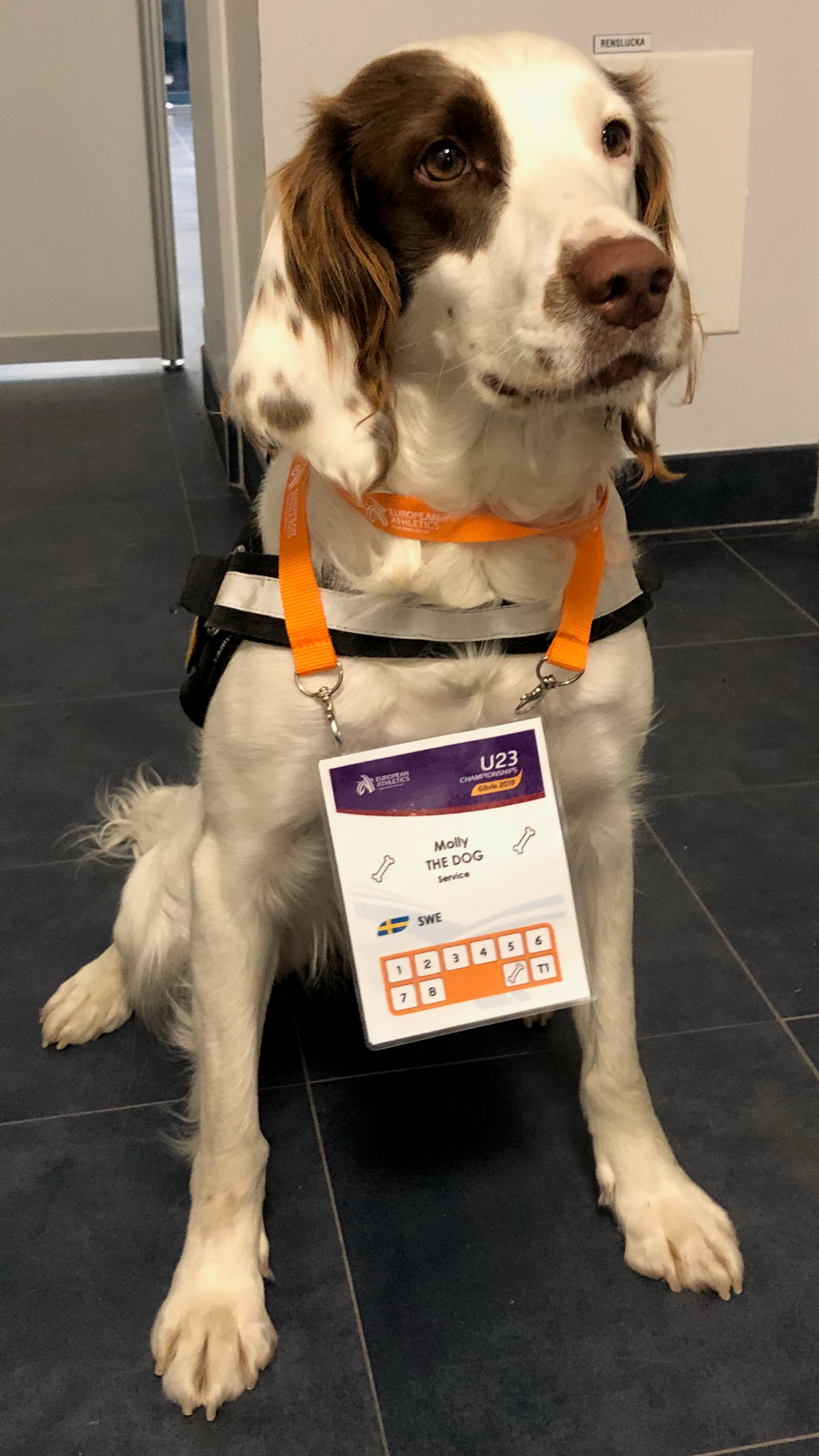
Molly is a rare dog, although let’s go with this premise, all dogs are good. But some, like Molly, might be slightly better. Hailing from a working line of Springer Spaniels in Northern Ireland, Molly now resides in Sweden with her caretakers, Joanna and Michael Sjöö. Both are part-time doping control agents with the Swedish Sports Federation.
Molly is six years old and also works a part-time gig with the Swedish Sports Federation.
With a keen sense of smell, Molly is highly trained. She’s tasked with detecting certain banned substances that allow athletes to improve their performances. Think drug-sniffing dog — like at customs — but the anti-doping variety. Molly’s work-life orbits around assisting with doping controls at training camps or sporting events.
Dogs, for example, can be trained to detect substances excreted in sweat, and falling blood sugar levels from the breath of a diabetic. However, those types of biological marker sniff-tests are not part of Molly’s repertoire. So when Michael and Joanna collect urine and blood samples, those samples are lab tested for banned substances. Molly cannot perform the magic of detecting autologous blood doping or EPO use. That’s beyond her job description.
Molly plays an altogether different role. She detects substances an athlete might be carrying or storing like testosterone and some steroids in powder, liquid, and gel form. The full complement of Molly-detectable banned substances remains a secret. Molly, as it stands, remains the doyenne of anti-doping K-9s: as far as we know she’s the first of her kind.
Swedish biathlete Sebastian Samuelsson and Molly. (Photo: @dopinghundenmolly Instagram)
We were tipped off to Molly’s fine work when Sebastian Samuelsson, a star Swedish biathlete, was visited by Molly during an out-of-competition doping control visit. Like many athletes before him, Samuelsson posed for a photo with Molly.
When Molly makes a visit, as she did with Samuelsson, Molly’s success depends on the commitment of her caretakers.
“One problem is you have to train the dog, the other is you have to find the right people that like dogs and can take care of them, help them perform, and do the necessary maintenance training,” said Michael Sjöö from his home in Sweden where Molly resides. “It’s a responsibility with much necessary work because Molly has to be trained a couple of times every week. We have to get out, even if we don’t want to. I mean, for her it’s fun, it’s playing. And we have to do the play, so she loves it.”
At home, Molly enjoys several lounging spots: all comfortable, yet differing in amounts of direct sun and proximity to people. By all measures, Molly is just a regular dog, except when it’s work time.
“We go unannounced into dressing rooms and locker rooms and all these different places like airports when teams land so Molly can sniff bags arriving at the terminal,” said Michael Sjöö. “At a larger competition or training area Molly can always sniff the athlete’s bags in warm-up areas or locker room, so it usually is quite easy for us to do the work. 99.5% of the athletes, when we are coming, they really think it’s good because Molly sends a good message.”
Molly can sniff bags, but according to her handlers, they are unable to search bags without an athlete’s permission. Either way, When Molly detects a banned substance, the bag’s owner is identified and a doping control test is ordered.
Doping controls are used to either catch dopers or deter athletes from doping in the first place. Those measures have proven imperfect. Molly presents an opportunity to improve the interface between doping control agents and athletes. Doping controls can be an invasive but necessary part of anti-doping. When doping control agents show up with a cuddly Springer Spaniel, the edge is taken off.
“Because of Molly, during doping control, we get much better contact with the athletes. She diffuses any possibly tense situation,” Joanna Sjöö said
Team Molly: Joanna and Michael Sjöö with Molly. (Courtesy photo)
Although Michael and Joanna could not discuss any “positive” sniff tests attributed to Molly, they did claim Molly has deterred potential cheaters. They mentioned that on several occasions at a competition or training area, an athlete has noticed Molly then picked up their respective bag and briskly walked away.
“When we see that we always try to find who that person is,” said Joanna Sjöö. “And we send the information to our investigation department, and then the department, for example, gives permission to test that person. So when Michael and I are with Molly and investigating an area and we notice that someone is actually leaving the area, we try to investigate that.”
Several anti-doping agencies have inquired about Molly. Michael and Joanna emphasize that Molly is an investment requiring resources to make her an effective work dog. Molly, for example, completed a rigorous six-month training program while living full-time with a customs agent.
Despite her attention from the media and athletes, it is a dog’s life for Molly. A little work, a little play, a good home. She fights the good fight. Good Molly.
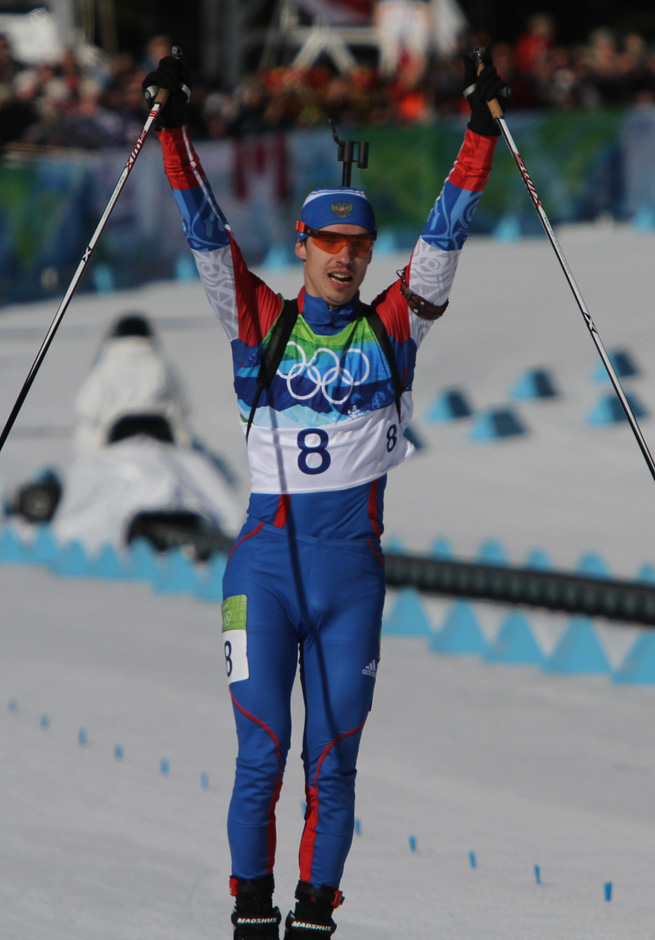
Sergei Ustyugov of Russia celebrates his victory in the 15 k biathlon mass start in the 2010 Olympics in Vancouver, Russia.
Covering doping in sports like biathlon and cross-country skiing here in North America can make one feel self-rightous. The U.S. and Canada run clean systems if positive doping tests are the benchmark for suspicion. As far as we can tell, there’s been a single case involving a North American nordic sport athlete. In 1987, an American caused a stir after the 1987 Nordic World Championships in Oberstdorf, Germany. Kerry Lynch, a nordic combined skier, admitted to “bloodpacking”. (A glance into U.S. athletics and cycling, however, tells a different story altogether.)
Then there’s Russia! Russia! Russia!. Just right there, an appeal to doping angst with the use of an “!”, and a trifecta of “Russia” as if from a far far away time in our recent political history.
This week the Court for Arbitration for Sport’s anti-doping division ruled former Russian biathlete Evgeny Ustyugov guilty of an anti-doping rule violation. The ruling’s technical underpinnings turned on abnormalities in Ustyugov’s Athlete Biological Passport. He doped and was able to evade detection. His results from January 2010 until the completion of the 2013-2014 season were stripped. These include gold medals won at the 2010 and the 2014 Olympics.
Six years after the Sochi Games, a decade since Vancouver, the slow churn of justice in sport advances.
Since the Sochi Olympic flame smudged out and whistleblowers helped tease apart the deep-state Russian doping enterprise, FasterSkier has covered the case. And just this week I used an image of 2014 50 k freestyle Olympic champion Alexander Legkov as a lead photo for a doping related article. Too cynical a choice for a doping story photo? Maybe.
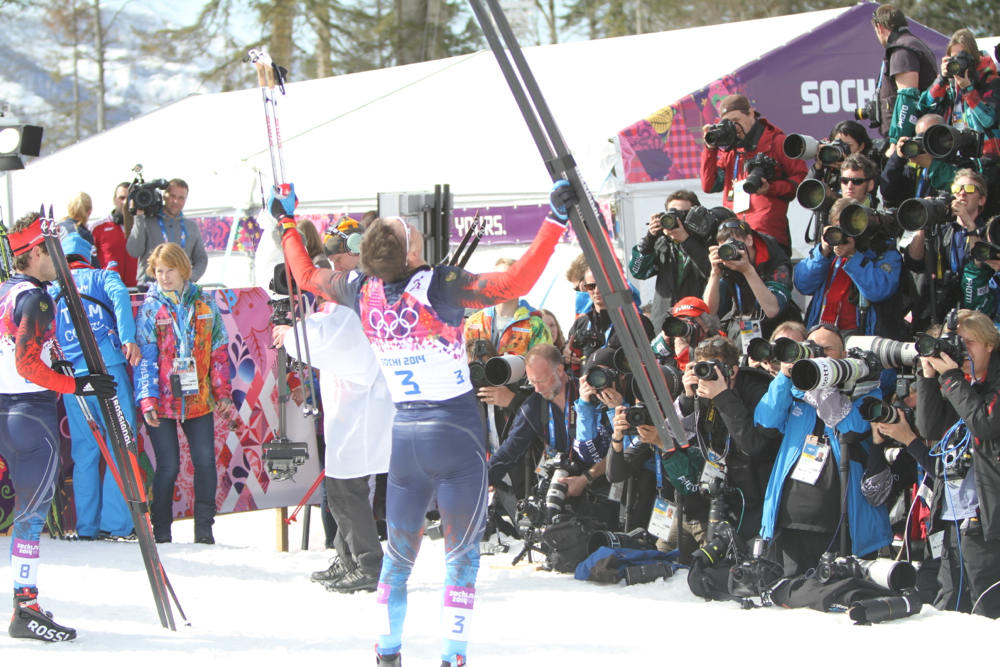
Alexander Legkov after winning the Olympic 50 k in 2014.
Legkov went through his own doping adjudication twists – he was implicated as an athlete who benefitted from Russia’s systematic doping program. Legkov was eventually cleared in a 2018 CAS decision and his 2014 gold medal was reinstated. At first appearance, the image of Legkov used in the earlier story is similar to others we have seen before: the euphoria of winning gold. But we all know, positive tests or not, CAS decision or not, the haze of Sochi doping evidence provides a “guilt by association” backdrop. That’s a tough bias to suppress.
Therese Johaug winning last season in Ruka, Finland. (Photo: NordicFocus)
Initially, Johaug was handed a 13-month ban by the Norwegian Ski Federation, which FIS appealed. She was eventually given an 18-month ban by CAS and missed the 2018 Olympics. Back on the scene beginning the fall of 2018, Johaug dominated distance racing. She claimed the 2019 distance World Cup globe and the Overall World Cup in 2020.
Right upfront, the authors of the study, Ulrik Wagne and Elsa Kristiansen, use terms like “national identity” and “national performance” to describe how humans often tend to bundle athletic prowess with how they think and feel about their home country. Chants of “U.S.A. -U.S.A.” anyone? Sports and identity commingle.
About Norway’s Johaug coverage the study’s authors write, “the media often propagate the claim that the administrative systems both monitoring and helping elite athletes have failed. Accordingly, the responsibility for the failure is transferred from the individual to the governing organisational level.” That’s jargon claiming the system failed Johaug.
Sweden, a country similar in its affinity for cross-country skiing, took a harder line against both Johaug and Norway. The authors claim, “Swedish discourses seem in favour of strict liability; thus, the issue of guilt can be ascribed to the individual athlete, who accordingly needs to receive a ban, and to Norwegian anti-doping policy, which is not as consistent as one would expect, and therefore requires a thorough investigation.” In other words, the main Swedish narrative was Johaug failed herself and Norway is no beacon of clean sport. (Prior to Johaug’s positive, claims of abusing asthma medication to boost athletic performance rattled Norwegian skiing.)
In some ways, the findings reinforce our propensity for tribalism. In this case, the national flag waving kind when international sport is used as a proxy for nation-state status. Norway became an easy foil for Sweden after projecting itself for years as above the temptation to dope. So maybe it’s no surprise that some Norwegian media showed a bias and deflected blame away from Johaug. And similarly, there’s no shock that some Swedish media asserted Johaug and a complicit system were at fault.
The analysis of Johaug’s doping coverage reveals that some media outlets were easily wrapped up in the game of asserting the superiority of one Scandinavian state over the other. Soft-power flexed just to the side of the ski tracks.
Which brings us back to Russia. With the Ustyugov ruling, all we can say is score one for the newly minted Biathlon Integrity Unit. Sport comes clean, eventually.
Holding off Norway’s Therese Johaug is Sweden’d Stina Nilsson during the 2019 World Championship 4 x 5 k relay in Seefeld, Austria. (Photo: John Lazenby/lazenbyphoto.com)
As for remaining unbiased on the tracks and settling scores, the stakes were high when Norway and Sweden went head-to-head in the 2019 World Championship 4 x 5 k relay. Johaug faded late in the final leg while Swedish speedster Stina Nilsson closed out down the final straight for the win. Nilsson has since switched to biathlon. Johaug continues to crush. The facts are this: all biases aside in Norway and Sweden, it was a lovely race and worth a re-watch.
Last week Matt Futterman of The New York Times wrote two stories of interest to readers of FasterSkier. One piece was titled “Winter Sports Athletes Are Crisscrossing Europe for Races. Is That a Good Idea?” Futterman advanced this story on Twitter with the following statement: “It’s a really strange moment for the Olympic winter sports schedule to begin. All you have to do is everything medical experts have been telling us to avoid.”
It’s a really strange moment for the Olympic winter sports schedule to begin. All you have to do is everything medical experts have been telling us to avoid. via @NYTimeshttps://t.co/rFUaheiwfl
The article highlights the alpine World Cup, which began last week, and the soon to begin cross-country and biathlon World Cups as athletes, coaches, and organizers tiptoe amidst the pandemic.
That’s knee-deep skepticism in the first roughly140 words of this story. (Futterman, after all, has “Skeptic” listed as a personality trait on his Twitter profile.) As we surge into November, the NYT’s stories illuminate colliding social forces confronting the culture of elite winter sports. There’s Covid-19 and the accompanying down-throttle of the global sports infrastructure engine. Fanless races. Regular COVID testing. Strictly controlled access to the playing field. There’s also, as Futterman evaluated, a significant decrease in testing from anti-doping agencies.
“With winter sports that are considered high risk for doping about to begin their World Cup seasons and the rescheduled Tokyo Olympics only eight months away, antidoping officials say the need to get testing back to previous levels is critical,” explained Futterman. “This is particularly essential at competitions, they say, since those offer the best chance — given current travel restrictions — to catch athletes using illegal stimulants that have an immediate effect on performance.”
Some eye catching words were “winter sports that are considered high risk for doping”. Look no further than 2019 in Seefeld, Austria when several cross-country athletes were arrested and eventually penalized for serious doping offenses. Cross-country skiing and biathlon, historically, are those high risk winter sports.
In 2003, researchers wrote, “These data suggest that blood doping is both prevalent and effective in cross-country ski racing, and current testing programs for blood doping are ineffective.” The authors were referring to a review of blood tests already collected from anti-doping entities as far back as the 1989 Nordic Ski World Championships. The article, “Abnormal Hematological Profiles in Elite Cross-Country Skiers: Blood Doping or?”, published in the Clinical Journal of Sport Medicine, found the likelihood of blood doping prevalent amongst those within the sharp-end of the race field.
Again, in 2018, researchers examining newly released testing data confirmed “suspicious blood values” from previously tested cross-country skiers. None of this may be news, but it’s worth reflecting upon as anti-doping agencies have curtailed testing since last March.
Of late, the U.S. Anti-Doping Agency (USADA) has been one of the more transparent anti-doping agencies. USADA updates weekly the number of doping tests administered to U.S. athletes under its auspices and makes that information public. In March, as a response to changing travel dynamics and social distancing, USADA began what it called “mission critical” testing. In other words, the scale of in and out-of-competition testing was reduced.
For comparison, in 2019, USADA reported a total of 117 tests in biathlon, 74 of them during Q1. USADA aggregates skiing and snowboarding as one sport that includes all disciplines under the U.S. Ski & Snowboard umbrella. Altogether, those sports accounted for 309 tests in 2019, including 152 in Q1 alone.
USADA has released 2020 testing numbers for Q1. According to USADA, these include six tests total for biathletes, all taken out-of-competition. For the ski and snowboard sports, 67 tests were administered in Q1. Comparing Q1 in 2019 to Q1 in 2020, that’s a reduction of 68 tests in biathlon, and 85 in skiing and snowboarding over a similar period. (The International Biathlon Union held a World Cup in Feb. 2019 at Soldier Hollow that may have increased in-competition testing for U.S. athletes. USADA reports 42 in-competition tests for biathlon for Q1 2019, when the event was held. In 2018, USADA reported no biathlon in-competition tests for Q1-Q3.)
FasterSkier has reached out to USADA to learn about testing numbers for Q2 and Q3 in biathlon, and skiing and snowboarding. We’ll update this story if those data become avaiable. However, the general trend in testing is downwards. USADA reports a total of 3452 tests across all sports the first 90 days of 2019, and 2060 tests over the same period in 2020. That’s a reduction of 40.4 percent.
All this is to say that USADA, considered by many to be an anti-doping agency with integrity, has scaled back testing. By extension, one may assume that most of the nations involved in anti-doping have reduced testing too. Using the U.S. as an example is not to insinuate biathletes or cross-country skiers in the U.S. are doping, it is simply reliable data that tells a story of testing constraints. If reduced testing is happening here, it’s likely worse in nations with less anti-doping oversight.
Futterman’s Tweet rings loud and it’s worth stating again: “There is no way to sugarcoat this — 2020 was a great year to dope and not get caught.”
Followers of track and field will know the men’s 10,000-meter world record was broken on Oct. 7 by Uganda’s Joshua Cheptegei. The previous world’s fastest for men in the 10,000 was set in 2005. The same day, Ethiopia’s Letesenbet Gidey broke the world record in the women’s 5000m race – a record that stood for 12 years. Fast track, fast conditions? Primed racers with little fatigue? It’s all possible. So too are the more cynical explanations associated with decreased anti-doping oversight.
***
For reference, we have provided the public USADA testing information for three U.S. athletes: U.S. Biathlon’s Susan Dunklee, and Simi Hamilton and Jessie Diggins of the U.S. Ski Team. Depicted in the data below are USADA anti-doping tests. During the season when athletes are traveling and/or racing, other entities like the International Ski Federation (FIS), or the International Biathlon Union (IBU) in Dunklee’s case, may also test athletes. This is not a comprehensive list detailing the number of times each respective athlete has been tested. The testing information is included to provide a frequency comparison of USADA testing before and during the pandemic.
Olga Zaitseva, Ekaterina Glazyrina, Olga Vilukhina, and Irina Starykh celebrate their IBU World Cup biathlon relay victory in Ruhpolding, Germany in January 2014. (Photo: Fischer/Nordic Focus)
The Biathlon Integrity Unit (BIU) announced on Thursday that Russian biathletes Ekaterina Glazyrina and Timofey Lapshin were provisionally suspended. According to the BIU, Lapshin has been competing for Korea since 2017.
Both Lapshin and Glazyrina are accused of violating anti-doping rules (ADRV). The evidence used to hand down the provisional suspensions came from information included in the McLaren Report and data from the Moscow Lab’s data (LIMS) handed over to WADA in 2019.
The BIU states this is Lapshin’s first violation. The IBU website indicates Lapshin has earned six career IBU World Cup podiums: two wins, a single second place, and three third-place efforts.
Glazyrina served a two-year ban from competition beginning in February 2018. She was allowed to compete again in 2020. This competition ban resulted from using a banned substance.
Glazyrina has five IBU World Cup podiums: two second-place finishes, and three thirds.
Under the International Biathlon Union Integrity Code, both athletes have an opportunity to respond to the BIU’s sanction.
Olga Vilukhina won a silver medal in the sprint at the 2014 Olympics.
The Court for Arbitration in Sport (CAS) announced Thursday that three Russian biathletes implicated for doping at the 2014 Sochi Olympics had their lifetime bans overturned. The biathletes in question, Olga Vilukhina, Yana Romanova, and Olga Zaitseva were first handed lifetime bans in 2017 by the International Olympic Committee (IOC).
The McLaren Report included information tying the three athletes to doping. The IOC subsequently ruled the three Russians had committed an ADRV, or anti-doping rules violation. Their individual and team results were nullified and they were banned from all future Olympic Games. All three skiers have retired.
In the case of Romanova and Vilukhina, CAS stated: “that none of the acts alleged to have committed by these two athletes had been established to its comfortable satisfaction and beyond the mere suspicion of a potential ADRV.”
Prior to the 2017 IOC penalty, Vilukhin won the 2014 Olympic silver medal in the 7.5-kilometer sprint. That medal was subsequently stripped. Thursday’s CAS ruling reinstated individual results from the Sochi Games for both Romanova and Vilukhina. As a result, the silver medal will be returned to Vilukhina.
Zaytseva’s penalty was handled differently. CAS ruled Zaytseva had committed an ADRV for both swapping her urine for clean urine and using a prohibited substance. CAS clarified that Zaytseva would not have a lifetime ban, but would be “ineligible” for the 2018 Games after Sochi.
Beyond having her individual results not reinstated on Thursday, CAS maintained the IOC’s 2017 decision to nullify results from any team including Zaytseva at the 2014 Games. Zaytseva had teamed up with Romanova, Vilukhina, and Ekaterina Shumilova to win silver in the women’s 4 x 6 k relay in Sochi. That medal was stripped in 2017 – CAS upheld that penalty. Zaytseva was also on Russia’s fourth-place mixed relay team.
Zaytseva won gold medals in the 2006 and 2010 Olympic relays and a silver in the 2010 Olympic mass start. Those results are not impacted by the recent CAS decision.
Germany’s Evi Sachenbacher-Stehle (bib-27) in the quaterfinals of the 2007 Tour de Ski in Prague. (Photo: Wikimedia Commons)
A career ended prematurely, for no reason.
During the 2014 Winter Olympics in Sochi, Russia, German biathlete Evi Sachenbacher failed a doping test. Although the ensuing ban was subsequently reduced from two years to six months, it effectively ended her career.
New information seems to confirm that Sachenbacher’s positive drugs test at the 2014 Winter Olympics in Sochi had nothing to do with deliberate doping. Rather, she was used as a sacrificial pawn by Russian doping authorities, according to an article on rtl.de.
In his recently published autobiography, doping meister turned whistleblower Grigory Rodchenkov wrote that with no positive doping tests in the first week of the Sochi Olympics, the Russian doping machine needed to expose someone in order to prove that they were doing good work.
From 2006 to 2015, Rodchenkov headed Russia’s Anti-Doping Center, the only laboratory in Russia accredited by the World Anti Doping Agency (WADA). At the 2014 Winter Olympics, Rodchenkov managed the anti-doping testing. While he concocted a recipe of three banned substances to administer to Russian athletes, he and others developed a sophisticated system to replace Russian athletes’ drug-contaminated urine samples with clean samples.
The July 25 issue of The Daily Mail published extensive excerpts from The Rodchenkov Affair, Rodchenkov’s new tell-all detailing his decades-long involvement with the Russian doping system both as an athlete and an administrator. Rodchenkov was initially exposed to doping as a college distance runner, taking steroids. While a successful collegiate runner – with chemical help – Rodchenkov didn’t turn into an elite athlete. His “enhanced” college running success did spur his study of chemistry.
In November 2015, WADA identified Rodchenkov as the ringmaster in the Sochi doping scandal. He was compelled to resign. Within days, fearing for his life, Rodchenkov left Russia for the United States. His paranoia may not have been irrational, as two other officials died suddenly in February 2016. In May 2016, Rodchenkov gave an extensive interview to the New York Times about the rigged testing process in Sochi.
This brings us back to Sachenbacher, the German biathlete who tested positive in Sochi. In one of her two urine samples Sachenbacher submitted during the Olympics, the testing lab claimed it discovered traces of the banned substance methylhexanamine.
Developed by Eli Lilly & Co in 1948, methylhexanamine was marketed as a nasal decongestant. Although it was withdrawn from sales in the 1970s, methylhexanamine began appearing as an ingredient in various dietary supplements in the early 2000s. Supplements incorporating this drug are generally promoted as fat loss products or for extra energy during workouts.
In his book, Rodchenkov asserted that methylhexanamine “usually occurred in huge concentrations.”
Rodchenkov also characterized Sachenbacher’s result as a “borderline case,” adding “If I had already logged five real violations, I might not have reported her. But we needed blood. She became withdrawn from circulation and the punishment did not really match the violation.”
When she learned of the positive finding, Sachenbacher protested, saying that she must have unknowingly ingested it in a tea powder. In the summer of 2014, she received a two-year competition ban.
Sachenbacher appealed to the Court of Arbitration for Sport (CAS), which determined that she didn’t deliberately ingest methylhexanamine. Her ban was commuted to six months from the date of the test
The Munich, Germany, public prosecutor’s office investigated Sachenbacher following the Olympics. According to Der Spiegel, the prosecutor later deemed that Sachenbacher hadn’t actually taken the drug “because the active ingredient content is too low.”
After the CAS ruling, Sachenbacher was allowed to immediately resume training and competition. However, the positive finding and subsequent battle to clear her name exhausted her, and she opted to retire.
A year and more has elapsed since a doping scandal rocked the 2019 cross-country World Championships in Austria. Over that time, we have learned a bit more about what transpired at the micro-level. In the broader picture, those covering doping in sport often scour The World Anti-Doping Agency’s (WADA) annual release of a voluminous document titled “Anti-Doping Testing Figures”. The data dump runs hundreds of pages. Looking for figures on the number of tests per sporting discipline, type of test, governing body administering the test, on and on, it’s in there. The WADA report also discloses the number of AAFs (adverse analytical findings which indicate the presence of a banned substance) and ATFs (atypical findings that warrant more testing and follow up.) Useful information if one is trying to glean how pervasive doping might be in a chosen sport and how effective the tests are.
If you’ve ever read those reports and you’re convinced athletes dope in nordic sport, then this much is true: very few athletes produce AAFs or ATFs.
The International Ski Federation (FIS) released its own annual Anti-Doping Testing Figures on April 15, which it called “detailed FIS testing statistics”. To call this detailed is over reach.
The information does, however, provide the total number of FIS administered tests and disaggregates the numbers into “out-of-competition” and “in-competition” subcatagories for the 2019-2020 season. FIS catalogs the number of urine tests, ESAs (urine and blood tests which test for erythropoiesis-stimulating agents – think red blood cell boosters), blood tests, and specific tests for athlete blood passports (APB).
FIS reports a total of 606 in-competition tests this season with 332 of those specific to cross-country skiing (or roughly 55 percent of the total). In-competition tests for cross-country skiing broke down as follows: 170 urine tests, 112 ESAs, one blood test, and 49 blood passport tests.
For out-of-competition tests, FIS conducted a total of 2205 tests, with 1278 specific to cross-country (or roughly 58 percent of the total). For cross-country, FIS administered 302 urine tests, 245 ESAs, 151 blood tests, and 580 blood passport tests.
FIS accounts for a portion of the overall testing in cross-country skiing. National Anti-Doping Agencies, like USADA, are also responsible for testing athletes both in and out-of-competition.
Without running through all the numbers, cross-country accounted for the majority of tests within the FIS family of sporting disciplines: cross-country, nordic combined, ski jumping, alpine skiing, freestyle skiing, and snowboard. Although the data released from FIS tells a story, it really is an intro or first chapter at best. There’s no indication of the number of AAFs or ATFs.
Although it appears that FIS is doing its job, if that means administering tests, then we have no idea if these tests catch dopers. Although the evidence may be lurking out there, it is our understanding that the skiers caught in Seefeld at the 2019 World Championships who had been practicing autologous blood doping – transfusing one’s own blood – never flagged an AAF. And according to FIS reports, some of those same athletes arrested in Seefeld were concurrently using hGh.
We are glad for the testing. We just simply want to know if the testing is effective and does its intended job of deterring would-be-dopers. With the figures released in April by FIS, we simply do not know and neither do athletes who race clean.
2018 WADA Anti-Doping Testing Figures
The 2018 Anti-Doping Testing Figures from WADA, the more thorough analysis of testing metrics, reveals the breadth of testing and the paucity of positives — which may be a good sign. Then again, it might not. (2018 is the latest data set publicly available from WADA.)
In cross-country skiing, a total of 2916 in and out-of-competition urine and blood tests were administered. These tests found a total of seven AAFs. (From Table 2: Total Samples Analyzed in AIOW Sport/Disciplines (Urine and Blood)).
In cross-country skiing, 187 total hGh isoform tests were conducted (blood) with a single out-of-competition AAF. (Table 30)
In cross-country skiing, 272 total hGh biomarker tests were conducted (blood) with no AAFs. (Table 31)
In 2018, FIS specifically collected 228 hGh biomarker samples – the vast majority of those were collected out of competition — with no AAFs. (Table 19)
A total of 1448 Athlete Biological Passport samples were collected for cross-country in 2018. (Table 4).
WADA’s Explanation of their hGh tests, quoted from WADA’s Q & A page.
HgH Isoform: “WHAT IS THE HGH ISOFORM DIFFERENTIAL IMMUNOASSAYS (THE ‘ISOFORMS APPROACH’)?
Since the total levels of hGH secreted into circulation vary naturally, are widely fluctuating over time and may be influenced by several factors not associated with doping, it is practically impossible to develop an anti-doping test based simply on the measurement of increased total hGH concentrations. However, doping with recombinant hGH (recGH) alters the naturally constant proportions between the different isoforms of hGH present in blood of an individual. The hGH Isoform Differential Immunoassays were developed to detect these changes in the proportions of different hGH isoforms after recombinant recGH injection.”
HgH Biomarker: “WHAT IS THE HGH BIOMARKERS TEST (THE ‘MARKERS APPROACH)?
hGH affects the expression of many different proteins which may serve as biological markers of hGH activity. These include markers of hGH action in the liver such as IGF-I, as well as markers of hGH action on soft tissue collagen turnover, such as the N-terminal peptide of procollagen type III (P-III-NP). The measurement of these two hGH markers in serum may serve to uncover the manipulation of the hGH/IGF-I axis independently of the doping substance used, be it recGH or other agents used to increase circulating hGH [for example analogs of GH-releasing hormone (GHRH), hGH secretagogues such as GH-releasing peptides (GHRP) or even hGH gene doping]. The detection and quantification of such biomarkers of hGH activity constitute the rationale of the indirect method for detection of doping with hGH, referred to as the ‘markers approach’.”
On April 8, Estonian news outlet ERR published an article revealing more details about doping by Estonian cross-country skiers Andreas Veerpalu and Karel Tammjärv. The two skiers both previously admitted to autologous blood doping — the process of removing blood from one’s system and re-injecting it at a later time for a performance boost.
The doping came to light in 2019 when the two Estonians, Kazakhstan’s Alexey Poltoranin, and Austria’s Max Hauke and Dominik Baldauf, were arrested by Austrian police during the 2019 Seefeld Nordic Ski World Championships for their involvement in an organized doping program. The doping was facilitated by German physician Mark Schmidt. EER’s recent piece sheds new light on the athletes’ doping.
The article states Veerpalu and Tammjärv were also administered human growth hormone (hGh), a substance banned by WADA. The FIS summary regarding Poltoranin’s case implicates him with hgh use. Human growth hormone can benefit athletes seeking a boost in power and endurance: hGh has been found to help build muscle and speed recovery.
Along with the April 8 piece, ERR linked to the FIS summary of decisions for Veerpalu, Tammjärv, and Poltoranin. (We have direct links to the documents below.) The athletes have all been banned from competition for four years. Poltoranin’s FIS summary states he underwent “blood treatments” by Dr. Schmidt at the 2018 Olympics.
None of the three athletes, Veerpalu, Tammjärv, or Poltoranin, flagged a positive doping test. They were able to avoid a positive despite the use of an ABP, or “athlete biological passport”, in FIS level competitions. ABPs, for example, provide anti-doping authorities with a longitudinal profile of an athlete’s biological markers that may indicate doping.
The Estonian branch of the doping operation was led by ski coach Mati Alaver. According to the news report, Alavar advised his athletes to consume salt-water and albumin to avoid a positive test. Alaver admitted to facilitating the doping program for his Estonian athletes — Poltoranin was known to train with Alaver’s group. Alaver is serving a four-year coaching ban, and a criminal penalty handed down by an Estonian court.
Amidst the whirlwind of February racing, news happens beyond the ski tracks. Here are some notable news threads.
It was announced yesterday that the famed Engadin Ski Marathon, to be held on March 8, has been canceled due to concerns related to the coronavirus (also referred to as COVID-19). “The spread of the coronavirus in Europe – with two cases in our vicinity – has left the authorities with no choice but to ban big events like our running events for the next ten days in Southern Bundes,” race organizers posted on FaceBook.
Yesterday, four coronavirus cases had been confirmed in Switzerland. According to the Engadin website, the health ministry in this region of Switzerland had called for the cancellation of all public events. Many skiers have been impacted as the race attracts more than 14,000 participants. It is the second time the Engadin had been canceled in its 51-year history.
Anti-Doping Research:
An interesting research paper on doping in athletics, what we will call track and field, was published on February 25. The article is titled, Prevalence Estimate of Blood Doping in Elite Track and Field Athletes During Two Major International Events, was published in “Frontiers in Physiology: Red Blood Cell Physiology.”
Researchers analyzed blood samples from men and women at the 2011 and 2013 World Athletics Championships. Over three thousand samples were evaluated with 209 countries represented.
Perhaps the most startling finding was the prevalence of blood doping in endurance athletes. According to Table 3 in the article, 15 percent of males (endurance) blood doped at the 2011 World Championships, and 22 percent of females (endurance). According to the findings, a prevalence of 18 percent of all athletes (endurance) blood doped at the 2011 WC, compared to 15 percent in 2013.
Researchers defined “endurance” as the following: “endurance” comprised all athletes competing in running or walking events with distances equal or longer than 800 m while “non-endurance” included all athletes competing in jumps, sprints, throws, and combined events, as well as distances shorter than 800 m.
For transparency, the authors disclosed the research had in part been funded by WADA’s Science Department.
Doping Roundup:
Water is water: frozen or otherwise. Chinese Olympic swimmer and megastar, Sun Yang, was handed an eight-year ban from competition on Friday by the Court for Arbitration for Sport (CAS).
Yang’s case involves an ongoing saga in which Yang’s mother evidently instructed his security guard to destroy blood samples that had been collected at his home in 2018 by antidoping officials. Yang refused to provide a urine sample at the time of the incident.
Yang is the Olympic champion in the 400 and 1500 meter freestyles at the 2012 Games and the 200 freestyle champ at the 2016 Olympics.
Yang has the option to appeal the ruling to the Swiss federal court. The story is relevant considering the length of Yang’s penalty, which WADA claims is proportionate to the anti-doping violation.
Alexander Loginov during the men’s relay at the 2020 IBU World Championships. (Photo: NordicFocus)
The new news is this: on February 22, Italian police raided Loginov’s hotel room. Police confiscated his laptop and mobile phone. Additionally, it has been reported that Loginov’s coach, Alexander Kasperovich, had his laptop and phone taken as evidence. According to news reports, Kasperovich is suspected of using another person’s accreditation for the World Championships.
Loginov claims the raid was prompted by the IBU and carried out by Italian authorities. The IBU claimed it was not given advance notice of the raid. Several Russian news outlets are reporting that Loginov and Kasperovich intend to sue the IBU.