From the FasterSkier archive — posts syndicated from athletes’ and coaches’ own blogs between 2004 and 2012, kept online as published. Current coverage is at fasterskier.com.
A group of nordic enthusiasts in southern Maine is planning to launch a new trail system in the Greater Portland Area with snowmaking. Inspired by the successful introduction of snowmaking to nordic facilities in other parts of New England, Southern Maine Snow & Trails, is on a mission to provide reliable snow conditions and extend the season in a region that is rich in nordic racing history, close to two competitive EISA programs, and home to a significant population of current and potential skiers.
SoME Snow has plans to offer skiing this winter with fundraising efforts in full stride, including a generous raffle for an opportunity, until July 31st, to win brand new Fisher Speed Max HE100 skate skis or One Way poles courtesy of Boulder Nordic Sport. Check out Somesnow.org for information and how you can support this exciting project.
Who is the fastest person in the world on cross-country skis? Seems like a straightforward question, but the answer will unquestionably surprise you. An attempt to answer this seemingly easy question might quickly veer straight to the usual suspects. Johannes Hoesflot Klaebo would certainly rise to the top of the list—a Sprinter undefeated for an entire season seems like a good guess. But you would be very wrong. Bjorn Daehlie in his prime would be another good shot in the dark—but it is very far off the mark. Jessie Diggins is well known for her downhill skiing prowess, but even she couldn’t keep up with the world’s fastest person.
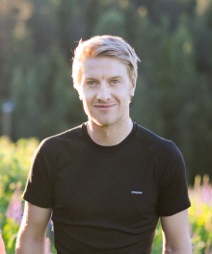
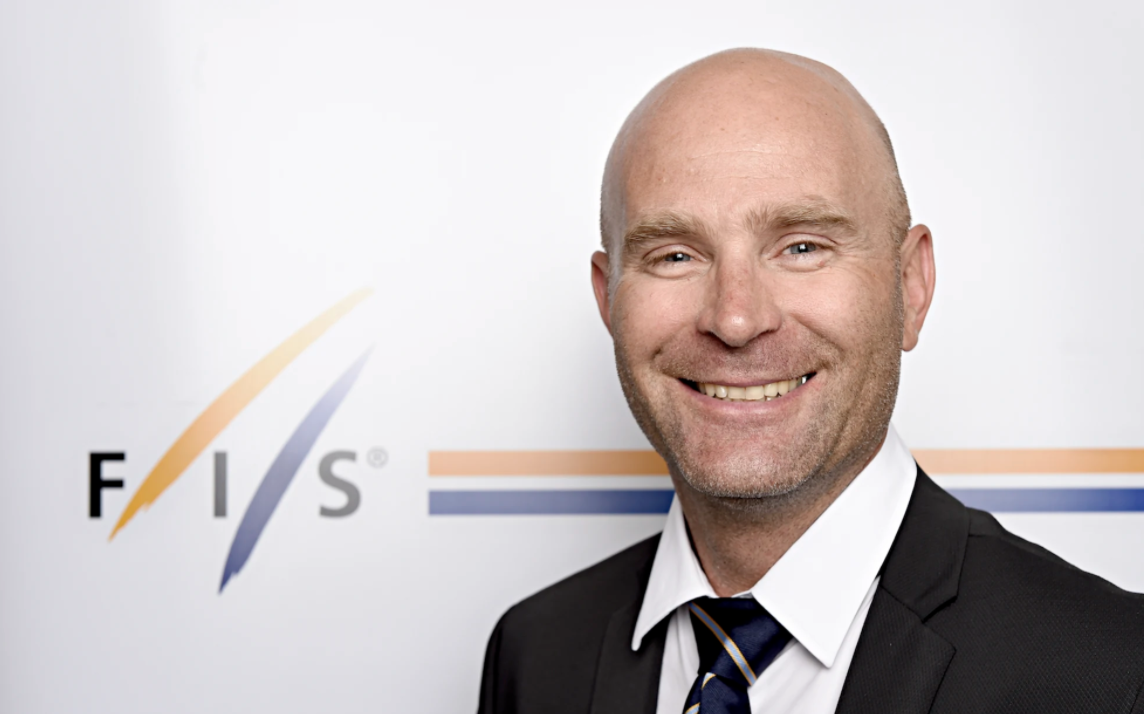
Dr. Sten Fincholm. The fastest cross-country skier in the world. (Photo: Compliments European Organization for Nuclear Research)
The correct answer to this question is both surprising and complicated, and to find the solution you have to stray very far from the world cup, and far from any FIS (International Ski Federation) sanctioned event. To find the world’s fastest cross-country skier you have to dive deep into the world of science and meet a fascinating man by the name of Dr. Sten Fincholm.
For a couple of days every year Dr. Fincholm is the fastest person on cross-country skis. More precisely for about 90 seconds a year there’s no one in the world that’s as fast as Fincholm, and the competition isn’t even close.
So why haven’t you ever heard of him? Well, it’s a story that involves luck, serendipity, curiosity, and like most important things in life, timing.
Schematic map of LHC (Large Hadron Collider) footprint. (Photo: Compliments European Organization for Nuclear Research)
Fincholm is quite well known in his field—which isn’t cross-country skiing— it’s particle physics. His research has been published dozens of times, and he has postulated groundbreaking theories in quantum physics, and quantum field theory. “When I go to conferences, I never have to pay for my own drinks, someone else always wants to buy,” a laughing Fincholm told me. Fincholm works at the Large Hadron Collider (LHC) near Geneva, Switzerland. The LHC is the world’s largest particle accelerator and is the product of the collaboration of 24 member states. Groundbreaking research happens at the LHC every day. It’s now the center for research into particle physics after the United States bowed out of the game when it yanked funding for the Super Conducting Super Collider which had been scheduled to be built in Texas. After Congress cancelled funding in 1993, Switzerland became the heart of subatomic particle research, and it has remained there ever since. And but for that footnote in research funding, none of this strange tale ever would have happened.
Massachusetts Institute of Technology. Sten Fincholm’s alma mater.
Fincholm grew up in Norway. I met him in the early 1990s when I was in school in Boston, and he was studying at MIT. Fincholm was working on his PhD and was on a mission to be involved in the opening of the Texas Super Collider. But when Congress pulled the plug, he returned to Europe to pursue post-doctoral work at the Max Planck Institute. It was during his time at Max Planck that the connection with the LHC was developed, and Fincholm eventually received a posting there as a fellow. He now occupies the position of Senior Particle Investigator and Program Coordinator. We rekindled our friendship when we met up on a trip to Switzerland.
Sten is one of those guys who it is impossible not to like. He has a wry wit and is deeply curious about anything anyone else is doing. He always wants to hear what’s going on with you first. If he wasn’t such a nice guy, you would immediately hate him because he is one of those people who has been graced with so much talent that it’s hard to believe. He’s a polymath in the truest sense of the word.
At this point the reader might rightfully ask “what does any of this have to do with Nordic skiing or racing at any level?” Well, that’s where luck, coincidence, and timing, all—well —collide, and this is where Fincholm comes in.
Before pursuing his PhD from MIT, Fincholm was chasing another interest. He was one of the top 75 ranked cross-country skiers in Norway. “One year I finished 32nd in the Norwegian championships in the 20k. I also finished 39th one year in the 50k. My overall ranking in Norway rose at one point to 68th.” Fincholm comes from an athletic family. “I have a great Uncle who anglicized his last name and took a shot at playing major league baseball in America, but it wasn’t for him. Professional sports wasn’t his cup of tea, but nonetheless, I’m told he was an incredible pitcher.”
When you ski next to Fincholm you feel like you’re skiing in slow motion, and that he’s hardly working. He has the elegance and grace of a dancer, and the power of a weightlifter. He’s a great skier, better than almost everyone in the world his age, but in Norway, that’s not good enough. “What most people don’t realize is that in Norway being the 68th ranked skier means you can beat almost anyone in the world,” Fincholm explained. “But it’s kind of on par with being the 100th best quarterback in American football. The few guys at the very top are the only ones really making a living at it, the rest are just really good football players without anywhere to go.”
Fincholm saw the handwriting on the wall and that’s when he decided to abandon professional skiing and journey to MIT. But it was when fate intervened, and he received his job at the LHC that the merging of two wonderful and completely unrelated worlds happened—quantum mechanics and cross-country skiing— and but for the chance cancellation of an American research program in Texas, none of this would have been possible.
Fincholm explained that when he started as a fellow at the LHC, the worst jobs around the collider would often fall to him. “Whenever we needed someone to do grunt work my name was on the top of the list. Checking voltage regulators on the magnets for the fifth time, that was me.” But often he had to do physical labor as well.
The guts of the Large Hadron Collider. Nothing magnetic is allowed around this. (Photo: Compliments Dr. Sten Fincholm)
“LHC is basically a big donut in the ground. We accelerate particles around in a circle about 27 kilometers in diameter to nearly the speed of light. We use superconducting magnets to accelerate these particles, and we use a tremendous amount of energy; our usage is measured in the hundreds of gigawatts. Whenever you’re using that much energy unusual things can and often do occur.”
The tunnel at the Large Hadron Collider where sub-atomic particles nearly reach the speed of light. (Photo: Chris Mitchell)
One of the things that occurs is that periodically, the thousands of magnets used at LHC require unusual maintenance. Vast amounts of energy are shot through these magnets. And because they are not perfectly efficient, there is some debris created. After each firing of the magnets small amounts of detritus are created inside the magnet’s shielding. “It’s only micrograms, but eventually it has to be cleaned and that’s one of the grunt jobs I had to do. You have to physically scrape the debris off the magnet housing, and it has to be done periodically for each of the over 9,500 magnets. The total amount collected is small. Over the course of a year, it wouldn’t fill a shoebox. We use a special scraping tool made out of carbon fiber and titanium to avoid damaging the housing or the magnets, and of course we can only use material which is not magnetic; that would be bad. Once the material is cleaned off it kind of resembles something like graphite powder mixed with water. We are quite familiar with this material, it’s produced in every collider in the world, we just happen to produce the most because we are the biggest. It’s totally harmless, it’s mostly a combination of nitrogen that’s been bonded to manganese and about 20 other trace elements contained in the atmosphere and cooling mechanisms which the magnetic fields react with. But it’s the prolonged exposure to an intense repeated magnetic field that’s the secret sauce, and that’s the part we don’t completely understand.” As Fincholm described, the stray magnetic field holds all of the elements together in a kind of subatomic magnetic slurry. After the material is scraped from the magnets it begins to revert back into its constituent parts. “It takes about 12 hours for the material to completely break down, and the initial decay begins very quickly.”
“Even as I was promoted through the program, I still worked cleaning the magnets, and do so to this day. I think it helps to keep me in touch with the day to day operations” It was during this process that Fincholm had a eureka moment.
A 50X microscopic image of SPECS (Semi-perturbed excited conglomerates) taken after the LHC’s maintenance regimen and seconds before they begin to decay. (Photo: Compliments Dr. Sten Fincholm)
He was cleaning off the housing scraper with a hose and noticed that the water would puddle on the scraper and wouldn’t react with the substance at all. “It became obvious that it was extremely hydrophobic.” That’s when the light bulb went on. “Ever since the fluoro ban everyone’s been looking for something to replace it with, but nothing really is as good. I even spent some time playing around with solutions, but that’s more of a chemistry thing than particle physics. But as soon as I saw the reaction of water with the spatula, I immediately had the idea of putting it on skis to see what would happen.” But there was a problem. Because the substance, known as SPECS (semi-perturbed excited conglomerates) breaks down so quickly it was hard to test. But Fincholm was in the right place at the right time. LHC’s experiment scheduling and cleaning generally took place early December and late March. Perfect time for snow falls in Switzerland. So, one day Fincholm took some of the substance and smeared it on the bottom of skis. “I knew I had very little time to work with. I had all my gear ready to go and was running through LHC in my ski boots with my skis in hand, everyone looking at me like I was crazy. I had asked the maintenance staff if they could use the plowed snow from the parking lot to build me a little ski track. They were very enthusiastic and set up about a half kilometer loop which was totally flat. I jumped on the snow, took a couple of skate pushes and immediately landed flat on my back. The speed was so intense that I wasn’t ready for it and fell backwards!”
Public display cross-section of Large Hadron Collider segment. (Photo: Courtesy European Organization for Nuclear Research)
After his initial shock, Fincholm completed the half kilometer loop in about 35 seconds. “I couldn’t believe it— it was shocking how fast it was.” Unfortunately, the thrill only lasted for a short time. “After about .2 k, the decay process really accelerated and I could quickly feel the skis returning to normal speed, and by the end of the loop I was again only mortal. It was kind of like that book Flowers for Algernon [in addition to his scientific achievements, advanced degrees, and sports prowess, Fincholm also picked up a bachelor’s in English literature, one of those many talents you could easily hate him for]. It’s the story of a mentally challenged young man who is given a drug that makes him one of the smartest people in the world. The problem was that the drug began to wear off, but the man was now smart enough to realize what was happening and was also smart enough to know that there was no fixing it. It was kind of like that. After the initial near light speed experience, I was quickly returning to normal, and I knew there was nothing to be done. I was once again just a pretty fast guy on skis. But, for almost a minute I was by far the fastest person in the world on skis. I did some calculations and determined that if the substance could last over 10k, my time would be about 12 minutes for a skate race.”
If the collider in Texas had been built as originally proposed, Fincholm would have been in the dusty arid Texas countryside instead of snowy Switzerland and the ski application connection never would have happened. It’s pretty much the definition of serendipity.
But getting the SPECS to last is the problem to make skiing on the material feasible for the masses. “I know it can be solved; I’ve done the math and I’ve proven to myself that it can work, but it would take lots of money. It’s kind of like creating fusion energy. It’s mathematically doable but it is going to take billions of dollars to make it happen. I’m guessing SPECS could be turned into a usable product for $50-$60 million. I have the theoretical underpinnings all worked out, but who’s going to invest that much money into ski wax? It may be more practical for downhill skiing applications since the run times are relatively short. But the terminal speed would be frighteningly fast, and it would require reconfiguration of every competition downhill course in the world. It’s scary to think how fast you could get going on downhill skis. The other problem is that there are only a couple of dozen of people in the world who completely understand the particle physics involved, and to the best of my knowledge none of them are skiers, so it’s unlikely that they would want to devote their time searching for a solution.”
Science happening at the Large Hadron Collider. (Photo: Simon Waldherr)
The answer to who is willing to develop the product is probably nobody, but Fincholm isn’t deterred. “There might prove to be some non-ski related use for SPECS where industry will want to spend the money to find a way to stabilize the product, or applications in aerospace or defense departments.” Fincholm has reached out to the United States Department of Defense’s DARPA (Defense Advanced Research Projects Agency) but can’t talk about those conversations. Though he did volunteer that he went to MIT with a DARPA scientist who is leading their research into quantum computers so he thinks that contact will help move research on the project along.
“So, until a large corporation or wealthy nation steps in, just me and a couple of guys at LHC will be the only ones using it. When you’re in this line of work you have to be patient and willing to accept many failures before success. After all it took decades of trying until the first quantum particle was detected. I’m sure eventually there will be commercial use for SPECS and with it will come the fastest skis the world has ever seen. It will be an incredible day for the skiing world, and every record will fall the next day. But it will be a very sad day for me, because when everyone is skiing on SPECS I will once again be just another very good skier.”
Until that day comes, Dr. Sten Fincholm will continue to be the fastest man on skis; for about 90 seconds a year!
Sten taking a lap around the LHC’s grounds.
This article was originally published on April 1, 2025
Marty Hall, 87, (known as Butch during his youth) of Laconia, NH passed away after a short illness on February 25, 2025. Though he was born in Pennsylvania, he always considered himself a New Hampshire native. His family (his parents and two sisters, Lee Ann and Linda) moved to Gilford, NH, when he was young, right after WWII. They joined a number of families who started the Gilford Outing Club, resulting eventually in three Olympians (Marty Hall, Penny Pitou, and Richard Taylor).
Hall was an accomplished four-event skier (cross-country, ski jumping, downhill, and slalom). While at the University of New Hampshire, he was the top skier every year, leading up to his Skimeister silver medal at the NCAA Championships in 1961. Hall took a two-year hiatus to serve in the United States Army as part of the Modern Winter Biathlon Unit in Alaska. However, it was at UNH that Marty met the love of his life, Kathy. They supported each other throughout their 58-year adventure in life across North America.
Hall was the first full-time cross-country ski coach with the U.S. Ski Team. In the late 1960s and 1970s, under Hall’s hard-driving, passionate leadership, the U.S. Ski Team made its first foray into the international cross-country spotlight. He spearheaded the first women’s cross-country ski team in 1969 and managed and coached the inaugural US Olympic women’s cross-country team at the 1972 Olympic Games in Sapporo, Japan.
Foremost among his accomplishments was leading the US men’s team at the 1976 Innsbruck Olympics, where Bill Koch took home a stunning silver medal, marking the historic first Olympic medal won by an American cross-country skier. Along the way, Hall helped design the first American Birkebeiner course with founder Tony Wise back in 1973 at the Telemark Lodge in Wisconsin. He was instrumental in bringing the first FIS World Cup cross-country ski race to Cable, WI in 1978, where one of his female skiers, Alison Owen, won the 5km inaugural event.
In 1981, Hall brought his coaching leadership north of the border when he signed on as the head coach of the Canadian cross-country program. He was very influential in building a strong National Team foundation that led to excellent World Cup performances by Canadian skiers.
Never shying away from speaking his mind, Hall sparked a controversy at the 1988 Olympics in Calgary, AB, when he implied that blood doping may be a reason for the Russians’ totally dominant performance and almost lost his job coaching the Canadian team. He was eventually vindicated when the Russians admitted to the doping years later.
Hall retired from the Canadian national program in 1992 and later developed the race trails in Thunder Bay, Ontario, that were used for the 1995 World Championships. There, he introduced the short-loop concept, which is still used today at World Championship, World Cup, and Olympic competitions. He continued as a coach in the U.S. for eight more years, helping to build a strong program at Bowdoin College in Maine.
In addition to coaching, Hall also introduced innovations and advancements in Nordic ski equipment, training methodologies, trail grooming, and waxing techniques that helped revolutionize the sport worldwide. He initiated a sports medicine program and created a points system for selection criteria with his wife, Kathy, that is still used to this day.
As a mentor, Marty was always ready to stop and give advice and suggestions to those just starting out in coaching or skiing. He constantly shared his passion for the sport with anybody who was interested. Marty often said that he was so fortunate to be able to do what he loved throughout his entire career.
Hall was a trailblazer and pioneer in cross-country skiing, leaving behind a remarkable legacy that impacted and helped shape the sport around the globe. He was recognized with induction into the U.S. Ski and Snowboard Hall of Fame’s class of 2017. The next year, he was part of the class of 2018 inducted into the Canadian Ski Hall of Fame for his contributions to the sport in Canada.
Marty and his wife, Kathy, have been passionate supporters of the sport for many years, contributing to UNH Skiing, NENSA (New England Nordic Ski Association), the American Birkebeiner Ski Foundation, Vermont Academy, Nakkertok Nordic in Canada, and others.
In lieu of flowers, donations may be made to the UNH SKIplex Project in Marty’s memory either online or mailed to the UNH Foundation, Elliott Alumni Center, 9 Edgewood Road, Durham, NH 03824.
The project involves renovating the locker rooms and team spaces for the University of New Hampshire’s Nordic and Alphine ski teams. Marty and Kathy were the visionary minds behind the SKIplex and have supported the project through their advocacy and philanthropy.
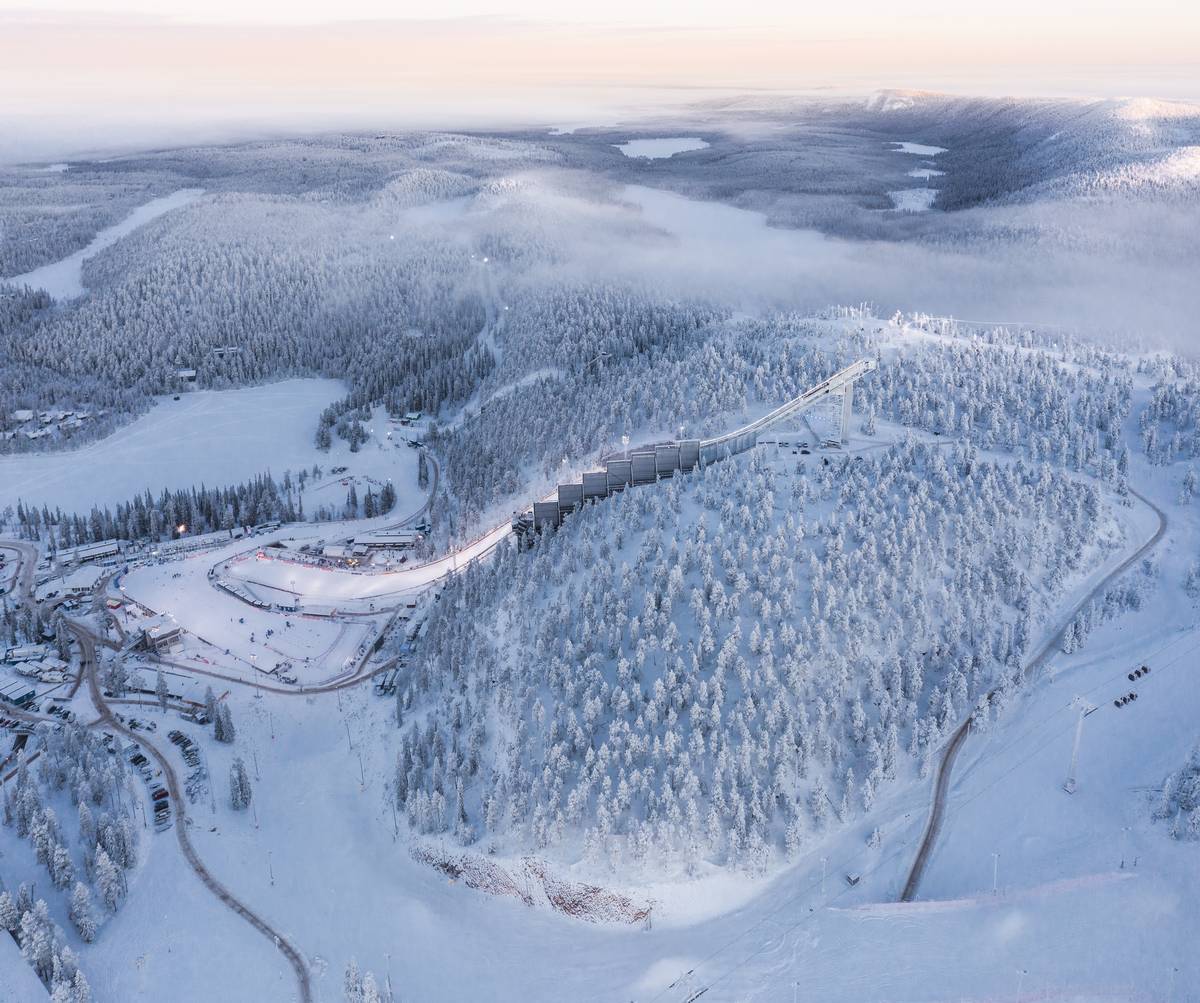
It’s hard to believe, but the first World Cup cross-country race is just around the corner. November 29th marks the cross-country racing season kickoff, in Ruka, Finland. For fans who want to watch the races, there are a couple of easy options.
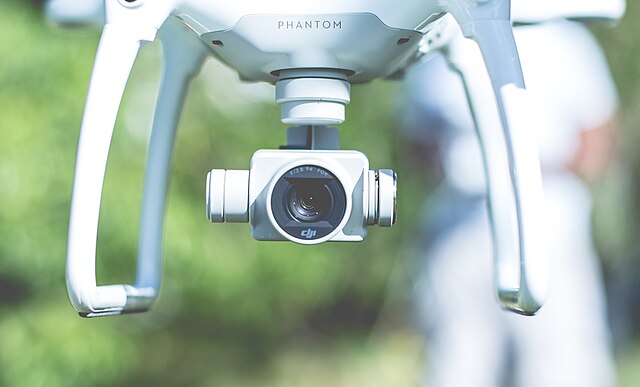
Bring in the drones! Race coverage has dramatically changed with the addition of high quality camera drones. (Photo: Wiki Commons/William Stitt/Unsplash)
Once again, Ski and Snowboard Live will be the United States’ streaming service for viewing cross-country events held outside of the country, and this season, that means every race. Their coverage will include the World Championships and Tour de Ski.
The basic package includes full live races and recorded full race replays on demand, and there are other packages available to tailor to your viewing desires. You can purchase packages which range from paying to watch individual events, to coverage of all Nordic events all season, to an all access package which allows you to watch almost every Alpine, Nordic, Freestyle, and Snowboard event held outside of the United States. The service does not cover Nordic Combined, and Biathlon is on an entirely different platform. To watch Cross-Country on Ski And Snowboard, you do have to pay.
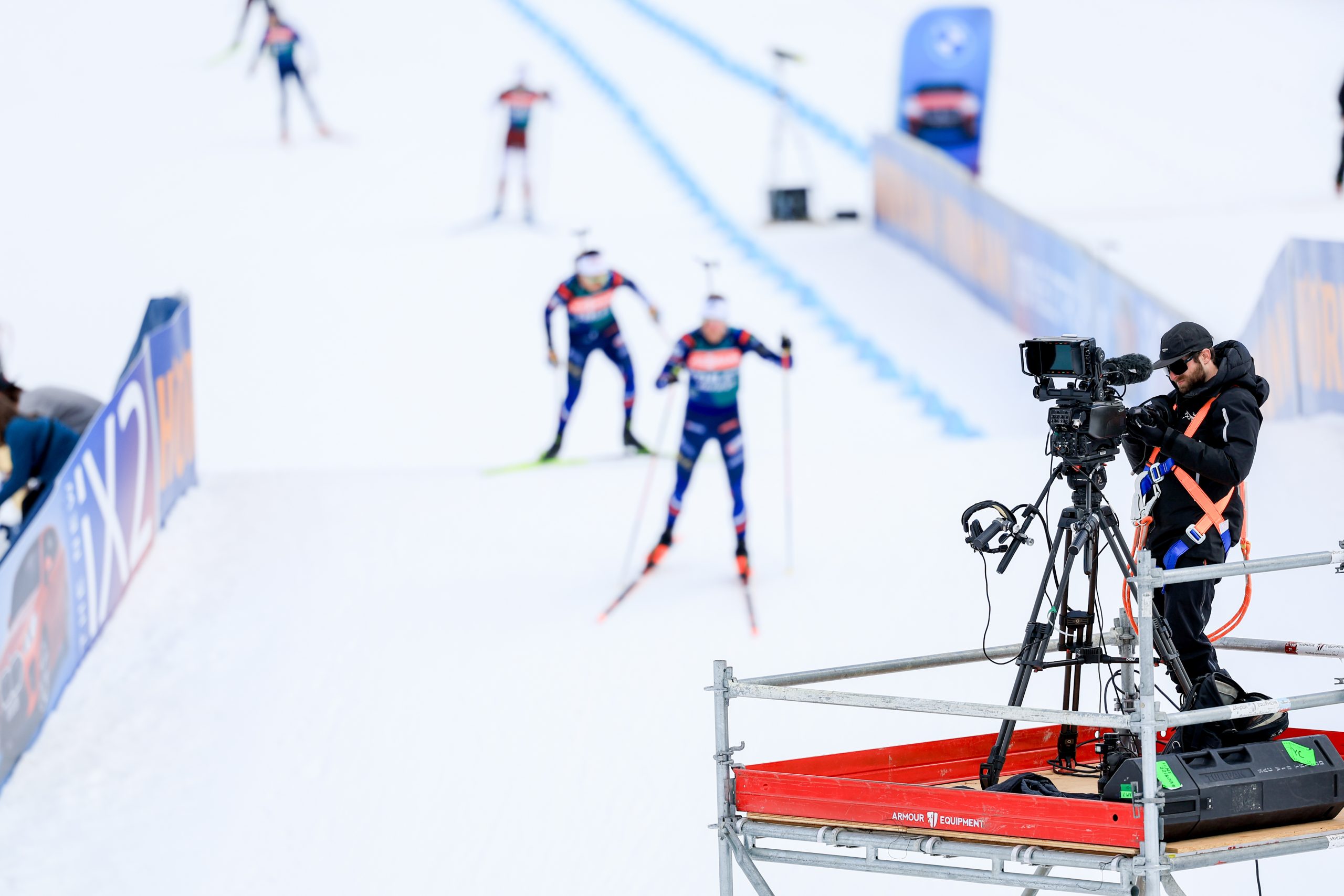
A camera operator getting into position in Canmore, Canada. (Photo: NordicFocus)
The most straightforward package is to pay to watch every Nordic event all season. If you choose this option, as of this publication date, it will cost you $11.99 a month. A subscription also buys you the right to watch condensed replays of events which is a nice feature if you’re crunched for time. For this price you also get to watch Ski Jumping. If watching every race isn’t your thing, you can pay to watch individual events. One little catch is that in Distance races you have to pay separately to watch the men’s and women’s race. But, for Sprints, one payment covers both events. If you’re going to watch more than a few races, it’s generally better to pay for the entire month of unlimited coverage. Payment automatically renews at the end of the monthly cycle on the day you signed up. To avoid paying beyond the period you want to watch, you have to cancel your subscription in advance of an automatic renewal.
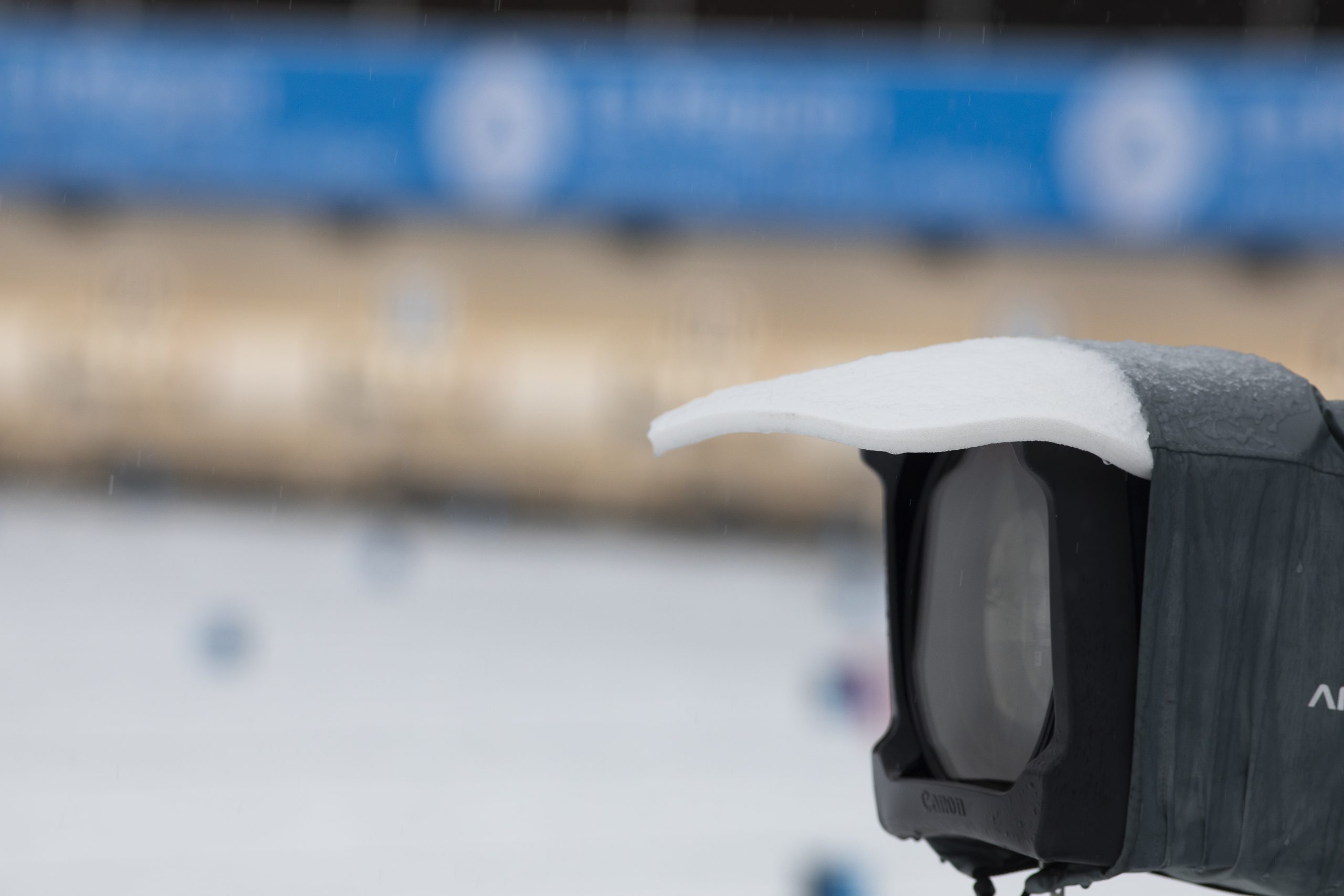
Snow protected cameras are a good omen of good racing to watch. (Photo: NordicFocus)
If you’re a glutton for all things skiing, then there’s a package which gives you unlimited access to every format Ski and Snowboard covers—Alpine, Nordics, Freestyle, and Snowboard— it will set you back $79.99 a year. So, for about twenty dollars more than the cost of subscribing to view every Nordic event in a winter, you would be able to watch every ski event covered. How this choice would affect other parts of your life is up to you to manage. All the services, regardless of which package you choose, are delivered without ads. The service also provides a mobile app for watching on the go.
The commentary is in English, and last year it was often Chad Salmela and Kikkan Randall providing the coverage. No word yet on whether they will be announcing again this year. As a play by play announcing pair, the two have developed into an effective team who have learned to play off each other’s strengths, with Randall acting as an effective analytical balance to Salmela’s sometimes unbridled ebullience. No word yet on whether the duo will return for this season. Last year, almost all of the live broadcasts had commentary, but there were a couple of races when there wasn’t any, or it came in after the broadcast had begun.
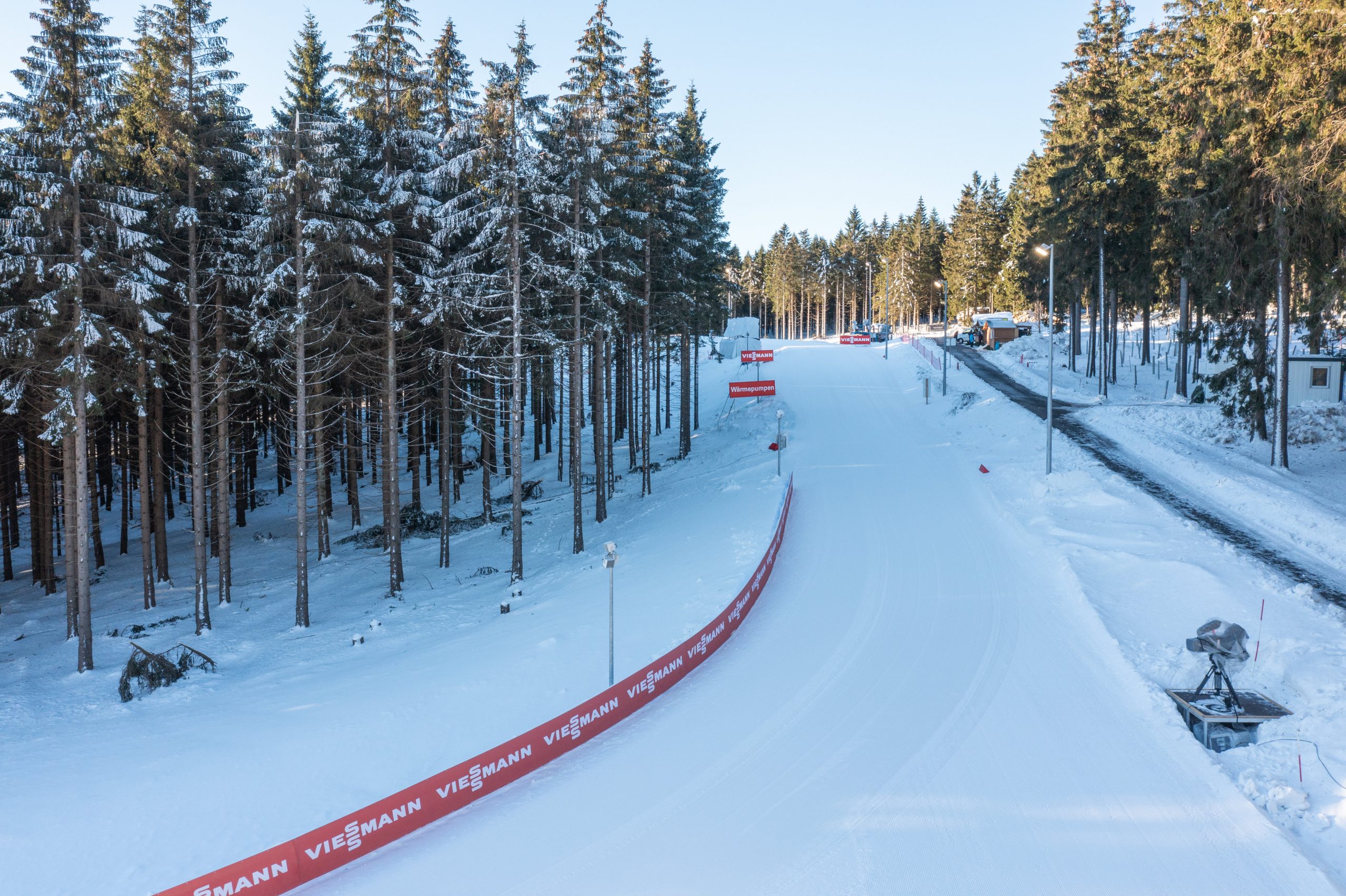
Long track shots are now common place in World Cup race coverage thanks to convenient drone cameras. (Photo: NordicFocus)
The site is easy to navigate, but sometimes the live broadcasts can be glitchy with coverage beginning late or feeds interrupted. But overall, it’s fairly stable with good picture quality. Unfortunately, Ski and Snowboard doesn’t have control over the coverage’s production, so sometimes cameras are cutting away from important moments for North Americans to show action geared for European audiences.
There are other ways to watch cross-country if you want to use a VPN and skirt intellectual property and digital rights ownership. But based upon past experiences, when in the United States, Ski and Snowboard offers the most seamless way to enjoy watching events without feeling guilty about being an international scofflaw, and wondering if Interpol will come knocking at your door.
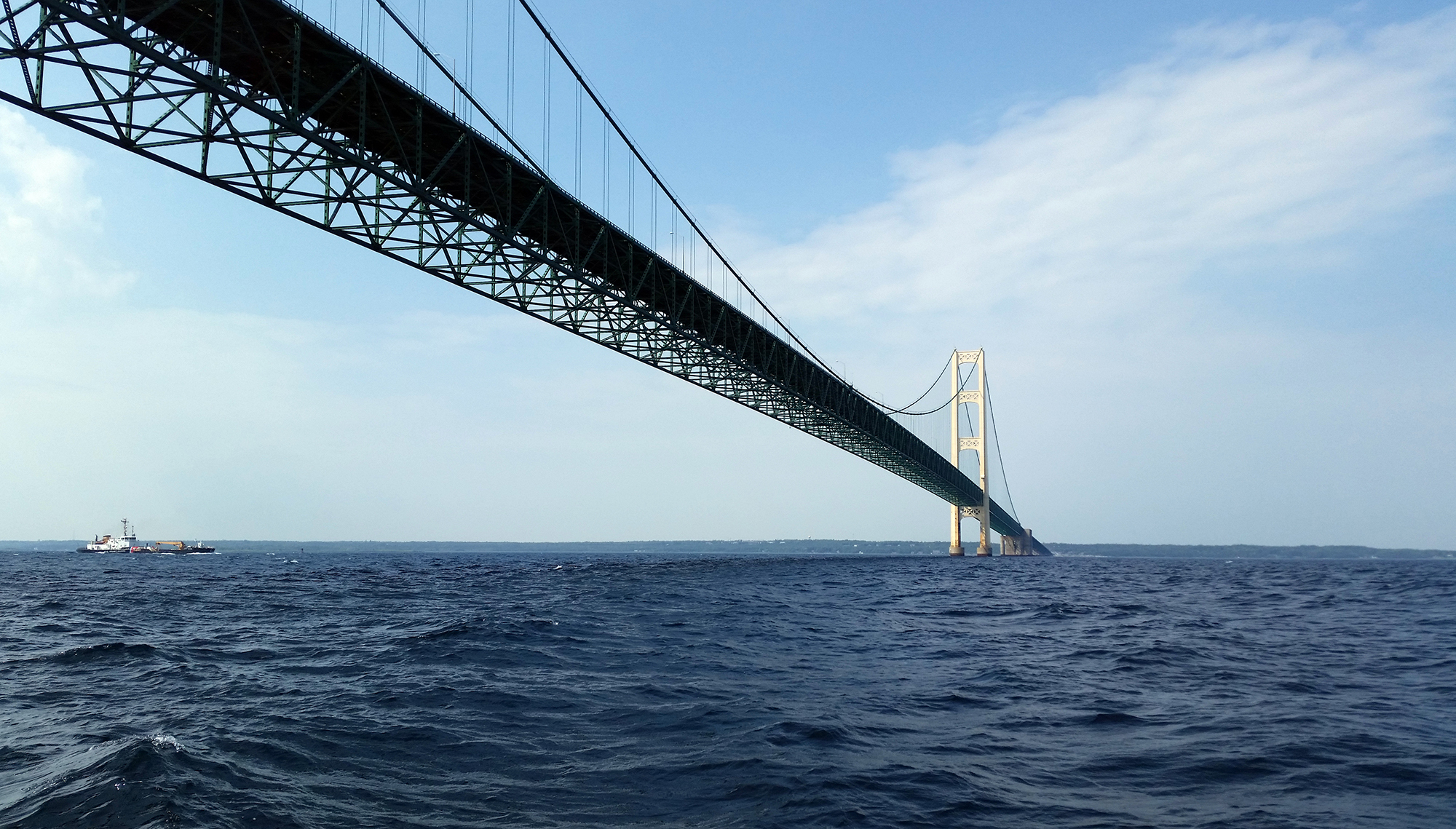
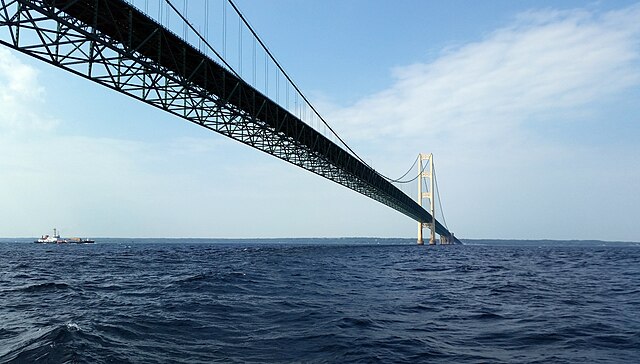
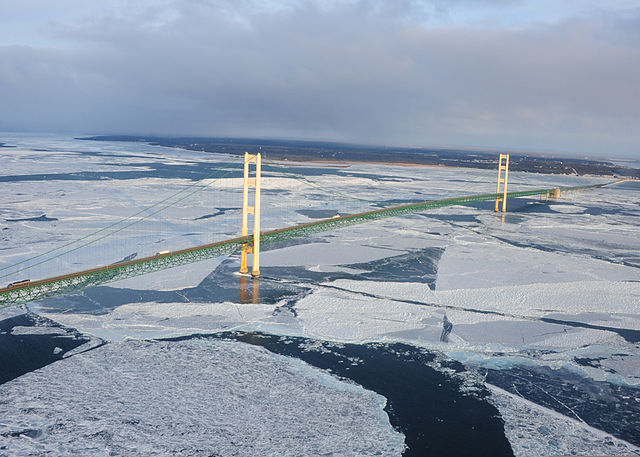
Bobbing up and down in the Mackinac Straits gives you a different perspective on life. (Photo: Wiki Commons David B. Gleason)
Bobbing around in the middle of Lakes Huron and Michigan like a cork in a bathtub while staring up at the intimidating mass of the Mackinac Bridge tends to put things into a different perspective. My perspective was one of incredible insignificance. Everything around me was huge: the lake, the bridge, the distance, the current, and especially the stomach churning, energy sapping swells. I felt incredibly small. How does a guy end up in this position; trying to swim across the Mackinac Straits, a body of water known for its turbulence and ship sinking prowess?
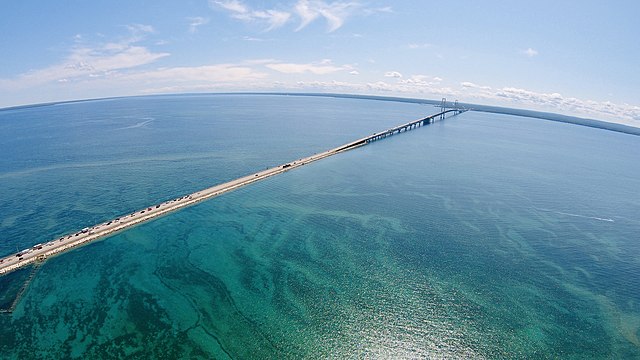
It’s a long way from point A to point B when swimming the Straits. (Photo: Wiki Commons Nick Damico)
For me, the journey began more than eight years ago, when I was suddenly stricken with a debilitating illness which sapped my energy and strength and deprived me of the ability to engage in physical activity any longer than a few minutes. This began when one day I was happily completing the Noquemenon Ski Marathon, and then, a couple of weeks later, I found myself unable to walk around my block. I’ve written about my situation previously, and the exact nature and description of my illness is irrelevant. Lots of people suffer sudden illnesses which radically change their lives. I was now simply lumped in with that group and was trying to find some sort of new normal, and a reset of sorts.
The author and his wife Amy are all smiles at the start. Other facial expressions quickly ensued. (Photo: Julie Staudacher)
For years since my illness began, I had been trying to claw my way back to some level of physical activity— without success— to try to regain a vital part of myself which had been yanked away from me. I still had the desire to compete and push myself, the trick was getting my body to accept any significant workload without making myself sicker. The mind was willing, the body wanted nothing to do with it. When I looked in the mirror, I saw the same guy, but the guy looking back was somehow different— something hard to define was missing. Physical activity had become so intertwined with my self-identity that its absence was redefining who I was—in a way which I really didn’t like. Without it I was still kind of me, but also kind of not.
The road back was tedious, frustrating, and required strict discipline. I had to steadfastly adhere to a protocol of tiny incremental increases in output and work only within the narrowest window of what my body could handle; and never one bit beyond that. Any deviation from the plan would mean days on the couch struggling to regain my footing. My first attempt at a comeback with “real” exercise was about two years after my illness’s onset, after I had finally found doctors who understood and could help manage the symptoms of my condition. My first workout on the comeback trail consisted of exercising on a stationary bike doing three intervals of two minutes with a maximum heart rate of 79, followed by two days rest. This was my starting point. Exercising for six minutes at what had been below zone one and not even previously measurable as exercise was frustrating and seemed pointless. I also had a ceiling on increases in the length of total exercise time which was being limited to a 10 percent increase every three weeks, with an even smaller increase in maximum heart rate. If you do the math, that meant that I could go from two minute intervals to 2:12 minutes after three weeks. At that rate, it would take—and did take— years before I could exercise for long stretches of time like I used to. Another limitation was that any exercise performed where I was standing—and that’s almost everything—was more difficult for me to manage and came with more restrictions. That’s where swimming entered the calculation.
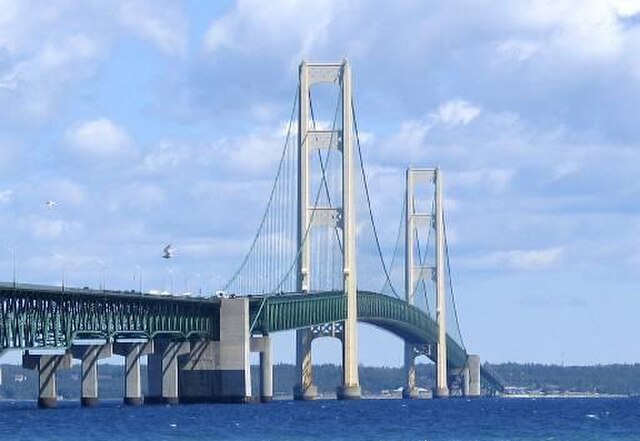
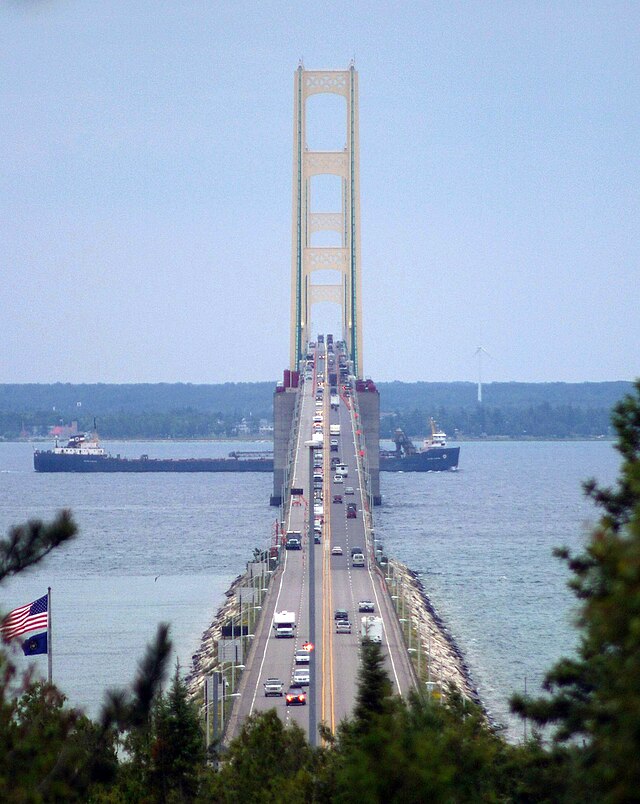
Everything about the Straits is huge, including the bridge. (Photo: Wiki Commons Lars Lentz)
After five years travelling down this road, I had gotten myself back to the point where I could swim a half mile in open water. It wasn’t like any of this was a steady linear progression. There were huge setbacks and crashes along the way. There were also new found muscular and neurologic issues which had to be managed constantly.
The author on the road to Hell. There are several ways to get there. (Photo: Amy Kostrzewa)
Nonetheless, having this newfound ability led me to “compete” in a half mile race in the Swim to the Moon festival of races held outside of Hell, Michigan. Yes, there really is a town called Hell, and it’s actually quite picturesque. I had started at the half mile level, and the following year I worked my way up to the 5-k race which I again competed in this year. I had some unfinished business in that race and wanted to try and crack two hours; the closest I had come in two prior attempts was 2:02:55. But, I was confident that I had another three minutes in me.
Other than the 5-k race—which was a major accomplishment on its own—I decided that I needed to make a real statement to myself. The statement needed to be something bold and inspiring which spoke to my regained abilities, and previously unimagined possibilities. Most importantly, it needed to be something which I wouldn’t have considered achievable, or necessarily reasonable before my illness. I wanted this experience to be something that when I publicly announced it the general response would be “are you crazy?” Completing such an endeavor would send the message to myself that while I might not be what I was before my illness, that at least I was back at some level—a different level. That’s where the Mackinac Bridge Swim comes in.
The start of the Mackinac Bridge swim. (Photo: Courtesy Mackinac Bridge Swim)
Before my illness I was a competent swimmer having completed too many triathlons to count, so I felt comfortable in the water. But I was never—and still am not—particularly fast. I had heard about swimming across the Straits years earlier, but the number of people who had done it was small and the logistics were daunting. The Mackinac Bridge is five miles long and the body of water it crosses is a little less than that. To swim the Straits, you need to cross about 4.5 miles of water, as the crow flies. As it turns out there aren’t any swimmers who can swim as straight as crows can fly.
The story of the building of the Mackinac Bridge is itself a fascinating and daunting saga worth reading about. There are several excellent books on the subject. (Mighty Mac The Official Picture History of the Mackinac Bridge is a good starter) The initial response to any construction proposals were similar to the response I wanted when announcing my bridge swim … are you crazy? For decades, the best engineers in the world said it couldn’t be done until a design genius by the name of David Steinman cracked the code of how to build a structure big enough to allow freighters to comfortably pass under it and to be able to withstand the winds and ice sheets of the Straits. The Mackinac Bridge opened in 1957 and is the longest suspension bridge between anchorages in the Western Hemisphere. It spans 26,372 feet. It is gigantic in every metric. How this seemingly impossible engineering feat actually happened is a story of persistence, ingenuity, and creativity—many of the same traits which I hoped to bring to bear on my new found goal. It seemed like the perfect match.
It took decades of engineering and a novel design to overcome the Strait’s challenges for a bridge. (Photo: Wiki Commons George Degener)
It was by chance that I then stumbled across an event called the Mackinac Bridge Swim. This is an organized event—not a race—which gives swimmers who meet the qualifying criteria an opportunity to swim the Straits in an organized safe fashion. Being an event instead of a race helps bring a level of safety to a potentially perilous undertaking. When people race, they tend to do stupid things. When they are trying to complete a goal, a certain amount of reason may prevail—maybe.
It takes a small armada of volunteers; kayakers and boaters to keep swimmers safe. (Photo: Courtesy Mackinac Bridge Swim)
There are lots of logistics for organizers to arrange. The event includes obtaining permits from the Coast Guard, Homeland Security, and other agencies. Scores of motor boats and kayaks also need to be procured and organized to ensure safety. Then there are the freighters. The Straits are one of the busiest shipping channels in the Western Hemisphere. Great Lakes freighters are huge, incredibly fast moving, and don’t slow down for anything, including avoiding swimmers. So there has to be a plan for that—more on that later.
It was with more than a little trepidation that I signed up for the event, along with my wife, who for family reasons has a very strong emotional attachment to the Straits area. To make the summer-long training odyssey really complete, I again signed up for another Swim to the Moon 5-k race which would occur a couple of weeks after the Bridge swim, and also ended up registering for the Teal Lake Swim in Negaunee, Michigan, which is the weekend after the Bridge swim. It was now a full slate of summer swimming.
So that’s the long introduction to how I found myself bobbing up and down in the water under the Mackinac Bridge questioning my sanity and whether I had any rational thinking processes left in my brain.
As an aside, I’ve really enjoyed the shift during the summer from roller skiing to swim training. It may not bring the same fitness levels as ski training does, but it gives the body a break and the mind a reset. Prior to swim training, I had focused on summer ski training for over 30 years. The change felt good, and more sustainable. I also think it’s really valuable as we age to force your body to learn new movement patterns. It took a lot of brain power as I tried to master improving swim technique and to reprogram my body’s autonomic swim style. And once your reach a certain age, going through that process has to provide some type of neuroplasticity benefit.
Learning good swim technique is a lot like learning ski technique. There are different gears for different conditions. (Photo: Wiki Commons: Public Domain)
There are a lot of similarities between long distance swimming and skiing. Much like a 50-k ski race, there are many variable components to work out before and during the event. There’s swim technique, which is very analogous to skating and striding. There are also gear considerations such as wetsuits—style and thickness, swim caps—thermal or thin, and swim buoys (inflatable safety tubes that attach to the waist by a line and are used if you need to rest and can’t tread water, but don’t aid in forward propulsion or buoyancy), and nutrition. A plan for these all needs to be sorted out before the race begins. Also, much like a ski race, several of the strategic components can’t be decided upon until the morning of the race when you can see exactly what conditions are like.
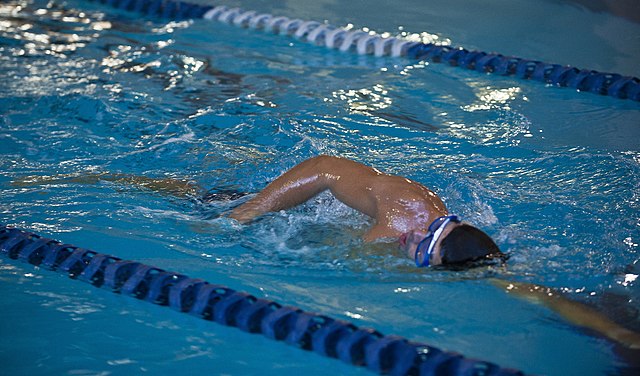
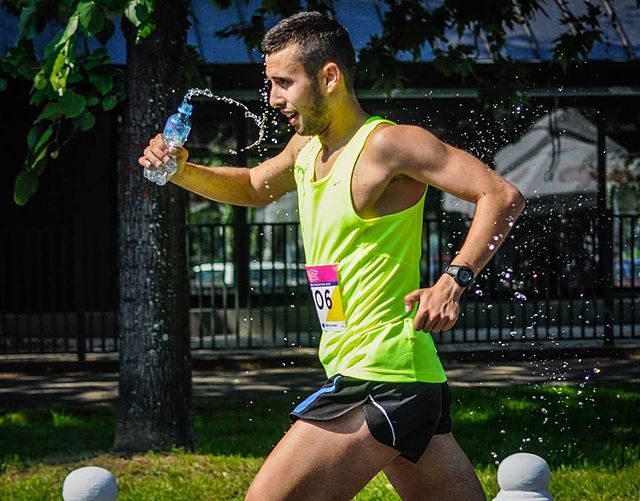
Getting a drink running can be difficult. Doing it while swimming is an entire different level of challenge. (Photo: Wiki Commons Matinoli)
Nutrition is one of the trickiest parts since consuming food and swimming aren’t naturally complementary activities. Everyone has heard the admonition against swimming within an hour of eating. Well, you can consume food while you swim just like in a ski race, and you don’t get out of the water and wait for an hour-sorry mom.
There are almost as many ways to take on nutrition during a swim as there are people doing an event. But the big difference for the Bridge swim is that you can only consume what you have on you. There aren’t any boats handing out aid, and wetsuits don’t have pockets, so people contrive all manner of contraptions to try and tote sport drink and gels along with them.
After a summer of training, it was finally go time at the south side of the bridge. The south tower looms in the distance. (Photo: Courtesy Mackinac Bridge Swim)
After an entire summer of preparation, the race date of July 20th was finally upon us. Race morning looked clear and calm, as about 160 participants gathered on the beach at the base of the south side of Mackinac Bridge. Once we were in the water the calmness quickly dissolved. The unpredictable Straits current was quickly rearing its ugly head. After only a couple of minutes it became very obvious that things were going to develop differently than hoped for. Once we cleared the initial shoreline you could immediately feel the pounding of the waves and the force of the swells pushing you away from the bridge.
Seagull provides detailed data on water temperature, current, and winds, but conditions change so fast you don’t know until just before the swim what it will really be like. (Photo: https://glos.org/priorities/seagull/)
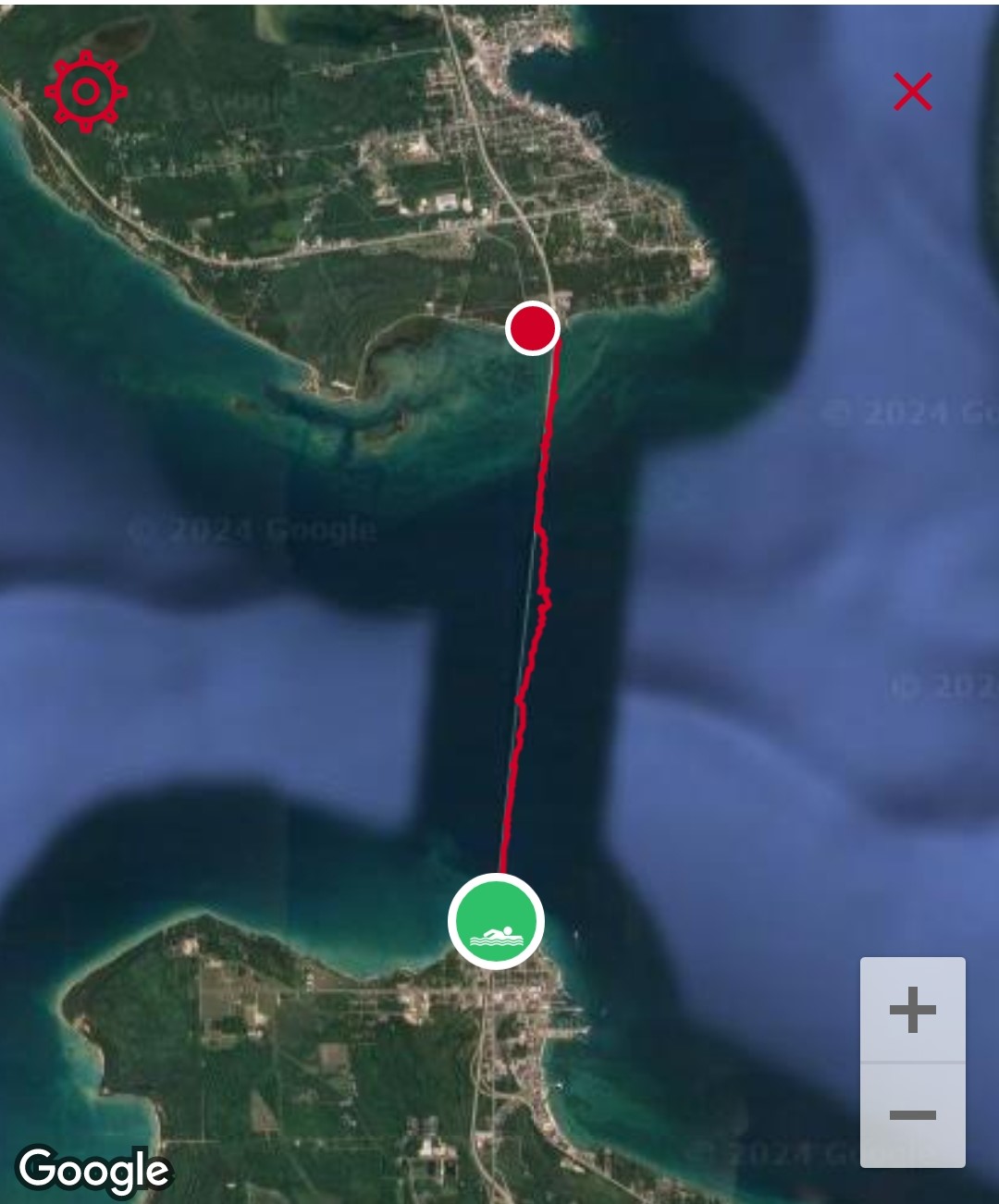
The swim is essentially south to north, and you are required to keep the bridge on your left and to stay within 100 yards of it as you are heading north. The current was pushing hard from the due west constantly driving you away from the bridge and requiring you swim on a diagonal to prevent being pushed off course. My pre-swim plan was to predominantly breath on the left so you could constantly see the bridge and better stay on the course. This plan quickly went out the window as each time that I breathed on my left I was hit with a wall of Lake Michigan water in my mouth. I quickly switched to breathing on the right. This isn’t unlike being in a ski race when conditions force you to V-1 on either the left or right side, but it meant that it was now even harder to stay on course.
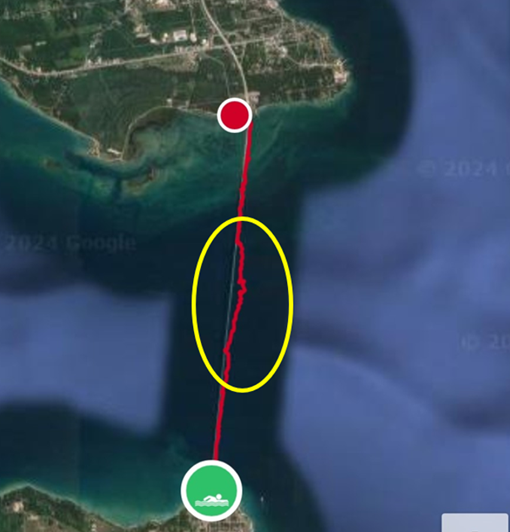
As the author’s GPS watch shows, you can’t really swim straight–in the Straits. (Photo: Ken Roth)
After about 20 minutes we were well clear of the beach and things were not going well. I was struggling against the waves and the current which were both much more powerful than anything I had trained in. Because of this, I was using way more energy than I was accustomed to. Also, I was beginning to get seasick and dizzy; as it turns out, so was just about everyone else. Of equal importance was that because of being constantly on the verge of reverse peristalsis (ok–vomiting), I wasn’t able to take on any of my sport drink. Some people can do a three hour swim without nutrition— I cannot. The rumblings in my belly and pounding in my head were a clear message that I wouldn’t be able to drink much, if anything. At this point, after a scant 20 minutes, I already had thoughts about abandoning the swim. The negative thoughts were ramping up and gaining ground on me quickly. With about three hours of swimming ahead, I thought there was no way I could continue in these circumstances.
Conditions looked good at the start, but quickly deteriorated. (Photo: Courtesy Mackinac Bridge Swim)
Over the summer I had developed the mindset that the only way I wasn’t going to complete the event was if they plucked my unconscious body out of the water. Well, the early sea sickness quickly broke that resolve, and I was on the border of quitting. But then, I began to think back on the longer journey— the two minute intervals on the bike— and the endless days laying on the couch exhausted. I began to think about how far I had travelled and what it had taken to get here—lots of tiny steps. I then made a new deal with myself. The new bargain I negotiated on the spot was, “just give it five more minutes, you can do almost anything for five minutes, right?” So that’s how it continued for another half hour or so—six or seven sessions of self-negotiation— until I hit the first anchor block.
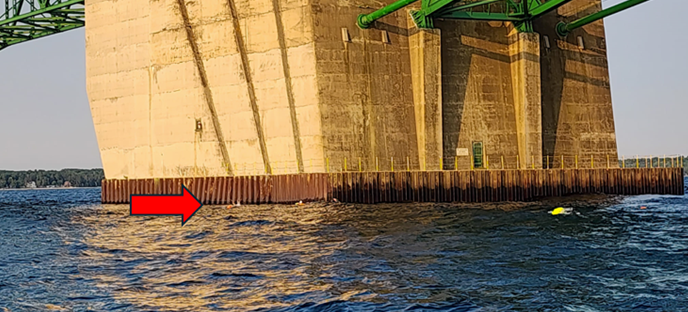
One of the bridge’s two enormous anchor blocks. The cables which hold up the bridge enter the blocks and are encased in concrete. Middle/right is a swimmer’s yellow buoy. The dots the red arrow are pointing to are other swimmers. (Photo: Courtesy Mackinac Bridge Swim)
The anchor blocks are huge concrete structures sunk into the lake bed which hold the 42,000 miles of wires which make up the main cables (that’s correct, 42,000 miles of wires) which support the span. The blocks are concrete giants and large enough to create calm water on their leeward side, which in this case meant there was a nice little section of flat water to rest in, which is exactly what I, and dozens of other people chose to do. We were all firmly clutching onto our float buoys while gathering ourselves as best as we could. I was able to choke down a few sips of sports drink and was starting to feel a little bit better about my chances of completing the swim.
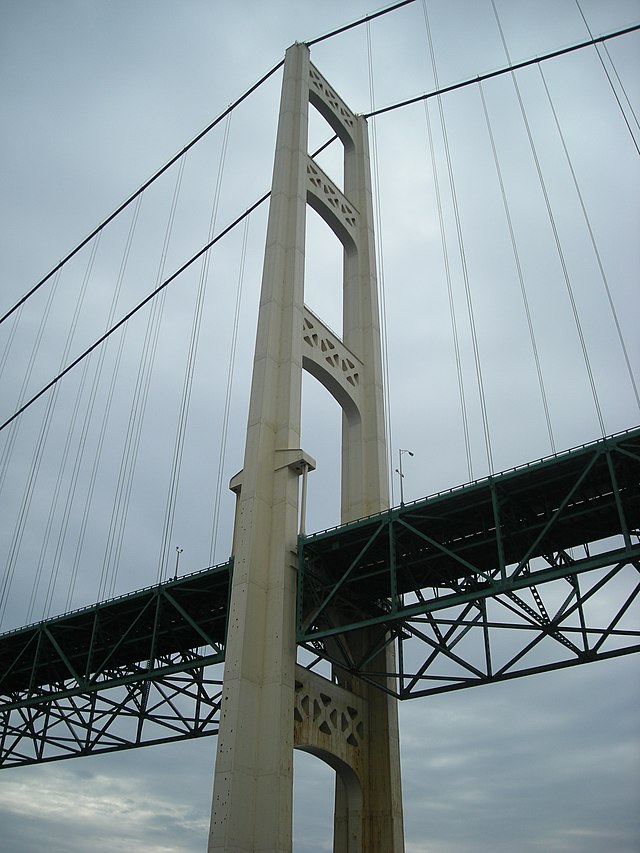
As you continue your swim north from this point you soon really enter the heart of the matter as you are now swimming in the middle of the maelstrom created by the confluence of Lakes Michigan and Huron. You are also shortly reaching the point of the base of the south tower which supports the tops of the suspension cables. The towers are an intimidating 550 feet above the water’s surface and extend over 200 feet below the waterline. So, you’re essentially bobbing around the base of about a 40 story tall skyscraper with about another 14 stories below you.
Approaching the south tower provided both a sense of relief and anxiety. (Photo: Wiki Commons Michael Barera)
As I neared the tower I was feeling a little bit better and was now getting ready for the mad dash between the two main towers which define the shipping channel. The channel is about 3,800 feet long, and an ominous 295 feet deep. In this void there is nothing except you, a few other swimmers you may see at times, the lakes, and any freighters which may come barreling down the pathway. Because of the fast moving freighters, there are very strict rules of conduct between the two towers. If a freighter is sighted, regardless of how close you are to one of the towers and being out of the shipping lane you must immediately swim to a safety boat; no negotiating.
Here’s your problem. Just a bit off course. (Photo: Ken Roth)
The increase in current in the shipping lane was very noticeable, and as I continued to swim, I saw that I was annoyingly close to one of the safety boats—couldn’t this guy see me? I began to get concerned that the swells might be large enough that the boat’s crew couldn’t see my lone figure flailing away in the water. The boat began to get closer and closer, and I began to get more and more anxious and annoyed. Only then did I realize what was happening. The current was so strong that it had pushed me far east and I was now in danger of being off the course and having my day come to a close. Once I realized this, I began to swim with my head pointed straight at the bridge. I was now swimming due west on a south to north course, while in the middle of the shipping channel; to say this was not ideal is a bit of an understatement.
After about 10 minutes of swimming due west, I managed to pull myself close to the edge of the bridge’s overhang. I was now only about a minute from the North tower and would soon have one of the swim’s critical stages behind me. The second (north) tower where the race’s initial time cutoff is measured. If you miss the cutoff (two hours), your day is done, once again no negotiating.
Freighters are huge, fast, cast giant wakes, and can’t stop for anything. (Photo: Wiki Commons J. Dykstra)
It was then that I saw the red flags on one of the safety boats and heard the volunteers yelling. This was the warning that a freighter was in the channel, and everyone had to get out of the water. I was so close to being free of the shipping channel that for a moment I considered pretending not to see the flags, fortunately that feeling only lasted for a second.
The sight of a freighter bearing down on you quickly removes any desire to stay in the water. (Photo: Wiki Commons NOAA Great Lakes Environmental Research Laboratory)
Freighters are huge, move fast, and cast gigantic wakes. But when you’re in the water and they’re heading straight at you, they take on an entirely different and downright menacing perspective. They now appear as incredible giant sea monsters aiming straight for you and appear to move at about the speed of a small plane. I didn’t argue with the volunteers and gladly clambered aboard the safety boat along with several fellow swimmers.
We were all safely clutching the railing while sitting on the stern of the roughly 25 foot vessel. We all had a forlorn grim look of concern and doubt on our faces. Most of us were feeling seasick and a couple openly questioned whether they should carry on. I put on a brave face and said that the worst was probably behind us—I was lying.
Before getting on board the boat, I had been feeling a little bit better. But the boat was rocking and being tossed about more than I had been while in the water. I was getting really sick again and was again questioning carrying on. I renewed the five minute bargaining sessions process.
It can get surprisingly lonely during the Straits swim. (Photo: Courtesy Mackinac Bridge Swim)
The boat took us out of harm’s way from the freighter and deposited us by the north tower. I had only been about a minute away from the tower when I was pulled from the water, but because the captain didn’t want to get too close to the bridge, I was more than a minute away from the tower when I said thank you to the volunteers and farewell to my fellow swimmers and jumped back into the water. I was rewarded by having my goggles ripped off my face and had to struggle to put them back on and drain the water from them. I never was able to find out if all of my shipmates chose to make it back into the water, or if they completed the swim.
After a couple of hard minutes of swimming I was bobbing around the base of the north tower and actually able to take some time to admire its grandeur. But there wasn’t much time to take in the view. A lot of time had passed since the start, and I was beginning to get fatigued. I hadn’t been able to take on any nutrition since the first anchor block and the effects were starting to show. Unlike a ski race, if you’re in trouble, you can’t just pull over and take a couple of relaxing breaths or slow to a crawl to gather yourself. The lake keeps pounding away, and every second spent floating in the water without moving north is a second of energy lost which could have been used to swim.
The north anchor block is a milestone and offers shelter, but once you reach it there’s still a long way to go. (Photo: Wiki Commons)
I put my head back down into the water and doggedly continued my journey north. At about the time I reached the north anchor block the effects of lack of nutrition really began to take their toll. My calves began to cramp, then my hamstrings. Cramping is the bane of long distance swimmers’ existence. I still had miles to go, no way to take on any food to help with the cramping, and was still being pounded by the big swells. Things were not going well—again. I was once again back to bargaining with myself to swim in five minute increments. “Just give it five more minutes and things may turn around.”
Whether you’re in or out of the water, the bridge dominates your view. (Photo: Courtesy Mackinac Bridge Swim)
I trudged north for what felt like an eternity, but was probably only 30 minutes, and I was suddenly struck with a great sense of relief due to a Mighty Mac engineering quirk. As I mentioned, the construction of the bridge had been deemed to be an engineering impossibility. A remnant of a failed bridge attempt from the 1940s is a 4,200 foot long causeway extending from the north side of the Straits which the successful builders incorporated into their design to save time and money. I had just hit the point where I was on the leeward side of this causeway and was at long last comfortably sheltered from the swells and waves. More importantly, for the first time all day the fickle Straits’ current had shifted, and I had a nice current going my direction. It’s a lot like being on a century bike ride battling the wind all day when you hit the turnaround point and the wind is now at your back. I finally felt like I could do something resembling swimming and not just flailing in the water trying to survive. I had known about the causeway and had been warned that this spot was a trap. From here you can see the north shore, and it seems like you are almost done. The reality is that from this point there is still about a mile to go. But the sheltered swimming was such a relief that my spirits immediately lifted and for the first time all day I felt like the odds were finally in my favor. I still had about an hour to go, and a lot can happen in an hour, but now my mindset was better than it had been all day, and with it my body began to respond. I even tried to take on some sports drink, but quickly found that things in the digestion department hadn’t changed.
Hitting the causeway dramatically changes the water’s current. (Photo: Courtesy Mackinac Bridge Swim)
Even though I was tired, it felt great to swim aided by the current, instead of fighting it, and it felt wonderful to be able to use real swimming technique. As you head north along the causeway, there is one more major stumbling block to overcome. You are swimming on the east side of the bridge causeway which is solid rock. The finish is on the west side. To get to the finish, you have to swim under the causeway through a large culvert. Again, due to the confluence of the two great lakes, the current in the causeway can be fierce. We had been cautioned about this by the event’s organizers and had been urged to save some energy to fight the current. You have to push hard against the current for about a minute, which amounts to doing one hard interval after three hours in the water. But it turned out to be very manageable, and compared to the pounding of the open water was actually somewhat anti-climactic.
The other side of the causeway was a bit of another false finish. After you emerge from the causeway’s gaping exit, you are now on the Lake Michigan side of the bridge. The geographic geometry changes and the waves were now smacking me straight in the face. With about 15 minutes to go to reach the finish it was Lake Michigan’s last ditch effort to keep me from finishing. It sounds silly, but it felt like things had gotten personal. But at long last the end was now in sight. A huge American flag hung from the top of a fire truck’s extended ladder in the finish area to highlight the finish line, or in the event’s parlance, the “I did it line.”
Fortunately, there were lots of volunteers at the finish to help with wobbly leg syndrome. (Photo: Courtesy Mackinac Bridge Swim)
After several hours in the water most people’s legs are like rubber and fortunately there are volunteers to help swimmers walk onto the shore, otherwise, you would literally have to resort to crawling on your hands and knees. I emerged shaken and stirred—three hours and ten minutes from when I had started— and greatly relieved to be finished.
Once you finish you get to ring the bell. (Photo: Courtesy Mackinac Bridge Swim)
Every participant was greeted by the event’s organizer, Eric Hansen. When he asked me how it went, I replied, “it was really a lot rougher than anything I had imagined.” His response was, “I didn’t say it was going to be easy, just that it would be worth it.” He was right.
I stumbled my way along the beach and tried to find my relatives and my wife, who I had assumed had beaten me to the finish. The horizon refused to stay level and jumped up and down like a stuttering old movie reel that wasn’t being played properly as my equilibrium tried to re-establish itself. I found my relatives, and my wife, but she was crumpled over in a chair with her head between her legs. The seasickness had completely overwhelmed her— and many others— and she had to withdraw. But she is not easily deterred and has already made plans for next year’s revenge tour— I’m on the fence about a rematch. I feel like I kind of got away with something and don’t necessarily want to tempt fate.
After the event people asked me how it was and if I would do it again. Swimming across the Straits was incredibly hard. It wasn’t the hardest physical thing I’ve ever done. I’ve had plenty of ski races where I felt way worse for days after. But it was unquestionably the hardest athletic event mentally I’ve ever done. The relentless intimidation of the big water, and the dire effects of seasickness sap your energy, focus, and desire unlike anything else I’ve ever encountered. It’s like that old joke about wrestling with an 800 pound gorilla; you don’t quit when you’re tired, you quit when the gorilla’s tired.
The bridge swim is a fundraiser for Strait’s area first responders. It raised over $50,000 (Photo: Courtesy Mackinac Bridge Swim)
Open water swimming is kind of like that. Lake Michigan doesn’t care how tired or sick you are. It doesn’t care about how long your journey to get to this place has been. It just keeps on pounding away. Maybe it’s a nice day and the lake will be like glass, and you will have a beautiful swim. Or, maybe, it’s like what we experienced where it’s like a washing machine and you feel and look like a ragged garment that was on the spin cycle way too long—but just like doing the dirty laundry, it was worth it.
Please return to FasterSkier for Part II of the Old Man and the Bridge.
Completing the Bridge’s construction was such an accomplishment that it even warranted a postage stamp. (Photo: Wiki Commons Bureau of Engraving and Printing)
Kikkan Randall shares life’s highs and lows during the short film “Kikkan” (Photo: WikiCommons)
For those of us suffering from the post-ski-season let down—or for those who simply can’t get enough ski-related content—an effective way to help address these issues will be to take 46 minutes to view “Kikkan,” a nicely produced short documentary about the life of Kikkan Randall. Presented (sponsored) by L.L. Bean and Providence Health Alaska, the film includes details of Randall’s childhood, ski career, cancer struggle, and personal life.
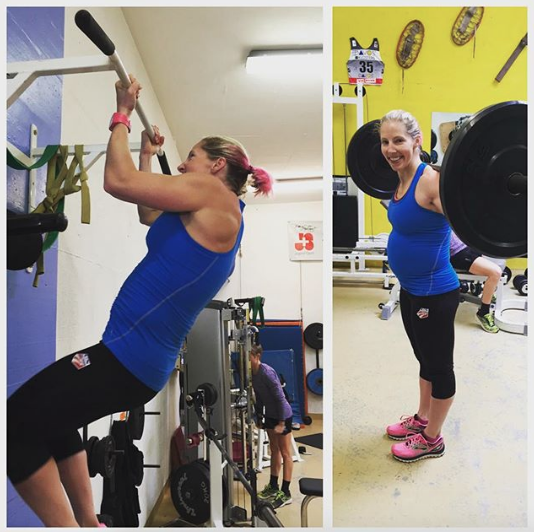
Kikkan Randall had well publicized workouts during her pregnancy. (Photo: Instagram @kikkanimal)
The movie is a candid chronological biopic of an athlete who has faced daunting challenges, and unlike many cinematic athletic biographies it does not quickly regress into a warm sepia toned homage to the subject. Instead, the film is a frank look at a life full of ecstatic highs, searing lows, and Randall’s continuing ability to deal with her life’s challenges.
Sadie Maubet Bjornsen joins the film’s guest and talks about losing out to Randall for a spot on the 2018 Team Relay. (Photo: Sadie Maubet Bjornsen)
Randall delves into chapters of her life which most viewers will be familiar with, but there is a lot more detail than the average viewer already knows; the details are quite interesting. Among those more interesting details are interviews with Sadie Bjornsen regarding Randall’s late-hour inclusion in—and Bjornsen’s subsequent exclusion from—the 2018 Pyeongchang Olympic Team Sprint. Bjornsen provides some context to a story that many are familiar with, but probably don’t know the details that she reveals. It’s another very candid portion of the film that helps viewers connect emotionally.
Jessie Diggins and a host of other North American cross-country celebrities make appearances in the film. (Photo: NordicFocus)
The movie is also packed full of familiar names and faces with Erike Flora, Sophie Hamilton, Holly Brooks, Liz Stephen, and Jessie Diggins also making appearances. Randall’s parents are also interviewed.
Randall discusses her early Olympic disappointments and her final Olympic highpoint of winning a gold medal with Jessie Diggins. She also addresses the challenges of having a family while being a professional athlete.
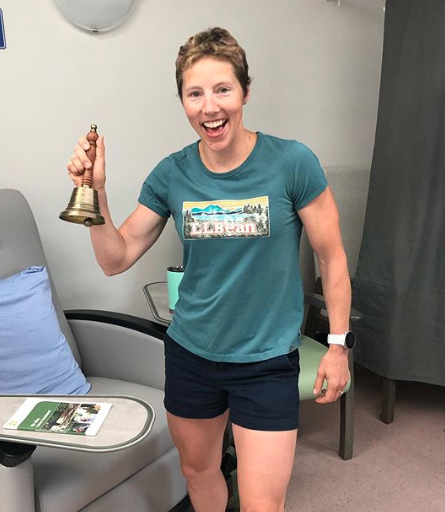
Kikkan Randall rings the bell marking her final Herceptin infusion in July 2019. (Photo: Instagram @kikkanimal)
There is much time spent on Randall’s breast cancer diagnosis and treatment. It’s in this part of the movie where Randall really lets the viewers in, and where the emotional connection happens, mostly because Randall is more open and emotional about raw details of her life than she has ever publicly been. It’s a chapter of her life which for many people might have been the beginning of a slide into a long downward spiral, but like most things in her life, Randall rose up to meet things on her own terms. She also talks briefly about her 2021 divorce from Jeff Ellis, occurring shortly after her cancer treatment had ended and subsequently forcing her to go through the pandemic as a single mother.
There are also enough training and ski scenes to keep viewers entertained.
The short film is generally well produced with nice, but sometimes duplicated, footage of Randall skiing in Alaska. These shots are aided by sweeping overhead drone footage (the inclusion of high-quality aerial footage available through drones has been as much of a game-changer for lower-budget productions as the first fiberglass skis were for cross-country.) There is one distracting audio section that would never make it into a major theatrical film, but it’s over quickly and might add a homespun feel—or not. There are also some mildly annoying border framing effects and added scratching/graininess effects whenever old photos are shown. This kind of easy special effects unfortunately now happens regularly in modest budget films since such effects are so readily available to include and some think add a sense of higher production values. Regardless of these production choices, the movie is enjoyable to watch and informative.
“Kikkan” is well worth the 46 minutes to watch. It will make you feel a connection to one of North America’s cross-country skiing legends that you might not have had previously. It will also help you to transition from the ski trail to whatever else it is you do in the spring and summer. “Kikkan” is now available to view for free on YouTube https://www.youtube.com/watch?v=GiNCCHXzdRU
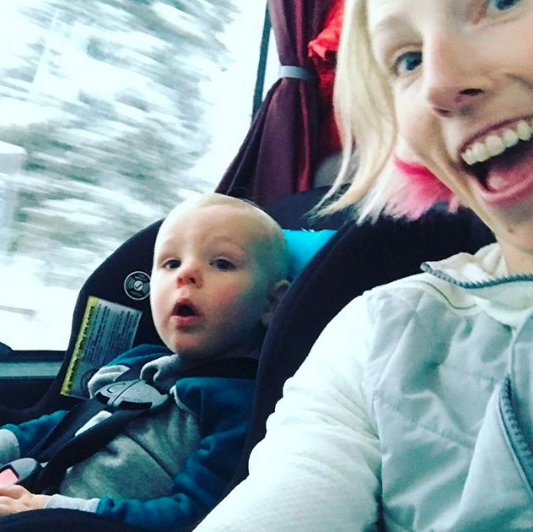
Kikkan Randall travels with her son, Breck, between World Cup race venues. (Photo: Instagram @kikkanimal)
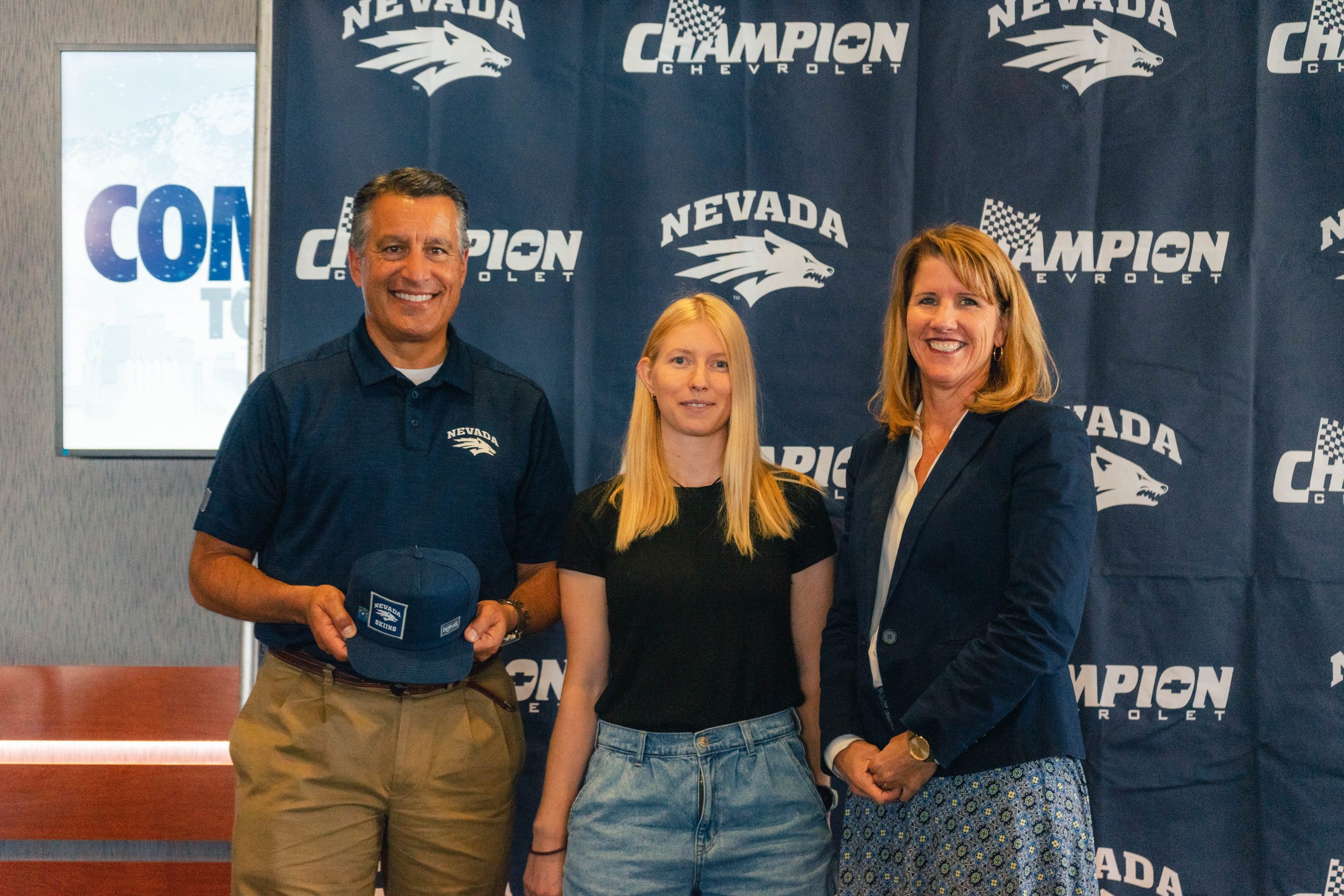
In a press conference on Wednesday, the University of Nevada, Reno (UNR) announced that it will once again support a Division I ski team, starting this season. For the time being however, the program will only have alpine skiing.
Both the president of the university and the university’s athletic director were present for the announcement, marking the moment. “It has been truly amazing to see how much the program’s return has energized our community,” said Nevada Athletics Director, Stephanie Rempe, “We look forward to this new era of Nevada Skiing and continuing the program’s rich, proud tradition.”
University of Nevada, Reno President- Brian Sandoval, UNR Alpine Coach- Mihaela Kosi, and Athletic Director Stephanie Rempe (left to right) (photo: Nevada Athletics)
But they acknowledged that having a nordic team is part of that equation, stating a plan to add nordic as soon as it is feasible (i.e. in the budget).
For many decades, beginning in 1936 when skiing was first established at the University, UNR had a successful team that hosted both cross-country and alpine skiing. Over that time, the program produced four Olympians (including Katerina Hanusova Nash, who represented the Czech Republic at five Olympics, three times in cross-country skiing and twice in mountain biking) and earned 14 top-10 team finishes at NCAA Championships. But in 2010 the ski program was cut.
The reinstatement of skiing at UNR was made possible by the University’s recent acquisition of Sierra Nevada University, which had an alpine team already in place. This season’s alpine roster will be composed primarily of athletes who had previously been competing at Sierra Nevada University, with the addition of a few new skiers and transfer students.
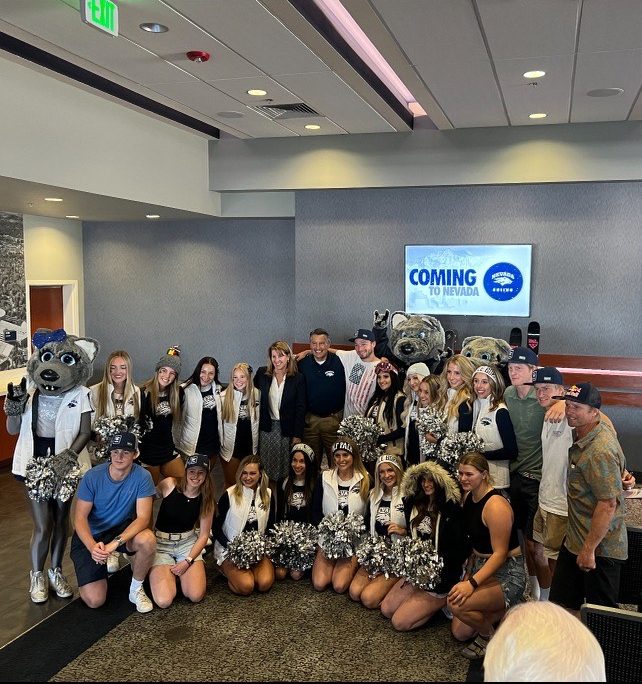
UNR cheer squad, athletic staff, current alpine team members, with Olympians Daron Rahlves, and David Wise at the press conference Wednesday (photo: Gus Johnson)
UNR’s ski team will compete as part of the Rocky Mountain Intercollegiate Ski Association (RMISA), which currently has nine member schools, though only five have both alpine and nordic programs.
“We’ve kind of let it be known to the athletic department that if they want to be competitive on the NCAA circuit, they’re going to need to fit in alpine and nordic,” said Gus Johnson, former racer for the UNR cross-country ski team and current advocate for that program’s return. Johnson is also a member of the UNR Ski Team Boosters and nordic sports director for Auburn Ski Club (ASC).
While there are only a handful of people working to bring back nordic to UNR at the moment, Johnson is hopeful about the future, “Being a Division I school, championships are important to them, so they realize that they need to get nordic started and it’s probably two or three years down the road,” he said.
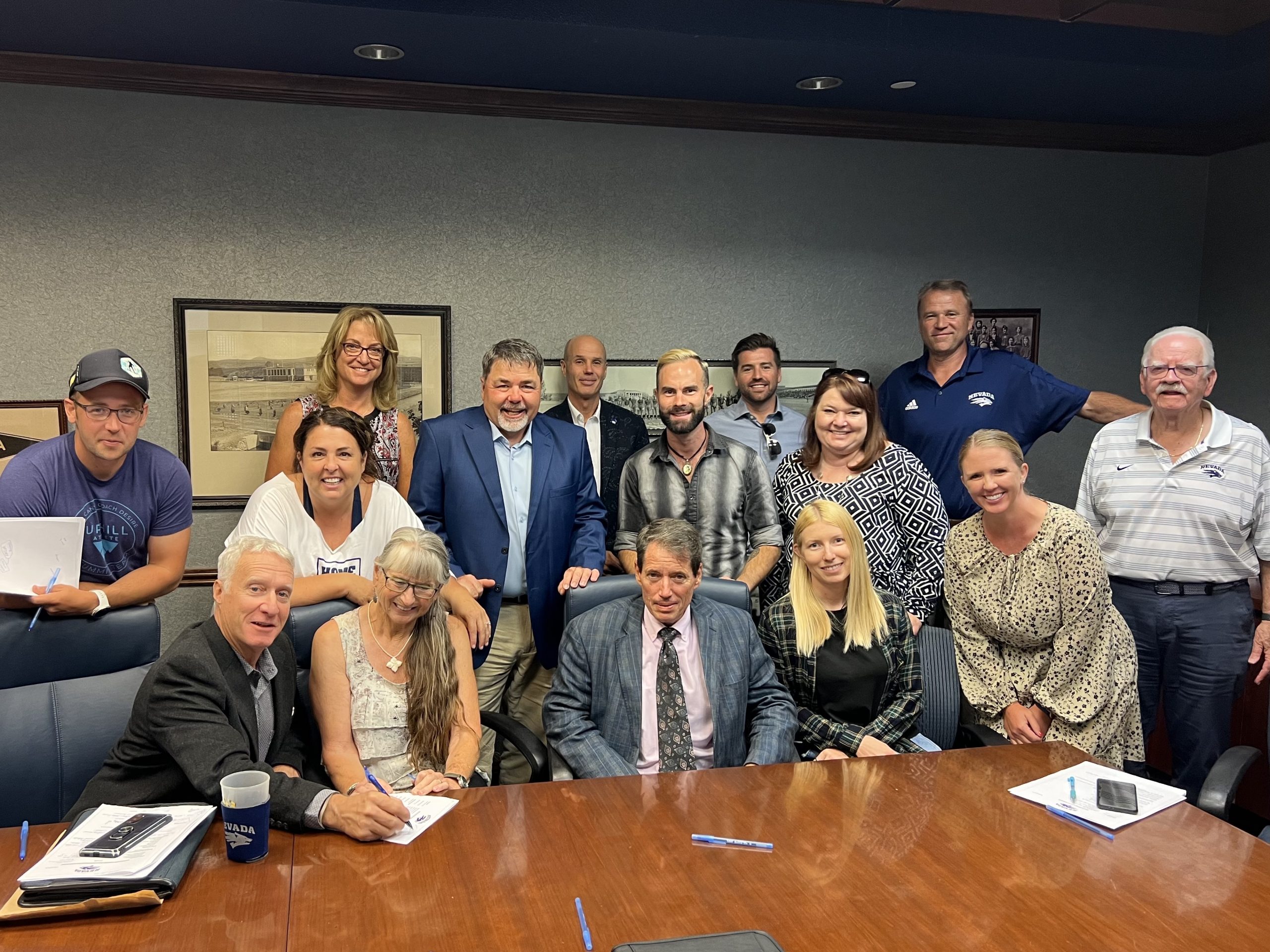
UNR Ski Team boosters and athletic staff (photo: Gus Johnson)
Athletic programs getting cut from college budgets is not unusual, the University of New Mexico is perhaps the most recent skiing example, but it is less common to see those programs make a return. “It’s pretty rare that NCAA programs get reinstated,” said Johnson, “So there’s a glimmer of hope that nordic will be the next step.”
Readers interested in learning more about the effort to add nordic should contact Johnson.
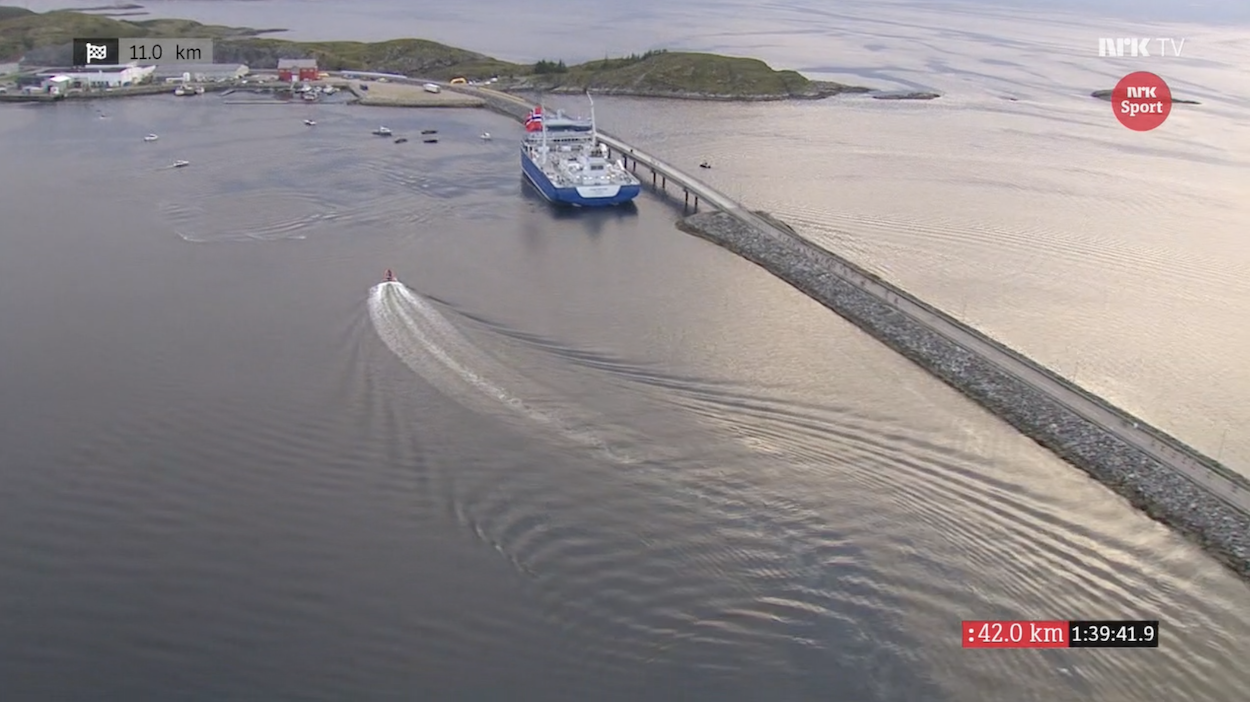
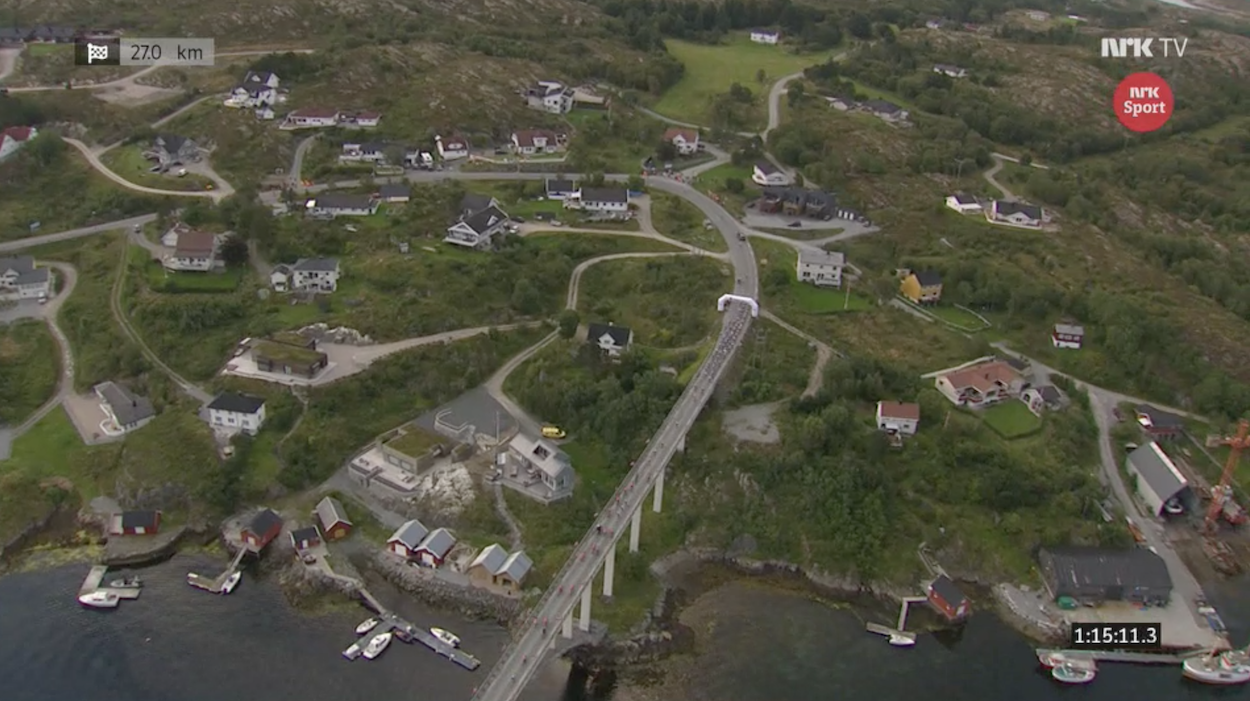
Athletes race across a causeway approaching Hitra in Toppidrettsveka 2022. (photo: screenshot from NRK broadcast)
After technique work on snow comes race effort on rollerskis. Racing Thursday evening in Hitra, Norway, Ben Ogden led four American men when he placed 18th in a field of nearly 100 in the 54-kilometer classic mass start, the opening race of the Toppidrettsveka race series in the Trondheim region of western Norway.
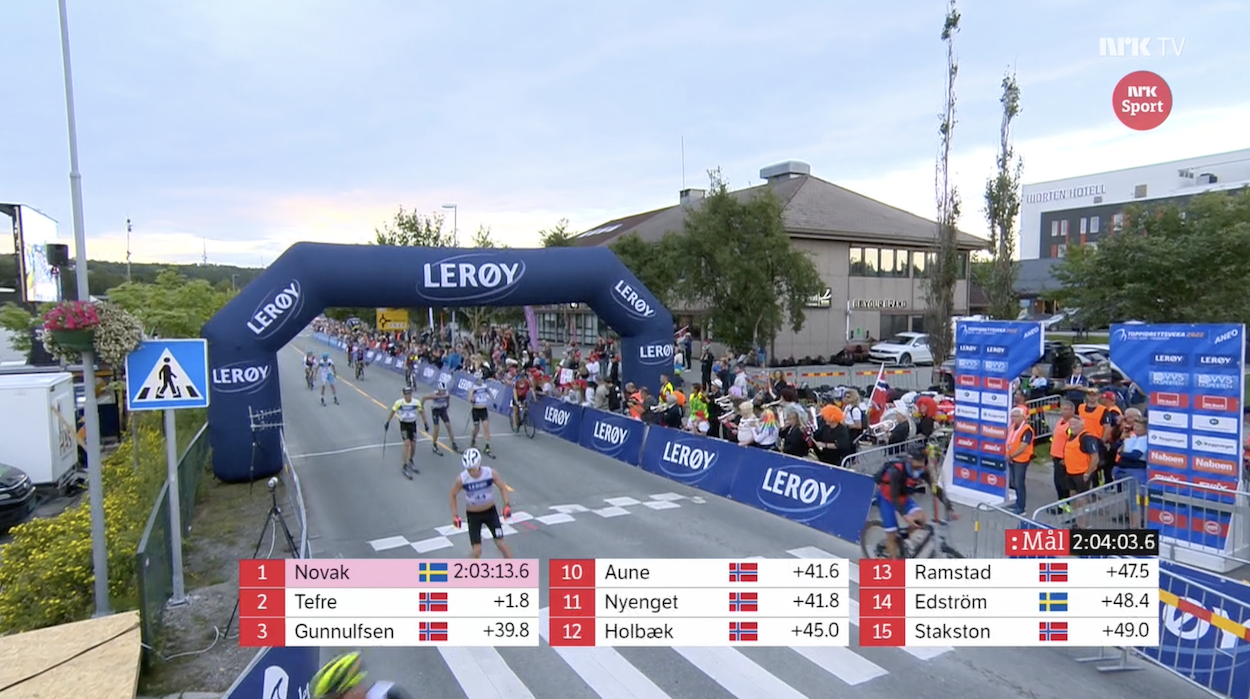
Ogden finished 50.2 seconds back of the winner, and 10.4 seconds off the podium. He was followed by fellow USST athletes Finn O’Connell in 47th (+3:57.4), Johnny Hagenbuch in 55th (+6:38.4), and JC Schoonmaker in 65th (+9:26.0). Kevin Bolger and Walker Hall are also on this trip, and may compete in upcoming races.
Max Novak makes the winning move, Toppidrettsveka 2022. (photo: screenshot from NRK broadcast)
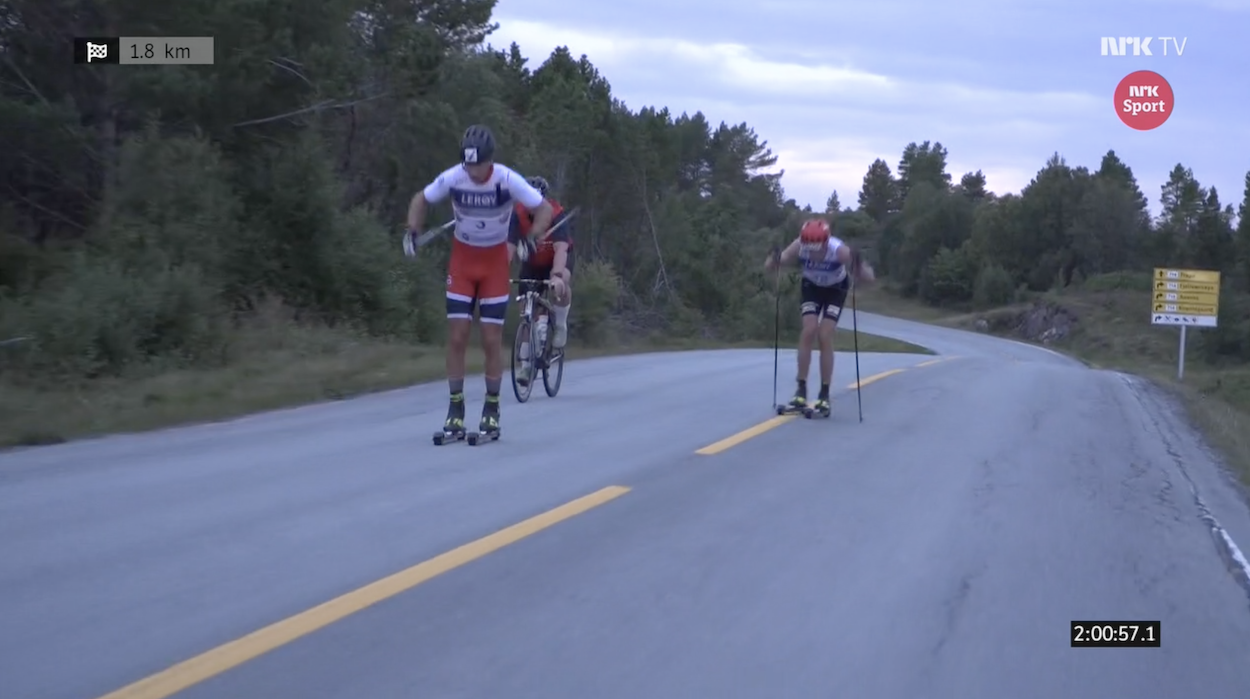
The race was won by Max Novak of Sweden in 2:03:13.6, after he and Norwegian Gjøran Holstad Tefre distanced themselves from a 17-man chase pack within the final 10 kilometers. Novak used a powerful acceleration on a small uphill 1.8 kilometers out to open up a small gap on Tefre, which he held all the way to the finish. Tefre finished 1.8 seconds back of Novak. Mikael Gunnulfsen of Norway won a group sprint to finish third (+39.8).
Perhaps the best-known retired skier in the field, Petter Northug, 36, finished 38th (+2:53).
The women’s race, in which no Americans competed (there are no American women on this training trip), was won by Norwegian Astrid Øyre Slind, who covered 54 k in 2:10:40.5, a staggering 12+ minutes ahead of Lotta Udnes Weng in second. Friend of the program Frida Karlsson finished in 2:25:31.2 to place fifth in a field of twelve women.
Ben Ogden crosses the finish line in 18th, back middle, to the right of the athlete in a yellow top. (photo: screenshot from NRK broadcast)
U.S. Ski Team Head Coach Matt Whitcomb was buoyant about the team’s fitness and recent training heading into the race.
“Everyone is healthy,” wrote Whitcomb in an email to multiple media outlets Thursday morning, “and we’ve all had one of the best training camps of my coaching career. The guys have had a blast together. We’ve trained hard, both on and off snow. While we’re training into these races, everyone feels ready to race. Training through the summer races is a common approach.”
Thursday’s races started at 6:20 p.m. in the evening local time, with the men’s winner finishing at 8:23 p.m. and the final American not finishing until after 8:30 p.m., suggesting a late night for all after cooldown, recovery, and coming down from the high of racing.
Scenery shot, Toppidrettsveka 2022. (photo: screenshot from NRK broadcast)
Competition continues in western Norway with a classic sprint on Friday, then a 10/15 k interval-start skate race on Saturday morning and a 5/10 k classic pursuit Saturday afternoon. FasterSkier will publish a more detailed article after the final race. The races will be shown on NRK, if you can manage to access the Norwegian broadcaster from where you live, and may be livestreamed on the event’s Facebook page.
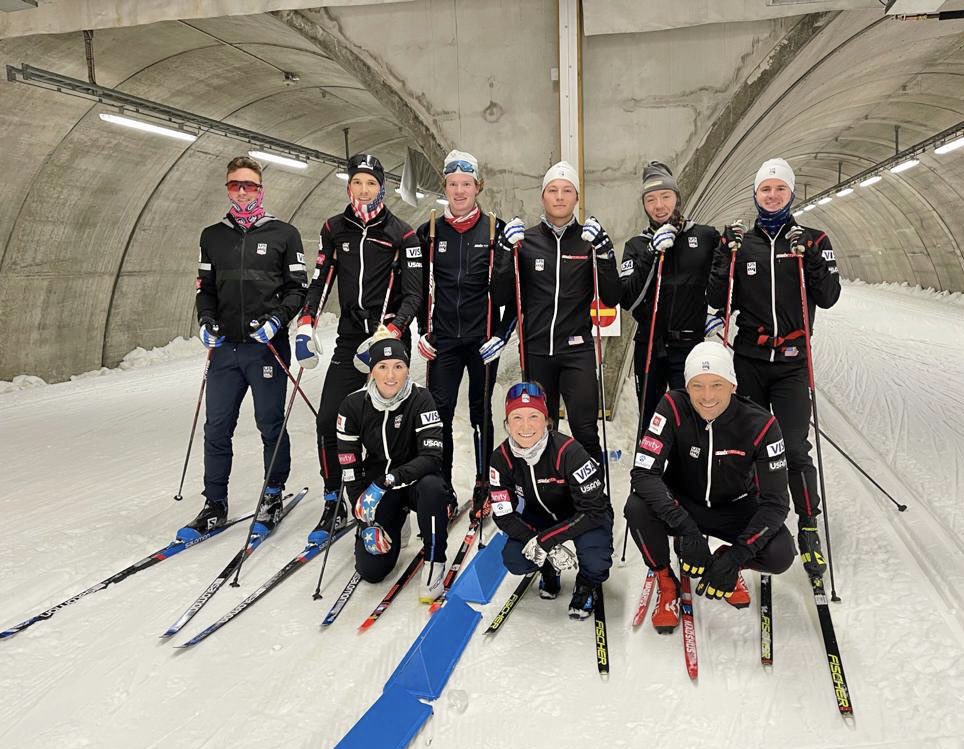
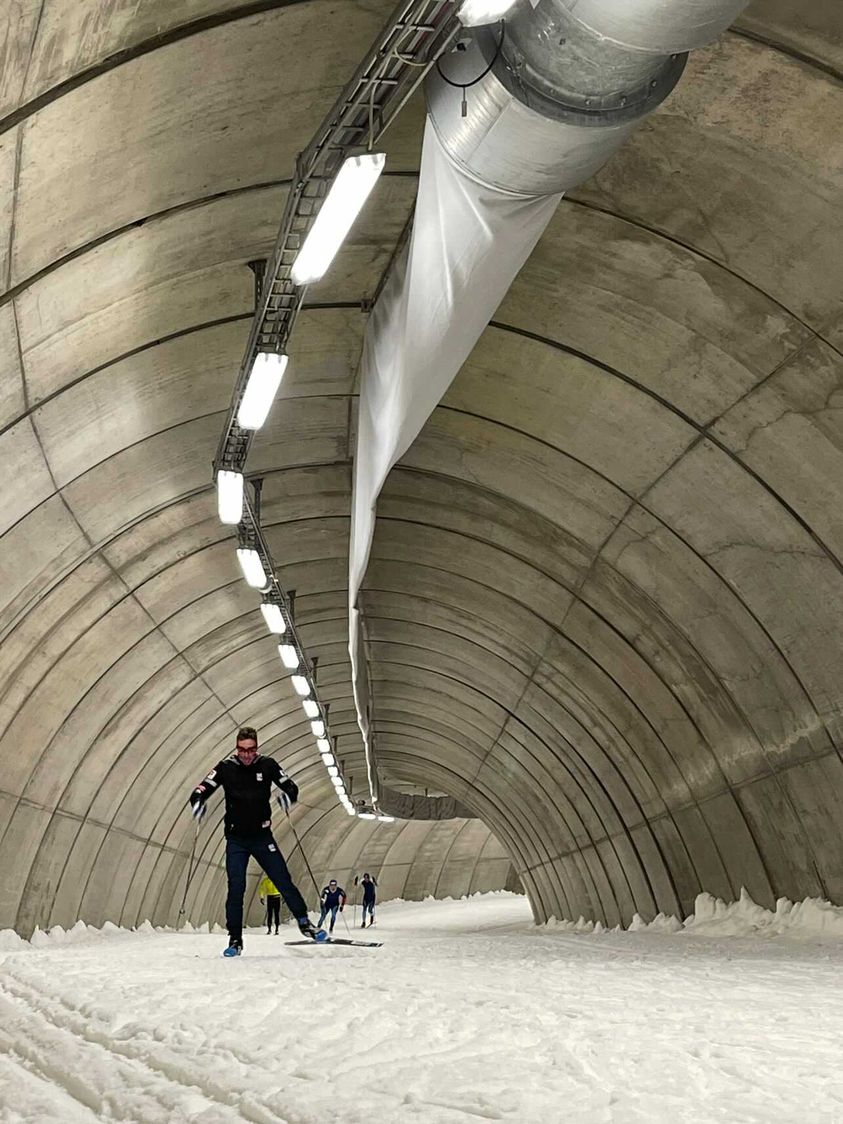
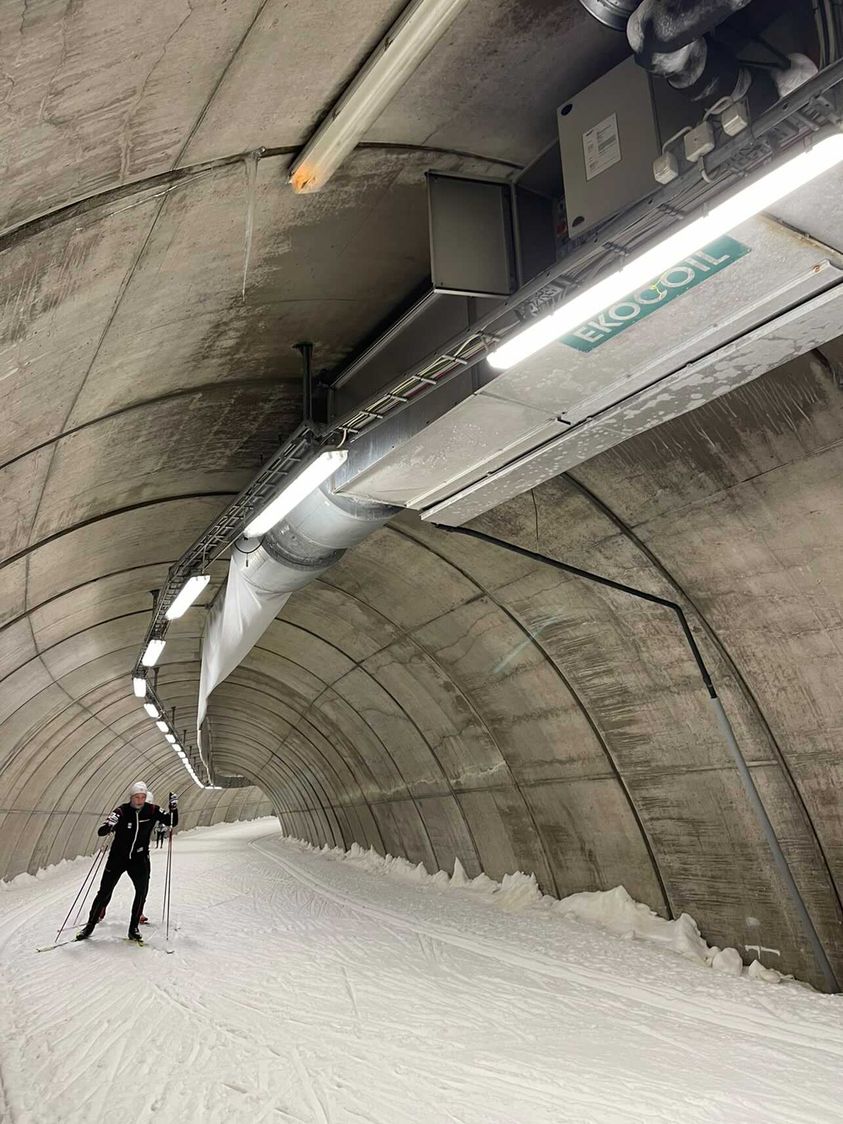
USST athletes and coaches in the Torsby Ski Tunnel, August 2022. Back row, from left: athletes Johnny Hagenbuch, Kevin Bolger, Finn O’Connell, JC Schoonmaker, Ben Ogden, and Walker Hall. Kneeling, from left: coaches Greta Anderson, Kristen Bourne, and Matt Whitcomb. (photo: François Faivre)
If it’s August, it must be time to ski.
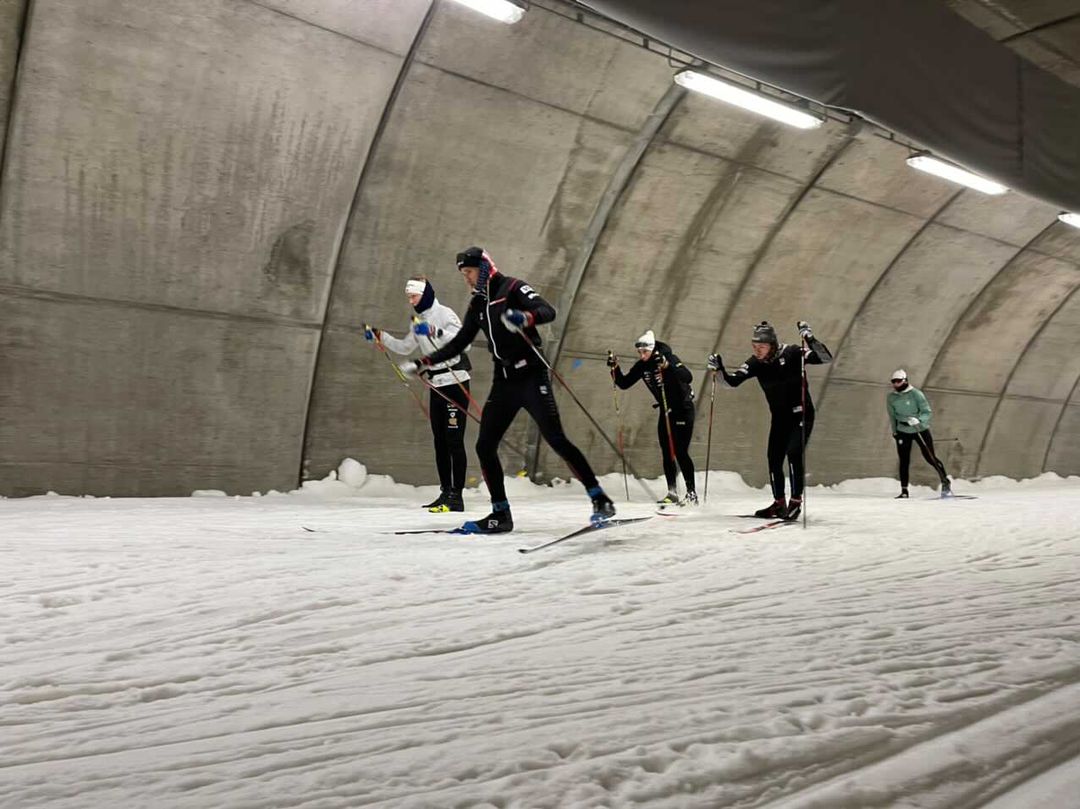
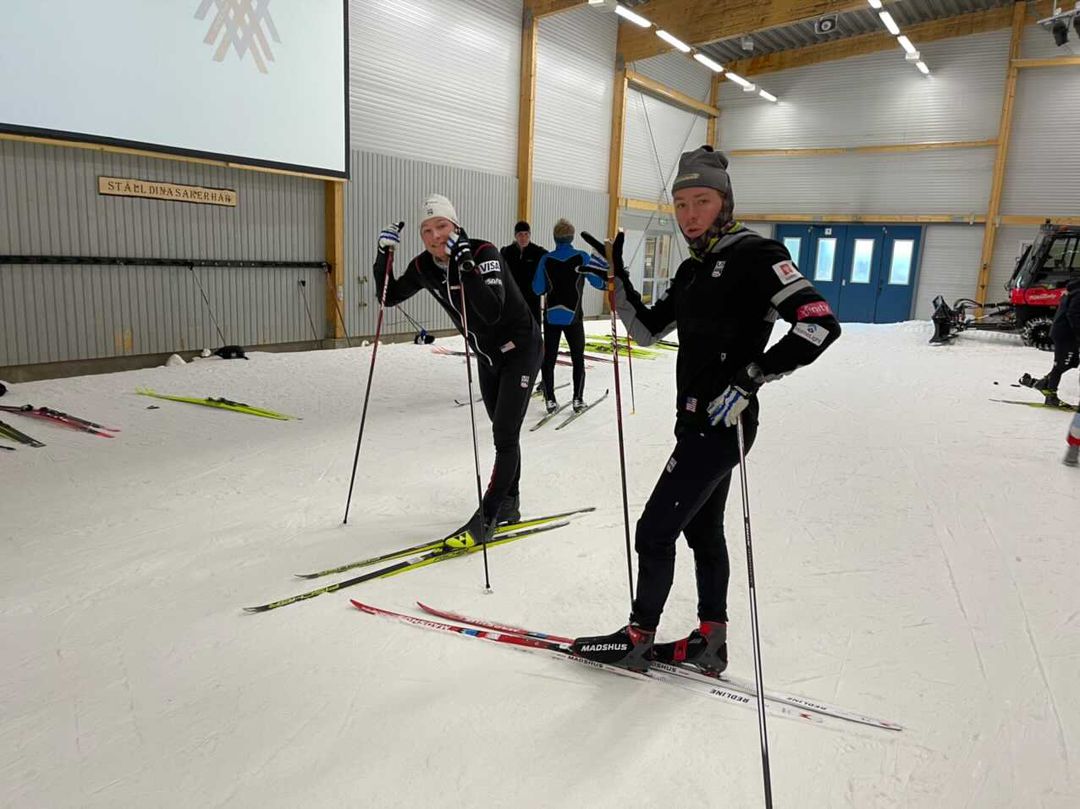
Head Coach Matt Whitcomb and roughly half the men on the U.S. Ski Team, accompanied by a couple of well-known distaff guests, have spent the last week on snow in the Torsby Ski Tunnel in southwest Sweden. They raced in the nearby Inge Bråten Memorial rollerski race earlier today, and will compete in the Toppidrettsveka rollerski series in Norway starting on Thursday. It’s a multi-stage Scandinavian adventure to help prepare for next year’s race season.
American World Cup skiers have pursued a variety of options for summer snow over the years, depending on budget, logistics, travel time, and team size. The Alaskans historically gravitate to Eagle Glacier, spending three one-week camps on snow in the Chugach Mountains between June and August. Athletes from the rest of the country have traveled to one or more of the Snow Farm (New Zealand), Falls Creek (Australia), Sognefjellet (Norway), Dachstein Glacier (Austria), Passo dello Stelvio (Italy), Oberhof ski tunnel (Germany), Torsby ski tunnel (Sweden), or Planica ski tunnel (Slovenia), typically toward the end of the northern-hemisphere summer.
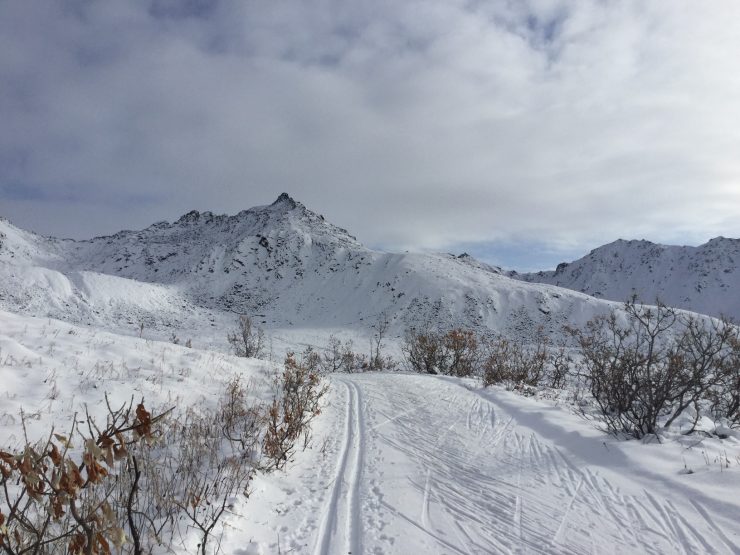
Early-season skiing at Hatcher Pass, October 6, 2019. (photo: Gavin Kentch)
This year, for Whitcomb and six national-team men, the answer is Torsby. Whitcomb flew across the Atlantic on August 12, joined by athletes Johnny Hagenbuch, Kevin Bolger, Finn O’Connell, JC Schoonmaker, Ben Ogden, and Walker Hall, as well as USST coaches Greta Anderson and Kristen Bourne. Their two-week trip includes a week-plus on snow in Torsby, a rollerski race in nearby Sunne, and rollerski races in the Trondheim region.
This year’s trip roster has “just six men,” Whitcomb said in a phone call while driving to the airport last Friday.
Johnny Hagenbuch, Torsby Ski Tunnel, August 2022. (photo: Greta Anderson)
“We’ve been whittled down after Covid,” he said, which among public names claimed Sophia Laukli after her recent brace of wins in the Stranda Fjord trail race and Lysebotn Opp rollerski race. That said, the American men were joined by well-known Swedish guests Maja Dahlqvist and Frida Karlsson, as well as much of the German team. (Dahlqvist and Bolger are dating.)
So why Torsby? In part because it presents a strong training option on the merits, in part because of money.
As for the training facility, it’s not just the ski tunnel. In addition to the roughly two-kilometer-long ski track inside a refrigerated tunnel, the area also contains “a rollerskiing track, biathlon stadium (outside and in the tunnel), extensive running trails through the surrounding hills and forests, and a fully equipped gym attached to the tunnel,” as Norway-based Canadian athlete Maks Zechel wrote on this site in 2017.
And as for money, Torsby is closer and cheaper than the southern hemisphere. “We weren’t able to fit it into the budget to have a bunch of people go down to New Zealand or Australia, and the Eagle Glacier facility is closed still,” Whitcomb said. “So we wanted to have an option for those that were maybe already on the East Coast or willing to travel. So we’re pretty excited.”
Kevin Bolger leads Ben Ogden, Torsby Ski Tunnel, August 2022. (photo: Greta Anderson)
“It’s been about 10 years since I’ve been to Torsby,” Whitcomb continued. “We brought the women’s team there in 2012 in a joint camp with the Swedes.”
Whitcomb also noted the relative ease of travel within Scandinavia: “In terms of itinerary, it’s a two-hour drive from Oslo [to Torsby]. When we get back to Oslo on the 21st to fly to Trondheim, that’s a 55-minute flight in the middle of the day, so it’s all fairly simple travel once we’re over there. It’s like traveling around New England.”
Another thing in common with New England: klister-cover skiing. Whitcomb described the snow inside the tunnel as manmade – snow guns are visible near the entrance – but as infrequently refreshed. “And so depending on when you’re there, it can be varying degrees of aged snow, but it tends to be fairly stable,” he said. “A variety of classic skis will work, and a variety of waxes will work. Generally a bit of a violet or some sort of 45 base covered tends to work, and some sort of medium grind.”
JC Schoonmaker, left, and Ben Ogden near the entrance of the Torsby Ski Tunnel, August 2022. (photo: Greta Anderson)
The tunnel is a valuable resource, but its terrain is “by no means ideal” as a direct replica of a World Cup course, Whitcomb acknowledged. The tunnel has two hills per lap, Zechel wrote, “which are steeper in one direction and more gradual in the other, making for a great place to work on striding. Most senior men would one-skate the hills at race pace, but they are still steep enough for offset technique work at lower speeds.”
But what does the tunnel have? Snow. Which is, to state the obvious, “a slippery surface,” per Whitcomb. This is specifically opposed to the “surefire kick” of the rollerskis that are most athletes’ go-to summer training modality.
Conditions in the tunnel can sometimes be “mealy,” Whitcomb observes, “even if you’re skating. It requires you to not just set the ski down, but to be able to ride it and negotiate the unpredictable nature of snow. Having a dose of that in the middle of summer has always been, we feel, a beneficial addition to the overall [training] plan.”
Whitcomb drills down on these dynamics when asked about the specific appeal of estival snow, especially what he’s learned over the last two years following no time on snow in summer 2020. Here’s his answer, quoted in full because it’s intriguing:
“One of the things that I have come to believe more and more over the last several years is that all great technique starts with the ability to use our feet well. You have to be able to stand well in your boots. Your boots have to be really comfortable, and that might mean you have to have insoles, or maybe it doesn’t; it might mean you have to have custom boots, maybe it doesn’t.
“And then you have to have a ski that you’re comfortable standing on. And all of that has to do with how comfortable you are with standing on a slippery surface below all of that. It’s like this four-layer deal where you have the body, the boot, the ski, and then the snow. And for anyone that has a hard time being stable on their feet, it’s going to be very difficult to ski well in the rest of the body. And so I think snow definitely allows us to focus by simply dropping our poles and learning to use the feet, just skiing easy for 20 or 30 minutes every session without poles, skating or classic.
“Because for those of us that don’t naturally use our feet well we often tend to use our poles as crutches, and it sort of masks the stiffnesses and the instabilities that we all have, myself included. But you take those poles away and you’re exposed to nothing but your balance, your ability to gain traction by kicking properly. And so that’s something that snow can do for you.”
* * *
The plan was to spend 20–25 hours on snow in the tunnel this past week, with secondary workouts on hillier outdoor terrain when necessary. Intensity in the tunnel was focused on speed; “we want to be a little bit mindful of breathing too hard,” Whitcomb noted.
He explained, “The Swedes are often talking about the challenges of coming from outdoor temperatures into the tunnel, which is quite humid – or at least cold, I don’t know if it’s humid – but they feel like it can irritate the lungs. So any intensity that we’ll do in the tunnel will be more along the lines of controlled threshold, and we’ll be masked up for those that have sensitive airways.”
(Whitcomb calls Bråten, who died in 2012 at age 63, “an old friend of the team, somebody I knew.” A full article on the rollerski races is forthcoming on FasterSkier later this week, but you can find results from Sunne here now, and results from Toppidrettsveka here starting on August 25.)
JC Schoonmaker, Torsby Ski Tunnel, August 2022. (photo: Greta Anderson)
Tomorrow the team flies from Oslo to Trondheim, where “we’ll live out near Aure on an oil facility,” Whitcomb notes. “And we’ll train there and sort of prepare for Toppidrettsveka, which is a four-stage event over three days. And then we’ll fly home on that Sunday,” August 28.
The men will have logged 20+ hours of on-snow time at almost precisely the midpoint between Bend Camp (late May) and the start of the World Cup season (late November). They will have explored the difference between rollerski kick and setting the wax on slippery surfaces. And they will have gotten to engage in high-level rollerski races with other top athletes. They’re all small pieces of the puzzle as the athletes build toward the season-opening races three months from now, be that in Ruka or closer to home.
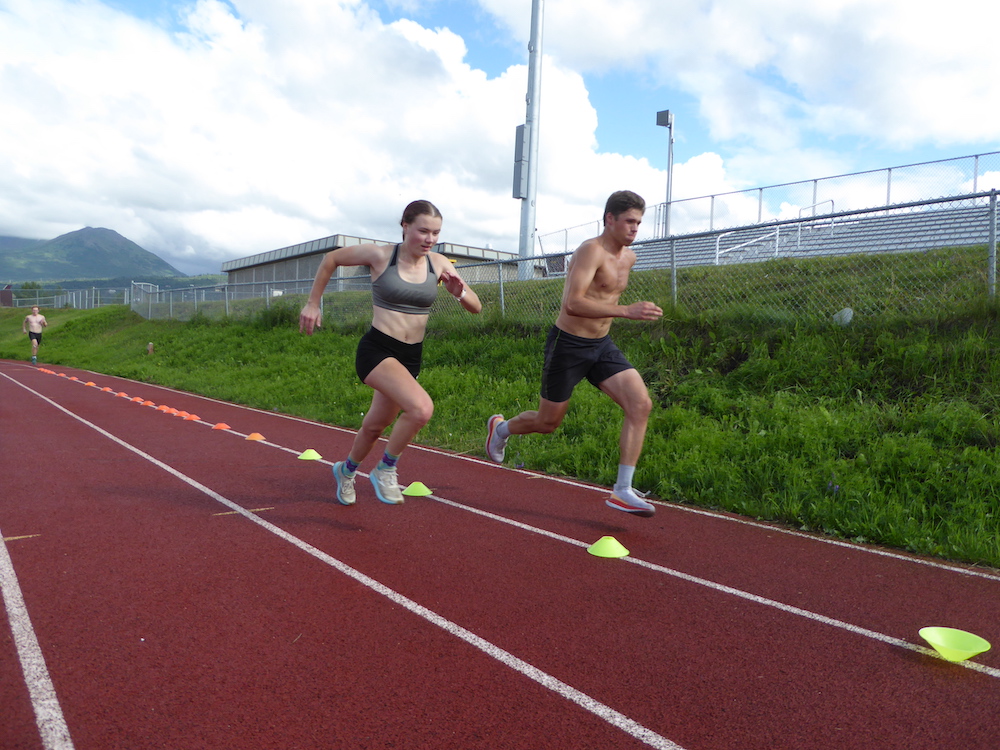
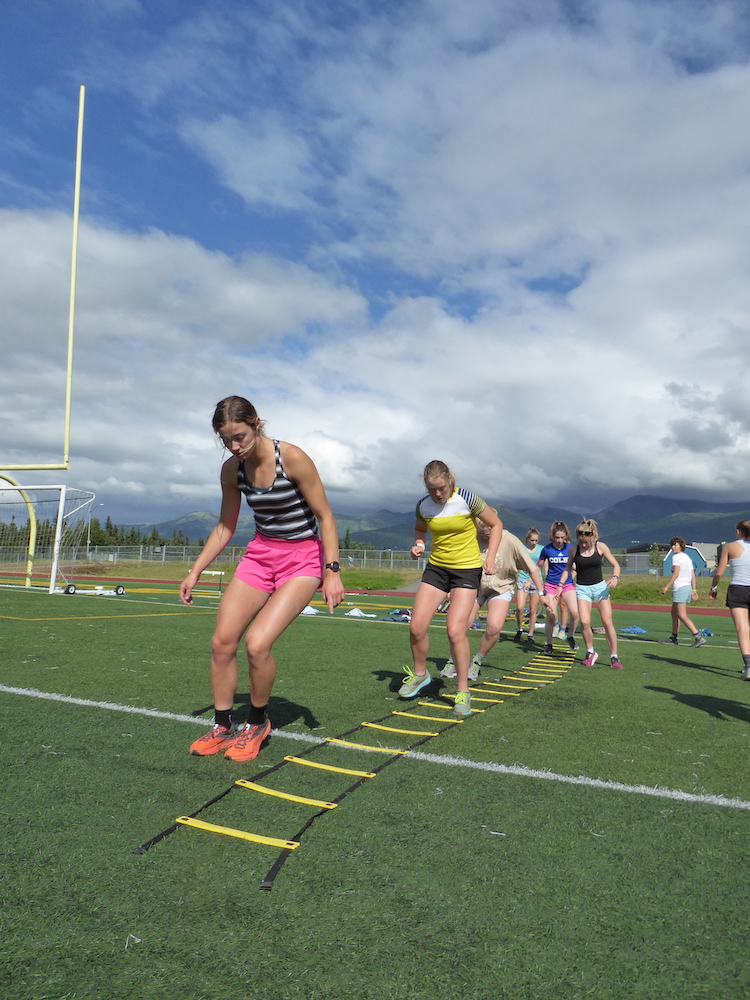
Lily Pannkuk, left, and Zander Maurer race through agility drills on the track at the Alaska REG Camp in Anchorage, July 2022. (photo: Gavin Kentch)
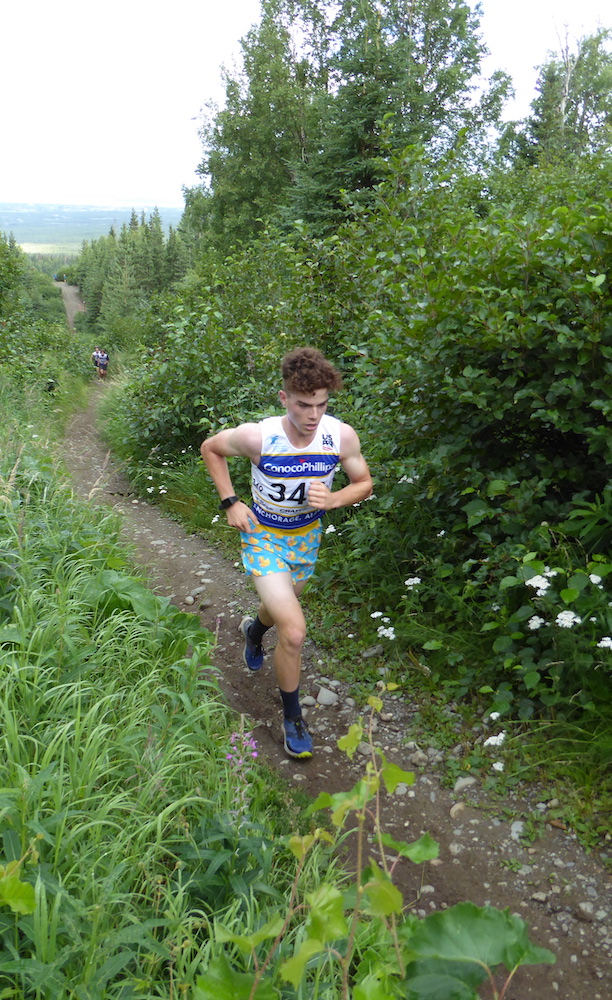
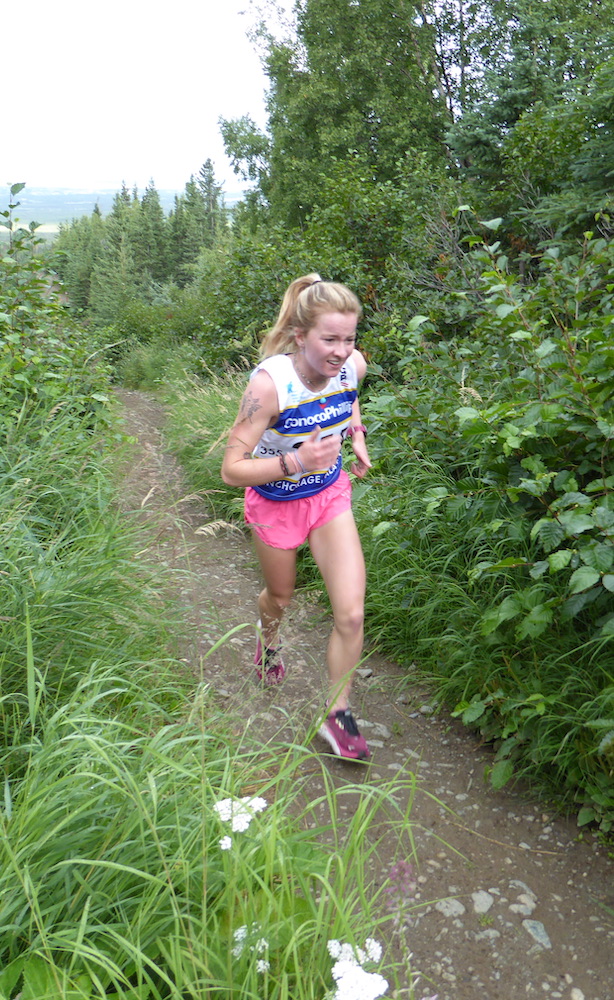
ANCHORAGE — Watching training sessions at a Regional Elite Group camp, the summer training series held around the country for the nation’s top junior skiers, is one part tantalizing glimpses of the future of American skiing, ten parts the cumulative reality of a lot of focused work in the present. These kids are fast, they are committed, and they are strong. But long-term success in endurance sport takes time, and they know it. Judging from the final two practices in a long and rainy week at Alaska REG camp, the future may be some ways off, but it is bright indeed.
Let’s back up a little. This year’s Alaska REG camp was held in Anchorage during the week of July 18. Comparable camps occurred elsewhere in June and July for the three other regions of a sprawling nation: in Truckee, California, for the Western Region; in Marquette, Michigan, for the Central Region; and in Craftsbury, Vermont, for the Eastern Region. Athletes, aged roughly 14 to 20, are picked on the basis of their performance in Junior National races, state high school races, and higher-level USSS races.
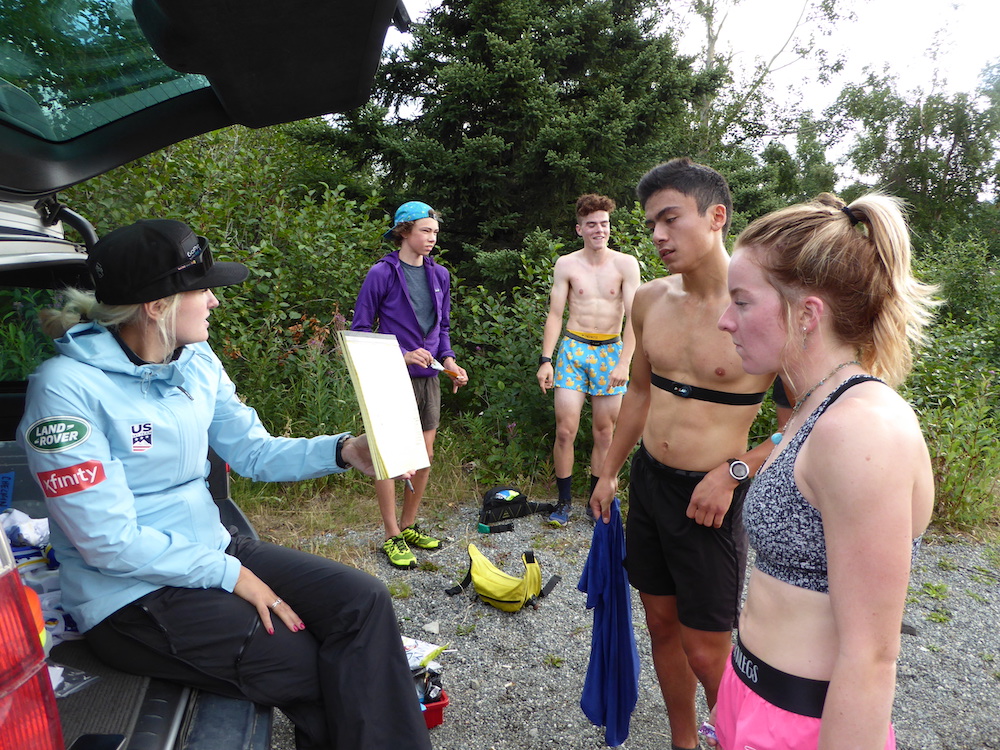
One or more of U.S. Ski Team coaches Greta Anderson (Development Team Coach), Bryan Fish (Cross Country Sport Development Manager), and Kristen Bourne (D-Team Coach) were present at all four camps. They were assisted in each region by a who’s who of junior coaches from local clubs.
The supporting cast in Anchorage included Galen Johnston, Jack Novak, Eric Strabel, Jan Buron, Eliza Rorabaugh, Naomi Kiekintveld, Seiji Takagi, Jenny Kimball, Trond Flagstad, Adam Verrier, and Kristen Bourne (coaches); Billy Crumm (strength session); Ja Dorris, Joey Caterinichio, and Laarni and John Power (dinner hosts); and Shannon Donley (registration). Between coaches and athletes, all of Alaska Nordic Racing, Alaska Pacific University Nordic Ski Center, Alaska Winter Stars, Nordic Ski Club of Fairbanks FXC, and University of Alaska Anchorage were represented here last week.
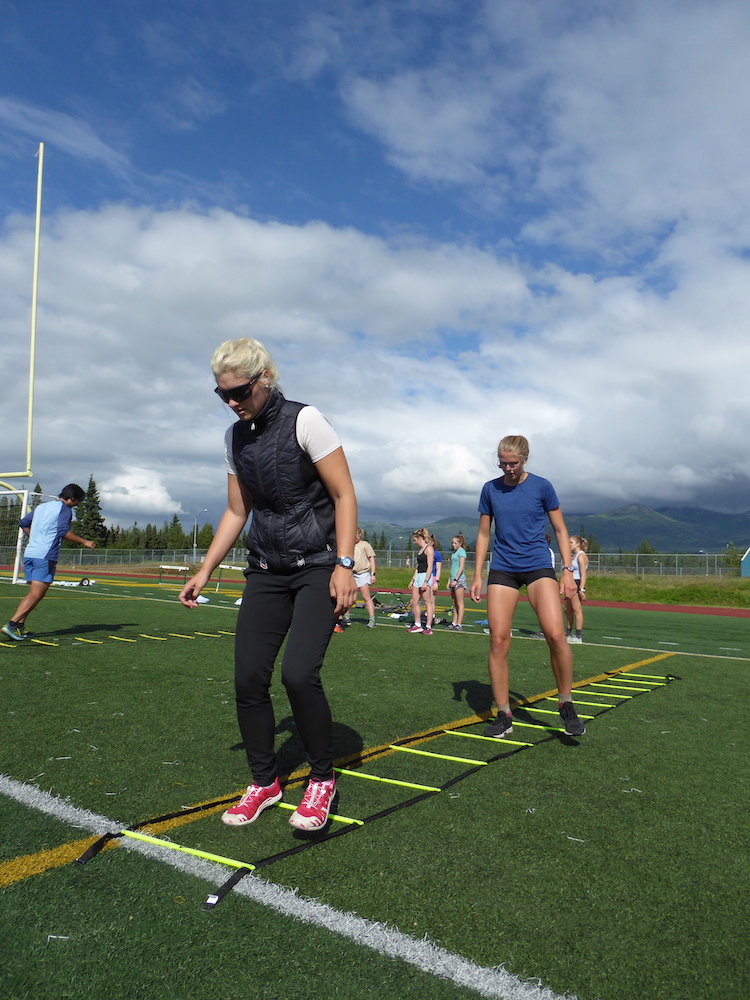
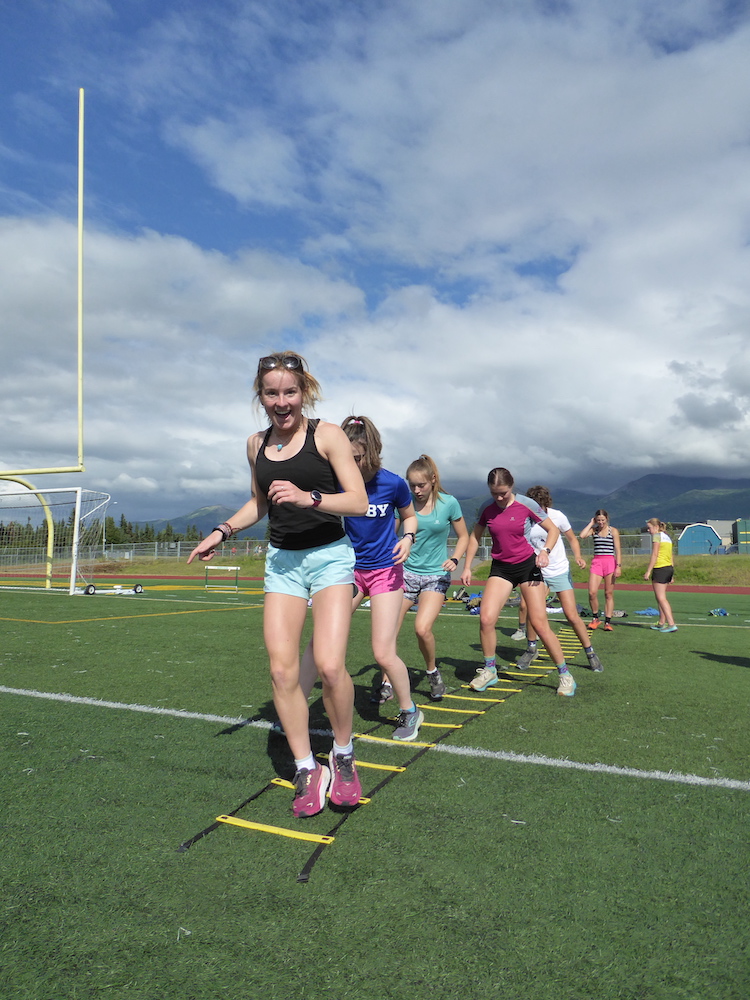
Greta Anderson, left, leads Natalie Hood in ladder drills in Anchorage. (photo: Gavin Kentch)
The camp schedule is not easy, reflecting the fact that it selects from high-achieving juniors who are already comfortable training twice a day. The tests typically make headlines; the canonical REG week contains an uphill run, a classic rollerski uphill doublepole test, and a skate rollerski agility sprint, results of which are combined with USSS/NRL points to select high-performing athletes to attend a national team camp in Park City in the fall. This year’s Alaska camp was no exception, as all three tests featured and results were recorded.
But camp is more than just the tests, says Anderson. Speaking in an in-person interview last Friday afternoon, while apparently tireless athletes began a spirited soccer match at the other end of the Service High School infield just moments removed from agility drills and strides, the USST coach emphasized that the testing is only one aspect of camp, alongside of broader training value and the chance for athletes from different clubs and regions to make connections.
As for the training value, Anderson noted, “One of the challenging things about camp is that at times it can feel like just testing, or very testing-centric, very evaluation-centric. And what we’re trying to do at these camps is to make sure that there’s a lot of training value. Coaches bring that training value; organizationally, the way we set up that environment can add training value; the thing that gives the most benefit for training is getting really good athletes together, who may otherwise only see each other in competition, to compete head-to-head, to train head-to-head, to do some intensity workouts together that they might otherwise not be able to get together and do. So I see a lot of value there.”
And as for those connections, Anderson is asked what U.S. junior skiing is doing well at present.
All smiles in ladder drills. Athlete Katey Houser is in front. (photo: Gavin Kentch)
“Working together really well,” the Development Team Coach immediately replies. “I think at the club level and the athlete level, you see a lot of athletes across clubs training together and working hard. They’re pretty cohesive right now. We’re getting stronger as a nation. Peer-to-peer coaching is getting to be more of the norm, where athletes will train together and say, Oh, I’m trying this, or, I’m working on this. So we’re starting to have more conversations about skiing, which I think – the larger picture there is that our culture as a ski nation is getting stronger. And we’re starting to see the results come with that.”
Anderson is also impressed by the level of commitment that she sees in the country’s various clubs. “One of the things I’ve noticed a lot with this group is that many of them are systematically training throughout the year, in strong programs, quite well,” she notes. “And so there’s a lot of patterns of similarity between technique for those that are skiing with their respective clubs. I think that’s cool; it speaks to a culture of training among many of those club programs. There’s good enthusiasm; there’s good cohesion; and there’s certainly a strong sense of competitiveness in the time trials that we’ve seen so far.”
But fun is important, too, Anderson adds. “We have a sport where you maybe have a twenty-year-long career with ups and downs, and lots of learning along the way. What people remember, and what makes it enjoyable in the hard times – if there is something that makes it enjoyable – is the people that they share it with. And so I think just getting that group together any time, and quite frankly the testing and the intensity workouts are things that are shared that add value to those bonds, or really accelerate how quickly a group of people can trust each other and enjoy training together. But really, it is as simple as, it should be fun.”
Rosie Whittington-Evans (front left) leads Olivia Soderstrom and Meredith Schwartz in ladder drills. (photo: Gavin Kentch)
The athletes sound similar notes. Here’s Rosie Whittington-Evans, 18, a recent Palmer High graduate set to ski at Colby College this fall: “Camp’s been really fun. I really enjoyed the first dinner that we have together, which is on the first day after playing a little bit of handball. And it gives you a chance to kind of meet everybody at camp. It gives you a chance to put yourself in situations with people that you might not have talked to but have been racing against for a couple of years. And yeah, it’s been really fun.”
Whittington-Evans, who was attending her second REG camp in as many years, appreciated the bonding-specific focus of this year’s camp: “I honestly was expecting more, like, testing first, like we did last year. Instead of – I think Greta is trying to make it more speed- and practice-based and just kind of team bonding at first, which I think works really well this year at camp. And it made you feel more comfortable around the people at camp with you rather than just hopping into an uphill time trial.”
Whittington-Evans was grateful for the high-level training group around her this week, particularly after spending high school racing in the Mat-Su Valley, slightly removed from the crucible that is Anchorage high school skiing. “Being surrounded by people that are more your speed or even faster” is “really nice,” she says. “I think camp is a really important thing to have. And it really brings the community together of racing and it gives you a chance to not just have people you’re racing against but also friends that you’re racing against.”
Justin Lucas runs uphill in the Gasline Time Trial. (photo: Gavin Kentch)
Justin Lucas (16, Service High School, first REG camp) says much the same.
“The best thing I’ve gotten out of this week is probably a couple of things: getting to meet the other teammates,” he observes. “Seeing how each other team trains, so we really get to learn from each other. Like some things you may not learn in one club, they can learn from another. It’s just a lot of interactions and learning from each other. So I think that’s my good part of this week so far.”
Coming into the camp, Lucas was expecting “a lot of hard training, lots of double training days. Which so far they’ve done,” he noted on day five of a six-day camp, “so it’s pretty much everything I had expected.”
But it had also been “pretty fun,” Lucas said. “I got to meet some of the other people from other teams. So that’s good, a good way to meet other people and get some good training.”
Lucas spent the week squarely focused on the present, but with some long-term plans in mind as well: “Right now we’re in high school, so it’s like a lot of people may focus on wanting to get first place at, say, a high school race, or State. But I think it’s more important to have your mind set on the bigger picture. Like, you may not win every race in high school. But that doesn’t mean the end of your ski career. It means you have more time to train, more time to get better. And in a few years, who knows, you could be racing World Cup.”
So does Lucas have results goals he can share?
“I’d like to hopefully make the Olympics one day, but if not, I’d like to at least make it to World Cup.”
Lucas’s long-term aspirations seem pretty plausible when you consider the context in which they were voiced. Retired athlete Nina Kemppel (four Olympics, five World Championships, 119 World Cup starts) was spotted on the Service trails during the warmup for Friday’s track workout, which occurred essentially across the street from Gus Schumacher’s house (one Olympics, one World Championships, 36 World Cup starts by age 21), in case you’d like your ready-made symbolism for the past, present, and future of American skiing. You really can get there from here.
But back to the present for the moment, there was one more test yet to administer. And so, early Saturday morning, it was time for the redoubtable Gasline Time Trial.
Gasline was the leitmotif of last year’s Alaska REG article, and has been an integral feature of Alaskan dryland training since at least the era when Kemppel was competing for Team Gold 2002, later and better-known as APU Nordic Ski Center. Course records are 10:20 for the women (Rosie Brennan), and low nine minutes for the men (Schumacher’s 9:12 on Strava is not the course record, but is close to it). Briefly put, you run uphill for 1.4 miles and 571 vertical feet, and it gets harder as you go along; read the 2021 article for the metaphorical implications of it all.
This year’s Gasline was the same as it ever was, but it came at the very end of camp. And so, after a bounding session, and a classic rollerski distance session with speeds, and a skate rollerski L3 session, and a strength session, and a rollerski agility course test, and a mountain bike session, and an uphill doublepole time trial, and Friday’s track session, and three presentations and two (Covid-safe outdoor) team dinners – most of which, by the way, occurred in a downpour during what will likely be the rainiest July ever in Anchorage in 100+ years of recordkeeping – on Saturday morning, it was time to run uphill. Fast.
Athletes parked at the finish at Prospect Heights at 8 a.m., then ran downhill en masse for bear protection. After an additional warmup on the Hillside trails and some instructions, a coach said “Go!” shortly before 9 a.m., and off they went from the canonical low point on Gasline.
Moment of truth for the race of truth. Greta Anderson, far left, shows time trial results to athletes, 2022 Alaska REG Camp, Anchorage. (photo: Gavin Kentch)
While the athletes charged up the hill, coaches and support staff sprinted to their cars to drive back to Prospect Heights in time to beat the athletes to the finish. A reporter just had time to hear parts of two songs, “Unstoppable” and “Running Up That Hill,” on the six-minute drive, which feels scripted but was the actual playlist in this cultural moment. You can’t spell “kismet” without “KMXS Anchorage,” aka Mix 103.1.
The first finishers burst off the trail onto Sidorof Lane less than ten minutes later; Ari Endestad’s PR of 9:29 was the fastest time publicly posted to Strava on the morning. For every athlete there, it marked just a handful of minutes in a multi-year journey. The future is bright, but it stands on the other side of a lot of hard work.
On Monday, June 20th, the Ski Associations of Austria, Switzerland, Germany, and Croatia made good on threats issued after the FIS Congress in May, and filed an appeal to the Court of Arbitration for Sport (CAS) contesting the voting procedure that elected the unchallenged FIS President Johan Eliasch.
The four nations argue that it was unlawful to deny them the option of voting no to Eliasch, and that the election procedure violated FIS statutes and Swiss law.
Unable to vote no, the dissenting delegates decided to either walk out of the election in protest or abstain from voting altogether. Members of the appealing ski associations have suggested that Eliasch would not have received a majority of the votes cast if an option to vote no had been offered. Had that happened, the appealing nations may have been successful at installing a new candidate.
Instead, Eliasch received 100% of the votes cast, leading his opponents to characterize the proceedings as, in the words of the German delegate, a “farce.” Nevertheless, Eliasch received 70 of a possible 117 votes—a clear 59% majority, and a five vote increase from last year.
For FIS, an appeal of voting procedure technicalities is unprecedented: as a rule, FIS presidential elections have been uncontested and decided by acclaim. In response FIS released a statement saying the allegations, “are entirely without merit or substance.”
Eliasch was reportedly told in advance about the appeal during a meeting in Innsbruck with the Austrian Ski Association. “He took it very professionally and said he needed it too, otherwise [the allegations] would resonate throughout his term,” according to Chrisitan Scherer, the head of Austrian skiing.
The women’s sprint crystal globe awaits its recipient at 2021-22 FIS World Cup Finals in Falun, SWE. (Photo: NordicFocus)
While the CAS case will examine legal minutiae, it is best seen as the latest contest in a power struggle between a bloc of dominant ski nations and FIS President Eliasch, whose agenda to rapidly centralize media rights under FIS and shake up the World Cup calendar has threatened their hegemony.
“If you think about the bloc here [in FIS], it’s the French, Germans, Swiss, Austrians, Norwegians, Swedes, and Finns,” said Dexter Paine, the U.S.’s former FIS Vice President and Councilor who was voted off the council over his support of centralization.
What the bloc hopes to achieve from the CAS appeal is unclear, though it seems unlikely to overturn the result of the election. The aim may be to stall Eliasch’s agenda as the case will take months to resolve, or to wound him politically and bring him to the bargaining table in a weaker position. It may also be that the four appealing nations are determined to find a way to overturn the election and install their preferred candidate: Urs Lehmann, the head of Swiss Ski.
Eliasch’s election in 2021 interrupted the Swiss reign at FIS, with just two Swiss men— Marc Holder and Gian Franco Kasper—leading the Federation for the previous 70 years. Lehmann, who called the FIS election a “muppet show”, appears to be an opposition candidate that will preserve the bloc’s established order.
France’s Richard Jouve earns the 2021-22 FIS sprint crystal globe. (Photo: NordicFocus)
Both Paine and Eliasch spoke to FasterSkier earlier this month to discuss the issues facing FIS as it attempts to centralize the media rights, expand the reach of the World Cup, and attract a larger audience in North America.
Eliasch’s bid to modernize FIS in the near term will now be hampered by Paine’s absence from the council, an assertive bloc, and entanglements at every corner with the sport media company Infront.
While there has been general disagreement between the bloc and Eliasch over centralization, one development in particular has alarmed the bloc as well as Infront: A judgment won in Swiss court that found FIS to be the rightful owner of World Cup races and not, as was previously understood, the hosting National Ski Association.
With this ruling in hand, Eliasch has suggested that the contracts with Infront could be broken—a move that would take centralization from the theoretical realm, where it has support from the bloc, to the immediate, where it does not.
Much of Infront’s contracts for FIS events extend to at least the 2025/26 season, with Swiss Ski signing a deal that lasts until 2027/28.
Urs Lehmann, the head of Swiss Ski, opposes the notion of breaking contracts. “That’s not possible,” he said to Tages Anzeiger. “Infront hasn’t done anything wrong, on the contrary, it’s a big partner of the FIS when it comes to world championships.”
For his part, Lehmann said centralization would require a long time frame, presumably after 2028, and could be done only after proving that Ski Associations would receive at least the same amount of money.
Eliasch has said that FIS has ample funds to give “cast-iron guarantees” to match Ski Association’s deals with Infront, saying, “We can back it up any day of the week.”
FIS’s financial assets at the end of 2020 amounted to around $146 million, suggesting that if the Federation is prepared to dip into their reserves, it has the ability to support Ski Associations through the transition.
Infront’s VP of Strategic Communications, Jörg Polzer, outlined the risks for FIS of moving away from the current arrangement in an interview in Ski Racing, suggesting that the new proposal “would represent a de facto expropriation of the National Ski Associations.”
Polzer also felt that the outcome would be a “plethora of legal claims and lawsuits for many years to come,” the result of which could mean that fans might not be able to access “FIS World Cup coverage as conveniently and widely as it is the case today.”
Centralization under FIS threatens to disrupt both Infront’s profits and its valued portfolio of winter sports which encompasses all seven winter Olympic sport federations. It is likely to respond to broken contracts by both halting payments and pursuing damages from National Ski Associations.
Eliasch reassured members in a letter to the FIS council stating, “The FIS will award all national ski federations compensation for all claims by Infront.”
Johannes Høsflot Klæbo leads his heat during his final sprint of the 2021-22 season in Lahti, FIN. (Photo: NordicFocus)
The plan to centralize FIS, known as the Concorde Agreement, is supported by US Ski & Snowboard, who believe the proposal would help modernize the sport and increase funding for everyone.
Paine said that “Johan [Eliasch] has been really explicit about the fact that he would envision that revenues related to media would increase under the new model. In fact, he’s talking about potentially up to a 25% increase in revenues.”
Still, the bloc has opposed the centralization of media rights, with Austria’s Scherer saying, “you can’t just take them (media rights) away from us, as an organizer you also bear the risk.” Scherer’s position is that hosting events should come with a risk/reward incentive. Considering that the opposing nations host many events, including the highest profile ones, the rewards are significant.
The Ski Associations of the bloc also oppose the “expropriation” of ownership that centralization presents. Scherer argued that it could only be done on a voluntary basis—an option that would defeat the purpose of centralization, but preserve the bloc’s influence over skiing.
Facing resistance, Eliasch decided to table the Concorde Agreement to allow for a period of consultations with members.“We decided not to bring [the Agreement] forward to Congress, because it needed more work,” Paine said.
Some representatives have complained about poor communication between Eliasch and National Ski Associations with regards to his plans for centralization.
Paine agreed that improvements are needed in this area, saying, “FIS needs to do a much better job articulating why this would be good for everyone in the sport, and how they would make sure that those countries aren’t any worse off than they were before.”
Though Paine added that, “Johan has been very explicit about the fact that he is going to seek the advisement of the [FIS] Counsel, and all members, on all the items regarding centralization rights.”
Entanglements with Infront
Another challenge for FIS will be breaking free from Infront. The company has become enmeshed in the fabric of FIS, from the television production of races, to long term contracting of rights, to negotiating sponsorships, to even building the FIS app and website.
FIS will also have to overcome its own independent marketing agency, FIS Marketing AG, which was created in 2009 to acquire and sell the sponsorship rights to FIS World Cup events.
FIS Marketing AG (FISMAG) is majority owned by FIS (51%), with 24.5% owned by Infront, and the final 24.5% owned by Tridem Sports. The venture is led by Christian Pirzer—the CEO of Tridem Sports, a two man marketing firm started by Pirzer in 2008 and based in Freienbach, Switzerland.
“Part of Johan’s platform, and I think most candidates’ platform, was to bring all of that in house,” said Paine. “I think people didn’t fully understand why 49% of our marketing organization was owned by a third party.”
Infront’s role in the venture has been principally to acquire sponsors, billing €855,000 for its services to FIS Marketing AG, according to an SEC filing in 2018. For its part, FIS recorded its 2018 income from partnerships at 676,000 Swiss francs—around €577,000 at the time.
“Most entities own 100% of their sponsorship revenues, and I think it’s unusual that FIS wouldn’t,” Paine said. Questions have been asked about whether this arrangement is in the best interests of FIS. “We don’t [even] have a title sponsor for Snowboard. That just always astounded me.”
Eliasch intends to end the venture, writing in a letter to the FIS Council, “We have terminated all agreements related to FISMAG so we have removed this obstacle to realizing our sponsorship potential.” To date the firm has not been closed, and Swiss courts are reportedly handling the injunctions necessary to stop it from continuing.
According to German paper Bild, Pirzer is suing Eliasch to defend himself against allegations that he has been involved in fraud. Pirzer said simply, “I have filed a criminal complaint against Johan Eliasch for defamation.”
Hailey Swirbul powers through the quarterfinal during a skate sprint in Lahti, FIN in March 2022. (Photo: NordicFocus)
Infront Sport and Media is based in Zug, Switzerland, and is led by Phillipe Blatter—nephew of former FIFA president Sepp Blatter who presided over the governing body of soccer from 1998 to 2015 when he stepped down after a massive corruption investigation roiled the organization and put him under investigation for fraud.
After Phillipe Blatter was appointed Infront CEO in 2005, the company won comprehensive distribution rights to the FIFA World Cup until 2022. Infront released a statement in 2015 squashing “unwarranted assumptions” of nepotism with regard to its FIFA contracts.
While Infront remains a respected titan of its field, the company has been dogged by investigations over the improper sale of media rights in Italy’s Serie A soccer league, advertising in the German Football Association, and antitrust activities. The company’s 2019 prospectus stated possible investment risks included negative publicity “prompted by actual or alleged criminal activities, such as money laundering, tax evasion or bribery.”
In 2015, Chinese conglomerate Wanda Group purchased a controlling stake in Infront for $1.2 billion. The Group was a key player in China’s drive to create 300 million Chinese skiers, building, among other things, the world’s largest indoor ski area in Harbin. Wanda Group acquired Infront six months prior to the IOC vote on hosting the 2022 Winter Olympics, and the addition of the Swiss company was seen as a boost to Beijing’s successful bid.
Sweden’s Maja Dahlqvist hoists her crystal globe after a season that included winning the opening four World Cup sprints, and collecting an Olympic silver medal in both the individual freestyle sprint and the classic team sprint. (Photo: NordicFocus)
Should Eliasch prove successful at centralizing the rights, it is still likely that Infront would remain involved with FIS, considering its primacy in its field and the fact that other centralized sports such as biathlon and F1 both contract with Infront.
Paine said that he’s “been an advocate for Johan sitting down with Infront. I think there has to be some negotiation with all the parties involved, if this is going to come to a successful conclusion.”
Eliasch met with Infront in May, and was scheduled to meet again in June. “I’ve been a big advocate for those conversations taking place,” Paine said. “I was the loudest advocate, quite frankly, on the Council for making sure that Johan was in dialogue with Infront.”
A Push for More Racing in the United States
Paine and Eliasch also drew ire from some nations over their push for more World Cup racing in the United States, aimed at attracting a larger American audience.
The seasonal stops on the World Cup have grown so indelible that there’s been little room left for visits to new venues. “The calendar from one year to the next has looked very similar,” said Paine. “There were very few changes.”
The arguably stagnate routine has kept World Cup racing of all disciplines overwhelmingly in the Alps region and in the Nordic countries, and moves to change this has frustrated some nations. “It’s about planning security,” argued Walter Reusser, the Alpine Director at Swiss Ski.
Eliasch argued that the prescribed calendar has hindered the growth of the sport, particularly in the U.S. “I know [FasterSkier is] focused on cross-country, but alpine is a good example,” said Eliasch. “NorAm races, which are the second tier, are much more famous than the FIS World Cup races in the U.S. That tells you that something is really off. And when do we come to the U.S.? At the wrong time [November] when there is little interest in ski racing. So we have changed that, at least for alpine, so that we come back in March. We go to Aspen and Palisades Tahoe, as it’s called now. And here we hope we get proper viewership, and we can build much more time and engagement with American viewers.”
Though American alpine skiers have gained widespread fame, as a television audience the U.S. does not make the top ten for alpine, ranking somewhere below the likes of Slovenia.
“Johan has said whether it’s cross-country, or alpine, we need to have more events outside of Central Europe and Scandinavia,” said Paine. “And those countries, once again, are the countries with the most events. If we’re going to hold events in North America or in Asia, they have to come from somewhere.”
The addition of men’s alpine racing in Aspen and Palisades Tahoe next winter comes at the expense of Norwegian venue Kvitfjell. Erik Røste, the outgoing head of Norwegian skiing responded, “The Norwegian Ski Association will do everything we can to ensure that both women and men can run the World Cup in Norway in the years to come. As a large and dominant alpine nation, this is important.”
Iivo Niskanen (FIN) takes the distance title for the 2021-22 FIS World Cup season. (Photo: NordicFocus)
Paine dissauged fears that the Cross-Country World Cup races tentatively scheduled for Minneapolis, MN and Cable, WI in 2024 would be in jeopardy without his seat on the Council. “I don’t believe there’s any issues,” Paine said. “That cross-country calendar seems to be pretty widely supported. Chris [Grover], has done a really nice job in building relationships.
“Look, there’s going to be a lot of turnover in cross-country as Erik Røste is going to be done in June and there is going to be a new head of the Norwegian Ski Federation, as well as all the issues with races in Russia given the conflict in Ukraine. My sense is that we’re in good shape for the 2024 races, particularly since everyone was ready to go with the Minneapolis races when the pandemic led to its cancellation.
This is good news for American fans waiting since 2001 for the Cross-Country World Cup to return on home snow. For Paine, long an advocate for more racing on our shores, the bolstered American World Cup calendar is a job well done.
Woods brings wealth of collegiate Nordic team competition, coaching and leadership to SVSEF
SUN VALLEY, Idaho – June 19, 2022 – Effective August 1, 2022, Becky Woods will step into the role of Cross Country Program Director at Sun Valley Ski Education Foundation (SVSEF). Woods comes to SVSEF from Bates College in Lewiston, ME, where she served as the Head Men’s and Women’s Nordic Ski Coach alongside additional leadership roles from 1994 to 2022.
“We are thrilled to welcome Becky Woods to the team at SVSEF and to embrace her exceptional leadership and coaching experience at the helm of our Cross Country programs,” said Scott McGrew, SVSEF’s Executive Director. “Her proven ability to guide athletes in the pursuit of excellence both on the trails and in the community, along with her deep appreciation of the Nordic culture and the passion behind the sport, will make Becky a tremendous asset for our cross country teams and for our greater ski community in the Wood River Valley.”
After 28 years as head coach at Bates College in Lewiston, ME, SVSEF welcomes Becky Woods as the new Cross-Country Program Director. (Photo credit: Phyllis Graber Jensen/Bates College)
Woods’ leadership as a collegiate coach, mentor, administrator, and teacher offer a unique skillset and balance to the Cross Country Program Director position at SVSEF. In her role as Head Men’s and Women’s Nordic Ski Coach at Bates College, Woods was responsible for leading and managing all aspects of a successful Division I Nordic Ski Program, while bringing staff, athletes, and volunteers along to carry out a clear mission as a top priority. She attributes much of her success in her career to fostering a culture of trust, respect, and support, and understands the importance of imparting a true love of skiing and a respect for the process it takes to be successful.
“I am humbled to have the opportunity to lead this great group of SVSEF coaches and athletes,” said Becky Woods, incoming SVSEF Cross Country Program Director. “It is evident there is expertise, talent, and support within the organization—and a true sense of community. Having spent time in the Wood River Valley, I am honored and excited to become a member of the team and help SVSEF Cross Country continue to grow and excel as a ski community.”
In Woods’ role as SVSEF Cross Country Program Director, she’ll provide program-wide leadership and day-to-day management while supporting the overall vision and mission of the organization. She’ll be instrumental in the successful recruitment, training, and retaining of a world-class coaching staff and the ongoing development of an athletic program that supports each participant in achieving their personal and athletic potential.
Founded in 1972, the SVSEF Cross Country Program has consistently been recognized as one of the best in the country; most recently as the 2021 USSA Cross Country Club of the Year, and in 2022, the Junior Girls brought home their third consecutive National Championship team title. From the youngest Devo kids to elite athletes at the Comp Team, Post-Grad and professional level, our program is 250 athletes strong and steeped in Nordic traditions driven by a strong sense of family, community, competition, and camaraderie.
Sam Wood helps guide Jake Adicoff to silver in the 20 k classic during the 2022 Beijing Paralympic Winter Games. (Photo: Mark Reis / Team USA)
During the 2021/22 season, three members of the XC Gold Team competed in the Beijing Olympics and Paralympics, and two additional SVSEF alumni were named to the U.S. Cross Country Ski Team. For the upcoming 2022/23 season, five athletes from the SVSEF Cross Country Program have been named to the U.S. Cross Country and Para Nordic Ski Teams.
For more information about the SVSEF Cross Country Programs, please visit svsef.org.
About Sun Valley Ski Education Foundation
Since its inception in 1966, the Sun Valley Ski Education Foundation has been a longstanding pillar in the community, providing snowsport programs and offering academic assistance to support student-athletes in reaching their highest potential. SVSEF offers an array of programs for athletes ages five and up, from learn-to-ski and ride through FIS and other national and international-level competition. The organization offers financial assistance to families, so that anyone who wishes to may participate. For more information, please visit svsef.org.
Pete Vordenberg, then a USST athlete, is at the bottom right of this photo, taken at a U.S. Ski Team training camp in Östersund, Sweden, in summer 1994. (photo: courtesy Adam Verrier)
The following article was initially published on FasterSkier on April 2, 2003. It was written by Pete Vordenberg, who at the time was the assistant coach of the U.S. Ski Team, under head coach Trond Nystad.
Nystad’s boss was Luke Bodensteiner. The development coach was Chris Grover. Athletes on the men’s national team included Justin Wadsworth, Carl Swenson, Torin Koos, Kris Freeman, and Andrew Johnson, plus a grand total of one (1) woman, Wendy Wagner. If you’ve followed American nordic skiing at any point in the last 20 years, you likely recognize some or all of these names.
This article is the first of a four-part series, which Vordenberg published on FasterSkier over a few days in April 2003, looking back on the just-completed 2002/2003 season. It is, like many archival pieces in this series, both timeless and dated. The athletes train hard in the morning, rest in the middle of the day, then have a second training session in the afternoon. That much is familiar. The athletes are expected to spend much of the summer and fall living in Park City, where a national-team skier works at Home Depot during his recovery window. That much is less so.
Finally, the genre of this document itself likely deserves comment: This is the second-in-command of the USST, drafting a candid memoir in these humble pages. This is, as the saying goes, tremendous content; I found this entire series compulsively readable, and am thrilled that Vordenberg took the time to write it.
U.S. Ski Team Women’s Coach Matt Whitcomb (r) reviews video with Sadie Bjornsen at a training camp in Bend, Oregon, May 2016.
It is also, perhaps, reflective of the evolution of this site and how information from national team coaches is passed on to the devoted cross-country fans following from the U.S. While it’s unlikely that Matt Whitcomb or Chris Grover would write something comparable in length for FasterSkier anytime soon, Whitcomb took the time to speak with FasterSkier after virtually every World Cup or Olympic race this past season, while Grover remained quick to respond and support our coverage by phone or email. Grover also recorded an interview with FasterSkier editor Rachel Perkins earlier this week that will be featured on the Nordic Nation podcast tomorrow. It’s a shift from the written word toward more audio-based media, but the dedication of the U.S. Ski Team coaches remains unchanged.
This piece also feels like a reflection of its era, and of the unique energy that Vordenberg brought to it. As for the era, this was, in both ski years and tech years, generations ago; there was a certain informality to early-aughts cross-country ski journalism that has, for better or worse, largely leached out of the current incarnation of FasterSkier. The unfiltered stuff is all on Instagram now. And as for Vordenberg, well, if you compare this piece with either his book or a published interview with the man, suffice to say that he has a well-defined voice.
Next month will mark 20 years since the opening scene of this article, set in mid-June, 2002. It will still be hot in Park City. El Chubasco will still feed hungry skiers. Chris Grover will still be coaching the national team. It will still be impossible to look cool while doing spenst. Athletes will still spend the summer rollerskiing, running, and doing strength, while dreaming big dreams about the race season ahead. The work will still continue. As Vordenberg writes here, “Even among the youngest athletes on the team there are no spring chickens, no overnight successes. Believe that.”
* * *
Pete Vordenberg and Trond Nystad double up to brush out a ski.
A tale of the US Ski Team’s 02-03 Season – Part 1
(by Pete Vordenberg, April 2, 2003)
I first met Trond Nystad in Norway in 1993. We had raced each other the previous season at the NCAA Championships but did not meet. He beat me at that Championship, which I considered a fluke, and he likely considered status quo. In Oslo, where we met, we did not say as much, but like dogs meeting for the first time at the ends of their leashes, we would have tangled if given the chance – just to see who was tougher.
Later we were teammates on the Factory Team, and there became friends. We trained, traveled and raced together all over the US for a few seasons. Train, Travel and Race with someone and you come to either respect them… or not, to like them, or not.
Over the next five years I came to both like and respect Trond. We were competitors first and friends finally. And this is important, because I have just spent the past two months with Trond in such close quarters as to be literally living out of the same suitcase, and before these past two months, the two months prior to that, and before that, save for a few blessed weeks around Christmas, we have been together nonstop since June when he hired me as his assistant.
Trond Nystad, at the time the coach of the Norwegian men’s cross-country ski team, takes questions from the media during the 2014 Sochi Olympics. (Photo: FS Archives)
Trond is the head coach of the U.S. Cross-Country Ski Team. I am the assistant coach. Our boss, the man who hired Trond and, at Trond’s request, me is Luke Bodensteiner. Luke is a man who if we were dogs I would hope was restrained by a strong leash, a heavy chain, for there is no hope tangling with Luke. Luke is in the captain’s chair. He is the man who would go down with the ship if it were sinking, and he is the reason it is not sinking. He is bulletproof – the target of many ski snipers. I know. I have shot at Luke. I still shoot at Luke – though these days more constructively.
This is the tale of Trond and my first year with the team as coaches, the tale of the US Ski Team’s 02-03 season. It is told from my perspective and my perspective alone – not necessarily that of the U.S. Ski Team or anyone else connected to it. There are stories and some detailed info on our training and technique as well as racing, travel and life on the road… enjoy.
* * *
Trond gathered the troops for the first time in mid-June. Park City, Utah was ninety-five degrees. It was one-ten in Salt Lake. We sat together for the first time as a group, sweating. There is Chris Grover, Development Coach. He is the man behind Kris Freeman and Andrew Johnson’s rise from the top of the junior to the top of the senior ranks. Chris has helped revolutionize how we train strength and how we teach and understand technique in the US. There is Chris Hall, our wax and ski man, Katie Gould, our manager. There is Luke and Trond, and me.
There is Justin Wadsworth, the oldest member of our team, staff included. Justin was racing in his first world championships in 1989 while I still had a year of high school left. Carl Swenson is the second oldest member of the team, staff included. Carl, Luke and I raced each other as juniors – we go way back.
Canadian National Team Head Coach Justin Wadsworth (r) chats with Canadian Senior Development Team skier Jess Cockney in this undated file photo from many years after this article was written. (Photo: CCC)
Justin, Carl, Luke and I were teammates together on the US Team ten years ago. We had ideas on what could be better – a lot of ideas.
There is Wendy Wagner, our only woman on the National Team. I have known her since she was a star at Western State College. In 1997 we took a trip together to race a series of races in Northern Sweden. That is what a lot of people don’t know or understand. These racers have been at this a long time. Long before you ever heard of them they were training and racing and paying their own way to race four times a week and ride around places like Northern Sweden in an over-crowded van dreaming of one day being fast enough to win medals.
Even among the youngest athletes on the team there are no spring chickens, no over night successes. Believe that.
Just because the first time you ever heard of Torin Koos was at the 2001 pre-Olympics [Nationals] doesn’t mean he rolled off the hay wagon that morning. Torin Koos can run a mile in four-minutes and five seconds. He spent his youth panting around the oval and skiing in the North West’s sloppy excuse for snow, and these things he has done a lot. And he is the youngest on the team, the one with the least amount of training behind him.
Torin Koos racing at the 2009 Whistler World Cup Team Sprint.
The next youngest is Kris Freeman. Kris trains close to 800 hours a year, and has for several years. So has the next youngest, Andrew Johnson. Kris and Andrew can be grouped together because they are the first skiers to come from the new school of thought in US Skiing. It is more of a hands-on approach. They have lived and trained together under the guidance of Chris Grover, and now Trond and I, for three years – year round. They were good to start with and they got better.
This year Kris won the World Under-23 Championships, the 30km, by a minute forty-five. He was fourth in the 15km at the regular World Championships, seconds from a medal… feet from the gold. He was only seconds from the win in the Skiathlon (running-pursuit) at the Worlds, and won the opening leg of the relay. He dominated the opening leg of the World Championship relay. Damn.
Carl Swenson took fifth in the 50km, was a second closer to a medal than Kris in the Skiathlon, and had the fifth fastest relay time. Damn. That is fast.
That is Koch fast, or almost.
New Koch! Coming soon!
* * *
Our first task that sweaty June was to create a team. This task took priority over all others – over training, over results. Over everything becoming a cohesive team was the number one priority. Together we could succeed in an atmosphere of support, open communication, confidence and fun. To solidify this notion we would jump, as a team bonding exercise, from a 440 foot cable car toward a shallow rocky river below… but that is later.
Cohesion is not so tangible as medals. How do you measure its success? By medals? No, for, though not likely, you can win without it and you can fail in spite of it. I measure it in hindsight. It was not a total success. There are yet bugs in the system. We have more work to do. But it was a big success. I know this because as I write this I am on my way home on a plane from a long stint traveling and racing in Europe with the same small group of people, which followed on the heals of a long stint in Maine, which followed a long stint on the road all over the Western US, Fairbanks, Alaska and Canada which followed a long stint training and coaching in Utah and New Zealand all with the same small group of people – and even after all this I don’t want to kill any of them. That is success. We have communicated well, we have talked through the difficult situations that have and will inevitably arise. And we are all in one piece. I’ll call it a good start.
* * *
“Yo homes! How’s it hanging?” is Trond’s patented greeting.
It is July and team training has begun in earnest. Team training, not training. The athletes have been training since their last race last April. In July we start official team training. We train together at least once a day, more often twice a day.
A typical July day we meet at the ski team office at eight. The skiers are there at seven fifty-five. “Five minutes early” is team cohesion policy number seven. There are fifteen policies. The athletes came up with them.
“Yo homes, how’s it hanging?” says Trond.
“You’re late, man,” says Andrew – smiling. It is eight, but as we are not early, we are late. Communicating openly and in a timely manner is cohesion policy number three. We operate by these policies.
We load in the van and depart for training at roughly twenty times the appropriate speed. We came together easily, fell into our routine as if it were habit, and it is habit. At the start of the rollerski road the skiers pile from the van, pull poles and skis out behind them and in pairs, singles and small groups (the Development team is training with us too) start off down the road.
Wendy Wagner, shown here during the team sprint in the 2006 Torino Olympics.
Today Trond stays in the van and drives. I get out and ski with Wendy and Aelin Peterson who trained with us much of the summer. Trond zooms ahead, stops and takes video. He stops skiers, offers some technique advice, takes some lactate measurements to make sure everyone is going the right pace, jumps in the van and zooms ahead again. I offer a few technique suggestions to Wendy and Aelin as we ski, watch them, see what I think they could do better. Being open to constructive criticism is policy number eight – Wendy and Aelin play with my suggestions, make adaptations, feel for themselves what works.
Some days I drive, take video and lactate measurements and Trond skis. Sometimes Chris Grover drives. We have to trade off, or we’d die from the training. We are ex-racers all of us. The Italian National Team is coached by an ex-racer; the German National Team is coached by an ex-racer. The Norwegian team’s coaching staff is full of ex-racers, as is the Swedish staff… it is likely we all had ideas on how it could be done better. Now we have the chance to do it.
After the rollerski we return to the Ski Team office, the athletes go home, or head to El Chubasco for lunch. El Chubasco is awesome.
* * *
A typical morning distance session is two hours. We do it in level 1; only on a few hard climbs do they hit level 2. They move with snappy, powerful yet relaxed technique even at this easy pace. They generally throw in sprints along the way – just pick-ups of around ten seconds. Technique is always a focus. Training is not social time. There is little conversation, save for the coaches making suggestions. In training they focus on training. Anything else is just going through the motions.
Midday there are projects for the coaches and rest for the skiers… most of the skiers. Andrew Johnson heads to work at Home Depot in Salt Lake. It can be a hundred and twenty on the asphalt down at the Depot in Salt Lake. Andrew works inside. Skiers have a very hard time supporting themselves by skiing alone, even on the national team.
Too much of our work this summer involved trying to find extra funding – and without success. We can never do everything we want, but we tweak our budget and wring it for all it is worth. There is much organizing and planning to do. There are dates and locations to nail down and luckily we have Katie Gould to help us or we’d never have made it. Also, we are trying to develop our training program and trying to bring our sports science department into the mix. Along with Grover we are working to come up with some better teaching tools for our development efforts. For Trond and I, every day is brand new. We are fresh faced and new on the job and we are just finding things like the copy machine, the coffee pot. The question is always the same, what can we do better, what aren’t we doing, how do we win medals? How do we win medals? That is our business.
Afternoon training starts at four. It’s a dry heat; this Park City afternoon we run up a trail of soft, brown fluff. Our feet beat the dust into the air. It sticks to our legs. We are brown with it when we reach the weight room after a half hour jog and twenty minute session of plyometric jumping called spenst.
A 21-year-old Kris Freeman skis leg two of the men’s relay for the U.S. at the 2002 Winter Olympics at Soldier Hollow. (photo: Cory Smith)
Spenst is hilarious. Picture a herd of skiers hopping like mad on one leg up a dusty trail, in a cloud of foot-kicked dust, and then they walk down relaxed, arms swinging loose, as if nothing happened, only to turn back around at the bottom and repeat the uphill assault on the other leg. Each jump is maximal. We do 10 jumps per leg, three times, times three exercises. And then we do some bounding. All efforts are maximal – the idea is to develop explosive power.
The weight room is sparse for cross-country skiers. There are plenty of squat racks, but not many dip bars. With the help of the strength staff we have devised our own exercises and created a means to train the muscles we want to train – we made our own dip bar. We believe in lifting heavy weights. We believe in throwing the medicine ball at each other as hard as possible. The first time I caught the medicine ball for Andrew Johnson I stood there ready to receive a lame lob of a toss, and was literally knocked ten feet back by the 8kg ball he launched straight at my head. I made a sound like, “guck!” and was unable to toss the ball back to him at anything but an arching lob. The next day my forearms were useless and sore from catching the medicine balls rocketed at me.
The weight room at the Bill Warren Training Centre in Canmore is shown in this photo from 2012.
Andrew Johnson can do three sets of five dips with 110lbs hanging from his waist. Wendy Wagner can do three sets of five pull-ups with 40lbs hanging from her waist. Kris Freeman can hoist 220 pounds into the air by a doublepole pulley so fast and hard the whole machine trembles. Wadsworth’s stomach is a grotesque xylophone of muscle. There is no messing around in the weight room.
While many programs in the US treat general strength as a side addition to training, for us it is an integral part of the plan, of getting fast enough to win medals. We did two main blocks of max strength training where in we did five exercises three times each using weight so heavy it could only be lifted around five times per set. We focused on weighted pull-ups and dips, a double-pole simulation devised by Trond, and leg press – all using huge weight. In addition to this we did an extensive routine of core strength – mostly tossing heavy balls around using all the muscles of the stomach, hips and back. We also did some rollerboard with the board canted as steeply as possible, so steep it was frightening trying to mount the tipsy little seat. This routine we did three times a week. The weight session was always proceeded by a run of half an hour to an hour and once a week by the routine of spenst. Simple.
That is one day.
* * *
There’s more. Here are links to the rest of the series, along with excerpts from each installment.
Part two: Summer training: “I’m not giving you enough secrets. I have so far given you all of our secrets. ‘Our goals are shared and so is our success.’ That is team cohesion policy number 6. We dream together, work together and succeed together. There is a photo of Kris Freeman held aloft on the shoulders of his teammates after his fourth place at worlds. This is metaphorical. What is harder to show is that his teammates are also standing on his shoulders. Even harder yet to show: he is standing on the shoulders of all the coaches and people who have helped him in the past, of the athletes who have come before him, a whole network of support…and harder yet to show, that this country’s ski community as a whole is standing on his shoulders as well, his and Carl’s and the rest of the national team’s shoulders – waiting for that glimmer, waiting for the next Koch. Expecting something like trickle down economics. These skiers have the potential, via their international success, to pull American skiing up by the bootstraps. But they can’t succeed alone. We can’t do it alone.”
This is the oldest photo of Kikkan in the FasterSkier image library, a headshot from December 2008.
Part three: European campaign: “We actually have several potential medallists. We have Kikkan Randall, who has unfortunately suffered illness after illness early in the season, but who is an incredible talent and a potential medallist at U-23’s. We have Kristina Trygstad-Saari, who was 6th at Junior Worlds the previous year, and a Continental Cup winner earlier this season. We have Leif Zimmerman, who is a rising talent. We have Torin Koos who is a definite contender in the sprint. We have Andrew Newell who has proven himself to be the fastest sprint prelim racer in the country this year. Andy had the second fastest sprint prelim time at Junior Worlds this season and finished 7th there behind two of his US teammates – including Leif. There are others who are fast, but not yet fast enough – for now I won’t list them. They are skiers who will rise with time and training. I believe in them, and we have patience for them. This is a strong team. Chris Grover, Development Coach, has just come in from Junior Worlds and is in charge of the team.”
Lars Flora racing at West Yellowstone in 2008. Photo: Swix Sport.
Part four: Final chapter, for thisyear: “The race [at Holmenkollen] is on. Kris is skiing in the top ten. Andrew and Carl are skiing in the top 30, Lars Flora and Dave Chamberlain, who both paid their own way here are in the 40’s. Dave dies first. His skis iced badly and he couldn’t fight it off. He came by me looking like a drowned rat. Andrew starts to die next, he falls down the results sheet with every km, but keeps fighting hard. Lars stays steady. Kris is still around the top 10 to 15. Carl starts to fade. Then Kris starts to fade. Things are going downhill, and then it starts to snow hard. The race blows up. This is ski racing. …
“I think this team is the New Koch just as Mathias [Fredriksson] is the next Gunde – or at least inasmuch as anyone can be. There will never be another Koch or another Gunde, but this team will be the next big thing.
“I’ll tell you now so you are not too surprised, at times we are going to fail and flail in route. We’re going to screw up and we’re going to piss people off and it won’t always be graceful, but we will attack this project with vigor, patience, and persistence. And squeezing it for one second at a time, we will succeed.”
The start of the women’s 10-kilometer mass start free during Stage 3 of the 2021/22 Tour de Ski in Oberstdorf, Germany. (Photo: NordicFocus)
This press release originally appeared on fis-ski.com on Wednesday, March 18, 2022.
May marks the month of the FIS Committee meetings, debriefing the season and setting up task and changes for the upcoming ones.
All proposals that were elaborated by Sub-Committees and working groups members came on the table of the Cross-Country Committee (CCC) on Wednesday, 18th May. The Committee discussed them and forwarded the confirmed proposals on to the highest authority in FIS, the FIS Council.
All proposals, including the extract of the major proposals presented below, are therefore subject to the approval of the FIS Council which will meet on 26th May.
Decisions of the FIS Cross-Country Committee
Equal Distances for Women and Men
The question, if women and men are to race equal distances has been a very important topic for years and a prominent discussion building up to this year’s Cross-Country Committee meetings as the decision was on the agenda.
With 57%, the CCC voted for equal distances for women and men.
A historical decision.
The implementation will be effective from the upcoming World Cup season on the World Cup level as well as on Junior and U23 World Ski Championships (JWSC/U23 WSC) and Youth Olympic Games (YOG) level for now. The decision whether to implement it on World Ski Championships level will be discussed with all stakeholders and decided in May 2023.
In a second step, the voting members decided about the formats that will be in place and voted to use the following standard distances
For World Cup: Sprint | 10km | 20km | 50km with Skiathlon being 20km (10km + 10km)
For U23 WSC and JWSC: Interval 10km | Sprint | Mixed Relay 4x5km | Mst 20km
For YOG: Interval 7.5km | Sprint | Mixed Relay 4x5km
The National Ski Federations, of which the voting members consist, did not go into a long discussion but came with a clear opinion. All up front, the main argument to vote for equal distances was that there should not be any question whether women were capable of racing the same distances as men, as they prove that they physically are capable of doing so already.
The main argument against was the time that women need to cover the same distance as men and the effective TV time.
Above the Arctic Circle: Ruka, FIN is blanketed in frost and fresh snow for the opening of the World Cup season in November 2021. (Photo: NordicFocus)
FIS Cross-Country Calendar
The updated version of the calendar will be uploaded once approved by the FIS Council.
Starting out with the traditional Nordic weekend at Ruka (FIN) from 25th to 27th November, the FIS Cross-Country family will stay in Scandinavia and move to Norway for two event weekends in Lillehammer and Beitostølen before going to altitude in central Europe with the famous Davos Nordic weekend in Switzerland, which will take place on 17th and 18th December.
The Tour de Ski is set from 31st December to 8th January with stages in Val Müstair (SUI), Oberstdorf (GER) and Val di Fiemme (ITA).
After a competition-free weekend, the World Cup family remains in Italy for the City Sprint in Milano, a three-day event in Les Rousses(FRA) and Toblach (ITA) as the final preparation before the World Ski Championships in Planica that is scheduled for 22nd February to 5th March 2023.
The final period of the Cross-Country World Cup starts in Norway with Oslo and Drammen before heading to Falun (SWE), Tallin (EST) and Lahti (FIN) for the World Cup Finals.
World Cup Points
A dedicated working group compiled a new World Cup point table that is set to decrease the gaps between athletes in the overall standings without devaluing top results. The table that was approved by the CCC gives the opportunity to a wider range of athletes to score World Cup points and gives a higher value for Distance athletes to participate in Sprint races and vice versa.
The new World Cup Point table will be uploaded in the World Cup Rules once approved by the FIS Council.
Course bibs dedicated to female staff
US Ski & Snowboard had submitted a proposal to add a number of course access bibs per team for female service staff only, with the wish to therewith encourage more National Ski Federations to invest into the education of female staff in the ski service field in cross-country skiing. The proposal was accepted by the CCC.
The podium of the first 4 x 5 k mixed gender relay in March 2022. USA I took the win in Falun, SWE ahead of Finland I and Norway I. (Photo: NordicFocus)
Quota for Team competitions
Small nation’s quota
To give more nations the possibility to join Team competitions, the CCC approved that every nation with a basic quota of less than four athletes has the right to start with four athletes per gender also in all individual competitions if there is a Relay or Team Sprint during the same World Cup stage.
Mixed Relay starting order
For the future Mixed Relay competitions, each nation will have the right to enter 2 teams per nation. The starting order will alternate between the order Woman | Man | Woman | Man and Man | Woman | Man | Woman.
Mixed Nations
The CCC approved that nations can enter mixed nations teams (athletes from max. two different nations), if they do not have enough athletes to form their own team.
Vegard Ulvang steps back from his position as chairman of the FIS Cross-Country Committee. (Photo: fis-ski.com/NordicFocus)
The Chairman says goodbye
For Vegard Ulvang, Chairman of the Cross-Country Committee this was the last meeting after well 20 years in position as he announced to step back. His replacement will be elected via the FIS Council.
The FIS Cross-Country family has gone through significant changes under the watch of the Chairman. As a former world-class athlete himself, Vegard stepped into position with an incredible experience and passion for his position and the sport.
FIS Cross-Country sat down together with Vegard to reflect on his time as a Chairman of the Cross-Country Committee. Especially milestones such as the Sprint introduction in 2001, a renewed WSC program from 2005 and of course the introduction of the Tour de Ski were just some of the milestones set in Vegards’ Committee career.
The extended FIS Cross-Country family would already now like to thank Vegard for his tireless dedication for the work behind the scenes of the Cross-Country sport. He gave an unparalleled commitment and took over the large responsibility that comes with the job and has triggered, influenced, and managed many historic decisions. Thank you Vegard for leading the way.
For his contribution, Vegard was proposed to become a Honorary Member and will need to be confirmed by the FIS Council.
Alexa Turzian, right, races for the University of Colorado Boulder in a 15km skate RMISA race in 2009. (Photo: Mike Turzian)
The following article was first published on FasterSkier in June 2009. It is reprinted now in advance of the upcoming announcement of athlete nominations for the 2022/2023 U.S. Ski Team, a subject of perennial interest for American ski fans. Based on the published objective criteria for team naming and athletes’ current world ranking, it appears that multiple athletes who are current or recent NCAA skiers will be named to next year’s national team.
Like many archival stories shared over the past few months, this article is simultaneously both dated and timeless. On the one hand, it discusses then-current college athletes Matt Gelso and Alexa Turzian, both of whom graduated from college in the early 2010s and have been retired from pro skiing for years; this was a long time ago. On the other hand, the article was written by an obscure FasterSkier reporter named Nat Herz, and the third collegiate athlete it discusses is one Rosie Brennan. Brennan said that she “felt that the USST had not given her enough time to fulfill her potential” as a college athlete, Herz wrote in 2009.
Well over a decade later, Herz was of course interviewing Brennan in Zhangjiakou at the 2022 Winter Olympics, Brennan’s second Games as an athlete and Herz’s third as a reporter. As famed nordic ski analyst William Faulkner once wrote, “The past is never dead. It’s not even past.”
At the Beijing Games, Herz wrote an article on Brennan’s career path entitled, “Rosie Brennan won’t take home medals from Beijing. She still helped change U.S. cross-country skiing.”
As Herz noted in the recent Brennan article, surveying some of this history, “At the start of Brennan’s career, the U.S. Ski Team was pushing athletes, hard, to skip conventional four-year college and commit full-time to skiing for the American program. [Jessie] Diggins, 30, did that. Brennan went to Dartmouth University and raced on the collegiate circuit When she started at school, she was also supported by the U.S. Ski Team. But then, after her sophomore year, she was cut.”
Contrasting this with the present day, Herz wrote, “the U.S. coaches now concede that the cold shoulder they gave to collegiate athletes was the wrong approach. At the Beijing Games, more than half of the American team finished or is enrolled in a traditional college program.” (This does not include athletes skiing for and taking classes at Alaska Pacific University; APU does not have an NCAA-affiliated ski team.)
Herz quoted 2022 Matt Whitcomb on these dynamics: “Being social in college, and being a kid a little bit, for a little bit longer, is what we now understand helps us get longer careers. You could almost look at Jessie Diggins as an anomaly.”
The simple takeaway, after reading these two articles against each other, is roughly, “The U.S. Ski Team opinion has changed; college is now recognized as having an important place in longterm athlete development; NCAA skiing is now a good avenue for many U.S. skiers.”
Matt Gelso races to the 2010 NCAA title in the 10 k classic in Steamboat Springs, CO. (photo: Curtis C. Snyder)
There’s correlation and then there’s causation, and while this article is not making bold claims about either, this newer line of thinking does prompt reflection on the ski-career trajectories of past NCAA champions. Keep in mind, the American development system, the staffing, coach education, and training philosophies of NCAA programs, and the ability of NCAA athletes to race both collegiate and international race circuits, etc., have all evolved over the last decade, along with the thinking of the U.S. Ski Team. There are also a myriad of reasons why an athlete may step away from sport before achieving top results. There’s no control group, and a lot of confounding variables in considering this (very small) data set.
That said, here’s a quick look back at American athletes who won an individual NCAA championship in the first two decades of this century: Chris Cook, Glenn Randall, Matt Gelso, Sam Tarling, Reid Pletcher, Miles Havlick, Paddy Caldwell, and Ian Torchia, for the men; Lindsey Williams, Lindsey Weier, Amy Glen, Joanne Firesteel Reid, Anika Miller, and Katharine Ogden, for the women.
To paint in broad strokes, you could reasonably conclude that, historically speaking, winning NCAAs as a young American skier has generally not been associated with longterm World Cup–level success, with Cook, Reid (biathlon), and Katharine Ogden being exceptions that disprove the rule.
But if you shift your focus from 2000–2019 to 2020–2022 and consider American NCAA champions over just the last three years – Ben Ogden (x3), Sydney Palmer-Leger (x2), Sophia Laukli, and Novie McCabe, all of whom save Palmer-Leger raced in Beijing and already have multiple World Cup top-30s – you may conclude that this is another area that is now changing. NCAA skiing could have a very different status in this country another 13 years from now.
Rossie Brennan races for Dartmouth on the EISA circuit, Feb. 2009. (Photo: Ruff Patterson)
Performance, not college, was reason for USST cuts
Nat Herz, June 24, 2009
In the middle of May, the U.S. Ski Team (USST) dropped seven of the 18 skiers that were on the team. Three of those seven skiers are currently attending college: Matt Gelso and Alexa Turzian at Colorado University (CU), and Rosie Brennan at Dartmouth.
Following those skiers’ dismissals, the USST released a new set of recommendations that called for elite high school skiers to take time off to train before starting college. That announcement spawned abundant discussion on this web site and within the cross-country community, centered on the role of college programs in the development of the nation’s best skiers. Over the last few weeks, FasterSkier spoke with the dismissed collegiate skiers, as well as the staff of the USST, about how these decisions were made, and about collegiate skiing in general.
According to USST staff, these three skiers — and the other four that were dismissed from the team—were not dropped because they were attending college, per se. Instead, they were dropped due to a simple lack of improvement, and a lack of integration into an international-caliber development pipeline.
According to the athletes, the sacrifices they make to participate in a college skiing program are more than offset by the other benefits that their schools have to offer: financial support, opportunities for intellectual development, and—with a social life—a distraction and respite from the rigors of a full-time program. And, some still argue, it can provide a platform for international success.
Rosie Brennan (DAR) races the Lake Placid SuperTour, 2011.
Toward International Success
According to USST Head Coach Pete Vordenberg, for the nation’s best high school skiers, the college route just hasn’t worked as it is currently structured.
In an e-mail to FasterSkier, Vordenberg wrote that most young American skiers start out behind their international counterparts in terms of fitness. In order to catch up, these athletes need the highest possible level of training and racing—at “the closest level to the best that we can design and carry out,” he wrote.
The closest level to the best, Vordenberg continued, means year-round training on an individually-designed plan; closely monitored and coached training and recovery; and racing as much as possible at the highest level.
Turzian and Brennan were dropped from the USST this year, while Stephen, Mannix, and Arritola were retained
Potentially, Vordenberg wrote, college programs could provide this level of training and development necessary for international success, but that recently, this has not been the case.
“Can a college program provide [the type of support] described above? I don’t see why not,” he wrote. “Can college programs bring skiers toward international success? Again, why not? Have the skiers we have had on the USST and on NCAA teams progressed at the same rate as our non-college athletes? No. And this is where the discussions started.”
“We have had college skiers on the USST for many years, and over the past three years there was a concerted effort to build stronger partnerships with college teams by being sure to work with college skiers and post-collegiate skiers who showed promise and commitment,” Vordenberg wrote. However, he continued, “the way this partnership was working has not been good enough for the athletes.”
Gelso was dropped from the USST, while Hoffman was retained
However, Vordenberg added, the three college skiers were not cut specifically because they were in school.
“This was not college driven,” he wrote. “This was performance and pathway driven…We cut athletes whose results were not showing that they were on track to international success.”
College’s Draw
According to the three collegiate skiers dropped from the USST, there were other considerations in their decisions to attend school aside from support for skiing. First, there’s economics. According to Gelso, CU offers him a scholarship, as well as financial support for training and racing.
“On top of…paying for all the trips and training, if you’re on a scholarship you have tuition and books, which is huge,” he said. Referring to his decision to attend and remain in college, he said that he thought he was “a little too economic, but I was thinking, ‘this huge package of benefits and funding—I don’t want to let that go.”
Then, there’s the academic stimulation that academics provide, which Gelso and Turzian said helps them to function better as skiers.
“I kind of need that second thing—I go crazy with just training and I get overloaded with it,” Turzian said. “I think maybe later in life, right before the [2014] Olympics, definitely I’m going to put my full focus into skiing, but really, [college] keeps a good balance. When I was skiing my best in my senior year of high school, I was still playing soccer and taking AP classes.”
Alexa Turzian (CU) racing at West Yellowstone, Nov. 2011.
Finally, Gelso said, college provides a social scene.
“I know what training camp is like—it’s mind numbing,” he said. “I think time is better spent going training in the morning, going to class, training in the afternoon, hanging out with some friends later—I think school provides a good balance.”
The collegiate skiers interviewed by FasterSkier acknowledged that attending college resulted in moderate limitations on their training and racing, but they also said that they did not feel they were sacrificing their potential for international success.
Gelso said that while college skiers can only feasibly train about 600 hours a year, simply opting to attend school did not necessarily limit your potential.
“I think racing at NCAAs and getting the experience at college—I don’t think that limits your ability to ski fast,” he said. “I think some of the college races have better FIS points than a lot of the SuperTours. They’re competitive races, and they’re every weekend.”
Brennan said that having experienced college, she would still have made the same decision to go to school rather than ski full-time.
“The opportunities in terms of training that I have at Dartmouth are much better than I could have gotten anywhere else,” she said. “I have a great coach, and great teammates.”
Brennan with Dartmouth teammates (from left, Rosie Brennan, Ida Sargent, and Sophie Caldwell), March 2010.
Brennan added that she probably would be able to do more hours if she were training full-time, but that she had still been able to increase her training load every year that she’d been at Dartmouth. She also said that she felt that the USST had not given her enough time to fulfill her potential.
“It was my understanding…that Alexa [Turzian] and I were guinea pigs at that point, to see if we could make this work,” she said. “To really make that a good test project we would need to complete college, so I felt kind of short-handed in that regard…Freshman year of college is a little iffy; I’m only a sophomore, so I felt like I didn’t have enough time to see if it was going to work.”
With regard to Brennan and Turzian’s situation, Vordenberg wrote that the USST has a policy to not discuss team issues publicly, but he did write that “the general guideline for being on the team is two years minimum.”
“We try to look closely at the athletes all the way along the way and make changes and adjustments,” he continued. “But at some point, even with injury, we have to say ‘look, something isn’t working here.’ And if something isn’t working, we have to make a change.”
Kevin Cutts, shown here in a 2014 file photo.
According to Kevin Cutts, who attends Northern Michigan University, colleges can train skiers at an internationally competitive level—it just depends on the commitment of the coaches and the skiers.
One of the problems, he said, is that “half the coaches at these programs don’t know what the hell they’re doing.”
Cutts said that he knew of a number of programs where coaches did little more than drive vans, or import European skiers who already have been training and racing at a high level and require little actual coaching. At NMU, he said, both of his coaches have masters’ degrees in exercise physiology, and their system has produced four skiers in the past few years that have been on the USST.
“College skiers just need to get more education about training,” he said. “They need to realize how hard they actually have to train, and define for themselves whether they’re going to commit to this.”
College, Cutts said, is the closest thing the United States will ever have to a club system.
“Our culture isn’t going to support the actual regional club system like they have in Europe, because our focus is on major, mass media sports like football and basketball,” he said. The problem right now, he said, is “a lack of communication between the college programs and the USST. If they decided they wanted to work together more, you’d see a lot more progress.”
Other Paths
One thing that the dropped athletes said they had realized was that the USST was not the only path to international success.
“My ultimate goal is just to make the Olympics,” Turzian said, “and I now realize that it’s not a part of the USST.”
Brennan said that while she also thought there were other pathways to success, “sometimes, you’re fighting a political battle as well, if you’re not on the [USST].”
According to Farra, the Nordic program director for USSA, qualification for the Olympics and World Championships is based on objective criteria, and “anybody can make that.”
However, for those who are not members of the USST, coming up with the funding to train and race can be difficult.
Catilin Compton sprinting at US Nationals in 2008 in Houghton, Michigan.
Caitlin Compton, who attended NMU and was passed over by the USST, has managed to ski full-time for the last four years, but said that she sometimes struggles supporting her training and racing.
“The door is wide open—they say that and they mean that,” she said, referring to qualification for international competition. “The one thing that does become tricky is that without the national team title…you do miss the opportunities sometimes.”
Compton said that while she was able to attend the recent USST camp in Bend, she had missed out on other training camps, trips to New Zealand, and funding.
“You get these opportunities, but you only get one shot, or you get a very small window,” she said. “If you want to be on the international circuit on an ongoing basis, you have to nail those big races.”
Farra said that for the USST and USSA, with their limited resources, “it’s about looking at our imperative: our job is to medal at the Olympics in 2014.”
“How we’re going to do that with limited money is by investing in people we believe are going to be the ones that are going to get it done with us,” he said. “If we had more money, we’d widen the scope.”
The comments on the original version of this article (June 2009): scroll to the bottom, click on the WordPress icon () to load the comments, and read down. Featuring thoughtful perspectives from Marty Hall, Chad Salmela, Ben Husaby, Morgan Arritola, Eric Strabel, Adam St. Pierre, and several other recognizable names in American skiing.
Increasing the value of a product is important. Consumers are drawn to the idea of high tech being better than run of the mill technology. To catch the attention and dollars of consumers, the marketing team will often use terms like “Aircraft Grade” or “Medical Grade” to make the ski manufacturers’ offerings more attractive. The idea being, if some material is good enough for the high tech and safety conscious aviation industry, it is going to make the ski products more durable and increase our enjoyment when using this piece of technological wonder.
Illustration 1: One of the AQ test planes after a deep wet snow ski grind test
Reversing this trend of taking aircraft grade into the ski industry is a Vermont start-up bringing the nordic ski industry into aviation. For the past five years, the northern Vermont think tank, AlphaQuebec (AQ), has been exploring the use of base structure grinding to improve the takeoff performance of aircraft using skis instead of wheels.
The fundamental problem of skis being slowed down by high moisture snow is the same for both airplanes and skiers. AQ has been investigating ways to make skis slide easier which doesn’t involve waxes or additives. Chief Research Associate, Shelby Taylor explains.
“We know waxes reduce the friction between the base of the ski and the snow. With a nordic or alpine ski you can easily wax the bases. Even a small airplane like a Piper Cub (max weight 1,200 lbs or 550 kg.) you cannot just pop the ski onto a bench and iron on your favorite wax. About three years ago we started experimenting with adding structure to the airplane ski bases. This works great, but again, applying the structure to the bases is not a simple process with the skis attached to the plane.”
Taylor explains that, “Most ski equipped aircraft are single engine bush planes weighing in between 1,200 and 3,500 lbs. (550 to 1,500 kg.) with the largest ski equipped aircraft currently in operation being a military transport LC-130 with an operational weight of 120,000 lbs. (55,000kg.) which is used to supply research stations in Antarctica. Good luck finding a ski form to wax those babies!
“Most of the ski equipped airplanes are used to move people around in snowy environments like Alaska where aircraft are used like an Uber. To keep the economies up and running many areas of the country rely on small, ski equipped aircraft to move people and products. The ground run of a ski plane is slightly longer than the same ship (plane) on wheels. Deep snow is like classic skiing in untracked or wind slabbed junk. You can move but not easily. Just like a skier, the plane sinks in and a lot of space is needed to bring the aircraft up to a speed where the wings develop lift and eventually the skis ride on top of the snow. The plane speeds up and is able to take off. If the snow is high moisture content the ski riding on the surface is slowed by the suction between the ski and the snow. Ground runs can be doubled and its often that there just isn’t enough room to safely take off. Landings can be a problem too because the moisture can grab the ski and act as a sudden brake potentially tripping the airplane and flipping it onto its back.”
We get dressed to spend a few hours outside and drive to the airport testing facility. The airfield feels like a throwback into the mid 1940s. Most of the airplanes were originally built right after WWII when general aviation had a small boom in activity. The airport has several Piper Cubs, a small 2-seat, high wing training airplanes made from steel tubes and covered in Dacron cloth to make them aerodynamic; several Aeronca Champs, a direct competitor to the Cub; Cessna 170 a more modern (these were made in the late 1950s) high wing, four seat all aluminum, and the cutest Taylorcraft, a direct descendant of the Cub with side-by-side seating made just like the Cubs and Champs. Every airplane is equipped with skis. They need to be, the runway isn’t plowed during the winter.
Illustration 2: The author heading out for a post interview sigh seeing flight.
“This is our testing fleet.” Taylor beams with pride. “We have several of the same airplane and therefore are able to test different grinds on each ship. We can load them the same in order to run side by side comparisons in the same snow to see what works the best. You’ve seen wax techs on the test hills holding hands to normalize the in run? We don’t have the airplanes touching for our tests and have the same pilot try the different grinds. This way we remove pilot technique from the data and to the best of our abilities have the only variables be the base grind.”
After the tour of the fleet we entered a large windowless hanger at the edge of the airstrip. “What are all of these?” I ask. Inside is the R&D lab where AQ has been experimenting with driving across waxing and structuring machines. The building is filled with mechanical objects more resembling pallets than ski tuning equipment, most of them less than 12 inches tall (30cm).
“As we discussed earlier, removing a ski to do anything requires a lot of time and work. As a skier, you should remember that not every grind or wax is appropriate for every snow condition.” Taylor replies. “This pile of stuff to our left was the first attempt at having a roller apply hot wax, cool, scrape and brush the skis as the airplane taxied (moves along the ground) across it. Great idea but super impractical. We found some promise with highly fluorinated waxes but obtaining them was difficult. The only reliable source for fluorinated waxes was another small Vermont company, BoxButter, and they were having troubles with the EPA closing the recycling loophole they had been using to bring these waxes to the market.
“It’s a bit ironic in how aviation has dumped literally thousands of tons of fluoros into the environment with the deicing solutions, fire retardant foams, and in the manufacturing of wire insulation for electrical systems. In truth, all of the fluoros used by the ski industry in a year is less than the weight of fluoros used to de-ice just one airliner. You guys were screwed in terms of pinning all of this environmental damage onto the ski industry. We didn’t want any part of the hassle and decided to leave the fluoro debates to others and be able to present a green alternative.
“These taxi across things we called ‘Dial-a-Wax’ and were a cool idea but not marketable. Plus, a fully loaded airplane is going in the 60 to 90 mile-per-hour range (100 to 140 kph) when in contact with the snow so wax didn’t last too long. It’s a good idea but super duper impractical so we turned to the next Holy Grail of ski speed; grinds.”
Illustration 3: Brushes used on the Grind
Illustration 4: One of the early nordic ski specific structuring rollers.
I follow Taylor through another door. Inside the small room looks like a mechanical horror movie. Strewn all across a dozen workbenches are parts from disemboweled Wintersteiger and Reichman stone grind machines. The next row of benches is filled with structure rollers and enough granite discs enabling the room to pose as a curling supply. Stood up along the walls and held in place by wide elastic bands are dozens of aircraft skis with different colored tags Taylor informs me are used to identify the grind.
“We were able to gather information from national team wax techs by distracting them with cider doughnuts and beer. While they were eating we made rubbings of the ski bases.” My quizzical look invites further clarification. “When you were in grade school did you ever place pieces of blank newsprint on old headstones before rubbing the long side of a crayon to copy the impression? We did this on skis which gives us darker areas which are high and blanks where the base has been ground away. With modern scanning equipment, we gave the density of the color of the rubbing a value, built proprietary algorithms and were able to reproduce the grinds on these granite discs. After we went through all of the trouble rubbing out the bases we got lucky; one of the Scandinavian techs is also a pilot and had just scared the crap out of himself trying to fly back to the home country to grab a pile of skis. When this tech heard about our project he coded the national team grinds and then gave us the entire top-secret binder filled with hundreds of pages of notes. This saved us a lot of crayons, doughnuts, and time.”
She leads me to a table covered in a canvas tarp. Grabbing a corner of the khaki fabric she yanks the cloth leaving it as a pile on the floor next to the bench.
“This,” she says with a lot of enthusiasm “is the Aero-Lift. A method to grind aircraft skis while they are attached to the plane. It’s like a car-wash in that the pilot can sit in the cockpit while a conveyor pulls the skis across the wheels. This is the prototype and it is showing a lot of promise. Sensors out in the field measure the moisture in the snow, air temperature, pyranometer (measures solar radiation falling onto a horizontal surface), humidity, crystal microscopy, and albedo (to determine particulate matter in the snow) and use this information to determine the most effective grind. These algorithms can also predict what grind is most appropriate at different speeds.”
We move to another bench where a contraption resembling an old wooden ladder with PVC pipes as rungs sits idle.
“For those pilots who cannot afford the stone grind, this device, the Structure Ladder, allows them to structure the skis on the move. The benefit is being able to get the structure quickly and easily. It also doesn’t remove any of the base so while it doesn’t work as well its considerably better than nothing at all. Small time operations without the financial resources will just have to accept the lower performance. Just like skis, money makes airplanes go fast.”
Taylor grabs one of the white PVC pipes and pulls it. The pipe isn’t the actual structuring tool but a cover for the rollers beneath it.
Illustration 5: Structure ladder with covers on. Note how the ski will transition the device.
“We have developed a set of structuring rollers each approximately a centimeter wide. It’s mounted on a centering spring so skis with differing arrangements of skegs (longitudinal edges bolted to the underside to help with directional control) can be serviced. The springs keep the appropriate pressure to impress the plastic and push it out of the way so the skegs do not keep the structuring tools off the plastic bases.” NOTE: The springs are undergoing the patent process with some litigation so we were asked to not publish photographs of the actual parts. “Each of these structure ladders contains eight different rollers. Pull the cover for what you believe will work and then just taxi across and just like that you are ready to go.”
Illustration 6: UHMWPE riveted to the ski bases. The skegs act like the groove in nordic skis. These aluminum skegs are note durable bit present grinding troubles.
We spend a few more minutes in the R&D room before leaving through a backdoor to go for a flight in one of the AQ test Cubs. The idea of nordic ski technology helping the aircraft industry be safer and more fuel efficient is pretty great but I think it will be a while before Boeing or Airbus brags about the next generation of airliners made with nordic ski grade ideas.
When reaching out to Sun Valley’s Annie Pokorny to learn more about her decision to become a technical delegate and her experience so far, it was also on the radar that Pokorny’s friend and former teammate Kelsey Phinney was also engaged in the process. As it turned out, Pokorny had been a leading influence in Phinney’s decision to become a TD herself.
Like Pokorny, Phinney is a 2016 graduate of Middlebury College, before continuing with her ski career, first with the SVSEF Gold Team and then the SMS T2 team until 2020. The 2019-2019 season was perhaps her peak year from a performance perspective; spending ample time in Europe racing World Cups, Phinney popped a top-20 during a skate sprint in Lahti, after having taken third at U.S. Nationals a month prior, behind Julia Kern and Hannah Halvorsen. At the end of the season, a crash during Spring Series left Phinney with a torn labrum in her shoulder, for which she underwent surgery later that year and rehabbed, before eventually stepping away from professional skiing.
Phinney is currently in her final semester of graduate school where she’d pursuing a Master’s Degree in Health Systems, Management, and Policy through the Colorado School of Public Health. She now lives in her hometown of Boulder, CO with her partner, fellow retired SMS T2 skier Kyle Bratrud.
Kelsey Phinney and friend Annie Pokorny snap a picture at a 2019 SuperTour in Sun Valley, where Pokorny was working as a technical delegate and Phinney was assisting SMS T2 coach Pat O’Brien with waxing while rehabbing from shoulder surgery. (Courtesy photo)
FasterSkier (FS): When did you begin the process of becoming certified as a TD? What was your experience like with the certification process? Were you able to “fast-track” given your experience as an athlete and has your experience as a high level racer been an asset?
Kelsey Phinney (KP): I began the process of becoming a TD this past fall after a conversation with Annie Pokorny about ways to stay involved with the sport. My experience as a former racer has certainly been an asset. While I have learned much more about the specific rules than I knew when I was racing, I hope my ability to bring a racer’s perspective to decisions – like where to start and end turning zones in a classic race – helps make races safer and more fair.
FS: You mentioned Annie helped get you involved. Can you say more about what those conversations were like? What/who were some of the other factors/people that motivated you to become a TD?
KP: The primary reason I looked into becoming a TD was to give back to the sport within my current time constraints as a full-time graduate student. There is also a shortage of TDs in Colorado, which motivated me to follow through with the training and certification process following my conversation with Annie.
Since I’m currently living in Boulder, the races hosted in Colorado are all within driving distance for me. This year, I was the assistant TD at a junior race in Aspen the weekend after my fall semester wrapped up, as well as at a college race in Steamboat a couple of weeks ago.
FS: There is an overall need for TDs in the U.S., and while there are some noteworthy female TDs who have or will be jury members at the World Cup, World Championship, and Olympic level, there are few women in the role domestically. We ran an article about the need for TDs in 2017 and at the time, there were only 10 women listed in the U.S. Is this something that you considered prior to becoming a TD?
KP: To be honest, I didn’t think much about the lack of female representation of officials when I decided to work towards becoming a TD, but I do think representation matters and it is important to have diverse voices and perspectives included in the decision-making process. I’m happy to contribute to increased representation of women among the officials domestically. I think my racing experience and age are other important qualities I bring to the table.
Kelsey Phinney and Al Pokorny (father of Annie) work as technical delegates at the RMISA Regionals race in Steamboat Springs, CO. (Courtesy photo)
A team of familiar faces is soon headed to the American Birkebeiner, and rumor has it, their race suits will be something to behold.
Spearheaded by brand ambassador Simi Hamilton, the team of Sophie Hamilton (Caldwell), Sadie Maubet-Bjornsen, Liz Stephen, Matt Gelso, Sylvan Ellefson, and Erik Bjornsen will be racing as members of the mountainFLOW Eco Wax team.
“We’re gettin’ the band back together!” This familiar team of retired skiers is headed to Hayward to represent mountainFLOW eco wax at the American Birkie. (Photo: mountainFLOW)
Based in the Roaring Fork Valley of Colorado, where Hamilton grew up, mountainFLOW Eco Wax is the maker of a line of plant-based ski waxes and bike maintenance products that spare the environment without compromising the performance skiers and riders expect. The company officially began in 2016 after years of tinkering in founder Peter Arlein’s kitchen. Experimenting with various plant-based alternatives to the petroleum based products that the ski industry has historically relied upon, Arlein ultimately concocted a solution that he felt checked all the boxes.
Why consider an eco-friendly wax?
“It’s a classic micro-pollution problem where you can’t see the wax coming off [your skis],” Arlein explained in a call. “It’s not like you’re littering and you can see what you threw on the side of the road, but in aggregate, it becomes a big issue. And all of these pollutants are collecting and accumulating in the rivers because they melt in the snow, and then that melts, and then it all flows down into the local watershed.”
Arlein, who has worked in the ski industry for more than 20 years as everything from a fry cook to a patroller, explained that prior to mountainFLOW, he had tried all the available eco-friendly products, but was never satisfied with the performance relative to the traditional petroleum based products on the market.
The pillars of mountainFLOW products: 100% plant based and petroleum free, without compromising ski speed and performance. (Photo: mountainFLOW)
“Eco waxes, for a while, were really bad,” Arlein said simply. “So we’re here to show, first and foremost, our waxes are high performance — and they happen to be non-petroleum and made from plants. Because it can be as green as possible, but if it’s slow, then it’s not a very good product.”
He explained that most eco-friendly products had historically relied on soy wax as a main ingredient, which is readily available, relatively cheap, and easy to work with.
“But it’s also super soft,” he said “So, in anything colder than 30 degrees. It’s just too slow.”
Through experimentation and research, mountainFLOW has developed a set of recipes that use a variety of plant-based waxes to account for the variation in moisture and friction of different temperature ranges, with which cross country skiers are well-accustomed. The ingredients they landed on had traditionally been used in the organic health and beauty industry, which is ultimately where mountainFLOW sources them.
“We’ve tweaked the ratio of plant waxes, and the different types of plant waxes that we’re using, to mimic the qualities of a traditional wax. You can measure hydrophobicity, you can measure hardness, which are the main characteristics that a normal wax has.”
mountainFLOW’s basic line of ski waxes, akin to Swix Performance line, features three temperature ranges, plus an all-temperature wax to keep the bases of your cross country, alpine, and touring setups fast and protected. (Photo: mountainFLOW)
Expanding well-past Arlein’s kitchen, the company began to take off in 2019 after appearing on ABC’s Shark Tank.With patents on the wax formulas in hand, mountainFLOW eco waxes quickly found their way into over 600 doors. The products are now sold at retailers nationwide and now reach as far as New Zealand and Europe. Demonstrating commitment to protecting the environment, mountainFlow is a Certified B Corporation with all USDA Certified biobased products, with biodegradable and 100% post-consumer recycled packaging materials to boot.
With the harmful effects of fluorinated waxes and how to halt their use at the forefront of discussions in the cross country ski community for the last several years, the concept of eco-friendly alternatives should pique the curiosity of environmentally conscious skiers. But what the elimination of fluoros has also perhaps highlighted is that cross country skiers are reluctant to compromise when it comes to ski speed on race day.
Arlein explained how mountainFLOW has stepped up to this challenge in creating its line of race waxes, innovating with materials developed for purposes well-beyond the scope of sliding around on skinny skis as quickly as possible.
“We were able to source this ceramic nanopowder that mimics qualities of fluoros, but it’s totally non-toxic and biodegradable,” Arlein shared. “It was actually developed by the Department of Defense for use in bulletproof vests, because it’s really durable and hard. But it also happens to be super hydrophobic and slippery, so then it started being used to coat runners for luge and bobsled. We found this little lab that was making it in the Midwest, and we licensed the rights to use it for ski wax. And so that’s what we’re putting in our non-fluoro race wax, and that’s what everyone will be skiing on at the Birkie.”
MountainFLOW Eco Wax has created a biodegradable plant-based line of race waxes, allowing skiers to have fast race skis without the harmful environmental impacts of petroleum based products. (Photo: mountainFLOW)
The mountainFLOW race wax lineup includes three temperature ranges – cold, cool, and warm – which they’ve tested against comparable products from companies like Swix and Toko.
“We’ve found that the wax works especially well in cold temperatures with hard abrasive snow.”
The mountainFLOW team is in luck. Temperatures in Cable, WI the three nights prior to the American Birkebeiner on Saturday the 26th are currently predicted to be -8, -6, and -1 Fahrenheit.
Arlein comes from an alpine ski background and says his progression with cross country skiing began last year when he headed out with his wife on skate skis. “We did not go very far. And I was dying. And I looked terrible,” he laughed.
Luckily, he was already connected with Simi Hamilton, whose older sister had grown up with Arlein’s wife. Knowing the mountainFLOW products would perform just as well on cross country skis as they did on alpine and backcountry boards, he called Hamilton from his car that day hoping to rope him in for some guidance.
Simi and Sophie Hamilton out for a classic ski near their home in Aspen, CO. (Courtesy photo)
“I was like, ‘Simi, I need help. I don’t know what I’m doing. I’m not good at this sport. And I don’t know enough about it to speak from an authentic place. Can you help?’”
Hamilton, who has been a long-time ambassador for Protect Our Winters and spokesperson for environmental policy, quickly agreed. Hamilton paired technique advice with perspective on mountainFLOW’s ability to meet the demands of committed cross country ski racers. Having spent decades racing on the best and most expensive waxes, filled with some of the harshest chemicals, he can speak better than most to the performance of mountainFLOW’s products relative to alternatives.
“I’ve been super impressed at how well their waxes have performed,” Hamilton wrote in an email. “I haven’t had a chance to try any of their products in super wet or dirty snow yet (after all, this is Colorado), but I really think the moly is going to work awesome for those springtime conditions. We’ve had a pretty wild winter here with huge temperature fluctuations and periods of big snowfall followed by seemingly endless dry spells, and all of the waxes I’ve used thus far have performed just as well if not better than the fluorinated paraffins I’ve used in the past for hard training sessions, etc. Because I’ve been able to get out on my alpine and backcountry skis more than normal this year, I’ve definitely been better about keeping my gear in good shape with somewhat regular waxing. Without a doubt, I can say that arcing turns in powder or on groomers is way more enjoyable with some fast planks under your feet.”
Though Hamilton says he has used mountainFLOW products since the early days of tinkering in Arlein’s kitchen, it was not until this summer when he joined the team as an ambassador and consultant, first testing some of their bike lubes and cleaning products.
“I was super impressed right off the bat with their stuff. Like the ski waxes, it worked just as well, if not better, than the very best traditional (petroleum-based) lubes and cleaners I’ve found. I’ve gradually become more involved with the company over the last handful of months mostly because I really believe that what they are doing is making a difference in our ski and bike communities. They are throwing out the conventional belief that the petroleum-based products that are already out there are the only products that work well.
“MountainFLOW is showing the outdoor industry that we can venture into the mountains and use products that are both 100% sustainable andenrich the important mountain experiences we seek,” Hamilton emphasized.
“And perhaps most importantly, they’re just an awesome company with some incredible people at the helm who love to share the stoke they have for being outside and doing really fun things.”
Simi Hamilton enjoying retirement while out for a backcountry ski near his home in Aspen, CO. (Courtesy photo)
As the two schemed ways to reach the cross country ski market with mountainFLOW products, bringing a team to the Birkie seemed like an obvious choice. Arlein said the team would be “super fun, and maybe not super serious.” Perfect for a group of retirees looking for an excuse to get together.
“I was immediately psyched about the idea mostly because Peter’s number one objective was to just go have a great time at what is probably the most iconic ski event in the country. I think cross-country skiers in general are some of the most attentive people out there when it comes to climate change and other important environmental issues, so to be part of a team that can introduce this company, their ethos, and their standard-setting products to a community of people who want to be a part of the solution and not the problem, is super cool. Not to mention it’s just going to be a heck of a good time to hang out with [my former teammates] for a few days. We’re gettin’ the band back together and I couldn’t be more psyched about all these pieces falling into place!”
Those heading to Hayward this week can find the mountainFLOW team at the Birkie expo, where you can chat with Arlein and the race team about the products and race-day wax recommendations, buy waxes and tools, or have your skis waxed – for free! – by the crew. Otherwise, find mountainFLOW online or at a retailer near you, and try knowing there is a 100% money back guarantee should the products fall short of your expectations.
A pair of American skiing pioneers skied up Mt. Mansfield, Vermont in 1946, skied down to settle a bet, and in the process created a race that’s remained true to the individual and communal spirit that sustains nordic skiing to this day.
Start line of the Stowe Derby at the top of Mt. Mansfield, Vermont. (Photo: Mt. Mansfield Ski Club and Academy)
At one point in time, skiing was simply a way to get from point A to point B.
Take stock of humans gliding on snow at this moment in 2022, though, and it can seem as if the world is too much with us. In Beijing, where the eyes of the world were recently fixed on skiing, trillions of dollars have been poured into constructing perfectly manicured laps that have increasingly become the sport’s preferred method of racing. Last week, the Olympic 30-kilometer women’s mass start entailed four laps of a 7.5 k course. The men’s 50 k race the day before was originally intended to simply up the lap count, six on an 8.3 k course. Then there’s the ever-dizzying array of equipment and disciplines.
The pandemic has seen the proliferation of alpine touring skis, and fights about who gets to use that equipment at what cost. Going from the metaphorical Point A of skiing – the individual euphoria and joy brought by juxtaposing the beating thrum of your heart and skis on the snow against the frozen world – to Point B – the kindred spirits who’ve taken the warmth generated and cultivated it into a genuine community – has become an increasingly difficult journey as those literal distances collapse on one another.
Perhaps then, it’s time to make the distance between start and end too stark to ignore. Perhaps, point A can be set at the tallest point in American skiing’s home state, and point B at the town center of its most quintessential ski village.
That’s just what the Stowe Derby intended to do when it was revived last Sunday in Stowe, Vermont.
The goal: hold a race with 77 year old history in a way that’s representative of the venue’s skiing culture and heritage, imparting it to participants who will be ready to spread it far and wide.
As race director Sarah Sterner said in an interview with FasterSkier, “Stowe’s heritage is a love of skiing. And not defining it beyond that. That’s what has lifted the Derby all these years, and it’s what we want the Derby to give people this year too.”
It all started as a bet
The Derby is part living history, and part tribute to the basic blocks that formed skiing in America. Telling its tale includes the key characters, in key places, and at key times, that came to define the sport we all do and love today.
Unknown skiers, but definetly a known time; bellbottoms, wood skis, and bamboo poles – 1970s at the Derby! (Photo: Mt. Mansfield Ski Club and Academy)
That tale is oft-told, but not worn. It begins with two pioneers in Stowe in the early post-World War II period where optimism and inginuity spread to all corners and walks of American life.
Erling Strom was a Norwegian-born, American-made wanderer. After spending his childhood in Telemark, he landed in 1919 in Arizona, setting out to become a real life cowboy. His stint there though, was short. He set off for the high peaks of Colorado with his skis, where he grew into a last gasp of the old wild-West legends. He skied up Longs’ Peak, and later became the first person to ski up Denali. His feats landed him a job as a ski instructor at Lake Placid ahead of the 1932 Olympics, where he would spend the rest of his career and his life.
Sepp Ruschp landed in America as the threat of Nazism spread over his native Austria in 1936. He was a cross-country national champion in the previous two years there, and had written all 90 ski clubs in the United States at the time looking for a job that would allow him to flee. The Mt. Mansfield Ski Club in Stowe responded, and he became the head ski coach there, and at the University of Vermont, before turning around to serve his newfound country with the 10th Mountain Division in World War II.
When Ruschp returned in the winter of 1945-6, he and Strom were out skiing, scouting routes to erect a chairlift on the Mt. Mansfield slope above the town of Stowe. Prior to the war, Stowe’s ski trails had been a loosely defined set of forest roads put in as part of a Conservation Corps (CCC) project during the Great Depression. The first tow rope had gone up in the area in 1940, but Strom and Ruschp were of a generation where being proficient in backcountry touring, jumping, nordic and alpine racing were a requirement for a skier, and each had a quiver of skis including one or two pairs of hickory-made, pine-tarred, gliders.
The first law of the endurance universe held – put two skiers together and they will eventually start talking about gear. Strom and Ruschp decided to test what would be the best single-pair of skis to start at the top of Mt. Mansfield, race down the 2,500ft slope, and then across the valley into town to the steps of the iconic Stowe community church. To decide, they organized a race.
The first Stowe Derby ran on the last Sunday in February, 1946. According to an article in the Stowe Reporter from 1975, 12 men, all of whom were required to be over 35 years old, completed the 4.5 mile downhill on Mt. Mansfield, followed by the 5.5 miles across the valley to Stowe town. Sepp Ruschp won with a pair of nordic skis in a time of 1:03:36.
Over the next twenty years, Ruschp and Strom raced the same course every year there was enough snow on the last Sunday in February. The single restriction, one pair and only one pair of skis, came to define the essence and spirit of the Derby. The 5.5 mi cross-country jaunt at the end of the downhill meant that nordic skis, which increasingly were becoming narrower, tended to be the choice. In waves of 5, skiers would start at the top of Mt. Mansfield, and most would eventually wipe out. That proved to be a human interest story, and drove up the number of spectators from the town below. Under Ruschp’s coaching, a generation of alpine talent was emerging from the Mt. Mansfield ski club, with the skill of these skiers directly proportional to the appeal of watching them have to master the art of having their heel free on the slope of Mt. Mansfield. At a Derby during the 1950s, you could watch the likes of local kid (and eventual Olympic ski champion) Billy Kidd heading down the slopes.
Bob Gray of Putney, VT, winner of the 1972 Stowe Derby accepts his award from (R to L) Sepp Ruschp, race founder, and Johannes Von Trapp, who helped revive the race in the 1972. (Photo: Vermont Ski and Snowboard Museum)
The Derby hit a rough patch in the 1950s that nearly saw it become lost to the unpredictability of New England winters. After a few years off in the 1960s, Johannes Von Trapp (of Trapp’s Family Lodge) partnered with the Ski Club to revive the Derby in 1972, which marked the beginning of the Derby becoming a fixture within – and a distillation of – New England’s vibrant ski scene. By 1983, the Derby saw what then race director Dudley Rood called 700 “enlightened lemmings” lining up to hurl themselves down Mt. Mansfield.
The Derby had found itself at a perfect confluence in Stowe, and New England, at a perfect time. The sport of cross country skiing had got an injection of interest, especially in Vermont, following Bill Koch’s silver medal at the 1976 Innsbruck Olympics. The New England collegiate carnival circuit ended its race season on the last Saturday in February, which allowed its racers to hit the Derby the next day. The field which had started with two of America’s most accomplished skiers of their generation had somehow maintained its über competitiveness on a course that was increasingly absurd when considering the direction of the sport.
One of the skiers who joined along during these years was a man who became synonymous with Vermont skiing. Murray Banks helped found the Mansfield Nordic Club on the west side of Mt. Mansfield, and remembers clearly the “wool knickers, flannel shirts, and backpacks full of beer – ah yes, it’s the Derby” of the day.
Judging by the memories Banks can most clearly recount – the Derby in these years as much about what happened when the skiing went wrong as it did when it went well:
“[I remember] coming off a sweeping turn and seeing a skier from an earlier wave veering off the Toll Road, down a mogul run. A split second of indecision at Mach 1 and over I went with him. I like mogul skiing, but not on nordic skis. It was ‘Mr. Toad’s Wild Ride’ for a couple hundred meters…it was not uncommon to see people at the finish with blood on their bib in those days – an honor!”
The Derby made its only concession to the march of time in 1987, when the development of skate skis, which Banks noted “made things so much easier,” caused race organizers to split the race between a skate competition held in at 10:00am, and the classic Derby (on classic skis) held at the traditional 12:00pm start.
Even when conceding to time though, the Derby somehow made the development that kept it happily behind the times. In addition to adding the skate race, organizers also added a “Derby-meister” category – harkening back to the days of the “ski-meister” when jumping, cross-country, and downhill events in junior and senior ranks were scored cumulatively, rather than as separate disciplines.
The catch: to compete in the Meister category, skiers would have to figure out how to go from Point B to Point A, coordinating their own logistics to catch a ride back to the base of Stowe to take the chairlift up to the top again after completing the skate, and hoping to arrive before their classic wave started at noon.
Banks was there for the development, and recounts the asinine seriousness of it all: “[You had] to bundle up for the chairlift ride to the start, strip down at the last second trying to stay warm, deliver your warmups to the snow cat that went to the finish, and then start race one. Then it was cross the finish line and immediately jump in the car, change clothes and boots, run the chairlift, and just hope it arrived at the top before your bib was called to the line. You skied out the rigor mortis through the first few turns. Skiing fast on skate gear is one thing, and then doing it moments later with kick wax on takes some adjusting.”
Two racers embrace at the Stowe Derby finish line in 1974. (Photo: Stowe Reporter)
The Meister though, in retrospect, seems like a natural extension of the event, rather than a new era.
Sooner or later, someone would’ve taken the sheer joy of trying to reign your energy and movement on snow into forward motion found on the slopes of Mt. Mansfield, then experienced the self-affirming grind of the ski into town, found a whole group of people who loved it too at the finish line, and said “we should do that again!”
As the Derby has gone on, that has been its mantra: “We should do that again.” First it was Strom and Ruschp repeating it, then a chorus through its first heyday (who’s brightest tenor was surely Murray Banks), and last Sunday, it was the intrepid voices of a new generation of Derby-goers and Derby-Meisters, ready to go from Point A to Point B via US skiing’s oldest, and most thrilling, route.
The Derby Runs Again
After the past few years in skiing, where pandemic and climate change have upended race calendars and race venues, the Derby that was held last Sunday felt like nothing short of a sign of hope.
It’s impetus was in the hard-work of Sarah Sterner, race director, who was responding to a simple concern: “My kids said, ‘Mom, there has to be a Derby!’”
Her vision for the Stowe Derby in 2022, though, quickly became one that was concerned with matching the full sweep of its spirit, “So much of this is about understanding the history and culture of the event – what did people love about the Derby before, what can we do to reboot the Derby in a sustainable way. Of all the Derby legends and lore, what do we need to scoop out the corners to make this go again and make it awesome.”
That included building around the event’s edges while keeping to the traditional long and short course. There was a revival of the legendary Derby afterparty, which Murray Banks recounted was “one of the best afterparties in ski racing!”
The prizes this year showed just how invested the Vermont ski community was in its oldest event. The winner of the Skate and Classic races received a full-on tuning setup from Caldwell Sports including sizing, grind, hot box, and hardening. For Juniors under 18, Pinnacle Ski and Sport in Stowe donated a new pair of Rossignol skis and poles. This version of the Derby also awarded prizes to those who could make the downhill run before town the fastest. The prime: a pair of winteralls from Ripton & Co.
The careful planning yielded the first successful run of the Derby in half a decade. Between all short and long courses across classic and skate disciplines, there were over two-hundred skiers that successfully navigated the course. That included five Derby-Meisters, who all came out of Sunday adding a little bit to their own personal legends.
A racer goes off the trail, a common sight at the Derby! (Photo: Mt. Mansfield Ski Club and Academy)
There were no doubt spills and wipeouts that will still be talked about years from now, and a sense that after a New England winter that saw a foot of snow fall a week before this Derby, there is winter fun and spirit in droves that will sustain the Derby for years to come.
ZHANGJIAKOU, CHN — International Ski Federation officials say they’re exploring backup options for season-ending races in Russia amid fears of a war between that country and Ukraine, though they’re still planning on holding the event as scheduled next month unless circumstances change.
The final races of the top-level World Cup are scheduled to be held in Tyumen, Russia, in an oil-rich area in Siberia — about 1,000 miles away from the border with Ukraine, where American officials are warning that Russia could invade.
In an interview at the Beijing Olympic cross-country ski venue, an official from the federation, known as FIS, said that if conditions remain unchanged, the World Cup finals will happen as planned.
FIS cross country race Director, Pierre Mignerey. (Photo: FIS-Ski.com)
“But of course, we need to see what will go on in the upcoming days,” said Pierre Mignerey, FIS’s cross-country race director. “We will start to prepare some backup solutions, in case.”
Mignerey said he’s had conversations in the past few days with organizers in Sweden and Norway, which could be convenient backups since the World Cup circuit will be racing in Scandinavia before it’s scheduled to head to Russia. The coronavirus pandemic also forced cancelations of races in Slovenia and France last month, so those countries could also be potential replacements, Mignerey said.
The U.S. Ski Team is still planning on attending the races in Russia and is excited to see the new venue in Tyumen, said Head Coach Matt Whitcomb. But he also said the team is monitoring the situation.
“There’s never any guarantee, particularly with the political climate, currently, but also with COVID,” Whitcomb said. “We’re only going to go places we feel like will be safe.”
Officials working with Tyumen’s race organizing committee didn’t respond to a request for comment Tuesday.
The ROC contingent celebrates their gold medal performance in the men’s 4 x 10 k relay. (Photo: NordicFocus)
Russia is one of the world’s leading nations in cross-country skiing, with its athletes winning gold medals in both the men’s and women’s distance relay events at the Olympics.
The World Cup finals are the first events set to held in Russia in several years, a consequence of doping-related sanctions.