From the FasterSkier archive — posts syndicated from athletes’ and coaches’ own blogs between 2004 and 2012, kept online as published. Current coverage is at fasterskier.com.

Category: Interviews

Interviews with racers, coaches and other relevant individuals within the Nordic ski world.
  • ‘Let Your Ego Go’: Lars Dewall on the Ski Training Behind a 2:12 Marathon

    ‘Let Your Ego Go’: Lars Dewall on the Ski Training Behind a 2:12 Marathon

    This article was made possible through the generous support of our voluntary subscribers. If you value coverage like this, please support FasterSkier with a voluntary subscription.
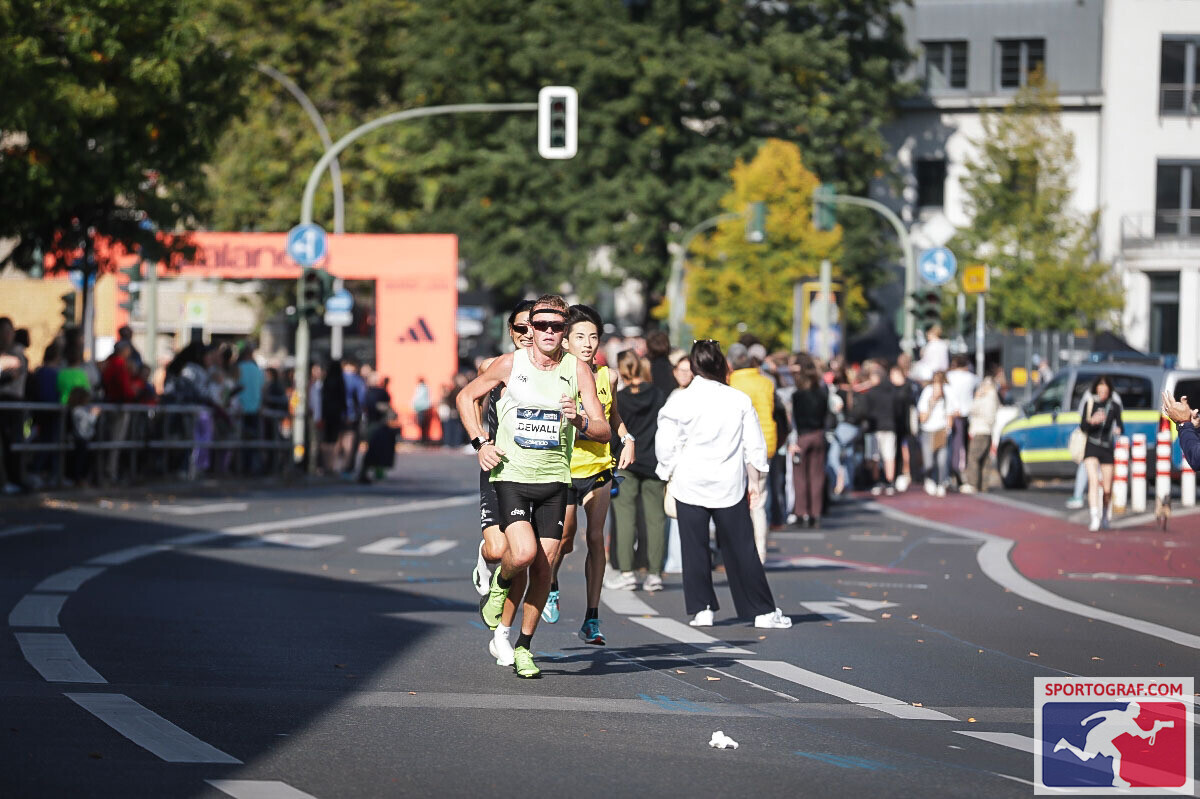
    Lars Dewall in a lime green Puma singlet, headband and sunglasses running at the front of a small group on a Berlin street, with spectators and a police van behind.
    Lars Dewall leads a small group through Berlin on September 27. He finished the BMW Berlin Marathon in 2:12:13, third among the Americans. (Photo: Sportograf)

    The summer before he started college, Lars Dewall ran his easy miles at a nine-minute pace.

    He had run 4:26 for the mile in high school. He had been an all-state skier at Stillwater Area High School in Minnesota, the same school Jessie Diggins skied for. And the coach waiting for him at the College of St. Scholastica in Duluth had given him one rule for his easy days: keep his heart rate under 140 beats per minute.

    For a runner like Dewall, on the road, that was a jog.

    “That’s how slow I was going,” he said. “It just doesn’t feel fun, and it takes a long, long time.”

    People tell him now that he runs his easy days fast.

    “I’m like, yeah, five years ago I was running nine-minute pace, though,” he said. “I had to be so disciplined about that for so long.”

    On September 27 he ran 2:12:13 at the BMW Berlin Marathon, 31st overall and third among the Americans, behind Charlie Sweeney and Will Nation. It was his fourth marathon and his fourth personal best. He debuted with 2:22:57 at Grandma’s in June 2025, ran 2:14:15 at the California International Marathon that December, comfortably under the 2:16 standard for the 2028 Olympic Marathon Trials, and then ran 2:12:30 at Boston in April. In between, back in Duluth, he won the Park Point 5-Miler and broke a race record that had stood since 1975. It belonged to Steve Hoag, who finished second at Boston that spring.

    Earlier this month his college coach, Chad Salmela, made the case in these pages for what American distance runners could learn from cross-country skiers, and called Dewall “my living thesis.” Salmela, who also calls cross-country skiing for NBC, describes his role these days as a sounding board on broad direction.

    Dewall teaches sixth, seventh and eighth graders in San Diego and trains with a group called Lane Zero Athletics. When we spoke on a Sunday in October he had already done his long run with the team, slept for about an hour, and was getting the coffee going at one in the afternoon.

    “It’s kind of like the day’s actually starting,” he said.

    He talked for most of an hour and needed very few questions to do it. Nearly every answer came back around to the same place. The hardest thing a distance runner has to learn is how to go slowly, and skiers worked that out a long time ago.
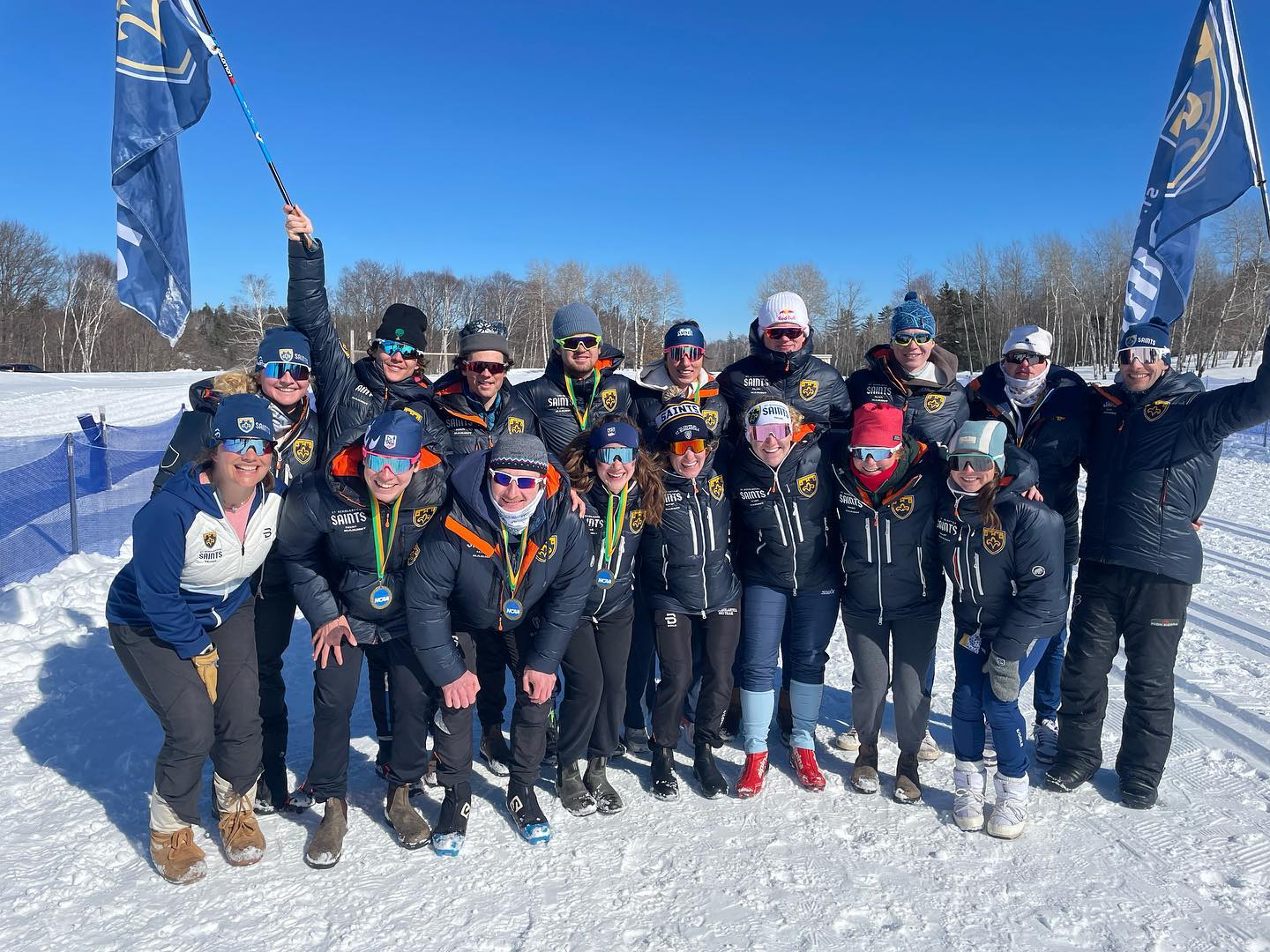
    The St. Scholastica ski team in navy Saints jackets and sunglasses posing on snow under blue sky, several holding NCAA medals, with two blue team flags raised behind them.
    St. Scholastica’s skiers after the men’s team won the NCAA Central Region team title in 2023, a first for the program. Dewall raced for the Saints on snow as well as on the track and the cross-country course. (Courtesy photo)

    Lying down in the tracks

    Skiing came first, in a way, and he did not care for it.

    His father was a serious skier, good enough to have raced against Salmela at some point, though Dewall is not sure exactly when. He took his son out on snow when the boy was small.

    “I just didn’t really like it that much, and it was kind of painful,” Dewall said and continued in his father’s voice. “He always describes it. He’s like, yeah, I’d take you out and you’d just go a little bit and lay down in the tracks or in the snow and just kind of goof around.”

    Football was the thing. He ran cross-country and track in middle school, but he cared more about football than any of it. In seventh grade he took track seriously and ran somewhere around 5:15 for the mile. In eighth grade, still a middle schooler, he trained with the high school team.

    “I look back on that and I’m like, that was a pretty big turning point, because you’re putting yourself in a situation with older guys,” he said. “I remember learning a lot more, and that, looking back on it, I feel like was more important than how I performed at that age. Although I performed well.”

    He planned to play football as a sophomore. That fell through, which he calls “a whole nother story,” and he abandoned ship for cross-country after the season was already underway. He was “aerobically pretty naturally talented,” he said, but there was not enough time left to get fit.

    Nordic skiing started around eighth or ninth grade, and it humbled him.

    “You can be really fit, but that doesn’t make you good at skiing,” he said. “It’s very, very different.”

    The technique took a couple of years. By his senior winter he was all-state, and he remembers finishing 22nd or 23rd at the state meet, which was enough to make him consider skiing in college. The trouble was that he had already committed to run at Western Washington University in Bellingham.

    After that ski season he toured St. Scholastica and met Salmela, who had been the school’s first nordic head coach for ten years before taking over cross-country running in 2016. Dewall would not have to choose.

    “I was really into the idea of being able to both nordic ski and run,” he said. “Especially at that age, I think it was really good for me to continue to do both for some years, because I didn’t know which one I really wanted to do at that point. And looking back on it now, they both really complemented each other for a really long time.”
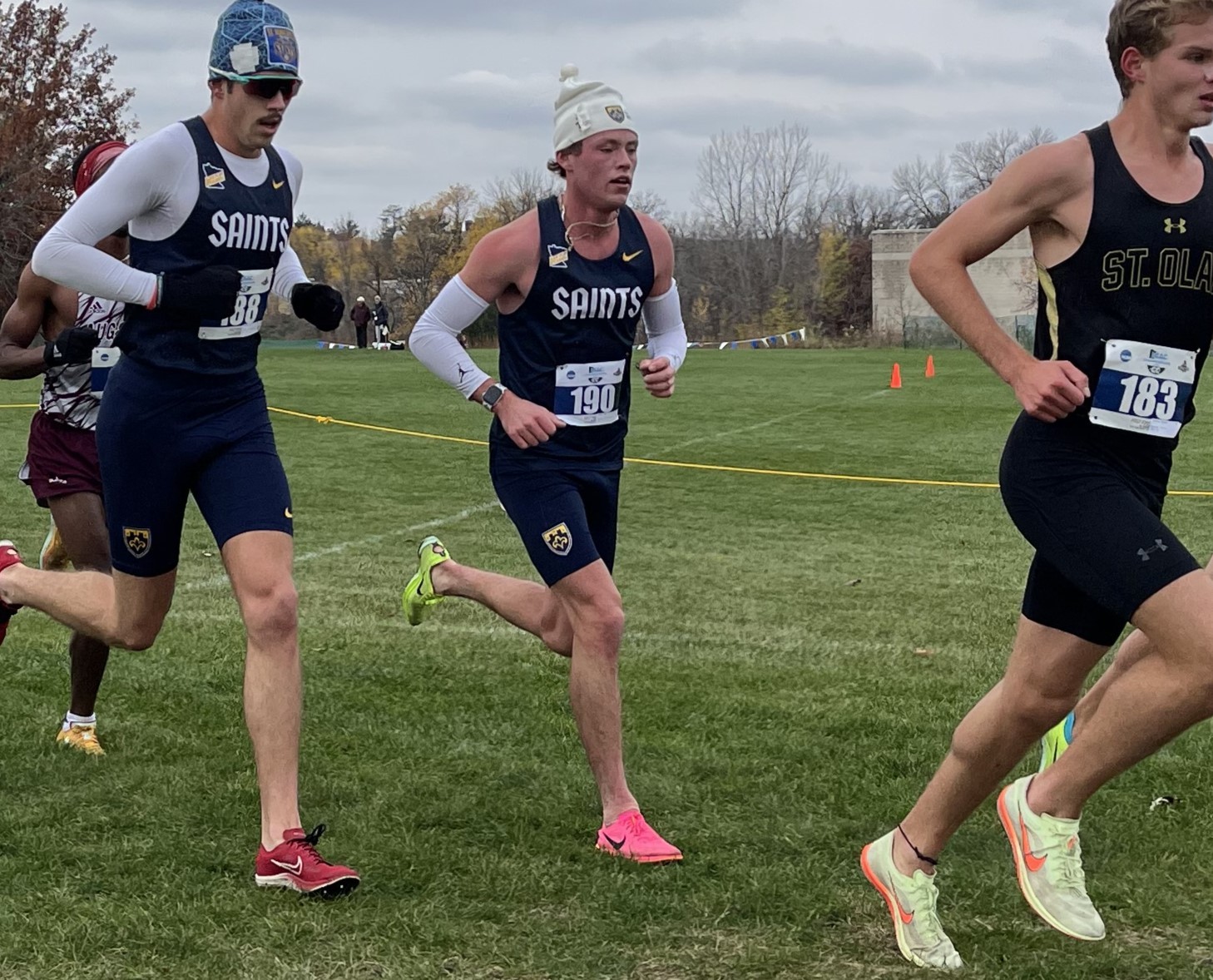
    Three college runners on a grass course, the one in the middle wearing a white knit hat, a St. Scholastica singlet and bib 190.
    Dewall (190), center, racing cross country for St. Scholastica. Under the 140-beat rule, his easy runs on Duluth’s trails went as slow as 10- and 11-minute pace. (Courtesy photo)

    The ‘Under 140’ Rule

    The running in high school was built for the mile and the two-mile. His coach at Stillwater was Scott Christensen, whose program produced four sub-four-minute milers by 2012, the most of any American high school at the time. Dewall puts the number at four or five.

    “My training was very VO2 max centered,” he said. “We’re running the mile and two-mile. There was no 5K.”

    Most of the rest of his running, he said, sat in “that level two zone, which at the time I didn’t even really know what that meant.”

    His best times were good and, he will tell you himself, not extraordinary: 4:26 for the mile, around 9:40 for two miles, 15:55 for 5,000 meters. He graduated in 2019 and doubts those marks would get him in the door at Western Washington now.

    “I guarantee those times would not,” he said. “They’d be like, nah, sorry.”

    What he remembers from those years is not a time.

    “I was running faster on my recovery or easy days in high school than I am now,” he said.

    The easy runs went at 6:30 to 7:15 a mile, with his heart rate at 150 to 160.

    “You’re in that zone where you’re just burning glycogen,” he said. “You can’t call it recovery, because you’re not recovering. You’re just burning through your tank every day, and you might get fit pretty quickly.”

    He has nothing against that kind of training. He just thinks it answers a different question.

    “If you gave me an athlete and were like, okay, we need to get this athlete as fit as possible in two to three months, you’re gonna do a lot of that zone two, because it’s gonna have the most bang for your buck,” he said. “But if you were to give me an athlete and say, we need to make this athlete the best version of themselves, and we have eight years to do it, well, you’re gonna do things a lot differently in terms of the intensity on your easy days.”

    Zone two sits well below threshold but above the genuinely easy work of zone one. On the Olympiatoppen scale most skiers know, the Norwegian system, it runs from roughly 72 to 82 percent of maximum heart rate. It builds fitness quickly. Plenty of coaches believe it also costs more recovery than easier efforts without giving much more back, and that is the trade Dewall is describing.

    He also thinks, looking back, that he was never really a miler.

    “I think I was a true distance runner who had the ability to run well at the mile and two-mile still, just by default almost,” he said.

    In Duluth, Salmela made it simple. Keep the heart rate around 140 or below on easy days. Dewall did not buy in right away.

    “It took me a little while to buy into it, and I was kind of half in, half out for a while,” he said. “But eventually I started taking it very seriously.”

    His first college cross-country season started well and ended with an illness and a disappointing finish. The principle held anyway. The nine-minute miles on the road were the hard part. Duluth had trails, and the trails helped.

    “The trails made it easy to really soak up, let’s just say, two hours at 135 BPM, but we were running maybe 10-, 11-minute pace on technical trails,” he said. “It made it mentally easy to let your ego go and just accept that it’s going to be a slow run and low heart rate, and that’s okay.”

    The return took years. When he is fit now he can run 6:45 a mile with his heart rate close to 130. He measures that against the high schooler who ran his easy days at about the same pace and 25 beats higher.

    “It’s huge,” he said. “It’s everything.”

    By the time he carried that discipline onto snow, the skiers around him already had it.

    “The skiers have a much better concept and notion of easy training than runners,” he said. “I would say it’s not even close. I feel like I’ve done more running than I have skiing, but I’ve done enough skiing to confidently say that the skiers are much more on top of their intensities, and cognizant about what they’re doing every day.”

    He has a theory about why.

    “Maybe it’s just the simple idea that you’re skiing, the terrain is varying,” he said. “Skiing feels a little bit more social to me than running does, because you’re out there and it’s different all the time. But running, I think people just get way too caught up in the pace per mile and all of that.”
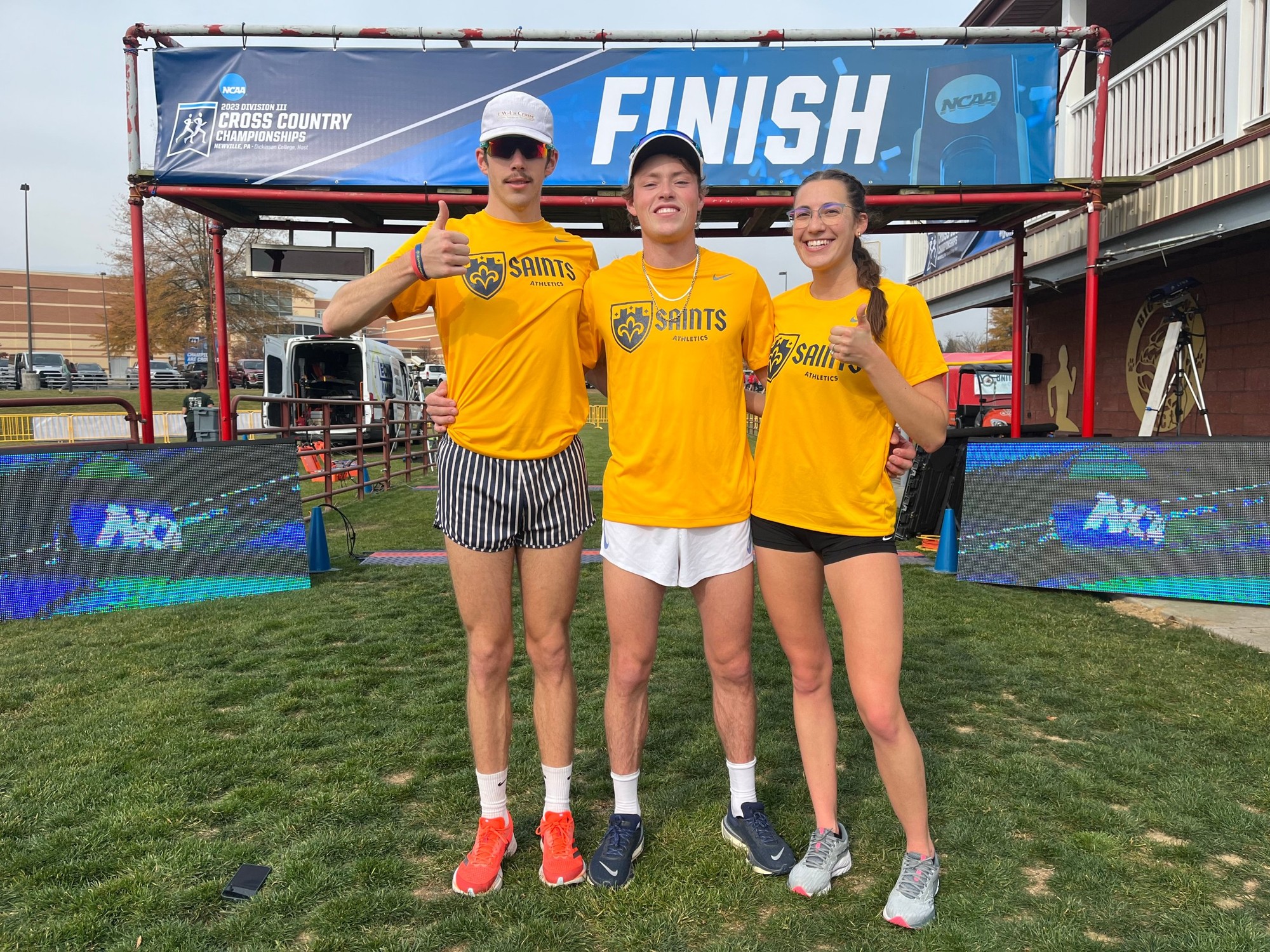
    Three St. Scholastica runners in gold Saints shirts smiling and giving a thumbs up beneath an NCAA cross country championships finish banner.
    St. Scholastica runners, Dewall among them, under the finish banner at the 2023 NCAA Division III Cross Country Championships in Newville, Pennsylvania. (Courtesy photo)

    Eight hundred hours

    In college he stopped counting miles and counted hours: run, ski, bike, lift. Some years, he said, came out between 800 and 900.

    “I was pushing it pretty heavy,” he said. “And again, obviously a lot of that is cross-training and not running.”

    Not all of it paid right away, even in a college career that included All-America honors in cross-country in 2023. The 5,000 and 10,000 meter results did not match the workload, and the skiing never got where he wanted it. He still turns that over.

    “I felt like I was decent at skiing, but I don’t know what it was, and I still think about it sometimes. I felt like it just couldn’t push to that top level,” he said. “I felt like I maybe didn’t start early enough, or maybe naturally just didn’t have it in that sport, and that’s okay. But I still really enjoyed it, and I think there was a huge payout later on in the running world with all the skiing.”

    The year had a rhythm. Winter was mostly skiing, with a little running. Cross-country season was a mix. In the spring he let the volume slide so he could sharpen for track.

    “You’re not going to run well in track if you’ve got heavy ski legs,” he said.

    What he and Salmela watched was the line from one year to the next, not any single season. It has only gone one way.

    “There hasn’t been a year since I started working with Chad where I haven’t gotten better, like PR’d in something or seen improvement in some way or another,” he said. “There were some years where maybe a nordic ski season or a track season or even a cross-country season didn’t go perfectly, and that’s sport. But across the board, since 2019, I can confidently say there hasn’t been a year where I haven’t gotten better.”

    He plans to do this for a lot more years and sees no reason for the line to bend. “I haven’t dramatically changed anything,” he said.

    The volume is lower now, because a runner cannot absorb hours the way a skier can.

    “You can try, but something’s gonna give at some point,” he said. “You’re gonna get hurt, essentially.”

    What crossed over intact was the mindset.

    “I’m really good about training like a skier, in the mindset of, I go out there and I know exactly what intensities I need to hit every day,” he said. “And I’ve done a really good job of letting the ego side of running go.”

    That means running alone, often. If the group heads out on a recovery day at 6:45 pace and his heart rate says no, he lets them go.

    “I have no issue going out and letting people go too fast, and I won’t go with them,” he said. “I’ll run alone. But that takes a lot of discipline.”

    He is not perfect at it. Where he still slips is in workouts, when somebody wants one more fast rep.

    “I can look back even at my block going into Berlin, and look at a couple workouts and be like, did I really need to do that?” he said. “Did that really help me more than it hurt me? But I think just being critical about all that helps you prepare for the future too.”

    The culture of the sport pulls the other way, he thinks, and social media has made it worse, especially for younger endurance athletes.

    “I feel like there’s also a side of them that’s chasing likes on Strava, or a fast run, or an Instagram post,” he said. “All that stuff is great, but if you’re skewing your training around social media, that’s no good.”

    His advice to the younger ones is short.

    “Wait for the race to do that,” he said. “Put the race down. The training is just the building blocks.”

    Every day should have a reason, a purpose.

    “Look at every day and be like, what am I going to do to get better today?” he said. “Instead of just kind of hither and yon, like, oh, let’s show up and run.”
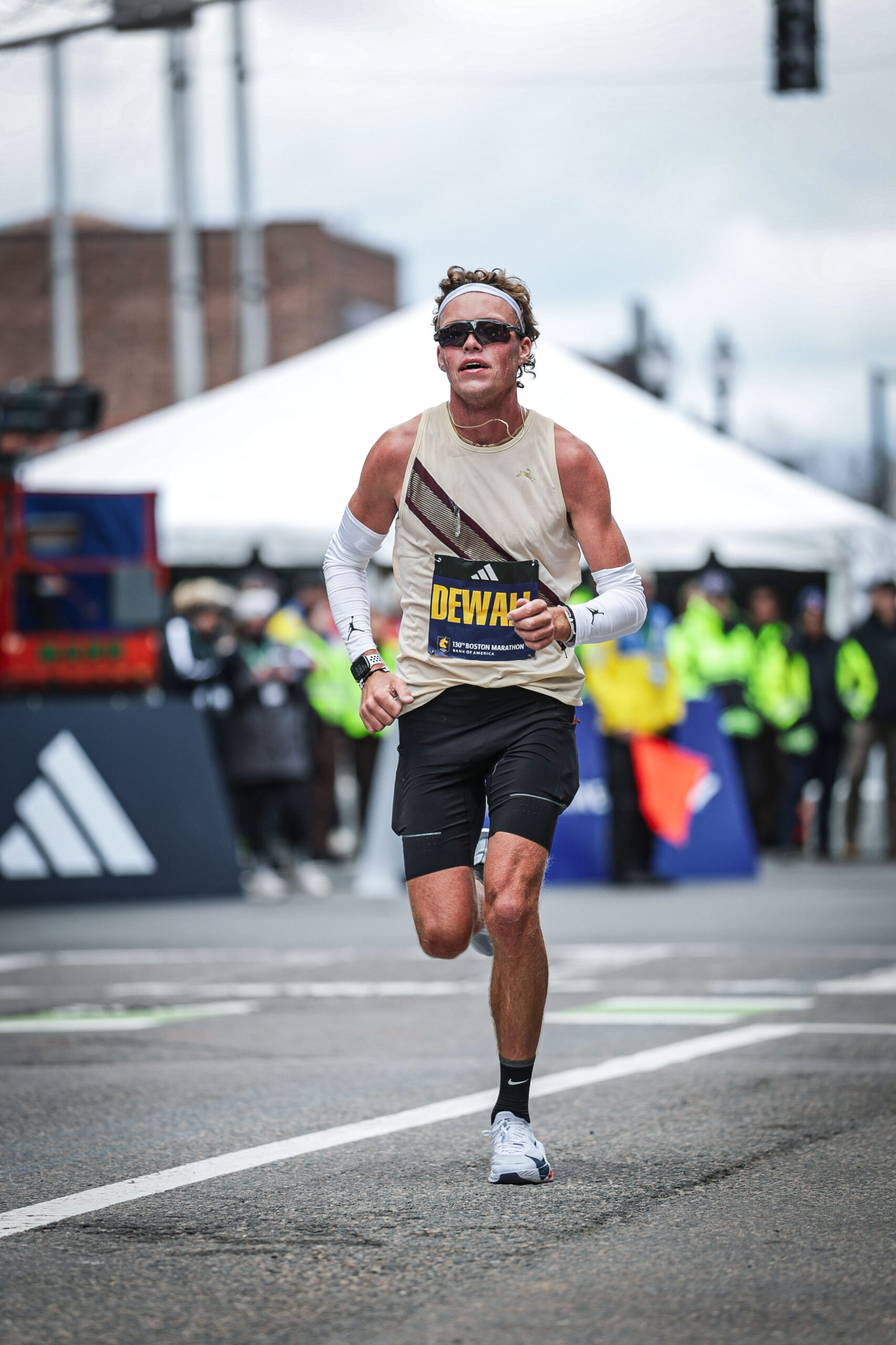
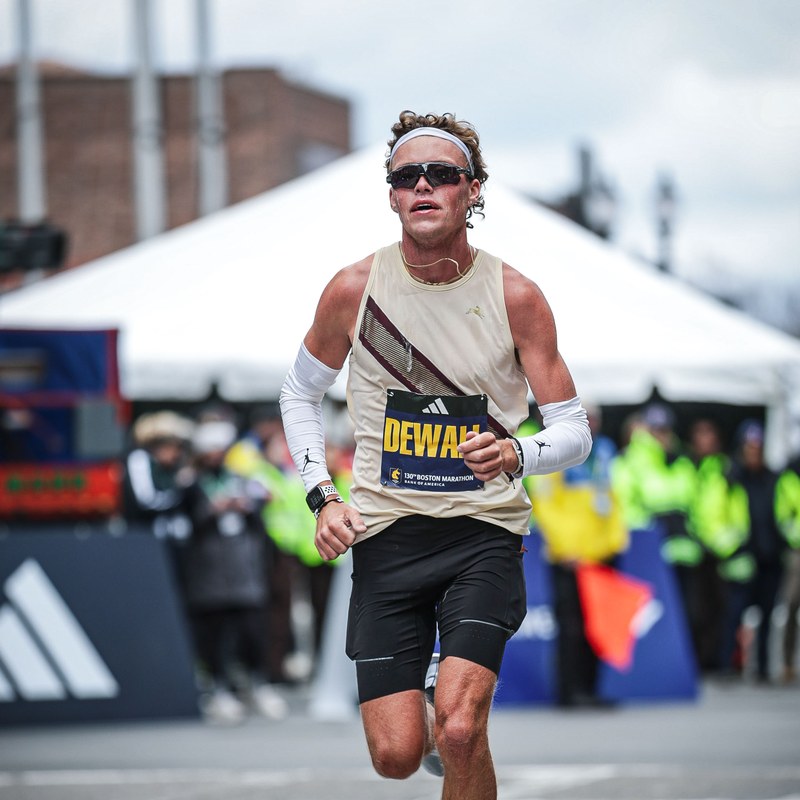
    Lars Dewall in a cream singlet with a maroon sash, white arm sleeves, headband and dark sunglasses running toward the camera at the Boston Marathon, a white tent and race volunteers behind him.
    Dewall at the 130th Boston Marathon on April 20, where he ran 2:12:30 off a build with no double threshold sessions in it. (Courtesy photo)

    Boring on purpose

    Ask what a skier’s background gives a marathoner that most marathoners do not have, and his first answer is something he does less of.

    “I’ve always found that I do a lot less VO2 max than most people, and I’ve been asked why,” he said. “The answer is always, VO2 max has a place. You have to touch VO2 max to be able to race well. But it’s less of a factor in the marathon.”

    When he leaned on it in high school and college, he would string together a couple of great weeks and then slide.

    “I felt like the engine would get flat,” he said. “And it’s so much harder to recover from a hard VO2 max session than a threshold session that’s done very well.”

    So he replaced some of it with threshold and what he calls efficiency work. He is sure he does more threshold than the average marathoner. The gap can look small on paper, maybe one session in fourteen days, and he thinks it compounds.

    “It’s hard to weigh how much even one workout every 14 days makes over the course of an eight to 12 week training period,” he said. “It adds up.”

    The second answer is strength, and with it the ability to carry mileage. He has gone from about 100 miles a week to about 135.

    “I don’t want to say that for sure, but I definitely think that the skiing background, the strength, the amount of volume that I was doing all those years has helped me being able to go from, okay, I was running 100 miles a week, that’s a lot. But to be able to jump from that to 135 and still feel pretty dang good,” he said. “To be able to make jumps like that, I feel like the ski background definitely is a part. Someone will go, oh, it’s just 35 more miles. But that jump in your nervous system and fatigue and all of that, it’s an exponential number. It’s hard to even measure.”

    The odd part is that in college he barely lifted for running at all.

    “I really did none,” he said. “I just didn’t really want to. I was just kind of lazy, and I didn’t believe that it would make me better at running.”

    What he did in the weight room was for skiing: upper body, core, pull-ups. For about a year now he has followed a running strength program built to take 20 minutes. Heavy half squats. Step-ups holding about 60 pounds. A Bulgarian split squat done as a jump, with no weight. Romanian deadlifts. Two sets of eight of each, three minutes between, and he spends the three minutes stretching, on core, or on whatever is sore. He lifts two or three times a week, soon after a workout or a long run once he has refueled, and never on a recovery day.

    “It comes at a cost, and strength is strength,” he said. “You’re still adding fatigue.”

    Then there is the session everybody in marathoning is arguing about. He ran 2:12:30 at Boston with no double threshold days in his build. He ran 2:12:13 in Berlin after a lot of them.

    “It’s hard to weigh,” he said. “If I would’ve ran 2:10 in Berlin, would I answer that question differently? Maybe. I just need more races to be able to answer that question. I think they’re both good.”

    His complaint is with how a lot of people do it.

    “You want fatigue to be the thing that’s stopping you, not lactate being too high,” he said. “People are like, oh, I’m done, my lactate’s high. And most people aren’t even monitoring that. I just like to let time be the thing that makes you tired. Time on feet.”

    Going into Berlin, where the goal was to break 2:10, the pace for it, around 4:57 a mile, felt easier than it ever had in his career. He gives double threshold some of the credit and plans to keep it, perhaps every other week instead of every week.

    “It’s taxing,” he said.

    After the first story ran, Salmela wrote that Dewall was basing most of his current training on cutting-edge running technology. Dewall found the phrase funny.

    “I would say that a lot of my training looks pretty boring, because it’s a lot of the same stuff over and over and over,” he said. “But the consistency is there, and the focus and discipline and being a mature runner is there.”

    Lactate testing and heart rate data matter, he said. But he thinks what Salmela meant is simpler than any of the gadgets.

    “In the running world specifically, people aren’t out there constantly monitoring heart rate and all that data, and getting useful information from it,” he said. “Even in the pro world in running, there are people who are doing a really good job of it, but there’s people out there who are just showing up, like, let’s go run.”
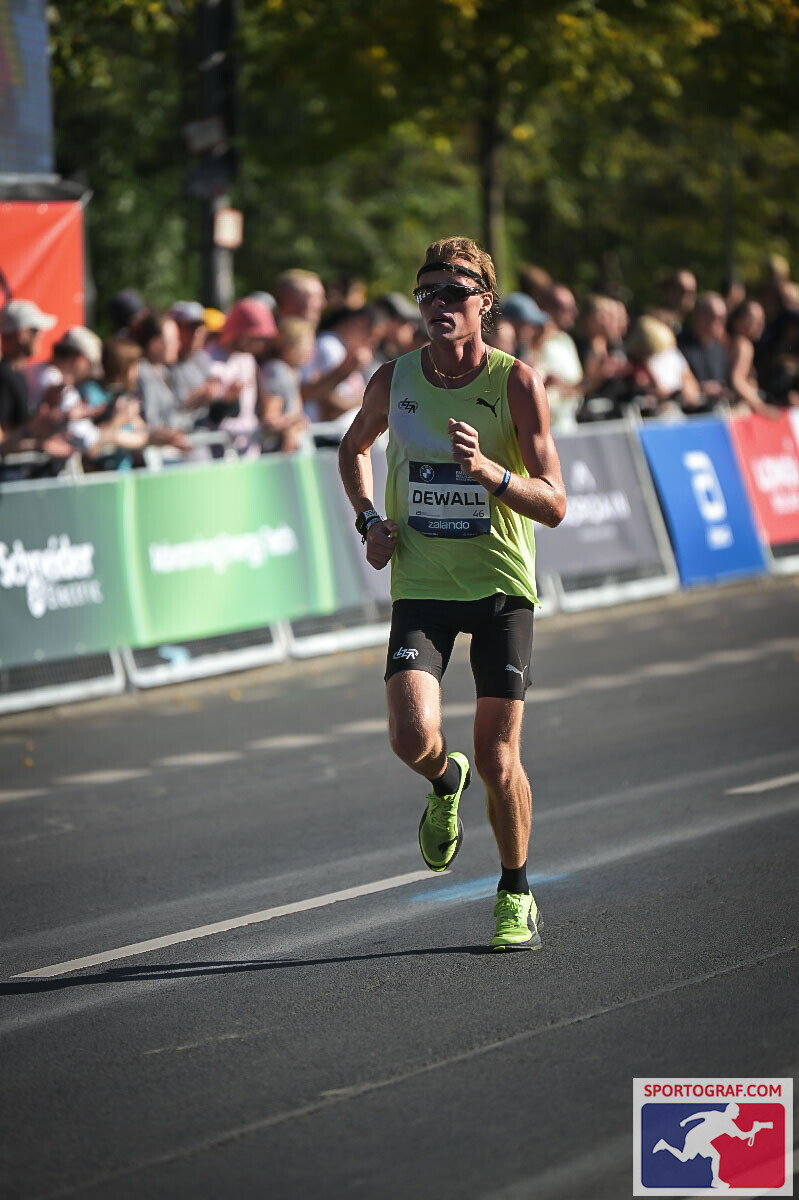
    Lars Dewall in a lime green singlet and bright yellow shoes running alone down a sunny road lined with barriers and spectators.
    Dewall on the road in Berlin, his first race in Europe. He called it the most organized and efficient race he has been to. (Photo: Sportograf/courtesy photo)

    The road to St. Louis

    The Olympic Marathon Trials are in St. Louis on March 25, 2028. Dewall has had the qualifying time since CIM, and he is not alone at home. Three or four of the Lane Zero runners, Dewall included, have met the 2:16 standard.

    “Although San Diego’s a big city, that’s a lot of qualifiers for even a big city,” he said. “Those are the guys that can push me in workouts and really make me better in workouts.”

    Puma backed him through Berlin under its PROJECT 3 program for sub-elite marathoners, and after the race the company told some of those athletes it would support them through the Trials. He does not yet know what that will look like. He doubts it will be money.

    “But free gear and travel and stuff like that, and that’s pretty huge,” he said. “So I’m stoked about that.”

    He knows where the next line is.

    “Two-ten is the number that most of these companies are looking at to be like, okay, let’s get you on an actual contract,” he said.

    For now he is letting his body decide what comes next. Berlin was three weeks old when we spoke, and the job was to recover without giving back fitness. There might be a race before the end of the year. He expected to know soon.

    Early 2027 is for going shorter: road 5Ks and 10Ks, maybe a 3,000 or a mile, even a time trial. His 5,000 best is 14:37, and he thinks 14:10 is there at the least. He would like to get under 29 minutes for 10K. His mile best is 4:10 from college, and before Berlin he ran 4:22 at the end of a workout without trying very hard.

    “I was like, to my buddies, I think I could have PR’d in the mile right now at the end of this workout if I would’ve went for it,” he said. “Who doesn’t want to have a faster mile PB, even if you’re a marathoner?”

    The bigger target is the half marathon standard for the Trials, 1:03:00. The window for half marathon qualifiers opens January 1, 2027. His best is 1:04:06, from the Garry Bjorklund Half Marathon at Grandma’s in June, in conditions he called humid-ish. He is already qualified for St. Louis, so the half would change nothing about his place there. He wants it anyway, and he is looking at a half in March.

    “It’s a nice accolade to have,” he said. “It’s no gimme. That’s gonna take some really specific prep.”

    He expects to run one marathon in 2027. Boston again, maybe London, maybe Chicago, nothing later in the year than that. He would think about Berlin again if teammates were going, because of how well the race took care of its elite field.

    “That was the most organized and efficient race I’ve ever been to,” he said. “And that’s worth a lot.”

    He wonders whether getting there three or four days earlier would have bought him something. He does not know. He also admits he remembers very little of the course.

    “I always laugh when people ask me about the course in those races, and I’m like, I don’t even know,” he said. “You’re going pretty fast, but you’re also in a group like that, and the only thing you’re looking at is just the person in front of you.”

    On Monday mornings he is back in front of his middle schoolers. He is not a morning person, which makes running before school a grind in the long weeks.

    “I wish I could start my teaching day at 9 or 10 a.m., but that’s not how the real world works,” he said.

    He would not trade it.

    “When you don’t have that job, it’s easy to get almost obsessed with the training and the running,” he said. “As much as that’s great and it’s exciting, I think it’s good to have something to force me to not think about running.”

    The classroom gives some of it back.

    “It’s fun teaching kids and making a difference in their life,” he said. “I feel like they take interest in the marathon stuff too, and ask questions, and always want updates.”

    He wants to coach someday, probably once his own career is over, and he knows which sport.

    “I think I’d like coaching running more,” he said. “A little more straightforward. Less variables, less factors.”

    No wax, no kick, no temperatures, as he put it.

    The 2:10 is still out there, and he knows how close 2:12 is.

    “I’m scratching,” he said. “I just gotta connect on the right day.”


    Help Support Our Coverage!

    If you value the thoughtful work and access FasterSkier provides, please consider becoming a Voluntary Subscriber. Your support directly fuels our work to cover the people, places, and moments that make our sport special.

    Join the FasterSkier community!
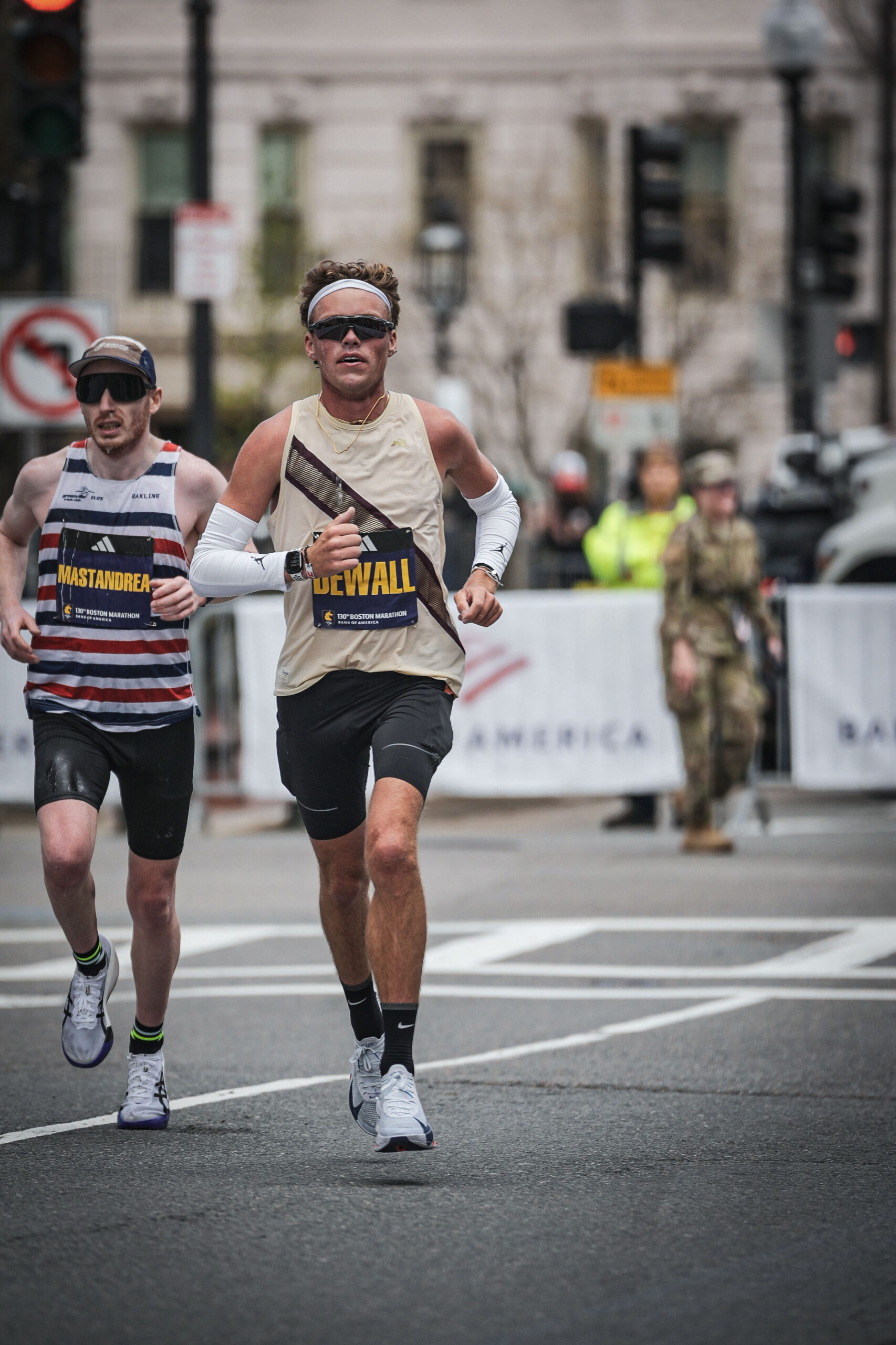
     

    Lars Dewall in a cream singlet and white arm sleeves running a city street at the Boston Marathon, a runner in a striped singlet a step behind him.
    Dewall at Boston in April. He expects to run one marathon in 2027, and Boston is on the list. (Photo: T. Wherry)
  • ‘Mileage Is a Distance, Not a Volume’: Chad Salmela on What Runners Can Learn From Cross-Country Skiers

    ‘Mileage Is a Distance, Not a Volume’: Chad Salmela on What Runners Can Learn From Cross-Country Skiers

    This article was made possible through the generous support of our voluntary subscribers. If you value coverage like this, please support FasterSkier with a voluntary subscription.

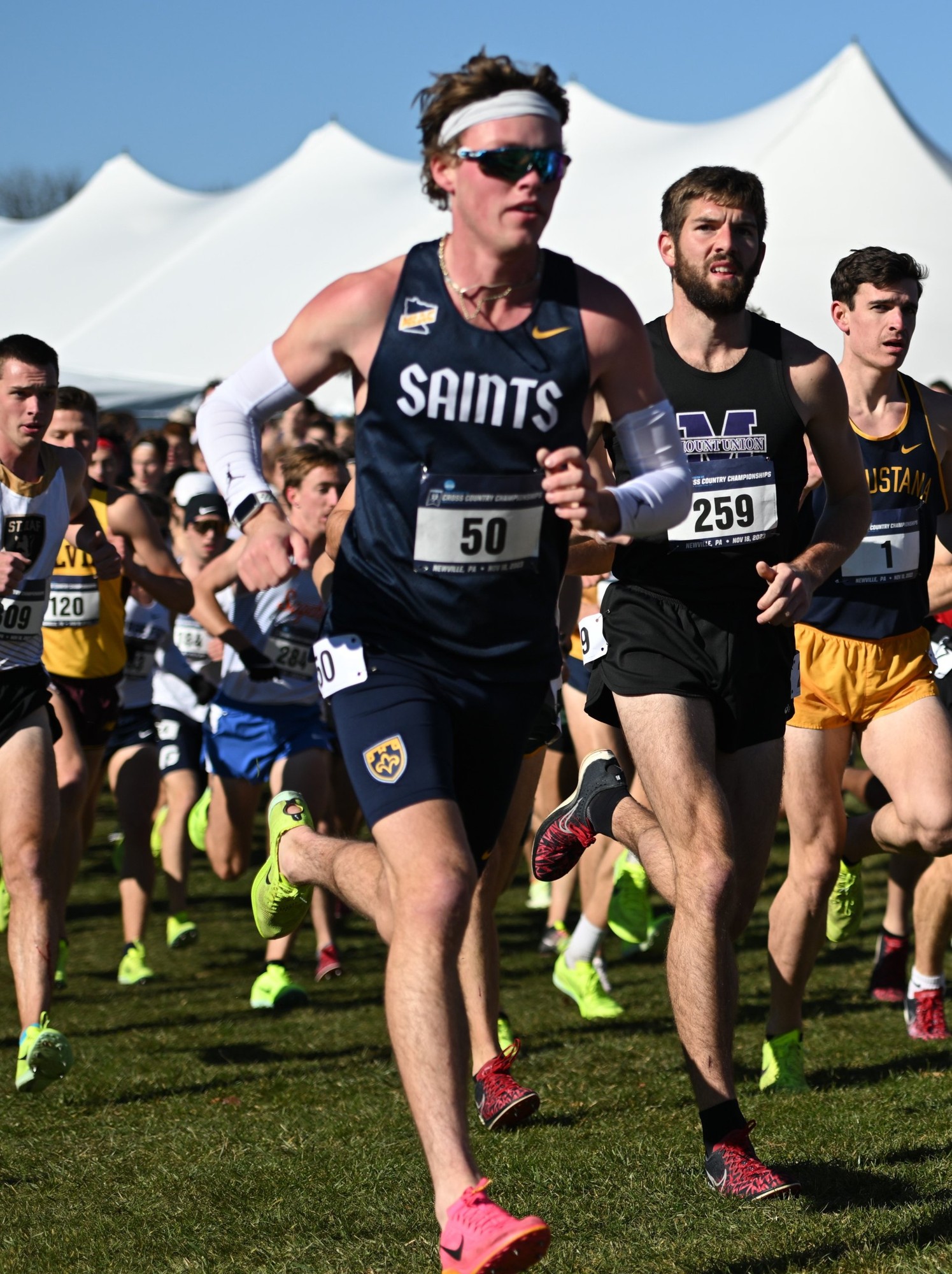
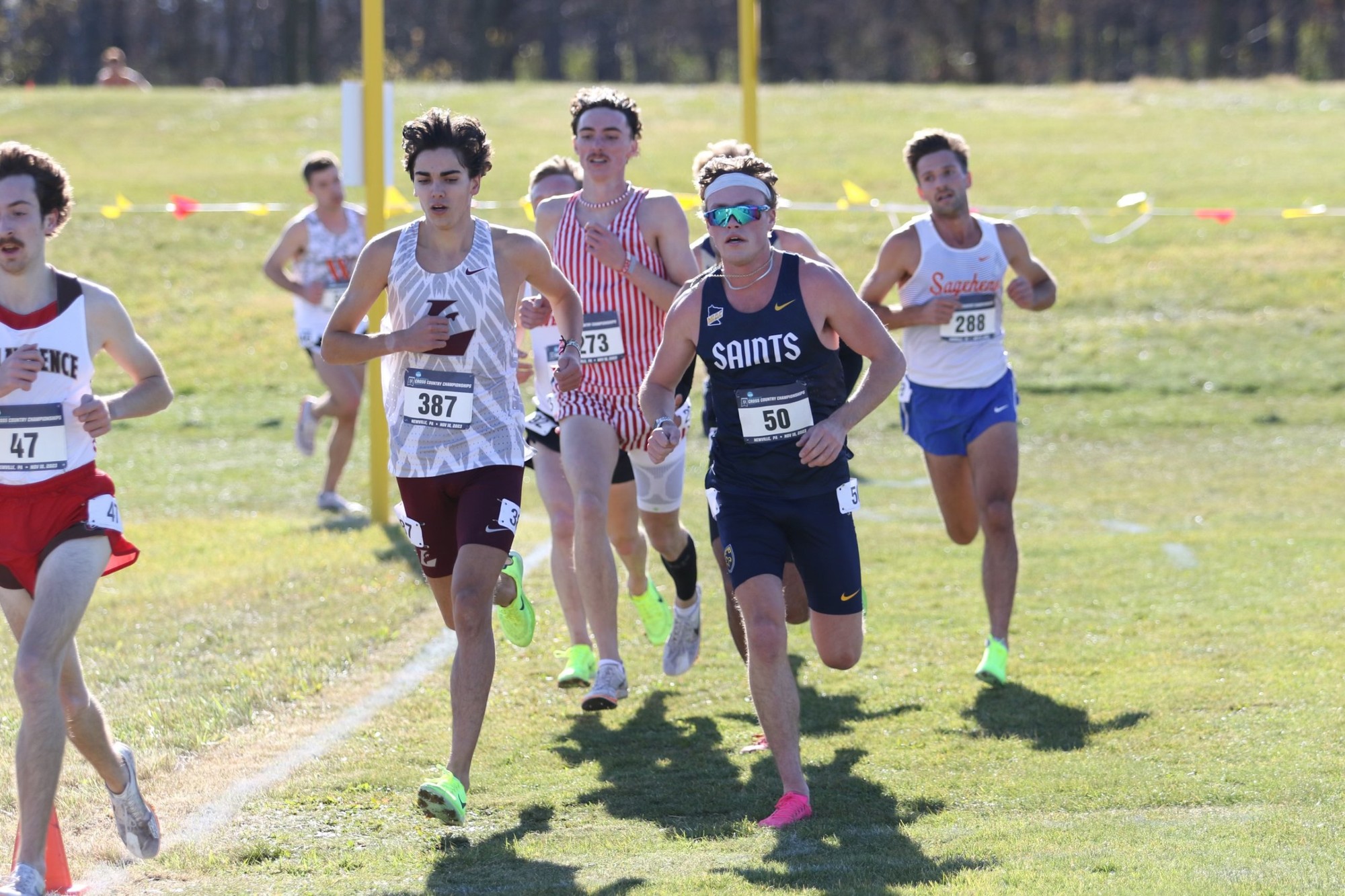
    Lars Dewall in a navy St. Scholastica Saints singlet and bib 50 running in a pack of college runners on a grass cross country course.
    Lars Dewall (50) races for St. Scholastica at the 2023 NCAA Division III Cross Country Championships in Newville, Pennsylvania. (Courtesy photo)

    Lars Dewall has run four marathons and he has never run a slow one.

    The debut was Grandma’s in June of last year, 2:22:57. Then California International in December, 2:14:15. Then Boston in April, 2:12:30. Then Berlin in September, 2:12:13, third American across the line. Four races, four personal bests, each one faster than the last, which is not how marathon careers usually go.

    Dewall came out of Division III. He ran at the College of St. Scholastica in Duluth and was an All-American there in 2023, one of the first two the cross-country program ever produced. He now teaches middle school social studies in San Diego. His training sounding board on broad direction is his college coach, Chad Salmela, who coaches cross-country at St. Scholastica, called the women’s team sprint in PyeongChang for NBC, and spent eight years on the US biathlon team before either of those things.

    Salmela has a theory about why Dewall keeps getting faster, and it is not a comfortable one for American distance running. He has been making the argument for most of two decades, in a sport that was not his first one, and until recently he did not have a runner fast enough to make anybody listen.

    “He’s like my living thesis right now,” Salmela said. “He’s actually texting me as we’re talking.”

    The St. Scholastica cross country team in navy warm-ups posed in rows on stone steps, women on the left and men on the right, with the coaches standing at the top.
    Chad Salmela, back row center, with the 2026 College of St. Scholastica cross country team. In more recent years, Salmela has given up the nordic coaching role to concentrate on broadcasting during the ski season, which we will cover soon in part two of this series. (Courtesy photo)

    Mileage is a distance, not a volume

    The sentence above is his, written rather than spoken. It appears in the letter he sends to recruits, which is less a sales pitch than a seven-paragraph argument about exercise physiology, and it is the cleanest statement of the thing he believes.

    “Mileage tells you how far you’re running,” he said. “It doesn’t break down what you did in that distance.”

    He has been resisting the number for years and he still resists it.

    “You can have a huge mileage week on threshold. You can have a small mileage week on relatively aerobic,” he said. “Two to three two-hour-plus workouts, that’s going to be fewer miles than three threshold workouts. So that mileage metric, I feel like it kind of misshapes things in people’s minds.”

    Ninety-mile weeks are not the problem, in other words. What is in them is.

    “Ninety-mile weeks at a lactate of 2.5 as opposed to a lactate of 1 is going to have a way bigger consequence down the road,” he said.

    This is where the skiing comes in, and it is worth being precise about the lineage, because Salmela is. The interval sessions he leans on are not his. The one he uses the day before a race, a minute on and thirty seconds off, he calls “a complete ripoff from the Ingebrigtsens,” though the session appears in Marius Bakken’s own published account of the Norwegian model, as does the 45-seconds-on, 15-off session Salmela started using this autumn. Bakken, a Norwegian physician and former 13:06 5,000-meter runner, built the method out of more than 5,500 lactate measurements and mentored Gjert Ingebrigtsen (Jakob’s father) directly between 2011 and 2013. The family made it famous. Bakken wrote it down first.

    What Salmela did was carry it sideways, out of a sport where lactate testing has been routine for forty years into one where it mostly has not. He is blunt in the recruiting letter about why that gap exists and what it costs: the discovery was “established decades ago in the early 1980s, and has been adjusted in many other endurance sports, yet somehow continues to evade American distance running.”

    His own estimate of what the ceiling looks like is deliberately large.

    “If you can train as a runner seven or eight hundred hours of aerobic training, it doesn’t have to all be running; you can improve way more than you think as a runner,” he said. “But how do you get those 800 hours? You can’t do it running. You’re probably going to start having a limitation there.”

    That is a skier’s number, and he knows it. It is also the number he says Dewall has been running at for two years.

    A runner bounding uphill with ski poles beneath a chairlift, a second runner far behind him.
    St. Scholastica’s Paul Schommer, foreground, and Joe Dubay bounding up Spirit Mountain in Duluth, Minnesota, in the fall of 2014. (Photo: Chad Salmela)

    Injury is not the cost of doing business

    The recruiting letter contains three words in capitals: “Injury is NOT necessary.” He gets more animated about this than anything else in our ninety-minute conversation.

    “The first thing that always drove me nuts as a skier coming into the running world, before I even started coaching, was just the acceptance of injury as part of the deal,” he said.

    He is careful to say he might be wrong, and then says why he does not think he is.

    “Anytime you’re asking your body to do something it’s not able to do, you’re doing something wrong,” he said. “I think that’s a very important thing to remember. If you build the strength and you build the motor to handle it, you can pretty much avoid injury.”

    Then the qualifier, offered without being asked for, which is the mark of someone who has actually thought about the limits of his own claim: “maybe I’ve just never taken anybody to their very maximal capacities so far, and that could be it.”

    The mechanism he proposes is fuel. His argument is that a runner who has never taught their body to burn fat at easy intensities is spending glycogen on workouts that were supposed to be building aerobic efficiency, and that the bill arrives later.

    “You’ve got to define where your aerobic threshold is running, and you have to make sure that you’re burning fat there,” he said.

    He has a blunt way of describing the high school runner doing it wrong.

    “You can’t be running 6.5-minute miles and you got a PR at 15:30. That doesn’t even compute. It’s not easy enough,” he said. “You’re still going to have better immediate success. But somewhere down the road, if you don’t learn how to burn fat, you’re going to probably get hurt.”

    The same protectiveness shows up somewhere less expected, which is how he handles a team that is getting sick. Two weeks before we spoke, a freshman turned up to a threshold session with a sore throat and told nobody until afterwards. Three of the four men in his suite went down. By Thursday the squad was, in Salmela’s description, a shell of itself, and on Saturday fourteen of thirty made the workout.

    The athlete who did not get sick was the fittest one in the room, and Salmela pulled him out of the hard session anyway.

    “I’m not putting you through a level four workout right now when you’re rooming with three guys who probably are carrying the bug, because you’ll be sick by Saturday if we do it,” he said. “He was pissed, but I didn’t let him do it.”

    The rule for everyone else is not negotiable and the arithmetic behind it is simple.

    “If you’re sick today, you’re not training tomorrow,” he said. “The best case scenario is you catch it, you stop, and you have four days that you’re not training. That’s going to be the minimum.”

    Against that he sets what a season costs. His athletes are chasing a minute off an 8k, and he does not think a sick athlete who races anyway gets it.

    “They’re not running a minute faster in 8k this year, and they will not do it if they get sick,” he said. “They won’t do it.”

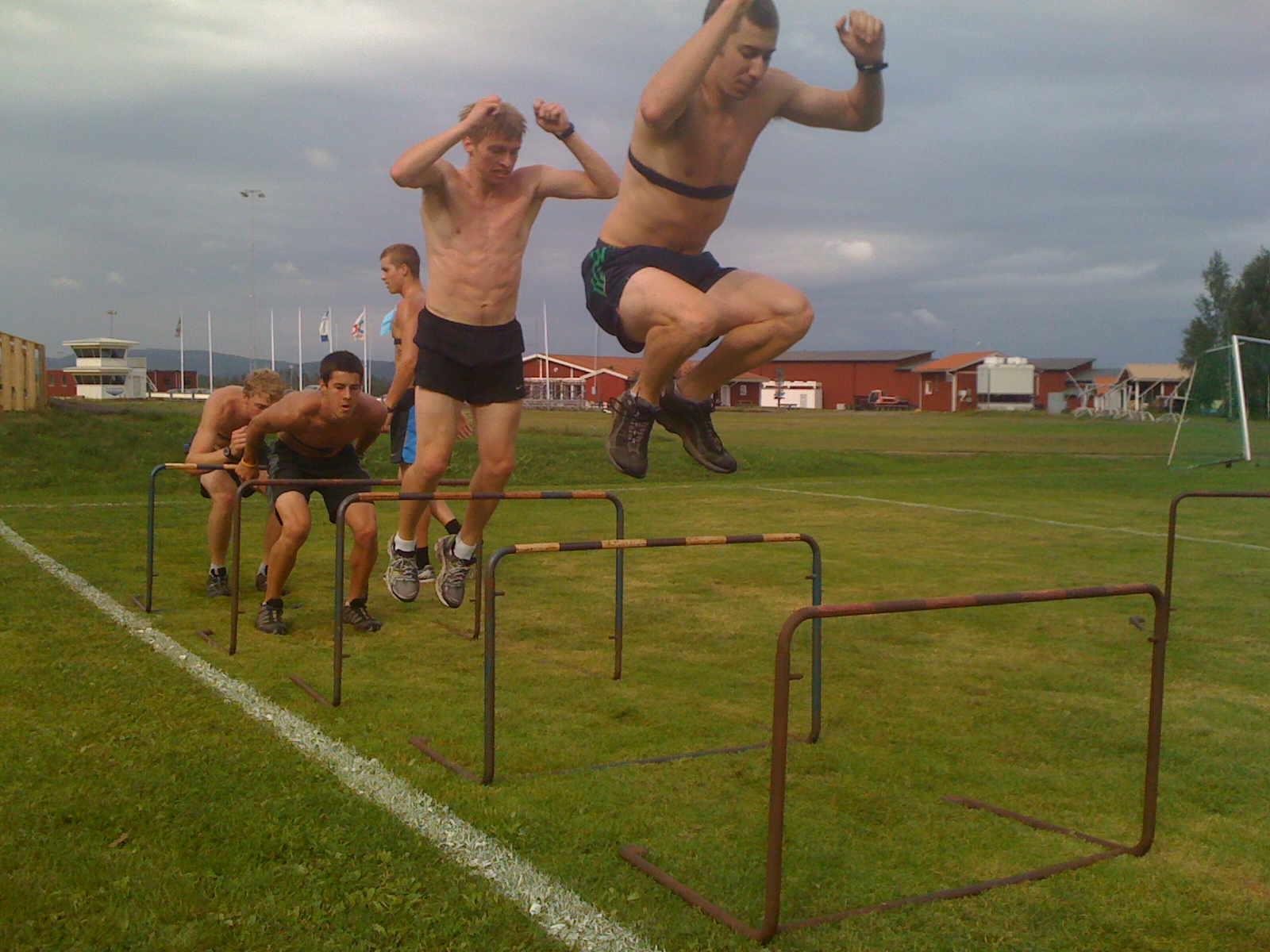
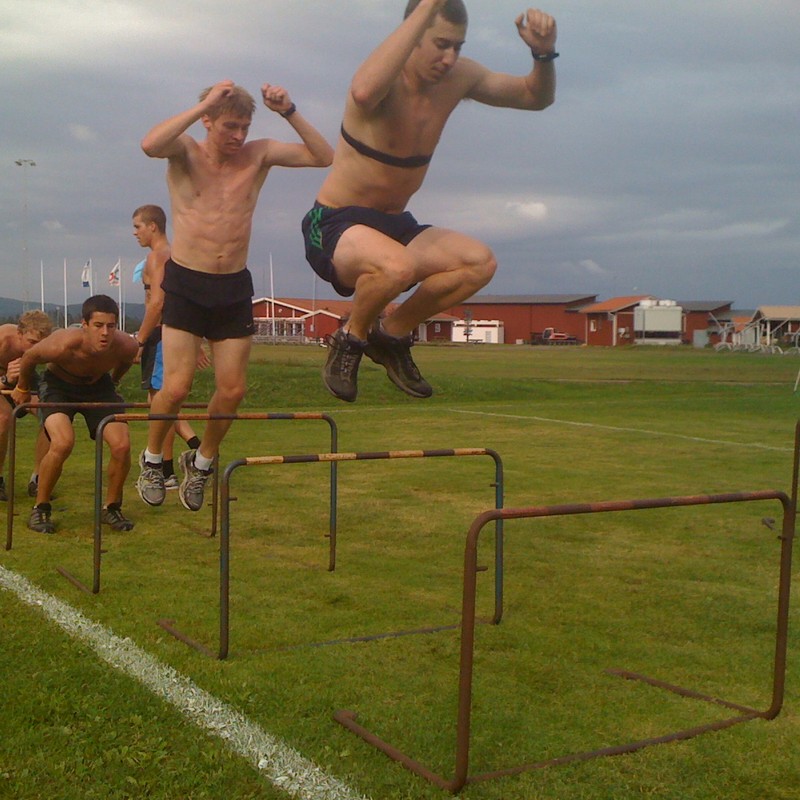
    Five athletes bounding over low hurdles on a grass field under a grey summer sky.
    Hurdle bounding at a St. Scholastica dryland session. Salmela believes in the work and is his own cautionary tale about too much of it; a winter of jumps in his last season as a biathlete left him convinced he had compartment syndrome. (Photo: Chad Salmela)

    What he got wrong first

    Salmela is a strength evangelist who will tell you, unprompted, about the year he ruined a team with it.

    “I loaded too much strength on some of my early teams coaching, and they got flat,” he said. “They got super slow, didn’t stay quick.”

    What he settled on instead is periodized and, more importantly, individual. December is a strength block for everybody. In season it drops to maintenance and bodyweight work. Beyond that he decides person by person, and he is explicit that the people who say runners need strength and the people who say they do not are both partly right.

    “You need a minimal amount of strength just to stay healthy,” he said. “And then some people need strength to be stronger, to be faster as a runner. They actually need strength to be a part of the catalyst that makes you your best.”

    He has a sophomore who worked this out for herself before he did. She ran in high school, never lifted, went through the Air Force, got strong there, and arrived at the conclusion that the strength was the thing she had been missing all along. She now does three sessions a week on her own, more than Salmela gives anyone else on the roster.

    Plyometrics get the same treatment, and the same warning, which comes from his own body. In his last season as a biathlete he loaded up on jumps and spent January and February convinced he had compartment syndrome.

    “Really what it was is I had incredible anaerobic power and the racing season just kind of started having catabolic reactions in my shins,” he said. He credits Dave Bacharach, the exercise physiologist at St. Cloud State, with talking him out of the diagnosis: a lot of type 2 fibre, suddenly drowning in lactate every weekend.

    “You have to be careful with plyos for aerobic sports because it’s anaerobic work, and it’s going to steal some of it,” he said.

    The archaic notion

    Ask him about tapering and he does not hedge.

    “I think the taper is an archaic notion,” he said. “I think some people need a taper. You have to find the person who needs a taper. And there are some people out there, but I’d say they’re the minority.”

    His team runs six to nine hours a week regardless of where the season is. The reasoning is that fitness is the thing being protected, and that the races themselves do the damage a taper is usually blamed on.

    “Great races kick your ass, man,” he said. “They are hard to recover from. So if you want to have two or three great races in a row, you better watch that.”

    When he does drop volume it is recovery, not peaking, and he says so. The most persuasive evidence came from a senior who diagnosed her own pattern and brought it to him: three straight years of running a personal best at conference and then one of her worst races of the season at regionals a week later.

    “She goes, can we fix that? And I’m like, yeah,” he said. “We’re going to keep the volume high. We’re not going to taper.”

    What replaces the taper is a race week with a shape to it, and this is the most directly usable thing he says all afternoon. A maximal effort five days out, long enough to spend real time at max heart rate. Then the Bakken session the day before.

    “The reason I think you need that is because your heart will not be ready to respond to the work if you don’t do that,” he said of the hard day. “And if you do it any closer to the race, you’ll still be trying to recover from it.”

    The day before, he keeps it short: five to eight repetitions of a minute on, thirty seconds off, in the tempo zone, perhaps five minutes of actual work.

    “It’s the best pre-race workout I’ve ever found. Works almost universally,” he said. “Up until that point, I had found some workouts that work for some people and not for others.”

    He does not prescribe the number. He hands the athlete a rule instead, and it is a small masterpiece of coaching.

    “As long as the one you did last feels better than the one you just did before that, do the next one,” he said. “As soon as you feel like you’re working at all, you’re done.”

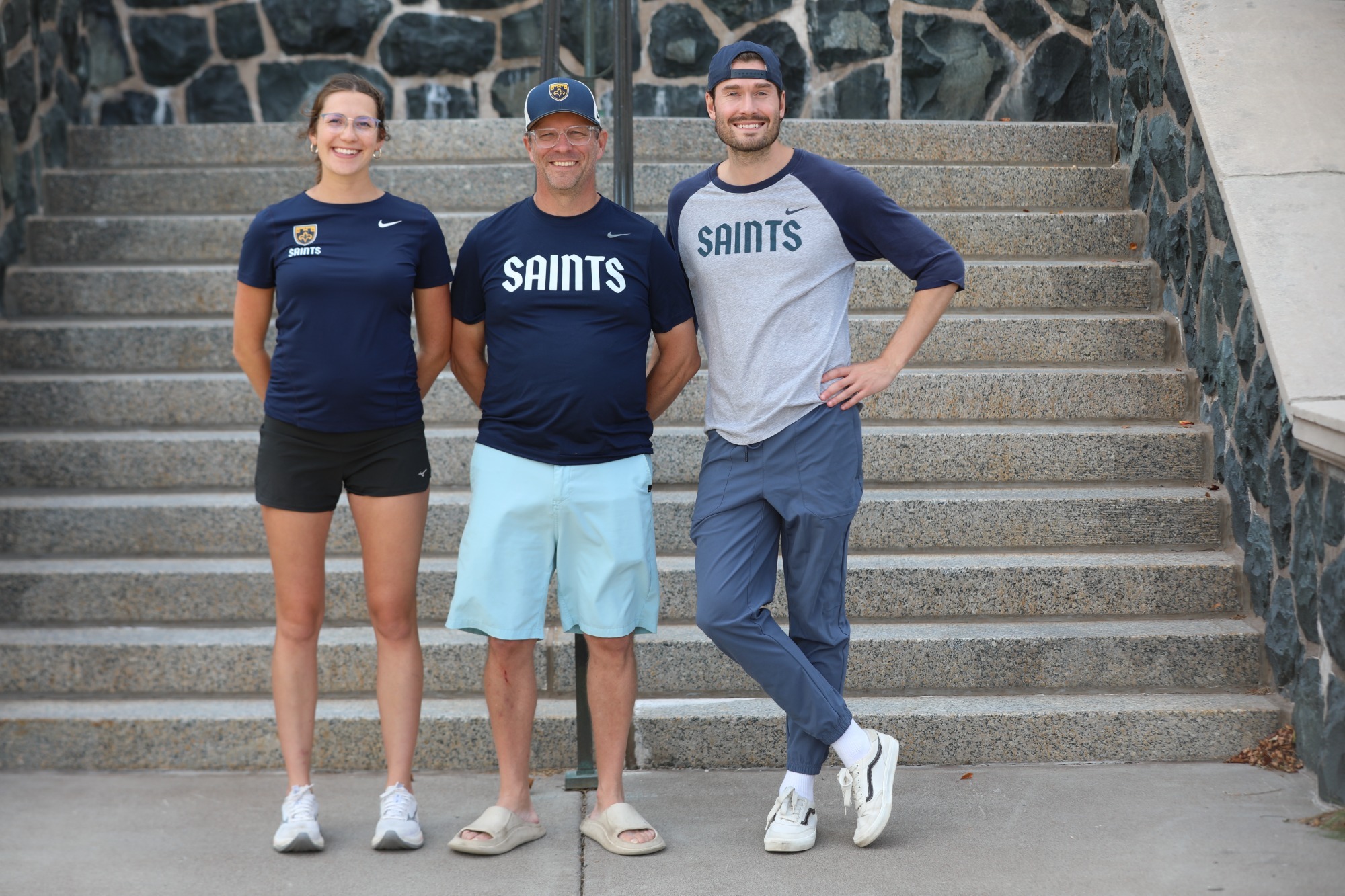
    Three St. Scholastica coaches in Saints shirts standing at the foot of a wide stone staircase, Chad Salmela in the middle in a cap and light blue shorts.
    Salmela, center, with his St. Scholastica cross country coaching staff in August 2026. (Courtesy photo)

    Leave the gait alone

    There is one more piece, and it runs against most of what a modern running program sells.

    “Meddling with natural biomechanics is kind of a no-no in my book,” Salmela said.

    His most successful runner, he said, had a gait nobody admired and plenty of people wanted to correct. She was never injured until she stopped doing strength work.

    “Her gait wasn’t pretty, but it worked, you know, and I recognized that,” he said.

    His evidence for leaving well alone is a runner who arrived last year from a small high school program, had not scored for his team, and spent his first season trying to prove he belonged by going too hard at everything. It did not work. Salmela sent him away for a summer with an instruction to run more, at the intensity he was told and no harder.

    “He comes in here, he looks so good. All the coaches are like, man, his running has improved a ton,” he said. “He had clodhopper feet last year, because he wasn’t a real runner. He hadn’t run enough yet. Comes in this year and he just comes off the ground, he looks natural, he looks like a runner now.”

    Then the part he seems to enjoy most.

    “And I did nothing,” he said. “I didn’t have to tell him anything other than follow the right intent.”

    Lars Dewall in a St. Scholastica singlet, headband and sunglasses running at the front of a large field, with white event tents behind.
    Dewall early in the race at the 2023 NCAA Division III Cross Country Championships, the fall he became one of the first two cross country All-Americans in St. Scholastica history. (Courtesy photo)


    Which is more or less the argument in miniature. Dewall ran 110 to 130 miles a week building for Berlin, more than he had ever run, a third of it on soft surfaces, the intensity governed by lactate rather than by what the paces are supposed to look like. He got support from Puma’s PROJECT 3 program for the race. He went 2:12:13 and took seventeen seconds off a personal best he had set five months earlier in Boston. Salmela is careful not to claim all of it. Dewall now builds most of his training around cutting-edge running technology that Salmela admits he is “not terribly well-versed” in. “Still, I think the thesis IS a huge reason he is blowing minds, and why he can do these workloads,” Salmela wrote after our interview. “But not the only.”

    Salmela has been saying for years that nordic volume would do this to a distance runner if anyone ran it properly. It took him until his fifties to find the runner who would.


    Help Support Our Coverage!

    If you value the thoughtful work and access FasterSkier provides, please consider becoming a Voluntary Subscriber. Your support directly fuels our work to cover the people, places, and moments that make our sport special.

    Join the FasterSkier community!
     

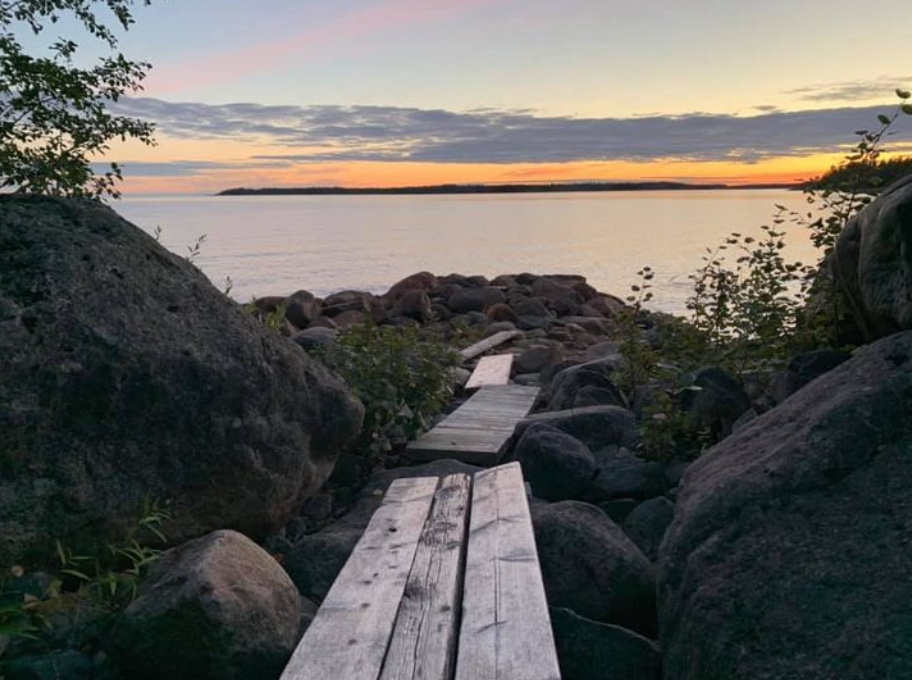
    A wooden plank walkway running between boulders toward a calm sea at sunset.
    A path to the Gulf of Bothnia near the Salmela family farm in Finland. The training ideas he has spent most of two decades carrying into American running came out of that part of the world. (Photo: Chad Salmela)
  • Alison Mackie Is Chasing the Speed She Doesn’t Have Yet

    Alison Mackie Is Chasing the Speed She Doesn’t Have Yet

    This article was made possible through the generous support of our voluntary subscribers. If you value coverage like this, please support FasterSkier with a voluntary subscription.

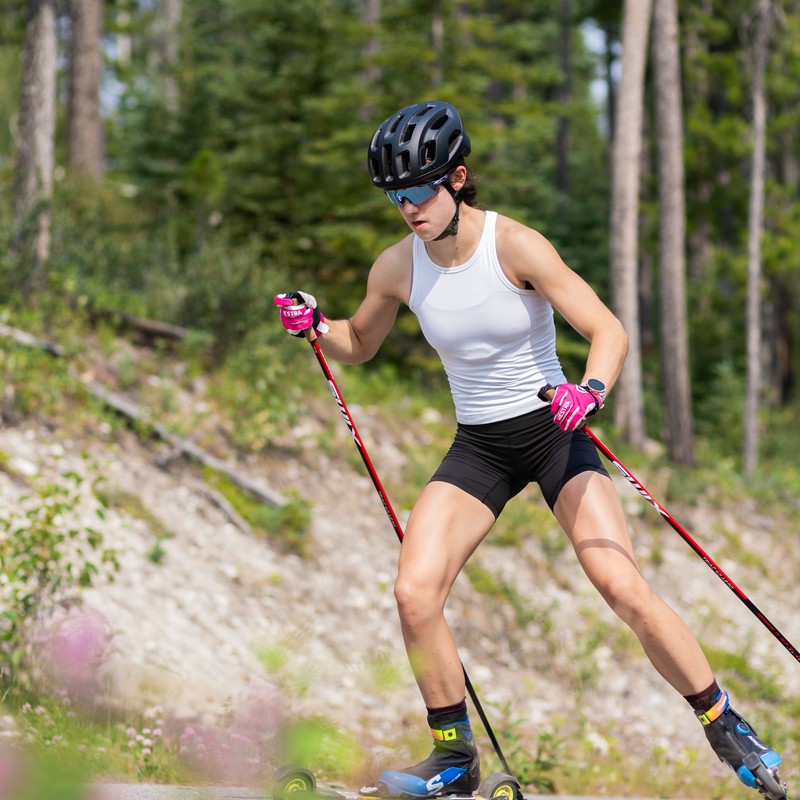
    Alison Mackie skate rollerskiing uphill on a paved forest road in a white training top and black helmet.
    Alison Mackie rollerskiing during summer training in July. She trains with the Alberta World Cup Academy in Canmore, Alberta. (Photo: Nathaniel Mah)

    For Alison Mackie, the 2024 Junior World Championships in Planica never really started.

    She had arrived in Slovenia with reason to expect something. A year earlier, at 17, she had finished 13th in the 20 k at the junior championships in Whistler, British Columbia, on home snow, in exactly the kind of long, grinding distance race that suits her. In Planica she missed the qualification in the opening sprint, fell ill, and watched the rest of the week from a hotel room. She was not on the tracks when her Canadian teammates made history either: Sonjaa Schmidt won the U23 sprint, and Canada won the U23 relay.

    Back at her base in Canmore, Alberta, at the end of that season, Mackie and her coaches set a target for the next one. Top five at the 2025 Junior World Championships in Schilpario, Italy.

    Privately, she wanted more than that.

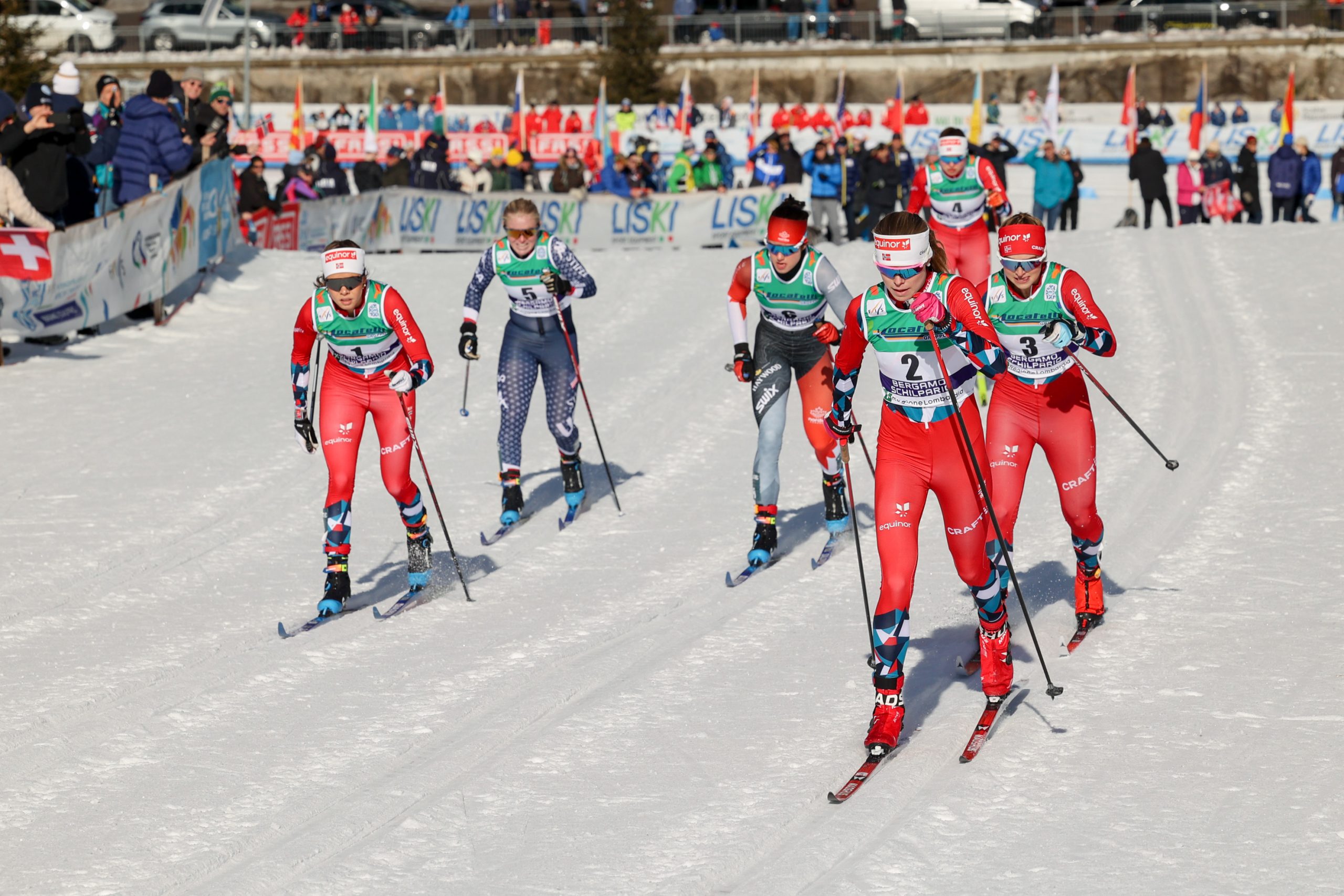
    Alison Mackie in bib 6 racing a classic sprint heat alongside Sammy Smith and four Norwegians.
    Mackie in bib 6 during the classic sprint at the 2025 Junior World Championships in Schilpario, where she finished fourth. Two bronze medals followed in the distance races. (Photo: Newspower.it)

    A Comeback in Schilpario

    “Yes, Junior World Championships in Schilpario were the main focus of my season that year,” Mackie said. “I trained specifically for that event to get my best shape there. But I wouldn’t say revenge, instead a kind of comeback because the year before in Planica I was pretty disappointed because I haven’t had the opportunity to race being sick.”

    On the Italian tracks she won bronze in the 20 k mass start classic, then bronze again two days later in the 10 k interval start skate. She was fourth in the classic sprint. They were the first junior world championship medals won by a Canadian woman since 1989.

    “I wanted a top five, and I finished with three top fours, including two medals,” she said. “The preparation we had put in proved to be correct, and I had a lot of confidence before starting the championships because I felt really good in the previous months leading up to my arrival in Italy.”

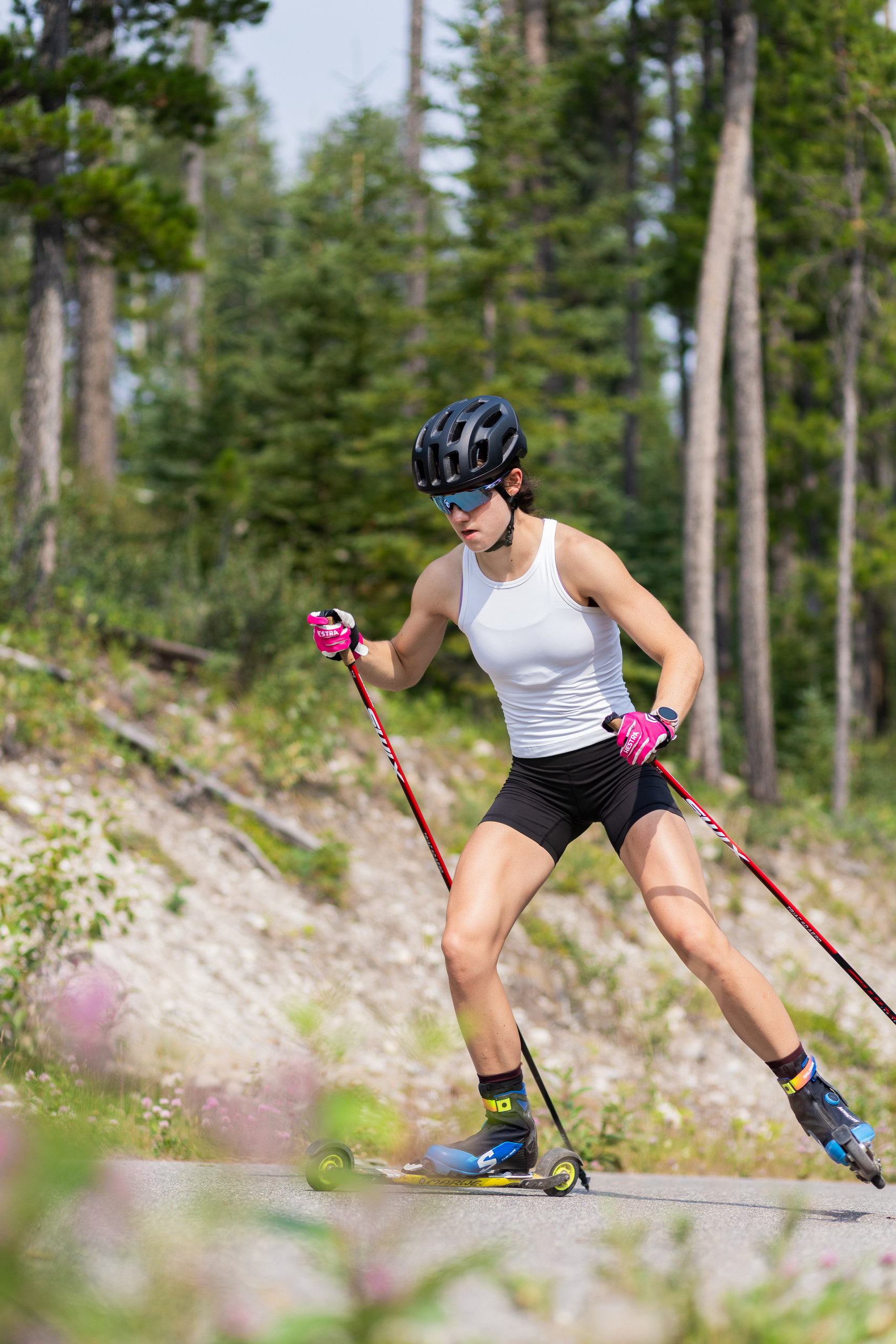
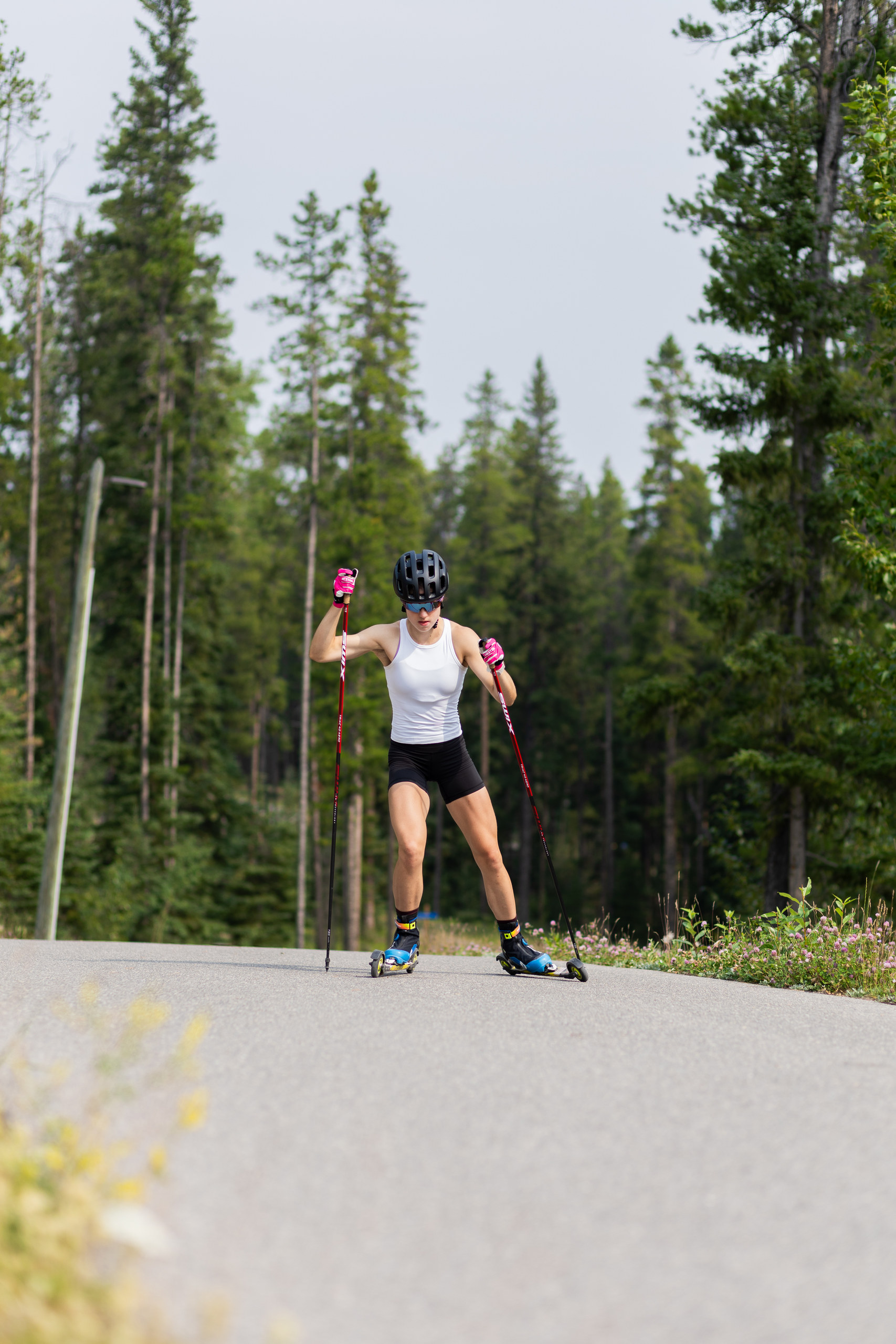
    Alison Mackie rollerskiing toward the camera on a paved road lined with evergreens.
    Mackie on a summer rollerski session in July. She started racing in Alberta as a teenager and won her first national title at 16. (Photo: Nathaniel Mah)

    Put on Skis Before She Could Walk

    Mackie was born in Montreal and raised in Edmonton, and she is 20 years old. Her mother, Jennifer, is a pediatrician. Her father, Andrew, is a pediatric cardiologist. Both of them ski, and both of them had her on skis before she has any memory of it.

    “My parents put me on ski as soon as I could walk,” she said. “So skiing accompanied all my childhood. Then I took real ski lessons and I started doing racing in my region of Alberta during my teenage times. That’s till Covid period arrived and with the restrictions I had nothing else to do others than training. But anyway, I really enjoyed myself during that period, developing my technique with my coaches at Edmonton ski club and when Covid finished my very first race that I won was our National title in March 2022 as a 16 year old.”

    Canada is known around the world as the home of ice hockey. Why did you choose cross-country skiing over hockey, freestyle, or swimming, following Summer McIntosh’s footsteps for example?

    “In parallel with cross-country skiing, I did a lot of other sports like cross-country track and field, rock climbing, mountain biking, swimming, soccer and in all of these sports I wasn’t as super competitive as I was in cross-country skiing. I did that only for fun as an opportunity to stay healthy during summer period. Cross-country skiing has been to me the only sport I competed at my best in my early ages and my favourite discipline. That’s why I chose it.”

    That first national title, won in Whistler in March 2022, is the race she keeps coming back to.

    “Yes, that race in Whistler BC was one of the first big races after the Covid pandemic,” she said. “I trained a lot during that period and didn’t have the opportunity to race and see my level, and when I went to my first National Championships and won the first race, it was a special moment and made me realize that I wanted to keep pursuing cross-country skiing for even better results and seeing how far I could get.”

    Alison Mackie racing the Olympic 10 k freestyle in Tesero, panned against a packed grandstand.
    Mackie racing to eighth in the Olympic 10 k freestyle in Tesero on Feb. 12, the best Olympic cross-country result by a Canadian woman. (Photo: Vanzetta/NordicFocus)

    Eighth at the Olympics

    The line has run one direction since. Two bronze medals at Junior Worlds. Her first World Cup top 10s, in Toblach and Val di Fiemme. Eighth in the 10 k free at the Milano Cortina Olympics in her first senior season. Gold in the 20 k mass start free at the U23 World Championships in Lillehammer in March. And at the end of that season, on 548 points, the FIS U23 overall World Cup title, the first won by a Canadian woman, with the finals held at Lake Placid.

    At the Milano Cortina Olympics you finished eighth in the 10 k free, after your first World Cup top 10s in Toblach and Val di Fiemme. What do you remember from those two weeks in Italy?

    “It was super cool being part of that multi sport event that the Olympic Games represent. It was my dream since I was a child watching Olympics on TV and having the opportunity to compete in high level in this huge event was really special to me. Definitely they have been long two weeks, also overwhelming at the time, but made me really happy how I performed overall and the 8th place I got in 10km skating has definitely been the highlight without any doubt. Entering the top 10 has been quite a surprise to me in that moment, because there were all the best skiers at the starting line. But now looking back at all the hard work I did during the whole season and the good results I got before that race in both World Cup and in under 23 World Championships, I wouldn’t say it was a huge surprise for me. Probably demanding Val di Fiemme’s track suited me very well, given that I finished as well 8th in Tour de Ski’s Cermis climb the month before.”

    What is the current situation in Canada for cross-country skiing, in terms of ski club membership, visibility in the national media, and financial support?

    “I would say the current cross-country skiing community in Canada is pretty small, if compared to other European power nations, but strong and with lots of passion in developing our discipline. There are a lot of young skiers coming up and I think it is very exciting for the great results to come in the future. Our National sports organization here in Canada are working really hard to make sure our National team can get all the support we need in order to achieve some World Cup podium with both boys and girls team during the seasons to come.”

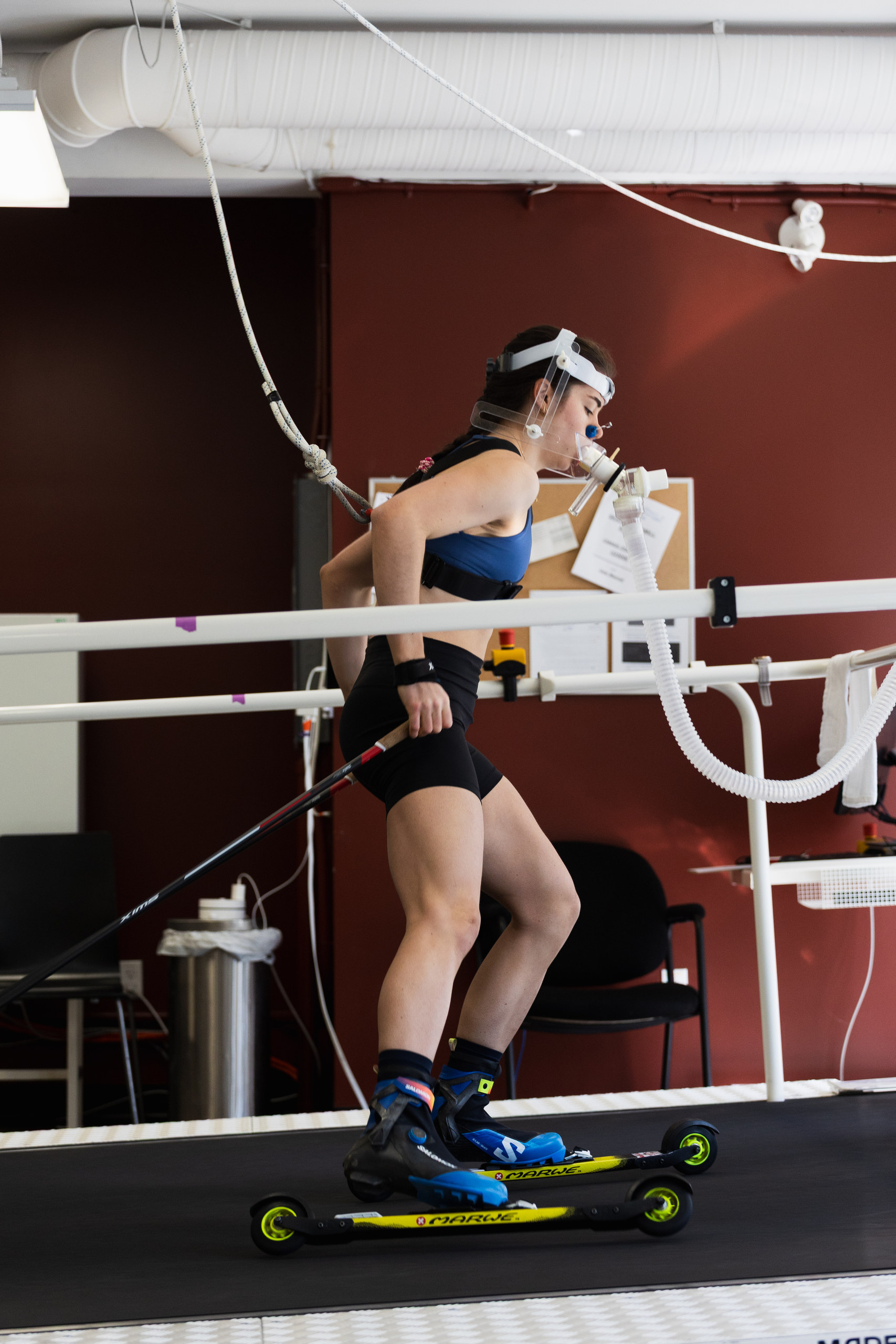
    Alison Mackie skate rollerskiing on a laboratory treadmill while wearing a metabolic mask.
    Mackie on the treadmill during a lab test in May. Distance racing is her strength, and finding speed is the summer’s assignment. (Photo: Nathaniel Mah)

    Distance Strength, Sprint Homework

    Describe yourself as a cross-country skier. What are your characteristics, your strengths, and the areas you are working on for the coming seasons?

    “I describe myself as a pretty strong skier in distance races, while I struggle a bit in sprint not to get through the top 30 and consequently not play the sprint finals, that is an element that I am working on in next seasons,” she said. “Between classic and skate I have found more success in free technique in the past seasons, but I enjoy training both classic and skate equally. Distance races are definitely my strength but I am working to improve my speed skiing as well so I could become a really strong overall skier in order, in the future, to fight for a higher overall spot in World Cup.”

    And the criticism you get from your coaches?

    “More than critics I would call special feedback from my coaches. Because sometimes I have a tendency to train too much and too hard that I need. That is something I am working on this summer, knowing when to push my body and when to give the correct time to rest and recover.”

    The World Cup calendar keeps skiers from outside Europe away from home for close to five months a season. How hard is that for you?

    “Personally I have spent on the road, following World Cup calendar, the past two seasons, but not the full European calendar. I really enjoy travelling and being on the road, so I don’t think it is a huge struggle for me. It is tough to not see friends and family for a long time but I am really lucky that I had friends and family came and watched me on tracks while I was in Europe a couple of time during season. Next season it will be quite different for me, because I am transitioning to attend the University of Utah so I will leave World Cup a bit because I do need to go to class and represent the University of Utah in North America as well.”

    Alison Mackie skiing in a Canadian race suit through fog at Holmenkollen.
    Mackie at the Holmenkollen World Cup in March, a week before the tour reached Lake Placid. (Photo: Authamayou/NordicFocus)

    A Winter Without Diggins

    The World Cup went to Minneapolis in the last two seasons, and Lake Placid hosted the finals in March in front of enormous crowds. Why not race in North America more often?

    “We do have actually Canmore scheduled for World Cup 2028, but realistically there are not so many resources for cross-country skiing in North America,” Mackie said. “It takes a lot of money and human power for the organization and preparation of those races. Of course, it will be amazing to have more opportunities to race in North America in the future but I have to be realistic and understand that organizing an event here in Canada, for example every four years, require lots of efforts and preparations from the local organization. Maybe we need more venues in North America that we currently have that are able to bring here World Cup events. I admit with huge pleasure that in the past seasons both Minneapolis and Lake Placid events showed how strong local communities are in terms of support and enthusiasm for cross-country skiing and those events have been a great boost for our discipline in North America, especially between young kids.”

    After fifteen seasons, this will be the first World Cup winter without Jessie Diggins, who clinched one more crystal globe in Lake Placid in March before retiring. Will she be missed outside the U.S. team as well? Did you ever get advice from her?

    “I definitely think Jessie’s presence will be missed in World Cup. Not only inside USA Team. I think she has always been a positive skier and a really amazing role model in so many ways. And 100% her presence, her ambitious way of racing and unique skiing spirit will be missed. That will definitely change some racing tactics as well. I had the opportunity to train together with Jessie in New Zealand last summer and it was a pretty cool experience and I wish all the best in her future.”

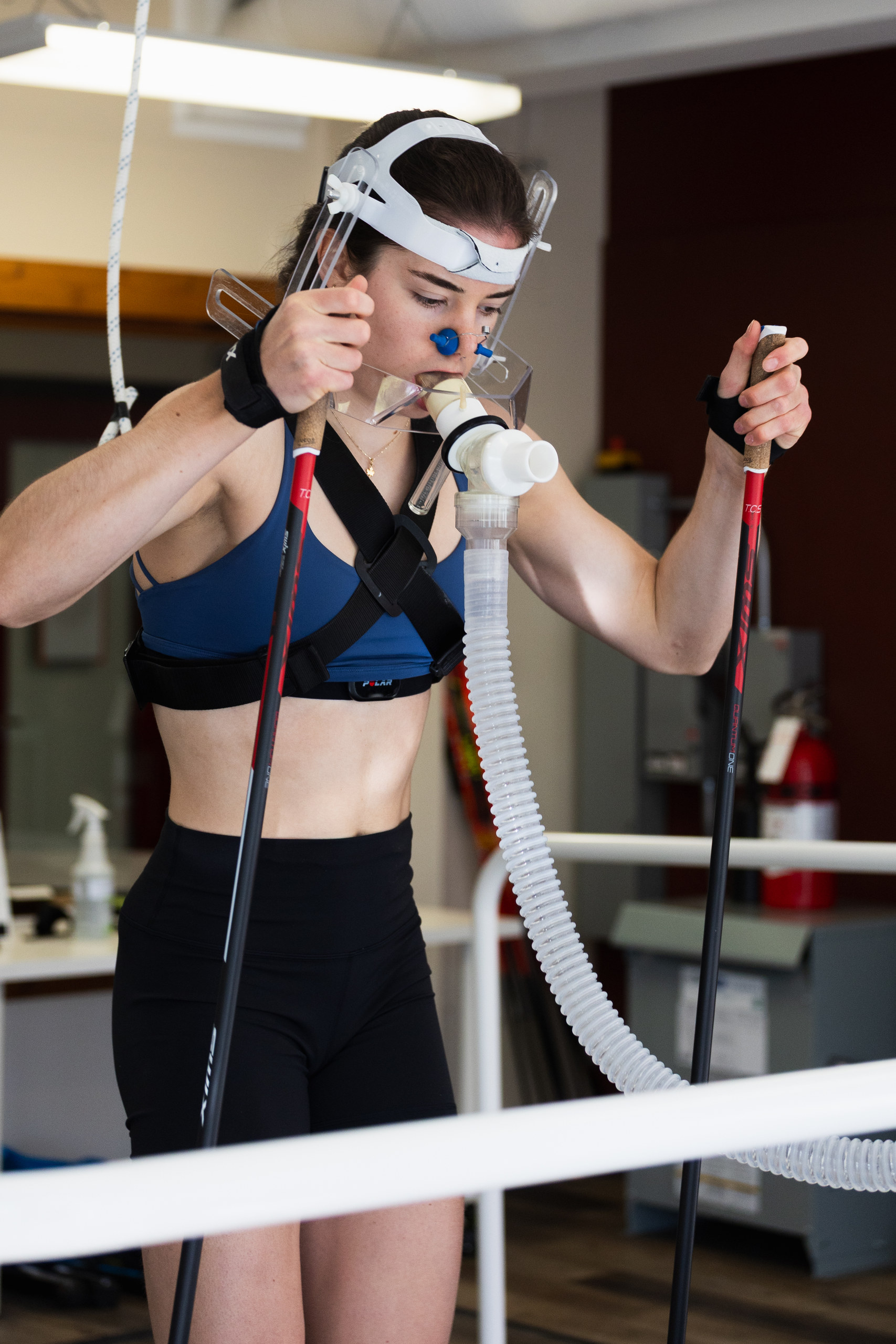
    Alison Mackie adjusting a metabolic testing mask while holding ski poles in a testing lab.
    Mackie fitting a metabolic mask before a treadmill test in May. She trains in Canmore and will study medical engineering at the University of Utah this year. (Photo: Nathaniel Mah)

    Canmore, Utah, and Life Off the Snow

    How is the Canadian team organized, and how is training divided between the women and the men at camps and at home?

    “I think Canadian skiing is gonna take a really exciting trajectory. I am really excited to work with our new Swedish coach Stefan Thomson over the next seasons but also in our group here in Canmore we have Norwegian Tormod Vatten as our assistant coach and with them we have a really strong support staff. For the Canadian National Team over the next seasons is going to be really exciting seeing where we all can go in World Cup and I am really proud to be part of this young but strong group of skiers that our Nordiq Canada are building now, under the [leadership] of former Olympic champion Beckie Scott and our amazing ski communities.”

    How do you manage your studies, at Queen’s University until last year and now at the University of Utah, with training and racing that run through most of the academic year?

    “I just make sure that I manage my schedule accordingly to have enough time for both my trainings and school throughout my day. I think having something other than skiing to focus on is really important for me. I was an online student at Queen’s University over the past two years and now I am transitioning to the University of Utah studying medical engineering. I think it is important the communication with the professors, making sure they know that my situation is a little bit different if compared to normal students, due to the fact that my training sessions, travels and races during winter season take my mind. But despite that my goal is to give my full focus during hours in classrooms too.”

    What kind of person are you away from cross-country skiing? Your personality, your interests, what you do on days off from training and racing?

    “Outside of cross-country skiing I am a pretty introvert person. I try to keep things on my own. I like studying and I really enjoy sewing clothes in my free time. I truly also love to learn new things and that is why I am excited to attend the University of Utah this year. I also love to spend time in the mountains nearby Edmonton where I grew up and in Canmore where I train myself with Alberta World Cup Academy and where I graduated in High school. Hiking, Mountain biking, running and skiing, of course, are my favourite activity when I can spend my time outside in the lush Canadian Nature.”

    In 10 to 15 years, at the end of your career, you will be proud of yourself if what?

    “I think, regardless of what I achieve in my future, I will be extremely proud of my career in addition to what I already accomplished. But really, my goal is just to ski because I love it and see where I can get of myself and also trying to inspire other young skiers. I think that there are a lot of young skiers in Canada right now, who have the potential to be amazing athletes. I really want to inspire them, showing them that anything is possible, it doesn’t matter what country you are from or how old you are. So regardless of what I achieve over the rest of my career I will always be proud of what I have already achieved.”

    Paolo Romanò is a freelance reporter based in Italy who covers cross-country skiing and Nordic combined.

    Help Support Our Coverage!

    If you value the thoughtful work and access FasterSkier provides, please consider becoming a Voluntary Subscriber. Your support directly fuels our work to cover the people, places, and moments that make our sport special.

    Join the FasterSkier community!
     

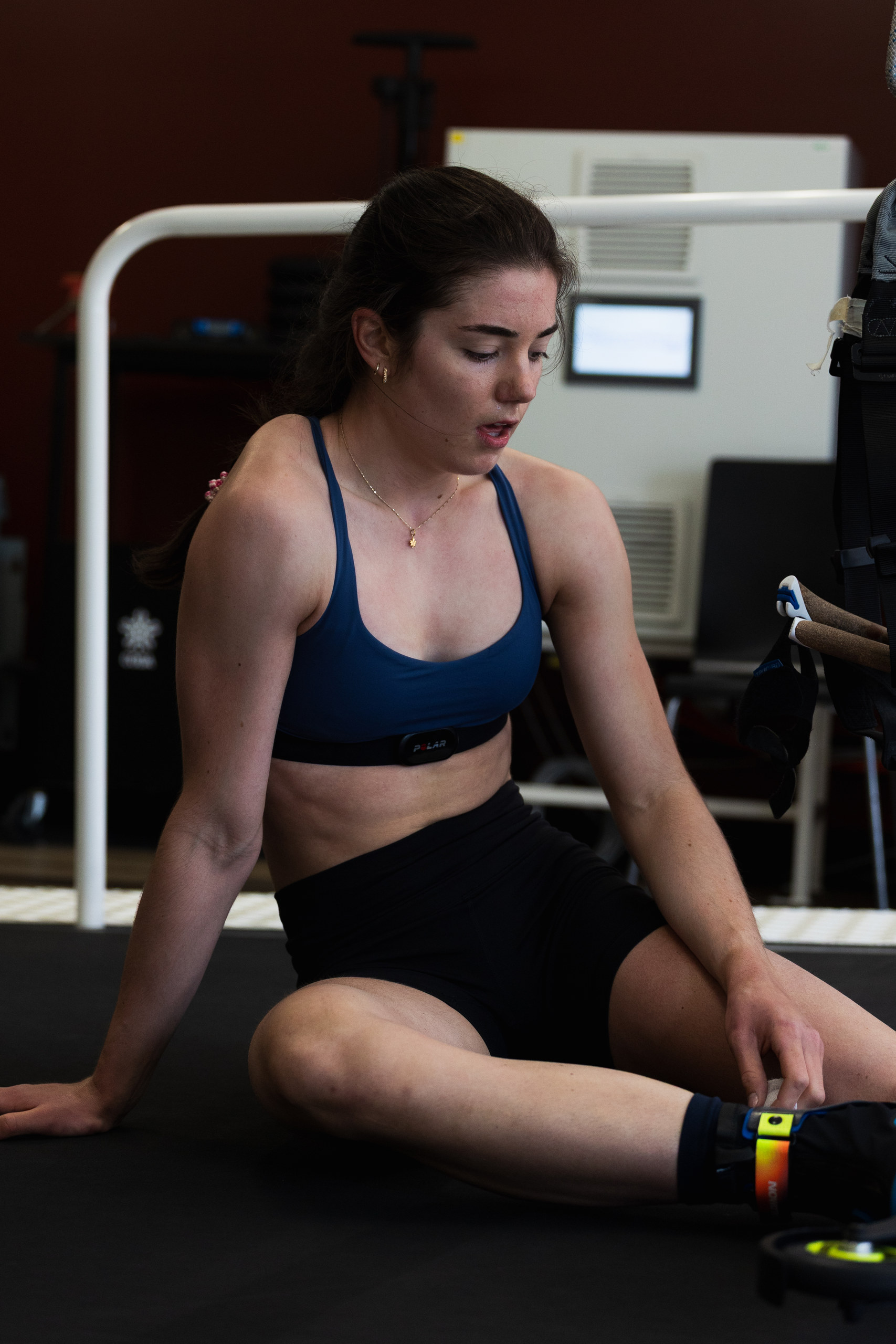
    Alison Mackie sitting on a laboratory floor catching her breath and unstrapping a sensor from her leg.
    Mackie catching her breath after a lab test in May. She races her first season for the University of Utah this winter. (Photo: Nathaniel Mah)
  • ‘We have no films to our name’: Lars and Torsten Brinkema on how Threshold got made

    ‘We have no films to our name’: Lars and Torsten Brinkema on how Threshold got made

    This article was made possible through the generous support of our voluntary subscribers. If you value coverage like this, please support FasterSkier with a voluntary subscription.

    Torsten and Lars Brinkema were two brothers from Minneapolis with a GoPro, a film school semester between them and no feature credits at all when they talked their way into a U.S. Cross-Country Ski Team camp in Bend, Oregon, in the summer of 2023. They spent the following World Cup season inside the team, paid their own way through it, and came home with roughly 500 hours of footage. What they cut it into is Threshold, the documentary about Jessie Diggins and her eating disorder that premiered on Peacock in February and is now available to rent in the United States and Canada.

    Earlier this month we published head coach Matt Whitcomb’s account of that winter and what the team changed because of it. This is the other half: the brothers’ own version, recorded before the rental release. Torsten is 26 and lives in Brooklyn. Lars is 23 and splits his time between Minneapolis and Los Angeles. They are still working as a duo.

    Below is a transcript of the Brinkemas’ conversation with FasterSkier. It has been lightly edited and condensed for clarity. LB is Lars Brinkema, TB is Torsten Brinkema, MV is Matthew Voisin.

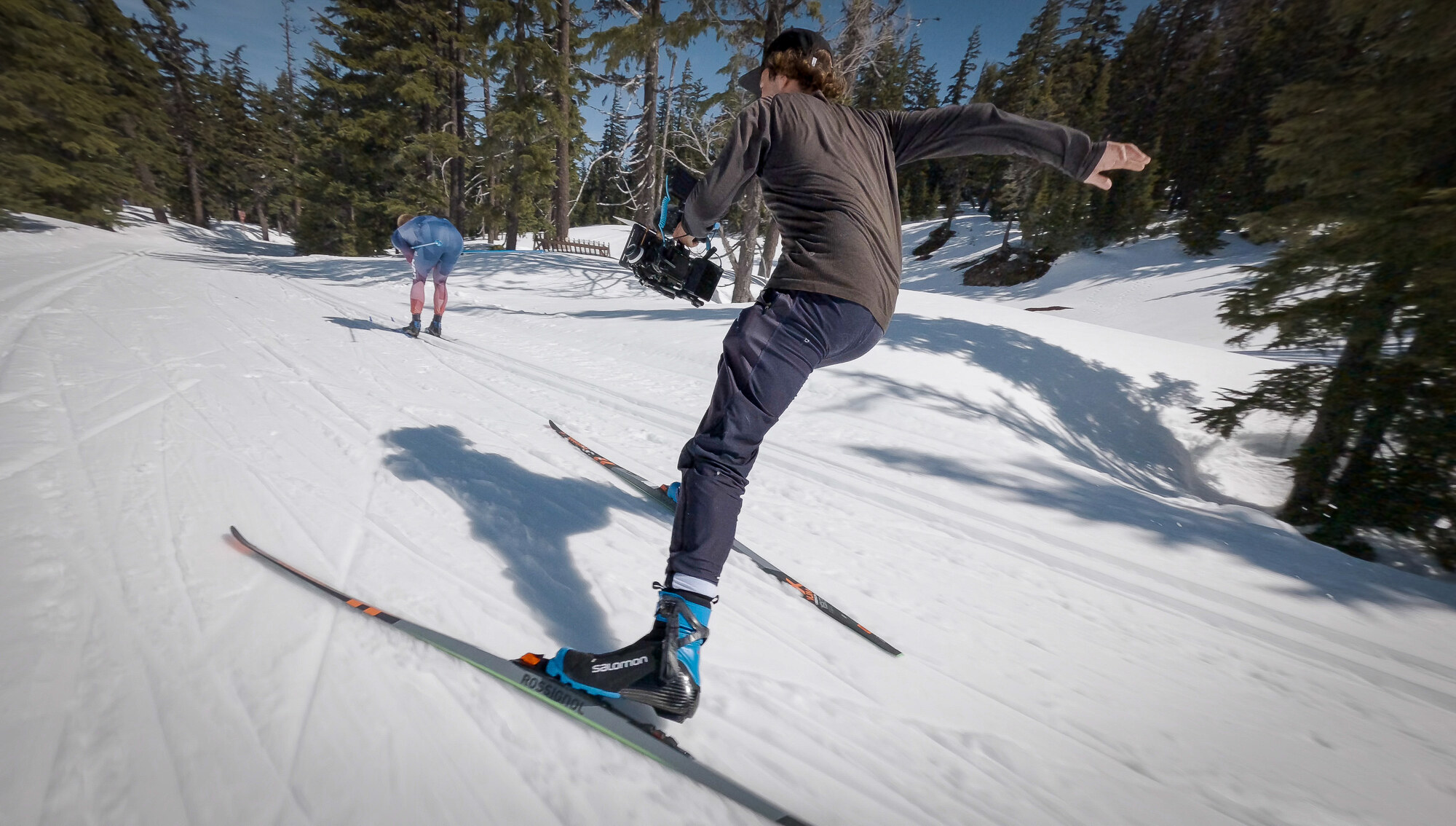
    A filmmaker mid-stride on cross country skis carrying a cinema camera rig, with an athlete skiing ahead of him on a groomed snow trail.
    Lars Brinkema filming on snow at a U.S. Ski Team camp in Bend, Oregon, chasing Jack Young up the trail. The brothers had done the workouts themselves, which is the reason the team let them near one. (Photo: Patrick Conroy)

    MV: I would love to back up a little and just hear about you two as young guys, how this all manifested.

    LB: To start at the very beginning, Torsten and I were both born in Minneapolis and grew up in that whole Minneapolis ski world. We had skis on right when we started walking. So we really grew up in the same community that Jessie had grown up in, and she was kind of just this idol that we looked up to. We both remember where we were when we were watching that gold medal race in Pyeongchang. And then fast-forward to when we were getting older, just always carrying cameras around, usually a small GoPro on our ski trips. Torsten ended up skiing for Colby College, and that is where he met Ben Ogden, racing against him on the collegiate circuit.

    TB: I got my ass kicked by Ben in most of the EISA college races. But I was always interested in shooting a lot of ski trips. I left school trying to figure out how to put those two pieces together, because I knew I was not good enough to be a professional skier, but I also wanted to capture the sport that I loved so much. It took a year of trial and error doing gigs for outdoor brands and whatnot.

    Then, when we figured out the World Cup was coming to Minneapolis, I talked with the Loppet Foundation, which is the club Lars and I grew up skiing for. I was kind of like, listen, do you guys need any promotional materials? People should be getting excited for this event that is happening at Wirth Park. I convinced them on a shoestring budget to send me to Holmenkollen in the spring of 2023. I stayed with a family friend out there, reconnected with Ben, and met a lot of the other skiers on the team. I think they were kind of surprised to have an American photographer out there with them, just because they are not getting much coverage once they leave. Ben was sort of like, we have to figure out how you guys can stick around with the team a little bit longer. It was just me at this point, but Lars was in film school. So Ben pitched Matt Whitcomb that he should invite us to their Bend, Oregon camp.

    MV: What did you think you were making at that point?

    TB: Lars and I basically bought cinema cameras and showed up at camp. We were definitely inspired by a lot of other sports documentaries at the time, niche sports finding success in that genre, people going, oh my god, look at Formula One, I have never heard of this sport before but I am really loving the series. And we were like, we could probably do something like that with skiing. Make it look really cool.

    I think the team was happy to see filmmakers who could not get in the way of their workouts. Jessie had experiences in the past with a brand interrupting an interval session, asking her to do another interval. This is just something that would never even cross Lars and my mind, to alter the workout, because we know how intense they are. We know the workouts. We have done them before. So we were kind of flies on the wall, and I think that proved our ability both as skiers and as filmmakers, to be in that documentary position and not get in the way.

    MV: What were you envisioning before it started to become more about the eating disorder and the mental health challenges?

    LB: Just bringing this sport that we grew up in and that we loved to the masses. We had seen smaller endurance sports, whether it was a YouTube channel or on Netflix, sports that we loved but not a lot of people in the U.S. tracked. And there was always this element to the successful films about sports that was more the human side of the story. We approached it very open-ended. We kept those options really open for a majority of our filming. We were still capturing when we went on the World Cup, talking to European athletes, we had some fun conversations with Klaebo on camera. We just spent every waking moment following different stories.

    I would say we were definitely, kind of subconsciously, following Jessie’s story more than others, and that just developed over the time of filming. Not until the editing process is when it really shaped. We had 500 hours of footage, so many different interviews with so many different athletes, doctors, staff on the U.S. team. And as we started to screen rough cuts to film industry people around Los Angeles and New York, we were getting so much feedback that Jessie’s story was the most resonant of all of them.

    MV: You have 500 hours, and then at some point you have to make the decision that almost all of it is hitting the cutting room floor. How do you feel your way through that?

    TB: Having an editor who had never cross-country skied before was totally instrumental in figuring out what would resonate with the wider audience we knew we had to appeal to. And there are also those moments where Lars and I were deep in the Arctic Circle, freezing our butts off, trying to get a time-lapse of the northern lights, out there for two hours and so attached to this one shot that we worked so hard for. I remember being in the cutting room and him saying, it is not serving the story, you have to cut it. Those were the things that were so hard to let go of.

    And of course all these other stories, U.S. Ski Team members, Klaebo, Emma Ribom, Pellegrino, people that we really looked up to, and all of their stories deserve to be told. But at the end of the day, when you have this Jessie story that is so compelling, you cannot really deviate from it if you want to give her story the time it deserves. At the industry screenings, Lars and I walked in with a lot of questions about what would resonate with a non-skier audience, and people just kept saying, Jessie, Jessie, we want more Jessie.

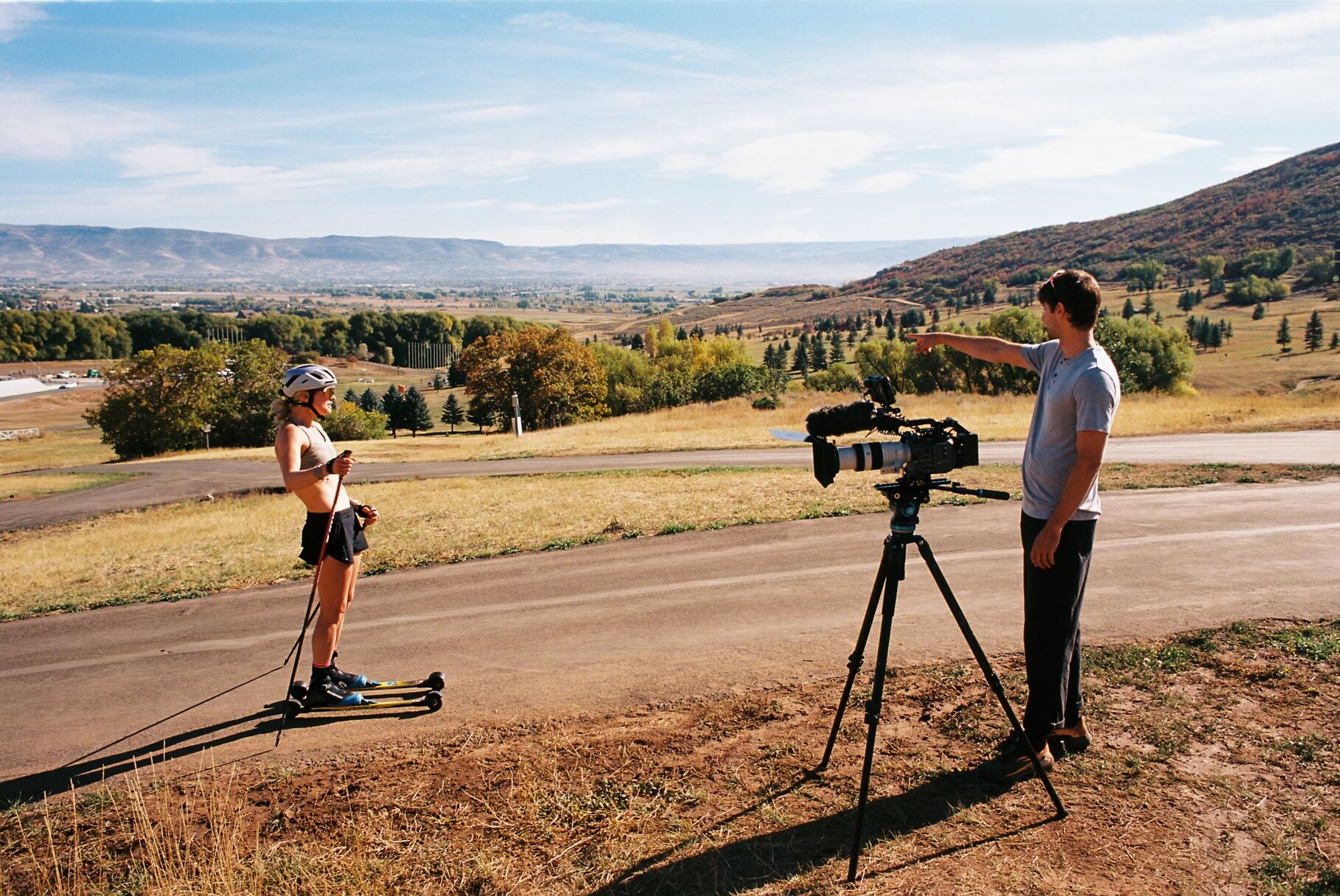
    A skier on roller skis stands on a paved path while a filmmaker directs from behind a tripod-mounted cinema camera, with a wide valley behind them.
    Jessie Diggins and Torsten Brinkema at the team’s Park City camp, in the open-ended stretch of filming before anyone knew what the story was. (Photo: Willie Maahs)

    MV: How did you get hooked up with Patrick Dempsey?

    LB: It was about six months into filming, right after the Tour de Ski, at a camp between that and the next World Cup stop. Growing up in the Midwest, we did not have any connections to the whole Hollywood world, but we definitely needed to find someone to help us get a foot in the door. So we asked Jessie if she had anyone in her directory who worked in that space. She remembered that Patrick had supported the ski team, and she was able to just send him an Instagram DM. He responded right away and said to send Torsten to his house in Maine. A couple of months later we showed up at his doorstep and pitched him on the idea. He had grown up cross-country skiing in his backyard in Maine, so he is very connected to the sport and a huge Jessie fan.

    MV: Jessie is big, but Dempsey is on another level. What was that like?

    TB: It was pretty wild. We knew this was a ticket for us into a new world that we had always hoped to get the keys to. And credit to him for inviting us over, because the roadblock we hit at every stage of this process is that we have no films to our name. We have a couple of short projects that nobody has seen. So we are asking someone with the credits that he has to trust us with nothing to see for it. Obviously Jessie’s word goes a long way with him. We had to swallow our awe of him and realize this was a huge opportunity, and tell him what we really believed: that there was a story in those 500 hours. At that point we had not really cut anything. He became a very important part of shaping it down to what it became in the end.

    MV: What other filmmakers have inspired you? What did you grow up watching?

    LB: One huge one was Jimmy Chin, especially with Free Solo. That may have been the first ever documentary I saw in a theater. This niche sport was brought to a thousand theaters across the country… such a huge story and such an interesting character. That was one of the times we were like, wow, we could bring a sport that we love to the big screen in an impactful way.

    TB: To add to that, I remember, I think it was actually while we were filming on the season, I saw a really old Herzog documentary from the 1970s called The Great Ecstasy of Woodcarver Steiner. Herzog was in his late twenties, early thirties, and he dedicated basically a whole year to following the ski jumping circuit, when it was at that really gnarly phase of people pushing the boundaries on these jumps, ending up jumping all the way to the flats, a whole bunch of drama between the jumpers and the officials. The fact that he was caught up in this story when he was around our age, and it felt like we were doing a similar thing, dropping everything to follow this circuit in unfamiliar landscapes. That just felt like, wow, if one of these great documentarians dropped everything for a ski documentary, we must be doing something right.

    MV: It is expensive to travel around Europe for a whole season, and the ski team is pretty transparent that their budget is tight. How did you make those numbers work?

    LB: We definitely had to pay our whole way through that season. There was not support from the ski team, in that they did bring us on, we were marked as members of the team crew, so we got our bibs and access to the races. But we basically had the ski team and Jessie help us find people who in the past had supported the ski team. It is not funded by the government; the ski team lives off these people who donate. So we went through their list of people who were instrumental in making sure the ski team could have success, people who paid for the wax van they use to this day. Over the course of filming we were always having to fundraise more and more money.

    Later on, when we were fine-tuning the edits, there were still a lot of payments to be made. We talked to Jessie’s sponsor, the Emily Program. That was a really cool opportunity, because now they are supporting the film, but they are also bringing it around the country to treatment centers and educational screenings.

    MV: You set out to tell a fun story and ended up helping people with something that is a real medical issue. Do you take a beat to think about that?

    TB: That is kind of the goal right now. We had a release with Peacock, which in a way felt like being viewed by this Olympic ski audience, but not everyone in the U.S. has Peacock, so right now we are figuring out how we can reach the people we did not reach in that initial release. For sure our target audience is this young group of impressionable people who are growing up either struggling with this disorder or who have people around them who have struggled with mental health. We have heard from people who have never skied before who say they were so moved by Jessie’s story. That is the biggest compliment we can get.

    It is a really hard thing to do, for her to pass one of the hardest years of her life on to us, filmmakers who had never made a film before, to then put out to the world. I remember when we showed her one of the rough cuts. She told us that this is the story her 18-year-old self desperately needed to hear. When we got her blessing, and when she said that, we took it and we ran with it, because we knew we could have that impact on countless other people who were struggling. That was a huge motivator for us.

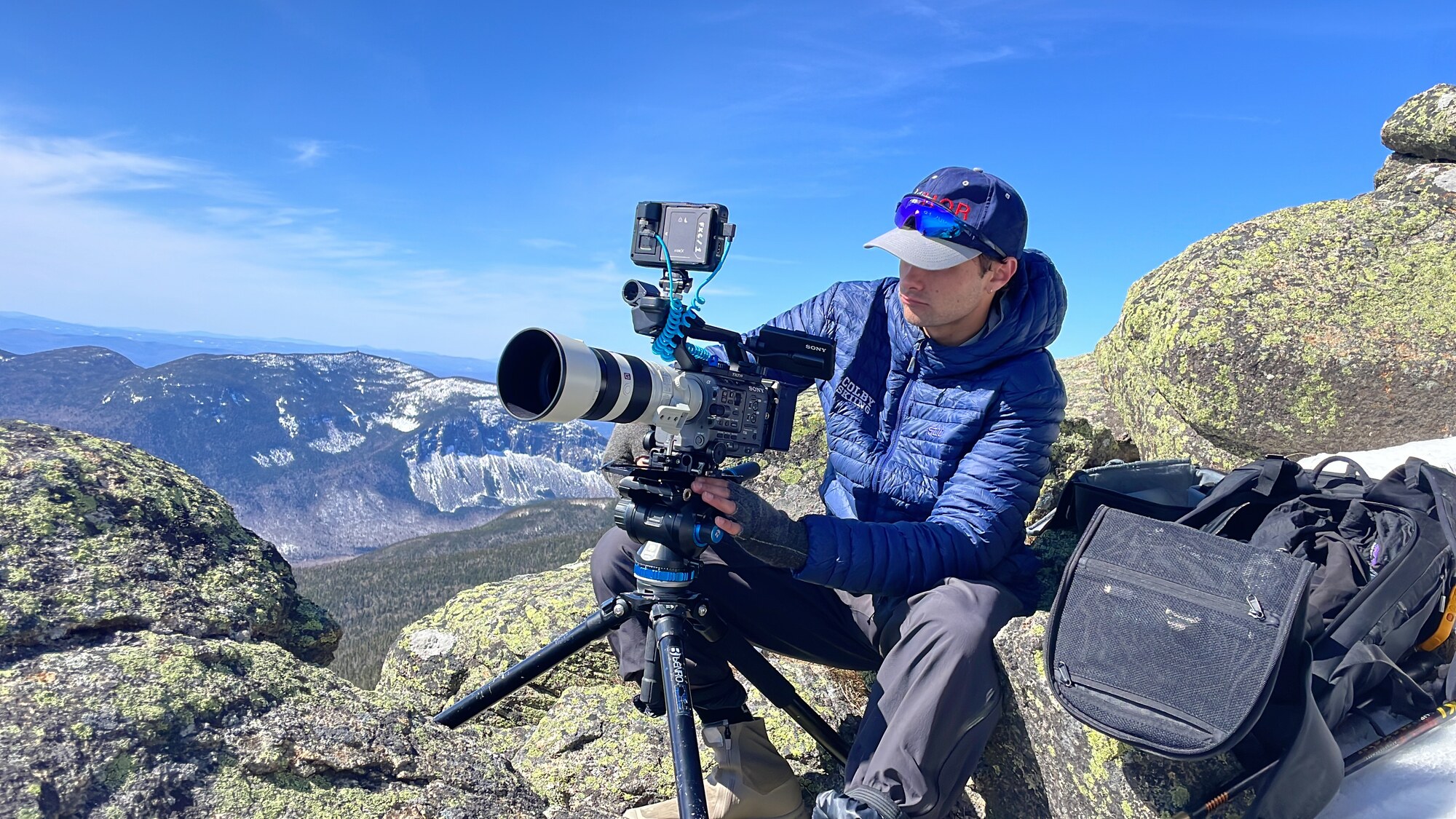
    A filmmaker sits on a rocky summit behind a tripod-mounted cinema camera with a long telephoto lens, snow-streaked mountains behind him.
    Torsten Brinkema on a summit in the White Mountains of New Hampshire in April 2024. This one never made the film either. (Photo: Brinkema Brothers)

    MV: Can you give me a specific memory from being in Europe?

    TB: Mine jumps to not a specific story, but this life on the road, which was so crazy for Lars and me. It was crazy to see the athletes, but also the staff who have done this year in, year out. It really is a wild lifestyle, packing up and going to a hotel room in the middle of nowhere in Finland, where there is light for five hours out of the day, then getting up and packing up and going to the next location in Sweden. The dedication these crews have is crazy, away from their families, away from the normal comforts of living in the States, and the fact that they repeat it every year.

    We pretty much joined every training session and filmed as much as we could, then charged the cameras and packed all the footage onto a hard drive. I always loved those nights when we were really tired, it is super dark out, there is nothing to do, and we would walk over to the wax truck and see what those guys were up to. It was always something fun. They are always blasting music, maybe having a shot of Jägermeister. I think they liked having us around because we were these young people who were totally oblivious to the waxing scene, so we could pick on whoever was not busy at the time. They had been living this life for five, ten years, and Oleg has been around, I do not want to quote how many. These guys are putting everything on the line and being away from their families to make the fastest skis in the world.

    MV: You mentioned the cameras. What was the gear you used to capture these moments?

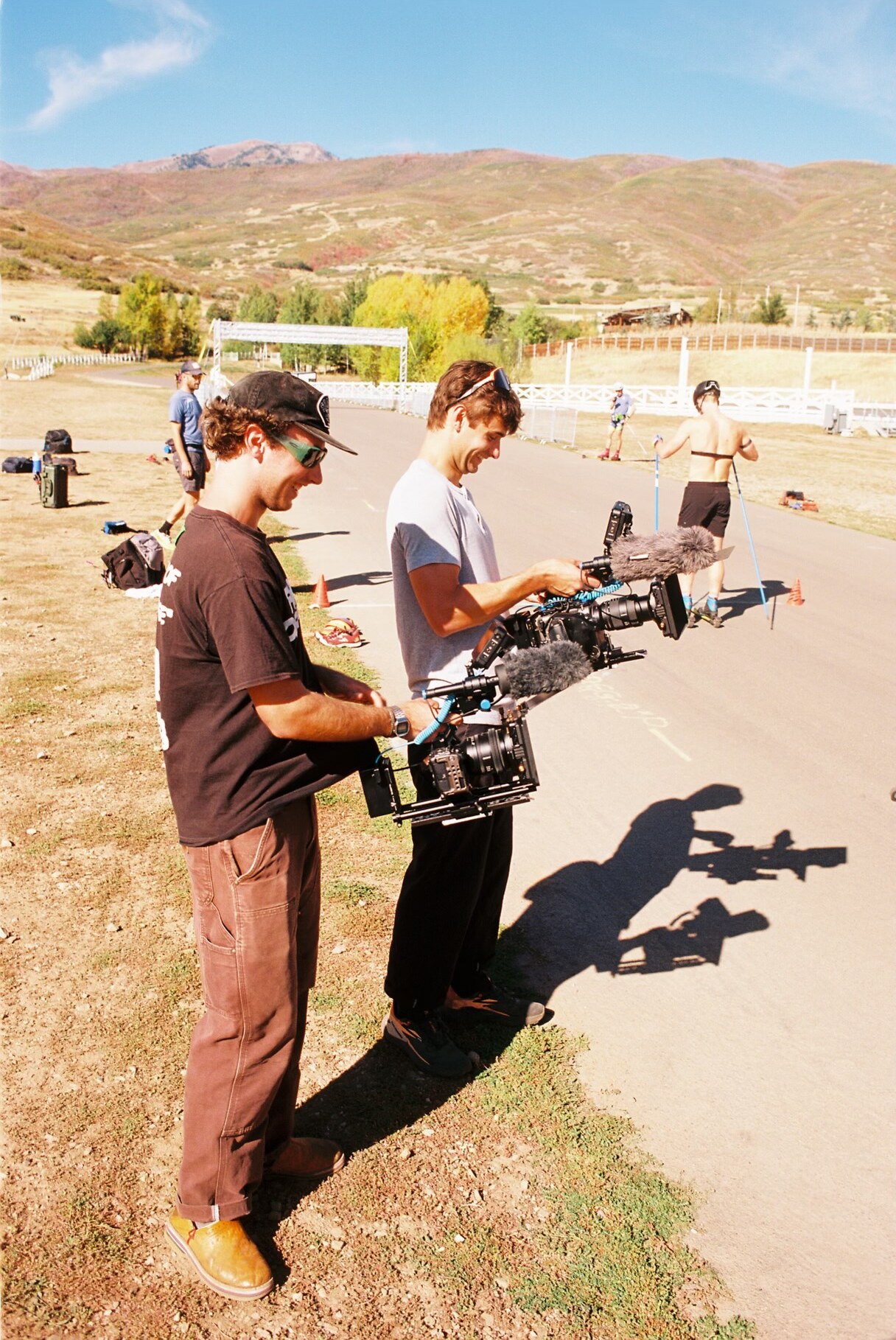
    TB: We were rocking two Sony cameras, the FX6 and the FX3. That was a progression from, honestly, GoPros. Lars and I just loved being able to carry a camera that would not get in the way of anything, which was so important. We did a 20-mile run with Zanden, Gus, Luke and JC in Alaska, and we carried both our cameras and the drone in a backpack. We always wanted to be able to carry everything we had with only a backpack. That was the goal. In the winter we did a ton of skiing without poles, carrying those cameras, setting up a shot for a while and then skiing alongside people and trying to get it.

    The drone was another really key part of the setup, because it let us get beautiful shots of people when we could not keep up with them, which was most of the time. We could only set up these flyby shots for a 20-second clip before they sped past us. We are super proud of those shots, because it took thousands of them to get the five or six that appear in the movie of Jessie flying by in a training session. We also had to figure out how to make the cameras work in the cold, which was something we had not really experienced before. It involved a lot of hand warmers and duct tape, but we eventually figured out a system that worked even at minus five in Finland.

    MV: I have used hand warmers to keep my batteries warm too, but what is the duct tape for?

    TB: Taping the hand warmers to the battery on the camera, right on the part of the camera where the battery is.

    LB: We would have extra ones in our jacket pocket or in our pants, trying to keep them close to body heat so we could swap them out.

    MV: Lars, what stands out for you?

    LB: Just seeing the sport in Scandinavia was this insane experience. I remember the first Holmenkollen that we followed. I am sad it did not make the movie, but it was absolute mayhem. More people than are in the stadium for the Super Bowl. A hundred some thousand people in the woods watching these skiers who are going by maybe once every 20 minutes. It was not for a sprint, it was not for high impact crashes, it was just to watch these skiers go by, and they were so into it. I remember the big races in the U.S., high school meets, maybe the state meet, have a lot of people out there watching. But seeing all the young fans in Scandinavia watching this sport and being so jazzed up about it, maybe drinking a little too much during the race, it was such a cool experience that you do not get in the U.S.

    TB: It was crazy to experience that and compare it to Minneapolis. We had plenty of those fan experiences, not to the scale of Holmenkollen, seeing the Swedes, seeing the Finnish people. But then coming back to Minneapolis, everyone who was there, most of them traveling long distances, doing crazy things to be there to watch the sport they had been waiting so long to see. That was insane in its own right, because here we are almost matching the energy of Holmenkollen on the trails Lars and I grew up skiing on. We learned how to ski on the 5k Wirth course.

    Then I did a warm-up lap with Jessie before the 10k, and I started crying skiing down the sledding hill, because it was insane. The people, the roar of the crowd, traveling with her as she went around that loop. I feel like we were so blessed to be able to have that finish the movie, because it really felt like a homecoming for Jessie, and a realization of the legacy she has left, both in Minnesota and in the ski world.

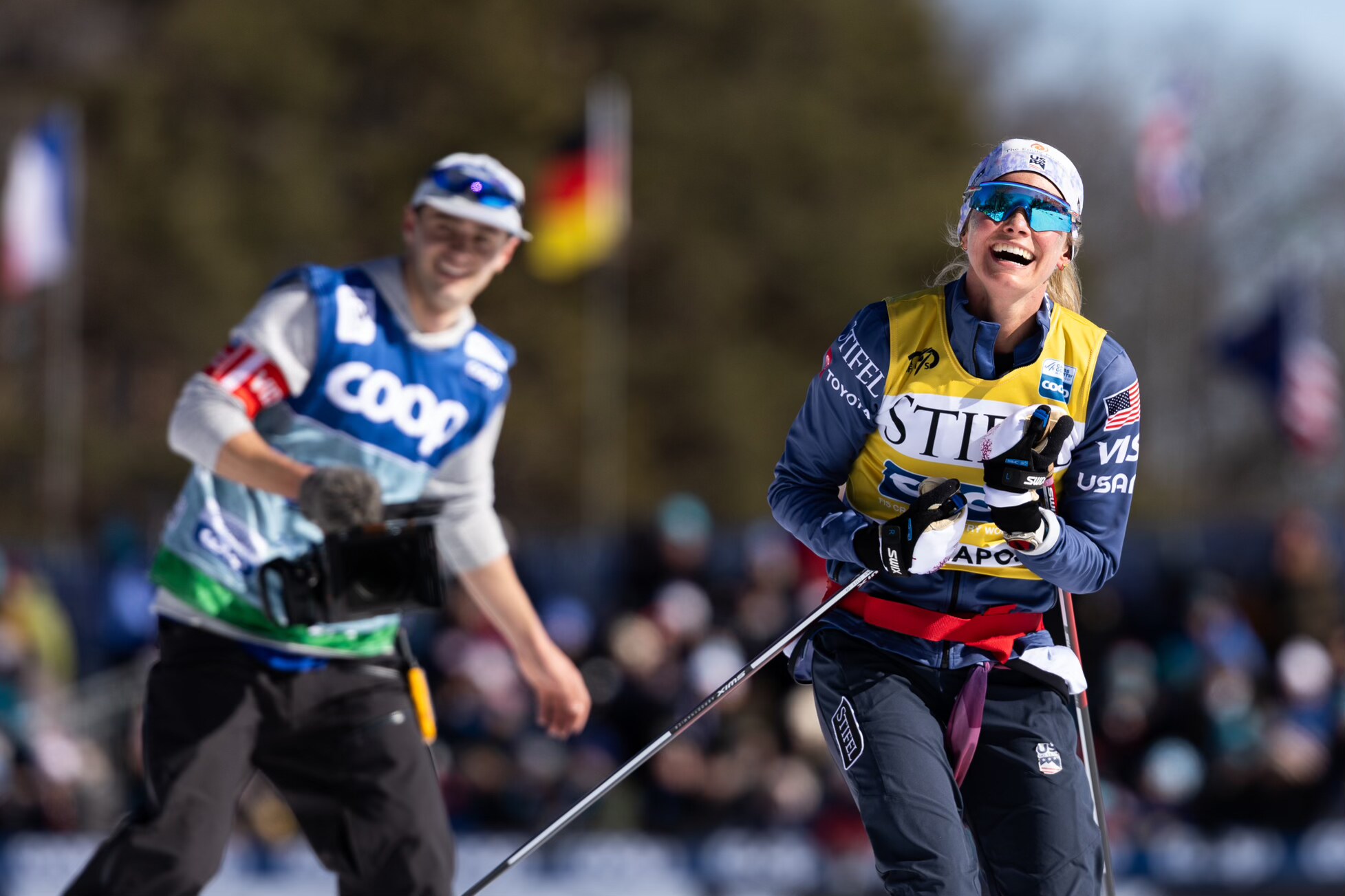
    Jessie Diggins laughs on a warm-up lap while a filmmaker in a media bib skis alongside her carrying a camera, a blurred crowd behind them.
    Torsten Brinkema, left, on the warm-up lap with Jessie Diggins before the 10-kilometer freestyle at Theodore Wirth Park in Minneapolis, February 2024. (Photo: Dustin Satloff)

    MV: What is something you are each really proud of?

    LB: Just coming into the film with such an open idea about what it could be, and that every step of the way we had trust in each other that we were going to make this happen and get it to a large audience. As Tor mentioned, we stepped into a really hard time in documentaries to get one out into the world and make an impact through film. I think we just trusted at every step of the process that we were going to figure this out. Being able to do that and show it in person in Lake Placid and Minneapolis has been such an incredible experience.

    TB: Going off of that, it felt like we were in such a unique position to tell this story. I am so proud of those POV shots we got on skis with the athletes. Again, that is the one percent of all the shots we did. But it is a crazy feeling, in a really crowded documentary landscape, to be one of a handful of people in the U.S., maybe even in the world, who can hold a cinema camera while going 30 miles an hour and pull focus and get that shot. It felt like a really proud moment just being like, wow, these turned out, and they are going to make it a better film, because you sort of feel like you are skiing with them.

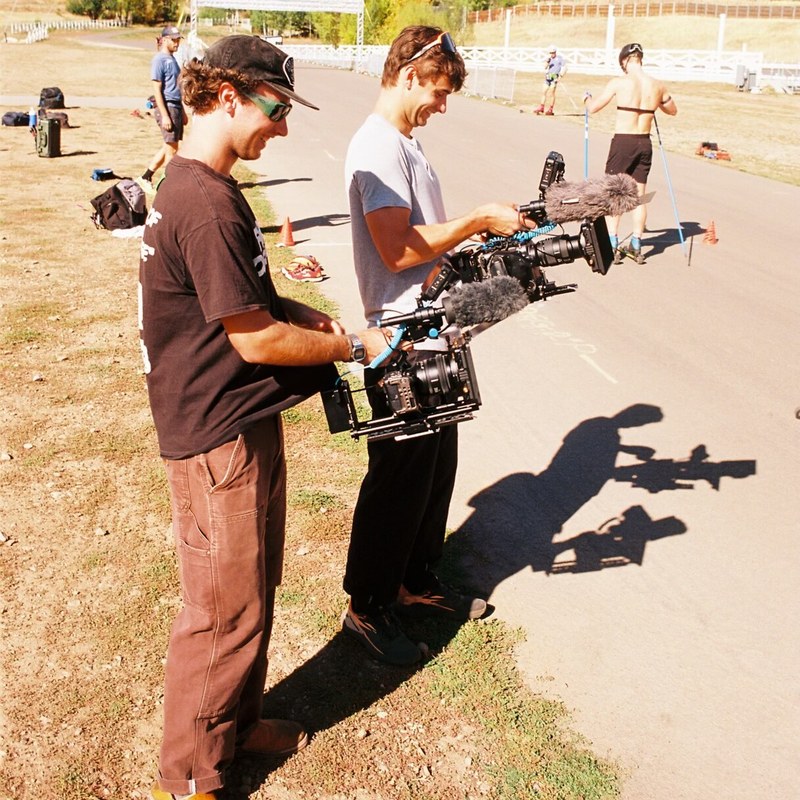
    Two filmmakers stand in profile at the edge of a paved roller ski loop, each holding a cinema camera with a microphone mounted on top.
    Lars, left, and Torsten Brinkema working the roller ski loop at the Park City camp, with the two Sony bodies that shot the season. (Photo: Willie Maahs)

    MV: What was it like working with FIS? Those rights can be really muddy.

    TB: It was definitely a headache to navigate Infront, basically a huge Italian conglomerate that controls a lot of these rights. We had a lot of negotiation with them, because we did want the context of the broadcast footage to feed into the intensity of the race segments. We wanted the tracker of kilometers to go. We wanted Chad and Kikkan announcing, which is so special and I think really leads the film in a way, because Lars and I never really wanted our voices narrating any of this. So we relied on the broadcast to be that context and the hype. It was an absolute pain in the ass, and that is kind of all that I will say.

    MV: What is next?

    LB: In line with Threshold, it was really special to bring something that is a subject matter so personal to us, skiing and mental health. So I think we will continue to create stories that are close to home. We are working on a film that will be set in Minnesota. It was such an incredible experience to show our city and our race course on the big screen.

    TB: We are excited to push our own limits again, and I think this round that will be writing a script, so not a documentary for the next one. But we still definitely want to work together, because having this balance of brother filmmakers, we rely on each other for the things we do not know or that we are not good at. Again, feeling that itch to both tell a story about home and push our comfort zones, which this project definitely did.


    Where to watch: Threshold is available to rent on Apple TV, Amazon Prime Video and YouTube in the United States and Canada. It premiered on Peacock in February, and a European release is planned for later this year.


    Help Support Our Coverage!

    If you value the thoughtful work and access FasterSkier provides, please consider becoming a Voluntary Subscriber. Your support directly fuels our work to cover the people, places, and moments that make our sport special.

    Join the FasterSkier community!
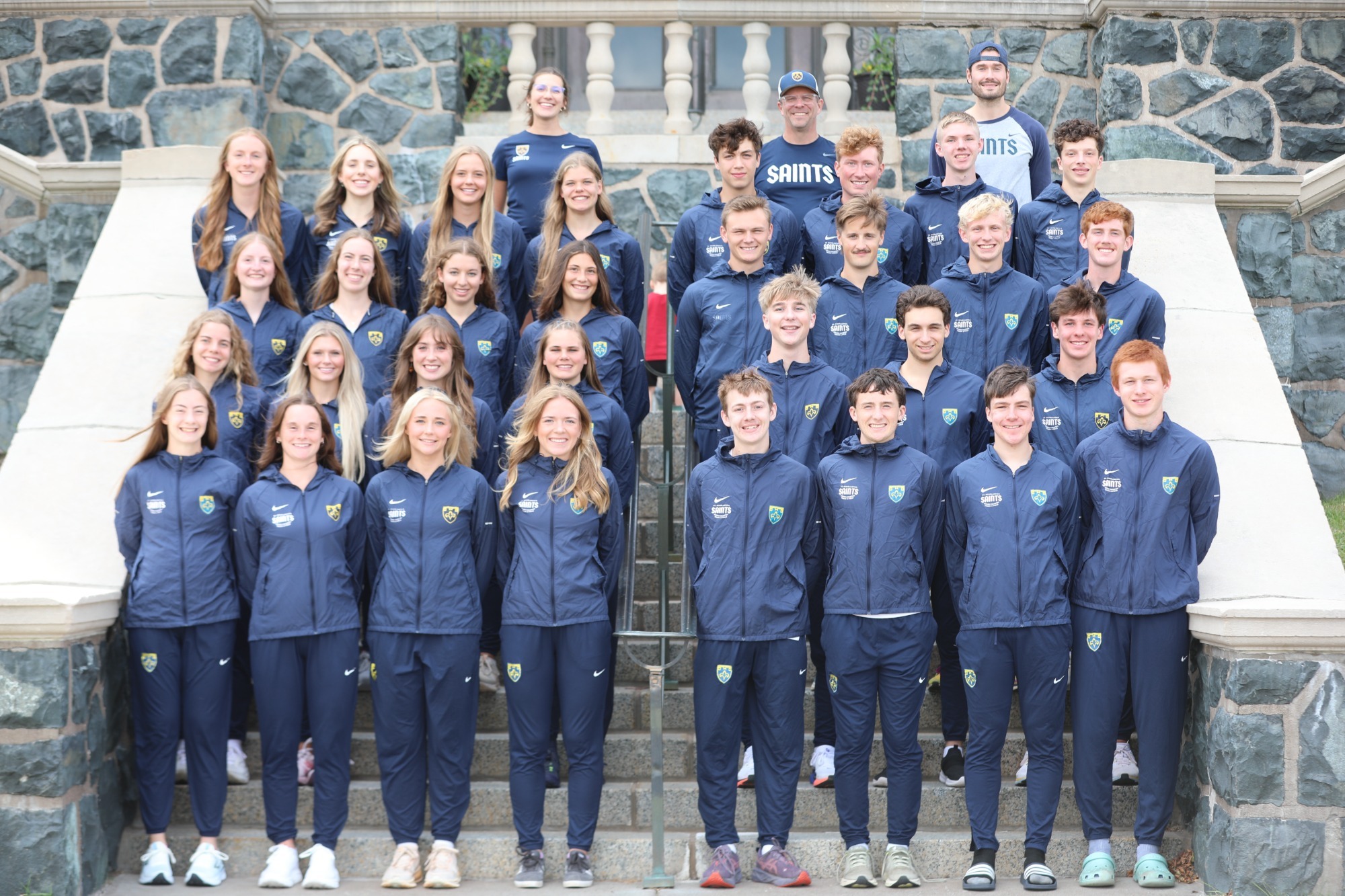
     

    A filmmaker sitting in the snow holding a tall glass pyramid trophy, with race sponsor banners behind him.
    Torsten Brinkema at the foot of the Alpe Cermis final climb in Val di Fiemme, holding Jessie Diggins’ Tour de Ski trophy in January 2024. (Photo: Leann Bentley)
  • What the U.S. Ski Team Changed After Threshold

    What the U.S. Ski Team Changed After Threshold

    This article was made possible through the generous support of our voluntary subscribers. If you value coverage like this, please support FasterSkier with a voluntary subscription.

    When I asked Matt Whitcomb what surprised him about Threshold, the head coach of the Stifel U.S. Cross-Country Ski Team started by admitting he was tempted to make something up.

    “This is the hardest question for me to answer, … but I haven’t watched it. I know it’s life-changing, but I don’t want to go back to that winter,” Whitcomb said. “I did my best as a coach, we all did, and it wasn’t good enough, and I’ve come to terms with my personal experience with it all.”

    The winter in question is 2023-24, the season Torsten and Lars Brinkema spent inside the American team with two Sony cinema cameras, a drone, and no feature film credits between them. What came out of it is a documentary about Jessie Diggins and her eating disorder that premiered on Peacock in February and, as of last Friday, is available to rent on Apple TV, Amazon Prime Video and YouTube in the United States and Canada. A European release is planned for later this year.

    Whitcomb is the person who let the cameras in. He is also, by his own account, the film’s loudest advocate.

    “I know from the response that the film is excellent, and I know it’s changing people’s lives and is being featured in college curricula. I recommend it to everyone I speak to,” he said. “I’m very proud of Torsten and Lars and am grateful for the film. I support it completely.”

    A filmmaker on cross country skis carries a cinema camera rig on a groomed snow trail while an athlete skis ahead of him.
    Lars Brinkema skiing with a cinema camera at a U.S. Ski Team camp in Bend, Oregon, chasing Jack Young on the trail. The brothers had done these workouts themselves, which is why it never occurred to them to ask an athlete to run one again for a better take. (Photo: Patrick Conroy)

    “A couple of brothers got a camera for Christmas”

    His first answer was no.

    “I figured a couple of brothers got a camera for Christmas, had a couple beers, and then came up with a fun way to spend a year,” Whitcomb said. “I normally would’ve erred on the safe side and told them to take a hike, but Ben doesn’t toss around ideas lightly and so I followed up to hear more.”

    Ben is Ben Ogden, who raced against Torsten in college on the EISA circuit and had watched him work at the World Cup in Norway that spring. Torsten had gotten there on a shoestring, having talked the Loppet Foundation, the Minneapolis club he and Lars grew up in, into sending him to shoot promotional material ahead of the 2024 World Cup at Theodore Wirth Park.

    “I think they were kind of surprised to have an American photographer out there with them,” Torsten said, “just because they aren’t getting much coverage once they leave.”

    Ogden pitched Whitcomb on inviting the brothers to the team’s Bend, Oregon camp that summer. The brothers bought cinema cameras and showed up.

    What they had in mind at that point was not a film about an eating disorder. It was a film about a sport nobody in America watches, made in the shape of the niche-sport documentaries that had broken through elsewhere.

    “We could probably do something like that with skiing,” Torsten said of the pitch they were making to themselves. “Make it look really cool.”

    They had one asset that mattered more than the cameras, which is that they were skiers. Diggins had been through the alternative, brand shoots that treated an interval session as something you could run again for a better take.

    “This is just something that would never even cross Lars and my mind, to alter the workout, because we know how intense they are,” Torsten said. “We know the workouts. We’ve done them before.”

    Two young filmmakers stand side by side on a paved roller ski loop holding cinema cameras, with autumn hills behind them.
    Lars, left, and Torsten Brinkema at the U.S. Ski Team’s Park City camp. On the road the athletes called them Larry and Toasty. (Photo: Willie Maahs)

    Toasty, Larry, and a problem with FIS

    Whitcomb’s worry was culture, which he describes as something you protect rather than something you have.

    The brothers had promised the arrangement would run both ways, that athletes would get usable footage of themselves out of it, and Whitcomb says they delivered. They also collected nicknames. Torsten became Toasty. Lars became Larry, or Lawrence in formal settings.

    “These guys were ghosts at times where they would disappear for the day and nobody would see them,” Whitcomb said. “And then we’d see them at dinner and they’d be showing athletes their incredible footage of the team training or racing together.”

    They washed dishes. They helped with wax testing. Whitcomb says everyone came to regard them as an addition to the team environment rather than a cost of doing business.

    It was not frictionless. At the first race of the season in Finland, Whitcomb watched one of the brothers get chewed out in the finish area by a FIS official for filming in a zone reserved for the television production company. Later, on course in Toblach, he got a text from FIS with a screenshot attached.

    “Larry running through the pines, keeping pace in his flatbrim hat and knit sweater, filming the lead pack. He was prominently within the TV feed,” Whitcomb said. “They asked if I could kindly remove him from the world feed. And you know what happened? Nothing. These guys said they were sorry and got a hand slap in each instance. Everyone likes them. They say things like thank you and sorry.”

    The rights question got more expensive than a hand slap when it came time to actually build the film. The brothers wanted broadcast footage in the race sequences, the kilometer counters and the commentary, partly because they had decided early that they would never narrate the film themselves. That meant negotiating with Infront, which controls FIS media rights.

    “It was an absolute pain in the ass, and that’s kind of all that I’ll say,” Torsten said. “Very expensive.”

    The money came from nowhere institutional. The brothers paid their own way through the season and kept fundraising as they went, working through the list of private donors who already keep the U.S. team on the road. The Emily Program, which sponsors Diggins, came in later during the edit and is now bringing the film into treatment centers and educational screenings.

    The Hollywood end of it started with a question the brothers asked Diggins at a training camp between the Tour de Ski and the next World Cup stop. They had no connections in that world and needed someone who did. Did she know anybody.

    She remembered that Patrick Dempsey had supported the ski team before, and sent him an Instagram message. He answered immediately and told her to send Torsten to his house in Maine, where Dempsey grew up skiing. A couple of months later Torsten showed up at the door and pitched him.

    “We have no films to our name. We have a couple short projects that nobody has seen,” Torsten said. “And so we’re asking someone with the credits that he has to trust us with nothing to see for it.”

    Dempsey signed on as an executive producer and, by the brothers’ account, became a real voice in shaping the cut. Whitcomb offers it as a character reference. “I mean, Patrick Dempsey signed on with these guys. That should tell you something.”

    Two filmmakers set up cameras on a patio to interview a skier seated in a chair with mountains in the background.
    Filming an interview with Johannes Høsflot Klæbo in Park City in October 2023. The brothers came home from the season with roughly 500 hours of footage and interviews across several national teams. (Photo: Daniel Sannum Lauten)

    The pivot happened the following summer

    This is the part Whitcomb wanted on the record, because he thinks people have the sequence backward.

    “From the start, this movie was meant to highlight the entire team, and not just Jessie,” he said. “Months after the winter concluded, I think the Brinkema brothers realized that the film needed to hone in on the topic of mental health to have a clear storyline. I understood and supported that pivot, but the point is that the winter filming was not targeted at just Jessie. That filming happened the next summer.”

    The brothers describe the same thing from inside the edit. They came home with roughly 500 hours of footage and interviews with athletes across several national teams, including Johannes Høsflot Klæbo, Emma Ribom and Federico Pellegrino. Their editor, Yaniv Elani, had never cross-country skied, which they now regard as the reason the film works.

    Elani is also the one who made them cut the northern lights. The brothers had stood out in the Arctic Circle for two hours in the cold to get a time lapse they were proud of.

    “It’s not serving the story. You got to cut it,” Torsten remembers him saying.

    Then came the screenings for film industry people in Los Angeles and New York, where the brothers went in hoping to learn what a non-skiing audience would care about.

    “People just kept saying, Jessie, Jessie, we want more Jessie,” Torsten said.

    A coach stands in green summer woods facing a filmmaker who is holding a camera in the foreground.
    Matt Whitcomb during an interview with the Brinkema brothers in Burke, Vermont. “We missed the mark on supportive team culture as an entire team,” he said of the winter the film covers. (Photo: Brinkema Brothers)

    “Our culture was at a 15 or 20-year low that winter”

    Whitcomb does not soften the season the film covers.

    “For anyone who has seen the movie, I think it’s no secret that our culture was at a 15 or 20-year low that winter. We had major struggles,” he said. He has thought about whether the presence of a film crew contributed to that, and concluded it did not.

    He is also insistent that the winter was not one athlete’s crisis with everyone else watching. “It was one of the hardest times for several other athletes and coaches, too. This wasn’t just a Jessie issue. We missed the mark on supportive team culture as an entire team.”

    Asked how he handled protecting Diggins against letting the story be told honestly, he rejected the premise.

    “I never felt like I had to protect Jessie from the film. She was a part of the team-wide decision to allow the Brinkema brothers into the team for the year, and that was the main gate we kept,” he said. When the brothers asked him whether they could film something sensitive, a one-on-one meeting for instance, he sent them back to the athlete. “I would usually just tell them to ask Jessie what she was comfortable with.”

    He watched her closely all the same, and says that had nothing to do with coaching. “That’s just because she’s a close friend, and friends look out for each other. But I had 100% trust in these guys, which is saying something because Lars was 19.”

    A filmmaker and a team communications manager pose together in a sunny finish area, raising ski poles overhead.
    Torsten Brinkema and Leann Bentley at the World Cup finals in Falun, Sweden, in March 2024. Bentley handles press for the cross-country and Para Nordic teams and appears in the film mostly doing her job in the background of somebody else’s scene. (Photo: Brinkema Brothers)

    The person in the hotel room

    Leann Bentley is the U.S. Ski & Snowboard communications manager who handles press for the cross country and Para Nordic teams, and she is in the film, mostly doing her job in the background of somebody else’s scene.

    She was in the room when the coaching staff decided whether to say yes, and she remembers it being straightforward. Here were two people willing to spend a year telling a story she could not tell herself, and one of them had raced against these athletes in college.

    The question she was asked for this story was how she decided where to draw the line once the film’s center became Diggins’ mental health. Her answer was that the question does not describe what happened.

    “Short answer, no, I never had to tell them no,” Bentley said. “Long answer is I of course will always protect my athletes. But at the same time, they’re protecting themselves. And throughout this entire process, Jessie was protecting herself. She knew what she wanted to give, and she knew maybe what she didn’t, but she was in charge of it from the very start. And so were all the athletes.”

    The scene she keeps coming back to is a hotel room in Ruka before the press conference where Diggins told the assembled media she was dealing with her eating disorder again. Bentley says it was one of the most heavily attended press conferences she has run with her.

    “There was a scene where I told her that it’s okay to be vulnerable. And I don’t remember saying that to her,” she said. “It really goes to show that when I work with these athletes, I’m working with them as people, and I’m really glad that came across in the film.”

    Most of her season is not spent in hotel rooms in Finland. It is spent in Salt Lake City, awake in the middle of the night, watching the same feed as everybody else and then turning it into the clips and quotes that hundreds of thousands of people see, for twelve teams and more than 240 athletes.

    Asked what the film got right about the parts of team life that press coverage never reaches, she was blunt about why the question has an easy answer.

    “It got everything right because it was showing exactly what was happening,” Bentley said. Athletes race for a few minutes at a time, a few times a weekend. The rest of it is chess and cards and laundry and going for a run. “I don’t think a lot of people understand that being a professional athlete, you train so hard mentally and physically for what you do on the weekends during a race. And then that race ends and you have, I don’t know, ten more hours of the day left.”

    Both she and the brothers land in the same place when asked for a favorite corner of that life, which is the wax truck, known on the road as Yolanda. Torsten’s version involves showing up on dark nights with nothing to do, music playing, occasionally a shot of Jägermeister, and a group of technicians who had been living this way for a decade or more and had stories nobody had ever asked them for.

    I interviewed the American wax techs last winter in the lead-up to the Olympics, and they remain the most enjoyable conversations I have had for this site, so I will just agree with him.

    Two filmmakers with cameras stand on a paved loop while a coach talks with two athletes on roller skis.
    Torsten Brinkema, left, and Lars Brinkema, right, filming Jessie Diggins, coach Jason Cork and Renae Anderson during a roller ski session at the Park City camp. (Photo: Willie Maahs)

    What actually changed

    The most concrete thing to come out of that winter is not on screen.

    Whitcomb describes an Athlete Wellness Passport, a monitoring system covering roughly eight health areas for every athlete on the team, men and women, including bone density, blood panels, caloric balance assessment, menstrual health and a mental health questionnaire. The team dietitian tracks each category for each athlete, and a licensed professional is brought in when a category calls for it.

    “It’s a safety net for the whole team,” he said.

    What that system did not have in 2023-24 was a ceiling.

    “What we were missing in the winter of 2023-24 was a plan for what happens when an athlete’s issue, like an eating disorder, advances beyond the qualifications of our professionals,” Whitcomb said. “In this case, we needed an eating disorder specialist MD on call, and we didn’t have one. We’ve debriefed on the experience extensively and have brought in the person we wish we already had in place going into that winter.”

    For coaches who watch the film and want something to do on Monday, his answer starts with an assumption rather than a policy.

    “If you coach a team of athletes, you likely coach some athletes who struggle with disordered eating, and you may never know who they are,” he said. He has had male and female athletes tell him about it years after they finished competing.

    On his team the practical version is a conversation about meals, held once a year, in which everyone agrees to treat mealtime as a place where safety matters more than opinions.

    “Everyone’s plate looks different, and everyone’s dietary needs and goals are different, and many of us are insecure, so the environment is ripe to be judgy and toxic,” Whitcomb said. “Talking it out isn’t perfect, but it helps.”

    He got there by getting it wrong first, and he tells that story without cushioning it.

    “As a young coach I used to think I could talk openly with athletes about their challenges with eating, body image, and weight. Then I learned from a parent that a comment I made to them regarding weight was harmful. Yeah, I know, duh. But I was 23 and some of you are now, too.”

    His correction was to stop talking about any of it and refer everything to professionals, which he now says was better but too absolute. The current version is that he will talk with an athlete who wants to talk, if the trust is there, while being honest about where his expertise ends and activating someone qualified.

    Three people stand in front of a cinema screen taking questions from a seated audience in a darkened theater.
    Lars Brinkema, Torsten Brinkema and Andrew Peterson take questions after a private screening of Threshold in Minneapolis in January. Diggins has asked teams to treat the film as “a visual book club.” (Photo: Sawyer Brice)

    What Diggins wants out of it

    Diggins raced her last World Cup in Lake Placid in March. She did not do a new interview for this piece, but she wrote at length on Instagram when the film went back out on Friday, and the argument she made was that the documentary is not really about her.

    Her request to teams, high school through professional, was that they treat it as “a visual book club.” Watch it, then talk about it. What pressure does this sport put on you. What kind of team do you want to be. And for coaches, find out now where you would send an athlete who comes to you, before one does.

    She also made a point the film cannot make on its own, which is that the recovery in it happened in hundreds of hours of therapy and clinical work that were never filmed and could not have been.

    Two filmmakers in Team USA bibs stand with their arms around a skier wearing the yellow overall World Cup leader bib.
    Torsten Brinkema, left, Jessie Diggins and Lars Brinkema in the finish area in Falun, Sweden, in March 2024, after Diggins wrapped up the overall World Cup title. (Photo: Modica/NordicFocus)

    When the film premiered in February, she put the goal simply in a U.S. Ski & Snowboard release: “I wanted to help others feel less alone.”

    The brothers are working on a scripted film now, set in Minnesota, still as a duo.

    Whitcomb, meanwhile, is not planning to watch. He described where the last two years have left him without much interest in tidying it up.

    “We’ve made improvements to our system because of lessons from that winter, and we became better coaches and teammates. I’m moving forward as an improved coach.”

    And then the part that sounded most like a coaching philosophy: “Your coaches and staff must truly care about the human condition. That’s your foundation. Get rid of the ones who don’t and add more who do.”

    Where to watch: Threshold is available to rent on Apple TV, Amazon Prime Video and YouTube in the United States and Canada. It premiered on Peacock in February, and a European release is planned for later this year.


    Help Support Our Coverage!

    If you value the thoughtful work and access FasterSkier provides, please consider becoming a Voluntary Subscriber. Your support directly fuels our work to cover the people, places, and moments that make our sport special.

    Join the FasterSkier community!
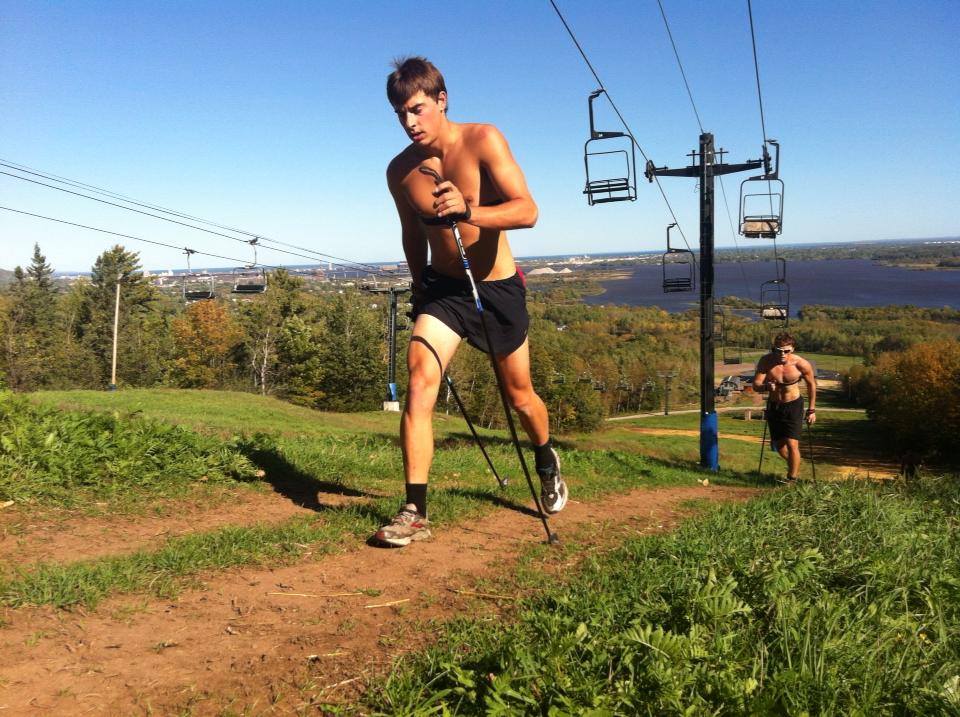
     

  • Finding Flow: Gus Schumacher on Training Smarter, Staying Healthy, and Loving the Process

    Finding Flow: Gus Schumacher on Training Smarter, Staying Healthy, and Loving the Process

    This World Cup coverage is made possible through the generous support of Marty and Kathy Hall and A Hall Mark of Excellence Award.  To learn more about A Hall Mark of Excellence Award or to learn how you can support FasterSkier’s coverage please contact info@fasterskier.com.

    Gus Schumacher and J.C. Schoonmaker on Eagle Glacier last month. (Photo: Matt Whitcomb)

    When Gus Schumacher talks about training these days, he sounds more like a craftsman than a workhorse. There’s less emphasis on grinding and more on rhythm — on knowing when to push and when to back off. “I think I’ve just gotten better at kind of knowing what is worth my energy,” he says. “Every day matters a lot, but every day doesn’t have to be as hard or as perfect as the schedule would beg.”

    At 25 years old, Schumacher is entering his athletic prime with a perspective that feels both grounded and ambitious. A native of Anchorage, Alaska, he’s already made history: in 2020, he became the first American male to win an individual gold medal at the FIS Junior World Cross-Country Championships, and in 2024, he captured his first World Cup victory — a breakthrough 10 k Freestyle win in Minneapolis that electrified the home crowd and made him the youngest American man ever to win a World Cup distance race and the first U.S. man to win a distance World Cup event since Bill Koch in 1983.

    Those milestones bookend a journey defined not by burnout or obsession, but by evolution. Schumacher has traded maximum volume for sustainable excellence, chasing consistency instead of chaos.

    From Peaks and Valleys to a Smoother Rhythm

    Three years ago, Schumacher’s training logs told a story of wild swings — massive weeks followed by deep recovery troughs. “In the past, I was probably in the 90-hour range (total training hours for a four-week block) pretty frequently,” he says. “Now it’s more in the lower 80s … my balance was more like 20, 23, 35, 10 to 12 hours a week … and now it’s 18, 21, 25, 15, 16 … just a smoother process.”

    It’s a subtle but meaningful shift: fewer rest days, less volatility, and a steadier tempo. “I don’t take as many off days, either,” he adds. “When I was younger … it was helpful to have those big stimulus days. But as I’m older … if I do a really big day, it’s maybe harder on me.”

    The old model — massive stimulus followed by deep rest — has given way to something more balanced. “I want to feel good most of the time, not just occasionally amazing and then wrecked for days,” he says. “It’s more of a steady hum than a spike.”

    Off into the Alaskan wilderness. (Photo: Rudy Schumacher)

    Consistency Over Carnage

    One of the most evident signs of Schumacher’s maturity is his decision to stop “thrashing” himself in pursuit of arbitrary numbers. “In the past, I would come to a priority day and it would be super hard … and I’d still want to hit an hours goal, cramming training into places where it maybe wasn’t appropriate,” he says. “Now … I’m less inclined to do that and more inclined to just drop an afternoon session and not worry that much about the two-hour hit on weekly volume.”

    He’s also embraced a more intuitive recovery model. “The feel comes before those things,” Schumacher says of his data tracking. “Sometimes I’ll feel a little off … and then a day or two later the HRV (Heart Rate Variability) will come down … so the first feelings while you’re training are important.”

    Over time, that awareness has become central to how he navigates fatigue. “HRV is objective, but sometimes it’s low because of other things,” he explains. “It’s good to recognize why you might feel a certain way and how to change that.”

    Utah Camp and a Smooth Summer

    When we spoke, Schumacher was three days into a two-week U.S. Ski Team camp in Utah, training alongside his APU teammates JC Schoonmaker, Luke Jager, Zanden McMullen, and Michael Earnhart. “We’re on our third day of National Team camp,” he said. “It’s great energy here.”

    That steady energy mirrors his summer. After illness derailed his 2024 training for nearly six weeks, this year brought the opposite: uninterrupted rhythm. “Last year I was sick for six weeks in August and September, and this year it’s been going really smoothly,” he says. “My health has been super good … I’ve been doing a lot more breathwork … and that’s helped quite a bit.”

    The contrast is stark — and instructive. For Schumacher, staying healthy through the summer is no longer just luck; it’s the product of restraint, awareness, and self-trust.

    Gus Schumacher with his girlfriend, Olivia Carrier, enjoying the Alaskan view during a workout. (Photo: Amy Schumacher)

    Hard Work, Soft Edges

    Even as he’s refined his volume and recovery, Schumacher hasn’t softened his competitive edge — just redirected it. “Not a lot of days to really redline it,” he says. “In the summer … I just don’t feel like it’s that worth it. … I’ve definitely stayed away from having a full session that’s just full power.”

    He describes one workout — 10 × 1-minute efforts — as emblematic of his current philosophy. “It’s not about dying at the end of each rep,” he explains. “The first one we did, I felt super good and did sort of go ballistic … and I was fried in the afternoon and for a day or two.”

    The lesson? “When you feel really good, holding back a little bit … because that good feeling is not necessarily gonna come through in the recovery,” he says. “To get the stimulus from a 10 × 1-minute workout, you don’t need to be on your hands and knees. Having an interval or two where you really push is good … but it shouldn’t be always.”

    Fueling with Intention

    Schumacher’s fueling strategy mirrors his training philosophy: steady, structured, and practical. “I probably do 30 to 60 grams an hour for two-to-three-hour workouts,” he says. “Our races aren’t really long enough to be super dependent on that … but in training it’s really important just to keep the glycogen stores up.”

    For long races, he’s methodical. “During a 50 k, I’ll definitely go for at least 60 grams an hour … I’ve done even 90 for 50 k’s,” he says. And sprint days have their own rhythm: “I’ll do a gel after I do my warm-up intensity … eat a solid meal after the qualifier … and definitely gel before the quarters … and then one in between everything.”

    Spear fishing. (Photo: Alex Lee)

    Season Goals and the Long View

    This fall marks Schumacher’s sixth full World Cup season. He’ll depart for Europe on November 18, with an eye toward the Skiathlon, Team Sprint, and 10 k Skate as his primary Olympic events. “Those are probably my big three,” he says.

    He’s also keeping perspective on success. “There are a lot of ways to be successful,” Schumacher says. “To go and be healthy would be a big success … it’d be really cool to ski well for the people who’ve already planned on being there.”

    And the reward. (Photo: Olivia Carrier)

    That balance — ambition without anxiety — defines his approach. “I’ve definitely got my mind on a medal at the Olympics,” he admits, “but that doesn’t define success for me. Being in the top 10 overall would be cool … but I’m sort of not loving defining it too much. … I just want to be executing as well as I can and keeping healthy and cool-headed.”

    After the Tour de Ski, Schumacher plans a 10-day reset at home in Alaska before returning to Europe for altitude training and the final push to the Olympics. “Getting away from the madness for a bit,” he says, “makes me hungrier when I come back.”

    Learning to Flow

    “I want to keep going as long as it feels reasonable,” Schumacher says when asked about his future. “The next phase is learning more about how my mind and body are at their best. What makes my mind happy is often what makes my body feel good too.”

    That mindset — introspective, curious, and confident — underscores everything he’s building toward. “I feel like I’m learning myself more every year,” he says. “Everything gets easier, but I keep getting faster … better at getting into flow state.”

    He pauses, then adds: “There are more times now where I just feel like I’m doing a workout that’s hard or long, and I’m able to really relax and enjoy it. I’m excited to bring that to racing.”

    Is Gus looking at flow state? (Photo: Olivia Carrier)

    Advice for the Next Generation

    When asked what he’d tell younger skiers chasing their own dreams, Schumacher smiles. “A big part is just going through the motions and making the mistakes,” he says. “To do that, you have to be happy and enjoying it — having good friends around and making sure it’s not just every day you show up dreading how hard it’s going to be.”

    He insists that skiing well starts with loving the process. “The day-in, day-out is not that painful or difficult,” he says. “If you’re doing it right … it should be enjoyable pretty much all the time.”

    And perhaps his most mature insight: “Not every day has to be perfect … those bumpy days … that’s what leads to the good days down the road.”

    Toward Flow & Beyond

    Gus Schumacher’s transformation is not a retreat from ambition — it’s its maturation. At 25, he has already built a resume many would envy: Junior World gold, a landmark World Cup win, and upward movement in the World Cup standings. But he now embraces an athletic philosophy that values rhythm over rupture, feeling over forced, and resilience over recklessness.

    “Those best days happen when you’re just kind of there for the game … to keep that going … to enjoy it … and not lose track of these times before they’re gone,” he says.

    It’s a voice of calm in a sport often defined by extremes. Whether or not the Olympic hardware arrives, Schumacher’s style — grounded, evolving, and rooted in joy — already feels like a victory.

    For Gus Schumacher, exploring the mountains of Alaska isn’t training, it’s a lifestyle. (Photo: Gus Schumacher)
  • Laukli’s Summer of Ups and Downs Ends With a Surprise. Part II

    Laukli’s Summer of Ups and Downs Ends With a Surprise. Part II

    In Part I of our interview with Sophia Laukli, FasterSkier caught up with her before she had returned to the Golden Trail Series Tour, and discussed the ups and downs of the difficult summer she had. We’ll continue our discussion with Laukli about the upcoming race season but first, we need to bring readers up to date with how she fared in the Golden Trail Series finals, and how she is feeling after her summer of relentless challenges.

    Laukli glided into the finish at Ascona-Locarno, and looked fresher than she has all season. (Photo:@RisingStory/GTWS Final Ascona-Locarno @JustinGalant)

    In last Thursday’s prologue portion of the final’s race, Laukli had one of the more solid performances she has had all summer, and felt better than she had in months. After the prologue, she told FasterSkier: “Definitely on the right track in terms of feelings, compared to earlier this summer.” She finished fourth in the seven kilometer prologue and was within sight of the winner. Last Saturday, the finals continued with the 23.5 kilometer race.

    The 23.5 final on Saturday went well for her, though she didn’t dominate like she had last year. Laukli finished sixth, but was only a little over a minute off the podium, which might be a good barometer of how she is doing physically. Full results can be found here. It was a nice rebound performance and should serve to remove most of the sour taste of this last season.

    Laukli was looking refreshed and relaxed before the final race of the summer. Now all focus is on skiing. (Photo: @RisingStory/GTWS Final Ascona-Locarno @Colinolivero)

    After the race, Laukli share her observations with FasterSkier. “Yesterday’s race was decent but I realized pretty quickly that maybe I should not have done the prologue. My legs were totally dead so it made for a very tough and long race. I’m confident the fitness and ski shape is still good, but that doesn’t translate to back to back running races for me…I have done a lot of roller skiing, and not much running, so I guess it’s not the biggest shock. I’m definitely happy I raced the finals, but I think if I wanted to have my best performance before the season end, I should have committed to just doing the final long race.” It’s positive news for American ski fans that Laukli is back to feeling good and having strong race results. Her result might be a little bit off from last year, but not all of it rests with her physical condition. ” I think the biggest thing though is that the field is so deep and so much higher this year. It was honestly one of my better races even though the legs were super heavy, but I’ve had much worse races where I’ve still ended 2nd or 3rd, or even won. I would say I’m close to last year’s level and maybe still improved, it’s just hard to see that in the results.”

    At the end of the day, the decision to race looks like it proved to be the right move for Laukli, and it was definitely the right step psychologically. “So all in all, it’s super motivating for next year but I have a lot of improvement in running to do. But the competition being so high makes me want to put in just as much work as I do for skiing, and that’s a cool thing!”

    Laukli spent a week training in the ski tunnel, which she doesn’t like. But she did get to wear her very cool team Aker-Daehlie suit. “It’s super cool,” says Laukli. “I”m going to be wearing it as much as possible.” (Photo: Sophia Laukli/Instagram)

    To bore in on ski training, Laukli recently visited the ski tunnel in Torsby, Sweden. It’s a form of training which she admittedly isn’t thrilled with. “It was mostly technique focus, but I really honestly hate tunnel training. I don’t think I would ever do it if I didn’t see the benefit. I can do it once a year and have a little bit of a boot camp. Many people have no problem with it, but I find it very mentally tough.”

    In the midst of her summer of challenges Laukli did receive some good news. She was promoted on the U.S ski team from B team status to A team. Although there is limited day to day impact of the promotion, she appreciates the change in status. “It’s a motivating thing to move up, because it means that you’re better than the year before. I was really excited about it.”

    Laukli acknowledges that to move up in Overall Tour de Ski and World Cup standings, she needs to work on her Classic skiing. (Photo: NordicFocus)

    As she continues to develop as a skier, Laukli has noted, and is quite open, about a couple of significant holes in her game—Sprinting and Classic skiing. She is physically tuned to be a distance athlete, and there’s only so much she can do to change that. This past spring,  Laukli told FasterSkier that she was going to work a little bit more on her Sprinting skills this summer, if for no other reason than that she wouldn’t have to overcome as significant time deficits in the Tour de Ski. But she is realistic about her Sprinting abilities and acknowledges that even making the Sprint heats probably isn’t a realistic goal for this season. While not necessarily working specifically on Sprinting, “I’ve had a huge focus on strength this summer,” which should improve her Sprint results. She’s also been working on her Classic game. “Another thing that brings me down a bit (in Overall standings) is the difference in my Classic and Skating abilities, so I’ve had a bit more Classic focus, so at least I can get a little bit closer to my Skating (ability). I’m never going to be a Sprinter, but if I can get a little bit stronger, and at least get better at Classic, then it helps with focus on the Overall … so I don’t just think about the last stage (Alpe Cermis).”

    It was a huge step for Laukli to win a podium by conquering Alpe Cermis, but she wants to be able to focus on more. (Photo: NordicFocus)

    In addition to the Tour de Ski, this is a World Championships year, and Laukli has some definite goals in mind. “I’m very results driven, so not having any results goals makes it hard to figure out what you want to do in the season. What I first do is pinpoint the races that I have the most potential in and base my training around those; so I’m in the best shape for those. The results goals are a little vague, but beyond Alpe Cermis, and the races at altitude, trying for a top five … the biggest focus of the year is the 50k Skate at the World Champs. I want that race to be my best race ever.” For the non-World Championship races, Laukli is primed for racing at Engadin (20k Freestyle) and Les Rousses (10 k Freestyle and 20 k Classic).

    Based on the calendar layout, she will likely face about a two week layoff between her last World Cup race and her first World Championship race, which is fine by her. “You kind of always have these two week blocks of being off. I wouldn’t be confident that I would have a good World Champs if I was just racing through (without time off). I think you’ll see quite a few athletes not racing as much this year because of the World Champs.”  But Laukli acknowledges that when managing the schedule, “you have to be smart. That’s what has gotten me into in trouble now—always wanting to do everything, and not giving things up. So, I think this year, I’ll have to be more cautious, it’s not worth chasing every single race, because World Champs are the focus.”

    Laukli would really like to be part of the relay team for the World Championships, but she realizes that might not be in the cards for her. But the relay distances are longer now, so she might have a shot. (Photo: NordicFocus)

    When it comes to the World Championships, even casual cross-country fans know the importance of the relay for the women’s team. A World Championship podium finish in the relay has been the great white whale they have been chasing for years. But the nature of the chase changed somewhat when equal distance racing for men and women went into effect and the legs on the women’s relay were lengthened to 7.5 kilometers. With the longer distance comes an opportunity for Laukli. “I’m glad it’s not five kilometers. Five kilometers is definitely on the brink of being too short for me. 7.5k feels almost like a 10k, so it should be better for me. It’s possible for me (to be on the team). You go into the Championship not banking on it, because you don’t want to be let down. I’m not going in with the mentality that I have that spot, but I would really-really like it.”

    Laukli sacrificed a Holmenkollen 50k Skate to race at the NCAA championships. She thought there would be more chances, but now she isn’t so sure. (Photo: NordicFocus)

    With the 50 kilometer race taking place at the World Championships, that marathon distance race has been eliminated from the fabled Holmenkollen venue, and Laukli has some strong feelings on that issue. “I’m definitely bummed, but that’s very biased. I understand why (the change was made). It would be too much if you had double (back to back) 50ks, but for me, I’m very upset, because two years ago I gave up the 50k Holmenkollen Skate to race the NCAAs. But I was thinking it was fine because there are so many years of 50k Holmenkollen.” With the schedule changes, she has been deprived of her window of opportunity to Skate the 50k Holmenkollen this year. And, with Olympics in 2026 there’s a chance she might miss Holmenkollen again. “I don’t know what’s going to happen in the Olympic year, there’s a perfectly good excuse not to have it then, and that’s a race I really want to do one day. It will be very telling if they realize how much of a loss not having the race is. The skiers may be less upset about it than the culture of skiing. It’s a pretty crazy decision to make.”

    Laukli has now been on team Aker-Daehlie for two seasons and has grown to see Norway as her home for the foreseeable future. “I was skeptical when I moved last year and wondered if I would just want to move right back, but I’ve been super happy with it, and, as long as I’m a skier, I won’t be moving back to the U.S. I consider Norway more home now.” Laukli’s Norwegian is even becoming respectable. “It has definitely improved. I make the effort to speak it to a handful of people and that has made me improve. I’m not perfect.” But Norway isn’t without some challenges. The food has been a bit of an issue. “That was definitely a big challenge. I was missing a lot of my American food, but I have since realized that there are a couple of things that are way better here.” Bolle, a sweet cinnamon bun has become one of her favorites. “I would still choose American food, and any time my mom comes over, she travels with my American breakfast food because I don’t do Norwegian breakfasts.”

    It seems that Laukli has figured out how to adjust to life in Norway. If her adaptations to training as a two sport athlete prove as adept, there’s no limit on the future for Sophia Laukli.

    FasterSkier thanks Sophia Laukli for taking the time to speak with our reporter.

    Sophia Laukli (USA) Oberhof, Germany. (Photo: NordicFocus)


  • T-Minus Ten Years: Soldier Hollow’s Preparations for Salt Lake City 2034

    T-Minus Ten Years: Soldier Hollow’s Preparations for Salt Lake City 2034

    As the pageantry and athletic performances of Paris 2024 captivated audiences across the United States, a team of organizers had their eyes fixed on a target far beyond the shores of the Seine. Ten years beyond, in fact. The International Olympic Committee announced on July 24th that Salt Lake City, Utah will host the 2034 Olympic and Paralympic Games, with the Cross-Country and Biathlon events returning to the Soldier Hollow Nordic Center, site of the 2002 Games.

    Lacking some preternatural power of precognition or comprehensive data from our nation’s youth development programs, this journalist is unable to provide any outcome predictions for the 27th Winter Olympiad. Instead, FasterSkier reached out to the trio of skiers ready to guide Soldier Hollow down the decade-long road to 2034.

    International Biathlon Union World Cup races at Soldier Hollow, 2024. (Photo: Josh Korn)

    Salt Lake City’s Two-Boxed Bid

    Twice a U.S. National Champion while skiing for the University of Utah, twice an Olympian (Albertville in 1992 and Lillehammer in 1994), and Chief of Sport for the U.S. Ski Team from 2007 to 2019, Luke Bodensteiner is currently the Chief of Sport Development for Utah Olympic Legacy and General Manager of the Soldier Hollow Nordic Center. In this role, he is responsible for both the Solider Hollow venue itself, and the range of Olympic and Paralympic sport programs that contribute to Salt Lake City’s vibrant, active winter community.

    In Bodensteiner’s view, Salt Lake City checked two distinct boxes. For the U.S. Olympic & Paralympic Committee (USOPC), with whom the Utah Olympic Legacy Foundation partnered for over ten years to gauge community interest, assess venue capability, and to ultimately make a bid for the 2034 Games, the Foundation’s robust youth programming was a major draw. Over three thousand young athletes participate in winter sports through the Foundation—engagement which the USOPC recognizes as reflecting “the strength of the [2002 Games’] legacy,” and which made bringing the world’s best back to Utah “a really compelling proposition for the USOPC.”

    Meanwhile, for the International Olympic Committee (IOC), Salt Lake City’s Olympic infrastructure, which has enjoyed intensive usage at a “regular cadence” since the 2002 Games, and aligns with Agenda 2020—an initiative to ensure “sustainable games” through long-term usage and reusage of venues, among other environmental and financial considerations.

    20,000 fans attended the Men’s Relay at the 2002 Olympics in Soldier Hollow. (Photo: Cory Smith)

    Josh Korn agrees that Soldier Hollows’ infrastructure has enjoyed “great utilization already,” and heavy engagement with national and international events since ’02. “First and foremost, we are an Olympic venue,” he reminds me. “We’re predisposed to have the terrain and facilities necessary for high-level racing. It’s in our DNA—that’s why [the USOPC and IOC] chose Soldier Hollow” for the games two decades ago. A Wisconsin native (as is Bodensteiner) and UW-Green Bay Nordic alumnus, Korn came on as the Solider Hollow Nordic Event Manager in 2021. During his three-year tenure alone, the venue has hosted an impressive roster of races, including the International Biathlon Union World Cup (2024), the US National Championships (2024), the NCAA National Championships (2022), and the Biathlon Junior World Championships (2022). In the coming ten years, Korn expects Soldier Hollow will conduct at least “six to ten” more major events, beginning with the US Junior National Championships in 2025 (which will be the first event to use Soldier Hollow’s recently-expanded Olympic Stadium in “quite some time”), and likely including the IBU World Cup between 2026 and 2028, as well as the Cross-Country World Cup after 2030.

    University of Utah skiers celebrate their 2022 NCAA National Championship title at Soldier Hollow. (Photo: Josh Korn)

    While these races will serve as crucial pre-Olympic “test events” for Soldier Hollow’s organizing committee and volunteer corps, ensuring they are “savvy enough to work at the highest level,” the teams are already “pretty doggone good at putting on races out here,” Korn concedes. In his estimation, “there’s probably nobody in North America” better equipped to host elite-level Nordic racing.


    Two-Week Windows

    Nevertheless, Korn recognizes there is work to be done, both on and off the trails. Soldier Hollow just completed a 19,000 square foot addition Nordic Center, which brings the building’s footprint to just under 30,000 square feet of training, business, and conference space. Newly-homologated courses for the 2023 FIS Para Nordic World Cup incorporated terrain better suited to sit-skiing than the existing trails—terrain which is also more appropriate for beginning, non-adaptive skiers. “We want to be the go-to place for Utah, for the Mountain West, for people to come as a destination to ski,” Korn tells me. “We’re really trying to expand what we’re doing by allowing more people to get involved.”

    With a dramatically-expanded Nordic Center, Soldier Hollow now boasts nearly 30,000 feet of indoor conference and event space. (Photo: Bill Pierce)

    That expansion is the “cornerstone” of the thriving Nordic community the Soldier Hollow team hopes will underlie the 2034 Games, and it is underway despite increasingly-adverse climate conditions. Bill Pierce is the current Venue Operations Director for Soldier Hollow, with an impressive resume spanning decades of trail and venue design, twenty years of professional coaching, and management of both the sprawling American Birkebeiner Ski Trails in Hayward-Cable, Wisconsin, and Snow Mountain Ranch in Granby, Colorado. The third of the “three Wisconsin boys running” Soldier Hollow, Pierce has prioritized effectively leveraging the location’s power and water to “bring skiing to a venue that wouldn’t otherwise have it.”

    The “three Wisconsin boys” of Soldier Hollow: From left, Bill Pierce, Luke Bodensteiner, and Josh Korn. (Photo: Josh Korn)

    Although Soldier Hollow “did not exist before the 2002 Olympics, and was built specifically for those Olympics,” it “wouldn’t exist without snowmaking,” Pierce states. “We’d have a very short season, maybe less than thirty days.” Cold air is the biggest concern: The temperature is rarely low enough to consistently produce snow. In a realistic scenario, Pierce and the trail crews have “a two-week window during which we want to be able to pump the maximum amount of power and water.”

    The trails are currently equipped with roughly sixty “stick guns” and ten “fan guns,” all of which are fully automated (“I can run the snowmaking from my laptop at home. That’s how automated it is.”) At present capacity, with two weeks of sufficiently cold air, Pierce can cover 10k of trail in one meter of manmade snow, a base thick enough to “withstand any type of weather through March.” During the last season, he made enough snow in four weeks to cover 16k.

    Ongoing expansions are no coddiwomple. By the 2034 Games, Soldier Hollow will aim to cover between 15k and 22k of trail, in a one meter-deep racing deck, in a two-week window—nearly double their current capacity. (For those with a pen and paper, or with a problem visualizing volumes, 15k of FIS-homologated Category D trail, at a depth of one meter, contains roughly 112,500 cubic meters—over 11,000 tandem-axle dumptruck loads—of compacted, groomed snow). This should give Soldier Hollow ample space to enable cross-country athletes to race (and get TV coverage) while biathletes train, and vice versa—an exercise in Olympic stadium-sharing that hasn’t taken place since the 2002 Games, and that Pierce describes as an “art and science” of visual and logistical trail configuration.

    Excavating below-frostline trenches for snowmaking pipe along the Soldier Hollow trails. (Photo: Bill Pierce)

    This scheme is an ambitious expansion of the current system, but a necessity. In Pierce’s words, there’s “too much fire, not enough water, and it’s changing fast” in the Mountain West: “When you see the climate history that’s happened in the last forty years, it’s actually very scary.” Today, snowfall totals are erratic. “In 2021-22, we had 32 inches of snow. In 2022-23, we had over 300 inches of snow. In 2023-24, we had a mix of snow and rain, including several seven- to eight-day stretches above freezing. We watch the weather two weeks out, and plan our staffing and snowmaking setup to go as fast as we can to use the cold air while it’s here.”

    First on the to-do list is the creation of another water pond and pumphouse. That project will begin in summer 2025, in conjunction with the Soldier Hollow Golf Course. Summer 2025 will also see the excavation of a snow storage depot, which will be operational by the early months of 2026. Between the present date and 2027, the venue will also install an additional 2k of fully-automated snowmaking around the core trails and expanded stadium; from 2027-2030, they’ll undertake a “final touch-up” of the automated system to cover 8-12k of snowmaking (any remaining kilometers will be covered through machine pile-pushing of depot-stored snow and “whales”).

    Lowering snowmaking pipe into place. (Photo: Bill Pierce)

    A Long and Local Road

    With another Crystal Globe for Jessie Diggins, a home-soil World Cup witnessed by 40,000 attendees, and long-awaited US Men’s victory by Gus Schumacher, the winter of 2023-24 brought America’s Nordic excitement to a fever pitch. As Josh Korn summarizes, “the amount of enthusiasm there is for this sport right now—there’s never been more of it.”

    Husbanding this energy for the decade ahead seems like a tall order—and the landscape of 2034’s competitive field will be dramatically different from today’s bounty of emergent possibilities. Schumacher will be 33 years old; Diggins will be 42 and may have since storage-waxed her racing skis (although Maurilio de Zolt won Gold over the Norwegian Dream Team at Lillehammer ’94, at the age of 43—so anything’s possible!) Kikkan Randall made her Olympic debut (coincidentally, in Salt Lake City) at the age of 19, so the American star of the 2034 Games might not be spending this autumn rollerskiing and lactate testing—they’ll be too busy with fourth grade.

    A potential prospect for the 2034 Games (or the 2034 FIFA World Cup) builds skills at the Soldier Hollow Nordic Center. (Photo: Josh Korn)

    In Diggins’ opinion, the challenge of maintaining U.S. skiing’s momentum in the years to come is “the single biggest question for the future of our sport”—but the solution is relatively simple: Funding and access. “The pathways to success dry up really quickly in a financial drought in a country that has no government funding for skiing. Without money, we can’t have more World Cups in the U.S., we don’t have SuperTour, we can’t fund our athletes, and it’s pretty much impossible for people to pursue a career in a sport that is largely played out in Europe.”

    The friction of distance also has implications for skiing’s American fanbase. “The other thing we really need is access to connecting to the races and connecting to the athletes […] We need it to be easy for people to find our races to stream on-demand wherever they are, and it needs to be straightforward.”


    Espen Krogstad, 11, poses with his Jessie Diggins sign at the World Cup race in Minneapolis in February 2024. (Photo: Nathaniel Herz/FasterSkier)

    Lastly, Diggins says, “Athletes need to be willing to share themselves, and to post on social media, so kids and fans can connect with athletes when they’re gone and on the road, because when you get to know someone, then you want to hear from them and stay connected when that sport is happening [abroad].”

    Luke Bodensteiner notes the progress of the previous decades as he looks ahead. “The sport has grown in leaps and bounds. A lot of people who skied competitively thirty years ago continue to stay involved, and they’ve helped built, and brought expertise to, local clubs. It’s snowballed” as these original, personal investments in team, equipment, and grooming improvements across the country make skiing accessible and “enjoyable for a lot of people. We’re in a great cycle, where new skiers are bringing in additional skiers,” who learn from—and eventually become—local experts, growing the sport in their own towns and trails. “The real story is what’s happening in all these little communities all over the country […] what happens at the local level in all these ski clubs is driving our success.”

    Josh Korn agrees. Kids are getting on skis in their own schools and clubs, and seeing that international success in the sport is “doable.” While the US Ski Team’s “hungry young guys are young enough that they’re going to be here in Soldier Hollow in 2034,” it’s essential to keep “putting them in front of as many kids as possible.”

    Youth skiers at Soldier Hollow Nordic Center. (Photo: Josh Korn)

    It’s a sentiment Gus Schumacher echoes. “I think we need to keep ski racing fun for kids. We also need to keep pushing to make it as accessible as possible, like reducing costs at events when we can, and supporting our local clubs and larger organizations like NNF, that help support aspiring races from the first time they join a group, all the way to the World Cup,” he writes. “As long as we still have skiers aspiring to be the best they can be at every level we’ll be able to keep the enthusiasm. The level sometimes ebbs and flows, but the more we can all push each other to be the best possible, the more consistently good we’ll be. And I’m also planning on being around still in 2034!”

    As a graduate of the University of Utah and no stranger to the Soldier Hollow trails, U.S. Ski Team member Sophia Laukli (winner of the 2024 Alpe Cermis climb) also has her eyes on the distant Games. Momentum for the sport and recent American successes go “hand in hand. It’s easy to get motivated and set higher goals when we continue to improve each season as a team, and that makes our team and the sport more known/seen in the country.”

    Sophia Laukli secured her first FIS World Cup victory on Alpe Cermis, the final stage of the 2023-24 Tour de Ski. (Photo: NordicFocus)

    For Laukli herself, “Originally the concept of racing until 2034 was a bit daunting […] But as I continue to improve myself and, in turn, want to set higher and higher goals, the idea of racing at the Olympics is pretty motivating. It’s a long ways away, but not many people get the opportunity to have an actual home-race Olympics.” It would be “special to race in Salt Lake, especially on a potential relay team with old University of Utah teammates,” but Laukli thinks “the country is already going in the right direction to make those Olympics big, no matter who’s racing. I think all of us skiing today are going to try and be a part of those Games one way or another, whether that be on the sidelines or the start line.”

    To Bill Pierce, the key to Nordic engagement lies beyond both the sidelines and the start line. Pierce recognizes that, the success of the past season aside, skiing remains a “very micro-sport in North America.” In the years ahead, he’ll continue to focus on fostering “excitement about wellness” on and off the snow. “Not everyone can ski, but they can hike, bike, whatever. We can use these trails to build inroads and connections with the community, and wellness in that community. This is what the Olympics are all about.”


    FasterSkier thanks Luke Bodensteiner, Josh Korn, and Bill Pierce (Soldier Hollow Nordic Center / Utah Olympic Legacy Foundation), and Leann Bentley, Jessie Diggins, Sophia Laukli, and Gus Schumacher (U.S. Ski Team) for their contributions to this piece.

  • Q&A with US Ski D-Team Coach Kristen Bourne: How her Journey in Coaching Inspired a New Fellowship

    Q&A with US Ski D-Team Coach Kristen Bourne: How her Journey in Coaching Inspired a New Fellowship

    Physical therapist Ana Robinson, Kristen Bourne, Jessie Diggins, and Julia Kern (left to right), at the Dresden World Cup in December 2021. (Courtesy photo)

    Earlier this month, the National Nordic Foundation (NNF), in partnership with the Women Ski Coach’s Association (WSCA) and the Olympic Women’s Cross-Country Book Project, announced the Trail to Gold Fellowship. The Fellowship aims to correct for a historical gender imbalance in U.S. coaching at the club, collegiate, and international level by providing fellows with funding to complete a two-week internship with the U.S. Ski Team on the World Cup this winter. The Trail to Gold Fellowship was sparked by an idea from the U.S. Olympic Women’s Cross-Country Book Project to dedicate profits from Trail to Gold; the journey of 53 Women Skiers to forward the movement for gender equity within Nordic ski coaching.

    Applications are open until August 31st, interested women coaches are encouraged to apply here. Trail to Gold: the journey of 53 Women Skiers is available here.

    Moving from idea to action for the women involved in the Trail to Gold book turned out to be expedited thanks to an existing template for not only what they wanted their Fellowship to look like, but what they wanted that Fellowship to accomplish. That case study; U.S. Ski Team Development coach Kristen Bourne.

    The story of how Bourne joined the U.S. Ski Team coaching staff is a parable for how success in the sport of nordic skiing should come. In which an extraordinarily talented young coach was paired with supportive institutional structures, relationships, and yes, a little luck here and there, to find her way through the U.S. ski coaching system. It’s also remarkable that Bourne’s whole narrative fits the space of a short story rather than a novel. After a decorated junior and college skiing career at Northern Michigan University (NMU), Kristen Bourne did a stint post-grad skiing that culminated in one last Senior Nationals in Houghton, Michigan in 2020. In an instance where metaphorical resonance became something literal, as Bourne was walking away from her athletic career, College of St. Scholastica (CSS) Head Coach Maria Stuber pulled up in the parking lot and – Midwesterner to Midwesterner – let out a big ol’ “OH Hey there!” which quickly led to a discussion about Bourne coaching, and then, a position as Assistant coach for St. Scholastica.

    From there, it’s been an ongoing whirlwind. Stuber is the founder and leader of the Women Ski Coaches’ Association, founded in 2019 to “develop, retain, and advance women in ski coaching leadership.” Stuber and Bourne worked through existing NCAA coaching development programs, which saw Bourne win the Women Sport’s Foundation Tara VanDerveer Fellowship in 2021, a first for a nordic skiing coach. Bourne’s Fellowship partially helped fund her position at St. Scholastica, but also came with an additional stipend to utilize for professional development in other organizations.

    Stuber reached out to U.S. Ski Team coaches Matt Whitcomb and Chris Grover to see if there would be any opportunity to work with U.S. Ski & Snowboard. That turned into a two-week internship on the World Cup that saw Bourne wax teching and coaching at last year’s Davos and Dresden World Cups. In turn, Bourne received additional offers to work with U.S. athletes making World Cup starts later in the season, all of which culminated in her hiring as a U.S. Ski Team Development Coach earlier this year. To sum it all up, as Bourne did a couple of times when I interviewed her, it’s been a “whirlwind.” Which, to keep to her own metaphor, is a wind that has turned up inspiration among coaches, athletes, and administrators across U.S. Skiing to bring the type of program that put Kristen Bourne in contact with the U.S. Ski Team into the fold of the nordic community. And now, with the Trail to Gold Fellowship, that’s become a reality.

    The energy that’s been infused into making that opportunity a reality is still overflowing at the source. When I caught up with Bourne about the experiences that have made up her journey, she was at the end of a long day working with members of the U.S. Ski Team as they prepared for racing in Torsby, Sweden and at Toppidrettsveka in Trondheim, Norway. She brought the same thoughtfulness to our conversation about what formed her approach to coaching as had just gone into that night’s technique session (which happened to include guests Maja Dahlqvist and Frida Karlsson). We not only talked about her journey, but about her influences, mentors, and outlook as a women coach who, just through her own story, has been a leader in the movement to correct for the historic gender inequity in U.S. ski coaching.

    Kristen Bourne at a CSS practice in Fall 2021 (Photo: Maria Stuber).

    (This interview has been edited for length and clarity).

    Ben Theyerl (BT): Can you start off by giving us a summary of your personal background? What was your journey to your current position with the US Ski Team?

    Kristen Bourne (KB): I’m originally from the Twin Cities [in Minnesota]. I ended up going to Northern Michigan University (NMU) and skied for them for five years. Then, about three weeks after graduation, I packed up my bags and moved to Norway, where I lived for a year and a half [ski racing]. There’s a funny story about that ending – I lost my permit in a friend’s car. I ended up coming back to race US Nationals in 2020, where I met Maria Stuber [Head Coach at the College of St. Scholastica in Duluth, MN]. At the time, I was thinking of calling it quits, and my dad had put out some emails to coaches to really try and pull me towards it. Maria had just started the Women’s Ski Coach Association (WSCA), and my dad had also gone out and signed myself and my sister up for a membership – so between emails and that he was really pulling.

    We were literally in the parking lot when she pulled up and was like ‘I’ve heard about you, you’re going to get an email from me.’ That turned into ‘Do you want to coach with me?’ and she helped set me up with a summer internship coaching with Pepa Miloucheva at the Craftsbury Green Racing Project. Summer of 2020, I started coaching at Craftsbury, and then I was one of Maria’s assistant coaches at St. Scholastica (CSS) for two years.

    When I got to CSS, Maria and I applied for a grant with the Women’s Sports Foundation – the Tara Vanderveer Advancement for Women in Coaching Fund Fellowship. We didn’t get it the first year (2020), and then we applied again, and we got it the second year (2021). That Fellowship partially funded my position at CSS, and then there was an extra $2,500 for professional development outside of that position – which was very broad. Maria nudged me to reach out to the U.S. Ski Team and see if they’d need any help for anything really, and as soon as we did Matt Whitcomb was like yes – ‘we actually could use more help for some World Cups.’ Which was unexpected but made me go, ‘woah.’ So, I went to Davos and Dresden last year.

    Over there, I ended up wax teching for Caitlin Patterson, and learning a whole lot from the U.S. staff. Then I was back in the U.S. for the collegiate season and made one more trip back to the World Cup with Bill Harmeyer as his wax tach. That was actually a really cool moment, as he reached out because I had already had World Cup experience. So that little internship directly translated into another opportunity very quickly. Then two months later, Kate Johnson announced she was leaving her position as the U.S. D-Team coach, and I applied and now here I am. It’s a lot, but it’s been a whirlwind.

    BT: And now you’re back in Scandinavia at the moment…

    KB: Yeah, it’s super full circle now because this is my first time back in Scandinavia since I left and lost my permit. The camp we’re at right now was one of the first ones of a few I had when I was living over in Norway, so it’s definitely a cool thing to be back as a coach this time.

    BT: That’s a really great story in itself. If I can dig a little deeper into your background, what was your earliest inclination that you might want to coach? Was this something you thought about when you were younger? Or was it really just when you were stuck trying to negotiate the next step after being a ski racer?

    KB: I think I always paid attention to people who were like, ‘you should try coaching.’ But I was kind of stubborn in saying that I was going to do something different after skiing. I guess I kept pushing off that idea in my head, but sporadically when I would help out coaching when I was an athlete, I always really loved it. But I guess, it’s one of those things I guess you don’t think of as a career path when you’re an athlete, right?

    As I was ending my ski career and figuring out what I wanted to do I was there with a Bachelor’s in Exercise Science, and I was wanting to do a Master’s in the same, which all just leads me back to skiing. It’s what I love. There was a slow roll towards acceptance that ‘oh man, I think coaching is what I want to do, and then Maria definitely solidified how much I love doing this job.’

    BT: You’ve touched on Maria, which we’ll talk about a little bit more, but I was wondering if now that you are coaching, do you look back on any of the coaches you had as an athlete and go ‘oh, like that was why they did that?’ Like is there an inspiration that’s shaped your coaching from your athlete days?

    KB: Oh yeah. I had a track and field coach in high school, Bev Docherty. I look back and can’t believe she was coaching me in high school based on her accomplishments – (Docherty has a long list of running accomplishments, including having run in the first 6 U.S. Olympic marathon trials open to women). I look back on her style and who she was and how she coached, and she wasn’t super energetic, super loud, or outspoken. She would lean in during the middle of a race though and you could still hear her clearly even when the crowds were cheering all around. I always look back on that because it was so different than anyone I’ve ever been coached by and she was also one of two women coaches that I ever had. I think that I look back to that and try to emulate just how steady she was as a coach. I don’t know if she knows that: she’s been there throughout my racing career and now as I’m going through my own coaching journey, I really do try to emulate her.

    BT: You’ve touched on Maria Stuber a few times. How was that relationship formative when you were starting out coaching, especially given that it was right around when she was taking over at St. Scholastica and starting the Women Ski Coaches Association (WSCA)?

    KB: I mean, do you want to write the book on it? She would shrug this off and say it’s not true, but she is one of the biggest reasons that I’m in this job [as U.S. Ski Team Development Coach] right now. She’s pushed me and knows exactly where and when to push is how I would best describe it. And I think that goes both for coaching and also for which opportunities to pursue. She’s 100% my biggest mentor and I will always look up to her.

    I think the WSCA and her passion for it is also a big aspect of that. She said ‘this is a change that needs to be made and we as coaches can make it if someone is willing to organize it’ and I’m a testament – as are other women coaches – that she is right on that.

    WSCA members Maria Stuber (CSS), Kristen Bourne (CSS), Kristen Monahan-Smith (Michigan Tech), and Tracey Cote (Colby) (l-r) at NCAA Championships in Jackson, New Hampshire in 2021. (Courtesy Photo).

    BT: Can you describe how the World Cup Fellowship came together, and what you actually did when you were there last year?

    KB: I think the most important part of setting that experience up – because it was really a creation of equal parts myself and Chris Grover and Matt Whitcomb – was that it was a fully immersive experience both on the coaching side and [technician] side, not one or the other. I went over and met up with them right after Lillehammer, which was when the team was on its way to Davos. That gave me three and a half days where I was getting an intensive overview of everything from the wax truck to how [the U.S. techs] do glide-outs, wax application on race day, and the whole process of going from setting up at a World Cup to having our athletes be on the start line.

    Then Saturday came, which was sprints in Davos, and I was fully part of it all. Waxing on the World Cup. Sunday for the Distance race, meanwhile, I worked more one-on-one with Caitlin Patterson. It was a whirlwind, but I never felt like I was overwhelmed, because the coaching staff really from the moment I was there was like ‘we want you to be part of everything, and we also know that you’re doing this for the first time and are here to make our team stronger.’

    That first weekend was a real introduction into the inside process of what goes on with the process of preparing athletes for a World Cup race. When I wasn’t in the wax truck, I was at team meetings where we would watch sprint footage from previous years on that Davos course and discuss tactics. It’s cool to see how the veterans on the team really are thorough about explaining their tactical ideas and are able to make specific suggestions to their newer teammates. You really get a sense of how the ‘team’ aspect of the U.S. Ski Team operates, and it’s pretty special. I would sit in on meetings with Matt and Chris whenever I was allowed, and also got to be part of the team Christmas celebration.

    That was all just in one week. And then we packed up and drove the van to Dresden. Which you know, like I’m driving the whole women’s team from Davos to Dresden and hitting the autobahn and frankly, that was the most nerve-racking part of the entire trip. But we did make it.

    In Dresden, I turned over to more of a coaching role. That’s where I got to go out on course for the first time, with poles and radio – the whole nine yards of what you think of when you’re watching the World Cup and see coaches running alongside their athletes on the course. Everyday was really intense, and exhausting, and most of all fun, just taking in everything and not really processing it until later.

    BT: Was there a moment of realization where you were like ‘holy crap, I’m on the World Cup?’

    KB: I think I tried to process that as much as I could before I got there. Like the moment was really when I had my plane tickets in hand and was like, ‘woah, I’m really gonna go to the World Cup and wax skis.’ But you get there, it was way less intimidating than it looks like on TV. Your years of going to ski races as an athlete of coach kick in and you realize that it’s exactly the same feel and atmosphere – just with the fastest skiers on the planet. Living in Norway and being able to watch World Cups – at Holmenkollen especially – really prepared me for all the extra people, and I think mitigated that feeling you could have when Klæbo or Johaug just skis past you.

    But also, I shouldn’t play it down too much. Like yeah, there were moments throughout the two weeks where I did just look up and go, ‘this is the World Cup!’

    BT: A big part of the Trail to Gold Fellowship that is based off your experience is that there is a value in having World Cup experience cross-pollinate with the coaching back in the U.S. What did you bring back from the World Cup that you felt like you applied to your coaching on the NCAA circuit at St. Scholastica, and now with the D-Team?

    Kristen Bourne logs kilometers on the stunning tracks of Davos, SUI while teching for the U.S. Team. (Courtesy photo)

    KB: There were a few things immediately. Like at Scholastica we adopted the glide-out system I learned on the World Cup to our team. More importantly, the mentalities and being willing to talk with other wax techs and understand that waxing theory is really – and that’s a weird thing to call it – less science. You’re not driving towards a single answer, but rather using your knowledge and experience to make a better call than you would if you didn’t. I had a big realization for both teching and coaching that you’re not learning the answer in how to ski coach, but instead that you’re trying to develop a sense of confidence in your experience so that you give that to athletes. There isn’t a one size fits all in coaching.

    BT: I really like that idea as a young coach myself. You’re not building towards an answer, but rather you’re building experience to bear so you can make a difference in the really tough situations, you know?

    KB: Yeah, I really think that’s a good way of putting it. It’s kind of that moment you realize that there’s not one way to do the job of being a coach, and that’s what makes it a really challenging and exciting profession.

    BT: What about how that attitude played into your role now with the U.S. Ski Team? What are you excited about looking ahead to this winter?

    KB: For [the D-Team], our athletes are well on their way to hopefully getting World Cup starts soon. And so that’s where I can act as a resource with my experience of what they can expect as they look to make those first starts. I’ll also be full-time on the World Cup this winter, which is exciting. I’m not anyone’s primary coach but will be doing a lot of what I did last winter, so in that respect, the World Cup experience I got will be about as good of preparation as I could get.

    BT: I had one last question pertaining specifically to the Trail to Gold Fellowship. What do you think the role of gender representation on the top-level of skiing is in helping the sport develop?

    KB: I think it has an immediate impact. I think it’s as simple as the fact that the more women that young kids see out on the course the more, they are going to believe that they belong there. I hope that immediate impact spreads to those coaches that are doing this fellowship this year as well. They can walk away with tangible World Cup experience, and also realize that they are part of pushing the movement for gender equity in coaching forward and inspiring girls that are out there at the races.

    I think back to being around wax rooms, at local races, or watching the World Cup on TV growing, and I really do think that if I would have seen more female representation it might have made me realize that coaching could be a viable career for me because I’d seen people like me in that position. Doing this fellowship works to inspire both the women who are coaching and the women who will be coaching one day.

    BT: That’s a really eloquent way to put that.

    USST athletes and coaches in the Torsby Ski Tunnel, August 2022. Back row, from left: Johnny Hagenbuch, Kevin Bolger, Finn O’Connell, JC Schoonmaker, Ben Ogden, and Walker Hall. Kneeling, from left: coaches Greta Anderson, Kristen Bourne, and Matt Whitcomb. (photo: François Faivre)

    Applications for the Trail to Gold Fellowship are open until August 31st.

    To buy Trail to Gold, the Journey of 53 Women Skiers, click here. Proceeds are dedicated to funding the Trail to Gold Fellowship.

  • Q&A with New Faces on the U.S. Ski Team: Will Koch

    Q&A with New Faces on the U.S. Ski Team: Will Koch

    U.S. Ski & Snowboard recently announced its U.S. Ski Team nominations for the 2022-23 season. Of the 22 athletes named to the team this season, six were not on the previous year’s roster, either newly named or renamed: Michael Earnhart, Walker Hall, Zak Ketterson, Will Koch, Finn O’Connell, and Sammy Smith.

    To help fans get to know these new(er) faces, FasterSkier is doing a series of interviews, providing insights into the factors that have contributed to development, progress, and growth for these athletes last season. In this installment, we talk with Will Koch following his nomination to the U.S. Ski Team on its D-Team. 

    Koch grew up in Vermont and is now a member of the University of Colorado Ski Team, where he will be entering his junior year this coming fall. Son of Olympic Silver-Medalist, Bill Koch, Will began his racing career in the New England program named after his father (the Bill Koch League) and attended high school at Stratton Mountain School. 

    During the 2019/20 ski season, Koch qualified to compete at the Youth Olympic Games in Lausanne, Switzerland where he earned a bronze medal in the 10 k classic. In 2022, racing at World Juniors in Lygna, Norway Koch finished 13th in the 10 k classic, 15th in the skate sprint, and anchored the 4×5 k relay team, helping to secure bronze for Team USA.

    Ella Hall/Faster Skier: Can you give us a little introduction, where are you from? When did you start skiing? What was your relationship with skiing growing up?

    Will Koch: I’m from Peru, Vermont, which is a tiny little town in Southern Vermont, just like 80 people as a population. And I’ve been living there since I was two years old. I got into skiing when I was super young, because my dad was a professional ski racer, Bill Koch. So I actually started skiing before I was even able to walk – nine months old on a beach in Hawaii was my first time on skis. Since then, I’ve just been pretty much training.

    I grew up in a really vibrant ski community: starting as a youth, then Stratton Mountain School for my high school years, and now I’m at University of Colorado at Boulder. And this is my first year on the [U.S. Ski Team]. So that’s super exciting. 

    A young Will Koch hitting his stride in a junior race. (Courtesy photo)

    FS: As the daughter of a three-time Olympian I can maybe relate to the potential challenges of being the child of a successful ski racer… so acknowledging that, can you talk a little bit about your dad’s role in your skiing career? 

    WK:  I definitely get that question quite a bit about like, you know, is it stressful or pressure to have your dad being like, Olympian and everything. Honestly, I think that my dad does a really good job of not having expectations for me, which is really nice. My dad totally recognizes that skiing is awesome and everything, but that there’s a lot more to life than skiing at the same time. He’s very much left the coaching to my actual coaches, but at the same time, he’s always there to give advice when I want it.

    He’s obviously like, been there, done that with everything that I’m given going through in terms of skiing, so I think it’s really inspiring to have a person like that always around when I need it, but it’s really awesome that it doesn’t feel like a burden. It’s really an opportunity.

    Will Koch competing at a junior race in New England (Courtesy photo)

    FS: How was the transition from high school at Stratton Mountain School (SMS) to college skiing at the University of Colorado (CU)? Both in terms of training but also general life changes? What drew you to CU?

    WK: One of the biggest reasons that I wanted to go out west for college was that I loved the mountains out west. And I also really liked the people out there. I think they’re super open and fun. I also think that being at a PAC 12 conference school comes with certain advantages as far the resources available in the athletic departments. On top of that, I think CU had a really top level nordic team compared to certain schools that I was looking at. So those were all factors that made me want to go out there, and I definitely never regretted that choice once I was up there. I’ve been loving it for my two years, it’s a lot of fun. [There’s] a really good mix on the ski team, I think,  of having fun, but also being serious about training. 

    I’d say, as far as training, transitioning from high school to college one difference was the altitude. When I first went up to altitude in Boulder, and was training up there, I really thought that I could just keep doing exactly the same volume and workouts that I was doing in Stratton. But I put myself in a little bit of a hole when I first got out there, and then learned from that and realized that it’s a little more taxing on the body. But once I dialed it back, training wise, I was able to get some real fitness benefits from the altitude. Now that I’ve been out there for two years, I was able to have a really good fitness year this past season and [make] kind of a breakthrough in my skiing. I think part of that is being in altitude and building fitness with a really strong team. 

    In general, I found that the college schedule allowed me to have more flexibility in terms of when I trained and it’s easier to do two sessions a day in college compared to high school, just because you spend a little bit less time in the classroom. You have a little more flexibility in how you structure your day.

    The junior men’s podium for the 2022 Senior Nationals 15k interval start classic in Soldier Hollow: Alexander Maurer (CU) took the win ahead of Walker Hall (UU)  in second and Will Koch (CU) in third. (Photo: John McColgan)

    FS: By my count you’ve been on five different international racing trips, including the Youth Olympic Games (YOG). What were some of the highlights from those experiences, particularly in terms of how they supported your development and goals? 

    WK: Yeah, of all the international trips I’ve been on, definitely the Youth Olympics stands out as the coolest one and the most memorable. YOG is pretty different from World Juniors, in terms of it’s a fair amount less intense, I would say and more about having fun. And yet, even though it’s less intense, it’s the same level of competition, either way, you’re up against the best people in the world.

    I think that’s what I really loved about the Youth Olympics, it was fun to win the medal there and everything, but it was also mainly just a really cool experience. That was my first time meeting people from a lot of different countriesI still have my friends from Kazakhstan and Australia from the Youth Olympics, which I love. And, of course, that was also before COVID was really a thing, that was also a time when we were able to do a little bit more socializing on international trips. 

    I think that those [international] trips are really crucial in development, just to really see  that next level of competition that you’re going to be up against, and to really see that every second counts. In the Youth Olympics race where I got my bronze, it was two seconds between me and second place, and I was about five seconds from being back in eighth place. It was just ridiculous how tight it was. That just kind of goes to show how you really need to be thinking about getting those small gains where you can, and that the rest of the competition in the world is out there doing the same thing.

    FS: So you’ve just been named to the U.S. Ski Team D-Team, can you reflect on how that feels and maybe what is most exciting to you about this opportunity?

    WK: It’s definitely pretty validating to be named after being kind of on the edge for a few years now. It’s exciting. At the same time, though, it’s also basically almost the same training group that I’ve been training with for years, now that me, Walker [Hall] and Michael [Earnhart] are all on there.

    Being at my first US Ski Team camp (in Bend), I was kind of looking around, and I was like, Hey, this is really not that different from NTG, three years ago, when we all first made that. So it’s really cool to see how we all progress together. I’d say, making the team, it’s nice and everything, but it’s also really just one more step in development that we’re all taking together, which is really fun. 

    At World Juniors in Lygna, Norway- a psyched American team congratulates anchor Will Koch, securing bronze in the U20 4×5 k relay. (Ella Hall photo)

    FS: What are some of your goals for the upcoming ski season?

    WK: I would love to make a debut on the World Cup if that worked out. It’s obviously a really competitive scene right now for Team USA to make it there, and getting picked is by no means guaranteed. I think that’d be a really good next level experience to have. I’d also like to get on the podium at NCAA’s. 

    FS: Sounds like you made it out to Bend for the annual spring U.S. Ski Team camp there, and now are you back with SMS. What does the rest of your summer/fall look like?

    WK: For the rest of the summer, I will be in Stratton training with the SMS T2 team. It’s pretty exciting, because we should have a lot of really fast guys on the US Ski Team coming out here to join our training group, which I think will be awesome, having grown up in Vermont, to get to show a bunch of people how we do it over here. I’ll be here until mid-August and then go back to Colorado and start school and training with the CU Ski Team.

    The 2021/2022 SMS T2 Team. Back row (l – r): Ian Torchia, Ben Ogden, Bill Harmeyer, and Will Koch; front row: Alayna Sonnesyn, Julia Kern, head coach Pat O’Brien, Lina Sutro, Katharine Ogden, and Jessie Diggins. (Photo: SMS T2 Blog)
  • U.S. Ski & Snowboard’s Dexter Paine and FIS President Eliasch Weigh In on Controversial Ski Congress

    U.S. Ski & Snowboard’s Dexter Paine and FIS President Eliasch Weigh In on Controversial Ski Congress

    Elections at FIS Congresses are normally not the scene of political intrigues, particularly when there is only one candidate for President. Yet, in a surprise twist, a bloc of powerful ski nations walked out on FIS President Johan Eliasch’s uncontested election and voted out Dexter Paine, the U.S. Ski & Snowboard representative, as well as a FIS Vice President and Councilor.

    Prior to the vote for President on May 26th in Milan, Italy, Croatia’s representative Vedran Pavlek insisted that the procedure be changed to allow a yes, no, or abstaining vote. Denied by FIS Legal Counsel, the delegates of Switzerland, Austria, Germany, Croatia and Scandinavia walked out. In all, only 70 of the 117 available votes were cast—just over the 63 minimum needed to reelect Eliasch. 

    U.S. Ski & Snowboard representative Dexter Paine was ousted from the FIS Council after a vote during late May Congress sessions. (Photo: U.S. Ski & Snowboard)

    The vote for FIS council followed, and Dexter Paine, who has served on the council since 2014, found himself in third lowest position—an abrupt turn of events for US skiing’s representative.

    “It was a real surprise,” Dexter Paine said on a call with FasterSkier. “A year ago, I was elected with the second largest number of votes. I think it was more of a protest vote against Johan [Eliasch], because, ultimately, he was the only name on the President’s ballot.” 

    “One of the things that I find disappointing,” Paine said, “is that I wish people were more direct and more open on the council and within that community, rather than being political.”

    Austria’s representative, Christian Scherer, seemed to sum up the underhanded attitude in an interview with Kleine Zeitung, saying, “We don’t want to say whether we voted for [Paine] or not. What I can say is that we always had excellent connections with the United States.”

    Paine explained that he received close to the same number of votes (74) as Eliasch and said, “I assume all the countries that walked out voted against me.” 

    President Johan Eliasch said that Paine’s presence on the council “will be missed,” adding, “He’s really been one of the people before I came in that was very strongly driving change for the better. His contribution has been invaluable over the years.”

    The lead men kick and glide as a large group early in the 2022 50 k classic at Holmenkollen in Oslo, Norway. (Photo: NordicFocus)

    Paine had long advocated for modernization efforts within FIS—a position that led him to wholeheartedly endorse Eliasch’s progressive platform. Together, they rode a victorious crest during last year’s FIS elections. 

    Their decisive electoral wins in 2021 were interpreted as a mandate for change, and the two men pushed for Eliasch’s positions, key among them, the centralization of media rights that would help fund an overhaul of how FIS presents its sports and funds its athletes. 

    Just one year in, the representatives of large ski nations have seemed to sour on their enthusiasm for disrupting the status quo, with those that walked out of the Congress and voted out Paine decrying the election as undemocratic. 

    “An election is called that because one has a choice,” said Urs Lehmann, the head of Swiss Ski. “But that didn’t exist, that goes against our understanding of the law.” The Swiss, according to Lehmann, are considering legal action to invalidate the election.

    FIS statutes stipulated that candidates who wished to run for President needed to register by March 31st. When none did, Eliasch, who was voted in last year in a competitive election, was left as the lone candidate.

    “Anyone could have run against [Eliasch] 60 days ago,” said Paine. “So, if the folks who objected to the ballot were so focused on a democratic process, they should have run someone 60 days ago. Clearly, they didn’t think that they could run someone and have them win.”

    Johan Eliash was elected president of FIS Council in June 2021. (Photo: FIS-Ski.com)

    Lehmann insisted that the discord with Eliasch only began to occur after March 31, when, according to Tages Anzeiger, Eliasch presented “his sometimes hair-raising plans” to National Ski Associations. “The whole thing has only escalated in the last few weeks,” said Lehmann, adding, “the time for a serious candidacy was simply too short.” 

    Paine sees Lehmann’s motivations differently. “I think Urs Lehmann, who’s the head of Swiss Ski, desperately would like to be the President of this organization,” said Paine. “He lost last year and he could have filed his name and run this year, if he chose to.” Better that, Paine thought, than to “create a disruptive event at the Congress.”

    The discontent directed at Eliasch and Paine over the electoral process seems disingenuous. The former FIS President, the late Gian Franco Kasper, ran unopposed throughout the course of his 23 year Presidency—and had much more to do with a plan to centralize media rights under FIS.

    “I’ve been a pretty vocal advocate for centralization of media rights,” Paine said. “Every successful sports organization out there, Formula One [F1], NFL, Premier League, all have centralized rights.” 

    Paine’s position has been backed by U.S. Ski & Snowboard President and CEO Sophie Goldschmidt, who wrote that she is “pro-centralization.” The rights, she said “are valuable, and centralization can offer a significant revenue increase for countries across the board. This is a proven strategy across many successful sports globally, and by building the right structure, all of the national governing bodies under FIS can benefit.”

    Under the current long-standing structure, National Ski Associations (NSAs) presumed ownership of the media rights to FIS events hosted in their countries. Nearly all nations sold the totality of these rights to Infront Sports and Media who in turn brokered deals with broadcasters around the world to air these events.

    Sophia Laukli (right) skis in the pack during a mass start skate race in Val di Fiemme, ITA, the final stop in the 2021-22 FIS Tour de Ski. (Photo: NordicFocus)

    Eliasch and Paine advocated a different approach—a proposal called the FIS Concorde Agreement, in which FIS would own or distribute the rights previously controlled by the NSAs and sell them, much as Infront has done. 

    The potential windfall of income to FIS by retaking control of the media rights would be substantial. “The estimate is that Infront makes somewhere between 40 and 50 million euros on their ski contracts,” said Paine. “If you could instead allocate that increased income to increase prize money for athletes, increase distributions for our members, I think those would all be really good things. We can also do things like give digital rights to athletes.” 

    Currently, an athlete is unable to post videos of themselves racing due to copyright infringement. Paine suggested that if FIS owned the distribution rights, an athlete such as Jessie Diggins would have been able to post footage of her Tour de Ski win. 

    “Today, athletes don’t have that opportunity,” Paine said, “but if we were to control those rights, we could do that to really help our athletes, not just to generate more revenue, but increase our appeal globally.”

    According to Hannah Kearney, an athlete representative on the FIS council, “This is something that would benefit athletes, so I believe they support the centralization.” However, Kearney wrote that “athletes from different countries definitely have unique perspectives on the issue which makes it hard to make a broad claim about how all athletes feel.” 

    The proceeds would also fund the improvement of viewers’ experience. “I think cross country is a great product,” said Eliasch, “but we can make the television production more attractive, so what you see on television is more exciting. That applies across the board. I mean, we’re talking about using drone technology, telemetrics packages, more cameras, stuff like Formula One does. We need a series like ‘Drive to Survive’ like F1.”

    Netflix’s Drive to Survive takes viewers inside the inner workings of F1 and has helped boost interest in the motorsport. The show has been touted by Eliasch as an example of what would be possible if FIS had centralized rights. Asked if he could envision a similar series on cross country skiing, he said, “Yeah, definitely.”

    While Eliasch has promoted the model of F1, Paine has looked to biathlon, which he said was “a perfect example—they’ve been wildly successful. The new biathlon leadership has done a great job with their television contracts, with sponsorship, and really grown revenues and distributions very nicely for athlete prize money.”

    “It is the model we should be looking at,” Paine said chuckling. “I’ll be really direct about that.”

    The course in Val di Fiemme, ITA is prepped and ready for the men’s mass start during the 2021-22 FIS Tour de Ski. (Photo: NordicFocus)

    The basic concept is that FIS, by reinvesting the profits from the rights, would be able to improve both the media product and the competitive field by supporting coaches and athletes from underfunded nations. The more attractive media product and broader competition would draw in more viewers, and in turn, more profits. 

    In theory, the Concorde Agreement would raise all National Ski Associations, through a profit sharing initiative between FIS and the event hosts, and by distributing proceeds to all NSAs.

    Clearly, that is not the view of the big players in the ski world, who have viewed the rapid moves by Eliasch to remove Infront as a threat to their bottom line.  

    Paine explained that the largest TV revenue contracts go to Austria and Switzerland, with Germany and Norway likely close behind. “So I think their very simple calculus is,” Paine said, “they have the most downside—not what is best for the athletes and the sport.” 

    “If you’re Austria, you make €25 or €30 million a year from your TV contract,” said Paine. “That’s how you fund your athletes, and you don’t want to end up with €15 million. Now, Johan [Eliasch] would say that €25 [million] will, in fact, be €30, or €35 [million]—under a new contract [with] centralized rights. But he needs to make sure that people get comfortable with that and understand the math which seems compelling.”

    The FIS President recognized the hesitancy of large ski nations, saying, “For the dominant alpine nations, this is a big change. But it is essential if we want to move forward, because today we don’t have a digital media platform. We don’t have any content. The app and the website are [both] done by the same company—which control FIS’s media and broadcast rights.” 

    For FIS, the problem of Infront as a middleman goes beyond recapturing profits and platforms—the Swiss based media company has made deals that run counter to the interests of both FIS and the NSAs.

    “They’ve been very clever,” Eliasch said of Infront. “They have done the centralization of FIS’s media and broadcast rights—what FIS should have done twenty years ago.”

    “Historically,” said Eliasch of the existing business model, “the FIS World Cup rights have been sold outright, mostly at below fair market value with very onerous terms contributing to a loss of viewership.” 

    “A good example is Scandinavia,” continued Eliasch. “FIS World Cup rights were sold to a marketing agency who in turn sold them to a web based streaming platform for more than double what they paid.”

    Eliasch noted that while “this model proves exceptionally profitable for the marketing agency, the strategy behind the sale is problematic to our future. The streaming channel is a specialty channel with small viewership compared to mainstream broadcasters. Consequently, less people are able to access the product and viewership is down a staggering 40% in Norway and Sweden which is disastrous for our sport.” 

    Norway’s Therese Johaug stands atop her final podium at Holmenkollen, her home course in Oslo, in March 2022. (Photo: NordicFocus)

    The streaming service that Eliasch was referring to is NENT, now rebranded as Viaplay, whose purchase of the rights has taken skiing events off public TV, to various degrees, in Norway, Sweden, and Finland, and put them behind a paywall—an unpopular move that has suppressed viewership in a key market for cross country skiing. 

    In all, the sport has lost 27% of its total audience this season, with Norway losing close to half in just two years. With Scandinavia hemorrhaging viewers, the Viaplay deal could have hardly come at a worse time: the sport is poised to lose a further third of its audience in Russia should it remain banned. All things being equal, this possibility would see cross country skiing’s viewership crater to just a third of what it was a decade ago. 

    While the windfall to Infront from brokering the rights to Viaplay is purportedly worth more than €10 million a year and extends until the 2024/25 season, the sponsorship value lost in the past year—more than €22 million—suggests that the deal only made sense to the third party selling the rights.

    “Future deals will be based on previous audience metrics,” said Eliasch. “Any decline in viewership is a decline in value.”

    For Ski Associations there was little recourse to prevent the Viaplay deal, explained Eliasch. “The current agency rights agreements are so restrictive they prevent an NSA the ability to approve or reject distribution channels, which today is a ‘standard’ right of the IP rights holder.” 

    The FIS President felt that the Viaplay deal demonstrated what happens “if you do an agreement with a complete buyout.”

    By buyout, Eliasch was referring to the policy of selling the totality of the media rights, rather than, say, granting a “license for a live showing and then you [get] the rights back.”

    Eliasch felt a more typical approach would be a commission based contract that grants a “license for a live showing and then you [get] the rights back.”

    “That’s how it [normally] works,” said Eliasch, adding, “If you have a middleman involved, he gets a 15% commission. You get a minimum guarantee, you have controls over the distribution channels. That’s kind of how the business works today. An outright sale to an agent is not how the business is done.”

    When asked how Infront had gained so much influence over FIS, Eliasch replied:

    “I can’t…I can’t begin to explain that. I can only say these agreements make the Versailles Treaty look like a good treaty. But again,” added Eliasch, “we can only blame ourselves. And that is what we have to change.”

    “We must evolve,” he said. “It is essential if we want to move forward. We’re not in control of our own destiny.”

    Norway with the lead during a 15 k mass start classic in Val di Fiemme, ITA in January 2022. From left to right, Even Northug, tour leader Johannes Høsflot Klæbo, and Erik Valnes. (Photo: NordicFocus)

    Eliasch has been clear in his vision for the future of FIS, saying, “We are an FIS for all members, not just for the chosen few—we are for all disciplines, all over the world. I want to strengthen our commercial activities. I want to make sure we’re fit for purpose. I want us to expand our reach, and make us more attractive to young people.”

    Paine remained steadfast in his views despite running afoul of entrenched interests at FIS, saying, “I wouldn’t do anything differently in terms of the positions we advocate for, or what we think is best for the athletes in the sport. I’m very much a person that does what I say I’m going to do.” 

    The election loss was bittersweet for Paine, as he felt that much of his agenda set out in the last couple of years had been accomplished: “We were very focused on electing women to the council,” said Paine, “So we had put through the statute change that required three women [to be elected] and actually four women were elected, which I think is great for the organization.”

    He listed other goals attained at this spring’s Congress such as the culmination of a ten year effort to officially change the name of FIS to include Snowboard, as well as the (likely) integration of Para sports under the FIS umbrella at the end of June. 

    “On the alpine side, we doubled the number of World Cup races we have in the US, including a block in March, which is terrific. We were able to get through many of the things we’ve worked really hard on, that I think will have a really positive impact on athletes,” said Paine, adding, “So that’s exciting.”

    Paine’s presence on the council will be missed by many. “I sincerely appreciate Dexter’s sense of humor and his willingness to stand up for what he believes is right,” Kearney wrote. “Dexter was an energetic, outspoken, and thoughtful Council member. He advocated for the athletes and was a wonderful mentor to me.” 

    U.S. Ski & Snowboard President and CEO Sophie Goldschmidt wrote that “Dexter has been an incredible advocate for modernization and making the FIS more democratic throughout his time on the FIS council.” She added that his work to get smaller nations and women represented on the council “will help bring a global and more inclusive perspective to the FIS.”

    While the US continues to have a vote on the council through athlete representative Hannah Kearney, her role is somewhat different from that of Paine’s. Selected by the fourteen athlete representatives, she wrote that her role is to “represent the interest of the athletes, whereas elected council members balance the interests of all stakeholders across the FIS family.” 

    “I am really sad that we (the US) don’t have an elected voice,” Paine said. “Forget whether it’s me or someone else, I just think it is important to have a voice.” 

    “The good news is,” said Paine, “Johan continues to call a lot. So, I think we continue to have the ear of the presidency.”

    Goldschmidt noted that the US is still well represented in FIS committees and that the “[U.S. Ski & Snowboard] has some great relationships with other countries and members of FIS,” including, “new elects Deidra Dionne from Canada, Magdalena Kast of Argentina, and Fiona Stevens of New Zealand.”

    “While we’re disappointed that Dexter was not reelected,” wrote Goldschmidt, she pointed out that Paine still retains influence at FIS. After his electoral loss, he was voted in as an Ex Officio Honorary Member, a title that lacks voting rights but will, according Goldschmidt, allow Paine to “participate in council meetings and encourage U.S. Ski & Snowboard-backed changes.”

    “Hopefully,” Paine reflected on his eight year career on the FIS council, “it ultimately has been a real benefit to the athletes at FIS.”

    Germany’s Sofie Krehl in course during a 10 k mass start classic in Val di Fiemme, ITA in January 2022. (Photo: NordicFocus)
  • A Trailblazer in Women’s Cross-Country Skiing: Alison Owen-Bradley is Inducted to U.S. Ski & Snowboard Hall of Fame

    A Trailblazer in Women’s Cross-Country Skiing: Alison Owen-Bradley is Inducted to U.S. Ski & Snowboard Hall of Fame

    Since the opening of the U.S. Ski & Snowboard Hall of Fame in 1956 there have been 448 members inducted, only two of whom are female cross-country skiers. The Hall of Fame website states that, “the honored members voted into the U.S. Ski & Snowboard Hall of Fame represent the highest level of national achievement in America, featuring prominent athletes and snow sport builders whose accomplishments showcase American skiing and snowboarding.”

    The first woman cross-country skier to receive this honor was Martha Rockwell, who was inducted in 1986. Thirty-four years later, Rockwell’s teammate and a trailblazer in the sport, Alison Owen-Bradley was admitted to the Hall of Fame as a member of the Class of 2020.  

    Heading out in bib #1 is Alison Owen-Bradley at the Sapporo Winter Olympics in 1972. (Courtesy photo)

    The list of Owen-Bradley’s accomplishments is lengthy. A brief glance at her race results highlights her prowess as an athlete, beginning around 1970 when she competed at World Championships in Czechoslovakia at the age of sixteen. Speaking to this formative experience, Owen-Bradley said, “I was so involved in sport and loved the sports that are now pretty common for girls, but there wasn’t really a place for it [yet], and so we made our own places. I got to go to the national team camp with the U.S. Ski Team and then Europe and see these women racing, and really fit, and loving their sports and it was like, yeah I want this life…

    “It heightened my world view of what was possible for a young girl from Washington to pursue.” 

    Owen-Bradley went on to represent the United States at two Olympics (Sapporo 1972 and Lake Placid 1980). In 1978 in Telemark, WI she won the first-ever women’s World Cup cross-country race (although FIS categorizes this race as a “test” event). At the conclusion of the 1978/79 race season, Owen-Bradley finished seventh in the FIS World Cup standings, the highest ranking for a U.S. woman for the next 33 years. The following season, she finished second in the Holmenkollen 10k in Oslo, Norway. “We had tremendous results [in that era] that I think sometimes aren’t known, or they’re overlooked,” reflected Owen-Bradley. 

    The first Women’s cross-country Olympic Team. The 1972 Games were held in Sapporo, Japan. Top Row: Marty Hall, Trina Hosmer, Barbara Britch, Martha Rockwell.  Bottom row: Gloria Chadwick, pseudo Chaperone, Margie Mahoney, Alison Owen. (Courtesy photo)

    But numbers on a page are only half of the story. Owen-Bradley’s contribution to skiing, particularly to women’s skiing, goes far beyond her race results. Growing up in Wenatchee, WA as a member of an active family, Owen-Bradley started nordic skiing after her father saw an ad in the paper for the local cross-country ski team. “He said, ‘Hey, let’s go try that because we love running and hiking and [other outdoor sports],’ so we started that and it was all new,” explained Owen-Bradley. Not long after, Owen-Bradley became the first girl to compete at Junior Nationals. She relayed the story of how at the pre-race meeting the organizers wouldn’t let her compete, stating that “this is a race for boys.”

    A team leader from the Pacific Northwest (PNSA) delegation responded, “show me that rule.” Since that rule couldn’t be found in writing, Owen-Bradley was allowed to compete. “I raced and then, the next year, and from then on, they had a place for girls,” she explained. “It was a fun time because women weren’t racing marathons, they weren’t really allowed or incorporated into the endurance sports world, and it was just fun to watch it [explode] like popcorn, it was happening everywhere,” she said, speaking to the rise of women competing in sports. “It was really fun to be there [at Junior Nationals] as the first girl, I think I was like 13 or 14 or something and almost everything you’re doing is new in your life, so that was just one more new thing.”

    Owen-Bradley’s coach at the time was Herb Thomas, and it was he who presented Owen-Bradley her medal at the Hall of Fame induction ceremony. Thomas came from Middlebury to start the ski program in Wenatchee which she joined. “He let me do it. You know, he encouraged me. He broke open the door for me to do it,” said Owen-Bradley. In the years that followed, there were other men who played an integral role in Owen-Bradley’s success.

    “At the beginning, for me, not having a lot of opportunity in sport, I can say that the opportunities I did have came from men,” she explained. “There were no women breaking trail for me, you know, I didn’t have them as coaches, I didn’t have women cheering me on.” 

    Herb Thomas and Alison Owen-Bradley at the U.S. Ski and Snowboard Hall of Fame induction ceremony (photo: USSSHOF livestream)

    In particular, Owen-Bradley singled out Marty Hall in her acceptance speech, saying he was perhaps the most important person to thank in regards to her success. She shared an example of how when they traveled to Europe to compete, the first U.S. women’s national team coach was given the runaround by the European coaches with wrong addresses, no translator, and the more. It soon became clear that something needed to change and so Hall headed to Europe to take over. “He really made a place for us,” Owen-Bradley explained, “They didn’t hire him in the first place, because he was a bit strong and maybe not sensitive and everything, but he was strong in the coaches meetings. He read the rule books, he knew what was going on, legally, and he made them speak English.”

    At a time when women’s racing was just being established this was more important than ever. “He kept a place for us,” said Owen-Bradley, “that we had a possibility to get good and we weren’t on the sidelines, we were right in the middle of it all, he knew what was going on and he made a place for us on the world stage.”

    For his part, Hall corroborated this story and added, “my athletes meant everything to me. I would fight to the death for them.” When asked about Owen-Bradley specifically, Hall described her as “a woman before her time.” He said that she “had all the components.”

    “Some of the things that she got pushed into or taken to go way beyond when she should have been ready, but it didn’t bother her,” he reflected. “She didn’t crack, never had any problems doing what she was supposed to do.” Hall shared that it is great to coach an athlete like this. “She understands movement real well, she was good at anything she did as an athlete,” he said. 

    The first U.S. women’s World Championship cross-country team on the way to Czechoslovakia in 1970. From left to right: coach Marty Hall, Coach, chaperone Gloria Chadwick, Trina Hosmer, Martha Rockwell, Barbara Britch, and Alison Owen. The U.S. team took four skiers as the relay at that time was a three-person format. (Courtesy photo)

    When asked about important elements in the progress of women’s skiing, Owen-Bradley responded, “I really appreciate the men who said ‘no, come on women do this. It’s really fun. There’s no reason women can’t do this stuff.’” She emphasized the important role these men played saying,  “I really appreciate the men in my life, who opened the door, kept them open, kept the naysayers away- and then as things have evolved and grown, obviously, naturally, women are taking more of a role in allowance in helping other girls and women do that.” She went on to say, “and that’s awesome. That’s, you know, the natural progression, and I love to see that. And that’s why, with US NOW, the Olympic women’s group, taking initiative, giving awards, leading the way for other women and showing that we are a leader in sport and with each other. So that’s the natural evolution of it that I see.”

    In her acceptance speech at the Hall of Fame ceremony, Owen-Bradley reflected on how much progress there has been in women’s skiing since she first began saying, “where are we going to be in another 50 years?…[it’s] so exciting to think of the barriers we break.” Particularly in light of the recent Olympic results from the U.S. women’s team, Owen- Bradley said, “even now, it makes me so teary eyed, to think about that in in one lifetime, my lifetime, to go from girls not having sports, not having a place, to being a shining star on the world stage of a sport that that was there was no place for girls. It’s so fulfilling.” She gave a shout-out to Kikkan Randall as well, saying, “and the icing on the cake of that was Kikkan doing the absolute best coverage, covering her teammates… She brought so much understanding and furthered everyone’s knowledge.” 

    Having witnessed the sport achieve these major milestones, Owen-Bradley pondered the future of cross-country skiing, “You know, it just feels like my life journey of being in sport, and being in cross-country especially, where will we be in the next year? That’s for this generation to lead now. And where are we going and what’s next for the women, but also the men, of our nordic community and sports community?”

    She continued by saying:

    “It’s not an easy road ever, but you know, that’s why we’re in it because we challenge ourselves and if we didn’t want challenge, we wouldn’t be in sport. And what you do is you come up against your weaknesses and you figure out how to get through them or you don’t get better… I mean, that’s the cool thing about sport is you test yourself and then you get better.” 

    Alison Owen-Bradley racing to first in the inaugural women’s World Cup event in 1978 in in Telemark, Wisconsin. (Courtesy photo)

    When asked what it means to both her and to the cross-country sport community, to receive recognition for her achievements and to be the second female cross-country skier inducted to the Hall of Fame, Owen-Bradley replied, “Well, it is interesting that I’m getting the recognition now.” She explained that they give the award for different categories and said, “maybe part of the recognition comes from, you know, a lifetime involvement in skiing. I think maybe I cross over a little bit, you know, my life has been very influenced by and I participate in a lot of ways in cross-country skiing.” She continued by saying, “I think it’s important because it shows where we’ve been, and hopefully, where we’re going. So, it’s fun to get the award.” Owen-Bradley acknowledged that her “life has moved on.”

    Though skiing still occupies much of her time, “I’m focused on a lot of things,” she explained, “ I didn’t wait for [the award] to happen to make my life good or anything. I’m doing a lot of really great things that I enjoy.” 

    Alison Owen-Bradley and her daughter, Kaelin, high in the Bridgers (Courtesy photo)

    These days, Owen-Bradley can be found near Boise, Idaho on a small farm she calls her “sanctuary”. Still quite active, she is an engaged participant in a program called, Starting Strength. “It’s a weightlifting program that I have found a lot of benefits for myself,” she explained. Additionally, Owen-Bradley is very involved with her family; she has three grandkids and a daughter who coaches skiing in Bozeman, Montana. “It’s really fun to have that continuity,” she said, referring to generations of skiing families. “I think it really helps to have grown up in it, and [to have] parents that know about it and can pass it on and build it generation to generation.” 

    Three generations of Bradley skier women. “I wouldn’t have been in a backpack with my Mom and Grandma out enjoying winter when I was my Granddaughters age. Love how it’s normal now” says Owen-Bradley (Courtesy photo)

    Speaking more broadly to the growth of a cross-country ski community and culture in the U.S., Owen-Bradley emphasized the importance of recognizing the contributions of those who have encouraged and shaped this growth. “There’s a lot of people that have [put] their life-force energy on building the ski culture in our country, and that’s why I like to see more awards given.” She explained that she is working on nominating another woman for the Hall of Fame to “shine the light that the women’s lives have been growing the sport and yet [we] only have two women in the Hall of Fame after sixty years.” Given the numerous different categories that you can be nominated for, Owen-Bradley has a list of ideas and possibilities.

    “There’s a lot of women that deserve a lot of credit for where the women’s program is now. Men too, but I’m focused on the women.” 

  • Q&A with New Faces on the U.S. Ski Team: Sammy Smith

    Q&A with New Faces on the U.S. Ski Team: Sammy Smith

    U.S. Ski & Snowboard recently announced its U.S. Ski Team nominations for the 2022-23 season. Of the 22 athletes named to the team this season, six were not on the previous year’s roster, either newly named or renamed: Michael Earnhart, Walker Hall, Zak Ketterson, Will Koch, Finn O’Connell, and Sammy Smith.

    Samantha Smith is named to the 2022-23 U.S. Ski Team D-Team. (Photo: U.S. Ski & Snowboard)

    To help fans get to know these new(er) faces, FasterSkier is doing a series of interviews, providing insights into the factors that have contributed to development, progress, and growth for these athletes last season. In this installment, we talk to Sammy Smith about her participation and success in numerous sports, the charity she and her siblings founded during COVID, and her nomination to the U.S. Ski Team D-Team. 

    At Junior World Championships in Lygna Norway this past February, Smith finished 5th in the skate sprint and 11th in the 15k skate. She also finished 10th in the skate sprint at Senior Nationals in Soldier Hollow in January 2022 racing amongst the senior women’s field. 

    Not only is Smith a successful cross-country skier, but she has also achieved impressive results in running, soccer and freestyle skiing. During her freshman year of high school Smith won the 1,600 and 3,200 meter events at the Class 5A Idaho state meet, leading her to be a finalist for the USA TODAY High School Sports Awards. 

    Sammy Smith competing for a Boise-based soccer team. (Courtesy photo)

    Ella Hall/FasterSkier: You’re sixteen, does that mean you’re a junior in high school?

    Sammy Smith: I actually just finished my Sophomore year of high school (our school got out last week), so I will be a junior in the fall.

    FS: And do you live part of the year in Boise and spend the winters in Sun Valley?

    SS: Yes, I live in Boise for the fall, spring, and summer. Although during the summer I am often gone a lot, and we frequently go up to Sun Valley. I go to Boise High School for the fall and spring, then I move to Sun Valley for skiing for the winters and while I’m there, I go to the (Sun Valley) Community School.

    Sammy Smith competing in freestyle skiing. (Courtesy photo)

    FS: From what I’ve gathered you’re involved in quite a lot of sports, can you tell me which sports you competed in this year?

    SS: Currently I cross-country ski, play soccer, run track and cross-country, and freestyle ski. This year, I competed in all of the above, except freestyle skiing. Unfortunately, I sustained an injury in the late fall that prohibited me from jumping so I was unable to compete in freestyle. My track season was also cut short because of an injury but I’m healthy now.

    Soccer and nordic are definitely my two primary sports. For soccer, I am actually in the US U17 Women’s Youth National Team training pool. I was selected as an alternate for the Confederation of North, Central America and Caribbean Association Football (CONCACAF) tournament this spring. That meant I only participated in the pre-camp, then returned home prior to the tournament kicking off. I aspire to compete for the full US Women’s National Team (WNT) one day, and hopefully will have the opportunity to represent my country in two different sports.

    Sammy Smith gets air in an Eagle vs. Boise soccer game. (Courtesy photo)

    FS: How and when did you start nordic skiing?

    SS: I initially got involved in nordic skiing because of my older sister. When I was five, my parents had signed my sister up for SVSEF’s devo program, and naturally I wanted to do everything she was doing, so I began to pick up the sport as well.

    FS: I read that you and your siblings started a charity during the pandemic, can you tell me a little about that?

    SS: My siblings and I founded GO BIG, a 501 (c3) certified charity, during the spring of 2020. GO BIG stands for Giving Opportunity By Inspiring Gratitude. Through the charity we aim to make a positive impact on less privileged youth in our area. We have been so fortunate to grow up the way we have, we want to help those who haven’t. We work to provide these kids with mentorship, as well as resources to help them – like books and other educational tools, and sporting equipment. 

    Our goal is to inspire a sense of gratitude in these youth because science has shown that those who experience a sense of gratitude are more likely to feel good about themselves and pass that feeling along to others, thus helping spread good through the community and beyond.

    Sammy Smith runs cross-country for her high school team in Boise, ID. (Courtesy photo)

    FS: You had some pretty exciting results at World Juniors in Lygna Norway this winter, can you talk a bit about the contributing factors/support system that helped you achieve those results?

    SS: I owe a huge thank you to my coaches in Sun Valley, especially Rick Kapala, because he and I made a really thorough and thoughtful training plan going into the Championships. I think having such a detailed plan allowed me to come in more prepared, and in better form than I could have imagined. 

    I was fortunate enough to have Paul Smith as my wax tech who worked a lot with me on ski selection, and taught me what to look for in a pair of skis throughout the season, and how to decide between them when it seems like the glide is comparable. 

    Going into World Juniors, I had a lot of new skis from Salomon, and I didn’t really know a lot about them, but fortunately Paul was incredibly helpful. I relied on him heavily to help me test and decide how to organize my fleet before I left. And once we were in Norway, he made sure I was testing the appropriate skis, and helped me choose which pair I was racing on each day. I’m incredibly grateful for Paul’s help, and the support from Salomon. 

    In addition, the U.S. Ski Team support system was unlike anything I had ever been part of before. Our pre-camp was designed perfectly to help us peak for our races, and once we arrived in Lygna, we had access to even more resources. It truly was a trip designed to help young skiers have the best races of their lives.

    FS: What excites you most about being named to the U.S. Ski Team?

    SS: I’m most excited about the incredible opportunities that come with being named to the U.S. Ski Team. Being able to train with the best skiers in the country, and some of the best in the world, is an unparalleled opportunity for growth and development. I think when you are put in an environment where you are surrounded by people who share a common passion and common goals, naturally you improve. I can already feel the great sense of community and support from the more experienced skiers and it makes me so excited to train and race alongside them in the future. 

    I also think the U.S. Ski Team has invaluable resources and tools to help all the athletes become the best version of themselves, and I love to compete and am always looking to improve, so that’s really exciting to me.

    Sun Valley’s Sammy Smith (right) finished 10th overall in the freestyle sprint during the 2022 U.S. Cross-Country Ski Championships in Soldier Hollow. Smith was the third-fastest junior racing with the senior women, behind Sydney Palmer-Leger (University of Utah) and Kate Oldham (Aspen Valley Ski & Snowboard Club). (Photo: Tobias Albrigtsen / @untraceableg)

    FS: What are some of your goals for the upcoming season?

    SS:  I was really fortunate to have some great results at last year’s World Juniors, and I want to continue to build off of that for next season. So, my primary goal for the season is to finish top three at World Juniors.

    FS: ​​Will you be able to join any upcoming USST camps this summer/fall or will you be primarily focused on your other sports until winter rolls around?

    SS: It is certainly a priority of mine to get to some of the upcoming camps, but it’s always a balance, so right now I’m trying to figure out scheduling for both soccer and skiing.

  • Head Coach Transitions for the SMS T2 Program with Pat O’Brien and Perry Thomas

    Head Coach Transitions for the SMS T2 Program with Pat O’Brien and Perry Thomas

    After eight years at the helm of the Stratton Mountain School (SMS) T2 team, head coach Pat O’Brien is in the process of taking a few steps back, passing the reins to Perry Thomas, who has spent the last five years as the assistant coach at the University of Vermont.

    Perhaps highlighting this transition and the sharing of responsibilities the two are in the process of navigating, FasterSkier connected with Thomas in mid-May while he was in his second week of supporting the SMS T2 athletes who had joined the U.S. Ski Team for their spring training camp in Bend, OR, and with O’Brien who was back in Stratton, having recently wrapped up with his participation in U.S. Ski & Snowboard spring congress sessions. 

    Pat O’Brien supports some of the SMS T2 athletes during a 2022 SuperTour weekend in Sun Valley, ID. (Photo: SMS T2)

    A 2006 graduate of SMS himself, O’Brien raced collegiately for Dartmouth College, then spent four years training and racing professionally with the Craftsbury Green Racing Project. His move from Craftsbury back to Stratton was timed with his retirement following the 2014 Sochi Olympic Quad. Given his age and the proximity to his racing career at that time, many of the athletes on the T2 team were among what he called his “peer group”, having overlapped with many of them during either high school, college, on the race course, or all of the above. Jessie Diggins and Sophie Caldwell Hamilton were quickly becoming rising World Cup stars on the women’s team, while Andy Newell and Simi Hamilton headlined the men’s roster, and a young Julia Kern and Katharine Ogden were spending a PG year training with the T2 team.

    Eager to stay connected with the sport after retirement, O’Brien seized the opportunity to take over in Stratton, stepping in as his predecessor Gus Kaeding departed.

    “Ski coaching is the one thing that I’ve always known that I wanted to do, it was just kind of a natural progression for me. I knew that I was done with my athletic career – I didn’t really want to ski race anymore – but I knew that I still wanted to ski, I still wanted to be involved and to give back to the sport. I felt like, to some extent, when you spend basically your entire life skiing, you get pretty good at understanding the sport. But we never know as much as we think we do, and we always need to be students of the sport and have an open mind and learn.”

    As he began his coaching career, he quickly realized that writing training plans and facilitating training was only a small subset of the responsibilities of an elite club coach.  

    “Good coaching is being comfortable wearing a bunch of different hats. And I mean, I joke, but the actual coaching is such a small part of it. The nitty gritty of pulling an athlete on the side of the trail and looking at video and all of that is important, but you’re there as a friend, a drill sergeant at times, and as someone that is just really trying to be supportive.

    “And that’s all-encompassing. So for me, it has been a pretty fun experience to see people figure stuff out and be there to support them when they needed a little extra help and to do it in a pretty collaborative, dynamic way.”

    He described his experience transitioning to coaching primarily as a mindset shift from the inevitable self-centric focus required of professional athletes toward selflessness; but the work required and pace of life remained equally taxing. 

    “When you coach at a club level – all coaching is a demanding job. I do think that you have to – I don’t want to use the word ‘sacrifice’, but when you transition from being an athlete yourself to being a coach, your job as an athlete is to be a little selfish. You’re trying to maximize your athletic performance. You need to have balance… but at the end of the day, you need to make sure that you’re training well and with purpose, you’re recovering well, you have goals and you’re going about achieving them. It shouldn’t be simply looked at as like what you have to give up to do that, but to be the most professional athletes and succeed against people who are trying to do the exact same thing, you just have to do a really, really good job with it. And coaching is the same thing. You have to be willing to approach everything that you do with the same degree of drive and focus that you would as an athlete…

    “Basically, I just threw myself into it with the same approach that I had as an athlete which is, I’m just going to work, and work, and work, and learn all along the way. And then give it my best push and know that if I get to the point where that balance starts becoming harder and harder, or I can’t really do the job that I want, to be supportive of the athletes [to the level I want to be], that’s when you’ve got to know that you either double down and keep pushing or make a transition.”

    While O’Brien is no less dedicated to the SMS T2 program or its athletes, a new endeavor has begun which will make achieving the balance he described significantly harder: he’s about to become a father. His wife, two-time Olympian and long-time U.S. Ski Team member Ida Sargent, is due in mid-August.

    After eight years as head coach of the SMS T2 team, Pat O’Brien takes a step back as he and his wife, Ida Sargent, begin their family. (Photo: SMS T2)

    Since retirement, Sargent has been working for her high school alma mater, Burke Mountain Academy, in Northern Vermont, and is currently the Academic Director for the school while also teaching STEM classes. O’Brien has been splitting his time between Burke and Stratton, which lies roughly 150 miles southeast in the opposite corner of the state. His usual coaching schedule pulled him around the country for weeks at a time to support athletes at U.S. Nationals and SuperTour events, and sometimes around the globe for World Cup, U23s, and other international camps and races. 

    While he acknowledged that there are many examples of coaches at all levels who have successfully juggled a demanding work and travel schedule with raising a family, what felt like the best fit given his and Ida’s vision and priorities for their own growing family was for O’Brien to decrease his level of responsibility with the T2 program, allowing greater flexibility and more time at home. 

    “I just felt like there’s part of me that was like, ‘I’m not seeing a pathway that I feel like I can still commit [to coaching] at the level that I want and know that you need to in order to to do the best job with your job, while simultaneously trying to start a family.’ I felt like it was my time to reevaluate and maybe step back or be completely done with ski coaching, because I certainly didn’t want Ida to have to put her growing career on hold to be the [primary] caregiver…

    “Eight years is a long time to do something and I am very proud of what the team has accomplished in that time… it’s really cool having spent this time seeing athletes grow, not just not just athletically and within their their ski careers, but as individuals from high schoolers to finishing up college to full blown ‘this is my job.’”

    While his role will be smaller, O’Brien is certainly not stepping away from the T2 team altogether. “Starting a family does not necessarily mean that it means the end of being involved in the sport,” he said. “It just means trying to figure out what the right relationship is with it.” 

    Pat O’Brien supports SMS T2 skiers Julia Kern and Alayna Sonnesyn at the 2022 U.S. SuperTour Finals in Whistler. (Photo: SMS T2 Blog)

    The exact balance and distribution of responsibilities remains a work in progress as Thomas moves into the head coach role and the new season of training begins, and both O’Brien and Thomas are excited to collaborate and support one another throughout the year. 

    Explaining his philosophy as “under-commit so I can open perform”, O’Brien anticipates taking on many of the behind the scenes tasks that support the team, from collaboratively blocking out the season calendar, to managing travel logistics for camps and SuperTour races. As he put it, the little details of deciding “which flights to take to get from Canmore to Sun Valley” and where to stay are often made easier with several years of trial and error under your belt. 

    While Thomas will spend more time with ski boots on the ground, both in Stratton during the summer and at races and camps throughout the year, O’Brien anticipates he’ll still be plugging in a fair amount too. Though his stay might be shortened to the period immediately surrounding races, he plans, at minimum, to be in Houghton, MI for U.S. Nationals in January, and also the SuperTour finals in Craftsbury in late March.

    He’s also excited to reconnect with the team in Stratton early in the summer before Ida gets close to her due date, but also to take off a few of his usual coaching hats while doing so. 

    “I think it’ll be really fun for me to actually be able to flow in and out get to see people, connect with them, but also not be like ‘Okay, now I don’t have to worry about making sure that the van’s filled up with gas, or water jugs have been filled, or that I’ve ordered all the lactate strips in advance so that we don’t run out.’”

    Perry Thomas out for a crust ski with the SMS T2 athletes who joined the national team training camp in Bend, OR this spring. (Courtesy photo)

    As Thomas gets his feet under him in Stratton, he explained that he feels “very fortunate that Pat will still be involved.”

    “As much as I can have him in the mix, the better,” Thomas said. “His knowledge with skis and wax is just unreal, so tapping into that resource is huge for me, for sure.” 

    ***

    UVM assistant coach Perry Thomas in action during the 2022 U.S. Cross Country Skiing Championships in Soldier Hollow. (Photo: Instagram @oneswellperry)

    Prior to joining the UVM program, Thomas spent five years as the assistant coach at the University of Vermont, working alongside head coach Patrick Weaver. During his own collegiate racing career, Thomas spent four years racing for the University of New Hampshire, where he served as team captain during his senior year in ‘12-13. Departing briefly from the cross-country ski world, he spent a year teaching high school science to underprivileged youth in the Oakland area of California, before returning to the Northeast to begin his coaching career as the assistant coach at Williams College in Massachusetts. 

    “Working at UVM was unreal – a great experience,” Thomas said emphatically. “I really loved working with Patrick Weaver and the athletes there and it seems like almost a seamless transition, in many ways. Four of the skiers on the T2 team I actually coached at UVM. So knowing a lot of athletes here already – what they’re working on with technique, and racing, and goals and all that – has been very seamless, and that’s been great.”

    The UVM graduates who now ski for SMS T2 include Alayna Sonnesyn (‘18), Bill Harmeyer (‘20), Lina Sutro (‘21), and Ben Ogden (‘22). 

    The UVM ski team celebrates a successful 2022 NCAA Championship. Assistant coach Perry Thomas is at the far left. (Photo: UVM Skiing)

    Given the caliber of these athletes and the success of the UVM team as a whole during his tenure, Thomas credits his time with the program to the acceleration of his development as a coach, preparing him to take his next steps forward with SMS T2.

    “Patrick Weaver definitely gave me a lot of opportunities and ownership over different facets of coaching that team and I think that’s been instrumental in me being here now with T2. I was able to go to World Cup Finals with Ben Ogden in Quebec his first year in school [in 2019], and I was just able to do trips like that on my own with athletes. That was huge for my development as a coach and for my experience of waxing, ski testing, and [other responsibilities at that level of racing]. So working at UVM was a lot of fun – I’m gonna miss it for sure – but it set me up very well for this transition.” 

    Ben Ogden gets a congratulatory fist bump as he heads to the podium during his sweep of the 2022 NCAA Championships. (Photo: Tobias Albrigtsen / @untraceableg)

    A theme of both Thomas and O’Brien’s comments on the difference between collegiate and elite club coaching is small in terms of the training and technique coaching itself, but vastly different in terms of the opportunities elite club coaches have to support their athletes. 

    “I think the big differences are what we can and can’t do throughout the year from collegiate [racing] to the elite team,” Thomas explained. “Like, I wouldn’t be here [in Bend] and been doing an on-snow training camp if I were at a college team. And obviously the racing schedule is super different.

    “The college schedule is pretty efficient, whereas the SuperTour calendar is quite a bit more spread out. And then, in addition to that, you have an athlete’s like Jesse Diggins, and Ben Ogden, and Julia Kern that are going to be on the World Cup, as well as athletes that are trying to make it to the World Cup. And at UVM, we had crazy talented athletes – Ben Ogden is one of them – so working with with high caliber athletes is nothing entirely new, but dealing with athletes where some are on the World Cup and some of them on the SuperTour is an interesting dynamic that you don’t often get with the college teams.”

    In terms of what Thomas adds to the program as he steps in as head coach, he described his coaching philosophy and the environment he seeks to create within the training group, which keeps athletes motivated and happy through the arduous and long-term development process.

    “[Cross-country] skiing is such a hard sport – it’s so much time that that we’re putting in, and so many sacrifices that we’re making, that I wholeheartedly believe in making that time that we’re together training and working hard fun and enjoyable,” Thomas said. “I think that’s a big part of what we do –  and it has to be a big part of what we do –  because like I said, it’s a hard sport. So I think making things light and having fun with all that is super important. And that’s definitely something I bring to the table in that regard.”

    The SMS T2 team enjoys spring skiing at the Mt. Bachelor Nordic Center. From left to right, Alayna Sonnesyn, Jessie Diggins, Lina Sutro, and Lauren Jortberg, with head coach Perry Thomas. (Photo courtesy Alayna Sonnesyn)

    But Thomas will add more than just fun to the T2 program. While he may be, as phrased by his new colleague, “almost too humble”, O’Brien was quick to highlight Thomas’s preparedness to prescribe training, coach technique, and otherwise lead an elite team stacked with some of the nation’s best athletes. 

    “If you have been at a D1 college program where you’re dealing with 15-20 athletes and that dynamic environment where student athletes are constantly balancing all these different commitments and time constraints… And really, what you learn there as an athlete and what you learn there as a coach is that working with a club – it just isn’t that different.”

    O’Brien added that the shift to an elite club from college may, in fact, be easier than going in the other direction. When athletes no longer have to miss key workouts to take an exam or rush off to class halfway through a team meeting, barriers to consistent communication and training are removed, and consequently a coach has a greater capacity to build relationships with the athletes as they stack together the bricks of the training program. 

    “You get an opportunity to really work one-on-one with the athletes and to really be there to facilitate and support their training and their racing. In that sense, I think coming from a college background – especially given his ties with many of the current athletes that are on the team – you’re just working with the same people and you’re doing the same stuff.

    “I mean, there’s no magic formula,” O’Brien continued. “Someone can claim that they can write the best training plan in the world. And that’s all fine and dandy – there are definitely people who do an amazing job with it and they really enjoy that aspect of that aspect of the sport. But at the end of the day, it’s just really just working with people. You don’t need to make it more complicated than it is. The best athlete is not a robot. The best athlete is someone that is self aware, that can think critically, learn from mistakes, recognize when things go well, and the coach is there to support them along the way.”

    New SMS T2 head coach Perry Thomas working with his athletes during a 2022 spring training camp at the Mt. Bachelor Nordic Center. (Photo: Lauren Jortberg)

    Thomas identified building upon his relationships and experience with his former athletes, who account for half of the team’s eight athletes, as something he’s looking forward to in joining T2. 

    “I am very appreciative of the continuity and being able to work with some athletes I’ve worked with in the past,” said Thomas. “I love all of them –  they’re incredible people, incredibly hard workers. So to be able to continue working with them is just awesome. With that, too, it’s like – I have been working with Ben for the last four years, I worked with Lina Sutro for four years, I worked with Alayna for a little bit. It’s just a matter of knowing how they operate and how they train and knowing what they’ve been working on too. It’s easy for me in training, [even] this morning, to see some of them and be like, ‘okay, like this is something we’ve been working on for the last however many years’ or maybe, ‘a couple years ago, this was something we’re working on’. So let’s continue this, let’s continue these cues that we’re working on, and have that continuity there. 

    “It’s been awesome to be able to continue that work with them. It’s nice to see the progress – to see what they were doing in college a few years ago, and then to see where they are now, and then also to be able to help them through the transition to professional skiing.”

    Simultaneously, these UVM-T2 athletes are excited to be working with their former UVM coach again. In an email to FasterSkier, Alayna Sonnesyn reflected on her time as a professional skier guided by O’Brien, while crediting Thomas’s contributions at UVM for her reaching the professional level in the first place. 

    “Stepping into the professional ski world four years ago and onto the SMS T2 team was super intimidating to me,” wrote Sonnesyn. “The team has been home to some of the fastest skiers in the world and I was clueless when it came to racing at that high of a level. Pat O’Brien helped steer me in the right direction as I made this adjustment and took huge jumps in my skiing ability. He taught me when to train for fun and when it was time to buckle down and get serious. When Pat says it’s go time, you go! He helped develop me from a reasonable distance skier to a strong and powerful distance AND sprinter, a trait I never thought I would be capable of. Pat’s knowledge of the sport and ski waxing, as well as the mental and emotional obstacles that come along with it, is unparalleled. He was a coach that believed in me as a junior skier and saw potential. The only thing that can make a good ski race even better is when Pat gives you a proud hug at the finish line. Although I will miss these hugs and his direct coaching, I know that he will use these skills to care for his growing family and I am excited to see where life takes him next.

    Perry Thomas works with a few of the SMS T2 ladies in Bend. (Photo: Alayna Sonnesyn)

    “Back when Pat was just seeing the potential in my college skiing, I was working with Perry Thomas when he was the assistant coach at UVM. I feel like my athletic career has come full circle as I get to transition back to a coach who helped put me in a place where I first believed skiing professionally was an option. Although I only had the pleasure of working with Perry for one year at UVM, it was a very special season! I instantly trusted him with my skis and could feel his enthusiasm for the sport radiate on the ski trails. I’ve witnessed just how hard Perry has worked over the years and how well-prepared he is to take over the position as head coach of the SMS team. Just in the first month of working with Perry again, I already know the team is heading down a path to continue its mission; local inspiration, international excellence.”
    Likewise, Lina Sutro shared she is looking forward to the transition, applauding Thomas’s dedication to his athletes.

    “I am truly so excited to be working with Perry again,” she wrote. “He is one of the most hard working and committed coaches I have worked with. He has a strong work ethic that I am excited for the Stratton community to experience. Pat and Perry both give so much back to the ski community and their athletes, I am excited to see the two of them work together.”

    The 2021/2022 SMS T2 Team. Back row (l – r): Ian Torchia, Ben Ogden, Bill Harmeyer, and Will Koch; front row: Alayna Sonnesyn, Julia Kern, head coach Pat O’Brien, Lina Sutro, Katharine Ogden, and Jessie Diggins. (Photo: SMS T2 Blog)

    As for the broader questions of “what’s new?” and “what lies ahead for the SMS T2 team this summer?” Following Katharine Ogden’s retirement in March, Lauren Jortberg will join the team as the fifth athlete on the women’s side – five and five is what the team identifies as the sweet spot for numbers. Jortberg joins Jessie Diggins, Julia Kern, Alayna Sonnesyn, and Lina Sutro. The men’s team is light this season, as Ian Torchia moved on this spring also, leaving behind a three-man roster of Bill Harmeyer, Will Koch (who also competes for University of Colorado), and Ben Ogden. 

    After Bend camp, the team will part ways with many attending “a big event in the Midwest” which happened over Memorial Day Weekend. The SMS T2 team will finally reconvene as a whole in Stratton in early June. Though regional and international camps are planned, particularly for athletes named to the national team, Thomas anticipates ample quality training based in Vermont and the surrounding region.

    “We’ll be in the Stratton area for the majority of this summer,” he explained. “I think one of the cool things that we’re doing is: Sverre, and Pat and I have started working on doing a summer [training] program, so we have some awesome athletes joining our crew this summer.”

    This list includes University of Utah and U.S. Ski Team skiers Sydney Palmer-Leger, Novie McCabe, and former SMS junior athletes Adam Witowski and Zander Martin, who now ski for Michigan Tech and Bates College, respectively. JC Schoonmaker and Gus Schumacher also plan to join the T2 team for some training in Vermont throughout the summer. 

    “So a really stacked crew, for sure,” said Thomas. “It’s gonna be a really exciting summer to say the least.”

  • On Pregnancy, Postpartum Recovery, and NCAA Ski Coaching: Eliška Albrigtsen (Part 2)

    On Pregnancy, Postpartum Recovery, and NCAA Ski Coaching: Eliška Albrigtsen (Part 2)

    The journey into motherhood, though challenging, has also been rewarding for UAF head coach Eliška Albrigtsen. (Photo: Tobias Albrigtsen / @untraceableg)

    Part 1 of this story details Eliška’s experience coaching through pregnancy and the birth of her son. Keep reading to learn about the challenges she, like many women, experienced during the postpartum recovery process, and what it took to navigate year one of life on the road with baby Viggo.

    Expectation versus reality. 

    When preparing to interview Eliška Albrigtsen about her experience pairing NCAA coaching with new motherhood, I expected the challenges she faced during her transition to primarily be focused on the balancing act of managing a demanding job with frequent travel and a new baby. Maybe a few relatable stories of airport meltdowns, sleepless nights in hotels while on the road with the team, and inopportune timing of diaper blowouts. Or any number of other ways societal systems in the US seem to be structured in opposition to new moms in the workplace.  

    But Eliška’s passion for her job and dedication to her athletes were abundantly clear throughout the conversation; coaching is where she thrived. Her grit and energy allowed her to problem solve bringing baby Viggo on the road with the team – perhaps paired with the added fortune of a husband whose skill set includes waxing and ski testing and a well placed mother-in-law eager to help care for her grandson. And the team embraced its new member without hesitation.

    In reality, the biggest challenges Eliška faced in returning to coaching postpartum were connected to the physiological impacts pregnancy and delivery had on her body. In short, it was a discussion on the shortcomings of our healthcare system and the myriad of ways the current standard of postpartum care falls short of what many women require to restore their body to full function.

    Her story highlights a few key takeaways for programs looking to support women coaches surrounding pregnancy; in particular, there’s much more to the return to coaching than navigating who will care for your child while you’re out training with athletes and traveling to races. Respecting the timeline of a slow return, and perhaps offsetting the costs of postpartum physical therapy, may be an essential component of an improved and holistic support system.  

    Eliška Albrigtsen in action at US Nationals in Soldier Hollow, UT. (Photo: Tobias Albrigtsen / @untraceableg)

    Postpartum Recovery

    A theme of Eliška’s narrative of her perinatal experience was the ways in which her “athlete mindset” served and hindered her ability to roll with the punches. 

    While women like Kikkan Randall, Marit Bjørgen, Aino-Kaisa Saarinen paved the way for women looking to begin their family before retiring from professional skiing in many ways, Eliška said that the ease with which they outwardly seemed to rebound beyond their previous levels of fitness was, in some ways, a disservice to women like herself who did not experience as smooth a return. In her mind, she had expected a comparable experience given her athleticism and good health, but quickly learned that women might be better served using caution when extrapolating from outliers. 

    “You see these professional skiers having babies and then coming back and winning gold medals at [the] Olympics,” she said. “And you’re like, ‘Oh, yeah, that’s gonna be me.’ But no one really sees the giant support team they have behind them.

    “They have professional doctors, physical therapists, and strength and conditioning [specialists] to go through their pregnancy with them, monitoring everything, having them at the birth, and then jumping right into the recovery. As a coach, you don’t get that. You probably have the same amount of on-ski hours as professional skiers – not the same quality of course, but you can’t do your job without being there. So I think that’s how most of our ski community sees pregnancy – so easy and you are an even better athlete afterwards, because all these women did it…

    “For me, it was the opposite. It was hell. I can’t wear the clothes that I wore when I was pregnant because I have extreme PTSD from that… it was such a, not just physically but painfully, impacting experience.” 

    Though expectation and reality could not have been more different, her drive to recover from the injuries sustained from pregnancy and birth, and the creativity required to adapt during the recovery process, mirrored her general approach as an athlete more broadly. 

    “I think the athlete mindset in me was, ‘Okay, I had this baby. Now I put myself through physical therapy, and I’m gonna recover’… Just like after having a shoulder dislocation or having a torn iliopsoas, all those pretty crazy injuries – I knew that eventually you get better, and you get back to yourself.”

    What Eliška identified as the biggest physical challenge she faced after the birth of her son was the repair of a condition called diastasis recti (DR), which is a separation and consequential loss of function and strength of the rectus abdominis muscles. 

    Happy baby and happy mom. (Photo: Tobias Albrigtsen / @untraceableg)

    During pregnancy, as a woman’s belly expands to accommodate the growing baby, the muscles of the abdomen are forced to stretch. The deeper muscle layers, known as the transverse abdominis, are structured like a corset wrapping around the belly, giving them a greater capacity to expand. However, the rectus abdominis muscles, better known as the “six pack” muscles, run vertically while connected by fascia, and have significantly less ability to adapt to the expansion. 

    Instead, the outward pressure and growth of the belly causes the rectus abdominis muscles to separate, thinning and weakening the fascia as it stretches, or in extreme cases, tearing it.

    “When I was the most pregnant, my six pack was under my armpits.” 

    This connective tissue cannot simply snap back to its original state after delivery. As fascia lacks the blood flow of muscle tissue, it is slow to heal, leaving many women with a gap between muscles known as a diastasis. All women experience some amount of ab separation during pregnancy, but if the gap of two or more finger widths between the muscles persists postpartum, she is diagnosed with DR. 

    Because of the combination of her stature, a short torso, and the size of her baby, Eliška found herself with an extreme separation. 

    “Basically, you could stick your whole fist into my stomach. That was the biggest problem for me because I basically lost my core. And my core was a big part of me as an athlete – not just as a skier, but as an athlete. So that was really hard.” 

    As she hopes for a second child down the road, any surgical repair options were contraindicated, and instead, Eliška dedicated herself to a physical therapy regimen. She felt lucky to have access to a Fairbanks-based Osteopathic medicine expert, Dr. Todd Capistrant, who specializes in the Fascial Distortion Model and was therefore primed to help Eliška improve her diastasis. 

    “I saw him basically on a weekly basis.”

    She also met regularly with a pelvic floor physical therapist, both to work on the diastasis, and to restore appropriate function to the muscles of her pelvic floor. Her PT identified that her pelvic floor was hypertonic, meaning the muscles carried tension chronically, rather than contracting and relaxing in functional patterns. Like holding a flexed arm hang and then being asked to knock out a set of chin-ups, this chronic low-level tension leads to fatigue in the pelvic floor muscles, preventing them from outputting the strength and tension required to support the organs sitting inside the pelvic girdle and interact appropriately with surrounding musculature when recruited during activity.

    With the guidance of the PT and a set of progressive exercises to relax and engage her muscles appropriately, Eliška saw progress, but it took time for her muscles to function in coordination subconsciously.

    “It took me probably around eight months to incorporate the mental [and neuromuscular] connections back. I was able to [engage the muscles] when I wanted to, but all the muscles of the pelvic floor, everything that’s sitting in the pelvis, they were not working with the rest of my body.”

    On the bench: Eliška Albrigtsen prepares skis for the UAF athletes. (Photo: Tobias Albrigtsen / @untraceableg)

    She expressed feeling lucky to have access to high level care in Fairbanks, including her therapist who could incorporate a variety of techniques to help her recover, including deep tissue massage, cupping, electrical muscle stimulation, and biofeedback.

    “I think biofeedback for athletes just works the best. Because we’re such strong willed people. Like, if we see it happening, we can really focus on making it happen more.” 

    An unexpected benefit of time and resources being placed into learning how to strengthen and reintegrate her deeper core musculature trickled down to her athletes. She recognized that several of her athletes, who had complained of back pain surrounding core workouts, were not sufficiently engaging their transverse abdominis muscles, instead relying too heavily on the outer rectus abdominis or other smaller core muscles. Teaching the techniques she learned through PT helped improve the form of her athletes, relieving the back pain they had experienced previously. 

    “It definitely deepened my understanding of how the core should work, and how we use it when we ski.”

    As she navigated her own challenges, she became aware through talking with friends of how common these experiences are amongst mothers. Describing herself as “someone who says everything”, she felt it was important to both be open regarding the challenges she’s faced, and the resources and options available for women to make progress toward recovery, rather than accept the conditions as permanent. 

    Most women only receive one postpartum checkup, approximately six weeks after delivery. As my own pelvic floor PT described it, these visits typically only check to see that the tissues have healed and that there are no visible pelvic organ prolapses, but most midwives and OB/GYN practitioners do not have the depth of knowledge to assess muscle function, hence the need for an evaluation from a pelvic floor PT. However, quality pelvic floor physical therapy is not universally available, and as it is not always covered by insurance, making it cost-prohibitive for many women to continue care long enough to make sufficient progress.  

    “I think the most tragic experience post-pregnancy that I had was the realization that women are left being damaged from bringing life to the world.”

    As she discussed her own experience with the women in her community, in turn, many of them shared that they continued to suffer from the impacts of ab separation or pelvic floor dysfunction from pregnancies, including friends who were more than ten years postpartum. Some of these women had given up activities they had enjoyed previously, like running, because they felt as though they were “spilling their guts” out of their bellies due to a lack of core function. 

    “How is this okay for women to live this way? That was just mind blowing to me.”

    Imparting the knowledge she gained in the process, and advocating for women to find their own ways to make it work, she offered up suggestions.

    “I was just like, ‘Hey, if you can’t go to physical therapy, this is how you tape your belly, so at least you can start hiking fast.”

    At roughly 13 months postpartum at the time of the call, Eliška recognized the improvements she’s made, while still acknowledging she has not fully recovered. 

    “It’s [been] more than a year, and I feel functional. I still have pains and I would not go and enter a race, because my brain can push much harder than my body can, so I know I would hurt myself. But I’m so much better than most of my friends that, you know, [had to] just give it up…”

    Eliška Albrigtsen lead the UAF Nanooks to an historic seventh place finish at 2022 NCAA Championships following the birth of her son in February 2021. (Photo: Tobias Albrigtsen / @untraceableg)

    As she worked with athletes through the fall and winter, Eliška found ways to adapt her ski technique to avoid putting unnecessary strain on the musculature she was working to rehab, and work instead with the muscles that already had the necessary strength. In particular, she needed to change her doublepole technique.

    By returning to the older style of doublepoling, which involved less of a crunch through the abdomen than modern technique, instead increasing the bend at the waist and relying more heavily on the arm and shoulder muscles. 

    “I don’t have the strength there anymore [to crunch]. My muscles are two three packs, they’re not connected. So I go into doublepole and I tighten my  lower belly, but then I pull my butt up kind of like into downward dog instead, and work with my arms again.”

    Multitasking: Eliška Albrigtsen feeds her son trailside while on the road for competition. (Photo: Tobias Albrigtsen / @untraceableg)

    Another lingering problem she has experienced is a result of the endocrinological changes experienced surrounding pregnancy. To allow the body to grow during pregnancy and a widening of the hips for delivery, the body releases an aptly-named hormone called relaxin, which acts on cartilage and other soft tissues to allow expansion and increased joint mobility to occur. The production of relaxin typically declines after delivery, but remains higher than normal for the duration of breastfeeding.

    While beneficial for pregnancy, it also puts perinatal women at a higher risk of joint instability and consequently injury. 

    Eliška shared that she seems to produce an above average amount of relaxin, which has continued to affect her postpartum as a nursing mom. She experienced joint pain, particularly in her pubic symphysis joint at the front of the pelvis, with unexpected movements – like slipping on ice or mud. “And it’s always slippery here. Like 10 months out of the year.”

    “On skis, I don’t have a problem. Because everything’s gliding and I already have the natural anticipation of gliding. But walking and slipping – I try to catch myself and my muscles, my joints, my tendons are just too loose.” 

    Reflecting on her journey through the first year postpartum, the lack of care available to most women remained at the forefront of her mind. The impact of these types of conditions, which linger if left untreated, affects more than just the level of activity a woman can enjoy. As those who have experienced it (waves hand) can attest, the emotional toll affects quality of life more broadly. 

    “I would absolutely fight for every woman to be able to have a year of free PT [after pregnancy]. You just need your life back.”

    Life on the Road

    There’s a commonly used phrase when it comes to raising children: “It takes a village.” This resonated as Eliška shared insights into what support was necessary to allow baby Viggo to travel with the team through the competition season.

    While children under two-years-old are typically able to fly for free on their parents’ laps, the travel of the person who would care for Viggo while Eliška was working is not. Fortunately, her husband Tobias was already incorporated as a volunteer assistant coach, and had both the skillset and the NCAA certifications to play a variety of roles during travel, which also got him on the payroll to offset travel costs.

    “I’m lucky that my husband’s quite good tester and waxer as well. And traveling with a full team this year, six [women] and six [men], I knew that we will need more than two coaches to wax.”

    And, conveniently, Tobias’ mother is based in Boulder, CO. “She was able to actually drive to all the races and babysit when we were ski waxing and racing.”

    The village: Eliška Albrigtsen has help from her mother-in-law during the RMISA Championships in Steamboat Springs, CO. (Photo: Tobias Albrigtsen / @untraceableg)

    For US Nationals, UAF collaborated with other Alaskan clubs to wax, but it was still useful to have an extra driver to bring athletes back and forth to the venue. Consequently, they paid out of pocket for the flight, but Tobias was able to get a per-diem salary as a driver. “So we got at least the food covered,” she laughed.

    For other RMISA and SuperTour races where UAF was only waxing for their own athletes, Tobias could have his travel expenses fully covered in exchange for his work. It’s perhaps a model that’s hard to replicate for other mom-coaches, but still demonstrates that with some creativity and determination, bringing the family along for the ride is possible. 

    “We call it the primary. He’s the primary on the baby when we have training days, where me and my assistant go with athletes and train. And then when we were testing and race waxing, grandma was the primary. And oh my God, bless her heart — she paid for all of her gas and her accommodation and food. She would just come to the house where we were staying when we had to leave and just babysat for us… So that’s the way that we made it work, but it’s a very, I think, exceptional situation.”

    Was traveling back and forth from Fairbanks to Colorado and Utah challenging with a toddler? Yes. But Eliška knew it was something they would need to navigate as a family regardless of her career. 

    “I know living in Alaska, he’s gonna fly anywhere he goes. That’s just what it is. So that was just like one thing that we were like, ‘Yeah, there’s no way around it.’ We did have to travel with more things. Because you have to have the car seat, we have to have the crib, we had to have a bunch of diapers with us.”

    The system worked for the first year, but it will need to be modified for next season. The full RMISA calendar has not yet been set, however, the regional championships will be held in Anchorage, which will make at least one competition easier to travel to. 

    From there, it will be running the calculus on what makes sense financially. She laughed that Viggo is already a squirmy baby to keep on their laps on the plane and will need his own seat next year, but she is also not sure whether he will still be nursing, which may make it easier for her to leave him behind with Tobias.

    Just another member of the team: the UAF skiers pose with coach Eliška Albrigtsen and baby Viggo at the RMISA Championships in Steamboat Springs, CO. (Photo: Tobias Albrigtsen / @untraceableg)

    In terms of the impact to the team, better worded as the lack thereof, Eliška felt Viggo’s presence on the road improved the atmosphere. Rather than lamenting their littlest teammate, they found humor and joy in his presence. 

    “When you’re stressed before the race, and you’re having breakfast and you’re barely putting the oatmeal into your mouth [because of nerves], and the baby in front of you is just like throwing the food and laughing… I think that it helped with the team atmosphere, for sure.”

    In addition to helping distribute the weight of ski, wax, and baby gear when navigating through the airport, the athletes also served as an extra set of eyes in the team house. 

    “The team, in general, was super helpful as well. When we would be waxing in the garage, they were playing with Viggo, and he believes they’re all his brothers and sisters, I’m pretty sure.”

    A relatable image: the al fresco diaper change during a competition weekend. (Photo: Tobias Albrigtsen / @untraceableg)

    Reflections on the Experience Thus Far

    Praising the community in Fairbanks, Eliška was grateful for the help and support she received through her perinatal journey, which allowed her to not only continue as head coach, but help the team to new heights this season. Rather than holding her back, becoming a mother enhanced her ability to lead the Nanooks program. 

    “I also feel like my season was so much more successful this year because I really wanted to go home to my baby. So I was really trying to work smarter and more efficiently, and I think the athletes probably had that push too.”

    While some might fault a woman who shares that her priorities have shifted since having a child, Eliška explained the number of ways this desire to optimize practice time served her team. 

    “I was always driven for success – I love being successful. But now it’s more like, ‘Yes, I will be successful so then I can spend more time with my child.’”  

    University of Alaska Fairbanks head coach Eliška Albrigtsen shares her experience with pregnancy, postpartum recovery, and life on the road with baby Viggo in tow. (Photo: Tobias Albrigtsen / @untraceableg)

    As to whether there was anything she would have done differently, Eliška’s answer was more focused on reducing barriers to mom-coaches as a group surrounding pregnancy. 

    “I think the side that no one ever talks about is: how fit coaches should actually be able to do their job well.”

    Because her insurance cycle was aligned with the school calendar, her deductible reset in July. Having maximized her out of pocket expenses with prenatal care and delivery, this meant the physical therapy treatments she needed were essentially free for the first four months. However, after the plan turned over for the new year, each pelvic floor PT visit cost $60–70, and she was looking to go twice per week to continue to make steady progress. This adds up quickly, particularly for a family relying on one salary, which happens to be a ski coaching salary. 

    While nationwide free postpartum PT for all women would be the ideal, Eliška proposed that these costs should, at minimum, be offset by the school or program.

    “That is something I would definitely fight for women coaches. Talk to your boss, or whoever, and tell them, ‘If you want me to come back to the same level of coaching, you need to pay for occupational therapy for me to recover.”

  • Lobbying for change: Gus Schumacher heads to Washington, D.C. with Protect Our Winters

    Lobbying for change: Gus Schumacher heads to Washington, D.C. with Protect Our Winters

    Jessie Diggins and Gus Schumacher join Protect Our Winters in Washington, D.C. to advocate for climate policy. (Photo: Instagram @jessiediggins)

    On April 27th, Gus Schumacher and Jessie Diggins headed to Washington, D.C. with six other winter Olympians and Paralympians as members of the Protect Our Winters (POW) athlete alliance to advocate for progressive changes in climate policy. While Diggins has been partnered with POW for several years, Schumacher only recently came on board, making the trip his first experience lobbying for climate activism; it was also his first trip to the nation’s capital.  

    While in D.C., the POW team met with members of the conservative climate caucus, led by Utah Congressman John Curtis, to advocate for the support of the following five “asks” in climate package negotiations:

    • Funding programs that focus on reducing emissions, like the Greenhouse Gas Reduction Fund and Climate Pollution Reduction Grants/
    • Investment in electric vehicle (EV) infrastructure.
    • Upgrade the grid to power a renewable energy future by funding projects that upgrade transmission lines and intertie incentives.
    • Assist communities in worker transitions with programs like energy community reinvestment financing.
    • Stop drilling in the Arctic, specifically stopping the Willow Project from moving forward in the National Petroleum Reserve Alaska. 

    Following a dinner with the Republican caucus where athletes shared the ways in which their sports and home communities have been affected by climate change, the group spent the day lobbying in congressional offices, discussing the importance of the asks with senators, congresspeople, and members of their staff. 

    Not knowing what to expect from his first lobbying experience, Schumacher noted he was happy to hear the agreement among the Republican and Democratic politicians with whom they spoke surrounding the need to reduce emissions and address the “big problem” of climate change head on.

    “To a degree, everyone agrees we should reduce emissions and it’s figuring out how to do it where everyone is in a different place,” Schumacher said in a call. “So I learned a bit about how [different politicians are] approaching it, and how people generally care [about the issues], but I think it’s just hard for a lot of people to agree on a methodology.”

    Gus Schumacher travels to Washington, D.C. to lobby for climate initiatives with Protect Our Winters. (Courtesy photo)

    The conversation most engaging for Schumacher personally took place with Alaskan Senator Lisa Murkowski. In addition to discussing topics that were close to home, the conversation felt significant in that Murkowski is “on the fence” when it comes to supporting each of the asks. 

    Alaska’s economic dependence on oil is juxtaposed with the grave reality that the Arctic is warming at a faster rate than other parts of the world. Murkowski had just returned from a visit to the small city of Kotzebue in rural Northwest Alaska, roughly 30 miles above the Arctic circle. Despite its size and location, the city has adopted infrastructure, specifically wind and solar, that allows it to depend heavily on renewable energy sources when possible. 

    “They have one solar panel that works on both sides, so [it also captures energy as] the sun reflects off the snow, plus they have a couple of windmills. They were running 80% renewable that week, which is really big for those communities… So that was really cool that she’s at least interested in those kinds of advancements. She also mentioned electrifying our ferry system using hydropower in the area, which seems pretty sweet if you can make it work.”

    At the same time, Murkowski recognizes Alaska’s dependence on oil, and therefore was unwilling to support the ask to stop drilling in the Arctic.

    “That’s a huge source of income for Alaska and is going to positively impact in the short term Alaskans and rural Alaskan,” said of the complicated issue. “[Because of the impacts of climate change on the Arctic], rural Alaskans need carbon to not be emitted anymore, but they also need to be able to pay for the gas currently to heat their homes and for food that they can’t get from subsistence hunting. So you’re kind of falling on your own sword a little bit, and that’s something that I can appreciate as being a political problem. It’s hard to deal with because you can’t just like immediately switch to renewables – or in the contiguous United States – and then have all these people that don’t have any source of income.”

    Jessie Diggins and Gus Schumacher join Protect Our Winters in Washington, D.C. to advocate for climate policy. (Photo: Instagram @jessiediggins)

    Settled back in Alaska at the time of the call, Schumacher remained energized by the experience and expressed interest in continuing to participate in climate advocacy in the future.

    “The advocacy really was cool because it makes it feel like [my voice has] more power than just voting, which is cool. And it’s exciting to realize that by skiing, I’ve gotten myself to that position. And yeah, I’m really proud of it and excited and hopeful to do some more and hopefully those asks can change and get stronger and stronger.”

    Schumacher also enjoyed the opportunity to engage with the other members of POW’s athlete alliance and to learn more about the various experiences that led them to engage with climate advocacy. 

    “It was cool to hear everyone’s story and hear that they care about climate change, but come at it from a different way. Like [Olympic halfpipe skier] David Wise in Nevada where, obviously, it looks a lot different [than Alaska], but he has a creek that dries up near his house and he’s a farmer… so that was [interesting] to hear about. The POW organizers were really dialed and made it easy for us. Just getting involved with the whole scene of lobbying was eye opening. Definitely like nothing I could have learned from middle school history. I sort of knew how it all worked, but being able to actually go inside of those offices and just see the whole lobbying system was really neat.”

    Schumacher’s interest in these topics extends beyond his partnership with POW into his academic studies. In choosing to major in civil engineering, Schumacher was interested in furthering technological innovation to support a more sustainable future. 

    “Especially civil engineering, which deals with large scale infrastructure – the more that can be dialed in and efficient, I think that’s a big source of moving towards the future of how we function as a society.”

    While there is plenty of action needed to make significant progress in fighting climate change, Schumacher expressed that he left the experience feeling optimistic. 

    “Some people, I’m sure, will say that it’s naive. They’re politicians and they want to make you happy and, obviously, we come in with a big sign that says ‘we care about climate’, so know what to say to make us happy… but the Democratic members were leaning far forward on climate protection, which I was a little surprised with… And then the Republican senators that were plainly like, ‘Yeah, we need to reduce emissions and we didn’t need to do it quickly…’ And I think maybe they want to do it more in a natural gas route, which seems like a step to the side. But to at least have people saying, ‘yeah, we need to do this quickly,’ hopefully, that can be converted to action.”

    He continued that he believed that the representatives with whom POW spoke genuinely listened to what they had to say, and expressed belief that the more individuals and groups who lean on those politicians to make those changes, the more likely they will be to take action.

    “The message here would be to call your representatives and because I think they do listen to that. These offices aren’t that big, so if they get a ton of calls about updating the electric grid and developing renewable energy, I think that’s going to have some weight.”

    Gus Schumacher races the third leg of the men’s 4 x 10 k Olympic relay. (Photo: NordicFocus)

    Recognizing that it can be challenging to stay informed when a new bill is on the table, which may be an impactful time to call, Schumacher recommended following the news tab on the Protect Our Winters website or through their social media platforms. 

    Schumacher concluded by emphasizing the collective power that individuals in the “Outdoor State”, which includes the cross-country ski community, have in advocating for change. According to POW, outdoor recreation unifies 50 million people across the US, resulting in an nearly $670 billion dollar industry.

    “That’s bigger than pharmaceuticals and oil and gas combined, which I don’t think people necessarily realize. And I think part of it is that’s a group that has a lot of little voices, generally, but it’s a powerful group and it’s bipartisan – POW itself is represented by roughly 40% Democrat, 30% Republican and 30% Independent. So it’s something that everyone cares about, and I think that’s a confidence boost.”

  • After Three Straight NCAA Championship Victories, What’s Next for the University of Utah?

    After Three Straight NCAA Championship Victories, What’s Next for the University of Utah?

    The University of Utah (UU) team celebrates on a sunny day in Park City at the 2022 NCAA Championships. The Utes won the NCAA team title, their 3rd in a row. (Photo: Tobias Albrigtsen / @untraceableg)
    With a cohort of some of the best U23 skiers in the country, the program is setting a trend for young American skiers pursuing international-level and college skiing simultaneously.


    After the first day of this year’s NCAA Championships, held at Soldier Hollow, Utah, the team scoring was close. The familiar schools were all there, the University of Utah (UU) at the front, with the University of Colorado (CU), Denver University (DU), and the University of Vermont (UVM) all close behind.

    How close? Well, all within 100 points in the NCAA team scoring system – which doesn’t mean much. 

    Team NCAA scoring is hard to comprehend. It is best described as archaic and arcane; a cumulative score between alpine and nordic across genders, and disciplines, over two days of racing (with no sprint race to be found).

    You can understand it in archaic terms then – the four big programs that have historically dominated NCAA skiing all went into the final day with a notion that they might just add another title (UU, CU, DU, and UVM account for 63 out of the 69 titles awarded in NCAA history).

    Then, the 15 k women’s skate mass start went off.

    What happened within the first kilometer was anything but arcane. Three skiers, all clad in the white and red of the University of Utah pulled away as if they were out for a team interval session.

    The sight of that trio, together, has become an international force over the past couple of seasons. Sophia Laukli, Novie McCabe, and Sydney Palmer-Leger earned a Junior Worlds relay medal for the US together in March 2020. They’ve since climbed into top tens on the World Cup together, also done a lengthy FasterSkier interview together as well.

    Sydney Palmer-Leger (USA) racing to 53rd position in the qualifier. (Photo: NordicFocus)

    Coming into this particular NCAA race, Laukli and McCabe had just come home from representing the United States at the 2022 Beijing Olympics, while Palmer-Leger came in looking for a third NCAA championship title in only her second year on the circuit.

    The only question then, was which UU skier would take the race. As Sophia Laukli broke away from McCabe and came across the line to do just that, she checked yet another of the boxes for accomplishments all three had now achieved. Before McCabe and Palmer-Leger had NCAA Championships, then McCabe, Palmer-Leger, and Laukli did. It only added emphasis to the dominance of UU in NCAA skiing beyond that one race.

    Sophia Laukli (bib 4), Novie McCabe (bib 7), and Sydney Palmer-Leger (bib 2) lead the women’s 15 k free during the 2022 NCAA Championships in Soldier Hollow, UT. (Photo: Tobias Albrigtsen / @untraceableg)

    The UU nordic women had contributed roughly half of the points required to win UU’s third straight NCAA Team Championship, despite making up just a quarter of the team.

    “I can’t take credit for building that, I’m just keeping it going” said UU Head Nordic Coach Miles Havlick in a call about the UU women’s dominant performance. “They’re a special group, unlike anything the NCAA has seen as long as I’ve been involved with it.”

    Miles Havlick, University of Utah cross-country ski head coach. (Photo: University of Utah)

    Havlick has seen a lot. As an athlete for UU in the early part of the 2010s, he put together an NCAA career that was remarkable in the heights it reached – Havlick won two NCAA Championships in 2012 and 2013 – as it was in its pound-for-pound consistency over four years.

    After a post-grad stint professionally racing for Sun Valley SEF and a couple seasons developing his coaching in the US, in Norway, and in Australia, he returned to the NCAA circuit, and to UU, in 2018. Havlick first stepped in as Assistant Coach before taking over the position of Head Nordic Coach in 2019, working with veteran ski director Fredrik Landstedt to bring the UU program to new heights.

    Havlick may be quick to dismiss his influence in building the UU program, but there are implicit hints talking to him that his coaching is perfectly contoured to athletes wading through top-level racing while managing their development as a person.

    “I like to think I use my racing experience, especially having raced a lot of these specific races…college is a challenging time where you’re developing, living on your own for the first time, and adjusting…and that’s without also managing an international racing career. Hopefully, I can relate and provide some wisdom to our skiers on how to do that.”

    University of Utah Nordic coach Miles Havlick was a two time NCAA Champion during his career for the Utes, including winning the 20 k skate race at NCAAs in Middlebury, VT in 2013.

    The particular knack for balancing skiers making their way onto the World Cup and wanting to pursue collegiate skiing became particularly important this season. Before the NCAA season had even started, the UU team was spread far-and-wide racing the World Cup.

    “Sydney, Novie, and Sophia all were racing the first period of the World Cup. It was awesome they got that opportunity, and they all made the most out of it. It’s so easy to forget how young they are, and they were able to take whatever results they had with a grain of salt and just focus on skiing and learning as much as they can wherever they are.”

    As rising juniors and seniors, Palmer-Leger and McCabe, and Laukli will be back at UU next year, and with their World Cup results this year, are all but sure to also be continuing to race internationally as well.

    Sophia Laukli finished 15th in the Olympic 30 k skate race while representing the US in Febuary. (Photo: NordicFocus)

    That, along with an equally talented core of male skiers, including NCAA All-American Sam Hendry and US Olympian Luke Jager, positions UU to continue its run of NCAA titles in the coming years. Something that Havlick says the UU team doesn’t take for granted. “I’m sure we have a huge target on our backs. It [would be] easy to coast and get stagnant. As long as we keep an attitude towards improvement and working hard, and on my end continuing to be smarter in my decision-making, I think we can stay as the top college program for years to come.”

    That improvement in decision-making will include all the facets of coaching familiar to nordic coaches – waxing, training, team atmosphere – but at UU, it will also be precedent setting.

    Along with UVM’s Ben Ogden, the NCAA titles of McCabe and Laukli this year marked the first time in NCAA history that American-born athletes won every race. The collegiate race circuit, long a gauge of where young US skiing stood in relation to international talents, saw that gauge blown wide-open in 2022. The bar for US skiers is now being set by other US skiers, with McCabe, Laukli, and UVM’s Ogden all making breakthroughs at the World Cup and Olympic level. With their success, the relationship between the collegiate circuit and national team is set to evolve too.

    Positioned in Salt Lake City, just 90 minutes from the headquarters of US Ski and Snowboard in Park City, with four athletes who have already worn the US suit on the World Cup, the US Ski Team athletes at UU and Havlick are cognizant that they will determine what that evolution looks like:

    “The strength of the American Juniors on the world stage was shown in the last few years, and now we’re starting to see that push through to the college age, especially here. I’m hopeful that we can continue to build on the relationship we have here with the national team, and that the trend we’ve seen, where the national team is realizing the benefits of college skiing, continue. That helps skiers in the US, and the US skiers who do go represent us [on the international stage].

    “I’m not sure what she would say, but I think Rosie Brennan was a big influence, a good example.”

    As a young athlete, Brennan pushed against the wishes of US Ski and Snowboard to compete for the US national team while skiing for Dartmouth with teammates like Ida Sargent and Sophie Caldwell. After completing her degree in 2011, she became a persistent domestic skier for Alaska Pacific University (APU), bouncing on-and-off of the national team while pursuing graduate-level education. Then, in 2020, a decade into her post-undergrad career, Brennan won a World Cup, and since has been one of the top skiers in the world.


    One year, two generations: In 2021, Rosie Brennan (left) finished 7th in the Tour de Ski’s Alpe Cermis hill climb. In 2022, Novie McCabe (right) matched that result by taking 7th in the same race. (Photos: NordicFocus)


    That success saw US Ski Team Head Coach Matt Whitcomb reflect to FasterSkier Reporter Nat Herz that US skiing’s previous stance towards collegiate skiing “[was] not realistic, because you’re not taking the American culture into consideration.”

    (Read more about the shift in perception on NCAA skiing’s role in athlete development here.)

    Building upon Brennan’s example, the international and domestic performances of athletes exploring the NCAA-World Cup duality demonstrates that American skiing culture is now pliable as to where its top skiers turn for development in their skiing, and in their lives.

    What that balance of collegiate and international skiing looks like will be set by the phenomenally talented skiers who are currently at the top of the collegiate ranks, with support and collaboration from both their NCAA and US Ski Team coaches.

    At the University of Utah, that influence is a central feature of the program, rather than an exception. McCabe, Laukli, Palmer-Leger, Jager, and their coach Havlick have already broken the precedents of US skiing and are looking ahead to next season with expectation and a simple approach, as Havlick says “We’re proud of this year, for sure. We’ll let those results be though as we start training…I just want to keep one thing – the culture of hard work and process.”

    Utah teammates Sophia Laukli, Novie McCabe, and Sydney Palmer-Leger go 1-2-3 at a RMISA race in Sun Valley last January. (Photo: Instagram @utahskiteam)
  • Moving with the times: A look at Brennan’s “Perseverance Trail” NFT and partnership with Parity Now

    Moving with the times: A look at Brennan’s “Perseverance Trail” NFT and partnership with Parity Now

    Rosie Brennan races to fifth in the freestyle sprint during a December, 2021 World Cup in Lillehammer, NOR. (Photo: NordicFocus)

    On April 13th, Rosie Brennan wrote in an Instagram post, “The world is constantly changing and I’m trying to move with it.” The post announced the launch of an online auction for a limited edition NFT, in partnership with the organizations Parity Now and VereNFT. The NFT, titled “Perseverance Trail”, was designed by artist Kerri Schiff and features a mountainous ski trail with a variety of images of Brennan racing in her Team USA suit.

    If you just read that introduction and thought, “Wait – what does any of that mean?”, you’re not alone. It’s a very new realm and can very quickly make you feel as though you’ve been transported into the Matrix.

    For starters, NFT stands for “non-fungible token”. An NFT is a unique and non-interchangeable digital asset, typically a piece of digital art or music, that is stored on a blockchain and can be sold or traded via an online marketplace. A blockchain is more or less a virtual ledger for transactions in that marketplace, made across a secure network. To learn more, you’re better off heading to Forbes, or reading this helpful and entertaining article on The Verge.

    When it comes to Brennan’s Perseverance Trail NFT specifically, the highest bidder on the auction is purchasing a unique piece of digital art, along with the exclusivity of that token.

    “For our physical reality,” Brennan explained in a call,  “you’re purchasing that [digital] image and you are then the only one who then owns that. So I can’t reproduce it or sell it, or make it a poster. It is just that singular item.” 

    For those who bid at different levels, regardless of whether they eventually own the NFT, Brennan has offered a tiered list of rewards: $100 gets you a signed athlete card, $500 for a signed World Cup bib, $1000 for a 30 minute Zoom session, and $2000 for a three-month personalized training plan. 

    (Photo: Instagram @rosiewbrennan)

    It’s an altogether different and very new avenue that an athlete might incorporate to support a career, and Brennan admitted to still being in the learning process. That said, she explained some of the factors that were intriguing about the proposition.

    “Maybe the more interesting part about NFTs is that, because there is only one of them and it’s tracked, it has a digital footprint. So, if somebody buys it, I get some of the proceeds from [the sale] and the artist gets some and then Parity Now gets some. But every time it’s resold after that, I continue to get some of the proceeds. So that’s kind of different from a physical piece of art. When an artist sells a piece of art, that’s the only time they gain profit from it. If that [buyer] then resells it, the artist doesn’t get any benefit from that.”

    Another unique aspect is that the value of the NFT may increase with time. “As we see in art, most artists don’t become famous until they’re dead.” Brennan laughed as she expressed that thankfully, athletes don’t need to wait quite as long, however, it remains unknown what they will accomplish during their career until it is finished, or what they may achieve in other spaces  afterward.

    Ultimately, the NFT marketplace remains a nascent and still-developing platform for investment and trade, and it’s unclear how profitable this type of auction could be in the long term. Nevertheless, Brennan applauded Parity Now for offering women these non-traditional opportunities.

    “It’s obviously very [new]… and so who knows what that really means, but I’m impressed that this organization is kind of pushing the boundaries in these areas and looking at different ways to create, not only like money for athletes, but just also awareness and marketing and hype.”

    Rosie Brennan skis to 7th during the 30k classic at Holmenkollen in March, 2022. (Photo: NordicFocus)

    Taking a step back to how this came about, we’ll rewind to the 2018 Olympics in PyeongChang, when Brennan found herself frequently riding the bus to and from the athlete village with American bobsledder Lauren Gibbs, who she described as “super outgoing and very friendly” and seemed to, coincidentally, be on a very similar schedule to the cross country ski team. After earning an Olympic silver medal in 2018 and a World Championship gold in 2020, Gibbs retired and became a spokesperson for Parity Now, an organization which advocates for equal pay, media representation, and opportunities for professional women athletes. Parity’s community of athletes includes more than 165 Olympians and Paralympians across more than 40 sports, all working together to “[propel] professional women athletes forward.”

    When initially approached about the NFT opportunity, Brennan put the idea on hold. However, after seeing other women athletes on the marketplace and learning more about the process, she decided to give it a go.

    From there, Brennan worked through a lengthy questionnaire to identify the aspects of her career and self that were most meaningful, to guide the artist in creating the design. Brennan also provided a wide variety of images of herself skiing to ensure the sport would be well-represented. She was then allowed to provide feedback throughout the process, until landing on a finalized piece of digital art

    “It was cool to see an artistic interpretation of the values that I felt [were] meaningful in my ski career,” she said.

    Rosie Brennan races to third in the 10 k skate in Lillehammer, NOR in December, 2021. (Photo: NordicFocus)

    With athletes from all sports competing in the NFT marketplace, Brennan said she “really wanted to highlight what makes cross-country, in my opinion, different from other sports. And for me, one of those things is the fact that we’re doing all the events and all the techniques.” 

    In the image, both skate and classic techniques are featured, along with a couple of fast tucks, in and out of the tracks. Brennan also wanted to feature the variation in terrain, in contrast to a more controlled environment like a running track, along with the natural beauty and challenge of a cross-country ski trail.

    “I wanted that natural environment highlighted, which is the part I really like about mine — I think [the artist] did a great job making some really cool-looking mountains… And then to me, [Perseverance Trail] is such a great metaphor for life. Particularly my own [journey] in cross-country skiing that has just been so up and down, and maybe required a little more perseverance than others. And just using that analogy – that no two trails are the same. I don’t think anyone’s path in sports is the same either.

    “And then, this fine balance of being present in the moment on a trail, but also having that adaptability and flexibility to deal with what the trail brings on any given day. Changing elements, changing snow, changing weather, and skis – all these [variables] that cross-country requires, and that are such an important aspect of life, really.”  

    As for working with Parity Now more broadly, Brennan does aspire to partner with the group beyond this NFT project. She explained that she has already benefited from some of the webinars Parity offers to women athletes to equip them with the variety of business skills they might need to successfully support their career and ensure they’re well set up for life after sport. Brennan also explained that Parity can help connect athletes with other companies for work in social media and advertising campaigns, which she’d like to participate in down the road.

    “It’s just neat to see different groups trying to tackle women’s equality from different angles,” she concluded. “And I think this business angle is actually a very important one. Lauren’s a real go-getter, and so I’m sure that there’s more good things to come from it.”

    Parity Now cites research that estimates that, of the $66 billion global sports sponsorship market, only 0.4% goes to women. “You read that right,” Parity Now said. “For every dollar spent on sports sponsorship, women receive just half a cent.” 

    Rosie Brennan skis onto the podium with a third place finish in the 10 k skate in Lillehammer, NOR. (Photo: NordicFocus)

    As fans of cross-country skiing in the US, it might be easy to lose sight of this pervasive inequality faced by women in sport. We see Jessie Diggins’ face on magazine covers before the Olympics, equal opportunity for prize money on the World Cup, and a whole team of women ready to pop a Top-10 or podium on any given weekend. In fact, the results achieved by American women over the last decade-and-a-half have made it easy to forget that the U.S. Ski Team had dropped funding for the women’s program prior to 2006 — though we now have two books, World Class and Trail to Gold, to remind us of this journey.

    Speaking to her experience in becoming one of the top women in the US program, Brennan said, “I feel very lucky to be an American woman skier. I think we have had a lot of really great opportunities. To be honest, I think in the last decade or so we’ve honestly overshadowed the boys and, if anything, they usually get the raw end of the deal. So that’s maybe been a unique perspective that we’ve had as women cross-country skiers, and something I definitely try not to take for granted. And it is interesting traveling on the World Cup, you do notice cultural differences and how countries treat men and women differently. And not all is good and not all as bad, it’s definitely different.

    “From an international perspective, like on the World Cup, navigating that is challenging — figuring out what actually is equality and what that means to different people and different cultures, and how we implement that into the bigger scope of the world is definitely challenging.”

    Brennan added that she felt Americans are “a little more progressive on that end”, which makes her proud to represent the U.S. Ski Team. She did point out that there is one very obvious source of inequality present at most levels of the sport: how far men and women race.

    “That’s maybe the most glaring aspect in which men and women are not equal [in cross country skiing]. I’m definitely a proponent for equal distance and it sounds like, honestly, everyone’s moving in that direction. I actually think that change is coming faster than we all anticipated.”

    Rosie Brennan races a January, 2021 World Cup classic sprint in Falun, SWE. (Photo: NordicFocus)

    Brennan serves as an elected athlete representative on the U.S. Ski & Snowboard cross-country sport committee and shared that equal distance will be a “big topic” at the upcoming annual congress. She also indicated that this is the case at the International Ski Federation level. “It’ll be interesting to see how that unfolds in the next month or so. But I definitely think it’s coming.”

    Circling back to the NFT and what all of this means in the broader context of her career, Brennan concluded with both uncertainty and optimism. 

    “I don’t know if it will become such a big thing that people are wanting to gamble on a young athlete in hopes that they make it big and their NFT becomes worth millions or something,” she said with a laugh. “I don’t know if that’s what the future holds or not. But I definitely think it’s a cool way to bring awareness and promote women’s sports and take part in an interesting project.”

  • The Future in Birkieland: A Q & A with ABSF Executive Director Ben Popp

    The Future in Birkieland: A Q & A with ABSF Executive Director Ben Popp

    Start of the 2022 American Birkiebeiner in Cable, Wisconsin. (Photo: ©2022 American Birkebeiner Ski Foundation/James Netz Photography)

    A look at what’s ahead for the Birkebeiner, and its former home at the Telemark Lodge.

    When I reached out to American Birkebeiner Ski Foundation (ABSF) Executive Director Ben Popp before Christmas to set-up an interview discussing the Birkie’s plans for the now-defunct Telemark Lodge property, he was already putting plans into action. An interview would have to wait until after the holidays, because that weekend ,the Birkie was hosting a SuperTour race which would serve as a test event for its start-line venue in a bid, along with the Loppet Foundation in Minneapolis, to host an FIS World Cup in 2024.

    Bringing a World Cup to Cable, Wisconsin is ambitious, but then again, when Popp is involved with the Birkie, energy and momentum are not the barriers. It’s not a question of “if”, but “how big” the end project will be. Since starting with the Birkie in 2013, he has overseen the expansion of what was already America’s largest race into a year-round docket of endurance programs.

    For Popp, that expansion has been done with a forward-looking vision that is deeply rooted in his own history. A son of Wisconsin’s Northwoods, he witnessed first-hand the outsized dreams of Birkie founder Tony Wise, who at the opening of the Telemark Lodge in 1971 invited US Olympic Gold Medalist in Alpine Skiing Billy Kidd, and found his reaction to be simply, “[Telemark] is the only place where the Lodge is bigger than the ski hill!”

    Ben Popp, Executive Director of the ABSF. (Photo: ABSF)

    For the original Telemark, that turned out to be both an intrepid mantra, and its ultimate failing. Which leads me back to why I initially reached out to Popp – discussing the Birkie’s purchase of the now-closed Lodge and its demolition last year, and the new plans to build a dedicated Nordic Center on the former site.

    Our conversation, though, turned into something much more akin to sharing a round of Leinie’s at Seeley’s famous Sawmill Saloon. Which is to say, Wisconsin skier to Wisconsin skier, cheesehead to cheesehead, Ben to Ben, we covered a lot of ground. The result is a conversation that covers the idiosyncrasies of a very specific place in the skiing landscape – Wisconsin – but by doing so gestures towards contemporaneous issues in the development of our sport in the US from a multitude of perspectives, all wrapped up into one professional – Ben Popp.

    The excerpts below touch on, among other things: how the Birkie views plans for new infrastructure as supporting their mission; how skiing organizations are planning a sustainable future for the sport; and how Wisconsin skiing can develop the next generation of elite skiers from its ranks.

    (This interview has been edited for length and clarity.)

    The women’s podium of the 2022 Slumberland American Birkebeiner: Alayna Sonnesyn (SMS T2) took the win ahead of Caitlin Patterson (CGRP) and Rosie Frankowski (APU). (Photo: ©2022 American Birkebeiner Ski Foundation)

    FasterSkier (Ben Theyerl): The Birkie Foundation (the Birkie) now owns the former site of the Telemark Lodge, can you bring us up to speed on what’s happened since you bought the old Lodge last year, and what the plans are for the future there?

    (Historical context on Telemark Lodge.)

    Ben Popp (BP): In February 2021, we closed on the property. As part of that agreement, we had to commit to raising the money to remove the building. That turned out to be a challenge, because generally people don’t like to give money to tear things down – that’s not very exciting.

    To make up the costs, we decided to sell 250-acres on the far-western edge of the Telemark Property that didn’t have any trails on it, and to try and conserve it into perpetuity. Landmark Conservancy bought that property; it’s now the Telemark Forest Preserve.

    That brings us to now. The building is down. We just applied for a $7.5 million dollar grant with the federal government to build a Nordic Center (details here) which will be LEED Platinum certified. We’re also working on a huge solar-array with Dairyland Cooperative, which would help us offset [the carbon emissions] from our snow-making operation [at the Birkie start venue and Telemark].  

    That’s the the nuts-and-bolts that got us to where we are now, which is the idea that Telemark is vital to: one, the economic activity of this region, and two, for the Birkie to carry out our mission of having amazing experiences while getting people outside, we need a medium, and this is the place for it.

    (Photo: Telemark Education Foundation)

    FS: As a follow-up, what’s the timeline looking like for the Nordic Center?

    BP: The timeline is tricky. We’ll hear back on the grant in June, which with the current construction market would make breaking-ground this year very hard. We have said though, that now is the time to start planning, so that’s what we are doing.

    What we’ve already started implementing is additional snowmaking, so that we could successfully host the Super Tour in December (2021). What’s interesting about that is we’ve still only invested $400,000 into it, which, yes, is a lot of money, but in the world of snowmaking is nothing. [For example,] Battle Creek (in the Twin Cities) is going to be about $5.6 million dollars. I give a lot of kudos to our crew for [what they were able to do for the SuperTour], having 3.75 kilometers of trail open before December 10th, but the reality is that was such a heavy lift, and we’re going to have to invest another $1 million into our snowmaking system to make it sustainable and reliable.

    FS: The Birkie has a lot of other projects outside of Telemark. How do you see Telemark intersecting with those? 

    BP: That’s one of the highest priorities for us. If we look at our mission: one, putting on great events; two, being stewards of the [Birkie] trail; and three, providing opportunities for people to be active outside. Getting Telemark ready for events is critical to part one and three. You could argue that this isn’t directly related to how you improve the Birkie Trail, [part 2 of our mission]. But by way of getting more people involved, it gives us the capacity to put resources into the Trail.  

    FS: There also seems to be more of a faith in the Birkie Foundation to get Telemark right than past attempts at reviving the property. How have you built trust in the local community and gotten them involved in what the Birkie is doing?

    BP: I think there’s two parts to it. 

    One, doing what you say we are going to do. [In the past,] people saying “we’re going to rebuild Telemark!” and then never having it happen just made it worse and worse. For us, starting back in 2013-14 when we said we’re going to raise $750,000 and buy an area for a new Birkie start line and build a bridge over highway 63 at OO, we got reactions of “no way, no way” and then…we did it! I think little steps like that start to prove to the community that you’re worthy of trust.

    Two, it’s being really involved in the community and being open to other nonprofits. That allows us to openly invest in the community. We donate over $50,000 to the [Hayward] schools and their initiatives. Instead of us looking at simply how we leverage the assets around the community, we look at how we can partner with them so it’s good for both parties. That example is very local in Cable/Hayward, but we also help with initiatives around Wisconsin/Minnesota that need help get projects off the ground.

    Like as an example I was just brainstorming with Claire Wilson (Executive Director of the Loppet Foundation in Minneapolis, MN) – how cool would it be to do some kind of exchange program where we’re going to send kids from the Northwoods to go down and experience living in Minneapolis and skiing at Theodore Wirth, and vice versa, they send kids up here and we can house them at Telemark and they get to spend a week in the woods [and make them say] “wait, where’s the stoplights?!” Those would be opportunities that would be awesome.

    The remnants of the Telemark Lodge lobby in winter 2022. The Birkie has started grooming trails on the Telemark Property from the adjoining Birkie startline just a half-kilometer away. (Photo: ABSF)

    FS: You’ve also started Team Birkie (a pro-racing development team that launched this summer) that’s already had success getting skiers to the World Cup.

    BP: Yeah, we want to bring in the elite athletes to train [in Cable], that’s what Tony Wise (Telemark, and Birkiebeiner founder) used to do. I mean the U.S. Ski Team – Marty Hall and Bill Koch – they were here! They designed our trails! We need to figure out how we get our elite athletes, our role models, to stay in the Midwest and train so that they can inspire our kids here. The next Jessie Diggins can, but shouldn’t have to go out and live elsewhere, which is how it currently stands with Midwestern skiers. But they can’t spend time here if we don’t have roller-ski loops, snowmaking, and the things that they need to get better at their profession. 

    [Your dad] (Ted Theyerl, former Wisconsin Nordic Ski League President) has a great way of putting it. Trying to teach skiing without reliable snow is like trying to teach basketball if the gym is there only once every other week.

    Team Birkie’s Zak Ketterson takes command through the heats to win the classic sprint during last December’s Gitchi Gami Games – the Birkie’s SuperTour event. (Photo: American Birkebeiner Ski Foundation.)

    FS: That part is something I look at with a lot of potential based on my experience at Telemark. I intersected with the brief period [around 2010] when CXC (Central Cross Country Skiing) was trying to use Telemark Lodge as a training center. I remember going into what used to be the nightclub at the Lodge, which they were using as our dining hall, and sitting down and Jessie Diggins was at the table, and it made us juniors go “Holy crap!” That’s so inspiring.

    BP: You’re right that’s inspiring!

    FS: In a similar way, I wanted to get your personal perspective on what Telemark has meant to you, and the community in the Northwoods, and how that drives your plans and the Birkie Foundation’s plans?

    BP: I mean I grew up in northern Wisconsin and I remember as a kid going over to Telemark and being like, “Woah, where am I? This is incredible!” Telemark was just an incredible economic and cultural driver.

    I think personally my motivation is that this project is going to create a ton of opportunity, and essentially extend the reach of the Birkie Foundation and what we do. I often use a statistic when we are out on the road. If you draw a circle 50 miles around Cable/Hayward, 90% of our revenue comes from outside of that circle. But we spend over 80% of our revenue within that 50-mile Hayward/Cable circle. The bigger the Birkie gets then, the more gets spent here in our community.

    FS: And now, to me, the additions of the Super Tour and the World Cup build on that spirit of Tony Wise saying we can dream big, and we can do it in Cable, Wisconsin. I was wondering if you find inspiration in that spirit? What is your “wish list” as an Executive Director for the next 10 years for the Birkie Foundation?

    BP: Tony is an inspiration, no doubt about it. The World Cup is a great example. Is hosting in 2024 going to be a ton of work? It is going to be a ton of work. But to do it as a part of the 50th anniversary of the Birke, bringing it full circle to Tony having the first World Cup here back in 1978, and his creation of the Worldloppet, well it will: one, shine a light on the sport that we love; and two, on the Midwest, where many times even from a ski standpoint people think you just fly over it.

    Then we go, “How do we get to doing it?” Well, we’ll take it step-by-step.

    Tony was really vested in making sure Telemark and the Birkie benefitted his community and had a primary focus on getting people outside and being active. While [Telemark] isn’t going to be a lodge with 200 rooms, it is going to be cut from the same cloth of getting people outside, skiing in the Nordic community, and being connected to the world at-large. 

    That [last part] was especially important to Tony – he was a tank commander in World War II for goodness sakes, and learned to love Scandinavia and Austria along the way – so for us there must be that worldly component of the Birkiebeiner. Being a WorldLoppet and us trying to bring a World Cup here in 2024.

    That gives us comfort knowing that where we’re going, well, with the historical vision Tony had, it’s one and the same.

    Rosie Frankowki races the classic sprint qualifier in Cable, WI during the Gitchi Gami Games. (Photo: American Birkebeiner Ski Foundation.)

    FS: Final question: The Birkie and you have been a leader in sustainability in the sport over the past couple of years, how do you see clubs, organizations, and the sports headed towards a more sustainable future? Especially the shift to going fluoro-free in waxing so it’s sustainable for the environment, but still equitable so that the best skiers are rising to the top?

    BP: That’s a great question. For the Birkie, the sustainability piece is at the forefront for everything we’re doing. It’s tough because we balance the environmental, actual sustainability of the sport – skiers getting into skiing and staying in skiing – and the financial. If we go 100% and do everything possible on the environmental front, which would be the ideal, then we’re not going to be able to be financially sustainable and therefore the sport isn’t here in the Northwoods in 5 years. It’s about how you marry those three things in an optimal amount.

    At the Birkie, we want to remain at the forefront for years to come.

    FS: What’s your dream in that respect?

    BP: My ultimate dream often comes when I think about the World Cup.

    How amazing would that be to line up Jessie Diggins next to Johannes Høsflot Klæbo, next to your dad, my mom, a kid from Minneapolis who didn’t know what skiing was two years ago, a kid from the Lac Courte Oreilles reservation, and on and on. 

    I like to think that Klæbo may be just as inspired by a kid out on skis for her first time as I might be sitting at home watching him on the start-line. When we all get to sit at the same table, we all get to inspire each other, and that’s what I’m working towards at the end of the day.

    The American Birkiebeiner takes off towards Mt. Telemark in 1978. (Photo: Telemark Education Foundation)
  • A Complete Person: Katharine Ogden Follows Her Own Path Toward Retirement

    A Complete Person: Katharine Ogden Follows Her Own Path Toward Retirement

    Anyone who has had the pleasure of interacting with Katharine Ogden, also commonly known as KO, can tell you that she is humorous, kind, and thoughtful – both in regard to others as well as in her own self-introspection. She is also a wicked good skier, proving herself both nationally and internationally in competition. Ogden recently shared that she was stepping away from professional skiing, having already experienced a range of career ups and downs at her relatively young age of twenty-four. 

    Katharine Ogden races the classic sprint during the 2021/22 Tour de Ski in Oberstdorf, Germany. (Photo: NordicFocus)

    I had the privilege of overlapping with Ogden for two years as teammates on the Dartmouth Women’s Ski Team, during which time I was undergoing my own personal, though distinctly less significant, reckoning with ski racing. Thus, when Ogden announced her retirement at the end of last month, I asked to be the one to write this piece, hoping to do justice to the story of a career that is as important in its low moments as it is at its heights. Ogden herself wrote an eloquently expressed reflection of her career on the SMS T2 blog which can – and should – be read here. 

    Ogden began skiing at the tender age of two, after her family moved from Seattle to Vermont. Shortly thereafter her brother Ben was born and as Ogden explained it, “I was now living in Vermont, no longer an only child, and so I spent a lot of time with my dad, while my mom was having, you know, the baby. And my dad, once we moved back to Vermont, kind of re-engaged with the Nordic ski community and started coaching the local ski program.” Ogden’s father, John, has long been an active member in the Eastern ski community, most recently through his work with the timing company, Bullitt Timing, which he runs with a colleague. “Pretty much since I can remember, my dad has been coaching for [West River Sports] my childhood club, and bringing me to practices and he would also go to the local races and bring me along,” said Ogden. 

    A young KO takes to the race course. (Courtesy photo)

    These early memories of ski racing instilled a strong sense of ski community within Ogden and given the high level of participation in Nordic skiing among her elementary school peers, Ogden explained that this was a big reason why she stuck with ski racing. “And, of course, my dad coaching the team,” she added, “Definitely he encouraged us to do it.” Racing with her best friends throughout elementary school and middle school, while participating in events like the Bill Koch Festival, played a big part in growing Ogden’s love for the sport. 

    Entering high school, Ogden attended Stratton Mountain School in southern Vermont, the well-known private school which, according to its website, “provides a unique environment that offers each student the opportunity to pursue excellence in competitive winter sports and college preparatory academics.” Around the same time, Ogden was earning her first international starts, as she participated in the U18 Scandinavian Cup trips in 2013 and 2014. “That was kind of a cool progression up to World Juniors,” shared Ogden, “I think it’s very important, and honestly sometimes underrated in my opinion, to build up your international experience in that way.”

    For at least one, if not both of the years, Ogden had also qualified for World Juniors but she explained that her coaches encouraged her to choose the U18 trip instead. “Sometimes there are really young kids who got to World Juniors and I think that it’s a bit of a missed opportunity, because those U18 team trips are still a really high level of competition,” Ogden said, “And a good way to be like with people your own age, which really improves the experience.” 

    Katharine Ogden (SMS) competing at U.S. Nationals in 2013 representing Stratton Mountain School. (Photo: Bert Boyer)

    After having built some international racing experience, Ogden attended her first FIS World Junior Ski Championship in Almaty, Kazakhstan in 2015. “At that point, I had made a lot of good friends in the ski world,” shared Ogden, “I knew Julia Kern and Hailey Swirbul really well, so that was a blessing for me to have people that I knew and cared about and relied on in that type of situation being there for support. [It] makes the whole experience a lot more enjoyable and it takes a little bit of the pressure off to just be able to treat it as a fun trip.” 

    This approach seemed to pay off as Ogden placed 11th and 6th in the individual races, besting some familiar names such as this year’s Tour de Ski winner, Natalia Neprayeava. “[It] was fun to go to a crazy country that I wouldn’t normally go to and be able to experience that, while also getting to focus on some higher level racing,” explained Ogden. Her second World Juniors appearance came in Rasnov, Romania the following year where she placed 13th in both individual races. 

    Katharine Ogden (10) on her way to a sixth-place finish in the women’s 10 k skiathlon at the 2015 Junior World Championships in Almaty, Kazakhstan. (Photo: Bryan Fish/USSA)

    In June of 2016, Ogden graduated from Stratton, and having applied to college but deferred her acceptance to Middlebury College – her father’s alma mater – she embarked on a gap year. Remaining at SMS, she began training more with the pro team (SMS T2) and focusing a little more seriously on ski racing. “That was definitely an interesting experience for me, it was a pretty mentally difficult year,” said Ogden, “it felt like a convergence of a lot of things in my life that were difficult for me to emotionally handle.” 

    For one, the 2017 World Junior Championships would be held at Soldier Hollow in the US, an exciting prospect that simultaneously created pressure to perform for the American young athletes who would be in attendance. “There was a lot of hype about it being in the US, which was cool, don’t get me wrong, but I felt that – not by anyone else’s fault other than mine – but that I was putting a lot of pressure on myself because of that.”

    Self-aware and reflective, Ogden was open about the difficulty of this time, “Because I’d had previous success at the other two World Juniors that I went to, it kind of felt like it was a lot of pressure on me for those races. On top of that, I didn’t have school to focus on anymore, so I was really not doing much other than skiing, which is not something I would recommend to anyone, even if you’re a professional skier.” Ogden stressed the importance of having something else to balance your attention, “whether it’s a job or school, or even just working on your self-marketing or whatever – something that takes some brain power that is not just directly related to training.” 

    Katharine Ogden racing in her first World Cup events during the Tour de Canada in 2016, pictured here in the women’s 15 k skiathlon in Camore, Alberta. (Photo: Fischer/NordicFocus)

    In addition to these pressures, Ogden’s father, who earlier had been diagnosed with cancer, was in worsening condition. “So that was also kind of weighing on me,” explained Ogden, “all of those things culminated into me not having a good time.” She shared that she has struggled with anxiety since she was young, but in 2017 it morphed into something that became unmanageable at times. (Read Ogden’s January 2020 narrative on her experience with severe anxiety here.)

    “I couldn’t functionally live with it anymore,” said Ogden, “So at that point, I was really struggling to eat because the manifestation of my anxiety disorder was that it really caused me to have a lot of gastrointestinal distress and a really upset stomach, so it was difficult for me to fuel myself enough to train and I didn’t have a lot of energy, partly from not eating and partly from just being stressed all the time.” 

    In Ogden’s own words it was “against all odds” that she made it through the week of racing at World Juniors in Soldier Hollow. However, to simply say she completed the races is a massive understatement. In the skiathlon event, Ogden became the first American to podium in an individual race at World Juniors, earning a bronze medal. Days later, Ogden helped propel the US relay team to a historic bronze medal performance in the 4 x 3.3 k event, setting a precedent for the many successful US junior performances in the ensuing years. 

    The U.S. women’s relay after taking a historic third in the 4 x 3.3 k relay at 2017 Junior World Championships on Sunday at Soldier Hollow in Midway Utah, with (from left to right) Hailey Swirbul, Julia Kern, Hannah Halvorsen, and Katharine Ogden. (Photo: U.S. Ski Team/Tom Kelly)

    Reflecting on this achievement, Ogden shared, “Because I haven’t really had a ton of podium results since then, on an international scale, that is something that my ski career often gets boiled down to. It’s really bittersweet for me because it was a really incredible achievement, especially the relay day, when I was able to work with three of my best friends to accomplish something pretty cool. I still have a lot of pride and such about that experience, but on the other hand, it’s really hard for me to remember that without remembering how awful I was feeling, and how that was really honestly one of the hardest parts of my life to date.”

    Returning home to Vermont in early February, Ogden started just one other ski race that season, “I think I did one random Eastern Cup ski race that I ended up actually dropping out of,” she explained. “[After] that race I didn’t put on my skis or anything… I did not go for a ski or a run or do anything for the rest of that year, basically up until May.” At this point, Ogden thought her ski racing career might be over. However, the idea of collegiate skiing started to bring her back around. 

    Rewind to early December 2016, before World Juniors, and Ogden and the SMS team were in Silver Star, BC for the season-opening Nor-Am events. “My dad was on that trip, because he was helping SMS with some waxing and logistics, and we talked about how I wasn’t very happy, how I wasn’t feeling well, and I was struggling to want to ski and ski race,” said Ogden. While she had accepted a spot at Middlebury, she explained that “no part of me really thought I would go to college.” Examining this feeling, she reflected, “I think part of SMS is that, it’s an interesting environment where sort of everyone’s expected to got to college, but on the other hand, the people who are having a lot of success in their respective sport are almost really expected not to go to college.”

    Referring to the infamous US Ski Team “pipeline” and expectations for members of the national team at that time, Ogden said, “I honestly didn’t think a ton about going to college. From pretty early in my high school experience I was like, ‘I’m not gonna do that, I’m gonna be like Liz [Stephen] and Kikkan [Randall] and Andy [Newell],’ and I have so much respect for their ability to focus on skiing that much,” she added, “Like Jessie [Diggins], those people who are really emotionally and mentally healthy and ready enough to be able to accomplish what they did in the ski racing world, without distractions, it’s amazing to me.” 

    Katharine Ogden, of the Stratton Mountain School and U.S. Ski Team D-team, in the women’s 20 k classic at 2017 U.S. nationals at Soldier Hollow in Midway, Utah. She finished second among the senior women. (Photo: U.S. Ski Team)

    As the race season was about to get underway, Ogden was reexamining her priorities. Among the many skiers and teams present for these Nor-Am races was the Dartmouth Women’s Ski Team (DWST), who were wrapping up their annual Thanksgiving camp at Silver Star. “I was kind of watching the Dartmouth team from afar,” said Ogden, “they were always smiling, and they were nor-pining (alpine skiing on nordic skis), and they were going on long skis together. And something about seeing that, I was like, ‘That seems like something I want.’” 

    Recognizing this, though still not ready to fully commit, Ogden met with long-time Dartmouth coach Cami Thompson-Graves. Like many of the US Ski Team athletes, both alpine and nordic, who chose to attend Dartmouth, Ogden was drawn to the flexibility of the Dartmouth “D-plan”, and thought that perhaps she would take classes in the spring but continue ski racing full time in the winter. Breaking some rules with Middlebury, to whom she had already committed attendance, Ogden applied to Dartmouth that winter. When her acceptance letter arrived in the spring following World Juniors, she talked to Thompson-Graves again. “I was like, ‘I don’t really know what’s going to be the case by the time September comes around. I want to try to ski, but I’m going to ski for Dartmouth, I’m not going to ski for SMS or the national team.’” 

    Katharine Ogden (fifth from left) with the 2017/18 Dartmouth Women’s Ski Team training in Silver Star BC. (Photo: DWST)

    With this new plan in place, Ogden started to re-engage with training and the ski world. “That summer, I was back to training with Stratton some. I also worked at a preschool that summer, which I loved. I generally went on a bit of an upward trend,” she said. When fall rolled around, she showed up in Hanover unsure of what to expect. “When I got to Dartmouth, it was honestly life changing,” she said, “The team was incredible, full of inspiring and interesting and passionate women, people who were passionate about ski racing, yeah, but also a million other things, which was not something I’d really been exposed to. Stratton Mountain School is incredible in a ton of ways, and was instrumental in facilitating my ski career and getting me to where I got to, but that being said, there’s not a lot of diversity of opportunity there. Because it really is, as advertised, very focused on skiing and ski success.” 

    Ogden explained that arriving at Dartmouth opened her eyes to the many possibilities that existed beyond the realm of ski racing. “When I got to Dartmouth, it was kind of the first time I’d been able to be like, holy cow, there’s so much else out there that I could be passionate about, not just skiing.” She detailed how the team of women her freshman year displayed the many ways in which one could be both an amazing ski racer and also completely invested in an opposite pursuit. “Lydia [Blanchet] for example, to be so excited about skiing and so talented as a ski racer, but then also sometimes, she would prioritize whitewater kayaking. Or, Taryn [Hunt-Smith] who was casually one of the best skiers on the team but also getting citations in every class and being pre-med… I think that was really eye opening to me.” 

    Lydia Blanchet, Taryn Hunt-Smith, and Katharine Ogden (l-r) of the Dartmouth Women’s Ski Team celebrate post-race. (Photo: DWST)

    With these role models and examples, Ogden allowed herself to pursue other things outside of skiing. She also devoted herself wholeheartedly to the team and racing collegiately and didn’t compete in any international races for those first two years of school. “My freshman year that was kind of on purpose,” she explained, “I just needed a break, and I just wanted to focus on college skiing.” In November of the following year, as she was warming up to the idea of returning to international racing, Ogden broke her hand. “I was like, man, I don’t need to do that, I’ll just ease into the season and get my hand healed. But in the process of not going to the U23 [Championships], I also got booted off the national team, because I didn’t do any international racing for two years at this point.” 

    This turned out to be a blessing in disguise for Ogden. “I think in the moment I was sad about it, I had been on the development team for three years at that point, and I was a little bummed to lose that,” she shard, “But also, I wasn’t as sad about it as I expected to be and that next season, when I wasn’t on the national team, it was like a huge sigh of relief, if anything, because I felt a lot less pressure to perform.” 

    Dartmouth Women’s Ski Team freshmen Sofia Shomento, Katharine Ogden and Maddie Donovan (l-r) happy and ready for Dartmouth Carnival. (Courtesy photo)

    However, the lack of international racing didn’t stop Ogden from achieving outstanding results. In 2018, as a freshman named to the National Collegiate Athletic Association (NCAA) team for Dartmouth, she took the win in both events at the championships by astonishing margins. In addition she earned seven collegiate victories that season, landed on the podium ten times, and never finished lower than fourth place. The next year, recovering from a broken hand, Ogden finished on the podium in every collegiate race she entered, save for one fourth place finish at NCAAs. 

    Dartmouth freshman Katharine Ogden racing to her second-straight victory of the 2018 NCAA Skiing Championships in Steamboat Springs, Colorado. She won the 15 k freestyle mass start by more than 38 seconds. (Photo: Dartmouth Sports/Clarkson Creative)

    Moving into her junior year of college, Ogden found herself back on the international stage for the Tour de Ski (2019/2020) as well as for the Scandinavian Ski Tour. “It was kind of a perfect system for a college student because it was a ton of World Cup racing, but really condensed, into just two weeks of missed school,” she explained. In this way, Ogden was able to accrue eight and six World Cup starts from each event series respectively, making for fourteen international appearances after several seasons away. “That year, I got pretty inspired to pursue that a little bit more fully. So throughout the winter, I started making the decision that I wanted to ski more for the national team and for Stratton again, instead of Dartmouth, the next year, after my three years of skiing for Dartmouth, so that I could take the winter term off from school and try to do a few more World Cups because I was feeling really excited about that, and had some success, especially in the Tour de Ski.” 

    Ogden finished in the top-thirty in her first attempt at the challenging multi-stage event, ending up 28th overall. “I was feeling confident in my ski racing, and excited and passionate about it again, so I wanted to pursue it,” explained Ogden. 

    Katharine Ogden during the 2019-2020 Tour de Ski. (Photo: NordicFocus)

    If you’ve been following the timeline of this story, you will know what happens next. Enter COVID-19. 

    At the end of the 2019/2020 season, the World Cup finals scheduled to take place in Minneapolis, Minnesota were canceled and everyone headed home. For Ogden, the timing of the global pandemic happened to work in her favor. The following race season, 2020/2021 was virtually non-existent for the eastern collegiate circuit and with college classes moved online, Ogden was able to keep up with her studies no matter where in the world she was. “When COVID hit, no one was skiing for Dartmouth, it turned out, so I got really lucky on that one, and I was able to take some online terms and continue training with Stratton. So, it was really a year where I was skiing professionally, even though I was still in college.” Ogden reflected that she got “weirdly lucky” with the COVID, “because otherwise, I think I probably would have graduated late if I hadn’t been able to take those remote terms.” 

    As it was, Ogden graduated from Dartmouth in June of 2021, having completed school in just four years, and the 2020/2021 race season became the first season that she was fully on the World Cup circuit. Ogden wasn’t guaranteed a full season of World Cup racing to begin with but she had starts for Period I, and if she raced well there she could stay for Period II, and so on. Racing in Davos before Christmas break, Ogden finished 22nd in the 10 k skate, securing her ticket to later season races. “That worked out great for me, partly because of COVID, it meant that some of the World Cups were a bit poorly attended, so it was pretty easy to score points and keep on racing, whereas in a normally year it’s a little tougher to score points in Period One,” she explained. 

    Katharine Ogden, racing to 22nd in the Davos 10 k skate, 2020. (Photo: NordicFocus)

    Although, there were other, less desirable outcomes from COVID. “I really enjoyed being on the road longer in the fact that I was able to get to know the team really well and feel like I was really a part of it, and feel really accepted in that environment and that group, but parts of it were also, really, really hard for me,” she said. 

    For one, as a COVID precaution, the US Ski Team implemented “bubbles” and athletes stayed with the same roommate all season, limiting interactions even among teammates. “One thing that was really tough was, because of the COVID travel restrictions, it was very claustrophobic because we weren’t really supposed to leave to go home at all, or leave the bubble,” Ogden explained. “And even if we could, like if we wanted to, for me it was hard because I was really worried about my parents.” At this point, Ogden’s father, John, was undergoing another round of chemotherapy for cancer, putting him in a high-risk category if he were to catch COVID. “So I didn’t want to travel home and get him sick, but I was feeling very stuck. I couldn’t leave, and I’m definitely a homebody, so being on the road for that long was really tough for me.” 

    American Katharine Ogden (SMS/USST) and her dad John celebrate her bronze medal in the women’s 10 k skiathlon at the 2017 Junior World Championships in Soldier Hollow in Midway, Utah. (Photo: U.S. Ski Team/Tom Kelly)

    These feelings were building, particularly as Christmas break approached, “right before Christmas, I was definitely overwhelmingly homesick, where I was just like, I don’t even know what to do,” said Ogden. “I was feeling stuck, I couldn’t go home, the coaches didn’t want me to go home, and I didn’t really want to put my parents in any sort of danger because I was worried about that.” Thankfully, around this time, John became eligible for a vaccine which took some of the worry off his daughter’s plate. “[That] was one of the most exciting things, I was just thrilled about that because I had to worry a bit less about him, but also because it meant I could feel okay about going home.” 

    Ogden stayed in Europe to race the Tour de Ski, her second showing at the event. She finished 23rd overall, having posted two top-twenty finishes over the course of the Tour and several more top-thirties. After completing the Tour, Ogden returned home to Vermont for two weeks before the World Championships in Oberstdorf, Germany. 

    Katharine Ogden on her 30 k classic journey in Oberstdorf, Germany at the 2021 World Championships. (Photo: NordicFocus)

    At the 2021 World Championships, Ogden was joined by her brother Ben, who made an impressive championship debut, qualifying 11th in the sprint and ultimately finishing in 17th. Regarding having her brother around, Ogden shared, “Having Ben on the World Cup was great. He’s an entertaining kid. It has also been really fun to watch him finding success and navigating the World Cup in his own unique way. I am really proud of the way that he approaches training and racing, he doesn’t let anyone tell him what he can and can’t do, and makes sure he prioritizes school and jobs and his teammates, even when it appears on the surface to be the detriment of a perfect training/racing plan.”

    Ogden finished out the 2021/2022 World Cup season with the rest of her teammates in Engadin, Switzerland before returning home. “I was pretty excited to go home at the end of the season, but a little bit less desperate at that point.” In spite of this, Ogden had realized that being on the road for such a long time was a significant challenge and said it was “hard for me to rationalize doing it again.” Surrounded by older teammates who had been navigating this challenge for many seasons, Ogden asked for advice. “They [told me] this year has been really different than every other year, because of COVID, and you can’t judge the experience based on a COVID year.” Hearing this, Ogden decided to give it another year. 

    At the same time, she was wrapping up her time at Dartmouth. Given her gap year experience, Ogden was nervous about losing the balance and distraction that school provided from skiing. “I actually, that winter, started applying to grad schools with remote programs for social work,” explained Ogden, “I wanted to have something to do the next year and also, because I was kind of thinking maybe this [skiing] wouldn’t last that much longer for me, because I just really was not enjoying myself that much.” Ogden also pointed out that, perhaps an oft-underrated part of professional skiing is the challenge of earning money from it. “It’s pretty tough to do,” said Ogden, “and involves either being very fast, or extremely good at Instagram marketing… so [that] made it a little bit less sustainable for me, on top of the homesickness and not really enjoying the traveling too much.” 

    Katharine Ogden racing the App Gap rollerski race with SMS T2 teammate Evelina Sutro. (Photo: Reese Brown – xcski.org)

    Recognizing this, Ogden started graduate school online in September (2021) through the Columbia School of Social Work. Having committed to these studies, Ogden would soon have to make another decision, given that part of the program requires a practical, internship component. “At the end of the winter, I had to decide if I would not be ski racing next winter so that I could do my practical, and I had pushed that off for a year, so that I could just do the online classes and some ski racing.” With this knowledge, Ogden entered the 2021/2022 season with an open mind, asking herself the questions, “is this sustainable? Is it something I want to do for longer? In which case I will apply for  a leave of absence from school? Or is it something that I’m not really that excited about anymore and I will instead start the process of getting myself placed for that internship?”

    An added boon to keep racing this season was the fact that it was an Olympic year. In the end, Ogden was not named to the 2022 Olympic team but she was quick to make it clear that this did not factor into her decision to retire at the end of the season. “I wanted to put my best foot forward, to see if I could qualify for the Olympics. Which obviously, I didn’t. But I would like to clarify that was not why I wanted to stop… I was thinking about it before that.”

    Katharine Odgen after finishing 20th in Stage 5 of the 2021 Tour de Ski. (Photo: NordicFocus)

    That being said, Ogden shared candidly that it was difficult not to make the team. “[I] can’t understate the fact that it was really hard emotionally to not qualify, to put that much effort and training and goals and everything into trying, and then fall short. That was definitely hard, emotionally.” But putting on a positive spin, Ogden noted, “I got really lucky, because when I was home, instead of going to the Olympics, I was in Vermont and I love it in Vermont.” 

    Taking a bit of a mid-season break, Ogden lifted a little pressure off herself for training and skied for enjoyment, rather than in pursuit of a goal. She also did some volunteer coaching for the local ski club, Ford Sayre Nordic. “I really loved doing that, and it got me really excited about that aspect of the ski world,” explained Ogden. “During that month of the Olympics, I was kind of sad from not qualifying but also kind of happy because I got to do this stuff where I was hanging out with kids and going skiing with different people, and skiing for fun and going to the eastern SuperTours… I sort of forgot how much it’s like a blast. The eastern ski community is pretty cool.” 

    Through these various outlets, Ogden was coming to a realization. “Showing up to a race where I knew so many people there and a community where I felt really valued for myself and not for how I ended up doing in the races, or that type of thing – it was just really amazing to see people and re-engage with that community in a way that reminded me that I’m a part of it because of who I am, and not because of any results I had.” The weeks that she spent in New England showed Ogden a path to fulfillment and engagement with the ski community outside of competitive racing, “I think over those few weeks, when I was home and racing in the east and really enjoying that, I started being ready to be done with skiing, in part because I was like, I’m really happy right now,” she explained. 

    Katharine Ogden celebrates a victory and fourth place finish at NCAA’s in Stowe, VT 2019. (Photo: DWST)

    For someone whose life and identity has been so integrally tied to ski racing, making the decision to step away can be a frightening prospect. “Part of me was scared of losing the ski community,” reflected Ogden, “It’s been such a huge part of my life that I was really scared of not having it anymore, and part of that experience reminded me that I’m not going to lose it. It’s not ever going to be something that goes away, I’m going to be a part of this community and with these people forever. I think it hadn’t really occurred to me that that was the case. I’d never been a part of the ski community as anything other than an athlete.” 

    With this decision “figured out,” Ogden was ready to return to the World Cup season to get some closure and to go race for fun. She rejoined the US team abroad in Lahti, Finland and was able to race the legendary Holmenkollen 30 k event where she finished 37th, before a positive COVID test took her out of contention. “So I didn’t end up actually doing my last World Cups,” laughed Ogden, “But I still had a great time being quarantined with Hailey [Swirbul] (who also tested positive). We were kind of suffering, but once we were feeling a little better we got to explore Oslo. And Hailey is one of my best friends and a really important part of my ski career, so it was kind of fun, honestly, [to have] a little impromptu vacation with just Hailey at the end of the season.” 

    Katharine Ogden (left) and Caitlin Patterson (right) take to the course at the start of the women’s 30 k classic at the Holmenkollen, 2022. (Photo: NordicFocus)

    Wanting to close out her career with her SMS T2 teammates, Ogden traveled to Whistler, BC for the combined Canadian Nationals/Super Tour Finals event once she was no longer contagious. Unfortunately, an untimely ear infection meant that she spent most of the week watching Netflix and taking antibiotics. “By the end of the week, [I] was finally able to rally for some races, where I truly had no expectations. I had literally not trained in the past month and still kind of had an ear infection and a cough from COVID, so not thriving, but it was pretty fun. It was nice to be able to celebrate the end of my career with my Stratton teammates who’ve been there, especially Julia [Kern] and Jessie [Diggins], since day one. So I was lucky to be able to do that, even though they were not the most enjoyable races of my life, per se,” she concluded. 

    Asked to reflect on her career highlights, Ogden mentioned the World Junior performances in Soldier Hollow, but added quickly, “I don’t like that to be my career highlight because I was not happy then. But I would say the 2019/2020 Tour de Ski was one of the real highs of my career. That was something that was a hard thing to do and I was really excited that I’d accomplished it.” 

    She also noted her first World Cup starts during the 2016 Canadian Ski Tour when she was a senior in high school were a high point. “I think it was an eight-stage tour, and the first World Cup I’d ever done, and that was really gratifying and exciting. Putting on my World Cup bib for the first time was a moment that I will not forget. I got to give my dad a hug on the side of the course when I was warming up, and he was crying. Very cute,” smiled Ogden. 

    Katharine Ogden crests a hill during the women’s 10 k freestyle at Stage 7 of the 2016 Ski Tour Canada in Canmore, Alberta. (Photo: Fischer/NordicFocus)

    Her collegiate races were another notable experience for Ogden, “Almost all the races I did for Dartmouth were really up there,” she said, “but going to NCAA my freshman year was a pretty incredible experience. I had never really had the experience of racing on a team until college. I absolutely loved being able to go into races and know that my result was going towards something bigger and that I was working with a bunch of people to accomplish a goal.” 

    Offering advice to the next generation, Ogden said “my advice to younger skiers would be to make sure you’re thinking about what makes skiing fun and making sure you prioritize that the whole time. And also, not trying to be just a skier — trying to focus on everything that makes you a complete person, because if you focus on being 100% skier, sometimes it can make this game a little harder.” 

    Though she is stepping away from competitive racing, Ogden fully intends to remain involved in the ski community. She applied to be on the NENSA board and says, “I’m going to really throw myself into this community, but in a way that’s a little bit more sustainable for me and feels more fulfilling and exciting.” She is continuing to work her way towards a master’s degree in social work, in the specific track of clinical social work with a focus on working with children and families. The current plan is to start her internship for the program in September and eventually graduate in the spring of 2024. “After that I hope to get a job, but as to what job, I’m not sure!” Ogden said, “Hopefully by that point I will have more clarity on that.”

    Katharine Ogden celebrates her last professional ski race with 45 k and a tutu. (Photo: Joern Rohde / www.joernrohde.com)