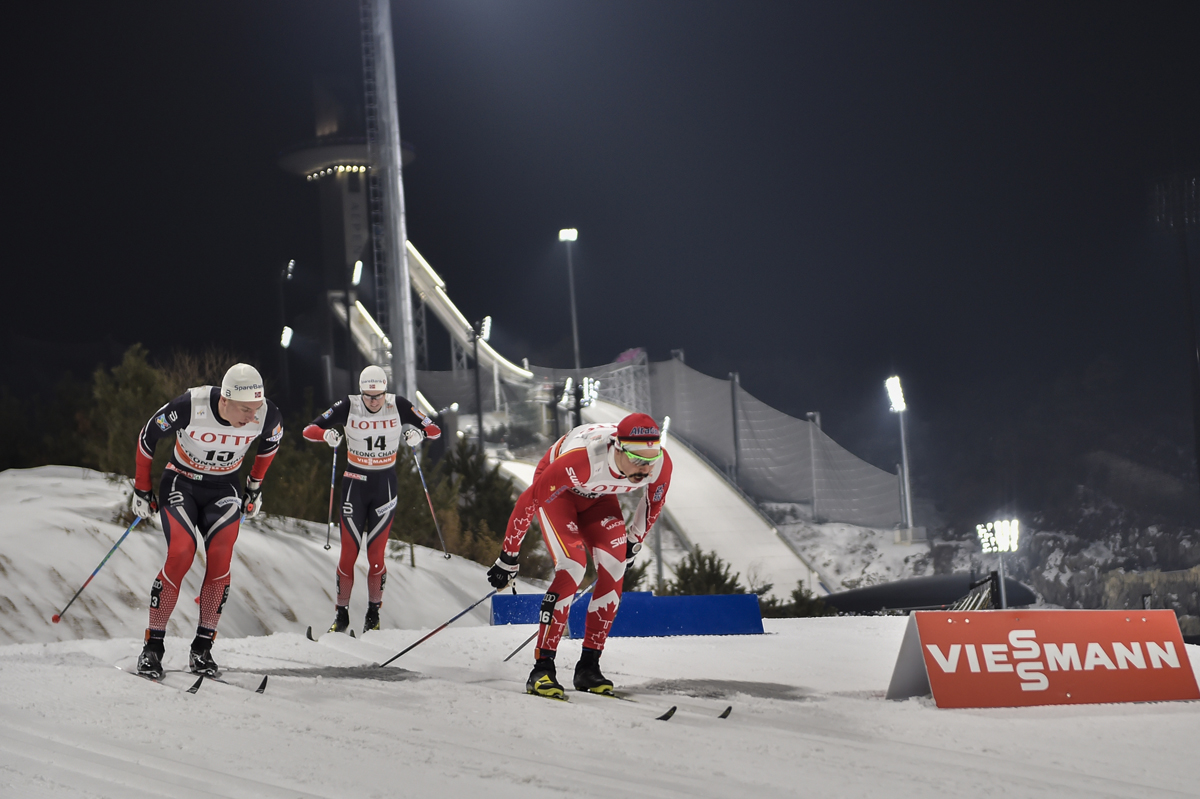
Alpine Insurance Alberta World Cup Academy Team Announcement
Press Release
June 11, 2019
Canmore – The Alpine Insurance Alberta World Cup Academy is proud to announce our new team for the 2019-20 season.
Comprised of two formal training groups, one in Calgary and one in Canmore, the 2019-20 team is the most diverse group of athletes to date. Led by six national team members, Emily Nishikawa, Dahria Beatty, Elizabeth Elliott, Benita Peiffer, Matthew Strum (biathlon), and Nathaniel Mah (nordic combined) and numerous medalists from last year’s Canadian Nationals, this also is one of the deepest. “There is a lot to be excited about going forward,” says Chris Jeffries, High Performance Program Director. “Last year saw a great group of U20 athletes join our university program in Calgary, which bodes well for the future. This year we have had a few very successful U25 athletes, Maya MacIsaac-Jones, Sadie White and Annika Richardson, join our Canmore program, skiers to keep an eye on for the World Cup Finals in Canmore, March 2020.”
“We have seen a lot of changes in our programming over the last few years, and this year’s team more than ever signals the positive direction these changes are taking us,” explains Greg Manktelow, Vice President of the Alberta World Cup Society. “Our athlete group is diverse and extremely talented, making it very exciting and motivating for all of us as we look ahead to not only this winter, but our athlete dream goals of representing their country at the 2022 and 2026 Olympics. We feel like we have taken some major steps towards creating a more sustainable program for our athletes, sponsors and partners. We know the work is just beginning, but we are building excitement of where we are going, and it makes it a lot easier to find new and innovative ways to help our Canadian skiers and athletes dream big.”
Last year saw the biggest changes at the Academy to date with the arrival of the inaugural group of University athletes in Calgary. This new direction was a major step forward, providing athletes the flexibility and support needed to pursue post-secondary studies and their sport goals concurrently. “Last year we took a major leap of faith opening the doors in Calgary in August for the first time. The education/sport path has been a major gap in our Canadian system for a long time, one that we are excited to help close”, explains Jeffries. “We saw successes both in the classroom and on the race course. The smiles on the faces of our athletes last year highlighted the balanced approach we strived to achieve.”
Joining the Academy staff for this year will be coaches Anneke Winegarden and Julia Ystgaard. Anneke is in her 2ndyear of a master’s program in the Human Performance Laboratory at the University of Calgary and worked with the team last year. Julia is from Norway and is doing a year in the Kinesiology department at the University of Calgary as part of her studies in Oslo.
Training for the 2019-20 season is well under-way in Canmore for those local athletes. The core university group will be arriving back in the Bow Valley for a training camp August 23 to the 31 before starting classes at the beginning of September. The racing season kicks off November 30thfor the team at the Sovereign Lake ski club near Vernon, BC.
Team List
Women
Dahria Beatty (Sr National Ski Team) – Whitehorse Nordic Ski Club
Emily Nishikawa (Sr National Ski Team) – Whitehorse Nordic Ski Club
Elizabeth Elliott (Jr. National Ski Team) – Revelstoke Nordic Ski Club
Benita Peiffer (Jr. National Ski Team and Sr Biathlon Development Team) – Whistler Nordic Ski Club
Laurence Dumais – Fondeurs-Laurentides
Beth Granstrom (B.C. Ski Team) – Revelstoke Nordic Ski Club
Hannah Jirousek (Yukon Ski Team) – Whitehorse Ski Club
Paige Latta – Sovereign Lake Nordic
Maya MacIsaac-Jones – Rocky Mountain Racers
Annika Richardson – Hollyburn Ski Club and Lappe Nordic
Amanda Thomson (Yukon Ski Team) – Whitehorse Ski Club
Sadie White – Big Thunder Ski Club
Men
Nicolas Bennett (NWT Ski Team) – Yellowknife Ski Club
Mathieu Bilodeau (2016 Olympic Racewalker)
Nate Gerwing – Rocky Mountain Racers
Michael MacIsaac-Jones – Rocky Mountain Racers
Nathaniel Mah (National Nordic Combined Team) – Altius Nordic Ski Club
Thomas Manktelow – Canmore Nordic Ski Club
Nicholas Randall (Ontario Ski Team) – Big Thunder Ski Club
Matt Strum (Sr National Biathlon Development Team) – Canmore Nordic Ski Club
“The Alpine Insurance Alberta World Cup Academy has been the development centre where several generations of top Canadian cross-country skiers have honed their skills before being named to the National Ski Team. Our athletes have represented Canada at the Olympics, the Nordic World Championships and on the world cup circuit. Thanks to the support being provided by Alpine Insurance, we will continue to be “THE PLACE” for the next generation of our best developing cross-country skiers.”
Paralympic and Olympic veterans lead new generation of cross-country skiers
CANMORE, Alta.—A young group of Paralympic and Olympic veterans will carry the torch for a new generation of cross-country skiers who will make up the National Ski Team in 2019-2020, Nordiq Canada announced on Saturday.
Poised to make their mark on the international stage at all levels of the sport, the determined crop of cross-country skiers will be focused on building towards the 2022 and 2026 Games.
A high-powered group of eight Paralympic medallists, including two guides, will be counted on to contribute to Canada’s medal haul over the next year on the Para Senior Ski Team. Canada’s flag bearers at the 2018 Paralympic Games, Brian McKeever (Canmore, Alta.) and Mark Arendz (Hartsville, P.E.I.) will lead the charge in Para-Nordic racing. They will be joined by a foursome of new stars who have emerged in the sport that includes: Collin Cameron (Sudbury, Ont.); Natalie Wilkie (Salmon Arm, B.C.);Emily Young (Vancouver); and Brittany Hudak (Prince Albert, Sask.).
A three-time Paralympic medallist, Cameron captured his first World Championship title last year. Wilkie, who backed up winning a set of Paralympic medals in 2018 with a silver at last year’s World Championships, will team up with two veterans of the Para Senior Ski Team in Young and Hudak. Both have consistently climbed onto the international podium over the last five years. Derek Zaplotinksy (Smokey Lake, Alta.) will compete on the Para Senior Ski Team for the first time in 2019-20. Zaplotinsky rattled off three, fifth-place finishes at the 2019 World Championships.
Graham Nishikawa (Whitehorse) and Russell Kennedy (Canmore, Alta.) will both continue to share guiding duties for Brian McKeever.
Nordiq Canada also announced five Para-Nordic athletes to its Development and Prospect team including: Jesse Bachinsky (Kenora, Ont.); Kyle Barber (Lively, Ont.); Ethan Hess (Pemberton, B.C.); Cindy Ouellet (Quebec City); and Lyne Marie Bilodeau (Magog, Que.).
“This talented group of Para-nordic skiers are an experienced group of athletes who have two clear goals in mind: win medals and continue developing the next generation of athletes,” said Shane Pearsall, chief executive officer, Nordiq Canada. “Depth is critical to mounting a podium attack, and we have a nice blend of veterans and NextGen athletes driven to put the maple leaf on the international podium.”
Thirteen athletes represent a new beginning for the National Ski Team which will be composed of eight senior development athletes and five junior development skiers. The creation of one National Ski Team will direct more resources and learning opportunities towards the junior level athletes.
Two Olympians from Whitehorse will be counted on to provide leadership to the new-look Senior Ski Team. Emily Nishikawa and Dahria Beatty, who both also represented Canada in PyeongChang, will lead the group of athletes into a new era for the squad.
Russell Kennedy, who competed at the Olympics before helping to guide Brian McKeever at the Paralympic Games in 2018, will also include World Cup races on his schedule while training and competing with the para squad.
Kennedy posted a career-best 12th-place sprint finish on the World Cup last year, while Beatty has a top-15 World Cup sprint finish of her own in her career. A two-time Olympian, Nishikawa had one of her most consistent seasons of her career last year.
The trio will be counted on to lead six other senior development athletes including: Julien Locke (Nelson, B.C.); Katherine Stewart-Jones (Chelsea, Que.); Graham Ritchie (Parry Sound, Ont.); Antoine Cyr (Gatineau, Que.); Sam Hendry (Canmore, Alta.); and Julien Smith (Thunder Bay, Ont.). Remi Drolet (Rossland, B.C.); along with Elizabeth Elliot (Revelstoke, B.C.); Benita Peiffer (Whistler, B.C); Anne-Marie Petitclerc (Mont Saint-Anne, Que.); and Anna Pryce (Calgary) represent the five junior development athletes who will look to gain valuable experience on the national team.
“This group is ready to step up and carry the torch for a new era of cross-country skiers in Canada,” added Pearsall. “They are equally as fierce and determined to deliver medal winning performances as their heroes before them. We are going to work with our sport and funding partners to deliver this dynamic group of athletes the tools they require to succeed on the road to 2022 and beyond.”
The National Ski Team will gather in Canmore for its first of five training camps between June 25 and July 9. Additional training camps for a select group of athletes will be held in Norway and Mt. Tremblant, Que. in August, as well as Thunder Bay, Ont. in September. The entire National Ski Team will reconnect in Canmore October 23 until November 16.
Nordiq Canada is the governing body of para-nordic and cross-country skiing in Canada, which is the nation’s optimal sport and recreational activity with more than one million Canadians participating annually. Its 60,000 members include athletes, coaches, officials and skiers of all ages and abilities. With the support of its valued corporate partners – Haywood Securities Inc., AltaGas, Swix and Lanctôt Sports– along with the Government of Canada, Canadian Olympic Committee, Canadian Paralympic Committee, Own the Podium and B2Ten, Nordiq Canada develops Olympic, Paralympic and world champions. For more information on Nordiq Canada, please visit us at www.nordiqcanada.ca.
Cross Country Ski de Fond Canada Names 18 Athletes to FIS Nordic Junior and Under-23 World Championship Team
—Family connections headline 2019 World Junior squad—
(Press release)
CANMORE, Alta.—Eighteen young Canucks who represent the next generation of cross-country ski talent in the country have just been named to Canada’s 2019 Junior and Under-23 World Championship Team that will compete in Lahti, Finland, January 19 – 27.
Cross Country Ski de fond Canada will send five women and five men to the Junior World Championships, as well as four women and four men for the Under-23 events. Athletes hail from clubs across the country in provinces and territories that include British Columbia, Alberta, Ontario, Quebec, and the Yukon.
“This is a young group with an exciting mix of International experienced athletes and first timers. These up and comers have gained experience racing domestically on the Haywood NorAm circuit,” said Erik Braten, Junior national team coach, Cross Country Ski de fond Canada. “The talent pool of young cross-country skiers continues to grow, and these athletes are well-prepared to achieve excellence in Finland.”
Each of the athletes earned a coveted spot on Team Canada based on their results at the Haywood NorAm Junior and Under-23 World Championship Trials that were held over the weekend at the Canmore Nordic Centre. The trials were originally scheduled for Whistler Olympic Park, but race officials were forced to move the event due to a lack of snow. The Canmore Nordic Ski Club graciously stepped up to successfully stage the four-day, three-race event.
Among the up and comers ready to introduce themselves to the world in junior action are two sets of siblings and the son of cross-country ski Olympians Milaine Theriault and Robin McKeever.
Jasmine Drolet and Remi Drolet from Rossland, B.C., along with Isobel Hendry and Sam Hendry from Canmore, Alta. headline the family connection. Sam Hendry and Remi Drolet are coming off a strong trials where they mixed it up with many of the country’s top senior skiers in the distance races.
The youngest member of the Canadian team will be Xavier McKeever who will gain valuable international experience in his continued development.
Before hitting the start line in Finland, the team will benefit from the experience of four-time Olympian and one of Canada’s most accomplished cross-country skiers, Devon Kershaw, who will lead the team through a weeklong training camp inSjusjøen, Norway.
The following is a complete list of Canada’s 2019 Junior and Under-23 World Championship Teams.
CCC is the governing body of cross-country skiing in Canada, which is the nation’s optimal winter sport and recreational activity with more than one million Canadians participating annually. Its 60,000 members include athletes, coaches, officials and skiers of all ages and abilities, including those on Canada’s National Ski Teams. With the support of its valued corporate partners – Haywood Securities Inc., AltaGas, Swix and Lanctôt Sports– along with the Government of Canada, Canadian Olympic Committee, Canadian Paralympic Committee, Own the Podium and B2Ten, CCC develops Olympic, Paralympic and world champions. For more information on CCC, please visit us at www.cccski.com.
For the women, Susan Dunklee, Clare Egan, and Joanne Reid all pre-qualified based on last season’s results. Emily Dreissigacker was named to the team on Monday. The women’s World Cup team has three start spots per race in Pokljuka. According to Monday’s announcement, coaches will determine which athletes get specific starts at a later date.
After the Pokljuka races, only three U.S. women will travel to Nove Mesto, Czech Republic, the host of this season’s second IBU World Cup .
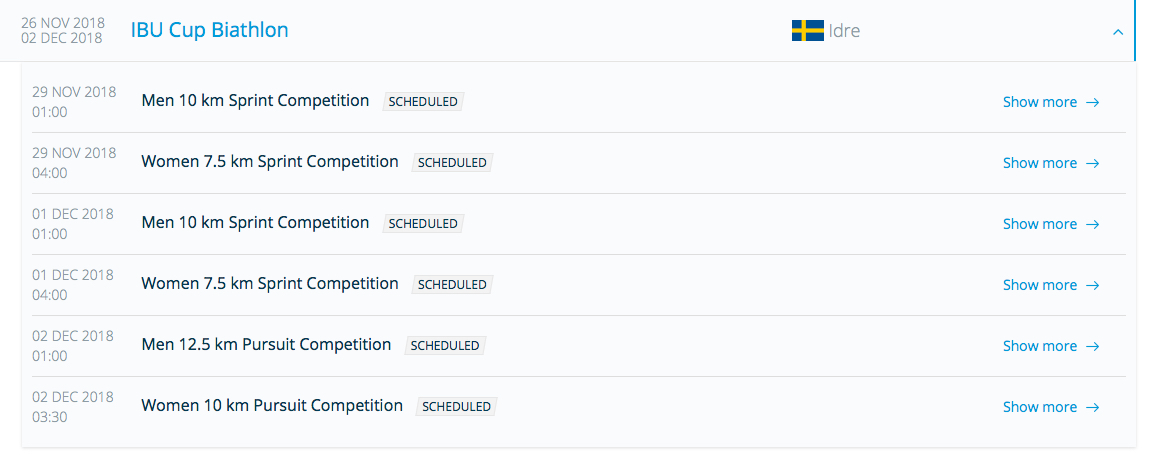
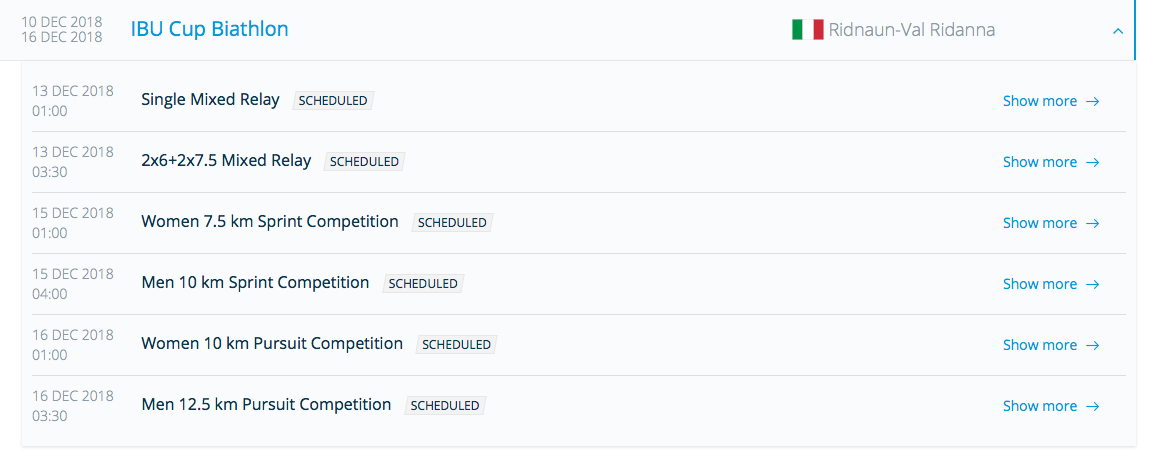
The fourth biathlete will head to Ridnaun-Val Ridanna, Italy to race the second weekend of IBU Cup on Dec. 10-16. (The IBU Cup’s first weekend of racing will take place in Idre, Sweden on Nov. 26-Dec. 2).
Leif Nordgren and Sean Doherty both pre-qualified for the men’s opening World Cup races. The men’s side has four start spots in Pokljuka. Along with Nordgren and Doherty, Paul Schommer and Travis Cooper have been named to the first World Cup team roster.
Cooper’s path to Pokljuka will include a stop at the IBU Cup races in Idre. According to U.S. Biathlon, Cooper must first race in Sweden in order to earn his qualification for the IBU World Cup. Max Durtschi will travel to Pokljuka as a reserve athlete.
IBU Cup Teams
The SoHo and Jericho rollerski trials also served as a springboard to the second series of IBU Cups in Ridnaun-Val Ridanna, Italy. Hallie Grossman, Deedra Irwin, and Kelsey Dickinson were named as U.S. athletes for those races. They will be joined by one member of the women’s IBU World Cup team racing in Pokljuka.
The men also have four start spots at the second IBU Cup. Durtschi, Alex Howe, Jake Brown, and Vasek Cervenka have been named to the team for the Ridnaun-Val Ridanna, Italy competitions.
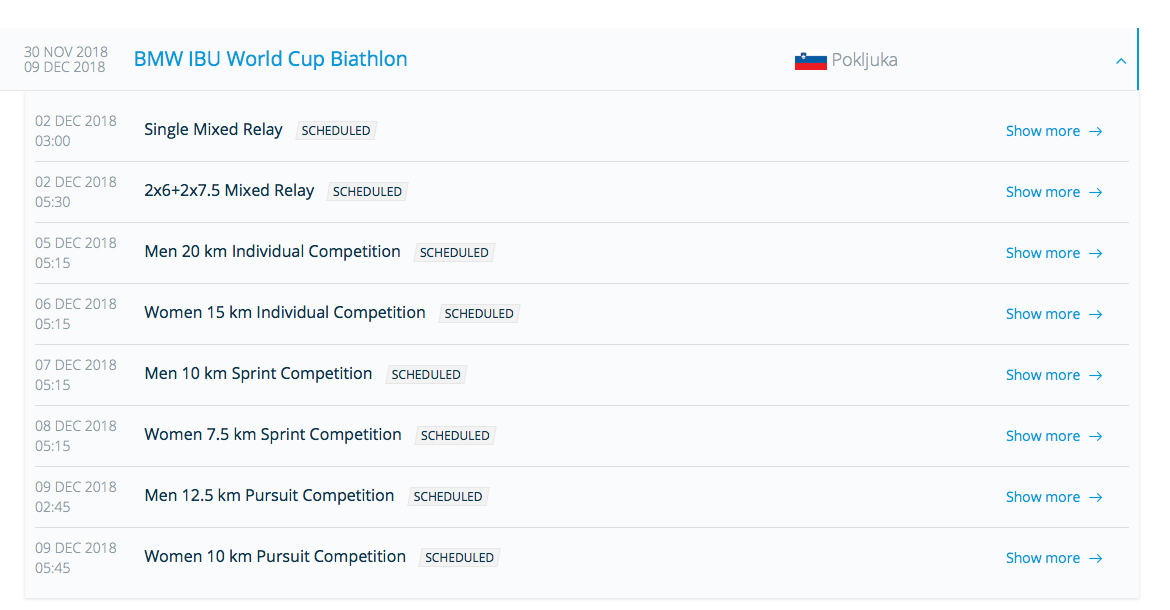
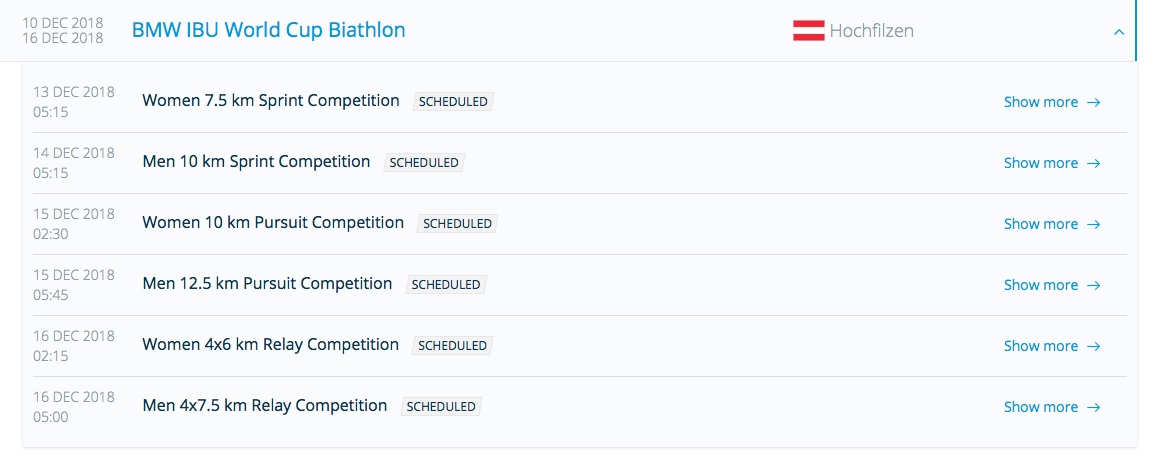
Below is the schedule for the first two IBU World Cup and IBU Cup races.
Schedule for the first IBU World Cup in Pokljuka, Slovenia.
Schedule for the second IBU World Cup in Nove Mesto, Czech Republic.
Schedule for IBU Cup #1 in Idre, Sweden.
Schedule for IBU Cup #2 in Ridnaun-Val Ridanna, Italy.
In late August, U.S. Ski Team (USST) Head Coach Chris Grover broke his own news, releasing three new sets of criteria on behalf of U.S. Ski & Snowboard, the national governing body for cross-country skiing. The three separate documents discussed by Grover and linked in his blog disclosed the selection criteria for World Cup and World Cup Period 1 team selection, 2019 World Ski Championships (WSC) in Seefeld, Austria, and the 2019/2020 national team.
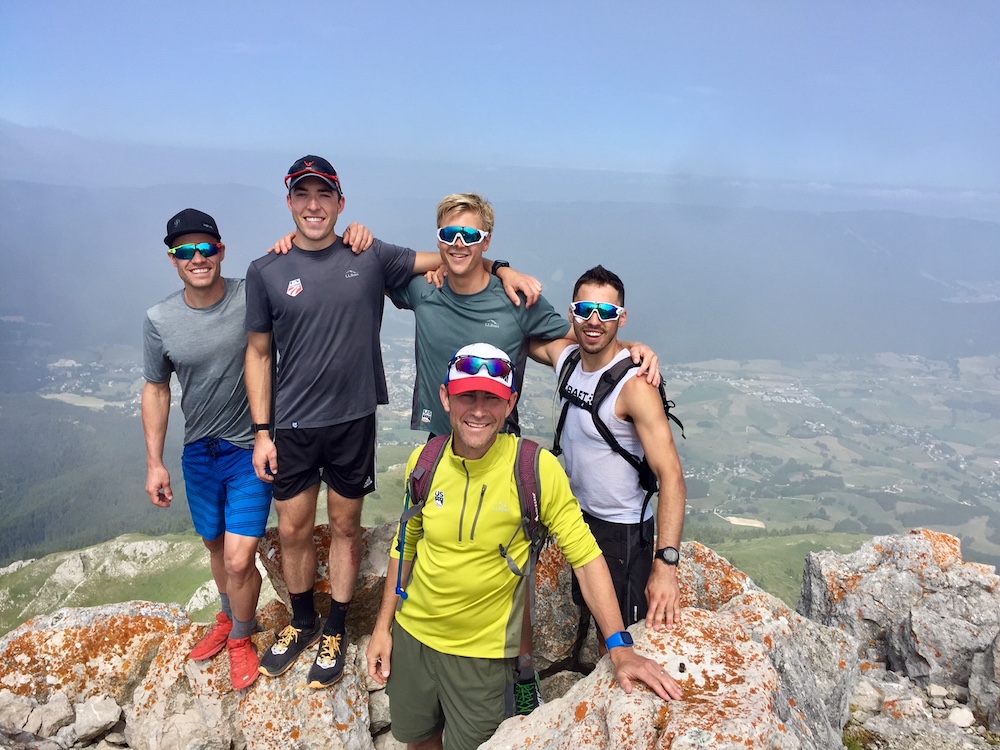
U.S. Ski Team Head Coach Chris Grover (front) with (from left to right) Simi Hamilton, Paddy Caldwell, Erik Bjornsen, and Ian Torchia on top of the Roc Cornafion above Villard-de-Lans, France, during a training camp this summer. (Photo: Chris Grover)
Grover and new USST development coach Gus Kaeding spoke with FasterSkier for its podcast on Sept. 11 to highlight some of the updated criteria and provide context for the modifications.
(A lightly edited conversation with Grover and Kaeding is available on the Nordic Nation podcast. Warning: you may want to time your listening for a 1.5-hour road trip or dish duty after a crowded dinner party. It’s a lengthy discussion.)
New U.S. Cross Country Development Coach Gus Kaeding. (Photo: Sarah Brunson/U.S. Ski & Snowboard)
World Cup Selection Criteria
Considering World Cup Period 1 starts, Grover stated in the following interview and in accordance with the selection criteria, the discretionary picks were made in consult with a larger working group. That group is comprised of four national-team staff coaches — Grover, Matt Whitcomb, Jason Cork, and Kaeding — as well as Dakota Blackhorse-von Jess (athlete rep), August Teague (chair of the cross-country coaches sub-committee), and eight senior club coaches: Chris Mallory (Sun Valley Gold Team), Erik Flora (Alaska Pacific University), Joe Haggenmiller (Central Cross Country), Pepa Miloucheva (Craftsbury Green Racing Project), Austin Caldwell (formerly of the Bridger Ski Foundation, now assisting the University of Colorado-Boulder Ski Team), Dragan Danevski (BSF), Pat O’Brien (Stratton Mountain School T2 Team), and Dan Weiland (Ski Club Vail).
According to Grover, this 14-person working group was tasked with helping develop WSC and World Cup selection criteria. Further, this group, which again includes the four USST staff coaches, remains responsible for nominating the discretionary picks for each World Cup period this season.
Once those World Cup Period 1 nominations were made, they were sent to a three-person discretionary selection review group with the authority to approve or disapprove those nominations.
The language in the World Cup selection criteria, as it refers to this smaller group, reads as follows: “All discretionary selections will be reviewed by a discretionary selection review group comprised of the U.S. Ski & Snowboard Nordic Program Manager, the U.S. Ski & Snowboard Chief of Sport, and the athlete representative from that sport who is a member of the U.S. Ski & Snowboard Board. If the U.S. Ski & Snowboard Board Athlete Representative is also a currently competing athlete then another athlete, who is not actively competing, will be selected by the Athletes’ Council to be the representative in this group.”
In a follow-up email, Grover clarified who serves on the discretionary selection review group. “This would normally be Bryan Fish, Luke Bodensteiner, and Rosie Brennan. Because Rosie is an active athlete, Dakota has replaced her,” Grover explained.
The other changes to World Cup selection that Grover cited in his original blog post are as follows and discussed in the podcast:
The standard by which men advance from one World Cup period to the next from top 30 to top 40 to reflect the greater depth in the men’s WC field.
Addition of SuperTour leaders as guaranteed starts to the Tour de Ski.
Addition of language to the past criteria for selecting a World Cup Finals team in Quebec City, including:
Top-30 individual performance at the Seefeld World Champs (the previous standard was top 25).
Created a best 11 of 14 SuperTour results selection to round out the World Cup Finals team, to encourage athletes to continue to race in Europe mid-season, rather than feeling the need to attend every SuperTour competition.
World Ski Championships Criteria
Come late February, the World Championships begin. In a personal blog published on FasterSkier, Grover noted the key changes to the current WSC selection criteria.
The World Cup remains the most direct path to meeting objective criteria for WSC team nomination.
Discretionary selection is divided into two phases: Phase 1 and Phase 2. The phases refer to the use of coaches’ discretion once objective criteria have been applied to WSC team selection.
As FasterSkier understands the criteria, Phase 1 will be used to discretion solidly performing World Cup skiers who have not met objective criteria. Phase 1 reads much like recent 2017 Lahti and 2015 Falun WSC discretionary criteria. The current language allows for some latitude when considering potential team discretionary picks. An indication of potential future championship medal performance, as well as any outstanding competition results from last season and the 2018/2019 season, are tools for coaches making discretionary picks.
However, the “attitude and commitment of athletes” language included in the past as a possible factor in discretionary selection was excluded from the latest iteration of WSC selection criteria.
The discretionary selections made by USST team coaches in Phase 1 will be reviewed by a three-person group including the U.S. Ski & Snowboard President and CEO Tiger Shaw, Bodensteiner, and the U.S. Ski & Snowboard board athlete rep as long as they are not actively competing. Another non-competing athlete will be chosen as a replacement if this conflict of interest arises. During the 2018 OWG selection, for example, former USST member Holly Brooks served as the athlete rep. Brooks was retired from competition when she served as part of the review committee.
For any remaining team spots, Phase 2 of discretionary selection “may” be used. This is where the selection of SuperTour skiers comes into play. Grover, in his blog, said the selection of domestic skiers from SuperTour could be perceived as the biggest change.
Phase 2 can but is not obligated to consider the 2019 Championship Selection List and the “next best athlete” in what the criteria define as a “pool” of athletes. The “pool” is separated into four discrete disciplines: women’s distance, women’s sprint, men’s distance, and men’s sprint.
The criteria also specify the “next best athlete” as “the highest ranked athlete on the ranking list in each of the four disciplines who was not nominated to the team.”
The 2019 Championship Selection List will be created using an athlete’s best two results in sprint and distance respectively with points accrued from SuperTour races and weighted U.S. National Championships races. (Sprint points for the Championship Selection List consider qualification place only.)
The athlete pools allow for the USST head coach to select an athlete from a refined list based on sex and discipline, rather than a single men’s or women’s list.
During the interview, Grover explained his rational behind Phase 2 Discretionary Selection and the use of pools.
“We obviously found ourselves last year in a situation going into the Olympics where we were feeling compelled, due to the language in the criteria, to look at selection as one list of athletes,” hesaid. “And to look at athletes who had more points in any discipline, whether they were a man or a woman, a distance skier or a sprinter, as the next best athlete to be nominated to the team. By moving the secondary or domestic selection from an objective domestic selection to a discretionary selection, it gives us coaches discretion to be able to select from the correct pool to fill an open start spot. So if we know that we need to fill a men’s 50 k skate spot, we can look to the men’s distance list and not to an overall combination of women’s and men’s distance and sprint lists. So this is kind of a creative way that we feel is going to solve the issue that we had last year. The USOC [U.S. Olympic Committee] has given us the thumbs up, to go ahead and pursue, and we are hoping that it selects more of the right athletes at the bottom of the selection.”
The process for selecting athletes in Phase 2 appears streamlined. Grover recommends an athlete from the “pools” and the three-person selection committee makes the selection. The criteria also specify that potential WSC team athletes chosen during Phase 2 should have attained a minimum World Rank (FIS points) of 120 in sprint or distance by the release of FIS points list 5 for this upcoming season.
In the past, athletes have contacted coaches to advocate for themselves. The updated WSC criteria provide guidelines by which athletes can contact Bodensteiner directly in writing as a means of self-advocacy. Those direct petitions are potentially considered by the selection committee.
For athletes with a grievance with WSC team selection, the criteria also provide contact information for the USOC Athlete Ombudsman Kacie Wallace. Athletes can contact the USOC for assistance when challenging their non-selection.
In this instance, when it comes to the WSC and team selection, the USOC has oversight since the WSC selection criteria involve “protected competitions”. Both World Cups and the WSC are protected competitions by definition.
From USOC Bylaws, Section 1.3(W) pg. 3: “protected competition” means: 1) any amateur athletic competition between any athlete or athletes officially designated by the appropriate NGB or PSO as representing the United States, either individually or as part of a team, and any athlete or athletes representing any foreign country where (i) the terms of such competition require that the entrants be teams or individuals representing their respective nations and (ii) the athlete or group of athletes representing the United States are organized and sponsored by the appropriate NGB or PSO in accordance with a defined selection or tryout procedure that is open to all and publicly announced in advance, except for domestic amateur athletic competition, which, by its terms, requires that entrants be expressly restricted to members of a specific class of amateur athletes such as those referred to in Section 220526(a) of the Act; and
2) any domestic amateur athletic competition or event organized and conducted by an NGB or PSO in its selection procedure and publicly announced in advance as a competition or event directly qualifying each successful competitor as an athlete representing the United States in a protected competition as defined in 1) above.
As FasterSkier understands, the USOC does not provide legal representation for athletes. However, the USOC does provide a lengthy list of arbitration decisions on its website as a resource for those who believe they have been wrongly denied membership on a team.
Another notable change is the clarification of language as it pertains to the selection of WSC sprinters. In the context of selection criteria, it is referred to as the “5-sprinter-max rule”. In other words, no more than five sprinters total per sex will be selected to the current WSC team. Five male sprinters. Five female sprinters. No more.
During the 2018 Olympic Winter Games (OWG) selection, the five-sprinter-max rule was challenged. Specifically, the language in the OWG selection criteria did not specify what happens when an athlete dually qualifies through objective criteria. For example, last year Jessie Diggins, Sadie Bjornsen, Kikkan Randall, and Sophie Caldwell all met objective OWG criteria in both distance and sprint. Would a dually qualified athlete’s inclusion on the team take up both a distance spot and one of five female sprint spots? Last winter, that question appeared unsettled.
The answer moving forward into the current 2019 WSC team selection period for the dually qualified athlete conundrum is a categorical yes. Dually qualified athletes do count towards a sprint spot.
Again, in the podcast, some of the other major changes are discussed in greater detail.
2019/2020 USST Selection Criteria:
Kaeding was brought on board to help better define criteria when it comes to USST nominations. One thing is clear, the new criteria spells out in detail the performance benchmarks both senior and junior skiers should meet to receive USST member status.
The new USST criteria include objective criteria for A, B, and D-team status based on an athlete’s year of birth (YOB) and the minimum World Rank an athlete should have at a specific age. This is referred to as age-weighted criteria. For example, if an athlete was born in 1995 and is 24 years old by January and their World Rank is 20th or better, they’ll be an auto-nomination to the A-team.
Kaeding discusses in the podcast the data-crunching basis for the reliance on World Rank and an athlete’s YOB when it comes to the objective criteria. In his blog post, Grover wrote the following regarding the use of World Rank:
“The USST staff has spent much of the past year examining data from major championship medalists over the past decade, and have found that world rank is often the best indicator of who is on the path towards a future medal.”
For A-team nomination, any athlete regardless of age who finishes in either the top-15 of the FIS World Cup Sprint and Red Group List and/or the top-15 in the FIS World Cup Distance and Red Group List is an A-teamer. The old A-team requirement involved a top-30 rank. Grover said in the podcast this change better reflects the World Cup’s Red Group that includes only the top-15 skiers in sprint and/or distance. Red Group athletes have World Cup food and lodging paid for by the International Ski Federation (FIS).
Additionally, any skier with a top-six result in a sprint or distance World Cup race punches the A-team ticket too.
B-team objective requirements are less stringent. World Rank and YOB benchmarks are detailed. Further, an athlete born in 1996 and scoring an individual top 10 at the 2019 U23 World Championships is an auto-nomination to the B-team.
D-team objective criteria have been both broadened and tightened. First and foremost, an athlete will have to be under 23 to remain a D-team athlete for 2019/2020.
U23 World Championships results qualifying an athlete for the D-team have expanded to include an individual top 10 at U23s for an athlete born in 1997 or 1998. And any athlete at World Juniors placing in the top 10 moves onto the D-team. The old requirement for D-team nomination based on U23 and World Juniors individual performance was a podium finish.
World Rank and YOB benchmarks are included in the D-team objective criteria.
Coaches’ discretionary selection to the B and D-teams remain a possibility. The language under the Discretionary Selection Policy section is similar to recent editions.
To contact Grover and Kaeding directly, they provided their email addresses:
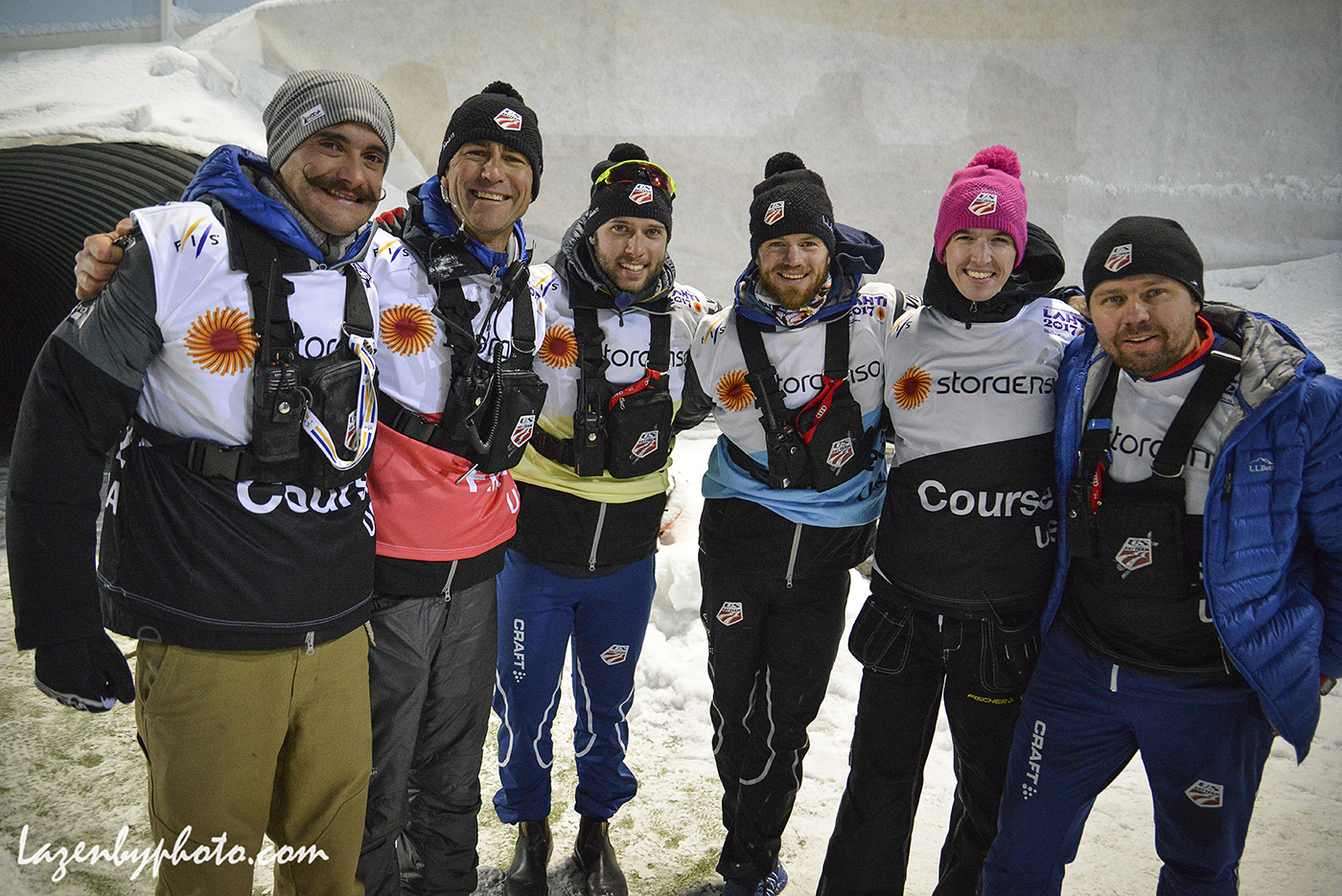
U.S. support staff after their team’s double podium in the women’s freestyle sprint at 2017 Nordic World Championships in Lahti, Finland. (From left to right) J.P. Laurin, Chris Grover, Tim Baucom, Andrew Morehouse, Patrick Moore, and Oleg Ragilo. (Photo: John Lazenby/Lazenbyphoto.com)
BEND, Oregon — Late last month, FasterSkier reached out to U.S. Ski Team (USST) Head Coach Chris Grover to discuss the team’s recent nominations.
The original range of topics was fairly narrow, the new iteration of the USST athletes and staff. Grover, however, ventured into the realm of how the USST will be modifying its criteria for team selection before the start of the 2018/2019 competition season. The criteria Grover discussed in the following Q & A, conducted over the phone on May 22, dealt with future USST nominations: not championship-team selection criteria. In other words, the rewritten criteria he discussed will have to do with the objective benchmarks an athlete must meet to be named to the USST D-team, B-team, and A-team, respectively. Beyond the objective criteria, Grover noted that coach’s discretion will remain an instrument of some future team nominations.
FasterSkier: OK, let’s jump in and discuss the U.S. Ski Team’s A-team roster.
Chris Grover: First of all, let me say one thing that we have been working on now for perhaps eight months, is trying to create new selection criteria to the U.S. Ski Team. And Gus Kaeding, who is a new staff member for us, someone that we just hired in the last few weeks, who came out of business school last year after coaching before that. He has actually been crunching the data for us. He took a bunch of statistics courses when he was in business school. So he kind of volunteered to come and start helping us try to figure out how to make a much more objective selection criteria. As you know, right now we have criteria where it is often about 50/50 in terms of athletes who make the objective criteria and athletes that are selected through discretion. And our goal is to create selection criteria for the 2019/2020 season that we put in place this summer, or at least before the ski season begins when the selection criteria would start. It is much more objective. It shows pathways not only at the very high end and not only in terms of a junior worlds medal but all along the different potential ages and potential athletes.
So that is coming together. We are still working on it. It will probably be tied to an athlete’s world rank at different ages, but our goal is to take a lot of the guesswork out of future selections. We couldn’t have put it in place this year because the selection criteria was already published as of last year and we cannot retroactively go back once the selection period is opened and apply new criteria. We can only apply it in years moving forward, but I am really excited to get to a point where the guesswork for athletes and coaches, for parents, is taken out of it. And ideally those people can look at criteria before a ski season and go, “If I do this, then I will be nominated to the U.S. Ski Team.” That said, I envision that there will always be discretionary picks that we make. There will always be people for whatever reason that come on late in the season.
Like, for example, their world ranks doesn’t mesh with what their current potential is. They have outstanding results that for whatever reason we didn’t see coming. So I envision that there will be discretionary selections going forward, but our goal is to make it so that there are many fewer discretionary selections and it is much more objective and clear-cut. I am excited to put something in place and something that we will be pushing out to the team hopefully later this summer or the very early fall at the latest.
A U.S. Ski Team selection is different than say a championship selection. It won’t go to, let’s say, a committee like our U.S. Ski and Snowboard cross-country committee. We will probably push it around to some athletes reps but it won’t go to a greater community. Because at the end of the day, this is the U.S. Ski Team and it is not necessarily the same as qualifying for World Juniors or the U23 or the World Cup or the World Championships. It is a little bit of a different deal. And the selection, basically, it needs to reflect the goals of the organization. And the goals of the organization are to win medals at the highest levels in the sport.
That didn’t answer your question. The question was something about the A-team.
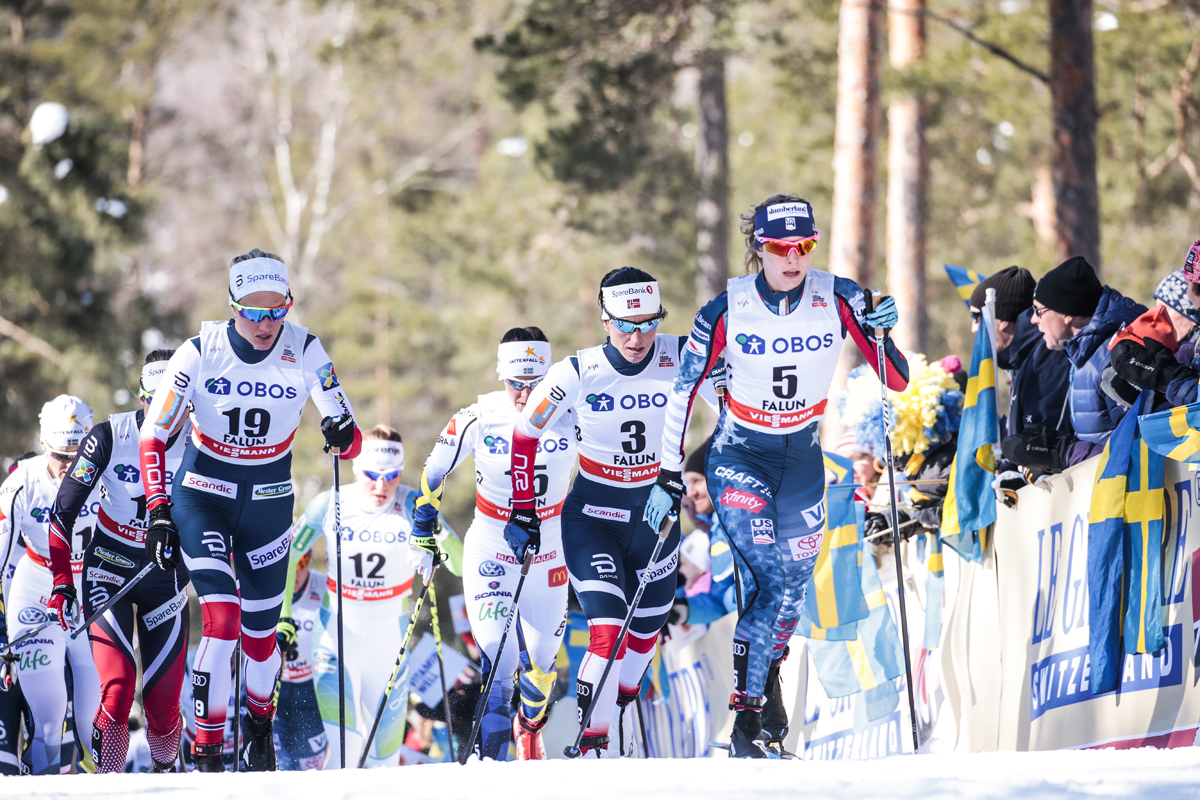
American Jessie Diggins (5) leading the pack up an early climb with Norway’s Kathrine Rolsted Harsem and Marit Bjørgen just behind during the women’s 10 k classic mass start at 2018 World Cup Finals in Falun, Sweden. (Photo: Fischer/NordicFocus)
FS: Back to the A-team. It’s quite impressive as it stands. An Olympic gold medalist in Jessie Diggins, third overall ranked World Cup women’s sprinter Sophie Caldwell, sixth-ranked overall skier Sadie Bjornsen, highly ranked sprinter Ida Sargent, and one dude, Simi Hamilton, who was 17th in the final World Cup sprint rankings.
CG: So the A-team athletes. That is objective. They make the team based on being top 30 in the world in either sprint or distance. They were all clear A-team selections based on the team nomination criteria. I am not quite sure yet if we will keep that exact standard going forward. We may. We also are really diving into this new data and seeing what we can find out. So, all those athletes qualify objectively. And then, the only other athlete that qualified objectively was Hailey Swirbul because she was an individual medalist two times over at World Junior Championships.
FS: Let’s jump to the D-team then. Some renominations. There’s Ian Torchia, Julia Kern, Hannah Halvorsen and Katharine Ogden. Then the newest members — Hailey Swirbul, Ben Ogden, and Gus Schumacher. Seven total. Is this the largest D-team you have had for awhile?
CG: For sure the largest D-team in at least in the past decade. And really, I mean, obviously, we are very excited because the results, just World Junior results alone, with this group of athletes has surpassed any group of athletes that we have ever had come through the ranks of the U.S. Ski Team.
These D-team results for many of these athletes are better than those of any of our A-teamers ever were able to accomplish at the World Junior Championships. And obviously, we have gone from 2016 at World Juniors having never had a medal at the World Junior Championships to now having five medals as a nation. So it is a super exciting step forward. We are really excited to have all these new faces as part of the team.
And this is why we have hired Gus Kaeding. He has been hired as a D-team coach specifically to help nurture and shepherd this group of athletes through the next few years of their development.
FS: Does Bryan Fish’s job change? Does the job description change as it relates to these specific athletes?
CG: Absolutely. The challenge that we had is that for Bryan, for one coach to effectively manage seven athletes at a high level is pretty daunting as it is. Bryan has so many other tasks already, including basically creating all the materials for our coaches education and then implementing the clinics and certification conferences as well as running all of our development summer camp opportunities REG, NEG, NTG … assisting at the U16 elite camp and then also trying to coordinate efforts between the NNF and what we are doing and the American Birkie Foundation, which is coming on as a supporter as well. And then winter trips and what he is doing to oversee the Super Tour, it was just too much. It was too much for one person to handle and we needed some help. And the greatest need with all these incoming younger athletes was certainly with the D-team squad.
FS: I believe this is Ian Torchia’s third year on the D-Team.
CG: That sounds right to me.
FS: Do you normally have a sort of “statute of limitations” on D-Team membership?
CG: Yeah, we really should. In Ian’s case, he had mono the year before last and then kind of was coming back this year and a little bit inconsistent with results. But I think that challenge that you just alluded to really speaks to why we need different selection criteria, why we need more objective selection criteria. Because athletes at some point should be moving. Either they are moving off the D-team or they are moving up to the B-team or moving up to the A-team. But they have to have movement after a few years. And the same goes for B-team athletes, but it is really unclear. I mean, right now, we don’t have any sort of clarity as to what those markers might be. And so that is why it is critical for us to figure a more concrete pathway for athletes so that they know the expectation. So you know, Ian, I would expect with his age he is probably going to have to be on the B-team next year if he is going to continue to be on the national team. So I am hoping with these new criteria that we create and define that pathway or at least define the expectations, I should say.
FS: So the new criteria, those expectations as they relate to the D-team, would have be to SuperTour-specific unless these athletes have start rights because they have earned them?
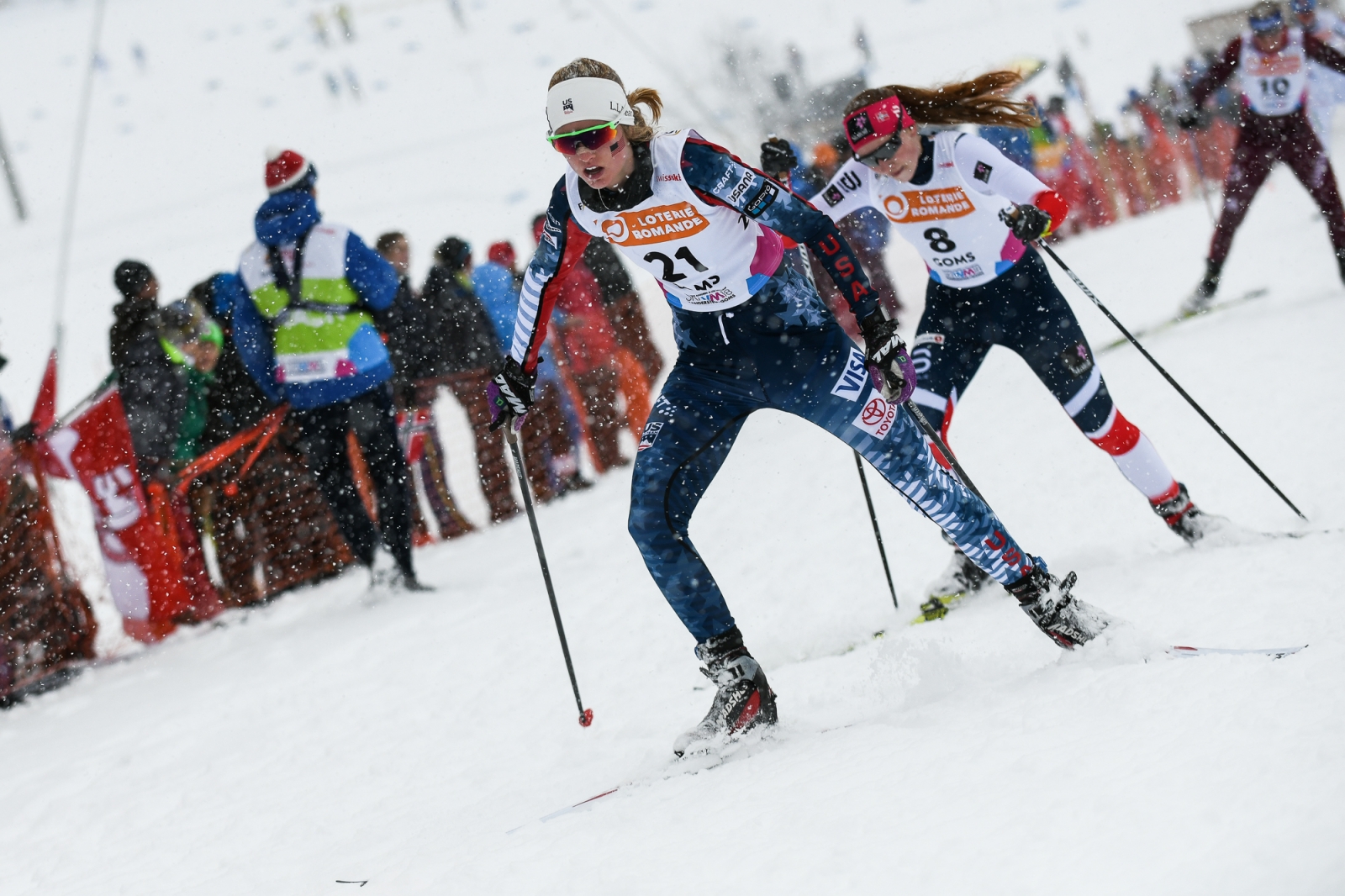
American Hailey Swirbul (University of Alaska Anchorage) leads Norway’s Lone Johansen up a climb during the second half of the women’s 10 k skiathlon at 2018 Junior World Championships in Goms, Switzerland. Swirbul placed third for her second individual podium of the championships. (Photo: JWSC2018.ch)
CG: I think that is why we are really looking at world rank for athletes. This is probably the most helpful thing as opposed to how they did on SuperTour, how they did on World Cup, how they did at the U23 World Championships, what happens at the NCAA Championships. That is the challenge for us, especially in North America being somewhat removed from where a lot of the racing is happening, a lot of the international racing obviously being in Europe. That is the challenge. World rank is going to help us identify that picture in a more meaningful way.
FS: Does that mean a reliance on FIS points?
CG: The difference is between using straight-up FIS points and world rank is that with FIS points, you can have very low FIS points but there could be one hundred people packed in there between you and zero FIS points. But with world rank, it gives us a finite amount of people that are below you or above you.
FS: So then as I am understanding the world ranking, this is then some sort of proprietary ranking that you will have?
CG: The way Gus has approached this, is that he is taking a look at every medalist at the Olympics and the World Championships in the past ten years. He has retraced the development path of those medalists. We are including not only those that have medaled in individual events but those who have medaled in team events. And then retracing kind of what their pathway is. And then perhaps we are going to give a plus-minus, a little 80th-percentile type adjustment to it, that allows for some leeway for an athlete. For example, coming from North America where maybe the pathway is slightly different than it is for European athletes. What we are basically trying to identify are the pathways for an athlete to win an Olympic medal or a World Championship medal and clarifying where you need to be. What are the markers at different ages? And that will help guide as to what the right world rank is for a given athlete to make the team.
And yes, there are always going to be a few outliers. That is why still need some discretion built in there. Once we have selection criteria in place then an athlete will be able to identify what their world ranking is and know how they fit into that selection or don’t fit into it.
FS: Anything more about the D-team that we should chat about?
CG: I don’t think any additional comments on the D-team. We are just excited to have such a talented group. There are lots of other athletes we have been looking very closely at who we anticipate as potential D-team members in the next year, but I wanted to see them basically make another small step forward before some sort of team nomination was implemented. That is where this new selection criteria is really going to help us out. Right now, it is selecting athletes via discretion and it is a judgment call on every one of these guys. That is not ideal from our perspective and it is not ideal from the athletes’ perspective.
FS: On to the B-team. Rosie Brennan was obviously not renominated. So it’s status quo with Erik Bjornsen, Paddy Caldwell, and Scott Patterson with the lone new addition of Kevin Bolger.
CG: With Rosie, we did not renominate her simply because she had been on that B-team position for awhile and hadn’t been making the step forward, hadn’t been making the objective criteria. That said, none of the guys made the objective criteria, either. But that is kind of normal of a B-team athlete, and that’s the challenge. That is where the main challenge is for us — to be able to identify those athletes especially when they are post-U23 athletes but they aren’t quite skiing consistent top-30 on World Cup — and be able to identify which athletes are still on the path to making forward progress. We named the others on discretion: Erik, Scott and Paddy because they were making forward progress on the World Cup. And then Kevin obviously had one of the best entrances to the World Cup of any U.S. athlete in history. So he really showed up and he did exactly what he needs to do to demonstrate that he absolutely has a ton of potential.
That was an easier call for us. The questions with the B-team and discretionary choices go back to why we need to create a new selection criteria.
FS: It’s within an athlete’s right to advocate for themselves. Did you get any pushback in terms of Rosie not meeting objective criteria?
CG: I’d say Rosie was very magnanimous about the decision and very professional about the decision. And for Rosie, and just like any of these athletes who kind of fall on the edge of making objective criteria, we absolutely still believe in them. They are invited to camps. We want to be able to work with them. They are going to be invited to competitions. We are going to be inviting many athletes to come and ski and fill World Cup start spots. So we want to be able to provide an opportunity for these athletes and Rosie is absolutely no exception. She is one of our best distance skiers in the country. We want to find opportunities to help her improve and make a step forward and we need to create an objective selection criteria that identifies that pathway and what the demands are better for athletes like her.
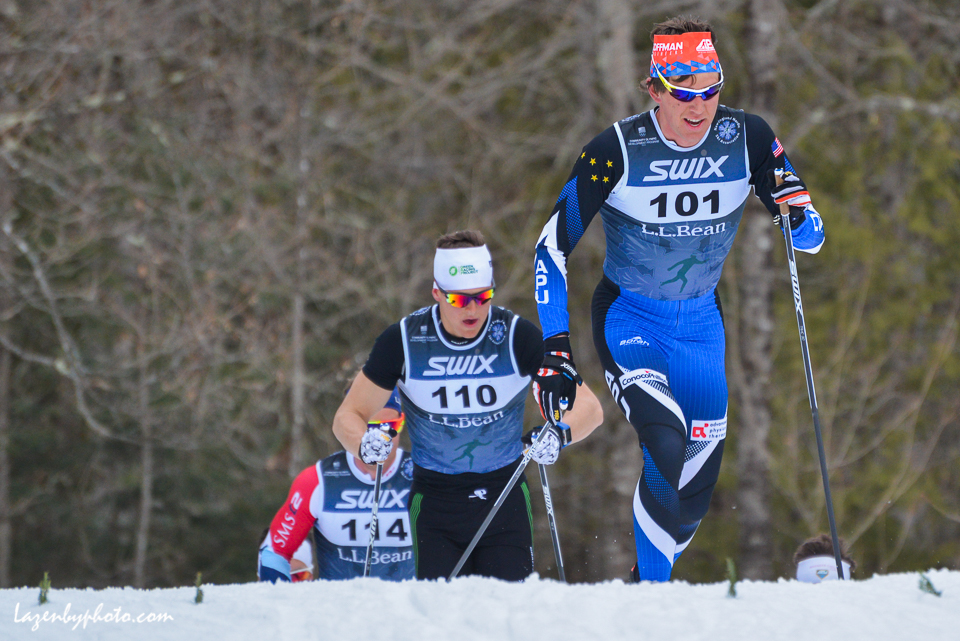
Scott Patterson (101) leads Adam Martin (110), Simi Hamilton (114) and others during the men’s 50 k classic mass start at 2018 U.S. Distance Nationals in Craftsbury, Vt. (Photo: John Lazenby/Lazenbyphoto.com)
FS: Looking at the athletes on the B-team, Scott Patterson obviously had a killer Olympics and a great Holmenkollen 50 k. Was that in the forefront of your mind with regards to his renomination to the B-team?
CG: Yeah, and he had a pretty rough start to the year. According to him, he had a pretty serious setback in the middle of the summer around an ultrarunning race that he was doing in Montana. And it really set him back and he struggled during World Cup Period 1. He seemed to come into his form during the Olympics. Scott actually skied quite well in the spring. Unfortunately, in the first distance race of the World Cup Finals, he and Erik both went down and they struggled to recover in a high-paced race in Falun. But I think Scott is definitely beginning to demonstrate what his potential was from the Olympics onward.
FS: Paddy Caldwell had some impressive time-of-day pursuit results early on in the season.
CG: He, unfortunately, got sick at one point during the Tour de Ski and he got sick during the Olympics. He definitely had some setbacks. But, overall, he skied quite well for a young athlete, the youngest of the group — being his first full year of World Cup. He would need to take a step forward this next year. Now he has a year under his belt. Now he is going to have to start scoring some points and those points are going to need to come from events that are beyond simply having a fast time of day split in a pursuit. But, that is going to be the step I am guessing in order to get whatever world rank he is going to need for this new selection criteria. That is what it is going to take.
FS: I believe Paddy is not here in Bend. That said, Paddy decided to remain in Europe and compete in and finish the Tour de Ski. Does it look like he would do the full complement of the Tour de Ski again?
CG: I am not sure. It is a real challenge around the Tour de Ski versus U.S. nationals. Because we have a selection criteria, although we have not implemented a new selection criteria, and we have not created the new selection criteria yet for the World Championships in Seefeld. But we have had a selection criteria for the last two years which has, obviously, two pathways: one being U.S. National Championships and SuperTour and the other being World Cup, including the Tour de Ski.
That makes it a real challenge. For those athletes that are on World Cup during Period 1, it makes it really hard to decide whether they should go back to U.S. nationals to qualify or whether they should go to the Tour de Ski. We are going to be encouraging probably anyone who is not really skiing well during World Cup Period 1, to go back to U.S. nationals and race at U.S. nationals and try to create a very robust selection process at U.S. nationals.
So you are right, Paddy is not here in Bend, he is doing finals at Dartmouth right now. So we have not had a chance to talk through those scenarios quite yet. One thing that for sure we are going to change about the selection criteria, and this is something to discuss with the community at the Cross Country Committee meetings in Park City, is that we are going to remove the final stage of the Tour de Ski from the championships selection period for distance athletes, and for sprinters as well. The distance period for selection will close on the day prior to the final climb. That has been a point of contention, as you know, within the community. Are we selecting the right athletes by having athletes who are racing uphill in skate? From my personal perspective, the athletes who have done well in that are the athletes that you want on a major championship team. They are aerobic engine skaters. But it is no problem from my perspective to remove that stage and hopefully remove some of the contentious feelings about that particular event.
So I don’t know exactly what [Paddy’s] plan will be yet. U.S. nationals versus a Tour de Ski. I think for a lot of these athletes, including him, we are going to see how people are skiing during Period 1 and whether it makes sense to ski the Tour de Ski or whether it makes sense to go back to U.S. nationals.
FS: Does that mean the USST will establish real concrete criteria as to whether or not someone would come back to U.S. nationals or remain on the World Cup?
CG: No. That is really challenging. If you create concrete criteria or something like that, then it probably needs to be blind to the athlete’s age and experience, but should it really be the same for an athlete who is 22 years old versus an athlete who is 34 years old? I don’t think it ever should. I think it is always important that there is some sort of coach’s discretion that is left that can contribute to making that decision because a younger athlete who might have ten or twelve years of World Cup ahead of them certainly can benefit perhaps from that experience more than an older athlete who might at the end of their career.
I think the heartache in the community comes when people think that we are looking at that decision as in prior to having qualified for the major championships instead of long-term development. And I can tell you from our staff perspective when we are making decisions like that, we are looking at two things. One: can the athlete contribute to outstanding results on World Cup? In this case, begin the Tour de Ski immediately? And second: is this athlete a U.S. athlete that we are trying to really develop for the future who would very much benefit from having this stage and experience and experience at these particular venues at this time?
CG: If he had raced the end of the Tour de Ski, had he raced those last couple of distances races, he may have made the B-team criteria. But one of his biggest goals for last season was to represent the U.S. in the team sprint in PyeongChang and to fight for a medal, so he was very focused on that. And that is why he stopped the Tour de Ski when he did, in order to get ready to race in Dresden. That was the one team sprint on the calendar last year. So he wanted to have the experience. Just from the aerobic as well as anaerobic and the tactical side of that as well. That was his real focus last year. And team sprint, for some of our key men, will continue to be one thing that we absolutely target and it probably remains one of our best chances at a medal.
FS: You are obviously still here. The assumption might have been that at the end of an Olympic cycle, a very successful cycle, that perhaps you would step down. Can you talk about your decision-making process to remain with the U.S. Ski Team?
CG: First of all. We are extremely lucky to have the staff that we have and one that has been as effective as they have been and as loyal as they have been. That goes not only for the coaching staff but also for our service team staff and also for so many of the volunteer providers that we utilize every year.
We have a handful of docs, PT’s, massage therapist — all of who we go back to year after year and ask for weeks and weeks of their time away from work, away from their paying work, away from family, and we ask them to volunteer their time and they keep coming back. We are incredibly lucky to have a staff that we have been able to retain. For Matt [Whitcomb], he came on in 2006, so I think he is going into his 13th year with the team. Jason [Cork] and Bryan [Fish] both came on the year right after 2010, I want to say 2011-2012, somewhere in that range. We have had a lot of longevity. Oleg Ragilo, who is our head technician, is back and he has been, I don’t know how many years he has been with the team, quite a few. He has been with us twice actually.
Also, Jean-Pascal Laurin, Tim Baucom, and Andrew Morehouse, all of those guys are returning. We do have one change on the service team. And that is that Marek Sander, who had been Kikkan [Randall’s] and Andy [Newell’s] tech, has decided to go back to Estonian biathlon which is where he came from when we hired him. Instead, we are hiring Eli Brown. Eli, people will know, he’s a former head coach of the University of Utah, but has been somebody that has been volunteering his time at least the last three major championships plus some World Cup racing for us as a technician.
And so we have just hired him to replace Marek as one of our technicians. So our staff is quite similar, obviously, we brought on Gus as well.
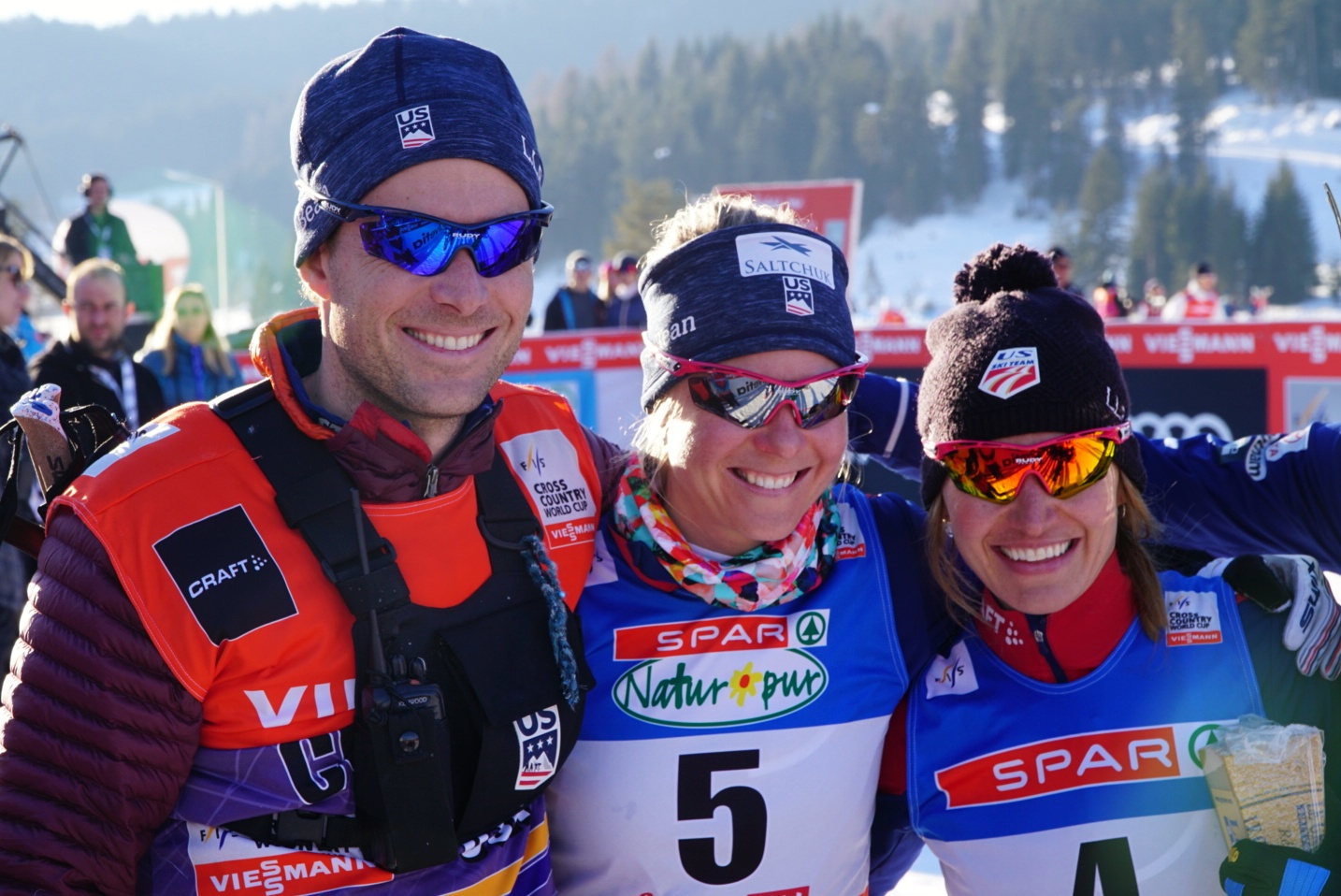
From left to right: Coach Matt Whitcomb with Sadie Bjornsen and Sophie Caldwell in Seefeld, Austria, last winter. (Photo: Garrott Kuzzy / LumiExperiences.com)
The other change that we are going to have, it’s a little bit of a job title change for Matt. Obviously, Matt has been our women’s coach. This year we have him in place to work with both men and women. So that Jason Cork, Matt and myself all basically work as a team with all of the World Cup athletes. We felt like we needed to change some of our setup in order to accommodate the needs of the team. We had some veterans that retired last year. When you have a smaller quote-unquote, “core”, at least the U.S. Ski Team on the World Cup level, we need to be more versatile in terms of helping and being able to help both men and women on a daily basis. And be more versatile with what our job requirements and our job titles are.
So we have some small changes there, but in general, we are really lucky to have everyone coming back. I think in terms of my own continued work with the national team, I will most likely continue until my family says stop and or until I don’t feel like the athletes are getting what they need out of my leadership. So, either one of those two things will be my cue to step down.
FS: For example, Jason Cork is out there testing skis with Jessie Diggins prior to races. I understand why she is a huge investment and the return on investment is important to the team, too. I understand why she might get a lot of resources. And it sounds like Matt is Simi’s coach and that has been going on for a year plus maybe. That said, as things might look from say Cork, Matt, and you redefining roles, how might that look different on the ground during race day?”
CG: It won’t look so different. Like you just alluded to, we are a smaller team. Well, I should say, we are starting to be a fairly big team. We are a smaller ski nation in terms of what our total imprint is on the World Cup and what our budget is perhaps, at least compared to our biggest competitors. Because our budget is so small compared to a Norway or a Russia, everybody, as you know, on our staff tends to do everything. And that is why job titles don’t always really make the most sense. We can give ourselves a title, but everybody ends up once in awhile cleaning some klister at the end of the day. That is just part of the nature of our program. So someone like Jason, he is spending a lot of time in the wax truck. Not only actually helping Jessie but as a key part of our service team as someone who helps Oleg with the overall organization of what we are doing on a daily basis. So someone like Jason is going to be in the wax truck quite a bit. And then also have coaching duties. Matt will be in the wax truck quite a bit less and have a lot more on the coaching duty side. I am going to have a lot of logistical work on a daily basis as well as a lot of staff management and athlete management type task, as well as some coaching duties.
But it is pretty hard to define those more specifically. They definitely change from day to day and week to week. The three of us are trying to basically cover all bases at that World Cup level.
On Thursday, U.S. Ski & Snowboard released its roster for its 2018/2019 national cross-country team nominations, and the list includes five returning A-team members (four women and one man), an all-male B-team, and seven athletes on the D (development) team.
Kevin Bolger (Sun Valley Ski Education Foundation) during his debut World Cup race weekend in Lahti, Finland, last March. There, he placed 11th in the freestyle sprint and 54th in the 15 k classic. (Photo: Fischer/NordicFocus)
Simi Hamilton leads the men’s team as its lone A-team member, while Sadie Bjornsen, Sophie Caldwell, Jessie Diggins, and Ida Sargent are all back on the A-team. The B-team includes three returners — Erik Bjornsen, Paddy Caldwell and Scott Patterson — as well as 25-year-old rookie Kevin Bolger, out of the Sun Valley Ski Education Foundation (SVSEF), who was named to the team after some breakthrough World Cup results last season.
All four of last year’s D-team were renominated, namely 2018 NCAA champions Katharine Ogden (who swept both races at the collegiate championships) and Ian Torchia, Julia Kern and Hannah Halvorsen. Joining them are three athletes who broke through at 2018 Junior World Championships: Hailey Swirbul, Ben Ogden and Gus Schumacher.
Seven of the 16 nominees train with the Stratton Mountain School (SMS) in Vermont. Six others are based out of Anchorage, Alaska; five train with Alaska Pacific University (APU) while the 17-year-old Schumacher hails from the Alaska Winter Stars. The Craftsbury Green Racing Project has one athlete on the team (Sargent), as does SVSEF (Bolger). Torchia is entering his senior season at Northern Michigan University.
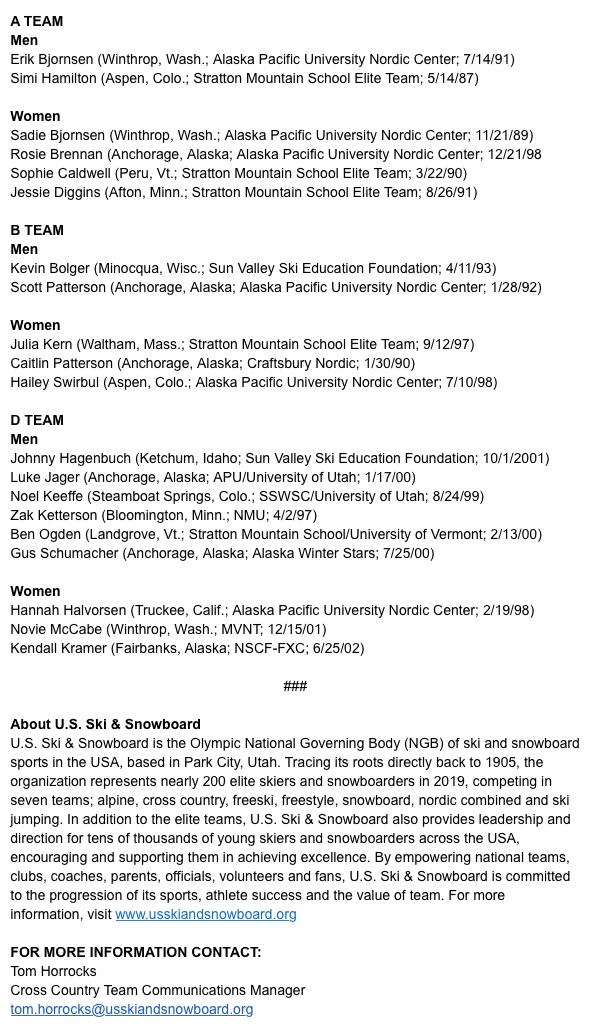
Here’s the U.S. Cross Country Ski Team’s nomination list. The team will be officially named this fall.
U.S. Ski Team2018-19 Cross Country Nominations (Hometown; Club; Birthdate)
A TEAM Men
Simi Hamilton (Aspen, Colo.; Stratton Mountain School Elite Team; 5/14/87)
Women
Sadie Bjornsen (Winthrop, Wash.; Alaska Pacific University Nordic Center; 11/21/89)
Sophie Caldwell (Peru, Vt.; Stratton Mountain School Elite Team; 3/22/90)
Jessie Diggins (Afton, Minn.; Stratton Mountain School Elite Team; 8/26/91)
Ida Sargent (Orleans, Vt.; Craftsbury Green Racing Project; 1/25/88)
B TEAM Men
Erik Bjornsen (Winthrop, Wash.; Alaska Pacific University Nordic Center; 7/14/91)
Kevin Bolger (Minocqua, Wisc.; Sun Valley Ski Education Foundation; 4/11/93)
Patrick Caldwell (Lyme, N.H.; Stratton Mountain School Elite Team; 2/18/94)
Scott Patterson (Anchorage, Alaska; Alaska Pacific University Nordic Center; 1/28/92)
D TEAM Men
Ben Ogden (Landgrove, Vt.; Stratton Mountain School; 2/13/00)
Gus Schumacher (Anchorage, Alaska; Alaska Winter Stars; 7/25/00)
Ian Torchia (Rochester, Minn.; Northern Michigan University; 3/8/96)
Women
Hannah Halvorsen (Truckee, Calif.; Alaska Pacific University Nordic Center; 2/19/98)
Julia Kern (Waltham, Mass.; Stratton Mountain School Elite Team; 9/12/97)
Katharine Ogden (Landgrove, Vt.; Stratton Mountain School; 11/17/97)
Hailey Swirbul (Aspen, Colo.; Alaska Pacific University Nordic Center; 7/10/98)
Tara Geraghty-Moats at 2018 U.S. Olympic trials (Photo: Tara Geraghty-Moats/Instagram)
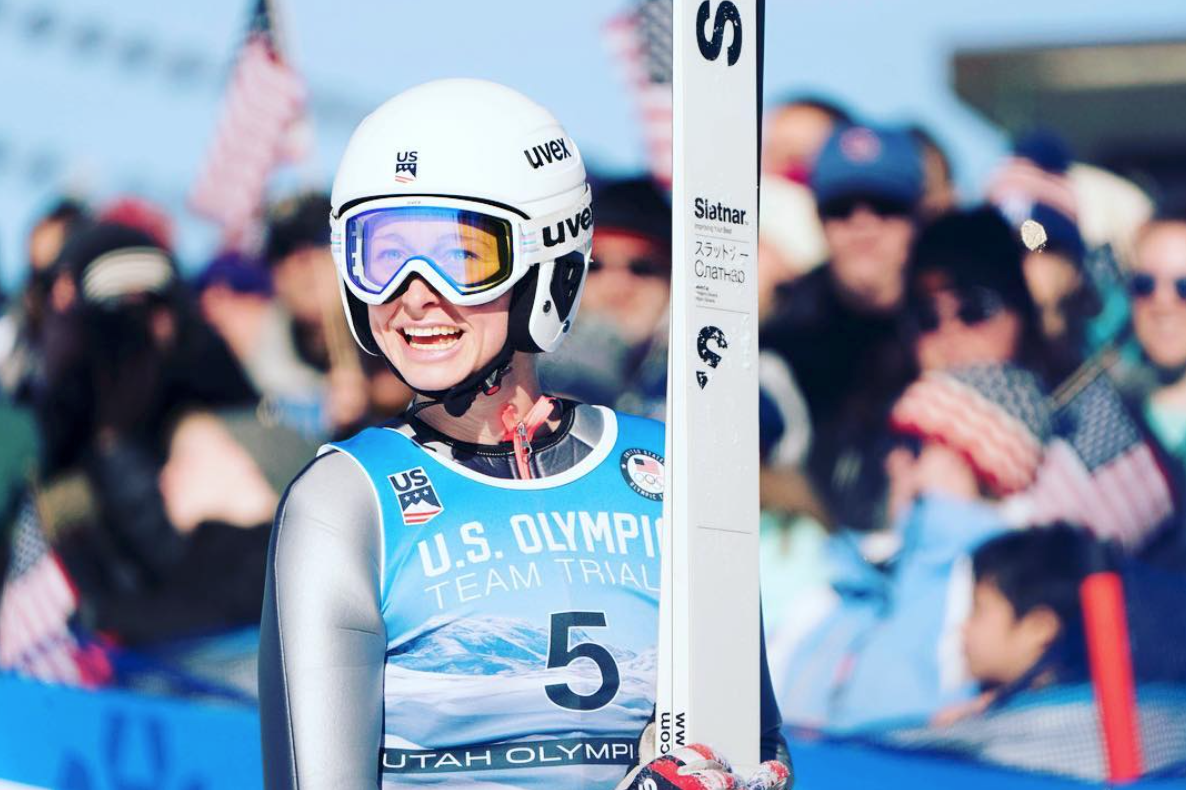
The nordic-combined team includes six men and for the first time, a woman, with Tara Geraghty-Moats on the 2018 Women’s Nordic Combined National “C” Team. (Geraghty-Moats is also a member of USA Nordic’s Women’s Ski Jumping “C” Team.)
On the men’s Nordic Combined National Team, 2018 Olympian and Junior World Championships bronze medalist Ben Loomis stands as the lone A-team member following Bryan Fletcher’s retirement. The B-team includes team veteran Taylor Fletcher, Jasper Good and Stephen Schumann, while Grant Andrews and Jared Shumate were nominated to the C-team.
“We are excited about our continued expansion of our teams and with the exciting development of Women’s Nordic Combined including confirmation of the event in the 2021 World Championships!” USA Nordic Executive Director Bill Demong said in the press release. “Tara Geraughty-Moats continues to be one of our top talents in the sport and, though she was unable to compete in any Nordic Combined competitions last year due to injury, USA Nordic recognizes the importance of growing our sports and developing athletes who have the ability to push the envelope and we are excited to lead growth and opportunity in this new discipline of Womens Nordic Combined.”
USA Nordic 2018/2019 Men’s Nordic Combined National Team
(Note: This article has been updated to reflect that Len Valjas was nominated to the B-team, rather than the A-team as previously stated.)
On Thursday, Cross Country Canada (CCC) announced its national-team nominations for the 2018/2019 season via a press release.
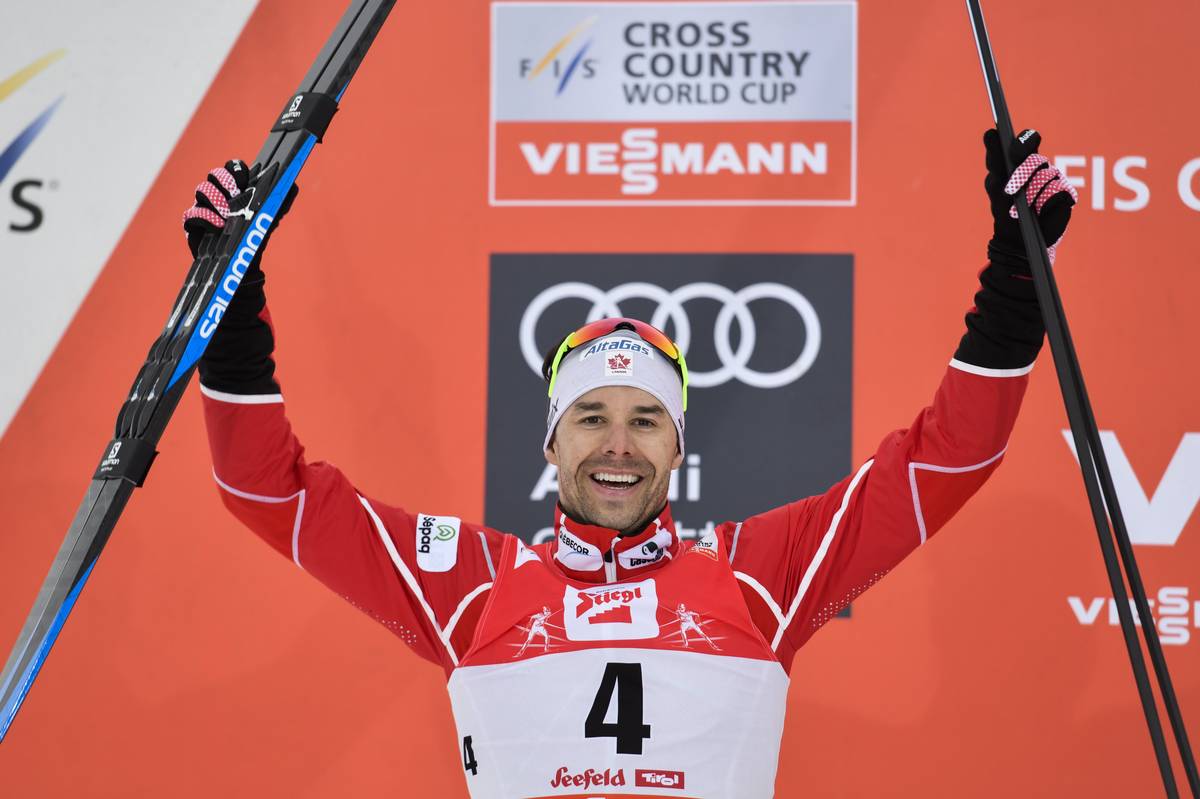
Canada’s Alex Harvey celebrating on the podium after placing second in the World Cup men’s 15 k freestyle mass start in Seefeld, Austria, last season. (Photo: Salomon/NordicFocus)
Notably, the World Cup A-team is made up of one man — Alex Harvey — after three athletes from last year’s World Cup A-team retired (Devon Kershaw, Jess Cockney and Knute Johnsgaard). Graeme Killick, of last season’s World Cup B-team, also retired. Len Valjas was nominated to the B-team, a demotion, he said, that was a result of him ending his season immediately after the PyeongChang Olympics.
“The reasoning is that I … didn’t show up to [the World Cup in] Drammen, is that I didn’t follow what the team said,” Valjas told FasterSkier on May 22. He explained he had a broken spine, which required rest and rehabilitation.
On the women’s side, Dahria Beatty was renominated to the World Cup B-team, while Emily Nishikawa and Olivia Bouffard-Nesbitt were not.
All five of last year’s U25 Team were renominated to the national team, with Cendrine Browne and Julien Locke making the jump to the World Cup B-team, while Katherine Stewart-Jones, Maya MacIsaac-Jones and Gareth Williams were renominated to the U25 Team. Also on the U25 development squad, Antoine Cyr was promoted from the junior national team, and Graham Ritchie earned his first national-team nomination.
The World Cup team will once again be led by co-coaches Ivan Babikov and Louis Bouchard.
On the Para-Nordic side, the World Cup Team grew by one despite the retirement of Chris Klebl. Six athletes and two guides were nominated to the Para-Nordic World Cup Team, while two were renamed to the Development & Prospects Team. Four other athletes round out the team as part of the Prospects Team.
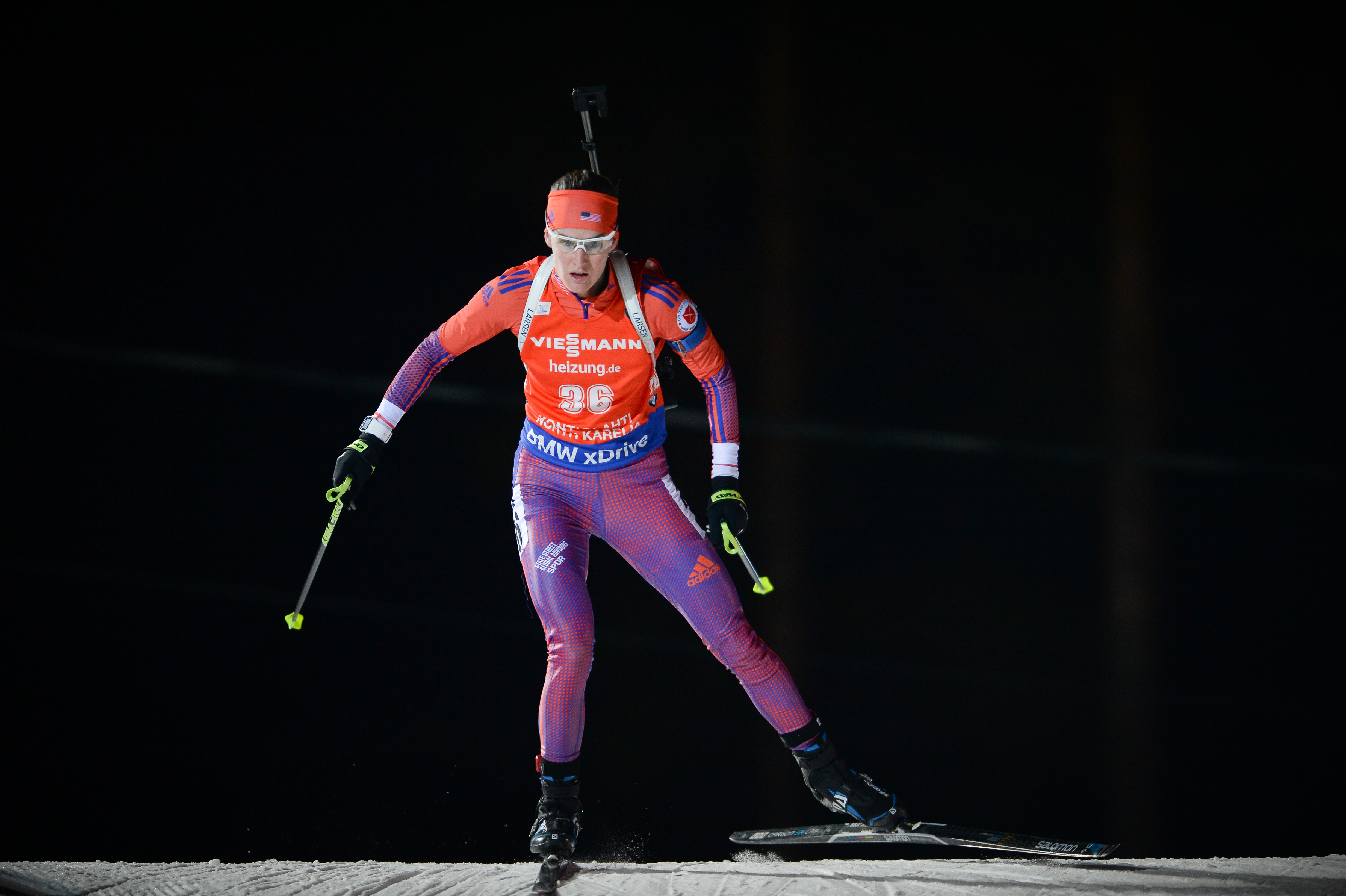
Emily Dreissigacker tags off to Joanne Reid in the women’s World Cup biathlon relay in Ruhpolding, Germany. Both women are on the roster for the U.S. for the next year of international biathlon. (Photo: USBA/NordicFocus)
For the first time in years, the roster features more women than men. Following the retirements of Lowell Bailey, Russell Currier, and Tim Burke, Alex Howe (Craftsbury Green Racing Project) netted his first senior national team nomination, and joins 2018 Olympians Sean Doherty and Leif Nordgren, as well as Paul Schommer (Moose Nordic).
On the women’s team, all five members of the 2018 Olympic team have been renamed: Susan Dunklee, Clare Egan, and Emily Dreissigacker (all Craftsbury Green Racing Project), Joanne Reid (Colorado Biathlon), and Maddie Phaneuf (Polar Bear Ski Club). Dunklee and Egan recently said that they were not certain yet about retirement, but appear on the roster. The newest addition to the women’s senior team is Chloe Levins, who finished all three individual races at 2018 World Junior Championships in the top seven.
The “A” team athletes will be primarily based in Lake Placid, New York, while designated “B” team athletes (Phaneuf, Schommer, and Howe) will be based at regional training centers or with clubs, according to national team selection documents.
The federation has also named a development squad of Deedra Irwin (Wisconsin Biathlon), Travis Cooper and Jake Ellingson (National Guard Biathlon), Jake Brown (Loppet Nordic Racing), and Max Durtschi. All saw international race starts last season.
In addition, an 11-member Junior Development Group has been named, many of whom we interviewed this winter – see the links below to read about their experiences at World Youth and Junior Championships.
High Performance Team – Women
Susan Dunklee (Barton, Vt./Craftsbury Green Racing Project), A1 Team Clare Egan (Cape Elizabeth, Maine/Craftsbury Green Racing Project), A2 Team Chloe Levins (Rutland, Vt.), A3 Team Joanne Reid (Boulder, Colo./Colorado Biathlon), A3 Team Emily Dreissigacker (Morrisville, Vt./Craftsbury Green Racing Project), A3 Team Maddie Phaneuf (Old Forge, N.Y./Polar Bear Ski Club), B Team
High Performance Team – Men
Sean Doherty (Center Conway, N.H.), A1 Team Leif Nordgren (Marine, Minn.), A3 Team Paul Schommer (Appleton, Wisc./Moose Nordic), B Team Alex Howe (Gilford, N.H./Craftsbury Green Racing Project), B Team
Development Team – Senior Women
Deedra Irwin (Pulaski, Wisc./Wisconsin Biathlon)
Development Team – Senior Men
Travis Cooper (Kenai, Alaska/National Guard Biathlon) Max Durtschi (Sun Valley, Idaho) Jake Brown (Houghton, Mich./Loppet Nordic Racing) Jakob Ellingson (Minnetonka, Minn./National Guard Biathlon)
Youth and Junior Development Group – Women
Helen Wilson (Eagle River, Alaska/Alaska Biathlon Club) – 20-for-20 interview Lexie Madigan (Truckee, Calif./Auburn Ski Club) – 20-for-20 interview Emma Stertz (Grand Rapids, Minn./Mt. Itasca Biathlon) – 20-for-20 interview Grace Gilliland (Eagle River, Alaska/Alaska Biathlon Club) – 2017 20-for-20 interview Sarah Beaulieu (Fort Fairfield, Maine/Outdoor Sports Institute) Arianna Woods (Bozeman, Mont./Bridger Biathlon Club)
Youth and Junior Development Group – Men
Vasek Cervenka (Grand Rapids, Minn./Mt. Itasca Biathlon) – 2017 20-for-20 interview Garrett Beckrich (Grand Rapids, Minn./Mt. Itasca Biathlon) – 20-for-20 interview Tim Cunningham (Springfield, N.H./Saint Lawrence University) – 20-for-20 interview Eli Nielsen (Stehekin, Wash./Methow Valley) – 20-for-20 interview Marcus Gore (Vail, Colo./Casper Mountain Biathlon Club)
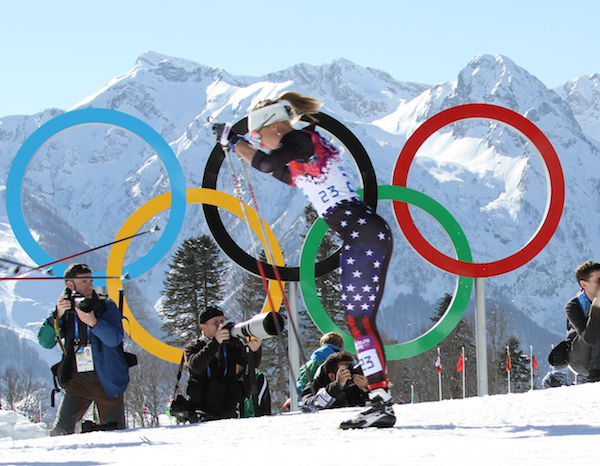
Sadie Bjornsen (U.S. Ski Team) during the classic leg of the women’s Olympic 15 k skiathlon at the 2014 Winter Olympics in Sochi, Russia. She placed 31st in her Olympic debut.
If you read FasterSkier, two aspects of our coverage generates the most reader comments: doping violations and their adjudication, and team-selection criteria. Although here we are, two days away from the PyeongChang Olympics’ Opening Ceremony with Sochi doping still plaguing the news, as the title suggest, this piece is about team selection.
On Jan. 26, U.S. Ski & Snowboard revealed its 2018 U.S. Olympic Team — a list 20 skiers deep comprised of nine men and 11 women. The U.S. Ski & Snowboard press release announcing those selections used this statement to describe the roster: “The team includes 20 athletes who qualified for the team through World Cup results as well as domestic racing results at the L.L.Bean U.S. Cross Country Championship.”
The buzz following Olympic team selection followed two major threads, one focused on team size, the other on the selection of non-U.S. Ski Team (USST) women sprinters.
In considering why team size remains a concern, let’s zip back to 2014 when the USST was allocated a quota of 17 athletes for Sochi. The team that headed to Russia was 14-athletes deep; seven men and seven women. The remaining three U.S. spots were were reallocated to other nations. At the time, U.S. Ski Team Head Coach told FasterSkier that the small team was by design.
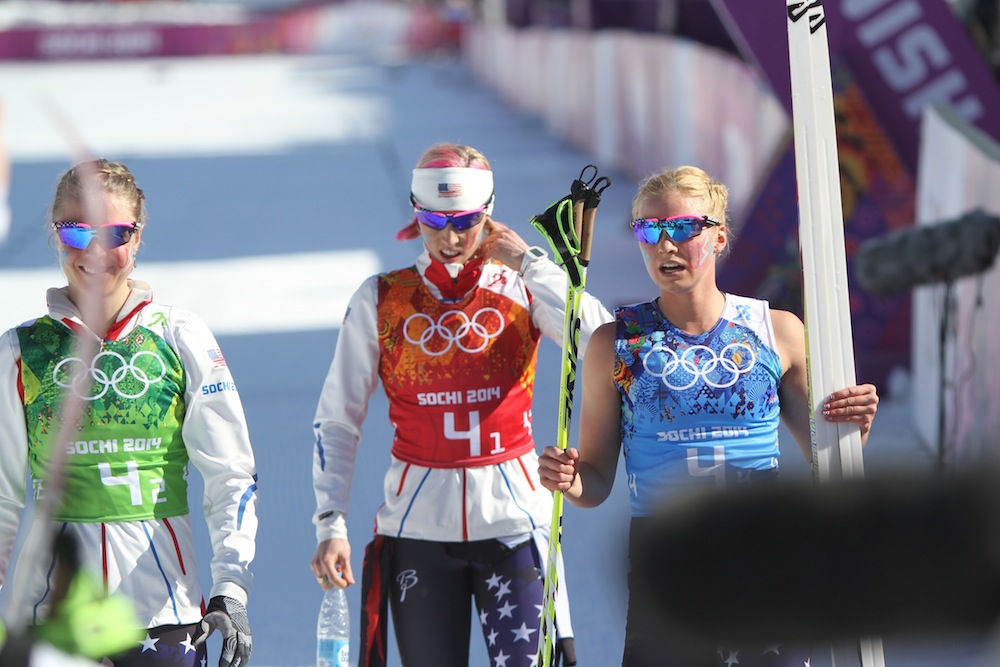
U.S. teammates Sadie Bjornsen (l), Kikkan Randall (c) and Jessie Diggins at the finish of the women’s 2014 Sochi Olympic relay, in which they placed ninth with Liz Stephen.
“With seven women and seven men, we have our start positions filled,” Grover said in 2014. “Seven and seven was the magic number for us.”
One line of reasoning is that a smaller team is more easily managed and the potential for medals are higher.
An Olympic cycle later, the current iteration of the U.S. Cross-Country Olympic team is six skiers larger. That’s partly a function of the depth of the U.S. women’s team on the World Cup and partly a function of how the Olympic selection criteria was interpreted during the team nomination process.
In explaining how the team was named, U.S. Ski & Snowboard Chief of Sport Luke Bodensteiner said that U.S. Ski & Snowboard (formerly USSA) was not mandated to use all of its quota spots for the 2018 Olympics.
“That is a decision we made,” Bodensteiner said on the phone. “We received, across all of sports at U.S. Ski & Snowboard, 110 quota spots, and we accepted all 110. However, we have 109 athletes; one athlete is participating in two different disciplines.”
Bodensteiner clarified that the uneven split of nine men and 11 women on the cross-country team was a result of the women’s depth both domestically and on the World Cup. He explained that the selection criteria does not specify how the spots are distributed between men and women.
“It is really based on results achieved on World Cup ranking and then the Olympic selection list points,” Bodensteiner said. “As it worked out, more women scored more points, actually scored more rankings in the World Cup than the men, and then more selection points than the men on the women’s side. So we just applied down the sort of next-best points in most cases, and that is why [we] have two more women than men and that is just a function of the women scoring more substantial points in the tryout events.”
Practically speaking, a larger team means more variables to manage but clear upsides for the broader cross-country community.
“Filling quotas presents clear positive possibilities and also some challenges to both mitigate and maximize…,” Bodensteiner said. “We try to take everything into account like utilizing start positions in the Olympics and how large a team quota we get. There are challenges for a bigger team, in particular, when you exceed the start possibilities. In cross-country, we have a number of athletes that probably won’t compete. That creates challenges like issues with health, waxing skis, and maintaining a positive team spirit. On the other side, there’s the positive: we have a lot of cross-country athletes going to the Olympics. It is a great experience generally, and something the community appreciates, that the athletes have that opportunity.”
Bodensteiner communicated that several athletes are not expecting to start races in PyeongChang are onboard in terms of fulfilling U.S. Ski & Snowboard’s performance outcomes in PyeongChang.
“We have also had quality discussion with athletes that we have no place to start,” Bodensteiner said. “We have been able to share our concerns that with a large team, we’d like dynamics that do not distract from winning medals. We spoken about how we mitigate those concerns and we have oriented those athletes in terms of how to help mitigate and work together to establish the way to go about doing business. They have been good, highly productive discussions.”
Team Selection: Nominations from the World Cup Qualifying Criteria
Let’s start with the low-hanging fruit, the athletes who met the following objective criteria: “Any eligible athlete that posts a top-8 individual final World Cup result during the selection period [Nov. 23, 2017, through Jan. 15, 2018] in the following events will be selected to the Team: Sprint C, individual start 10/15 km F, and 15/30 km Skiathlon.”
Sophie Caldwell (U.S. Ski Team) racing to sixth in the individual freestyle sprint at the 2014 Winter Olympics in Sochi, Russia. (Photo: Fischer/NordicFocus)
U.S. Ski Team members Sadie Bjornsen, Sophie Caldwell and Jessie Diggins automatically qualified for the Olympic team by meeting the top eight in an Olympic event threshold. Bjornsen qualified on Nov. 24 in Kuusamo, Finland, with a second place in a classic sprint. Caldwell qualified in the same race in eighth place. Diggins made the Olympic team on Dec. 12 in Lillehammer, Norway, when she placed sixth in a classic sprint. (Regarding both Bjornsen and Diggins, each scored multiple top-eight results in Olympic events during the selection period; we’ve simply specified the first instance each skier automatically qualified.)
Three skiers down, 17 to go.
The second-tier of the objective criteria reads as follows: “Athletes ranking in the top-50 in the distance World Cup standings or the top-50 in the Sprint World Cup standings as of January 15, 2018 shall be selected to the team.”
Rosie Brennan, Kikkan Randall, Ida Sargent, Liz Stephen, Erik Bjornsen, Simi Hamilton and Andy Newell jumped the top-50 hurdle.
Let’s run through the men first. On Jan. 15, Hamilton was ranked 15th, Newell 36th and Bjornsen 49th on the World Cup sprint list. Bjornsen was also ranked 41st on the distance list.
For the women, Sargent was ranked 13th on the World Cup Sprint list and Randall 19th. We’ll get back to this in a moment, but Brennan was ranked 43rd on the sprint list and 34th on the distance list. Liz Stephen ranked 35th overall on the distance list.
Some of the chatter heard after the Olympic team selection had to do with a portion of the criteria stating that no more than five athletes per gender would be selected based on sprint results, including all of World Cup sprint results, World Cup sprint rankings, and the domestic OWG points list.
So far we’ve discussed six more skiers, bringing us to nine athletes, all current members of the U.S. Ski Team (USST) and all qualified from their World Cup results.
U.S. Ski Team Head Coach Chris Grover wrote in an email that he believed the World Cup-based criteria served the purpose of fielding the most competitive team.
“From my perspective, the objective World Cup criteria worked well,” Grover wrote. “The fastest athletes were selected to the PyeongChang team.”
He also acknowledged that the inclusion of overall results from the Tour de Ski’s (TdS) final hill climb as part of major championship qualification criteria would be revisited.
“One bit of criticism/feedback that we received was that the Final Climb from the Tour de Ski should not be included in the selection period, because it is a special event that is not representative of the races at a major Championships,” Grover wrote. “I think this is a valid point. The Final Climb has been in our criteria for years, and nobody has complained until this season. Although we believe this race has been effectively useful in identifying our aerobically fit skaters, we are very open to removing it from future criteria and closing the World Cup distance selection period one day earlier. This is something we can discuss with the Cross Country Committee this spring.”
Non-World-Cup-Based Nominations
Filling out a team large enough to fill the four-starters-per-nation race quota allowed the coaches and selection committee to refer to the 2018 Olympic Winter Games (OWG) points list (click “2017/2018 SuperTour Points” under “Resources” on right side of page). That points lists kept a running total for the season’s first two SuperTour weekends and weighted results at 2018 U.S. Cross Country Championships in Anchorage. (For sprinters, points were allocated only for qualification results, not the final results.) The rankings were then further organized by an athlete’s two best sprint results and two best distance results in separate columns on the spreadsheet (note: those columns were blank on Monday morning.)
For the men, team selection appears to have been rather straightforward. The top-three ranked distance skiers were selected off the OWG points list. In order, those athletes were USST member Scott Patterson, Alaska Pacific University’s (APU) Tyler Kornfield and former USST member Noah Hoffman.
Patterson, who is in his first season as a USST member, did not score World Cup points in Period 1 and declined an offer to race the TdS as his path to Olympic qualification. Patterson contested U.S. nationals as his potential qualifying route to the Games. Patterson won the 15 k skate and placed sixth in the 30 k classic mass start.
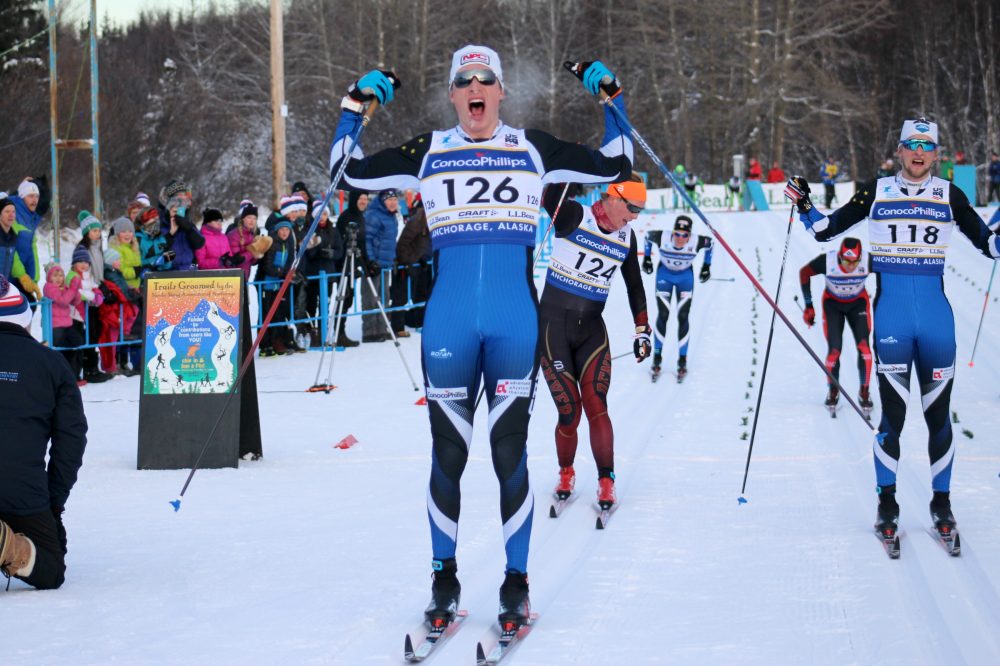
APU’s Tyler Kornfield (126) celebrates as he crosses the line first in the men’s 30-kilometer classic mass start on Jan. 7 at 2018 U.S. Cross Country Championships in Anchorage, Alaska. Eric Packer (118) finished second and Denver University’s Eivind Romberg Kvaale (124) placed third. Kornfield reached the podium in three out of four races at 2018 U.S. nationals.
Second on the OWG list was Kornfield, who won the 30 k classic mass start, placed 13th in the 15 k skate, qualified sixth in the skate sprint and third in the classic sprint. He also placed third overall in both the classic and skate sprints at nationals. Kornfield’s all-around point scoring catapulted him into the team selection conversation.
Third on the list was Hoffman, who placed second in the 15 k skate at nationals and fifth in the 30 k classic mass start. Hoffman also scored World Cup points in 28th in the Lillehammer 30 k skiathlon, a race loaded with home-field Norwegian talent.
Paddy Caldwell, also in his first season as a full-fledged USST member, played his qualifying hand by remaining in Europe and racing the TdS. In his first winter racing full time on the World Cup, Caldwell has popped solid results. His nascent 2017/2018 World Cup resume is highlighted by the 19th-fastest time of day in Kuusamo’s 15 k skate pursuit and the 19th-fastest time of day on the TdS’s final climb 9 k skate pursuit. However, Caldwell landed outside the top-50 bubble on the World Cup distance list.
Patterson was selected as the highest-ranking athlete on the 2018 OWG selection list. As specified in U.S. Ski & Snowboard’s Olympic team press release, Patterson’s selection, according to U.S. Ski & Snowboard, was not a discretionary pick.
However, Hoffman, Kornfield, and Caldwell were all selected to the Olympic team by discretion. Bodensteiner, himself a former U.S. cross-country Olympian, explained over the phone that Hoffman, Kornfield, and Caldwell were nominated to the team by head coach Grover. Those nominations were then reviewed and approved by a three-person committee composed of Bodensteiner, U.S. Ski & Snowboard President Tiger Shaw, and former USST member Holly Brooks as the athlete representative.
Bodensteiner provided firsthand insight into Caldwell’s nomination and approval process.
“Chris Grover presented to the committee whether Paddy was qualified to be part of roster,” Bodensteiner said. “From an athlete-management standpoint, Paddy is somebody we have all agreed has got high potential for the future and the coaches were very interested in getting him into this environment [on the World Cup] and let him race a lot and developing him that way. We could have declined to accept Chris’s nomination of discretion. When I think of developing Paddy, for him it is not necessarily about performance in this Olympics but about future Olympics. Also, in thinking of his development, you don’t want to pull a guy like that out of racing for a month. We agree from an athlete management standpoint we want to make sure he has that experience. On our phone call about Paddy, Chris Grover does get into specifics about [Paddy’s] recent results. Paddy will get a start and maybe more in PyeongChang.”
It should be noted that in an interview about team selection this past summer, Grover stated that development occurs at many lower levels, like Europa Cups, World Juniors, etc., but “It does not and should not come at the World Championships or the Olympics. … It’s not a development trip; it’s a competition trip at the very highest level.”
At the same time, the criteria allows use of discretion for “Indication of medal potential in future Olympic or World Championship competition (such as international age group results and rankings) that would be materially enhanced by selection to the team.”
In the past, that “future medal potential” option for discretionary selection has rarely been used.
“We haven’t used it that way,” Grover said this summer. “Obviously the language is there if we were to choose to use it, but in the past we really have not used it that way, and I don’t anticipate using it going forward into this season. … We want … the fastest skiers on the start line in Korea, and those are the ones that we’re gonna be selecting.”
In PyeongChang, it’s likely that Patterson, Hoffman, Bjornsen and Paddy Caldwell will form the core of the U.S. Olympic men’s distance starts, with Kornfield getting several warranted race opportunities. Hamilton also skied himself into the Olympic distance race start mix by placing 12th in the 15 k skate mass start in the final pre-Olympic World Cup weekend in Seefeld, Austria. The 15 k skate at the Olympics is an individual start.
Factored into the men’s Olympic sprint-start equation are brothers Logan and Reese Hanneman. The Alaskan brothers (both members of APU) were the two highest ranking sprinters on the OWG list. Logan, the younger of the two, placed first and second in the U.S. nationals classic and skate sprint qualifiers. Reese placed third and first, respectively. Older brother Reese also doubled up by winning both the skate and classic sprint crowns. According to the U.S. Ski & Snowboard Olympic team press release, neither Hanneman was considered a discretionary pick.
Depending on Erik Bjornsen’s race schedule, the U.S. coaches will have a core of Newell, Hamilton, the Hannemans, and Bjornsen for the classic sprint. In case of illness, Kornfield has sprinting chops as well. He’s a former two-time classic sprint national champion who reinforced his sprint cred with his double-podium performance in the sprints at the 2018 nationals.
Time to bring the discussion back to the women’s Olympic team selections. To restate, Diggins, Sadie Bjornsen, Sophie Caldwell, Sargent, Randall, Brennan, and Stephen all qualified objectively with their World Cup results. That’s seven female athletes, which leaves four spots remaining on the 11-athlete women’s Olympic cross-country team.
“We acted on the principle that we wanted to maximize start rights in each race,” Bodensteiner explained. “There was an interesting dynamic to women’s team. We have a generous quota and the need to fill spots. Our top women are going to race quite a bit and they ultimately exhaust start options for other skiers.”
In other words, this team is in PyeongChang to medal. Yet even with that caveat, “slam dunk” could be used to describe the nomination of Caitlin Patterson, of the Craftsbury Green Racing Project (CGRP). She was the top American in all four races contested at nationals. She won the 10 k skate, and both the skate and classic sprints, and was the first American in the 20 k mass start classic (and second overall). Patterson was selected off the OWG point list as the highest ranking female athlete.
Caitlin Patterson (Craftsbury Green Racing Project) racing to 52nd in the freestyle sprint qualifier at the last World Cup on Jan. 27 in Seefeld, Austria. The next day, she placed 23rd in the 10 k freestyle mass start. (Photo: Fischer/NordicFocus)
With the exception of Caitlin Patterson, Scott’s older sister, who again reinforced her Olympic readiness with a 20th place in Planica’s 10 k classic, start spots remain scarce for non-USST women skiers at the Games. That said, three more domestic-circuit-based female skiers were nominated to the Olympic team: Annie Hart (Stratton Mountain School T2 Team), Kaitlynn Miller (CGRP) and Rosie Frankowski (APU).
Frankowski was second on the distance OWG points list after placing fourth and second*, respectively, in the 10 k skate and 20 k mass start classic at Nationals (*she was the second American, third overall in the mass start). According to Grover in an email, Frankowski remains an “alternate” for the distance events.
If we don’t include Hart and Miller yet, we’re at 18 athletes total, nine men and nine women.
According to Bodensteiner, initially the U.S. Olympic Committee (USOC) relayed that U.S. Ski & Snowboard had a quota of 18 cross-country athletes.
“Once we get that quota, we are required to make an entry,” Bodensteiner explained. “So we do the selection, in this case on 18 athletes. We do the entry, and then it is a couple days later when you start with this reallocation. It is really hard to determine what is going to happen there. Because you don’t know if Norway is going to give back a spot, or Germany or even a Macedonian. You just don’t really know what is going to happen.”
According to Bodensteiner, the U.S. was reallocated a 19th team spot. Soon after the additional reallocated spot, the USOC informed U.S. Ski & Snowboard that a 20th quota spot was added.
“That creates some interesting dynamics for selection because then you select your team, and couple days later, in this case, a 19th quota drops,” Bodensteiner said of the team-naming process. “And the coaches had done all their nominations about coach discretion that they wanted to do. And when we hit 19, and then eventually 20, and made a subsequent selection, that is a fairly dynamic process as well.”
For both the 19th and 20th spots, which Bodensteiner confirmed were Hart and Miller respectively, the selection committee in consult with the USOC, decided to go strictly off the point hierarchy from the women’s domestic list.
“Ultimately we decided to accept [the 19th and 20th spots], and at that point did not elect to use anymore coach’s discretion and just re-apply the procedure, with the athlete on objective criteria that had the next-best selection points,” Bodensteiner said.
Hart topped the OWG sprint list. Yet, as mentioned earlier, the criteria is written in a way to seemingly cap the number of sprinters at five in either gender. Last year, as a result of the the strict interpretation of those guidelines used to select the U.S. team for the Lahti World Championships, no domestic sprinter was selected to the World Championship roster. (Sophie Caldwell, Diggins and Randall all advanced to the final in that event. Diggins earned silver, Randall bronze.) The requisite lack of sprint opportunities for U.S. based women skiers at cross-country events like World Championships or the Olympics may be the cost of fielding perhaps the strongest women’s sprint team in the world. Sophie Caldwell, Diggins, Bjornsen, Randall and Sargent are internationally recognized sprinters. Even in a best-case Olympic scenario, one of these podium threats will be cheering during sprint qualifications, as only four can start a given race.
Yet the U.S, Olympic team will bring six female sprinters to PyeongChang. Bodensteiner stated that despite the language in the criteria (“will not exceed”), capping the number of sprinters at five per gender is not absolute.
“That is where, as I have explained with the quote-unquote sixth sprinter, that it was not a selection that was made in that allocation of 18,” Bodensteiner said. “That was made basically in consultation with the USOC and an external review to decide what’s the most fair application of the criteria in terms of filling the 19th position. That is where we as a selection committee would have looked at the athlete with the next highest selection points even knowing this athlete would be a reserve but we defaulted to the person who had the highest selection points.
“Annie is an interesting spot in thinking about how deep to get, and looking at outstanding results in sprinting, rather than choose lower on the distance list,” he continued. “It made sense to choose and recognize exceptional results. Discretion allows the committee to fill start rights and use the criteria in the most equitable way possible.”
Miller and Caitlin Gregg were tied for third on the women’s OWG distance points list. With their two best races considered, each athlete earned 56 points. Miller was selected over Gregg by applying the criteria’s tie-break procedure.
As a notable aside, multiple athletes alleged to FS, in writing but off the record, that Olympic team selection had been influenced by internal arbitration, external civil litigation, or the threat of either or both of these. However, both the existence and outcome of arbitration procedures are confidential, and multiple docket searches in state and federal courts revealed no lawsuit that had actually been filed.
Asked whether the USOC had been prompted to begin arbitration to either open up more Olympic team spots or be included on the team beyond the original 18 athletes selected, Bodensteiner stated that the USOC helped guide those particular selections.
“I guess what I will tell you, there is always an opportunity for independent review,” Bodensteiner said. “And that is where the USOC is really involved with us and we have a lot of discussions with them, like what’s the proper application of the procedure in terms of being applied fairly and equitably with the 19th selection and probably the 20th. We had done a lot of consultation with the USOC on both those selections.”
Bodensteiner also made clear that it is in every interested party’s right right to advocate for themselves.
“The athletes have the protection to challenge a selection position,” Bodensteiner explained. “It can be any reason they feel wronged. It is also not part of public record. They have the opportunity to make a complaint to USOC — they oversee the whole process. The USOC also approves the selection criteria, they have influence over it. Yet, they do not tell us to fill our quotas. So, the athlete can file a complaint to the USOC and they, the USOC, will moderate the discussion with the athlete who feels they wrongly have not been selected. If we can not come to terms, it is referred to an arbitrator.”
As far as FasterSkier has been informed, at least one athlete, and potentially more, was involved in official arbitration in connection with the 2018 U.S. Olympic cross-country selections. The USOC is not a government funded agency and it’s arbitration records are not public documents.
“That is not public record, we have dealt with that in the past, that is as deep as I want to get,” Bodensteiner said. “It is interesting when you get into application of criteria. Despite what you write specifically, they are open to interpretation. We maintain fidelity to criteria as much as possible. Some people will feel that wasn’t the right process. I understood to be something different. We will always go on and rewrite if there are any ambiguities and make better criteria.”
As of Wednesday morning, FasterSkier was still seeking comment from the the USOC regarding the reallocated spots — spots 19 and 20 — on the U.S. Olympic cross-country team.
Moving forward, Grover wrote that Hart will be a reserve for the classic sprint and Miller a reserve for the distance events.
It’s full steam ahead with 20 U.S. cross-country athletes in PyeongChang. As the final rosters take shape in what on paper could bring the U.S. its first Olympic cross-country medal in almost two generations, coaches like Grover and the USST women’s coach Matt Whitcomb will be carefully penning out each race’s start roster for the Games.
In the often black-and-white world of elite ski racing, Bodensteiner conveyed he, too, could imagine the pressure exerted on both the athletes and coaches in the Olympic pressure cooker.
“It takes pretty adept coaching to work the athletes through that and deal with the athletes who don’t get selected to race in each competition,” Bodensteiner said about the tough race start decisions facing the team. “That can be a tough thing for athletes for sure. You can imagine the pressure on the team sprint race right now. That is going to be a pretty difficult challenge for those guys. I anticipate it will be a tough one for the athletes. There’s a very high potential to get a medal there and there are certainly more than two athletes that are probably thinking they should be on that team.”
The Games begin on Feb. 10 with the women’s 15 k skiathlon.
On Monday, Cross Country Canada announced its 2018 Olympic cross-country ski team for the upcoming Winter Games in PyeongChang, South Korea. The team includes 11 athletes: seven men and four women.
According to the press release, “each of the 11 athletes met the standard for nomination to the Canadian Olympic Committee under Cross Country Canada’s Internal Nomination Procedures for the 2018 Olympic Games, and in the process form a talented squad replete with veteran leadership and podium potential.”
“This is a team that has evolved from a group of talented athletes excited to be on the start line into a group of determined high-performers focused, and confident, in their ability to achieve international podium results,” Cross Country Canada (CCC) High Performance Director Tom Holland said in the press release. “Led by our men’s team of Devon, Alex and Lenny over the last two quadrennials, we are in the podium hunt, and will continue to push towards getting Canada back on the Olympic podium at the Nordic venue.”
As the press release points out, Canada has three Olympic medals in cross-country skiing, starting when Beckie Scott earned the gold medal at the 2002 Salt Lake City Games. She added a silver Olympic medal to her collection in 2006, placing second in the team sprint with Sara Renner. Also in 2006, Chandra Crawford won gold in the Olympic skate sprint in Turin, Italy.
Via Facebook on Friday, U.S. Ski & Snowboard announced its 20-athlete roster for the U.S. Cross-Country team at upcoming Winter Olympics in PyeongChang, South Korea.
The U.S. Cross Country Ski Team will be one of the largest at the 2018 Olympics with a full squad of 20 athletes, with 11 women and nine men. Twelve of the 20 are U.S. Ski Team members.
According to a press release, “The team includes 20 athletes who qualified for the team through World Cup results as well as domestic racing results at the L.L.Bean U.S. Cross Country Championships.”
The release notes four discretionary picks: Annie Hart, Patrick Caldwell, Noah Hoffman, and Tyler Kornfield.
“The U.S. Ski Team is headed to PyeongChang with one of the most talented and decorated Olympic Teams of all time,” U.S. Ski Team Head Coach Chris Grover said in the press release. “Never in our history have we fielded a team with so many podium-proven World Cup and World Championship athletes. We also have incredible momentum in this Olympic season with 10 World Cup podiums secured by early January. These USA Olympians have prepared extremely well for PyeongChang and are looking to rewrite U.S. cross country skiing history.”
2018 U.S. Olympic Cross Country Skiing Team
Erik Bjornsen (U.S. Ski Team/Alaska Pacific University)
Patrick Caldwell (USST/Stratton Mountain School T2)
The women’s 10 k classic podium on Wednesday at the NorAm trials in Mont Sainte-Anne, Quebec, with Cendrine Browne (1) in first, Katherine Stewart-Jones (2) in second, and Anne-Marie Comeau (3) in third. Dahria Beatty (l) placed fourth. Comeau and Stewart-Jones are both on the U23 World Championships roster, although it’s likely that one or both of them will end up focusing on the Olympics instead. (Photo: Cross Country Canada/Instagram)
The U.S. and Canada have named their squads for FIS Cross Country World Junior and U23 Championships, set to begin later this month in Goms, Switzerland.
Both countries’ selections include athletes who excelled against the senior fields at recent domestic races (U.S. National Championships and NorAms) which served as selection races for Olympic teams.
In fact, Canada’s U23 women did so well against their senior compatriots that it’s unclear who will represent Canada at the Championships and who will do so at the Games. Anne-Marie Comeau (Université Laval), Maya MacIsaac-Jones (Rocky Mountain Racers), and Katherine Stewart-Jones (NTDC Thunder Bay/Nakkertok) were all on the podium in different competitions at Mont Sainte Anne, Quebec, last week at Canadian Olympic Selection Races.
Comeau was second in the 15 k skiathlon and third in the 10 k classic, earning herself a probable Olympic berth when each country’s Olympic quota size is finalized. However, she does not currently have the five sub-100 FIS point races on her resumé which are required to compete in the Olympics.
Then-21-year-old Ricardo Izquierdo-Bernier CNEPH racing his first World Cup during the men’s freestyle sprint qualifier at World Cup Finals in March. He won the senior men’s 15 k classic at the NorAm selection series this week. (Photo: John Lazenby/Lazenbyphoto.com)
“Anne-Marie is looking at different options now to find those races in North America,” Cross Country Canada High Performance Director Thomas Holland explained in an email.
Meanwhile, Stewart-Jones is next on the distance ranking list, and could get an Olympic call if Comeau is unable to get those points, or if an additional quota spot opens up after better-ranked countries finalize their rosters. Despite fighting off illness through the race weekend, Stewart-Jones finished second in the 10 k classic at the end of the selection series.
“I know that I have qualified for U23 World Champs,” Stewart-Jones told FasterSkier. “That trip leaves on [January] 15th. I’m keeping my fingers crossed for Olympic selection but I will probably not know until the 21st.”
Meanwhile, MacIsaac-Jones was second in the classic sprint final after qualifying fourth in the final, missing taking the open women’s sprint spot for PyeongChang by just one place. That spot went to Cendrine Browne instead, taking her out of the distance rankings and opening the way for Comeau and/or Stewart-Jones.
Some of the men who ended up on Canada’s U23 squad also competed well against the seniors. Ricardo Izquierdo-Bernier (CNEPH/Fondeurs-Laurentides) won the men’s classic distance race at the NorAm week, and both he and Olivier Hamel (CNEPH/Skibec) were in the final of the skate sprint. Gareth Williams (Telemark) was on the podium in the 30 k skiathlon, where Philippe Boucher (CNEPH/Skibec) finished fifth.
The U.S. women’s relay after taking a historic third in the 4 x 3.3 k relay at 2017 Junior World Championships on Sunday at Soldier Hollow in Midway Utah, with (from left to right) Hannah Halvorsen (holding her baby sister), Julia Kern, Katharine Ogden, and Hailey Swirbul. (Photo: U.S. Ski Team/Tom Kelly)
The U.S squad, meanwhile, is headlined by Hannah Halvorsen (Alaska Pacific University/U.S. Ski Team), Julia Kern (Stratton Mountain School T2/Dartmouth College/U.S. Ski Team), and Hailey Swirbul (University of Alaska Anchorage), who return from last year’s World Juniors medal-winning relay team.
Kern is now a U23, and is competing at the World Cup sprints in Dresden, Germany, this weekend. Back in the U.S., Swirbul finished eighth in the women’s 10 k skate at U.S. Nationals, while Halvorsen was fifth in the skate sprint after qualifying fourth.
Joining Swirbul and Halvorsen on the junior team will be two men who turned heads in the senior races at U.S. Nationals. Gus Schumacher (Alaska Winter Stars) finished sixth overall in the men’s 15 k skate and eighth in the skate sprint. Ben Ogden (Stratton Mountain School) was ninth in the 15 k skate and then qualified fourth in the classic sprint, before finishing the day in 12th overall.
The U.S. U23 team includes Zak Ketterson (Northern Michigan University), who finished just off the podium in fourth in the skate sprint at U.S. Nationals and followed it up with sixth in the classic sprint; Alayna Sonnesyn (University of Vermont), who was eighth in the skate sprint and sixth in the 20 k classic mass start; Lydia Blanchet (Dartmouth College), sixth in the classic sprint; Andrew Egger (Colby College) and Thomas O’Harra (Alaska Pacific University), tenth in the skate and classic sprints, respectively; Bill Harmeyer (University of Vermont), 11th in the skate sprint; Ian Torchia (Northern Michigan University/U.S. Ski Team), 12th in the 30 k classic; and Lauren Jortberg (Dartmouth College), who never finished out of the top 15 in the three senior races she entered at U.S. Nationals.
Rosters
Junior Men
USA:
Luke Jager, Alaska Pacific Nordic Ski Center
Ben Ogden, Stratton Mountain School
Karl Schulz, Univ. of Vermont
Gus Schumacher, Alaska Winter Stars
Canyon Tobin, Alaska Pacific Nordic Ski Center
Hunter Wonders, Alaska Pacific Nordic Ski Center
Canada:
Antoine Cyr, Centre National d’Entraînement Pierre-Harvey / Skinouk
Félix Longpré, Club Nordique Mont Sainte Anne
Etienne Hébert, Alberta World Cup Academy / Montériski
Graham Ritchie, National Team Development Center Thunder Bay / Big Thunder
Reed Godfrey, Canmore Nordic
Junior Women
U.S.:
Margaret Gellert, Alaska Winter Stars
Hannah Halvorsen, Alaska Pacific Nordic Ski Center / U.S. Ski Team
Kathleen O’Connell, Montana State University
Hannah Rudd, Univ. of Alaska-Anchorage
Sofia Shomento, Dartmouth College
Hailey Swirbul, Univ. of Alaska-Anchorage
Canada:
Natalie Hynes, Whitehorse
Annika Richardson, National Team Development Center Thunder Bay / Hollyburn
Hannah Mehain, Sovereign Lake Nordic
Catherine Reed-Metayer, Skibec
India McIsaac, Rocky Mountain Racers
U23 Men
US:
Andrew Egger, Colby College
Bill Harmeyer, Univ. of Vermont
Zak Ketterson, Northern Michigan University
Thomas O’Harra, Alaska Pacific Nordic Ski Center
Ian Torchia, Northern Michigan University / U.S. Ski Team
Canada:
Gareth Williams, Telemark / Canadian National Ski Team
Olivier Hamel, Centre National d’Entraînement Pierre-Harvey / Skibec
Ricardo Izquierdo-Bernier, Centre National d’Entraînement Pierre-Harvey / Fondeurs-Laurentides
Alexis Dumas, Centre National d’Entraînement Pierre-Harvey / Skibec
Philippe Boucher, Centre National d’Entraînement Pierre-Harvey / Skibec
Antoine Briand, Centre National d’Entraînement Pierre-Harvey / Skibec
U23 Women
U.S.:
Lydia Blanchet, Dartmouth Ski Team
Lauren Jortberg, Dartmouth Ski Team
Julia Kern, Stratton Mountain School / Dartmouth College / U.S. Ski Team
Nicole Schneider, Northern Michigan University
Canada:
Anne-Marie Comeau, Université Laval
Maya MacIsaac-Jones, Alberta World Cup Academy / Rocky Mountain Racers
Katherine Stewart-Jones, National Team Development Center Thunder Bay / Nakkertok
Laura Leclair, Centre National d’Entraînement Pierre-Harvey / Chelsea Nordiq
Canada’s Cendrine Browne finished 26th in the women’s 30-kilometer freestyle mass start at the 2017 Nordic World Championships in Lahti, Finland. She will be racing later this week more or less on her home turf at Mont Sainte Anne, Quebec, to try to secure her spot on the Canadian Olympic Team. (Photo: John Lazenby/Lazenbyphoto.com)
But in fact, that might be too many. Cross Country Canada (CCC) learned that they currently stand to receive a quota of nine team members (men and women combined) for PyeongChang, based on Canada’s recent international results. That is two quota spots less than at the similar time before the 2014 Olympics in Sochi, Russia.
The quota is likely to increase, as some of the teams given the largest roster possibilities will probably not use all of their roster space. If that happens, the free quota spots will be redistributed, although just how many additional spots Canada will receive depends completely on the actions of other teams.
Regardless, the current small roster size means that qualification will shake out differently than the national team had thought it would, CCC High Performance Director Thomas Holland said in a recent phone interview.
Canada’s Alex Harvey celebrates his victory in the men’s freestyle sprint at World Cup Finals in Quebec City. “I mean, it’s all about the Games and you know Alex is a big contender. We’re putting everything behind him, and making sure he’s got what he needs to get the job done in PyeongChang,” said Cross Country Canada High Performance Director Tom Holland.
“We based our criteria on what we had in Sochi,” Holland said of designing CCC’s selection process. “In Sochi, we had 11 [athletes initially], and with the reallocation we ended up with 13, so we kind of used that [to develop] the criteria. I guess our results aren’t where we would like them to be [this year] so we have nine, less than we expected.”
As a result, a revision of the Olympic qualification criteria has specified who is guaranteed a spot, which types of athletes will be picked at trials, and which athletes will be added later if Canada benefits from quota reallocation.
Specifically, Harvey, Valjas, Kershaw, Johnsgaard, and Cockney are definitely going, as they have met the “Primary Qualifying Criteria” by dint of a third-place World Cup relay or, in Cockney’s case, two 10th-place finishes in sprints, or in Harvey’s case, a whole lot of different top results.
The next priority is to field a four-woman team, so Nishikawa and Beatty are in, as the only two women to have achieved “Alternative Qualifying Criteria A” of three top-30 results. The trials will determine who will join them. The new amendment specifies that one female sprinter and one female distance skier will be selected.
That brings the team size to nine. If an additional quota spot materializes, Killick will get the call; he met “Alternative Qualifying Criteria A,” the only Canadian man to do so aside from those who met the primary criteria.
Should even more quota spots arrive, they would go to, in order, a male sprinter and a female distance skier. CCC has said for months that team size would be capped at 12 no matter how many quota spots are allocated to the team.
Race Formats and Qualification Scoring
The Olympic selection races will be held this Friday through next Tuesday, Jan. 9, in Mont Sainte-Anne, Quebec, as part of major competitions with NorAm points on the line and selections being made for Junior and U23 World Championships teams being done at the same time.
Among those racing at the trials will be Knute Johnsgaard, even though he is already qualified for the Olympics. (Photo: Fischer/Nordic Focus)
Some of the athletes already qualified for the Games will also be there competing as a tune-up: only one athlete, Harvey, is currently competing in the Tour de Ski, with Kershaw having intended to but falling sick after the first stage. Killick and Nishikawa are racing in Continental Cup races in Europe.
For the rest of the hopefuls, classic sprints will be contested on Friday, Jan. 5; 10/15 k classic interval starts on Sunday, Jan. 7; and 15/30 k skiathlons on Tuesday, Jan. 9.
(There will be an additional skate sprint on Monday, Jan. 8, but it will not figure into Olympic qualification. And a forecast of cold weather for Sunday means that more modifications still may come, although the organizing committee is sticking to the planned distance races on Sunday for now.)
While the distance interval-start race at the Olympics will be skating, Holland said that it would be a classic competition at the upcoming trials for several reasons, the main one being a time constraint that prevented the staging of every possible kind of race.
Former biathlete Zina Kocher likes skate distance more than classic sprints, and the selection race schedule might not work in the current NorAm leader’s favor. (Photo: Peggy Hung)
“We have a couple things going on at the same time,” he explained. “We have probably 18 athletes who will qualify for the World Juniors/U23 teams. We couldn’t get that [series] in any earlier, so we have about four days to do all the races… there is classic racing at the Olympics in the relay, in the 30k, that kind of thing, so that was the best scenario we could come up with.”
That is definitely a blow to skate-specialist athletes looking for an Olympic berth – in particular Zina Kocher, a former biathlete who currently leads the NorAm series (more on that later). But Holland says there hasn’t been much pushback on the classic-heavy schedule.
“I think they have known, and accepted it,” he said. “You have to ski both techniques at the Games, if you want to maximize the the number of races [an athlete can do]… It’s not ideal, but I guess, you know, we get to look at the skate race in the skiathlon.”
Sprint and distance ranking lists will be kept separately for men and women, although the distance list for men is something of a moot point as there are no additional male distance skiers set to be added to the team.
In each case, the list will be made up of only the athletes who have not met qualification criteria in that discipline – so, for example, Johnsgaard, who has met the distance but not the sprint qualification criteria, can be scored on the sprint list, while Cockney, who has met the sprint but not the distance qualification criteria, could be scored on the distance list.
“[If Johnsgaard qualified] for the sprint spot… the outcome would be that we would have four sprinters (Harvey, Valjas, Cockney, Johnsgaard) and the sprint quota would be full at four athletes,” Holland wrote in an email. “We would move onto a distance athlete as per the ranking in Amendment #2.”
That said, once at the Olympics, any team member could start any race regardless of whether they qualified via sprint or distance results.
“Once the athletes are at the Games it is the purview of the coaches and High Performance Director as to who starts in which races – there are no limitations; we will try to fill start positions,” Holland wrote. “Meeting the nomination procedures/criteria is another matter. Qualifying in a distance or relay event should not give an athlete the automatic right to take a sprint quota spot at the Games.”
For the female sprinter and the potential additional male sprinter to be selected in Mont Sainte-Anne, the requirement is clearly to “win” the classic sprint on Jan. 6, or at least be the top athlete who wasn’t already qualified for PyeongChang.
Sophie Carrier-Laforte charging the downhill on her way to third place in the NorAm women’s 5 k classic in Rossland, B.C. Carrier-Laforte has also had excellent sprint results so far this NorAm season. (Photo: Mark Richards)
But winning is a bit complicated: with only one spot up for grabs, CCC wants to consider both qualifying speed and final placement at the end of the heats. Thus, a combined score will be made, with 50 percent of points coming from qualifier position and 50 percent of points from final position. For each, one point will be given to the winner, two to the second-place finisher, three to the third-place finisher, etc. The athlete with the lowest combined point score from the day “wins”.
For female distance skiers, both the 10 k classic interval start and the 15 k skiathlon will be scored. If they are won by the same athlete, then it is clear that this woman will be named to the Olympic team. If two different women win the two races, then the woman with the better result in the race she didn’t win will be picked.
And if the same athlete tops both the sprint and distance list, then they will be given the designated sprint spot, and the second-ranked distance skier will also be selected for the team.
An “alternate” sprinter and “alternate” distance skier for both men and women will be named, who will go to the Games only if one of the qualified athletes becomes sick or injured and can’t compete.
Canada has a scary preview of that at the moment, as Valjas – who stood on the World Cup podium several times last season – returned to Canada in December to deal with injury issues.
Canada’s Len Valjas racing to second in the men’s classic sprint qualifier at the World Cup in PyeongChang, South Korea, last season. Values left the World Cup Period I early this year to deal with a neck injury, and will be racing at the selection races as part of his return to competition. (Photo: Fischer/Nordic Focus)
“He injured his shoulder, but it’s an injury that he had last year at the World Championships and it goes much deeper. It really felt like a shoulder injury, but until he came back this time and had an MRI, spent more time with doctors, we really got to the root of the cause,” Holland said. “It’s something that’s going to be there and has to be managed now. At least he knows what it is, and with therapy he can keep it under control. We’re just playing it safe at this point.”
He anticipates that Valjas will be back in more than enough time for PyeongChang.
“Now that we know what it is and that he knows how to treat it, with the exercises he has to do on an ongoing basis, and just the right therapy on an ongoing basis, he should be fine,” Holland said. “He’s pretty confident.”
Who To Watch For
Depending on quota reallocation, it’s not clear that any more men will be added to the Canadian Olympic team. From that perspective, some attention will be on who wins the men’s sprint – with Julien Locke and Bob Thompson perhaps the favorites to earn it if that quota spot opens up.
Julien Locke finished 36th in the skate sprint in Davos, Switzerland, tying his second-best World Cup result ever. (Photo: Reese Brown / U.S. Ski & Snowboard)
And for both men and women, it’s also an opportunity to see how the athletes who returned from World Cup Period 1 with somewhat disappointing results compete, as Holland expects their race fitness to be improving. Beatty, Cockney, Valjas, and Johnsgaard are all registered for the races, as are Locke and Russell Kennedy, who raced Period 1 via a Frozen Thunder sprint win and NorAm leader status, respectively. Finally, there’s Brian McKeever racing, who is always a possibility of shaking up the podium as he prepares for the PyeongChang Paralympics.
But in the selection races, most of the attention will be on the women.
Returning from the World Cup are Cendrine Browne, who was two-thirds of the way to her “Alternative Qualifying Criteria A” selection but never notched her third top-30, and Katherine Stewart-Jones. Browne finished 45th in both the 15 k skiathlon in Lillehammer, Norway, and the 10 k skate in Davos, Switzerland, in December.
“I think she didn’t race to her potential in December for whatever reason, but I expect her to come around here in Mont Sainte-Anne and be off to the Olympics,” Holland said of Browne.
Then there is fellow 2017 World Championships team member Stewart-Jones, who suffered a concussion in mid-September and had to miss more than a month of training. She jumped back onto the World Cup in Lillehammer and had a top finish of 55th in the Davos sprint.
Katherine Stewart-Jones has tried to continuously improve her results since rehabbing from a concussion. (Photo: Reese Brown / U.S. Ski & Snowboard)
“With the concussion she had — sometimes you have to make a decision,” Holland said of her return to racing. “Maybe it was too soon for the World Cup, but you know, [she had a] good training season, and there are more races. I expect her to come around. She has goals for the Olympics, but she’s still a U23 so she has some goals/objectives there as well. We’ll see what she does at the trials.”
Then there is Kocher, who has rarely competed against the previous two. A several-time Olympian for Biathlon Canada and previous World Cup podium finisher in biathlon, she also won the 5k skate at Canadian Ski Nationals last season and finished second to Nishikawa in the 30 k skate. She was the Canadian champion in the same event in 2013, where she finished behind Switzerland’s Bettina Gruber in the race.
Kocher is the current NorAm leader, but that has come on the strength of her skating: the top Canadian (in eighth) in the 10 k skate at the Sovereign Lakes NorAm, third in the skate sprint in Rossland, second in the overall minitour after a strong skate pursuit. But in the 5 k classic at the Rossland NorAm, she finished just 12th. A major question is whether he 20 k skiathlon gives her enough room to make up for her classic skiing, and whether she can do well enough in the 10 k classic compared to, say, Stewart-Jones, to earn a nod.
Second place in the NorAm standings belongs to Andrea Dupont, who finished second, and the top Canadian, in the Rossland skate sprint. She also won the qualifier there, which is an important skill given the sprint scoring system at Olympic trials.
First-year senior Maya MacIsaac-Jones (r) with her Rocky Mountain Racers teammate Andrea Dupont, currently second in the NorAm standings, after the two placed first and second in the NorAm freestyle sprint at Sovereign Lake. MacIsaac-Jones won for her first NorAm victory. (Photo: Gerry Furseth)
Annika Hicks was the first Canadian in the classic race in Rossland, and finished third overall in the minitour. She has had a strong start to the season and is currently third in the NorAm rankings, just a few points behind Dupont.
Sophie Carrier-Laforte, Frédérique Vézina, Maya MacIsaac-Jones, Laura Leclair, Anne-Marie Comeau, Alannah MacLean, and juniors Hannah Mehain and Lisle Compton also have top-five Canadian finishes from individual NorAm races.
“Maya MacIsaac-Jones, she’s had a rough time with injuries over the last year, but she might surprise us at trials, in sprinting,” Holland said.
Another racer who has had a tough time with injuries: 2015 World Championships team member Olivia Bouffard-Nesbitt, who hasn’t competed since sustaining a serious neck injury in February. But she’s on the start list for the trials races.
In the joint NorAm/SuperTour weekend in Sovereign Lake, Carrier-Laforte was the only Canadian to make the sprint final, surrounded by five Americans, after having qualified fourth (again the top Canadian); Dupont was the only other Canadian to finish in the top 10. The pair, along with MacIsaac-Jones, are perhaps the favorites to go up against Stewart-Jones in the classic sprint.
Jessie Diggins (U.S. Ski Team) smiles after finishing the 2017 Tour de Ski in fifth place after the final climb in Val di Fiemme, Italy. (Photo: Salomon/NordicFocus)
In non-Olympic and non-World Championships years, the Tour de Ski (TdS) stands as the highlight for many all-around World Cup athletes and fans. This year’s U.S. team for the TdS includes four men and seven women, all current members of the U.S. Ski Team (USST): Sadie Bjornsen, Rosie Brennan, Sophie Caldwell, Jessie Diggins, Kikkan Randall, Ida Sargent, Liz Stephen, Erik Bjornsen, Paddy Caldwell, Simi Hamilton, and Andy Newell. (Here’s a list of some TdS teams from other nations.)
Sadie Bjornsen (U.S. Ski Team) racing to her first career World Cup podium last season at Stage 5 of the 2017 Tour de Ski in Toblach, Italy. She placed third in the 5 k freestyle on Jan. 6, 2017. (Photo: Fischer/Nordic Focus)
In an Olympic year, a seven-stage tour over nine days may not fit into every top skier’s race plan. A long tour event might tweak the body in ways that make peaking for the Olympics in mid-February untenable. While for others, the grind of the TdS offers an opportunity to ski into top-shape race fitness.
Here in the U.S., TdS starts have become a topic for discussion due to the small fields finishing last year’s edition of the tour — which was a World Championships year. The argument goes that in smaller fields, it’s easier to score valuable World Cup points by finishing in the top 30 of a given race. For example, in last season’s TdS, 31 women and 40 men completed the final stage. The year before — a non-championship or Olympic year — 43 women and 52 men finished that final climb atop the Alpe Cermis in Val di Fiemme, Italy.
For both World Championship and Olympic selection criteria, results in specific World Cup races and/or rankings on the distance and sprint World Cup lists can determine if a skier meets the USST’s objective qualifying criteria. In other words, if a U.S. skier on the World Cup does not lock up an Olympic spot during Period 1, their Olympic qualification may be determined by points scored during the TdS. It goes without saying that while the USST members at the TdS solidify their Olympic nominations, many other domestic-based skiers vying for Olympic-team nods will be racing at the upcoming U.S. Cross Country Championships in Anchorage, Alaska, which start next week.
FasterSkier emailed U.S. Ski Team Head Coach Chris Grover on Dec. 23 with the following questions regarding the selection of this year’s TdS team:
FasterSkier:Starting with those that aren’t racing: Was Scott Patterson offered a spot that he decided not to take? What are his plans over the next few weeks?
Chris Grover: As you may recall, we added some guidelines to the 2018 World Cup Selection criteria this fall prior to the start of the season in order to better define to the community how we would utilize discretion picks to World Cup, including the Tour de Ski. The guidelines are:
Athletes who have not met the General Criteria may be selected to the team via discretion if they satisfy any of the following:
Outstanding competition results from the 2016/2017 or 2017/2018 seasons, including as a member of a team event, indicating a potential for Olympic success.
Recent positive direction or trend of competition results indicating a potential for Olympic or World Championship success.
Indication of medal potential in future Olympic or World Championship competition (such as international age group results and age rankings) that would be materially enhanced by selection to the team.
We did offer Scott a Tour de Ski start. He is a young athlete on his first season of World Cup and we would like to see him build his experience on the Tour. The discretionary pick would have utilized the third bullet point above. Scott chose to return to Anchorage for Nationals because he felt his chances of qualifying for the PyeongChang Team were better there. Scott is currently training in Bozeman and will head to Anchorage next week.
FS:Was Chelsea Holmes offered a spot on the tour roster? If not, what were some of the reasons or considerations taken into account for that decision?
CG: Chelsea was not offered a TdS start, as much as we would have liked to see her start there. She did not meet any of the above guidelines, so it was important for us to adhere to the guidelines and have her compete in Anchorage against the SuperTour field for the additional PyeongChang selections.
FS:Was Noah Hoffman offered a spot? If not, what were some of the reasons or considerations taken into account?
CG: Noah was not offered a TdS start. Same rationale as Chelsea.
U.S. Ski Team Head Coach Chris Grover speaking with Sadie Bjornsen in Quebec City, where she went on to place eight in the freestyle sprint at Stage 3 of the 2016 Ski Tour Canada. (Photo: FlyingPointRoad.com/NNF)
FS:Of the 11 athletes racing the TDS, which plan to complete the tour in its entirety? And for the sprinters that don’t plan to do the whole tour, what stages do they plan to complete?
CG: Jessie, Sadie, Liz, Rosie and Paddy are targeting the entire Tour. Andy, Simi, Sophie, and Ida will either stop after Stage 4 or Stage 5, and then rest and begin preparing for Dresden. Erik will probably decide during the Tour how far he will go and may stop after stage 5 to also prepare for Dresden. Kikkan had originally planned on only racing the first 3 stages in Lenzerheide, but her plans may be evolving.
FS:This summer you mentioned that the standard for scoring points in the TdS would not be as “easy” this year as in past years because you anticipated that “this year you’re going to have much better numbers of athletes that are actually finishing the Tour.” Do you still believe this?
CG: Yes. Last spring, we expanded the start quotas for the Tour de Ski. Now the top-20 women and top-20 men in the Sprint World Cup are additional quota spots for the Tours. This means that the nations don’t have to wrestle with a decision about whether to take one of their best all-around or distance skiers to the Tour versus a sprint athlete currently ranked in the top-20 who may be fighting for a top year-end ranking in the sprint World Cup. They can take them both. Last year’s Tour only included one sprint; this Tour has two sprints. The pure sprinters may still drop-out after the second sprint, but their respective countries may have brought additional distance skiers that are planning on skiing the entire Tour. When it comes to total numbers of athletes left standing at the end of the Tour, the x-factor is always illness, and whether athletes and Teams have managed to stay healthy. Occasionally a bad cold or flu will circulate through the TdS field and it’s not uncommon to see an entire Team contract the virus. These health scenarios are impossible to predict.
FS:You also mentioned that it is “an easier path for an athlete to make the Olympic team” via podium finishes at U.S. nationals than by surviving to the end of an attrition-ravaged TdS. In light of the numerous top athletes who have said they will be opting out of this year’s pre-Olympics TdS, do you still believe this?
CG: Yes. I still believe that there is more opportunity for USA athletes that are skiing fast competing against a domestic field at US Nationals that doesn’t include the USA TdS athletes, then there is fighting to stay healthy and score points at the Tour itself. However, both paths require an athlete to be skiing fast, which is clearly the goal of the selection process.
FS:For those athletes who are doing the TdS, how do you see that fitting into their season-long preparation and goals, either for the Olympics or otherwise?
CG: Those athletes that are targeting the entire Tour generally see the Tour as a way to build peak race fitness. When followed by adequate rest, these athletes have looked to the Tour to sharpen race fitness and help them prepare for a major Championships in February. For the very best athletes the Tour has also been a place for stand-out results, podiums, and gathering critical World Cup points for those hunting for top season-end Overall, Distance, or Sprint rankings.
FS:Do you foresee a time when the TdS is no longer held during Olympic years?
CG: That’s doubtful. The Tour de Ski is by far the most popular Cross Country TV spectator and fan event of the season for the FIS. It is only rivaled by the Olympics and World Championships. As long as there is massive fan interest, and a lot of prize money and World Cup points on the line, the athletes and the teams will be there.
Alex Harvey (4) climbing in the classic leg of the Olympic 30 k skiathlon in 2014, where he placed 18th. Harvey and four other men have met Primary Qualification Criteria for the 2018 Olympics.
As athletes enter their final preparations for the Olympic season, some Canadian cross-country skiers have a pretty good idea that they’ll be heading to PyeongChang, South Korea, in February to compete.
That’s because they have already achieved nomination objectives that will put them on the final ranking list from which the team will be picked. If more than 12 athletes – the maximum team size – meet criteria, then a second selection process will proceed to pick only the top-ranked athletes.
“If you had too many people, you’ve got to rank them on their best results and the team could be full,” Cross Country Canada High Performance Director Tom Holland said in an interview. “But that’s not likely to happen.”
In other words: six men and two women can feel pretty safe that they are heading to PyeongChang.
Other details of the Olympic team selection process are still unpublished. The location, dates, and formats of the final Olympic Trials races are being discussed, but have not been finalized. Those competitions will be used to bring the roster up to 11 or 12 athletes – with a minimum of four athletes of each gender – if that isn’t accomplished on the World Cup.
“We have to do an amendment to this criteria for final qualifying in Canada, which will be in January,” Holland said. “That piece isn’t complete yet. That’s something I have to send out to the committee and work those details through… With the men we’ve almost met the max, and we could probably only take one more. Whereas with the women, we’ll probably taking at least five, [so] there’s at least three more spots for women.”
Who’s (Most Likely) In
Several athletes have already met the “Primary Qualifying Criteria”. That group is headlined by Alex Harvey, who won his first individual World Championships gold medal last season in the 50 k in Lahti, Finland.
There are several ways to meet the primary criteria, all at World Cup or World Championships races. All consider, for scoring, only the first four finishers from each country – for example, removing the fifth (or higher) Norwegian athlete on the results list and moving everyone else up accordingly. For purposes of brevity, this will be called “Olympic-style scoring” for the rest of this piece.
The men’s freestyle team sprint podium on Sunday, Jan. 15 in Toblach, Italy, with Canada’s Alex Harvey and Len Valjas (c) in first, Sweden’s Oskar Svensson and Karl-Johan Westberg in second (l), and Italy’s Federico Pellegrino and Dietmar Noeckler in third (r). (Photo: Fischer/Nordic Focus)
With that scoring metric, sprinters must achieve one top-6 result or two top-16 results to make the list. In distance races, athletes with one top-12 or two top-16 results, or two results with FIS points under 10, make the list. Members of a podium relay or team sprint effort will all make the list. And, in a special nod to the disciplines which will be contested at the Olympics, an athlete with a top-16 distance result and a top-16 classic sprint result will make the list.
Harvey meets most of those requirements individually. Thanks to Canada’s third-place relay in Ulricehamn, Sweden, Devon Kershaw, Knute Johnsgaard, and Len Valjas join him on the nomination list.
Of the group of four, Valjas is the only athlete other than Harvey who has also met the individual standards and would have qualified without the relay result (or a team sprint win with Harvey in Toblach, Italy), thanks to sprint results of 13th in Lillehammer, Norway; 14th in Davos, Switzerland; 16th in Val Mustair, Switzerland; 10th in Falun, Sweden; and fourth in PyeongChang, South Korea.
Jesse Cockney has also met the individual nomination standards by finishing 10th in World Cup sprints in both PyeongChang, South Korea, and Quebec City, Canada.
“So there’s [five] athletes that have met those criteria,” Holland said. “And then we move onto what’s called an ‘Alternate Qualifying Criteria A.’ In this criteria, they have to be three times in the top 30.”
Alternate A, or Next On The List
A number of athletes have met this next set of criteria.
Dahria Beatty finished 25th in the sprint in Davos, 26th in the 10 k mass start in La Clusaz, France, and 29th in the sprint in Otepaa, Estonia.
Dahria Beatty is currently atop the women’s Olympic qualification list with three top-30 World Cup results last season. (Photo: Fischer/Nordic Focus)
Graeme Killick finished 21st in the 30 k skate in Davos. He also had a few near-top-30’s which, with Olympic-style scoring, turn into top-30’s: 33rd in the 10 k mass start in Val Mustair, 32nd in the 15 k mass start in Val di Fiemme, Italy, and 32nd again in the same event in Quebec City.
And Emily Nishikawa did it with finishes of 39th in the Lillhammer 10 k, 34th in Davos, and 37th in the Quebec City mass start, all of which are top-30’s with Olympic-style scoring.
For these athletes, selection is not guaranteed. If more skiers meet the “Primary Qualifying Criteria” in December and January World Cups, they would get preference and those who only met “Alternate Qualifying Criteria” would get bumped down.
Holland doesn’t envision that happening, though.
“There’s nobody that skied at that level,” he said of the possibility that an athlete not already mentioned would pop a top-six or top-16 World Cup result in December. “If you haven’t done it once last year, it’s going to be hard to do it… But it’s not impossible.”
There are several athletes who are on their way to meeting the “Alternate Qualifying Criteria A,” leaving open the possibility that the list of athletes meeting those requirements would be long enough that it would have to be winnowed down by ranking athletes according to their best results.
Cendrine Browne finished 26th in the World Championships mass start 30 k. She also placed 35th in the 10 k skate in Ulricehamn, a result which turns into a top-30 with Olympic-style scoring.
Julien Locke placed 20th in the sprint in Quebec City, and Bob Thompson placed 30th.
(Thompson also placed 31st in PyeongChang, South Korea, a result which would be top-30 with Olympic-style scoring; several other Canadian athletes also finished in the top 30 that weekend. But their results won’t count towards Olympic qualification due to a depth-of-field calculation explained in a separate article.)
So the list of athletes meeting “Alternate Qualifying Criteria A” could grow.
“We have men that have top-30 World Cup sprints, so they could do it,” Holland said. “But I don’t expect on the women’s side [other than Browne] — we don’t have anybody that’s done any, so [for them] it’s going to be hard to do it three times.”
Access to Points Races
A fair number of athletes will have opportunities to work on qualifying criteria this winter, as Canada is planning to send a full team to Period I.
Graeme Killick used the Tour de Ski to hit Olympic qualification criteria. (Photo: Fischer/NordicFocus)
“We don’t want to take more than 12 [athletes],” Holland said. “That’s seems to be the magic number for us, because we know we can support that. So we are going to take at least four women and seven or eight men.”
That’s the biggest chance athletes will get to avoid a nerve-wracking trip to Olympic Trials. While the selection document states that the qualifying period goes through January 21, in reality all of the World Cup-based qualifying will be done by Christmas.
That is because the Canadian team only takes a small squad to the Tour de Ski, the first set of World Cups after Christmas. The selection criteria for 2017-2018 national team trips has not yet been posted on the CCC website, but in the 2016-2017 season, athletes had to achieve one top-12, two top-20s, or three top-30s in Period I in order to head to the Tour de Ski.
In other words, anyone objectively qualifying for the Tour de Ski will have met some Olympic nomination criteria already.
There is a way to reach the Tour without those top results – according to the criteria, athletes could be added to the team by discretion if they had scored World Cup points. In other words, for athletes with one or two top-30 finishes, it is up to coaching staff whether they would be brought along or not.
Killick competed in the Tour de Ski last season through this mechanism – he had a lone top-30 result in Period I. Then he collected two more Olympic-style scoring top-30’s at the Tour de Ski.
Those were the results that allowed Killick to meet the Olympic nomination criteria through “Alternative Qualifying Criteria A”, but this year, athletes in a similar position might not be so lucky.
First of all, the Olympic Trials races are likely to be scheduled at roughly the same time – “around January 6th to 10th,” Holland said. So athletes would have to choose whether to risk a trip to the Tour de Ski, versus closing things out at Olympic Trials.
And secondly, the Tour vs. Olympic Trials decision may not even be a choice. Holland indicated that if an athlete were close to qualifying but had not yet met the Tour de Ski standard – which could be very possible since last year’s Tour de Ski criteria specified World Cup points, not the adjusted, four-athletes-per-country scoring of the Olympic selection – they would not be offered the chance to finish things off in Europe.
“We’re not going to take a whole pile of people to the Tour de Ski to try to qualify,” Holland said. “It’s better to do it in Canada head to head.”
And so, although the selection document states that qualifying can be done through January 21st, Holland did not seem to consider the Tour de Ski or post-Tour World Cups in Dresden, Germany, and Planica, Slovenia, when discussing how athletes can qualify.
“By the 10th [of January] you want to have your team picked,” he said. “You want to have your logistics, ideally you want that whole team to go to the Seefeld World Cup [January 27-28], and move to PyeongChang and get them in their training mode for the Games.”
The Rest of the Process
That means that for at least a few woman and perhaps one or two men, it will come down to the Trials races that Holland says will be held at Mont Sainte Anne.
“We’re probably only looking for one man,” Holland said of the number of athletes that would be selected from those races. “We’ve had men who have scored World Cup points in sprint but not distance so odds are we’ll be looking for a sprinter. On the women’s side, it depends what happens on the World Cup. Cendrine Browne two out of three [top-30’s] so she could make that criteria in December. So on the women’s side it’s a little more open. I think we’re looking for both sprint and distance athletes, and if Cendrine makes it in December we’d only be looking at two women.”
After that, selected athletes will refocus and begin preparing for their Olympic experience.
“After the Tour de Ski, we’re going to skip the next two World Cup weekends,” Holland said of the team’s top athletes. “Then they’ll be training at altitude, probably in Livigno for the most part, and then they’ll go to the World Cup in Seefeld [Austria] with the whole Olympic team. The ones that come from Canada might just come over prior to Seefeld and spend some time in Davos [Switzerland], or something like that.”
Canada’s Jesse Cockney (r) racing to first in his quarterfinal in the men’s classic sprint at the PyeongChang World Cup, while leading Norway’s Mathias Rundgreen and Daniel Stock. Cockney finished tenth on the day and the result was one of two which has put him on the shortlist for Canada’s Olympic team. (Photo: Fischer/NordicFocus)
But there are a few athletes with those results that don’t come up in conversation.
Simon Lapointe finished 27th in the sprint and Bob Thompson 31st in the World Cup sprint in PyeongChang, South Korea last season – a result that would be bumped up top top-30 status if the Olympic-style scoring employed by CCC for selection, which counts only the top four athletes from each country, removed “extra” Russians from the results.
Paralympic legend Brian McKeever finished 29th in the skiathlon in PyeongChang. And for the women, Annika Hicks and Sadie White finished 26th and 29th (out of 29) in the skiathlon, and 32nd and 34th in the sprint (in a field of 36) — which with Olympic-style scoring would become top-30 finishes.
By a provision in CCC’s criteria, these results won’t count towards nomination to the Olympic team.
“In order to maintain equity and fairness in this selection process, the HPC reserves the right to exclude, or to count only partially, the results of any World Cup event with a weak depth of field,” the criteria state. “The CCC Selection Committee will be charged with evaluating the depth of field in this circumstance based on comparative analysis of World Cups over two seasons (2015-16 and 2016-17). The CCC Selection Committee will bring forth to the HPC any such recommendation to exclude, in whole or part, a World Cup event. This analysis of depth of field will consider time behind the winner (FIS points), an analysis of the top 6, top 12 and top 16 individual athletes or team events in the race based on World Cup ranking, World Cup points, total FIS points of athletes in the race and any other factors that allow for a fair and equitable World Cup depth of field analysis.”
With such a criteria, it’s fairly clear that finishing last in a World Cup race with only 30 athletes would not count towards Olympic qualification.
But in terms of determining what would count, how CCC actually analyzes race results is multifaceted and not entirely transparent.
“It is always best to look at as many data factors as possible when analyzing depth of field – weak depth of field can vary at the same World Cup event depending on gender and type of race,” CCC High Performance Director Tom Holland wrote in an email.
He emphasized that the depth-of-field assessment is rarely used, citing PyeongChang as the only set of World Cups in the last Olympic cycle where results had been excluded for team qualification.
What Results Count as Competitive
Holland and the selection committee looked at different slices of the PyeongChang results. There are multiple ways to meet Olympic qualifying criteria: a top-six sprint result, a top-12 distance result, two top-16 World Cup results (all deemed “Primary Qualification Criteria”), or three top-30 World Cup results (deemed “Alternative Qualification Criteria”). The level of competition at each of these results cutoffs was considered.
And according to Holland, the men’s races were competitive at the top end but not in the middle or bottom of the fields. That’s why Jesse Cockney, who finished 10th in the PyeongChang sprint, can count that as one of his two top-16 finishes and meet CCC nomination criteria – but Thompson, for instance, can’t count the result as his second of three top-30’s.
“What would be looked at varies between the Primary and Alternate A Criteria,” Holland wrote. “For the Primary Qualifying Criteria, the depth of field analysis being considered is top 6–16; World Cup ranking of athletes, particularly the number of red group athletes in the race would be the critical starting point of analysis, next would be time behind these athletes compared to similar placing in other [World Cup] events.
“For the Alternate A Criteria, we are only looking at top 30 results counting top 4 per nation,” he continued. “The average top 30 [World Cup] FIS points over the past 2 seasons in that particular race distance per gender is a good indicator to start the analysis. Being in top half of the field (usually, but not always) and the number of top 30 ranked athletes in the race also need to be considered.”
When asked whether it was appropriate to apply a depth-of-field adjustment differently within the results of the same individual race, the Canadian Olympic Committee (COC) declined to address the specific situation.
“The COC provides national sport federations with a Guide to Drafting Internal Nomination Procedures (INP), which offers a framework, practical advice, and examples they can use in their drafting, interpretation, and implementation of their INP,” COC Manager for Corporate Communications Ricky Landry wrote in an email.
“The COC then reviews all INPs to ensure that they comply with the COC Team Selection Policy, the Olympic Charter and other applicable COC rules and policies. Also, the COC reviews INPs to ensure the qualification and nomination timelines fall within COC and Organizing Committee (OCOG) deadlines. In general terms, the COC Team Selection Policy recognizes the NSF’s authority in setting qualification criteria appropriate for its sport and in determining which athletes and support personnel will be nominated to the COC Team Selection Committee for selection to the Canadian Olympic Team.”
End result: for Lapointe, Thompson, and McKeever, their results were not enough to count towards Alternate Qualification Criteria. For Cockney, 10th was good enough for Primary Qualification Criteria.
“I’ve got the spreadsheet… there were only nine out of the top 30 sprint group [on the start line] at that event,” Holland said in an interview earlier this summer. “So the depth of field and if you look at FIS points, it wasn’t there. But if you look at the top 10, it’s a little more legitimate.”
There were only seven seeded World Cup sprinters on the start line in PyeongChang. All of them bested Cockney in qualification but he beat two of them, Baptiste Gros of France and Simi Hamilton of the United States, in the final results.
That might be important, as Holland indicated that qualification versus heats racing were not necessarily considered in the same way.
“If an athlete does well in the heats, I would be inclined to put more emphasis on the heats,” he wrote.
Transparency and Athlete Expectations
While it was clear to all that the depth of field in PyeongChang would be looked at carefully – Canada was not bringing most of its top athletes, and neither were other countries – the outcome of that analysis wasn’t known.
That marks a major difference from this aspect of the criteria to the rest of CCC’s criteria. It’s fairly clear what athletes have to do to meet World Cup-based criteria: they have to hit certain results, and after a race they can look at the results sheet and immediately know whether they can check that box or not.
At the end of that process, any remaining spots on the roster will be filled at Olympic Trials. Again, there it will be clear what finish is required to be named to the team.
Going into the PyeongChang World Cups, athletes knew that a top-30 might not cut it, but what exactly they would have to do to have a result count towards Olympic qualification was unclear.
“A lot of people didn’t go, so I believe they only counted a top 20 result,” Thompson said in an interview last week. “But I didn’t know that. There was a little bit of awareness that you had to do better than top 30, like maybe making the top 12 would be more respected.”
Likewise, because the method of assessing depth-of-field is not a single mathematical formula that is evenly applied, even glancing at the results after a race may not make clear which athletes in the field had attained qualification standards and which hadn’t.
“In the last few years, I haven’t paid so much attention to what selection criteria is worth in terms of specific scenarios,” Cockney said in an interview this week. “It’s not usually up to us what is deemed a usable race or a competitive race… I can’t decide who the competition is. I can just decide to ski. That’s the attitude I was taking in Korea – just to try to do my best and have a strong day, and thankfully I was able to put together a good day.”
That’s just part of the game, Holland seemed to suggest, saying in an interview that athletes “should have been aware” that normal qualification standards wouldn’t apply before even leaving on the trip to South Korea.
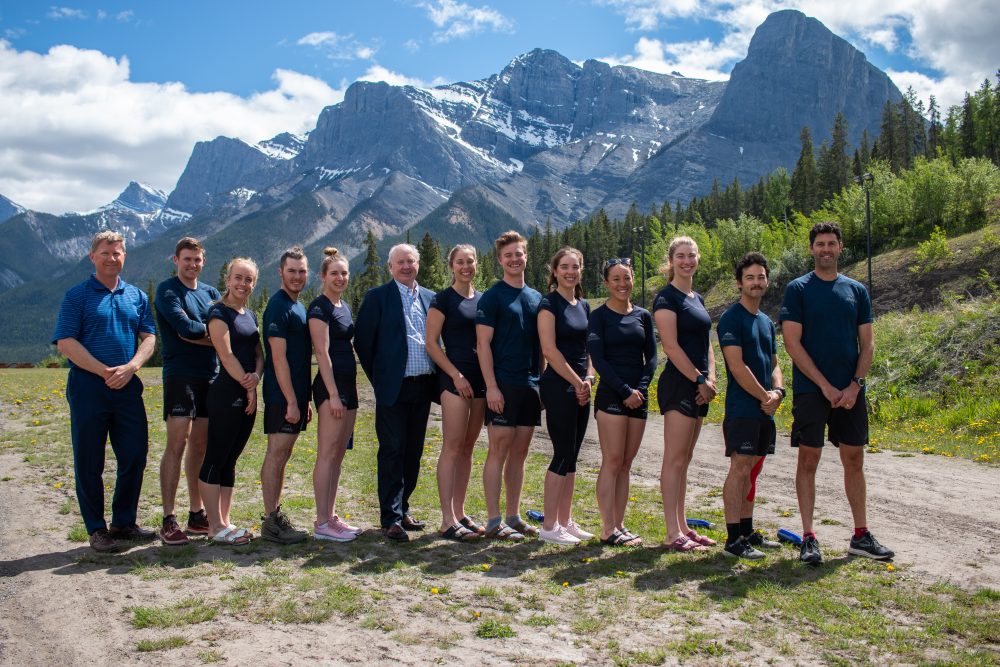
 For Immediate Release