From the FasterSkier archive — posts syndicated from athletes’ and coaches’ own blogs between 2004 and 2012, kept online as published. Current coverage is at fasterskier.com.
Category: Racing
We are cross country ski racing enthusiasts. We race as much as we can all winter, and when we aren’t racing ourselves, we are following the many other races around the country and the world. From weekly recaps of local events, to the big stage of the World Cup, we have it all! So whether you are a competitor, a parent, or just a ski fan, this is the place for race reports, schedules, results, and more. Use the links below to view articles in a specific sub-category, or scroll down to view all Racing articles.
Matt Dougherty has a way of knowing in September exactly what he is going to say in February.
It usually happens on the second day of the Adirondack Canoe Classic, the three-day, ninety-mile paddle from Old Forge to Saranac Lake that everyone in the North Country calls the 90-Miler. By then his skiers have been in a boat for two days. They have carried it over roughly five miles of portage trails. They are, by his description, flat on the ground.
“It was six hours of just going as hard as you can, which is still low on the L zones, but you’re putting out power for hours and hours and hours,” Dougherty said. “And then you get back in the boat.”
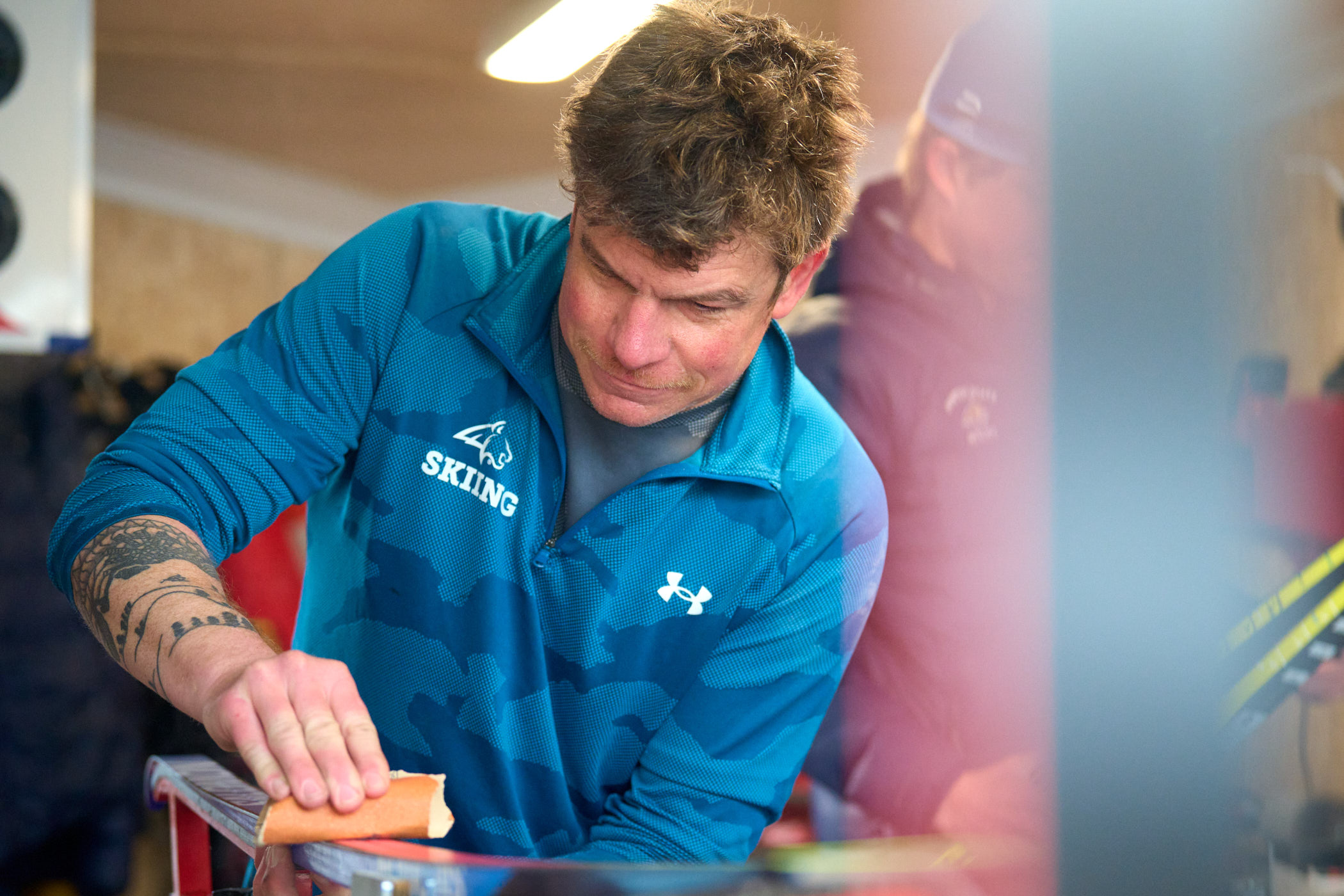
Dougherty is the head nordic ski coach at Paul Smith’s College, and also its head marathon canoe coach, which is not a combination most ski programs carry. In March his men won the USCSA national championship at Mount Van Hoevenberg, 68 points to St. Olaf’s 108, the program’s second national title in five seasons. His women finished second, as they did in 2022 when the men won the first one. He took the ski program over in the fall of 2020 with one skier on the roster and no recruits, at a college in the woods with fewer students than most high schools.
He is also, as of this year, the subject of a feature documentary, which is a strange thing to happen to a coach at a school of this size and which he did not see coming at all.
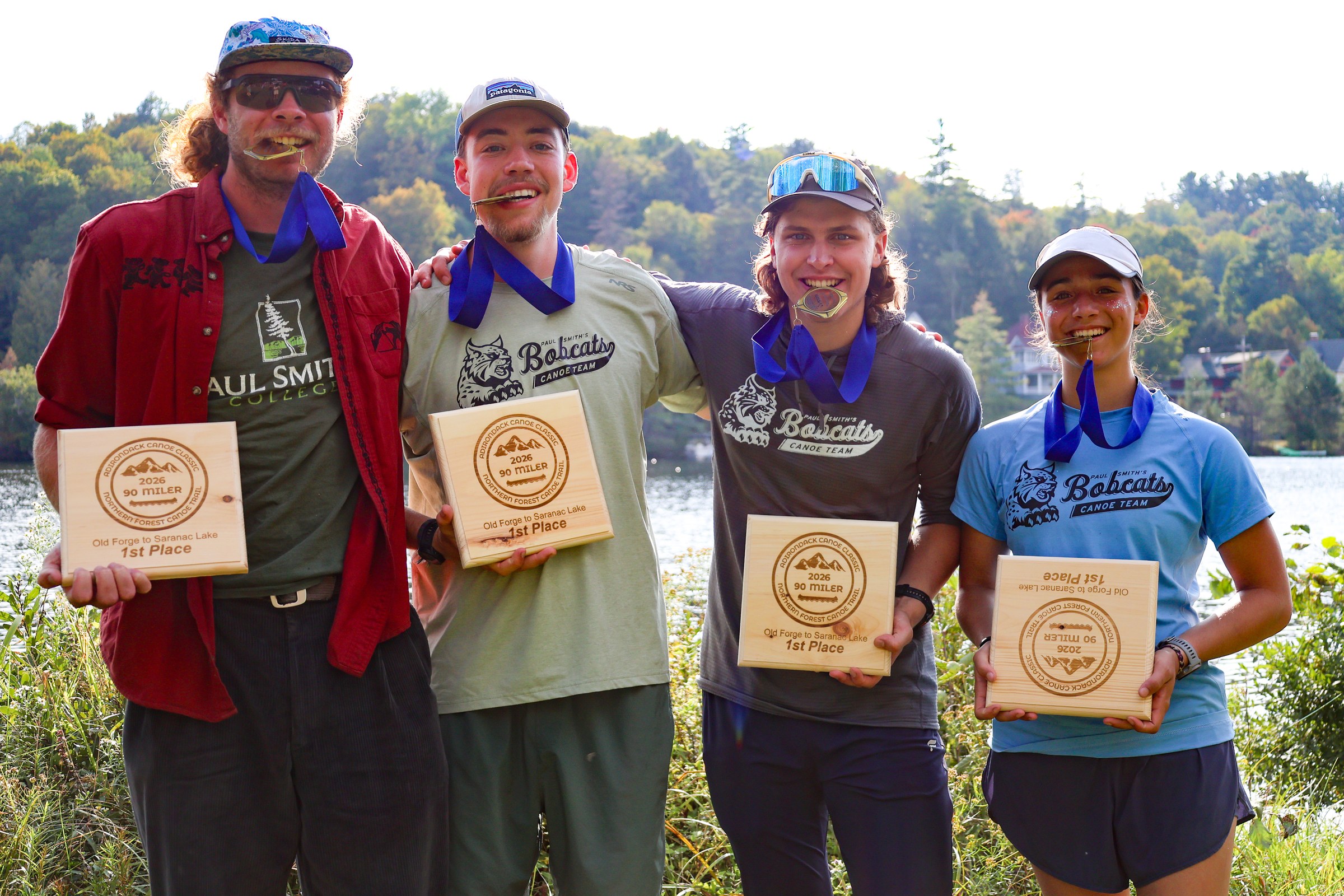
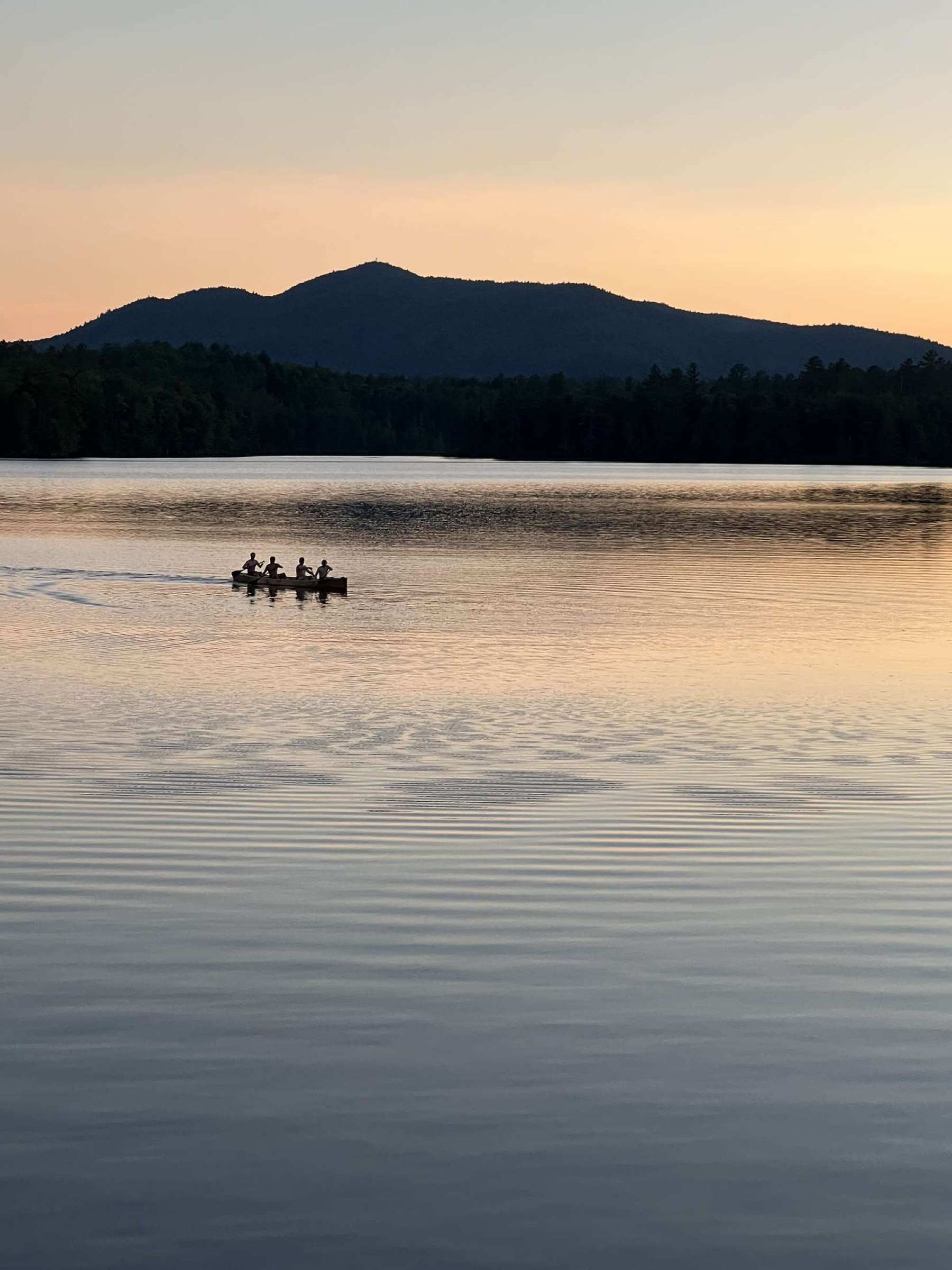
Paul Smith’s paddlers with their first-place plaques after the Adirondack Canoe Classic, the three-day, ninety-mile race the North Country calls the 90-Miler. Head coach Matt Dougherty runs the marathon canoe team as well as the ski team. (Courtesy photo)
Three days in a boat
The marathon canoe team is not a requirement for skiers at Paul Smith’s. A lot of them do it anyway.
“It gives me the opportunity to do the important lessons,” Dougherty said. “The 90 mile canoe race is super hard, and I can go back and be like, look at what we can do when we put our mind to it.”
The boats are the point. In the Voyageur class, where Paul Smith’s entered a seven-paddler crew in 2024 and won its division by two hours, the craft itself becomes part of the problem.
“It’s raining and you paddled,” Dougherty said. “You had to carry a boat that’s 300 pounds if you’re in the Voyageur canoe up and over a literal side of a mountain in a race.”
He is after two things. One is the plain demonstration that his athletes can do more than they think, a claim coaches make constantly and almost never get to prove in September.
“A lot of times our preconceived notion of what we can do is only limited by our own mind,” he said. “If you ask them at the end of day one, they’re like, there’s no way I can do that again. Day two, and you keep doing that, and you’re like, but what can you actually do if you open up your mind and say, like, I’m just willing to see, I’m willing to test those boundaries?”
The other is more useful to him in February.
“To affect change, you got to have shared experiences, even with a coach involved in it,” he said. “That say, like, we shared this really hard time, and there’s this high level of trust, and we can do super hard things. From there, we can then we can get into the training, and we can say, yeah, we’re gonna do 44 weeks of training next year, and you’re gonna put on 10 pounds in the weight room, and things that they’re like, what? But now it’s like, okay, we have a place to start from.”
There is a third thing, which he raises without being asked.
“It’s really hard for college students to understand all the hard things you’re going to go through in life, and I want them to be tempered and ready,” he said. “This is going to be hard to experience all of the emotions, sadness, grief, pain, but also to be like I can endure this.”
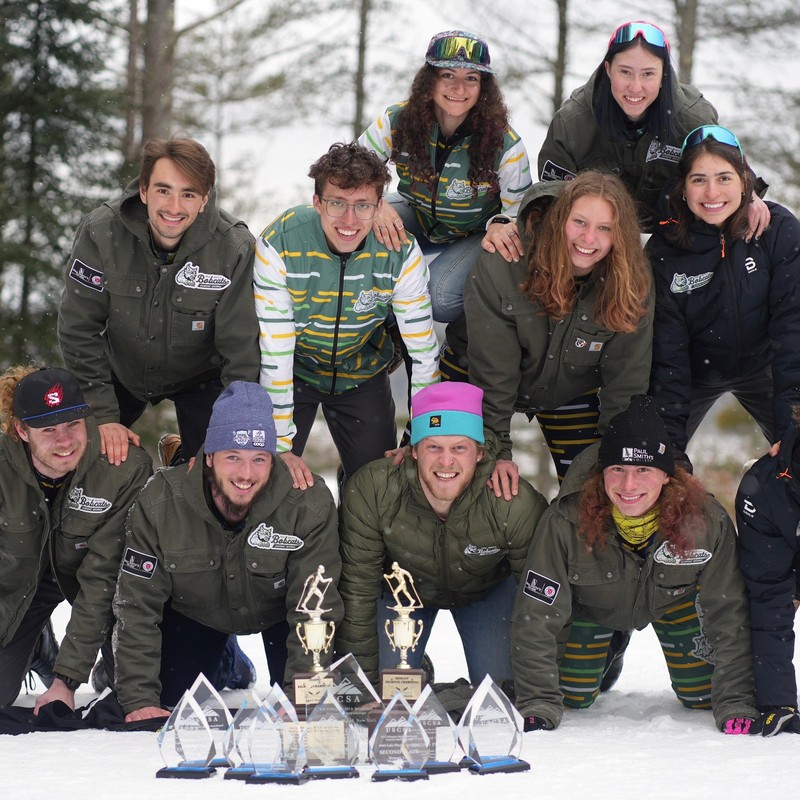
The roster Dougherty built. He took the program over in the fall of 2020 with one skier on it and no recruits. (Courtesy photo)
The long way back to Saranac Lake
Dougherty graduated from Saranac Lake High School in 1997 and got a running scholarship to Houghton University, then a small NAIA school in western New York, which is where the pattern that governs everything else started.
“Sport was an avenue to change my circumstances in life,” he said. “It changed my life because it got me to college. I paid for college. I got a degree, and then changed my circumstances drastically.”
He has two degrees, an undergraduate in outdoor education and ceramics, and a master’s in education from St. Lawrence in what he describes as cognitive behavior. He coached track and field for two decades before this, and he spent some of those years around people whose approach he took wholesale. One of them was Clyde Hart, the Baylor coach who put Michael Johnson, Jeremy Wariner and Sanya Richards-Ross on Olympic 400-meter podiums.
“You’d think, man, you have like three gold medalists on your team right now,” Dougherty said. “And you’d see him interact with his athletes, and you’d be like, wow, it’s always the person first. It is what’s going on in your life today, what’s going on the person before the athletic part.”
As a coach, he had chances to move up into Division I teams. He turned them down, and he credits his wife with the reasoning.
“What I realized then is, it’s a numbers game and it’s not a person game,” he said. His wife, he said, put it to him as a trade: “If you do this, you lose that, and it’s going to be miserable for you.”
He is now coaching three miles up the road from where Bill Demong grew up, at a college where Tim Burke’s father was a vice president for thirty-five years. He has a theory about what sticks from a life in that company.
“He would probably just hide his Olympic gold and silver medal for the rest of his life,” Dougherty said of Demong, who won gold and silver in nordic combined at the 2010 Vancouver Games. “But he would happily talk about what sport did, like what those experiences were.”
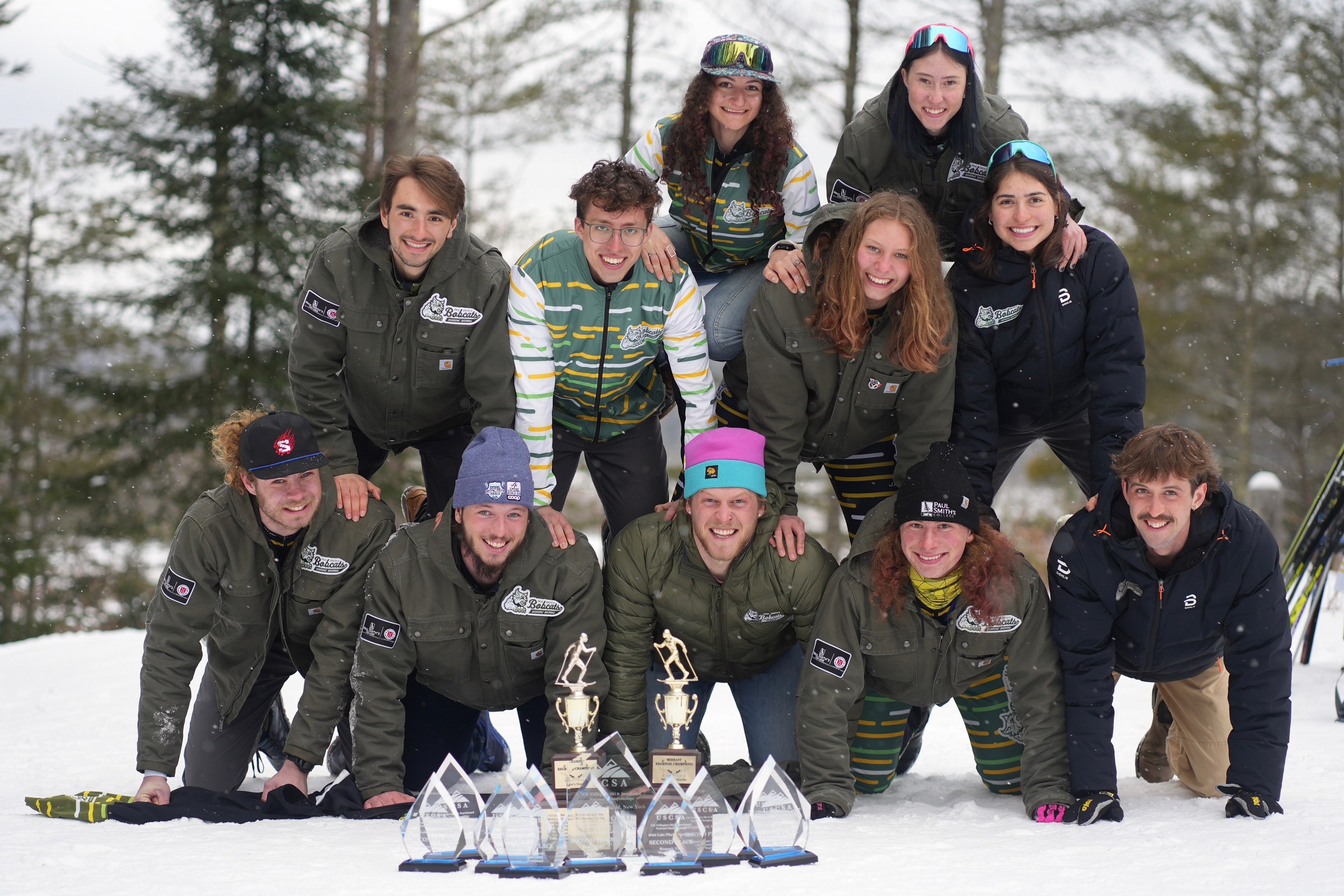
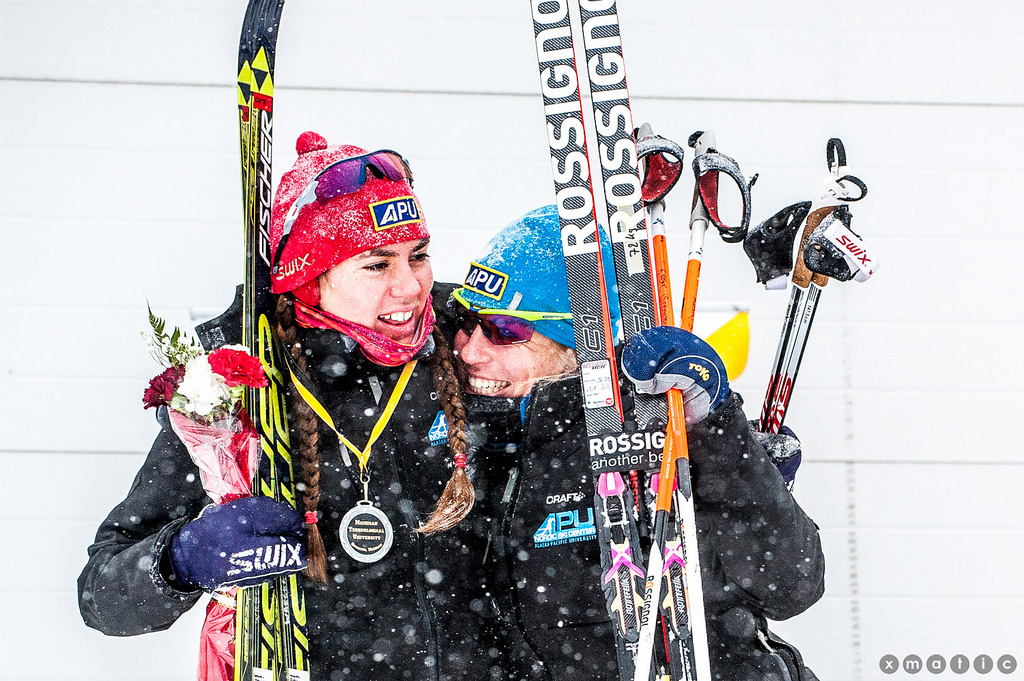
The hardware from a season in which the Paul Smith’s men won the USCSA national title and the women finished second. The team never set winning it as a goal. (Photo: Timo Ziegler)
Goals that do not squeeze anyone out
Paul Smith’s does not set a team goal of winning a national championship, even in years when it wins one.
“We just set process goals, because that’s the only thing we can control is what we do there,” Dougherty said. “And we caveat that with a little like, what do we hope that gets us. If we do all those things, we hope it can lead us to contending for a national title.”
The reason is not modesty. It is arithmetic about who a team goal excludes.
“I take such an individualized version of goal setting,” he said. “If we put a performance metric behind it, it often squeezes out other people in the program. It doesn’t allow their goals to exist.”
Last season one of his athletes was named to a US biathlon team for an international championship, which meant flying back from Germany and landing roughly a day before the national championships started.
“If the women’s team had said like our goal is to only win nationals and they were second overall, like that would have put her in a position where she’s like, well, I’m taken away from the team by going to World Juniors,” Dougherty said.
She went. The team finished second anyway. Nobody had to choose.
The team does have expectations, two of them, and he recites them the way people recite things they have said several hundred times.
“To be on this team, you got to be a good teammate first, and then maximize your opportunity,” he said.
What that produces, in his telling, is a program where the standard gets set from the back of the group.
“When a star is like, oh, I’m tired today, or this morning it’s raining and it’s 38 degrees, no one wants to ski, but they see the slowest guy kitting up and going out, then it allows all of us to kind of gain from that,” he said.
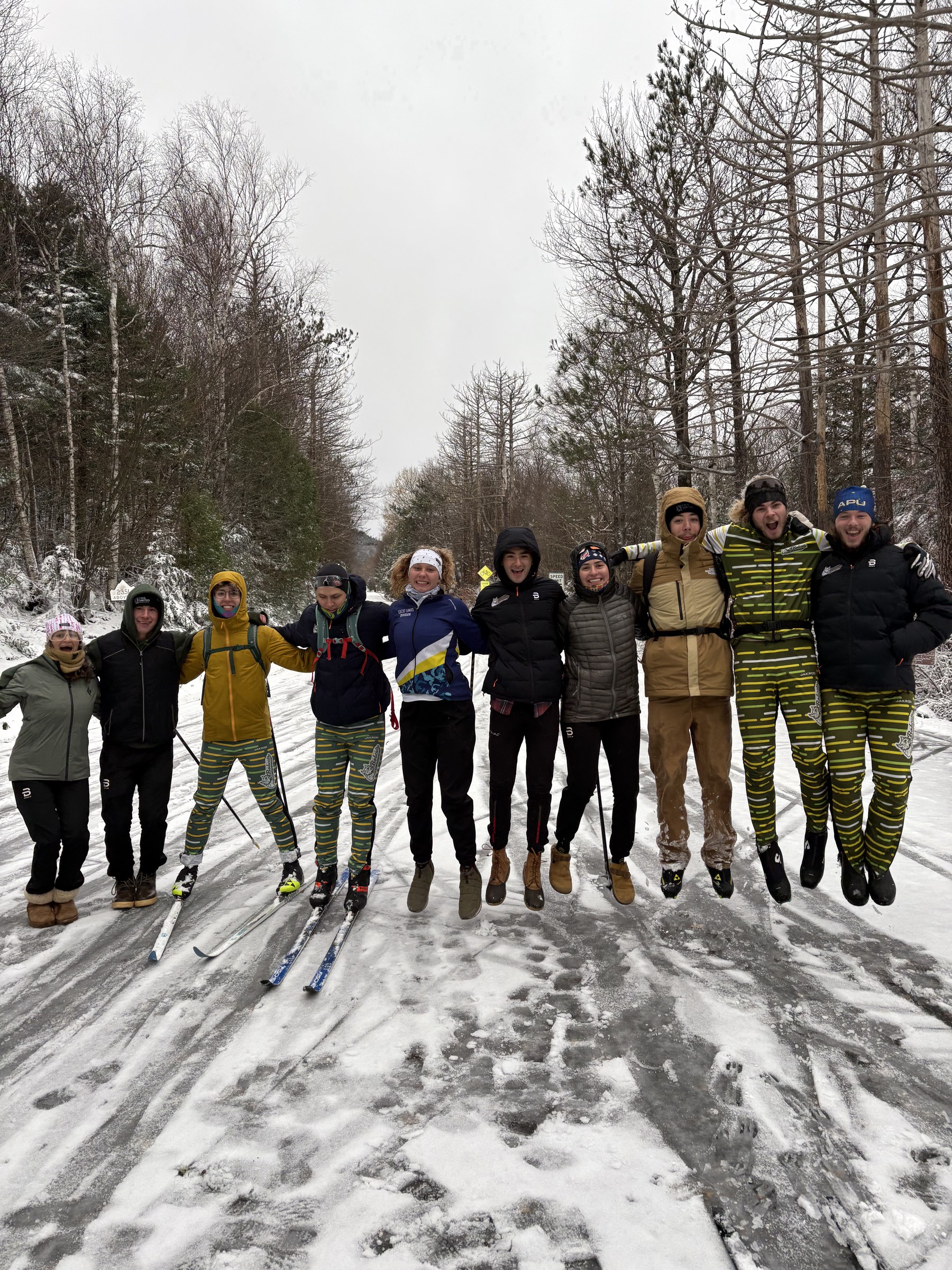
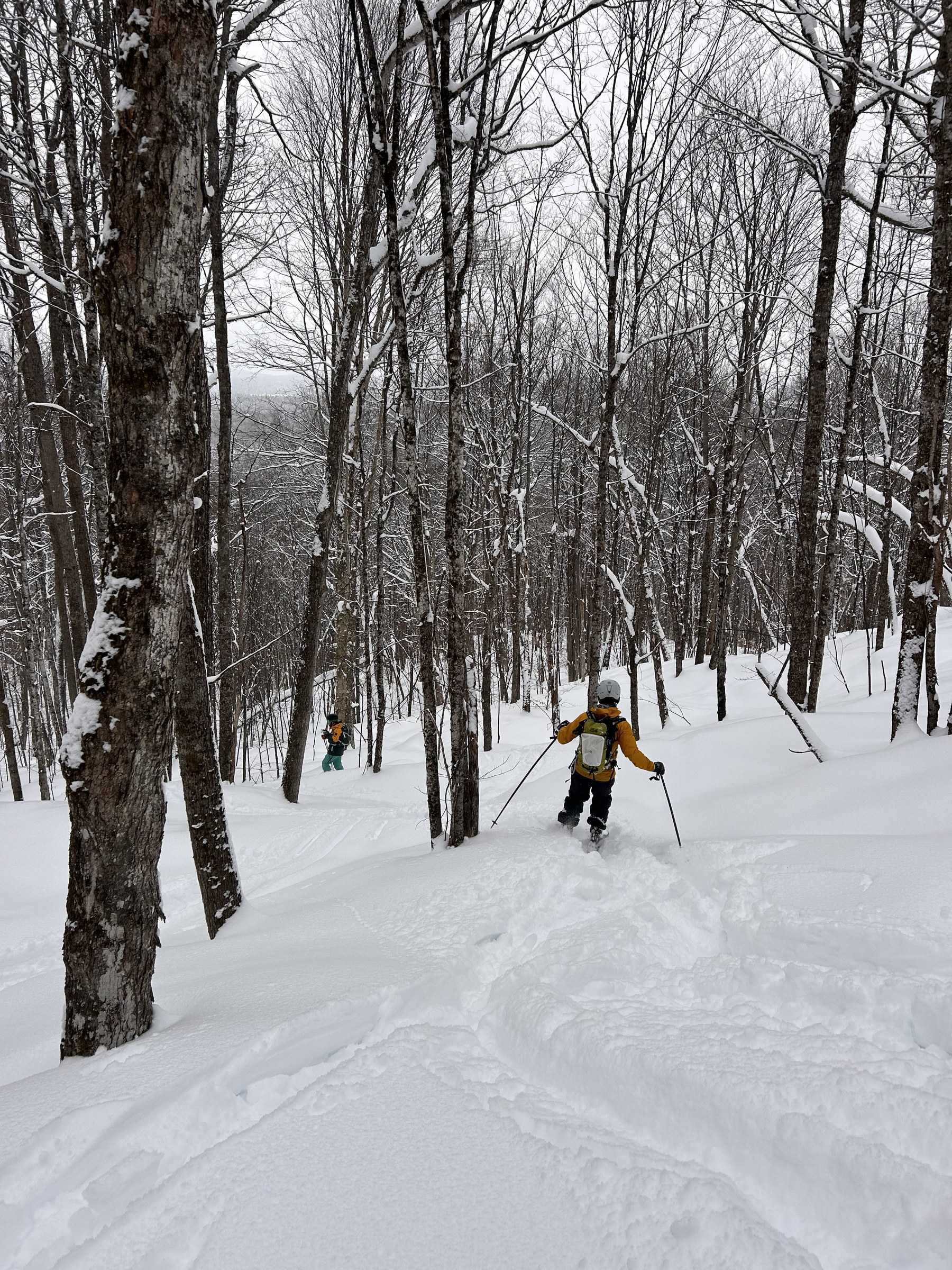
An ordinary training day on the trails at Paul Smith’s. Dougherty says his job is to make room for whatever an athlete is carrying, without asking for it directly. (Courtesy photo)
The person before the athlete
The documentary spends real time on mental health, and it is the part of the conversation Dougherty warms to fastest. He starts from what he does not know.
“I only get a piece of the story of this athlete,” he said. “We don’t know if they came from rough family life or they just feel like they don’t belong. All these things. Mental health issues are real, and I need to know about those. But I have to allow space for them to come up organically.”
“I can’t be like, who has mental health issues?” he said. “I’ve got to create the space for that.”
The space, in practice, is a rule about curiosity that the team applies to each other.
“We’re constantly like, we’re not judgmental on this team. Let’s be curious,” he said. “If as we look at a teammate and we wonder what they’re going through, instead of saying like whatever, we say like, oh, what’s the source of that?”
The same approach applies when he already knows an athlete is struggling. The problem then is how to open the door without making the asking the event.
“The really hard thing is when you get to the point where you know stuff’s going on, finding the way to indirectly be direct,” he said. “What do you need?” is the question he finds himself asking, and it generally opens the door.
That extends to how he thinks athletes should hold their own results. A race result, in his view, is a terrible place to store your sense of self.
“Their performance isn’t who they are, and it’s not anything connected to their value,” he said. “Whether we win by 20 points, lose by 20 points, doesn’t change their person or their value as a person.”
As he has gotten older he has become more concerned with sportsmanship, and he treats it as something other than a courtesy. It is how he teaches athletes to handle a disappointment and to recognize somebody else’s work.
“When you can say like, yeah, I didn’t have a great race today, instead of being sad and dour, if you go to celebrate someone you know who’s trained hard for a year and had a great day, you can’t be sad anymore,” he said. “It just changes you.”
He means it specifically. Clarkson won the USCSA men’s title at Mount Van Hoevenberg in 2024 and Paul Smith’s finished second, and Dougherty’s response was to have his team look closely at what the Clarkson skiers had done to get there.
“Even though we’d love to win, when you see someone perform like that, it’s actually inspiring,” he said. “The more we can be open to looking at performance and saying like other teams did great, but there’s value in me not just celebrating them, but seeing what they did and honoring it. I think it makes us better athletes in the end.”
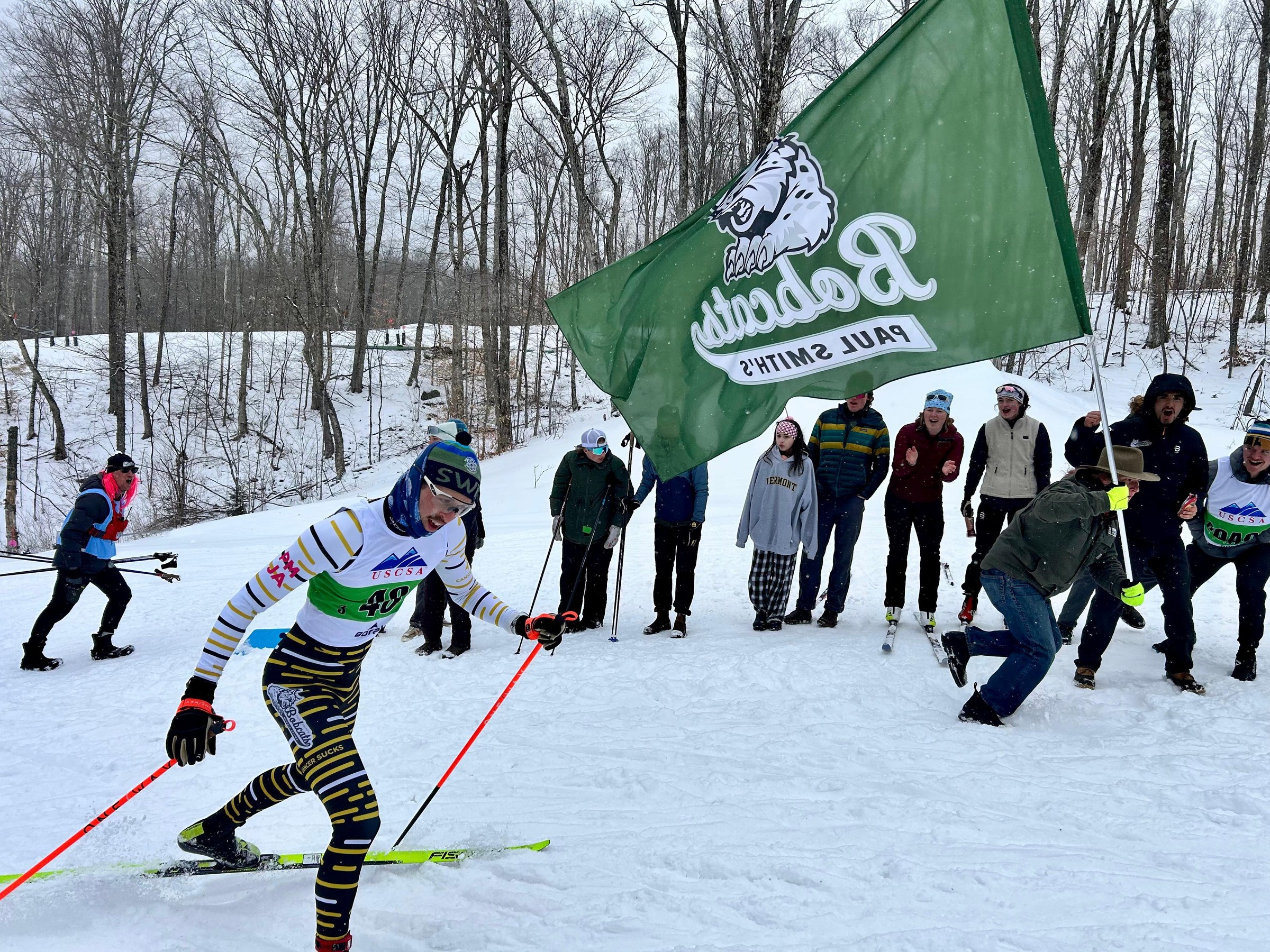
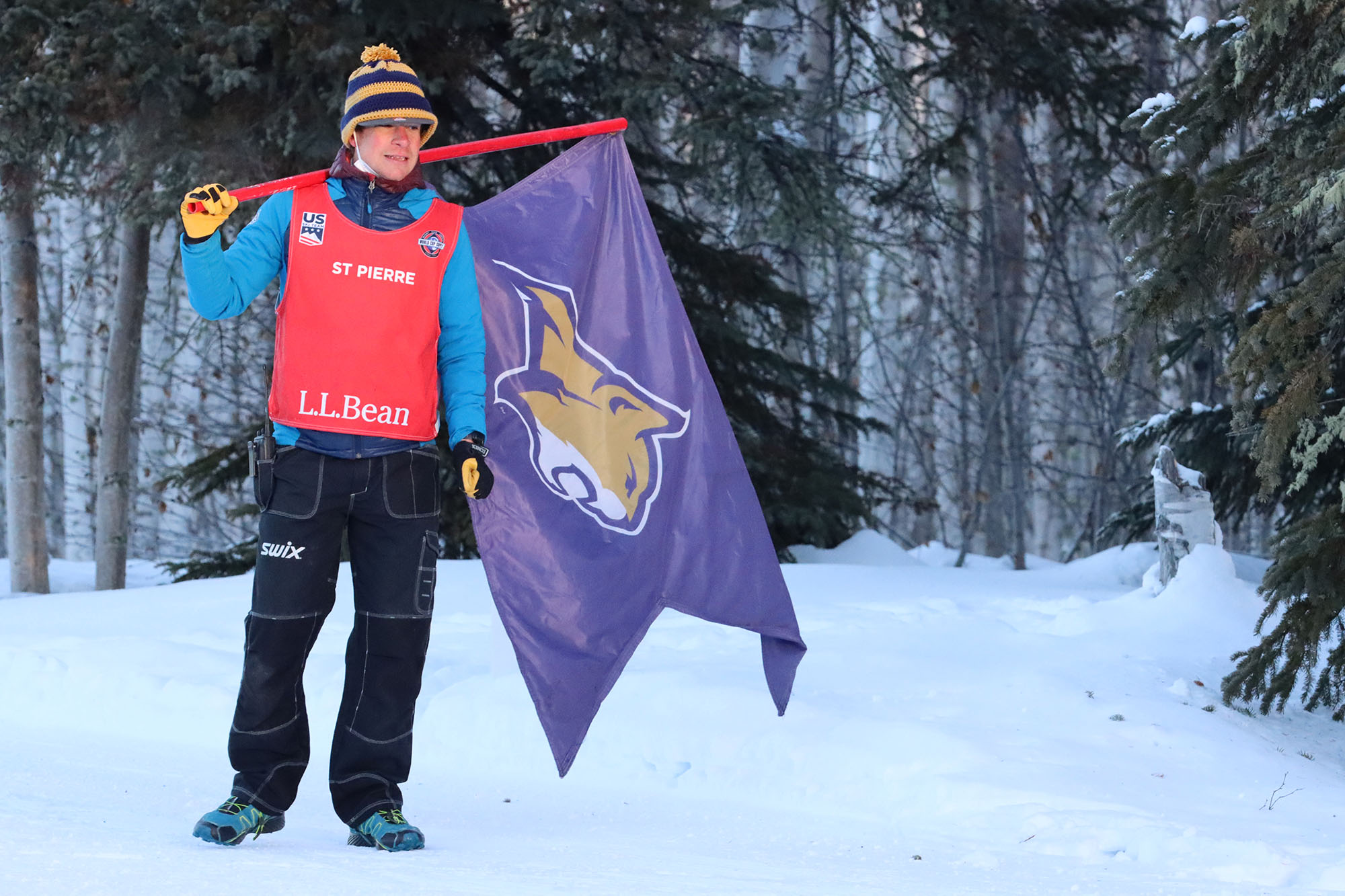
Teammates and the Bobcats flag trailside. At a college of roughly 750 students, Dougherty says, everyone on campus knows the ski program. (Courtesy photo)
A small college and a film crew
Paul Smith’s enrolls roughly 750 students by the college’s own count, on 14,000 acres at the northern edge of the Adirondack Park. Nearly half the bachelor’s degrees it awarded last year were in natural resources and conservation. It is the kind of place where a skier’s Saturday gets rearranged by a professor.
“When you come here, it’s individualized; it is a personal relationship school,” Dougherty said. “My students are working with a professor; he takes an interest, he gets to know them, and then I find out, well, Saturday we’re actually going out with this professor. He’s taking us into the mountains to show us this specific part of our research.”
“It is harder when you have 700 students. Everything about that is harder: recruiting, getting people here,” he said. “But because of that, we live in a culture where everyone on campus knows the ski program.”
That extends past the campus. Dougherty calls the Saranac Lake and Lake Placid community around the program super fans, and he puts the college president, Dan Kelting, in that category.
“He shows up at ski races and he’s not just there to like cheer,” Dougherty said. “He’s also there like, what do you guys need? What does the program need? What do we need to keep bringing in great students as a ski program?”
His summary of the whole arrangement is that it could not exist anywhere else.
“It’s this weird subculture that probably could only exist in the Adirondacks,” he said.
Which brings up the film. A donor with a seasonal home on one of the lakes near the college met the team at an event, decided there was a story, and asked whether Dougherty would sit down with a documentary crew. Dougherty said yes without any clear idea what he was agreeing to.
“I expected a three to five minute kind of like infomercial type thing for YouTube,” he said.
What arrived was Adrenaline Films, an Orlando company that Dougherty said had got its start on the early seasons of Survivor and had lately been following a ballet company through the war in Ukraine. The crew embedded with the ski team for close to two years.
“This was like pretty legit documentary crew following us for a long time,” Dougherty said.
The result is Coach Matt and the Outdoor ‘Cats, directed by Robert Jury and produced by Michael Murray and Tim Ranzetta. It runs about 95 minutes, and it is free to watch, with ads, on Amazon Prime Video and on Tubi. Its spine is the 2024 season, in which the Paul Smith’s men lost the national title by two points.
“They’re really just telling the story of a team,” Dougherty said. “Small, tiny school in the woods is really another theme there. You can do anything, anywhere, kind of an idea.”
Any money the film makes goes back to the program, and he doubts there will be any.
“My guess, without knowing all the specifics of cost, is that this is a net loss,” he said.
The team that lost by two points in that film won by 40 in March. Nobody set that as a goal.
Help Support Our Coverage!
If you value the thoughtful work and access FasterSkier provides, please consider becoming a Voluntary Subscriber. Your support directly fuels our work to cover the people, places, and moments that make our sport special.
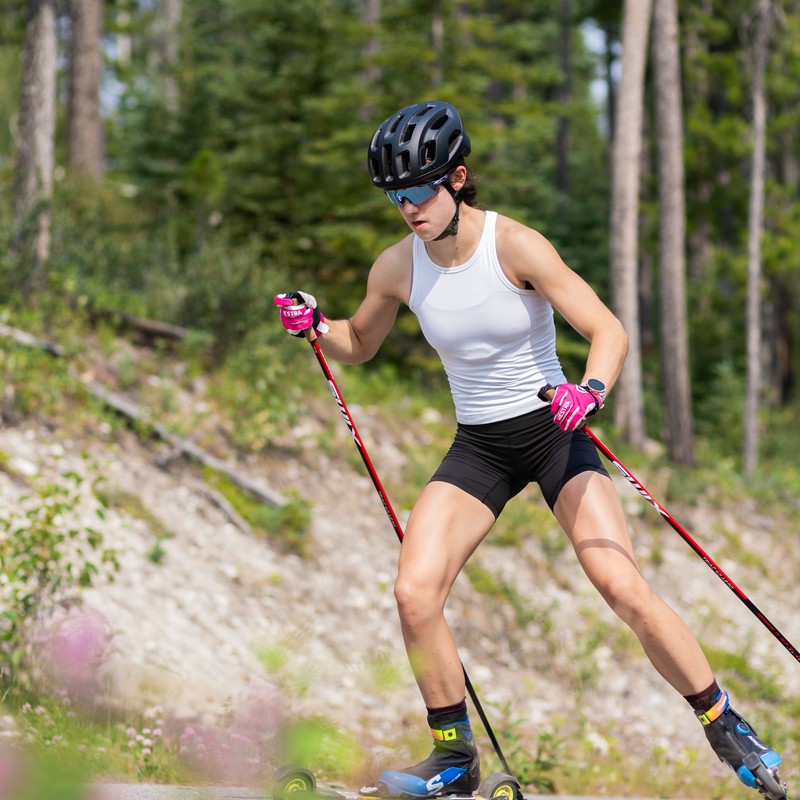
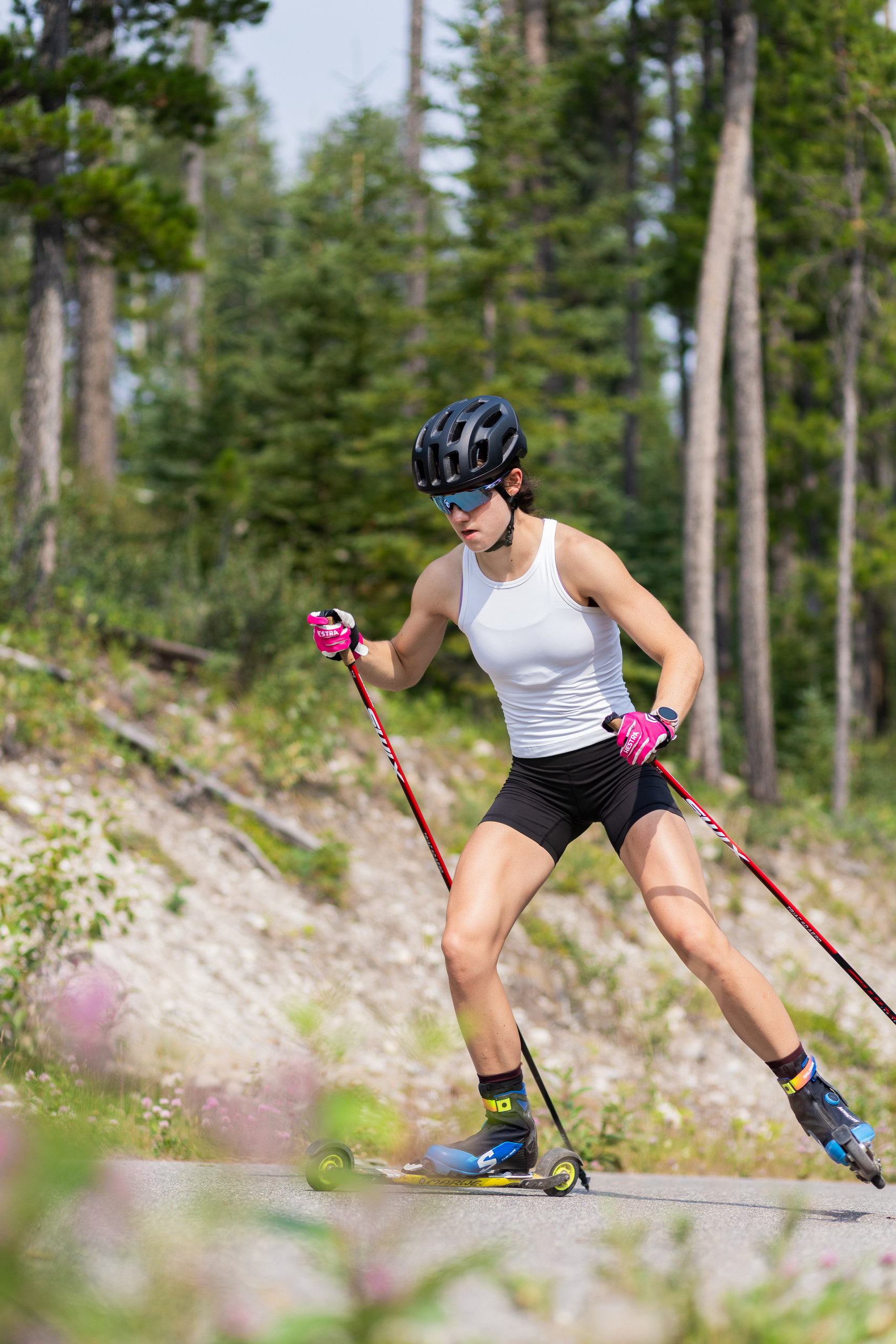
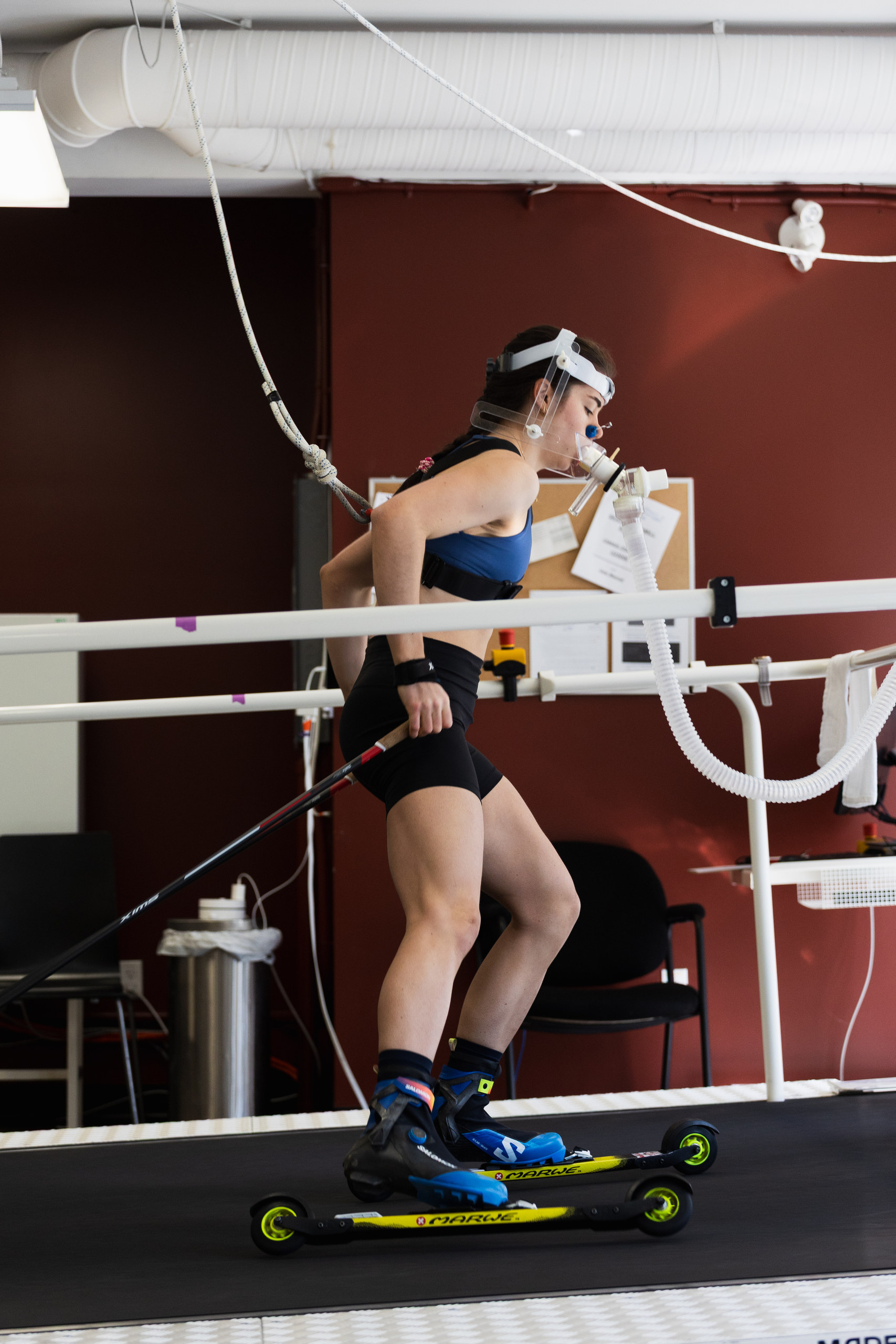
Alison Mackie rollerskiing during summer training in July. She trains with the Alberta World Cup Academy in Canmore, Alberta. (Photo: Nathaniel Mah)
For Alison Mackie, the 2024 Junior World Championships in Planica never really started.
She had arrived in Slovenia with reason to expect something. A year earlier, at 17, she had finished 13th in the 20 k at the junior championships in Whistler, British Columbia, on home snow, in exactly the kind of long, grinding distance race that suits her. In Planica she missed the qualification in the opening sprint, fell ill, and watched the rest of the week from a hotel room. She was not on the tracks when her Canadian teammates made history either: Sonjaa Schmidt won the U23 sprint, and Canada won the U23 relay.
Back at her base in Canmore, Alberta, at the end of that season, Mackie and her coaches set a target for the next one. Top five at the 2025 Junior World Championships in Schilpario, Italy.
Privately, she wanted more than that.
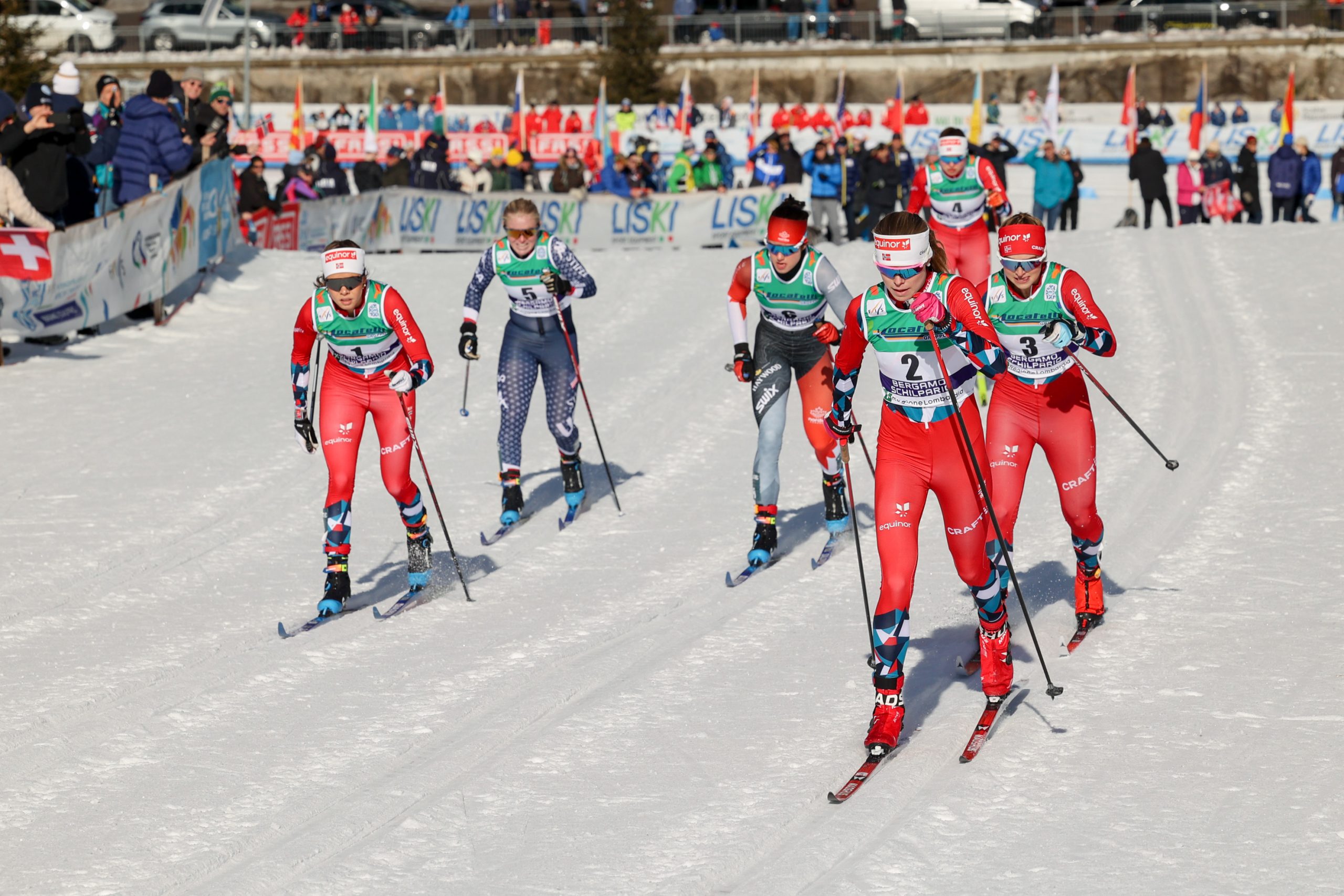
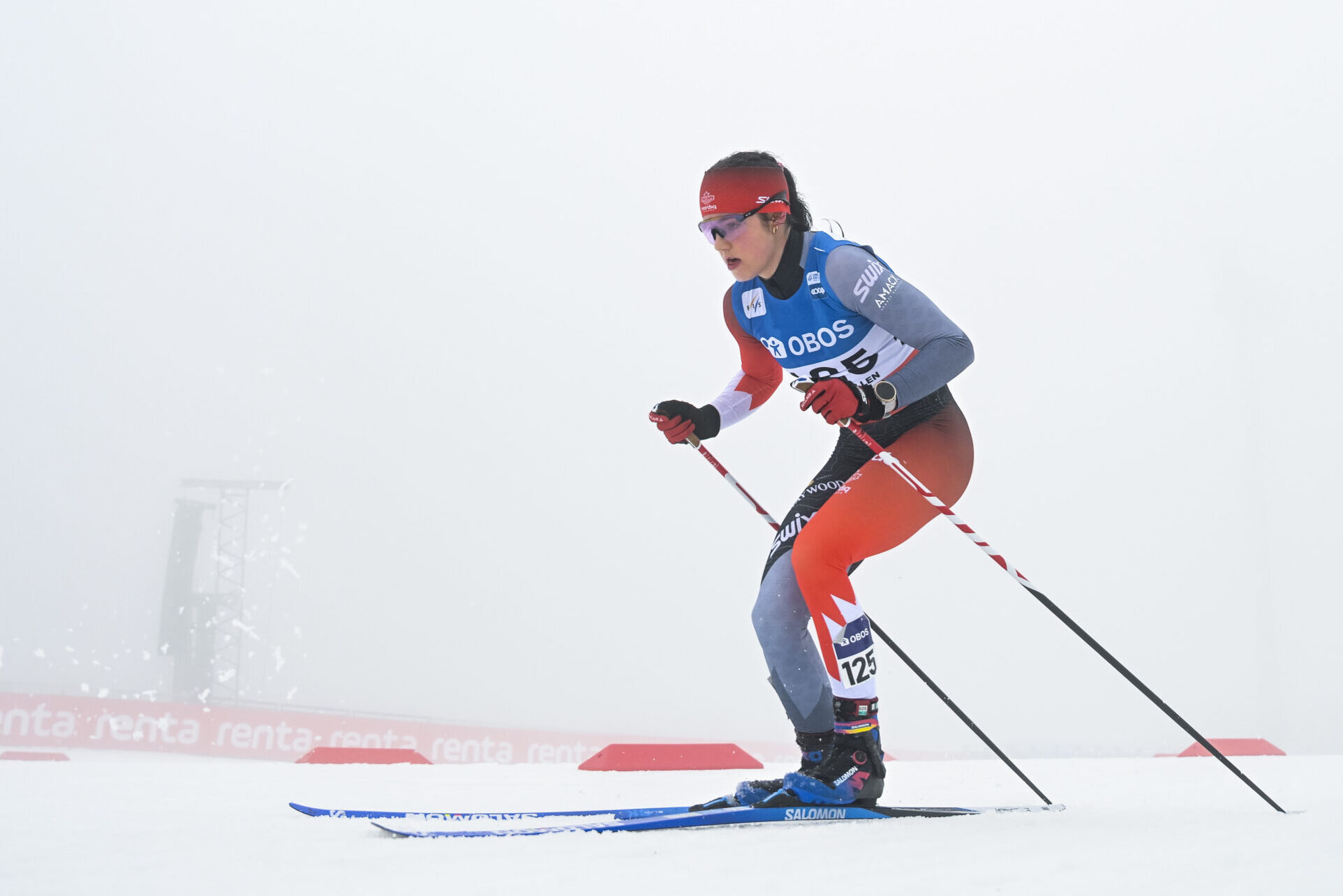
Mackie in bib 6 during the classic sprint at the 2025 Junior World Championships in Schilpario, where she finished fourth. Two bronze medals followed in the distance races. (Photo: Newspower.it)
A Comeback in Schilpario
“Yes, Junior World Championships in Schilpario were the main focus of my season that year,” Mackie said. “I trained specifically for that event to get my best shape there. But I wouldn’t say revenge, instead a kind of comeback because the year before in Planica I was pretty disappointed because I haven’t had the opportunity to race being sick.”
On the Italian tracks she won bronze in the 20 k mass start classic, then bronze again two days later in the 10 k interval start skate. She was fourth in the classic sprint. They were the first junior world championship medals won by a Canadian woman since 1989.
“I wanted a top five, and I finished with three top fours, including two medals,” she said. “The preparation we had put in proved to be correct, and I had a lot of confidence before starting the championships because I felt really good in the previous months leading up to my arrival in Italy.”
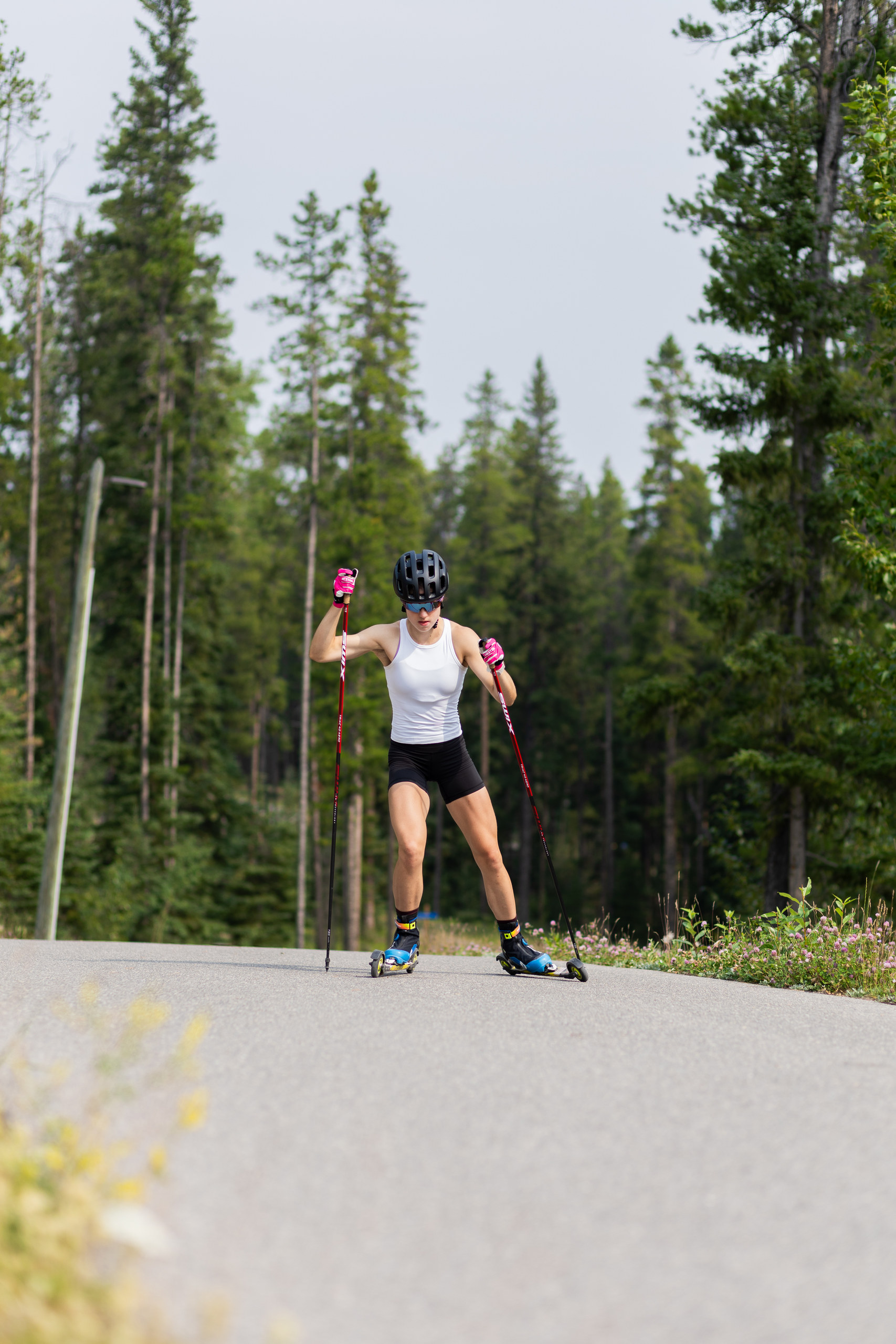
Mackie on a summer rollerski session in July. She started racing in Alberta as a teenager and won her first national title at 16. (Photo: Nathaniel Mah)
Put on Skis Before She Could Walk
Mackie was born in Montreal and raised in Edmonton, and she is 20 years old. Her mother, Jennifer, is a pediatrician. Her father, Andrew, is a pediatric cardiologist. Both of them ski, and both of them had her on skis before she has any memory of it.
“My parents put me on ski as soon as I could walk,” she said. “So skiing accompanied all my childhood. Then I took real ski lessons and I started doing racing in my region of Alberta during my teenage times. That’s till Covid period arrived and with the restrictions I had nothing else to do others than training. But anyway, I really enjoyed myself during that period, developing my technique with my coaches at Edmonton ski club and when Covid finished my very first race that I won was our National title in March 2022 as a 16 year old.”
Canada is known around the world as the home of ice hockey. Why did you choose cross-country skiing over hockey, freestyle, or swimming, following Summer McIntosh’s footsteps for example?
“In parallel with cross-country skiing, I did a lot of other sports like cross-country track and field, rock climbing, mountain biking, swimming, soccer and in all of these sports I wasn’t as super competitive as I was in cross-country skiing. I did that only for fun as an opportunity to stay healthy during summer period. Cross-country skiing has been to me the only sport I competed at my best in my early ages and my favourite discipline. That’s why I chose it.”
That first national title, won in Whistler in March 2022, is the race she keeps coming back to.
“Yes, that race in Whistler BC was one of the first big races after the Covid pandemic,” she said. “I trained a lot during that period and didn’t have the opportunity to race and see my level, and when I went to my first National Championships and won the first race, it was a special moment and made me realize that I wanted to keep pursuing cross-country skiing for even better results and seeing how far I could get.”
Mackie racing to eighth in the Olympic 10 k freestyle in Tesero on Feb. 12, the best Olympic cross-country result by a Canadian woman. (Photo: Vanzetta/NordicFocus)
Eighth at the Olympics
The line has run one direction since. Two bronze medals at Junior Worlds. Her first World Cup top 10s, in Toblach and Val di Fiemme. Eighth in the 10 k free at the Milano Cortina Olympics in her first senior season. Gold in the 20 k mass start free at the U23 World Championships in Lillehammer in March. And at the end of that season, on 548 points, the FIS U23 overall World Cup title, the first won by a Canadian woman, with the finals held at Lake Placid.
At the Milano Cortina Olympics you finished eighth in the 10 k free, after your first World Cup top 10s in Toblach and Val di Fiemme. What do you remember from those two weeks in Italy?
“It was super cool being part of that multi sport event that the Olympic Games represent. It was my dream since I was a child watching Olympics on TV and having the opportunity to compete in high level in this huge event was really special to me. Definitely they have been long two weeks, also overwhelming at the time, but made me really happy how I performed overall and the 8th place I got in 10km skating has definitely been the highlight without any doubt. Entering the top 10 has been quite a surprise to me in that moment, because there were all the best skiers at the starting line. But now looking back at all the hard work I did during the whole season and the good results I got before that race in both World Cup and in under 23 World Championships, I wouldn’t say it was a huge surprise for me. Probably demanding Val di Fiemme’s track suited me very well, given that I finished as well 8th in Tour de Ski’s Cermis climb the month before.”
What is the current situation in Canada for cross-country skiing, in terms of ski club membership, visibility in the national media, and financial support?
“I would say the current cross-country skiing community in Canada is pretty small, if compared to other European power nations, but strong and with lots of passion in developing our discipline. There are a lot of young skiers coming up and I think it is very exciting for the great results to come in the future. Our National sports organization here in Canada are working really hard to make sure our National team can get all the support we need in order to achieve some World Cup podium with both boys and girls team during the seasons to come.”
Mackie on the treadmill during a lab test in May. Distance racing is her strength, and finding speed is the summer’s assignment. (Photo: Nathaniel Mah)
Distance Strength, Sprint Homework
Describe yourself as a cross-country skier. What are your characteristics, your strengths, and the areas you are working on for the coming seasons?
“I describe myself as a pretty strong skier in distance races, while I struggle a bit in sprint not to get through the top 30 and consequently not play the sprint finals, that is an element that I am working on in next seasons,” she said. “Between classic and skate I have found more success in free technique in the past seasons, but I enjoy training both classic and skate equally. Distance races are definitely my strength but I am working to improve my speed skiing as well so I could become a really strong overall skier in order, in the future, to fight for a higher overall spot in World Cup.”
And the criticism you get from your coaches?
“More than critics I would call special feedback from my coaches. Because sometimes I have a tendency to train too much and too hard that I need. That is something I am working on this summer, knowing when to push my body and when to give the correct time to rest and recover.”
The World Cup calendar keeps skiers from outside Europe away from home for close to five months a season. How hard is that for you?
“Personally I have spent on the road, following World Cup calendar, the past two seasons, but not the full European calendar. I really enjoy travelling and being on the road, so I don’t think it is a huge struggle for me. It is tough to not see friends and family for a long time but I am really lucky that I had friends and family came and watched me on tracks while I was in Europe a couple of time during season. Next season it will be quite different for me, because I am transitioning to attend the University of Utah so I will leave World Cup a bit because I do need to go to class and represent the University of Utah in North America as well.”
Mackie at the Holmenkollen World Cup in March, a week before the tour reached Lake Placid. (Photo: Authamayou/NordicFocus)
A Winter Without Diggins
The World Cup went to Minneapolis in the last two seasons, and Lake Placid hosted the finals in March in front of enormous crowds. Why not race in North America more often?
“We do have actually Canmore scheduled for World Cup 2028, but realistically there are not so many resources for cross-country skiing in North America,” Mackie said. “It takes a lot of money and human power for the organization and preparation of those races. Of course, it will be amazing to have more opportunities to race in North America in the future but I have to be realistic and understand that organizing an event here in Canada, for example every four years, require lots of efforts and preparations from the local organization. Maybe we need more venues in North America that we currently have that are able to bring here World Cup events. I admit with huge pleasure that in the past seasons both Minneapolis and Lake Placid events showed how strong local communities are in terms of support and enthusiasm for cross-country skiing and those events have been a great boost for our discipline in North America, especially between young kids.”
After fifteen seasons, this will be the first World Cup winter without Jessie Diggins, who clinched one more crystal globe in Lake Placid in March before retiring. Will she be missed outside the U.S. team as well? Did you ever get advice from her?
“I definitely think Jessie’s presence will be missed in World Cup. Not only inside USA Team. I think she has always been a positive skier and a really amazing role model in so many ways. And 100% her presence, her ambitious way of racing and unique skiing spirit will be missed. That will definitely change some racing tactics as well. I had the opportunity to train together with Jessie in New Zealand last summer and it was a pretty cool experience and I wish all the best in her future.”
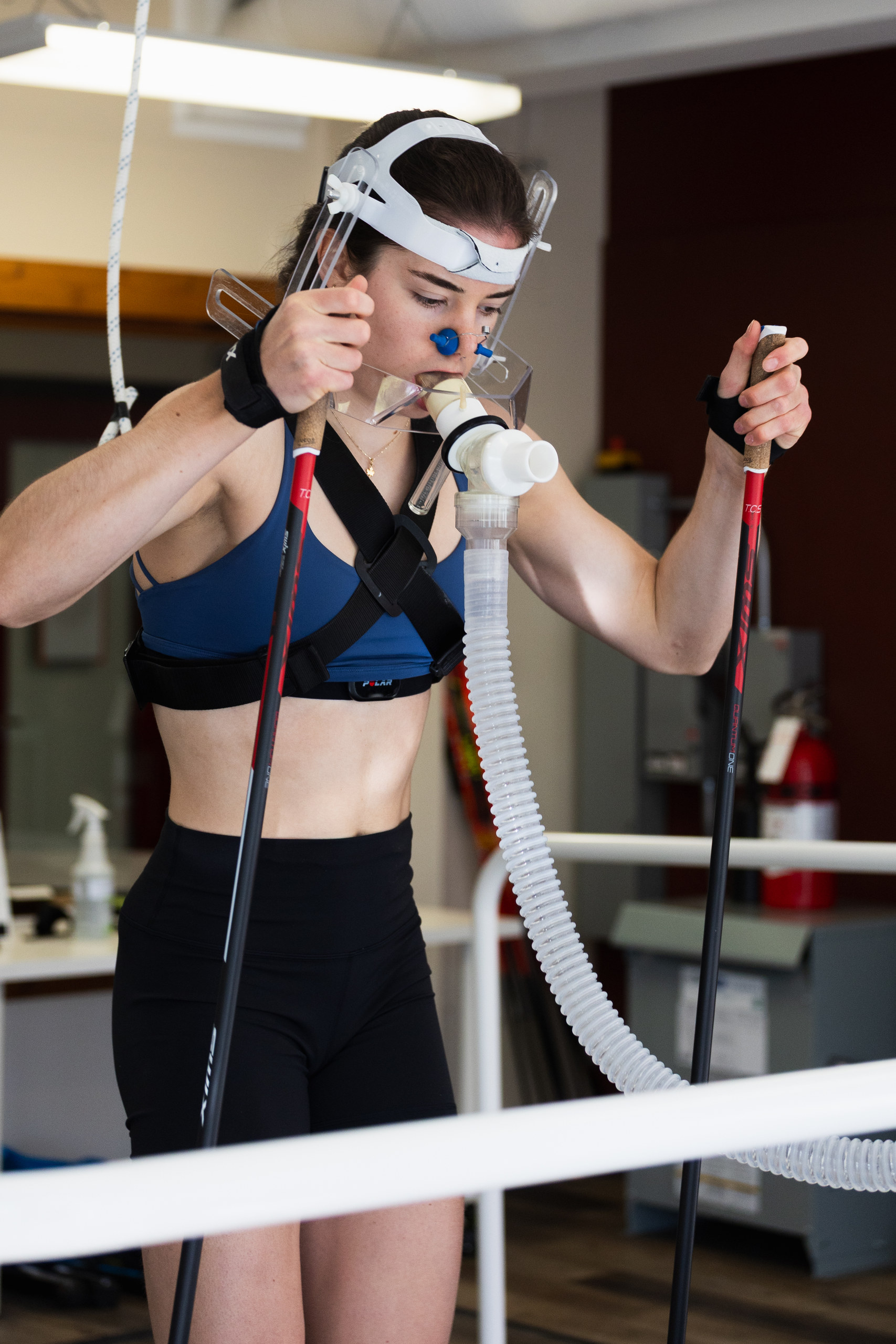
Mackie fitting a metabolic mask before a treadmill test in May. She trains in Canmore and will study medical engineering at the University of Utah this year. (Photo: Nathaniel Mah)
Canmore, Utah, and Life Off the Snow
How is the Canadian team organized, and how is training divided between the women and the men at camps and at home?
“I think Canadian skiing is gonna take a really exciting trajectory. I am really excited to work with our new Swedish coach Stefan Thomson over the next seasons but also in our group here in Canmore we have Norwegian Tormod Vatten as our assistant coach and with them we have a really strong support staff. For the Canadian National Team over the next seasons is going to be really exciting seeing where we all can go in World Cup and I am really proud to be part of this young but strong group of skiers that our Nordiq Canada are building now, under the [leadership] of former Olympic champion Beckie Scott and our amazing ski communities.”
How do you manage your studies, at Queen’s University until last year and now at the University of Utah, with training and racing that run through most of the academic year?
“I just make sure that I manage my schedule accordingly to have enough time for both my trainings and school throughout my day. I think having something other than skiing to focus on is really important for me. I was an online student at Queen’s University over the past two years and now I am transitioning to the University of Utah studying medical engineering. I think it is important the communication with the professors, making sure they know that my situation is a little bit different if compared to normal students, due to the fact that my training sessions, travels and races during winter season take my mind. But despite that my goal is to give my full focus during hours in classrooms too.”
What kind of person are you away from cross-country skiing? Your personality, your interests, what you do on days off from training and racing?
“Outside of cross-country skiing I am a pretty introvert person. I try to keep things on my own. I like studying and I really enjoy sewing clothes in my free time. I truly also love to learn new things and that is why I am excited to attend the University of Utah this year. I also love to spend time in the mountains nearby Edmonton where I grew up and in Canmore where I train myself with Alberta World Cup Academy and where I graduated in High school. Hiking, Mountain biking, running and skiing, of course, are my favourite activity when I can spend my time outside in the lush Canadian Nature.”
In 10 to 15 years, at the end of your career, you will be proud of yourself if what?
“I think, regardless of what I achieve in my future, I will be extremely proud of my career in addition to what I already accomplished. But really, my goal is just to ski because I love it and see where I can get of myself and also trying to inspire other young skiers. I think that there are a lot of young skiers in Canada right now, who have the potential to be amazing athletes. I really want to inspire them, showing them that anything is possible, it doesn’t matter what country you are from or how old you are. So regardless of what I achieve over the rest of my career I will always be proud of what I have already achieved.”
Paolo Romanò is a freelance reporter based in Italy who covers cross-country skiing and Nordic combined.
Help Support Our Coverage!
If you value the thoughtful work and access FasterSkier provides, please consider becoming a Voluntary Subscriber. Your support directly fuels our work to cover the people, places, and moments that make our sport special.
Torsten and Lars Brinkema were two brothers from Minneapolis with a GoPro, a film school semester between them and no feature credits at all when they talked their way into a U.S. Cross-Country Ski Team camp in Bend, Oregon, in the summer of 2023. They spent the following World Cup season inside the team, paid their own way through it, and came home with roughly 500 hours of footage. What they cut it into is Threshold, the documentary about Jessie Diggins and her eating disorder that premiered on Peacock in February and is now available to rent in the United States and Canada.
Earlier this month we published head coach Matt Whitcomb’s account of that winter and what the team changed because of it. This is the other half: the brothers’ own version, recorded before the rental release. Torsten is 26 and lives in Brooklyn. Lars is 23 and splits his time between Minneapolis and Los Angeles. They are still working as a duo.
Below is a transcript of the Brinkemas’ conversation with FasterSkier. It has been lightly edited and condensed for clarity. LB is Lars Brinkema, TB is Torsten Brinkema, MV is Matthew Voisin.
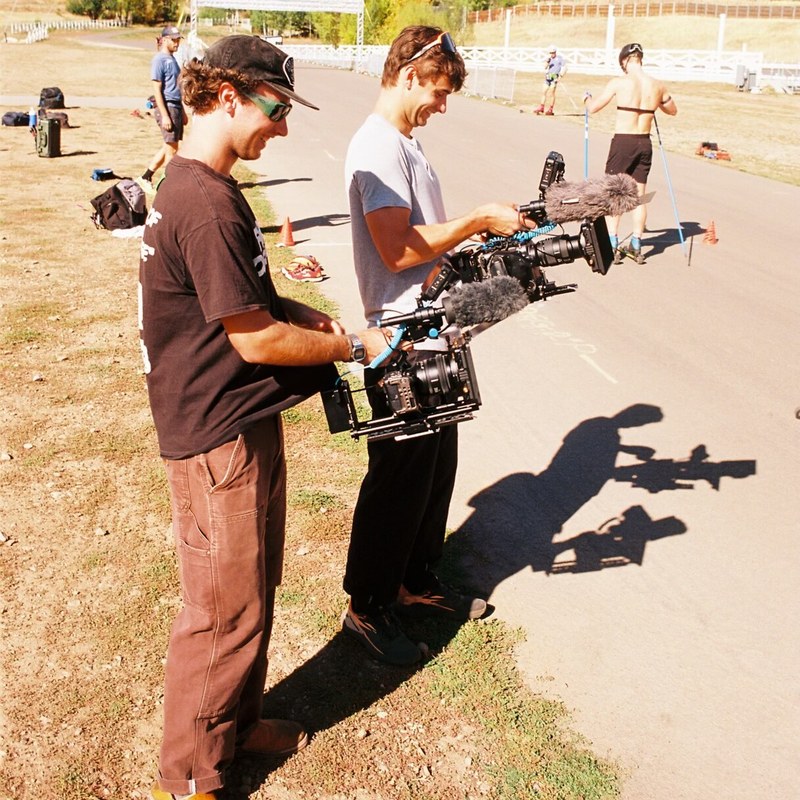
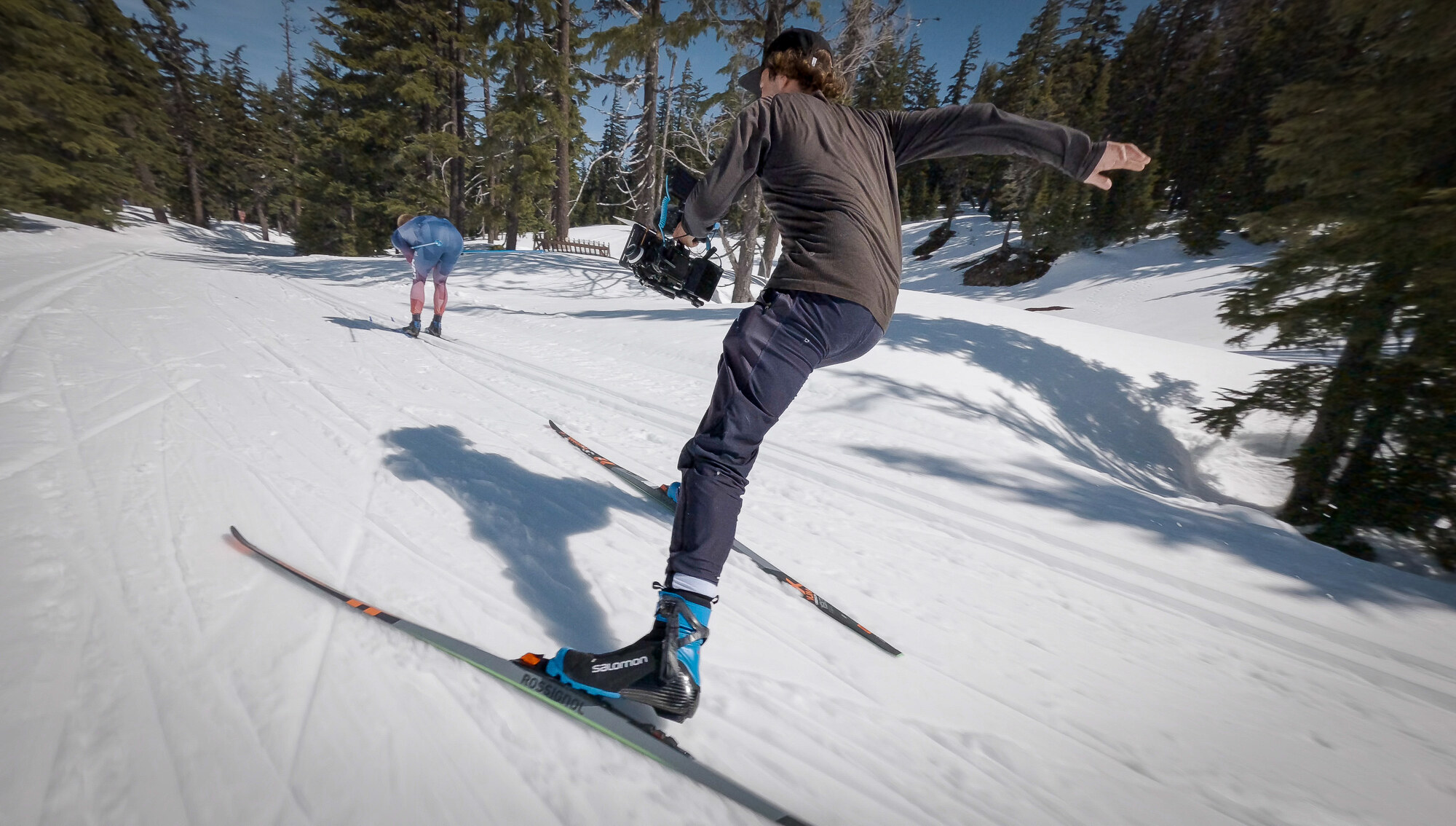
Lars Brinkema filming on snow at a U.S. Ski Team camp in Bend, Oregon, chasing Jack Young up the trail. The brothers had done the workouts themselves, which is the reason the team let them near one. (Photo: Patrick Conroy)
MV: I would love to back up a little and just hear about you two as young guys, how this all manifested.
LB: To start at the very beginning, Torsten and I were both born in Minneapolis and grew up in that whole Minneapolis ski world. We had skis on right when we started walking. So we really grew up in the same community that Jessie had grown up in, and she was kind of just this idol that we looked up to. We both remember where we were when we were watching that gold medal race in Pyeongchang. And then fast-forward to when we were getting older, just always carrying cameras around, usually a small GoPro on our ski trips. Torsten ended up skiing for Colby College, and that is where he met Ben Ogden, racing against him on the collegiate circuit.
TB: I got my ass kicked by Ben in most of the EISA college races. But I was always interested in shooting a lot of ski trips. I left school trying to figure out how to put those two pieces together, because I knew I was not good enough to be a professional skier, but I also wanted to capture the sport that I loved so much. It took a year of trial and error doing gigs for outdoor brands and whatnot.
Then, when we figured out the World Cup was coming to Minneapolis, I talked with the Loppet Foundation, which is the club Lars and I grew up skiing for. I was kind of like, listen, do you guys need any promotional materials? People should be getting excited for this event that is happening at Wirth Park. I convinced them on a shoestring budget to send me to Holmenkollen in the spring of 2023. I stayed with a family friend out there, reconnected with Ben, and met a lot of the other skiers on the team. I think they were kind of surprised to have an American photographer out there with them, just because they are not getting much coverage once they leave. Ben was sort of like, we have to figure out how you guys can stick around with the team a little bit longer. It was just me at this point, but Lars was in film school. So Ben pitched Matt Whitcomb that he should invite us to their Bend, Oregon camp.
MV: What did you think you were making at that point?
TB: Lars and I basically bought cinema cameras and showed up at camp. We were definitely inspired by a lot of other sports documentaries at the time, niche sports finding success in that genre, people going, oh my god, look at Formula One, I have never heard of this sport before but I am really loving the series. And we were like, we could probably do something like that with skiing. Make it look really cool.
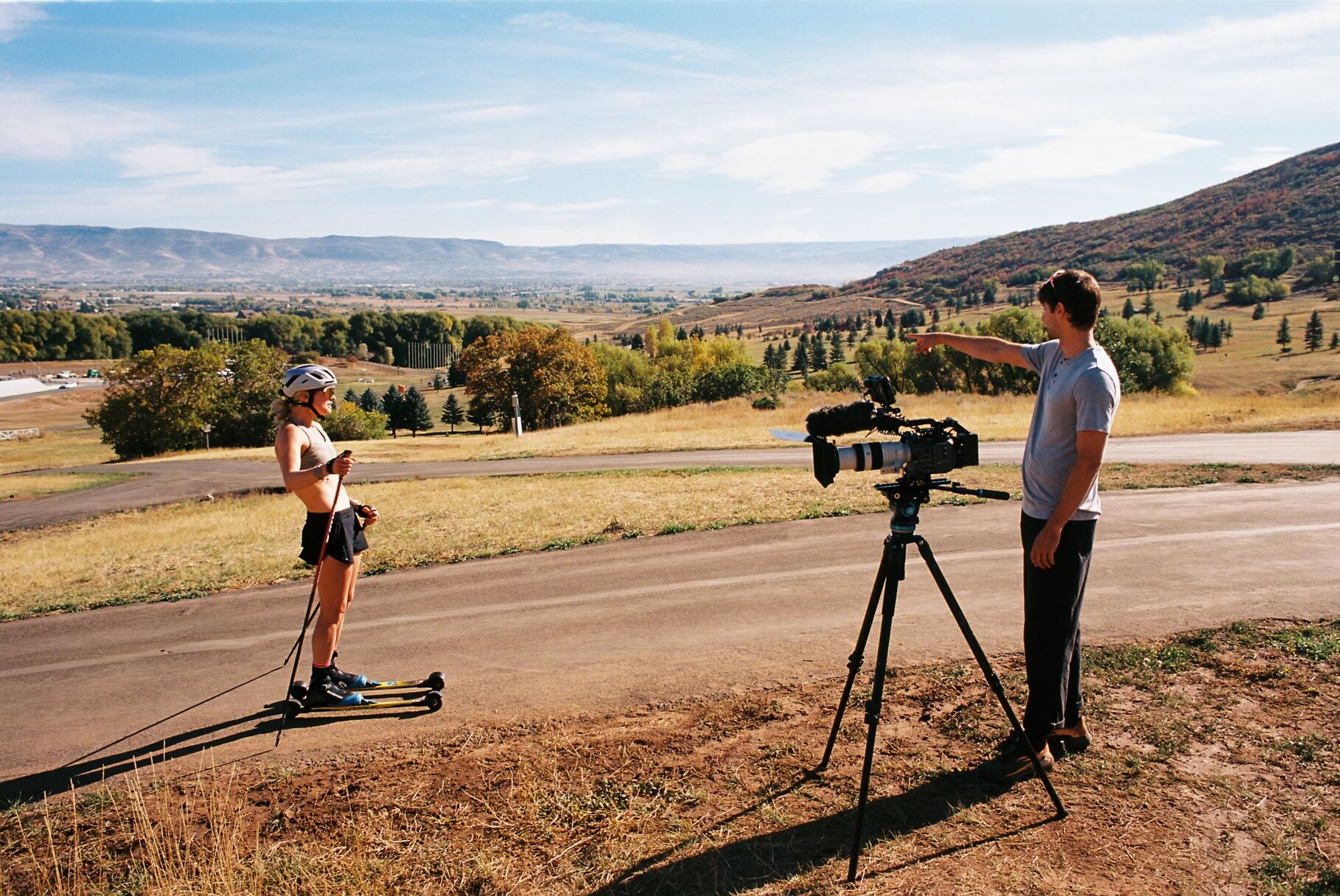
I think the team was happy to see filmmakers who could not get in the way of their workouts. Jessie had experiences in the past with a brand interrupting an interval session, asking her to do another interval. This is just something that would never even cross Lars and my mind, to alter the workout, because we know how intense they are. We know the workouts. We have done them before. So we were kind of flies on the wall, and I think that proved our ability both as skiers and as filmmakers, to be in that documentary position and not get in the way.
MV: What were you envisioning before it started to become more about the eating disorder and the mental health challenges?
LB: Just bringing this sport that we grew up in and that we loved to the masses. We had seen smaller endurance sports, whether it was a YouTube channel or on Netflix, sports that we loved but not a lot of people in the U.S. tracked. And there was always this element to the successful films about sports that was more the human side of the story. We approached it very open-ended. We kept those options really open for a majority of our filming. We were still capturing when we went on the World Cup, talking to European athletes, we had some fun conversations with Klaebo on camera. We just spent every waking moment following different stories.
I would say we were definitely, kind of subconsciously, following Jessie’s story more than others, and that just developed over the time of filming. Not until the editing process is when it really shaped. We had 500 hours of footage, so many different interviews with so many different athletes, doctors, staff on the U.S. team. And as we started to screen rough cuts to film industry people around Los Angeles and New York, we were getting so much feedback that Jessie’s story was the most resonant of all of them.
MV: You have 500 hours, and then at some point you have to make the decision that almost all of it is hitting the cutting room floor. How do you feel your way through that?
TB: Having an editor who had never cross-country skied before was totally instrumental in figuring out what would resonate with the wider audience we knew we had to appeal to. And there are also those moments where Lars and I were deep in the Arctic Circle, freezing our butts off, trying to get a time-lapse of the northern lights, out there for two hours and so attached to this one shot that we worked so hard for. I remember being in the cutting room and him saying, it is not serving the story, you have to cut it. Those were the things that were so hard to let go of.
And of course all these other stories, U.S. Ski Team members, Klaebo, Emma Ribom, Pellegrino, people that we really looked up to, and all of their stories deserve to be told. But at the end of the day, when you have this Jessie story that is so compelling, you cannot really deviate from it if you want to give her story the time it deserves. At the industry screenings, Lars and I walked in with a lot of questions about what would resonate with a non-skier audience, and people just kept saying, Jessie, Jessie, we want more Jessie.
Jessie Diggins and Torsten Brinkema at the team’s Park City camp, in the open-ended stretch of filming before anyone knew what the story was. (Photo: Willie Maahs)
MV: How did you get hooked up with Patrick Dempsey?
LB: It was about six months into filming, right after the Tour de Ski, at a camp between that and the next World Cup stop. Growing up in the Midwest, we did not have any connections to the whole Hollywood world, but we definitely needed to find someone to help us get a foot in the door. So we asked Jessie if she had anyone in her directory who worked in that space. She remembered that Patrick had supported the ski team, and she was able to just send him an Instagram DM. He responded right away and said to send Torsten to his house in Maine. A couple of months later we showed up at his doorstep and pitched him on the idea. He had grown up cross-country skiing in his backyard in Maine, so he is very connected to the sport and a huge Jessie fan.
MV: Jessie is big, but Dempsey is on another level. What was that like?
TB: It was pretty wild. We knew this was a ticket for us into a new world that we had always hoped to get the keys to. And credit to him for inviting us over, because the roadblock we hit at every stage of this process is that we have no films to our name. We have a couple of short projects that nobody has seen. So we are asking someone with the credits that he has to trust us with nothing to see for it. Obviously Jessie’s word goes a long way with him. We had to swallow our awe of him and realize this was a huge opportunity, and tell him what we really believed: that there was a story in those 500 hours. At that point we had not really cut anything. He became a very important part of shaping it down to what it became in the end.
MV: What other filmmakers have inspired you? What did you grow up watching?
LB: One huge one was Jimmy Chin, especially with Free Solo. That may have been the first ever documentary I saw in a theater. This niche sport was brought to a thousand theaters across the country… such a huge story and such an interesting character. That was one of the times we were like, wow, we could bring a sport that we love to the big screen in an impactful way.
TB: To add to that, I remember, I think it was actually while we were filming on the season, I saw a really old Herzog documentary from the 1970s called The Great Ecstasy of Woodcarver Steiner. Herzog was in his late twenties, early thirties, and he dedicated basically a whole year to following the ski jumping circuit, when it was at that really gnarly phase of people pushing the boundaries on these jumps, ending up jumping all the way to the flats, a whole bunch of drama between the jumpers and the officials. The fact that he was caught up in this story when he was around our age, and it felt like we were doing a similar thing, dropping everything to follow this circuit in unfamiliar landscapes. That just felt like, wow, if one of these great documentarians dropped everything for a ski documentary, we must be doing something right.
MV: It is expensive to travel around Europe for a whole season, and the ski team is pretty transparent that their budget is tight. How did you make those numbers work?
LB: We definitely had to pay our whole way through that season. There was not support from the ski team, in that they did bring us on, we were marked as members of the team crew, so we got our bibs and access to the races. But we basically had the ski team and Jessie help us find people who in the past had supported the ski team. It is not funded by the government; the ski team lives off these people who donate. So we went through their list of people who were instrumental in making sure the ski team could have success, people who paid for the wax van they use to this day. Over the course of filming we were always having to fundraise more and more money.
Later on, when we were fine-tuning the edits, there were still a lot of payments to be made. We talked to Jessie’s sponsor, the Emily Program. That was a really cool opportunity, because now they are supporting the film, but they are also bringing it around the country to treatment centers and educational screenings.
MV: You set out to tell a fun story and ended up helping people with something that is a real medical issue. Do you take a beat to think about that?
TB: That is kind of the goal right now. We had a release with Peacock, which in a way felt like being viewed by this Olympic ski audience, but not everyone in the U.S. has Peacock, so right now we are figuring out how we can reach the people we did not reach in that initial release. For sure our target audience is this young group of impressionable people who are growing up either struggling with this disorder or who have people around them who have struggled with mental health. We have heard from people who have never skied before who say they were so moved by Jessie’s story. That is the biggest compliment we can get.
It is a really hard thing to do, for her to pass one of the hardest years of her life on to us, filmmakers who had never made a film before, to then put out to the world. I remember when we showed her one of the rough cuts. She told us that this is the story her 18-year-old self desperately needed to hear. When we got her blessing, and when she said that, we took it and we ran with it, because we knew we could have that impact on countless other people who were struggling. That was a huge motivator for us.
Torsten Brinkema on a summit in the White Mountains of New Hampshire in April 2024. This one never made the film either. (Photo: Brinkema Brothers)
MV: Can you give me a specific memory from being in Europe?
TB: Mine jumps to not a specific story, but this life on the road, which was so crazy for Lars and me. It was crazy to see the athletes, but also the staff who have done this year in, year out. It really is a wild lifestyle, packing up and going to a hotel room in the middle of nowhere in Finland, where there is light for five hours out of the day, then getting up and packing up and going to the next location in Sweden. The dedication these crews have is crazy, away from their families, away from the normal comforts of living in the States, and the fact that they repeat it every year.
We pretty much joined every training session and filmed as much as we could, then charged the cameras and packed all the footage onto a hard drive. I always loved those nights when we were really tired, it is super dark out, there is nothing to do, and we would walk over to the wax truck and see what those guys were up to. It was always something fun. They are always blasting music, maybe having a shot of Jägermeister. I think they liked having us around because we were these young people who were totally oblivious to the waxing scene, so we could pick on whoever was not busy at the time. They had been living this life for five, ten years, and Oleg has been around, I do not want to quote how many. These guys are putting everything on the line and being away from their families to make the fastest skis in the world.
MV: You mentioned the cameras. What was the gear you used to capture these moments?
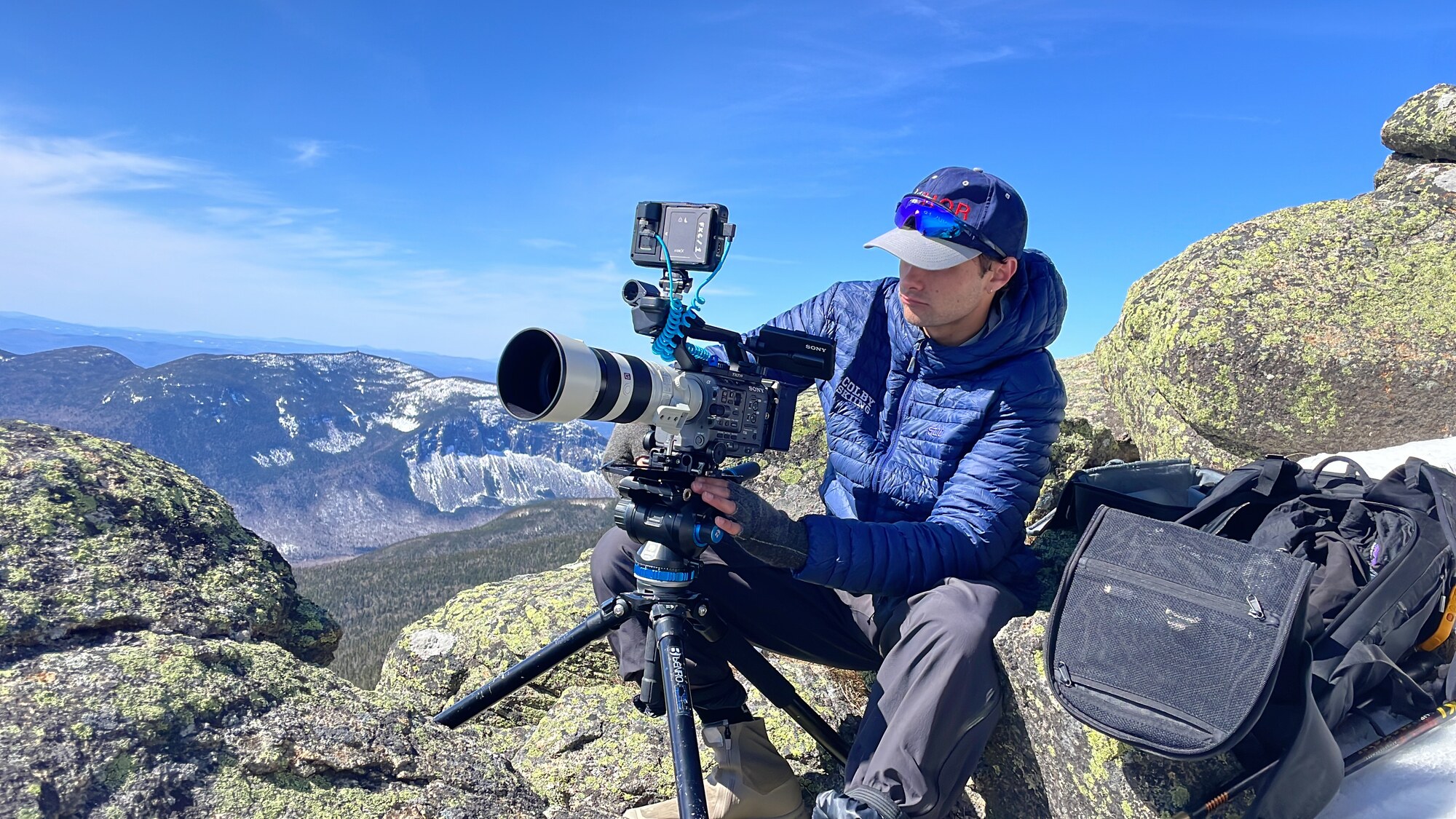
TB: We were rocking two Sony cameras, the FX6 and the FX3. That was a progression from, honestly, GoPros. Lars and I just loved being able to carry a camera that would not get in the way of anything, which was so important. We did a 20-mile run with Zanden, Gus, Luke and JC in Alaska, and we carried both our cameras and the drone in a backpack. We always wanted to be able to carry everything we had with only a backpack. That was the goal. In the winter we did a ton of skiing without poles, carrying those cameras, setting up a shot for a while and then skiing alongside people and trying to get it.
The drone was another really key part of the setup, because it let us get beautiful shots of people when we could not keep up with them, which was most of the time. We could only set up these flyby shots for a 20-second clip before they sped past us. We are super proud of those shots, because it took thousands of them to get the five or six that appear in the movie of Jessie flying by in a training session. We also had to figure out how to make the cameras work in the cold, which was something we had not really experienced before. It involved a lot of hand warmers and duct tape, but we eventually figured out a system that worked even at minus five in Finland.
MV: I have used hand warmers to keep my batteries warm too, but what is the duct tape for?
TB: Taping the hand warmers to the battery on the camera, right on the part of the camera where the battery is.
LB: We would have extra ones in our jacket pocket or in our pants, trying to keep them close to body heat so we could swap them out.
MV: Lars, what stands out for you?
LB: Just seeing the sport in Scandinavia was this insane experience. I remember the first Holmenkollen that we followed. I am sad it did not make the movie, but it was absolute mayhem. More people than are in the stadium for the Super Bowl. A hundred some thousand people in the woods watching these skiers who are going by maybe once every 20 minutes. It was not for a sprint, it was not for high impact crashes, it was just to watch these skiers go by, and they were so into it. I remember the big races in the U.S., high school meets, maybe the state meet, have a lot of people out there watching. But seeing all the young fans in Scandinavia watching this sport and being so jazzed up about it, maybe drinking a little too much during the race, it was such a cool experience that you do not get in the U.S.
TB: It was crazy to experience that and compare it to Minneapolis. We had plenty of those fan experiences, not to the scale of Holmenkollen, seeing the Swedes, seeing the Finnish people. But then coming back to Minneapolis, everyone who was there, most of them traveling long distances, doing crazy things to be there to watch the sport they had been waiting so long to see. That was insane in its own right, because here we are almost matching the energy of Holmenkollen on the trails Lars and I grew up skiing on. We learned how to ski on the 5k Wirth course.
Then I did a warm-up lap with Jessie before the 10k, and I started crying skiing down the sledding hill, because it was insane. The people, the roar of the crowd, traveling with her as she went around that loop. I feel like we were so blessed to be able to have that finish the movie, because it really felt like a homecoming for Jessie, and a realization of the legacy she has left, both in Minnesota and in the ski world.
Torsten Brinkema, left, on the warm-up lap with Jessie Diggins before the 10-kilometer freestyle at Theodore Wirth Park in Minneapolis, February 2024. (Photo: Dustin Satloff)
MV: What is something you are each really proud of?
LB: Just coming into the film with such an open idea about what it could be, and that every step of the way we had trust in each other that we were going to make this happen and get it to a large audience. As Tor mentioned, we stepped into a really hard time in documentaries to get one out into the world and make an impact through film. I think we just trusted at every step of the process that we were going to figure this out. Being able to do that and show it in person in Lake Placid and Minneapolis has been such an incredible experience.
TB: Going off of that, it felt like we were in such a unique position to tell this story. I am so proud of those POV shots we got on skis with the athletes. Again, that is the one percent of all the shots we did. But it is a crazy feeling, in a really crowded documentary landscape, to be one of a handful of people in the U.S., maybe even in the world, who can hold a cinema camera while going 30 miles an hour and pull focus and get that shot. It felt like a really proud moment just being like, wow, these turned out, and they are going to make it a better film, because you sort of feel like you are skiing with them.
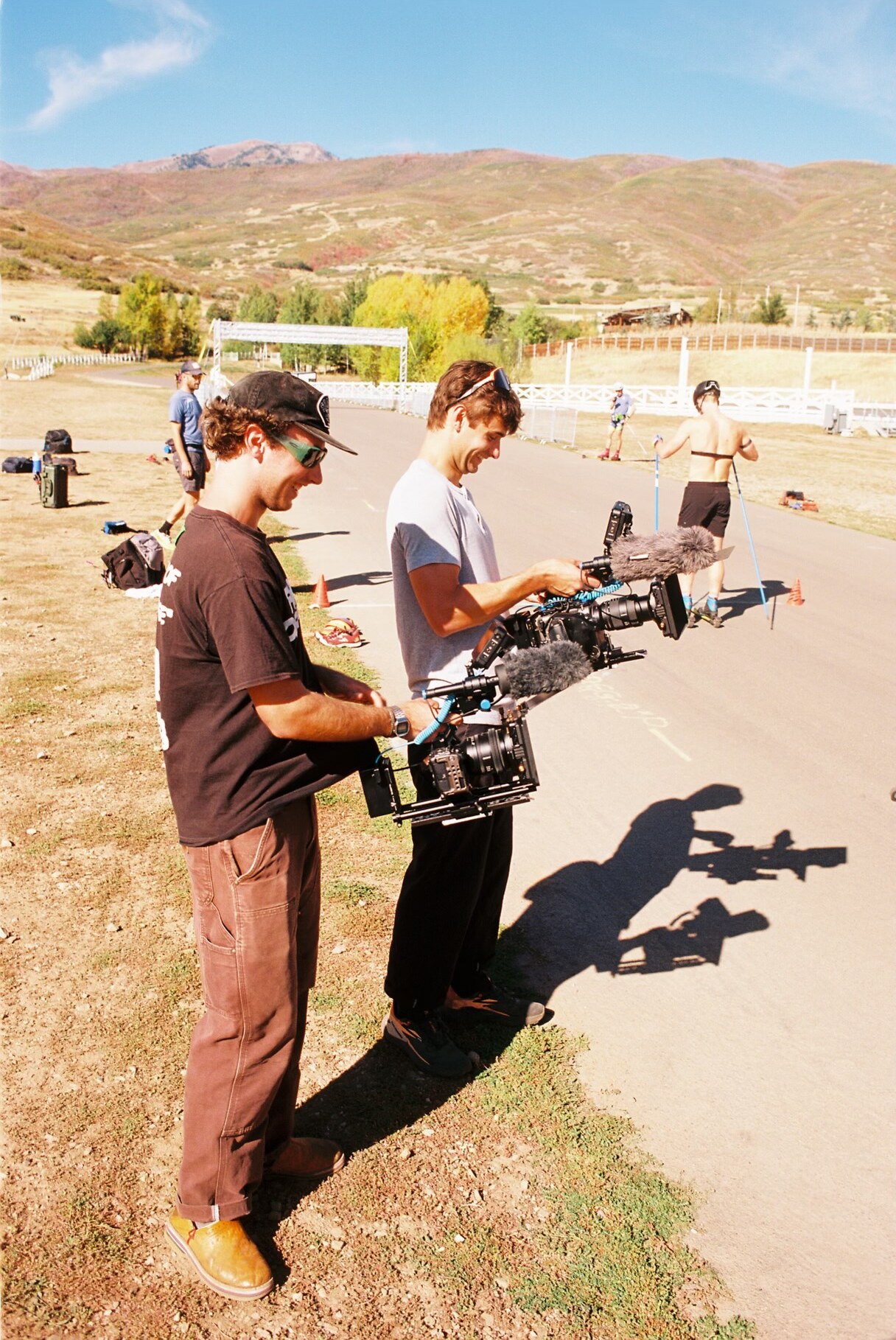
Lars, left, and Torsten Brinkema working the roller ski loop at the Park City camp, with the two Sony bodies that shot the season. (Photo: Willie Maahs)
MV: What was it like working with FIS? Those rights can be really muddy.
TB: It was definitely a headache to navigate Infront, basically a huge Italian conglomerate that controls a lot of these rights. We had a lot of negotiation with them, because we did want the context of the broadcast footage to feed into the intensity of the race segments. We wanted the tracker of kilometers to go. We wanted Chad and Kikkan announcing, which is so special and I think really leads the film in a way, because Lars and I never really wanted our voices narrating any of this. So we relied on the broadcast to be that context and the hype. It was an absolute pain in the ass, and that is kind of all that I will say.
MV: What is next?
LB: In line with Threshold, it was really special to bring something that is a subject matter so personal to us, skiing and mental health. So I think we will continue to create stories that are close to home. We are working on a film that will be set in Minnesota. It was such an incredible experience to show our city and our race course on the big screen.
TB: We are excited to push our own limits again, and I think this round that will be writing a script, so not a documentary for the next one. But we still definitely want to work together, because having this balance of brother filmmakers, we rely on each other for the things we do not know or that we are not good at. Again, feeling that itch to both tell a story about home and push our comfort zones, which this project definitely did.
Where to watch:Threshold is available to rent on Apple TV, Amazon Prime Video and YouTube in the United States and Canada. It premiered on Peacock in February, and a European release is planned for later this year.
Help Support Our Coverage!
If you value the thoughtful work and access FasterSkier provides, please consider becoming a Voluntary Subscriber. Your support directly fuels our work to cover the people, places, and moments that make our sport special.
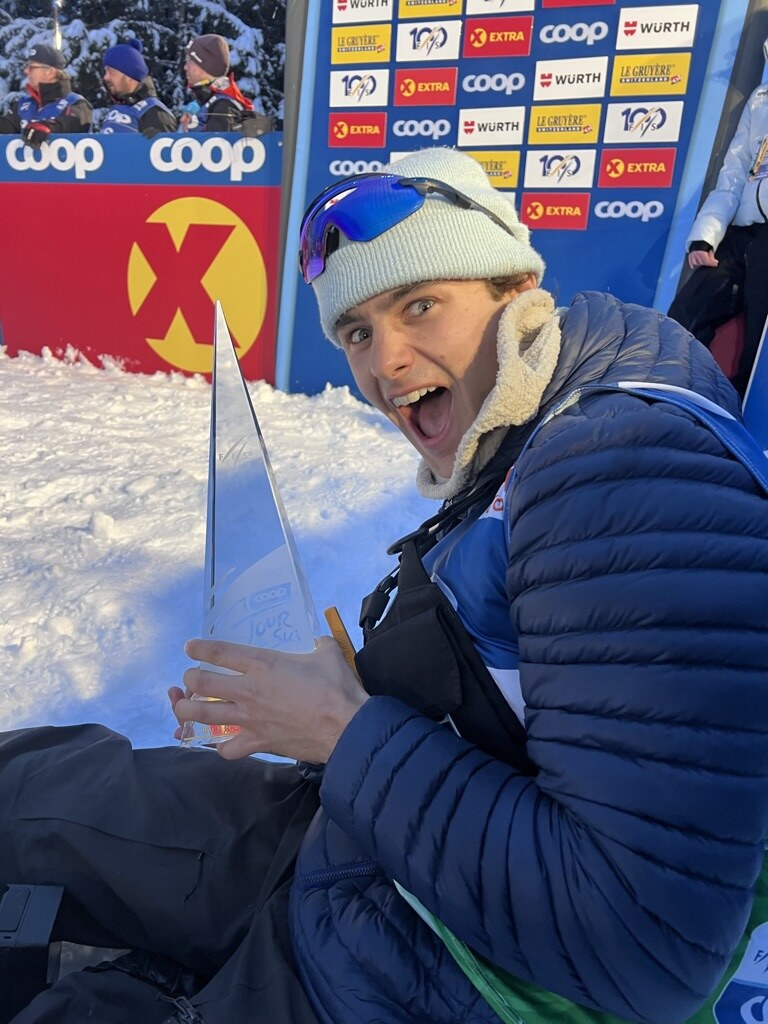
Torsten Brinkema at the foot of the Alpe Cermis final climb in Val di Fiemme, holding Jessie Diggins’ Tour de Ski trophy in January 2024. (Photo: Leann Bentley)
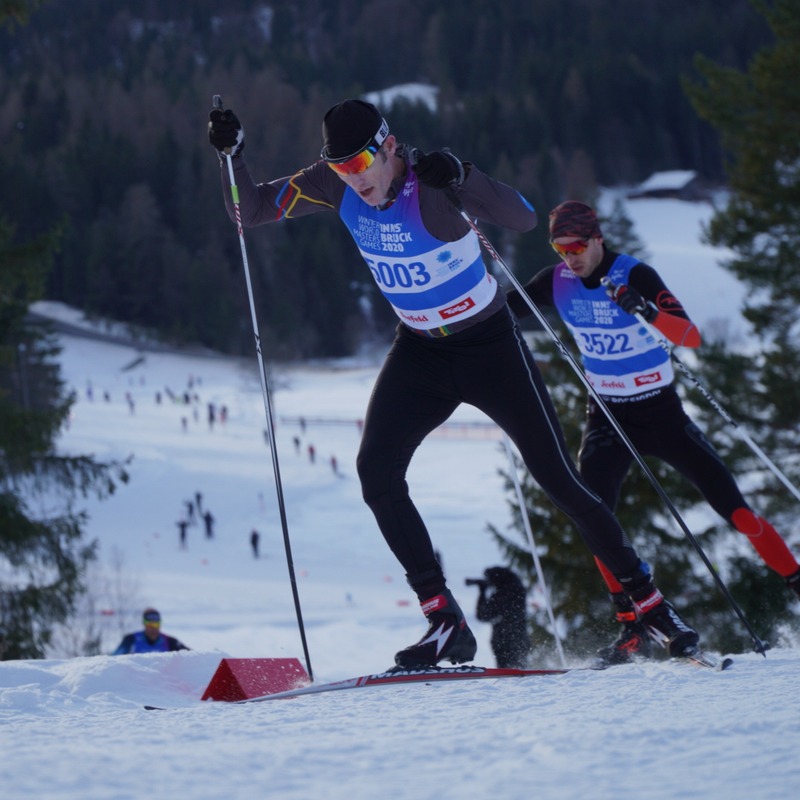
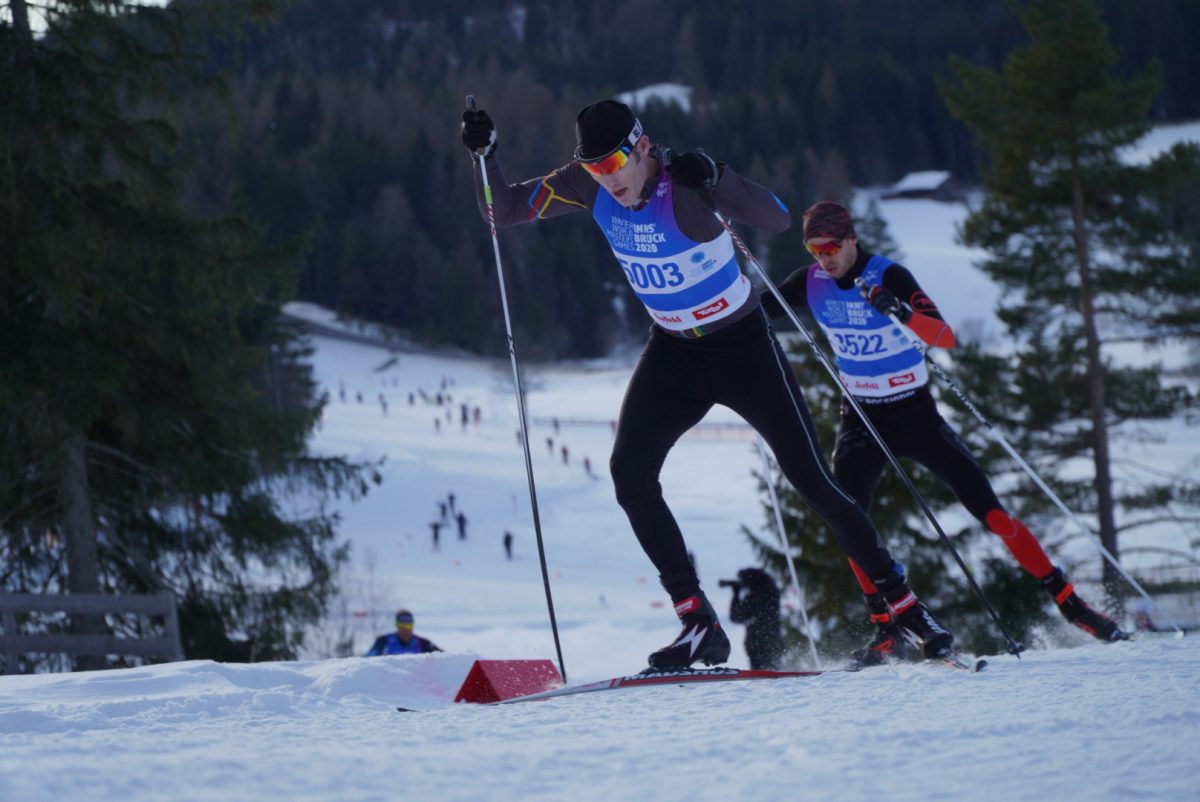
Tim Donahue racing at the 2020 Winter World Masters Games in Seefeld, Austria. Jim Galanes argues that the training masters skiers cut first is often the training that protects what aging takes away fastest. (Photo: Garrott Kuzzy / Lumi Experiences)
There are two common problems I see in the masters athletes I consult with or coach. The first is the same problem we see with athletes of all ages: they tend to train “half hard” every day. Half hard, Zone 1 quickly drifts into Zone 2 or 3. The second is more specific to masters athletes. They try to follow a training plan that is basically a dumbed-down version of an elite athlete’s program.
The first problem is relatively straightforward to address. Determine appropriate training zones and control the intensity of training more accurately.
The second is more complicated. We need to determine the volume of training an athlete can recover from, adapt to and maintain consistently. Then we need to organize that training around the physiological capacities that are most likely to decline as we age.
There is truth behind the conventional advice given to masters athletes. Recovery does change with age. Simply repeating the training we did at 25 or 30, or copying the program of an elite athlete, is never the best approach at 50, 60 or 70.
But there is a problem with how we sometimes respond to that reality. Many of the training components we tend to remove as athletes age are exactly the components that address the physiological capacities declining most rapidly.
The challenge of training as a masters skier isn’t simply figuring out how to recover better. It is figuring out how to provide enough training stimulus to maintain and improve the capacities that are naturally declining with age while still recovering sufficiently to adapt to the volume of training.
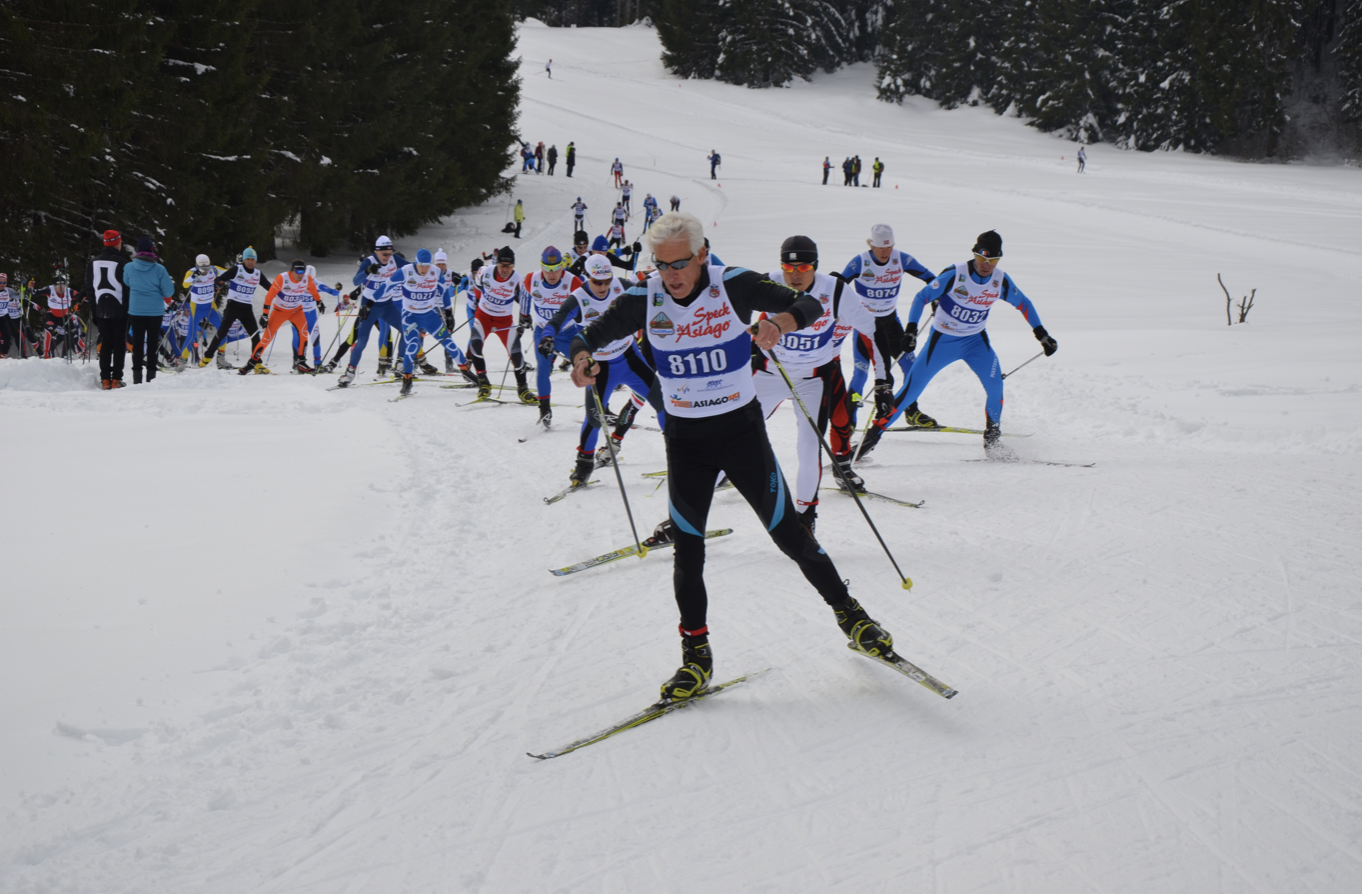
A masters field on the climb at the 2014 Masters World Championship in Asiago, Italy. Endurance performance declines with age, but the individual components of performance do not decline at the same rate. (Courtesy photo)
What Actually Changes with Age?
We know endurance performance declines with age, but the individual components of performance do not decline at the same rate.
One of the largest physiological changes is generally VO2max. Maximum heart rate declines. Muscle mass and maximal strength decline, both of which are important to maintaining aerobic capacity and skiing performance. Type II muscle fibers and explosive power become increasingly difficult to maintain.
Meanwhile, exercise economy and the ability to sustain a relatively high percentage of VO2max can be reasonably well maintained in highly trained older athletes. That should tell us something about training.
If these capacities decline at different rates, it doesn’t make much sense to treat them equally in training.
There is a temptation as we age to gravitate toward the training we tolerate best. The problem is that the capacities we tolerate best may also be the capacities we are already preserving reasonably well.
Training should not simply reflect what aging makes easiest to do. It must continue to address what aging is taking away. If VO2max, strength and power are among the capacities most vulnerable to aging, eliminating high-intensity and strength training in the name of increasing recovery may solve one problem while creating another.
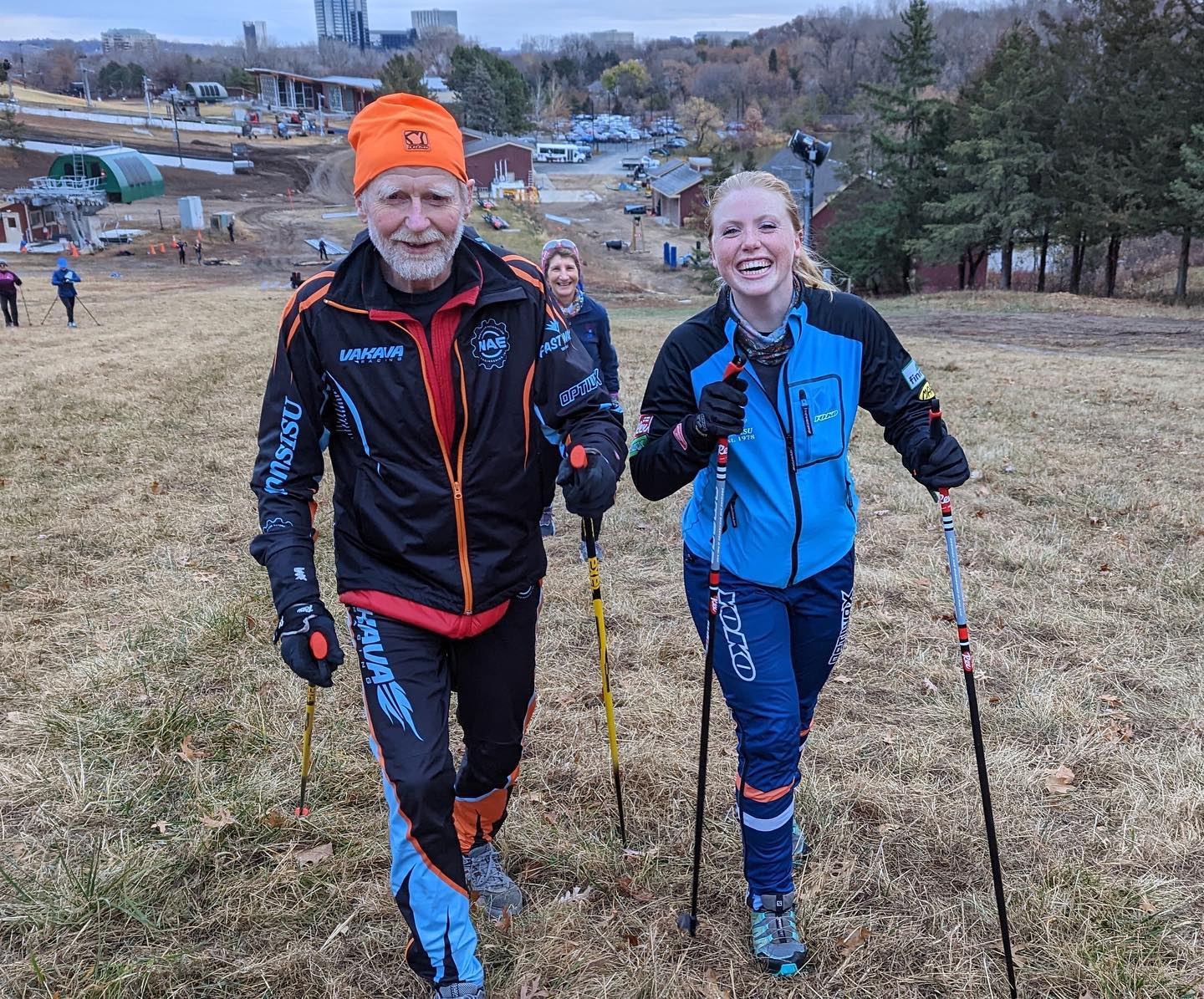
Ahvo Taipale during a Vakava training session. Consistently accumulated aerobic volume remains one of the primary drivers of endurance adaptation, and one of the best defenses a masters skier has. (Photo: Finn Sisu)
Maintain the Aerobic Volume
There has been considerable emphasis in endurance training recently on large volumes of low-intensity training combined with substantial amounts of threshold and sub-threshold work.
There are good reasons for that approach, particularly among highly trained elite athletes. But simply transferring that model to masters athletes can overlook the capacities most threatened by aging, particularly VO2max, strength and power.
So how much Zone 1? How much threshold? How much VO2max?
Those are important questions, but they can obscure something more fundamental.
Consistently accumulated training volume remains one of the primary drivers of endurance adaptation. Masters athletes sometimes respond to aging by progressively reducing volume and attempting to compensate with intensity. There are limits to that strategy.
Mitochondrial development, capillarization, fat oxidation, durability and the ability to maintain performance over long races are built largely through accumulated aerobic work. A two-hour easy ski is not interchangeable with a hard interval workout simply because the interval session produces more acute physiological stress.
For a masters skier who has trained for decades, maintaining as much sustainable aerobic volume as possible may therefore be one of the most important defenses against declining endurance capacity.
The key words are sustainable and consistent training.
The volume has to be performed at the right intensity. It has to be something we can recover from day after day and, most importantly, adapt to over weeks and months.
As we have written previously, occasional hero weeks followed by heavy fatigue and a subsequent reduction in training for recovery are less effective than weeks and months of consistent training at a sustainable level.
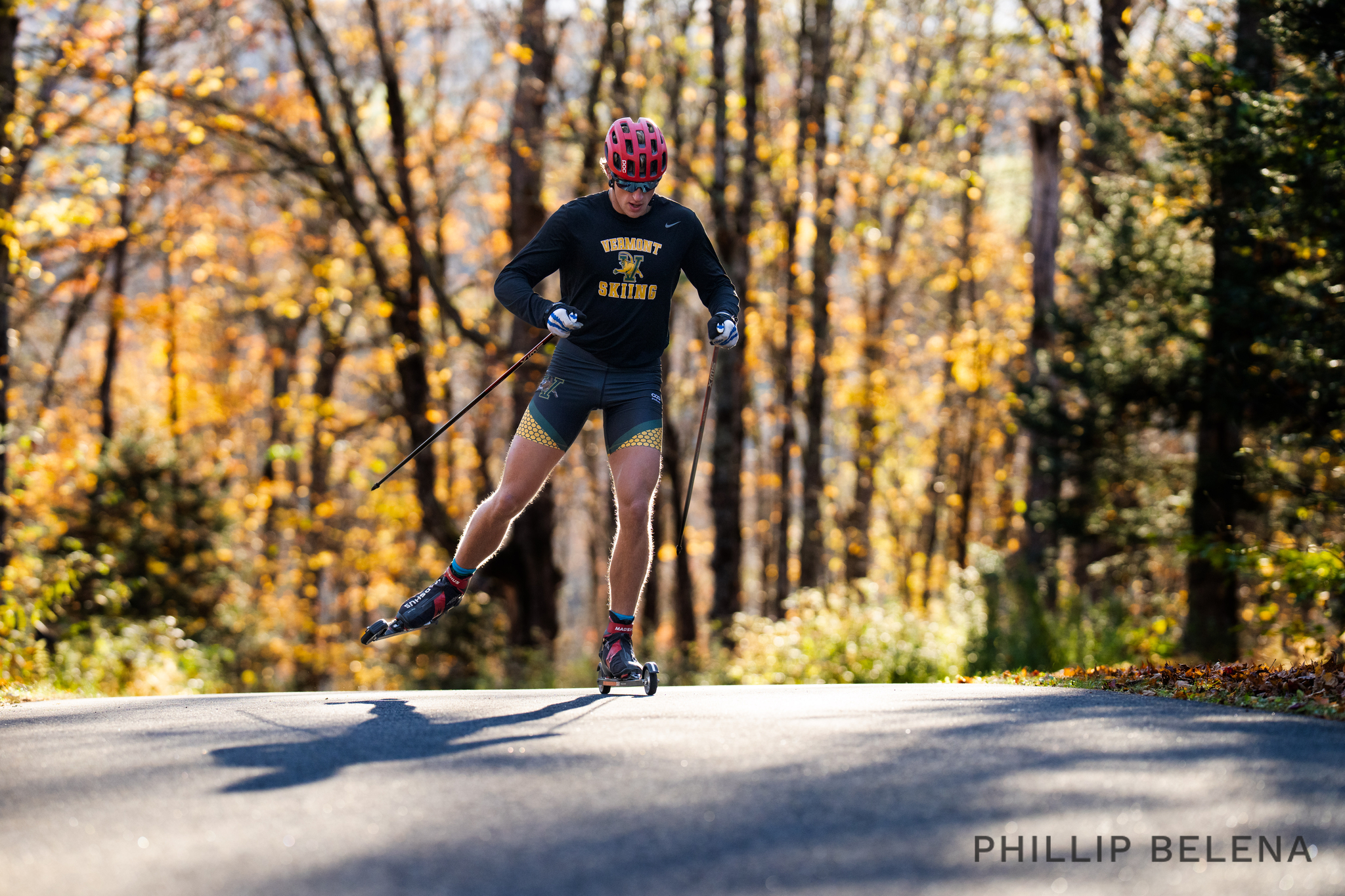
UVM’s Fin Bailey drives up a climb on the Craftsbury Outdoor Center track. The answer to aging is not necessarily more high-intensity training, but keeping the frequency of the stimulus while controlling the dose. (Photo: Phillip Belena)
Don’t Abandon Intensity
The opposite mistake is maintaining plenty of volume while gradually eliminating the hard training. This is understandable, particularly for those who enjoy the “half hard” training.
When we stop performing high-intensity training consistently, we lose some of our adaptation to that capacity. Every subsequent interval workout or race is then harder than it used to be, and recovery takes longer, because we have eroded that capacity. That can reinforce the idea that high intensity itself is the problem.
But VO2max is also one of the physiological qualities most strongly affected by aging. So the training stimulus we may most need to maintain becomes increasingly difficult to perform and recover from. The answer isn’t necessarily more high-intensity training. It is maintaining the frequency of the stimulus while controlling the dose.
That may mean less high-intensity work in an individual session, but performing it consistently throughout the year. Fifteen to twenty productive minutes near VO2max may provide a better stimulus than turning every interval workout into a contest to see how much we can do. For many masters skiers, one or two genuinely hard aerobic sessions every seven to ten days may accomplish more than two or three mediocre high-intensity sessions every week.
The appropriate frequency depends on training history, age, fitness and recovery ability, not on a predetermined seven-day formula.
Gunnar Knapp finishes the Engadin Skimarathon. Threshold and sub-threshold training allow considerably more work to be accumulated at a high aerobic rate. (Photo: Garrott Kuzzy / Lumi Experiences)
Threshold Has a Different Job
Threshold training shouldn’t simply become the safer substitute for VO2max training. It is not. In fact, the metabolic and neuromuscular cost of a typical threshold session may be greater than that of a typical controlled VO2max session.
VO2max training provides a powerful stimulus to central aerobic capacity, cardiac output and the ability to deliver and utilize large amounts of oxygen. Threshold and sub-threshold training allow considerably more work to be accumulated at a high aerobic rate while developing the ability to sustain that rate economically.
One of the important considerations in deciding how much emphasis to place on each is fractional utilization: the percentage of VO2max an athlete can sustain for a prolonged period. An athlete with a relatively low VO2max but already high fractional utilization may gain relatively little by continually emphasizing the quality that is already strong while allowing the aerobic ceiling above it to decline.
Conversely, an athlete with a large aerobic capacity but relatively poor ability to sustain a high percentage of it may have considerably more to gain from threshold and sub-threshold training.
This becomes particularly important in highly trained skiers. The speeds elite skiers can maintain at threshold or just below it can be quite close to actual race velocities. That speed and the muscular demands associated with sustaining it are part of what makes the training effective.
For cross-country skiers, both qualities matter.
A skier may have an excellent VO2max but lack the muscular endurance to translate that capacity into sustained double poling or climbing. Another skier may have excellent threshold durability but gradually lose the aerobic ceiling above it.
The question isn’t whether threshold or VO2max training is better. The question is which physiological limitation we are trying to change.
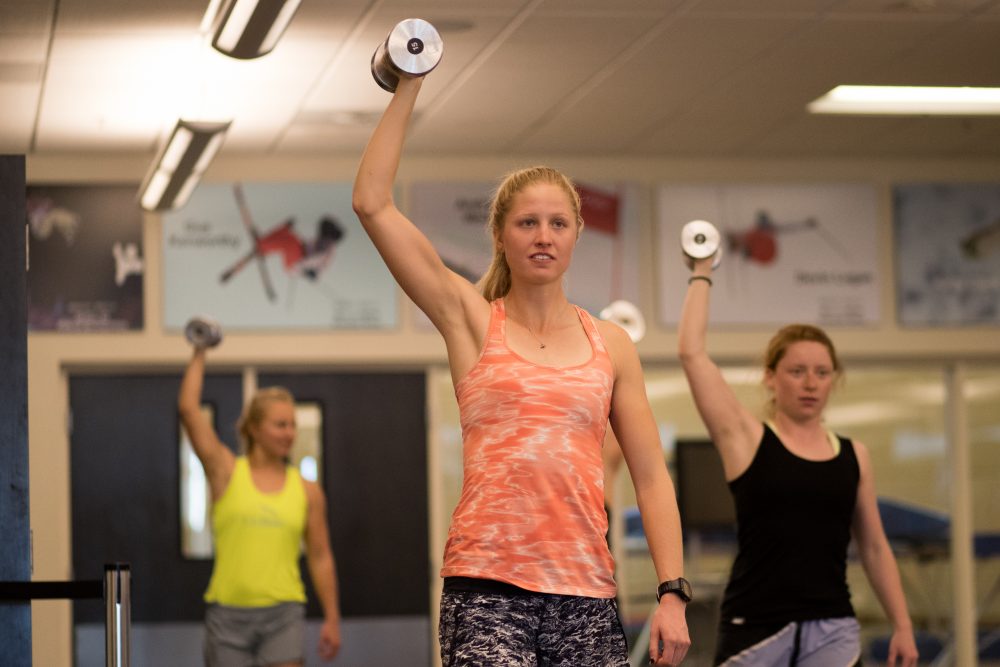
Hailey Swirbul during a strength session at a U.S. Ski Team camp in Park City, Utah. Research in cross-country skiers has shown that maximal-strength training can improve double-poling performance and economy. (Photo: Reese Brown)
Strength Becomes More Important, Not Less
Perhaps the clearest change in training priorities with age should be strength.
Cross-country skiing has become increasingly dependent on upper-body force, whole-body strength and power. At the same time, aging progressively reduces muscle mass, maximal strength and particularly fast-twitch muscle function.
Research in cross-country skiers has shown that maximal-strength training can improve double-poling performance and economy. One likely explanation is relatively simple. If every pole stroke represents a smaller percentage of your maximum force, repeatedly producing that force becomes less metabolically costly.
For masters skiers, developing and preserving maximal strength is particularly valuable because it provides reserve capacity. The goal is maintaining the ability to produce force.
That generally suggests relatively heavy resistance, good technique, low-to-moderate repetition ranges and sufficient recovery, rather than endless circuits of light weights.
Ian Torchia, right, leads bounding intervals up Stratton Mountain. Power tends to decline particularly rapidly with age, and short, fast work preserves it without requiring a large amount of metabolic stress. (Photo: Courtesy Stratton Mountain School)
Power Is the Forgotten Quality
Strength and power are not identical. Strength is how much force we can produce. Power is how fast we can produce it. Power tends to decline particularly rapidly with age.
Acceleration over the top of a hill, changing gears on a climb, responding to an attack, generating force quickly through the poles and maintaining technique at race speed all depend on the ability to produce force quickly.
Masters athletes therefore shouldn’t eliminate every fast movement from training. Short hill accelerations, controlled bounding, short ski sprints and explosive strength exercises can provide a neuromuscular stimulus without requiring a large amount of metabolic stress.
The dosage doesn’t need to be large. What matters is the peak stimulus.
But, as with nearly every aspect of training, consistency matters.
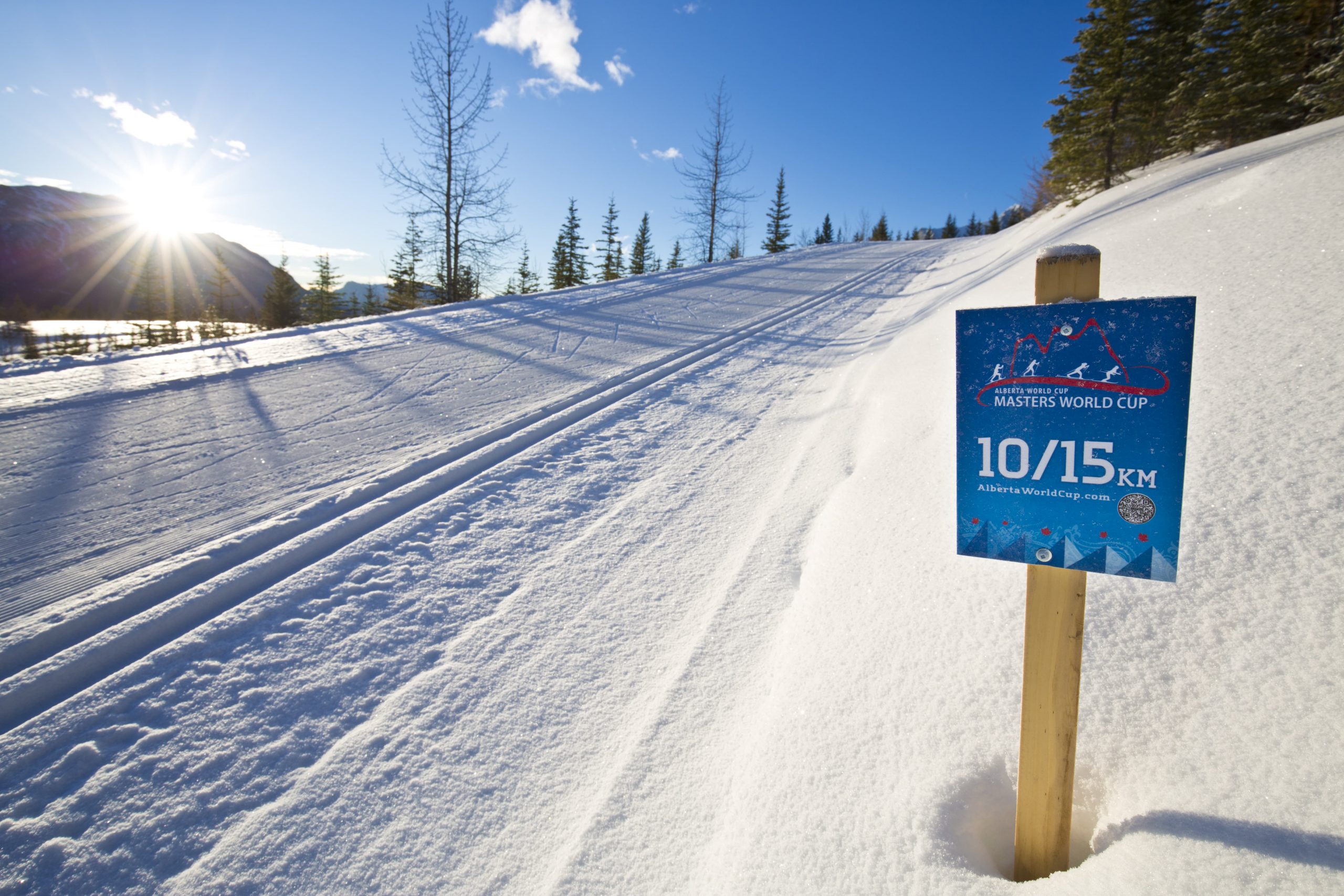
Fresh tracks on the Masters World Cup course in Alberta. Recovery is essential because adaptation occurs between workouts, but maximizing recovery is not the goal. (Photo: GibsonPictures)
Recovery Serves Adaptation
This brings us back to recovery. Recovery is essential because adaptation occurs between workouts. But maximizing recovery is not the goal of an athlete.
Maximizing adaptation is.
The masters athlete must solve a more complicated equation:
Stimulus + Recovery = Adaptation
Too much stimulus accumulated over days and weeks and we fail to recover sufficiently. Without recovery, we fail to adapt. The common theme in underperformance and overtraining is accumulating fatigue and a failure to adapt.
Sometimes the better solution is reorganizing the training. Instead of a pattern of hard, hard, easy, hard, easy, hard, exhausted, rest over seven days, a masters skier might organize training so the important sessions are separated sufficiently to perform them well and adapt to them.
The objective isn’t necessarily fewer quality sessions over the course of a month. It is enough recovery between those sessions to allow the athlete to absorb them.
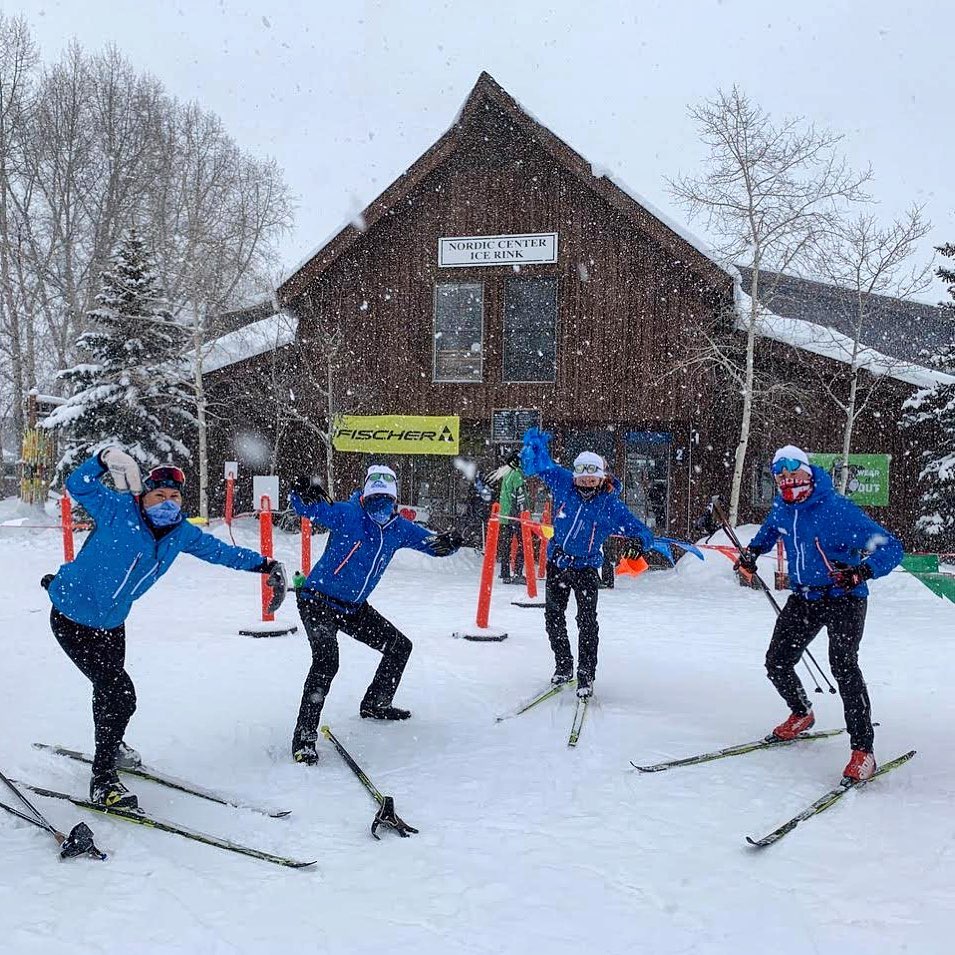
The coaches behind the masters performance group at Crested Butte Nordic in Colorado: from left, Rachel Bachman Perkins, Murray Banks, Cam Smith and Woody Martineau. Fitness is not created by individual workouts. (Courtesy photo)
Consistency Beats Heroic Training
For masters athletes, we need to adjust our perspective. Fitness is not created by individual workouts. It is created by the consistent implementation of easy endurance work, high-intensity aerobic training, strength, power and appropriate recovery.
One big interval session does relatively little. One big training week does relatively little. Forty or fifty good weeks stacked together can produce remarkable fitness.
That changes the definition of a successful workout.
The question is no longer: How much training can I survive today?
It becomes: What training can I absorb today that allows me to continue training tomorrow, next week and next month?
That doesn’t mean avoiding hard work. It means implementing both easy and hard training in a way that provides adequate space for recovery and adaptation.
Murray Banks at the Alley Loop in Crested Butte, Colorado. Chronological age alone doesn’t tell us enough: training history, injury history, available time, sleep, nutrition and life stress all matter. (Photo: Xavier Fane / Crested Butte Nordic)
The Masters Training Equation
Training, of necessity, must be individualized for athletes of every age. A highly trained 60-year-old with forty years of endurance training may tolerate workloads that would overwhelm a recreational 45-year-old who started skiing five years ago.
Chronological age alone doesn’t tell us enough. Training history, injury history, available time, sleep, nutrition, life stress and individual recovery all matter. But the physiological objectives remain surprisingly familiar.
Maintain aerobic volume.
Maintain VO2max.
Develop threshold and muscular endurance.
Preserve maximal strength.
Preserve power.
Maintain ski-specific technique and economy.
Then organize recovery around accomplishing those objectives. That is fundamentally different from starting with recovery and removing training until the athlete can tolerate what remains.
Masters athletes don’t need a watered-down version of elite training. Nor do they simply need more recovery. They need training organized around the physiological capacities most threatened by aging, with enough stimulus to preserve and improve those capacities and enough recovery to adapt to that stimulus.
Aging changes how we assemble the training. It doesn’t change what makes an endurance athlete fast.
The great opportunity of masters sport is discovering how much performance we can preserve, and in many cases still improve, by continuing to give the body both the stimulus and the time and space it needs to adapt.
Help Support Our Coverage!
If you value the thoughtful work and access FasterSkier provides, please consider becoming a Voluntary Subscriber. Your support directly fuels our work to cover the people, places, and moments that make our sport special.
When I asked Matt Whitcomb what surprised him about Threshold, the head coach of the Stifel U.S. Cross-Country Ski Team started by admitting he was tempted to make something up.
“This is the hardest question for me to answer, … but I haven’t watched it. I know it’s life-changing, but I don’t want to go back to that winter,” Whitcomb said. “I did my best as a coach, we all did, and it wasn’t good enough, and I’ve come to terms with my personal experience with it all.”
The winter in question is 2023-24, the season Torsten and Lars Brinkema spent inside the American team with two Sony cinema cameras, a drone, and no feature film credits between them. What came out of it is a documentary about Jessie Diggins and her eating disorder that premiered on Peacock in February and, as of last Friday, is available to rent on Apple TV, Amazon Prime Video and YouTube in the United States and Canada. A European release is planned for later this year.
Whitcomb is the person who let the cameras in. He is also, by his own account, the film’s loudest advocate.
“I know from the response that the film is excellent, and I know it’s changing people’s lives and is being featured in college curricula. I recommend it to everyone I speak to,” he said. “I’m very proud of Torsten and Lars and am grateful for the film. I support it completely.”
Lars Brinkema skiing with a cinema camera at a U.S. Ski Team camp in Bend, Oregon, chasing Jack Young on the trail. The brothers had done these workouts themselves, which is why it never occurred to them to ask an athlete to run one again for a better take. (Photo: Patrick Conroy)
“A couple of brothers got a camera for Christmas”
His first answer was no.
“I figured a couple of brothers got a camera for Christmas, had a couple beers, and then came up with a fun way to spend a year,” Whitcomb said. “I normally would’ve erred on the safe side and told them to take a hike, but Ben doesn’t toss around ideas lightly and so I followed up to hear more.”
Ben is Ben Ogden, who raced against Torsten in college on the EISA circuit and had watched him work at the World Cup in Norway that spring. Torsten had gotten there on a shoestring, having talked the Loppet Foundation, the Minneapolis club he and Lars grew up in, into sending him to shoot promotional material ahead of the 2024 World Cup at Theodore Wirth Park.
“I think they were kind of surprised to have an American photographer out there with them,” Torsten said, “just because they aren’t getting much coverage once they leave.”
Ogden pitched Whitcomb on inviting the brothers to the team’s Bend, Oregon camp that summer. The brothers bought cinema cameras and showed up.
What they had in mind at that point was not a film about an eating disorder. It was a film about a sport nobody in America watches, made in the shape of the niche-sport documentaries that had broken through elsewhere.
“We could probably do something like that with skiing,” Torsten said of the pitch they were making to themselves. “Make it look really cool.”
They had one asset that mattered more than the cameras, which is that they were skiers. Diggins had been through the alternative, brand shoots that treated an interval session as something you could run again for a better take.
“This is just something that would never even cross Lars and my mind, to alter the workout, because we know how intense they are,” Torsten said. “We know the workouts. We’ve done them before.”
Lars, left, and Torsten Brinkema at the U.S. Ski Team’s Park City camp. On the road the athletes called them Larry and Toasty. (Photo: Willie Maahs)
Toasty, Larry, and a problem with FIS
Whitcomb’s worry was culture, which he describes as something you protect rather than something you have.
The brothers had promised the arrangement would run both ways, that athletes would get usable footage of themselves out of it, and Whitcomb says they delivered. They also collected nicknames. Torsten became Toasty. Lars became Larry, or Lawrence in formal settings.
“These guys were ghosts at times where they would disappear for the day and nobody would see them,” Whitcomb said. “And then we’d see them at dinner and they’d be showing athletes their incredible footage of the team training or racing together.”
They washed dishes. They helped with wax testing. Whitcomb says everyone came to regard them as an addition to the team environment rather than a cost of doing business.
It was not frictionless. At the first race of the season in Finland, Whitcomb watched one of the brothers get chewed out in the finish area by a FIS official for filming in a zone reserved for the television production company. Later, on course in Toblach, he got a text from FIS with a screenshot attached.
“Larry running through the pines, keeping pace in his flatbrim hat and knit sweater, filming the lead pack. He was prominently within the TV feed,” Whitcomb said. “They asked if I could kindly remove him from the world feed. And you know what happened? Nothing. These guys said they were sorry and got a hand slap in each instance. Everyone likes them. They say things like thank you and sorry.”
The rights question got more expensive than a hand slap when it came time to actually build the film. The brothers wanted broadcast footage in the race sequences, the kilometer counters and the commentary, partly because they had decided early that they would never narrate the film themselves. That meant negotiating with Infront, which controls FIS media rights.
“It was an absolute pain in the ass, and that’s kind of all that I’ll say,” Torsten said. “Very expensive.”
The money came from nowhere institutional. The brothers paid their own way through the season and kept fundraising as they went, working through the list of private donors who already keep the U.S. team on the road. The Emily Program, which sponsors Diggins, came in later during the edit and is now bringing the film into treatment centers and educational screenings.
The Hollywood end of it started with a question the brothers asked Diggins at a training camp between the Tour de Ski and the next World Cup stop. They had no connections in that world and needed someone who did. Did she know anybody.
She remembered that Patrick Dempsey had supported the ski team before, and sent him an Instagram message. He answered immediately and told her to send Torsten to his house in Maine, where Dempsey grew up skiing. A couple of months later Torsten showed up at the door and pitched him.
“We have no films to our name. We have a couple short projects that nobody has seen,” Torsten said. “And so we’re asking someone with the credits that he has to trust us with nothing to see for it.”
Dempsey signed on as an executive producer and, by the brothers’ account, became a real voice in shaping the cut. Whitcomb offers it as a character reference. “I mean, Patrick Dempsey signed on with these guys. That should tell you something.”
Filming an interview with Johannes Høsflot Klæbo in Park City in October 2023. The brothers came home from the season with roughly 500 hours of footage and interviews across several national teams. (Photo: Daniel Sannum Lauten)
The pivot happened the following summer
This is the part Whitcomb wanted on the record, because he thinks people have the sequence backward.
“From the start, this movie was meant to highlight the entire team, and not just Jessie,” he said. “Months after the winter concluded, I think the Brinkema brothers realized that the film needed to hone in on the topic of mental health to have a clear storyline. I understood and supported that pivot, but the point is that the winter filming was not targeted at just Jessie. That filming happened the next summer.”
The brothers describe the same thing from inside the edit. They came home with roughly 500 hours of footage and interviews with athletes across several national teams, including Johannes Høsflot Klæbo, Emma Ribom and Federico Pellegrino. Their editor, Yaniv Elani, had never cross-country skied, which they now regard as the reason the film works.
Elani is also the one who made them cut the northern lights. The brothers had stood out in the Arctic Circle for two hours in the cold to get a time lapse they were proud of.
“It’s not serving the story. You got to cut it,” Torsten remembers him saying.
Then came the screenings for film industry people in Los Angeles and New York, where the brothers went in hoping to learn what a non-skiing audience would care about.
“People just kept saying, Jessie, Jessie, we want more Jessie,” Torsten said.
Matt Whitcomb during an interview with the Brinkema brothers in Burke, Vermont. “We missed the mark on supportive team culture as an entire team,” he said of the winter the film covers. (Photo: Brinkema Brothers)
“Our culture was at a 15 or 20-year low that winter”
Whitcomb does not soften the season the film covers.
“For anyone who has seen the movie, I think it’s no secret that our culture was at a 15 or 20-year low that winter. We had major struggles,” he said. He has thought about whether the presence of a film crew contributed to that, and concluded it did not.
He is also insistent that the winter was not one athlete’s crisis with everyone else watching. “It was one of the hardest times for several other athletes and coaches, too. This wasn’t just a Jessie issue. We missed the mark on supportive team culture as an entire team.”
Asked how he handled protecting Diggins against letting the story be told honestly, he rejected the premise.
“I never felt like I had to protect Jessie from the film. She was a part of the team-wide decision to allow the Brinkema brothers into the team for the year, and that was the main gate we kept,” he said. When the brothers asked him whether they could film something sensitive, a one-on-one meeting for instance, he sent them back to the athlete. “I would usually just tell them to ask Jessie what she was comfortable with.”
He watched her closely all the same, and says that had nothing to do with coaching. “That’s just because she’s a close friend, and friends look out for each other. But I had 100% trust in these guys, which is saying something because Lars was 19.”
Torsten Brinkema and Leann Bentley at the World Cup finals in Falun, Sweden, in March 2024. Bentley handles press for the cross-country and Para Nordic teams and appears in the film mostly doing her job in the background of somebody else’s scene. (Photo: Brinkema Brothers)
The person in the hotel room
Leann Bentley is the U.S. Ski & Snowboard communications manager who handles press for the cross country and Para Nordic teams, and she is in the film, mostly doing her job in the background of somebody else’s scene.
She was in the room when the coaching staff decided whether to say yes, and she remembers it being straightforward. Here were two people willing to spend a year telling a story she could not tell herself, and one of them had raced against these athletes in college.
The question she was asked for this story was how she decided where to draw the line once the film’s center became Diggins’ mental health. Her answer was that the question does not describe what happened.
“Short answer, no, I never had to tell them no,” Bentley said. “Long answer is I of course will always protect my athletes. But at the same time, they’re protecting themselves. And throughout this entire process, Jessie was protecting herself. She knew what she wanted to give, and she knew maybe what she didn’t, but she was in charge of it from the very start. And so were all the athletes.”
The scene she keeps coming back to is a hotel room in Ruka before the press conference where Diggins told the assembled media she was dealing with her eating disorder again. Bentley says it was one of the most heavily attended press conferences she has run with her.
“There was a scene where I told her that it’s okay to be vulnerable. And I don’t remember saying that to her,” she said. “It really goes to show that when I work with these athletes, I’m working with them as people, and I’m really glad that came across in the film.”
Most of her season is not spent in hotel rooms in Finland. It is spent in Salt Lake City, awake in the middle of the night, watching the same feed as everybody else and then turning it into the clips and quotes that hundreds of thousands of people see, for twelve teams and more than 240 athletes.
Asked what the film got right about the parts of team life that press coverage never reaches, she was blunt about why the question has an easy answer.
“It got everything right because it was showing exactly what was happening,” Bentley said. Athletes race for a few minutes at a time, a few times a weekend. The rest of it is chess and cards and laundry and going for a run. “I don’t think a lot of people understand that being a professional athlete, you train so hard mentally and physically for what you do on the weekends during a race. And then that race ends and you have, I don’t know, ten more hours of the day left.”
Both she and the brothers land in the same place when asked for a favorite corner of that life, which is the wax truck, known on the road as Yolanda. Torsten’s version involves showing up on dark nights with nothing to do, music playing, occasionally a shot of Jägermeister, and a group of technicians who had been living this way for a decade or more and had stories nobody had ever asked them for.
I interviewed the American wax techs last winter in the lead-up to the Olympics, and they remain the most enjoyable conversations I have had for this site, so I will just agree with him.
Torsten Brinkema, left, and Lars Brinkema, right, filming Jessie Diggins, coach Jason Cork and Renae Anderson during a roller ski session at the Park City camp. (Photo: Willie Maahs)
What actually changed
The most concrete thing to come out of that winter is not on screen.
Whitcomb describes an Athlete Wellness Passport, a monitoring system covering roughly eight health areas for every athlete on the team, men and women, including bone density, blood panels, caloric balance assessment, menstrual health and a mental health questionnaire. The team dietitian tracks each category for each athlete, and a licensed professional is brought in when a category calls for it.
“It’s a safety net for the whole team,” he said.
What that system did not have in 2023-24 was a ceiling.
“What we were missing in the winter of 2023-24 was a plan for what happens when an athlete’s issue, like an eating disorder, advances beyond the qualifications of our professionals,” Whitcomb said. “In this case, we needed an eating disorder specialist MD on call, and we didn’t have one. We’ve debriefed on the experience extensively and have brought in the person we wish we already had in place going into that winter.”
For coaches who watch the film and want something to do on Monday, his answer starts with an assumption rather than a policy.
“If you coach a team of athletes, you likely coach some athletes who struggle with disordered eating, and you may never know who they are,” he said. He has had male and female athletes tell him about it years after they finished competing.
On his team the practical version is a conversation about meals, held once a year, in which everyone agrees to treat mealtime as a place where safety matters more than opinions.
“Everyone’s plate looks different, and everyone’s dietary needs and goals are different, and many of us are insecure, so the environment is ripe to be judgy and toxic,” Whitcomb said. “Talking it out isn’t perfect, but it helps.”
He got there by getting it wrong first, and he tells that story without cushioning it.
“As a young coach I used to think I could talk openly with athletes about their challenges with eating, body image, and weight. Then I learned from a parent that a comment I made to them regarding weight was harmful. Yeah, I know, duh. But I was 23 and some of you are now, too.”
His correction was to stop talking about any of it and refer everything to professionals, which he now says was better but too absolute. The current version is that he will talk with an athlete who wants to talk, if the trust is there, while being honest about where his expertise ends and activating someone qualified.
Lars Brinkema, Torsten Brinkema and Andrew Peterson take questions after a private screening of Threshold in Minneapolis in January. Diggins has asked teams to treat the film as “a visual book club.” (Photo: Sawyer Brice)
What Diggins wants out of it
Diggins raced her last World Cup in Lake Placid in March. She did not do a new interview for this piece, but she wrote at length on Instagram when the film went back out on Friday, and the argument she made was that the documentary is not really about her.
Her request to teams, high school through professional, was that they treat it as “a visual book club.” Watch it, then talk about it. What pressure does this sport put on you. What kind of team do you want to be. And for coaches, find out now where you would send an athlete who comes to you, before one does.
She also made a point the film cannot make on its own, which is that the recovery in it happened in hundreds of hours of therapy and clinical work that were never filmed and could not have been.
Torsten Brinkema, left, Jessie Diggins and Lars Brinkema in the finish area in Falun, Sweden, in March 2024, after Diggins wrapped up the overall World Cup title. (Photo: Modica/NordicFocus)
When the film premiered in February, she put the goal simply in a U.S. Ski & Snowboard release: “I wanted to help others feel less alone.”
The brothers are working on a scripted film now, set in Minnesota, still as a duo.
Whitcomb, meanwhile, is not planning to watch. He described where the last two years have left him without much interest in tidying it up.
“We’ve made improvements to our system because of lessons from that winter, and we became better coaches and teammates. I’m moving forward as an improved coach.”
And then the part that sounded most like a coaching philosophy: “Your coaches and staff must truly care about the human condition. That’s your foundation. Get rid of the ones who don’t and add more who do.”
Where to watch:Threshold is available to rent on Apple TV, Amazon Prime Video and YouTube in the United States and Canada. It premiered on Peacock in February, and a European release is planned for later this year.
Help Support Our Coverage!
If you value the thoughtful work and access FasterSkier provides, please consider becoming a Voluntary Subscriber. Your support directly fuels our work to cover the people, places, and moments that make our sport special.
Cross-country skiers rarely travel light. For the Broken Arrow Skyrace, however, Kendall Kramer’s entire racing kit amounted to one pair of shoes and one outfit, both tucked into a carry-on. But after a winter ruled by equipment and logistics, simplicity was part of the point.
The self-funded trip to California with her mother was supposed to be, in Kramer’s words, “a fun little side quest.” She had watched Jessie Diggins race at Broken Arrow in previous summers and submitted an elite application in February, when the event was already sold out. If the organizers accepted her, Kramer decided, she would take it as a sign to go. They did, and four months later the side quest sent her home with a place on another U.S. national team.
Kramer completed the June 19 Ascent in 48 minutes, 14 seconds, finishing 11th among women in an international field and fourth in the separate USATF Uphill Mountain Running Championships. The latter result earned the 2026 Olympian one of four women’s spots on the U.S. team headed to the World Mountain Running Association (WMRA) World Cup Finale in Quebec this October.
Kramer climbing at the Cirque Series race at Alta, Utah, in 2025. Summer mountain races have been part of her calendar for years. (Photo: Austin Elliott Photography)
A Race Within the Race
The Broken Arrow Ascent rises 2,840 feet over 3.61 miles at Palisades Tahoe, ending near 9,000 feet on Washeshu Peak. The course offered Kramer a familiar kind of discomfort. Skiers spend plenty of summer training sessions running uphill, and she has raced mountains throughout her life in Alaska. She was also drawn to an uphill-only event, where she could attack the climb without risking the pounding, falls and injuries that can accompany a technical descent.
The altitude complicated the effort. An ascent race can feel like a sprint, Kramer said, because its short length allows runners to push rather than settle into prolonged power hiking. Near 9,000 feet, that approach requires more restraint. Still, years of ski racing and training at elevation gave her a sense of how to manage those obstacles.
Kramer had entered with a tangible goal: finish in the top 10 and earn prize money. The field was strong enough that doing so, she felt, would also establish her among other serious mountain runners.
She started picking off competitors as the course climbed and found another surge near the end, when a cluster of women remained within reach. Kramer lost track of her exact position amid the passes but knew she was close. She crossed two seconds behind 10th place.
“I was like, ‘Oh darn,’” Kramer said. “At least it was a good effort race.”
Weeks earlier, the elite runners had been told that the Ascent would double as the USATF uphill championship and a qualifier for the World Cup Finale. Kramer bought a USATF membership and entered that competition, too, mostly because there was no reason not to. She skimmed the qualification information without giving it much thought.
“This field is crazy,” she remembered thinking. “That’s not really going to be me.”
After the race, Kramer and her mother began walking from the summit toward the tram. She checked the overall results first. Then she noticed a separate view for the USATF championship, which removed athletes who were not entered in the national race. Kramer had nearly forgotten about the competition within the competition.
Her name was listed in fourth, and the top four qualified.
“I totally didn’t factor myself into that,” Kramer said. “It was definitely a surprise. I was really proud that I could make a team like that.”
Kramer may not have expected the qualification, but it drew on years spent building the aerobic engine and uphill strength that mountain racing rewards. She simply had not imagined that an ability maintained partly for balance and enjoyment would carry her onto another international team.
Kramer came to athletics through running before she found skiing. Both of her parents are runners. (Courtesy photo)
A Runner First
Running has never felt like a secondary sport to Kramer, even as skiing became her profession.
“Running was always my main sport, in the sense that that’s what I got into when I got into athletics,” she said.
Both of her parents are runners, and running shaped the athletic culture of her family in Fairbanks. She tried soccer and baseball, but she liked the directness of a sport in which her work and her result felt closely connected. Skiing came later because, as she put it, it was “what all the cool kids did.”
The two sports eventually became inseparable. At the University of Alaska Fairbanks, Kramer competed in both throughout college. She won three straight Great Northwest Athletic Conference cross-country titles and finished second at the 2024 NCAA Division II Cross-Country Championships. Four months later, in the final ski race of her collegiate career, she won the 20-kilometer freestyle at the NCAA Skiing Championships.
Kramer’s skiing has since reached a new level. She made her Olympic debut in Italy in February and placed ninth in the World Cup skiathlon in Falun in March, her first top-10 World Cup result. Yet running still supplies something that skiing cannot.
“If I didn’t have it, I wouldn’t be able to handle all of the skiing that I do,” Kramer said. “I like feeling like I have another athletic outlet to keep me happy, because skiing can be fleeting and have all sorts of disappointments with equipment and stuff. Running feels more in control.”
That control is physical, but it is also logistical. A ski race can hinge on wax, snow, weather and the work of moving equipment from one place to another. Running asks much less before the gun goes off. On a running trip, Kramer said, there is more space to enjoy the people and the place around the competition.
“It feels like it adds to your life,” she said. “It’s so manageable.”
The harder question came when her college cross-country career ended. Kramer loved the sport’s courses, team culture and changing terrain, but there is no obvious post-collegiate version of NCAA cross-country. Track and road racing did not offer the same pull, and she was not ready to build her running life around marathons on pavement.
Mountain racing offered another route. In Alaska, it had never felt like a separate niche so much as part of the local calendar. Races such as Mount Marathon and the Cirque Series became summer traditions, with familiar faces returning to familiar mountains each year. Two weeks after Broken Arrow, Kramer placed seventh at Mount Marathon in 52:53.
“I loved running cross-country and being in the woods and going along a course that has different aspects,” Kramer said. “You have an uphill and downhill, and you have to change, just like skiing.”
Mountain racing preserved the parts of running Kramer loved and opened a path to international competition she never expected to enter.
Kramer on her way to a career-best ninth in the World Cup skiathlon in Falun, Sweden, in March. She argues that summer racing is part of what makes winter results like that possible. (Photo: Authamayou/NordicFocus)
Keeping a Pulse on Racing
For Kramer, racing in the summer is not a diversion from ski training. It is one of the ways she makes that training more useful.
An occasional race does interrupt a perfectly planned week. She may back off for a few days beforehand, then need time to recover afterward. Some skiers see that as lost volume. Kramer believes the costs are outweighed by the chance to revisit sensations that ordinary training cannot reproduce.
“Racing is very different from training,” she said. “At least I think so, and I think it should be different from training.”
Kramer likes to race roughly once a month during the offseason. Each start provides a checkpoint on her fitness, pacing and ability to summon focus when a result matters. Those reminders make the first ski races of winter feel less abrupt; she arrives with recent evidence of how her body and mind respond in competition.
Races also make weaknesses harder to ignore. A disappointing moment can become the direction for the next training block rather than a problem discovered after the ski season begins.
“Sometimes you don’t get an idea of where you’re lacking and where your strengths are if you don’t tap into that throughout the summer,” Kramer said.
At Broken Arrow, the crossover was all around her. Olympic ski mountaineer Anna Gibson won the Ascent and the U.S. uphill title in 43:15. Diggins completed all three races, a total of 75 kilometers with more than 16,000 feet of climbing, and finished fourth in the Triple Crown standings. Sophia Laukli has built an elite trail-running career alongside cross-country skiing, winning the 2023 Golden Trail World Series. In August, Gibson placed sixth among women at Switzerland’s Sierre-Zinal, while the recently retired Diggins finished 37th.
Those examples helped Kramer recognize that mountain running can be more than incidental cross-training. The sport has international races, sponsors and prize money, particularly in Europe. Its U.S. elite pool remains relatively small, and a skier who already possesses a strong aerobic base can become competitive quickly. That does not make the crossover effortless.
“I’m not going to act like I’m couch-to-mountain-running,” she said. “I’m definitely trying, and I’m also not downplaying the girls who do train for it. But I am saying that ski training works for it, and getting fit in general works for it.”
The larger benefit may be less measurable than fitness. Elite skiers live by periodized plans: intervals on one day, over-distance training on another, each block designed to build toward winter. Kramer believes athletes can become so protective of that structure that they miss the value of occasionally disrupting it.
“People are really scared to break away from that,” she said. “But I think you can be a really adaptable athlete and build skills that a regimented training plan can never get you.”
Her confidence in that approach has been earned over years of combining running and skiing without sacrificing results in either. That history has also built trust with her coaches. An unplanned race or an imperfect training week does not look like recklessness when the larger pattern shows that she understands how to make the two sports work together.
The mental return matters as much as the physiological one. A summer race provides the competitive charge that long weeks of training can lack and asks an athlete to solve problems in real time: exactly what winter racing eventually demands.
Kramer on a run in the Alaska mountains. Her next start comes Oct. 10 at Mont-Sainte-Anne in Quebec. (Courtesy photo)
The Next Side Quest
Kramer’s next test comes Oct. 10 at Mont-Sainte-Anne in Quebec, where the circuit will make its first visit to Canada. The current course listing calls for five kilometers and roughly 800 meters of climbing. It will begin far below the altitude Kramer encountered at Broken Arrow, removing one variable while preserving a steep uphill challenge.
She wants to finish in the top 10. Broken Arrow showed that she can stay close to that range in a deep international field, and the chance to race without a near-9,000-foot finish has left her curious about what more she can do.
Beyond Quebec, Kramer would consider mountain races in Europe if a sponsor or U.S. team opportunity made the travel possible. She is not mapping out a second full professional calendar yet. The appeal lies partly in leaving room for opportunities to appear, then being fit and adaptable enough to take them.
“I would love to look back and see that I took those opportunities,” Kramer said. “Running has never hurt me in the past. I’ve always been able to juggle both.”
Kramer does not argue that every skier should copy her schedule. She wants more athletes to leave room for the experiences that may not fit perfectly into a training plan but help them handle everything racing asks of them.
“It can make you a better skier in ways that maybe aren’t the best training on paper,” Kramer said. “But it makes you a good athlete, which comes in handy when you least expect it.”
At Broken Arrow, that lesson was waiting in a second set of results she had nearly forgotten to check.
Help Support Our Coverage!
If you value the thoughtful work and access FasterSkier provides, please consider becoming a Voluntary Subscriber. Your support directly fuels our work to cover the people, places, and moments that make our sport special.
Kramer racing cross-country for Alaska Fairbanks. She won three straight GNAC titles and finished second at the 2024 NCAA Division II championships. (Courtesy photo)
The above discretionary selection process will be repeated for each period of World Cup this coming season. As always, if you have questions or concerns about this process, feel free to contact me directly.
U.S. Biathlon’s board votes Wednesday on a formal operating alliance with U.S. Ski & Snowboard. Supporters call it the stability the sport has always lacked. Skeptics call it a surrender of independence. Both are working from the same set of facts. Here is what the deal actually says, and what it would and would not change.
The U.S. Biathlon board of directors is scheduled to meet tomorrow, Wednesday, July 29, at 4 p.m. Eastern. This account is based on interviews conducted by FasterSkier with the chief executives of both organizations, a U.S. Biathlon athlete representative, the U.S. Biathlon head physiology coach, a written statement from the U.S. Olympic & Paralympic Committee, and a review of the alliance term sheet, three community working-group reports, and correspondence circulated by members opposed to the deal. All of these documents were posted publicly by U.S. Biathlon or provided to FasterSkier.
Campbell Wright (USA) during the biathlon sprint at the XXV Olympic Winter Games in Antholz (ITA). (Photo: Thibaut/NordicFocus)
Every winter, for a few weeks in February, cross-country skiing and biathlon stop being niche pursuits in the United States. During the last Olympic period, FasterSkier drew more than 180,000 unique readers in a single February, most of them people who do not know the sport’s governance history and have never heard of the Ted Stevens Olympic and Amateur Sports Act. On Wednesday afternoon, a board most of those readers could not name will vote on a decision that could reshape how one of their sports is run for the rest of the decade and beyond.
The question in front of the U.S. Biathlon board is whether to enter a “Strategic Operating Alliance” with U.S. Ski & Snowboard, the far larger national governing body that oversees Olympic and Paralympic skiing and snowboarding. Under the proposal, U.S. Biathlon would remain a legally separate organization and the recognized governing body for the sport, but would hand much of its day-to-day operation to U.S. Ski & Snowboard under a services agreement. To its architects, it is a way to give a chronically under-resourced sport the stability and commercial muscle it has never had. To its critics, it is the moment a proud, independent program stops steering its own ship.
The two sides do not disagree much about the facts. They disagree about what the facts mean.
What is actually being proposed
Strip away the temperature of the debate and the structure is specific, and it has changed meaningfully since the idea first surfaced publicly in the spring. The current terms, which U.S. Biathlon posted for its members on July 27, describe an alliance rather than a merger in the dictionary sense. No organization dissolves.
Under the agreement summary, U.S. Biathlon “will remain a separate legal entity,” keeping “its own corporate existence, financials, and independent audit.” It stays the governing body recognized by the U.S. Olympic & Paralympic Committee under the Ted Stevens Act, and keeps its membership in the International Biathlon Union, the sport’s world federation. Its name, logo, and trademarks remain owned by U.S. Biathlon and are licensed to U.S. Ski & Snowboard.
What changes is who runs the operation. Under a services, or operating, agreement, U.S. Ski & Snowboard would take over “staffing, programs, events, and administration for biathlon,” giving the smaller sport access to a chief financial officer, general counsel, marketing and revenue staff, medical and sport-science support, and technology infrastructure it cannot afford on its own. U.S. Biathlon’s own staff, its leaders say, would remain responsible for running the sport itself. A new Biathlon Sport Committee would be created inside U.S. Ski & Snowboard, mirroring the structure the larger body already uses for cross-country and its other disciplines.
Jack Gierhart, U.S. Biathlon’s president and chief executive, described the mechanism plainly in an interview. “The mechanics of this are like an operating agreement between U.S. Biathlon and Ski and Snowboard where they take over operations,” he said. “That’s how we’re honoring and satisfying the Ted Stevens Act.”
Sophie Goldschmidt, president and chief executive of U.S. Ski & Snowboard, framed the same structure around what biathlon keeps. “We would keep the biathlon entity. In fact, we keep the biathlon name, the biathlon logo,” she told FasterSkier. “From a legal perspective, it would also have its own entity. With that, it would have its own board. So very much operating like it does today, but sitting within a larger framework so that it can benefit from the other resources and shared knowledge, extra funding that we can provide.”
That phrase, “operating like it does today,” sits at the center of the argument, because a great deal depends on how much a board that has delegated its operations still actually decides.
USBA CEO Jack Gierhart poses with Max Cobb (IBU Secretary General) (l-r) at the IBU World Cup in Annecy-Le Grand Bornand (FRA) last December. (Photo: Manzoni/NordicFocus)
How the sport got here
By the account of the people who built it, this did not begin as a takeover. It began, Gierhart said, as an attempt to solve a problem every small Olympic sport shares.
Gierhart arrived at U.S. Biathlon in September 2022, as longtime leader Max Cobb was leaving for the IBU. The organization was early in a strategic plan aimed at growing the sport, and a central piece of that plan was working more closely with the cross-country community, since most American biathletes come from skiing. “From my experience being in sport for 25 years, when you offer people more options, more pathways, you increase retention and you grow the pie,” he said. “It’s like, this should be a no-brainer, but then you run into the cultures and communities.”
Those conversations, Gierhart said, drew in the U.S. Olympic & Paralympic Committee, which oversees and funds the country’s Olympic sports. “The USOPC started to suggest, hey, we’ve got a lot of these small NGBs, why don’t you guys think about something a little more formal?” he said. That was roughly a year and a half ago. The organizations sketched the basic terms, paused through the Olympic and Paralympic Games so as not to distract athletes, then brought the concept to a wider audience in the spring.
Goldschmidt described the same arc and made the case for why her organization wants biathlon at all. U.S. Ski & Snowboard already runs multiple sports under one roof, she said, which means it can absorb the compliance and administrative costs that crush small governing bodies. “The central costs can really be absorbed and be a real cost saving for those organizations,” she said. “Legal, finance, safe sport compliance, all of that, which is quite a big burden, especially on some smaller NGBs. We can absorb that quite easily without having to increase the cost base, which means practically more money is going directly to the athletes.”
The rollout did not land smoothly. After town-hall meetings drew pointed questions, the two organizations convened three joint working groups, on governance, sport development, and high performance, that met through the back half of July. Twenty-eight to twenty-nine participants, including athletes, coaches, club leaders, and staff, spent two weeks documenting what a successful alliance would require and what worried them. Their reports, posted publicly, have become some of the most revealing documents in the whole debate, in part because they capture both the community’s hopes for closer collaboration and its doubts, in the community’s own words.
Sophie Goldschmidt speaking at the Alpine World Cup in Killington, Vermont in 2024. (Photo: U.S. Ski & Snowboard)
The money, and the question at the center of it
Almost everyone involved agrees that money is the engine of this deal. What they do not agree on is how to describe the pressure behind it.
The clearest number comes from Gierhart. For the coming season, he said, the USOPC reduced U.S. Biathlon’s grant by 22 percent. The reason, in his telling, has less to do with the alliance than with a shift in how the USOPC allocates money. Roughly three years ago, he said, the committee created an investment framework weighted toward medal potential. “They told us a couple of years ago, you guys are one of the highest funded sports, you haven’t delivered medals,” Gierhart said. “There’s a good probability you’re going to get a cut. And that’s what happened. They cut us,” a reduction he put at 22 percent for this year.
Crucially, Gierhart rejected the idea that the cut is a lever to force the alliance. “It hasn’t been like, if you don’t do it, we’re taking away money,” he said. “It was, we’re taking away money because you’re over-resourced from our model standpoint and you’re not delivering. But if you go in this direction, which we believe will be beneficial in the long term, we want to help you do that.” Asked directly in a later FasterSkier interview whether it was a threat, he drew the distinction again. “They gave us our grant for this year, and it’s the 22 percent reduction. But they said that if we move in this direction with this alliance, they want to invest more in us. And they will find a way to do that,” bringing biathlon “back to where we were.”
Goldschmidt, in interviews with FasterSkier, likewise described the reduction as reversible if the alliance proceeds, and tied it to the USOPC’s belief that a more efficient biathlon can compete for medals.
The U.S. Olympic & Paralympic Committee, asked to confirm the figures and to say whether restoration of the funding is contingent on the alliance being approved, declined to address specifics. In a written statement, spokesman Jon Mason said the committee “is aware of and engaged in the discussions between U.S. Biathlon and U.S. Ski & Snowboard, and we support them taking a deliberate, transparent, fact-based approach to exploring a future relationship that complies with the Ted Stevens Olympic & Amateur Sports Act.” The committee, he added, is “supportive of outcomes that can build long-term stability and create opportunities for current and future generations of athletes.” The statement did not confirm the size of the cut, and it framed compliance with the Act as a goal the parties must meet rather than a settled fact.
What the alliance would add is documented. According to the high-performance working group’s summary, biathlon “would receive a ~$600k increase from current FY27 revenue projections” in the first year, with U.S. Ski & Snowboard guaranteeing an increase “from this year-one level through year 4.” Gierhart put the combined total, new revenue and shared-services savings together, at “at least” $3.3 million over four years. That money, in principle, flows back into programs.
Set against U.S. Biathlon’s roughly $3.5 million in annual revenue, those are not small numbers. And they arrive alongside a promise that biathlon’s existing money stays biathlon’s. Under the agreement, “all funding designated for biathlon, including IBU and USOPC support, existing sponsorship contributions, charitable donations, and other biathlon-specific revenue, will remain ring-fenced and used exclusively to support biathlon.”
Here Goldschmidt was careful to correct what she called a misunderstanding. The ring-fence, she said, is permanent, not a four-year arrangement. “All of the money that they generate that is ring-fenced for biathlon will continue to go to that program. That will be a contractual commitment,” she said. “Some people have got confused that we’re only committing to four years to ring-fence and provide them funding. That’s not accurate.” The four-year commitment, she clarified, applies to the additional commercial funding U.S. Ski & Snowboard brings to the table, which depends on the sponsorship deals it can renew.
Gierhart described the same two-part structure, and pushed back on the idea that biathlon falls off a cliff when the four years are up. “This gives us a platform for four years of sort of guaranteed increased revenue to build momentum and to implement the things that we know are going to help us,” he said. “Without that, we’re going to live year to year, and we’re already in maintenance mode as opposed to growth mode.” In four years, he argued, biathlon would be “in no different a situation than we are today. In fact, we’ll be better, because we’ll have a lot more resources to work with over the next four years.”
That distinction defines exactly where the community’s deepest financial fear lives. The money biathlon already raises is protected by contract. The new money, the actual growth case, is guaranteed for one Olympic cycle, through 2030, and after that depends on the USOPC and on sponsors, the same as it would if biathlon stood alone.
While much of the US biathlon community debates governance, the USBA’s Campbell Wright, Vincent Bonacci, and Maxime Germain (l-r) gets after their summer training in Font-Romeu (FRA). (Photo: Authamayou/NordicFocus)
The Ted Stevens question
No part of the debate has generated more heat than the law. A group of members, some of whom helped establish U.S. Biathlon as an independent governing body decades ago, argue that the alliance violates the Ted Stevens Act. Their case rests on two provisions.
The first is the single-federation rule. Under 36 U.S.C. 220522, a national governing body must be “a member of no more than one international sports federation that governs a sport included on the program of the Olympic Games.” U.S. Ski & Snowboard belongs to FIS, the International Ski and Snowboard Federation. Biathlon answers to the IBU. Critics contend that if U.S. Ski & Snowboard effectively governs an IBU sport, the arrangement collides with that rule.
The second is autonomy. The same statute requires a governing body to be autonomous, in that it “independently decides and controls all matters central to governance” and “does not delegate decision-making and control of matters central to governance.” Arthur Stegen, a former U.S. Biathlon board member and part of a group called Team Independent Biathlon, laid out the objection in correspondence circulated to other members and shared with FasterSkier: a services agreement that assigns operational responsibility to U.S. Ski & Snowboard, he argues, is by definition a delegation of control, and reducing the biathlon board to a sport committee “would appear to relinquish its governance responsibilities to another organization.” Stegen wrote that he is “completely against this potential merger.”
The written terms were plainly built to answer that challenge. The agreement summary includes a section titled “Reserved Governance Authorities,” which states that “notwithstanding any operational responsibilities delegated to U.S. Ski & Snowboard,” U.S. Biathlon “will retain sole authority over all matters required by the Ted Stevens Act or otherwise reserved to the National Governing Body,” including “oversight of the organization, approval of the biathlon budget, and all authorities reserved to the NGB.” In other words, the deal’s authors say operations are delegated while governance is reserved.
Goldschmidt said the structure was designed to align with the statute from the start. “We’ve worked with the USOPC and others to ensure it fits all of those criteria, which it does,” she said. Gierhart said U.S. Biathlon has already received an opinion on the point. “We’ve gotten the opinion from the USOPC’s legal counsel on the terms as they’re written now, and their opinion is that it meets the requirements and is in compliance with the Ted Stevens Act,” he said.
He was also clear about sequence, and described it as the normal way such deals come together. Wednesday’s vote is on the foundational terms, the fundamentals both sides have agreed to. “You’ve got to agree on the fundamentals, and then that’s what’s going to drive the detailed operating agreement,” he said. That more extensive agreement, covering licensing of the biathlon trademarks, the function of the board, and the bylaws, would be drafted next, “vetted by independent counsel” to confirm it complies with the Act, and then brought back to the U.S. Biathlon board, athlete representatives included, for a separate vote to approve it.
That staging is itself contested ground. Supporters see a standard process: agree on principles, then build and independently vet the detailed contract. Skeptics see a board being asked to commit before the full agreement exists and before the independent legal review happens, and some argue a binding vote should wait until both are done. What Wednesday’s vote actually authorizes, the concept or a finished deal, is a distinction worth watching closely as the meeting unfolds.
The USOPC, for its part, did not put its weight behind a declaration that the current structure is legal. It said it supports the parties “exploring a future relationship that complies” with the Act, language that leaves compliance as something still to be demonstrated.
There is precedent for the skepticism, and for U.S. Ski & Snowboard’s interest in expansion. The organization previously pursued governing roles in surfing and skateboarding, efforts that critics cite as evidence of a broader ambition to build a multi-sport governing body, the very kind of concentration the Ted Stevens Act was written to prevent. Goldschmidt described those episodes as different in kind. Surfing, she said, “just got too political,” and the organization walked away; skateboarding remains “ongoing” with “no immediate decisions.” Biathlon, she argued, is a natural fit that most European countries adopted long ago. “I get asked all the time, why is biathlon not integrated within your organization,” she said. “It’s a natural fit in many ways.”
Who controls the board
Because the autonomy argument turns on control, the composition of the board is more than a technicality, and it is an area where early rumors and current terms diverge sharply.
Gierhart was emphatic that the U.S. Biathlon board does not shrink or change hands. “The board is going to continue at the same size it is by the bylaws. It’s 12 to 15 members. They’re voted on by the membership,” he said. Those voters remain biathlon’s own roughly 1,500 members, whose categories will be tracked separately even after membership systems migrate to U.S. Ski & Snowboard’s platform in the 2027-28 season. “Our board size is not going to change. The composition is not going to change,” Gierhart said.
Just as important, he said, is what that board keeps deciding. Among the authorities it retains is control of the budget and the annual plan, meaning that where biathlon’s money is spent would still be approved by the U.S. Biathlon board of directors.
The new layer is the Biathlon Sport Committee, which the agreement describes as being drawn from the existing board, “6 to 8 members,” and maintaining the 33 percent athlete representation required by USOPC bylaws. The chair of that committee and one athlete representative would sit on the U.S. Ski & Snowboard governance board, giving biathlon two seats and a direct voice in the larger organization. The arrangement runs in both directions: U.S. Ski & Snowboard would, in turn, have representation on the U.S. Biathlon board.
Athlete voice, a recurring worry, is addressed specifically. Rather than being folded into U.S. Ski & Snowboard’s athlete representation, “biathlon would still maintain its separate voice of athletes on the Team USA [Athletes’] Commission,” Gierhart said. “We’d have our own.”
Even though Jake Brown officially retired from the IBU World Cup after last season, he has played an active role as an athlete rep throughout this process. (Photo: Authamayou/NordicFocus)
What changes for the athletes
For the people who actually race, the alliance is not an abstraction about governance. It is a question about who pays for the plane ticket to Europe.
U.S. Biathlon funds its athletes to a degree unusual among American winter sports. “Our athletes within biathlon are better funded and supported than in any other winter sport,” Gierhart said, noting that the program fully funds its World Cup athletes and nearly fully funds its IBU Cup athletes. Revisiting the specifics, he said U.S. Biathlon provides its athletes $48,000 in direct athlete support, $35,000 in need-based assistance, and $30,000 in performance bonuses, and secures roughly $36,000 a year for its top competitors. Cross-country, by contrast, does not pay national-team skiers to compete on the World Cup; much of that burden falls to clubs and to community fundraising.
That gap is the source of the athletes’ most concrete fear. Jake Brown, who retired from biathlon this year and sits on the U.S. Biathlon board as an athlete representative, said the worry he hears most is that biathlon’s funding model quietly converts to the ski-team model once the sports combine. He is careful to add nuance. “There’s nothing guaranteed that U.S. Biathlon will continue funding World Cups either,” he said. “The funding has to be there.” Biathlon also draws money from the IBU for each athlete who starts a race, which makes subsidizing those starts partly self-financing, and the sport has leaned into keeping athletes in the pipeline rather than cutting them early. “We can’t afford to lose them,” Brown said.
The agreement attempts to lock that model in place, but only for a defined window. The current athlete support model “will continue through the 2030 Olympic quad,” it says, with “National Team, World Cup, IBU Cup, Youth, and Junior athlete support structures” remaining “in place unless changes are jointly approved by the Biathlon Sport Director and the U.S. Biathlon Board.” As with the incremental funding, the guarantee runs one cycle. What happens after 2030 is precisely what no document can promise, though, as Gierhart notes, biathlon cannot promise that to itself every year either.
No voice in this debate has lived that risk more directly than Justin Wadsworth, the former U.S. Olympian who now is U.S. Biathlon’s Head Physiology Coach (working with both the men’s and women’s national teams) and who spent years coaching in Canada, including a stretch as a high-performance director there. Wadsworth described watching Biathlon Canada’s funding collapse. “Over the last eight to ten years, we’ve seen organizations having funded the athletes for all camps, all trips, everything, to now athletes paying for training camps, paying for trips,” he said. “That’s basically what’s really pulled Biathlon Canada down. The athletes just can’t afford to go on trips or training camps.”
The damage, he said, was not only financial. “It really changes the dynamic with the team,” Wadsworth said. “As a coach and as an organization, it’s much harder when athletes are paying for everything.” His wife, Beckie Scott, the Olympic champion who now leads Nordiq Canada, made cutting athlete fees a priority for exactly that reason. Asked what U.S. Biathlon should guard most carefully, Wadsworth did not hesitate. “The number one is just, are the athletes going to continue to be getting funded when they’re absorbed with U.S. Ski and Snowboard.”
Brown framed the same anxiety in a different register, as a question of trust. “There is a strength in independence,” he said. “You have a trust that your leader, when they put their head on the pillow every night, is trying to figure out how to make biathlon better in the country, and not trying to figure out how to prioritize what sport within a larger organization.” That, more than any statute, is the emotional core of the opposition: the fear that biathlon becomes one line item among many, advocated for by executives whose attention is divided.
The community’s own working group named the same items. The high-performance group’s report listed what “must be protected”: the centralized national team model, athlete stipends and need-based aid, the pathway that recruits skiers into biathlon, the world-class ski-service program, the Montana State University sport-science partnership, and “athlete-centered decision making.” It also warned, in writing, of the risk that unites the skeptics and the supporters, that “differences in stipends, housing, and athlete funding philosophies will be inequities across sports,” and that “the reasoning behind this must be explained well, or there is high risk of tension between sports.”
The case for
Set the fears aside and the argument for the alliance is not hard to follow, and some of its most persuasive versions come from people with no stake in the outcome.
Wadsworth, who says he has “no real skin in the game” and is “just trying to coach right now,” makes the efficiency case from painful experience. A small governing body cannot carry the overhead a large one can. “An appeal, from an athlete and the organization needs to get a lawyer for that, a single appeal can cost 30 to $50,000,” he said, “and if that’s 5 percent of your budget, that’s a big hit.” Fold biathlon into a larger organization with in-house counsel, fundraising staff, a training center, and sport scientists, he said, and those costs largely vanish. “Those efficiencies are really the positive side.”
Goldschmidt’s version is about scale on the revenue side. U.S. Ski & Snowboard, she wrote to biathlon’s members, generated “more than 900 million social media impressions and 7 billion earned media impressions last season,” counts more than a million social followers, and has “more than doubled our commercial revenue over the last four years,” with “nearly 85 percent of that revenue going directly to athletics.” Biathlon, by her argument, brings a genuinely valuable and telegenic property, the IBU World Cup is among the most-watched winter sports in Europe, that a 35,000-follower organization cannot monetize on its own. “One plus one can equal a lot more than two,” she said, “most importantly for biathlon.”
Gierhart’s case is about the limits of the status quo. “We’ve been doing the same thing for 60 years,” he said. “We’re a small sport, we have limited resources. We’ve always had a thin bench. But the formula isn’t changing. And if we’re going to try to drive transformational change, we’ve got to look at some things a little differently.”
And there is the pipeline, the argument that biathlon and cross-country are natural partners that have been kept artificially apart. Today a club that wants to offer both sports contends with two governing bodies, two memberships, two coaching-education systems, two calendars. The sport-development working group’s central recommendation was to merge those tracks, shared coach education, coordinated regional calendars, laser biathlon introduced to youth skiers, so that, in Brown’s words, the “big potential benefit comes in the sport development space.” Wadsworth added the practical constraint that enthusiasm tends to skip past: it comes down to shooting ranges. “The number one thing for biathlon is you need a range, and so that’s probably a limiting factor,” he said. “If U.S. Ski and Snowboard decides they really want to focus on the development side, they’re going to have to build more biathlon ranges. If you build it, they’ll come.”
Campbell Wright (USA), Maxime Germain (USA), Margie Freed (USA), and Deedra Irwin (USA), (l-r) after the IBU World Cup Biathlon mixed relay in Otepaeae (EST). (Photo: Manzoni/NordicFocus)
The case against, in the community’s own words
The sharpest questions about the alliance do not come from the members trading accusations online. They come from the process U.S. Biathlon itself ran. The working groups produced plenty of enthusiasm for closer collaboration, and their reports document at length the benefits participants believed an alliance could unlock. But the same reports surfaced a recurring doubt.
Across all three groups, participants returned to a single question: if the goal is collaboration between biathlon and cross-country, why does it require a formal alliance? The consolidated report notes that “several participants observed that many of these initiatives could theoretically be pursued without a formal alliance.” The sport-development group put it more bluntly in its written takeaway: “Some expressed confident progress could be made without an alliance. It is not accountability that will move this from conversation to action. It is the passion of the people involved in both sports.” (U.S. Biathlon cautions on every page that the working-group notes were “generated during meetings in which judgment was not applied” and “do not represent the decisions or strategies” of the organization.)
The governance group’s “parking lot” of unresolved issues reads like a checklist of the skeptics’ concerns: “Ted Stevens Act compliance,” “an escape path if integration fails,” “what autonomy does Sport Committee have to direct USSS operations,” and whether a replacement is needed for the athletes’ advisory council “to preserve biathlete input.” The high-performance group flagged “budget flexibility,” asked “which proposed benefits truly require an alliance, and which can already be achieved through partnership,” and wondered whether biathlon could build its own dedicated fundraising vehicle, an equivalent of the National Nordic Foundation, without merging at all.
U.S. Ski & Snowboard’s answer to the “why not just collaborate” question is that informal collaboration has been tried, and has not delivered. The alliance-alignment document U.S. Biathlon distributed argues that, while the two organizations “have collaborated successfully for many years, this formal Alliance creates a level of commitment, coordination and accountability that cannot be achieved through informal collaboration alone.” Gierhart put it more sharply. He said he disagrees “wholeheartedly” with the notion that passion alone will carry the work forward. “You need accountability,” he said, describing what he sees as a fundamental difference within the community over how things actually get done. Goldschmidt made the same point about incentives: absent a formal structure, she said, no one at a big organization is measured on whether they helped a small one. “Why would I help another sport if that’s not how I’m measured?”
Then there is the matter of process and speed, which even supportive athletes acknowledge. Brown said the spring rollout caught the community off guard. “It kind of came out in the springtime. It was a little bit surprising, and it took us some time to understand why,” he said. “Most of the membership and the athlete body, we had some catching up to do.” The working groups were themselves a response to feedback that the process had moved too fast with too little consultation, and some members continue to argue that a binding vote should wait for the final agreement and its independent legal review, both of which, by U.S. Biathlon’s own account, come after Wednesday.
The exit, and what the fine print says
If there is a single provision that will decide how much reassurance skeptics take from this deal, it is the exit. Gierhart is adamant that it is a last resort, not a trap door.
He described a defined process. Goals and key performance indicators would be set at the outset, with an assessment after the first year and a comprehensive review at the end of the quad. “If we get to a point where there’s irreconcilable differences,” he said, “then there is an option to move towards a different operating structure, which could mean that U.S. Biathlon becomes an independent operating entity again. And that is a choice that can be made by either party. It doesn’t have to be mutually agreed upon.”
He was careful to say that does not mean either side can simply walk away on a whim. The written summary describes an interim assessment after the 2026-27 season and a comprehensive review after 2029-30, and says that “should significant challenges arise that materially impair the objectives of the alliance, the organizations will first implement a corrective action plan.” Only “if substantial concerns remain unresolved after those efforts” would “alternative organizational structures, including the return of U.S. Biathlon to an independently operated organization, be considered.” That, Gierhart said, matches what he meant: a process of measuring progress against shared goals, trying to fix what is not working, and only then, if the problems prove irreconcilable, allowing either party to end the alliance without the other’s consent.
“I don’t want it to sound in any way that in four years there’s an exit ramp that’s most likely going to happen,” he said. It is less an exit ramp, in his framing, than a runaway-truck ramp: an emergency measure, rarely used, that exists only for the case where nothing else has worked. The distinction that matters, he said, is that the eventual decision does not require both sides to agree. “It would probably be the board of directors of U.S. Biathlon that would say, we can’t resolve these differences and we want to make a change. Or Ski and Snowboard would say this is not working.”
Emil Bormetti (ITA); Coach Team USA, Bjorn Westervelt (USA), Vincent Bonacci (USA), Campbell Wright (NZL), Maxime Germain (USA), Vaclav Cervenka (USA), (l-r) summer training in Font-Romeu (FRA). (Photo: Authamayou/NordicFocus)
What happens Wednesday
The board meets Wednesday at 4 p.m. Eastern. By Gierhart’s account, directors received an extensive board package over the preceding weekend, and the athlete representatives, who under USOPC rules make up a third of the board, have been closely engaged.
What the vote settles may be narrower than the noise around it suggests. If the board approves the foundational terms, the more detailed operating agreement, and its independent legal review, would follow, along with a further board vote to approve it. If the board balks, or postpones, the timeline slides. Either outcome will be read as a verdict on a process that many in the community found rushed and many others found overdue.
The stakes are real in both directions, which is why the debate has been so bitter. If biathlon stays independent, it does so facing a documented funding cut and the same structural constraints that have kept it small for six decades. If it joins, it trades a measure of autonomy for stability, resources, and a commercial platform it has never had, and it does so on the promise, guaranteed for four years and asserted in perpetuity, that the sport it has built will not be diminished inside a larger one.
The people on every side of this insist they want the same thing. “Whichever way the board decides,” Brown said, “I really want to be able to take our membership with us in whichever direction we go, and maintain good relationships with our full community. Because otherwise, we lose.”
On Wednesday afternoon, fifteen people will decide which way that goes.
FasterSkier will report the outcome of Wednesday’s vote. Reporting for this article included interviews with U.S. Ski & Snowboard president and CEO Sophie Goldschmidt, U.S. Biathlon president and CEO Jack Gierhart, U.S. Biathlon athlete representative Jake Brown, and U.S. Biathlon head physiology coach Justin Wadsworth, a written statement from the U.S. Olympic & Paralympic Committee, and a review of the alliance term sheet, the July 2026 community working-group reports, and correspondence from members opposed to the deal.
Because the details of this proposal are complex, quotations attributed to U.S. Ski & Snowboard and to U.S. Biathlon were provided to each organization in advance of publication so they could verify the accuracy of their own statements and clarify technical details. FasterSkier retained full editorial control over the content, framing, and conclusions of this article.
Help Support Our Coverage!
If you value the thoughtful work and access FasterSkier provides, please consider becoming a Voluntary Subscriber. Your support directly fuels our work to cover the people, places, and moments that make our sport special.
At this moment, we don’t know what is down the road for USA Biathlon, but hopefully we will stay a community that supports the sport and the hard work of the athletes and coaches doing their best to perform at the highest level. (Photo: Authamayou/NordicFocus)
For Ben Ogden, the strangest change since taking home two medals from Milano Cortina has not been that more people started recognizing him around Vermont.
He admits he is still adjusting to the newfound fame, but that part has mostly been fun. There have been school visits, community events and moments in Burlington restaurants when strangers stop by to say they watched him at the Olympics. After the winter Ogden had just put together, with two silver medals and a historic breakthrough for American men’s cross-country skiing, the attention made sense, even if it still felt a little surreal.
What was harder to make sense of was everything that came next, which has made the last few months a bit difficult to sum up neatly. While Ogden has spent the spring and early summer being celebrated for the best season of his career, he’s also been going through the first major injury setback of his life. One part of the experience has pulled him outward, back into the local Vermont ski community that helped shape him. The other has forced him inward, into the slower world of surgery, crutches, rehab exercises, and patience.
Ben Ogden posing for a photo with a few of his fans and the closest of friends of FasterSkier at the “Medals in the Mountains” community fundraiser held at Bromley Mountain Resort in Peru, Vermont, on April 12, 2026. (Photo: Jozefiak)
A New Kind of Attention
“It’s been different in some ways and similar in other ways,” Ogden said. “There are more people around Vermont who recognize me now, which is pretty crazy and fun. I’ve been invited to a lot of events, and gotten to go to a ton of schools, and just kind of been in the community a little bit more than normal.”
That part, he said, has been one of the real joys of the post-Olympic stretch. Ogden has always championed his identity as a product of the Vermont ski world, and the last few months have given him more chances to be present in it. Not just as a skier people watched on television, but as someone who could show up, talk to kids, say yes to local events and feel the reach of what happened in Italy.
“Outside of anything athletic related, it’s always a goal of mine to take my position and try to give back to the community as much as I can,” Ogden said. “There’s been a good amount of that, which has been great.”
In some ways, he said, life still feels mostly normal. It is still a Vermont summer. Burlington is still Burlington. Richmond is still close enough to feel like a small ski-world hub. But the medals have changed the way people interact with him, even in everyday places.
“It’s never tiring having people coming up to me and saying, ‘Oh, my son loves watching you,’ or, ‘We watched you this winter,’” Ogden said. “I love that, and it really makes me feel good. People are always, especially here in Vermont, just always so kind and thoughtful with their time and my time, so it’s never overwhelming.”
Still, there is a strange adjustment that comes with being recognized more often. Ogden laughed a little while describing it, not because it is a major burden, but because it is new enough to still catch him off guard. Sitting at a restaurant one time, he said two or three people came over to say they loved watching him race. Then he remembered, in a small way, that he is moving through the world a little differently now.
“You’re in the public eye a little bit more,” Ogden said. “I think you’re constantly reminded that people here in Vermont, especially, recognize me wherever I go. Again, I have no misgivings about it, but it’s hard to escape it a little bit.”
That visibility took on a more formal shape in May, when Ogden returned to UVM for commencement. He graduated from the school in 2022 with a mechanical engineering degree, and at first, he thought the university might just want him to be present or say a few words. Little did he know he would end up as the special guest speaker in front of nearly 3,700 graduates.
“I was like, ‘All right, yeah, sounds great,’” Ogden said. “And then it eventually got like, ‘Oh, you’re going to be the guest speaker,’ and I was like, ‘Whoa.’”
Ogden was characteristically candid with his explanation of how unfamiliar that setting felt. He was not answering questions in a mixed zone, talking through race tactics or explaining what it felt like to stand on an Olympic podium. He was sitting on a stage in front of graduates, faculty and families, waiting through the first part of the ceremony with his own speech still ahead of him.
“I haven’t really learned how to do public speaking properly,” Ogden laughed. “But it was really fun. The sense of relief was just staggering,” he said. “It felt so good. It felt like one of those moments where you feel like you can do anything after finishing something that scares you, and it’s just an immensely satisfying feeling. So it was fun, and I really appreciate UVM for reaching out and thinking of me and having me. That was a really fantastic honor.”
In his address, Ogden spoke about goals, but also about the people who make them possible. It was a fitting theme for an athlete whose Olympic winter was historic on paper, but communal in feeling. The medals were his, and in the team sprint, shared with Alaska’s Gus Schumacher, but Ogden has often framed the breakthrough as something larger than one person.
Ben Ogden getting some PT on his injured knee. (Photo: courtesy photo)
One Blow After Another
That same idea has followed him through the spring. The medals gave him a larger platform in the community, while the injury reminded him how much he still depends on one.
The knee injury happened on April 10, during what Ogden described as a typical day of spring training, until it wasn’t.
“It was a moment, but it wasn’t like I rode in the ambulance,” Ogden said. “At the time it didn’t really feel like anything bad. I was just spring skiing and doing a hockey stop, kind of, to slow down. I was going pretty fast on my cross-country skis, not denying that. But I just caught some slush and tweaked my knee.”
The first signs were not too alarming. Ogden knew he had tweaked something, but he stood up, tested it and finished skiing. The next morning, though, the knee was stiff enough that he eventually went in to have it checked out. According to the doctor, all the major ligaments were intact, and the hope was that the MRI would rule out a meniscus tear.
It did not.
“At first I was a little bit spooked, but I thought it was going to maybe be a week of slowing down or something,” Ogden said. “Then after I went to the guy, he was like, ‘Oh yeah, if it’s a meniscus tear, maybe it’ll be a month or two months.’ And then it ended up being a complete meniscus tear, so I had to have it repaired, which leveled up the situation even worse.”
Ogden had surgery at the end of April and spent six weeks fully non-weight-bearing on his left leg. When he spoke with FasterSkier in late June, he was about seven weeks removed from surgery and had started a weight-bearing progression, sometimes using one crutch and sometimes none. Even with that progress, it had been a hard adjustment.
“It was a little bit like I just got one blow after another for probably a week there,” Ogden said. “I was definitely pretty down, feeling pretty bummed, especially because it happened just doing something random. It so easily could have been avoided. But then again, stuff happens.”
He’d dealt with illness and little tweaks here and there before, as most endurance athletes do over the course of a career. But this was different. It was his first surgery and the first time he had to take a major step back from the sport because of an injury.
“On the mental side, it’s definitely hard,” Ogden said. “I think that an injury of this caliber would be hard for anybody mentally, just because being on crutches is incredibly frustrating, and it limits you so much. I won’t lie and say that wasn’t hard for me. Those weeks were brutal.”
The hardest part, Ogden said, was not just the crutches. It was the way the injury stripped away the pieces of daily life that usually make him feel like himself. He could still drive, because the injury was to his left knee, so he was not fully stuck in the house. He had physical therapy almost every day, a strong group of people around him, and enough structure to keep his days from feeling completely empty. But he could not move the way he wanted. He could not train the way he was used to training. He could not go outside with teammates and friends to just disappear into the rhythm of a long session.
“The two biggest things were just that I couldn’t really move, I couldn’t really do the things that I like to do, and I also couldn’t train,” Ogden said. “As a cross-country skier, or any type of athlete, really, not being able to do what you do, you quickly start to feel like you’re losing ground. That’s a really, really hard thing.”
It’s left him in a strange middle ground, where he has been through enough seasons, enough ups and downs, to understand that a few months do not define everything. But understanding that and feeling it every day are not the same thing.
“I feel like I’m at a point in my career where I’m better equipped to deal with that than I ever have been,” Ogden said. “But it’s still really hard to sit around.”
With the helpful coaching of friend, teammate and neighbor Julia Kern. Ogden took to the water to try to maintain fitness. (Photo: courtesy photo)
Finding a Way Through
One major comfort is that he has not had to figure it out all on his own. Ogden said the U.S. Ski Team’s medical system has been well prepared to handle a knee injury like his, in part because other disciplines under the U.S. Ski & Snowboard umbrella see them more often. Alpine skiing, in particular, has no shortage of knee injuries, and Ogden joked that compared to what some alpine athletes have endured, his injury is “junior varsity.”
That has not made the recovery easy by any means, but it has made the process clearer. From the start, he had a plan, a protocol and a timeline.
“I knew the timeline on day one,” Ogden said. “That sucked, because it was a major blow knowing how long I’d be out for, but now I’ve just sort of had to work with it.”
In some ways, he said, that has been easier than dealing with an illness, where there may be no clear date or progression. A meniscus repair brought bad news, but at least that bad news came with some kind of structure.
The training itself, for now, is limited and not always exciting, but Ogden has filled the space as best he can, with swimming, upper-body strength work and more time on the SkiErg than he would probably care to count.
“I’m able to fill my days with the training modes available to me,” Ogden said. “I still get frustrated. Sitting at the SkiErg, it’s great and it’s something to do, you get the heart rate up, it feels good, but it is just horrendously boring.”
That boredom has been one of the smaller but more persistent reminders of what he is missing. For Ogden, training has never just been about the work itself. It’s about being outside, sharing those hours with friends and teammates, and feeling connected to the sport in a way rehab cannot quite replace.
“So much of what motivates me as an athlete is being outside and enjoying training with friends and teammates and all that stuff,” Ogden said. “You kind of lose it all.”
Physical Therapy has a big part of Ogden’s life since his surgery. (Photo: courtesy photo)
The Next Step
Still, he has been able to see steady progression in his recovery. At the time of the interview, Ogden was starting to walk more normally again, though he said that process itself felt almost like something he had to relearn. His left leg had lost muscle and range of motion. Once walking felt solid, he expected to add more training options, including the spin bike, then outdoor biking, then eventually rollerskiing.
He hopes to be on snow at a normal time in November, though what “normal” means for racing fitness is still unclear. This season, he said, may become more of a “train into it” year. Rather than targeting early World Cup racing in November, he could end up building toward later points in the season, perhaps after the Tour de Ski and closer to the World Championships portion of the calendar.
“I’m still hopeful,” Ogden said. “It’s a blow for sure, and somewhere unlike any I’ve ever experienced, but I don’t necessarily think it has to be a complete loss. I think I’ll get through it.”
For now, he is trying not to get too far ahead of himself. The surgeon told him to view the recovery on something closer to a year-long scale, not because he cannot train for a year, but because returning fully to where he was in strength and aerobic fitness will take time. Ogden’s hope is to beat that timeline by a few months if possible and feel like himself again by late January, February or March. That would still leave room for something meaningful to come from the season.
“I’ve tried not to put a crazy amount of thought to it,” Ogden said. “I try to just focus on the present with this as much as I can. My goals are to do what I can, try to be patient, and try to feel like I get to that top race form, or something resembling it, at some point in the season.”
That might not sound like the goal of someone who just won two Olympic silver medals. But that is the reality of the spring Ogden has been given. The medals did not make him immune to bad luck. They did not make rehab move faster. They did not make the SkiErg more interesting.
They did, however, give him a new kind of perspective on what progress can look like.
Ogden said he always likes to come out of a season with something to be proud of, something that can carry energy into the next year. This time, that “something” might look different.
“I want to find that something this season,” Ogden said. “Whether or not that’s coming back from this injury a few months ahead of what the surgeon thought I could, or getting a top 10, getting a top 15, whatever, on the World Cup despite a major setback, that’s what I need to be reinvigorated for next year.”
In the meantime, the goals are much smaller. They are also more immediate, and maybe that is what makes them useful.
Rather than sit on the couch and think about missing a year of the thing he loves most, Ogden has tried to narrow his focus. First, he could think about walking again and getting away from the crutches. Then he could think about biking outside. To do that, he needs more range of motion in the knee, more quad strength and more consistency with the everyday work.
The scale has changed, but the mindset is familiar.
“There’s always the next thing,” Ogden said. “It’s the same in ski racing, honestly. It’s the same mindset that you have to take as an athlete. Obviously, I had to take 20 steps back, where instead of trying to get that podium or get that whatever, I’m just trying to get walking. But it’s the same thing, and you still feel good about it when you accomplish something.”
That may be the simplest way to understand Ogden’s first spring as an Olympic medalist. It has been a season of celebration, community and unexpected attention, but also one that has forced him to slow down, start over in small ways and rethink what progress looks like.
The medals are still there. So is the community that helped him reach them. And now, so is the work of getting back, one smaller goal at a time.
For Ogden, the next big thing does not need to be another Olympic podium just yet. For now, getting outside for a bike ride will do.
Help Support Our Coverage!
If you value the thoughtful work and access FasterSkier provides, please consider becoming a Voluntary Subscriber. Your support directly fuels our work to cover the people, places, and moments that make our sport special.
A parent once cornered Adam St. Pierre to complain that he was letting the kids play games. St. Pierre had ten-year-olds on skis running sharks and minnows, shrieking and chasing each other across the snow, and the parent was not paying club dues for that. “I want coaching and training,” the parent told him. “This is…” and you can fill in the disappointment.
St. Pierre thinks sharks and minnows on skis is one of the most effective training tools there is. He was lucky, he says, to have a parent board that backed him up in those rare confrontations, because he had no intention of stopping. Kids who are laughing are kids who come back, and kids who come back are the only kids who ever get good.
That belief sits at the center of a coach who, on paper, should be the last person preaching simplicity. St. Pierre has a master’s in exercise science, a background running lactate and VO2 tests on athletes, and a relationship with a Montana State physiology lab that has done extensive work with U.S. Biathlon on both the metabolic and biomechanical sides. He reads the research. He can talk ratios and thresholds for as long as you’ll let him. And his most strongly held convictions keep coming out disarmingly plain. Go easy most of the time. Be consistent. Make it fun enough that people stick around. The science, in his hands, mostly ends up confirming things your grandmother could have told you.
Consistency over the big block
Start with periodization, the idea that a training year should be built in escalating blocks toward a peak. St. Pierre is skeptical of the old-school version of it, and his reasons are specific. A lot of that model, he points out, traces back to weightlifting research, some of it from an era when the subjects were quietly using anabolic steroids, which is not a foundation you want under your training plan. The rest tends to come from single-event sports. “In the marathon world or the Ironman world, you’ve got one event,” he said. “You just need to be good for that one event, like on August 2nd or whatever.” Skiing is not that. A ski racer has to be good across a whole season, weekend after weekend, from November into March.
He points to a meta-analysis, published fairly recently, that looked at the day-to-day training of today’s top Norwegians. The finding was not a secret block of magic. “It really is consistency,” he said. “They’re not doing a big August and a big October. They do big weeks and recovery, and it’s just a very consistent progression.”
The metaphor he keeps coming back to is one he borrows from Marius Bakken, the former Norwegian runner he half-jokingly calls a father of the Norwegian method. Intensity, in this telling, is not the meal. It is the seasoning. “The base of the soup is your endurance training,” St. Pierre said, “and then you add in a little bit of zip here and there. But if you put in too much zip, the soup is not going to be very good.” Roughly 90 percent of the work, whether on foot, on roller skis, on snow, or on a bike, is easy volume. The intensity is the spice, and Americans, he thinks, are forever dumping in too much.
Only what’s livable
There is also a question underneath all of this that the textbooks tend to skip, which is whether any of it is actually livable. St. Pierre still remembers sitting in a USA Triathlon coaching course, listening to a periodization lecture, and asking what he thought was the obvious question. What about a working person who cannot train 24 hours a week but could manage 16? What do you do with them? The answer from the front of the room was that they should take a vacation day and get the training in. “That’s not it,” he said. “That doesn’t work.” His approach is the reverse. Figure out what someone can actually do, how many hours are genuinely available, and then fill those hours with the best workouts possible.
At MSU that math is dictated by a school calendar, and he has stopped fighting it. His athletes train before 10 a.m. so they can make a 10 o’clock class, and again in the afternoon, with nothing scheduled after 4 or 4:30. That produces a seven-day rhythm rather than the ten-day cycles some coaches prefer. Tuesday is intensity, usually threshold or VO2 work. Wednesday is a double of easy distance, with a few technique drills thrown in at the start to get the neurons firing before the athletes head out. Thursday morning is pure speed. Saturday brings intensity again, often paired with the long distance day. You cannot send skiers out for a two-hour roller ski on a Wednesday morning if they have class at ten, so you don’t. “There’s lots of ways to make a great soup,” he said, and it is not worth inducing a pile of needless stress to chase a perfect one.
Two tests without a lab
For readers without a lab down the hall, two of St. Pierre’s tools travel well. The first he calls a VT1 run, VT1 being the top of the easy zone, the hardest you can go while staying genuinely aerobic. Once a week, on flat ground, his athletes run 20 to 30 minutes at that effort and note the relationship between pace and heart rate. Flat terrain because it is the most reproducible. The point is twofold. It tracks fitness: if you run nine-minute miles at 150 beats in early summer and eight-minute miles at 150 by August, you have improved. And it works as an early-warning system. “One of the first signs of overreaching is a change in that heart rate to workload ratio,” he said. If the pace slows at the same heart rate, and it is not 105 degrees out and you are not dehydrated, it is probably time to rest. The signal can run the other way too. An athlete who normally sees 180 during intervals but suddenly cannot push the heart rate above 160 is, in his words, showing a pretty golden sign. Take some rest.
The second tool he lifted from cycling: a five-minute maximal effort, a long recovery of maybe half an hour with some refueling, then a 20-minute maximal effort. The ratio between the two tells you whether an athlete leans anaerobic and sprint-oriented or aerobic and distance-oriented, no lab required. He built a version of it into his athletes’ training plans. He is quick to add the caveat that governs all of this, in the field or in the lab. Heat, dehydration, and altitude bend every number, and even a lab lactate value shifts with hydration. “No one metric is the god metric,” he said. “You’ve always got to have that context.”
Montana State students conduct physiologic and biomechanical assessments for U.S. Biathlon. (Photo: Montana State University)
Building complete skiers
The individualization matters more now because the college game is about to change. Sprinting is coming to the NCAA Championships, a change St. Pierre cares about personally, because he wrote the proposal years ago and watched it slowly work its way toward reality. In anticipation, he is nudging the team’s intensity mix, keeping most of the hard work at threshold but adding more VO2 and anaerobic speed than a pure distance program would. One test the MSU lab ran compares an athlete’s VO2 at threshold to their VO2 max. A skier sitting well above the roughly 90 percent that is typical probably skews distance and might gain from more VO2 work to lift the ceiling. A skier down in the low numbers might benefit from more threshold. Even so, his priority is all-around development. The sprinters still do threshold. The distance skiers still do speed. He wants complete skiers, partly because a race does not always let an athlete choose its terms. If a distance race comes down to a mass sprint, a distance skier who cannot find another gear finishes 20th.
The place where St. Pierre thinks American skiing has a real and underrated advantage is strength. He knows the reputation, that Norwegians do not lift, and allows it may be true of many of them. He also knows that the Norwegians who have come through his own program found the strength work novel. As part of a university, MSU has a strength coach, Benito, a former mountain bike racer at UVM and one of the rare ones who understands endurance sport, and the two of them build a program meant to complement the skiing rather than pull against it. St. Pierre credits it for keeping his team generally healthy, and he pushes back on the notion that skiers only need core and pull-ups. “If you can produce power with your legs,” he said, “that’s necessary.”
He connects strength to a broader idea about movement economy, and here he reaches, carefully, for the Nike Oregon Project. Setting aside the doping and the scandal that eventually swallowed that program, he finds one lesson from it genuinely useful. Its coach had noticed American distance runners getting outkicked, so the group attacked the last 400 meters with sprint work, max strength, and plyometrics. The athletes did improve their finishing kick. They also got faster over the first 9,600 meters of a 10k. Better economy, it turned out, does not just help you sprint. It lets you hold a faster pace all day.
Montana State biomechanics students provide testing for para Nordic athletes. (Photo: Montana State University)
The long game
If that all sounds relentlessly optimized, it is worth returning to the sharks and minnows, because the fun is not a break from the method. It is the method. His college team plays ultimate on skis, using a ball instead of a frisbee to remove the throwing barrier, usually after a track workout, and they lobby to play more. For the youngest kids, he has long argued that the travel race is not really about the race. A ten-year-old drives across the state to ski a 1k, and the actual point is the hotel pool, the snowbanks, the hide-and-seek, the exhaustion on day two that horrifies the parents. “This is why kids get into ski racing,” he said. “It’s not the ski race. It’s hanging out with your friends in the hotel room.” Those bonds are what turn a ten-year-old into a fifteen-year-old who wants to go do a long mountain run with the same crew, and a fifteen-year-old who stays in the sport into an adult who never leaves it.
Which is finally how St. Pierre defines success, and it is not a medal count. He worries a little about the sport’s fixation on the Nations Cup, because doing well in it requires a lot of athletes racing a full season well, and he is not sure the American pipeline has that base yet. He points to Jessie Diggins as the rare skier who reached the level where she could show up week in and week out and land in the top five every time. Whether that season-long consistency cost her an Olympic medal or two is, he admits, a whole separate and unanswerable question. Finding metrics for development beyond international results is genuinely hard, which is part of why he has soft-started a PhD. The idea is to pull two decades of national points lists and track individual athletes year over year. Are American skiers actually getting better as they age, or do they wash out? The kid who was brilliant at 18 and gone by 22 is memorable, he notes, but memorable is not the same as typical. “Is that the rule or the exception? I think that’s the exception,” he said. “I’d like to have some data to back up my opinion.” The numbers are public. He just needs the time.
His personal definition is quieter. He wants his athletes to develop far enough that the door to international racing is open if they want to walk through it, and he wants the ones who don’t to keep loving skiing anyway, as coaches, as parents raising their own little skiers, or simply as people who stay active and outdoors for the rest of their lives. He tries to live it as a father, chasing his own two kids up mountains in the summer and out onto snow in the winter. “There’s so much outside of skiing,” he said, “that makes skiing great.”
Help Support Our Coverage!
If you value the thoughtful work and access FasterSkier provides, please consider becoming a Voluntary Subscriber. Your support directly fuels our work to cover the people, places, and moments that make our sport special.
Adam Coaching at US Nationals in Alaska. (Photo: Tobias Albrigtsen)
Adam St. Pierre finished second to last in the first cross-country ski race of his life. The one skier he beat had crashed into a tree.
He was a sophomore at Fall Mountain Regional High School, a rural school in Charlestown, New Hampshire, and he tells the story with the flat delivery of a man who has told it before and enjoys it every time. “Charlestown doesn’t really have a claim to fame,” he said. Forty-five minutes due south of Hanover, close enough to know Dartmouth was up the road, far enough that the world of club skiing might as well have been on another continent. He had never heard of it. What he knew was soccer, basketball, and track, in roughly that order, and he had no intention of adding a fourth sport that involved falling down in the cold.
Then his freshman year fell apart. He hurt his knee playing soccer. He slogged through a basketball season he had come to hate. And in the spring, his track coach, who happened to also coach the ski team, made him an offer that sounded reasonable at the time. Come out for skiing next winter, the coach said. It will get you in better shape for soccer and track.
So he showed up. That first race was a classic race, and he had only ever skated. He survived it, barely, ahead of the kid who met the tree, and somewhere in the weeks after, the thing that has kept a lot of people in this sport quietly got its hooks into him.
Fall Mountain was not a fancy place, and that turns out to be central to the story. It was a working rural school with a barn, animal husbandry classes, agricultural mechanics, a metal shop, and forestry classes that maintained the trails and tapped the maple trees where the team ran and skied. The ski coach was the metal shop teacher. When the program needed grooming, the metal shop and ag-mechanics kids bought an old PistonBully and kept it running themselves. St. Pierre came up through a program held together by shop-class ingenuity and a snowbank at the edge of the football field, and he has never once been snobbish about it.
“I have a high respect for high school skiing, because it is an entry point,” he said. “Otherwise I wouldn’t have found the sport.”
A team that needed a fifth man
He nearly didn’t find the next part either. Right before he graduated, his coach, Larry Sayers, told him that Colby College’s ski team wasn’t very good and that St. Pierre could probably walk on. He filed it away and didn’t think much of it. He had his sights on soccer and track. But once he got to Colby and started running into the skiers at various events around campus, something clicked, and it had nothing to do with the skiing.
“These are the kind of people I like,” he remembered thinking.
The timing was almost comically good. The coach, then Tracey Theyerl, now Tracey Cote, was 29 and in her second year running the team. She had just cut most of the upperclassmen, which left her with four men and an opening. St. Pierre walked on as the fifth. His introduction to roller skiing came shortly after, when Cote put him on a pair of classic roller skis and sent him out for a time trial. “I survived,” he said. From that point on, he was in, and again, the pull was the people as much as the training.
Adam St. Pierre (left) and former Bowdoin skier and BNJRT coach Sam Shaheen at the start of the 2019 American Birke. (Photo: courtesy Adam St. Pierre)
From the lab to the wax room
He majored in physics at Colby and minored in biochemistry, and when he graduated, he had no clear idea what came next. He looked at teaching jobs. Nothing landed. Then a skier friend from high school told him about a graduate program at the University of New Hampshire where, as St. Pierre understood it, they paid you to study exercise. That sounded like a good deal. He enrolled in a master’s program in kinesiology and exercise science, working under a UNH physiologist whose research centered on hydration and thirst. His thesis was, in his words, pretty brutal to run: sensations of thirst in dehydrated subjects in cold versus ambient environments. “A little bit of everything when it comes to making people uncomfortable,” he said.
It was during those UNH years that the sport handed him his first coaching job, and it did so in the roundabout, relational way that his whole career seems to follow. He had started dating a Bowdoin College skier while he was at Colby. She was a year behind him, still racing, and he was driving up to Brunswick most weekends to see her. Her coach was Marty Hall.
Anyone who knows North American skiing knows the name, yet St. Pierre’s version of a Marty Hall story is smaller and more human, and it starts with the legend sizing up the kid who kept turning up in his wax room.
“I need an assistant coach,” St. Pierre remembers Hall telling him, and he does a passable Marty voice when he gets there. “And you’re up here every weekend anyway. You want the job?”
He took it. He thinks he was paid around 1,500 dollars total, which covered the gas. He coached under Hall for two years, and it confirmed something he had already begun to suspect: he wanted to spend his life doing this.
Adam and his family out for a ski.
Building from the bottom in Boulder
When his wife got into law school at the University of Colorado, the two of them moved to Boulder, and St. Pierre walked into the next accident of his career. He had been hired to be the head coach of the Boulder Nordic Junior Racing Team, replacing Eric Pepper. Then Pepper decided to stay. Rather than lose St. Pierre, the club invented a role for him and made him its first development coach, responsible for the youngest kids, the u14s and u12s, or as they were then called, the j3s and j4s. Many of them were the little siblings of the older racers. His whole job was to grow the program from the bottom.
Boulder Nordic Junior Racing Team athletes prepare for the start of a 3,000 kilometer running time trial on the track in 2013. (Photo: Adam St. Pierre)
He did. When Pepper eventually moved on and St. Pierre took over as head coach and program director, he watched the club climb from 15 or 20 kids to nearly 70 at its peak, in a place he is quick to say is a genuinely hard town to be a skier. There is no snow in Boulder itself. You drive for it, and it is expensive, and the parents who commit anyway earn their real respect.
One of those little kids was Lauren Jortberg. St. Pierre started working with her when she was six or seven, and he coached her through high school. She was, by his telling, agonizingly consistent at exactly the wrong number: four straight Junior National Championships and 11th place in what felt like every race. “All she wanted was that top 10,” he said. She had setbacks. She stuck it out.
Years earlier, in his first season of coaching in Boulder, St. Pierre had said out loud that one of his goals was to someday coach a kid who would reach the Olympics. This past February, Jortberg made the U.S. team for the Milano-Cortina Games and qualified for the quarterfinals of the Olympic sprint, the culmination of a long and interrupted road that ran through back surgery, ankle surgery, and a lost senior season at Dartmouth. St. Pierre is careful not to claim more than his share.
“I can’t take responsibility for much,” he said, and then, a beat later, “Goosebumps. Proud of her.”
Boulder was where the rest of his professional life took shape, too. He worked at the Boulder Center for Sports Medicine as a clinical physiologist, running lactate thresholds and VO2 max tests and metabolic evaluations, and working alongside physical therapists on running biomechanics, teaching and reteaching people how to run without breaking. He got into ultrarunning and knocked off a number of 100-mile races, mostly for the pleasure of being out in the mountains all day. Around 2016 or 2017, he left the Boulder Nordic team and hung out his own shingle as an online coach. The flexibility made sense with two young kids and a wife commuting to Denver. But he missed the in-person part, the standing-in-the-snow part, more than he expected to.
Adam repping the MSU team flag in Houghton, Michigan. (Photo: Tobias Albrigtsen)
The job he had been aiming at
He had known for a long time where he wanted to end up. College coaching had been the goal since around 2009. The appeal was simple: at the junior level, a coach spends a lot of energy convincing kids they might want to be ski racers, keeping every other door open in case they choose running or mountain biking instead. At the college level, the athletes have already decided. “They’ve decided they are cross-country ski racers,” he said. “I wanted to coach ski racers.”
The Montana State job had come open once before, in 2015, and he had applied and been the runner-up. When it opened again during the strange fall of 2020, he jumped. He was hired that November and moved to Bozeman alone that winter while his wife and kids finished out the year in Boulder, riding out the online-school chaos he credits her with surviving. The family joined him the following June. Bozeman had been near the top of the short list of places they wanted to live anyway, a real ski town with snow in town, Crosscut 20 minutes up the road, and Bridger Bowl close enough to grab powder runs before cross-country skiing in the afternoon.
Which is to say, the kid who finished second to last, who backed into the sport to get in shape for soccer, who took a coaching job largely because he was already driving to Brunswick every weekend, ended up exactly where he had been quietly aiming for a decade. The path was accidental in its particulars and not accidental at all in its direction. He kept following the people, and the people kept turning out to be skiers.
What he does with those skiers once he has them, and why he thinks so much of American training gets the easy days wrong, is its own story. That is part two.
Help Support Our Coverage!
If you value the thoughtful work and access FasterSkier provides, please consider becoming a Voluntary Subscriber. Your support directly fuels our work to cover the people, places, and moments that make our sport special.
Rosie Brennan (USA) celebrates in Ruka (FIN) in 2023 after finishing 2nd in Saturday’s 10 k classic race. The result was Brennan’s first classic World Cup podium of her career. (Photo: Nordic Focus)
Rosie Brennan has stepped away from the World Cup, though she’s still figuring out exactly how to define the next chapter in her life.
Retirement is the easy word, and in some ways, the accurate one. She is done with the World Cup. She is done with the version of cross-country skiing that demands five months in Europe, constant travel, start lists, team schedules, narrow margins and the unrelenting pressure of measuring a career in seconds.
After more than a decade with the U.S. Ski Team, three Olympic appearances, hundreds of World Cup starts, two World Cup wins and a place among the best all-around skiers the United States has produced, Brennan has stepped away from the highest level of the sport.
But if retirement is supposed to mean the end of something, Brennan is not quite sure the word fits.
“Retirement has been a tough word for me,” Brennan said. “It feels very black and white.”
“One of my friends and older teammates called it rewiring.”
To Brennan, that seems closer. She’s not walking away from skiing so much as trying to build a new relationship with it. The shape of her days may change, and her focus will no longer be “110 percent” on racing, but skiing itself remains too central, too familiar and too joyful to simply leave behind.
“I love skiing and ski racing,” Brennan said. “I want to continue to be able to use my body in ways that challenge and push me in the world of skiing and competition again at some point, maybe sooner than later.”
“Skiing is just not that for me,” Brennan said of the idea of retiring and never doing the thing again. “It’s something that I hope to do till the day I die, honestly.”
The first uploaded image of Rosie Brennan in the FasterSkier archives after she won both EISA women’s races in Feb. 2009 (Photo: Ruff Patterson)
A Career Built on Perseverance
When Brennan looks back now, the first thing she points to is not a specific race, podium or result sheet, but rather the belief in herself that made all of those things possible.
“I’m really proud of, I guess, the perseverance of my career,” Brennan said. “It takes perseverance to have longevity in a career, to weather the inevitable obstacles that appear throughout a long career, and to find belief when things aren’t going your way.”
That perseverance became the throughline of a career that took time to reveal itself. Brennan was not a teenage prodigy who moved smoothly from junior success to World Cup podiums. She came to skiing later than many of her peers, waited longer for the biggest results and had to weather the doubts that creep in when progress slows, injuries interrupt momentum and other paths begin to look more practical. Then when the results did arrive, those earlier years felt even more meaningful.
In a career defined by patience and progress, one of the things Brennan says she is most proud of is not just that she reached the top level, but that she continued to expand what she could do once she got there. She never settled into one lane as only a distance skier or only a classic specialist. Instead, she kept working to become more complete, finding reward in the challenge of improving across formats, distances and techniques.
“I’m also proud of the range that I maintained throughout my career,” Brennan said. “Continuing to be an all-arounder throughout my career and finding some success in all the disciplines and both techniques throughout — that was something that was just, I don’t know, I guess a personal challenge that I found a lot of reward in.”
That sense of progress extended beyond Brennan’s own results. Her career also unfolded during the strongest era in the history of American women’s cross-country skiing, and as the U.S. team continued to raise its standard internationally, Brennan came to see herself as part of something larger than her own race days.
“I’m proud to have been part of a really amazing wave of American women skiing,” Brennan said, “and to have done my best to carry that wave forward and to help push things forward and pass things on to future generations as well.”
APU’s Rosie Brennan (r) embraces close friend and APU teammate, Becca Rorabaugh (l), after they finish first and second, respectively, in the Women’s 1.5 k Classic Sprint at the 2015 U.S. Cross Country Championships in Houghton, Mich.
Starting Late, Staying Long Enough
Brennan started skiing at 14, late by the standards of an international sport where many athletes first step onto a set of fish scales as young children. But she never saw her development as a simple matter of being behind.
“I was older when I kind of found top-level success in podiums on the World Cup,” Brennan said. “But because I started skiing so late, I guess I never really saw it that way.”
In her mind, the clock did not start with age, but when she first found herself on a pair of skis.
“If you look at when I started at 14 to when I had success, those accumulated hours of skiing and training are probably actually fairly equivalent to somebody who started at eight,” Brennan said. “So I always just chose to look at it that way, as if it was just going to take time to learn those skills, and it was fine that I started late.”
“I’m not good at being patient,” Brennan said.
But skiing gave her little choice. It took time to develop the specific strengths required of the sport, to learn how to race and to absorb the small skills that many skiers pick up almost without realizing it when they start young. Brennan had to build the engine and the instincts at the same time.
There were moments when she wondered whether it was worth it. In college, after injuries and difficult stretches, she decided she was done with skiing when she graduated. She looked toward other paths. At times, she quit, or at least tried to. But the sport kept pulling her back.
“I think what I enjoyed the most that made me keep coming back was just the challenge of it,” Brennan said. “Waking up every day with some purpose to get a little bit better, and to have the challenge of seeing if it was possible.”
Eventually, that challenge became a way of life.
“I just learned to really enjoy and thrive and love the lifestyle of skiing,” Brennan said. “And so that made it a lot easier to just keep coming back.”
Brennan is quick to point out that she did not do that alone. The support systems around her mattered. At Dartmouth and later at Alaska Pacific University, she found teams and coaches that helped her keep believing when she could not quite do it herself.
“There were definitely moments that it’s easy to question, and it’s hard to keep going,” Brennan said. “I was really fortunate to be part of some really, really amazing groups, and have coaches that fostered that belief in me, and made me see things in myself that I couldn’t see on my own.”
Rosie Brennan celebrates her victory and first World Cup podium after the freestyle sprint in Davos, Switzerland. Photo: NordicFocus
When the World Was Put on Notice
For years, Brennan’s career was a slow and steady build, but then came that famous weekend in Davos.
In December of 2020, during a World Cup season shaped by the uncertainty of the pandemic, Brennan won twice in two days in Switzerland. On Saturday, she claimed her first career World Cup victory, in a freestyle sprint, and then the very next day, she won again in the 10-kilometer freestyle.
From the outside, it looked like a breakthrough and a historic moment for U.S. skiing. Brennan does not dispute that. She says what stays with her the most now is not only the winning, but everything she had to manage in order to ski that way.
“Davos 2020 was definitely a breakthrough moment for me,” Brennan said. “That year was challenging for the whole world, and being a ski racer during that time certainly had its challenges too.”
The uncertainty of that season weighed heavily. Rules changed, travel was complicated and athletes did not always know whether races would happen. The risk of illness carried not just health concerns, but career implications for athletes whose bodies were their livelihoods.
Taking the victory and the sled, Rosie Brennan stands atop the podium in Davos, Switzerland. (Left to right) Anamarija Lampic (SLO) 2nd, Brennan (USA) 1st, Natalia Nepryaeva (RUS) 3rd.
“I really struggled with the anxiety of it all,” Brennan said. “Just never knowing — traveling in foreign countries, where the rules were changing all the time, and you didn’t know what would happen if you got sick.”
Hence why Davos still means something more than two entries on a results page. Brennan was proud of the wins, of course, but she was even more proud of how she managed everything around them.
“It definitely showed me what I was capable of,” Brennan said, “and that I could manage these really high-stress environments and all the uncertainty and thrive in that setting.”
That weekend did not just give Brennan her first World Cup wins. It helped confirm the range she had been building toward for years. Later that season, she became the first American to hold the overall World Cup leader’s bib, sprint leader’s bib and distance leader’s bib at the same time. Which was both a major accomplishment and also a fitting reward for all the work she had put in to become a more complete racer.
Jonna Sundling (SWE), with a commanding victory in the 2022 Olympic individual freestyle sprint, comes to the finish with Rosie Brennan (USA) in the background on her way to fourth. (Photo: NordicFocus)
What the Career Adds Up To
Brennan will take a step back from her professional career after amassing quite the résumé, representing the United States at the 2018, 2022 and 2026 Winter Olympics. She finished fourth in the freestyle sprint at the Beijing Olympics in 2022, the kind of result that can feel both extraordinary and excruciating, by missing out on an Olympic podium by a single place. She reached World Cup podiums across seasons and disciplines. She became a two-time World Cup winner, a fixture in the American women’s team and one of the athletes who helped move the U.S. from occasional contender to regular presence near the front of international races.
But Brennan’s own accounting of her career is not limited to the results she garnered over the years. She is proud of showing up. Proud of learning. Proud of becoming competitive in every event. Proud of the people who helped her and the younger athletes she helped in return. Proud that a career that could have ended several times kept expanding instead.
That may just be why the end of her World Cup career does not feel like a true breakup. For Brennan, skiing was never just a job. It provided her with structure, challenges, community, identity and gave her something to work toward every day and a way to test what was possible. Even now, when she is no longer organizing her life around World Cup racing, she says she’s not suddenly becoming someone else.
“When you train that many years, it’s hard,” Brennan said. “I’m still going out twice a day most days, because it just feels so normal to me.”
That may change when she starts school again and other commitments begin to fill the space skiing once occupied. Brennan says she plans to pursue new interests and give attention to parts of herself that the World Cup lifestyle did not always allow. But the habits of a skier are not easy to unwind, and she does not seem especially eager to unwind all of them.
“I definitely hope to bring forward a lifestyle that’s active, that treats your body well, that’s also willing to push yourself and see where the limits are,” Brennan said.
Rosie Brennan (USA) during the individual sprint qualification at the final World Cup weekend this past March in Lake Placid, New York. (Photo: Modica/NordicFocus)
Rewiring, Not Retiring
That is why “rewiring” works. Brennan is not flipping a switch. She is just rearranging the circuitry.
There will be no more full World Cup campaign, no more life built entirely around the next race weekend. But there will still be skiing, there will still be movement and there will still be competition. The habits and lessons of her career that she built through years of resilience and patience are not things Brennan expects to leave behind.
“I’m sure there are countless skills, probably most of the skills I’ve learned in my adult life, that I will have to lean on in any of the various careers that I may pursue, and in my studying as well,” Brennan said. “The lessons that I’ve learned will undoubtedly come with me, along with the character and strength that I’ve built throughout my career.”
Those lessons were built through the less tidy parts of Brennan’s career, from the late start and the years before the podiums to the injuries and doubts that forced her to keep adjusting. But the same career that asked so much of her also gave her something lasting. Skiing was more than a pursuit or a profession, it was the driving rhythm of her adult life, and one she still feels lucky to have followed for so long.
“It’s definitely an incredible lifestyle to be a ski racer,” Brennan said. “I feel insanely lucky to have called that my career, and to have done so for so long.”
That gratitude does not make the transition simple. After so many years of organizing life around training, racing and the rhythm of the World Cup, stepping back from that structure means more than changing a schedule. It means figuring out what skiing looks like when it is no longer the center around which everything else has to turn.
Rosie Brennan (USA) during her final World Cup of her career — the 20 k Freestyle Mass Start in Lake Placid (USA). (Photo: Thibaut/NordicFocus)
But there is also freedom in that. Brennan no longer has to prove she belongs. She already did. And now, instead of defining skiing only through the World Cup, she gets to decide what parts of it she wants to keep.
Maybe that means races. Maybe it means long days outside. Maybe it means testing herself in new settings, with new stakes, away from the circuit that shaped so much of her adult life. Maybe it means all of that.
What seems clear is that Brennan is not disappearing from the sport. She is stepping out of one version of it and into another.
She is retired, if that is the word people want to use. But it is not the sunset kind. Not the final-page kind.
For Rosie Brennan, skiing will always be there, just not in the all-consuming way it once was. Now, she gets the chance to redefine her relationship with the sport as something woven into the life she is building next.
“It’s truly been a dream,” Brennan said.
Help Support Our Coverage!
If you value the thoughtful work and access FasterSkier provides, please consider becoming a Voluntary Subscriber. Your support directly fuels our work to cover the people, places, and moments that make our sport special.
Brennan’s U.S. teammates wait at the line to greet her after her final World Cup race, a 20-kilometer start in Lake Placid on March 22. (Photo: NordicFocus)
The five minutes Beckie Scott spent at the finish line in Soldier Hollow on February 15, 2002, lasted longer than most things in her career. She had crossed the line in what felt like third place. She thought she had a medal. She did not yet know.
“It was actually a photo finish,” Scott said. “There were about five full minutes where we didn’t know. And then it was announced.”
Her teammates, her coaches, and the wax technicians were already gathered in the pit, standing in the cold. The result came over the loudspeaker. Bronze. Canada. Beckie Scott.
“We went ballistic,” she said. “It was magic. By that point, a lot of the coaches and wax technicians had made their way down to the pit. We were sort of standing there all waiting, and then when it was announced, it was just chaos. But in the best possible way.”
The Canadian flag went up the pole in third position. The bronze, in the moment, was a win.
“There was no disappointment. We celebrated that medal like it was platinum. This was the first medal for Canada. It was a long shot. It was absolutely incredible and powerful to stand on. In that moment, I got to celebrate that and have that day, and that feeling, and all the joy that comes with it.”
What happened next is now part of cross-country skiing’s history. The two Russian skiers who finished ahead of her were caught for doping. The bronze turned to silver, then to gold. The flag that had risen for her in third place was wrong, but only because the truth had not yet caught up to the racing.
It would catch up eventually, though, and so would Scott, now an Olympic champion.
Beckie Scott with the gold medal she was awarded at a ceremony in Vancouver in June 2004. A former Canadian cross-country skier, Scott finished third in the 5 k pursuit at the 2002 Olympics but was later awarded gold when the two women ahead of her were disqualified for using performance-enhancing drugs. (Photo: Cross-Country Canada)
Scott grew up in Vermilion, Alberta, a rural community in the province’s northeastern region. Her parents were avid cross-country skiers and members of the local club. The trails started at the back of their property and ran into the provincial park. She could ski out the back door.
When the Jackrabbit program — the Canadian equivalent of the Bill Koch Youth Ski League in the United States — rolled out across Canada in the early 1980s, her mother adopted it in Vermilion and Scott came up through it.
“I developed just a real affinity and love for the sport, right from the start,” she said. “I was very inspired by the community. I really loved the community. I loved competing, and I just loved the idea that the harder you worked at something, the better you could do. So as a kid, it was all very exciting, and a lot of fun.”
The Vermilion club is now more than 50 years old. The trails are well used. It remains a rare facility for a rural Alberta town.
What was not rare, in the late 1990s, was the experience of a North American woman struggling on the World Cup. Scott was at the front of a group that did not yet exist. She was the best of her cohort, which was a difficult thing to be.
“Even when we started on the World Cup, when I was there, the results were abysmal. It was very, very poor performances. The results were nowhere near successful, that’s for sure.”
She remembers it now with a kind of dry humor. “I think it’s good that we had a good sense of humor, because there were a lot of days, if we weren’t laughing, we would have been crying. I do remember being completely devastated, often. Not just by being so far down the list, but by how far behind I was. That, to me, just seemed almost impossible. To see the gaps that I was seeing when I first started, in the era, I think we all know why the Russian women were skiing as fast as many of the men.”
She did not know that at the time. She thought she was just a weak competitor.
The way through, she said, started with a single word.
“The first step was approaching it as a professional. Leveling up the approach to my career as a cross-country skier, as a professional. I don’t think I was doing that in the early days, and I didn’t even understand what that meant, necessarily. So that was a big shift. And then it was increasing training hours, getting serious about strength training, and technique. Taking every single piece of what a performance needs and addressing it separately, and eventually collectively. But the biggest shift for me was the mental, socio-emotional approach. Shifting the paradigm to being a professional.”
She offers this as the lesson she most wants to pass on. The hardest part, she said, was maintaining belief.
“In the early days, I just didn’t know at first if this was even possible, or what it was going to take, or how to get there. I had this incredibly aspirational ideal of what I wanted to be, and I was so far from that when I first started.”
The first glimmer of light came at a World Cup in Val di Fiemme, Italy. She does not remember the exact year when we spoke, but it was in December of 1997. After seasons of trying to crack the top 30, she finished eighth.
“That was it. That was the moment. It’s like, okay, 100 percent this can be done. And this isn’t going to be a one-off. It was totally exciting and inspiring, and I just wanted more.”
Beckie Scott racing in Val di Fiemme (courtesy photo)
By Salt Lake City, she was a contender. Not a sure thing, but a contender.
“We had the belief, even years leading into Salt Lake City, that this was a golden opportunity that we shouldn’t and couldn’t pass up. We had spent our years living and training in Europe, constantly dealing with jet lag, living in hotels, foreign language, foreign food. And this was a magical opportunity on our doorstep to effectively race at home.”
The 2002 women’s pursuit was a five-kilometer classic followed an hour and a half later by a five-kilometer skate. The format played to her strengths.
“I could do both techniques well. There’s this powerful energy that’s created when you have a home crowd behind you. It really does change things for athletes in a way that’s hard to describe. There’s an uplift that’s just incredibly powerful. I felt it. I remember it to this day, twenty years later.”
Then came the five minutes of waiting, and the chaos in the pit, and the medal that was, eventually, the right color.
The irony of becoming the public face of clean sport in cross-country skiing was not lost on her. She had been vocal before Salt Lake, after most of the Finnish team was caught for doping at the 2001 World Championships in Lahti.
“It was deeply frustrating to know that we were doing everything we could do to compete at the highest level in this sport, and we were constantly being thwarted by athletes who were using performance-enhancing drugs. That was incredibly aggravating. And it was shared. Not just by me, but my coaches, technicians, fellow teammates. This was not just unique to me.”
When the Russians were caught in Salt Lake, her first reaction was surprise.
“It was an open secret how much performance-enhancing drug use was going on in our sport, in particular by the Russian team. I was surprised because I did not have much belief, faith, or confidence in the anti-doping systems at that time. When I learned later about what actually happened at Salt Lake City to have those tests revealed as positive during those games, it was a remarkable series of events.”
That path eventually led her to the World Anti-Doping Agency and a long career in sport integrity work.
Canada’s Beckie Scott (right) and Sara Rennner receiving their silver medal in the team sprint at the 2006 Olympics in Torino, Italy. That was two years after Scott belatedly received the gold medal she won at the 2002 Olympics, after fighting long and hard to earn it when the first two finishers were found to be doping. (Photo: courtesy photo)
In 2006, in Turin, she won another medal. This one is remembered less for who lost it and more for who gave it.
In the women’s team sprint, her teammate Sara Renner broke a pole. A Norwegian coach, Bjørnar Håkensmoen, standing on the side of the course handed Renner one. Renner finished the leg. Canada finished second. Norway dropped to fourth.
“It really lived long in the hearts of people, I think, because of the sportsmanship element,” Scott said. “The Norwegian coach giving her the pole, which moved the Norwegians back to fourth and gave us the opportunity to have a silver that day. That piece was so encouraging and heartening, and really in the spirit of what we like to think the Olympics should be about.”
The other piece, for her, was personal. The team sprint silver was the last medal of her career, won with Renner, with whom she had been racing for eleven years.
“That was the culmination of 11 years of traveling and racing World Cups, World Championships, and Olympic Games together. And then we could stand on the podium together, in what would be the last year of my career. As teammates, but also very good friends, lifelong friends. We’re friends today. There was a dual component to that experience. It was, I think, lovely and inspiring in a lot of different ways.”
Beckie Scott shares her silver and gold Olympic medals with a Spirit North participant. (Photo: Spirit North)
When she retired from racing, she was invited to be an ambassador for a Learn to Ski program sponsored by an oil and gas company in northern Alberta. The program ran in indigenous communities. She would visit a community five or ten times a year, ski with the kids, show the medals, give a talk, then go home.
She kept going home, and she kept thinking about what she had seen.
“I began to notice many things. First, the disparity in the socioeconomic conditions of how indigenous people in this country live versus non-indigenous people. The lack of opportunity that kids were really able to access for sport and play. And then just the paradox of my own life and the opportunities that I had through sport, and my own kids were having through sport.”
It struck her, she said, as deeply unfair.
“An entire population of people was effectively kept out of that arena, and for no valid reason that I could see or think of.”
The Truth and Reconciliation Commission published its final report in 2015. Among its 94 calls to action were several related to sport. Scott read the report. She had, she said, a hard time just letting things be.
“I have a hard time just turning away and saying, not my problem. So I started a nonprofit.”
She started with four communities in northern Alberta. The organization, Spirit North, is now national. It operates in 160 communities across Canada. It serves roughly 20,000 kids a year. It is among the largest sport for development organizations in the country.
“The lesson there is that you can make a difference. I didn’t know anything about starting a nonprofit. I didn’t even really know much about indigenous culture and ways of being and knowing. But being open to learning, being super curious, and being driven by a vision of what change could look like, and meaningful action. That resulted in that organization.”
Beckie Scott gives a speech while she served as the Chair of the World Anti-Doping Agency (WADA) Athlete Committee. She also served on the Compliance Review Committee. (Photo: courtesy photo)
In March of 2025, Scott started a new job as CEO of Nordiq Canada. The skills, she said, transfer. Spirit North was a nonprofit. So is Nordiq Canada. There is a board, staff management, fundraising, finance, HR, and strategy.
“A big part of our job at Spirit North was setting the strategy. A big part of our work here at Nordiq Canada is setting the strategy. Putting the activities together. How are we going to get to where we want to go. Many, many parallels.”
The job she walked into was harder than the parallels suggest. The federal government had frozen its core contributions to National Sport Organizations for 20 years. The core funding that Nordiq Canada received from Sport Canada when she started last year was the same dollar figure as when she was racing two decades earlier.
“Think about that in terms of the cost of living, inflation, and the rising demands on an NSO. It really crippled the organization in terms of capacity and what it was able to deliver.”
She brought her CFO, Sian Bolton, from Spirit North with her. They streamlined operations. She went out and raised money.
“I just started knocking on doors and pounding the pavement, trying to raise money for the organization. The response in the community has been encouraging. We signed on a number of new donors and had some major gift contributions. People recognize that we have a lot of talent right now in our programs in this moment. And if we don’t get behind them, we’re going to lose them. People heard that message loud and clear.”
Then, after Milano, the federal government announced a $755 million investment in sport over the next five years.
“It’s transformational. We are going to benefit from that. I am very optimistic about our future financial state because of the government’s recent announcement and because of our fundraising success.”
The total budget at Nordiq Canada now sits just under $5 million, covering both the Olympic and Paralympic programs. About $2 million of that is core federal funding. Scott would like to add another $1.5 to $2 million.
She conducted a ‘listening tour’ after taking the role. The thing she heard most often from athletes was a lack of trust in the high-performance system.
“As an athlete, you want to believe more than anything that your NSO has got their act together and knows what they’re doing when it comes to high performance. That was one of the biggest areas that needed to be addressed.”
She restructured the leadership team quickly. “It was time to make a fresh start. The organization needed to be right-sized for the budget and the financial situation we were in. But we also needed the right skill sets and the right roles.”
She has, she said, four near-term goals. Podium results. Financial stability. Restoring trust and credibility. Unifying the community.
“It’s a bit fractured,” she said of Canadian skiing now. “I think we can do a much better job of pulling together, remembering why we’re all here. Unifying as a nation behind our athletes and our programs and our development and our organization.”
The fifth goal, on a longer arc, is coaching development.
“I see a huge opportunity for closing the gap in coaching in this country. I look to the U.S. and what the U.S. has done to generate so many really highly qualified coaches, and not bringing them over from Europe all the time. For me, for the next four to five years, coaching development is going to be a big focus.”
Beckie Scott and Justin Wadsworth pose with their family. (Photo: courtesy photo)
Scott is married to Justin Wadsworth, who spent six years as head coach and high-performance director for Biathlon Canada and is now consulting for U.S. Biathlon. They try not to talk about work over dinner.
“It’s hard. We’re living it every day, and our kids are both in it. But dinners are generally pretty lighthearted. We don’t avoid talking about work, but we certainly don’t do it all the time.”
She is writing her report for the upcoming Nordiq Canada AGM. When she looks back on her first year, she said, it has been a remarkable one.
“It was a lot of transformational change. New leadership in finance, high performance, events, athlete support. But at the same time, we managed to do that without destabilizing our teams. Our athlete performances continued to rise at the Olympic Games, at the Paralympic Games, at the World Juniors. We have so much to celebrate and be proud of when we think about this last year in terms of performance. The organization is on solid ground, and it’s really full steam ahead.”
It could seem strange that the woman who became the first North American to win an Olympic gold medal in cross-country skiing now spends her days raising money, restructuring boards, and writing AGM reports. Alternatively, maybe the trail Scott got on out of her backyard in Vermilion had been leading her all along to this moment, and she has proven she is ready for it.
Help Support Our Coverage!
If you value the thoughtful work and access FasterSkier provides, please consider becoming a Voluntary Subscriber. Your support directly fuels our work to cover the people, places, and moments that make our sport special.
Quinn Holan on his way to a top 5 junior finish at US Nationals Lake Placid. (Photo: Courtesy Photo)
Will Sweetser thinks American Nordic skiing is recruiting in the wrong places. Here is what he is building on Donner Pass to prove it. This is the second of two parts — be sure to read part one, to learn about Sweetser’s background and coaching philosophy — Keep Showing Up: Will Sweetser’s Unglamorous First Principle
The number Will Sweetser carries around is thirty.
That, he says, is roughly how many development and junior racers a competitive Nordic ski club will produce from any 30,000 Americans with access to snow. The figure does not move much. Aroostook County, Maine, from Houlton to Fort Kent, about that. Stratton, Vermont, about that. Truckee, California, where he lives now, about that. He has been watching the number hold for thirty years.
“Maybe it’s a little richer in some of these alpine resort towns like Jackson or Aspen,” Sweetser said. “But in general, I think that’s a pretty good estimation of what you’re going to get.”
If he is right, the implication cuts against how most American Nordic clubs are organized. Truckee has three programs competing for that local pool. Each ends up with roughly ten development-age athletes. Sweetser, who runs the Nordic operation at Royal Gorge on Donner Pass, calls the result “not functional. And actually bad for athlete development.”
His conclusion is the one most clubs in snow country do not want to hear. He thinks they are fighting over the wrong 30,000 people.
Quinn Holan, Walker Rawlinson and Cabot Godoy celebrating learning at Jackson Hole International Spring Series 2023. (Photo: Courtesy Photo)
The 30,000 that interest Sweetser sit on the other side of the Sierra crest.
The Reno valley, by his count, holds about 650,000 people. The slice he is targeting — the corridor running from Gardnerville up through northwest Reno into Verdi, Nevada — is roughly 140,000 of that. He likes to compare it to the state of Vermont, where the total population is about 648,000. From west Reno to Royal Gorge is under 50 minutes. To Auburn Ski Club, the next program over, it is 40.
That, he points out, is shorter than what plenty of Vermont families drive to ski on Saturday mornings. It is shorter than what he himself drove from Bates to find usable snow in the 1990s.
“Why am I fighting over the 30,000 who live in Truckee,” Sweetser said, “who are frankly inundated with sports options?” Lacrosse. Soccer. Dance. Most of his daughter’s friends, he said, are doing two or three sports a season through elementary school. “How do you compete? Do cross-country ski training on top of all of that?”
There is a second front in the same argument. Truckee is a snow-sport town, but it is also a freeride town, and Nordic, in his telling, is losing the adolescent attention war to a sport that was built for the camera roll. “It’s never going to look as good as huck yourself off of a classic line at Palisades or Sugar Bowl or Heavenly,” he said. “You’re just not going to.”
Quinn Holan, Walker Rawlinson and Cabot Godoy. (Photo: Courtesy Photo)
So Royal Gorge is being repositioned. Sweetser describes it as a destination training center, by which he means destination for both racers and resources. The piece that interests him most is the labor pool.
A generation of Eastern Intercollegiate Ski Association graduates moved to the Bay Area for jobs in tech and finance over the last decade or so. Sweetser, off the top of his head, can name seven or eight. Widen the age range and he says he can name another thirty. They are not coaches by trade. Most of them make considerably more money than coaching pays. But they are skiers, and Sweetser’s bet is that a meaningful number of them would take three and a half hours twice a week — a Tuesday and a Thursday morning, say, or a Tuesday and a Saturday — to be paid by Royal Gorge to run a session in the Bay.
“The ones who are older don’t care about the money. They’ll do it anyway,” he said. “But the younger guys probably care about the money even less. They’re psyched to be out.”
He has tried this before with a Bay Area satellite through Sugar Bowl Academy and lost it to a turnover in headmasters. The current effort is being underwritten by Royal Gorge, whose general manager, Tom Miner, took over a few years ago and has been, in Sweetser’s description, the institution willing to write the checks. Bay Area families would still drive up Thursdays and Fridays for weekend training; the satellite sessions supplement, they don’t replace. “Four to five sessions of skiing per week,” Sweetser said. “Which is pretty crazy if you think about it. You can develop a lot.”
His reference point was his own résumé. He coached at Bates in the 1990s, when the team was off Mondays, didn’t ski Tuesdays or Wednesdays most weeks, and drove an hour each way the rest of the time or just left on Thursday for the next carnival stop. “I don’t think it’s the worst development plan for kids who want to ski in college,” he said. “Nor do I think it’s going to hurt your lifelong love of the sport to ski three or four days a week instead of six.”
JC Schoonmaker and Emma Ribom giving back at a Far West dryland clinic. (Photo: Courtesy Photo)
“I think it’s also a thought exercise more than a practicality,” he said. The snow-belt population is small to begin with, he argued, and within it, Nordic competes against alpine, against freeride, against every other thing a kid with a phone can see. He went looking for the counterexample and landed on Great Britain. Their entire cross-country skiing base, he estimated, is “maybe a thousand” people. Three British men finished in the top eight of a World Cup race in the lead-up to last year’s Olympics. The United States, from a population orders of magnitude larger, did not have three.
“So I think we have to apply both systems simultaneously,” he said. “You want the best possible resource application and preservation, as well as the recruiting.”
The recruiting, in his version, is what is taking him to Reno and to the foothills around Auburn and Grass Valley, towns at 2,000 feet of elevation, with populations several times Truckee’s, that have a history of ski teams without a current knowledge base. He has also been watching California middle-school track results, the way a baseball scout reads box scores. He is looking for the eleven- and twelve-year-olds who will hit puberty, stop being runners, and still have an engine.
Long view of program and athlete development. (Photo: Courtesy Photo)
The institutional pieces have been moving in the meantime, some faster than others.
Sweetser submitted a bid this month to host the 2028 Junior Nationals at Royal Gorge. The bid still needs approval from the sport committee and the junior working group, and the organizing committee is largely the one already preparing for an earlier event. He said the bid is in part a consequence of another organization having stepped back, and would not elaborate.
He is also in the middle of homologating four race courses at Royal Gorge — a sprint, a 2.5, a 3.3, and a 3.75 kilometer loop, with options for a 5K and additional sprint variants. Sweetser did the initial mapping himself; a professional GIS contractor is doing the formal version now.
The third moving piece is administrative. Sweetser owns a company called Ydalir, which is the U.S. importer for the Italian wax brand Maplus and the holding entity for his coaching operation. Ydalir’s junior and weekend programs are being folded into the Royal Gorge brand. “Weekend program up through juniors is branded Royal Gorge cross country,” Sweetser said. The older athletes — gap-year skiers, elite development athletes, masters groups — sit one tier up, with the financial arrangement still being worked out.
The deal makes sense to him because of what an institution provides. “I can’t just be running around in the woods all the time,” he said. “I need a home.”
Walker Rawlinson (Menlo CA) in a breakthrough race Jackson Hole 2023. (Photo: Courtesy Photo)
The home matters because of who he wants in it.
The NCAA is on the verge of changes that will give skiers a five-year clock from high school graduation, capped at age 24, in which to use four years of eligibility. Sweetser thinks the new rule will quietly squeeze out the gap-year athlete — the kid who could use a year at a prep school, the kid who is simply not ready at 18, the kid who would be a different athlete and a different person at 20. The five-year window is generous in theory and tight in practice.
What Royal Gorge can offer those athletes, Sweetser said, is a landing pad. Last year the resort gave passes to the three older skiers he was coaching. This year, in addition to the passes, it will offer them paid work with the ability to ski before and after a shift.
“It’s a pretty decent deal when you’re trying to make it,” he said.
None of this is new in concept. The Maine Winter Sports Center built something close to it in the 2000s, and produced a long run of national-team athletes from it. Sweetser was part of that operation. The Royal Gorge version inherits the DNA and adds a piece Maine never had: a population base on the other side of the mountains big enough to recruit out of.
Whether his thirty-out-of-30,000 math holds in California the way it held in Aroostook is the experiment.
“You take an 18-year-old and go out as a 20-year-old,” Sweetser said, “you’re a different person.”
Help Support Our Coverage!
If you value the thoughtful work and access FasterSkier provides, please consider becoming a Voluntary Subscriber. Your support directly fuels our work to cover the people, places, and moments that make our sport special.
by long-time Lumi guest from Anchorage, Alaska: Gunnar Knapp
On March 8, 2026 I skied the Engadin Ski Marathon in the Engadin valley of Switzerland. I was very pleased to complete my tenth Worldloppet, thus earning my Worldloppet Master Diploma and gold medal.
To ski the race, I joined the trip organized by Lumi Experiences to Seefeld (Austria) and the Engadin Marathon. I had taken numerous other fun trips with Lumi, including trips for all but two of my ten Worldloppets.
Here are some excerpts from my journal for this trip which give a sense of the Engadin valley, the race course, and the race experience.
Gunnar high above the Engadin Valley atop Muottas Muragl
Thursday, March 5, 2026
After I arrived at my hotel in Samedan following a lengthy – yet beautiful – train ride from Zurich, part of me wanted to just sleep all afternoon. However, I stuck to the plan, which was for me to take a city bus over to the base of Muottas Muragl, a funicular railway which rises high above the valley, where I soon met the Lumi group led by trip leaders Vale and Elisa, along with founder Garrott and guest communications manager Nathan.
The ride up the funicular was long, steep and somewhat scary. At the top there was a fabulous view of snow- and glacier-covered peaks in all directions. The Engadin Valley below stretched down to Lake Silas far in the distance where the Engadin Marathon will start, progressing up the valley beyond us. It was really spectacular.
At the top was a restaurant where I could have relaxed with a beer and soup and enjoyed the view. Instead, I spent my time walking around on the packed hiking trails, taking in the view, snapping pictures, and watching paragliders take off right next to the restaurant and soar into the sky above, below and in front of us.
After we rode back down the funicular, we had a quick and easy ski back to Samedan, just a few kilometers away.
Groomed trails atop Muottas Muragl make for easy exploring at 8000_
Friday, March 6, 2026
The next morning our group took a short bus ride to St. Moritz. At a plaza in the center of town we got off and put on our skis before heading out along the middle part of the Engadin course. I took it very easy, enjoying the excellent conditions and warm sunshine, stopping frequently to take pictures of the gorgeous scenery.
One kilometer before the finish of the half-marathon at Pontresina we came to what is called “Mattress Hill.” It looked scary enough and there were indeed lots of mattresses on trees throughout the narrow course. I had heard that if you didn’t want to ski down you could walk on a path alongside the race course. It was true, and it wasn’t just a path of trampled-down snow as I had expected, but rather a paved path which had been sprinkled with sawdust to make it less slippery. Walking down was very easy. It wasn’t “cheating” at all: there was an actual official Engadin Marathon sign saying that the path for skiers to walk on was 250 meters ahead, and another sign for the actual turnoff to the path.
Just beyond the bottom of Mattress Hill is the 21 km mark and the finish of the half-marathon. From there it was a wonderful long gradual downhill that might be almost two miles long.
Liftoff!
Saturday, March 7, 2026
With my legs tired after a fair amount of skiing yesterday, my goal for the day was to relax in my room and get rested. I didn’t join the more gung-ho members of our group who skied the final part of the course down towards the finish. Instead, I relaxed for several hours and took a much-appreciated late-morning nap. But it was such a pretty day that I decided to go out for an afternoon walk with my camera.
Riding the funicular down from Muottas Muragl
Sunday, March 8, 2026
Today I skied and finished the long-awaited Engadin Ski Marathon. And with that, I finally finished my tenth Worldloppet race and earned my Worldloppet Master medal and diploma!
Here are a few, or maybe more than a few, details about my day and the race.
Everything turned out to be very well organized, as we had been promised. I scouted out the location of the porta-potties (many, and without lines!), the drop-bag trucks, and the (crowded) warming tent. I hung out in the warming tent until it was time to finally head over to the start area and find my way to the “G” bin for my “27G” start.
Approaching the Mattress Hill walk-around
And then we were off. For the next 8 km or so I had fun, fast and easy skiing down this wide, uncrowded course. It was even more fun because I kept reminding myself, “Take it easy! Your only goal is to finish and have fun!”
All this wonderful skiing on the flat portion of the course came to an abrupt end when the trail turned off the lake, narrowed, and headed into a forest, where I almost immediately came to the first bottleneck. Three rows of skiers were herring-boning up the hill on the left, and a long line of skiers was walking up the hill on the right (encouraged to do so by a race official). I was glad to walk: there was less risk of someone stepping on my poles.
The first bottleneck on the Engadin course
After about 2 km in the woods we came out onto another lake with a wide open trail before skiing through the center of St. Moritz. It was a relief to finally come to “Mattress Hill,” which I knew was right before the half-way point. I skipped the chaos of the crowded hill and walked down the path.
From the halfway point on, it was mostly easy, fast and fun skiing, starting with a wonderful long downhill, followed by long stretches of flat on which I found myself steadily passing slower skiers from earlier waves. I alternated between skating (V1, V2, and V2 alternate) and double-poling, with more and more double-poling as I got closer to the finish. After the lakes ended there were long stretches of rolling hills. They were not too steep up or down and were actually more fun than the continuous flat. But the last 21 km was still a long way and I was definitely tired and ready to finish.
One last bit of excitement that I did not expect was a sharp left turn into a steep, narrow and winding downhill just a half-kilometer before the finish. With the snow scraped away to ice with snow berms on the side, I skirted around several very tentative skiers just in front of me. I made it down in one piece and after that there was only a short uphill before a left turn into a broad flat finishing stretch.
Finally, I was done. Ooof! A big relief! I was pleased that I had finished the race, hadn’t injured myself, and had fun throughout.
Garrott was waiting in the finish area and he took a few pictures of me and then pointed me to where our Lumi group were sitting at a picnic table, relaxing with a few drinks. After a few minutes with the Lumi group we left to walk up to the train back to Samedan.
How did I actually do in my race? My time was 4:10:43. Not very spectacular results from a “racing” point of view. But it doesn’t matter. I achieved my goals: I finished, and I had fun. And achieved my Worldloppet Master certification, completing 10 Worldloppet events.
Gunnar Knapp is presented with his finisher medal at the Engadin Worldloppet
Would you like to join Lumi’s 2027 Seefeld & Engadin trip? There are still a few spots available, but we expect this one to fill by April 30. Reach out to reservations@lumiexperiences.com to request a detailed trip itinerary or to sign up and receive the $200 early booking discount for reservations on all trips by April 30.
See you on the trail,
Garrott
Founder & Olympian
Lumi Experiences
Gunnar Knapp, Worldloppet Master! Presented by Epp from the Worldloppet
Masters’ athletes are often told to “train smarter, not harder,” or the current version: “Go easy on the endurance sessions so you can go hard on the intense sessions.” Those phrases get repeated so often they’ve lost context and meaning. But there is a real physiological reason training for masters’ skiers must be approached differently than training for younger athletes.
The challenge is not simply age itself. The challenge is balancing adaptation with recovery while preserving capacity, durability, consistency, and motivation over many years of training. Older athletes can still improve significantly. Aerobic capacity can improve. Sustainable race pace can improve. Technique can improve substantially. Strength and power can improve. What changes is the recovery required to create adaptation and the recognition that the margin for error narrows considerably compared to when we were younger.
Daniel Schwenk on his way to 9th place in the Men’s Masters’ division of the Climb to the Castle. (Photo: Nancie Battaglia)
The Biggest Mistakes
Many masters athletes carry over the same training structure they used decades earlier, too moderate intensity (Zone 2 and 3 in most 5-zone models), hard sessions stacked too closely together, insufficient recovery between demanding workouts, and not enough attention to technique, strength, mobility, and durability.
The results are absolutely predictable: chronic fatigue, declining velocity or pace in the hard sessions, stagnate or declining performance in spite of continued training, and simply a loss of motivation to train. Ironically, many master’s athletes are functionally overtrained, despite the reluctance in some circles to even use that term.
Recovery and Adaptation Become a Primary Training Variable
As we age, there is a clear reduction in recovery capacity due to reduced anabolic hormone response, decreased muscle protein synthesis, accumulated fatigue, and often greater life stress outside of training.
None of this means that masters athletes cannot train hard. They absolutely can, and should. Maintaining aerobic capacity and muscular strength is strongly associated with health, function, and longevity. But masters’ athletes generally cannot stack hard sessions with the same frequency as younger athletes without compromising recovery and adaptation.
For most skiers I have coached or consulted with, the question should not be, How much can I train? The better question is: How much can I recover from and adapt to consistently over the weeks and months ahead? That distinction is perhaps the most important one.
Tim Donahue mid-race during the 2020 Winter World Masters Games in Seefeld, AUT. (Photo: Garrott Kuzzy / Lumi Experiences)
Consistency Beats Hero Workouts
The most successful athletes at any level are usually not the ones doing the biggest “hero” sessions. They are the ones who maintain consistent training and compound it week after week, month after month, and year after year.
A training model built around sustainability always outperforms the commonly programmed “ramp” approach, where volume and/or intensity continually increase week to week and month to month. The assumption that training load must constantly rise in the short term, to add stress and create more adaptation to improve, is scientifically unsupported and not common practice among athletes who perform well over the long term.
That means, fewer very hard sessions typically 1–2 every 7–10 days, endurance sessions performed at the correct intensity, usually easier than most athletes think, 1–2 true rest or recovery days per week, not “easy training” or so-called recovery workouts, but actual rest, consistent sleep and nutritional fueling, and proper control and management of both low and high-intensity sessions.
One of the biggest contradictions in master’s training is that many athletes improve when they reduce training load. That does not necessarily mean less training volume. More often, it means better control of intensity and reduced accumulated stress.
Masters World Championship, Asiago, Italy, 2014
Intensity Still Matters
One of the common mistakes today, especially with the influence of social media and the one-sided promotion of Zone 2 and threshold training, is the assumption that aerobic improvement comes only from easy or moderate training.
To improve aerobic function, we still need hard training. High-intensity work improves mitochondrial function, increases oxidative capacity in high-threshold motor units, recruits more muscle fibers, and improves high-end aerobic power. The key is proper control of the dose and intensity.
An elite athlete may tolerate three demanding intensity sessions per week plus strength work. That rarely works for most masters athletes. Many would benefit more from one VO2max session and one maximal steady-state session every 7–10 days, combined with two strength sessions and additional speed- and technique-focused work embedded within basic endurance training. While I really dislike rules of thumb or guidelines in a general sense, I feel using the 80/20 rule is a good starting point. Often confused with the duration or mileage of training. It is not that. The 80/20 guide is 80 percent of the total workouts in a week or a month are easy endurance-based, and 20 percent of the workouts are hard. If one applies this measure to the duration of training, I guarantee over-training.
Help Support Our Coverage!
If you value the thoughtful work and access FasterSkier provides, please consider becoming a Voluntary Subscriber. Your support directly fuels our work to cover the people, places, and moments that make our sport special.
I was reviewing recent U.S. Ski & Snowboard Cross Country Sport Committee meeting minutes and came across an interesting note in the April 7, 2026, meeting. The following item stood out:
“Rick shared the announcement of adding Para Cross Country and that there is a strong drive from the USOPC to move Biathlon governance under USSS.”
That immediately raised a larger question. Years ago, U.S. Ski & Snowboard decentralized Nordic disciplines because they were financially difficult to sustain. Now, the organization appears willing to absorb another financially struggling discipline.
Campbell Wright (USA) takes aim during the men’s relay at the IBU World Championships in Lenzerheide (SUI) in 2025. (Photo: NordicFocus)
The Questions
Over the last week, I reached out to representatives from USA Biathlon, U.S. Ski & Snowboard, and the United States Olympic & Paralympic Committee with several specific questions regarding the discussions around potentially moving USA Biathlon under USSS governance. The questions were straightforward:
Why is the USOPC driving this discussion?
What does the USOPC believe the benefit of this move would be?
Is the push in any way related to USA Biathlon’s previously reported cultural and athlete protection failures?
If these discussions are connected to systemic governance failures, why were the corrective mechanisms outlined in the Sports Act not pursued first, including mandated reforms, leadership changes, sanctions, or ultimately decertification of the NGB?
In its spring meeting minutes, USA Biathlon framed the discussions as an opportunity to transform the sport and accelerate long-term development, specifically through expanded athlete support, increased visibility, broader talent identification, and enhanced fundraising and sponsorship opportunities.
The response from USSS was carefully worded:
“U.S. Ski & Snowboard and U.S. Biathlon are exploring a potential integration aimed at growing the sport and strengthening long-term performance. Discussions are ongoing, and both organizations are committed to a thoughtful, athlete-first approach.”
The USOPC response was similarly broad:
“Can confirm that we are engaged and aware of the ongoing discussions between USSS and USA Biathlon, and supportive of actions that provide increased levels of athlete support and long-term organizational stability.”
None of the organizations addressed the underlying questions.
It is difficult to believe the negative publicity and lack of accountability surrounding multiple abuse cases within USA Biathlon did not create operational and funding consequences. It is equally difficult to understand how moving USA Biathlon under USSS materially improves athlete opportunities when the existing Nordic programs already operate under significant financial pressure.
The 2007 Precedent
The discussion also seems contradictory given what occurred in 2007, when the then-United States Ski Association/U.S. Ski Team eliminated direct national team funding for Ski Jumping and Nordic Combined, citing financial sustainability concerns. At the time, the core message from USSA leadership was clear:
Ski Jumping and Nordic Combined were too financially difficult to sustain within a centralized national team structure.
The sports needed to develop independent fundraising and governance models.
The creation of USA Nordic Sport was presented as a way to ensure the long-term survival of those disciplines through independent leadership and donor support.
The rationale then was limited resources and the need to prioritize disciplines with stronger medal potential. If those same arguments were applied consistently today, they would appear to point toward similar conclusions regarding USA Biathlon.
The U.S. Biathlon team and staff celebrate a Lowell Bailey’s gold medal in Hochfilzen in 2017. (Photo: USBA/NordicFocus.com/Twitter)
The Performance and Financial Picture
USA Biathlon has struggled for decades within its centralized development model. The program has never won an Olympic medal. Its financial structure remains heavily dependent on external institutional support. The closest the United States has come to a modern Olympic breakthrough was Lowell Bailey, whose 2017 World Championship gold medal represented a historic result for the program.
More recently, Campbell Wright’s rapid rise has dramatically changed expectations. Olympic podiums now appear to be viewed internally as realistic rather than aspirational.
Financially, the organization remains highly dependent on the USOPC and the International Biathlon Union. In 2023, those two sources combined to provide just under $2 million in funding. Membership revenue totaled approximately $305,000. Together, those categories represented roughly 70% of total organizational revenue, illustrating how limited the organization’s independent sponsorship and fundraising capacity remains.
Overall, USA Biathlon reported approximately $3.2 million in annual revenue against roughly $3.2 million in expenses, essentially operating at break-even. Based on expense reporting, it appears less than $800,000 was directed toward direct athlete programs and support. USA Biathlon categorized approximately $2.4 million under “Functional Business” expenses tied to trials, training, competition, and development programs, yet more than $700,000 of that consisted of staffing and contract labor costs. In total, staffing and operational expenses appear to exceed $2 million annually, roughly 63% of total expenditures.
That leaves very little financial margin for error. USA Biathlon appears to be operating in a structurally fragile position where revenues and expenses are essentially balanced while administrative and operational costs consume the majority of available resources.
What Does USSS Gain?
Given the current financial picture, and the program’s historical performance trajectory, it is difficult to see how USA Biathlon brings anything other than additional financial pressure to USSS. So the obvious question becomes: what does USSS gain from the arrangement?
Presumably, increased USOPC funding. USA Biathlon’s own 2030 strategic plan lays out explicitly outcome-based goals:
“Consistent medal winning performances every year,”
beginning with “one Olympic medal in 2026,”
and progressing toward “four [Olympic medals] in 2030, at least one gold.”
That language closely mirrors the increasingly performance-driven funding expectations the USOPC now places on National Governing Bodies.
It is clear USA Biathlon currently faces significant operational and financial challenges in supporting athletes at the level required for sustained international success. Campbell Wright’s emergence has only intensified the pressure surrounding those expectations. What remains unclear is how simply moving the sport under USSS materially changes the equation.
There may be some operational efficiencies through shared services and administrative consolidation, perhaps several hundred thousand dollars annually. But regardless of governance structure, the fundamental reality remains the same: the sport will require substantially more funding if it expects to support athletes at a level capable of producing consistent Olympic success.
Athlete Trust
The unresolved issue in all of this is athlete trust. Financial instability and competitive underperformance are one thing. Failures involving athlete safety, organizational culture, and accountability are something entirely different.
Over the last several years, USA Biathlon has faced significant public scrutiny surrounding athlete abuse allegations and broader questions about organizational oversight. Whether or not those issues are directly tied to the current governance discussions, it is difficult to believe they are irrelevant to the long-term stability of the organization.
For athletes and families, trust matters. Those athletes impacted by abuse allegations have asked for accountability for those who minimized their reports of abuse and failed to report. Parents should be evaluating a development pathway, not simply assessing coaching quality or race results. They should be asking whether the organization can provide a healthy, stable, and safe environment for athletes.
Once an NGB develops a public reputation for cultural or athlete protection failures, rebuilding confidence becomes extraordinarily difficult. That impacts membership growth, fundraising, athlete retention, and ultimately performance itself.
The Case for Transparency
Which is why transparency matters here. If the proposed integration is fundamentally about operational efficiency and athlete support, then that case should be made openly and directly. If it is also connected to concerns surrounding governance, accountability, or organizational stability, those questions deserve equally direct answers.
Without that transparency, the process begins to look less like strategic planning and more like institutional consolidation without meaningful public accountability.
Help Support Our Coverage!
If you value the thoughtful work and access FasterSkier provides, please consider becoming a Voluntary Subscriber. Your support directly fuels our work to cover the people, places, and moments that make our sport special.
The International Ski and Snowboard Federation (FIS) unveiled its proposed 2026/2027 cross-country skiing World Cup calendar this week at the FIS Spring Meetings in Portorož, Slovenia.
The schedule — first shared publicly through FIS social media and still pending FIS Council approval — builds the season around the 2027 World Championships in Falun, Sweden, with three pre-Christmas stops, a nine-race Tour de Ski, a stretch of three weekends between the Tour and Worlds, and a Scandinavian closing kick that ends with the Finals in Ulricehamn.
For North American fans, the calendar is once again entirely European, with no scheduled stops in Canada or the United States.
Frida Karlsson (SWE) poses with Mr. and Mrs. Claus following the 10k Classic to start last season in Ruka (FIN). (Photo: Modica/NordicFocus)
Pre-Holiday: Ruka, Trondheim, Davos
The season opens where it almost always does — in Ruka, Finland, where the World Cup begins November 27. From there, the circuit moves to Trondheim, host of the 2025 World Championships, before the pre-Christmas block closes in Davos, Switzerland, with a team sprint.
November 27-29, 2026: Ruka, Finland
27/11: 10km Interval Start Classic
28/11: Sprint Classic
29/11: 20km Mass Start Freestyle
December 1-3, 2026: Trondheim, Norway
01/12: 10km Interval Start Classic
02/12: Sprint Freestyle
03/12: 20km Skiathlon
December 11-13, 2026: Davos, Switzerland
11/12: 5km Heat Mass Start Freestyle
12/12: Sprint Freestyle
13/12: Team Sprint Freestyle
With Jessie Diggins (USA) now retired, there will be a new FIS Overall Crystal Globe and Tour de Ski champion next season (Photo: Vanzetta/NordicFocus)
Tour de Ski 2026/2027
The Tour de Ski returns to a three-country format, opening in Les Rousses, France, on New Year’s Day, moving to Oberstdorf, Germany, and finishing with three races in Val di Fiemme, Italy — capped, as ever, by the Final Climb up Alpe Cermis.
January 1-3, 2027: Les Rousses, France
01/01: Sprint Classic
02/01: 20km Mass Start Classic
03/01: 15km Pursuit Freestyle
January 5-6, 2027: Oberstdorf, Germany
05/01: 15km Mass Start Classic
06/01: 5km Heat Mass Start Freestyle
January 8-10, 2027: Val di Fiemme, Italy
08/01: 15km Skiathlon
09/01: Sprint Freestyle
10/01: Final Climb
Gus Schumacher (USA) and the rest of the US team will hope to continue their success in Toblach (ITA). (Photo: Modica/NordicFocus)
After the Tour, Before Worlds: Engadin, Toblach, Lahti
Three weekends bridge the Tour de Ski and the World Championships. Engadin opens its weekend with a mixed relay — a format the FIS has been working into more World Cup weekends — and Lahti closes the pre-Worlds stretch with its classic 20km skiathlon and 10km interval start.
January 22-24, 2027: Engadin, Switzerland
22/01: Mixed Relay
23/01: Sprint Freestyle
24/01: 20km Mass Start Freestyle
January 29-31, 2027: Toblach, Italy
29/01: 10km Interval Start Freestyle
30/01: Sprint Freestyle
31/01: 20km Mass Start Classic
February 12-14, 2027: Lahti, Finland
12/02: Sprint Classic
13/02: 20km Skiathlon
14/02: 10km Interval Start Classic
Kendall Kramer (USA) had a breakout World Cup Skiathlon in Falun (SWE) last season. (Photo: Authamayou/NordicFocus)
2027 FIS Nordic World Ski Championships: Falun, Sweden
The 2027 FIS Nordic World Ski Championships run from February 22 through March 7 in Falun, Sweden, with all title formats on the program. Falun last hosted Worlds in 2015.
Final Period: Oslo, Drammen, Ulricehamn
The closing stretch is a Scandinavian one. Oslo’s Holmenkollen weekend features back-to-back 50km mass start classic races on March 13 and 14 — long a fixture of the late-season calendar — before a one-day sprint stop in Drammen and the World Cup Finals in Ulricehamn, Sweden.
March 13-14, 2027: Oslo, Norway
13/03: 50km Mass Start Classic
14/03: 50km Mass Start Classic
March 16, 2027: Drammen, Norway
16/03: Sprint Classic
March 19-21, 2027: Ulricehamn, Sweden (World Cup Finals)
19/03: 10km Interval Start Freestyle
20/03: Sprint Freestyle
21/03: 20km Mass Start Classic
The calendar remains subject to FIS Council approval.
Annika Martell racing during the NENSA club relays, Saturday, March 28, 2026 at Craftsbury. (Photo: Phil Belena)
The Craftsbury Green Racing Project has named Annika Martell as its new Head Ski Coach.
Martell brings a resume that spans nearly every corner of the Nordic skiing world. A Minnesota native, she headed east to ski at Colby College, where she captained the team and earned recognition for her leadership before graduating with a degree in economics and environmental science.
Her coaching career has taken a similarly wide path. Early on, she interned with the US Biathlon Association and coached juniors at Ford Sayre and the Berkshire Nordic Ski Club, before moving into elite-level work as an assistant coach with the Stratton Mountain School T2 Team. She spent four years as an assistant coach at Williams College, during which time she completed two stints as a Trail to Gold Fellow with the US Ski Team and served twice on the wax staff for Team New England at Junior Nationals.
Most recently, Martell was the Head Nordic Coach at St. Michael’s College, where she guided the program to highly competitive results.
Her background extends well beyond the ski tracks. She is a certified weightlifting coach and handled strength and conditioning duties at Williams. She also has experience in finance and operations management, and holds a Master’s degree in Sports Business from Drexel University.
The Craftbury Green Racing Project is still accepting athlete applications for the incoming 2026 snow class — Apply Here
Martell follows Jessie Diggins on course in Beitostolen in 2022. (Photo: Nordic Focus)
The U.S. women’s relay after taking a historic third in the 4 x 3.3 k relay at 2017 Junior World Championships on Sunday at Soldier Hollow in Midway Utah, with (from left to right) Hailey Swirbul, Julia Kern, Hannah Halvorsen, and Katharine Ogden. (Photo: U.S. Ski Team/Tom Kelly)
As the season winds down, it’s worth stepping back and asking a simple question: Does the way we develop young skiers in the United States reflect the philosophy we say we believe in? I know everyone is probably done with hearing about how the Norwegians do it, so let’s look at what we say we know and what we embrace.
Many coaches and programs describe cross-country skiing as a lifetime sport. We talk about patience and say it takes ten years or more to develop as a skier. Clubs reference long-term athlete development models, and parents hear that endurance sports reward athletes who build gradually and peak later in life.
All of that is true.
But much of the system we’ve built rewards the opposite.
Once rankings, camp selections, college recruiting, and program reputation become tied to junior results, the incentives quietly shift. Development begins to be measured by podiums and training hours rather than movement quality, long-term improvement, or whether athletes are still engaged in the sport five or ten years later.
The U.S. men’s silver-medal relay at 2018 Junior World Championships in Goms, Switzerland, with (from left to right) Luke Jager, Hunter Wonders, Gus Schumacher, and Ben Ogden. (Photo: JWSC2018.ch)
What is long-term development
Aerobic capacity develops over years, often decades. Technical efficiency improves gradually. The durability required to handle training load is built slowly through years of training. Most elite endurance athletes reach their peak in their mid-twenties or early thirties, not in high school.
If peak performance happens ten or fifteen years after an athlete first enters the sport, the early years should focus less on maximizing results and more on building the foundation that supports long-term growth.
That foundation includes several elements.
Movement skill. Nordic skiing is a technical sport, and the best skiers move efficiently long before their physiology fully matures. This efficiency is critical to managing training loads in the future. More efficiency in technique equals less stress and load from training.
General athletic development. Running, biking, jumping, climbing, and playing other sports all contribute to coordination and resilience. Athletes who move well tend to adapt better to training later.
Motivation. The most valuable asset a young athlete has isn’t VO₂ max or the hours trained by some arbitrary definition. It’s the desire to keep showing up year after year.
Junior athletes race during the 2022 U.S. Cross Country Championships in Soldier Hollow, UT. (Photo: Tobias Albrigtsen / @untraceableg)
The System Sends Mixed Signals
In practice, the system often sends young athletes a different message.
Junior racing has become increasingly competitive. Rankings exist even for younger age groups, and selections for camps, trips, and development programs often depend on early results. National events and development pathways can make performance at 14 or 15 feel like it carries some long-term significance. Yet we also claim to know that identifying future elite athletes at that age is extremely unreliable. If that’s true, it’s worth asking why the system places so much weight on those results.
One example is allowing U14 athletes to ski up in order to qualify for Junior Nationals. It doesn’t happen frequently, but it happens every year. It’s hard to reconcile that with the philosophy of not rushing development. If long-term development truly matters, governing bodies should show leadership and address this issue.
In some regions of the country, qualifier races have U16 athletes seeded in the start list with U18 and U20 athletes. People say it doesn’t matter because we separate them in the results. I disagree, the are intermingled with much older and more developed athletes. But more than that it is again the message begin sent?
At the same time, training culture has shifted. Training data is widely shared, and conversations often revolve around hours. Young athletes begin comparing workloads long before their bodies are ready to handle them. Often the more is better attitude prevails, even though we say that we should be working on other skill aspects of development.
These pressures can push athletes toward earlier specialization and higher training loads than their stage of development requires. A 14-year-old begins to feel like they need to train like a college skier. A 15-year-old worries that missing races or reducing training volume might put them behind.
The Boulder Nordic Junior Race Team out for an adventure ski in 2014. (Photo: BNST)
What are the impacts of the mixed signals
The most visible consequence is burnout. Many people challenge the idea of burnout. But after more than forty years around this sport, I’ve seen the pattern repeatedly. Just because we don’t measure something well doesn’t mean it isn’t happening.
Coaches who have spent time around junior skiing see the pattern: talented athletes who disappear from the sport sometime between their late teens and early twenties. Sometimes academics, finances, or changing interests are the reason. But often the explanation is simpler, they are tired from too much too early and to intense.
There are also physical consequences. Adolescence is a complex period of growth and development. Training loads that are manageable for more mature athletes are impossible for a developing body. When volume and intensity climb too quickly, overuse injuries and chronic fatigue become more likely.
Early specialization is not the problem. Rather, it is ineffective programming that has these young athletes training like more mature athletes. This early training focus limits athletic development. Athletes may accumulate impressive training hours but miss the movement diversity that builds long-term durability.
The biggest loss in this process is one that is unseen because those athletes are lost from the sport.
From a coaching perspective, the shift shows up in small ways. Conversations revolve around weekly training hours instead of how well athletes are skiing. Easy sessions slowly become harder. Fatigue accumulates while movement quality quietly declines. None of this happens overnight, but over time, the focus drifts away from skill development and toward simply doing more.
Development in endurance sports isn’t about accumulating work. It’s about adapting to the work being done and building the capacity to handle more later. A training log that looks impressive at 15 doesn’t necessarily translate into success at 25. What matters more is whether the athlete remains healthy, motivated, and technically sound over the long term.
Hailey Swirbul celebrates the U16 Junior National Championship title in the Freestyl Mass Start in Stowe, Vermont, in 2014. (Photo: Voisin/FasterSkier)
What Good Development Actually Looks Like
If long-term development is the goal, the early years should look different from elite training. Young skiers benefit from variety. Running, cycling, hiking, and other sports build coordination and resilience. The goal isn’t to replicate elite training programs but to create athletes who move well and enjoy being active.
Technique deserves major attention. Nordic skiing rewards efficiency, and athletes who develop strong movement patterns early often progress faster later because every hour of training becomes more productive. Training volume should increase gradually over time. Consistency across years matters far more than pushing limits in any single season.
Most importantly, development should seek to preserve motivation. The sport needs athletes who remain engaged long enough to realize their potential. We often see athletes try to do a big training year to catch up or reach a target training volume. It rarely works out.
The Problem With “More Volume” Thinking
In Nordic skiing, training volume carries a certain mystique. Conversations quickly turn to hours, weekly totals, yearly totals, and stories of elite athletes training 800 to 1,000 hours per year.
It’s easy to see why. Endurance sports reward consistency and large training volumes. But a subtle misunderstanding often occurs. Volume stops being seen as the result of long-term development and starts being treated as the cause of performance.
Correlation becomes mistaken for causation.
Hunter Wonders (APU/Alaska) winning the U16 Boys Mass Start Freestyle race at the US Junior National Championship in Stowe, Vermont. (Photo: Voisin/FasterSkier)
High Volume Works for Elite Skiers
At the elite level, high training volume makes sense. World Cup athletes have spent years building the capacity to handle that workload. Their aerobic systems are highly developed, their movement patterns are efficient, and their bodies have adapted gradually.
High volume works because it sits on top of a massive foundation: technical skill, durability, and years of progressive training.
The problem arises when that model gets copied without the same foundation underneath it.
The Missing Variable: Training Age
One of the most overlooked concepts in endurance development is training age. Training age refers to how many years an athlete has spent consistently adapting to structured training. Two 18-year-old skiers may have very different training ages. One may have spent eight years gradually building capacity. Another may have entered the sport recently and increased training dramatically. On paper, their training logs may look similar. In reality, their ability to adapt to those loads can be very different.
Training only produces progress when adaptation occurs. Without adaptation, training simply builds fatigue.
The U18 Girls field works its way past the Loppet Foundation Adventure Center in Minneapolis during Junior Nationals on March 11th, 2022. (Photo: David J Owen Photography)
The Efficiency Problem
Elite skiers move extremely well. Their technique allows them to ski long distances while conserving energy and minimizing unnecessary muscular stress. Developing this efficiency early is critical. In the future, it will allow the athletes to train large volumes without the metabolic and neuromuscular stress that can lead to overtraining.
Young athletes often lack efficiency. When technique is still evolving, large training volumes can actually slow technical development. Fatigue reinforces inefficient movement patterns that later become difficult to change.
For developing skiers, time spent improving movement quality can be far more valuable than time spent extending distance.
The Cost of Chasing Hours
There is also a practical cost to the “more volume” mindset. Elite athletes structure their lives around training. Sleep, nutrition, and recovery are integrated into the system. Young athletes are balancing school, travel, social life, and other commitments. When training volume climbs, something gives. Sleep declines, recovery becomes inconsistent, and fatigue accumulates.
Under those conditions, simply adding more hours rarely produces better results.
What Volume Should Really Represent
Training volume does matter. Endurance sports ultimately require substantial workloads. But volume should be viewed as a long-term outcome of development, not a short-term objective. Successful endurance athletes rarely build training hours quickly. They accumulate them gradually across many seasons, allowing their bodies to adapt step by step. By the time they reach elite levels, high training volumes feel natural because they have spent years building the durability to support them.
The 2026 US Ski and Snowboard Junior National Championships in Cable, Wisconsin, hosted by the American Birkebeiner Ski Foundation. (Photo: Tryg Solberg)
A Better Question to Ask
Instead of asking how many hours an athlete should train, a better question might be:
What training can this athlete adapt to right now?
For some athletes, the answer may involve increasing volume. For others, improving technique, strength, or intensity distribution may produce greater gains. Development is not identical for every athlete. What matters is finding the training load that promotes consistent adaptation rather than constant fatigue.
Why This Matters for the Future of the Sport
Cross-country skiing, like all endurance sports, depends on long-term participation. The sport needs athletes who remain engaged, not only as competitors but as lifelong skiers, coaches, and community members.
A development system that pushes athletes too hard, too early risks losing them before they reach their potential. It also narrows the pathway to elite performance by favoring early maturity and filtering out late developers.
If Nordic skiing truly wants to remain a lifetime sport, its development culture must reflect that philosophy.
Closing
Cross-country skiing has always valued endurance. That value should extend beyond physiology and into how we develop athletes. Endurance isn’t just about how long someone can ski hard on race day. It’s about how long they can remain engaged in the process of improving.
If we truly believe Nordic skiing is a lifetime sport, then our development system should not resemble a funnel that selects kids out at every progressive age group. It should look more like a runway, where every young athlete has the opportunity and the time to fully develop their potential, not just the ones who mature early.
Help Support Our Olympic Coverage!
If you value the thoughtful work and access FasterSkier provides, please consider becoming a Voluntary Subscriber. Your support directly fuels our work to cover the people, places, and moments that make our sport special.
The 2026 US Ski and Snowboard Junior National Championships in Cable, Wisconsin, hosted by the American Birkebeiner Ski Foundation. (Photo: Tryg Solberg)