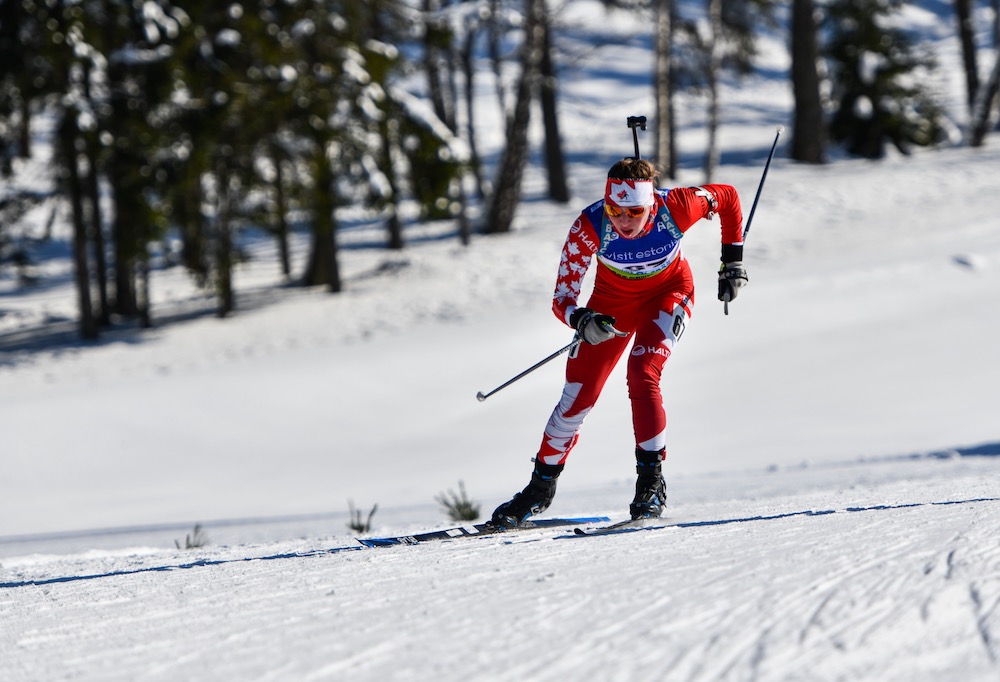
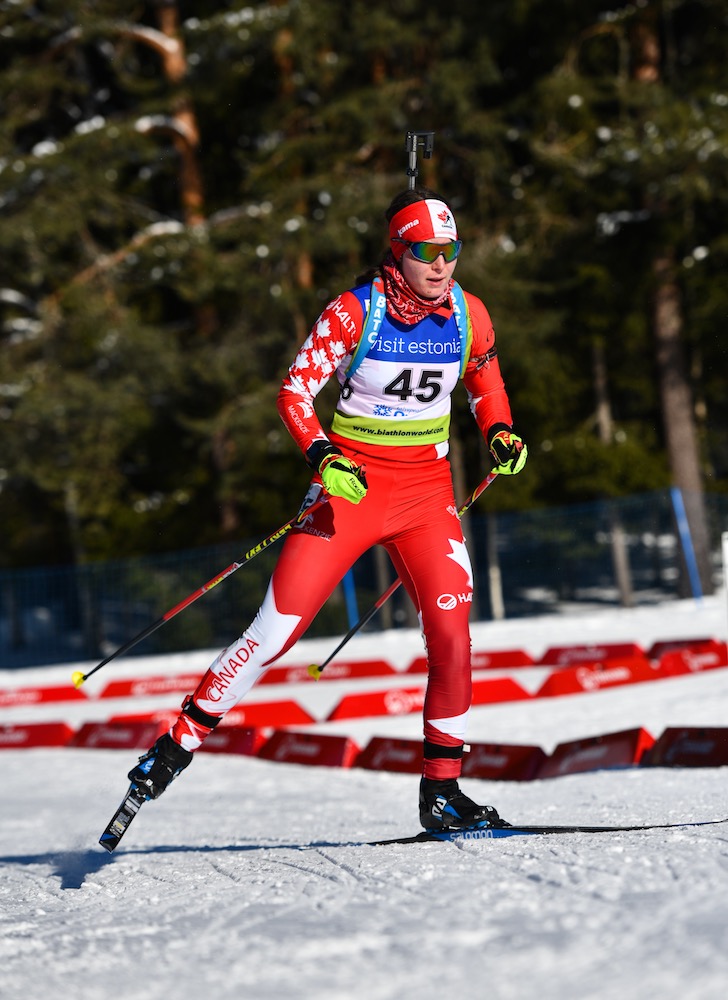
Canada’s Christian Gow (12) chases Germany’s Erik Lesser during the men’s 4 x 7.5 k relay at the 2018 Olympics in PyeongChang, South Korea. Germany won bronze. Lesser lamented the situation and said of the IBU’s decision to hold World Cups in Tyumen, Russia, despite requests from him and other athletes to move the event: “If we don’t go, it’s wrong because it’s our sport we love. [But] if we go to Tyumen, we maybe send the wrong sign to IBU.” (Photo: FlyingPointRoad)In three weeks time, biathlon’s World Cup circuit will move to Russia.
But a number of the sport’s stars won’t be there – and others plan to attend, but aren’t very happy about it.
In an Executive Board session in PyeongChang, South Korea, a few weeks ago, the International Biathlon Union (IBU) decided to go on as planned with World Cup races in Tyumen, Russia, even though the Russian Anti-Doping Agency is still not compliant with the World Anti-Doping Code.
Biathlon Canada had announced in December that it would boycott the event if it was kept in Russia, following revelations of systematic abuse of the anti-doping system by that country. In the intervening months, athletes appealed to the IBU through private channels to move the races to a country which complies with the WADA Code.
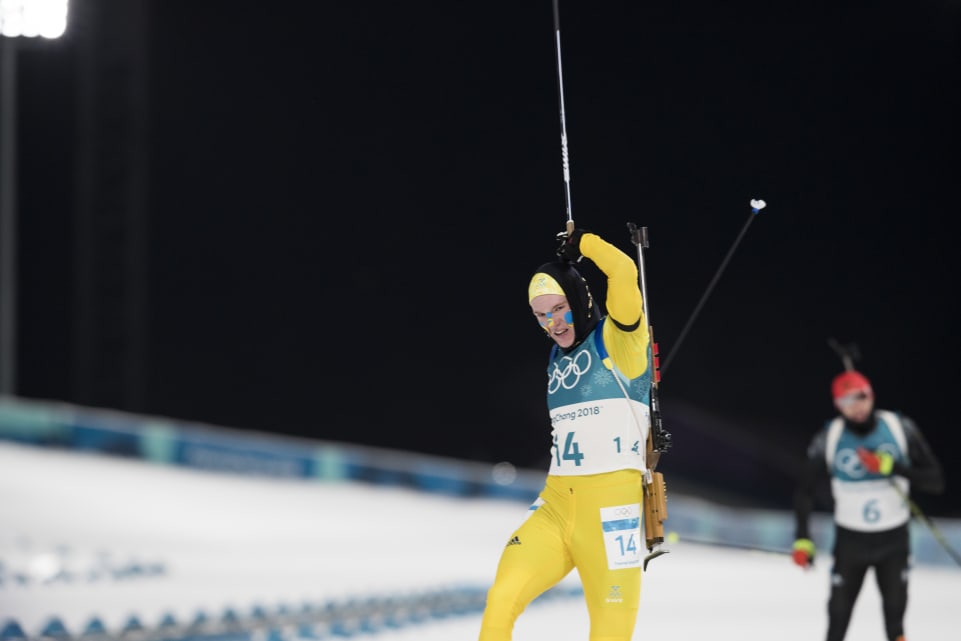
Sebastien Samuelsson of Sweden celebrating silver in the men’s 12.5 k pursuit at his first Olympics on Monday in PyeongChang, South Korea. Samuelsson announced today that he is boycotting the World Cup Finals in Tyumen, Russia, because Russia is not in compliance with the World Anti-Doping Code. (Photo: IBU/Biathlonworld)
Today, 2018 Olympic pursuit silver medalist (and relay gold medalist) Sebastian Samuelsson of Sweden announced on Twitter that he will not go to the races either.
“Nations without a functioning anti-doping organization should not have competitions at the international level,” he wrote, according to a translation. “Also, worried about the safety of both myself and the doping tests in Russia.”
Also not going is Klemen Bauer of Slovenia, a 2012 World Championships relay medalist who is a four-time Olympian.
“I’m not planning to go to Russia at all,” he told FasterSkier in a Twitter exchange. “I was quite sure the IBU will replace the races, but despite all the effort we put into the clean/er biathlon, thanks to the president of the IBU that didn’t happen.”
Both men are running for positions on the IBU’s Athletes Committee.
“The idea is to improve the active role of the athletes and the voice of the athletes,” Bauer wrote of his candidacy. “We’ll see.”
Another man running for a spot on the Committee is Germany’s Erik Lesser, 2014 Olympic silver medalist in the individual, 2015 World Champion in the pursuit, and several-time Olympic and World Championships relay medalist.
Lesser will be attending the races in Tyumen, but he wasn’t happy about the IBU’s decision to hold them there.
Klemen Bauer of Slovenia competing in the mass start at the 2018 Olympics in PyeongChang, South Korea. Bauer will not compete in the World Cup Finals in Tyumen, Russia. (Photo: FlyingPointRoad)
“In my opinion the RUSADA and the Russian Federation have not done enough to light up this case,” he wrote in an email to FasterSkier. “During the last years, WADA and some commissions found a bunch of proof about a doping system in Russia. But RUSADA and [the Russian Biathlon Union] did nothing to fight against doping. The Anti-Doping-Laboratory in Moscow still does not have a license, and all the officials are in the same seats. It’s a wrong sign, after these problems, to go to Russia and celebrate World Cup Finals.”
Lesser and teammate Arnd Peiffer, the 2011 World Champion in the sprint who then won gold at the 2018 Olympics, and who has even more World Championships and Olympic relay medals than Lesser, wrote a letter to the IBU explaining their position.
Yet a few weeks ago, the IBU decided to go ahead and hold the World Cup in Tyumen anyway. They issued a press release explaining the decision.
“I‘ve read the press release and I still don‘t understand why they decided this way,” Lesser wrote. “Because it‘s a threat to Russian biathlon fans and the Organizing Committee will take care of our safety? Wow, these are true reasons to keep the World Cup in Tyumen. So, I don‘t really think that reasons are valid.”
Last season, there was also supposed to be a World Cup in Russia. But in 2017, several teams announced that they would boycott the event and IBU President Anders Besseberg had a contentious meeting with athletes, after which the IBU decided to move the event.
This season, despite appeals by athletes like Lesser, Peiffer, and the others, that has not yet happened. And so in the end, Lesser says that he will compete in Tyumen, even though he wishes the races were somewhere else.
“We argued with our federation and we decided to go to Tyumen,” he wrote. “The sport is the first [priority] and we want to compete. We hope that we can do a good job in Russia. We are there to stand as clean athletes.
“It‘s bad that the IBU put us athletes in this position,” he wrote. “Actually it‘s not our job to be political. It‘s our job to be athletes and compete against other. If we don’t go, it’s wrong because it’s our sport we love. [But] if we go to Tyumen, we maybe send the wrong sign to IBU.”
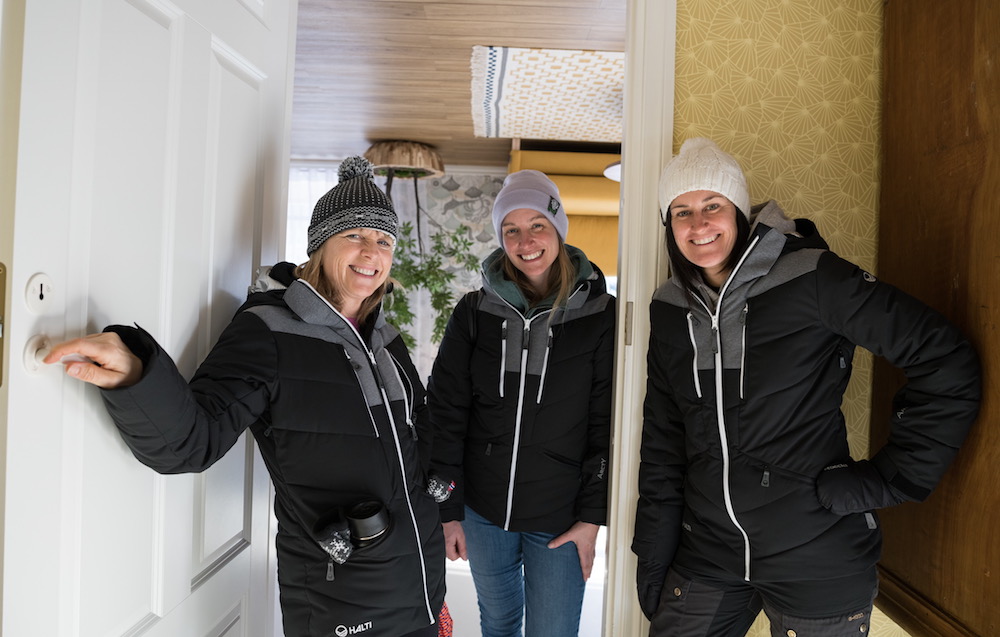
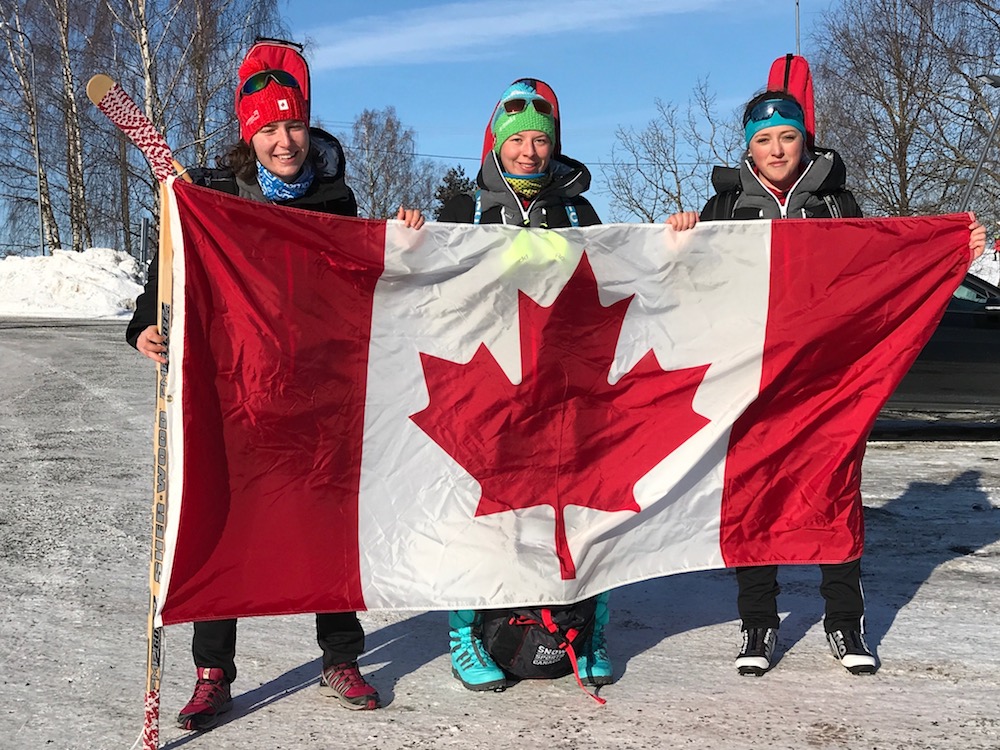
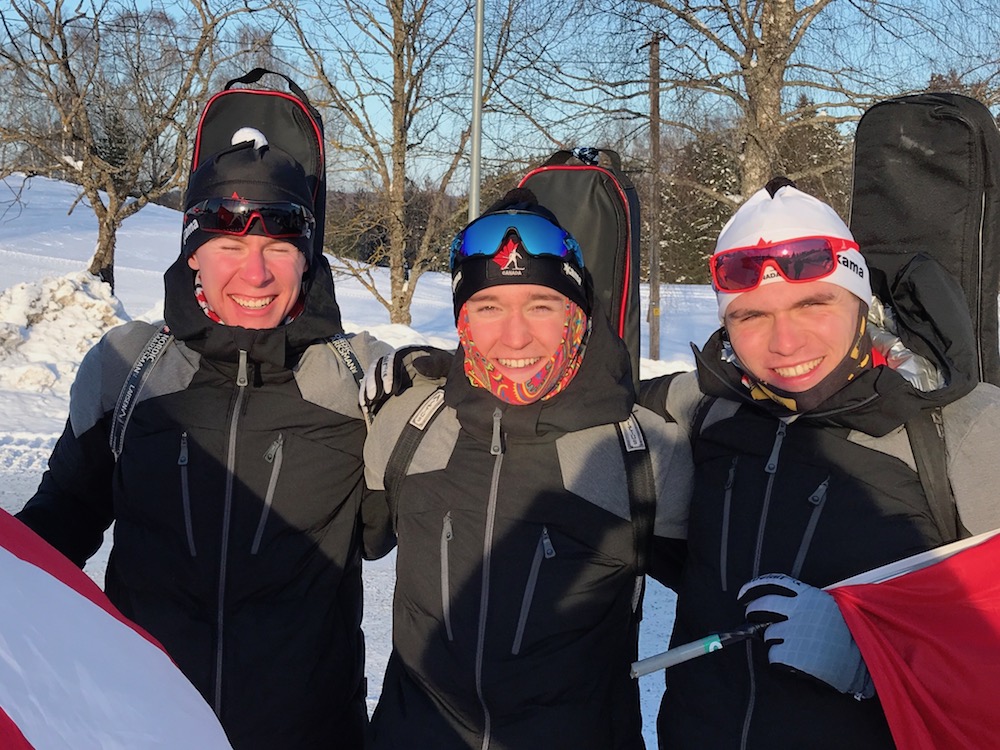
Biathlon Canada’s all-female coaching staff at 2018 IBU Youth/Junior World Championships in Otepää, Estonia. From left to right: Kathy Davies, Jessica Blenkarn and Jacqueline Akerman. (Photo: Emily Dickson)
Think about all of the exceptional female biathletes out there. Too many to count, right?
Now, if you watch biathlon at the World Cup level, think about how many women you’ve seen coaching there. None? One?
There are at least a couple, according to Biathlon Canada’s High Performance Director Roddy Ward, who’s been coaching biathlon internationally since 2011. The Slovakian women’s coach is one and the Austrian team also has a female coach, he wrote in an email to FasterSkier.
When it comes to wax techs, Ward wasn’t aware of any at the International Biathlon Union (IBU) World Cup level. The number of female race officials in that arena is similarly low.
Biathlon Canada is trying to change that. Not by consciously developing female wax techs or officials, but by presenting women with career opportunities after they retire as an athlete or if they show promise as a budding coach.
That emphasis on female leadership and coaching development is taking place in sports across Canada, Ward explained. Biathlon Canada is fully onboard with that movement and sent a clear message at this year’s IBU Youth/Junior World Championships — which took place last week from Feb. 26-March 4 — sending three female coaches to head up its team in Otepää, Estonia.
Last fall, Ward and Jacqueline Akerman, Biathlon Canada’s athlete and coach development manager, decided on their coaching staff for Otepää Youth/Junior World Championships. Akerman would be the head coach and trip leader, as she had for the previous two years, and joined by Kathy Davies, head coach of the Biathlon Alberta Training Center, and Jessica Blenkarn, who coaches at Sea to Sky Nordics.
The three women would make up the coaching staff and work with two male wax techs: head wax tech Andrew Chisholm and assistant tech David Bradley.
While the coaches were selected because of their qualifications (“we have these three great coaches who happened to be female,” Ward wrote), he also liked that female-to-male staffing ratio. It sent a message.
“Roddy and I went, ‘Oh, that would be cool, to be able to take an all-female staff,’ ” Akerman recalled of their conversation last fall. “… He said, ‘This is a really good thing for people to see, that we have three strong women coaching.’ ”
“It’s definitely important for us to have strong female leadership in our program,” Ward wrote to FasterSkier. “Truthfully, these are three great coaches who just showed up at my front door.”
Akerman had previously worked with Davies and Blenkarn on other international racing trips; Davies has been to several Youth/Junior Worlds and Blenkarn has coached at Open European Championships, the IBU Cup and IBU Junior Cup.
Asked if they’ve ever encountered an all-female or mostly female coaching staff in their sport, Akerman was quick to respond: “That’s an easier answer, two letters: NO.”
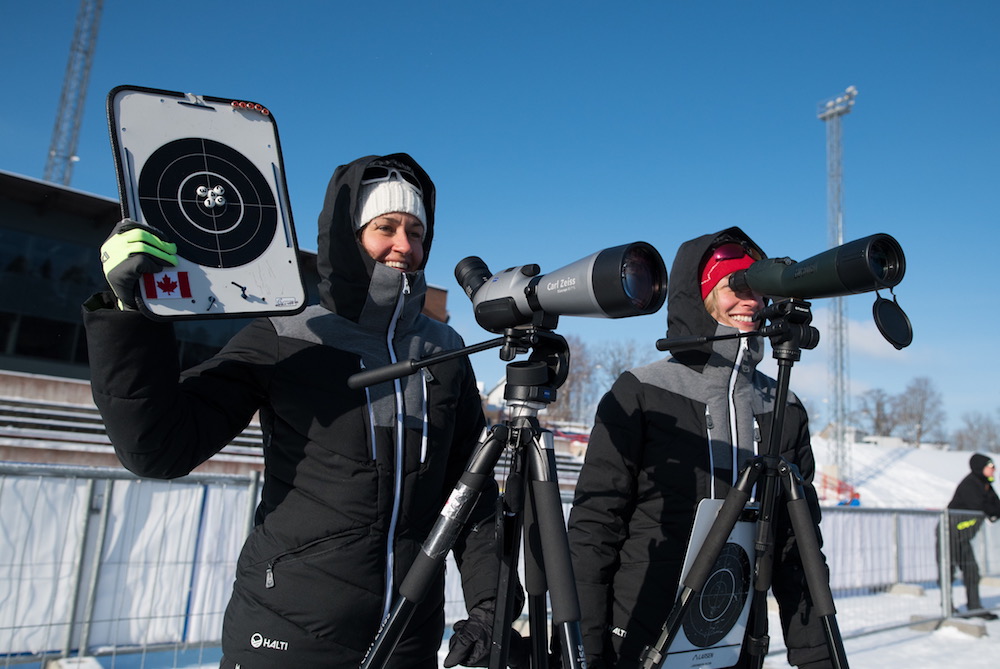
Jacqueline Akerman (l) and Jessica Blenkarn on the range at 2018 IBU Youth/Junior World Championships in Otepää, Estonia. (Photo: Emily Dickson)
At last year’s Open European Championships, Akerman and Blenkarn experienced some reaction from their peers when they were working together on the range.
“The amount of second glances that we got was incredible, and comments saying, ‘Oh, two female coaches! Two women coaches!’ ” Akerman said during a joint phone interview with Davies and Blenkarn in Otepää a few days before the championships began.
“We were a bit of a spectacle,” Blenkarn added.
“And we got lots of TV time,” Akerman continued. “The TV’s haven’t come out yet and not all the teams have arrived yet so we’re waiting to what kind of spectacle this will be with three of us.”
FasterSkier had yet to hear how the three coaches were received throughout the championships, but they stated they were off to a good start from an internal perspective.
“We’re all good communicators, and we’re all complimenting each other really well,” Akerman said. “For me, it seemed to just really flow nicely, maybe more so than other times.”
“I’ve been on a number of trips similar to this and it’s the first time I’ve have even another woman on a trip, except for athletes,” Davies said. “Those trips can be very, very isolated and very hard to sometimes fit in or even feel like part of the coaching staff when you’re the only female.
“It’s not a conscious thing on the men’s part necessarily, but it sometimes feels very isolating, so it’s just absolutely amazing to be with other women in the coaching position,” Davies continued. “What I love about it is it actually gives female athletes and idea that there’s more that they can do. It’s not just athletes, whereas most World Cup races, the women, that’s all they see is an athlete, because you see very few in the coaches’ world, you see next to none in the techs’ world and you also see a rare few in the officials’ realm as well, so it’s really nice to [show] women and athletes that there’s something else they can do as well.”
“I think we just support each other really well,” Blenkarn noted. “We have a good understanding of what female coaches go through and what kind of unique challenges they might face at an event like this so it’s nice to have other people around you to support you.”
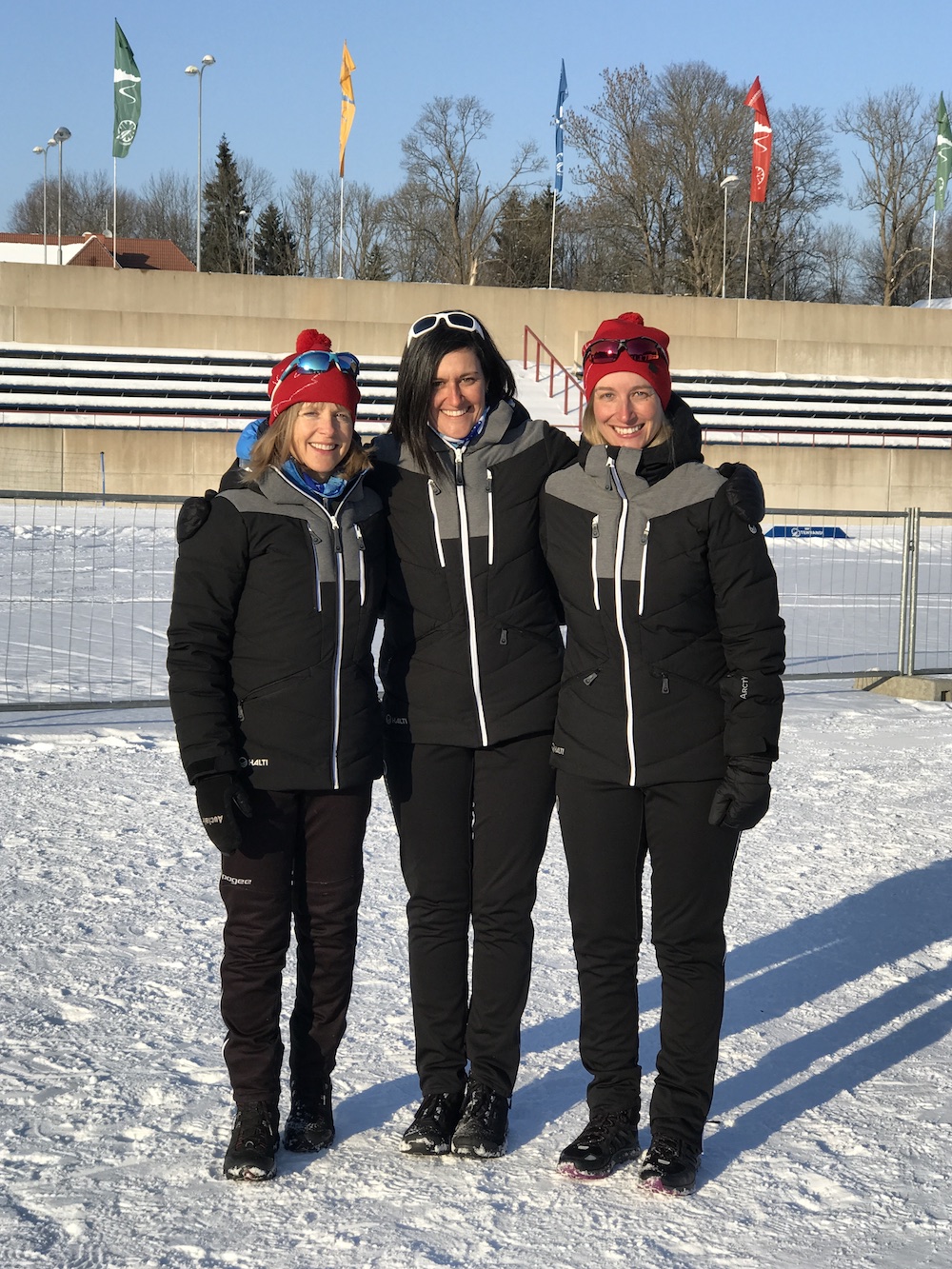
Biathlon Canada’s all-female coaching staff at 2018 IBU Youth/Junior World Championships in Otepää, Estonia. From left to right: Kathy Davies, Jacqueline Akerman and Jessica Blenkarn. (Photo: Terri Dickson)
Asked more specifically about those challenges, Akerman referred to the term Davies used: “isolating.”
“It’s really hard to find your space in the room,” Akerman said. “It’s really easy for me right now to find my confidence with these other two that are here and sharing and supporting. Just them physically being here I feel more confident. So I can find my voice better. There’s just more space for you.
“Your space can sometimes get beaten up in a male-dominated place, so I feel that we need to be encouraged … and open and invited,” she continued. “I met Jess about three years ago and I just saw her skill and her ability and I was like, OK, we need her to be invited into this because she’s excellent. … Someone has to be opening the doors and allowing that space to happen, otherwise it won’t happen for women. I think when we see potential and, not just potential, when we see people who are experienced and they’re very good at what they do, we have to open the door for them. For the men, it’s already open, they just walk through. We need top open it. … I think that’s partly what Roddy’s doing … some men get it and they open the doors, but I think as women we can do it even more because we can understand what it’s like.”
At the Olympic level, biathlon dates back to 1924 when it was known in its ancient form as “military patrol”. A more modern form of biathlon debuted at the 1960 Olympics, but women’s biathlon didn’t become an Olympic sport until 1992. The sport’s military background paired with the relatively recent participation of women has led to some inherent challenges for women in the sport’s leadership roles.
“I can find my voice better. There’s just more space…” — Jacqueline Akerman, Biathlon Canada’s head coach and trip leader for the last three Youth/Junior Worlds, on having two other women on her coaching staff in Otepää
“2003 was the first time I worked the World Cup for biathlon and that was on the range with one of our male coaches and I was the only woman there,” Akerman recalled. “And people looked at me like I was an alien. Slowly over the years you see a few women. On the IBU Cup last year, actually, there was a fair amount of female coaches. I mean, the percentage is still ridiculously low, but you do see them now, and on the Junior IBU Cup as well…”
So the trend is in the right direction, and Biathlon Canada is more than happy to be at the forefront of that progression.
“It’s important for female athletes to have good role models,” Ward wrote. “I have seen firsthand what a good female coach can do for a female athlete and I see that is important for three reasons.
“1) to help athletes navigate life/struggles to turn into healthy and successful adults.
“2) I want our athletes to kick butt internationally and I believe strong female leadership can help us achieve this goal.
“3) I believe female athletes are more likely to give back to the sport (coaching, waxing, officiating etc) if they had female role models through their career that had a positive impact on their life.”
Last week in Otepää, outside of relays, Canada notched five top-10 results, five top-20’s and seven top-30’s, which were achieved by five different women and three different men.
“We’re building, practicing, focusing, training to be a well-oiled machine as a large group and as individuals,” Akerman said before the races began. “And we’re very confident in our ability to utilize those skills and abilities to our potential.”
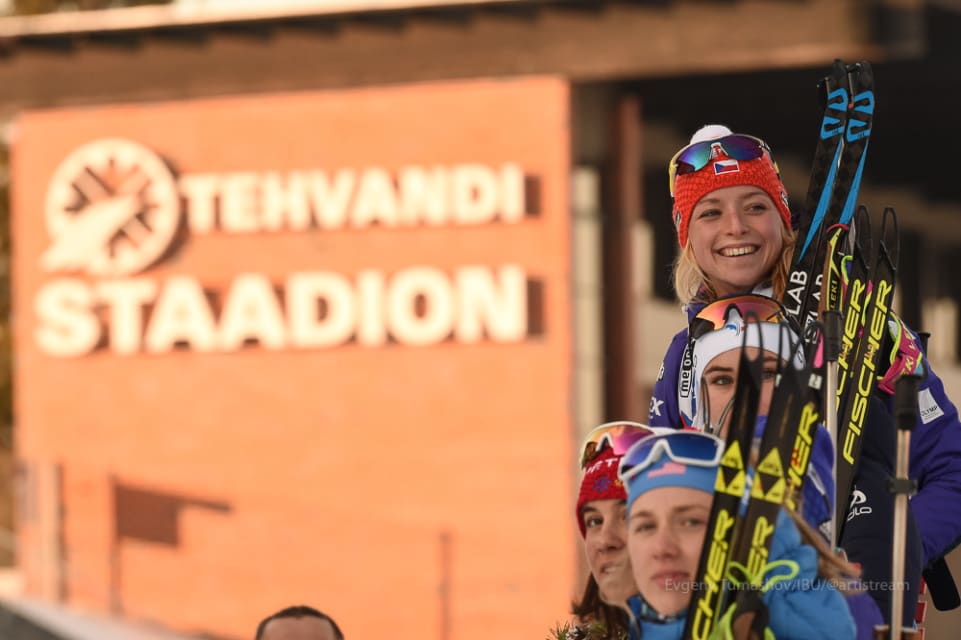
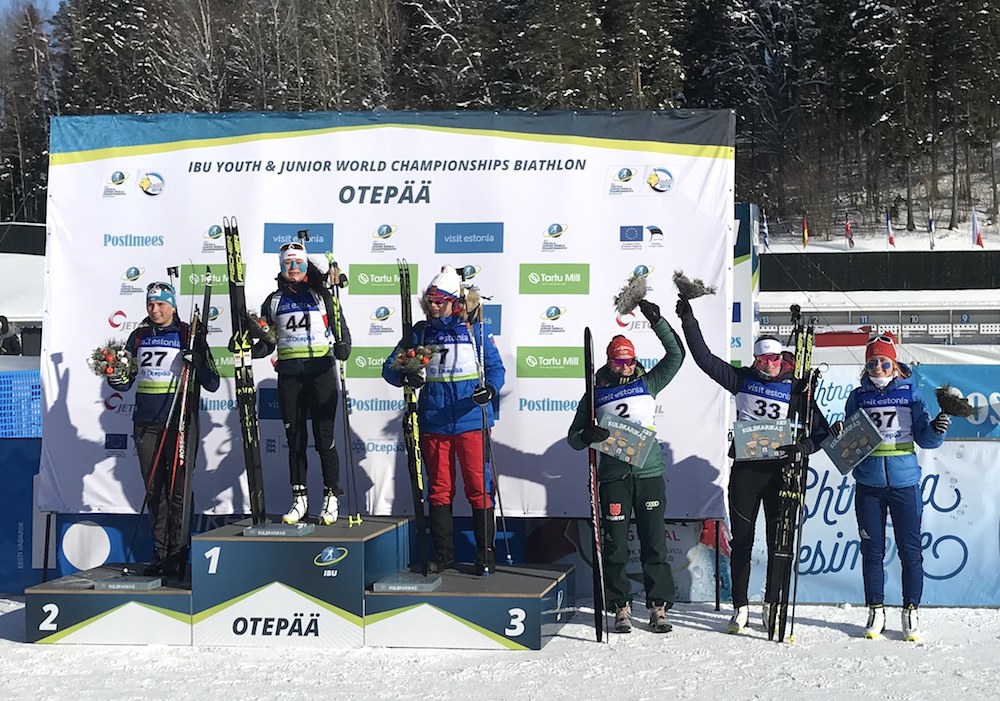
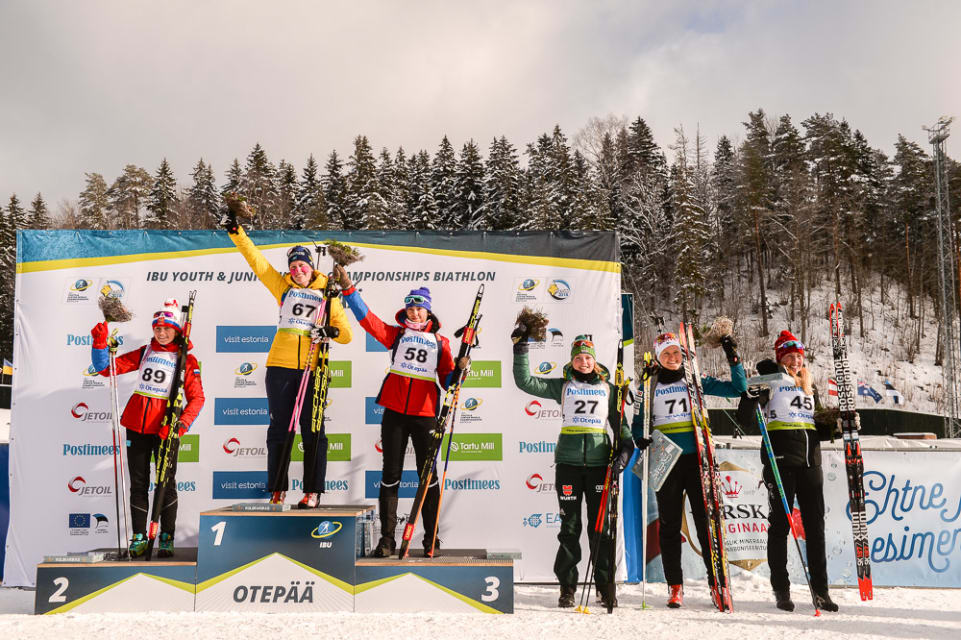
Some of the top-six finishers in the junior women’s 10 k pursuit at the post-race flower ceremony at 2018 IBU Junior World Championships in Otepää, Estonia, including the Czech Republic’s Markéta Davidová (top) and American Chloe Levins (bottom), who finished first and sixth, respectively. (Photo: IBU/Biathlonworld)
(Note: This article has been updated to include comments from Leo Grandbois.)
The 2018 International Biathlon Union (IBU) Youth/Junior World Championships went out with a bang on Sunday, with four pursuit races in Otepää, Estonia.
Several North Americans had banner days, with American Chloe Levins racing up one spot to sixth place in the junior women’s 10-kilometer pursuit and Canada’s Megan Bankes and Nadia Moser placing eighth and 11th, respectively, in that same race.
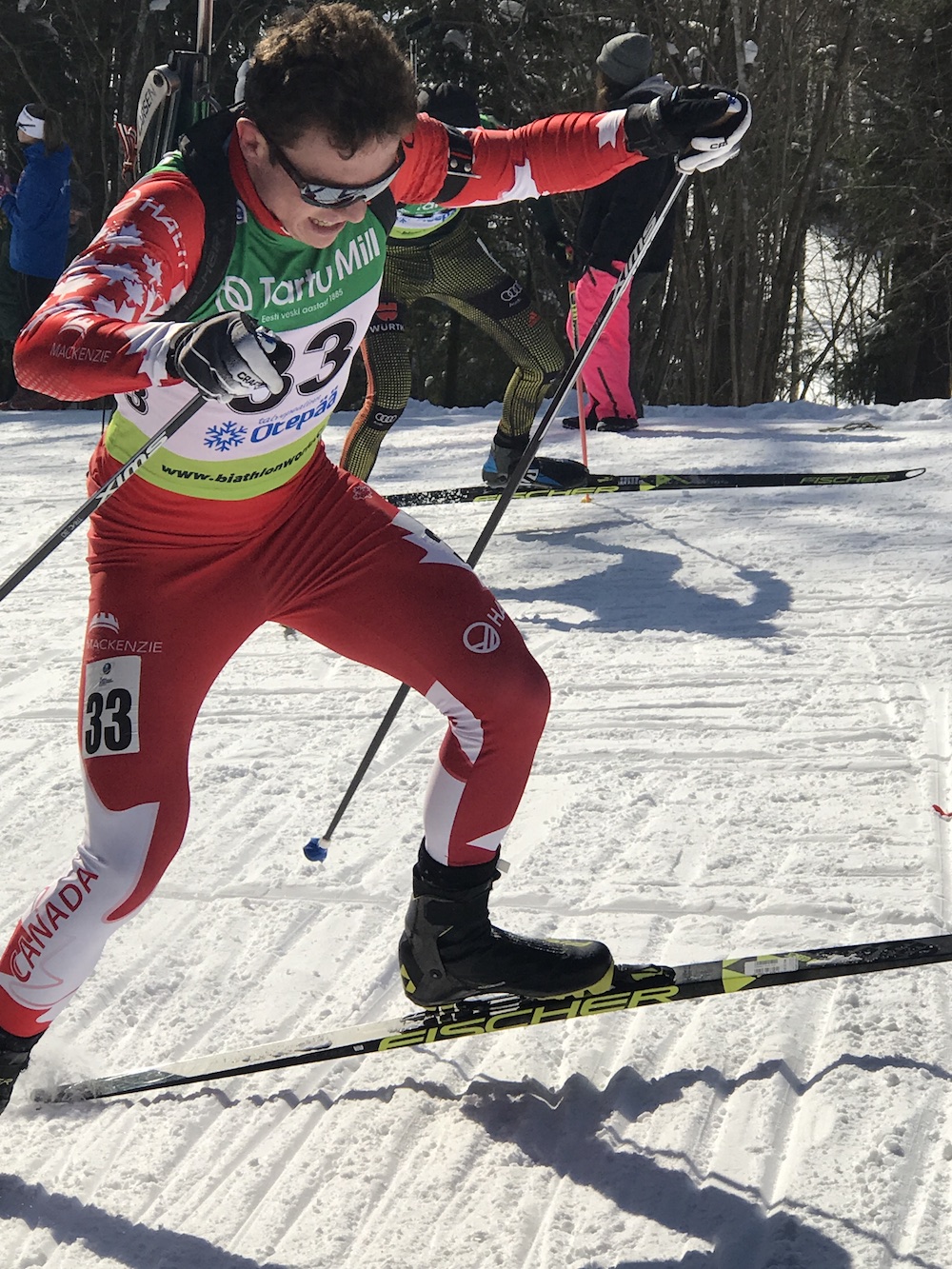
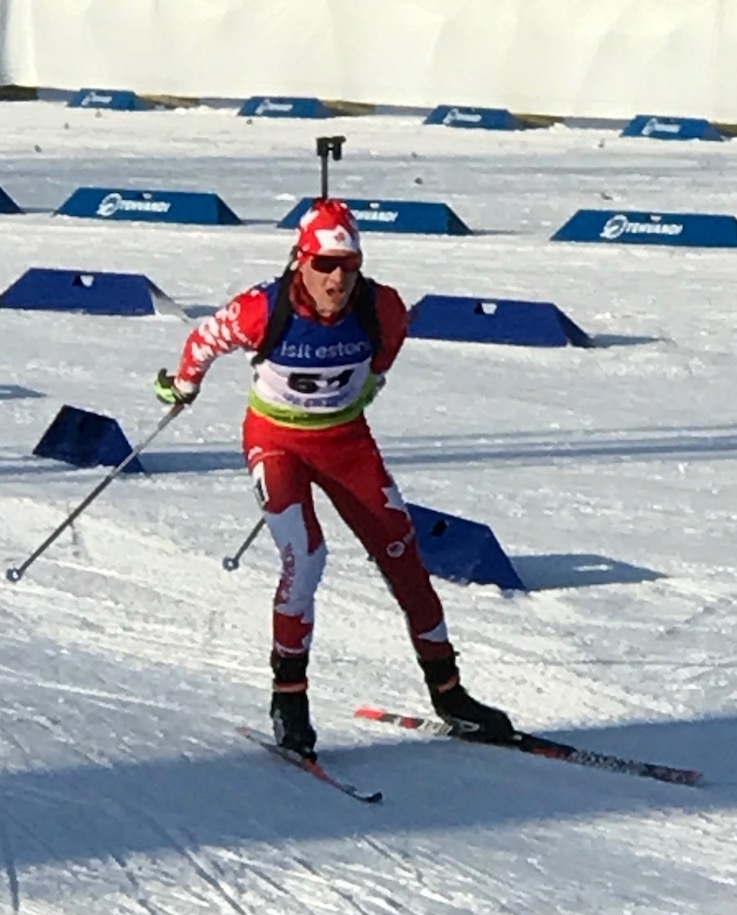
In the youth men’s 10 k pursuit, Canada’s Leo Grandbois had his best result of the week, placing 15th (up from 33rd) at the start.
Starting with the junior women’s pursuit:
Levins started the race 1:32 minutes back in seventh, based on her sprint result on Saturday. She went on to clean three-consecutive shooting stages, working her way up to fourth after leaving the range for the third time, then missed two targets on the final standing to end the race in sixth. Levins finished 1:51.4 behind the winner, Markéta Davidová of the Czech Republic, who finished first in 32:52.6 with four penalties (1+0+2+1).
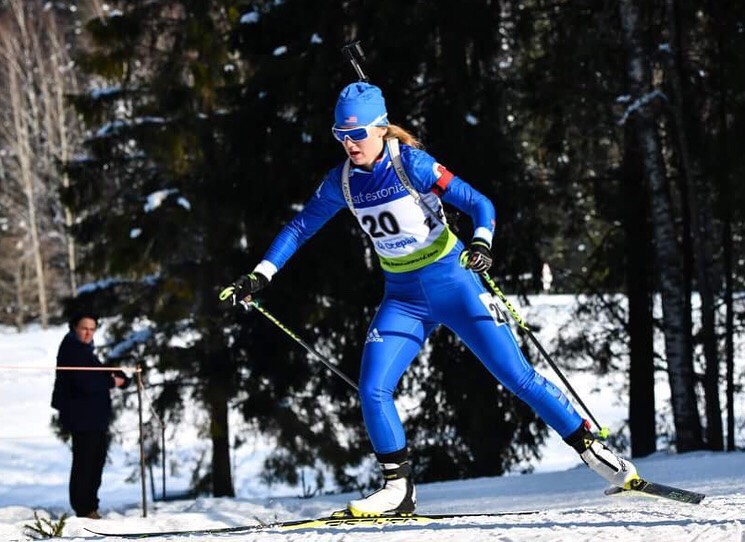
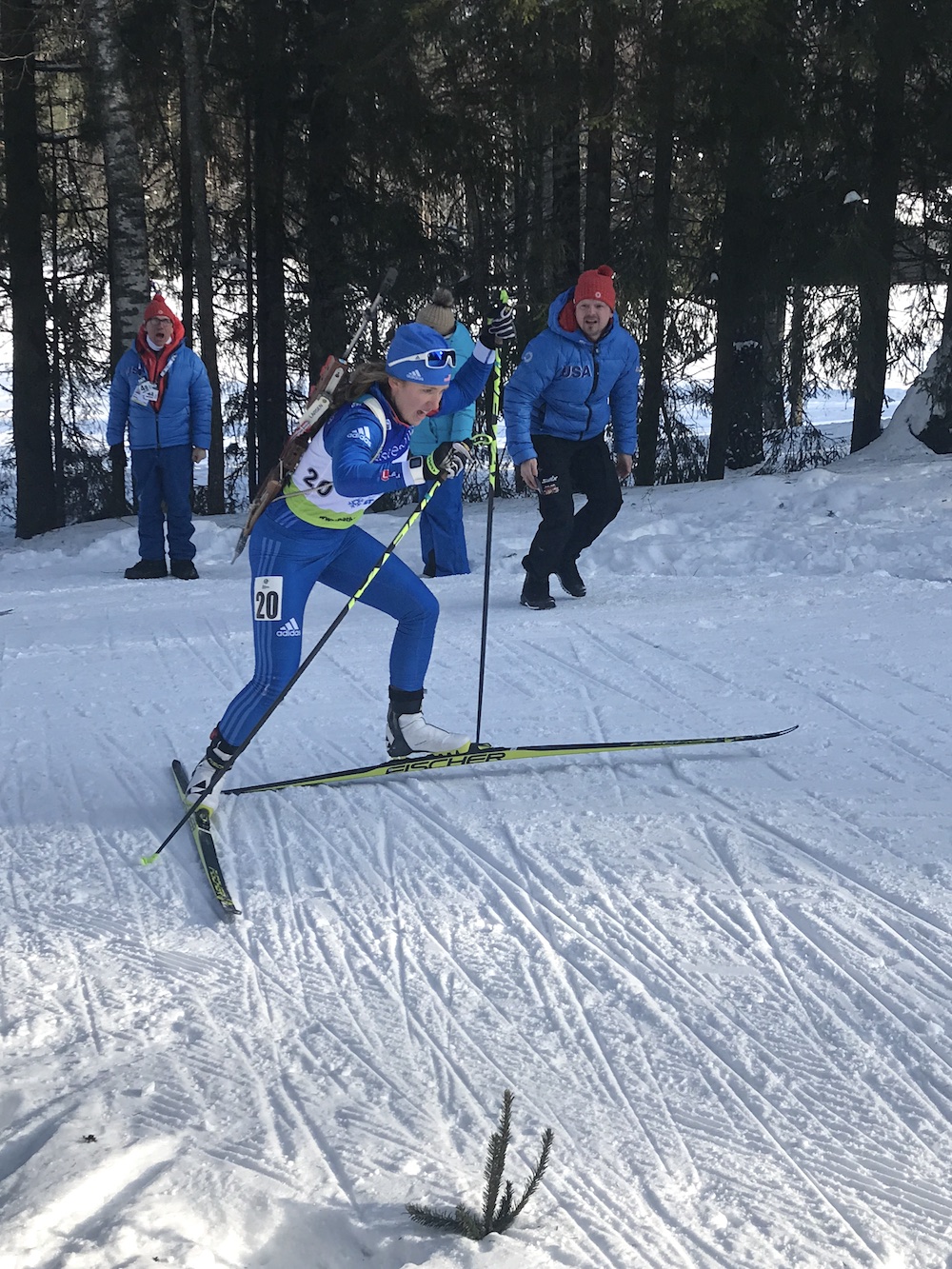
Chloe Levins racing to seventh in the junior women’s 7.5 k sprint on Saturday at IBU Junior World Championships in Otepää, Estonia. (Courtesy photo)
“In pursuit races in the past, I’ve come from behind,” Levins, who placed fourth in last year’s Youth Worlds pursuit, wrote in an email to FasterSkier on Sunday. “Today, it was a new learning experience for me to be in the mix for the duration of the race. My plan was simple from the start: enjoy being in the mix and trust your preparation.
“I found the zone today, which is what you dream about,” she continued. “I don’t remember much about the last stage. All I know for sure is that I went for it today…and I have no regrets.”
Asked what she’ll remember most about these championships, Levins explained that the U.S. team’s “happy and dedicated staff” made for a fun week.
“We are always joking and laughing in the wax room which helps keep the mood light during potentially stressful races,” she wrote. “It was really special and important for me to have this experience with my coach, Algis Shalna, behind the scope. We’ve worked together for a long time. I will cherish the competitions we get to share forever.”
While the championships didn’t turn out exactly as she’d hoped, Levins explained that she had a lot of positive takeaways for her final biathlon races of the season.
“Now, it’s time to go back to school and start preparing for golf season at Middlebury!” she wrote. “… I can’t wait to start training again.”
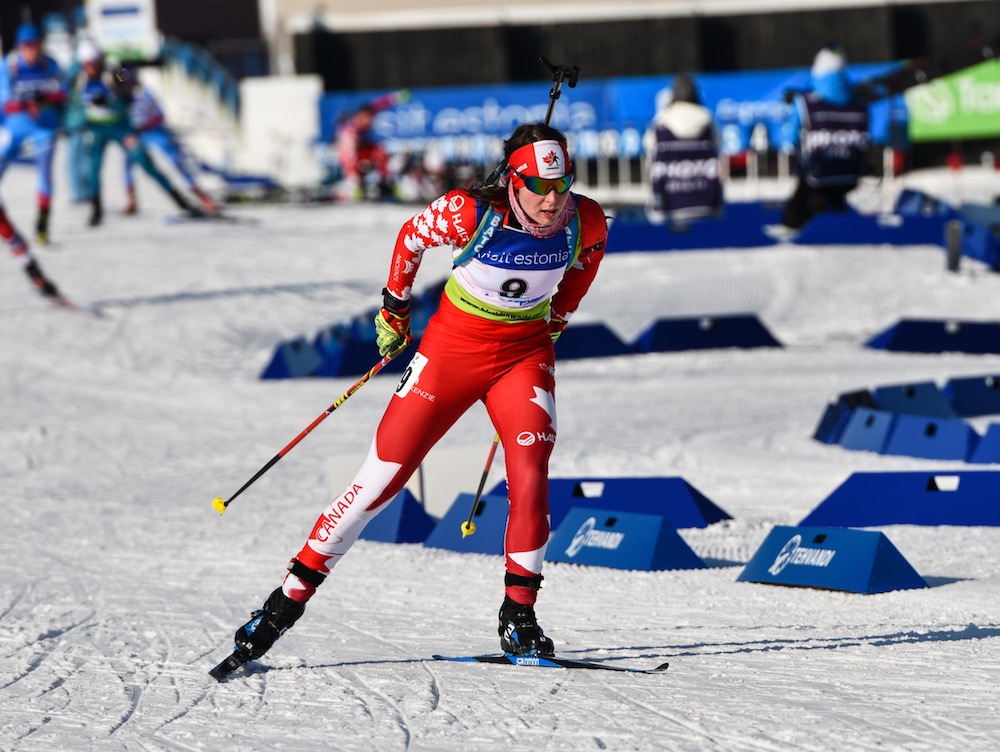
Megan Bankes racing to eighth in the junior women’s 10 k pursuit at IBU Junior World Championships on Sunday in Otepää, Estonia. (Photo: Bryan Dickson)
Bankes started ninth on Sunday and made up one place to finish eighth (+2:52.6) after placing ninth in three previous races at Junior Worlds. She had two penalties in both the first and the last shooting stages (2+0+0+2) and posted the ninth-fastest shooting time and ninth-fastest overall course time.
“Heading into today’s race, my goal was to try and shoot well and make up places. It was also my last international junior race so i wanted to try and have a good one!” Bankes, 20, wrote in an email. “To start, I knew that I could catch the Norwegian girl who started in front of me, and after I caught her, my goal was to make up time on everyone else in front of me.”
She described the wind on the range as “pretty strong” and variable.
“I was zeroed for a decent left to right wind, but when I came in for my first prone the wind had died and was blowing towards me for my first shot, and then it picked up again to be a little more than my zero wind, and I corrected back but didn’t correct enough for it,” Bankes wrote. “After cleaning the middle 2 bouts I really wanted to clean my last bout and there was definitely a little pressure going in with the Russian girl [Emma Timerbulatova, who was skiing just ahead of Bankes]. I actually thought that she had only missed one, so I was a little disappointed in myself when we went into the penalty loop, but when she didn’t leave after the first loop, I was determined to pass her and beat her to the finish.”
Like Bankes, Timerbulatova had two penalties in the last standing. She started the final loop just 0.1 seconds ahead of Bankes, and Bankes passed her to finish eighth.
“I’m overall super happy with my performance this week,” Bankes, a 2017 Youth Worlds gold medalist in the 10 k individual, concluded. “Definitely my most consistent European racing ever! I would have liked to have shot better overall this week though, I did give up some stupid shots, but I was super stoked with how I felt skiing. I’m also pleased that I was able to have consistently good races over the course of the week, which is something I definitely could not have done in the past.”
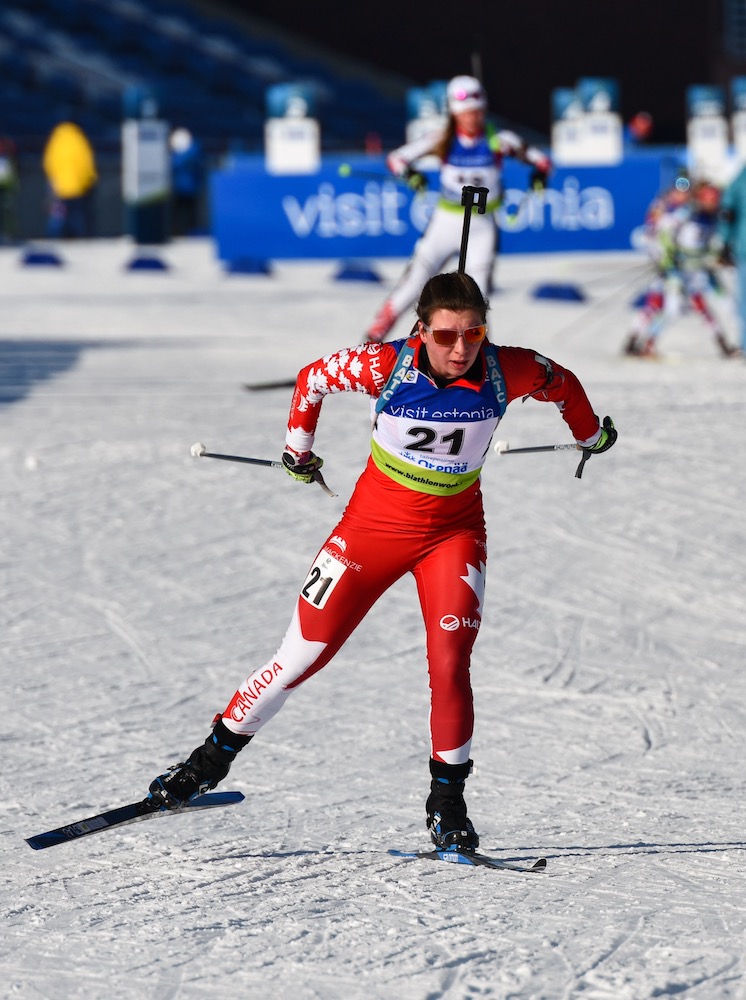
Nadia Moser racing to 11th in the junior women’s 10 k pursuit at IBU Junior World Championships on Sunday in Otepää, Estonia. (Photo: Bryan Dickson)
Moser picked off 10 places to finish 11th (+3:45.4). She started the pursuit in 21st and shot 18-for-20, cleaning the first two stages (0+0+1+1) and contending for the top 10 before finishing about 12 seconds out of 10th place. It was her second-best result of the week after placing eighth in the junior women’s 12.5 k individual.
“A top 10 finish was definitely the big goal for the pursuit, but I knew that was only possible if I shot really well and skiied well,” Moser wrote in an email. “Unfortunately, I missed my goal by one place.
“There were some pretty large time gaps in the starters today so it was a challenge to pick up places for me,” she continued. “For the most part I just tried to catch up with the people in front of me, or keep up with the people who passed me. I knew my best chance to move up was in the shooting range. … I was focused and trusting in my skills on the range today, and that is how I was able to hit most of my targets.”
She knew she was in 10th for her third shooting when she was shooting in lane 10.
“I was really happy that I had moved up as many places as I did, although slightly dissapointed that I was not able to reach the top ten,” Moser added. “I am satisfied with today’s pursuit. Moving up 10 positions is better than I’ve ever done before. Some things could have gone slightly better this week, but overall I am content with what I was able to achieve.”
Emily Dickson scored her first non-relay top 30 of the week in 26th (+5:31.6), up from 36th at the start, after missing just two targets (1+0+0+1). She had previously placed 36th in both the sprint and individual races, and ninth with Bankes and Moser in the 3 x 6 k relay.
After starting 26 seconds ahead of Davidová, Poland’s Kamila Żuk finished second in the pursuit, 28.1 seconds behind Davidová, after incurring six penalties (1+2+3+0). France’s Myrtille Begue placed third (+53.8) for the second-straight day after shooting 17-for-20 (0+1+1+1).
Onto the junior men’s 12.5 pursuit:
A day after placing third in the sprint, Norway’s Sverre Dahlen Aspenes shot clean in Sunday’s four-stage pursuit to take the win in 34:16.7. He finished 1:21.1 minutes ahead of France’s Martin Perrillat Bottonet, who placed second with one penalty (0+0+1+0). Norway’s Johannes Dale scored his first non-relay podium in third place (+1:46.4) with four misses (0+0+2+2).
Canada’s Adam Runnalls tallied his third individual top 30 of the week, placing 29th (+6:04.7) with six penalties (2+1+1+2). He had started the pursuit in 26th, based on his sprint result, and had previously finished 29th in the junior men’s 15 k individual.
His teammate Trevor Kiers started the pursuit in 16th and slipped to 34th (+6:44.4) with 10 penalties. Canada’s third man in the race, Teo Sanchez finished 57th (+10:32.5) with five misses (1+0+1+3) after starting 54th.
Cody Johnson was the lone U.S. skier in the junior men’s pursuit, racing to 48th (+7:40.0), after starting 37th, with five misses (2+0+2+1).
In the youth men’s 10 k pursuit:
Leo Grandbois racing to 15th in the youth men’s 10 k pursuit on Sunday at IBU Youth World Championships in Otepää, Estonia. (Photo: Terri Dickson)
Grandbois, a gold medalist at last year’s Youth Worlds in the 12.5 k individual, had his best race of the 2018 championships in 15th. After starting 33rd, he cleaned the first two stages to put himself in 16th halfway through the race, then missed two on each of the final two shooting bouts (0+0+2+2). But he didn’t lose much ground, leaving the range in 17th after the last shooting and passing two competitors to end up 15th (+3:37.2). Grandbois had previously raced to 24th in the 12.5 k individual this week and 16th with Canada’s youth men’s 3 x 7.5 k relay team.
“For the first bouts the wind was calm but for the second prone the wind picked up,” Grandbois explained in an email. “So I had to do some corrections that worked perfectly. I am really happy about it. First standing I came way too hard in the range and I could not manage to be precise. The last shooting was going well but the pressure to go faster made me miss again.
“I think that with a better standing shooting I could have done a top 10, but I was starting pretty far away so I am satisfied with my 15th,” he wrote.
“What I take back from those championships is that my ski speed is good but I will have to work hard next summer to keep it that way and to get it even better, for sure,” Grandbois added. “It wasn’t a good week for me in the range. I will have to work on my shooting speed and constancy. Those two things are my biggest weakness.”
Leading the U.S. men was Vasek Cervenka in 24th (+4:20.8). Cervenka had started the race in 24th and held his position despite six penalties (0+3+1+2) with the 19th-fastest course time. It was his third individual top 30 of the week after placing 27th in the 12.5 k (as well as ninth with his relay team).
Canada’s Rory Gilliland moved up 11 places to finish 41st (+6:12.2) with two penalties (0+0+1+1). His teammates Thomas Hulsman and Ryan Elden followed in 45th (+6:45.9) and 49th (+6:56.8) after starting 35th and 59th, respectively. Hulsman had six penalties while Elden had five (1+0+2+2).
For the U.S., Garrett Beckrich and Eli Nielsen finished 46th (+6:48.7) and 47th (+6:54.7), respectively. Beckrich had started 46th and incurred five penalties (1+1+1+2) while Nielsen slipped five places after starting 42nd and missing six targets.
After winning gold in the relay, Russia’s Andrei Viukhin notched his first individual podium and gold medal at his first Youth Worlds, winning the pursuit in 29:31.2. He had started seventh and missed four targets (1+1+1+1) yet led his teammates in a Russian podium sweep.
Viukhin handed his teammate Mikhail Pervushin his first loss of the week, as Pervushin settled for second, 16.8 seconds back, with four penalties as well (1+0+2+1). Aleksei Ogorelkov, who had not raced in Russia’s 3 x 7.5 k relay, finished third (+1:12.1) with two late penalties (0+0+0+2) for his first Youth Worlds podium.
Last but not least, the youth women’s 7.5 k pursuit:
Canada had three women finish in the top 40 of this race, with Benita Peiffer leading them in 30th (+4:28.2). She had started 51st and skied the 21st-fastest course time to pick off 21 places. Peiffer shot 17-for-20 (1+0+1+1).
Her teammate, Pascale Paradis slipped from 15th to 35th (+5:05.8) with eight penalties, while Jenna Sherrington improved from 46th to 39th (+5:28.1) with four misses (2+0+2+0).
For the U.S., Emma Stertz finished 48th (+5:58.0), up from 52nd at the start, with four penalties (1+0+2+1), and Grace Gilliland placed 57th (+7:21.0), after starting 55th, with four misses as well (1+1+1+1).
Russia’s Anastasiia Goreeva won her first individual gold at Youth Worlds, racing up from fourth at the start to cross the finish line first in 24:24.0 with three penalties (0+0+1+2). Germany’s Franziska Pfnür placed second for her first Youth Worlds podium, 17.5 seconds behind Goreeva, with just one penalty (0+1+0+0). In her second Youth Worlds, Switzerland’s Amy Baserga achieved her first podium as well, placing third (+29.0) with two penalties (0+0+1+1).
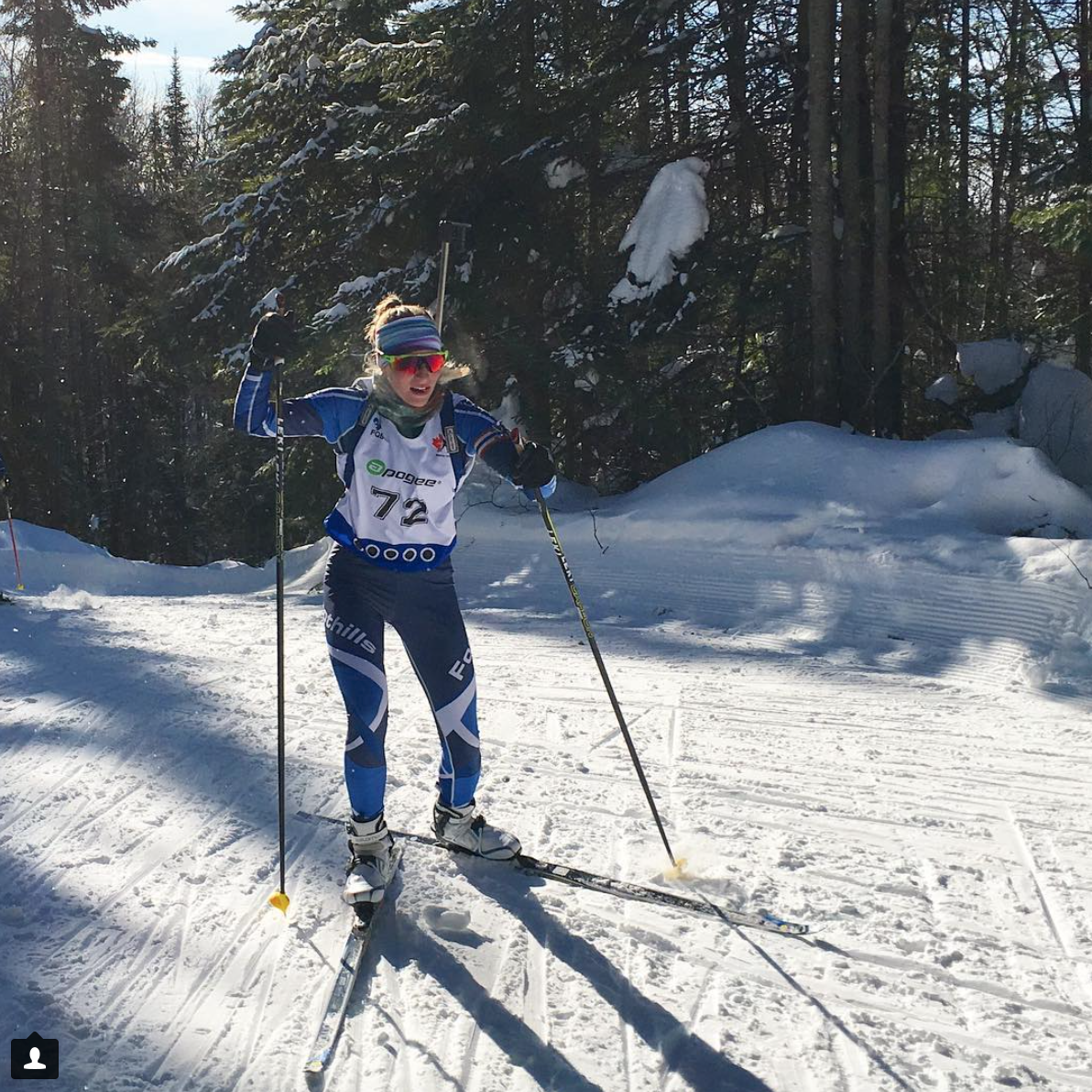
Jenna Sherrington racing at Biathlon Canada’s Youth World Trials in Valcartier, Quebec. (Photo: Jenna Sherrington/Instagram)
In an effort to showcase the North Americans competing at this week’s International Biathlon Union (IBU) 2018 Youth and Junior World Championships in Otepää, Estonia, we asked those qualifying athletes several questions about themselves — actually, we had them fill in the blanks. Here we have 16-year-old Jenna Sherrington, of Calgary, who is representing Canada at her first Youth World Championships.
In her last race of Youth Worlds, the youth women’s 7.5 k pursuit, Sherrington placed 39th (+5:28.1 with four penalties). She also finished 40th in the 10 k individual on Monday and 46th in the 6 k sprint on Friday.
***
“My full name is Jenna Sherrington but you can call me Jenna.
I was born and raised in Calgary, Alberta, and I learned to ski at age 2.
Jenna Sherrington getting some sunny training in on the Haig glacier near Canmore, Alberta. (Courtesy photo)
I spent the time between World Youth/Junior trials and Worlds training, preparing, going to school and coaching cross-country skiing to 5 year olds.
The hardest and most fun workout I did in the last training year to prepare for this was bicycle 1100 kilometers from Quebec City to Charlottetown with my Dad.
One thing I’m working on this season to improve my biathlon is being able to completely focus during a race. Last year I had quite a bit of trouble getting out of my own head while racing so I’ve been trying to improve that.
This is my first time in Estonia and first time racing internationally, and so far it’s been an incredible learning opportunity and experience.
One difference I’ve noticed between Estonia and Canada is the language is very different and they eat lots of potatoes.
One of the things I’m most excited about for World Youth/Junior Championships in Otepää is travelling to a new country and competing against the best youth biathletes in the world.
One race I’m especially targeting there is the sprint.
Watching the Olympics in the lead up to my own races was really inspiring to see the best biathletes in the world race as hard as they could for their country. One of my favourite moments of the Olympics was when Martin Fourcade won in the 15km mass start with a photo finish against Simon Schempp. I want to be like Laura Dahlmeier because she always has a smile on her face and it looks like she has a genuine love for the sport of biathlon.
At Worlds, I really hope I can chat/make friends with someone from Norway and ask them what it’s like to live in Norway and what the Norwegian culture is like.
My favorite thing at the breakfast where we are staying is the fruit, there’s always oranges or grapes, which is fantastic.
Before this trip, if you said “Estonia”, the first thing I’d think of would have been “sorry, where?”.
Now that I’m here, I’m pretty sure something I’ll always remember will be the people I meet and how incredibly sparkly the snow is.
If I had a totally free day here and didn’t have to worry about race fitness or training, I’d spend it skiing around on the absolutely breath taking trails that intertwine and surround the town.
The best way to follow me on social media is on Instagram @jennasherrington.”
American Chloe Levins racing to seventh in the junior women’s 7.5 k sprint on Saturday at IBU Junior World Championships in Otepää, Estonia. (Photo: Terri Dickson)
“There’s almost nothing I love more than being in the hunt during a pursuit,” American Chloe Levins wrote in an email to FasterSkier on Saturday. “I’m prepared. I’m hungry.”
Two days after placing sixth in the junior women’s 12.5-kilometer individual on Thursday, Levins, 19, raced to seventh place in Saturday’s 7.5 k sprint, which will put her in seventh (and within 10 seconds of fourth place) for the start of Sunday’s 10 k pursuit at the International Biathlon Union (IBU) Junior World Championships in Otepää, Estonia.
On Saturday, Levins, a Middlebury College sophomore, started the 7.5 k sprint in 20th out of 70 women. She missed one of her prone targets, having to ski a penalty lap, and cleaned standing to cross the finish line in second place, just 1.5 seconds behind Russia’s Emma Timerbulatova in first. While both were ultimately bumped to sixth and seventh, respectively, by the time all 70 racers had finished, Levins’s course time still held up as the eighth fastest. Her shooting was among the best, too, with only five women cleaning the two-stage race.
“There’s been a consistent stream of wind on this range all week long,” Levins explained in the email. “It didn’t fail to show up today either. Ski conditions were perfect. The snow was cold but fast, and it got faster throughout the day.”
When asked about the course, she recalled a term her coach Algis Shalna used to describe it: “workhorse”.
“That’s exactly what it is,” she wrote. “It’s a traditional course with long hills and few transitions. I don’t really have a course profile preference, but working over the top of these hills pushes me past my limits every time.”
Levins described being able to handle the “steady and relatively calm” wind conditions without many technical adjustments. After hitting all five targets in her standing stage, all she could do was smile as she returned to the course, she wrote.
“It was a very rhythmic shooting that gave me some momentum leading into the last loop,” Levins recalled. “Our staff and even some of the youth athletes were everywhere on course today, which really helped me gain time on a Russian athlete who left the range 15sec ahead of me at the split.
“I had the biggest support system in the entire field today,” she added. “I hope they had as much fun during the competition as I did.”
At the finish, Levins tried to process any time she lost on the course and the time gap between her and first place at the time.
“My brain immediately went to analyzing the race in search of 1.5 lost seconds,” Levins wrote. “Since the temperatures have been so cold this week, they made all the races 20 second intervals. It was unfortunate that I had to maneuver my way around two groups of at least four competitors along the track on my last loop.”
In the end, she ended up seventh, 1:31.7 minutes behind Poland’s Kamila Żuk, who won in 22:32.5 with one standing penalty (0+1). Żuk also won Thursday’s 12.5 k individual.
On Sunday, Levins will start the pursuit 1:32 behind Żuk and just 10 seconds behind Russia’s Valeriia Vasnetcova in fourth place. Markéta Davidová of the Czech Republic will head out of the gate second, 26 seconds behind Żuk, and France’s Myrtille Begue will start third, 52 seconds back. While Davidová made up for two penalties in Saturday’s sprint with the second-fastest course time (behind Żuk in first), Begue shot clean and skied the fifth-fastest course time.
Canada’s Megan Bankes racing to ninth in the junior women’s 7.5 k sprint on Saturday at IBU Junior World Championships in Otepää, Estonia. (Photo: Terri Dickson)
Canada’s Megan Bankes placed ninth for her third-straight race of the championships, after finishing ninth in the junior women’s 3 x 6 k relay and ninth in the 12.5 k individual. On Saturday, she had two penalties, one in each stage (1+1), and finished 1:49.5 minutes out of first with the (you guessed it) ninth-fastest course time.
Bankes will start the pursuit 1:50 back and just 4 seconds behind Norway’s Marit Ishol Skogan in eighth.
Her teammate Nadia Moser finished 21st (+2:46.2), also with two penalties (0+2), Emily Dickson finished 36th (+3:50.5) with two penalties (1+1), and Canada’s fourth woman Zoë Pekos narrowly missed the pursuit cutoff in 66th (+6:22.4) with four misses (3+1).
In the junior men’s 10 k sprint that followed, Canada’s Trevor Kiers achieved his best result at his second Junior Worlds in 16th (+1:34.9) with two penalties (2+0). Kiers, 20, previously broke through in 10th and 11th this season in IBU Junior Cup sprints. Last year at Junior World Championships, his best non-relay result was 39th in the pursuit.
So far in Otepää, Kiers had finished 77th in the 15 k individual and 17th with his team in the 4 x 7.5 k relay.
“I found it really hard mentally after the relay and individual,” Kiers wrote in an email. “But after a ton of self-reflection, I realised that I put too much pressure on myself to shoot well and perform. I simply didn’t trust myself. After the individual, I had one training session to regain my confidence, and I was able to do just that. I took 60 very focused shots, and only missed 1 prone and 3 standing over the whole session, and the last 30 were clean! I came into today’s race feeling very confident in my shooting, and knew that I could perform, and not allow that pressure to reach me. To go out and have a fun time, and my instincts would kick in, and the shooting would fall into place.”
On the range, Kiers’s shooting and range times ranked 13th and 14th overall, respectively. As he entered his first prone shooting stage, he recalled that he consciously freed his mind of any expectations.
“After I shot off my first, the casing got stuck in my chamber and I feel it through off my relaxed sort of focus, but I know that my last two shots were just me being silly,” Kiers wrote. “I knew that the next bout would be good, I had convinced myself that standing would be a breeze, just let my body do what it knows how to do.”
His next time in the range, he cleaned his standing bout.
Canada’s Trevor Kiers racing in the junior men’s 15 k individual at 2018 IBU Junior World Championships in Otepää, Estonia. He placed 77th in that race and went on to finish 16th in the junior men’s 10 k sprint on Saturday. (Photo: Bryan Dickson)
“Not only did I clean it, but quickly too!” Kiers wrote. “I was one of the fastest shooters of the day, and can reflect back knowing that I didn’t rush, just that it felt good. Heading out on skis, I knew that I still had a shot at a good result, when I went up one of the first long climbs, out wax tech was yelling at me that I was definitely still in it, that I was still skiing on par, and that I could pull this back together! Having that near the beginning of the loop definitely set me up well mentally for the second loop, to keep the grind on, and that I wouldn’t give up any seconds.”
Based on his shooting, he was confident he could be in the top 20. As the 16th starter, Kiers crossed the finish line in sixth, but some 72 men were still on course. Ultimately, he finished 16th, 1:34.9 behind Russia’s Vasilii Tomshin, who shot clean to win in 25:01.8.
“When I heard that I got 16th I was super happy!” Kiers wrote. “From the previous races I’ve done this year, I knew that cleaning a race could land me in the top 10, and once I finished with 2 misses, I reckoned that it would probably be a top 25, maybe a top 20, but I apparently skied faster than I thought possible! … Today, I held my own on skis, and proved that I deserve to be up here with the big guns!”
Looking back on his progression in the sport, he described it as “insane”.
“… Before two years ago (May of 2016) I had never had a biathlon coach, and did all my training on my own in my backyard range that I built,” he explained. “But I was able to prove myself at the 2016 nationals that February and landed a spot on [Biathlon Alberta Training Center]. BATC has changed a lot about how I had gone about things before, and I think that last year was the time to get used to a full time training lifestyle, and this was the year to start performing, and showing what it has done for me.”
Kiers will start Sunday’s 12.5 k pursuit in 16th, 1:35 behind Tomshin and seven seconds behind Germany’s Tim Grotian in 15th. France’s Martin Perrillat Bottonet (who had one penalty in the sprint) will start second, 21 seconds back, and Norway’s Sverre Dahlen Aspenes (who missed two) will head out third, eight seconds later.
“I am super excited to see what I can do tomorrow, but to be truthful, I don’t have any expectations as far as results go,” Kiers wrote. “My expectations are to simply go out there, have some fun, dance to a few songs during warm-up, and see where that takes me. I am really looking forward to leaving everything I’ve got out on the track, being the last race of the championships, no holding back, have no regrets after I finish.”
Canada had two in the top 30 with Adam Runnalls in 26th (+2:08.3) with three penalties (1+2). Teo Sanchez also qualified for the pursuit by tying for 53rd (+3:19.2) with one penalty (1+0), while Angus Tweedie placed 69th (+4:41.3) with three misses (+4:41.3).
Cody Johnson shot clean to lead the Americans in 37th (+2:31.1). Tim Cunningham finished 71st (+5:13.5) with seven misses, Jacob Pearson was 79th (+6:24.2) with two penalties (1+1) and Cam Christiansen in 86th (+7:52.5) with three penalties (1+2).
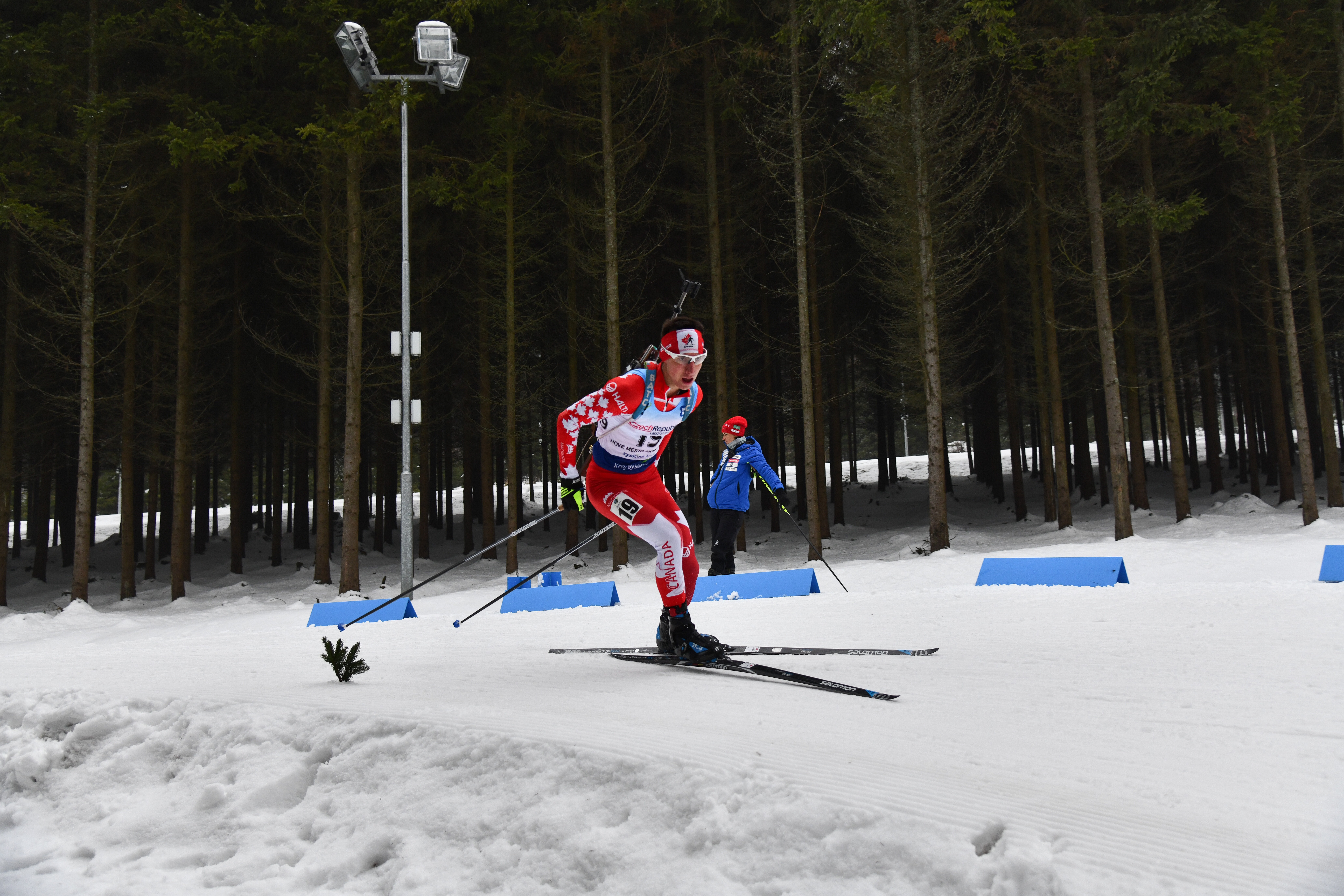
Canada’s Trevor Kiers racing at the IBU Junior Cup in Nove Mesto, Czech Republic, earlier this season. (Courtesy photo)
In an effort to showcase the North Americans competing at this week’s International Biathlon Union (IBU) 2018 Youth and Junior World Championships in Otepää, Estonia, we asked those qualifying athletes several questions about themselves — actually, we had them fill in the blanks. Here we have 20-year-old Trevor Kiers, who is representing Canada at his second Junior World Championships.
“My full name is Trevor Kiers but you can call me anytime 😉.
I was born in Welland, Ontario, raised in Sprucedale, Ontario, and I learned to ski at Arrowhead Provincial Park.
I spent the time between World Youth/Junior trials and Worlds mainly racing on the junior circuit, and then spent the two weeks prior to WJCH in Sjusjoen, Norway.
The favourite workout I did in the last training year to prepare for this was riding the Ironman loop in Penticton, a 180km ride around the area with my teammates Carsen Campbell and Matt Hudec.
One thing I’m working on this season to improve my biathlon is confidence in the range.
This is my first time in Estonia and fourth time racing internationally, and so far it’s been amazing!
One difference I’ve noticed between Estonia and the Canada is that I’ve found that the history, and all that fun stuff is definitely super Euro, but I think that there is a mix of modern western culture thrown in there.
One of the things I’m most excited about for World Youth/Junior Championships in Otepää is watching all my teammates, from potential medalists, to first timers, and all my close friends!
One race I’m especially targeting there is the Sprint and pursuit combo.
Trevor Kiers racing at Canadian World Junior Trials in Whistler earlier this winter. (Courtesy photo)
Watching the Olympics in the lead up to my own races was inspiring and motivational. One of my favourite moments of the Games was when Seb Sameulsson overtook Beni Doll for the silver medal in the men’s pursuit. I want to be like J-T Boe, because he races his heart out, but also knows when to have fun, and after the individual, when to get emotional 🙂
At Worlds, I really hope I can chat/make friends with someone from Norway and ask them if they want to trade last year’s race suits!
My favorite thing at the breakfast where we are staying is that they have what could be considered an American selection, they have oatmeal, eggs and bacon, the food is also delicious.
Before this trip, if you said “Estonia”, the first thing I’d think of would have been Andrew (team wax tech), because I know that he has family here, and that he enjoys his time with his cousins.
Now that I’m here, I’m pretty sure something I’ll always remember will be the venue, it’s been beautiful so far, and the course here is pretty spectacular.
If I had a totally free day here and didn’t have to worry about race fitness or training, I’d spend it around the old town in Tallinn. I went there the first day (I had flown in earlier than the rest of the group) but I feel like I hadn’t seen it all in its best, also a lot of things were closed because it was winter.
The best way to follow me on social media is on FacebookTrevor Kiers – Biathlete or Instagram@trevor.kiers, will also return smoke signals or messages flown in by owl.“
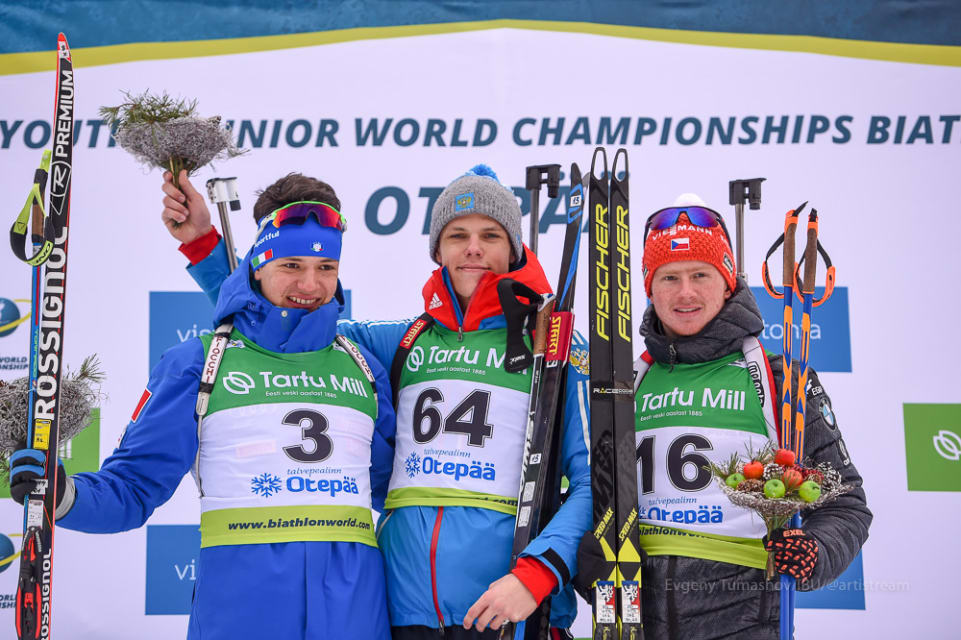
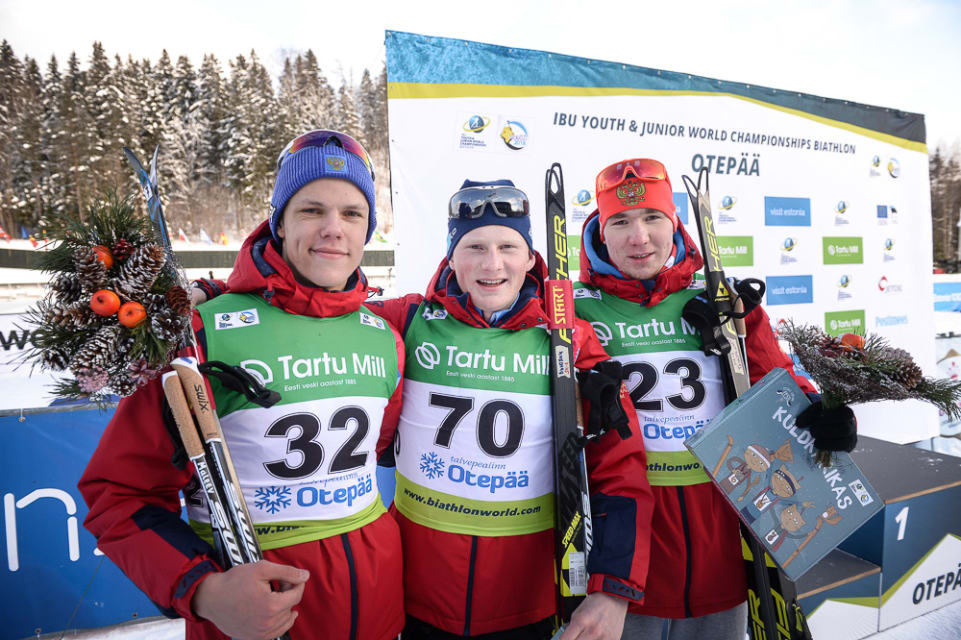
The youth men’s 7.5 k sprint podium at IBU Youth World Championships in Otepää, Estonia, with Russia’s Mikhail Pervushin (c) continuing his undefeated streak at the championships in first, Italy’s Tommaso Giacomel (l) in second, and the Czech Republic’s Vítězslav Hornig (r) in third. (Photo: IBU/Biathlonworld)
IBU Youth World Championships (Otepää, Estonia): Youth women’s and men’s sprints
Sweden’s Karin Elvira Öberg raced to her third-straight win of the week at the International Biathlon Union (IBU) Youth World Championships in Otepää, and Pascale Paradis led Canada in 15th in the youth women’s 6-kilometer sprint on Friday.
Paradis started 36th out of 92 women and shot 18-for-20, missing one on each stage (1+1), on a day when the top-two finishers had misses as well. With the ninth-fastest overall course time, Paradis, 15, finished 1:04.3 minutes off of Öberg’s winning time of 19:46.7.
Sweden’s Karin Elvira Öberg after winning her third-straight race at 2018 IBU Youth World Championships in Otepää, Estonia, with a win in the youth women’s 6 k sprint on Friday. (Photo: IBU/Biathlonworld)
Meanwhile, the 19-year-old Öberg started 65th and claimed the win with one penalty (0+1), continuing her undefeated streak at Youth Worlds after winning the 10 k individual and relay as well. She was joined on the podium by her teammate Amanda Lundström, who also raced to gold in the 3 x 6 k relay on Wednesday, and shot clean on Friday to finish 16.7 seconds back in third.
Between them, Finland’s Heidi Nikkinen placed second (+13.1), with one penalty (1+0).
In the first race of her first Youth World Championships, Paradis placed sixth to earn recognition at the post-race flower ceremony.
“After being shocked with the result I got for the individual it got me pretty excited,” Paradis recalled in an email on Friday. “But I knew that if I put too much pressure on myself I would get too nervous. But it really boosted my confidence to know that I had a chance to do well here!
“So I went into this race not expecting too much,” she continued. “This season I’ve been doing well in individuals so I was hoping for a good result but in sprints I haven’t been shooting great so I was super happy to see myself knock 8 targets down and I skied as fast as I possibly could, so overall I am super happy about my race!”
Pascale Paradis racing the first leg of Canada’s youth women’s 3 x 6 k relay team on Wednesday at IBU Youth World Championships in Otepää, Estonia. Her team finished 10th. (Photo: Bill Gilliland)
Paradis described the conditions as “perfect”, not too cold and with relatively calm winds.
“I was happy about my shooting just because it’s the best I’ve shot in a sprint race this year,” she wrote. “Skiing I felt really tired but my coach Andrew was on the hill cheering super loud and I dug deep and pushed myself to the max in this race and was extremely happy too see that I had skied one of my fastest races ever!”
In Sunday’s 7.5 k pursuit, the last day of the championships, she’ll start about 1 minute and 4 seconds back in 15th, just 2 or 3 seconds out of 12th place.
“I’m excited to be started really close to a few other girls right out of the gates for the pursuit,” Paradis wrote. “We don’t do many pursuits back home so this will be my second one ever and I’m super excited to see what it’s like on the international level. I really like doing pursuits even though they get me the most nervous, it’s just super fun to know where you are in the race the whole time and to just make up as many spots as you can during the course of the race.”
Two other Canadian women finished in the top 60 of the sprint to qualify for the pursuit, with Jenna Sherrington placing 46th (+2:25.3) with two penalties (1+1), and Benita Peiffer placing 51st (+2:40.4) with three misses (1+2). Shilo Rousseau missed the cutoff in 66th (+3:04.8) with four penalties (1+3).
Two American women qualified, with Emma Stertz in 52nd (+2:44.2) with two misses (1+1), and Grace Gilliland in 55th (+2:50.1) with one miss (0+1). Lexie Madigan finished 70th (+3:28.1) with four penalties (4+0) and Helen Wilson followed in 72nd (+3:28.9) with three misses (1+2).
In the youth men’s 7.5 k sprint on Friday afternoon, Russia’s Mikhail Pervushin won his third-straight race of the championships, shooting clean and finishing in 20:17.3. Italy’s Tommaso Giacomel also shot a perfect 10-for-10 to finish second (+21.9) for his first Youth Worlds medal. The Czech Republic’s Vítězslav Hornig rounded out the podium in third (+38.6) with one miss (0+1).
American Vasek Cervenka improved on his 27th place in the 12.5 k individual by finishing 24th on Friday (+1:59.2) with three penalties (1+2). He and two teammates qualified for Sunday’s 10 k pursuit, with Eli Nielsen placing 42nd (+2:51.2) with one miss (0+1), and Garrett Beckrich following in 46th (+3:01.3) with four penalties (1+3). Maxime Germain missed the top 60 in 74th (+4:33.9) with three misses (1+2).
Leo Grandbois led Canada in 33rd (+2:33.4) with three penalties (1+2). All four Canadian men qualified for the pursuit with Thomas Hulsman shooting clean for 35th (+2:35.3), Rory Gilliland finishing 52nd (+3:19.8) with one miss (0+1), and Ryan Elden placing 59th (+3:30.0) with one miss as well (1+0).
The junior women’s and men’s sprints are scheduled for Saturday, followed by the youth and junior pursuits on Sunday.
The top-six finishers at the junior women’s 12.5 k individual flower ceremony on Thursday at IBU Junior World Championships in Otepää, Estonia, with Poland’s Kamila Żuk (second from l) in first, Ukraines’s Anna Kryvonos (l) in second place, Russia’s Irina Kazakevich (third from l) in third, and American Chloe Levins (r) in sixth. (Photo: Erik Lewish)
IBU Junior World Championships (Otepää, Estonia): Junior women’s and men’s individual
Three North Americans in the top 10, top nine even. That’s what happened in a single race at the International Biathlon Union (IBU) Junior World Championships on Thursday in Otepää, with American Chloe Levins placing sixth, and Canada’s Nadia Moser and Megan Bankes claiming eighth and ninth, respectively, in junior women’s 12.5-kilometer individual.
According to the three racers, it was another beautiful day in Otepää with steady, sometimes even gusting, wind.
Levins was the earliest starter of the three, starting in the middle of the field in bib 37 (out of 70). Bankes headed out of the gate 45th and Moser started near last in 67th.
Canada’s Nadia Moser racing to eighth in the junior women’s 12.5 k individual at IBU Junior World Championships in Otepää, Estonia. (Photo: Bryan Dickson)
Despite the late start, Moser, 20 years old and in her second Junior Worlds, explained in an email that she wasn’t nervous. With temperatures rising to a high of -10 degrees Celsius (14 Fahrenheit) on Thursday morning, she almost preferred it.
“There were also 20 second start intervals which are shorter than the usual 30, so all of the competitors were out of the gate in a shorter amount of time than normal,” Moser wrote.
In neither Thursday’s women’s race nor the men’s 15 k individual that followed, nobody shot clean. In fact, only one woman shot 19-for-20: Slovakia’s Veronika Machyniakova, who ended up 11th. The top-two finishers in the women’s 12.5 k, Poland’s Kamila Żuk (who placed first in 41:36.1 minutes) and Ukraine’s Anna Kryvonos (who finished 3:04.7 minutes back in second place), both had two penalties. Russia’s Irina Kazakevich placed third (+3:20.0) with three misses — which added three minutes of penalties to her time.
“I found the wind in the range today to be fairly variable,” Bankes, the defending Junior Worlds champion in the event, wrote in an email. “It was gusting and then dying quiet significantly and also in the middle of shooting bouts which made things a little tricky.”
At last year’s Junior Worlds in Osrblie, Slovakia, Bankes shot a perfect 20-for-20 for the first time in her career and won gold in the junior women’s 12.5 k individual.
Thursday brought new challenges, and Bankes explained she was happy to clean her first prone. She went on to miss two in the next standing stage, then one in each of the following two stages (0+2+1+1) to finish the race with four penalties, which ultimately put her in ninth overall (+4:59.1).
Canada’s Megan Bankes racing to ninth in the junior women’s 12.5 k individual at IBU Junior World Championships in Otepää, Estonia. (Photo: Bryan Dickson)
“I’m not totally sure what happened in my first standing (when I missed 2) but when I came into my 2nd standing the wind was gusting quite a bit, and I was really happy with how I waited for my first 4 shots, but I was a little annoyed to have missed that last one,” she recalled. “Overall I think my shooting today was pretty good, but I could have been better.”
While Bankes figured the wind was giving most others trouble as well, she didn’t think that she’d make it into the top 10 with four misses.
“I don’t like getting splits until the last lap, so I heard Andrew [Chisholm] our wax tech tell me I was fighting for 10th when I passed him, so I really tried to give everything that last lap,” Bankes, 20, wrote. “I was super stoked to see I crossed the line in 7th, and knew I wouldn’t be bumped down too much because I started 3rd seed.
“Coming off of gold last year, I definitely had high expectations for myself,” she explained. “But I tried to use that as more positive belief in myself to know I can be in the top women, and know that I can shoot well, instead of just focusing on the result number. My main goal going into these championships was to have races that I’m happy with, and to ski and shoot to the best of my abilities.”
At the end of the day, Bankes wrote that she was “really happy” with her result.
“I felt like I really held myself together on skis, and kept my technique under control, while also pushing myself to the limit throughout the race,” she wrote. “I’m super stoked to see that the youth women are totally crushing it, and to be right behind Nadia today was also super exciting (also to see Chloe Levins in 6th was fantastic – 3 North Americans in the top 10!)”
From left to right: Megan Bankes, Nadia Moser and Emily Dickson after the junior women’s 12.5 k individual at IBU Junior World Championships in Otepää, Estonia. (Photo: Bill Gilliland)
One place ahead of her, Moser scored her first non-relay top 20 at Junior Worlds, leading Canada in eighth (+4:18.9) with three penalties (1+0+1+1). Two days earlier, Moser, Bankes and their teammate Emily Dickson placed ninth in the junior women’s 3 x 6 k relay.
“I knew I could get a top 10 finish if I could pull my shooting together,” Moser wrote after Thursday’s individual race. “After my third shooting I had missed 2 targets total and I thought then that my top 10 chances were over. On may last loop I had 3 misses and was not even thinking about top 10 anymore. I realized that I must be doing better than I initially thought when everyone who was cheering me sounded really excited. I definitely got lucky today because no one cleaned their shooting. I was extremely happy to have finished in the top 10, especially since I was sure that I had no chance after missing 3 targets.”
She was pleased to see all of her training over the last year validated on Thursday.
“I tried really hard to improve over the summer and fall because I really wanted good results this season,” Moser wrote. “I think that the best thing I did today was to stay calm, and take my time in the range. I shot really slowly but that paid off in the end.”
Chloe Levins (third from r) with the U.S. team staff (from l to r) wax tech Travis Voyer, coach Algis Shalna, assistant coach Danika Frisbie, wax tech Max Bergmann, wax tech Mattias Halquist, and head coach Erik Lewish, after Levins placed sixth in the junior women’s 12.5 k individual at IBU Junior World Championships in Otepää, Estonia. (Photo: Erik Lewish)
The lone American junior woman at this year’s IBU Youth/Junior Worlds, Levins, 19, finished sixth (+3:37.4) with three penalties (0+1+0+2). At last year’s Youth Worlds, Levins notched fourth place in the 7.5 k pursuit.
“There’s a big difference between youth and junior competition,” Levins wrote in an email. “A lot of juniors have IBU Cup experience, World Cup experience, and a handful even attended the Olympics. Fortunately, there’s also a big difference between the youth athlete I was last year and the junior I am now. I’ve been fortunate to compete in more winter biathlon races than ever this year, which has really helped me up my game. It’s a good feeling to see that I’m prepared to compete at this level.”
She explained that she had one goal on Thursday: “smile no matter what,” she wrote. “The hay is in the barn. Now it’s just time to get out of my own way and focus on one thing at a time.”
While Levins had experienced the rush of being near the front of the race in a pursuit, actually contending for a top result in an individual-start race was a new experience for her, she explained.
“As always, I tried not to let thoughts of my position distract me from thinking tactically about the course or my shooting process,” Levins noted. “Every lap, every corner, every shooting remained an opportunity for me until the finish line.
“A lot of my friends finished their races around me, so I did not even see my standing at the finish,” she continued. “When I finally looked at the board and saw that I was more than three minutes back of the leader, I thought that this result, with three penalties myself, was okay. I didn’t expect it to be good enough for sixth place.”
The race was Levins’s first of the week and she presumably has two more to go — as do Moser, Bankes and most of the other junior women — with a sprint on Saturday and, if they place in the top 60 of the sprint, a pursuit on Sunday.
As the only American junior woman in Otepää, Levins wrote that she was fortunate to have a significant amount of team support behind her on Thursday.
“My skis today were incredibly fast,” she emphasized. “Our wax guys made the fastest skis on the track today. … I can’t thank them enough.”
The U.S. team’s head coach and trip leader, Erik Lewish, pointed out that Levins had the seventh-fastest overall ski time and one of the best shooting performances of the day.
“It’s great to see that she is right in the mix with this very competitive field (2 of the starters today were competing in the Olympics),” Lewish wrote. “1 more hit and she would have finished in 2nd place today, this is very exciting looking forward to the Sprint and pursuit (sat and Sunday) where she will have another chance to get on the podium.”
“There are a lot of good things to take from this race and, as always, a lot of things to learn,” Levins concluded. “What’s my goal for the rest of the week? Keep learning. Keep smiling.”
According to Canada’s head coach and trip leader Jacqueline Akerman, the Canadian techs also nailed the wax.
“The techs hit the wax perfectly allowing for some of the top skis out there, when skiing form and wax meet it sets the scene for great results,” Akerman wrote. “The shooting was a bit tricky today with varying strength and switching winds, but both [Nadia and Megan] managed to keep misses to a minimum. They both hit enough to place in the top ten on a day when no one in the field shot clean and only one athlete managed one penalty. They are both happy with their performance, and the rest of us are too!”
Next on the results sheet for Canada was Dickson in 36th (+8:33.7) with five penalties (2+1+0+2), and Zoë Pekos in 63rd (+15:50.6) with eight misses.
Canada’s Adam Runnalls racing to 29th in the junior men’s 15 k individual at IBU Junior World Championships in Otepää, Estonia. (Photo: Bill Gilliland)
In the junior men’s 15 k, Canada’s Adam Runnalls led the North Americans in 29th (+4:26.4) with five penalties (0+0+3+2). Teo Sanchez followed in 58th (+7:25.2) with four misses (1+1+1+1), Angus Tweedie was 67th (+9:11.8) with six misses (2+0+2+2), and Trevor Kiers 77th (+12:44.3) with 13 penalties.
For the U.S., Tim Cunningham finished 53rd (+6:49.3) with six penalties (1+3+1+1), Cody Johnson was 60th (+8:01.7) with seven misses, Jacob Pearson 83rd (+16:39.6) with 13 misses, and Cameron Christiansen 84th (+16:53.6) with eight penalties.
Russia had two on the podium in the men’s race as well, with Igor Malinovskii scoring his second-straight win after racing to gold in the junior men’s 4 x 7.5 k relay on Tuesday. He has won the last four races he’s contested, including the sprint and the pursuit at IBU Junior Open European Championships before Junior Worlds. Malinovskii finished in 41:48.5 on Thursday with three penalties (1+1+1+0), besting Norway’s Sturla Holm Lægreid in second place by 19.4 seconds; Lægreid also had three penalties (1+0+1+1). Russia’s Said Karimulla Khalili added bronze (+23.0) to his medal collection, with two misses (0+1+1+0), after capturing gold with his relay team.
No one in the junior men’s individual had fewer than two misses.
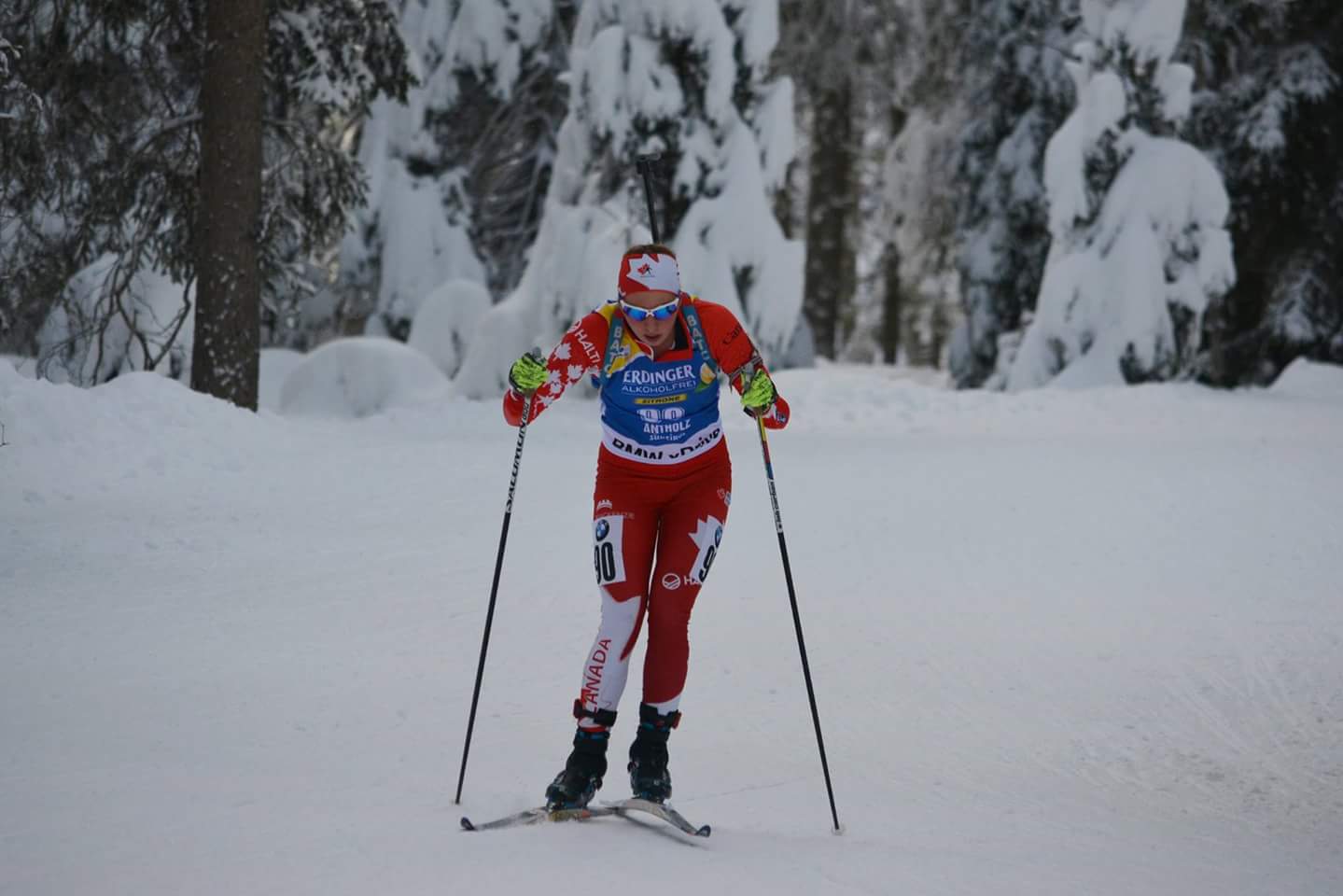
Nadia Moser of Canada in her first World Cup start in Antholz, Italy, this season. (Courtesy photo)
In an effort to showcase the North Americans competing at this week’s International Biathlon Union (IBU) 2018 Youth and Junior World Championships in Otepää, Estonia, we asked those qualifying athletes several questions about themselves — actually, we had them fill in the blanks. Here we have 20-year-old Nadia Moser, who is representing Canada at her second Junior World Championships. Moser started her season with four weekends worth of IBU Cup racing, and also got her first World Cup start in Antholz, Italy, where she finished 85th in the 10 k sprint.
On Thursday, Moser placed eighth in the junior women’s 12.5 k individual (+4:18.9 with three penalties) for her first top 20 in a non-relay event at Junior Worlds.
***
“My full name is Nadia Moser but you can call me Nadia.
I was born in Edmonton, Alberta, and raised in Atlin, British Columbia and Whitehorse, Yukon, and I learned to ski at… I don’t know exactly the age but I was pretty little.
I spent the time before Worlds training in Canada and Europe.
The windiest workout I did in the last training year to prepare for this was hiking to the top of Grotto Mountain on my own.
One thing I’m working on this season to improve my biathlon is ski technique.
This is my second time in Estonia and third year racing internationally, and so far it’s been interesting.
Canada’s Nadia Moser competing in the pursuit race at 2017 Junior Open European Championships in Nove Mesto, Czech Republic. (Photo: Emily Dickson)
One difference I’ve noticed between Estonia and the Canada is the landscape here is much flatter than Canmore.
One of the things I’m most excited about for World Youth/Junior Championships in Otepää is all of the races! I can’t target just one!
Watching the Olympics in the leadup to my own races was super exciting and inspiring. One of my favourite moments of the Games was watching Simon Schempp and Martin Fourcade sprint for the gold in the mass start.
I want to be like any super speedy animal, maybe a cheetah, because it would really help to be fast on race day.
At Worlds, I really hope I can chat/make friends with someone from any other country and ask them how they like racing in Estonia.
My favorite thing at the breakfast where we are staying is oatmeal/granola.
Before this trip, if you said “Estonia”, the first thing I’d think of would have been fish jello, because last year there was fish jello at the hotel I stayed at here (in Otepää).
Now that I’m here, I’m pretty sure something I’ll always remember will be fish jello.
If I had a totally free day here and didn’t have to worry about race fitness or training, I’d spend it exploring the science centre in Tartu.
The best way to follow me on social media is on Instagram@nadihaamoser.”
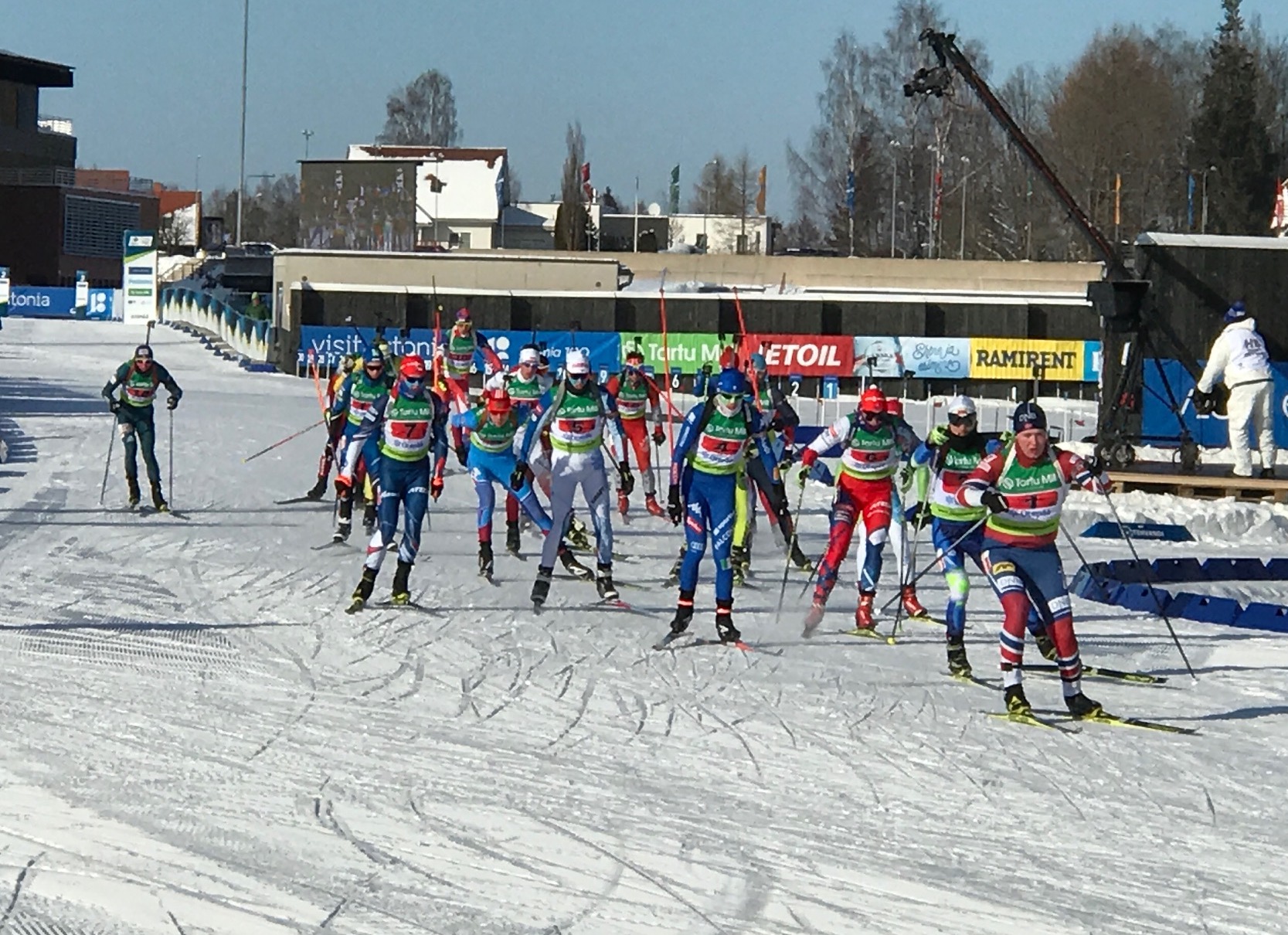
The youth men’s 3 x 7.5 k relay on Wednesday, with Norway leading, at the IBU Youth World Championships in Otepää, Estonia. (Photo: Bill Gilliland)
IBU Youth World Championships (Otepää, Estonia): Relays
Pascale Paradis racing the first leg of Canada’s youth women’s 3 x 6 k relay team on Wednesday at IBU Youth World Championships in Otepää, Estonia. (Photo: Bill Gilliland)
Tuesday and Wednesday were relay days at the International Biathlon Union (IBU) Youth/Junior World Championships in Otepää, highlighted by two ninth-place results by the Canadian and American biathlon teams.
On Tuesday, the Canadian junior women (Emily Dickson, Nadia Moser and Megan Bankes) placed ninth in the 3 x 6-kilometer relay, 3:31.6 minutes out of first, with two penalties and 14 spares. The U.S. youth men (Vasek Cervenka, Camren Nielsen and Garrett Beckrich) finished ninth in the 3 x 7.5 k on Wednesday, +7:19.9 with three penalties and 15 spares.
Also on Wednesday, Canada finished 10th in the youth women’s 3 x 6 k with Pascale Paradis, Shilo Rousseau and Benita Peiffer (+3:35.3 with zero penalties and 11 spares). The U.S. youth women followed in 18th with Helen Wilson, Margaret Madigan and Emma Stertz (+8:24.6 with one penalty and 12 spares).
The Canadian youth men’s relay, with Rory Gilliland, Tom Hulsman and Leo Grandbois, on Wednesday at IBU Youth World Championships in Otepää, Estonia. (Photo: Bill Gilliland)
The Canadian youth men finished 16th with Rory Gilliland, Thomas Hulsman and Leo Grandbois (+9:45.5 with three penalties and 18 spares).
In the junior men’s 4 x 7.5 k relay on Tuesday, Canada finished 17th with Teo Sanchez, Angus Tweedie, Trevor Kiers, and Adam Runnalls (+10:48.7 with four penalties and 14 spares), and U.S. followed in 19th with Cody Johnson, Tim Cunningham, Camron Christiansen, and Jacob Pearson (+24:31.1 with eight penalties and 18 spares.
France won the junior women’s relay with Camille Bend, Myrtille Begue and Lou Jeanmonnot Laurent finishing in 1:02:52.1 hours with one spare and eight penalties. Norway placed second in that race, 17.5 seconds back, and Russia was third (+40.1).
Russia topped the junior men’s relay with Said Karimulla Khalili, Vasili Tomshin, Viacheslav Maleev, and Igor Malinovskii finishing in 1:25:21.2 with zero penalties and nine spares. Norway took silver(+57.1), and France earned bronze (+2:45.6).
Sweden won the youth women’s relay the following day with Amanda Lundström, Ella Halvarsson and Elvira Öberg in 1:03:19.8 with zero penalties and six spares. Öberg shot clean without any spares (0+0, 0+0) for her second gold medal in as many races after she won Monday’s 10 k individual.
She edged Finland’s Heidi Nikkinen in a photo finish, in which the two racers finished less than a tenth of a second apart, and Finland settled for silver after two penalties and 10 spares. Norway reached the podium in third (+37.0).
The Russian men prevailed again on Wednesday with Denis Tashtimerov, Andrei Viukhin, and Monday’s 12.5 k individual gold medalist, Mikhail Pervushin, winning the youth men’s relay in 1:04:51.1 with two penalties and eight spares. The Czech Republic claimed silver (+2:30.), and Norway continued its podium streak in third (+3:04.5).
Youth/Junior World Championships continue Thursday with the junior women’s 12.5 k and junior men’s 15 k individual races in Otepää.
Megan Bankes (Biathlon Canada) lunging at the finish of the IBU World Cup women’s sprint in Annecy, France, in December. She placed 65th. (Photo: Glen Crawford)
In an effort to showcase the North Americans competing at this week’s International Biathlon Union (IBU) 2018 Youth and Junior World Championships in Otepää, Estonia, we asked those qualifying athletes several questions about themselves — actually, we had them fill in the blanks. Here we have 20-year-old Megan Bankes, who is representing Canada at her second World Junior Championships after also competing at 2015 World Youth Championships. Bankes won gold in the junior women’s individual race at last year’s Championships. This season, she started the winter on the World Cup and contributed to a ninth-place relay effort by the Canadian women in Hochfilzen, Austria. Bankes was the sixth woman on the list for a five-woman Canadian Olympic Team in biathlon.
On Tuesday, Bankes anchored Canada’s junior women’s 3 x 6 k relay team to ninth place.
***
“My full name is Megan Bankes but you can call me Megan.
I was born and raised in Calgary, AB, and I learned to ski at age 4.
I spent the time before Worlds training in Canmore and Sjusjøen Norway.
My favorite workout I did in the last training year to prepare for this was rollerskiing up Highwood Pass, then running Ptarmigan Cirque, almost running into a grizzly on the way down, and having cookies waiting for us at the end with my Biathlon Alberta Training Center teammates .
One thing I’m working on this season to improve my biathlon is my shooting consistency.
Megan Bankes on the range in Sjusjøen, Norway. (Photo: Emily Dickson)
This is my second time in Estonia and fifth year racing internationally, and so far it’s been kind of chilly.
One difference I’ve noticed between Estonia and the Canada is their love of kefir.
One of the things I’m most excited about for World Youth/Junior Championships in Otepää is racing.
One race I’m especially targeting there is the relay.
Watching the Olympics in the leadup to my own races was fantastic. One of my favorite moments of the Games was watching Kikkan and Jessie crush it in the team sprint and also cheering on Canadians in every sport. I want to be like Laura Dahlmeier because she can pull off amazing races when it really counts, and she’s so strong.
At Worlds, I really hope I can chat/make friends with someone from Sweden and ask them about themselves and their racing.
My favorite thing at the breakfast where we are staying is the tea selection.
Before this trip, if you said “Estonia”, the first thing I’d think of would have been memories from my trip here 12 years ago with my family.
Now that I’m here, I’m pretty sure something I’ll always remember will be the knitting.
If I had a totally free day here and didn’t have to worry about race fitness or training, I’d spend it wandering around the old city in Tallinn.
The top-six finishers in the youth women’s 10 k individual at IBU Youth World Championships on Monday in Otepää, Estonia, with Sweden’s Karin Elvira Öberg (second from l) in first, Russia’s Anastasia Shevchenko (l) in second, Russia’s Anastasiia Goreeva (third from l) in third and Canada’s Pascale Paradis (far right) in sixth. (Photo: IBU/Biathlonworld)
(Note: This article has been updated to include comments from Canada’s Pascale Paradis and Canadian head coach Jacqueline Akerman.)
IBU Youth World Championships (Otepää, Estonia): Youth women’s and men’s individual
On Day 1 of the International Biathlon Union (IBU) Youth/Junior World Championships in Otepää, Canada had two women finish in the top 11 of the youth women’s 10-kilometer individual race on Monday.
Canada’s Pascale Paradis racing to sixth in the youth women’s 10 k individual on Monday, the first day of 2018 IBU Youth World Championships in Otepää, Estonia. (Photo: Ian Sherrington)
Both are brand new to the Youth World Championships scene, with 15-year-old Pascale Paradis placing sixth, 1:09.2 minutes out of first, with one penalty (1+0+0+0). Also for Canada, 17-year-old Benita Peiffer shot an impressive 19-for-20 in the youth women’s longest race of the championships, missing one in prone and cleaning her remaining targets (1+0+0+0) to finish 1:43.1 out of first.
“I came to these championships with no expectations, with it being my first international race I figured I wouldn’t do great because there’s so many other great competitors in the world,” Paradis wrote in an email to FasterSkier on Monday night. “I just lined up for the start line and pretended that I was racing any normal race because if I didn’t think that I knew the nerves would get to me.”
She started in the middle of the field in bib 45 and found the conditions to be ideal: sunny, not too cold and with minimal wind.
“Right out of the start gates I had a good feeling about the day,” she recalled. “I had a restful sleep and was really nervous and excited at the same time. Though I had no idea I would do that well, I just felt good to me and that’s what made me happy. It just made me even happier to realize that I had come top ten and I was over the moon. I didn’t see that coming and I was incredibly grateful for all of those that had helped get to this stage.
“On course I felt pretty strong, I definitely didn’t feel weak but I had no idea my skiing was within some of the faster times,” Paradis added. “On the range my goal was to focus on my own race and not getting bothered by other competitors, which I usually do, and on the range I felt confident when I came in to shoot. I achieved my goal by not getting flustered by the other girls and all the other distracting sounds.”
According to Canada’s head coach and trip leader Jacqueline Akerman, the team’s head wax technician, Andrew Chilsom, informed Paradis she was in first place after the last shooting.
“She gave a little laugh and immediately picked up her pace and passed a few more competitors in her last loop, good enough to hold for a spot in the flower ceremony,” Akerman wrote.
When Paradis crossed the finish line, she was initially in second place.
“When I finished I didn’t believe that I was one of the top competitors,” Paradis wrote. “I was so dazed and tired and there was so many people around that I just couldn’t really get it into my head. So I was just extremely happy to be up there with the other top biathletes in the world, I didn’t think my result would stay like that but I was just happy to be in that position at all. I was expecting a top 60 maybe when I came here let alone top 10.”
Peiffer started 88th out of 91 in the women’s race. After cleaning the last three shooting stages, she learned what place she was fighting for on her last loop.
“It was probably a good thing I wasn’t told how I was doing until the last lap otherwise I would have gotten too excited and blown up on my last shooting bouts,” Peiffer wrote. “When I found out that I would have a chance at 11th place while I was racing I instantly skied as fast as I could and left all my energy all out on the course. Once I crossed that finish line in 11th place I was filled with satisfaction knowing that I put it all out on the course and proved to myself that I can hit those targets!
“I think the key to my solid shooting today was staying completely focused and in my bubble while shooting,” Peiffer continued. “I found it quite challenging with the amount of people around but I just focused on what I had to do to hit those targets. I also found that not thinking about my shooting too early while skiing on the course helped. I usually get too excited about what could happen and then things go sideways! Positivity is another one! Believing that I could hit those targets is what gave me confidence going into the range.”
She described the Otepäa range approach as relatively easy, which she preferred. “I really like to calm down before I start shooting,” Peiffer explained. “The range here is also not affected by the wind much which I am very pleased with!”
Sweden’s Karin Elvira Öberg, the younger sister of Olympic 15 k individual champion Hanna Öberg, won the race with 19-for-20 shooting as well (1+0+0+0), posting the fastest time at the finish of 35:35.9 minutes. And she did so on her 19th birthday.
“I was so happy for Hanna when she won, and now I win,” Öberg told the IBU on Monday.
Russia occupied the second and third steps on the podium with Anastasia Shevchenko placing second, 35.6 seconds back, with two penalties — one of which came on the last shooting stage (1+0+0+1). Anastasiia Goreeva placed third (+53.8) with three penalties (1+2+0+0).
Four Canadian women competed in the event, with Shilo Rousseau finishing 36th (+4:06.4) with three penalties (0+1+0+2), and Jenna Sherrington following in 40th (+4:22.9) with one miss (1+0+0+0).
“It was wonderful to see the whole group of young youth women who are relatively inexperienced (on the international stage) put in solid performances today,” Akerman wrote. “All of them placing in the top forty along with great shooting results is something to be very proud of! … This is credited to the great and hard working staff and supportive team we have here, as well as thier coaches and others back home who have obviously done great prep work. We have 14 family members of athletes here cheering like crazy, cowbells and flags and heys with each hit, it sure adds to the support the athletes feel. During the flower ceremony Pascale got a much louder cheer than the first placed athlete!”
Emma Stertz led the U.S. in 60th (+6:01.9) with two penalties (0+2+0+0), Helen Wilson finished 74th (+8:00.9) with five penalties (2+2+1+0), and Margaret Madigan placed 83rd (+10:53.9) and Grace Gilliland 84th (+11:26.3) with nine penalties apiece.
Russia put three in the top six of the youth men’s 12.5 k individual on Monday at 2018 IBU Youth World Championships in Otepää, Estonia, with Mikhail Pervushin (32) placing first, Andrei Viukhin (70) fourth and Denis Tashtimerove (23) sixth. (Photo: IBU/Biathlonworld)
In the youth men’s 12.5 k individual, Russia’s Mikhail Pervushin claimed the win in 37:41.2 with perfect shooting except for a single miss on the last stage (0+0+0+1). Norway’s Filip Andersen took silver (+12.3) with one penalty as well (1+0+0+0), and France’s Martin Bourgeois République claimed bronze (+47.2) with two penalties (0+1+0+1).
“I was worried before the start, but I’m happy that things turned out as they did,” Pervushin told the IBU. “Today I was aiming for clean shooting, but I did not succeed, that upset me, but I had to fight for the win. I feel good on the track, I like it – overall I’m happy.”
The defending youth world champion in the event, Canada’s Leo Grandbois placed 24th (+4:15.6) on Monday after incurring five penalties (1+1+2+1). American Vasek Cervenka finished about another 10 seconds back in 27th (+4:25.5) with six penalties (0+3+2+1).
“Leo had a solid ski race today,” Ackerman wrote. “His shooting was not there today, but knowing him he will turn that around in a hurry.’
Also for Canada, Rory Gilliland finished 47th (+6:00.1) with three misses (1+0+1+1), Thomas Hulsman was 65th (+7:35.0) with four penalties (3+1+0+0), and Ryan Elden 81st (+10:47.3) with 10 penalties.
For the U.S., Garrett Beckrich placed 48th (+6:03.9) with seven misses, Camren Nieslen was 64th (+7:21.8) with four misses (0+3+1+0), and Maxime Germain 70th (+8:15.6) with seven penalties.
The junior women’s 3 x 6 relay and junior men’s 4 x 7.5 k relays will be held Tuesday and the youth relays will follow on Wednesday.
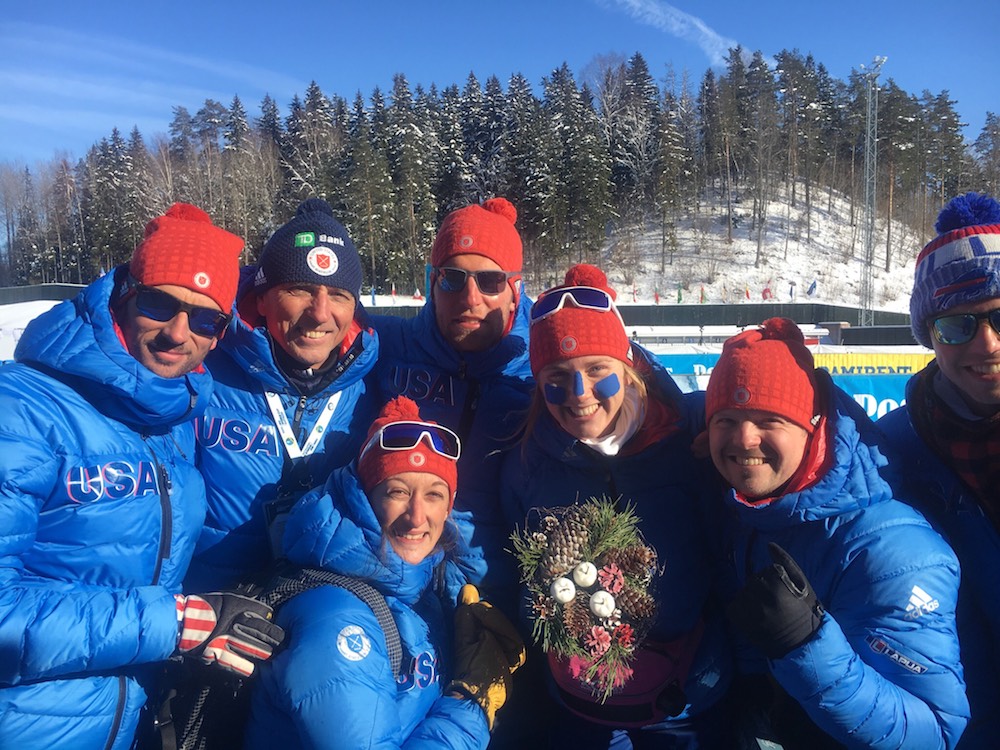
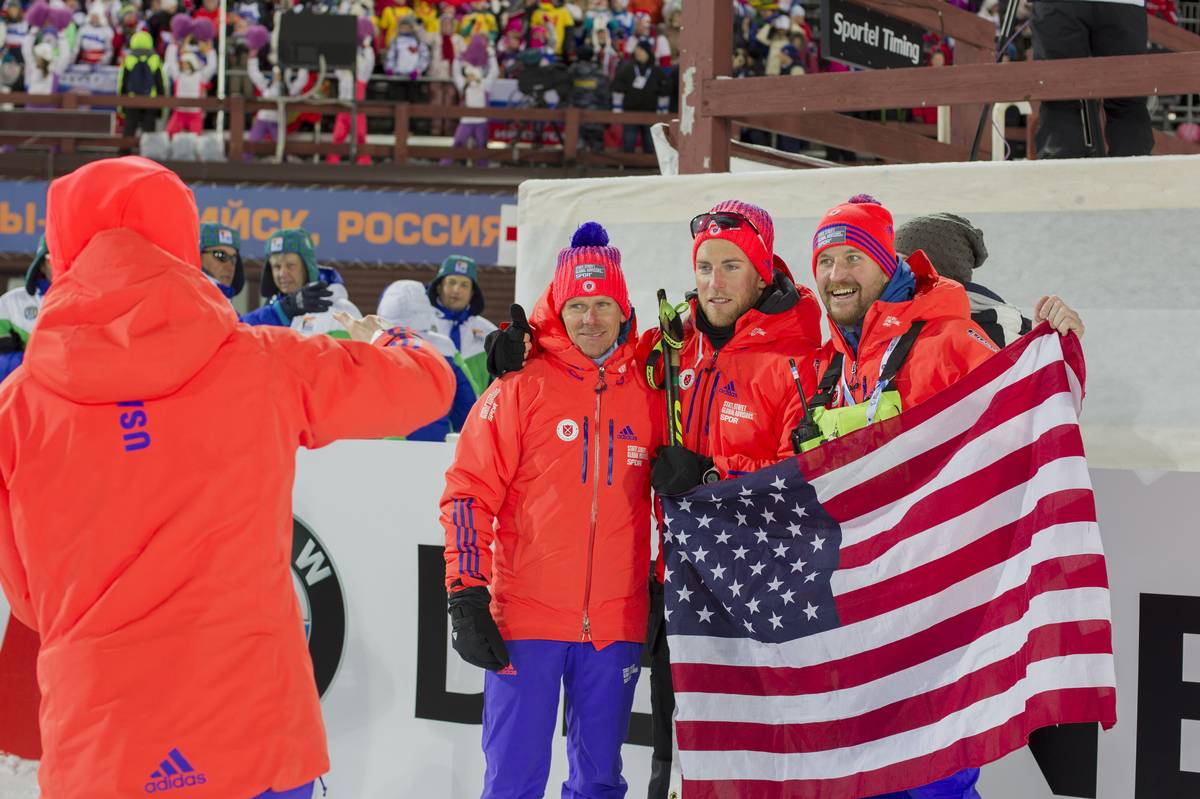
The US Biathlon coaching staff, poses for a photo following the men’s World Cup sprint in Khanty-Mansiysk, Russia, in 2016. The US will not attend this year’s World Cup final in Tyumen. (Photo: USBA/NordicFocus)
In December, Biathlon Canada announced that it would not attend World Cups slated for Tyumen, Russia, in March, due to the doping scandal that has consumed Russian sports. Russia is still not in compliance with the World Anti-Doping Code, and, Biathlon Canada stated, “the integrity of anti-doping procedures in Russia is still very much uncertain, given the current situation in which RUSADA remains non-compliant with WADA.”
This caused little reaction from the International Biathlon Union (IBU) at the time.
The United States and the Czech Republic have now also announced their intentions to boycott the event, and other individual high-level athletes also do not plan on attending.
“I am really discouraged by our international federation, the IBU,” Lowell Bailey said after the men’s relay at the Olympics on Friday. “Our President, Anders Besseberg… at every turn when he has the chance to defend clean sport, he has turned the other way. And it’s not fair to clean athletes. The latest decision by the IBU was to send the World Cup tour to Tyumen, Russia, for our World Cup final. Team USA is boycotting. The Czech team is boycotting. Canada is boycotting. We are trying to rally more support. I know that as an Athletes’ Representative, almost every country had athletes that wrote letters to the IBU [about the World Cup final].”
The Czechs know that they will lose Nations Cup points, and possibly World Cup quota spots, by skipping a weekend of racing, but said that it was worth it.
“We have taken a certain stance, with some sacrifices, and it would be wrong to give it up now,” Czech Biathlon Union President Jiří Hamza told iDNES, a Czech news agency, according to a translation.
“If you are convinced something is not right, you should keep that stance,” shooting coach Ondřej Rybář said in the same article. “If the other countries talk about RUSADA being noncompliant and that they should not have international races in Russia, but they eventually go there, that’s their issue. We clearly stated that we do not agree with what is happening in Russia. We therefore want that the work did in the fight against doping isn’t lost.”
And in the meantime, the IBU had apparently received private feedback from athletes who wanted the World Cups to be moved to a Code-compliant country.
“The outcry from our fellow athletes around the world has been respectful, strong, and definitive,” the U.S. biathletes wrote in a joint statement that they each posted to social media platforms (for example, here). “In addition to the dozens who expressed their opinion to the IBU Athletes Commission members ahead of the meeting in January 2018, the IBU received letters representing over 30 athletes, from eight countries, and included three 2018 Olympic Champions… ”
French star Marie Dorin Habert, a four-time World Championships gold medalist, has announced that she will retire after the World Cup weekend in Oslo – which by definition means that she won’t be going to the final weekend of competition in Russia.
Teammate Martin Fourcade, however, reportedly will attend the races in order to fight for the World Cup crystal globe, which he currently leads by just 54 points over Johannes Thingnes Bø of Norway.
“My position on doping and on Russians who have cheated is clear, but my position on Russia is different,” he said, according to the German Press Agency via a translation. “The country is a fan of biathlon, and I think the Russian public should not be eternally punished for the actions of some of its officials and athletes.”
Sebastian Samuelsson, a Swede who won silver in the Olympic pursuit and then gold in the relay, also expressed his dissatisfaction with the IBU’s handling of the situation.
“Hugely disappointed with the [IBU] decision today to, despite considerable pressure, to keep the [World Cup] in Russia,” he tweeted, according to a translation.
Samuelsson was rewarded with numerous twitter replies from Russian accounts telling him to stay home, one of which called him a baby and another of which said he was “not welcome in Russia”. He was then attacked on Instagram, with obscenity-filled threats and more sober ones, like, “your whole family will die.”
And that’s something that the Americans mentioned in their open letter explaining why they wouldn’t be traveling to Russia: safety.
“I’ve got online threats because of things I’ve said,” Canada’s Rosanna Crawford told Norwegian broadcaster NRK after the Canadians announced their boycott in December. “There are people who say they can’t wait until I come to Russia, ‘we’ll see what happens to you then’.”
It’s something the Czechs are intimately familiar with, too. After their 2014 women’s relay team celebrated being awarded Olympic bronze after the Russian relay team was disqualified for doping – several relay members’ cases are now pending at the Court of Arbitration for Sport – they were attacked as well, with hundreds of comments on social media calling the women “pigs” and “prostitutes” and threatened that if they did come to Russia, their anti-doping samples would be sabotaged.
And indeed, the first comment on U.S. biathlete Susan Dunklee’s Instagram post announcing the boycott was sexually-explicit and degrading insult, the only part of which can be written on a family-friendly website was the part calling her “ugly”. More obscenity-laden comments followed.
“Thank God the Americans won’t come!” another commenter wrote. “If you came to us, I’d throw you tomatoes.”
“You’re not an athlete,” added a third.
“American coward,” mocked another.
Bailey did not post about the boycott on Instagram, but commenters went there anyway, flocking to his most recent post – from nearly a year ago – to call him a doper.
“… the protection of clean athletes and the fight against doping are of the highest priority,” the IBU wrote in a September press release regarding the Russian doping investigation.
But when it comes to online threats against the athletes competing in their sport, the federation has so far been silent.
In response to Canada’s boycott announcement in December, Anders Besseberg said, “It’s not mandatory for anyone to attend, let’s put it that way.”
Fredrik Lindström crosses the line first to secure a gold medal for his Swedish teammates in the men’s 4 x 7.5 k relay on Friday to close out biathlon competitions at the 2018 Olympics in PyeongChang, South Korea. (Photo: FlyingPointRoad)
Remember when it was a big deal when Sweden won a Biathlon World Cup? The team in bright yellow has made it a habit at the 2018 Winter Olympics, winning their first Olympic relay gold and fourth medal over the last two weeks on Friday — the last biathlon race of the PyeongChang Games.
“It’s dreams coming true at that moment,” Fredrick Lindström, the Swedish men’s 4 x 7.5-kilometer relay anchor said in a post-race press conference on Friday. “It’s my third Olympics and to be on top with these guys feels great. I don’t know what to say.”
Lindström had taken gold in perhaps the most ideal way for an athlete in his position, by heading out on the last 2.5 k loop in first place, almost 41 seconds ahead of anyone else. While he had missed his first shot in the final standing stage of the race, Lindström cleared it with the use of one spare bullet. Meanwhile, his closest challenger for the win — Norway’s Emil Hegle Svendsen, who had followed him into the range and lined up alongside him to shoot — missed his first two targets and went on to miss more, ending up with a penalty lap after using all three spares.
That was the end of gold for Norway and for Svendsen, who was all too familiar with the penalty lane in the closing moments of an Olympic relay. Four years ago in the men’s relay in Sochi, Russia, Svendsen as Norway’s anchor had been in the medal hunt until the final shooting. There, he used all of his spares and still left a target standing, which sent him to the penalty lap. After leading by as much as 20 seconds in the middle of that race, Norway finished fourth.
But as they say, that’s biathlon. And on Friday, it was Sweden’s day and Lindström skiing on his own for a 2.5 k victory loop around the course. But he didn’t slow down. As the 28 year old skated up the final climb, he was greeted by several members of his team bowing up and down in a unison to celebrate the history that was about to be made. Lindström descended down into the stadium, not looking back and still pushing toward the line, before skiing to the sidelines a few meters before the finish to grab a small Swedish flag.
Fredrik Lindström crosses the line first to secure a gold medal for his Swedish teammates in the men’s 4 x 7.5 k relay on Friday to close out biathlon competitions at the 2018 Olympics in PyeongChang, South Korea. (Photo: FlyingPointRoad)
It wasn’t like the oversized French flag Martin Fourcade had been seen waving earlier in the Games, in the pursuit and again in the mixed relay. It was understated, like Sweden’s biathlon team before these Olympics, but he waved it proudly as he crossed the line to a sea of swarming teammates.
Sweden (with Peppe Femling, Jesper Nelin, Sebastian Samuelsson, and Lindström) finished first with a cumulative time of 1:15.16.5 hours and a total of seven spares and zero penalties. Skiing alone and finishing 55.5 seconds behind them, Svendsen crossed the line in second for Norway (with teammates Lars Helge Birkeland, Tarjei Bø, and Johannes Thingnes Bø), after tallying 12 spares and one penalty.
In stark contrast to Lindström’s wide-eyed smile as he finished, Svendsen, 32, who had previously earned bronze in the mass start and silver with Norway’s mixed relay in PyeongChang, hung his head. His teammates met him at the finish and tried to improve his mood, but he was down.
“It was a good battle. We wished each other luck before the start and it was a good fight,” Lindström said of contending with Svendsen for two out of three loops.
Norway’s third-leg skier Johannes Thingnes Bø (1) racing his team into fourth to first in the men’s 4 x 10 k relay at the 2018 Olympics in PyeongChang, South Korea. (Photo: FlyingPointRoad)
Johannes Bø had tagged Svendsen in first at the last exchange, 0.4 seconds ahead of Sweden, with Samuelsson handing off to Lindström. In the prone stage that followed, both Lindström and Svendsen cleaned without a miss. They left the range together, more than a minute clear of Germany’s Simon Schempp in third (who had missed three but avoided a penalty three spares). Germany had been 13.7 seconds back at the last exchange.
“Emil had to go first the first loop, I went first the second loop, and on the shooting we were equal until that standing,” Lindström reflected. “I don’t know, I was the lucky man today. I feel proud that I managed that situation and to bring the gold to Sweden.”
Even without gold, Svendsen is the third-most medaled biathlete in Olympic history, according to the International Biathlon Union (IBU). A four-time Olympian, he has eight medals, four of which are gold.
“I think that’s awesome,” Svendsen said when asked about his medal tally at the press conference. “It feels very good and yeah, what can I say? Thank you.”
Finishing more than a minute after Norway and exactly 2:07.1 minutes behind Sweden, Germany (with Erik Lesser, Benedikt Doll, Arnd Peiffer, and Schempp) placed third after Schempp incurred a penalty in the final standing stage. While he was still far enough ahead of Austria’s Dominik Landertinger to hang onto bronze, that penalty put Schempp nearly a minute behind Svendsen at the start of his last loop.
While he waved to the crowd as he finished, Schempp later said he wasn’t happy with his performance. The German team accrued 10 spares and three penalties (two of which came in Doll’s second leg).
“I just was disappointed in my race,” Schempp told German broadcaster ARD of his finish-line body language, according to a translation. “But at the end of the day we won the medal. That is the most important thing, that’s what matters, but of course, I can’t be satisfied with my shooting bouts. It was so incredibly gusty … I waited crazily long with my spare shots today because I thought the gusts would be over soon and then I could shoot. But unfortunately that was not the case, so I was on the range forever, losing a lot of time and then still didn’t hit every target. It was like a vicious cycle.”
Lesser and Canada’s Christian Gow Up Front
Sweden had positioned itself for a medal from the gun, with first-leg skier Femling tagging Nelin in fifth, 27.3 seconds back, at the first exchange. Germany’s Lesser had put his team in first on that leg with near-perfect shooting — cleaning prone and using one spare in standing (0+0, 0+1). Lesser tagged Doll 18 seconds ahead of Slovakia in second, which had put itself in contention with a flawless first leg from Matej Kazár. (Slovakia dropped to 15th on the second leg and was lapped on the third leg.)
Canada’s first-leg skier Christian Gow (12) leading the field, including France’s Simon Desthieux and Germany’s Erik Lesser (far l), to the top of a climb in the men’s 4 x 7.5 k relay at the 2018 Olympics in PyeongChang, South Korea. (Photo: FlyingPointRoad)
Canada attracted some serious TV time when Christian Gow took the lead on the first climb out of the stadium. He went on to hit five targets in a row in prone and left the range in second, 1.2 seconds behind Lesser in first. One loop later, Gow had slipped to eighth and about 20 seconds back when he needed three spares to clean. He ended up tagging his brother and teammate Scott Gow in ninth, about 48 seconds out of first.
“It wasn’t planned, for sure,” Gow, 24, told FasterSkier after about his decision to lead on the first loop. “Right at the top of the first climb, everyone was kind of moving over to the right, staying in kind of two lines, and there’s quite a bit of space there, so I took the opportunity to move up just because I’ve done so many relays where you’re stuck in the middle of the pack. … I saw an opportunity to get to the front — I didn’t think it would be the front — but that’s what ended up happening, and I just did my pace and no one wanted to pass me.
“I’m really happy to have cleaned the prone for sure because it’s great if you can lead it, but if you can’t knock down the targets it doesn’t mean too much,” he continued. “In the standing I’m trying to be a bit easier on myself, just because it’s a new situation to be way up in the front like that and having a great day. I wish I would have held it together a bit better than I did. I think I let the nerves get to me a little bit more than I should of, but a lesson learned and I’m happy with the first two-thirds [of my race].”
Sweden’s Steady Rise
Nelin raced Sweden into second place, 16 seconds behind the Czech Republic in first by the second exchange. He cleaned prone with one spare and avoided a penalty with three spares in standing while Germany’s Doll, who had been skiing alone in first before the standing shooting, dropped to fifth and almost 38 seconds back with two costly penalties.
The Czech Republic’s Michal Šlesingr cleaned standing without a miss to take the lead with one loop to go in the second leg, 6.8 seconds ahead of Austria’s Simon Eder in second. Nelin followed another 8 seconds back in third, and tagged just 0.2 seconds ahead of Austria in the exchange.
The third leg saw Johannes Bø, who had been tagged 31 seconds back in fourth, put Norway in first with a clean prone and a single spare in standing. Samuelsson, who had previously taken silver in the 12.5 k pursuit and placed fourth in the 20 k individual race at these Olympics, put Sweden in a position to win gold, using just one spare to clean prone and shooting without a miss in standing. He latched onto Bø, leading the Norwegian on their final loop and handing off to Lindström just 0.4 seconds behind Norway.
The Swedish men’s gold-medal relay team, with Peppe Femling, Jesper Nelin, Sebastian Samuelsson, and Fredrik Lindström, after winning the last biathlon race of the 2018 Olympics in PyeongChang, South Korea. (Photo: FlyingPointRoad)
Earlier this season, Sweden won the men’s relay at the IBU World Cup in Oberhof, Germany. The order was the same, except Martin Ponsiluoma skied the first leg, rather than Femling. While the win was a big deal for Sweden, it was against a slightly watered-down field, with some of the top biathletes opting to skip the Oberhof World Cup at the start of the new year.
Friday’s victory marked Sweden’s first Olympic relay gold in biathlon after it earned bronze in 1976 in Innsbruck, Austria, and again in 1992 in Albertville, France.
“It means a lot. It’s the first medal for men’s relay team in biathlon for Swede,” Samuelsson said. “Of course we are really satisfied. We did four good races everyone today and we’re super happy.”
U.S. Ties Olympic-Best 6th
While Austria finished Friday’s relay in fourth (+2:52.5), and France placed fifth (+3:26.6), the U.S. men tied its country’s best Olympic relay result in sixth (+3:50.2) with Lowell Bailey, Sean Doherty, Tim Burke, and Leif Nordgren. They had been 10th after Bailey’s first leg, in which he used two spares in each stage, and improved to sixth, then fifth on Doherty’s and Burke’s legs.
Doherty used just one spare in prone and cleaned standing without a miss, leaving the range in sixth and 42 seconds back with one loop to go. He then tagged Burke in sixth, about 54 seconds out of first, and Burke held that position with a flawless prone stage followed by three spares in standing. He picked off one place on his last loop to tag Nordgren in fifth, 1:38.8 minutes back.
The second-leg skier in the U.S. men’s relay, Sean Doherty racing his team into sixth on Friday at the 2018 Olympics in PyeongChang, South Korea. They went on to finish sixth to tie the best U.S. Olympic relay result. (Photo: FlyingPointRoad)
“I’m real happy about that,” Doherty, 22 and in his second Olympics, said of his shooting. “I feel like I struggled with the prone earlier on [at these Olympics] and I got that kind of dialed in today, which was nice. Standing was good. I had a little break in the wind and I took full advantage. I shot pretty fast, pretty aggressive, but I hit all five from the clip and that’s what really moved things up.
“We had a few days after the individual [race] to go back to the drawing board, come back to some of the fundamentals of shooting,” Doherty explained. “It’s nice to kind of reinforce that I’m capable of hitting targets and fixing things. When you’re not shooting well, you don’t have to keep not shooting well, if that makes sense.”
Nordgren incurred the team’s only two penalties on his prone stage, but because of the strung-out field, he hung onto sixth, losing time to those ahead of him. He used three more spares in standing but stayed out of the penalty lap, finishing about about 24 seconds behind France in fifth.
“Honestly it is a little disappointing,” Nordgren said after. “I know we were gunning a lot more as a team. I had some mistakes there in prone, too. That hurt a lot since we were right there in contention with some top teams in the world…
“I will say we had amazing skis today so I pushed really hard on the first loop and I think I got a couple seconds on [Austria’s] Landertinger,” Nordgren added. “And then just in prone … I was just getting thrown around by the wind. It is has given me trouble the whole couple weeks here I obviously never quite figured it out.”
In addition to tying the best U.S. relay result at an Olympics (of sixth place in the men’s relay at the 1972 Olympics in Sapporo, Japan), sixth was a big improvement for this team, which placed 16th at the 2014 Sochi Olympics. It was also the best Olympic relay result for Bailey and Burke, after they placed eighth in the 2014 mixed relay and ninth in the 2006 Olympic men’s relay.
Tim Burke (l) on the range during a difficult standing shooting with France’s Martin Fourcade. While Burke cleaned with three spares, Fourcade had to ski a penalty lap in the men’s 4 x 7.5 k relay at the 2018 Olympics in PyeongChang, South Korea. (Photo: FlyingPointRoad)
Asked whether this was his last Olympic race, Burke said it was.
“Today was a good for me so yeah, I would say yes,” the 36-year-old four-time Olympian said. “Biathlon is a crazy sport; it is so up and down from one race to the next. The emotional rollercoaster is amazing. I am done though.
“It has been my life for so long. It is what I know. It is what I love,” he added. “But it is time for the young guns to step up and take my place.”
Bailey told reporters while the race was still going on that he was glad to finish his Olympic career with a race that didn’t include any penalty laps.
“On a day like today, you saw that France was in the loop, now Germany, so the top nations are in there,” he said. “I cannot tell you how challenging this range is. It is so much different than most of the other ranges we shoot on.
“Every Olympics has been different,” Bailey, also 36 and a four-time Olympian as well as 2017 world champion, reflected of his career. “In Sochi I had my career best with eighth place in the individual, and I will always have that. I will always know what I am capable of. That said, I know what I am capable of and I didn’t reach the bar that I set for myself. But all four Olympics have been honestly an incredible honor to put on Team USA uniform and go out there and compete for my country.
“I know that it’s time to make the next step, to make the next transition,” he continued. “I’m really excited for our future, my family’s future. And I’m really excited for the future of US Biathlon.”
Canada 11th
Canada’s Scott Gow leading American Sean Doherty on the second leg of the men’s 4 x 7.5 k relay at the 2018 Olympics in PyeongChang, South Korea. (Photo: FlyingPointRoad)
Canada finished the race in 11th (+5:40.3). Scott Gow had brought them up to seventh with perfect shooting on both his stages (0+0, 0+0) and tagged Macx Davies about a minute out of first.
“My race pan today was to really emphasize the wind flags, and if it changes direction don’t be afraid to correct for it,” Scott Gow said. “In standing when I came in, it was quite windy, so I just waited a extra couple of seconds and then started to shoot when I felt like it was calm. It is hard to remember that sometimes because you are in the race mode and you just want to get it over with so you can try and just get back on course, so I was happy with that execution.”
Davies, in his first Olympic race, needed three spares to clean prone and slipped to 10th, then had a penalty in standing to leave the range in 12th with one loop to go. He tagged Canada’s anchor Brendan Green in 13th, 4:29 behind. Green went on to use one spare in each of his shooting stages (0+1, 0+1) to bring the team up to 11th at the finish.
Macx Davies skiing the third leg for Canada’s 4 x 7.5 k men’s relay at the 2018 Olympics in PyeongChang, South Korea. (Photo: FlyingPointRoad)
“It wasn’t a great race for me, but I fought through it and pushed myself so that’s all I can ever really do,” the 25-year-old Davies said. “Coming into this race I was kind of just excited to get an Olympic start. We didn’t know if I was in or not until yesterday morning. Then kind of sitting around today, slowing realizing that it was happening tonight and getting a little bit more nervous and a little bit more excited as it went on. That was exciting.
“Being part of the team, being part of Team Canada, it’s such a great feeling, great atmosphere,” Davies added. “Everyday you see someone do something amazing and that just inspires you to keep pushing yourself and do everything in your power to succeed.”
As for Green, he said it’s safe to say these were his last Olympics.
“I’ve been to three Games now and they’ve all been very unique and special in their own way,” the 31-year-old Green said. “I think Korea did a great job hosting. Volunteers are spectacular and so friendly. It’s too bad the weather didn’t cooperate a little bit more, but we did our best We all fought hard and I think we’ll be going away motivated and looking forward to more.”
What’s Next?
While the IBU World Cup season resumes March 8-11 in Kontiolahti, Finland, then makes its next stop in Oslo, Norway, March 15-18, both the Canadian and U.S. teams have stated they will boycott the season-ending World Cup in Tyumen, Russia, March 22-25.
“The latest decision by the IBU was to send the World Cup tour to Tyumen, Russia for our World Cup final,” Bailey said on Friday. “Team USA is boycotting. The Czech team is boycotting. Canada is boycotting. We are trying to rally more support. I know that as an [IBU] athletes’ rep, we had almost every country had athletes that wrote letters to the IBU saying that we do not want to go to Tyumen. We don’t think it’s the right thing for clean sport, and still, the executive board with Anders Besseberg at the helm decided that it was in their best interest to go to Tyumen. So it’s time for a change. IBU leadership needs to change. Besseberg needs to step down. He’s lost the trust of the athletes.”
“We won’t go to Russia,” Green said. “Instead we’ll go back to Canada for nationals. … I think until Russia is compliant we’ll probably continue to take a hard stance until things change.”
Fredrik Lindström of Sweden crosses the line after securing a gold medal for his Swedish teammates in the men’s relay to close out biathlon competitions at the 2018 Olympics in PyeongChang, South Korea. (Photo: FlyingPointRoad)
Germany were the favorites coming into this men’s relay and Erik Lesser started them off with a near-perfect relay leg to sit in first place, but shooting collapses by Benedikt Doll and Simon Schempp left the team with bronze medals at the finish.
On a windy, gusty day, the relay instead came down to a race between Norway and Sweden. Coming into the last shooting stage Fredrik Lindström of Sweden and Emil Hegle Svendsen of Norway were stride for stride. Each missed their first shot in standing, but Lindström pulled himself together and hit the next four shots, then hit the final target using a spare round. Svendsen, on the other hand, kept missing and ended up skiing a penalty loop – just as he had when anchoring the Norwegian team in the Olympics in Sochi four years ago.
A strong leg from Tim Burke, who cleaned prone and then survived on spare rounds while chaser Martin Fourcade of France headed to the penalty loop, helped the U.S. secure a best-ever sixth-place finish in the Olympic men’s relay. (Photo: FlyingPointRoad)
Then, that left Norway off the podium. This time, Norway still earned silver, as behind him Schempp had his own shooting woes.
An exciting relay with multiple lead changes in the end turned into something of a blowout, with Lindström able to celebrate on his final loop before joining overjoyed teammates Peppe Femling, Jesper Nelin, and Sebastian Samuelsson at the finish. It was the first Olympic relay gold medal in the history of Swedish biathlon, and the team did it with phenomenal shooting – just seven spare rounds despite difficult conditions. They were the only team to avoid the penalty loop, which most teams visited more than once.
The Norwegian squad of Lars Helge Birkeland, Tarjei Bø, Johannes Thingnes Bø, and Svendsen finished 55.5 seconds back. The Germans with Lesser, Doll, Arnd Peiffer, and Schempp crossed the line +2:07.1, and the Austrian squad of Tobias Eberhard, Simon Eder, Julian Eberhard, and Dominik Landertinger were the first ones out of the medals, +2:52.5.
The American team of Lowell Bailey, Sean Doherty, Tim Burke, and Leif Nordgren finished sixth, +3:50.2, tying the best-ever men’s relay finish by an American team at the Olympics. They had 14 spare rounds and two penalty loops.
The Canadian squad of Christian Gow, Scott Gow, Macx Davies, and Brendan Green finished 11th, +5:40.3, with 11 spare rounds and a penalty loop.
The Belarusian women’s biathlon team of Nadezhda Skardino, Irina Kryuko, Dzinara Alimbekava, and Darya Domracheva celebrates winning gold in the relay. They were ranked 10th coming into the day. (Photo: IBU/Biathlonworld.com)
Ranked just 10th coming into today’s women’s relay, the team from Belarus stole the show with Darya Domracheva skating across the line to claim the fourth Olympic gold of her career after strong efforts from Nadezhda Skardino and Iryna Kryuko, both of whom have stood on the World Cup podium before, and newcomer Dzinara Alimbekava, a 22-year-old newcomer with just 11 World Cup starts to her name. It was the first relay medal ever won by Belarus at the Olympics.
The setting was windy and snow-blown and the race was extremely tight, with seven teams with one penalty loop (or a few spare bullets) worth of time going into the final leg. The Belarusians’ nine spare rounds were the best shooting of the day; while that spare-round tally was matched by Slovakia, Kazakhstan, Bulgaria, and Japan, those teams had penalty loops as well.
Sweden actually wasn’t one of them, but with perfect shooting and a fast ski time 15 k gold medalist Hanna Öberg brought the team to silver after starting the anchor leg in eighth, a minute back. She benefitted from many missed shots by the leaders, and then passed France’s Anais Bescond on the final loop to claim second, 10.7 seconds back, for her teammates (Linn Persson,Mona Brorsson, and Anna Magnusson) while France (Bescond, Anais Chevalier, Marie Dorin Habert, and Justine Braisaz) took bronze (17.6). These medal-winning teams used 12 and 14 spare rounds, respectively, an unusually high tally.
Norway (Synnøve Solemdal, Tiril Eckhoff, Ingrid Tandrevold, and MarteOlsbu) finished fourth, +29.7, Slovakia fifth (+38.4), Switzerland sixth (+43.5) after winning a photo finish against Poland (+43.6), and Germany finished seventh (+53.9).
The Canadian team of Sarah Beaudry, Julia Ransom, Emma Lunder, and Rosanna Crawford finished 10th, +1:33.4. Their shooting of eleven spare rounds and one penalty loop was among the better scores of the day.
The United States had a strong start, with Susan Dunklee tagging off in second place, Clare Egan maintaining a good position in fourth, and Joanne Reid rebounding from one bad shooting stage to tag off in sixth. Anchor leg Emily Dreissigacker crossed the finish line in 13th, +2:01.9.
2018 Olympics (PyeongChang, South Korea): Nordic Combined Team Competition
After sweeping the medals in the large hill competition, perhaps it was not a surprise that Germany won the nordic combined team event. It was a blowout: ranked second after the jumping round but starting the cross-country ski relay just six seconds behind Austria, the Germans quickly took the lead and then just extended it. Their team of Vinzenz Geiger, Fabian Riessle, Eric Frenzel, and Johannes Rydzek won by 52.7 seconds over Norway’s Jan Schmid, Espen Andersen, Jarl Magnus Riiber, and Jørgen Gråbak. Austria hung on for third, +1:07.8, with Wilhelm Denifl, Lukas Klapfer, Bernhard Gruber, and Mario Seidl.
The United States team of Taylor Fletcher, Ben Berend, Ben Loomis, and Bryan Fletcher lost out on a photo finish with Poland and finished 10th out of 10 teams, +5:16.7.
Germany en route to a clean sweep of the podium in the men’s nordic-combined individual large hill/10 k on Tuesday at the 2018 Olympics in PyeongChang, South Korea, with Johannes Rydzek (5) leading Fabian Rießle (6) and Eric Frenzel (4). They went on to place first, second and third, respectively. (Photo: FlyingPointRoad)
A few shooting errors by pursuit bronze medalist Anais Bescond were not enough to derail France, as the team of Marie Dorin Habert, Bescond, Simon Desthieux, and Martin Fourcade took gold in the mixed relay. Skiing the first leg, Dorin Habert shot clean and tagged off just seven seconds behind the leading team from Italy. Bescond then used four spare rounds over the course of her relay leg, dropping the team to fourth (+48.9) at the halfway point. But both Desthieux and Fourcade shot 10/10, capitalized on the errors of others, and ended up with a clear 20.9 second margin for gold at the finish.
Susan Dunklee put the U.S. in fifth after the first leg of the mixed relay. (Photo: FlyingPointRoad)
Norway came back from a rough start to earn silver despite a whopping eleven spare rounds and a penalty loop. Marte Olsbu had three spare rounds to tag off in ninth, 32.8 seconds back, and then Tiril Eckhoff used two spare rounds in prone and then took a penalty loop in standing. But Johannes Thingnes Bø used just one spare round and skied the team from tenth to fourth, in contact with the medal pack, on his relay leg, and then Emil Hegle Svendsen used one spare round in each shooting stage to climb into a clear second; he skied alone on the final loop before crossing the line for silver.
There was controversy about bronze, however. Germany had led much of the race thanks to a solid leg by Vanessa Hinz to start and then a brilliant leg by Laura Dahlmeier; Erik Lesser also excelled, and at the third exchange the team had used just two spare rounds and had a 32.6-second lead on the field. But sprint gold medalist Arnd Peiffer couldn’t keep it together and first used a spare round in prone, then took a painful penalty loop in standing.
He exited the loop just as Italy’s Dominik Windisch went past. Lisa Vitozzi had put Italy in the lead after one leg thanks to perfect shooting, and despite three spare rounds Dorothea Wierer had tagged off in second at the halfway point. Lukas Hofer had maintained that position and Windisch was really only in fourth because of three of his own spare rounds.
Windisch and Peiffer battled all the way around the final 2.5 k, with Windisch leading the final downhill; the pair were nearly even coming into the stadium, but Windisch sprinted for the finishing lanes and in doing so angled from one far side of the trail to the farthest finishing lane, just barely getting there ahead of Peiffer and debatably choosing a lane before the lane markings began. Peiffer, who had skied a straight course all the way from the downhill into the finish, was forced to then switch lanes and couldn’t regain the momentum to keep up with the Italian, who crossed the line in third place.
The Germans protested, but the race jury ultimately decided to keep the Italians in third place, awarding them bronze, and the Germans finished fourth.
“The jury has decide to keep the bronze medal for Italy; Peiffer did not have to alter his speed, therefore no reason to disqualify Windisch,” the IBU stated in a tweet. (The response to that tweet has nearly unanimously condemned it as the wrong decision.)
The IBU 2016 Competition Rules give only a vague definition of obstruction, stating, “It is strictly forbidden to impede other competitors in any way at any time during the competition.”
The Canadian team of Rosanna Crawford, Julia Ransom, Brendan Green, and Christian Gow finished 12th, +2:36.7, with nine spare rounds.
The U.S. team of Susan Dunklee, Joanne Reid, Tim Burke, and Lowell Bailey finished 15th, +3:31.1, with three penalty loops and nine spare rounds.
Germany pulled off a podium sweep in the second nordic combined combined competition of the Olympics, with Johannes Rydzek, Fabian Riessle, and Eric Frenzel earning gold, silver (+0.4 seconds), and bronze (+0.8 seconds), respectively. They had been ranked fifth, sixth, and fourth after the jumping round on the big hill, but edged Norway’s Jarl Magnus Riiber off the podium. Riiber had the second-best jump of the day and ended up just 2.8 seconds out of a gold medal. Japan’s Akito Watabe topped the jumping scores and finished fifth, +12.5 seconds.
For the U.S., Bryan Fletcher led the way again and just like in the normal hill competition, finished 17th. This time he was ranked 23rd after the jump and made up six places to cross the line +1:42.9. Ben Berend, Ben Loomis, and Jasper Good finished 39th (+4:28.2), 40th (+4:38.8), and 43rd (+5:50.2).
So many suits — The start of the women’s 15 k skiathlon on Saturday, Feb. 10, Day 1 of the 2018 Winter Olympics in PyeongChang, South Korea. (Photo: FlyingPointRoad)
PYEONGCHANG, South Korea — This time last week, we brought you the basics of Olympic cross-country and biathlon cheat sheet, and not long after, we received a comment from a reader asking for a uniform cheat sheet. We, too, found ourselves sometimes befuddled. During Saturday’s skiathlon, this reporter found himself looking for the emblematic stars on the U.S. Ski Team’s new unis. There were stars, think Diggins and Kalla, just no obvious stellar-like branding on the USST suits.
So for you and for us, here’s a basic cross-country race suit cheat sheet. Disclaimer: we do nordic here at FasterSkier. Which is saying fashion and nordic are often mutually exclusive. Sometimes we do fashion (right FBD?), but not really. For more fashion expertise here’s a site that popped up when googling “most famous New York fashion writer”. Back to race suits.
Sweden: Out with the all-whites and in with the mostly royal-blue tights. The blue is emphasized on the thighs and blends into yellow knee-highlights, which in turn blends into white on the lower leg. Blue, yellow, white is all Sweden. Here’s Sweden’s own Charlotte Kalla racing to second in Thursday’s 10 k skate.
Sweden’s Charlotte Kalla racing to second place in the women’s 10 k skate at the 2018 Winter Games in PyeongChang, South Korea. (Photo:FlyingPointRoad)
Sweden’s biathlon race suits epitomize reductionism. In other words — K.I.S.S. — as in, keep it simple, Sweden. Our wish is their command. Two words to help identify Sweden on the biathlon range or tracks. Canary yellow. Thank you Sweden.
Sweden’s Hanna Öberg on her way to a gold medal in the women’s 15 k individual at the 2018 Olympics in PyeongChang, South Korea. Öberg skied the sixth-fastest time and shot 20/20. (Photo: IBU/Biathlonworld.com)
Finland: Every day is a new day. A positive outlook works wonders in the tough-to-win sport of World Cup skiing. Finland’s Krista Pärmäkoski is positive and owning it in Finland’s lycra whites. Yes, there’s navy blue on the forearms and just below the patella, but if you can kill in mostly white, you can kill on the ski course. That’s evidenced by Pärmäkoski’s arm raise: positive vibes and she’s in for the bronze. (Note: if Pärmäkoski is skiing away from you, the Finland suits emphasize blue on the backside.
Finland’s Krista Pärmäkoski crosses the line for bronze in the 2018 Olympic women’s skiathlon. (Photo: FlyingPointRoad)
You’ll have to look past Canada’s Rosanna Crawford and zero in on Finland’s Mari Laukkanen in bib 22 to burn the Finn’s biathlon uniform into the synapses. Finland’s biathlon unis do the flag proud. It’s a zippy look that takes the essentials into play: blue and white. Certainly less white and more blue than their cross-country brethren. For the feisty Finns — they dealt with invading Soviets in winter of 1939 — we say it works.
Fashionably crushing it, Canada’s Rosanna Crawford (bib 22) in the 7.5 k sprint in PyeongChang. Finland’s Mari Laukkanen (bib 21) skis behind Crawford. (Photo: FlyingPointRoad)
France: We’re sticking with countries that begin with the letter F. C’est la vie. But we’ll go a little crazy and start with France’s biathlon garb. Why is that? Because of Martin Fourcade — the French force of biathlon. He shoots like a veritable post-doc in Jedi-studies and skis like he could crush the 15 k skate on the cross-country World Cup. France’s biathlon suits get jazzy in a sky blue kind of way on the lower leg. And just when you get complacent with all the blue tones, the right arm gets proud in red. You should get to know this suit, Fourcade is likely to rule these Games; he’s already won the men’s 10 k pursuit.
France’s Martin Fourcade defending his Olympic gold from four years ago on Monday in the men’s 12.5 k pursuit at the 2018 Olympics in PyeongChang, South Korea. (Photo: FlyingPointRoad)
France also gets props for keeping it easy on spectators and viewers. If you’ve studied Fourcade’s race suit already, you’re all set. In the image below, France’s Jean-Marc Gaillard (9) proves our point. Biathlon or cross-country, the suits are the same.
Canada’s Alex Harvey (4) leading France’s Jean-Marc Gaillard (9) and Finland’s Iivo Niskanen (8) during the skate leg of the men’s 30 k skiathlon at the 2018 Olympics in PyeongChang, South Korea. Harvey went on to finish eighth. (Photo: FlyingPointRoad)
Norway: It’s Norway after all. Nothing too drastic here, and certainly we’re imagining athletes will have several colors schemes to choose from at a later date. For now, the new kind of looks like the old. Which when consulting fashion guides, retro can be cool — think the resurgence of L.L. Bean’s duck boots or those Greg-Lemond-era Oakleys that Harvey has rocked.
OK, the cross-country suits. Here’s Norway’s race wear as worn by Heidi Weng (bib 1) and Ingvild Flugstad Østberg (bib 2) during Saturday’s skiathlon. The easy thing about trying to identify the Norwegians in a deep field cross-country scrum: look towards the sharp end of the race. Most often in the lead pack you’ll see a predominately red-suited athlete pushing the pace. Yeah, that’s probably Norway. (That said, deference to Canada’s Harvey, we want to get our red suits straight. We’ll get to the maple leaf in a bit, but in the case of Canada just think a different shade of red, because Harvey is a front-pack skier. Big respect for Harvey in red.)
The start of the women’s 15 k skiathlon on Saturday, Day 1 of the 2018 Winter Olympics, with (front row, from left to right) Austria’s Teresa Stadlober, Norway’s Ingvild Flugstad Østberg, Norway’s Heidi Weng, American Jessie Diggins, and Sweden’s Charlotte Kalla leading out of the stadium in PyeongChang, South Korea. (Photo: FlyingPointRoad)
Here’s a shot of Norway’s biathlon suit. Again, Norway has gone with reliable themes. Yet in this case, pin striping rules. There’s the red, the deep blue, and the white. The striping certainly gives it a more formal look as if to say “we’re here to shoot clean”.
Norwegian biathlete Erlend Bjøntegaard on his way to fifth in the men’s 10 k sprint. (Photo: FlyingPointRoad)
Canada: Why not? Let’s break down Canada’s race gear next. Nothing too crazy here on the XC side from our good friends up north that brought us Bob and Doug McKenzie and sort of Kenny G. (Officially, Kenny G. is American; he was born in Seattle. But his mom is from Saskatchewan. A loose connection, but only separated by one degree. And Seattle is super close to Vancouver.) Like the Norwegians’ cross-country race suit, this is a mostly red affair. But it rocks perhaps the most identifiable flora icon on the planet: the maple leaf. In our opinion, this suit is an instant classic. Maple-leaf patterns run down the length of the arms. Nothing too gaudy here. No fluorescent yellow, no overdoing it with the “Canada-ness” of it all. And there’s just the right amount of white lycra highlights to keep it sleek looking. If you’re looking to impress on the Olympic trails but be simultaneously understated, look no further than Canada. Here’s Alex Harvey racing to seventh, his best individual result in his third Olympics, in Friday’s 15 k skate:
Canada’s Alex Harvey racing to seventh in Friday’s 15 k freestyle at the 2018 Olympics in PyeongChang, South Korea. (Photo: FlyingPointRoad)
Under the bright lights of the Alpensia biathlon venue, Biathlon Canada got a wee bit friskier. Down the right arm you’ll note … wait for it … white maple leaves of varying sizes. Little known fact, at least to FS, “an infusion” of maple-tree bark can be used to treat cramps and dysentery. Any chance that infusion works on norovirus? Just asking.
Lots of digressions here. But this is for certain and maybe it’s a trickle-down effect of honoring the most beautiful autumn tree on the planet. Across the board, XC or biathlon, Canadian athletes are a delight to chat with. You parent-folk raise them well up north.
Canada’s Brendan Green en route to 82nd in the men’s 10 k sprint at the 2018 Olympics in PyeongChang, South Korea. (Photo: FlyingPointRoad)
The lower half of Canada’s biathlon unis are trending more towards what we have seen in the recent Canadian lycra past: bigger and badder maple leafs. A big white maple icon sits on the lower right leg, with a smaller slightly more delicate yet distinguished maple icon on the upper left thigh. There you have it. When in doubt, channel the red suit and the maple leaf and you’ll know it’s Canada at any of the nordic venues.
Canada’s Christian Gow racing to 62nd in the men’s 10 k sprint at the 2018 Olympics in PyeongChang, South Korea. (Photo: FlyingPointRoad)
U.S.A.: Jingoism = “extreme patriotism, especially in the form of aggressive or warlike foreign policy.” We are not jingoistic here at FasterSkier. Read Saturday’s skiathlon report and it’s clear we’re not jingoistic. The day’s winner Kalla — from Sweden — is given plenty of coverage. Yeah, Jessie Diggins killed, but Kalla was a force, too.
Jessie Diggins racing to fifth in the women’s 10 k skate for her third top-six (and second top-five) of the 2018 Olympics. (Photo: FlyingPointRoad)
So the good ole’ red-white-and-blue (r-w-b). That’s pretty much still the theme. Visually speaking, we think it’s a nice blend of the r-w-b trifecta. It’s mostly blue. And a cool blue at that. Again coolness reigns with the white downward slanting stripes running from the lower thigh to below the knee. Those stripes scream, “Scoreboard!” And the red on the arms? Awesome. And if you’re like this reporter looking around in the pack for the U.S. skiers, it helps to read the bold print on the right upper arm. Read: U.S.A.
American Noah Hoffman racing in the 15 k freestyle at the 2018 Olympics in PyeongChang, South Korea, where he finished 48th. (Photo: FlyingPointRoad)
Now to US Biathlon. For starters, the national governing body of biathlon in the U.S. is … US Biathlon. A totally different sporting body than U.S. Ski and Snowboard. And the uniforms on the biathlon side make that clear. There’s little cross-pollination like we see with the Canadian suits.
For awhile, U.S. Biathlon raced in suits with a distinct mix of blue and red. If you can harken back to elementary school art class, or if you’re in elementary school now, you’d have to pass this basic test to move onto more complex colors.
Test: How do you make purple. Yes! Mix red and blue together.
The older U.S. biathlon uniforms had a distinct purple hue on the bottom-half. The top was a tasteful strawberry red called into action by iconic Adidas striping down the arms. That purple hue is no longer. Get rid of that in your mind’s eye. We’re not even posting a photo of that older race suit. It’s so not now.
Want to know where Susan Dunklee or Lowell Bailey are? Look for uniforms that harness the “blue blazer” in all of us. First let’s zoom in. (See photo below). We note here that it’s not simply a solid-blue pattern. The hat, shoulders and upper torso host a maze of small deep blue “three-stripe” hash marks printed over a lighter bluebird blue. Since those appear on several team’s 2018 Olympic suits (like Sweden, Germany, and the Olympic Athletes from Russia), all of which were made by Adidas, we’re guessing it’s a nod to their uniform supplier? (You know, with the “threes” theme.) Nonetheless, the upper is mostly covered by the bib. And from a distance, as we zoom out, it simply looks blue. But before we do that, here’s Clare Egan — total badass polyglot; she speaks Korean — during the women’s sprint here in PyeongChang.
Clare Egan (US Biathlon) racing to 61st in the women’s 7.5 k sprint at the 2018 Olympics in PyeongChang, South Korea. (Photo: FlyingPointRoad)
Now for the zoom out. This shot is great for many reasons, so a shoutout to FlyingPointRoad guru Steve Fuller. Since we are talking colors here, let’s just continue the shout out to Steve. This photo kills because a Swedish skier follows Tim Burke in a canary yellow race suit. Blue and yellow are primary colors. The blue-Burke here stands out more as he’s contrasted by the yellow-Swede. Intentional or not Steve, well done.
Let’s focus on Tim Burke’s legs. That’s a solid royal blue, right? A basic blue, but a royal blue. There’s just no damn distractions from the business at hand here. Maybe the small USA on the left calf area is a nod to those fans still time-capsuled with Lake Placid’s 1980 gold-medal hockey team and the venerable announcer Al Michaels. That USA on the leg isn’t really yelling U.S.A!!! U.S.A!!! It’s sort of a kinder and gentler u.s.a. (no caps intentional). Like a whisper, saying we come in peace even though we’re charging hard with rifles on our backs. Back to the point. No distractions. #businesstime.
USA = basically blue. Look for the blue. That’s the U.S. biathlon team.
Tim Burke (US Biathlon) en route to 47th in the men’s 10 k sprint at the 2018 Olympics in PyeongChang, South Korea. (Photo: FlyingPointRoad)
Other notable suits:
Switzerland: From a country we all associate with Swiss-Army-Knife red, we get thrown a change up. It took us all a few seasons to get accquainted with the race-lycra formal wear donned by the Swiss cross-country team. Cross-country World Cups aren’t exactly formal occasions, but the tuxedo black suits the Swiss have worn for a few years now — a look you’d seek if you were on the race equivalent of a Georgetown cocktail circuit — are gone. The Swiss sport maroon suits with red highlights on the lower legs and arms.
(Note: These suits resemble Russia’s cross-country race suits on the World Cup. Alas, they also resemble Russia’s suits during the Games despite the fact that Russia’s skiers are competing under the Olympic flag as Olympic Athletes from Russia (OAR). See photo featuring Great Britain’s Andrew Musgrave — that’s Denis Spitsov of the OAR chasing, not a Swiss skier. It helps that the Swiss skiers wear hats reading “Suisse”.)
Switzerland’s Dario Cologna racing to gold in the men’s 15 k freestyle on Friday at the 2018 Olympics in PyeongChang, South Korea. (Photo: FlyingPointRoad)
Great Britain: From the people who brought us the modern navy … we get navy blue. Nothing says “we are not in your face” more than navy blue. Great Britain’s cross-country race suits are appropriately regal. Think the Queen, Lady Di, and the ever so cool and soon-to-be-in-line-for-the-throne, Meghan Markle. Also, Andrew Musgrave, as this reporter’s grandfather used to say, is the real McCoy. (The Scottish McCoy, not the Irish McCoy). It was a delight to watch the 2018 Olympic skiathlon unfold as a fly-on-the-wall surrounded by British journalists. Move over Chelsea. Move over Man-United. Yeah, that’s right. Musgrave is on your tails sporting navy blue lycra.
Britain’s Andrew Musgrave (10) during the men’s 30 k skiathlon in PyeongChang, South Korea, followed by Russia’s Denis Spitsov (16), skiing as a member of the Olympic Athletes from Russia. (Photo:FlyingPointRoad)
Italy: Ah Italia. They exported high fashion with the house of Gucci and they school us in the color wheel. First, Italy’s cross-country race suits feature a halcyon blue. A blue when blues sang like a pristine alpine sky and times were simpler. A time perhaps when you were finishing an altitude camp in Seiser Alm and all you had to worry about was visiting the physio for a rub-down and connecting for a post-training sesh espresso with the whos who of the World Cup … also finishing an altitude camp.
Second, we note orange. Orange is many things, but it does not scream Italy. However, we believe Italy is paying respect to its storied-art legacy by deferring to the color wheel — Italy’s suits have just a tad more than a splash of orange on the lower legs and lower arms. Blue and orange are complementary colors. That means they are opposite one another on the color wheel. Opposites attract. And if anything is attracting here, it’s Federico Pellegrino and his panache on the big stage. Dude can classic sprint, too. Here’s Pellegrino an eyeblink before crossing the line in the classic sprint final (he took silver).
Third, and this may be breaking news, Italy may have a one-off suit for Pellegrino. If you compare the below image with the one below that (behind American Caitlin Patterson, there’s an Italian skier, Sara Pellegrini), newsflash — no splash of orange. Absent the orange, the suit is identical to Pellegrino’s. ITA adorns the upper-left quad area on each suit. Italy’s biathlon team also wears the all-blue suit. Ciao for now.
Norway’s Johannes Høsflot Klæbo (l) and Italy’s Federico Pellegrino finishing first and second, respectively, in the first semifinal of the men’s 1.4-kilometer classic sprint at the 2018 Olympics in PyeongChang, South Korea. (Photo: FlyingPointRoad)American Caitlin Patterson leads Italy’s Sara Pellegrini (not to be confused with Pellegrino) into the finish of the women’s 15 k skiathlon at the 2018 Olympics. They finished 34th and 35th, respectively. (Photo: FlyingPointRoad)
Austria: What’s black and white and red allover? Austria. Across the board: cross-country, biathlon, and nordic combined, the uniforms are all the same. You’ll never not notice Austria.
Austria’s Dominik Landertinger racing to bronze in the men’s 20 k individual at the 2018 Olympics in PyeongChang, South Korea. (Photo: FlyingPointRoad)
Germany: Embracing their inner-Vader is Germany. Like the old Swiss race suits but taking black lycra to “11”. Germany. Add just a sprinkle of white around the shoulders to lighten the mood. The red hat emblazoned with the Bundesadler — the German federal eagle — is a fitting cap for their race wear. As badass as Clare Egan is speaking Korean (go back to U.S.A. for a refresher), the Bundesadler is nearly her avian iconography equivalent.
Germany’s Eric Frenzel (5) leads Austria’s Lukas Klapfer during the individual normal hill/10 k competition on Wednesday at the 2018 Olympics in PyeongChang, South Korea. Frenzel went on to win while Klapfer placed third. (Photo: FlyingPointRoad)
Germany’s cross-country, biathlon, and nordic combined teams share the same uniform.
Germany’s Laura Dahlmeier racing to her first Olympic gold (and first Olympic medal) on Saturday in the women’s 7.5 k sprint, the first biathlon race of the 2018 Winter Olympics in PyeongChang, South Korea. (Photo: FlyingPointRoad)
We couldn’t cover every team, so we’re aware we left more than a few out. Hopefully this leaves you feeling a little more in-the-know when it comes to Olympic XC and biathlon spectating. Onto the relays (and biathlon mass starts) we go!
***
A message from a Korean fan during the men’s 15 k freestyle on Friday at the 2018 Olympics in PyeongChang, South Korea. (Photo: FlyingPointRoad)A message from an unidentified spectator during the men’s 15 k freestyle on Friday at the 2018 Olympics in PyeongChang, South Korea. (Photo: FlyingPointRoad)
Norway’s Johannes Thingnes Bø celebrates his first Olympic medal — gold — in the men’s 20 k individual on Thursday at the 2018 Olympics in PyeongChang, South Korea. (Photo: FlyingPointRoad)
Johannes Thingnes Bø came into these Olympics as a definite favorite, right up there with Martin Fourcade. But PyeongChang quickly humbled the 24-year-old Norwegian, just as it did Fourcade, in the first race of the 2018 Winter Games. There, in the men’s 10-kilometer sprint, Fourcade finished eighth, missing three out of five in his first shooting stage, and Bø had the same problem with prone — missing three then shooting another penalty in standing — to end up 31st. It was the kind of result no one saw coming after those two had taken first or second in every non-relay World Cup race this season (except for one, the sprint that Bø’s older brother Tarjei Bø won on Dec. 2 in Östersund, Sweden).
The men’s second biathlon race of the Games, the 15 k pursuit, saw Fourcade back to his winning ways while Johannes Bø finished 21st.
“We both [knew] before the Olympics that it will not be only a fight between us, because we know the shooting range [here] is challenging,” Fourcade said when asked about Bø in a press conference after the pursuit. “I thought that at our best level, we could be difficult to beat but the wind and the Olympic situation will bring many opportunities for outsiders to take competition… It’s not a competition about Johannes today. It’s biathlon.”
Three days later in the men’s 20 k individual race on Thursday, Bø overcame any doubts and won his first Olympic medal in his second Games. It was gold, and he had achieved it with a time that stood up against 85 others in the men’s field. Even with two penalties that added two minutes to his final time (there are no penalty laps in the individual-format race), Bø finished the 20 k in 48:03.8 minutes and he posted the fastest overall course time of 43:11.4 in the process.
Despite his two previous races in PyeongChang, Bø — the overall World Cup leader in the 20 k individual — explained in a post-race press conference on Thursday that he never got down on himself.
Norway’s Johannes Thingnes Bø racing to first in the men’s 20 k individual on Thursday at the 2018 Olympics in PyeongChang, South Korea. The gold was his first Olympic medal in his second Winter Games. (Photo: IBU/Biathlonworld)
“After the two done races, I just let my shoulders down, and I knew there were still two great opportunities for me, individual and mass start,” he said. “Two races I have won before this season, so I knew that there still was a chance even if the sprint and pursuit was my favorite before the Olympics. So I always had the belief that I could do it. And you only need one chance, so if I missed out today there would still be a chance on the mass start, and I always believed that I could make it.”
He started Thursday’s individual race in bib 9 and was one of several of the top contenders who chose an early start because of more favorable conditions earlier in the day. It was the warmest race day yet at the Alpensia biathlon venue, and perhaps most importantly, less windy than it had been. At least that was the case early in the 20 k; the wind picked up as the race wore on.
Bø took the attention away from himself early in the race after missing one in the first prone stage — his third shot. That put him in seventh at the time and ultimately 52nd overall. From that point on, Bø quietly worked his way back into contention, cleaning the next two stages, then missing shot in the last standing stage. But because of his speediness out on the course, he still left the range in first.
In the finishing stretch, Bø nearly took himself out as his pole tip nicked his left ski. But he stayed upright, recollected himself and continued charging to the line. There, he finished 1:22.1 minutes clear of the previous race leader, Sweden’s Fredrik Lindström.
“I put my pole right down on my ski,” Bø told NRK after, according to a translation. “Two to three [centimeters] to the left and I would’ve put the pole on the inside of the ski, but it would’ve went well anyway, but you never know.”
As the rest of the starters embarked on the five-loop course and navigated the four shooting stages, it became evident that no one was going to touch Bø. He sat inside the leader’s cubicle at the venue, which had a small couch and TV to watch the rest of the race, along with a race-leader camera documenting his every move. He wasn’t glued to the screen by any means. It was probably hard for him to watch.
France’s Martin Fourcade (23) follows Sweden’s Fredrik Lindström (1) during the men’s 20 k individual at the 2018 Olympics in PyeongChang, South Korea. Fourcade went on to place fifth while Lindström placed eighth. (Photo: FlyingPointRoad)
Initially, Fourcade came closest to him, finishing 42.4 seconds off his time in second place. The Frenchman had been on track for his second-straight gold after cleaning the first three stages of Thursday’s race, but he missed his last two shots to slip to second behind Bø. And he couldn’t beat the Norwegian on the last loop; despite skiing the second-fastest final loop and second-fastest overall course time, Fourcade was still second to Bø, who was the fastest on both.
“That was like a gift,” Bø said at the press conference of Fourcade’s uncharacteristic late misses. “Even if he only had missed one of the two last [shots] he would have been the winner. But, you know, someone will miss one in the first shooting and one in the last, and others make two mistakes on the last shooting, so you just have to see for the total. And we both had two mistakes today and I was a little bit faster than him and that saved my result.”
Austria’s Dominik Landertinger racing to bronze in the men’s 20 k individual at the 2018 Olympics in PyeongChang, South Korea. (Photo: FlyingPointRoad)
Fourcade as the 23rd starter was later bumped off the podium by Austria’s Dominik Landertinger (bib 38) and Sweden’s Sebastien Samuelsson (bib 51), respectively. While Landertinger hung on for the medals, Samuelsson missed his second-consecutive Olympic medal in fourth place (+29.1), 14.9 seconds behind Landertinger.
While Landertinger had shot a perfect 20-for-20 and Samuelsson was one off that mark with a single penalty (0+0+1+0), the 57th starter, Slovenia’s Jakov Fak finished ahead of them both and just 5.5 seconds behind Bø for the silver medal. Like Landertinger, who earned bronze (+14.2), Fak was one of just three men who cleaned all four stages on Thursday. (Ukraine’s Artem Tyshchenko, who finished 29th, was the other.)
Once Fak finished, Bø could finally exhale and celebrate. He had done it.
“After the first shooting, I still believed that a medal could be won, could be possible, but after the last standing I thought I missed out on the podium,” Bø reflected at the press conference.
“I’m glad I fought through the final lap even with two misses,” he told NRK. “Because I thought the medals wouldn’t be possible, but I felt good, and I had no problems with changing gears out in the course. And thank God I did, because I ended up with the gold in the end.”
Bø’s previous Olympic best was fourth in the men’s relay at the 2014 Olympics in Sochi, Russia. He is a three-time world champion and won three golds at biathlon Junior World Championships, two of which came in relays in 2012 and 2013. Between that time of transitioning from the junior ranks to the World Cup in 2013, Bø became best known as the young and hard-charging biathlete with the gold-painted rifle. He later painted it pink, before going back to gold in the leadup to PyeongChang.
“I had a pink rifle for two years and I wanted to change it before the Olympics,” Bø said at the press conference. “The first season I came into the World Cup I had a golden rifle.”
The men’s 20 k individual podium at the 2018 Olympics in PyeongChang, South Korea, with Norway’s Johannes Thingnes Bø (c) in first, Slovenia’s Jakov Fak (l) in second, and Austria’s Dominik Landertinger (r) in third. (Photo: FlyingPointRoad)
After stepping back outside and into the stadium, Bø began to tear up. He finally connected with his brother Tarjei, who had finished 13th with two penalties, and they embraced in a special moment.
“It’s a great feeling,” Bø said of what it’s like to be an Olympic champion. “To describe with one word is just ‘amazing’. It’s every nice words you can find.”
For Fak, 30, who missed all but two World Cup races last season because of health issues, he said the silver medal was a “dream come true.” Earlier this season, he placed second in two World Cup pursuits.
“At the last Olympics in Sochi, I was sick before the Olympic Games,” Fak said at the press conference. “I fought until the last race to get some medals and my best result was fourth place in the mass start, so I missed it and it was a big struggle for me, the last two seasons were very hard. I was sick all the time. Last season I had only two starts on the World Cup and it would be better if I didn’t even have them. I had really a lot of problems and to come back into the whole season was a very big victory for me.”
Slovenia’s Jakov Fak pushing for silver in the men’s 20 k individual at the 2018 Olympics in PyeongChang, South Korea. (Photo: FlyingPointRoad)
After different illnesses plagued him last year — “I would train for two weeks and another sickness would come,” he recalled — Fak considered hanging up his rifle and quitting the sport. But his coach encouraged him to stick with it.
“We made a good plan. It was not to be on the highest level on the World Cup, but just to come back,” Fak explained. “And everything that I’ve done this season, the podiums, are just a big bonus for me.”
Landertinger, 29, earned his second Olympic bronze after helping Austria to third in the men’s relay in Sochi. He also has a relay silver from 2010 in Vancouver, British Columbia, but Thursday marked his first individual Olympic medal.
In September, he had back surgery to repair a herniated disc, and he didn’t start his World Cup season until early last month.
“I am really overwhelmed,” Landertinger told Austrian broadcaster ORF, according to a translation. “The last year was extremely tough. During the last races I already was a little bit despaired, and now the bronze medal, that is crazy. On the course I again did not feel good today, but I fought and put out everything I could. There were a lot of beautiful moments in my career, this medal was the most difficult one. Today I had to do it with the shooting, and that worked out.”
Fourcade ended up fifth on the day (+42.4), Switzerland’s Benjamin Weger placed sixth (+48.6) with one penalty, the Czech Republic’s Michal Krčmář finished seventh (+1:15.5) with one miss, and Lindström was eighth (+1:22.1) with one penalty as well.
Scott Gow’s Career-Best 14th
In his first Olympics, Canada’s Scott Gow raced to 14th (+2:02.5) for his best Olympic result by nearly 50 places after finishing 61st in the PyeongChang sprint. Gow cleaned three-consecutive stages then missed his first shot on the final standing (0+0+0+1) to slip out of the top 10. Regardless, 14th was still better than his career-best World Cup result after he had finished 16th in two races this season.
Canada’s Scott Gow racing to 14th in the men’s 20 k individual on Thursday at the 2018 Olympics in PyeongChang, South Korea. It was his career best at the World Cup and world-championships level. (Photo: FlyingPointRoad)
“I was very happy with it,” Gow said of his result in a post-race interview with FasterSkier. “A little disappointed to miss that one standing shot, especially when everything was going quite well in the range. Skiing was pretty good, and so overall I am very happy.”
Without having spoken with his coach yet, Gow wasn’t exactly sure where his lone miss went wrong, but he guessed it was a close one.
“I have a feeling that I missed it just high,” the 27 year old said. “That’s usually where I miss in standing, especially when it feels good. If it feels like it was good, if it feels like it was hit, I probably missed it just high.”
With weaker and less variable wind than in previous biathlon races this week, Gow said that presented a new challenge.
“When it’s this calm, relatively as calm, everyone can shoot well,” he observed. “So that puts a little extra pressure and emphasis on myself to shoot well. So going into today I knew that would be have to the focus, to hit targets, because even if my skiing is a little off I can make up for it with a really good shooting. And that was what was going through my head the last few days preparing for this.”
Looking ahead to the remaining races in PyeongChang, Gow said the hardest ones were over.
“Now it’s the relays,” he said. “And my body feels like it’s in fairly good shape. I was happy with my skiing today, and again, my shooting was much better today and it has been good all week. So as long as I can maintain a good training mode and a good training rhythm, I think it will be good, and I am optimistic.”
Canada’s Brendan Green racing to 22nd in the men’s 20 k individual at the 2018 Olympics in PyeongChang, South Korea. (Photo: FlyingPointRoad)
Canada had three in the top 30 with Brendan Green in 22nd (+2:26.6), with a single miss in the last stage (0+0+0+1), and Christian Gow in 26th (+2:57.2), with two penalties (1+0+0+1). For 24-year-old Christian Gow in his first Olympics, it was a big improvement from 62nd in the sprint.
“I think I kind of reset after the sprint. It was not even close to what I wanted,” Christian, Scott’s younger brother, told FasterSkier after. “But I guess what I realized kind of internalizing that race is that I am not defined by one race that I had. Of course of all the times that you want to perform is the Olympic Games. It was a bit of a bummer, and I looked at it as a chance to refocus for the races to come, obviously including this one.
“I was very happy with my effort,” Christian said before he knew his final result. “I felt like I had good energy on skis and was able to push the whole time, and more than anything I am just happy with what I did out there today.”
Canada’s Christian Gow racing to 26th in the men’s 20 k individual on Thursday for his best result at his first Olympics in PyeongChang, South Korea. (Photo: FlyingPointRoad)
Green, 31, was also pleased with his performance after placing 82nd in the sprint four days ago.
“I was a little worried going into today after the sprint. I mean, the sprint you had the wind, but I also had a pretty rough day on the skis as well,” he told FasterSkier. “So I was a little bit worried as to how today would play out, but I did a good race prep yesterday. I didn’t have a ton of guys to ski with today, but there were always people kind of within sight … I just tried to keep a pace that I could maintain and really focus on the shooting range.
“I think I was really able to capitalize on these less-windy conditions that we finally had today,” Green said. “And to get away with one miss, that’s a good day for sure.”
American Tim Burke en route to 41st in the men’s 20 k individual at the 2018 Olympics in PyeongChang, South Korea. (Photo: FlyingPointRoad)
In his fourth Olympics, Tim Burke was the top American in 41st (+4:01.9), a result he wasn’t happy with, after shooting four penalties (1+1+0+2).
“The strategy is always the same: it’s just to execute the game plan, and tonight I struggled with that on the range,” he told FasterSkier after. “I felt like I was decent on the skis, not great but not bad. … I felt like I tried to follow through with my plan, and some days it’s easier than others. And today it didn’t work out.”
Sean Doherty followed in 44th (+4:21.8) with three penalties (2+0+1+0).
“Prone has continued to have a few gremlins in it for me,” the 22-year-old two-time Olympian said. “I worked on it the last couple days in training, but I mean, today was less wind and I was looking forward to that, so I still have just a couple things to work out with it. Standing was great, felt super solid, skied well. You know, those two out of three categories went well, so prone is just continuing to plague me. It’s unfortunate.”
Lowell Bailey, the defending world champion in the 20 k individual, finished 51st (+4:53.0) after missing his first two shots of the day in the first prone then incurring two additional penalties (2+1+0+1). The four penalties added four minutes to his time.
Afterwards, Bailey was beside himself.
“I think shock is really the only way to describe it, completely shocked to miss those two,” he told FasterSkier. “I’ve never started an individual [race] like that. I felt really good about the shooting going into this, I had a game plan, I really felt like I had everything — I had a good plan, it just didn’t work out.
American Lowell Bailey gets up off the mat and ready to head back onto the course after a shooting stage in the men’s 20 k individual at the 2018 Olympics in PyeongChang, South Korea, where he finished 51st. (Photo: FlyingPointRoad)
“I knew the shooting conditions were more to my liking today and I felt really good about my training leading into it, especially on the shooting range, I felt like this was the race I had a good chance to do well in,” he continued. “The wind got me. It was just enough to push me out on the right side. The wind’s tricky here, sometimes it doesn’t register as strong as it actually is, so missing two shots right off the bat, that’s just a really tough way to start the race.”
At that point, he said he had two options.
“You can decide to give it your best because you’re representing your country or you can throw in the towel,” Bailey said. “And I think if there’s one thing I can take away from this race it’s that I never gave up.”
The fourth American finisher, Leif Nordgren placed 64th (+6:27.3) with five penalties (1+1+3+0). Canada’s Nathan Smith ended the race in 81st (+8:11.9) with five misses as well (0+1+4+0).
“I think it was a shooting race today,” Smith noted. “That was my focus. I felt comfortable taking it a little bit easier on the tracks. Unfortunately my third shooting, my second prone, was a disaster. I don’t know what happened. Other than that, my shooting was excellent. I’ll have to ask [coach Matthias Ahrens]. I was adjusting and I don’t know, [the targets] wouldn’t go down that time.”
Moving forward, Smith said he would take it easy in the days leading up to the relay next week. The mixed relay (2 women, 2 men per team) is scheduled for Tuesday, Feb. 20 and the men’s 4 x 7.5 k relay — the last biathlon race of the Games — is next Friday, Feb. 23.
No North Americans qualified for the 30-athlete mass start, with the men’s 15 k mass start taking place on Sunday.
It was a disappointing opening to the Olympics for Johannes Thingnes Bø of Norway, who despite winning eight World Cup races this season started the Games with finishes of 31st and 21st in the sprint and pursuit. But on Thursday he showed why he was a medal favorite and won the 20 k individual race – only by 5.5 seconds, but that margin becomes impressive when you consider that he had two penalties, and thus two minutes of penalty time, while silver and bronze medalists Jakov Fak of Slovenia and Dominik Landertinger of Austria (+14.2) shot clean.
Johannes Thinges Bø celebrates with Norwegian team staff after winning Olympic gold in the 20 k individual despite two missed shots. (Photo: IBU/Biathlonworld.com)
Sweden’s Sebastian Samuelsson followed up a silver medal in the pursuit with fourth place in the individual, missing one shot and notching a time 29.1 seconds behind Bø. France’s Martin Fourcade, gold medalist in the pursuit, missed two shots like Bø but finished in fifth (+42.4). Switzerland’s Benjamin Weger placed sixth (+48.6) with one penalty.
It was a good day for Canada on the back of strong shooting: Scott Gow placed 14th (+2:02.5) with one penalty for a career-best result result; he had previously had two 16th-place finishes on the World Cup this season. With the same shooting, Brendan Green placed 22nd (+2:26.6). Christian Gow had two penalties to finish 26th (+2:57.2). Canada’s fourth man, Nathan Smith, missed five shots and placed 81st (+8:11.9).
For the United States, shooting was not as successful and Tim Burke led the way in 41st (+4:01.9) with four penalties. With one less penalty Sean Doherty was close behind in 44th (+4:21.8). Lowell Bailey placed 51st with four penalties (+4:53.0) and Leif Nordgren missed five shots to finish 66th (+6:27.3).
Sweden’s Hanna Oeberg (center) won gold in the biathlon women’s 15 k pursuit, followed by Slovakia’s Anastasiya Kuzmina (left) in silver and Germany’s Laura Dahlmeier in bronze. (Photo: IBU/Biathlonworld.com)
A few days after teammate Samuelson scored a career-best result to earn silver in the pursuit, Hanna Öberg of Sweden used perfect 20-for-20 shooting to capture gold in the women’s 15 k individual. The 22-year-old’s previous best results were fifth place in both Monday’s pursuit, and in a World Cup race last season.
She bested the two pre-race favorites: Anastasiya Kuzmina of Slovakia had two penalties but still managed a silver medal, her second of the games, finishing +24.7. And double gold medalist Laura Dahlmeier of Germany had one penalty and earned bronze (+41.2).
It was a good day for both of those teams as Franziska Preuss of Germany finished fourth, +59.0 with clean shooting, and Paulina Fialkova of Slovakia placed sixth (+1:02.3) with one missed shot. Poland’s Monika Hojnicz finished sixth (+1:54.8) with one missed shot as well.
The United States was led by Susan Dunklee in 19th, with two penalties (+3:26.3). Her teammate Joanne Reid finished 22nd (+3:34.1), her best-ever result in top-level international competition, with just one missed shot. Clare Egan finished 62nd (+6:53.6) and Emily Dreissigacker 67th (+7:09.2) with four penalties apiece.
For Canada, Rosanna Crawford led the way in 26th (+3:48.7) with two penalties and Sarah Beaudry was close behind in 29th (+3:58.4) with one missed shot. Emma Lunder finished 54th (+5:49.4) with three penalties and Julia Ransom was 74th (+8:31.4) with five missed shots.
Montana State University student Johanna Talihärm of Estonia finished 50th (+5:36.8) with three penalties.
Thursday afternoon saw more of the same for the women’s cross-country ski events at this year’s Winter Olympics: Scandinavia filling up the podium, with American Jessie Diggins tantalizingly close to that breakthrough American podium in fifth. This time it was Norwegian Ragnhild Haga in first in the 10 kilometer freestyle individual start, Charlotte Kalla of Sweden in second (+20.3), and Finland’s Krista Pärmäkoski and Norway’s Marit Bjørgen tied for third (+31.9).
The bronze is Bjørgen’s 12th lifetime Olympic medal, moving her into a tie with fellow Norwegian Bjørn Dæhlie for the most Olympic medals won by a cross-country skier. Countryman Ole Einar Bjørndalen, a biathlete, holds the overall Winter Olympics record with 13.
Diggins was 35.2 seconds back of Haga in fifth. She was in seventh place through 1.6 k, up to fifth at 5 k, up to third at 6.2 k, and still in third at the 8.4-k time checkpoint, 1.9 seconds up on Bjørgen and five seconds up on Pärmäkoski. But her form seemed to break down over the final uphill, and Diggins lost just enough time on Bjørgen and Pärmäkoski over the final 1.6 k to slip off the podium.
Between a 4.6-second deficit to third in Saturday’s skiathlon and a 3.3-second gap here, Diggins has now missed two bronze medals by a combined 7.9 seconds over 25 kilometers of racing.
Jessie Diggins pushing to the finish in the Olympic 10 k skate. The American finished fifth. (Photo: FlyingPointRoad)
Sixth place went to Swiss skier Nathalie von Siebenthal (+49.8), who slowed slightly after a fast start that saw her with the second-ranked time through 1.6 k. Ingvild Flugstad Østberg (+1:05.5), in seventh, was the third Norwegian in the top seven.
Olympic Athlete from Russia Anastasia Sedova (+1:07.3), Austrian Teresa Stadlober (+1:15.6), and Olympic Athlete from Russia Anna Nechaevskaya (+1:24.3) rounded out the top ten.
Sadie Bjornsen (+1:42.1) in 15th and Kikkan Randall (+1:49.9) in 16th were the next two Americans. Randall started relatively early with bib number 23, and was the leader in the clubhouse when she crossed the finish line. Liz Stephen (+2:35.4) was 30th.
For the Canadians, Emily Nishikawa (+2:41.) led the way in 32nd. Dahria Beatty (+2:48.4) was 37th, Cendrine Brown (+3:11.9) 43rd, and Anne-Marie Comeau (+4:10.8) 62nd.
Also of note, Australia’s Jessica Yeaton, who lives and trains in Anchorage with Alaska Pacific University, recorded an Olympics personal best finish of 41st (+3:09.1). University of Alaska Anchorage student Casey Wright, also competing for Australia, finished 81st (+6:55.8).
University of Colorado skier and NCAA champion Petra Hyncicova of the Czech Republic finished 60th (+4:09.4). University of New Hampshire alum Annika Taylor of Great Britain finished 75th (+5:52.4).
And Jaqueline Mourau of Brazil, who lives and trains in Quebec, was 74th (+5:49.8).