From the FasterSkier archive — posts syndicated from athletes’ and coaches’ own blogs between 2004 and 2012, kept online as published. Current coverage is at fasterskier.com.
Category: Biathlon
Coverage of elite Biathlon racing and news – from the junior level to the World Cup.
Sivert Guttorm Bakken (NOR) racing the IBU World Cup Biathlon mass start in Annecy-Le Grand Bornand (FRA) on December 21st, 2025. (Photo: Thibaut/NordicFocus)
New details have emerged in the investigation into the death of Norwegian biathlete Sivert Guttorm Bakken, who was found dead in his hotel room in Lavazè, Italy, on December 24. Bakken was 27 years old and had previously been regarded as one of Norway’s most promising biathletes.
According to Langrenn.com, Italian authorities discovered Bakken wearing an altitude-training mask when they arrived at the scene. The information has been confirmed by Italian police and communicated to the Norwegian Biathlon Federation.
The federation emphasized that the presence of the mask raises questions but does not yet provide answers. Officials have stated that they do not know how long the mask had been in use, where it was obtained, or whether it had any connection to the cause of death. An autopsy is scheduled to determine the official circumstances, and authorities have urged caution while the investigation continues.
Sivert Guttorm Bakken (NOR) racing the IBU World Cup Biathlon Pursuit in Annecy-Le Grand Bornand (FRA) on December 20th, 2025. (Photo: Thibaut/NordicFocus)
Altitude—or hypoxic—training masks are sometimes used by endurance athletes to restrict airflow and increase breathing resistance. They are marketed as tools to simulate high-altitude conditions. However, sports science research has consistently shown that such masks do not replicate the physiological effects of true altitude exposure, such as reduced oxygen availability in the blood. Instead, they primarily increase the work of breathing, and their benefits—and risks—remain debated within the endurance sports community.
Norwegian Biathlon Federation representatives described the situation as deeply tragic and asked for restraint and respect for Bakken’s family and loved ones as more information becomes available. Crisis support resources have been made available to athletes, staff, and those close to Bakken.
Further updates are expected after the forensic investigation is completed.
Sivert Guttorm Bakken (NOR) racing the IBU World Cup Biathlon Sprint in Oestersund (SWE) on December 6th, 2025. (Photo: Nordnes/NordicFocus)
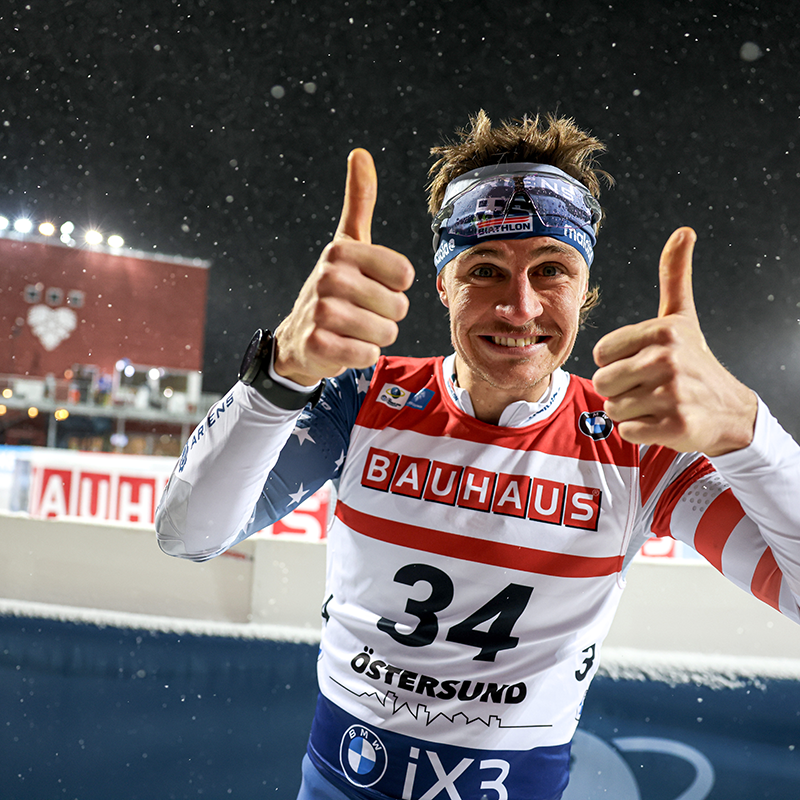
At the first biathlon World Cup races of the 2025/26 season, the biathlon stadium is perched above the small city of Östersund, which is set on a lake. Wind gusts off the lake, pulsing through the stadium. The races take place under the lights, at night – which isn’t saying much. Because in December in northern Sweden, ‘night’ begins at three in the afternoon, when what little sun there might’ve been throughout the day slips below the horizon. It’s in the evenings that the wind is usually at its strongest. The conditions the racers zero their rifles at before the race are rarely the same conditions they find when they come back to the range during the race. Athletes watch the small, red flags in the range, seeing which way they’re moving, deciding whether or not to shift their sights a few clicks, compensating for the changes that happened while the racers skied the course that serpentines up, down, around a 180-degree turn, and back into the stadium where the music plays and the home crowd cheers. Ayyy! As the Swedes hit their targets. A diluted Ney for each Swedish miss.
The mixed relay at the opening stop, Oestersund (SWE), of the 2025/26 IBU World Cup Biathlon season. (Photo: Manzoni/NordicFocus)
Over eight days, the best biathletes in the world raced 10 times. Maybe it was the arduous schedule, or the bit of sharpness that an Olympic year adds, but the Ostersund races didn’t feel like the first of the season. It felt like a break had never happened.
One question lingering from the off-season was answered quickly: What would Norwegian biathlon look like without the Boe Brothers? The dominant duo of Johannes Thingnes and Tarjei Boe – owners of eight Olympic medals – retired at the end of the 2024/25 season. Leaving what one would assume would be a major hole in the program. But when the Norwegian men came out and won the men’s 4 x 7.5km relay at Ostersund, the Norwegian’s roster depth became clear.
Campbell Wright (USA) during the IBU World Cup Biathlon Men’s Relay in Östersund (SWE). (Photo: Manzoni/NordicFocus)
The men’s relay saw a top result from the U.S. men, as well. Paul Schommer, Campbell Wright, Maxime Germain and Sean Doherty finished fifth, one of the best men’s relay finishes ever for Team USA. The next day, at the mixed relay, Germain, Wright, Chloe Levins and Deedra Irwin placed sixth – which is the best finish for a U.S. mixed relay since 2021.
Artem Tyshchenko (UKR) and Paul Schommer (USA), (l-r) during the Men’s Relay in Oestersund (SWE). (Photo: Manzoni/NordicFocus)
Germain and Wright continued to build on their early-week momentum, with Germain placing 11th in the sprint. In the pursuit, Wright hit all 20 targets for the first time in his career and moved up from 18th to 6th. Wright is coming off a stellar 2024/25 season, where he podiumed twice at World Championships, becoming the first American to do so.
Throughout the week, there were highs: Suvi Minkkinen of Finland won her first World Cup sprint. The Norwegian men placed four in the top five in the 20km individual, solidifying their capabilities as a team sans-Boes. And as always in biathlon, some lows: Eric Perrot of France missed his final shot in the pursuit, a devastating moment that cost him the lead. He finished fifth.
Racing wrapped up in Sweden, and teams flew to Austria. In Hochfilzen, a less rigorous racing schedule awaits: sprint, pursuit, and then a men’s and a women’s relay. A few more hours of daylight await, too.
This article was made possible through the generous support of our voluntary subscribers. If you would like to see more articles like this one–especially if you are a Biathlon fan–please support FasterSkier with a voluntary subscription.
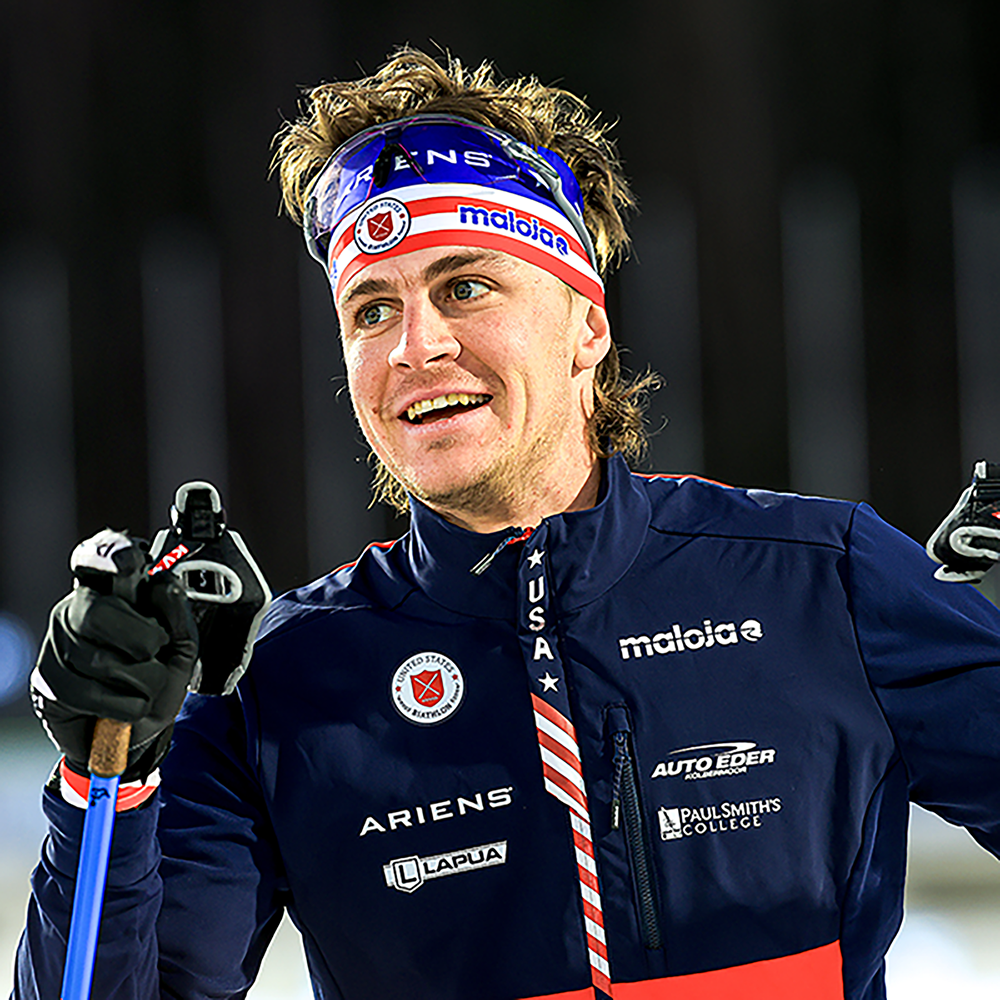
Campbell Wright might just be the United States’ greatest biathlete. Born to American parents who emigrated to New Zealand in 1993, the 23-year-old joined the U.S. team in 2023 by using his dual citizenship. Since the change, he’s continued his progression and notched some of the best results the U.S. program has ever seen. Wright became the first U.S. biathlete to win two medals at a World Championships when he took home two silver medals from the 2025 championships in Lenzerheide, Switzerland. He’s been training around the world – Italy, the U.S. and New Zealand – as he prepares for the 2026 Olympics. Get to know Wright as he tells his story with a mix of humor and candor, and explains his philosophy on luck that’ll have you rooting for him even harder.
This interview has been edited for concision and clarity.
Campbell Wright (USA) on his way to his second straight silver medal at the IBU World Championships Biathlon, in Lenzerheide (SUI). (Photo: NordicFocus)
You’re on the national team with my sister, Chloe, but we haven’t met, and I honestly don’t know much about you. How did you get into cross-country skiing and then biathlon?
My getting into cross-country skiing is the result of one person: Mary Lee. She and her husband started the cross-country Snowfarm in New Zealand. She was my neighbor. My parents had four boys and had their hands pretty full. So when she offered to take us kids cross-country skiing, they were like, “Yeah, go for it!” I started cross-country skiing when I was about 10 and just really enjoyed the vibe up there. It was pretty chill, pretty laid back, not as high-stress as alpine skiing.
That’s so lucky Mary was your neighbor. It sounds like without her, you might’ve never become a skier.
She also took me over to my first-ever skiing race in Australia when I was probably 11. She organized for me to go to Canada on an exchange with a skier. So when I was 14 I went to Ontario. That’s when I really started loving skiing a lot, because that’s the first time I ever saw people my age skiing. The cross-country skiing scene in North America is just epic, I really fell in love with cross-country skiing properly there. That’s when I was like, Oh, I’d really love to be a skier.
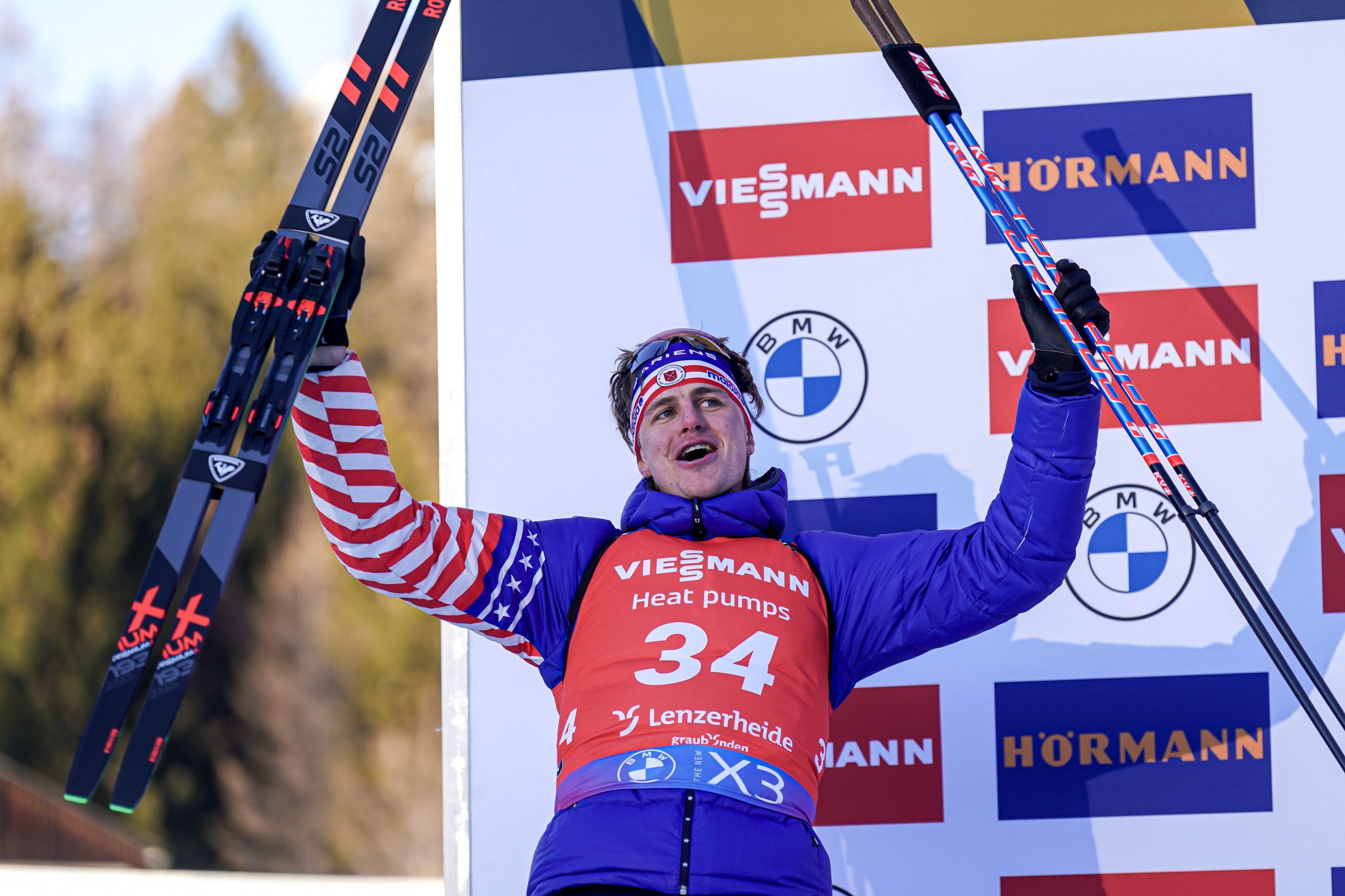
Campbell Wright (USA) after the IBU World Championships Biathlon, sprint in Lenzerheide (SUI). (Photo: NordicFocus)
How long were you there?
Four weeks. I was able to race against other kids, which was great because in New Zealand, I didn’t know if I was good or bad or somewhere in the middle because there was no one to race against. I was pretty shocked, realizing I wasn’t horrible at skiing. My brother (who is a professional cyclist) talked about how Europe is more competitive, so I also had the opportunity to go train with the Australian biathlon team in Italy. I was at the training sessions with everyone, and then when a race came, they would all go to a biathlon race, and I would just stay at the hostel by myself. I realized Europeans are a bit better at skiing than North Americans, and that I should try to spend more time in Europe and try biathlon properly. If I wanted to go to Europe and train with a group, biathlon was my opportunity to do it. I spent school holidays in Europe, a few more weeks every year. And then when I was 18, I left school and spent four months in Europe.
What was the team like?
Pretty much every single biathlon federation that didn’t have enough money to actually make a team gave Australian biathlon a little bit of money and became part of their team. So it was like Spain, Brazil, Argentina, Chile, Ireland, Australia, New Zealand, all kinds of working together. There were about 30 of us living in bunks in a hostel while training in Europe. There were teenagers up to 40 years old. It was good to see, as a young person, that not everyone has everything available to them. It’s a privilege to get to do what I do.
Campbell Wright (USA) celebrates his silver medal at the IBU World Championships Biathlon in the men’s pursuit in Lenzerheide (SUI). (Photo: NordicFocus)
You were with the New Zealand team until 2022 and represented them in the Olympics in 2022. What made you want to join the U.S. Team?
I worked with Emil Bormetti from when I was 15 to 19. When I went from the IBU Cups and junior cups to training with the older athletes, I had a different coach. Once I stopped getting coached by Emil, I started enjoying biathlon a lot less. I was thinking about quitting biathlon a little bit. At the end of the season, I didn’t really know what I was going to do. I knew I wasn’t going to go back to train under my old coach. At the same time, Emil got the assistant coaching job with the U.S. I already had a U.S. passport. It just came at the absolute perfect time. I had just gotten good enough to probably qualify for the US World Cup team. Tim Burke and Lowell Bailey were two of my idols, and they were working for U.S. Biathlon, too. It was just a perfect time to swap. One day you’re like, Maybe I’m done doing this forever, and then the next day it’s just like, life-changing. 2023 was my first official season on the U.S. team.
It certainly seems like it’s been the right choice. You’ve had some incredible results since joining the U.S. team. The best, of course, was at the World Championships in 2025, where you won two silver medals. What was that week like?
Everyone wants to have their best race at World Champs, but I know that’s not the reality of the world. It doesn’t work like that. I thought if I had my best skiing day and my best shooting day, I might be able to get in the flowers. In the sprint, Ponsiluoma started a minute in front of me. He’s probably a top 3 skier in the world in biathlon. I was thinking, If he misses three in prone then I can follow him on my second lap. I came into prone. I went clean, and I saw him coming out of the penalty loop and I was like, Holy sh*t, it actually happened. You just have to follow him, no matter how many matches you burn on this lap, if you want any chance to be near the front, you really just need to follow him.
Campbell Wright (USA), Johannes Thingnes Boe (NOR), Eric Perrot (FRA), (l-r) – IBU World Championships Biathlon, pursuit men, Lenzerheide (SUI). (Photo: NordicFocus)
That’s such a risk, going that hard on a lap that leads right back into shooting.
My second lap was pretty hot, like, I was redlining pretty hard. I came into standing and was like, OK, let’s just get these targets down. I don’t know how, but they all went down. On the last lap, I saw from the wax techs and everyone that I was doing pretty good, and everyone was screaming like, You’re probably gonna get a medal here! That will motivate you to ski fast.
You got your silver medal in the sprint. And then that led to you having a great starting position in the pursuit, where you medaled again. Your face after the last shooting was one of the greatest moments of the season.
I don’t know how I did it again, to be honest, because at Junior Worlds, I won the sprint and then proceeded to miss like eight in the pursuit. I was very much preparing for that mentally. I was like, Campbell, this could be a sh*t show. When you prepare for the worst and hope for the best, it’s a pretty good place to be. I came into the final shooting in second place. Eric Perrot and Sturla Laegreid were behind me. Those are the two best standing shooters on the World Cup. I knew I needed to shoot clean because I knew those guys were going to shoot clean. And sure enough, they both did. But I did, too. I knew I was safe. It was pretty fun to be me on that day.
Campbell Wright (USA) takes aim during the men’s relay at the IBU World Championships in Lenzerheide (SUI) last February. (Photo: NordicFocus)
We’re heading into an Olympic year. How excited are you? How are you feeling?
I want to be a good biathlete. I would say I was a successful biathlete this past season, even without two World Champ medals. I’m a lot more proud of that than I am of it coming together on the right day, because I think there’s a huge component of luck there. You need to be f*cking lucky to get on a podium at the Olympics or World Champs because there’s probably 20 guys who can do it.
That’s true, especially in your sport. Cross-country skiing alone would require luck to get on a podium. But then add in the variables of shooting, and there’s a lot of luck involved.
I know in my heart that if Ponsiluoma didn’t miss three, I would not be a World Champs medalist. I can’t look myself in the mirror and say that luck wasn’t part of it.
Campbell Wright (USA) climbing the Stelvio Pass in Livigno (ITA) during his summer training in July. (Photo: NordicFocus)
Earlier, you spoke about how you got into biathlon as a way to train in Europe. But you’ve clearly fallen in love with the sport. What do you love about it?
The thing I like most about biathlon is that it will break your heart, but then it also gives you these highs. That’s what I’m here for. A bit of thrill, a bit of heartbreak, a bit of theater. That’s what I love about it.
Campbell Wright’s World Cup season will start in November in Östersund, Sweden. Olympic biathlon competitions begin on February 8th in Antholz, Italy.
Campbell Wright (USA), Otto Invenius (FIN), and Paul Schommer (USA), (l-r) climbing the Stelvio Pass, Livigno (ITA), in July. (Photo: NordicFocus)
Love Stories Like This? Help Keep Them Coming.
Feature interviews like this one take time, access, and care to produce. If you value thoughtful storytelling and independent ski journalism, please consider becoming a Voluntary Subscriber. Your support directly fuels the work we do to cover the people, places, and moments that make our sport special.
When the first real snow falls in West Yellowstone, everything changes. The sound of car tires gives way to the swish of skis; coffee shops fill with cold hands and red cheeks; and this small Montana town of 1,100 becomes the epicenter of cross-country skiing in North America.
A Small Town With a Big Nordic Heart
Each Thanksgiving week, thousands of skiers descend on West Yellowstone for the Yellowstone Fall Ski Festival—an event that blends early-season training, clinics, races, and old-fashioned camaraderie. The teaching arm of the festival, officially called the Yellowstone Fall Ski Clinic, has become legendary in its own right.
“The festival has always been about community,” says Jack Hart, who is the co-director with Todd Eastman, and has been part of the event for more than three decades. “We’re a small town, but for this week, we become the center of the Nordic world. It’s a celebration of skiing in its purest form.”
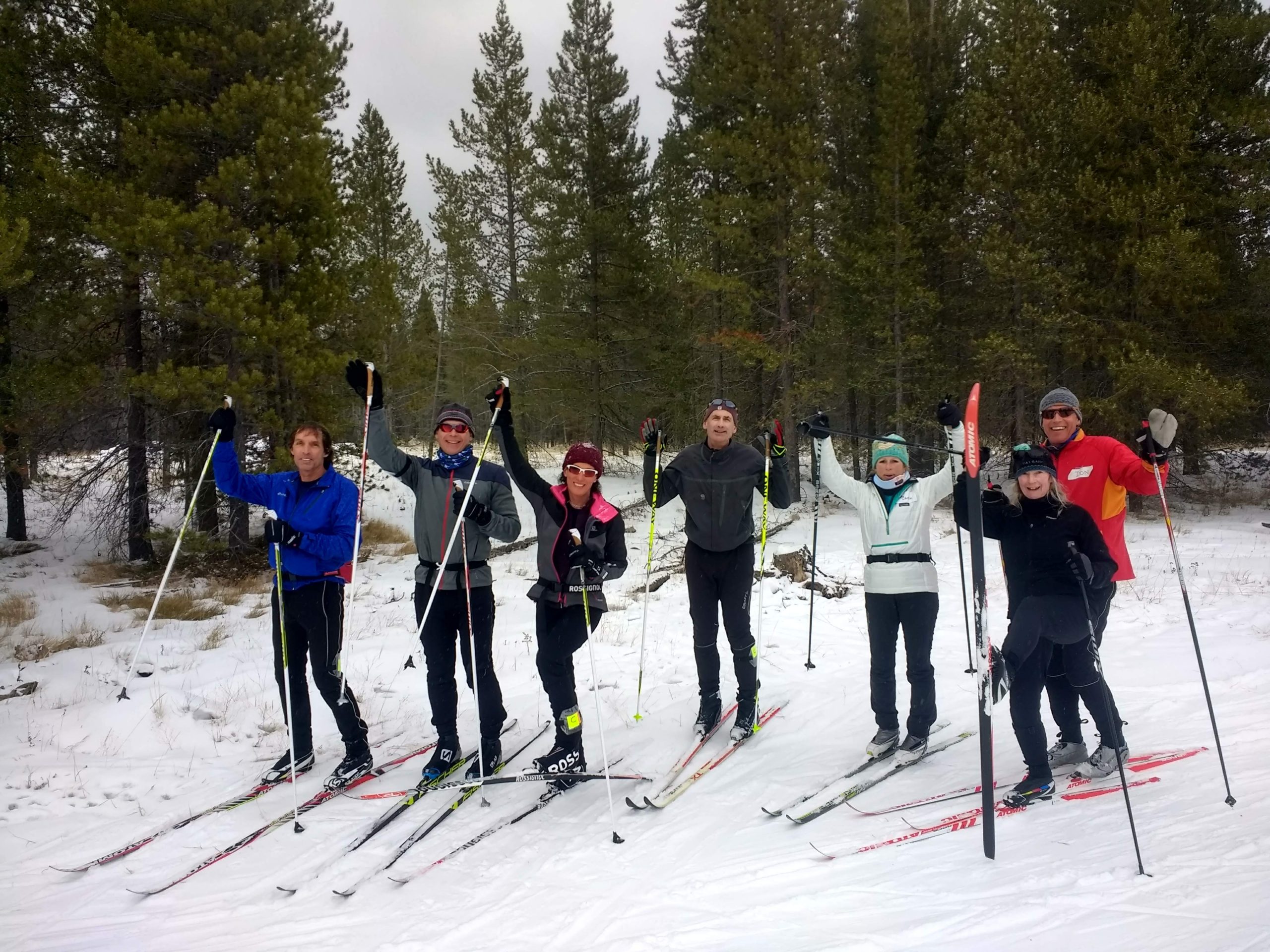
Bridger Ski Foundation out for a first ski in West Yellowstone back in 2015. (Photo: Courtesy Bernie Nelson)
From Coaching Coaches to Coaching Everyone
The roots of the festival trace back to 1979, when the U.S. Ski Team established a coaching development program in West Yellowstone. Hart remembers it well.
“Before it became an official, commercial event,” he explains, “the U.S. Ski Team brought in coaches. They said, ‘We have a coaching program. We want to develop people like yourself who want to take their level higher. Come to West Yellowstone in November and we’ll train you to be a U.S. Ski Team coach.’ That’s really how this whole event started.”
As more coaches came west, the program began to evolve. “Torbjorn Karlsen, Drew Barney, and Dick Hunt—those are the three names that co-founded the event,” Hart says. “They realized we could turn this into something commercial and teach more people how to ski. We’ve got early snow, we’ve got the trails—why not invite everyone?”
By the early 1990s, that idea had taken hold. The first snow of the season, combined with West Yellowstone’s unique geography, made it a magnet for teams and individuals alike. “At its peak about twelve years ago,” Hart says, “we had over 5,000 day passes sold during the week. That’s how many people were here. These days we’ll sell 2,500 to 3,000 if we get a lot of snow—but it’s still the biggest kickoff to winter anywhere.”
Building Better Skiers — and a Stronger Community
The Yellowstone Fall Ski Clinic runs alongside the festival under the same umbrella. It offers structured instruction for everyone from teenagers to masters racers, with one-, two-, three-, and five-day options beginning the Tuesday before Thanksgiving.
“We take kids down to high school age,” Hart says. “We’ll have around one hundred people in actual instruction this year, and then another couple thousand here training with their own coaches—high-school programs, club teams, that sort of thing.”
The diversity of ability levels is part of the event’s charm. “We have literally people who have not been on skis before,” Hart says, “and we also have the five-day, full-time training type of skier. The idea is to enhance, improve, and enjoy skiing in this environment—with this community.”
The entrance to the Rendezvous Trail System in West Yellowstone, Montana. (Photo: Courtesey Photo)
Each clinic begins with a quick on-snow evaluation. “We ask for a self-assessment on the registration form, but that can be different from where people really are,” Hart laughs. “The first fifteen or twenty minutes on snow, we do an evaluation and adjust the groups right there. We want everyone with others of similar ability so they can maximize their time and get more enjoyment out of it.”
The formula works. The Rendezvous Trail System becomes a living classroom—groups working on technique, coaches calling out cues, laughter echoing through the lodgepole pines. “The idea,” Hart says simply, “is to enjoy, to improve, and to learn—and obviously have a bunch of fun while you’re doing it.”
Philosophy in Motion: Teaching, Balance, and Joy
Behind the logistics of the clinic—the sign-ups, scheduling, and staffing—stands Eastman, whose background in both coaching and teaching shapes how the clinics operate.
“My contention,” he says, “is that all the coaches needed to do more ski teaching, and all the teachers needed to learn about coaching. The sweet spot is the combination of the two.”
That balance defines the Yellowstone approach. Eastman and Hart have assembled a team of approximately a dozen instructors who rotate throughout the week, exposing participants to a range of learning styles. “We’re not following PSIA or USSA scripts,” Eastman explains. “Most of our instructors have been skiing forever and teaching for years. It’s a mix of styles and personalities.”
The offerings reflect this flexibility: a five-day skate and classic clinic, a three-day version, two-day tune-ups, and popular one-day technique intensives for both skate and classic skiing. “The one-day stuff fills up really well,” Eastman says. “It’s at the end of the week—Thursday through Saturday—so people already in town can still jump in.”
Last year’s clinics drew 82 participants, supported by a staff of 12 instructors, a healthy ratio that ensures personalized attention. “Our ideal number is around a hundred,” Eastman notes. “We want everyone to leave feeling like they were seen and supported.”
Just as important as the structure, however, is the tone. “This isn’t about grinding or chasing a podium,” Eastman says. “We’re careful not to overwhelm people, especially early in the season. A lot of folks haven’t been on the snow yet. We want to be delicate with feedback, help them rediscover how it feels to glide again.”
That sentiment pervades the entire week. “Everybody at some point has a sensation—they go, ‘What was that? That felt good. I want more of that,” he says. “You may not find it for years, but it’s that moment that keeps you coming back.”
Eastman laughs at the sport’s reputation for being physically demanding. “Cross-country skiing gets this bad rap: ‘Oh, it’s the hardest cardiovascular sport in the world.’ Yeah, gee, that’s exactly what I want to sign up for on my vacation! We want people to see the joy in it—the beauty, the community, the stress relief, the meditation in motion. It’s the best way to deal with winter.”
The sense of inclusivity is central. “We have everyone from high schoolers to eighty-year-olds,” he says. “And if someone needs more challenge or less, we just move them. Our job is to make sure every skier finds their place.”
For Eastman, success is simple. “When a hundred people swear they’re going to tell all their friends how much fun they had—that’s when we know we did it right.”
Free Heel and Wheel: The Beating Heart of the Festival
For many participants, the festival’s unofficial headquarters is Free Heel and Wheel, the beloved ski and bike shop owned by Jack’s wife, Kelly Hart, and Melissa Alder.
“Every kid hangs out there,” Hart says. “They have hot chocolate, buy a new ski hat, talk skiing—it’s where everything happens. That little store is kind of the center of communication because people have been going there for thirty years.”
Part café, part gear shop, and part social hub, Free Heel and Wheel embodies the spirit of West Yellowstone. During festival week, it hosts evening events, wax clinics, and impromptu meetups that stretch late into the night.
“It’s just part of the experience,” Hart says. “Besides the Holiday Inn, which is where everything is based, it’s the other center of the place. A lot of the kids meet there, sit at the coffee bar, talk skiing, and talk about whatever teenagers talk about.”
The shop is also the birthplace of one of West Yellowstone’s most famous legends—the “snow-dance” story. Years ago, when November warmth threatened to derail the event, the Free Heel and Wheel crew improvised. “They all got on bikes in bikinis, with skis on the back, and rode around town,” Hart laughs. “They lit the skis on fire as part of the dance, and that night we got nine inches of snow. It’s one of those legends that’s become part of the lore around here.”
Lots of Après-ski fun to be had. (Photo: Courtesy Photo)
Exploring Beyond the Trails
While the festival’s focus is skiing, Hart emphasizes that West Yellowstone offers plenty beyond the tracks.
“If you were that customer saying, ‘Jack, what else can I do? I’m only skiing three days, but I’m here for five,’ there’s a lot,” he says. “The clinic has speakers and films—wax clinics, athlete talks, people like John Bauer speaking about his career and the park.”
Just outside town lies the west entrance to Yellowstone National Park, which remains open to non-motorized travel in late November. “You can either tour in, or, depending on conditions, you can skate on the groomed road,” Hart says. “It’s a big tradition for a lot of higher-end athletes to ski all the way to Old Faithful. That’s 30 miles in and 30 miles out. We call it the 100 K day.”
In the 1980s, before skate skiing, that tradition was even tougher. “We used to classic ski into Old Faithful and back on Thanksgiving Day,” Hart remembers. “You could eat like crazy that night—you were starving.”
“Our restaurants stay open for this event,” Hart notes. “The bars are open. The town comes alive. If you’re coming all the way to West Yellowstone, skiing our trails and seeing Yellowstone National Park in its winter beauty should hold your interest for at least three or four days.”
A Safe Adventure
Early-season skiing in bear country sometimes raises eyebrows among first-time visitors, but Hart reassures them that precautions are simple and effective.
“We always recommend traveling with bear spray,” he says. “Most bears are in hibernation by then, but it’s not unusual this time of year to see one that’s not. Ski in a group, carry bear spray—Free Heel and Wheel rents it, and the Chamber has them too—and follow park guidelines. We’ve never had an incident with an animal on the Rendezvous Trail system in 34 years.”
Snow, Weather, and the “Snow Dance” Factor
Reliable early snow has always been West Yellowstone’s calling card, but Hart admits that every year brings a little suspense. “We’ve had snow and we’ve been skiing on the plateau already,” he said in early November, “but it’s been wet—low 40s and even rain up to 7,000 feet. The good news is it’s supposed to snow today, tomorrow, Sunday, and part of Monday. Temperatures are dropping to the teens at night, and starting the week before camp, it’s supposed to snow steadily.”
If conditions in town fall short, organizers simply shift to the South Plateau Road, about six miles outside town, which reliably holds snow. “We’ve always been able to adjust,” Hart says. “If we don’t get snow until Wednesday, fine—we’ll ski Wednesday or go up on Tuesday. The key is being flexible. And if all else fails, we might call on the Free Heel and Wheel girls for another snow dance.”
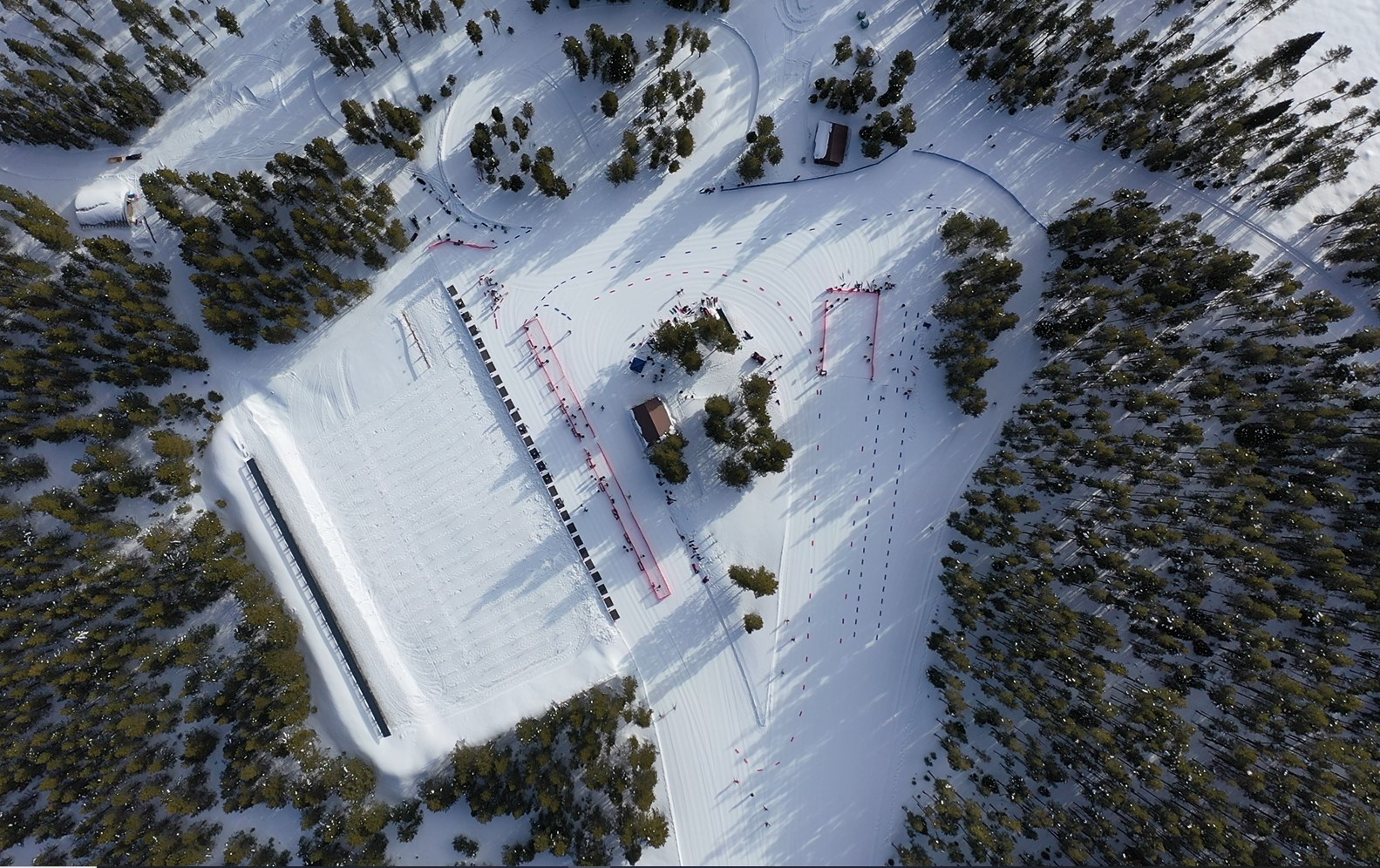
Aerial view of the stadium and biathlon range at the Rendezvous Ski Trails in West Yellowstone. (Photo: WYSEF courtesy photo)
Try Something New—Free Biathlon
One of the most distinctive parts of the week is the chance to try biathlon—no experience required.
“The biathlon events we have during the week are free,” Hart says. “If you’ve never shot a gun, it doesn’t matter. Some of our highest participation numbers come from the ‘never-ever’ biathlon event. You spend half a day being taught how to shoot, and then that afternoon there’s a race for all those people who’ve never raced before.”
The facility is first-rate: a 26-station range that includes a Paralympic setup. “You can feel what it’s like to actually do a biathlon race,” Hart says proudly. “It’s one of the nicest ranges in the western United States.”
Thanksgiving, Nordic-Style
Thanksgiving is the centerpiece of the week—a mix of tradition, family, and fitness.
“Thirty years ago, you couldn’t even get a turkey in town,” Hart recalls. “Now we have two grocery stores that carry everything, from turkeys to cranberries. We’ve got six hotels open, and you can make your own dinner if you rent a VRBO. There’s plenty of food available.”
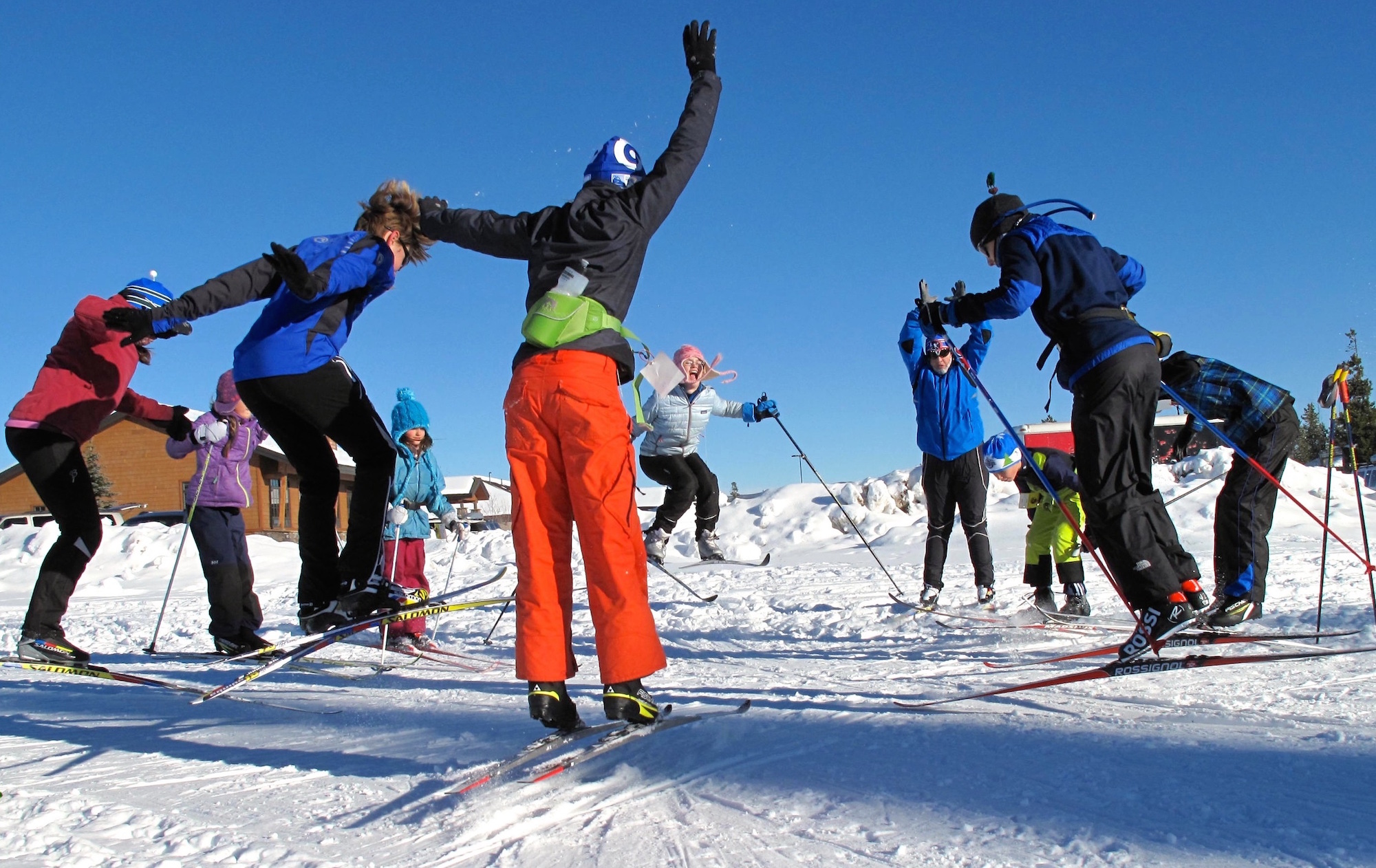
The scene on the trails that morning captures what the festival has become: families pulling children in pulks, elite athletes finishing intervals, and clusters of friends laughing as snow falls softly around them. “Thanksgiving Day is a big tradition for a lot of people,” Hart says. “They come out with their family, ski for an hour, have a big Thanksgiving dinner, ski Friday and Saturday, and head home Sunday. You’ll watch races, watch biathlon, see some of the best people in the world on snow—it’s a great time to be here.”
The West Yellowstone Ski Festival and Clinics is a gathering place for our community to celebrate the start of the new season. (Photo: Courtesy Photo)
The Spirit of the Festival
For Hart, who has worked at this event for the last 30 years, the reward is seeing the joy it brings. “We’re proud of what we’ve built,” he says. “It’s a massive effort for a small community, but when you see 3,000 people skiing, smiling, and reconnecting after a long summer—that’s everything.”
As the first flakes settle over town and the hum of wax being corked onto skis fills the air, West Yellowstone once again takes its place as the spiritual home of early-season Nordic skiing.
Amidst the pines and geysers, every November offers a fresh reminder: the ski season doesn’t begin with a race—it begins with a community.
The International Biathlon Union is deeply saddened to learn that former Olympic and World Champion Laura Dahlmeier has passed away at the age of 31 following a tragic mountaineering accident in Pakistan.
Laura was one of the greatest athletes to grace biathlon and her loss is felt deeply by everyone in biathlon, the wider German sport family and beyond. The IBU’s thoughts are with Laura’s family and friends during this very difficult time.
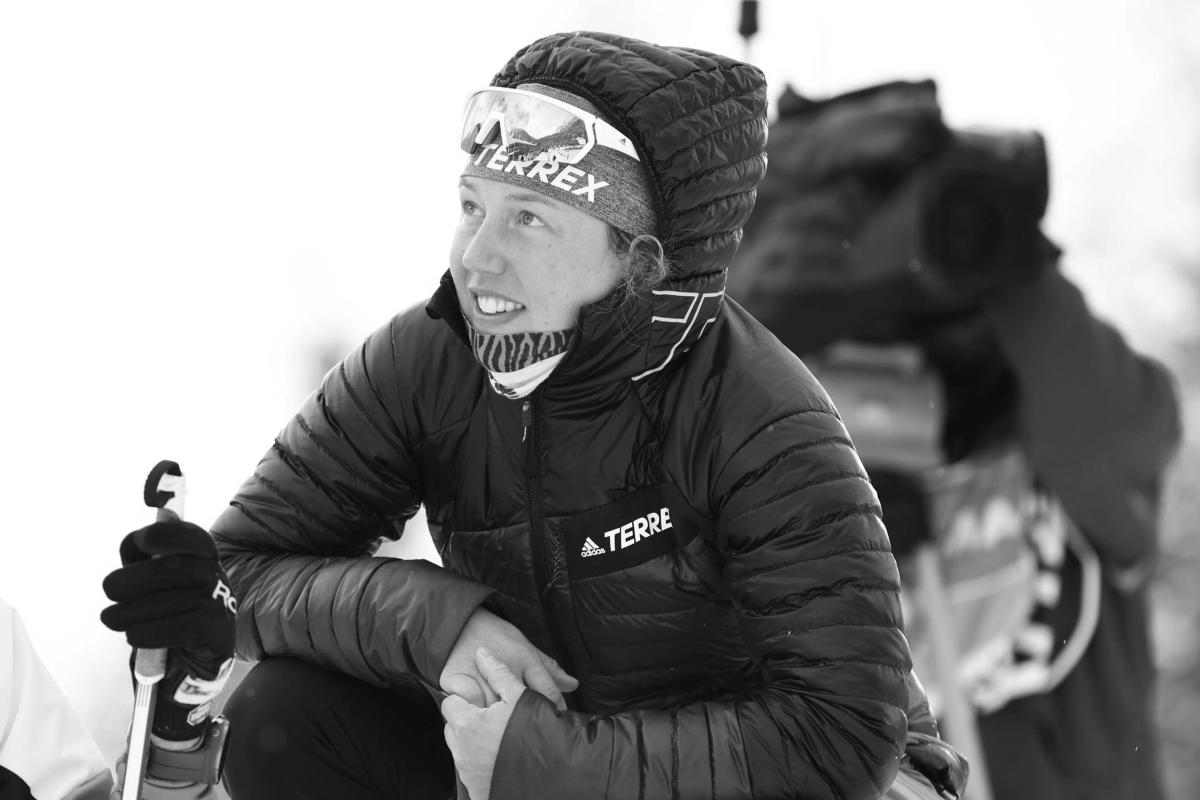
Laura Dahlmeier (GER) training in Antholz (ITA). (Photo: Manzoni/NordicFocus)
Throughout her career and following her retirement, Laura’s drive to push beyond limits and embrace challenges touched and inspired countless lives around the world.
During her record-breaking career, she left an incredible impact in just six years at the pinnacle of the sport. Dahlmeier won three Olympic medals, becoming the first woman to win gold in both the biathlon sprint and pursuit in the same Games; 15 World Championship medals, including seven gold (5 of those coming at the 2017 World Championships in Hochfilzen); 53 World Cup podiums, with 26 victories; 1 Total Score victory and 2 discipline globes.
Laura Dahlmeier (GER) training in Oestersund (SWE). (Photo: Manzoni/NordicFocus)
At 25, she retired from biathlon to focus on her other passions in life – mountaineering being one of them, having provided a place of retreat and calm away from the busy World Cup circuit. Her love of physical challenges in alpine terrain endured as she went on to compete in, and win, numerous ultra trail running races.
In many ways, Dahlmeier embodied the spirit of biathlon – an incredibly determined competitor on the tracks with steely focus on the range, and a no-nonsense approach to life: “Wenn ich was mach, mach ich’s gscheid” (“If I do something, I’ll do it properly”, title of her 2023 book). At the same time, the down-to-earth Bavarian never sought out the limelight and was more than just respected by her peers, rivals and teammates, forging many relations and friendships that lasted well beyond her active career.
While her presence on the snow was missed, she remained close to the biathlon family, providing her expert analysis and insight for German broadcaster ZDF.
Laura Dahlmeier (GER) – reporting at the IBU World Cup Biathlon Men’s sprint in Ruhpolding (GER). (Photo: Thibaut/NordicFocus)
In 2019, she co-authored “Die Klima Gang: Laura Dahlmeier und Freunde im Einsatz für die Natur”, a children’s book that reflected her passion for the environment and using her platform to make a meaningful contribution to a better future. Furthermore, the 31-year-old continued to be actively involved in sustainability projects in biathlon with the IBU, such as being a member of the IBU’s Sustainability Expert Reference Group.
Laura’s energy and passion for life touched so many around the world. Her legacy, both within biathlon and beyond, will never be forgotten and will continue to inspire countless athletes and adventurers for generations to come.
Laura Dahlmeier (GER) training, Antholz (ITA). (Photo: Manzoni/NordicFocus)
PRESS RELEASE – The International Biathlon Union (IBU) and the Biathlon Integrity Unit (BIU) welcome the decision of the Swiss Federal Tribunal to reject the appeals of former Russian biathlete Evgeny Ustyugov. These final rulings uphold the previous decisions of the IBU Anti-Doping Hearing Panel and the Court of Arbitration for Sport (CAS), confirming sanctions for anti-doping rule violations.
Mr. Ustyugov was sanctioned based on abnormalities in his Athlete Biological Passport and evidence from the Moscow Laboratory Information Management System. The upheld decisions result in the disqualification of all his competitive results from January 24, 2010, through the end of the 2013/2014 season — explicitly including his results from the Vancouver 2010 and Sochi 2014 Olympic Games — and a four-year period of ineligibility.
Evgeniy Ustyugov (RUS) and Jena Guillaume Beatrix (FRA).
The decisions of the Swiss Federal Tribunal represent the final instance of appeal. With this ruling, the verdicts of the IBU Anti-Doping Hearing Panel and the Court of Arbitration for Sport now become legally binding. It is now the responsibility of the International Olympic Committee (IOC) Executive Board to decide on the reallocation of medals from the 2010 and 2014 Olympic Winter Games.
Greg McKenna, Head of the BIU said: “These decisions from the Swiss Federal Tribunal brings finality to a long-running case and stands as an important step in upholding clean sport. While we regret the time it has taken to reach this point, the ruling reinforces the principle that doping violations will be identified and sanctioned, however complex the process may be. We continue to encourage all institutions involved in sports arbitration to work towards more timely resolutions, so that the integrity of competition is preserved and clean athletes are protected.”
Signing up for a Master’s B race at U.S. Biathlon Nationals sounded like a fun idea when I was at my computer, a safe 2,259 miles from Bozeman, chatting with my sister on the phone. Chloe would be competing at Nationals, her final races of the season. I hadn’t seen her since she left for the World Cup in December. It was as simple as her saying, “You should do the Master’s race.” And suddenly, I had needlessly complicated what could have been a sunny vacation away from my usual responsibilities of parenting two toddlers.
Unlike Chloe, I’m not a biathlete. I did a few biathlon camps as a teenager, but ultimately chose to focus on Nordic skiing. My sister became a biathlete, so I’ve been around the sport, traveling to some of her races, yelling at the Eurosport feed at all hours of the night and early morning. But I haven’t personally shot in quite a while. I did a citizen’s race in 2018 where they mercifully had the rifles waiting for us at the range, and we shot on standing targets for prone (4.5 inches instead of the usual 1.77 inches). I would find no such luxuries in Bozeman.
The author’s sister, Chloe Levins (USA) competing on IBU World Cup in Nove Mesto na Morave (CZE) this past March. (Photo: NordicFocus)
Unlike Chloe, I’m also not exactly in shape. I raced Nordic in college, but the combination of working life and mom life has not led me to have the same capabilities I had on skis as a 22-year-old. My world revolves around wandering through the woods looking for salamanders, cooking noodles, and writing. Hammering intervals, I do not.
So, when I arrived at the Official Training at U.S. Biathlon Nationals, I wasn’t feeling exactly confident.
I was surprised to find that the basics had stuck with me. I’d gotten a refresher in rifle safety. My thumb clicked along, loading ammo into magazines. I put the cuff on my bicep and remembered its tightness. After a few sequences of skiing into the range and shooting on paper, there was fluidity to my motions: Taking the rifle off, setting up to the target, and finding it in the sights. Smooth trigger, I tried to make my mantra. Rifle back on my shoulders, poles on as I ski out. The cadence of events has a nice rhythm. I fell into it more easily than expected.
We zeroed, and I hit three prone on my first try. I’ve got this. My default for wild optimism taking over instantly. Standing was a different story. In prone, the rifle’s sling hooked to you via the cuff, your body lying still thanks to the support it receives from the ground, you feel incredibly stable. There is motion, of course, as you breathe and your heart beats against your ribcage. But the targets remain within the sights. I felt like I had a chance of hitting every target. Standing up, there’s so little support. Your legs shake as they try to hold steady, opening or closing your shoulders an inch makes the targets suddenly disappear from view. A breeze you otherwise probably wouldn’t notice becomes detrimental to your hopes of staying still and hitting a target.
As I ticked through the standing targets in practice, they got harder and harder to hit, because I became more and more unsteady. Inhale and that little black circle slides out of your sights. Exhale and it should come back in. But you’ve shifted your body an unnoticeable amount and suddenly it’s gone. Instead of waiting for the moment that feels perfect in prone and smoothly pulling the trigger, I was hoping for the target to come into view and pulling the trigger quickly, knowing it was going to disappear again in a second. Jerky trigger motion is not how you hit targets.
“I’m going to have to shoot as fast as I can in standing, it’s only getting worse the longer I stand here,” I said to Chloe. She fed me tips to add stability. Lock out your legs so your bones are holding you up, not your muscles. Drive your left elbow into your left hip bone, use it like a shelf. Feel like you’re pulling your right hand back into your right shoulder.
The tips helped, but there wasn’t much that could be done the day before the race. Standing was going to be another exercise in wild optimism.
“Let’s go ski the course,” Chloe offered. “You can put the rifle on the rack if you don’t want to ski with it.”
This was one area I felt prepared for. Compared to my 28-pound two-year-old who I’d skied with in a backpack over the winter, the eight-pound rifle wasn’t much of an issue.
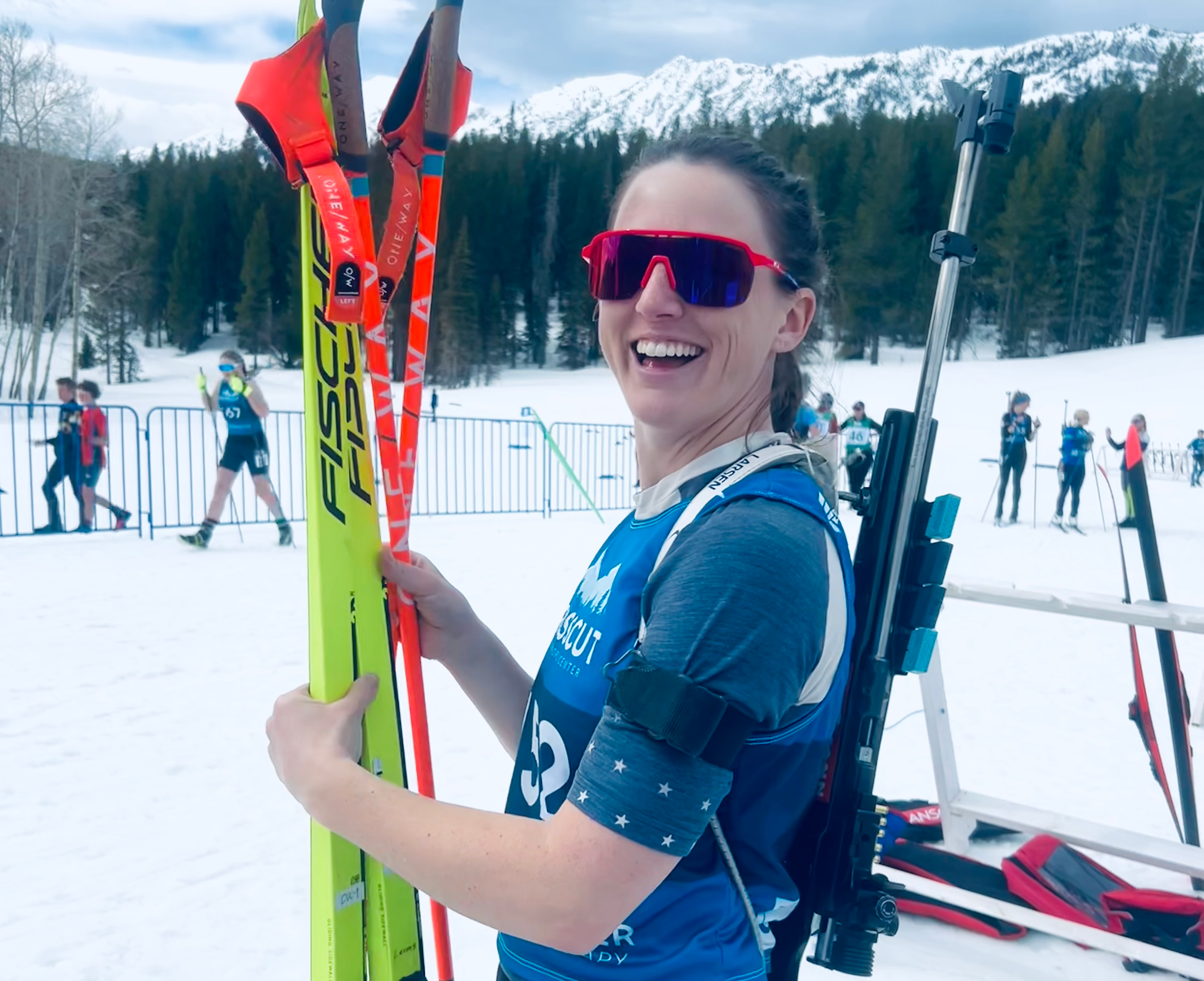
Keely Levins ready to go at US Biathlon Nationals.
We headed out. I gave the penalty loop a leery glance, knowing I’d be seeing it the next day.
Chloe said, catching me staring, “The skiers coming out have the right of way.”
I thought about my future self skiing around and around in shame as my family and friends watched the livestream from the East Coast. I sure do know how to pick a vacation.
It was classic springtime skiing in the West. Firm and fast in the morning, and slowly breaking down into sugar as the sun beat on it. I couldn’t help but smile as I gulped in air on the climbs. The sun and altitude brought me back to being a teenager, racing in Junior Nationals out west. I hoped I could find some inspiration in the memory of once being in shape.
We ran into biathletes from Chloe’s world and explained what I was doing on trail, not on the sidelines.
“I think I’m going to ask if they’ll let her shoot on all standing targets,” Chloe said to one.
“No way! I came all the way out here. I’m doing it,” I retorted, knowing that standing targets were definitely more appropriate for my current skill level, or lack thereof.
“I love this, you’re just going to send it,” one said.
And send it, I did.
The morning of the race, I got to the venue far before my fellow Masters B competitors. Chloe was my ride, and the real races happened first. I ventured up into the course, finding a spot where I could run from a major climb to a perch that looked over the range. I hollered at the top of my lungs as my little sister won her first National Championship.
I ate a bar, slurped a Gu I found in my backpack, nervously peed for what felt like the 58th time, and went to get my rifle checked. And by my rifle, I mean Chloe’s rifle. I was also wearing her sunglasses, her shirt, using her skis, and her poles. I had my own boots, but they were brand new. I’d had to order NNN boots to be able to use Chloe’s skis; I’ve been skiing on my SNS college gear.
Chloe stood behind the scope, zeroing for me.
“Ok, try again!” She chirped. That meant I’d shot all over the paper. I hadn’t even shot well enough to create a group that we could zero from. Awesome.
My next five shots made a better group, so she said. She moved my sight a couple clicks for me. Or, she’d lied and pretended I’d shot a nice group, trying to boost my confidence. Either was fine by me.
I skied out on the warmup loop, considered doing pickups, did one and thought better of doing any more. I stopped by the potties for the 59th time.
The nerves and altitude combined for a queasy lightheadedness as I stood in the starting area. Chloe was giving me some last-minute tips; I could barely hear her. Why was I doing this? Why did I think I could do this? Am I going to throw up? I might throw up. I came out of my fog to hear her say:
“And if anything goes wrong with the rifle, raise your hand and a marshal will come over and help you,” she said.
She wished me luck and I was alone to toe the line. And do a biathlon race for some reason that I could no longer remember.
The timer counted down, the sharpness of adrenaline felt familiar. Maybe this would be fun.
During the first climb, I felt the rush of lactic acid flood my legs. Which was unfortunate, because the first climb was about 200 meters into the race. Control yourself.
You take a more conservative approach in biathlon, to make sure your legs aren’t quaking while you’re trying to shoot, and that your mind is functional as you enter the range, not lost somewhere in the deep recesses of the pain cave. Despite my best efforts as a young skier, my race strategy usually boiled down to: Go out hard and hold on. This would not serve me well in biathlon, nor at altitude. I tried to ski smooth, in control, and felt better than I thought I should.
I came into the range and tapered, lifted my sunglasses to let my eyes adjust to the bright sun, and took deep, intentional breaths. I dropped to my knees on the shooting mat, bruised from yesterday’s practice. Unshouldered the rifle, popped in a clip, laid down, hooked the rifle’s sling to my cuff, looked into my rear sight, and saw no targets. Just a gray, hazy blur.
What?
My mind raced. Was I so out of shape that I couldn’t see clearly? That was certainly possible. I picked my head up and looked around. Nope, my eyes worked. I looked through the rifle again. Blurry still.
What is happening?
Precious time was ticking by. I was lying down, but it felt like my heart rate was increasing.
I should’ve left the range by now.
I pulled my head up again and looked down the length of the barrel. I’d left the snow covers open while skiing, but I hadn’t fallen. There shouldn’t be snow anywhere. I couldn’t see any.
A marshall. I could call a marshal. I raised my hand, popped the clip out, and the marshall looked at my rifle.
“Something’s wrong, I can’t see the targets, it’s so blurry,” I blurted out. My body was itching. I needed to get back on the course and ski.
“I don’t see any,” he said. But he blew a hard breath on the sight, and handed it back to me.
I got back in position.
Targets!
I could see.
I shot quickly, frustrated, was jerky with my trigger finger, and sadly not at all surprised when I left the range having only hit one.
So much wasted time. And now more to be wasted in the penalty loop.
Around and around I went. The course was slow, but the penalty loop was harder. Sitting in full sun, getting a lot of traffic, it was thick sugar I was fighting to push through. When you’re skiing that many laps around a penalty loop, I found, your mind starts to play tricks on you. Is this my second? Or third? I started chanting the number lap in my head as I skied. The last thing I needed was a time penalty added on for skiing the wrong number of loops. I’d penalized myself enough at the range already.
Leaving the penalty loop, finally, I didn’t care much for race strategy anymore. My fury at that fleck of snow and how quickly I’d let it unravel my prone stage fueled my next lap.
Chloe was cheering on the biggest climb, “Was the bolt stuck?”
“Snow in the sight!” I grunted as I climbed.
“The leader is only 30 seconds up on you, go get her!”
Why was I getting splits in a Master’s B – not even the Master’s A – race? Why was I loving it?
I leaned into the hill and pushed over the top of it.
I came into the range once again and set up to shoot standing. I watched the sight dance around the targets. I tried to take deeper, slower breaths, anything to make everything feel steadier. Target, pull trigger, miss. No problem. I wasn’t going to clean. The next target came into view and I pulled again. Miss. Ok, next target. Miss. No! This one, I’ve got. Two breaths and pull, miss. I will not leave this range with no hits. I closed my eyes, filled my lungs with air, let it out, and opened my eyes. I hooked my elbow hard into my hip, adding to my bruises. I pulled the butt of the rifle into my right shoulder and waited for the target to show up in my sight.
Hit.
You’d have thought I was the one who’d just won Nationals.
The joy was short-lived, as the penalty loop I’d gotten to know so well was waiting for me again. I got through my laps and took to the course. I passed some people, and was quickly humbled by the juniors who appeared to be floating atop the corn. My legs had little left, the same went for my lungs, as I crossed the finish line.
Recovered, I collected my second-place chocolates.
“If you didn’t have that sight issue, you would’ve won it,” Chloe said as we piled into our Wrangler, the perfect rental car for the week.
“I know,” I said.
“That’s biathlon,” she said. “It’s unpredictable, that’s part of what makes it so addicting.”
We turned up the music, rolled down the windows, and drove down the mountain.
That night when I went to bed, I felt… altitude sickness. But I also felt a bit of pride for putting myself on the line, and invigorated from having a day so different from so many others. I got on a plane back to reality the next morning. Vacation was over.
Campbell Wright (USA) celebrates his silver medal at the IBU World Championships Biathlon in the men’s pursuit in Lenzerheide (SUI). (Photo: NordicFocus)
By: Sara Donatello
After a historic World Championship silver medal in the men’s 10km sprint, Campbell Wright (Wanaka, NZL/Waiorau Nordic Skiing) is back on the podium in Lenzerheide, SUI with yet another silver medal in the men’s 12.5km pursuit. Missing just one target in his first prone stage, Wright went on to clean the final three stages of his race and solidify his second place position.
“Yesterday after the race I was pretty hyped up, I did not sleep very much last night as you can imagine I was pretty excited,” said Wright after the pursuit. “I got on the start line today and said ‘just enjoy every single meter of this race, man’. I’ve already proven what I needed to prove yesterday that I can really race with these guys and I’m not just a tourist here, but I can actually ski well and shoot well on a good day. I just started this race with nothing to lose and that’s the best place to be.”
Campbell Wright (USA) on his way to his second straight silver medal at the IBU World Championships Biathlon, in Lenzerheide (SUI). (Photo: NordicFocus)
Once again, Wright stood on the podium with World Cup overall leader Johannes Thinges Boe of Norway, who held on to his title of defending world champion. The third-place position was filled this time by Eric Perrot of France, who made the impressive jump from 15th position at the start.
With the seventh overall ski time, Wright crossed the finish line just a mere 8.6 seconds behind Boe, closing the gap between them by seven seconds on the final lap. He noted that it was not in an effort to beat Boe, but more so to ski away from Perrot, who also cleaned his final shooting stage. With speedy skis and support from Team USA staff and teammates on the course, Wright held Perrot to third by +12.2 seconds.
Maxime Germain (Chamonix-Mont Blanc, FRA/National Guard Biathlon), despite missing four targets on the day, had the 22nd overall ski time to land his third-best result this season in 21st place. Paul Schommer (Appleton, WI/Team Birkie/Ariens Nordic Center) was the biggest mover among U.S. men, jumping 17 positions to land 39th overall. Sean Doherty (Conway, NH/Army World Class Athlete Program) rounded out the U.S. men with a solid 45th-place finish.
Paul Schommer (USA) during the Men’s Pursuit at the IBU World Championships Biathlon in Lenzerheide (SUI). (Photo: NordicFocus)
Earlier in the day Chloe Levins (Williston, VT/Unaffiliated) and Lucinda Anderson (Golden Valley, MN/Team Birkie) both moved up in the field in their first-ever World Championship pursuit races. Levins jumped from bib 52 to land in 48th and Anderson from bib 56 to finish 49th.
A well-deserved training day tomorrow for the U.S. Biathlon Team before the women are back at it on Tuesday, February 18 at 9:05 EST/15:05 CET for the 15km individual. The men’s 20km individual will begin the following day, February 19, at 9:05 EST/15:05 CET.
Campbell Wright (USA), Johannes Thingnes Boe (NOR), Eric Perrot (FRA), (l-r) – IBU World Championships Biathlon, pursuit men, Lenzerheide (SUI). (Photo: NordicFocus)
Campbell Wright (Wanaka, NZL/Waiorau Nordic Skiing) made history in Lenzerheide, SUI as the first U.S. male to medal in a World Championships sprint event. A perfect 10 for 10 and ninth fastest overall ski time, Wright bested 96 of 97 sprint competitors to see his first-ever World Championships podium.
Campbell Wright (USA) on his way to second-place in the Men’s Sprint at the IBU World Championships Biathlon in Lenzerheide (SUI). (Photo: NordicFocus)
Crossing the line just 28 seconds behind the World Cup overall leader Johannes Thinges Boe of Norway, Wright took the second stand, with France’s Quentin Fillon-Maillet completing the podium in third.
“Coming into the day, I just had all the confidence that I could ski with the top guys,” said Wright in an interview with SVT. “I skied with Ponsiluoma that second loop and felt pretty in control to be honest. I just figured I really gotta hit the targets on standing. I managed to do it, and honestly, I have no words.”
Campbell Wright (USA) pushes for every second in the Men’s Sprint at the IBU World Championships Biathlon in Lenzerheide (SUI). (Photo: NordicFocus)Campbell Wright (USA) celebrates with his fans at the IBU World Championships Biathlon in Lenzerheide (SUI). (Photo: NordicFocus)
Teammate Maxime Germain (Chamonix-Mont Blanc, FRA) also hit a World Championship personal best with his 12th place finish. Germain also cleaned his targets, posting a 22nd ski time to set himself up nicely for the pursuit, just +1:08 back from the leading Boe.
Sean Doherty (Conway, NH/Army World Class Athlete Program), with a 45th overall ski time, raced to 41st, missing just one target in prone and cleaning his standing shoot. Paul Schommer (Appleton, WI/Team Birkie/Ariens Nordic Center) placed all four U.S. men in the top 60 with his 56th place finish, despite three misses on the day. This was Schommer’s first World Championship start since 2023 in Oberhof, GER.
Campbell Wright (USA) celebrates the first American Men’s podium at IBU World Championships. (Photo: NordicFocus)
Midway, UT – U.S. Biathlon announced today the implementation of its Women’s Coaching Initiative, designed to increase the number, experience and visibility of female biathlon coaches in the U.S. and internationally and inspire future generations of female coaches and athletes. This new initiative, building on the coaching apprenticeship opportunities available over the past several years, will provide formal mentorship and professional development opportunities for female coaches from all Nordic backgrounds to gain biathlon coaching experience across all levels.
The U.S. Biathlon Women’s Coaching Initiative will provide female coaches from all Nordic backgrounds – biathlon AND cross-country coaches, wax technicians and former athletes – with opportunities throughout the season to integrate with U.S. Biathlon staff and teams on the ground at domestic and international U.S. Biathlon and IBU events.
“It is critical that we keep pushing to include more women in staff and support roles at the highest level of racing,” said Kelsey Dickinson, U.S. Biathlon Board Athlete Representative and current U.S. Biathlon Senior National Team athlete. “Having more women coaches will help raise the bar for everyone because a diversity of backgrounds and experience on staff allow a team to be more dynamic. Not only is this good for performance, but increasing the number of women in coaching roles will add to a safe and professional atmosphere for everyone.”
This career development opportunity is designed to help women with a serious interest in a career in coaching/biathlon improve their skills and learn from the best U.S. Biathlon coaches, wax technicians and support staff. Participants will work with U.S. Biathlon team staff to carry out diverse duties dependent upon experience levels, interests and current team requirements.
“We are very excited to introduce this program that will encourage and support more women becoming biathlon coaches, which is critical to an inclusive and vibrant sport,” said U.S. Biathlon President & CEO Jack Gierhart. “Our goal is to provide professional development opportunities for women at all levels, along with flexibility that will lower barriers to participating.”
The Women’s Coaching Initiative Selection Panel, composed of female coaches, athlete representatives and U.S. Biathlon staff, will review each applicant. Applications are due May 29, 2024, by 5pm ET and selected applicants will be announced by June 5, 2024.
Eileen Carey, U.S. Paralympic Nordic Program Director and Women’s Ski Coaches Board Member
Kelsey Dickinson, U.S. Biathlon Athlete Representative & World Cup Athlete, and Women’s Ski Coaches Executive Director
Kristen Bourne, U.S. Ski and Snowboard XC D-Team Coach
Lowell Bailey, U.S. Biathlon Director of High Performance, World Champion, Olympian
Margie Freed, U.S. Biathlon and U.S. Ski Team World Cup Athlete
Tim Burke, U.S. Biathlon Director of Athlete Development, Olympian, World Championships Medalist
About U.S. Biathlon
As the Olympic sports organization centered around the sport of biathlon, the United States Biathlon Association, known as U.S. Biathlon, is recognized by the International Biathlon Union (IBU) and the U.S. Olympic and Paralympic Committee (USOPC) as the national federation for biathlon in the United States. Founded in 1980, U.S. Biathlon exists to support and encourage the development of biathlon in the United States, to work with biathlon clubs and regional centers around the country to organize training and competition from the grassroots to elite level, and to prepare athletes for international competition. U.S. Biathlon staffs and finances the U.S. Biathlon national and junior national teams and is a 501 c (3) non-profit organization. For more information, visit usbiathlon.org.
Sugar Bowl Academy invites motivated U14-U20 athletes to consider joining us for amazing training and racing in sunny California. Our program offers some of the best training in North America: more than 140km of trails at Royal Gorge XC, groomed through our campus, 300+ days of sun, 480 inches of snow annually, on campus strength and conditioning coach and facilities, thousands of miles of amazing single track for biking and running, biathlon, SkiMo, mountain biking and Sky Running opportunities, and a proven program of success.
Led by Academy Nordic Director/Head Coach David Sinclair and supported by Nordic Ski Team Director, Will Sweetser, our Gap Year program has produced 2 U.S. Ski Team members, 2 U.S. Biathlon World Junior Team members and 2 FIS Cross-Country World Junior Team members in the past 7 seasons. Recent SBA Nordic student-athletes have competed as members of the U18 Scando Cup Trip, IBU Youth Championships Team, U.S. Junior National Mountain Bike Team, and at the IOC Youth Olympics (biathlon and cross-country). Additionally, student-athletes have earned gold at U.S. Junior National Championships in cross-country and biathlon and at the World Junior Sky Running Championships in the past 5 seasons.
Our program maintains a 1:6 athlete to coach ratio and offers unrivaled opportunities for altitude and lower elevation training.
The Fort Kent Outdoor Center in Fort Kent, Maine, is currently accepting applications for our 2024-2025 post graduate program. The program is designed for high school graduated nordic skiers and biathletes who are hoping to take their training to the next level with year-round coached training sessions. With a 3km paved rollerski loop, full 30-point shooting range, and 25km of nordic trails in the snowiest corner of the northeast, Fort Kent provides an ideal training environment. Housing is provided as part of the program, and we offer summer, fall, and winter term options as well as a year-round option. Due to housing restrictions the program is limited to the first 5 applicants. Visit our website (https://www.fortkentoc.org/programs/#pg-training ) for full program details and application instructions.
Midway, Utah – The United States Biathlon Association has released the nominated members of the 2024-25 Senior National Team and 2024-25 National Development Group. While U.S. Biathlon remains committed to maintaining high standards for National Team qualification, it also is focused on providing ample opportunities for developing athletes to train and be part of a larger, collaborative team community within the sport and the development pipeline. Establishing the National Development Group is an important initiative in support of this goal and the organization’s 2030 plan.
Senior National Team
A1:
Deedra Irwin (Pulaski, WI/Army World Class Athlete Program)
The National Team is coached by U.S. Biathlon National Team Head Coach Armin Auchentaller, and Assistant Coach Emil Bormetti. Both Auchentaller and Bormetti are heading into their third season coaching the National Team.
“With the new season coming up, we are excited to offer access to elite training plans and camps to a larger pool of athletes through the Senior National Team and National Development Group,” said U.S. Biathlon National Team Head Coach Armin Auchentaller. “I am looking forward to working with the athletes and hope that they can use this opportunity to continue to improve over the summer and feel prepared for the upcoming 2024-25 race season.”
The National Development Group aims to support athletes who have not yet met National Team criteria, and provide a pathway that eventually can lead to a National Team nomination. To view the 2024 National Development Group selection criteria, click HERE.
“We are incredibly excited to expand U.S. Biathlon coaching and team support to a larger group of athletes,” said U.S. Biathlon Director of High Performance Lowell Bailey. “As we continue to see growth in domestic participation, and improvement in international results, it is evermore important that U.S. Biathlon assists athletes at all levels of the development pipeline. The National Team will always sit at the top of that pipeline, but it’s important that aspiring athletes have a pathway and support on their way to the top. The National Development Group provides that “bridge.” Congratulations to all of the nominees and I am looking forward to another great training year to come.”
*Please note that the team naming is subject to change pending final board approval.
About U.S. Biathlon
As the Olympic sports organization centered around the sport of biathlon, the United States Biathlon Association, known as U.S. Biathlon, is recognized by the International Biathlon Union (IBU) and the U.S. Olympic and Paralympic Committee (USOPC) as the national federation for biathlon in the United States. Founded in 1980, U.S. Biathlon exists to support and encourage the development of biathlon in the United States, to work with biathlon clubs and regional centers around the country to organize training and competition from the grassroots to elite level, and to prepare athletes for international competition. U.S. Biathlon staffs and finances the U.S. Biathlon national and junior national teams and is a 501 c (3) non-profit organization. For more information, visit usbiathlon.org.
“We are happy to announce the names of the exceptional athletes who have earned their place on the Junior National Biathlon Team, marking the highest domestic level of achievement in youth and junior development,” said U.S Biathlon Director of Athlete Development Tim Burke. “As in the past, this team’s reach will continue beyond those named to the Junior National Team, as we will include additional athletes at team training camps to create a balanced training environment.”
Coach Brian Halligan will oversee the Junior National Team for the 2024-25 season. Halligan is heading into his third season coaching the Junior National Team, serving his first season as head coach last season.
“I am really excited to work with this year’s Junior National Team,” said Junior National Team Head Coach Brian Halligan. “We are beginning to see some great depth in our Youth and Junior fields and I feel the athletes who have been selected for the JNT this year not only possess great talent, but will work hard and continue to grow as they mature as athletes and humans. After all, that is what this team is about: growth and development.”
“It’s great to see that many of our current Junior National Team members have come through the U.S. Biathlon development pipeline by participating in U.S. Biathlon’s Regional Select Camps and Elite Development camps,” added Burke. “I look forward to seeing these programs continue to grow.”
About U.S. Biathlon
As the Olympic sports organization centered around the sport of biathlon, the United States Biathlon Association, known as U.S. Biathlon, is recognized by the International Biathlon Union (IBU) and the U.S. Olympic and Paralympic Committee (USOPC) as the national federation for biathlon in the United States. Founded in 1980, U.S. Biathlon exists to support and encourage the development of biathlon in the United States, to work with biathlon clubs and regional centers around the country to organize training and competition from the grassroots to elite level, and to prepare athletes for international competition. U.S. Biathlon staffs and finances the U.S. Biathlon national and junior national teams and is a 501 c (3) non-profit organization. For more information, visit usbiathlon.org.
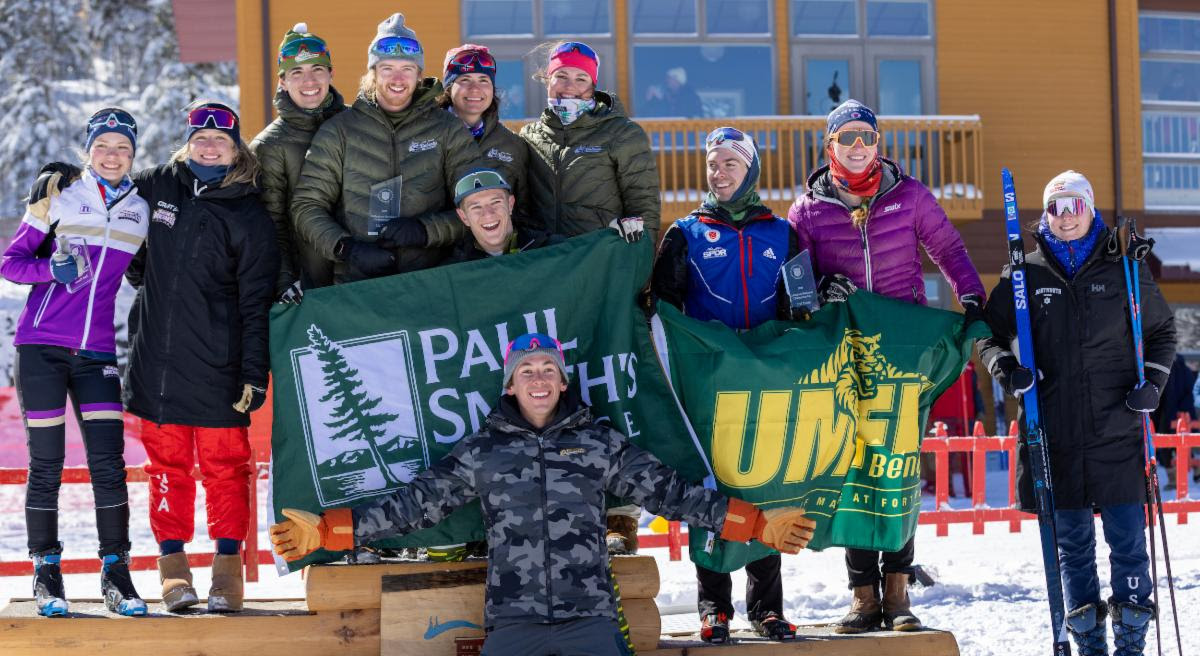
The inaugural U.S. Biathlon Collegiate National Championships took place March 22, 2024 at the Fort Kent Outdoor Center in Fort Kent, Maine, in conjunction with the 2024 U.S. Biathlon National Championships. Twelve collegiate athletes representing six colleges and universities from around the Northeast traveled to Fort Kent to race and represent their respective schools.
Friday’s U.S. Nationals sprint race doubled as the Collegiate Nationals sprint race, where athlete standings were counted towards both events. Crystal trophies were awarded to the top three athletes for both women and men, and the top three collegiate teams, determined by combining the best two athletes’ scores from each team.
“What a great weekend in Fort Kent,” said U.S. Biathlon Director of Sport Development John Farra. “I am very pleased that the Collegiate Championships were a success! The intent was to provide recognition to those athletes who are in a course of study at a collegiate institution and who define themselves as biathletes, as well as provide recognition to the schools that are supporting their sporting efforts. These collegiate institutions are helping us in our sport development efforts, and we got to celebrate that in Fort Kent.”
Grace Castonguay, currently a senior at Saint Michael’s College in Colchester, Vermont, claimed the historic Collegiate National Championships title for the women. Castonguay raced to a time of 29:43, missing just one target in prone and three in standing. Hannah Chipman of Dartmouth College in Hanover, New Hampshire, took home second place, covering the course in 31:36 with just three misses on the day. Dolcie Tanguay, racing for Paul Smith’s College out of Paul Smith’s, New York, finished in third with a time of 32:32, mirroring Chipman on the range with three misses.
(Photo by Ana Paradis)
“It was really fun and special to be recognized as a college athlete, as well as a biathlete, this past weekend,” said Castonguay. “Collegiate ski racing has influenced a lot of my development and progress as a biathlete and has been a major part of my identity for the past three years, so it was nice to recognize its role in my biathlon journey.”
On the men’s side, Bjorn Westervelt, a senior at the University of Vermont in Burlington, Vermont, won the historic Collegiate National Championships title for the men with a time of 30:50, despite six misses on the range. Paul Smith’s College saw three athletes on the individual podiums with teammates Aiden Ripp and Diego Schillaci claiming second and third in the men’s category. Ripp raced the 10km course in 34:08 with Schillaci on his heels with a time of 35:43.
(Photo by Ana Paradis)
Paul Smith’s College continued their podium success in the team category as the team of Tanguay, Ripp, Scillaci, Brady Miller and Kaisa Bosek took home the title with the top collective team score. Saint Michael’s College athletes Castonguay and Evelyn Hudrlik stood on the podium in second place with the local team of Bridget Reusch and Caleb Hunter of University of Maine at Fort Kent raising their flag in third. The University of Vermont placed fourth, Dartmouth College in fifth and St. Lawrence University finished in sixth place.
Westervelt added, “I think it’s awesome that U.S. Biathlon is highlighting all the student athletes out there that balance being university students and competing in high level athletics at the same!”
(Photo by Ana Paradis)
“It was so exciting to not only be a part of the first ever U.S. Biathlon College National Championships but to also take home the National Championship title,” said Paul Smith’s College Head Biathlon Coach Matt Dougherty. “I was so happy not only for the Paul Smith’s athletes but all the collegiate athletes who had this opportunity to compete and be recognized for their hard work, dedication and effort through their college careers.”
“Getting to share the podium for the overall team score with Evelyn, my college teammate, was really special,” added Castonguay, “and I know it made the rest of our team at Saint Michael’s College very proud.”
This inaugural Collegiate Biathlon National Championships marked the beginning of what will be an exciting annual event for all current and future collegiate biathletes to represent their respective colleges and universities. For the past four years, U.S. Biathlon has worked closely with Paul Smith’s College as the Official Education Partner of U.S. Biathlon, committed to growing the visibility and opportunity for collegiate biathletes. Not only were they an integral part in the success of the Collegiate National Championships event, but they further proved the success of their own biathlon program in Fort Kent.
“In late 2020, Paul Smith’s College announced a unique partnership with U.S. Biathlon and four years later we had a Collegiate National Championship. It’s a great reward for the entire community of biathlon,” added Dougherty. “This is also a testament to Paul Smith’s College and everyone who supported the development of the biathlon program at Paul Smith’s. We knew there was a need for a place dedicated to helping biathletes develop and obtain a world class degree at the same time. All the campus’ support made this possible and it’s a testament to what Paul Smith’s College stands for world class results from a small school in the woods. We are excited to help grow the college ranks for biathlon and hopefully serve as inspiration for other colleges to follow suit.”
“This has become an important initiative as we aim to give credibility to those institutions who recruit biathletes as Nordic ski racers and support their desire to juggle both sports, while also giving credibility to those biathletes who may not be competing for a Collegiate institution in skiing, but are committed to working towards a degree while training and competing in both cross-country skiing and biathlon,” added Farra. “There are many ways to achieve one’s sporting and high education goals and we had a great representation of that in Fort Kent.”
About U.S. Biathlon
As the Olympic sports organization centered around the sport of biathlon, the United States Biathlon Association, known as U.S. Biathlon, is recognized by the International Biathlon Union (IBU) and the U.S. Olympic and Paralympic Committee (USOPC) as the national federation for biathlon in the United States. Founded in 1980, U.S. Biathlon exists to support and encourage the development of biathlon in the United States, to work with biathlon clubs and regional centers around the country to organize training and competition from the grassroots to elite level, and to prepare athletes for international competition. U.S. Biathlon staffs and finances the U.S. Biathlon national and junior national teams and is a 501 c (3) non-profit organization. For more information, visit usbiathlon.org.
The final weekend of BMW IBU World Cup racing wrapped up in Canmore, Alberta in the heart of the Canadian Rocky Mountains. The clear, sunny skies saw athletes transform their race suits into makeshift shorts and t-shirts, making the heat a bit more bearable for the final sprint, pursuit and mass start races of the 2023-24 season. Team USA ended the season on a high note with much to look forward to for the 2024-25 season ahead.
The weekend kicked off with the final women’s 7.5km sprint of the season on Thursday, where Deedra Irwin (Pulaski, WI/Army World Class Athlete Program) led the team with a 26th place finish, shooting a perfect 10 for 10, to qualify for Saturday’s 10km pursuit. Margie Freed (Apple Valley, MN/Craftsbury Green Racing Project) landed in 74th with just misses on the range. Chloe Levins (Rutland, VT/Team Crosscut) followed Freed in 81st place, hitting nine of ten targets, and Kelsey Dickinson (Winthrop, WA/Craftsbury Green Racing Project) rounded out the group in 90th place with two misses in standing.
In Friday’s men’s 10km sprint, Campbell Wright (Wanaka, NZL/U.S. Biathlon) finished in 28th, after putting three shots wide on the range. Jake Brown (St. Paul, MN/Craftsbury Green Racing Project) joined Wright in the top 40 to score World Cup points, racing to 36th place with just one miss on the day. Vincent Bonacci (Salt Lake City, UT/Team Crosscut) and Sean Doherty (Center Conway, NH/National Guard Biathlon) just missed out on Saturday’s pursuit, finishing in 70th and 73rd, respectively.
Saturday’s pursuit was Irwin’s day. Extending her clean shooting streak to 30 out of 30 on the weekend, she jumped 14 places from bib 26 to finish the day in 12th place, her top pursuit result of the season and first pursuit clean shooting. Wright moved up the leaderboards as well, jumping from 28th to 18th with just one miss in the range. Brown stayed consistent, finishing the day where he started in 36th with four misses on the day and the 18th ski time overall, scoring valuable Nations Cup points in his last start of the season.
Due to her outstanding performance in the sprint and pursuit, Irwin received bib 29 in Sunday’s 12.5km mass start, her second mass start of the season. She continued her clean shooting streak through the first stage, but three misses in her second stage and one miss in her final standing shoot landed her in 27th. Irwin ended the season in 38th in the World Cup overall standing, her highest placement thus far in her career.
With the 2023-24 BMW IBU World Cup season in the rearview mirror, athletes now head their ways with many traveling to Fort Kent, Maine for one final race weekend at the 2024 U.S. Biathlon National Championships and inaugural U.S. Biathlon Collegiate National Championships, March 22-24. To find all World Cup results and standings, visit biathlonworld.com/results. For information on the upcoming U.S. Biathlon National and Collegiate National Championships, visit usbiathlon.org/national-events-calendar.
About U.S. Biathlon
As the Olympic sports organization centered around the sport of biathlon, the United States Biathlon Association, known as U.S. Biathlon, is recognized by the International Biathlon Union (IBU) and the U.S. Olympic and Paralympic Committee (USOPC) as the national federation for biathlon in the United States. Founded in 1980, U.S. Biathlon exists to support and encourage the development of biathlon in the United States, to work with biathlon clubs and regional centers around the country to organize training and competition from the grassroots to elite level, and to prepare athletes for international competition. U.S. Biathlon staffs and finances the U.S. Biathlon national and junior national teams and is a 501 c (3) non-profit organization. For more information, visit usbiathlon.org.
Deedra Irwin (Pulaski, WI/Army World Class Athlete Program) rounds out this season’s pursuit races with a stellar 12th place finish, just one of two athletes in the pool of 60 to shoot a perfect 20 for 20 in Canmore, Alberta, Canada. Irwin, jumping 14 places from bib 26, crossed the line in 12th, just +1:23.1 behind the pursuit victor Lisa Vittozzi of Italy, who shot 19 for 20.
“It feels amazing to shoot clean in the last pursuit of the year,” said Irwin. “I’m happy it was enough to get me into the mass start and it’s always exciting to get another opportunity to race and score points. I’m definitely feeling pretty fatigued on the course, but the wax crew is doing an amazing job of giving me competitive skis.”
Her first World Cup pursuit clean and second clean shooting in a four stage race this season, the first taking place in the mass start in Lenzerheide, Switzerland in December 2023, Irwin has proven mentally tough as the long season is coming to a close. The veteran athlete has shot a perfect 30 for 30 in both the sprint and pursuit races, putting her in a position to race in her second mass start of the season in Canmore.
”Armin, Emil and I have been working really hard after a shaky start to the trimester with my standing shooting,” Irwin added. “I’m so happy I’ve been able to get over that mental hump on the range and clean all my stages so far this weekend.”
Later in the day, Campbell Wright (Wanaka, NZL/U.S. Biathlon) and Jake Brown (St. Paul, MN/Craftsbury Green Racing Project) toed the line for their final pursuit race of the season, wearing bib 28 and 36.
Wright, missing just one shot in his final standing shoot, was back up in the top 20 with a 19th place finish, +2:42.3 behind the pursuit victor Johannes Thinges Boe of Norway. Brown, who headed into his final shoot 14 for 15, felt the pressure and ended up missing three targets. Though, with an 18th ski time overall, Brown’s three added penalty loops only dropped him to 36th at the finish line.
With the final day of World Cup racing ahead, Irwin will start the women’s 12.5km mass start wearing bib 29 at 1:10 ET/11:10 MT, with the men’s 15km mass start to follow at 5:10 ET/3:10 MT. Information on how to watch can be found at usbiathlon.org/how-to-watch. For spectator resources, visit usbiathlon.org/spectator-resources.
About U.S. Biathlon
As the Olympic sports organization centered around the sport of biathlon, the United States Biathlon Association, known as U.S. Biathlon, is recognized by the International Biathlon Union (IBU) and the U.S. Olympic and Paralympic Committee (USOPC) as the national federation for biathlon in the United States. Founded in 1980, U.S. Biathlon exists to support and encourage the development of biathlon in the United States, to work with biathlon clubs and regional centers around the country to organize training and competition from the grassroots to elite level, and to prepare athletes for international competition. U.S. Biathlon staffs and finances the U.S. Biathlon national and junior national teams and is a 501 c (3) non-profit organization. For more information, visit usbiathlon.org.
Just over a month after hosting the International Ski Federation (FIS) Cross Country World Cup, the Canmore Nordic Centre is pulling out all the stops and showcasing its brand-new biathlon facility as the host of the International Biathlon Union (IBU) World Cup Finals from Thursday, March 14 to Sunday, March 17.
The world-class venue amid Canada’s Rocky Mountains is no stranger to World Cup nordic and mountain bike events. It hosted 2016 and 2019 IBU World Cups and, as recently as last year, eight IBU Cup events in advance of the 2024 Biathlon World Cup Finals.
Two years ago, Alberta’s provincial government granted the Canmore Nordic Centre $17.5 million to upgrade and enhance its biathlon building, stadium, snowmaking, and range. According to Ken Davies, the Canmore IBU World Cup event chair, they broke ground in May 2022 and have nearly completed the project as of this March.
New biathlon building at the Canmore Nordic Centre. (Photo: Biathlon Canada/Pam Doyle)
“It’s huge,” he said. “We sort of stirred the pot initially seven years ago to get them to reinvest in the nordic centre, and the Alberta government followed through, so credit to them.”
In 2017, the Canmore Nordic Centre requested improvements to its biathlon facility, which hadn’t been updated since 1986, when it was built for the 1988 Olympics. The biathlon stadium needed to be widened to meet IBU regulations and continue to host World Cups. The nordic centre also wanted to replace its undersized timing building and wax facilities, expand its snowmaking, and modernize its shooting range.
Just three days before the start of the IBU World Cup Finals, the Canmore Nordic Centre is ready to show the world its fresh new look. According to Davies, the father of Olympic biathlete Macx Davies and a Canmore World Cup organizer since 2005, the biathlon course has been “turned upside down.”
“When you come in and shoot, we now do a 180-degree turn in the stadium so the spectators can see the athletes for longer,” he explained. “We used a lot of the same course, but how we start and finish is completely different.”
Situated between 1,425 and 1,550 meters (4,675 and 5,085 feet) above sea level, the Canmore Nordic Centre is one of Canada’s highest cross-country ski areas, and it has a deceivingly challenging World Cup course.
“The trails are so well maintained, and they’re wider, so they look like highways, [but] they’re sort of sneaky hard,” Davies said. “People forget we’re at 1,400 meters of elevation. … We’re as tough as most places, and the racers all realize that when they come here.”
Rosanna Crawford (Biathlon Canada) racing to 26th in the women’s 7.5 k sprint at the 2017 IBU World Championships in Hochfilzen, Austria. (Photo: Glen Crawford)
According to Rosanna Crawford, a three-time Olympic biathlete based in Canmore, the approach to the range has changed. On each lap, racers must climb up to the stadium before shooting.
“I’m curious to see how the athletes will like it,” said Crawford, who lives in Canmore with her husband, Brendan Green, also a Canadian Olympic biathlete. “Before, you had a somewhat easier range entry, but now, especially for the men’s sprint, they’re going to climb right up into the range, so I think they’ll be pretty gassed.”
On the range, she said changing conditions can cause the wind flags to change immediately.
“It’s a tricky range. The wind can really rip through there,” she said. “So I’ll be curious to see how the athletes handle that.”
While Crawford has never watched a Biathlon World Cup in person since retiring from racing in 2019, she is excited to spectate with Green and her family this weekend. (Crawford is the younger sister of Olympic cross-country skier Chandra Crawford.)
“Seeing it in person is going to be special because we are huge biathlon fans. We don’t miss a race, and we try to stay off social media until we can get home and watch the races on Eurovision,” Rosanna explained.
Brendan Green racing to sixth for Canada in the men’s 4 x 7.5 k relay at the 2017 IBU World Cup in Hochfilzen, Austria. Sixth place matched the Canadian men’s previous best relay result. (Photo: Biathlon Canada/NordicFocus)
“Brendan retired in Canmore [in 2019], so it was really special having his family there in the crowd,” she added. My cousin made some funny signs, like those face ones, so my whole family had my face on a stick that they were holding up. … Canmore’s just so special. I’m looking forward to being a number-one sports fan during the races.”
When she’s not at the races hanging out in the Rocky Mountain Club and grandstands, she can tune in while working as a dental hygienist in town.
“In my dental office, there’s a TV, and I’m able to stream from my computer,” she explained. “Luckily, I had some ski fans in my chair [during Canmore’s Cross-Country World Cup], and they would tell me when to look because you can’t clean teeth and watch TV at the same time.”
USBA arrives in Canmore after stellar results at their home races in Soldier Hollow, Utah, led by Campbell Wright (USA), who finished in sixth place in the men’s 10km sprint. (Photo: NordicFocus)
With more than 240 athletes from 25 countries, the Biathlon World Cup Finals are expected to draw 3,000 to 5,000 spectators for the Thursday and Friday events and up to 10,000 on the weekend days. Additionally, more than 50 million viewers are expected to watch remotely via Eurosport. According to Davies, Canmore sold out of VIP and grandstand tickets within 36 hours, 70 percent of which were purchased by Europeans.
General admission to the races is free and doesn’t require a ticket. In addition to the indoor Rocky Mountain Club VIP zone and bleacher (grandstand) seating, the venue can accommodate 10,000 non-paying spectators.
Spectators are encouraged to use the courtesy shuttles between downtown and the venue, or take the scenic route by foot and enjoy an Art Walk in the Woods along the way. The Canmore Nordic Centre is 3.5 k west of Canmore, about a 30- to 40-minute walk from downtown. Crawford recommended bringing YakTrax or traction cleats for walking, just in case.
In late February, a snowstorm brought about a foot of fresh snow to Canmore, which made everything look wintery again after an up-and-down winter. Davies said the biathlon loops have been ready since early December, and with expanded snowmaking, the Canmore Nordic Centre can open at least 10 kilometers of trails in mid-October.
“We had a weird winter,” he said of the 2023/24 season thus far. “We had a really hot spot in January, but we also had a really cold spot. So there has been natural snow since November, but [the February storm] helped. .… It didn’t help me with organizing the event as far as digging everything out, but it helped what it looks like. It’s a winter wonderland right now.”
This week, the forecast in Canmore called for sunny weather with daytime temperatures between 5 and 10 degrees Celsius (mid to high 40s Fahrenheit). During the last two IBU World Cups in Canmore, which were held in February of 2016 and 2019, many races were either shortened or canceled due to frigid temperatures.
According to Davies, average temperatures for early March are a pleasant 3 degrees during the day and -5 at night. After the races, 12 Crystal Globes will be awarded to the top-ranked athletes in each discipline for their season-long performances. The competitions include sprints, pursuits, and mass starts over four days, and other spectator activities are being offered in town and at the venue, including an indigenous kickoff party on Thursday night.
“Like Soldier Hollow, we have the benefit of not being in Europe. We have the benefit of being at a high enough elevation. We have winter, and we have snow,” Davies said of Canmore’s attraction. “We’re in the mountains, and it’s pretty easy to get an audience to watch races in that environment. The skiers love it. We have 70 kilometers of non-race trails that are groomed and ready to go. It’s all part of the same facility.”
Campbell Wright (Wanaka, NZL/U.S. Biathlon) rewrites his World Cup personal best for the fourth time this season at home at Soldier Hollow with a sixth place finish in the men’s 10km sprint, a ticket to his first World Cup flower ceremony. Shooting nine for ten, Wright crossed the line just 20 seconds behind the leading Frenchman Eric Perrot and seven seconds back from a podium finish.
“The home World Cup has greatly exceeded my expectations,” Wright said, “I’ve been on a roll recently, but I am aware that the roll can end aggressively at any point, so I am just enjoying today and look to do the same tomorrow.”
Perrot was joined on the podium by French teammate Emilien Jacquelin and Norwegian Johan-Olav Botn, with Sturla Holm Laegreid also of Norway and Sebastian Samuelsson of Sweden being the only two who crossed the line with a time better than that of Wright.
Wright started in bib five today, with World Cup overall leader Johannes Thinges Boe hot on his heels in bib six. “My race plan was when [Boe] catches you, not if he catches you, but when, just hold on,” Wright said after the race, “So when I looked back and didn’t see him I thought, ‘I am doing quite well right now.’”
With this sprint result, Wright extends his top-20 streak to 12 races across World Cup and World Championship competitions and jumps to 30th in this season’s sprint standings and 33rd in the World Cup overall standings.
The rest of the men’s team carried Wright’s momentum, with all four U.S. men qualifying for Sunday’s pursuit, along with Margie Freed (Apple Valley, MN/Craftsbury Green Racing Project) and Deedra Irwin (Pulaski, WI/Army World Class Athlete Program) on the women’s side. Jake Brown (St. Paul, MN/Craftsbury Green Racing Project) finished in 44th, Sean Doherty (Center Conway, NH/National Guard Biathlon) in 50th and Maxime Germain (Chamonix-Mont Blanc, FRA/National Guard Biathlon) in 56th.
The final day of racing at Soldier Hollow will kick off with the women’s 10km pursuit at 10:00 MT/12:00 ET, followed by the men’s 12.5km pursuit at 11:50 MT/1:50 ET. For information on how to watch, visit usbiathlon.org/how-to-watch. For spectator resources, visit usbiathlon.org/spectator-resources.
About U.S. Biathlon
As the Olympic sports organization centered around the sport of biathlon, the United States Biathlon Association, known as U.S. Biathlon, is recognized by the International Biathlon Union (IBU) and the U.S. Olympic and Paralympic Committee (USOPC) as the national federation for biathlon in the United States. Founded in 1980, U.S. Biathlon exists to support and encourage the development of biathlon in the United States, to work with biathlon clubs and regional centers around the country to organize training and competition from the grassroots to elite level, and to prepare athletes for international competition. U.S. Biathlon staffs and finances the U.S. Biathlon national and junior national teams and is a 501 c (3) non-profit organization. For more information, visit usbiathlon.org.
The men’s 4×7.5km relay kicked off the Soldier Hollow BMW IBU World Cup with the U.S. Biathlon Team racing to an historic fourth place finish, the best-ever U.S. finish on home soil in the discipline. The quartet of Vincent Bonacci (Salt Lake City, UT/Team Crosscut), Sean Doherty (Center Conway, NH/National Guard Biathlon), Campbell Wright (Wanaka, NZL/U.S. Biathlon) and Jake Brown (St. Paul, MN/Craftsbury Green Racing Project) each put on world class performances both on the range and on skis to achieve this milestone in front of a home crowd.
Starting in bib 14,, Bonacci kicked off the race with a phenomenal lead leg, shooting clean and tagging off to Doherty in third place, just 10 seconds off the leaders. Bonacci, who is a native of Salt Lake City, Utah, wanted to “put it on for my city”. The local fans showed up, filling every corner of the course, making sure the team could feel the support.
“We had more fans than the last time the World Cup was here,” Doherty said after the race, “Real home crowd feeling, I have to say I love it. It was fun, we put on a good show which is what we always aim to do.”
Doherty continued pushing, staying with the leaders and, after using just three spares on the range, tagged off to Wright in fifth place. Wright, as we have seen time and time again, had a spectacular leg, only needing one spare round in prone and cleaning his standing shoot to push the team up to second place at the third and final exchange. Brown, despite having to ski one penalty lap, kept his calm and pushed to the limit on his final lap, fending off a late charge from the Swedish team, to secure the team a fourth place finish.
“My favorite spot was out on cabin hill. I went by the fans and they were chanting ‘Jake, Jake, Jake,’ which was pretty surreal,” Brown said just after finishing, “I had never had something like that before, so that was really cool.”
The team crossed the line just +1.30 off the leading Norwegian team of Sturla Holm Laegreid, Tarjei Boe, Johannes Thinges Boe and Vetle Sjaastad Christiansen. Norway was joined on the podium by Italy’s Patrick Braunhofer, Tommaso Giacomel, Didier Bionaz and Lukas Hofer, and Germany’s Justus Strelow, Johannes Kuehn, Benedikt Doll and Philipp Nawrath.
*The best-ever U.S. men’s relay finish took place in Ruhpolding Germany in 1988, where the team of J. Thompson, C. Schreiner, D. Binning and L. Nelson raced to third place.
About U.S. Biathlon
As the Olympic sports organization centered around the sport of biathlon, the United States Biathlon Association, known as U.S. Biathlon, is recognized by the International Biathlon Union (IBU) and the U.S. Olympic and Paralympic Committee (USOPC) as the national federation for biathlon in the United States. Founded in 1980, U.S. Biathlon exists to support and encourage the development of biathlon in the United States, to work with biathlon clubs and regional centers around the country to organize training and competition from the grassroots to elite level, and to prepare athletes for international competition. U.S. Biathlon staffs and finances the U.S. Biathlon national and junior national teams and is a 501 c (3) non-profit organization. For more information, visit usbiathlon.org.