From the FasterSkier archive — posts syndicated from athletes’ and coaches’ own blogs between 2004 and 2012, kept online as published. Current coverage is at fasterskier.com.

Category: Canadian Nationals

Canadian Nationals is the premier event of the season domestically in Canada. The top skiers in the country battle for championship titles. Coverage of events and related news.
  • Canadian Nationals/US SuperTour Finals: Ritchie and Kern Top 45 k Podium in Equal-Distance Event

    Canadian Nationals/US SuperTour Finals: Ritchie and Kern Top 45 k Podium in Equal-Distance Event

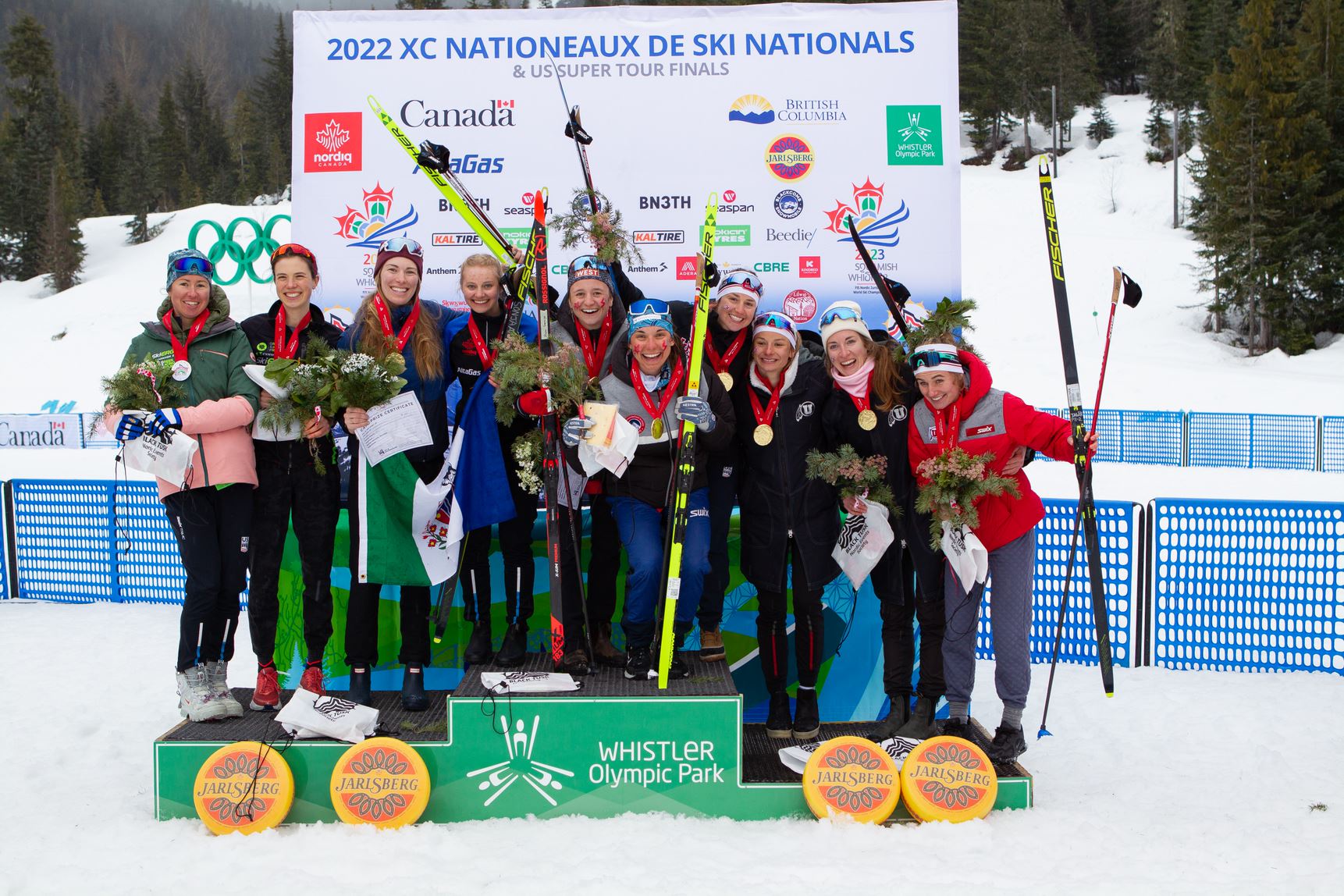
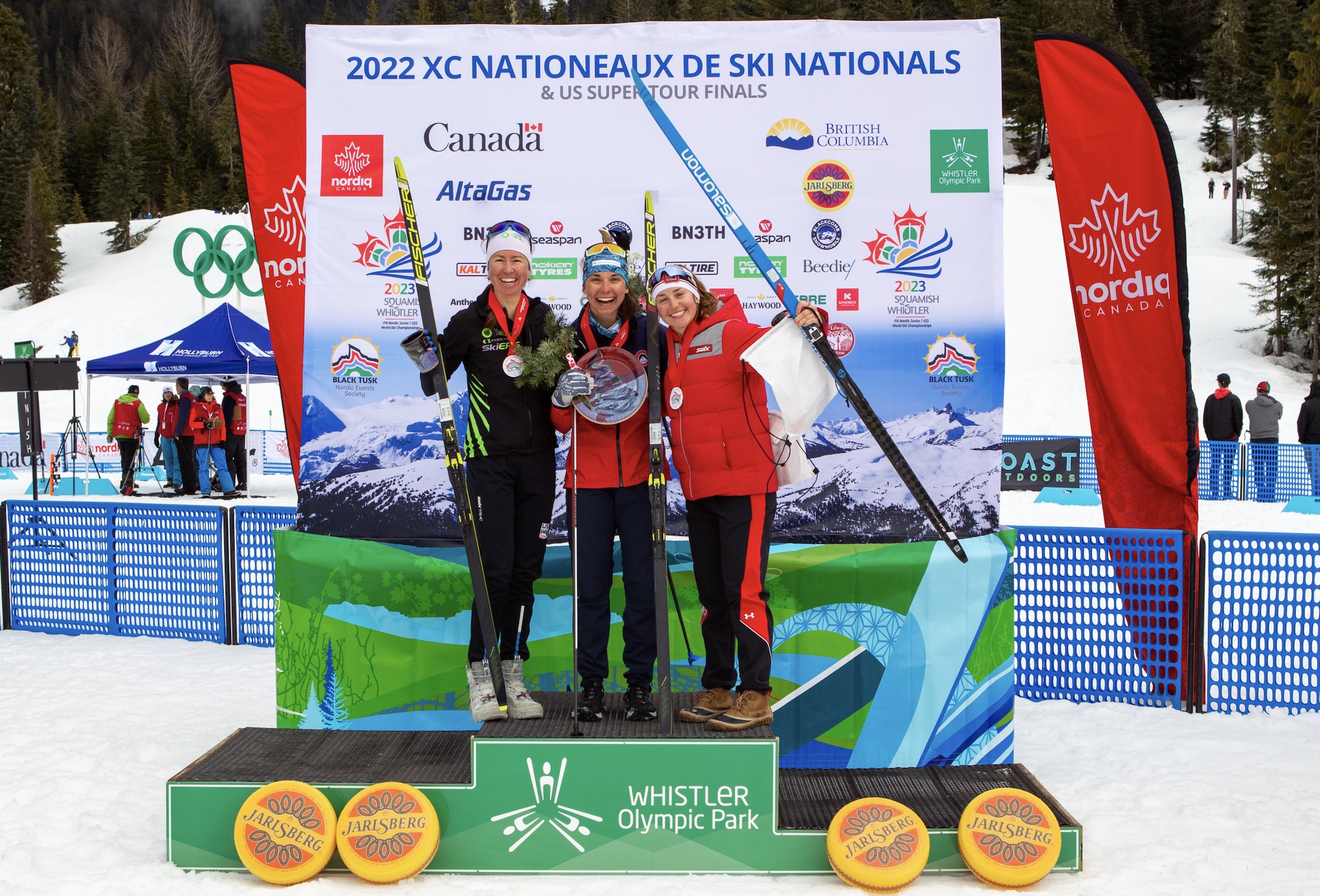
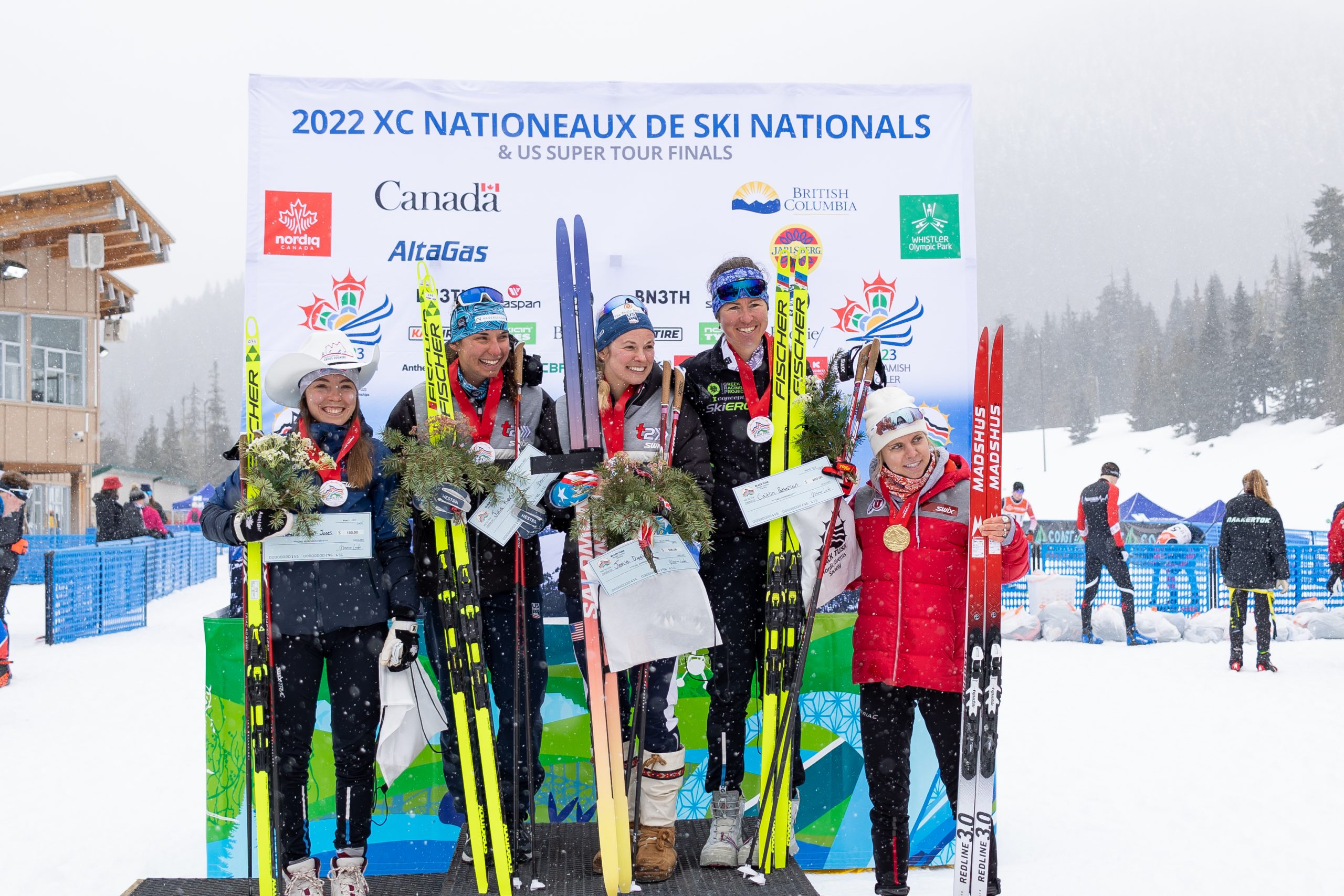
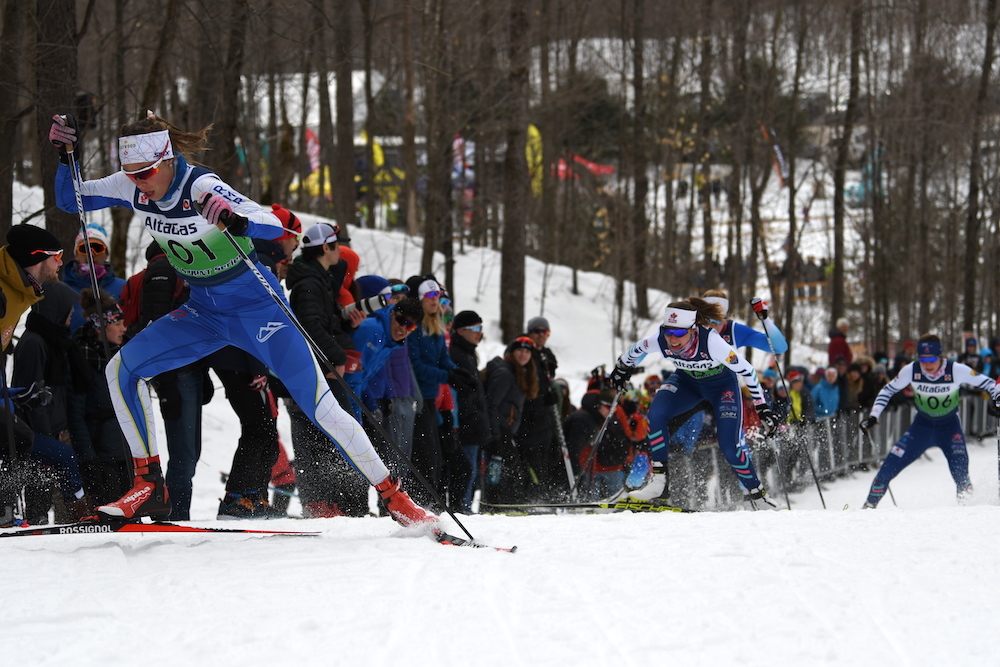
    The top three long-distance women in Whistler, after the final stage of the Canadian Nationals / US SuperTour Finals event series. Julia Kern took the win for SMS T2 ahead of Caitlin Patterson (CGRP) and Sophia Laukli (U of Utah). (Photo: Doug Stephen / VR 45 Photography)

    We’ve arrived at the final act, the culmination of a week of racing in Canada and a season of international racing before that. Piloting a gender-equal distance, both men and women raced a 45 k mass start skate on Sunday, completing six laps of a 7.5 k loop at the Whistler Olympic Park. Continuing a pattern of challenging weather conditions, the day started with temperatures around 37° F with rain, making for soft and wet skiing. 

    Open Men

    The open men went first, with a field of 99 starters heading off the line at 8:30 local time. With 107 on the start list, some notable names among the athletes who did not start include Gus Schumacher (Alaska Winter Stars), Tyler Kornfield (APU) and Xavier McKeever (Foothills Nordic), who took his first national title in the sprint race earlier this week. 

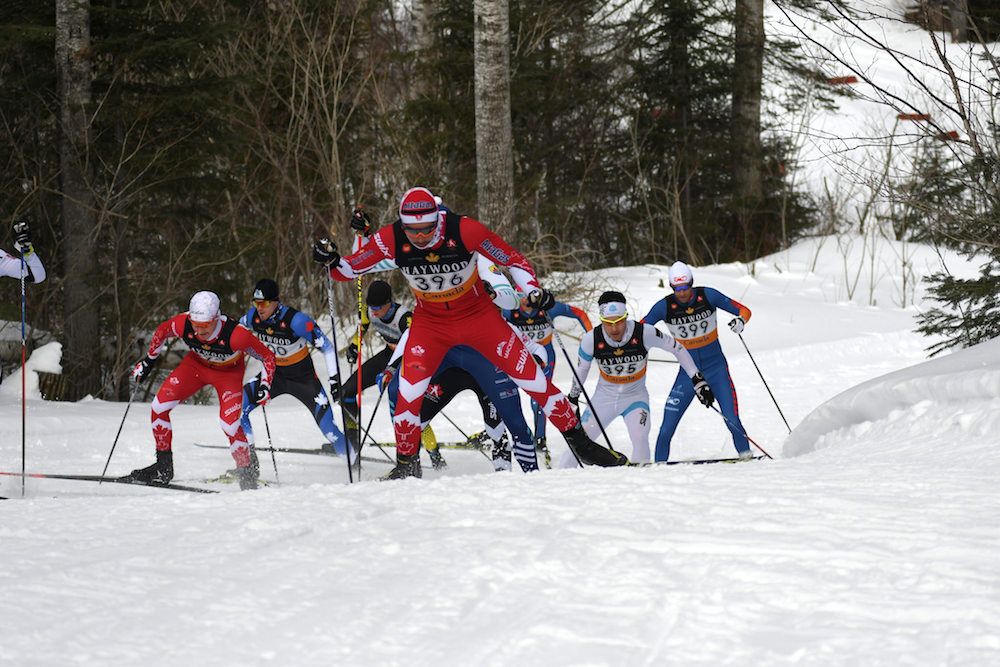
    Relying on live-timing to provide a picture as the race unfolded, it appeared that the first three laps saw steady skiing with a big pack together at the front. Between 22.5 – 30 k that group splintered with ten athletes breaking +31 seconds or more clear of the rest of the field. Among those ten, the Canadians were represented by Russell Kennedy (Canmore Nordic), Rémi Drolet (Team Black Jack), Philippe Boucher (CNEPH), Antoine Cyr (CNEPH), Graham Ritchie (Thunder Bay Nordic) and Olivier Léveillé (CNEPH). Up front for the Americans was Luke Jager (University of Utah), Scott Patterson (APU), Adam Martin (CRGP) and Finn O’Connell (BSF Pro). 

    Beginning the final lap, that group of ten lost a member as Léveillé (CNEPH) dropped off the pace, drifting into no-man’s land, still a minute clear of chaser Johnny Hagenbuch (Sun Valley Ski Education Foundation). At the next split, Boucher (CNEPH) too had dropped, leaving eight men at the front, all within 5.5 seconds. With just a few kilometers to go, the fight was on. 

    Creating a gap in the final stages, Graham Ritchie (Thunder Bay Nordic) claimed the victory and earned his first national title. Ritchie finished in a time of 1:40:32.5. 

    “I’m not sure how this happened,” said Ritchie to Nordiq Canada, “I haven’t raced this long of a race in a couple of years, so I had no game plan going into it. I just said I’m going to stick with the lead pack as long as I can.” This strategy worked in his favor. 

    “I was able to stick with the lead pack and being in the top three with one kilometer left,” continued Ritchie, “I knew I had a little jam left to go for it in the last few hundred meters. I had a good day and really fast skis. The techs killed the boards so I’m super stoked.”

    Concluding a strong week of racing, Jager (University of Utah) topped the American podium, coming in +6.8 seconds behind Ritchie. Speaking to the conditions, Jager said, “it was good, the news that they were salting last night was music to my ears because it would have been so different if they hadn’t. It was really firm and fast and even where it was getting mushy it was pretty firm underneath so it was fast out there.”

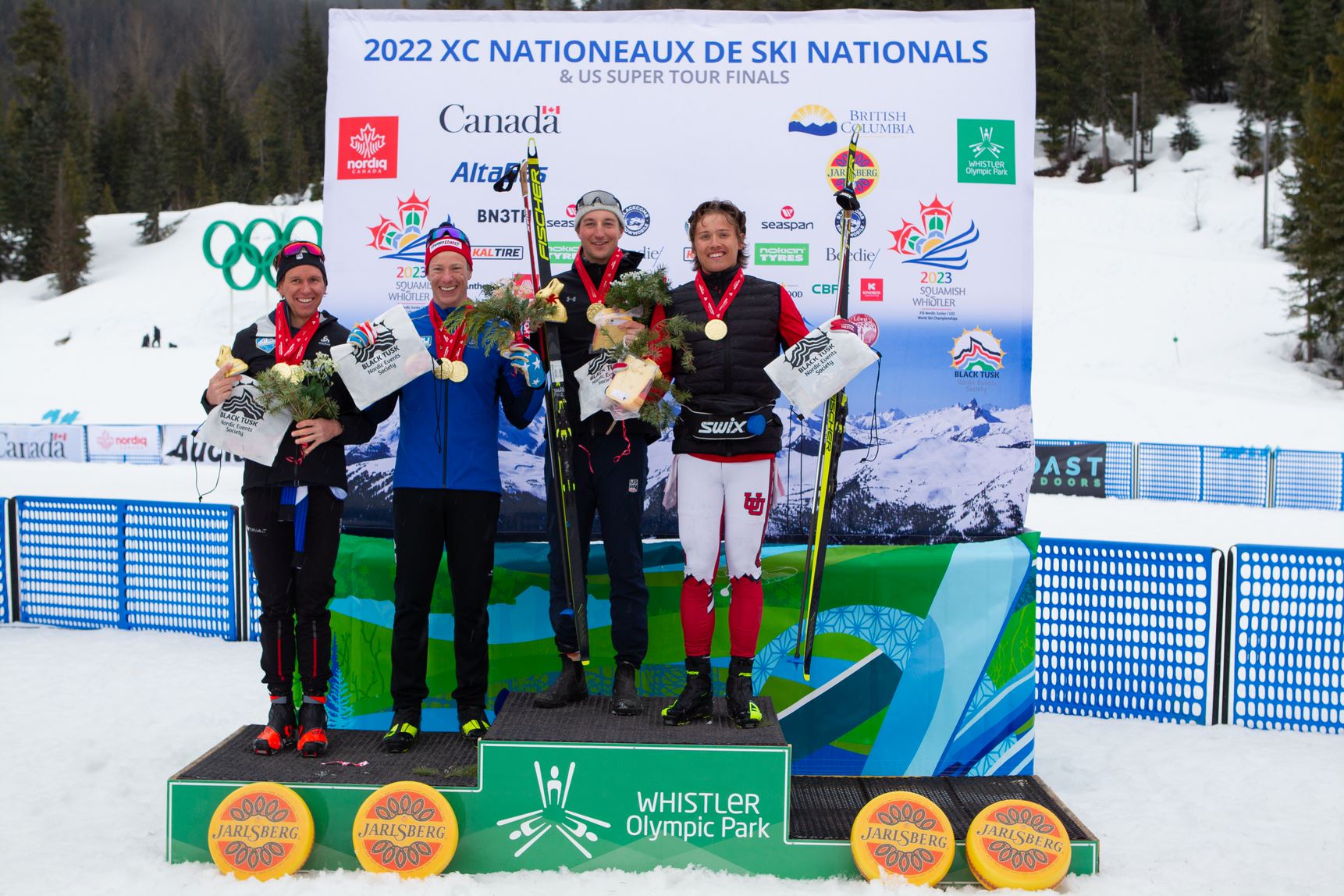
    The men’s SuperTour podium for the final day of racing in Whistler: Luke Jager (Univ. of Utah) came out on top ahead of Scott Patterson (APU) and Adam Martin (CGRP). (Photo: Nordiq Canada / Nathaniel Mah)

    Displaying consistency, Jager has been on the Super Tour podium in every event this past week. He was the first American in the 10 k interval skate, the third American in the 15 k interval classic, the first American in the classic sprint, and he and his teammate Noel Keeffe finished first overall in Friday’s team sprint event. Asked about how the tactics played out within the group, Jager said, “it was kind of going back and forth, I mean Russ [Kennedy] was pushing a little bit and so was Scott but there wasn’t quite enough work from the bottom of the stadium to the top to get rid of everyone, so it would string out and then come back together on the downhills a little bit which was playing to my advantage for sure.”

    Coming down to a sprint finish, Ritchie made an early move to gain the advantage. “I didn’t even know who was in the group anymore,” said Jager, “I was kind of in the front going into the last climb and [Ritchie] came ripping by me and he was really strong so even if I had the foresight of that coming I don’t know if I would have been able to hold him off because he was so strong coming into that hill.”

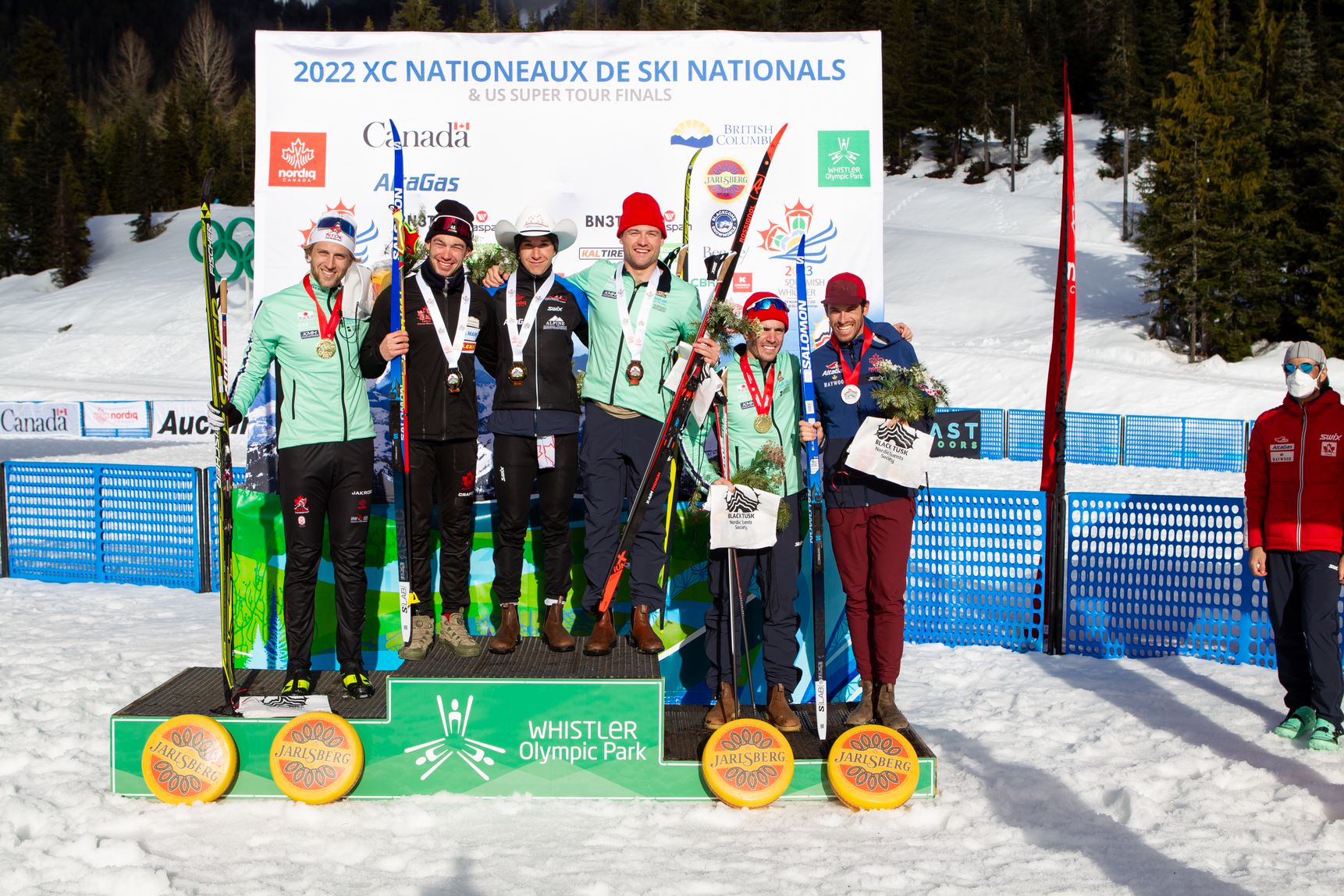
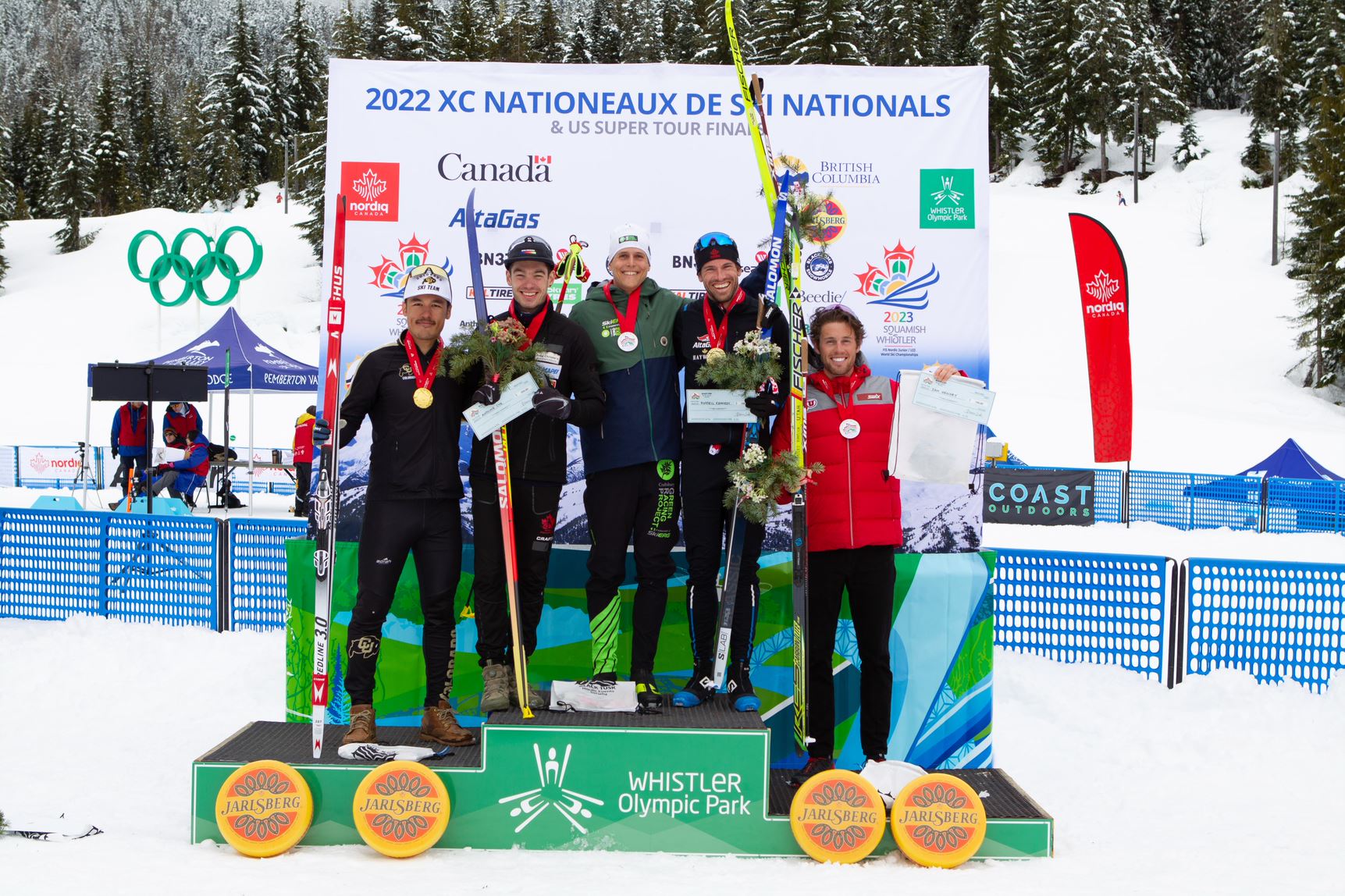
    The 45 k skate Canadian National Championship podium: Graham Ritchie took the title, ahead of Antoine Cyr, Russell Kennedy, Rémi Drolet, and Philippe Boucher. (Photo: Joerne Rohde / Nordiq Canada)

    Cyr (CNEPH) finished third overall and was the second Canadian (+7.8). Completing the Canadian podium, Kennedy (Canmore Nordic) finished fourth overall (+8.1). 

    Patterson (APU) was the second American finisher, coming in fifth overall (+9.6), while Martin (CRGP) was the third American and sixth overall (+12.6). 

    Open Women

    Following the conclusion of the men’s race, the open women got underway at 10:30 local time. At the crack of the gun, fifty-six racers set off to complete their six laps. Although there were 72 athletes registered, sixteen did not start, including Rosie Brennan (APU), Katherine Stewart-Jones (Nakkertok Nordique), Novie McCabe (University of Utah) and Olivia Bouffard-Nesbitt (Foundeurs-Laurentides).

    This is the first time the women raced 45 k at a national championship event, a new event stemming from the push for equal distance racing. When asked about this distance after the race, Julia Kern (SMS T2) told Nordiq Canada, “I think it’s a really interesting format. For me personally I like the shorter distance but recently I’ve had really good experiences with 30 k and today was a great day so, I think whatever makes ski racing exciting for both men and women should be what pushes the sport forward.”

    Regarding whether this should become a permanent feature, or be introduced to the World Cup, Kern said, “potentially, or just shortening the men’s race so that everything is short and exciting because there are marathon circuits out there as well.”

    With the race under way, the first 7.5 k saw the pack at the front was a slightly strung-out group of twelve. Just a few kilometers later, that number was cut in half as six athletes pulled twenty seconds clear. Of that group, Cendrine Browne (Foundeurs-Laurentides) was the lone Canadian, skiing with Sophia Laukli (University of Utah), Kern (SMS T2), Rosie Frankowski (APU), Caitlin Patterson (CGRP), and Sydney Palmer-Leger (University of Utah). 

    In her final race as a professional skier, Cendrine Browne (Foundeurs-Laurentides) collects the Canadian National title in the final long-distance event in Whistler. (Photo: Nordiq Canada / Nathaniel Mah)

    For the next four laps, those first six women skied together, alternating leads and staying within ~5 seconds at each split. As they set out for the final lap, Browne (Foundeurs-Laurentides) dropped slightly, +10 seconds behind the pack. “I just wanted to be in the lead pack today and I was until the last lap, I bonked. It was tough conditions today, but it was a really fun way to go out,” said Browne. 

    From there, the splinters in the group became larger cracks as Kern (SMS T2) applied pressure at the front. Next to drop was Palmer-Leger (UU) who was +6 seconds back at the first split on the final lap. A few moments later, Kern had made a full break. 

    “My tactic was just hang on, conserve energy for as long as possible,” shared Kern, “I didn’t really want to suffer for 45 k and it was fun to ski in a pack and work together. So for me it was just being patient and seeing how I was feeling and evaluating my plan from there. What I ended up doing was skiing with the pack, alternating leads and in the last lap I was feeling good so I decided to send it. 7.5 k to suffer isn’t too hard.”

    At the final time split before the finish, Kern was 27.5 seconds ahead of runner-up Patterson (CGRP). Reaching the finish line, she had widened this lead to 34 seconds, finishing in a time of 1:58:55.6. This victory was Kern’s fourth of the week, having topped every race save for the 5 k individual skate where she finished second behind teammate Jessie Diggins (SMS T2). Commenting on the conditions Kern said, “the first few laps held up pretty well and the last few laps got really deep and slushy, you just had to make sure you didn’t catch a tip or fall and look for the less skied in areas. But it made it exciting, good spring skiing, classic slush conditions.”

    Patterson (CGRP) finished second overall, +34 seconds back. Behind her came Laukli (UU), completing the American podium and finishing third overall (+1:00.9). 

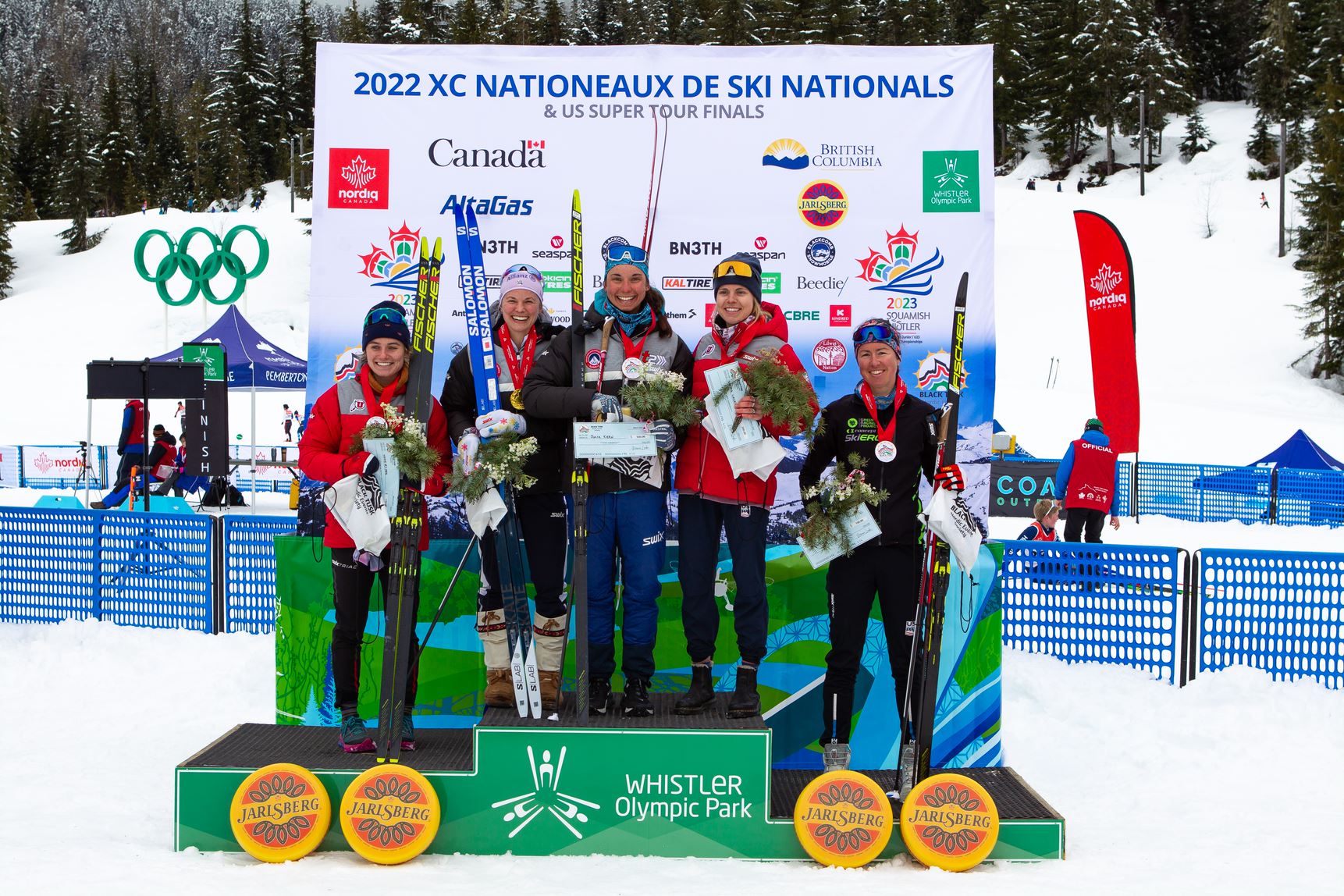
    The top five SuperTour women on the final day of racing in Whistler: Julia Kern (SMS T2) continued her win-streak, with Caitlin Patterson (CGRP) in second, Sophia Laukli (U. of Utah) third, Sydney Palmer-Leger (U. of Utah) fourth, and Rosie Frankowski (APU) fifth. (Photo: Nordiq Canada / Nathaniel Mah)

    Browne (Foundeurs-Laurentides), for whom this race was her final as a professional athlete, held sixth position overall, and was the first Canadian (+2:41.5). “It feels really good to end my career this way. I love distance racing and it is a great way to go out as National Champ,” said Browne to Nordiq Canada. “Thank you to everyone in the ski community who has believed in me and cheered for me over the last 10 years.”

    Dahria Beatty (Whitehorse Ski Club) was the next Canadian in twelfth overall, +9:39.8 behind Kern. Completing the Canadian podium, Laura Leclair (Club Chelsea Nordiq) came in sixteenth overall (+12:08.8). 

    This race concludes the 2022 Canadian Ski Championships and US SuperTour Finals as the athletes now get to enjoy a break after a long season. 

    Complete Results


  • Canadian Nationals/US SuperTour Finals: Team sprint yields another win for Kern with Sonnesyn for SMS T2, University of Utah’s Jager and Keefe take men’s race

    Canadian Nationals/US SuperTour Finals: Team sprint yields another win for Kern with Sonnesyn for SMS T2, University of Utah’s Jager and Keefe take men’s race

    “You need some Gordie Howe elbows out there today” said the commentator on the live feed at one point during Friday’s Team Sprint in Whistler.

    You know, just in case you needed a reminder that this is Canadian Nationals.

    Alongside his legacy as one of hockey’s greatest players of all time, leaving his mark on the sport as an indomitable force with both his goal scoring and dynamism on the ice,   Howe was known as an — ahem — impassioned athlete. One achieves a “Gordie Howe hat trick” by scoring a goal, making an assist, and engaging in a fight within one game. In short, he was a bit of a wild card, and he wasn’t going to let someone else stand in his way en route to the net.

    In watching the Team Sprint livestream, you can see why a similar need to protect one’s space was relevant. The wet and variable spring weather in Whistler created a tricky mix of fast, wet, and mushy snow conditions that combined with fast mass start sprinting to produce racing that tested a skiers balance and “feel” as much as their lungs and muscles. Or more succinctly, racing that was fun, and a little bit chaotic. Staying upright and not losing your own footing or being taken out by another skier might be more important than technique or tactics.

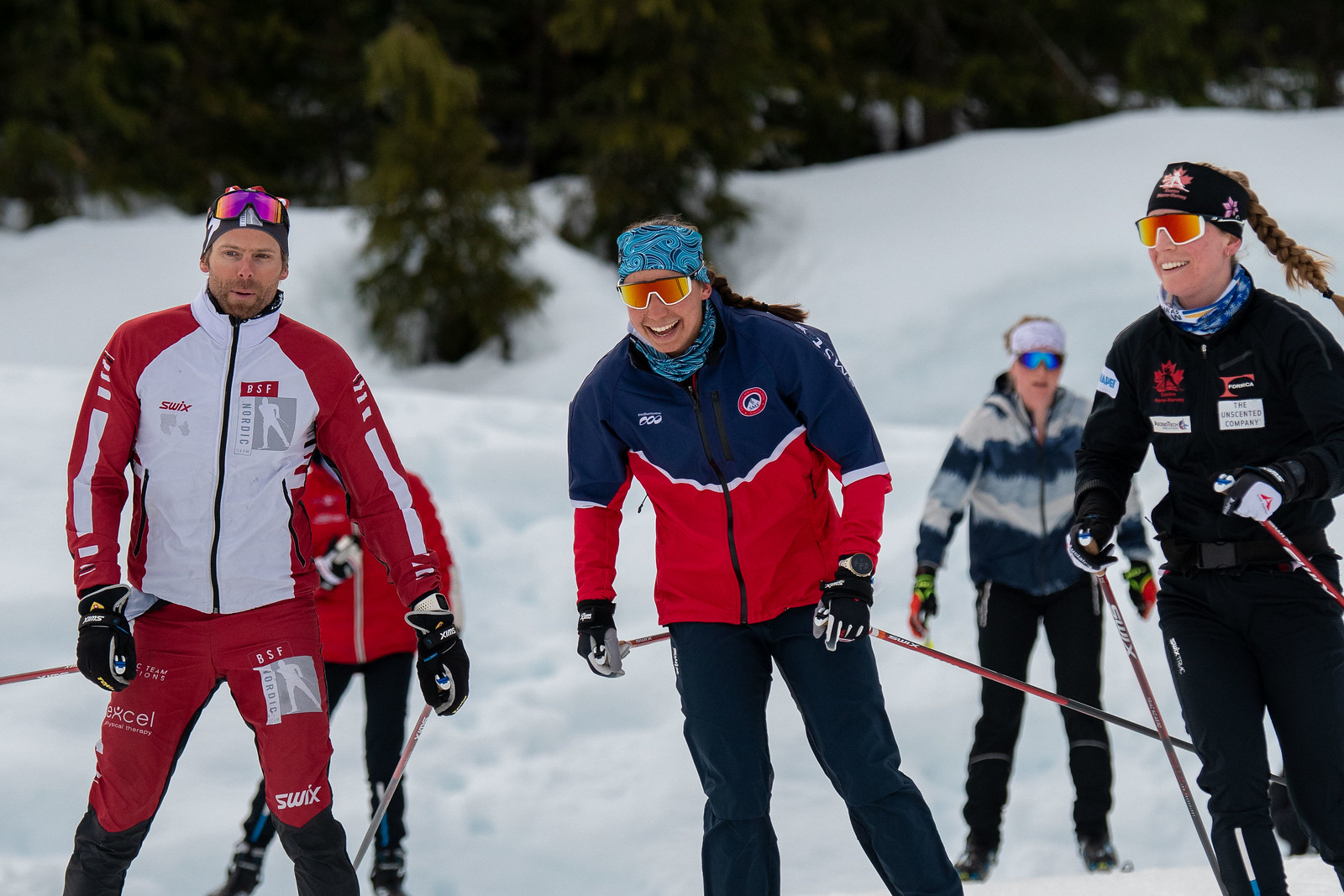
    Andy Newell (BSF Pro – Coach), Julia Kern (SMS T2), and Cendrine Browne (Fondeurs-Laurentides) chat on the warm up before the freestyle team sprint. (Photo: Doug Stephen / VR 45 Photography)

    Adding another layer to the challenge, the Team Sprint was raced “Dresden-style”, where two partners took turns on a 750 m lap until the pair of them had completed eight total laps. The Nordic skiing equivalent of a short-track skating relay, and with the same flow to the action.

    Early attacks could fizzle out through all or any of factors like a bad transition, fatigue, or a tangle up with another skier. All those factors had the equal and opposite effect as well; no team was truly out of it until they crossed the finish line. A late surge between two teammates could pull together a race, and often did when the fields of 15 teams were unleashed on the course today.

    The 750 m course was an abbreviated version of the sprint course seen on Wednesday. Each lap left the stadium and shot up a steep but short climb which lengthened into a false flat where the mushy snow on course saw some skiers muscle out a V2 while others kept to a light-footed hop-skate. Then skiers shot down a sweeping downhill where the course widened to allow for two different lines, before doing a long left turn into the finishing straight.

    Every skier completed an individual lap of this course in the morning, which when combined with their team partner, yielded a seeding time. With no semi-final, the top 15 fastest combined teams qualified for the Open A finals.

    The women’s team sprint podium saw a win for SMS T2, with Yukon Team 7, University of Utah 1, Craftsbury Green Racing Project, and University of Utah 2 rounding out the top five. (Photo: Joern Rohde / Nordiq Canada)
    Open Women’s

    In the women’s qualifier, Julia Kern (SMS T2) completed the course in the fastest time, 1:21.70. That combined with 8th place Alayna Sonneysn (+3.45 seconds) to give their SMS T2 team the top seed for the women’s A final (combined time 2:46.85). Second seed (combined, +3.73) was earned by Nakkerertok 32’s Hannah Shields (7th, +3.12) and Zoё Williams (13th, +4.01), with third seed (combined, +4.12) going to the University Utah I team of Karianne Dengerud (2nd, +2.34) and Sydney Palmer-Leger (23rd, +5.23).

    When the top-15 teams started in the A final, Alayna Sonneysn shot off the front for SMS T2, which stretched the field out immediately and may have helped avoid the pile ups that had been a feature of the Challengers and College Cup heats earlier in the day. Sonneysn was covered by Yukon Team 7 (Whitehorse), with Sonjaa Schmidt catching Sonnesyn as they rounded the corner into the first exchange. Schmidt also pulled back the entire group, and so the racing was extremely tight as they handed off to their teammates. SMS T2 and the Yukon Team continued to push the pace at the front, with the University of Utah I (UU I, Palmer-Leger and Dengerud) and University of Utah II (UU II, Novie McCabe and Julia Richter) teams bridging the gap to form a four-team group leading the race.

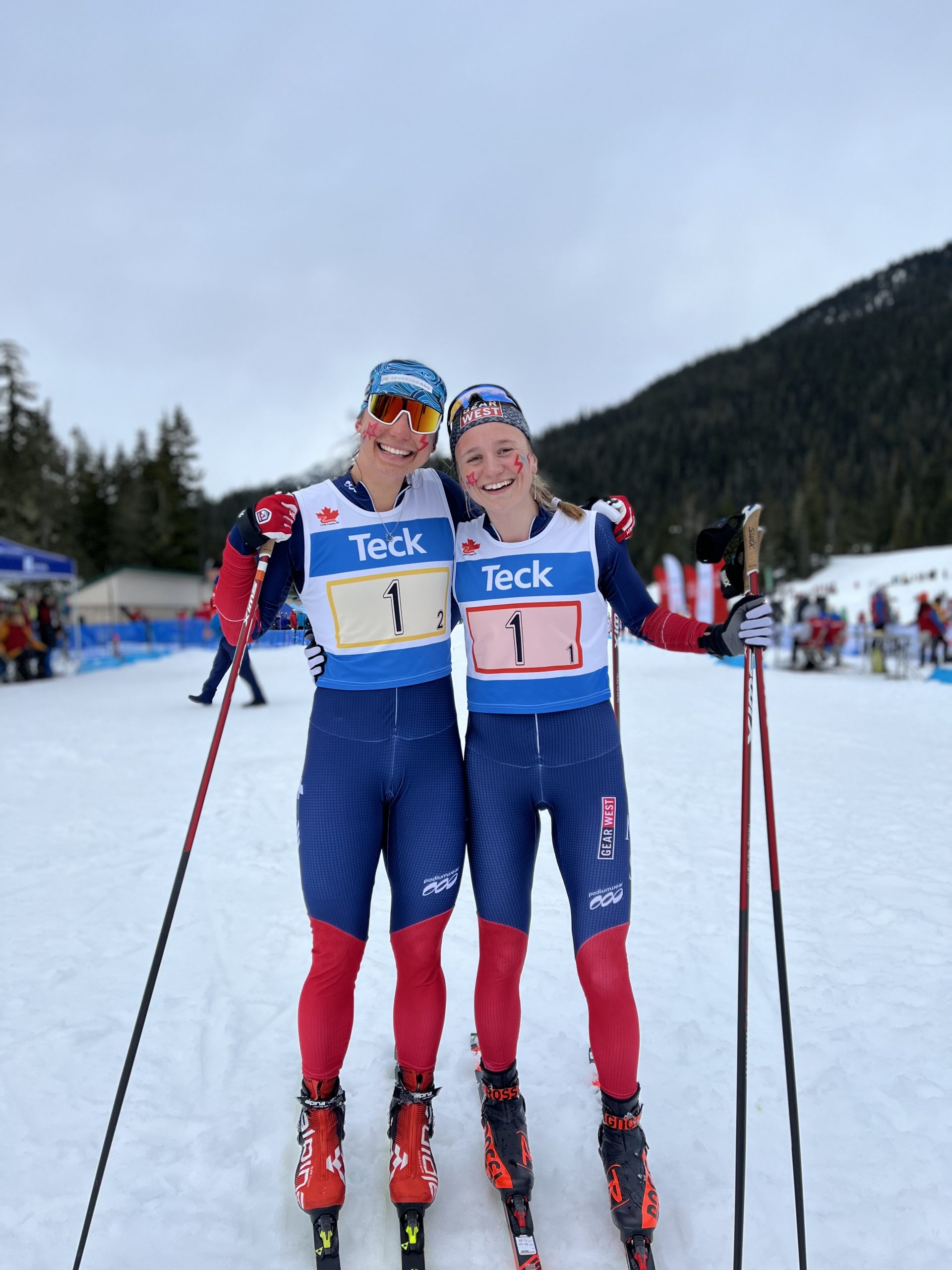
    Team SMS T2, Julia Kern and Alayna Sonnesyn, after taking the win in the SuperTour Team Sprint in Whistler, BC on Friday. (Photo: Nordiq Canada / Nathaniel Mah).

    From there, as the teams swapped partners through laps three, four, five, and six, a strategy of attrition started to emerge from the SMS T2 team of Kern and Sonnesyn. At each exchange, they jumped off the handoff, hopped up the hill, and continuously pushed the pace. Their gap slowly opened at the front, until, like looking up after being taken by a riptide, the mass of racing behind them was unexpectedly distant. By Sonnesyn’s final trip around the course at lap seven, their win was all but secured.

    Sonnesyn said that the goal from SMS T2 was to remain consistent throughout the race, saying in an interview with Nordiq Canada that “I just wanted to be patient. I was a little surprised at the pace we went out [in] because I knew four laps on this course was going to catch up to us quick, but I kept telling myself ‘be patient, go the same pace.”

    In the push for the overall podium behind, a new player had entered the scene. On lap five, Craftsbury’s Caitlin Patterson pushed across the gap to the UU I, UU II, and Team Yukon group. On lap six, her partner Alexandra Lawson held there. As the scrambling partners went out for their final lap on lap seven, UU I and UU II had formed a gap, but when the skiers handed off for the final exchange, a four-team pack came back together with UU I, UU II, Team Yukon, and Craftsbury I.

    Then, it split once again.

    Team Yukon’s Dahria Beatty came off the downhill on course wide to try and take an inside line into the final turn. UU I’s Karianne Dengerud took the downhill corner more inside, and tried to beat Beatty to the inside on the final turn. In the end, Beatty won, and then closed in the final stretch to take Team Yukon (Schmidt & Beatty) to second place (+11.99) behind the first place SMS T2 (12:22.16). UU I (Palmer-Leger & Dengerud) took third (+12.78). 

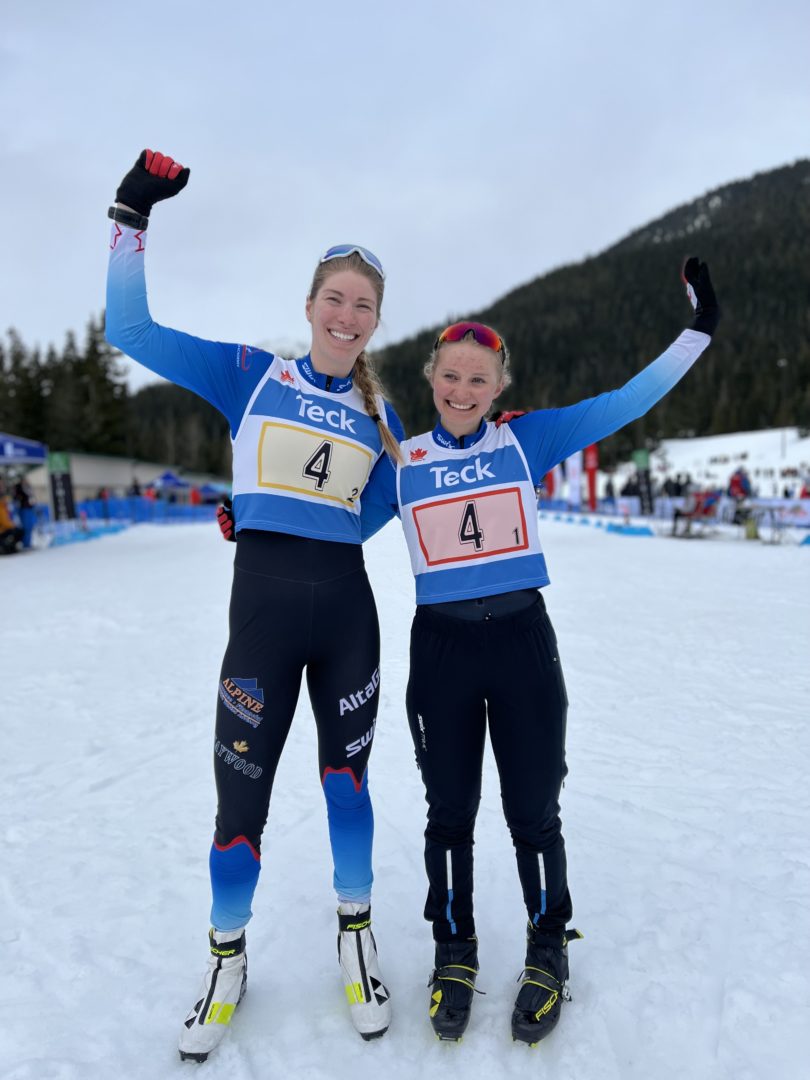
    The Yukon Team 7 duo of Dahria Beatty and Sonjaa Schmidt were second overall in the women’s team sprint, taking home the Canadian national title. (Photo: Nordiq Canada / Nathaniel Mah)

    The resounding win for the pairing of Kern and Sonneysn punctuated a tremendous week for Stratton Mountain School, and in particular for Kern. Apart from a second place behind teammate Jessie Diggins (SMS T2) in the 10 k skate on Monday, she has won every race at these SuperTour finals, despite tricky and variable conditions. 

    Team Yukon’s (Whitehorse) second place overall gives the pairing of Dahria Beatty and Sonjaa Schmidt top Canadian honors, adding to Beatty’s accumulation of National Championships this week.

    Open Men

    The men’s top individual qualifier was Logan Diekmann (BSF), with a time of 1:12.83, who combined with his BSF Pro I teammate Finn O’Connell (51st, +5.93) to take 5th seed (+4.44). They ran behind the top seeded (2:27.15) University of Utah I (UU I) pairing of Noel Keefe (4th, +0.67) and Luke Jager (5th, +0.82). Second seed (+2.42) went to the SMS T2 team of Finegan Bailey (6th, +1.01) and Bill Harmeyer (14th, +2.91), and third seed went to the Team Brew-ski Canmore (+3.43) pair of Russell Kennedy (3rd, +0.57) and Reed Godfrey (27th, +4.35).

    Xavier McKeever (Foothills Nordic) works with teammate Tom Stephen to win the Canadian National Title in the team sprint. (Photo: Doug Stephen / VR 45 Photography)

    With qualifying times extremely tight across the board, the A final promised to stay close throughout the whole 8 laps.

    Noel Keefe mirrored Alayna Sonnesyn’s move from the women’s final, looking to get ahead of any tangles by pushing the pace from the start for UU I. Once the field was out of the stadium, Keefe tucked in behind Orford’s Leo Granbois, and Orford and UU I went into the first exchange with a slight gap.

    Keefe handed off to Luke Jager, who looked relaxed as he allowed the field to come back together again. Animating the move that closed the gap was Northern Michigan University (NMU) skier Kristoffer Karsrud, who alongside his partner Kjetil Bånerud ducked and weaved at the front of the pack throughout the duration of the race.

    On the 5th lap, another UU team, UU II, moved to the front of the pack, as Brian Bushey put in a surge. When Bushey and Keefe handed off to Bjørn Riksåsen and Jager, the race looked like it may turn into a UU team practice for the last couple of laps. That was, until Scott Patterson flew in from Alaska Pacific University (APU) in his last time around the course on lap seven. Following Patterson’s move was Bånerud from NMU, and as the four team pack of UU I, UU II, APU, and NMU went into the final exchange, it became clear; the Team Sprint would well and truly live up to the sprint moniker.

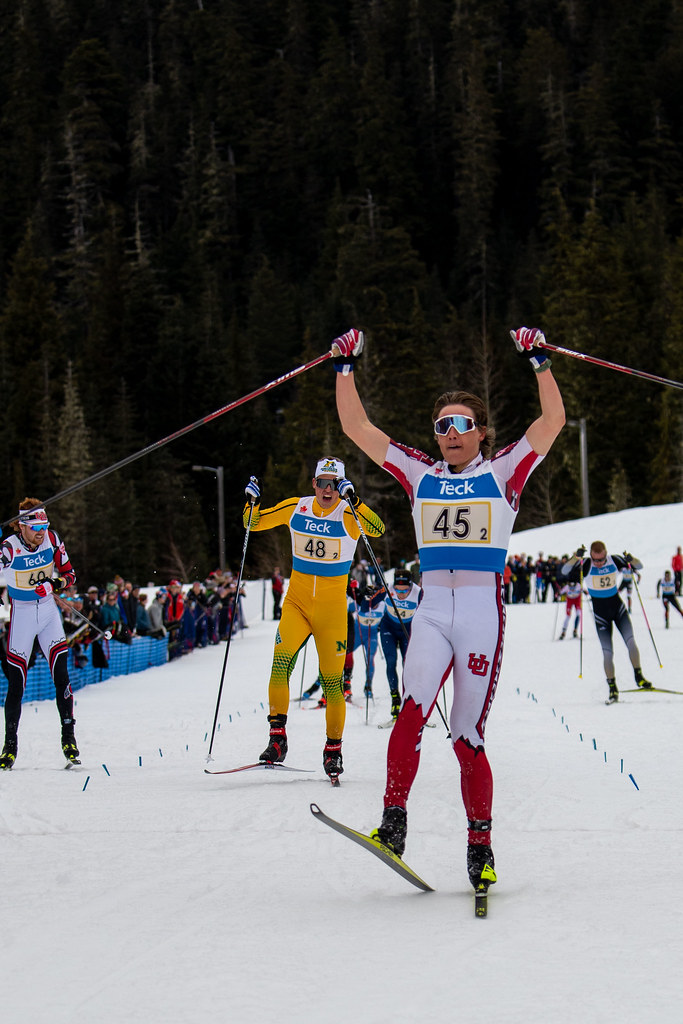
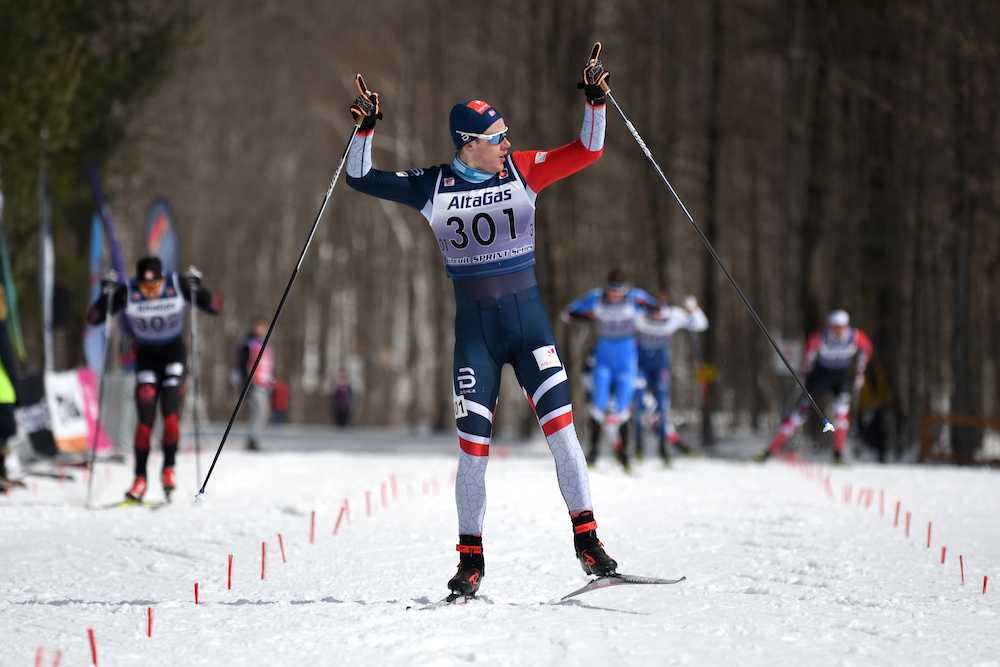
    Jager for UU I came out of the exchange with a slight advantage over the field. APU’s Logan Hanneman countered that by exploding up the climb leaving the stadium. Jager used the downhill to catch Hanneman, with Rikssasen (UU II) and Karsrud (NMU) in tow. Jager, the youngest of the bunch but with plenty of sprint experience, got the inside edge into the final turn. He exploded off of that corner into the final stretch, lifting a ski and two poles as he came across the line to take the win for UU I (11:15.32).

    Luke Jager closes for the University of Utah 1 team, taking the win alongside teammate Noel Keeffe. (Photo: Doug Stephen / VR 45 Photography)

    Hanneman finished in second (+1.39) for APU, and the NMU team finished third with Karsrud crossing the line (+1.45) right behind.

    Outside of the mix for most of the race, the Foothills I team of Xavier McKeever and Tom Stephen deftly moved through the pack to come in fifth overall and claim the Canadian title on the day.

    The University of Utah pairing of Jager and Keefe were especially happy to win this edition of the Team Relays, saying to Nordiq Canada that “It’s a mix-up [in these relays]. Since the race got canceled at SuperTour finals two years ago, we had this race in our scopes. The qualifier went well, we had good skis, and the race turned out great.”

    University of Utah’s Noel Keefe and Luke Jager took the SuperTour and overall win in the team sprint, with APU’s Scott Patterson and Logan Hanneman in second. (Photo: Joern Rohde / Nordiq Canada)

    Full Results:

    Qualifiers | Finals


  • Canadian Nationals/US SuperTour Finals: Julia Kern wins again, while Xavier McKeever takes first Canadian title in Classic Sprint

    Canadian Nationals/US SuperTour Finals: Julia Kern wins again, while Xavier McKeever takes first Canadian title in Classic Sprint

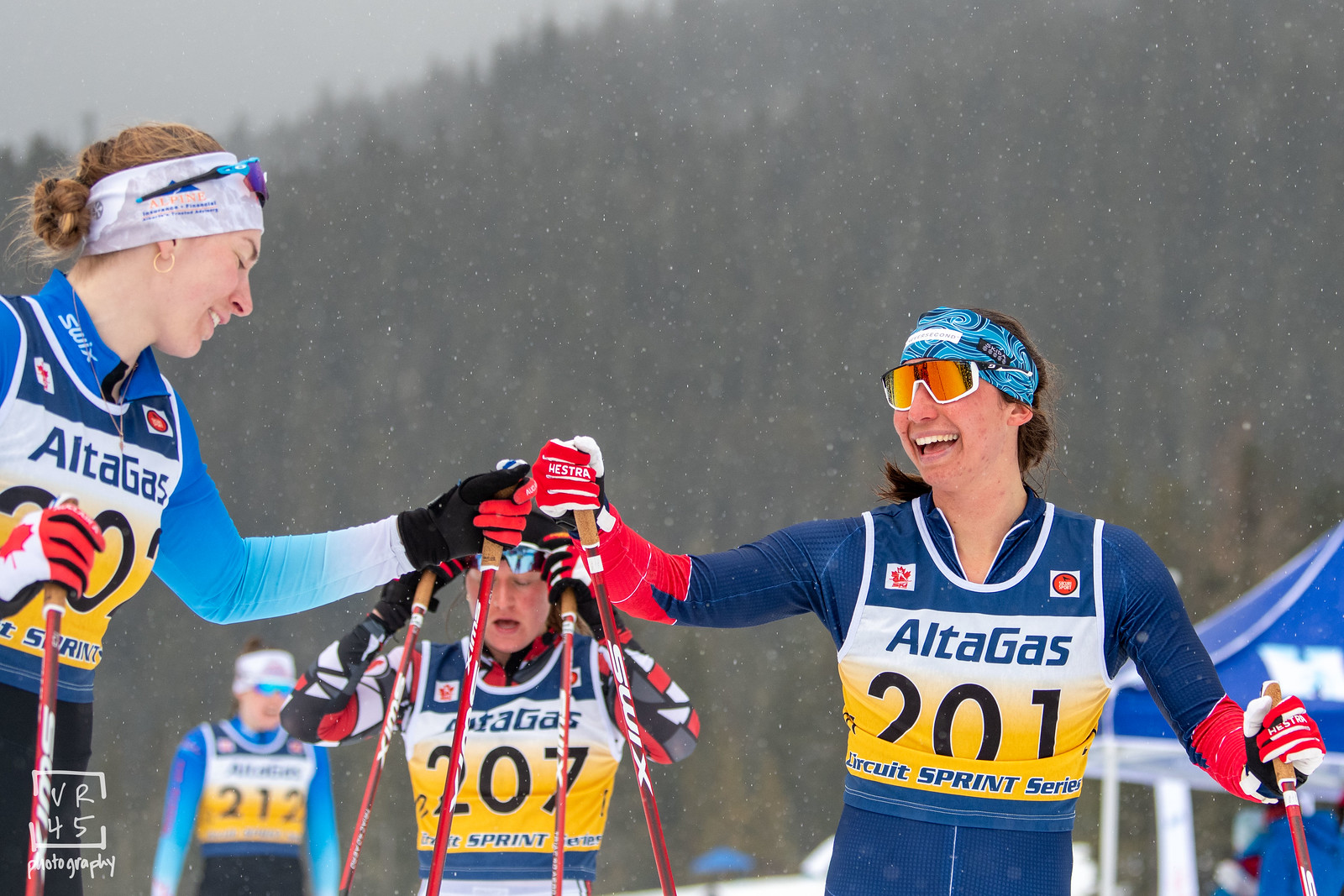
    Julia Kern (SMS T2) and Dahria Beatty (Whitehorse) fist bump at the finish of the women’s classic sprint final. (Photo: Doug Stephen / VR 45 Photography)

    Racing at the joint Canadian Nationals/US SuperTour Finals resumed on Wednesday, showcasing some of the best racers in North America facing off for a classic sprint. 

    As the Whistler Olympic Park was home for cross country skiing during the 2010 Vancouver Games, the classic sprint course on Wednesday was one that played host to an important stepping stone in North American skiing history. In that competition, both American and Canadian skiers solidified the inroads they had made into the top echelons of the sport through the burgeoning discipline of sprinting. Names like Kikkan Randall (USA), Daria Gaiazova (CAN), Chandra Crawford (CAN), Devon Kershaw (CAN), and Simi Hamilton (USA) all qualified for heats, while gracing the television screens of many athletes who now, twelve years later, carried momentum from those inspiring performances onto today’s start line in Whistler.

    If my waxing nostalgia about those 2010 Olympics is making you open a new tab to see if they’re available to revisit on YouTube, let me help you: they are! But before you go, let me send you an assignment: watch how Marit Bjørgen and Justyna Kowalczyk race the final on the 1.2 k course (the men raced a 1.4 k course). Ok, here’s the link (46:16 for the final, and yes, the genders are flipped in the title).

    What you’ll have seen if you completed this FasterSkier sidequest (trademark pending) is that the rolling course at Whistler presented two distinct tactical options for the skiers who made it into the heats on Wednesday. One: the Kowalczyk – attack on the steep climb that left the stadium to try and create a gap on the field that would hold as you went into the first downhill and leave you with an advantage on the second (and final) climb, or two: the Bjørgen –  hold onto the pace-setter until the second hill, when a punchy attack could leave a skier with a distinct advantage going into the mostly downhill approach to the stadium and subsequent final stretch. The latter approach worked in 2010 for Bjørgen, but 2022 was twelve years on and a different field with the SuperTour.

    Before we got to the heats, however, we, and the skiers, had to go through qualifying. 

    The Classic Sprint started off with the women’s champion in the 10 k Classic yesterday, Julia Kern (SMS T2). And after every racer in the women’s field completed the course, Kern finished in first too (3:11.14). Her qualifier was commanding, with second place Dahria Beatty (Whitehorse) +6.58 seconds back. In third place was Alayna Sonnesyn (SMS T2) (+7.54), in a field that otherwise was tight all the way through to the last heat qualifier, 30th place Mariah Bredal (BSF) (+21.37).

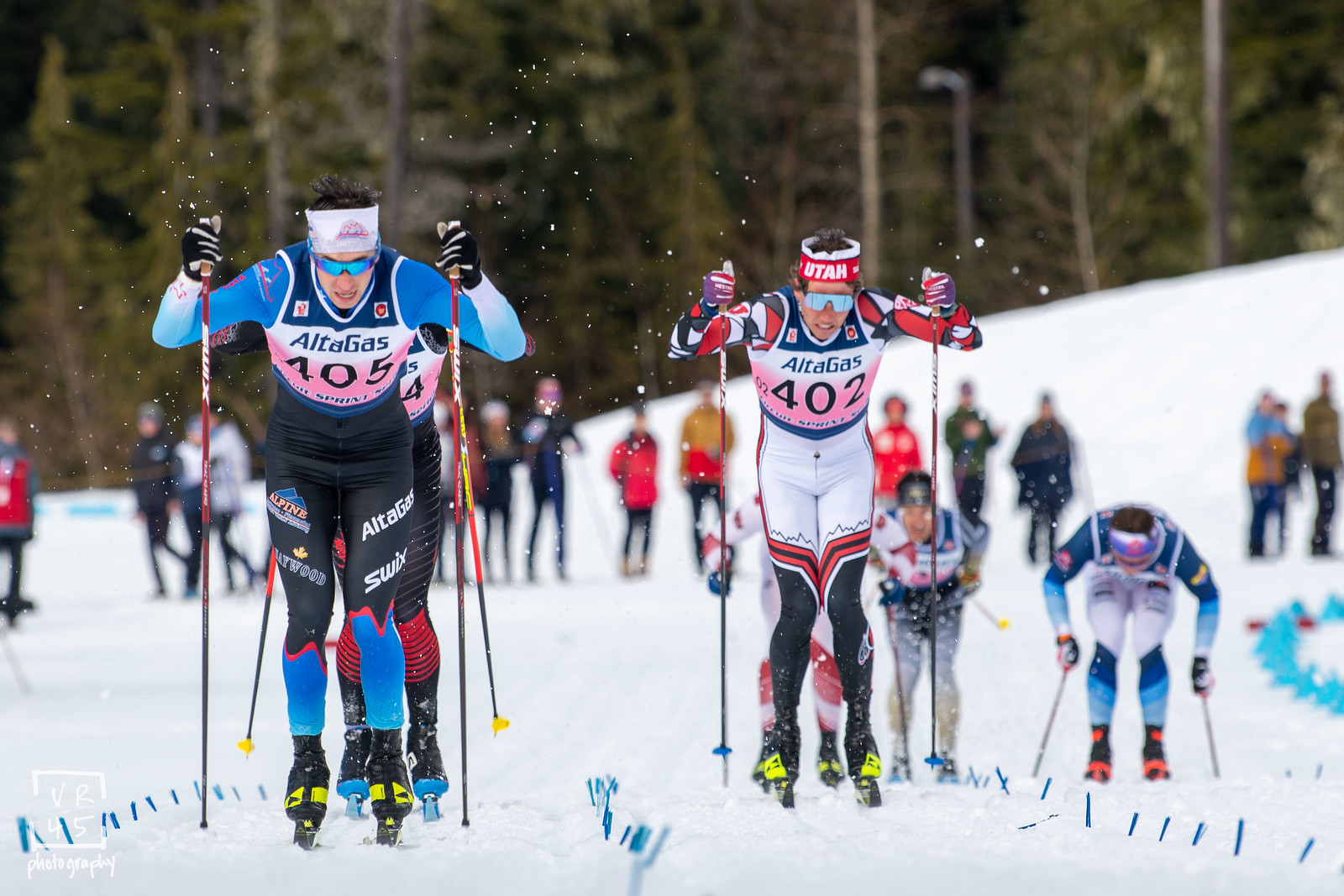
    The men’s field that followed proved to be an even tighter affair. At the top of the field, less than a second split first place Andreas Kirkeng (Denver University) (3:09.82), second place Luke Jager (University of Utah) (+0.41) and third place Logan Hanneman (APU) (+0.88). It was only +11.97 seconds back to the last heat qualifier in 30th place, Montana State’s Reed Godfrey.

    The women’s US SuperTour podium saw Julia Kern take the top step ahead of Caitlin Patterson and Sydney Palmer-Leger. (Photo: Joern Rohde / Nordiq Canada)
    Women’s Open

    In the women’s open quarterfinals, the top qualifiers were able to win their heats handily. Julia Kern turned in the fastest quarterfinal in the field, finishing first in a time of 3:29.93, ahead of Novie McCabe (+1.93), who advanced to the semifinals by taking second place. Kern’s fast pace-setting in heat one proved to animate the field from the gun, and third place Zoë Williams (Nakkertok) was rewarded for keeping pace with one of the lucky loser spots (+3.56).

    That pattern held in the 2nd heat, when a pack loaded with talent including Caitlin Patterson (Craftsbury), Alexandra Lawson (Craftsbury), Sydney Palmer-Leger (University of Utah), Sophia Laukli (University of Utah) and Cendrine Brown (Fondeurs-Laurentides) set a furious pace from the start and held it all the way through. In a five-person sprint, Patterson took first (3:32.13), and Lawson second (+0.55), to take the automatic semi-final bids. In third place, Sydney Palmer-Leger (+1.47) took the other lucky loser spot.

    When the first semi-final took to the start-line, it was filled with five skiers from those first two quarterfinals, with the sixth, 16-year-old Samantha Smith (Sun Valley), having won the third quarterfinal (3:36.43). It was no surprise then, when the “fast from the gun” tactics of those quarterfinals followed into the semis. Julia Kern (SMS T2) again attacked as soon as they hit the first incline out of the stadium, and held her lead throughout. The only skier that proved to be able to match her pace through the course was Caitlin Patterson (Craftsbury), and it would be those two who took the automatic advancement places to the finals; Kern in first (3:34.27) and Patterson second (+3:35.27).

    Behind them, two of the youngest bright stars of US women’s skiing had shown their intrepid ability to match their older counterparts, with Palmer-Leger (UU) taking third place (+3.47) and Novie McCabe (UU)  taking fourth (+3.74) in a sprint ahead of Samantha Smith (Sun Valley) (+4.03). For their efforts, the third and fourth place pairing advanced to the finals.

    In the second semi-final, previous Canadian Sprint National Champion Dahria Beatty (Whitehorse) was able to take first place (3:38.39) ahead of second place Laurence Dumais (Fondeurs-Laurentides) (+0.34) for the second heat in a row. They finished strong in a pack that otherwise remained tight throughout, and created separation in the last stretch to finish ahead of third place Alayna Sonnesyn (SMS T2) (+1.18) and fourth place Katharine Ogden (SMS T2) (+3.45).

    The final field then, was set. For the overall win, four US women – Julia Kern (SMS T2), Caitlin Patterson (Craftsbury), Sydney Palmer-Leger (UU), and Novie McCabe (UU) – and two Canadian women – Dahria Beatty (Whitehorse) and Laurence Dumais (Fondeurs-Laurentides) – would compete. That latter pairing also made the matter of the Canadian Sprint National title on the line simple; a duel between Beatty and Dumais.

    Julia Kern strikes again in the women’s classic sprint, taking the win ahead of Caitlin Patterson (CGRP) and Dahria Beatty (Whitehorse). (Photo: Doug Stephen / VR 45 Photography)

    Kern, spurred on by her success racing hard from the gun all day, went for it again. In an interview with Nordiq Canada she said, “All day I just wanted to ‘send it’ – practice skiing hard and not taking any chances out there. My form and fitness is really good so I wanted to try and not leave it until the end.”

    The whole field was tasked with matching her confidence…and her speed. As in the semi-finals before, just one was up to the task the whole 1.2 k through; Caitlin Patterson. Behind her, Dahria Beatty led a charge to try and keep pace, but as she said in an interview with Nordiq Canada “I was confident in my finish but trying not to lose time on the uphills today. Unfortunately, [in the final], I let a gap open up to Caitlin [Patterson] and wasn’t able to close back on that.”

    And “send it” Kern did in the final. Kern took the pace out hot from the start. With a look over her shoulder, she saw that she had gapped the field by the top of the long striding climb, a position which she held, despite a bobble on the tight left hand curve on the subsequent descent, comfortably through the finish to win by several seconds.

    Patterson having lead the chase group after a gap throughout the heat, found herself sprinting with a powerful doublepole into the stadium to hold her ground in second place.

    Behind them, the race for the last podium spot coalesced around Beatty, Palmer-Leger and McCabe. As they entered the stadium together, Beatty stuck to a strategy that her coach pointed out earlier in the day, “it was working really well to try and go in the outside in the finish chute because people hadn’t skied there in the qualifier.”

    With that bit of tactical maneuvering, she opened up a gap on the two UU teammates behind her, and came across the line in third place overall (+6.16). In doing so, she also came across with a Canadian National title – her second Canadian Sprint title (and first classic). Following her in the Canadian Nationals race was second place Laurence Dumais (Fondeurs-Laurentide), who finished the finals heat in 6th place (+21.57). Based on her time in the semi-final, Zoë Williams (Nakkertok) took third place.

    Kern’s win marked her second in a row at SuperTour finals this week, which have been marked by all sorts of varying conditions that she has used to her advantage, saying to Nordiq Canada:

    “I love variable conditions. Everyone says if it’s a rainy day, it’s a Julia Kern day – I’ve thrived under those conditions before…it makes you have to adjust your skiing and that makes you a better athlete.”

    The Canadian women’s sprint podium, with Dahria Beatty coming out on top in the classic sprint. (Photo: Joern Rohde / Nordiq Canada)
    Men’s Open

    The men’s quarterfinals saw a similar pattern to the women’s, with experienced sprinters grouping together in heats, attacking early, and producing fast times that punctuated the number of racers they sent to the semi-finals. For the men that happened in quarterfinal two, with Graham Ritchie (Georgian Nordic), Antoine Cyr (Skinouk), Kjetil Bånerud (Northern Michigan), Bill Harmeyer (SMS T2), and Étienne Hébert (Montériski) all pushing each other to the line. When the five skiers came into the final stretch, it ended up being Ritchie (3:23.11) and Cyr (+0.32) who took the first and second spots, respectively. Both lucky losers came from the heat, with Bånerud in third (+0.95) and Harmeyer fourth (+1.73).

    Ritchie, Cyr, and Harmeyer would all meet again in the first semi-final. There, they were joined by Andreas Kirkeng (DU), Logan Diekmann (BSF), and Magnus Bøe (CU). With tight racing throughout, Kirkeng was able to gain an advantage and hold off all challengers as he advanced to the final in first place (3:22.97) ahead of second place Antoine Cyr (+0.83). The aggressive tactics of Ritchie and Cyr again proved to push the entire field forward, with Ritchie the benefactor when his third place finish (+1.47) secured him a lucky loser spot alongside fourth place Logan Diekmann (+2.76).

    The second semi-final, meanwhile, was a duel between the young stars from both sides of the 49th parallel. American Luke Jager (UU) and Canadian Xavier McKeever battled to a sprint finish in which Jager took first place (3:23.34) and McKeever took second (+0.50) to advance to the finals.

    Jager and McKeever stepped up alongside Antoine Cyr (Skinouk), Andreas Kirkeng (DU), Graham Ritchie (Georgian Nordic), Magnus Bøe (CU) and Logan Diekmann (BSF). The two young skiers showed no signs of timidness against their older competitors. Jager launched an attack on the first hill that opened a gap as the field rounded the corner leading into the final climb. McKeever was back in the field, looking to “limit damage, if I’m honest” as he said in an interview with Nordiq Canada.

    He followed Graham Ritchie, who was leading the charge to try and catch up to Jager. When they crested the hill, Ritchie, McKeever, and Kirkeng had all managed that feat – joining up with Jager as they went into the downhill leading to the stadium.

    McKeever was still at a disadvantage though, back in the pack, when the curious mix of rain, ice, and sunshine that had worked the snow at Whistler park all day became a factor. As McKeever said to Nordiq Canada, “going into the downhill I had insane boards, and was able to glide back up to the leaders and double-pole from a good position.”

    Xavier McKeever (Foothills Nordic) takes the classic sprint win with Antoine Cyr (Skinouk) on his tails and Luke Jager (University of Utah) chasing in the lane to his left. (Photo: Doug Stephen / VR 45 Photography)

    When he found himself in that good position he could hardly believe it, “I was just stoked to be in the final and top-three in Canada. Going into that finish was insane, and I knew I had to get to the finish line as quickly as possible to try and steal [the National title].”

    What he categorized as stealing, we’ll categorize as earned. The 18 year-old out-sprinted North America’s best head-to-head, winning the overall race, and his first Canadian National title in a time of 3:19.72. Behind him in second place was fellow Canadian Antoine Cyr (+1.38), with Luke Jager rewarded for his long-range attack with a third place overall (+1.99). Graham Ritchie, finishing fifth overall, rounded out the Canadian Nationals podium (+4.13) after a day of leading out attacks in every heat he raced.

    It a promising indicator for Canada’s young up-and-comers with McKeever taking on a field of North America’s best and eeking out a win. For McKeever though, the race was only a preparation for bigger things to come, saying post-race that, “I’ve had some really good sprints this year, so I just wanted to try and challenge myself [racing up] since this is the course that we’ll be racing at World Juniors next year.”

    The Canadian national podium for the classic sprint saw the young Xavier McKeever take the win ahead of Olympic classic team sprint duo Antoine Cyr and Graham Ritchie. (Photo: Joern Rohde / Nordiq Canada)

    Racing continues Friday with a freestyle team sprint, which can be live-streamed here.

    Full Results:

    Qualifiers  | Open and U20 Heats


  • Martin and Kern Stride to the Top on Day Two in Whistler

    Martin and Kern Stride to the Top on Day Two in Whistler

    Carrying the momentum from the first day of racing into a second distance event, athletes lined up once more at the Whistler Olympic Park for a 10 / 15-kilometer interval start classic. Over 130 men and 90 women participated in the open categories, representing clubs across Canada and the United States. 

    Adding a springtime layer of complexity to remind us that we are officially past the equinox, temperatures in Whistler hovered above freezing while a mix of precipitation fell off and on throughout the day. Webcams of the venue showed the spectacular mountain backdrop hidden amongst dense clouds and conifers still laden with the week’s snow.

    It’s a humidity-temperature combo that makes classic waxing tricky. Consequently, many athlete chose to use “hairies”, which are known as “rub skis” in Canada, essentially foregoing kick wax and opting instead for a sandpapered kick zone. For those with strong striding technique, this achieves grip without as significant a risk of icing issues, as klisters can be known create in such conditions. 

    Top Canadian U20 racer Xavier McKeever (Foothills Nordic), who was 13th overall today, explained how this changes the game for those who haven’t had the experience: “You have to be a bit more careful with your kicks and a bit more gentle, because they can slip out really easily. That was the biggest focus for me [today], just to try and ski technically well.”

    Craftsbury’s Adam Martin takes the 15 k classic win in Whistler. (Photo: Doug Stephen / VR 45 Photography)

    Following 10 k sitting and standing events contested by Nordiq Canada’s Para Nordic athletes, the open men’s category headed out for the three 5 k loops. In a close race for the top podium spot, Craftsbury’s Adam Martin took the win with a time of 40:29.3. Martin was chased by today’s Canadian National Champion, Antoine Cyr (Skinouk) who hunted his times from 19 bibs behind.  

    Though Cyr led through the first 10 k, a strong closing lap from Martin moved the American to the lead in the splits, with Cyr skiing the third fastest final lap to take second (+1.3). Canmore’s Russell Kennedy was third overall (+13.1) for the second spot on the Canadian podium, while fellow Canmore athlete Sam Hendry, who now trains with the University of Utah, was third for Canada in fifth overall (+48.0). Both Cyr and Kennedy had also raced onto the podium in yesterday’s 10 k free. 

    “I felt really good today,” Martin wrote to FasterSkier after the race. “Particularly in the second half, I started to figure out how to best race this course and these conditions, and I found a good place mentally to push. I’m really happy with the outcome – that was a dream to win.”

    The men’s 15 k classic podium in Whistler: Adam Martin (CGRP) took the win ahead of Antoine Cyr (Skinouk), and Russell Kennedy (Canmore Nordic). (Photo: Joern Rohde / Nordiq Canada)

    A successful season of SuperTour racing has Martin ranked at the top of the rankings, and earned him starts in post-Olympic World Cup events. After taking third at the American Birkie, Martin headed to Norway to race the 50 k classic at Holmenkollen, where he finished 26th. The following weekend, he skied to 44th in the 15 k free in Falun, Sweden. A week later, Martin is back with his Craftsbury team and standing atop the US SuperTour podium. 

    “It’s nice to return from the World Cup and still feel in good shape. After two 50 k’s, and travel, and a season that I’m really happy with, everything is a bonus at this point. I think it’s great that we are able to combine with Canada for these races. There are a lot of guys at a similar level, so it makes for some tight, fun racing.”

    A 23-year-old Quebec native, Cyr’s best results have been in classic this season, namely an 11th place finish in the opening World Cup 15 k classic in Ruka, Finland, and racing with Graham Ritchie to put the Canadian team in fifth during the Olympic classic team sprint in Zhangjiakou. After the team sprint, he was praised by both his teammate and coach Erik Bråten, along with armchair quarterback Devon Kershaw, for his classic technique.

    “Classic is always good for me and is a race I love,” Cyr said of today’s 15 k in a post-race interview with Nordiq Canada. “It was tough conditions this morning, and a good skier normally comes out on top in hard conditions. I was able to ski well, focus on the race, and came second overall, which is a little bittersweet because it was a really tight battle in the end. But it was really fun, the track is amazing. It’s an Olympic standard track, so it’s just really good.”

    Antoine Cyr races for the Canadian National Title in the 15 k classic in Whistler. (Photo: Nordiq Canada / Nathaniel Mah)

    In his second lap, Cyr had caught yesterday’s winner, Rémi Drolet (Team Black Jack), whom Cyr credited in supporting his strong result today.

    “When I saw was closing the gap on him on the first lap, I decided to go a little harder than I planned to catch up with him. [I then tried] to relax behind him for a lap or half of a lap.. In the end, I was missing a little bit on the last lap. I think that that helped for sure, skiing with someone strong like Rémi.”

    Finally, Cyr spoke to the importance of an international field featuring all age groups coming together this week, particularly on the heels of a two-year hiatus due to pandemic restrictions.

    “It is so good for the young kids — us older guys, we’ve been racing on the World Cup, but like the juvenile and junior, they almost have no races in Canada. To have a big event like this is just amazing and we’ve been looking at the younger guys’ results for an hour yesterday, seeing who’s in good form, and who’s coming up, and you are the next guys to be like taking over. So for them, it is awesome, and for us too, racing with the US is always — it should always be like this.”

    Joining Martin for the SuperTour podium, BSF Pro Team athlete Finn O’Connell was 7th overall (+1:06.4) and second American, with University of Utah’s Luke Jager half a second behind in 8th overall (+1:06.9).

    Julia Kern strides for the win in tricky conditions during the 10 k classic in Whistler. (Photo: Doug Stephen / VR 45 Photography)

    In the women’s 10 k, SMS T2’s Julia Kern skied a strong second lap to take the win in her second consecutive day on the podium, stopping the clock at 29:54.3. Her club and national teammate, Jessie Diggins, took the second step finishing +18.3 back, while University of Utah’s Sophia Laukli skied to third (+1:03.2).

    Looking at tough conditions, Kern explained she raced by trial and error today, exploring which techniques were most efficient on different sections.

    “I kind of had an open mindset going in today,” she told Nordiq Canada after the race. “I knew that the tracks might be a little bit punchy or washed out in sections, and so I was double pulling wide or double polling narrow or just like power striding on the flats if it was getting too punchy out there. So just trying it all.”

    She continued that she was looking to “have fun, send it from the start, and see if I could hold that pace the whole time,” which she ultimately proved able to do. It’s the time of year where the hay is in the barn training-wise, and athletes have had a long season, leaving them in varying states heading into the last hurrah. On whether she was looking to just have fun at these races, or whether it was a serious quest for the podium, Kern said “both”.

    “I think the end of the season is always really fun. It’s so cool to have this many athletes here. And I’ve been feeling really good the last few weeks and so enjoying racing when it does feel good and when I’m able to push really hard. We’re all really tired at the end of the season, but also, when the body’s in form you might as well take advantage of it and send it on the course.” 

    The women’s 10 k classic podium on day 2 in Whistler: Julia Kern (SMS T2) took the win ahead of Jessie Diggins (SMS T2) and Sophia Laukli (Univ. of Utah). (Photo: Joern Rohde / Nordiq Canada)

    Winning back-to-back Canadian National titles, Katherine Stewart-Jones (Nakkertok Nordique) was again on top for the Canucks, finishing sixth overall (+1:17.5). Finishing in the same order as yesterday, Dahria Beatty (Whitehorse Ski Club) was second for Canada in eighth overall (+1:55.0), while Cendrine Browne (Fondeurs-Laurentides) rounded out the podium in ninth overall (+2:14.5). 

    “I went out really hard knowing that that’s what I had to do if I wanted to make the podium,” Stewart-Jones said of her race. “I had a good first lap, and I definitely slowed down a lot on the first part of the second lap. I was just tired and was having a hard time staying in the zone and keeping the rhythm, but I was able to pull it together a bit for the second half of the second lap. So I was really happy with that. And I was happy with how hard I pushed. I just didn’t have it quite in me today, and sometimes that happens.”

    On the importance of focusing on her technique on this type of course with sub-optimal conditions, she continued, “It’s really important, especially on the climbs. The grip isn’t always perfect in these conditions, so you really have to make sure to stay on top of your skis. If you get tired and you start leaning forward, then it makes it even harder to kick… And then on the flatter sections, it was a bit awkward, and you had to expect that. Either you’re striding awkwardly or you’re doing a kick double pool, but your poles are sinking. You have to just really focus on committing to whatever you decide to do and not like trying to switch too much between.”

    Speaking to already standing atop two podiums, Stewart-Jones responded with pride, while also acknowledging that the overall win would be sweeter.

    “Oh, it’s definitely nice to be winning the national championship title… because we’re racing against the Americans, I obviously care about the overall too, so maybe it feels a little less exciting, but for sure, I’m proud of that.”

    Katherine Stewart-Jones (Nakkertok Nordique) takes back-to-back national titles in the women’s 10 k classic in Whistler. (Photo: Doug Stephen / VR 45 Photography)

    In order to get closer to the overall podium, she said he would focus on resting as much as possible and maintaining the head space to perform her best. “It’s been a long season and I haven’t raced this much in a long time. I think everyone’s pretty tired. But also just being able to also be mentally strong [over the next races]. And yeah, you never know what’s gonna happen.”

    Racing continues Wednesday with individual classic sprints, which will be live-streamed by the Black Tusk Nordic Events Society. If you’re looking for additional video updates, follow along on the Nordiq Canada and Black Tusk Instagram pages. 

    Full Results

  • Diggins and Drolet Top 5/10 k Skate Podium to Kick Off Combined Championships in Whistler

    Diggins and Drolet Top 5/10 k Skate Podium to Kick Off Combined Championships in Whistler

    The collaborative event featuring Canadian Nationals and SuperTour Finals kicked off Sunday March 20th in Whistler with 5 / 10-kilometer individual start freestyle races. (Photo: Nordiq Canada / Nathaniel Mah)

    Sunday kicked off a week of racing at the combined Canadian Cross-Country National Championship and U.S. Super Tour Finals event held in Whistler, British Columbia. Hosted by the Black Tusk Nordic Events Society (BTNES) on the Whistler Olympic Park courses, this event also offers junior and U23 skiers a preview of the courses for next year’s Junior and U23 World Championships. With Paranordic, Nordic Combined, and both junior and senior cross-country events, it looks to be a busy week of racing. 

    After a morning of Paranordic and junior events, the senior women got underway with a 5 k interval skate. This meant a single lap of the “Blue A” course, which features two major climbs, one almost right out of the start. Despite a wintery mix of precipitation forecasted throughout the week, and light snow accumulating on top of the corduroy, times were fast as athletes took to the course.

    The women’s 5 k individual start freestyle podium: Jessie Diggins (SMS T2) took the win ahead of teammate Julia Kern and Craftsbury’s Caitlin Patterson. Katherine Stewart-Jones (Nakkertok Nordique) was fourth, with Sophia Laukli fifth (University of Utah). (Photo: Nordiq Canada / Nathaniel Mah)

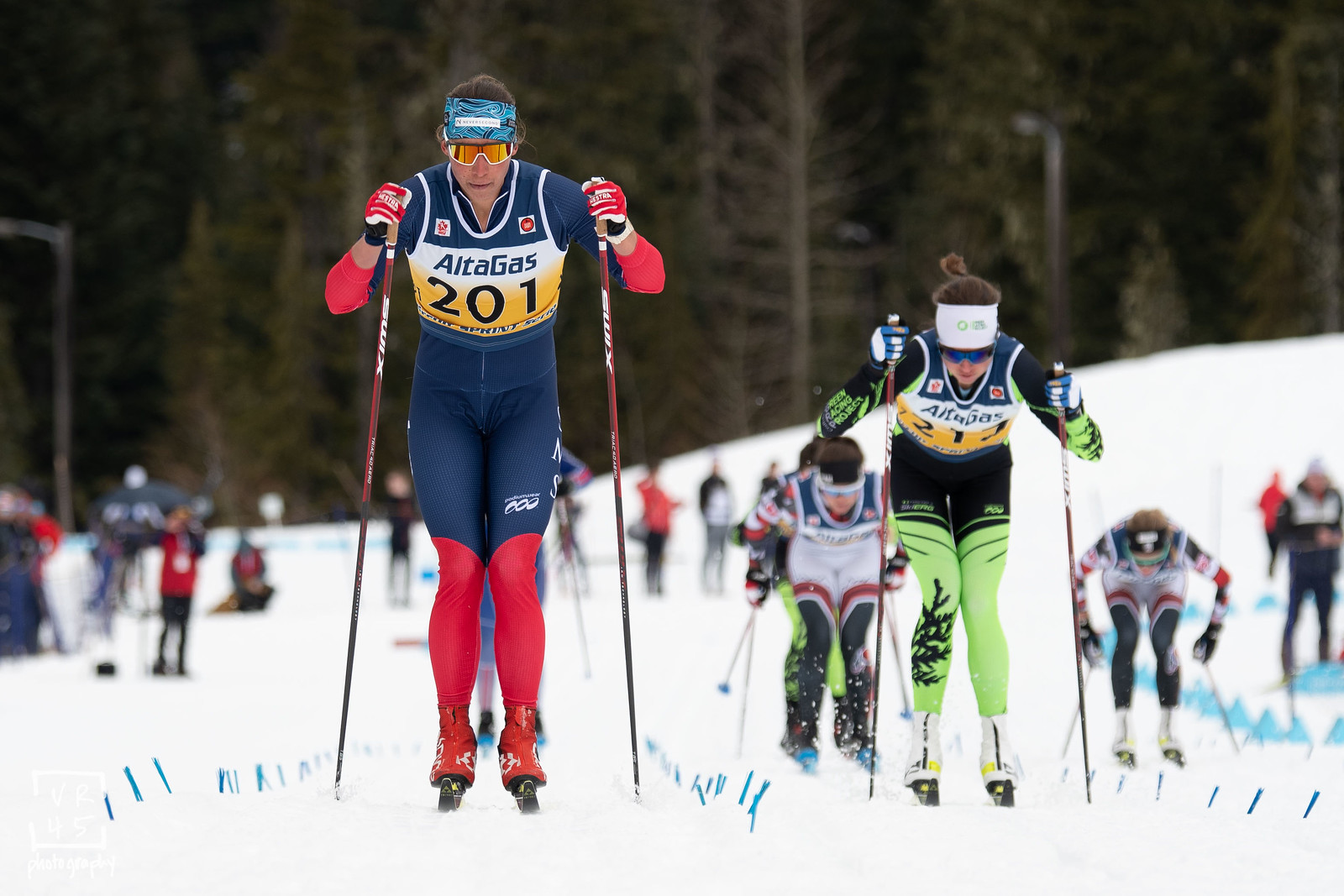
    Swapping stars and stripes for her red and blue SMS T2 team suit, Jessie Diggins won the women’s 5 k event in 11:47.9, with her club teammate Julia Kern in second (+7.7). Craftsbury’s Caitlin Patterson took third (+29.8), ahead of Katherine Stewart-Jones who was the top Canadian racer in fourth (+33.1). Dahria Beatty was second for the Canadian women in eighth overall (+56.1), with Cendrine Browne just behind as third for Canada and ninth overall (+1:00.6). 

    In an interview with Nordiq Canada after the race, Diggins first spoke to the experience of racing amongst a field of over 180 women and girls from across Canada and the U.S. 

    “This is super cool,” Diggins said emphatically. “I mean, I’m half-Canadian, so this is really very special for me any time I can come be in Canada. I really love it, and with COVID, it’s been a while.”

    She also spoke to the change of pace and pressure, in transitioning away from the high-stakes environment of the World Cup where the team operated under strict COVID precautions to ensure the season would not be derailed by an outbreak within the team.

    “The biggest draw for me was to be here with my club, to have fun. There’s all these really awesome kids racing. And, yeah, it’s really nice to have a little more relaxed, not quite as high pressure, [especially] after the Olympics. It’s nice to just get back to racing because it is super fun. So I’ve really enjoyed being here.”

    Diggins described watching the field of rising junior athletes race as “super cool” and spoke optimistically of what this means for the long term health and success of the sport at all levels.

    “It’s so fun to see how invested in the sport, overall, that they are — because they love it, and they want to work hard, and they’re having fun. It’s just really cool to see how our sport’s been growing and expanding, and how great this next generation is looking.”

    Sophia Laukli skates to fifth in the women’s 5 k interval start free, which kicked off Canadian Nationals and US SuperTour Finals in Whistler. (Photo: Doug Stephen / VR 45 Photography)

    Finally, on her own race, Diggins shared it was a “shock to the system.” Following the World Cup finals last weekend in Falun, Sweden, Diggins spent the week in Annecy, France, where she visited the Salomon design center, participated in a live Q&A with a Salomon representative, and even snuck in a guided mountaineering experience in nearby Chamonix.

    She then hopped aboard a flight to Western Canada, finding herself once more on a start line soon after. 

    “I got off the plane from France like 40 hours before the start,” Diggins laughed. “So it was one way to kick the jet lag, and it was highly effective. It was a bit of a bit of a shock, but it was really fun to just get out there and work hard, and really enjoy these — I mean, it’s fun. They’re Olympic courses. They’re really, really nice, they have great flow. So I really enjoyed being out there.”

    As the top Canadian woman, Katherine Stewart-Jones spoke with Nordiq Canada about the tough competition, “It was really exciting to race today and having the Americans here I knew it was going to be a competitive race, and I definitely wanted to perform because, you know, you want to show that Canadians are also competitive,” she said.

    Katherine Stewart-Jones, racing on behalf of her club, Nakkertok Nordique, is the top Canadian athlete in the women’s 5 k skate on day 1 of Canadian Nationals/SuperTour Finals in Whistler. (Photo: Nordiq Canada / Nathaniel Mah)

    “Overall, I was happy with my result. I didn’t think it was my best race. It was the type of race where the conditions are brutal, and nobody feels technically great, but you had to keep going. In warm-up I could tell it was hard conditions to ski in, so I gave myself a few technical cues during the race, making sure I reminded myself it was like this for everyone. I’m really happy with my effort.”

    Sydney Palmer-Leger (University of Utah) earned the top spot in the women’s U20 ranking with a time of 12:36.8. She finished seventh overall.

    Russell Kennedy (Canmore Nordic) skis to second place in the men’s 10 k interval start freestyle, which kicked off Canadian Nationals in Whistler. (Photo: Doug Stephen / VR 45 Photography)

    With the women’s race wrapped up, the competition turned to the men who skied 2 x 5 k. In a reverse of the women’s results, it was the Canadians who took the top three spots led by Rémi Drolet (Team Black Jack) in a time of 22:50.2. Russell Kennedy (Canmore Nordic) finished second, +19.8 behind Drolet, while Antoine Cyr (Skinouk QC) rounded out the podium in third (+29.7). 

    Luke Jager (University of Utah) was the first American of the day in fourth (+37.4). Jager was followed by two fellow collegiate athletes, Kjetil Bånerud of Northern Michigan University, and Sam Hendry of the University. Bånerud is a native of Norway, while Hendry was also racing on behalf of Canmore Nordic, his home club. This leaves BSF Pro Team athlete Finn O’Connell as the next on the US SuperTour podium in seventh overall (+49.7), with Craftsbury’s Adam Martin third for the US in eighth overall (+50.1).

    The top-six Canadians stand on the podium following a 10 k individual start skate. Rémi Drolet (Team Black Jack) took the top spot ahead of Russell Kennedy (Canmore Nordic) and Antoine Cyr (Skinouk). Sam Hendry (Canmore Nordic) was fourth, followed by Graham Ritchie (NTDC – Thunder Bay) and Philippe Boucher (Skibec). (Photo: Nordiq Canada / Nathaniel Mah)

    Like many of the top athletes, Drolet just recently returned from Europe after the conclusion of the World Cup circuit. He spoke with Nordiq Canada after the race saying, “I really went into the race today with zero expectations. I was thinking in my head that if I execute well and push hard, then I’ll be happy with the race, and the result just came so that was just a bonus for me.” 

    In soft and sloppy conditions there were a number of mishaps out on the race course and Drolet said, “I think with conditions like that it can be really easy to kind of sketch yourself out. I think a lot of people were doing that. But I think you can just kind of stay focused on skiing and not worry too much about the conditions, then everything will be okay.”

    “You need to stay focused on skiing and not on the conditions. When you overthink it, things happen. I was really happy I was able to put together a great race today. This is where I strive to be, and it feels really good.”

    Prior to traveling to Canada, Jager was competing at NCAAs in Soldier Hollow Utah where he and the rest of the Utes earned their third consecutive national victory. 

    University of Utah’s Luke Jager is the top American and fourth overall in the opening 10 k interval start skate in Whistler. (Photo: Doug Stephen / VR 45 Photography)

    The U20 men’s race was won by Tom Stephen (Foothills Nordic) in a time of 23:33.3. Stephen finished sixth overall. 

    Racing continues today, Monday March 21st, with a 10/15 k classic, followed on Wednesday March 23rd by an individual classic sprint. The sprint heats will be livestreamed; these be viewed here. 

    Full Results

  • (Press Release) Ritchie and Cyr Ski to Historic Fifth Place in Team Sprints, Stewart-Jones and Beatty place 12th in Women’s Race

    (Press Release) Ritchie and Cyr Ski to Historic Fifth Place in Team Sprints, Stewart-Jones and Beatty place 12th in Women’s Race

    Graham Ritchie (CAN) double-poles toward the finish of the men’s team sprint. (Photo: NordicFocus)

    Graham Ritchie and Antoine Cyr combined to deliver Canada’s best-ever team sprint result in the classic-skiing discipline at an Olympic Winter Games when they finished fifth on Wednesday near Beijing.

    The 23-year-olds, who were seventh at their first Nordic World Ski Championships last year in the skate-ski format, matched strides with the fastest cross-country skiers on the planet for the historic result.

    “This is so incredible to pull this off and throw down such a good result for Canada. It is overwhelming, especially to do this with such a good friend like Graham. It is really special,” said Cyr, who was struggling to find his top form earlier in the week that qualified him for the Games.

    Canada has never qualified a men’s cross-country ski team for the Olympic team sprint finals in the classic-ski discipline. Devon Kershaw and George Grey were 11th at the 2006 Games. Kershaw joined forces with Alex Harvey to finish fourth in the skate-ski team sprint event at the 2010 Olympics. Harvey was eighth in the challenging team race with Lenny Valjas as his partner in 2018, which was also in the skate-ski format. Beckie Scott and Sara Renner won the silver medal at the 2006 Olympics in the classic-ski team sprint race.

    “Sport isn’t a precise science. It comes with its highs and lows,” added Cyr. “It was such a disappointing start to the Olympics for me, but to finish off the Beijing Games like this is incredible.”

    In the team sprint, athletes each ski three laps, handing off to their teammate after completing each 1.5-kilometre leg. The top-four teams in each of the two heats advanced to the finals along with the next two fastest times overall.

    Ritchie (Parry Sound, Ont.) and Cyr (Gatineau, Que.) were rock solid while working their way up and down the punishing terrain at the Zhangjiakou National Cross-Country Skiing Centre.

    With Cyr skiing the opening leg and Ritchie in the anchor position, the Canadians handily qualified for the finals after crossing the line fourth just behind the leaders and well ahead of the next best finisher in a race that puts a premium on endurance and all-around skiing.

    It was a similar story in the finals. The two Canucks exercised their race tactics to near perfection working steadily in a lead pack of seven through the first four exchanges. That pack dwindled to five for the final two legs.

    With Norway, Finland and Russia surging ahead in a dash for the medals after the final hand off, the Canadians were in a battle for fourth spot with Sweden until the final 1.5-kilometres where the Swedes pulled ahead, leaving the Canadian duo in fifth.

    “I’m super happy and really proud of Tony,” said Graham Ritchie. “We were both able to have a great race today. It means a lot to us to not only get Canada in the final, but also in a fight for the podium. We can feel the support from back home and it really fires us up.”

    When the dust finally settled at the finish line, Norway finished on top of the podium followed by Finland in the silver-medal position. The Russians claimed the bronze medal.

    Dahria Beatty (CAN) races the semifinal of the women’s team sprint. (Photo: NordicFocus)

    Earlier in the day, Canada’s Dahria Beatty (Whitehorse) and Katherine Stewart-Jones (Chelsea, Que.) suited up for the women’s team. The Canadians came up short in their bid to earn a spot into the finals, finishing 12th overall.

    “I gave it everything I had and was happy with how I skied. It was a super tough race and lots of strong teams out there. It was nice to see the boys make it into the final,” said Dahria Beatty.

    “It was a tough race today. I didn’t quite have the energy I wanted in the legs. I gave it absolutely everything. Dahria skied really well,” added Katherine Stewart-Jones.

    The Germans won the women’s race. Sweden skied to the silver, while the Russians secured the bronze medal.

    Complete Men’s Results

    Complete Women’s Results

  • Nordiq Canada Revises 2021 Competition Plans for Canadian Athletes Due to Ongoing Pandemic (Press Release)

    Nordiq Canada Revises 2021 Competition Plans for Canadian Athletes Due to Ongoing Pandemic (Press Release)


    FOR IMMEDIATE RELEASE:

    November 30, 2020

    National Body Cancels Canadian World Championship Trials in Whistler and Canadian Ski Championships in Gatineau; Still plans on Sending Canadian Teams to Targeted International Races


    CANMORE, Alta.—The long-term health and safety of athletes, coaches, staff and volunteers is Nordiq Canada’s top priority.

    Using this statement as the beacon to guide the organization through the ongoing global pandemic, Nordiq Canada, in consultation with its members (Divisions) and national sport partners, has made the following decisions that will impact the 2020-21 competition plan for Canada’s high-performance cross-country skiers:

    • All FIS-sanctioned domestic cross-country ski events scheduled across Canada for the 2020-21 season are cancelled (Divisions will continue to determine the relevance and possibility of hosting scaled-down local events that meet regional health and safety guidelines);
    • Canadian World Championship Trials scheduled for Whistler, B.C. (January 7-10) are cancelled;
    • 2021 Canadian Ski Championships (March 14-20) planned at the Nakkertok Nordic Ski Centre in the Ottawa-Gatineau region are cancelled;
    • 2021 World Para Snow Sport Championships scheduled for February 7-20 in Lillehammer, Norway have been postponed to January 2022;

    “We realize high-performance athletes live and breathe to race and do not want to be left behind their competition. These decisions are not easy, and we do not take them lightly. The domestic calendar decision was made after consultations with key stakeholders and assessment of the current sport-related restrictions that are in place across the country, along with the requirements for hosting such large participation events safely,” said Kate Boyd, high-performance director, Nordiq Canada.

    “COVID-19 is the most challenging competitor we have faced as a sport organization which is obviously forcing alterations to our plans on a daily basis. After weighing all of the risks and opportunities for athletes throughout our high-performance community with our partners at Sport Canada, Canadian Olympic Committee and Own the Podium, while also following the direction provided by Canada’s Sport Medicine Advisory Council, we want our community at large to “Do Local” this year – train at home, and compete in local races if it is deemed safe to do so by government and health officials – in an effort to do our part to help stop the spread of the virus while keeping our sport, and Canada going.”

    Nordiq Canada Remains Hopeful of Sending Teams to Targeted International Races this winter

    In an effort to continue to provide international race opportunities for top Canadian athletes, and for the country to continue to improve on the FIS Nations Ranking List that is critical for future World Cup and Olympic quota spots, Nordiq Canada remains hopeful of sending competitive teams to World Cup and World Junior/U23/Senior Championship events this winter.

    The organization has evaluated events that Canada has the best, and safest, opportunities to achieve the points and rankings needed to secure Canada the most opportunities/starts to compete at the 2022 Olympic Games, while also ensuring the program’s long-term success.

    In an effort to maximize Canada’s point potential, and maintaining or improve on, the country’s Nation rankings, Canada plans to attend the following races, providing if it is safe to do so:

    January

    16-17 – WC Ulricehamn, SWE

    23-24 – WC Lahti, FIN

    30-31 – WC Falun, SWE

    February

    6-13 – FIS Nordic Junior/U23 Cross-Country World Ski Championships, Vuokatti, FIN

    20-21 – WC Nove Mesto, CZE

    23–7 – FIS Nordic World Ski Championships, Oberstdorf, GER

    March

    12-14 – WC Oslo, NOR

    “While we believe it is important to provide competitive race opportunities for our athletes who are ready to perform, this will not come at all costs,” said Boyd, who added strict and robust protocols will be in place, including a bubble concept while traveling. “Working with our medical advisors, the high-performance team will continue to assess the pandemic and potential risks to our team, and program. If we determine it is not safe to travel and race internationally, we will be prepared to cancel this portion of the season.”

    In the absence of trials races, Nordiq Canada will evaluate the fairest method to select the most competitive Canadian teams.  Amended criteria are likely to focus on the 2019-20 FIS points list from period 8  and proven international performances, to allow for a fair and transparent selection of the best Canadian athletes for all international racing. The details of how this ranking list will be used will be communicated via a revised selection criteria which will be announced by Nordiq Canada by December 7.

    Nordiq Canada will continue to work with its Divisions, clubs, and coaches across the country to outline creative and innovative ways to help athletes to continue training safely while at home this season to continue their development.

    Nordiq Canada also has resources to support the entire cross-country skiing community in staying healthy at https://covid.nordiqcanada.ca

    Nordiq Canada is the governing body of para-nordic and cross-country skiing in Canada, which is the nation’s optimal sport and recreational activity with more than one million Canadians participating annually. Its 60,000 members include athletes, coaches, officials and skiers of all ages and abilities. With the support of its valued corporate partners – Haywood Securities Inc., AltaGas, Swix and Lanctôt Sports– along with the Government of Canada, Canadian Olympic Committee, Canadian Paralympic Committee, Own the Podium and B2Ten, Nordiq Canada develops Olympic, Paralympic and World champions. For more information on Nordiq Canada, please visit us at www.nordiqcanada.ca.

    *****

    FOR FURTHER INFORMATION:

    Chris Dornan

    Nordiq Canada

    T: 403-620-8731

  • Nordiq Canada Reworks Domestic Calendar to Emphasize Regional Racing (Press Release)

    Nordiq Canada Reworks Domestic Calendar to Emphasize Regional Racing (Press Release)


    Nordiq Canada Keeps Cross-Country Ski Athletes on Track During Pandemic by Unveiling FIS Cup Regional Race Series

    World Championship Trials set for Whistler; Canadian Ski Championships head back to Capital region


    Press Release

    CANMORE, Alta.— In an effort to provide a safe and competitive domestic race series while keeping athletes close to home during the ongoing COVID-19 pandemic, Nordiq Canada has created an East-West FIS CUP Regional Race Series for the 2020-21 season.
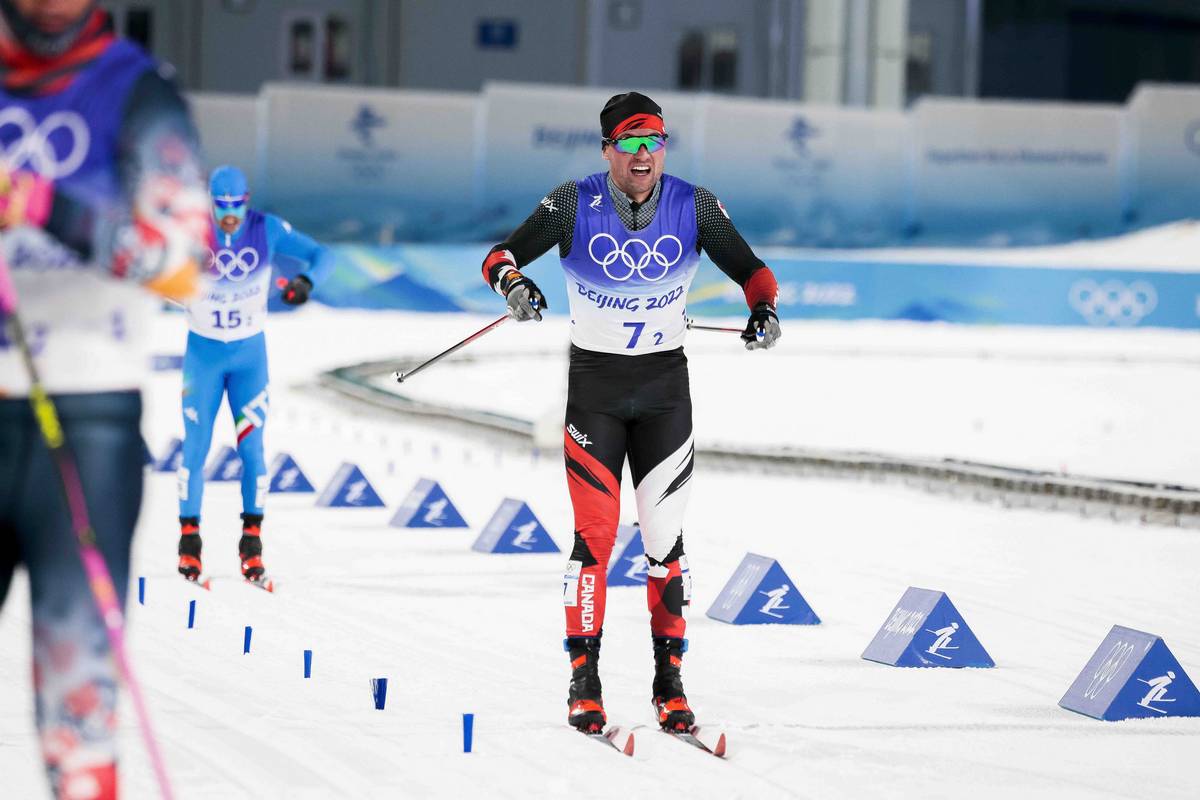
    Canada’s cross-country ski athletes will have equal opportunity to compete in four regional races in either Eastern or Western Canada between December and February. In addition, the World Championship Trials will continue as scheduled for the entire country in Whistler, B.C., January 7-10. The best cross-country skiers across Canada will also head to the Nakkertok Nordic Ski Centre in Gatineau, Que. for the 2021 Canadian Ski Championships, March 14-20. Both will be Continental Cup (NorAm) and FIS-sanctioned competitions. The Trials, which will have a limited field focused on the U20 and Open category to ensure physical distancing, along with Nationals will not be part of the FIS Cup Regional Race Series.

    The newly created FIS Cup Regional Race Series replaces Nordiq Canada’s annual NorAm Continental Cup Series that sees athletes regularly travelling across the country. The FIS Cups will provide Canada’s high-performance athletes the opportunity to earn FIS points without leaving their region. The FIS sanctioning of an event only affects the elite Open category. All other race categories will be run as Provincial Cups.

    “COVID-19 has forced us all to adapt, to be innovative and adjust to a new way of doing things. Our number one focus is to support all of Canada’s cross-country ski athletes in their continued development by providing safe training and competitive race opportunities while respecting guidance by provincial government and health officials,” said Jeff Ellis, Events and Partnerships, Nordiq Canada.

    “Athletes are born and bred to race, and do not want to be left behind their competition. While we realize these difficult times will create additional stress and anxiety for all of us, we believe this new regional series eliminates the dilemma for athletes, coaches, parents and officials to put their health at risk by traveling multiple times across the country for sport. Until the pandemic has run its course, we recognize there may require travel for athletes in the Atlantic provinces and Territories, but we are encouraging our entire community to ‘Race Local.’”

    Prize money for the top-five women and men will be up for grabs at both the following four-race Western FIS Cup and Easter FIS Cup Series.

    December

    December 4-5 – Ski Morin Heights, Morin Heights, Que. East

    December 11-13 – Alberta Cup, Canmore Nordic Centre, Canmore, Alta. West

    December 12-13 – Nakkertok Nordic Centre, Gatineau, Que. East

    December 18-20 – Kootenay Cup, Black Jack Ski Club, Rossland, B.C. West

     January

    January 7-10 – World Championship Trials, Whistler Olympic Park, Whistler, B.C. Continental Cup

    January 29-31 – Red Deer, Alta. West

    January 29-31 – Ski Morin Heights, Morin Heights, Que. East

     February

    February 19-21 – Lappe Nordic Ski Club, Thunder Bay, Ont. East

    February 26-27 – Sovereign Lake Nordic Ski Club, Vernon, B.C. West

    National Championships head back to Canada’s Capital region

    One of only two domestic competitions that will have Canada’s top athletes going head-to-head will be at the Canadian Ski Championships slated to return to the Nakkertok Nordic Ski Centre in Gatineau, Que.

    Hosted by the ENGNE, the Canadian Ski Championships will be held March 14-20.

    “We are thrilled to return to one of Canada’s most coveted cross-country ski venues for our National Championships,” said Ellis, who added this will be the lone event of the year that will bring Canada’s entire cross-country ski community together.

    “While our regional FIS Cup races will be extremely competitive, we also recognize the importance of having athletes test their mettle against a wider breadth of competition, and I can’t think of a better location to hold the premiere event on our domestic race schedule than at Nakkertok. We will continue to closely monitor guidelines put out by our government and health officials but are hopeful we will have the opportunity to complete the season with all of our nation’s best on the same start line in March.”

    ENGNE previously hosted the premier event on the domestic race calendar in 2019 at the Nakkertok Nordic Ski Centre.

    “ENGNE and the entire Nordiq ski community of Canada’s Capital region are excited to be hosting the nation’s best skiers again,” said John Halvorsen, President and Chair, ENGNE.“This year will be extra demanding, but our experienced Organizing Committee is ready for the challenge and look forward to welcoming the cross-country ski community to Gatineau.”

    About ENGNE

    Évènements Nordiques Gatineau Nordic Events (ENGNE) was founded by three local ski clubs (Chelsea Nordiq Ski Club, Nakkertok Nordic Ski Association, Club Skinouk) plus the region’s premier community ski festival, the Gatineau Loppet, to host the Gatineau stage of Ski Tour Canada 2016, a FIS World Cup Event.

    The mission of ENGNE is to host, organize, and promote major events and competitions in the field of cross-country skiing aimed at offering an enriching experience for all participants and fans, promoting the practice of amateur and competitive sport and a healthy lifestyle, as well as broadening the reputation of Canada’s Capital Region as a sports and cultural destination of choice.

    Nordiq Canada is the governing body of para-nordic and cross-country skiing in Canada, which is the nation’s optimal sport and recreational activity with more than one million Canadians participating annually. Its 60,000 members include athletes, coaches, officials and skiers of all ages and abilities. With the support of its valued corporate partners – Haywood Securities Inc., AltaGas, Swix and Lanctôt Sports– along with the Government of Canada, Canadian Olympic Committee, Canadian Paralympic Committee, Own the Podium and B2Ten, Nordiq Canada develops Olympic, Paralympic and World champions. For more information on Nordiq Canada, please visit us at www.nordiqcanada.ca.


    *****


    FOR FURTHER INFORMATION:

    Chris Dornan

    Media and Public Relations

    Nordiq Canada

    T: 403-620-8731


  • Masters Racing: Getting Lapped At Nationals

    Masters Racing: Getting Lapped At Nationals

    It starts and ends here, in the Sovereign Lake stadium.
    It starts and ends here, in the Sovereign Lake stadium. The snowpack was 22% above normal on February 1, 2020.

    A middle of the pack master would have to be an idiot to sign up to race 50km against the best skiers in North America on a FIS-approved World Cup course. The top skiers will be fresh from World Cup Finals in Canmore and competing for important titles, national team selection, and future World Cup starts. With 2020 Nationals combined with US SuperTour Finals, the field will be deep. So why is my name on registration list?

    The 7.5km loop for 2020 Nationals is easy, by elite standards. Host club coach Greg Kilroy guarantees a big pack will hit the final climb together.
    Not much climbing here. Sovereign Lake coach Greg Kilroy guarantees a big pack will hit the final climb together.

    The Sovereign Lake ‘West 7.5km’ loop is easy by World Cup standards. There are no long steady climbs like Canmore. There are no unending series of steep climbs like Holmenkollen. The ‘final four’ climb at Sov requires many transitions, but doesn’t have the bite of Val di Fiemme’s A climbs. There are no tricky downhills like Whistler Olympic Park. The Upper 2.5 is easier than the Upper 5 used at Norams. The Lower 5 is flatter than the Lower 2.5 and 3.75 that were used for the 2005 World Cup. Put those pieces together and the result is a loop that flows over small undulations with only two gentle A climbs and five rolling B climbs for 1,438m total climb over 49km. There won’t even be man-made snow or a narrow ribbon of trucked in snow. For elite skiers, it doesn’t get much easier than this: Day8-FIS_7.5km

    With the race loops set full width for Nationals, there will be lots of room for the lead pack to pass lapped skiers. Yes, there are two classic tracks on the right edge.
    With the race loops set full width for Nationals, there will be lots of room for the lead pack to pass lapped skiers. Yes, there are two classic tracks on the right edge.

    By master’s standards, the course no longer looks gentle and forgiving. Pushing past the redline for a moment too long will result in seconds lost on every subsequent transition. Failing to push over the top will cost even more seconds. 

    So what kind of idiot would sign up to be lapped by the very same elite skiers he has been interviewing for eight seasons and timing for even longer? 

    Maybe the kind who celebrates making the top half of his age group in the local loppets. The kind who expects to lose a minute per kilometre to elite skiers on loppet courses, even when those skiers are just cruising in the pack for much of the race. The kind who bemoans less than perfect skis on race day because he doesn’t have the technique or engine to push past.

    Maybe the kind who can’t let go of the fact that he couldn’t get it done when he was young and had endless training opportunities. Other people simply skied faster. Pierre Harvey and Donald Farley were six years on either side of me, and they are remembered because they delivered when the opportunity was there. Harvey has nothing to prove and can have fun skiing local events. I am still trying to prove something, possibly that I still have relevance on SlowerSkier.com, where it is all about getting more time on course for your money.

    Maybe the kind who didn’t get to race Nationals at his hometown club as a junior because BC decided to give starts to only the top four skiers in each age group. 

    At the end of the analysis, I know better. I laughed at the idea that I would ever join the Canadian tradition of having some podgy middle-aged man start the 50km to show just how big the gap to elite is. And then one sunny summer intensity day on a dusty trail with the masters group, my coach told me I should enter: “If you work hard this year, you will only be lapped once.” And then my mouth said yes while my brain was screaming no.

    On April 2nd, look for me chasing that reverse podium, seven (7) times up that final four climb carrying the lanterne rouge.

    This video is from April 7th, 2019, with a below normal snowpack for April.  2020 is looking to be better.

    Most xc skiers are nice people, even the top racers. Does this have something to do with getting your ego handed to you in travel-sized pieces on a fairly regular basis? And if so, will I be a better person on April 3rd?

    To start at Nationals, a Canadian skier simply needs a CCC license and points on the Canadian Points List, a new requirement introduced in 2019. As the CPL will be updated after the World Cup Final in Canmore, there is still time to improve your ranking, which uses the average of the best 7 Tier 2 or higher results in the last 12 months. While all races are technically open to qualified masters, only the long mass start is really friendly to older athletes (30km for women, 50km for men).

    Non-Canadian skiers need active FIS points, which are automatically included in the CPL. Should Alexander Bolshunov decide to show up for a week of natural snow, he will be seeded first.

    Please note that if you sign up without both a valid license and active points, the host club will thank you for your donation but Nordiq Canada will not allow you to start.

    As I just renewed my license after a 36 year lapse, I will be skiing in the open category at BC Championships on the Telemark trails in March to earn some points. It is possible that the masters category will be assigned points at select Tier 2 events (as a separate wave), but the only safe bet is registering in the open category. 

    My three digit CCC license number looks a little out of place on the registration list where most of the athletes have numbers above 30,000.

    Fun fact about aging: My retirement race was 1984 BC Championships, also at Telemark Trails. This was the first time I used two skate (aka V2 alternate in the USA, skate 3 in Scotland, and gear 4 for HC Holmberg) during a points race.

    1984 was near the end of the golden age of ski racing. Classic racing had not yet been invented and the marathon skate dominated all. We were still using a short section of kick wax as that was essential to be competitive on the steeper climbs. There was no internet and no YouTube. We only saw skiers on TV every four years at the Olympics, but didn’t record it because VCR’s were too expensive for home use. There were also no mass starts other than relays.

    One of my teammates, who was also one of the first victims of my coaching, was trying hard to push his limits and started us down a path to figure out a way to add poling to speed skating technique. Once we had the basics down, Joe would shout ‘Gaétan Boucher’ with a dubious French accent anytime he found a trail wide enough and firm enough to use it on. (This was just after the 1984 Olympics where a Canadian named Gaétan Boucher had dominated the speed skating events.) In this era, most courses were set by snowmobile, not snowcat, and often the only snow firm enough to plant a pole was the edge of the classic track.

    It wasn’t until the final race of the season, and the final race of my career, that opportunity knocked. Joe won his age group in dominating style and I finished 5th in mine. It would have been my best result of the season, but the guys who had just barely beaten me all season started 30 and 60 seconds behind me and got the split information they needed to close the gap over the final 3km. 

    This new ‘out of the tracks’ skating would get a (confusing but official) name the next season and be joined by ‘one skate’ (aka V2 in the USA, skate 2 in Scotland, and gear 3 by HC Holmberg). For Christmas in 1985, Joe came back from a national team camp and taught me the final piece of the puzzle, a new climbing technique called ‘offset’, just like paddling a canoe. Suddenly, skating was possible on every steep hill and grip wax was gone forever. Best Christmas present ever.

    In December, skiers have to climb the steps into the Daylodge after the race. It gets easier by February, which could be important for masters after 50km of foolishness.
    In December, skiers have to climb the steps into the Daylodge after the race. It gets easier by February, which could be important for masters after 50km of foolishness.
  • Canadian Nationals 2019: Notes, Quotes, and Galleries

    Canadian Nationals 2019: Notes, Quotes, and Galleries

    Big fields bring big crowds to nationals. (Photo: Rob Smith)
    Big fields bring big crowds to nationals. (Photo: Rob Smith)

    Canadian Ski Championships has come to an end with the mass start classic for the younger age groups.

    While is is hard to prove that this is the largest nationals ever, it is clear that Évènements Nordique Gatineau Nordic Events (ÉNGNE) has organized a successful week of racing for roughly 700 athletes.

    ÉNGNE is a collaboration between Chelsea Nordiq Ski Club, Nakkertok Nordic Ski Association, Club Skinouk and the Gatineau Loppet.

    One of the reasons this venue attracts large fields is simple geography: 12 million Canadians live close enough to drive there for a race weekend.  While Gatineau is a city of 276 thousand, Canada’s capital Ottawa is just across the bridge, allowing the venue to draw volunteers from a local community of 1.3 million.

    Along with  a proximity to large population centers, a huge amount of work including infrastructure upgrades like snowmaking and the formation of ÉNGNE (which also hosted the first stage of Ski Tour Canada in 2016), allowed for a smoothly run event.

    ÉNGNE tracks volunteers hours as part of their system for sharing revenue between the four organizations. This allowed Jim McCarthy to quickly summarize the effort that goes into this event.

    “On a daily basis during the Championships, there are some 200 to 250 volunteers on site (some days more volunteer-intensive than others),” McCarthy wrote. ” The total volunteer hours on site during the event would be roughly 7000.”

    There is also volunteer work, starting before the bid to host is submitted.

    “There is a lot of advance work, upgrading the site, adding a new timing-building, planning and organizing, communications, hustling for sponsors, subsidies, etc..  I would estimate some 4000 hours of on-site work, and about 2000 hours of off-site,” McCarthy added.

    This year delivered good natural snow conditions and a great party for Canadian skiing.

    Photo Galleries

    Doug Stephen, Rob Smith, ÉNGNE, James MacClean

    The Venue

    There are a lot of good places to watch at Nakkertok. (Photo: Rob Smith)
    There are a lot of good places to watch at Nakkertok. (Photo: Rob Smith)

    “I’m so happy to win here in Nakkertok. It’s an amazing place, so thanks to all the volunteers for making it happen.” — Maya MacIsaac-Jones

    “Today’s atmosphere was incredible. Racing at nakkertok is always great, it’s really one of my favorite venues. Especially the sprint, going twice up the hill gives the opportunity to the crowd to gather there and it’s awesome. It was probably my best experience at a national championship.” — Antoine Briand

    “My highlight of this Nationals has been being a part of it. I have never been to a Canadian National Ski Championships where the field is so deep, with National Team members, competitive domestic racers and so many international racers. The atmosphere has also been amazing with great announcing, well run logistics and awesome fans! I look forward to Nationals coming back to Nakkertok soon!” — Julian Smith

    “Nakkertok trails are really fun and challenging.  It’s good to go back in Gatineau were I used to race every years when I was young.” — Alexis Dumas

    “It’s always really fun racing here at Nakkertok and I had amazing skis today, which really help on the last kilometre of this course, with lots of high speed.” — Dahria Beatty

    “The cheering!” — Katherine Stewart-Jones loves racing on her home course

    voltaren

    “The atmosphere at Nakkertok is fantastic.  The organizers are doing a great job making this event feel special and everything has been running smoothly so far.” — Rémi Drolet

    “It’s also been a long time since I raced at home and so far it’s been unreal. The trails are so good, the crowds was really big today (and cheering for local skier) as well and the organizers have been doing an awesome job. The ottawa/gatineau region is probably the biggest basin of xc skier in the country and it makes canadian nationals championship look like real Scandinivian-like races with over 800 athletes racing. Also Nakkertok from spectator and skier point of views is the best course out there. Iniziare a scommettere su 1xbet Italia è molto semplice You should see the stadium it gets the energy going up that’s for sure.” — Antoine Cyr at home

    “Racing here at Nakkertok is so awesome and seeing so many young skiers out is really inspiring.” – Emily Nishikawa

    “It is so great to see so many athletes racing their hearts out and sharing their love for the sport! The more skiers in Canada, the faster we will become as a nation.” — Katherine Stewart-Jones

    “It was a lot of fun to ski with a large pack for the first half of the race, because it isn’t often that women’s mass start races pack up in Canada.” — Alannah Maclean

    Combining WC Finals with Nationals

    “Having World Cup finals in Canada feel like a blessing, it give us the opportunity we need to go and race versus the big guys , and in Québec, it’s even better. All my friends and familly will be there to cheer and that is very special.” — Alexis Dumas

    “Len and I wanted to use today as a prep for Finals, and felt having a fun day of racing fast was the best way for us to enter Finals in the best spirits and with the body primed. Also with it being Len’s last Nationals it was really important for us to be out there representing Team Hardwood.” — Bob Thompson

    Nationals is not just about a few senior athletes. (Photo: Rob Smith)
    Nationals is not just about a few senior athletes. (Photo: Rob Smith)
  • Canadian Nationals: Team Sprint and Long Distance Classic

    Ryan Jackson leads Andy Shields, Dominique Moncion-Groulx, Sam Hendry, and Ty Godfrey in the 50km. (Photo: Doug Stephen)
    Ryan Jackson leads Andy Shields, Dominique Moncion-Groulx, Sam Hendry, and Ty Godfrey in the 50km. (Photo: Doug Stephen)

    The Canadian Ski Championships party at Nakkertok trails in Gatineau, Québec is in the final days. While ski fans might see this as a pre-party for World Cup Finals in Québec City, the athletes are pursuing titles, personal goals, and the chance to test themselves against 700 peers.

    FasterSkier, like the World Cup athletes, is not immune to travel challenges. There will be a few quotes from Tuesday’s mass starts, the result 0f flight cancellations and slow airport internet caused by spring break crowds. This article was written at YLW, YEG, and YYZ airports.

    Team Sprint

    Sadie White in the team sprint. (Photo: Doug Stephen)
    Sadie White in the team sprint. (Photo: Doug Stephen)

    Monday was team sprint day. While some of the WCF-bound athletes had already left, a number of them decided the team sprint was the ideal tune-up for Friday’s sprint. While medals are awarded, many of the top athletes are more focused on the team-bonding experience and a chance to represent the clubs that got them started.

    The women race the 2x2x1.3km format. Two skiers, two laps each on hard snow at -1C in sunshine.

    Nakkertok’s Hannah Shields and Zoë Williams won the senior woman’s event in 13:15.23, 19.17 seconds clear of Big Thunder’s Mia Serratore and Sadie White. Nakkertok got a second medal, with Bronwyn Williams and Katherine Denis taking third at 21.83 seconds.

    Williams was happy with her day, writing “Hannah Shields (my teammate who skied the first leg of the team sprint) raced beautifully. She skied with the lead pack on the first lap which kept things chill and then handed off with a solid lead after the second exchange. All I had to do was put my head down and hammer!!”

    Williams, who won the team sprint at 2018 nationals as well, had decided in advance that she would focus on this race, whether or not she qualified for WCF.

    “I love team sprinting,” Williams wrote. “There is nothing better than going out and racing with a teammate you’ve trained with all year!! And, then, to both throw down and end up on top of the podium together, not only together but also with two of our other teammates who won bronze — so exciting!!”

    ***

    Lenny Valjas takes his last national title ahead of Graham Ritchie. (Photo: James MacLean)
    Lenny Valjas takes his last national title ahead of Graham Ritchie. (Photo: James MacLean)

    The men raced the same course and the same two skier, two lap format.

    Hardwood’s Bob Thompson and Lenny Valjas won in 10:39.01, beating Big Thunder’s Malcolm Thompson and Graham Ritchie by 0.46 seconds. Canmore’s Sam Hendry and Reed Godfrey took bronze, 6.30 seconds back.

    Thompson and Ritchie set the tone with an aggressive plan.

    “Our plan for the final was to stay within the top three for the whole race and then see what we could do on our last laps,” Ritchie wrote. “We did exactly this and Malcolm had an amazing last climb on his last lap that put us into the lead going into my last lap! I tried to hold off Lenny as long as I could but he ended up catching me, can’t complain about that though, haha! We were super happy with the outcome!”

    This was Valjas’ last race at nationals and it is no surprise that he went out in style. Teammate Thompson put it best.

    “We stayed in the top three for the whole race with some surges to the front to stay out of tight situations,” Thompson wrote. “There was a great attack by Big Thunder into the last lap that really broke things up but Len was there to make his own move to cruise in for the win.”

    “I’ve been looking forward to doing the team sprint with Len for several years, with our team up at Whitehorse Nationals [2017] getting blocked by a cancelled flight. It was so much fun to race for the club that brought both of us up with a love for the sport and has done so much for us over the years.”

    Ritchie qualified for his first World Cup start earlier at nationals, but it is hard to tell if that is more exciting for him than a team success.

    “I’m a big fan of team events!” he wrote. “I love getting back on a team with someone and knowing you have to work together to try to win! Individual races are great but it was super fun to race with Malcolm today and get 2nd place! We are good friends from the same town, grew up skiing and going to school together so it makes it that much more exciting!”

    Valjas and Thompson are much more experienced, but the enthusiasm remains.

    “Len and I wanted to use today as a prep for Finals, and felt having a fun day of racing fast was the best way for us to enter Finals in the best spirits and with the body primed,” Thompson wrote. “Also with it being Len’s last Nationals it was really important for us to be out there representing Team Hardwood.”

    ***

    The lead group in the 30km. Alannah Maclean (#152 on the left) would break away later. (Photo: Doug Stephen)
    The lead group in the 30km. Alannah Maclean (#152 on the left) would break away later. (Photo: Doug Stephen)

    Tuesday brought the long classic day, 50km for the men and 30km for the women.

    Sam Hendry earned his first senior national title in the 50km in 2:18.4, in a very tight sprint with Ty Godfrey (0.1 back) and Dominique Moncion-Groulx (0.2) for a Team R.A.D. podium. Hendry is in his final year as a junior, but looks ready for the transition to senior.

    In the women’s 30km, Alannah Maclean (Big Thunder) took the gold in 1:33:15.4. Andrée-Anne Théberge (U Laval) out-sprinted Gina Cinelli (Revelstoke) by 1.4 seconds to take silver at 28.6 seconds back.

    Maclean, who has ‘retired’ from elite racing took advantage of spring break at med school to compete at nationals.

    tretinoin

    “ I skied comfortably in the pack for the majority of the race and felt very strong on the climbs, so I knew if I skied tactically well I could put myself in a podium position,” Maclean wrote. “I made my break from the pack with about 4 km left to go in the race on the rolling hills in the back of the course, knowing that I had a lot of energy left in my legs to extend a lead over Chute Charron if anyone decided to come with me when I attacked.

    “It was a lot of fun to ski with a large pack for the first half of the race, because it isn’t often that women’s mass start races pack up in Canada.”

    Many of the women who qualified for WC finals skipped the 30km to prepare. But Maclean is in a different place as a full time student who set a goal of helping Lakehead University win the CCUNC (University) title at nationals.

    “I discussed the option of sitting out of the 30 km with my coach and we decided that I have performed better with every race that I have completed this year, so we might as well keep the ball rolling.”

    ***

    Nationals finished on Wednesday with the long distance classic for the younger categories.

    Results: Team Sprint, Long Classic, Full Week

    Galleries: Doug Stephen team sprint, mass start; Rob Smith, ENGNE full week

  • Canadian Nationals: Skate Sprint and WCF qualification

    Canadian Nationals: Skate Sprint and WCF qualification

    Maya MacIsaac-Jones attacked on the final hill to win. (Photo: Doug Stephen)
    Maya MacIsaac-Jones attacked on the final hill to win. Behind, Katherine Stewart-Jones leads Dahria Beatty and Annika Richardson. (Photo: Doug Stephen)

    This article has been updated with final WCF selections and a video of the sprint A finals.

    Nationals rolled on at Nakkertok trails with free technique sprints on Saturday. The women raced a 1.3km course while the men added one more hill for 1.4km.  The jury described the conditions as ‘soft icy’, which seems to mean ‘fast spring skiing’ with a soft layer over a firm base.

    Maya MacIsaac-Jones (CNST) took her second consecutive national sprint title by jumping clear on the final climb to earn a solo victory in 2:46.62. Dahria Beatty (CNST) led the pack into the finish 2.87 seconds later with Katherine Stewart-Jones (CNST) at 3.27 seconds and Cendrine Browne (CNST) at 3.47.

    Germany’s Julia Richter took fifth for the University of Utah at 4.82 followed by Annika Richardson (NTDC TBay) at 5.31.

    “Going into the final,” MacIsaac-Jones wrote, “I knew that my offset was strong so I made the decision to attack on the final climb, which worked out as planned!”

    Maya MacIsaac-Jones leading the A final. (Photo: Doug Stephen)
    Maya MacIsaac-Jones leading the A final. From left to right, Julia Richter (104, red), Cendrine Browne (113), Dahria Beatty, and Katherine Stewart-Jones pursue. (Photo: Doug Stephen)

    MacIsaac-Jones is ending her nationals on a high, as she makes a planned shift to focus on World Cup finals next Friday. “I’m so happy with my race today, this is the best I’ve felt all year. It’s been a rocky season, and this is really motivating for me going into next year.”

    The conditions made for fast racing, but the A final was different.

    “It went out pretty slow,” Stewart-Jones wrote, “because no one wanted to lead on the first climb because there was significant draft on the next downhill.”

    Browne, who is usually described as a distance specialist, now has 4th in every event at nationals.

    “My qualifier was not so great, so I didn’t know what to expect in the heats,” Browne told the LOC. “Fortunately, I felt really good in the heats and I managed to squeeze myself up to fourth place today. Really happy with that, usually not a sprinter, so yeah, good day for me.”

    ***

    Norwegian junior Haakon Skaanes wins the sprint ahead of Antoine Briand. (Photo: Doug Stephen)
    Norwegian junior Haakon Skaanes wins the sprint ahead of Antoine Briand. (Photo: Doug Stephen)

    In the men’s A final, the Norwegian theme from today’s World Cup sprint in Falun flowed into Canada. Norwegian national team junior Håkon Skaanes (Strindheim IL) won the qualification and all his heats to take the A final in 2:45.69.

    Antoine Briand (CNEPH) finished alone in second, 2.54 back, to become the Canadian champion. Julien Locke (CNST) out-sprinted the rest to take third and the silver medal at 5.60 seconds. Julian Smith (NTDC TBay) completed the Canadian podium at 5.73. Lenny Valjas (CNST) was fifth at 6.08 ahead of Norwegian junior Albert Sunde Oehlschlaegal (Sjåstad v Lier IL) at 6.26.

    Briand, who qualified second 1.05 behind Skaanes, was happy with his first Canadian title.

    “Today’s race, I’ve been thinking about it for the past eight, nine months,” he told the LOC. “I was really strong today, from the start of the day, qualification this morning and every heat I was feeling good.”

    Briand didn’t wait for others to set the stage.

    “In the final, I went really hard in the first uphill,” Briand wrote. “My coach shouted on me that the gap had opened. So me and the Norwegian guy who won kept going hard until the end. I couldn’t follow him the second time we went up but I managed to stay 2nd.”

    Julien Locke takes third. (Photo: Doug Stephen)
    Julien Locke (317) takes third, ahead of Julian Smith (305), Lenny Valjas (308) and Albert Sunde Oehlschlaegal (behind Locke). (Photo: Doug Stephen)

    “For me,” Smith wrote in an email, “I was really confident in my skis so I was trying to settle into 3rd place going into the first downhill, and then move into second during the second climb. This allowed for drafting on the final descent. … I did let one too many people between me and the finish line on the last climb and then was not quite able to close the gap in the end.”

    This nationals is not just the largest in recent memory, but also one of the most competitive. Unusually, there are only two Canadians on the World Cup circuit in Falun, with everyone else here in Nakkertok. The addition of the Norwegian juniors and NCAA athletes added speed to the mix.

    minocycline online

    “I have never been to a Canadian National Ski Championships where the field is so deep, with National Team members, competitive domestic racers and so many international racers,” Smith wrote.

    Racing continues Sunday with sprints for the younger age groups and an invitational for even younger athletes. Sunday has 507 racers on the start list compared to 194 finishers and 12 DNS on Saturday.

    World Cup Final Qualification

    Twelve athletes have already qualified, leaving seventeen spots to be decided at nationals: 8 men and 9 women.

    The criteria was summarized after the pursuit race. The races that count are the sprint, the individual start classic, the pursuit, and pursuit time-of-day.

    Twelve athletes were already named to the World Cup Final team:

    • Alex Harvey, Lenny Valjas, Emily Nishikawa, Dahria Beatty based on World Cup or Olympic results.
    • Katherine Stewart-Jones and Jack Carlyle (AWCA) as COC leaders.
    • Cendrine Browne, Maya MacIsaac-Jones, Russell Kennedy (Team R.A.D.), Scott Hill (Hardwood), and Evan Palmer-Charrette (Team R.A.D.) by qualifying for World Championships.
    • Rémi Drolet (Black Jack) with a top ten at World Juniors.

    What follows is an interpretation of the criteria. CCC will announce the definitive list Sunday night at La Soirée, along with the new CCC branding.

    Update: At the Sunday evening event, Nordiq Canada (the organization formerly known as CCC) announced the final selections.

    For the women, it is Annika Richardson, Anne-Marie Petitclerc, Sadie White, Marie Corriveau, Zoë Williams, Hannah Mehain, Frédérique Vézina, Alannah Maclean, and Laura Leclair.

    For the men, it is Antoine Briand, Philippe Boucher, Julien Locke, Julian Smith, Bob Thompson, Alexis Dumas, Antoine Cyr, and Graham Ritchie. Apart from morning sickness, a pregnant woman has to deal with heartburn, fatigue, sore muscles and much more. It is also difficult to get good rest at night as their tummy gets bigger. Towards this end, pillow manufacturers aimed to address the need and develop the kind of pillows that will facilitate a pregnant woman’s sleep and relaxation. Our review will focus on the best pregnancy pillows which can cater for your needs whilst taking into consideration different factors like material, size, shape, price and brand. Shop best pregnancy pillows online at Pregily.com – read reviews and shop now!

    Results: Qualification, Heats, Full Week

    Photo Galleries: Doug Stephen, Rob Smith, James MacLean

    Sprint Video: Doug Ranahan

  • Canadian Nationals: Two Day Pursuit and WCF Qualification

    Canadian Nationals: Two Day Pursuit and WCF Qualification

    Dahria Beatty (left) and Katherine Stewart-Jones chasing hard in the pursuit. (Photo: Doug Stephen)
    Dahria Beatty (left) and Katherine Stewart-Jones chasing hard in the pursuit. (Photo: Doug Stephen)

    This article has been updated to correct an interpretation of the selection criteria.

    Day two of nationals was day two of the pursuit at Nakkertok trails in Gatineau, Québec. The two-day pursuit format (classic interval start on day one, free technique pursuit start day two) was held for the second time at nationals. With both national titles and starts at World Cup Finals in Québec City up for grabs, it was always going to be an exciting day.

    Lenny Valjas (CNST) justified his decision to come back to race in Canada with a second national title, out-sprinting the pack to finish the 10km+15km pursuit in 1:08.18.6. Philippe Boucher (CNEPH) turned in the fastest time of the day to take second, 0.7 seconds behind, and 0.3 seconds ahead of teammate Alexis Dumas.

    Lenny Valjas wins the pursuit, ahead of Phillipe Boucher, Alexis Dumas, and Rémi Drolet. (Photo: Doug Stephen)
    Lenny Valjas wins the pursuit, ahead of Phillipe Boucher, Alexis Dumas, and Rémi Drolet. (Photo: Doug Stephen)

    Rémi Drolet (Black Jack) was top junior in 4th place, 4.4 seconds back.

    “On the last little bit of the 7.5k loop, on the flats, I decided to attack early before the final sprint hill,” Valjas told the LOC after the race, “because some of those young guys are so quick. I couldn’t trust myself on just the last hill, so I made them hurt with a couple km to go. It worked out, we all had a fun sprint up the last sprint hill into the finish.”

    “No tactics for me today,” Boucher wrote. “I pushed hard from the start to the finish. I was targeting the best time of the day so I would qualify for World cups finals and become the national champion.”

    The early group of eight shrank as Boucher pushed the pace and Valjas struggled to cling on. Dumas described it best: “They was not a lot of tactic today, Philippe Boucher was just too strong. The only thing I could do was following him and hope for the best in the sprint finish at the end.”

    Skiing with the final four until the very end, Drolet battled cramps on the second lap.

    “On the final hill, I had a lot of trouble moving, but I still managed to stay pretty close to the front and finished in 4th,” Drolet said after the race. “I was really happy about how I fought, considering everything else.”

    Neither Boucher nor Dumas were fans of the pursuit format when it was brought back earlier in the season. As both have been on the podium at both editions, maybe they will grow to like it more.
    “After the results I’ve got in the pursuit this year, I can only enjoy them,” Boucher wrote when asked if he still prefers mini-tours to pursuits.

    Wednesday’s race featured two 5km classic loops in great conditions. Valjas was happy to get his win with nearly even lap times.

    “Today was great,” Valjas told the LOC after the race. “I’m excited to be out here, and seeing all the kids. It’s a little bit of inspiration for me to be leading into the last World Cup in my career.”

    Asked about edging out the 18 year old Drolet in the interval start, Valjas said “You’ve got to be on your A game to beat him, and I’m happy I got him, but he’s the future. I’m happy to see the young guys nipping at my heels.”

    Drolet was happy with his classic race, finishing 9.9 seconds behind Valjas despite skiing his second lap 21 seconds slower than the first.

    “Perhaps if I had paced the race better, I could have had a slightly better performance,” Drolet wrote in an email. “The course profile, however, does allow you to go really hard a lot of the time since there are usually long downhills after the climbs.”

    Bob Thompson was third in the classic, which qualified him for World Cup Finals.

    “I feel I am in a good place to have some great results this week,” Thompson wrote. “This was my first medal as a senior man so I’m really happy to finally be in top form again to finish the year. Very excited about World Cup finals!”

    ***

    Dahria Beatty leads Emily Nishikawa towards the finish. (Photo: Doug Stephen)
    Dahria Beatty leads Emily Nishikawa towards the finish. (Photo: Doug Stephen)

    Dahria Beatty (CNST) put in the fastest time of the day to win the women’s 5km+10km pursuit in 40:50.8, completing Thursday’s two 5km skate laps in 26:45.8. Beatty and Katherine Stewart-Jones (CNST) worked together to catch Emily Nishikawa (CNST) just before the finish, with Beatty pulling clear for the win ahead of Nishikawa (7.3 seconds) and Stewart-Jones (9.8 seconds).

    “Emily skied a really strong race and we were trailing her by between 7 and 15 seconds almost the entire race,” Beatty wrote in an email to FasterSkier. “Working together gave Katherine and I a slight advantage and I was able to finally close the gap on the second last downhill. After that we were on the sprint course and my mind went into sprint mode and I was able to open up a small gap.”

    Beatty shared her tactical plan after her second place in the pursuit’s day one classic race. “Tomorrow the goal will be to try to catch those 8 seconds off the start and race with Emily.” 

    Stewart-Jones had a similar tactical plan, but executed it better. “I wanted to catch Dahria as fast as possible because I knew it would be much easier if we worked together. I was able to do that and we skied together most of the race,” Stewart-Jones wrote. “Dahria broke away with one hill to go and I caught Emily but she had me at the finish line!”

    Emily Nishikawa winning the 5km classic at nationals. (Photo: Doug Stephen)
    Emily Nishikawa winning the 5km classic at nationals. (Photo: Doug Stephen)

    CNST’s Cendrine Browne was unable to close the gap and had a lonely ski in 4th, finishing 1:17.7 back. Sadie White (NTDC TBay) delivered the 5th fastest time of the day to move from 12th to 5th at 2:45.6 back.

    Nishikawa earned her lead by winning the classic race Wednesday.

    “I  am really happy with my race today,” she wrote about her win. “It is always an honour to win a national title. Racing here at Nakkertok is so awesome and seeing so many young skiers out is really inspiring.”

    Stewart-Jones was happy with her 3rd in the classic race on her home trails, but not as happy with her pacing.

    “I started off hard because I knew it would be a quick race,” she wrote, “but I think that I probably could have paced it better.”

    There were a lot of athletes enjoying the atmosphere at Nakkertok. There were 215 junior boys and juvenile boys, 185 junior girls and juvenile girls, 107 junior men and senior men, 76 junior women and senior women who finished the pursuit.

    Qualifying for World Cup Finals

    Twelve athletes have already qualified, leaving seventeen spots to be decided at nationals: 8 men and 9 women.

    The criteria says that the top Canadian in each of the freestyle sprint, then individual start classic, then pursuit, then time-of-day from the pursuit will be selected in that order. As there are more spots, the sequence will be repeated for 2nd place, 3rd place, until all spots are allocated. Athletes who have already qualified are skipped over. Clear and simple? Not exactly, but it became clearer with results from three of the four events.

    On the women’s side, the first four places were filled by pre-qualified athletes in all three events. The selection order becomes the first five women in Saturday’s A final, then not Anne-Marie Petitclerc (5th in classic and top junior, but not eligible according to CCC), then White (5th in pursuit), the sixth placed sprinter, then Hannah Mehain (6th in classic). These respective athletes have earned their WCF start, assuming CCC’s interpretation is the same.

    If anyone in the top six on Saturday has already qualified, the seventh place sprinter is selected, followed by Annika Richardson (8th in time-of-day counts as 7th because Germany’s Julie Richter isn’t eligible). Having fun yet? CCC will announce the final selection on Sunday.

    For the men, we have seven pre-selected and eight spots to go. The first five sprinters on Saturday, along with Philippe Boucher (1st in time-of-day), Alexis Dumas (3rd in pursuit), and Bob Thompson (3rd in classic) are locked in. The sixth place sprinter and Ricardo Izquierdo-Bernier (6th in time-of-day) are waiting on someone higher in the list making the A final.

    Results: Classic, Pursuit, Time of Day, Full Week

    Photo Galleries: Doug Stephen: Classic, Pursuit,  LOC: Classic, Pursuit

  • Wednesday Rundown: Canadian Nationals

    Wednesday Rundown: Canadian Nationals

    Rémi Drolet (bib 13, left) caught Angus Foster at the line to finish second. (Photo: 2019 Canadian Ski Championships)
    Rémi Drolet (bib 13, left) caught Angus Foster at the line to finish second. (Photo: Rob Smith)

    Canadian Ski Championships, better known as ‘nationals’, kicked off today at the Nakkertok trails in Québec with individual start classic racing.

    342 men started the 10km and 293 women started the 5km, both using the same 5km loop on an overcast day at -8C. The field is more stacked than usual, with only two athletes (Alex Harvey and Jack Carlyle) in Europe right now.

    Lenny Valjas (CNST) won the 10km in 25:09.3, 9.9 seconds ahead of Rémi Drolet (Black Jack) and 15.7 seconds ahead of Bob Thompson (NTDC TBay). As Drolet is a junior, host club skier Antoine Cyr (Skinouk) took third place on the senior podium at 16.8 seconds back.

    In the second half of the two-day pursuit on Thursday, Thompson will lead a group of seven chasing down the two leaders.

    Nishikawa winning the individual start and another national title. (Photo: 2019 Canadian Ski Championships)
    Nishikawa winning the individual start and another national title. (Photo: Rob Smith)

    In the women’s 5km, Emily Nishikawa (CNST) continued her strong season with another national title, finishing in 13:58.0. Dahria Beatty (CNST) took seconds at 7.7 back, followed by Nakkertok local Katherine Stewart-Jones (CNST) at 12.4. Cendrine Browne (CNST) left herself some work to do on Thursday at 41.2 seconds in fourth.

    Four results from nationals are being used to select 17 athletes for the World Cup Finals in Québec City on March 22nd to 24th. The top finishers in Saturday’s free technique sprint, today’s interval start, Thursday’s pursuit, and the pursuit time of day will be selected in rotation to fill the roster. This selection process will be explained in more detail tomorrow, when most of the possible permutations will be eliminated by actual results.

    mrelaxa

    Twelve athletes have already been named to the World Cup Final team:

    • Alex Harvey, Lenny Valjas, Emily Nishikawa, Dahria Beatty based on World Cup or Olympic results.
    • Katherine Stewart-Jones and Jack Carlyle (AWCA) as COC leaders.
    • Cendrine Browne, Maya MacIsaac-Jones (CNST), Russell Kennedy (Team R.A.D.), Scott Hill (Hardwood), and Evan Palmer-Charrette (Team R.A.D.) by qualifying for World Championships.
    • Rémi Drolet with a top ten at World Juniors.

    There are 8 places for men and 9 for women to be earned at Nationals.

    Interval start results

    Photo Galleries: Doug Stephen


    Lenny Valjas adds another national title to his collection. (Photo: 2019 Canadian Ski Championships)
    Lenny Valjas adds to his national title collection. (Photo: Rob Smith)
  • Connecting the Dots: World Cup Finals, Nationals, and Developing the Sport

    Connecting the Dots: World Cup Finals, Nationals, and Developing the Sport

    Norway’s Emil Iversen (16) leads Johannes Høsflot Klæbo (c) and Finn Hågen Krogh during the men’s 15 k classic mass start on March 18, 2017, at World Cup Finals in Quebec City. Klæbo went on to win. (Photo: Dustin Satloff)

    North American World Cups are becoming a fixture on the schedule, with the season ending in Canada in 2016, 2017, 2019, and 2020. In 2020, Minnesota will join in with a city sprint- that race falls between the Quebec City and Canmore events. These races are important for athlete development as both Canada and the U.S. are granted ‘host nation’ start allocations. Fifteen male and 15 female athletes may represent each country with the added bonus of allowing young skiers to see World Cup stars in person. 

    Cross Country Canada wanted to integrate these World Cup events with the domestic racing calendar. As nationals are held at the end of the season, the obvious solution was to select a nationals host that is near the World Cup Final. While Canada has roughly the same population as California, that population is spread over 5.5 time zones in a land area far larger than the United States. The opportunity to race nationals and watch a World Cup with a single round-trip flight makes this much more attractive and affordable to families.

    With the introduction of the Junior FIS Invitational Rising Stars in 2019 (a race for young skiers on the World Cup course), there is a third incentive to make the trip and see Alex Harvey’s retirement weekend in person. CCC’s Dave Dyer is excited about the new addition: “With the Rising Stars race, those [young athletes] that have a FIS license can also train beside WC athletes and compete on the same course.  We have junior teams from across North America planning to participate in the junior FIS race.”

    To make this schedule work, CCC needed host venues for nationals that could set homologated courses for seven days of racing later in March. Even in Canada, reliable snow in March can be a challenge.

    To align with 2019 World Cup finals in Quebec City from March 22 to 24th, nationals will be hosted less than five hours drive away at the Nakkertok trails, in Gatineau, Quebec from March 13th to 20th.

    In 2020, Sovereign Lake will host nationals after World Cup finals from March 25th to April 3rd. The 2020 bid document requested that bidders plan to follow the three final world cups in 2020, from March 14th to 22nd (Quebec City, Minnesota, Canmore). Sovereign Lake, along with the interconnected SilverStar Mountain Resort, has 105km of trails open every April. As the annual Spring Fling snow camp in May shows, ‘late season’ skiing is pretty reliable at 1,600m elevation.

    Nakkertok trails on March 5th, 2019. (Photo: Toni Scheier)
    Nakkertok Trails on March 5th, 2019. (Photo: Toni Scheier)

    In eastern Canada, there is snow and good skiing in March most years, but guaranteed snow on homologated courses is less certain. As a result, most clubs choose earlier dates in their bids to host nationals, sometimes even starting in February. With the advent of snowmaking at the Nakkertok trails in 2016, the game changed. While natural snow is abundant this season and snowmaking won’t be needed this month, the capacity to make snow was an important part of Nakkertok’s winning bid. 

    Gatineau remains an accessible area for many. The trails sit across the river from Ottawa (Canada’s capital) and are less than an hour from the major airport. The region is also surrounded by large population centres like Montreal and Toronto, with over 12 million Canadians within six hours drive. To restate, one third of Canadians live within weekending distance of the venue. This is one factor in the historic success of Eastern Canadian Championships over the past decade, with over 700 racers consistently making this the largest FIS event in North America in those years.

    A second factor contributing to the venue’s race-hosting success was the formation of a stable coalition to host events. The 2019 nationals will be hosted by Évènements Nordiques Gatineau Nordic Events, an organization made up of Chelsea Nordiq, Nakkertok Nordic, Club Skinouk and the Gatineau Loppet. ÉNGNE also hosted the Gatineau stage of Ski Tour Canada in 2016.

    ÉVGNE was the host for stage 1 of the Ski Tour Canada in Gatineau. Martin Johnsrud Sundby inspects the course with Ottawa's parliament building visible in the background. (Photo: Peggy Hung)
    ÉNGNE was the host for stage 1 of the Ski Tour Canada in Gatineau. Martin Johnsrud Sundby inspects the course with Ottawa’s parliament building visible in the background. (Photo: Peggy Hung)

    Pierre Millette, Chief of Race for 2019 Nationals and a Skinouk member, summarized the formula for success this way: “Mutual respect, a written agreement, complementary strengths. … The right people in the right places.”

    Even though the races will be held on the Nakkertok trail system, every Nakkertok member interviewed for this article has been careful to reference the coalition.

    Toni Scheier, a Nakkertok member who writes the CCC race reports, followed up with an emailed request: “Please emphasize that while the event is held at Nakkertok, […] the organizing committee ÉNGNE is from Skinouk, Chelsea, Nakkertok and Gatineau Loppet.”

    This care to respect the contributions of others and a points system to share profits appear to be the key difference that keeps the engine turning. It is also easier to share profits than losses, which has contributed to ÉNGNE’s past reluctance to bid for late season events, as cancellations and venue changes are never profitable.

    When Nakkertok’s snowmaking infrastructure was completed, the club expected to create reliable skiing on December 1st.  

    Testing the snowmaking equipment in November 2016. (Courtesy photo)
    Testing the snowmaking equipment in November 2016. (Courtesy photo)

    “From my perspective as head coach of the racing program, this is an amazing opportunity,” Nakkertok’s Kieran Jones wrote in November 2016. “Snowmaking has leveled the playing field across the country and the continent for our program. We’re competing against other top clubs and regions who have access to early season snow, and up until this point we have been at the mercy of the weather. For example, last season’s poor early-season weather meant we didn’t have skiing in the Ottawa-Gatineau area until between Christmas and New Year’s.”

    Talking about the first Candy Cane Cup, scheduled for December 18th, 2016, Jones wrote, “our goal in the future is to create a high quality race experience at Nakkertok that is accessible in terms of cost and travel distance for the large numbers of athletes in Eastern Canada and the US who want and need to race.”

    Scheier elaborated on Jones’s email, writing “It will also ensure snow for the Easterns where clubs from across the country attend, (700 plus competitors) and for our Nationals bid, likely 2019.”

    On November 23rd, 2016, the day after Jones and Scheier made these statements, the first skiers were out training on man-made snow. Subsequently, they were able to open limited trails on November 11th, 2017 and November 12th, 2018. Those ambitious dreams are starting to look real.

    Man-made snow on November 11th, 2017. (Photo: Toni Scheier)
    Training on man-made snow on November 11th, 2017. (Photo: Toni Scheier)


    The snowmaking system at Nakkertok came about in an unusual way. The core funding came from the Kraft-Heinz Project Play contest, which offers annual awards to communities in Canada to create opportunities to play. The grand prize winner gets $250,000, and the three runners up collect $25,000. Nakkertok won the 8th edition in 2016.

    The race team raised $50,000 and money from other parts of the budget filled in the gaps to build the original system. The city of Cantley (on the west side of the trail system) helped Nakkertok to a “Fonds de développement des territoires” grant of $60,000 in 2017.

    The ‘NakkerTrak’ expansion in 2018 is evidence of continued success in snowmaking and fundraising. 

    The upgrading process continues.


    In the final analysis, was all the work that went into connecting these events together worth it? Many families will be making the combined trip, this nationals should be the largest FIS event in North American history, and to give Dave Dyer the last word:

    “There are 250 racers in the National Capital Region that can sleep in their own beds.”


  • 2018 Canadian Nationals: 30/50 k Classic Recap

    2018 Canadian Nationals: 30/50 k Classic Recap

    Katherine-Stewart Jones (193) of NTDC Thunder Bay soaks up her win in the women’s 30 k classic mass start on Saturday at 2018 Canadian Ski Nationals in Thunder Bay, Ontario, just 2.3 seconds ahead of Annika Hicks (AWCA) in second. (Photo: Doug Stephen)

    (Note: This article has been corrected to reflect that Evan Palmer-Charrette won his second national title last weekend.)

    2018 Canadian Ski Nationals (Thunder Bay, Ontario): 30/50 k classic mass starts

    On the final day of racing at Canadian Ski Nationals in Thunder Bay, two National Team Development Centre (NTDC) Thunder Bay athletes topped the podium on their local trails at the Lappe Nordic Centre on Saturday. Katherine Stewart-Jones and Evan Palmer-Charrette won national titles in the women’s 30-kilometer and men’s 50 k classic mass starts, respectively.

    Stewart-Jones, 22, who is also a Canadian National U25 Team member, won the women’s 30 k for her first national title by 2.3 seconds over Annika Hicks of the Alberta World Cup Academy (AWCA) with a time of 1:33:50.7 hours. NTDC Thunder Bay had two women on the podium with Alannah Maclean finishing third, 10.2 seconds behind her teammate. Stewart-Jones had previously placed second in the freestyle sprint last Wednesday at nationals.

    “Am I happy or am I happy????” Stewart-Jones, 22, wrote on Instagram following her win “Beyond stoked to finally get a National Champs Title in the 30km”

    Stewart-Jones also started the week with a win in the classic team sprint with Nakkertok club teammate Zoë Williams on March 10.

    Also in the top 10 of Saturday’s 30 k, Olivia Bouffard-Nesbitt of Rocky Mountain Racers (RMR) raced to fourth (+18.3), Frédérique Vézina of the Pierre-Harvey National Training Centre (CNEPH) placed fifth (+19.2), American Caitlin Gregg finished sixth (+1:25.5), Sadie White (NTDC Thunder Bay) was seventh (+2:48.3), Williams (Nakkertok) eighth (+3:40.4), Laurence Dumais (AWCA) ninth (+4:30.4), and Katie Weaver (Hollyburn) 10th (+6:47.7).

    Jack Carlyle (l) of the AWCA and Ryan Jackson (81) of BXC leading the men’s field in Saturday’s 50 k classic mass start on the last day of 2018 Canadian Ski Nationals in Thunder Bay, Ontario. (Photo: Doug Stephen)

    In the men’s 50 k, Palmer-Charrette, 23, who grew up racing at Lappe Nordic, tallied his second-straight podium (after placing third in the skate sprint) with a win in 2:16:44.1. The national title was his second after Palmer-Charrette was the top Canadian in last year’s classic sprint at nationals in Canmore. On Saturday, he finished 9.8 seconds ahead of Scott Hill of Barrie Cross Country (BXC) in second place, and BXC had two on the podium with Ryan Jackson in third (+14.6).

    The top three separated from the rest of the pack, with Julian Smith (NTDC Thunder Bay) finishing 2:40.1 back in fourth, Michael Somppi (AWCA) following in fifth (+2:45.2), then Bob Thompson (NTDC Thunder Bay) in seventh (+2:57.2), Andy Shields (Lappe Nordic) in seventh (+3:13.6), Alexis Dumas (CNEPH) in eighth (+3:20.6), Jack Carlyle (AWCA) in ninth (+3:21.9) and Jess Cockney (AWCA/Canadian World Cup Team) in 10th (+5:20.5).

    Results

    See also: Canadian nationals classic team sprints + interval starts| Skate pursuits + sprints

  • 2018 Canadian Nationals: Skate Pursuits and Sprints

    2018 Canadian Nationals: Skate Pursuits and Sprints

    Jess Cockney (396) after winning the men’s 15 k freestyle pursuit at 2018 Canadian Ski Nationals, ahead of Ty Godfrey (l), Michael Somppi (r) and Evan Palmer-Charrette (second from r) in Thunder Bay, Ontario. (Photo: Doug Stephen)

    Canadian Ski Nationals (Thunder Bay, Ontario): Freestyle pursuits and sprints

    Ski Nationals continued Tuesday and Wednesday at Lappe Nordic in Thunder Bay, with 10- and 15-kilometer freestyle pursuits (based on Sunday’s 5/10 k classic interval starts) followed by sprints.

    Jess Cockney (396) leading the men’s 15 k freestyle pursuit on Tuesday at 2018 Canadian Ski Nationals in Thunder Bay, Ontario. He went on to win the pursuit as well as the freestyle sprint the next day. (Photo: Doug Stephen)

    On Tuesday, Jess Cockney of the Canadian World Cup Team and Alberta World Cup Academy (AWCA) raced to first in the men’s 15 k freestyle pursuit, up from sixth after the 10 k classic. His cumulative time for the two races was 1:04:06.7 hours, just 1.2 seconds ahead of Ty Godfrey of Team R.A.D. in second. (Godfrey previously placed ninth in the 10 k classic.) Michael Somppi, who grew up skiing with Lappe Nordic and now trains with the AWCA, completed the podium in third, 2 seconds behind Cockney, after placing 10th in the classic race.

    Just behind Somppi, another local skier Evan Palmer-Charrette, of Lappe Nordic and the National Team Development Centre (NTDC) Thunder Bay, placed fourth in the pursuit (+2.8). Antoine Cyr and Alexis Dumas, both of the Pierre-Harvey National Training Centre (CNEPH), finished together in fifth (+11.5) and sixth (+11.6), respectively, ahead of Knute Johnsgaard (World Cup Team) in seventh (+13.4), Scott Hill of Barrie Cross Country (BXC) in eighth (+16.3), Reed Godfrey (Team R.A.D.) in ninth (+31.8), and Ryan Jackson (BXC) in 10th (+38.9).

    The fastest 15 k skate time of the day was clocked by Somppi in 36:54.5. Ty Godfrey had the second fastest time of day, just 0.2 seconds back, while Cockney’s freestyle time ranked third fastest (+4.9).

    Olivia Bouffard-Nesbitt (Rocky Mountain Racers) racing to second overall (first Canadian) in the women’s 10 k freestyle pursuit on Tuesday for her second national title of the week at 2018 Canadian Ski Nationals in Thunder Bay, Ontario. (Photo: Doug Stephen)

    American Caitlin Gregg, of Central Cross Country (CXC), Team Gregg and Loppet Nordic Racing, won the women’s 10 k freestyle pursuit by more than a minute in 43:12.4, after placing second in the 5 k classic. The winner of Sunday’s classic race, Olivia Bouffard-Nesbitt of Rocky Mountain Racers (RMR) scored her second-straight title as the first Canadian in the pursuit, placing second overall, 1:03.4 behind Gregg. Annika Hicks (AWCA) was the second Canadian in third overall (+1:16.3), up from fifth in the classic race.

    Katherine Stewart-Jones (NTDC Thunder Bay/National U25 Team) placed fourth in the pursuit (+1:18.3), Frédérique Vézina (CNEPH) fifth (+1:24.0), Alannah Maclean (NTDC Thunder Bay) sixth (+1:40.8), Maya MacIsaac-Jones (RMR/National U25 Team) seventh (+2:07.8), Lisle Compton (NTDC Thunder Bay) eighth (+2:14.4), Laura Leclair (CNEPH) ninth (+2:19), and Annika Richardson (NTDC Thunder Bay) 10th (+2:19.6).

    Gregg clocked the fastest 10 k skate time in 27:51.6, while Vézina was second fastest on the day, 1:06.5 back. Hicks had the third-fastest time, 1:07.3 back from Gregg.

    On Wednesday, Cockney racked up his second-straight national title with a victory in the 1.4 k freestyle sprint final. Cockney edged Andy Shields (Lappe Nordic) by 0.83 seconds for the win in 2:39.87. Just three-hundredths of a second behind Shields, Palmer-Charrette reached the podium in third (+0.86), Somppi followed in fourth (+2.14), Julian Smith (NTDC Thunder Bay/National U25 Team) finished fifth (+4.3) and Sebastien Boehmler-Dandurand (Stefan Kuhn HP Team) placed sixth (+11.81).

    Shields won the qualifier to start the day in 2:44.54, while Cockney was the second-fastest men’s qualifier, 1.39 seconds off Shields’s time. Shields went on to win his quarterfinal and place second in the first semifinal, while Cockney was second to Smith in both the fourth quarterfinal and second semifinal.

    Maya MacIsaac-Jones (l) and Katherine Stewart-Jones (r) go head to head for the win in the women’s freestyle sprint final on Wednesday at 2018 Canadian Ski Nationals in Thunder Bay, Ontario. MacIsaac-Jones won it by 0.05 seconds. (Photo: Doug Stephen)

    MacIsaac-Jones won the women’s skate-sprint final in 3:06:68, five-hundredths of a second ahead of Stewart-Jones in second. In a race for third, Maclean took it (+4.82), ahead of Gregg in fourth (+5.01). Hicks placed fifth (+7.22) and Zoë Williams (Nakkertok) was sixth (+9.12).

    MacIsaac-Jones topped the women’s qualifier by 5.78 seconds in 3:12.87. Mathilde Petitjean of Club Nordique Mont Sainte-Anne (C.N.M.S.A.) qualified second, and Maclean was 6.42 seconds back in third.

    MacIsaac-Jones then won the first quarterfinal and placed second to Stewart-Jones in the first semifinal. Stewart-Jones finished second to Bouffard-Nesbitt in the second quarterfinal, and Maclean won the second semifinal over Gregg, after finishing second to Gregg in the fifth quarterfinal.

    Nationals conclude with 30/50 k classic mass starts on Saturday.

    Audio livestream

    Full race schedule

    Photos

    Results:

    Pursuit | Pursuit time of day

    Sprint heats | Sprint qualifier


  • 2018 Canadian Nationals Weekend Recap: Days 1 and 2

    2018 Canadian Nationals Weekend Recap: Days 1 and 2

    Patrick Stewart-Jones (l), skiing for his club team Nakkertok, and Scott Hill (r) of Barrie Cross Country (BXC) going head to head in the men’s classic team sprint on Saturday at Canadian Ski Nationals in Thunder Bay, Ontario. Nakkertok won and BXC placed second. (Photo: Doug Stephen)

    Canadian Ski Nationals (Thunder Bay, Ontario): Team sprints + 5/10 k classic 

    Canada’s 2018 Ski Nationals opened this past weekend at Lappe Nordic in Thunder Bay, Ontario, with classic team sprints on Saturday followed by 5- and 10-kilometer classic interval starts on Sunday.

    Nakkertok topped the podium in both the open men’s and women’s team sprints. In the men’s final, Nakkertok’s Dominique Moncion-Groulx and Patrick Stewart-Jones won by 1.95 seconds over Barrie Cross Country (BXC) in 14:50.79. BXC’s Ryan Jackson and Scott Hill teamed up for second place, and Skibec’s Alexis Morin and Antoine Brand raced to third (+2.57).

    Katherine Stewart-Jones (22), skiing for her club team Nakkertok, while leading Annika Richardson (Hollyburn Ski Club) and Mathilde Petitjean (r) of C.N.M.S.A. during the women’s classic team sprint at 2018 Canadian Ski Nationals in Thunder Bay, Ontario. (Photo: Doug Stephen)

    The Stewart-Jones family was also a big winner on Saturday, with Nakkertok’s Zoë Williams and Katherine Stewart-Jones (Patrick’s sister) racing to first in the women’s final in 13:04.72. They finished 2.37 seconds ahead of Katie Weaver and Annika Richardson of the Hollyburn Ski Club in second place, and Marie Corriveau and Mathilde Petitjean of Club Nordique Mont-Sainte-Anne (C.N.M.S.A.) raced to third (+7.42).

    On Day 2 and the first official day of Canadian Ski Nationals, Hill (BXC) took his second-straight win of the weekend, topping the men’s 10 k classic with a time of 26:45.1 for his first senior national title. He finished 7.2 seconds faster than Alexis Dumas, of the Pierre-Harvey National Training Centre (CNEPH) in second, and an early race leader, Knute Johnsgaard of the Canadian World Cup Team, placed third (+12.0)

    Johnsgaard clocked the fastest split at the race’s halfway point, while Hill’s 5 k time was almost 10 seconds slower. But over the final 5 k, Hill’s lap time was nearly 22 seconds faster than Johnsgaard’s. Dumas skied a consistent race, with the fourth-fastest first lap and second-fastest second lap.

    Knute Johnsgaard (Canadian World Cup Team) racing to third in the men’s 10 k classic on Sunday at Canadian Ski Nationals in Thunder Bay, Ontario. (Photo: Doug Stephen)

    Jackson (BXC) finished fourth (+14.7), and Jess Cockney of the Alberta World Cup Academy (AWCA) and Canadian World Cup Team placed fifth (+22.2). Leading the National Team Development Centre (NTDC) Thunder Bay on its home trails was Evan Palmer-Charrette in sixth (+24.8), and Lappe Nordic’s Michael Somppi (AWCA) placed seventh (+29.1). Gareth Williams of Telemark Nordic and the Canadian U25 Team finished eighth (+39.5), American Brian Gregg (CXC/Team Gregg/Loppet Nordic Racing) was ninth (+44.7), and Jack Carlyle (AWCA) 10th (+49.5).

    Olivia Bouffard-Nesbitt of Rocky Mountain Racers (RMR) collected her first senior national title with a 13.3-second victory in the women’s 5 k classic. She finished in 15:07.5, ahead of American Caitlin Gregg (CXC/Team Gregg/LNR) in second, while Katherine Stewart-Jones (NTDC Thunder Bay) was the second Canadian and third overall (+17.9).

    NTDC Thunder Bay had two in the top four with Alannah Maclean in fourth (+19.8). Annika Hicks (AWCA) followed in fifth (+22.2), Frédérique Vézina (CNEPH) was sixth (+30.8), Sophie Carrier-Laforte (Skinouk) seventh (+33.0), Maya MacIsaac-Jones (RMR/Canadian U25 Team) eighth (+37.4), Laura Leclair (CNEPH) ninth (+58.1), and Williams (Nakkertok) 10th (+1:07.2).

    Nationals continue Tuesday with 10/15 k freestyle pursuits, followed by skate sprints on Wednesday and 30/50 k classic mass starts on Saturday.

    Audio livestream

    Full race schedule

    Photos

    Results:

    Day 1: Classic team sprint

    Day 2: 5/10 k classic


    Spectators during the classic team sprint at 2018 Canadian Ski Nationals in Thunder Bay, Ontario. (Photo: Doug Stephen)
  • Canadian Nationals: Notes, Quotes and Gallery

    Canadian Nationals: Notes, Quotes and Gallery

    Graeme Killick leads out the 50 k mass start (Photo: W. James MacLean)
    The start of the men’s 50 k freestyle mass start last week at Canadian Ski Nationals in Canmore, Alberta, with Graeme Killick (1) at the front (Photo: W. James MacLean).

    CANMORE, Alberta — Canadian Nationals went to Canmore for 2017 and Canmore delivered. Famous for challenging courses, well-trained volunteers, and erratic weather; the Canmore Nordic Centre showed all three at their best during the eight-day event.

    Each day delivered warm sun, cold winds, snow flurries, and warm winds (often all occurring in a single race lap) to more than 600 racers. The first races each morning were held on fast, transformed snow that transitioned to slow and soft in the afternoon. While 30 of Canada’s top skiers missed the first two days of racing, with a new relay cross event and freestyle interval starts, while competing at World Cup Finals in Quebec City, the real action was in the younger categories with more than 100 racers in each.

    Retired biathlete Zina Kocher and Para-Nordic Ski Team guide Graham Nishikawa collected the open category national titles, while the University of Denver’s Moritz Madlener, a U.S. student from Germany, won the overall.

    On Tuesday, March 21, most of the World Cup Finals racers arrived in time to compete in the 10/15 k classic interval starts, with Devon Kershaw and Emily Nishikawa recovering to take the open-category gold medals.

    The next day, Emily Nishikawa took her second-straight title in the classic sprint, despite being visibly tired in her fifth race in six days. All six women in the A-final had completed in Quebec three days earlier. While the three medalists were posing for a photo, one was overheard saying, ‘We have two days off!’

    In the men’s A-final, Madlener took the overall victory ahead of his University of Denver teammate Dag Frode Trollebø. Evan Palmer-Charrette placed third overall, and as the top Canadian, he earned the national title.

    Thursday held classic sprints for the younger categories and Friday was a rest day for the volunteers.

    Saturday, March 25, brought the 30/50 k freestyle mass starts, with Emily Nishikawa completing her hat trick and another World Cup Team member Graeme Killick showing off some little-known sprinting talent to win his first 50 k.

    Complete results

    (See also: the race analysis link for each day. Want to know who was climbing fastest? Descending fastest? Slowest? Won the climbing prime? It is all here for the distance day.)

    Quotes

    On the importance of nationals

    “When I was a juvenile, I just had learned so much meeting the national team skiers, seeing them ski around, see what they do for warmups, how they race. … So I just want to be here for the next generation and be able to meet anyone who wants to say hi.” — Emily Nishikawa (Canadian World Cup Team)

    “We had 110 girls at the Fast and Female event yesterday. It was really amazing to see so many girls out there. I hope that everyone’s enjoying their nationals and gets some inspiration from watching myself, and Emily, and Graeme, and everyone else who’s been racing overseas race. Especially, too, some of those juniors who had the opportunity to do the World Cups in Quebec. For everyone else in Canada to be able to race them and see where they end up and have that as a marker is really exciting.” — Dahria Beatty (AWCA/National U25 Team)

    “We use these as training races, we need to stay competitive with the best in the country, and that’s what we’re here to do.” — Graham Nishikawa (Canadian Para-Nordic Ski Team guide for Brian McKeever)

    On winning a national championship

    “It’s my fifth race in six days, so I’m really tired, but I couldn’t be happier right now. To win two back-to-back national titles yesterday and today is really cool.” — Emily Nishikawa, after the sprint

    “It was a tough end to the season, but nice to finish on a positive note here. It is incredible to win all three.” — Emily Nishikawa, after two rest days

    “Awesome to be Canadian champion, surprise for sure in a classic sprint for me. Definitely not quite the Canadian field you’d see at a lot of Canadian nationals, a lot of guys sick and injured after World Cups on the weekend, but awesome nonetheless.” — Evan Palmer-Charrette (NTDC Thunder Bay)

    “I’ve never won the 50 before. I’ve have medals in the other races … I’m super happy to get a 50 k win, that’s something that’s been a big goal of mine. I didn’t feel so good coming into this week, so I’m just really happy that it worked out today.” — Killick (World Cup Team)

    “It feels great. Super good race for me on Sunday [March 19] and I’ve had a great week overall.” — Graham Nishikawa

    On the races

    “I wouldn’t say I’m a sprinter, but today with these soft, slushy conditions, it kind of played into my favour. I love classic sprinting, I always have.” — Emily Nishikawa, after winning the sprint

    “I had a good tactic for the final downhill, I found some faster snow outside the track. I did a little slingshot off Dahria. She’s usually so good at tactics, I was thinking, ‘What would Dahria do today?’ and did what she would normally do.” — Emily Nishikawa, after the sprint

    “The prologue was really tough. We had a very tough race yesterday, so the prologue was just getting through it. And then I recovered better than I thought, it got better from each heat to the next.” — Moritz Madlener (University of Denver), after winning the men’s sprint A-final

    “The prologue was very tough. I had a good one, but it was definitely easier in the semifinal. Actually, at the end of the final it was more of a distance race than a sprint race. I think people were hurting a lot, there were very tough conditions, we had sugar snow up our legs, and I was just trying to get up the hill as fast as possible.” — Dag Frode Trollebø (University of Denver), who placed second overall in the sprint A-final

    “I tucked in behind the two guys from Denver. I knew they were going to put in a surge on the climb. I went inside to try and go past them, but they were smart, took the two outside tracks which were still there, inside was really soft. I cut over to get behind them, but I lost a couple metres and just wasn’t able to get that back.” — Palmer-Charrette, after placing third overall in the sprint, first Canadian

    “I double poled the qualification, it was a good decision for me, I ended up ninth. Very good quali for me. I just can’t describe the heats, it was so perfect for me today. It was perfection, from the start to the end.” — Antoine Briand (CNEPH), after placing fourth overall in the sprint, second Canadian

    “Canmore is one of the toughest places to race. The hills are relentless and it suits my skiing. I attacked on the wall of the last lap, which is the toughest part of the course. I was trying to save some energy before that. I just went for it, and didn’t look back.” — Emily Nishikawa

    “Emily won in the end going up the wall. She put on a hard sprint, and I, well, I haven’t really been training [laughs]. My legs seized halfway up and I was like, OK, let’s just get to the finish line.” — Zina Kocher (former Biathlon Canada national team member), after placing second to Nishikawa in the 30 k freestyle mass start

    “Six [races] in eight, nine days. I’m pretty tired, I had no idea how my legs would react to the race, but I allowed myself to surprise myself, and better than I thought. The legs were good.” — Frédérique Vézina (CNEPH), after placing third in the 30 k 

    “Probably shouldn’t have started. I went hard off the start, tried to stay with the group, and was absolutely exhausted today. I was already dropped off the pack by the sprint prime, so I tried to go for it. After that, I just skied out the course, I wasn’t really racing anymore, I didn’t have anything left. I just tried to finish it, it’s never fun to drop out at the end of the season, so I thought it was worth skiing it out. It’s a nice day at least to ski, so many people cheering me on.” — Beatty, who placed 12th overall in the 30 k freestyle, and second in the “Queen of the Wall” climbing prime, behind Sophie Carrier-Laforte

    “I don’t think I’ve ever beaten Andy [Shields] in a sprint. He’s got some speed. I knew it was my only shot, I tried attacking a couple of times and never really had the energy to go away with it, so I just decided to sit in and see what happened. Luckily, Shields had a good attack on the last climb there [pointing] and I was able to, he pulled us away from third place. It was just between us on the finish. I wasn’t counting on myself in the sprint, for sure.” — Killick, after outlasting Shields for the 50 k win

    “I’m happy with how it ended up, but I felt pretty not in control the whole way. Early on, I had some energy so I tried to push it and then that was maybe a bit much. It’s hard to break away when the group comes back on the downhills, so it’s kind of tough for that. I’m just happy with how it ended up.” — Killick

    “Graeme, he’s got some good chops [in sprinting]. That’s not the first time he’s outsprinted me to the end. He had the jump on me with the draft, and his skis were a little quicker than mine as well. I’m happy to be on the podium, would have been nice to get the win, but G-Kill had the tactics and he had the jam to stay with it when I pushed it on the last two climbs. He skied the tactics a little better than I did, I guess, and got the win.” — Andy Shields (Lappe Nordic), after placing second in 50 k freestyle

    Gallery

    Daily collections by W. James MacLean

  • Saturday Rundown: Canadian Nationals 30/50 k

    Saturday Rundown: Canadian Nationals 30/50 k

    Graeme Killick (r) and Andy Shields (l) pushing to the finish in a race for first place in the men’s 50 k freestyle mass start at Canadian Ski Nationals on Saturday in Canmore, Alberta. Killick took it by 0.22 seconds. (Photo Peggy Hung)

    2017 Canadian Ski Nationals (Canmore, Alberta): 30/50 k freestyle mass start

    On the final day of racing at 2017 Canadian Ski Nationals, the men’s 50-kilometre freestyle mass start came down to a two-way battle for first and the women’s 30 k win went to the champion of two other individual races this week — Emily Nishikawa — on Saturday at the Canmore Nordic Centre.

    Graeme Killick, of the Canadian World Cup Team, outlasted Andy Shields (Lappe Nordic) by 0.22 seconds at the line to win his first national title at that distance in 1:56:40.21. Shields placed second and Michael Somppi (NTDC Thunder Bay) finished another 6.28 seconds back in third.

    “I’m super happy to get a 50 k win. That’s something that’s been a big goal of mine,” Killick, 28, told FasterSkier during an in-person interview. “I didn’t feel so good coming into this week, so I’m just really happy that it worked out today.”

    Last year at nationals in Whitehorse, Yukon, he finished second to teammate Alex Harvey in the 50 k classic mass start.

    “I don’t think I’ve ever beaten Andy in a sprint. He’s got some speed,” Killick said on Saturday. “I knew it was my only shot. I tried attacking a couple of times and never really had the energy to go away with it, so I just decided to sit in and see what happened. Luckily, Shields had a good attack on the last climb and he pulled us away from third place. It was just between us on the finish. I wasn’t counting on myself in the sprint, for sure.”

    Emily Nishikawa (Canadian World Cup Team) celebrating her decisive victory in the women’s 30 k freestyle mass start at Canadian Ski Nationals on Saturday in Canmore, Alberta. (Photo: Peggy Hung)

    The defending champion from last year’s 30 k classic mass start in her hometown of Whitehorse, Nishikawa (World Cup Team) rocketed to a 47.5-second victory over retired biathlete Zina Kocher in Saturday’s 30 k skate. She crossed the finish line first in 1:21:50.2 for her third victory in as many races she’s competed in at this year’s nationals.

    “I had three good races this week,” Nishikawa, 27, told FasterSkier. “It was a tough end to the season, but nice to finish on a positive note here. It is incredible to win all three.”

    According to a Cross Country Canada (CCC) press release, Nishikawa controlled the pace throughout Saturday’s race with Kocher before accelerating over the last three kilometres.

    “Zina was really strong and we were taking turns leading and pushing each other,” Nishikawa said. “Canmore is one of the toughest places to race. The hills are relentless and it suits my skiing. I attacked on the wall of the last lap, which is the toughest part of the course. I was trying to save some energy before that. I just went for it, and didn’t look back.”

    While Kocher finished 47.5 seconds back in second, Frédérique Vézina (CNEPH) followed in third (+2:29.81).

    “The 30 kilometre is the hardest race all week. It is so tough,” Nishikawa said. “It is such a sense of accomplishment just to cross the line let alone to win, so it feels amazing.”

    In the junior men’s 30 k, Gareth Williams (Junior National Ski Team/Telemark Nordic) won by 1 1/2 minutes in 1:23:19.10. Philippe Boucher (Junior NST/CNEPH) placed second (+1:30.98) and Thomas Manktelow (AWCA) reached the podium in third (+3:25.44).

    “It was a great experience to learn from the best in the country in Quebec,” Williams told CCC. “It is a big step to get to the next level. It will be a lot of work, but I’m willing to take it on and see how the next couple of years go. I’m really happy with the results here [in Canmore]. It was a really good week.”

    Annika Richardson (Junior NST/NTDC Thunder Bay) racked up her second-straight title of the week, after winning Wednesday’s junior sprint, with the women’s 20 k skate victory in 1:04:36.92 on Saturday. Richardson finished 52.09 seconds ahead of her NTDC teammate Lisle Compton in second, and Zoë Williams (Junior NST/Nakkertok) placed third (+1:12.45).

    Results (scroll for each division)