From the FasterSkier archive — posts syndicated from athletes’ and coaches’ own blogs between 2004 and 2012, kept online as published. Current coverage is at fasterskier.com.

Category: Collegiate

Collegiate racing is significant part of the competitive cross-country ski world in the USA. Here you will find coverage of major college races and news from around the country.
  • Matt Dougherty Inherited One Skier at Paul Smith’s, Six Seasons Later, Two USCSA National Titles

    Matt Dougherty Inherited One Skier at Paul Smith’s, Six Seasons Later, Two USCSA National Titles

    This article was made possible through the generous support of our voluntary subscribers. If you value coverage like this, please support FasterSkier with a voluntary subscription.

    Matt Dougherty has a way of knowing in September exactly what he is going to say in February.

    It usually happens on the second day of the Adirondack Canoe Classic, the three-day, ninety-mile paddle from Old Forge to Saranac Lake that everyone in the North Country calls the 90-Miler. By then his skiers have been in a boat for two days. They have carried it over roughly five miles of portage trails. They are, by his description, flat on the ground.

    “It was six hours of just going as hard as you can, which is still low on the L zones, but you’re putting out power for hours and hours and hours,” Dougherty said. “And then you get back in the boat.”

    Dougherty is the head nordic ski coach at Paul Smith’s College, and also its head marathon canoe coach, which is not a combination most ski programs carry. In March his men won the USCSA national championship at Mount Van Hoevenberg, 68 points to St. Olaf’s 108, the program’s second national title in five seasons. His women finished second, as they did in 2022 when the men won the first one. He took the ski program over in the fall of 2020 with one skier on the roster and no recruits, at a college in the woods with fewer students than most high schools.

    He is also, as of this year, the subject of a feature documentary, which is a strange thing to happen to a coach at a school of this size and which he did not see coming at all.
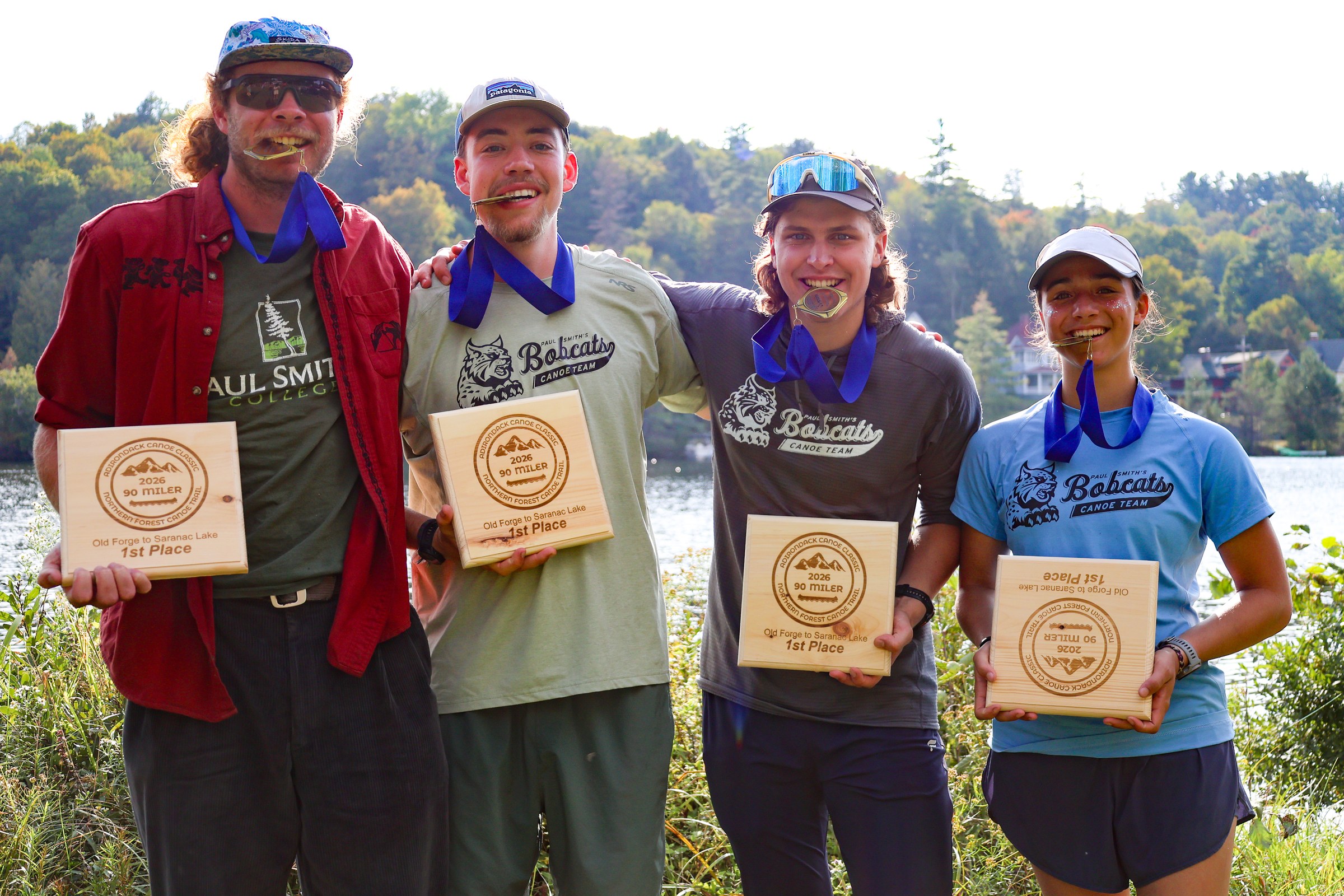
    Four Paul Smith's College athletes hold
    Paul Smith’s paddlers with their first-place plaques after the Adirondack Canoe Classic, the three-day, ninety-mile race the North Country calls the 90-Miler. Head coach Matt Dougherty runs the marathon canoe team as well as the ski team. (Courtesy photo)

    Three days in a boat

    The marathon canoe team is not a requirement for skiers at Paul Smith’s. A lot of them do it anyway.

    “It gives me the opportunity to do the important lessons,” Dougherty said. “The 90 mile canoe race is super hard, and I can go back and be like, look at what we can do when we put our mind to it.”

    The boats are the point. In the Voyageur class, where Paul Smith’s entered a seven-paddler crew in 2024 and won its division by two hours, the craft itself becomes part of the problem.

    “It’s raining and you paddled,” Dougherty said. “You had to carry a boat that’s 300 pounds if you’re in the Voyageur canoe up and over a literal side of a mountain in a race.”

    He is after two things. One is the plain demonstration that his athletes can do more than they think, a claim coaches make constantly and almost never get to prove in September.

    “A lot of times our preconceived notion of what we can do is only limited by our own mind,” he said. “If you ask them at the end of day one, they’re like, there’s no way I can do that again. Day two, and you keep doing that, and you’re like, but what can you actually do if you open up your mind and say, like, I’m just willing to see, I’m willing to test those boundaries?”

    The other is more useful to him in February.

    “To affect change, you got to have shared experiences, even with a coach involved in it,” he said. “That say, like, we shared this really hard time, and there’s this high level of trust, and we can do super hard things. From there, we can then we can get into the training, and we can say, yeah, we’re gonna do 44 weeks of training next year, and you’re gonna put on 10 pounds in the weight room, and things that they’re like, what? But now it’s like, okay, we have a place to start from.”

    There is a third thing, which he raises without being asked.

    “It’s really hard for college students to understand all the hard things you’re going to go through in life, and I want them to be tempered and ready,” he said. “This is going to be hard to experience all of the emotions, sadness, grief, pain, but also to be like I can endure this.”
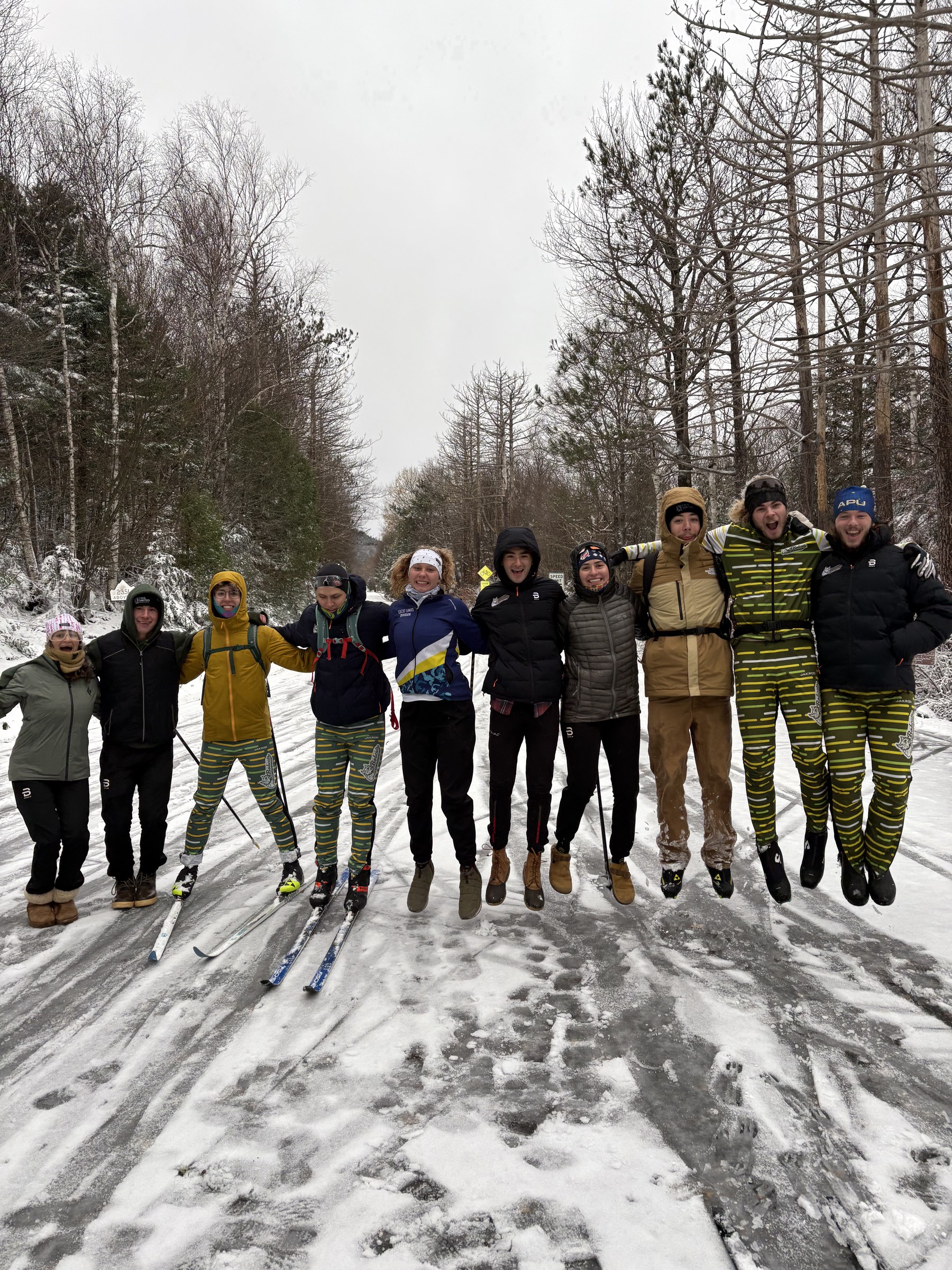
    A line of Paul Smith's College skiers in
    The roster Dougherty built. He took the program over in the fall of 2020 with one skier on it and no recruits. (Courtesy photo)

    The long way back to Saranac Lake

    Dougherty graduated from Saranac Lake High School in 1997 and got a running scholarship to Houghton University, then a small NAIA school in western New York, which is where the pattern that governs everything else started.

    “Sport was an avenue to change my circumstances in life,” he said. “It changed my life because it got me to college. I paid for college. I got a degree, and then changed my circumstances drastically.”

    He has two degrees, an undergraduate in outdoor education and ceramics, and a master’s in education from St. Lawrence in what he describes as cognitive behavior. He coached track and field for two decades before this, and he spent some of those years around people whose approach he took wholesale. One of them was Clyde Hart, the Baylor coach who put Michael Johnson, Jeremy Wariner and Sanya Richards-Ross on Olympic 400-meter podiums.

    “You’d think, man, you have like three gold medalists on your team right now,” Dougherty said. “And you’d see him interact with his athletes, and you’d be like, wow, it’s always the person first. It is what’s going on in your life today, what’s going on the person before the athletic part.”

    As a coach, he had chances to move up into Division I teams. He turned them down, and he credits his wife with the reasoning.

    “What I realized then is, it’s a numbers game and it’s not a person game,” he said. His wife, he said, put it to him as a trade: “If you do this, you lose that, and it’s going to be miserable for you.”

    He is now coaching three miles up the road from where Bill Demong grew up, at a college where Tim Burke’s father was a vice president for thirty-five years. He has a theory about what sticks from a life in that company.

    “He would probably just hide his Olympic gold and silver medal for the rest of his life,” Dougherty said of Demong, who won gold and silver in nordic combined at the 2010 Vancouver Games. “But he would happily talk about what sport did, like what those experiences were.”
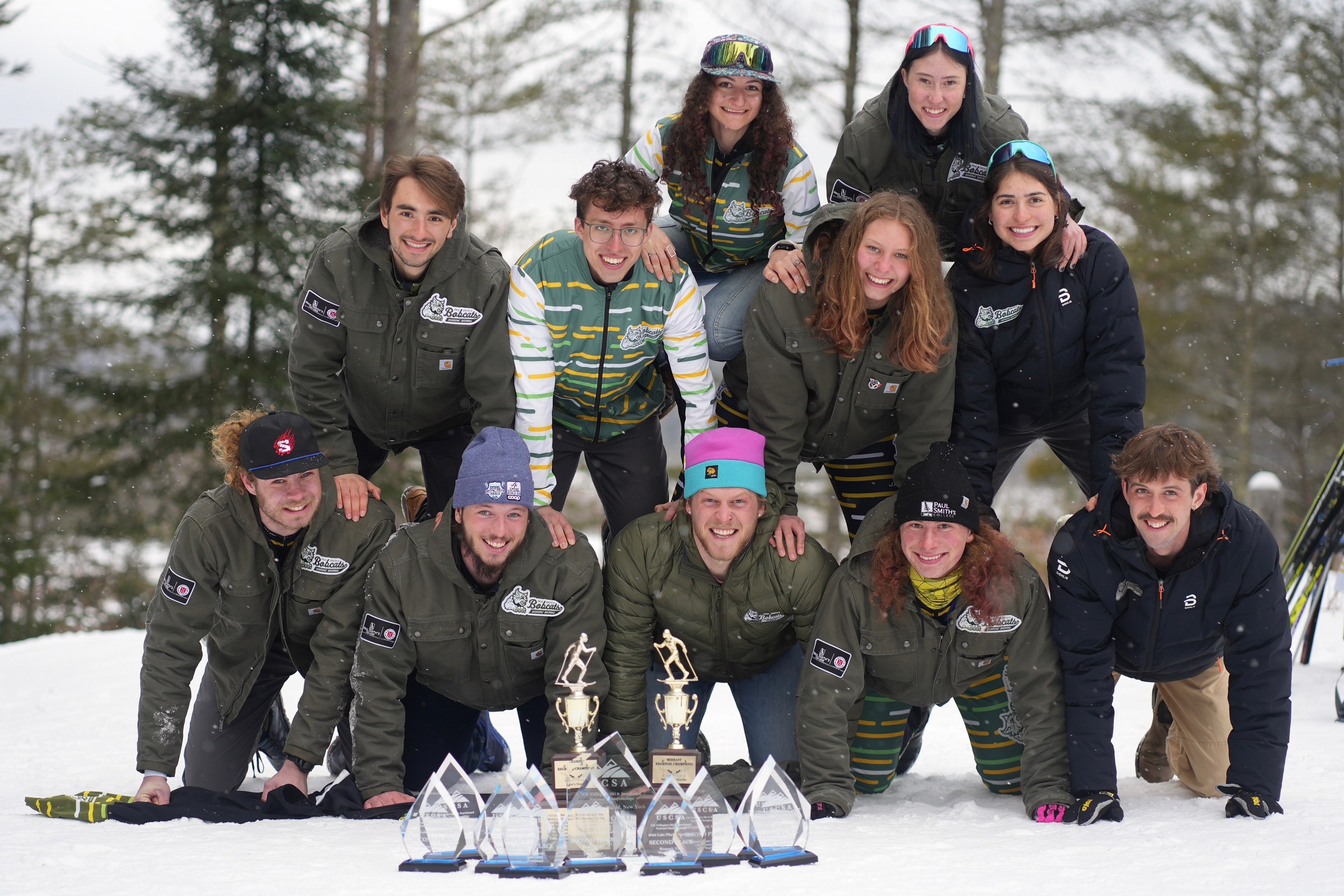
    Members of the Paul Smith's College nord
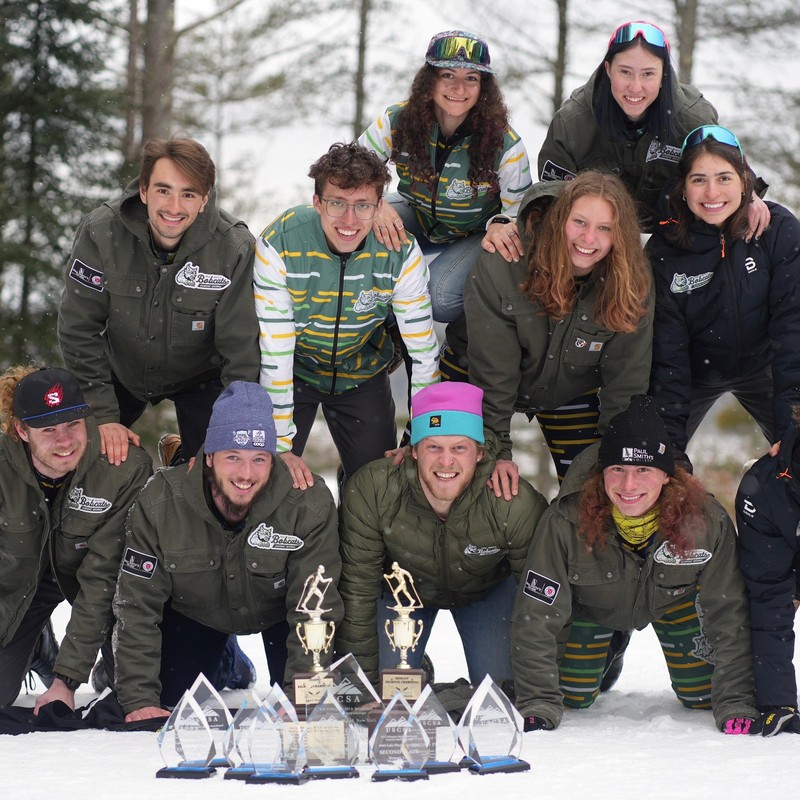
    The hardware from a season in which the Paul Smith’s men won the USCSA national title and the women finished second. The team never set winning it as a goal. (Photo: Timo Ziegler)

    Goals that do not squeeze anyone out

    Paul Smith’s does not set a team goal of winning a national championship, even in years when it wins one.

    “We just set process goals, because that’s the only thing we can control is what we do there,” Dougherty said. “And we caveat that with a little like, what do we hope that gets us. If we do all those things, we hope it can lead us to contending for a national title.”

    The reason is not modesty. It is arithmetic about who a team goal excludes.

    “I take such an individualized version of goal setting,” he said. “If we put a performance metric behind it, it often squeezes out other people in the program. It doesn’t allow their goals to exist.”

    Last season one of his athletes was named to a US biathlon team for an international championship, which meant flying back from Germany and landing roughly a day before the national championships started.

    “If the women’s team had said like our goal is to only win nationals and they were second overall, like that would have put her in a position where she’s like, well, I’m taken away from the team by going to World Juniors,” Dougherty said.

    She went. The team finished second anyway. Nobody had to choose.

    The team does have expectations, two of them, and he recites them the way people recite things they have said several hundred times.

    “To be on this team, you got to be a good teammate first, and then maximize your opportunity,” he said.

    What that produces, in his telling, is a program where the standard gets set from the back of the group.

    “When a star is like, oh, I’m tired today, or this morning it’s raining and it’s 38 degrees, no one wants to ski, but they see the slowest guy kitting up and going out, then it allows all of us to kind of gain from that,” he said.
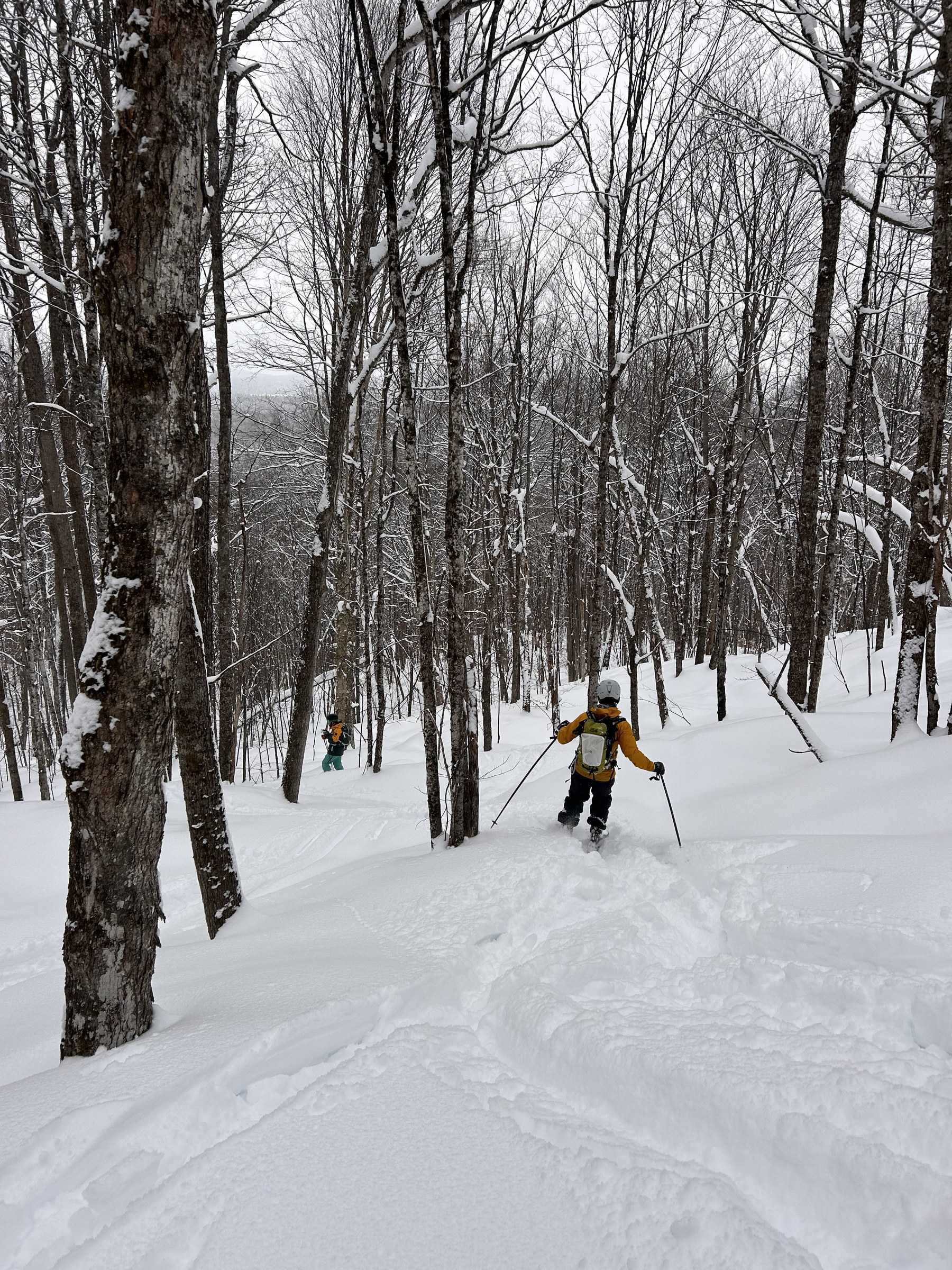
    A lone cross-country skier on a groomed
    An ordinary training day on the trails at Paul Smith’s. Dougherty says his job is to make room for whatever an athlete is carrying, without asking for it directly. (Courtesy photo)

    The person before the athlete

    The documentary spends real time on mental health, and it is the part of the conversation Dougherty warms to fastest. He starts from what he does not know.

    “I only get a piece of the story of this athlete,” he said. “We don’t know if they came from rough family life or they just feel like they don’t belong. All these things. Mental health issues are real, and I need to know about those. But I have to allow space for them to come up organically.”

    “I can’t be like, who has mental health issues?” he said. “I’ve got to create the space for that.”

    The space, in practice, is a rule about curiosity that the team applies to each other.

    “We’re constantly like, we’re not judgmental on this team. Let’s be curious,” he said. “If as we look at a teammate and we wonder what they’re going through, instead of saying like whatever, we say like, oh, what’s the source of that?”

    The same approach applies when he already knows an athlete is struggling. The problem then is how to open the door without making the asking the event.

    “The really hard thing is when you get to the point where you know stuff’s going on, finding the way to indirectly be direct,” he said. “What do you need?” is the question he finds himself asking, and it generally opens the door.

    That extends to how he thinks athletes should hold their own results. A race result, in his view, is a terrible place to store your sense of self.

    “Their performance isn’t who they are, and it’s not anything connected to their value,” he said. “Whether we win by 20 points, lose by 20 points, doesn’t change their person or their value as a person.”

    As he has gotten older he has become more concerned with sportsmanship, and he treats it as something other than a courtesy. It is how he teaches athletes to handle a disappointment and to recognize somebody else’s work.

    “When you can say like, yeah, I didn’t have a great race today, instead of being sad and dour, if you go to celebrate someone you know who’s trained hard for a year and had a great day, you can’t be sad anymore,” he said. “It just changes you.”

    He means it specifically. Clarkson won the USCSA men’s title at Mount Van Hoevenberg in 2024 and Paul Smith’s finished second, and Dougherty’s response was to have his team look closely at what the Clarkson skiers had done to get there.

    “Even though we’d love to win, when you see someone perform like that, it’s actually inspiring,” he said. “The more we can be open to looking at performance and saying like other teams did great, but there’s value in me not just celebrating them, but seeing what they did and honoring it. I think it makes us better athletes in the end.”
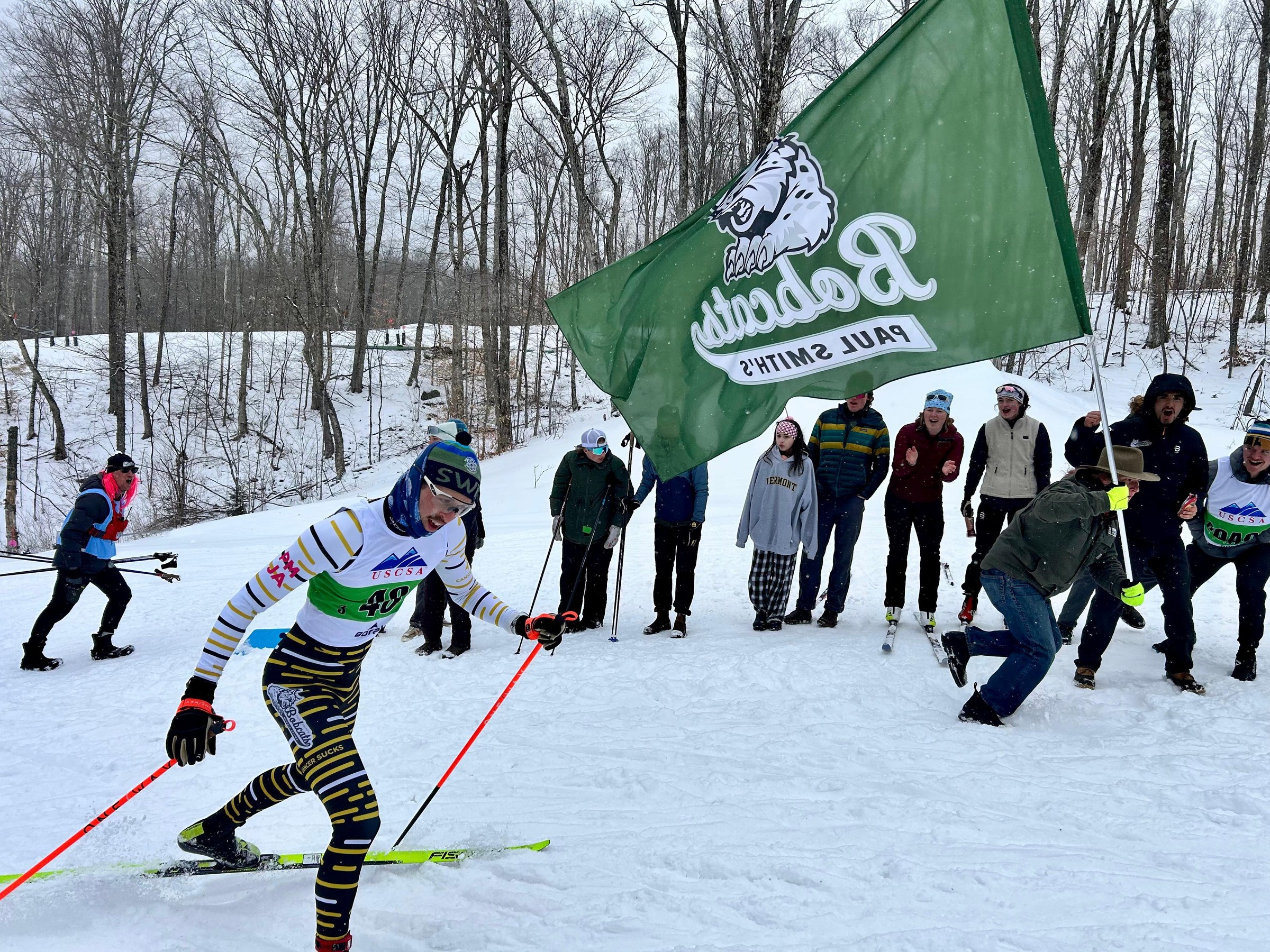
    A cross-country skier races past a group
    Teammates and the Bobcats flag trailside. At a college of roughly 750 students, Dougherty says, everyone on campus knows the ski program. (Courtesy photo)

    A small college and a film crew

    Paul Smith’s enrolls roughly 750 students by the college’s own count, on 14,000 acres at the northern edge of the Adirondack Park. Nearly half the bachelor’s degrees it awarded last year were in natural resources and conservation. It is the kind of place where a skier’s Saturday gets rearranged by a professor.

    “When you come here, it’s individualized; it is a personal relationship school,” Dougherty said. “My students are working with a professor; he takes an interest, he gets to know them, and then I find out, well, Saturday we’re actually going out with this professor. He’s taking us into the mountains to show us this specific part of our research.”

    “It is harder when you have 700 students. Everything about that is harder: recruiting, getting people here,” he said. “But because of that, we live in a culture where everyone on campus knows the ski program.”

    That extends past the campus. Dougherty calls the Saranac Lake and Lake Placid community around the program super fans, and he puts the college president, Dan Kelting, in that category.

    “He shows up at ski races and he’s not just there to like cheer,” Dougherty said. “He’s also there like, what do you guys need? What does the program need? What do we need to keep bringing in great students as a ski program?”

    His summary of the whole arrangement is that it could not exist anywhere else.

    “It’s this weird subculture that probably could only exist in the Adirondacks,” he said.

    Which brings up the film. A donor with a seasonal home on one of the lakes near the college met the team at an event, decided there was a story, and asked whether Dougherty would sit down with a documentary crew. Dougherty said yes without any clear idea what he was agreeing to.

    “I expected a three to five minute kind of like infomercial type thing for YouTube,” he said.

    What arrived was Adrenaline Films, an Orlando company that Dougherty said had got its start on the early seasons of Survivor and had lately been following a ballet company through the war in Ukraine. The crew embedded with the ski team for close to two years.

    “This was like pretty legit documentary crew following us for a long time,” Dougherty said.

    The result is Coach Matt and the Outdoor ‘Cats, directed by Robert Jury and produced by Michael Murray and Tim Ranzetta. It runs about 95 minutes, and it is free to watch, with ads, on Amazon Prime Video and on Tubi. Its spine is the 2024 season, in which the Paul Smith’s men lost the national title by two points.

    “They’re really just telling the story of a team,” Dougherty said. “Small, tiny school in the woods is really another theme there. You can do anything, anywhere, kind of an idea.”

    Any money the film makes goes back to the program, and he doubts there will be any.

    “My guess, without knowing all the specifics of cost, is that this is a net loss,” he said.

    The team that lost by two points in that film won by 40 in March. Nobody set that as a goal.

    Help Support Our Coverage!

    If you value the thoughtful work and access FasterSkier provides, please consider becoming a Voluntary Subscriber. Your support directly fuels our work to cover the people, places, and moments that make our sport special.

    Join the FasterSkier community!
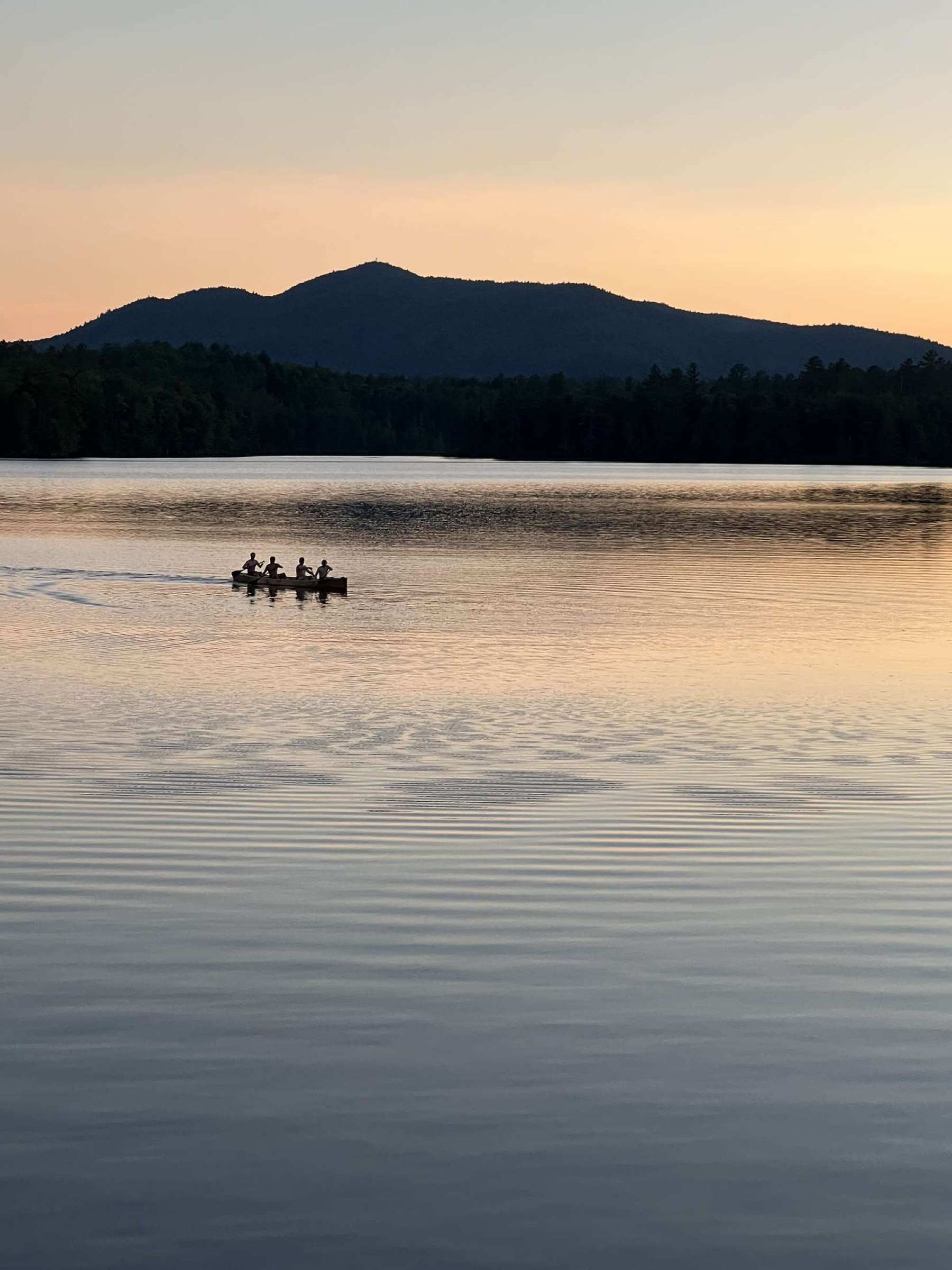
     

    A canoe with several paddlers silhouette
    First light on an Adirondack lake. The canoe season comes first, and it is where Dougherty does his most important coaching. (Courtesy photo)
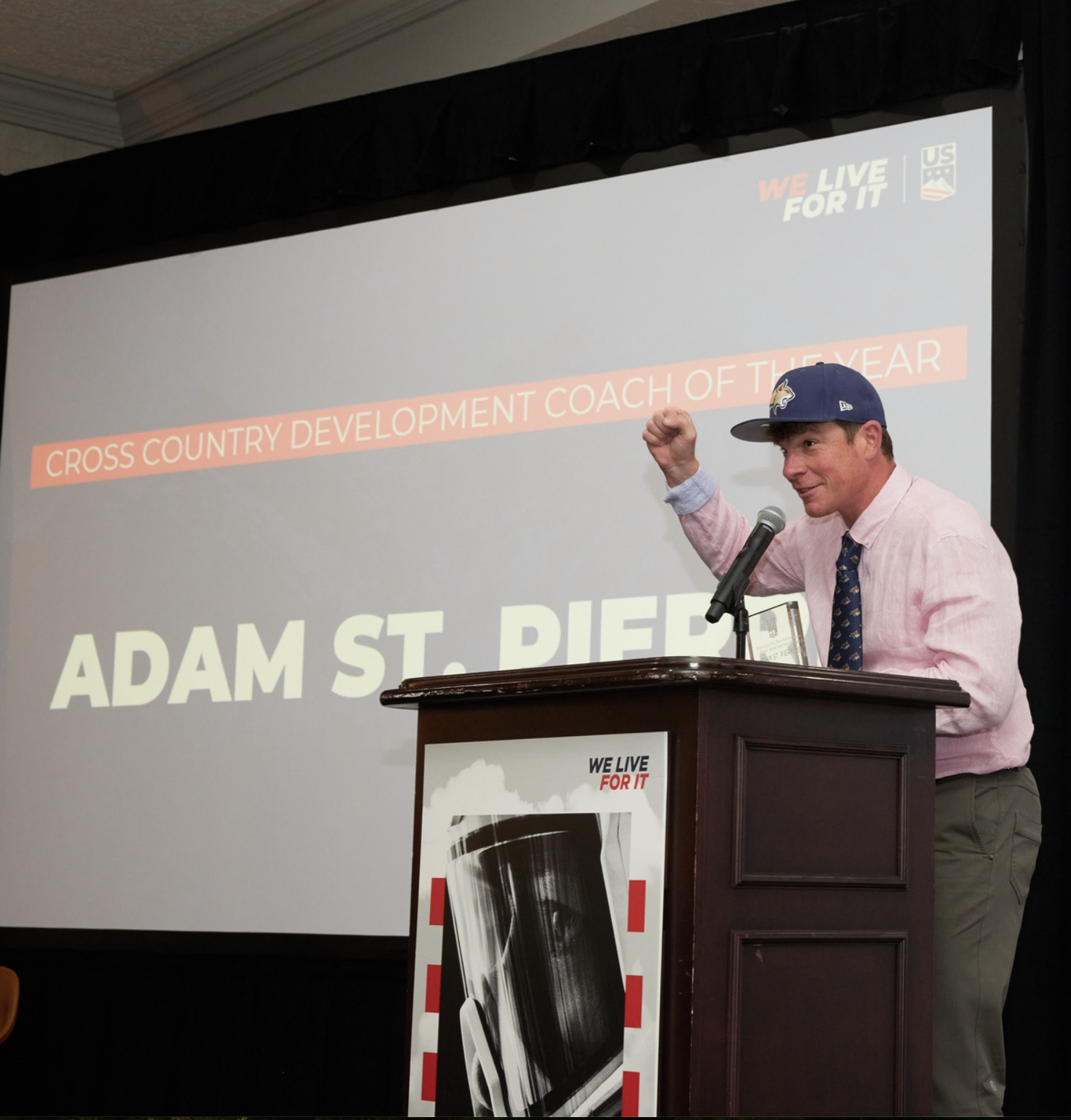
  • The Spice in the Soup: How Adam St. Pierre Thinks You Should Train

    The Spice in the Soup: How Adam St. Pierre Thinks You Should Train

    This article was made possible through the generous support of our voluntary subscribers. If you value coverage like this, please support FasterSkier with a voluntary subscription.

    Part two of a two-part series. Read part one here.

    A parent once cornered Adam St. Pierre to complain that he was letting the kids play games. St. Pierre had ten-year-olds on skis running sharks and minnows, shrieking and chasing each other across the snow, and the parent was not paying club dues for that. “I want coaching and training,” the parent told him. “This is…” and you can fill in the disappointment.

    St. Pierre thinks sharks and minnows on skis is one of the most effective training tools there is. He was lucky, he says, to have a parent board that backed him up in those rare confrontations, because he had no intention of stopping. Kids who are laughing are kids who come back, and kids who come back are the only kids who ever get good.

    That belief sits at the center of a coach who, on paper, should be the last person preaching simplicity. St. Pierre has a master’s in exercise science, a background running lactate and VO2 tests on athletes, and a relationship with a Montana State physiology lab that has done extensive work with U.S. Biathlon on both the metabolic and biomechanical sides. He reads the research. He can talk ratios and thresholds for as long as you’ll let him. And his most strongly held convictions keep coming out disarmingly plain. Go easy most of the time. Be consistent. Make it fun enough that people stick around. The science, in his hands, mostly ends up confirming things your grandmother could have told you.

    Consistency over the big block

    Start with periodization, the idea that a training year should be built in escalating blocks toward a peak. St. Pierre is skeptical of the old-school version of it, and his reasons are specific. A lot of that model, he points out, traces back to weightlifting research, some of it from an era when the subjects were quietly using anabolic steroids, which is not a foundation you want under your training plan. The rest tends to come from single-event sports. “In the marathon world or the Ironman world, you’ve got one event,” he said. “You just need to be good for that one event, like on August 2nd or whatever.” Skiing is not that. A ski racer has to be good across a whole season, weekend after weekend, from November into March.

    He points to a meta-analysis, published fairly recently, that looked at the day-to-day training of today’s top Norwegians. The finding was not a secret block of magic. “It really is consistency,” he said. “They’re not doing a big August and a big October. They do big weeks and recovery, and it’s just a very consistent progression.”

    The metaphor he keeps coming back to is one he borrows from Marius Bakken, the former Norwegian runner he half-jokingly calls a father of the Norwegian method. Intensity, in this telling, is not the meal. It is the seasoning. “The base of the soup is your endurance training,” St. Pierre said, “and then you add in a little bit of zip here and there. But if you put in too much zip, the soup is not going to be very good.” Roughly 90 percent of the work, whether on foot, on roller skis, on snow, or on a bike, is easy volume. The intensity is the spice, and Americans, he thinks, are forever dumping in too much.

    Only what’s livable

    There is also a question underneath all of this that the textbooks tend to skip, which is whether any of it is actually livable. St. Pierre still remembers sitting in a USA Triathlon coaching course, listening to a periodization lecture, and asking what he thought was the obvious question. What about a working person who cannot train 24 hours a week but could manage 16? What do you do with them? The answer from the front of the room was that they should take a vacation day and get the training in. “That’s not it,” he said. “That doesn’t work.” His approach is the reverse. Figure out what someone can actually do, how many hours are genuinely available, and then fill those hours with the best workouts possible.

    At MSU that math is dictated by a school calendar, and he has stopped fighting it. His athletes train before 10 a.m. so they can make a 10 o’clock class, and again in the afternoon, with nothing scheduled after 4 or 4:30. That produces a seven-day rhythm rather than the ten-day cycles some coaches prefer. Tuesday is intensity, usually threshold or VO2 work. Wednesday is a double of easy distance, with a few technique drills thrown in at the start to get the neurons firing before the athletes head out. Thursday morning is pure speed. Saturday brings intensity again, often paired with the long distance day. You cannot send skiers out for a two-hour roller ski on a Wednesday morning if they have class at ten, so you don’t. “There’s lots of ways to make a great soup,” he said, and it is not worth inducing a pile of needless stress to chase a perfect one.

    Two tests without a lab

    For readers without a lab down the hall, two of St. Pierre’s tools travel well. The first he calls a VT1 run, VT1 being the top of the easy zone, the hardest you can go while staying genuinely aerobic. Once a week, on flat ground, his athletes run 20 to 30 minutes at that effort and note the relationship between pace and heart rate. Flat terrain because it is the most reproducible. The point is twofold. It tracks fitness: if you run nine-minute miles at 150 beats in early summer and eight-minute miles at 150 by August, you have improved. And it works as an early-warning system. “One of the first signs of overreaching is a change in that heart rate to workload ratio,” he said. If the pace slows at the same heart rate, and it is not 105 degrees out and you are not dehydrated, it is probably time to rest. The signal can run the other way too. An athlete who normally sees 180 during intervals but suddenly cannot push the heart rate above 160 is, in his words, showing a pretty golden sign. Take some rest.

    The second tool he lifted from cycling: a five-minute maximal effort, a long recovery of maybe half an hour with some refueling, then a 20-minute maximal effort. The ratio between the two tells you whether an athlete leans anaerobic and sprint-oriented or aerobic and distance-oriented, no lab required. He built a version of it into his athletes’ training plans. He is quick to add the caveat that governs all of this, in the field or in the lab. Heat, dehydration, and altitude bend every number, and even a lab lactate value shifts with hydration. “No one metric is the god metric,” he said. “You’ve always got to have that context.”

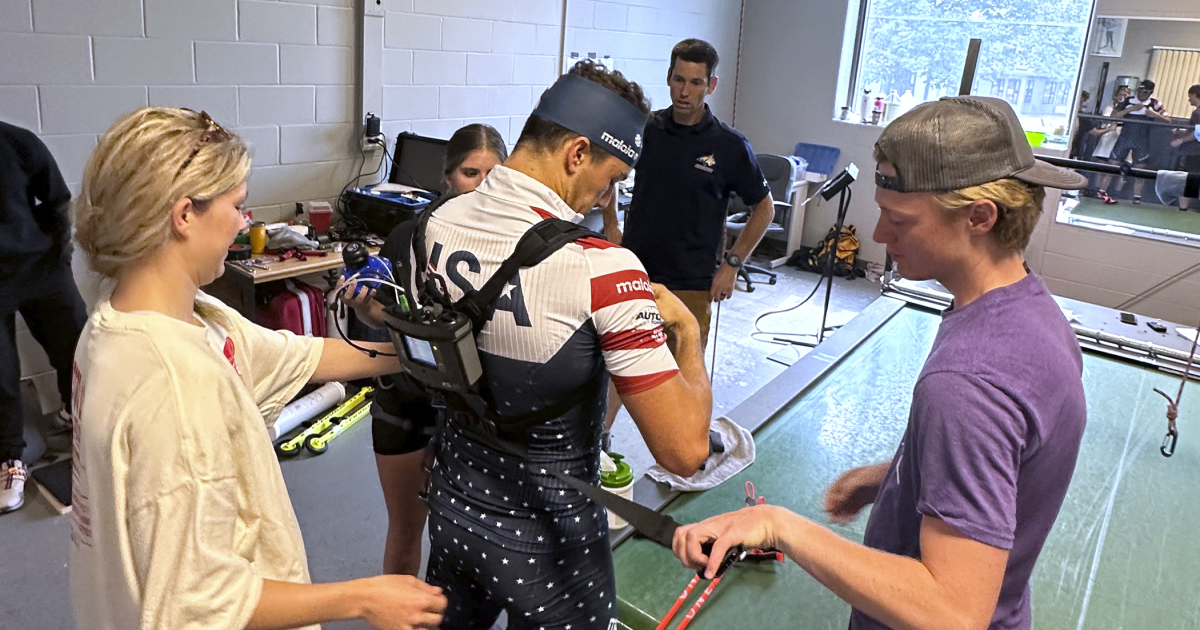
    Montana State students conduct physiologic and biomechanical assessments for U.S. Biathlon. (Photo: Montana State University)

    Building complete skiers

    The individualization matters more now because the college game is about to change. Sprinting is coming to the NCAA Championships, a change St. Pierre cares about personally, because he wrote the proposal years ago and watched it slowly work its way toward reality. In anticipation, he is nudging the team’s intensity mix, keeping most of the hard work at threshold but adding more VO2 and anaerobic speed than a pure distance program would. One test the MSU lab ran compares an athlete’s VO2 at threshold to their VO2 max. A skier sitting well above the roughly 90 percent that is typical probably skews distance and might gain from more VO2 work to lift the ceiling. A skier down in the low numbers might benefit from more threshold. Even so, his priority is all-around development. The sprinters still do threshold. The distance skiers still do speed. He wants complete skiers, partly because a race does not always let an athlete choose its terms. If a distance race comes down to a mass sprint, a distance skier who cannot find another gear finishes 20th.

    The place where St. Pierre thinks American skiing has a real and underrated advantage is strength. He knows the reputation, that Norwegians do not lift, and allows it may be true of many of them. He also knows that the Norwegians who have come through his own program found the strength work novel. As part of a university, MSU has a strength coach, Benito, a former mountain bike racer at UVM and one of the rare ones who understands endurance sport, and the two of them build a program meant to complement the skiing rather than pull against it. St. Pierre credits it for keeping his team generally healthy, and he pushes back on the notion that skiers only need core and pull-ups. “If you can produce power with your legs,” he said, “that’s necessary.”

    He connects strength to a broader idea about movement economy, and here he reaches, carefully, for the Nike Oregon Project. Setting aside the doping and the scandal that eventually swallowed that program, he finds one lesson from it genuinely useful. Its coach had noticed American distance runners getting outkicked, so the group attacked the last 400 meters with sprint work, max strength, and plyometrics. The athletes did improve their finishing kick. They also got faster over the first 9,600 meters of a 10k. Better economy, it turned out, does not just help you sprint. It lets you hold a faster pace all day.

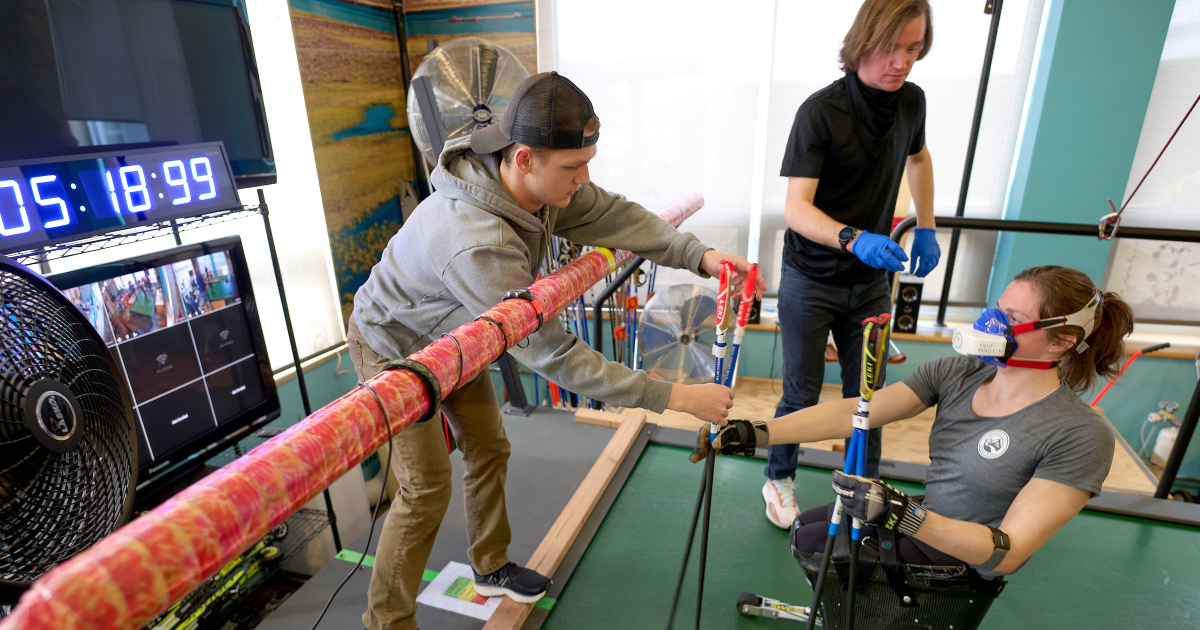
    Montana State biomechanics students provide testing for para Nordic athletes. (Photo: Montana State University)

    The long game

    If that all sounds relentlessly optimized, it is worth returning to the sharks and minnows, because the fun is not a break from the method. It is the method. His college team plays ultimate on skis, using a ball instead of a frisbee to remove the throwing barrier, usually after a track workout, and they lobby to play more. For the youngest kids, he has long argued that the travel race is not really about the race. A ten-year-old drives across the state to ski a 1k, and the actual point is the hotel pool, the snowbanks, the hide-and-seek, the exhaustion on day two that horrifies the parents. “This is why kids get into ski racing,” he said. “It’s not the ski race. It’s hanging out with your friends in the hotel room.” Those bonds are what turn a ten-year-old into a fifteen-year-old who wants to go do a long mountain run with the same crew, and a fifteen-year-old who stays in the sport into an adult who never leaves it.

    Which is finally how St. Pierre defines success, and it is not a medal count. He worries a little about the sport’s fixation on the Nations Cup, because doing well in it requires a lot of athletes racing a full season well, and he is not sure the American pipeline has that base yet. He points to Jessie Diggins as the rare skier who reached the level where she could show up week in and week out and land in the top five every time. Whether that season-long consistency cost her an Olympic medal or two is, he admits, a whole separate and unanswerable question. Finding metrics for development beyond international results is genuinely hard, which is part of why he has soft-started a PhD. The idea is to pull two decades of national points lists and track individual athletes year over year. Are American skiers actually getting better as they age, or do they wash out? The kid who was brilliant at 18 and gone by 22 is memorable, he notes, but memorable is not the same as typical. “Is that the rule or the exception? I think that’s the exception,” he said. “I’d like to have some data to back up my opinion.” The numbers are public. He just needs the time.

    His personal definition is quieter. He wants his athletes to develop far enough that the door to international racing is open if they want to walk through it, and he wants the ones who don’t to keep loving skiing anyway, as coaches, as parents raising their own little skiers, or simply as people who stay active and outdoors for the rest of their lives. He tries to live it as a father, chasing his own two kids up mountains in the summer and out onto snow in the winter. “There’s so much outside of skiing,” he said, “that makes skiing great.”


    Help Support Our Coverage!

    If you value the thoughtful work and access FasterSkier provides, please consider becoming a Voluntary Subscriber. Your support directly fuels our work to cover the people, places, and moments that make our sport special.

    Join the FasterSkier community!


  • The Only Kid He Beat Hit a Tree: How Adam St. Pierre Backed Into a Life in Skiing

    The Only Kid He Beat Hit a Tree: How Adam St. Pierre Backed Into a Life in Skiing

    This article was made possible through the generous support of our voluntary subscribers. If you value coverage like this, please support FasterSkier with a voluntary subscription.

    Part one of a two-part series.

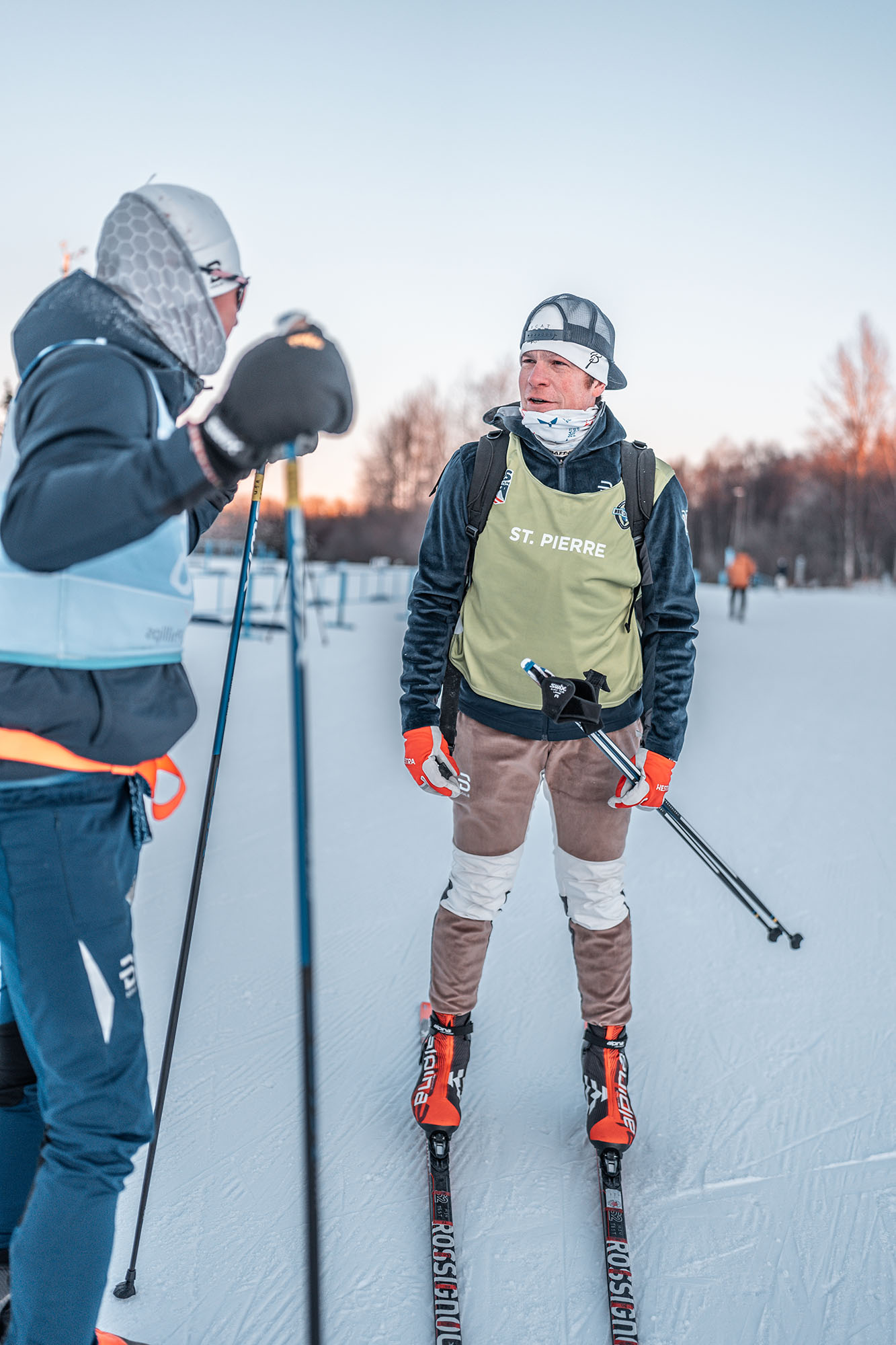
    Adam Coaching at US Nationals in Alaska. (Photo: Tobias Albrigtsen)

    Adam St. Pierre finished second to last in the first cross-country ski race of his life. The one skier he beat had crashed into a tree.

    He was a sophomore at Fall Mountain Regional High School, a rural school in Charlestown, New Hampshire, and he tells the story with the flat delivery of a man who has told it before and enjoys it every time. “Charlestown doesn’t really have a claim to fame,” he said. Forty-five minutes due south of Hanover, close enough to know Dartmouth was up the road, far enough that the world of club skiing might as well have been on another continent. He had never heard of it. What he knew was soccer, basketball, and track, in roughly that order, and he had no intention of adding a fourth sport that involved falling down in the cold.

    Then his freshman year fell apart. He hurt his knee playing soccer. He slogged through a basketball season he had come to hate. And in the spring, his track coach, who happened to also coach the ski team, made him an offer that sounded reasonable at the time. Come out for skiing next winter, the coach said. It will get you in better shape for soccer and track.

    So he showed up. That first race was a classic race, and he had only ever skated. He survived it, barely, ahead of the kid who met the tree, and somewhere in the weeks after, the thing that has kept a lot of people in this sport quietly got its hooks into him.

    Fall Mountain was not a fancy place, and that turns out to be central to the story. It was a working rural school with a barn, animal husbandry classes, agricultural mechanics, a metal shop, and forestry classes that maintained the trails and tapped the maple trees where the team ran and skied. The ski coach was the metal shop teacher. When the program needed grooming, the metal shop and ag-mechanics kids bought an old PistonBully and kept it running themselves. St. Pierre came up through a program held together by shop-class ingenuity and a snowbank at the edge of the football field, and he has never once been snobbish about it.

    “I have a high respect for high school skiing, because it is an entry point,” he said. “Otherwise I wouldn’t have found the sport.”


    A team that needed a fifth man

    He nearly didn’t find the next part either. Right before he graduated, his coach, Larry Sayers, told him that Colby College’s ski team wasn’t very good and that St. Pierre could probably walk on. He filed it away and didn’t think much of it. He had his sights on soccer and track. But once he got to Colby and started running into the skiers at various events around campus, something clicked, and it had nothing to do with the skiing.

    “These are the kind of people I like,” he remembered thinking.

    The timing was almost comically good. The coach, then Tracey Theyerl, now Tracey Cote, was 29 and in her second year running the team. She had just cut most of the upperclassmen, which left her with four men and an opening. St. Pierre walked on as the fifth. His introduction to roller skiing came shortly after, when Cote put him on a pair of classic roller skis and sent him out for a time trial. “I survived,” he said. From that point on, he was in, and again, the pull was the people as much as the training.

    Adam St. Pierre (left) and former Bowdoin skier and BNJRT coach Sam Shaheen at the start of the 2019 American Birke. (Photo: courtesy Adam St. Pierre)

    From the lab to the wax room

    He majored in physics at Colby and minored in biochemistry, and when he graduated, he had no clear idea what came next. He looked at teaching jobs. Nothing landed. Then a skier friend from high school told him about a graduate program at the University of New Hampshire where, as St. Pierre understood it, they paid you to study exercise. That sounded like a good deal. He enrolled in a master’s program in kinesiology and exercise science, working under a UNH physiologist whose research centered on hydration and thirst. His thesis was, in his words, pretty brutal to run: sensations of thirst in dehydrated subjects in cold versus ambient environments. “A little bit of everything when it comes to making people uncomfortable,” he said.

    It was during those UNH years that the sport handed him his first coaching job, and it did so in the roundabout, relational way that his whole career seems to follow. He had started dating a Bowdoin College skier while he was at Colby. She was a year behind him, still racing, and he was driving up to Brunswick most weekends to see her. Her coach was Marty Hall.

    Anyone who knows North American skiing knows the name, yet St. Pierre’s version of a Marty Hall story is smaller and more human, and it starts with the legend sizing up the kid who kept turning up in his wax room.

    “I need an assistant coach,” St. Pierre remembers Hall telling him, and he does a passable Marty voice when he gets there. “And you’re up here every weekend anyway. You want the job?”

    He took it. He thinks he was paid around 1,500 dollars total, which covered the gas. He coached under Hall for two years, and it confirmed something he had already begun to suspect: he wanted to spend his life doing this.

    Adam and his family out for a ski.

    Building from the bottom in Boulder

    When his wife got into law school at the University of Colorado, the two of them moved to Boulder, and St. Pierre walked into the next accident of his career. He had been hired to be the head coach of the Boulder Nordic Junior Racing Team, replacing Eric Pepper. Then Pepper decided to stay. Rather than lose St. Pierre, the club invented a role for him and made him its first development coach, responsible for the youngest kids, the u14s and u12s, or as they were then called, the j3s and j4s. Many of them were the little siblings of the older racers. His whole job was to grow the program from the bottom.

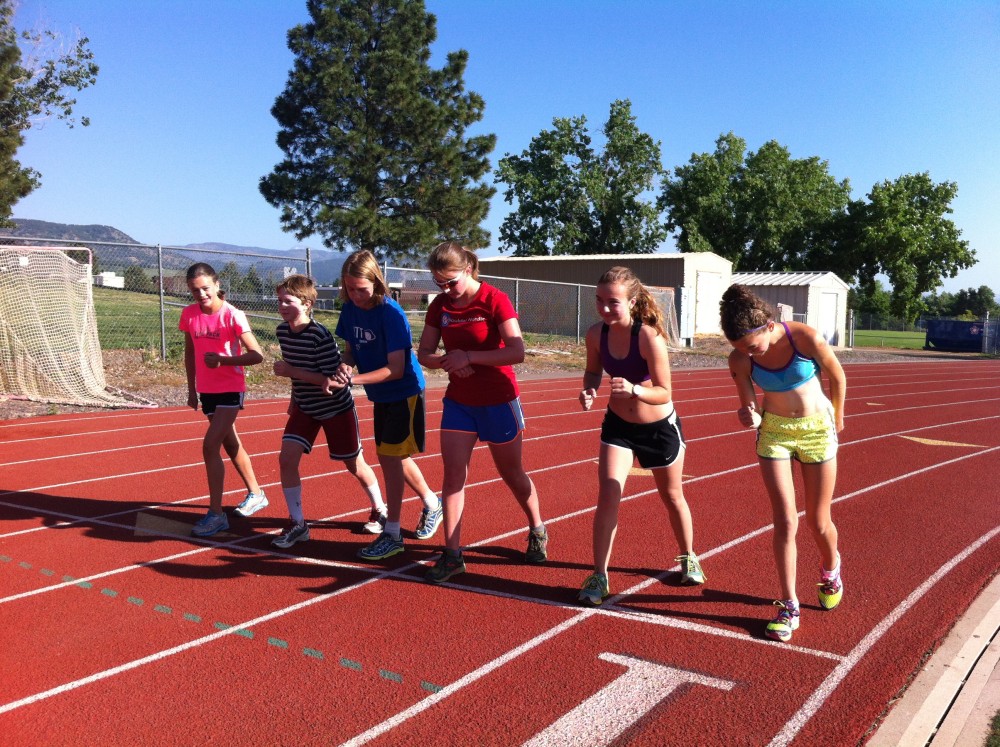
    Boulder Nordic Junior Racing Team athletes prepare for the start of a 3,000 kilometer running time trial on the track in 2013. (Photo: Adam St. Pierre)

    He did. When Pepper eventually moved on and St. Pierre took over as head coach and program director, he watched the club climb from 15 or 20 kids to nearly 70 at its peak, in a place he is quick to say is a genuinely hard town to be a skier. There is no snow in Boulder itself. You drive for it, and it is expensive, and the parents who commit anyway earn their real respect.

    One of those little kids was Lauren Jortberg. St. Pierre started working with her when she was six or seven, and he coached her through high school. She was, by his telling, agonizingly consistent at exactly the wrong number: four straight Junior National Championships and 11th place in what felt like every race. “All she wanted was that top 10,” he said. She had setbacks. She stuck it out.

    Years earlier, in his first season of coaching in Boulder, St. Pierre had said out loud that one of his goals was to someday coach a kid who would reach the Olympics. This past February, Jortberg made the U.S. team for the Milano-Cortina Games and qualified for the quarterfinals of the Olympic sprint, the culmination of a long and interrupted road that ran through back surgery, ankle surgery, and a lost senior season at Dartmouth. St. Pierre is careful not to claim more than his share.

    “I can’t take responsibility for much,” he said, and then, a beat later, “Goosebumps. Proud of her.”

    Boulder was where the rest of his professional life took shape, too. He worked at the Boulder Center for Sports Medicine as a clinical physiologist, running lactate thresholds and VO2 max tests and metabolic evaluations, and working alongside physical therapists on running biomechanics, teaching and reteaching people how to run without breaking. He got into ultrarunning and knocked off a number of 100-mile races, mostly for the pleasure of being out in the mountains all day. Around 2016 or 2017, he left the Boulder Nordic team and hung out his own shingle as an online coach. The flexibility made sense with two young kids and a wife commuting to Denver. But he missed the in-person part, the standing-in-the-snow part, more than he expected to.

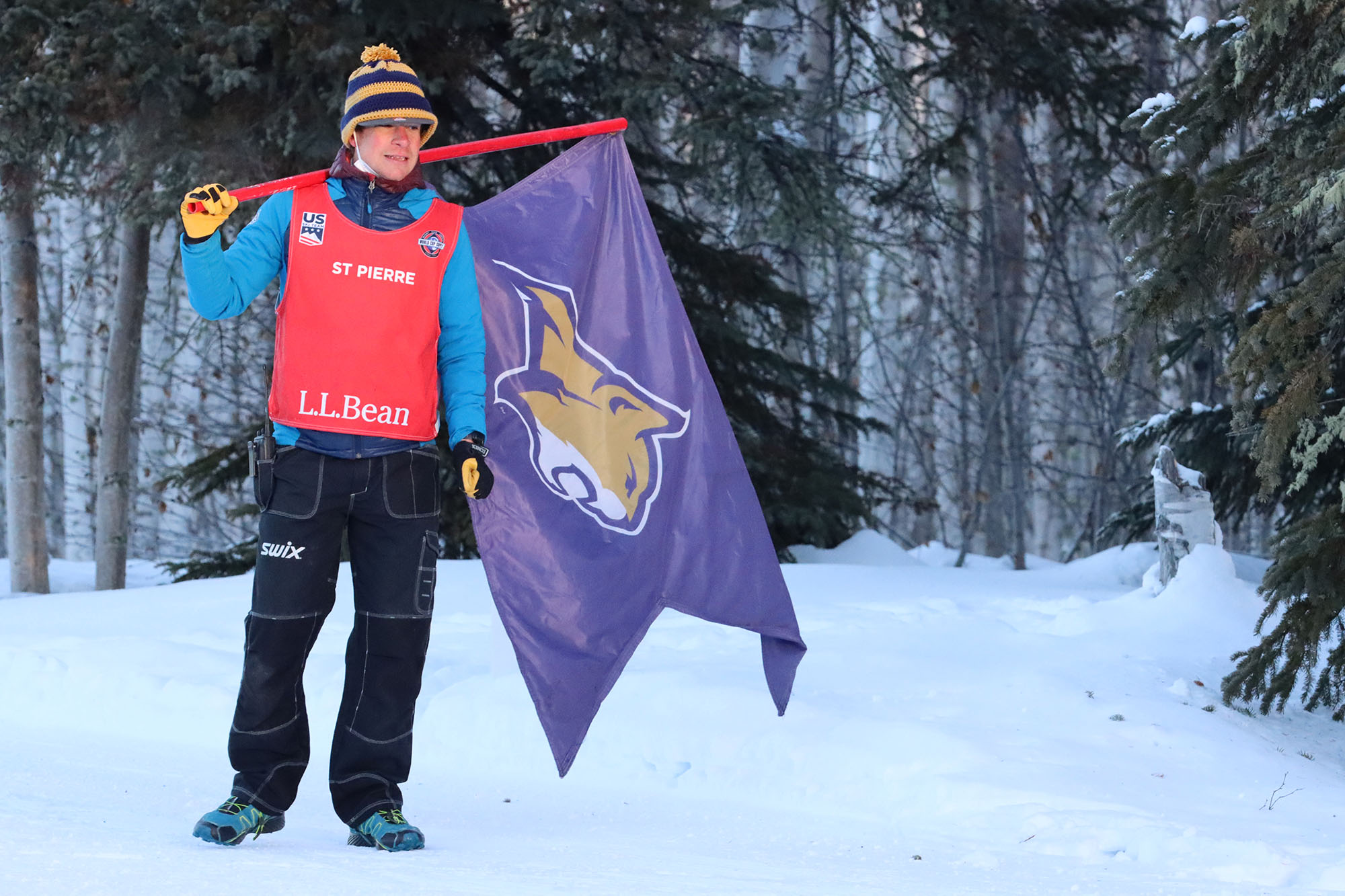
    Adam repping the MSU team flag in Houghton, Michigan. (Photo: Tobias Albrigtsen)

    The job he had been aiming at

    He had known for a long time where he wanted to end up. College coaching had been the goal since around 2009. The appeal was simple: at the junior level, a coach spends a lot of energy convincing kids they might want to be ski racers, keeping every other door open in case they choose running or mountain biking instead. At the college level, the athletes have already decided. “They’ve decided they are cross-country ski racers,” he said. “I wanted to coach ski racers.”

    The Montana State job had come open once before, in 2015, and he had applied and been the runner-up. When it opened again during the strange fall of 2020, he jumped. He was hired that November and moved to Bozeman alone that winter while his wife and kids finished out the year in Boulder, riding out the online-school chaos he credits her with surviving. The family joined him the following June. Bozeman had been near the top of the short list of places they wanted to live anyway, a real ski town with snow in town, Crosscut 20 minutes up the road, and Bridger Bowl close enough to grab powder runs before cross-country skiing in the afternoon.

    Which is to say, the kid who finished second to last, who backed into the sport to get in shape for soccer, who took a coaching job largely because he was already driving to Brunswick every weekend, ended up exactly where he had been quietly aiming for a decade. The path was accidental in its particulars and not accidental at all in its direction. He kept following the people, and the people kept turning out to be skiers.

    What he does with those skiers once he has them, and why he thinks so much of American training gets the easy days wrong, is its own story. That is part two.


    Help Support Our Coverage!

    If you value the thoughtful work and access FasterSkier provides, please consider becoming a Voluntary Subscriber. Your support directly fuels our work to cover the people, places, and moments that make our sport special.

    Join the FasterSkier community!
     

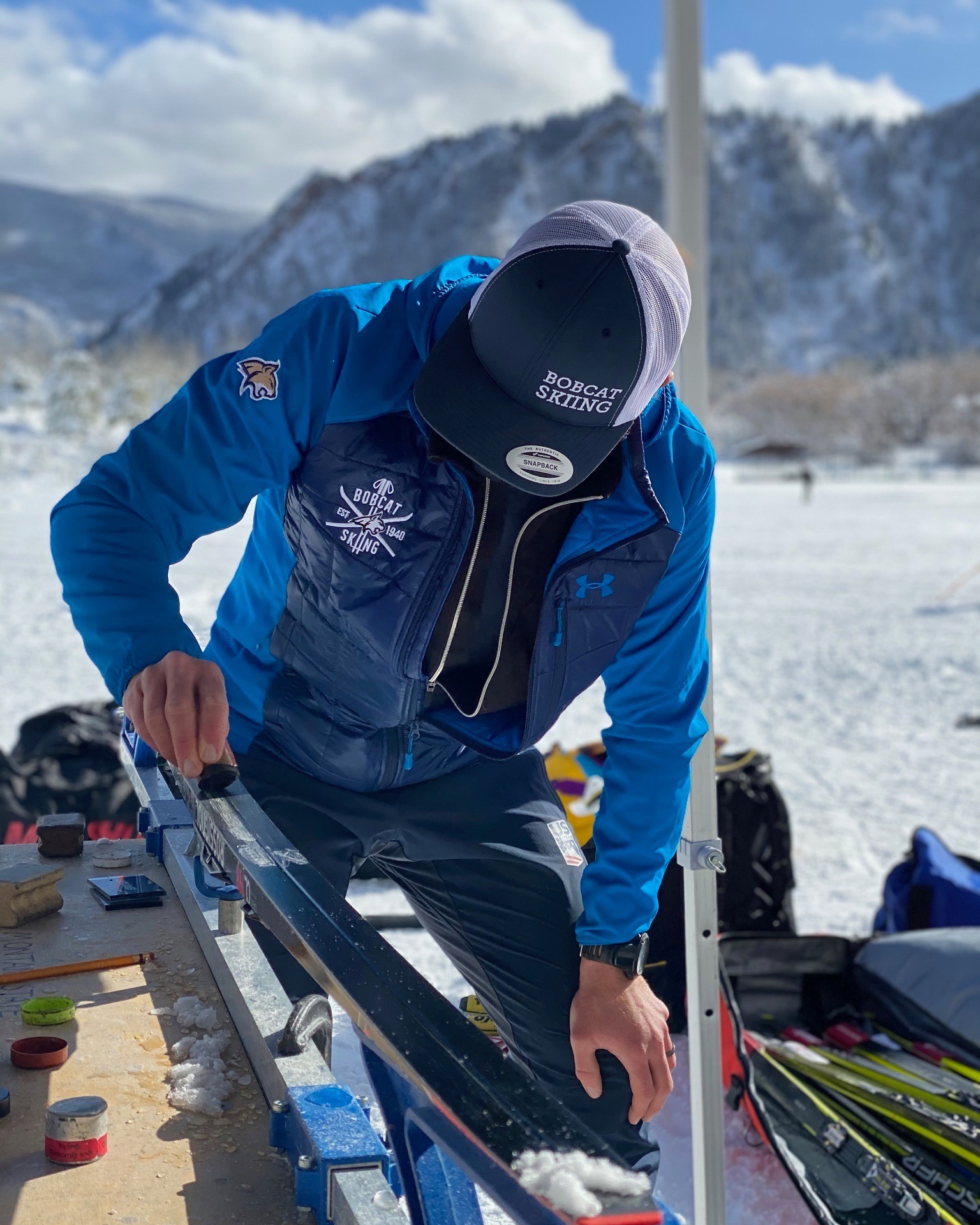
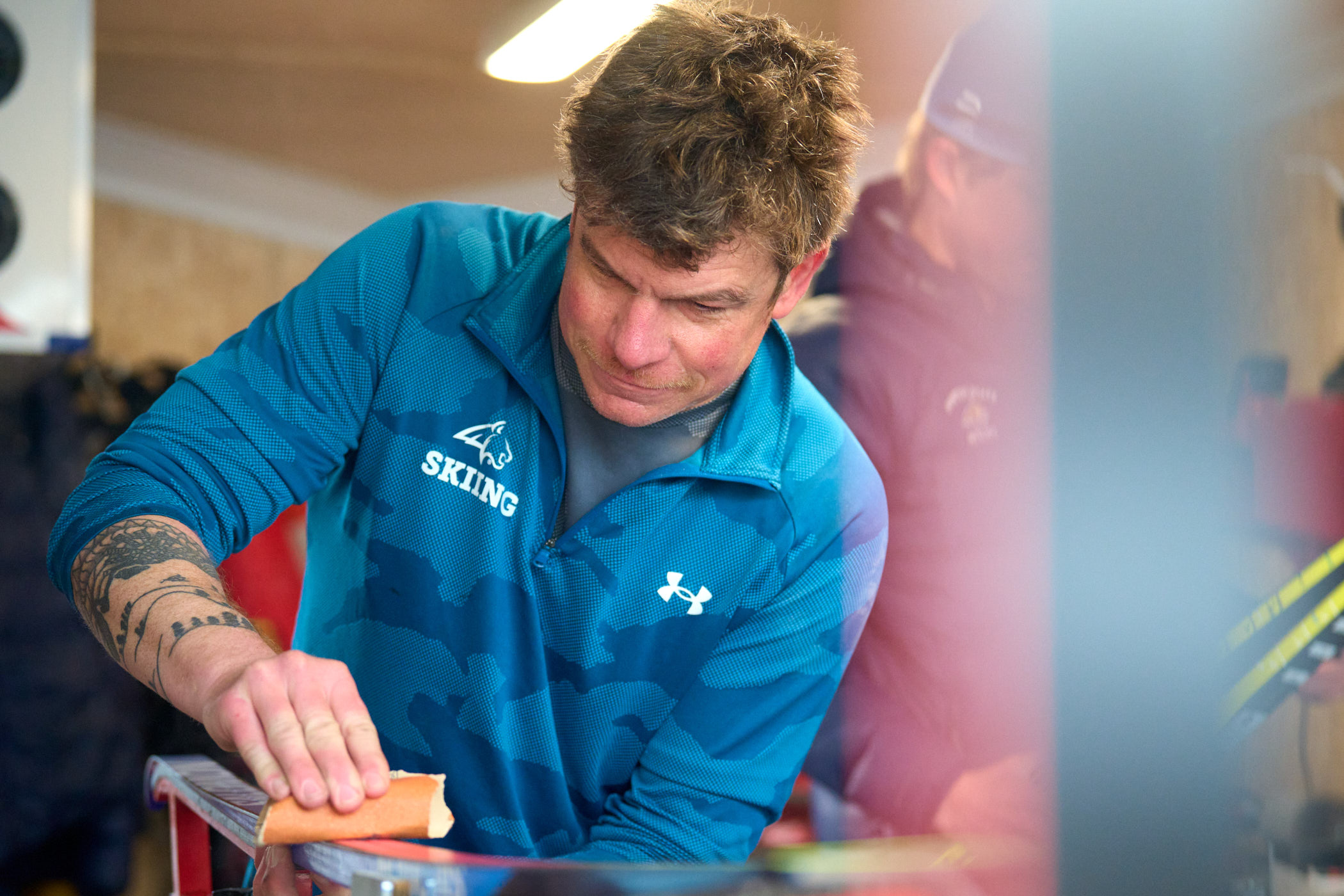
    Adam preparing skis for the Montana State University Nordic ski team at the RMISA Championships in 2026 in Heber City, Utah. (Photo: Colter Peterson)
  • “You Can’t Live Nervous”

    “You Can’t Live Nervous”

    Finals week has a way of compressing time. Days shrink into problem sets and exams; nights stretch just long enough to make sleep negotiable. When Jack Lange logged onto Zoom from Hanover in late November, he was finishing his senior fall at Dartmouth, a mechanical engineering major balancing equations while packing for a training block at Silver Star. The snow out west wasn’t cooperating. Races were being reformatted. Nothing felt settled.

    That uncertainty didn’t seem to bother him much.

    “We’re wrapping up school right now and then heading to Silver Star next Tuesday,” Lange said. “Hopefully, the snow conditions there improve a little bit.”

    It was a measured answer—calm, almost deliberately so. Over the next hour, that calm would reveal itself not as indifference, but as something learned the hard way.

    Young Jack Lange skiing in a New England BKL race. (Photo: Heidi Lange)

    A kid who wasn’t supposed to be good at this

    Lange grew up in Vermont’s Upper Valley, skiing out of Green Woodlands and the Ford Sayre Bill Koch League. It was the kind of childhood that feels almost mythic now: full-moon skis to a cabin, hot chocolate on a frozen pond, friends everywhere.

    “I’ve always just made sure that that’s the thing that comes first,” he said. “Getting outside and enjoying being outside and enjoying pushing myself and having fun.”

    He played everything. Soccer, where he was very aware he wasn’t the best. Swimming, where he gravitated toward breaststroke. Cross-country running. Mountain biking. For a while, he did both alpine and Nordic skiing, until a choice had to be made.

    “My sister was doing more Nordic and more of my friends were on the Nordic,” he said. “So I just went with Nordic.”

    Lange and friends meeting Jessie Diggins and Sophie Caldwell Hamilton at the Quebec World Cup. (Photo: Heidi Lange)

    It wasn’t a natural fit at first. Lange remembers being the odd kid out on relay day—the one paired with a skier from another team because the numbers didn’t work.

    “I wasn’t good at it,” he said simply.

    What hooked him wasn’t speed. It was curiosity.

    “I really like the amount that you can learn from being out in training,” he said. “Not even structured training—just being outside and having fun. I really enjoy the process of figuring out how hard I can push myself.”

    By freshman year of high school, something shifted. He trained more. He paid attention. And suddenly the results were better than expected.

    “That was kind of the confidence boost that launched me into, like, ‘Oh, this is something I can do.’”

    2019 Junior National Championships in Alaska. Lange finished in fifth place with Dartmouth teammate Wally Magill in first. (Photo: Heidi Lange)

    The pressure builds—and breaks

    Lange’s junior years were uneven. Seasons were disrupted. Races were canceled. One winter meant nine consecutive weekends racing at Craftsbury, all interval starts—an exercise in patience for someone who loved head-to-head competition.

    “I love mass starts,” he said. “I love racing next to people. Mind games and competitiveness.”

    By his senior year, he had narrowed his focus to Junior Nationals. The goal was simple: qualify. Nothing more.

    When he arrived at the 2019 Junior National Championships in Alaska, he was the last skier to qualify from New England. He started near the back in the 5-kilometer skate race at Kincaid Park.

    “My goal for the entire season was to make JN’s,” he said. “And I was there, and I was like, I’m in Alaska. This is kind of crazy.”

    Mid-race, a coach called out a split.

    “One of the New England coaches is like, ‘You’re like three seconds out of top ten,’” Lange recalled. “And I was like, that’s pretty funny.”

    He kept skiing. He finished fifth.

    “That was way, way beyond where I ever could have expected to be.”

    There’s a photo from that day—Lange among a group of skiers who would later become familiar names on the U.S. Ski Team. At the time, it felt surreal. In hindsight, it was clear it wasn’t the performance itself that mattered most, but the conditions under which it happened: no expectations, no fear.

    That lesson wouldn’t fully sink in until later.

    Lange with his parents, Heidi and Greg. (Photo: courtesy photo)

    Dartmouth, and the weight of wanting it too much

    Lange chose Dartmouth largely because it felt right. He wanted engineering. He liked the people. He trusted the coach.

    “Brayton [Osgood] is such an amazing coach to work with,” Lange said. “He’s never the guy to show up and be like, ‘This is what you’re doing.’ He’s super approachable. He really wants us to find our spot in the sport.”

    At Dartmouth, skiing wasn’t isolated from the rest of life—it was embedded within it. That integration became most visible during the most stressful week of the year: NCAAs, which overlap directly with finals.

    “My freshman year, that finals week with NCAAs was kind of a dark time,” Lange said. “I was close to tears on the start line of the 20k race. Just so much pressure, so overwhelmed.”

    He remembers warming up briefly, then stopping.

    “I skied like fifteen minutes in the warm-up and just put my skis down,” he said. “I was completely broken.”

    A kilometer into the race, he was in dead last.

    And then something shifted.

    “I saw Brayton on the side of the trail,” Lange said. “And I was like, you know—I don’t need to take this so seriously. I can show up, do my best at everything, and give 100 percent effort. If I do that, it’s gonna come through.”

    It did. That race became one of his best of the season.

    Dartmouth Ski Team (Photo: courtesy photo)

    The things that make it lighter

    The story of Dartmouth skiing is often told through tradition—green suits, first-years with mohawks, time trials. Lange points to different details.

    There’s a sauna in the locker room.

    “That’s a prime spot to get to know the team,” he said. “We rip this on all the time.”

    There’s also life beyond skiing. Every non-freshman on the men’s team is in a fraternity. Lange lives in the Zeta Psi house with teammates and classmates—engineers, computer scientists, people whose lives orbit entirely different centers.

    “I’m surrounded by a ton of people who have no clue what skiing means to me,” he said. “And that’s been a really huge part of being at Dartmouth.”

    His best season, he said, came immediately after pledging.

    “It taught me how to not put as much pressure on myself,” Lange said. “How to make this a sustainable thing that I could really enjoy.”

    That balance—academic, athletic, social—isn’t accidental.

    “None of the three would be as good without the others,” he said.

    Lange’s favorite race: Prospect relay with Cam Wolfe and Cooper Camp. (Photo: Heidi Lange)

    “You can’t live nervous”

    Lange keeps a training log. He trains consistently. He admits he’s overcooked himself before. What he doesn’t do is chase numbers obsessively.

    “I don’t think I’ve ever had an hour’s target that I’m trying to hit,” he said. “I’ve just trained for the enjoyment of it.”

    There was a time, early on, when outside voices crept in.

    “I was getting a lot of people saying, ‘You’re training too much. You’re doing this wrong,’” he said. “I got a little worked up about it and a little nervous.”

    He paused.

    “You can’t live nervous.”

    It’s the line that keeps resurfacing, whether he’s talking about high school racing, college pressure, or the future beyond Dartmouth.

    “I think anyone who’s in high school, middle school—just go out there because you enjoy it,” he said. “You’re gonna have crappy days. But if you go out there every day and just have a good time, and surround yourself with people you like to be around, things will work out.”

    That philosophy shapes how he defines success now. Lange talks about team first. About racing in a green suit. About showing up energized.

    “The guys here are here for the right reasons,” he said. “They’re skiing because they really enjoy skiing. That’s super energizing.”

    Lange with his long time coach and mentor, Dennis Donahue. (Photo: Heidi Lange)

    A quiet kind of confidence

    Ask Lange where he sees himself years down the road, and he doesn’t reach for outcomes. He talks about process.

    “The process of showing up every day,” he said. “How can I be the best athlete I can be today? That’s the most rewarding thing.”

    Skiing, he believes, has taught him how to live—how to work, how to recover, how to stay curious.

    “Wherever I am fifteen years from now,” he said, “all of the lessons that I’ve learned are still going to be extremely relevant and important.”

    For now, there are finals to finish and skis to pack. The snow will either come or it won’t. The races will sort themselves out.

    Lange will keep doing what he’s learned to do best: show up, stay loose, and ski without fear.

    Because speed, he’s learned, is hard to find when you’re holding your breath.

    Love Stories Like This? Help Keep Them Coming.

    Feature stories like this one take time, access, and care to produce. If you value thoughtful storytelling and independent ski journalism, please consider becoming a Voluntary Subscriber. Your support directly fuels the work we do to cover the people, places, and moments that make our sport special.

    Join the FasterSkier community!
     

    Enjoying adventures with Luke Allan. (Photo: Jack Lange)
  • The Hilltop Lesson: How Second Place at the NCAA Championship Became Hagenbuch’s Guiding Philosophy

    The Hilltop Lesson: How Second Place at the NCAA Championship Became Hagenbuch’s Guiding Philosophy

    On a bright March afternoon at Dartmouth’s Oak Hill, with a soft and slow course under his skis and a band he himself had organized blasting in the stadium above, John Steel Hagenbuch approached the final climb where he learned something that would shape the early years of his career far more than any podium ever could.

    He had come into the NCAA Championships with the weight of a thousand private dreams — a home championship crescendo and an entire community behind him. Then, with Utah’s Joe Davies charging to the finish line waving the Utes flag and Peter Graves’ voice echoing through the trees, Hagenbuch realized he was not going to win.

    “I got dropped, and it just wasn’t gonna happen,” he says. “I told myself, you’ve got until the top of this hill to be upset about it.”

    John Steel Hagenbuch was all smiles after crossing the 20k Freestyle finish in second place at the 2025 NCAA Championship where he represented Dartmouth College on their home course at Oak Hill. (Photo: Courtesy Photo)

    What happened next wasn’t the reaction of an athlete who had just been beaten in the race he’d been thinking about, talking about, training for, and dreaming about for three years. It was something quieter. Something older. Something that didn’t look like the scripted champion he’d imagined — but ended up becoming the cornerstone of the athlete he is now.

    “I stopped poling,” he says. “And I just kind of skated through the stadium… smiling, waving, like the Penguins of Madagascar — smile and wave.”

    He remembers the sunshine, the thousands of people lining the stadium, the Stripers — Dartmouth’s biggest student band, coaxed back from post-graduation life because he wanted the place to feel alive — and the thrum of friends, professors, fraternity brothers, and family in the crowd.

    “Did I win the ski race? No. But it actually didn’t matter,” he says. “I was just so grateful… all the amazing things in my life that had led me to that point.”

    Every day since, he thinks about that race. “But not for the reasons you’d expect.”

    John Steel Hagenbuch (USA) racing the World Cup opener in Ruka (FIN) in 2023. (Photo: Modica/NordicFocus)

    Muonio, Finland: The Final Quiet Before the Season Begins

    Eight months later, Hagenbuch is sitting in a small room in Muonio, Finland, speaking over a fickle internet connection. Outside, winter is closing in; inside, the early-season nervous energy is beginning to hum.

    “It’s been a good way to start the season,” he says of the classic sprint and 10k skate he raced the previous weekend. “Hopefully more to come.”

    He will likely stay on the World Cup through the Tour de Ski. His primary goal, stated simply and without ornament, is clear: “Primary goal is to go to the Olympics. Everything else is secondary.”

    He’s 24, still at Dartmouth — technically a senior, though he took this fall off to focus on training. When winter term begins on January 7, he’ll be back in class, shifting between World Cups and essays, navigating the dual life of a college student and a professional skier the way only NCAA athletes truly understand.

    But he is not rushed. Not impatient. Not gripping the rail of his career with white knuckles.

    He learned something on that hill at Oak Hill, something that has become his ballast. “It reminds me why I do this,“ he says. “And why this sport is so special.”

    Before he was an NCAA champion, skiing on the World Cup, and a trying to qualify for the Olympics, John Steel Hagenbuch was just a kid who loved skiing around on the trails of Sun Valley, ID. (Photo: Courtesy Photo)

    The Long View: Three Olympics and a Full-Moon Ski

    Hagenbuch surprises you with the distance of his vision.

    When asked about the future, he doesn’t talk only about Milano-Cortina in 2026. He talks about three Olympics — a decade of life sketched out in calm, confident lines.

    “I would love to go to the next three Olympics,“ he says. “Milano-Cortina, then the French Alps, and then retire at the Salt Lake City 2034 Games.”

    Soldier Hollow, where he has raced “probably 50 times,“ would be the perfect ending. But it’s not the race he imagines most clearly. Not the ceremony. Not the result.

    It’s the lead-up.

    “What will be the crown jewel of my ski career,“ he says, “is having the 2034 Olympic pre-camp in Sun Valley. At my house. With all the fellows.”

    He can picture it already: the team skiing at Prairie Creek under a full moon, crispy tracks at 15 degrees after a sunny day, the quiet of the Sawtooths pressing close.

    “That’s what I’m gonna remember when I’m 75,“ he says. “That Prairie Creek ski.”

    In this way, Hagenbuch does not think like most 24-year-old athletes. He thinks like someone who has already lost something, already gained something, and has made peace with what remains.

    A Training Philosophy Built on Feel (and a Fearless Lack of Overthinking)

    In an era where professional endurance athletes run lactate strips daily and analyze heart-rate drift with the devotion of day traders, Hagenbuch stands apart.

    “Do you do lactate testing?“ I ask him.

    “Maybe like once a year.”

    He trains primarily by feel—not just how his body feels, but what he feels like doing: long backcountry days, ridge runs, mountain biking, skiing deep into the mountains around Sun Valley. There is structure, but only when he believes it should exist.

    “Not taking it too seriously,“ he says, “and kind of just going by what I would like to do and what I think is going to be fun.”

    June and July? “Absolutely not“ analytical. Fall? Yes, that’s when he “locks in a bit.”

    And if it ever stops being fun, he says, “I will not stick around.”

    He has seen athletes grind themselves into dust out of fear of what’s next. “I respect the grit,“ he says, “but… I’m incredibly grateful to have had experiences and opportunities in my life that that’s not the case for me.”

    He isn’t clinging to skiing. He’s choosing it — every day — until it no longer feels right.

    That clarity is rare. Maybe even elite.

    Being cheered up a climb in Soldier Hollow by one of his SVSEF coaches, Rick Kapala, John Steel Hagenbuch proves athletes like him aren’t built by themselves or through the guidance of one coach, they are lifted by a community. (Photo: Tryg Solberg/Courtesy Photo)

    The Consortium: Osgood, Whitcomb, Kapala, and Holmes

    Though he trains by feel, he is not without guidance. His coaching structure is more like a board of advisors — four voices, each offering a different vantage point.

    “I talk with Brayton at Dartmouth, and Matt on the U.S. team, and Rick — my high school coach — and Peter Holmes on the Gold Team,“ he says. “I get input from all of those guys.”

    When deciding to come to Muonio early, he called all four. Not for permission — for perspective.

    “When I’m at Dartmouth, I do Brayton’s plan,“ he says. “But if I feel like I need to do something different, he’s totally cool with that.”

    And contrary to what a young elite athlete might hope to hear, most of what they tell him is not “do more.“

    “Oftentimes,“ he says, “it’s settled down.”

    Dartmouth College’s John Steel Hagenbuch skied to a 15-second victory on his home trails in the 7.5 k Classic at the NCAA Championship. (Photo: Tobias Albrigtsen)

    The Place That Built Him

    If you want to understand why Hagenbuch thinks the way he does — why gratitude flows so naturally through him, and why he measures life through moments rather than medals — you have to understand Dartmouth.

    “NCAA skiing is a really special thing,“ he says. “People are going to roll their eyes… but there aren’t a lot of places that have the components Dartmouth has.”

    The social component is not a distraction — it’s a pillar. “Last year, every single guy on the team was in a fraternity,“ he says. “Different fraternities.”

    He explains the structure: students join Greek life in their sophomore year, after they’ve already found their people, their communities, their balance.

    “Everything acts as a complement,“ he says. “And providing that much balance… makes everything greater than the sum of its parts.”

    The feeling at NCAAs captured this perfectly. “Anyone who was there,“ he says, “left thinking two things: college skiing is [so] sick and Dartmouth is [so] sick.”

    He means it.

    And he knows it won’t come again — not in this form.

    Luke Allen, one of his closest friends, once asked an older alumnus if life ever gets as good as Dartmouth skiing. The man looked him straight in the eye and said, “No.“

    There was lots of great energy at Oak Hill for the final day of the 2025 NCAA Championship. (Photo: Tobias Albrigtsen)

    The Beauty of Losing

    Here is the strange and elegant truth of Hagenbuch’s current career: his most important athletic memory is a loss.

    He doesn’t hide from that. He doesn’t twist it into “motivation“ or pretend it fuels some internal fire for revenge.

    Instead, he carries it like a compass.

    “I think about that race every single day,“ he says. “But not because I lost… It reminds me to be grateful for these amazing people, places, and things in my life.”

    He printed 150 photos at CVS the night before leaving Hanover in August — family, friends, the Haig Glacier, Sun Valley, Dartmouth — and plastered them across his fridge at home.

    “Think how many times a day you walk by your fridge,“ he says. “All my friends are right there.“

    It’s his daily reminder of what matters.

    The Thursday classic race at NCAAs, the unexpected great day, the team’s move from fifth to first — these have become larger in his memory than the race he thought he wanted most.

    “What was the special day at NCAAs?“ he says. “It was Thursday. I wasn’t even thinking about Thursday. I didn’t care how that one went.”

    And yet: “I had probably my best classic race ever… it was such a culmination of a lot of hard work and belief.”

    This is the philosophy he now lives by: you learn more from your losses, and sometimes the thing you didn’t expect becomes the thing you carry forever.

    John Steel Hagenbuch, who won the 7.5k Classic, celebrates with his teammates after the three raced Dartmouth into the NCAA Championship lead. (Photo: Courtesy Photo)

    The Advice Only Someone Who Has Lived It Can Give

    At the Haig Glacier last summer — years after his last high school camp there — Hagenbuch offered a piece of advice that caught the younger kids off guard.

    They were expecting training insight. Intensity zones. Technique tweaks.

    Instead, he told them the thing he wishes someone had told him at 15:

    “Be a kid more.”

    Growing up in Sun Valley, he had an idyllic childhood — but he wishes he’d stayed on the high school soccer team after freshman year. Wishes he’d allowed himself to do more of what felt right, not what looked right.

    “Don’t try to do what you think you should do,“ he says. “Do what you feel you should do.”

    And if your friends are doing something slightly reckless, something that wouldn’t make the parental brochure?

    “Maybe… F-it, do it,“ he says, laughing. “You’ll figure it out for yourself.”

    Because that, too, is how you learn.

    John Steel Hagenbuch (USA) racing the individual sprint at the Minneapolis World Cup. (Photo: Modica/NordicFocus)

    A Career Just Beginning, with the Wisdom of One Already Lived

    Hagenbuch is young — young enough to dream of three Olympic Games, young enough to talk about walking onto the Dartmouth lightweight rowing team or running the 5k or 10k for the track team “as a fun challenge“ in his final spring on campus.

    But he is also old in the ways that matter. Not jaded — never that. But precise in what deserves his attention, and ruthless in discarding what doesn’t.

    He knows what a good race feels like: “When you finish and think, damn, I could have gone a little harder.”

    He knows what a good life feels like: something filled with people and place, community and joy, full-moon skis and carnival tailgates and the band you recruited yourself playing you through the stadium after a loss.

    And he knows — already — that the real currency of this sport isn’t medals, nor money, nor even wins.

    “If you wanted to have glory or make money in sports,“ he says, “we’re all doing the wrong sport.”

    So what is it about?

    “It’s about the things I’ve talked about,“ he says. “It’s the parking lot tailgates. The little antics in the van. The dumb jokes with your boys. The feeling of being part of something bigger.”

    And that’s why the NCAA hilltop moment carries him into this World Cup season — a season he hopes travels through Italy, under Olympic lights, wearing the colors he’s dreamed about.

    Because that hill taught him the thing every great athlete eventually learns:

    Sometimes the race you don’t win becomes the story you never stop telling.

    Sometimes the best version of your career begins the moment you stop being upset… and start taking in the view.


    Love Stories Like This? Help Keep Them Coming.

    Feature interviews like this one take time, access, and care to produce. If you value thoughtful storytelling and independent ski journalism, please consider becoming a Voluntary Subscriber. Your support directly fuels the work we do to cover the people, places, and moments that make our sport special.

    Join the FasterSkier community!
     

  • Rooted in Vermont: Tabor Greenberg’s Steady Rise from the Mad River Valley to the U.S. Ski Team

    Rooted in Vermont: Tabor Greenberg’s Steady Rise from the Mad River Valley to the U.S. Ski Team

    The hills above Moretown are the kind that teach you to move without thinking about it: long grades through maple and birch, a tangle of dirt roads, a thousand sneaky rollers perfect for running shoes or a classic stride. From the valley floor, you can see Sugarbush and Mad River Glen, their lifts still in October and their trails crisscrossed by hikers who’ll be skiers in a few short weeks. This is the terrain that shaped Tabor Greenberg, and it’s never been far from him. He grew up here, learned to love motion here, and now—a few towns and a handful of highway exits away—wears UVM green while settling into his sophomore year and his first season as a member of the U.S. Cross-Country Ski Team.

    He smiles about the small details—like the tiny airfield that doubles as the local ski area where he first wore Nordic skis—and shrugs at the big ones, the ones that make headlines. He’s Vermont in that way: spare with words, long on work. “I’ve been skiing my whole life,” he says, recalling the first slip-on-your-boots skis and the BKL weekends that threaded winters together.

    Tabor Greenberg at the 2024 Junior Nationals in Lake Placid, New York.  (Photo: courtesy of Olympic Regional Development Authority / Phillip Belena)

    His dad was an alpine racer who transitioned to Nordic skiing after sustaining injuries; the family kept everyone in motion, engaging in hiking and running in the summer, as well as soccer and lacrosse.

    By seventh grade, Greenberg had joined GMVS, stepping into a team culture that combined high standards with a sense of play. Older athletes, such as Brian Bushy and Josh Valentine, became the big brothers who made training feel like a privilege rather than a chore. “Their enthusiasm always made the workouts more fun,” he says. “Seeing them go to U18s in Estonia or Youth Olympics, I didn’t even know what those things were at first. I just saw them going to Europe to do these bigger races and thought, ‘That seems fun.’ I want to do that.”

    That is as close to a “secret formula” as you’ll get from him. There’s no magic threshold session in his story; it’s a years-long accumulation of good days outside with people he liked being around. “Most of my motivation comes from that,” he says of the lifestyle—then adds, almost apologetically, that he’s built the discipline to do the work even when motivation lags.

    A tough first year—and a reset

    College arrived with promise and some hard lessons. Greenberg’s first season at UVM was marred by extended illness. He red-shirted, raced sparingly, and spent too many days horizontal. “I struggled being sick all season,” he says. “So this year it’s mainly been just trying to stay healthy—good recovery, sleeping a lot, staying hydrated, having a good connection to doctors if something does come up.”

    UVM’s Head Coach, Patrick Weaver, doesn’t sugarcoat it. “Tabor’s first year was undoubtedly a tough transition, as he came in dealing with an extended illness that he struggled with throughout the year, so he essentially ended up not racing for UVM at all,” Weaver says. “This year he has come back in great shape and stayed healthy so far, so that’s been great—to see what he can do as a healthy person.”

    Weaver sees something else, too: a young athlete who changes the room simply by how he works. “He works extremely hard, and it’s his work ethic that’s been a valuable asset to the team,” says Weaver. “Leading by example like this helps bring up the overall level of the team.”

    And there’s the local angle that still means something in Burlington. “Having a Vermonter on the team is super important for the program. Having a fast Vermonter on the team is even better,” Weaver says. “We felt very fortunate that Tabor wanted to stay in Vermont and represent UVM and the state. This is something he’s super proud of, which is really fun to see.”

    Engineering the comeback

    Ask Greenberg about academics, and he answers as matter-of-factly as he does about training. He’s a mechanical engineering major, plotting a five-year path that allows the academic load to align with travel and race blocks. “I can do 12 credits a semester instead of 15 or 16 for the most part,” he explains. “It should ease the load a bit… hopefully manageable while traveling.”

    If the men’s U.S. Ski Team has a surprising number of engineers, Greenberg doesn’t read much into it. The field simply makes sense to him, a way to invest time in “quality concepts” while keeping a door open for life after skiing. But it’s easy to see the overlap when he talks technique: leaning farther into the hill in both V1 and V2, getting the arms forward, experimenting with double-pole positions, learning to find “forward without actually getting the feet up,” and keeping his shoulders relaxed while playing with different hip-drive patterns. He’s not obsessing over new lifts in the weight room—”not really,” he says when asked about special gym work—so much as building a better mental model and then holding those shapes during long skis.

    And there’s a plan behind the plan. Greenberg still consults with longtime coach Colin Rogers while working daily with Weaver. “Especially when I’m not at school, my plan is I kind of run it by both Colin and Patrick,” he says. “Going into races, I’ll make a plan that makes sense to both of them.” The dual-mentorship model mirrors the arc of other Vermonters who’ve succeeded after leaving UVM, and it’s part of why Weaver talks about schedules and guardrails. The U.S. Ski Team opens doors—camps, resources, broader input—but also adds travel and volume. “With all the other opportunities available, it is challenging to create a schedule that ensures a student-athlete does not overextend themselves,” Weaver says. “We’re working on it to ensure he can excel academically and still maintain a high level of performance in skiing.”

    The day the D Team call came

    The call confirming his spot on the U.S. Ski Team didn’t arrive with a trumpet solo; it found Greenberg on a beach in Mexico. He was decompressing after a winter that had felt like a dead end. “I was pretty unhappy with skiing at the moment,” he admits. Then teammate Murphy Kimball texted to say his points might have slipped him under the sub-400 distance-racing criterion. “Later, Kristen [Bourne] called me,” Greenberg says. He already knew by then, and his reaction was classic Tabor—pleased but unsentimental. “It’s cool to be on the national team, but it’s not really, like, a game-changer. On the D Team, now you race World Cups and see there is still work to do.”

    That pragmatism tracks with how the spot was earned. Last year, sick more often than healthy, he raced only eight or nine times. But when he did line up healthy, he made it count—most notably at the Cable SuperTour 20k classic mass start, where he finished fifth in a front group on a good points day. Those points, stacked with a handful of other starts, slid him inside the threshold.

    U.S. Head Coach Matt Whitcomb sees a different kind of threshold in Greenberg, one that’s about temperament and fit. “This kid, he’s a really special kid,” Whitcomb says. “He takes a little bit to get to know. He’s a little quiet, but what I learned from his coaches is that he is always listening. You might be having a meeting with him, and he’s kind of looking off to the side a little bit, and you think you’ve lost him. And then there’s this little pause, and he’ll come right back at you with just the most on-point question.” Whitcomb calls that attentiveness a key to belonging on a team where the banter never stops. “Our guys rip on each other all day—in the right way, the loving way—and I see Tabor instantly plugging into the men’s team already.”

    It’s not just the ear; it’s the engine. Whitcomb points to Greenberg’s anchor leg on the 2023 U18 relay—”he came from way behind and caught Norway in the stadium”—as a marker of racecraft and mindset. “Tabor’s that kind of competitor,” Whitcomb says. “He’s a hunter, both literally and figuratively.” The literal part showed up at the team’s Utah camp; the figurative part is the one that matters in March.

    Vermont pride, Vermont places

    Greenberg didn’t choose UVM because he was unaware of other options available. He did the homework, looked West, and still chose home. “Growing up in Vermont, we’d go to an Eastern Cup that overlapped with Carnival, and it was always the UVM guys winning,” he says. “When I was younger, I was like, these guys are the best there is then… I really enjoyed the venues here more than out West. I kind of just had a gut feeling this was the right place.”

    Ask him where he’d send an out-of-state friend to understand his Vermont, and he has a ready list: Trapp Family Lodge when the snow is deep; Mad River Glen on a powder day; the Long Trail from Lincoln Gap to Appalachian Gap and on to Waterbury when the leaves go red and gold. He’s not performing here; this is simply the life that restores him. Between classes and training blocks, he’ll thread in a bit of fishing, the occasional bow-hunting session if the calendar allows. In Utah, he saw a pair of bucks at 250 yards and later walked to within 80 before choosing—wisely—not to take the shot; he hadn’t practiced enough. “It’s definitely peaceful,” he says of being in the woods, then stops short of over-claiming the performance benefits. “I don’t know if there’s that much of a correlation.”

    Maybe he doesn’t have to draw the line. Anyone who’s tried to race well knows that a happy athlete is a better one, and his habits read like a local’s guide to contentment: early bedtimes, long skis, ridge-line hikes, a few casts before dinner.

    Goals, set quietly

    Greenberg’s target list for the season is crisp: Junior Worlds, NCAAs in Bozeman, and—if the form and selection break right—a World Cup start in Lake Placid. “Same game plan no matter what,” he says. “Ski fast.” The sequencing matters: peak well for Nationals and you put your Junior Worlds case on solid footing; hold fitness and you can ride the rhythm into March.

    For now, he trains with the UVM group and will tweak the plan as winter approaches. “Right now it’s pretty similar to everyone else,” he says. “In the winter, I’ll try to work in a few bigger weeks or blocks that’ll help me get ready for that March racing period.” If the path sounds simple, that’s the point. When you’ve just dug yourself out of a year of being sick, you don’t complicate success.

    What coaches see

    Whitcomb’s portrait is of a listener who processes information quickly and competes more intensely. “Thoughtful,” “very funny,” “great technician,” “great competitor”—words that land differently because they’re delivered with the caution of a coach who doesn’t over-praise. Whitcomb is equally quick to underscore the growth curve ahead. Greenberg absorbed a challenging year, he says, and handled the reset maturely. “He was very smart in his buildup this year, and he’s brought himself back to a very high quality level of training,“ Whitcomb says. “It’s going to be a fun career to watch.”

    The thing about top-30s

    The U.S. men’s program now has a new normal—medals and crystal-globe chases—but Whitcomb is adamant that the sport’s middle rungs still matter. A first World Cup top-30 for a young American is still a scene, a bus-wide celebration. “When a guy like Tabor or Lucas Wilmot gets their first top-30, it will be just as exciting for the team as someone, on that same day, on the podium,“ Whitcomb says. That’s the context for Greenberg’s ambitions: real, reachable steps on a ladder that’s higher than it used to be.

    The Vermont through-line

    It’s not nostalgia to suggest that place still matters in American skiing; it’s simply observation. Vermont has sent a steady stream of athletes into the national team pipeline, and UVM is a key contributor to that current. Greenberg is another link in that chain, one who still resembles the kid who ran those ridges, played those pickup games, followed older teammates into bigger arenas, and filled in the knowledge with discipline.

    Then there’s the image that may say more about him than the résumé line: a kid in Utah walking a buck into 80 yards and passing on the shot because the practice wasn’t there yet. It’s not caution; it’s calibration. It’s someone who knows the difference between wanting and being ready.

    If you’re looking for a template, that might be it. A Vermont upbringing that made movement a joyful experience. A high school program that made hard work fun. A first college season that reminded him that things can go sideways. A reset that prioritized health and attention to detail. Two coaches who trade notes and coordinate calendars so a student-athlete can keep a broader life in balance. And an athlete who understands he needs to put in lots of hard work to be ready to take the shot when it presents itself.


    Love Stories Like This? Help Keep Them Coming.

    Feature interviews like this one take time, access, and care to produce. If you value thoughtful storytelling and independent ski journalism, please consider becoming a Voluntary Subscriber. Your support directly fuels the work we do to cover the people, places, and moments that make our sport special.

    Join the FasterSkier community.


  • From Grassroots to the Summit: The Mt. Greylock Hill Climb Marks a Storied Ascent

    From Grassroots to the Summit: The Mt. Greylock Hill Climb Marks a Storied Ascent

    LANESBORO, MA — On a crisp Sunday morning, nearly a hundred rollerskiers lined up at the base of Massachusetts’ highest peak, ready to test themselves against one of New England’s classic ascents. The Mount Greylock Hill Climb has always been more than a race—it’s a rite of passage, a season-ender that blends community, endurance, and a dash of history stretching back four decades.

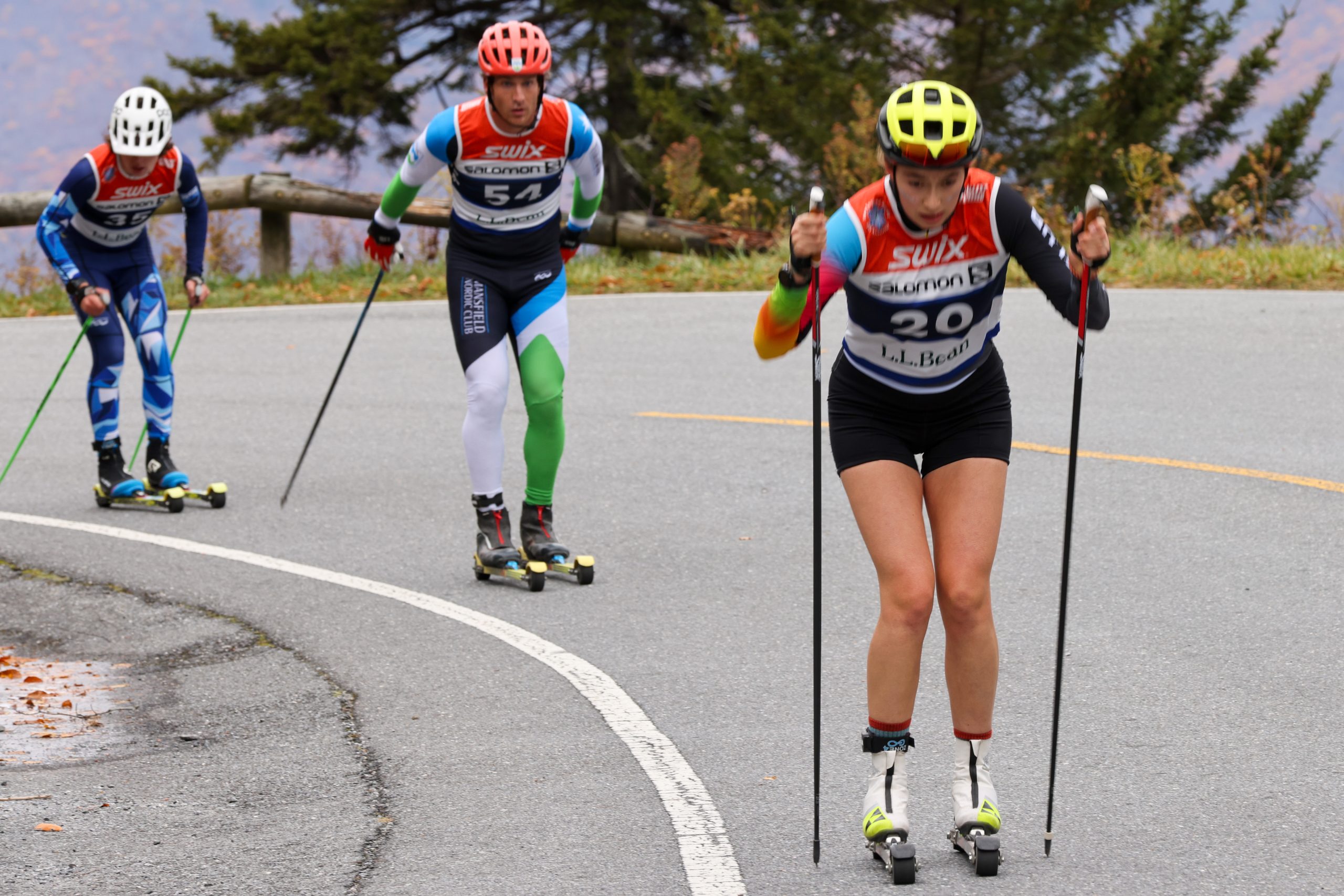
    Luke Ebisawa (SMS) was the first up the Short Course on Mount Greylock. (Photo: FasterSkier)

    A Long Tradition on a Steep Road

    The Mt. Greylock Hill Climb traces its roots to the 1980s, when Steve Blazejewski, longtime owner of Berkshire Outfitters in nearby Cheshire, organized the first informal hill-climb rollerski up the mountain’s south access road. Those early events had a distinctly grassroots feel: a handful of hardy skiers, a few volunteers with stopwatches, the smell of fall leaves mixing with sweat, and the sounds of clicking ski ferrules on asphalt breaking through the cooling autumnal wind.

    Blazejewski—a fixture of the Berkshire outdoor scene and a lifelong skier—recognized that Mount Greylock’s 3,491-foot elevation and sustained grade offered a perfect proving ground for endurance athletes. What began as a small local challenge quietly evolved into an annual fall tradition, drawing Nordic skiers from across Western Massachusetts and southern Vermont.

    Today, that same spirit endures, even as the event has grown in scale and professionalism. With the New England Nordic Ski Association (NENSA) now running the climb as part of its official Rollerski Race Series, the Greylock event has evolved into the season finale of the regional summer circuit. This culmination feels both natural and earned.

    Cole Bothner (Williams College) on his way to winning the Men’s Long Course race up Mount Greylock. (Photo: FasterSkier)

    The Climb: From Lanesboro to the Clouds

    Racers in the Long Course began their 8-mile ascent at the Mount Greylock Visitors Center in Lanesboro, winding steadily up the south access road to the summit. Those opting for the Short Course started halfway up near Jones’s Nose—a 4-mile route that compresses the mountain’s final, steepest pitches into a fierce test of pacing and grit.

    The weather was ideal: cool, calm, and clear, with late-autumn color lining the road. For many, the Greylock climb doubles as both a training benchmark and a celebration—one last rollerski before snow season begins.

    Tight Battles and Young Legs on Display

    In the men’s Long Course, Cole Bothner (Williams College) led from the base, maintaining tempo through the middle grades and holding off Thomas Videtich Bye (Bears) by just eight seconds (48:22 to 48:30). Quinn McDermott, also of Williams, rounded out the podium in 48:41.

    Astrid Longstreth (Mansfield Nordic) on her way to the Women’s Long Course win. (Photo: FasterSkier)

    The women’s Long Course belonged to the next generation. Astrid Longstreth (Mansfield Nordic) took a commanding win in 59:16, pacing perfectly before attacking the upper switchbacks. Leigh Niedeck (EMXC) followed in 1:00:45, and Olya Wright (Williams College) was third in 1:01:12.

    In the Short Course, juniors shone bright. Luke Ebisawa (SMS) dominated the men’s field (29:26), with Thomas Huemmer (EMXC) and Jorgen Pirrung (Mansfield Nordic) on the podium. The women’s race was even tighter: Genevieve Graves (GMVS) edged Mia Gorman (Mansfield Nordic) by six seconds (34:25 vs 34:31), with Kendal Bowen (GMVS) third in 35:54.

    “A Chainsaw, Not a Hand Auger” — The Role of Rollerskiing

    For Ben Theyerl, NENSA’s Competitive Program Director, the Mt. Greylock Hill Climb embodies what makes rollerskiing such a powerful development tool.

    “One thing I’ve gained a newfound appreciation for stepping back in the East,” Theyerl said, “is how my predecessor Justin Beckwith framed rollerski programming: as a development tool. And as a tool, fittingly coming from Justin, it’s more chainsaw than hand auger—that is to say, power!”

    Justin Beckwith cheering on his son, Red, as they took on the short course together – clearly before long Justin is going to have to be the one starting first. (Photo: FasterSkier)

    He added that NENSA’s current approach is about “matching opportunities with athletes”—balancing elite-level races, such as the Lost Nation Roll and Keys/Climb to the Castle, with inclusive, community-oriented climbs, like Greylock.

    “You can’t simultaneously broaden the base of junior skiers comfortable on rollerskis at those pro-style races,” Theyerl noted. “So we target different opportunities like Greylock, or regional camps and clinics. This year, we had plenty of first-time rollerskiers—and we had Jessie Diggins, Ben Ogden, their SMS T2 teammates, Craftsbury GRP athletes, and MNC Pro Team skiers racing too.”

    That balance, he said, creates a feedback loop across generations: “The more comfortable young skiers are on rollerskis, the more we can tap into them as a tool. We want these opportunities to be a key part of our community.”

    A Berkshire Tradition, and a Broader Metaphor

    Theyerl also sees the Greylock climb as uniquely emblematic of New England grit.

    “For every place we associate with ski racing—Vermont, Minnesota, Colorado, Alaska—there’s a community just adjacent, with dedicated skiers doing the sport we love where it’s a little harder to hack it. The Greylock Hill Climb is a great embodiment of the unlikely, impressive things that stand in the Berkshires, literally and metaphorically. It takes a town meeting’s worth of different people to put a mountainside race like that on—and that’s the grandest New England tradition of all.”

    Amy Dupuis (#68), who grew up just a few miles from the start, brought her daughter, Madeline Ronci (#53), down from New Hampshire so they could tackle mom’s old stomping ground. (Photo: FasterSkier)

    Looking Ahead

    As NENSA’s rollerski series continues to expand, the Mt. Greylock Hill Climb feels like its perfect closing chapter—a bridge between old-school grassroots passion and the modern era of organized Nordic development.

    Forty years after Steve Blazejewski first envisioned a climb to the state’s highest point, the heart of the race remains the same: community effort, steep grades, and the unmistakable rhythm of ski poles clicking against New England pavement.

    Complete Results
    Full Photo Gallery

    (Please credit @FasterSkier if you publish them on socials or elsewhere)

    Julie Longstreth taking on the short course. (Photo: FasterSkier)

    Love Stories Like This? Help Keep Them Coming.

    Feature interviews like this one take time, access, and care to produce. If you value thoughtful storytelling and independent ski journalism, please consider becoming a Voluntary Subscriber. Your support directly fuels the work we do to cover the people, places, and moments that make our sport special.

    Join the FasterSkier community.


  • Balancing Books, Labs, and Laps: Inside Newly Named U.S. Ski Team Member Lucas Wilmot’s Routine

    Balancing Books, Labs, and Laps: Inside Newly Named U.S. Ski Team Member Lucas Wilmot’s Routine

    When Lucas Wilmot sits down after morning intervals, there’s no long nap or lazy lunch ahead. “This fall, it’s kind of all back-to-back—training in the morning, then eating, then class, then trying to eat and train again, and then do homework,” he says. “It’s tight.”

    That understatement is classic Wilmot: composed, analytical, quietly focused. At just 19, the Jackson, Wyoming-raised skier is already juggling NCAA racing for the University of Utah, kinesiology labs that might soon shift toward biology, and a new badge of honor—fresh membership on the U.S. Ski Team.

    Lucas Wilmot was keeping it fun from the very beginning. (Photo: Courtesy Photo)

    From Jackson to Utah: A Small-Town Start

    Wilmot’s story starts, like so many in American skiing, with a local club, a hand-me-down pair of skis, and a family that encouraged movement. “I kind of started with my parents—they just put me in skiing in elementary school,” he recalls. “Back then, it was all about hanging out with friends and not really racing.”

    That changed in middle school, when the sport shifted from pastime to passion. “It took a turn where I started to take training more seriously and be more race-focused,” he says. “I remember looking forward to the trips, doing well in races, and having the older guys on the team as idols. Seeing how big and fast they were—I always thought that was really cool.”

    His sister, two years older, was both chauffeur and role model. “She was skiing too—she’s still skiing now at Bates,” he adds. “I started summer training with the older crew in Jackson when I was one of the youngest guys. My sister could drive. I couldn’t. So I’d just spend my time training with the older guys.”

    The big breakthrough came as a sophomore. “Minneapolis Junior Nationals was another big turning point,” Wilmot says. “I had three top tens there, and I never expected anything like that. That was when I realized, if I actually put in the time and effort, I can see results that impress even myself.”

    Lucas Wilmot (#230 – far right) starting to get serious about his skiing racing at a Junior National Qualifier as a U14. (Photo: Courtesy Photo)

    “Welcome to the U.S. Ski Team”

    If Minneapolis was the first turning point, Soldier Hollow was the second. “I got third in the classic 10K at Senior Nationals,“ Wilmot recalls. “That was kind of a big whoa moment—a big jump up. Will (Wicherski), my coach from Jackson, came up to me and said, ‘Do you know where you are?‘ I said no, and he said, ‘You’re in third.‘ I was just kind of shocked and caught by surprise.”

    That race qualified him for Junior Worlds, where another top result changed everything. “They released the requirements—it was a Junior Worlds Top 10,“ he says. “When I had the ninth place in Schilpario, Italy, in the skate 10K, I kind of knew I’d made the team. Right after the race, Brian Fish walked by and said, ‘Welcome to the U.S. Ski Team.’“

    Wilmot laughs at the memory. “It was at the wax cabin or something. I kind of knew that day. My parents and sister were there, so it was nice to tell them in person,“ he says. “But I didn’t want to be loud about it. I told my parents, like, this isn’t official, but it’s looking like I might be nominated.”

    Now, being able to put on the U.S. suit still feels surreal. “I definitely feel pretty lucky,“ he says. “It’s a lot of people’s dream to do that, and it was one of mine. I feel super lucky, and it’s an honor. When I have the U.S. suit on, maybe I’ll go reach out to someone I’ve never met before—they’re all kind of like teammates to me.”

    Lucas Wilmot (UU), Murphy Kimball (UAA) and Tabor Greenberg (UVM) this past spring at the USST’s annual Bend camp. (Photo: Courtesy Photo)

    Structured but Flexible

    Last season Wilmot logged around 500 hours of training; this year he’s targeting about 600. But he’s adamant that numbers aren’t everything.

    “I’m definitely not the number grinder. I just try to keep it fun—never do too much, always quality. It’s kind of my mindset: always having quality in the time you’re training. Make sure it’s worth your time to be there.”

    He recalls finishing a long over-distance session in Park City camp and realizing more minutes would add nothing.

    “I was thinking I could do another 30 minutes, but I’d just be walking. It’s not really how much is that gonna do for me? If it’s not quality, if I’m not putting all my effort in, then I’m not getting the most out of it.”

    That approach—precision over volume—mirrors his team’s philosophy. “Pierre (the Utah coach) kind of switched it to more professional training,“ he explains. “Every training has a specific outcome goal to it… You’re not just doing it to do it. There’s a reason why, and it’s all part of a broader plan and structured schedule.”

    A Day Measured in Minutes

    In Utah’s mountain light, mornings start early—Wilmot trains, refuels, and hustles to class. “I like to think ahead and plan out as much as I can,“ he says. “School is my priority, and how can I get it done efficiently so I can rest well. I try to go to bed as early as I can and know that training in the morning is kind of also a priority.”

    The key, he’s learned, is organization—a skill honed on long travel days in high-school racing.

    “Being on trips for skiing taught me that if I get it done ahead of time—get all my schoolwork done or just know that when I have spare time, I should try to get ahead or catch up on school—that’s what I think about all the time.”

    Even with 600 training hours, he squeezes recovery in where he can. “It’s a hard balance between having training in the morning as a priority or staying ahead on work,“ he admits. “But I think I learned well… just to plan ahead.”

    Wilmot during the 7.5-kilometer classic interval start last spring at the U.S. Ski and Snowboard Cross-Country Junior National Championships in Soldier Hollow, Utah. With a time of 23:12.4 second, Wilmot won his first Junior National title in his fourth appearance. (Photo: Drew Palmer Leger/Courtesy Photo)

    Fueling the Machine

    This semester, recovery and nutrition have become new focal points.

    “This fall I was kind of struggling with recovery after the morning session and my class schedule,“ he says. “So one of the things I’m trying to do more of is focus on nutrition right after—that’ll allow me to make it through the long school day and then also recover well. That’ll help me get energy for the training and races.”

    Breakfast sets the tone: “Usually a banana, an everything bagel with butter, and maybe a little bit of yogurt… kind of got a little something of everything. It’s pretty yummy.”

    The science-minded athlete is applying classroom theory to real life. His kinesiology background gives him a deeper understanding of performance—how recovery, fueling, and training stress interconnect. “I’m keeping on the science track,“ he says. “Right now I’m doing kinesiology, but maybe switching to biology or another science-related thing. Not sure yet.”

    Keeping It Fun

    For Wilmot, joy isn’t optional—it’s essential. “I just love hanging out with all the buddies, training with friends. Definitely makes it go by a lot faster,“ he says. “It’s pretty fun just to crack jokes a lot and mess around, too… You don’t always have to be serious at training.”

    That balance between intensity and levity keeps burnout at bay. Whether it’s running mountain ridgelines or laughing through rollerski sessions, he believes camaraderie fuels consistency. “Sometimes there are places not to focus,“ he laughs, “and just have a good time.”

    Fun with friends is Lucas Wilmot’s core principle. (Photo: Courtesy Photo)

    The Process of Progress

    Beyond coursework and results sheets, Wilmot’s compass points toward steady growth. “I’d hope to make the NCAA team for the University of Utah this year,“ he says. “That’s going to be pretty challenging… but I hope to have more stabilized results and less fluctuation.”

    He defines progress through small, controllable actions:

    “In skiing, just being as efficient as I can. If I’m in a race and I feel uncomfortable, I try to find where I’m comfortable and not make myself too jittery. Being comfortable in your own way during a race—knowing how to race your races—is important for me.”

    When he talks about the future, Wilmot’s tone shifts slightly—equal parts excitement and realism. “Within the next four-year span, there’s a good chance the progress track may take me to that level,“ he says, thinking ahead to the Milano-Cortina Olympics. “If I stick with it, that would be an insane experience and something very special.”

    Wilmot skiing with Murphy Kimball (UAA/Alaska Winter Stars) on Eagle Glacier this past summer during the US Alaska camp. (Photo: Courtesy Photo)

    A Learner at Heart

    Among the national-team veterans, Wilmot sees himself as a student first. “I kind of see myself as a little follower,“ he admits with a grin. “Everyone’s just a little more experienced than I am. I feel like I don’t have much, so I think of myself as a learner and a listener—someone who tries to take everything I can from them.”

    But even the learner can lift a team. “I love being the guy that gets someone to smile,“ he adds. “And make them laugh. I love doing that.”

    That mix of humility and humor is why teammates have quickly embraced him. He’s not loud, but he’s steady—the kind of athlete who brings calm to chaos, whether it’s a high-stakes interval session or a late-night study grind.

    Looking Ahead

    Wilmot’s path has never been about a single breakthrough; it’s about accumulation—hours, credits, lessons. “I kind of never saw myself being where I would be right now,“ he reflects. “It goes back to the open-doors thing—I was just following what was happening, putting in the work, and seeing what opportunities it led me to.”

    That approach—disciplined but flexible—may be his greatest strength. Between lecture halls and ski trails, he’s learning to find balance. And every dawn run, every late-night homework session, is another quiet step toward the next start line.

    “It’s a good, hard balance,“ he says, smiling. “But that’s kind of what I signed up for.”


    Love Stories Like This? Help Keep Them Coming.

    Feature interviews like this one take time, access, and care to produce. If you value thoughtful storytelling and independent ski journalism, please consider becoming a Voluntary Subscriber. Your support directly fuels the work we do to cover the people, places, and moments that make our sport special.

    Join the FasterSkier community.
  • From Olympian to Coach to Mentor: Patrick Weaver, the Quiet Architect of UVM’s Ski Culture

    From Olympian to Coach to Mentor: Patrick Weaver, the Quiet Architect of UVM’s Ski Culture

    The first time you meet Patrick Weaver, you might not realize you’re talking to one of the most quietly influential coaches in American skiing. There’s no bravado, no self-promotion. Just an easy Vermont calm — a man who measures his words the same way his athletes measure their training: carefully, purposefully, with feel.

    On a fall morning, the UVM Nordic team threads through the mist at the Craftsbury Outdoor Center, the quiet hum of rollerskis against asphalt echoing in the distance. Weaver watches from the side, hands in his jacket pockets, hat pulled low. He doesn’t bark instructions. He doesn’t need to. The rhythm of his teams speaks for itself.

    Wilmington, Vermont’s Sophomore Luke Rizio. (Photo: Philip Belena/EISA)


    “I always say it’s not the individuals that make the team fast — it’s the team that makes the individuals fast,” he says. “Once they believe that, the motivation takes care of itself.”

    For nearly twenty years, that philosophy has shaped the University of Vermont into one of the most respected programs in NCAA skiing — not through hype or heavy recruiting, but through a culture of trust, humility, and balance.

    Lessons in Motion

    Weaver’s path to coaching wasn’t linear. It’s more like a relay through decades of ski mentors who left their fingerprints on his philosophy.

    “I never had one coach through my whole career,” he says. “There were a lot of influential people — high school, Stratton, college, the national team. I just learned to take things from each of them.”

    He spent a post-graduate year at Stratton Mountain School under Sverre Caldwell before skiing for Cory Schwartz at UNH — a relationship that would define his sense of what a team could feel like.

    “Cory was probably the most influential,” he says. “The way he ran that program — it was a family. I took that with me when I came to UVM.”

    After college, Weaver worked under a rotating cast of national and international coaches: Gordon Lange, Christer Skog, Sten Fjeldheim, Torbjørn Karlsen. Each brought a different rhythm to training. The mosaic of ideas shaped the adaptable style he’s known for today.

    “There’s not one way to coach,” Weaver says. “And because of my background, I’m not a ‘my way or the highway’ coach. I’ve seen too many ways that work.”

    Patrick Weaver racing in the 15 k Classic at the 2002 Olympics in Soldier Hollow, Utah. Weaver finished in 16th place. (Photo: UNH Ski Team)

    The Season He Cut His Hours

    In 2002, the year of his second Olympics, Weaver did something radical. He trained less.

    After years of logging 800-plus-hour seasons, he realized the grind was killing his joy. So he cut down to 600 hours — just one session a day, mornings only.

    “I was kind of burned out,” he says. “I’d dread the afternoon workouts. I loved the sport, but I wasn’t feeling good anymore. When I stopped doing the PM sessions, I felt better — I started looking forward to training again.”

    It’s a story he still tells his athletes, not as dogma but as permission. Permission to rest. Permission to find balance.

    “I’m never afraid to tell an athlete to train less,” he says. “Sometimes that’s the thing that gets them going faster.”

    That season became a turning point — not just in Weaver’s career, but in his view of what performance really means. It was the seed of a coaching style rooted not in metrics, but in intuition.

    Ben Ogden celebrates after sweeping the 2022 NCAA Championships in Midway, Utah. Ogden became 1 of only 4 skiers (alongside US Ski Team teammates Novie McCabe and Sophia Laukli) to win an NCAA Championship and represent the US at the Olympics in the same season. (Photo: Tobias Albrigtsen / @untraceableg)

    Coaching Ben Ogden — and the Art of Listening

    If Weaver’s name is not immediately known outside the NCAA world, it should be. One of his former athletes — UVM graduate Ben Ogden — is now one of the most dynamic racers on the World Cup circuit. Their partnership, built over seven years, is the epitome of Weaver’s coaching DNA: patient, collaborative, and deeply human.

    “I’m not Ben’s day-to-day coach,” he explains. “He’s got great people at Stratton and the U.S. Ski Team. But we talk — a lot. Strategy, planning, recovery, the big picture. And it’s never me saying, ‘Do this.’ We talk it through and find what makes sense logically.”

    That logic isn’t written in a spreadsheet. There are no lactate meters, no elaborate testing protocols.

    “We’re very unscientific,” Weaver says with a grin. “Ben appreciates the go-with-the-flow training plan. It’s all feel-based. If it feels good, we go with it.”

    The two share what they call the “Gus Workout” — a set of smooth, fast intervals inspired by Gus Schumacher. “It’s not about killing yourself,” Weaver says. “It’s about moving fast with good technique.”

    It’s fitting that one of America’s most promising World Cup athletes traces his development back to a coach who believes that skiing, at its best, is about rhythm and relationship more than data and drive.

    The UVM Way

    Weaver took over the Catamount program with a straightforward goal: strip away the clutter.

    “When I first got here, I just explored,” he says. “I found training venues close to campus — trails and loops that were right here. We stopped driving hours to ski. It simplified everything and gave athletes more time to recover.”

    That ethos — local, focused, efficient — defines UVM’s identity. Training isn’t glamorous, but it’s deliberate. The team atmosphere is close-knit, even familial. “There’s nothing special about UVM,” Weaver jokes, “and that’s what makes it special.”

    He points to the campus support network — trainers, nutritionists, sports psychologists, and strength coaches all under one roof — as one of the program’s hidden advantages. “It’s on par with professional teams,” he says. “The athletes can see everyone they need in one day.”

    That infrastructure helps athletes stay healthy, grounded, and balanced — which, for Weaver, is the real key to longevity.

    “We’ve had international athletes come in liking skiing, and they leave loving it,” he says. “That’s when I know we’ve done something right.”

    Junior Owen Young (Anchorage, Alaska) and Sophomore Fin Bailey (Peru, Vermont). (Photo: Phillip Belena/EISA)

    Through Change and Uncertainty

    Weaver has been around long enough to see college skiing evolve from a regional stepping stone to a legitimate World Cup pipeline. He’s also watched it collide with new realities: NIL money, early recruitment, the escalating costs of youth development.

    “When I was at UNH, I was training 500 hours a year and thought that was a lot,” he says. “Now I’ve got athletes training 700 or 800 hours — and managing school on top of it.”

    That dedication, he says, is a sign of progress — but also a warning.

    “Kids are training more and more at a younger age,” he says. “Sometimes it worries me. Are they doing it because they want to, or because they’re being told to?”

    He worries, too, about the economic side. The college landscape, reshaped by NIL and revenue sharing, could make Olympic sports harder to sustain.

    “We’re fundraising to pay athletes while big schools make $200 million a year off TV deals,” Weaver says. “It’s hard to see how that’s sustainable.”

    He laughs softly when asked what NCAA skiing looks like fifteen years from now. “I hope we’re still here,” he says. “I really do.”

    The Long Game

    If the world of college skiing is shifting underfoot, Weaver’s motivation remains rooted in something simple: people. Every year brings a new roster, a new set of personalities, a new chance to start fresh.

    “You do something long enough, it’s hard to stay motivated,” he admits. “But each fall I get new athletes, new relationships. First-year students I barely know become seniors I can’t believe are leaving. That cycle keeps it exciting.”

    He pauses, then adds, almost to himself:

    “Maybe that’s what success really is — watching them fall in love with skiing all over again.”

    UVM Sophomore Rose Horning from Leadville, Colorado. (Photo: Phillip Belena/EISA)


    Vermont’s Quiet Legacy

    Weaver doesn’t measure his legacy in NCAA titles or Olympic appearances, though UVM has had plenty of both. He measures it in the quiet mornings at Craftsbury, Jericho, or Sleepy Hollow, where athletes rediscover why they started skiing in the first place.

    He doesn’t see himself as a gatekeeper of results but as a caretaker of culture — one that prizes simplicity, joy, and belonging in a sport that often forgets how to slow down.

    In a world obsessed with metrics, Weaver’s story is a reminder: sometimes the best architectures of success are invisible — built in the space between workouts, in trust, and in the quiet confidence that skiing, at its best, should always be fun.

    “The best thing I can do,” he says, “is help people love the sport.”

    Coach Weaver chats with his first-year from St. Paul, MN, Hanna Koch. (Photo: Philip Belena/EISA)


  • USCSA Kicks Off Its Collegiate National Championship

    USCSA Kicks Off Its Collegiate National Championship

    The U.S. Collegiate Ski and Snowboard Association (USCSA) kicked off its 5-day long annual Collegiate National Championship today with the women’s Snowboard and Freeski Rail Jam, men’s Skier and Snowboard Cross, women’s Alpine Ski Giant Slalom, and a 7.5k Freestyle Nordic race under beautiful sunny skies. Mt. Bachelor is serving as host for all events over the five days of exciting competition.

    A record-breaking 685 Collegiate athletes representing 75 universities across 6 regions will compete in the Cascade Mountains this week. This championship represents the best collegiate athletes from around the country. USCSA has member schools in every geographic region of the United States. Events include Alpine Ski and Snowboard Giant Slalom, Alpine Ski and Snowboard Slalom, Dual Slalom, Cross-Country Sprints, Nordic Relays, Nordic Distance, Slopestyle, Skier and Snowboard Cross, and Rail Jam.

    All this week, the USCSA broadcast network will bring audiences over 70 hours of LIVE, multi-camera HD video coverage from all three competition venues at its web portal: http://www.uscsa.org/broadcast.html. Scott “Boss” Hogg returns to lead the USCSA broadcast team at alpine alongside announcer Elan Olliff, joined by legendary snowboard announcer Mark “The Beav” Oliver and A. Shova at snowboard/freestyle, and Trent Rosenberg and former USCSA student-athlete Luke Dykowski at Nordic. Visit https://www.uscsa.org/broadcast.html for more information, including live-timing, daily schedules, and on-demand archived broadcasts.

    USCSA (Photo: Meagan Bronson)

    In the women’s Alpine Ski Giant Slalom on the Thunderbird trail, Rocky Mountain College won in a close team competition, beating second place Vermont State University – Castleton by a combined 3 seconds. Eulalie Giraud from Rocky Mountain College won the individual National Championship. After her race, Eulalie said, “Today’s conditions were really great, at the start it was really striking to be up there and see the view and the whole course, and I felt I did well on both my runs and was really happy with my results. It was a great day.”

    Racing also began at the Nordic venue, with a 7.5k Freestyle race. St. Olaf College’s women’s team won the combined race, sweeping the podium enroute to their victory. The University of Wyoming’s team won the men’s competition. Individually, Iver Skaarseth from Colorado Mesa University won the men’s event. After his race, Iver said it was a  “great day out there, happy with my performance, grateful for the support of my whole team.” The women’s individual championship was won by Lily Hubanks from St. Olaf College. “I was a little nervous about skiing at altitude, but I tried to focus on what I could control and ski well,” said Lily. “What made it even more special is how well the whole team did and that we were able to do well together.”

    On the Cross course, the University of Wisconsin Madison won the team men’s Ski Cross while Westminster University’s men’s team Snowboard Cross. After winning the men’s Snowboard Cross individual title, Caelen Billings from the University of Maine Farmington said he was “surprised with the length of the course, 5 turns and 5 rollers. It was anyone’s race with such a short course, fortunately it played out in my favor today.” In the Skier Cross, James Lahrman from the US Military Academy West Point won the individual Championship. “We are all happy to be out here skiing and enjoying ourselves,” said James. “Today was great.”

    USCSA (Photo: Meagan Bronson)

    USCSA is the sports federation for collegiate team ski and snowboard competition in North America. The organization believes that student-athletes of all levels and abilities should have access to quality and exciting venues of competition. Our athletes agree that our team orientation fosters a collaborative approach across their collegiate athletic and academic careers, and often this mentality proves indispensable in their adult lives and careers. USCSA includes over 140 institutions from coast to coast, fielding over 4,700 female and male alpine, freestyle, nordic, and snowboarding athletes who participate in more than 300 events annually.

    Mt. Bachelor is the premier ski area in the Pacific Northwest, offering 4,323 acres of lift-accessible terrain with 360-degree descents from its 9,065’ volcanic peak. The mountain resort is served by three carpets and 12 lifts, seven of which feature high-speed quads and one new high-speed 6-pack lift. Mt. Bachelor also features 15 Woodward Mountain Parks, 56 km of groomed cross-country trails, snowshoeing, and sled dog rides. Summer attractions include downhill mountain biking, ZipTour ziplining, and whitewater rafting with Sun Country Tours. Mt. Bachelor is part of POWDR, a family-owned and operated Adventure Lifestyle Company©. For more information visit www.mtbachelor.com.

  • The University of Utah Claims the 2025 NCAA Championship

    The University of Utah Claims the 2025 NCAA Championship

    This article was made possible through the generous support of our voluntary subscribers.  If you would like to see more articles like this one, please support FasterSkier with a voluntary subscription.  

    The sun came out on Saturday at Dartmouth’s Oak Hill Ski Center in Hanover, New Hampshire. The best collegiate skiers in the country gathered in Hanover, New Hampshire, for a week of racing at the NCAA Championships. The final races of the week were the nordic distance races, 20km freestyle for both the men and women. University of Utah’s Joe Davies skied away with the national title on Saturday, much like how his team gapped the competition.

    Though Utah’s nordic and alpine teams combined points ultimately created an unclosable gap, the championships started off close. In the first nordic races, the 7.5km men’s and women’s classic race, it was the host school Dartmouth who had the top racers.

    Dartmouth College’s John Steel Hagenbuch skied to a 15 second victory on his home trails in the 7.5 k Classic at the NCAA Championship on Thursday. (Photo: Tobias Albrigtsen)

    In the men’s 7.5km classic race, Dartmouth’s John Steel Hagenbuch won by 16 seconds over UVM’s Finn Sweet. It was his second NCAA title, having won the 7.5km skate competition in 2024. Steel Hagenbuch’s teammates Luke Allen and Cooper Camp finished 4th and 9th, respectively. They combined for 93 points, besting Utah by nine points. Rounding out the podium was Utah’s Joe Davies, who just days before the competition was in Trondheim, Norway, racing in the World Championships skiathlon. Competing under the Great Britain flag, he finished 24th, 1:31.8 behind Johannes Klaebo.

    Utah earned their first individual win of the 2025 NCAA championships when Erica Laven won the 7.5km women’s classic race. Annie McCulgan of UVM finished second and Dartmouth placed three in the top eight. Jasmine Drolet, Ava Thurston and Nina Seeman finished third, fourth and eighth, respectively. The Dartmouth women tallied 88 points for a slim two-point edge over Utah.

    Utah’s Erica Laven took home the women’s 7.5 k Classic individual title by 11 seconds on Thursday. (Photo: Tobias Albrigtsen)

    As the competitions continued at the Dartmouth Skiway, Utah’s men’s and women’s alpine teams both scored the most points in the Giant Slalom. They opened up a sizable lead that would be incredibly difficult for the trailing Dartmouth and University of Colordao to close.

    After Davies took control of the men’s 20km freestyle on Sunday, that lead became impossible to catch.

    Utah’s Joe Davies took command of the Men’s 20 k Freestyle, skiing to a 1:10 victory and leading Utah to the NCAA Championship. (Photo: Tobias Albrigtsen)

    Oak Hill has undergone major renovations in the past few years, and the newly homologated races loops were on full display during the championships. The configuration is such that fans can see racers in multiple spots, so as the laps ticked away during the 20km, fans watched as Davies pulled farther and farther away from Steel Hagenbuch, ultimately winning by over a minute. It’s his second NCAA title. His first was in 2023 at the 10km skate in Lake Placid, when he was a sophomore racing for UAF. That year, Steel Hagenbuch finished second.

    Having Davies and Steel Hagenbuch leave the championship with one win each is fitting. They’ve dominated their respective sides of the country and met at NCAA’s to jockey for podium positions over the last couple of years – all while benefitting from the relatively new mentality that allows collegiate skiers to compete in both college races and on the World Cup, instead of having to choose between domestic and international competition.

    For Steel Hagenbuch, it’s extra sweet to have gotten a win at home. Though he grew up in Idaho, he comes from a family of Dartmouth athletes and has added greatly to that legacy.

    After the men finished, the competition was still close for who would finish runner-up in the team competition: Dartmouth had a 14-point lead over Colorado.

    Erica Laven (UU – left) and Kendall Kramer (UAF – right) distanced themselves from the rest of the field during the NCAA Championship Women’s 20 k Freestyle. (Photo: Tobias Albrigtsen)

    It didn’t take long for Kendall Kramer of UAF and Erica Laven of Utah to create a gap over Colorado’s Tilde Baangman and Denver’s Lea Wenaas. Behind them was a dense chase pack. But once Kramer decided to go, she was gone. She skied in total control, her crisp tempo unchanging over Oak Hill’s rigorous climbs. She finished 35 seconds ahead of Laven, taking a bow as she came across the line. This has been an impressive year for Kramer in the 20km: In February, she won the 20km at U.S. Nationals in Anchorage.

    Eventually, Kendall Kramer (UAF – right) decided it was time to make a move on Erica Laven (UU – left), skiing to a 35-second victory for the individual Women’s 20 k Freestyle NCAA Championship. (Photo: Tobias Albrigtsen)

    After all had finished, the points were tallied. Colorado, who won the NCAA team title in 2024, had two women in the top 10 in the 20km to Dartmouth’s one. They scored 20 more points than Dartmouth in the women’s race to overtake them and finish in second for the week-long team competition.

    The NCAA Championships are dominated by the Western schools – Utah has now won six of the last seven championships. So to see Dartmouth finish runner-up on their home turf, in a star senior’s year, on that sugary, spring East coast snow, would’ve felt like a fitting end to this story. But even though it’s not the result they wanted, it takes nothing away from what was accomplished at Oak Hill, and the successful championships they hosted there.

    “The transformation of Oak Hill is a game-changer for us,” Dartmouth head coach Cami Thopmson told FasterSkier via email. To have good training on reliable snow less than 2 miles from campus makes a huge difference. We knew how the course would ski, where it would be particularly challenging, what line to take, and what places would be best to make a move on the field. Our athletes used that knowledge to their advantage.”
    There was lots of great energy at Oak Hill for the final day of the 2025 NCAA Championship. (Photo: Tobias Albrigtsen)
    “We are really proud of the team, it is tough to manage the expectations and all the extra energy that goes into racing at home, especially with final exams looming.  The seniors have had this week to look forward to since they showed up on campus four years ago. I think it far exceeded their expectations,” Thompson told FasterSkier via email.
    “We had a very solid finish in the end, but it is hard to go from leading at one point to 3rd with only a 5-point gap. That is sport though and we know that every one of our athletes raced their hearts out.”

    Complete NCAA Championship Results


  • Bringing a Community Together Around Nordic Skiing: Oak Hill Prepares to Host NCAAs 2025

    Bringing a Community Together Around Nordic Skiing: Oak Hill Prepares to Host NCAAs 2025

    This article was made possible through the generous support of our voluntary subscribers.  If you would like to see more articles like this one, please support FasterSkier with a voluntary subscription.  

    As Dartmouth prepares to host the 2025 National Collegiate Athletic Association (NCAA) Ski Championships, Oak Hill Outdoor Center in Hanover, New Hampshire, has been transformed from a rustic trail system to one of the premier cross-country ski venues in the East. As preparations for NCAAs have ensued over the previous three years, this article sheds light on the history and evolution of the site and community as they have united behind planning for this event. 

    History
    Oak Hill as it appeared in the 1930s (Photo: New England Lost Ski Areas Project)

    Oak Hill has been a cornerstone in the New England ski scene for nearly a century, drawing regional skiers to its humble slopes in the heart of Hanover. The ski area is said to have hosted one of the first J-bar lifts in the country, pioneering local skiing in Hanover since 1936. As a gathering point for the regional ski community, a ski jump was also constructed in the early 20th century, fashioning a venue fit to host “skimeister” competitions in their heyday of the mid-1900s. While the alpine ski scene moved to the modernized Dartmouth Skiway in Lyme, NH as construction concluded in the 1980s, Oak Hill’s legacy in the world of skiing had only begun. Now, remnants of its past are still visible in the clearcut downhill trails that coat the hill above the main stadium. 

    The Venue and Community
    Top of Oak Hill 2.17.25 part way through the s-curve descent. Natural snow coats the trail, which is laden with pine needles and sticks – a better-than-average ski day during a particularly snowy winter. Oak Hill continues to maintain its charming “old school” trail system following the installation of a world-class homologated course. (Photo: Kennedy Lange)

    Cross-country ski trails now meander through steep ascents, hair-raising S-curves, and host gorgeous views out over the Connecticut River Valley. The challenging terrain has earned a reputation for developing some of the most technically skilled skiers in the country who are used to gliding over ice patches, jumping over the frequent rock in the trail, and avoiding trees on the notoriously narrow trails. 

    Oak Hill is the home of the Ford Sayre Ski Club, one of the largest and oldest nordic ski clubs in New England, serving over 500 skiers each year from elementary children through masters. Children join the club in the Bill Koch League from kindergarten through 8th grade, and then transition onto the Junior Nordic Team (JNT) which hosts a roster of 26 competitive local high schoolers. Ford Sayre consistently graduates athletes onto collegiate rosters, where they continue their competitive career on the Eastern Intercollegiate Ski Association (EISA) circuit. 

    Oak Hill is also the home venue for the Dartmouth College cross-country ski team, attracting some of the top recruits in the country each application cycle. Since the formation of the team, athletes and alumni have competed at every winter Olympic Games, and claimed hundreds of All-American titles. The team itself hails from all regions of the US and Canada, and this winter sent four athletes to compete overseas at Junior Worlds. Dartmouth’s current students and alumni constitute the second-largest group from any university on the Stifel US ski team, trailing only the University of Utah. For the 2024-2025 team, this includes Dartmouth alumni Julia Kern and Rosie Brennan (A team), as well as current students John Steel Hagenbuch (B team), Jack Lange, and Ava Thurston (Development team). Jasmine Drolet and Luke Allan also sit on the Canadian National Ski Team roster. As one of the most elite collegiate teams in the country, it seems only fitting that the team has a venue capable of hosting equal caliber competitions.

    Green grass surrounds the ribbon of snowmaking during the 2024 winter season. (Photo: Peter Milliken)

    In recent years, Hanover has experienced increasingly variable snow conditions, and skiing at Oak Hill has not been taken for granted by the local community. Hanover already receives less snow than neighboring towns due to its location within the Connecticut River Valley, and has struggled to maintain a base deep enough to ensure skiing through the winter season. 

    Regional skiers may also be aware that Dartmouth’s annual EISA race is rarely hosted at home, with only two carnivals between 2008 and 2019 hosted at Oak Hill, otherwise relocating over two hours north to Craftsbury, VT. Aside from hosting races, snow inconsistency at Oak Hill has significantly impacted Dartmouth’s training regimen. During the 2019/2020 winter, the Dartmouth Nordic team had 35 practices planned during winter term, of which only 10 could proceed as planned at Oak Hill. Even then, the low base made classic skiing difficult without access to groomed ski tracks. For the remaining sessions, the team either drove to Dorchester, NH or Woodstock, VT—adding 1–2 hours of travel mid-week, a significant commitment for student-athletes—or switched to running.

    Cami Thompson, head coach of the Dartmouth Women’s ski team, has navigated the challenging conditions at Oak Hill throughout her 35‐year tenure. Reflecting back on the winters, Thompson noted that the team “could generally plan on skiing at Oak Hill for some part of every season.” Due to the elevation difference, it was common for the trails to be skiable on the hilltop when they weren’t in the stadium. When this was the case, the team would hike in from a nearby road or hike uphill from the parking lot to get to the skiable trails. As Thompson recalled, “there were definitely days when hopping over muddy sections was a thing.” More importantly, “everyone had rock skis, and that is what we skied on most of the time at Oak Hill.” 

    Renovations

    Oak Hill is nearing the culmination of a two-year upgrade that will significantly expand its facilities. The project includes adding snowmaking and lighting along a three-kilometer loop, paving the notoriously muddy parking lot, and building a new state-of-the-art homologated race course designed by Morton Trails. In addition, a new lodge is being constructed in the stadium, a new building will house trail equipment and groomers, and the rental center will soon welcome visitors with access to a large inventory of trailside equipment. 

    Although discussions of adding snowmaking and widening trails began in the early 1990s, early efforts struggled to secure the necessary support from Dartmouth College, The Hanover Improvement Society who owns Storrs Pond (the water supply for the snowmaking installation), and the local community. It wasn’t until 2017 that the discussions leading to the modern iteration of the project began, spearheaded by community members Matt Rightmire and Peter Milliken. Since then, a unique partnership between Dartmouth College, who previously owned the land, and the local ski community, has helped successfully pull together a plan and funding for renovations. 

    Locals Peter Milliken (Left) and Matt Rightmire (Right) resurfacing the newly cut trail. The pair played an instrumental role in coordinating the renovation effort, and promoting the collaboration between the College and community. (Photo: Peter Milliken)

    Working together with the College, the group began researching both the installation and  maintenance costs, as well as long-term economic sustainability of the center. “It took a while to get the college and community together on how it was that we were going to fund it and how it was that the center was going to be operated once it was funded,” Rightmire shared in a discussion with FasterSkier this winter. It took nearly five years of negotiations between the college and the community before an agreement was signed in 2022 to begin the work. “Dartmouth, like it would have been for any institution of higher learning, took some time to get comfortable with partnering with the community in this way.  It was a new thing for them to do,” Rightmire added, “and, it was complex because of it.”

    “One advantage to having been at Dartmouth for so long is that I have developed patience when it comes to things getting done; there is an idea, it gets shot down, you present it another way, find the right people to support it, and some money and eventually, dreams do come true!” coach Thompson shared. “To me, the beauty of this project has been the community and the College working together.” Thompson reiterated the complexities of collaborating in such a way, adding that they “saw many eyes roll along the way when we talked about the College and the community working together, but there was also the gleam of hope and an understanding of how cool the project could be.”

    Amid ongoing discussions between the college and the local community over possible updates to the venue, Dartmouth secured the 2025 NCAA bid. In order to host the race at home, the selection committee requires that venues have an FIS-homologated race course and preference goes to sites with snowmaking infrastructure. This high-profile event served as the catalyst for the renovations, uniting the community to meet the tight timeline over the following three years. “There were certainly ups and downs throughout the process but the enthusiasm at community meetings, and talking to smaller groups kept it moving forward, along with the bid to host the 2025 NCAA Championships looming out there,” Thompson explained. 

    Stage one of building the homologated course was logging and clearcutting the trail (Photo: Peter Milliken)
    During the second stage of trail building, the course was carefully shaped and leveled. (Photo: Peter Milliken)
    The race course takes shape, flowing over rolling hills following the Storrs Pond shoreline. (Photo: Peter Milliken)
    After the course was routed, the snowmaking installation involved burying pipes around the 3-kilometer loop. (Photo: Peter Milliken)
    Finally, the parking lot was paved and widened, adding parking spots with electricity for team trailers on race day. (Photo: Peter Milliken)

    One of the hurdles the planning committee needed to overcome was the utilization and accessibility of the venue. “We wanted to create a world-class racing venue, while at the same time building something that was accessible skiing 12 hours a day for the community.” Of course, “elite athletes want a homologated course that has amazing conditions from the first time that snow is available to the end of March,” Rightmire shared, but “the community cares about other things. They want a parking lot that isn’t a mud pit, they want terrain that is challenging but accessible whether you’re a 4-year-old on skis for the first time, or an 84-year-old who has a lifelong passion for the sport, but probably doesn’t ski as aggressively as they once did.” Given the topography surrounding Oak Hill, and the vertical requirements of a homologated venue, this was “very very hard.”

    Ford Sayre head coach Hilary McNamee emphasized the challenge of crafting a trail system that meets both competitive and recreational needs. McNamee reflected, “I do think the general sentiment is that the goal was achieved. Yes, the trails are on the harder side for beginners and recreational skiers, but boy are we making some tough little BKL skiers now!” 

    Overall, the community has embraced these changes and the opportunities they will grant for the small venue. Yet, “change is hard.” While Oak Hill was open with often-rocky and inconsistent conditions previously, it’s not easy to see such a large change in your community. “When you go into forests and walking paths that people have made a part of their ways and alter them in a pretty significant way, they need to believe in what it will become over time,” Rightmire shared.  “We had to talk the community through what this would be in two, three, or four years, and earn their trust.” Through discussions with the community, Rightmire concludes that “the project was better because of the concerns that people voiced.”

    The new course opened to the public in the winter of 2024, earning enthusiastic support from local teams, and mostly positive reviews from the community. While residents were grateful for having skiing so close to town and for the consistently good snow throughout the season, feedback quickly emerged suggesting that the venue could be made more accessible. With over 370 feet of climbing on the 3.3 kilometer loop and fast descents, it was somewhat unfriendly to less experienced skiers. To address this, by 2025 a new trail was cut between the two fingers of the course, granting skiers the option to skip the most technical descent and steepest climb.

    The local community rallied behind the renovation effort, relying upon volunteers to provide trail work support (Photo: Peter Milliken)

    “In year two, the broader community understands and appreciates the value of [Oak Hill] as a community resource,” McNamee commented. Locals are appreciating not only the easy access to reliable skiing near town, but also the lights that enable skiing after dark during the shortest days of the year, the mudless parking lot, and the brand new rental equipment available to season pass holders. These upgrades have contributed to a 44% increase in ticket sales from the 2023/4 to the 2024/5 winter season so far, with further increases expected through the end of the season. 

    For leadership of the Ford Sayre ski club, the reliable ski conditions grant coaches and coordinators time that had previously gone toward planning logistics for practices. “I can’t even begin to quantify how many hours went into determining where and how to host safe and fun ski practices for 300+/- kids, week in and week out, let alone events,” McNamee shared.” The extra time has also given the club leadership capacity to provide programming outside of the Bill Koch League. ”We had kind of given up on masters programming because we were all so exhausted from trying to figure out logistics for the kids.” Over the past two years, Ford Sayre’s masters program has grown to over 60 participants. 

    Similarly for Dartmouth, Thompson is excited about the flexibility that comes with having reliable conditions close to campus. “Now we can plan workouts in advance and know we will have groomed tracks in certain areas to run specific workouts,” Thompson shared. “Previously, we were often guessing which stretches of the trail would work, and then we would have to adjust if there weren’t tracks that day, or there were more rocks in certain areas. It was like trying to plan a basketball workout on a warped floor.”

    Aside from the consistent conditions that snowmaking has ensured, the number of skiable days has lengthened as well. The trails have been able to open both earlier in the season the past two years, and remained open through April last year, expected to increase the season length from an average of 70 to 120 days per season. Historically, the center’s average opening and closing dates were around December 22nd and around March 19th, respectively. After the first winter of snowmaking last year, Oak Hill remained open until April 7th—the latest it has been open in recent years and extending the season almost a month longer into the spring. Furthermore, the assurance of steady mid-winter conditions enabled Ford Sayre to host the Silver Fox Trot, its annual ski race, at home last year for the first time in five years, as well as the Dartmouth Carnival EISA race. 

    Bill Koch League racers enjoying the widened trails in the first Silver Fox Trot competition on the new course. (Photo: Peter Milliken)

    Beyond the expanded access to skiing for the local community, race results from the local club have highlighted the impact of consistent snow conditions and improved training loops. In 2024, JNT skier Lea Perrard was Ford Sayre’s first national champion since 1995 and in 2025, JNT skier Annelies Hanna was the first skier in decades from Ford Sayre to represent team USA on the U18 Scando trip in Norway this February. 

    Improvements won’t end here, but are ongoing as the new venue is tested. “We need to figure out warm up tracks and testing areas as well as parking and shuttling,” Thompson explained as they continue to experiment with the new trail arrangement and figuring out how to host competitions at the venue. During the summer, plans are also in place to improve the mountain bike singletrack trail system, expanding year-round access to the trail system. 

    NCAA Competition

    As renovations are concluding, preparations to host NCAAs at Oak Hill are in full swing. The competition will take place March 5–8th, drawing the fastest collegiate racers in the country to Hanover, NH. With an expected attendance of 2,000 to 4,000 spectators—and featuring live music and local food trucks—NCAA’s promises excitement and fun for fans of all ages. 

    This year’s NCAA National Championships will kick off with an opening ceremony on Tuesday, March 4th. Alpine and nordic events will alternate on the proceeding days, with a 7.5 kilometer freestyle individual start on Thursday, March 6th, and a 20 kilometer classic mass start on Saturday, March 8th. 

    The team for the event has not yet been named as the qualification circuit for New England is set to conclude on February 22nd. Local skier Keelan Durham – Ford Sayre alum, Williams College senior, and Corinth VT native – is among athletes vying for these positions. Durham is currently ranked 10th in the East with one weekend to go, out of 17 athletes who will represent the region at NCAAs. 

    On their home course, you can also expect to see several Dartmouth athletes in green and white. Luke Allan, John Steel Hagenbuch, and Aidan Jacobus are currently ranked 1st, 2nd, and 6th on the EISA circuit, respectively. On the women’s side, Ava Thurston, Amelia Tucker, and Evelyn Walton hold rankings of 2nd, 9th, and 13th. With all three top Dartmouth racers ranked within the top 17, Dartmouth is expected to qualify a full roster for the NCAAs—limited to three athletes per gender from a single team.

    Thompson, who has been working to prepare for NCAAs in Hanover over the past few years, is excited for the event to finally arrive next month. “I am looking forward to showing off Oak Hill at its best, and I am looking forward to seeing so many people who are excited about the event and are planning to be here to celebrate it, from locals to alumni and families from across the country.”

  • Kirkeng Tied for Most RMISA Wins, Laven Continues Her Winning Streak for Utah

    This article was made possible through the generous support of our voluntary subscribers.  If you would like to see more collegiate coverage like this, please support FasterSkier with a voluntary subscription.  

    By: Francesca Kitch

    Racers gathered in Bozeman, Montana, on Friday for the Bozeman Supertour and Montana State University Invitational. With a 20 k skate mass start on Friday, skate sprint Saturday, and 7.5 k classic race on Sunday, it was a full weekend of racing. The skate sprint did not yield NCAA points, so some elected not to race and instead rested from the 20km to focus on Sunday’s race. Utah led in the team standings after the weekend, followed by Denver and Colorado. 


    Friday’s mass start took place on a 5km loop that included one large climb–Amphitheater Hill–reaching almost a 20 percent grade. The course was not the only challenge that day: it was cold and snowy, with snow accumulating 3-5 inches during the races which resulted in slow skiing conditions. “The leaders took off pretty much from the gun, so the race strung out quickly,” said Nina Schamberger (UU), 5th place finisher. After 2 k she found herself skiing alone for the rest of the race. “In conditions like that, it isn’t ideal to be on your own because you have to work harder to go the same speed — you don’t get the draft from other skiers — but that’s what I did anyway, and I got lucky and was able to stay away from the chase pack!” Women’s winner Erica Laven (UU) added that the “course didn’t have many places to rest”, emphasizing the need for pacing. “I like challenging courses where you really have to stay focused all the way,” Laven said.

    Florian Knopf skiing through snowy conditions in the 20km mass start on Friday. (Photo: Montana State Athletics via University of Denver Athletics)
    Florian Knopf skiing through snowy conditions in the 20km mass start on Friday. (Photo: Montana State Athletics via University of Denver Athletics)

    UU was dominant all around, with Laven’s teammate, Joe Davies, winning the men’s mass start for RMISA to finish second in the overall standings. “I love racing at Crosscut; the courses are hard, and the altitude always keeps things interesting. I was coming off of a tough two weeks sidelined with the flu, so I was pleasantly surprised with the races I was able to put down,” Davies said. The finish was a close one between himself, his teammate Brian Bushey, and John Steel Hagenbuch (Dartmouth), who traveled out west to race the SuperTour with the goal of being the overall winner this season. “It’s always especially fun racing against Johnny as we see each other both on the World Cup scene as well as the college/supertour scene. He’s a good buddy and we tend to go back and forth quite a lot, which will guarantee that NCAAs will be an exciting matchup,” said Davies. 

    Saturday’s race was a skate sprint, and Eemil Juntunen and Trey Jones of Colorado University led the collegiate field in 3rd and 5th place overall. On the women’s side, Erica Laven, Eve-Ondine Duchaufour (DU), and Astri Lunde (CU) made up both the RMISA podium and the overall top finishers. “Some of the European athletes in the RMISA have a fairly high level of sprint experience and provided some aggression that I think that the US sprinters are often not accustomed to,” said Adam St. Pierre, head coach of MSU.

    Joe Davies in the classic race on Sunday. (Photo: Colter Peterson)

    Sunday’s race was another NCAA qualifier for RMISA. The 7.5km classic race took place on two laps of a 3.75 k course, and athletes arrived at the venue with temperatures dipping below -5°F. Yet, while altitude and difficult courses made for a challenging weekend, the cold nights were viewed positively. “[They made] for great skiing conditions which the grooming crew definitely capitalized on and made perfect courses all three days, which was really awesome and certainly deserves a large thanks,” said Bushey, 4th place finisher that day. “They were like dream conditions,” added Florian Knopf (DU), 2nd place finisher. “I raced on my coldest skis and I haven’t raced on them for probably 2-3 years, and that showed how special these conditions were.” About the race itself, Knopf added that with a 7.5 k it’s very hard to find the right pace, yet pacing is very important. “This course, you had to work most of the time, so I tried to set good loop times that did not differ much from each other…my strengths are definitely the uphills, but yesterday I tried to focus more on the transitions, especially the gradual stuff because you will lose more on the gradual stuff than you would win if you send it on the uphills,” Knopf said. 

    Men’s overall podium on Sunday. Left to right: Florian Knopf, John Steel Hagenbuch, Andreas Kirkeng. (Photo: Colter Peterson)

    Men’s winner Andreas Kirkeng (DU) echoed the importance of pacing and lamented his own. “I knew it was going to be a close and hard race where every second counts…I tried to ski equal laps but ended up starting slightly too fast for my shape that day. Managed to pull it through well but had to push hard and dig deep halfway through the last lap. Always a bummer to lose a close fight but gave what I had that day,” Kirkeng said, referencing Hagenbuch’s 0.6 second win over him in the overall Supertour race. Kirkeng’s RMISA win was his 16th ever over the 40 races he has started, tied for the most RMISA wins in history with Magnus Boee (CU) who achieved his count in 58 races over 5 years. Both Kirkeng and Knopf also commented on how the Supertour and the athletes it brought to Bozeman elevated the racing experience. “The field gets more competitive and it’s really really cool to ski with the best skiers in the states,” Knopf said. “It’s always good to see how these guys are doing overseas in Europe at the World Cup level because then we can also know how we’re doing.” 

    Women’s classic 7.5km podium. Left to right: Tilde Baangman, Erica Laven, Astri Lunde. (Photo: Montana State Athletics)

    On the women’s side on Sunday, Laven won again, continuing her weekend of dominance. Laven was happy with her effort and again excited by the challenge the course posed, and she was aided by what she said were her “best skis yet.” Laven also remarked that the teams and the supportive environment are important parts of racing, too. “Cheering each other on and being happy for everyone is so important and I felt that not only from our team but all the other teams as well. Which makes the atmosphere out there so fun!” Tilde Baangman (CU) and Lunde followed behind to round off the podium on an exciting weekend. 

    Katey Houser of MSU striding in the sunshine. (Photo: Colter Peterson)

    “Overall, [they were] beautiful, beautiful winter days, and it’s definitely worth it to train the whole year for moments like this,” Knopf said.

    RMISA athletes who are not competing abroad will enjoy a weekend off before heading to the Denver Invitational on February 8th. 


  • Western Collegiate Season Off to a Speedy Start

    This article was made possible through the generous support of our voluntary subscribers.  If you would like to see more collegiate coverage like this, please support FasterSkier with a voluntary subscription.  

    By: Francesca Kitch

    The Rocky Mountain Intercollegiate Ski Association (RMISA) holds a very high standard for racing; although teams are small and the field is not more than 40 per gender, international athletes and some of the nation’s fastest skiers flock to the west to race on the collegiate circuit. The region itself is quite large, including schools from Colorado up to Alaska. The 6 teams in the division gather for 6 invites each year that are hosted by each school. These began at US Nationals with the University of Alaska Anchorage invite, and they are now halfway through the season having attended the University of Utah invite and Montana State University invite these past two weekends. 

    Open men’s field lining up at the start of the 20km classic race at US Nationals/UAA invite. (Photo: Tobias Albrigtsen)

    The top 17 skiers of each gender will qualify for NCAA’s through these invites and teams will be ranked based on their performances, scoring overall with their alpine teams. With 17 spots available, each school will be able to send a full team of 3 athletes to the national championships aside from one school, which will send 2. RMISA will follow the same distances and techniques as the EISA and CCSA, with distance skate qualifying races and shorter distance classic qualifying races, including a classic sprint. 

    With four athletes named to the US Ski Team, 11 others named to international trips for the US, and many more competing for other countries internationally, RMISA is quite a competitive field. 

    Erica Laven in the 10km skate at US Nationals/UAA invite. (Photo: Tobias Albrigtsen)

    “On paper, there are more international athletes in the West than, say, the East,” Rogan Brown, head coach of Denver University, said. “Historically the recruiting culture tries to bring the hardest working, fastest, and best student athletes to our institutions to really help us with our program goals,” which for many schools, he goes on to say, include winning NCAA championships and individual success there. DU finished 3rd in the championships last year, behind University of Utah and University of Colorado Boulder. Brown is excited about his entire women’s team, who have shown depth in their results and worked together to do well as a team. Freshman Eve-Ondine Duchaufour had a strong start to her collegiate career after finishing 3rd in the 15km freestyle at the Utah invite and snagging several more top 10’s at UAA and MSU. Sophomore Maja Moland has been a consistent skier for DU as well, finishing in the top 5 in classic and top 10 in skate so far this season. On the men’s side, the older athletes have been leading the team in the results. Senior Andreas Kirkeng has four RMISA wins so far this season, sweeping the UAA invitational, and finishing first in the 15km skate race at UU and 7.5km classic at MSU. Graduate student Florian Knopf won the 7.5km classic in Utah, and has podiumed in two other classic events, along with top 10’s in skate races.

    Kate Oldham (MSU) on her way to the national title in the 10km skate. (Photo: Tobias Albrigtsen)

    Montana State University’s Kate Oldham has made her mark on the national stage this year, winning the national championship in the 10km skate in Anchorage. “Her strong racing at US nationals has opened a lot of doors for her for the rest of the season and we will try to take advantage of those open doors to get some international racing experience,” said her coach Adam St. Pierre. Currently in Switzerland for her first World Cup Start, where she finished 19th in the Freestyle Sprint. She will then head to Italy for the World Cup followed by the U23 Championships. Senior Anna Pryce has regained her footing this year after focusing on her Nursing degree last year, notching a few top 10’s in RMISA races. Junior Katey Houser has been having her best season yet, finishing in the top 10 for her first time at the Utah invite. St. Pierre laments that their men’s team has been struck by illness, and after a fall of on and off sickness, returning NCAA qualifier Fredrik Nilsen has opted to redshirt. Even so, others have stepped up in his absence. Freshman Grey Barbier has started the season off strong and will be participating in the World Junior championships, Gavin Galyardt notched a top 15 in the 15k skate at Utah, and Redshirt junior Jack Conde is expected to improve throughout the season after focusing on his mechanical engineering degree last year. “I am happy with how the season has started,” St. Pierre said. “We raced in Soldier Hollow last weekend and every athlete saw an improvement in their RMISA placing over their placing in Anchorage.”

    Kendall Kramer and Erica Laven battling it out in the 20km classic race at US Nationals/UAA invite. (Photo: Tobias Albrigtsen)

    Senior Kendall Kramer–member of the US Development Team–(University of Alaska Fairbanks) is another strong competitor to watch out for. With her national title in the 20km classic and as national runner-up in the 10km skate in Alaska earlier this year, she traveled to Switzerland to race in the World Cup–finishing 36th in the 20km skate mass start–and will head to World U23 Championships next week. Her teammate Tabatha Williams (Sophomore) will also be competing in U23 Championships for Great Britain. Rosie Fordham, another standout skier, is redshirting this season and racing in the World Cup for Australia in preparation for the Olympics next winter. Coach Eliska Albrigtsen is excited for her return, and also thankful that her two best skiers–Kramer and Fordham–will not both be leaving her after this season. Due to the international success of her athletes, this left Albrigtsen with only two women racing at the MSU invite. She has had a very consistent and young men’s team, however. Sophomore Ben Dohlby, Philipp Moosmayer, and Cole Flowers have been top 3 finishers so far this season. Flowers will be representing the US in Italy for World Junior Championships. Sophomore Aidan Hay also notched his first top 20 this season, and while Freshman Gabriele Rigaudo missed the first two RMISA invites this season due to sickness, he raced to 10th place at World University Games representing Italy. Sickness has been a theme for the UAF team, with colds and norovirus affecting both the coaching staff and athletes so far. However, Albrigtsen says after 7 years of coaching at UAF, “I’ve never seen a stronger and mentally healthier and happier group of athletes. I love coaching them, they are just a really great group of really smart humans that push each other and have fun with it.”

    Karolina Kaleta of CU racing past moose in the 10km skate at US Nationals. (Photo: Tobias Albrigtsen)

    University of Colorado Boulder, the reigning national champions, have had a strong start to the season as well. Junior Tilde Baangman led Colorado’s team with 3 podium finishes in the RMISA so far, and Freshman Astri Lunde has had a promising start to her collegiate career with two podiums and multiple top 5 and 10 performances. On the men’s side, Graduate student Will Koch and Junior Hugo Hinkfuss have led the team with top 5 and podium finishes, while Trey Jones has come into the season with a US Ski Development Team nomination and qualification for U23’s in Italy alongside his teammate Will Koch.

    Ben Dohlby of UAF in the 20km classic mass start at US Nationals. (Photo: Tobias Albrigtsen)

    From University of Alaska Anchorage, numerous skiers have cycled through leading the team over the course of the season, including top 10 performances from Derek Deuling, Matt Seline, Erling Bjoernstad, Peter Hinds, and Beth Granstrom on the women’s side. Freshman Murphy Kimball secured a spot on the US Ski Development Team for this season as well as a ticket to World Juniors.

    University of Utah brings in top competitors as well as a new head coach starting this season, Pierre Niess. Niess speaks of the Director of skiing at Utah, Fredrik Landstedt, as vital in his integration into the team, saying that Landstedt’s “experience in the college skiing world is second to none.” Niess also adds about the team that, “the Utah Ski Team is an obvious landmark in the national landscape. I have been amazed by the level of professionalism and support from the university. I am deeply grateful for the opportunity to work with such high-caliber athletes. The team’s culture of performance and development is something that aligns with my coaching philosophy.” And high-caliber athletes are true. Freshman Erica Laven has led the women’s team in each race, stepping onto the podium in each RMISA race she has entered, including 4 individual wins. Another freshman, Selma Nevin, has been recording top 5 and 10 finishes so far this year. Sophomore Nina Schamberger, along with Neve Girard and Lucas Wilmot, will be participating in the World Junior Championships. Senior Joe Davies has his own individual podium finishes and wins and 3 top 16 finishes on the World Cup this year. Seniors Walker Hall and Brian Bushey are also top finishers, Hall having skied the World Cup and both men heading to U23 championships. Zach Jayne has also been posting consistent results for UU and has earned a spot on the US Ski Development Team. 

    From UAA, numerous skiers have cycled through leading the team over the course of the season, including top 10 performances from Derek Deuling, Matt Seline, Erling Bjoernstad, Peter Hinds, and Beth Granstrom on the women’s side. Freshman Murphy Kimball secured a spot on the US Ski Development Team for this season as well as a ticket to World Juniors.

    As the season progresses, it will be interesting to see who steps up while international racers are out and who secures the NCAA qualifying spots. 

    Full RMISA Schedule


    January 2nd and 5th:  Alaska Anchorage Invitational 

    Women’s 10K Freestyle (Kincaid Park) – Results

    Men’s 10K Freestyle (Kincaid Park) – Results

    Women’s 20K Classic (Kincaid Park) – Results

    Men’s 20K Classic (Kincaid Park) – Results

    January 18th and 19th:  Utah Invitational

    Women’s 7.5K Classic (Soldier Hollow) – Results

    Men’s 7.5K Classic (Soldier Hollow) – Results

    Women’s 15K Freestyle (Soldier Hollow) – Results

    Men’s 15K Freestyle (Soldier Hollow)- Results

    January 24th and 26th:  Montana State Invitational

    Women’s 20K Freestyle (Crosscut Mountain) – Results

    Men’s 20K Freestyle (Crosscut Mountain)- Results

    Women’s 7.5K Classic (Crosscut Mountain) – Results

    Men’s 7.5K Classic (Crosscut Mountain) – Results

    February 8th and 9th:  Denver Invitational

    Women’s 7.5K Classic (Maloit Park)

    Men’s 7.5K Classic (Maloit Park)

    Women’s 10K Freestyle (Maloit Park)

    Men’s 10K Freestyle (Maloit Park)

    February 16th and 17th:  Alaska Fairbanks Invitational

    Women’s Classic Sprints (Birch Hill)

    Men’s Classic Sprints (Birch Hill)

    Women’s 10K Freestyle (Birch Hill)

    Men’s 10K Freestyle (Birch Hill)

    February 21st and 22nd:  RMISA Championships (Alaska Anchorage)

    Women’s 7.5K Classic (Kincaid Park)

    Men’s 7.5K Classic (Kincaid Park)

    Women’s 20K Freestyle (Kincaid Park)

    Men’s 20K Freestyle (Kincaid Park)

    March 6th and 8th:  NCAA Championships (Dartmouth)

    Women’s 7.5K Freestyle (Oak Hill)

    Men’s 7.5K Freestyle (Oak Hill)

    Women’s 20K Freestyle (Oak Hill)

    Men’s 20K Freestyle (Oak Hill)

  • Dartmouth Continues its Dominance and Crum Scores Big for Bowdoin in Lake Placid

    Dartmouth Continues its Dominance and Crum Scores Big for Bowdoin in Lake Placid

    This article was made possible through the generous support of our voluntary subscribers.  If you would like to see more collegiate coverage like this, please support FasterSkier with a voluntary subscription.  

    By: Francesca Kitch

    The Saint Lawrence University Carnival was held this past weekend at Mt. Vanhoevenberg in Lake Placid, NY. Coupled with the Eastern Cup on day two of the carnival, the start list was among the largest in North America this year. Not only was it a large field, but it was also one of the hardest courses on the east, with 191 meters of elevation on the 5km loop. 

    Elias Soule making his way up Grindhouse Hill. (Photo: Dave Brams)

    “I like the challenge that it poses and it’s a super legit course that really prepares you for anything…it’s a good one to get out of the way early in the season, so you kind of know you can do anything after Lake Placid,” said Luke Allan (Dartmouth), winner of Friday’s 20km skate mass start and Saturday’s 7.5km classic. Allan won the 20km by 38 seconds over Logan Moore (Middlebury) after skiing the last two laps ahead of the field. “[EISA mass starts] are always super fun to race in because you just know all the guys on the start coral and can really play some fun tactics out there.” 

    Luke Allan in the men’s mass start with a commanding lead. (Photo: Dave Brams)

    Allan also expressed how fired up he was about his team’s overall success this weekend. Dartmouth ended the carnival with a full team win (combined men and women), 5 individual podium finishes, and 3 wins. In the 20 km mass start, Ava Thurston crossed the line in second place, and in the 7.5km classic, Jasmine Drolet topped the podium with Thurston joining her in third. In the classic race, the Dartmouth women put 6 in the top 10, a remarkable feat showcasing the team’s depth.

    Logan Moore during Friday’s Mass Start. (Photo: Dave Brams)

    After dealing with a few weeks of sickness, Drolet says she is finally feeling better. “It feels good to be back and racing at EISA and seeing everyone.” She added that the course “definitely played to my strengths, especially in classic with the striding,” feeling that her classic is typically stronger than her skate performance. 

    Keelan Durham charging up Grindhouse Hill on Saturday. (Photo: Ben Condit)

    It was also a weekend for the history books for the Bowdoin team. Junior Emma Crum had an outstanding skate mass start on Friday, clinching the Polar Bears their first ever EISA win. “I think that was what I was thinking about more than the individual win which is a little silly but was a big thing for Bowdoin,” she said. When Crum crossed the line two seconds ahead of Thurston, she was in disbelief. “It felt very satisfying because it was a fight all the way to the end–it was never a guarantee, which made it feel very good.” Crum also acknowledged that the course played to her strengths, and used her strong V1 on the large hills to catch back up with Thurston and race to the end.

    Emma Crum crossed the finish line with Bowdoin’s first ever EISA win on Friday. (Photo: Charles Swabey)


    Full EISA Schedule & Results
    Bates Carnival

    Rumford, ME

    Friday, January 10, 2025: Freestyle Sprint: Men’s Results  –  Women’s Results

    Saturday, January 11, 2025: 15km Freestyle – Individual Start: Men’s Results  –  Women’s Results


    St. Lawrence University Carnival

    Mt. Van Hoevenberg, Lake Placid, NY

    Friday, January 17, 2025: 20K Freestyle – Mass Start: Men’s Results – Women’s Results

    Saturday, January 18, 2025: 7.5K Classic – Individual Start: Men’s Results – Women’s Results


    St. Michael’s College Carnival

    Sleepy Hollow, Huntington, Vermont

    Friday, January 31, 2025: 10K Freestyle – Individual Start

    Saturday, February 1, 2025: 3x5k Classic – Relay


    Dartmouth College Carnival

    Oak Hill Outdoor Center, Hanover, New Hampshire

    Friday, February 7 , 2025: Freestyle Sprint

    Saturday, February 8, 2025: 15k Classic – Mass Start


    Middlebury College Carnival

    Oak Hill Outdoor Center, Hanover, New Hampshire

    Friday, February 14, 2025: Freestyle Sprint

    Saturday, February 15, 2025: 15k Classic – Mass Start


    University of New Hampshire Carnival

    Jackson Nordic Center, Jackson, New Hampshire

    Friday, February 21, 2025: 7.5k Classic – Individual Start

    Saturday, February 22, 2025: 15k Freestyle – Mass Start


    NCAA Championship

    Oak Hill Outdoor Center, Hanover, New Hampshire

    March 5-8, 2025

  • CCSA Skiers Get Off to a Cold and Speedy Start at Arien’s Invite

    CCSA Skiers Get Off to a Cold and Speedy Start at Arien’s Invite

    This article was made possible through the generous support of our voluntary subscribers.  If you would like to see more collegiate coverage like this, please support FasterSkier with a voluntary subscription.  

    By: Francesca Kitch

    UW Green Bay’s CCSA invite took place this past weekend at Ariens Nordic Center in Brillion, Wisconsin. It was a cold weekend with race delays on Sunday due to the temperatures dipping below the CCSA regulation of 0 degrees Fahrenheit. Despite the cold weather, however, Ariens lacked natural snow. Thus, the course for the weekend was a 3km “ribbon of man-made snow,” as Green Bay head coach Sam Myers described it. 

    Yet the snow was quite fast and in combination with the flat terrain, the majority of the men’s field and some of the women opted to double pole the individual start 15 km classic race on Saturday.


    Victoria Dybwad double poling in Saturday’s women’s 15km classic race. (Photo: Tryg Solberg)

    Men’s winner Leevi Tarjanne (College of St. Scholastica) was included in this group. “I know I am a strong double poler which made me confident of this choice,” said Tarjanne. “Still I have tons of work to do to reach my full potential. I am extremely motivated to train more and harder than ever before and am ambitious for better results.” NMU’s Luke Fricker and Kristoffer Alm Karsrud finished 2nd and 3rd in the men’s race and with Victoria Dybwad and Henriette Nilssen finishing 1st and second in the women’s race, NMU returned home with 4 individual podiums. 

    Women’s U20 Podium from Saturday’s classic race. Left to right: Erica Kazin, Lillian Franzen, Liesl Cope-Schaeffer. (Photo: Sam Myers)

    The four top skiers from NMU worked together on Sunday to achieve victory in the mixed 4x6km Skate Relay. “It ended up being an incredibly close race. As the first leg, it was so exciting to kick things off and then cheer on the rest of my teammates,” Nilssen said. NMU head coach Andy Keller chimed in that it “was fun to take home the team relay title and have some really good results in the individual race.” Keller believes that these performances will set the team “up for success for the rest of the season and NCAA qualification.” However, going into the weekend Keller wasn’t sure how it would go with key individuals sick from travel and the stress of racing in Alaska. Michigan Tech rounded off the relay podium with their 1st and 2nd teams finishing 2nd and 3rd. 

    Sunday’s relay podium. (Photo: Sam Myers)

    Tarjanne, the first year skier from Finland, was also impressed by the atmosphere of the race weekend. “It’s awesome that even though Nordic skiing is an individual sport, pushing together as a team brings the best results, and most importantly, makes it even much more fun. I’m looking forward to many more races to come here in the U.S.” During Sunday’s relay, parents and Green Bay student spectators lined Spectator Hill to cheer on their athletes and friends. “It was awesome to see the team camaraderie from everyone,” said Myers. “Since we only have five Universities in the CCSA, everyone is really close and hanging out with each other.”

    After a fun start to the season, the Midwesterners will race again in two weeks at the CSS Invite. 

    Sunday’s relay podium. (Photo: Sam Myers)

    Full Results

  • CCSA Skiers Excited to Start Their Season This Weekend

    CCSA Skiers Excited to Start Their Season This Weekend

    This article was made possible through the generous support of our voluntary subscribers.  If you would like to see more collegiate coverage like this, please support FasterSkier with a voluntary subscription.  

    By: Francesca Kitch

    The Central Collegiate Ski Association (CCSA) is composed of six competing schools spanning the Midwest. Each season there are four CCSA invites–weekends full of racing–and this year, these competitions are set to begin this Saturday. The first three US Nationals races in Anchorage, Alaska, also counted towards CCSA competition; the skate 10k was scored as an NCAA qualifier, while the classic sprint and 20k classic mass start served as an opportunity to accumulate points toward team standings. Although the CCSA is a small conference, it doesn’t lack enthusiasm. Spectators travel all over the Midwest–and even to Alaska–to watch their athletes race.

    Across all NCAA conferences–the CCSA, Eastern Intercollegiate Ski Association (EISA), and Rocky Mountain Intercollegiate Ski Association (RMISA)–distances and techniques are standardized. Every two years, the distance races at NCAA Championships alternate between skate and classic, and the races at the invites reflect this change. This year, the 20k mass start at NCAA’s will be skate and the 7.5k will be classic, so the CCSA qualifying races will consist mostly of 20k classic mass starts and 7.5k individual classic races. From the points earned in these races, skiers will be ranked within the CCSA, and the top 6 athletes of each gender will qualify for the NCAA Championships to compete in Hanover, New Hampshire, this March. 

    Women lining up for a 20km classic mass start last season. (Photo: Tryg Solberg)

    The CCSA invite this weekend will be hosted by the University of Wisconsin at Green Bay. The Green Bay team has undergone an impressive transformation from 4 years ago when head coach Sam Meyers started the job. With a full roster of 3 men in 2021, Meyers has built up the program to now carry 17 athletes (9 men and 8 women) for the 2025 season. “This is the first year that we’ve had an upperclassmen-heavy roster…it feels like everyone has a really good understanding of how we operate as a team.” Meyers is encouraged to see how helpful the team captains have been in the seamless running of the team and how this has aided the overall maturity of the team. “We work really hard, we have big goals. But we also remember that skiing is fun.” Meyers adds, “One of the big things I look for in recruits is someone that just simply loves the sport of nordic skiing, and that’s a big factor in creating the culture that we like….not only good skiers but love working hard and being outside.” Meyers predicts strong performances from senior Ryan Themie and Junior Noah Erikson, the two top finishers on the men’s team from last season, finishing in 15th and 23rd, respectively, in the CCSA rankings. On the women’s side, Sophomore Lily Franzen is looking to improve on her performance from last year as the leading women’s skier for the team, and Meyers is excited to see what freshman Hedda Samuelsson has to show. 

    Men from Michigan Tech enthusiastically cheering on the women in a CCSA invite last season. (Photo: Tryg Solberg)

    Michigan Tech Head Coach Tom Smith looks forward to another season with his team, excited by individual standouts and a promising team as a whole. Michigan Tech finished 13th at NCAA’s last year, the highest rank of the central conference, despite being hindered in the rankings by its lack of an alpine team to supplement the nordic team’s scores. “I’m proud to say we have an amazing team, and that’s because we have amazing people that make it what it is!” Smith stresses the importance of the balance between student and athlete as well as competition and fun. “We have two overarching goals for our team: to always work for improved performance…and above all, for our student-athletes to love their experience as a member of the team!” 3 time NCAA Championship qualifier Colin Freed is having a standout Senior season so far with top 15 finishes in the Cable Supertour and a CCSA win in the 10km skate race at US Nationals. On the women’s side, Smith highlighted Marie Wangen, Alice McKnight, and Greta Hansen as promising this season. Wangen skied into the semi-finals of both the skate and classic sprints at US Nationals as the top CCSA finisher and skied similarly well at the Super Tour in December with a top 6 performance. Of McKnight, Smith says she has “really made a performance jump in her senior season” with the first CCSA podium of her career in the 10km skate race at US Nationals. Hansen has been consistent all-around with CCSA podiums in distance races so far this season and finished as the 5th U23 American in the skate sprint at US Nationals. 

    St. Olaf’s team has come into new leadership this year with head coach Tor Hanson, a recent graduate of St. Olaf himself (‘23) who stayed on as an assistant coach last season. Hanson describes that “working from the team Brochman provided and now laying down my own foundation, I’m incredibly encouraged by the development seen amongst our team.” The team has indeed been making their mark on the local and international stage: Senior Lily Hubanks and Sophomore Amaeli Kam-Magruder are currently in Italy for the World University Games after impressive performances at the Cable Supertour. Hansen is encouraged by the incoming speed of the first-year class on both the men’s and women’s teams, and combined with the experience of older members of the team, it will be interesting to see how the season progresses.

    Jason Kask, Head Coach for the College of St. Scholastica (CSS) team, started his job in the fall of 2023. “With an excellent freshman class and our veterans in great form, it’s shaping up to be a fun winter,” Kask remarks. Senior captains Chase High and Mae Whitcomb have bright seasons ahead after a great year of training and some promising early-season results. Freshman Leevi Tarjanne and junior Greta Leitheiser also look promising after the Supertour, Leitheiser coming home with multiple top 20 finishes and Tarjanne with top 30 performances. “We are excited to see their hard work in the off-season shine this winter.”

    Northern Michigan University men’s team is all smiles after winning the conference title last season. (Photo: Tryg Solberg)

    Northern Michigan University is consistently a top school in the CCSA, and last year their men’s team won the conference title. Sophomore Henriette Nilssen was last year’s highest-ranked CCSA woman and currently leads the standings after a CCSA win in the 10km skate at US Nationals. Her teammate, Senior Victoria Dybwad, was the third CCSA finisher last season and finished second in the 10km at US Nationals. Junior Luke Fricker was last year’s top men’s skier and finished second place in the US Nationals 10km skate. Sophomore Adrik Kraftson finished the podium off in the skate 10km at nationals in 3rd place. 

    St. Cloud University will also participate in these invitationals, but currently only has one member of the women’s team, and no men. Head coach Mike Schroden was unavailable for comment. 

  • Lots of Wind and Laps, Can’t Deny Easterners Have Grit

    Lots of Wind and Laps, Can’t Deny Easterners Have Grit

    This article was made possible through the generous support of our voluntary subscribers.  If you would like to see more articles like this one, please support FasterSkier with a voluntary subscription.  

    By: Francesca Kitch

    Weekend one of the EISA Winter Carnivals went off this past weekend in Rumford, Maine. Hosted by Bates College, hurricane-force winds in the days prior to the races made organizing the event an extra challenge. The original plan of a classic sprint and skate 15km mass start was abandoned in favor of a skate sprint and individual start 8.4km race, which could be more easily accommodated by the little snow left in skiable condition. Regardless, it was an event to remember for more reasons than one, with a notable “tunnel of sound” on the last uphill in the women’s distance race on Saturday; men’s teams, coaches, parents, friends, and three large speakers stood hyping up everyone as they passed by. 

    Shea Brams smiles during the sprint qualifier Friday. (Photo: Dave Brams)

    As the Bates Carnival approached, the volunteers at Black Mountain of Maine were working tirelessly to make snow and create courses for the weekend. Unfortunately, however, early last week, “two days of hurricane force winds coming off the mountain made the tracks pretty much a carpet of sticks and pine needles and little spruce twigs,” Bates Head Coach James Upham reported. “At the same time, there were open sections of the course that had pretty good coverage, but when we groomed the,m the snow would get picked up by the wind and launched into the stratosphere, so we lost snow that way as well.” Considering these complications, the organizing committee made a fantastic effort to pull off the best event possible.

    Lining up for the men’s sprint final. (Photo: Dave Brams)

    The start of Friday’s 1.2km skate sprint was delayed by an hour–the men’s qualifier began at 11 instead of 10–to allow the course to be prepped for racing with last-minute cleaning of debris and moving of snow to cover rocks on the track. Even so, there was nothing short of excitement and enthusiasm from the racers. 5th place finisher in the men’s race Keelan Durham (Williams) said, “It was super fun to be back on the carnival circuit, and I felt like I raced into the day really well.” Tactics were certainly at play, especially in the heats with the narrow course. Winner of the men’s sprint Luke Allen (Dartmouth) commented, “the course was more of a rolling downhill into a long working uphill section. I played the strategy of hanging in the top two to three on the downhill and then starting to move up through the pack on the working uphill section.” Allen added that it was great to be joined by three of his teammates in the semi-finals and was joined in the finals by his teammate John Steel Hagenbuch who finished the day in third. UVM’s Fin Bailey finished in second and his teammate Benon Brattebo was in fourth. In the team standing for the day, Dartmouth secured first place, followed by UVM and Williams.

    Skiers in the sprint finals on Friday. Quincy Massey-Bierman (right) and Evelyn Walton (left) (Photo: Dave Brams).

    Quincy Massey-Bierman (Middlebury) had an outstanding performance on Friday with her first EISA win. “It was great, wasn’t sure how much energy I would have after getting back from nationals in Alaska since the time change was tricky to adjust to, but evidently, it was enough!” Recovery time from Alaska was in question for many other top athletes on the circuit. With races wrapping up on Tuesday in Anchorage, athletes were given just a few days to travel back east and try to adjust time zones before hitting the ground running. The women’s podium for the day included UVM’s Kristin Multun Helland in second and Dartmouth’s Ava Thurston in third. Thurston’s teammate Evelyn Walton and Massey-Bierman’s teammate Mica Bodkins rounded out the top five. The women’s team scores for day one settled out, with Dartmouth on top, followed by Middlebury and UVM. 

    “Tunnel of sound” during the women’s race on Saturday. (Photo: Ben Condit)

    Saturday’s distance race consisted of seven laps of the 1.2km sprint course, skied in the opposite direction, which turned out to be a challenging course with little rest. The day started off with the men’s race at 11am, delayed 30 minutes to accommodate last minute patching up of the course. Hagenbuch won the race by 36 seconds over his teammate Allen. Middlebury’s Logan Moore raced into third place, stepping atop an individual EISA podium for his first time. Luke Rizio of UVM (4th) and Roger Anderson of UNH (5th) closed out the top 5. At the end of the day, Dartmouth men were in first, with Middlbury and UVM right behind them. All in all, Allen said he was “super happy with a great weekend for the team.”

    Logan Moore of Middlebury and Tzevi Shwartz of Williams in Saturday’s distance race. (Photo: Dave Brams)

    On the women’s side, 3rd place finisher Shea Brams (Middlebury) remarked that the race was “7 laps of grueling. Honestly I think I got the most rest on the uphills.” Yet she was still fired up during the race because “all the boys were just absolutely going ham” on the last hill, cheering for the women. “It was really hard but it was a lot of fun because we love the EISA.” Thurston, the women’s distance winner, echoed Brams’ words. “The tunnel of sound and music and cheering really kept me going…it would’ve been a lot harder without that out there.” She added, “It was a really fun first carnival…stoked to be out here with the team, and it was a good weekend for Dartmouth.” 4th place finisher Emma Strack (SLU) didn’t race on Friday, having traveled back from Anchorage that week. As a Senior, she mentioned, “it was so funny to be the one talking the freshmen through [the carnival weekend]” remembering her own first carnivals. Rejoining the team after a semester off, she was excited to have this moment with the first years and see them in action. Teammates Clara Hegan and Hattie Barker of UNH finished second and fifth, respectively, leading UNH to a women’s team win for the day. Middlebury and Dartmouth’s women tied for second.

    Bennett Hutchinson of Harvard getting some speed on a hill. (Photo: Dave Brams)

    “We hope that everyone enjoyed the weekend as much as we did, and we want to extend a special thank you to our friends and companions at the Chisholm Ski Club for assisting us in facilitating the carnival!” said Bates Men’s captain Wyatt Teaford. It was an eventful weekend indeed, and each of these teams will be looking forward to their next carnival, hosted by Saint Lawrence University, this coming weekend in Lake Placid. 


    Full EISA Schedule & Results
    Bates Carnival

    Rumford, ME

    Friday, January 10, 2025: Freestyle Sprint: Men’s Results  –  Women’s Results

    Saturday, January 11, 2025: 15km Freestyle – Individual Start: Men’s Results  –  Women’s Results


    St. Lawrence University Carnival

    Mt. Van Hoevenberg, Lake Placid, NY

    Friday, January 17, 2025: 20K Freestyle – Mass Start: Men’s Results – Women’s Results

    Saturday, January 18, 2025: 7.5K Classic – Individual Start: Men’s Results – Women’s Results


    St. Michael’s College Carnival

    Sleepy Hollow, Huntington, Vermont

    Friday, January 31, 2025: 10K Freestyle – Individual Start

    Saturday, February 1, 2025: 3x5k Classic – Relay


    Dartmouth College Carnival

    Oak Hill Outdoor Center, Hanover, New Hampshire

    Friday, February 7 , 2025: Freestyle Sprint

    Saturday, February 8, 2025: 15k Classic – Mass Start


    Middlebury College Carnival

    Oak Hill Outdoor Center, Hanover, New Hampshire

    Friday, February 14, 2025: Freestyle Sprint

    Saturday, February 15, 2025: 15k Classic – Mass Start


    University of New Hampshire Carnival

    Jackson Nordic Center, Jackson, New Hampshire

    Friday, February 21, 2025: 7.5k Classic – Individual Start

    Saturday, February 22, 2025: 15k Freestyle – Mass Start


    NCAA Championship

    Oak Hill Outdoor Center, Hanover, New Hampshire

    March 5-8, 2025

  • Eastern Collegiate Season Kicks Off Tomorrow with Bates Carnival

    Eastern Collegiate Season Kicks Off Tomorrow with Bates Carnival

    By: Francesca Kitch

    In Division 1 NCAA skiing, there are 3 conferences: the Rocky Mountain Intercollegiate Ski Association (RMISA), the Central Collegiate Ski Association (CCSA), and the Eastern Intercollegiate Ski Association (EISA).

    The EISA conference is made up of 11 schools throughout New England and New York. Over the course of 7 weeks and 6 race weekends starting in mid-January, teams compete for glory at “Winter Carnivals”, a Friday-Saturday event hosted by a new school every weekend. These “carnivals” are well-attended, with sounds of music, cheering, and the University of Vermont’s staple chain saw heard on the hills and from the woods. The racing circuit is set to begin this upcoming Friday at the Bates Winter Carnival in Rumford, Maine.

    Bates College’s Hannah Grohman durning the NENSA Henchey Memorial Eastern Cup last month. (Photo: Phillip Belena)

    As of last season, race distances were fully equalized under the NCAA. Men and women will race the same distance each weekend, from 7.5k up to 20k. Instituted as of the 2024 season, there will also be 2 sprint races, this year with the classic sprint counting towards NCAA qualification. 

    EISA athletes are of a particularly promising crop this year, with 6 current EISA racers named to the US Ski Team for the 2024-25 season, and 4 more named to US international World Juniors or U23 Championships, while others still compete for Canada internationally.

    Cami Thompson-Graves, Dartmouth Women’s Head Coach, looks forward to the season with team excitement about hosting a Winter Carnival in early February and the NCAA Championships in March, especially after their 4th place at NCAAs in Steamboat last March, the highest rank in the Eastern Conference. 3 members of the women’s team qualified for international competitions this year. First Year Maeve Ingelfinger qualified for World Junior Championships in Bergamo, Italy while Senior Nina Seemann achieved a podium in the Classic Sprint at US Nationals last week in Anchorage, securing a spot on the US U23 team after declining her invitation to race in the Tour de Ski. Senior Jasmine Drolet, sister of NCAA champion and Olympian Remi Drolet (Harvard ‘24), qualified for the Canadian U23 Championship team. In their absence during these trips, Thompson-Graves predicts Junior Ava Thurston, member of the US Ski Team Development Team, to step up for Dartmouth, among others. On the men’s side, Junior John Steel Hagenbuch secured another year on the US Ski Team B Team and was US National Champion in both distance events at US Nationals last week. His teammate Luke Allan qualified for the Canadian U23 World Championships team with multiple top-5 overall performances at Canadian Trials. Men’s Head Coach Brayton Osgood echoed Thompson-Graves’ sentiments about the excitement and motivation of the team.

    Dartmouth Junior Ava Thurston at the NENSA Henchey Memorial Eastern Cup in Craftsbury, Vermont, in December. (Photo: Phillip Belena)

    The University of Vermont is another strong contender in the Winter Carnivals. Head Coach Patrick Weaver laments that due to sickness, team members were unable to be on form for US Nationals this past week, possibly costing them international team nominations. But the season ahead is looking bright: “This group is a very motivated group. The hard work they all put into the training has been infectious, and it has been quite fun to watch them all work so hard together. When we can help create and support an environment like we have on this team I feel like we have done something right.” Senior Haley Brewster, a member of the US Ski Team B Team, is joined by freshman Fin Bailey on the Development team, but Weaver did not rule any other member of the team out of contention for a strong season.

    Senior Jack Young from Colby skies into the spotlight as he returns from the Tour de Ski and Period 1 of the World Cup with a 12th-place finish in the Freestyle Spring race in Davos, Switzerland. Colby Head Coach Tracey Cote maintains enthusiasm about the rest of her men’s team and is “excited to see who steps in to fill Jack’s shoes while he’s away.” Young will be missing the first two carnivals.

    Jack Young (Colby College) on his way up the final climb of the Tour de Ski in Val de Fiemme (ITA) last weekend. (Photo: NordicFocus)

    The Middlebury Panthers have also been making their mark in the east and on the national stage. Senior Jack Christner from Middlebury had an outstanding performance at US Nationals last week, securing a spot at World U23’s later this season. His best finish was 6th place overall in the Classic Sprint. Head Coach Andrew Johnson predicts that Logan Moore, Shea Brams, Maggie Wagner, and Quincy Massey-Bierman–all previous NCAA qualifiers–will be strong contenders along with Sofia Scirica, who qualified for World Junior’s last year and just missed NCAA qualification.

    The Middlebury team after a carnival last season. (Photo: Dave Brams)

    St. Lawrence University’s Emma Strack also qualified for World U23’s on the final day of US Nationals with an outstanding performance in the Freestyle Sprint. 

    Aside from the athletes, head coaching changes were made at the University of New Hampshire and Harvard this year. After 42 years as head coach of the UNH Nordic Program, Cory Shwartz retired before this season after coaching athletes to 56 All-American Team Nominations and receiving EISA Coach of the Year Award 5 times. Schwartz’s assistant coach Shane MacDowell stepped into the head coaching role for this season. MacDowell remarks “Following a coach that had been at it for so long and had been pretty successful while doing it, there isn’t too much I am looking to change.” He went on to say that one of the values of the UNH team is its tight-knit nature–“an extension of family” he called it–and by keeping this aspect strong it “not only gives the student athletes a great experience during their time at UNH but also breeds hard work and dedication to the team and teammates.” MacDowell is optimistic about the upcoming season, especially for his women’s team. He predicts Junior Hattie Barker to be “one of the best skaters on the circuit” and First Year Clara Hegan to be someone to watch out for after her 4th place overall finish at Canadian Trials and qualification for the World Junior Championships. MacDowell also credits Fifth Year Jasmine Lyons with the determination to reclaim her success from 2 years ago when she placed 2nd at the NCAA Championships at Lake Placid, hoping for a comeback from her 2024 Senior season when she was diagnosed with mono.

    Harvard Head Coach Cate Brams steps into their position after their first year of collegiate level coaching as Denver University’s Assistant Coach where the team placed 3rd at NCAAs in Steamboat Springs last March. Taking over from Samantha Benzing (now MSU Assistant Coach), who spent one year as head coach following longtime coach Chris City’s retirement, they are in the process of rebuilding the team. They are a “small but mighty squad”, and Brams remarks that they aren’t “approaching the season any differently – we’re looking at six weekends of racing with the goal of showing up ready to compete at each and every one.” Brams adds that “Learning a new coach’s process and dynamics for two years in a row is really stressful” their goal being to keep things as familiar as possible to alleviate stress from that change. “My hope is that from there, we build trust between athletes and coaches, and come out of this season with a team that really believes that their coaches support them and have their best interests at heart.” The Harvard athletes have taken this in stride and are fired up to race, led by seniors Tali Wong and Quincy Donley (Captain).

    These teams are joined on the EISA circuit by Bowdoin, Williams, St. Michael’s College, and Bates, each of which will bring their own stand-outs and fierce competition to the field. 

    UVM’s Finn Sweet in Craftsbury last month. (Photo: Phillip Belena)
    Full NCAA Schedule


    Bates Carnival

    Rumford, ME

    Friday, January 10, 2025: Freestyle Sprint

    Saturday, January 11, 2025: 15km Freestyle – Individual Start


    St. Lawrence University Carnival

    Mt. Van Hoevenberg, Lake Placid, NY

    Friday, January 17, 2025: 20K Freestyle – Mass Start

    Saturday, January 18, 2025: 7.5K Classic – Individual Start


    St. Michael’s College Carnival

    Sleepy Hollow, Huntington, Vermont

    Friday, January 31, 2025: 10K Freestyle – Individual Start

    Saturday, February 1, 2025: 3x5k Classic – Relay


    Dartmouth College Carnival

    Oak Hill Outdoor Center, Hanover, New Hampshire

    Friday, February 7 , 2025: Freestyle Sprint

    Saturday, February 8, 2025: 15k Classic – Mass Start


    Middlebury College Carnival

    Oak Hill Outdoor Center, Hanover, New Hampshire

    Friday, February 14, 2025: Freestyle Sprint

    Saturday, February 15, 2025: 15k Classic – Mass Start


    University of New Hampshire Carnival

    Jackson Nordic Center, Jackson, New Hampshire

    Friday, February 21, 2025: 7.5k Classic – Individual Start

    Saturday, February 22, 2025: 15k Freestyle – Mass Start


    NCAA Championship

    Oak Hill Outdoor Center, Hanover, New Hampshire

    March 5-8, 2025

    Skiers in the Open Men’s Sprint final at the Craftsbury Eastern Cup in December. (Photo: Phillip Belena)
  • Weinberger and Her Defending NCAA Champion Colorado Buffaloes Prepare for a New Season

    Weinberger and Her Defending NCAA Champion Colorado Buffaloes Prepare for a New Season

    This article was made possible through the generous support of our voluntary subscribers.  If you would like to see more articles like this one, please support FasterSkier with a voluntary subscription.  


    As the collegiate racing season approaches, FasterSkier chatted with Jana Weinberger, Director of Skiing and Head Nordic Coach of the Colorado University Buffaloes. The Boulder-based team returns to racing after a decisive win at NCAAs last season on their home course. 

    Jana Weinberger has been Head Nordic Coach at Colorado University since 2019. (Photo: University of Colorado)

    FasterSkier: NCAAs was an impressive showing for CU last year. How are you planning on harnessing the energy from your win into this upcoming season?

    Jana Weinberger: Last year was great for us. Before last season, we had not won a meet in a couple of years. So as the season was going on, as we won some meets, I think athletes started believing that we could actually win as a team. [At NCAAs] it was so much fun just to see them finish, and how excited they were when they found out we won. I think that energy is carrying into this year as well. Just this excitement and a motivation to work hard through the summer…they have more confidence now.

    Athletes celebrate after the 2024 NCAA win. (Photo: University of Colorado)

    FasterSkier: How is that energy showing up at practice each day?

    Jana Weinberger: All the cards are on the table, but we also realize that we start from zero this year. Nothing from last year carries over, we have to start building the team up and building individuals up. It’s a new season and we are ready for it.

    FasterSkier: Who are your key returners? Any new talent on the team this season?

    Jana Weinberger: Our main returner for women is Hanna Abrahamson. Last year she struggled with some injuries but was still able to ski top 10 for us at NCAAs. I expect she’s going to be very good this year. [Next], our transfer student from MSU, Tilde Bångman. She had a very strong season last year and she’s looking strong this year. Karolina Kaleta, from Poland, is a senior this year and had a very good summer of training so I’m excited to see what she can do. Our incoming girl Astri Lunde – it would be exciting for me to see what she’s going to do against the college girls. 

    For the men, it’s hard to lose Magnus Boee, who was great for us last year. Will Koch, a senior this year, has been training well and I think he’s in the best shape so far of his five years here. Johannes Flaaten, Hugo Hinkfuss, Luka Riley, Zander Maruer, Trey Jones – they’ve been training very well. All of them could be part of our NCAA team. It just depends who we pick. 

    FasterSkier: Can you talk a little more about your team – how do the athletes work together and push themselves?

    Jana Weinberger: I think one of the strengths of our team is that we all gather under one flag – University of Colorado, Boulder Buffaloes. When we go out there and race RMISA races, we go and represent one entity. All the athletes are excited and proud to be Buffaloes, and that kind of mentality is great for them to feel like they belong to something. We are a very close team. We travel together and stay in the same house, cook together, watch movies together, and watch World Cup ski races together.

    Chatting with Magnus Boee after the race. (Photo: University of Colorado)

    FasterSkier: I’m curious if there is a workout or technique you were focusing on with the team this fall?

    Jana Weinberger: Fall workouts are very important. That’s where we try to build a base so we can build the rest of the season on top of it. You cannot build on a weak foundation. I expect athletes to show up here in the fall in shape, ready to work. We start out with L3 intensity 2-3 times a week. Later in the fall we add some L4 intensity. It is very important to keep your L3 intensity L3 and not go over. That’s one of the things I have athletes be very conscious of. We are lucky enough to be one of the schools that has a roller ski treadmill, and it’s a great tool to find your [lactate threshold] levels. We do [lactate threshold] testing once every one or two months, so athletes feel confident in their numbers. That’s the main mistake, athletes go way too hard doing L3 workouts. If you overdo it, you’re not recovered enough, and you cannot push your body where it needs to be pushed for the next workout. 

    FasterSkier: I think that’s great, especially having the science and data behind the numbers to back it up.

    Jana Weinberger: I think it’s important to educate the athletes as well as to why we do things the way we do. Why are we going L3, why are we going L4? What happens with your body when you’re going L3, what does it mean when I’m at my threshold? The more they know, the more they believe in the system of what we do. Then it’s not just the coach telling you, it’s about educating athletes too. So they can start thinking more about their training. [I ask], What are the workouts that make you better? Pay attention to what works for you and what doesn’t work for you. Let’s not do the things that don’t work for you! This way [the athletes] have more ownership in what they do. When they do well, they feel more pride in what they’ve done.

    Fall training in the mountains. (Photo: University of Colorado)

    FasterSkier: What is one key workout or type of training that you are focusing on during early-season on snow training? 

    Jana Weinberger: When we first get on snow, we just try and get some volume in. We try to ski without poles more, work on our technique and work on our kick, getting back to basics. We try to get some good hours in and build a ski base for the rest of the ski season. 

    FasterSkier: Do you think men and women’s bodies differ in absorbing training?

    Jana Weinberger: I always think men and women can do the same things. I don’t think gender really plays a role in it. But I do realize that males and females are different, so I think they need to be coached differently. I think age and development plays more of a part in training than whether you’re a female or male. I have different options for athletes when we do intervals. I separate them more by [age] – freshmen and sophomores do a little less, juniors and seniors do a little more. I think females can do anything they can put their mind to. 

    Celebrating after the NCAA win. (Photo: University of Colorado)

    FasterSkier: As one of very few women to have won an NCAA championship in Nordic Skiing, can you speak to your experience as a woman in this male-dominated field? 

    Jana Weinberger:  Overall, I love the RMISA coaching circuit. Everybody is respectful, and it’s a good environment for women to grow as coaches. I just do my job. I go to work, and I love it. I do it to my best abilities. I don’t really think too much about it, whether I’m a female or male. I think if we do our jobs well it doesn’t really matter.

    I think the U.S. Ski team has done a great job with their programs empowering women for coaching and waxing, where they take selected women to the World Cup to get experience. I think that’s great. I think that’s how we learn, just by experience, by doing it. If you’re never getting the chance to do things then you never learn. 

    I would encourage women to apply for jobs that might feel unattainable. It might be scary but challenges are good, they help us grow as a person and as a professional. There are people around you who want you to succeed and asking for help or advice is not a sign of weakness. I think it shows passion and ability to learn and grow.

    Holding the 2024 NCAA Skiing Championship trophy. (Photo: University of Colorado)

    Follow Coach Weinberger and the CU Buffaloes as they start their season at the U.S. National Championships in Anchorage on January 2nd.