Category: Continental Cup

Continental Cups are one step below the World Cup. Each year the top ranked male and female skiers in each Continental Cup series qualify to race on the World Cup. The use Continental Cup series is the SuperTour. The Canadian series is the Nor-Am.
  • Canadian Racing Update

    Canadian Racing Update

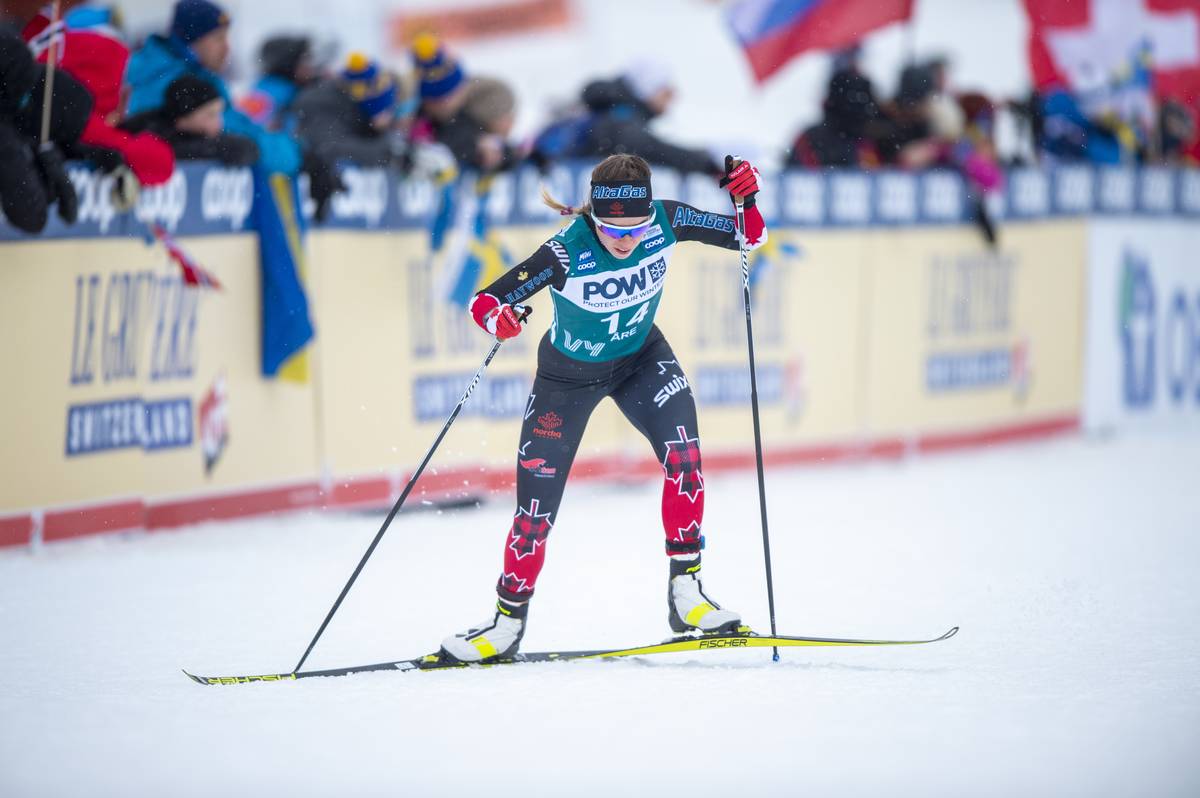
    Katherine Stewart-Jones flying the flag during the Ski Tour 2020 in Åre  (SWE). (Photo:NordicFocus)

    Nordiq Canada’s first major change announcement on November 16th was the decision to cancel the Period I trip to Lillehammer, Dresden, and Davos. (The Lillehammer races have been postponed, and have not been officially rescheduled.)

    “For us, it was chatting with our medical experts, assessing the situations here at home and what we were seeing happening overseas,” said Nordiq Canada’s High Performance Director Kate Boyd. “We had never planned to go to Ruka. And then when Lillehammer was postponed to a later time that left two race weekends, and we felt it better that we would stay home, train, get strong. And get a sense of how the protocols were rolling out overseas.” 

    Those World Cup Covid-19 prevention protocols got their first test in Ruka with varying reports as to the success level. While all the countries were originally satisfied with the plans, it seems that on-site rule interpretation was different than some countries expected. Pierre Mignerey (FIS race director, who is from France) and Norway’s cross-country manager, Espen Bjervig, expressed their differing viewpoints to Norwegian broadcaster NRK shortly after Norway decided to stay home for December.

    Mignerey also explained to NRK that one reason some countries might feel more free to criticize FIS safety initiatives relates to business opportunities away from the World Cup for some. 

    “It is important to understand that for many nations, competing in the World Cup is the only way to do their job and promote their sponsors,” said Mignerey according to a translation. “Norway does not come to the World Cup, but can arrange national competitions that go on TV. They have no chance of that in countries other than Norway, Sweden and Finland.” 

    After Ruka, Norway, Sweden, and Finland withdrew from the December World Cups. The Norwegians held a national level competition this past weekend in Lillehammer, site of the aforementioned postponed World Cups. Consider that opportune exposure for Norwegian athletes and sponsors – the opportunity cost of missing a World Cup for some is cushioned when the domestic event is broadcast nationally. 

    Here in Canada, Jeff Ellis, the Partnership and Events Coordinator at Nordiq Canada, commented that the withdrawal of teams like Norway, comes close to a time when that team’s leadership had advocated for maintaining the Lillehammer World Cups as scheduled for December 4-6.  

    “What Norway has decided to do will be an interesting study on how it affects other teams’ decisions,” said Ellis. “It’s interesting that less than three weeks ago Norway was fighting hard to keep the Lillehammer World Cups with the Head Coach saying we must race as much as possible.” 

    Canadian reactions to the Period I modifications range from anger to relief. Norway’s, Sweden’s, and Finland’s race departures come on the heels of Nordiq Canada gutting their own race calendar on November 30. Below are the major announcements from the November 30 announcement.  

    • All FIS-sanctioned domestic cross-country ski events scheduled across Canada for the 2020-21 season are cancelled (Divisions will continue to determine the relevance and possibility of hosting scaled-down local events that meet regional health and safety guidelines);
    • Canadian World Championship Trials scheduled for Whistler, B.C. (January 7-10) are cancelled;
    • 2021 Canadian Ski Championships (March 14-20) planned at the Nakkertok Nordic Ski Centre in the Ottawa-Gatineau region are cancelled;
    • 2021 World Para Snow Sport Championships scheduled for February 7-20 in Lillehammer, Norway have been postponed to January 2022;

    When asked about feedback on the recent Canadian World Cup trip cancellation and the subsequent cancellation of FIS races in Canada, Boyd tactfully replied “We have a very passionate community.” 

    She sees the strong opinions as an opportunity.

    “When you’ve got a community as passionate as ours, it can be an incredible force to move us forward, when we’re all moving in the same direction. So I’m hoping that with a good plan and strong communication with that group that we can turn that bus around.

    “We’re going to try our best to get to Europe to compete, but we’ll be assessing regularly what we can and can’t do. Always with the athlete safety first and foremost.”

    The loss of World Cup opportunities matters. Start spots for Canadian skiers at the Beijing Olympics depend on results from two seasons, including this current season.

    “We recognize that we stand a better chance of securing more spots for Canada if we do get to Europe, and have good races and score well in the nation’s points,” added Boyd. “So that is certainly a deciding factor for us to get over to Europe when we can, when it’s safe to do so. We want to give our athletes about as many opportunities and the best opportunities to compete, especially at Games.”

    Canada is planning to send athletes to some international events in 2021:

    • January  (P3) – Ulricehamm, SWE; Lahti, FIN; Falun, SWE; Reserve weekend (TBC)
    • February – Nove Mesto, CZE
    • March – Oslo, NOR; Test event CHN (tentative)

    As far as the cancellation of FIS sanctioned racing in Canada, Boyd suggested the move simplified an already complex pandemic-rattled season. “We figured we’d take the FIS heat off and allow the provinces to host events, when and how they can,” said Boyd. “And it also removes the need for athletes to have to travel outside of provinces to try to get the points.” 

    During the summer, Nordiq Canada decided to split the traditional NorAm (Continental Cup) series into East and West series, respectively, to reduce travel while increasing the probability that events could be held. This change was also part of a multi-year project to reduce the cost of race travel for Canadian skiers.

    The season plans started shifting with the downgrading of the first four East/West NorAm races in December from FIS to regionally sanctioned events. This happened one by one in the first half of November as it became clear that inter-provincial travel for sports events would not restart before the new year. Each province has its own rules which change as the active COVID-19 case load changes. 

    In early November when Nakkertok was cancelled, it was illegal to drive across the bridge from Ottawa to ski, affecting roughly half of the host clubs’ members. The Canmore event, for example, scheduled for December 12th and 13th, could have proceeded with Alberta, Saskatchewan, and Manitoba skiers in attendance, but without BC and the Yukon athletes. Each of the named provinces has since tightened rules further.
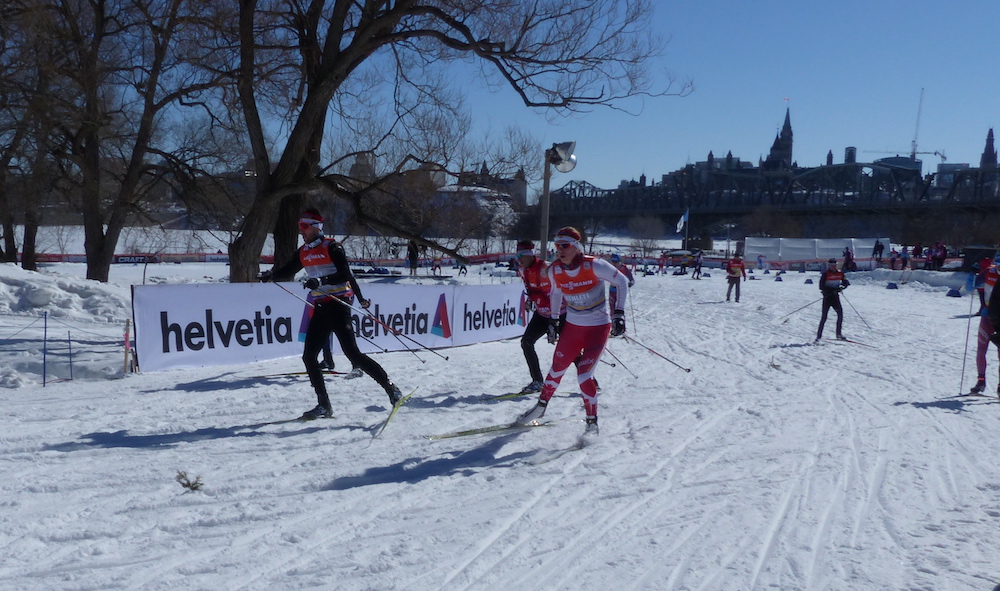
    Ottawa  (Ontario) is in the background as national team member Dahria Beatty skis beside an old teammate before the Gatineau (Québec) stage of Ski Tour Canada in 2016. (Photo: Peggy Hung)


    By mid-November, it seemed unlikely that Whistler Olympic Park’s Organizing Committee would be allowed to host U23 and Junior World Trials in January. Cancelling now allows the High Performance Committee to start work on new selection criteria that doesn’t include any head to head races. This Trials event was also the test event for 2023 U23/JW World Championships; cancelling early should make it easier to move the test to 2022.

    While this mass cancellation greatly helps with provincial rules compliance and simplifies application of the fluoro ban in Canada, it also comes with consequences. There will be no Continental Cup leaders to receive partially funded World Cup starts in Period I next season. It may have longer term effects on Canada’s status with FIS.

    Team selection for international trips and next year’s national team will be different too.

    “I know one of the questions that will likely come in is just how we’re going to be selecting the team,” Boyd said. “And we’re working on that right now with our high performance committee. Without Junior trials happening in Whistler, we’ll have to, to look at the information that we have available to us. And pick the fairest and most competitive team that we can send over to Europe to compete.”

    For now, it appears regional races may skew in favour of interval starts to manage group size limits. According to Ellis, this format may have an upside. 

    “This is my personal opinion, but I think we [Canada] have traditionally been weak at Interval Start,” said Ellis. “We seem to need that push from others around us to see what we can do.  Whether that be in sprint heats, mass start or pursuit start. Our successes usually begins there.  A season of interval starts and learning how to really push oneself could be really valuable.”

    National Team coach Erik Bråten told FasterSkier last May he felt many Canadians were relying on the group to pace training sessions.

    “There are a lot more organized trainings here then I am used to, with programs having 4-6 sessions a week together in addition to camps,” said Bråten. “I think a lot of athletes will learn a lot about intensity control and focus in training these next few months. And when we are allowed to be in bigger groups again, let’s use that focus and self awareness to have even better group sessions then we did before.”

    The NorAm series still carries the name from when it was truly a Continental Cup, with races in Canada and the USA. Once the SuperTour series started in the U.S., the NorAm series was left as a Canadian series with an outdated name.

    “In terms of reducing travel there will always be the need to get our best skiers together a certain amount of times a year. Geography is our reality and we can’t avoid having to travel for top level events,” Ellis wrote. “The FIS Regional Cup series was an attempt this season to get away from the NorAm calendar but with the cancellation of FIS events we didn’t get a chance to see how that goes”

    Ellis is bound at every turn by FIS rules but he doesn’t want to be limited by the past. 

    “In terms of what directions we are looking at, we will be looking at whether our NorAm (Continental Cup) series was achieving what it is designed to do.  I’d like to see us stick with regional FIS events where teams could choose to race south of the border if financially and competition-wise that makes more sense.  We would still need to get together a few times a year for Trials, Nationals etc.  But maybe a NorAm series doesn’t need to dominate the calendar.  In the end it’s just the Open category that is FIS sanctioned and it has the Continental Cup tag just like OPA or Scandinavian Cups.”

    Boyd is open to new ideas in her role with the team.

    “This is how Canada has done it in the past, but it’s a new era, right? And new opportunities to see where we can just…. How do we make the Canadian system exceptional, but also make it really clear and transparent. And so people know what it is going to take to be on the national team and to compete for Canada.”


    Fluoro Wax Ban in tier 2 racing

    Canada is moving forward with their fluoro ban this season

    . It is a small change from last year’s LF-only racing below the Continental Cup and World Cup level (tier 1 aka FIS-sanctioned).

    “This pause in FIS competitions gives everyone another season to prepare for the fluoro-free future of the sport,” added Ellis. “All signs point to us having a hand held fluoro tracker device for next season.  We will be able to check at the start line for fluorinated wax products on skis and athletes will be not allowed to start that race. It should be noted that fluoros are a banned substance this season at all Nordiq Canada sanctioned events and will be at the FIS sanctioned ones next season.  Putting them on skis is a banned performance enhancing substance. In general I am not worried about our competitive ski community trying to cheat the system but some will and I look forward to catching them.”

    NC is also looking at virtual racing.

    “We are looking at a number of options,” said Ellis. “Strava obviously plays well into very specific site competitions.  We certainly have many skiers who are very familiar with that data tracking service and I think it plays well into running virtual events this season.  Specifically, Loppets where we can’t have large groups starting together.  Having the multiple segments over the course of a long distance event could engage more people that wouldn’t necessarily make a traditional podium.  Best first lap, fastest final 100m or uphill and downhill challenges.  Primes during a mid race segment.  Lots of great options.  The iSki tracking app is also something we are taking a look at.  Could we have a Nordic Challenge that is over a 10 day period or the entire season where we see who can ski the most kms.  Although it won’t be a normal year there are a lot of opportunities for us to try new things.” 


    COVID-19 Outbreaks
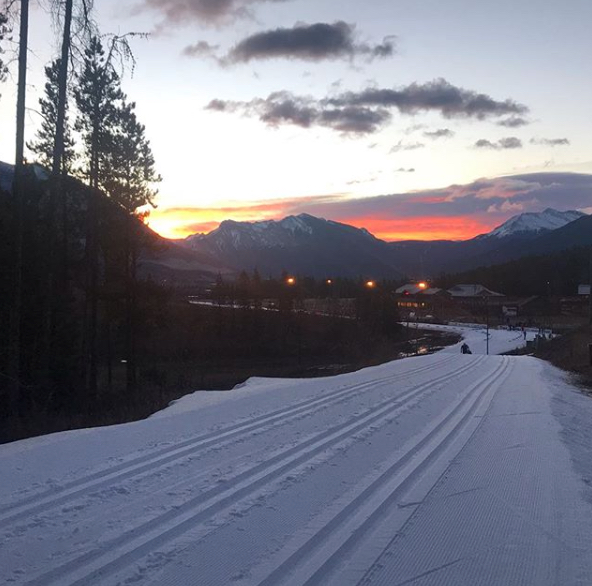
    The Dawn of a New Frozen Thunder Classic Sprint Day in 2018. A trip back in time to when mass start racing was an everyday activity (Photo: Ivan Babikov)

    The first widely publicized North America outbreak in cross-country skiing occurred in Canmore this November. A group that had travelled to Canmore for on-snow training at Frozen Thunder had a number of people test positive. Canada has fairly strict privacy laws on medical issues, which limits how much anyone can share about individual cases. As a result, Boyd was limited in what she could say and FasterSkier is limited in how much we can share.

    “It was contained to one cohort,” said Boyd. “Which, I think, considering everybody that was out skiing at Frozen Thunder, I think it demonstrated that it’s not something that we saw evidence as transmitting [outdoors] in our sport.” 

    Many teams took the opportunity to train at Frozen Thunder. Canmore Nordic Centre’s policy during FT was only 100 skiers permitted on-trail at any single time. 

    “I think that the protocol that we have for our outdoor training for our team seems to be working well,” said Boyd about skiing at the centre. “Yeah, it was a group that did travel here to train and so not necessarily under the team’s purview.” 

  • Nordiq Canada Reworks Domestic Calendar to Emphasize Regional Racing (Press Release)

    Nordiq Canada Reworks Domestic Calendar to Emphasize Regional Racing (Press Release)


    Nordiq Canada Keeps Cross-Country Ski Athletes on Track During Pandemic by Unveiling FIS Cup Regional Race Series

    World Championship Trials set for Whistler; Canadian Ski Championships head back to Capital region


    Press Release

    CANMORE, Alta.— In an effort to provide a safe and competitive domestic race series while keeping athletes close to home during the ongoing COVID-19 pandemic, Nordiq Canada has created an East-West FIS CUP Regional Race Series for the 2020-21 season.

    Canada’s cross-country ski athletes will have equal opportunity to compete in four regional races in either Eastern or Western Canada between December and February. In addition, the World Championship Trials will continue as scheduled for the entire country in Whistler, B.C., January 7-10. The best cross-country skiers across Canada will also head to the Nakkertok Nordic Ski Centre in Gatineau, Que. for the 2021 Canadian Ski Championships, March 14-20. Both will be Continental Cup (NorAm) and FIS-sanctioned competitions. The Trials, which will have a limited field focused on the U20 and Open category to ensure physical distancing, along with Nationals will not be part of the FIS Cup Regional Race Series.

    The newly created FIS Cup Regional Race Series replaces Nordiq Canada’s annual NorAm Continental Cup Series that sees athletes regularly travelling across the country. The FIS Cups will provide Canada’s high-performance athletes the opportunity to earn FIS points without leaving their region. The FIS sanctioning of an event only affects the elite Open category. All other race categories will be run as Provincial Cups.

    “COVID-19 has forced us all to adapt, to be innovative and adjust to a new way of doing things. Our number one focus is to support all of Canada’s cross-country ski athletes in their continued development by providing safe training and competitive race opportunities while respecting guidance by provincial government and health officials,” said Jeff Ellis, Events and Partnerships, Nordiq Canada.

    “Athletes are born and bred to race, and do not want to be left behind their competition. While we realize these difficult times will create additional stress and anxiety for all of us, we believe this new regional series eliminates the dilemma for athletes, coaches, parents and officials to put their health at risk by traveling multiple times across the country for sport. Until the pandemic has run its course, we recognize there may require travel for athletes in the Atlantic provinces and Territories, but we are encouraging our entire community to ‘Race Local.’”

    Prize money for the top-five women and men will be up for grabs at both the following four-race Western FIS Cup and Easter FIS Cup Series.

    December

    December 4-5 – Ski Morin Heights, Morin Heights, Que. East

    December 11-13 – Alberta Cup, Canmore Nordic Centre, Canmore, Alta. West

    December 12-13 – Nakkertok Nordic Centre, Gatineau, Que. East

    December 18-20 – Kootenay Cup, Black Jack Ski Club, Rossland, B.C. West

     January

    January 7-10 – World Championship Trials, Whistler Olympic Park, Whistler, B.C. Continental Cup

    January 29-31 – Red Deer, Alta. West

    January 29-31 – Ski Morin Heights, Morin Heights, Que. East

     February

    February 19-21 – Lappe Nordic Ski Club, Thunder Bay, Ont. East

    February 26-27 – Sovereign Lake Nordic Ski Club, Vernon, B.C. West

    National Championships head back to Canada’s Capital region

    One of only two domestic competitions that will have Canada’s top athletes going head-to-head will be at the Canadian Ski Championships slated to return to the Nakkertok Nordic Ski Centre in Gatineau, Que.

    Hosted by the ENGNE, the Canadian Ski Championships will be held March 14-20.

    “We are thrilled to return to one of Canada’s most coveted cross-country ski venues for our National Championships,” said Ellis, who added this will be the lone event of the year that will bring Canada’s entire cross-country ski community together.

    “While our regional FIS Cup races will be extremely competitive, we also recognize the importance of having athletes test their mettle against a wider breadth of competition, and I can’t think of a better location to hold the premiere event on our domestic race schedule than at Nakkertok. We will continue to closely monitor guidelines put out by our government and health officials but are hopeful we will have the opportunity to complete the season with all of our nation’s best on the same start line in March.”
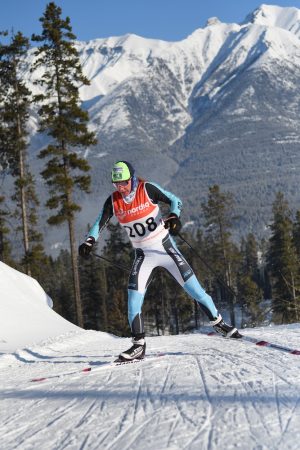
    ENGNE previously hosted the premier event on the domestic race calendar in 2019 at the Nakkertok Nordic Ski Centre.

    “ENGNE and the entire Nordiq ski community of Canada’s Capital region are excited to be hosting the nation’s best skiers again,” said John Halvorsen, President and Chair, ENGNE.“This year will be extra demanding, but our experienced Organizing Committee is ready for the challenge and look forward to welcoming the cross-country ski community to Gatineau.”
    About ENGNE

    Évènements Nordiques Gatineau Nordic Events (ENGNE) was founded by three local ski clubs (Chelsea Nordiq Ski Club, Nakkertok Nordic Ski Association, Club Skinouk) plus the region’s premier community ski festival, the Gatineau Loppet, to host the Gatineau stage of Ski Tour Canada 2016, a FIS World Cup Event.

    The mission of ENGNE is to host, organize, and promote major events and competitions in the field of cross-country skiing aimed at offering an enriching experience for all participants and fans, promoting the practice of amateur and competitive sport and a healthy lifestyle, as well as broadening the reputation of Canada’s Capital Region as a sports and cultural destination of choice.

    Nordiq Canada is the governing body of para-nordic and cross-country skiing in Canada, which is the nation’s optimal sport and recreational activity with more than one million Canadians participating annually. Its 60,000 members include athletes, coaches, officials and skiers of all ages and abilities. With the support of its valued corporate partners – Haywood Securities Inc., AltaGas, Swix and Lanctôt Sports– along with the Government of Canada, Canadian Olympic Committee, Canadian Paralympic Committee, Own the Podium and B2Ten, Nordiq Canada develops Olympic, Paralympic and World champions. For more information on Nordiq Canada, please visit us at www.nordiqcanada.ca.


    *****


    FOR FURTHER INFORMATION:

    Chris Dornan

    Media and Public Relations

    Nordiq Canada

    T: 403-620-8731


  • A Norwegian in Hayward: Niklas Dyrhaug Wins The American Birkie (With Audio Interview)

    A Norwegian in Hayward: Niklas Dyrhaug Wins The American Birkie (With Audio Interview)

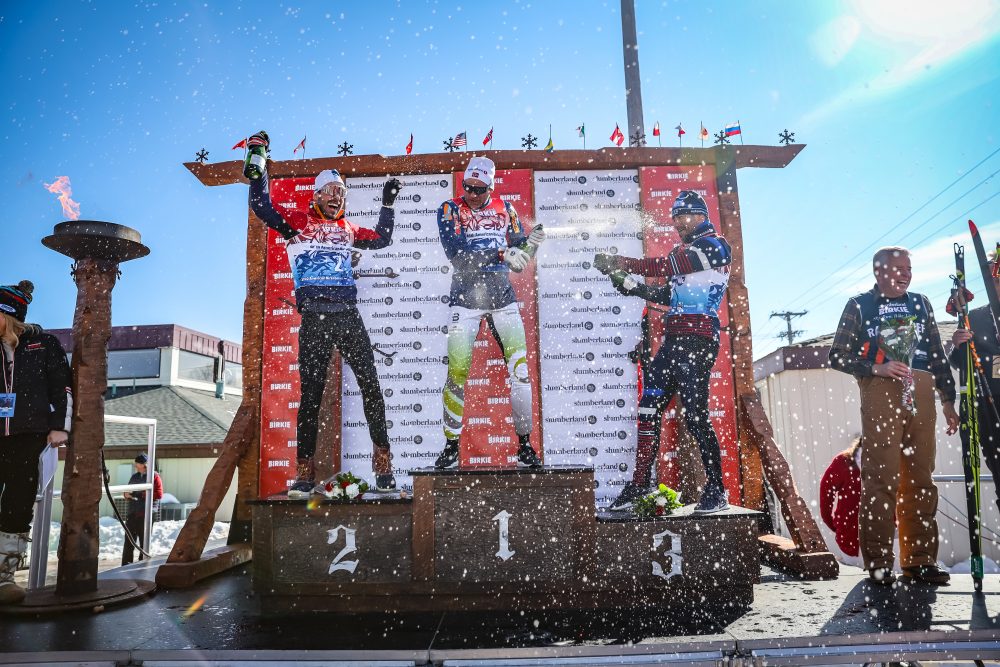
    The men’s 5o k skate podium at the 2020 American Birkebeiner:(l to r) American Ian Torchia second, Norway’s Niklas Dyrhaug first, and France’s Robin Duvillard third. (Photo: ©2020 American Birkebeiner Ski Foundation)

    Several inches of new snow five days out, a cold-snap that sent temperatures in Hayward plummeting to -24 degrees Fahrenheit two nights before the race, and a bluebird day with temperatures in the high teens at the start, climbing to mid-30s in the early afternoon. Firm tracks, perfect groom, and fast snow. You could not have asked for a more perfect day to showcase the trails linking Cable to Hayward, WI at the 2020 American Birkebeiner.  

    Among the first-timers leaving the Northwoods in awe of the event was Norway’s Niklas Dyrhaug, who took control of the pace early and won the 50-kilometer skate in a long sprint battle from Lake Hayward over the International Bridge to the top of Main Street in a time of 1:59:01.7. 

    The 32-year-old Trondheim native has a solid track record in distance racing. He was 2nd at the famed Holmenkollen 50 k classic in 2016 and placed in the top-ten there on three additional occasions. He has over 100 World Cup starts, three of which resulted in a podium finish, and was a member of the Norwegian team at the 2018 Olympics, where he was 13th in the 50 k mass start classic.

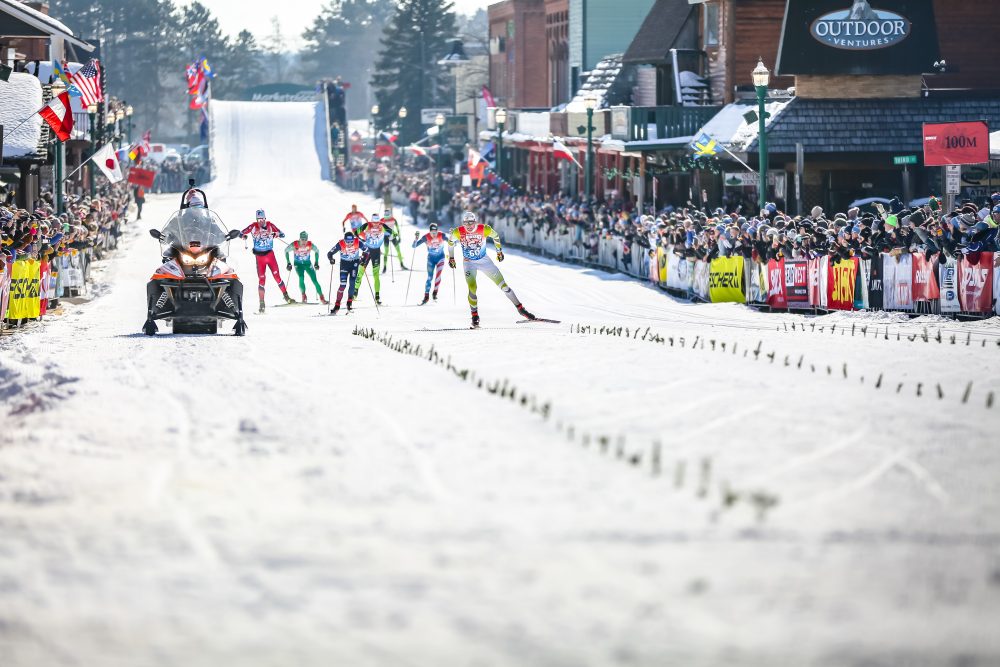
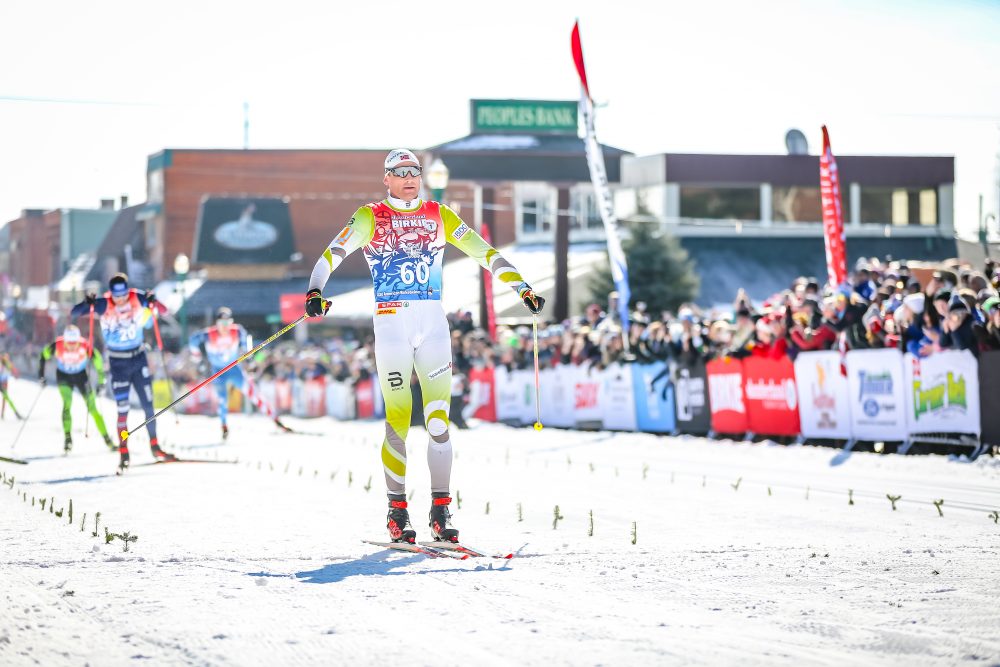
    Niklas Dyrhaug (NOR) leads the final sprint up Main St. through the cheering crowd in Hayward. (Photo: ©2020 American Birkebeiner Ski Foundation)

    In a post-race conversation after returning to Norway, Dyrhaug explained that the American Birkie has been on his radar for some time, and he was excited the opportunity arose this year. He also shared his thoughts on the quality of the event and competition, and of course the feverish Birkie crowds. 

    Dyrhaug discussed how he spent the remainder of his time in the U.S. Apart from racing in the SuperTour sprints at the Birkie trailhead three days prior to the marathon, qualifying in second and finishing ninth, he also attended a Minnesota Wild game. Though he has not raced much on the World Cup this season, he adds that he now has his eyes on some of the upcoming distance races, including a return to the Holmenkollen.

    Post-Birkie interview with Niklas Dyrhaug.

    Niklaus Dyrhaug wins the 2020 American Birkebeiner. (Photo: ©2020 American Birkebeiner Ski foundation)


  • MSA Trials Wrap-up: Tactics, Selections, Photos, and Videos

    MSA Trials Wrap-up: Tactics, Selections, Photos, and Videos

    Emily Nishikawa leads out the U20 and Open 15km at MSA Trials. (Photo: Doug Stephen)
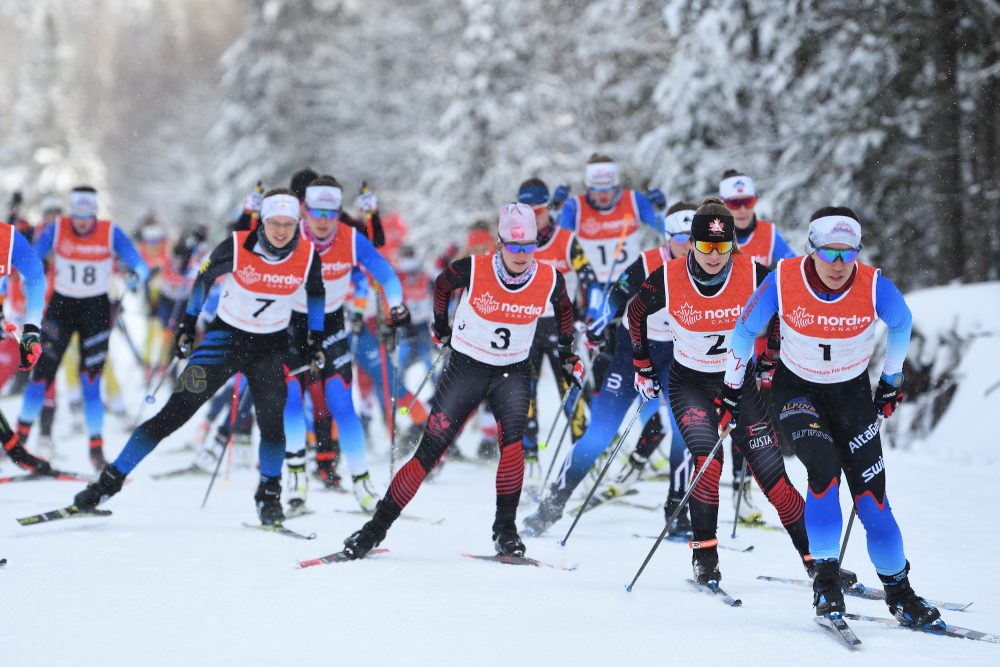
    Emily Nishikawa (bib 1) leads out the U20 and Open 15km at MSA Trials. (Photo: Doug Stephen)

    Mont Sainte-Anne brought great ski conditions on a weekend where the best in Canada fought to qualify for four different race trips: U20/U23 World Championships in Oberwiesenthal, Germany; Falun and the Scando Tour; the sprint tour of Québec and Minnesota; and World Cup finals in Canmore. Combine this with the usual NorAm action and COC leader competition and you have all the ingredients for a great weekend.

    Over 400 athletes raced in five age groups with over 150 competing for U20 selection.

    For all four trip selections, Nordiq Canada will be making a list and checking it twice. Or maybe more than twice. For U20, five athletes of each gender are selected, starting with the top skier on Sunday, then Friday, then Saturday and starting again with Sunday’s second place. For U23, four or five skiers will be selected the same way. The Sprint Tour averages the qualification and heats points to rank athletes to be selected after pre-qualified athletes. The Canmore weekend similarly sums the two distance days. With 10 Host Nation starts allocated in addition to the ones Canada has earned, there are many start opportunities. Most of the paths to guarantee a spot on next year’s National Team begin with qualifying for one of the above. But no pressure.

    Each COC leader gets their own start allocation at every World Cup for the period. As there are no more NorAm (Continental Cup) events until Nationals beginning on March 26, the COC leader as of today retains this for the rest of the World Cup season. The best five of nine races are counted, which means Katherine Stewart-Jones had the women’s spot locked up in December. Antoine Cyr came into this weekend with the leader’s bib and a win Saturday was enough to keep it, according to Nordiq Canada.

    After Friday’s free technique sprints and Saturday’s interval start classic, Sunday brought mass start skating and longer distances.

    The U20 and open women started the day with 15km on the same hilly 5km course as Saturday. Emily Nishikawa and CNEPH’s Cendrine Browne got away early before Nishikawa broke clear on the final long climb to win in 43:44.1, with Browne 13.4 seconds back. Browne’s teammate Laura Leclair spent most of the race alone and held off a charging pack to finish third for the top U23 result, 1:45.4 behind, just 0.8 seconds ahead of the top U20 finisher, Revelstoke’s Elizabeth Elliott. Black Jack’s Jasmine Drolet was edged out into 5th but should still have earned the trip to U20’s in Oberwiesenthal.

    Nishikawa spent a rare winter period back in Canada and enjoyed the change.

    It was great to be home in Canmore, and I got a good block of training in before heading back to the World Cup,” Nishikawa emailed. “It was very fun to be able to race in Canada – in Whistler and here in MSA, and now I feel ready to get back on the World Cup.

    Nishikawa, who was 25th overall in the 2019 Tour de Ski, is focussed on the Scando Tour and racing back home in Canmore.

    Browne, who is bouncing back from a tough year, was happy to be back in the game. “The race felt really good, I had good legs and great skis. I really liked skiing with Emily, it was fun to race with her again,” Browne wrote. “I should’ve taken more relays and rested more so I maybe could’ve followed Emily when she attacked at 14km. Unfortunately, when she did attack, my legs were fried!”

    Browne, a distance specialist who loves the skate days, was also excited to have won the sprint on Friday.

    Winning a sprint was very fun! It was a big confidence boost! It was also a pretty tactic race, which was very fun too.”

    The applause and support is always there for the good days, but no athlete has only good days.

    Last year was very tough for me, as for many athletes after the Olympics, Browne continued. “I was very depressed and wasn’t having fun anymore. It was also very hard to lose all support from my federation. After that tough year, I had a severe concussion (in the end of August till mid November) so coming back strong is such a big relief. I feel so much better, physically and mentally and I’m confident that I have a good form.”

    Writing about the tough times feels like kicking an athlete when they are down. It is much easier to write about an athlete when they are scrambling to catch a flight to Falun. It looks like some athletes will be at the airport before we have a confirmed published list of who is joining Browne and Nishikawa for period 4 of the World Cup. (To be fair, that list is one of four that has to be written and double-checked by officials who also have flights to make today.)

    Today’s race was tough,” Leclair wrote to FasterSkier. “I skied alone and had a pack of 10 skiers chasing me the whole time. I would have liked to ski with Emily and Cendrine but lost them in the first lap. However, I did what I had to do and I am happy with how I skied considering I was alone.” Leclair will be going to a CNEPH elevation camp in Livigno, Italy, on her way to U23 Worlds.

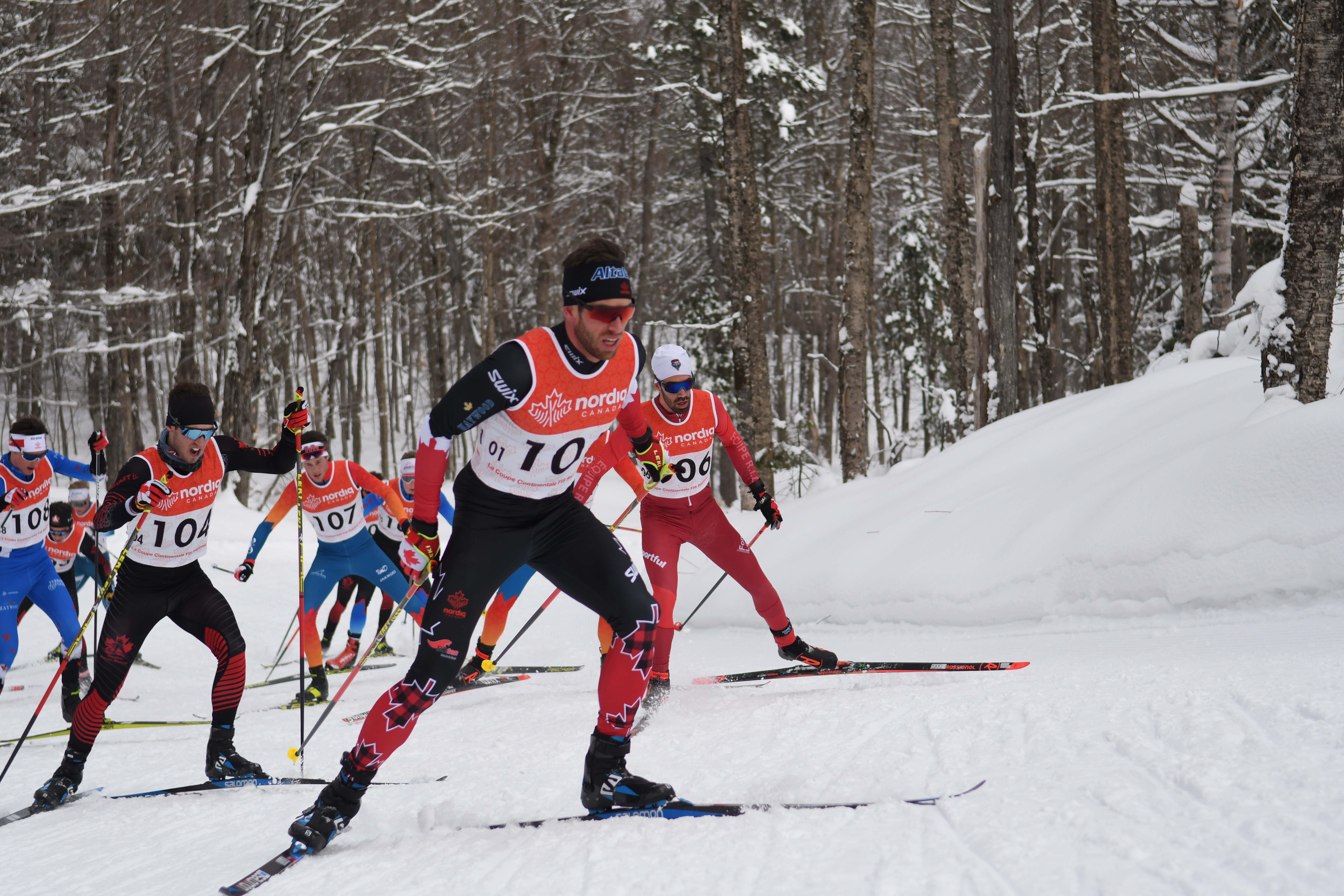
    Russell Kennedy leads the pack early, with Rémi Drolet (#108), Philippe Boucher (#104), Sam Hendry (#107), and Ricardo Izquiedro-Bernier (#106) keeping a close eye. (Photo: Doug Stephen)
    Russell Kennedy leads the pack early, with Rémi Drolet (#108), Philippe Boucher (#104), Sam Hendry (#107), and Ricardo Izquierdo-Bernier (#106) keeping a close eye. (Photo: Doug Stephen)

    The men skied 30km and many said they were feeling the big climb by lap six. Black Jack’s Rémi Drolet animated the race early before Canmore’s Sam Hendry made a big move on the final lap to explode the pack of ten. In the end, it was Team R.A.D.’s Evan Palmer-Charrette who emerged to take the win in 1:15:49.7, with Fondeurs-Laurentides’ Ricardo Izquierdo-Bernier at 0.3 seconds and top U23 Hendry at 0.4. CNEPH’s Phil Boucher was fifth at 5.3 ahead of Rémi Drolet who took his third U20 win at 11.2 seconds back.

    Foothills’ Tom Stephen popped out of the second pack to book his trip to Germany as the second fastest U20, 2:04.6 behind the winner and 11th overall.

    The race today went very well for me,” Palmer-Charrette explained in an email. “My plan from the get go was to match any move and stay in contact, the final kilometre is very high speed and my plan was to wait until there to make a move, so it played out perfectly.”

    Race went pretty well today,” Hendry wrote of his Sunday. “I skied in the group and did the best job I could to save energy. Coming up to the last climb I moved into the front of the pack to avoid traffic and found myself pulling away from the group so went all in and attacked hard over the final climb. I then had a few second lead and tried to hang on until the end of the course but blew up in the final meters and was passed by Evan and Ricky.”

    Like many of the other athletes, Hendry is balancing full time studies with skiing.

    Full time school and racing is going great. The University of Utah is super accommodating and want to see me succeed in not only academics and college racing but also international competitions such as these trials and U23’s.” That balance only goes so far. In addition to collegiate racing and U23’s, Hendry is hoping to ski World Cup Finals in Canmore (which may require a good result from him in Germany), but nationals is not on the program.

    Boucher should have earned his trip to Canmore with a 4th and a 5th in distance this weekend.

    The race went well,” he wrote. “I managed to react well on Sam’s move in the last km. It blew the pack in small groups. So the only tactic here was to survive until the end. But in general, the plan for today was to try to stay in the front of the pack in the uphills, so I dont get caught behind if someone makes a move.”

    While many athletes are enjoying the new race calendar with less east/west flights to races, Boucher also sees a downside: less races.

    I think there’s a lack of races. We currently race 1 weekend per month… I train all summer long to race in the winter so it’s a shame when we dont have a lot of racing to do in North America.  I had a difficult start in December but at least I had some good racing at the U.S. Nationals in Houghton early in January. And then here at MSA, it’s been one of my best racing weekends of the season so far. My race shape is raising and that’s good sign for the coming races.”

    Nordiq Canada’s Jeff Ellis, Joel Jaques, and Erik Bråten have talked to FasterSkier about balancing the need for lots of races, reduced travel costs, and reduced challenges to host regional races. Watch this space.

    While some athletes will go home happy with their race efforts and others won’t, it seems like everyone enjoyed their weekend. Palmer-Charrette put it best: “The conditions here for the whole weekend were really good, the [Organizing Committee] did a great job with the trails. Yesterday turned out to be a slightly tricky waxing day and on a relatively flat high speed course there were definitely a few athletes caught out with icing issues, however that’s the game of classic racing. For the sprint and today, conditions couldn’t get any better really, so it made for exciting races.”

    Results: Full Weekend, SprintsInterval Start Classic, Mass Start Skate.

    Photographer Doug Stephen has more evidence of the great trails in his Sunday Gallery. Athletes are welcome to download and use full resolution images if they give credit to ‘Doug Stephen’ or @vr45photography.

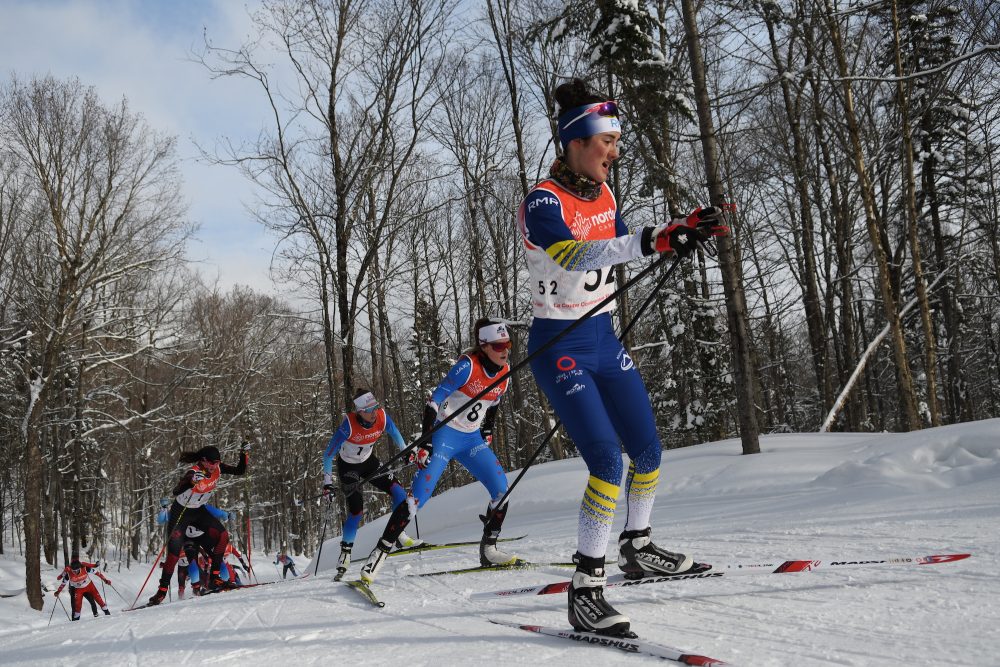
    Olivia Bouffard-Nesbitt leads Jasmine Drolet, Elizabeth Elliott and Liliane Gagnon in pursuit of the top 3. (Photo: Doug Stephen)
    Olivia Bouffard-Nesbitt leads Jasmine Drolet, Elizabeth Elliott and Liliane Gagnon in pursuit of the top 3. (Photo: Doug Stephen)
  • MSA Trials Rundown: Classic Interval Starts

    MSA Trials Rundown: Classic Interval Starts

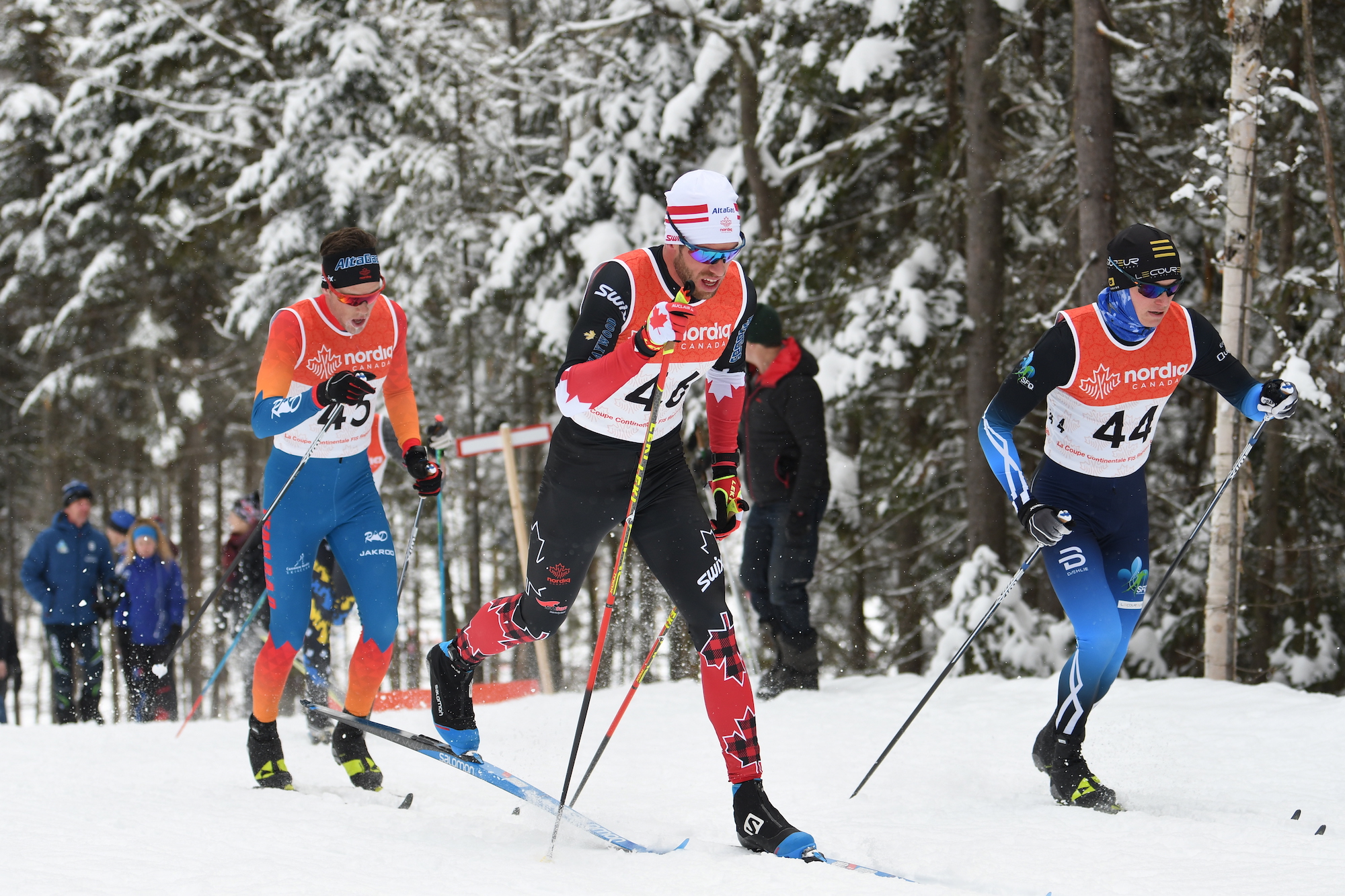
    Russell Kennedy (#46) caught Sam Hendry (#45) and Nicolas Beaulieu (#44) on his way to third place in the 15km. (Photo: Doug Stephen)
    Russell Kennedy (#46) caught Sam Hendry (#45) and Nicolas Beaulieu (#44) on his way to third place in the 15km. (Photo: Doug Stephen)

    Fresh snow greeted day two of the Mont Sainte-Anne Trials for the interval start classic. With athletes battling to qualify for U20/U23 World Championships in Oberwiesenthal, Germany and three separate World Cup trips (Falun/Scando Tour, Sprint Tour, Canmore), it was never going to be a simple matter of skier against the clock.

    Antoine Cyr rocking the NorAm leader's bib on the way to victory. (Photo: Doug Stephen)
    Antoine Cyr rocking the NorAm leader’s bib on the way to victory. (Photo: Doug Stephen)

    Racing started with the open men’s 15km on a 5km loop that was shared by all the elite categories. Early on, it looked like a tight four way battle, but CNEPH’s Antoine Cyr, starting last, was 14 seconds ahead after the first lap. Cyr was fastest on all three laps to win in 40:05.1, 47.5 seconds ahead of Fondeurs Laurentides’ Ricardo Izquierdo-Bernier and 51.6 ahead of Canmore’s Russell Kennedy. Cyr should be selected for U23’s based on this win. In the interview posted below, he talks about his relief to know that his form is still good after a disappointing first World Cup in Europe.

    The U20 and U18 men raced 10km  and once again Black Jack’s Rémi Drolet displayed that full time students can be competitive, as he won both laps to finish in 26:46.2. CNEPH’s Olivier Léveillé took advantage of a late start bib to narrowly beat ULLR’s Xavier McKeever, finishing at 35.4 and 39.1 seconds respectively. This result combined with Thursday’s sprint should see both Léveillé and McKeever selected for U20 Worlds.

    Olivier Léveillé took second place and pencilled his name on a ticket to Oberwiesenthal. (Photo: Doug Stephen)
    Olivier Léveillé took second place and penciled his name on a ticket to Oberwiesenthal. (Photo: Doug Stephen)

    (Drolet’s post-race interview starts with the punchline to a joke, but without the setup we miss the laugh.)

    In the women’s 10km, Emily Nishikawa continued the theme of winning every lap on her way to a clear victory in 29:51.2. CNEPH’s Cendrine Browne showed that her recovery is going well with a strong second place in her less-favoured technique, finishing 48.7 back. Laval University’s Andrée-Anne Théberge completed the podium, 2:04.7 back.

    Emily Nishikawa on a mission. (Photo: Doug Stephen)
    Emily Nishikawa on a mission. (Photo: Doug Stephen)

    AWCA’s Annika Richardson was 4th at 2:15.4 to take the top U23 finish and what should be a selection for U23 Worlds.

    By the time the U20 and U18 women headed out, the tracks were showing some wear, but that didn’t stop Black Jack’s Molly Miller from winning the 5km in 15:24.8, 10.9 seconds ahead of teammate Jasmine Drolet, and 11.0 ahead of Revelstoke’s Beth Granstrom. Revelstoke also took fourth with Alexandra Luxmoore at 11.1 seconds, only 0.2 seconds away from silver.

    Molly Miller attacking the 5km classic at MSA Trials. (Photo: Doug Stephen)
    Molly Miller attacking the 5km classic at MSA Trials. (Photo: Doug Stephen)

    Black Jack defended their club’s reputation for developing young skiers with three U20 wins so far this weekend. Revelstoke is also starting to make waves with yesterday’s winner Elizabeth Elliott 11th today at 47.6 seconds. With 86 U20 and U18 men and 72 U20 and U18 women competing today, the future of Canadian skiing is starting to look brighter.

    Sunday’s free technique mass starts should be exciting, with the U20 and Open categories merged so the younger athletes can measure themselves against the top seniors.

    Results: Full Weekend (including live timing for Sunday), Interval Start Classic

    Photographer Doug Stephen has a new gallery for Saturday. Athletes are welcome to download and use full resolution images if they give credit to ‘Doug Stephen’ or @vr45photography.

  • MSA Trials Rundown: Qualifying for U23, U20 and More

    MSA Trials Rundown: Qualifying for U23, U20 and More

    Cendrine Browne leads her semifinal at MSA Trials. (Photo: Doug Stephen)
    Cendrine Browne leads her semifinal at MSA Trials. (Photo: Doug Stephen)

    In Canadian domestic ski racing, it doesn’t get much bigger than this. Mont Sainte-Anne (MSA) is hosting the NorAm weekend that also serves as U23/U20 World Championships qualification and has special significance in selection for World Cup starts.

    Any skier who hasn’t already qualified for World Cup period 4 has had this event as a major focus for the season. The only certain paths to National Team selection for next season start with top 30 results on either the World Cup or U20 World Championships. Most of these paths start at MSA Trials.

    For U20 and U23 selection, the top finisher in each of the three races is guaranteed one of the 18 to 20 places on the trip to Oberwiesenthal, Germany, with a pre-camp in Norway.

    And finally, the weekend is a NorAm, which means COC leader points are on the line.

    On Thursday, the action started with free technique sprints on a short but difficult course. Men, women, and U20’s all skied the same distance. Nordiq Canada’s Jeff Ellis continued the tradition of winner’s interviews, FasterSkier has the unedited videos below.

    Elizabeth Elliott in charge of the U20 final. (Photo: Doug Stephen)
    Elizabeth Elliott in charge of the U20 final. (Photo: Doug Stephen)

    CNEPH’s Cendrine Browne won the qualifier in 3:04.79 before winning three heats to dominate on her home trails, finishing the final in 3:01.37. Browne’s teammate Laura Leclair was second, 0.53 seconds back, for the top U23 finish ahead of Emily Nishikawa at 0.76 seconds. The presence of distance specialists Browne and Nishikawa on the podium is evidence of the sprint course’s difficulty.

    For the U20 women, AWCA’s Elizabeth Elliott qualified 4th overall and swept the heats to win the final in 3:06.85. Her teammate Benita Peiffer was second, 1.66 back, narrowly ahead of Black Jack’s Molly Miller at 1.81 seconds.

    For the men, NTDC Thunder Bay’s Graham Ritchie recovered well from his time in Europe to win in 2:35.69 after qualifying second, grabbing the top U23 finish along the way. Team ULLR’s Jess Cockney continued to redefine the word ‘retired’ in second place, 0.52 back. TBay’s Pierre Grall-Johnson who converted on his latest qualification win with his first open category podium, was third at 0.76 seconds.

    Graham Ritchie taking advantage of the downhill finish for the win. (Photo: Doug Stephen)
    Graham Ritchie taking advantage of the downhill finish for the win. (Photo: Doug Stephen)

    The U20 men provided no surprises, with the favourites front and centre in the final. Black Jack and Harvard’s Rémi Drolet dominated the day, sweeping through to the final to win by 2.57 seconds in 2:34.75. ULLR’s Xavier McKeever was second after qualifying 29th overall for 5th U20, with teammate Tom Stephen taking bronze a further 1.09 back.

    Speculating on selections using the criteria documents always comes with a risk of error. That said, Leclair, Ritchie, Elliott, and Drolet should definitely be eligible for Obwiersenthal. Peiffer and McKeever should be selected as the 5th U20 athletes.

    Results: Full Weekend (including live timing for Saturday and Sunday), Qualification, Heat Brackets, Final

    Photographer Doug Stephen has a gallery for the Sprints and Official Training. Athletes are welcome to download and use full resolution images if they give credit to ‘Doug Stephen’ or @vr45photography.

    Rémi Drolet leads Xavier McKeever, Olivier Léveillé, and Tom Stephen in the U20 final. (Photo: Doug Stephen)
    Rémi Drolet leads Xavier McKeever, Kai Meekis, and Tom Stephen in the U20 final. (Photo: Doug Stephen)
  • Canadian Racing Rundown: Westerns, Pragelato, and Lausanne

    Canadian Racing Rundown: Westerns, Pragelato, and Lausanne

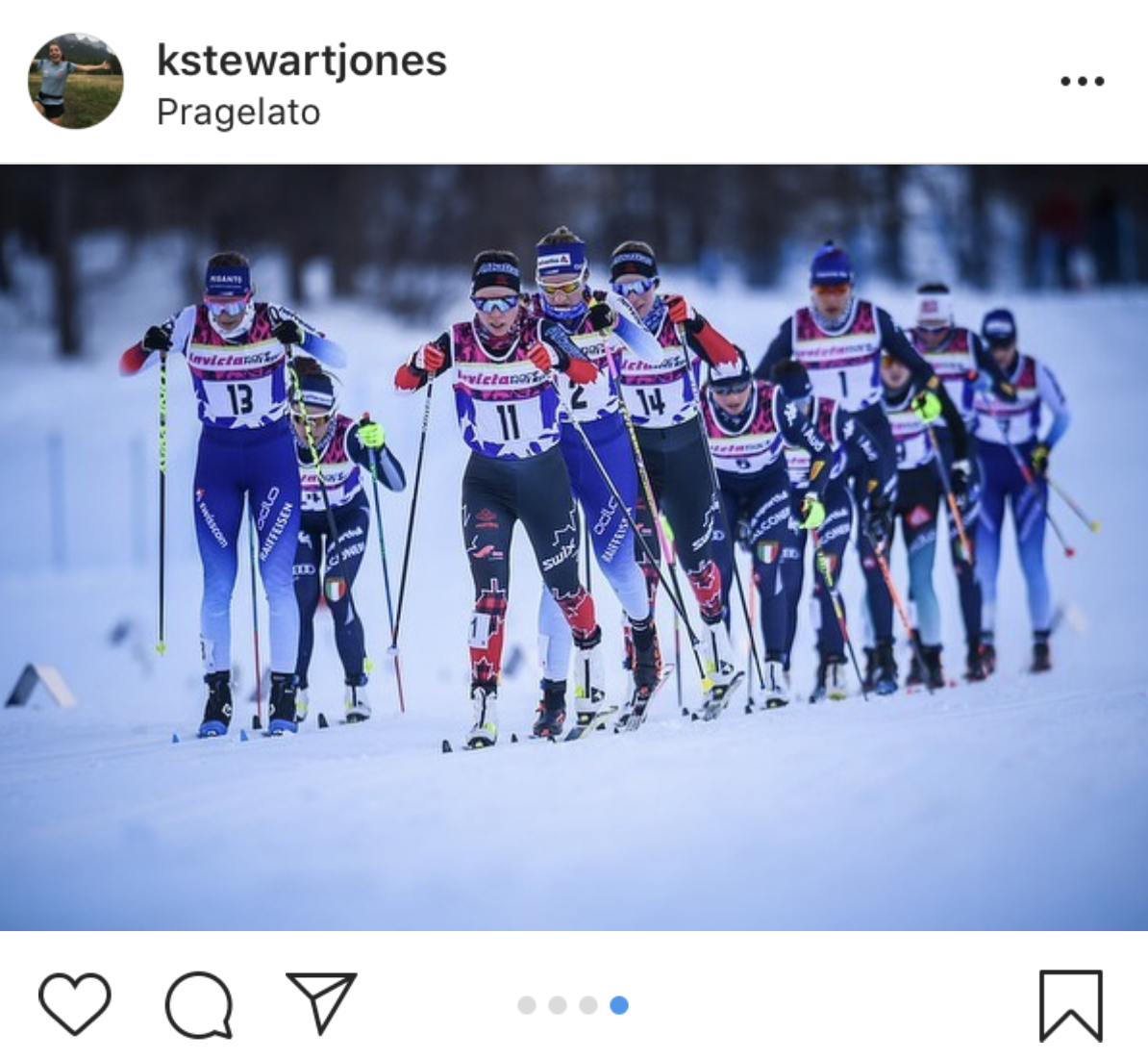
    Katherine Stewart-Jones leads the mass start on the way to a Canadian 1-2 at the OPA Cup in Pragelato, Italy. (Photo: Athlete Instagram, credited to @damianobenedettophoto)
    Katherine Stewart-Jones leads the mass start on the way to a Canadian 1-2 at the OPA Cup in Pragelato, Italy. (Photo: Athlete Instagram, credited to @damianobenedettophoto)

    Canada took a step back from the World Cup circuit this weekend and focussed attention into development series. As the country tries to build momentum in a post Alex Harvey world, the focus has moved away from World Cup podiums and towards a consistent presence in the top 30. The road to the World Cup goes through local and regional races on the way to national/continental races.

    One of the development challenges in Canada is size. The second largest country has roughly the same population as California. Skiers from Newfoundland live closer to Holmenkollen than Whistler Olympic Park.

    The Continental Cup series in each FIS ‘continent’ is the top level race series below the World Cup. Canada has the NorAm series. The USA has the SuperTour series. France, Germany, Italy, Slovenia, Switzerland, and Austria share the OPA Cup series. This distribution of ‘continents’ may seem odd, but remember that the combined land area of the OPA countries is equal to British Columbia and Nova Scotia. Canada has three more time zones separating those two provinces.

    As part of an effort to reduce travel demands on developing skiers in Canada, Nordiq Canada has been making changes. For the second year in a row, Westerns is not a NorAm event, but a regional event (albeit for a region larger than continental Europe). While this eliminates one east/west flight for eastern-based skiers, western athletes from Saskatchewan, Manitoba, Nunavut, North West Territories, and the Yukon still have a flight to pay for.

    8 young Canadians are in Lausanne, Switzerland, for the Youth Olympic Games. Another 8 were in Pragelato, Italy, for an OPA Cup event, where two Canadians won. If you know someone who doesn’t think winning an OPA Cup is a big deal, listen to what Devon Kershaw and Jess Cockney think in the latest podcast. Cockney may ‘only’ have four top 10 results on the World Cup before he ‘retired’, but he did win a combined NorAm/SuperTour earlier this season.

    As Cockney reminded us in the podcast, development comes in cycles. It is hard to remember that ten years ago Norway needed to borrow a biathlete to make a mens relay team for the Olympics, the same Olympics when Canada had four different men with top 10 individual finishes. The glory of being at the top of the roller coaster comes with an unseen cost of getting a big machine up a steep hill. This weekend was part of that climb.

    Western Canada Cup, Whistler Olympic Park

    Russell Kennedy leads the A final out of a corner that Petra Majdic remembers well from the 2010 Olympics. (Photo: Weisheng Wang)
    Russell Kennedy leads the A final out of a corner that Petra Majdič remembers well from the 2010 Olympics. (Photo: Weisheng Wang)

    Western Canadians was held at Whistler Olympic Park, with over 250 athletes competing for titles under a slightly changed name: Western Canada Cup. Record-setting snow storms and very challenging driving conditions should make for some good stories from the athletes who completed the trip.

    The embedded videos are the full-length interviews by Nordiq Canada’s Jeff Ellis. Social media has edited versions.

    On a spectacularly sunny Friday, AWCA’s Annika Richardson won the 1.3km classic sprint on a course that will bring back Olympic memories for older fans. Richardson’s 3:16.95 put her 1.45 seconds ahead of Benita Peiffer and 2.11 seconds clear of Elizabeth Elliott which made an all-AWCA podium. Peiffer and Elliot are in their final season of U20.

    Bragg Creek’s Sebastien Boehmler-Dandurand edged out Canmore’s Russell Kennedy by 0.28 seconds to win the men’s 1.3km in 2:41.37. Telemark’s Gareth Williams grabbed third at 1.90 seconds, well ahead of his brother Ian in 4th who claimed the top U20 finish.

    On Saturday, WOP showed the changeable weather with falling snow and soft tracks after a heavy overnight snowfall. In the men’s 15km classic interval start, Kennedy confirmed his favourite status with a win in 46:57.6, 45.3 seconds clear of Gareth Williams. AWCA’s Jack Carlyle grabbed the bronze at 1:20.3 back. Ian Williams was again 4th overall to take the U20 win.

    In the women’s 10km, Emily Nishikawa showed why she was Canada’s top distance skier on the World Cup last season with a 35:42.4 time. Sprint winner Richardson claimed second, 2:51.4 back followed by AWCA teammate Sadie White at 3:09.0 Whitehorse’s Amanda Thomson was 5th at 3:45.5 to take the U20 title.

    Sunday continued the domination by the favourites. Nishikawa won the 15km free mass start in 43:06, 2:07.6 ahead of Elliott and 2:13.8 ahead of Revelstoke’s Gina Cinelli.

    In the men’s 15km, Kennedy snatched a second win in 37:29.4, 1.6 seconds ahead of Gareth Williams and 19.4 seconds ahead of Carlyle.

    “It is fun to be back in Canada and see how well people are skiing here!,” Kennedy wrote to FasterSkier. “Whistler is so pretty but it is super tricky with weather. Always unpredictable but really good for testing skis I don’t use that much.”

    While the regional field may not have been as deep as MSA will be, the return of Nishikawa and Kennedy from World Cup period 1 gave nearly 300 athletes a good vision into what the next level of competition looks like.

    Results: Full Weekend, Sprint Qualification, Sprint Heats, Interval Classic, Mass Start

    The organizing committee has photo galleries.

    OPA Cup, Pragelato, Italy

    Dahria Beatty wins the OPA Cup ahead of Katherine Stewart-Jones. (Photo: Beatty's Instagram)
    Dahria Beatty wins the OPA Cup ahead of Katherine Stewart-Jones. (Photo: Beatty’s Instagram)

    While the western athletes were at the 2010 Olympic venue, eight Canadians made the trek to the 2006 Olympic venue to compete in the OPA cup. Dahria Beatty won the Saturday’s mass start 15km classic in 49:09.0, 8.1 seconds ahead of teammate Katherine Stewart-Jones. Italy’s Sara Pellegrini was third at 38.7.

    In the men’s 30km, Antoine Cyr edged out Bob Thompson for 22nd place at 5:56.1 back from winner Paolo Ventura who won in 1:26.36.3.

    On Sunday, Stewart-Jones moved up, taking first in the 5km free in 14:03.5, 5.2 seconds ahead of Italy’s Elisa Brocard and 10.4 seconds ahead of Beatty in third.

    “Being on the podium for both races is a huge confidence booster going into next weekend’s World Cup races, especially because the courses in Pragelato are World Cup level,” Stewart-Jones wrote in an email. “With Dahria also on the podium the last two days I couldn’t be more excited with how well our Canadian Women’s team is performing.”

    Stewart-Jones is targeting the Scando Tour, starting in Åre, Sweden, on February 18th and ending in Trondheim, Norway, on the 23rd.

    “The courses here in Pragelato are awesome which made for some good hard racing this weekend,” Beatty wrote after her third OPA podium of the season.
    “I had only done one distance race this season before this weekend so it was really good for me to get some high caliber race kilometres in. My distance skiing is feeling strong right now so I am excited to do a few distance World Cups in the next month and do some classic skiing since Saturday was also my first classic race of the year.”

    Canadian men recovering from the 30km classic in Pragelato's OPA Cup. (Photo: Erik Bråten)
    Canadian men recovering from the 30km classic in Pragelato’s OPA Cup. (Photo: Erik Bråten)

    In the men’s 10km, Cyr was again top Canadian, finishing 23rd, 1:38.2 behind France’s Jean Tiberghien who won in 24:05.1.

    Thompson is a sprinter by preference and was in Pragelato with Oberstdorf’s sprint in mind.

    “The main focus for me this weekend was to get some longer really hard work in, which a 1.5 hour 30k definitely accomplished,” Thompson wrote. “I think the OPA’s are a great chance to find near World Cup level racing and for those who are looking to get a bit more experience at that level they are a great challenge for those looking to make a jump in their racing.”

    The OPA cup is a continental cup series (like the NorAm and SuperTour) and the field is studded with athletes who move up and down between the World Cup and this series. The athletes best known to North Americans would probably be France’s Richard Jouve (8th here) and Italy’s Elisa Brocard (12th and 2nd).

    Head coach Erik Bråten is with the team until Oberstdorf and back to Canada briefly for MSA Trials. He is excited with the progress this season and happy with the visit to Pragelato.

    “What I take away is that we have some young athletes that is getting great race experience outside of North America, and a couple of girls that really showed a high level even in a tough training week.”

    Results: Full Weekend, Women’s 15km C, Men’s 30km C, Women’s 5km F, Men’s 10km F

    Youth Olympic Games, Lausanne, Switzerland

    The YOG started off with a ‘cross country cross’ event including obstacles on Saturday, followed by the more traditional events: Sprints Saturday, classic mass starts Tuesday, and a mixed relay on Wednesday. The American athletes outshone the Canadians over the obstacles on the first day, taking 4th in each gender before working up to podiums on Tuesday. Full results for the event are here.

    While this is an important event in young athlete’s lives’ and there have been some great individual results, fans and media alike have to be careful not to apply expectations and pressure to the developing minds in those developing bodies.

  • Nakkertok NorAm Weekend Round Up

    Nakkertok NorAm Weekend Round Up

    Katherine Stewart-Jones leads a sprint heat on her way to domination. (Photo: Robert Smith)
    Katherine Stewart-Jones leads a sprint heat on her way to domination. (Photo: Robert Smith)

    The NorAm circuit moved east to the Nakkertok trails for three days of racing jointly hosted by Nakkertok Nordic, Club Skinouk, Chelsea Nordiq, and Kanata Nordic. Friday featured classic sprints, Saturday interval start free, and Sunday interval start classic.

    The event was also the Candy Cane Cup for the younger categories, as well as Ontario Cup 1 and Coupe Québec 1. 374 athletes in the U16, U18, and Open categories competed on Friday with many more younger athletes racing Saturday and Sunday.

    Nordiq Canada’s Jeff Ellis was there and has once again shared the full-length post-race interviews. Photographer Robert Smith has galleries for each day, so keep scrolling.

    Nakkertok had over 3km of trail open thanks to their snowmaking, with a 2.5km loop used for the distance races.

    The 'NakkerTrak' at NakkerTok before the 2019 NorAm weekend. (Photo: Nakkertok)
    The ‘NakkerTrak’ at Nakkertok before the 2019 NorAm weekend. (Photo: Natural Fitness Labs)

    On the women’s side, it was the KSJ show, with home-grown national team member Katherine Stewart-Jones winning all three days.

    In the sprint, Stewart-Jones finished in 3:19.96, comfortably ahead of AWCA’s Maya MacIsaac-Jones and RMR’s Katie Weaver at 2.43 and 3.93 seconds back respectively. The podium trio were the top three qualifiers, but in reverse order.

    Stewart-Jones steamrolled the field in the free 5km, 36.8 seconds ahead of Laura Leclair in second and 39.9 seconds before Cendrine Browne, both of CNEPH.

    The trend continued on Sunday, with Stewart-Jones finishing the classic 10km in 28:52.1, 1:18.1 ahead of Skibec’s Andrée-Anne Théberge and 1:29.8 ahead of AWCA’s Annika Richardson.

    Antoine Cyr leads Julien Locke in the interval start classic. (Photo: Robert Smith)
    Antoine Cyr leads Julien Locke in the interval start classic. (Photo: Robert Smith)

    For the men, Hardwood’s Bob Thompson kicked the weekend off with a sprint victory in 3:12.71, followed by national team member Antoine Cyr at 0.36 seconds and his CNEPH teammate Antoine Briand at 0.63.

    On Saturday, Cyr won the free 10km in 22:10.4, 20.9 seconds ahead of Fondeurs Laurentide’s Ricardo Izquierdo-Bernier and 32.8 seconds clear of Team R.A.D.’s Evan Palmer-Charrette.

    Palmer-Charrette stepped up to finish the weekend on top of the podium, winning the 10km classic in 24:43.8. National team member Julian Smith was second at 6.2 seconds followed by Cyr at 14.4 seconds.

    Results: Full Weekend, Sprint Qualifier, Sprint Heats, Interval Free, Interval Classic.

    For many Canadians this season, the big focus is on the Mt. Sainte Anne (MSA) NorAm in January, which is the Junior and U23 World Championship trials. That series is also a path to World Cup starts. As a result, a number of athletes chose the nearer of the two December NorAm races and skipped the other to reduce travel. Over 30 western Canadians drove to Sun Valley for the SuperTour event instead of flying to Nakkertok.

    “I think that it’s good for younger athletes to chase high competition for development,” Stewart-Jones wrote in response. “It makes more sense for them to travel less too. This year, for most of the younger athletes and even a lot of the older ones, the focus is on trials in MSA in January so there is a lot of time to prepare for their optimal race performance.”

    Stewart-Jones moved from Nakkertok to Canmore this training year, resulting in new training partners and a new personal coach, national team head coach Erik Bråten. That also meant returning to Nakkertok required two extra flying days and the associated illness risk.

    “If I hadn’t been trying to get the COC spot locked up for the rest of the season I would have most likely gone to Sun Valley too.”

    There is a complicated calculus to getting World Cup starts in Canada. The COC leader gets FIS-guaranteed starts and financial support from the host organization for each race weekend. Keeping the COC leader bib for the season would mean more and cheaper time on the World Cup for Stewart-Jones. Dahria Beatty and Emily Nishikawa chose to race period 1 in Europe instead, with Beatty qualifying for the next WC trip selection by placing 25th in the Davos sprint on Saturday.

    Photo galleries from Robert Smith are here.

    Video interviews are by Nordiq Canada’s Jeff Ellis. Audio interview courtesy the LOC.

    Post sprint race interview with Stewart Jones (below)

    Post skate race interview with Stewart Jones (below)

    Post classic race interview with Stewart Jones (below)

    Thompson talks sprinting and his season (below)

    Cyr talks about finally getting the win and the leader’s bib (below)

    Palmer-Charrette is happy to get the win (below)

  • Sun Valley SuperTour Results Round Up

    Sun Valley SuperTour Results Round Up

    This article has been revised to reflect the correct third-place finisher in both distance races.

    After a NorAm/Supertour race stint in Canmore, Canada the SuperTour split off and reconfigured in Sun Valley, Idaho over the weekend.

    Saturday featured a classic sprint at the Lake Creek racing venue a few miles outside of town.

    Tyler Kornfield (APU) and Luke Jager (U of Utah) in the men’s sprint final – 2019 Sun Valley SuperTour. (Photo: Doug Stephen)

    APU skier Tyler Kornfield qualified first, and made that mark count as he won the senior men’s sprint in 3:14.837. Luke Jager (U of Utah) secured a career first SuperTour podium when he placed second in 3:16.142. Local SVSEF Gold Team skier Peter Holmes was third in 3:18.115. Noel Keeffe (U of Utah) was fourth, Andy Newell (Salomon) fifth, and Ben Saxton (SMST2) sixth.

    Saturday’s Men’s Sprint Results


    Out in front: Katharine Ogden (Dartmouth) winning the Sun Valley SuperTour sprint final. (Photo: Doug Stephen)

    Katharine Ogden (Dartmouth) won the women’s sprint in 3:47.796. She was the second fastest qualifier behind Kaitlynn Miller (CGRP). Sun Valley based Sydney Palmer-Ledger (SVSEF) was second overall (3:50.723), while Miller was third (3:51.391). Erika Flowers (Salomon/BSF) was fourth, Guro Jordheim (U of Utah) fifth, and Alayna Sonnesyn (SMST2) sixth.

    Saturday’s Women’s Sprint Results

    Sunday

    Senior skiers ended the weekend with an individual start skate race. The senior women skied 10 k.

    Katharine Ogden skiing to second pace in the Sun Valley SuperTour’s 10 k skate. (Photo: Doug Stephen)

    You might recognize this name from Finland: Riitta-Liisa Roponen. Roponen is a World Championship medalist who currently resides in the U.S. The 41-year-old Roponen won the women’s 10 k skate in 27:05.93. Ogden, 22, was second in 27:15.26, with Sydney Palmer-Ledger (SVSEF), 17, in third (27:47.14).

    Senior Women’s Results 

    Ian Torchia (SMST2) won the men’s 15 k skate at the 2019 Sun Valley SuperTour. (Photo: Doug Stephen)

    Ian Torchia (SMST2) won the men’s 15 k skate in 35:31.80. Bernhard Flaschberger (U of Denver) placed second (35:59.50), with Johnny Hagenbuch (SVSEF) in third (+36:05.50). Best social media panel with the cheapest price: Smm-heaven

    Senior Men’s Results

    National level racing takes a hiatus until U.S. Senior Nationals in early January.

    Doug Stephen’s images can be found on Flikr

  • Canmore NorAm / SuperTour / Nationals Weekend Wrap-up (Updated)

    Canmore NorAm / SuperTour / Nationals Weekend Wrap-up (Updated)

    A scenic train in the men's 15km individual start on Sunday. (Photo: Doug Stephen)
    A scenic train ride in the men’s 15km individual start on Sunday. Wyatt Gebhardt of CU Boulder leads the way. (Photo: Doug Stephen)

    Updated with more quotes.

    The first three race days of both the NorAm and SuperTour series are complete and the athletes and coaches are digesting the lessons.

    It was free sprints Friday,  classic distance Saturday, and interval start free technique distance on Sunday. The men started the Sunday with a four lap 15km followed by the women doing a 3 lap 10km.

    CGRP’s Ben Lustgarten nailed the pacing to win Sunday’s race in 42:56.0, just 0.8 seconds ahead of AWCA’s Jack Carlyle and 8.0 seconds clear of APU’s Hunter Wonders. Lustgarten was 37th at the first split and 10th after one lap before getting the fastest 3rd and 4th lap. Carlyle won the first two laps but faded to earn the 10th fastest final lap.

    Nordiq Canada provided the full length interviews; shortened versions are also on @nordiqcanada’s Instagram.

    For the women, Caitlin Gregg showed that she is still on the top of her game, easily winning the 10km in 29:55.6. Saturday’s winner Katharine Ogden (Dartmouth) was 23.4 seconds back to complete her medal set with one of each. National team member Katherine Stewart-Jones was third at 1:00.6, after scoring second on both previous days.

    This was Gregg’s second race weekend after the birth of daughter Heidi ten months earlier and a hamstring injury that caused her to miss the NYC Marathon in November.

    Caitlin Gregg climbing to victory in the 10km free. (Photo: Doug Stephen)
    Caitlin Gregg climbing to victory in the 10km free. (Photo: Doug Stephen)

    “Today was good confirmation that my fitness is on track after having a baby 10 months ago,” Gregg wrote to FasterSkier. “My goals are still day by day and week by week but I would love to represent the USA at the Theodore Wirth World Cup in March and of course the Birkie is always a big focus of my training.”

    Gregg has always lived outside the normal development system, earning her first World Championship medal before her first national team nomination. This is Gregg’s year to get training priority, while husband Brian works full time as a financial advisor and takes the supporting role, with daughter Heidi leading the sleep-deprivation program.

    The day by day goals are the result of Gregg’s hamstring injury, which is a complete rupture of the hamstring tendon from the ischial tuberosity (sit bone).

    “All 3 muscles have detached but I have had an amazing team of doctors, surgeons and PT’s who have made the impossible possible this season!”

    Medical consensus is that the hamstring will have to be surgically reattached, resulting in months of very limited mobility. Gregg’s hope is to delay that until after SuperTour finals and the Vasaloppet.

    Stewart-Jones was the top Canadian all three days.

    “Overall I am pretty happy with the racing, especially the sprint: I’ve worked really hard at improving my skate technique and I felt way more smooth than last season,” she wrote at the end of the weekend. “I felt really tired today but I pushed as hard as I could considering.”

    That tired result was third place, after taking second on Friday and Saturday.

    Russell Kennedy raced Friday and Saturday as part of his preparation for Europe.

    “I am feeling good. I am fit but not peaking just yet. I have a lot of racing under my belt and a good sense of what is fast and what isn’t. Now just need to put the pieces together in Davos,” he wrote.

    “I was working on my pacing on Saturday and it’s close. Davos is high and a steady course. I need to be ready for a hard last lap but also be able to hang on a good ride. I am hopeful with one more race on Thursday I will be in form for Davos.”

    Kennedy’s Davos teammates Dahria Beatty and Emily Nishikawa skipped the Canmore races to test themselves at an OPA Cup in Slovenia. Beatty took bronze behind Slovenia’s Katja Visnar in the skate sprint Saturday while Nishikawa was 10th in the 10km free won by Italy’s Elisa Brocard on Sunday.

    Depth of Field

    One of the primary goals of combining NorAm and SuperTour races is to gather a deeper, more competitive field.

    A secondary goal for Canadian Head Coach Erik Bråten is to find out if there is “a lot of sea between the boats.” 

    “It’s not just a number,” Bråten explained, “not even to see if we are winning or not, but to see where are the gaps. Is it two people at the top, then a huge gap to the next Canadian?”

    Katherine Stewart-Jones tightening her hold on the NorAm leaders bib, with a third consecutive top Canadian result. (Photo: Doug Stephen)
    Katherine Stewart-Jones tightening her hold on the NorAm leaders bib on her way to a third consecutive top Canadian result. (Photo: Doug Stephen)

    In the top-30 of the women’s sprint qualifier, there were 12 Canadians, 13 Americans, and five Europeans. Cutting it another way, we have four U20’s, four U18’s, and eight NCAA athletes. Counting full time students is more difficult, but it is probably about 12.  After removing the 71 U20 and U18 athletes from the qualification results, there are only 37 senior athletes competing for 30 places in the heats. If these were divided into separate NorAm and SuperTour events, every athlete would automatically qualify for heats.

    For the men’s sprint qualifier, there are 14 Canadians, 12 Americans, and 4 Europeans. There was a single U20, two U18’s, and six NCAA athletes. There are 80 U20 and U18 athletes and 71 seniors, which creates a lot more pressure for the men to perform in the qualifier.

    AWCA’s Jack Carlyle had good results moved down the sheet by the invading SuperTour athletes, with his 5th and 2nd places scoring 2nd and 1st on a virtual Canadian-only podium.

    “I’m a big fan of the combined Super Tour/NorAm weekend,” Carlyle wrote. “High level competition is always a good thing, and having the best of Canada and the US is the way to do that.”

    Stewart-Jones has spent more time on the NorAm podium than Carlyle, but had a similar answer about the bigger challenge.

    “I love it. It’s always fun to have more competition.”

    While you might expect junior national team member Anna Pryce who qualified 4th to want to ‘race up’ in senior heats instead of winning all three heats in U20, the choice was not hers, as Nordiq Canada’s Jeff Ellis explained.

    “We currently have the option to let juniors race up and if they qualify for the Open heats they would race up.  If they failed to make the top 30 they would still have the ability to race in the U20 heats.  In Canmore we did not offer that option because the U20 category contained the athletes trying to qualify for the [Youth Olympic Games].”

    At NorAms that aren’t explicitly part of a trip qualification, allowing the fastest U20’s to ‘race up’ creates closer more competitive heats for both age groups.

    Attentive readers will notice that Canada has officially shifted away from named age groups in favour of the FIS-preferred U20, U18, etc. As habits are hard to change, the old names including ‘Junior Women’ and ‘Junior Girls’ are still visible in places. These names will eventually disappear, possibly as slowly as Kuusamo (Ruka), Ladies (Women), Take a break and learn new facts! The free spin is a game on a slot without deposit money. You can see these titles on the internet: free spins, bonus spins, and free spins. Free spins can be won while playing for real money. This is also called "free play" – a bonus game on the slot. The second type of free spins is an online casino marketing event to attract customers, virtual money for bets without the possibility of withdrawal. The classification is as follows: for registration, deposit, and action. Sometimes it can be extra 50 free spins for special slot machines . Don’t hesitate to try it and maybe you will be the next big winner. Cross Country Canada (Nordiq Canada), Lab City (Menihek), and SilverStar (Sovereign Lake).

    The ‘B’ finals are also gone for this season. They were added back after the World Cup eliminated them, with the rationale that it would give a third heat to six more athletes in the four categories. As with the World Cup, nobody wants to watch a B final, few athletes want to race one, and eliminating four ‘B’ finals makes a shorter day for the officials and volunteers.

    Doug Stephen has photo galleries for sprint, classic, and free. Athletes can download full-resolution images for their use if they credit ‘Doug Stephen’ or @vr45photography.

    Sam Hendry brought his University of Utah teammates home to race. (Photo: Doug Stephen)
    Sam Hendry brought his University of Utah teammates home to race. (Photo: Doug Stephen)
  • Canmore NorAm/SuperTour/Nationals Classic Distance

    Canmore NorAm/SuperTour/Nationals Classic Distance

    Katherine Stewart-Jones got second again in the 5km classic. (Photo: Doug Stephen)
    Katherine Stewart-Jones powering to another second place in the 5km classic. (Photo: Doug Stephen)

    Day two of the first NorAm and SuperTour weekend was interval start classic, with 10km for the men and 5km for the women.

    The US SuperTour athletes took the chance to show their depth today, packing the top ten of the open categories.

    The 154 men raced first, with the U.S. Ski Team’s Zak Ketterson winning comfortably in 27:33.1. National team member Antoine Cyr was second at 15.0 back, followed by CGRP’s Ben Lustgarten at 20.4 seconds.

    Dartmouth’s Katharine Ogden won the 5km in 14:58.1, 19.7 seconds ahead of national team member Katherine Stewart-Jones and 36.5 seconds ahead of Sun Valley’s junior Sydney Palmer-Leger. 119 women finished today.

    While the open categories got the headlines, they aren’t the only people racing. In a throwback to 2009, Tasha Betcherman beat out Olympic medallist Sara Renner in the masters women’s 10km. In total, 33 masters and 268 younger athletes raced today, for a total of 578 finishers.

    National team's Natalie Wilkie attacking a climb while coach Robin McKeever shoots video. (Photo: Doug Stephen)
    National team’s Natalie Wilkie attacks a climb while coach Robin McKeever shoots video. (Photo: Doug Stephen)

    Mexico crowned the second ever national champion, with Jonathon Moreno taking the title in 41:25.7, 1:47.5 ahead of yesterday’s winner, Rodrigo Rangel Fernandez.

    Rangel Fernandez was excited by the progress Mexico is making, throwing down a challenge to Johannes Høsflot Klæbo.

    https://www.instagram.com/p/B5xsbrJJpwD/?igshid=kh344b10iifr

    Full results for the weekend are on zone4, including live timing again for Sunday. The timers included separate climb results for Saturday; Canmore is the head office of the Zone4 timing company, and once again they added some detail that isn’t usually included at this level of racing.

    Doug Stephen’s gallery has 162 full-res photos today.

  • Canmore NorAm/SuperTour/Nationals Sprints

    Canmore NorAm/SuperTour/Nationals Sprints

    Full-time student Jess Cockney was happy to win again in Canmore. (Photo: Doug Stephen)
    Full-time student Jess Cockney was happy to win again in Canmore. (Photo: Doug Stephen)

    The NorAm series fully lived up to the North American Cup label in Canmore Friday with 1.3km free technique sprints to kick off a combined NorAm, SuperTour, and Mexican National Championships weekend.

    Full results for the weekend are on zone4, including live results every day. Friday featured sprints for the older age groups only (282 racers): Saturday is interval start classic, and Sunday’s race an interval start free.

    Before the races, there was chatter about the importance of increasing the level of competition and a dash of fear that the American visitors would school the host country. The competition level was up and fear was not needed this day. The open women’s final featured two Germans, two Canadians, and two Americans before the open men’s final skewed Canadian. (Heat brackets and final results.)

    Julia Richter takes the win ahead of Katherine Stewart-Jones and Katharine Ogden. (Photo: Doug Stephen)
    Julia Richter takes the win ahead of Katherine Stewart-Jones and Katharine Ogden. (Photo: Doug Stephen)

    There are a few race videos in @NordiqCanada’s Instagram story.

    Nordiq Canada’s new Events Coordinator Jeff Ellis took time from his Race Director role to shoot video interviews with the top athletes, including the first ever Mexican National Champion Rodrigo Rangel Fernandez. Edited versions of some of these interviews are also on @NordiqCanada’s Instagram.

    University of Utah’s Julia Richter won the qualifier and all the heats to take the win in 3:10.52, 0.08 seconds ahead of the national team’s Katherine Stewart-Jones and 0.63 seconds clear of Dartmouth’s Katharine Ogden.

    Full-time student Jess Cockney (Team ULLR) turned in another solid sprint performance at home, winning the men’s final in 2:46.18, over two seconds ahead of SVSEF Gold Team’s Peter Holmes and Canadian National Team member Graham Ritchie.

    National team junior Anna Pryce qualified 4th overall before winning all her heats. She finished the 1.3km final in 3:18.40, 0.38 seconds ahead of AWCA’s Elizabeth Elliott and 0.43 seconds from CNEPH’s Liliane Gagnon. Seventy-three U20 women competed, making that cohort the largest age group.

    Xavier McKeever (Team ULLR, CNST) won the U20 sprint after qualifying 20th overall. His 2:42.02 bested Telemark’s Ian Williams by 0.85 seconds and ULLR teammate Joe Davies by 5.30 seconds.

    The first Mexican National Championship sprint featured four athletes. Rangel Fernandez won comfortably in 3:37.33, completing a major step forward for the federation in Mexico. Vadovų paieška, personalo atranka, mokymai vadovams ir darbuotojų paieška primumesse.lt


    Canmore-based photographer Doug Stephen was in the thick of the action. Athletes can use full-resolution photos from his gallery if they credit ‘Doug Stephen’ or @vr45photography.

    Katherine Stewart-Jones leads BSF's Erika Flowers in the quarter final. (Photo:Doug Stephen)
    Katherine Stewart-Jones leads BSF’s Erika Flowers in the quarter final. (Photo:Doug Stephen)
  • Rebuilding Canada: Less Europe, More North America

    Rebuilding Canada: Less Europe, More North America


    Hosting a World Cup gives the host country an extra 10 'nations group' starts. (Photo: Doug Stephen)
    Hosting a World Cup gives the host country an extra 10 ‘nations group’ starts. (Photo: Doug Stephen)

    Canada is moving into a new era in skiing. An era with less World Cup podiums and more emphasis on developing future podium athletes.

    Train at what you want to be good at. If its climbing, climb. If it is chess, play chess. Ski training has many elements of course, but in the end the best training to race fast is to race.” — Erik Bråten, National Team Head Coach

    In the near future, more Canadians will spend more time racing in North America. The trip criteria is clear that any athlete who wants to stay on the World Cup all season has to demonstrate multiple top 12 finishes. Team selection follows the same path.

    For this season, there are six World Cup race days in North America. Canada gets ten Nations Group start positions for the five race days hosted in Canada plus a bonus of another ten Nations Group starts in Minnesota. With these starts available, Nordiq Canada (NC) seems very comfortable skipping the first two World Cup weekends in Ruka and Lillehammer. Three Canadians, however, Emily Nishikawa, Dahria Beatty, and Russell Kennedy, will race in Davos and Planica. Smaller than usual teams are expected again in the new year.

    The overall picture is three less World Cup weekends than last season, and fewer athletes all the way through. That doesn’t mean less racing, but it does mean less travel.

    The era when the top US skiers came up to Canada to improve their FIS points seems to have ended. At that time, US skiers were excited to find more competitive events to push them harder. For the last few years, it has been Canadian skiers who are happy to get pushed out of the top five by foreigners.

    For the last few years, Canada and the US have cooperated to increase the level at select weekends with joint NorAm/SuperTour events. While this adds work for the organizers, the athletes have universally been excited to reach across the border. Both NC and US Ski & Snowboard (USSA) seem happy with the development potential.

    It’s a lot cheaper to race south of the border than fly to Europe”, NC’s new Events Coordinator Jeff Ellis told FasterSkier, explaining that it was cheaper for both athletes and the team. The shorter trips also allow more days training at home where the athletes have a higher level of support.

    “Merging a select few Canadian and American Continental Cup events helps strengthen the competitive field,” USSA’s Bryan Fish wrote in an email to FasterSkier. “Both the Scandinavian Cup and Alpen (OPA) Cup have eight nations involved in their respective Continental Cup series.  Their robust competitive fields are a strong method of preparing their next generation.”

    For 2020, NC decided to hold nationals right after the World Cup Finals in Canmore. Scheduling nationals three days later and six hours drive away at Sovereign Lake makes it possible for all the top Canadians to attend which raises the level of competition and gives younger athletes more exposure to senior level speed.

    The same factors were also important when USSA was planning SuperTour finals.

    “Most of North America’s strongest World Cup athletes remain in Europe for a majority of the season so they have the best chance to succeed at the World Cup level,” Fish wrote. “This is critical for their success on World Cup, however that can leave a gap in competitive strength in North America.”

    Combining SuperTour finals and Canadian nationals into a single event will raises the level of competition. It also creates another opportunity for younger athletes to combine in a single trip a full week of racing and the chance to be trailside at the World Cup.

    In the future, NC may revisit other European series as a way to add more rungs to the ladder to the World Cup. “Having development trips to Europe, and doing other kinds of racing could be interesting: If it’s OPA cup, or Scandinavian cup, or whatever it is.” Bråten said.

    Kikkan Randall (bib #52) might have had her first classic day of the season on a race course, but the real action was in the younger categories.

    There is also a push to add more races in every region. Tier 2 events like the Sovereign Open, might draw a few big names, like Caitlin Gregg, on their way to the opening NorAm/SuperTour the following weekend in Canmore. But, the main goal of the event was to provide one or two extra race days for 300 young regional skiers.


    The National Team is committed to a hands-on approach. They are modeling best-practices and enhancing institutional knowledge by working directly with clubs at lower levels of the development pyramid.  Recently, Bråten, along with some National Team athletes, assisted with club youth and masters programs during an  on-snow camp at Sovereign Lake before the NorAm/SuperTour kickoff. High Performance Manager Joel Jaques, who is also the waxing lead for Canada, hosted a waxing talk and demo for the local coaches and athletes. (The FIS announcement claiming they will implement a fluoro ban next season came four days before the demo and changed the planned content, as applying powders will not be required next season.)


    Another (apparent) first this season is having full National Team members who are outside the Canadian system. Sam Hendry attends the University of Utah and Rémi Drolet studies at Harvard.

    Sam Hendry leads Graham Ritchie in the 10km free. (Photo: Doug Stephen)
    Sam Hendry leads Graham Ritchie in the 10km free. (Photo: Doug Stephen)

    This has provided me with some awesome opportunities and an incredible team,” Hendry wrote during Nordiq Thunder. “It was really nice for me to have the chance to come home and ski on snow in Frozen Thunder especially with the lack of snow in Utah.”

    Utah is a perennial powerhouse — winning the NCAA team title in 2017 and 2019. Utah is (relatively speaking) close to Canmore, which makes it easier for Hendry to connect with his home team.

    Sam is at Utah, so he has a personal coach, but I’m communicating with Miles [Havlick, Utah’s coach],” Bråten said, “and we have a good relationship.”

    Harvard might be a top school for physics, but it is less well known as a skiing centre.

    Time Machine: Petter Northug (NOR) (l) high fives Rémi Drolet (spectator) as he finishes his final lap during the men’s 1.5 k classic sprint at the Ski Tour Canada on Tuesday in Canmore. (Photo: Peggy Hung)

    On paper, Rémi is by far the best skier [at Harvard],” Bråten told FasterSkier, “but I think he sees that value of having that team around.”

    Those paper results include ranking 7th of 23 North Americans in the 2019 World Cup final mini-tour in Québec, narrowly edging out American Gus Schumacher as the top overall junior.

    “At Harvard, we are lucky to be led by head coach Christopher City and assistant coach Jefferson Tucker, ” Drolet said. “They are fantastic people, as well as coaches, and I have very much enjoyed working with both of them this fall. I am also continuing to work very closely with my coach at Black Jack, Dave Wood, and I am also talking regularly with Canadian National Team head coach Erik Bråten. I have to say that it is interesting to be working with four different coaches, but things have been going well so far, and everyone seems happy to collaborate in making sure my preparation for the season is as good as it can be!”

    While Canadians view Harvard as a more expensive education than local universities or full-ride scholarships at NCAA schools, Drolet explained the reality at one of the top-ranked physics programs in the world.

    “As an Ivy League school, Harvard College offers neither academic nor athletic scholarships. However, they do offer financial aid scholarships which ensures that all Harvard students pay what their families can afford without going into debt.

    “This program has worked out very well in allowing me to pursue an education, which from the outside, is often viewed as having an excessively high price tag.”

    Drolet has an ambitious racing calendar, which doesn’t include Nationals even though it is just four hours drive from his hometown.

    “The college racing circuit starts for real in mid-January with the Harvard Carnival.  Afterwards, I will be racing at the UVM Carnival/Supertour in Craftsbury, followed by the Canadian World Junior Trials Races at Mt. Sainte-Anne.”

    The easiest path to qualify for World Cup starts is a top result in Mt Ste Anne, as that weekend has two routes to selection.

    “If all goes well at trials, I will hopefully be headed to Germany for the World Junior Championships after racing at a few more Carnivals,” continued Drolet. “I would also be very happy to qualify for some more World Cup starts during the North American circuit at the end of the season, and if there is time for it all, I would love to go to the NCAA Skiing Championships in Bozeman, Montana.”

    While this might sound easier than the full NorAm/SuperTour schedule, it’s coupled with demanding academics.

    “Training long hours at university while attempting to stay competitive with all of the students who may not have such a major commitment outside of school is certainly a challenge, but it is one that Harvard has allowed me to meet successfully so far.”

    Asked about the National Team working with US schools going forward, Bråten had a simple answer.

    “This is one of the questions where I will be most likely listening more than I’m speaking when we take a decision.”

  • 2019-20 SUPERTOUR SERIES ANNOUNCED (Press Release)

    2019-20 SUPERTOUR SERIES ANNOUNCED (Press Release)

    Press release

    Top U.S. cross country athletes will join their Canadian counterparts at seven stops for the 2019-20 SuperTour. The tour is a series of International Ski Federation (FIS) sanctioned cross country events across North America produced by U.S. Ski & Snowboard together with its divisions and clubs.

    “The SuperTour is one of U.S. Ski & Snowboard’s longest-running event series, and we’ve seen quite a number of U.S. National Champions, World and Olympic champions compete in SuperTour events over the years,” said U.S. Ski & Snowboard Cross Country Sport Development Manager Bryan Fish.
    The SuperTour is a vital component of U.S. Ski & Snowboard’s development program. Leaders of the SuperTour series earn World Cup berths throughout the season. The SuperTour provides top-level racing at key cross country centers and providing a proving ground for club athletes with aspirations of qualifying for the U.S. Ski Team and competing on the FIS World Cup tour and in the Olympics.
    This season’s SuperTour features five stops in the United States and two in Canada, including the season opener Dec. 6-8 in Canmore, Alberta, and the SuperTour Finals in Vernon, British Columbia, March 26 through April 2. In between, U.S. stops will include Sun Valley, Idaho, Dec. 14-15; Houghton, Mich., Jan. 2-7; Craftsbury, Vt. Jan. 24-26; Minneapolis, Feb. 16-17 as a test event leading up to the Minneapolis World Cup in March; and the American Birkebeiner, in Cable, Wisc., Feb. 19 and Hayward, Wisc., Feb. 22.
    A detailed SuperTour schedule, individual event information, and race results are available at USSkiandSnowboard.org/event-series/supertour
    2019-20 U.S. SKI & SNOWBOARD CROSS COUNTRY SUPERTOUR
    Period 1
    Dec 6-8
    Canmore, Alberta, CAN
    Men: sprint freestyle, 10k classic, 15k freestyle
    Women: sprint freestyle, 5k classic, 10k freestyle
    Dec 14-15
    Sun Valley, Idaho
    Men: sprint classic, 15k freestyle
    Women: sprint classic, 10k freestyle
    Period 2
    Jan. 3-7
    Houghton, Mich.
    Men: sprint freestyle, 15k freestyle, 30k classic mass-start, sprint classic
    Women: sprint freestyle, 10k freestyle, 20k classic mass-start, spring classic
    Jan. 24-26
    Craftsbury, Vt.
    Men: sprint classic, 10k freestyle, 15k classic mass-start
    Women: sprint classic, 5k freestyle, 10k classic mass-start
    Period 3
    Feb. 16-17
    Minneapolis, Minn.
    Men: sprint freestyle, 10k classic
    Women: sprint freestyle, 5k classic
    Feb. 19
    American Birkebeiner
    Cable, Wisc.
    Men and women: sprint classic
    Feb. 22
    Hayward, Wisc.
    Men: 50k freestyle Marathon mass-start
    Women: 50k freestyle Marathon mass-start
    Period 4
    SuperTour Finals
    Mar. 26 – April 2
    Vernon, British Columbia, CAN
    Men: freestyle TBA classic, TBA, sprint classic team relay, 50k freestyle mass-start
    Women: TBA classic TBA, sprint classic team relay, 30k freestyle mass-start
    ###
    About U.S. Ski & Snowboard
    U.S. Ski & Snowboard is the Olympic National Governing Body (NGB) of ski and snowboard sports in the USA, based in Park City, Utah. Tracing its roots directly back to 1905, the organization represents nearly 200 elite skiers and snowboarders in 2019, competing in seven teams; alpine, cross country, freeski, freestyle, snowboard, nordic combined and ski jumping. In addition to the elite teams, U.S. Ski & Snowboard also provides leadership and direction for tens of thousands of young skiers and snowboarders across the USA, encouraging and supporting them in achieving excellence. By empowering national teams, clubs, coaches, parents, officials, volunteers and fans, U.S. Ski & Snowboard is committed to the progression of its sports, athlete success and the value of team. For more information, visit www.usskiandsnowboard.org
    FOR MORE INFORMATION CONTACT:
    Tom Horrocks
    U.S. Cross Country Team Marketing Communications Manager
    (802) 770-8985
  • 2018/2019 SuperTour: Over and Out

    2018/2019 SuperTour: Over and Out

    Julia Kern during the women’s 1.2-kilometer freestyle sprint at the 2019 World Championships in Seefeld, Austria. (Photo: John Lazenby/lazenbyphoto.com)

    Over and out on the SuperTour. The season-long series of races running from December in West Yellowstone, Montana to SuperTour finals in Presque Isle, Maine have concluded .

    Eighteen competitions in total with points allocated for each race, athletes are ranked in three categories: Overall, sprint and distance. The overall winners on the SuperTour, male and female, are guaranteed Continental Cup winner starts for World Cup Period 1 beginning in Nov. 2019.

    Kyle Bratrud (SMS T2) and Julia Kern (SMS T2) won the men’s and women’s overall series.

    Kern topped the overall points list for the women with 343 points — 212 in sprint, 131 in distance. At 21-years-old, Kern spent much of the second half of the season in Europe racing World Cups along with a set of races at U23 Worlds.

    Domestically, Kern raced in 10 of the 18 total SuperTour events. However, her point total was maximized by racing in the seven events included in the “Nationals” and “SuperTour Finals” category. In other words, the seven races comprising these events, four at Senior Nationals in Craftsbury, Vermont and three from SuperTour Finals, were weighted events: the points on offer were doubled. For example,during regular SuperTour races, the winner receives 25 points. In a “weighted” event the winner earns 50 points.

    Along with Kern, Kaitlynn Miller (CGRP) and Jessica Yeaton (APU/Australian National Team) were second and third respectively in the SuperTour overall. Caitlin Patterson (CGRP) placed fourth and Alayna Sonnesyn (SMS T2) fifth.

    Kern also won the SuperTour sprint title. Miller was the overall SuperTour leader in the distance category.

    Points earned in events categorized as “Nationals” or “SuperTour Finals” were scored and tallied to determine a Grand Champion. With 272 points, Patterson won that title.


    Women’s final top-10 SuperTour Standings

    Men’s Standings

    In Bib 104, SMS T2 skier Kyle Bratrud crests a hill during the men’s 30 k skate mass start at U.S. Nationals in Craftsbury, VT. (Photo: John Lazenby)

    Bratrud won the overall SuperTour series with 307 points, the vast majority of that total coming from his distance results. He earned 263 distance points, 44 in sprints. He was also the leader in the distance standings.

    Second in the overall standings was Ben Saxton (SMS T2) with 235 points, who unlike his teammate Bratrud, buffered his overall standings with sprint points. He earned 189 points in sprints, 46 in distance. Saxton was the overall SuperTour sprint leader.

    temovate

    Rounding out the overall SuperTour standings, David Norris (APU) was third, Ben Lustgarten (CGRP) fourth, and Akeo Maifeld-Carucci (CGRP) fifth.

    Norris, with 222 points, became the Grand Champion – with the highest point total from Senior Nationals and SuperTour finals. Reklama internete, WEB svetainės, elektroninės parduotuvės ir SEO paslaugos konkurencinga kaina – Seopaslaugos.com


    Men’s final top-10 SuperTour standings

    Link to SuperTour Points List.


  • SuperTour Finals Distance National Championship Race Rundown

    SuperTour Finals Distance National Championship Race Rundown

    US Ski & Snowboard SuperTour Finals Presque Isles, Maine 30k/50k Mass Start Freestyle

    Tuesday marked the last day of SuperTour Finals and with it, the women raced a 30-kilometer mass start freestyle. Sadie Bjornsen (APU/USST) won in 1:21:29.4. Bjornsen was the pacesetter for much of the day. By the 10 k checkpoint, the potential podium challengers had been winnowed down to Bjornsen, Rosie Brennan (APU), Julia Kern (SMS T2/USST), Jessica Yeaton (APU), Katherine Stewart-Jones (NTDC Thunder Bay), Sophie Caldwell (SMS T2/USST), and Caitlin Patterson (CGRP). Rosie Frankowski (APU), who had been skiing with the front group, dropped off the pace to come through nearly 12 seconds back.

    metronidazole

    Bjornsen and Brennan turned the effort up, further breaking apart the select pack. At 25 k, The two APU skiers had gapped Kern by 13.2 seconds and Yeaton, now in fourth, by 20.9 seconds.

    Bjornsen’s win came 33.9 seconds ahead of Brennan in second place. Kern placed third in a time of 1:22:42.2 to round out the podium.

    Of note, Bjornsen’s final 5k split marked her fastest of the race. Her 5 k splits from start to finish are as follows: 13:20.4, 13:43.7, 13:54.1, 13:41.2, 13:42.6, and 13:07.1.

    According to the International Ski Federation (FIS) Bjornsen earned her fifth non-sprint national title with her 30 k win. At SuperTour finals, the 30 and 50 k are considered national championship events. She won her first national championship in 2011 in Rumford, Maine’s 10 k classic. Bjornsen’s last distance national championship win came in 2014 when she won the 30 k mass start classic in Anchorage, Alaska. She also swept all three individual races this wee at SuperTour finals. 

    Women’s Results

    It became a two skier race in the men’s 50 k mass start skate with 10 k remaining. David Norris (APU) and Erik Bjornsen (USST/APU) pulled through the 40 k mark with a 32.7 second lead on Simi Hamilton (USST/SMS T2) in third. At this point, Scott Patterson (USST/APU) came through in fourth, 49.6 seconds behind, and full-time biathlete Jake Brown (CGRP) in fifth (+1:07.3). 1xbet Casa de apuestas

    Bjornsen and Norris went unchallenged to the finish with Bjornsen making the winning move to put 9.5 seconds on Norris by the finish. Bjornsen won in 2:13:23.5, with Norris in second, and Hamilton third in a time of 2:14:45.7.

    According to FIS, this was Erik Bjornsen’s fifth national championship in a distance event. In 2013 he won a 15 k skate, 2014 a 15 k classic, and the 50 k classic mass start in 2016 and 2018 respectively.

    Men’s Results


  • APU 1 Takes the 4 x 5 k Mixed Relay Bragging Rights

    APU 1 Takes the 4 x 5 k Mixed Relay Bragging Rights

    Sunday was the day. The day of all days when SuperTour Finals in Presque Isles, Maine witnessed the fastest 4 x 5-kilometer mixed relay team in the land. Over the last four years of the mixed relay competition at the U.S. Ski and Snowboard SuperTour Finals, also known as Spring Series, Alaska Pacific University APU won the first two iterations of the event, SMS T2 the two most recent.

    The foursome comprising APU 1: Rosie Brennan, Erik Bjornsen, Sadie Bjornsen, and David Norris set the record straight. They claimed the mixed relay crown on Sunday in 59:27.7 minutes. Each athlete skied twice around a 2.5 k loop with the first two legs classic technique, the last two skate.

    lotrisone online

    SMS T2’s first skier, Sophie Caldwell, tagged off to teammate Kyle Bratrud in first with a slim 1.7 second lead on APU 2, and a two second lead on “Cedar Leaves” of the Craftsbury Green Racing Project. APU 1 tagged off in fourth place 7.9 seconds back.

    These four teams remained the podium challengers of the 13 official teams entered. By the second tag, with the classic legs finished, first through fourth places did not deviate from APU 1 in first, SMS T2 in second, APU 2 in third, and “Cedar Leaves” in fourth.

    SMS T2 took second overall in 1:00:27.0 hours. Along with Caldwell and Bratrud, Julia Kern and Simi Hamilton raced the third and fourth legs respectively for SMS T2. APU 2’s Hailey Swirbul, Scott Patterson, Rosie Frankowski, and Logan Hanneman placed third in 1:01:14.1.

    Ida Sargent, Ben Lustgarten, Caitlin Patterson, and Akeo Maifeld-Carucci of “Cedar Leaves” placed fourth in 1:01:31.1.

    Racing continues on Tuesday with the women’s mass start 30 k skate and the men’s mass start 50 k skate.  

    Results


  • Race Rundown: SuperTour Finals 1.4 k Freestyle Sprint from Presque Isle, Maine (Updated with Sprint Bracket)

    Race Rundown: SuperTour Finals 1.4 k Freestyle Sprint from Presque Isle, Maine (Updated with Sprint Bracket)

    Sadie Bjornsen (bib 1), Rosie Brennan (bib 6) and Julia Kern (bib 4) during the skate sprint at SuperTour Finals. (Photo: U.S. Ski & Snowboard – Reese Brown)

    U.S. Ski and Snowboard SuperTour Finals Presque Isle, Maine 1.4  k Freestyle Sprint

    Women’s overall results.

    The women’s final was won by the day’s fastest qualifier (see qualification results below) Sadie Bjornsen (USST/APU). She won the final in 3:06.89. Ida Sargent (USST/CGRP) was second, and Julia Kern (USST/SMS T2) placed third.

    The women’s skate sprint podium from SuperTour finals (l-r): Ida Sargent (CGRP) in third, Sadie Bjornsen (APU) first, and Julia Kern (SMS T2) second. (Photo: U.S. Ski & Snowboard – Reese Brown).


    The men’s race was also won by the fastest qualifier, Simi Hamilton (USST/SMS T2) in a time of 2:43.76. Erik Bjornsen (USST/APU) placed second and Ritchie Graham (NTDC Thunder Bay) sprinted to third overall.

    Men’s overall results.

    The men’s skate sprint podium from SuperTour finals (l-r): Graham Ritchie (NTDC Thunder Bay) third, Simi Hamilton (SMS T2) first and Erik Bjornsen (APU) second. (Photo: U.S. Ski & Snowboard – Reese Brown).

    Simi Hamiton leads Canada’s Graham Ritchie during the heats of SuperTour finals. (Photo: U.S. Ski & Snowboard – Reese Brown)

    Qualification

    For the women’s qualifying results from this morning’s 1.4-kilometer freestyle sprint, U.S. Ski Team (USST) member’s locked up the top-four fastest times with Sadie Bjornsen (USST/APU) leading in a time of 3:03.11. Dahria Beatty of the Canadian National Team qualified in fifth.

    (Click on images below to enlarge.)


    Simi Hamilton of the U.S. Ski Team and SMS T2 notched the fastest time in the men’s qualifier in 2:43.35. Logan Hanneman (APU), Kevin Bolger (USST/SVSEF), Erik Bjornsen (APU/USST), and Canada’s Graham Ritchie (NTDC Thunder Bay) were second through fifth respectively.


  • Canadian Western Championship: Weekend Wrap-up

    Canadian Western Championship: Weekend Wrap-up

    Julien Locke leads Rémi Drolet and Sam Hendry in the second lap at Westerns 2019. (Photo: Doug Stephen)
    Julien Locke leads Rémi Drolet and Sam Hendry during the second lap at Westerns 2019. (Photo: Doug Stephen)

    KELOWNA, B.C —

    One week after Easterns, it was time for Westerns, and the Polar Vortex made the trip for both weekends.

    At Easterns, the air was cold enough to keep the organizing committee on edge at the start of the weekend, and freezing rain complicated driving  plans. At Westerns, the cold weather held off to Sunday, but falling snow on dry, salted roads created a sheet ice for Friday’s commute. Both championships had less athletes than expected, with driving conditions and weather predictions having an effect.

    Photo albums and result links follow the daily summaries.

    Friday, Skate Sprint

    Tallon Noble leads Sam Hendry in junior men's A final. (Photo: Greg Redman)
    Tallon Noble leads Sam Hendry in the junior men’s A final. (Photo: Greg Redman)

    The action kicked off Friday with skate sprints at the Telemark Nordic trails near Kelowna, B.C., in sunshine and -11C.

    Benita Peiffer (Whistler) won the 1.3km A final in 3:02.79, 0.10 seconds ahead of top qualifier Katie Weaver (RMR). Elizabeth Elliot (AWCA) took third, 2.77 back after qualifying second.

    I felt really confident going into the final,” Weaver told FasterSkier. “I led all of the race, right until the finishing stretch and Benita came up, and I think she got me right at the end.”

    Despite placing second, Weaver was happy with her tactics: “I wasn’t super confident with my hop offset on those tough hills, so my goal was to get out into the lead and control the race. Kinda position myself well so I could have a good finish.

    Peiffer and Elliot grew up racing together before Elliot moved to Canmore, and were clearly enjoying racing together again, completing each other’s sentences during the post-race interview.

    Elliot: “It was really fun, we had all the BC skiers that we grew up skiing with. It was super-fun to all be with each other in the same heats and…”

    Peiffer: “…Back to the good old days of racing together.”

    Tactics were also a shared vision.

    Peiffer: “You stay with the pack going up the big hill, and then it’s really easy to draft because you have a really long downhill.”

    Elliot: “If your skis work for you.”

    The open men raced the same course and Julien Locke (CNST) was in dominant form, winning the qualifier and each heat by over 3 seconds, taking the A final in 2:28.23.

    I’m just here to race hard,” Locke said after his cool down ski, “so I just raced hard every round.” Locke has been fast in 2019, winning the sprints at US Nationals, Easterns, and Westerns, but he would probably trade any one of those to improve on his second place at the World Championships qualification sprint at Bishop’s University.

    Junior national team member Rémi Drolet (Black Jack) outreached Telemark’s own Gareth Williams (CNST) to take second, 3.42 behind Locke and 0.03 ahead of Williams.

    Tactics were tough for me,” Drolet said. “I was slow off the start, so I was behind a little bit. Basically, I had to catch up so I was really focusing on pushing over the tops of hills really hard. In the end, it was a sprint to the finish between Gareth and I. Julien was a bit ahead [laughs at the understatement]. It was fun.”

    Williams was bouncing back after getting ill on the trip home from U23’s in Lahti and leaving Easterns without starting a single race.

    I started to feel better round after round, because I hadn’t done any intensity at all, so the feelings were coming back, but I kind of lost it there on the last hill,” he said. “My legs felt really heavy and I pushed really hard but it wasn’t quite enough to out sprint Rémi, and not enough to keep up to Julien Locke either.”

    312 athletes raced in good conditions on a day where the driving conditions were anything but good.

    Xavier McKeever won the junior boys qualifier and every heat at Westerns 2019. (Photo: Greg Redman)
    Xavier McKeever won the junior boys qualifier and every heat at Westerns 2019. (Photo: Greg Redman)

    Saturday, Classic Mass Start

    The new 5km loop at Telemark received a homologation certificate less than a week before the event, but it was immediately put to use with the men doing three classic laps and the women doing two in -11C air and intermittent light snow.

    The men raced first, with Locke, Drolet, Williams, and Sam Hendry (Team R.A.D.) taking an early lead.

    Williams dropped out early in a race he probably shouldn’t have started. It is hard to miss a race for illness, and harder still when the local tv station is there to see their hometown star, and your mum is the race secretary.

    Black Jack teammates Locke and Drolet put the hurt on Hendry early, before Drolet broke clear to win alone in 42:18.4, 4.8 seconds ahead of Locke. Hendry hung on for third, losing 42.2 seconds on the final lap.

    I tried my best to hang on to the pace, but Rémi’s in great shape right now, coming off his big results at world juniors, so [it was] hard to stick on,” Hendry said after. “My skis weren’t quite as fast as the others. On all the downhills, they’d open up a little gap and I’d have to try to bring it back on the climbs and the flats.”

    Rémi and Sam were skiing fast, it was fun to battle with them,” Locke said. “I’m a little bit stronger on the flats, [Rémi’s] a bit of a stronger climber. We were pushing each other and just trying to ski fast and work together.”

    It was a really fun race today,” Drolet said after doping control “It was a decent pace off the start, skiing with my teammate Julien, Gareth for a bit until he unfortunately dropped out, and then Sam Hendry. It’s a pretty hilly course, so there’s not a tonne of double poling, but I think the parts of it that are double pole are important to ski well and conserve energy for the uphills.”

    Drolet and Locke worked well together, up to a point. “Once Sam started to fade a little bit, we attacked and dropped him off,” Drolet explained. “Then we skied together for the rest of the race until the final climb, where I managed to pull away from him.”

    Novie McCabe (61) leads Jasmine Drolet, Katie Weaver, and Molly Miller at the 2019 Westerns 10km. (Photo: Doug Stephen)
    Novie McCabe (61) leads Jasmine Drolet, Katie Weaver, and Molly Miller at the 2019 Westerns 10km. (Photo: Doug Stephen)

    The open women’s 10km was all about the next generation. Novie McCabe (Methow) got away early to win in 32:42.6 minutes. Black Jack teammates Jasmine Drolet and Molly Miller were second and third at 53.4 and 1:28.1 back. All three are in the junior girls category and competed at Junior Worlds in Lahti.

    I basically went out from the start hard, and tried to hold it,” McCabe told FasterSkier. “Going up the first hill, I tried to get into the lead and then on the double pole section I tried to make a break and just push hard into a downhill and that’s where I kind of gapped people by a little bit and then I just went from there.”

    As an American, McCabe has a Canadian Points List ranking that put her in the third row at the start. Asked about whether this is good practice for racing in Europe, she replied “Yeah, it was definitely good to have some practice with that, navigating my way through people.”

    Jasmine Drolet, at sixteen, a year younger than the other two on the open podium, kept things simple in the interview, describing her day as “good race, good skis.”

    “In Canada it’s not hard to be the fast one, but when you get there [at World Juniors], it’s quite a shock,” Jasmine Drolet explained. “It’s good to ski with the best in world.”

    I haven’t been feeling super great in a lot of the distance races this year, so I was happy to have a better day today,” Miller said at the end of the day. “It was a bit aggressive in the beginning for sure. I came out of the lanes in a bad place, but it seemed to spread out very quickly.

    Among the 386 racers were some of Canada’s para-nordic team, here to prepare for World Championships starting the following Saturday.

    Races are always better than intensity,” Mark Arendz (CPNST) told FasterSkier post-race. “We’re using this as an intensity, just this single race from Westerns, to prep for World Championships in Prince George [B.C.] next week.”

    (In the video below, you can see Arendz in the open men’s start, look for the national team suit, second lane from left.)

    Sunday, Relays

    The temperature, despite predictions, reached -17C by 9:00, allowing the relays to start on time.

    For most, the relays are really about having fun with friends. The results are summarized in Sunday’s rundown.

    Relay events are always fun races, even in -17 conditions,” Rémi Drolet wrote in an email Sunday night. “It also does not matter how far ahead or behind you may be. It is always important to go as fast as possible since it can be hard to predict exactly what will happen after you have tagged your teammate.”

    105 teams braved the cold to enjoy another good event at Telemark.

    Course and Venue

    It’s a good course, I love racing here. Steep hills, some nice gradual stuff, it’s a good combination of all techniques.” — Locke, talking about the new sprint course

    Julien Locke leads early in the first lap of the 15km. (Photo: Peggy Hung)
    Julien Locke leads early in the first lap of the 15km. (Photo: Peggy Hung)

    My first race [here] was in 2005, my first ever provincial race, BC Midget Championships. I was 13 years old and that was my first race outside of the Kootenays. It was a pretty big day for me.” — Locke

    Seeing the young kids racing this weekend certainly brought back memories.  Kelowna was one of the locations where I raced most in my younger years, and it was there that I learned many of the fundamentals of racing.  Much of my early understanding of race preparation, tactics, and even technique was developed racing at Telemark.” — Rémi Drolet

    Super nice day, super great course, not too cold. Another great race at Telemark.” — Hendry, on Saturday

    It’s really nice to just be able to come up here and have some great competition and the races are really well organized.” — McCabe, on crossing the border from the Okanogan Valley in Washington state to the Okanagan Valley in B.C.

    Photos and Results

    Doug Stephen has albums on Flickr: Sprint, Classic, and Relay

    On zone4 results, click on a skier’s name to pull up pictures of that athlete in the selected event. Greg Redman, featured here, is one of the photographers contributing. There are a lot of photos, with over 60 photos of some athletes in some events.

    Results: Qualifier, Heats, Classic, Classic ParaRelay, Full Weekend

    Note that masters and the youngest athletes are in the Okanagan Cup links under Full Weekend, and some of the para athletes competed in the open category for the classic race.

  • Canadians Westerns Rundown: Skate Sprints

    Canadians Westerns Rundown: Skate Sprints

    Elizabeth Elliot leads Benia Pfeiffer and Paige Latta in the semi-final at Westerns (Photo: Peggy Hung)
    Elizabeth Elliot leads Benita Peiffer and Paige Latta up the first climb in the semi-final at Westerns (Photo: Peggy Hung)

    Canadian Western Championships started off Friday with free technique sprints on the Telemark trails near Kelowna, B.C.

    The sun was out for the qualification round, followed by cloud, and light snow as the day progressed with the temperature hovering at -10C. A major road closure combined with icy morning highways and a large number of accidents blocking roads caused some athletes and volunteers to miss the qualification round, resulting in only 312 athletes on the start line. About 500 athletes are expected to race Saturday.

    Katie Weaver (RMR) won the 1.3km qualifier in 3:06.02 and her first two heats before Benita Peiffer (Whistler) pipped her at the line to win the A final by 0.10 seconds in 3:02.79. Second place qualifier Elizabeth Elliot (AWCA) took the bronze, 2.77 seconds back.

    Julien Locke blew the A final apart in Telemark. (Photo: Peggy Hung)
    Julien Locke blew the A final apart in Telemark. (Photo: Peggy Hung)

    The men raced the same course, with Julien Locke (CNST) steamrolling the field, qualifying first in 2:27.67 before winning all three heats alone. In the A final, Locke clocked 2:28.23, 3.42 seconds ahead of the three chasers. Junior Remi Drolet (Black Jack) stretched ahead of local Gareth Williams (CNST) by 0.03 seconds with Larkin Wasmuth (CRTG) 4th, 0.53 seconds behind Drolet.

    Results: qualification, heats, full weekend and live timing

    Racing continues with classic mass starts on Saturday and relays on Sunday.