From the FasterSkier archive — posts syndicated from athletes’ and coaches’ own blogs between 2004 and 2012, kept online as published. Current coverage is at fasterskier.com.
Category: Dryland
Reports from dryland races such as roller-skiing, hill climbs, mountain running and other off-season competitions.
LANESBORO, MA — On a crisp Sunday morning, nearly a hundred rollerskiers lined up at the base of Massachusetts’ highest peak, ready to test themselves against one of New England’s classic ascents. The Mount Greylock Hill Climb has always been more than a race—it’s a rite of passage, a season-ender that blends community, endurance, and a dash of history stretching back four decades.
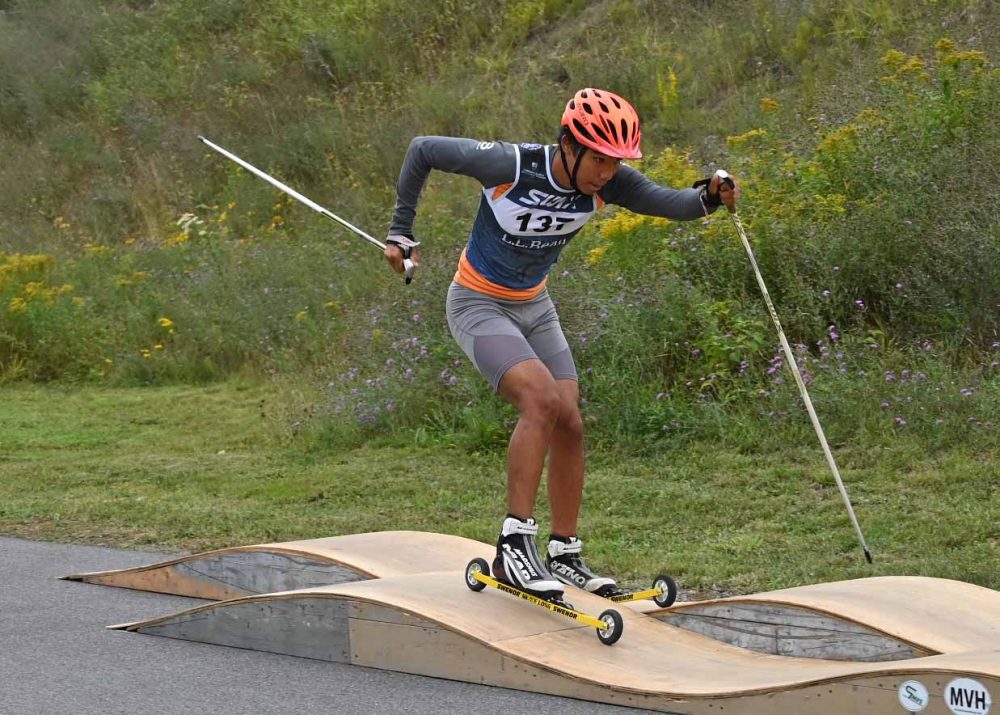
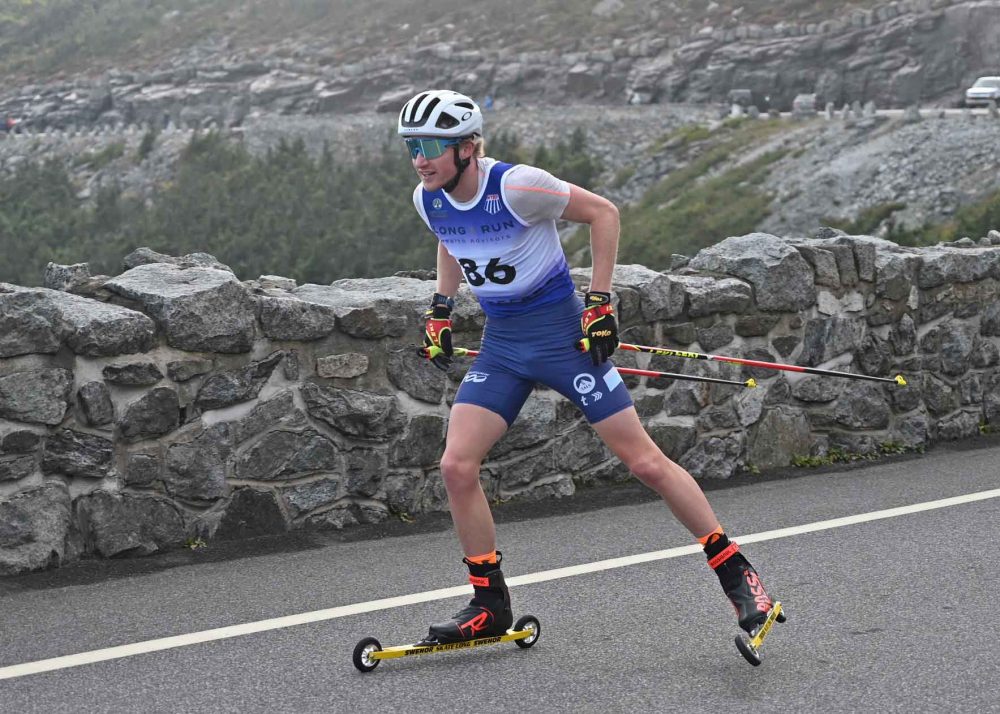
Luke Ebisawa (SMS) was the first up the Short Course on Mount Greylock. (Photo: FasterSkier)
A Long Tradition on a Steep Road
The Mt. Greylock Hill Climb traces its roots to the 1980s, when Steve Blazejewski, longtime owner of Berkshire Outfitters in nearby Cheshire, organized the first informal hill-climb rollerski up the mountain’s south access road. Those early events had a distinctly grassroots feel: a handful of hardy skiers, a few volunteers with stopwatches, the smell of fall leaves mixing with sweat, and the sounds of clicking ski ferrules on asphalt breaking through the cooling autumnal wind.
Blazejewski—a fixture of the Berkshire outdoor scene and a lifelong skier—recognized that Mount Greylock’s 3,491-foot elevation and sustained grade offered a perfect proving ground for endurance athletes. What began as a small local challenge quietly evolved into an annual fall tradition, drawing Nordic skiers from across Western Massachusetts and southern Vermont.
Today, that same spirit endures, even as the event has grown in scale and professionalism. With the New England Nordic Ski Association (NENSA) now running the climb as part of its official Rollerski Race Series, the Greylock event has evolved into the season finale of the regional summer circuit. This culmination feels both natural and earned.
Cole Bothner (Williams College) on his way to winning the Men’s Long Course race up Mount Greylock. (Photo: FasterSkier)
The Climb: From Lanesboro to the Clouds
Racers in the Long Course began their 8-mile ascent at the Mount Greylock Visitors Center in Lanesboro, winding steadily up the south access road to the summit. Those opting for the Short Course started halfway up near Jones’s Nose—a 4-mile route that compresses the mountain’s final, steepest pitches into a fierce test of pacing and grit.
The weather was ideal: cool, calm, and clear, with late-autumn color lining the road. For many, the Greylock climb doubles as both a training benchmark and a celebration—one last rollerski before snow season begins.
Tight Battles and Young Legs on Display
In the men’s Long Course, Cole Bothner (Williams College) led from the base, maintaining tempo through the middle grades and holding off Thomas Videtich Bye (Bears) by just eight seconds (48:22 to 48:30). Quinn McDermott, also of Williams, rounded out the podium in 48:41.
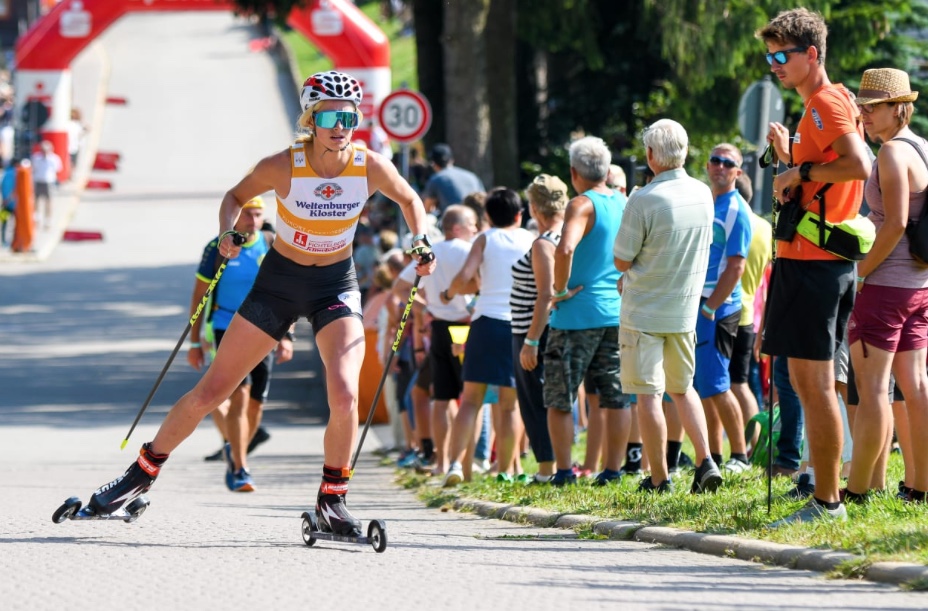
Astrid Longstreth (Mansfield Nordic) on her way to the Women’s Long Course win. (Photo: FasterSkier)
The women’s Long Course belonged to the next generation. Astrid Longstreth (Mansfield Nordic) took a commanding win in 59:16, pacing perfectly before attacking the upper switchbacks. Leigh Niedeck (EMXC) followed in 1:00:45, and Olya Wright (Williams College) was third in 1:01:12.
In the Short Course, juniors shone bright. Luke Ebisawa (SMS) dominated the men’s field (29:26), with Thomas Huemmer (EMXC) and Jorgen Pirrung (Mansfield Nordic) on the podium. The women’s race was even tighter: Genevieve Graves (GMVS) edged Mia Gorman (Mansfield Nordic) by six seconds (34:25 vs 34:31), with Kendal Bowen (GMVS) third in 35:54.
“A Chainsaw, Not a Hand Auger” — The Role of Rollerskiing
For Ben Theyerl, NENSA’s Competitive Program Director, the Mt. Greylock Hill Climb embodies what makes rollerskiing such a powerful development tool.
“One thing I’ve gained a newfound appreciation for stepping back in the East,” Theyerl said, “is how my predecessor Justin Beckwith framed rollerski programming: as a development tool. And as a tool, fittingly coming from Justin, it’s more chainsaw than hand auger—that is to say, power!”
Justin Beckwith cheering on his son, Red, as they took on the short course together – clearly before long Justin is going to have to be the one starting first. (Photo: FasterSkier)
He added that NENSA’s current approach is about “matching opportunities with athletes”—balancing elite-level races, such as the Lost Nation Roll and Keys/Climb to the Castle, with inclusive, community-oriented climbs, like Greylock.
“You can’t simultaneously broaden the base of junior skiers comfortable on rollerskis at those pro-style races,” Theyerl noted. “So we target different opportunities like Greylock, or regional camps and clinics. This year, we had plenty of first-time rollerskiers—and we had Jessie Diggins, Ben Ogden, their SMS T2 teammates, Craftsbury GRP athletes, and MNC Pro Team skiers racing too.”
That balance, he said, creates a feedback loop across generations: “The more comfortable young skiers are on rollerskis, the more we can tap into them as a tool. We want these opportunities to be a key part of our community.”
A Berkshire Tradition, and a Broader Metaphor
Theyerl also sees the Greylock climb as uniquely emblematic of New England grit.
“For every place we associate with ski racing—Vermont, Minnesota, Colorado, Alaska—there’s a community just adjacent, with dedicated skiers doing the sport we love where it’s a little harder to hack it. The Greylock Hill Climb is a great embodiment of the unlikely, impressive things that stand in the Berkshires, literally and metaphorically. It takes a town meeting’s worth of different people to put a mountainside race like that on—and that’s the grandest New England tradition of all.”
Amy Dupuis (#68), who grew up just a few miles from the start, brought her daughter, Madeline Ronci (#53), down from New Hampshire so they could tackle mom’s old stomping ground. (Photo: FasterSkier)
Looking Ahead
As NENSA’s rollerski series continues to expand, the Mt. Greylock Hill Climb feels like its perfect closing chapter—a bridge between old-school grassroots passion and the modern era of organized Nordic development.
Forty years after Steve Blazejewski first envisioned a climb to the state’s highest point, the heart of the race remains the same: community effort, steep grades, and the unmistakable rhythm of ski poles clicking against New England pavement.
(Please credit @FasterSkier if you publish them on socials or elsewhere)
Julie Longstreth taking on the short course. (Photo: FasterSkier)
Love Stories Like This? Help Keep Them Coming.
Feature interviews like this one take time, access, and care to produce. If you value thoughtful storytelling and independent ski journalism, please consider becoming a Voluntary Subscriber. Your support directly fuels the work we do to cover the people, places, and moments that make our sport special.
On Sunday, athletes from across the region gathered for the highly anticipated Climb to the Castle roller-ski hill climb, hosted by the New England Nordic Ski Association (NENSA) in partnership with the New York Ski Education Foundation (NYSEF). Set against the breathtaking backdrop of the Whiteface Veterans Memorial Highway, this event marks an exciting addition to the 2025 NENSA Rollerski Race Series.
Participants faced the daunting task of tackling either a long course of approximately 10 kilometers or a shorter 5-kilometer route, employing their skills in either freestyle (skate) or classic techniques. With an average gradient of around 8%, competitors were pushed to their limits, testing not just their physical endurance but also their mental fortitude as they ascended the challenging terrain.
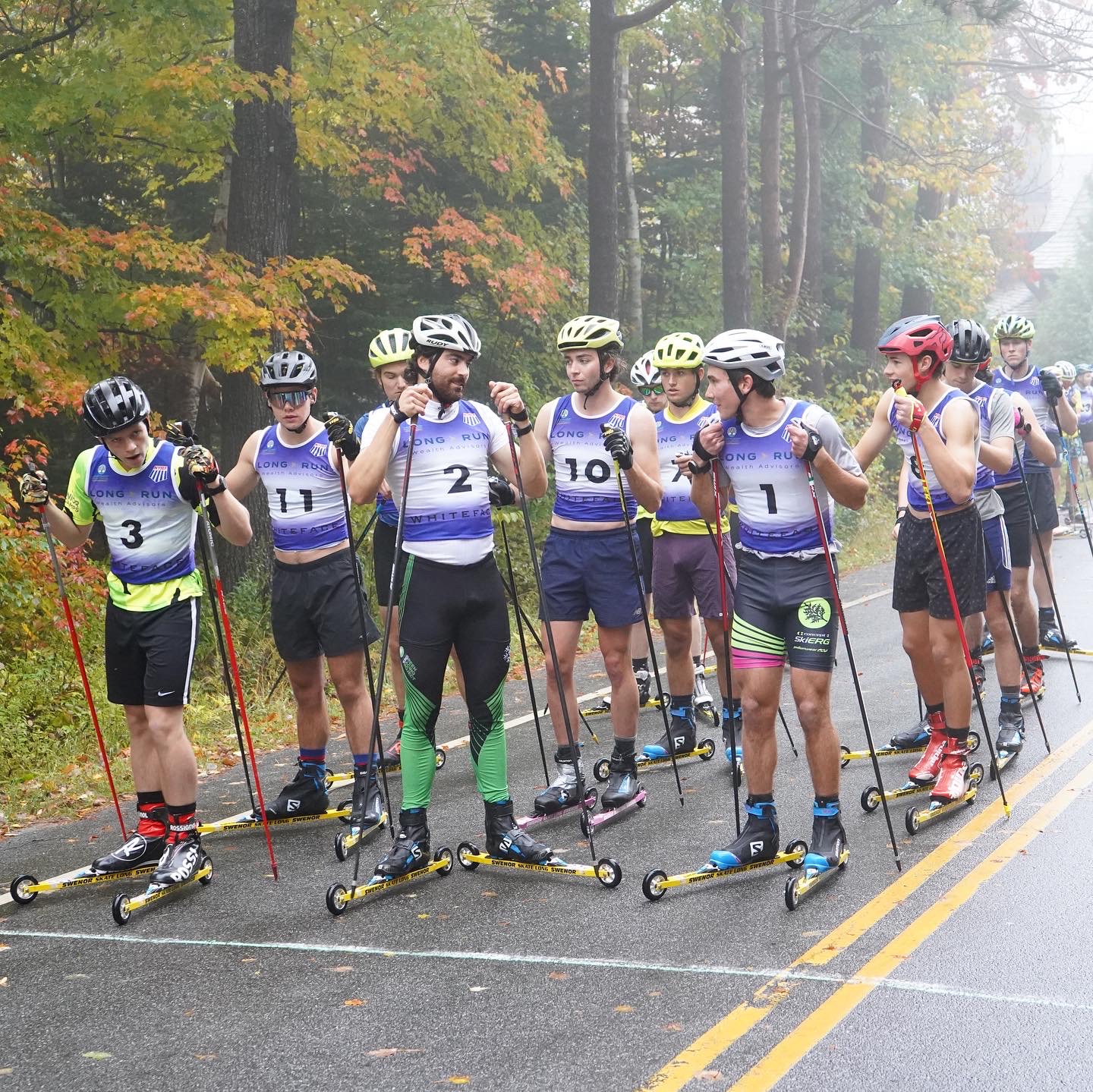
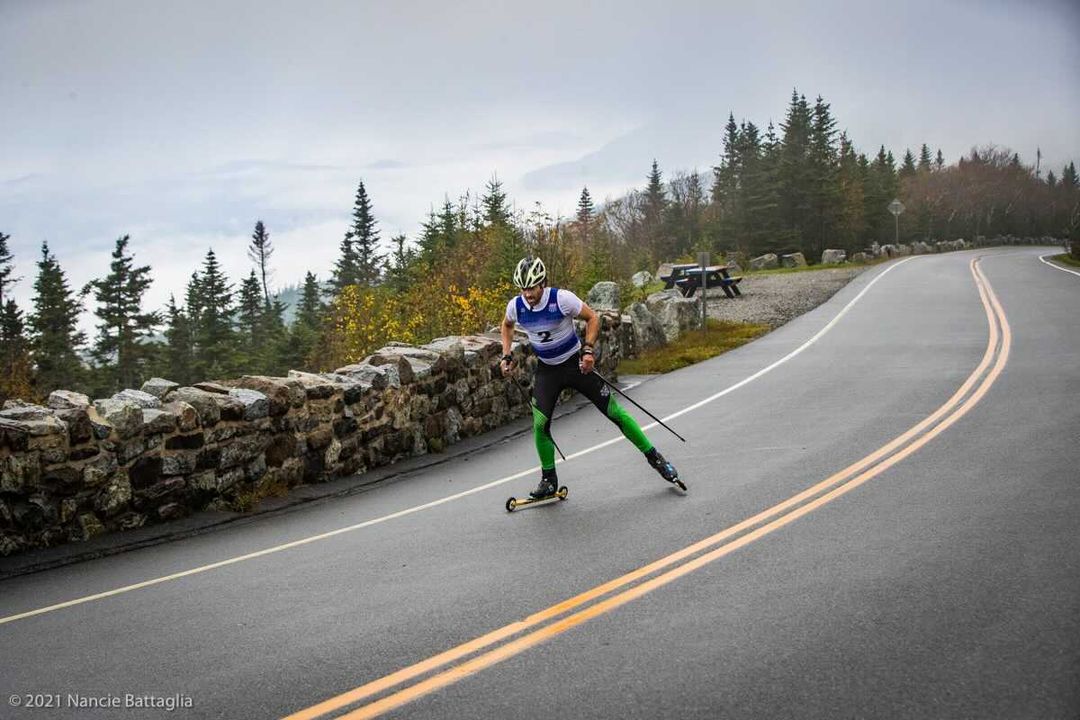
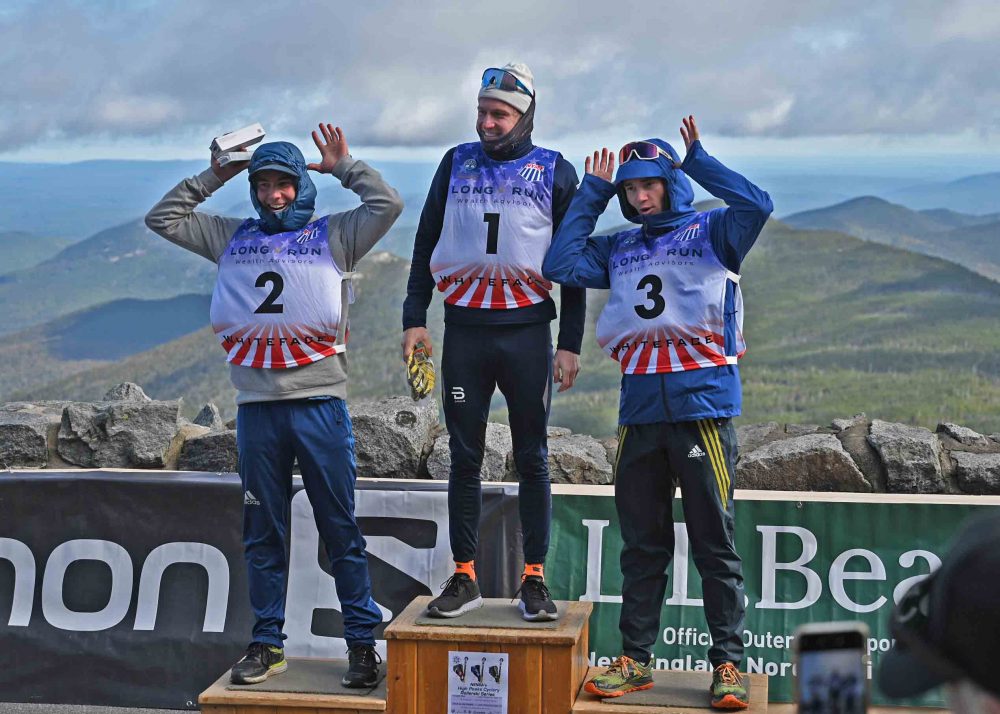
On his way to victory, Ben Ogden (bib 1) follows Remi Drolet (bib 2) during Sunday’s Climb to the Castle. (Photo: Nancie Battaglia)
Race Highlights – Long Course
From the starting line, the atmosphere was charged with energy, particularly in the long-course races, where skiers set a competitive pace right from the get-go. The lead group remained tightly packed, with several seasoned athletes setting a steady pace that kept the race dynamic and engaging.
As the climb intensified, it was Ben Ogden from SMS T2 who made a decisive breakaway from the main pack. His strong performance allowed him to maintain his lead and reach the summit with an impressive time of 37:38.7, securing his victory. Close behind, Ricardo Izquierdo-Bernier finished strong in second place with a time of 38:22.9, while Colin Freed from the Mansfield Pro Team rounded out the podium in third with 38:55.8.
The women’s long course also showcased thrilling competition, with Jessie Diggins from SMS T2 establishing an early lead and maintaining it throughout the climb. Diggins finished strong at 43:48.5, followed closely by her teammate Julia Kern, who also clocked in at 43:48.5, showcasing the strength of their training group. Shilo Rousseau claimed third place, finishing with a time of 47:09.7.
Jessie Diggins getting some race feels during Sunday’s Climb to the Castle. (Photo: Nancie Battaglia)
Long Course Podium Results
MEN
1. Ben Ogden (SMS T2) – 37:38.7
2. Ricardo Izquierdo-Bernier – 38:22.9
3. Colin Freed (Mansfield Pro Nordic) – 38:55.8
On the junior side, the competition was fierce, with Silvester Williams of Mansfield claiming victory. Sisu Lange (Paul Smith’s) and Henry Sterner (Mansfield) followed him in second and third, respectively. In the women’s junior category, Elsa Futch of Mansfield took top honors, with Astrid Longstreth (Mansfield) and Greta Dickman (Paul Smith’s) finishing second and third.
Daniel Schwenk on his way to 9th place in the Men’s Masters’ division of the Climb to the Castle. (Photo: Nancie Battaglia)
Race Highlights – Long Course Masters
Ricardo Izquierdo-Bernier, who finished second overall, won the Men’s Masters’ race with a time of 38:22.9, finishing ahead of Frances Michaud (48:45.7) and Angus McCusker (49:04.7).
In the women’s race, technically, Jessie Diggins, falls into the Masters’ category and obviously dominated the field with a winning time of 43:48.5. Kathy Schwenk came in second at 58:08.8, finishing 14:20.3 behind Diggins. Rosalie Wilson took third with a time of 1:07:11.7, trailing by 23:23.2, but now Schwenk and Wilson can tell their friends and family about the time they shared the podium with the American champion.
Theo Mallet on his way to 19th place in the Men’s division of the Climb to the Castle. (Photo: Nancie Battaglia)
Race Highlights – Short-Course
The short-course races were equally entertaining. Isaiah Bowen (Mansfield) took the top spot among men, ahead of teammates Jorgen Pirrung and Gabriel Perchemlides. Meanwhile, in the women’s short course, Mia Gorman (Mansfield) emerged victorious, with Leela Volyanik (NYSEF) finishing as runner-up.
The Beckwiths making a family thing as always. (Photo: Nancie Battaglia)
As the sun set over Whiteface Mountain, participants and spectators celebrated not only the victories but also the camaraderie and sportsmanship that characterize events like the Climb to the Castle, where local athletes compete alongside some of the world’s best skiers. With the promise of more exciting races ahead in the NENSA Rollerski Race Series, this year’s event will undoubtedly be remembered.
Group roller ski at Hardwood Ski & Bike (Photo: Graeme Longford)
Returning to training after a spring hiatus means laying out a plan for the upcoming training season. In making such a plan, there are a couple of questions that will help to define how the season should go:
– Early season dryland training: what should early season training prioritize? And how much of a “break” do you advise taking after the ski season concluded?
– Early season roller skiing: how early is too early? What really are the benefits of roller skiing, and why is the advice typically to utilize this training tool more toward the end of the dryland than at the beginning?
Often coaches are asked what the weeks and months post racing season should look like. The answer varies from coach to coach but there are some trends that are commonly prescribed. A lot of this variety stems from the wide range of climates and geography that support cross-country skiing in North America. For those climates with snow that hangs on after the races conclude for the year it’s best to keep skiing. At the elite level year-round access to snow has been shown to be a huge advantage. The use of glaciers and ski tunnels show this investment is important to many nations that excel in cross-country skiing. After racing wraps up transition to base training on snow, with fun, technique work and ski play.
Dryland training in Canberra, ACT.
Those of us who are not fortunate to often have late season skiing should plan to take four to six weeks of off/unstructured training. This unloading period helps athletes process the ski season, catch up on other aspects of their life put on hold during the racing season and have the mental break needed after a stressful competitive season. This unloading period also allows the body to adapt and recover from the stress of racing. Especially when a season includes a spring championship.
During this unstructured period, I recommend athletes take the first half off. This would create a two-to-three-week period without any training. This time allows the body to catch up on rest and process all the stressors both physical and mental that were present during the racing season. The second half of this block is unstructured. During this time the athletes train as they feel without a structured plan. Often the focus of this period is strength combined with low intensity aerobic training.
Rollerskiing in June near Bend, Oregon. (Photo: Dakota Blackhorse-von Jess)
As the training season begins to ramp up a common question is when should one start roller skiing and how often should this be used in their training. Elite athletes will begin roller skiing in May when the training season often kicks off. This is dependent on a variety of factors but to maintain the specificity needed for elite performances most skiers will begin roller skiing right away. The volume of roller skiing will increase over the course of the summer and become a primary training modality by the fall. Master and developing skiers can delay roller skiing until the late summer or fall in order to prioritize other sports or activities creating a more varied training year. This will minimize burnout and help bring variety to the training over the summer.
Prior to the arrival of summer, it’s important to set goals for summer training. These should build off of the progress made in the previous season, limiters that have been identified, and the goals for the following season. Deciding what your priorities are will guide the training and help keep you focused. During summer, it is easy to get sidetracked by fun fitness adventures. Rarely do these derail one’s training, but it’s important to keep your actions moving towards your goals. Summer training should be purposeful and productive combined with a little fun.
Rollerskiing at the Stifel U.S. Ski Team women’s camp, N.Y. (Photo: Matt Whitcomb)
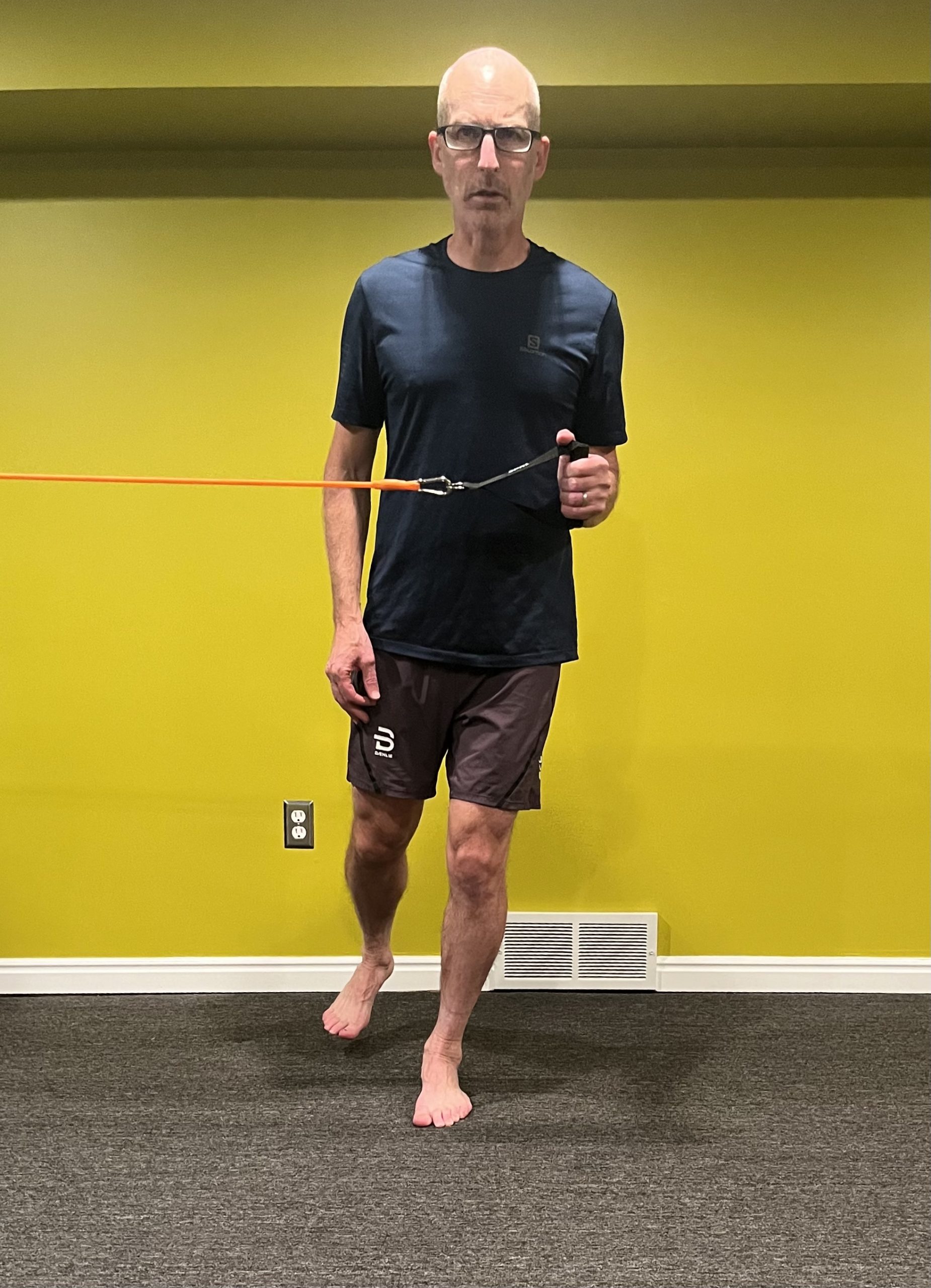
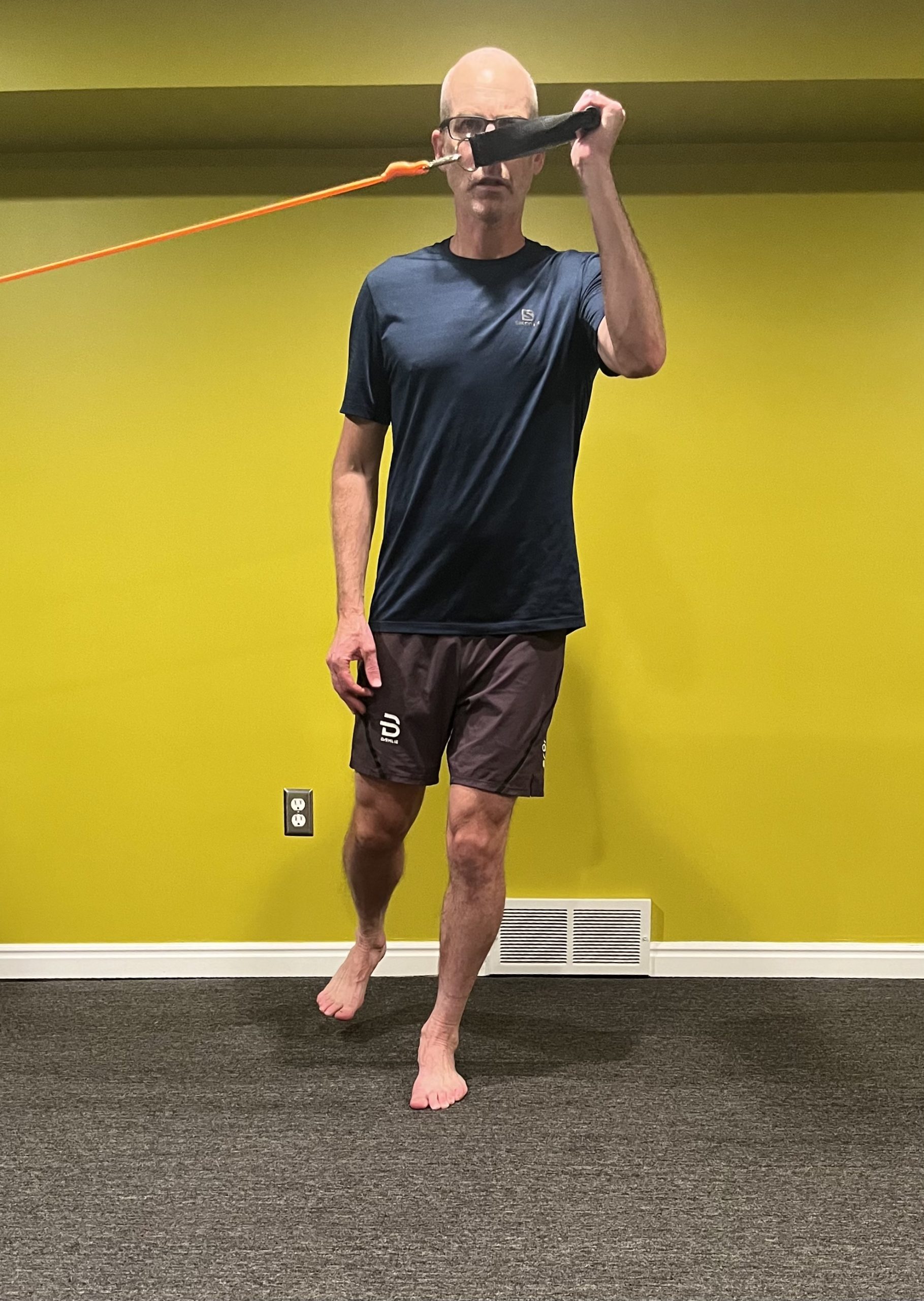
Ned Dowling conducts a Ski Stance seminar for participants in the recent National Training Group (NTG) and National Elite Group (NEG) training camp in Park City, Utah. (Photo: Ned Dowling)
“Big motor, lousy suspension.” That’s how I often describe the endurance athletes I see in physical therapy. They have the physiology to go fast but are lacking the stability and/or coordination for efficient movement. Decreased efficiency equals increased load. And excessive load has led to injury and a visit to their friendly, neighborhood PT.
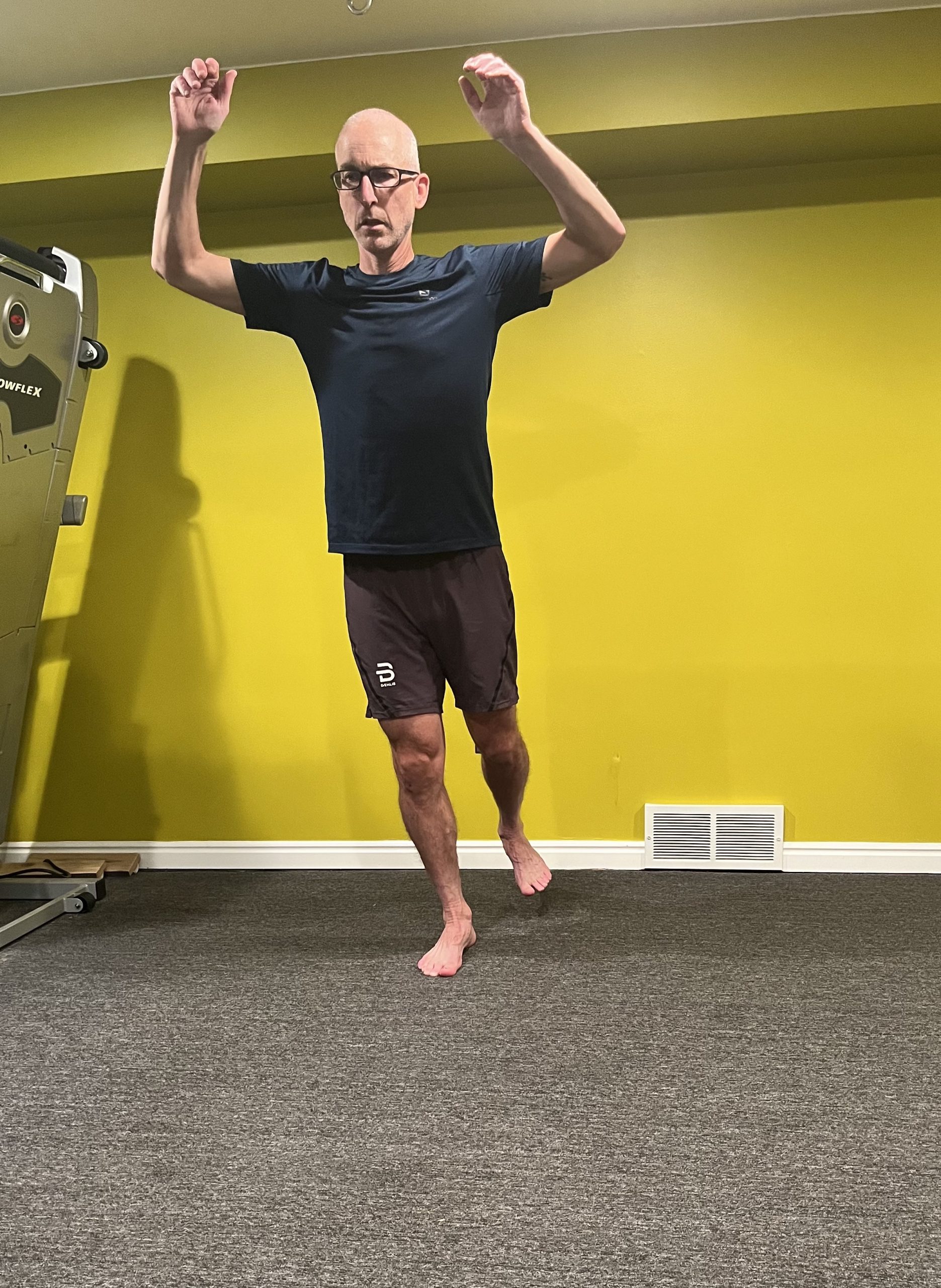
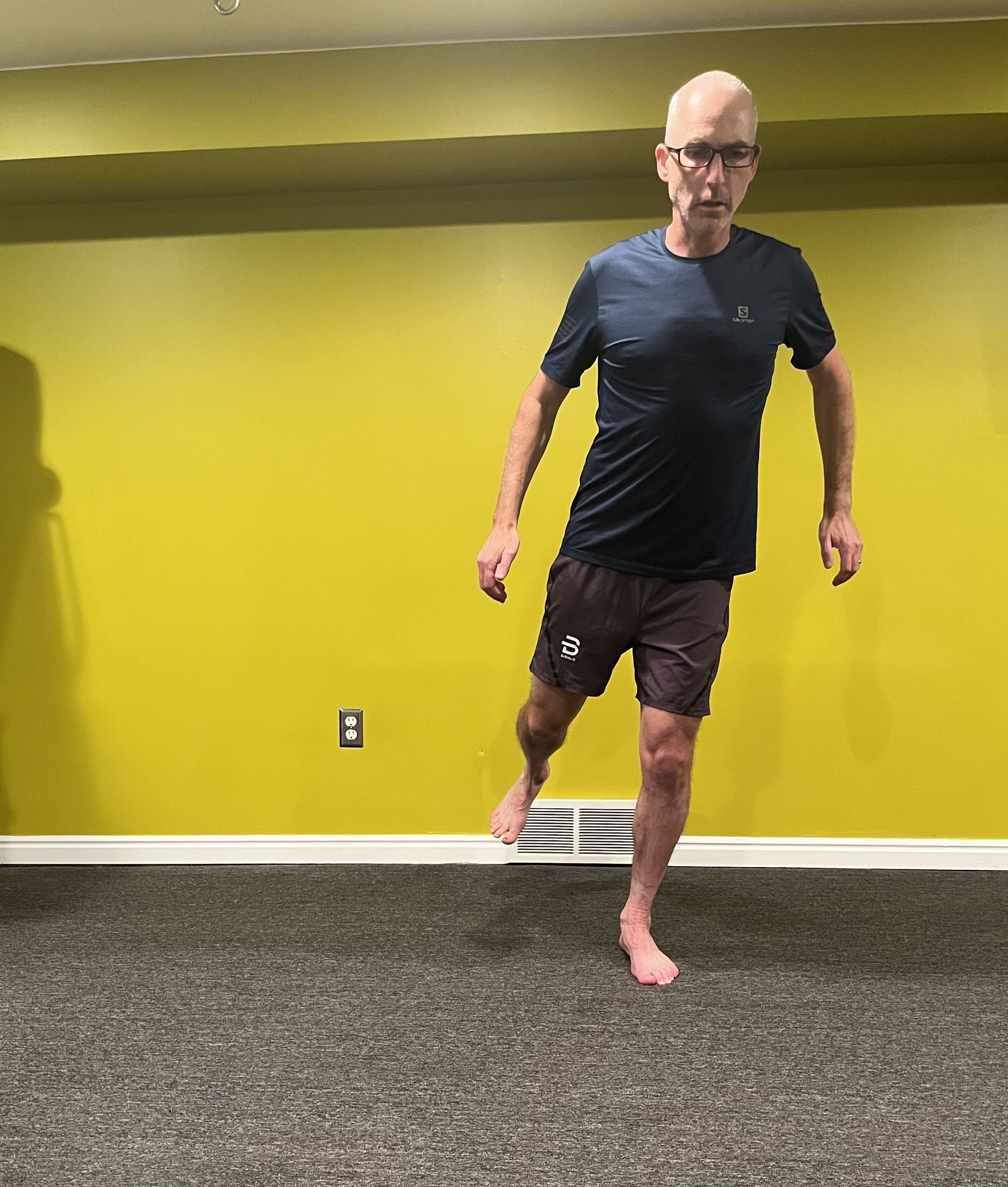
I used the same description while Greta Anderson, the US Cross Country Development Coach, and I stood trackside last August watching rollerskiers during the 15k Classic race in Trollhatten, Sweden. At that high level of racing, everyone was fast, but not everyone looked to have good stability, movement coordination, and efficiency. Our peanut gallery coaches’ box banter turned into a lengthy conversation on the fundamentals of Nordic skiing. Next thing I knew, Greta had me leading a training session for the National Training Group (NTG) and National Elite Group (NEG) combined camp in Park City, UT. We called it Stability From the Ground Up with the goal of reinforcing the Ski Stance while balancing on one leg and doing tricks. The following is an excerpt of that training session.
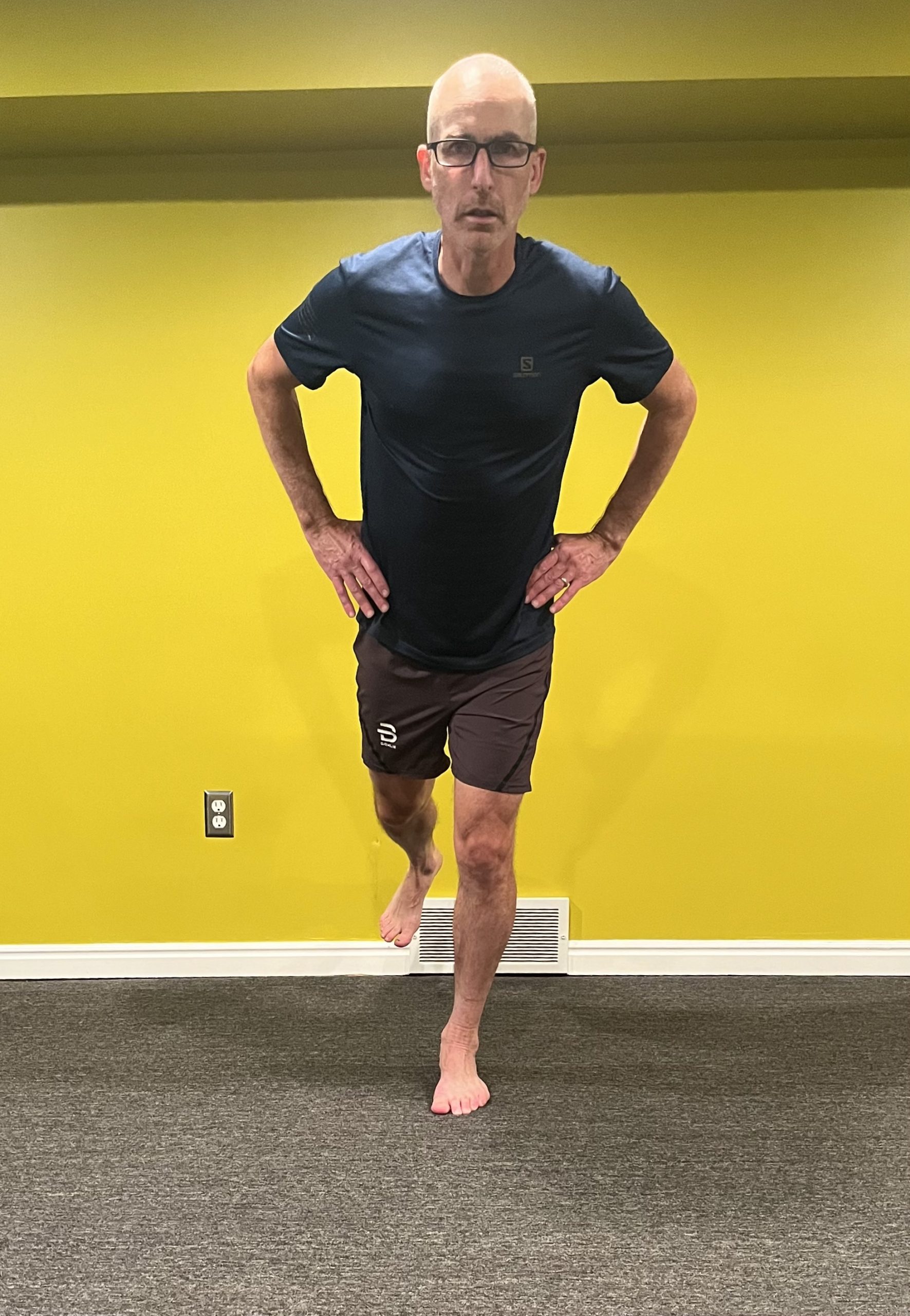
It is the foundation of Nordic skiing, both Skate and Classic. It is the stable, balanced position on the glide ski that facilitates both optimal glide and a stable platform as the glide ski becomes the kick ski. Stable glide begets more power, and more power begets more stable glide
Ski Stance Checklist:
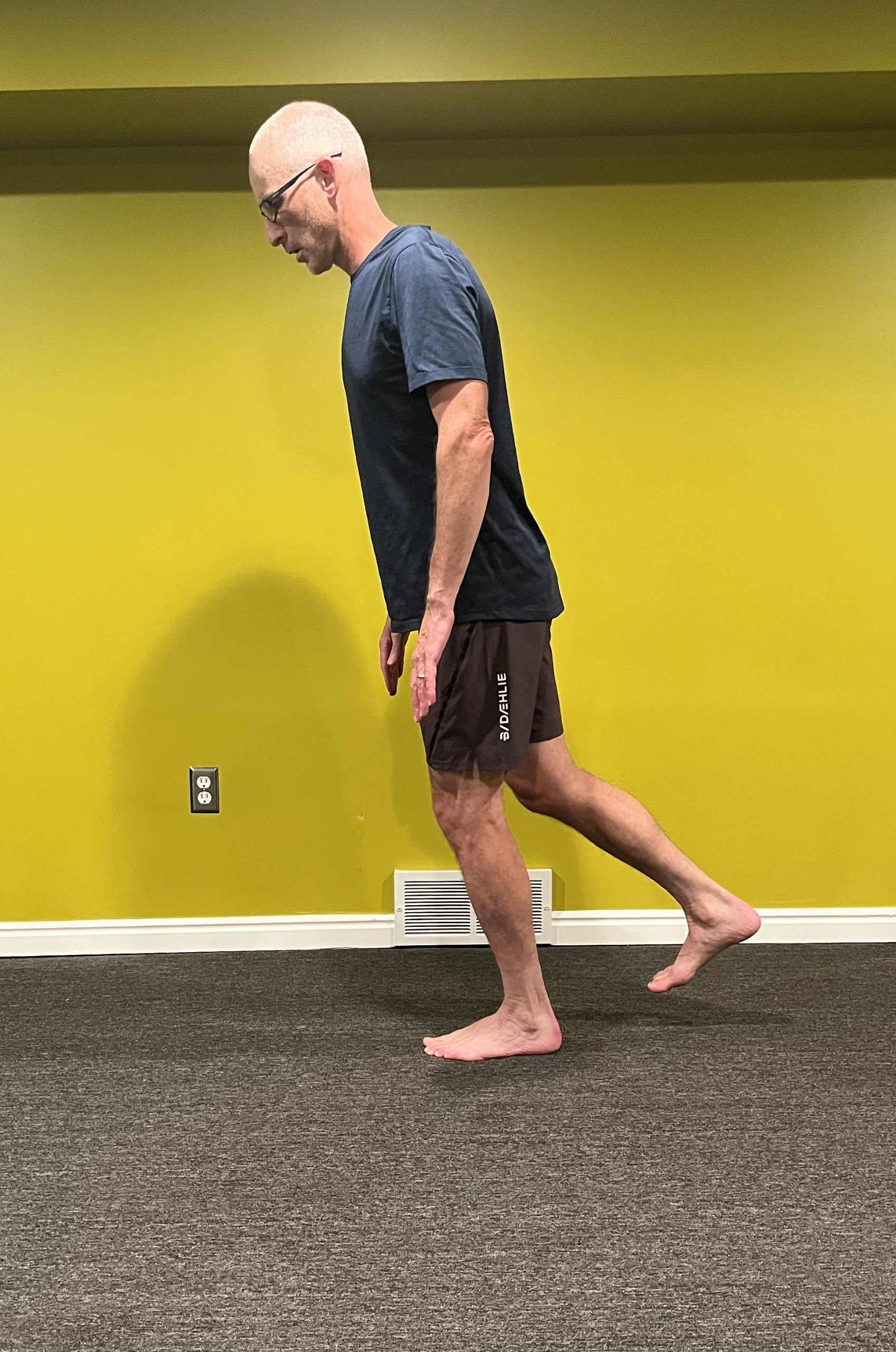
Balance on one leg.
Equal pressure between the inside and outside of the foot, especially across the metatarsal heads between the ball of the foot on the big toe side and the pinky toe equivalent.
Weight is biased towards the front of the foot but the heel stays down. Distribution is in the neighborhood of 70:30, forefoot to rearfoot.
Toes are relaxed. This doesn’t mean the toes are hovering off the ground, but it very much means the toes are not clawing at the floor. (Have a look at the insoles of your ski boots: if there is a lot of wear under the toes, you are likely using them too much. This is either a bad habit or a compensatory strategy, or both. Speaking of insoles…)
The ankle is flexed enough to put the kneecap in line vertically over the toes.
Slight bend at the knee and hip.
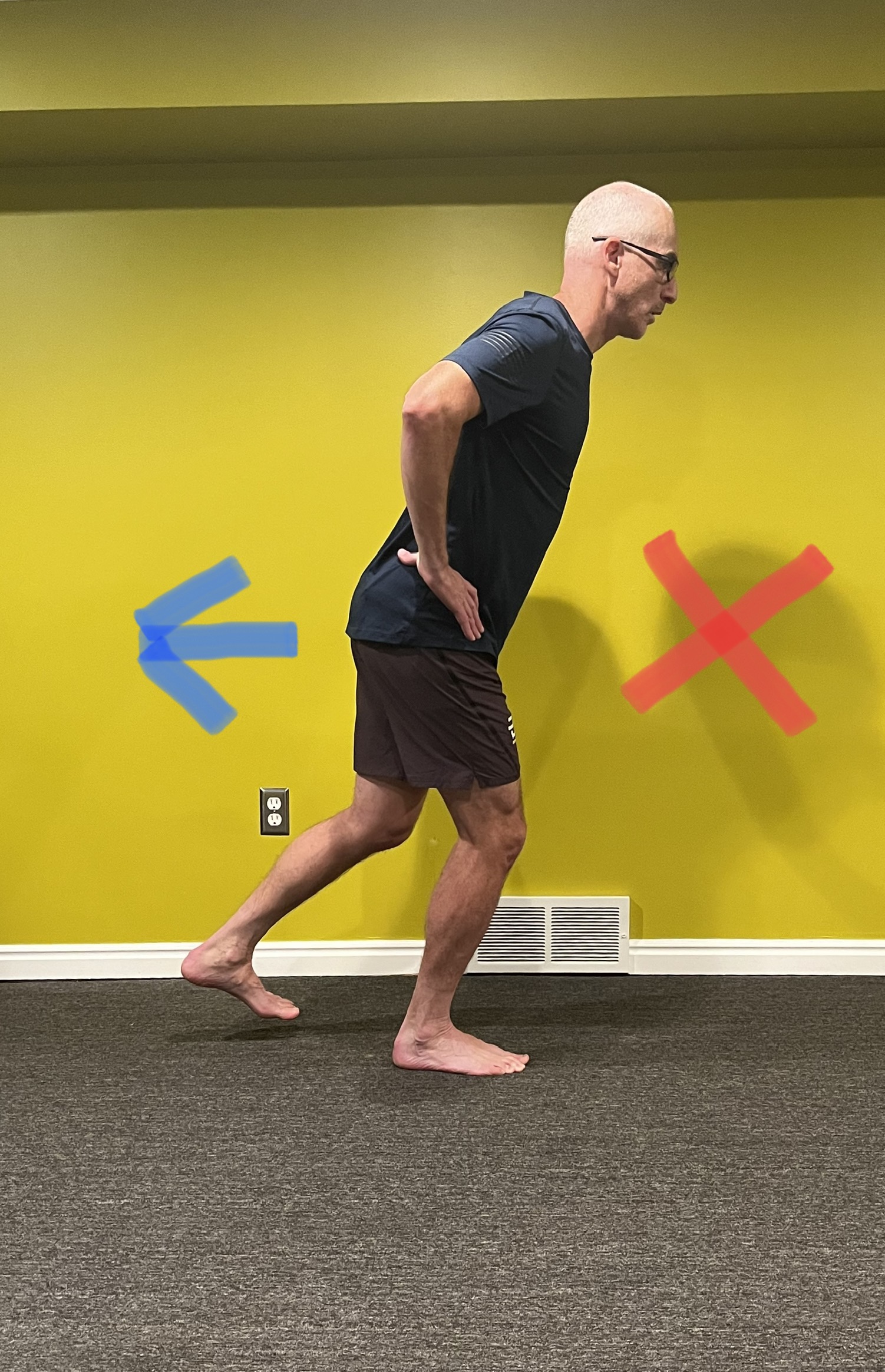
Forward lean at the trunk. This is accomplished with a hinge at the hips, not a flex through the spine. Nose-Knee-Toes is the old cue. If you’re dripping snot out of your nose, it should land on your foot not down the front of your shirt.
High Hips. If I had a dollar for every time Devon Kershaw has endorsed a skier with “high hips” I could buy a ski quiver worthy of the World Cup. But what does this even mean? Our Checklist just listed flexion at the ankle, knee, and hip, so how can we keep the hips high but flexed at the same time? Forward Hips might be a little more intuitive. The pelvis is pushed forward without losing the bend at the hips. It will initially feel like you are falling forward, but that’s a good thing. We want the center of gravity shifted forward to push us down the trail. A different cue is Front seat, not Back Seat. The back seat is like starting to sit on the toilet: ankle, knee, and hip are flexed and the trunk is leaning forward; however, the butt is reaching backwards. Aim to shift the hips forward like someone is pulling at the front of your belt.
Stability from the hip, not leaning to the side. When we stand on two feet, the center of gravity is between the two feet. If we are to stand on one foot, we can’t just pick up the opposite foot—our center of gravity has to shift to the stance side. That can be accomplished by leaning the trunk to the side, but this is not an active position and doesn’t facilitate generation of power. The weight shift ideally comes via a lateral movement of the pelvis over top of the stance leg. Note: this shift is very applicable to diagonal stride as we move from the kick ski to the glide ski. The direct application to skate varies a bit with the sub-discipline—V1 has a more distinct weight shift from ski to ski while the transition during V2 is more of a “swapping” of skis underneath the body than a lateral movement from one to the other.
Exercises
The intent of these exercises is to reinforce the Ski Stance. Each one has a movement component to challenge both balance and maintenance of the Ski Stance position. (Here is a primer on single limb balance and stability.) The quality of movement and balance are paramount. In order to be beneficial, the exercise should be challenging but doable. If you are falling all over the place or cannot control the movement, the exercise is likely too difficult for your current level. The exercises are listed in ascending order of difficulty.
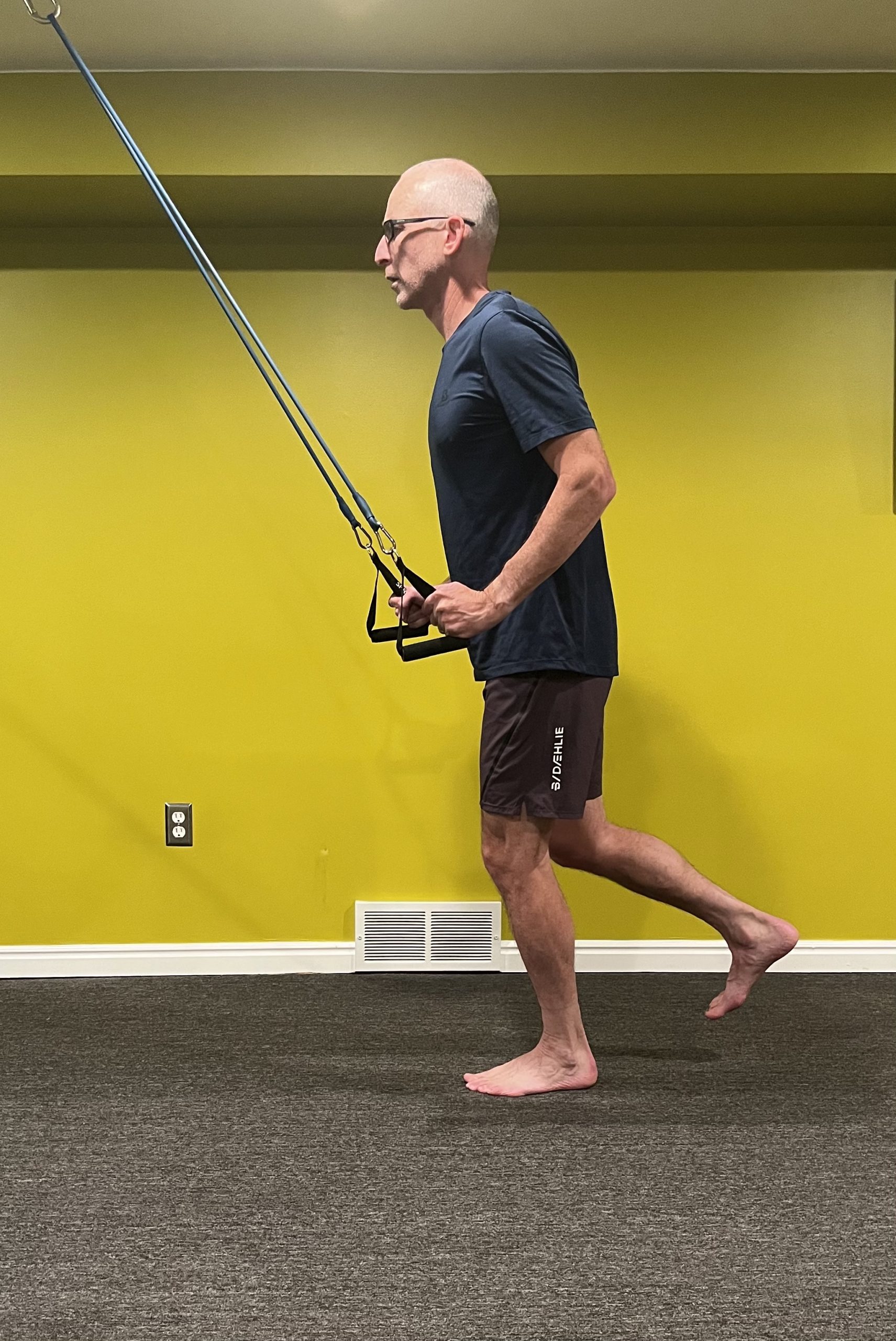
Band Poling Exercise
Ski Stance.
Use a two-tailed band or two separate bands anchored at head height or higher.
Pull down on bands keeping some bend in the elbows. (This is not meant to be a double poling simulation as we are trying to stay tall in the Ski Stance not dropping down as we would with DP or V2.)
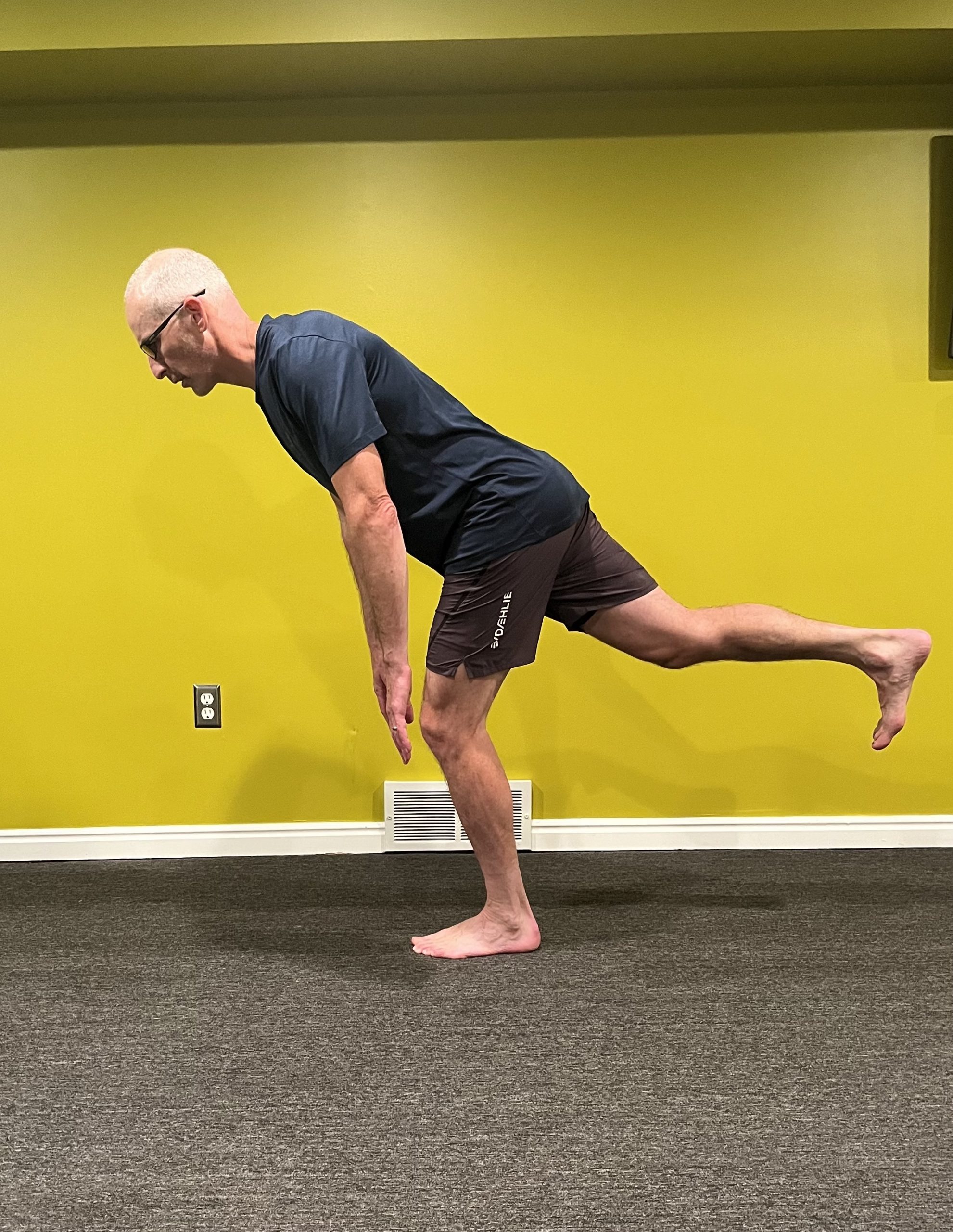
Romanian Deadlift (RDL) Exercise
Ski Stance.
Bend forward aiming your fingers for the sides of your knee. The movement is a hinging motion at the hip. The joint angles at the ankle and knee should not change. The spine stays in neutral position without bending.
Pelvis stays level as you bend forward (no twisting).
Finish with a push forward of the hips/pelvis—front seat not back seat.
You can add weight (single dumbbell or kettlebell in the opposite hand or one in each hand) for glute and hamstring strengthening, it doesn’t necessarily make the balance/stability any more difficult.
Hip Twist Exercise
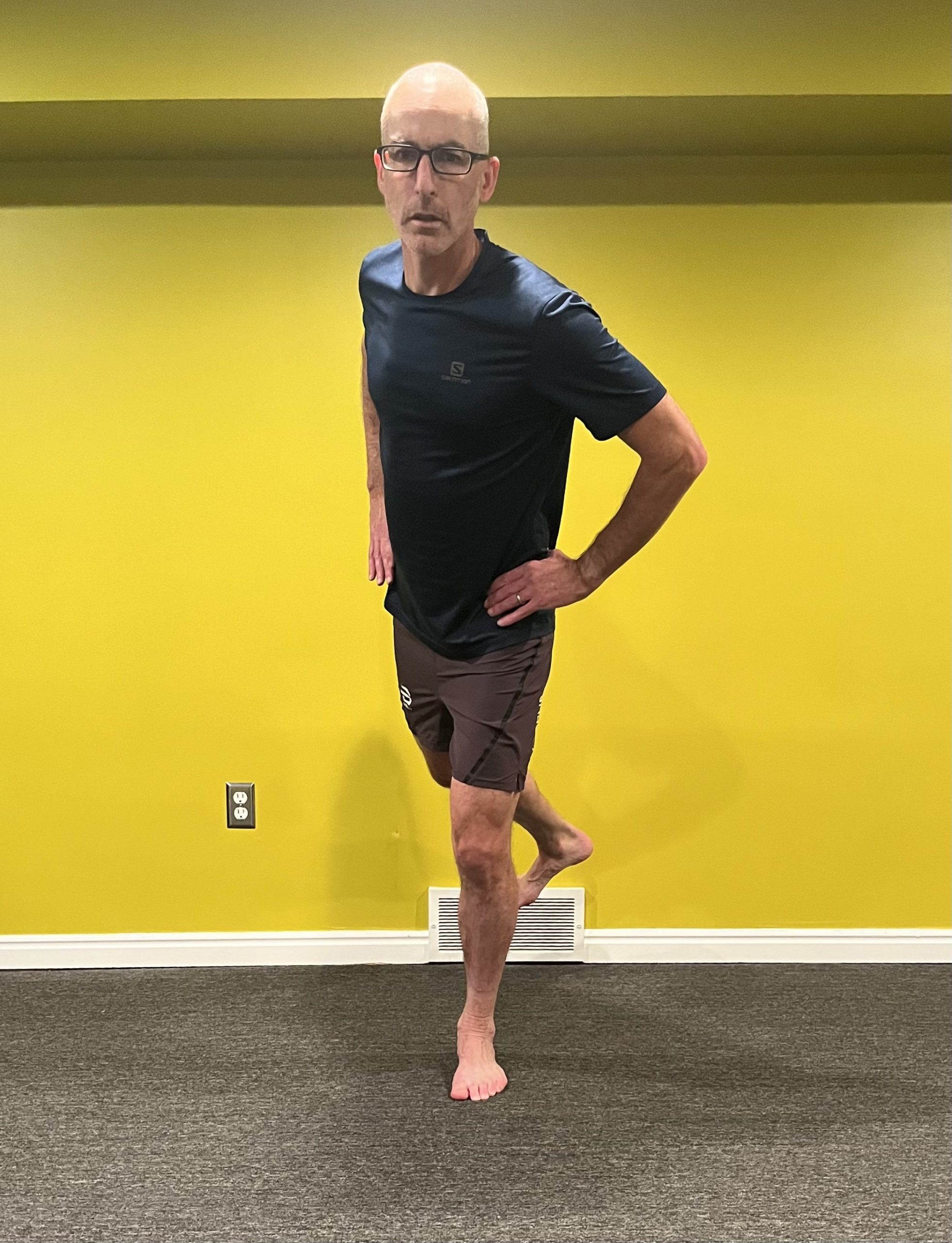
Ski Stance.
Twist your upper body in the opposite direction of the stance leg (standing on right leg = rotation to the left).
Shoulders, belly button, pelvis move together.
Knee cap stays pointing straight ahead.
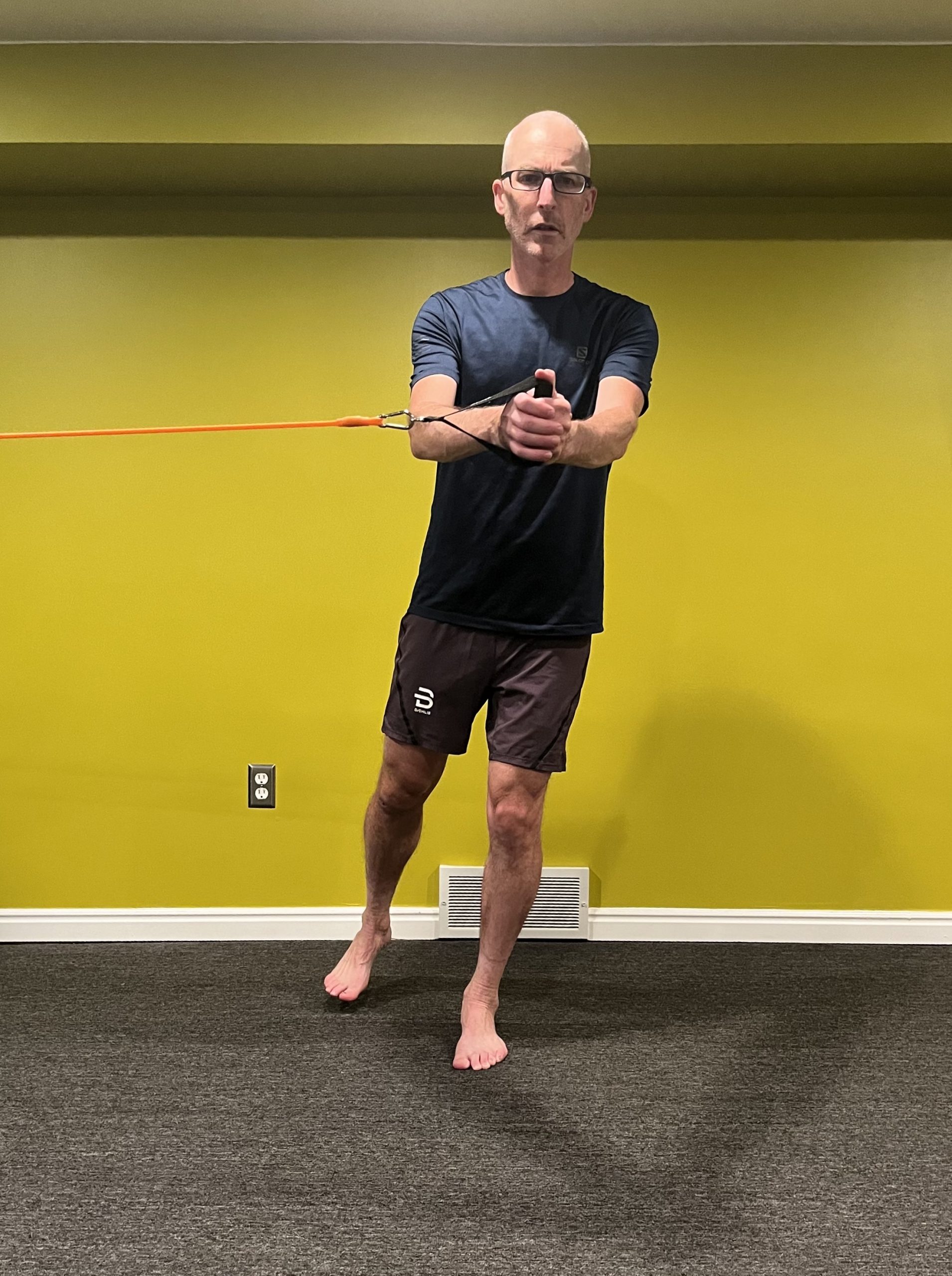
Paloff Press with Resistance Band Exercise
Ski Stance.
Band is anchored at chest height coming from the opposite side of the stance leg.
Holding the band in both hands, push your arms straight out and back.
Keep knuckles pointed straight ahead—don’t let the band twist you.
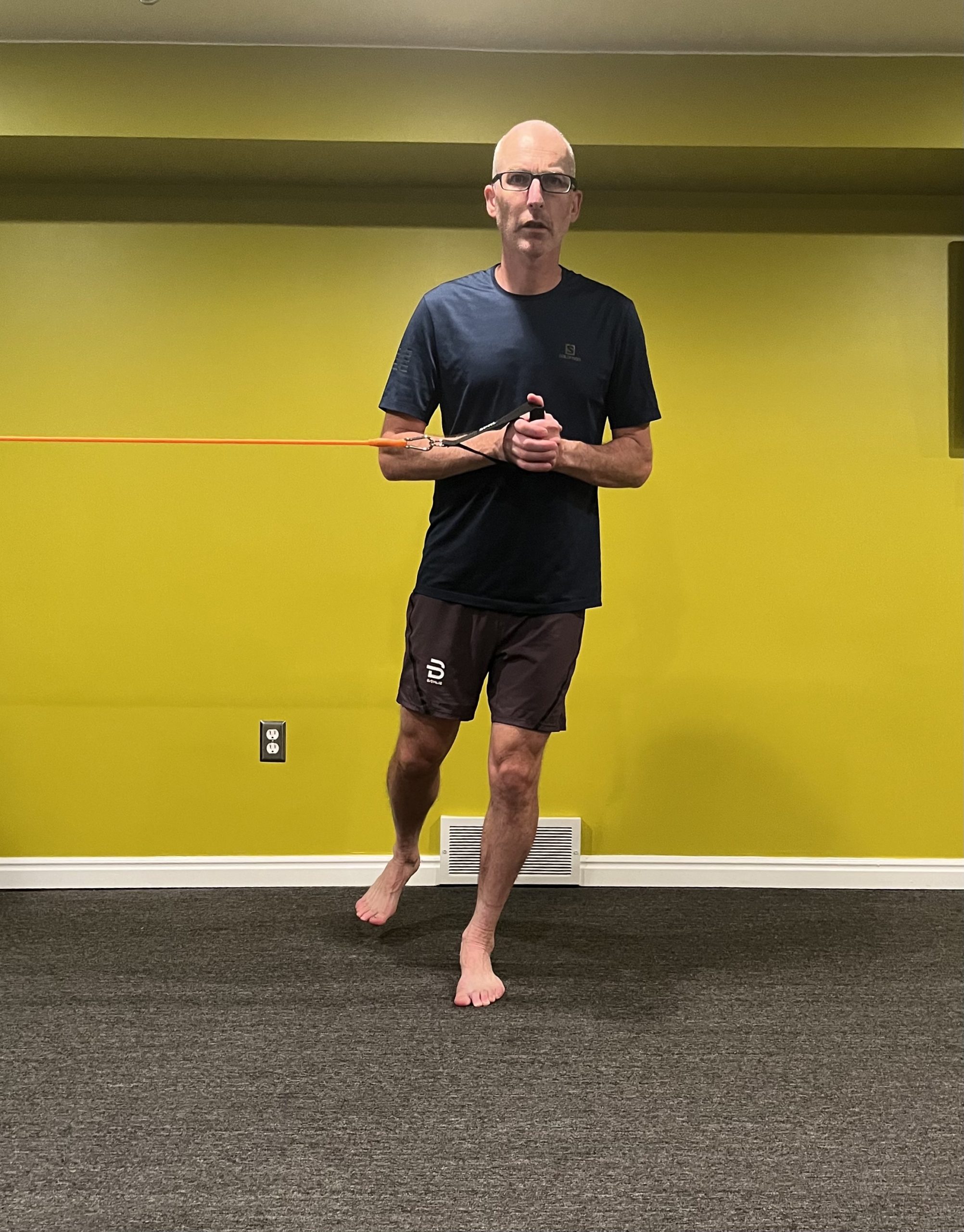
Shoulder External Rotation + Uppercut with Resistance Band Exercise
Ski Stance.
Band is anchored at chest height coming from the opposite side of the stance leg.
Hold the band in the same hand as the stance leg with your elbow bent at 90 degrees and knuckles pointed straight ahead.
Keeping the elbow bent at 90 degrees, raise your arm up as if you were a waiter carrying a tray.
This is very good bonus work for your rotator cuff muscles.
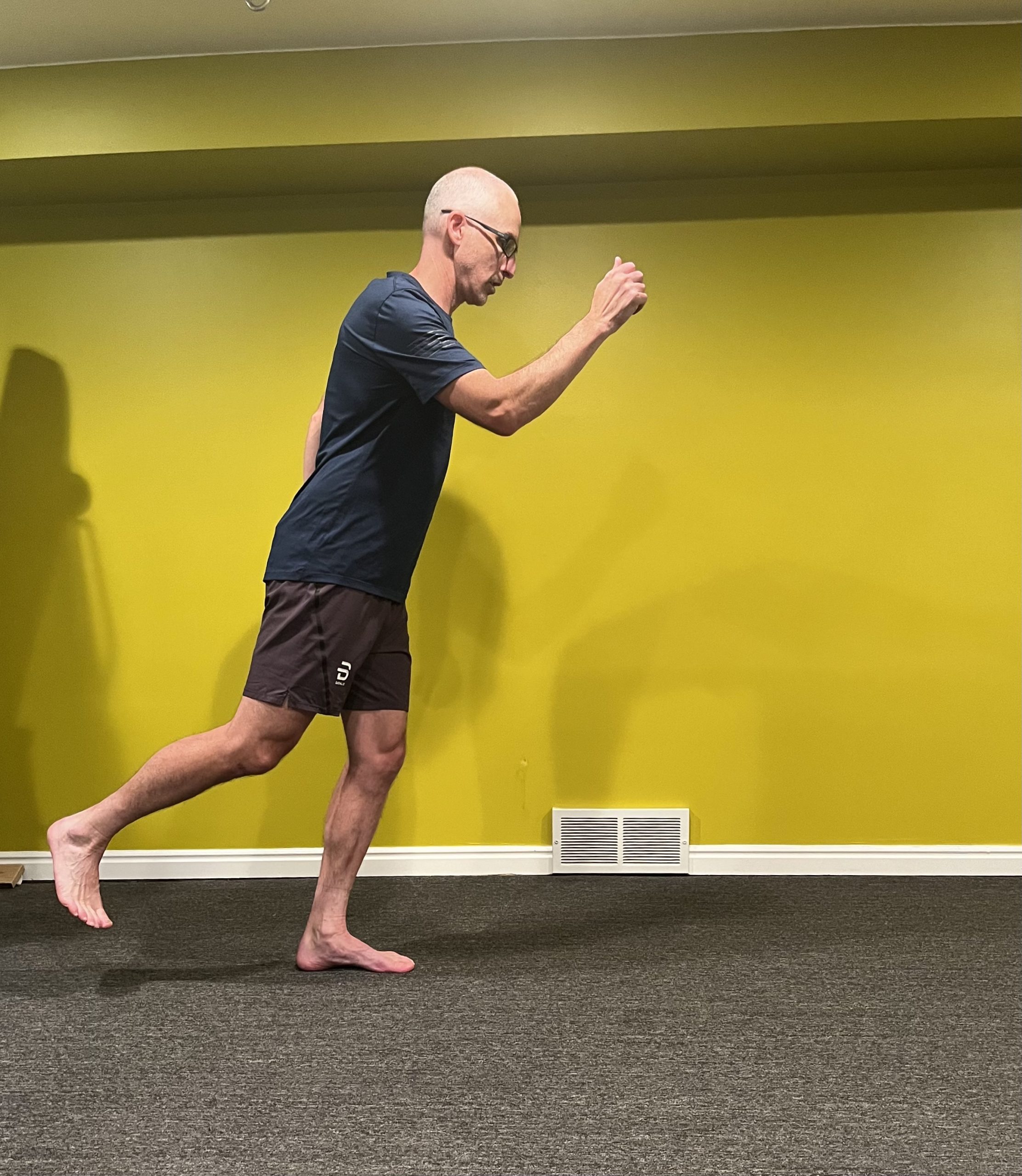
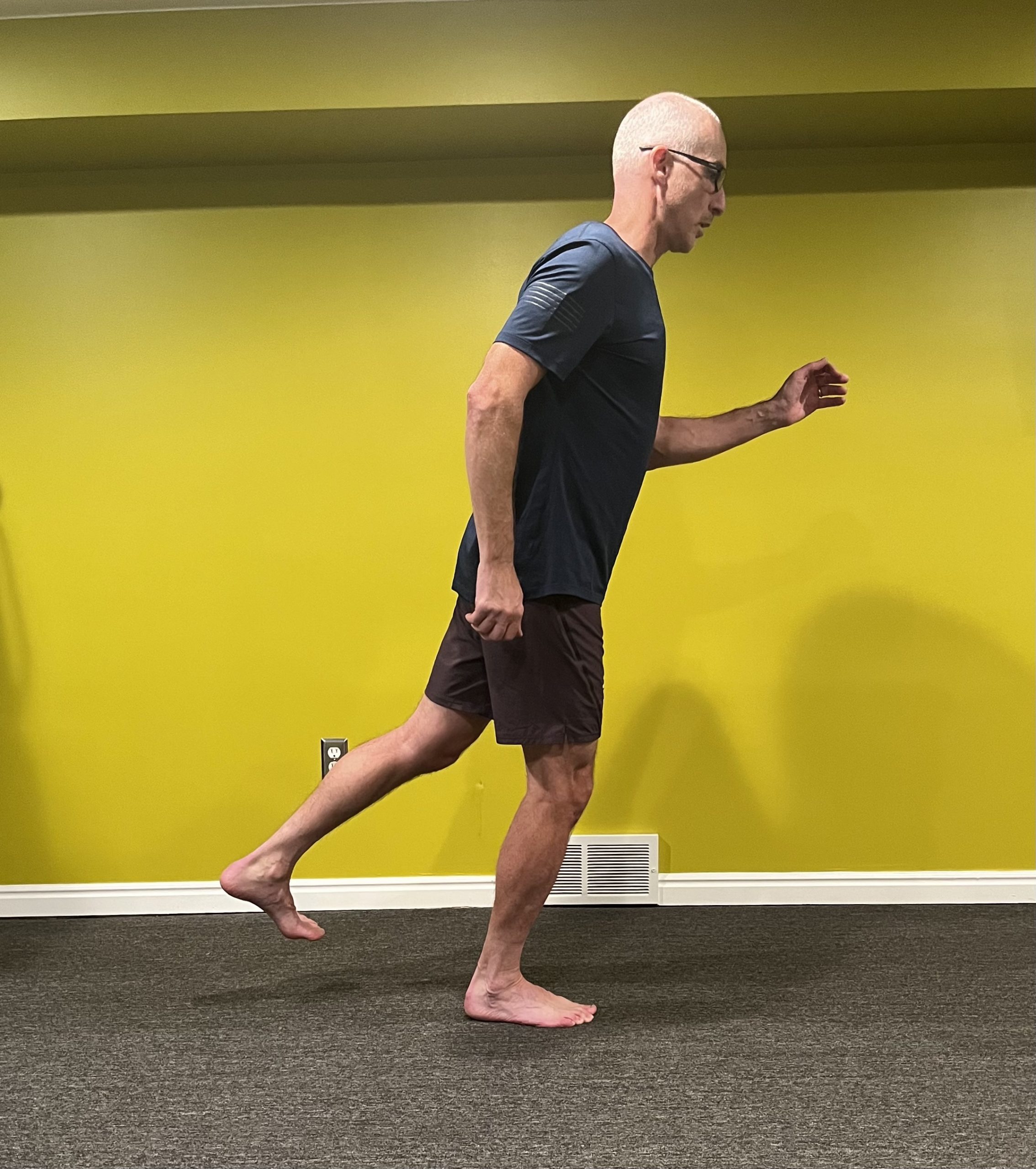
Classic Stride/Bound with Pause for Balance Exercise
Traditional diagonal stride bound except with a pause on the “glide” foot.
Be honest about balancing in Ski Stance before kicking onto the other leg.
Continue to focus on arm swing mechanics and a strong kick.
Skate Stride/Bound with Pause for Balance Exercise
Traditional lateral bounding except with pause on the “glide” foot.
Be honest about balancing in Ski Stance before kicking onto the other leg.
Continue to focus on both the pre-load and strong push through the leg.
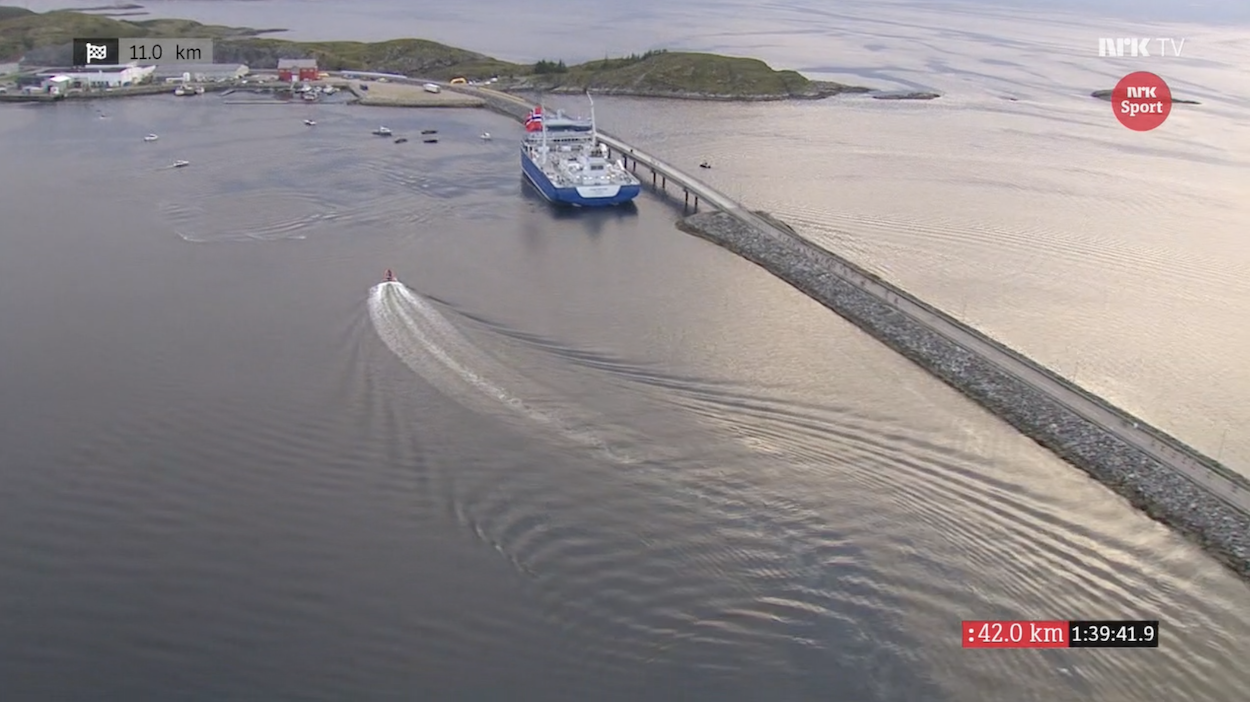
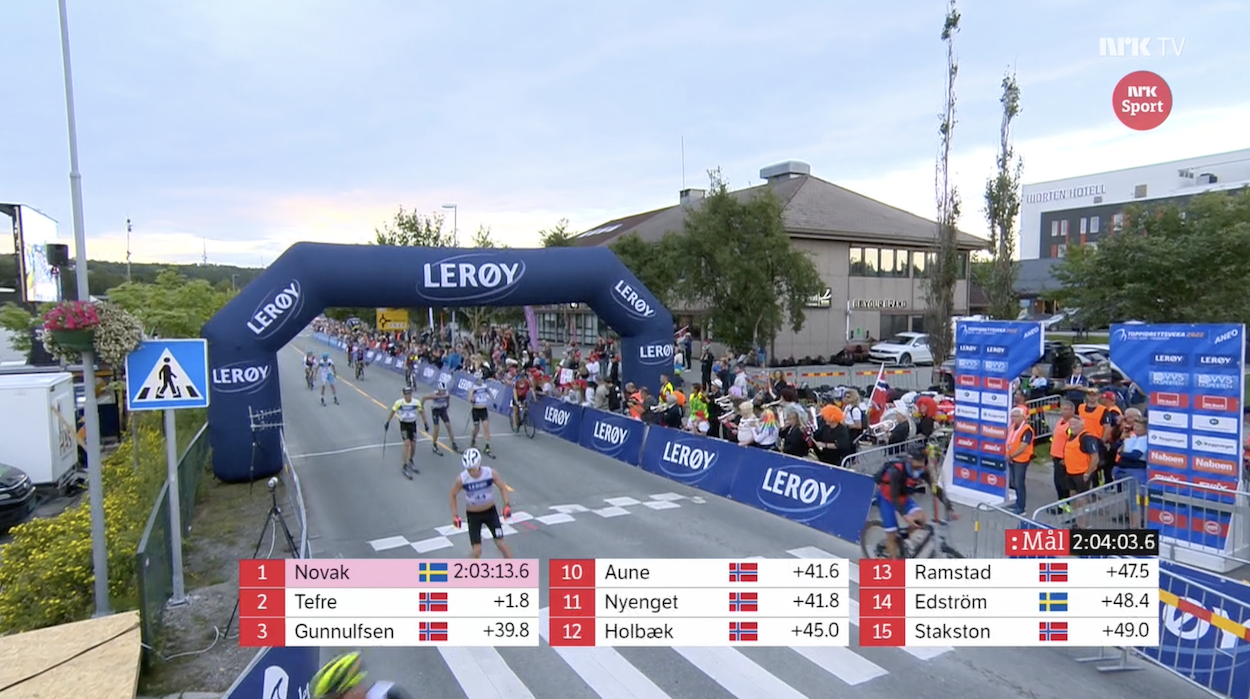
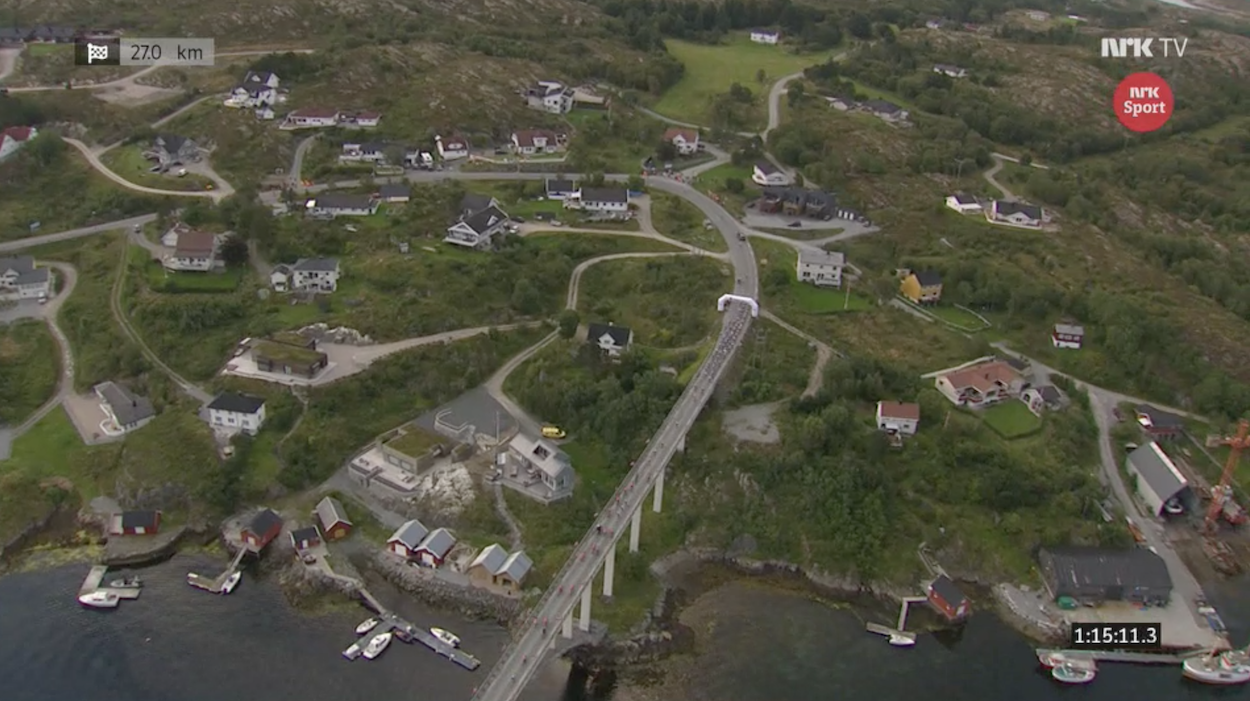
Athletes race across a causeway approaching Hitra in Toppidrettsveka 2022. (photo: screenshot from NRK broadcast)
After technique work on snow comes race effort on rollerskis. Racing Thursday evening in Hitra, Norway, Ben Ogden led four American men when he placed 18th in a field of nearly 100 in the 54-kilometer classic mass start, the opening race of the Toppidrettsveka race series in the Trondheim region of western Norway.
Ogden finished 50.2 seconds back of the winner, and 10.4 seconds off the podium. He was followed by fellow USST athletes Finn O’Connell in 47th (+3:57.4), Johnny Hagenbuch in 55th (+6:38.4), and JC Schoonmaker in 65th (+9:26.0). Kevin Bolger and Walker Hall are also on this trip, and may compete in upcoming races.
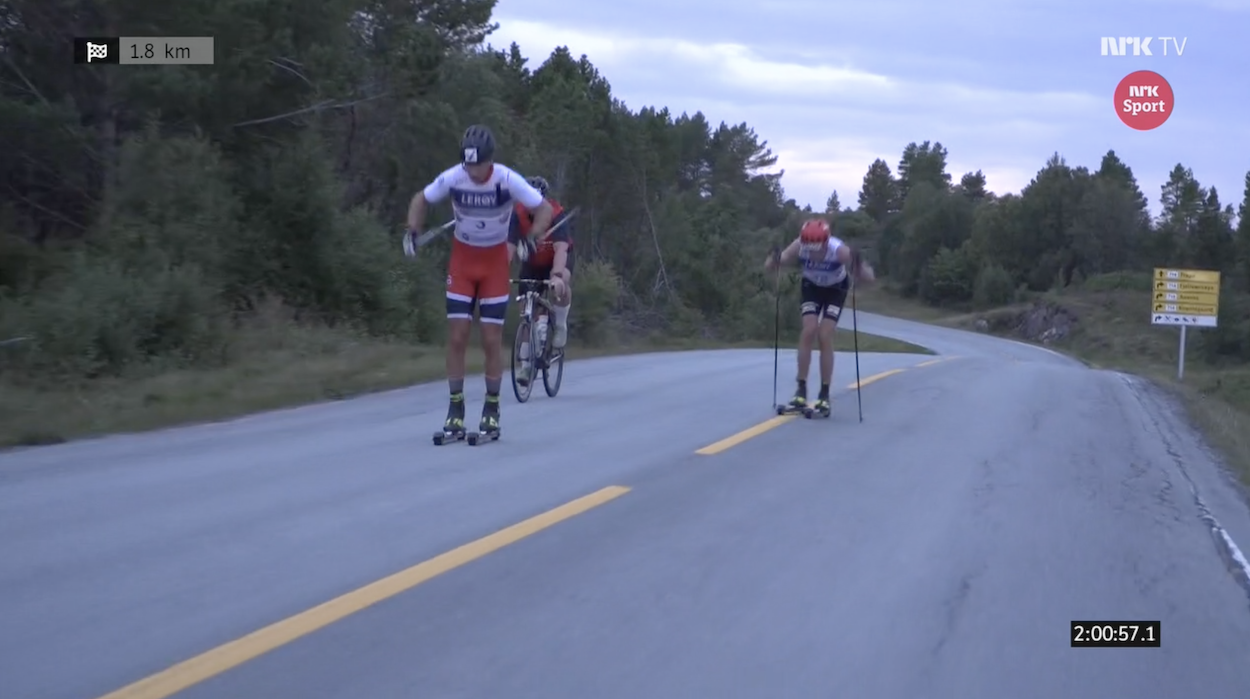
Max Novak makes the winning move, Toppidrettsveka 2022. (photo: screenshot from NRK broadcast)
The race was won by Max Novak of Sweden in 2:03:13.6, after he and Norwegian Gjøran Holstad Tefre distanced themselves from a 17-man chase pack within the final 10 kilometers. Novak used a powerful acceleration on a small uphill 1.8 kilometers out to open up a small gap on Tefre, which he held all the way to the finish. Tefre finished 1.8 seconds back of Novak. Mikael Gunnulfsen of Norway won a group sprint to finish third (+39.8).
Perhaps the best-known retired skier in the field, Petter Northug, 36, finished 38th (+2:53).
The women’s race, in which no Americans competed (there are no American women on this training trip), was won by Norwegian Astrid Øyre Slind, who covered 54 k in 2:10:40.5, a staggering 12+ minutes ahead of Lotta Udnes Weng in second. Friend of the program Frida Karlsson finished in 2:25:31.2 to place fifth in a field of twelve women.
Ben Ogden crosses the finish line in 18th, back middle, to the right of the athlete in a yellow top. (photo: screenshot from NRK broadcast)
U.S. Ski Team Head Coach Matt Whitcomb was buoyant about the team’s fitness and recent training heading into the race.
“Everyone is healthy,” wrote Whitcomb in an email to multiple media outlets Thursday morning, “and we’ve all had one of the best training camps of my coaching career. The guys have had a blast together. We’ve trained hard, both on and off snow. While we’re training into these races, everyone feels ready to race. Training through the summer races is a common approach.”
Thursday’s races started at 6:20 p.m. in the evening local time, with the men’s winner finishing at 8:23 p.m. and the final American not finishing until after 8:30 p.m., suggesting a late night for all after cooldown, recovery, and coming down from the high of racing.
Scenery shot, Toppidrettsveka 2022. (photo: screenshot from NRK broadcast)
Competition continues in western Norway with a classic sprint on Friday, then a 10/15 k interval-start skate race on Saturday morning and a 5/10 k classic pursuit Saturday afternoon. FasterSkier will publish a more detailed article after the final race. The races will be shown on NRK, if you can manage to access the Norwegian broadcaster from where you live, and may be livestreamed on the event’s Facebook page.
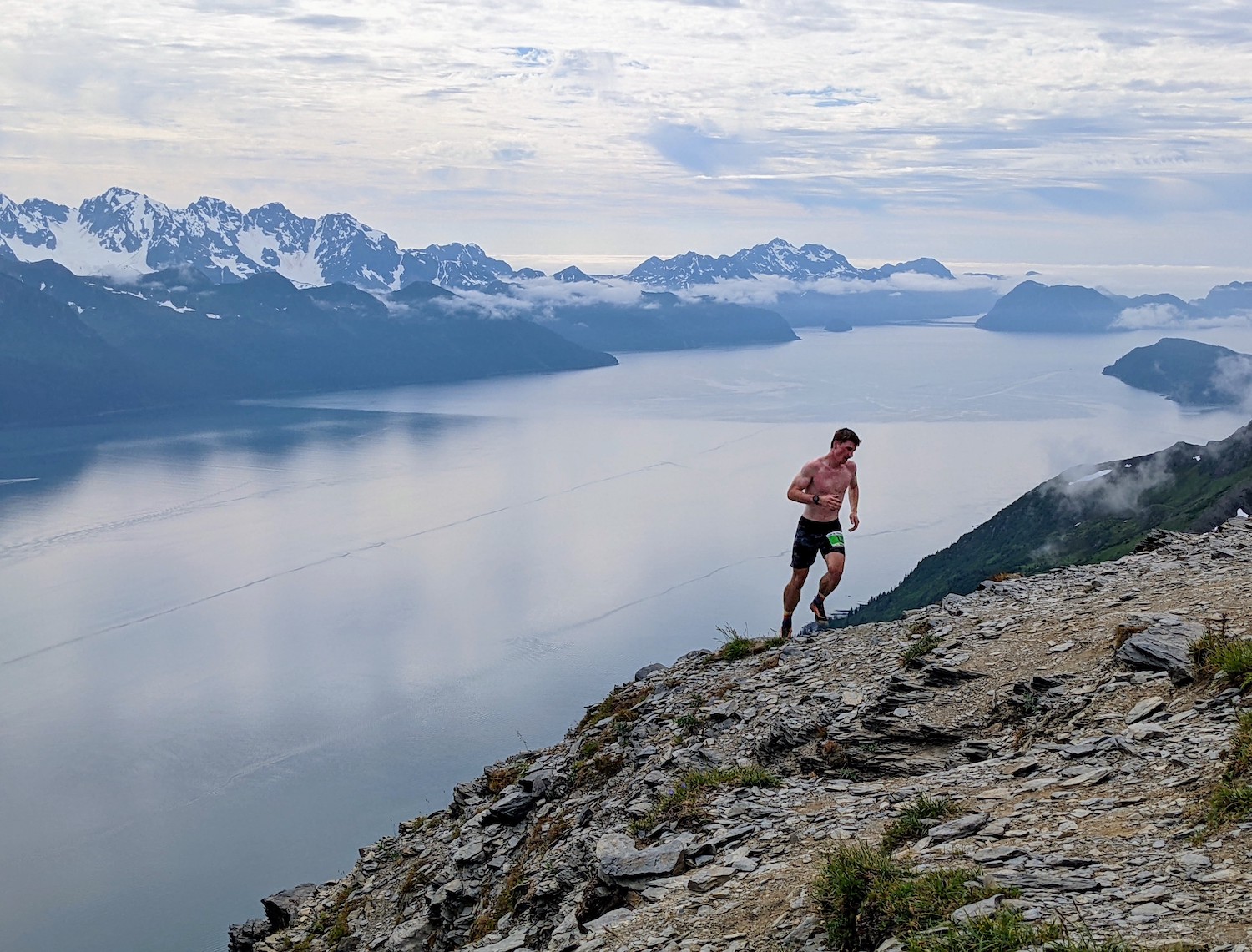
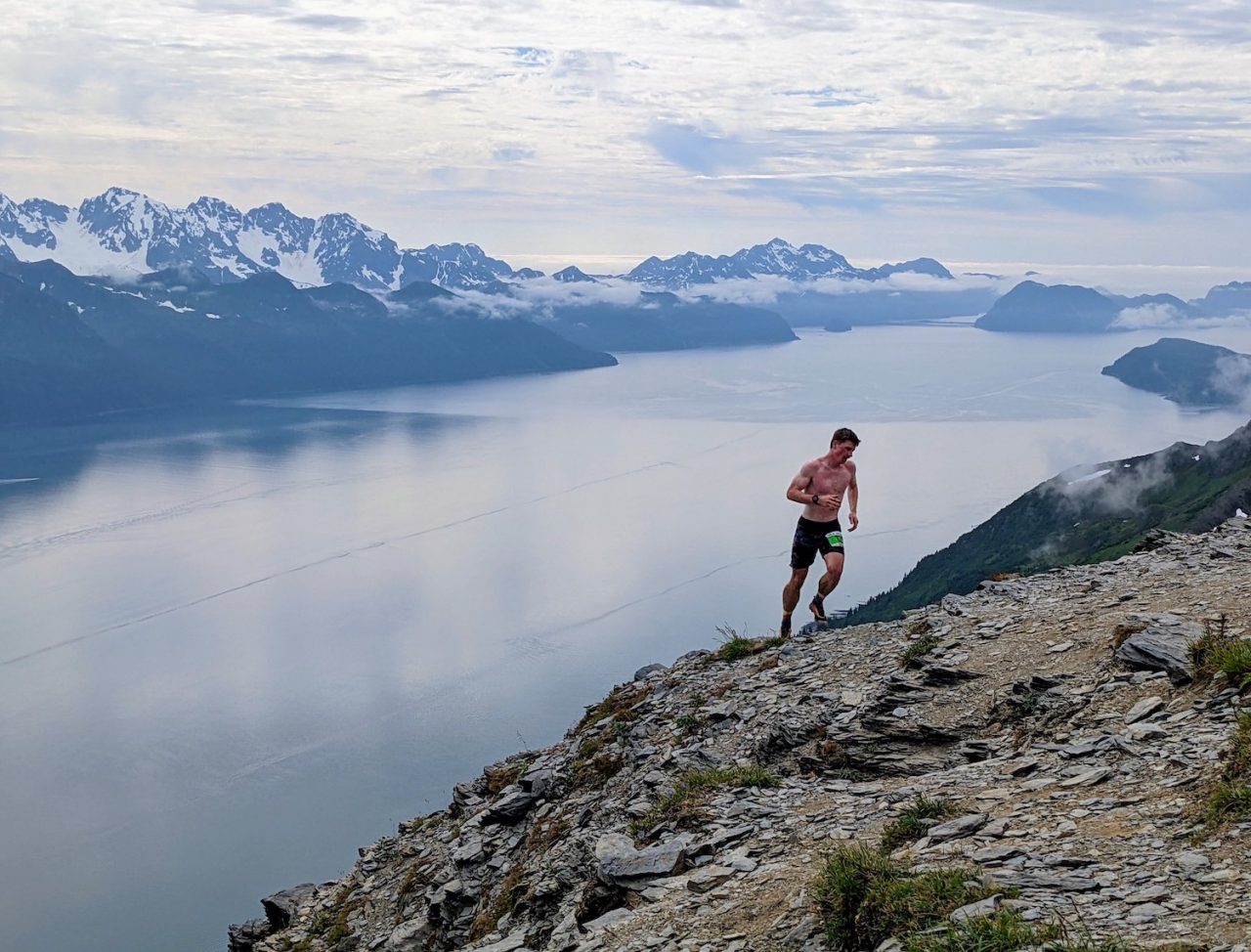
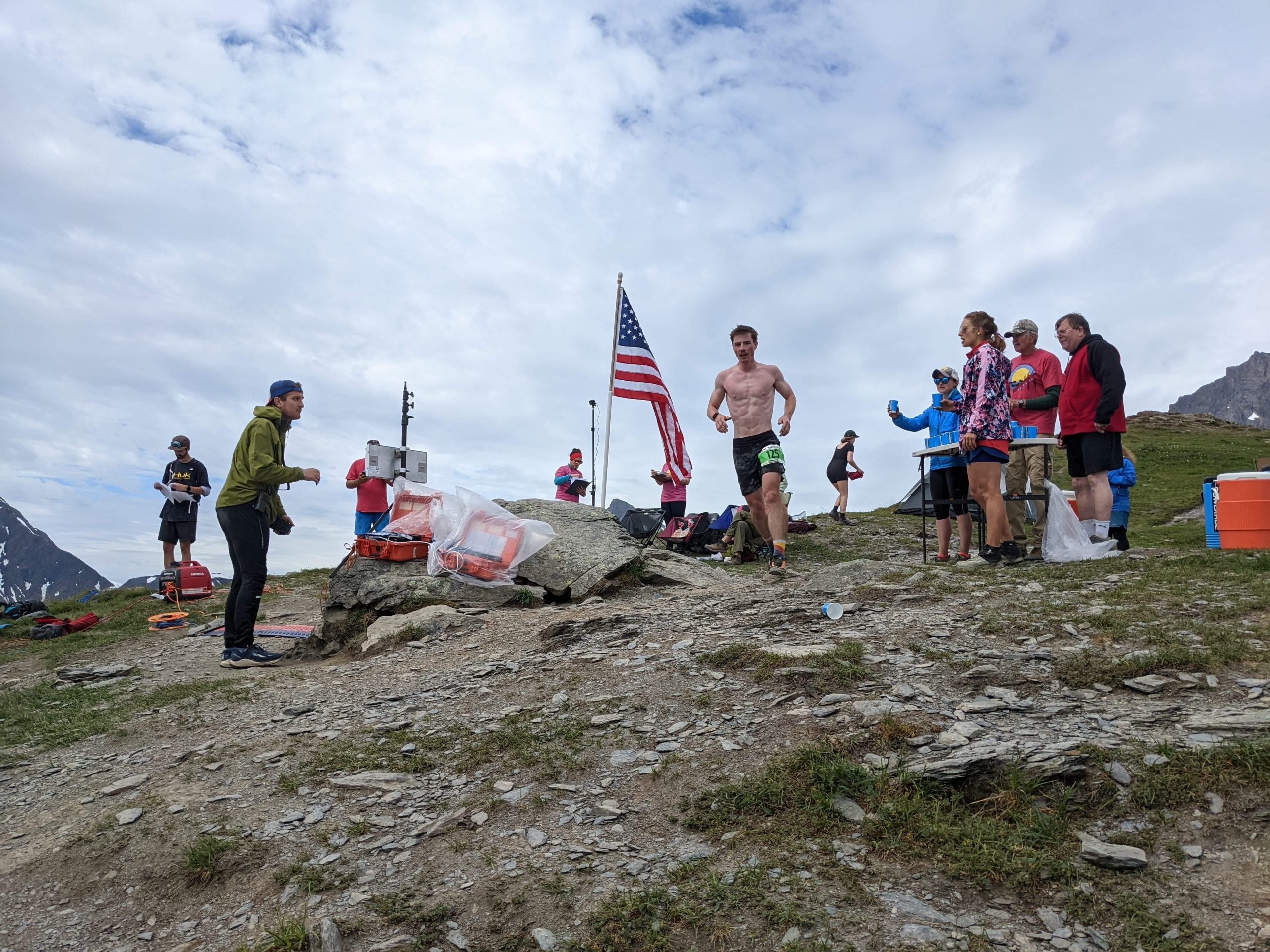
Thomas O’Harra (APU) approaches the turnaround point in the 2022 Mt. Marathon race above Seward, Alaska. (photo: Anna Engel)
Occurring annually on the 4th of July, and touted as the toughest 5 k on the planet, the 94th edition of the Mount Marathon race took place this past Monday in Seward, AK. Needless to say, the race is a storied tradition, beginning with its first “official” running in 1915. Over the years, participation has increased to such an extent that these days there are a number of complex ways for race entrants to register, including selection through a lottery system, petition for a race spot, or even buying a bib at a last-minute live auction.
There is no set course up the mountain itself. Racers start on city streets, at sea level, and run through town for half a mile before starting the climb and heading straight up the mountain. During the climb, athletes cover roughly 2,675 vertical feet of climbing in less than a mile (0.9 to be exact). Once they’ve crossed the timing mat around the false summit at Race Point, they turn around and descend that same steep slope via a slightly different route. A junior boys and girls race is also run, in which the participants only ascend partway up the mountain before turning around.
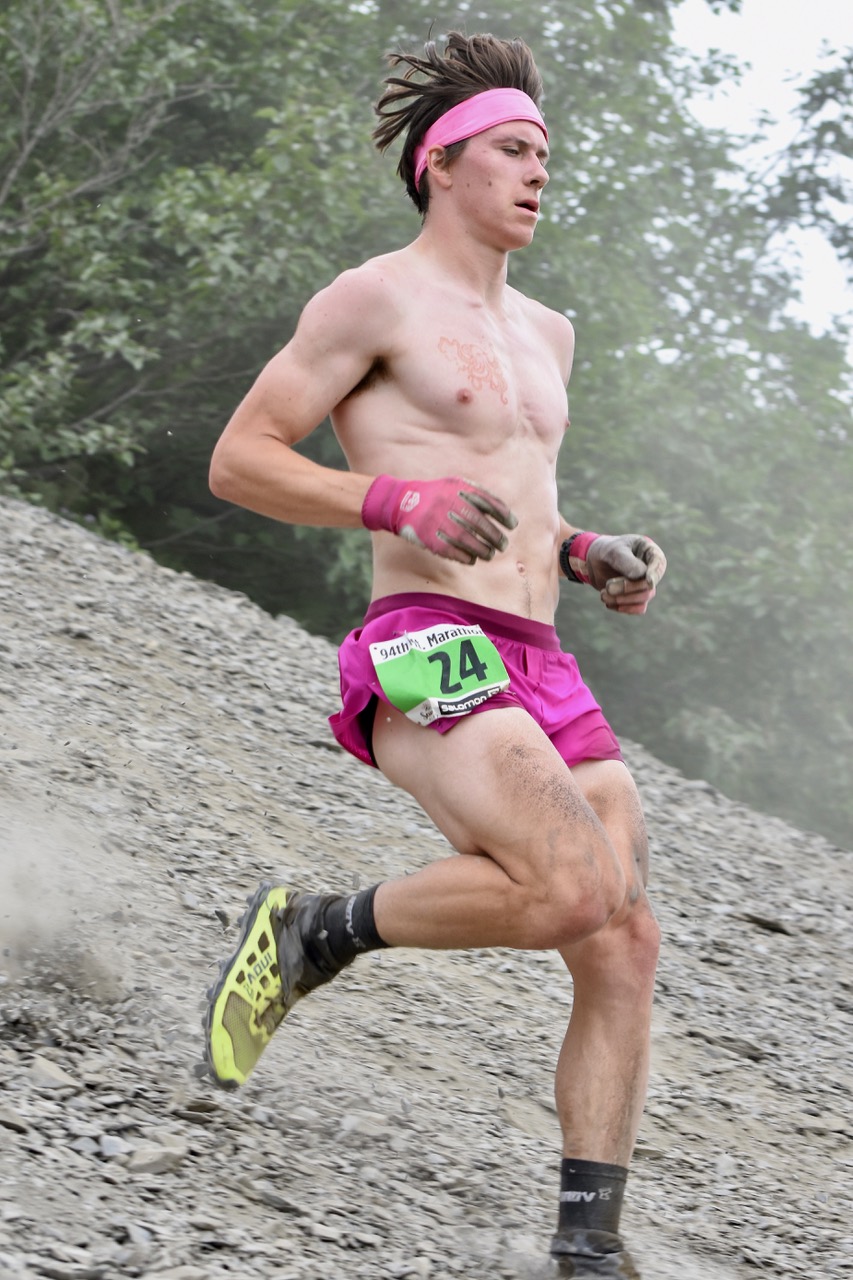
Runners bomb down scree back towards Seward and Resurrection Bay after turning around at Race Point. (Photo: Walker Hall)
This steep and challenging course has seen a number of nordic skiers succeed, including current men’s record holder, David Norris (41:26). Norris has won the race all three times he entered and took the record from mountain master, Kílian Jornet (41:48). Four-time Olympian, Nina Kemppel, holds the record for most race wins at an impressive nine victories. And until this year, three-time Olympian, Todd Boonstra was the oldest victor at age 41. However, at the conclusion of the 2022 edition of Mount Marathon, that crown went to a new champion.
The men set off at 11 a.m. local time and Max King of Bend, Oregon, took this year’s victory in a time of 43:37. At the age of 42, he became the oldest winner in the race’s long history.
Behind King, APU skier Thomas O’Harra placed second in his Mount Marathon debut. “I really didn’t expect to do as well as I did,” shared O’Harra. “It’s such a strong field, even without David [Norris] racing this year.”
Just a few weeks before O’Harra took top spot in the Bird Ridge Hill Climb, so he had confidence heading into the uphill section of Mount Marathon. “I knew that I was in good shape for the climb at least, after Bird Ridge, so I figured that I could be in the top three to the top and then the downhill was a total unknown to me. I practiced it once, a week before the race, but I’ve never raced a downhill like that before so I had no idea what to expect.”
Thomas O’Harra (APU) rounds Race Point in second place in the 2022 edition of Mount Marathon (Photo: Anna Engel)
Plummeting down the scree slope, O’Harra said his main goal was to stay on his feet and not get hurt. “I was shocked that I was still in second coming off the mountain and suffered my way down the road to the finish, where I managed to sneak under 45 minutes, which was a kind of secondary, if-it-goes-well goal,” said O’Harra. “[It was a] super fun time though, the closest running race I’ve ever done to the Birkie, and I’m stoked to come back and race again next year!”
Canadian skier and current Ute (athlete at the University of Utah), Sam Hendry, finished second behind Norris in 2021. This year, Hendry placed 7th with a time of 47:39. Hendry shared that this year’s Mount Marathon “was a bit of a disappointment.” He continued, “I finished second last year and was really hoping for a strong result again. With some busy travel getting up to Alaska, I didn’t have the best preparation and my legs were just a little off.” Hendry raced both the Vertical Kilometer (VK) and 26 k at the Broken Arrow Skyrace mid-June and placed fourth in both, besting King by nearly a minute in the 26 k. Hendry said, “I had some good results there, and plan to add some more running competitions to the calendar for later in the summer. I really enjoy getting some competitions in during the summer and getting to feel stressed and nervous.”
Michael Earnhart descends a dusty slope towards Seward (Photo: Jim Jager)
New U.S. D-Team member and APU skier, Micheal Earnhart, finished his day in 15th (49:45). He wrote to FasterSkier, “I wasn’t stoked with my results by any means but I am happy that I’m at a point in my career where top-15 at Mount Marathon can be a bad day.” Earnhart was quick to praise his teammate’s success saying, “My main takeaway was how impressive it was to see my APU teammate, and race rookie, Thomas O’Harra get second place. Definitely a strong day for APU and skiers in general which is always fun to see.”
Fellow U.S. Ski Team athlete Luke Jager was shortly behind Earnhart in 18th.
With the men’s race concluded, the focus turned to the women, who started at 2 p.m. local time. (The men and women now race in the flagship afternoon slot in alternate years.) Breaking the seven-year-old women’s record, Allie McLaughlin of Colorado earned the victory in a time of 47:09. Previously held by Swedish runner, Emelie Forsberg, with a time of 47:48, McLaughlin created a margin of 39 seconds in her favor.
Rosie Frankowski, who finished 4th in 2021, and is perhaps one of the fastest climbers out there, came in sixth this year (53:19). Racing Mount Marathon for the first time, newly named U.S. Ski Team A-Team member, Novie McCabe placed 8th (56:27). About her race, McCabe shared, “Mount Marathon was crazy! So hard, but a very cool experience for sure. I’m pretty happy with it. I was nervous about the downhill and was honestly pretty happy with myself for just doing something a bit out of my comfort zone.”
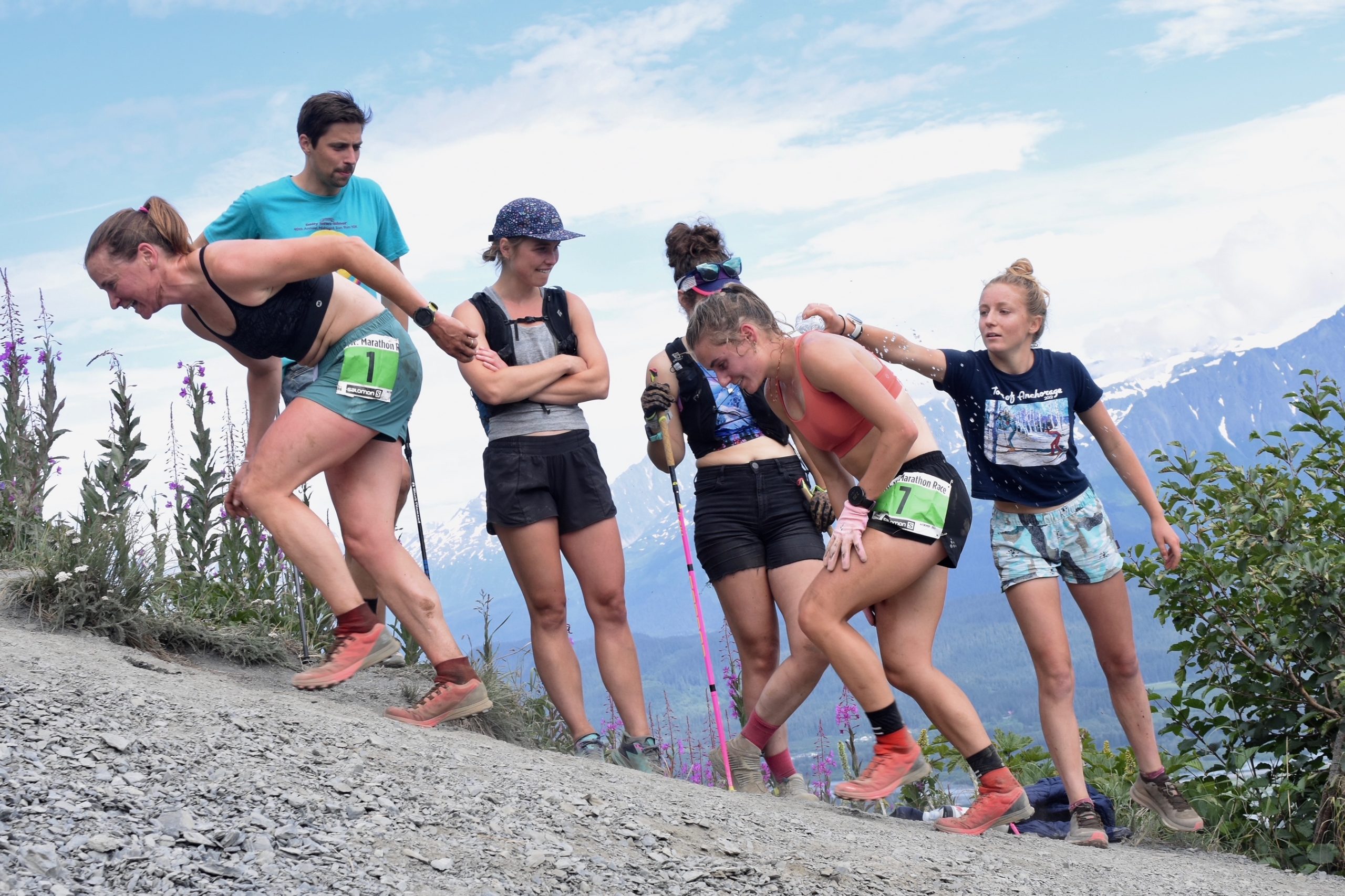
After racing the junior girls event, Dashe McCabe waters her sister, Novie (bib #7), on the climb (Photo: Jim Jager)
Kendall Kramer of UAF finished just outside the top-ten in 11th position (57:12). Kramer finished 9th last year (56:50) and was the junior girl’s race champion in 2018 (34:05).
Full race results of all the Mount Marathon events can be found here.
In other racing news, U.S.A. Track and Field Mountain Running Championships (USATF) in Wilmington, NY at the beginning of June saw two 2022 Beijing Olympians competing. Sophia Laukli finished third in a time of 1:29:03., and Caitlin Patterson came in sixth (1:35:52.3). Results for that event can be found here.
The Loon Mountain Race hosted Vertical U.S. Mountain Championships on July 10th, which a number of nordic and biathlon athletes attended. Alex Lawson representing Craftsbury Green Racing Project finished third, and posted the second fastest time on the “Upper Walking Boss,” a 40% grade ski hill for a half-mile at the end of the race.
Jake Brown (also of CGRP) had the second fastest time on the “Upper Walking Boss” and finished 9th overall. Full results for the event can be found here.
The Cirque Series mountain race circuit kicks off this coming Saturday (July 16th) at Brighton, UT. With a schedule of six U.S. based races taking place over the next few months nordic ski fans should keep an eye out for familiar names near the top of the results sheet.
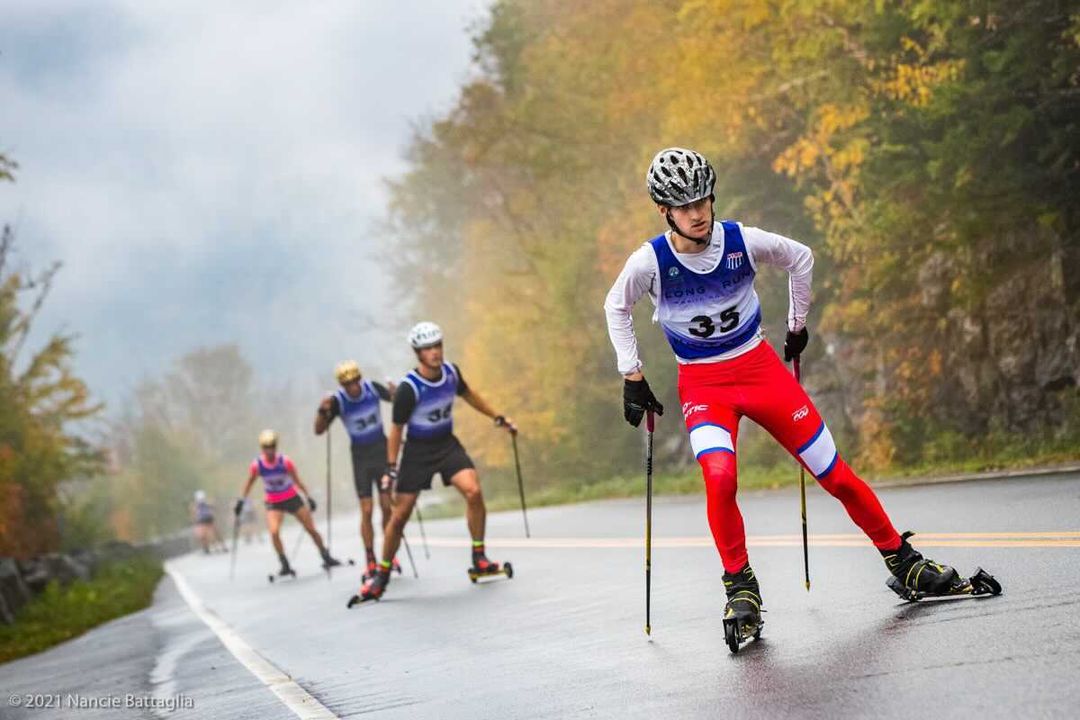
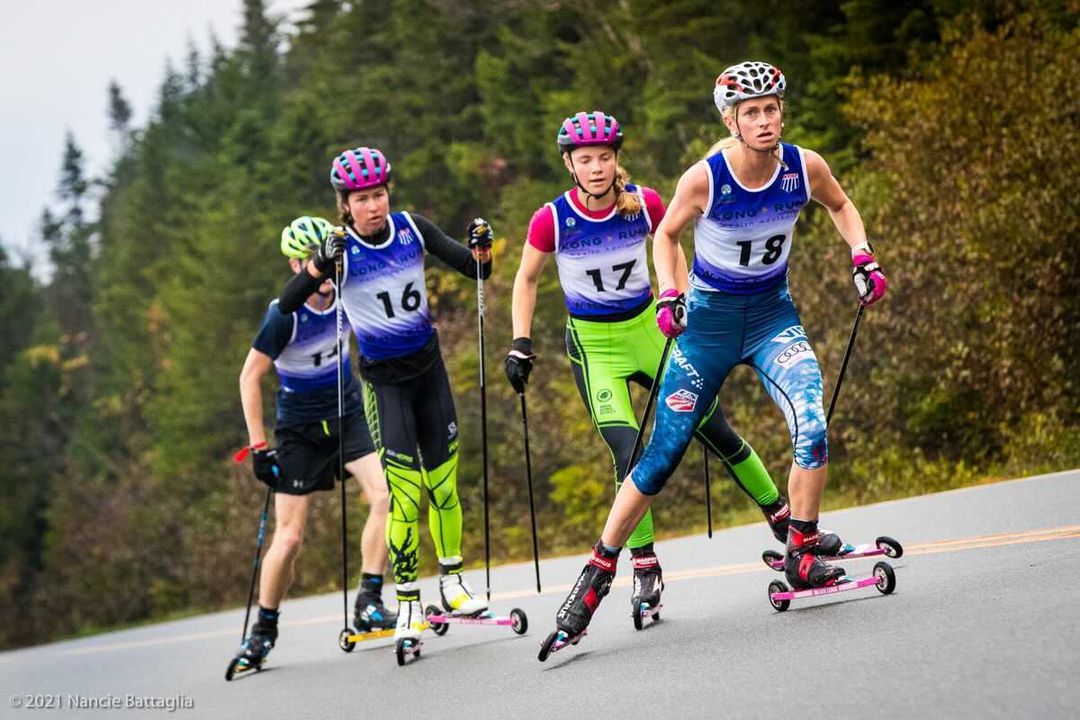
Racers climb the Whiteface Veteran’s Memorial Highway during the 2021 Climb to the Castle. (Photo: Nancie Battaglia/NYSEF)
The rain stopped just long enough for Caitlin Patterson and Jake Brown to savor their wins at the 2021 edition of the Climb to the Castle last Saturday in Wilmington, NY, near Lake Placid.
Craftsbury Green Racing Project (CGRP) swept the women’s podium; Caitlin Patterson edged Margie Freed for the win in 46:48.8, with her teammate just .7 second back in 46:49.5. Tara Geraghty-Moats placed third in 47:35.0.
Brown, skiing for US Biathlon / CGRP, took the men’s win in a time of 38:04:00. CGRP teammate Akeo Maifeld-Carucci came second in 39:34:9, and Junior athlete Tabor Greenberg, a U16 athlete out of the Green Mountain Valley School (GMVS), interrupted CGRP’s command of the podium in third place at 41:24.7.
After taking 2020 off due to the pandemic, the Climb to the Castle returned to the Northeast roller ski calendar, co-hosted by NENSA and NYSEF. The race leads skiers five miles up the Whiteface Veteran’s Memorial Highway at an average eight percent grade. Whiteface is the fifth highest mountain in New York’s Adirondacks; start too hard, and you’ll never recover. This author can attest.
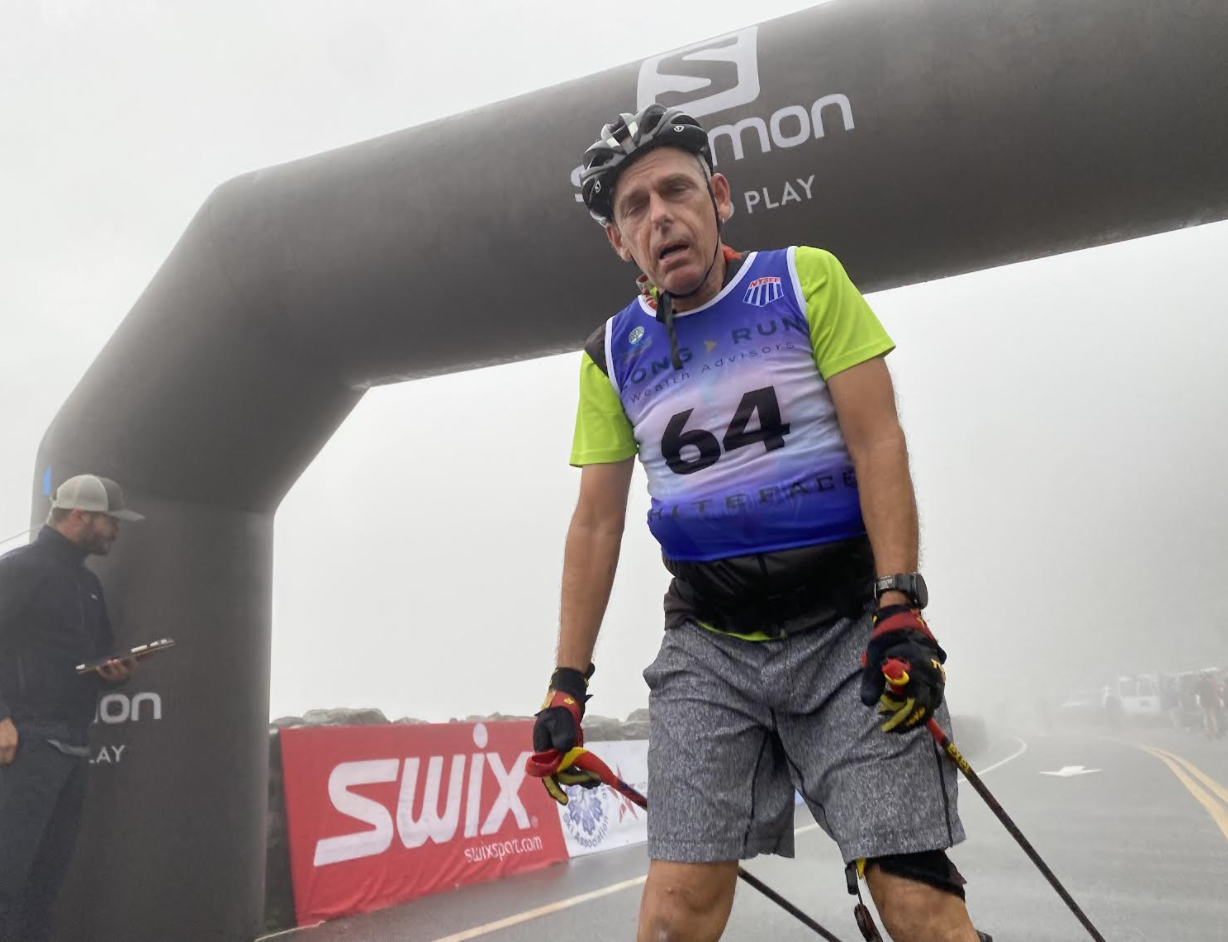
The author completes his Climb to the Castle. (Photo: NENSA)
As is often the case, weather made the race…. interesting. Light overnight rain tailed off about an hour before the start. Although the temperature hovered in the low 50s, the humidity made it feel warmer. Clouds and fog obscured vision throughout the day. In some places, one was lucky to see a hundred feet. For a change, there was little wind, even at the infamous Windy Corner and chute, 800 meters or so from the finish.
For COVID safety, organizers started five waves of skiers, each two minutes apart. Competitors wore masks at bib pickup and on the summit after finishing their race.
Visibility low, energy high: a wet start for the men’s wave in the 2021 Climb to the Castle. (Photo: NENSA)
The women’s race was high drama as Patterson, Freed, and Geraghty-Moats worked together up the road.
“Tara and Margie and I knew we wanted to work together, especially with the way the Climb can be pretty windy at the top. It was just gonna be: ski smooth, work together, and shuffle around the leads, which is what we did. I definitely wanted to make sure not to start too fast. I did that well, though I certainly had some rough moments in the middle.”
From the start, Patterson said that she and Geraghty-Moats took turns in the lead, trading off about every kilometer. “Towards the upper part, Margie was taking some really strong leads. I was suffering a bit,” Patterson added.
With two kilometers left, Freed opened a gap from Patterson and Geraghty-Moats. Patterson said it took a few minutes for her to regain contact. At that point, Patterson and Freed pulled away from Geraghty-Moats, skiing to the finish.
“Maybe 30 seconds out, I passed [Margie],” Patterson said. “It was really strong work by both of them. It was great to ski with people because it was as tough a course as ever.”
Of her finishing kick, Patterson said, “I know that I can tap into a late surge. We were working together for most of it, and as the finish line was drawing near, it was definitely every person for themselves.”
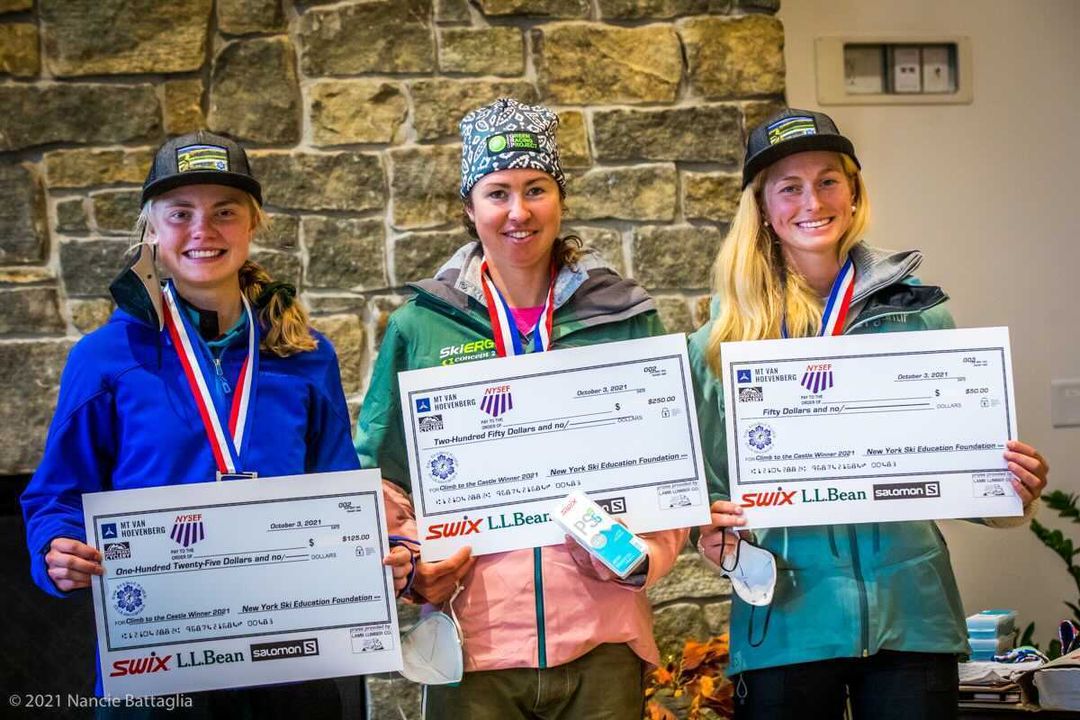
Craftsbury women clean up at the 2021 Climb to the Castle. Caitlin Patterson took the win ahead of Margie Freed (left) and Tara Geraghty-Moats (right). (Photo: Nancie Battaglia/NYSEF)
“It went pretty well today,” said Freed of her race. “It was awesome to ski with Tara and Caitlin for so long. I don’t think I could have kept up that pace if I was alone.
“I’ve never done this race before, so it was exciting to have every step be something new for me,” Freed continued. “Even though I didn’t quite know where the finish was, or when it was coming. I couldn’t quite see it because it was so foggy. It was an awesome day out there, and I was glad it wasn’t as windy or rainy or cold as I was thinking it was going to be.”
This past winter, Geraghty-Moats won the first ever crystal globe for FIS Women’s Nordic Combined. She also won the Climb in 2018. After the race, she wrote, “It was really nice to go all out with my teammates. We skied together really well. We all had moments of fading and then climbed back on. I dropped back about half a k after the Lake Placid turn — I just kind of ran out of gas. I’m pretty happy with how I felt and it was a really fun race.”
Jake Brown wins the 2021 Climb to the Castle in a long solo effort. (Photo: Nancie Battaglia/NYSEF)
For Brown, this was his third win at Climb to the Castle, his previous two coming in 2017 and 2018.
“I wanted it to be a good, solid effort,” Brown said. “I knew that I couldn’t sprint too hard off the line, but I wanted to get into that high heart rate zone and stay there as long as I could.”
Asked about race strategy, Brown said, “I was with Akeo [Maifeld-Carucci], my Craftsbury Green Racing Project teammate. He led for the first 3 minutes or so.”
At that point, Brown said, he took a turn pulling and developed a gap. “I was hoping we could work together a little bit more, but we ended up with an awkward 20-meter gap between us that we held for maybe half the race. Then I slowly pulled away and was by myself.”
Jake Brown wears the moose-antler crown after winning the 2021 Climb to the Castle. (Photo: NENSA)
Asked if he could use this as a fitness benchmark, Brown said, “This was my fourth time doing the race. This was a bit of a slower year; I’m hoping it was just because of the weather. Maybe a little later in the year and a little colder pavement. It was kind of warm today, but maybe the pavement was a little colder. Maybe my fitness isn’t where it was. We’ll find out when the winter comes — that’s what matters.”
For Maifeld-Carucci, “It was a sweet day. I wanted to do this race for a long time, since early in college. So it was great to actually be here and do it. The weather was way better than we expected. It was a little wet and a little cloudy at the top, but there were moments when it opened up and it was super pretty. Constant great climb, hard skiing — it was definitely a hard race and a really good effort.”
Commenting on the men’s pacing and tactics, Maifeld-Carucci echoed Brown’s explanation of the duo’s ability to collaborate.
“Jake and I were hoping to ski together and trade leads,” Maifeld-Carucci explained. “He was feeling a little stronger than I was so I fell off early and we were dangling 20 meters apart for a long time. Then he started to open it up.”
Akeo Maifeld-Carucci skis to second place at the 2021 Climb to the Castle. (Photo: Nancie Battaglia/NYSEF)
In addition to Greenberg nabbing third place overall, the GMVS boys swept the junior podium.
Responding to an email, GMVS head coach Colin Rodgers said that his skiers didn’t taper for the race. “Tabor actually trained a lot in the past week including a 120 mile bike ride to raise money for the Kelly Brush Foundation.”
Commenting on the preparation for this event, and how it fits into the season preparation, Rodgers explained:
“We spent some time recently working on climbing technique. When we were recently on snow on the Stelvio glacier we were working on standing well (balanced and forward) on our skis. We did not discuss any mass start race tactics for today — I really just wanted the crew to focus on pacing the effort properly and being consistent throughout the duration of the climb. [Having] a dialed warm up and trying to keep good form when tired were also a few other things we were honed in on today.”
The men’s podium at the 2021 Climb to the Castle. Jake Brown (CGRP) took the win ahead of Akeo Maifeld-Carucci (CGRP) and Tabor Greenberg (GMVS). (Photo: NYSEF)
Did Rodgers have an inkling that Greenberg might podium?
“We were not focused on the podium, we were just focused on executing a solid race effort. We are primarily focused on competitions in March, so all of this is just trying to build momentum towards the end of the race season.”
According to Sara Falconer, a coach at Mansfield Nordic (MNC) in Vermont, “It’s a good opportunity for [MNC junior athletes] to race other high school athletes and college athletes that are here. It’s also a chance for them to compare their times to last year and see the results of all the work they put in over the summer. They can see a lot of dramatic improvement. It’s a really motivating thing for them. And it’s also a good workout.”
From juniors to collegiate to masters, racers ascended Whiteface during the 2021 Climb to the Castle. (Photo: Nancie Battaglia/NYSEF)
Ethan Townsend, Saint Lawrence University’s (SLU) head nordic ski coach, planned a training weekend for his team. SLU athletes also roller skied the new loop at Mount van Hoevenberg on Friday.
“Saturday morning, we got up early and did a run/hike” said Townsend. “They had the option of going up Algonquin or Wright or Marcy. A lot of them took the option of going up Marcy. A few of them went up Phelps and Tabletop. Probably an average of five hours.”
Mount Marcy is the highest Adirondack mountain at 5,344 feet and Algonquin, the second highest, stands at 5,114 feet. The remaining peaks named are also among the 46 Adirondack High Peaks, which are all above 4000 feet.
After coming out of the woods, the SLU team reconvened for an afternoon double pole roller ski session.
“We weren’t concerned about performance, necessarily, in this race,” Townsend said. “It’s a training race. Something to do as a group. I told them, ‘Don’t worry about the results so much. It’s great that we can come here and do this. If you just stay in level three the whole time and you’re not feeling it to go super hard, I think that alone would be worthwhile.’”
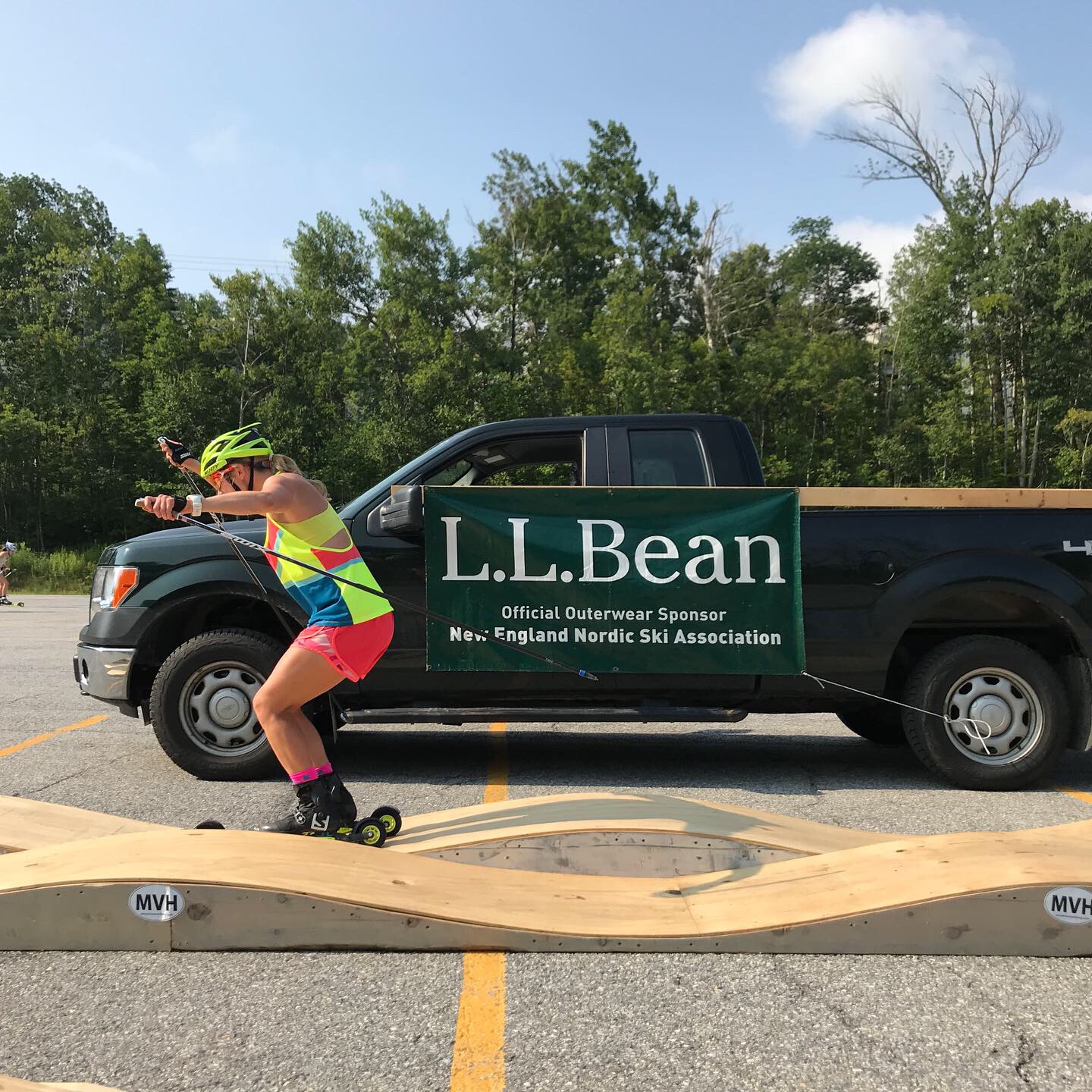
Jessie Diggins takes a first crack at NENSA’s rollerski ramps, which will be featured in the sprint qualifier and rounds in Lake Placid this weekend. (Courtesy photo)
On the heels of our coverage of the Martin Fourcade Nordic Festival and the Alliansloppet Action Week, we turn our attention to the Northeast where the burgeoning New England Nordic Ski Association (NENSA) rollerski race series is well underway. The next round of racing will take place this upcoming weekend, starting with a freestyle sprint event dubbed “The Keys to the Castle” on September 18th at Mt. Van Hoevenberg in Lake Placid, NY, followed by a freestyle distance race the on the rollerski track in Jericho, VT the next day. Men and women will each race 15-kilometers in the open division, while juniors will have the option to race 5k.
For those interested in seeing the show, in-person spectating is encouraged at the Lake Placid stage, however, as the ski track in Jericho is at a Vermont National Guard base, names must be submitted for entry prior to the event. Events will also be live-streamed on the NENSA Facebook Page, and live timing will be available through Bullitt Timing. Updated COVID considerations for participants and community members can be found here.
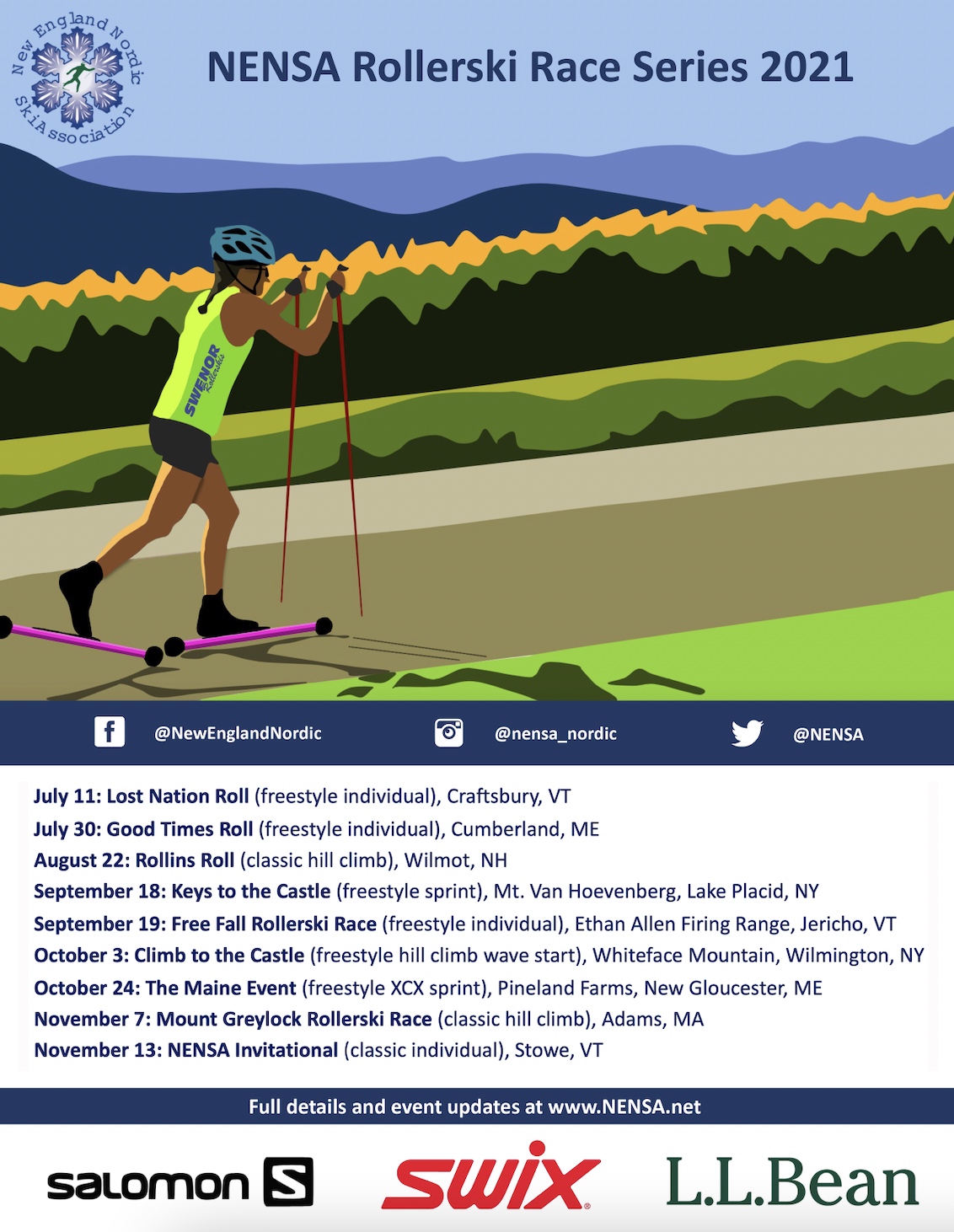
Building from past years, the series features nine events beginning with the Lost Nation Roll in Craftsbury, VT in July and ending in mid-November with the NENSA Invitational in Stowe. Captaining the ship and still rocking the mullet-mustache combo is competitive programs director Justin Beckwith, with whom FasterSkier connected in mid-August to learn more about this year’s widened scope of event offerings, supporting a thriving culture of skiing in the region, and whether the dream of a New York City rollerski event is still alive.
Beckwith explained in the call that one of NENSA’s objectives as the rollerski series evolves is to reach more athletes and to make opportunities for rollerski racing more accessible. Given the high density of cross country skiers and high level clubs in Vermont, the well-attended and highly competitive App Gap Challenge, and the designated rollerski tracks in Craftsbury and Jericho, past events have primarily taken place in that state. However, these venues can be quite a drive for skiers living in Western Massachusetts, New Hampshire, or Maine.
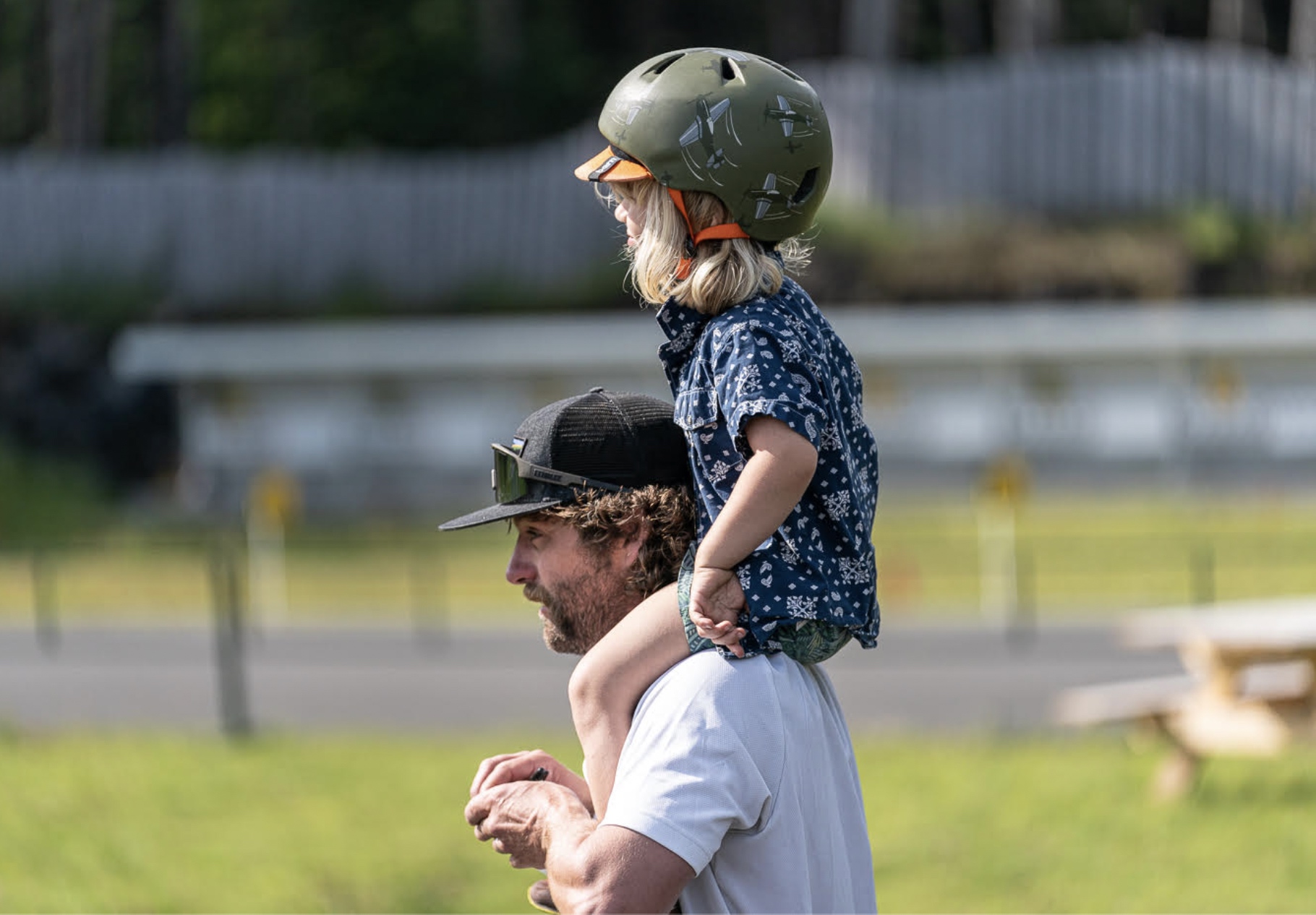
NENSA Competitive Programs Director and rollerski race series organizer Justin Beckwith with his son, Red, at an event in Craftsbury. (NENSA photo)
One of the first steps to expanding opportunity in the region? Outreach. Rather than bringing more people to Vermont, bringing the races to the people.
“One of the primary goals was to try and bring our programming across the entire Eastern region,” Beckwith said. “So we’ve done a race in Southern Maine, which Clare Egan so eloquently said at awards that she doesn’t think anyone’s had a rollerski race in Southern Maine before. And just this weekend, we’re going over to New Hampshire. It will be the first event we’ve done in New Hampshire on rollerskis. So that’s really cool.”
The first event he mentioned — the Good Times Roll in Cumberland, ME in collaboration with NonStop Nordic — featured a 4.3k freestyle race for Middle School and beginners, and a 7.5k open race on a closed roadway. The start and an agility course took place inside the Cumberland Fairgrounds. The second stage, The Rollins Roll in Warren, NH, led classic skiers up the Mt Kearsarge auto road, which was closed during the event. Bringing together the community, both events saw participants from the junior level through the 50+ age bracket.
In the Lost Nation Roll, which was co-hosted with the Craftsbury Outdoor Center, youth skiers had the opportunity to race the same course as elite athletes from the Craftsbury Green Racing Project (GRP) whom they admire. Likewise, the GRP athletes had the opportunity to ski their home track with outside stimulation. This event was followed by a learn-to-rollerski clinic and a free biathlon clinic to bring in additional members of the community who were not up for racing or wanted to learn more about shooting.
Now, midway through the series, the events are catered more toward the top juniors and seniors in the region, though some are still open to all levels. Beckwith explained that NENSA was “lucky” to have such a high density of top skiers in the area, including regional high-performance junior clubs, elite teams like SMS T2 and the Craftsbury Green Racing Project, and EISA collegiate teams including Dartmouth College and the University of Vermont.
“We’ve had pretty good success incorporating at least the college programs that are within striking distance — driving time — and who can participate in the races that sort of start in September, October and then in the November.”
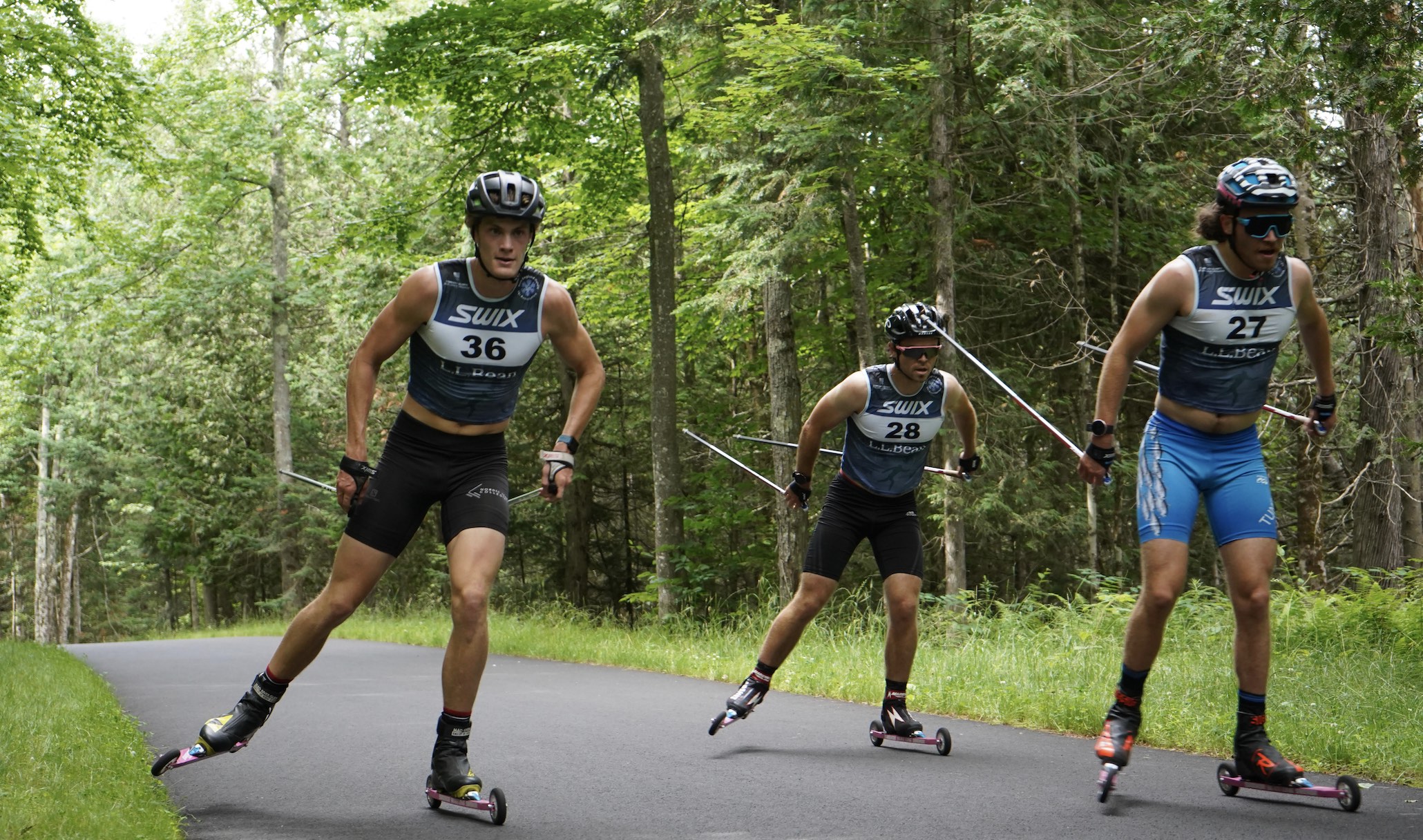
From left to right, Greg Burt, Raleigh Goessling, and Luke Brown go head-to-head during the 2021 Lost Nation Roll in Craftsbury, VT. (Courtesy photo)
In addition to new venues, the series is also incorporating a more diverse array of events, including sprint stages. Beckwith explained that the first round of sprint rollerski racing took place at the Eastern REG camp in early July in Lake Placid.
“At Mt Van Hoevenberg — that was really our first sprint course. It was actually our first sprint event that we’ve done in total since Junior Nationals 2020. But it was also the first heat format we’ve ever done in rollerskiing. And it’s an excellent venue for it. I think you can’t make a track wide enough [for rollerski sprints], so we actually pared down [the heats]. And I think the event we’ll do on September 18th… we’ll probably be running heats of four again in that. So it’s a little different than a winter format just because of the track width. But yeah, it’s exciting.” (Beckwith added that long-term, a wider track is something NENSA hopes to develop.)
More specifically, the events will still feature the typical structure of qualification followed by three progressive rounds, only modified to four skiers per section. Lucky losers will be incorporated based on time, as Bullitt Timing is providing a FIS level timing system. Juniors will compete in a mixed gender “Kings Court”-style sprint in order to ski more rounds, gaining more tactical experience.
The events this weekend will include athletes from the Sun Valley Gold Team, the Bridger Ski Foundation Pro Team, and SMST2. (The Craftsbury squad is currently in Germany training in the ski tunnel in Oberhof.) Because the number of athletes on course is limited, these events will have a bit more “vetting of the competition” — i.e., being current U.S. Ski & Snowboard members and holding a current FIS license. However, recreational skiers still have the opportunity to test their mettle at Climb to the Castle in Lake Placid on October 3rd or the Mount Greylock Rollerski Race on November 7th in Adams, MA. Both are uphill classic challenges.
“We created a permitted opportunity to ski up a closed State Park Road. So why not? Even if you’re not racing, go try it out, right?”
NENSA athlete Evelyn Walton on course in Lake Placid during the Eastern REG camp. (Courtesy photo)
Before the pandemic, the series averaged roughly 100 participants in each stage across all ability levels. While numbers have been lower in 2021 thus far, a summer series still remains a valuable touch point to keep the ski community engaged until the snow flies.
“A lot of these races this year, the focus is kind of building — not just out of COVID and building back into events, but into thinking about how we can better support the community and create opportunities. That’s our mission statement: to support a vibrant ski culture.”
To bring in people from all aspects of the community, NENSA is partnering with ORDA — Olympic Regional Development Authority — to organize an Eastern Coaches Symposium and a TD training opportunity in concert with the Climb to the Castle on October 3rd. Climb to the Castle is co-hosted with NYSEF, the New York Ski Education Foundation.
While this race up the Whiteface Toll Road in Lake Placid has plenty of history, it is also quite a grueling and climbing 2,300 feet in five miles is not universally accessible. Beckwith explained that they’ve considered a shorter distance where beginner or youth skiers could start further up the road to make it more manageable, or perhaps supporting a fleet of fast or “juiced” wheels to reduce the load.
Speaking to the concept of growing and sustaining the nordic community across all ages through the rollerski series, Beckwith recalled a conversation with longtime Sun Valley Ski Education Foundation coach Rick Kapala, who had contacted Beckwith to learn more about putting on the series in hopes of putting on similar events out West.
“The idea I think Rick hit on the head is just that you’re creating excitement, to keep the kids engaged, right? And adults — all of it keeps skiers engaged throughout the year, and I think that’s really the goal. There’s no qualification [to enter]. In the past, we’ve built prize money in and I think we’re gonna be building prize money into a few of those bigger events I was telling you about in the coming days, but that’s just fun to roll that out as it comes… So really the most enjoyable piece of it and the broader scope is that we’re bringing together people from different communities, regions, abilities, all of that.”
A host of rollerskiers get together after a NENSA event. (Courtesy photo)
He explained that NENSA’s team will similarly highlight regional popular racing opportunities during the winter.
“We’re really gonna highlight those races, popular racing opportunities, and also let people know that we feel like those are great developmental opportunities. Versus, we’ve been maybe a little Eastern Cup and Junior National qualifying centric in the past. So we’re really trying to support those, you know, it’s inclusive, but more so than that, creating festive opportunities that are available regionally. And the level of competition will be at those events regardless, because there’s really good skiers throughout the region, and they’re already utilizing those events.
“We know people will go to sanctioned events in winter and summer, try to qualify for JN’s, but how can we create opportunities beyond that? If we can bring it to people’s backyard communities, so to speak, or within that sweet spot of an hour or two from their doorstep, then hopefully, we just get more people involved and excited throughout the year.”
Green Racing Project members Susan Dunklee (left) and Caitlin Patterson (right) take on NENSA’s rollerski ramps at the opening event in Craftsbury, VT. (Courtesy photo)
FasterSkier spoke with Beckwith about the nascent series in 2019 shortly after the App Gap Challenge, a skate-to-classic skiathlon that led skiers up a mountain pass on a closed State Highway near Fayson, VT. (The App Gap took a hiatus in 2021 due to construction on the road.) When considering what it took to pull off an event of that magnitude, Beckwith said: “The beauty of a rollerski series is that nobody has any expectations or guideline of how we do this.”
He also said that he envisioned an event closer to the scale of the many summer rollerski festivals in Europe, perhaps in New York City or Boston. While this may seem like a pipe dream, with Beckwith behind the wheel, the idea came closer to fruition than one might have thought.
“Let’s say we were seriously exploring a race in Central Park this fall as part of the series early on. And I think it’s very possible for 2022 — it takes time to do that. But we’re close, we’ve got our foot in the door. People know who we are. And we have developed some key contacts that came up down there, which is exciting.”
NENSA also grew its staff this year to make organizing larger events more sustainable, adding an Event Support position filled by Fred Bailey.
“It definitely takes a team to pull this off,” Beckwith stated.
NENSA will be offering a youth clinic in Boston in collaboration with two other organizations whose goals also include getting kids outside on skis and supporting equity and inclusion in the cross country ski community. Like other clinics NENSA has run this summer, this clinic will introduce current ski program participants and potential future participants to rollerskiing for the first time with a focus on having fun, broadening exposure to different aspects of the sport, and encouraging an active and healthy lifestyle. Beckwith identifies that added exposure in populated areas may also help NENSA create larger highlighted events in the future.
“But there’s twofold to that. Because if we’re getting into urban areas, metro areas, whatever, then the visibility grows.”
With better understanding of the concept, urban venues might be more open to hosting. Beckwith explained that NYC stands at the top in terms of ideal venues. As so many events from 2020 were postponed into 2021 due to the pandemic, permitting became very challenging, which impeded the feasibility of running an event there in 2021.
NENSA athletes Jack Young and Jack Lange compete in the sprint event during the Eastern REG camp in Lake Placid. (Courtesy photo)
“One other issue beside the permit was just that it’s an Olympic year, and the availability and openness of National Team athletes [may be less than non-Championship years]. If we pull off a race in New York City, we’re talking about a budget at a minimum of 10 to 30 grand, so if we’re going to do that we want to have [high caliber athletes racing to] capitalize on it.”
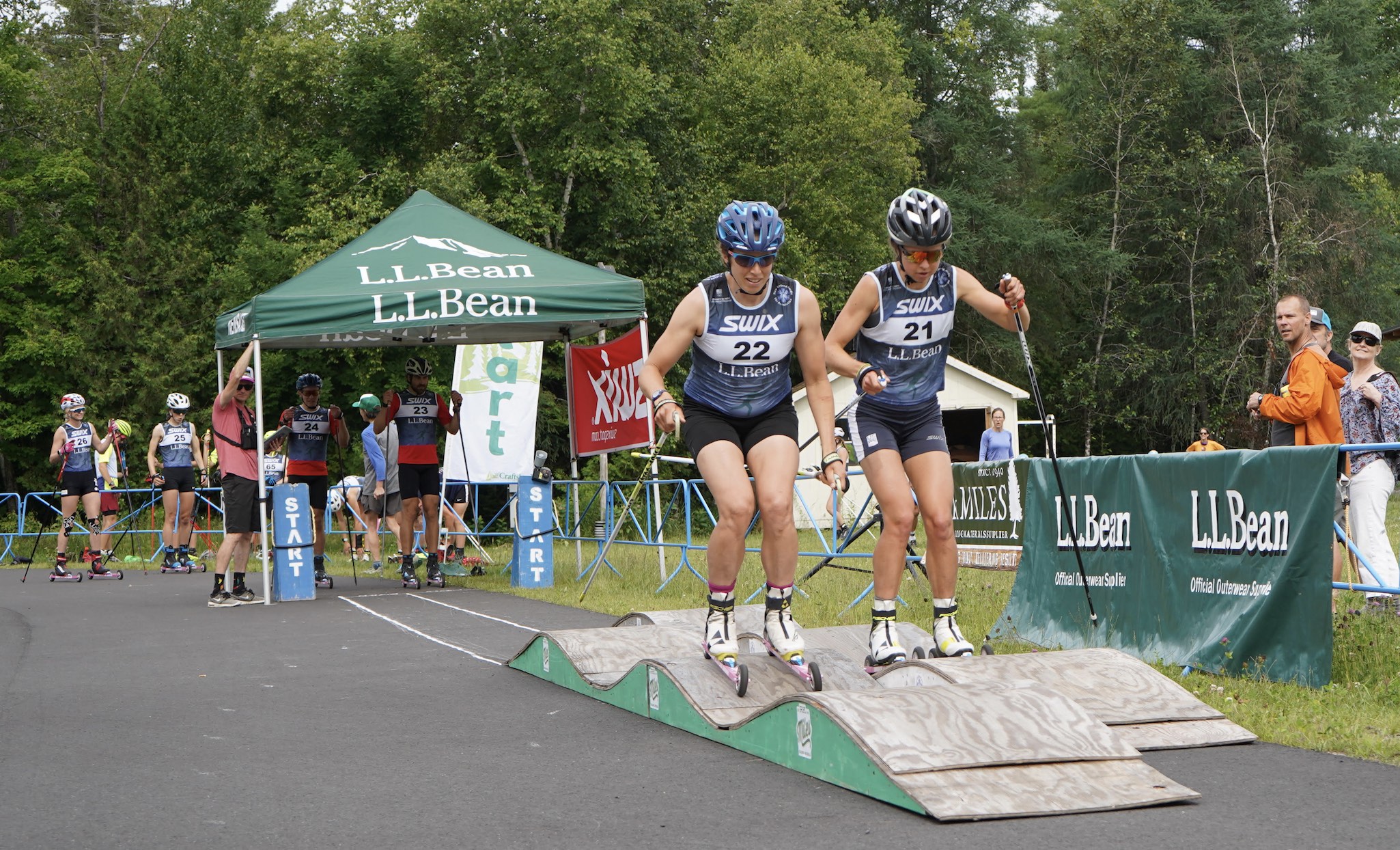
While it may be nearly 300 miles north of Central Park, Jessie Diggins is confirmed to be competing this weekend in Lake Placid. Given the caliber of the elite training groups participating, it’s clear that the level of competition is high and the racing will be spicy.To add to the excitement, qualifier and rounds will feature a 24 foot bicycle ramp directly out of the start.
The NENSA rollerski series is now in its fourth year. If it wasn’t already abundantly clear how dedicated Beckwith is, he became emotional when reflecting on what he is proud of.
“Oh, geez, what am I proud of. We lost, you know, a year of in-person rollerski races with COVID. So that was a real doozy because we had Craftsbury coming online with a roller ski track, we had Van Hoevenberg coming online with a roller ski track, we were really excited to build into that. And then you know, the wheels fell off the bus from the outside — that wasn’t anything that we did. We created some really great regional events, as much as you can in a safe manner. But they were quite engaging challenges, and we saw literally worldwide participation in virtual events.”
Adapting to the times, Beckwith also pulled off running the 2020 App Gap challenge over the course of a week where athletes from the same club could race on matched skis in a designated window. Breaking these groups down further into waves of 15 made it such that there were never more than 30 people in the area at a time.
“So that kept us together a little bit… This year, it’s definitely a big step to re-engage after having a year where you didn’t. If you host an event, at the end of the day, you’re talking about what you’re going to do better the next year to build on it, and that’s just tricky with everything that we had coming down the pike. So I’m just really excited about where we are right now. We’re gonna have more rollerski races than we’ve ever had. I think that we’re gonna have the most competitive races we’ve ever had. It was pretty hard to top the women’s field in that Lost Nation Roll last year. I think it was about a 33 FIS point race or something like that — in no small part because Jesse [Diggins] was there.”
He acknowledged that there were plenty of other strong athletes there also — women and men — but that this weekend’s races will be a step higher.
“I think the big success of this year is going to be just that we’ll have more participation overall. Partly because we have more events — well attended events — but that we’re reaching many more skiers by taking the show to them basically. That’s probably going to be the biggest takeaway win for this year.”
Beckwith also thanked the associate sponsors of the series: Swix, L.L. Bean, and Salomon. Apart from direct funding, he noted that Salomon sharing a video clip of one of Beckwith’s signature agility courses helped it see over 80,000 views internationally.
“We also have a really amazing partnership with Enjoy Winter, and Swenor rollerskis, which has really been a part of the series from the beginning and what makes it work for us. So that’s a really important piece to a partnership. Worthy of mentioning are the great people like, I’m teared up now, but Marty Hall, Joe Lamb. They’re just really supportive. So that’s incredible.”
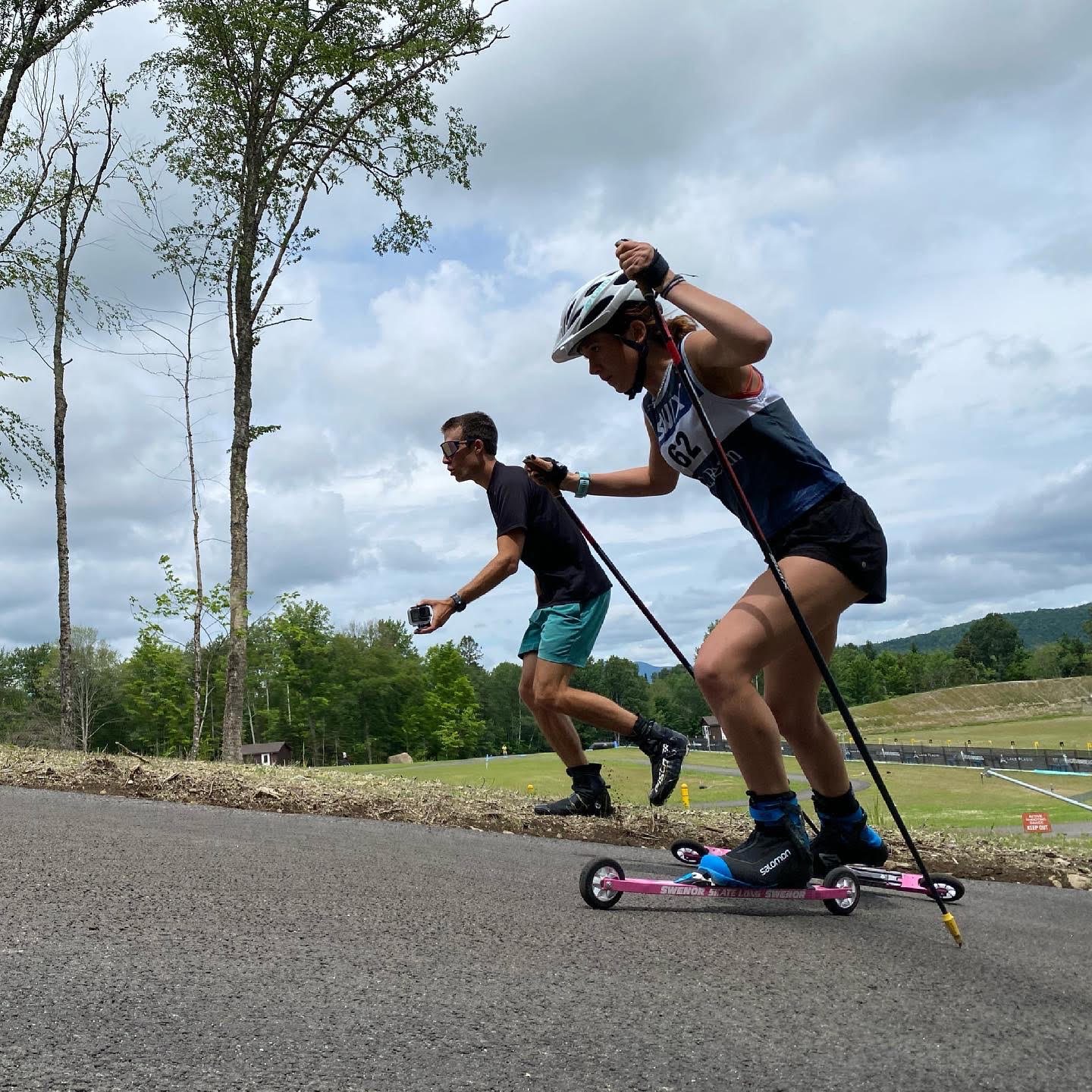
Hattie Barker attacks a climb with Mansfield Nordic coach Adam Terko collecting video. (Courtesy photo)
During the long pandemic slog, there have been times to celebrate small victories. One of those moments was the Lost Nation Roll – a skate rollerski race on October 25 at the Craftsbury Outdoor Center. Over a month ago now, during which Covid-19 restrictions have become more restrictive in Vermont, athletes were able to compete and grasp, even for a few hours, some normalcy.
Justin Beckwith, the competition director for NENSA and Ollie Burruss, a person with similar responsibilities at Craftsbury, navigated a labyrinth of safety protocols to ensure the show goes on.
It goes without saying that organized sport right now can seem frivolous. Covering sports even more so. But what the Lost Nation Roll illustrates is that good people can make good things happen. And make them happen safely.
“We opened it up to 100 spots for the rollerski race,” Beckwith said. “And you know, we’ve had plenty of races that are bigger than that in the past, but it’s on this brand new roller ski loop which was cool. We didn’t fill up the start spots and we didn’t have collegiate skiers outside the one’s residing at Craftsbury, and that’s because of institutional regulations at some schools. But the reality is, each competition is a small victory in itself.”
Let’s steer away from results for a bit. We’re bombarded enough with them anyhow. The one result that matters is this: it was a win-win for all those involved. That included Jessie Diggins, Julia Kern, Caitlin Patterson, Katharine Ogden, Susan Dunklee, Ben Lustgarten (he’s maybe not done yet), Adam Martin, Ian Torchia, Akeo Maifeld-Carucci, and Ben Saxton to name only a few starters. Sure, we are talking about a cadre of skiers who are Vermont-based. But they showed up, masked up, sent it around a regional training resource on a state of the art rollerski loop and provided some junior skiers a sense that the world is not all doom and gloom and sixty feet apart. (Just six feet.)
“We’re screening all these folks as well, right as they come in. And so we’re abiding by all the local guidelines,” said Beckwith. “But on top of that, we’re really spending a lot of time having athletes populating forms on-line prior to the race. So if somebody answers a question incorrectly, or has a sniffle, or a slight cough, we can flag that, and we’re seeing really good compliance.”
As we can see on the international level, the stakes are high for moving from region to region. The IBU World Cup last week reported several positive Covid-19 cases whereas Norway, Finland, and Sweden announced their withdrawal from the remaining December World Cups. No positive cases were reported from the Ruka round of racing, thus far, which included not only cross-country skiing, but ski jumping and nordic combined. As everybody has been expecting for months, more of our time has been spent indoors with the onset of winter. With that, globally, we’ve witnessed a corresponding uptick in cases.
Vermont too, despite their hard line safety mandates, and what appears to be good fidelity to mask wearing and social distancing, has experienced their share of Covid-spikes as well. Some are related to youth hockey in the region.
Like many across the country, Beckwith and Burruss and the scores of volunteers in Craftsbury, make us see what is possible. However, this is not news, the possibility of racing has become more fleeting as the early part of the winter season drifts in. News this week from Canada and the slew of cancelled races up north is all the ground truth we need.
The latest guidelines restrict Vermont athletes to competing, practicing, scrimmaging, formally or informally, with only other Vermont athletes within the state. If a Vermont athlete competes or practices out of state – they are looking at a mandatory quarantine when they return. The language is clear:
“Any athlete or team leaving the state to participate in a recreational sports practice, scrimmage, pick-up game or competition must complete a quarantine before returning to work or school; visiting any public facility; or participating in any event outside of their home. This quarantine requirement applies regardless of whether the activity is taking place in a quarantine-free county on the state’s most recent cross-state travel map published by the Agency of Commerce and Community Development.”
We could go on, and maybe we should, and list all the fine folks and all the fine athletes who made the Lost Nation Roll safe and sound.
It’s the little victories. The Lost Nation Roll may have been the last best race for awhile.
NENSA just wrapped up a hybrid App Gap Challenge with invitational in-person and all-inclusive virtual components. This rollerski competition was important for both the competitors and NENSA as we start to implement protocols of how our winter events will be conducted. Athletes, parents and coaches were energized by and thankful for this iconic event. Due to the event’s success and the safety compliance of all involved, we look forward to hosting several more rollerski events this fall – stay tuned! As part of our strategy to continue fostering the competitive and social components of our programs during this health crisis, we were happy to support a strong showing of virtual competitors of all ages who were not able to physically attend – this model will remain in place until we are no longer in a pandemic.
For the in-person event, we had a total of 68 skiers from seven local teams race the 7.25k Classic App Gap Invitational over the course of 5 days within their team units. A silver lining for small teams racing over the course of a week was that all competitors competed on matched Swenor rollerskis. We had competitors from 5 local junior clubs – Stratton Mountain School (SMS), Green Mountain Vally School (GMVS), Ford Sayre, Craftsbury Nordic, and Mansfield Nordic – in addition to two professional teams – the Craftsbury Green Racing Project (CGRP) and the Stratton Mountain School T2 (SMS T2) team. It was heartening and inspiring to witness the energy, excitement, and care that New England’s top junior athletes, World Cup competitors, Olympians, coaches, and family members alike brought to the event. We are grateful to everyone for carefully following COVID guidelines and helping us put on a fun and safe event.
Olympian and World Cup medalist Sophie Caldwell of SMS T2 captured the win on the open women’s side. She was closely followed by her teammates Katherine Ogden and Alayna Sonnesyn in second and third respectively. In the open men’s race, Ian Torchia, also of SMS T2, took a decisive win over CGRP’s Adam Martin. Craftsbury junior Finn Sweet had an impressive race rounding out the podium in third. For the junior women, Craftsbury’s Nina Seeman had a dominating performance taking the win by almost two minutes over her teammate Quincy Massey-Bierman in second. Hattie Barker of Mansfield Nordic placed third despite battling some wet weather on her way up the Gap. In the junior men’s race, Finn Sweet was followed by Charles Martell of Mansfield Nordic in second and SMS’s Fin Bailey in third.
Our Virtual Challenge consisted of three categories: Climb in Time (total vertical in 30mins – 15mins for BKL), Climb over Distance (total vertical over 7.5k – 2k for BKL), and Climb the Whole Time (total vertical in two weeks). We also added a category that meshed all results across the hybrid event by comparing everyone’s average vertical feet per minute.
In the Climb in Time event, Mansfield Nordic’s Tristen Adie took the win climbing 1271 vertical feet. HSC Biathlon’s Marvin Wang placed second overall, and first for the men, ascending a total of 1216 vertical feet. In the Climb over Distance event, EMBK’s Leigh Neideck took the win in the women’s race and the BKL race climbing 185 vertical feet. On the men’s side, NWVE’s Chris Burnham outstripped the rest of the field climbing a total of 3006 vertical feet. Our impressive Climb the Whole Time winner is Peru Nordic’ Peter Minde whole climbed 10,771 vertical feet!
Junior Women 1) Nina Seemann – Craftsbury – U20 – Anti-Freeze SuperPuff with NENSA logo
2) Quincy Massey-Bierman – Craftsbury – U18 – “2020 Happened” App Gap T
3) Hattie Barker – Mansfield Nordic – U18 – “2020 Happened” App Gap T
Junior Men 1) Finn Sweet – Craftsbury – U20 – Anti-Freeze SuperPuff with NENSA logo
2) Charles Martell – Mansfield Nordic – U20 – “2020 Happened” App Gap T
3) Fin Bailey – SMS – U16 – “2020 Happened” App Gap T
Upcoming Rollerski Races to come – please note The Maine Event is already on the calendar for October, 25th.
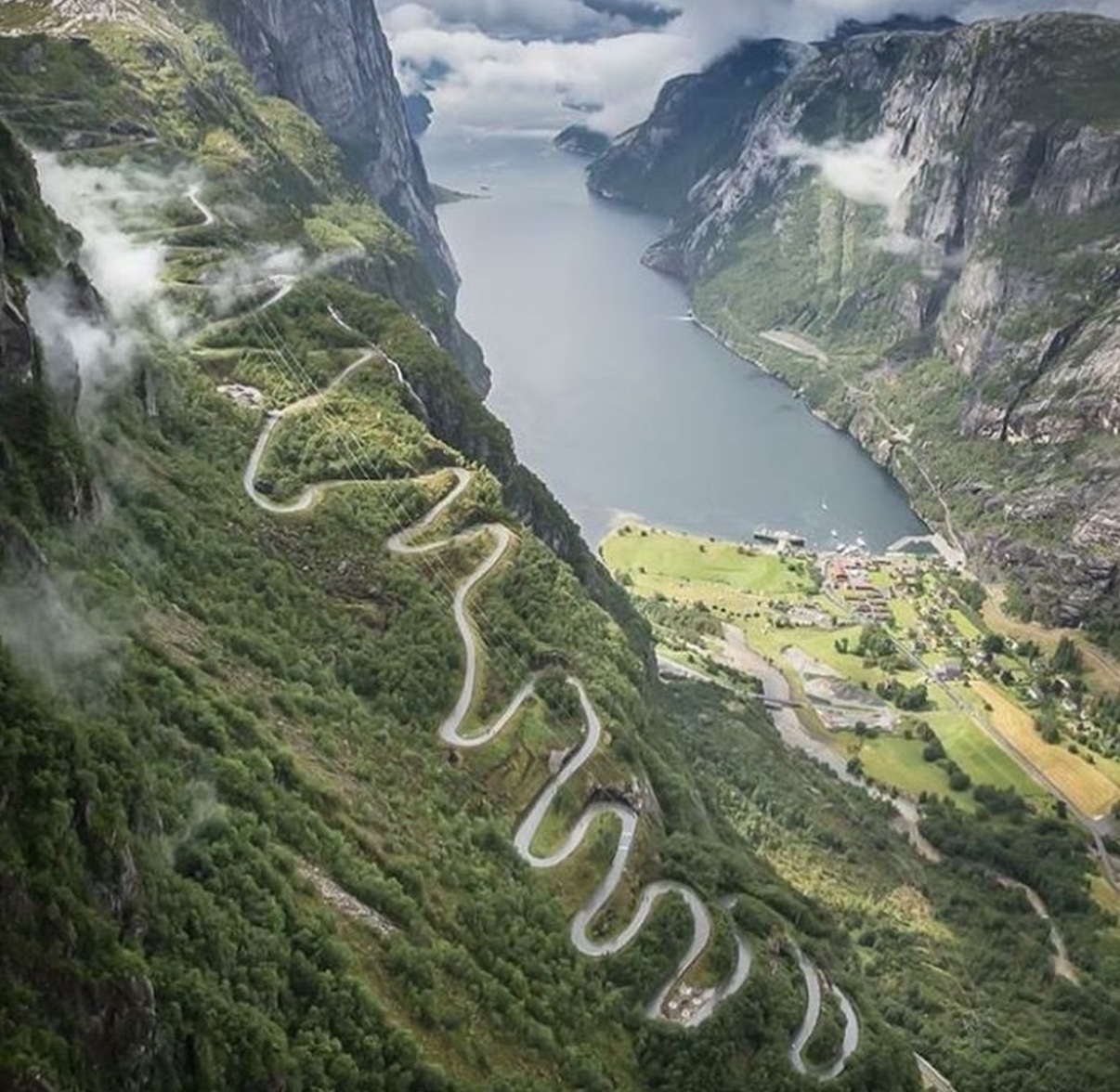
The sinuous Lysebotn Opp rollerski course. (Photo: Blink 2020 screenshot)
Times are what they are. Precautions are the name of the game. This year’s Blink Festival in Norway played to a reduced field and limited spectators due to COVID precautions. Some races, as will be noted, included modified race rules to limit close contact between athletes.
Lysebotn Opp – 06/08
The Lysebotn Opp is perhaps the marquee event. It features lovely fjord views and a grueling 7.5-kilometer uphill skate switchbacking up a mountainside. In normal years, the Lysebotn Opp is a mass start event. This year, however, it was an individual start affair.
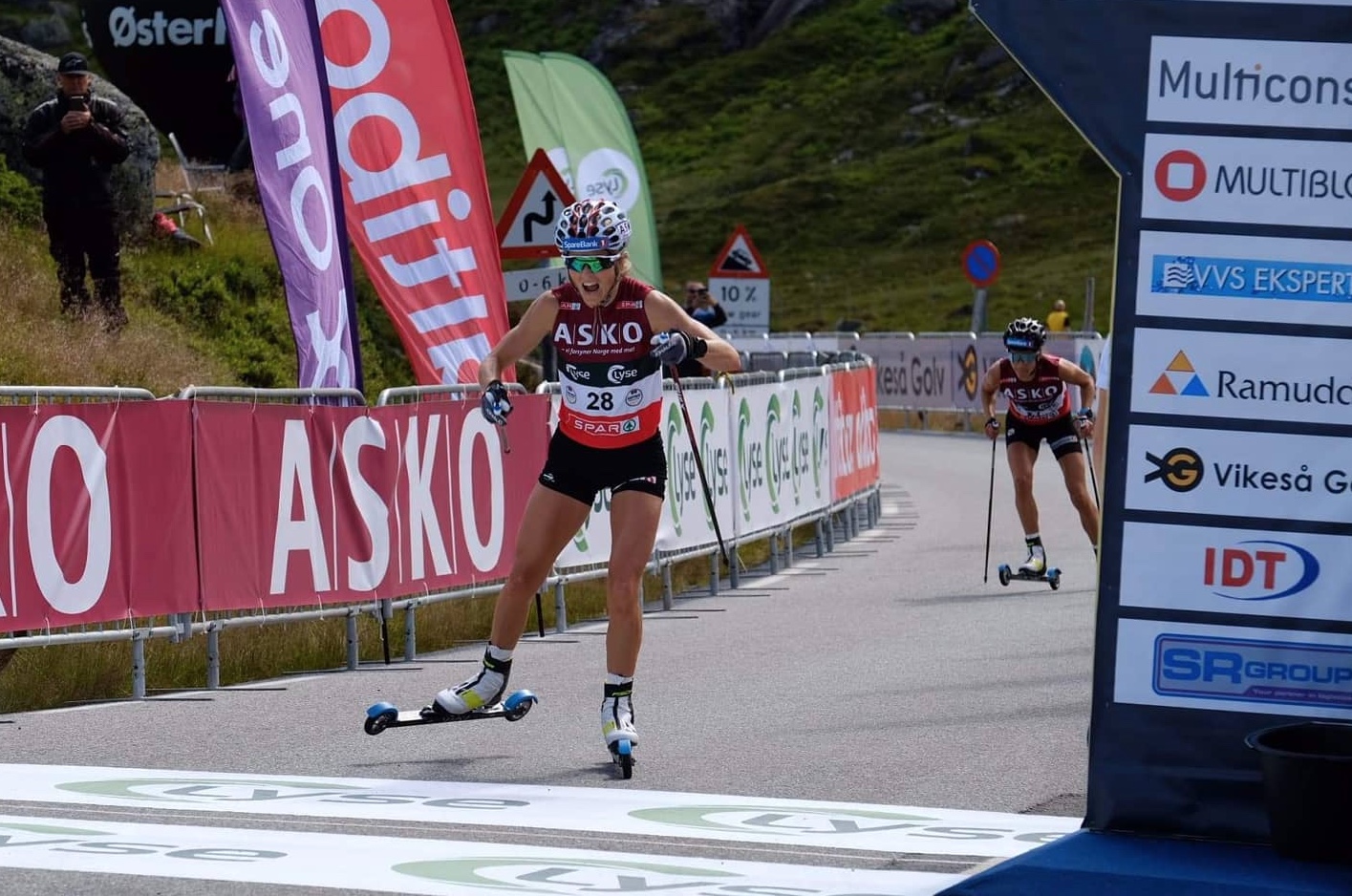
Therese Johaug won the women’s event in 33:11 minutes. Heidi Weng placed second (+00:34), and Helene Marie Fossesholm was third (+02:20). All three skiers are from Norway with Johaug and Weng seasoned veterans with Fossesholm an upstart 19 year old relatively new to the elite level scene. Fossesholm won two individual golds at the 2020 Junior Worlds winning both the 5 k classic and the 15 k mass start skate. According to FIS, she has competed in three World Cups and notched a fifth place in last season’s 10 k mass start skate in Falun.
For the men, Norway’s Simen Hegstad Krüger won in 29:25. Hans Christer Holund was third (+01:02), and Håvard Moseby third (+01:21). Moseby, the relative unknown on the podium is 21 and placed third in the 2020 U23 Worlds 30 k mass start skate.
Therese Johaug (bib 28) winning the 2020 Lysebotn Opp. (Photo: 2020 Blink Festival FB page)
Skate Sprint – 07/08
The second day of cross-country racing featured a skate sprint. For those used to larger fields and six-skier-deep heats, things looked a bit different. This was head-to-head racing, two racers per heat, as skiers advanced to the finals. Racers were required to remain in their respective lanes throughout the race which resulted in no drafting.
Norwegian sprinter Maiken Caspersen Falla won the day with Mathilde Skjærdalen Myhrvold placing second overall. Myhrvold lost the final by 1.4 seconds. Myhrvold is 22 years old and has raced two World Cups, both in Norway.
Kristine Stavås Skistad (21) placed third overall. She lost to Falla in the second semi in a photo-finish.
Johannes Høsflot Klæbo did as he does: win sprints. The star of the show placed first in the final, 1.5 seconds in front of second place GjøranTefre. At 25, Tefre raced nine World Cups last year with his best result an eighth place in Oberstdorf’s classic sprint. Klæbo has won the last four World Cup sprint titles. Erik Valnes placed third overall. He lost out to Tefre in the second semi by 0.1 seconds.
In the individual start 10 k classic, run on a 2.5 k closed loop, Tiril Udnes Weng won in 24:57.9 minutes. Fossesholm raced to second place, 3.9 seconds back, with Johaug in third (+12.1).
Klæbo took the crown in the men’s 15 k classic over a field that featured some of Norway’s top distance talent. He won in 35:08.9, just 0.2 seconds ahead of Moseby, who was second overall in the Lysebotn Opp. Daniel Stock was third (+2.1).
If you are looking for more, as in the view-from-the-comfort-of-home experience, Norwegian broadcaster NRK has archived the 2020 Blink Festival races. You can find a menu of races here.
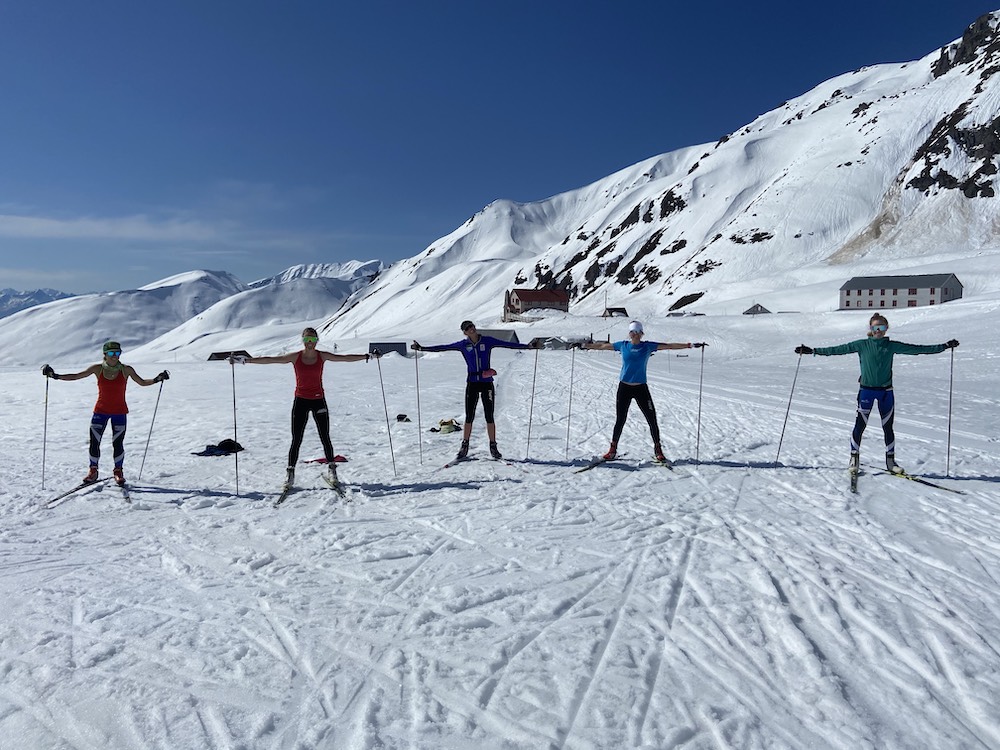
From left, APU athletes Rosie Frankowski, Sadie Bjornsen, Hailey Swirbul, Becca Rorabaugh, and Caroline Brisbois demonstrate a healthy distance while skiing at Hatcher Pass on May 13, 2020. (Photo: Courtesy Sadie Bjornsen)
Although the training cycle has officially begun, it decidedly has a different vibe and look. Adding some complexity to our short-term new normal are a crosshatch of state, county, and city regulations as it relates to mitigating the community spread of Covid-19. The core question elite cross-country ski programs are asking is this: How can we most responsibly promote safe and effective training for their athletes?
(The United States Olympic & Paralympic Committee (USOPC) has released a document titled Return to Training Considerations Post-COVID-19 This document provides useful information for organizations reopening.)
FasterSkier reached out to four programs in the U.S. — the Craftsbury Green Racing Project (CGRP), Stratton Mountain School’s SMS T2 team, SVSEF’s Gold Team, and Alaska Pacific University Nordic Ski Center’s Elite Team to gauge how athletes can train within the context of their regional social distancing guidelines. The answers are complex. And as each respondent stated, no one single person or group has all the right answers other than to stay informed and err on the side of safety.
Craftsbury Green Racing Project
Head CGRP coach Pepa Miloucheva responded to our query. Craftsbury’s team is located in Northeastern Vermont, a rural and isolated region. When Miloucheva responded on May 8, the Craftsbury Outdoor Center remained closed to the public. Along with key staff, those GRP athletes and coaches that live on campus year-round continued to be in residence. This group includes coaches and athletes from the ski, biathlon, and rowing teams.
“Most of us that didn’t go anywhere this spring have been in strict isolation since March — no store trips or anywhere else. Skiers and biathletes live in the same house, their food is ordered through the center, athletes cook in the house and do train together, but still try not to be in more than 2-3 people groups,” explained Miloucheva.
Several athletes were home with their families. Among them were Akeo Maifled-Carucci and Caitlin Patterson — both had been with their respective families in Bozeman, Montana. They returned to Craftsbury in mid-May. Miloucheva wrote that returning athletes will be quarantined for two weeks before they are allowed to move into team housing and join group practices.
“We do not share any buildings use with the rest of the center staff and if any work-related interactions are only by keeping a safe distance, wearing masks, and following all safety rules and regulations. This said, honestly we don’t have much of those really, we pretty much just interact between ourselves right now.”
According to Chris Mallory, Gold Team head coach, his core unit of skiers have not had group training sessions for the past two months. However, with the canceled racing in March, Mallory said several of his athletes extended their on-snow training north of their home base in town. Like many adapting to the modified season, high volume was the trend for March and April training.
“It was unfortunate the race season got cut short, but it allowed for two months of big volume to finish out the season,” Mallory emailed. “So we’re starting up training a little later than normal this year and for now, coaches are directing workouts remotely. We’re looking to get programming going closer to normal in June, but some things will be structured differently.”
Mallory explained that training group size will be kept below 10 athletes and the norm of committing in a team van will be held off for the near future.
“So we won’t have big cross-team training sessions for a while, unfortunately. We’ll also pick training locations such as Trailheads which are off the beaten path or sections of the bike path which see less traffic for rollerskiing, so physical distancing can be easier to achieve. We might have a partner gym opening up in a week which will allow for some strength training to occur for our Gold Team, but we’re also putting some effort into creating an outdoor strength area outside the Lake Creek ski hut as well.”
SMST2
SMST2 skier Ian Torchia on a recent VT. ride. (Photo: Courtesy Ian Torchia)
Nestled in southern Vermont, the Stratton Mountain School offers an idyllic campus for the SMST2 team. This spring, as the pandemic and its accompanying restrictions unfolded, the state-mandated that both residents and non-residents traveling into Vermont must self-quarantine for 14 days. That rule was recently extended until June 15.
Some SMST2 athletes are currently out of state, while others, like Ian Torchia, have remained in the Stratton area since the end of the season. Ben Ogden and new SMST2 skier Bill Harmeyer returned to their Vermont homes to remotely finish out the academic year at the University of Vermont.
“Initially we were thinking where do you want to be for a two-week self-quarantine,” Patrick O’Brien, SMST2’s head coach said in a call. “Thankfully we also thought about where do people want to be for an extended period of time this spring. And many people already had plans in place — knowing we may be in this for a longer period of time than we were thinking at the beginning of March.”
As June approaches, O’Brien explained that he too has begun defining how training will look, and how to best integrate athletes into specific training groups.
“First and foremost in my mind is what can we legally do, what can we responsibly do, and what are the creative solutions that we can come up with? And understanding again that no one here has a crystal ball; we can look at models, we can look at forecasts, we can monitor the situation but it is going to be a moving target,” said O’Brien. “So really what we are trying to do is find a balance. We are trying to be fully compliant and very safe and cautious and also monitor the situation locally.”
Harmeyer, who had been self-quarantined in Burlington, drove to Stratton recently to begin his full-time training. Due to his limited exposure while in Burlington, he was allowed to integrate with a small training group. Ben Saxton, on the other hand, recently flew back to Vermont from the Midwest. According to O’Brien, he is self-quarantining for the required 14 day period.
For the time being, O’Brien envisions training groups organized around pods – another word he used interchangeably for families. Athletes living together will be considered training pods where they are able to be in close proximity to one another. O’Brien acknowledged this arrangement will be closely monitored and reassessed.
“We need to track and see what seems responsible for group training, but again we want to make sure people are safe and healthy and if we operate in these small groups, and everyone in that group is a ‘family member’, then we know that they are OK to go out and do stuff together. What we want to do is be creative in our approach to these challenges, but really we want to be reasonable.”
Although Vermont’s shelter-in-place order was extended to June 15, it currently allows for outdoor exercise.
“Every challenge presents an opportunity,” O’Brien said. “We are not going to jump on a plane and go to a bunch of different training camps. That doesn’t prevent us from having high-quality training locally. It presents an opportunity. And reaffirms a model of working together and training together.”
Alaska Pacific University Nordic Ski Center
Anchorage is typically a very good place to be a cross-country skier. While so much else has changed in the world this spring, this fact has remained a reassuring constant for the athletes of the Alaska Pacific University Nordic Ski Center (APUNSC) Elite Team, as well as the greater Anchorage ski community. There was seasonal weather, both snow and cold, in the second half of this winter, leading to a sea-level snowpack that lingered well into April. Trail grooming is performed by a nonprofit group, Nordic Skiing Association of Anchorage, that relies on voluntary donations rather than mandatory trail passes while grooming on public land, so grooming continued unabated through March and into late April. And public health-wise, Alaska’s isolation, coupled with a relatively aggressive early response, has led to, so far, consistently low COVID-19 numbers throughout the state, currently the lowest gross numbers of any state and the third-lowest per-capita infection rate behind Hawaii and Montana.
Hailey Swirbul (APU/USST) skis at Hatcher Pass on May 13, 2020. (photo credit: Sadie Bjornsen)
Put it all together, and APU athletes were enjoying groomed skiing at sea level through April 23, with world-class crust skiing coming on line around the time the in-town ski season was winding to a close. (Any April training happened unofficially and in smaller groups, in deference to both the overall training schedule and health mandates in effect at that time. Although a group of four APU athletes did hunker down together in the APU Ski House starting in mid-March, forming a de facto family unit and training group in which half the people were a member of the U.S. Ski Team.) A 75-minute drive away, fellow nonprofit Mat-Su Ski Club has been grooming the trails at Independence Mine, in the Hatcher Pass area, since last October 5… and with a snowpack that currently measures around four feet, is still going. It’s hard to prove a negative, but APU skiers currently enjoy ready access to what are likely the only groomed nordic trails on the entire continent right now.
We have learned that the logistics of keeping our athletes safe while following COVID-19 state mandates has been at the forefront of the APUNSC program. Our core is based around health and wellness, and the safety of our program members is our top priority at all times, similar to other ski communities. APUNSC has had an advantage of having trails and snow on the mountains minutes from our doors to continue training, even in times of quarantine.
“Nordic Ski Center Elite training program began on May 1. We were fortunate that State of Alaska quarantine and social distancing mandates began to lessen at the beginning of May, allowing the Elite Team to be able to begin training in smaller groups outside in the mountains. The Elite team wore face mask or buffs and kept the mandated 6-10 ft separation while outdoors.
“At first, groups of 20 were allowed to hit the trails with a mandated 6-10 feet of separation for active workout sessions. We wore masks when training and avoided crowded parking lots and trailheads where we could.
“Once phase 2 [of state health mandates] hit a week ago, it allowed now the entire Elite Team to be able to head into the mountains to train and ski. Hatcher Pass has been an area where Crust Skiing is at its best with longer days and blazing sunshine. The grooming has been incredible thanks to the work of Nordic Ski Club of Anchorage and the Mat-Su Ski club. The Elite athletes still uphold the 6-10 ft separation when training. The athletes are happy to be together as a team again, and with that comes the responsibility to treat allowances with respect and not take it for granted. We are living and training as athletes in a time where our community could fall back to strict quarantine.
“We’ve stayed away from indoor training as a team in gyms, as not only is the safety of our team top priority, but the team has excelled in their own in-home conditioning and in getting outside to hit the trails. Only if necessary, for some athletes rehabbing, will we recommend using an indoor gym for conditioning and training.
“APU Nordic Ski Center typically runs 3 elite training camps [each summer] on Eagle Glacier at the Thomas Training Facility outside of Girdwood, Alaska. We will revisit whether Glacier camps will resume based on the climate of COVID-19 Adjustments.”
(For any Outside readers salivating over the prospect of May skiing and thinking of booking a cheap plane ticket north, please note that a 14-day quarantine requirement remains in effect for anyone traveling into Alaska from out of state, and that Alaska State Parks is likely to plow the road up to Independence Mine in early June.)
Jordan Fields of Williams chasing the leaders on Lap 2 at the 2017 NCAA DI skiing championships.
For those growing up in the East and worshiping high peaks, one stretch of ridge line is the most storied: the Presidential Range in New Hampshire’s White Mountains. On September 6th, former Williams College skier Jordan Fields established a new fastest known time (FKT) of the Presidential Traverse in 3:42:38 hours.
Here’s the stunner: the previous FKT established in 2018 was 4:04:30 by Lee Berube. On the FKT website documenting all things FKT, the Presidential Traverse has seen gradual time improvements over the years. But Fields’ effort, as it moves into the sub-four hour realm by a large margin, is a standout.
“I was very surprised with the time,” said Fields. “My goal was to be sub-four hours. If I made it sub-four, that would be a huge success. I expected to be going down Crawford Path which is the finish, just fighting for a small victory.”
The run begins outside Gorham, New Hampshire at 1,300 feet in elevation and finishes near Crawford Notch, 18.7 miles later. In between, the route hits the summits of Mt. Madison, Mt. Adams, Mt Jefferson, Mt. Clay, Mt. Washington (the route’s high point), Mt. Eisenhower, and Mt. Pierce. That all amounts to an elevation gain of 8,319 feet.
Fields first heard of the traverse from his club ski coach, Nick Mahood, when Fields skied out of Woodstock, Vermont.
Jordan Fields ran the traverse from North to South. (Screenshot: Google Maps)
“Nick had done in it college with his UNH ski friends,” said Fields. “He told me the first time they did it it took them 11 hours and they didn’t bring a headlamp. They came down the final section using matches to light up the trails so they could see. From that point, it took on this legendary status.”
One person’s epic tale became the fuel for an annual ski club tradition. Fields recounted that as young high school student, he and Jeff Tucker (Harvard’s current assistance cross-country ski coach) first attempted the traverse with boldness and naiveté.
“It took us about 11 hours that day too,” recalled Fields. “It was funny because that first day we were like ‘maybe we could set the record on this if we get going’. We ran up the first mountain, Mt. Madison, pretty fast and then proceeded to bonk. And we were totally unprepared — one peanut butter and jelly or something. It was a long day.”
Now enrolled as a graduate student in Dartmouth’s geology program and helping coach the cross-country ski team, Fields claimed he needed a project to remain motivated. With guidance from the Uphill Athlete, Fields based his training at the Dartmouth Skiway and focused on weekly vertical gain; 10,000 to 20,000 feet per week on average.
Fields said his motivation to challenge the FKT came from a friend, a former 2012 Olympic sailor, who was lost at sea.
“I told him that I wanted to set this record back then,” said Fields. “He was the first person that believed I could do it.“Unfortunately, he passed away in 2015. He was the person who encouraged me to do it in the first place. This was it, I was going to dedicate to him. It gave me a reason to feel motivated.”
The training, course previews, and motivation carried Fields to a one minute advantage over the previous FKT split atop Mt. Madison, the first of the many peaks along the traverse. Fields knew from his two prior recons earlier in the summer descending was his ace-card. His plan was to rely on that skill to maintain and eventually build his lead. Atop Mt. Washington, a bit beyond 10 miles in, he had a six minute advantage.
“I wasn’t feeling good at that point,” claimed Fields. “The lowest moment for me was climbing Washington. I had a six minute lead at Mt. Clay, the minor peak between Jefferson and Washington, but between Clay and Washington I put on no additional time. I thought I might be slowing down there. Luckily, I had prepared for this.”
That prep came in the form a 100 ml of flat Coke enhanced with crushed caffeine pills.
“I took that and put in my headphones on Washington,” Fields explained. “It took the previous record holder exactly 1:30 hours to go from Washington to the finish. It took me an hour and 14 minutes. I put 16 minutes into him over that period of time. It was all a big unknown. What was important to me, because I was dedicating this to my friend, was that even if I was behind on the time, I was going to keep going as hard as I possibly could. That was the mentality I had.”
The conversation with Fields evolved into what might be his future potential projects. Fields was leading a geology trip for Dartmouth at the time of our call. He was settled for a few days in the shadow of Jackson Hole, Wyoming’s Tetons. If you are prone to dreaming of big link-ups, mountain runs with infusions of technical climbing, the Tetons remain an open book. Fields said he wants to move in the direction of technical alpine climbing when it comes to adventuring.
Surrounded by perhaps the most iconic peaks in the U.S., Fields noted that some bold traverses in the range had now captured his attention.
Male FKT times for the Presidential Traverse. (Screenshot: fastestknowntime.com)
Gold medalist Laura Dahlmeier of Germany celebrates waiving a national flag as she crosses the line first in the women’s 10-kilometer pursuit at the 2018 Olympic Winter Games in PyeongChang, South Korea. (Photo: IBU Biathlonworld.com)
When she retired from international biathlon competition at twenty-five-years-old Germany’s Laura Dahlmeier retreated back into a more private existence. Although still arguably in her prime and flush with a treasure chest loaded with championship medals, Dahlmeier’s path was hers to define.
Like many nordic sport athletes of late, Dahlmeier has taken to mountain running. Although just coming to our attention, Dahlmeier’s mountain running feat on August 31, deserves some spray.
She won the 52-kilometer Karwendelmarsch, a stout mountain running race in Austria, in record time. The route presents the usual thin air ups and downs and numerous opportunities to mull why in fact one has entered such a race. Her time of 4:51:11 hours, as noted, was a new course benchmark. She beat the former course record of 4:54:18 hours set by Sweden’s Kristin Berglund. Those following the sharp end of mountain running races may have recognized that Berglund placed second in the 2019 UTMB (Ultra-Trail du Mont-Blanc), perhaps the most premier mountain running event on the planet as it circumnavigates the Mont-Blanc massif.
Berglund was only bested at the UTMB by Courtney Dauwalter, a former Minnesota State Champion in cross-country skiing who also competed for Denver University. Dauwalter transitioned to ultra trail running several years ago and has been the athlete to beat in ultra events, often coming across the line first, ahead of all the women and men. Perhaps we’ll see a Dahlmeier / Dauwalter matchup at some point?
No prognostications here, 52 k is not the massive 171 km and +10,040 meters of climbing featured in the UTMB, but it’s a start.
This post has been updated with information on Daulwalter.
Linden Nideck of CSU navigating the agility features. (Photo: Peter Minde)
The NENSA rollerski series ramped up this past weekend outside Lake Placid, New York. As part of the drive to draw more skiers to the rollerski series, Saturday included a two race format known as a doubleday event: event 1 consisted of a 3-kilometer skate prologue followed by a 1.5-k cross-country cross (XCX) featuring several agility segments. Athletes earned a reward for performances in each event. Both events were individual start and their aggregate times were used to form a pursuit start for the first wave of the Climb to the Castle (C2C) on Sunday.
For those who raced both events on Saturday, the C2C was a pursuit style event – with the overall leaders from the first two races heading out first.
Saturday’s Doubleday
Both races were located at the Olympic Jumping Complex while between races, NENSA’s Justin Beckwith and NYSEF’s Shane McDowell assembled the undulating ramps that constituted the agility segments for the sprint prologue. At each agility segment, if an athlete couldn’t ski the obstacle, there was a safe alternate route that penalized skiers- not unlike a penalty loop in biathlon.
It was cloudy all day; the uppermost section of the loop was damp from overnight rain.
Individual results for each respective race can be found here:
Saturday’s overall results dictated the pursuit start times for Sunday’s C2C. For the senior women, Zoe Williams (ENRG/Nakkertok/Carleton College) was atop Saturday’s combined standings. Nina Armstrong (NYSEF) was second, and Jessica Roach (Team Hardwood) third. For the men, Luke Brown (Bridger Biathlon), Zane Fields (US Biathlon), and Erikson Moore (Fondeurs Laurentides) were first through third respectively heading into Sunday’s event.
Kyle Bratrud on his way to the 2019 Climb to the Castle win. (Photo: of Kel Rose)
Climb to the Castle
Sunny skies greeted racers on Sunday as did blustery winds. Although it was dry, the weather was noticeably cooler than the 80 degrees racers endured at least year’s C2C. An hour before the start, it was 55 degrees at the toll gate, with the wind blowing steadily between 16 and 26 miles per hour.
Kyle Bratrud (SMS T2) and Williams won Sunday’s Climb to the Castle (C2C) rollerski race in Wilmington, New York. It was the first win here for both skiers. The race ascended the Whiteface Mountain toll road for five miles at an average grade of eight percent. At 4867 feet, Whiteface is the fifth highest peak in the Adirondack Mountains.
Bratrud, who did not contest either race on Saturday, broke Robert Duncan Douglas’ long-standing men’s record by 1.1 seconds, finishing in 34:55.5 minutes. Jake Brown, of US Biathlon and Craftsbury Green Racing Project (CGRP) placed second at 36:25.8. Luke Brown raced to third in 37:30.1.
For the women, Williams finished in 48:54.6 after placing third last year. Kathy Maddock, age 54, of Wilton, NH., was second overall in 51:12.0, followed by a junior skier from Mansfield Nordic, Ava Thurston, in 51:20.1.
Skiers who competed in Saturday’s doubleday races went out first, starting in a pursuit format based on their aggregate times. Doubleday finishers started at 8 AM sharp and were all on course by 8:05. Open athletes started in a mass start wave at 8:06, with masters following two minutes behind.
Bratrud told FasterSkier he’d raced C2C once before in 2015. Since he did not race the sprints the day before, he started at 8:06, gradually reeling in the pursuit starters.
“It’s been a while since I’ve been up here but I really like this climb,” Bratrud said. “It’s always a really sweet atmosphere and it was a pretty solid effort. We started in a group of maybe five or six. I was at the front and set a decent pace. It didn’t seem like anyone wanted to come around me so I just kind of slowly ramped it up without destroying myself and it worked out.
“We had done the App Gap roller ski race a little earlier in the year,” Bratrud continued. “There, I tried to send it as fast as I could off the line, and ultimately I blew myself up. Here, I wanted to be a little more controlled and I knew it was a long race. I wanted to ski a nice controlled V2 the whole way.”
While both races are purely uphill, each has a distinct set of challenges. The App Gap challenge features a transition from skate to classic and climbs about 1,500 vertical feet over the 7.5-kilometer course, while the C2C climbs 2,300 feet in one unbroken grind.
“I think [C2C] is definitely harder,” Bratrud said when asked about comparing the two. “There are steep pitches on the App Gap but there are also some flat parts. There really isn’t anywhere to hide on this climb once you start going up, which is basically right at the start. And then you get the wind.”
2019 Climb to the Castle men’s podium. From left to right: In second Jake Brown, first Kyle Bratrud, and third Luke Brown. (Photo: Kel Rose)
Like Bratrud, Jake Brown started in the wave following the doubleday athletes. “It went pretty well,” he said of his race. “I was able to hang on to Kyle for a couple of miles and then it was a little too much. I was hoping that I wouldn’t have to lead so I could tuck in a little bit, which I was able to do. Otherwise, I didn’t have much of a plan. Something like this is so physically demanding, you can’t really have a plan until you get out there and understand how your shape matches the challenge.”
Luke Brown felt that the doubleday was good preparation for the C2C. “I think the efforts [in the doubleday] opened up my legs, kind of a pre-race,” he said. “I felt pretty strong, it’s a super fun road to ski up. Pretty nice weather at the bottom, and windy at the top. Zane Fields started six seconds behind me and caught up to me. We worked together for a little bit and then I pulled away from him, probably about halfway up the mountain. Then I just tried to go hard.”
With the best women’s aggregate time from the doubleday, Williams was the rabbit out of the start. Shilo Rousseau of Ontario’s Barrie XC, a junior skier, was the second woman starter as she followed 32 seconds after Williams.
2019 Climb to the Castle junior women’s podium. From left to right: in second Rose Clayton, first Ava Thurston, and third Shilo Rousseau. (Photo: Kel Rose)
“The pursuit start meant that I skied a lot of it alone, which was different from previous years,” Williams said. “I was happy that I kept the pace going up the hill, kept trying to keep the tempo up. So it was good. My legs were for sure tired after yesterday, and I felt that probably a kilometer in. I thought that it would be my legs holding me back instead of my cardio. But I still felt like I was able to put a good effort in.”
Maddock said she benefited from working amongst a group of fast skiers.
“I was part of a train of men and hung with them until it was just the guy leading and me,” wrote Katherine Maddock, head coach of Dublin (NH) XC. “It was super helpful having him to ski with. On the flat(ish) section maybe a mile or less from the top, we could see a group of skiers in front of us. He turned around and said to me, ‘Let’s go fishing. And then he just started picking people off. It was great. Ultimately he made a move around a skier and I couldn’t match the effort so I was on my own in the wind tunnel, but I survived, which was no small feat with that headwind!”
Lucy Hochschartner (St. Lawrence University) has raced C2C multiple times. “It was really fun! I’ve done this race a lot of times and it’s always really hard,” she said. “But it was great to have nice weather and lots of good people to race against. I didn’t do so great [in the doubleday] so I got to move up a little bit. And not dying at the very end was fun. The wind definitely made for a slow finish.”
Nina Armstrong during the first day of racing at the three race mini-tour. (Photo: Peter Minde)
Nina Armstrong (NYSEF) had the weekend’s races written into her training plan. “I haven’t done [C2C] in quite a few years,” she said. “It was fun. My plan was to work into it and hopefully not die before the finish line. It was really fun having people all around you.”
Sheila Kealey, the head coach at uOttawa Nordiq was excited to place a bib on after coaching skiers at the Doubleday.
“The race was a good effort,” she wrote in an email. “Starting in the mass start I had some people to ski with about half of the time, and I was catching some athletes from the pursuit start waves ahead – so it was a quite different experience than other years with a women’s only start. My plan from the start was to try to ski with people — it was a reasonable effort. No problems switching from coach-mode Saturday to race mode Sunday!”
Before the racing on Saturday, FS interviewed Jessica Roach and Robbie Raikou from Team Hardwood in Ontario.
“The past three years, Team Hardwood has made it a point to come [to Lake Placid] for about a week in August to take advantage of what Lake Placid has to offer for skiing and for training,” Raikou said. Roach described her race plan: “I come from an alpine skiing background, so hopefully, I get to use that on the hills and the corners to my advantage. We’ve never done this course at speed before, so it should be interesting. Just going to survive it and have fun.”
Finn Dodgson, another visiting skier, noted this was his second year in the doubleday. “Today went all right. I was sick at the beginning of this week so I’ve been getting over the last bit of the illness and getting back to racing feelings,” he said. “Last year, I definitely noticed that I felt a lot better in the second race. I was warmed up and knew the course better, so this time around, I tried to get a better warmup in and get some good laps, just to see how it is and remember all the corners. The obstacles weren’t as daunting as I thought. They went well and I was able to do all of them.”
Four skiers from Montreal’s Fondeurs Laurentides had their first doubleday this year. Speaking of the race loop, Aiden Raynor said, “It’s got some twists and bends to it, that’s for sure. Quite extreme but super fun.”
His teammate Erikson Moore added, “[The course] was great. It works almost every technical ability a skier could have, and it has a good mix of flats to climbs.”
“The second race with the ramps [agility features] was really fun and, sketchy downhill, but it was worth it,” said Mathis Desbaumes.
The Doubleday / C2C weekend suits Shilo Rousseau. She was C2C’s third-place junior female finisher and second place on aggregate time in the doubleday. After the doubleday, she said, “It went really good this year! I noticed some big improvements [in fitness] from last year and felt a lot stronger. Last year, I noticed going from the bottom all the way to the top in the second loop I felt a lot more tired. This year I was able to be strong the whole way.”
Needless to say, cross-country athletes have big motors.
Let’s start with The Rut 50-kilometer mountain run in Big Sky, Montana. With 10,000 feet of climbing and descending, it’s a burly affair.
On September 1st, Erika Flowers, cross-country skier of note and Bozeman local, won the women’s 50 k overall in a time of 6:51:52.41 hours. This was Flowers’ first 50 k running race.
Elevation profile of The Rut 50 k. Pure burly. (Photo: runtherut.com)
South of rugged Montana, in the thin air of Colorado, Liz Stephen won The North Face Grand Traverse mountain run on August, 31st. She claimed the 40.7 mile women’s win in a time of 7:17:46 hours. According to the Trail Run Project, the GT running course features 6,1976 feet of climbing as runners traverse portions of the Elk Mountains on the way from Crested Butte to Aspen.
And way south in New Zealand, Jessie Diggins and Julia Kern, both U.S. Ski Team members, captured podiums at the New Zealand Winter Games.
Tara Geraghty-Moats (USA) and Akito Watabe (JPN) were the winners of the first individual event of the Summer Grand Prix 2019. The American won by a large margin of +1:48.3, while Watabe distanced Franz-Josef Rehrl (AUT) by 1.5 seconds. Yoshito Watabe completed the podium on the men’s side, Stefaniya Nadymova (RUS) and Jenny Nowak (GER) claimed the podium positions for the women.
Difficult wind conditions made ski jumping in Oberwiesenthal very difficult today. Both for the men and for the women, the jumping rounds had to be cancelled and the PCR was used.
On Friday, Tara Geraghty-Moats (USA) had shown a jump of 98 metres and a point total of 116.5 points put her on top of the result list with an advantage of 17 seconds at the start. The American was be followed by strong Russian Stefaniya Nadymova, who jumped to 96 metres. Gyda Westvold Hansen (NOR) was third with 90.5 metres (101.6 p.) and started her race at a respectful distance of one minute behind Geraghty-Moats.
Behind Westvold Hansen, the field was tightly packed with Annika Sieff (ITA) starting at +1:09, Marte Leinan Lund followed at +1:12, Veronica Gianmoena (ITA) at +1:20 and Jenny Nowak (GER) and Annalena Slamik (AUT) started their races at +1:43 and +1:47.
Geraghty-Moats skied a lonely race at the top, overlapping many of the competitors on the way to the finish. At half-time point, her advantage had already grown to almost a minute and the dominator or the Women’s Nordic Combined circuit extended her lead to one minute and 48 seconds in the end. With her result, Geraghty-Moats set the best jump and the best cross-country time of 15:49.4, proving once more she is the the most complete female Nordic Combined athlete in the world right now.
Russia’s Stefaniya Nadymova impressed on the jumping hill and skied fast enough to defend the second place by almost a minute in the end. German Jenny Nowak delighted the audience with a courageous race and skied to the podium from position seven. She finished +2:34.4 after Geraghty-Moats. The second-fastest woman on track was Anastasia Gocharova, who skied from position 16 to a final sixth rank.
On the men’s side, the Japanese team struck back with a vengeance after not being on start in the Mixed Team event yesterday. Young Japanese Ryota Yamamoto was the best on the jumping hill with a great jump of 105 metres. 136.5 points put him in the lead of the race by 10 seconds. Yamamoto’s closest pursuers were his teammates, the brothers Watabe. Akito claimed the second place with 103 metres (134 p.), Yoshito showed 99 metres (128.3 p.) Translated into delays at the start line, this meant +0:10 seconds for Akito and +0:33 seconds for Yoshito.
Franz-Josef Rehrl (AUT) ranked fourth with +0:46, Terence Weber (GER) and Christian Deuschl (AUT) shared the fifth place and took up their races at +0:52 respectively.
The race was a tactical affair that had Akito and Yoshito Watabe and Franz-Josef Rehrl working very well together to keep their advantage. At the beginning, Ryota Yamamoto skied together with the three leaders but had to let go around the 3.5 km point of the race. Behind the leading trio, fast German Vinzenz Geiger worked his way to the front and had closed the gap to 14.2 seconds at the half-way point of the race. After that, he ran out of steam and finally finished on position 17 only.
After his Mixed Team victory yesterday, Samuel Costa was in impressive shape again and appeared behind the three leaders and together with Martin Fritz and Johannes Lamparter and several other athletes, a big group chased the brothers Watabe and Franz-Josef Rehrl going out on the last lap.
In the end, the leaders proved too strong and 2017/18 overall World Cup winner Akito Watabe rewarded himself with a victory, while Franz-Josef Rehrl took the second place and Yoshito Watabe surprised with position three. Martin Fritz had the best end of big pursuing group and finished fourth, Samuel Costa was fifth and Johannes Lamparter sixth, between +21.2 and +29.4 behind the winner.
On Friday in Norway athletes gathered for a double-header day of rollerski races at the Toppidrettsveka festival. First up was a 25-kilometer skate race for both the men and women that concluded with a 1.5 k classic sprint in Aure. Below are the sprint race results.
Women’s heats
The U.S. Ski Team’s (USST) Sadie Bjornsen placed seventh overall, while Sophie Caldwell (USST) was 13th. Katie Feldman of the SVSEF Gold Team placed 27th overall.
In the men’s sprint, after qualifying in third, Norway’s Johannes Hoesflot Klæbo took the win. Simi Hamilton (USST) was the only U.S. skier advancing to the heats. Andy Newell (Salomon) was 44th, Erik Bjornsen (USST) 46th, and Kevin Bolger (USST) 48th. Also from the U.S., Peter Holmes (SVSEF Gold Team) was 58th, and Sam Woods (SVSEF Gold Team) placed 78th.
Saturday featured a 12 k (four times around a 3 k loop) women’s classic pursuit race in Trondheim. Norway’s Tiril Udnes Weng won in a time of 33:53.6 minutes. Sadie Bjornsen was 5th in Saturday’s stage (+26.9), Caldwell placed 13th (+39.7), Feldman was 31st (+4:43.2)
Women’s 12 k classic pursuit top-20
For the women’s winner of the day results, Sweden’s Frida Karlsson had the fastest time of 33:12.5. Bjornsen was second in 33:17.5, while Caldwell had the seventh fastest time of day.
For the men, Russia’s Alexander Bolshunov won the 15 k classic pursuit (five laps of the 3 k course) in a time of 37:29.4 minutes. Klæbo placed second (+2.1).
For the U.S., Hamilton was 10th overall (+10.3), Bornsen 22nd (+26.7), Bolger 23rd (+27.2), Newell 40th (+54.2), Holmes 43rd (+1:13.2), and Wood 89th (+4:25.6).
Ricardo Izquierdo-Bernier of Canada was 32nd (+39.8).
Men’s 15 k classic pursuit overall results.
In the winner of the day category, Hamilton posted the fourth fastest time, while Bolger and Bjornsen raced the 11th and 13th fastest times respectively.
Four U.S. skiers entered the race. Erik Bjornsen (USST) placed 28th (+1:29.8), Simi Hamilton (USST) 42nd (+2:49.2), Andy Newell (Salomon/US) 46th (+3:16.4), and Kevin Bolger 61st (+8:07.0).
The series continues tomorrow with a 24 k skate rollerski race.
If you didn’t burn your Sunday watching the 2019 Blink Ski Festival re-runs you can still do that here. If you’d rather invest less time, here’s a rundown from some of Friday’s and Saturday’s rollerski racing.
(Need a refresh on the festival’s earlier racing? You can find a link to last Wednesday’s distance classic race, and Thursday’s Lysebotn Opp hill climb results here.)

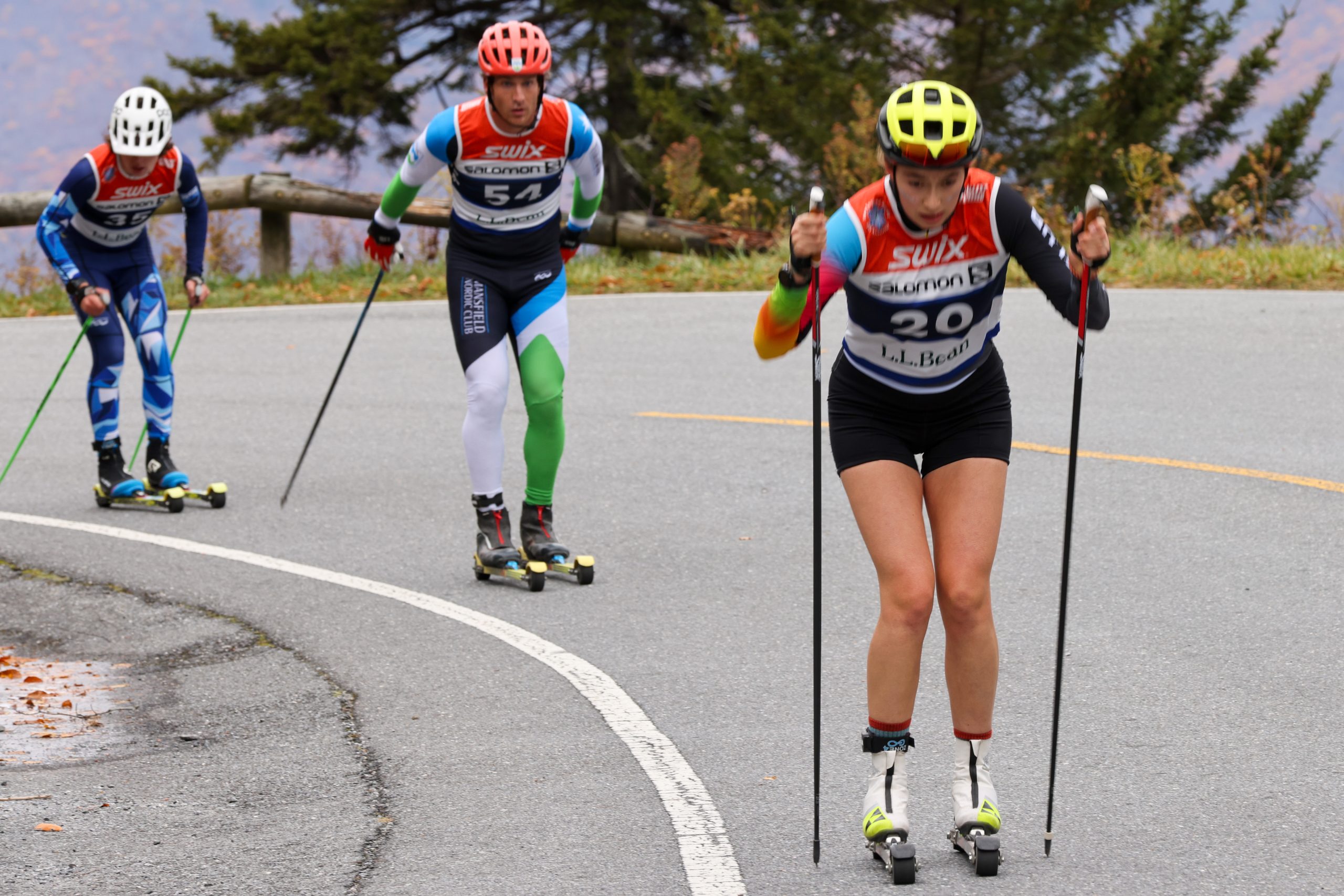


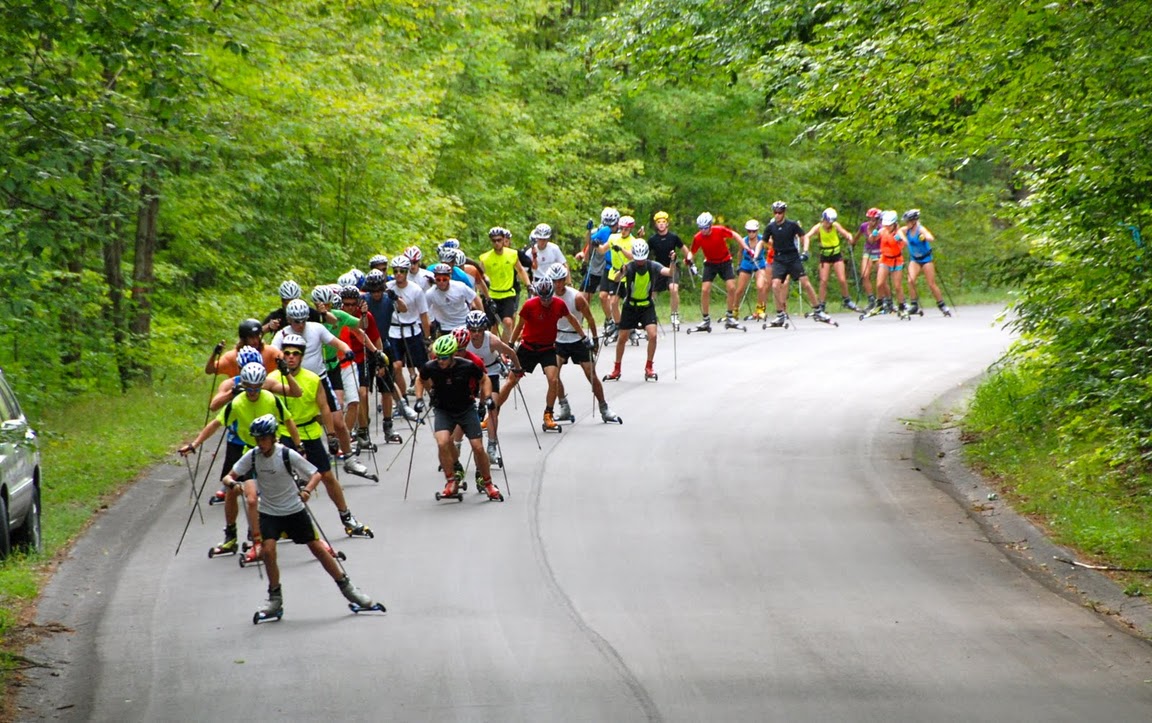
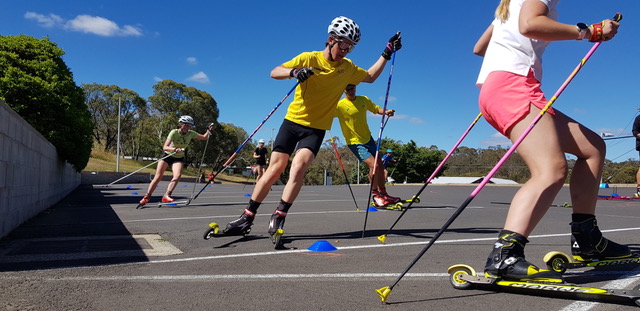
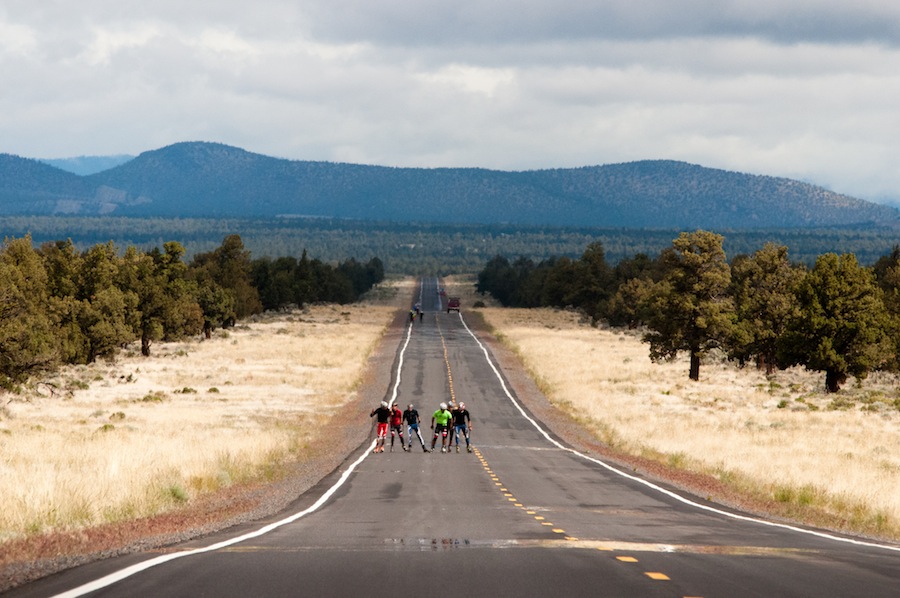
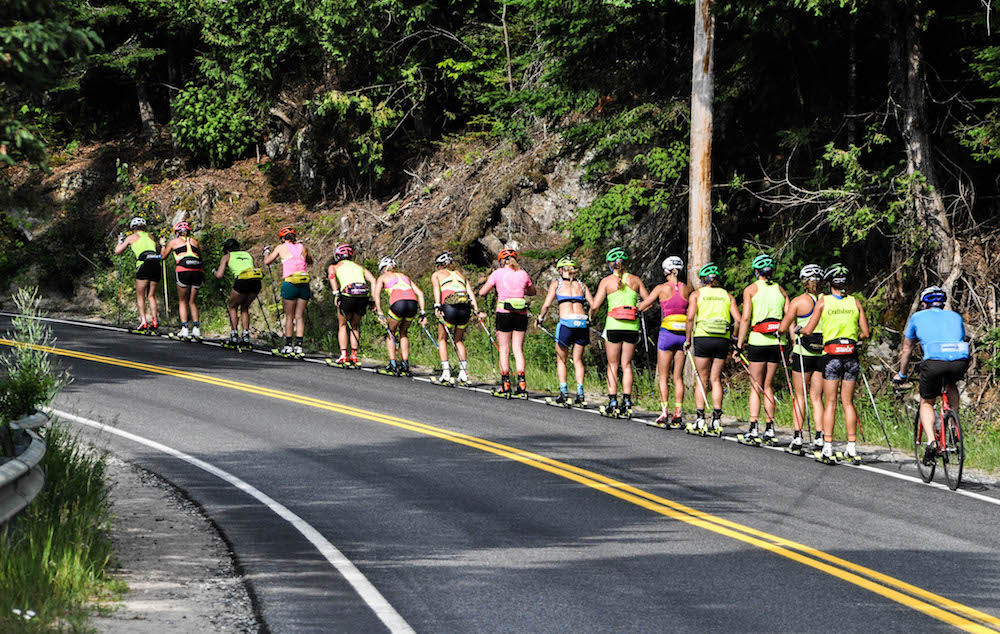

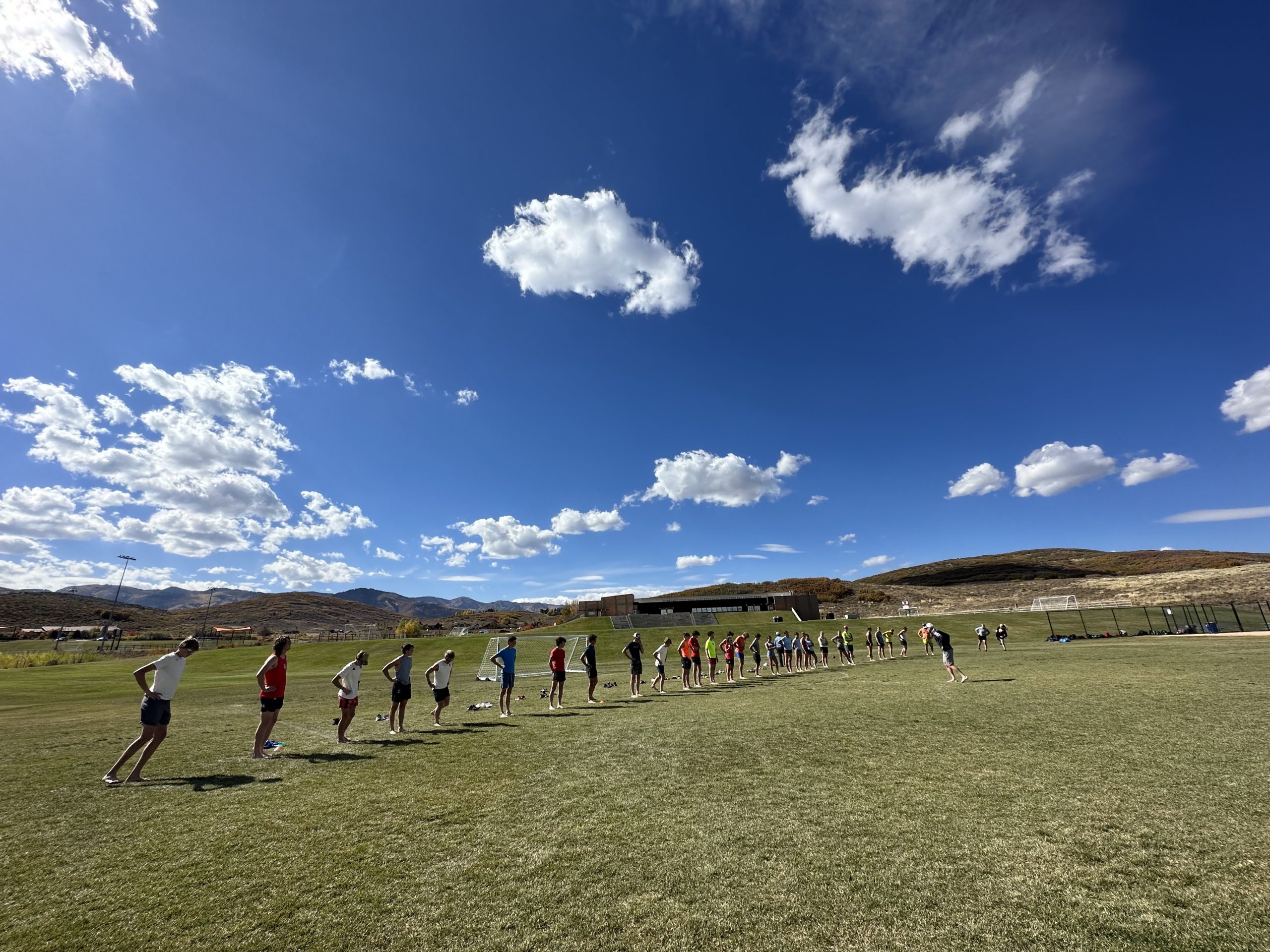
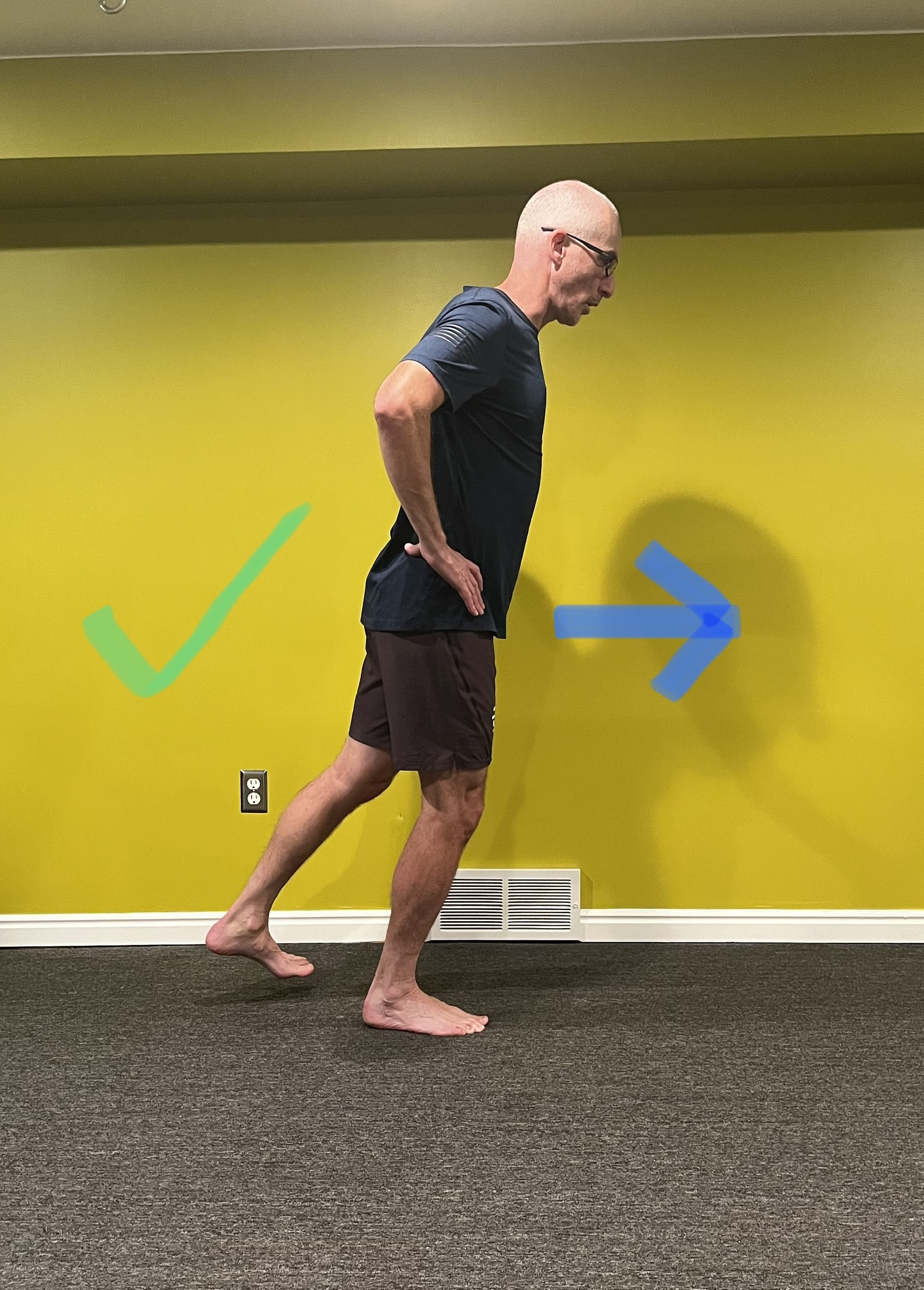 .