From the FasterSkier archive — posts syndicated from athletes’ and coaches’ own blogs between 2004 and 2012, kept online as published. Current coverage is at fasterskier.com.
Category: Juniors
The future of our sport! Junior racing can be a lot of fun, but it can also be exciting and competitive. Information for, by and about junior skiers, including coverage of major events like World Juniors and Junior Nationals.
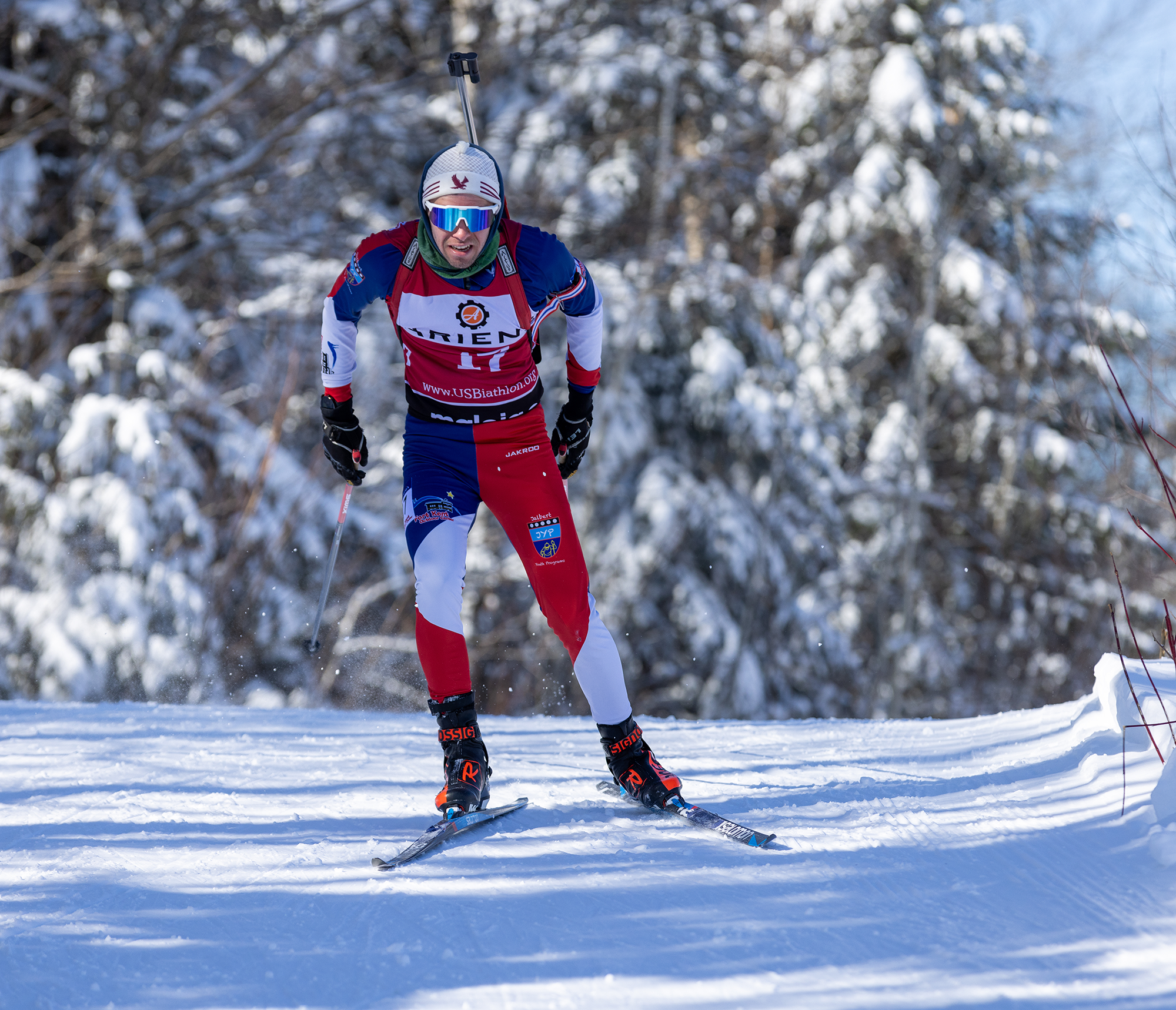
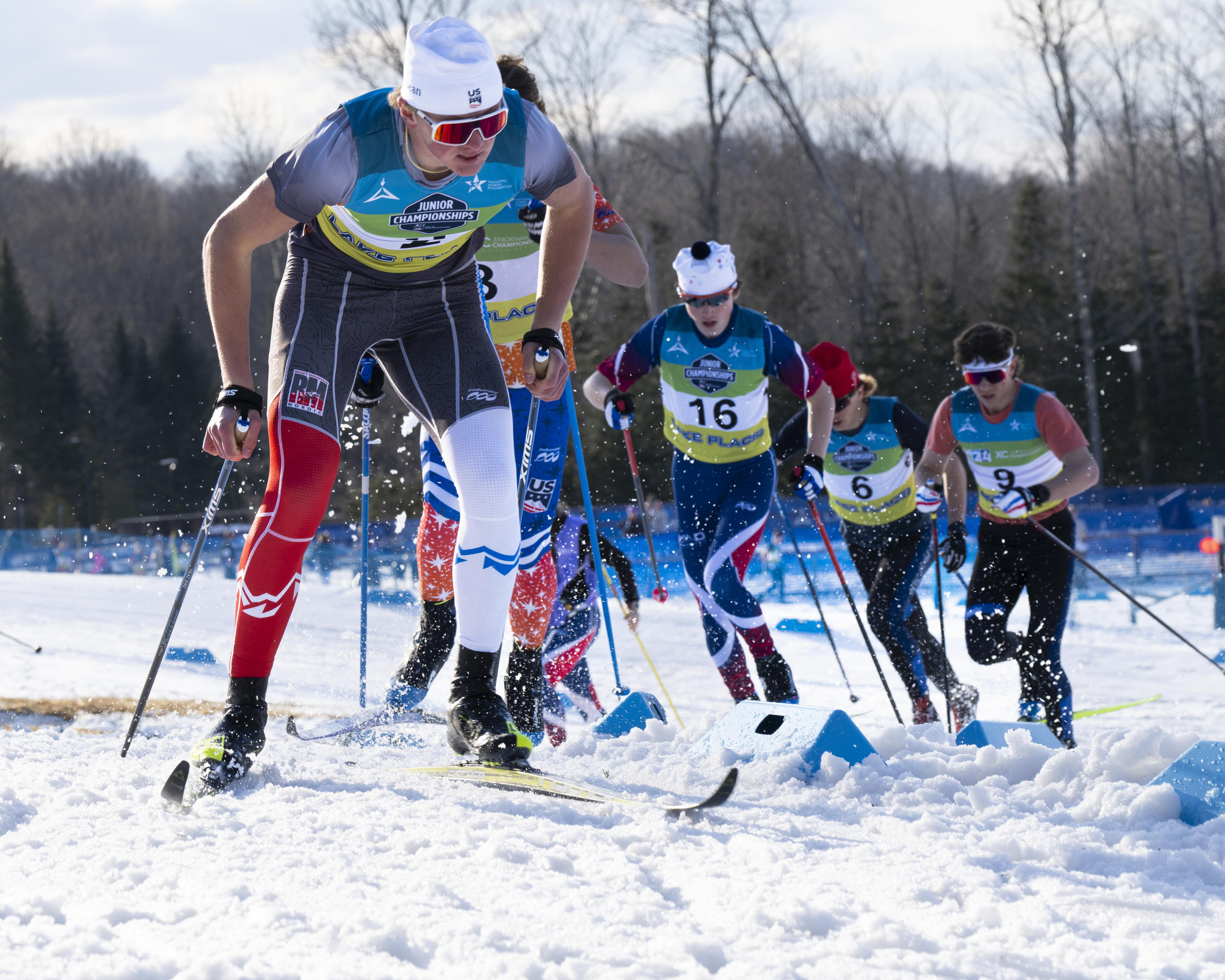
Quinn Holan on his way to a top 5 junior finish at US Nationals Lake Placid. (Photo: Courtesy Photo)
Will Sweetser thinks American Nordic skiing is recruiting in the wrong places. Here is what he is building on Donner Pass to prove it. This is the second of two parts — be sure to read part one, to learn about Sweetser’s background and coaching philosophy — Keep Showing Up: Will Sweetser’s Unglamorous First Principle
The number Will Sweetser carries around is thirty.
That, he says, is roughly how many development and junior racers a competitive Nordic ski club will produce from any 30,000 Americans with access to snow. The figure does not move much. Aroostook County, Maine, from Houlton to Fort Kent, about that. Stratton, Vermont, about that. Truckee, California, where he lives now, about that. He has been watching the number hold for thirty years.
“Maybe it’s a little richer in some of these alpine resort towns like Jackson or Aspen,” Sweetser said. “But in general, I think that’s a pretty good estimation of what you’re going to get.”
If he is right, the implication cuts against how most American Nordic clubs are organized. Truckee has three programs competing for that local pool. Each ends up with roughly ten development-age athletes. Sweetser, who runs the Nordic operation at Royal Gorge on Donner Pass, calls the result “not functional. And actually bad for athlete development.”
His conclusion is the one most clubs in snow country do not want to hear. He thinks they are fighting over the wrong 30,000 people.
Quinn Holan, Walker Rawlinson and Cabot Godoy celebrating learning at Jackson Hole International Spring Series 2023. (Photo: Courtesy Photo)
The 30,000 that interest Sweetser sit on the other side of the Sierra crest.
The Reno valley, by his count, holds about 650,000 people. The slice he is targeting — the corridor running from Gardnerville up through northwest Reno into Verdi, Nevada — is roughly 140,000 of that. He likes to compare it to the state of Vermont, where the total population is about 648,000. From west Reno to Royal Gorge is under 50 minutes. To Auburn Ski Club, the next program over, it is 40.
That, he points out, is shorter than what plenty of Vermont families drive to ski on Saturday mornings. It is shorter than what he himself drove from Bates to find usable snow in the 1990s.
“Why am I fighting over the 30,000 who live in Truckee,” Sweetser said, “who are frankly inundated with sports options?” Lacrosse. Soccer. Dance. Most of his daughter’s friends, he said, are doing two or three sports a season through elementary school. “How do you compete? Do cross-country ski training on top of all of that?”
There is a second front in the same argument. Truckee is a snow-sport town, but it is also a freeride town, and Nordic, in his telling, is losing the adolescent attention war to a sport that was built for the camera roll. “It’s never going to look as good as huck yourself off of a classic line at Palisades or Sugar Bowl or Heavenly,” he said. “You’re just not going to.”
Quinn Holan, Walker Rawlinson and Cabot Godoy. (Photo: Courtesy Photo)
So Royal Gorge is being repositioned. Sweetser describes it as a destination training center, by which he means destination for both racers and resources. The piece that interests him most is the labor pool.
A generation of Eastern Intercollegiate Ski Association graduates moved to the Bay Area for jobs in tech and finance over the last decade or so. Sweetser, off the top of his head, can name seven or eight. Widen the age range and he says he can name another thirty. They are not coaches by trade. Most of them make considerably more money than coaching pays. But they are skiers, and Sweetser’s bet is that a meaningful number of them would take three and a half hours twice a week — a Tuesday and a Thursday morning, say, or a Tuesday and a Saturday — to be paid by Royal Gorge to run a session in the Bay.
“The ones who are older don’t care about the money. They’ll do it anyway,” he said. “But the younger guys probably care about the money even less. They’re psyched to be out.”
He has tried this before with a Bay Area satellite through Sugar Bowl Academy and lost it to a turnover in headmasters. The current effort is being underwritten by Royal Gorge, whose general manager, Tom Miner, took over a few years ago and has been, in Sweetser’s description, the institution willing to write the checks. Bay Area families would still drive up Thursdays and Fridays for weekend training; the satellite sessions supplement, they don’t replace. “Four to five sessions of skiing per week,” Sweetser said. “Which is pretty crazy if you think about it. You can develop a lot.”
His reference point was his own résumé. He coached at Bates in the 1990s, when the team was off Mondays, didn’t ski Tuesdays or Wednesdays most weeks, and drove an hour each way the rest of the time or just left on Thursday for the next carnival stop. “I don’t think it’s the worst development plan for kids who want to ski in college,” he said. “Nor do I think it’s going to hurt your lifelong love of the sport to ski three or four days a week instead of six.”
JC Schoonmaker and Emma Ribom giving back at a Far West dryland clinic. (Photo: Courtesy Photo)
“I think it’s also a thought exercise more than a practicality,” he said. The snow-belt population is small to begin with, he argued, and within it, Nordic competes against alpine, against freeride, against every other thing a kid with a phone can see. He went looking for the counterexample and landed on Great Britain. Their entire cross-country skiing base, he estimated, is “maybe a thousand” people. Three British men finished in the top eight of a World Cup race in the lead-up to last year’s Olympics. The United States, from a population orders of magnitude larger, did not have three.
“So I think we have to apply both systems simultaneously,” he said. “You want the best possible resource application and preservation, as well as the recruiting.”
The recruiting, in his version, is what is taking him to Reno and to the foothills around Auburn and Grass Valley, towns at 2,000 feet of elevation, with populations several times Truckee’s, that have a history of ski teams without a current knowledge base. He has also been watching California middle-school track results, the way a baseball scout reads box scores. He is looking for the eleven- and twelve-year-olds who will hit puberty, stop being runners, and still have an engine.
Long view of program and athlete development. (Photo: Courtesy Photo)
The institutional pieces have been moving in the meantime, some faster than others.
Sweetser submitted a bid this month to host the 2028 Junior Nationals at Royal Gorge. The bid still needs approval from the sport committee and the junior working group, and the organizing committee is largely the one already preparing for an earlier event. He said the bid is in part a consequence of another organization having stepped back, and would not elaborate.
He is also in the middle of homologating four race courses at Royal Gorge — a sprint, a 2.5, a 3.3, and a 3.75 kilometer loop, with options for a 5K and additional sprint variants. Sweetser did the initial mapping himself; a professional GIS contractor is doing the formal version now.
The third moving piece is administrative. Sweetser owns a company called Ydalir, which is the U.S. importer for the Italian wax brand Maplus and the holding entity for his coaching operation. Ydalir’s junior and weekend programs are being folded into the Royal Gorge brand. “Weekend program up through juniors is branded Royal Gorge cross country,” Sweetser said. The older athletes — gap-year skiers, elite development athletes, masters groups — sit one tier up, with the financial arrangement still being worked out.
The deal makes sense to him because of what an institution provides. “I can’t just be running around in the woods all the time,” he said. “I need a home.”
Walker Rawlinson (Menlo CA) in a breakthrough race Jackson Hole 2023. (Photo: Courtesy Photo)
The home matters because of who he wants in it.
The NCAA is on the verge of changes that will give skiers a five-year clock from high school graduation, capped at age 24, in which to use four years of eligibility. Sweetser thinks the new rule will quietly squeeze out the gap-year athlete — the kid who could use a year at a prep school, the kid who is simply not ready at 18, the kid who would be a different athlete and a different person at 20. The five-year window is generous in theory and tight in practice.
What Royal Gorge can offer those athletes, Sweetser said, is a landing pad. Last year the resort gave passes to the three older skiers he was coaching. This year, in addition to the passes, it will offer them paid work with the ability to ski before and after a shift.
“It’s a pretty decent deal when you’re trying to make it,” he said.
None of this is new in concept. The Maine Winter Sports Center built something close to it in the 2000s, and produced a long run of national-team athletes from it. Sweetser was part of that operation. The Royal Gorge version inherits the DNA and adds a piece Maine never had: a population base on the other side of the mountains big enough to recruit out of.
Whether his thirty-out-of-30,000 math holds in California the way it held in Aroostook is the experiment.
“You take an 18-year-old and go out as a 20-year-old,” Sweetser said, “you’re a different person.”
Help Support Our Coverage!
If you value the thoughtful work and access FasterSkier provides, please consider becoming a Voluntary Subscriber. Your support directly fuels our work to cover the people, places, and moments that make our sport special.
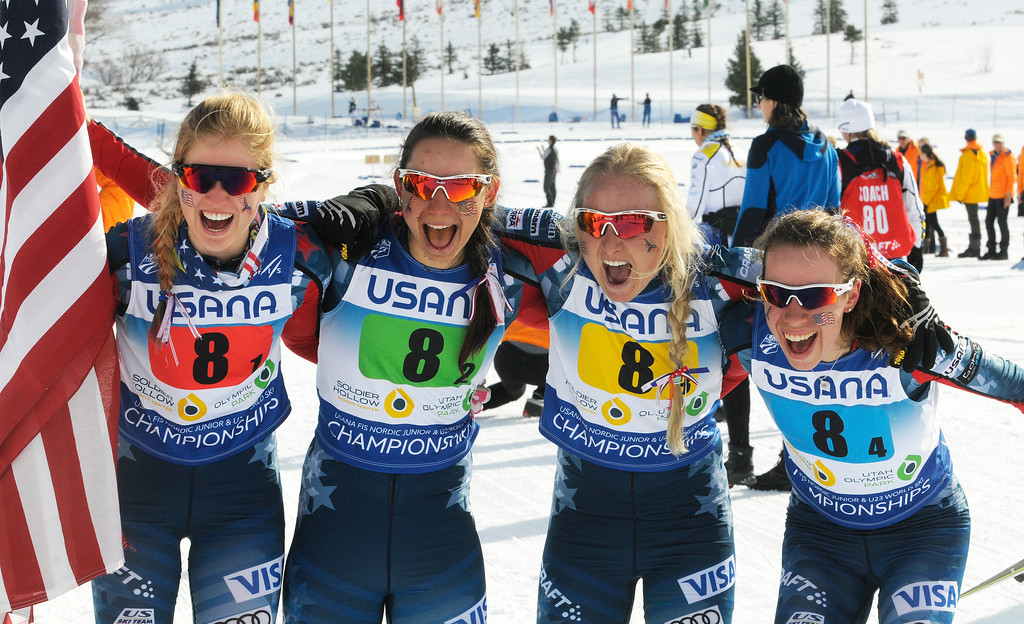
The U.S. women’s relay after taking a historic third in the 4 x 3.3 k relay at 2017 Junior World Championships on Sunday at Soldier Hollow in Midway Utah, with (from left to right) Hailey Swirbul, Julia Kern, Hannah Halvorsen, and Katharine Ogden. (Photo: U.S. Ski Team/Tom Kelly)
As the season winds down, it’s worth stepping back and asking a simple question: Does the way we develop young skiers in the United States reflect the philosophy we say we believe in? I know everyone is probably done with hearing about how the Norwegians do it, so let’s look at what we say we know and what we embrace.
Many coaches and programs describe cross-country skiing as a lifetime sport. We talk about patience and say it takes ten years or more to develop as a skier. Clubs reference long-term athlete development models, and parents hear that endurance sports reward athletes who build gradually and peak later in life.
All of that is true.
But much of the system we’ve built rewards the opposite.
Once rankings, camp selections, college recruiting, and program reputation become tied to junior results, the incentives quietly shift. Development begins to be measured by podiums and training hours rather than movement quality, long-term improvement, or whether athletes are still engaged in the sport five or ten years later.
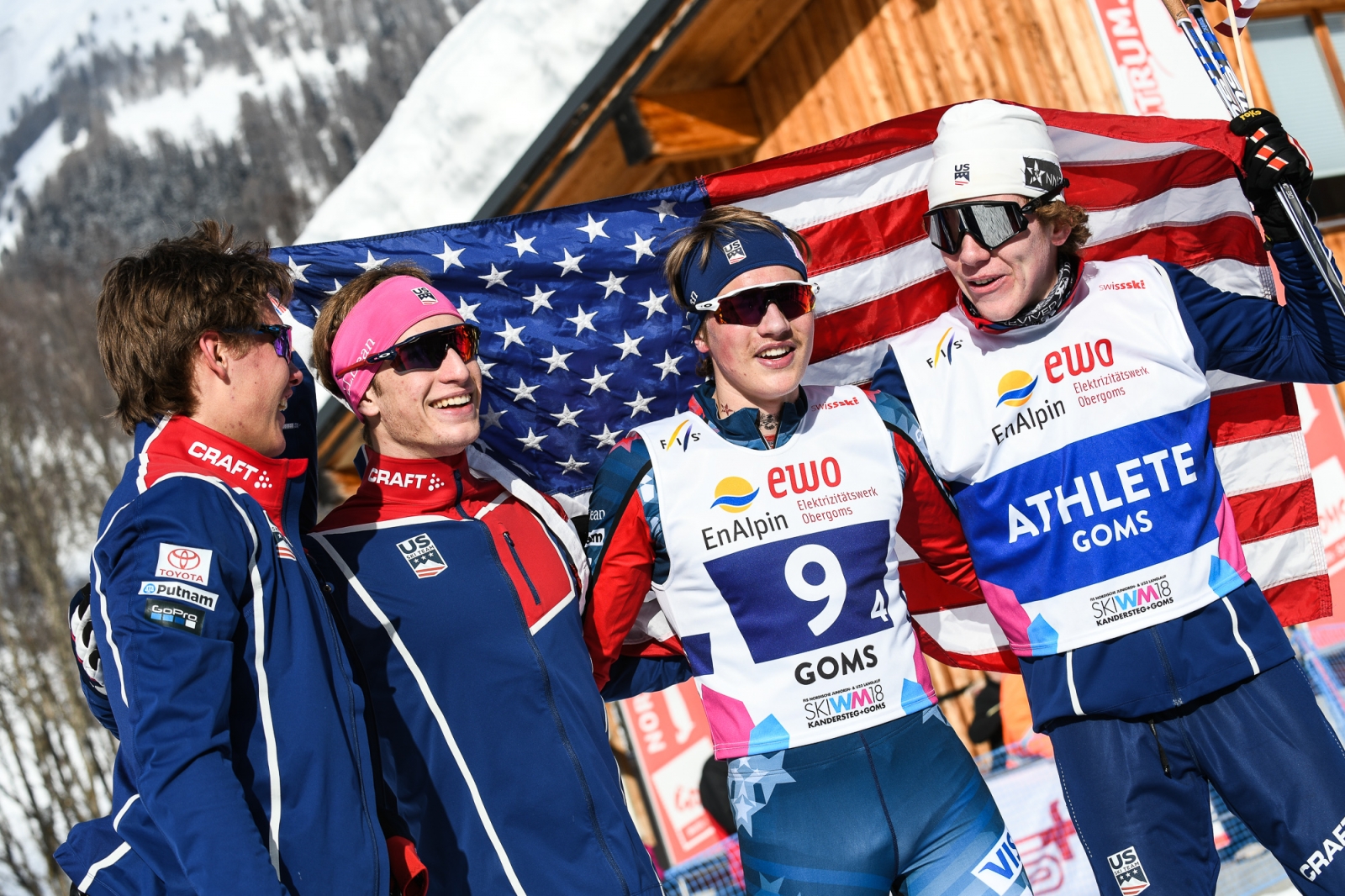
The U.S. men’s silver-medal relay at 2018 Junior World Championships in Goms, Switzerland, with (from left to right) Luke Jager, Hunter Wonders, Gus Schumacher, and Ben Ogden. (Photo: JWSC2018.ch)
What is long-term development
Aerobic capacity develops over years, often decades. Technical efficiency improves gradually. The durability required to handle training load is built slowly through years of training. Most elite endurance athletes reach their peak in their mid-twenties or early thirties, not in high school.
If peak performance happens ten or fifteen years after an athlete first enters the sport, the early years should focus less on maximizing results and more on building the foundation that supports long-term growth.
That foundation includes several elements.
Movement skill. Nordic skiing is a technical sport, and the best skiers move efficiently long before their physiology fully matures. This efficiency is critical to managing training loads in the future. More efficiency in technique equals less stress and load from training.
General athletic development. Running, biking, jumping, climbing, and playing other sports all contribute to coordination and resilience. Athletes who move well tend to adapt better to training later.
Motivation. The most valuable asset a young athlete has isn’t VO₂ max or the hours trained by some arbitrary definition. It’s the desire to keep showing up year after year.
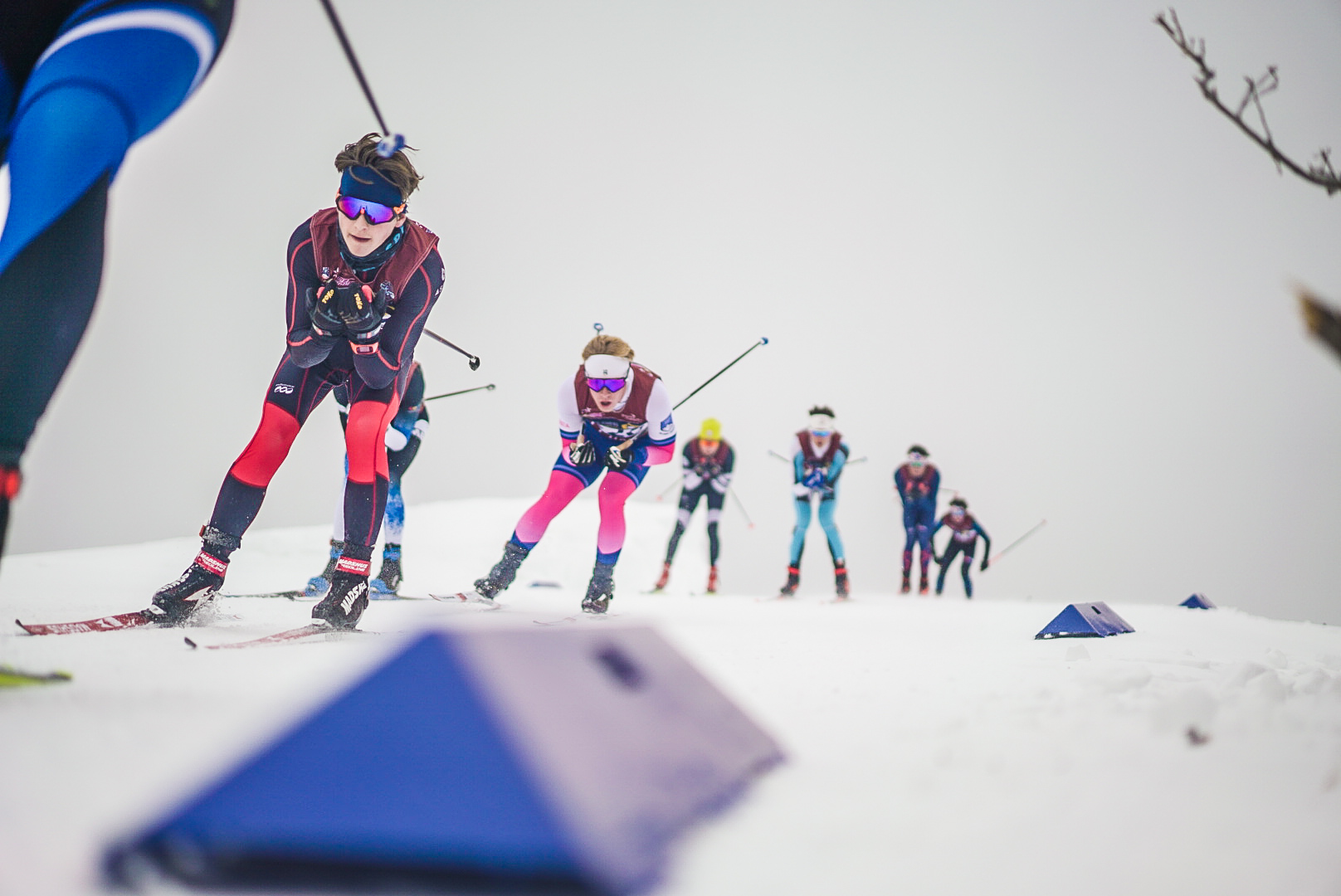
Junior athletes race during the 2022 U.S. Cross Country Championships in Soldier Hollow, UT. (Photo: Tobias Albrigtsen / @untraceableg)
The System Sends Mixed Signals
In practice, the system often sends young athletes a different message.
Junior racing has become increasingly competitive. Rankings exist even for younger age groups, and selections for camps, trips, and development programs often depend on early results. National events and development pathways can make performance at 14 or 15 feel like it carries some long-term significance. Yet we also claim to know that identifying future elite athletes at that age is extremely unreliable. If that’s true, it’s worth asking why the system places so much weight on those results.
One example is allowing U14 athletes to ski up in order to qualify for Junior Nationals. It doesn’t happen frequently, but it happens every year. It’s hard to reconcile that with the philosophy of not rushing development. If long-term development truly matters, governing bodies should show leadership and address this issue.
In some regions of the country, qualifier races have U16 athletes seeded in the start list with U18 and U20 athletes. People say it doesn’t matter because we separate them in the results. I disagree, the are intermingled with much older and more developed athletes. But more than that it is again the message begin sent?
At the same time, training culture has shifted. Training data is widely shared, and conversations often revolve around hours. Young athletes begin comparing workloads long before their bodies are ready to handle them. Often the more is better attitude prevails, even though we say that we should be working on other skill aspects of development.
These pressures can push athletes toward earlier specialization and higher training loads than their stage of development requires. A 14-year-old begins to feel like they need to train like a college skier. A 15-year-old worries that missing races or reducing training volume might put them behind.
The Boulder Nordic Junior Race Team out for an adventure ski in 2014. (Photo: BNST)
What are the impacts of the mixed signals
The most visible consequence is burnout. Many people challenge the idea of burnout. But after more than forty years around this sport, I’ve seen the pattern repeatedly. Just because we don’t measure something well doesn’t mean it isn’t happening.
Coaches who have spent time around junior skiing see the pattern: talented athletes who disappear from the sport sometime between their late teens and early twenties. Sometimes academics, finances, or changing interests are the reason. But often the explanation is simpler, they are tired from too much too early and to intense.
There are also physical consequences. Adolescence is a complex period of growth and development. Training loads that are manageable for more mature athletes are impossible for a developing body. When volume and intensity climb too quickly, overuse injuries and chronic fatigue become more likely.
Early specialization is not the problem. Rather, it is ineffective programming that has these young athletes training like more mature athletes. This early training focus limits athletic development. Athletes may accumulate impressive training hours but miss the movement diversity that builds long-term durability.
The biggest loss in this process is one that is unseen because those athletes are lost from the sport.
From a coaching perspective, the shift shows up in small ways. Conversations revolve around weekly training hours instead of how well athletes are skiing. Easy sessions slowly become harder. Fatigue accumulates while movement quality quietly declines. None of this happens overnight, but over time, the focus drifts away from skill development and toward simply doing more.
Development in endurance sports isn’t about accumulating work. It’s about adapting to the work being done and building the capacity to handle more later. A training log that looks impressive at 15 doesn’t necessarily translate into success at 25. What matters more is whether the athlete remains healthy, motivated, and technically sound over the long term.
Hailey Swirbul celebrates the U16 Junior National Championship title in the Freestyl Mass Start in Stowe, Vermont, in 2014. (Photo: Voisin/FasterSkier)
What Good Development Actually Looks Like
If long-term development is the goal, the early years should look different from elite training. Young skiers benefit from variety. Running, cycling, hiking, and other sports build coordination and resilience. The goal isn’t to replicate elite training programs but to create athletes who move well and enjoy being active.
Technique deserves major attention. Nordic skiing rewards efficiency, and athletes who develop strong movement patterns early often progress faster later because every hour of training becomes more productive. Training volume should increase gradually over time. Consistency across years matters far more than pushing limits in any single season.
Most importantly, development should seek to preserve motivation. The sport needs athletes who remain engaged long enough to realize their potential. We often see athletes try to do a big training year to catch up or reach a target training volume. It rarely works out.
The Problem With “More Volume” Thinking
In Nordic skiing, training volume carries a certain mystique. Conversations quickly turn to hours, weekly totals, yearly totals, and stories of elite athletes training 800 to 1,000 hours per year.
It’s easy to see why. Endurance sports reward consistency and large training volumes. But a subtle misunderstanding often occurs. Volume stops being seen as the result of long-term development and starts being treated as the cause of performance.
Correlation becomes mistaken for causation.
Hunter Wonders (APU/Alaska) winning the U16 Boys Mass Start Freestyle race at the US Junior National Championship in Stowe, Vermont. (Photo: Voisin/FasterSkier)
High Volume Works for Elite Skiers
At the elite level, high training volume makes sense. World Cup athletes have spent years building the capacity to handle that workload. Their aerobic systems are highly developed, their movement patterns are efficient, and their bodies have adapted gradually.
High volume works because it sits on top of a massive foundation: technical skill, durability, and years of progressive training.
The problem arises when that model gets copied without the same foundation underneath it.
The Missing Variable: Training Age
One of the most overlooked concepts in endurance development is training age. Training age refers to how many years an athlete has spent consistently adapting to structured training. Two 18-year-old skiers may have very different training ages. One may have spent eight years gradually building capacity. Another may have entered the sport recently and increased training dramatically. On paper, their training logs may look similar. In reality, their ability to adapt to those loads can be very different.
Training only produces progress when adaptation occurs. Without adaptation, training simply builds fatigue.
The U18 Girls field works its way past the Loppet Foundation Adventure Center in Minneapolis during Junior Nationals on March 11th, 2022. (Photo: David J Owen Photography)
The Efficiency Problem
Elite skiers move extremely well. Their technique allows them to ski long distances while conserving energy and minimizing unnecessary muscular stress. Developing this efficiency early is critical. In the future, it will allow the athletes to train large volumes without the metabolic and neuromuscular stress that can lead to overtraining.
Young athletes often lack efficiency. When technique is still evolving, large training volumes can actually slow technical development. Fatigue reinforces inefficient movement patterns that later become difficult to change.
For developing skiers, time spent improving movement quality can be far more valuable than time spent extending distance.
The Cost of Chasing Hours
There is also a practical cost to the “more volume” mindset. Elite athletes structure their lives around training. Sleep, nutrition, and recovery are integrated into the system. Young athletes are balancing school, travel, social life, and other commitments. When training volume climbs, something gives. Sleep declines, recovery becomes inconsistent, and fatigue accumulates.
Under those conditions, simply adding more hours rarely produces better results.
What Volume Should Really Represent
Training volume does matter. Endurance sports ultimately require substantial workloads. But volume should be viewed as a long-term outcome of development, not a short-term objective. Successful endurance athletes rarely build training hours quickly. They accumulate them gradually across many seasons, allowing their bodies to adapt step by step. By the time they reach elite levels, high training volumes feel natural because they have spent years building the durability to support them.
The 2026 US Ski and Snowboard Junior National Championships in Cable, Wisconsin, hosted by the American Birkebeiner Ski Foundation. (Photo: Tryg Solberg)
A Better Question to Ask
Instead of asking how many hours an athlete should train, a better question might be:
What training can this athlete adapt to right now?
For some athletes, the answer may involve increasing volume. For others, improving technique, strength, or intensity distribution may produce greater gains. Development is not identical for every athlete. What matters is finding the training load that promotes consistent adaptation rather than constant fatigue.
Why This Matters for the Future of the Sport
Cross-country skiing, like all endurance sports, depends on long-term participation. The sport needs athletes who remain engaged, not only as competitors but as lifelong skiers, coaches, and community members.
A development system that pushes athletes too hard, too early risks losing them before they reach their potential. It also narrows the pathway to elite performance by favoring early maturity and filtering out late developers.
If Nordic skiing truly wants to remain a lifetime sport, its development culture must reflect that philosophy.
Closing
Cross-country skiing has always valued endurance. That value should extend beyond physiology and into how we develop athletes. Endurance isn’t just about how long someone can ski hard on race day. It’s about how long they can remain engaged in the process of improving.
If we truly believe Nordic skiing is a lifetime sport, then our development system should not resemble a funnel that selects kids out at every progressive age group. It should look more like a runway, where every young athlete has the opportunity and the time to fully develop their potential, not just the ones who mature early.
Help Support Our Olympic Coverage!
If you value the thoughtful work and access FasterSkier provides, please consider becoming a Voluntary Subscriber. Your support directly fuels our work to cover the people, places, and moments that make our sport special.
The 2026 US Ski and Snowboard Junior National Championships in Cable, Wisconsin, hosted by the American Birkebeiner Ski Foundation. (Photo: Tryg Solberg)
When the first real snow falls in West Yellowstone, everything changes. The sound of car tires gives way to the swish of skis; coffee shops fill with cold hands and red cheeks; and this small Montana town of 1,100 becomes the epicenter of cross-country skiing in North America.
A Small Town With a Big Nordic Heart
Each Thanksgiving week, thousands of skiers descend on West Yellowstone for the Yellowstone Fall Ski Festival—an event that blends early-season training, clinics, races, and old-fashioned camaraderie. The teaching arm of the festival, officially called the Yellowstone Fall Ski Clinic, has become legendary in its own right.
“The festival has always been about community,” says Jack Hart, who is the co-director with Todd Eastman, and has been part of the event for more than three decades. “We’re a small town, but for this week, we become the center of the Nordic world. It’s a celebration of skiing in its purest form.”
Bridger Ski Foundation out for a first ski in West Yellowstone back in 2015. (Photo: Courtesy Bernie Nelson)
From Coaching Coaches to Coaching Everyone
The roots of the festival trace back to 1979, when the U.S. Ski Team established a coaching development program in West Yellowstone. Hart remembers it well.
“Before it became an official, commercial event,” he explains, “the U.S. Ski Team brought in coaches. They said, ‘We have a coaching program. We want to develop people like yourself who want to take their level higher. Come to West Yellowstone in November and we’ll train you to be a U.S. Ski Team coach.’ That’s really how this whole event started.”
As more coaches came west, the program began to evolve. “Torbjorn Karlsen, Drew Barney, and Dick Hunt—those are the three names that co-founded the event,” Hart says. “They realized we could turn this into something commercial and teach more people how to ski. We’ve got early snow, we’ve got the trails—why not invite everyone?”
By the early 1990s, that idea had taken hold. The first snow of the season, combined with West Yellowstone’s unique geography, made it a magnet for teams and individuals alike. “At its peak about twelve years ago,” Hart says, “we had over 5,000 day passes sold during the week. That’s how many people were here. These days we’ll sell 2,500 to 3,000 if we get a lot of snow—but it’s still the biggest kickoff to winter anywhere.”
Building Better Skiers — and a Stronger Community
The Yellowstone Fall Ski Clinic runs alongside the festival under the same umbrella. It offers structured instruction for everyone from teenagers to masters racers, with one-, two-, three-, and five-day options beginning the Tuesday before Thanksgiving.
“We take kids down to high school age,” Hart says. “We’ll have around one hundred people in actual instruction this year, and then another couple thousand here training with their own coaches—high-school programs, club teams, that sort of thing.”
The diversity of ability levels is part of the event’s charm. “We have literally people who have not been on skis before,” Hart says, “and we also have the five-day, full-time training type of skier. The idea is to enhance, improve, and enjoy skiing in this environment—with this community.”
The entrance to the Rendezvous Trail System in West Yellowstone, Montana. (Photo: Courtesey Photo)
Each clinic begins with a quick on-snow evaluation. “We ask for a self-assessment on the registration form, but that can be different from where people really are,” Hart laughs. “The first fifteen or twenty minutes on snow, we do an evaluation and adjust the groups right there. We want everyone with others of similar ability so they can maximize their time and get more enjoyment out of it.”
The formula works. The Rendezvous Trail System becomes a living classroom—groups working on technique, coaches calling out cues, laughter echoing through the lodgepole pines. “The idea,” Hart says simply, “is to enjoy, to improve, and to learn—and obviously have a bunch of fun while you’re doing it.”
Philosophy in Motion: Teaching, Balance, and Joy
Behind the logistics of the clinic—the sign-ups, scheduling, and staffing—stands Eastman, whose background in both coaching and teaching shapes how the clinics operate.
“My contention,” he says, “is that all the coaches needed to do more ski teaching, and all the teachers needed to learn about coaching. The sweet spot is the combination of the two.”
That balance defines the Yellowstone approach. Eastman and Hart have assembled a team of approximately a dozen instructors who rotate throughout the week, exposing participants to a range of learning styles. “We’re not following PSIA or USSA scripts,” Eastman explains. “Most of our instructors have been skiing forever and teaching for years. It’s a mix of styles and personalities.”
The offerings reflect this flexibility: a five-day skate and classic clinic, a three-day version, two-day tune-ups, and popular one-day technique intensives for both skate and classic skiing. “The one-day stuff fills up really well,” Eastman says. “It’s at the end of the week—Thursday through Saturday—so people already in town can still jump in.”
Last year’s clinics drew 82 participants, supported by a staff of 12 instructors, a healthy ratio that ensures personalized attention. “Our ideal number is around a hundred,” Eastman notes. “We want everyone to leave feeling like they were seen and supported.”
Just as important as the structure, however, is the tone. “This isn’t about grinding or chasing a podium,” Eastman says. “We’re careful not to overwhelm people, especially early in the season. A lot of folks haven’t been on the snow yet. We want to be delicate with feedback, help them rediscover how it feels to glide again.”
That sentiment pervades the entire week. “Everybody at some point has a sensation—they go, ‘What was that? That felt good. I want more of that,” he says. “You may not find it for years, but it’s that moment that keeps you coming back.”
Eastman laughs at the sport’s reputation for being physically demanding. “Cross-country skiing gets this bad rap: ‘Oh, it’s the hardest cardiovascular sport in the world.’ Yeah, gee, that’s exactly what I want to sign up for on my vacation! We want people to see the joy in it—the beauty, the community, the stress relief, the meditation in motion. It’s the best way to deal with winter.”
The sense of inclusivity is central. “We have everyone from high schoolers to eighty-year-olds,” he says. “And if someone needs more challenge or less, we just move them. Our job is to make sure every skier finds their place.”
For Eastman, success is simple. “When a hundred people swear they’re going to tell all their friends how much fun they had—that’s when we know we did it right.”
Free Heel and Wheel: The Beating Heart of the Festival
For many participants, the festival’s unofficial headquarters is Free Heel and Wheel, the beloved ski and bike shop owned by Jack’s wife, Kelly Hart, and Melissa Alder.
“Every kid hangs out there,” Hart says. “They have hot chocolate, buy a new ski hat, talk skiing—it’s where everything happens. That little store is kind of the center of communication because people have been going there for thirty years.”
Part café, part gear shop, and part social hub, Free Heel and Wheel embodies the spirit of West Yellowstone. During festival week, it hosts evening events, wax clinics, and impromptu meetups that stretch late into the night.
“It’s just part of the experience,” Hart says. “Besides the Holiday Inn, which is where everything is based, it’s the other center of the place. A lot of the kids meet there, sit at the coffee bar, talk skiing, and talk about whatever teenagers talk about.”
The shop is also the birthplace of one of West Yellowstone’s most famous legends—the “snow-dance” story. Years ago, when November warmth threatened to derail the event, the Free Heel and Wheel crew improvised. “They all got on bikes in bikinis, with skis on the back, and rode around town,” Hart laughs. “They lit the skis on fire as part of the dance, and that night we got nine inches of snow. It’s one of those legends that’s become part of the lore around here.”
Lots of Après-ski fun to be had. (Photo: Courtesy Photo)
Exploring Beyond the Trails
While the festival’s focus is skiing, Hart emphasizes that West Yellowstone offers plenty beyond the tracks.
“If you were that customer saying, ‘Jack, what else can I do? I’m only skiing three days, but I’m here for five,’ there’s a lot,” he says. “The clinic has speakers and films—wax clinics, athlete talks, people like John Bauer speaking about his career and the park.”
Just outside town lies the west entrance to Yellowstone National Park, which remains open to non-motorized travel in late November. “You can either tour in, or, depending on conditions, you can skate on the groomed road,” Hart says. “It’s a big tradition for a lot of higher-end athletes to ski all the way to Old Faithful. That’s 30 miles in and 30 miles out. We call it the 100 K day.”
In the 1980s, before skate skiing, that tradition was even tougher. “We used to classic ski into Old Faithful and back on Thanksgiving Day,” Hart remembers. “You could eat like crazy that night—you were starving.”
“Our restaurants stay open for this event,” Hart notes. “The bars are open. The town comes alive. If you’re coming all the way to West Yellowstone, skiing our trails and seeing Yellowstone National Park in its winter beauty should hold your interest for at least three or four days.”
A Safe Adventure
Early-season skiing in bear country sometimes raises eyebrows among first-time visitors, but Hart reassures them that precautions are simple and effective.
“We always recommend traveling with bear spray,” he says. “Most bears are in hibernation by then, but it’s not unusual this time of year to see one that’s not. Ski in a group, carry bear spray—Free Heel and Wheel rents it, and the Chamber has them too—and follow park guidelines. We’ve never had an incident with an animal on the Rendezvous Trail system in 34 years.”
Snow, Weather, and the “Snow Dance” Factor
Reliable early snow has always been West Yellowstone’s calling card, but Hart admits that every year brings a little suspense. “We’ve had snow and we’ve been skiing on the plateau already,” he said in early November, “but it’s been wet—low 40s and even rain up to 7,000 feet. The good news is it’s supposed to snow today, tomorrow, Sunday, and part of Monday. Temperatures are dropping to the teens at night, and starting the week before camp, it’s supposed to snow steadily.”
If conditions in town fall short, organizers simply shift to the South Plateau Road, about six miles outside town, which reliably holds snow. “We’ve always been able to adjust,” Hart says. “If we don’t get snow until Wednesday, fine—we’ll ski Wednesday or go up on Tuesday. The key is being flexible. And if all else fails, we might call on the Free Heel and Wheel girls for another snow dance.”
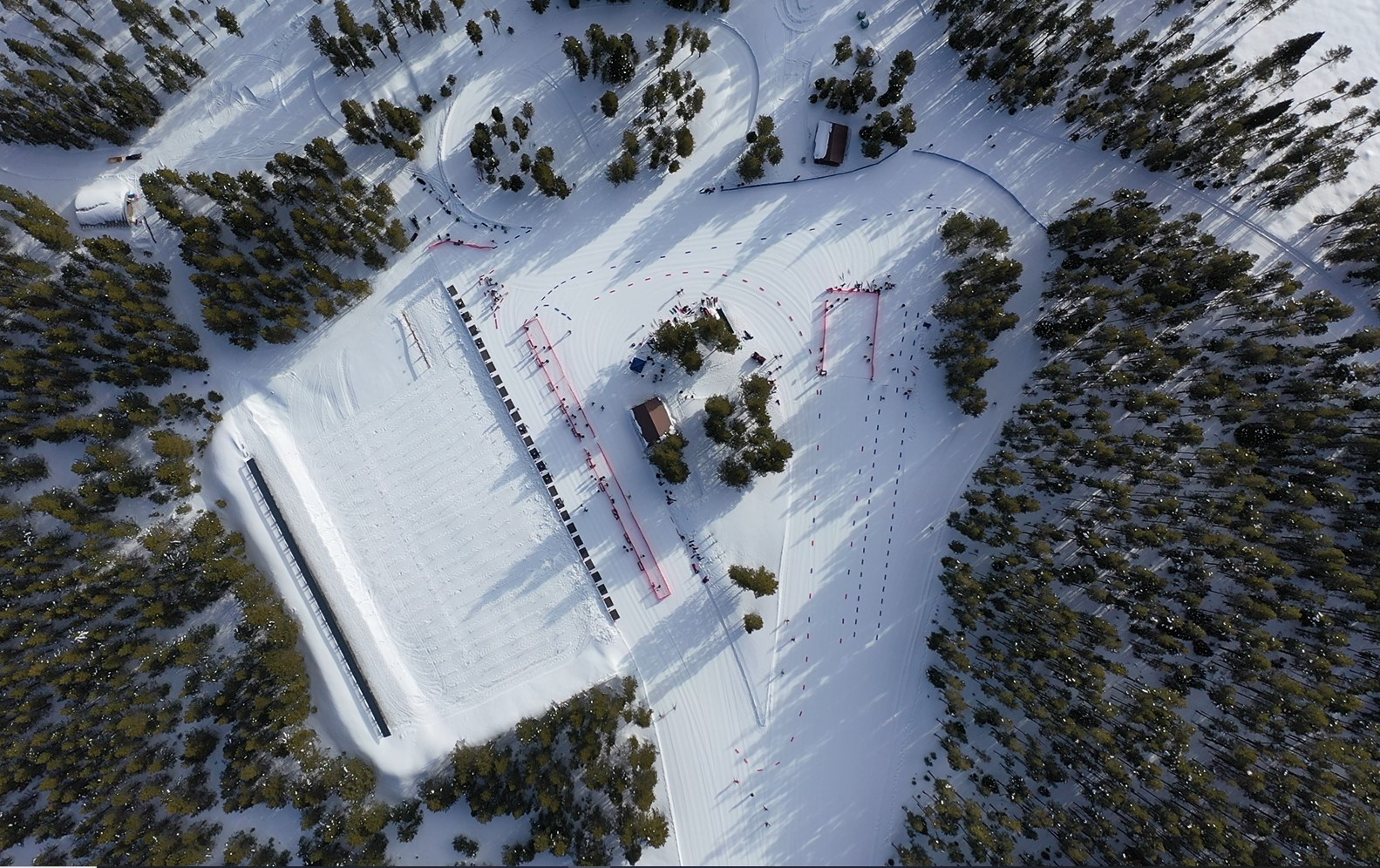
Aerial view of the stadium and biathlon range at the Rendezvous Ski Trails in West Yellowstone. (Photo: WYSEF courtesy photo)
Try Something New—Free Biathlon
One of the most distinctive parts of the week is the chance to try biathlon—no experience required.
“The biathlon events we have during the week are free,” Hart says. “If you’ve never shot a gun, it doesn’t matter. Some of our highest participation numbers come from the ‘never-ever’ biathlon event. You spend half a day being taught how to shoot, and then that afternoon there’s a race for all those people who’ve never raced before.”
The facility is first-rate: a 26-station range that includes a Paralympic setup. “You can feel what it’s like to actually do a biathlon race,” Hart says proudly. “It’s one of the nicest ranges in the western United States.”
Thanksgiving, Nordic-Style
Thanksgiving is the centerpiece of the week—a mix of tradition, family, and fitness.
“Thirty years ago, you couldn’t even get a turkey in town,” Hart recalls. “Now we have two grocery stores that carry everything, from turkeys to cranberries. We’ve got six hotels open, and you can make your own dinner if you rent a VRBO. There’s plenty of food available.”
The scene on the trails that morning captures what the festival has become: families pulling children in pulks, elite athletes finishing intervals, and clusters of friends laughing as snow falls softly around them. “Thanksgiving Day is a big tradition for a lot of people,” Hart says. “They come out with their family, ski for an hour, have a big Thanksgiving dinner, ski Friday and Saturday, and head home Sunday. You’ll watch races, watch biathlon, see some of the best people in the world on snow—it’s a great time to be here.”
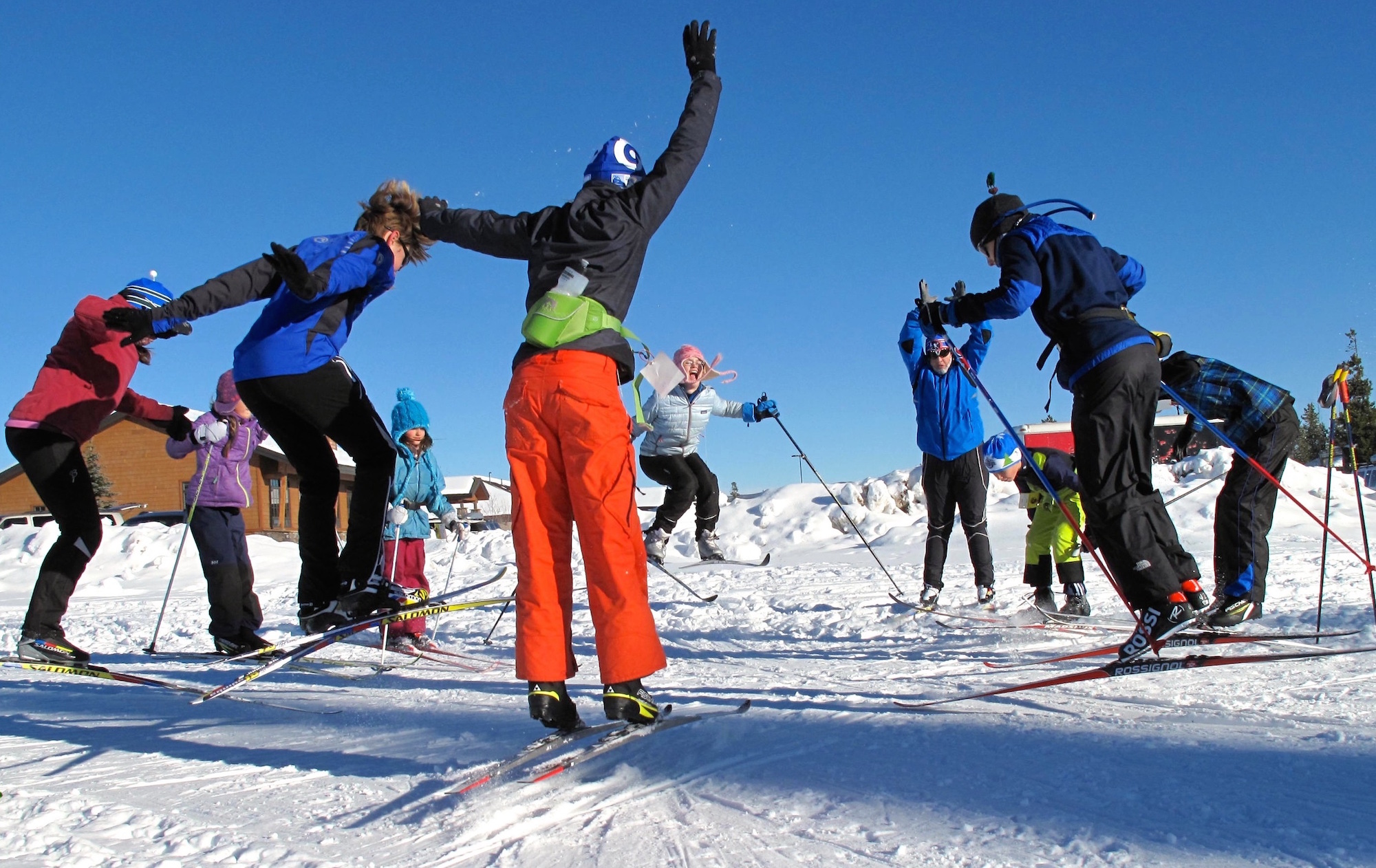
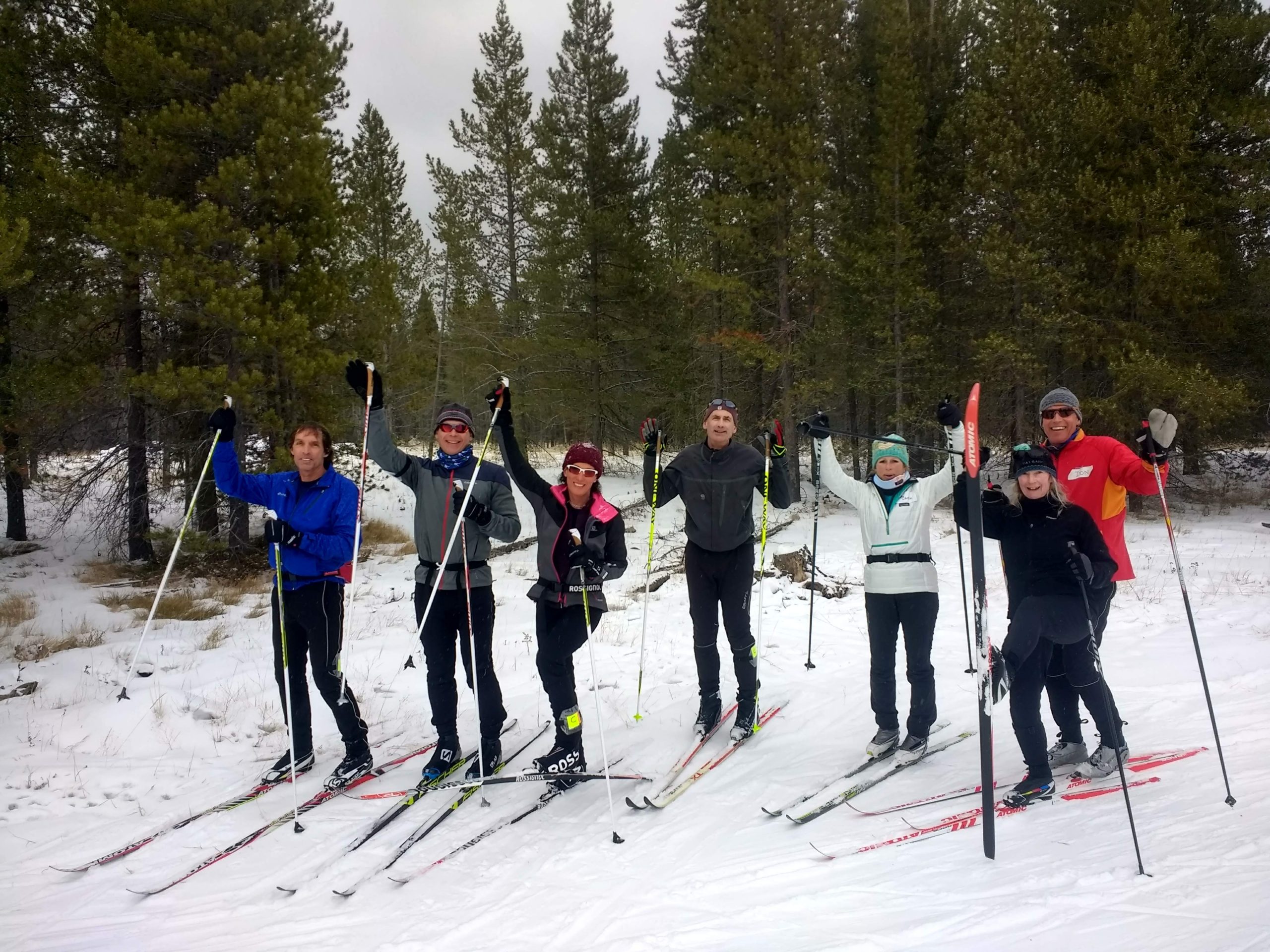
The West Yellowstone Ski Festival and Clinics is a gathering place for our community to celebrate the start of the new season. (Photo: Courtesy Photo)
The Spirit of the Festival
For Hart, who has worked at this event for the last 30 years, the reward is seeing the joy it brings. “We’re proud of what we’ve built,” he says. “It’s a massive effort for a small community, but when you see 3,000 people skiing, smiling, and reconnecting after a long summer—that’s everything.”
As the first flakes settle over town and the hum of wax being corked onto skis fills the air, West Yellowstone once again takes its place as the spiritual home of early-season Nordic skiing.
Amidst the pines and geysers, every November offers a fresh reminder: the ski season doesn’t begin with a race—it begins with a community.
LANESBORO, MA — On a crisp Sunday morning, nearly a hundred rollerskiers lined up at the base of Massachusetts’ highest peak, ready to test themselves against one of New England’s classic ascents. The Mount Greylock Hill Climb has always been more than a race—it’s a rite of passage, a season-ender that blends community, endurance, and a dash of history stretching back four decades.
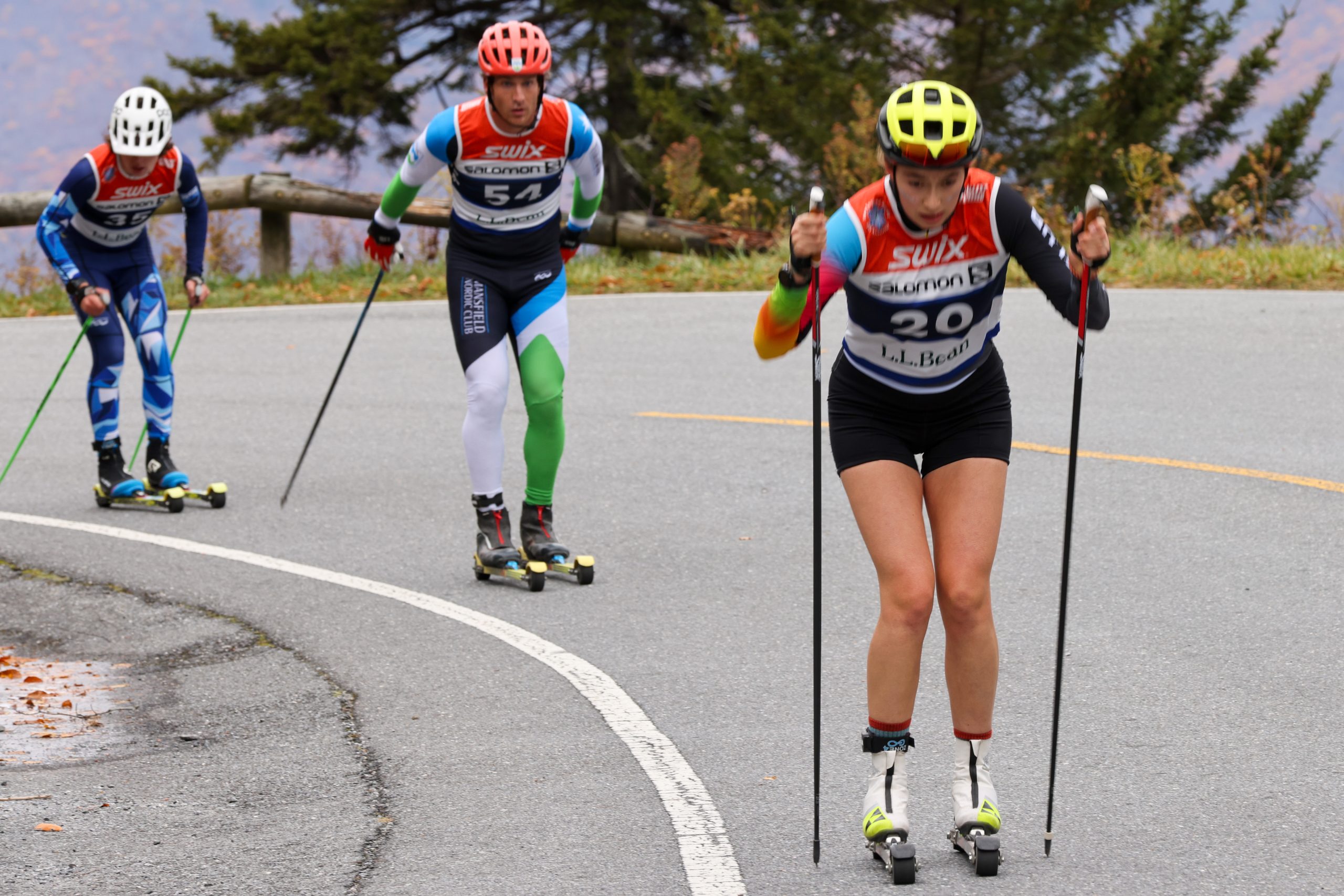
Luke Ebisawa (SMS) was the first up the Short Course on Mount Greylock. (Photo: FasterSkier)
A Long Tradition on a Steep Road
The Mt. Greylock Hill Climb traces its roots to the 1980s, when Steve Blazejewski, longtime owner of Berkshire Outfitters in nearby Cheshire, organized the first informal hill-climb rollerski up the mountain’s south access road. Those early events had a distinctly grassroots feel: a handful of hardy skiers, a few volunteers with stopwatches, the smell of fall leaves mixing with sweat, and the sounds of clicking ski ferrules on asphalt breaking through the cooling autumnal wind.
Blazejewski—a fixture of the Berkshire outdoor scene and a lifelong skier—recognized that Mount Greylock’s 3,491-foot elevation and sustained grade offered a perfect proving ground for endurance athletes. What began as a small local challenge quietly evolved into an annual fall tradition, drawing Nordic skiers from across Western Massachusetts and southern Vermont.
Today, that same spirit endures, even as the event has grown in scale and professionalism. With the New England Nordic Ski Association (NENSA) now running the climb as part of its official Rollerski Race Series, the Greylock event has evolved into the season finale of the regional summer circuit. This culmination feels both natural and earned.
Cole Bothner (Williams College) on his way to winning the Men’s Long Course race up Mount Greylock. (Photo: FasterSkier)
The Climb: From Lanesboro to the Clouds
Racers in the Long Course began their 8-mile ascent at the Mount Greylock Visitors Center in Lanesboro, winding steadily up the south access road to the summit. Those opting for the Short Course started halfway up near Jones’s Nose—a 4-mile route that compresses the mountain’s final, steepest pitches into a fierce test of pacing and grit.
The weather was ideal: cool, calm, and clear, with late-autumn color lining the road. For many, the Greylock climb doubles as both a training benchmark and a celebration—one last rollerski before snow season begins.
Tight Battles and Young Legs on Display
In the men’s Long Course, Cole Bothner (Williams College) led from the base, maintaining tempo through the middle grades and holding off Thomas Videtich Bye (Bears) by just eight seconds (48:22 to 48:30). Quinn McDermott, also of Williams, rounded out the podium in 48:41.
Astrid Longstreth (Mansfield Nordic) on her way to the Women’s Long Course win. (Photo: FasterSkier)
The women’s Long Course belonged to the next generation. Astrid Longstreth (Mansfield Nordic) took a commanding win in 59:16, pacing perfectly before attacking the upper switchbacks. Leigh Niedeck (EMXC) followed in 1:00:45, and Olya Wright (Williams College) was third in 1:01:12.
In the Short Course, juniors shone bright. Luke Ebisawa (SMS) dominated the men’s field (29:26), with Thomas Huemmer (EMXC) and Jorgen Pirrung (Mansfield Nordic) on the podium. The women’s race was even tighter: Genevieve Graves (GMVS) edged Mia Gorman (Mansfield Nordic) by six seconds (34:25 vs 34:31), with Kendal Bowen (GMVS) third in 35:54.
“A Chainsaw, Not a Hand Auger” — The Role of Rollerskiing
For Ben Theyerl, NENSA’s Competitive Program Director, the Mt. Greylock Hill Climb embodies what makes rollerskiing such a powerful development tool.
“One thing I’ve gained a newfound appreciation for stepping back in the East,” Theyerl said, “is how my predecessor Justin Beckwith framed rollerski programming: as a development tool. And as a tool, fittingly coming from Justin, it’s more chainsaw than hand auger—that is to say, power!”
Justin Beckwith cheering on his son, Red, as they took on the short course together – clearly before long Justin is going to have to be the one starting first. (Photo: FasterSkier)
He added that NENSA’s current approach is about “matching opportunities with athletes”—balancing elite-level races, such as the Lost Nation Roll and Keys/Climb to the Castle, with inclusive, community-oriented climbs, like Greylock.
“You can’t simultaneously broaden the base of junior skiers comfortable on rollerskis at those pro-style races,” Theyerl noted. “So we target different opportunities like Greylock, or regional camps and clinics. This year, we had plenty of first-time rollerskiers—and we had Jessie Diggins, Ben Ogden, their SMS T2 teammates, Craftsbury GRP athletes, and MNC Pro Team skiers racing too.”
That balance, he said, creates a feedback loop across generations: “The more comfortable young skiers are on rollerskis, the more we can tap into them as a tool. We want these opportunities to be a key part of our community.”
A Berkshire Tradition, and a Broader Metaphor
Theyerl also sees the Greylock climb as uniquely emblematic of New England grit.
“For every place we associate with ski racing—Vermont, Minnesota, Colorado, Alaska—there’s a community just adjacent, with dedicated skiers doing the sport we love where it’s a little harder to hack it. The Greylock Hill Climb is a great embodiment of the unlikely, impressive things that stand in the Berkshires, literally and metaphorically. It takes a town meeting’s worth of different people to put a mountainside race like that on—and that’s the grandest New England tradition of all.”
Amy Dupuis (#68), who grew up just a few miles from the start, brought her daughter, Madeline Ronci (#53), down from New Hampshire so they could tackle mom’s old stomping ground. (Photo: FasterSkier)
Looking Ahead
As NENSA’s rollerski series continues to expand, the Mt. Greylock Hill Climb feels like its perfect closing chapter—a bridge between old-school grassroots passion and the modern era of organized Nordic development.
Forty years after Steve Blazejewski first envisioned a climb to the state’s highest point, the heart of the race remains the same: community effort, steep grades, and the unmistakable rhythm of ski poles clicking against New England pavement.
(Please credit @FasterSkier if you publish them on socials or elsewhere)
Julie Longstreth taking on the short course. (Photo: FasterSkier)
Love Stories Like This? Help Keep Them Coming.
Feature interviews like this one take time, access, and care to produce. If you value thoughtful storytelling and independent ski journalism, please consider becoming a Voluntary Subscriber. Your support directly fuels the work we do to cover the people, places, and moments that make our sport special.
When Lucas Wilmot sits down after morning intervals, there’s no long nap or lazy lunch ahead. “This fall, it’s kind of all back-to-back—training in the morning, then eating, then class, then trying to eat and train again, and then do homework,” he says. “It’s tight.”
That understatement is classic Wilmot: composed, analytical, quietly focused. At just 19, the Jackson, Wyoming-raised skier is already juggling NCAA racing for the University of Utah, kinesiology labs that might soon shift toward biology, and a new badge of honor—fresh membership on the U.S. Ski Team.
Lucas Wilmot was keeping it fun from the very beginning. (Photo: Courtesy Photo)
From Jackson to Utah: A Small-Town Start
Wilmot’s story starts, like so many in American skiing, with a local club, a hand-me-down pair of skis, and a family that encouraged movement. “I kind of started with my parents—they just put me in skiing in elementary school,” he recalls. “Back then, it was all about hanging out with friends and not really racing.”
That changed in middle school, when the sport shifted from pastime to passion. “It took a turn where I started to take training more seriously and be more race-focused,” he says. “I remember looking forward to the trips, doing well in races, and having the older guys on the team as idols. Seeing how big and fast they were—I always thought that was really cool.”
His sister, two years older, was both chauffeur and role model. “She was skiing too—she’s still skiing now at Bates,” he adds. “I started summer training with the older crew in Jackson when I was one of the youngest guys. My sister could drive. I couldn’t. So I’d just spend my time training with the older guys.”
The big breakthrough came as a sophomore. “Minneapolis Junior Nationals was another big turning point,” Wilmot says. “I had three top tens there, and I never expected anything like that. That was when I realized, if I actually put in the time and effort, I can see results that impress even myself.”
Lucas Wilmot (#230 – far right) starting to get serious about his skiing racing at a Junior National Qualifier as a U14. (Photo: Courtesy Photo)
“Welcome to the U.S. Ski Team”
If Minneapolis was the first turning point, Soldier Hollow was the second. “I got third in the classic 10K at Senior Nationals,“ Wilmot recalls. “That was kind of a big whoa moment—a big jump up. Will (Wicherski), my coach from Jackson, came up to me and said, ‘Do you know where you are?‘ I said no, and he said, ‘You’re in third.‘I was just kind of shocked and caught by surprise.”
That race qualified him for Junior Worlds, where another top result changed everything. “They released the requirements—it was a Junior Worlds Top 10,“ he says. “When I had the ninth place in Schilpario, Italy, in the skate 10K, I kind of knew I’d made the team. Right after the race, Brian Fish walked by and said, ‘Welcome to the U.S. Ski Team.’“
Wilmot laughs at the memory. “It was at the wax cabin or something. I kind of knew that day. My parents and sister were there, so it was nice to tell them in person,“ he says. “But I didn’t want to be loud about it. I told my parents, like, this isn’t official, but it’s looking like I might be nominated.”
Now, being able to put on the U.S. suit still feels surreal. “I definitely feel pretty lucky,“ he says. “It’s a lot of people’s dream to do that, and it was one of mine. I feel super lucky, and it’s an honor. When I have the U.S. suit on, maybe I’ll go reach out to someone I’ve never met before—they’re all kind of like teammates to me.”
Lucas Wilmot (UU), Murphy Kimball (UAA) and Tabor Greenberg (UVM) this past spring at the USST’s annual Bend camp. (Photo: Courtesy Photo)
Structured but Flexible
Last season Wilmot logged around 500 hours of training; this year he’s targeting about 600. But he’s adamant that numbers aren’t everything.
“I’m definitely not the number grinder. I just try to keep it fun—never do too much, always quality. It’s kind of my mindset: always having quality in the time you’re training. Make sure it’s worth your time to be there.”
He recalls finishing a long over-distance session in Park City camp and realizing more minutes would add nothing.
“I was thinking I could do another 30 minutes, but I’d just be walking. It’s not really how much is that gonna do for me? If it’s not quality, if I’m not putting all my effort in, then I’m not getting the most out of it.”
That approach—precision over volume—mirrors his team’s philosophy. “Pierre (the Utah coach) kind of switched it to more professional training,“ he explains. “Every training has a specific outcome goal to it… You’re not just doing it to do it. There’s a reason why, and it’s all part of a broader plan and structured schedule.”
A Day Measured in Minutes
In Utah’s mountain light, mornings start early—Wilmot trains, refuels, and hustles to class. “I like to think ahead and plan out as much as I can,“ he says. “School is my priority, and how can I get it done efficiently so I can rest well. I try to go to bed as early as I can and know that training in the morning is kind of also a priority.”
The key, he’s learned, is organization—a skill honed on long travel days in high-school racing.
“Being on trips for skiing taught me that if I get it done ahead of time—get all my schoolwork done or just know that when I have spare time, I should try to get ahead or catch up on school—that’s what I think about all the time.”
Even with 600 training hours, he squeezes recovery in where he can. “It’s a hard balance between having training in the morning as a priority or staying ahead on work,“ he admits. “But I think I learned well… just to plan ahead.”
Wilmot during the 7.5-kilometer classic interval start last spring at the U.S. Ski and Snowboard Cross-Country Junior National Championships in Soldier Hollow, Utah. With a time of 23:12.4 second, Wilmot won his first Junior National title in his fourth appearance. (Photo: Drew Palmer Leger/Courtesy Photo)
Fueling the Machine
This semester, recovery and nutrition have become new focal points.
“This fall I was kind of struggling with recovery after the morning session and my class schedule,“ he says. “So one of the things I’m trying to do more of is focus on nutrition right after—that’ll allow me to make it through the long school day and then also recover well. That’ll help me get energy for the training and races.”
Breakfast sets the tone: “Usually a banana, an everything bagel with butter, and maybe a little bit of yogurt… kind of got a little something of everything. It’s pretty yummy.”
The science-minded athlete is applying classroom theory to real life. His kinesiology background gives him a deeper understanding of performance—how recovery, fueling, and training stress interconnect. “I’m keeping on the science track,“ he says. “Right now I’m doing kinesiology, but maybe switching to biology or another science-related thing. Not sure yet.”
Keeping It Fun
For Wilmot, joy isn’t optional—it’s essential. “I just love hanging out with all the buddies, training with friends. Definitely makes it go by a lot faster,“ he says. “It’s pretty fun just to crack jokes a lot and mess around, too… You don’t always have to be serious at training.”
That balance between intensity and levity keeps burnout at bay. Whether it’s running mountain ridgelines or laughing through rollerski sessions, he believes camaraderie fuels consistency. “Sometimes there are places not to focus,“ he laughs, “and just have a good time.”
Fun with friends is Lucas Wilmot’s core principle. (Photo: Courtesy Photo)
The Process of Progress
Beyond coursework and results sheets, Wilmot’s compass points toward steady growth. “I’d hope to make the NCAA team for the University of Utah this year,“ he says. “That’s going to be pretty challenging… but I hope to have more stabilized results and less fluctuation.”
He defines progress through small, controllable actions:
“In skiing, just being as efficient as I can. If I’m in a race and I feel uncomfortable, I try to find where I’m comfortable and not make myself too jittery. Being comfortable in your own way during a race—knowing how to race your races—is important for me.”
When he talks about the future, Wilmot’s tone shifts slightly—equal parts excitement and realism. “Within the next four-year span, there’s a good chance the progress track may take me to that level,“ he says, thinking ahead to the Milano-Cortina Olympics. “If I stick with it, that would be an insane experience and something very special.”
Wilmot skiing with Murphy Kimball (UAA/Alaska Winter Stars) on Eagle Glacier this past summer during the US Alaska camp. (Photo: Courtesy Photo)
A Learner at Heart
Among the national-team veterans, Wilmot sees himself as a student first. “I kind of see myself as a little follower,“ he admits with a grin. “Everyone’s just a little more experienced than I am. I feel like I don’t have much, so I think of myself as a learner and a listener—someone who tries to take everything I can from them.”
But even the learner can lift a team. “I love being the guy that gets someone to smile,“ he adds. “And make them laugh. I love doing that.”
That mix of humility and humor is why teammates have quickly embraced him. He’s not loud, but he’s steady—the kind of athlete who brings calm to chaos, whether it’s a high-stakes interval session or a late-night study grind.
Looking Ahead
Wilmot’s path has never been about a single breakthrough; it’s about accumulation—hours, credits, lessons. “I kind of never saw myself being where I would be right now,“ he reflects. “It goes back to the open-doors thing—I was just following what was happening, putting in the work, and seeing what opportunities it led me to.”
That approach—disciplined but flexible—may be his greatest strength. Between lecture halls and ski trails, he’s learning to find balance. And every dawn run, every late-night homework session, is another quiet step toward the next start line.
“It’s a good, hard balance,“ he says, smiling. “But that’s kind of what I signed up for.”
Love Stories Like This? Help Keep Them Coming.
Feature interviews like this one take time, access, and care to produce. If you value thoughtful storytelling and independent ski journalism, please consider becoming a Voluntary Subscriber. Your support directly fuels the work we do to cover the people, places, and moments that make our sport special.
When Trond Nystad talks about Norway’s athletic success, he doesn’t start with medals or podiums. He begins with children — specifically, children who love to play.
“The model of Norwegian sport,” he says, “is to have as many kids as possible, for as long as possible, and try to make them as good as possible.” That simple mantra, lived out in ski clubs from Tromsø to Trondheim, is what he believes keeps Norway at the top of the endurance-sport world.
“It’s about being a champion of the world, not a world champion,” Nystad explains. “The focus is on learning, mastering things, having fun — not on winning.”
Trond Nystad (Photo: NordicFocus)
A System That Lives Its Values
Nystad has coached at nearly every level — from college programs at Northern Michigan University and the University of Denver to national teams in the U.S., Germany, Austria, Switzerland, and Norway. He’s seen systems that thrive and systems that sputter. What sets Norway apart, he says, isn’t a secret training formula but the culture that surrounds young athletes.
“In Norway, the principles of long-term athlete development — the LTAD model — are lived, not just written,” he says.
“In some places, LTAD is a document. In Norwegian clubs, it’s a way of life. Coaches and parents make sure kids master skills, become independent, and most importantly, have fun.”
That lived philosophy keeps kids skiing, running, and playing far longer than in most countries. “Every country that has success over a longer period of time has figured out how to lure kids into sport and keep them there,” he says. “If you have a lot of kids and you teach them a lot of skills, they’ll be driven and have fun. Then it’s easy to talk about high-level training later — because you start with the right foundation.”
The U.S. Comparison: Knowledge Is Not the Issue
Nystad has deep respect for the American coaching scene — he spent years building programs here and still closely follows U.S. skiing. “The U.S. has a lot of really good coaches,” he says. “Sometimes the issue isn’t knowledge. It’s that cross-country skiing doesn’t attract as many kids because it has to compete with other sports.”
The challenge, he believes, is not to clone Norway’s system but to borrow its spirit. “We need more skiers, and we need to take care of them,” he says. “Make sure they have so much fun developing that they don’t want to quit.”
That message — that development is not linear, and that joy is a strategic asset — could resonate in American junior clubs. “If you have fun and learn mastery,” Nystad says, “success will come. But if you chase results too early, you lose too many kids.”
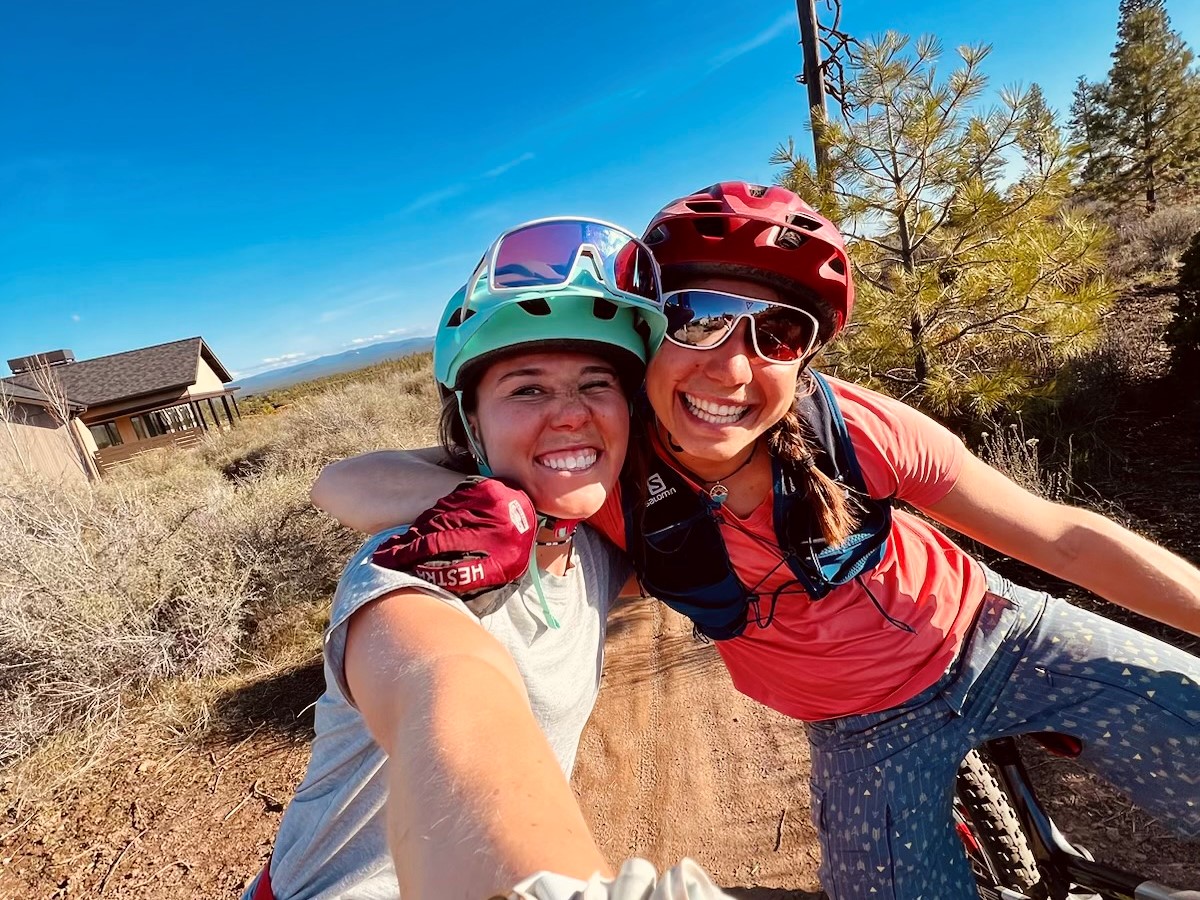
Like many elite skiers, Lauren Jortberg and Julia Kern enjoy mountain biking opportunities for a change of pace. (Photo: Julia Kern)
Against Early Specialization
Asked when Norwegian athletes begin to specialize, Nystad laughs gently. “Focus and specialization are a little bit mutually exclusive,” he says. “You can be focused and still do more than one sport.”
Most Norwegian kids, he explains, play several sports until age 15 or 16 — sometimes even longer. “When they’re 18 or 19, they might focus on one main sport and keep a couple on the side — running and skiing, for example, or cycling and skiing,” he says. “It’s part of the culture. People are active.”
The danger, he warns, comes from well-meaning adults. “A lot of parents try to self-realize through their kids,” he says.
“They want them to specialize early, to do everything right. In the end, the kids are sick of it, have no fun, and they quit.”
His takeaway is simple: “Kids are not miniature adults. They’re kids. Let them be kids as long as it makes sense. Life gets serious soon enough.”
Adam Witkowski poses with his parents after unexpectedly racing a World Cup in Minneapolis in 2024. (Nathaniel Herz/FasterSkier)
The Role of Parents: Mentors, Not Managers
Nystad, as a father himself, knows firsthand how difficult it is to strike that balance of knowing when it is time to commit. “Sixteen is just a number,” he says. Some sixteen-year-olds are grown up; they can form their own opinions and take ownership. Others can barely wipe their own ass,” he says with a laugh.
“But in the end, the kids have to decide for themselves. It has to be something that’s rewarding for them. Our job as parents is to support them — to help them make fewer mistakes, to be mentors along the way.”
That mentoring role — guiding but not controlling — is something Nystad sees as critical for the next generation of athletes. “We’re supposed to help them realize their dreams and develop,” he says. “Not to live our dreams through them.”
“Keep It Simple”: Trust the Body, Not the Gadgets
In an era dominated by data, GPS, and lactate meters, Nystad is refreshingly old-school. He’s not anti-science — he’s trained with and coached some of the world’s most analytically minded teams — but he cautions against what he calls “numbing the senses.”
“The reason to measure is to understand,” he says. “You measure to confirm your subjective feelings — not to replace them.”
“If you’re tired, you sleep. If you’re hungry, you eat. If you’re thirsty, you drink. Those are subjective feelings — and they’re more important than any data you can measure,” he explains.
“Most devices today are not 100 percent correct. Your body usually is.”
For Nystad, training success comes from continuity, not complexity. “The KISS principle applies — keep it simple,” he says. “In endurance sports, you have to train with continuity for a long time and be patient. Don’t screw things up. Control gives continuity, and continuity is everything.”
Fun as a Foundation for Longevity
Nystad lights up when the conversation turns to lifelong sport. “If sport or physical activity makes us happy, we’ll prioritize it,” he says. “Talking about training doesn’t make you better — actually doing it does.”
He encourages athletes — elite or recreational — to reframe movement as a privilege, not a chore. “We should appreciate every day we get to move,” he says.
“It means we’re healthy, we have the time, we can afford the equipment. That’s a luxury we need to appreciate more.”
For parents juggling work and family, his advice is pragmatic: “Maybe it’s better to go for a one-hour run first, and then drink your beer and watch Netflix,” he says with a grin. “It’s just about organizing your day so you get your little quick fix of physical activity.”
The Norwegian Definition of Success
For someone who’s coached Olympic medalists, Nystad’s definition of success has nothing to do with results. “I can’t even remember what happened last winter,” he admits. “Success has nothing to do with medals or wins. I’m happy as a coach when the athletes are happy — when they’ve developed as athletes and as human beings.”
He sees coaching as a human project as much as an athletic one. “I always try to build teams where people work together, respect each other, and do their best. That’s success. If we treat each other well and do the job the best way we can, we’ll reach our potential. Reaching your potential — as a human or as an athlete — that’s success.”
It’s a deeply Norwegian sentiment, one echoed across their sports system: the process matters more than the podium.
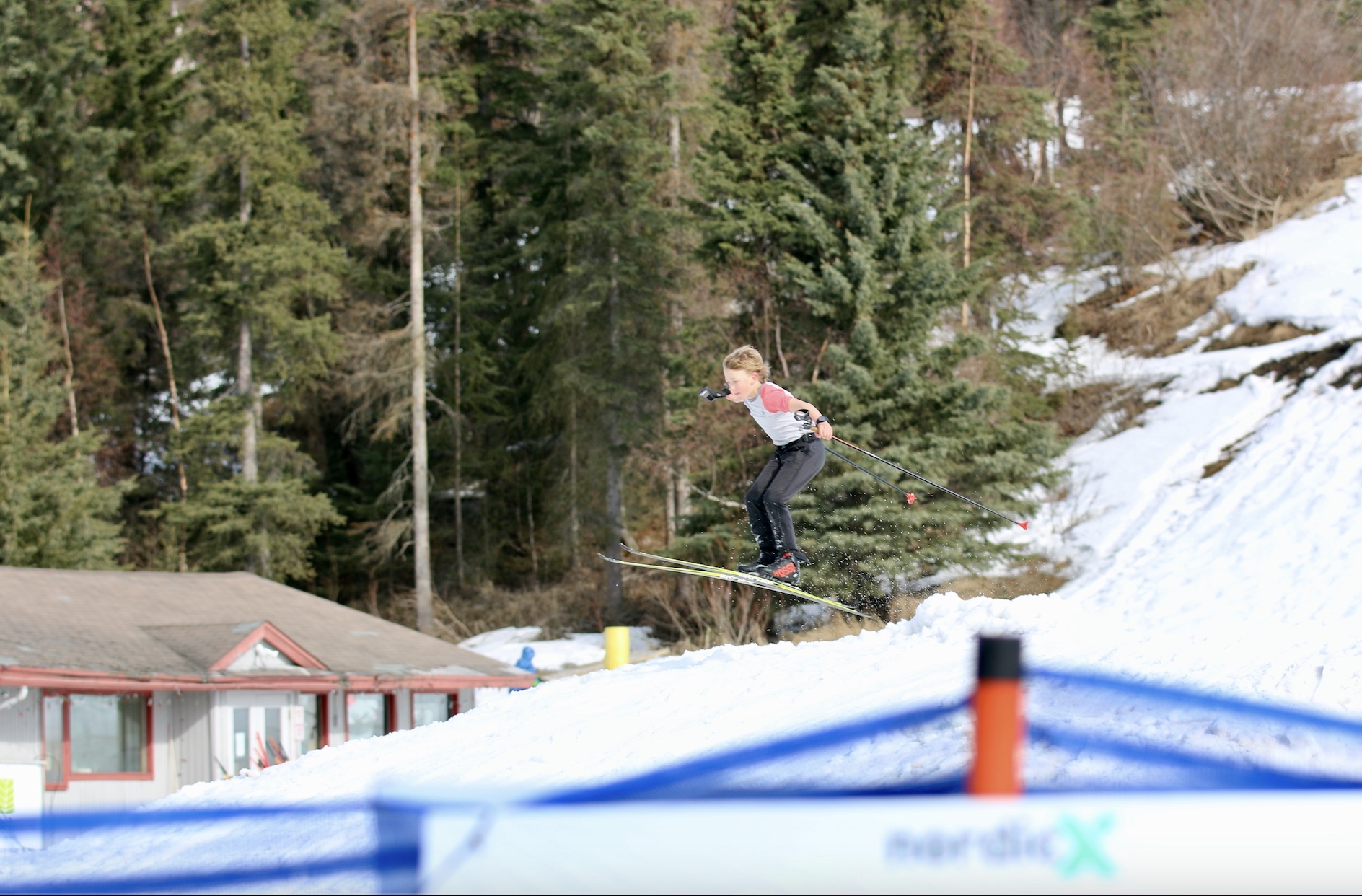
One of many kids enjoying the features on the course and in the Kiddie Cross terrain park at NordicX in 2022. (Photo: Eric Maurer / NordicX)
Lessons for U.S. Clubs and Coaches
Nystad believes that U.S. programs can apply these lessons without mimicking Norway wholesale. “The principles are the same,” he says. “It’s about creating an environment where kids master things, have fun, and stay in sports longer.”
That may mean rethinking what “development” looks like. “Most of the time, we lose more than we win,” he says. “So it’s okay to have a bad race or a bad day. Focus on skill development and mastery — even when things aren’t going well. If it’s fun, and you keep mastering skills, success will come.”
He also urges patience from young athletes. “A big mistake is intensity control,” he says. “They go too fast on the easy sessions and too fast on the hard sessions. They believe ‘no pain, no gain,’ but endurance sport doesn’t work like that. The best athletes are the ones who train a lot — and train smart.”
Technique, Mastery, and Play
Skiing, Nystad reminds us, is as much art as science. “Especially in skiing, which is such a technical sport, the quality lies in doing things right — not just going hard,” he says. “I see so many people skiing with music in their ears, talking, doing all kinds of things, instead of focusing on perfecting technique.”
He encourages athletes to “play” with movement: “No one tells us how to do it. We can choose the way that fits our body and our strength,” he explains. “If more people would play with technique, be conscious of their technical and pacing choices, the outcome would be better for most people.”
Astrid Oeyre Slind (NOR) on her way to a second-place finish in Cogne, Italy. (Photo: NordicFocus)
The Lifelong Athlete Mindset
At 55, Nystad continues to coach, ski, and move daily — not out of obligation, but joy. “If you train right, take care of yourself physically, mentally, nutritionally — and have a blast doing it — there’s no limit to how long you can be good,” he says.
“The moment you start thinking it’s a sacrifice, or that it’s boring — that’s when your career starts to end.”
He cites examples like Hilde Gjørum, who earned her first Olympic medal at 43, and Astrid Øyre Slind, who made her first Norwegian World Championships team at 34 and won her first World Cup at 37. “There are lots of stories like that,” he says. “Everyone can keep getting better — if you love what you do.”
Looking Ahead: A Sustainable Future
Nystad’s final reflections return to sustainability — both of snow and of sport. “Obviously, we’ll have issues with snow,” he says. “Snow storage and snow farming are becoming normal in Europe, and that will change the sport. But cross-country skiing will survive. It’s a great sport — full-body, low-injury, healthy.”
The real challenge, he believes, is getting people to participate. “We need to sell it for all it’s worth and get more people involved,” he says. “If we can bring more people into skiing — kids, families, anyone — the rest will take care of itself.”
The Takeaway: “Master the World”
For Nystad, the essence of sport is not the stopwatch, but the spirit. “The focus,” he repeats, “is on mastering the world — being a champion of the world, not a world champion.”
It’s a mindset that turns every trail into a classroom, every race into a chance to learn. And perhaps that’s the real secret behind Norway’s golden age of endurance: a culture where success isn’t measured in medals, but in how many people can’t wait to clip into their skis again tomorrow.
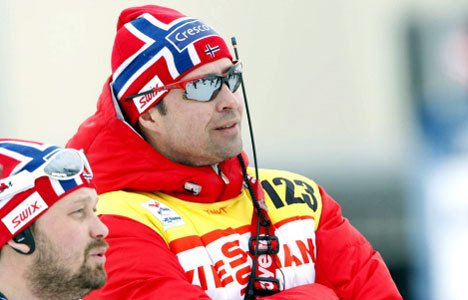
Trond Nystad, the coach of the Norwegian men’s cross-country ski team, takes questions from the media after the relay at the Sochi Olympics.
For many high school cross-country ski racers, fall is filled with soccer practices or long cross-country runs. These sports build endurance, speed, and competitiveness—but skiing requires an additional set of skills. Transitioning from fall sports to ski season means making smart adjustments so athletes don’t just carry fitness into the winter but arrive with ski-specific readiness.
We spoke with several EISA coaches about what young skiers should focus on as the leaves fall and the snow approaches.
Bates College skiers getting after some dryland training.
Keep the Aerobic Engine Running
Soccer and cross-country running already provide a strong foundation in aerobic training. However, once the fall season hits full swing, many athletes cut back drastically on their training volume—a mistake that coaches caution against.
“The key is consistency and a little bit of planning,” says Annika Martell, recently appointed Nordic Head Coach at St. Michael’s College. “The huge and random sessions in October and November might not provide as much value as consistent roller skiing or running, where it fits in the athletes’ weekly schedule. Athletes who stay in a rhythm will transition to snow much more smoothly.”
Maintaining three to five aerobic sessions per week helps ensure that all the hard-earned fall fitness carries seamlessly into ski season.
Build Ski-Specific Strength
Running and soccer strengthen the legs, but skiing relies heavily on upper-body power and core stability. Coaches recommend carving out at least two sessions per week for ski-specific strength training.
“Adding focused strength sessions to your training gives the multisport athlete the best opportunity for success in each season,” says Steve Monsulick, former Bates College runner and skier and now Head Nordic Coach at Williams College. “Creating workouts that include upper body, core, and lower body exercises will pay off huge when winter rolls around.”
Even short sessions—such as 20 minutes of core work or a mix of push-ups, pull-ups, and lunges—can make a significant difference. Strength not only enhances ski performance but also helps prevent injuries as the season progresses.
Julia Kern prioritizes strength year-round. (Photo: Julia Kern)
Sharpen Balance and Agility
Skiing is not done on a flat, predictable surface—it’s about efficiency on slippery, changing terrain. Balance and agility drills prepare athletes for that challenge.
Simple routines, such as single-leg squats, side-to-side hops, or time spent on a slackline or wobble board, can sharpen coordination.
“Balance and body awareness are fundamental to success on skis,” explains Shane MacDowell, Head Nordic Coach at the University of New Hampshire. “For athletes to maximize their balance, they must understand how their body feels and moves through space.”
MacDowell notes that skiing balance begins in the feet and ankles. Proper ankle flexion and weight distribution allow athletes to channel energy efficiently into the ski, creating what he calls “free speed”—momentum generated when pressure transfers smoothly through the foot and into the ski between kicks or strides—the result: a more powerful glide and fluid, efficient technique.
A balancing exercise on what Bill Pierce calls the balance or air pillow.
Dial in Technique Before the Snow
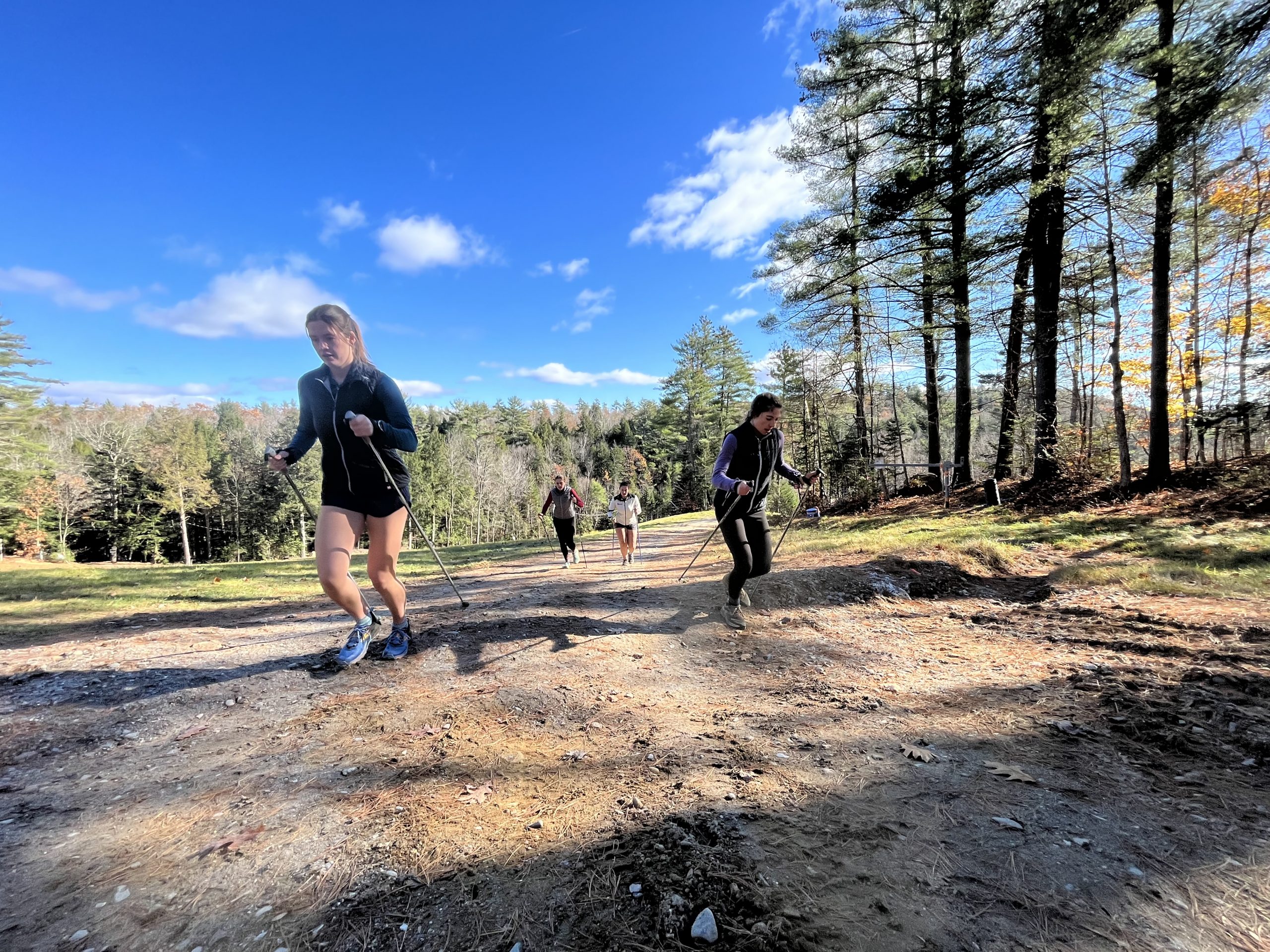
Dryland training is the perfect time to refine technique. Even one rollerski session a week helps athletes practice timing, pole use, and weight transfer. Bounding uphill with poles on grass is another effective way to mimic skiing motion.
“We’ve all heard that it takes 10,000 repetitions to engrain a habit; ski technique is no different,” says MacDowell. “It’s much more beneficial to work on technique and engrain good habits over the summer and fall so your body is ready once race season comes.”
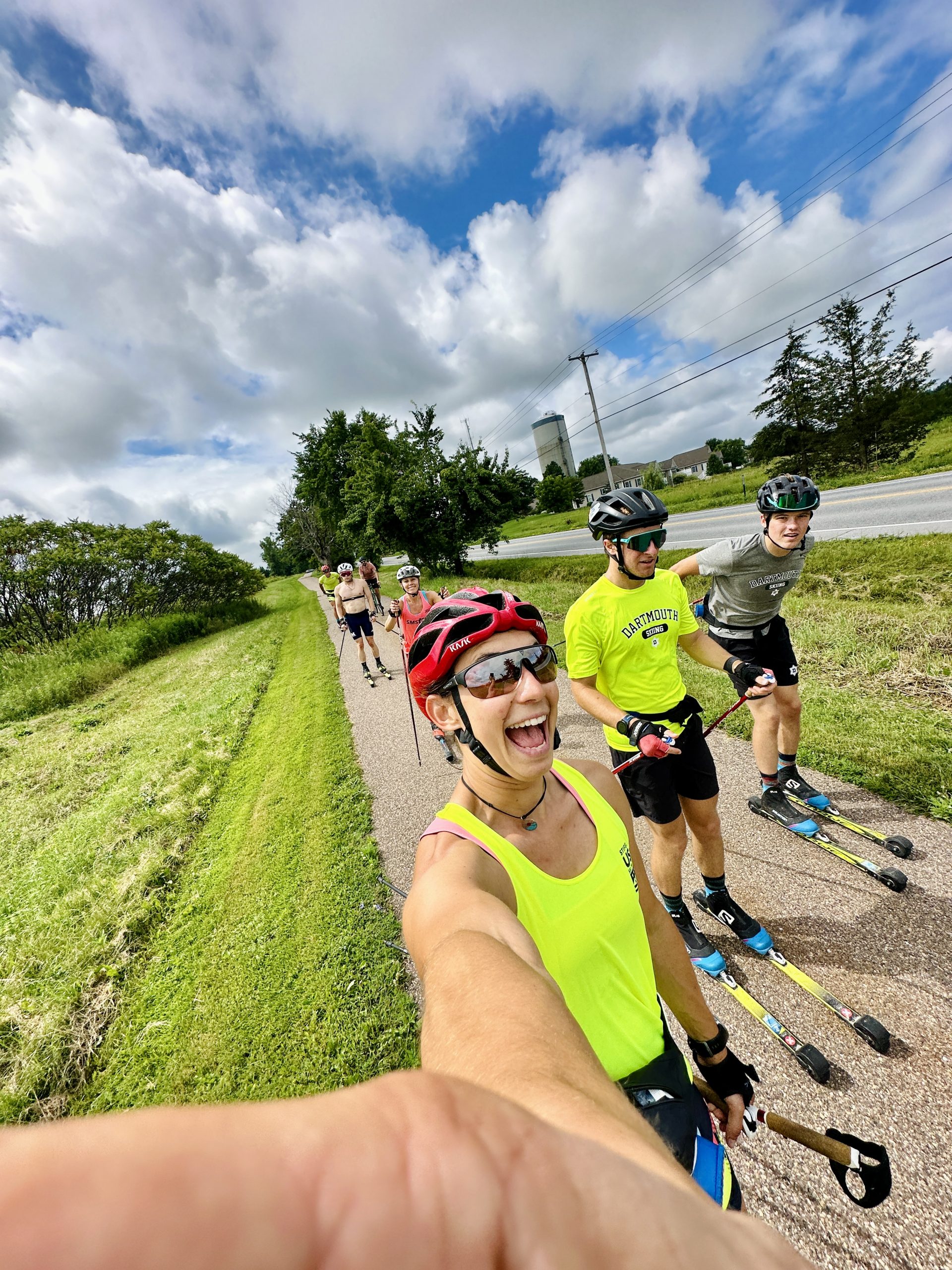
Julia Kern heading out on a rollerski in South Burlington, VT with a summer training group. (Photo: Julia Kern)
Prioritize Recovery
Finally, coaches emphasize recovery—something often overlooked by busy high school athletes balancing sports, school, and social lives.
“High schoolers don’t always think about recovery year-round,” Martell says. “Racing fast in February doesn’t mean just prioritizing sleep the night before the big race; October sleep and recovery also matter to keep the body sharp.”
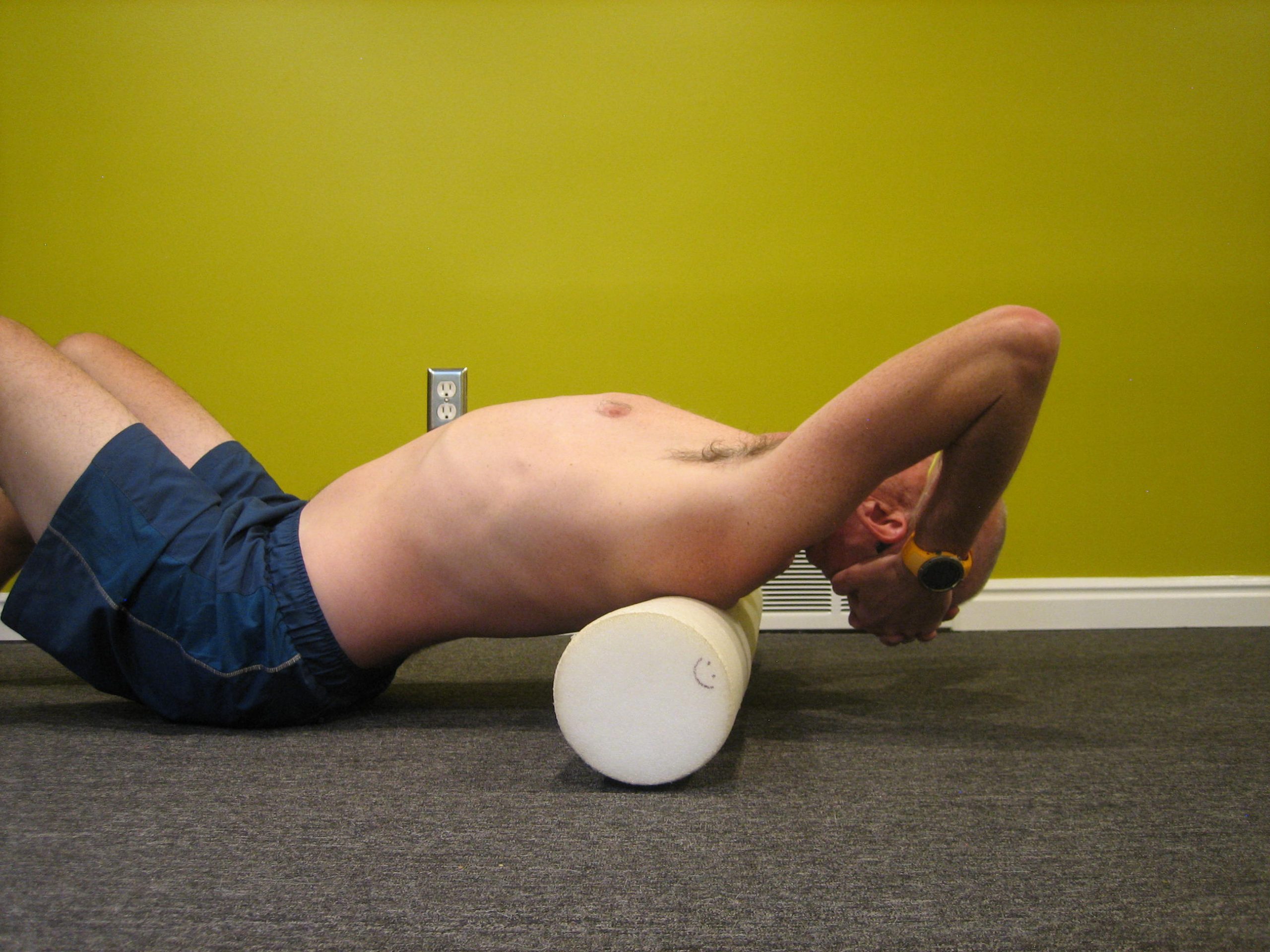
Foam rolling, stretching, and good nutrition all support recovery as new muscle groups are stressed. Because skiing demands far more upper-body engagement than soccer or running, arriving rested and healthy helps prevent early-season soreness from becoming setbacks.
The Bottom Line
Fall sports give ski racers a big head start: strong aerobic engines, powerful legs, and sharp competitive instincts. But skiing rewards those who also train ski-specific strength, balance, technique, and recovery.
As Monsulick puts it:
“You can’t just run your way into ski season. At the higher levels, skiing is a year-round sport that requires a focus on strength throughout the year. Athletes who make these additions while participating in other sports will be well-positioned for success come January.”
With the first snow just around the corner, now is the time to bridge the gap—so when the tracks are set, skiers are ready to glide right into them.
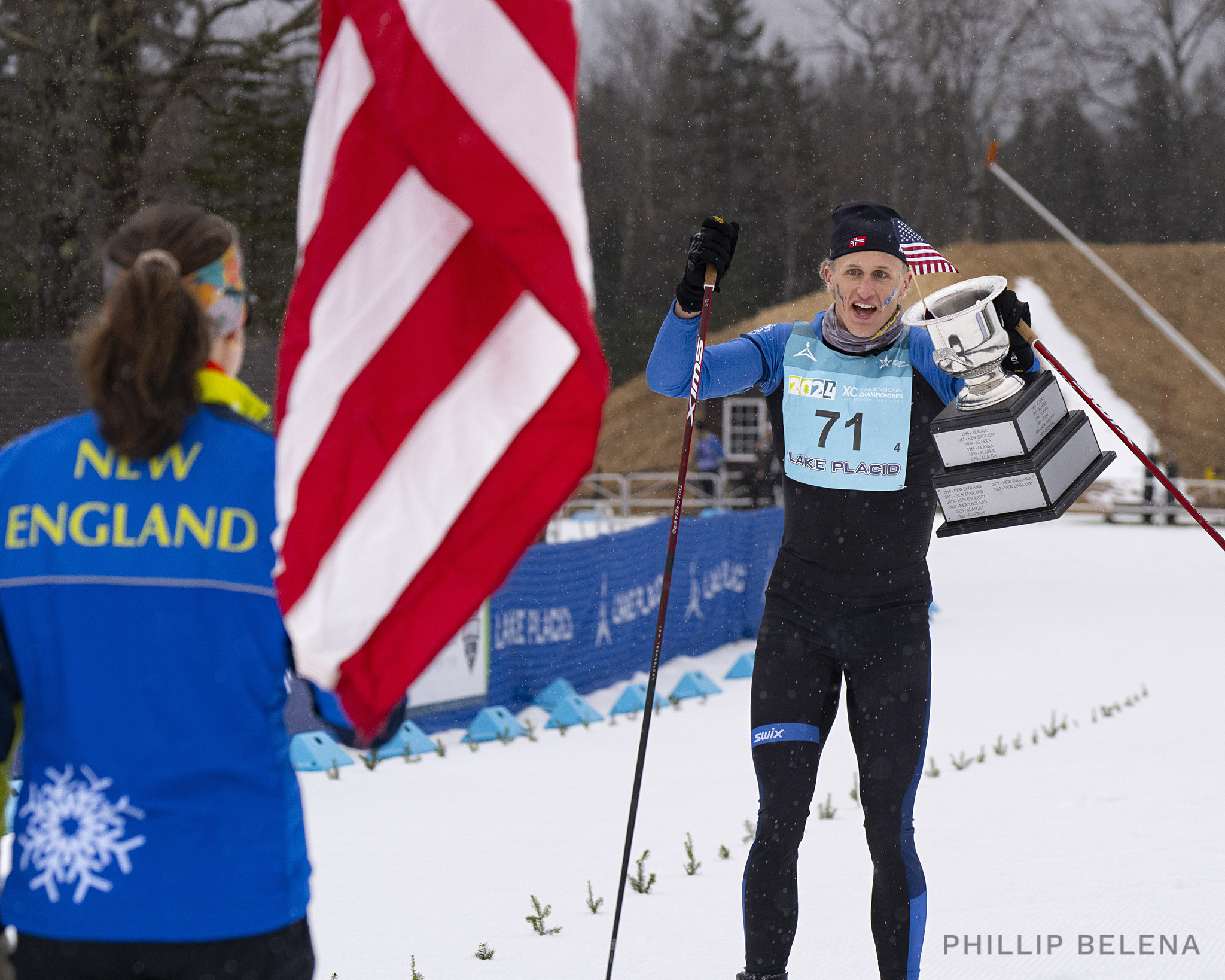
New England’s Fin Bailey (SMST2 / University of Vermont) crosses the line, Alaska Cup in hand, to win the U20 Team Relay at Junior Nationals in Lake Placid, New York. (Photo: Lake Placid Organizing Committee/Phillip Belena)
The U.S. Cross Country Junior National Championships—originally known as the Junior Nationals, then called the Junior Olympics for a stretch, and now again the Junior Nationals—were first held in 1965 in Bend, Oregon. Those early events included all ski disciplines: cross-country, alpine, ski jumping, and nordic combined. They were hosted at venues that could accommodate the full spectrum of competitive skiing.
In digging into history, I found it surprisingly difficult to track down hard dates and specific changes. So, instead of presenting a definitive historical timeline, I’m going to share what I’ve seen and experienced over the years.
Early Days and the Shift to Cross-Country
The last Junior Nationals to include all disciplines took place in 1969 in Girdwood, Alaska. Starting in 1970 and through the later part of that decade, cross-country and nordic combined events continued together, but the overall focus began to shift toward cross-country skiing.
Between 1965 and 1975, there were no age group classifications at Junior Nationals. Based on my recollection, eligibility extended to what we’d now call the J1 age group. There was no Older Junior (OJ) category yet.
Somewhere in the late 1970s to early 1980s, age groups were formally introduced: OJ, J1, J2. More recently, those categories were replaced by U20, U18, and U16, aligning with FIS international standards. Other than changes in the format of the competition events, themselves, the structure of Junior Nationals has remained fairly consistent for the last couple of decades.
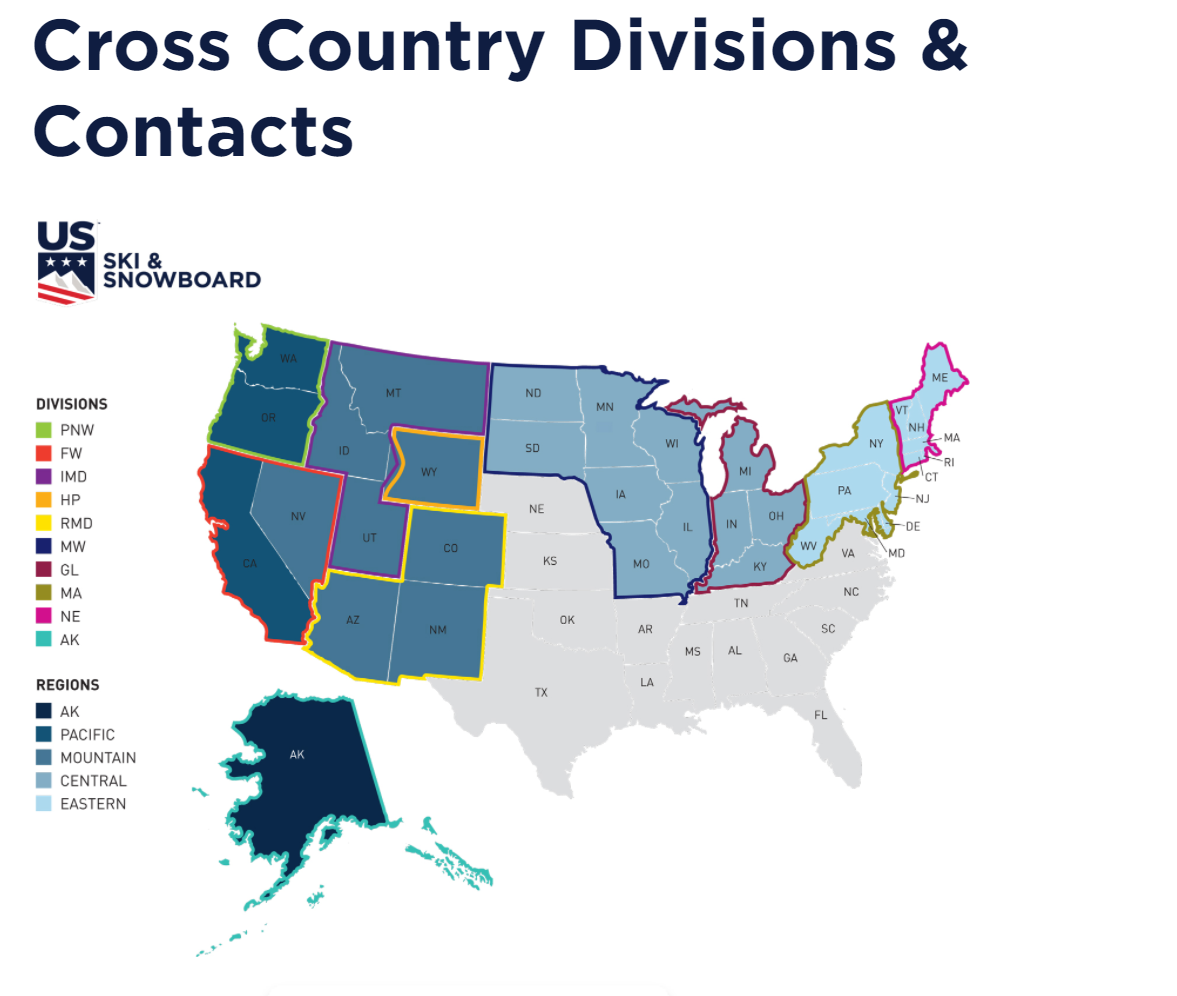
Geographical make-up of each division competing at Junior Nationals. (Photo: US Ski and Snowboard)
Divisions and Participation
Athletes now compete as part of one of ten regional divisions, with each allowed to bring up to 25 male and 25 female skiers across the U16, U18, and U20 categories. Some athletes may pre-qualify through national rankings or international results, which allows them to compete beyond the division quota.
Current Divisions
Alaska
Far West (CA, NV, HI)
Great Lakes (MI, WI, KY, IN, OH)
High Plains (WY, Eastern MT, ND, SD)
Intermountain (ID, MT, UT, Western WY)
Mid-Atlantic (NY, NJ, PA, DE, WV, MD, DC)
Midwest (IA, MN, IL, MO)
New England (MA, ME, NH, VT)
Pacific Northwest (OR, WA, Western ID)
Rocky Mountain (CO, NM)
Sverre Caldwell (far right) with the 2013/2014 Stratton Mountain School T2 Team (from left to right): Head coach Gus Kaeding, Andy Newell, Annie Pokorny, Eric Packer, Jessie Diggins, Sophie Caldwell, Simi Hamilton, Erika Flowers. (Photo: Annie Hart)
The Ongoing Debate
There’s been no shortage of conversations about Junior Nationals over the years. Topics have ranged from the inclusion of the U16 category, to the rising costs of participation, to the event’s role in the development pipeline. There’s also been discussion about whether the event should be managed more by divisions or clubs, and whether the U20 category still fits the purpose of the event.
Back in the early to mid-1990s, I spent four years working with Sverre Caldwell at Stratton Mountain School. Even then, discussions around J2 (now U16) participation were front and center. Around that same time, John Caldwell helped launch NENSA (New England Nordic Ski Association). I was an original NENSA Board Member, which made youth development a key priority. One of NENSA’s early initiatives was the creation of the New England Junior Festival—intended, eventually, to provide an alternative to Junior Nationals for the J2 age group.
That shift never materialized. The deeply entrenched belief in the value of Junior Nationals as a key part of athlete development won out.
Why Revisit the History?
I’m sharing this history because it helps illustrate just how much the program has—and hasn’t—changed in the past 60 years. Some people believe it hasn’t evolved enough to keep pace with the times or to support broader participation. Others are convinced that “This is the way we’ve always done it, and it works.” In my view, neither is entirely true.
In my earlier piece, “What’s the Hurry?”, I argued that our current system identifies and prioritizes talent far too early. We are selecting athletes at the U16 level and younger, despite a large body of research showing that it’s nearly impossible to accurately predict which athletes will succeed at the senior level. Early selection risks pushing kids out of the sport who might develop later.
Cost, Pressure, and the Case for Change
The financial burden of Junior Nationals is another serious issue. If a skier qualifies as a first-year U16, they could potentially attend six championships. Just the travel and participation costs over that period could exceed $20,000—and that doesn’t include:
Club coaching fees
Equipment
Travel to qualifiers
When you add everything up, you’re looking at a potential $150,000 investment during a skier’s junior years. That’s not sustainable or accessible for many families.
Beyond cost, there are other concerns. Is it appropriate for 14- and 15-year-olds to be competing alongside 18- and 19-year-olds? Is there a clear and valid developmental rationale for putting U16s on a national stage?
In some regions, the answer may be no. Early selection and high-stakes competition at young ages may actually be contributing to dropout rates in older age groups.
Time to Rethink the Model
It’s time—long past time—to reconsider how we structure Junior Nationals. We’ve had the same essential age group model for over 45 years, but we now have decades of experience and research to suggest it needs to change.
My Recommendation
Remove U16s from the Junior National Program.
Instead, focus on:
Local and divisional development
Age-appropriate regional events
Creating fun, inclusive, and positive experiences
At those younger ages, our goal should be to get kids into the sport, keep them in, and help them build the skills and mindset they need for a lifetime of skiing—whether or not they go on to elite competition.
In talking with peers and colleagues in the Scandinavian and Central European countries countries, asking for their views on this topic and what occurs in their country, we received the following responses from Trond and Knut Nystad.
Trond Nystad, coach of the Norwegian men’s cross-country ski team at the Sochi Olympics.
Trond Nystad
In my mind it makes no sense to select young skiers to travel to nationals for a lot of reasons.
Travel takes up a lot of time and is very expensive.
Since there is such a large variation in biological age, you will end up selecting skiers who are biological advanced and the true talents are left at home discouraged and with no self confidence. Most countries in middle Europe starts the selection/de-selection process too early. The ones who were not selected quit, and the ones who were selected quit when they loose the “biological advantage.”
Young skiers from parents with a larger income have better/more equipment, leading to a selection of the ones that “have” as supposed to looking at long term potential.
When young skiers are “rewarded” with a trip to nationals they might get satisfied early and loose the long term drive.
No correlation between success U16 and long term success in endurance sports.
Money can be more effectively used by organizing a local race series where athletes get to compete in a lot more events.
Young athletes would benefit more from mastering skills needed in sports (and life) instead of being focused on selection races and results.
Knut Nystad, Norway’s former waxing czar. Photo, Langrenn.com.
Knut Nystad (comments edited to key bullet points)
In Norway there is a separate championship for the U16.
Cost of attending is an issue, but the clubs take the majority of the cost, leaving only a minor part for each participant to pay. For the athletes that cannot afford it – most clubs have “need based” funds that ensure that everyone can participate.
Norway is a small country, hence traveling cannot be compared to the US. Does it make sense to have a championship for this age group? Maybe, maybe not.
For the sake of identifying talents you clearly do not need a U16 championships. We know that it is not a race that give any clear indication of talent, nor does it identify who will prosper and develop into international top level skiers. Many of the absolute best Norwegian skiers were way down on the results at this age (including Klæbo).
At this age there are some many factors that come into play – exposure age (how long have they trained), biological age (early/late puberty), equipment, wax, early specialization vs multi sport focus, parents, training group, quality of coaching +++ It is an unfair competition.
What about asking what motivates the athletes to continue develop? Truth is that young athletes are motivated by different things.
In my mind, the best way to identify talents, is by motivating as many as possible to have fun, be challenged, and keep on racing for as many years as possible.
So what is the correct strategy/answer? The one that motivates more athletes to stay longer in the sport. Does this mean yes or no to a U16 championship? This is for you to answer based on what is appropriate to get the sport of skiing in the US to prosper.
Closing Thoughts
Junior Nationals have served the sport well in many ways. But we have to recognize when a system, even one we may be emotionally attached to, is no longer serving all athletes effectively. If we truly care about developing strong, healthy, resilient skiers—for sport and for life—then we need to be willing to adapt. While Norway and Sweden have championship events for U16’s it doesn’t mean it is necessary or optimal for the U.S, given the size of the country, the cost, the culture, and the level of participation.
Let’s build a system that works for more kids, not fewer. That starts by taking a hard look at who we’re serving, and how we’re defining success.
The 2025 Male and Female Crew for the U.S. Nordic Nations Cup, Gjoevik, Norway
By: Greg Poduska
Eighteen American U18 male and female Nordic athletes from Ski Clubs and Teams sprinkled throughout the United States qualified for and then recently traveled to Gjoevik, Norway, to compete in the Equinor Norgecup Norwegian Junior Nationals Championships (AKA the Nordic Nations Cup). On their way to the race venue, they quickly traveled from the airport in Oslo to train on the famed Lillehammer Nordic trails and finally made their way to Gjoevik to settle in for training, rest, and then their series of races.
Shorter daylight hours and the demands of international ski training and preparations got them ready for some of the toughest junior ski races in the world. Remember, this is the Norwegian Junior Nationals we’re talking about! The nation has had podium after podium this season at the World Cup level. And, of course, podiums in every recent and distant year that can be remembered.
Those male athletes qualifying for the trip: William Bentley (Vail), Noa Kam-Magruder, Jack Leveque, and Vebjorn Flagstad (all three from the Alaska Winter Stars), Nate Streubel (Jackson Hole Ski and Snowboard Club), Quinten Koch (Plain Valley Nordic), Oskar Flora (APU Nordic), Callahan Waters (Bridger Ski Foundation) , and Logan Drevlow (Loppet Nordic).
And on the female side: Lena Poduska (Jackson Hole Ski and Snowboard Club), Ally Wheeler (Casper Nordic), Tula Higman (Bridger Ski Foundation), Annelies Hanna (Ford Sayre Nordic), Niki Johnson (Tahoe Endurance), Linnea Ousdigian (Loppet Nordic), Ruth Krebs (Craftsbury Nordic), Mia Stiassny (APU Nordic), and Britta Johnson (Tahoe Endurance).
While many young U.S. racers competed in each of the three events of the Championships (Interval Start Classic- 3km, Sprint Free- 1.2km, and Mass Start Free 7.5km), some of the most notable performances were on the women’s side of the series in the Mass Start Free 7.5km finale race.
There were separate races for both U17 Females and U18 racers. In the U17 field of 80 racers, the lone two U.S. athletes both had exceptionally strong performances. Mia Stiassny, an APU Team racer, earned a silver medal spot, flying through the course in 21:14.6, just 3.8 seconds out of the Norwegian Junior National U17 leaders spot. Tula Higman, a BSF Team racer, finished a strong 5th place, just 19 seconds behind Stiassny.
On the U18 7.5km free side, Lena Poduska (Jackson Hole Ski and Snowboard Club racer) skied to a bronze 3rd place podium out of the 79 racer field, with a time of 21:06; 10.4 seconds shy of the Norwegian leader. Less than 3 seconds behind Poduska was a fast 6th place result by Ally Wheeler (Casper Nordic), followed by Niki Johnson in 11th place (21:37.3) of the Tahoe Endurance Club.
Based on the performances of these 5 young U.S. female racers, one can only imagine the level of excitement they created for Greta Anderson, the Development Team Coach for the U.S. Ski Team. Who knows what the athletes’ futures will be? But if they all continue to pull off finishes like what they showed the Norwegians at their own Norgecup Junior Nationals this February, watch out!!!
And for all the eighteen athletes who attended this Nordic cup race series, whether sidelined for some of the races due to illness or for those skiing through the fog and wet weather Norway threw at them, these young athletes grew as skiers and as young international athletes. Hopefully, we’ll see many of them at future international races in the years to come.
While cross-country skiing in Schilpario, Italy, offers an exquisite experience amidst the stunning backdrop of the Italian Alps, from February 3rd through 9th, the quiet, small Italian village of just over 1,000 inhabitants will be abuzz as it hosts the FIS Junior and U23 World Championship.
National teams from around the world will compete head-to-head, likely with strong representation from countries with successful skiing traditions, such as Norway, Sweden, Finland, Germany, Canada, and the United States. Fans can look forward to thrilling performances, especially as athletes push the boundaries of their abilities in pursuit of world-class glory.
Alison Mackie (CAN #6) and Sammy Smith (USA #5) racing in the Women’s Classic Sprint against four Norwegians. Mackie and Smith would finish fourth and fifth, respectively. (Photo: Newspower.it)
U20 Classic Sprint
Racing got started yesterday with the U20 Classic Sprint races. The North American men could not advance past the quarterfinals, with Cole Flowers (USA) having the best result in 15th place. Flowers had moved into second during his quarterfinals, cresting the course’s highpoint in a great position, but a stumble as he descended back to the stadium scrubbed just enough speed to allow Sweden’s Tage Boerjesson to regain contact, ultimately taking the second auto-qualifying position from Flowers in the fifth heat.
Canadians Finn Redman and Justin Boudreau finished the day in 20th and 28th, respectively, and American Murphy Kimball claimed 26th place.
Norway’s Filip Skari and Lars Heggen on their way to first and second. (Photo: Newspower.it)
Norway’s Filip Skari took home the World Championship crown in the finals, outsprinting teammate and defending Junior World Sprint Champion Lars Heggen. With a blazing double-pole down the finishing stretch, Isai Naeff (SUI) captured the final step on the podium.
The men’s Classic Sprint Junior World Championship podium.(Photo: Newspower.it)
In the women’s U20 race, the North Americans fared better. Canadian Alison Mackie, who showed smooth classic striding throughout the heats, finished in fourth place, while in contrast, the United States’ Sammie Smith relied on her powerful double-pole to take home fifth place. However, Norway, which had four women in the final heat, would sweep the podium.
Malin Hoelsveen on her way to becoming Junior World Champion. (Photo: Newspower.it)
Malin Hoelsveen took home the gold medal, with teammates Iselin Bjervig Drovenes and Milla Grosberghaugen Andreassen finishing second and third, respectively.
In the men’s race, Anton Grahn, who finished 7th place last weekend in the Cogne, Italy, World Cup and was the 15th fastest qualifier, charged out of the starting gates in the finals, opening up a roughly 20-meter gap before the skiers had even left the stadium. However, after the two main climbs and downhill back into the stadium, the top three became a line that fanned out as each skier chose their lane for the final drag race. Grahn once again relied on his dominant double-pole to take home the U23 World Championship. Grahn’s teammate, Maans Skoglund, who had been the quickest qualifier, captured second place, while Joergen Schjoelberg of Norway skied to the third step on the podium.
Anton Grahn, fresh off the World Cup, on his way to the U23 title. (Photo: Newspower.it)
Canada’s Xavier McKeever was impressive in his quarterfinal heat and advanced to the semifinal, ultimately finishing his day in ninth place. Derek Deuling (CAN) also qualified for the heats, finishing his day in 23rd place.
For the United States, Michael Earnhart, who just missed advancing from his quarterfinal, led the way in 14th place. His teammate Will Koch, who raced in the same quarterfinal as Earnhart, finished in 19th place.
In the women’s race, Sweden’s Maerta Rosenberg, who qualified over seven seconds faster than the second-fastest qualifier, Nora Kytaja (FIN), dominated throughout the rounds. In the finals, Roseberg was reminiscent of the Swedish women’s World Cup sprinters when she strode away from the rest of the competition on the course’s opening climb to create a spectacular margin and become the Junior World Champion. Gina Del Rio (AND) and Elin Henriksson (SWE) finished in the silver and bronze positions, respectively.
Sweden’s Maerta Rosenberg was dominant in her World Championship title performance. (Photo: Newspower.it)
For the North Americans, Kate Oldham backed up her impressive 16th-place finish in the 10 k Freestyle at last weekend’s World Cup in Cogne, Italy. Odham, who controlled her quarterfinal round by a decent margin with impressive, long, strong striding, finished her day in 10th place.
Odham’s teammates, Nina Seemann and Sydney Palmer-Leger, could not advance from the quarterfinals, finishing in 20th and 23rd, respectively.
Sonjaa Schmidt led Canada in 12th place, with teammates Amelia Wells and Jasmine Drolet finishing 22nd and 29th, respectively.
The STIFEL U.S. Cross Country Ski Team announced their coaching and support staff for the World Junior & U23 Championships to be held in Bergamo-Schilpario, Italy (February 3-9, 2025).
Cross Country Coaches:
Trip Leader & Head Coach: Greta Anderson, US Ski Team Coach: Bryan Fish, US Ski Team
Coach: Matt Boobar, Stratton Mountain School
Coach: Julia Hayes
Cross Country Service Staff:
Head of Service: August Teague, Aspen Valley Ski Club
Service: Peter Holmes, Sun Valley Ski Education Foundation
Service: Ben Higgins, Great Glen Outdoor Center
Service: Quinn Lehmkuhl, Tahoe Endurance
Service: Tuva Granøien, University Alaska Anchorage
Service: Colin Rodgers, Green Mountain Valley School
Service: Perry Thomas
Cross Country Medical Staff:
Medical Staff: Dr. Jasmine Wiley Physical Therapist: Elizabeth Smith
Before she was capturing Crystal Globes, Jessie Diggins was working her way up the skiing pipeline. Developing skiers across the country receive assistance from the NNF. (Photo: NordicFocus)
There’s a great scene in the 1983 classic movie epic The Right Stuff, where the test pilots are hanging out in their dank watering hole discussing the future of supersonic flight and bemoaning what they see as misplaced priorities. The press liaison throwing back a beer with Chuck Yeager and Jack Ridley seems to innocently ask, “you know what makes your rocket planes fly?” The aeronautical engineer puts down his beer and responds by beginning to recite the complexities of aerodynamics when the liaison interrupts, shaking his head at him and says, “Funding, that’s what makes your ships go up. I’ll tell you something …no bucks, no Buck Rogers.” It was a perfect synopsis with a crystal clear meaning. All of the science, bravado, and tenacity in the world didn’t matter if there wasn’t the funding to support the incremental gains needed to push human flight in supersonic speed aircraft. No bucks, no Buck Rogers. It’s that simple.
The NNF raised over $470,000 last year, helping to fill the pipeline of talented Nordic athletes. (Photo: NNF Impact Statement)
The same is true in elite level skiing. All the hard work, talent, training, and determination in the world won’t matter if there aren’t the dollars to get athletes to the World Cup, and equally important, to develop young athletes who fill the pipeline on their way to the top of their sport. In short, no cash, no Cups. The best skier in the world can’t win anything on any level, if they’re grounded in their gym in Utah.
This presents skiers with a real problem. In the United States, Nordic skiing is a low profile sport, and unlike almost every major international competitor, the U.S. cross-country squad doesn’t receive direct funding from the government. Contrast that to Norwegian skiers who really don’t have to worry about where the money will come from. Ski fast and the cash will follow. In America, it’s a different story. While the headline skiers on the United States A and B teams receive funding from U.S. Ski and Snowboard, through the U.S. cross-country team, skiers working their way up the skiing ecosystem are largely on their own financially. It takes a mix of club support, sponsorships, fundraising, and donors to keep the pipeline of young talent flowing in the ski game.
Sammy Smith after skiing to 2nd place in the skate sprint at World Junior Ski Championships Planica, Slovenia. Talented athletes like Smith have options other than cross-country. NNF helps to keep athletes like Smith in the skiing game. (Photo: Courtesy Image/Jasmine Wiley)
If you’re a talented young athlete, you also probably have other options besides skiing. Look at Sammy Smith and Sophia Laukli. Both have the talent to earn a living in other sports. To keep them in the ski game long enough to reach the A team, there needed to be a funding mechanism to help developing skiers until they reached the level of receiving national team support.
For a young skier trying to stay with the sport, the different pieces of the funding puzzle can be an economic Rubik’s cube to try and figure out. That’s where the NNF (National Nordic Foundation) comes in. It acts as the bridge in that funding gap between established U.S. cross-country team skiers, and those without full national team financial support who are chasing their World Cup dreams. It’s the bridge to where the funding is easier to acquire— being an A or B team member of the U.S. national squad— and wandering the financial wilderness of being a developing athlete.
Laura McCabe (right), former U.S. ski team member and Olympian, is the current NNF chairperson. Here she is working on skier development with her then young daughter, now U.S. team member, Novie McCabe. (Photo: Instagram @novie.mccabe)
The NNF is a non-profit funded solely by donations whose mission is to “power the opportunities that bridge the gap to World Cup and Olympic excellence for Nordic skiers from the United States.” Chairperson of the Board of directors, former Olympic cross-country skier Laura McCabe—mother of current U.S. team member Novie—states in her letter to the ski community that the NNF was “founded on the belief in supporting a development system rivaling any nation, a vision we’re proudly realizing thanks to our dedicated community.” That founding vision was a tall order considering that the other major Nordic nations don’t have to go to donors with hat in hand soliciting support.
But the NNF has been successful in fulfilling its mandate as a funding bridge. Last year, the NNF raised $470,000 to support the development of the cross-country racing ecosystem in the United States.
NNF supports summer as well as winter projects. (Photo: NNF Impact Statement)
NNF uses that money to help skiers afford the cost of winter and summer events and training. In the summer, NNF helps offset the cost of attending training camps. There are National Elite Groups, Regional Elite Groups, National U16 Camp, and international development exchanges and trips. Last year NNF provided over $88,000 in funding for these activities.
During the winter, NNF provides funding for coaching development as well as athlete funding to help attend U18 championships, Junior World/U23 championships, World Cup races, and OPA Cup racing (a second level of competition ranked just below the World Cup). There are also individual grants to athletes to help them attend World Cup events. Last year those winter projects support for event attendance was over $180,000.
The NNF is the lead sponsor for the Supertour as well as supporting other winter programs. (Photo: NNF Impact Statement)
NNF also sponsors domestic racing by being the title sponsor for the Supertour. The Supertour is the highest level of race competition in the United States and consists of a race series spread across the country. Success in the Supertour often leads to a spot on the U.S. national team or start rights in the Tour de Ski. Last year NNF subsidized the cost of the Supertour to the tune of $23,000, which covered almost 60 percent of the tour’s prize money.
One of the NNF’s other successful winter projects is its Trail to Gold program. The T2G is a coaching grant that supports developing women coaches and technicians in an historically male dominated profession. Bernie Nelson who was just hired by the U.S. team as a full time technician was a T2G funding recipient.
U.S. team coach Matt Whitcomb (left) crunching numbers with Sydney Palmer-Leger. He’s a key part of the puzzle to help the NNF design its funding disbursements. (Photo: Leann Bentley, U.S. Ski Team).
A critical piece of the puzzle for the NNF is coordinating between itself and the U.S. national team. That’s where Matt Whitcomb comes in. Whitcomb is the head coach of the U.S. ski team. He is also on the NNF Board of Directors. Whitcomb provides the Board with an invaluable overview of the needs of developing skiers, and what a successful development program looks like. “The NNF is the bridge between being a U14 athlete and being an Olympian,” said Whitcomb. “NNF picks up and assists with projects between those two things where athletes are most likely to quit because of funding challenges.”
“The NNF and national ski team are critical partners, but we’re really different puzzle pieces that just fit really well together where the NNF funds younger kids, and the U.S. ski team funds the older or more successful athletes. Our philosophy at the NNF is that all hard working athletes with big goals should be able to compete in the sport regardless of their economic status” The NNF states that there is funding which touches over 250 athletes per year, with funding from thousands of donors. “We have a three year fundraising average of raising over $500,000 a year, said Whitcomb.”
WIll Koch finished 13th in the 10K Classic at the 2022 Junior World Championships. NNF helped secure his presence. (Photo: John McColgan)
Often part of the NNF funding process is to generate individual amounts of support for certain events. For example, there might be a dollar amount set aside for the U23 championships which is then divided between different athletes. It can start out as a large pot of money, but by the time it’s divided between all the athletes and support crew, the dollar amount shrinks significantly. For example, it previously allocated over $84,000 in total to the last Junior World/U23 Championships. But after the math is done, it only comes out to several thousand dollars per athlete. It’s a big help but doesn’t cover an athlete’s entire cost. “There’s 10 wax techs alone that come to World Juniors, and around 24 athletes,” said Whitcomb.
NNF focuses on grass roots fundraising. Over 1,000 donations just for the Drive for 25 fundraiser shows its breadth. (Photo: NNF Impact Statement)
Athlete buy-in is critical to NNF’s mission. Athletes are part of the fundraising efforts and build important ties to the cross-country community. Athletes are encouraged to actively participate in the fundraising process. “We don’t cover any project completely,” said Whitcomb. “The goal is to leave some of the responsibility up to the club and the athletes. If they all do a little bit (the athletes), it will really move the needle for an organization like this.” The NNF is proud of width and breadth of its donor base, with over 1,000 individual donations for its drive for 25 fundraising effort, it demonstrates its status as a grass roots organization. “Our window is at the grass roots level. There are people that donate five dollars recurring monthly. You know what it means to those people. We’re trying to sell shares of this great journey to as many donors as possible.” You may have heard of the Drive for 25, but not really known what it was about. It’s one of the NNF’s principle fundraising efforts. Last year it raised over $122,000.
It’s not just racers who benefit from the NNF’s support. High level racing needs high level officiating. At every FIS (International Ski Federation) event there are teams of technical delegates who are the equivalent of officials or umpires. Without the technical delegates, high level racing doesn’t happen. In the U.S., these positions are volunteers, but there are significant expenses attached to being a delegate. NNF has launched a new program to offer grants to individuals trying to gain technical delegate status to help offset part of the expense. It’s part of NNF’s efforts to maintain the flow of talent and treasure which feeds the cross-country pipeline.
NNF is part of the American success at the Junior level. (Photo: NNF Impact Statement)
The NNF proudly points to athletes’ success as proof that its support continues to feed the American pipeline for world class ski talent. In the most recent Junior/U23 World Championships nine different NNF funded athletes finished in the top 10 in different events. In addition to the junior level racing, it also provided funding which contributed to 151 world cup starts. The results from that effort were over 20 top 30 World Cup finishes for NNF supported athlete. Another sign of NNF fulfilling its mission is that many previously NNF funded athletes have recently achieved United States A or B team status, including Sammy Smith, Kevin Bolger, and Will Koch.
NNF also impacts World Cup performances as it helps athletes who haven’t yet made A or B team status. (Photo: NNF Impact Statement)
Every time one of these developing athletes achieves success in competition it helps moves them along the pathway to becoming a member of the United States A or B team which is where the other side of the funding bridge is met and continues the pathway to Olympic success. “Take a look at the last Olympic team. Everyone of those athletes, earlier in their career, had received funding from NNF.”
It’s fair to say that without NNF support the pipeline of developing skiers would be limited to athletes from wealthy backgrounds or those who have the good fortune to have the marketing skills to promote themselves on GoFundMe pages or Instagram. As long as it continues to receive support from the Nordic community, NNF will continue to be the funding bridge for up and coming athletes.
Nearly six years later, she found herself warming up on the same Olympic course where the duo won the team sprint in PyeongChang, South Korea. Gerard, who had since delved deep into nordic skiing, was preparing for her second race of the 2024 Youth Olympic Winter Games.
“We were racing on the biathlon courses from the 2018 Olympic Games, but I got to warm up for that race on the sprint course from 2018, where Kikkan and Jesse won,” Gerard recalled in a phone interview. “That got me so hyped to race.”
Jessica Diggins (USA), and Kikkan Randall (USA), (l-r) win America’s first cross-country Olympic gold in the women’s team sprint at the 2018 Pyeongchang (KOR) Olympics Pyeongchang. (Photo: Fischer/NordicFocus)
She went on to place sixth in the 7.5-kilometer classic race, following up on a 17th-place finish in the freestyle sprint the day before at the Youth Olympics.
“I finished the race, and I saw the result, and I just like ran up [my coach] Reitler [Hodgert] and gave him a hug,” Gerard said. “I’ve always been so much better at skate, and in the past two years, I put so much effort into my classic technique. It’s been a really frustrating, slow grind to get it better, but it just clicked in that race.”
She finished the Youth Olympics with a fifth-place finish in the 4 x 5 k mixed relay with Rose Horning, Benjamin Barbier, and Tabor Greenberg.
Thinking back to her “breakout” result of sixth in the individual classic race and the impact Randall and Diggins had on her, Gerard called it “super full-circle.”
“Best warmup ever,” she added.
(Left to right) Americans Murphy Kimball, Owen Young, Tabor Greenberg, Grey Barbier, Tuva Granøien, Elsie Weiss, me, Maeve Ingelfinger, Natalie Nicholas, and Cole Flowers training in Norway last month. (Courtesy photo)
This summer, Gerard balanced full-time training with the Mt. Bachelor Ski Education Foundation (MBSEF) and working at events and babysitting before a trip to Europe in early August. There, she attended an International Junior Camp in Sjusjøen, Norway, with more than 80 athletes from 15 countries. She traveled with eight other U.S. skiers—Natalie Nicholas, Elsie Weiss, Maeve Ingelfinger, Owen Young, Murphy Kimball, Grey Barbier, Tabor Greenberg, and Cole Flowers—and coaches Greta Anderson and Tuva Granøien. They arrived in Norway a week early to train on the Holmenkollen rollerski track in Olso.
“It’s been really fun to ski with the fastest girls in the world from my age group,” Gerard wrote in an email during the camp last month. “I feel like I pick up little things they do that work.”
(Left to right) Tuva Granøien, Natalie Nicholas, Maeve Ingelfinger, me, Elsie Weiss training in Norway last month. (Courtesy photo)
She returned to Bend on Aug. 13 and left for her freshman semester at the University of Utah in Salt Lake City the next day.
Gerard explained her easy decision to join the Utes—NCAA skiing champions from 2019–2023. Another MBSEF skier, Zachary Jayne, will join her on the team.
“I just really want to go to a place where I can be surrounded by super-fast girls,” she said. “I want to be the worst on the team so that I get a lot better, and the coaching staff and the support is just phenomenal. Once I visited, I was like, ‘Yeah, this is where I want to go.’ ”
The last time Gerard was at the back of the pack was in middle school when she dabbled in nordic to be with friends and skied about once a week.
“The first race I ever did, I got dead last by like three minutes, and I was like, ‘Oh this sucks. I just wanna be fast,” she said with a laugh. “I didn’t really realize that in order to be fast, you have to put a lot of training into it.”
When the 2020 pandemic affected her mountain bike racing, Gerard shifted her focus to cross-country skiing. As entering freshmen, she and her friends began training more seriously, ramping up to six days a week that summer with MBSEF at the Mt. Bachelor Nordic Center.
The following winter, she raced to ninth in a skate sprint at Western Regionals. “I remember being super stoked about that,” she recalled.
As a former cross-country runner and all-around athlete, training came naturally to Gerard, who enjoys it more than most.
“I just really like training and pushing my body,” she emphasized. “I feel like I have big goals, and I just want to work really hard to get to those goals. I think I’ve always been that way.”
Neve Gerard and her MBSEF coach Reitler Hodgert. (Photo: John McColgan)
According to MBSEF Program Director and Head Coach Reitler Hodgert, she’s one of the hardest-working individuals he’s ever met.
“My job as a coach … has been to convince [Neve] to do less and to slow down and to take breaks,” Hodgert explained. “She has not had any single breakout year, but her skiing has been very much a rising tide of just continuous, consistent results and performances.”
She got her first taste of international racing at last year’s Scando Cup in Finland, where she finished ninth in the 5 k freestyle.
“What really stands out from Finland for me is just how different international racing is,” she said. “I was just like, ‘Wow, like this is like even more fun than racing in the States.’ ”
Neve Gerard (MBSEF) racing at 2024 US Nationals in January at Soldier Hollow in Midway, Utah. (Courtesy photo)
This past January, Gerard won the junior 10 k freestyle mass start at U.S. Nationals in Soldier Hollow. She was then invited to 2024 World Junior Championships but declined her spot to race at the Youth Olympics.
She finished out her senior year in Bend by returning to mountain biking, a sport Hodgert encouraged her to resume for cross-training. She and her high-school teammates (the Lava Bears) won the 2023 Mountain Biking State Championships team title, and Gerard placed second individually.
“Reitler wanted me to mix up my training a little bit, and at that point, I hadn’t mountain-bike raced since eighth grade,” she recalled. “It was fun. I got to mix it up a little bit, and it was a good experience.”
“We feel that being a multi-sport athlete as long as you can is super important for athlete development,” Hodgert noted.
“My coaches are the best and care about me as both a human and a skier which I appreciate,” Gerard wrote. “They have been so helpful in developing my skiing. Mt Bachelor has been a great venue to call home, having snow late into the spring/summer has been super beneficial in my training.”
“She’s been an incredible leader on our team for the last, last four years,” Hodgert said.
At the U of U, Gerard is interested in studying pyschology.
“I’m really into criminal psych,” she said. “I just really like how the brain works.”
American Neve Gerard (l) leads athletes from other countries at an International Training Camp in August in Sjusjøen, Norway. (Courtesy photo)
Neve’s Favorite Fall Workout
9 x 4 minutes L4 double pole intervals up Skyliners Road (a slight uphill gradient that goes up for 8 miles) after school
“We do this workout a few times each fall, and it’s always so hard but really fun and rewarding once you’re done.”
Warmup: 30-minute ski to the start with some speeds/pickups
Cool down: Ski Skyliners in the opposite direction/downhill
Neve Gerard (MBSEF) racing at 2024 US Nationals in January at Soldier Hollow in Midway, Utah. (Courtesy photo)
The Hryhorenko family at the Mt. Bachelor Nordic Center in late May, six months after they left Ukraine. Clockwise, from left: Yuliia, Anhelina, 14, Oleksandr, and Ivan, 10. (Photo: Mt. Bachelor)
Anhelina Hryhorenko is a typical 14-year-old girl in many ways—she loves art and isn’t a fan of math. And she’s excited to have her freshman year of school over.
But she’s got a lot of unique qualities, too. For one, she’s a junior national champion with more medals than she can hold in two hands. She’s also the daughter of a former national cross-country ski team member team and the niece of a three-time Olympian.
From left to right: Anhelina Hryhorenko and her MBSEF teammates Will Mowry, Catcher Kemmerer, and Irving Stoller spring skiing at Big Meadow in front of Broken Top in Central Oregon (Photo: Reitler Hodgert)
She lives and trains in Bend, Oregon, and races in a blue-and-yellow Ukrainian national team suit. Since she’s only been in the U.S. since December, she speaks little English, but she’s gotten very savvy with Google Translate. She has also made friends with classmates and teammates on the Mt. Bachelor Sports Education Foundation (MBSEF) nordic ski team.
Anhelina, known by her teammates and coach as “Angelina,” is a quiet teenager most excited about training this summer. She moved to Bend with her family in February, thanks to a family who offered to host them and Mila Shelehoff, a fellow Ukrainian who’s been living in the U.S. for the last 30 years. Shelehoff has been serving as the translator and local liaison for the Hryhorenko family, which includes Anhelina, her mother, Yuliia, her father, Oleksandr, and her 10-year-old brother, Ivan.
An art and outdoor educator, nonprofit founder, and instructor at the Mt. Bachelor Nordic Center, Shelehoff created Bend For Ukraine. This community initiative supports displaced Ukrainian families by helping them resettle in Central Oregon. She’s known as “Mamma Mila” and has assisted the Hryhorenkos since they relocated to Bend. She’s also helped several other Ukrainians in Bend as they navigate the challenges of housing, employment, education, and cultural integration.
Ivan Hryhorenko (l) and Lukian Shelehoff, friends, classmates, and teammates with MBSEF’s Stevenson Youth Program. (Photo: Mila Shelehoff)
The Hryhorenkos met Shelehoff a few months ago, and they’ve already become fast friends. Ivan is the same age as her son, Lukian, and the two go to school and ski together with MBSEF.
“I moved to Bend about for the same reason they moved to Bend,” Shelehoff said of moving to the area two years ago. She and her son were drawn to the downhill skiing at Mt. Bachelor, which has the longest natural ski season in the U.S., with snow lasting into June. They ultimately switched to nordic and never looked back.
The Hryhorenkos had a different “coming to Bend” story. When they arrived in the U.S. in December 2023, they knew nothing about Mt. Bachelor or Bend. They initially landed in Salem, Ore., about 2 ½ hours northwest of Bend, to stay with friends who sponsored their humanitarian parole from Ukraine through the U.S. Department of Homeland Security’s Uniting for Ukraine program.
They came seeking refuge in a foreign country, uncertain about their future. Anhelina brought her ski boots and little else.
The Hryhorenkos, Anhelina (r), Yuliia (second from r), Oleksandr (c), and Ivan (l), and Shelehoffs, Mila (second from l) and Lukian (bottom r), at the Mt. Bachelor Nordic Center in late May. (Photo: Mt. Bachelor)
Life Before
About two and a half years ago, Anhelina was training at a Ukrainian boarding school and racking up medals as a promising young cross-country skier. Her family lived in Central Ukraine, about an hour south of Kyiv, while Anhelina lived at a private academy and trained for skiing. She was chasing a dream and had the genetics to back it up—her father, Oleksandr, raced on the Ukrainian national team, and her aunt, Kateryna Gryhorenko, was a three-time Olympic cross-country skier.
On Feb. 24, 2022, everything changed. Russia invaded Ukraine, and Anhelina’s school evacuated its student-athletes to Poland. Meanwhile, her father, mother, and brother sheltered inside their home’s root cellar for two weeks while their country was under siege.
When they felt safe to leave, Yuliia fled to Poland with Ivan. They spent three months with Anhelina in Poland before returning to Ukraine and Oleksandr, a carpenter by trade. Kyiv had installed anti-missile systems while they were away, and their region wasn’t under occupation, so they felt it was safe to go home.
But life was far from ordinary. Anhelina returned to boarding school, but her family slept in their cellar and lived in constant fear.
“It creates a lot of anxiety, especially when you hear the explosions,” Yulia told the Bend Bulletin. “The bunkers are truly root cellars. They’re not bulletproof; they’re not bomb-proof.”
They continued to live this way until October 2022, when Anhelina survived a massive air raid while commuting to school. With that, the Hryhorenkos resolved to leave.
It took the Hryhorenkos a year and a half and several attempts to gain approval to enter the U.S. Eventually, with the help of their sponsors in Salem, their third application was accepted, and they landed in Oregon in December 2023.
Once in Salem, Oleksandr started working to support his family. Yuliia, a former physical education teacher, reached out to ski clubs across the U.S., hoping they could find a place for Anhelina.
“After arriving in America, we immediately started looking for a club for Angelina,” Yuliia explained in an email to FasterSkier. “She had to continue to practice so that there were no gaps in training. Salem could only give us running training, and we needed [ski] training. There was even a question about ending our career if we didn’t find anything, [after] almost 8 years of training.”
Despite not speaking English, Yuliia sent about ten inquiries. One responded.
“At first, when the email came through, I thought it was spam,” MBSEF Nordic Program Director Reitler Hodgert told FasterSkier. “But as soon as I opened it, it made a lot of sense for us to offer them a space to land and do what we could to support that.”
Knowing very little about MBSEF—one of the premier nordic ski clubs in the country—the Hryhorenkos signed her up. By mid-January, she began training with the team in Bend. Their Salem friends assisted with transportation, lending a vehicle with winter tires so the Hryhorenko family could drive to Bend each weekend for Anhelina’s training. On Monday mornings, they’d drive three hours back to Salem in time for school.
After witnessing their long commute, Anhelina’s teammate, Maddie Carney, and her family invited Anhelina to stay with them on weekends. In early February, Sarah Max offered to host the family for free, and Yuliia and Ivan joined Anhelina in Bend while Oleksandr worked in Salem. The kids started school at Bend-La Pine and lived at Max’s home until late March.
They were also hosted by another nordic family, Dr. Sondra and Mike Marshall, who ultimately helped them find an apartment.
“They put a lot of effort into finding us housing among their acquaintances,” Yuliia wrote. “They are currently helping us pay for an apartment for a certain period of time. During our entire stay here, we are surrounded by fantastic people, whom it is rare to meet.”
From left to right: The Mostovych family, Cari Brown, Mila Shelehoff, Anhelina Hryhorenko, Shelehoff’s father from Kyiv, Lukian Shelehoff, Yuliia Hryhorenko, and Ivan Hryhorenko at a Ukrainian Easter event at Café des Chutes in Bend, Oregon. (Photo: Mila Shelehoff)
Life After
United for Ukraine grants Ukrainian citizens and their immediate family members two years of temporary stay in the U.S. Through Shelehoff, who translated, Yuliia told FasterSkier that she was hopeful they could make the move permanent but uncertain whether that was possible.
“[I hope] my children can discover themselves here in this country versus in Ukraine,” Yuliia said. “They have many more opportunities to find themselves and do something they love in the future.”
In addition to other community members, Mt. Bachelor and MBSEF are sponsoring the Hryhorenko family so they can continue settling in Bend. Fischer and One Way have pledged to provide Anhelina with equipment for the coming season.
“When they first arrived in town, we had a huge outpouring of support,” Hodgert explained. “Mt. Bachelor reached out to support Anhelina’s family with trail fees and whatnot, and that was largely through [Mt. Bachelor Nordic Manager] Sydney [Powell] and was huge.
“… They moved here with basically just Anhelina’s ski boots, and so we had families giving gear, jackets, snow pants, gloves, hats…” continued Hodgert, a Bend native. “[That was] one of the proudest moments for me of our community here locally, just to see the number of people stepping forward to give what they could to get them on their feet here in town.”
Ivan Hryhorenko (l) and Lukian Shelehoff spring skiing at Todd Lake in Central Oregon. (Photo: Mila Shelehoff)
One local bought Anhelina and Ivan new bikes.
“I’m in awe of how they were received and how much help they got,” Shelehoff said.
Asked about Anhelina as a skier, Hodgert said that considering her age, she’s one of the most talented technical skiers he’s ever worked with.
“She has a very innate sense of body awareness, just like where each of her limbs are and how she’s moving them,” he noted. “Even while working through a language barrier … she picks up technical feedback and applies it to her skiing faster than any athlete I’ve worked with.
“She’s universally adored on our team,” Hodgert added. “Anhelina, as a person, is fairly quiet, so there were definitely some concerns that she’d feel … a little bit isolated around the team. And thus far, that hasn’t at all manifested. She has jumped right in with things.”
He laughed that his athletes “spend a significant time on Google Translate” while riding in the team van.
“Unsurprisingly, all of our athletes are super curious about what life in Ukraine is like, just her being from somewhere else, and they’re all super eager to introduce her to all the things that they love about being here in Bend or the U.S. in general,” he said.
Compared to Ukraine, Anhelina said the trails and facilities were “much better,” and the training was “different.” Asked what her skiing goals were, she said she just wanted to train. She prefers skating in the winter and classic ski training in the summer.
“I like that it’s a very long ski season,” Anhelina said of Mt. Bachelor specifically.
Her mother elaborated on their U.S. experience so far.
“First and foremost, as a mom and as a former athlete, I want safety for my kids, which is above and beyond what we experienced in Ukraine,” Yuliia said. “Second, the equipment and the facilities and, of course, the trails… the availability of all of those, to provide opportunities for children to train in a safe and enriching environment.”
She explained that when Anhelina was a child, she and her teammates built their own trails, carrying tools to practice.
“In the winter, a little wall of the kids would line up and groom the trail with their skis so they could skate,” Yuliia added, explaining how the kids side-stepped to pack down the snow. They had never experienced grooming like at Mt. Bachelor.
“We’re in awe of the level of the trails here and just really appreciate that they’re groomed and ready every morning,” she said.
“The people we’ve been in contact with are all very wonderful and good-hearted,” Yulia said of the Bend community. “They really care for our family and situation. I’m sure they also care about the rest of the world the way they care for us.”
Hodgert described Anhelina as a “fantastic addition” to the MBSEF program, which boasts over 200 athletes.
“Having Anhelina join our team has been a great worldly learning experience for the athletes, and in exchange, we’ve been able to provide her with a space where she can hone her craft,” he said. “We intend to support [her family] as long as they’re here. That might be just this year, it might be two years, three, five, we don’t really know. But as long as Anhelina wants to be skiing and wants to be in Bend, we’ll be supporting her.”
Sugar Bowl Academy invites motivated U14-U20 athletes to consider joining us for amazing training and racing in sunny California. Our program offers some of the best training in North America: more than 140km of trails at Royal Gorge XC, groomed through our campus, 300+ days of sun, 480 inches of snow annually, on campus strength and conditioning coach and facilities, thousands of miles of amazing single track for biking and running, biathlon, SkiMo, mountain biking and Sky Running opportunities, and a proven program of success.
Led by Academy Nordic Director/Head Coach David Sinclair and supported by Nordic Ski Team Director, Will Sweetser, our Gap Year program has produced 2 U.S. Ski Team members, 2 U.S. Biathlon World Junior Team members and 2 FIS Cross-Country World Junior Team members in the past 7 seasons. Recent SBA Nordic student-athletes have competed as members of the U18 Scando Cup Trip, IBU Youth Championships Team, U.S. Junior National Mountain Bike Team, and at the IOC Youth Olympics (biathlon and cross-country). Additionally, student-athletes have earned gold at U.S. Junior National Championships in cross-country and biathlon and at the World Junior Sky Running Championships in the past 5 seasons.
Our program maintains a 1:6 athlete to coach ratio and offers unrivaled opportunities for altitude and lower elevation training.
The Fort Kent Outdoor Center in Fort Kent, Maine, is currently accepting applications for our 2024-2025 post graduate program. The program is designed for high school graduated nordic skiers and biathletes who are hoping to take their training to the next level with year-round coached training sessions. With a 3km paved rollerski loop, full 30-point shooting range, and 25km of nordic trails in the snowiest corner of the northeast, Fort Kent provides an ideal training environment. Housing is provided as part of the program, and we offer summer, fall, and winter term options as well as a year-round option. Due to housing restrictions the program is limited to the first 5 applicants. Visit our website (https://www.fortkentoc.org/programs/#pg-training ) for full program details and application instructions.
The Rocky Mountain Division Team at the opening ceremonies at last week’s 2024 Junior National Championships, held in the Olympic ice arena in Lake Placid, New York (Photo: Lake Placid Organizing Committee/Phillip Belena)
Lake Placid is a place defined by a particular story of a Miracle. USA v. Soviet Union. 1980. Al Michaels. You know the one. We retell the story because we love the idea: something greater than the sum of all its human parts happens when a community’s energy moves in a clearly focused direction. In 1980, it was a hockey team. In 2024, a community’s dream focused on the efforts of young skiers at Junior Nationals, hosted at Mt. Van Hoevenberg for the sixth time since 1982. Miracles happened . . .
Over the course of a four-race program, there were plenty of flashes personal miracles were occurring for many kids in Lake Placid. There was also earnest appreciation of the miraculous snowstorm that arrived, and multiple repeatings of a quip heard throughout the week: “It’s a miracle we’re not on ice.”
Ben Ogden acted as Master of Ceremonies and commentator at last week’s 2024 Junior National Championships in Lake Placid, New York. (Photo: Lake Placid Organizing Committee/Phillip Belena)
Junior Nationals is the event where ski racers fall in love with ski racing. Junior Nationals continues to hold that special place in the fabric of American skiing: that was evident in the number of ski racers, and former ski racers, who were came to Lake Placid. Ben Ogden was on hand as Master of Ceremonies at the opening ceremony, and commentated the week’s action. The Rocky Mountain Division kids got a pre-sprint-race strategy talk from World Cup sprint winner Sophie Caldwell-Hamilton, and a classic distance mass start talk from David Norris too.
Lea Perreard (New England/Ford Sayre) skis to a junior national championship through the snow in the U16 5 k individual start. (Photo: Lake Placid Organizing Committee/Phillip Belena)
Monday: 7.5 k (U18/20) and 5 k (U16)
Winter in Lake Placid arrived precisely the day before races were scheduled to begin; Sunday produced a Nor’easter: rain, snowflakes, and every variation in between. On Monday morning, temperatures dropped: Junior Nationals would start on a snow day.
The first group to start was the U16 Girls field, set to race a 5 k. Despite slow conditions, the youngest group at JNs still raced the Lake Placid course quick, and raced it tight too. The top-seeded skiers all grouped behind the early starters, and quickly a bar-setter emerged with New England’s Mary Harrington (Green Mountain Valley School), wearing bib 23. Her time, a 16:01, became the focal point around which subsequent top finishers grouped, some below and a select few excelling beyond it. Harrington’s New England teammate, Lea Perrard (Ford Sayre) came across the finish-line with over thirty seconds advantage, 15:28. It was the kind of time that helped calibrate the top performances, and the only skier to subsequently split the two New Englander’s would be Midwest’s Linnea Ousdigian (Loppet Nordic Racing), who finished just three seconds off of Perreard to take second place.
The first national championship went to New England, and to Lea Perreard. In contrast, the next field on course offered a little more pre-race expectation, with the U18/U20 Girls featuring more established junior skiers on course. Chief among these in the Women’s field was Intermountain’s Lena Poduska, who came into this Junior Nationals having stormed to the front of the junior women’s field at last year’s JNs individual start race in Fairbanks, Alaska. There, as a U16, Poduska set the fastest time of anyone, in any age class, in a 7.5 k classic individual start, and earned her first distinction as national champion. When she took the course in Lake Placid, she looked in the same form. Each time check, Poduska encroached closer on the bib ahead of her, US Junior World Championships Team Member Ally Wheeler (High Plains/Casper Nordic), who herself was establishing a lead over the rest of the field. When Wheeler crossed the line, she was in first place by six seconds, but Poduska was rounding the final corner and into her finishing sprint. The final margin between them would be 24 seconds, with Poduska claiming first place over all ages again, and Wheeler taking second overall with the same accolade. In fact, all three fastest times in the Women’s field came from the U18 field, with Far West’s Britta Johnson (Tahoe Endurance) rounding out the podium in third. The fastest U20 time was posted by Alaska’s Rosie Whittington-Evans (Alaska Pacific University), fourth overall, with New England’s Greta Kilburn (Mansfield Nordic), and Rocky Mountain’s Adele Hourning (Dartmouth) rounding out the U20 Girls podium.
The U16 Boys races followed in the afternoon, and would start in a blizzard. By the time the final U18/20 skier crossed the finish-line, the sun came out and Lake Placid seemed to snap back into spring. Those circumstances made for soft snow conditions for the younger U16 field, but again, did not diminish what otherwise was a fast-moving, hilly course.
The leader who emerged from the U16 start list was clad in the blaze orange and blue of the Midwest team, and those distinctive colors would stay at the front of the pack all week. When Logan Drevlow (Loppet Nordic Racing) crossed the finish line, he bested a time set by Intermountain’s Ian Carmack (Park City) by five seconds, 13:42, that opened a significant gap of nearly 25 seconds over the rest of the field. Rocky Mountain’s Tristian Thrasher (Steamboat Springs) would round out the podium right behind Drevlow on the snow in a 14:09, giving a good indication of which of the young field would be ones to watch the rest of the week.
Jack Lange (New England/Dartmouth) on course en route to winning the 7.5 k skate individual start at 2024 Junior Nationals in Lake Placid, New York. (Photo: Lake Placid Organizing Committee/Phillip Belena)
The skiers highlighting the U18/20 Boys field had come to Lake Placid after a season of globe-trotting for the United States. In the U18 field, Youth Olympic Games medalist Tabor Greenberg (New England/ Green Mountain Valley School) looked to build off his successes at JNs in Fairbanks, Alaska last year. U20 Jack Lange (New England/Dartmouth) came into Lake Placid looking to continue the success that had followed him from Senior Nationals to the EISA Carnival Circuit, NCAA Championships, and Junior World Championships earlier this season.
The two standouts would prove equal to their reputations, with Lange setting out early among the top-seeds and posting a 19:08 7.5 k that would net him a 24 second victory over the field, and a junior national championship. Likewise, Tabor Greenberg would turn in the second fastest time of the day, a 19:32, that netted him the U18 junior national championship. Following them, Great Lake’s Ben Dohlby (University of Alaska-Fairbanks) completed the overall podium, while taking second in the U20 race. Midwest’s Davis Isom (APU) rounded out the eldest age group’s podium, in fourth overall. The U18 podium, meanwhile, was completed by Alaska’s Vebjorn Flagstad (Alaska Winter Stars) in second, and his teammate Oskar Flora (APU) in third.
Mt. Van Hoevenberg ahead of a sunny classic sprint ay at last week’s Junior Nationals in Lake Placid, New York. (Photo: Lake Placid Organizing Committee/Phillip Belena)
Wednesday: Classic Sprint
After the storm, spring in the Adirondacks quickly kicked into gear. The quick switch from frigid winter storm to spring sun saw many wax techs pull out hard wax for training on Tuesday, but by the time the Junior Nationals program turned to a classic sprint on Wednesday, the tins of V60 and Rode Rot had been swiped off benches, and tubes of klister emerged in their place. The sticky stuff was a necessity. The Lake Placid sprint course cut during renovations to the venue a couple years ago is as modern a course as exists in the United States including a “Ruka-esque” 180-degree turn, a punchy hill, and a long run-out setting up skiers for a sprint within a sprint to the finish.
The older U18/U20 fields raced to completion, giving the U16s some extra rest at the hotels Wednesday morning. The girls field took to the course first, with another Jackson Hole skier picking up where teammate Lena Poduska’s had left off on Monday, as Aurora Stiles turned in a 3:06 for Intermountain. The U18 girls again proved a very competitive group overall, as they occupied the top seven overall spots in qualifying ahead of first place U20 Adele Hourning. The spread from first to the last qualifier in third place in the U18 Girls field was just 12 seconds, which also served to foreshadow a round of heats in which qualifying place had little bearing on final results.
In those heats, the overall length of the Placid course, ski speed, and above all, one’s ability to ski explosively – or rather, run explosively – on the increasingly slushy sprint hill had bearing on who moved on. In the second quarterfinal heat, a quick pace set by New England’s Beth McIntosh (Green Mountain Valley School) strung out the field, with just Intermountain’s Maeve Ingelfinger (Glacier Nordic Club) able to keep effective pace. The pair worked the sprint hill, and exploded towards the finish to put up a heat time, 3:13 and 3:14, respectively, that was a full five seconds faster than the next fastest quarterfinal.
The pair of McIntosh and Ingelfinger would again meet in the first semi-final, and again, they would create a gap by exploding up the course’s sprint hill. Into the finish, however, there was a role reversal. Whereas McIntosh had bested Ingelfinger in the quarterfinal, Ingelfinger now eased towards the line to take first in the heat. It was a sign of things to come.
The Final found Ingelfinger and McIntosh matched with the other Semi-final’s winner, New England’s Amelia Circosta (Craftsbury Ski Club) and runner-up, New England’s Frances Tucker (Eastern Mass Cross Country), along with Midwest’s Sydney Drevlow (Loppet Nordic Racing), and Lena Poduska. This time, Ingelfinger showed the extent of her strength early, going off the front before there was a chance for another skier to surge to the front on the last hill. Ingelfinger eased again across the line, in the final, to take a junior national sprint championship. Behind her, Sydney Drevlow and Frances Tucker created their own gap over the rest of the field to finish second and third, respectively.
Maeve Ingelfinger crosses the line to win the U18 classic sprint, her first of two wins at 2024 Junior Nationals in Lake Placid, New York. (Photo: Lake Placid Organizing Committee/Phillip Belena)
The U20 Girls would see a similarly dominate performance from New England’s Greta Kilburn (Mansfield), who won the Finals by an even greater margin of five seconds over the Alaskan pair of Marit Flora (APU) and third place Lily Pannkuk (APU).
The Men’s favorite coming into the day was New England’s Finegan Bailey (University of Vermont) in the U20’s field, following back-to-back national sprint championships in the U18 category at Minneapolis and Fairbanks the last two years. Bailey would make quick work of the qualifier, posting the top time of 2:30.83 over his UVM teammate Owen Young in second and Alaska’s Cole Flowers (Alaska Winter Stars) in third.
The U18 field was lead, meanwhile, by New England’s Anders Linseisen (Mansfield), who bested fellow New Englander Miles Miner (Green Mountain Valley School) and Alaska’s Elias Soule (Alaska Winter Stars). The U20 and U18 fields then had one thing in common. New England and Alaska had stretched the country in qualifying, and would look to cut out any skiers from the middle to battle for top honors in the heats.
They would prove successful, though the cast of characters changed from qualifying to heats as other skiers with plenty of previous sprinting credentials re-emerged at the front of the race. Notable among these notables was Alaska’s Murphy Kimball (Alaska Winter Stars), the fourth qualifier in the U18 field. Just a month ago, Kimball narrowly missed out on World Cup sprint heats in Canmore, and once he skied himself into the heats in Lake Placid, he showed it. Through the quarterfinals, semi-finals, and eventually a commanding win in the final, Kimball posted the fastest time at each turn. Controlling the Lake Placid course, and the field he skied with, in impressive fashion as he claimed his first junior national sprint title. In the final, Kimball was followed by New England’s Miles Miner in second, who was followed by his teammate Anders Linnseisen.
New England’s Fin Bailey (University of Vermont) won his third consecutive JNs sprint title in the U20 Boys race. (Photo: Lake Placid Organizing Committee/Phillip Belena)
The U20 Boy’s race meanwhile, would be a challenge cup to see if any of the accomplished skiers within the field could unseat New England’s Fin Bailey. Bailey controlled his way to the Final, keeping his distance over the field in the quarterfinals and semifinals. Doing the same was Alaska’s Derek Richardson (APU), who joined in with Bailey’s move in the semi-final to progress as the second qualifier from the heat. A more precarious path was tread by his Alaska teammate Cole Flowers, who emerged out of a tightly wound semifinal heat along with Owen Young to make the sprint final.
The four skiers, two apiece for New England with Bailey and Young and Alaska with Flowers and Richardson, would make for the closest contested sprint of the day. Through the early part of the Lake Placid course, into the hill, and over-the-top, they spread but never broke, until rounding the final corner, one emerged just a bit ahead. It was a familiar sight. Fin Bailey moved into a powerful double-pole and his third consecutive junior national sprint title. Cole Flowers and Richardson won the ensuing sprint for the final, meaning the New England-Alaska duel came up with honors nearly even. New England got the champion with Bailey, while Alaska got the rest of the podium in second and third.
U16 Boys skate sprint action, led by Rocky Mountain’s Landon Laverdiere (Ski and Snowboard Club Vail). (Photo: Lake Placid Organizing Committee/Phillip Belena)
The U16 race that followed later in the day continued a trend of seeing a few select sprinters grow in strength to commanding wins through the heats. In the U16 Boys, Logan Drevlow followed up his win from Monday by qualifying third, and then posting the fastest time through each of the quarterfinal, semi-finals, and finals, to become the first back-to-back national champion in Lake Placid. In the sprint final, Drevlow fought off a late charge from Intermountain’s Ian Carmack, while Rocky Mountain’s Landon Laverdiere (Ski and Snowboard Club Vail) rounded out the podium in third place.
The U16 Girls field saw Intermountain’s Isabella Waters (Bridger Ski Foundation) follow Drevlow’s pattern. Waters posted dominate wins in her quarterfinal and semi-final, before posting a six second gap in the final over second-place Miya Kam-Magruder (Alaska/Alaska Winter Stars). New England’s Summer Bentley (Dublin XC) rounded out the podium in third place.
Friday: 15 k (U20)/10 k (U18)/5 k (U16) Classic Mass Start
Then, things got ugly. After a Thursday training day marked by sunshine, cowboy hats, t-shirts, and smiles, a couple of inches of rain and a foggy thaw greeted Junior Nationals when the program resumed on Friday for a classic mass start.
The snow that had dotted the Adirondack underbrush quickly turned to a soft muck, and the man-made snow that filled the course wasn’t too far to follow. Organizers scrambled. Along with a groomer, salt (or rather, what was described as a “urea treatment”) was deployed on corners to draw moisture out of the rain-saturated snow, and a ski-pack crew with Alpine equipment was sent out to try and break up crusted ice.
The steps taken all carried an implied truth about the nature of the Lake Placid course. Under ideal conditions, the steep hills cut into the side of Mt. Van Hoevenberg’s ski course offer flattering allusions to the free-sliding Bobsled course that covers the opposite slope onsite. Under the conditions present on Friday though, they were more a version of a nightmare those allusions might inspire, as if you’d been put into a bobsled and told to control the thing as it careened on sheer ice towards impossible speeds.
Nonetheless, the U16 field would brave the trail conditions first, slated to complete a 2×2.5 k lap in a 5 k classic mass start that climbed up the first steep pitch at the bottom of Mt. Van Hoevenberg, then wound downhill and into a fast-sweeping turn leading to the sprint hill, stadium, and finish. The experienced reader may guess which clause of the previous sentence proved to be the problem (“begin with wound downhill…”).
Midwest’s Linnea Ousdigian (Loppet Nordic Racing) early in the U16 Girls 5 k classic, Ousdigian would win the race ahead of a messy day on course. (Photo: Lake Placid Organizing Committee/Phillip Belena)
The early pack was led by Midwest’s Linnea Ousdigian, who made an early break with a few other skiers, including Mid-Atlantic’s Cora Hinsdill (Unaffiliated), that showed racing wisdom well beyond their U16 years. Ousdigian and Hinsdill were able to eventually hold their moves, and crucially, take controlled lines through the course, with Ousdigian taking more time to win a national championship with Hinsdill runner-up.
The ability to take controlled lines would prove to be a decisive luxury for early-movers throughout the day. The reason; the combination of factors in the air and snow at Lake Placid were combining into a treacherous brew where the course took on the fall line of Mt. Van Hoevenberg. Into the final corner leading to the Lake Placid sprint hill, the moisture-sucking treatment had left a firm and fast-moving track near the top of the hill, while the wear-and-tear of skis through softer snow near the bottom, and air temps creeping back towards freezing, was leading to deep, slow, ruts where skis went in, and their owner lost all control over where they went.
Through the rest of the field, falls came from nearly every group of racers. Some racers got up quick, some others collected themselves at the side of the trail, and a few got lucky with their track and got to ski on. Emerging at the top of this pack to take the final spot on the U16 Girls podium was Far West’s Sierra Strecker (Tahoe Endurance).
The first race of the day would define a kind of helpless truth that would dictate the rest of the day; it was a sloppy day, and there was no other way to race well but to race sloppy.
In the following U16 Boys start, Logan Drevlow was again at the front of the race, and showed his continued prowess over the field. Not even an early break-away though, could prevent the now established best skier in the country at the age group from having a fall in the Lake Placid snow. On his second lap, Drevlow fell going into the final climb, then pulled up with a broken ski, and then proceeded to power over the sprint hill into an all-double pole finish to round out a Junior Nationals sweep for the young Minnesotan.
Drevlow’s fall had allowed a late challenge from Far West’s Luka Karnickis (Tahoe Endurance), who would finish ahead of Ian Carmack to round out the U16 Boys podium.
Midwest’s Logan Drevlow (Loppet Nordic Racing) snapped a ski in a fall while battling for a win in the U16 Boys race. Drevlow overcame the ski, and swept the U16 Boys week with his 5 k win in the classic mass start. (Photo: Lake Placid Organizing Committee/Phillip Belena)
Then, a delay. As the U16 Boys field suffered the same fate as the Girls before them, message buzzed out to the JNs Coaches. The older U18/20 races slated to start were on hold to re-evaluate the safety and speed of the downhills on course. Eventually, a decision was made to start the races after a three-hour delay to re-work the snow going into the final downhill, and a course change that saw all racers take on less laps, completing a 5 k, rather than 3.5 k course.
A collective sigh rang over Lake Placid as the decision was made. Mixed in there were some singing relief – wax techs that wanted a little more time to figure out what was going on in the snow, parents who could go get lunch – and some anxiety too – racers contemplating what exactly they were getting into on course.
An aura shown through what was other a very bleak scene. The whole scene was a subtle reminder of the beauty of ski racing; that even when all human elements have been orchestrated to make Nationals the big event, with seemingly everything on the line, it’s still a supremely whimsical sport, with life breathed into it by the natural elements it relies on to happen. When the snow won’t go, you can’t make it, and so as the U18 Girls prepared to start racing again Friday afternoon, the pressure seemed to back off from the JNs field, and the field seemed re-focused on just what fun it is to put on skis with one hundred of your closest friends and competitors from across the country to race.
Maeve Ingelfinger (Intermountain/Glacier Nordic Club) leading out the U18 field in the 10 k classic mass start. Ingelfinger would ski to her second win of the week in an otherwise messy race. (Photo: Lake Placid Organizing Committee/Phillip Belena)
The U18 Girls race that did wind out on the now-5 k loop was fronted by Wednesday’s winner, as Intermountain’s Maeve Ingelfinger led an early pack containing roughly 12 skiers into the Lake Placid climbs, and the field soon stretched out. Following Ingelfinger closely was High Plain’s Ally Wheeler (Casper Nordic), along with Britta Johnson.
As the leaders wound through sprint hill downhill that had caused the day’s delays, conditions initially looked like they had improved. The lead pack had stretched, but nearly all the lead racers were able to step into stride on the downhill with speed from a corner well-taken. The illusion though, was shattered in short order, as the subsequent field chewed the corner up and the same “fast up top, slow through the bottom” problem emerged, along with the carnage it caused too.
The second lap saw Wheeler and Ingelfinger stretch their lead to a set-up a decisive battle in the last stretch of the 10 k race. Ingelfinger, fresh off a classic sprint win on Wednesday, showed her prowess again, and became the week’s second back-to-back champion. Ally Wheeler finished in second place, with Britta Johnson (Tahoe Endurance) rounding out the podium in third for Far West. Behind the podium, the results list became more-and-more defined by crashes that had creeped up the field from the first lap. It would foreshadow the deteriorating conditions that would again characterize the races that occurred after one field had already run skis on the course.
Jack Lange (New England/Dartmouth) enjoyed a dominant win in the U20 15 k classic mass start, his second win of 2024 Junior Nationals in Lake Placid, New York. (Photo: Lake Placid Organizing Committee/Phillip Belena)
In the U18 Boys race that started next, the early-formed lead pack saw a fall before it even reached the first climb. Perhaps sensing that more of those falls may be ahead, Tabor Greenberg broke away early and held his lead through the entirety of 10 k, eventually winning over Far West’s Dane Karch (Tahoe Endurance) by 25 seconds. Karch would follow Greenberg’s example when he could gain an advantage over the field, and carried a solo gap over third place Aidan Jacobus (New England/Green Mountain Valley School), who rounded out the podium of the race.
The U20 races would see similar moves to go early from the race’s eventual winners. In the Boys race, New England’s Jack Lange moved to a one-minute twenty-second gap over his teammate Fin Bailey, with Luke Rizio (Prospect Mountain Ski Club) adding to a New England sweep in third place. Greta Kilburn would make a move that stretched her lead even beyond Lange’s, with the New Englander winning the U20 Girls race by nearly one-minute forty-five seconds over her teammate Mirra Payson (Bowdoin), while Adele Hourning rounded out the podium with third place for Rocky Mountain.
Saturday – 4×3 k Mixed Skate Relay
Friday’s conditions are made for the kind of racing memories that foreground the memories of the experience, rather than results, when Junior Nationals are looked back upon. Saturday seemed to cement those sentiments, as from its one-year hiatus, the ever-popular Junior Nationals Relay was brought back in to round out the 2024 racing program.
When the Junior Nationals relay was last run in Minneapolis two years ago, it featured a crucial update to the traditional 4×3.3 k format; Mixed genders. Two male racers and two female, alternating legs. The change proved a popular one, as it kept with the trend from higher levels of international skiing, including the World Cup, and because it suddenly made for a more total test for each division. The 2024 Lake Placid Relay kept to the Minneapolis format to the letter.
New England’s Fin Bailey (University of Vermont) crosses the line, Alaska Cup in hand, to win the U20 Team Relay at Junior Nationals in Lake Placid, New York. (Photo: Lake Placid Organizing Committee/Phillip Belena)
The U20 skiers began the race day under conditions that had started to improve from the previous day’s fog, rain, and slop. Heading into the 3 k distance, the heavy New England-Alaska battle from Wednesday’s sprint loomed large, and as the first leg, skied by the first Girls skiers, it was no surprise that New England I with Mirra Payson, and Alaska I with Rosie Whittington-Evans, formed two parts of a lead group that also included two Intermountain teams. Near the end of the lap, Whittington-Evans made a move to give Alaska I the advantage headed into the first Boys leg, to be skied by Derek Richardson. Richardson was able to make the Alaskan split over the field decisive, but he was joined by New England I’s Jack Lange, who bridged the gap to set up the duel that had been alluded to earlier in the week.
Alaska handed off to Marit Flora, while New England handed off to Greta Kilburn. Kilburn used the climb that made the bulk of the course to pass the Alaskan and build a sizeable lead that, in retrospect, was decisive in the race. Kilburn handed-off to Fin Bailey, who just had to maintain the lead Kilburn had opened. Bailey was left to ski a triumphant parade lap into the finish, picking up the Alaskan Cup in a decisive move that marked New England’s team dominance over the entire week’s racing. Alaska I finished fifteen seconds later, while Far West I held a move from Matt Seline (University of Alaska-Anchorage) to round out the podium.
The relay exchange zone during the U18 race in the 4x 3.3 k mixed relay at Junior Nationals in Lake Placid, New York last week. (Photo: Lake Placid Organizing Committee/Philip Belena)
The New England-Alaska battle in the U20s belied that Far West’s performance in the U20 race was the greatest foreshadow of who would be putting relay teams near the front of the pack through the younger age groups. In the U18 race, Far West I’s Britta Johnson came into the first exchange to Quinn Holan with a ten-second gap over the field that would grow through exchanges to Niki Johnson and Dane Karch to score a win for the Californians. Behind, a pitched battle between Intermountain I and New England II resulted in a narrow second place for Intermountain and third for New England II.
The same divisions were in play as the final race on the Junior Nationals Program, the U16 Relay, started on course. An early push from Lea Perreard put New England I in first going into the first exchange, while Far West with Sierra Strecker and Intermountain with Isabella Waters formed a two-team chase pack. Through the second leg, Matthew McIntosh (Green Mountain Valley School) kept New England I in the lead, while Odin Berryman (Unaffiliated) skied Intermountain into second, with Elio Adriani (Tahoe Endurance) kept Far West in it in third place.
Intermountain’s Ian Carmack (Park City) completed a thrilling comeback to win the U16 Team Relay at Junior Nationals in Lake Placid, New York. (Photo: Lake Placid Organizing Committee/Phillip Belena)
During the third leg, the New England I gap remained strong with Mary Harrington (Green Mountain Valley School), while Intermountain I extended its gap over Far West I with Tula Higman (Bridger Ski Foundation). Still, into the final exchange, the gap between first and second was twenty-seconds. Matias Citarella (Green Mountain Valley School) was tasked with holding it for New England I. Ian Carmack was tasked with closing it for Intermountain I. As the skiers wound up the Lake Placid climb, it looked vaguely possible that Carmack could do it, until, almost in an instant, the pitch relieved on the hill, and Carmack was well within skiing distance of Citarella. Through the downhill, Carmack would chase, and chase, until coming into the stadium, he was ahead of the New England I skier. He pushed, and came across the line suddenly having reversed roles. Intermountain I took first place, New England I second, while Far West closed out the week of podium by book-ending the day. A third in the U20 race, followed by a third in the U16 race, and with a bright future ahead.
The falling snow made Lake Placid what it has always been for US Skiing: a touchstone. The skiers who competed in this Junior Nationals will go on to shape a sport and it’s a community in ways that can’t be predicted, and a community will be inspired by the miracle they represent.
New England celebrates winning the Alaska Cup, awarded to the top-scoring division at Junior Nationals. The Northeasterners extended a streak of nearly a decade winning the cup. (Photo: Lake Placid Organizing Committee/Phillip Belena)
Lily Pannkuk, left, and Zander Maurer race through agility drills on the track at the Alaska REG Camp in Anchorage, July 2022. (photo: Gavin Kentch)
ANCHORAGE — Watching training sessions at a Regional Elite Group camp, the summer training series held around the country for the nation’s top junior skiers, is one part tantalizing glimpses of the future of American skiing, ten parts the cumulative reality of a lot of focused work in the present. These kids are fast, they are committed, and they are strong. But long-term success in endurance sport takes time, and they know it. Judging from the final two practices in a long and rainy week at Alaska REG camp, the future may be some ways off, but it is bright indeed.
Let’s back up a little. This year’s Alaska REG camp was held in Anchorage during the week of July 18. Comparable camps occurred elsewhere in June and July for the three other regions of a sprawling nation: in Truckee, California, for the Western Region; in Marquette, Michigan, for the Central Region; and in Craftsbury, Vermont, for the Eastern Region. Athletes, aged roughly 14 to 20, are picked on the basis of their performance in Junior National races, state high school races, and higher-level USSS races.
One or more of U.S. Ski Team coaches Greta Anderson (Development Team Coach), Bryan Fish (Cross Country Sport Development Manager), and Kristen Bourne (D-Team Coach) were present at all four camps. They were assisted in each region by a who’s who of junior coaches from local clubs.
The supporting cast in Anchorage included Galen Johnston, Jack Novak, Eric Strabel, Jan Buron, Eliza Rorabaugh, Naomi Kiekintveld, Seiji Takagi, Jenny Kimball, Trond Flagstad, Adam Verrier, and Kristen Bourne (coaches); Billy Crumm (strength session); Ja Dorris, Joey Caterinichio, and Laarni and John Power (dinner hosts); and Shannon Donley (registration). Between coaches and athletes, all of Alaska Nordic Racing, Alaska Pacific University Nordic Ski Center, Alaska Winter Stars, Nordic Ski Club of Fairbanks FXC, and University of Alaska Anchorage were represented here last week.
Greta Anderson, left, leads Natalie Hood in ladder drills in Anchorage. (photo: Gavin Kentch)
The camp schedule is not easy, reflecting the fact that it selects from high-achieving juniors who are already comfortable training twice a day. The tests typically make headlines; the canonical REG week contains an uphill run, a classic rollerski uphill doublepole test, and a skate rollerski agility sprint, results of which are combined with USSS/NRL points to select high-performing athletes to attend a national team camp in Park City in the fall. This year’s Alaska camp was no exception, as all three tests featured and results were recorded.
But camp is more than just the tests, says Anderson. Speaking in an in-person interview last Friday afternoon, while apparently tireless athletes began a spirited soccer match at the other end of the Service High School infield just moments removed from agility drills and strides, the USST coach emphasized that the testing is only one aspect of camp, alongside of broader training value and the chance for athletes from different clubs and regions to make connections.
As for the training value, Anderson noted, “One of the challenging things about camp is that at times it can feel like just testing, or very testing-centric, very evaluation-centric. And what we’re trying to do at these camps is to make sure that there’s a lot of training value. Coaches bring that training value; organizationally, the way we set up that environment can add training value; the thing that gives the most benefit for training is getting really good athletes together, who may otherwise only see each other in competition, to compete head-to-head, to train head-to-head, to do some intensity workouts together that they might otherwise not be able to get together and do. So I see a lot of value there.”
And as for those connections, Anderson is asked what U.S. junior skiing is doing well at present.
All smiles in ladder drills. Athlete Katey Houser is in front. (photo: Gavin Kentch)
“Working together really well,” the Development Team Coach immediately replies. “I think at the club level and the athlete level, you see a lot of athletes across clubs training together and working hard. They’re pretty cohesive right now. We’re getting stronger as a nation. Peer-to-peer coaching is getting to be more of the norm, where athletes will train together and say, Oh, I’m trying this, or, I’m working on this. So we’re starting to have more conversations about skiing, which I think – the larger picture there is that our culture as a ski nation is getting stronger. And we’re starting to see the results come with that.”
Anderson is also impressed by the level of commitment that she sees in the country’s various clubs. “One of the things I’ve noticed a lot with this group is that many of them are systematically training throughout the year, in strong programs, quite well,” she notes. “And so there’s a lot of patterns of similarity between technique for those that are skiing with their respective clubs. I think that’s cool; it speaks to a culture of training among many of those club programs. There’s good enthusiasm; there’s good cohesion; and there’s certainly a strong sense of competitiveness in the time trials that we’ve seen so far.”
But fun is important, too, Anderson adds. “We have a sport where you maybe have a twenty-year-long career with ups and downs, and lots of learning along the way. What people remember, and what makes it enjoyable in the hard times – if there is something that makes it enjoyable – is the people that they share it with. And so I think just getting that group together any time, and quite frankly the testing and the intensity workouts are things that are shared that add value to those bonds, or really accelerate how quickly a group of people can trust each other and enjoy training together. But really, it is as simple as, it should be fun.”
Rosie Whittington-Evans (front left) leads Olivia Soderstrom and Meredith Schwartz in ladder drills. (photo: Gavin Kentch)
The athletes sound similar notes. Here’s Rosie Whittington-Evans, 18, a recent Palmer High graduate set to ski at Colby College this fall: “Camp’s been really fun. I really enjoyed the first dinner that we have together, which is on the first day after playing a little bit of handball. And it gives you a chance to kind of meet everybody at camp. It gives you a chance to put yourself in situations with people that you might not have talked to but have been racing against for a couple of years. And yeah, it’s been really fun.”
Whittington-Evans, who was attending her second REG camp in as many years, appreciated the bonding-specific focus of this year’s camp: “I honestly was expecting more, like, testing first, like we did last year. Instead of – I think Greta is trying to make it more speed- and practice-based and just kind of team bonding at first, which I think works really well this year at camp. And it made you feel more comfortable around the people at camp with you rather than just hopping into an uphill time trial.”
Whittington-Evans was grateful for the high-level training group around her this week, particularly after spending high school racing in the Mat-Su Valley, slightly removed from the crucible that is Anchorage high school skiing. “Being surrounded by people that are more your speed or even faster” is “really nice,” she says. “I think camp is a really important thing to have. And it really brings the community together of racing and it gives you a chance to not just have people you’re racing against but also friends that you’re racing against.”
Justin Lucas runs uphill in the Gasline Time Trial. (photo: Gavin Kentch)
Justin Lucas (16, Service High School, first REG camp) says much the same.
“The best thing I’ve gotten out of this week is probably a couple of things: getting to meet the other teammates,” he observes. “Seeing how each other team trains, so we really get to learn from each other. Like some things you may not learn in one club, they can learn from another. It’s just a lot of interactions and learning from each other. So I think that’s my good part of this week so far.”
Coming into the camp, Lucas was expecting “a lot of hard training, lots of double training days. Which so far they’ve done,” he noted on day five of a six-day camp, “so it’s pretty much everything I had expected.”
But it had also been “pretty fun,” Lucas said. “I got to meet some of the other people from other teams. So that’s good, a good way to meet other people and get some good training.”
Lucas spent the week squarely focused on the present, but with some long-term plans in mind as well: “Right now we’re in high school, so it’s like a lot of people may focus on wanting to get first place at, say, a high school race, or State. But I think it’s more important to have your mind set on the bigger picture. Like, you may not win every race in high school. But that doesn’t mean the end of your ski career. It means you have more time to train, more time to get better. And in a few years, who knows, you could be racing World Cup.”
So does Lucas have results goals he can share?
“I’d like to hopefully make the Olympics one day, but if not, I’d like to at least make it to World Cup.”
Lucas’s long-term aspirations seem pretty plausible when you consider the context in which they were voiced. Retired athlete Nina Kemppel (four Olympics, five World Championships, 119 World Cup starts) was spotted on the Service trails during the warmup for Friday’s track workout, which occurred essentially across the street from Gus Schumacher’s house (one Olympics, one World Championships, 36 World Cup starts by age 21), in case you’d like your ready-made symbolism for the past, present, and future of American skiing. You really can get there from here.
But back to the present for the moment, there was one more test yet to administer. And so, early Saturday morning, it was time for the redoubtable Gasline Time Trial.
Gasline was the leitmotif of last year’s Alaska REG article, and has been an integral feature of Alaskan dryland training since at least the era when Kemppel was competing for Team Gold 2002, later and better-known as APU Nordic Ski Center. Course records are 10:20 for the women (Rosie Brennan), and low nine minutes for the men (Schumacher’s 9:12 on Strava is not the course record, but is close to it). Briefly put, you run uphill for 1.4 miles and 571 vertical feet, and it gets harder as you go along; read the 2021 article for the metaphorical implications of it all.
This year’s Gasline was the same as it ever was, but it came at the very end of camp. And so, after a bounding session, and a classic rollerski distance session with speeds, and a skate rollerski L3 session, and a strength session, and a rollerski agility course test, and a mountain bike session, and an uphill doublepole time trial, and Friday’s track session, and three presentations and two (Covid-safe outdoor) team dinners – most of which, by the way, occurred in a downpour during what will likely be the rainiest July ever in Anchorage in 100+ years of recordkeeping – on Saturday morning, it was time to run uphill. Fast.
Athletes parked at the finish at Prospect Heights at 8 a.m., then ran downhill en masse for bear protection. After an additional warmup on the Hillside trails and some instructions, a coach said “Go!” shortly before 9 a.m., and off they went from the canonical low point on Gasline.
Moment of truth for the race of truth. Greta Anderson, far left, shows time trial results to athletes, 2022 Alaska REG Camp, Anchorage. (photo: Gavin Kentch)
While the athletes charged up the hill, coaches and support staff sprinted to their cars to drive back to Prospect Heights in time to beat the athletes to the finish. A reporter just had time to hear parts of two songs, “Unstoppable” and “Running Up That Hill,” on the six-minute drive, which feels scripted but was the actual playlist in this cultural moment. You can’t spell “kismet” without “KMXS Anchorage,” aka Mix 103.1.
The first finishers burst off the trail onto Sidorof Lane less than ten minutes later; Ari Endestad’s PR of 9:29 was the fastest time publicly posted to Strava on the morning. For every athlete there, it marked just a handful of minutes in a multi-year journey. The future is bright, but it stands on the other side of a lot of hard work.
After an untold number of bear sightings and many hours of quality training, the U18 National Training Group (NTG) camp wrapped up in Whistler, B.C. the third week of June. The first of the National Nordic Foundations (NNF) Summer Series, the goals of the camp were twofold: the first was to give these athletes a chance to meet and train together, particularly since the annual U18 Nordic Nations Cup trip was canceled in January due to high COVID-19 cases in Norway; the second was to familiarize the athletes with the venue and living environment in Whistler, as it will be the site of the upcoming 2023 Junior/U23 World Ski Championships in January.
The camp’s attendees earned a spot on this trip after selection by the U.S. Ski & Snowboard (USSS) based on their performances at last year’s Senior Nationals in Soldier Hollow, UT and/or other USSS sanctioned races. Hailing from all over the country, 13 athletes made their way to Canada for a week of training and exploration.
Group shot of the 13 athletes from around the US who participated in the U18 NTG camp in Whistler, BC (Photo: Bryan Fish)
U.S. Ski & Snowboard Cross-Country Sport Development Manager Bryan Fish, explained in an email what this might mean for the American juniors. “Our teams have become very good at traveling well and executing overseas, however our first Junior World Ski Championship medals became a reality in 2017 when Park City, UT hosted Jr Worlds. Those home-field championships helped spark the successful trajectory of USA cross-country skiing. We are trying to build a similar positive environment for these 2023 Championships.”
Getting familiar with the trails at the Whistler Olympic Park before 2023 Jr World Championships (Photo: Greta Anderson)
In addition to Fish, the camp’s coaching staff was comprised of U.S. Development Team Coach Greta Anderson, Alex Jospe from Stratton Mountain School, and Naomi Kiekintveld from Alaska Pacific University Nordic Ski Center.
After the recent conclusion of the NTG camp, Fish felt that the camp’s objectives had been achieved. He wrote, “the camp successfully achieved the goals of familiarizing ourselves with all aspects of the venue, the race courses, and the living arrangements. It was a great group of athletes which made for positive and motivating training sessions. The Whistler rollerski track is on a portion of the Jr World race courses, so we spent a great deal of time getting comfortable on the track at speed to understand how the course flows.”
Through collaboration with Nordiq Canada, the joint U.S./Canadian Spring National cross-country Championships were also held in Whistler in March, which Fish explained, “provide[d] our athletes with true on-snow race experience on these courses.”
Exploring the area outside of the Whistler Olympic Park and getting some training (Photo: Greta Anderson)
As for the athletes’ perspective, in a blog post written for NNF, Midwest junior Cooper Camp reflected that for him, “one of the most valuable parts about this camp was being able to ski with the best juniors in the nation. Not only being able to get quality training in with each other, but also skiing behind others and learning from what they do, is one of the biggest benefits from camps like these.”
Campers head out for a long run (Photo: Greta Anderson)
Although the athletes have returned home to their respective clubs, there may be more opportunities for them to train together before the summer is over with both Regional and National Elite Group camps still to come. As to who will be returning to Whistler to represent the U.S. at the Jr/U23 World Ski Championships starting January 27th, 2023, both athletes and fans will have to wait until the conclusion of Senior Nationals (Houghton, MI) at the beginning of January before the team will be announced.
Campers cooling off after a day of training (Photo: Greta Anderson)
For an on-the-ground look at the recent camp, a recap video made by coach Alex Jospe, can be found here.
Here are links to earlier installments in this five-part series. The first two parts (part one; part two) spoke to the perspectives of high level wax technicians and industry representatives, while part three focused on the Wisconsin Nordic Ski League. To read the beginning of this article on the wax protocols of Western clubs, part four, click here.
Leveling the Playing Field
In regard to the question of whether the policy widens the gap in equity because of equipment differences, coaches expressed that the opposite has been observed.
“It probably has a little bit to do with what level we’re talking about,” said Teague. “But certainly, club or high school wise, I’ve only seen it take down one of the barriers of entry to our sport, and decrease costs for both programs and individuals.”
Speaking on behalf of RMN, Teague added that this removal of barriers has opened up opportunities for smaller clubs, and the support expressed among coaches speaks for itself.
“My opinion is – of everybody that’s gone to [a wax protocol], no one has said: ‘That’s a mistake. We’re gonna go back,’” said Teague. “Yes, there is some advantage that can be gained for an athlete or a program that has the capacity to go and invest in a quiver of skis to try and overcome the playing field, but more often than not, what we’re seeing is that small programs, or athletes without a program at all, [such as one of my former skiers who lived on Colorado’s Grand Mesa in the Southwest corner of the state], all of a sudden can be competitive.”
AVSC nordic athletes compete at the Western Regional Championships, held in Soldier Hollow, UT in place of the 2021 Junior National Championships due to the COVID-19 pandemic. (Photo: Aspen Valley Ski and Snowboard Club)
This phenomenon could be attributed to the aforementioned power previously held by larger clubs; when glide testing is no longer a priority, perhaps smaller clubs can finally find a seat at the table.
“We have 14 clubs in the division,” Kapala said of Intermountain. “Last year, 13 of them placed a kid on the Junior National team. Prior to that, we were running more like seven or eight [clubs]. So what was going on was Sun Valley, Bozeman, Jackson, and to some extent Park City – the bigger clubs – were rolling in, and to put it bluntly, we were steamrolling the small programs. It wasn’t a fair fight. And fortunately, the larger clubs in our division say, ‘Clearly, that’s not good for skiing.’”
Kapala spoke specifically of an athlete who hailed from Whitefish, MT, which is “way at the far flung edges of the realm. They’ve gotta drive forever to get to races.”
This athlete raced for the Glacier Nordic Club under the guidance of head coach Jennie Bender, who he described as “a huge asset and we’re so fortunate to have her come to our division.” Clarifying that Bender is as skilled and capable as any other coach on a wax bench, he acknowledged that she was largely on her own at races with roughly 12 kids. This ratio is not equivalent to the SVSEF team which might have 35 kids with five to seven coaches at a JNQ.
“It’s just not a fair fight.”
Glacier Nordic Club head coach Jennie Bender with the two athletes, Jacob Hansen and Maeve Ingelfinger, who earned spots on the 2022 Intermountain Division team at Junior Nationals. (Photo: Glacier Nordic Club)
Despite less support on the waxing front, the athlete grew into the season and was regularly finishing between fourth and sixth at JNQs, which earned her a spot on the IMD team at Junior Nationals.
“So what happens is: we go to JNs, we leverage all of the Intermountain resources on behalf of her and the other kids and what does she do? She’s on the podium. And so our policy afforded her the opportunity to at least be in the conversation to make sure she assuredly got through… she was good enough in that setting of fair and equitable ski service, that – what else was going on? She believed. ‘Oh wow. I’m actually not that far away.’”
Once this seed was planted, the athlete thrived. In Kapala’s mind, it’s an intangible, but nonetheless vital, component of the development process for that age group.
“None of this stuff happens in a vacuum, and athlete development is this really, really – I don’t want to say funky – but really nuanced process… This girl has gone from we didn’t even know who she was, to one of the best U16 girls in the country. And I contend that our wax policy, while it wasn’t more important than Jennie’s great coaching, certainly didn’t hurt. She was on a level playing field as level as we can make it in those formative JNQs where she started believing [in herself]. And that’s the whole game.”
Teague also acknowledged the apples-to-oranges capacity of programs, relating it to his experience with the Australian national team, whom he coached and supported through two World Championships surrounding the 2014 Olympics in Sochi. While Australia now typically partners with the U.S. team on the World Cup for waxing, the capacity of this small program pales in comparison to a robust and well-funded nation like Norway, which has been supported by technician Knut Nystad who was quoted in the first two parts of this series. While Teague emphasized his respect for Nystad’s expertise both as a coach and tech, he felt the understanding club level coaches have of the specific challenges of their leagues might offer a different lens with which to consider these issues.
“Knut was my coach [when I was racing collegiately at Denver University], and worked on the Norwegian wax team when I was coaching in Australia. What they were able to do and the testing they were able to do, versus what I could do with Australia – it’s not even comparable. And sometimes we could be competitive with them, but often, they were able to test significantly more. Now, would a waxing protocol make it fair in that situation? Absolutely not. Because they could have every different grind, and a grinder going, and along the continuum.
“But at the high school level, an AVSC can send four coaches over early to test [glide] wax and at least apply wax on site, rather than make a guess. Whereas [a small program like the Colorado Rocky Mountain School (for whom the author is a former head coach)], or even Battle Mountain where there’s two coaches and 70 or 80 kids, there’s no way they could do that.”
An Arms Race for Skis and Grinds
But what about the arms race for equipment that was cited as a concern in the first two installments of this series? Have these policies induced higher demand to increase the size of an athlete’s fleet of skis? Across the board, the coaches with whom this topic was discussed expressed that this was not a trend that they had observed in the years that a policy has been enforced.
Aspen Valley Ski and Snowboard Club head coach August Teague provides insights into the evolution and impact of the Rocky Mountain Nordic Wax Protocol. (Photo: teamavsc.org / Matt Power)
“There are probably exceptions, just like every rule,” said Teague. “But we really aren’t seeing people going out and investing in 30 pairs of skis. We’re still seeing athletes start off with a pair of skate and a pair of classic, and slowly expand upon that fleet.”
Leonard explained that PNSA coaches are not seeing an increase in ski purchasing either, nor does the level of competition at divisional events necessarily warrant that level of specificity in an athletes ski fleet.
“The field density is such at our [JNQs] that the wax is not the deciding factor so much,” Leonard explained regarding clubs in the Pacific Northwest. “And having multiple pairs of skis – most of the kids, I’d say, have one pair of race skate and one pair of race classic and some of the higher-end kids who have been at it a little longer or are a little more involved or or whatever – have a little more means – maybe have a couple pairs of skis that they’re deciding between. But you know, they’re growing kids too, and skis are expensive, so a lot of times it’s sort of like, it’s one pair that fits and one pair that’s a little bit softer from when they were a little smaller a year or two ago. So it’s not such a huge factor.”
Shift in Focus Toward Structure and Ski Selection
While programs aren’t seeing athletes rapidly investing in equipment, coaches did observe a shift in focus toward the application and testing of structure on race day.
“My test fleet, instead of testing glide and structure, is now focused pretty much just on structure at, say, an RMN [race weekend],” Teague explained. “When I show up at Senior Nationals, then I’ve got to be able to test glide and structure and everything else as it unfolds.
“So structure has become more and more important. That probably, again, depends a little bit on the level. If we’re talking about high school kids, there are high school kids that ski club and ski high school, who have the ability to get their skis ground every year and have the ability to have skis that are for specific conditions. But for the most part, we’re talking about kids that own one pair of skate skis, or even don’t own a pair of skate skis and rent or borrow them from the program. And they’re getting whatever [base] is on those and then we’re adjusting the structure by hand structures a little bit to try and improve them.”
Crested Butte Nordic Team head coach Molly Susla supports athlete Sawyer Ezzell during the 2022 Junior National Championships in Minneapolis. (Photo: David J Owen Photography)
Reception of Wax Protocol Among Teams
As far as how these policies might evolve with time, coaches expressed that the specific brand being used would always be open for discussion, provided that equivalent availability could be guaranteed and cost per gram remained comparable. With the increase in liquid waxes, which might offer versatility on race day without the encumberment of the full glide waxing setup, there may be an evolution that includes more liquid wax options as well.
For the time being, coaches expressed that the addition of these protocols has been net-positive, with no member clubs looking to steer the trajectory back toward open waxing.
“We’re at least two years through this experiment of running this policy,” said Kapala for IMD. “And I am 100% certain, because I’ve asked… we have 14 clubs that are saying, ‘No way are we going back.’ There is uniform agreement and acceptance of the policy.”
In Leonard’s concluding statements, he acknowledged the inherent equipment-based inequity in the sport, while also offering ways to problem solve, and confirming that PNSA has also been well-served by the protocol.
“You might get beaten at some point by someone who has better skis than you or something like that,” he said. “And when that becomes a factor, you figure out a way to make it work. With the advent of zeros, for instance, suddenly those became a ski that was like – in those conditions, man, you needed to have that. When I was in Alaska, teams were starting to procure fleets of zeros that they could hand out to their kids and maybe rotate through a few kids on a given race day. [Now,] if we have a race coming up that we know is potentially a zero day, we’re working through our community [in the Methow Valley] to grab some zeros for our kids so hopefully, they have a decent option there.
“So there are ways to make those things happen and work, and hopefully still remain competitive in the sport. There are a lot of trade-offs with all of it, but people are feeling like, for our division right now, it has been a good decision to go this direction.”
Junior athletes race during the 2022 U.S. Cross Country Championships in Soldier Hollow, UT. (Photo: Tobias Albrigtsen / @untraceableg)