From the FasterSkier archive — posts syndicated from athletes’ and coaches’ own blogs between 2004 and 2012, kept online as published. Current coverage is at fasterskier.com.

Category: Masters

The Masters category is devoted to those Nordic skiers who have figured out how to balance skiing with family and work. Here you will find coverage of major masters races and news from around the country.
  • For Masters Skiers, More Recovery Is Not the Answer

    For Masters Skiers, More Recovery Is Not the Answer

    This article was made possible through the generous support of our voluntary subscribers. If you value coverage like this, please support FasterSkier with a voluntary subscription.

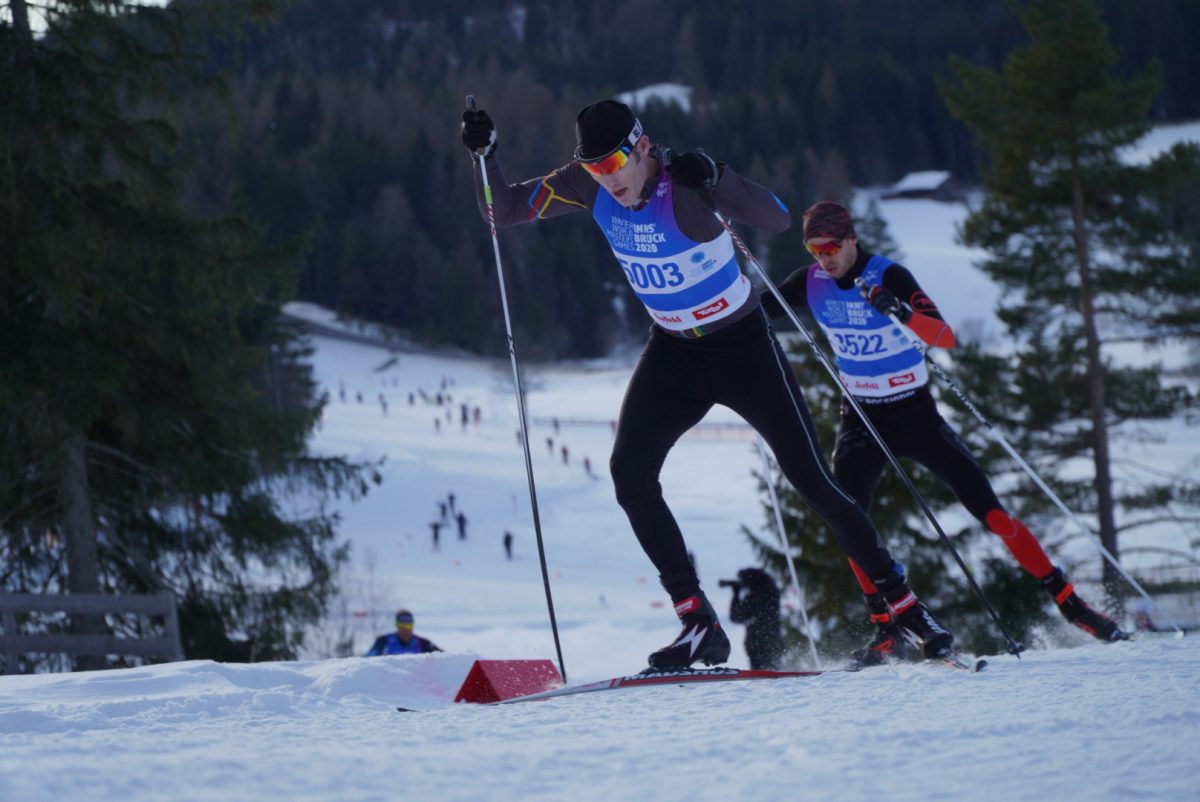
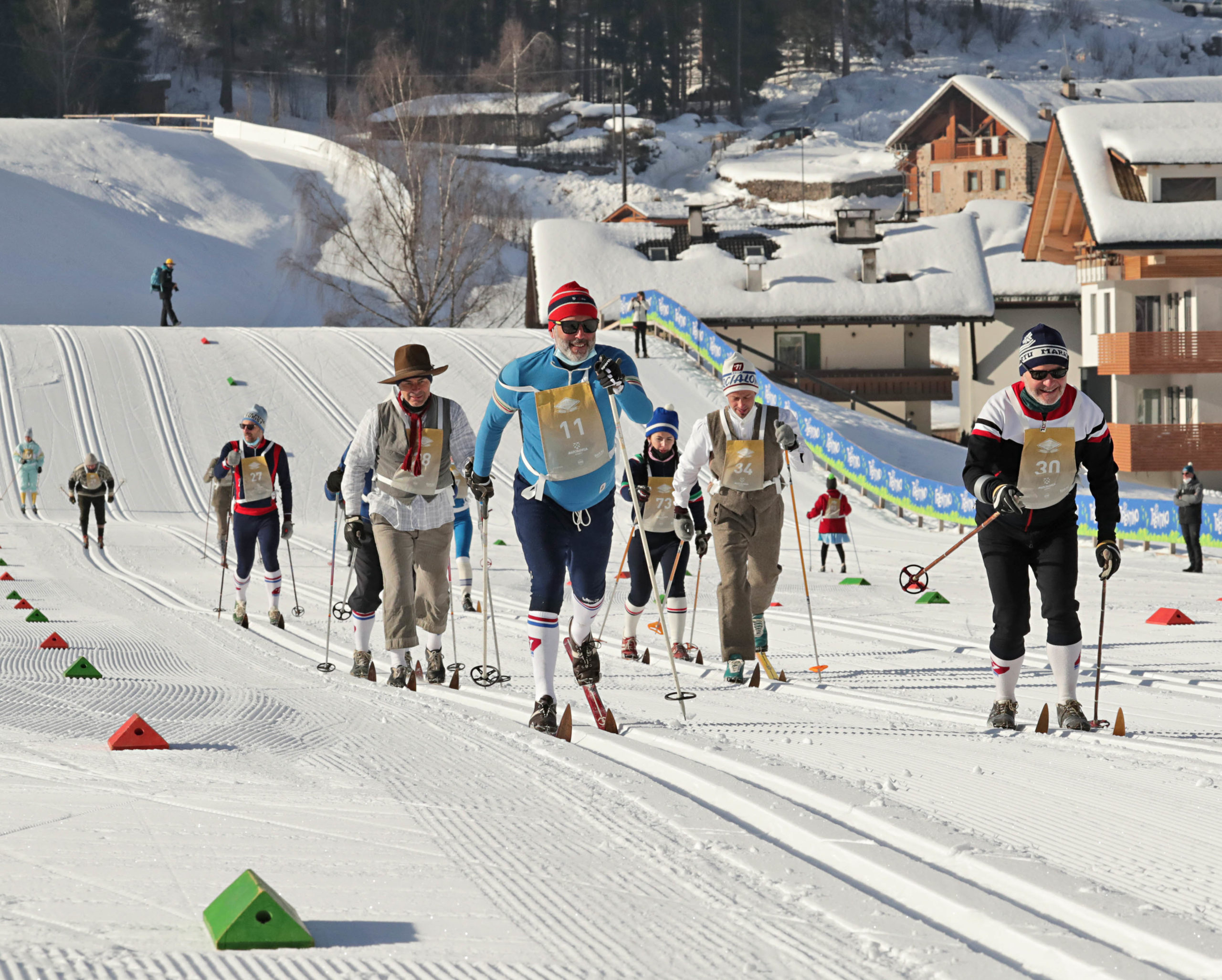
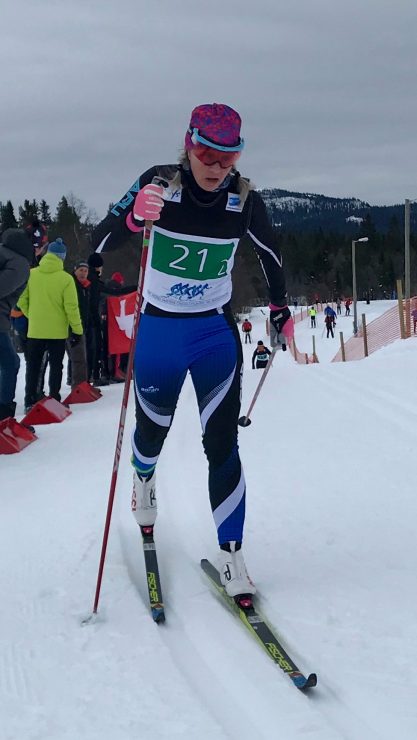
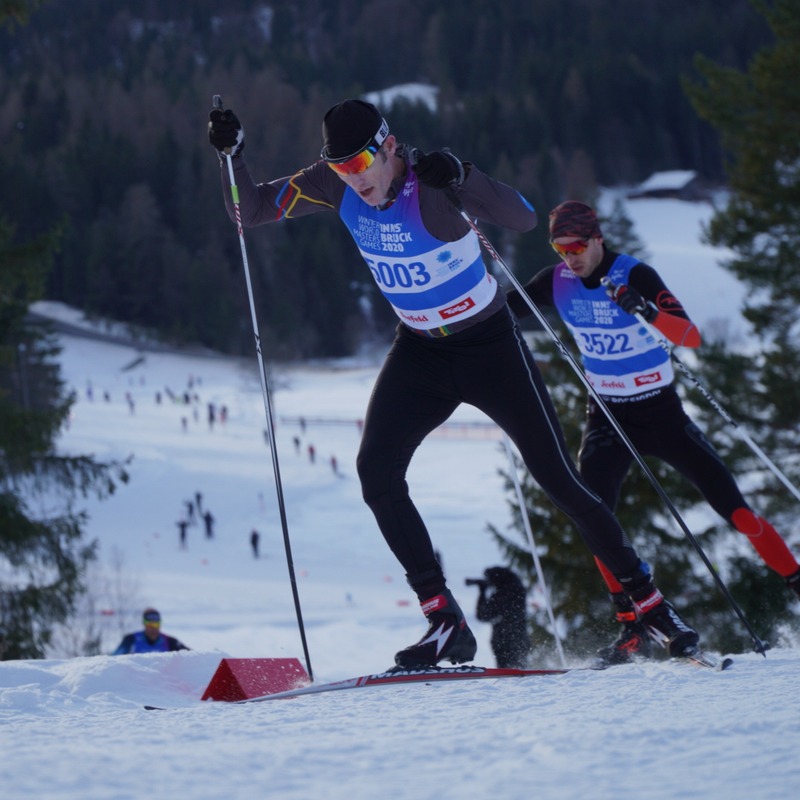
    Two masters racers skate up a rise in bibs from the 2020 Winter World Masters Games in Seefeld, Austria
    Tim Donahue racing at the 2020 Winter World Masters Games in Seefeld, Austria. Jim Galanes argues that the training masters skiers cut first is often the training that protects what aging takes away fastest. (Photo: Garrott Kuzzy / Lumi Experiences)

    There are two common problems I see in the masters athletes I consult with or coach. The first is the same problem we see with athletes of all ages: they tend to train “half hard” every day. Half hard, Zone 1 quickly drifts into Zone 2 or 3. The second is more specific to masters athletes. They try to follow a training plan that is basically a dumbed-down version of an elite athlete’s program.

    The first problem is relatively straightforward to address. Determine appropriate training zones and control the intensity of training more accurately.

    The second is more complicated. We need to determine the volume of training an athlete can recover from, adapt to and maintain consistently. Then we need to organize that training around the physiological capacities that are most likely to decline as we age.

    There is truth behind the conventional advice given to masters athletes. Recovery does change with age. Simply repeating the training we did at 25 or 30, or copying the program of an elite athlete, is never the best approach at 50, 60 or 70.

    But there is a problem with how we sometimes respond to that reality. Many of the training components we tend to remove as athletes age are exactly the components that address the physiological capacities declining most rapidly.

    The challenge of training as a masters skier isn’t simply figuring out how to recover better. It is figuring out how to provide enough training stimulus to maintain and improve the capacities that are naturally declining with age while still recovering sufficiently to adapt to the volume of training.
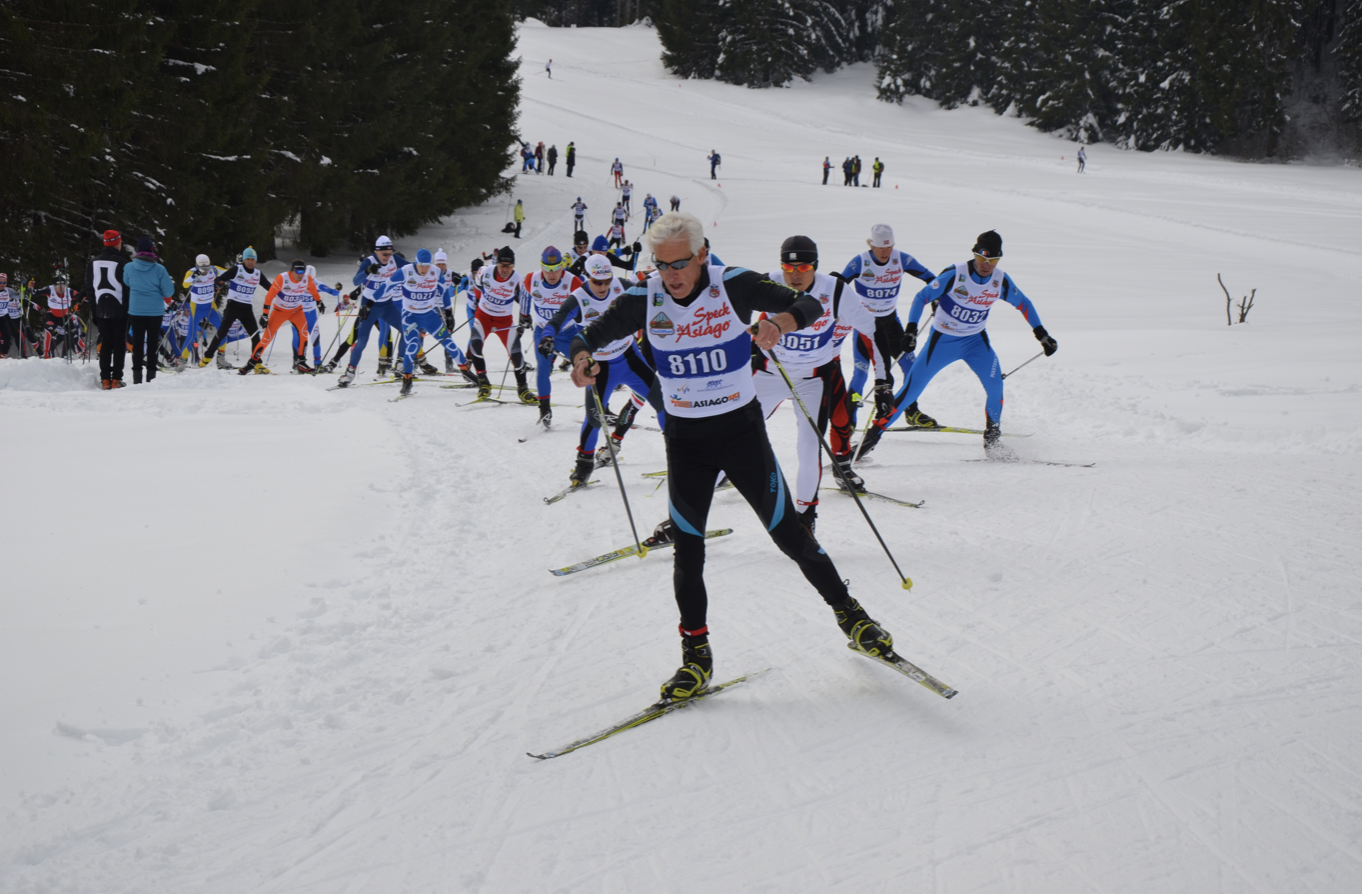
    A masters field skating up a snowy climb behind a white-haired leader wearing bib 8110
    A masters field on the climb at the 2014 Masters World Championship in Asiago, Italy. Endurance performance declines with age, but the individual components of performance do not decline at the same rate. (Courtesy photo)

    What Actually Changes with Age?

    We know endurance performance declines with age, but the individual components of performance do not decline at the same rate.

    One of the largest physiological changes is generally VO2max. Maximum heart rate declines. Muscle mass and maximal strength decline, both of which are important to maintaining aerobic capacity and skiing performance. Type II muscle fibers and explosive power become increasingly difficult to maintain.

    Meanwhile, exercise economy and the ability to sustain a relatively high percentage of VO2max can be reasonably well maintained in highly trained older athletes. That should tell us something about training.

    If these capacities decline at different rates, it doesn’t make much sense to treat them equally in training.

    There is a temptation as we age to gravitate toward the training we tolerate best. The problem is that the capacities we tolerate best may also be the capacities we are already preserving reasonably well.

    Training should not simply reflect what aging makes easiest to do. It must continue to address what aging is taking away. If VO2max, strength and power are among the capacities most vulnerable to aging, eliminating high-intensity and strength training in the name of increasing recovery may solve one problem while creating another.
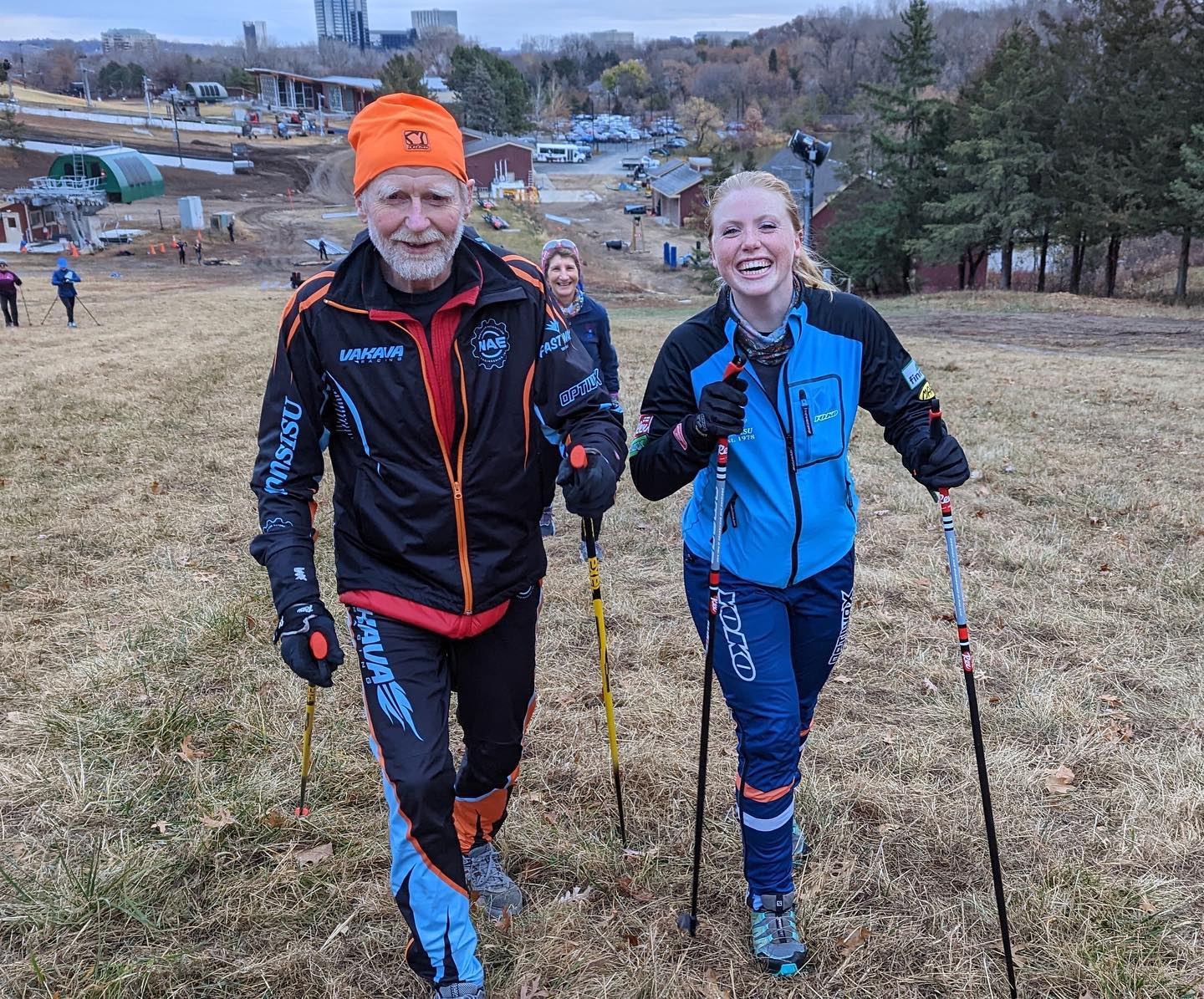
    An older skier in a Vakava race suit walks up a grassy hill with poles beside a younger skier
    Ahvo Taipale during a Vakava training session. Consistently accumulated aerobic volume remains one of the primary drivers of endurance adaptation, and one of the best defenses a masters skier has. (Photo: Finn Sisu)

    Maintain the Aerobic Volume

    There has been considerable emphasis in endurance training recently on large volumes of low-intensity training combined with substantial amounts of threshold and sub-threshold work.

    There are good reasons for that approach, particularly among highly trained elite athletes. But simply transferring that model to masters athletes can overlook the capacities most threatened by aging, particularly VO2max, strength and power.

    So how much Zone 1? How much threshold? How much VO2max?

    Those are important questions, but they can obscure something more fundamental.

    Consistently accumulated training volume remains one of the primary drivers of endurance adaptation. Masters athletes sometimes respond to aging by progressively reducing volume and attempting to compensate with intensity. There are limits to that strategy.

    Mitochondrial development, capillarization, fat oxidation, durability and the ability to maintain performance over long races are built largely through accumulated aerobic work. A two-hour easy ski is not interchangeable with a hard interval workout simply because the interval session produces more acute physiological stress.

    For a masters skier who has trained for decades, maintaining as much sustainable aerobic volume as possible may therefore be one of the most important defenses against declining endurance capacity.

    The key words are sustainable and consistent training.

    The volume has to be performed at the right intensity. It has to be something we can recover from day after day and, most importantly, adapt to over weeks and months.

    As we have written previously, occasional hero weeks followed by heavy fatigue and a subsequent reduction in training for recovery are less effective than weeks and months of consistent training at a sustainable level.
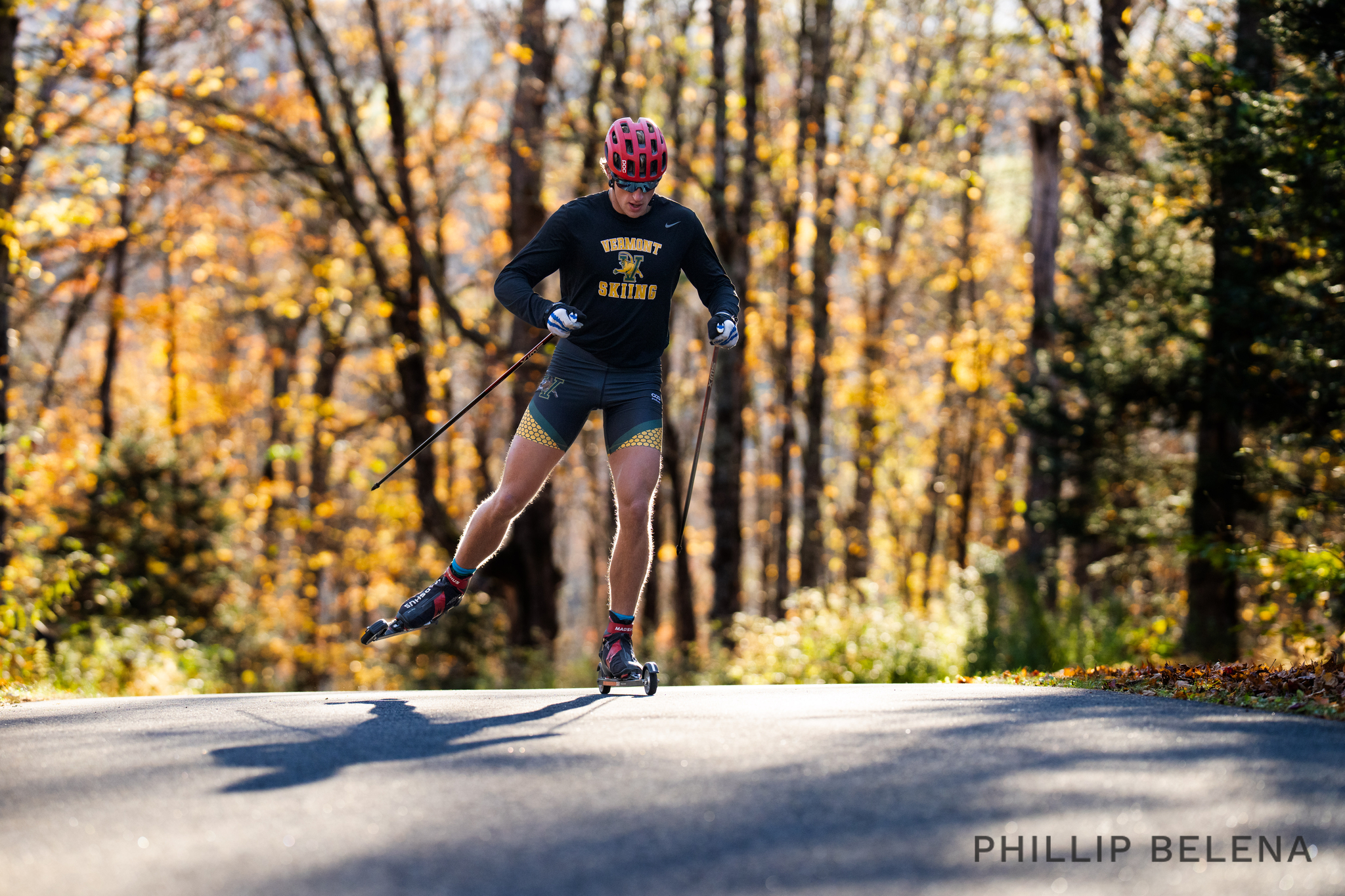
    A University of Vermont skier rollerskiing up a paved climb through autumn woods
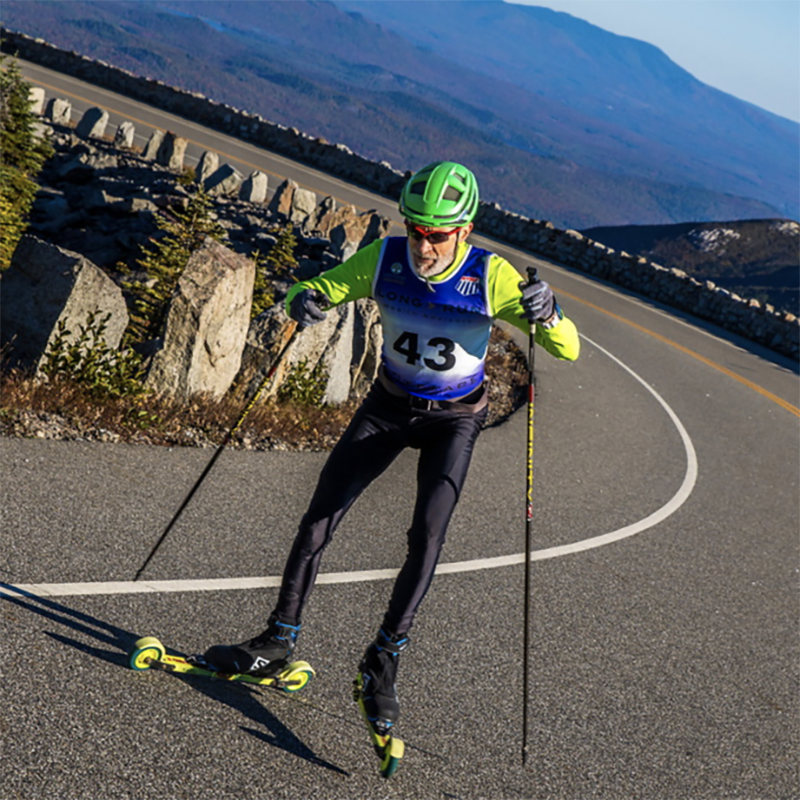
    UVM’s Fin Bailey drives up a climb on the Craftsbury Outdoor Center track. The answer to aging is not necessarily more high-intensity training, but keeping the frequency of the stimulus while controlling the dose. (Photo: Phillip Belena)

    Don’t Abandon Intensity

    The opposite mistake is maintaining plenty of volume while gradually eliminating the hard training. This is understandable, particularly for those who enjoy the “half hard” training.

    When we stop performing high-intensity training consistently, we lose some of our adaptation to that capacity. Every subsequent interval workout or race is then harder than it used to be, and recovery takes longer, because we have eroded that capacity. That can reinforce the idea that high intensity itself is the problem.

    But VO2max is also one of the physiological qualities most strongly affected by aging. So the training stimulus we may most need to maintain becomes increasingly difficult to perform and recover from. The answer isn’t necessarily more high-intensity training. It is maintaining the frequency of the stimulus while controlling the dose.

    That may mean less high-intensity work in an individual session, but performing it consistently throughout the year. Fifteen to twenty productive minutes near VO2max may provide a better stimulus than turning every interval workout into a contest to see how much we can do. For many masters skiers, one or two genuinely hard aerobic sessions every seven to ten days may accomplish more than two or three mediocre high-intensity sessions every week.

    The appropriate frequency depends on training history, age, fitness and recovery ability, not on a predetermined seven-day formula.

    A grey-haired skier spreads his arms in celebration wearing a finisher medal at the Engadin Skimarathon finish
    Gunnar Knapp finishes the Engadin Skimarathon. Threshold and sub-threshold training allow considerably more work to be accumulated at a high aerobic rate. (Photo: Garrott Kuzzy / Lumi Experiences)

    Threshold Has a Different Job

    Threshold training shouldn’t simply become the safer substitute for VO2max training. It is not. In fact, the metabolic and neuromuscular cost of a typical threshold session may be greater than that of a typical controlled VO2max session.

    VO2max training provides a powerful stimulus to central aerobic capacity, cardiac output and the ability to deliver and utilize large amounts of oxygen. Threshold and sub-threshold training allow considerably more work to be accumulated at a high aerobic rate while developing the ability to sustain that rate economically.

    One of the important considerations in deciding how much emphasis to place on each is fractional utilization: the percentage of VO2max an athlete can sustain for a prolonged period. An athlete with a relatively low VO2max but already high fractional utilization may gain relatively little by continually emphasizing the quality that is already strong while allowing the aerobic ceiling above it to decline.

    Conversely, an athlete with a large aerobic capacity but relatively poor ability to sustain a high percentage of it may have considerably more to gain from threshold and sub-threshold training.

    This becomes particularly important in highly trained skiers. The speeds elite skiers can maintain at threshold or just below it can be quite close to actual race velocities. That speed and the muscular demands associated with sustaining it are part of what makes the training effective.

    For cross-country skiers, both qualities matter.

    A skier may have an excellent VO2max but lack the muscular endurance to translate that capacity into sustained double poling or climbing. Another skier may have excellent threshold durability but gradually lose the aerobic ceiling above it.

    The question isn’t whether threshold or VO2max training is better. The question is which physiological limitation we are trying to change.
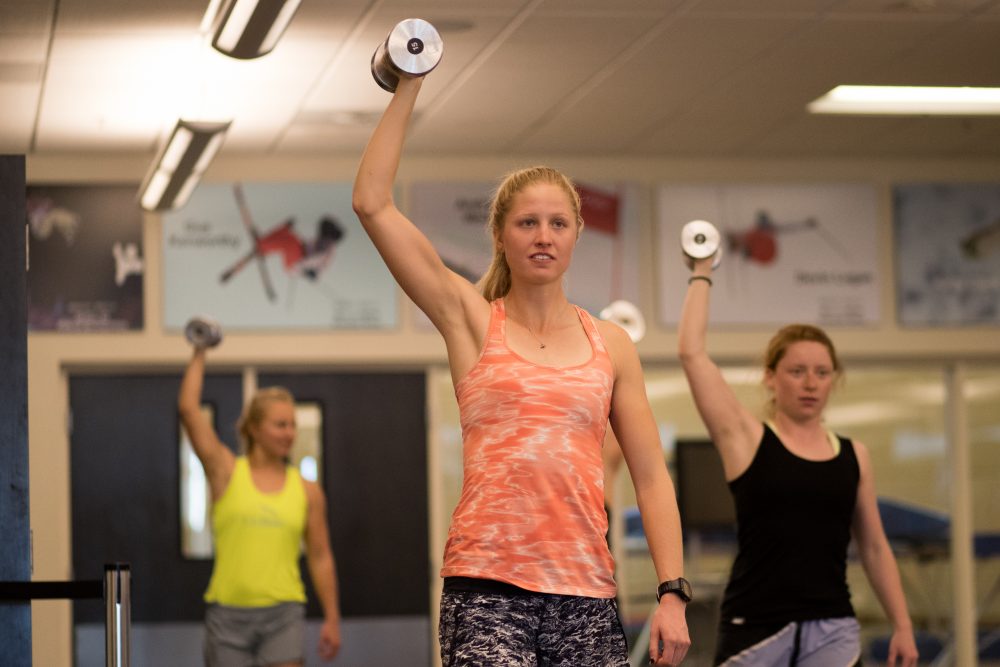
    Three athletes pressing dumbbells overhead during a gym strength session
    Hailey Swirbul during a strength session at a U.S. Ski Team camp in Park City, Utah. Research in cross-country skiers has shown that maximal-strength training can improve double-poling performance and economy. (Photo: Reese Brown)

    Strength Becomes More Important, Not Less

    Perhaps the clearest change in training priorities with age should be strength.

    Cross-country skiing has become increasingly dependent on upper-body force, whole-body strength and power. At the same time, aging progressively reduces muscle mass, maximal strength and particularly fast-twitch muscle function.

    Research in cross-country skiers has shown that maximal-strength training can improve double-poling performance and economy. One likely explanation is relatively simple. If every pole stroke represents a smaller percentage of your maximum force, repeatedly producing that force becomes less metabolically costly.

    For masters skiers, developing and preserving maximal strength is particularly valuable because it provides reserve capacity. The goal is maintaining the ability to produce force.

    That generally suggests relatively heavy resistance, good technique, low-to-moderate repetition ranges and sufficient recovery, rather than endless circuits of light weights.
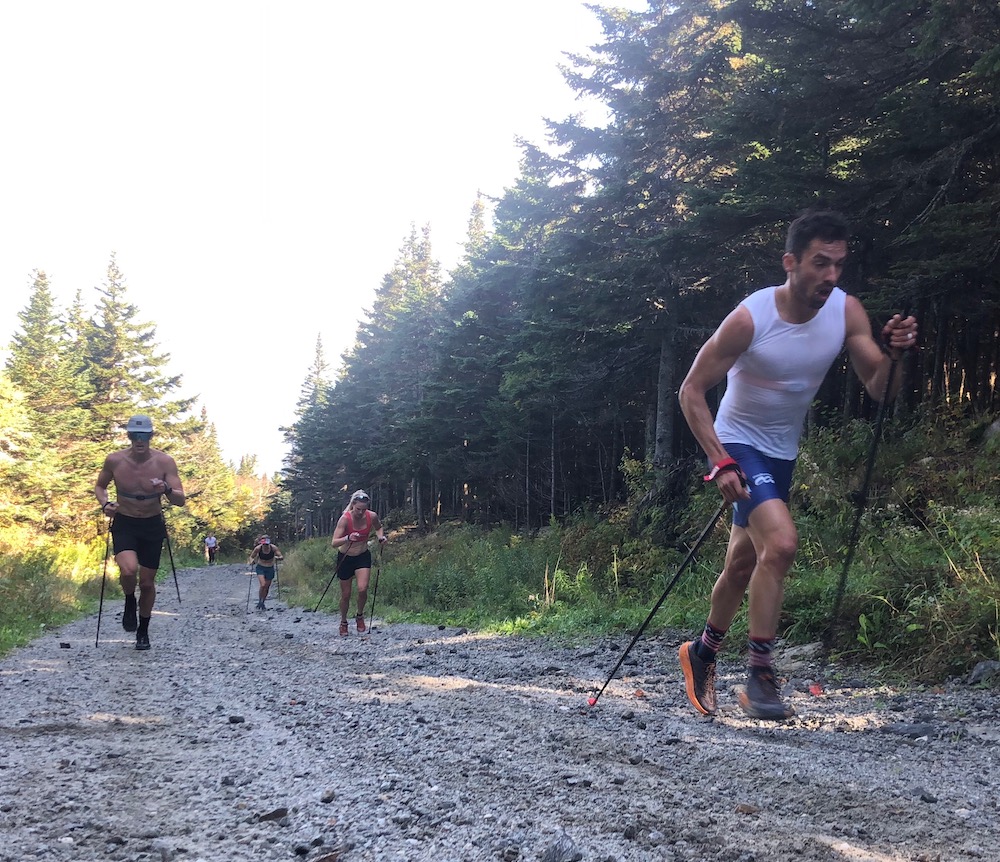
    Skiers bounding with poles up a steep gravel road lined with spruce trees
    Ian Torchia, right, leads bounding intervals up Stratton Mountain. Power tends to decline particularly rapidly with age, and short, fast work preserves it without requiring a large amount of metabolic stress. (Photo: Courtesy Stratton Mountain School)

    Power Is the Forgotten Quality

    Strength and power are not identical. Strength is how much force we can produce. Power is how fast we can produce it. Power tends to decline particularly rapidly with age.

    Acceleration over the top of a hill, changing gears on a climb, responding to an attack, generating force quickly through the poles and maintaining technique at race speed all depend on the ability to produce force quickly.

    Masters athletes therefore shouldn’t eliminate every fast movement from training. Short hill accelerations, controlled bounding, short ski sprints and explosive strength exercises can provide a neuromuscular stimulus without requiring a large amount of metabolic stress.

    The dosage doesn’t need to be large. What matters is the peak stimulus.

    But, as with nearly every aspect of training, consistency matters.
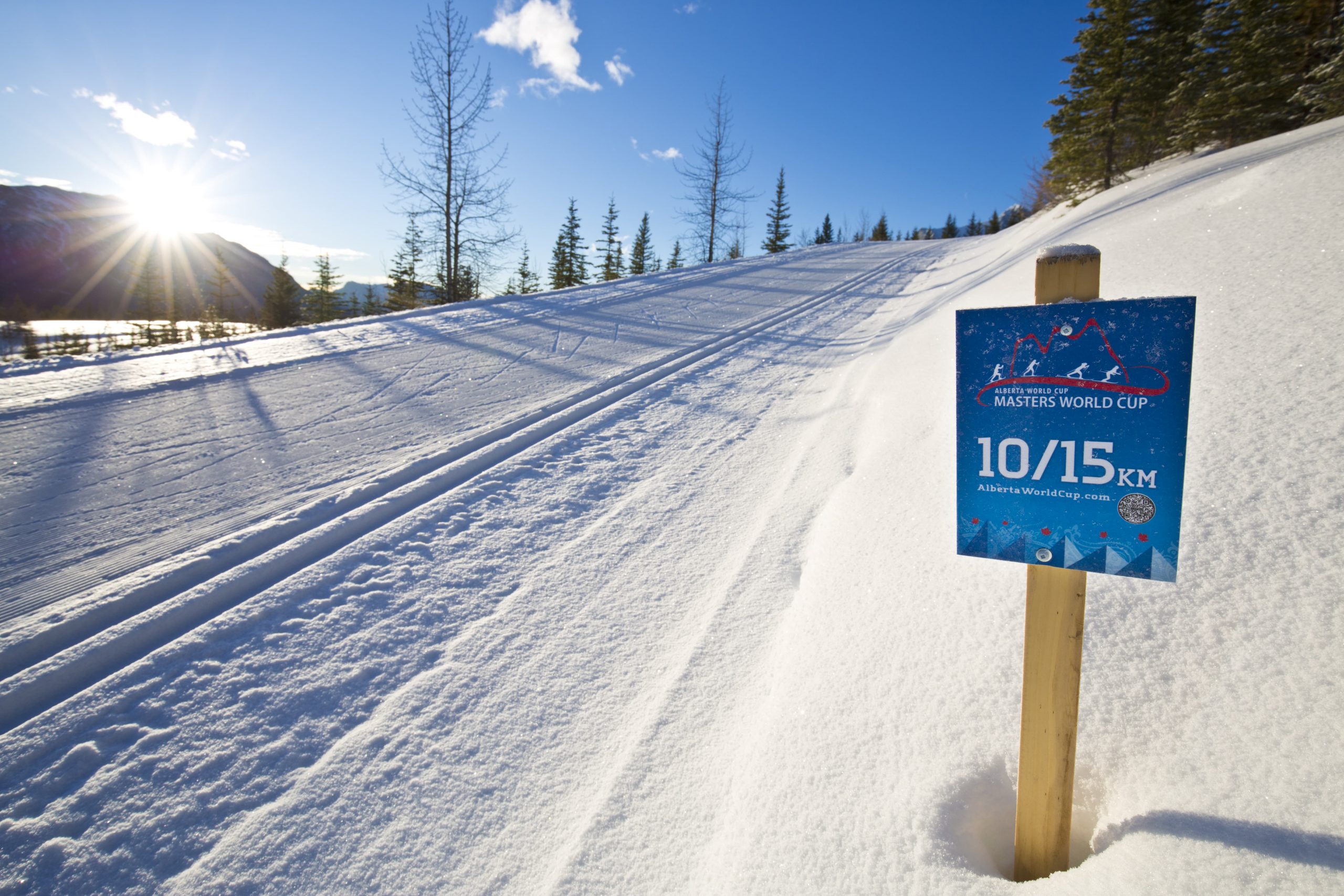
    Freshly groomed classic tracks in low sun beside a Masters World Cup course marker
    Fresh tracks on the Masters World Cup course in Alberta. Recovery is essential because adaptation occurs between workouts, but maximizing recovery is not the goal. (Photo: GibsonPictures)

    Recovery Serves Adaptation

    This brings us back to recovery. Recovery is essential because adaptation occurs between workouts. But maximizing recovery is not the goal of an athlete.

    Maximizing adaptation is.

    The masters athlete must solve a more complicated equation:

    Stimulus + Recovery = Adaptation

    Too much stimulus accumulated over days and weeks and we fail to recover sufficiently. Without recovery, we fail to adapt. The common theme in underperformance and overtraining is accumulating fatigue and a failure to adapt.

    Sometimes the better solution is reorganizing the training. Instead of a pattern of hard, hard, easy, hard, easy, hard, exhausted, rest over seven days, a masters skier might organize training so the important sessions are separated sufficiently to perform them well and adapt to them.

    The objective isn’t necessarily fewer quality sessions over the course of a month. It is enough recovery between those sessions to allow the athlete to absorb them.
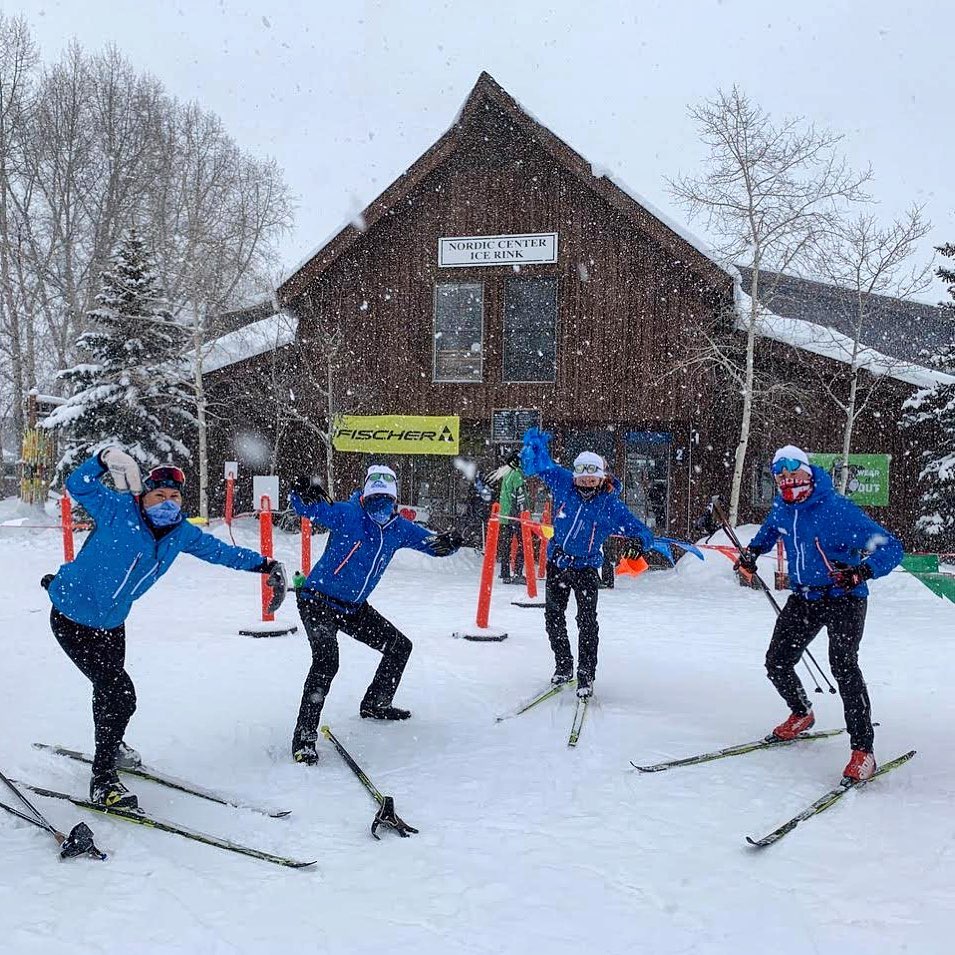
    Four coaches on skis in falling snow outside a nordic center lodge
    The coaches behind the masters performance group at Crested Butte Nordic in Colorado: from left, Rachel Bachman Perkins, Murray Banks, Cam Smith and Woody Martineau. Fitness is not created by individual workouts. (Courtesy photo)

    Consistency Beats Heroic Training

    For masters athletes, we need to adjust our perspective. Fitness is not created by individual workouts. It is created by the consistent implementation of easy endurance work, high-intensity aerobic training, strength, power and appropriate recovery.

    One big interval session does relatively little. One big training week does relatively little. Forty or fifty good weeks stacked together can produce remarkable fitness.

    That changes the definition of a successful workout.

    The question is no longer: How much training can I survive today?

    It becomes: What training can I absorb today that allows me to continue training tomorrow, next week and next month?

    That doesn’t mean avoiding hard work. It means implementing both easy and hard training in a way that provides adequate space for recovery and adaptation.

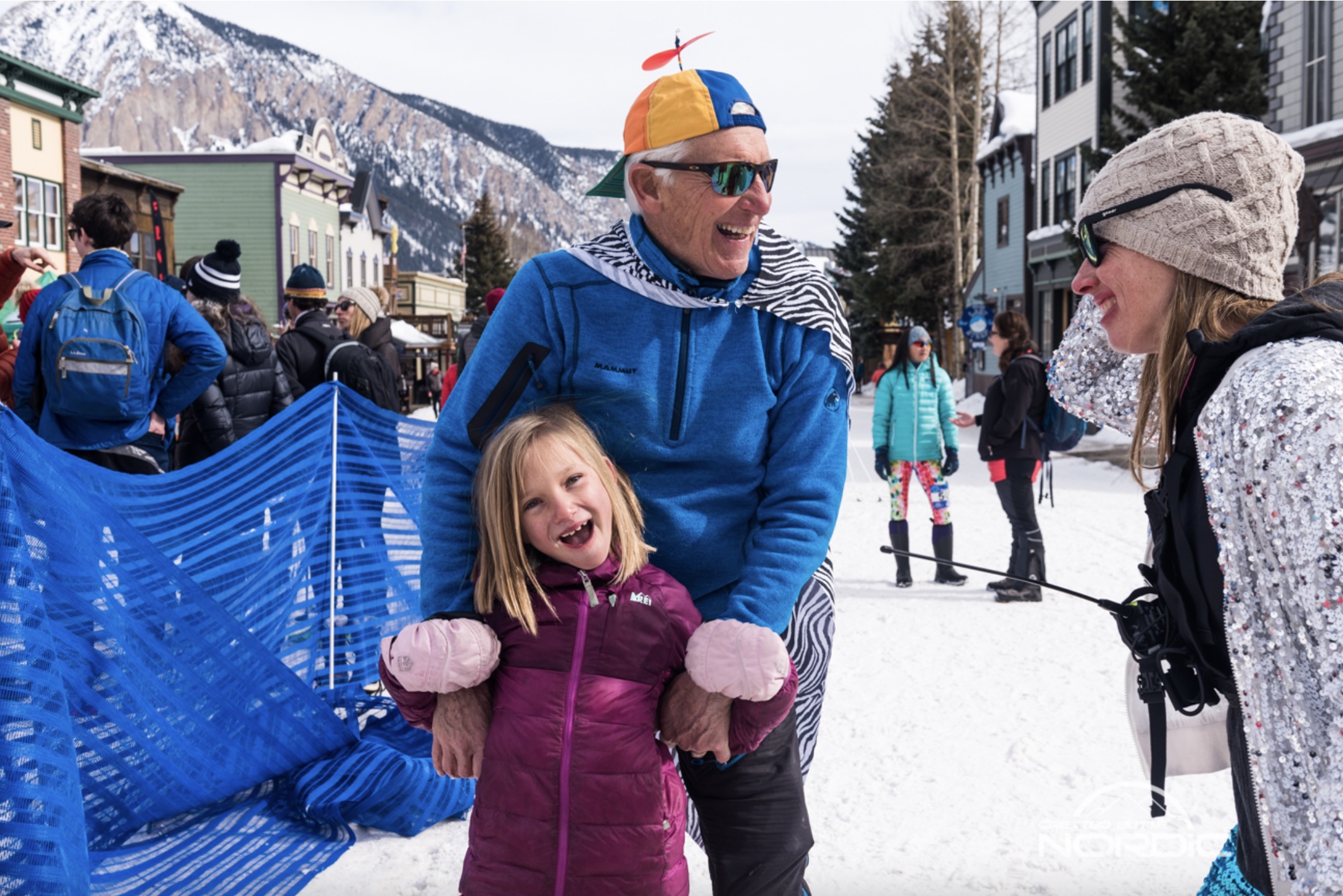
    An older skier in a propeller cap laughs with a young girl on a snow-covered town street
    Murray Banks at the Alley Loop in Crested Butte, Colorado. Chronological age alone doesn’t tell us enough: training history, injury history, available time, sleep, nutrition and life stress all matter. (Photo: Xavier Fane / Crested Butte Nordic)

    The Masters Training Equation

    Training, of necessity, must be individualized for athletes of every age. A highly trained 60-year-old with forty years of endurance training may tolerate workloads that would overwhelm a recreational 45-year-old who started skiing five years ago.

    Chronological age alone doesn’t tell us enough. Training history, injury history, available time, sleep, nutrition, life stress and individual recovery all matter. But the physiological objectives remain surprisingly familiar.

    • Maintain aerobic volume.
    • Maintain VO2max.
    • Develop threshold and muscular endurance.
    • Preserve maximal strength.
    • Preserve power.
    • Maintain ski-specific technique and economy.

    Then organize recovery around accomplishing those objectives. That is fundamentally different from starting with recovery and removing training until the athlete can tolerate what remains.

    Masters athletes don’t need a watered-down version of elite training. Nor do they simply need more recovery. They need training organized around the physiological capacities most threatened by aging, with enough stimulus to preserve and improve those capacities and enough recovery to adapt to that stimulus.

    Aging changes how we assemble the training. It doesn’t change what makes an endurance athlete fast.

    The great opportunity of masters sport is discovering how much performance we can preserve, and in many cases still improve, by continuing to give the body both the stimulus and the time and space it needs to adapt.


    Help Support Our Coverage!

    If you value the thoughtful work and access FasterSkier provides, please consider becoming a Voluntary Subscriber. Your support directly fuels our work to cover the people, places, and moments that make our sport special.

    Join the FasterSkier community!


  • The Engadin Worldloppet: Mattress Downhill or Optional Walk-Around?

    The Engadin Worldloppet: Mattress Downhill or Optional Walk-Around?

    Muottas Muragl Base Station

    by long-time Lumi guest from Anchorage, Alaska: Gunnar Knapp

    On March 8, 2026 I skied the Engadin Ski Marathon in the Engadin valley of Switzerland. I was very pleased to complete my tenth Worldloppet, thus earning my Worldloppet Master Diploma and gold medal.

    To ski the race, I joined the trip organized by Lumi Experiences to Seefeld (Austria) and the Engadin Marathon. I had taken numerous other fun trips with Lumi, including trips for all but two of my ten Worldloppets.

    Here are some excerpts from my journal for this trip which give a sense of the Engadin valley, the race course, and the race experience.

    Gunnar high above the Engadin Valley atop Muottas Muragl

    Thursday, March 5, 2026

    After I arrived at my hotel in Samedan following a lengthy – yet beautiful – train ride from Zurich, part of me wanted to just sleep all afternoon. However, I stuck to the plan, which was for me to take a city bus over to the base of Muottas Muragl, a funicular railway which rises high above the valley, where I soon met the Lumi group led by trip leaders Vale and Elisa, along with founder Garrott and guest communications manager Nathan.

    The ride up the funicular was long, steep and somewhat scary. At the top there was a fabulous view of snow- and glacier-covered peaks in all directions. The Engadin Valley below stretched down to Lake Silas far in the distance where the Engadin Marathon will start, progressing up the valley beyond us. It was really spectacular.

    At the top was a restaurant where I could have relaxed with a beer and soup and enjoyed the view. Instead, I spent my time walking around on the packed hiking trails, taking in the view, snapping pictures, and watching paragliders take off right next to the restaurant and soar into the sky above, below and in front of us.

    After we rode back down the funicular, we had a quick and easy ski back to Samedan, just a few kilometers away.

    Groomed trails atop Muottas Muragl make for easy exploring at 8000_

    Friday, March 6, 2026

    The next morning our group took a short bus ride to St. Moritz. At a plaza in the center of town we got off and put on our skis before heading out along the middle part of the Engadin course. I took it very easy, enjoying the excellent conditions and warm sunshine, stopping frequently to take pictures of the gorgeous scenery.

    One kilometer before the finish of the half-marathon at Pontresina we came to what is called “Mattress Hill.” It looked scary enough and there were indeed lots of mattresses on trees throughout the narrow course. I had heard that if you didn’t want to ski down you could walk on a path alongside the race course. It was true, and it wasn’t just a path of trampled-down snow as I had expected, but rather a paved path which had been sprinkled with sawdust to make it less slippery. Walking down was very easy. It wasn’t “cheating” at all: there was an actual official Engadin Marathon sign saying that the path for skiers to walk on was 250 meters ahead, and another sign for the actual turnoff to the path.

    Just beyond the bottom of Mattress Hill is the 21 km mark and the finish of the half-marathon. From there it was a wonderful long gradual downhill that might be almost two miles long.

    Liftoff!

    Saturday, March 7, 2026

    With my legs tired after a fair amount of skiing yesterday, my goal for the day was to relax in my room and get rested. I didn’t join the more gung-ho members of our group who skied the final part of the course down towards the finish. Instead, I relaxed for several hours and took a much-appreciated late-morning nap. But it was such a pretty day that I decided to go out for an afternoon walk with my camera.

    Riding the funicular down from Muottas Muragl

    Sunday, March 8, 2026

    Today I skied and finished the long-awaited Engadin Ski Marathon. And with that, I finally finished my tenth Worldloppet race and earned my Worldloppet Master medal and diploma!

    Here are a few, or maybe more than a few, details about my day and the race.

    Everything turned out to be very well organized, as we had been promised. I scouted out the location of the porta-potties (many, and without lines!), the drop-bag trucks, and the (crowded) warming tent. I hung out in the warming tent until it was time to finally head over to the start area and find my way to the “G” bin for my “27G” start.

    Approaching the Mattress Hill walk-around

    And then we were off. For the next 8 km or so I had fun, fast and easy skiing down this wide, uncrowded course. It was even more fun because I kept reminding myself, “Take it easy! Your only goal is to finish and have fun!”

    All this wonderful skiing on the flat portion of the course came to an abrupt end when the trail turned off the lake, narrowed, and headed into a forest, where I almost immediately came to the first bottleneck. Three rows of skiers were herring-boning up the hill on the left, and a long line of skiers was walking up the hill on the right (encouraged to do so by a race official). I was glad to walk: there was less risk of someone stepping on my poles.

    The first bottleneck on the Engadin course

    After about 2 km in the woods we came out onto another lake with a wide open trail before skiing through the center of St. Moritz. It was a relief to finally come to “Mattress Hill,” which I knew was right before the half-way point. I skipped the chaos of the crowded hill and walked down the path.

    From the halfway point on, it was mostly easy, fast and fun skiing, starting with a wonderful long downhill, followed by long stretches of flat on which I found myself steadily passing slower skiers from earlier waves. I alternated between skating (V1, V2, and V2 alternate) and double-poling, with more and more double-poling as I got closer to the finish. After the lakes ended there were long stretches of rolling hills. They were not too steep up or down and were actually more fun than the continuous flat. But the last 21 km was still a long way and I was definitely tired and ready to finish.

    One last bit of excitement that I did not expect was a sharp left turn into a steep, narrow and winding downhill just a half-kilometer before the finish. With the snow scraped away to ice with snow berms on the side, I skirted around several very tentative skiers just in front of me. I made it down in one piece and after that there was only a short uphill before a left turn into a broad flat finishing stretch.

    Finally, I was done. Ooof! A big relief! I was pleased that I had finished the race, hadn’t injured myself, and had fun throughout.

    Garrott was waiting in the finish area and he took a few pictures of me and then pointed me to where our Lumi group were sitting at a picnic table, relaxing with a few drinks. After a few minutes with the Lumi group we left to walk up to the train back to Samedan.

    How did I actually do in my race? My time was 4:10:43. Not very spectacular results from a “racing” point of view. But it doesn’t matter. I achieved my goals: I finished, and I had fun. And achieved my Worldloppet Master certification, completing 10 Worldloppet events.

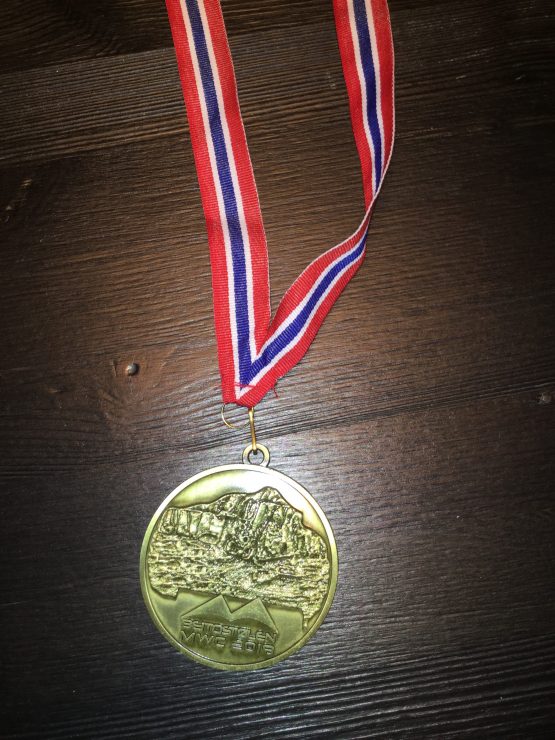
    Gunnar Knapp is presented with his finisher medal at the Engadin Worldloppet


    Would you like to join Lumi’s 2027 Seefeld & Engadin trip? There are still a few spots available, but we expect this one to fill by April 30. Reach out to reservations@lumiexperiences.com to request a detailed trip itinerary or to sign up and receive the $200 early booking discount for reservations on all trips by April 30.


    See you on the trail,

    Garrott


    Founder & Olympian

    Lumi Experiences

    Gunnar Knapp, Worldloppet Master! Presented by Epp from the Worldloppet
  • Inside the Masters Skier’s Training Equation: Recovery, Strength, and the End of Hero Workouts

    Inside the Masters Skier’s Training Equation: Recovery, Strength, and the End of Hero Workouts

    This article was made possible through the generous support of our voluntary subscribers. If you value coverage like this, please support FasterSkier with a voluntary subscription.

    A Different Equation

    Masters’ athletes are often told to “train smarter, not harder,” or the current version: “Go easy on the endurance sessions so you can go hard on the intense sessions.” Those phrases get repeated so often they’ve lost context and meaning. But there is a real physiological reason training for masters’ skiers must be approached differently than training for younger athletes.

    The challenge is not simply age itself. The challenge is balancing adaptation with recovery while preserving capacity, durability, consistency, and motivation over many years of training. Older athletes can still improve significantly. Aerobic capacity can improve. Sustainable race pace can improve. Technique can improve substantially. Strength and power can improve. What changes is the recovery required to create adaptation and the recognition that the margin for error narrows considerably compared to when we were younger.

    Daniel Schwenk on his way to 9th place in the Men’s Masters’ division of the Climb to the Castle. (Photo: Nancie Battaglia)
    The Biggest Mistakes

    Many masters athletes carry over the same training structure they used decades earlier, too moderate intensity (Zone 2 and 3 in most 5-zone models), hard sessions stacked too closely together, insufficient recovery between demanding workouts, and not enough attention to technique, strength, mobility, and durability.

    The results are absolutely predictable: chronic fatigue, declining velocity or pace in the hard sessions, stagnate or declining performance in spite of continued training, and simply a loss of motivation to train. Ironically, many master’s athletes are functionally overtrained, despite the reluctance in some circles to even use that term.

    Recovery and Adaptation Become a Primary Training Variable

    As we age, there is a clear reduction in recovery capacity due to reduced anabolic hormone response, decreased muscle protein synthesis, accumulated fatigue, and often greater life stress outside of training.

    None of this means that masters athletes cannot train hard. They absolutely can, and should. Maintaining aerobic capacity and muscular strength is strongly associated with health, function, and longevity. But masters’ athletes generally cannot stack hard sessions with the same frequency as younger athletes without compromising recovery and adaptation.

    For most skiers I have coached or consulted with, the question should not be, How much can I train? The better question is: How much can I recover from and adapt to consistently over the weeks and months ahead? That distinction is perhaps the most important one.

    Tim Donahue mid-race during the 2020 Winter World Masters Games in Seefeld, AUT. (Photo: Garrott Kuzzy / Lumi Experiences)
    Consistency Beats Hero Workouts

    The most successful athletes at any level are usually not the ones doing the biggest “hero” sessions. They are the ones who maintain consistent training and compound it week after week, month after month, and year after year.

    A training model built around sustainability always outperforms the commonly programmed “ramp” approach, where volume and/or intensity continually increase week to week and month to month. The assumption that training load must constantly rise in the short term, to add stress and create more adaptation to improve, is scientifically unsupported and not common practice among athletes who perform well over the long term.

    That means, fewer very hard sessions typically 1–2 every 7–10 days, endurance sessions performed at the correct intensity, usually easier than most athletes think, 1–2 true rest or recovery days per week, not “easy training” or so-called recovery workouts, but actual rest, consistent sleep and nutritional fueling, and proper control and management of both low and high-intensity sessions.

    One of the biggest contradictions in master’s training is that many athletes improve when they reduce training load. That does not necessarily mean less training volume. More often, it means better control of intensity and reduced accumulated stress.

    Masters World Championship, Asiago, Italy, 2014
    Intensity Still Matters

    One of the common mistakes today, especially with the influence of social media and the one-sided promotion of Zone 2 and threshold training, is the assumption that aerobic improvement comes only from easy or moderate training.

    To improve aerobic function, we still need hard training. High-intensity work improves mitochondrial function, increases oxidative capacity in high-threshold motor units, recruits more muscle fibers, and improves high-end aerobic power. The key is proper control of the dose and intensity.

    An elite athlete may tolerate three demanding intensity sessions per week plus strength work. That rarely works for most masters athletes. Many would benefit more from one VO2max session and one maximal steady-state session every 7–10 days, combined with two strength sessions and additional speed- and technique-focused work embedded within basic endurance training. While I really dislike rules of thumb or guidelines in a general sense, I feel using the 80/20 rule is a good starting point. Often confused with the duration or mileage of training. It is not that. The 80/20 guide is 80 percent of the total workouts in a week or a month are easy endurance-based, and 20 percent of the workouts are hard. If one applies this measure to the duration of training, I guarantee over-training.


    Help Support Our Coverage!

    If you value the thoughtful work and access FasterSkier provides, please consider becoming a Voluntary Subscriber. Your support directly fuels our work to cover the people, places, and moments that make our sport special.

    Join the FasterSkier community!
  • First Tracks and Timeless Traditions: Inside the West Yellowstone Ski Festival & Clinics

    First Tracks and Timeless Traditions: Inside the West Yellowstone Ski Festival & Clinics

    When the first real snow falls in West Yellowstone, everything changes. The sound of car tires gives way to the swish of skis; coffee shops fill with cold hands and red cheeks; and this small Montana town of 1,100 becomes the epicenter of cross-country skiing in North America.

    A Small Town With a Big Nordic Heart

    Each Thanksgiving week, thousands of skiers descend on West Yellowstone for the Yellowstone Fall Ski Festival—an event that blends early-season training, clinics, races, and old-fashioned camaraderie. The teaching arm of the festival, officially called the Yellowstone Fall Ski Clinic, has become legendary in its own right.

    “The festival has always been about community,” says Jack Hart, who is the co-director with Todd Eastman, and has been part of the event for more than three decades. “We’re a small town, but for this week, we become the center of the Nordic world. It’s a celebration of skiing in its purest form.”

    Bridger Ski Foundation out for a first ski in West Yellowstone back in 2015. (Photo: Courtesy Bernie Nelson)

    From Coaching Coaches to Coaching Everyone

    The roots of the festival trace back to 1979, when the U.S. Ski Team established a coaching development program in West Yellowstone. Hart remembers it well.

    “Before it became an official, commercial event,” he explains, “the U.S. Ski Team brought in coaches. They said, ‘We have a coaching program. We want to develop people like yourself who want to take their level higher. Come to West Yellowstone in November and we’ll train you to be a U.S. Ski Team coach.’ That’s really how this whole event started.”

    As more coaches came west, the program began to evolve. “Torbjorn Karlsen, Drew Barney, and Dick Hunt—those are the three names that co-founded the event,” Hart says. “They realized we could turn this into something commercial and teach more people how to ski. We’ve got early snow, we’ve got the trails—why not invite everyone?”

    By the early 1990s, that idea had taken hold. The first snow of the season, combined with West Yellowstone’s unique geography, made it a magnet for teams and individuals alike. “At its peak about twelve years ago,” Hart says, “we had over 5,000 day passes sold during the week. That’s how many people were here. These days we’ll sell 2,500 to 3,000 if we get a lot of snow—but it’s still the biggest kickoff to winter anywhere.”

    Building Better Skiers — and a Stronger Community

    The Yellowstone Fall Ski Clinic runs alongside the festival under the same umbrella. It offers structured instruction for everyone from teenagers to masters racers, with one-, two-, three-, and five-day options beginning the Tuesday before Thanksgiving.

    “We take kids down to high school age,” Hart says. “We’ll have around one hundred people in actual instruction this year, and then another couple thousand here training with their own coaches—high-school programs, club teams, that sort of thing.”

    The diversity of ability levels is part of the event’s charm. “We have literally people who have not been on skis before,” Hart says, “and we also have the five-day, full-time training type of skier. The idea is to enhance, improve, and enjoy skiing in this environment—with this community.”

    The entrance to the Rendezvous Trail System in West Yellowstone, Montana. (Photo: Courtesey Photo)

    Each clinic begins with a quick on-snow evaluation. “We ask for a self-assessment on the registration form, but that can be different from where people really are,” Hart laughs. “The first fifteen or twenty minutes on snow, we do an evaluation and adjust the groups right there. We want everyone with others of similar ability so they can maximize their time and get more enjoyment out of it.”

    The formula works. The Rendezvous Trail System becomes a living classroom—groups working on technique, coaches calling out cues, laughter echoing through the lodgepole pines. “The idea,” Hart says simply, “is to enjoy, to improve, and to learn—and obviously have a bunch of fun while you’re doing it.”

    Philosophy in Motion: Teaching, Balance, and Joy

    Behind the logistics of the clinic—the sign-ups, scheduling, and staffing—stands Eastman, whose background in both coaching and teaching shapes how the clinics operate.

    “My contention,” he says, “is that all the coaches needed to do more ski teaching, and all the teachers needed to learn about coaching. The sweet spot is the combination of the two.”

    That balance defines the Yellowstone approach. Eastman and Hart have assembled a team of approximately a dozen instructors who rotate throughout the week, exposing participants to a range of learning styles. “We’re not following PSIA or USSA scripts,” Eastman explains. “Most of our instructors have been skiing forever and teaching for years. It’s a mix of styles and personalities.”

    The offerings reflect this flexibility: a five-day skate and classic clinic, a three-day version, two-day tune-ups, and popular one-day technique intensives for both skate and classic skiing. “The one-day stuff fills up really well,” Eastman says. “It’s at the end of the week—Thursday through Saturday—so people already in town can still jump in.”

    Last year’s clinics drew 82 participants, supported by a staff of 12 instructors, a healthy ratio that ensures personalized attention. “Our ideal number is around a hundred,” Eastman notes. “We want everyone to leave feeling like they were seen and supported.”

    Just as important as the structure, however, is the tone. “This isn’t about grinding or chasing a podium,” Eastman says. “We’re careful not to overwhelm people, especially early in the season. A lot of folks haven’t been on the snow yet. We want to be delicate with feedback, help them rediscover how it feels to glide again.”

    That sentiment pervades the entire week. “Everybody at some point has a sensation—they go, ‘What was that? That felt good. I want more of that,” he says. “You may not find it for years, but it’s that moment that keeps you coming back.”

    Eastman laughs at the sport’s reputation for being physically demanding. “Cross-country skiing gets this bad rap: ‘Oh, it’s the hardest cardiovascular sport in the world.’ Yeah, gee, that’s exactly what I want to sign up for on my vacation! We want people to see the joy in it—the beauty, the community, the stress relief, the meditation in motion. It’s the best way to deal with winter.”

    The sense of inclusivity is central. “We have everyone from high schoolers to eighty-year-olds,” he says. “And if someone needs more challenge or less, we just move them. Our job is to make sure every skier finds their place.”

    For Eastman, success is simple. “When a hundred people swear they’re going to tell all their friends how much fun they had—that’s when we know we did it right.”

    Free Heel and Wheel: The Beating Heart of the Festival

    For many participants, the festival’s unofficial headquarters is Free Heel and Wheel, the beloved ski and bike shop owned by Jack’s wife, Kelly Hart, and Melissa Alder.

    “Every kid hangs out there,” Hart says. “They have hot chocolate, buy a new ski hat, talk skiing—it’s where everything happens. That little store is kind of the center of communication because people have been going there for thirty years.”

    Part café, part gear shop, and part social hub, Free Heel and Wheel embodies the spirit of West Yellowstone. During festival week, it hosts evening events, wax clinics, and impromptu meetups that stretch late into the night.

    “It’s just part of the experience,” Hart says. “Besides the Holiday Inn, which is where everything is based, it’s the other center of the place. A lot of the kids meet there, sit at the coffee bar, talk skiing, and talk about whatever teenagers talk about.”

    The shop is also the birthplace of one of West Yellowstone’s most famous legends—the “snow-dance” story. Years ago, when November warmth threatened to derail the event, the Free Heel and Wheel crew improvised. “They all got on bikes in bikinis, with skis on the back, and rode around town,” Hart laughs. “They lit the skis on fire as part of the dance, and that night we got nine inches of snow. It’s one of those legends that’s become part of the lore around here.”

    Lots of Après-ski fun to be had. (Photo: Courtesy Photo)

    Exploring Beyond the Trails

    While the festival’s focus is skiing, Hart emphasizes that West Yellowstone offers plenty beyond the tracks.

    “If you were that customer saying, ‘Jack, what else can I do? I’m only skiing three days, but I’m here for five,’ there’s a lot,” he says. “The clinic has speakers and films—wax clinics, athlete talks, people like John Bauer speaking about his career and the park.”

    Just outside town lies the west entrance to Yellowstone National Park, which remains open to non-motorized travel in late November. “You can either tour in, or, depending on conditions, you can skate on the groomed road,” Hart says. “It’s a big tradition for a lot of higher-end athletes to ski all the way to Old Faithful. That’s 30 miles in and 30 miles out. We call it the 100 K day.”

    In the 1980s, before skate skiing, that tradition was even tougher. “We used to classic ski into Old Faithful and back on Thanksgiving Day,” Hart remembers. “You could eat like crazy that night—you were starving.”

    Other attractions keep visitors busy: the Grizzly & Wolf Discovery Center, open 365 days a year (“If you want to be as close as your computer to a wolf, you can do that there,” Hart says); an IMAX theater; the Museum of the Yellowstone; and Big Sky Resort, just 40 miles north.

    “Our restaurants stay open for this event,” Hart notes. “The bars are open. The town comes alive. If you’re coming all the way to West Yellowstone, skiing our trails and seeing Yellowstone National Park in its winter beauty should hold your interest for at least three or four days.”

    A Safe Adventure

    Early-season skiing in bear country sometimes raises eyebrows among first-time visitors, but Hart reassures them that precautions are simple and effective.

    “We always recommend traveling with bear spray,” he says. “Most bears are in hibernation by then, but it’s not unusual this time of year to see one that’s not. Ski in a group, carry bear spray—Free Heel and Wheel rents it, and the Chamber has them too—and follow park guidelines. We’ve never had an incident with an animal on the Rendezvous Trail system in 34 years.”

    Snow, Weather, and the “Snow Dance” Factor

    Reliable early snow has always been West Yellowstone’s calling card, but Hart admits that every year brings a little suspense. “We’ve had snow and we’ve been skiing on the plateau already,” he said in early November, “but it’s been wet—low 40s and even rain up to 7,000 feet. The good news is it’s supposed to snow today, tomorrow, Sunday, and part of Monday. Temperatures are dropping to the teens at night, and starting the week before camp, it’s supposed to snow steadily.”

    If conditions in town fall short, organizers simply shift to the South Plateau Road, about six miles outside town, which reliably holds snow. “We’ve always been able to adjust,” Hart says. “If we don’t get snow until Wednesday, fine—we’ll ski Wednesday or go up on Tuesday. The key is being flexible. And if all else fails, we might call on the Free Heel and Wheel girls for another snow dance.”

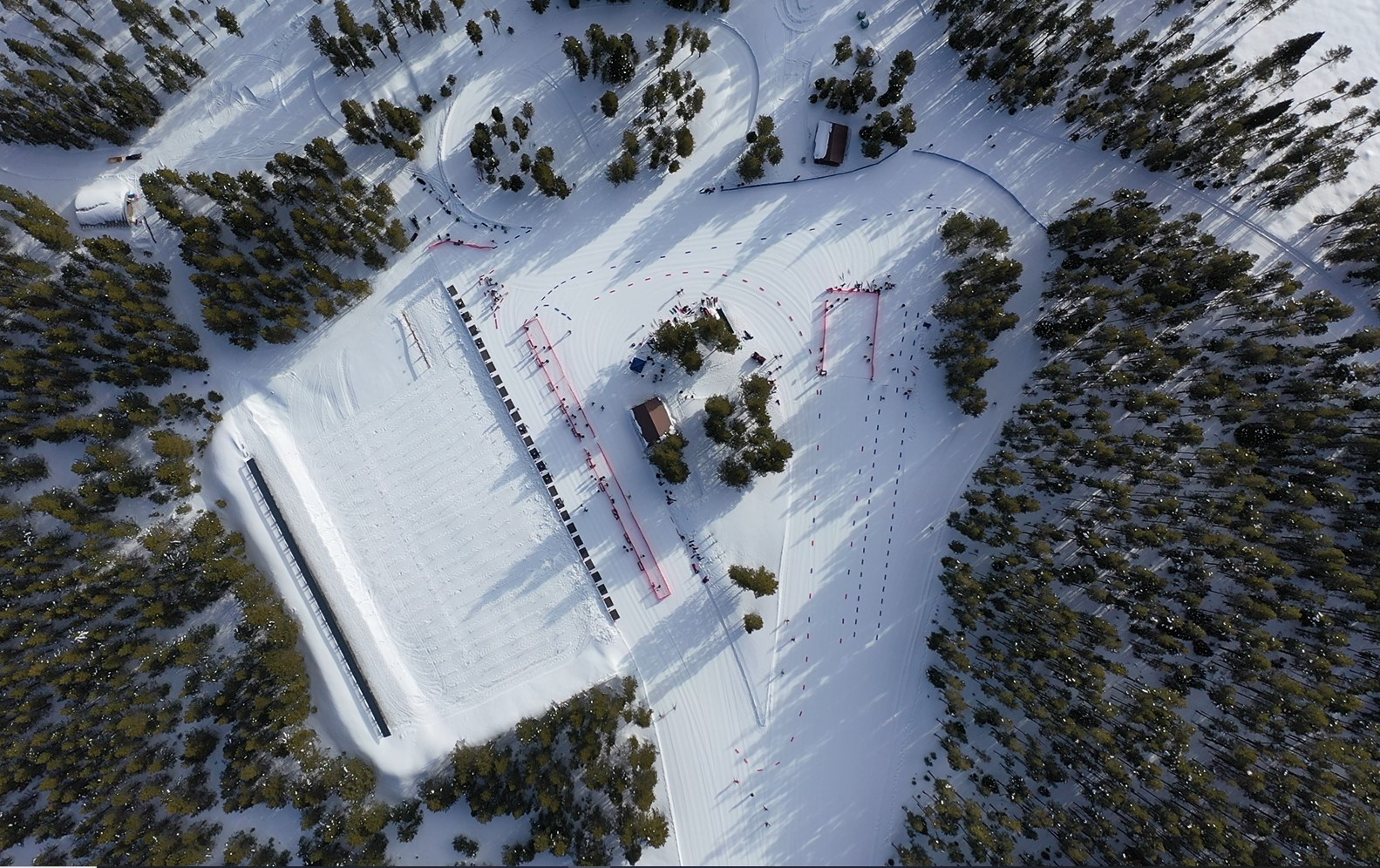
    Aerial view of the stadium and biathlon range at the Rendezvous Ski Trails in West Yellowstone. (Photo: WYSEF courtesy photo)

    Try Something New—Free Biathlon

    One of the most distinctive parts of the week is the chance to try biathlon—no experience required.

    “The biathlon events we have during the week are free,” Hart says. “If you’ve never shot a gun, it doesn’t matter. Some of our highest participation numbers come from the ‘never-ever’ biathlon event. You spend half a day being taught how to shoot, and then that afternoon there’s a race for all those people who’ve never raced before.”

    The facility is first-rate: a 26-station range that includes a Paralympic setup. “You can feel what it’s like to actually do a biathlon race,” Hart says proudly. “It’s one of the nicest ranges in the western United States.”

    Thanksgiving, Nordic-Style

    Thanksgiving is the centerpiece of the week—a mix of tradition, family, and fitness.

    “Thirty years ago, you couldn’t even get a turkey in town,” Hart recalls. “Now we have two grocery stores that carry everything, from turkeys to cranberries. We’ve got six hotels open, and you can make your own dinner if you rent a VRBO. There’s plenty of food available.”

    The scene on the trails that morning captures what the festival has become: families pulling children in pulks, elite athletes finishing intervals, and clusters of friends laughing as snow falls softly around them. “Thanksgiving Day is a big tradition for a lot of people,” Hart says. “They come out with their family, ski for an hour, have a big Thanksgiving dinner, ski Friday and Saturday, and head home Sunday. You’ll watch races, watch biathlon, see some of the best people in the world on snow—it’s a great time to be here.”

    The West Yellowstone Ski Festival and Clinics is a gathering place for our community to celebrate the start of the new season. (Photo: Courtesy Photo)

    The Spirit of the Festival

    For Hart, who has worked at this event for the last 30 years, the reward is seeing the joy it brings. “We’re proud of what we’ve built,” he says. “It’s a massive effort for a small community, but when you see 3,000 people skiing, smiling, and reconnecting after a long summer—that’s everything.”

    As the first flakes settle over town and the hum of wax being corked onto skis fills the air, West Yellowstone once again takes its place as the spiritual home of early-season Nordic skiing.

    Amidst the pines and geysers, every November offers a fresh reminder: the ski season doesn’t begin with a race—it begins with a community.

  • Signing up for U.S. Biathlon Nationals sounded like a good idea. Then I had to actually race.

    Signing up for U.S. Biathlon Nationals sounded like a good idea. Then I had to actually race.

    Signing up for a Master’s B race at U.S. Biathlon Nationals sounded like a fun idea when I was at my computer, a safe 2,259 miles from Bozeman, chatting with my sister on the phone. Chloe would be competing at Nationals, her final races of the season. I hadn’t seen her since she left for the World Cup in December. It was as simple as her saying, “You should do the Master’s race.” And suddenly, I had needlessly complicated what could have been a sunny vacation away from my usual responsibilities of parenting two toddlers.

    Unlike Chloe, I’m not a biathlete. I did a few biathlon camps as a teenager, but ultimately chose to focus on Nordic skiing. My sister became a biathlete, so I’ve been around the sport, traveling to some of her races, yelling at the Eurosport feed at all hours of the night and early morning. But I haven’t personally shot in quite a while. I did a citizen’s race in 2018 where they mercifully had the rifles waiting for us at the range, and we shot on standing targets for prone (4.5 inches instead of the usual 1.77 inches). I would find no such luxuries in Bozeman.

    The author’s sister, Chloe Levins (USA) competing on IBU World Cup in Nove Mesto na Morave (CZE) this past March. (Photo: NordicFocus)

    Unlike Chloe, I’m also not exactly in shape. I raced Nordic in college, but the combination of working life and mom life has not led me to have the same capabilities I had on skis as a 22-year-old. My world revolves around wandering through the woods looking for salamanders, cooking noodles, and writing. Hammering intervals, I do not.

    So, when I arrived at the Official Training at U.S. Biathlon Nationals, I wasn’t feeling exactly confident.

    I was surprised to find that the basics had stuck with me. I’d gotten a refresher in rifle safety. My thumb clicked along, loading ammo into magazines. I put the cuff on my bicep and remembered its tightness. After a few sequences of skiing into the range and shooting on paper, there was fluidity to my motions: Taking the rifle off, setting up to the target, and finding it in the sights. Smooth trigger, I tried to make my mantra. Rifle back on my shoulders, poles on as I ski out. The cadence of events has a nice rhythm. I fell into it more easily than expected.

    We zeroed, and I hit three prone on my first try. I’ve got this. My default for wild optimism taking over instantly. Standing was a different story. In prone, the rifle’s sling hooked to you via the cuff, your body lying still thanks to the support it receives from the ground, you feel incredibly stable. There is motion, of course, as you breathe and your heart beats against your ribcage. But the targets remain within the sights. I felt like I had a chance of hitting every target. Standing up, there’s so little support. Your legs shake as they try to hold steady, opening or closing your shoulders an inch makes the targets suddenly disappear from view. A breeze you otherwise probably wouldn’t notice becomes detrimental to your hopes of staying still and hitting a target.

    As I ticked through the standing targets in practice, they got harder and harder to hit, because I became more and more unsteady. Inhale and that little black circle slides out of your sights. Exhale and it should come back in. But you’ve shifted your body an unnoticeable amount and suddenly it’s gone. Instead of waiting for the moment that feels perfect in prone and smoothly pulling the trigger, I was hoping for the target to come into view and pulling the trigger quickly, knowing it was going to disappear again in a second. Jerky trigger motion is not how you hit targets.

    “I’m going to have to shoot as fast as I can in standing, it’s only getting worse the longer I stand here,” I said to Chloe. She fed me tips to add stability. Lock out your legs so your bones are holding you up, not your muscles. Drive your left elbow into your left hip bone, use it like a shelf. Feel like you’re pulling your right hand back into your right shoulder.

    The tips helped, but there wasn’t much that could be done the day before the race. Standing was going to be another exercise in wild optimism.

    “Let’s go ski the course,” Chloe offered. “You can put the rifle on the rack if you don’t want to ski with it.”

    This was one area I felt prepared for. Compared to my 28-pound two-year-old who I’d skied with in a backpack over the winter, the eight-pound rifle wasn’t much of an issue.

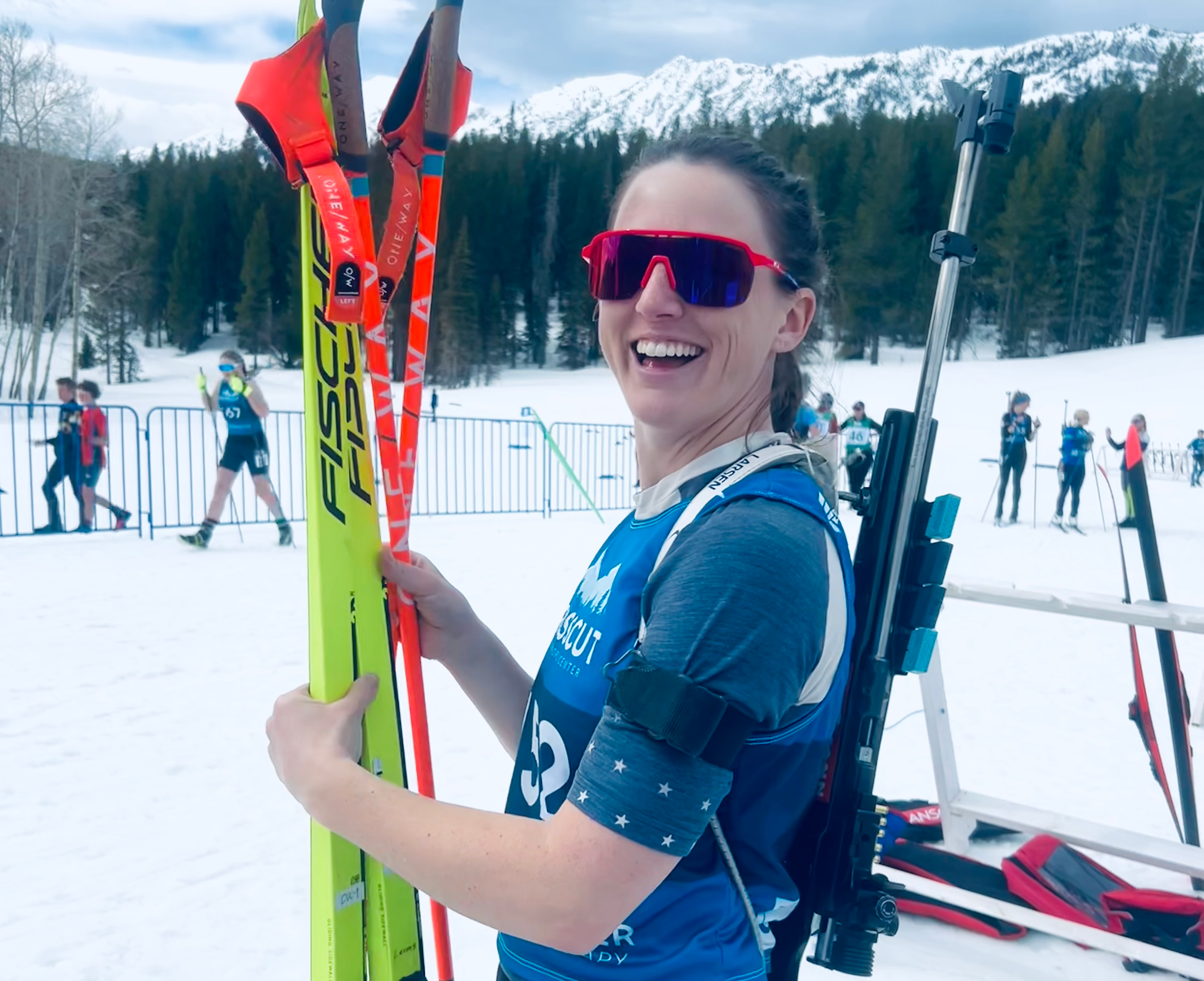
    Keely Levins ready to go at US Biathlon Nationals.

    We headed out. I gave the penalty loop a leery glance, knowing I’d be seeing it the next day.

    Chloe said, catching me staring, “The skiers coming out have the right of way.”

    I thought about my future self skiing around and around in shame as my family and friends watched the livestream from the East Coast. I sure do know how to pick a vacation.

    It was classic springtime skiing in the West. Firm and fast in the morning, and slowly breaking down into sugar as the sun beat on it. I couldn’t help but smile as I gulped in air on the climbs. The sun and altitude brought me back to being a teenager, racing in Junior Nationals out west. I hoped I could find some inspiration in the memory of once being in shape.

    We ran into biathletes from Chloe’s world and explained what I was doing on trail, not on the sidelines.

    “I think I’m going to ask if they’ll let her shoot on all standing targets,” Chloe said to one.

    “No way! I came all the way out here. I’m doing it,” I retorted, knowing that standing targets were definitely more appropriate for my current skill level, or lack thereof.
    “I love this, you’re just going to send it,” one said.

    And send it, I did.

    The morning of the race, I got to the venue far before my fellow Masters B competitors. Chloe was my ride, and the real races happened first. I ventured up into the course, finding a spot where I could run from a major climb to a perch that looked over the range. I hollered at the top of my lungs as my little sister won her first National Championship.

    I ate a bar, slurped a Gu I found in my backpack, nervously peed for what felt like the 58th time, and went to get my rifle checked. And by my rifle, I mean Chloe’s rifle. I was also wearing her sunglasses, her shirt, using her skis, and her poles. I had my own boots, but they were brand new. I’d had to order NNN boots to be able to use Chloe’s skis; I’ve been skiing on my SNS college gear.

    Chloe stood behind the scope, zeroing for me.

    “Ok, try again!” She chirped. That meant I’d shot all over the paper. I hadn’t even shot well enough to create a group that we could zero from. Awesome.

    My next five shots made a better group, so she said. She moved my sight a couple clicks for me. Or, she’d lied and pretended I’d shot a nice group, trying to boost my confidence. Either was fine by me.

    I skied out on the warmup loop, considered doing pickups, did one and thought better of doing any more. I stopped by the potties for the 59th time.

    The nerves and altitude combined for a queasy lightheadedness as I stood in the starting area. Chloe was giving me some last-minute tips; I could barely hear her. Why was I doing this? Why did I think I could do this? Am I going to throw up? I might throw up. I came out of my fog to hear her say:

    “And if anything goes wrong with the rifle, raise your hand and a marshal will come over and help you,” she said.

    She wished me luck and I was alone to toe the line. And do a biathlon race for some reason that I could no longer remember.

    The timer counted down, the sharpness of adrenaline felt familiar. Maybe this would be fun.

    During the first climb, I felt the rush of lactic acid flood my legs. Which was unfortunate, because the first climb was about 200 meters into the race. Control yourself.

    You take a more conservative approach in biathlon, to make sure your legs aren’t quaking while you’re trying to shoot, and that your mind is functional as you enter the range, not lost somewhere in the deep recesses of the pain cave. Despite my best efforts as a young skier, my race strategy usually boiled down to: Go out hard and hold on. This would not serve me well in biathlon, nor at altitude. I tried to ski smooth, in control, and felt better than I thought I should.

    I came into the range and tapered, lifted my sunglasses to let my eyes adjust to the bright sun, and took deep, intentional breaths. I dropped to my knees on the shooting mat, bruised from yesterday’s practice. Unshouldered the rifle, popped in a clip, laid down, hooked the rifle’s sling to my cuff, looked into my rear sight, and saw no targets. Just a gray, hazy blur.

    What?

    My mind raced. Was I so out of shape that I couldn’t see clearly? That was certainly possible. I picked my head up and looked around. Nope, my eyes worked. I looked through the rifle again. Blurry still.

    What is happening?

    Precious time was ticking by. I was lying down, but it felt like my heart rate was increasing.

    I should’ve left the range by now.

    I pulled my head up again and looked down the length of the barrel. I’d left the snow covers open while skiing, but I hadn’t fallen. There shouldn’t be snow anywhere. I couldn’t see any.

    A marshall. I could call a marshal. I raised my hand, popped the clip out, and the marshall looked at my rifle.

    “Something’s wrong, I can’t see the targets, it’s so blurry,” I blurted out. My body was itching. I needed to get back on the course and ski.

    “I don’t see any,” he said. But he blew a hard breath on the sight, and handed it back to me.

    I got back in position.

    Targets!
    I could see.

    I shot quickly, frustrated, was jerky with my trigger finger, and sadly not at all surprised when I left the range having only hit one.

    So much wasted time. And now more to be wasted in the penalty loop.

    Around and around I went. The course was slow, but the penalty loop was harder. Sitting in full sun, getting a lot of traffic, it was thick sugar I was fighting to push through. When you’re skiing that many laps around a penalty loop, I found, your mind starts to play tricks on you. Is this my second? Or third? I started chanting the number lap in my head as I skied. The last thing I needed was a time penalty added on for skiing the wrong number of loops. I’d penalized myself enough at the range already.

    Leaving the penalty loop, finally, I didn’t care much for race strategy anymore. My fury at that fleck of snow and how quickly I’d let it unravel my prone stage fueled my next lap.

    Chloe was cheering on the biggest climb, “Was the bolt stuck?”

    “Snow in the sight!” I grunted as I climbed.

    “The leader is only 30 seconds up on you, go get her!”

    Why was I getting splits in a Master’s B – not even the Master’s A – race? Why was I loving it?

    I leaned into the hill and pushed over the top of it.

    I came into the range once again and set up to shoot standing. I watched the sight dance around the targets. I tried to take deeper, slower breaths, anything to make everything feel steadier. Target, pull trigger, miss. No problem. I wasn’t going to clean. The next target came into view and I pulled again. Miss. Ok, next target. Miss. No! This one, I’ve got. Two breaths and pull, miss. I will not leave this range with no hits. I closed my eyes, filled my lungs with air, let it out, and opened my eyes. I hooked my elbow hard into my hip, adding to my bruises. I pulled the butt of the rifle into my right shoulder and waited for the target to show up in my sight.

    Hit.

    You’d have thought I was the one who’d just won Nationals.

    The joy was short-lived, as the penalty loop I’d gotten to know so well was waiting for me again. I got through my laps and took to the course. I passed some people, and was quickly humbled by the juniors who appeared to be floating atop the corn. My legs had little left, the same went for my lungs, as I crossed the finish line.

    Recovered, I collected my second-place chocolates.

    “If you didn’t have that sight issue, you would’ve won it,” Chloe said as we piled into our Wrangler, the perfect rental car for the week.

    “I know,” I said.

    “That’s biathlon,” she said. “It’s unpredictable, that’s part of what makes it so addicting.”

    We turned up the music, rolled down the windows, and drove down the mountain.

    That night when I went to bed, I felt… altitude sickness. But I also felt a bit of pride for putting myself on the line, and invigorated from having a day so different from so many others. I got on a plane back to reality the next morning. Vacation was over.

    It’s always fun to get on the podium!


  • Make the Sovereign 2 SilverStar Ski Marathon a Goal Event and Season Finale for 2025

    Make the Sovereign 2 SilverStar Ski Marathon a Goal Event and Season Finale for 2025

    In its first three years, the Sovereign 2 SilverStar (S2S) niche is becoming clear. Participants say it’s an awesome goal event for all types of skiers and a terrific event to conclude and celebrate the ski season. Here’s what else they say about the S2S and what brings them back each year:

    • Awesome late season snow and grooming
    • Extremely friendly and helpful volunteers
    • The focus on Finishing is Winning
    • A very fun and social atmosphere; great to enjoy with family, friends, ski groups, and others
    • A Point-to-Party event at world-class venues; start in the stadium at Sovereign Lake Nordic Club and finish in the village at SilverStar Mountain Resort
    • Club championships, with a fun winning formula, and prizes for 1st, 2nd and 3rd place
    • And more!
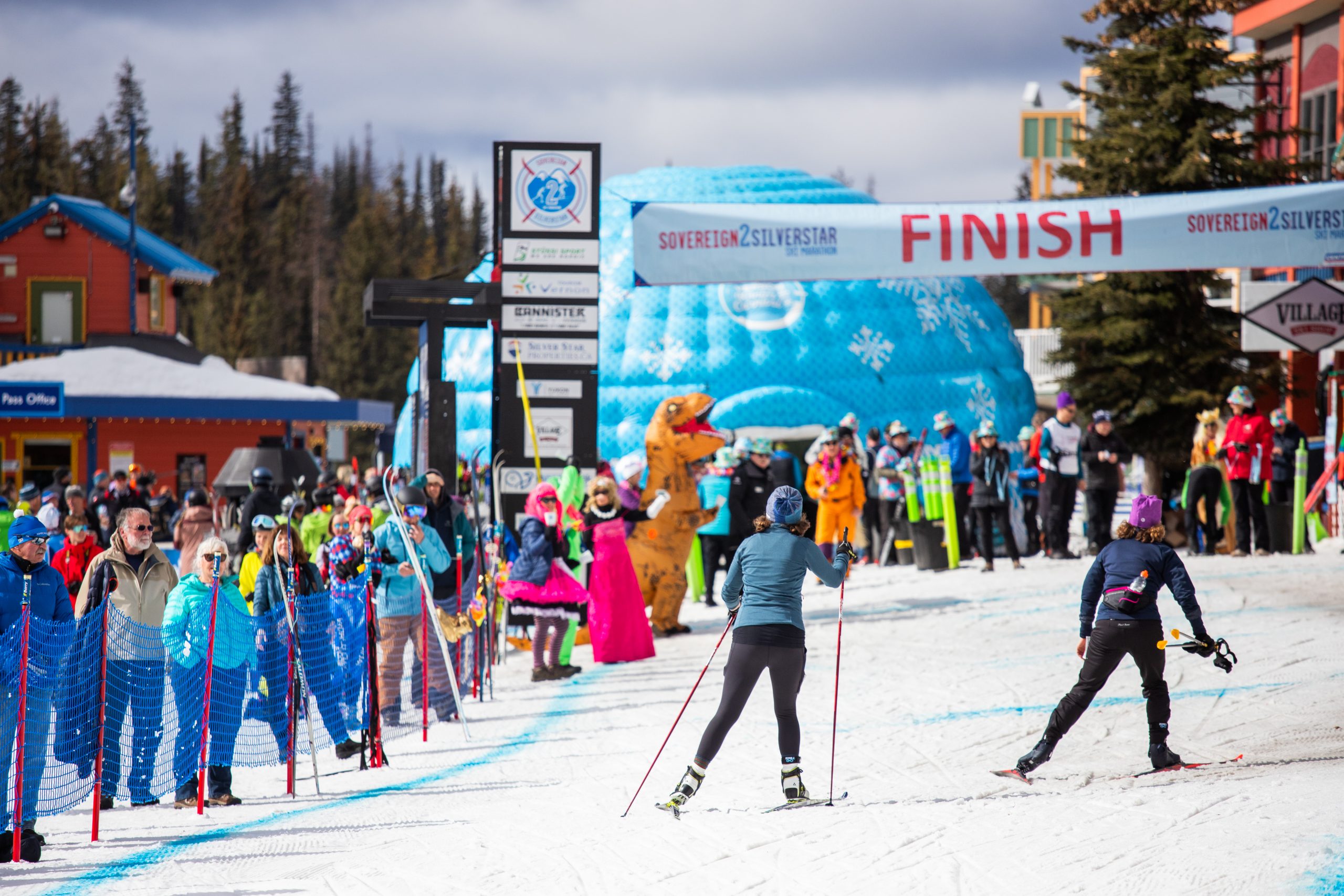
    Sovereign2Silverstar Ski Marathon 2024

    At the S2S, social and savings go together. Learn about incentives for groups of 10 or more by emailing info@sovereign2silverstar.com. There are also discounts for accommodations in SilverStar Village; the spot to be for the event and to Stay & Play for springtime in the Okanagan valley.

    For those who like a little extra challenge and fun, consider participating in the Pacific Northwest Loppet Series, which includes the S2S as the final event. The Series is entering its third year and added two more events for 2025. All events are for those who like to go the distance; from 20-50km! The events are well-spaced from January through April, and held in picturesque locations. Skiers of all ages are part of the same friendly competition (yes, there is such a thing!). The point system is based on a unique blend of participation and competition. Here is the event line-up for 2025 (Note: SIX events, with EIGHT races, since two are double-headers):

    NEW! Reino Keski Salmi Loppet

    January 18, 2025. 34km classic. Salmon Arm, British Columbia.


    Nipika Panorama Loppet Weekend

    January 25-26, 2025. 30km Classic + 20km Free. Invermere, British Columbia.


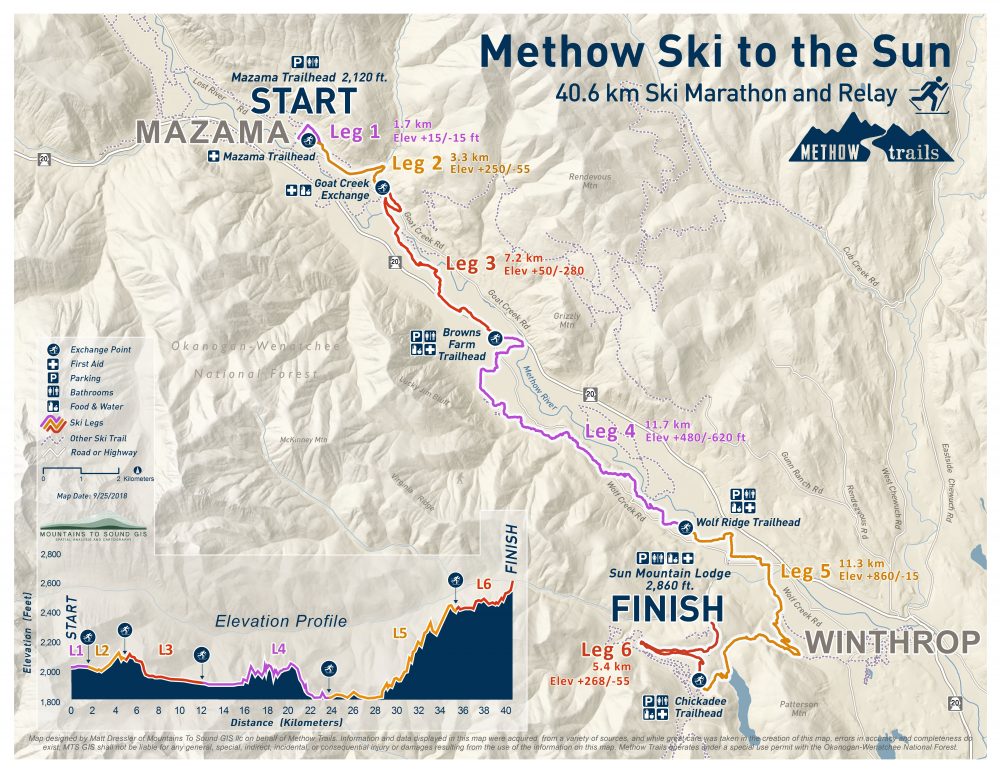
    All smiles in a sunny Methow during the Ski to the Sun. (Photo: Steve Mitchell/mitchellimage.com)

    Ski to the Sun

    February 8, 2025. 40km Free. Methow Valley, Mazama, Washington.


    Coast Outdoors P’ayakentsut (Payak)

    February 22, 2025. 50km Free. Whistler Olympic Park, Whistler, British Columbia.

    NEW! Yukon Ski Marathon

    March 8, 2025. 44km Free. Whitehorse, Yukon Territory.

    Sovereign2Silverstar Ski Marathon 2024

    Sovereign 2 SilverStar Ski Marathon

    April 5-6, 2025. 40km Classic + 40km Free. Vernon, British Columbia.


    With the two S2S races as the Series finale, participants are usually battling out their positions on the leaderboard right down to the final day; adding to the fun and interest!  Awards for the top three males and top three females in the Series are presented at the S2S. All participants are awarded with a fun and festive atmosphere, and a sense of community with others who share their passions for Nordic skiing, outdoor activity, healthy living, and more!

    To register for the S2S or learn more about the S2S and the Pacific Northwest Loppet Series, visit: www.sovereign2silverstar.com

    Sovereign2Silverstar Ski Marathon 2024
  • “Like Riding a Bicycle”: American Birkebeiner’s Popp to Push Worldloppet Forward

    “Like Riding a Bicycle”: American Birkebeiner’s Popp to Push Worldloppet Forward

    “If you’re not pedaling, you’re going to fall over.”


    Last month, the American Birkebeiner Ski Foundation sprang into registrants’ inboxes with a summer announcement: Ben Popp, Wisconsin native and ABSF Executive Director since 2013, had been elected President of the Worldloppet International Ski Federation. Replacing Finland’s Juho Viljamaa, Popp will serve a four year term, effective immediately.

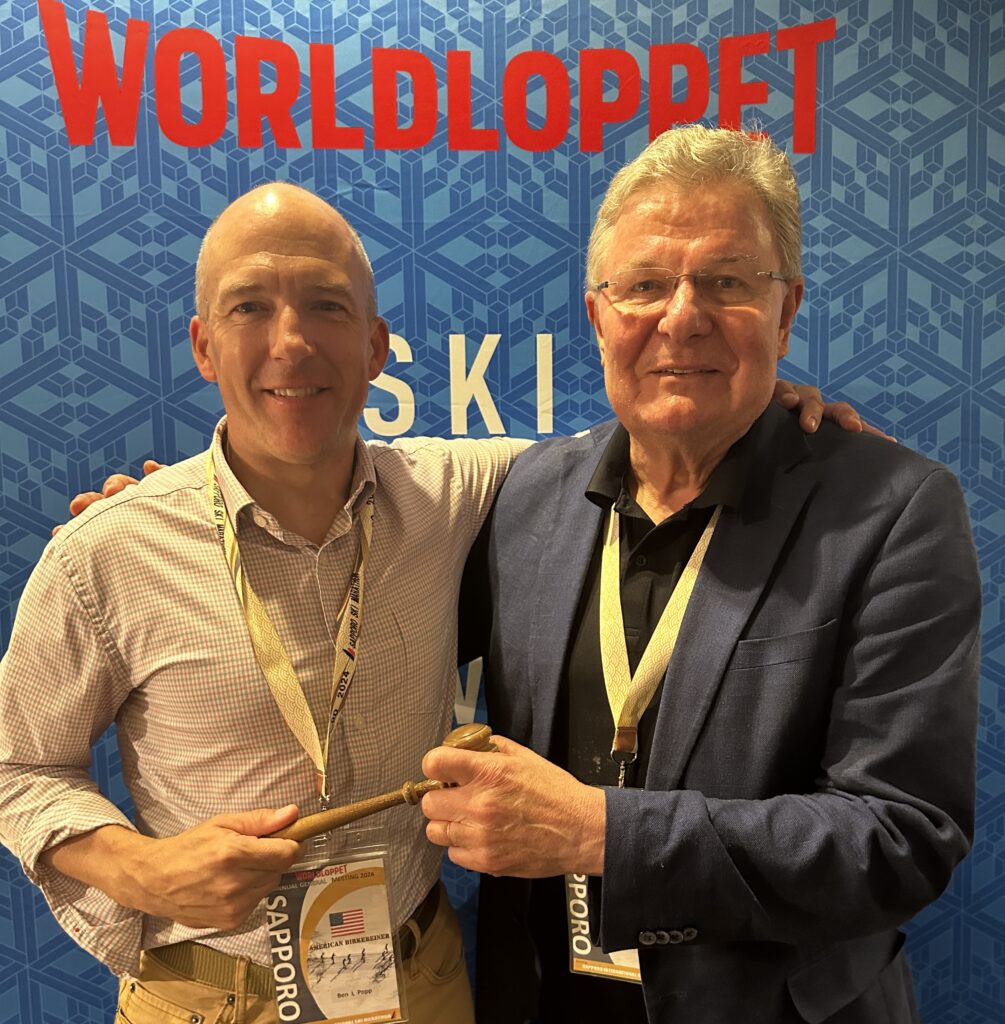
    He already has the regalia to prove it. The Federation’s gavel, a relic of the Tony Wise Era, has taken a circuitous path through Central and Northern Europe—but Popp’s election returns that artifact, and the Presidency, to the site of the Worldloppet’s establishment some five decades ago. “It’s literally inscribed: ‘Telemark Lodge, Wisconsin USA, Feb. 23 1978,’” Popp tells me.

    To any skier who has made the trek from Cable to Hayward in the last eleven years, Popp cuts a familiar figure. Energetic, upbeat, and faster-paced than a sprint finish, he’s become a fixture of all things Birkebeiner—churning out trail-grooming update videos, fundraising initiatives, and ambitious projects ranging from a revitalization of the once-derelict Telemark Property to the Team Birkie, the Midwest’s professional racing team. Moreover, he’s brought the event safe to shore through three great calamities: the Canceled Birkie (politely remembered as “BirkieFest”; 2017), the Covid Birkie (2021), and the Manmade Miracle Birkie (2024).

    It therefore comes as no surprise that Popp has assumed the Worldloppet Presidency with characteristic vigor—and lofty goals. FasterSkier spoke with Popp to discuss what they are, and how he plans to achieve them.

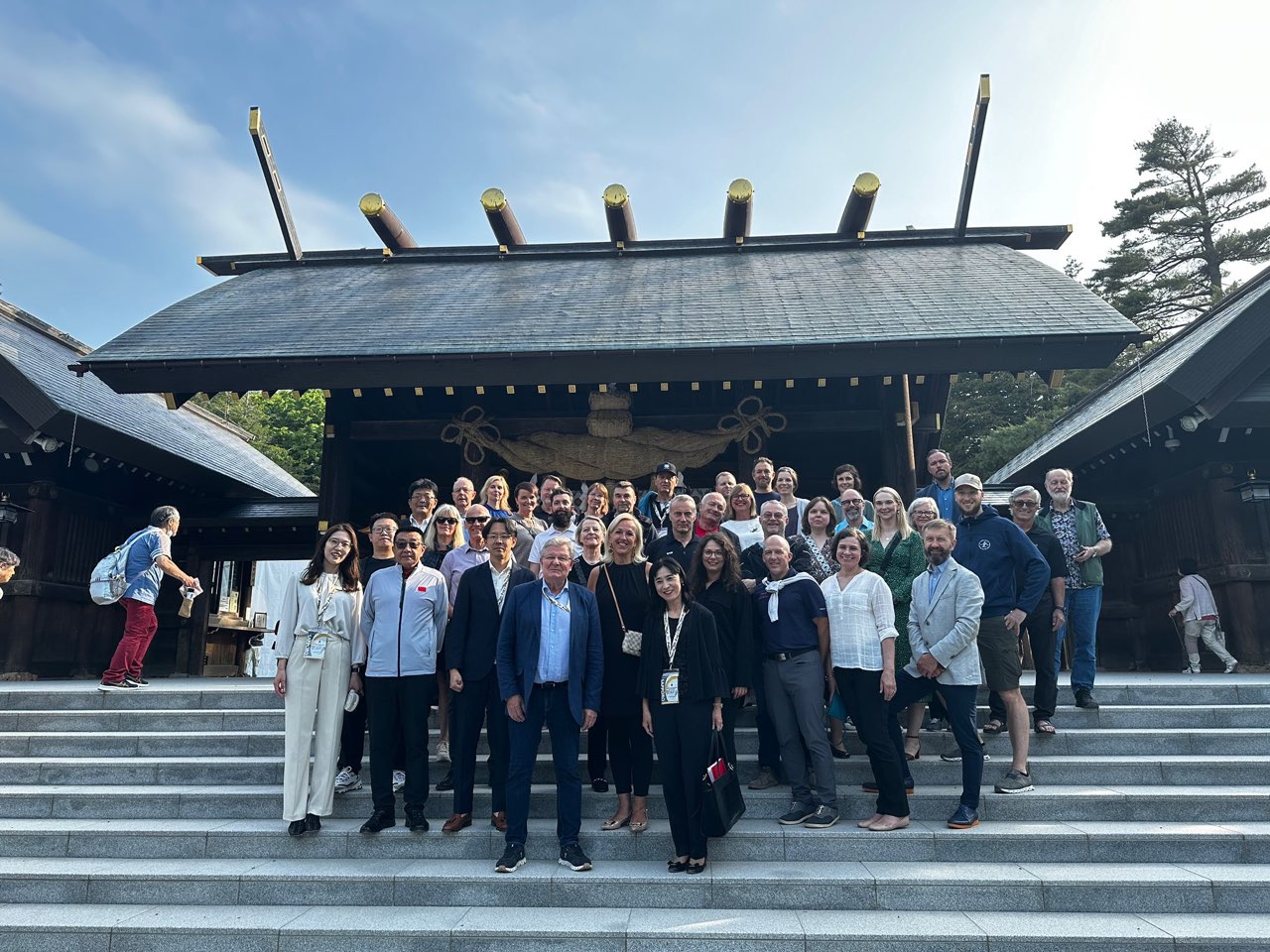
    Worldloppet delegates in Sapporo, Japan. (Photo: Ben Popp)

    “What skiers needed back in 1978 is very different from what we need right now.”


    Despite “representing popular skiing around the world,” the Worldloppet is a small operation, with two full-time employees headquartered in Tartu, Estonia. As Popp describes it, their efforts to coordinate ten events across five continents are “Herculean.” Countries tend to concentrate on their own ski federations, and on their respective flagship races. “It’s hard for them to focus” on the collaborative, international mission of the Worldloppet.

    That’s where Popp sees himself differing from presidents past. When it comes to filling the Worldloppet’s two primary goals—providing support for member nations as they host “pre-eminent events,” and providing support for the more than 130,000 skiers who tackle Worldloppet races each year—the organization has gotten “really good at doing the same things over the years, and doing them really well,” like the Worldloppet Passport.

    But Popp recognizes that “what skiers needed back in 1978 is very different from what we need right now.” It seems he views the Worldloppet of the past as catering to those already enamored with the sport and its signature marathons. The Worldloppet of the future can do more to expand the range and reach of popular skiing—even if that requires a course correction. “I know change can be really hard,” Popp says, “But believe it or not, I think the Worldloppet and global, popular skiing can be even bigger than FIS. Instead of focusing on getting a young skier from the U.S. to travel to Japan, we should be asking, ‘How can Japan engage its own young skiers?’”

    Popp’s electors seem to agree: In fact, the Scandinavian delegations nominated Popp because of the athletic inroads he’s paved with the ABSF. “The Scandinavians know that the United States is seeing skiing grow in leaps and bounds, from the success of Jessie Diggins to almost 15,000 skiers at the Birkie. They know something’s going on here. They asked me, ‘Can you take it to the world?’”


    An “absolute recipe for growth.”


    What is Popp’s plan for growing cross-country skiing—for engaging new skiers at Worldloppet events?

    In his own words, it’s a page from the NFL’s playbook: To get incoming athletes excited, “We need to marry skiing’s role models to everyday skiers. This is what the NFL does; it’s how they sell out stadiums every Sunday”—connecting the sport’s elite to their fans. The stars of the FIS World Cup are, currently, “just not part of what we think of as popular skiing.” Popp wants to change that—and wants the Worldloppet to take the lead “plugging in” Crystal Globe-chasers to the marathoning masses. “We can negotiate and create connections. We can get these role models to our races.”

    He cites the Birkie’s recent collaboration with Jessie Diggins and Gus Schumacher (its 2024 champions) as proof of concept. The median age of a Birkie skier has fallen from 47 to 43.7, and young athletes are increasingly participating in ABSF events for a chance to meet these avatars of America’s Nordic ambitions. At this year’s Birkie Bash, an annual pre-race fundraising dinner, “half the room was kids, 18 or younger—they were there to see Jessie and Gus!” With the encouragement of the Worldloppet, the same could be true of New Zealand’s Merino Muster or Australia’s Kangaroo Hoppet (which Diggins has won multiple times): Popp sees more summer-training elites competing in these Southern Hemisphere marathons as a clear way to build enthusiasm in host nations.

    Popp has his eyes on names from beyond the U.S. Ski Team as well. “I was talking with Haakon Klæbo last week, discussing how we can bring [Johannes Høsflot] Klæbo more into popular skiing.” Having charmed crowds of adoring young fans from Park City to Minneapolis, it should come as no surprise that the Norwegian phenom “wants to be engaged. He wants to be a role model and to bring more people into the sport.”

    This involvement could go beyond racing Worldloppet events when the World Cup schedule permits, to incorporating these events into the World Cup itself. It’s happened twice before (La Transjurassienne in 2000 and the Birkebeinerrennet in 2002). Popp’s American Birkebeiner floated a bid for the 2024 World Cup schedule immediately after Minneapolis, with Main Street sprints on Wednesday and the Birkie itself on Saturday. A price tag pushing $3 million thwarted that effort, but Popp sees elites and popular skiers, tackling the same races, as the key to the longevity and financial viability of both worlds. “It’s a proven model. Look at the New York Marathon, the Boston Marathon. Who doesn’t want to run those—they’re iconic races, and you’re on the same course, the same starting line, as the best athletes in the sport. There will be concessions on both sides, and it will take some creativity,” but “if we can marry the popular consumers of skiing with the elite, it’s an absolute recipe for growth.”

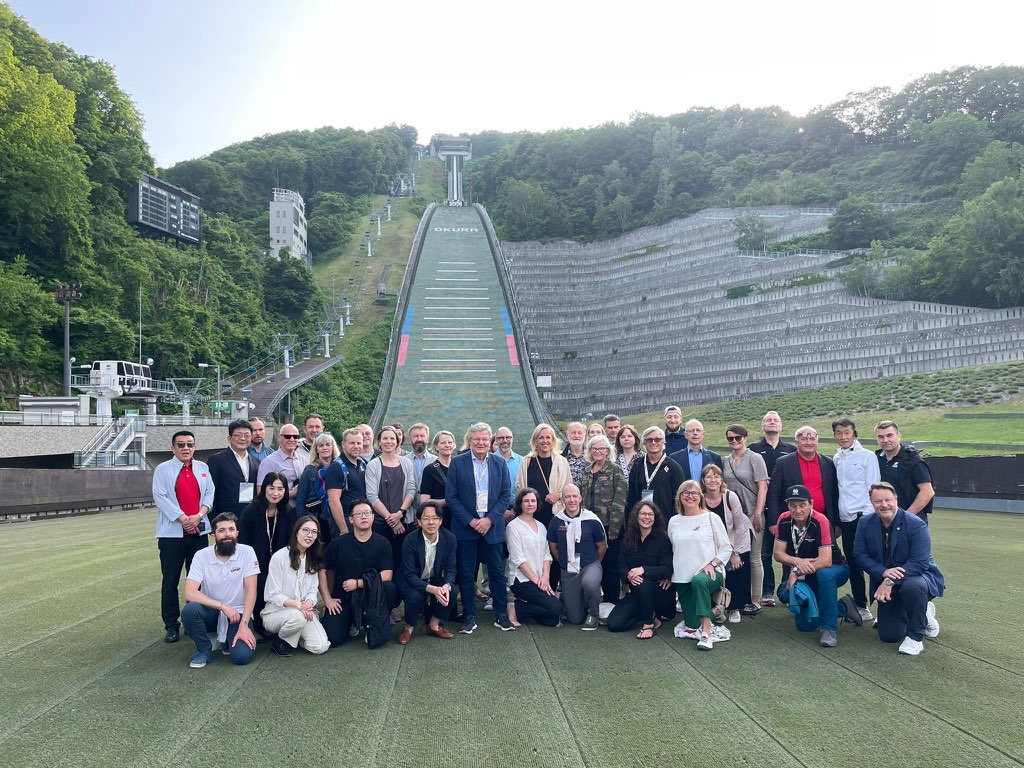
    Worldloppet delegates at Sapporo’s Ōkurayama Ski Jump Stadium. (Photo: Ben Popp)

    Sustainability and support from “the hub of the wheel.”


    Popp’s new direction for the Worldloppet goes beyond his hopes of exciting wider audiences. He sees the organization facilitating resource and knowledge-sharing between world-class events that have, thus far, largely remained “in our own unique silos. We’ve all learned through trial and error. But we haven’t necessarily come together as a group.” A unified timing and registration system, for example, has seemed like a phantasmic “pipe dream on paper,” but each race is “spending an enormous amount of money on data collection, registration, and data storage.” In addition to reducing costs, the data could be leveraged to secure event sponsors. While the Worldloppet cannot be “the whole wheel,” it can be “the hub of the wheel”—a central source of direction, activity, and coordination around which individual races organize, and around which skiers structure broader cultural experiences.

    Snowmaking is another prime example. This year’s “Miracle Birkie” took place on 10k of man-made snow; the 2024 China Vasaloppet was on 25k, hand-moved to the course. Fed by the guns of eight local alpine resorts and maneuvered into place by the Italian National Guard, the Marcialonga has been almost entirely on man-made snow for the last decade. Other events may not have that infrastructure—but they’ve developed their own strategies for coping with low snow that the Worldloppet can help systematize. Trails can be manicured in the off-season to maximize their ski-ability, even with minimal coverage; Norway and Switzerland have perfected long-term snow-storage with cement basins, drains, and coverings. Each nation’s Worldloppet race “wants to put on an amazing experience. That means we have to be the best at what we do,” even in a warming climate.

    It’s with respect to climate that Popp also sees a distinct role for the Worldloppet. This is despite his recognition that there’s pronounced tension between the organization’s globetrotting ethos and any desire for more sustainable practices. Reusable gear bags—of which the ABSF has sold over 20,000 since 2017—could be one avenue for promoting conservation. So could carbon offsets, or broader opportunities for group travel to race events, including through partnerships with independent, curated trip coordinators. But the goal, Popp says, is to transform every Worldloppet skier into “an advocate, and to get them to get others to be advocates” for “green futures.” Telling the story of the reusable bag, or of a mass-transit journey to the start line, can create a network of climate-conscious athletes. While there’s “a long tail on that horse, we have to start somewhere,” Popp says. “We can’t get paralyzed with ‘what-ifs.’ We’ll get nowhere.”

    Popp with the Canadian and New Zealander Worldloppet delegations in Sapporo, Japan. (Photo: Ben Popp)

    Pedaling ahead.


    Reflecting on his 11 years at the head of the American Birkebeiner, Popp is approaching his four-year presidency with an ambitious vision for the Worldloppet. “The Birkie has an amazing, storied history, and it’s been super successful.” But directing one of skiing’s signature marathons—let alone an international federation of such events—is “like riding a bicycle. If you’re not pedaling forward, you’re going to fall over. The challenge is to remain relevant.” What the Worldloppet “has been doing is awesome, and we have a lot of people that love skiing,” but the organization needs to “take a critical look and better evaluate whether we are doing the things that allow us to grow.” This will require closer dialogue with athletes, engagement with elite skiers, and coordination of FIS’ Popular Skiing Subcommittee, where Worldloppet representatives occupy a “huge majority” of the 20 seats. Popp expects a “day-to-day challenge.” But, “I think it’s worth the time and effort because we can have a real impact on global skiing.”


    Ben Popp will continue to serve as Executive Director of the American Birkebeiner Ski Foundation. FasterSkier thanks Popp for taking the time to speak with us about his new role at the Worldloppet International Ski Federation.


  • Letters to My Younger Self: Murray Banks on Embracing Opportunity and Living Life to the Fullest

    Letters to My Younger Self: Murray Banks on Embracing Opportunity and Living Life to the Fullest

    Editor’s note: This is the third essay in our series, “Letters to my younger self.” Lauren Fleshman provided the modern locus classicus for this genre, while John Wood and Adam Verrier kick-started the series on FasterSkier. 

    When the private school at which my husband teaches offered him a sabbatical for the 2020-21 school year, we quickly began to fantasize about the ski town(s) in which we’d spend the following winter. A February 2020 trip to the Alley Loop Marathon had me captivated by the tiny high-altitude town of Crested Butte, which, despite being roughly 40 miles from our home in Carbondale as the crow flies, is over four hours by car in the winter, over 2,000’ higher in elevation, and has a truly magical community surrounding its nordic center. It’s pure paradise for cross country skiing.

    We lucked into a rental on Craigslist in mid-February, only a few weeks before the pandemic descended on the US and made such rentals (and prices) impossible to find as a mass exodus from cities began for those who were suddenly able to work from anywhere in the world. We also lucked into jobs at the Crested Butte Nordic Center, myself coaching in the masters programs and instructing private lessons, and my husband coaching the youth programs. 

    It was in the masters performance group that I had the chance to work alongside Murray Banks, whose reputation as a one-of-a-kind, enthusiastic, high-energy coach with a keen eye for technique preceded him. 

    The masked-up smurfs behind the 2020-2021 masters performance group in Crested Butte, CO. From left to right, Rachel Bachman Perkins, Murray Banks, Cam Smith, Woody Martineau.

    Coaching with Murray was an unforgettable experience. His energy and positivity are the right kind of infectious – the type that makes you want to be a better version of yourself, overall. The kind that leaves you wanting to ski better, try harder, be kinder, and recognize that attitude is everything, even when life throws you some massive curveballs. 

    You’d never know that Murray was fighting cancer. Even on the days where most would throw in the towel, Murray would slip into his ski boots and make his way to practice. On days he wasn’t feeling well, he’d ski more slowly and keep the distance traveled to a minimum, but that didn’t prevent him from showing up with an ever-present grin, ready to encourage the group of skiers through technique cues and an interval session. 

    Though we only worked together for a few months, his impact was lasting. It is my pleasure to share the following letter Murray penned to his younger self. 

    March, 2015

    Hey Murray,

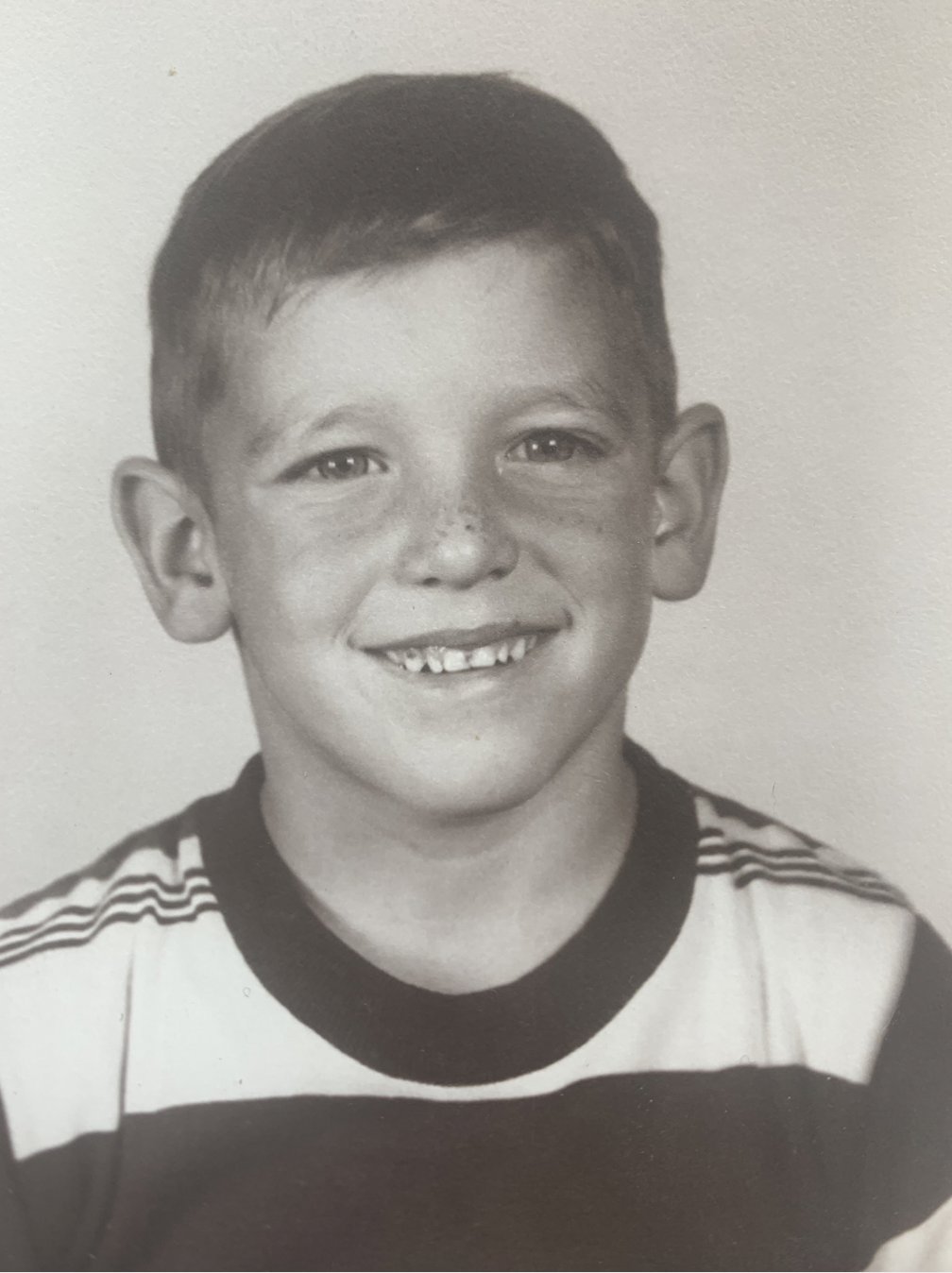
    Wow, you look so young! Oh yeah, you’re only 6. Have you got freckles? I don’t remember having freckles. Anyway, this is a bit unusual but a friend here in 2015 asked if I’d write you a letter with a few observations and perhaps a tip or two. Have a seat, this will be long as there has been a lot of water under the bridge over the past 68 years. I’m surprised you are reading this, you’re usually out in the neighborhood playing endless tag games with your friends. Did you have a hockey rink in the yard this past winter? Oops, gotta run, headed out to ski with my/your granddaughter Winter who is actually 6 just like you!

    A young Murray Banks. (Courtesy photo)

    March 2022

    Sorry about that, I started this 7 years ago but got busy. That’s probably good though as you will have a better handle on some of the insights I’ll be sharing with you now that you are 13. OK, here in 2022 you are 75 years old. Hard to believe that you will be as old as your great gramma is now.

    As you are learning, yours is an athletic family and we play almost every sport imaginable. And when we’re not playing an official sport, we are riding our bikes, competing in a tenacious whiffle ball game or playing capture the Flag ’til way after dark. Playing sports is our family thing and you are doing them all… baseball, basketball, football and hockey. It is a perfect childhood so I hate to do tell you this, but you will hold your own in sports until high school, then everyone else will grow and you won’t. Hey, it’s ok, you were born in late October and everyone is way older than you. 

    First, the bad news: you aren’t going to continue to be a star baseball player like you are now. And you aren’t going to make it in basketball either. And the football coach will say to you “Banks, you’re a tough kid but I can only use you when it’s 3rd down and 3 miles to go. You should run cross country.” I don’t think you even know what cross country is! 

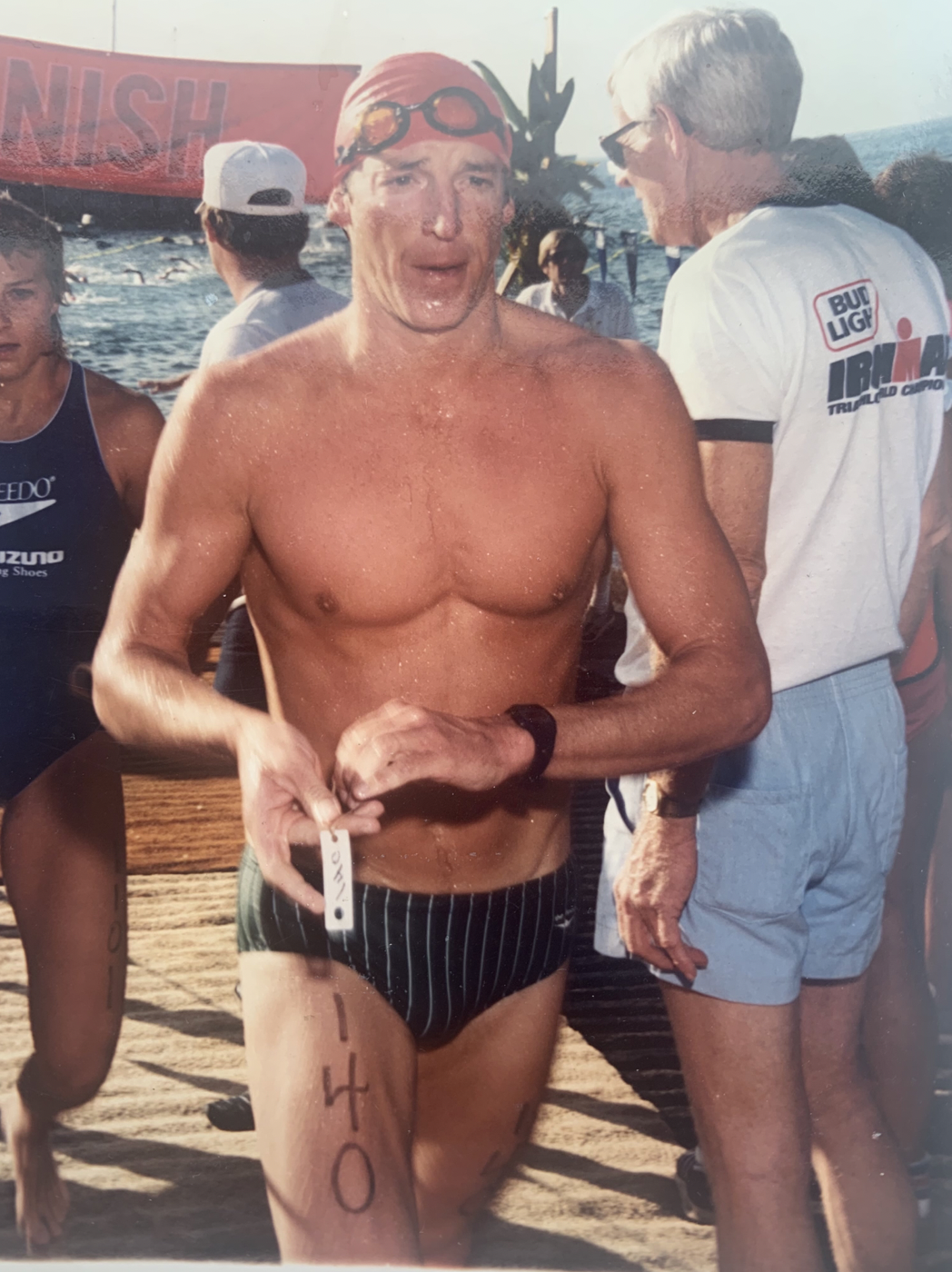
    But, here’s the good news: you’re going to love running and you will become quite good at it in a few years. One more thing, don’t fret about maturing late… when you are in your 40’s and racing triathlons, you’ll go to your 25th class reunion, look around and wonder who all those old people are. Triathlon, bet you don’t even know what that sport is. It’s a cool sport that involves three events you already love and will be invented when you are in your 30’s, more about that later.

    Murray Banks joins the cross country team at Cortland State in Upstate New York. (Courtesy photo)

    In a few years, you will have to decide on a college — well, if you put a bit more focus on your school work, you will. You will get lucky and choose a school and major that you love and be on championship teams with great guys and coaches. One day while walking to class, a professor with national prominence for his teaching and coaching, will stop you and say, “Ya know Banks, you’re tougher than hell and someday all your training and determination will pay off big time. Keep up the good work.” 

    That interaction may only last 60 seconds but the eventual benefit will last 60 years. This is important, pay careful attention to older, wiser people you admire and respect. 

    They see things you can’t possibly see at your youthful, exuberant age. They have perspective that will benefit you in ways you can’t imagine now. Oh, and one more thing about college… you’re going to meet a very special girl on your track team. She’s a sprinter, she’s smart and she’s really attractive. If you don’t mess this up, she will become your lifelong love and training buddy.

    With a bachelors degree in hand, you will embark on a teaching and coaching career that will earn you several honors and great satisfaction… slow down and soak it all in. Now this will be hard to fathom, but getting cut from baseball, basketball and football will come in very handy in a few years. As a high school running coach, you will seek out athletes who were rejected from other sports and turn them into championship caliber runners. The energy and imagination that often got you in trouble in school, will produce unique results in your teaching, coaching and racing career — hard to imagine isn’t it? Your struggles academically won’t last, just remember what Einstein said, “Imagination is more important than intelligence.”

    “When you coach kids, you lose 40 years off your chronological age.” – Murray Banks (Photo: Xavier Fane / Crested Butte Nordic)

    Now, back to that girl you will meet in college… she is a sprinter and you are a distance runner, that’s how she catches you, you just weren’t fast enough! But, she will become quite an accomplished endurance athlete and the two of you will enjoy years of racing all over the world. And it will be in two sports you aren’t even aware of now: triathlon and cross country skiing. And, as a bonus, when you marry her you will get an island! Yup, your teaching careers will enable you to spend summers on the family island and you can swim, bike & run a lot and become quite proficient at that triathlon sport. Actually, so proficient that you will both race in the world championship and people will pay you to do it. Really, honest, not kidding, this will be your job for a few years, you lucky guy! 

    Murray Banks and his wife prepare for Ironman Hawaii, 1988. (Courtesy photo)

    Although you will absolutely love teaching, you will have an opportunity to take time off to be a full time athlete. And your 8th grade teacher Mrs Bentley, who will say to you “You’ll never make anything of yourself just playing sports, Mr Banks!” Well, turns out she was wrong, but probably best if you don’t say anything to her. 

    Instead, you will create a niche as a speaker and corporate trainer that provides the time to train and race nearly full time. It’s an occupation that resembles training and racing in every way… you prepare thoroughly for long periods of time; you need to be focused and goal oriented; you work intensely hard for short periods of time, followed by longer periods of recovery; and, when it’s time to race or deliver a presentation, you really need to be on your game, there is no room for mediocrity. Any time your work, recreation and passions intersect, you have the best of all worlds and so many good things arise. So, younger Murray, keep all options in your life open, there is no predicting what opportunities will present themselves.

    Ironman Hawaii, 1983. (Courtesy photo)

    But, I digress. Training for triathlons during long, cold Vermont winters was a challenge so you know what comes next? Cross country skiing. 

    For several years, skiing will just be winter fitness for triathlons but eventually, skiing will became your favorite family activity. You and Janie will eventually have two rambunctious boys who love to play outside day and night, just like you! They will play all the usual sports but will eventually get into ski racing and soon you will be going to races to cheer for them rather than the other way around. 
    Team Banks at a community fun run in Vermont. (Courtesy photo)

    So finally, cross country skiing… get this, skiing downhill is way more fun than running down hill! And, while triathlon training can be tedious, arduous and exhausting, skiing is generally fun and challenging. So, you will retire from triathlons and spend most of your athletic energy training for and racing in cross country skiing and have the opportunity to race in cool places like Norway, Austria and Italy.

    Masters World Championship, Asiago, Italy, 2014

    You and that sprinter girl will both win gold medals at various masters world championships and you will meet people from those countries that will become lifelong friends. And, you will find that folks in their 50’s and 60’s who continue to ski race are really an energetic and positive group of people to hang out with.

    And those boys you and the sprinter girl so enjoyed skiing with when they were kids…they took that joy for snow and mountains and parlayed it into careers as international mountain guides. And the best part? You will get to ski big peaks all over the world with them, which it sure beats playing basketball and baseball!

    Troll Peninsula, Iceland, 2017. (Courtesy photo)

    This all sounds a little too good to be true doesn’t it? Well, as you have probably guessed, it is. At the very pinnacle of your personal, athletic and professional success, life will throw you a curveball… cancer. 

    Now, at your young age, you may not understand what cancer is, so I’ll break it down a bit for you. Cancer is an insidious disease that eats at you over time and saps the energy and strength that have been hallmarks of your life. In your case, you will endure surgeries, radiation treatments and a bevy of drugs that will end your racing career. You will need every ounce of patience, optimism and tenacity that you’ve spent a lifetime developing through sports. 

    It will be the greatest test of endurance that you have experienced in your lifetime. But, there is an interesting cancer/ski racing analogy, bear with me on this. Imagine, you are in a 50km classic ski marathon, with temps at freezing and a damp, cold wind that makes the track indiscernible and waxing impossible.

    The track is poorly marked and you are never 100% sure if you are on course. There are no kilometer signs and the route is ambiguous. Your kick wax has failed you – one minute you are slipping and the next your are walking on snow stilts. You pass spectators and ask “is this the way?” and they respond “not sure, just keep going.” You ask others “how far to the finish?” and they respond “not sure, just keep going.” The blowing snow and poor markings obscure any semblance of direction and you press on not knowing which trail to take.

    Yup, living with an aggressive cancer is very much like a tough ski marathon… you know you have to keep going, but you have no idea how long and you can only hope the ones giving directions know the best path forward.

    2020 Covid Cancer Climb with buddies at the summit of 12,300’ Cottonwood Pass, CO. (Courtesy photo)

    But, my younger self, you are well prepared. All those years of endurance training and racing are paying off now as mental toughness, dealing with pressure, staying focused and learning to exceed your perceived limitations will carry you far longer than you might expect. Those teammates and coaches you loved will support and encourage you, just like they did decades ago. And, no matter how exhausted and frail you may feel, you will find strength and joy in doing what you’ve always done… getting outside in the sunshine to ski and bike with your friends.

    At your age here in 1959, sport is a competition that you prepare for and do your best at. You are in the moment and not thinking of the lifelong benefits. But looking back, you will see that training, competition and pushing yourself was the best possible preparation for a lifetime of great joy, professional success and personal satisfaction. But most importantly, it will give you the ability to withstand discomfort, uncertainty and challenges you did not sign up for. 

    As an endurance athlete, you developed a unique life skill set that you can cash in when you need it most; and here in 2022, you are reaping those benefits.

    Murray Banks and “the sprinter girl”, his lovely life partner, Janie. (Courtesy photo)
  • Worldloppet Race Calendar Set: A mix of Virtual and In-Person Events

    Worldloppet Race Calendar Set: A mix of Virtual and In-Person Events

    This week the Worldloppet released its official race calendar for the 2021-2022 and 2022-2023 race seasons. On the upside, for the time being, there are opportunities for in-person Worldloppet events. All this, of course, depends on the status of the pandemic in specific countries and associated travel restrictions. As many skiers know, the loppet series is global, spanning from Southern Hemisphere races in Australia, New Zealand, and Argentina, to Northern Hemisphere races in North America, across Europe, including Norway, Sweden, and Finland, and Asia.

    The old school wave from the 2021 Marcialonga. (Photo: newspaper.it/worldloppet)

    Last season, due to the closure of international borders and pandemic precautions, much of the Worldloppet series became virtual. The Worldloppet offered an official “Virtual Racing League”. Athletes participating in seven races from seven different countries earned a “Virtual Racer” title. Perhaps not as illustrious as the older school passport system for those ticking off the global race series, the virtual series kept many skiers motivated. The virtual race series will be in play for the upcoming season. The Worldloppet will release more information as it becomes available. However, many organizers able to hold in-person events also plan on doubling up and offering a virtual event for those unable to travel.

    The first Worldloppet race scheduled this year with the possibility of in-person racing for some is Australia’s Kangaroo Hoppet, on August 28. However, unless you are already down under, or travel restrictions change, traveling to the Kangaroo Hoppet from abroad looks dicey. Currently, according to Australia’s Department of Health and the Department of Home Affairs, entering Australia for non-essential activities seems nearly impossible beyond hopping over to Australia from New Zealand. The race organizers in Australia, however, are offering a virtual event. The virtual Hoppet includes several different classes and distances. Registration opens July 1st.

    It appears to be a similar situation for New Zealand’s Merino Muster: the border is open to Australians. Otherwise, entering New Zealand is difficult from abroad. (We will update this article if a virtual Merino Muster is scheduled.)

    The real Worldloppet draw remains in-person mass start racing. For now, that dream vacation to Europe or Scandinavia for a ski race might be on hold for a bit longer. Again, the situation regarding border openings and international travel, even when vaccinated, remains dynamic. Yet, the possibility for in-person racing remains. In this case, it might pay off to be patient. The Worldloppet’s calendar is loaded with potential in-person racing.

    For now, for example, a link is live for Switzerland’s Engadin, while the famed Norwegian Birkebeinerrennet set to run in March, has not opened up registration. Last year, Norway’s Birken was canceled. According to their website, skiers registered for last year’s race are auto-registered for the 2022 version.

    Lastly, the glass half full perspective brings news that Argentina’s Ushuaialoppet- Marchablanca survives the pandemic as a virtual event for this August. According to a Worldloppet press release, the race organizers in Tierra del Fuego announced a cancellation of the in-person event during the most recent Worldloppet general meeting. The press release also stated the Ushuaialoppet organizers were under financial duress due to two consecutive years of race cancellations. Several Worldloppet member organizations successfully spearheaded an effort to galvanize financial support for the Ushuaialoppet. The Ushuaialoppet is currently working on a virtual event with details to be posted at a later date.

  • An Excerpt from “Nordic Warrior? A Midlife Crisis in Biathlon”  By: Craig Wiggers

    An Excerpt from “Nordic Warrior? A Midlife Crisis in Biathlon” By: Craig Wiggers

    Craig Wiggers is a biathlete based in Ithaca, New York. Below we have a brief intro from Wiggers and an excerpt from his book, Nordic Warrior? A Midlife Crisis in Biathlon. As the title suggests, Wiggers came to skiing and biathlon midlife. His experience and anecdotes reveal a universal truth: it’s never too late to be fearless and try something new.


    ****

    My journey into Nordic biathlon as a southern raised, middle-aged, New York transplant has been exciting, funny, and memorable. This story is written for sports enthusiasts who are interested in challenges, are considering trying something new, and want to laugh. I hope my adventures (and steep learning curve) will be informative for newcomers to the sport and entertaining to those who have lived their lives growing up on skis in snow-covered landscapes. Finally, to those who might “give it a go,” know that you will be joining a community of wonderful, supportive, and generous people who love the outdoors and enjoy healthy competition.


    An Excerpt from “Nordic Warrior? A Midlife Crisis in Biathlon”

    By: Craig Wiggers


    January 2019

    The world is filled with stories of men and women who face a mid-life crisis. In a sense, I guess this is another one. But, at the same time, I don’t think my circumstance qualifies as a crisis. The reality is that I am a competitor, and, although this is written in my 49th and 50th years of living, the feelings aren’t crisis as much as they are about going after new challenges and enjoying the journey.

    As a child, I grew up in Alabama and now I’m in New York. I joined the Marines while at Auburn University (in Alabama – not New York) and was one of the lucky ones whose final assignment was teaching ROTC. My orders were to Cornell University. I was ignorantly happy about this. I was happy because the other two options were Georgia Tech and RPI. Having grown up in the south, I knew about Tech and didn’t want to live in Atlanta. RPI presented a different challenge – I couldn’t spell Rensssalleeer, so I was happy to be going to Cornell and Andy Bernard’s alma mater.

    My wife, Betsy, is also from the south.  She grew up in the small towns of Whigham, Cairo and Thomasville in Georgia. I am so thankful Betsy and I met on “The Plains” at Auburn University and although this story is primarily about me, Betsy took on the new challenges with me so this has been a team effort.

    I decided to start skiing this year.  To make things more challenging, I decided to become a Nordic biathlete. Having the background as a P.E. major and being a Marine, I began this journey with an over-inflated ego and was quickly humbled.  I needed to get in shape.  

    The last event of the 2019 season was scheduled for March 9th. This would give me 2 ½ months to prepare for my first and hopefully not my last race. I had no aspirations of medaling, no aspirations of “shooting clean,” no aspirations of skiing well. My goal was to participate.  I didn’t even know if I could ski 5 kilometers with the novice group.

    How in the world did I come up with this genius idea? About two years ago, when I was still in denial that a southerner could enjoy winter, one of my colleagues at work, Dinnie Sloman and I were chatting before a manager’s meeting in January. I asked what he had planned for the weekend and he told me he is going to a race. Race?  In January? He tells me it is a biathlon.  

    Have you ever seen a dog tilt its head and cock its ears when it hears an unrecognizable sound? I’m pretty sure that’s how I looked. For two years Dinnie would intermittently share anecdotes from his races. It was hard for me to picture skiing and shooting at our age (49 / 59 respectively). I had seen the sport once or twice while catching glimpses of past Olympics, but beyond that, I really didn’t have a clue.  

    As a retired Marine, I knew I could shoot. All I would have to do is learn how to ski – easy!

    I sent Dinnie an email during the week. “Let’s meet for lunch.  I need some advice.” Dinnie met me at one of the campus cafes. As he approached, he could tell I was a little fired up. Do you remember Ralphie from “A Christmas Story?” The young boy had dreams of one day owning his own Red Rider BB gun and saving his town from bad guys. Well, that pretty much sums up the air around me when Dinnie stopped in front of me.  

    “Dinnie, I am going to become a biathlete!” Confidence, eagerness, and ambition were blazed across my face.  Dinnie would be my mentor and I would be the disciplined prodigy! Yoda and Luke Skywalker, Mick and Rocky, Butch Harmon and Tiger Woods. Within the first five minutes of lunch, I was a machine gun firing bursts of questions at Dinnie.

    Dinnie is thoughtful, dignified and a true aficionado of athletic training. I honestly think he has read every book on sports psychology, physical preparation, running, marksmanship and diet. Me, I am more of a Cliff notes guy. I like pictures. If someone were to describe me, they would probably use terms like, impatient and excited. I have often heard from others that what I lack in intelligence, I make up for with enthusiasm. I’m ok with that.  

    Fast Forward 18 months – This story culminates with the Empire State Winter Games in Lake Placid, NY and Covid-19. As far as I am concerned, I have only written the first chapter.

    Success can be measured in several ways. I am not wearing any medals but I am a better person because of biathlon. New relationships, camaraderie with fellow competitors, healthier living, and a determination to improve through training and hard work are my intangible gold. I’ve learned biathlon is accessible to anyone and regardless of your skill on skis, the community will welcome you into the ranks.

    ****

    If you are interested in purchasing a copy of Nordic Warrior? A Midlife Crisis in Biathlon, you can find his book here for $0.99. All proceeds are donated to US Biathlon.

    Craig Wiggers in race form (bib 35). (Photo: Nordic Warrior? A Midlife Crisis in Biathlon)


  • One For Your Bucket List: Crested Butte’s Alley Loop Marathon

    One For Your Bucket List: Crested Butte’s Alley Loop Marathon

    Sent off in style: skiers take to the course during the 2020 Alley Loop Marathon in Crested Butte, Colorado. (Photo: Xavier Fane/CB Nordic)

    Rounding the final turn off Butte Avenue toward the Slate River Valley at the start of the second and final lap, I had my eyes peeled for a ride. There: the man dressed in a Birkebeiner-esque sweater with suspenders fastened to his Swix pants just beyond the — is that the Jamaican bobsled team?

    This is Crested Butte’s Alley Loop, titled a “Birkie qualifier with a twist”, a moniker that falls far short of capturing the infectious energy of this unique event. With four race lengths to choose from plus options for kiddos, the Alley Loop brings together a community of skiers of all ages, abilities, and costume intricacies. 

    Not convinced your whole party will want to race? There is a full weekend of offerings from the Elk Avenue Pub Ski Friday night where you and a group of friends can ski bar-to-bar in costume, completing quirky challenges and earning points on your scorecard along the way, to a casual Sunday brunch tour out to the Magic Meadows yurt. Unless you are averse to recreating in a beautiful place or indulging in good food and drink with friends, you will have fun at this event. 

    Nestled into the southern edge of Colorado’s Elk Mountains at 8,885 feet, the town of Crested Butte has preserved its integrity as a small and sleepy western town (along with steep real estate prices) with unlimited offerings for the outdoor junkie. For cross country skiers, this includes over 50 kilometers of groomed, variable terrain, trail: rolling meadows, steep climbs and descents, and gently graded beginner-friendly tracks, all with a jaw-dropping backdrop. In fact, the town is aptly titled “the Nordic Ski Capital of Colorado.”

    On the first weekend in February, the streets and alleys of downtown Crested Butte are transformed from a snow packed grid to a meandering strip of corduroy, welcoming skiers to the “best costume party of the year.” And they mean it. Though the origin of the tradition is unknown (perhaps some lingering 70’s and 80’s party culture at play?), the town takes advantage of every opportunity to play dress up. Word on the street is, “everyone in Crested Butte has a costume box”.

    While you may see a few tie-dye t shirts, retro race suits, and other small touches that are minimally impactful to aerodynamics on the race course, you will also note the full cast of Alice in Wonderland, Cleopatra and King Tut, a pair of blow up giraffes, and the garish orange 45th president skiing in jeans. 

    In the heart of Crested Butte, racers take to the course at the start of the 2020 Alley Loop. (Photo: Xavier Fane/CB Nordic)

    I found myself struck by how much different this was from any event I had experienced. Competitive skiers there to ski fast and breathe hard blended amongst the larger population who were celebrating the simple joy of sliding on snow in a beautiful place with good company. 

    Director of Marketing and Development at Crested Butte Nordic Laura Puckett Daniels put it simply. “It’s ALL cross-sections of the whole community, not just nordic skiers in the nordic community.”

    What does this event do for the Crested Butte community and how does the town pull it off? More on that later, but first: the race. 

    Though both techniques are offered at the 21 and 42 k distance, it is perhaps a skater’s course, and this is where you’ll tend to find the larger and more competitive field. Case in point, the 42 k skate was won by Kyle Bratrud (SMS T2) for men and Rosie Frankowski (APU) for women. (You can listen to Frankowski’s thoughts on the event here.)

    Alley Loop 42-kilometer skate winners Kyle Bratrud and Rosie Frankowski. (Photo: Xavier Fane/CB Nordic)

    Shorter skis also make it easier to navigate the narrow alleys and bridges through town, and allow for top cruising speed through the gently undulating terrain found on the bulk of the course as it winds through the meadows of the valley floor.

    The course and profile of the 42-kilometer Alley Loop marathon in Crested Butte, CO. (Photo: cbnordic.org)

    If you do plan to kick and glide, be prepared to do a lot of double poling and kick double poling. With only one significant climb per lap (four total) on the 21 k course and two per lap (six total) in the full marathon, the Alley Loop has far less vertical than the Birkie, the Lake Placid Loppet, or the Craftsbury Marathon. Granted, you’re racing close to 9,000’, so your body and lungs will feel it regardless!

    Depending on how fruitful the winter has been, the snow in town can be a little dirty and gravely, and it’s good to consider the calculus of ski selection. Know that you may come away with a few dings in your boards from the roughly 1 k section in-town, but the vast majority of the course will be immaculate. If your race boards are due for a grind and the snowbanks indicate the generosity of Ullr, send it. 

    Anecdotally, we had a fairly unremarkable winter and the snowpack in the Elk Mountain region sits close to the median. The course was immaculately prepared, though the section in town did erode by the end of my second lap. I chose to race on an older pair of race skis, which accrued a few minor scratches — nothing in any way alarming. (Side note: the available wax service made these skis ripping fast and very fun to ski!) 

    Because of the street closures and parking limitations incurred by laying a race course through the streets of a small mountain town (and to take full advantage of pre and post-race celebrations), it can be very helpful to stay within walking distance of the start line or to rely on public transit.

    A narrow footbridge takes racers from town toward the Slate River Valley in Crested Butte. (Photo:Xavier Fane/CB Nordic)

    I had a wonderful stay at the Elk Mountain Lodge, just two blocks off Elk Ave, along with several other Alley Loopers. The home-cooked breakfast was delicious and the community style table around which it was eaten fostered conversation with the other skiers who had also traveled to Crested Butte for the event. Being so close to the start, it was also possible to get out for a warm up ski, then de-layer and stay warm inside the lodge until the last minute — totally clutch as temperatures had only reached the low teens by go time!

    One final note on the race. At the start of the 21 k, a race official noticed the all-male start line and invited any female podium hopefuls to take a spot either in the front of one of the many start lanes or to start between two lanes staggered just behind the front row. As the double pole start turns quickly into a sprint to the base of a steep climb, early positioning is important, and as someone looking to race near the top of the field, I greatly appreciated this nod. Kudos to the Crested Butte Nordic Counsel for looking out for and supporting fast women! (The 21 k skate was won overall by APU’s Becca Rorabaugh.)

    Back to the spirit of the Alley Loop, which is arguably the most compelling reason to make the trip. To better capture its energy and do justice to what it takes to pull off such a feat, FasterSkier spoke with head groomer Dean Davis.

    A sno-cat lays perfect corduroy and track through a sleepy alley. (Photo: Xavier Fane/CB Nordic)

    “It’s just so cool to groom your town,” said Davis. “That is something that is just so unique, that not a lot of cat operators get to do. I love that aspect of it.” 

    That’s not to say that the process is easy or uncomplicated. Davis says he loses sleep over the Alley Loop in the middle of the summer, despite working it for 13 years. Some of the course in town is prepared up to a week in advance, and some of Elk Avenue (the town’s main strip) is laid two nights in advance. But because the final steps close down access to homes and businesses, a large amount of work must take place the night before. 

    “That all just happens in one fell swoop on Friday night and my heart is pounding. The amount of stress I go through on that night and the weeks leading up is through the roof.”

    Elk Avenue transforms from main drag to race course.

    The majority of the snow, which is taken from piles of snow that were stashed around town after being removed from the streets during storms, is laid using two loaders and a grader. Sno-cats make the final passes to groom and set track where possible. 

    This machinery has its handling well-tested through this process.

    “Our [sno-cats] barely fit down some of these alleys where there’s gas lines on both sides of you and there’s an electric line above you… I had one year, it was a pretty big snow year, where I was driving so close to a VW bug that was completely covered in snow that I was practically driving over it. Really, my track setter was just hitting the edge of the top of the roof even though there was two feet of snow on top. It didn’t hurt the car, but I had to be very aware of it.

    “I’ve had years where there is so much snow that I am driving through the alleys and looking into people’s second floor bedroom windows,” he laughed. “That’s kind of crazy”

    Aside from dodging obstacles, clear, frequent, and proactive communication with the town, its residents, and the local police department is essential to enforce street closures and parking restrictions. On top of other race preparation, the team at CB Nordic is going door to door two weeks before the race handing out reminders and placing them on parked cars. 

    Despite their best effort, the instructions are not always adhered to. This year, Davis estimated that an above-average 13 cars were towed. 

    What Davis loses the most sleep over, however, are the effects of Murphy’s law. His biggest fear is a sno-cat breaking down in the middle of the night.

    “You’ve just got to look out for what could get in your way. Anything from ‘cats breaking down to ‘do you have enough snow that year?’”

    Davis’ biggest fear is a sno-cat breaking down in the middle of the night. He explained that he has a local welder on call and ready to respond at any hour of the night, and that he is sure to stock up on hydraulic fluid, spare o-rings, and parts, which will hopefully remedy whatever issues that arise.

    Mechanical problems aside, it is always an eventful night. At 2 AM, it’s the juxtaposition of the grooming team hard at work and the debauchery of those who have stayed at the bar until closing time. Davis recounted being flashed, mostly by ladies, and multiple occurrences of someone (who may be well past the legal limit) trying to drive their car through the course, only to become stuck. 

    “It sure pisses me off because I have to go fix [the course] after they do it, but it’s always entertainment for me.”

    After surviving the late night shenanigans and setting a spectacular course, Davis likes to kick back with breakfast and a bloody mary at McGill’s Restaurant near the start on Elk Ave. In his words, he is “so psyched to be done [grooming] and can just watch the costumes go by.”

    The Jamaican bobsled team makes their way through the alleys of Crested Butte. (Photo: Xavier Fane/CB Nordic)

    For him, this is the true magic of the event.

    “For the most part, everybody loves it. People that don’t even do it come out just to watch all the crazy costumes. It really brings the community together on that day. A lot of people do it for the seriousness of the race, but most of the community just does it for the good times. The bacon stands in the alleys and the people rooting you on. People will set up whole parties in the alleys in back of their house — it’s just so fun to barbecue and listen to everyone laughing and having a good time.

    A different kind of aid station alley-side in Crested Butte. (Photo: Xavier Fane/CB Nordic)

    “I’m definitely grooming for the true racers, but the real fun of it for me is just to see all my friends just try to chug around the course. Some of them haven’t been on skis all year and they do the 5 k in a suit they can barely walk in.”

    As a parent himself, Davis finds that the kids races, in particular, tug at his heart strings. 

    “I love watching the kids just doing their best out there.”

    The Alley Loop offers a 1 or 3 k option for little ones. The kids events are seen off by Murray Banks, a CB local who became a motivational speaker after a robust career as a celebrated teacher and champion triathlete turned ski-racer. Banks is deeply rooted in the local cross country community and coaches both the youth and masters programs. 

    “He always leads the kids on in the morning and his enthusiasm is something to die for… his attitude is just so positive and the kids just love him. It melts me.”

    So whether you’re looking for a family-friendly weekend in the mountains, a pre-Birkie altitude camp and tune up race, or a rowdy weekend on snow with friends, Crested Butte has something for you at the Alley Loop. Put Saturday February 6th, 2021 on your calendar. I’ll see you there!

    Sunrise over Crested Butte on race morning. (Photo: Xavier Fane/CB Nordic)
  • Masters Racing: Getting Lapped At Nationals

    Masters Racing: Getting Lapped At Nationals

    It starts and ends here, in the Sovereign Lake stadium.
    It starts and ends here, in the Sovereign Lake stadium. The snowpack was 22% above normal on February 1, 2020.

    A middle of the pack master would have to be an idiot to sign up to race 50km against the best skiers in North America on a FIS-approved World Cup course. The top skiers will be fresh from World Cup Finals in Canmore and competing for important titles, national team selection, and future World Cup starts. With 2020 Nationals combined with US SuperTour Finals, the field will be deep. So why is my name on registration list?

    The 7.5km loop for 2020 Nationals is easy, by elite standards. Host club coach Greg Kilroy guarantees a big pack will hit the final climb together.
    Not much climbing here. Sovereign Lake coach Greg Kilroy guarantees a big pack will hit the final climb together.

    The Sovereign Lake ‘West 7.5km’ loop is easy by World Cup standards. There are no long steady climbs like Canmore. There are no unending series of steep climbs like Holmenkollen. The ‘final four’ climb at Sov requires many transitions, but doesn’t have the bite of Val di Fiemme’s A climbs. There are no tricky downhills like Whistler Olympic Park. The Upper 2.5 is easier than the Upper 5 used at Norams. The Lower 5 is flatter than the Lower 2.5 and 3.75 that were used for the 2005 World Cup. Put those pieces together and the result is a loop that flows over small undulations with only two gentle A climbs and five rolling B climbs for 1,438m total climb over 49km. There won’t even be man-made snow or a narrow ribbon of trucked in snow. For elite skiers, it doesn’t get much easier than this: Day8-FIS_7.5km

    With the race loops set full width for Nationals, there will be lots of room for the lead pack to pass lapped skiers. Yes, there are two classic tracks on the right edge.
    With the race loops set full width for Nationals, there will be lots of room for the lead pack to pass lapped skiers. Yes, there are two classic tracks on the right edge.

    By master’s standards, the course no longer looks gentle and forgiving. Pushing past the redline for a moment too long will result in seconds lost on every subsequent transition. Failing to push over the top will cost even more seconds. 

    So what kind of idiot would sign up to be lapped by the very same elite skiers he has been interviewing for eight seasons and timing for even longer? 

    Maybe the kind who celebrates making the top half of his age group in the local loppets. The kind who expects to lose a minute per kilometre to elite skiers on loppet courses, even when those skiers are just cruising in the pack for much of the race. The kind who bemoans less than perfect skis on race day because he doesn’t have the technique or engine to push past.

    Maybe the kind who can’t let go of the fact that he couldn’t get it done when he was young and had endless training opportunities. Other people simply skied faster. Pierre Harvey and Donald Farley were six years on either side of me, and they are remembered because they delivered when the opportunity was there. Harvey has nothing to prove and can have fun skiing local events. I am still trying to prove something, possibly that I still have relevance on SlowerSkier.com, where it is all about getting more time on course for your money.

    Maybe the kind who didn’t get to race Nationals at his hometown club as a junior because BC decided to give starts to only the top four skiers in each age group. 

    At the end of the analysis, I know better. I laughed at the idea that I would ever join the Canadian tradition of having some podgy middle-aged man start the 50km to show just how big the gap to elite is. And then one sunny summer intensity day on a dusty trail with the masters group, my coach told me I should enter: “If you work hard this year, you will only be lapped once.” And then my mouth said yes while my brain was screaming no.

    On April 2nd, look for me chasing that reverse podium, seven (7) times up that final four climb carrying the lanterne rouge.

    This video is from April 7th, 2019, with a below normal snowpack for April.  2020 is looking to be better.

    Most xc skiers are nice people, even the top racers. Does this have something to do with getting your ego handed to you in travel-sized pieces on a fairly regular basis? And if so, will I be a better person on April 3rd?

    To start at Nationals, a Canadian skier simply needs a CCC license and points on the Canadian Points List, a new requirement introduced in 2019. As the CPL will be updated after the World Cup Final in Canmore, there is still time to improve your ranking, which uses the average of the best 7 Tier 2 or higher results in the last 12 months. While all races are technically open to qualified masters, only the long mass start is really friendly to older athletes (30km for women, 50km for men).

    Non-Canadian skiers need active FIS points, which are automatically included in the CPL. Should Alexander Bolshunov decide to show up for a week of natural snow, he will be seeded first.

    Please note that if you sign up without both a valid license and active points, the host club will thank you for your donation but Nordiq Canada will not allow you to start.

    As I just renewed my license after a 36 year lapse, I will be skiing in the open category at BC Championships on the Telemark trails in March to earn some points. It is possible that the masters category will be assigned points at select Tier 2 events (as a separate wave), but the only safe bet is registering in the open category. 

    My three digit CCC license number looks a little out of place on the registration list where most of the athletes have numbers above 30,000.

    Fun fact about aging: My retirement race was 1984 BC Championships, also at Telemark Trails. This was the first time I used two skate (aka V2 alternate in the USA, skate 3 in Scotland, and gear 4 for HC Holmberg) during a points race.

    1984 was near the end of the golden age of ski racing. Classic racing had not yet been invented and the marathon skate dominated all. We were still using a short section of kick wax as that was essential to be competitive on the steeper climbs. There was no internet and no YouTube. We only saw skiers on TV every four years at the Olympics, but didn’t record it because VCR’s were too expensive for home use. There were also no mass starts other than relays.

    One of my teammates, who was also one of the first victims of my coaching, was trying hard to push his limits and started us down a path to figure out a way to add poling to speed skating technique. Once we had the basics down, Joe would shout ‘Gaétan Boucher’ with a dubious French accent anytime he found a trail wide enough and firm enough to use it on. (This was just after the 1984 Olympics where a Canadian named Gaétan Boucher had dominated the speed skating events.) In this era, most courses were set by snowmobile, not snowcat, and often the only snow firm enough to plant a pole was the edge of the classic track.

    It wasn’t until the final race of the season, and the final race of my career, that opportunity knocked. Joe won his age group in dominating style and I finished 5th in mine. It would have been my best result of the season, but the guys who had just barely beaten me all season started 30 and 60 seconds behind me and got the split information they needed to close the gap over the final 3km. 

    This new ‘out of the tracks’ skating would get a (confusing but official) name the next season and be joined by ‘one skate’ (aka V2 in the USA, skate 2 in Scotland, and gear 3 by HC Holmberg). For Christmas in 1985, Joe came back from a national team camp and taught me the final piece of the puzzle, a new climbing technique called ‘offset’, just like paddling a canoe. Suddenly, skating was possible on every steep hill and grip wax was gone forever. Best Christmas present ever.

    In December, skiers have to climb the steps into the Daylodge after the race. It gets easier by February, which could be important for masters after 50km of foolishness.
    In December, skiers have to climb the steps into the Daylodge after the race. It gets easier by February, which could be important for masters after 50km of foolishness.
  • A Beginner’s Guide: The Boulder Mountain Tour

    A Beginner’s Guide: The Boulder Mountain Tour


    Sponsored Content

    A certain amount of pre-race nerves can be beneficial. A sharpened central nervous system can rev the body for a 34-kilometer skate race. But the jitters can distract. There’s the possibility of low-quality sleep. Time wasted on variables out of your control, or, perhaps, beyond your budgetary control — cross-country ski racing can get pricey fast. 

    In this guide, catering to BMT neophytes, we attempt to take the edge off and foster fun in your race day experience. 

    New to the BMT? Have fun. (Photo: BMT)


    For starters, the BMT is considered a skate race. But really, if you are new to skating and want to classic ski instead, you can do that. The BMT groomers set a single classic track for all 34 k. You are welcome to stride this event. You’ll just be categorized as a skater – no classic specific division here. The BMT also welcomes adaptive athletes. That goes for the full 34 k version or the Half Boulder 15 k. 

    In our attempt to render a many-moving-parts race down to a few key items, here are the basic rules. 

    Rule Number One: The Altitude

    The race begins at Galena Lodge sitting at 7,400 feet in elevation. For denizens of Leadville, Colorado (think 10,150 feet), or any other high mountain locale, 7,400 feet may not elicit even a small gasp. That said, err on the side of caution if you are heading to Sun Valley from a lower altitude.

    We are not so much concerned with altitude sickness as we are with potentially red-lining the engine out of the starting gates. 

    Up at Galena, there’s no massive hill to climb. However, a short climb near the start could present problems. Skiers reach the hill shortly before linking up with the Harriman trail — that’s the main trail artery racers take to the finish line. Rev too much out the gate, and you risk pushing yourself into leg-burn territory. And without proper acclimatization, you’ll bump beyond the redline sooner than you would at lower elevations. 

    How should you acclimatize? One idea is to arrive three days before the race goes down on Saturday, Feb. 1. Three nights in Sun Valley affords an athlete ample time to adjust to lower oxygen concentrations. We are not talking Everest here. But fun is fun and no one wants to be gasping.  

    On the other hand, you could try to “beat” the altitude. Arrive Friday, race Saturday, and cross fingers. Either way, don’t start the race too hot. Build into it. 

    Rule Two: Stay Warm

    Subzero is not how you want to feel. “Don’t get to the start so early you are a Popsicle when you start,” Morgan Arritola, former speedy skier (U.S. Ski Team member and former Sun Valley local), said. “Wear a ton of clothes and leave them. You will get them back. Use hand warmers, toe warmers, etc. if need be. Cold muscles just don’t work well so give yourself every opportunity to have a great race.”

    Like any other place in the Rockies, it can get cold. If the weather forecast predicts winds and an Arctic chill, plan ahead. Invest in a good wind-proof base layer — top and bottom if it looks brrrrr cold. If you have not already taken the plunge, buy a pair of wind briefs. These can be priceless. Enough said.   

    Rule Two: Stay Ahead with Nutrition 

    Arritola reminds folks to carry their own sports drink and fuel. The organizers provide three aid stations with liquid and solid nutrition. But Arritola wisely notes that self-sufficiency affords new racers unfamiliar with how their body might respond to an on-snow race effort the luxury of having fuel whenever they might need it. Sometimes aid stations can be busy. If you are feeling spry and want to keep the pace up, you’ll have food handy if you ski on by. 

    Rule Three: Break Down the Course into Three Distinct Parts  (See Course Topo Map)

    It seems every discipline likes a tidy construct of breaking things into threes. The BMT course is no different. The rule of thirds, in this case, applies to three distinct parts of the course. (On the course maps, K 30, for example, means 30 kilometers remaining to the finish.) 


    Galena to Prairie Creek

    This section takes skiers from the start to the Prairie Creek aid station. Here, at the aid station, if you are racing the full BMT, you’ll have 22 k to go.

    Back to the start at Galena. We’ve already mentioned this, but it’s worth hearing again: don’t start too hot. There’s something else to keep in mind, as this is a mass start event (although skiers are seeded in waves). Stay chill. Stay upright. Keep poles, skis, and the body intact. 

    “The start can be chaos. Expect it. Don’t let people skiing in close proximity get you in a panic,” advises Arritola. “I would ‘shorten’ my technique to make sure your poles don’t get stepped on or broken, or your skis skied over. You want to stay upright. Think of it like a game of Frogger and be ready to react.”

    The start area of the BMT near Galena Lodge. The course runs slightly uphill from the start towards the mountains. It then takes a hard right to remain on the edge of the meadow. (Photo: BMT)

    Another BMT veteran and retired professional cross-country skier who resides in Sun Valley, Matt Gelso, said skiers about to merge onto the Harriman trail, a few kilometers after the start, should remain aware. The stream of skiers must cross the main road heading up to Galena Pass. The makeshift road crossing can become sugary snow. First-timers should note that snow conditions across the road can feel less stable underfoot. Stay heads up, Gelso noted. The trail leading into the road crossing also pinches down. Skiers can become bottle-necked there. The wise thing to do when approaching the crossing is to check your speed and be aware of the scrum around you. 

    Post-road crossing, you’re skiing on the main Harriman trail. It’s still a long down valley stretch to the finish.

    The next feature you can expect some action is Hawk Hill with 29.5 ks to go. This can be a punchy climb for many, meaning you’ll be transitioning from V2 to V1 — hill-climbing mode. Expect the mass of skiers around you to get backed up. Although not for too long. Hawk Hill is a few hundred meters in length, don’t freak out about being blocked and start wasting energy trying to move around the jam, it’s wise to stay calm and keep the pace sustainable. 

    Over the crest, as skiers gain speed, Arritola reminded us that exercising caution can be more efficient in the long-term. “If you have to slow down, it’s better to slow down early so you carry some speed out of the bottom of the hill.” 

    The feed station at Prairie Creek is the next heads-up area. Around 21.7 k remaining, skiers might bunch again in the run-up to the feed station. “There is nothing really technical but people panicking for feeds, poles flying all over, etc. can make it a challenge,” Arritola said.

    Post-feed, some skiers can get caught off guard by the climb that begins after the Prairie Creek aid station. It’s nothing totally lung-busting, but it is a climb where Gelso said he’s seen many skiers fall off. That’s coming from someone who many times was the instigator. In other words, he’s done the dropping. So keep the pace tempered here.   


    Prairie to Phantom Hill

    This section runs from roughly kilometer 21 to kilometer 7. Arritola calls this terrain “pretty casual.” Emerging skiers, those becoming proficient in riding a flat ski, will rely on V2 and V2 alternate here. “Try and relax and get into a rhythm,” advises Arritola. 

    The terrain begins to open up after at K 20. Think skiing through wide-open meadows, riparian zone shrubs, and snow-covered sage. With the widening of the valley and sparser tree cover comes exposure. Colder temperatures and steady headwinds are not uncommon. If the forecast calls for frigid air and a stiff breeze, this is where the wind briefs come into play. (Thank you BMT beginner’s guide.)

    The gradual long climb near K 19. Inattentive skiing here might get you gapped. (Photo: BMT)

    Another low-cost high-reward piece of clothing is the now ubiquitous Buff or neck-gaiter. Hard to believe that not such a long time ago, Buffs were odd-looking. Now they are part of the essential cross-country costume. The Buff comes in handy on this section as an extra insulating piece. In fact, on the course map, you’ll note an important landmark: Frostbite Flat around K 7. Be prepared. Stay warm.

    Back to the course. At K 19, across from the Russian John Guard Station, skiers engage with another hill. Nothing too steep. But if you are in race mode, meaning you are fighting for places and are feeling good, “is it a spot where inattentive skiing will get you gapped,” Gelso explained. “It’s not really that people try to get gaps there, it just happens. It’s unassuming, but it bites people.” 

    There’s your fair warning for the terrain near K 19.


    Phantom Hill to SNRA (The Finish)

    “Again, this is a very gentle grade, mostly V2 and V2 alternate,” Arritola said. “If you can get in a group with a steady pace that can be a good way to save a little energy. This section can also be very, very cold along the river. It just depends on the year but sitting in behind people can help if it is cold. Otherwise, enjoy the ride home and cross the finish line with nothing left!”

    Arritola brings up a great point. With the valley widening after K 14, it might be time to find a draft or a group to work with. Use others strategically in the event of a headwind. And, if you are feeling nimble and strong, why not take a chance and pull in front. But, and this is a big reminder, don’t pull for too long. The object is to have a good experience and come back for more with a BMT under your belt. 

    Before we forget, don’t be fooled by this common BMT axiom: “It’s a downhill course”. Those are foolish words to race and pace by.

    Don’t get lulled into thinking gravity is your unabashed friend. Yes, this is a trending downhill race, as it loses 1,150 feet in elevation. It is a working course. Trending downhill does not mean you’ll be in a tuck or “resting” for any significant amount of time. 

    This is a 34 k race at altitude. 

    Which is a reminder of something else Gelso mentioned. If this is your first time at the BMT, or your first go at a long-range skate race and you are coming from another sport, say road cycling, where real-time race data like power and heart rate often dictate effort, ‘take your heart rate monitor off,” said Gelso. 

    If you are ready, it may be time to go hard. But it also might be time to hear the snow under your skis and to revel in the down valley spectacle that is the BMT. 

    Waxing and Skis

    Skiing can be fickle. Good skis, good wax, bad skis, bad wax are things you’ll surely hear about as you bus up to Galena. Try to tune that out. Our advice: find a pair of skis you enjoy skiing on. A pair that remains stable underfoot in most conditions.

    Cold snow is not uncommon in the Big Wood River Valley. Having a ski that glides in cold conditions can add to the fun factor. But if you don’t have a cold specific ski, wait a year, then maybe take the ski-quiver dive. Either way, prep your skis with a hard green wax, and then throw a mid-cold blue paraffin on top. 

    That’s basic, but it should get you from Galena to SNRA with a smile. Keep in mind though, cold cold snow is slow slow snow. 

    What if it calls for warm conditions, trending towards freezing or over? That’s where having a local shop buff your skis might pay dividends. This is not the beginner’s guide to really mine the depths of ski flex, wax, grinds, and structure. In fact, if you don’t know what these terms are yet — good on you. If you enjoy the BMT, you’ll be knee-deep in cross-country skiing nomenclature soon. Email us, we can send you in the right direction. 

    But, if it looks warm, the most basic thing is to add a violet paraffin wax to your bases. If you want to get more exotic, then it’s time for the experts. That will cost some coin, but some smiles have a price.   

    The BMT is also not a one pony event. The week-long run-up to the BMT is an amazing opportunity for the neophyte cross-country ski racer to go deep. 

    On January 25, the locals throw a benefit party to support the local trails. 

    Wednesday, January 29 features the NordicTown USA Sprints followed by a Kickoff Party and Sprint Awards. Trust us — you’ll love this. 

    Thursday January 30 is time for the SVSEF Gold Team Race Clinic. This is free to BMT participants, but priceless if you are looking for some technique cues. 

    Friday, January 31, Race Bag/Packet Pickup and BMT Expo

    Saturday, February 1 — BMT race day.

    Saturday, February 1 BMT Block Party and Awards Bash (Ketchum Town Square).

    Sunday, February 2 Demo Day and Barbecue at the Sun Valley Nordic Center.

    You can find a detailed Sun Valley Nordic Festival schedule here. 


    Basic Schedules for the Full and Half Boulder Mountain Tours

  • Skiers Running Fast: Four Skiers Break 3 Hours in NYC Marathon

    Skiers Running Fast: Four Skiers Break 3 Hours in NYC Marathon

    https://www.instagram.com/p/B4asgDrgDRA/

    FasterSkier previously reported on four boldface names, former Winter Olympians all, who were planning on racing the 2019 New York City Marathon: Brian Gregg, Kikkan Randall, Ida Sargent, and Liz Stephen. Gregg had announced plans to run a 2:40 to 2:45 marathon. The three women were all planning to break 3 hours. All four runners met their goal.

    In chronological order:

    Brian Gregg logged an official time of 2:44:30 (all times discussed in this article are chip times; in a field of 50,000, it takes even top-1,000 finishers some time to reach the starting line, making the gun time somewhat unfair), meeting his goal with 30 seconds to spare. He was 336th among 30,000-plus men, and 360th overall. He went through the halfway mark in 1:19:37 before slowing somewhat over the final miles.

    Kikkan Randall crossed the finish line in 2:55:12, good for 51st woman (out of nearly 23,000 women) and just inside the top thousand overall (990th). She exhibited textbook pacing, recording a half-marathon split of 1:29:09 before speeding up over the final miles. Her slowest mile after the 20-mile mark was mile 22, which took her 6:41. She ran mile 26 in 6:21, and the final 0.2 miles at a 6:18 pace.

    Liz Stephen ran nearly the entire race with Randall and Sargent; she and Randall had the same time through mile 25. At that point Randall pressed ahead slightly, putting 25 seconds on her friend and teammate by the finish line. Stephen ran mile 26 in “only” 6:35 en route to finishing in 2:55:37. Stephen was 55th among women and 1,031st overall.

    Ida Sargent ran with Randall and Stephen through mile 22 before dropping off the pace slightly. She finished less than two minutes back of Stephen in 2:57:22, good for 75th woman and 1,209th overall.

    New York Road Runners reports that the average finishing time for the 2018 NYC Marathon was 4:40:22.

    Among Randall’s copious media appearances in the days leading up to Sunday’s race, she appeared on Ari Ofsevit’s BirkieGuide.com Podcast, along with Brian Gregg, early last week. Gregg at one point discussed his transition to running for the marathon buildup, then frankly observed, “Running is hard.” Randall concurred, “Amen!”

  • After 31 Years, Bob and Nancy Gregg End their Run

    After 31 Years, Bob and Nancy Gregg End their Run


    The Master Skier and The Master Skier Annual Ski Journal was for 31 years an anticipated read. However, it’s grassroots origin story begets the polished journal it became when Bob Gregg at 77 years old and Nancy Gregg, 73, announced in August their publication was no more. 

    Having lived in Michigan for many years, Bob Gregg was racing at the 1986 North American Vasaloppet in Traverse City. The storied Tom Kelly, the U.S. Ski Association press officer at the time, held a meeting to discuss the U.S. marathon racing scene. 

    Kelly expressed that the growing number of cross-country ski racers in the U.S. needed a publication that bonded ski racers. “Something with racing news,” Gregg recalled hearing. 

    “He said we have tens of thousands of racers each year, and we need a publication that can tie us all in,” said Gregg. “And he asks is there anyone here who knows anything about publishing.”

    Gregg clammed up — resistant to raise his hand or draw attention to himself. “At the time I was a daily newspaper publisher but I knew this was not the time to volunteer on something that I didn’t know if it would be successful or not,” said Gregg. 

    Nobody in attendance raised their hand. Kelly persisted. 

    “Then he asked if there was anybody there who has had thoughts of starting a ski racing publication? Among the group of nearly one hundred skiers, again no hands were raised. Finally, he says there has to be someone here who knows something about publishing. Then I finally put my hand in the air.”

    The hand in the air impulse eventually became the catalyst for the iconic publication. For the first twenty-five years, the Master Skier was published quarterly as a traditional paper or tabloid-style newspaper. And since 2009, Bob and Nancy moved to an annual magazine, rebooting as The Master Skier Annual Ski Journal. 

    “The Master Skier will be upgraded to a premium, perfect bound annual edition with a dramatic modular design,” Nancy Gregg wrote in 2009 to describe the change in format. 

    What began to arrive annually in the mail late each fall was a polished product. The Master Skier was a place to find writings primarily on ski training and technique. As Nancy stated in 2009 with the launch of the new design, “It will be the finest publication in the business. People will read it and proudly leave it on their coffee tables for others to read.”

    For many, it was the symbol identifying their endurance sport tribe. It featured a who’s who within the sport penning articles that ranged from nutrition to trends in designing interval sessions. Kikkan Randall, Jessie Diggins, and Andy Newell were among the scores of contributors as the magazine evolved over the last decade. 

    At the outset, in 1986, from their home in Escanaba, Michigan Gregg said he and his wife “wung it”. According to Bob Gregg, it was Nancy who was the driving force. “My wife got gung ho about it.”

    The financial realities were stark. “We lost money on it for eight years,” Bob Gregg said. “And for the first 4 or 5 years, we gave it away to the people who went to all the races. Then we started to support it with advertising. But really, the advertising never supported it. Then I said ‘enough of this’. We were losing five to eight grand a year. I thought this is not a good hobby. We did that for maybe eight years. Finally, I just said I’m shutting this down.”

    Nancy argued they should give it another year, claiming the simple fact that people loved the publication. 

    As he pondered their next move in stabilizing the Master Skier, Bob Gregg had the idea of providing every racer at the American Birkebeiner a copy in their schwag bag. In return, the Birkie was provided ad space. 

    “The Birkie really launched us, and they did that in our ninth year,” Gregg said. “I put this big subscription deal in. And I think we got four to five thousand new subscribers in one fell swoop. It turned the magazine around. Then I sampled with a few other races. And the following year I sampled again.”

    At that point, subscriptions were nearing 25,000. The Master Skier had arrived and became both a product with a cult following of avid cross-country ski racers and a desired vehicle for industry advertisers. It was also eventually distributed to over four hundred retailers, ski clubs, and cross-country ski centers at its peak. For much of its history, it was affiliated with the U.S. Ski Association (USSA) which later became U.S. Ski & Snowboard and the American Cross Country Skiers Association. Although members of U.S. Ski & Snowboard eventually received a subscription with their annual membership, that entity did not financially offest the magazine’s operating costs.

    Both Bob and Nancy Gregg came into the venture with eyes wide open. Bob was a feature writer, editor, and publisher for forty years at several newspapers. He was also active with the Michigan Press Association and Associated Press.  

    The Greggs experienced first hand the seismic shift from paper to Internet publishing. The rapidly shifting publishing space rattled much of what insiders knew about gradual shifts in advertising preferences and how to best reach readers and viewers. They understood the traditional business models had dissolved. That story is timeworn: The Internet and social media boom turned many publications into dinosaurs.

     The Master Skier Annual Ski Journal persisted. It’s final cover in 2018 featured the racing pinnacle for U.S. cross-country with Diggins and Randall sporting their gold medals in PyeongChang. A tidy and fitting end to an over three decade run for Bob and Nancy Gregg.  

    “I am sorry we are not doing the magazine anymore,” Bob Gregg said. “It has been a big chunk of our lives the last 31 years. I wish we could keep up.”

    With recent health setbacks and financial realities, the Greggs have ended a sucessful run that set a high standard for drawing the community together through words and photos.

  • Masters Minds: Life at 71 on Two Artificial Knees: 2019 World Masters

    Masters Minds: Life at 71 on Two Artificial Knees: 2019 World Masters

    Mountain views on the ski trails above Beitostølen, Norway, in March 2019. (photo: Gavin Kentch)

    Editor’s note: John Wood is a septuagenarian racer who lives in Eagle River, Alaska, outside of Anchorage. Four years ago he wrote a first-person Masters Mind piece for FasterSkier detailing his return from a full knee replacement to winning his age group at the American Birkebeiner classic race 18 months later. This article provides an update on what happened next, including competing at the 2019 Masters World Cup in Beitostølen, Norway, following a second knee replacement.

    This article is part of FasterSkier’s Masters Minds collection, an occasional series of dispatches from skiers aged anywhere north of 30. Are you a masters skier who loves your club? Submit camp or training recaps, announcements, or stories to info@fasterskier.com with the subject line “Masters Minds.” Articles can be first-person accounts, or written from an observatory standpoint with comments from others.

    * * *

    By John Wood

    I have skied three competitive cross-country relay races in my life.

    The first was at the 1965 Junior Nationals in Bend, Oregon, where I represented the Alaska Region. The second was at the 1989 U.S. Masters National Championships in Telemark, Wisconsin, where I also represented Alaska. The third, when I was 71 years old, was this March at the 2019 World Masters Cross Country Championships in Beitostølen, Norway, where I represented the USA in the M9 age class for skiers aged 70–74. A fact unknown to my international competitors in Norway was that I was skiing on two recent total knee replacements, which is the rest of this story.

    In April 2015, I wrote an article in FasterSkier explaining how my right knee wore out, was replaced in 2013, and how I recovered and won my age group in the 2015 American Birkebeiner. In early summer 2015 I was feeling really good about my recent Birkie and decided that I should “defend” my age group win. So I signed up for the 2016 Birkie and made my travel and housing arrangements.

    Aleksandr Pushkarev of Russia (left) leads Marco Mosconi of Italy (right) and Christophe Blanchet Nicoud of France (rear) past the flags at the edge of the stadium as they approach the finish line in the M4 10 k freestyle race at World Masters in Beitostølen, Norway, in March 2019. (photo: courtesy MWC 2019)

    As the summer progressed and turned into fall my left knee, which I had relied upon for all of those years that my right knee was bad, now had to “keep up” with my new artificial right knee that could go like gangbusters while participating in such activities as hiking, rollerskiing, and snow skiing. My doctor had told me prior to my right knee replacement that my left knee was also pretty much worn out and would also need to be replaced at some point in the future, and he was right! Over about a month it began to swell, click, and generally make my life miserable. Doctor Eli Powell at Orthopedic Physicians Alaska in Anchorage confirmed my suspicions, and we scheduled surgery on the left knee for January 2016. My Birkie plans went out the window.

    Dr. Powell’s total replacement of my left knee with a Stryker “Triathlon Total Knee System” on January 14, 2016, was uneventful from a medical point of view. I was discharged two days later, and my life on two artificial knees began. First order of business was surgery rehab.

    Initially, the recovery path paralleled my right knee replacement 2 1/2 years earlier.  I quickly progressed from full-time crutches, to part time, to no crutches at all by day 23. An interruption came when I was jolted awake by a magnitude 7.1 earthquake in the middle of the night on day 11. As I tried to jump out of bed my wife literally pushed me back down, afraid I would stumble and fall in my medicated/disoriented state. Fortunately, the violent shaking duration was short and our house undamaged.

    Physical therapy progressed smoothly, and I reached the gold standard of a 120-degree knee bend on day 30. Other milestones followed in succession: first 15-minute outside walk, first drive to town, suspension of pain meds, and, blessedly, a full night’s sleep. I did my first half-hour ski on level ground on day 67, and was discharged from physical therapy on day 68.

    As the days went by, the soft tissue surrounding my left knee and atrophied leg began to strengthen. Some days felt better than others. My left hip began to protrude, the first visual lingering effect of a body imbalanced and overcompensated by long-term bad knees that had finally been corrected. I experienced lingering aches and soreness in the left knee area after exercise or just standing around. I began to resort to an over-the-counter knee brace. Over the course of the summer the puffiness in the knee gradually decreased, as did my knee brace use. At about 9 months post-surgery I was able to complete a 3 hour hike up and down Mt. Healy with my 10-year-old grandson.

    When snow came in November and I returned to skiing, using a knee sleeve and compression tights, I experienced a knee “sting” that would dissipate in the evening. At my one-year post-op visit, the doctor said that my x-rays looked great, and I was discharged. I received the usual advice that I could participate in all the physical activities that I wanted, except for contact sports and running, and that pain and discomfort should be my limiting guide. I was further counseled that my residual pain should recede, and I should try to function with minimal knee support.

    X-ray image of John Wood's knees one year after left knee replacement. (courtesy photo)
    X-ray image of John Wood’s knees one year after left knee replacement. (courtesy photo)

    For the rest of the 2016/2017 winter I competed in a couple of my favorite local ski races, although fitness was an issue. Also, I experienced lapses in proprioception caused by my knee’s replacement – I would plant a pole on a ski and suddenly fall.  

    In April 2017, about 15 months after the replacement, I begin to see Dr. Zuzana Rogers, P.T., to receive treatment for lingering body imbalances, proprioception issues, and muscle pains in my left knee area. Dr. Rogers skillfully diagnosed the root cause of most of my problems and devised specific physical therapy routines as treatment.  

    During the period from summer 2017 till spring 2018, I continued to recover from the lingering effects of surgery and long-term body imbalances. My strength was slowly coming back, although much slower than with my previous right knee replacement. I discovered that my body’s immune system  was not as stellar as it was prior to the two knee replacements. I was now susceptible to all the garden variety colds and flus that I never used to get. Through trial and error I discovered that a good antidote was to stay more rested by taking one or two days per week off from systematic training. In other words, train smart!

    In early April 2018, my wife Cathy strongly encouraged me to enter the 2019 World Masters Cross Country Ski Championships (“WMC”) to be held in Beitostølen, Norway. I decided if I am ever going to enter the WMC, I might as well go to the birthplace of cross-country skiing and compete with the world’s best!

    I immediately contacted John (J.D.) Downing, American Cross Country Skiers (AXCS) national director, and signed up to be part of the United States contingent for Beitostølen. This enabled me to take advantage of all of the AXCS trip planning such as housing, meals, and all of the racing logistics. With the help of APU Masters coach Galen Johnston, I developed a training program based on about 450 training hours per year (I had loosely been doing about 350 hours per year prior to coping with knee replacements for the last five years), and integrated solo training alongside three formal group workouts a week with the APU Masters group.

    John Wood at APU Masters Eagle Glacier Camp, Alaska, in July 2018. (courtesy photo)
    John Wood at APU Masters Eagle Glacier Camp, Alaska, in July 2018. (courtesy photo)

    Galen and I tried to design a program that worked within the challenges imposed by two artificial knees. With swelling and aching no longer a problem, we tried to place an emphasis on fitness and ski-specific strength. Sometimes my knees would feel cranky and tell me to take an extra day off or dial back on the intensity of my workouts. I needed to further balance my training hours with weather fluctuations, family commitments, and rest. This often involved walking a fine line!

    My typical summer training week was one day of strength and four or five days of a combination of hiking with poles, modified ski bounding, rollerskiing, road biking, and mountain biking, including one intensity session per week. I attended a four-day APU Masters Eagle Glacier training camp in July. [Ed. note: Or, as it happened, a five-day training camp, after all the athletes were weathered in for an additional 24 hours due to high winds.]

    On-snow training began on October 30, 2018, following the first substantial snowfall in southcentral Alaska. A typical on-snow training week consisted of one day of strength and four or five days of skiing, one of which was intensity. Overall, early-season snow conditions in the area were pretty good. Local racing started in December; I competed in six events ranging in distance from 5 to 30 kilometers, and the results were encouraging. My training continued to go well, and by March I was as fit as I was going to be!

    During the middle of the winter Zuzana Rogers also helped with a final tune-up of my body imbalances and proprioception issues, which had improved substantially over the last year.  

    As World Masters approached, the scope of the event took shape.  There would be about 1200 competitors from 28 nations in attendance and about 120 competitors in my M9 age group.  Two other “younger” skiers from my APU Masters group were also going, as well as about a dozen other Alaskans.

    At the advice of APU head coach Erik Flora, I arrived in Norway a few days prior to the AXCS main 200-person contingent in an effort to get my body used to the 10-hour time change from Anchorage. Night was day and day was night!

    From left, APU skiers John Wood, Gavin Kentch, and Shannon Brockman on the course at World Masters in Beitostølen, Norway, March 2019. (photo: courtesy John Wood)
    From left, APU skiers John Wood, Gavin Kentch, and Shannon Brockman on the course at World Masters in Beitostølen, Norway, March 2019. (photo: courtesy John Wood)

    The “resort” town of Beitostølen is in the foothills at about 3000 feet in elevation, and is at almost precisely the same latitude (61 degrees north) as Anchorage. The town’s official permanent population of 400 annually hosts World Cup or FIS-level competitions, and seemed to seamlessly accommodate the thousand-plus athletes of the WMC contingent that descended upon it in early March. It seemed like all 200 American skiers were staying at or near the Radisson Blu hotel in central Beitostølen and eating meals there, and it was fun to see and chat with my fellow American teammates every day.

    February weather in Beitostølen had been quite warm, and the snow had settled to a hard, dirty snowpack. Fortunately, the weather changed literally as my bus drove into the Norwegian mountains out of Oslo and it began to snow. It continued to snow almost daily for my entire 18-day stay, creating great skiing and easy wax conditions.

    My first competition was the 15-kilometer classic race. Because of my results in the 2015 American Birkebeiner classic, I had a few “seed” points that put me ahead of other first-time racers, so I was able to start in the front third of the M9 chevron.

    As 56 competitors assembled prior to race start it was hard not to be intimidated by the number of fast-looking, spandex-covered skiers speaking foreign languages. Many were veterans of previous World Masters races and friends with each other, and I couldn’t understand a word of what they were saying! But, even though I was a World Masters rookie, I was excited because I was finally going to test my fitness level and new knees against the world’s best M9 skiers.

    After the starter’s gun went off it was a mass sprint for the stadium end and start of the double-track racecourse. My APU Masters group had been working on race warmups and starts, so I felt well prepared to surge. I ended up in a good position at the end of the stadium, but was immediately engulfed by a wave of skiers heading onto the trail at an all-out race pace effort.

    Our club has a loose motto of “no guts, no glory,” so I too headed off at a crazy fast-paced tempo trying to stay in the mix of front skiers. I soon realized I had to back off a bit and ski within myself, work my technique, and ski to my strengths. At every change in terrain I would mentally check my knees, then check the technique, and finally the effort. Did I need to back off, maintain, or crank it up?

    The 15 k racecourse consisted of three separate 5 k loops and was covered with skiers from the M7 and M8 races, as well as some stragglers from the day’s first six races. Some skiers were faster and some slower, and in my maximum-effort tunnel vision it was impossible for me to tell how I stood in my age group wave. Near the end of the race there were some long, steep uphills, where I passed a number of skiers. I later learned that I had ultimately finished in eleventh place in the M9 race, one second out of tenth.

    Wow! What an effort at a crazy fast pace, and the knees came through in fine shape! Those front guys sure could ski fast! I kept asking myself what was I doing wrong that I couldn’t keep up? [Ed. note: Wood was the top American in this race, by nearly five minutes. His finish in the 15 k classic was the single best percent-back performance by any of his APU Masters teammates in the entire race series.]

    After coming off that emotional high it was time to rest – eat – rest some more, and mentally prepare for the next event. Everybody in the USA contingent had a race story to tell and it was fun to compare notes. We were all in awe of the high level of competition and the continuous all-out effort needed to be competitive. European guys and gals play for keeps!

    Two days later I competed in the 10 k freestyle race. I have only been able to really skate ski since my second knee replacement, and had no illusions. My technique was sketchy but improving, and I figured that since I was at the WMC I should compete in a skate race. My goal was to have a clean run with maximum effort, regardless of finishing position.

    As the race began, skis and poles were flying everywhere so I let the fast guys go by and settled into a sustainable rhythm. Nearing the end of the race, after successfully negotiating a sharp turn at the bottom of a screaming downhill, I felt I was doing pretty good and congratulated myself on a job well done. Time to transition from V2 to V1 and drop the hammer on the last uphill into the stadium. Out of the blue, proprioception struck. I planted my right ski pole on my right ski, and went down in a heap! I had been skiing at the head of a loose pack of five, and suddenly found myself in the middle and out of steam. Needless to say, I finished at the back of the group in 24th place. 

    APU skier John Wood (bib 8635) coming up the final hill into the stadium after an ill-timed fall, 2019 World Masters, Beitostølen, Norway. (courtesy photo)
    APU skier John Wood (bib 8635) coming up the final hill into the stadium after an ill-timed fall, 2019 World Masters, Beitostølen, Norway. (courtesy photo)

    I had qualified with Team USA to ski either classic or skate in the relay midway through the race week, but quickly removed my name from consideration for the skate leg. Didn’t want to have more proprioception difficulties in the relay with three teammates counting on me!

    JD chose me to ski the scramble leg, which was the first of two classic legs in the 4 x 5 k relay. At our team meeting prior to the race, my teammate and World Masters veteran Phil Mahoney confided to me that I should not feel bad if I couldn’t keep up with the pack since the world’s best M9 skiers were also skiing in the scramble leg. I was a bit intimidated, but this was why I came to World Masters, to compete with my age groups best, and I was determined to give it my all! Fifteen skiers representing fifteen teams (between M9 and M10 combined) were in my wave start, and when the gun sounded the adrenaline hit and off we went!

    I was third at the end of the stadium and maintained fourth through most of the 5 k lung-burner. Approaching the stadium, in spite of JD’s vociferous cheering, I slipped a couple of places and tagged off to Phil 25 seconds out of third. I was so spent that I just about fell over. My knees did great; during the race, I never gave them a thought. Just all-out racing.

    The next morning, I discovered that the light cold I had developed had turned into a nasty head cold that left my nose running like a spigot. My immune system apparently couldn’t take the stress of back-to-back top level competitions. I skipped that day’s 30 k classic race and hoped an extra day’s rest would help me feel better for the 55 k Norwegian Birkebeiner, three days later and a couple hundred kilometers away.

    On the morning of the Birken, my cold symptoms seemed minimal and I felt better. As my 70-and-older wave started, I went out with the lead group up the initial 10 k sustained climb heading out of Rena. Big Mistake!! I ran out of gas after about seven kilometers, my nose started flooding again, and I was forced to ski at what seemed like a crawl until about 17 k to go, when I picked up after drinking a cup of Coke at a feed station. I skied conservatively on the long downhills approaching Lillehammer, since I was unfamiliar with the course and didn’t want to fall. Boy, was I happy to cross the finish line, and was really surprised when I learned that I had finished in the top third of my age group.

    APU skier John Wood (right foreground) roughly midway through the Norwegian Birkebeiner, March 2019. (courtesy photo)
    APU skier John Wood (right foreground) roughly midway through the Norwegian Birkebeiner, March 2019. (courtesy photo)

    After a day of recovery in Lillehammer I returned to Anchorage, a 27.5-hour trip home. My World Masters adventure had concluded and my new knees came through with flying colors. I had met my goals of being first American and in or near the top half of my age group in all 4 races. As icing on the cake, in three out of the four races I was the first North American skier in my age class.

    It’s now summer in Alaska, the snow is gone, and the skis are put away. It’s time for mowing the grass and paddleboarding in the lake. And it’s time for reflection. Having your knees wear out and being replaced doesn’t necessarily mean the end of a person’s lifestyle. It’s all about knowing and understanding the limits of your new knees and working within these limits. Do what you want to do. 

    It would be fun to do the World Masters Championships again someday. I now know that my new knees are not my limitation. Maybe I could figure out a way to tweak my training to take my performance up a notch. Maybe my competitors would get old and slow down a bit. Maybe, maybe…

    John is a 72-year-young master skier who has lived in Alaska since before statehood. He has competed in cross-country skiing intermittently since being introduced to the sport at age 16 while in high school by the legendary coach and skier Dick Mize.

  • Race-cation: Erik Bjornsen and Marine Dusser on Iceland and the Fossavatn Ski Marathon

    Race-cation: Erik Bjornsen and Marine Dusser on Iceland and the Fossavatn Ski Marathon

    While many skiers were blowing the dust off of their rollerskis, hitting the track or trail, or looking for crust to cruise on May 1st, Erik Bjornsen and his wife Marine Dusser were previewing the race course for the Fossavatn Ski Marathon, or Fossavatngangan, in Isafjördur, Iceland.   

    Erik Bjornsen poses with Snorri Einarsson, an Icelandic World Cup skier, at the finish of the Fossavatn Ski Marathon in Isafjördur, Iceland. (Photo: Instagram @ebjornsen1991)

    While it might seem odd to begin a new season by racing a 21 k followed by a 42 k just two days later, Bjornsen and Dusser agreed that they did not go into the race with performance goals, rather to experience a new place and to enjoy the sport they both love.

    “I feel like we went on vacation and we made a race out of a vacation,” Dusser explained in a call. “We like nordic skiing and we both like racing, but we didn’t really put any pressure [on ourselves].”

    Though the Fossavatn has only been a member of the World Loppet series since 2015, the race dates all the way back to 1935. In addition to the 50-kilometer marathon distance, which is always classic technique, the event features a 25 k skate and classic race and a 12.5 k classic in the days preceding. There are also 1 k and 5 k children’s races. Typically, each of the courses are one loop, but because it has been a low snow year in Iceland, this year the course was rerouted and distances were scaled back as the longest available loop was 21 k, which the marathoners skied twice.

    “It was kind of like skiing on the glacier [in Alaska],” Dusser shared. “You have no trees and pretty mellow terrain. No steep hills, but it’s up and down. Erik was able to double pole the classic race, but for me, it was too hilly, so I was classic skiing.”

    Marine Dusser on her way to a second place finish in the 21 k skate at the 2019 Fossavatn in Isafjördur, Iceland. (Photo: Instagram @marinedusser)

    While they may not have approached the race with goals, both walked away with strong results. Dusser won the 42 k classic and placed second to Caitlin Gregg in the 21 k skate, while Bjornsen was 7th in the classic and 2nd in the skate.

    A glance at the results over the last few years shows names like Iivo Niskanen, Riita Lisa Roponen, and Petter Northug, just to name a few, which begs the question, ‘At an odd time in the year, what is drawing top names to the 66th north parallel for a marathon?’. The duo explained that the race manager, Bobbie Sigujónsson, had contacted Bjornsen about traveling to Iceland for the event, and has enticed other top athletes to do the same.

    “I think he has been pretty good with marketing and communication, and this race is pretty sexy because it’s very pretty there and it’s so different than anything that you can see [elsewhere],” Dusser explained. “And it’s also in May, so it’s easy to get good athletes because people are on vacation. And I think that they are pretty curious about Iceland, so it’s easy to get big names because people can make a vacation out of the race.”

    The couple enjoyed having the opportunity to spend time around the other top athletes attending while away from the World Cup setting.

    wellbutrin sr

    “We got to spend some time with [Nikita] Kryukov and [Alexander] Panzhinzkiy and Iivo [Niskanen],” said Bjornsen. “I mean all those guys have Olympic gold and silver medals, so it was pretty cool to spend more time around them. We were in the same hotel as Kryukov, so we actually got to know him quite well and that was fun.”

    In addition to complimenting race organizers and noting how much fun people were having in the race itself, both Bjornsen and Dusser recommend the event to anyone looking for a novel experience.  

    “There was a big dinner – a “fish party” they called it – where they have live music and an announcer and really good food and stuff,” said Bjornsen. “So I’d just say that we highly recommend it to everybody. It was a really fun experience and if people get the opportunity, it’s a really cool one to do in the spring at the end of the year to have a fun end of the season.”

    While the names at the front of the pack might seem intimidating, Dusser added that the Fossavatn race series is inclusive for skiers of all ages and abilities.

    “There were a lot of masters and I think this race is really open for all of them,” said Dusser. “Because it’s not very all-terrain either — you don’t have very long uphills. I think it’s pretty attractive for all levels. You can see every age and every level can go and have fun, so it’s not just for athletes, so it’s kind of cool.”

    Erik Bjornsen leaps over a geothermal spring during a trail run in Iceland. (Photo: Instagram @ebjornsen1991)

    Capitalizing on the opportunity, the pair used the week before the race to explore and see other parts of the country, which was new to both of them.

    “We flew into Reykjavik and based out of there for three days, and explored all around that area for day trips,” Bjornsen shared. “We’d head an hour out of town each direction each day and saw different parts of southern Iceland. It’s not a huge place, so we were able to see quite a bit around Reykjavik in those first three days. Then we drove five – 600 miles to the northwestern part of Iceland [for the race]. It was in the west fjords and it was the biggest town in that section of Iceland. So it was really cool. I feel like we saw half of Iceland, or quite a bit of it, and of course snippets of the area along the way.”

    Marine Dusser explores Iceland by foot. (Photo: Instagram @marinedusser)

    Apart from the more obvious features that contrast their coastal Alaskan home – lower mountains and turquoise blue hot springs – they were taken aback by how much closer to the sea they felt there and also by the size of the waves.

    “On the drive up there [to Isafjördur], we actually spotted some whales,” Bjornsen recalled. “You’d drive for an hour and you basically wouldn’t see anybody. We were driving through these fjords and it was a day where there wasn’t a lot of wind, so the sea was pretty quiet, and there were three or four whales that were swimming 150 or 200 meters from the road. We just turned the car off right on the road and watched. In Anchorage, it’s a bit different. You have to drive a ways. We’re in the Cook Inlet right now, and there is a lot of glacier silt, so it’s never very deep. There are some whales that are around but you rarely… it’s just a different feel around here.”

    Looking ahead, Dusser, who has coached for the UAA Seawolves the last two seasons, will be continuing her work with the Alaska Biathlon Association, including coordinating the upcoming spring training camp. In her own ski career, Dusser was a member of the French National Biathlon Team. During that time, she won three medals at the Junior World Championships in biathlon and was the French Junior National Champion six times.

    “We have a camp the first week of June and usually we try to invite a bunch of biathletes,” Dusser explained. “Last year we had a biathlete from Switzerland, she actually won the World Junior championship, and Tim Burke is coming as well to help coach, so that should be fun. It’s pretty busy organizing that camp, it’s pretty big every year, so it’s nice.”

    Bjornsen, who this season advanced to the USST A-Team, will be continuing to work toward the upcoming World Cup season, but is also looking forward to upcoming non-ski-related events this summer.

    “I’m getting back into training,” Bjornsen stated. “Doing a similar camp schedule that I’ve done in the past, so I’ll be heading down to Bend here in about a week, definitely Eagle Glacier this summer, then I’m headed to Norway, and a fall camp with the ski team. My sister is getting married [in July], then we’re having Marine’s parents come to town and my parents are coming of course, so it should be a fun summer.”

    Erik Bjornsen explores coastal Iceland on a trip with his wife, Marine Dusser. (Photo: Instagram @erikbjornsen1991)
  • Masters World Cup Wraps up in Beitostølen

    Masters World Cup Wraps up in Beitostølen

    Winner Aleksandr Pushkarev of Russia (left) leads fellow podium finishers Marco Mosconi of Italy (right) and Christophe Blanchet Nicoud of France (rear) past the flags at the edge of the stadium as they approach the finish line in the M4 10 k freestyle race at World Masters in Beitostølen, Norway, in March 2019. (photo: courtesy MWC 2019)

    BEITOSTØLEN, Norway — Team USA led the participation numbers while Russia topped the medal table in the 2019 Masters World Cup, the annual competition for skiers aged 30 and over that wrapped up in this mountainside hamlet on Thursday. Roughly 1,000 skiers from 26 different nations, from the predictable (Norway, Finland) to the unexpected (Thailand!), made their way to the Oppland region for seven days of competition and up to four races per athlete, three individual races plus potentially the relay.

    To say that the competition had an effect on Beitostølen is an understatement. The resort community has an official population of only a few thousand; Mayor Kjell Berge Melbybråten, who was also the Chief of Stadium, welcomed visitors and noted that the town’s population was increasing by nearly thirty percent during the races. Athletes in matching team jackets walked the city streets, bought out the entire stock of yogurt at the SPAR grocery store, and washed their hands incessantly. It was like being at a scaled-down Winter Olympics, if everyone involved were older and slower.

    Mountains and farmhouses on the ski trails above Beitostølen, Norway, in March 2019. (photo: Gavin Kentch)

    But not that much slower. The need to set courses that would be suitable for the oldest athletes (an M13 skier, Charles French, competed this year; he was born in 1926, during the Coolidge Administration), combined with fast conditions for several of the middle days of competition, led to some eye-catching times. The fastest time for the 10-kilometer freestyle race was 21:48, which will win virtually any World Cup 10 k. Heck, the fastest women’s time, 25:44, would be competitive in some men’s World Cup races.

    (It should go without saying that the Beitostølen courses were substantially easier than a homologated FIS course. This reporter finished the 10 k skate in Beitostølen in 24:29. He completed 10 k skate races on homologated courses earlier this season in 32:08 and 33:13, albeit in relatively slow snow conditions that each time slowed winner Gus Schumacher’s time to 26 minutes and change. This reporter is not a faster skier than Gus Schumacher.)

    An M7 skier finished the 15 k skate in 37:34. An F5 skier covered the same distance in 43:51 (albeit after several hundred men had already tracked up the course; race organizers put men on the course first in nearly all of the races).

    Mountain views on the ski trails above Beitostølen, Norway, in March 2019. (photo: Gavin Kentch)

    All that said, it snowed roughly a foot between the relays (last Tuesday) and the distance classic races (Wednesday), leading to markedly slower times in fresh snow and soft courses. Up to half the field either did not start or did not finish some divisions of Wednesday’s races.

    The organization was generally impeccable throughout the competition, with some exceptions. The decision to forego bringing in additional portable toilets, and to host roughly 500 athletes per day at a venue with only five permanent toilets, fell somewhere between noteworthy and puzzling.

    antabuse


    American medalists are listed below for all races over seven days of competition. Simple results are available here; live timing with detailed splits is currently available here. All races were held in a mass start format.

    The 2020 Masters World Cup will be in Cogne, Italy, from March 5–14. Spring 2021 gives Canmore its chance to shine.

    Middle distance classic (March 8, 2019)

    F4 15 k classic, Shannon Brockman, 3rd

    F7 15 k classic, Magdalena Bowen, 3rd

    F11 10 k classic, Patricia Kaald, 2nd; Barbara Lewis, 3rd

    M1 30 k classic, Paul Allison, 1st

    M13 10 k classic, Charles French, 1st


    Middle distance skate (March 9, 2019)

    F2 15 k skate, Lindsey Bengtson, 1st; Sonja Johnsen, 2nd

    F4 15 k skate, Molly Zurn, 2nd

    F5 15 k skate, Laura McCabe, 1st

    F6 15 k skate, Betsy Youngman, 1st

    F9 10 k skate, Trina Hosmer, 1st

    F11 10 k skate, Joanne Davis, 2nd

    M8 15 k skate, David Johnston, 2nd

    M10 10 k skate, Bob Gray, 3rd


    Shannon Brockman (USA) on course for the second leg of the relay for Team USA in the F3/F4 division at World Masters in Beitostølen, Norway, Looking for the best deals on ammunition? You will find the top selling, best ammo of the past year here: from the best 9mm, 45 ACP, to 22LR, and .30-06, by the box, bulk ammo, flip-top ammo boxes, surplus ammo, the best home defense ammo, and shotgun shells: find the top sellers of the past year. Updated daily! Shop online best ammo for cheap prices at AmmoFire – find out which online Ammo Shop has the best price, in-stock, right now. How does AmmoFire.com work? We visit numerous online ammunition retailers every day and keep track of who has the cheapest ammo in stock. Are you an online ammo retailer? in March 2019. (photo: Keith Sides)

    Short distance classic (March 10, 2019)

    F3 10 k classic, Inge Scheve, 3rd

    F5 10 k classic, Laura McCabe, 3rd

    F6 10 k classic, Betsy Youngman, 1st

    F7 10 k classic, Magdalena Bowen, 3rd

    F9 5 k classic, Trina Hosmer, 1st

    F11 5 k classic, Patricia Kaald, 2nd

    M1 10 k classic, Phillip Violett, 2nd

    M13 5 k classic, Charles French, 1st


    Short distance skate (March 10, 2019)

    F2 10 k skate, Lindsey Bengtson, 1st; Sonja Johnsen, 3rd

    F8 10 k skate, Carolyn Tiernan, 3rd

    F11 5 k skate, Joanne Davis, 1st

    M8 10 k skate, David Johnston, 1st

    M10 5 k skate, Odd Osland, 3rd


    4 x 5 k relay (classic–classic–skate–skate, March 12, 2019)

    F1/F2, Team USA (Donna Difolco, Emily Lovett, Cynthia Decker, Lindsey Bengtson), 2nd

    F5/F6, Team USA (Betsy Youngman, Magdalena Bowen, Tricia Swartling, Laura McCabe), 1st

    F7/F8, Team USA (Muffy Ritz, Mary Heller Osgood, Dorothy Childers, Katie Meyer), 3rd

    F9/F10, Team USA (Trina Hosmer, Nancy Bauer, Sharon Crawford, Carol Monteverde), 3rd

    M1, Team USA (Phillip Violett, Rune Harkestad, Gavin Kentch, Karl Walczak), 3rd

    M6, Team USA (Barry Makarewicz, Odd Bersvendsen, Milan Baic, Kent Murdoch), 3rd


    Medal from 2019 World Masters, Beitostølen, Norway, in March 2019. (photo: Gavin Kentch)

    Long distance classic (March 13, 2019)

    F3 30 k classic, Inge Scheve, 3rd

    F6 30 k classic, Betsy Youngman, 1st

    F9 15 k classic, Trina Hosmer, 1st

    F11 15 k classic, Patricia Kaald, 2nd

    M1 45 k classic, Phillip Violett, 2nd

    M13 15 k classic, Charles French, 1st


    Long distance skate (March 14, 2019)

    F2 30 k skate, Lindsey Bengtson, 1st

    F4 30 k skate, Molly Zurn, 3rd

    F5 30 k skate, Laura McCabe, 1st

    F8 30 k skate, Ginny Price, 2nd; Carolyn Tiernan, 3rd

    F11 15 k skate, Joanne Davis, 2nd

    M1 45 k skate, Matthew Rossman, 3rd

    M6 45 k skate, Barry Makarewicz, 2nd

  • All I Want for Xmas is a New Wax Bench by Scott “Bjorn” Cummings

    All I Want for Xmas is a New Wax Bench by Scott “Bjorn” Cummings

    Scott “Bjorn” Cummings before the wax bench sliver incident. (Photo: courtesy of Scott Cummings)

    In March of 2016, we published an article penned by Scott “Bjorn” Cummings, a Postbaccalaureate student working towards his Academic Behavorial Strategist K-12 (ABS) Special Education License at the University of Minnesota Duluth (UMD), titled “Why Skiing? How a Sport Saved My Life”. He’s now teaching and even more in love with XC. Here’s Scott’s Christmas wish. 

    Moving from Inver Grove Heights

    I’ve been thinking about writing an update for the last couple months. When I last wrote for FasterSkier it was Aug. 23, of this year. That was some four months ago and I’ve got to say, it’s been a whirlwind four months. In the middle of September I was cleared from physical therapy after injuring my ankle and began to get back into a routine of working full-time and training.

    But the wrench in my life was that I was due to move 17 miles to the west-metro region closer to my teaching gig at Bloomington Public Schools.  The move decreased my daily commute from 35 minutes to five. More importantly, from a skiing perspective, I was moving closer to the man-made skiing loops in the Twin Cities at Hyland Lake Park Reserve, Elm Creek and Theodore Wirth.  Most notably, I am just a five minute drive from Hyland and its hilly 5-kilometer course.

    Recently, I told my old ski buddy/mentor named Jack that I could see my apartment from one of the Hyland ski hills. (I really couldn’t but I was within one mile as the crow flies.)

    Jack said, “Ok Sarah!”

    I said, “Who is Sarah?” 

    Jack said, “Sarah Palin!”

    I didn’t get it and didn’t say anything.

    “Remember she said that she could see Russia from her house and that made her a foreign policy expert?” Jack said.

    I’ve now dubbed the Hill next to the playground and chalet Sarah’s Hill.

    Wooden Wax Bench Story

    I’ve had a wooden ski bench for five years and have had no real problems with it. It’s a handmade wooden ski bench that I’ve hauled from new home to new home. My same friend who made the Sarah Palin joke constructed two wax benches from scratch. One was for him and the other was for me. However, he got the wood for free from a farmer friend. And it’s rough wood.

    It was easy to get a splinter by simply touching the bench. As most skiers know in the Upper Midwest, this year’s winter began early. I set up my wooden wax bench early on a Thursday night as I was getting settled in my new place.  

    The accident

    The next morning, Friday, Nov. 16, I decided to roller ski to work. I was busy getting organized at 6 am in the dark. I had my wool socks on and I was actively looking for my ski boots. I then swung my left foot from left to right and felt immediate piercing pain. At first I thought I had stubbed my toe, because when I usually stub my toe it kills for about one minute, then the pain subsides.  

    Except in this case, after a minute, the pain remained. I looked down at my left foot and stared at a four-inch toothpick-sized sliver of wood sticking out of my foot. The piece of wood shot through my wool sock near the bottom of my middle toe.  I sat down and tried to pull the sliver out thinking the wood was only in about one-quarter inch or less. I thought I could just pull it out and go on to work.

    One big sliver. Beware of ld wooden wax benches. (Photo: Scott Cummings)

    I couldn’t pull it out and only felt more pain. Rollerskiing to work was out. Even going to work remained in question. I hobbled over to the bathtub and tried again to remove the mega-splinter.

    Still more pain.

    I tried to take the sock off but a piece of wood still hung in there and once it swiveled, the pain was fierce. Then I hopped over to the kitchen.

    By the kitchen I had an idea to step on the sock with my right foot and lift up my injured left foot. I gave it try and could feel the piece slide out of my foot. Boom it was free and the pain went away. Then my open wound started to bleed and pulsate like a horror movie. I quickly grabbed nearby gauze and gave my Eagle-Scout-first-aid-merit-badge-skills a test. I passed. Within two minutes the bleeding had stopped and I wrapped up the gauze with an ACE bandage.

    I then called a co-worker and explained the situation. We found coverage for my classes from my wonderful colleagues. Next, I headed over to the urgent care in nearby Edina. I still wanted to have the wound examined in case some wood remained in my foot.

    Being the Instagram millennial that I am (@scottyBjorn), I explained the accident to the attending nurse with photo documentation. I asked the nurse if she was squeamish because I had a photo with a bloody sock and a bloody kitchen floor.

    She said no. But once I showed her the photo she exclaimed, “Wow! That is a lot of blood”.  

    At urgent care, my foot was x-rayed and the doctor dug into my foot, exploring for more wood. He pulled out a single sliver and looked for another.  

    “I’m unsure if that is shadow or another sliver,” he said as he dug into my foot again. He didn’t offer me any pain medication and kept digging in my foot with some tweezers. I guess with all the skiing, I have a high tolerance for pain.

    The doctor eventually claimed it must be a shadow and said, “Your body will naturally push the foreign object out and if it doesn’t than you might need surgery. But that is very rare.”

    So I went home.

    A week later, I resumed my normal training routine allowing the pain in my foot to be my guide. But I began to notice a pimple on the top of my injured foot.

    On a normal Tuesday night with my training group Endurance United, I was classic skiing up a hill and noticed some pain on the now infamous foot. The pain was so intense, I halted the workout.

    The day after, my nurse mother recommended that I check back with a doctor. My family doctor examined the foot, and made it clear she thought something was still in there. She hinted I would need surgery.

    So rather than book an appointment, I drove ten minutes to the urgent care. The doctor on call was fascinated with the foreign object stuck in my foot. He was able to move the subcutaneous piece of wood around.

    Post-op, sliver removed, no skiing, just recovery and a boot. (Photo: Scott Cummings)

    Shortly after my visit to urgent care, I ended up visiting a podiatrist who thought I could continue my ski training. He also sent me for an ultrasound. The ultrasound technician located a 1.67 cm piece of wood remaining in my foot. 

    With the new information gleamed from the ultrasound, I was advised to have surgery. In mid-December had the piece of wood removed in a ten minute procedure. Although, the general anesthesia lasted for nearly an hour.  

    The surgery went down on a Saturday. I spent the rest of the weekend watching soccer, college football bowl games and wishing I could ski. Post-surgery, I need to have a walking boot on for two weeks, after which they will remove the two stitches I received.

    All to think, that this foreign object was in foot for more than one month.  A remnant from an old school hand made wax bench.

    What happened to the infamous wax bench? I still have it, but I did go to a hardware store and buy coarse sandpaper and dutifully sanded it down nice and smooth. However, the money I’ve spent on this infamous wooden sliver is well over the cost of a new wax bench.

    All I want for Christmas is a new wax bench.

    P.S. After my surgery I called up the technician who provided the ultrasound on my foot. I called her back for two reasons. Number one was to let her know what happened after my ultrasound appointment. She asked if I was allowed to nordic ski at all. I said not until two weeks when my walking boot comes off. Number two was to ask her out on a date. (Nothing ventured nothing gained right?) She actually said yes and texted me back with her cell phone number. We are still working on logistics with the holidays and our work schedules. So hopefully I will have more to good news to share.

    -Bjorn


  • A New Start For the Methow Valley in its Quest for a Signature Race

    A New Start For the Methow Valley in its Quest for a Signature Race

    Ready, set, go: racers at the start of the skate portion of the 2018 Methow Pursuit. (Photo: Methow Trails)

    Washington’s Methow Valley is the literal end of the road in winter. There’s one way in from the south.  There’s route 20, a sinuous side spur plunging down from Omak in the Okanogan Highlands to the Methow’s eastern edge. Otherwise, travel by car terminates just beyond Mazama — the small town nestled in the valley’s north.   

    The Methow’s charm remains its solitude and mellowed pace. Despite the wifi and cell service, there’s the real sense of being unplugged.

    For nordic skiers, that remoteness coupled with the Methow’s epic skiing make it paradise. Regionally, it’s hard to argue any other nordic ski destination matches the raw number of kilometers, terrain, and vibe etched into the Methow’s DNA.  

    Despite those travel brochure-worthy qualities, the cadre of skiers residing in the region have struggled to create a signature cross-country race event. By signature event, we’re talking races like Sun Valley’s Boulder Mountain Tour, Craftsbury’s storied marathon, and the behemoth American Birkebeiner which stands alone in terms of its draw.

    “In the early 90’s is when I think the Methow Pursuit first started,” said Kent Murdoch, a long time Methow skier who bounces between homes outside Seattle and the Methow. “The first iteration of that long distance race was a point to point from Cub Creek, up and over the Rendezvous pass, and dropping down into Mazama to finish.”

    That 42 kilometer skate race featured gut-punching climbs matched with a never-ending technical descent. The second day’s classic pursuit threaded from Mazama to Winthrop on the hallmark Community trail.

    “It was essentially a double pole race,” added Murdoch. “But it was pretty popular for the people that are established racers that knew about it.”

    Periodically, stakeholders within the community have attempted to recreate the concept of a must-race event. In a place defined in winter as much as the Methow is by nordic skiing, one would assume a marathon type race there would be an annual pilgrimage for many.

    That is not to say efforts failed. It is to say a rethink was due if success is measured by drawing a broad spectrum of the nordic community.

    “I knew the event had struggled over the years and as I dove into planning for it, I quickly realized why,” said Adrienne Schaefer, the Partnership Manager for Methow Trails. “In an effort to have something for everyone, the event had grown into a somewhat complicated format, which was fine for skiers who were familiar with racing but seemed hard to navigate for someone who had never entered a race and didn’t actually know what a loppet even was. Numbers for last year’s Pursuit were close to 70 on Saturday and around 35 on Sunday. It was clear that something needed to change.”

    Last spring, the race reboot began.  

    “We had just completed our Sunflower Marathon, Half Marathon and Relay and had 1,100 runners at the event,” Schaefer said. “The question was, why not just do a winter version of the Sunflower?”

    Skiing above the fog and under a big sky in the Methow Valley. (Photo: Methow Trails)

    The Sunflower is a five-leg trail running race connecting Mazama on the valley’s north end to Twisp in the south. Participants have the option of running the marathon solo or as part of a relay team. Relay teams consist of two to five participants. The half-marathon starts near Mazama and shares the same finish as the marathon. The end result is a race with enough options to draw the hardcore and recreationist.

    What Schaefer saw in the success of the Sunflower was its accessibility. A concept easily applied to the cross-country ski version of the event.

    Murdoch was equally invested in formulating a successful winter-edition model of the Sunflower.

    “The area really warrants putting something like this on,” Murdoch said. “A few friends and I have been envisioning this for a few years and I am now on the Board for the ski team. I Have taken this as my main focus to not just build this race but eventually a week-long festival with multiple events. We want to appeal to people of all ages and skill levels.”

    On January 26, the Methow’s inaugural Ski to the Sun Marathon and Relay kicks off.

    Valley local Laura McCabe, a timeless podium magnet and herself fond of burly skis, along with Murdoch worked to piece together a course appealing to all comers. Beginning in Mazama, the envisioned course runs a solid 40.6 k for individual skiers. The relay is broken into six segments – teams may have between two to six members.

    For the first quarter, the race route streams the middle of the valley floor. At the end of the third leg, at 13 k, the course turns towards the west and trends to the rolling hills buffering the valley’s flanks. After approximately 28 k, the climbing begins towards the finish at Sun Mountain Lodge.

    “It is very skiable,” Murdoch added. “There is nothing in it that is, I think, that is going to turn anyone away purely based on difficulty. And it doesn’t have the technical descents. So technically it should be doable for a very large group of people. And for the people that are not interested in the climb, it is possible to get on a relay team. I think some of the legs are only 2 to 3 kilometers and are totally flat. So there is something for everyone.”

    Course map and profile : Methow Ski to the Sun Marathon and Relay.

    For skiers on the sharp end of the race, keen on fast splits and podiums, Murdoch believes the race will deliver. For those with an affinity for warm drinks and food as they tick off kilometers, organizers plan to staff numerous feed zones along the course to keep participants comfortable. In an appeal to families, racers 17 and under race for free.  The race is freestyle technique, but skiers may skate or classic. 

    “We know this is not going to happen overnight,” Murdoch said of the Methow’s desire to cement itself on the race circuit with the Ski to the Sun Marathon and Relay. “The basic answer to why we lack a signature event is that I don’t think we ever set out, in the beginning, to envision a course and the post-race dinner and award ceremonies and marketing especially. This is new to all of us. How to go about that. In previous years it was never really intended to be that kind of event. Now we have the energy.”