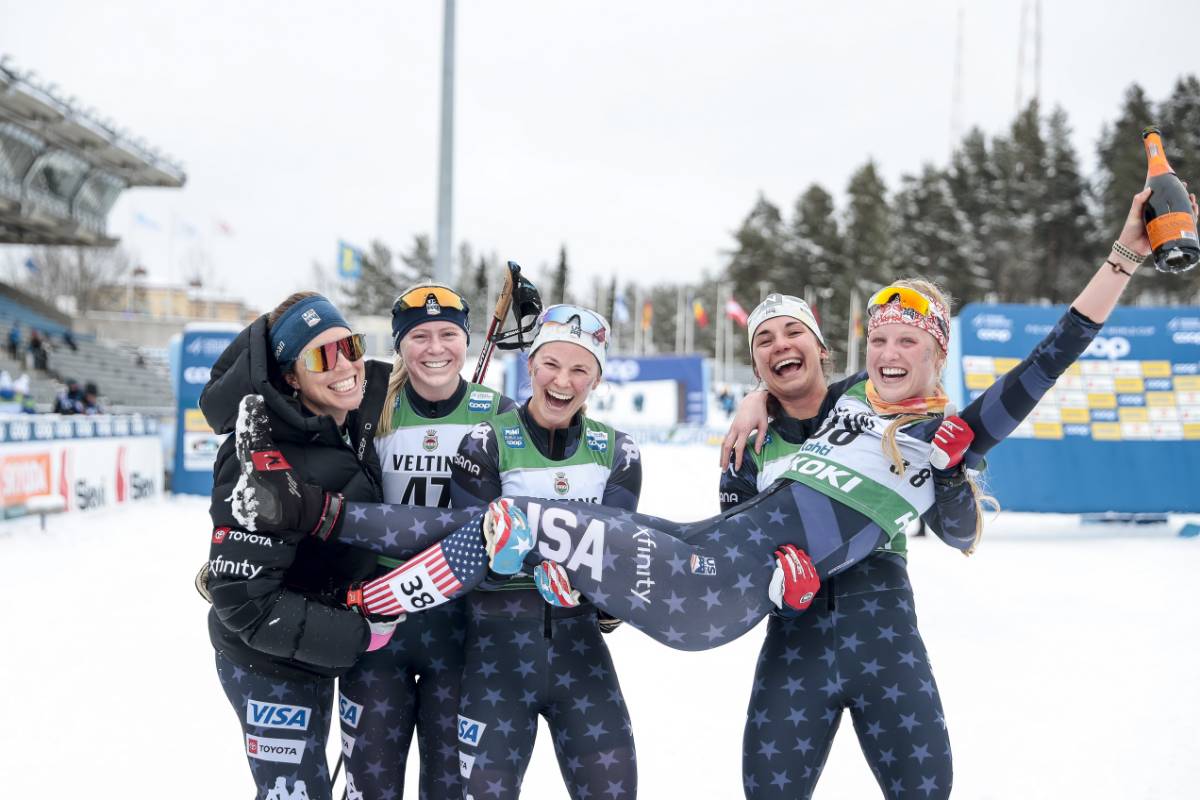
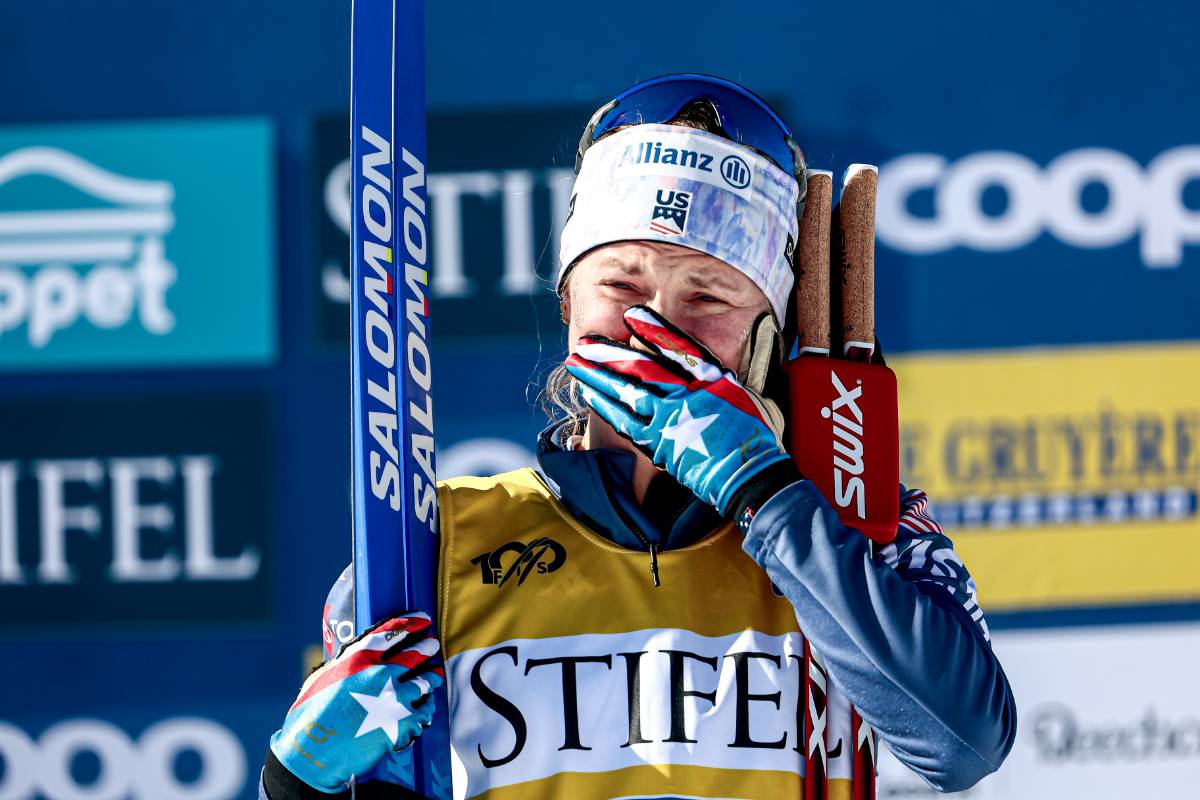
That was a banger. We’re deep into the Olympics now, and Devon and Nat return for the third straight night to recap the women’s relay. One more race — the Norwegian men versus the world — and then everyone gets two days off.
Reach us at devon[at]fasterskier.com and nat[at]fasterskier.com. We’ll be back tomorrow.
A reminder: This is a homegrown podcast done by two guys working long hours and late nights. We’re also paying real money to be here in Italy. If you can, support the show and FasterSkier’s ongoing coverage with a voluntary membership. We’re also offering a bonus during the Olympics: a WhatsApp group with notes on Nat’s experiences in Italy, the food he’s eating, interview transcripts and more.
Send nat[at]northernjournal[dot]com a confirmation of your voluntary membership and the number he should use for WhatsApp and we’ll get you signed up. You can also Venmo him directly at @nat-herz if a membership isn’t for you. We’re suggesting a minimum of $10, but we also won’t turn anyone away who wants to join because of an inability to pay.
Help Support Our Olympic Coverage!
FasterSkier will have our own Nat Herz on the ground at the Olympics, which, to be honest, is a very big financial lift for us. If you value the thoughtful work and access FasterSkier provides at championships like this one, please consider becoming a Voluntary Subscriber. Your support directly fuels the work we do to cover the people, places, and moments that make our sport special.
American Gus Schumacher competes in his first race at the 2026 Olympic Games at the cross-country ski venue in Tesero, Italy. (Federica Vanzetta/Nordic Focus)
Gus Schumacher is one of the stars in U.S. cross-country skiing, and he was one of the team’s top medal hopefuls coming into the Winter Olympics in Italy.
Against the same field that competes at the Games, the Alaskan won a World Cup race in Minnesota in 2024. Then, Schumacher, 25, was on the World Cup podium twice more just last month, in Switzerland.
So far, though, his Olympics haven’t gone as planned, with tough results in several races. In his first one, he crashed. In the subsequent sprint — one of the disciplines where Schumacher was on the podium last month — he had another tough day, while his roommate and close friend, Ben Ogden, won a silver medal.
Speaking with media Friday, after his third race, Schumacher bristled, a bit, at a question from a reporter who asked him if, maybe, he was not having the best time at the Olympics. He said he was actually having a good time, and in a good place in spite of his results.
A day later, reporter Nat Herz asked Schumacher if he’d be willing to expand on his comments — but also offered him an out if he didn’t have more to share. He responded quickly by text: “Let’s do it. I’d rather get a story out there than have people make their own conclusions.”
Here’s Schumacher in his own words.
Nat reached out to me yesterday to ask if I was up for an interview. His timing was good, because I almost for sure would’ve said no most of the last six days. The opening of my Olympics has been hard, and processing it has taken time and effort, but I’m so proud to have been able to get through some rough days and be ready to fight again and again.
For context, my hard races have involved a crash, an anomalous sprint qualifier, and a day where I think my skis had me out of the race in the second half. On top of it, my teammate and one of my best friends did something we’ve all wanted to do for years. I’m stoked for Ben, but it’s also still hard, and that’s fine! The real miss would be an inability to talk it out and move forward to race another day.
I’m proud of my team, and I’m proud of myself for how I’ve handled a rough start, because this thing isn’t over and I’ve still got skiing to do!!
Below is a transcript of Schumacher’s conversation with Herz. It’s been lightly edited and condensed for clarity.
Nat: I don’t want to put words in your mouth — so maybe you could start by describing how it’s been for you here?
Gus: I can set the stage for people who are listening. So I finished this (10-kilometer freestyle race Friday) and I wasn’t even on the results board — I knew I was far back. It was not what I wanted. And (a reporter) said, ‘So, I assume you’re having a really bad week here.’ And I was like, ‘Okay.’ First off, I wasn’t in a great mood then. But I’ve had a lot of things I’m really proud of. And I think, just, blanket statement, horrible week — it just goes to show you can’t really assume how people are feeling, because you don’t know.
I understand, obviously, yeah: It’s not how I want to be skiing. In that sense, it hasn’t been great. But I wouldn’t just say I’ve had a horrible week, because these things make you better overall.
Gus Schumacher, left, celebrates his podium finish at a World Cup race in Switzerland last month. (Augustin Authamayou/NordicFocus)
NH: Can you take us back to the beginning of your time here?
GS: I fell in the first lap of the skiathlon (the first Olympic race, which features legs in two different techniques, classical and skating). Someone fell right in front of me. There’s just a chain reaction, and maybe I could have put myself in a bit of a different place. I could have set myself up otherwise. But it was a crazy corner. I crashed there, 30 seconds back pretty quickly, and the pace was hot. In hindsight, I wasn’t going to have a chance of catching the leaders, which is where I wanted to be skiing.
And I skied well — I think the classic went really well. In the skate, I think my motivation flagged a little bit. And I realized I have a lot more racing, and it wasn’t worth it to push super hard to get into 20th or something. But, you know, there were still some good things about how I skied.
But it’s also still hard to really feel good in that situation, because you’re kind of swimming upstream.
I left that, and I was just already on the back foot, needing to refocus — basically, not having a super confidence inspiring race, even if I was skiing pretty well. Objectively, it still wasn’t the result that I wanted. And then two days later, in the classic sprint, I didn’t qualify (as one of the top 30, who move into heat rounds), in an event where I’ve been pretty solidly qualifying lately. And I was really far back. I wasn’t in the realm of where I feel like I’ve been skiing lately. So that was another bummer.
I want to say it was (problems with my) skis. I know there’s not super conclusive evidence of that. But I think that’s the best way for me in a championship to go forward — because I can’t change anything now, and I need to believe in my fitness, and I do. It’s just to say there’s something going on under the feet, and whatever: I’m racing again soon.
And then (teammate and close friend) Ben (Ogden) got a medal (in the sprint). And that was a crazy event for all of us, especially me. Definitely took some thinking and processing to go through — especially given my tough start. I think I did a great job of getting back to a place where I’m just excited to ski and do what I can do.
Ben Ogden celebrates his silver medal in the Olympic sprint Tuesday. (Federica Vanzetta/Nordic Focus)
And then in (Friday’s) 10 k, again, I just really struggled. And I opened well, I feel like I skied really well. And again, something just didn’t line up, didn’t work. And I’m just gonna go with the skis again, basically. I don’t know exactly what it was. I think it probably has something to do with how they were actually pushing, and pressure stuff, which is kind of weird. But for my own sake, for these next races, I do still think I’m skiing well, and my movements are good and my energy is good.
NH: Fair to say this is about as hard an environment as exists to have to deal with this stuff, though?
GS: Yeah. In a normal World Cup weekend — and I had this at the beginning of the season, and it was still hard — you’ve just got another race the next weekend. And it’s easy to just say, ‘Yep, first race of the season. Shit luck. We got time.’
But right now, I’m getting interviewed by NBC before every race. And everything’s going viral on social media. And it’s just a big moment, as people like to say. And it’s when everyone wants to be at their best. Part of what’s so hard about winning the Olympics, or medaling, is just that your timing has to be good. And my timing’s been great before. You know, Minneapolis, I still think, is the craziest timing ever. (In Minneapolis, Schumacher took his first-ever World Cup win when the circuit was on its first swing through the United States in more than two decades.)
But, yeah, it’s really hard place to deal with tough results. Even if they’re not entirely because of me, or they’re a little bit out of my control, it doesn’t really matter.
At the end of the day, to all the people that never watch skiing — it sucks, in my head, to feel like all those people won’t recognize me. And I know that’s somewhat vain — but, you know, a lot of this is vain. And there’s a part of me that’s, just — I want to be a ski star. I want to be really good, and I am, and it’s just through the first half of this championship, it hasn’t worked out amazingly. But there’s still time. At the end of the day, I just want to be skiing fast, in general. Skiing fast is what’s fun to me. And it’s cool if it’s at the Olympics — but it’s also cool if it’s at the Tuesday night race (in Anchorage, Schumacher’s home town), in April.
Gus Schumacher stands with his club coach, Erik Flora, during a training session at the Olympics in Italy. (Nathaniel Herz/FasterSkier)
NH: I talked yesterday with Ben Ogden about how you guys have been navigating since he won the first men’s Olympic medal in cross-country skiing in half a century — which is something that many of you guys on the men’s team are gunning for, but only one of you got.
He spoke about how that’s obviously a challenging dynamic, but said you guys have been navigating it really openly. He’s also your roommate here in Italy.
Can you talk about all that?
GS: I mean, it’s been, honestly, great. It’s super hard. But having it be Ben is so nice. But he’s so good in that situation.
Obviously, it’s really cool and big for all of us. But everyone wants to be the guy to break the drought, right? And I, for sure, wanted to be that guy. But I also wanted to win the green bib (of best under-23 skier on the World Cup). And I didn’t do that, because I wasn’t skiing that fast, and he did. And that was really cool, that he did that. And then, I’m sure he wanted to compete (at the World Cup) in Minneapolis, but he got mono, and I won.
It’s not just Ben and I. (American) JC (Schoonmaker) got the first podium of any of us, and Ben was fourth that day. We all know how it feels to be on the other side.
Ben came back in the room at 5 p.m., after a one o’clock finish — he’d had a crazy afternoon. I know he had interviews lined up, and I’d just been at home, basically stewing about myself and about the whole situation. And I can’t remember exactly what he said, but the first thing he said, basically, when he came in the room, was: I’ve been thinking about you.
And that meant so much to me. That he would go through all of this, and enjoy himself — I know he was really enjoying himself, and I would not want him to not enjoy himself — but to have your teammate just immediately recognizing: Yeah, I know how it feels to be on the other side.
It made it so much easier for me. And I’ve been clear with him, too, that yeah, it’s kind of hard. But I’m also really proud of him, and it’s really cool that he (won silver). One of us needed to do it, and it’s so, so cool that one of us did. And I also really want to be racing faster, and those things can be true together.
It’s hard. But the hard things are what’s cool about sport, and the Olympics. And the hard times are a lot of what I enjoy about what I do, because I think it makes me a better person. It just makes everything else in life feel so much easier.
To have a team like this, that can have those conversations and be real about it is so nice. Because obviously, it’s not sunshine and rainbows, no matter what it is. You can love someone with all your heart, and if they get something that you wanted, that you can’t have, or you didn’t get, it’s hard. And I’m really glad we don’t just say, ‘I’m so happy for you. Nothing but tears.’ Because it’s not always true. At least for me, honesty is the best policy. And to be able to air stuff makes it so much easier to just go on with it, and talk about the real things.
Gus Schumacher and Ben Ogden celebrate a podium finish in a World Cup team sprint event in Switzerland last month. (Augustin Authamayou/NordicFocus)
NH: Maybe this is touchy, but just to put a fine point on it: It’s not just that you and Ben both wanted a medal, any medal. He won this medal in a specific event that you were also racing in, and could very well have won a medal in.
GS: Yeah. I mean, watching him, it felt a lot like what I did two weeks ago. (Schumacher finished second in a World Cup sprint race in Switzerland in late January.) He looked amazing, and I felt really good in (Switzerland), and I didn’t even really get tired — and the other guys were sort of tired in that final, and it was so similar.
So, yeah, it felt like, ‘Fuck, it’d be awesome if that was me.’ But that’s just how it works in sport. Sometimes you’re there, sometimes you’re not. And if it was always the same, it would get boring.
NH: I’ve been thinking back to the Beijing Olympics four years ago. You had a pretty hard time there, but I wonder if you think it’s right to say that you are experiencing things here in a different way — maybe with more resilience based on that past Olympics experience.
GS: For sure. Everything I do, I think, makes it easier. But four years ago is, for sure, different — a different type of disappointment. And I’d rather have this one — I’d so much rather be in a true contender seat, where I feel like I have a shot at medals. I’d so much rather have that than not be recognizing my body — not be, just, super tired going up the hills.
I learned a lot from Beijing, and I got a lot better after that. Mentally, it’s been a really cool experience to go through these emotions, feel them really well, write them down, pay attention to it, and talk to a bunch of people that can think with me. And I can just, sort of, rant, or do whatever, and get through it and be ready for the next one, because that’s what you need to do, when you’re feeling good, especially.
I’m still feeling good. And it would be such a shame to have a couple bad races and mentally throw in the towel, because it’s hard to draw confidence from a race where you fell in. That’s silly. I can draw confidence from so many things, and that’s what I’m doing. The most recent experience I have, which is the easiest one to go on, is not great. But I’ve got a lot more in the tank to draw from, and I’m really excited to go out there and do what I do.
NH: Fair to say you feel like you are mentally prepared to show up on the start line of the men’s relay tomorrow with a clear head and some confidence in your fitness?
GS: Yeah. I think I’m ready to ski with the best, no matter what has happened so far. And that’s where I want to be. And I feel confident that that’s where I am. And I’m really excited to lay it out there for the team tomorrow, because I think we have a really strong team right now. I maybe alluded to, ‘Ben got something that I didn’t get.’ But this Games isn’t over — and we’ve got more Olympics (in four and eight years), too. I feel confident that I’ve still got time, which is nice.
NH: I think I want to print this just as an unadulterated Q&A. Do you feel good about that?
GS: Yeah — I think it’s important to talk about some of the hard things. It’s what makes our team strong. And I think it is something that is often so much more helpful than I even know for people to hear. Because a lot of this stuff is pretty applicable not just to sports, but even just day-to-day life.
Shit happens, and sometimes it happens when you really don’t want it to. You’ve got to move through it, and it’s so much easier said than done. But I think talking about it — and hopefully I shed enough light on it to maybe inspire people, to help them understand — I think it’s a good message. It makes me proud to know that I’m still in the fight because of how I’ve gone about it.
This article was made possible through the generous support of our voluntary subscribers who have helped put our Nat Herz on the ground at the Olympics. If you value coverage like this, please support FasterSkier with a voluntary subscription.
Norway claimed the Team Relay gold medal in the Olympics of Milano-Cortina. Heidi Weng (NOR) skied the anchor leg all alone . . . she never would’ve expected that. (Photo: Vanzetta/NordicFocus)
On paper, no one beats Sweden. After the first three events of these Olympics, Sweden had won all three gold medals. Before the games began, most ski-experts gave few other nations a chance of grabbing any gold in Women’s Cross-Country . . . especially not in the relay. Just consider Sweden’s roster: Linn Svahn, Ebba Andersson, Frida Karlsson, Jonna Sundling. Svahn is the world’s best sprinter. With two silver medals thus far, Andersson has proven herself the second best distance skier at these Olympics. The first two gold medals in Olympic distance races have been won in peerless fashion by Karlsson. And Sundling has been Sprint racing’s World Championship and Olympic Gold medalist. If you wanted to construct a relay team that was certain to win gold, those are the names you’d print on your entry.
On paper, no one beats Sweden, but cross-country ski racing is a sport that regularly refuses to follow the script, and Olympic medals aren’t handed out based on which team submits the most impressive set of skier résumés. Ski racing happens out on a snow covered course between start lines and finish lines: punishing uphills, treacherous downhills, sharp curves, and variable snow. It’s not a running race . . . and the challenges of racing at high speeds on long, flexible skis with no metal edges means that just about anything can happen.
And it did . . .
The field of the 2026 4 x 7.5 k Olympic Relay leaves the starting line. Drama would be soon to follow. (Photo: Barbieri/NordicFocus)
Scramble
Skiers call Leg 1 of the relay the “Scramble Leg,” a self-evident appellation that often finds teams assigning a capable sprinter to the task. The first kilometer of Leg 1 can be a crowded scrum—shoulders rubbed, elbows thrown, ski tails trod upon, poles at risk. The job of the Leg 1 skier is simple: weave through traffic, stay out of trouble, don’t get dropped. The Val di Fiemme course has already shown that it challenges racers with its tight turns and slushy snow. Falls have been common and consequential in Nordic events thus far in the Olympics. And a race day that offered 40 degree temperatures and light rain made the waxing a bit of a tricky prospect for the first two Classic legs.
Racers would ski two laps of 3.75 kilometers each. Though the field endured the rippling effects of a crash in the opening kilometers, the race settled quickly into a pack of 12 contenders. By the second lap of Leg 1, Svahn had begun to open a gap—not so much a breakaway as it was a demonstration of a team racing at a different level. Norway’s Kristen Austgulen Fosnaes and Italy’s Iris di Martin Pinter gave chase, but it appeared that the expected Swedish dominance had begun.
Julia Kern (USA) maintained her position in the top 12, but seemed to be struggling a bit to do so. The American team has struggled with slow Classic skis thus far in these Olympics, but Kern appeared determined to keep her team in contention.
Ebba Andersson (SWE) had a nightmare of a day on the course of the Olympic Relay. (Photo: Vanzetta/NordicFocus)
Leg 2
Kern had continued moving forward through the field, and tagged Rosie Brennan with Team USA in seventh place. Early in the second leg, Andersson suffered an awkward fall that allowed Norway’s Astrid Oeyre Slind to move to the front. Slind and Italy’s Caterina Ganz did their best to add to their advantage as Andersson struggled to overcome the deficit. Just like that, Sweden had a problem: Slind was now racing to win, and Ganz was racing in her home country. Both appeared energized and fresh.
Andersson ultimately reeled in Ganz, but Slind continued to widen the gap. Behind her, the brilliant Classic technician, Kerttu Niskanen had worked Finland back into the race alongside Italy. Brennan continued to maintain USA’s place in the top seven, as Andersson continued working her way back toward the front. Team Swedn knew htat if it could get back to Slind, then Karlsson and Sundling would likely still be able to deliver victory.
And then the wheels fell off the Swedish juggernaut . . . and in most spectacular fashion. Andersson had often appeared uncomfortable during her relay leg. Then, on a fast slushy downhill, she caught the tentative outer edge of a high-speed snowplow, somersaulting her across the course in a violent, end-over-end crash that left her briefly stunned and scattered. Andersson scrambled quickly to her feet, only to find herself standing on only one ski, the other one coasting down the slope with a broken binding. Andersson sprinted forward to collet her ski, but the damage to the binding was too severe. Only one thing left to do: run for it. Cradling her crippled ski in her arms, Andersson began frantically scooter-pushing her way up the course. There are plenty of places on a world-class ski course where coaches and team personnel wait with spare poles (just in case one gets snapped). When skiers break a pole, it’s definitely going to affect their progress and their placing, but those poles will likely be replaced pretty quickly. A broken ski is another matter, entirely . . . and the likelihood of a coach standing in the right place wearing skis preppred with decent race wax is not all that high. Andersson knew her team’s chances were fading, and she ran for her life. Eventually, a coach appeared with a ski that must’ve been a decent match, and Andersson was able to get back into the race.
“Yeah, it was a lot of emotions going through my whole body and the mind at that moment,” said Andersson in post-race interviews. “And, yeah, it was a completely disaster. And first I was thinking, ‘oh, I need to fix it by myself.’ But then I understood that, okay, I won’t be able to do it. So then I just tried to go as fast as possible down the hill and to one of our coaches that was running with a new one. After that, I just tried to minimize the disaster that was already done.”
But the damage had been done. Sweden now trailed by over a minute, and a rejuvenated Team Norway was forcing the pace at the front.
Frida Karlsson (SWE) overcame much of the deficit created by Andersson’s disastrous fall, but the gap was simply too great. Sweden would settle for silver. (Photo: Barbieri/NordicFocus)
Leg 3
Karlsson would start with a deficit of 1:18. She’d start whittling away at that gap as soon as she took to the course. Slind would hand Karoline Simpson-Larsen a lead of 23 seconds over Finland and Switzerland. But every fan’s attention would have been directed to Karlsson as she began Leg 3 with a deficit of 1:18. Karlsson appears to be in tby far the best form of any of the distance skiers at these Olympics, but so wide a gap would be nearly impossible to solve. Nonetheless, she set off in pursuit.
Novie McCabe skied brilliantly to move Team USA into fifth place, but even as she did she found her position eclipsed by the flashing white suit of Karlsson who appeared determined to bring Sweden back into medal position. Like Karlsson, Martina diCenta turned up the speed to overtake Switzerland’s Marina Kaelin, moving the host nation back into third place as the field neared the stadium.
Joy at the finish line: Heidi Weng (NOR) celebrates Norway’s unlikely victory in the Olympic 4 x 7.5 Relay. (Photo: Vanzetta/NordicFocus)
Anchor Leg
Simpson-Larsen handed Weng a lead of 48 seconds, followed another nine seconds later by Italy. Yet another nine seconds later, Karlsson tagged Sundling, who set off in pursuit of the medals. Finland’s Jasmi Joensuu held second place, and Italy’s Federica Cassol clung stubbornly third . . . but Sundling was flying, and Italy and Finland would have no answers for a hard-charging World and Olympic champion.
The anchor leg played out in three segments. At the front, Weng continued to race on alone, checking her speed on each downhill curve, but working the uphills and flats like the former World Cup champion she is. In the medal chase, Sundling was storming forward through the contenders, having already caught Italy, and reeling in Finland before the beginning of the penultimate lap. Behind the medal struggle, Diggins led a small group of chasers poised to claim prizes if any other disasters befell the leaders.
In the end, Weng would hold on to Norway’s lead, jubilantly sprinting across the line even with a lead that needed no such efforts. She screamd with joy at the finish line where she was immediately embraced by her teammates. Norway had felled Goliath, and proved the experts wrong. Behind them, Sundling would shed Joensuu and coast across the line for silver. Sundling skied into the embrace of her teammates, but their posture was anything but celebratory. Finland would claim bronze, followed by Germany, United States, and Italy.
On paper, no one beats Sweden. But cross-country ski racing is a sport raced on snow rather than paper, and Olympic medals are won, not given. Sweden can be proud of an Olympic sliver medal in the Team Relay, but the gold that Norway takes home will be one that will be treasured and remembered for ages.
FasterSkier will have our own Nat Herz on the ground at the Olympics, which, to be honest, is a very big financial lift for us. If you value the thoughtful work and access FasterSkier provides at championships like this one, please consider becoming a Voluntary Subscriber. Your support directly fuels the work we do to cover the people, places, and moments that make our sport special.
We’re back for the second day in a row with a recap of a lights-out 10-kilometer freestyle race. It was a good one. Devon and Nat are here with the deets.
It’s been surprisingly light on the hate mail recently. Reach Devon at devon[at]fasterskier.com and Nat at nat[at]fasterskier.com.
A reminder: This is a homegrown podcast done by a crew working long hours and late nights. We’re also paying real money to be here in Italy. If you can, support the show and FasterSkier’s ongoing coverage with a voluntary membership. We’re also offering a bonus during the Olympics: a WhatsApp group with notes on Nat’s experiences in Italy, the food he’s eating, interview transcripts and more.
Send nat[at]northernjournal[dot]com a confirmation of your voluntary membership and the number he should use for WhatsApp and we’ll get you signed up. You can also Venmo him directly at @nat-herz if a membership isn’t for you. We’re suggesting a minimum of $10, but we also won’t turn anyone away who wants to join because of an inability to pay.
Help Support Our Olympic Coverage!
FasterSkier will have our own Nat Herz on the ground at the Olympics, which, to be honest, is a very big financial lift for us. If you value the thoughtful work and access FasterSkier provides at championships like this one, please consider becoming a Voluntary Subscriber. Your support directly fuels the work we do to cover the people, places, and moments that make our sport special.
America’s first man to win an Olympic medal in cross-country skiing, Ben Ogden, joins the show for a cheese-tasting and a description of his past 72 hours. He covers everything from the doping test to the phone deluged with texts to Ogden dream sponsors — he only wants old cars, not new cars. And Ogden also shares his lifelong dream to meet Bernie Sanders.
Ben Ogden, a U.S. cross-country skier who won a silver medal in the sprint race Tuesday, samples a slice of Puzzone, a cheese local to the area where Ogden is competing. (Nathaniel Herz/FasterSkier)
Reach Devon at devon[at]fasterskier.com and Nat at nat[at]fasterskier.com. We’ll be back with a men’s 10 k recap a bit later.
It’s really expensive to be here in Italy. If you can, support the show and FasterSkier’s ongoing coverage with a voluntary membership. We’re also offering a special bonus to our members during the Olympics: an insider’s WhatsApp group featuring notes on Nat’s experiences in Italy, the food he’s eating, links to international coverage of cross-country skiing and more. Send nat[at]northernjournal[dot]com a confirmation of your voluntary membership and the number he should use for WhatsApp and we’ll get you signed up. You can also Venmo him directly at @nat-herz if a membership isn’t for you. We’re suggesting a minimum of $10, but we also won’t turn anyone away who wants to join because of an inability to pay.
Help Support Our Olympic Coverage!
FasterSkier will have our own Nat Herz on the ground at the Olympics, which, to be honest, is a very big financial lift for us. If you value the thoughtful work and access FasterSkier provides at championships like this one, please consider becoming a Voluntary Subscriber. Your support directly fuels the work we do to cover the people, places, and moments that make our sport special.
Ben Ogden celebrates his silver medal in the Olympic sprint in Tesero, Italy. (Federica Vanzetta/Nordic Focus)
PREDAZZO, ITALY — Ben Ogden, the U.S. cross-country skier, was ready to celebrate his historic Olympic silver Tuesday with his signature backflip off the podium.
But there was a problem: He had to pee.
After Ogden won the first men’s medal in cross-country skiing in a half-century, doping testers needed a urine sample. So, he did the obvious thing and “drank, like, three bottles of water, immediately,” he said.
The need to relieve himself, he said, was probably the biggest concern on his mind as he contemplated the backflip while the podium ceremony played out. “When I was standing up there, I definitely reconsidered a couple of times,” he said.
Ogden went for the backflip anyway. Afterward, he still had to walk through a maze of reporters called the mixed zone, where — unlike at non-Olympic races — everybody wanted to talk. Then straight to a news conference, and finally, a wait when he arrived at doping control: The other medal-winners had already arrived.
Ben Ogden speaks with media in the mixed zone after his Olympics silver. (Nathaniel Herz/FasterSkier)
“It was really, honestly, pretty miserable. I haven’t had to pee that bad since I was a little kid on a road trip,” Ogden said. “I didn’t really realize the whole situation after you get a medal at the Olympics.”
But Ogden wasn’t complaining.
At a reporter’s request, he was laying out the specifics of what happens in the hours and days immediately following something that many athletes dream of but few actually experience: winning an Olympic medal.
In a conversation Friday at his hotel in Italy — outdoors, to minimize infection risk from a reporter who has been outside the U.S. team’s bubble — Ogden described a phone deluged with messages and a dayslong-sprint of interviews and TV appearances over Zoom. But he also took time the day of the medal to enjoy a sauna with some teammates he’s known for years. He said the time in the sauna was important because it gave him time to process an accomplishment that all of them have aspired to but just one of them has achieved.
“If you win an Olympic medal, it’s like your life changes overnight,” said Jessie Diggins, one of the three other American cross-country skiers in history who can relate to Ogden’s medal-winning experience. “Which is really cool, but it’s a lot of pressure, and it’s a lot of obligations that come afterward.”
She added: “I’m just really proud of him for taking in all of the energy that comes in surrounding that.”
“The toll is real”
Ogden, 26, has had a few podium finishes on the World Cup against Olympic-level competition. But the Vermonter was far from a lock for a medal in Tuesday’s sprint race, where he was nearly eliminated after failing to place in the top two in his semifinal heat and only advanced to the final as a “lucky loser” based on his finish time.
In the finals, though, he made a powerful charge up the final hill and finished trailing only Johannes Høsflot Klæbo of Norway, who’s won all three cross-country events in Italy so far and is widely seen as the greatest athlete his sport has ever produced.
The result was huge not just for Ogden but for his teammates and the American staff – a large group of athletes stayed at the race trails to congratulate him and attend the medals ceremony.
American Olympic cross-country skier Julia Kern takes a selfie with Andrea Ogden, the mother of silver medalist Ben Ogden, just before Tuesday’s medals ceremony. (Nathaniel Herz/FasterSkier)
For some of those athletes, the thrill of Ogden’s medal and their proximity to it left them so exhausted that they scaled back their own workouts the next day, said Chris Grover, the U.S. cross-country’ team’s director.
“It really hit them not only emotionally, but it hit them physically,” he said in an interview Thursday.
The impact on teammates, Grover added, underscores that for Ogden himself, “the toll is real.”
One example: The night of the medal, Ogden said, “it was incredibly hard to wind down, just thinking about everything.” It took until 2 a.m. to fall asleep, and by 7 a.m., he was wide awake, with a “crazy” schedule of media appearances — including Good Morning America, on ABC.
All Ogden had to drink the night before was a little champagne. Still, on TV, he said, “I had some bags under my eyes, I was pretty tired, I hadn’t shaved. And I was looking at myself in the camera and I was like, ‘Oh my God, I’ve got to tighten it up a little bit.’”
“I’m sure that they all wanted me to say I was out drinking and carrying on. And I didn’t say that,” he said. “But they probably thought I was, based on how I looked.”
Ben Ogden celebrates his Olympic medal Tuesday. (Federica Vanzetta/Nordic Focus)
The cross-country team’s press officer, Leann Bentley, coordinated the string of media appearances. She also helped Ogden draft an Instagram post that, he said, was hard to compose.
“It’s so overwhelming to think of all the people who you want to thank,” Ogden said. “You’re just like, ‘Oh, my God, there’s too many. It’s so hard.’”
As for the phone? Ogden had left it in his backpack in the hours immediately following the race. When he picked it up, initially, there were so many messages coming in that it made it difficult to find the threads he needed to use to communicate with his ski technician and his mother.
“Their text exchanges just get buried, immediately,” he said. “Then you start pinning them — but all of a sudden you have 10 pinned messages and that gets confusing. So, I’m sure I’ve missed a lot of important stuff.”
A meeting with Bernie?
On Friday, Ogden was expected to be one of the U.S. team’s four starters in the next Olympic cross-country event, the 10-kilometer freestyle, and he wanted to race.
But amid the intensity of the medal-winning experience, U.S. staff encouraged him to stand down, according to Grover, the team’s director. “He’s just had so much emotion,” Grover said. “And there’s been a lot of media.”
Chris Grover, one of the U.S. Ski Team’s coaches, skis at the Olympic venue in Italy. (Nathaniel Herz/FasterSkier)
Ogden has traditionally been stronger in shorter distances. And the upcoming relay race Sunday — with four 7.5-kilometer legs — and the team sprint scheduled for Wednesday represent “really big opportunities for us,” Grover said.
Ogden, nonetheless, was keen to race Friday, in spite of his coaches’ position.
“They don’t ever make decisions for us. But I think that was the closest I’ll ever get to them telling me they’re not going to start me. They were really adamant that they wanted me to sit it out,” he said. “You kind of train a lot, and you’re trying to put yourself in good shape — and then when you are, it’s nice to race.”
Since those conversations, though, Ogden acknowledged that he’s “crashed a little bit, energy-wise — as they sort of speculated would happen.”
“You can only ride a high for so long before it comes down,” he said. Skipping the event, he added, was ultimately a “good call,” given the upcoming team events.
In the days since the medal, Ogden said, he hasn’t had much time to consider what it means, and how it might affect him. But he did acknowledge that his view of himself and where he sits in his sport has “changed, a little bit.”
Earlier in his career, Ogden said, he felt some awkwardness in describing himself as a “professional skier.” “You’re not getting paid. You’re not really making money, you don’t have results to show for it, too much,” he said. “It’s kind of hard to believe it.”
He added: “Over the years, as you get more established, it starts to be easier. And I think now, it will be really easy.”
Nonetheless, Ogden still has no agent. And no companies have landed in his inbox pitching endorsement deals — unless, he added, they’re in his DMs and he hasn’t seen them yet.
More than anything else, he said, his “peak goal” is leveraging his medal into some time with Bernie Sanders, the populist U.S. senator and former presidential candidate from Ogden’s home state.
“And I really want to meet him and talk to him, too. Not just, like, a handshake,” Ogden said.
“I know it’s political and everything else. But Bernie is just an ambassador for Vermont, and has been for so long. And he’s been someone who I’ve looked up to and respected, and I just couldn’t ask him — he’s a busy man,” Ogden said. “But I think maybe now — maybe now — I can take this medal and figure out a way to meet him.”
This article was made possible through the generous support of our voluntary subscribers who have helped put our Nat Herz on the ground at the Olympics. If you value coverage like this, please support FasterSkier with a voluntary subscription.
Johannes Hoesflot Klaebo (NOR) on his way to his third gold medal of the Olympic Winter Games in Milano-Cortina. His victory in the 10 k Freestyle gave him his eight Olympic gold medal, tying him for the most ever with his compatriots Marit Bjoergen, Bjorn Daehlie, and Ole Einar Bjoerndalen. (Photo: Barbieri/NordicFocus)
Two days ago, at the finish line of the Men’s Classic Sprint, Norway’s Oskar Opstad Vike celebrated like a lottery player who had just scratched the winning ticket. Fist-pumping, chest-thumping, wild gesticulating toward fan-filled grandstands and visceral howling at the proverbial moon. He hadn’t won gold—Johannes Hoesflot Klaebo did that. Vike hadn’t won silver—Ben Ogden secured that little piece of Olympic skiing history. What Vike celebrated was his own third place finish—his bronze medal. Norwegian skiers can dream of no higher honor than to win an Olympic medal in cross-country skiing, and Vike had just done that. His goal had been met, his future had been made, his celebration was sincere. There are plenty of male Norwegian skiers who are capable of winning an Olympic medal; what Vike understood was this: most of them never get to. It was a visual reminder of just how important this ski-thing is to the Kingdom of Norway.
Imagine, then, what it must be like to be Johannes Hoesflot Klaebo, arguably the greatest skier of all time. He’s done so much in his career that only the near-impossible will suffice. Last year, at the World Championships in his hometown of Trondheim, Klaebo swept the entire card of races: Skiathlon, Sprint, Team Sprint, Team Relay, 10 k and 50 k. No one had ever done that before. No one had even come close. Klaebo did it, and made it look easy. Now, in the Olympic Winter Games of Milano-Cortina, Klaebo finds himself faced with perhaps the most daunting and elusive of athletic accomplishments—do it again.
And today, “doing it again” meant doing something that Klaebo had actually never done before—win a 10 k Freestyle Interval Start.
“This is the first time I’ve won a 10 k Skating Interval Start,” said Klaebo. “So being able to do that here at the Olympics, it’s just amazing. And with the weather and the atmosphere, to have my best day here at the Olympics, it’s special.”
The 10 k Freestyle Interval Start was the race in which Klaebo’s pursuit of ski-immortality was most clearly vulnerable. If he got careless, if he made mistakes, if he showed up a little flat, or if one of his Norwegian teammates showed up supernaturally hot, the 10 k could’ve marked the end of Klaebo’s quest for Olympic perfection. After all, the 10 k interval start is a race that Klaebo can’t control by simply sitting in and sprinting. This is a distance that each skier must race alone, competing against their own limitations, summoning their own competitive courage, and baring their own athletic souls. Each of them knows that in order to win they must commit fully . . . but any skier who over-commits—even by just a little bit—would find themselves hitting the wall. There is nothing to gain by taking it easy, and there is much too lose by going too hard. We can assume that must be kind of terrifying for a skier like Klaebo. On his march toward Olympic immortality, Klaebo would know that this race puts him at his most vulnerable. And the only way to combat that would be to commit every ounce of energy he has. No coasting across the finish line today, no waving to the crowd down the finishing straightaway. The media suggests that Klaebo is the greatest cross-country skier ever. If he wanted to prove it, then an all-out effort in the 10 k would be required.
Mathis Desloges (FRA) continued his magnificent run in the Olympic Winter Games of Milano-Cortina with his second silver medal, this time in the 10 k Freestyle Interval Start. (Photo: – Vanzetta/NordicFocus)
And that is exactly what Klaebo did, skiing the opening kilometers smoothly and conservatively, then creating a steady acceleration over the closing kilometers that no other skier could match. Klaebo would continue his pursuit of six gold medals, winning the 10 k Freestyle by a narrow, but sufficient, margin over Mathis Desloges (FRA) and Einar Hedegart (NOR).
Canadian skiers delivered fine performances as well, with Thomas Stephen in ninth, Remi Drolet 19th, and Max Hollman 23rd. British skiers also distinguished themselves at the 10 k distance, with Andrew Musgrave finishing a tremendous sixth, followed by Joe Davies in 12th. A shirtless John Steel Hagenbuch delivered the top American finish in 14th, even after a suffering a mid-race course deviation that may have cost him precious seconds and precious finish-placings.
“I made a mistake,” said Hagenbuch. “And I think I was more just proud I made the mistake and I just let it go.”
“I have so many friends and family out here cheering, and I could hear them. And it’s just a beautiful day. It’s hard to be upset. Such a nice day like this when you get to ski and be with your teammates and represent the United States on the highest stage. I’m really proud to be here.” said Hagenbuch. “But I went into today with my goal being try as hard as you can. And I would have been a little bit faster had I not made that mistake. But I did try as hard as I could. So in many ways, I achieved my goal.”
A year ago—after Klaebo’s miraculous clean-sweep of World Championship events in Trondheim, fans began wondering if he might retire. After all, after such delivering such a performance the only sufficient encore is to do so again. But there’s no way that could happen, right? No way the stars would so align, or the fitness be so sharp, and the equipment be so dialed, and the conditions be so conducive. No way . . . but less than a year later here we are, halfway to seeing the impossible happen yet again. Three events, three gold medals, three events remain. As fans of cross-country skiing, we’ve come to expect it . . . it’s Johannes Hoesflot Klaebo, after all.
No waving to the crowd down the finishing straightaway today: Johannes Hoesflot Klaebo (NOR) needed to battle all the way to the line in order to hold off Mathis Desloges and Einar Hedegart. (Photo: Barbieri/NordicFocus)
10 k Freestyle
Experience matters—just ask Einar Hedegart. Announcers love to remind us that Hedegart “wasn’t even a cross-country skier” until his arrival on the World Cup tour two months ago, but that’s a statistic that ignores the facts. Hedegart has spent his career as a biathlete, the Nordic discipline that combines Freestyle Nordic skiing and marksmanship. That means that Hedegart has spent years refining his technique as a skier—he’s hardly a skiing neophyte, and Freestyle (the technique designated in biathlon races) is his specialty. That said, racing tactics in biathlon prioritize the discipline to avoid exhaustion during races in order to steady a competitor’s aim on the shooting range. It’s a sport that rewards steady pacing, conservative racing, measured efforts. Ironically, Hedegart never managed to excel at the top level in biathlon. Fortunately, someone suggested he hang up his rifle and just plain race. Some months ago, Hedegart seems to have found that his bodily engine could produce tremendous speed across the snow. He proved it with two World Cup victories (albeit over fields that did not include Klaebo), but he still did not have much experience in racing at this level, or under these pressures. Klaebo possesses blazing finishing speed; it was likely that he’d pace his race in a way that would take advantage of that. The only tactic left to the less-experienced Hedegart was to go out hard, and hope to hang on. That’s the way the stage was set, and that’s the way the race played out.
Klaebo would wear bib number 44, making him the first of the realistic contenders to start. Klaebo knew he would be pursued by his own countrymen—Harald Oestberg Amundsen, Martin Loewstroem Nyenget, and Hedegart—each of them determined to interrupt Klaebo’s date with destiny.
Einar Hedegart (NOR) started fast and showed the strain down the stretch. His inexperience may have cost him the gold medal, but the extraordinary effort he delivered in the early kilometers of the 10 k Freestyle may also have earned him the bronze. -(Photo: Barbieri/NordicFocus)
Race day in Val di Fiemme dawned sunny and warm, with temperatures rising to the mid 40s by race time. The snow would play a part in the challenges on the day, with slushy conditions along course edges and the possibility of earlier racers experiencing superior conditions. Klaebo began conservatively, posting only the 12th fastest split time at 1.8 kilometers. But by the next time check at 3.7 kilometers he had jumped to the top of recorded splits. The pre-race favorite was warming to his task.
10 k is a funny distance. By Nordic skiing standards, it’s so short—just over 20 minutes—but so very much can go wrong in that relatively brief timespan. Many of the expected mistakes were evident in the first few meters skied by the earliest starters, skiers from Roumania and Japan and Latvia and Ukraine who took off like sprinters. Way too fast, way too soon . . . the uphills would be soon to appear, and legs and arms that had already begun to accumulate lactate would be in serious trouble. Ten kilometers is a short distance to race, but do it wrong and it can begin to feel endlessly long.
It’s not often that fans see Johannes Hoesflot Klaebo (NOR) lying on the snow at the end of a race. In the Olympic 10 k Freestyle, he gave it his all. (Photo: Barbieri/NordicFocus)
DesLoge, Hedegart, Amundsen, Nyenget all started quickly, coming through the early checkpoints at the top of the list where they were joined by the impassioned French revelation, Desloges. Klaebo trailed by seven seconds at this first checkpoint, but his time of moderate effort would soon end. Klaebo began tightening the screws; by the halfway point of the race, his early splits still led over DesLoge, Amundsen and Nyenget. Not so for the fast-starting Hedegart who came through the halfway mark with an advantage of five seconds over Klaebo. Five seconds with five kilometers to go—it seemed like a lot, but also somehow seemed manageable. Klaebo would find himself needing to produce a scorching finish to close the gap, but Klaebo is entirely capable of producing the scorching finish. He stormed up the final hill—the one that has recently made him meme-famous for his 11+ mph run during his Sprint victory—and dashed across the finish line with an urgency we rarely see in his races. Klaebo collapsed to the snow at the finish line . . . the kind of drama we’re accustomed to seeing from Jessie Diggins, but a demonstration that Klaebo, himself, rarely allows. It’s amazing to see this great skier arriving at the finish line totally spent. He knew he’d need to commit that level of effort if he wanted to beat the hard-charging Hedegart.
The leader’s chair doesn’t look comfortable. Johannes Hoesflot Klaebo (NOR) spent some tense moments waiting to see if his lead would be enough to deliver gold. (Photo: Barbieri/NordicFocus)
Klaebo sat in the leader’s chair, but it was a seat in which he found himself incapable of getting comfortable.
“When you start early, you just fight with yourself out there,” saud Klaebo. “And when you cross the finish line, it’s all about waiting. Luckily, I was able to see that people were losing a little bit at the end there.To be able to see that I’m first is just crazy.”
With 2.5 kilometers remaining, Hedegart continued to lead Klaebo by 5.5 seconds. Well, experience matters—Hedegart knows that now. Next time, Hedegart may not go out quite so hard. But that’s a lesson he needed to learn, and today’s classroom was the race course in Val di Fiemme. Hedegart’s’ all-or-nothing tactic fell short, but it would also be rewarded—with Olympic bronze. And, in between Klaebo and Hedegart, came the indefatigable Desloges, securing his second silver medal of these Olympic Games. Americans and Canadians have been coming on in the rankings, and the world has anticipated the return of Russian athletes, but it is the arrival of the Frenchmen—and Desloges in particular with his medals in the Skiathon and the 10 k—that has begun to show that the podium need not be the exclusive domain of skiers from Norway.
Youth can be a time of glorious impetuousness, like Icarus flying too near the sun. Hedegart may have learned that lesson, though we hope he will also be as thrilled with his bronze as was his teammate, Vike, just the other day. Announcers make much of Hedegart winning his “first Olympic medal “. . . but it’s so presumptuous to assume that any athlete who wins such a medal could ever win another. To repeat such a feat is even more rare than accomplishing it the first time. Hedegart may find himself on this podium many times more, but today we hope he pumps his fist and thumps his chest and celebrates with the crowd that is thrilled by his accomplishment.
And now Klaebo has claimed his eighth (!) Olympic gold medal, drawing him into a tie atop the all-time Winter Olympic medal standings with three other Norwegian legends: Marit Bjoergen, Bjorn Daehlie, and Ole Einar Bjoerndalen. And Klaebo still has three events remaining in these Olympic Games. But there is still much that can go wrong in Klaebo’s quest for even more gold—teammates could stumble in relays, equipment malfunctions could slow him down, conditions could conspire against him—but if there ever were an athlete who can overcome all those obstacles, then we are watching him today in the Olympic Winter Games of Milano-Cortina.
Men’s Olympic 10 k Freestyle Interval Start RESULTS
Help Support Our Olympic Coverage!
FasterSkier will have our own Nat Herz on the ground at the Olympics, which, to be honest, is a very big financial lift for us. If you value the thoughtful work and access FasterSkier provides at championships like this one, please consider becoming a Voluntary Subscriber. Your support directly fuels the work we do to cover the people, places, and moments that make our sport special.
Allan Corona (MEX), Samer Tawk (LBN), Matthew Smith (RSA), Rakan Alireza (KSA) at the finish line of the Olympic 10 k Freestyle, embodying the value of a famous phrase from within the Olympic Creed: “The most important thing in the Olympic Games is not to win bu to take part.” (Photo: Vanzetta/NordicFocus)
This article was made possible through the generous support of our voluntary subscribers who have helped put our Nat Herz on the ground at the Olympics. If you value coverage like this, please support FasterSkier with a voluntary subscription.
— — —
As Jessie Diggins crossed the finish line, she collapsed to the ground—and stayed there.
“I thought I was going to maybe pass out,” she said later. “It would have been nicer if I could have passed out. It has been a really painful couple days.”
Diggins writhed in agony, finally overcome by the vicious combination of bruised ribs and all-out effort at the conclusion of the Olympic freestyle 10k.
But when she’d recovered some minutes later, she made it clear: it had all been worth it.
“I think I’m the most grateful, happiest bronze medalist in the history of the world.”
Hailey Swirbul (USA), who worked last winter as an EMT on ski patrol at a Colorado alpine mountain, checks on Jessie Diggins (USA) just after the finish line of the Women’s 10k Individual Start Freestyle at the 2026 Olympic Winter Games in Tesero, Italy. (Photo: Vanzetta/NordicFocus)
The moment the Olympic schedule was released, all of American nordic skiing circled this date.
Coaches. Fans. Competitors. One in particular: Jessie Diggins herself.
The 10-kilometer Freestyle Individual Start has long been one of Diggins’ preferred disciplines. On paper, it represented one of her strongest chances at an individual Olympic gold medal at these 2026 Games in Italy. And these are the final Games for the most decorated cross-country skier in U.S. history, so a final medal would mean that much more.
But then Diggins fell.
On the Olympics’ opening weekend, in the opening kilometers of the Skiathlon, Diggins went down on a technical corner—the same corner that would later disrupt two American men. At first, the fall looked like something she could absorb. She remounted. She finished eighth. The fallout seemed manageable.
Until it wasn’t.
By Tuesday’s classic sprint, Diggins’ pain became harder to ignore. After her quarterfinal, Diggins crossed the line and grabbed at her ribs. When her adrenaline faded, her pain only sharpened.
“They just—they really hurt,” she said earlier in the week. “I know I’m in good shape, and I really want to make the team proud, and I’m just trying the best I can. But, yeah, it’s for sure impacting my race.”
She admitted the severity had surprised her.
“It’s honestly caught me off guard how much it hurts to ski right now.”
In the days leading up to the 10k, there was real uncertainty about her ability to compete. Diggins described waking up feeling “things like clicking in and out,” sensations she called “disconcerting and really pretty painful.” Two days before the race, she said, “I honestly don’t know how I’m going to do that.”
But she made it onto the start list. From there, she knew what to do.
If there is one thing this sport understands about Jessie Diggins, it’s that she doesn’t retreat easily. She prides herself on giving her all and letting the result stand without excuses. Still, even at full strength she faced a fearsome field of competitors.
Frida Karlsson had already looked composed and precise in claiming Skiathlon gold. Ebba Andersson has built a career on bringing her best in the biggest championship races. Heidi Weng showed in the Skiathlon that she’s among the fastest freestyle skiers in the world. Astrid Oeyre Slind was coming off a sixth-place finish. And Karoline Simpson-Larsen had already beaten Diggins in a 10k Freestyle at this venue when she won in early January during the Tour de Ski.
The 10k individual start is simple. Without the pack tactics or drafting of a mass start, there’s just you, the clock, and the snow.
Go out too hard, and the early splits can seduce you into spending energy you’ll never recover. Start too conservatively? You might dig too big a hole to climb out of.
Historically, this is where Diggins excels. She has a knack for measured skiing through the first lap, managing the second, and pouring everything she has into the final kilometers.
But add bruised ribs to that equation? Fractured sleep? Pain on every breath? Her opportunity seemed less likely, but the pursuit proved that much more compelling.
Kendall Kramer (USA) was the third starter on the course, a course which held up extremely well by all accounts despite warmer temperatures. (Photo: Vanzetta/NordicFocus)
A late-night jury decision
What may have been little more than a passing detail for viewers at home reset the entire equation for service teams on site.
For the first time at these Games, race organizers were salting the course.
“It was the first day they had salted, so in some ways we wanted to come in fresh without bringing too much previous wax structure, and ski test results into today,” US service team’s Tim Baucom said. “We made sure to ski everything in for durability, including athlete skis to ensure that they weren’t going to slow down due to the salting and firm conditions.”
Salting hardens the skiing surface. But it introduces new variables—especially over 10 kilometers.
“Both structure and wax can lose durability. That can mean clogging, losing gliding properties, or just wearing off,” Baucom said. “The snow isn’t crazy dirty here right now, but it is getting dirtier, and the salt can add a variable.”
The risk runs both ways. An overly aggressive structure can clog as the snow picks up debris. Too fine a structure can trap water under the base and create suction.
“Gliding out, then skiing 5k, then gliding out again can tell you a lot about different products, structures, and bases,” he said. “We spent a lot of time skiing this morning…”
It wasn’t just technicians.
“The team works really well together when it’s time to adjust or change course quickly,” Baucom said. “Everyone, including coaches, joined in for the ‘ski in’ and helped run skis back to the truck for race wax.”
Chris Grover, US Cross-Country Ski Team program director, described Olympic race mornings as amplified versions of World Cup days: More staff, more testing, more scrutiny. But the philosophy doesn’t change.
“I think in general, there has been a lot of pressure on the team and on the athletes,” Baucom said. “That comes with the territory of having performed so well over the last many years. That being said, we tend to keep things as light as possible and don’t do anything different than we normally do to avoid any big mistakes.”
But confirmation doesn’t come until the first split.
Jessie Diggins (USA) crests one of the course’s many climbs. (Photo: Barbieri/NordicFocus)
The “trick” of Tesero
From the outside, the 10k appears straightforward: ski hard, ski evenly, don’t make mistakes. But the Tesero course doesn’t reward simplicity. It demands judgment calls—the results of which are tough to evaluate until later.
Grover described the loop as a course that forces athletes to manage effort almost continuously.
“There are decision points all over that course,” he said.
That doesn’t just mean big climbs, but also the transitions into them. Do you press over a crest or take a moment to reset?
“The trick,” Grover explained, “is understanding where you can push and where you really can’t.”
The early kilometers offer temptation, with fresh skis and a pumping adrenaline rush. The course invites athletes to push it early and prove it later.
“The five-kilometer split tells you a lot,” Grover said. “But it doesn’t tell you everything.”
Kendall Kramer (USA) making her Olympic debut in the Women’s 10k Individual Start Freestyle in Tesero, Italy. (Photo: Barbieri/NordicFocus)
Diggins’ teammate Kendall Kramer experienced that tension firsthand. She spoke about how the course never quite settles into a rhythm.
“You don’t really get a break out there,” she said.
Even the descents demand attention. With constant changes in pitch and camber, athletes must decide how aggressively to ski downhill, especially on a salted surface where confidence in edge control and ski behavior matters.
“They did such a good job today,” Kramer said of the track preparation. But she also noted that clean conditions don’t remove the complexity.
Hailey Swirbul (USA) works one of the course’s many transitions. (Photo: Barbieri/NordicFocus)
Another U.S. skier, Hailey Swirbul, pointed out how the course stacks effort.
“There are a lot of sections where you can push just a little too hard without realizing it,” she said.
Those choices don’t always register immediately. The cost is often delayed—paid somewhere between 6 and 9 kilometers, when skiers discover whether they have preserved enough to respond.
In an individual start, there is no pack to correct mistakes. No shared pace. No visual reference.
“You have to ski your own race,” Kramer said.
Grover agreed.
“If you chase every split, you’re going to pay for it,” he said.
That makes the later checkpoints, notably the 8.6-kilometer mark, so revealing. By then, the course has sorted out who has managed their energy and who has leaked seconds along the way. Then comes the survival test the rest of the way.
Jessie Diggins (USA) back on her feet after the race. (Photo: Vanzetta/NordicFocus)
“I was sobbing this morning”
By the time Diggins stepped onto the start line, she already felt behind.
“It’s just been hard to sleep,” she said. She described nights where she woke up because things felt like they were “clicking,” sensations she called “really disconcerting.”
Her diagnosis was blunt force trauma. Bruised ribs and strained intercostal muscles. There was no break, which meant racing wouldn’t make it worse, but it wouldn’t feel good, either.
“I knew it was going to be a really painful day,” she said. “I knew it was just going to be hard to breathe and just a little extra pain on top of that.”
What steadied her that morning didn’t come from inside the wax truck or the physio room.
It came from home.
“I got a video that my aunt filmed with my Nana back in Canada,” she said. “She’s in her 90s, and she’s the sweetest, sweetest lady, and she just said she was loving on me and just wanted me to go have fun.”
Diggins didn’t try to disguise what that did to her.
“I was sobbing this morning,” she said. “I was just sitting there crying because it just meant so much to me.”
The message, she said, was a reminder of something grounding.
“The people who matter don’t care if you win, if you lose, if you’re last by 47 minutes—it doesn’t matter. They love you because of who you are.”
She also had family and friends closer by to lean on.
“My husband is here, and my mom and dad and my grandma and my aunt and my uncle and my high school coach,” she said. “I have like 35 people here.”
In a week defined by pain management, ultrasound appointments, and interrupted sleep, Diggins began her 10-kilometer Olympic medal race the way she often does—with a kiss from her husband that quieted the noise around her.
“I was just excited to have the opportunity to race,” she said.
Frida Karlsson (SWE) led the Women’s 10k Freestyle from start to finish. (Photo: Barbieri/NordicFocus)
The first split
At 1.8 kilometers in Tesero, you get a split that doesn’t just measure the skier. It measures the skis, the pacing plan, the pre-race preparation, the day’s possibilities.
Grover described that first split as the first moment where there is actual measurable information. The minutes between handing over race skis and hearing that first time called out becomes one of the most stressful windows of race day.
Grover has been through enough championships to know that if an athlete is already off the pace at the first meaningful split in a 10k freestyle, it is rarely recoverable. When Diggins came through 1.8 kilometers, she was third, just over a second behind Frida Karlsson.
And suddenly two things became clear.
First, the ribs were manageable.
Second, the skis were competitive.
For the service team, that split carries a different kind of relief. The durability question—especially on a freshly salted course—doesn’t fully resolve until later, but early glide reveals whether the structure and wax selection were correct in principle.
The split didn’t guarantee a medal, but it confirmed Diggins was in the fight.
Ebba Andersson (SWE) paced the 10k Freestyle to perfection. (Photo: Barbieri/NordicFocus)
The halfway mark
If the skis hold, the next variable is management.
Grover spoke at length about how the U.S. staff approached coverage on this course. At the Olympics, staffing is nearly doubled compared to a typical World Cup—roughly fifteen coaches positioned around the loop instead of five.
Their positioning is intensely strategic.
Tesero’s 10k loop is full of decision points, subtle terrain shifts where athletes can press too hard, hesitate, or misjudge effort. Grover has argued that the layout of three different loops creates unnecessary complexity, particularly for athletes from smaller programs navigating the pressures of the Olympics.
The American approach was to blanket it.
Coaches were stationed before key climbs, after major descents, and near transitions where pacing decisions matter most. Radios carried splits.
Grover’s message to Diggins was not to chase noise, but to ski her race—to use the splits as information, not instruction.
That matters most in the middle lap.
At 4.9 kilometers, Diggins was still second, 23 seconds back of Karlsson but ahead of Andersson.
Now the question was how she’d budgeted her energy.
Jessie Diggins (USA) left everything she had on the course in Tesero, Italy. (Photo: Vanzetta/NordicFocus)
“Ski my heart out”
Grover says the five-kilometer split is informative but incomplete. It tells you who is skiing well, but hides who has spent too much.
At 4.9 kilometers, Frida Karlsson led at 11:40.
Diggins was second at 12:04.2—23.4 seconds back.
Ebba Andersson trailed just behind at 12:07.0.
Diggins was in the medal fight exactly where she needed to be: not overextended early, not detached from the podium positions.
The Tesero loop compounds fatigue. And between 4.9 and 8.6 kilometers, Andersson began to close decisively. By the 8.6 checkpoint, she had moved into second place.
Diggins came through third.
Still, the gap between them was just 5.5 seconds.
Up front, Karlsson continued to extend her lead, checkpoint after checkpoint. The gold medal was drifting out of reach. The silver and bronze were compressing.
This was the phase Diggins had anticipated.
“I knew it was going to be a really painful day,” she said afterward. “I knew it was just going to be hard to breathe and just a little extra pain on top of that.”
Breathing obviously matters tremendously in endurance sports. In cross-country skiing, rib stability matters even more on sustained climbs, where upper-body engagement drives momentum, with every plant registering.
But Diggins had made a deliberate choice about how to frame the day.
“All I wanted to do was just ski my heart out,” she said. “I told myself, I’m going to be proud, literally no matter what, if I just go as hard as I can.”
That approach shaped the final kilometers.
At 8.6 kilometers, Karlsson had built something untouchable. Andersson had timed her surge well. And Diggins was still within striking distance—not of gold, but of a spot on the podium.
She’d already shown her bravery. The last 1.4 kilometers would decide whether bravery was enough for a medal.
Jessie Diggins (USA) comes through the stadium. (Photo: Vanzetta/NordicFocus)
Three important seconds
At 8.6k, Andersson led Diggins by 5.5 seconds.
Over the final 1.4 kilometers, Diggins clawed back two seconds. That wasn’t enough to seize second. But the important number was 3.3: the seconds separating Diggins in third from Norwegian A.O. Slind in fourth. Heidi Weng followed four seconds further behind.
Diggins didn’t know her place immediately.
“I actually had no idea what the result was until maybe like 15 minutes later,” she said.
But she knew how she’d raced.
“I was really proud of just doing everything that I could in every moment,” she said.
This was not the clean performance she’d envisioned when the Olympic schedule was first released. She had admitted the ribs made it “hard to breathe” and added “a little extra pain on top of that.”
But she refused to retreat. She held off the Norwegians and deferred the pain.
And that’s why this bronze felt different.
Frida Karlsson (SWE) was dominant throughout the race. (Photo: Vanzetta/NordicFocus)
Karlsson’s gold
Up front, Frida Karlsson did not leave the outcome ambiguous.
She led at 1.8 kilometers.
She led at 4.9.
She led at 8.6.
And she finished 46 seconds clear of Andersson, running away with gold.
Her performance was controlled, incremental, decisive, overpowering.
“It’s really, really cool,” Diggins said of Karlsson’s skiing. “It’s really impressive.”
Karlsson’s coach, Per Nilsson, described the performance simply.
“All the pieces have come together,” he said.
Nilsson pointed to preparation that was deliberately uncomplicated—trusting fitness, trusting rhythm, avoiding the temptation to overreach in training.
“You must have all these things,” he said. “The course is made for her, the conditions are there… and then it sets up.”
Asked whether this was the best she has ever been, Nilsson hesitated to declare it outright—but emphasized that championship execution matters most.
“It’s cool to see at the big event when she can perform at the top of her level.”
Karlsson herself acknowledged the work required to reach this stage.
“It takes a lot of hard work to be here,” she said.
Her gold in the Skiathlon had established form. The 10k Freestyle confirmed it, as she secured her second individual gold medal of these Games.
Novie McCabe (USA), Jessie Diggins (USA), and Hailey Swirbul (USA) (l-r) pose for the photographers before leaving the finish area. (Photo: Vanzetta/NordicFocus)
Team USA’s results
Behind Diggins, the U.S. women had mixed days, though none lacked perspective.
Novie McCabe finished 31st, though she moved quickly through the mixed zone and didn’t stop to speak with reporters.
Kendall Kramer placed 38th and spoke candidly about the Olympic scale and her own expectations.
“I just feel so honored and shocked to be here at all,” she said. “I think we all come to this stage and wish that the Olympics were where we get to have everything come together perfectly. And that wasn’t the case for me.”
But she did not reduce the day to a result alone.
“That also isn’t what this is about,” she said. “Just getting to represent and find the grit as much as you can is what the Olympics is about.”
Hailey Swirbul finished 39th.
Swirbul described the challenge of managing a course that never fully lets you settle.
“There are a lot of sections where you can push just a little too hard without realizing it,” she said.
Still, the team result carried weight. Two medals in three days for the U.S. program—Diggins’ bronze following Ben Ogden’s silver in the Men’s Classic Sprint on Tuesday—shifted the emotional tone of the Games.
Alison Mackie (CAN) had a great race, finishing eighth and showing she will give Canadian fans something to cheer about for years to come. (Photo: Vanzetta/NordicFocus)
Canada’s unlikely breakthrough
If there was a surprise inside the top ten, it came from Alison Mackie.
The 20-year-old Canadian was an early starter and never faded. She finished in eighth place.
Mackie, a two-time World Junior Championships bronze medalist, spoke afterward about the significance of the moment and the belief required to ski into it.
Her result set an early benchmark that held through the final starters—a statement performance on the Olympic stage.
Liliane Gagnon added a solid 17th-place finish.
Sonjaa Schmidt finished in 34th place.
Katherine Stewart-Jones placed 47th.
For Canada, the day was anchored by Mackie’s top-ten breakthrough—a result that signals depth building beneath established veterans.
Jessie Diggins (USA) with her signature leap onto the podium. (Photo: Vanzetta/NordicFocus)
Team USA’s “massive sense of relief”
For the U.S. team, the bronze was not just a medal. It was a release.
Grover did not hide that.
“Two medals in three days,” he said, describing a “massive sense of relief.”
The pressure, he acknowledged, had been building—not just from outside expectations, but from within a program that has performed at a high level for years and understands what Olympic windows represent.
“There has been a lot of pressure on the team and on the athletes,” Grover said.
The rib injury added another layer of uncertainty.
Handing Diggins her skis that morning—knowing she had barely slept, knowing she was managing pain—carried a different kind of tension. By the time she secured bronze, that uncertainty was a distant memory.
Grover pointed out that even athletes who were not racing Tuesday or today felt the weight of the results, physically and emotionally, drained simply from caring so much.
The medal stabilized expectations for the rest of the Games. It allows relay conversations to happen with less urgency and more clarity. It allows athletes to enter the second half of the Games with momentum rather than questions.
It allows a breath.
Jessie Diggins (USA) with an unforgettable performance to win the bronze medal. (Photo: Vanzetta/NordicFocus)
Diggins’ legacy
For Diggins, the bronze does not rewrite her career. It reinforces what she’s already accomplished.
It marks a fitting cap to a reputation built not only on medals but on a willingness to ski through pain, to leave excuses aside, to push through adversity.
In many ways, the race belonged to Sweden, which has now won seven of the nine women’s cross-country medals at these Games thus far. But one bronze was more than enough for Diggins—and for the rest of her team.
“There’s been, also honestly, some mental pain, knowing this isn’t how it was supposed to go,” Diggins said. “And it’s really hard when things out of your control are feeling like it’s going sideways, and you just are hurting.
“But I felt so much love from so many people, and that made a huge difference.”
Olympic Winter Games – Women’s 10 k Individual Start Freestyle – RESULTS
On the ground reporting by FasterSkier’s Nat Herz.
Help Support Our Olympic Coverage!
FasterSkier will have our own Nat Herz on the ground at the Olympics, which, to be honest, is a very big financial lift for us. If you value the thoughtful work and access FasterSkier provides at championships like this one, please consider becoming a Voluntary Subscriber. Your support directly fuels the work we do to cover the people, places, and moments that make our sport special.
Ebba Andersson (SWE), Frida Karlsson (SWE), and Jessie Diggins (USA), (l-r) take the podium of the Women’s Olympic 10k Individual start in Tesero, Italy. (Photo: Barbieri/NordicFocus)
The one Jessie Diggins was waiting for: Nat and Devon were both on hand for the Olympic 10-kilometer freestyle and have this recap. It gets pretty heated! But in a good way.
We’ll be back tomorrow after the showdown between Johannes Klaebo and Einar Hedegart in the men’s race. Nat wrote a profile of Klaebo-killer Hedegart — the biggest threat to what could otherwise be a golden sweep of the Olympics by the cross-country skiing king.
Reach us at devon[at]fasterskier.com and nat[at]fasterskier.com. We’ll be back tomorrow.
It’s really expensive to be here in Italy. If you can, support the show and FasterSkier’s ongoing coverage with a voluntary membership. We’re also offering a special bonus to our members during the Olympics: an insider’s WhatsApp group featuring notes on Nat’s experiences in Italy, the food he’s eating, links to international coverage of cross-country skiing and more. Send nat[at]northernjournal[dot]com a confirmation of your voluntary membership and the number he should use for WhatsApp and we’ll get you signed up. You can also Venmo him directly at @nat-herz if a membership isn’t for you. We’re suggesting a minimum of $10, but we also won’t turn anyone away who wants to join because of an inability to pay.
Help Support Our Olympic Coverage!
FasterSkier will have our own Nat Herz on the ground at the Olympics, which, to be honest, is a very big financial lift for us. If you value the thoughtful work and access FasterSkier provides at championships like this one, please consider becoming a Voluntary Subscriber. Your support directly fuels the work we do to cover the people, places, and moments that make our sport special.
This article was made possible through the generous support of our voluntary subscribers who have helped put our Nat Herz on the ground at the Olympics. If you value coverage like this, please support FasterSkier with a voluntary subscription.
Einar Hedegart poses for a photo after training at the Olympic cross-country ski venue in the Dolomites in Northern Italy. (Nathaniel Herz/FasterSkier)
PREDAZZO, ITALY — Johannes Høsflot Klæbo is, almost without question, the greatest cross-country skier who’s ever lived.
The Norwegian athlete has won gold in eight consecutive championship races spread across two seasons — including the first two events at this year’s Olympics, in Italy. It’s quite possible he could walk away from the Games with gold in all six events.
His biggest threat comes from a guy who’s been a cross-country skier for less than three months.
Norwegian Einar Hedegart has beaten Klæbo all three times they’ve raced each other this winter. He’s won five of the six cross-country events he’s entered since the season began in November.
Johannes Høsflot Klæbo celebrates a gold medal at the Olympics in Italy. (Davide Barbieri/NordicFocus)
November is when, at least according to Hedegart, he finally accepted the label of cross-country skier. Before that, he’d still been, at least partially, a biathlete — the Olympic discipline that combines cross-country skiing with precision shooting.
In biathlon, Hedegart was a fast skier, but not always a reliable shooter. Last season, he jumped into a World Cup race against cross-country skiing’s best competitors, and finished a surprising second place.
That result set off a chain of events that have led him to Italy on Norway’s Olympic cross-country team, with a specific focus on the 10-kilometer freestyle event. That’s where, on Friday, he’s expected to challenge Klæbo for Olympic gold.
“We’re looking forward to Friday,” Emil Hosøy, the coach of Hedegart’s club team in Norway, said in a phone interview this week. “It will be a hard competition.”
In a brief interview Tuesday after training with a teammate at the Olympic venue in the Dolomites, Hedegart said he’s prepared for the showdown.
“Everything has gone according to plan,” he said.
Biathlon vs. cross-country
Hedegart’s meteoric rise has enlivened a long-running, colorful debate between cross-country skiers and biathletes over which discipline is superior, and who’s faster. Biathletes have periodically crossed over and notched competitive results, though it doesn’t happen often.
Swedish cross-country star William Poromaa sparked a furor in Scandinavia two years ago by joking that biathlon, with its stops for target shooting, was for athletes who need a rest between ski sessions.
Hedegart is the latest test case — showing that on today’s racing circuits, elite biathletes can be, at a minimum, competitive with the best cross-country skiers.
“I think a lot of cross-country skiers underestimate the level biathlon is at, and the amount of training we are doing,” Hedegart told two cross-country Olympians on their podcast, Skirious Problems. “You guys have to give us some credit, please.”
Hedegart, 24, is from a little north of Trondheim, a city in central Norway that’s produced some of the world’s best cross-country skiers, including Klæbo.
As a kid, he watched cross-country skiing on television, because the Norwegian superstar Petter Northug Jr. came from his area. But Hedegart’s focus was biathlon, and he showed promise early — winning medals at the World Junior Championships and, in 2023, reaching the top 30 in the World Cup, the sport’s highest level of competition.
Einar Hedegart competes in a cross-country World Cup race in Switzerland (Federica Vanzetta/NordicFocus)
Hedegart would also, from time to time, enter elite cross-country races. Some of those decisions were happenstance — one because he didn’t have a partner for a biathlon relay on the same day, and another that he entered on a whim after a registration deadline.
But in both of those cases, he won.
His results earned him an entry into a cross-country World Cup race in Oslo last year, where he placed second — prompting questions from Scandinavian pundits about whether Hedegart was focused on the right sport.
So, over the summer, Hedegart hedged his bets: He switched from training with biathlon teams to training with a cross-country ski team — albeit one that would allow him to keep shooting his rifle and compete in biathlon.
“All the way from May to November, I was 50-50,” Hedegart said. “I brought my gun to every camp and shot a lot.”
At the start of this winter, Hedegart entered two sets of races over two weekends — biathlon and cross-country — to help decide how he would spend the rest of the season.
In biathlon, he shot poorly. In one race, he missed eight of 20 shots; only one athlete out of 59 competitors missed more.
The cross-country race, meanwhile, he won by a big margin — besting not just Norway’s top skiers but other top talents from France and Austria. That was the day things changed, Hedegart said.
“I’m a cross-country skier this winter season,” he said.
Klæbo, whose championship winning streak is at risk, has taken notice of Hedegart’s rise, which resulted in him being named to Norway’s Olympic cross-country team early in the winter.
“It’s impressive, what he has done,” Klæbo said. “I’m going to try to give him a good match.”
The best skater of all time?
Both Klæbo and Hedegart himself credit Hedegart’s success this season to a unique aspect of his training.
Cross-country skiing, both on the World Cup circuit and at the Olympics, features events in two techniques — the traditional forward striding and poling known as classical, and the side to side pushing called skating.
Biathletes compete only in skating, and Hedegart, this past year, has focused his training almost exclusively on that technique. He hasn’t even bothered to contest classical cross-country competitions this winter.
Hedegart said on the podcast, in November, that he’d spent less than 12 hours practicing classical style in the previous six months — a tiny fraction of the hundreds of hours he’d spent training in total. Top cross-country skiers, meanwhile, typically divide their training close to evenly between the two techniques.
Einar Hedegart, center, celebrates winning a World Cup cross-country race in Switzerland. (Federica Modica/Nordic Focus)
“That is my strength, that I can use more time than anyone else ever has on skating,” said Hedegart in the interview. “I’ve just really done my thing, and that has gotten me this far.”
Hedegart’s training plan has other unconventional elements, including lots of moderately hard sessions and few extra-hard ones, which allows him to spend more time training overall, said Hosøy, his coach. Hedegart is also a “very clever” athlete who’s shown a keen awareness of his own body that’s unusual for someone his age, Hosøy added.
But it’s the added emphasis on skating that’s allowed Hedegart to take the technique “to a new level,” said Pål Golberg, a former top Norwegian skier who’s competed against Hedegart and now is working at the Olympics as an expert TV commentator.
“The training he does is out of this world,” Golberg said. “He can be the best skater the sport has seen — if he wants to do that.”
A postseason dilemma
That’s the question Hedegart will have to answer after this season — and it poses a real dilemma.
Avoiding the classical technique means he can only compete in half of cross-country’s racing schedule. And because his success, so far, has come mostly in distance events, Hedegart has not yet earned a chance to race individual sprint races for the Norwegian team, whose start slots are hotly contested.
As a result, Hedegart has started just six cross-country races this winter — far less than athletes competing in both disciplines.
“If you want to get old in this sport, maybe you have to get to compete more to have the motivation to train as much as he does,” said Hosøy, the coach.
But training and racing in the classical technique would risk the success Hedegart has found after specializing in skating.
“I wouldn’t take the chance,” said Golberg. “If he has this skating that’s so good, why would you risk it? He would never win a distance race in classic, I’m pretty sure.”
There’s also the question of whether Hedegart will ultimately return to biathlon — which, he said, would make it pointless to try to improve his classical technique, since it’s not used on the biathlon circuit.
Hedegart celebrates a podium finish at a cross-country World Cup race in Finland earlier this year. (Federico Modica/NordicFocus)
At the start of the season, Hedegart said, he still planned to go back to biathlon next year. Now, he added, he’s pretty sure he’s changed his mind: If he’s offered a spot on Norway’s national cross-country team for next year, he’d take it, at least for one season.
But in 2029, the biathlon World Championships will be held in Oslo — a chance to compete in a marquee event in Hedegart’s home nation. “That is a big, big dream of mine,” he said. “And I really hope that I can compete there.”
“That is the back and forth I have to do,” Hedegart added, referring to the balance between the two sports.
If Hedegart’s success this season has complicated his career planning, it’s at least provided Scandinavians with a compelling new storyline — particularly in men’s cross-country skiing, where some pundits complain that Norwegian dominance is making the sport boring.
“Norwegians are pretty tired of watching one Norwegian fighting with another,” said Golberg. “But now, suddenly, you have two sports clashing together.”
Help Support Our Olympic Coverage!
FasterSkier has our own Nat Herz on the ground at the Olympics, which is a significant financial lift for us. If you value the thoughtful work and access FasterSkier provides at championships like this one, please consider becoming a Voluntary Subscriber. Your support directly fuels our work to cover the people, places, and moments that make our sport special.
This article was made possible through the generous support of our voluntary subscribers who have helped put our Nat Herz on the ground at the Olympics. If you value coverage like this, please support FasterSkier with a voluntary subscription.
Tim Baucom mountain biking with his parents on the Bangtail Divide Trail in Bozeman, Montana. (Photo: Courtesy Photo)
After a historic day like yesterday, there are so many possible stories, some big, some smaller, but all important. It is easy to get lost in the moment, the history, and the meaning, but we also cannot forget about how it happened. Not just on the race course, but bigger than that, how did the team make it happen, specifically the service team?
A lot of credit should be given to Eli Brown, who is the tech for both Ben Ogden and Julia Kern. Clearly, Brown, a self-proclaimed golf caddy for his athletes, provided some special magic, as did Oleg Ragilo, who leads the kick team, and Chris Hecker, who leads the glide team, but what makes the US Cross-Country Ski Team service team special is that they know they work best when all of their pistons are firing in sync.
One of those pistons is their head of hand structure, Tim Baucom. His route to the wax truck bench was less predictable than you might expect.
Baucom’s first ski race. (Photo: Courtesy Photo)
Just a Kid Who Loved Sports
Like many who stay in coaching and the industry, Baucom loved all sports growing up.
“Sports were definitely my biggest focus when I was young. As soon as I started playing Little League baseball, soccer, and stuff, it was definitely all I thought about, in school too. Gym class and recess.”
For a long time, Baucom played all the sports he could, but he was definitely into soccer, which was probably his favorite, and he played through high school.
Middle School State Championships with his coaches Kate and Chris Northcott. (Photo: Courtesy Photo)
Baucom grew up in Walpole, a small town in southwest New Hampshire, but cross-country skiing wasn’t on his radar as a child. Though he tried it in fifth grade and continued through high school, he did not approach it with the passion one might expect from a story about someone at his current level.
“I didn’t really have much of a community for it where I grew up. It’s funny because New England’s so small.”
Little did Baucom know he was just across the Connecticut River from the epicenter of American Nordic skiing.
“I was 15 or 20 minutes away from Putney… but the communities in New England are so removed from one another. My dad even worked in Putney, and I didn’t really know those kids or race against any of them, or know the coaches.”
While he loved soccer and other ball sports, skiing seemed to fit best.
“Once I started skiing, I realized it was probably my best sport, at least the one I was more naturally adapted to.”
But that didn’t mean he was fully committed to training like the top juniors in the region.
High School State Championships with teammates Brenden Short, Morgan Brown, and Tyler Westover. (Photo: Courtesy Photo)
“The first time I roller skied was my freshman year at UNH… There were three or four of us who had grown up in the New Hampshire high school skiing world and played other sports and never thought about roller skiing.”
And while that might sound surprising to some people, it is not something Baucom regrets at all.
“In most ways, I’m super thankful that I had a very diverse sports background… competent at ball sports, and alpine skiing—I alpine skied a ton—and telemark skied and ice climbed, and rock climbed. I’m definitely thankful for that.”
Racing for UNH in Houghton, Michigan. (Photo: Courtesy Photo)
Moving West and Almost Choosing a Different Path
After high school, Baucom chose to stay in-state and attend the University of New Hampshire, where he majored in anthropology and had minors in history and music. Skiing became a big part of his life through connections and friendships, but he admits he probably wasn’t fast enough to make the team now.
After graduation, he spent the summer helping build houses up in North Conway, but as fall approached, he left Durham, North Conway, and southwest New Hampshire behind.
“I moved out to Bozeman the year after graduating… planning on being a ski bum for a little bit and then probably going back to grad school. I was very interested in public health, and medical anthropology really interested me.”
But Baucom needed to find a way to support his ski bum lifestyle:
“I started coaching that winter for Bridger Ski Foundation because it was an easy job. I could go ice climb or ski all day, and then at 4:00 show up at Lindley Park and ski around with some kids for a little bit and get paid a little money.”
He figured that, between the money he had saved that summer and what he was making as a coach, he would be able to make his lifestyle work financially, but he didn’t expect to enjoy coaching so much.
“I started dryland training… working with younger kids who were just starting to roller ski and just starting to learn how to bound and ski walk. We played soccer and speedball, mostly, which [was] awesome.”
Working in Quebec with fellow UNH alumni Nick Brown and Andrew Morehouse. (Photo: Courtesy Photo)
First Real Exposure to Waxing
At BSF, Baucom found mentors to guide him in waxing.
“We had a few coaches and techs who were quite experienced… Floyd Rieshus… he was probably in his 70s when I was working with him, and he was so dialed.”
But it wasn’t just the technical side of waxing that was appealing; there is something about the physical labor of being a cross-country ski coach that draws in a certain type of person.
“We’d show up in West Yellowstone, and he’d have his big sled that he’d hauled his elk out of the woods with—still covered in blood—and we’d throw all the waxing tables and gear into that, and the generator, and he would slowly trudge from town all the way out to the stadium.”
In addition to Rice, Bjorn Bakken was heavily involved in BSF, and Baucom was willing to take on whatever they suggested.
Baucom must have been doing something right because when the opportunity presented itself, the head coaches threw him into the deep end of the pool to see if he could swim.
“[U.S. Nationals] was in Rumford, and [my boss] called me, ‘one of the people couldn’t make it,’ and they were like, ‘We really need extra help.’ So I went there and really got thrown into it.”
When he arrived in Maine, conditions were, to say the least, challenging, but the rest of the BSF service team didn’t question his ability. They put him in charge of kick, even though Baucom felt as if he had imposter syndrome.
“I think I was honestly in charge of kick—which was a joke at the time—because I had no experience making skis for that quality of athlete and that high level of race.”
Baucom knew the stakes were high and that he had better figure out what to do quickly, but then the weather of New England did what New England weather does in January and tossed a wintery mix classic race day at everyone.
It was situations like that that Baucom loved, having to get creative when there was no other option.
Baucom and Jason Cork on top of Stratton Mt. (Photo: Courtesy Photo)
How He Made it to the World Cup
As a parent, you try to teach your child to advocate for themselves, and clearly, Baucom was taught that lesson well.
“For a few years, politely persistent. I emailed [Chris] Grover a few times, being like, ‘Hey, I’m interested in this job.’ I emailed [Jason] Cork [on the tech side] and was like, ‘Any advice if I want to be a tech on the World Cup?’”
The message back was simple: keep doing what you are doing, it is really the only way. What Baucom may not have realized about the impression he was leaving wasn’t just that he was skilled when things got unpredictable, but that he brought the right ‘vibe’ with him to the wax trailer.
“I think if you have the right personality, and enough people see that, I think that helps. That is huge for a team like this. We’re living together for four or five months… one of the most important aspects is to be able to work together.”
Eventually, that persistence with the right vibe got Baucom to Europe to start lending a hand.
Simi Hamilton and Baucom in Quebec. (Photo: Courtesy Photo)
Baucom’s Role: Manual Structure
For people who don’t know what manual structure is: basically, the base of any ski has structure in it, small etch marks that help move water through the base or over snow crystals, depending on the temperature and the sharpness of the crystal.
When World Cup skis come from the factory or, more directly, from the brand reps at World Cup races, they are ground, which creates a more permanent structure cut by a machine. What Baucom and the rest of the team are trying to determine on race day is whether adding a different pattern over that grind with a hand tool improves speed compared to the structure already on the ski from the brand.
“The idea is to find something that’s durable, lasts the duration of the race, doesn’t pick up excessive dirt, works well with the grind that’s under it, and works well with the base material.”
The US Cross-Country Ski Team has five different ski brands represented, and “they all have factory grinds that are great, and we use them. So we need to find something that works well for everyone.”
In the days leading up to a race, the team will run a structure test or two and another on race morning before both the men’s and women’s races, “depending on conditions, it could be eight pairs, it could be four,” said Baucom.
“We’re trying to narrow a giant box of different hand structures down to eight on the morning of, and then from there down to one—or maybe two options—that could work with different grinds.”
Hailey Swirbul and Baucom on a ski in China one of their first days on the ground OWG 2022. (Photo: Courtesy Photo)
Trial, Error, and Evolution
Not everything Baucom and the team do works, so they have to catalog the results and move on with that knowledge for the next time similar conditions arise.
“There are certain structures we stay away from that we’ve had bad luck with… and there are certain grinds from different ski companies that we pretty much won’t ever put manual structure on.”
That’s the tricky part: not all athletes ski the same way, are looking for the same feel from a ski, or ski on the same brand of skis.
“The most important thing is for each individual tech to have an idea of what works with their athlete’s skis.”
Baucom and his partner Brooke Segerberg in Davos, Switzerland. (Photo: Courtesy Photo)
A Historic Day
Elite skiers train nearly a thousand hours a year, year after year, which is the required ante chip to line up at a race, especially an Olympic one. For Baucom and the rest of the US Ski Team service staff, the skis raced on World Cup weekends and at these Olympics did not come together the way you might prepare them for a Saturday morning ski. It, too, took thousands and thousands of hours of work over decades of involvement for the entire service team to put world-class skis in the athletes’ hands so they could realize their dreams.
Another historic day might materialize at these games, and one thing we know for certain is that the service staff is working hard to make it happen.
Help Support Our Olympic Coverage!
FasterSkier has our own Nat Herz on the ground at the Olympics, which is a significant financial lift for us. If you value the thoughtful work and access FasterSkier provides at championships like this one, please consider becoming a Voluntary Subscriber. Your support directly fuels our work to cover the people, places, and moments that make our sport special.
This article was made possible through the generous support of our voluntary subscribers who have helped put our Nat Herz on the ground at the Olympics. If you value coverage like this, please support FasterSkier with a voluntary subscription.
Peter Hinds racing at the Olympics for Slovakia. He grew up in the 49th state, wore bib 49 in Tuesday’s sprint race, and finished 49th. (Courtesy Peter Hinds)
PREDAZZO, ITALY — On Denali in Alaska, there’s a famed climbing route called Slovak Direct — a nod to a group of skilled alpinists from Slovakia who established it in 1984.
Now, as this year’s Winter Olympics kick off, an Alaska-raised athlete is making something of a name for himself in Slovakia, competing for the nation’s Olympic team in cross-country skiing.
Peter Hinds, a 23-year-old graduate of University of Alaska Anchorage, realized last year that he could race for the country where his mother grew up — then qualified to represent it in Italy.
Call it Slovak Indirect.
Hinds competed in his first Olympic race Sunday in Italy, finishing 60th — capping a whirlwind season that’s also included a ceremonial team-naming in Bratislava with a handshake from the Slovak president, Peter Pellegrini.
Peter Hinds shakes hands with Slovakia’s president, Peter Pellegrini, in a pre-Olympics ceremony in Bratislava. (Office of the President of the Slovak Republic)
“They had the guards with the little floofy hats and the guns, standing perfectly still,” Hinds said. “It was cool — it kind of felt like royalty. And that’s the thing about something as big as the Olympics: It lives bigger in people’s minds.”
Hinds’ Olympic saga starts with the fall of the Iron Curtain, at the end of the 1980s. His mother, Elena Hinds, grew up in the Slovakia city of Bratislava when it was part of the Eastern Bloc.
“I was young, fresh out of school, just wanted to travel and see the world,” she said in an interview in Italy, after watching her son’s first Olympic race. “Landed in Los Angeles.”
There, Elena met Peter’s father, Cory, when she joined the local mountaineering club, and the couple ended up in Alaska.
Peter grew up there as an only child with, he joked, “no rights.”
“I had to do everything that the parents decided to lug me on,” he said — including being roped in with them on glaciers during alpine traverses.
A young Peter Hinds on the Eklutna Traverse, a famed climbing route in the mountains behind Anchorage, Alaska. (Courtesy Peter Hinds)
Hinds also spent time absorbing Slovak language and culture growing up, including a school year in Bratislava, where he still has family. Elena cooked Slovak foods, too, like bryndzove halušky — a gnocchi-like dumpling traditionally paired with sheep cheese and bacon bits.
“It’s so good,” Hinds said. “You get the sour blanket, white canvas taste of that cheese. And then you get a really sharp, salty bacon bit in there — it’s really a good dish.”
As a kid, Hinds trained with Anchorage’s Alaska Pacific University club program, then studied engineering at the University of Alaska Anchorage, where his results included a 14th place at the collegiate national championships. He’s also placed sixth in the sprint at the U.S. national championships.
As school was wrapping up, he went to the career fair and interviewed with several companies with offices in Anchorage; he thought maybe he could pair an engineering job with an assistant cross-country ski coaching gig. He also contemplated graduate school.
But Hinds had Slovak citizenship through his mother, who’d been following the country’s ski team, thought her son would be competitive and encouraged him to explore whether he could join. At a ski marathon last spring, he also got a nudge from an international athlete, Australian Rosie Fordham, who attends the University of Alaska Fairbanks.
Hinds eating makové slíže, a Slovak dish of potato dumplings with maple syrup and ground poppyseed. “The poppyseed is exquizite,” Hinds wrote in a text message. (Courtesy Peter Hinds)
“She was like, ‘Mate, you should totally just switch your (International Ski Federation) license to Slovakia. You’d probably be the best skier there,’” Hinds said.
He didn’t really know where to start that process, though, so he went to the internet, where he noticed that his rankings were competitive with Slovakia’s top racers. “I looked them up on Instagram, sent them a DM,” and the process unfolded from there, effectively “no questions asked,” Hinds said — though he acknowledged detecting a little skepticism, at first, from Slovak athletes at risk of being displaced by an American-raised interloper.
“I came over and I actually knew how to speak Slovak, and they were impressed,” he said.
The license change prompted an enthusiastic press release from the Slovakia ski team, which celebrated the addition of a “promising young endurance athlete.” Slovak media has also chronicled Hinds’ progress and results, with family members collecting copies of print newspapers.
A Slovak print newspaper featured a story about Hinds. (Courtesy Cory Hinds)
After training in Alaska last summer, Hinds bought a one-way ticket to Bratislava, where he has a “home base” with family. Since then, he’s been ski racing, at training camps with the Slovakia team or staying with other friends around Europe.
At stops on the top-level World Cup circuit, he’s encountered other Alaska athletes that he’s raced and trained with, like JC Schoonmaker and Gus Schumacher — both standouts on the U.S. team.
“I’m a small fish compared to those boys on the circuit, so I’ve got to know my place,” Hinds said. “But it’s cool to see them, say hi, and see that this is really where they’re able to do things that few can, you know?”
Fordham, the Australian who Hinds credits with inspiring his European experience, described him as a “good friend on the World Cup who doesn’t take things too seriously, but is pretty serious about ski racing.”
Hinds speaks with reporters after his first race at the Olympics. (Nathaniel Herz/FasterSkier)
“He’s just, like, so excited to be here,” she said. “It’s good to see someone who has such enjoyment of the sport and just wants to be out here having fun skiing fast, and with his friends.”
At the Games, Hinds got to attend one of the opening ceremonies, then found himself surprised by the gravity of the moment when he finally got to the start of his first Olympic race.
“It’s super cool to see all these people here — I mean, it was a great atmosphere. But I was genuinely nervous,” Hinds said in an interview afterward. A crash on a busy corner early in the 20-kilometer race set him back, but he made it to the finish without getting lapped and pulled out — a fate suffered by a number of athletes from other small nations.
One of the benefits of being on a small team: Hinds will get to race more events in Italy, unlike some of the athletes from the larger U.S. team who might only get a single start at the Olympics.
And while he doesn’t plan to spend time at bars, he does plan to spend some time enjoying and absorbing the Olympic experience — perhaps getting over the mountains to another satellite competition venue in the resort town of Cortina. He’ll also get time with his girlfriend and parents, both of whom are in Italy to watch.
“Nobody expected this. But he’s making it happen, and it’s pretty exciting,” Cory Hinds said. “Everybody’s cheering for Peter like crazy.”
Help Support Our Olympic Coverage!
FasterSkier has our own Nat Herz on the ground at the Olympics, which is a significant financial lift for us. If you value the thoughtful work and access FasterSkier provides at championships like this one, please consider becoming a Voluntary Subscriber. Your support directly fuels our work to cover the people, places, and moments that make our sport special.
Hinds’ parents Elena and Cory and his girlfriend Eva Weymuller take a moment to relax after watching his first race at the Olympics. (Nathaniel Herz/FasterSkier)
This article was made possible through the generous support of our voluntary subscribers who have helped put our Nat Herz on the ground at the Olympics. If you value coverage like this, please support FasterSkier with a voluntary subscription.
Ben Ogden did a round of interviews with European media outlets after winning a silver medal at the Winter Olympics in Italy on Tuesday. (Nathaniel Herz/FasterSkier)
PREDAZZO, ITALY — Particularly among the citizens of the Scandinavian nations where cross-country skiing is religion, bringing up the United States right now does not exactly elicit warm fuzzies in Europe.
U.S. President Donald Trump, after all, has done his best to shred traditional North Atlantic alliances, complained to Norway’s prime minister that he should have been awarded the Nobel Peace Prize and said he could take over Greenland by force.
At the Winter Olympics opening ceremonies in Italy last weekend, fans greeted Vice President JD Vance with boos.
All of which made for a confusing afternoon Tuesday in Tesero, Italy, where the Olympic cross-country ski sprint race unfolded: Rival athletes and spectators from Norway and Sweden were joining in the celebration of the silver medal won by American Ben Ogden, in spite of the stars and stripes on his uniform.
It was only the second-ever U.S. medal by a man in Ogden’s sport, and a vivid illustration of the Olympics’ potential — not always realized — to transcend political division.
“He’s the kind of president America should have,” said Tomas Pettersson, a veteran sportswriter and columnist with the Swedish tabloid Expressen. “Nobody thinks of Donald Trump and Ben Ogden in the same moment.”
The historic silver for Ogden — the first U.S. men’s medal in his sport in a half-century — comes as he and his American teammates have been navigating repeated questioning by Olympics journalists about the behavior of Trump and his administration.
U.S. flags mix with Norwegian ones during the medals ceremony for Tuesday’s cross-country ski sprint race at the Winter Olympics in Italy. (Nathaniel Herz/FasterSkier)
On Tuesday, the questions were about Trump calling a U.S. Olympian a “loser” after the freestyle skier had said it was “a little hard” to be representing America; earlier in the Games, the questions were about the killings of protestors by federal agents in Minnesota.
“We love our country so much, especially the ideals it was founded on, and don’t really feel like those ideals are really what’s happening right now,” Lauren Jortberg, one of the female American skiers, told reporters after Tuesday’s race. “There’s a lot of personal internal conflict. I’m not going to speak for the team, but I personally think it’s been hard to represent the States right now.”
In interviews Tuesday, competitors, teammates and friends all said Ogden embodies the qualities that he and other U.S. skiers say they’ve been trying to project at the Olympics in a difficult political moment: joy, kindness, respect.
“I don’t think they could have a better poster child, at this point so far in the Games, to fly the flag,” said Zach Caldwell, an American who’s working with a ski wax company at the Olympics. “You don’t have to know Ben very well to like him. And you’d have to really dig deep not to like him.”
He added: “He just goes around the world picking up fans. He’s just an effortlessly gracious guy.”
Caldwell would know better than most: He’s known Ogden since he was a child. Both of them live in Vermont, and Caldwell went to college and ski raced with Ogden’s father, John, who was also a beloved figure in the sport in New England.
Ben Ogden’s mother Andrea celebrates his silver medal Tuesday in Italy. (Nathaniel Herz/FasterSkier)
John died in 2023 at age 56 after a decade-long fight with cancer. At a news conference after his silver medal Tuesday, Ogden said it was most likely his father who’d imprinted the traits that have brought him so many friendships on the cross-country ski circuit, and elsewhere.
“He was a real community builder, and, you know, I miss him every single day, and I try to be like him,” Ogden said. “He cheered for everybody, and said hi to everybody, and tried to get everybody excited about what they were doing. And that’s what I try and do — and I hope people feel it.”
They do, if the comments from others in Tesero are any measure.
Maja Dahlqvist, the Swede who won bronze in Tuesday’s sprint: “People are really happy for Ben. Our team is happy for Ben.”
Johannes Høsflot Klæbo, the Norwegian gold medalist: “I think it’s hard not to like Ben, so I think we all do…it’s fun to be able to share the podium together.”
Klæbo’s father, Haakon: “I think it’s so fantastic that we have Ben in second place. It’s crazy cool.”
British skier James Clugnet, on his podcast, where he said he got “a little bit emotional” Tuesday watching Ogden: “I think it’s so well-deserved. He’s a super nice guy.”
U.S. coaches and staff members spent Tuesday afternoon fielding a deluge of congratulatory texts, calls and emails from colleagues on other teams — an indication that the warm feelings extend not just to Ogden. Somehow, the full American team seems to have largely detached itself from their European competitors’ perception of the American political system.
“I haven’t heard one single American skier back up Donald Trump’s craziness,” said Pettersson, the Swedish sportswriter. “They seem like totally normal people — as we thought the U.S. would be, forever.”
Help Support Our Olympic Coverage!
FasterSkier has our own Nat Herz on the ground at the Olympics, which is a significant financial lift for us. If you value the thoughtful work and access FasterSkier provides at championships like this one, please consider becoming a Voluntary Subscriber. Your support directly fuels our work to cover the people, places, and moments that make our sport special.
This article was made possible through the generous support of our voluntary subscribers who have helped put our Nat Herz on the ground at the Olympics. If you value coverage like this, please support FasterSkier with a voluntary subscription.
Johannes Hoesflot Klaebo (NOR) crosses the line during the Men’s Olympic Classic Sprint semifinal while Ben Ogden (USA) and Lauri Vuorinen (FIN) (l-r) lunge for second during the semifinals of the Olympic Classic Sprint. (Photo: Vanzetta/NordicFocus)
PREDAZZO, ITALY — Ben Ogden finished his semifinal standing upright, his skis still on, lungs burning in the familiar way that meant the work had been done, but the verdict was not. He crossed the line in third place — close enough to matter, not close enough to know if he would advance. As he waited and recovered, on another stretch of the course, the second semifinal was still unfolding, its clock still running, its outcome still capable of undoing everything he had just done.
For a few minutes, the race was no longer about how he skied. Ogden, in this moment, had to wait.
Out on the course, six more skiers were racing for two automatic spots and two chances to survive on time. The math of it was simple, brutal, and final. Either his time would hold, or it wouldn’t.
In the stadium, just above the finish line, Andrea Ogden, Ben’s mother, stood with a friend, phone clenched in her hand, trying to make peace with the day as it already was. She had watched enough sprint races to know how easily they break. She knew what it meant that Ben had been edged into third. A podium was possible, but so was an ending that would look, on paper, entirely ordinary.
“That would have been okay,” she said later. “That would have been a great day.”
This wasn’t resignation. It was realism.
While Ogden waited Jiri Tuz (CZE) and Oskar Opstad Vike (NOR), (l-r) stride their way to the top of the Zorzi Climb. (Photo: Barbieri/NordicFocus)
Men’s sprint racing begins with a time trial that sorts athletes by hundredths of a second, and from there it becomes a sequence of increasingly narrow tests. Thirty advance. More than seventy don’t. On this day in Val di Fiemme, the margins were particularly cruel. Thirty-first place missed the heats by fourteen hundredths of a second. From twenty-second to thirty-first, was separated by just over a second — a slip in a corner, a missed pole plant, a hesitation where there could not be one.
For the United States team, the line had already claimed one of its strongest skiers. Gus Schumacher was that racer who finished thirty-first, out by the smallest of margins. His Olympic sprint ended before it began.
Ogden avoided that fate in the morning. He qualified second-fastest, behind only Johannes Høsflot Klaebo, the Norwegian who arrived at these Games with history in his sights. It was an early signal that Ogden’s form was real — but sprint days are not won in qualification. They are endured through rounds, managed through fatigue, and decided by timing as much as strength.
He moved through his quarterfinal easily after gaining a big lead on the Zorzi Climb. In the semifinal, he held back, once again saving his effort until the final climb. There, he skied next to Klaebo and crossed the line, still unsure whether the result would hold.
Five minutes can feel like an hour when a season or sometimes a career is compressed into a single time.
When the final times from the second semifinal appeared, they came without drama. Ogden’s time held. He was through to the final.
Only then did the day change shape.
Six men would race for medals. Ben Ogden would be one of them.
Johannes Hoesflot Klaebo (NOR) on his way to winning qualification. (Photo: Vanzetta/NordicFocus)
Qualification: The Day Narrows
Sprint days do not unfold evenly. They constrict. After the top 30 advance from the qualification to the heats, the field shrinks heat by heat. First to 12, then to six, and eventually to one.
By the time the men’s classic sprint reached its decisive final, the field had already been reduced by not just the clock but also by the rapidly changing conditions, the soft corners, the hard, long climbs, and a finish stretch that at times required careful and unique tactics. What remained was not simply the fastest skiers, but the ones who had survived a sequence of increasingly challenging tests throughout the day.
Ben Ogden (USA) steadies himself in the starting gate as he gets ready to start his day and chase his dream. (Photo: Barbieri/NordicFocus)
The course at the Olympics is a 1.5 k sprint loop with a grinding climb. Klaebo set the fastest qualifying time with his usual economy, skiing exactly as hard as necessary and no harder. Ogden followed less than three seconds back, skiing with a balance he hadn’t always found earlier in his career, and to be fair, this season.
Behind him, the time gaps shrank again.
Zak Ketterson qualified twenty-third. JC Schoonmaker slipped in at twenty-eighth. Schumacher missed by fourteen hundredths. None of the Canadian men advanced. The difference between safety and elimination felt almost arbitrary, though every athlete on the start list knew it wasn’t.
Johannes Hoesflot Klaebo (NOR) and Ben Ogden (USA), (l-r) crest the final climb before descending into the finish during the semifinals. (Photo: Barbieri/NordicFocus)
The Heats
Once the heats started, the race took on a new feel.
Sprint brackets reward quick decisions and punish hesitation. Six skiers line up, two move on automatically, and the rest hope their times are fast enough to be one of the two Lucky Losers. Drafting is valuable, and position matters. Every downhill section encourages patience and positioning, but every corner can ruin it.
Ogden skied his quarterfinal calmly, not pushing too hard, until the final climb. Ketterson’s race ended suddenly when he fell, his klister sticking at the worst possible time. Schoonmaker made it to the semifinals, but later stated that he just didn’t have what he needed on the final climb.
By the semifinals, the race had stripped itself down to essentials. Like the quarterfinals, six skiers per heat. The top two in each advanced automatically to the finals. And again, two Lucky Losers did so on time as well.
It was here that Ogden’s approach stood out. Earlier in his career, he had raced as if opportunity might vanish at any moment — attacking early, burning energy that never came back. Today, he waited. He skied the lower sections under control and trusted that something would still be there when it mattered.
That restraint didn’t make the racing feel safe. It made the result possible.
Erik Valnes (NOR), Ben Ogden (USA), Oskar Opstad Vike (NOR), Johannes Hoesflot Klaebo (NOR), Jiri Tuz (CZE), and Lauri Vuorinen (FIN), (l-r) start the men’s final. (Photo: Barbieri/NordicFocus)
The Final
Six men lined up for the final, and for the first time all day, everything was clear.
There were no more clocks to watch or other heats to compare. The medals would be decided in one lap, based on position, timing, and nerve.
From the gun, Klaebo and Ogden moved to the front side by side without urgency, setting a pace that revealed nothing until it started to. Norway’s Oskar Opstad Vike hung in the tracks behind the two leaders. The others followed, each solving the same problem: how long to wait until trying to break open the race or at least make a move for a medal.
The course rewarded drafting, especially through the downhill sections and into the finishing straight. The question, however, was whether the medals could be won on the Zorzi Climb with an explosive attack that would open up a large enough margin so the draft wasn’t a factor.
“I was definitely feeling it,” Ogden said later. “The body’s starting to hurt. But I figured that was my one chance.”
Johannes Hoesflot Klaebo (NOR) celebrates as he comes to the line for the gold. (Photo: Barbieri/NordicFocus)
The decisive move did come over the final hill, where Klaebo accelerated with the explosiveness that has made him nearly untouchable. As seen in so many races before, it was a surge meant to drop everyone immediately.
Ogden tried his best to keep up with the attack, just as he had in the semifinal when he skied next to Klaebo.
“I wondered a little bit in the semifinal,” said Haakon Klaebo, Johannes’s father. “They were really looking at each other.”
In the final, though, Klaebo pulled ahead, as he often does. Behind him, the fight for silver became even more intense.
As the climb reached the crest, Ogden gave one last surge that opened up a small enough gap on Vike so the Vermonter could get clear and avoid being overtaken by the Norwegian, as he had been in the semifinal by Finland’s Lauri Vuorinen.
Ben Ogden (USA) double-poles with everything he has down the finish stretch to win silver. (Photo: Vanzetta/NordicFocus)
Ogden stayed tucked down the final descent into the finish stretch before popping up and double-poling for the finish with everything he had left. In sprinting, skiers are often passed in the last hundred meters by someone who has saved just a little more.
“I was double-poling down that final stretch,” Ogden said, “[hoping] no one comes sneaking up behind me.”
No one did.
When he crossed the line, he didn’t look back.
Klaebo took gold. Ogden crossed second, winning the silver. Vike followed for bronze.
Only after he crossed the finish line did Ogden let up.
Ben Ogden (USA) waves to his fans as he celebrates the first American Olympic medal in 50 years. (Photo: Vanzetta/NordicFocus. For editorial use only.
The Weight of What Came Before
Klaebo did not come to Val di Fiemme chasing a single race. His sprint victory was another step in an attempt no skier has ever completed: winning gold in every Olympic cross-country event. Doing so would place him beyond even Marit Bjoergen, whose Olympic record has long defined the sport’s outer limit.
His dominance framed the day, but it did not define it.
Ogden’s silver mattered because of what it represented for American men’s skiing. The last Olympic medal by a U.S. man came in 1976, when Bill Koch won silver in Innsbruck. Since then, generations of skiers had come close without breaking through.
Ogden grew up near that history, not as legend but as geography. He learned to ski on trails threading through maple groves and dirt roads in southern Vermont. Koch lived nearby, as in just a couple of miles away. The connection was literal, not symbolic.
For years, Ogden raced with urgency, as if opportunity might disappear. In Val di Fiemme, he raced differently.
What changed was not his strength, but his patience.
Ben Ogden (USA) jumps on the podium to the delight of all his teammates, coaches, and fans who came to celebrate this moment with him. (Photo: Vanzetta/NordicFocus)
After the Line
Ogden skied through the finish, coasted toward the fencing, and bent forward, hands on knees. The medal was secure. There was nothing left to calculate.
Andrea Ogden was crying in the stands.
“It was overwhelming,” she said. “Just pure joy.”
At the medal ceremony, with the ribbon of the silver medal draped around his neck and over his shoulders, there was just one choreographed celebration waiting for him, a backflip off the podium he had promised himself he would do as a young teenager had the dream been realized. From there, just teammates, coaches, family, and a long exhale of disbelief.
“You know how many things have to go right,” Andrea said. “And how many times they don’t.”
Ogden spoke afterward with excitement, as if the day had been so much more than he had dreamed of for years.
Ben Ogden (USA) captures Olympic silver and realizes a dream a long time in the making. (Photo: Vanzetta/NordicFocus)
What It Means
“A huge goal of mine this year has been an Olympic medal,” Ogden had said months earlier, when he spoke with FasterSkier over Zoom, careful to pair ambition with realism. He talked then about patience, about understanding how foolish it is to expect outcomes in a sport built on margins.
The final played out exactly that way.
Ogden waited when others pressed. He trusted preparation. When it was time to commit, he did so without hesitation.
“This wasn’t something that surprised us,” said Chris Grover, the U.S. program director. “Ben’s been building toward this for a long time.”
Head coach Matt Whitcomb agreed. “He skied like a complete athlete,” he said. “He managed the day.”
The rest of the team felt the other side of the sport. Schumacher was out by just fourteen hundredths. Ketterson went down in a fall. Schoonmaker was eliminated in the semifinals. All prepared. Yet all were impacted by the reality of cross-country skiing, especially sprint racing.
Ben Ogden (USA), Johannes Hoesflot Klaebo (NOR), and Oskar Opstad Vike (NOR), (l-r) share the 2026 Olympic Winter Games Classic Sprint podium in Tesero, Italy. (Photo: Vanzetta/NordicFocus)
That context matters. It keeps the medal from becoming myth.
Ogden will leave Val di Fiemme with more attention than he arrived with, but with the same constraints. Sprint skiing will remain unforgiving. The margins will not soften.
What has changed is clarity.
There is now proof — not theoretical, not historical — that on the right day, with the right decisions, an American man can stand on the Olympic podium again.
Ogden’s moment was born from hours of training on a network of muddy dirt roads in southern Vermont and fueled by the sap running through the lines strung from maple tree to maple tree, which lined those same roads. It will live in the memory of a final hill, a perfectly timed move, and the discipline to wait.
After thousands and thousands of hours of training, and maybe as much time dreaming, what remained was simple. It took a decision not to rush, the nerve to trust that choice and seize the moment when it arrived, and the experience to know that waiting, when done at the right time, was what would make the dream come true.
Olympic Winter Games – Men’s Sprint Qualification – RESULTS
Olympic Winter Games – Men’s Sprint Final – RESULTS
On the ground reporting by FasterSkier’s Nat Herz.
Help Support Our Olympic Coverage!
FasterSkier has our own Nat Herz on the ground at the Olympics, which is a significant financial lift for us. If you value the thoughtful work and access FasterSkier provides at championships like this one, please consider becoming a Voluntary Subscriber. Your support directly fuels our work to cover the people, places, and moments that make our sport special.
Ben Ogden (USA), Johannes Hoesflot Klaebo (NOR), and Oskar Opstad Vike (NOR), (l-r) share the 2026 Olympic Winter Games Classic Sprint podium in Tesero, Italy. (Photo: Vanzetta/NordicFocus)
If you watched, you already know what happened. If you didn’t, we won’t spoil it for you, other than to say: You should watch.
Ben Ogden won a medal today. A bunch of Scandinavians did too. We break it down. Reach us at devon[at]fasterskier.com and nat[at]fasterskier.com.
It’s really expensive to be here in Italy. If you can, support the show and FasterSkier’s ongoing coverage with a voluntary membership. We’re also offering a special bonus to our members during the Olympics: an insider’s WhatsApp group featuring notes on Nat’s experiences in Italy, the food he’s eating, links to international coverage of cross-country skiing and more. Send nat[at]northernjournal[dot]com a confirmation of your voluntary membership and the number he should use for WhatsApp and we’ll get you signed up. You can also Venmo him directly at @nat-herz if a membership isn’t for you. We’re suggesting a minimum of $10, but we also won’t turn anyone away who wants to join because of an inability to pay.
Help Support Our Olympic Coverage!
FasterSkier will have our own Nat Herz on the ground at the Olympics, which, to be honest, is a very big financial lift for us. If you value the thoughtful work and access FasterSkier provides at championships like this one, please consider becoming a Voluntary Subscriber. Your support directly fuels the work we do to cover the people, places, and moments that make our sport special.
This article was made possible through the generous support of our voluntary subscribers who have helped put our Nat Herz on the ground at the Olympics. If you value coverage like this, please support FasterSkier with a voluntary subscription.
Linn Svahn (SWE) has long looked like the best sprinter in the world, but she has only rarely had the chance to prove it. After years of injury and delay, finally she earns Olympic gold. (Photo: Barbieri/NordicFocus)
PREDAZZO, ITALY — Checking today’s ESPN home page makes it clear that the Olympics don’t seem to occupy the American imagination like they once did. I remember the Olympics as being a bigger deal—a set of events that captured the imagination of the world, an international spectacle that occupied the media spotlight. Life magazine, Time magazine, Sports Illustrated: all devoted their covers and countless pages to Olympic events when they were upcoming, to the results when they became available, to the impact that these performances had on the viewing public. There was something bigger about it, something that seemed to separate it from mere sport, something that seemed to elevate it above mere commercialism. These weren’t just athletes; these were Olympians.
They still are . . . Over in Italy, the Olympians are parading in ceremonies and competing in events and collecting medals while national anthems resonate in the crisp mountain air … but ESPN covers only the sports that matter to most Americans: NFL Football and NBA basketball and NHL hockey and MLB baseball and PGA golf, followed by men’s college basketball and women’s college basketball and college softball and MLS soccer and WCW Wrestling and the lingering stories surrounding Super Bowl commercials and Super Bowl halftime shows. And waaaaay beneath all that, we find a mention of the American gold medal in Team Figure Skating and the final helicopter flight of Lindsey Vonn’s legendary career. Thus far in Milano-Cortina, Olympic performances haven’t proven sufficient to capture the attention of a jaded viewing public. The only story American’s are likely to follow in cross-country skiing is that of reigning World Cup Champion, Jessie Diggins. Even with that accolade in hand—even being a defending medalist in the Olympic Sprint—Diggins does not find herself appearing often in the daily conversation that dominates column inches over at ESPN.
Strength and grit, tactics and tenacity: Julia Kern (USA) earned her way through to the Olympic Sprint final. (Photo: Vanzetta/NordicFocus)
And it really is too bad that ESPN may overlook another tremendous story that unfolded in the Women’s Classic Sprint, as the long-suffering Linn Svahn—whose history of injury and ill-fortune has repeatedly interrupted what could’ve been a legendary career—finally grabbed the medal that has always appeared to be within her reach. Svahn led a Swedish sweep of the podium ahead of Olympic and World Champion, Jonna Sundling and the ever-crafty veteran, Maia Dahlqvist. Svahn delivered a performance that cements her place in the history of cross-country skiing. After a long, long wait, Linn Svahn is Olympic champion.
Though it appeared that Americans were still struggling with waxing issues in the soft snow of Val di Fiemme, Team USA saw four skiers advance through qualifying: Jessie Diggins (20th), Sammy Smith (26th), Julia Kern (28th), and Lauren Jortberg (30th). Those qualifying placings did not inspire a tremendous amount of confidence in what was likely to be a lightning-fast day of sprinting. Ultimately, it was Kern who would ski with power and grace in advancing to the Olympic Sprint final where she would finish sixth. Diggins may still be suffering the effects of her crash in Saturday’s Olympic Skiathlon; Diggins skied bravely, but could be seen clutching her injured ribs after placing fourth in her quarterfinal. She would finish the day in 17th.
“My qualifier didn’t go as well as planned,” said Kern. “But it was enough to qualify, and I always get stronger in the rounds. And I had really good skis and played to my strategy and knew I had a strong finish and really never gave up and was hanging really tough when I was pretty tired. And so I went the lucky loser route today, which was my strategy. And that obviously has a cost. So come the final, I was completely spent, but I didn’t know it, and I really gave it my all, tried to be in the mix, and I had left everything on the course to get to the final. And I don’t have any regrets about that. I think that’s what I needed to do to get there. And that’s where I’m skiing right now.”
“Obviously it was 30th, but I think it still wasn’t really, like, my best qualifier,” said Jortberg. “I think there’s still a lot of room to move there, which is cool. And I think had it not been in such a stacked heat, I think it would have maybe been a slightly different quarterfinal for me, but we’re still really proud of how I skied. I think I made a couple tactical errors out there.”
Ultimately, the final American placings were Kern 6th, Diggins 17th, Smith 19th, Jortberg 30th.
“Really exciting to have my Olympic debut,” said Smith. “And I wish I would have done a few things differently in that heat. Like what? I mean, I think I tried to make a move on the left side on the hill. I could have potentially been able to make more time over the top, but it’s pretty incredible opportunity and just excited to be out here and racing.”
Smith explained the challenge and the complexity of competing in the Olympics while simultaneously enrolled at Stanford: “I’m taking material science and engineering. I’m taking environmental law class. I’m taking a creative nonfiction class, doing an independent study as well with a psychology professor,” said Smith. “And then I’m also taking physics. Stanford probably has more Olympians per capita than most places. It’s actually pretty cool. We have four winter Olympians from Sanford this year. So Eileen Gu is competing for China in big air and slope style, Zoe Atkin in half pipe and big air, and then Brandon Kim in speed skating. So it’s pretty cool that there’s four of us. The school’s been incredibly supportive, and I’m excited for all of us to compete.”
Sprint Quarterfinals
Jortberg and Smith lined up together in a quarterfinal that was packed with stars and contenders including Sundling, Kristine Stavass Skistad (NOR), and 2025 World Cup Sprint champion, Jasmi Joensuu (FIN). Sundling went to the front, setting the pace ahead of Skistad, providing a possible preview of the tactics likely to define the Sprint final. Jortberg and Smith dropped to the back where they appeared incapable of overcoming the blistering pace set by Sundling. Over the top of the ultimate downhill, Sundling led Joenssu as Skistad appeared to struggle. But the finish line lies at the far end of a straight downhill, and Skistad’s fast skis and gliding ability were able to dismantle Joensuu. Skistad would follow Sundling across the line to claim automatic spots in the semifinal. Smith would finish fourth to sit in a lucky loser position after the first quarterfinal.
Quarterfinal 2 included Kern, Nadine Faehndrich (SUI), and the day’s top qualifier, Svahn. Faehndrich and Svahn made the pace in the heat, though Faehndrich would fade from contention in the late stages. The suprising Italian, Caterina Ganz, would drive forward to claim the second spot to advance to the semifinal behind Svahn; Kern was able to hold her position in the pack moving forward into third place, a status that would allow her to claim a lucky loser spot in the semifinal.
Johanna Matintalo (FIN) took the third quarterfinal ahead of Laura Gimmler (GER). Julie Bjervig Driveness (NOR) would move into the fastest lucky loser, spot pushing Kern down a spot, but allowing her to remain in contention with two heats remaining.
Still sore from a crash in Saturday’s Skiathlon, Jessie Diggins (USA) gave her all in her Olympic Sprint quarterfinal. (Photo: Vanzetta/NordicFocus)
Diggins started in the fourth quarterfinal alongside Maia Dahlqvist (SWE). They appeared to be the strongest in their heat, and Diggins sprinted directly to the front to set the pace. But the snow in Val di Fiemme was unusually slow, which did not favor the leaders, especially with the course profile that descended steadily to the finish line. Diggins paid the price for leading early, finding herself passed by the field, and unable to improve her position in the finishing straightaway. Diggins would end her day with a fourth place finish in the quarterfinal from which Dahlqvist and Federica Cassol (ITA) would advance.
“I didn’t realize it right after it crashed, when I bruised my ribs,” said Diggins. “But then afterwards, you feel it; right now they really hurt. So I’m doing the best I can. I know I’m in good shape and I really want to make the team proud and I’m just trying the best I can . . . I needed to figure out how to manage this for Thursday. I hope that my body’s feeling better, but my energy is good and I’m excited to be here. I think I’M not a best shape in my life. I just need everything to come together in the right moment. But I know there’s possibility there. So I’m going to keep coming and bring my best.”
Sprint Semifinals
Kern found herself in a semifinal crowded by the résumés of Svahn, Sundling, and Skistad. Sundling and Svahn would claim hte automatic qualifying spots, while Kern would overcome a mid-race loss of speed to finish fourth (behind Skistad) to reside in a lucky loser spot (behind Skistad) with one semifinal remaining. Ultimately, the second semifinal involved fewer stars, and a field that seemed less likely to produce fast times and lucky losers. Driveness and Dahlqvist advanced out of the second semifinal, allowing lucky loser spaces for Skistad and Kern.
Linn Svahn (SWE) streaking toward her Olympic Sprint gold medal. (Photo: Barbieri/NordicFocus)
Olympic Classic Sprint Final
Six months ago, FasterSkier’s Editor-in-Chief made a bold and confident confident call, predicting that Julia Kern would qualify for the Olympic Sprint final. While that early prediction may have been a reflection of the proud Massuchessetts roots he shares with Kern, it also reflected his knowledge of World Cup and Olympic skiing, and his understanding of just what it takes to ski and compete at this level. The Editor knows his stuff, and Kern has proven herself entirely deserving. That Kern advanced to the Olympic Classic Sprint final came as no surprise to Fasterskier.
But Kern was not alone in the final. The cast of characters in this Sprint drama was one that left no room for pretenders or understudies. Kern lined up alongside Skistad, Sundling, Svahn, Dahlqvist, and Driveness. At the crack of the starter’s pistol, Team Sweden began to assert itself as Sundling drove straight to the front. This has been the tactic that has earned Sundling World and Olympic championships, and it came as no surprise to see her at the front. She was followed by Svahn as Skistad appeared overcome by the early pace. At the mid-race point, Dahlqvist eased her way past Skistad, and Team Sweden headed for the podium. At the finish, it was the power of Svahn that drove across the line ahead of Sundling and Dahlqvist. Linn Svahn’s long path had finally delivered her to the destination that fans had always imagined. After years of injury and disappointment, after seasons of patience and impatience, Linn Svahn finally wears the Olympic gold medal.
Julia Kern (USA) used all her experience and every bit of her energy to advance to the Sprint fFinal. (Photo: Barbieri/NordicFocus)
“I am really happy with today,” said Kern. “It’s been a challenging season. I haven’t made it out of the quarterfinals this year. So to make it to the finals of the Olympics Is a huge accomplishment, and I’m really proud of it because I fought really hard today.
The typical ESPN viewer may find other events to be more compelling, but the thrill of competing in an Olympic Games is not lost on the athletes: “I’ve never raced with the rings on my bib,” said Jortberg. “There’s a lot going on, which is super cool, and I feel like I just feed off that.”
On the ground reporting by FasterSkier’s Nat Herz.
Help Support Our Olympic Coverage!
FasterSkier has our own Nat Herz on the ground at the Olympics, which is a significant financial lift for us. If you value the thoughtful work and access FasterSkier provides at championships like this one, please consider becoming a Voluntary Subscriber. Your support directly fuels our work to cover the people, places, and moments that make our sport special.
This article was made possible through the generous support of our voluntary subscribers who have helped put our Nat Herz on the ground at the Olympics. If you value coverage like this, please support FasterSkier with a voluntary subscription.
Hailey Swirbul (USA) racing the 20 k Classic Mass Start in Goms, Switzerland, two weeks ago. (Photo: Authamayou/NordicFocus)
When Hailey Swirbul logged onto a Zoom call from Italy last Monday, she was already living inside uncertainty.
“I’m in Livigno right now,” she said. “Yeah — the higher one.”
The U.S. team held two pre-Olympic altitude camps, and Livigno was the higher-altitude option. With thinner air, it’s a place where nothing happens quickly, where adaptation takes patience, and where clarity is rarely immediate. When we spoke, it still wasn’t public which races she might ski, or even whether she would start any at all. She was there because she had qualified back onto the U.S. Olympic Cross-Country Ski Team — but nothing beyond that had been decided.
She didn’t talk about it like a comeback. She didn’t talk about it like redemption, either. Mostly, she sounded attentive — to her body, to her thinking, to the risk of letting the story get ahead of her.
“I’ve thought about this whole thing more as an experiment,” she said. “Like… can I do this? And can I do it in a way that actually feels good?”
The Olympics mattered. She didn’t pretend they didn’t. But they weren’t the point.
“What can I do?” she kept asking.
Hailey Swirbul’s entry into endurance sports began with mountain bike racing with her family around Colorado. (Photo: Courtesy Photo)
Before Skiing Was the Point
Swirbul’s relationship with endurance sport started long before skiing felt central, or even intentional.
“I grew up in just a really active family,” she said. “My parents valued getting outside and doing that with our family.”
Neither parent was an elite athlete. That wasn’t the model. The emphasis was simpler: movement, time outdoors, effort shared rather than measured.
“They just love being outside and moving our bodies,” she said. “And they taught that to my brother and me growing up.”
The first sport that really mattered to her wasn’t skiing.
“The main thing we loved to do as a family when we were young was mountain bike races,” she said. “We would travel around Colorado or the West and camp as a family and do these bike races.”
Mountain biking wasn’t cross-training. It was the center.
“That was kind of the first main sport that my brother and I both really loved,” she said.
Nordic skiing entered her life almost accidentally. Her older brother decided to try it as winter conditioning for mountain biking.
“So as the younger sister,” she said, “I was just going to follow whatever he did.”
Her first experience skate skiing was blunt.
“I had never skate skied before,” she said. “And I just got destroyed. I was so far behind everyone.”
What stayed with her wasn’t embarrassment. It was the challenge.
“I remember feeling this sense of, like, I need to figure this out,” she said.
Progress came quickly, and with it a new kind of motivation.
“I remember feeling like, whoa,” she said. “It’s pretty fun to do well at it — whatever well means.”
What drew her in wasn’t winning so much as the learning curve.
“Skiing is such a hard sport to master,” she said. “I don’t think anyone really can. It’s always evolving.”
By middle school, she was actively seeking out more difficulty.
“I wanted to race more,” she said. “I would go on jogs in the fall after soccer practice because I was like, I need to get more training.”
She started racing up in age groups — not because anyone pushed her, but because she wanted to be there.
“I raced up as a U16 when I was still 13,” she said. “And I qualified for Junior Nationals that year.”
Being part of something bigger mattered.
“Getting to go and be part of this bigger thing,” she said, “that was incredibly motivating to me.”
Hailey Swirbul celebrates the U16 Junior National Championship title in the Freestyle Mass Start in Stowe, Vermont, in 2014. (Photo: Voisin/FasterSkier)
Racing Up — Until There Was Nowhere Left to Go
Much of Swirbul’s early career followed that same pattern.
“My young career — and honestly much of my career — was defined by racing up,” she said.
It worked. Racing older athletes fed her curiosity and reinforced the idea that discomfort was something to move toward, not away from.
But as she progressed through the development pipeline and into the World Cup system, the feedback loop changed.
“There’s this moment where it flips,” she said. “And suddenly you’re supposed to be top 30.”
Early World Cups felt expansive. Points mattered. Starts felt earned.
“Getting points felt exciting,” she said.
Hailey Swirbul scored her first varied World Cup points in the 2019 Davos, Switzerland, Skate Sprint. (Photo: NordicFocus)
Over time, expectations hardened. Results that once signaled progress became baseline.
“It stops being exciting,” she said.
What made it difficult wasn’t failure in the dramatic sense. It was repetition.
“It’s really hard to go over there and be 45th every weekend,” she said. “And still believe in yourself.”
She kept coming back to that number — not as a complaint, but as a psychological reality.
“When that happens over and over,” she said, “it starts to mean something about you.”
The pressure didn’t explode. It narrowed.
“I felt really rigid,” she said. “And I didn’t like that.”
By the end, the issue wasn’t the results.
“There wasn’t anything wrong, exactly,” she said. “That was kind of the hard part.”
She wasn’t falling apart. She just wasn’t herself anymore.
Rosie Brennan (USA), Samantha Smith (USA), Jessie Diggins (USA), Julia Kern (USA), and Hailey Swirbul (USA) (l-r) celebrate the end of the season and Swirbul’s retirement in 2023. (Photo: NordicFocus)
Leaving Without Drama
Swirbul didn’t retire in crisis. She retired calmly.
“I don’t regret retiring,” she said. “At all.”
She enrolled in an engineering program. She stepped away from the race calendar. For the first time in years, skiing wasn’t the organizing principle of her life.
That winter, she worked as a ski patrol member in Colorado.
“At Aspen Highlands, we have this hike-to terrain up at 12,000 feet,” she said. “It’s like an 800-vertical-foot hike.”
For weeks at a time, that meant repeating the same climb again and again.
“You’re hiking up and down that bowl for six hours a day,” she said. “And honestly, I loved it.”
She was careful to separate that year from any training narrative.
“That wasn’t training,” she said. “It was just work.”
What mattered was usefulness. Responsibility. Being competent at something that didn’t care who she was or what she’d done before.
“There’s something really grounding about that,” she said.
Her body worked constantly, but without scrutiny.
“I just loved hiking,” she said. “That was my whole day.”
Hunter Wonders, Hailey Swirbul, and Chip Schoff (former APU skier and wax tech) on a multi-day hut trip. (Photo: Courtesy Photo)
When Time Shows Up
The idea of returning didn’t appear during that patrol season in any obvious way. It arrived later, through moments that didn’t seem connected at first.
One came from a book about time—the idea that a human life spans roughly 4,000 weeks.
“It wasn’t panic,” she said. “It was more like honesty.”
Another came from a comment made by someone she respected — casual enough that it might have been ignored.
“I kind of just sat with it,” she said. “And I couldn’t shake it.”
What lingered wasn’t urgency. It was clarity.
“If I’m ever going to do this again,” she said, “it’s now.”
Not because she felt behind. Because waiting indefinitely no longer felt natural.
The Risk of Trying Again
Coming back wasn’t simple. It carried risk.
“I didn’t want to come back if I was just going to be the same athlete,” she said.
She worried about slipping back into rigidity. About obligation replacing curiosity again.
“I’m way more aware now of how easily I can slip back into that mindset,” she said.
She also worried about the other possibility.
“What if I come back,” she said, “and I’m just not good enough anymore?”
She didn’t rush past that thought.
“That’s part of the experiment,” she said. “Like… maybe it doesn’t work.”
Hailey Swirbul (APU) racing the US National Championships Mass Start Freestyle in Lake Placid in January. (Photo: Nancie Battaglia)
Starting Where She Actually Was
When Swirbul decided to race again, she didn’t shortcut the process. She entered domestic races. She lined up without protection.
“I was literally starting from the back in mass starts,” she said. “And I was like, okay. This is fine.”
Fine didn’t mean easy. It meant honest.
“I actually loved that,” she said. “It took so much pressure off.”
Domestic racing gave her feedback she could read again. Progress looked like progress. Bad days stayed contained.
Later, she reached for a phrase that stuck with her — the idea of a “safe nest.”
“A place where you can go out into the world and get beat down a little bit,” she said, “but you always have somewhere you can come back to and rebuild your confidence.”
For her, that place was domestic racing.
Samantha Smith (USA), Hailey Swirbul (USA), NS Rosie Brennan (USA), (l-r) in the 20 k Classic Mass Start in Goms, Switzerland, two weeks ago. (Photo: Authamayou/NordicFocus)
Europe, Revisited
She never forgot what the other side felt like.
“There’s this moment where it flips,” she said again of World Cups. “And suddenly you’re supposed to be top 30.”
She talked about Europe without bitterness, but with clarity.
“It’s really hard to go over there and be 45th every weekend,” she said. “And still believe in yourself.”
This time, she wasn’t trying to prove she could survive that environment again.
She wanted to know whether she could return without losing herself to it.
Not Being Only One Thing
Throughout her return, Swirbul kept coaching at Alaska Pacific University.
“I was doing three sessions a day sometimes,” she said. “Elite team, masters, devos.”
The workload was heavy. She didn’t romanticize it. But she didn’t want to let it go.
“Being around kids who are just excited to ski,” she said, “it reminds you why you started.”
She was conscious of what she modeled — not just in training, but in attitude.
“I didn’t want to be only an athlete again,” she said.
Hailey Swirbul enters these Olympic Games not only to prove she can still perform at an elite level, but also to celebrate that she still loves endurance sports, just as she did growing up in Colorado. (Photo: Courtesy Photo)
Where the Experiment Stands
Qualifying for the Olympic team didn’t resolve the experiment. It simply moved it forward.
“It doesn’t make the decision right,” she said. “It’s just what happened.”
She didn’t frame it as validation.
“I don’t regret retiring,” she said. “At all.”
While in Livigno, she waited — not gripping, not withdrawing.
The Olympics were close enough to matter. Far enough away to remain uncertain.
Now the races have started, and Swirbul is presumably days away from a race start at the Winter Olympic Games. So the hypothesis has been written and the lab experiment designed.
“What can I do?” she asked.
Not forever. Not for anyone else. But the time to run the test has arrived.
Help Support Our Olympic Coverage!
FasterSkier has our own Nat Herz on the ground at the Olympics, which is a significant financial lift for us. If you value the thoughtful work and access FasterSkier provides at championships like this one, please consider becoming a Voluntary Subscriber. Your support directly fuels our work to cover the people, places, and moments that make our sport special.
Jessie Diggins, left, racing at the Olympics in Italy on Saturday. (Davide Barbieri/NordicFocus)
Two years ago, U.S. cross-country skiing star Jessie Diggins was battling a relapse of an eating disorder — an episode that she publicly acknowledged at the time.
What she didn’t share until now, though, was how close it came to derailing a year in which she won cross-country skiing’s season title and celebrated the return of the top-level World Cup circuit to the U.S., in her home city of Minneapolis.
In the middle of that winter, Diggins was still struggling enough that she went in for a scan in Norway to assess her body composition. The results, according to her longtime coach Jason Cork, were “shocking,” with too many red flags — so many that U.S. Ski Team staff was prepared to stop her from racing.
The previously undisclosed mid-season ordeal is featured in a new documentary about Diggins, “Threshold,” which will premiere nationally at the end of the Olympics.
The film doesn’t cover the specifics of what the body scan revealed, other than that important indicators were off.
It depicts Diggins’ subsequent improvement, with support from family members who traveled to Europe to be with her during a scheduled Christmas break from racing.
But the documentary also underscores how persistently the eating disorder continued to plague Diggins after it emerged in her teens — through revealing conversations between her, her coaches and the filmmakers taped in hotel rooms as she traveled across Europe for races.
Jessie Diggins runs through a tunnel in a scene from the movie. (Brinkema Brothers Productions)
The U.S. Ski Team announced the film’s debut in a press release last week.
Diggins is a longtime advocate for destigmatizing eating disorders through public discussion, and she’s written about her fight with bulimia in her autobiography, “Brave Enough.” She said at a news conference in Italy just before the start of the Olympics that she decided making the movie would be worth the cost to her privacy.
“I’m willing to put my story on the line to help change this,” she said. “I hope that it inspires people to have really critical conversations that can end up actually saving lives. And I hope that it inspires coaches to learn more about these serious illnesses and have resources handy to help the athletes that are under their care.”
The documentary’s release on the Peacock streaming service will be the culmination of three years of work by a pair of young cross-country ski racers-turned-filmmakers, brothers Torsten and Lars Brinkema, who, like Diggins, grew up in Minnesota.
TV and movie star Patrick Dempsey, a Diggins fan and an avid skier, is an executive producer.
“Close to the edge”
Torsten and Lars Brinkema were 24 and 20 years old, respectively, when they first showed up at a U.S. Ski Team spring training camp in Oregon in 2023, Torsten said in a phone interview.
They’d come to film at the invitation of U.S. star Ben Ogden, whom Torsten had raced against on the university circuit when Ogden was competing for the University of Vermont and Torsten was at Colby College.
Unlike other videographers who had done work with the team in the past, the brothers could actually keep up on skis and knew how to stay out of the way — making for an easy camaraderie with the athletes, Torsten said.
“I think we just weren’t very intimidating,” he said. “We were just these guys that were hanging out in the sun with our cameras.”
Lars and Torsten Brinkema (Brinkema Brothers Productions)
On a ski with Diggins near the end of the camp, Torsten said, they talked through possibilities for further filming, particularly around Diggins’ upcoming home World Cup race.
“I think she also felt a level of trust pretty soon with us because we’re from Minnesota,” Torsten said. “On both sides, a light bulb kind of went off, thinking: If there’s any season to follow, it’s got to be this one.”
Thus began an odyssey that took the Brinkema brothers around the world with Diggins and the team, through a training camp in New Zealand and races in northern Scandinavia, Canada and Minneapolis.
They considered other ideas for the structure of the project, including a Netflix-style docuseries on the team; a broader focus on the whole international World Cup circuit; and a narrative strand documenting Ogden grappling with the death of his father from cancer.
In the end, though, fitting together an Ogden and Diggins narrative was too much for one movie, Torsten said.
“We ended up picking Jessie’s and really going all the way with it,” he said.
While Diggins had spoken publicly about her relapse before the start of the 2023-2024 season shown in the film, the documentary reveals how she continued to struggle not just in the summer and fall but through the winter — even as she was racking up podium finishes.
One coach, in the film, describes how Diggins had previously warned him about her ability to hide when she’s not doing well — and how he couldn’t trust what she was telling him at the time.
“She got very close to the edge,” Chris Grover, the U.S. cross-country program director, said in an interview. “It was incredibly stressful.”
In the film, another coach said the U.S. staff warned Diggins she was not going to continue to ski.
“A hard message was delivered from a lot of people that really care about her,” Grover said in the interview.
But Diggins, he said, “got the message.” She spent the holiday recovering with her family and “did what she had to do to get back to a healthy space,” Grover said.
After positive results from bloodwork and a bone scan, Diggins returned to racing after the winter break, won the Tour de Ski stage race and then went on to stand on the podium in one of the World Cup races in Minneapolis.
Jessie Diggins stands on the World Cup podium in front of her home crowd in Minneapolis. (Nordic Focus)
The filmmakers ended up with more than 15 interviews with Diggins, all of which were at least two hours — and 400 hours of footage total, Torsten said.
Dempsey, the actor, joined the project after Diggins, knowing he was a fan of hers, sent him a message on Instagram on the Brinkema brothers’ behalf. They didn’t expect a response, Torsten said, but “he got back to her two minutes later and said, ‘Send the brothers to Maine!’”
“We showed up at his house and asked him to be a producer to help us navigate the film world,” Torsten said.
To pay for the work of transforming the raw material and race footage into a fully produced documentary, the brothers raised tax-deductible contributions in partnership with a Minnesota nonprofit that supports local filmmaking. Key financial support also came from one of Diggins’ main sponsors, an eating disorder treatment clinic called the Emily Program.
Diggins had approval power over the final version of the film, which Torsten described as “part of the trust” during the filmmaking process. She watched four different versions over a period of six or so months, mainly giving small notes about things like voiceovers, Torsten said.
Beyond streaming on Peacock, he said, a theatrical release is also planned, with hopes of debuting at this year’s end-of-season World Cup races in Lake Placid, New York. There’s also hope that the movie could play in markets in Europe, where Diggins has a sizeable fan base.
“It’s been three years of our life, and we could not be more proud that our debut feature film is about this sport that we grew up doing and this person that we’ve looked up to our whole life,” Brinkema said. “We’re stoked.”
This article was made possible through the generous support of our voluntary subscribers who have helped put our Nat Herz on the ground at the Olympics. If you value coverage like this, please support FasterSkier with a voluntary subscription.
Four Norwegian men, including Martin Loewstroem Nyenget (NOR), Mattis Stenshagen (NOR), Harald Oestberg Amundsen (NOR), Johannes Hoesflot Klaebo (NOR), (l-r) set to lead the Men’s 20 k Skiathlon out of the start and begin the 2026 Milano-Cortina Olympic Winter Games in Tesero, Italy. (Photo: Vanzetta/NordicFocus)
PREDAZZO, ITALY — The snow in Val di Fiemme had finally settled. After a colder night and a full day’s distance from the most recent snowfall, the surface beneath the men’s skis on Sunday morning felt less negotiable than it had twenty-four hours earlier. It was firmer, faster, and exacting—the kind of track that rewards decisiveness and punishes hesitation. On a course defined by momentum, there would be no neutral moments.
By the time the leaders crested the Zorzi Climb for the final time, illuminated by the bright northern Italian sun, one truth had been clarified: the Olympic Men’s Skiathlon had not produced a surprise. It had produced a confirmation.
Johannes Hoesflot Klaebo arrived in Val di Fiemme as the most accomplished skier of his generation, the reigning master of range—sprint speed married to endurance patience, and the man who, one year earlier at the World Championships in Trondheim, Norway, became the first skier ever to win gold in every event. On Sunday, in the opening men’s race of the 2026 Olympic Winter Games, he did not reinvent himself. He simply waited, watched, and delivered exactly what the sport has come to expect.
But the Skiathlon is never only about the man who wins it. It is about where the race breaks, who is caught on the wrong side of that break, and how little time there is to recover once it happens.
In Val di Fiemme, that truth arrived early—at a fast right-hand corner about two kilometers into the race—and again, more quietly but just as decisively, midway through the skate leg, when a tangle in the pack ended one of Norway’s strongest medal threats.
An unfortunate early crash took Gus Schumacher (USA) out of a top performance. (Photo: Vanzetta/NordicFocus)
Firmer Conditions, Faster Consequences
The men’s skiathlon opened with a 10-kilometer classic leg, mass start, with athletes seeded by season-long results. It is a procedural detail that becomes strategic fact the moment the gun fires: the highest-ranked skiers line up at the front, while those just behind them must navigate the churn.
On Sunday, the pace was relentless from the first kilometer. The field stretched quickly as athletes fought for position ahead of the course’s first defining technical feature—a fast right-hand corner roughly two kilometers in, where the trail bottoms out before pitching uphill again.
It was the same corner where Jessie Diggins fell in Saturday’s women’s race. And once again, it reshaped the day.
Several skiers went down in the crash, including Edvin Anger (SWE), Zak Ketterson (USA), and Gus Schumacher (USA)—all athletes with legitimate top-ten potential under normal circumstances. The cost of falling there was immediate and severe: not just lost momentum, but lost momentum at the precise moment the leaders were accelerating uphill and creating separation.
“I was dead last after the fall,” Schumacher said afterward. “Unfortunately, Zak fell right in front of me. It was tight coming into that corner, and I didn’t see what happened to Zak, but into the dropdown I got one ski around him and the other caught and spun me around off track.”
“I did what I could, but when the people at the front are still going as fast, it’s hard to catch them. All I could do was ski as smoothly as I could for the next 18 k. At that point, it’s an individual race. I feel like I skied well for being back there.”
Zak Ketterson (USA) was involved in the same crash as Schumacher and was forced to burn many matches early while playing chase, which ultimately proved too costly. He ultimately ended the race in 43rd place. (Photo: Vanzetta/NordicFocus)
Ketterson’s version of the same moment underscored how quickly the situation unraveled.
“I fell on that same corner Jessie Diggins fell on yesterday,” he said. “I was hopeful we’d ski it well, but coming into it everyone started snowplowing and freaking out and someone in front of me fell.
“I fell pretty hard, but I got back up and just burned so many matches catching back up to the group. I was fighting from there to the finish.”
Ahead of them, the race did not wait.
Xavier McKeever (CAN) had, what he described, the race of his life. (Photo: Vanzetta/NordicFocus)
Control Without Calm
With the early chaos, the classic leg splintered the field. A front group formed, thinned, and re-formed, the pace steady enough to discourage attacks but high enough to extract a cost from anyone forced to chase.
For the U.S. team, there was at least one quiet positive. Head coach Matt Whitcomb felt far better about ski preparation than he had the day before.
“We had, in general, very competitive skis today,” Whitcomb said.
But ski quality can only matter if contact is maintained.
“When you get taken out of contact with the leaders,” Whitcomb said, “the people you’re drafting off of are slower than the leaders. It’s kind of negative compounding—you just drift away.”
By the time the top eight skiers entered the stadium for the ski exchange at the end of the classic leg, the race had already begun to select for those who could tolerate discomfort without revealing it. Among them were Norway’s Mattis Stenshagen, who soon faded, France’s emerging depth, and Klaebo himself—observant and patient.
Then the skis changed, and the race revealed its teeth.
Harald Oestberg Amundsen (NOR) got tangled with Savelii Korostelev (AIN), which caused him to fall and lose contact with the lead pack. Korostelev managed to stay on his feet and was able to earn a fourth place. (Photo: Barbieri/NordicFocus)
A Quiet Turning Point in the Skate Leg
The opening kilometers of the freestyle leg altered the race more subtly, but no less decisively.
At approximately 11.5 kilometers, Harald Oestberg Amundsen (NOR)—who had positioned himself exactly where Norway would want him entering the skate portion—tangled skis with Savelii Korostelev (AIN). Amundsen went down. The lead group did not.
He remounted quickly, but the elastic had snapped. His chance to fight for a medal in the opening race of the Games was gone.
For Norway, a team that has dominated the men’s World Cup season at times filling nearly the entire top ten, it was a small moment with outsized implications.
Hugo Lapalus (FRA), Martin Loewstroem Nyenget (NOR), Savelii Korostelev (AIN), Mathis Desloges (FRA), Johannes Hoesflot Klaebo (NOR), (l-r) formed the lead pack and became the group that would battle for the podium. (Photo: Vanzetta/NordicFocus)
Desloges, a Yellow Card, and a Protest That Went Nowhere
As the race accelerated, Mathis Desloges (FRA) briefly found himself leading at the end of the first skate lap. In a moment of confusion, he mistakenly turned into the ski exchange lane before cutting back through the V-boards and rejoining the course.
The detour shortened his route by only a few meters and offered no meaningful advantage. The race jury issued Desloges a yellow card warning and allowed the result to stand.
After the race, AIN filed a protest, arguing that the infraction should result in disqualification and elevate Korostelev, who finished fourth, to the bronze medal position. The jury rejected the protest.
Desloges framed the day not around controversy, but around progression.
“I’m very happy,” he said. “The preparation was very good. Two years ago today, I became [the U23 World Champion], and now it’s different. I’m better than two years ago.
“This medal is for my family, for my friends, and for everyone on the French team—the staff and my family.”
Johannes Hoesflot Klaebo (NOR) delivered a spectacular move on the Zorzi Climb that opened up a large gap in the final kilometer. (Photo: Barbieri/NordicFocus)
Klaebo on the Zorzi Climb
There are moments in ski racing that feel preordained—not because they are inevitable, but because the athlete who executes them has taught the sport to expect them.
Klaebo’s move on the Zorzi Climb belonged to that category.
He waited. He measured. And then, on the final ascent, he applied a pressure no one else in the group could answer. The gap opened quickly, almost unbelievably so if he had not done the same thing so many times before, and by the time the course tipped back toward the stadium, the Olympic gold medal was no longer in doubt. Klaebo came to the finish with enough margin to ease up, take off his poles, and ski the final meters, celebrating in front of the stadium crowd.
For Klaebo, the performance was the product of both familiarity and tension.
“The last couple of days have been nerve-racking,” he said. “I’ve had a very high resting heart rate these days. I’ve been very nervous, but this is my third Olympics, so you get a little bit of experience. This is a track and course that we know a lot from previously—we’ve done a lot of World Cups here.”
When the skis changed and the race accelerated, that experience showed.
“I had good skis, my body felt good,” Klaebo said. “It’s always good to start a championship in good shape.”
One year removed from his historic sweep in Trondheim, Klaebo arrived in Val di Fiemme carrying questions that extended well beyond a single race. Six gold medals are available in Milano Cortina. No man has ever won them all.
“We’ll see,” Klaebo said. “I’m going to take one race at a time. But it’s a pretty good start. With the weather and the crowds, it was amazing out there.”
Mathis Desloges (FRA) and Martin Loewstroem Nyenget (NOR), (l-r) come down the finish stretch battling for the silver and bronze medal. (Photo: Barbieri/NordicFocus)
Nations in Contrast
France: Depth and Belief
If Norway remains the benchmark, France is no longer content to chase quietly.
Desloges acknowledged Norway’s status entering the race, but did not concede anything beyond the present tense.
“The French athletes are very strong,” he said. “Of course, the Norwegian guys are also very strong, but I believe we can be better. Today, I’m very good, and I’m happy.”
France backed up that belief with the most comprehensive team performance of the day, placing second, fifth, ninth, and fifteenth.
“We see the French team on a similar level as our team,” Whitcomb said. “When we have success, they’re one of the first teams to congratulate us. They’re just a really passionate group, and we love to see them succeed.”
Hugo Lapalus (FRA) and Mathis Desloges (FRA) celebrate an unbelievable day for France. (Photo: Vanzetta/NordicFocus)
Norway: Gold, Bronze—and Perspective
For Norway, the medal count told only part of the story. A gold and a bronze would thrill nearly any other nation, but the context surrounding this team—deep enough to leave world-class skiers at home—made the result feel more measured.
Bronze medallist Martin Loewstroem Nyenget (NOR), racing his first Olympic event, framed the day not as a shortfall, but as an arrival.
Johannes Hoesflot Klaebo (NOR), Martin Loewstroem Nyenget (NOR), Harald Oestberg Amundsen (NOR), and Mattis Stenshagen (NOR), (l-r) all entered the day with hopes of an Olympic medal for Norway; two delivered, two did not. (Photo: Barbieri/NordicFocus)
“I’m really happy and proud,” Nyenget said. “It’s a result of training, but also of time away from family and a lot of hard mental work. The past days and weeks, I’ve been nervous, so it’s good to be done with my first Olympic race.
“To have this first race in this atmosphere, with these blue skies, and have my wife and little kid in the stadium somewhere—it’s a really good day.”
Asked whether gold and bronze constituted a satisfactory outcome, Nyenget was direct.
“I think so,” he said. “We have some really high pressure. We’ve been doing crazy good in the World Cup, but usually in championships, all racers are at their very best. You see today that there is strong competition from the French, and we took two podium places. It’s good.”
After the fall Gus Schumacher (USA) spent the day racing his way through the field, eventually finishing in 24th place. (Photo: Barbieri/NordicFocus)
United States: Disappointed, Not Discouraged
For the U.S. team, the early crash changed everything.
Schumacher and Ketterson were forced into playing chase. Zanden McMullen, who avoided the crash, felt the day slip away in the skate leg.
“Today’s race was not great, but not horrendous,” McMullen said. “I felt really good in the classic leg and then I don’t know what happened in the skate portion. I was cramping up quite a bit and just didn’t have it.”
Hunter Wonders (USA) on his way to 31st place. (Photo: Vanzetta/NordicFocus)
Hunter Wonders, making his Olympic debut, focused instead on the scale of the task.
“It was hard,” Wonders said. “It was a hard course with tricky conditions. The skiathlon is difficult because it mixes up the muscle groups you use and takes a second to transition, but it was fun. Great Olympic debut.”
Whitcomb struck a measured tone.
“I’m feeling good, not great,” he said. “Slightly disappointed, but not discouraged. Nothing about that feels negative to me. This is just one of the days of the Games, and now it’s behind us.”
Xavier Mckeever (CAN) fighting for a top ten, eventually finishing in 13th place. (Photo: Vanzetta/NordicFocus)
Canada: The Race of a Lifetime
For Canada, the day belonged to Xavier McKeever, who finished 13th after spending much of the race on the edge of the top ten.
“Oh man—that was incredible,” McKeever said. “I can’t believe what just went down, to be honest.”
He described a race that improved with each kilometer.
“I felt like I skied it really smart—tried to conserve as much energy as possible—and I just felt better and better,” he said. “The skate felt really good, which is sweet, because that’s usually a weak spot for me.”
Mid-race, the realization crept in.
“You can’t really comprehend what’s going on,” McKeever said. “You’re just like, ‘Holy crap, I’m here right now, fighting for top ten.’ It’s surreal, but you’ve got to focus on the race.”
The result carried deeper meaning.
“To be honest, I was about a foot away from not making this Olympic team,” he said. “To come here and have the best race of my life so far on the first day at the Olympics—I couldn’t ask for anything more.”
Mathis Desloges (FRA), Johannes Hoesflot Klaebo (NOR), and Martin Loewstroem Nyenget (NOR), (l-r) share the Olympic Men’s 20 k Skiathlon podium in Tesero, Italy. (Photo: Vanzetta/NordicFocus)
One Race Down
The skiathlon rarely offers mercy, and Val di Fiemme offered none.
There will be more races, more chances, and more medals to chase. Klaebo will insist he is taking this one race at a time. Everyone else will count.
On firmer snow, with no ambiguity left beneath the skis, the hierarchy revealed itself plainly—and the Olympic Winter Games began exactly where cross-country skiing so often does: with Johannes Hoesflot Klaebo setting the standard.
On the ground reporting by FasterSkier’s Nat Herz.
Help Support Our Olympic Coverage!
FasterSkier has our own Nat Herz on the ground at the Olympics, which is a significant financial lift for us. If you value the thoughtful work and access FasterSkier provides at championships like this one, please consider becoming a Voluntary Subscriber. Your support directly fuels our work to cover the people, places, and moments that make our sport special.
Men’s racing is underway at the Olympics, and there were some surprised on Sunday. Norwegian legend Pål Goldberg joins us to break down a day that included some strong and some less-than-strong performances from his country’s squad.
Devon is still out of commission, but you can reach us at devon[at]fasterskier.com and nat[at]fasterskier.com. We’ll be back Tuesday.
It’s really expensive to be here in Italy. If you can, support the show and FasterSkier’s ongoing coverage with a voluntary membership. We’re also offering a special bonus to our members during the Olympics: an insider’s WhatsApp group featuring notes on Nat’s experiences in Italy, the food he’s eating, links to international coverage of cross-country skiing and more. Send nat[at]northernjournal[dot]com a confirmation of your voluntary membership and the number he should use for WhatsApp and we’ll get you signed up. You can also Venmo him directly at @nat-herz if a membership isn’t for you. We’re suggesting a minimum of $10, but we also won’t turn anyone away who wants to join because of an inability to pay.
Help Support Our Olympic Coverage!
FasterSkier will have our own Nat Herz on the ground at the Olympics, which, to be honest, is a very big financial lift for us. If you value the thoughtful work and access FasterSkier provides at championships like this one, please consider becoming a Voluntary Subscriber. Your support directly fuels the work we do to cover the people, places, and moments that make our sport special.