From the FasterSkier archive — posts syndicated from athletes’ and coaches’ own blogs between 2004 and 2012, kept online as published. Current coverage is at fasterskier.com.
Category: Other
Anything that does not fall into one of the other racing categories.
This coverage is made possible through the generous support of Marty and Kathy Hall and A Hall Mark of Excellence Award. Learn more about A Hall Mark of Excellence Award—or about supporting FasterSkier coverage—by contacting info@fasterskier.com.
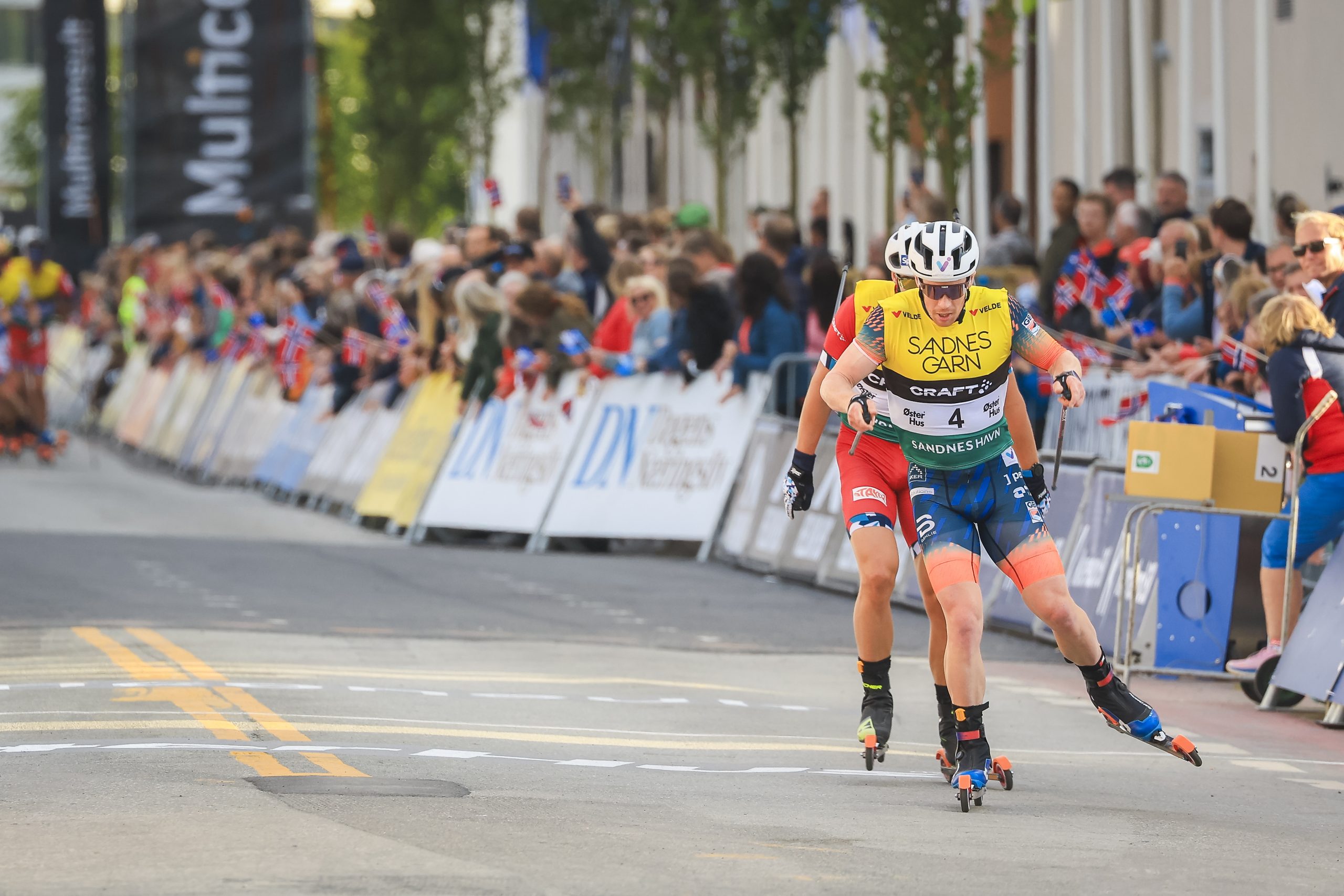
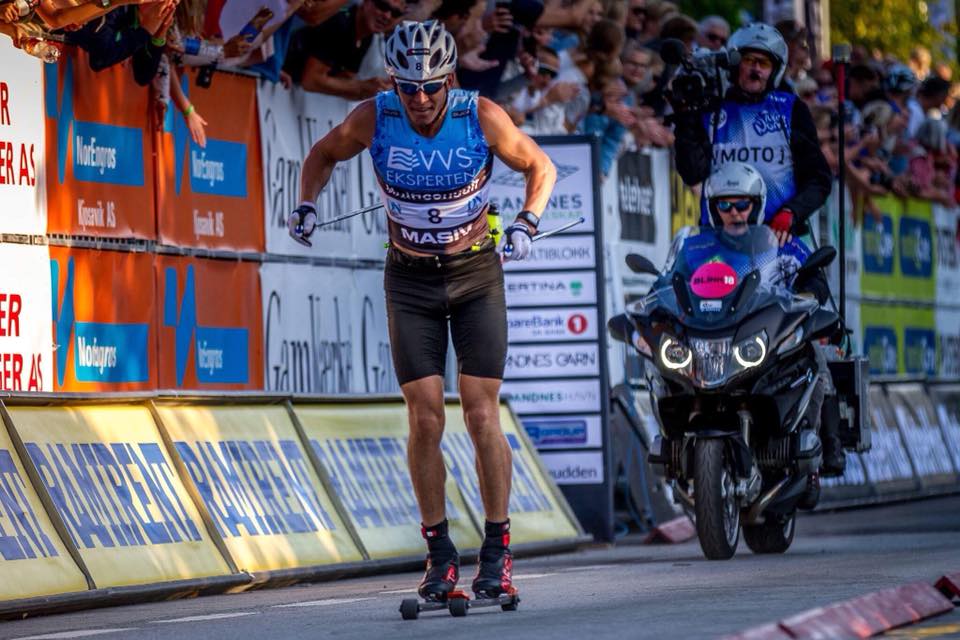
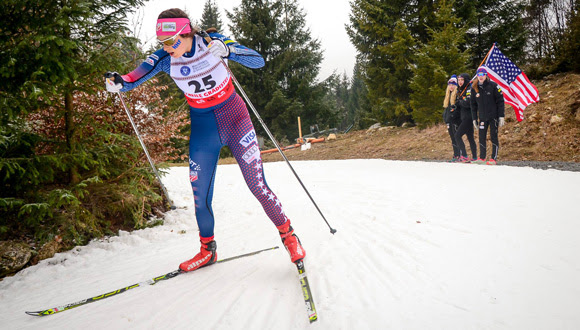
Andrew Musgrave (GBR) gave his fans reason to cheer in the long Blink 23 race. Here he is shown in a skate race the next day. (Photo: NordicFocus)
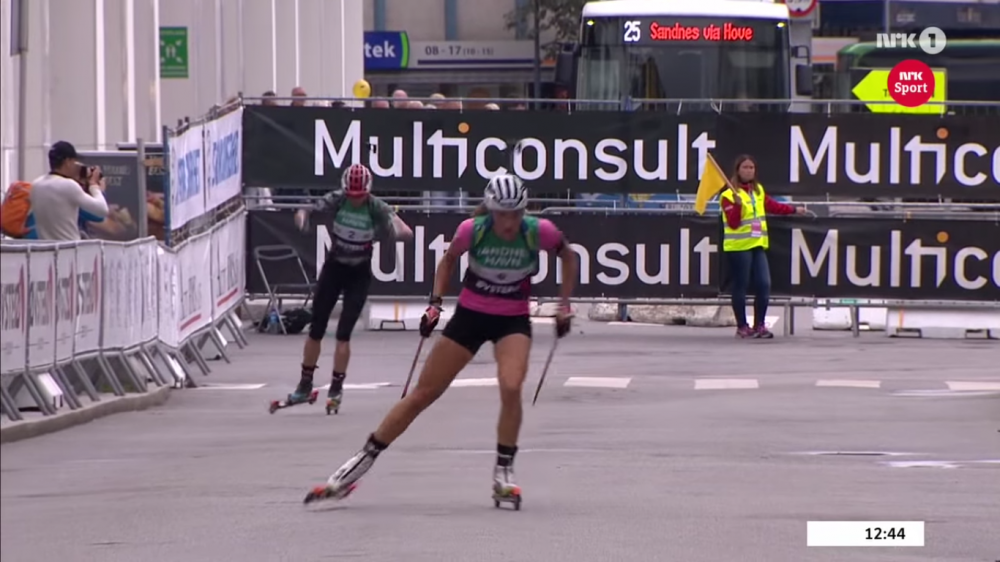
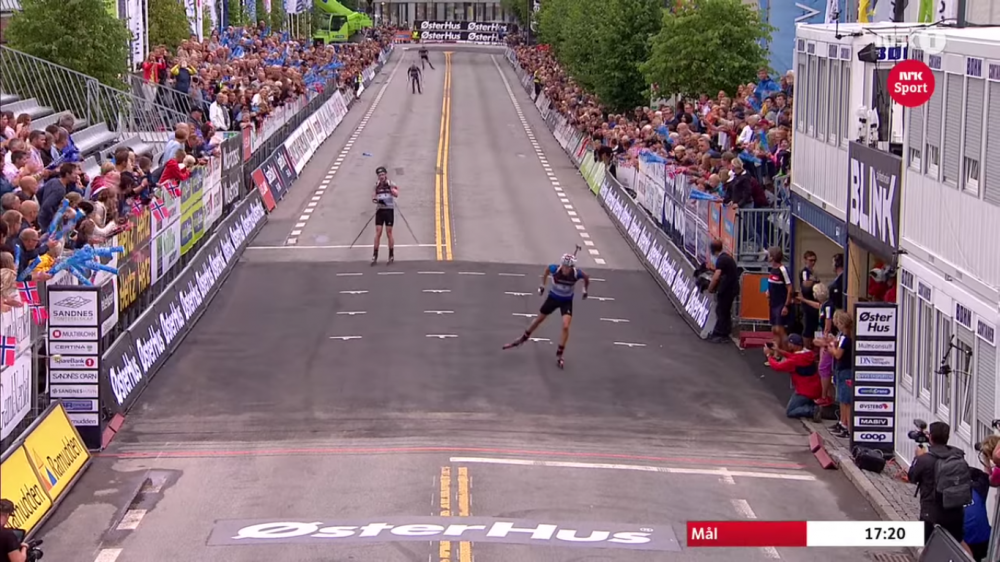
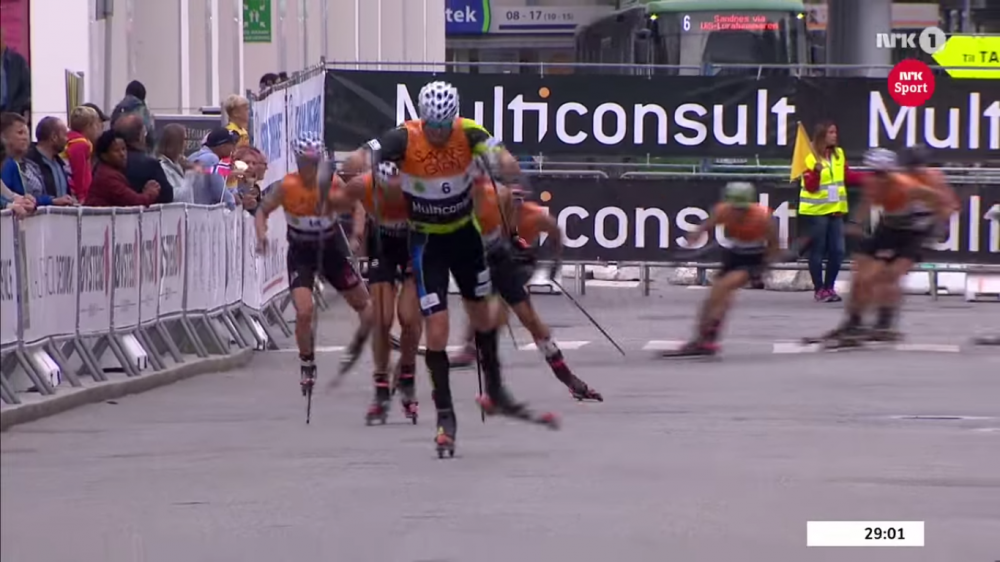
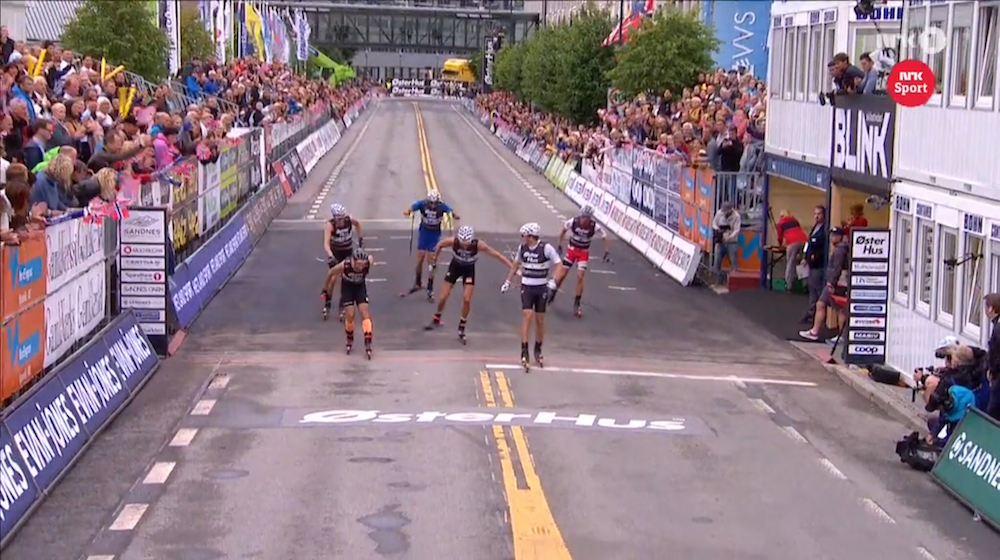
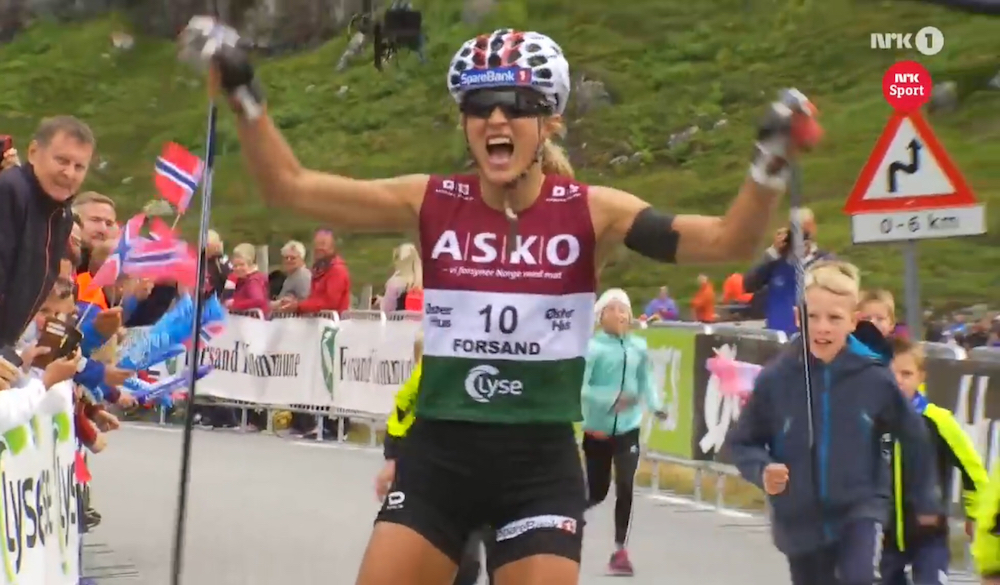
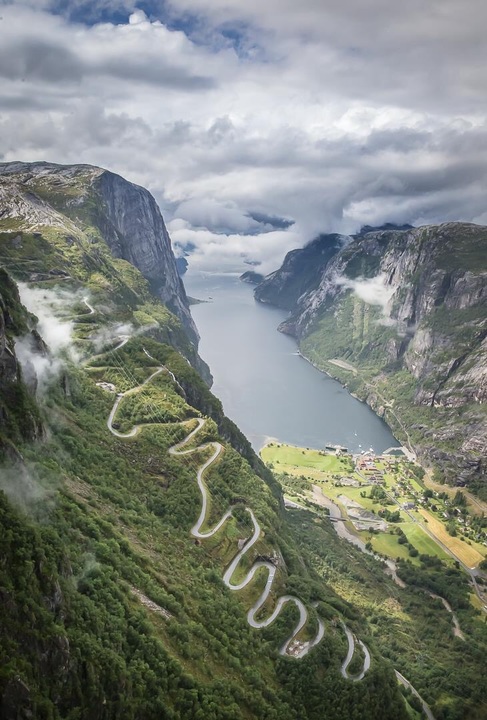
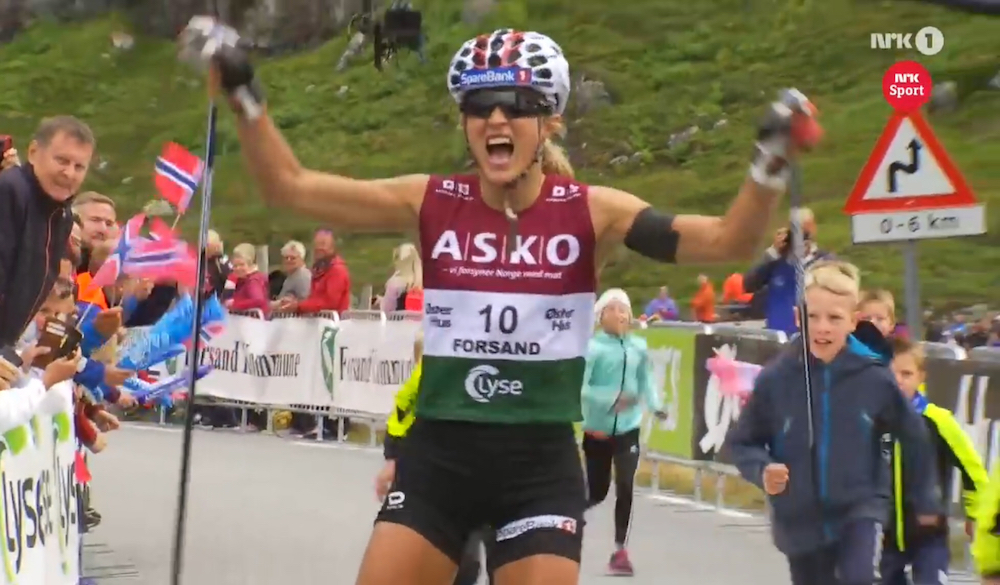
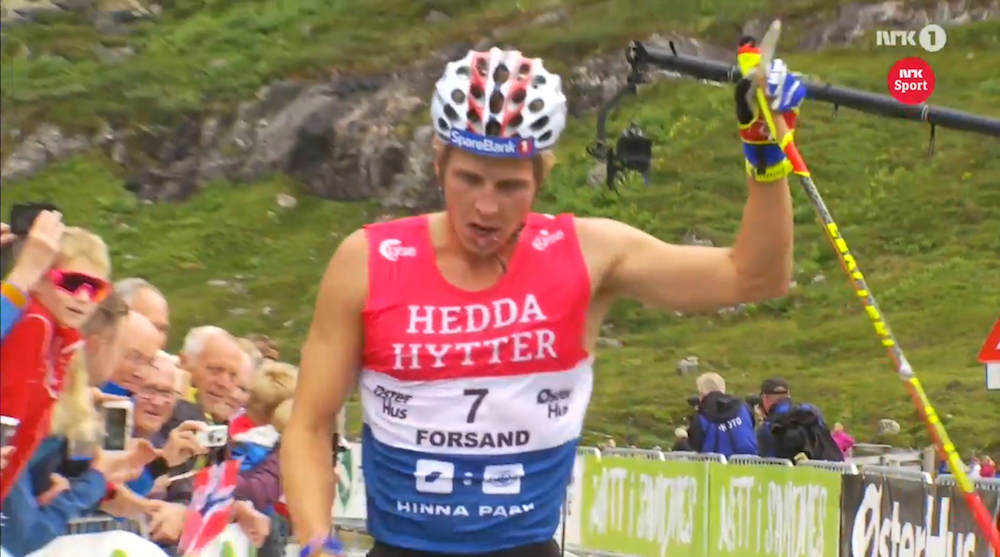
The Blink 23 roller-ski competition is this weekend. It’s most famous for the giant uphill climb known as the Lysebotn Opp. On the other end of the spectrum are the distance events. On Thursday the men and women competed in a 50 kilometer roller ski race.
In the men’s race, perennial World Cup crowd favorite Andrew Musgrave (GBR) took first place by sprinting away from the field. Thomas Joly (FRA) was 25 seconds behind Musgrave, followed closely by Petter Northug (NOR).
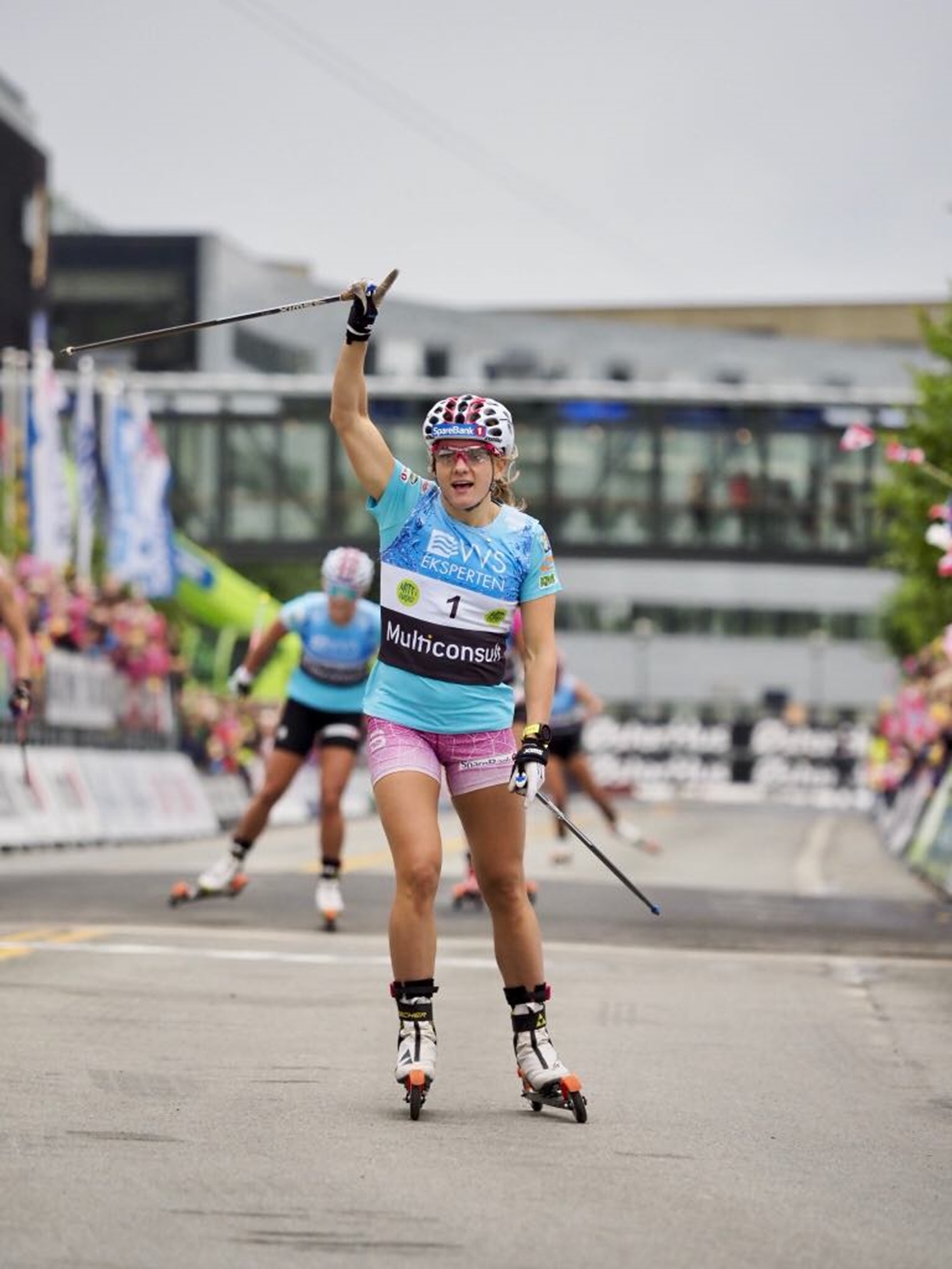
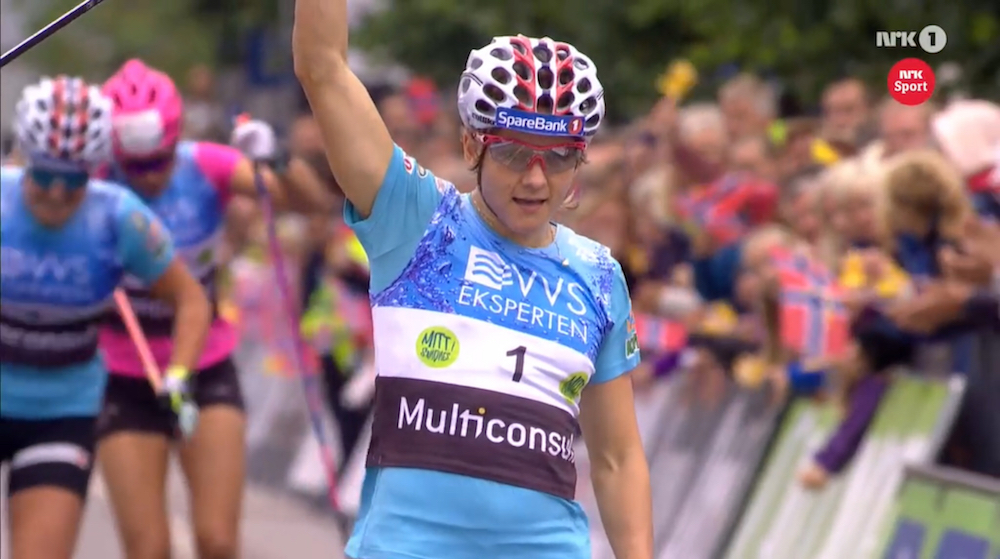
Astrid Oeyre Slind (NOR) took first place in the 50 kilometer race at the Blink 23 Festival. (Photo: NordicFocus)
The women’s race was won by Astrid Oeyre Slind (NOR), who won by over a minute. In second was Lotta Udnes Weng (NOR), and in third was Anikken Alnaes(NOR)
This coverage is made possible through the generous support of Marty and Kathy Hall and A Hall Mark of Excellence Award. Learn more about A Hall Mark of Excellence Award—or about supporting FasterSkier coverage—by contacting info@fasterskier.com.
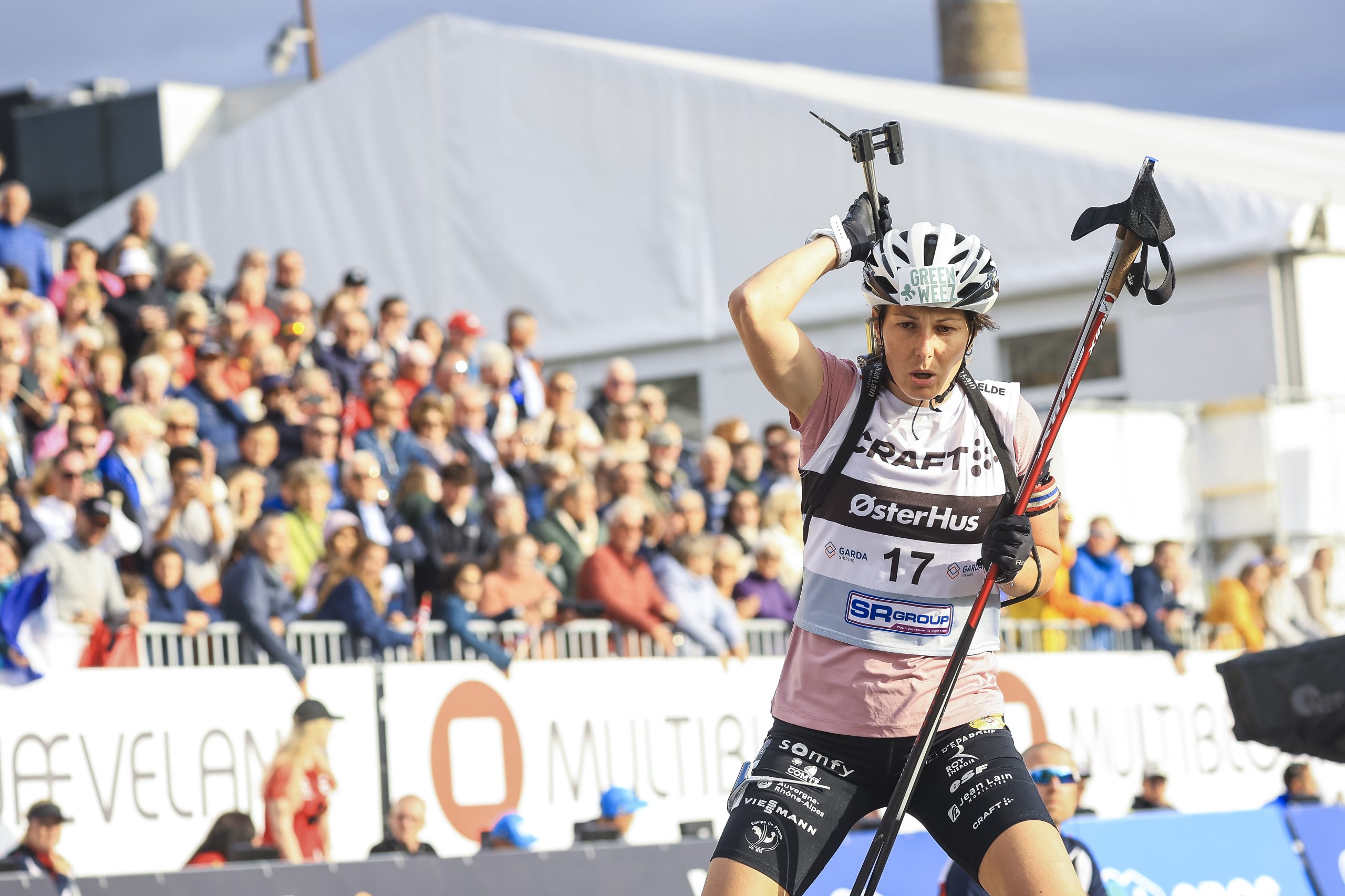
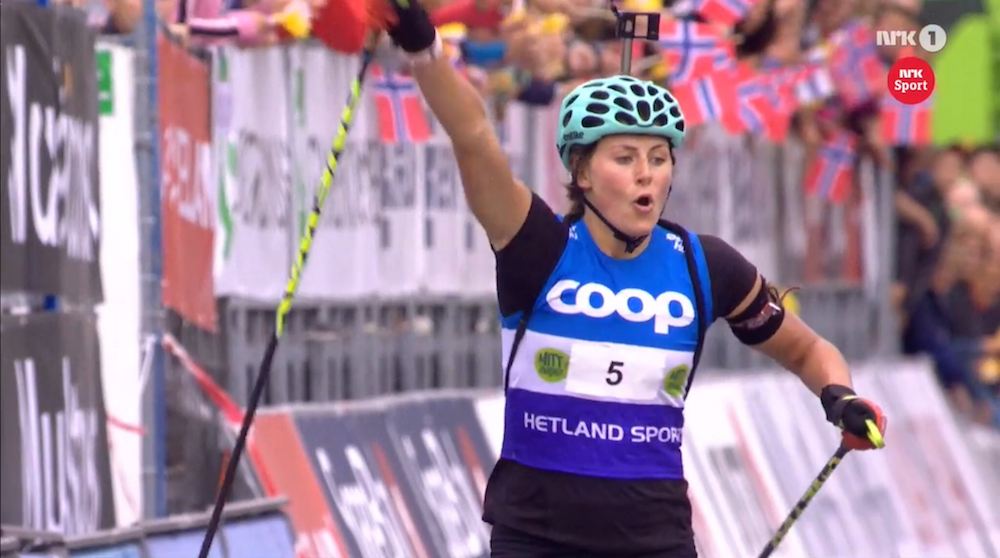
The Blink Festival 23 biathlon sprint was held in Sandnes, Norway. Featured here are Marthe Krakstad Johansen (NOR), Juni Arnekleiv (NOR), (l-r) (Photo: NordicFocus)
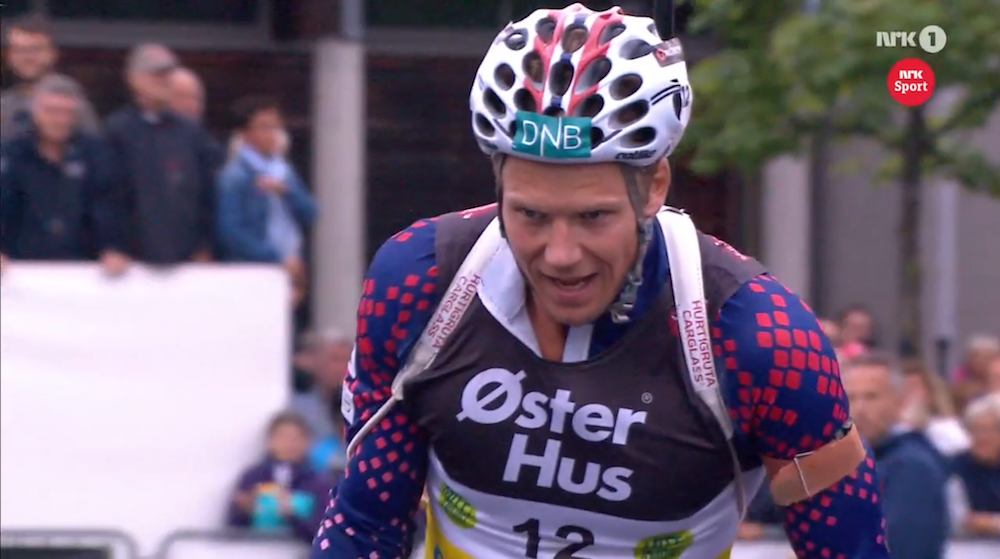
The Blink 2023 Nordic Ski Festival—the pre-eminent summer roller-ski event for cross-country skiers and biathletes—is at an end. Part of the schedule for the last day is the biathlon sprint for the men and women.
In the women’s race, Karoline Offigstad Knotten (NOR) took the victory, she was followed by Chloe Chevalier (FRA), and J. Amekleiv (NOR) in third.
In the men’s race, Vetle Sjastad Christiansen (NOR) took the top of the podium. Second place went to Sturla Holm Laegreid (NOR), with J.S. Saeter taking third.
Chloe Chevalier (FRA) gets ready to shoot at the BLINK23 Festival Biathlon in Sandnes, Norway. (Photo: NordicFocus)
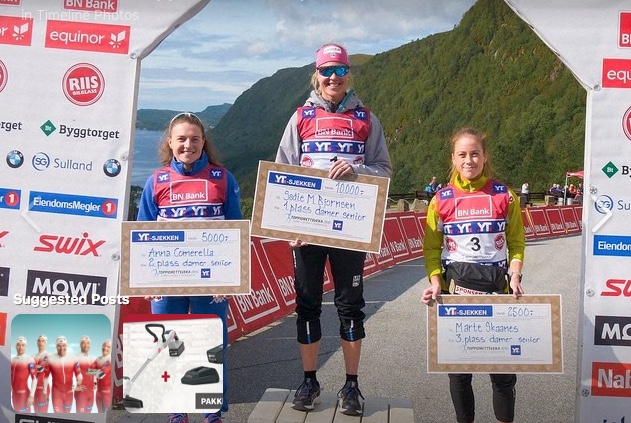
The women’s podium from the 25 k skate rollerski race in Aure, Norway: day 2 of the Toppidrettsveka festival. Sadie Bjornsen (center) of the U.S. Ski Team placed first, Anna Comerella (left) of Italy second, and Marte Skaanes (right) of Norway third. (Photo: Toppidrettsveka FB page.)
Day two of the Toppidrettsveka rollerski races began in Aure, Norway with a 25-kilometer skate race.
U.S. Ski Team (USST) athlete Sadie Bjornsen won the women’s race in 1:10:12.4 hours. Katie Feldman of the SVSEF Gold Team finshed in 25th (+8:08.8). Thirty-one women finished the race.
According to a translated article from Norway’s NRK, several athletes used faulty rollerskis. As a result, race favorite Fridda Karlsson crashed and did not finish.
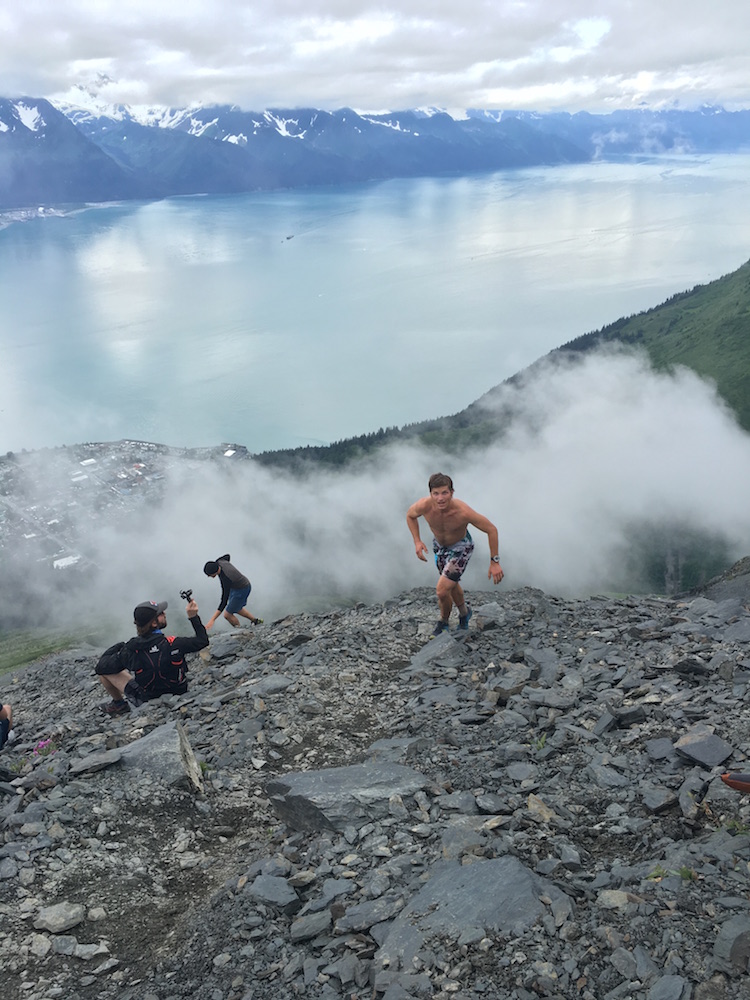
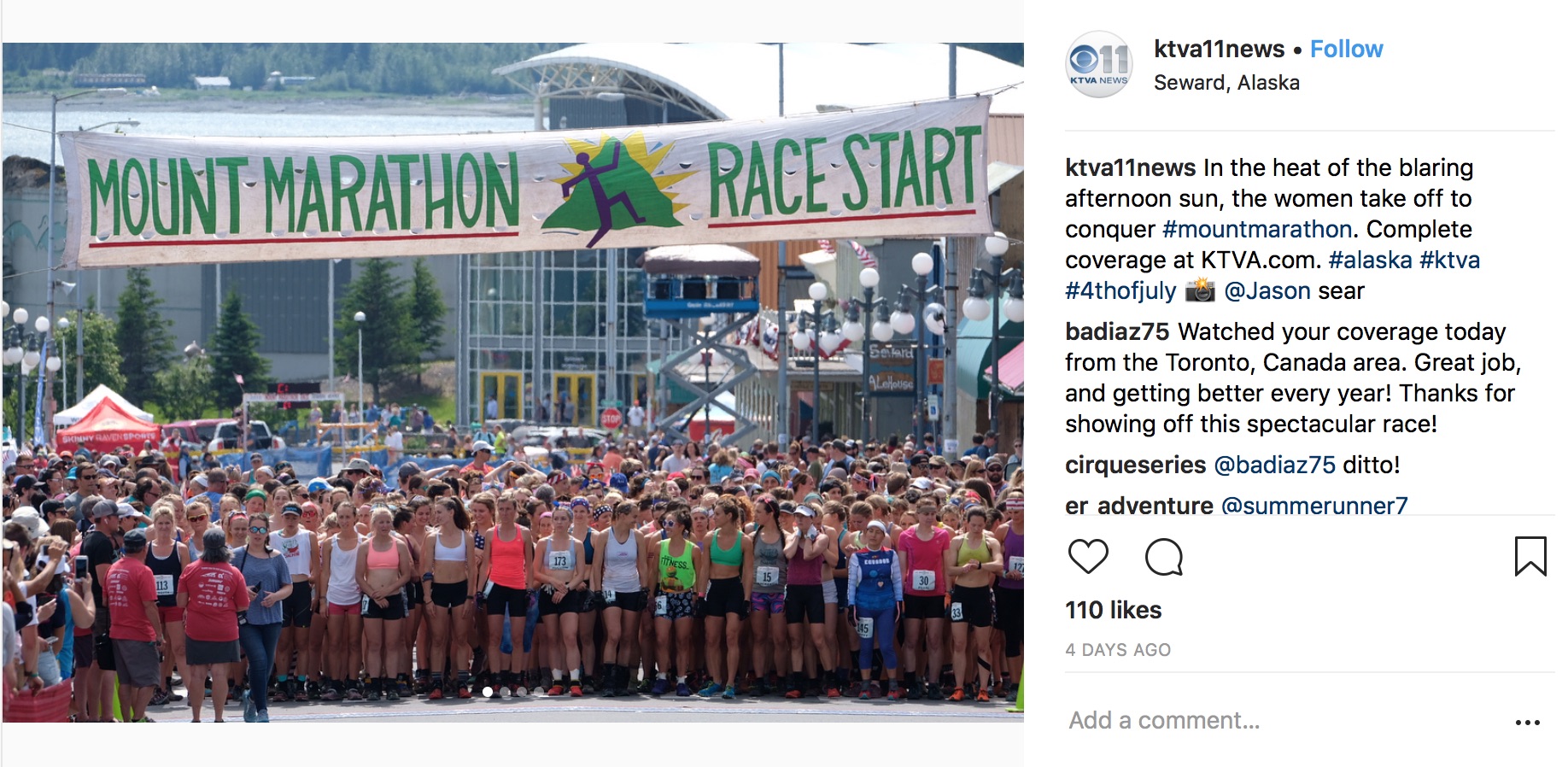
Before we begin, if you have not heard of the Mount Marathon Race, which takes place annually on the Fourth of July in Seward, AK, watch this video. If you’re short on time, fast forward to the six minute mark to witness racers scale the direct route up the mountain which towers over the town, about 3,000 vertical feet in less than two miles. They then cascade down a harrowing descent, a semi-controlled fall down loose rock, snow, and rocky ledges before a final pavement sprint to the finish.
Mount Marathon is not the only race of its kind. Runners compete around the globe in technical mountain races of varying distances in the Sky Runner Series, and in the US, hundreds of racers “push peaks” up and down Western ski resorts in the Cirque Series. This is only a small subset of the hundreds of events that send runners through grueling terrain up and down peaks and along ridges.
In the list of past Mount Marathon champions, there are several familiar faces, including Kikkan Randall, Holly Brooks, David Norris, Scott Patterson, and Jessica Yeaton. This begs the question, why do some of the best skiers in the country put their bodies at risk racing through potentially high consequence terrain? Is it worth the potential setback from a bad fall that sidelines you from training?
David Norris stood atop the podium of the 2019 Cirque Series Alyeska race. Norris also won the race in 2017 and took third in 2018. (Photo: Instagram @cirqueseries / Keith Fearnow)
To answer these questions and get a deeper look into mountain running, specifically the Mount Marathon Race and the Cirque Series Alyeska race, FasterSkier spoke with Jessica Yeaton (APU/Australia XC Ski Team) and David Norris (APU) who have racked up a slew of wins in these races.
Norris is a two time Mount Marathon winner and course record holder. In 2016 he bested the time of world renowned mountain athlete Killian Jornet. Norris chose to sit out this year’s event due to the smoke-induced poor air quality. Norris also won the Cirque Series Alyeska race in 2017 and 2019 and took third in between.
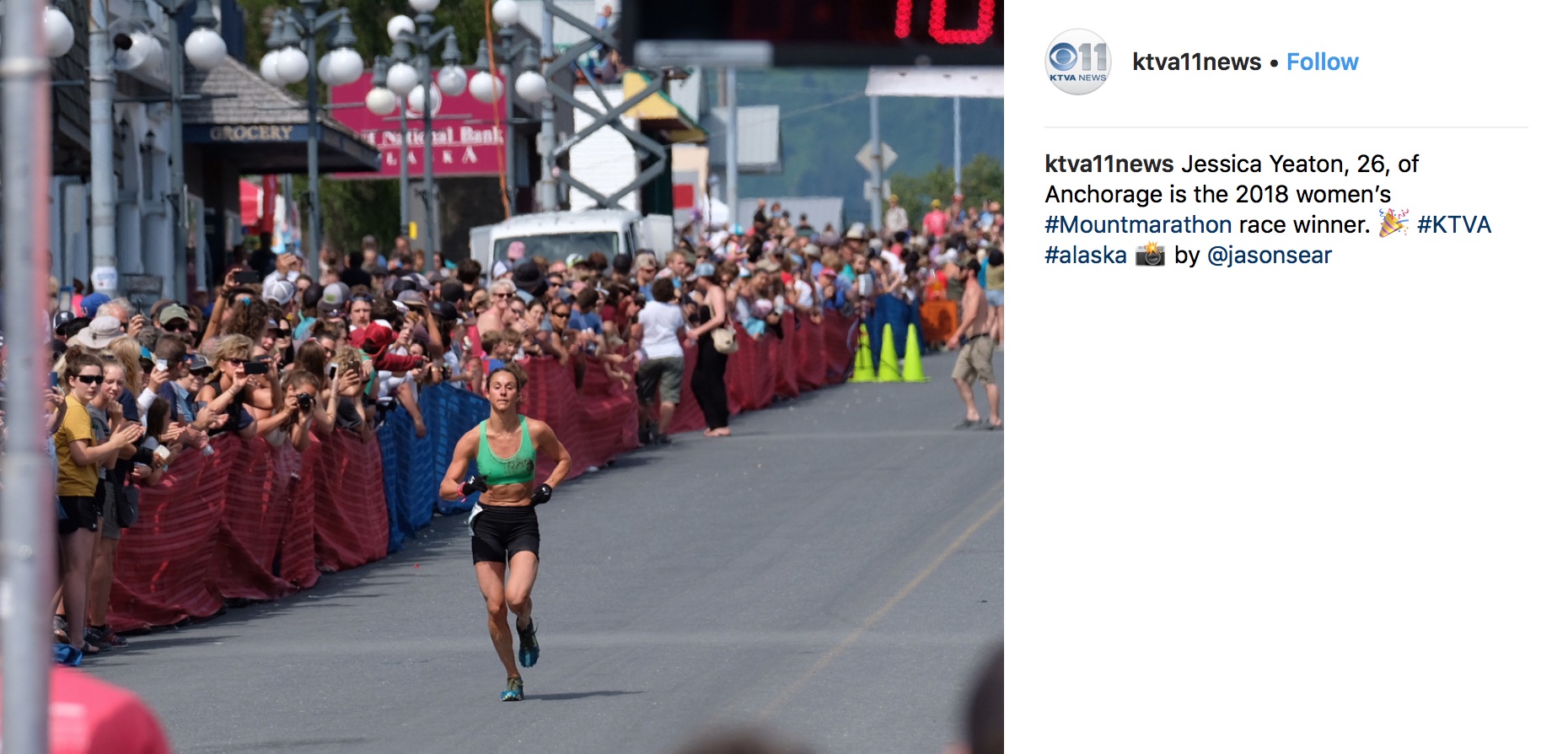
In 2018, Yeaton won the Cirque Series race and both members of the duo won Mount Marathon — this is a perfect record for Yeaton as she has only entered each race once. (Fellow APU athlete Rosie Frankowski was the female Cirque Series Alyeska winner in 2019.) A nagging hamstring injury has kept Yeaton from incorporating doing much running into her training over the last year, keeping her out of competition.
At the time of the conversation, the couple was wrapping up a road trip from their home base in Anchorage through Western Canada and south through Montana, Wyoming, and Colorado before reaching their final destination of Albuquerque, NM where Yeaton begins Physical Therapy school this fall. She will continue to train and compete in skiing but acknowledges that her race schedule will look different this season as she will be navigating around the academic calendar.
Jessica Yeaton leads the women’s field up a ridge during the 2018 Cirque Series Alyeska race. (Photo: Instagram @jjyeaton)
Apart from dealing with a lingering cold through June, Norris is feeling fit and putting together a solid summer of training. He shared that he is “looking forward to November.”
As both Norris and Yeaton are primarily focused on ski racing, they take a slightly different approach to these races than athletes targeting mountain running. Rather than training specifically for Mount Marathon or Cirque Series, they use the efforts to compliment their high volume of training.
“The race itself is really good training for ski racing and the downhills are the only risky part,” said Norris in a call. “The uphill and cross country side of mountain racing is super good for our training. Usually, we don’t taper for the races, we just add it into the week’s schedule, so instead of hammering out intervals on Friday, we’ll adjust the workout to a speed session then do the race Saturday as our intensity for the second half of the week.”
While this strategy might not be attainable for the average racer, Norris and Yeaton explained that they capitalize on their fitness and power to excel on the uphill, cushioning their lead so they can ease up and stay in control on the downhill, which they believe minimizes the risk of sustaining an injury. This allows them to reap the benefits of a race effort without the danger of halting their otherwise steady progress in skiing.
“I think we’ve been kind of fortunate that in a lot of these uphill races that include technical downhills, if you have enough of a lead [on the uphill], you can stay within your comfort zone [on the downhill], and I don’t think the risk is absurdly high,” explained Norris. “What’s always made me nervous about Mount Marathon is if I were to get to the top in second or neck-in-neck with someone, then I don’t know if I would hold back. With my competitive nature, I think I would hammer the downhill and try to win, and that’s when I think it becomes more risky and that’s when you’d have to decide if that was the right thing for cross country skiing and the training.”
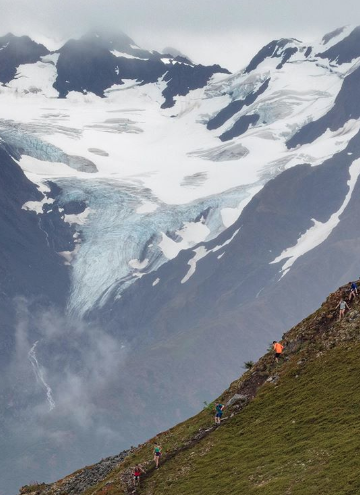
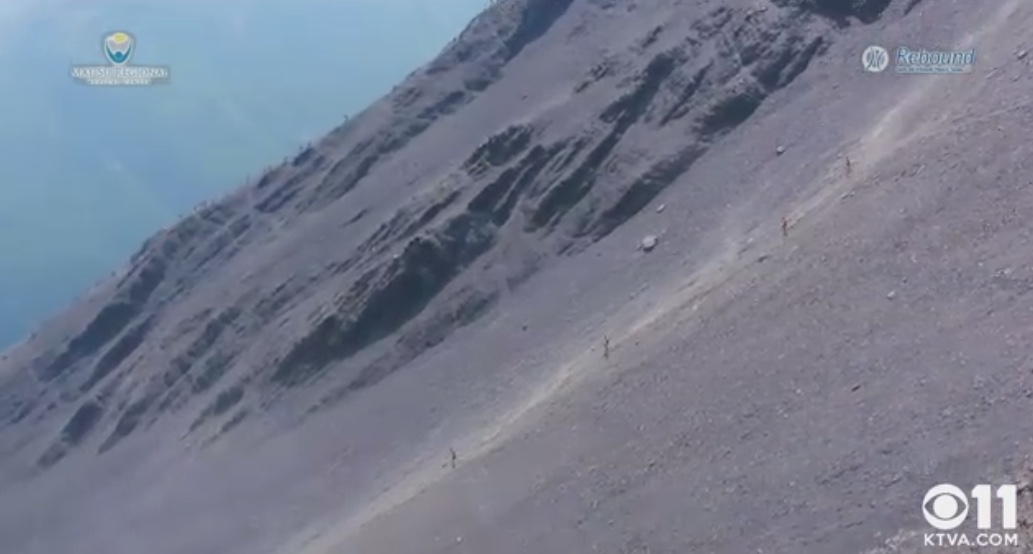
Look closely to see athletes ascend a steep ridge on the shoulder of the Alyeska Ski Resort during the Cirque Series race. (Photo: Instagram @cirqueseries)
As they would with any summer race, both athletes discuss their race strategy and their decision to enter with their coach, Erik Flora. Both agreed that he is on board with them racing but might not advise all of his athletes to do so.
“In my position, being injured, definitely I could enter races and do them and just continue to go down that path, and [Flora] would definitely advise against that,” Yeaton stated. “But if you’re in a place where you’re not battling injuries and you’ve been running and practicing downhills a lot, which is where I was two years ago leading into Mount Marathon, then he was totally supportive of that. A lot of it is knowing your boundaries and knowing what you’re capable of.
“It’s something that is on a case by case basis,” she continued. “Because some athletes are constantly battling injuries and are less skilled at technical running, he’d maybe advise against entering these races, but I think a lot of us can handle that.”
For the skier interested in trying a mountain race, Norris explains that not much alteration to typical summer training is necessary as the fitness will already be there. However, as with mastering any skill, practice and time moving through the type of terrain encountered during the race is valuable.
“For the uphill, all the rollerskiing and the hill bounding and plyometrics are awesome training for running uphill, so I think most skiers have good leg strength and aerobic capacity to climb hills fast,” Norris explained. “Then, it seems like for the descending, my downhilling has improved a bunch just since moving to Anchorage, because growing up in Fairbanks it’s more trail running and just dodging roots. In the afternoons, I do a lot of two hour runs that are just roaming around in the mountains. Once you get above treeline, you don’t really need trails, so you’re just scrambling around on ridges. I think my footwork and my agility has improved by just training out there a bunch. Not necessarily doing drills out there, but just the time and running trails in that terrain.”
Descending is not the only aspect of mountain running that requires practice. As the ascent often requires using hands and arms to scramble and navigate around steep rooty and rocky ledges, this too requires technique and practice to develop efficiency.
“For me, it was just practicing the uphill enough and being in good enough shape and knowing that I could be in front on the uphill,” Yeaton shared. “Then knowing that I could get down the downhill fast enough without putting myself in a risky place. So trying to make up all my time on the uphill, because that’s such good training for skiing — and that’s our strength is fitness. If you can get in a place where you’re already putting time on people on the uphill, then you don’t have to necessarily put yourself at risk, which I think is a really good tactic when you’re ski training.”
For the novice athlete interested in trying one of these races, Norris recommends developing enough stamina to feel strong throughout the event and also moderating effort to prevent the mental haze that can result from overextending one’s physical capacity.
“At any level, if you’re a first-timer going into it, just being fit enough that when you get to the top, your legs aren’t wobbly or shaking under you, because I think that’s where the risk would really increase is if you’re totally fried and you’re just trying to make it back to the bottom. I think with skiers, you start running down the hill for five or ten seconds and you’re already starting to recover. Your legs are strong and you’re able to maneuver downhill safely. But if you’re totally new to the sport and you got to the top of the hill and you’re cramping and crumbling, then your risk of just getting down is so much higher because your legs are so tired.
“Good advice for first-timers is to stay within yourself so that you have the energy and strength to maintain coordination for the downhill,” he said simply.
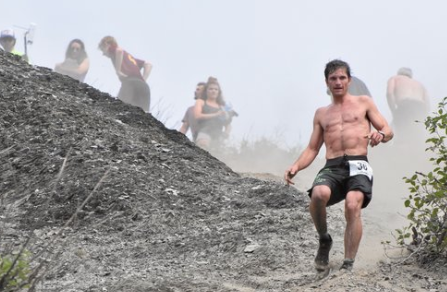
David Norris (APU) takes on the steep and technical descent during the Mount Marathon Race. (Photo: Screenshot norrisnordic.com)
Even though gravity is in the athlete’s favor during the descent, the difficulty should not be underestimated. Running downhill forces the legs, particularly the quadriceps, to work eccentrically, meaning the muscles are lengthening while under stress from the force of each footfall. Essentially, the tension in the muscles is preventing the legs from collapsing, versus the pulling forces from the glutes and hamstrings which power a runner forward or upward.
Ever had to walk down the stairs backward after a hard downhill run or hike? This type of work causes muscles to fatigue quickly or potentially to fail if they are not properly trained and is correlated with increased muscle soreness after the activity.
For any athlete looking to try a mountain race, it is important to spend some time running downhill beforehand to condition the legs to sustain this toll.
“Just in training, we jog around really easy then you start going down the hill and you realize your legs are getting super fatigued and tired on the descent. It’s deceptively hard to just run downhill,” Norris emphasized.
While no races are on their calendars at this point, both are eager to jump into more mountain races in the years to come. The couple agreed that they would like to find ways to race outside of Alaska; this has been tricky for Norris as his travel budget is focused on the winter race season, but as Yeaton will be based out of Albuquerque for the next two years — “closer” to the other Cirque Series races — both hope it might be possible in the near future.
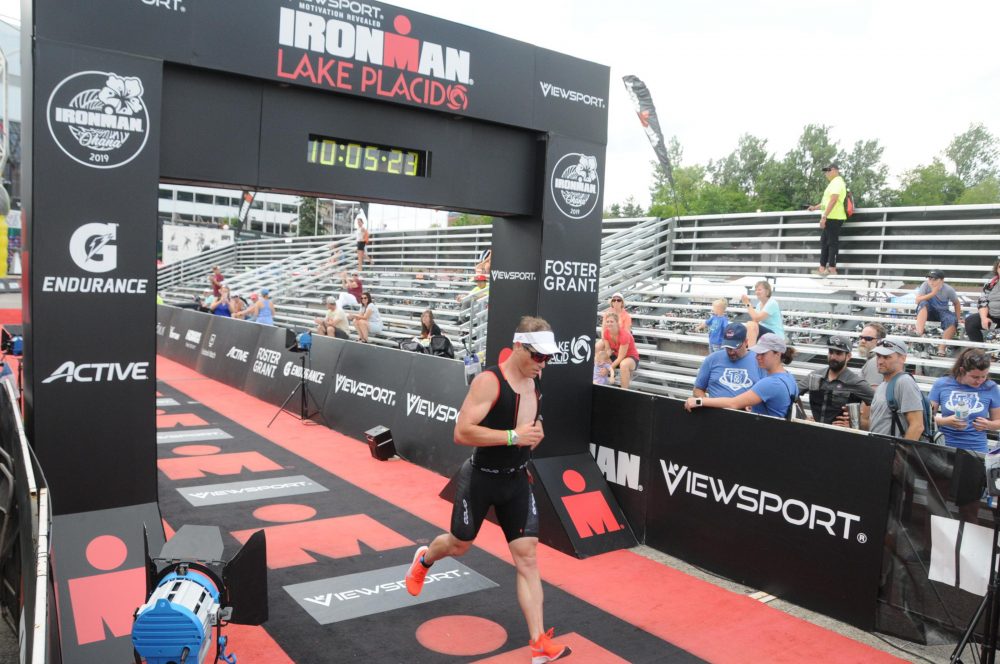
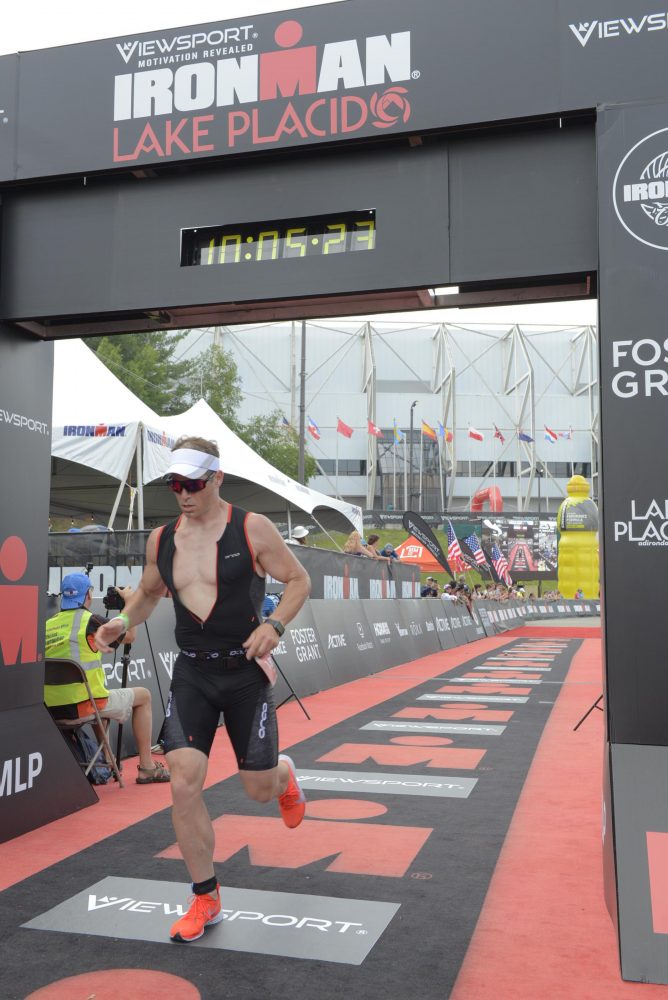
Kris Freeman finishing the 2019 Lake Placid Ironman. (Photo: Courtesy Kris Freeman)
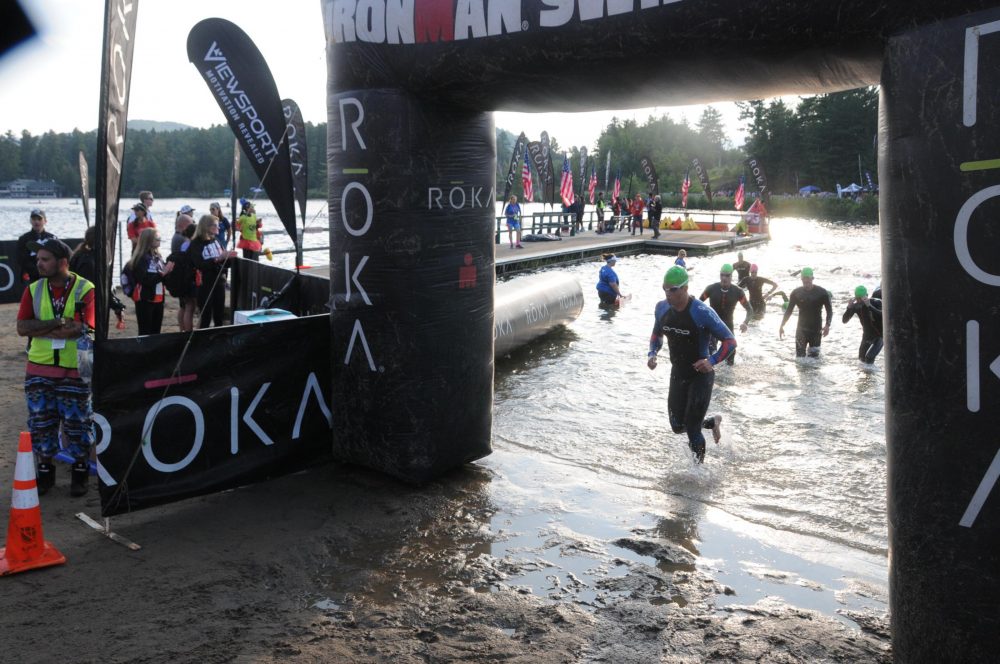
The half is now full. In an often over-corporatized scene blazed with the Ironman logo, thirty-eight-year-old Kris Freeman added a deeply human element as a finisher in the 2019 Lake Placid Ironman. Among the 2042 finishers of the July 28 Lake Placid event, there are 2042 unique stories. The final person across the line was 35 seconds inside 17 hours. The overall winner notched 8:27:57 hours. On each end of the spectrum and in-between, a chasm of suffer-time.
Freeman was 23rd overall, and fourth in his age group with a time of 9:50:12. This was his first full length Ironman which features a 2.4 mile swim, 112 mile bike ride, all capped with a 26.2 mile run.
We’ve followed Freeman on his training and race journey this summer not to determine his finish rank, but for the simple reason that as a type 1 Diabetic he remains an endurance athlete lab specimen. He’s constantly testing and refining insulin dosing and feeding strategies for the single purpose of killing it on course. If you know Freeman you know this: he is exacting and buries himself in effort.
“I took a recovery week after the race and then I trained two very large volume weeks following that and then I took an incredible easy week followed by a medium volume leading into the race,” said Freeman. “And I did in that order because I wanted to come into the race with a predictable glucose response. Had I just rested coming in, it gets harder to guess where my blood sugar is going to be.”
As an active type 1 diabetic, Freeman explained that when he is in a fully rested state balancing his insulin and glucose becomes tricky. When he’s more active and “trained”, his body becomes more receptive to both insulin and glucose making it easier for him to determine a detailed dosing strategy. For this reason, Freeman kept up his training volume more than some as he approached the Lake Placid event.
Before we progress, here’s the basic insulin-glucose primer. During exercise, the body needs glucose for energy. Freemen can consume sports drinks and solid food to maintain his blood sugar levels once his stores are depleted. Insulin drives the glucose back into the muscles, decreasing blood sugar values. Freeman uses synthetic insulin as his body no longer produces insulin. He wears a pump to infuse insulin at a predetermined rate and a continuous blood glucose monitor to assess his blood sugar levels.
Freeman has experimented with his insulin dosing in training and racing. During the half-Ironman in June, he programmed his pump for a rate of 1.0 units per hour for the first hour of racing. He then suspended the insulin for much of the bike portion. It reactivated at the start of the run. Although Freeman won the race, he wasn’t satisfied with the dosing strategy.
“I continued to test that idea of suspending the insulin in some long workouts in those two big volumes weeks before Lake Placid,” explained Freeman. “What I was finding was that it was becoming too unpredictable when I turned the insulin pump off and on. I abandoned that theory.”
He opted for an approach that steadily infused insulin for the entire duration of the Ironman, although at a lower rate.
On his personal blog, Freeman has referred to himself as a cyborg. In the Adirondacks on July 28 Freeman admittedly looked the part. He referred to himself as the “double cyborg”. He wore two insulin pumps, one on each pec, and an insulin monitor planted on each oblique.
He doubled up on his medical hardware as a backup. Insulin pumps and glucose monitors do fail. The double-up strategy provided an element of safety in the event of mechanical failure. Another added benefit of the double-up, if the insulin dosing was off and he needed to reduce the amount of insulin in his system, “I could always just tear one off and instantly half the insulin dose I was getting without having to use a handheld computer and reprogram a pump.”
Time
Insulin Pump 1
Insulin Pump 2
Hours 0 – 2
0.3 units/hour
0.3 units/hour
Hours 2 – end of race at 9:50 hours
0.2 units/hour
0.2 units/hour
What’s outlined above was Freeman’s dosing plan for the full Ironman. 0.6 units/hour for two hours — then a reduction to 0.4 units/hour for the remainder of the race. We’ll learn in a bit how he modified it on the fly, but despite what he claimed was a stressful pre-race routine learning the ins and outs of gear and feed bag placements, Freeman met his first race day objective. He made the goal of a sub-hour swim. The swim took 59:45 minutes.
Freeman out of the swim in under an hour during the 2019 Lake Placid Triathlon. (Photo: Courtesy Kris Freeman)
The swim-bike transition, according to Freeman, wasn’t clean. He did swig a planned 16 ounces of sports drink to bolster his blood sugar. But for twenty seconds or so he couldn’t locate his bike. As one of the top athletes out of the water (he was 73rd overall), a volunteer had moved his bike to a position for easier retrieval. That was news for Freeman.
Five minutes and twenty seconds later, the transition over, Freeman was set in his aero bars as he rolled out. Once on the bike, Freeman’s watch and phone connected via Bluetooth for his first blood sugar reading: 137 mg/dl. Pretty much dialed — in the sweet spot of the 100 mg/dl -180 mg/dl range.
Freeman’s monitor also provides an indication of blood sugar trend. One downward arrow displayed indicates declining levels. Two arrows down indicate a more precipitous rate of decline. Freeman noted two downward arrows.
“At that point, I emptied another 20 ounces of Gatorade right off the bat which swung the blood sugar so I started climbing into the high 200s for about the next 40 minutes,” said Freeman. “That wasn’t ideal and it also put me in a position where for 40 minutes I wasn’t feeding as I was waiting for my insulin to catch up with the glucose that I gave myself.”
Freeman spent nearly five hours and twelve minutes on the bike. He continued eating solid food when he could and also replenished sugar with fluids. 6:16:52 hours into the race Freeman transitioned to the run. Again, Freeman’s said he bobbled the transition. “Part of it was inexperience and part of it was underestimating the importance of that transition,” he said.
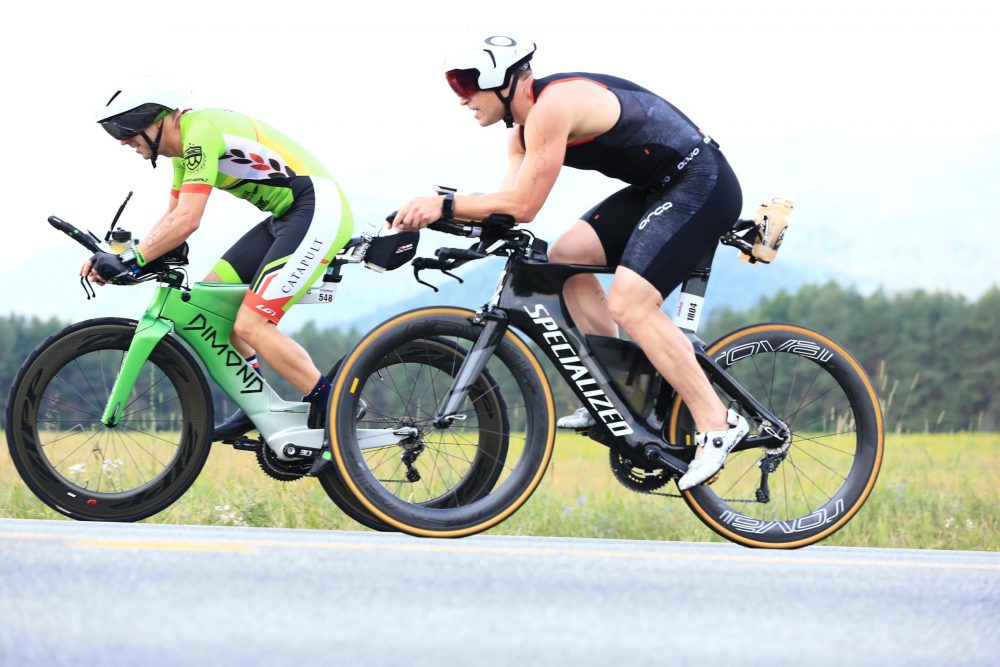
Kris Freeman (right) out on the bike course during the 2019 Lake Placid Ironman. (Photo: Courtesy Kris Freeman)
Among other minor time sinks, Freeman chose not to use a bungee-like quick-lace system on his running shoes. With stiff fingers after the bike ride, simply tying his shoes became a struggle.
The first half of the run, to 13 miles, was as expected. He was on pace for a near 3:15 hour marathon. He followed the usual pattern: he noticed his blood sugar begin to fall, he ingested some form of sugar. The blood sugar levels rise then eventually fall again as his motor burns the fuel and the insulin does its removal work.
“In the run, there were feed zones every mile and a half,” said Freeman. “It was very easy to fuel. They had water, Gatorade, RedBull and cola at every single feed zone. I could get whatever I wanted. And I was doing this for the first half of the race but then I noticed at about 13 miles that I had just fed and my blood sugar was not climbing.”
Back to the dosing strategy and the double-up on medical devices. Freemen knew from experience that his insulin levels were too high. Removing one pump would halve his insulin dosage immediately.
“I tore one pod off at this point,” he said. “Then I noticed that my blood sugar was continuing to drop. Two miles later I tore the other pod off. I made the decision: I have about an hour and a half left in the race and I am not going to get any more insulin.”
The synthetic insulin Freeman employs has a tail of effectiveness. In other words, synthetic insulin’s potency gradually wanes over time.
“The insulin that was already in my body was enough that it kept driving me low,” said Freeman. “And at this point, I started drinking Gatorade and or RedBull or gels not because I felt like I needed the energy but because I was trying to keep up with what insulin I already dosed myself with. Even though I had torn the pods off I still had the residual tail. I was basically feeding that tail to get to the finish.”
That meant drinking and eating during those last 13 miles when it became a struggle to keep food down. Freeman ran a 3:28:24 marathon for his 9:50:12 finishing time. The top-three in each age group earn an auto-invite to Kona’s Ironman World Champs. He was fourth by 40 seconds. Even with a Kona berth, Freeman did not intend to race in Hawaii this year. This season was about making mistakes and learning to refine his approach in the future.
Analyzing the time losses here and there, Freeman mentioned his haphazard transitions as potential areas to build efficiencies. Then he zeroed in on the potential mistakes with his insulin dosing. It’s worth mentioning again, this was the longest sustained race effort of Freeman’s endurance career. What he came in knowing was that the dosing-feeding quandary for his near ten hour effort remained a moving target.
Although spending the post-race week resting and engaging in some easy active recovery, Freeman was clear he’s gearing up for next year and a shot at Kona. That means positing how he’ll modify his insulin dosing for the next Ironman. Freemen said he needed to remove his insulin pump pods for the following reasons: “Overall glycogen depletion and increased muscular receptiveness to insulin contributed to the downward pressure. I should have deactivated the pumps at the start of the run but hindsight is 20/20.”
Freeman crosses the line during the 2019 Lake Placid Ironman. He’s already looking for efficiency for his next go around. ((Photo: Courtesy Kris Freeman)
Beyond shutting down his pumps earlier, the redo would involve front-loading his insulin to receive a higher dose earlier in the race.
“I would have the insulin ramp up more for the start of the ride,”said Freeman. “Early in the race is a better time to have to overfeed than later in the race. You are fresher. Your stomach is better. Food is still appetizing. When you get eight or nine hours into the race, you don’t need the energy but you need to keep your blood sugar up because you have that synthetic insulin in your body.”
Freeman was the 10th overall amateur on his maiden Ironman voyage.
“Given everything I learned, I think I said in our last interview that I would be happy with 9:30. Given the difficulty of the transitions and what I learned — 9:50, I will take it.”
Today, in Seward, Alaska, home of the Mt. Marathon race, temperatures were in the mid-60s. However, the indices that mattered was the air quality index (AQI). According to an Anchorage Daily News article, the AQI in downtown Seward was 172 on Thursday morning. As a result, the junior race was officially canceled. An AQI of 172 falls within the unhealthy range,
Despite the junior race cancellation, the youngsters went rogue and ran an unofficial race. Seventeen-year-old Sebastian Sweda Mittelstadt won the unsanctioned boy’s race and Noelle Spencer the girl’s race. The juniors run a shortened course.
FasterSkier normally covers the Mt. Marathon race due to the elite cross-country runners in the field. Holly Brooks, Jessica Yeaton, Scott Patterson, and David Norris are all past winners. Norris won in 2018 and 2019, Yeaton won the women’s race last year.
With less than stellar regional air quality due to wildfires, Yeaton, Patterson, and Norris chose not to race.
Hannah Lafleur won the women’s overall in 53:24 minutes. Former APU and U.S. Ski Team member — and mom to twins — Holly Brooks placed 10th in the women’s race.
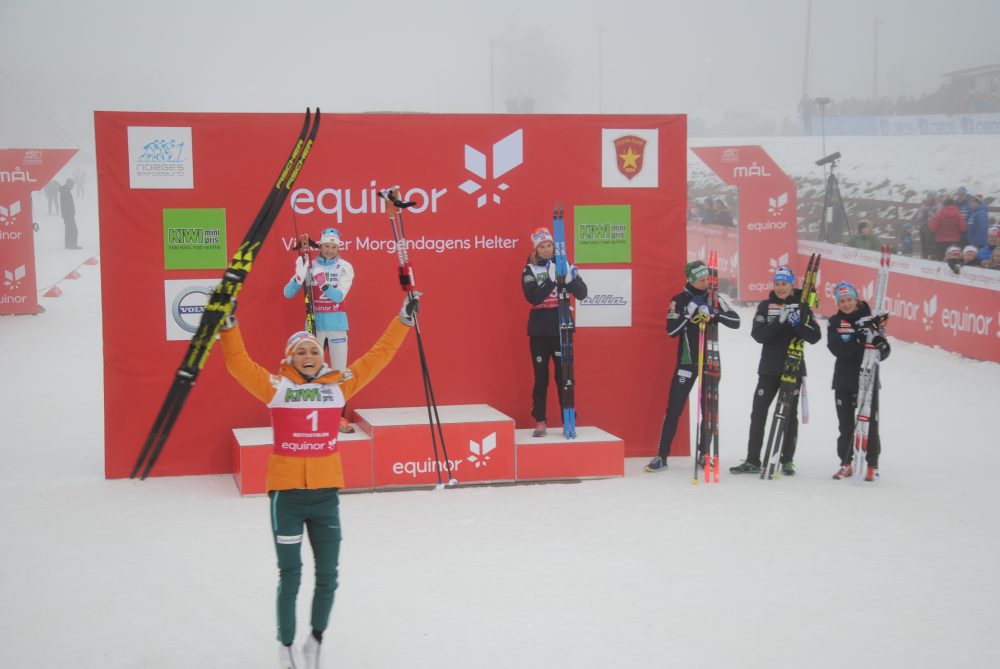
The women’s all-Norwegian podium from the 2018 FIS Skate Sprint in Beitostølen, Norway. Maiken Caspersen Falla (center) won, Kristine Stavås Skistad placed second (left), and Lotta Udnes Weng was third (right). (Photo: Aleks Tangen)
In a place like Norway, where the pool of cross-country athletes appears eternally deep, when you see competitors raise the bar, there’s nothing else to do but jump.
On Saturday in Beitostølen, Norway the known knowns were self-evident: Maiken Caspersen Falla and Johannes Høsflot Klæbo took the freestyle sprint wins during the second day of FIS race competitions.
As both athletes were overall World Cup sprint champions last season, there are no shockers there. (Klæbo has won two consecutive sprint crystal globes, Falla three.) But other skiers rose to the occasion and proved they too can jump nearly as high as Falla and Klæbo.
The women’s second semifinal on course in Beitostølen, Norway during the FIS skate sprint. (Photo: Aleks Tangen)
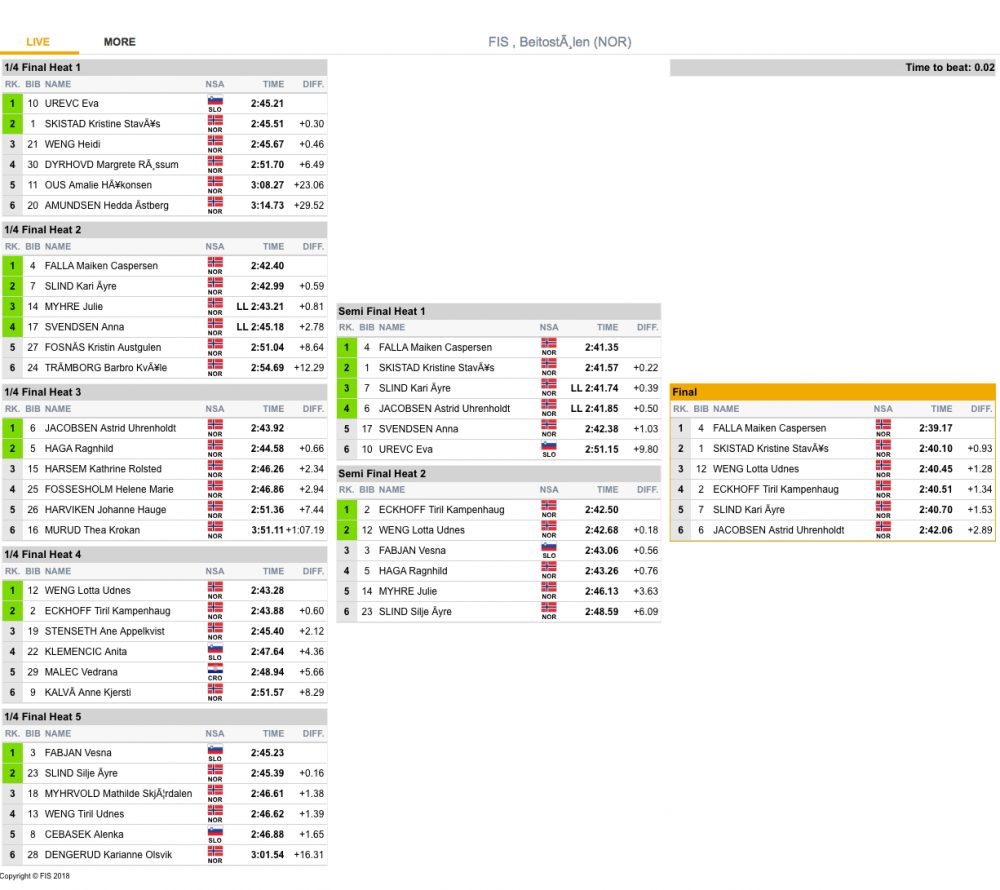
The women raced a 1.3 k skate sprint course with 54 women racing the qualifier. And this is where things got interesting. Nineteen-year-old junior Kristine Stavås Skistad, who has raced a single World Cup, the 2018 Drammen classic sprint in which she placed 51st, won the qualifier in 2:44.68 minutes. What is startling when scrolling through the qualification results is her birth year: 1999. The next closest Norwegian athlete in age finishing in the top-10 of qualification on Saturday was Anne Kjersti Kalvå, born in 1992.
In last season’s World Junior Championships, Skistad placed fifth in the 5 k classic, and second in the skate sprint. So certainly she is an up and comer. But the fact that she held her own in a world-class field of Norway’s best, is a statement.
Falla qualified in fourth (+1.63), and moved through to the finals by winning both her quarterfinal and semifinal.
Skistad, however, maybe played it a bit coyer. She squeaked into the semis by placing second in her heat by .30 seconds to Slovenia’s Eva Urevc. She then placed second to Falla by .22 seconds in the first semifinal. (That semi proved the faster of the two semifinals — both Kari Øyre Slind and Astrid Uhrenholdt Jacobsen advanced as lucky losers from the Falla semi.)
Falla is Falla – a veteran with big experience and the know how to throttle the engine when it matters. She won the final in 2:39.17 minutes, a pace over five seconds faster than Skistad’s winning qualification time.
In the all Norwegian final, Skistad placed second (+0.93), Lotta Udnes Weng was third (+1.28) Tiril Kampenhaug Eckhoff, both a World Champs and Olympic medalist in biathlon, was fourth (+1.34), Slind fifth (+1.53), and Jacobsen sixth (+2.89).
The women’s skate sprint bracket from the second day of racing in Beitostølen, Norway (Photo: FIS Live Timing screenshot) Click the image to enlarge.
More Klæbo and a bit of Iversen
It is time to refresh the syntax and remember Klæbo’s name can be used as a verb. With that in mind, Klæbo Klæboed in the men’s 1.7 k skate sprint. But like Falla on the women’s side, the twenty-two-year-old Klæbo was tested.
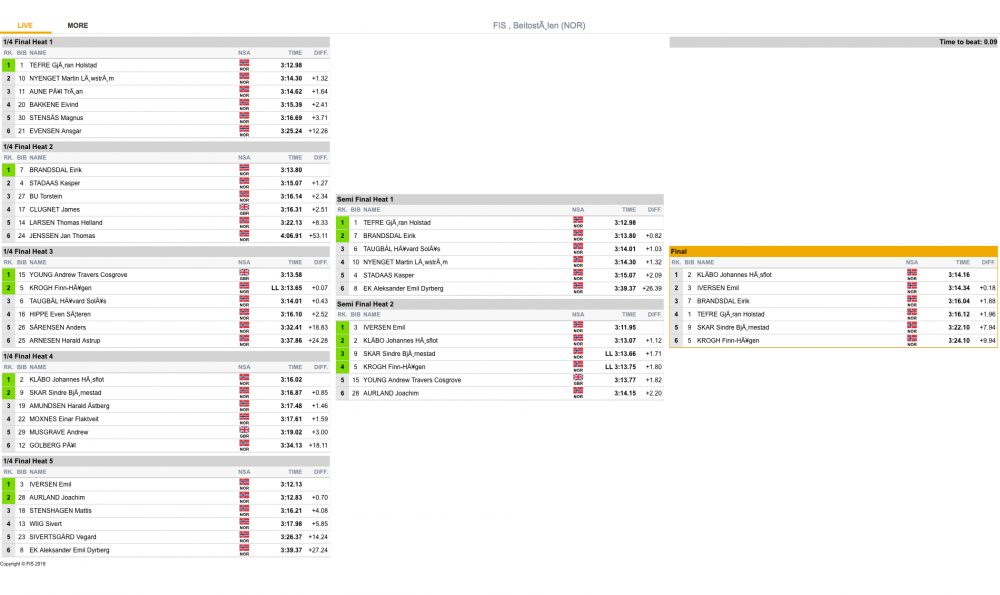
Tefre Gjøran, a year older than Klæbo at 23, was the fastest qualifier, finishing in 3:12.27 minutes. Klæbo was second (+1.12), and Emil Iversen third (+1.62).
In the end, it was Iversen, seeming like an aged vet at 27, who made life spicey for Klæbo.
Klæbo and Iversen advanced to the second semifinal. And it was Iversen who pushed the pace and was the catalyst for speed. Although not a massive margin, a second is still a second — but we are talking sprints here — Iversen won the second semi in 3:11.95, 1.12 seconds faster than second-place skier Klæbo.
“I was not good enough to fight him then,” Klæbo said to Norwegian broadcaster NRK, according to a translation, as he spoke about Iversen’s charge in the semis. “I had to be cynical and save me to the final. But Emil has a lot of effort, you saw how much he had in the finals too.”
It was a final highlighted by a Klæbo-Iversen dual. Klæbo won in 3:14.16 outpacing perhaps a new rival this season in Iversen, by 0.18 seconds.
In the all-Norway final, Eirik Brandsdal placed third (+1.88), Gjøran fourth (+1.96), Sindre Bjørnestad Skar fifth (+7.94), and Finn Hågen Krogh sixth (+9.94).
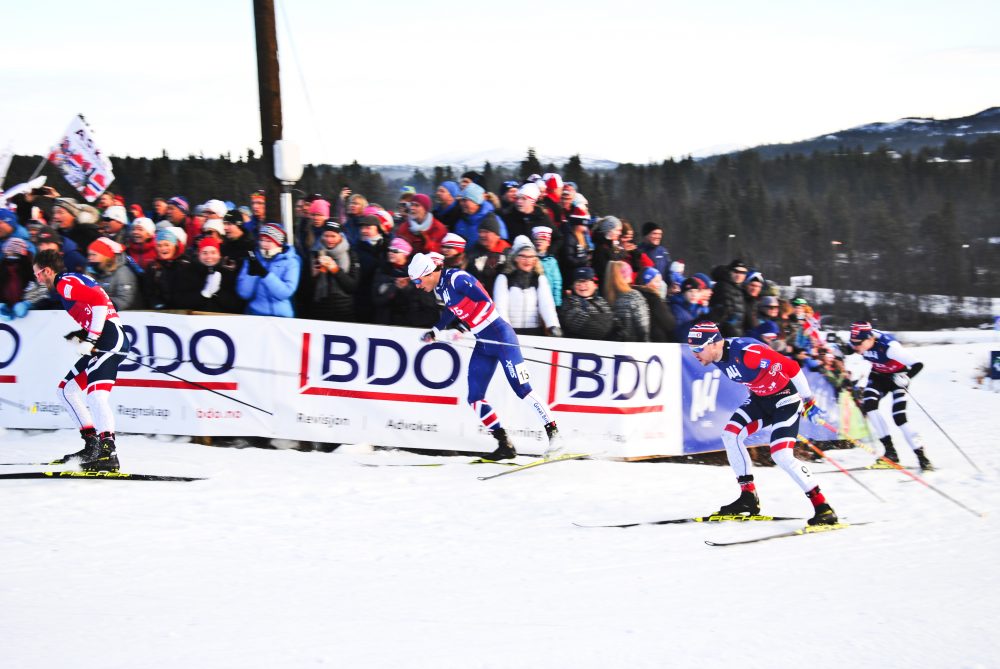
Andrew Young from Great Britain raced to 10th overall in Beito’s day 2 skate sprint. This is a shot from his semifinal. (Photo: Aleks Tangen)
Great Britain’s Andrew Young was 10th overall, James Clugnet 17th, and Andrew Musgrave 24th. They were the only non-Norwegians in the top-30.
“Top 10 is really good, the level here is really high,” Young told FasterSkier’s reporter in Beitostølen. “I had really good skis, and I was surprised nobody else wanted to take the lead at the start so I just went for it. I tried not to use too much energy. I knew Klæbo would go fast. So I just wanted to make sure I was on his tails when he came past. I was really pleased with my skiing. I wasn’t so defensive, I wasn’t so passive, and not let the others control the race. I tried to control it and be in that spot where I wanted to be.”
Young was passed in the final stretch by Skar and Krogh, who both advanced to the finals as lucky losers in the second semifinal.
Canadians Russell Kennedy placed 51st, Maks Zechel 94th.
“It is very deep, but it makes it fun there are lots of rides and always somewhere to push,” Kennedy emailed on Saturday about his experience racing to 22nd overall in the 15 k classic yesterday. “I was very happy with that. I don’t know if surprised is the right word. Last weekend in Olos, [Finland] I had a really good skate race and a good classic race against some big names. I was excited I ended up so high up the results for sure! It was a tough day with skis and I was lucky to be on fast skis even though they were a little slick on the last laps.”
The men’s skate sprint bracket from the second day of racing at in Beitostølen, Norway (Photo: FIS Live Timing screenshot) Click the image to enlarge.
Racing concludes in Beitostølen tomorrow with a 10 k/ 15 k skate.
She’s back. Therese Johaug celebrates after winning the 2018 FIS 10-kilometer classic in Beitostølen, Norway.
After an 18 month suspension for a positive out of competition positive doping test, during which Norway’s thirty-year-old Therese Johaug could build hour upon hour of base fitness and fine tune the engine with no race-stress, she arrived in Beitostølen, Norway on Friday and didn’t skip a beat.
In temperatures hovering around 32 degrees Fahrenheit, and low-level clouds descending on the course, Johaug established herself as the early season favorite amongst a deep Norwegian National Team in Beitostølen’s FIS season opener 10-kilometer classic race.
As the 52nd starter in a 60-skier field, Johaug never let off the throttle.
The race was tight at the 1-kilometer time check, with national team skier Ingvild Flugstad Østberg marking the fastest time over Johaug by only 0.9 seconds. With nine kilometers to go, it was all Johaug, as she clocked the fastest times at the remaining checkpoints.
Up by 4.3 seconds at 2.2k, the time back to the second fastest skier grew to 15.5 seconds at the race’s midpoint for Johaug. By the finish, Johaug did as she has done many times before, winning by a comfortable margin. She won in 25:42.6 minutes. Østberg, who ranked third in the World Cup overall last season, placed second (+23.9). Kari Øyre Slind was third (+59.8)
Therese Johaug ready to start it all over again after her 18-month suspension.
“It was special being here today,” Johaug told Norwegian broadcaster NRK according to a translation. “It feels incredible to back in the xc family again. To come up here and meet all the people that I’ve been skiing with for so many years, hear the cries from the crowds out in the course and the splits, it was a special feeling. It was so much. I was nervous before the start, but when I got started I really didn’t want it to end. I could have skied an extra lap.”
The opening Beitostølen FIS races are the early season proving grounds for Norway’s elite cross-country athletes. The top-10 in the women’s race was riddled with names World Cup fans are familiar with.
Astrid Uhrenholdt Jacobsen skied to fourth (+1:21.3), Haga Ragnhild fifth (+1:33.1), Anna Svendsen sixth (+1:42.8), and Heidi Weng, winner of last seasons overall World Cup finished seventh (+1:58.7).
Annika Taylor, a former University of New Hampshire skier now skiing for Great Britain, raced her way to 21st (+3:49.3).
In similar conditions, the men raced a 15 k classic. Like the women’s field, it was a Norwegian who’s who of elite class skiers. But unlike Johaug setting an increasing time margin over any contenders, the men’s race was tight, separated by only 15 seconds for the top-five skiers 5 k into the race.
At that point, with Didrik Tønseth in first and Emil Iversen in second, only a sliver of time, 0.1 seconds, differentiated the two. Martin Johnsrud Sundby and Johannes Høsflot Klæbo were gapped by 12.2 and 12.7 seconds respectively, as they skied through the time check in third and fourth place. Sjur Røthe came through in fifth (+15.8).
Iversen, in bib 141, kept it close, setting the initial times to beat. Tønseth started three skiers back in bib 144. Through 10k, the two were still evenly matched: with Tønseth up by 3.4 seconds over Iversen.
The men’s 15 k classic podium for the 2018 FIS opener in Beitostølen, Norway. Didrik Tønseth (NOR) in first, Norway’s Emil Iversen (left) in second, and Sjur Røthe (right) of Norway third.
Tønseth won the race in 36:08.6 minutes, with his winning margin of 12.4 seconds over the second place Iversen only solidified in the closing kilometers. Røthe gradually moved up and finished third (+29.3).
Sundby skied to fourth (+37.5), Hans Christer Holund fifth (+1:07.4), and Klæbo sixth (+1:17.5). British skier Andrew Musgrave finished seventh (+1:26.3). Musgrave is historically a stronger skate skier.
One hundred and forty-three skiers finished the men’s race.
Of note, thirty-two-year-old Petter Northug Jr., now a seemingly timeless presence on the Norwegian ski scene, was disqualified for classic technique violations. Prior to his DQ, Northug had been skiing in the top-20 for much of the race. Sundby was given a verbal warning for a classic technique violation.
Several Canadians raced the 15 k classic. Russell Kennedy was the best placed Canadian finishing tied for 23rd (+2:37.6). Brian McKeever was 68th (+4:06.6), Ryan Jackson 110th (+5:39.1), Maks Zechel 113th (+5:56.5).
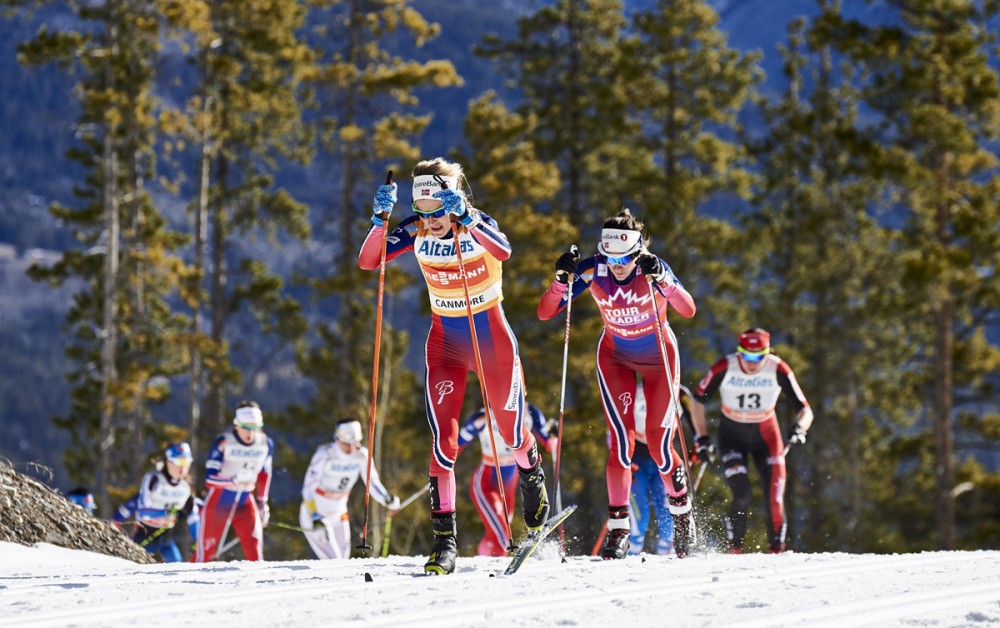
Norwegians Therese Johaug and Heidi Weng, (l-r) during the 2016 women’s 15 k skiathlon in Canmore, Alberta. (Photo: Fischer/NordicFocus)
Welcome to The Rundown, your quick primer of need-to-know information about the day’s racing. We’ll be updating this digest as the day goes on with additional results, photos and quotes. The Rundown is NOT a race report; stay tuned for complete race reports later today with interviews from the day’s top racers.
***
FIS cross-country Beitostølen, Norway: 10 k/15 k classic
The race results are in from today’s 10-kilometer individual start classic FIS race in Beitostølen, Norway. The first of the season Beito races are used as a test pad for Norwegian athletes to gauge fitness and for some to make the rare jump to a coveted and scarce World Cup start.
Off of her suspension for using a banned substance, Norway’s Therese Johaug skied like she’d never been gone. Johaug was suspended for 18 months due to her violation.
Johaug fired off the 10 k winning in 25:42.6 minutes. Ingvild Flugstad Østberg was second (+23.9). Rounding out the podium was Kari Øyre Slindin third (+59.8).
Astrid Uhrenholdt Jacobsen skied to fourth (+1:21.3), Haga Ragnhild fifth (+1:33.1), Anna Svendsen sixth (+1:42.8), and winner of last seasons overall World Cup, Heidi Weng finished seventh (+1:58.7).
The men skied a 15 k classic race Friday in Beitostølen. Didrik Tønseth won in a time of 36:08.6 minutes. In second was Emil Iversen (+12.4), while Sjur Røthe placed third (+29.3).
Martin Johnsrud Sundby skied to fourth (+37.5), Hans Christer Holund fifth (+1:07.4), and Johannes Høsflot Klæbo sixth (+1:17.5).
British skier, although based in Norway, Andrew Musgrave finished seventh (+1:26.3).
One hundred and forty-three skiers finished the men’s race. Of note, Petter Northug Jr., now a seemingly timeless presence on the Norwegian ski scene, was disqualified for technique violations.
Several Canadians raced the 15 k classic. Russell Kennedy was the best placed Canadian finishing tied for 23rd (+2:37.6). Brian McKeever was 68th (+4:06.6), Ryan Jackson 110th (+5:39.1), Maks Zechel 113th (+5:56.5).
Bruksvallarna, Sweden cross-country: 5 k/10 k freestyle
In Bruksvallarna, Sweden FIS racing began with a 5 k freestyle for the women. Three of Sweden’s star skiers took the podium spots. Ebba Andersson won the tight race in 9:57.1 minutes, finishing only 2.6 seconds ahead of second place skier Charlotte Kalla. Known for her sprinting prowess, Hanna Falk was third (+15.7).
One hundred and twelve skiers finished the race.
For the men, after skating 10 k, the race was a tie for first. Sweden’s Jens Burman and Karl-Johan Westberg skied the fastest time. Both crossed the line in 19:11.0 minutes for the win. Japanese skier Keishin Yoshida placed third (+9.5).
Daniel Rickardsson, of Sweden, skied to fourth (+12.9).
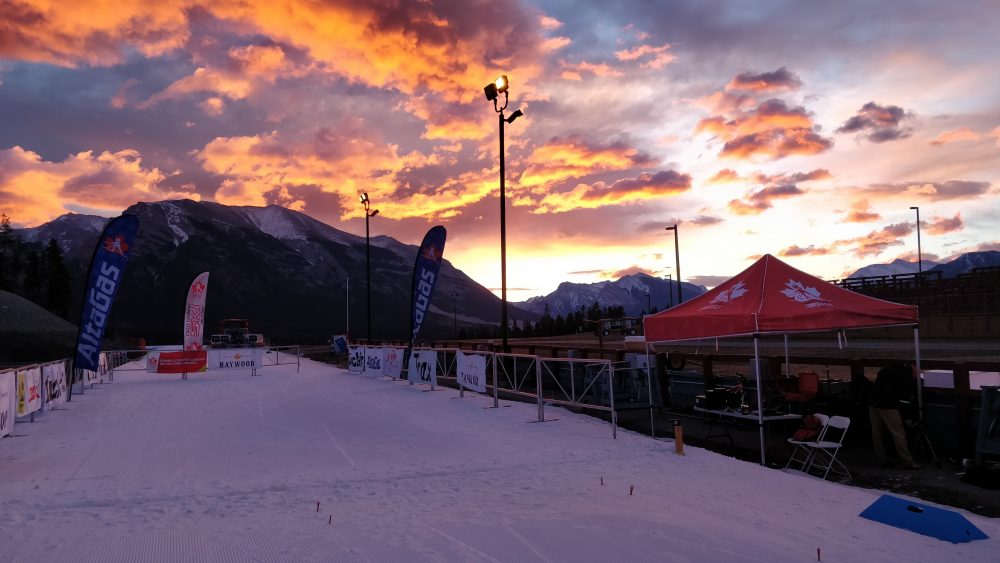
Sunrise in Canmore courtesy of Mother Nature. Today was distance day for the men and women. The women contested a 7.5 k individual start freestyle race, the men huffed and puffed for 10 k. (Photo: Linden Mills-Connery)
On Tuesday, Frozen Thunder at the Canmore Nordic Centre in Canmore, Alberta hosted women’s and men’s individual start freestyle races. The women raced 7.5 kilometers, the men 10 k.
Canada’s Emily Nishikawa (AIAWCA/CNST) won the women’s 7.5 k skate race in a time of 21:05.9 minutes. Nishikawa’s pacing was peerless as she skied the fastest splits at every checkpoint. Dahria Beatty (AIAWCA/CNST) placed second, stopping the clock 24.0 seconds slower than Nishikawa for a time of 21:29.9 minutes. Third place went to U.S. skier Catherine Feldman (SVSEF Gold Team) who skied the course in 21:42.2 minutes.
Another U.S. skier, Dartmouth’s Lauren Jortberg, skied to fifth (+59.2), while Canadian Biathlon National team member Emma Lunder placed sixth (+1:22.5). Cate Brams (SVSEF Gold Team), also from the U.S., was sixth overall (+1:37.9).
U.S. skier, Adam Luban (SVSEF Gold Team) placed second (+32.6), with Canada’s Graham Nishikawa (CPNST) in third (+34.4). Nishikawa races as a guide for Canada’s Para Nordic Team. Len Valjas (CNST) was 39.8 seconds in back of Kennedy to place fourth overall.
(Feldman, Brams, and Luban of the SVSEF Gold Team are also 2018 Middlebury College graduates.)
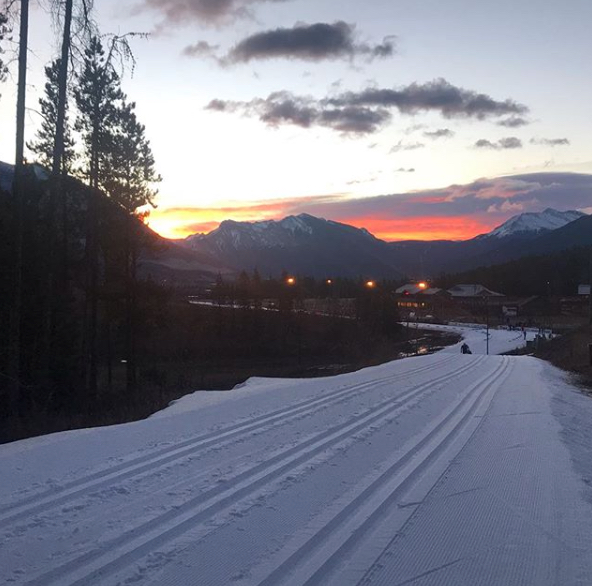
The dawn of a new 2018 Frozen Thunder Classic Sprint Day. Racing began today with the classic sprint. Ivan Babikov was up early and on site at the Canmore Nordic Centre in Canmore, Alberta. (Photo: Ivan Babikov)
Day 1 Frozen Thunder (Canmore, Canada) Classic Sprint
In the senior men’s category, Russell Kennedy (Team R.A.D.) was the fastest qualifier finishing in a time of 3:36.70 minutes. Julien Locke (Black Jack/CNST) qualified in second (+1.26), with Dominique Moncion-Groulx (Nakkertok Nordique/Team R.A.D) in third (+2.47). Longtime Canadian National Ski Team member Len Valjas skied the fourth fastest qualifying time, 3.78 seconds behind Kennedy.
Peter Holmes (SVSEF), who qualified in seventh (+4.55), was the fastest U.S. men’s qualifier.
On the senior women’s side, Dahria Beatty (AIAWCA/CNST) stopped the clock in 4:09:16 with the fastest qualifying time. Teammate Emily Nishikawa was second (+11.5), while Katie Weaver (RMR) was third (+14.99). Maya MacIsaac-Jones (RMR/CNST) qualified fourth (+15.36).
Lauren Jortberg was the fastest female qualifier from the U.S., skiing to sixth (+16.85).
Under this format, men and women have the possibility of competing against one another in the heats.
Amongst the senior men in the King’s Court heats, Valjas placed first, Moncion-Groulx second, with Andy Shields (Lappe Nordic) third. Shields placed ninth in the qualifier (+6.08). Reed Godfrey (Team R.A.D.)placed fourth. Godfrey was the sixth fastest men’s qualifier, 4.15 seconds behind top qualifier, Kennedy.
For the senior women, Beatty took first, Hannah Mehain second, with Weaver in third. Macisaac-Jones finished in fourth.
Look for a full race report later today on FasterSkier.
Norway’s Maiken Caspersen Falla (1) winning Saturday’s women’s cross-country sprint final on the last day of the 2018 Blink Ski Festival in Sandnes, Norway. (Photo: Blink Ski Festival/Axelar/Arild Aarnes)
The 2018 Blink Ski Festival continued in full force on Friday and Saturday, with cross-country and biathlon prologues, 10- and 15-kilometer cross-country races and biathlon mass starts all taking place on Friday, followed by sprints on Saturday.
Elite racing began in the afternoon with the men’s prologue (no prologue was held for the women), Norway’s Gjøran Holstad Tefre posted the fastest time of 3:12.21. Finishing 1.89 seconds back was another Norwegian, Aleksander Dyrberg Ek, and Great Britain’s Andrew Young claimed the prologue’s final podium spot, finishing 2.27 seconds off the winning time.
Also in the top 10 were Norway’s Morten Eide Pedersen in fourth (+4.7), Britain’s James Clugnet in fifth (+4.76), France’s Lucas Chanavat in sixth (+5.09), Norway’s Stian Grastveit in seventh (+5.70), France’s Renaud Jay in eighth (+5.75), and Norway’s Sindre Folkvord and Harald Østberg Amundsen in ninth (+6.00) and 10th (+6.03), respectively.
Canada’s Evan Palmer-Charrette finished 34th (+16.68), Scott Hill placed 39th (+19.37) and Bob Thompson was 40th (+19.54) out of 47 finishers.
After the elite men’s prologue, athletes geared up for a men’s and women’s biathlon prologues.
Norway’s Johannes Thingnes Bø took the men’s biathlon prologue win in a time of 10:30.2 after two misses (1+1). One second back, it was a tie for second place between another Norwegian, Lars Aasheim Svaland, who had one penalty (0+1), and France’s Antonin Guigonnat, with one miss as well (1+0).
Slovenia’s Anastasiya Kuzmina, who took one gold and two silver medals at the 2018 Olympics, won Friday’s women’s prologue with clean shooting and a time of 11:34.6. Just 0.6 seconds behind was Norway’s Emilie Ågheim Kalkenberg, who placed second with perfect 10-for-10 shooting as well. France’s Justine Braisaz claimed third, 10.7 seconds out of first, after missing two targets (0+2).
The next event on Friday’s program was the women’s 10 k cross-country mass start, which Norwegian sprint specialist Maiken Caspersen Falla won in 20:39.4. She bested fellow Norwegian Mari Eide by 1.9 seconds, and Sweden’s Charlotte Kalla and Norway’s Kari Øyre Slind followed in third (+3.9) and fourth (+3.9), respectively, with the same time.
Working their way into the top 10 were Russia’s Elena Soboleva in fifth (+4.9), Finland’s Krista Pärmäkoski in sixth (+5.0), Norway’s Ingvild Flugstad Østberg and Ragnhild Haga in seventh (+5.1) and eighth (+5.2), respectively, Austria’s Teresa Stadlober in ninth (+6.6), and Russia’s Natalia Matveeva in 10th (+8.7). Out of 31 women, Nichole Bathe, racing for Great Britain, finished in 23rd (+1:09).
Sweden’s Hanna Öberg (front) racing to first in the women’s biathlon mass start on Friday the 2018 Blink Ski Festival in Sandnes, Norway. (Screenshot: NRK broadcast)
Friday’s program then moved on to the women’s biathlon mass start. Sweden’s Hanna Öberg won the event in a time of 13:19.4 despite three misses (0+1+2+0). Kuzmina finished second, crossing 2.1 seconds behind the Swede after a penalty in each stage (1+1+1+1). Third place went to another Swede, Mona Brorsson, who crossed 5.9 seconds after Öberg and shot four penalties (2+1+1+0).
Norway’s Henrik L’abeé-Lund (r) winning the men’s biathlon mass start on Friday at the 2018 Blink rollerski festival, ahead of his teammate Johannes Thingnes Bø in second in Sandnes, Norway. (Screenshot: NRK broadcast)
Following the women’s biathlon race, the men’s biathlon mass start got underway. Norway’s Henrik L’abeé-Lund emerged as the winner, crossing the line in 17:21.3 after shooting four penalties (1+1+2+0). Exactly three seconds behind him was J.T. Bø in second place with two misses (1+0+1+0). Sealing the all-Norwegian podium was Vetle Sjåstad Christiansen, who missed six targets (1+1+2+2) and finished 12.1 seconds after L’abeé-Lund for third.
Russia’s Sergey Ustiugov leading the pack of the elite men’s 15-kilometer freestyle cross-country mass start on Friday at the 2018 Blink Ski Festival in Sandnes, Norway. (Screenshot: NRK broadcast)
Friday’s final race turned back to cross-country for the elite men’s 15 k freestyle mass start. Russian skier, Sergey Ustiugov, who was banned from competing at the 2018 Winter Olympics, won it in 29:26.0, 2.1 seconds ahead of Norway’s Aleksander Ek, (who had placed second in the prologue to start the day). Italy’s Federico Pellegrino was just another 0.6 seconds back in third (+2.7).
“I was a little nervous today because I won it last year and I wanted to repeat my success here again today,” Ustiugov told NRK through a translator. “It didn’t go easy, but I did manage to do what I wanted to do, and I would like to thank all my team, Markus [Cramer], and the rest of the team. That was great.”
The remaining top ten included Norway’s Vebjørn Turtveit in fourth (+2.9), Sindre Bjørnestad Skar in fifth (+3.9), Øystein Pettersen in sixth (+5.4), and Torstein Bu in seventh (+5.8). France’s Adrien Backscheider and Clement Parisse placed eighth (+5.9) and ninth (+6.2) respectively, followed by Norway’s Eirik Brandsdal in tenth (+6.2).
Racing for Canada, Alex Harvey finished 14th (+7.5).
Norway’s Maiken Caspersen Falla winning the women’s cross-country sprint on Saturday at the Blink Ski Festival in Sandnes, Norway. It was her second-straight victory after topping Friday’s 10 k freestyle mass start as well. (Screenshot: NRK broadcast)
Saturday marked the final day of the Blink rollerski festival and included cross-country and biathlon sprints. In the women’s cross-country final, Norway’s Falla picked up her second-straight win, ahead of Russia’s Matveeva in second (+1.6) and Sweden’s Ida Ingemarsdotter in third (+2.4). Norway’s Eide was just off the podium in fourth (+2.9), Norway’s Barbro Kvåle Trømborg placed fifth (+3.7), and another Norwegian, Linn Ravndal, finished 8 seconds back in sixth.
Falla’s won the final in 3:40.8 after topping her quarterfinal and semifinal as well.
The men’s cross-country racing began with a prologue, which Norway’s Vetle Christiansen won in 1:31.92, just three-hundredths of a second ahead of his fellow countryman, Ek. France’s Baptiste Noel placed third in the prologue, 1.76 seconds out of first.
Russia’s Gleb Retivykh (second from r) winning the men’s cross-country sprint final on Saturday at the Blink Ski Festival in Sandnes, Norway. (Screenshot: NRK broadcast)
In the heats later in the day, Russia’s Gleb Retivykh came out on top of the final, getting there by placing second in both his quarterfinal and semifinal, then winning the last round by 0.2 seconds over Pellegrino in a time of 3:15.5. Pellegrino had won his quarterfinal but advanced as a lucky loser in fourth out of the second semifinal. The 25-year-old Ek capped off his successful series with another podium, placing third in the final, just 0.3 seconds out of first.
In a post-race interview with NRK, Retivykh explained this was his first time at Blink.
“I am very happy,” he said in English. “Today is my first win at Blink, and [it was my] first time here.”
In a close final, Norway’s Gjøran Tefre and Brandsdal followed in fourth (+0.5) and fifth (+0.7), respectively, Italy’s Francesco De Fabiani was just behind in sixth (+0.8).
France’s Justine Braisaz celebrating across the line as she wins the women’s biathlon super sprint on the last day of 2018 Blink Ski Festival on Saturday in Sandnes, Norway. (Screenshot: NRK broadcast)
Biathletes were able to experience head-to-head sprint racing as well (a deviation from the typical biathlon World Cup sprint format, which is individual), in the women’s and men’s biathlon supersprints, which included one prone and one standing shooting stage per heat.
France’s Braisaz won the women’s final in 7:45.3. She had previously won her quarterfinal (which was a longer distance), then placed seventh in the first semifinal (same distance as final). Norway’s Marte Olsbu placed second in the final (+0.4), and Sweden’s Brorsson returned to the podium in third (+0.9).
“It was really close at the end, but I am very happy about the weekend here,” Braisaz told NRK on English after. “Everything is perfect, even though the weather is a little bit — how do you say — moody. But it’s OK. And I am really happy to be in Norway and I will make my stay longer after the festival weekend.”
Norway’s Vetle Sjåstad Christiansen winning the men’s biathlon supersprint on Saturday, the last day of the Blink Ski Festival, in Sandnes, Norway. (Screenshot: NRK broadcast)
In the men’s biathlon super sprint, Norway’s Christiansen dominated the day, winning his quarterfinal and semifinal before beating J.T.Bø by 2.2 seconds in the men’s final with a time of 12:01.8. France’s Guigonnat completed the podium in third, 8.5 seconds behind Christiansen.
The 7.5-kilometer race course for the Lysebotn Opp, an annual hill climb at the Blink Ski Festival in Lysebotn, Norway. (Photo: Blink Ski Festival/Facebook)
The Blink Ski Festival’s famed Lysebotn Opp hill climb returned on Thursday, and with it, a familiar name landed at the top of the results.
After serving an 18-month ban from ski racing and subsequently missing the 2018 Winter Olympics, Norway’s Therese Johaug is back.
Norway’s Therese Johaug winning the 2018 Lysebotn Opp hill climb, part of the Blink rollerski festival, on Thursday. She finished in a record-setting 31:46.3 minutes, topping her previous course record of 32:36 from 2012. American Liz Stephen, who retired from skiing this past spring, holds the third-fastest time of 32:53.9. (Screenshot: NRK broadcast)
The 30-year-old Johaug won Thursday’s rollerski hill climb in a record time of 31 minutes, 46.3 seconds, while Sweden’s Charlotte Kalla finished 1:47.5 minutes back in second.
Kalla, 31, won last year’s Lysebotn Opp in 33:18.3, telling NRK at the time that “it’s been long since I’ve been in this good a shape in July.” Kalla’s 2017/2018 season went on to be one of her best. She racked up 10 individual wins, including a gold medal in the Olympic skiathlon.
If Kalla is using her the past year and half as a springboard for the upcoming season, Johaug might be considered the antithesis to the Swede. The year and half competition bar behind her, Johaug appears ready to move forward.
“If there’s one thing I’ve learned from all this, it’s that you should never rely on anyone, period,” Johaug told Newsinenglish.no. “It’s terrible, but that’s the way it is.”
Following Johaug and Kalla on Thursday, Sweden’s Ebba Andersson claimed the third spot on the podium, finishing 3.9 seconds behind her compatriot Kalla and 1:51.4 behind Johaug.
Norway’s Haga Ragnhild placed fourth (+2:21.6) and Ingvild Flugstad Østberg was fifth (+2:48.9), Austria’s Teresa Stadlober finished sixth (+3:05.7), Russia’s Yulia Belorukova seventh (+3:52.4), Norway’s Kari Øyre Slind eighth (+4:05.0), and Russia’s Elena Soboleva ninth (+4:14.1) and Yana Kirpichenko 10th (+4:26.2). Finland’s Krista Parmakoski finished exactly ten seconds outside the top ten in 11th (+4:36.2). Forty-seven women finished the senior women’s race.
Norway’s Simen Hegstad Krüger winning the 2018 Lysebotn Opp hill climb, part of the Blink rollerski festival, on Thursday. (Screenshot: NRK broadcast)
In the senior men’s Lysebotn Opp that followed, two Norwegians battled up front, with reigning Olympic skiathlon champ Simen Hegstad Krüger ultimately winning the race for the first time in 27:53.2. Another national team member and 2018 Olympian (and last year’s Lysebotn Opp winner), Hans Christer Holund finished 3.9 seconds back for second place, and Norway swept the podium with Simen Andreas Sveen in third (+16.0).
Rounding out the top 10 were Norwegians Vebjørn Turtveit in fourth (+51.7), Martin Johnsrud Sundby in fifth (+52.6), France’s Clement Parisse in sixth (+1:12.4), Norway’s Henrik L’Abée-Lund in seventh (+1:21.1), France’s Adrien Backscheider in eighth (+1:24.7), Russia’s Artem Maltsev in ninth (+1:31.4) and Canada’s Alex Harvey in 10th (+2:02.1).
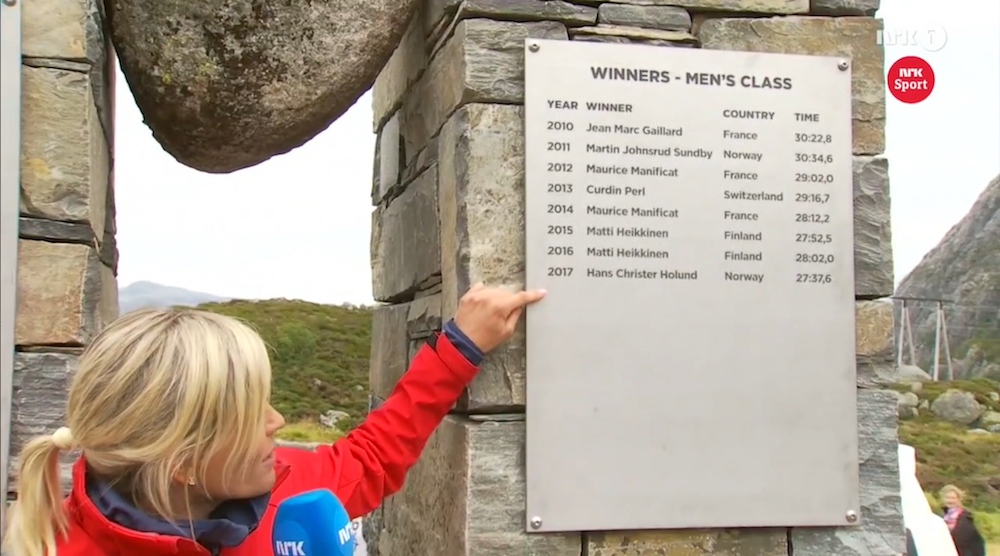
Past winners of the Lysebotn Opp rollerski hill climb in Lysebotn, Norway. Simen Hegstad Krüger’s winning time on Thursday was third fastest on record at 27:53.2. (Screenshot: NRK broadcast)
Russia’s Alexander Bolshunov racing to first in the Blink Classics men’s 60 k on Wednesday in Sandes, Norway. (Photo: Blink Ski Festival/Facebook)
A predictor for the winter ski season ahead? Could be. Either way, Norway’s Blink Ski Festival, or as it’s called in Norway, Blinkfestivalen, remains the ultimate in rollerski racing and returned for the 12th year in a row on Wednesday.
The festival opened with elite men’s and women’s distance rollerski races, known as the Blink Classics. For the third-straight summer, the Blink Classics featured a 60-kilometer mass start for the men and a 50 k for the women.
Eighty-six men competed in Wednesday’s 60 k, which began in the city center of Ålgård and finished in the municipality of Sandnes. A complete course map, which deviated little from last year’s rendition, may be found by clicking here.
By the end of the men’s 60 k, it was Russia’s Alexander Bolshunov who finished first in 2:10:51.6 hours. The 22-year-old Bolshunov had a number of World Cup podiums last season and one win in the final 15 k of the year. He also earned three silver medals and one bronze at the 2018 Winter Olympics in South Korea.
Finishing just 5.9 seconds behind him was another Russian, 19-year-old Sergey Ardashev, in second place. The third elite man across the line was Norway’s Anders Mølmen Høst, 27, of the Lyn Ski club, who finished 1.8 seconds out of second place and 7.7 seconds back from first.
Norwegians occupied the rest of the top 10, with Tord Asle Gjerdalen in fourth (+8.1), Øystein Petterson in fifth (+8.3), Hans Christer Holund in sixth (+8.3), Sjur Røthe in seventh (+8.7), Simen Hegstad Krüger in eighth (+8.7), Runar Skaug Mathisen in ninth (+10.3) and Martin Johnsrud Sundby — the winner of last year’s Blink Classics 60 k — in 10th (+10.8).
Nearly half of the men’s field came from nations from outside Norway, with athletes hailing from Russia, France, Canada, the U.S., Great Britain, Finland, Sweden, and Italy. Canadian World Cup skier Alex Harvey was the top North American in 14th (+1:19.0).
Also for Canada, Scott James Hill placed 53rd (+11:00.0) and Bob Thompson was 56th (+11:53.1). Ian Torchia was the lone American in the event, racing to 55th (+11:52.3). Canada’s Evan Palmer-Charrette did not start.
Norway’s Kari Vikhagen Gjeitnes finishing first in the Blink Classics women’s 50 k on Wednesday in Sandes, Norway. (Photo: Blink Ski Festival/Facebook)
In the elite women’s 50 k, which had just nine finishers, Norway’s Kari Vikhagen Gjeitnes finished first in 2:21:19.0. Second place went to Astrid Øyre Slind, who crossed 33.9 seconds after Gjeitnes, and the third and final podium spot went to Poland’s Justyna Kowalczyk (+5:55.4).
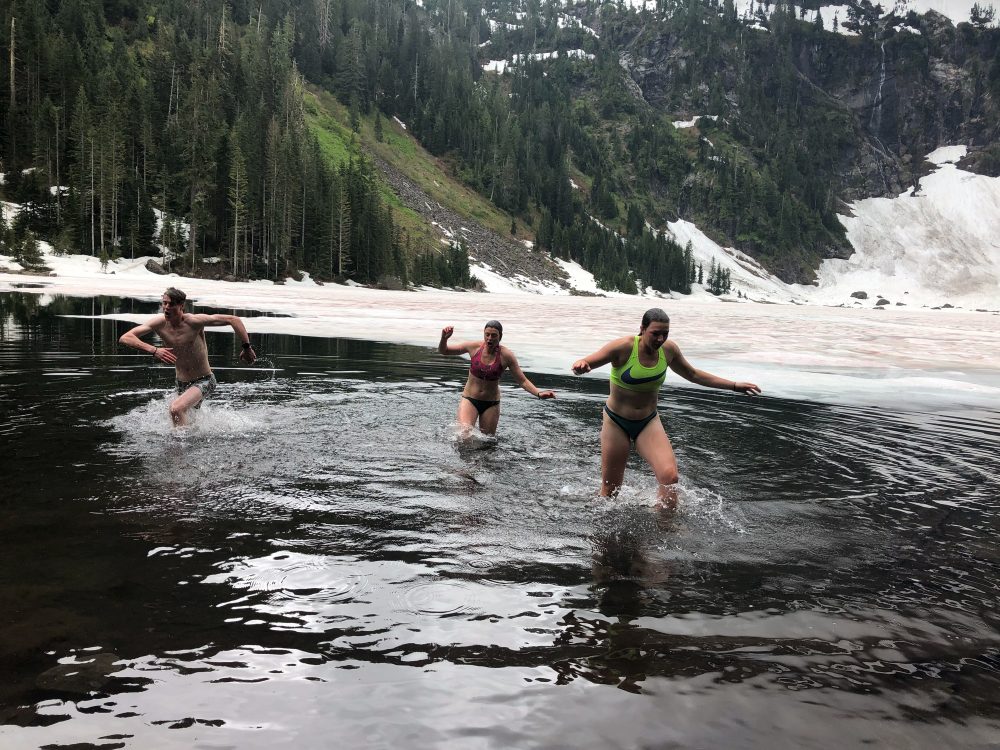
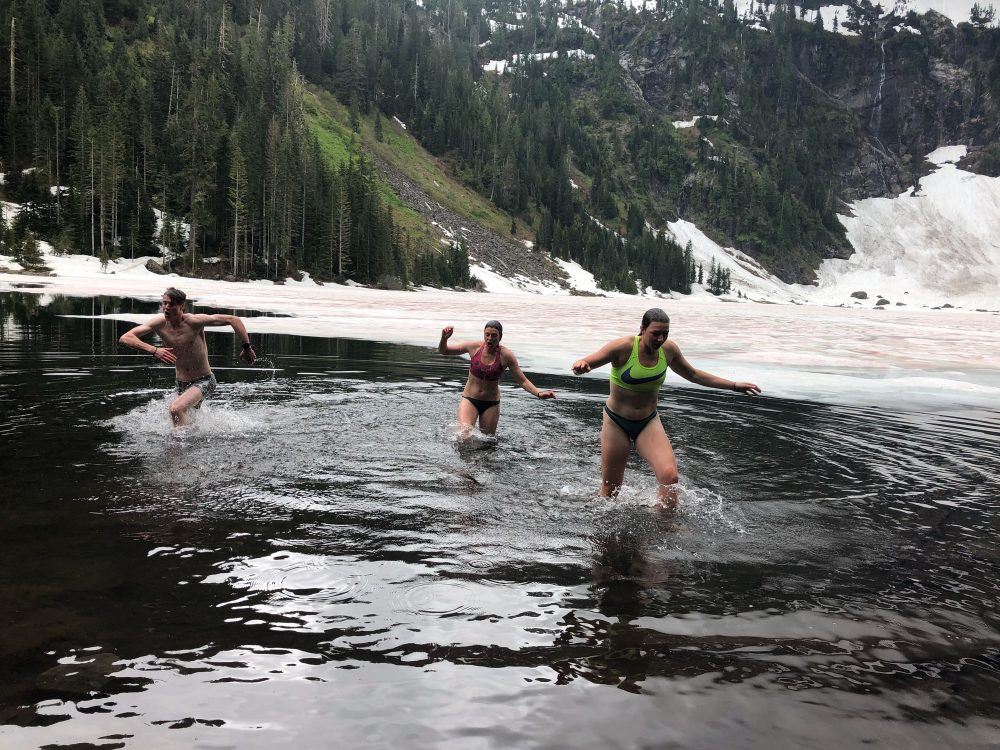
Mooney siblings (from left to right) Scott, Heather and Brooke after jumping into Lake 22 just outside of Seattle, following Brooke’s graduation from Washington University in June. “With two siblings peer pressure works wonders, not going to be the wimpy one who doesn’t jump in!” Heather wrote. (Courtesy photo)
Perhaps you have heard of them. Or at least seen them. At 6 feet and 6 feet 2 inches tall, respectively, the Mooney sisters, Heather and Brooke, are hard to miss. But their height is not the only reason the two women stand out.
The sisterly pair also share a talent for the sports they pursue. At one point, for both of them, that sport was skiing. And at one point, for both of them, it was not.
Having grown up in Peru, Vermont, where the Green Mountain range serves as the town’s backdrop and skiing is the norm, the two were certainly primed with the ideal environment for becoming interested in nordic.
“Our school bus had a ski rack on the side of it because we would ski at recess,” Heather recalled during an in-person interview this month in Bozeman, Montana. “In southern Vermont, that is what everyone did.”
“That” meant skiing. Their mother had picked it up as an adult and also worked as a promotion manager for a skiing magazine. Their father was the headmaster at Vermont Academy, providing the the family access to a plethora of trails directly from their residential backdoor.
Both parents were also active outdoor enthusiasts, encouraging Heather, Brooke and eventually their younger brother Scott, to partake in anything that got them moving: swimming, hiking, soccer, tennis. (It didn’t hurt the family’s sporting M.O. that their father had been Yale’s soccer goalie as an undergrad.)
By the time she was a freshman, Heather had enrolled at the Stratton Mountain School ski academy. Three years later, her sister Brooke had as well. (Heather and Brooke are two years apart, but Heather skipped first grade).
Heather Mooney racing to 42nd in the women’s 10 k freestyle at the 2016 U23 World Championships in Rasnov, Romania. (Photo: FIS)
They became well-known names on the eastern ski circuit. They also found national and international success while still U18s. Heather qualified for Junior Nationals four times, Junior Worlds twice and U23 Worlds in 2016. By her junior year in high school, Brooke had qualified for three Junior Nationals.
As J2 skiers, both Mooney girls received coaching from Pepa Miloucheva, the head ski coach at the Craftsbury Outdoor Center. With a background in sculling, as well as ski orienteering, Miloucheva had her eyes on Heather and Brooke, who showed the potential to qualify for Junior Nationals in rowing as well. Both girls were invited to a youth rowing camp held at the Outdoor Center.
“The director told me I needed a snorkel,” Heather reminisced with a laugh. “But Brooke was very good.”
***
During an early season training session at the University of Washington (UW) this past year, Brooke sat down for testing on a rowing ergometer. She pulled for the alloted test time, one minute, and stopped. Her sustained pace was 615 watts.
National team coaches could not recall any other woman surpassing 600 watts, The Seattle Times reported.
“You don’t have to know rowing to see her strength,” UW head rowing coach Yasmin Farooq told the Times. “Watch her and you think, holy smokes, this woman has some serious power.”
Unofficially, Brooke holds the watts record for an American woman on the rowing machine. Officially, she was named the Pac-12 Women’s Rowing Athlete of the Year in May and is now living in Princeton, New Jersey, one month removed from UW. She’s also a national-team recruit.
Her invite to join USRowing came in December, and following her graduation from UW in June, Brooke headed back east. In Princeton, she is training with U.S. rowing veterans like Meghan Musnicki and Elle Logan — both multiple Olympic gold medalists — with the hope of working toward a spot on the 2020 Olympic team (selection won’t take place until 2019).
“I kind of figured I would be pretty crazy to turn down this opportunity, whether it leads to greater results or not, I had to try it,” Brooke told FasterSkier on the phone.
The seeds of opportunity were planted in the initial rowing camp Brooke attended in Craftsbury. She spent her senior year at Vermont Academy, where she took up rowing as her newfound, full-time passion.
“I knew I wasn’t going to want to keep on skiing through college, so I figured I might as well try rowing,” Brooke said.
She filled out a few higher-education recruiting questionnaires and received a response from UW. As one of the top rowing schools in the country, UW had her attention. Throughout her four undergraduate years, Brooke developed into one of the country’s top college rowers, even with a slight scare before her senior season.
***
When Brooke first started getting headaches in the summer of 2016, the doctors told her she was dehydrated. At a sculling camp in Craftsbury post-doc visit, her headaches continued. Most of the time, they got progressively worse throughout the day.
Brooke Mooney, who was recently recruited to the U.S. women’s national rowing team, during a sculling camp in Craftsbury, Vt. in 2016. (Photo: Craftsbury Outdoor Center)
“I would be able to get up in the morning and work out a little bit, but if I didn’t work out before 9 o’clock, I couldn’t workout,” Brooke recalled. “I would just lay on my bed in so much pain.”
With dehydration as her diagnosis, she did what she could to work out. Sometimes the headaches would lapse, but most often they would not.
“I started the school year in and out of headaches. I talked to the team doc and went to the headache clinic,” Brooke said.
It wasn’t until April, almost a year after her headaches began, that Brooke was given an MRI. The results: she had a cyst in her optic chiasm. The mass was pushing on her optic nerve and needed to be removed, or else it could expand and cause permanent damage to her vision, even blindness.
Her eye doctor allowed her to finish the race season (for rowing, championship racing occurs in the spring) before removing the cyst. Following her surgery in June 2017, Brooke was not allowed to train or work out for eight weeks the summer before her senior year at UW.
“I was so worried,” Brooke said, particularly when she found out that her team would be racing the famed Head of the Charles Regatta that fall.
“I wanted to race that more than anything and I panicked that I was going to miss my opportunity because of the surgery,” she said. “But then I ended up making it … every once in awhile, a good break is really beneficial.”
***
If you peruse Heather’s blog, one post from April 2017 blares the title “On Burnout and Bye for Now.” This was her informal farewell to cross-country skiing.
The post itself came two years after she graduated from Middlebury College, a time when skiing held great promise for Heather. She had capped off her senior year with seven collegiate wins and had also qualified for the 2012 Youth Olympic Games as a college sophomore.
Following graduation, Heather signed on with the Craftsbury Green Racing Project (CGRP), but later found things weren’t aligning the way she had hoped they would. Particularly, she felt she was not performing to her expectations, given the amount of support she had (according to Heather, CGRP covers most of their athletes’ expenses for food, housing and travel.)
“I thought I was done for good,” Heather, now 24, continued. “Pepa [Miloucheva] was the one who encouraged me not to look at it that way.”
Even with Miloucheva encouraging her not to give up completely, Heather forfeited skiing, and even gave up physical activity for a bit.
“In the beginning of the summer when I quit, I was like, ‘I’m not exercising, I’m not being an athlete, I’m just doing whatever what I want — I can be happy without skiing,” Heather said. “Very quickly I realized that I need exercise to be happy.”
That summer in Truckee, California, Heather landed a coaching gig that gave her the opportunity to travel to Australia. By the fall, she decided to move to Bozeman, with plans to gain residency at Montana State University and enroll in its architecture graduate program.
In Bozeman, she reconnected with Austin Caldwell, a longtime friend from Vermont and the current head coach of the Bridger Ski Foundation Elite team. The two went for a few early fall skis together and Heather soon found herself attending Caldwell’s agility practices, then interval sessions. When the winter hit, Heather even jumped into some races, but only as many as she chose.
In all, she competed in about a dozen SuperTour races, finishing last season ranked 36th overall on the circuit. Heather also raced to 14th in the 50-kilometer American Birkebeiner skate race in February.
“It was really refreshing to step out of expectation,” Heather said. “I feel like we all get into such definitions of like how we should be in the sport. I realize [now] there are so many different ways to engage with it. Likely that’s how we many of us will reach our potential, is by engaging in a way that works for you as a person.”
After a break, Heather is currently planning to defer from MSU and focus once more on skiing.
“It’s been exciting for me slowly lose that anxiety of how I should be performing and how I wanted to perform,” Heather said. “I look at how can I work with myself, versus trying to fit myself into the pro-athlete mold.”
The 91st annual Mount Marathon Race, one of the oldest footraces in the country, once more descended on the small town of Seward, Alaska, on July 4. Crowds estimated at up to 30,000 perennially throng to the waterfront community, population less than 3,000, to watch racers push themselves up a steep mountain and hurl themselves back down. At the end of the day, a pair of Alaska Pacific University (APU) skiers, Jessica Yeaton and David Norris, had picked up victories in the quintessentially Alaskan race.
Women’s Race: Jessica Yeaton Wins After Frankowski Backs Off on Downhill
The couple that trains together, wins together. Yeaton and Norris have dated for some time. They traveled down to the race together, they went out fishing the day before together, and they previewed the course together. And they’ll be going back to Anchorage with a pair of trophies together.
After Norris took a dramatic victory in the men’s race Wednesday morning (see below for men’s race recap), Yeaton matched him in the women’s race in the afternoon. Racing in the marquee afternoon time slot, Yeaton led a field of roughly 270 women off the starting line at 2 p.m. The women’s reward for racing in the afternoon this year (the men’s and women’s race alternate the prime-time afternoon slot) was temperatures even warmer than this morning, although thankfully a light breeze had picked up.
After roughly four minutes of gradual uphill through the streets of Seward, Yeaton, 26, was among the five-person lead pack to the base of the climb. By shortly into the climb, APU teammate Rosie Frankowski, also 26, was first, with Yeaton close behind. At the mid-point uphill time check, it was Frankowski, then Yeaton (+16 seconds), with Najeeby Quinn third over a minute back.
Frankowski and Yeaton continued to stretch their lead as the race climbed out of a humidity choked tunnel of vegetation and onto the stark shale rocks of the mountain’s upper half.
The two APU skiers and race rookies (Frankowski earned her entry spot by winning the Government Peak hill climb in early June, Yeaton by winning the Bird Ridge hill climb in mid-June) were both climbing fast and moving well, although they were a study in contrasts on the live television broadcast. The compact Frankowski climbed the hill the way Marit Bjørgen had skied the Olympic 30 k, attacking the hill with each step as she leaned into the steep climb. “You can almost hear her feet hitting the ground with each stride,” veteran Mount Marathon racer-turned-color commentator Clint McCool marveled on the broadcast, praising the redoubtable power of Frankowski’s lower body.
Behind her, the more lithe Yeaton seemed to float upward with an ease that belied the effort of climbing the 47-degree slope. While Frankowski’s high turnover remained the same throughout the climb, Yeaton even broke into a few brief running strides on the “flats.”
Frankowski crossed the timing mat at the turnaround in a (staggeringly fast) unofficial time of 37:06. Yeaton was 29 seconds back in 37:35. The time back to Quinn in third (39:13), let alone Christy Marvin in fourth (39:56) or Denali Foldager-Strabel (40:33) in fifth, seemed significant if not insurmountable.
But that’s why you run the race. Frankowski then took a meandering and suboptimal line onto the snowfield that begins the precipitous descent. In fact, she bypassed the snowfield entirely, running around its rocky edge for several hundred vertical feet.
“I train with Rosie every day and she was not stoked about the downhill,” Yeaton said in a post-race interview with the Anchorage Daily News (ADN). “So she was like, ‘I’m gonna take this [other] route.”
Frankowski told the ADN she wanted to didn’t want to risk getting injured on the downhill.
“This is fun, but my primary sport — I’m not going to ruin it,” Frankowski said.
By the time Frankowski reached the bottom of the snowfield, Yeaton had come flying past her, opening up a lead she would not relinquish. Quinn had passed her as well.
Yeaton ran smoothly all the way to the bottom, going from the turnaround point to the finish line in under 14 minutes. (Her pre-race preview with Norris may have been helpful: “You just do a front flip here,” Norris calmly advises the camera in one of Yeaton’s recent Instagram videos as he demonstrates a flip down a small cliff approaching the bottom of the climb. “It’s easier in the race with the adrenaline.”) Despite the effort, Yeaton looked calm and in control running down Main Street, ultimately taking the victory in an unofficial time of 51:30.
Yeaton’s overall time ranks ninth all-time in a race first contested by women in 1963.
Frankowski’s unofficial uphill split of 37:06 ranks third all-time among uphill marks, behind only pro runner Emelie Forsberg and two-time NCAA steeplechase champion Allie Ostrander, who has a track 5 k PR of 15:22 and finished eighth in the 2016 U.S. Olympic Trials in this event. Yeaton’s 37:35 uphill would be sixth among Mount Marathon climbs.
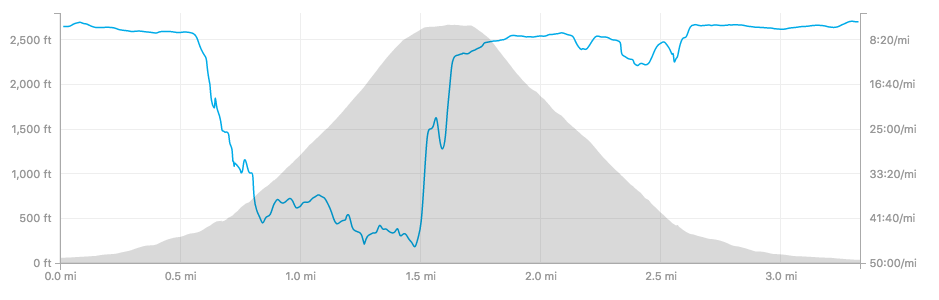
About that uphill: Elevation profile of Mount Marathon course, from an athlete (Jeff Levin) who finished 58th out of 306 men in 2017. Note the 35- to 45-minute pace per mile for much of the climb. (Photo: Strava screenshot)
Behind Yeaton, there was ample movement in the standings. Frankowski would ultimately post the day’s 91st-ranked downhill, alongside the fastest uphill, to finish seventh overall. Foldager-Strabel, fifth at the turnaround, would drop an all-time record 11:27 downhill (prior record: 11:31, Forsberg, in 2015) en route to finishing second overall in 52:00, barely ahead of a charging Marvin who took third in 52:04. Fourth overall was Quinn, who had been as high as second during parts of the downhill but was either injured or cramped up severely during the latter half of the descent. And fifth overall was Boulder resident Hannah LaFleur, who had been in sixth at the halfway point.
Also of note, former FasterSkier contributor Aubrey Smith was 11th. And former champion Holly Brooks, less than one year removed from giving birth to twins, was 19th, while wearing a microphone and providing live commentary to the broadcast team along the way. (“Can I sneak by on the left? Thanks,” she was at one point heard to exclaim on air.)
An ebullient Yeaton spoke with KTVA Channel 11 at the finish. “I was just, like, trying to hold them off the whole way” down, she said of her race strategy for the descent in reference to her pursuers.
“The heat was horrible,” Yeaton said of the day’s conditions. “But there were so many people out there with water, I probably got 30 different things of ice and water on my head. It made it so much better. I couldn’t do it without all the people on the mountain.”
Men’s Race: David Norris Holds Off Max King
Norris did it again.
The 27-year-old APU skier came into Wednesday’s race, the 91st running of an event first held in 1915 that is among the oldest footraces in this country, as the course record holder at Mount Marathon. He had set a course record at the uphill-only Bird Ridge hill climb last month. Meanwhile, defending champion and APU teammate Scott Patterson was out of this race with a toe injury. Previous Mount Marathon course record-holder Eric Strabel was out with a stress fracture. As the ADN wrote in its preview of the men’s race, Norris had “a target on his back.”
https://www.instagram.com/p/Bk0qm_PBiLa/
Despite the pressure that comes with being the widely acclaimed favorite in a race variously described as “Alaska’s Olympics” or “Alaska’s Super Bowl,” Norris delivered.
He set a torrid pace off the starting line following the 11 a.m. start, charging toward the base of the peak that rises immediately above the seaside town of Seward, Alaska. Close behind was Max King, 38, a professional runner from Bend, Oregon.
https://www.instagram.com/p/Bk0wF3OlmHS/
King has been described as “the most versatile runner in the country,” with a race résumé that ranges from two top-20s at the U.S. Olympic Marathon Trials (where he ran a 2:14 and a 2:17) to sixth in the steeplechase at the U.S. trials to strong finishes while racing around the world as a sponsored athlete, in distances ranging from a vertical kilometer to 100-mile ultramarathons.
Norris hit the base of the climb first, with King not far behind. Norris went through the mid-mountain uphill split in 21:01, with King 34 seconds back. Adam Jensen, 37, an Anchorage dentist, was at that point third in 22:08. Fifth (22:32) was 18-year-old Luke Jager, another APU skier, making his debut in the senior race this year after winning the junior race three times in a row from 2015–2017.
Norris reached the turnaround point in 31:37, according to this reporter’s unofficial split, with King roughly 30 seconds behind him.
Norris was still in the lead, but he looked rough. He climbed up the steep shale face of the upper mountain with a ragged tempo. He was hunched over, with his hands on his quads, unable to run or even power hike with with the upright posture that he prefers. (“Hiking is fine and maybe even better on certain pitches, but forcing yourself back into a running stride as soon as the terrain allows is crucial,” Norris previously told FasterSkier about his approach to climbing.) He stumbled repeatedly, and took the turns wide. He accepted water from everyone who offered it. He was covering the climb roughly 1 minute slower than he had when he set the course record in 2016, and he looked far worse doing it.
Behind him, King looked fresh and smooth. He was running where Norris was walking. He was upright where Norris was hunched over. He was moving hands-free where Norris was dabbing the rock. He was eschewing water where Norris had guzzled it. On the live broadcast, color commentator Clint McCool surmised that King had pushed Norris fast off the line in an attempt to blunt some of Norris’s climbing prowess, and that it had largely succeeded.
But then the two men started going downhill. Norris took a better line onto and off of the steeply pitched snowfield that begins the precipitous descent. He looked rough running down the mountain below that, but so did King. By the time Norris hit the sweeping expanses of shale down the mountain’s flank, he was flying. He cleared multiple technical stretches (“the three problems,” three small waterfalls) with ease.
When Norris came off the mountain and within sight of tens of thousands of fans in town, his lead was still around 30 seconds, according to unofficial splits taken off the broadcast. He gave back some of that on the remaining 0.6 miles of pavement running down to the finish line, as he slowed slightly to high-five the assembled hordes and King put his 2:14 marathon speed to work. Indeed, King’s downhill split was 12 seconds faster than Norris’s.
https://www.instagram.com/p/Bk0oo0th0H7/
But Norris had a gap, and he kept it to the finish to close out a gutsy race. When he crossed the finish line – which is itself outside of a bar, commemorating the race’s bar-bet origins – he was the most famous athlete in Alaska for the second time in three years.
Third in this year’s race was Adam Jensen, over three minutes out of second. Matt Shryock was fourth. Benjamin Marvin edged Jager by three seconds for fifth.
Norris “pushed the early part of the race, like way harder than last year,” he told local television station KTVA Channel 11 in a live interview after the race, “trying to put pressure on Max.”
“Coming down,” Norris continued, “my legs were way more tired than two years ago,” largely proving McCool’s surmise correct.
Looking to the future, Norris promised to keep coming back. “I would love to mainly keep getting my own uphill record,” Norris said of his future race strategy, “and then just survive the downhill.”
Norris’s uphill record of 30:35 remains safe for another year. (Behind him on that list: pro runner Rickey Gates (31:26), pro runner Kílian Jornet (31:27), Anchorage attorney and father Jim Shine (31:29), and APU teammate and Olympian Scott Patterson (31:40).)
Norris’s overall time of an unofficial 42:13 for 2018 places him third on the all-time list, behind only his course-record 41:26 from 2016 and Jornet’s 41:48 from 2017.
King, who finished in an unofficial 42:33, now ranks fourth on that all-time list. Competing in his first Mount Marathon, he had nothing but praise for the Alaska tradition and spectacle.
“It is unbelievable up there,” King told KTVA at the finish. “I got here, I’ve been intimidated and scared the entire week of this mountain. … This race, it was awesome to be able to experience that.”
He will “absolutely” be back, King said. “This is awesome; I love it here. The mountains are fantastic, there’s tons of things to run.”
For his victory, Norris collected a small trophy and large bragging rights. Other than free lifetime entry into future races, there is no cash prize associated with Mount Marathon. The race has one of the deepest fields in the country on the merits (consider that Gates was only 12th in this year’s race, and Jornet and pro runner Emelie Forsberg are believed to be the only non-Alaskans to ever win the race), certainly one of the deepest anywhere for a bragging rights-only event.
Juniors Race: Michael Connelly, Kendall Kramer Prevail
In the day’s first race, junior boys and girls raced together, starting at 9 a.m. under humanely still relatively cool conditions. First place went to Michael Connelly, 16, a rising star from Chugiak who had finished in the top-10 overall of every mountain race he had done this year. Connelly was sixth last year in the junior race. This was his first boys title; APU skier Luke Jager, now 18 and aged out of the junior race, had won the race the last three years.
Second place was Ali Papillon, 13, who had spent much of the first part of the summer in Colorado. Papillon was described by the ADN as 4-foot-5 and 70 pounds following his third-place finish in 2017, and appeared only slightly taller this year. Third place was claimed by Gavin Block, 16, of Palmer, who was second among junior boys last year. Block runs and skis for Colony High School.
The junior women’s 7.5 k classic podium on Monday at SuperTour Finals in Fairbanks, Alaska, in March 2017, with Hannah Halvorsen (Sugar Bowl Academy/USST D-team) in first and Kendall Kramer (Nordic Ski Club of Fairbanks/FXC) in third. (Photo: Reader submission)
A few minutes behind Block in the co-ed mass start race, Fairbanks skier and runner Kendall Kramer, 16, was the first girl across the finish line. Kramer was third in the 5-kilometer classic mass start race at 2018 U.S. nationals in Anchorage. It was Kramer’s first Mount Marathon title.
Aubrey LeClair, 17, of Anchorage and Katey Houser, 14, of Palmer, also both skiers, rounded out the junior girls podium in second and third. LeClair skis and runs for West High School, and trains with the APU junior team. She was the women’s winner in the season-opening Race to the Outhouse ski race in early November 2017. Houser earned multiple medals in cross-country ski events at the 2018 Arctic Winter Games in Northwest Territories.
“According to folklore, the tradition of the Mount Marathon Race began when two sourdoughs argued about the possibility of climbing and descending the mountain in less than an hour. ‘Impossible’ one said. To settle the argument, and the resulting wager, a race was held, with the loser to furnish drinks for the crowd. At the same time, enterprising merchants put up a suit of clothes and other attractions for the winner and proposed the race take place on a holiday – why not the 4th of July? The optimistic sourdough lost his bet. The winning racer took one hour and two minutes.”
The race was first formally contested in 1915, with a winning time of 1:02:02. There were no races held in the early 1920s, the mid-1930s, and for one year during World War II. The race has been held every year since 1943, always on the fourth of July. 2018 marks the 91st running of the race.
The first official women finishers were in 1963, nine years before women were officially allowed in the Boston Marathon and 21 years before women were allowed to race distances over 1,500 meters at the Summer Olympics.
Notable past Mount Marathon champions who were also skiers include, in reverse chronological order, Holly Brooks, Kikkan Randall, Nina Kemppel, Lynn Galanes, and Betsy Haines (Randall’s aunt). Notable male Mount Marathon champions who were also skiers include Scott Patterson, David Norris, Eric Strabel, Trond Flagstad, Toby Schwörer, Todd Boonstra, Bill Spencer, Jim Renkert, Tom Besh, and Sven Johanson. Kílian Jornet, who won in 2015 and held the course record before David Norris happened, may merit honorable mention as a ski mountaineer.
The race’s course description page reassures racers, “Mount Marathon is not quite as steep as has been previously reported. The true steepness – from the base of the mountain to the lip of the mountain just before the turnaround rock – averages 34 degrees. That figure was calculated using GPS data from several racers. Excluding the road approach, the vertical gain is about 2,675 feet in 0.9 miles.”
King, a professional runner who has raced all over the world for nearly twenty years, told McCool that he “had never raced anything so steep, and had never come down anything so fast,” according to McCool’s comments on the broadcast.
Outside magazine has called Mount Marathon “the toughest 5k on the planet.” It is undeniably the most famous footrace in Alaska, and the second most famous athletic event anywhere in the state, behind only the Iditarod Trail Sled Dog Race. It has grown from its humble origins to a yearly spectacle that is covered by helicopter and drone and broadcast live on local network television, as well as online (tune in to ktva.com next July 4 for the 2019 race, or this week for an archived replay of 2018).
Rosie Brennan (center) celebrates with her APU teammate Sadie Bjornsen (r) and former teammate Holly Brooks after winning the 2018 Alaska Run for Women on June 9 in Anchorage, Alaska. (Courtesy photo)
The last time Rosie Brennan was focused on competitive running, she was sporting a red, white and black singlet as a senior at Park City High School in Utah. In the 11 years since, the former U.S. Ski Team member’s running has shifted from a seasonal sport to supplemental training for her true passion: cross-country skiing.
Yet earlier this month, on June 9, Brennan surged to the front of the Alaska Run for Women in Anchorage, Alaska, where she lives and trains with the Alaska Pacific University (APU) nordic ski team. She was first across the line in the 5-mile road race, finishing in 27 minutes, 31 seconds. Brennan also broke the course record by 5 seconds (in 2002 Chris Clark won it in 27:36). Notably, Clark raced to 19th in the 2000 Olympics marathon in Sydney, Australia.
Prior to this spring, Clark had been the only woman to break the 28-minute mark in the Alaska Run for Women’s 26-year-long history. Brennan, 29, joined her ranks, along with 28-year-old Anna Dalton, who finished four seconds behind Brennan for second place in this year’s race. Nineteen-year-old Caroline Pennacchio placed third with a time of 29:53. More than 5,000 women participated in this year’s race, an event Brennan’s former teammate Kikkan Randall has won numerous times.
While Brennan ran the race casually with friends a few years ago, the 2018 Run for Women marked her first real race on pavement since high school, according to the Anchorage Daily News.
“I’ve always hesitated to actually race it,” Brennan told FasterSkier during a recent phone interview. “The part I was most worried about was getting an injury.”
The 5-mile course covers paved roads and bike paths, and Brennan feared that a hard effort on that kind of surface would take a toll on her body. But this spring, she said she wanted to “spice things up.” That, and she wanted to test her recovery after a long bout with mononucleosis.
An uphill battle
Looking back through her training log, Brennan can pinpoint the exact day she began to feel off. In late December, at the end of the first period of World Cup racing and just before the 2018 Tour de Ski, she described her sensations as “going up and down.”
Rosie Brennan racing to 17th in a World Cup 10 k skate on Dec. 10 in Davos, Switzerland. (Photo: Reese Brown / U.S. Ski & Snowboard)
At the time, she assumed the source of her fatigue was from the previous four weekends of racing. She had started the 2017/2018 World Cup season with four top 30’s and two top 20’s, her strongest Period 1 results to date. Perhaps her body was adjusting to the new level of fitness and racing she was putting forth.
Thinking the flagging she felt might be warranted, Brennan decided to enter the Tour de Ski. She finished the first race, a freestyle sprint, with a season-best result of 15th. But that Dec. 30 race was the high point of her World Cup season.
“My first race of the Tour was one of my best races all year, so I didn’t really think anything bad was going on,” Brennan reflected. “But that was a sprint race and for whatever reason, my sprinting wasn’t affected. … After that race I didn’t have any good races in the Tour. It was kind of just downhill from there.”
Brennan pushed through the Tour’s seven stages, finishing the final pursuit-style hill climb on Jan. 7 in 24th overall (out of 32 women), with the 17th-fastest time. That strong performance cap to a tough Tour, however, was no omen for the weeks to come.
“After the Tour, I just wasn’t recovering. I mean, I just felt miserable,” Brennan said. “But when you’ve raced like that, it’s easy to just be like, ‘Oh, it was just the Tour; it was really hard this year or the conditions were challenging. I was trying to make due, rest and get back to normal.”
Heading into the new year, Brennan sat out of the World Cup sprint weekend in Dresden, Germany, and resumed racing Jan. 20 in Planica, Slovenia. Even so, Brennan still felt off. She opted out of the Planica distance race to rest up for the following World Cup weekend in Seefeld, Austria, the last one before the Olympics. Less then a month before the Olympics began in PyeongChang, South Korea, Brennan’s APU coach, Erik Flora, flew to Europe and met with Brennan in person to discuss what might be going on.
“We both felt like I had probably gotten a virus,” Brennan reflected. “But with a virus there’s nothing you can do, so we decided just to rest it out and play the course and see what happened.”
In Seefeld, however, there was no remission. After the first 2 kilometers in the 10 k freestyle mass start, Brennan was spent. Wanting to investigate more, she had her blood count tested that weekend. The results showed nothing extraordinary, but they did indicate some sort of viral infection.
“There was nothing for me to do except rest,” Brennan said. “I didn’t get a mono test or anything at that point, because I was not showing any extreme symptoms.”
With her departure for PyeongChang just days away and the buildup of her first Winter Games, Brennan worked to get into an ideal headspace.
“It was really hard place to be,” she explained. “I was headed to my first Olympics and the last thing I wanted to do was convince myself there was something wrong with me. So at that point I just decided to do the opposite, tell myself I was fine, I just needed to rest, everything was going to be fine. That was kind of the approach I took, just rest it out, try to have fun, get back into the groove of things, be excited for the Olympics, and hope things will turn around.”
Unfortunately, her mono reached its peak in PyeongChang. She was offered a spot in the opening women’s race, the 15 k skiathlon, and not wanting to miss her Olympic debut, she started.
“You only get what opportunities you get,” Brennan said. “I had to take that skiathlon start and just hope that things would turn around, and I think that was unfortunately probably the peak of my mono.”
That race, which she finished in 58th place, turned out to be her only start at the Games. After the Olympics, she finished out the World Cup season, but not without difficulty.
“Every race was kind of the same: I would ski 2 to 3 k and then everything would just fall to pieces,” she said. “You don’t really realize how much of hole or like a tunnel you’re in until you step out of it. If I were to do it again, I would have just come home after the Olympics to try and figure it out.”
But as they saying goes, hindsight is 20/20.
“At the time, you just keep telling yourself, OK, you’re going to get it this weekend, things are going to turn around,” Brennan said. “It’s really hard to not have that attitude when you’re over there because you’re trying to have fast races and you’re trying to make the most of the bad situation.”
Getting answers, moving forward
The women’s classic sprint top six at 2018 SuperTour Finals in Craftsbury, Vt., with (from left to right) U.S. Ski Team members Kikkan Randall in sixth, Sophie Caldwell in second, Jessie Diggins in first, Ida Sargent in third, Sadie Bjornsen in fourth, and Rosie Brennan in fifth. (Photo: John Lazenby/Lazenbyphoto.com)
When Brennan did return to her training base in Anchorage, it was late March after competing at SuperTour Finals in Craftsbury, Vermont. An Anchorage doctor with whom Brennan had been corresponding with agreed to run a few tests upon her return. One of those tests was for mono.
“That came back positive,” Brennan said. “It was nice to know, because after awhile I was starting to think that I was going crazy, but I was also frustrated because I had just spent three months trying to race when I probably shouldn’t have been. … My biggest fear was that by racing that whole time, I had driven it so far into my body that I would never come out.”
With that in mind, Brennan took April slow. Training took a back seat, as it does for most professional cross-country skiers that month. Brennan went biking, but for minimal amounts of time. When she felt tired, she stopped. By the time May 1 rolled around, Brennan decided she was feeling strong enough to jump into APU’s start-of-the-season training. It was then that she also decided she would enter Alaska’s Run for Women.
In order to train for the race, Brennan didn’t stray from her ski-specific training plan. Her biggest change was running her strength warmups and cool downs on pavement.
“Racing on roads requires a lot more leg speed and that was the part that I was worried about, whether I had enough leg speed,” Brennan said.
She also did one-minute strides with the APU team when they incorporated them into their training sessions. Otherwise, her road-running prep was minimal. When race day finally came, Brennan forgot to start her watch at the start.
“Retrospectively, I’m really glad that I did [forget] because I would have slowed down if I had known how fast we were running,” she said.
Rosie Brennan (r) chases Anna Dalton during the 2018 Alaska Run for Women on June 9 in Anchorage, Alaska. Brennan went on to win the race in a record-breaking time of 27:31. (Photo: Becca Rorabaugh)
Brennan and Dalton averaged around 5:30 minute/miles for the duration of the race, though for the most part, Brennan indicated she couldn’t hear any of the splits she was being given.
“At one point someone yelled, ‘That was a 5:15 mile!’ and I was like, ‘Haha, that’s really funny,’ ” Brennan recalled with a laugh.
Assuming that Dalton would make a move in the last 1,600 meters, Brennan hung tight to the experienced runner and aimed match her strides.
The move from Dalton never came. With about a minute left in the race, Brennan took the lead through the course’s final turns before the finish, which was on a final curve of a 400-meter track.
“Once I went, I realized that I actually had close to nothing left,” Brennan said of her final move. “I was like, ‘Oh no, she is going to pass me, she’s going to pass me. When I finally turned to the final 75 meters, I could see the clock it said, like, 27 something, and I had a rough idea what times were for the race, so I knew that was really fast. Then I was like, ‘Oh my gosh, I hope I actually get to the line.’”
Brennan did, taking the win and the record with it.
“I had no idea that we had broken the record,” Brennan said. “Once Anna finished, she came up to me and said she thought that we had both gone under [the course record], that was when it really hit me, how fast we had been running that whole time.”
Olympians Tyler Kornfield (l) and Rosie Brennan (r) with a young Skiku skier this spring. (Courtesy photo)
The road-race win was Brennan’s first ever. At a running time trial with APU the weekend before, she had come close to a personal best. Both performances gave her confidence as she looked ahead to the rest of the training season.
“I definitely surprised myself,” Brennan said referring to her running victory. “To have that race really reassured me that I am moving in the right direction.”
A U.S. Ski Team member until this spring (she was originally named to the national team in high school, then after a six-year absence was renamed in the spring of 2015), Brennan was not renominated for her fourth-consecutive season in May. But even apart from the national team, she remains focused on racing internationally on the World Cup.
“I’m hoping for some World Cup starts and World Championships,” she said. “I’ll be working towards those.”
Northern lights at camp on one of two nights during the 2018 Arctic Circle Race in Greenland. (Photo: Arctic Circle Race)
Canada’s Dahria Beatty closed out her World Cup season with the rest of her international-racing peers on March 18 in Falun, Sweden. After three straight days of races, the 24-year-old Whitehorse, Yukon, native finished World Cup Finals in 54th overall.
Five days later, she endured a three-day 160-kilometer classic race in Greenland, 65 kilometers north of the Arctic Circle. And Beatty didn’t just survive the 22nd-annual epic adventure, she won it.
Canada’s Dahria Beatty racing to first among women and fifth overall in the three-day Arctic Circle Race in late March in Greenland. (Photo: Arctic Circle Race)
In her first Arctic Circle Race, Beatty was the first woman to complete all 160 k in the backcountry near Sisimiut, Greenland, spending two nights in tents with temperatures below -28 degrees Celsius (-18 Fahrenheit) and fueling herself with dehydrated meals and a jar of peanut butter.
The first woman and fifth overall across the line, she finished on March 25 with a total ski time of 14:19:15 hours. Her dad Craig Beatty completed the race as well, finishing 18th overall and second in his 50+ age group.
“In 2005, my dad went with some of his friends to do this race and he just loved it,” Beatty told FasterSkier in a phone interview earlier this month. “At the time I was 11 years old and he came back and just thought Greenland was an amazing place, and a place that I should experience.”
They decided that they would do the race together when she was old enough to compete, 18 or older by the race’s standards. When she looked at her race schedule this year, which kept her in Europe until late March, Beatty figured a stop in Greenland on the way home to do what organizers dubbed “the world’s toughest ski race” was a great opportunity.
She arrived in Greenland two days before the race and spent two days there after, then recovered in Iceland for six days with her dad.
Craig Beatty at the finish of the 2018 Arctic Circle Race in Greenland. He finished second in his age group. (Photo: Dahria Beatty)
“It was really a great trip, to be able to be with my dad,” Beatty recalled. “We haven’t done a trip like that in a long time, so it was a lot of fun and I really enjoyed it.”
The race itself entailed three back-to-back marathon distances of skiing 50 kilometers or longer, with the longest day being 57 k. Competitors crossed a finish line each day, with Beatty being the first woman on each day, and third overall on Day 1, fifth on Day 2, and finally fifth on Day 3. She noted that her dad, whom she met up with each night at camp, skied a more consistent race.
“His time on the first day and the last day, which were similar distances, were only separated by 15 minutes or so, whereas I was over an hour slower the third day,” Beatty recalled. “I maybe went a little too fast off the gun, but other than that it was a ton of fun. The first day I was skiing in second and third the entire race, men included, and dropped off a little the second two days…
“It’s definitely a totally different event than doing something that’s a one-day event, or something where you can go inside and sleep in the warmth at night,” Beatty added. “It definitely is more a test of survival, which is a cool thing to experience, and we were a little bit unlucky in the fact it was so cold.”
At the same time, racers experienced abundant sun and “bluebird skies”, she said.
“We had amazing views of the mountains, of the fjords, each day we were racing,” she said. “And at night the sky was lit up with northern lights.”
Dahria Beatty at the start of the 2018 Arctic Circle Race in Sisimiut, Greenland. (Photo: Arctic Circle Race)
At the end of each day, racers had access to two- or three-person tents with a thermal groundsheet for sleeping, according to the Arctic Circle Race website. They were provided with a saucepan, frying pan and matches to cook their own food, while organizers supplied hot and cold water as well as coffee and tea. Racers had to wax their own skis and use outdoor “earth closet” bathrooms. There were no showers, beds or cell service, but that all made it part of an experience Beatty won’t forget.
“The volunteers in the race were absolutely incredible,” she said. “The second and third day, when I was absolutely exhausted, they were standing out there all day [at the feed stations] while we were racing, making sure we had food and hot beverages to drink, and cheering us on.
“On the second day, we skied down off the mountains onto a fjord, and at the bottom, my hands were so cold that I couldn’t get my gloves off myself,” she continued. “When I made it to the feed station, the volunteers were there and they helped me take off my wet, cold gloves, and grab my warm mitts out of my backpack and help me put them on. There’s just a really amazing atmosphere around the race. The entire community of Sisimiut looks forward to it each year, and it seems like half the community comes out to volunteer for this race … so that was really cool.”
With a population of about 6,000, Sisimiut is both a small fishing town and the second-largest city in Greenland. It’s also the country’s most northern ice-free town in the winter and most southern town for dogsledding. In many ways, Beatty said it felt like home.
“It was really cool to experience their culture and see so many ties to the Canadian North,” she said. “… I would love to go back in the summer. I met some amazing people from there and they were telling me how different it is in the summertime. It’s definitely a place I’d like to explore more…”
Going the Distance
In her career, Beatty has completed four 30 k races, including a third place in the 30 k freestyle mass start at 2015 Canadian Nationals, 34th in the 30 k skate at 2017 World Championships, and 49th in the Holmenkollen 30 k skate at this year’s World Cup in Oslo, Norway.
Dahria Beatty racing the Holmenkollen 30 k freestyle mass start on March 11 in Oslo, Norway. (Photo: Fischer/NordicFocus)
But 50 k? That’s something she’d like to do more of after completing distances of 52.2, 57.1 and 51 k on three consecutive days in Greenland.
“I had a lot of fun racing this 50 k, and it was definitely slightly different than a 30 k, but I went at it with the same mentality,” said Beatty, who is best known for her World Cup top-30 (and even a top-15) sprint results.
“I mean, I’ve had better results internationally in sprint, but when I was a junior, I was always better at distance skiing,” she pointed out. “Right now I’d say I’m usually stronger in sprinting, but a lot of the times those long-distance races, especially in a loppet-style format lend themselves well to sprint athletes. I think there’s a lot of times you see people that are considered sprinters do well in 50 k and 30 k events, more so than they would in a 15 k. I think they kind of almost lend themselves to each other in a very strange way.”
As she progresses as a skier, Beatty, who made the jump to Canada’s World Cup B-team last spring, said she’s aiming to be more of an “all-around athlete.”
“I’ve scored World Cup points in a distance race once, and I’d definitely want to do it again, many times before my career is over so it’s definitely something that in my training. I’m not trying to train just to be a sprinter. I’d like to have a balance.”
Last season, Beatty spent most of five months on the European World Cup circuit. Pre-selected to the 2018 Olympic squad, she returned to Canada in late December for training and racing in Mont Sainte-Anne, Quebec, where she won both sprints at the Canadian NorAm/Olympic trials. In January, she headed back to Europe.
Dahria Beatty en route to 20th overall in the Seefeld World Cup freestyle sprint for her season-best result in 2017/2018. (Photo: Fischer/NordicFocus)
On the World Cup, Beatty achieved her best individual result of the season — 20th — in the freestyle sprint in Seefeld, Austria. She competed in five events at the Olympics, placing 13th with her teammates in the 4 x 5 k relay as well as freestyle team sprint.
Asked about the highlight of her first Olympics, she said it was that team sprint with Emily Nishikawa.
“For me, the team sprint was more than just racing for Canada,” Beatty said. “Emily and I are both from the Whitehorse Cross-Country Ski Club and the Yukon Ski Team so I was racing for the entire country, but also for my hometown, my club, the roots of where I began skiing and that was really special, knowing I was tagging off to my teammate who grew up through the same program as me and we both could get to this point together was absolutely amazing. We had a good race, and for me, individually, I felt the best that day of the Games and was able to carry a lot of motivation through the race and it was really fun to tag off right in the mix.”
Racing in the heats in Seefeld was another season highlight.
“… The course in Seefeld is so much fun; it’s such a beautiful location,” she said. “We had a perfect sunny day and knowing that World Championships will be there next year, it was really fun to kind of prepare to figure out what tactics worked and didn’t, and look forward to the next season.”
Canada’s Dahria Beatty (l) and Emily Nishikawa after placing 13th in the freestyle team sprint at the 2018 Winter Olympics in PyeongChang, South Korea. (Courtesy photo)
Under the guidance of Alberta World Cup Academy Head Coach Chris Jeffries, Beatty has typically spent most of her offseason training in Canmore, Alberta. While she said “there’s lots of change going on right now in Canmore” in terms of her training plans this year, Beatty was confident she’d be training with Nishikawa — as she has for the past five years. She also plans on having a strong training group of women, both national-team and non-national team members, to train with in Canmore.
That group has been gaining momentum and traction on the World Cup scene, with Cendrine Browne scoring her first World Cup points in the last race of the season with the 27th-fastest time of day in Falun’s 10 k freestyle pursuit. Beatty observed that the cohesiveness of the Canadian women’s team has contributed to its growing success.
“Having a belief in your teammates and being able to learn from your teammates and the strengths of you teammates is so important,” she said. “… I definitely think it’s something that all teams should strive for an strive to support and use each other’s strengths to build the most well-rounded team of teammates, and I definitely think the American women are wonderful role models and having the opportunity to get to know all of them very well over the winters and on the World Cup has been an absolute pleasure. I think we can learn a lot from them, and how they’ve built up their team.”
At the moment, Beatty is enjoying some time at home with her family and new dog Ozzy in Whitehorse, where she estimates she spends about two months a year. Between spending about half the year in Canada and half the year on the road, she said she’s grateful for her teammates.
“Having roommates and having teammates to spend time with and just relax with, and support you on the good races and the bad races, and be out there on the race course with you, too, that’s a huge part,” Beatty said. “I haven’t ever experienced having to be there [on the World Cup] alone luckily, but I’m always grateful for my teammates, and we’re such a close group of friends, I can’t imagine it without them.”
Ski orienteering — it’s a real-deal, fast-paced sport. Don’t believe it, check out these photos.
Earlier this month from March 5-10, the Craftsbury Outdoor Center in Craftsbury, Vermont, hosted the 2018 Ski Orienteering World Cup and World Masters Championship. Photographer John Lazenby captured some high-action moments at the races. Check out his complete gallery here and a sampling of his shots below (click each to enlarge):
Finland’s Tuomas Kotro before the start of the distance race at the 2018 International Orienteering Federation World Cup at the Craftsbury Outdoor Center in Craftsbury, Vt. (Photo: John Lazenby/Lazenbyphoto.com)
Russia’s Stepan Malinovskii racing in the middle distance race at the 2018 International Orienteereing Federation World Cup at the Craftsbury Outdoor Center. (Photo: John Lazenby/Lazenbyphoto.com)
Estonia’s Rimmo Room racing in the sprint at the 2018 International Orienteering Federation World Cup sprint in Craftsbury, Vt. (Photo: John Lazenby/Lazenbyphoto.com)
A Czech competitor hits a checkpoint and the snow in the middle distance race at the 2018 International Orienteering Federation World Cup at the Craftsbury Outdoor Center. (Photo: John Lazenby/Lazenbyphoto.com)
Eventual winner Tove Alexandersson of Sweden in the middle distance race at the 2018 International Orienteering Federation World Cup at the Craftsbury Outdoor Center. (Photo: John Lazenby/Lazenbyphoto.com)
Norway’s Lars Moholdt in the middle distance race at the 2018 International Orienteereing Federaation World Cup at the Craftsbury Outdoor Center. (Photo: John Lazenby/Lazenbyphoto.com)
Romania’s Simon Suciu, leads Estonian Kevin Hallop in the middle distance race at the 2018 International Orienteering Federation World Cup in Craftsbury, Vt. (Photo: John Lazenby/Lazenbyphoto.com)
Bulgaria’s Stanimir Belomazhev leads Sweden’s Oyvind Wiggen in the mixed relay at the at the 2018 International Orienteering Federation World Cup at the Craftsbury Outdoor Center. (Photo: John Lazenby/Lazenbyphoto.com)
American Jimmy Burnham in the exchange zone of the mixed relay at the International Orienteering Federation World Cup at the Craftsbury Outdoor Center in Craftsbury, Vt. (Photo: John Lazenby/Lazenbyphoto.com)
Eventual silver medalist Eduard Khrennikov of Russia hits a checkpoint in the mixed relay at the at the 2018 International Orienteering Federation World Cup at the Craftsbury Outdoor Center. He teamed with Tatyana Oborina for second place. (Photo: John Lazenby/Lazenbyphoto.com)
Eventual silver medalist Russian Tatyana Oborina hits a checkpoint in the mixed relay at the at the International Orienteering Federation World Cup at Craftsbury Outdoor Center, Craftsbury, VT. She teamed with Eduard Khrennikov . (Photo: John Lazenby/Lazenbyphoto.com)
A near miss as competitors Tero Linnainmaa of Finland and Jorgen Madslien of Norway arrive at a check point at the same time in the mixed relay at the International Orienteering Federation World Cup at Craftsbury Outdoor Center, Craftsbury, Vermont. (Photo: John Lazenby/Lazenbyphoto.com)
Canada’s Robert Graham after the final exchange in the mixed relay at the 2018 International Orienteering Federation World Cup at the Craftsbury Outdoor Center. (Photo: John Lazenby/Lazenbyphoto.com)
A Swedish ski-orienteering World Cup competitor carries his nation’s flag Craftsbury, Vt. (Photo: John Lazenby/Lazenbyphoto.com)
Canada’s Milla Tarnopolsky and Robert Graham after placing 18th in the mixed relay at the 2018 International Orienteering Federation World Cup at the Craftsbury Outdoor Center. (Photo: John Lazenby/Lazenbyphoto.com)
Americans Anna Voegele and Ari Ofsevit after placing 19th in the mixed relay at the 2018 International Orienteering Federation World Cup at the Craftsbury Outdoor Center. (Photo: John Lazenby/Lazenbyphoto.com)
One of the maps at the 2018 Ski Orienteering World Cup / World Masters Ski Orienteering Championships in Craftsbury, Vt. (Photo: John Lazenby/Lazenbyphoto.com)
A near miss as competitors Tero Linnainmaa of Finland and Jorgen Madslien of Norway arrive at a checkpoint at the same time in the mixed relay at the International Orienteering Federation World Cup at Craftsbury Outdoor Center in Craftsbury, Vermont. (Photo: John Lazenby/Lazenbyphoto.com)
The following was submitted by Kevin Brooker, who attended the 2018 Ski Orienteering World Cup and Ski Orienteering World Masters Championships last week in Craftsbury, Vermont. Brooker, who wrote an introductory piece on ski orienteering, set out to explain how the event made its way to the small town in the Northeast Kingdom.
***
CRAFTSBURY, Vermont — Even within the tiny and tight-knit American world of nordic activities, ski orienteering is relatively unknown. Just like traditional cross country racing, the American devotees are rabid enthusiasts determined to have an impact on a sport dominated by Scandinavian athletes. Overseeing the sport is the International Orienteering Federation (IOF), whose mission is to promote the overall sport of orienteering and all of the subsets such as ski-o, mountain bike-o, and the largest segment: foot-o.
At the map exchange, athletes remove the used map, grab the next sequence and continue racing. Race volunteers collect the discarded maps and refill the board with fresh maps, as seen at the Ski Orienteering World Cup Finals in Craftsbury, Vt. (Photo: Kevin Brooker)
The IOF organizes a World Cup and World Championships for all segments and does its best to move these events around the globe. Like most international competitions, it takes several years to pull together an event. In addition to an appropriate venue, the organizing committee must have international experience, a lot of determination and grit.
Just how did the Ski-O World Cup Finals and Masters World Championships end up in Vermont and how did it go?
Ken Walker, event controller for this year’s championships in Craftsbury, explains the genesis of the event:
“I was approached several years ago while ski-0 masters racing in Europe about bringing World Cup ski-0 races back to North America. We held very successful races in Truckee, California, in 2012 and competitors wanted to return. I suggested doing it in the East and [Craftsbury Event Director] Adrian Owens was enthusiastic about holding them at Craftsbury. This was a natural choice, knowing the fine trail network and an organization welcoming competition events. My official job was national event controller. It basically means I check to ensure the races are fair, accurate and safe, and we follow the International IOF rules.”
Preparing for racers to arrive at the map exchange in the distance race at the International Orienteering Federation (IOF) Ski Orienteering World Cup at the Craftsbury Outdoor Center in Craftsbury, Vermont. (Photo: John Lazenby/Lazenbyphoto.com)
With a well-formed idea, Walker and Owens approached Judy Geer, co-owner of the Craftsbury Outdoor Center (COC), about hosting the event.
“When Adrian Owens approached us about the idea of hosting this race, which he did well over a year ago, I was pretty quick to say, ‘Sure, sounds like fun!’ ” Geer explained. “It seemed like an opportunity to share our trail system in a new way and welcome an international group of nordic skiers to Craftsbury. At the same time, we had no idea how to host such a race so it was critical that there would be a knowledgeable organizing committee to really put it all together. Luckily, we had that. “
An East-Coast venue secured, Walker and Owens assembled an organizing committee (OC) to bring the event to Vermont. The committee had more to do than just run a race; they had to educate the Craftsbury staff and teach them about ski-o.
Craftsbury Outdoor Center coach Ollie Burruss had this to say about his ski-o learning curve:
“I would just add that the organizing committee has been incredibly helpful in educating those of us at the Outdoor Center without a background in ski orienteering – I think that would be almost all of us, actually. We are quite comfortable hosting high level cross country races, but this series added new elements to our race day preparation. Without the OC stepping up and providing input, suggestion, education, and the like, we would not have known where to start.”
The finish crew getting ready to record race numbers to help verify the electronic finish order at the Ski Orienteering World Cup Finals and World Masters Championships in Craftsbury, Vt. (Photo: Kevin Brooker)
Much of a ski-o race shares a lot of similarities with a more traditional cross-country event. Both have individual starts and mass starts. With the exception of ski-o competitors wearing map holders, the starts and finishes look identical. Craftsbury was able to utilize their expertise and equipment setting up timing and start and finish areas. Where the Center needed some help was setting appropriate courses and the OC provided two expert competitors and course setters.
Alex Jospe and Andy Hall are two such experts.
“As course setter, my main task is to design an orienteering course that is appropriate for each class,” Jospe explained. “For the elite skiers, this involves very technical skiing and very technical navigation, with a mix of challenges from route choices to fine-scale navigation execution, all done at top speed. Ironically, those are the easiest courses to set, because the competitors can handle just about anything you throw at them. The tricky part is designing a course that will be navigationally challenging for the elder classes, without totally thrashing them on the ski trails.
One of the maps at the 2018 Ski Orienteering World Cup / World Masters Ski Orienteering Championships. (Photo: John Lazenby/Lazenbyphoto.com)
“Setting a course entails laying everything out on paper, and then going out into the terrain to make sure that all the trails and tracks line up the way they are supposed to,” she continued. “I also spend a lot of time skiing various route choices, to get a sense of how long it will take for the skiers to complete the course. Then we print out the maps, and go out to set up the checkpoints, which are marked with an orange and white flag. Each of these flags (called ‘controls’) has an electronic timing unit on top, so that competitors can carry a timing chip and get splits instantaneously at the finish.”
With the event completed, how does the OC feel about the event?
“We’ve been on a steep learning curve about this sport, and it’s really been fun to finally get to watch the races this week!” Greer noted. “We hope the competitors are enjoying Craftsbury as much as we’re enjoying having them here.”
“Our expectations have been more than met, with terrific support from venue staff and the trail groomers,” Walker said. “It is fun to host nearly 200 European racers and introduce more Americans to ski-o.”
The start crew preparing for the World Cup long distance event at 2018 Ski Orienteering World Cup / World Masters Ski Orienteering Championships in Craftsbury, Vt. (Photo: Kevin Brooker)
With years of racing, coaching, and organizing races, Burruss had this to say: “I really appreciate the patience they [the organizers] have showed and I hope we have held up our end of the bargain. It is a cool event and I’m glad we were able to help bring this level of racing to the NEK [Northeast Kingdom].”
The experience of setting dozens of courses for many levels of skill and age, with snow cover ranging from gray ice to a foot of fresh snow, Jospe summed up her experience:
“Hosting this event at the Craftsbury Outdoor Center has been amazing. They are generous, interested, and enthusiastic — we couldn’t do this without such good support! It’s really cool to bring so many international competitors to this corner of Vermont, and everyone is appreciating the friendly vibes.”
For those of us fortunate enough to participate in this world-class event, the hard work and effort by the OC and huge staff of volunteers at the start, finish, registration, and out on the course is greatly appreciated. The trail grooming was exceptional and the rest of the COC staff was extremely professional. Everyone worked together to provide a fantastic racing experience to spectators and participants alike.
About the Author: Kevin began nordic skiing to keep in shape for bicycle racing at the dawn of the skating revolution. He lives in Vermont with his wife and two kids, who are fortunate enough to have great skiing right out the front door.
This ski-orienteering mass-start race had two exchanges. The top map is the first taken after the start. The maps were used in different orders to deter leaching (following). The intricacies of an orienteering mass start are worthy of their own article. The course setter mixes and matches the routes, and each athlete will cover the same legs but in a different order. After all this, there is often a finishing sprint for the victory. The exchange crew must be sure to put the correct map into the proper slot to insure a fair race. (Photo: Kevin Brooker)


 This coverage is made possible through the generous support of Marty and Kathy Hall and A Hall Mark of Excellence Award. Learn more about A Hall Mark of Excellence Award—or about supporting FasterSkier coverage—by contacting info@fasterskier.com.