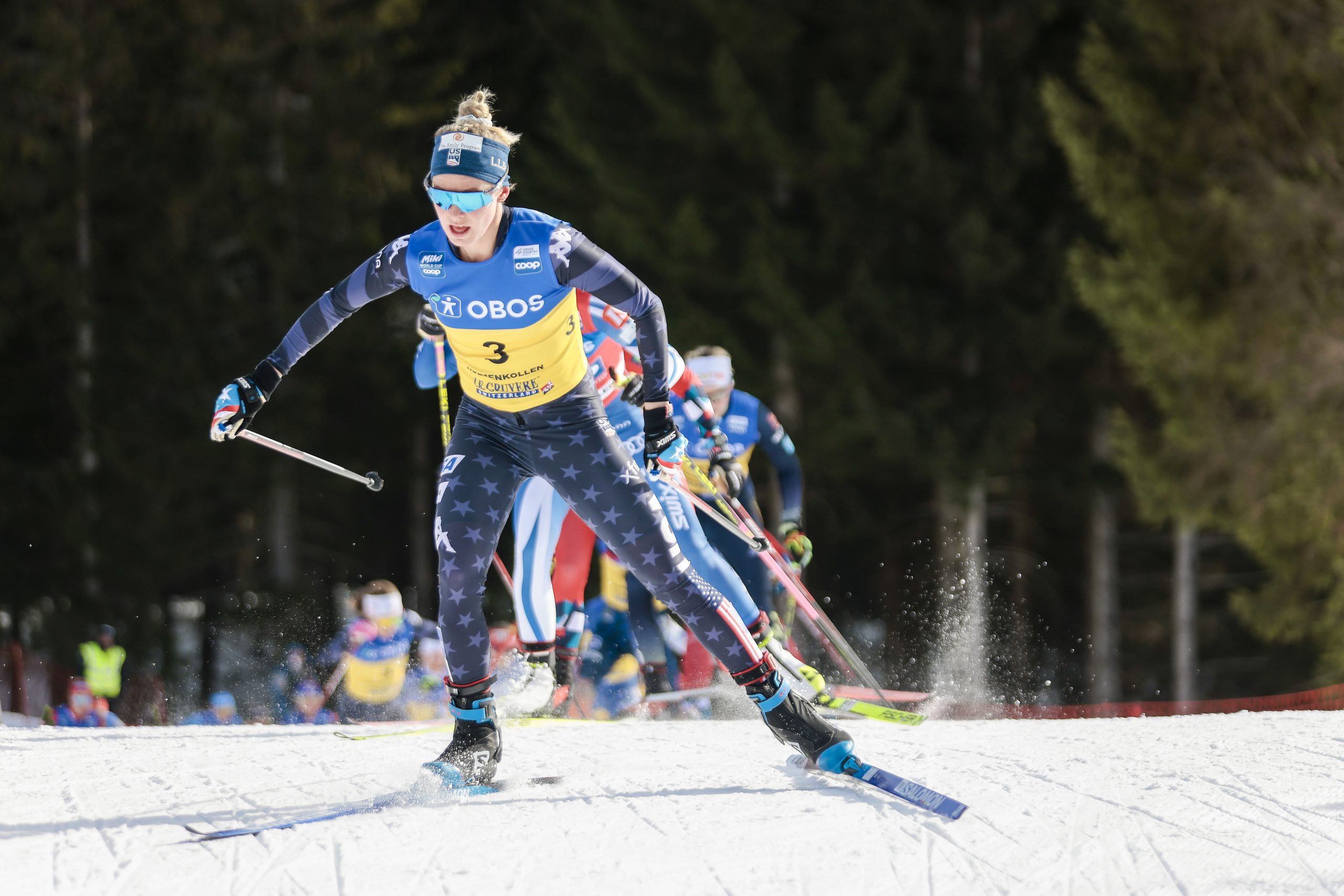
Category: Racing

We are cross country ski racing enthusiasts. We race as much as we can all winter, and when we aren’t racing ourselves, we are following the many other races around the country and the world. From weekly recaps of local events, to the big stage of the World Cup, we have it all! So whether you are a competitor, a parent, or just a ski fan, this is the place for race reports, schedules, results, and more. Use the links below to view articles in a specific sub-category, or scroll down to view all Racing articles.
  • Sundling Seizes Drammen, Denying Skistad on Home Snow

    Sundling Seizes Drammen, Denying Skistad on Home Snow

    This coverage is made possible through the generous support of Marty and Kathy Hall and A Hall Mark of Excellence Award. To learn more about A Hall Mark of Excellence Award, or to learn how you can support FasterSkier’s coverage, please contact info@fasterskier.com.

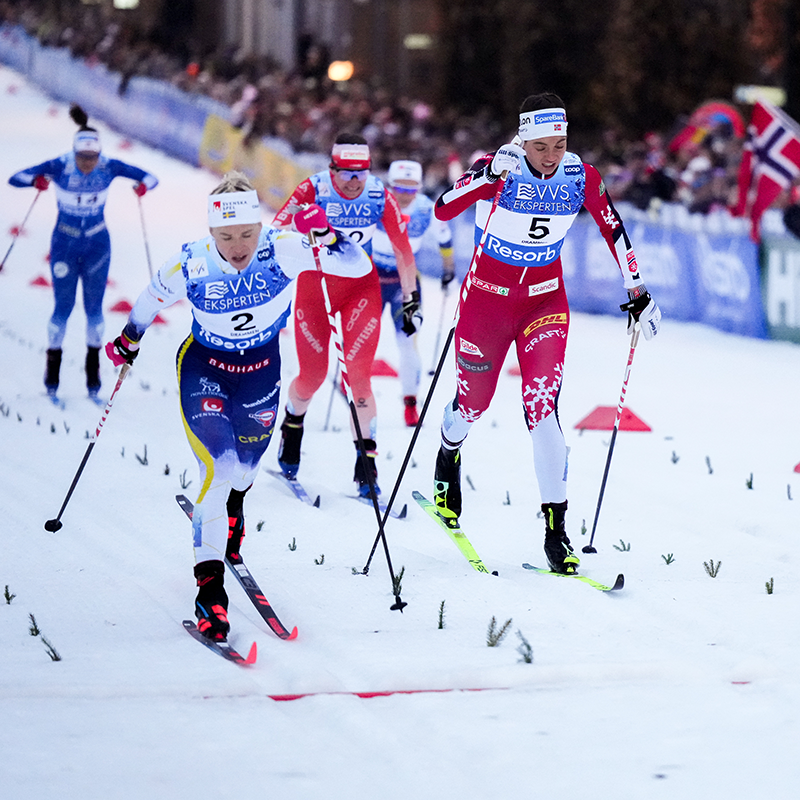
    The women’s sprint final comes into the finish in Drammen, Norway with: Laura Gimmler (GER), Ane Appelkvist Stenseth (NOR), Jonna Sundling (SWE), Nadine Faehndrich (SUI), Johanna Hagstroem (SWE), and Kristine Stavaas Skistad (NOR), (l-r). (Photo: Nordnes/NordicFocus)

    The snow was trucked in, the rock band was playing near the finish, and Norwegian children cheered from second-story windows along the course. On a rare midweek World Cup race day in Drammen — a small city just southwest of Oslo where the sprint course loops through the streets, wraps around an old fountain, and finishes on the snow-covered steps of an iconic church — Jonna Sundling of Sweden took home another World Cup sprint victory.

    Sundling won the women’s classic sprint, going stride for stride with Norway’s Kristine Stavaas Skistad before pulling away in the final meters. Switzerland’s Nadine Faehndrich, racing her final classic sprint before retirement, earned the bronze.

    It was Sundling’s fifth individual World Cup victory of the season and the latest chapter in an intensifying rivalry with Skistad that has captivated ski fans, especially Scandinavian ones, for the last few seasons. From the World Championship final in Trondheim last year to the Olympic final in Milano Cortina, Sundling, with the rest of the Swedish sprinters, and Skistad have been locked in a tactical chess match. On Thursday in Drammen, it was Sundling who played the final move.

    Quarterfinal number one heads up the first climb with: Barbora Antosova (CZE), Mathilde Myhrvold (NOR), Jessie Diggins (USA), Melissa Gal (FRA), (l-r). (Photo: Nordnes/NordicFocus)
    Qualification and Quarterfinals

    Sweden’s Linn Svahn, the reigning Olympic sprint champion, posted the fastest qualification time at 2:41.87 — nearly three seconds clear of Sundling’s 2:44.39. But qualification speed, as World Cup sprinting always reminds us, is only the entry ticket.

    Two Americans advanced to the heats. Jessie Diggins, the overall World Cup leader wearing the yellow bib in what she called a “full circle moment,” qualified 17th in 2:50.91. Rosie Brennan, seeded 28th, also made the top 30.

    Diggins chose Quarterfinal 1 alongside Sundling and Skistad — a loaded heat. Skistad took the win with Sundling second via a photo finish, just 0.18 seconds separating them. Diggins fought hard for third, advancing as a lucky loser after finishing just 0.22 seconds behind Sundling.

    Rosie Brennan (USA) said after the race, “Drammen is one of my favorite races, it’s a fun course and always has a lively atmosphere.” (Photo: Nordnes/NordicFocus)

    Brennan’s day ended in the quarterfinals. Racing in Heat 3, she bobbled heading into the downhill and lost the draft, which was a costly moment on a course where the slipstream effect was enormous all afternoon. She finished fifth in her heat.

    “I was happy to get a chance in the rounds, but the conditions were very tough,” Brennan said. “They salted the course, and it was skiing great in the qualifier and then got really icy for the rounds. Anyway, I bobbled into the downhill and lost the draft and then just don’t have the power I need to pass that many people up the finish stretch, so I was disappointed to not be more in the mix.”

    Meanwhile, Svahn survived a scare of her own… as her quarterfinal rounded the fountain that anchors the bottom of the course behind the start gates, five of the six athletes ended up in a pile and Svahn seemingly had the most bodies and equipment to navigate as she got back out on the course, but somehow recovered to advance. The Olympic champion’s troubles, however, were only beginning.

    Maja Dahlqvist (SWE) and Jessie Diggins (USA), (l-r) during the second semifinal. (Photo: Nordnes/NordicFocus)
    Semifinals

    The two semifinals told entirely different stories, and the contrast between them shaped the final.

    In Semifinal 1, Skistad took the win with Sundling second, just 0.20 seconds back. Both advanced automatically. Behind them, Svahn finished third and would not advance.

    Semifinal 2 was a different race entirely. Johanna Hagstroem and Ane Appelkvist Stenseth pushed the pace from the gun, stringing the field out over the first climb. But on the long downhill, the draft did its work. Faehndrich and Laura Gimmler of Germany surged past, using the slipstream to slingshot into the lead.

    Nadine Faehndrich (SUI), who is planning to retire after the season, found a little extra Drammen magic today as she finished on the podium in third. (Photo: Nordnes/NordicFocus)

    Faehndrich won the heat decisively. Gimmler was second. The fast overall times meant Hagstroem would advance along with Stenseth, who just out-lunged Diggins for fourth and the second lucky loser position.

    For Diggins, the day ended in 10th. But she left Drammen at peace.

    “This was really cool because the Drammen area was my first ever World Cup start and it was a skate sprint,” Diggins said. “So it’s kind of a very full circle moment to close it out with a classic sprint here as the last classic sprint of my career.”

    She had tried something new in the heats, sitting in the draft instead of going to the front, a departure from her usual aggressive approach. “Normally, because literal strength is not my strength, I usually just try to go really, really hot and try to go off the front,” she said. “I was like, nope, I don’t think that’s gonna work for me here with the crazy draft and slingshot effect. I was taking a lot of notes in warm-up, and in the quarterfinal, I had the smallest tuck of my life. It was just really fun to try to believe in myself as more of a pure sprinter and to try to be a little more tactical.”

    She acknowledged she ran out of power in the semifinal, but had no regrets. “I still felt like I executed my plan to the best of my ability, and that’s always a cool feeling.”

    Jonna Sundling (SWE) crosses the finish line just ahead of Kristine Stavaas Skistad (NOR) for the win in Drammen, Norway. (Photo: Nordnes/NordicFocus)
    The Final

    Six women lined up for the final: Sundling and Hagstroem for Sweden, Skistad and Stenseth for Norway, Faehndrich for Switzerland, and Gimmler for Germany. Svahn and Maja Dahlqvist, the Olympic gold and bronze medalists in the sprint classic, were both absent.

    On the opening climb, Skistad sat behind Sundling in a familiar posture — patient, conserving, waiting for the right moment. As Kikkan Randall mentioned on the broadcast, Skistad almost never leads into a downhill. She baited Gimmler into taking the front position, then tucked into her slipstream.

    Coming off the descent and around the final hairpin, Faehndrich made her bid, surging past Gimmler and into third. But the race was between the two women everyone expected.

    Sundling and Skistad skied side by side on the final climb, and what followed was a scene that encapsulated their rivalry. Stride for stride, shoulder to shoulder, neither yielding a centimeter. Sundling’s transition from double pole to striding was fractionally sharper — she carried more momentum through the final meters — and she crossed the line with a small advantage.

    “It is usually very tight in Drammen, but today it was extremely tight,” Sundling said on air afterward. “Till the last meter. I was like, okay, I need to continue all the way over the finish line. It was tough, but I’m happy that I was the first person over the line.”

    For Faehndrich, the bronze was a fitting farewell. The 30-year-old Swiss racer, who announced her retirement this season, now sits third in the sprint World Cup standings at 700 points — just behind Hagstroem (708) and within striking distance of leader Dahlqvist (720) heading into the final sprint of the season in Lake Placid next weekend.

    Jessie Diggins (USA) gave her fans something to cheer about during her quarterfinal when she charged to the finish line. (Photo: Nordnes/NordicFocus)
    Looking Ahead

    Diggins continues to lead the overall World Cup standings with 1,961 points, 275 points ahead of Sweden’s Moa Ilar, a margin that appears insurmountable with four races remaining. The distance globe, too, seems firmly in her grasp. But the sprint crystal globe race is wide open: Dahlqvist, Hagstroem, and Faehndrich are separated by just 20 points at the top of the standings, and the final sprint in Lake Placid could decide everything.

    For Diggins, there’s another milestone ahead — she’s only a few nights away from sleeping in her own bed before racing in front of an American crowd at the World Cup Finals. “Very, very, very excited about that,” she said.

    The World Cup moves to the historic Holmenkollen venue in Oslo on Saturday for the Women’s 50 k Freestyle Mass Start, before the season concludes in Lake Placid, New York, March 20-22.


    Drammen Women’s Classic Sprint QUALIFICATION RESULTS

    Drammen Women’s Classic Sprint FINAL RESULTS


    Love Stories Like This? Help Keep Them Coming.

    Feature stories like this one take time, access, and care to produce. If you value thoughtful storytelling and independent ski journalism, please consider becoming a Voluntary Subscriber. Your support directly fuels the work we do to cover the people, places, and moments that make our sport special.

    Join the FasterSkier community!


    Kristine Stavaas Skistad (NOR), Jonna Sundling (SWE), and Nadine Faehndrich (SUI), (l-r) share the Classic Sprint podium in Drammen, Norway. (Photo: Nordnes/NordicFocus)
  • Colin Rodgers and the Culture of SMS T2

    Colin Rodgers and the Culture of SMS T2

    This article was made possible through the generous support of our voluntary subscribers. If you value coverage like this, please support FasterSkier with a voluntary subscription.

    The first time I saw Colin Rodgers, he was climbing onto a podium in the basement of a hotel in Biwabik, Minnesota. I honestly can’t remember the name of the hotel, but I can remember the rooms, the enormous lobby complete with an indoor minigolf course, and the basement where the awards were taking place. It was Junior Nationals, 1997, and he’d just won the opening U16 race. We were there with the New England contingent. They held the awards in this low-ceilinged basement room, and although he wasn’t the tallest of boys, his blonde hair almost touched the ceiling tiles. Colin went to Holderness School in New Hampshire, and as I looked up at his smiling face, it was obvious that he was the kind of kid who was going somewhere.

    A few years later, I was watching him again, but this time from behind as he skied away from me up one of the small climbs on Woodpecker during the 3 x 5 k Classic Relay at the Williams College Carnival. Colin raced for Middlebury, and I raced for UNH, and at carnivals, he’d ski away from me. That was the deal. He was always a step, or a lot more, ahead.

    We caught up over Zoom last week. Colin was in a hotel room in Falun, Sweden, traveling with the U.S. Ski Team on the World Cup circuit. I was sitting on a rocking chair in the foyer of our local dentist’s office while my boys were inside getting their teeth cleaned. That’s how FasterSkier interviews happen sometimes.

    Colin Rodgers (SVSEF) – 4th Place

    Since his competitive career ended, Colin has given himself fully to coaching. First with the SVSEF Gold Team, who he had raced for at the end of his career, and later junior skiers at Green Mountain Valley School, where he spent nine years. And now, as head coach of the SMS T2 Team at Stratton Mountain School in Vermont, he works with some of the best cross-country skiers in the world.

    The team this year included Jessie Diggins, Ben Ogden, Julia Kern, and Canadian skier Remi Drolet, as well as collegiate skiers Fin Bailey and Jack Lange. Of the professional skiers, three of them finished in the top six at the Olympics. All four were in the top 20. Ben Ogden came home with two silver medals and ended a 50-year Olympic medal drought for American men in cross-country skiing. And Jessie Diggins, who is currently wrapping up a career that is the best of any American skier ever, added a bronze medal to her collection.

    Colin still seemed a little stunned by it all when we spoke.

    “We were so far beyond wherever I thought we were going to be,” he said. “I had a good feeling about this year. But for Ben to take home two silvers, and Jesse a bronze, and Remi to be in the top 20 and really help Canada with a historic relay finish, and Julia in the top six. It’s stuff that I could never believe was truly going to happen. And here we are talking about it.”

    SMS T2’s Rémi Drolet, Ben Ogden, Julia Kern, Jessie Diggins, and coach Colin Rodgers. (Photo: courtesy photo)

    Colin grew up in Westford, Vermont. His father was the program director for the U.S. Biathlon team from 1984 to 1988, which brought the family to northern Vermont. His parents built a house in Westford that year and never left.

    He went to Holderness, then Middlebury, and after college, he headed to the Maine Winter Sports Center, where coaches like Jens Johansson, Eli Brown and Will Sweetser were building something in the northern reaches of the state. From there, he moved to Sun Valley, Idaho, where he joined the SVSEF Gold Team and kept racing.

    Colin was good. He raced on the World Cup. But the jump he’d always hoped to make didn’t quite happen.

    “I think as a nation now, we’re so much more educated,” he said. “I had amazing coaches. But we were just kind of, maybe sometimes trying too hard.”

    He talked about spending time in Scandinavia and being around athletes who were significantly better than him. What he noticed wasn’t that they worked harder. It was that they were smarter about the work.

    “I probably trained at level two way too much of the time,” he said. “Especially being a little more anaerobic and linked to the sprint side. I really needed to be doing the easy training even easier.”

    He paused.

    “When it’s time to go, you’ve got to let the dog run,” he said, quoting his old Middlebury coach Terry Aldrich. “And that was the exact opposite. Like, now it’s time to really peak, and you let it loose.”

    I told him I’d heard a version of that from the other direction. When I was coaching, I used to tell my kids about Matt Whitcomb, who had been a teammate of Rodgers at Middlebury, previewing a course at Junior Nationals and telling the athletes they had to “walk the f-ing dog.” Every time they got to a climb, they were pulling back on the leash. Walking the dog.

    Two coaches. Related metaphor. Opposite leash relationships. That’s about as clean a summary of training philosophy as you’ll find in this sport. Keep the dog relaxed in training often, until it is time to let it run when it matters.

    Matt Gelso on the finishing stretch with coach Colin Rodgers encouraging in West Yellowstone (Photo: Toko)

    Before Stratton, the coaching experience that shaped Colin most was the time he spent around Rick Kapala at Sun Valley.

    Kapala ran the Sun Valley Education Foundation for nearly 30 years and built a program Colin still talks about with real admiration.

    “It was serious training, but it was also really creative,” Colin said. “You’d go out for long mountain adventures, do different kinds of workouts. It kept people engaged.”

    That stuck with him. When he moved to GMVS to coach high school athletes, he kept coming back to a simple question.

    “What would make me really want to go to practice today?”

    He laughed when he said it.

    “It sounds basic. But it actually matters a lot. If people don’t want to be there, something’s probably off.”

    He talked about his coaching years at GMVS and how, for him, the job was about getting kids to believe in what they could do.

    “When kids are in high school, they’re questioning everything. How they look, how they’re growing. And you’re just like, no, dude, this is fun. This can be a real blast. And believe. Like, damn, I can do a good job at this. If I’m doing this every day, I might as well be good at it, right?”

    He spent nine years doing that work. And then the SMS T2 job came along.

    “It was an opportunity there’s no way I was going to pass up,” he said. “It’s changed my life. Literally.”

    The program at Stratton operates under a mission statement crafted by Colin’s predecessor, Sverre Caldwell: international excellence and local inspiration.

    Colin said that phrase was part of what sold him on the job.

    “It’s everything I believe in. We’re trying to be the best we can be, win races, kick ass internationally. But then also, along the way, inspire the next generation of skiers coming up.”

    At Stratton, those two things aren’t separate. The T2 athletes train on the same roads and trails as the younger skiers in the school’s Nordic program. When Stratton kids show up for a summer or fall practice, and the older athletes are there, everyone just funnels in together and heads out.

    “It doesn’t even need to be talked about, really,” Colin said. “It’s just showing up, doing the work. This is how it’s done. And if you keep working really hard for a long time, you’re probably going to get really good too.”

    He brought up the chain of inspiration that runs through American skiing. Jessie Diggins was inspired by Kikkan Randall, by Andy Newell, by Simi Hamilton. Kern was inspired by Diggins.

    “When you get motivated by somebody who’s special and inspiring to you, if you have some talent and the fire to go for it, you realize you can chase that person. And then it’s like, oh, I can maybe be them. And then it’s like, oh, maybe I can be better than them.”

    One of the more interesting aspects of Colin’s role at SMS T2 is that he’s not the only coach in the picture. Not even close.

    Kristen Bourne and Colin Rodgers out for a run during the OD run at Park City camp, 2025. (Photo: Matt Whitcomb)

    Diggins works primarily with Jason Cork on the U.S. Ski Team staff. Ogden’s training has long been guided by Patrick Weaver, his college coach at UVM. Kern has a deep relationship with Kristen Bourne, who is also a national team coach. Drolet works with Dave Wood, a former coach of the Canadian national team. And Bailey goes to UVM and skis for Weaver, while Lange goes to Dartmouth and is coached by Brayton Osgood.

    Colin sees his job as connecting the dots.

    “Each athlete comes in with their own support network,” he said. “Jason has been working with Jesse forever. Ben has a really close connection with Weave. And I’ve been able to learn a lot from Patrick about how Ben ticks.”

    He was honest about what that requires.

    “When you step into a role like this, you have to check your ego,” he said. “It’s not about being the only voice in the room. It’s about helping the athlete succeed.”

    What he brings is proximity. He sees the athletes more frequently than some of their other coaches, especially during training blocks in Vermont. He can offer technique advice, fill gaps when someone else isn’t available, and keep everyone communicating.

    “I think one of my strengths is the ability to connect people,” he said. “And to connect with people.”

    Colin has watched American skiing grow up. When he was racing, relatively few American men were competitive at the highest levels. The development pathways weren’t as clear. The coaching wasn’t as sophisticated.

    “We’re closer as a nation now to what it means to go to that next level,” he said. “We know what to do. As coaches, we’re totally clued in on this systematic, long-term idea of how to periodize correctly, and also how to make it fun.”

    Colin Rodgers, Jessie Diggins and Julia Kern. (Photo: courtesy photo)

    He pointed to results at every level. At the time we spoke, American athletes were fighting with the best in the world at the World Junior Championships. On the World Cup, Diggins, Kern, and Ogden, along with the APU-based skiers, are proving it can happen at the very top.

    “A lot of people have helped build this,” he said. “It’s not just one program or one coach.”

    But the jump from junior skiing to the World Cup is still enormous. And programs like SMS T2 exist to help athletes survive that transition.

    “Having environments where athletes can develop during that stage is really important,” he said. “The gap is huge.”

    Before we wrapped up, I asked Colin what success looks like for him five years from now.

    He went big picture with a slightly longer lens. The 2034 Olympics will be in Salt Lake City. There’s a generation of young American skiers who have already raced at Soldier Hollow, the Nordic venue, during their youth careers. Now they’re looking ahead to competing on home soil.

    “We’re working towards 2034,” he said. “And we want to be successful there. If we stay on this trajectory, we can have medals. That’s our ultimate goal.”

    Within Stratton, he wants to grow the team thoughtfully. This year was lean, focused on supporting the Olympic athletes. Going forward, he wants to build back toward four or five athletes on each side, men and women, plus NCAA skiers.

    “We have to do it the right way,” he said. “We don’t want to take on too many people too fast.”

    Jessie Diggins (USA), whose World Cup career will conclude in a week and a half, celebrates her bronze medal in the Olympic 10 k Freestyle in Tesero, Italy. (Photo: Vanzetta/NordicFocus)

    He’s also thinking about the athletes who won’t be there. Jessie Diggins is retiring. That will leave a void at SMS T2 and on the World Cup, where Colin noted she currently sits at 380 career starts, more than any other skier.

    “Jesse’s going to go on and do a lot of really cool things and still inspire the next generation in new ways,” he said. “And then there’s going to be up-and-comers who are going to step up and be inspired by everything she’s done, and by everything Ben and Julia and Remy are already doing.”

    International excellence. Local inspiration. It’s a simple mission. But Colin Rodgers has spent a career learning that the simple things are usually the ones that matter most.

    He’s been chasing the highest levels of this sport since he was 15 years old, standing on a podium in a hotel basement in Minnesota. The path just looks different now.


    Help Support Our Olympic Coverage!

    If you value the thoughtful work and access FasterSkier provides, please consider becoming a Voluntary Subscriber. Your support directly fuels our work to cover the people, places, and moments that make our sport special.

    Join the FasterSkier community!
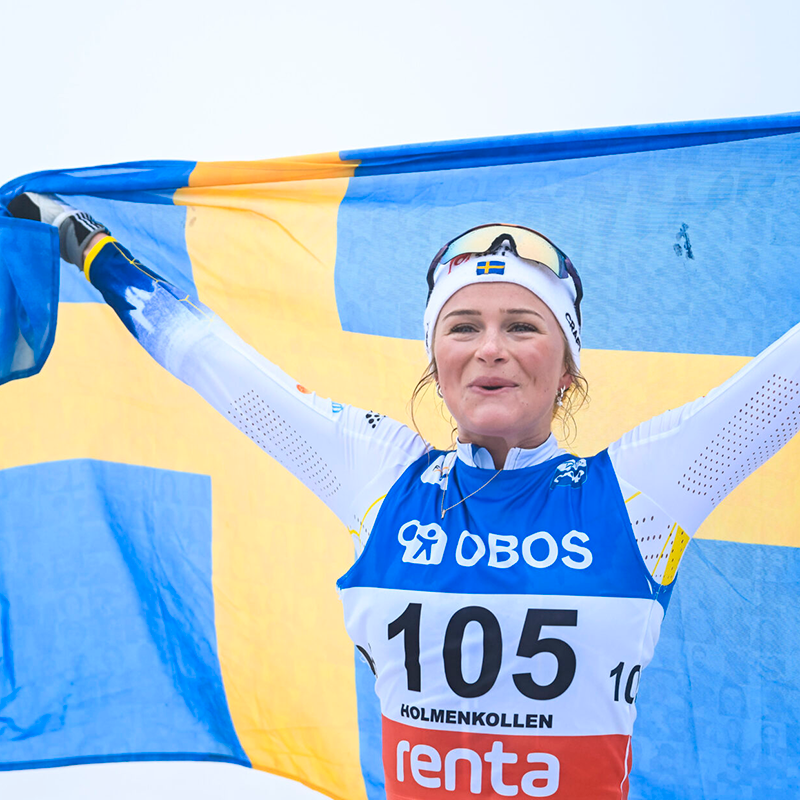
     

    Rémi Drolet and Colin Rodgers. (Photo: courtesy photo)
  • Diggins Podiums in Lahti as Karlsson Wins 10 k Classic

    Diggins Podiums in Lahti as Karlsson Wins 10 k Classic

    This coverage is made possible through the generous support of Marty and Kathy Hall and A Hall Mark of Excellence Award. To learn more about A Hall Mark of Excellence Award, or to learn how you can support FasterSkier’s coverage, please contact info@fasterskier.com.

    Jessie Diggins (USA) on her way to third place in the 10 k Classic Individual Start in Lahti, Finland. (Photo: Authamayou/NordicFocus)

    As Jessie Diggins climbed the final hills in Lahti on Sunday, she could hear something unusual rising above the crowd noise. Scattered along the course were hand-made signs held by Finnish fans and young skiers. Many carried the same simple message: “Thank you, Jessie.”

    For Diggins, racing through what has increasingly become a farewell tour of World Cup venues that have defined her career, the moment carried emotional weight. Lahti has not always been a place where the American felt the course played to her strengths, particularly in classic technique. But on Sunday, she delivered one of her most meaningful performances there, skiing to third place in the women’s 10-kilometer classic interval start.

    “There were so many people out on the course with signs saying ‘Thank you, Jessie,’ and it was really emotional in the best way,” Diggins said afterward. “It was incredibly touching. Seeing all the little kids in glitter after the race was just really special.”

    Frida Karlsson (SWE) on her way to the 10 k Classic win in Lahti, Finland. (Photo: Authamayou/NordicFocus)

    Sweden’s Frida Karlsson powered to the victory in 25:57.6, edging teammate Linn Svahn by just over four seconds. Diggins followed in third, 6.2 seconds behind the winner, securing the 90th World Cup podium of her career — a milestone that came in her 375th World Cup start.

    The podium also represented a breakthrough for Diggins in a discipline she has spent years working on. Despite her long list of accomplishments, Sunday marked her first World Cup podium in a standalone 10-kilometer classic interval start.

    “The Lahti course hasn’t always suited my strengths in classic skiing,” Diggins said. “So it felt really cool to pull it together a bit more today.”

    The result allowed Diggins to maintain control of both major season-long competitions. With only three World Cup stops remaining this winter, she continues to lead Sweden’s Moa Ilar by 264 points in the Overall World Cup standings and by 188 points in the Distance standings, positioning herself strongly in the race for the sport’s coveted crystal globes.

    Moa Ilar (SWE) and Linn Svahn (SWE), (l-r) reflecting at the finish. (Photo: Authamayou/NordicFocus)
    Svahn Sets the Early Benchmark, Karlsson Finishes the Job

    With the interval format — one athlete starting every 30 seconds — stretching the field across the Lahti course, the first major time to chase appeared almost immediately.

    Sweden’s Linn Svahn, starting with bib 5, was among the earliest contenders onto the course and quickly posted the fastest times through the early checkpoints. Known primarily as one of the World Cup’s dominant sprinters, Svahn skied aggressively over the opening kilometers and established the benchmark that much of the field would spend the next hour chasing.

    Her time held atop the standings as racer after racer attempted to match it.

    Later in the race, however, another Swede began to close the gap. Frida Karlsson, wearing bib 40, remained within seconds of Svahn through the intermediate checkpoints before edging ahead in the final kilometers.

    “I was just trying to stay in my own skiing,” Karlsson said afterward. “I heard it was between me and Linn, and I was super excited to get that fight.”

    Karlsson ultimately crossed the line in 25:57.6, securing the victory by 4.1 seconds over her teammate.

    The win came after a brief illness, which prevented her from competing in the Olympic 50 k, but Karlsson said she was eager to keep racing despite the setback.

    “I was sick after the Olympics, but I was really excited to keep racing and just do what I know best,” she said. “So I’m super glad to be here.”

    Diggins, starting shortly after Karlsson, kept herself in contention throughout the race, skiing within striking distance of the Swedish pair at each checkpoint before finishing 6.2 seconds back in third place.

    Linn Svahn (SWE) on her way to second place. (Photo: Authamayou/NordicFocus)
    Three Different Approaches to the Same Race

    The split times revealed three distinct pacing strategies among the podium finishers.

    Svahn, starting fifth, set the tone early. She posted the fastest time through the opening 1.1 kilometers and maintained the lead at the 3.4-kilometer checkpoint, immediately putting pressure on the rest of the field as they left the start gate.

    Karlsson, starting later in bib 40, remained just seconds behind through the early checkpoints, skiing a controlled opening before gradually closing the gap. By the middle of the race, she had moved into contention, and over the final kilometers, she proved strongest of all, ultimately pulling ahead to secure the victory.

    Diggins, meanwhile, delivered perhaps the most evenly paced effort of the three. She remained within striking distance of the leaders at every checkpoint — fifth at 1.1 kilometers, third by 3.4 kilometers, and still in podium position through the final lap.

    That steadiness proved decisive in the final standings. While the two Swedes battled for the win, Diggins’ consistent pace allowed her to secure third place and another important podium in the fight for the season-long crystal globes.

    Jessie Diggins (USA) sprints for the finish line. (Photo: Authamayou/NordicFocus)
    Diggins’ Classic Progress

    Diggins’ podium also reinforced one of the season’s quieter developments: the continued evolution of her classic technique.

    For much of her career, the American’s greatest moments have come in skating events, where her aggressive pacing and powerful finishing speed often prove decisive. But this season she has shown remarkable consistency in classic distance races, finishing in the top ten in every classic distance event on the World Cup calendar.

    Conditions in Lahti — warming temperatures and increasingly soft tracks — placed an additional premium on ski preparation, something Diggins was quick to acknowledge after the race.

    “I had great skis, which is a huge part of the equation, especially when the conditions get slushy,” Diggins said. “This podium really belongs to the team. I’m so grateful for all the hard work they put in.”

    Rosie Brennan (USA) on her way to 12th place. (Photo: Authamayou/NordicFocus)
    Brennan Continues Return to Form

    A bit further down the results list, fellow American Rosie Brennan continued a gradual return toward form after a long battle with illness that has affected much of her season.

    Brennan finished 12th (+38.6) in Lahti, a result that reflected both solid skiing and a cautious approach early in the race.

    “This whole process has really been a game of time,” Brennan said. “There have been many moments when I’ve wondered if I’ll ever feel normal again in my life. But the last three days are the most normal I’ve felt racing since December 2024.”

    The Lahti course, known for its steep climbs and technical demands, offered a test of efficiency in classic technique — a challenge Brennan felt she handled well.

    “Lahti requires really good technical skiing,” she said. “I felt like if I could relax and focus on my classic technique, that would give me the best chance.”

    Kendall Kramer (USA) working her way up one of the many Lahti climbs. (Photo: Authamayou/NordicFocus)
    Kramer Finds Lessons in the Lahti Hills

    For American Kendall Kramer — 42nd in 27:40.8 (+1:43.2) — the Lahti race presented a different kind of challenge: starting first.

    Wearing bib 1, Kramer had the advantage of pristine tracks before the course began to break down as temperatures warmed. But the early start also meant racing without reference splits from the rest of the field.

    “I was actually okay starting with bib 1 today, given the state of the tracks,” Kramer said. “They tend to break down as the race goes on, and the corners can get icy, so it was nice to have cleaner conditions early.”

    Without other athletes on course to gauge pacing against, Kramer said the race became more about skiing freely and trusting her own effort.

    “Racing without reference splits definitely makes pacing tougher, but at the same time it lets you ski freely and focus on your own race.”

    The steep Lahti climbs also highlighted the technical demands of classic skiing at the World Cup level.

    “The punchy hills were fun because I could really bound up them, which is something I haven’t done much in World Cup racing so far,” Kramer said. “But the sections where it turns into pure power striding showed me I still have a lot to work on.”

    Despite the challenges, Kramer described the experience as valuable for understanding the technical standards required to compete consistently at the highest level.

    “I’ve learned so much from racing here this season,” she said. “At the World Cup, every strength and every weakness gets highlighted, and that really helps show what to work on heading into the summer.”

    Julia Kern (USA) catches a rest from both the climbs and the sunlight. (Photo: Authamayou/NordicFocus)
    Kern Heading Home Early to Recover

    Julia Kern, who finished 51st — 28:11.4 (+2:13.8) — today, said she will return home early from the World Cup circuit as she continues working through health issues that have lingered since the Olympic races.

    “I’ve been battling my body on various fronts since the Olympics,” Kern said in a team media statement. “One of my strengths is showing up and continuing to try and believe despite the challenges, while also being patient and smart.”

    Kern added that she will take additional time to recover while seeking answers about her condition, with hopes of returning to competition at the Stifel World Cup Finals in Lake Placid later this month.

    “Right now, my body needs more time to recover and is in search of answers, so I’m headed home early with the hopes of being in a place to race in Lake Placid.”

    Lauren Jortberg (USA) and Katherine Weaver (CAN), (l-r) charge for the line. (Photo: Authamayou/NordicFocus)
    Jortberg Gets a Front-Row Look at Karlsson’s Pace

    For American Lauren Jortberg — 55th in 28:32.7 (+2:35.1) — the Lahti race offered a unique opportunity to measure herself against one of the sport’s best.

    Early in the race, Jortberg found herself skiing behind Sweden’s Frida Karlsson for several kilometers as the eventual winner was completing her second lap while Jortberg was still on her first.

    “I skied with Frida for about three kilometers, which was really cool,” Jortberg said. “She’s obviously a beast, and it was cool to hang with her and get a taste of what that pace actually feels like.”

    Jortberg said the experience offered valuable insight into the demands of racing a 10-kilometer interval start at the World Cup level, where pacing often means pushing near maximum effort from the start.

    “Ten-k pacing on the World Cup is basically as hard as you can go the whole way,” she said. “It’s about learning how to navigate that kind of effort and still ski your own race.”

    She added that the race reinforced both the progress she has made in classic technique and the areas she hopes to continue developing as she gains more experience at the international level.

    “I’m really proud of how my classic skiing is coming along,” Jortberg said. “There’s still a lot to work on, but it was definitely a good first start in a distance race.”

    Jortberg said she hopes to carry the fitness and lessons from Lahti into the next stop on the World Cup circuit in Drammen, Norway.

    Emma Albrecht (USA) giving it everything she can all the way to the finish. (Photo: Authamayou/NordicFocus)
    Albrecht Sees the Margins Up Close

    Further back in the start order, fellow American Emma Albrecht — 58th in 28:50.7 (+2:53.1) — experienced firsthand just how tight the margins can be in World Cup distance racing.

    “The tight margins were shown by skiers finishing at similar times,” Albrcht said after the race. “For me, I was not passed, and I did not pass anyone. Which meant the skiers in front and behind me were skiing at a similar pace to me.”

    Like Kramer, Albrecht said the steep Lahti climbs emphasized the technical demands of classic technique, particularly the efficiency required to stride uphill without losing grip.

    “The uphill sections are the most technical and demanding here,” she said. “The climbs in Lahti are steep, and striding up efficiently requires really good technique to avoid slipping.”

    For Albrecht, the race served as a clear reminder of the areas she hopes to refine moving forward.

    “One of my biggest takeaways is that I want to keep working on my striding technique and get better at adjusting my tempo based on the terrain.”

    Dariya Nepryaeva (AIN) and Novie Mccabe (USA), (l-r) come to the line. (Photo: Authamayou/NordicFocus)
    Other North Americans in the Field

    Novie McCabe raced her way to 43rd in 27:45.0 (+1:47.4) in the 64-skier field.

    For Canada, Jasmine Drolet led the team in 41st place with a time of 27:39.8 (+1:42.2). Liliane Gagnon finished 46th in 27:56.4 (+1:58.8), and Katherine Weaver placed 59th in 29:00.9 (+3:03.3). Teammate Olivia Bouffard-Nesbitt, who had been listed on the start sheet, did not start the race.

    Take a bow, Jessie Diggins (USA) . (Photo: Authamayou/NordicFocus)
    The Season’s Final Push

    Sunday’s race in Lahti brought us even closer to the end of the season, now with only two sprint races and three distance races remaining until the sport’s biggest prizes will ultimately be decided.

    For Diggins, the third-place finish represented more than another podium in an already historic career. It also reinforced the remarkable consistency that has defined her season. With top-10 finishes in every classic distance race this winter, she has transformed what was once considered a relative weakness into one of the foundations of her bid for both the Overall and Distance crystal globes.

    Three stops remain on the calendar: the classic city sprint in Drammen, Norway, the iconic 50-kilometer race at Holmenkollen in Oslo, and the Stifel World Cup Finals in Lake Placid, New York.

    For Diggins, those races now carry both competitive stakes and emotional significance. As the American continues what has increasingly felt like a farewell tour across the World Cup circuit, the crowds that gathered along the Lahti course on Sunday offered a glimpse of how much her career has meant to fans of the sport, not just in the United States, but all around the world.

    And as Diggins pushed across the final climbs toward the stadium — signs waving, glitter-clad children cheering from the side of the course — she did what she has done so often over the past decade: she kept fighting for every second and left everything she had, once again, on the course.

    Lahti Women’s 10 k Classic RESULTS


    Love Stories Like This? Help Keep Them Coming.

    Feature stories like this one take time, access, and care to produce. If you value thoughtful storytelling and independent ski journalism, please consider becoming a Voluntary Subscriber. Your support directly fuels the work we do to cover the people, places, and moments that make our sport special.

    Join the FasterSkier community!


    Linn Svahn (SWE), Frida Karlsson (SWE), and Jessie Diggins (USA), (l-r) share the 10 k Classic podium in Lahti, Finland. (Photo: Authamayou/NordicFocus)
  • He Just Wins—Klaebo Again in Lahti 10 k

    He Just Wins—Klaebo Again in Lahti 10 k

    This coverage is made possible through the generous support of Marty and Kathy Hall and A Hall Mark of Excellence Award. To learn more about A Hall Mark of Excellence Award, or to learn how you can support FasterSkier’s coverage, please contact info@fasterskier.com.

    With his win Lahti’s World Cup 10 k Classic, Johannes Hoesflot Klaebo (NOR) continues a level of dominance rarely seen in international sports. (Photo: Thibaut/NordicFocus)

    Johannes Hoesflot Klaebo may be tired, but far more daunting than any mere fatigue is what Klaebo’s rivals find themselves facing: futility.

    Weekend after weekend, race after race, kilometer after kilometer, finish line after finish line, Klaebo is proving himself to be all but unbeatable. He toys with his rivals in Sprint races, whether Classic or Freestyle; he takes advantage of his superior speed and tactical acumen in Mass Start races of every distance. He even displays superior pacing, restraint, endurance, and discipline in Interval Start events. And when Klaebo skis the anchor leg of your relay, then your team wins. Such athletic dominance is not a thing that lasts—and even Klaebo is likely to find himself beaten soon—but when an athlete’s on an historic streak like this, it’s a remarkable thing for fans of the sport to witness.

    In Lahti, Klaebo’s dominance was on display again, as he glided to yet another World Cup victory in the 10 k Classic Interval Start. Mid-race splits identified Russian independent skier, Savelii Korostelev as a challenger, but Klaebo would pull away from him in the end, bettering the young Russian’s finishing time by 34 seconds. Between them, Martin Loewstroem Nyenget mounted a challenge of his own. While Nyenget has emerged as one of the dominant Classic skiers of this generation, still he trailed Klaebo at every checkpoint. Ultimately, Nyenget would finish second, but still some 22 seconds behind.

    If all these skiers want to beat Klaebo, they need to find another way to do it. Maybe the best tactic is to simply wait. Everybody gets sick some day, don’t they? Everybody shows up flat now and then, right? Perhaps the best tactic to employ in chasing Klaebo is to stop chasing. Just let him flame out at some point, and hope to be the one best positioned in the crowd to catch the bridal bouquet when it flies through the air.

    Savelii Korostelev (AIN) was the early leader at numerous checkpoints. He would finish third on the day behind the efforts of Martin Loewstroem Nyenget (NOR) and eventual race winner, Johannes Hoesflot Klaebo (NOR). (Photo: Thibaut/NordicFocus)
    Men’s 10 k Classic

    Korostelev entered the World Cup circuit and Olympic events after Russia’s long exile, hoping to establish himself at the top of the cross-country ski standings (as he had already accomplished in races within Russia over the past two seasons). Korostelev must be asking himself “Just how fast do I need to go?” Well, “Historically fast” would appear to be the answer to Korostelev’s question.

    Here’s the pertinent question for anyone in the field not named Klaebo: just how far will they go in pursuit of this guy? It’s an especially pressing question for Klaebo’s Norwegian teammates who are compared to him on a week-by-week basis, and who are all hoping to position themselves to be his heir (even as he shows no signs of considering retirement). Any number of those Norwegian stars may have hoped to topple Klaebo in an Olympic event. He was vulnerable, after all; racing every single event while other skiers got to pick and choose. For Harald Oestberg Amundsen, for Martin Loewstroem Nyenget, for Emil Iversen, for Mattis Stenshagen, for Lars Heggen, for Einar Hedegart—all of whom had been identified as skiers with the potential to steal away one of Klaebo’s gold medal opportunities—the chase to catch Klaebo may ultimately ruin them. In the Olympics, most of them appeared flat, as though they may have over-trained, or delayed their much-needed rest, or failed to taper sufficiently in their quest to grab a career-defining medal. Alone among them, Iversen appeared satisfied to follow Klaebo’s lead, joining Klaebo for much of his training throughout the off-season and competitive-season even though it meant that Iversen was unlikely to achieve any sort of advantage over him. Iversen was smart enough to know that Klaebo’s prowess could lead them both to Olympic medals, and that’s precisely what happened. The rest of the Norwegian contingent left Milan-Cortina with anumber of medals, but draped in quite a bit less glory than they might have hoped.

    And here’s the dilemma for Klaebo, himself: how does an athlete seek to maintain the form that they have? Is it possible to just hold one’s position, or does an athlete need to keep getting better? And how much risk is involved in attempting to improve? Just ask Klaebo’s Norwegian teammates . . . they’re trying as hard as they can, trying new things, risking greatly. And it’s not working. If anything, their efforts are opening the door for the stars of other nations that are approaching from behind. Matthis Desloges (FRA) claimed numerous silver medals in the recent Olympics—medals originally thought reserved for Norwegian skiers. And as the World Cup tour enters Period 4, Norwegian skiers find themselves delivering results well down the page, rather than stacking all the Norwegian finishers at the top, which was the norm for much of the pre-Olympic season.

    Martin Loewstroem Nyenget (NOR) must be wondering what he needs to do. In Lahti, he delivered a striking performance in the 10 k Classic, only to find himself trailing Johanes Hoesflot Klaebo (NOR) at every checkpoint. (Photo: Thibaut/NordicFocus)

    Wearing bib 54, Klaebo was the first of the true contenders to start, meaning he would receive less info communicated to him on course when compared to other later-starting contenders. In what is often considered Klaebo’s most challenging event (the interval start 10 k) Klaebo would find himself needing to overcome that small disadvantage as well as the best efforts of his rivals.

    Korostelev came through 3.4 kilometers a full 20 seconds ahead of American, Gus Schumacher, but even Korostelev found himself overtaken by Klaebo who came through the checkpoint three seconds ahead of the neutral-skiing Russian. Klaebo would continue extending his lead over Korostelev to nearly 12 seconds by the halfway point of the race. The only questions that remained would be answered by the other contenders starting behind Klaebo. Among those, Nyenget was the first to test the waters, coming through the 3.4 kilometer mark 3.8 seconds behind Klaebo. Nyenget would lose more time on his way to the end of the lap, crossing through the stadium with a deficit of six seconds . . . still ahead of Korostelev, but dropping just a bit farther behind Klaebo.

    Klaebo held his advantage at 6.1 kilometers, but then he began extending his lead on the way to 8.4 kilometers, crossing that checkpoint 22 seconds up on Korostelev. Klaebo would only continue to extend that lead, crossing the line with a 34 second advantage. Nyenget would continue to battle, ultimately besting Korostelev but still falling 22 seconds short of Klaebo.

    Another weekend passes, another Klaebo sweep. How long can he keep this up? After yesterday’s victory in Lahti’s Freestyle Sprint, Klaebo spoke of his level of fatigue at this juncture in the World Cup season. Who could blame him for being tired? After all, he swept all the Men’s events at the Olympic Winter Games of Milano-Cortina; and this in the middle of his historic World Cup winning streak that began weeks ago, and appears likely to extend well into the future. Unfortunately for those hoping to wait him out, Klaebo seems all but immune to the factors that typically topple those at the top. “The last two weeks has been that I’m sick in the middle of the week, and then I’m racing in the weekend,” said Klaebo. “So, we’ll see if I can stay healthy now during the week so I can participate in Drammen (next week’s Sprint races). That’s the goal.”

    And that’s a problem for the rest of the field: when Klaebo sets a goal, he tends to achieve it. Anyone anticipating Klaebo falling short of that goal may have a while to wait.

    Lahti Men’s 10 k Classic Interval Start RESULTS

    Love Stories Like This? Help Keep Them Coming.

    Feature stories like this one take time, access, and care to produce. If you value thoughtful storytelling and independent ski journalism, please consider becoming a Voluntary Subscriber. Your support directly fuels the work we do to cover the people, places, and moments that make our sport special.

    Join the FasterSkier community!
    The torch isn’t being passed just yet. Savelii Korostelev (AIN), may be one of the heirs apparent in the world of international cross-country skiing, but Johannes Hoesflot Klaebo appears far from ready to make room at the top. (Photo: Thibaut/NordicFocus)


  • Sundling Returns to Win Lahti Sprint as Crystal Globe Battle Tightens

    Sundling Returns to Win Lahti Sprint as Crystal Globe Battle Tightens

    This coverage is made possible through the generous support of Marty and Kathy Hall and A Hall Mark of Excellence Award. To learn more about A Hall Mark of Excellence Award, or to learn how you can support FasterSkier’s coverage, please contact info@fasterskier.com.

    Jonna Sundling (SWE) during qualification in Lahti, Finland. (Photo: Authamayou/NordicFocus)

    The World Cup season returned to Finland this weekend, closing a circle that began more than three months ago in Ruka. In the time since Olympic teams were selected, dreams realized or deferred, experience forged, and farewells offered week after week as the long winter wears on. If the stakes in Lahti feel slightly lower than they did earlier in the season, they are tightening in another way — especially in the races for the Crystal Globes.

    With only a handful of races remaining in the season, the women’s Freestyle Sprint offered more than just another podium. The fight for both the Sprint Crystal Globe and the Overall Crystal Globe continues to tighten.

    In tricky conditions, Sweden’s Jonna Sundling emerged as the day’s winner, navigating the heats with authority before closing out the final to claim victory.

    “I think all day it’s been difficult with the conditions because it seems so nice, but when you ski it’s like icing underneath,” Sundling said in a post-race interview with FIS on the broadcast. “There were some challenges with the skiing, but I’m glad that I could ski as I did today and go all the way.”

    The victory marked a strong return for Sundling, who said she had recently been dealing with a cold and missed racing in Falun before arriving in Lahti.

    One of the most interesting moments of the women’s race came when Kristine Stavaas Skistad (NOR) was disqualified during the semifinals for what appeared to be a very minor incident.  She received a yellow card for the incident, and because she was already carrying one from a previous violation, she was disqualified. (Photo: Authamayou/NordicFocus)
    A Tactical Sprint Course

    The Lahti freestyle sprint course rewarded patience as much as power. After the individual qualification round, the top 30 athletes advanced into the head-to-head heats — five quarterfinals of six athletes each, with the top two finishers and the two fastest “lucky losers” advancing to the semifinals.

    From there, the field narrowed again: two semifinal heats would determine the six skiers racing for the win.

    While the course appeared straightforward on paper, athletes quickly discovered the conditions made positioning critical. The climb before the final hairpin offered one of the few reliable passing opportunities before the long run to the finish, which saw the race often gather back together around the final corner before the finishing stretch. And throughout the heats, several favorites discovered how narrow the margin for error could be.

    Maja Dahlqvist (SWE) got out well, but was unable to advance from the quarterfinals. (Photo: Authamayou/NordicFocus)
    Globe Leaders Falter

    Two of the athletes who have dominated the sprint standings this season — Maja Dahlqvist (Sweden) and Nadine Fähndrich (Switzerland) — both saw their days end earlier than expected, failing to advance beyond the quarterfinals.

    Their early exits added intrigue to the sprint globe race as the season heads toward its final stretch.

    Meanwhile, Sundling continued to build momentum, advancing smoothly through her heats despite the difficult snow conditions.

    “I’m super motivated,” Sundling said of the final weeks of the season in the broadcast interview. “It’s my favorite time of the year.”

    Hilla Niemela (FIN), Johanna Hagstroem (SWE), and Jessie Diggins (USA) (l-r) charge up the opening climb of the Freestyle Sprint in Lahti, Finland. (Photo: Authamayou/NordicFocus)
    Diggins Attacks, But Falls Short

    For the United States, Jessie Diggins came closest to advancing deep into the rounds.

    In her quarterfinal, Diggins launched a decisive move on the final climb, surging to the front of the group in an effort to create separation before the tight hairpin turn at the top of the hill. Over the crest, she continued the attack, aggressively no-pole skating the downhill in an attempt to open a gap.

    For a moment, the tactic appeared to work.

    But the chasing group quickly organized behind her, the draft pulling them back together on the descent into the stadium. Sweden’s Johanna Hagström surged in the final meters, lunging at the line to edge Diggins and end the American’s day in the quarterfinal.

    Diggins said the Lahti crowd helped make the experience memorable.

    “It was so cool to hear the crowd roaring. There were so many people out, really filling the stadium and along the course. It’s just a very cool environment. It was sunny and beautiful, which made it really fun.

    “I was really happy with my energy today. I feel like I skied a pretty good race and did everything I could. But again this year, I feel like I just don’t quite have that ultimate power, especially in the finishing stretch.

    “I’m excited for tomorrow and just excited to be finishing out my last stretch here in Europe. That feels really special. It’s kind of cool to take a moment to reflect on my many years spent on the road in Europe. That chapter is coming to a close now, which is really cool and really special. I’m just grateful thinking back on all the memories over all the different years.”

    Rosie Brennan (USA) fighting to maintain contact with the group as Gina Del Rio (AND) takes the opening climb out fast during their quarterfinal. (Photo: Authamayou/NordicFocus)
    Brennan Knocked Out in Quarterfinal*

    Veteran American Rosie Brennan also reached the quarterfinals but was unable to advance.

    Lauren Jortberg (USA) on her way to 37th place in qualification in Lahti, Finland. (Photo: Authamayou/NordicFocus)
    Jortberg Reflects on Qualification Miss

    For Lauren Jortberg, the Lahti sprint was a reminder of how thin the margins can be in World Cup qualification.

    Jortberg finished 37th in the qualification, just outside the top-30 cutoff needed to advance to the heats. After the race, she said the conditions on the Lahti course made it difficult to find the right balance between glide and stability.

    “There was kind of an ice sheet underneath with some sugar on top,” Jortberg told FasterSkier after the race. “So it was hard to find skis that were running really well while also being able to push off and plant well. It made the skiing a little tricky, but that’s pretty typical for what we’ve seen in Lahti the last few years.”

    Jortberg also felt she left something on the course in terms of pacing.

    “I think I just didn’t pace it very well,” she said. “I probably paced it too much. I didn’t really finish feeling that tired, so that was a bit of a bummer.”

    Part of that caution, she explained, stemmed from having dealt with illness in the days leading into the race.

    “I had been sick the last week, so I think I held back a little bit,” Jortberg said. “That’s frustrating because I felt really good and I think I could have been competitive today.”

    Even so, Jortberg said the past months of racing have helped build confidence as she continues gaining experience on the World Cup circuit.

    “One of the big takeaways from these World Cup weekends is that when I can put down a really solid qualifier, I’m very much in the mix,” she said. “Even though today wasn’t a great qualifier, I wasn’t that far out of the heats, so I think that’s something I can take confidence from going into the next few weekends.”

    Julia Kern (USA) during qualification. (Photo: Authamayou/NordicFocus)
    Julia Kern Trying to Get Back to Form*

    Julia Kern, returning to racing after illness following the Olympic Games, placed 44th in the qualification round.

    Albrecht Gaining World Cup Experience

    Emma Albrecht, competing in her fourth World Cup weekend, finished 48th in the qualification round in Lahti as she continues gaining experience at the highest level of the sport.

    Albrecht said one of the biggest adjustments to racing on the World Cup has been the razor-thin margins in sprint qualification.

    Emma Albrecht (USA) gaining experience during the qualification in Lahti, Finland. (Photo: Authamayou/NordicFocus)

    “The biggest adjustment to racing at this level is how tight the race margins are,” Albrecht told FasterSkier after the race via email. “The U.S. SuperTour field is obviously not as competitive, and it has been a shift — especially in sprinting — to have to have a fast qualifier. You are no longer guaranteed to make heats.”

    The Lahti sprint course also served as a reminder of the confidence and technical skills required to compete in crowded sprint fields.

    “Today’s qualification reminded me to take up space on the course and not be afraid of a little hop skate,” she said.

    Even with the challenges, Albrecht said the experience is fueling motivation heading into the offseason.

    “This weekend is making me very excited for summer training,” she said. “A field as deep as this really highlights weaknesses on course. I would love to become a more efficient jump skater and be more confident in my high-speed V2. I’m definitely walking away with a lot of motivation to improve.”

    Liliane Gagnon (CAN) charges up the first climb during her quarterfinal, where she narrowly missed advancing to the semifinals. (Photo: Authamayou/NordicFocus)
    Canadian Results

    Canada’s top performance came from Liliane Gagnon, who finished third in her quarterfinal — just short of advancing to the semifinals.

    Teammates Olivia Bouffard-Nesbitt and Katherine Weaver placed 43rd and 46th, respectively, in qualification.

    Jonna Sundling (SWE) celebrates the win while Coletta Rydzek (GER) and Johanna Hagstroem (SWE) lunge for third behind her. (Photo: Authamayou/NordicFocus)
    The Season’s Final Push

    With only a handful of races remaining on the World Cup calendar, the results in Lahti could prove important in shaping the final standings.

    For Sundling, the victory served as both a return to form and a statement heading into the closing weeks of the season.

    “I’m looking forward to the rest of the season,” she said.

    For others — particularly those chasing the Crystal Globes — the margin for error continues to shrink.

    And with more racing still ahead in Lahti this weekend, the battle for the season-long trophies is far from settled.


    Lahti Women’s Freestyle Sprint QUALIFICATION RESULTS

    Lahti Women’s Freestyle Sprint FINAL RESULTS


    *We hope to add more quotes above from athletes if we hear back from them, but wanted to get this race report posted in a timely fashion.


    Love Stories Like This? Help Keep Them Coming.

    Feature stories like this one take time, access, and care to produce. If you value thoughtful storytelling and independent ski journalism, please consider becoming a Voluntary Subscriber. Your support directly fuels the work we do to cover the people, places, and moments that make our sport special.

    Join the FasterSkier community!


    Linn Svahn (SWE), Jonna Sundling (SWE), and Coletta Rydzek (GER), (l-r) share the Freestyle Sprint podium in Lahti, Finland. (Photo: Authamayou/NordicFocus)
  • Lahti Sprint—Klaebo Remains Unbeatable

    Lahti Sprint—Klaebo Remains Unbeatable

    This coverage is made possible through the generous support of Marty and Kathy Hall and A Hall Mark of Excellence Award. To learn more about A Hall Mark of Excellence Award, or to learn how you can support FasterSkier’s coverage, please contact info@fasterskier.com.

    Babe Ruth, Muhammad Ali, Michael Jordan, Michael Phelps, this guy—Johannes Hoesflot Klaebo (NOR). (Photo:  Authamayou/NordicFocus)

    “It’s Johannes Klaebo’s ski world,” said skiandsnowboardlive.com’s on-air commentator, Andrew Kastening. “And we’re all just living in it.” Truer words were never spoken . . .

    “I didn’t have a plan,” said Klaebo after his dominant performance in Lahti Finland’s World Cup Freestyle Sprint. “I just went for it at the end there and managed to get enough meters to the young guys. Next year it will be even harder, so we’re going to enjoy this now for the rest of this year. Next year, it’s going to be way harder, I think.”

    Well, we don’t really believe Klaebo’s “no plan” claim. In fact, we probably aren’t sure we believe that next year will be “way harder,” either. Not with the way this year has gone, anyway. But Klaebo’s suggestion that we “Enjoy this for now?” No problem . . .

    Ironically, Klaebo’s absolute dominance leaves ski reporters scrutinizing the strengths and weaknesses of other skiers—scanning the notoriety of other results—for stories that will continue to capture readers’ imaginations. Where the heck has Sindre Bjoernstad Skar been? And how much resentment do Even Northug and Lars Heggen harbor after being left off the Norwegian Olympic team? And, after his recent U23 World Championship (and the pedigree afforded him by his mother, legendary Nordic skier, Bente Skari), is Filip Skari the real thing? And is Harald Oestberg Amundsen still in the running for the Crystal Globe? Or does he just need a Sprint day to warm him up for the Distance races? And who the heck is Mathias Holbaek? On a normal World Cup weekend, those questions—Norwegian questions—would occupy the imaginations and fill the column inches of ski journalists. But that was before the Olympic Winter Games of Milano-Cortina . . . the Games in which Ben Ogden (USA) and Gus Schumacher (USA) created scenes of flashing silver excellence. Now, reporters have another story to report: American sprinters have arrived on the scene. If Ogden and Schumacher have any energy left after the predictable post-Olympic celebrations, then they’ll have something to say about Lahti’s Sprint results, too.

    Gus Schumacher (USA) and Ben Ogden (USA) and Gus Schumacher (USA) have ushered in a new era of American men’s skiing. (Photo:  Vanzetta/NordicFocus)

    Granted, Ogden and Schumacher had far fewer Norwegian Sprint rivals to navigate among, through, and past on the way to their Olympic silver medals. That’s the salient reminder, folks: while the the Olympics offer the most valued, most brightly glittering prizes in the skiing world, the Olympics also offer the best chance for anyone to break through the Norwegian medals-monopoly. That’s because Norway is only allowed the maximum number of Olympic starters in any event: four starters. Conversely, in World Cup races, Norway is allowed at least seven starters . . . sometimes eight (if the race is in Norway). Any non-Norwegians—Ogden and Schumacher included—will find it far more difficult to snatch headlines in Lahti’s World Cup Freestyle Sprint. For that matter, American Sprinters (including Jack Young, JC Schoonmaker, Kevin Bolger, Zanden McMullen) will find it considerably more difficult to qualify for the heats, much less to advance through to semifinals and finals.

    And all this drama occurs in the shadow of the most predictable story—the one that we’ve probably grown tired of repeating by now: Klaebo’s going to win, right? I mean, he’s won the last 13 races he’s entered (sprints,  distance races, relays, Classic, Freestyle), including the six Olympic races that he swept during the Games of Milano-Cortina. And lining up for another Freestyle Sprint on a course where he has generally shown himself to be unbeatable seems unlikely to offer much hope to his rivals. Well, there’s always silver . . .

    Federico Pellegrino (ITA) is in Lahti, and so soon after he captured a magnificent bronze medal for Italy in the Team Relay. And Lucas Chanavat (FRA) is here, but he may finally have realized that he has never devised a tactic that’s even come close to allowing him the sort of success that his natural power and physical prowess would’ve suggested could be his. Among Americans, Schumacher qualified eighth. Jack Young 16th, Ben Ogden 22nd, McMullen 26th. Qualifying was won by Klaebo, followed by Chanavat and Pellegrino. The stage was set in an exciting race for silver. Sorry if that sounds like a weak set-up; we’re just calling it as we see it . . .

    Zanden Mcmullen (USA) held his own in a closely contested heat with Lucas Chanavat (FRA), Benjamin Moser (AUT), Lukas Mrkonjic (AUT), and Johannes Hoesflot Klaebo (NOR),. (Photo:  Authamayou/NordicFocus)
    Sprint Heats

    McMullen drew the first heat alongside Chanavat and Klaebo. Chanavat wanted the lead, but not the pace. With Klaebo positioned alongside him (staying near the front and out of trouble) the course was clogged and the pace was slowed.  Ultimately,  Chanavat found himself suckered into the lead at the top of the final downhill where he surrendered the draft and was predictably passed by Klaebo. Chanavat would actually fall in the final turn, allowing Klaebo to cross the line unchallenged, and making room for Benjamin Moser (AUT in the second spot to qualify for the semifinal. McMullen would cross in a closely-contested third place, too slow to advance as a lucky loser, but good enough for 20th on the day. There was some question about Chanavat’s fall (and whether or not he was interfered with), but the slo-mo replay made it appear that he’d done the damage on his own.

    In the second quarterfinal, Ogden decided to play his cards at the front where he was joined by Pellegrino. But coming through to make the pace was Skar (who has been absent from the World Cup scene for a few seasons, but returned to this venue in replacement of Olympic medalist, Oskar Oppstad Vike (NOR) who was injured at the recent U23 World Championships. Pellegrino would become impatient with Skar’s pace, driving forward to take the lead at the top of the final climb. But it was Heggen who would take advantage of the draft on the final downhill to take the heat win. He was followed across the line by Janik Riebli (SUI), Pellegrino, and Skar. Ogden would coast across the line a distant sixth, 28th on in the final Sprint results.

    Schumacher bided his time at the rear of the third quarterfinal, weaving through traffic to move forward into fourth position before the final downhill. Schumacher chose the outside line on the final left-hander, rocketing forward to steal an automatic ticket into the semifinal just ahead of Holbaek and Valerio Grond (SUI).

    Jack Young started at the rear of his quarterfinal, continuing to work his way through the field, but generally finding his way blocked and his momentum stymied. He entered the final downhill in fourth position, but with precieous little room to maneuver. Young came around the final turn in third, but was late to accelerate, finding himself still third at the line. In a slow heat, Young’s finishing time was not fast enough to advance. He would finish teh day in 15th.

    “My training during the Olympics absolutely allowed me to come in to Period 4 fresher and sharper,” said Young. “I felt faster today than I did in Falun, and I think I’m still on the way up.

    “Tactically, I’m making the progress I need to make,” Young continued. “I did a lot of things today in the heat that I haven’t done in the past. I was taking up space and shutting down moves made from behind me better than I ever have. In the future I need to keep skiing aggressively and find ways to get into the top two before the last 100 meters.

    Janik Riebli (SUI), Lars Heggen (NOR), Johannes Hoesflot Klaebo (NOR), Gus Schumacher (USA), Benjamin Moser (AUT), Davide Graz (ITA) in the Freestyle Sprint inLahti, Finland. (Photo:  Authamayou/NordicFocus)
    Sprint Semifinals

    Schumacher lined up next to Klaebo in the first semifinal. Klaebo was first off the line with Schumacher attached to his tails. They marked at the front by Heggen; no one wanted to get away, no one wanted to lead. Klaebo seemed to grow bored with the tactical pace, allowing himself to glide into the lead and initiating a small attack before the top of the uphill section. All day long, skiers in the lead on the final downhill have found themselves overtaken by those in the draft. But “all day long” is not enough of a precursor to undo the ski-dominance of Klaebo. He floated down the slope, surrendering no discernible advantage to those tucked in behind him. Klaebo would execute a couple of energetic pushes in the final straightaway to remain ahead of Riebli (who edged out Heggen). Schumacher never managed to make up enough ground, finishing the semifinal in fifth position, and ninth on the day.

    Chappaz skied to tactical perfection in the second semifinal, using the draft on the downhill to slingshot into the lead in the final meters. Behind him, numerous skiers were caught in traffic as Skari emerged from the pack for the automatic semifinal spot, ahead of Grond who advanced as a lucky loser.

    Sprint Final

    In Lahti’s quarterfinal and semifinal heats, Klaebo had shown that he could win from the draft, or win from the front. Subsequently, he would continue to provide a cryptic puzzle for Skari, Heggen, Chappaz, Riebli, and Grond. I mean, we expect Klaebo to win, we just don’t know exactly which way he’ll choose to do it.

    At the crack of the starter’s pistol, Klaebo rocketed forward (that much we could anticipate), controlling the front and dictating the early pace as he so often does. The rest of the skiers were left to wonder—will he just drill it at the front and drop us? Or will he lure one of us into the lead, only to slingshot around us at the end? Here’s what the other skiers must, by now, understand pretty clearly: if Klaebo makes you lead, you lose. On the other hand, if Klaebo puts his energy into keeping the lead, there’s no one who can come around him. That’s the kind of advantage a skier earns when he’s the best of all time. And the best of all time was simply not going to get beat in this little World Cup Sprint in Lahti. Heggen and Riebli did their best to follow Klaebo, but the draft effect that Heggen needed just never materialized. Heggen was in good position on the final downhill: all the laws of physics were on his side, all the likelihoods of ski race tactics were in his favor . . . still, Heggen never made up a single meter. He would hold on for second, ahead of a late-charging Chappaz. Klaebo would coast across the line for his zillionth career World Cup victory, his we-can’t-keep-track-of-how-many wins in a row.

    Johannes Hoesflot Klaebo (NOR) eases up at yet another World Cup finish line. It may not be exciting any more, but it certainly remains thrilling. (Photo: Authamayou/NordicFocus)

    He doesn’t get tired, he doesn’t get sick, he doesn’t get out-maneuvered, he doesn’t get out-smarted, he doesn’t get out-sprinted. In one of the most challenging endurance sports that humans have ever contested, one guy just seems to win at will. How incredible it is to be a ski-fan in this era when one skier displays such outright dominance. The legendary Marit Bjoergen (NOR) claimed 114 wins during World Cup history’s most decorated Nordic skiing career. In Lahti, Klaebo truly began drawing within sight of that landmark number. Six races remain in the World Cup season. If he were to win out this season, Klaebo would finish the year having overtaken Bjoergen for the most-wins distinction, as well as a few others.

    “I’m tired,” admitted Klaebo. “I’m barely training between the races. I’m just racing now, but we’ll see how long we continue to do that. Hopefully, we’ll be able to do that for two more weeks.”

    There’s never been a season like this one that Klaebo is likely to complete: World Cup Overall, World Cup Distance, World Cup Sprint, Tour de Ski, and six Olympic gold medals. That’s the real story . . . and I’m so glad I’ve been here to see it. Next year may be “way harder,” predicts Klaebo. As he advises, we’ll enjoy this for now.

    Lahti Men’s Freestyle Sprint RESULTS

    Lahti Men’s Freestyle Sprint QUALIFYING

    Love Stories Like This? Help Keep Them Coming.

    Feature stories like this one take time, access, and care to produce. If you value thoughtful storytelling and independent ski journalism, please consider becoming a Voluntary Subscriber. Your support directly fuels the work we do to cover the people, places, and moments that make our sport special.

    Join the FasterSkier community!
    Johannes Hoesflot Klaebo: another win in Lahti in a season for the ages. (Photo: Authamayou/NordicFocus)


  • Ben Ogden’s Olympic Silver, 50 Years After Bill Koch — A Trailside Reflection

    Ben Ogden’s Olympic Silver, 50 Years After Bill Koch — A Trailside Reflection

    This article was made possible through the generous support of our voluntary subscribers. If you value coverage like this, please support FasterSkier with a voluntary subscription.

    Ben Ogden (USA) celebrates as he crosses the finish line with an Olympic silver medal, the first medal for the U.S. men in the sport in fifty years. (Photo: Vanzetta/NordicFocus)

    This essay by Jim Galanes was written on the evening of the Olympic Men’s Classic Sprint in Val di Fiemme, when Ben Ogden won silver to become the first American man in 50 years to medal in an Olympic cross-country skiing event. It was drafted from the race course that same night and is being published now, several weeks later, as a reflection from someone who has witnessed multiple generations of American skiing.

    ~ ~ ~ ~ ~

    A friend texted and reminded me as we were standing on the course for the sprint race, in Val di Fiemme, that it had been 50 years and five days since Bill Koch won his silver medal in Seefeld, Austria, at the 1976 Olympics.

    I was at those Games as a Nordic Combined skier, 20 years old learning the sport,  I was trail side 4-5 kilometers from the finish cheering Bill on. In fact, I got so caught up in the moment that I nearly missed my own ski jumping training window and had to hustle back to squeeze in my final practice jumps before competition. Bill’s performance mattered, not just for the result, but for what it signaled about what American skiers could do on the world stage.

    Fast forward five decades (and five days), and I found myself in a remarkably similar position, but as a spectator, back on course, watching Ben Ogden put together what I believe was the most complete race of his career , tactically, psychologically, and physiologically,  on the same Val di Fiemme tracks that have tested athletes for the past 30 years.

    Johannes Hoesflot Klaebo (NOR) and Ben Ogden (USA), (l-r) crest the final climb before descending into the finish during the semifinals. (Photo: Barbieri/NordicFocus)

    Let’s be clear. Racing against Johannes Høsflot Klaebo is a different challenge altogether. He is, quite simply, the dominant sprinter of this era. Everyone knows that. But if there is someone willing to challenge him, to pressure him early rather than concede, Ben is one of the few with the courage and competitive instinct to do it.

    Ben has always been an aggressive racer. We’ve all seen the pattern before, going out hard,  sometimes, too hard in qualification or early rounds, only to lose just enough capacity to not be a factor when it matters most. That’s not an athletic flaw. It’s the learning curve of a young athlete figuring out how to apply fitness in international competition.

    This time was different.

    With an early start in qualification, Ben laid down a fast, aggressive time that held up until Klaebo edged it. What stood out wasn’t just the speed; it was the control, the discipline, and the focus. Ben skied the lower sections with restraint, clearly managing energy so he could handle the Zorzi climb effectively and carry speed over the top. From our vantage point near the finish, you could see those who had overcooked that climb and the early sections of the course. Those athletes crested without momentum, struggled to accelerate on the descent, and had difficulty navigating the soft, wet corner into the finishing straight.

    Ben didn’t have that problem.

    We couldn’t see the full climb directly, but the stadium screen told the story. He attacked decisively, created separation, and more importantly, did it without being frantic or over his limits. Still, the coach in me wondered whether that effort would cost him later. History makes me cautious.

    As the rounds progressed, it was obvious the conditions were deteriorating. The snow got slower each heat. Times drifted up significantly, and the race began to perhaps reward athletes with deeper aerobic reserves and better efficiency rather than pure power. In softer conditions, maintaining effective kick can become a limiter. Some athletes compensated with excessive upper-body work. Ben, by contrast, maintained clean mechanics and consistent pressure and pace through the race

    In the semifinal, Johannes Hoesflot Klaebo (NOR) was first across the line, while Ben Ogden (USA) was outlunged by Lauri Vuorinen (FIN) and needed a lucky loser spot to advance to the finals. (Photo: Vanzetta/NordicFocus)

    In the semifinal, we positioned ourselves on the first uphill. Klaebo and Ogden came through side by side. Partway up, Klaebo glanced over, the kind of look experienced racers give when they recognize a real contender, as if to say OK-lets go. The front group, Klaebo, Ogden, and Vuorinen, quickly separated from the field. No one could break it open on the final climb, and it came down to the finishing sprint, where Ben placed third and advanced as a lucky loser out of the faster semifinal.

    Not dramatic. Just composed. Exactly what he had to do.

    By the final, the track had slowed even more. Once again, Ben committed from the gun, but not recklessly. On the Zorzi climb, he and Klaebo distanced the rest of the field, turning the race into a two-man contest for gold and silver. Over the final roller, Klaebo made the decisive move, a couple of double poles, as he has done here numerous times, and created the separation he needed. Ben held second convincingly ahead of a very strong Norwegian contingent.

    Here’s my takeaway.

    Ben has adjusted tactically. But this wasn’t just better tactics. This was the performance of an athlete who arrived. The fitness is there. The psychological composure is there. The tactical judgment has caught up to his physiology. At the end of the race he was spent as he should have been. That wasn’t miscalculation; that was full commitment.

    Ben Ogden (USA) celebrates on the podium with his Olympic silver medal. (Photo: Vanzetta/NordicFocus)

    Fifty years ago, Bill Koch’s medal showed that an American could belong at the front of international cross-country skiing. Performances like this suggest we are entering another period where that idea is no longer an exception.

    On the men’s side, athletes like Ogden, Gus Schumacher, Ketterson,  Wonders, McMullen, and Schoonmaker, the talent is real. The depth of talent is unquestionable. The question is no longer whether they can compete. The question, as always in endurance sport, is whether they can improve their consistency of their performance, continue to build, stay healthy, and keep progressing.

    That part never gets easier. We can do it if we can continue to support and improve the club programs that have developed these athletes.

    Jim Galanes, Peter Davis, and Peter’s granddaughter. (Photo: Joyce Allgier)

    As a side note, this is the first Olympics I have been to since 1994, more than 30 years. It has sort of been like old home week, bumping into friends who had just skied in the World Masters in Sampada, Italy. Spending an hour with Rick Kapala in the food court line while discussing many of what we both see we need to work on to the keep the sport progressing. Connecting briefly with former Olympians Judy Rabinowitz, Trina Hosmer, and her husband Dave, old ski and bike riding friends from Stowe. On the last day, I was also able to meet with Peter “Giant” Davis and his wife, Nancy, on the side of the trail. Peter was an athlete on the US Ski Team in the 70’s, a coach at Telemark Academy, and later at the Lyndon Nordic Ski Center. The first residential programs for junior cross-country skiers in the country.

    Gus Schumacher fans. (Photo: Joyce Allgier)

    We also enjoyed meeting some of Gus Schumacher’s friends, family, parents, and others. It is fun to see so many old soldiers of the sport still around and enjoying the time watching U.S. skiers compete on the world stage. It was great to see and know so many other US ski fans who were there that I did not get to see personally. Most of all, having a young APU skier who I had never met come up and thank me for founding the APU program that is giving her the opportunity to pursue her dreams. The success we are seeing today and what we need to do in the future is built upon an understanding of what we have done in the past and a clear vision of what we need to do in the future to move forward.

    Picture of Vermonter Bill Koch celebrating his winning the FIS Overall WC crown with a very happy coach, the late Mike Gallagher. A very special moment. (Photo and caption courtesy of Peter Graves)

    A clear vision of the future should require an understanding of where we have come from, and what we have done in the past. It is interesting that some of those who have been influential in the past are still engaged in the sport. Maybe a curse of old age, or maybe relevant, that we see the past as a building block for the future. As I look back in my lifetime in the sport, understanding where we are today would not have been possible without the likes of John Caldwell, Sven Wiik, two of the earliest coaches in the sport who helped create coaching for aspiring athletes. Athletes, like Gray, Gallagher, Rockwell and Elliot who laid the foundation in international competition and inspired my generation. The Southern Vermont quad of Koch, Caldwell, Galanes and Dunklee took the next steps, along with women like Spencer, Owen, and Rabinowitz. The next generation of athletes like Kemppel, Bauer, Freeman, and Randall, who, despite a multitude of challenges and inadequate support from the US Ski Team, produced some excellent results.

    In 1996 I established Gold 2002 program in Anchorage, later I brought into APU to become APU Nordic Ski Center. I established this program to create a better (a different) or alternative pathway that would provide athletes with full-time coaching and a base level of support to keep athletes skiing after college or have an alternative pathway to the NCAA route. Many more of these so-called pro teams followed in the coming years. We now have strong club programs in every region of the country. Those programs have been critically important to the success we have enjoyed over the last decade or so. We need to support and help those programs to continue to improve and expand so we can have even more athletes ready to perform when they step on the World Cup and Olympic stage. Perhaps the biggest hurdle these days. It is possible that we just need to find the best pathway to make the next steps in developing athletes.


    Help Support Our Olympic Coverage!

    If you value the thoughtful work and access FasterSkier provides, please consider becoming a Voluntary Subscriber. Your support directly fuels our work to cover the people, places, and moments that make our sport special.

    Join the FasterSkier community!


    Ben Ogden (USA), Johannes Hoesflot Klaebo (NOR), and Oskar Opstad Vike (NOR), (l-r) share the 2026 Olympic Winter Games Classic Sprint podium in Tesero, Italy. (Photo: Vanzetta/NordicFocus)


  • The Life That Grew Our Sport: John Caldwell, 1928–2026

    The Life That Grew Our Sport: John Caldwell, 1928–2026

    John Caldwell, born November 28, 1928, passed away February 27 at 97 years old. John’s contribution to cross-country skiing in the United States is unquestioned.

    John Caldwell, November 28, 1928 — February 27, 2026. (Photo: Robert George)

    He was a 1952 Olympian in Nordic Combined. He wrote several books on cross-country skiing that became our training guidance, our bibles, in the early and mid-1970s. He was a long-time teacher and coach at The Putney School, an early U.S. Ski Team coach, and a member of the coaching staff at the Winter Olympics in 1960, 1964, 1968, 1972, and 1984. In the mid-1990s he founded the New England Nordic Ski Association (NENSA), stepping in to fill a regional void the U.S. Ski Association had abandoned at the time.

    That’s the high-level resume. But that doesn’t capture what happened. It’s beyond me to catalog everything John did for the sport. What I can offer is a personal perspective, what it was like to grow up skiing with his influence.

    Left to right: Jennifer, Peter, Sverre, Tim, Hep, and John. (Photo: Courtesy Image)

    My earliest memory of JC was driving to Putney with my dad to buy a pair of skis from him. Later I saw him at the Washington’s Birthday races, local races in Putney, the Samsonite/Dannon Series, and the night races of the late ’60s and early ’70s.

    In 1967 or so, John reached out to Inga Löwdin in Sweden to bring women to the U.S. to race. That exchange helped spearhead women’s skiing in this country, particularly the career of Martha Rockwell, then a student at Putney. In the early ’70s he also brought Norwegian skiers over to compete in what was then a surprisingly robust night race circuit in the Northeast.

    I’m not sure he was thinking in terms of “athlete development” as we define it today. His goal was simpler: to grow the sport. Get people involved. Raise the level by exposure.

    He was integral in founding the Washington’s Birthday race in southern Vermont, one of the first popular cross-country races in the country. The race rotated locations from Marlboro, Guilford, Brattleboro, Putney, and Westminster West. It reportedly grew from 54 participants in the first year to several hundred within just a few years.

    It was not an accident, even before Bill Kochs success the sport was going through a growth and participation spike that fuels the sport still today.

    In junior high I would go up to Putney School for occasional training sessions. I remember skiing long loops and being far behind. In high school, Labor Day training camps organized by JC brought national team skiers into our backyard, Bob Gray, Tim Caldwell, Charlie Kellogg, Peter Davis, Joe McNulty. That was normal in Windham County. There were always good skiers and cyclists around for a workout.

    Chris Osgood, Mary Heller Osgood, Jennifer Caldwell (daughter), Peter Caldwell (son) and John Caldwell arriving in Australia for a ski trip. (Photo: Courtesy Image).

    By the early to mid-’70s, Putney graduates like Bob Gray and Martha Rockwell, along with the next wave, Bill Koch, Tim Caldwell, Stan Dunklee, myself, were training and competing together more regularly. John didn’t “coach” us in the modern sense. He rarely prescribed workouts. Instead, he would ask what I was doing for training, then share what he was hearing from Russians, Norwegians, and Finns.

    “This is what they’re doing. Maybe it makes sense to try it.”

    Between 1974 and 1978, and through the 1980 Olympics in Lake Placid, our local group trained together more often. Long runs from Putney to Saxtons River and back. Weekly 50–60 km roller skis, usually ending at the Caldwell sauna. For a few years we did a 220-mile bike ride straight up or down the spine of Vermont, depending on Bill’s forecast of prevailing winds.

    John didn’t script those sessions. He didn’t stand there with a stopwatch. His influence, and his openness to ideas from abroad, shaped the key workouts we implemented. Many of them still hold up today.

    I spent a lot of time around Putney in those years, so JC and I worked frequently on technique. He pushed me to experiment. Not necessarily because he knew the movement would be faster, but because adapting to new movement patterns develops skill. Most of our technical work happened on uphill’s. Back then, equipment and grooming limited how much time you could gain on flats and downhills. Uphill efficiency mattered most or so I thought. We worked on short, quick tempo striding. Shuffling. Even running movements not far from what people now call the Klaebo run.

    John Caldwell and the art of flexing skis. Here, he’s helping his granddaughter Sophie Caldwell, a former U.S. Ski Team member, pick skis in 2017. (Photo: Sophie Caldwell)

    In December 1979, John was contracted by the U.S. Ski Team to work with me in early, season Nordic Combined World Cups. I was skiing well and trying to hold form heading toward the 1978 World Championships in Lahti. I’m not sure how much he knew about ski jumping at that point. But he knew enough to keep things relaxed and low-key in the days before competition, including an afternoon visit to the Hofbräuhaus in Munich.

    In Reit im Winkl, I was third in jumping and won the cross-country by a substantial margin. That week, at least, he did just fine as a coach!

    At the 1982 World Championships he was there in a wax-support role. Back then, that mostly meant Swix Purple or Toko glide and a binder plus hard wax for kick. There wasn’t extensive testing. Athletes prepared their own skis. He was there as support team, especially for those of us from the Putney Ski Club. His last international trip with us was the 1984 Olympics in Sarajevo.

    In later years, John served on a steering committee overseeing the U.S. cross-country program. I’d like to say it was a productive collaboration between staff and the steering committee. It wasn’t. The structure didn’t allow for effective dialogue. Good intentions don’t automatically produce good governance.

    From left to right: Sverre Caldwell, Tim Caldwell, John Caldwell, and Peter Caldwell. (Photo: courtesy Sophie Caldwell)

    In the early to mid-1990s, I worked at Stratton Mountain School. Being close to Putney again meant more time with JC, and many discussions that eventually led John to the formation of NENSA. As a founding board, we saw the early organizational stages and the hiring of its first staff. Summers often included time at the sauna, the best conversations happened when only a few of us were there, often ending around the big dinner table.

    The last 30 years of my friendship with John were mostly phone calls, emails, and the occasional Facebook comment. Often cryptic. Once, commenting on a photo of me skiing in my 60s, he wrote that I still skied like a donkey. Not entirely inaccurate.

    Other times it was, “What do you make of the results at X race?” Or, “Whose technique is best?” He was always curious and engaged. Thinking about the sport at a higher level than most others during those years

    The last time I visited him was last June during a short trip through New England. Tim told me it was JC’s nap time, but I was on a tight schedule and stopped in anyway. The caretaker let me into his apartment. I walked in and said, “JC, what the hell is going on?” Before he even saw me, he replied, “Galanski, what the hell are you doing here?” We spent two hours talking about old times, friends, and family. Mentally, he was as sharp as ever, even as his body was failing.

    John’s contributions to skiing can be measured by the roles he held, the teams he coached, and the organizations he helped build. Harder to measure, and ultimately more important, is what happened in southern Vermont simply because he was there. A culture took shape that valued learning and curiosity, exposure to the highest levels, and consistent, broad-based participation. Athletes trained hard, thought broadly, and held themselves to a higher standard, without being told to do so. John didn’t try to manage the sport or own its direction. He created the conditions where it could grow. And for decades, it did.

    This all happened because of him.


    Listen to an interview FasterSkier’s Jason Albert did with John Caldwell in 2017


    Note: An official obituary for John Caldwell has been published by his family. Those wishing to honor John’s legacy may consider making a donation to New England Nordic Ski Association (NENSA), the organization he helped found to strengthen and grow cross-country skiing in the region. Contributions in his memory will continue the work he cared so deeply about — supporting athletes, coaches, and the future of American Nordic skiing.


    John Caldwell, front left, with his, Hep, and all 10 of their grandchildren. Photo: courtesy of Sophie Caldwell.
  • A Different Skiathlon—Weng Bests Diggins by .1

    A Different Skiathlon—Weng Bests Diggins by .1

    This coverage is made possible through the generous support of Marty and Kathy Hall and A Hall Mark of Excellence Award. To learn more about A Hall Mark of Excellence Award, or to learn how you can support FasterSkier’s coverage, please contact info@fasterskier.com.

    Jessie Diggins (USA), Frida Karlsson (SWE), Heidi Weng (NOR) in a finish for the ages . . . Falun’s 2 x 10 k Skiathlon came down to a three-skier drag race. (Photo: Authamayou/NordicFocus)

    Cross-country ski racing fans know how the Women’s field races—flat out, wire to wire, merciless. That’s what made Falun’s 2 x 10 k Skiathlon look like an indicator of just how challenging and exhausting last week’s Olympic races must’ve been. The predicted contenders were together at the front, but the pace was unexpectedly conservative.

    “When Karlsson is ‘on,’ she goes for it,” said on-screen commentator, Kikkan Randall. But Frida Karlsson (SWE) wasn’t going for it. She skied to the front of the Skiathlon field numerous times, but never seeming to have an intention to truly press the issue, or to attempt to break away. Fans will remember that Karlsson fell ill during the Olympic Games (after gold medals in both teh Skiathlon and the 10 k Freestyle), eventually choosing not to start the 50 k Classic where she had been the odds-on favorite to take gold. That race was only one week ago, so if Karlsson was then too sick to ski, it’s not inconceivable that she might still be feeling the effects of that sickness. Usually, Karlsson would race from the gun. Not today . . .

    In a race that was oddly lacking for fireworks, the three prime contenders still managed to separate themselves from the rest of the field . . . but not from each other. Twenty kilometers of measured racing came down to a three-way sprint in a crowded finishing straightaway. With 50 meters remaining, Karlsson, Jessie Diggins (USA), and Heidi Weng (NOR) sprinted in a three-abreast dead heat, a drag race that was ultimately won by the narrowest of margins by a resurgent Weng. Diggins would finish a breathtaking .1 seconds behind, with Karlsson less than a second behind her.

    Canadian skiers posted impressive finishes with Liliane Gagnon 17th, Alison Mackie 20th, Jasmine Drolet 37th, and Olivia Bouffard Nesbitt 41st.

    Kendall Kramer (USA) has come out of the Olympic Games with new condifence and refined fitness. She skied to a career-best ninth place finish in Falun’s World Cup Skiathlon. (Photo:  Authamayou/NordicFocus)

    Just behind the lead group, Kendall Kramer (USA), would post a career-best placing, skiing forward from her #35 starting position to finish the day in ninth. Other American finishers included Hailey Swirbul 33rd, Rosie Brennan 35th, Novie McCabe 42nd, and Emma Albrecht 44th.

    “I must have gotten a 50k fitness boost they talk about!” said Kramer. “This felt like the easiest race all season, and I could go faster at every point, felt in control and like I had more and more energy. I got a lot of semi-altitude training done during the Olympics and have just been enjoying skiing around since then! Usually, I falter off during the spring due to a long XC running season before Nordic starts, so without that this year, things look a little different with trajectory.”

    Heidi Weng (NOR) has always been a contender, and often finishes on the World Cup podium, but she hadn’t had a World Cup win in four years. Falun’s Skiathlon delivered her some long-awaited redemption. (Photo: Authamayou/NordicFocus)
    Classic Leg

    Falun’s racing conditions would be challenging for ski technicians: 1.2 degrees Celsius (just over 34 degrees Fahrenheit) with very high humidity. Snow had fallen earlier in the day, so a nightmare wax-scenario was a very real possibility. And struggling through the ten kilometer Classic leg can prove disastrous. Randall mentioned the difficulty of preparing skis for the day’s conditions. “Many of the skiers had brought both pairs of skis to the start line . . . deciding which way to go,” she commented. Having been in that position, herself, during her long and storied World Cup career, Randall described the situation as “nerve wracking.”

    Karlsson, Weng, Simpson-Larsen, and Diggins al seemed to be in possession of expertly prepared skis; they went to the front to begin making pace. Moa Ilar (SWE)—Diggins’ primary challenger in the season-long World Cup standings—appeared to struggle initially as her skis proved slick on the uphills.

    Mackie latched on to the tail of the chase group as well, though she appeared to be struggling bravely with slippery skis. Early in the race, Kramer maneuvered through the field to overcome her early start position, skiing forward into a chase group that hovered ten seconds behind the leaders.

    “I had perfect skis in Classic—kick every step and shooting ahead on the downhills,” said Kramer. “So I was granted some standing up rest time. I could double pole more than other girls were doing and that saved me a lot of leg energy. A good classic day does not always happen for me, but when I get the perfect kick (thank you, Per-Erik!!!) classic is very comfortable for me. When I am sloppy, I can’t hang with the pack at the start and am out of it from the beginning. I was happy to actually execute my fitness and stay with the leaders from the start and hang on from there- I’m learning in World Cup mass starts, if you’re not in it from the start (sprinting off the line), you’re out of it, so that was knowledge I carried with me here!”

    As the pace settled, Diggins appeared confident, Weng appeared determined, Karlsson appeared tentative. Diggins would win top bonus points (15) at the 5.4 kilometer bonus sprint. Her closest World Cup rival, Moa Ilar, was eighth, earning three points. After ten kilometers of racing, the leading three would approach the ski exchange together. Diggins entered the ski exchange in front, but a bit of extra fiddling with her pole straps cost her time. She would start the skate leg near the back of the ten-skier lead group.

    Kramer’s high start number meant her ski exchange gate was far down the line from the leaders (and off camera). Throughout the Classic leg, she had continued to press forward through the field, moving up to eighth place on the course and re-establishing contact with the lead pack. A slower exchange left her off the back of the lead group as the skate leg began. Still, Kramer’s position was only 11 seconds behind the leaders.

    Frida Karlsson (SWE), led much of the day, but she was never able to deliver the sizzling agression that often accompanies her mass-start efforts. (Photo: Authamayou/NordicFocus)
    Freestyle Leg

    The skate loop would include Falun’s infamous climb, the Mördarbacken. Karlsson went to the front up the climb, followed by Weng. Diggins seemed content to remain within the lead group while her rivals did the work. Having been gapped slightly after the ski exchange, Kramer settled into a three-person chase group with Maia Dahlqvist (SWE) and Nora Saness (NOR).

    Another bonus sprint was offered at the 14 kilometer mark. And the slower pace had allowed Ilar to rejoin the lead group along with Daria Nepryaeva (AIN). Ilar would finish third at the bonus, earning 12 points. But she would make up no distance on Diggins who crossed first to earn 15 points.

    The slower pace of the day had also allowed another dark horse to sneak into contention. With five kilometers to go, the leaders became aware of the presence of Olympic Sprint champion, Linn Svahn (SWE) wearing bib 32. Always a capable Distance skier throughout her career, Svahn is enjoying a period of great form in these days following the Olympics. If the leaders failed to drop Svahn before the finishing straightaway, she would definitely steal the whole race.

    Karlsson had not skied like herself this day, but when she saw Svahn in the lead pack, something seemed to click. Straight to the front went Karlsson. But it was a counter-attack by Weng that truly animated the race. Up a steep climb, Weng raised her tempo and established a bit of a gap over Karlsson. Behind them, Diggins tried to limit the damage in third, followed by a wobbling Nepryaeva and a game Svahn who appeared calm in her willingness to let a gap develop. Nobody panicked yet, but Weng had made her intentions clear. With four kilometers to go, she was committed to the finish line.

    Diggins is a seasoned and experienced racer with enough mass-start races under her belt to know that gaps can be overcome by skiers who resist panicking on the parts of the course that are their weakness, and taking advantage of those parts of the course that are their strengths. For Diggins, her strength is found in the downhills where she is often able to close gaps. She knew she might still have a chacne to bridge up to Weng and Karlsson. With three kilometers remaining, Diggins regained contact.

    Weng continued applying pressure, with the top three establishing a considerable gap ahead of Svahn. Within the final two kilometers, Karlsson again moved to the the front. She would know that her career results placed her no better than third among the sprint abilities of this lead group. Either she would drop Weng and Diggins, or one of them would snatch victory from her.

    The final kilometer of the Freestyle loop re-traces the finish of Falun’s Sprint course, where it’s well known that leading over the final hill can be disastrous. Falun’s infamous draft favors those who follow up the hill and slingshot down the other side. Karlsson continued to insist on leading, though all three contenders seemed to stall at the top of the final uphill where Karlsson had still not managed to gap Weng, and while Diggins struggled she did not lose contact. With the Sprint-draft downhill ahead of her, Karlsson was in an unenviable position. She managed to maintain her position at the front as the trio entered the finishing straightaway. Fortunately, that straightaway was groomed three skiers wide, as the leaders charged toward the line three abreast. With 20 exhausting kilometers already in tehir arms and legs, the sprint would be as much about resolve as it was about sprint ability. Karlsson took the middle, Diggins eased past her on skier’s right, but it was Weng on the left who proved to have the most energy remaining. Four years removed from her last individual World Cup victory, Weng raised her arms in victory, elation, and relief. Diggins would cross just .1 seconds behind her, and less than a second ahead of a totally spent Karlsson.

    Svahn would finish fourth, 11 seconds behind, just ahead of Nepryaeva. Kramer would conclude her day in ninth place, posting the best finish of her young World Cup career.

    Diggins continued to extend her lead in the race for the 2026 Overall World Cup Crystal Globe, a competition that will be decided—and a trophy that will be awarded—at the season-concluding races a few weeks from now in Lake Placid, New York.

    Falun Women’s Skiathlon Sprint RESULTS

    Love Stories Like This? Help Keep Them Coming.

    Feature stories like this one take time, access, and care to produce. If you value thoughtful storytelling and independent ski journalism, please consider becoming a Voluntary Subscriber. Your support directly fuels the work we do to cover the people, places, and moments that make our sport special.

    Join the FasterSkier community!
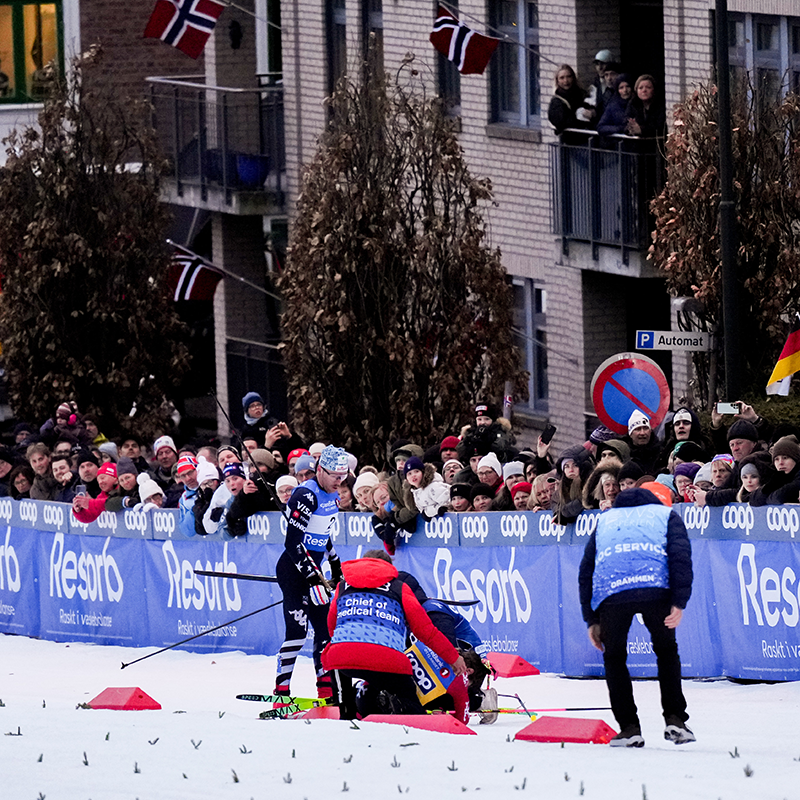
    The cost of doing business: athletic carnage among podium finishers at the finish line of the Women’s 2 x 10 k Skiathlon in Falun. (Photo: FasterSkier screenshot)


  • Klaebo Extends Historic Run with Falun Skiathlon Victory

    Klaebo Extends Historic Run with Falun Skiathlon Victory

    This coverage is made possible through the generous support of Marty and Kathy Hall and A Hall Mark of Excellence A Hall Mark of Excellence Award. To learn more about A Hall Mark of Excellence Award, or to learn how you can support FasterSkier’s coverage, please contact info@fasterskier.com.

    The Men’s 20 k Skiathlon gets underway in Falun, Sweden. (Photo: Authamayou/NordicFocus)

    With fresh snow overnight and temperatures hovering just above freezing, it was the kind of conditions that keep ski technicians guessing and athletes second-guessing. A week removed from the Olympics in Italy, the World Cup resumed for the second day with a 20-kilometer Skiathlon on a course that rewards patience and punishes weakness.

    And while viewers looked on, whether to witness something historic or something new, Johannes Hoesflot Klaebo won again.

    Klaebo covered the 10 k classic and 10 k freestyle in 48:41.8, edging teammate Harald Oestberg Amundsen by 0.7 seconds and Martin Loewstroem Nyenget by 0.8 seconds in a Norwegian podium sweep. The victory extended one of the most remarkable streaks in modern cross-country skiing and tightened his grip on the overall standings and, maybe more importantly for the remaining season-long narrative, extended his lead in the FIS distance ranking for the Distance Crystal Globe.

    The race was familiar and predictable, with Nyenget driving much of the pace, Amundsen staying close, and Klaebo remaining measured in the pack. When the decisive move came in the final sprint, Klaebo, once again, not only had the answer, but made it look easy.

    “This was a tough one,” Klaebo graciously said on the FIS broadcast after the race. “I think Martin was very strong today. I think he was in the front almost for 20 k.”

    Martin Loewstroem Nyenget (NOR) leads, Andreas Fjorden Ree (NOR), Johannes Hoesflot Klaebo (NOR), Harald Oestberg Amundsen (NOR), and the rest of the field at a frenzied pace at the beginning of the Men’s 20 k Skiathlon in Falun, Sweden. (Photo: Thibaut/NordicFocus)
    Classic Leg: Bonus points that created a breakaway

    The men opened with three laps of the 3.4-kilometer red course, climbing the Mini Mördarbacken each time. Conditions sat just above freezing, with fresh snow complicating the classic wax call. Athletes chose between traditional kick wax and zero-skis, the latter relying on a texture sanded into a softer base material underfoot.

    The pace was honest from the gun. At 5.4 kilometers, where bonus World Cup points were on offer, Nyenget and Klaebo pushed hard, with Klaebo claiming the maximum 15 bonus points, followed by Nyenget and Amundsen. That acceleration fractured the field.

    A lead group of Norwegians formed with Nyenget, Amundsen, Klaebo, and Andreas Fjorden Ree. Arsi Ruuskanen of Finland and Savelii Korostelew, competing as a neutral athlete, also managed to maintain contact. Behind them, a gap had opened to a chase pack led by American Gus Schumacher.

    By the end of the classic leg, the leaders had established a gap that would prove decisive.

    Martin Loewstroem Nyenget (NOR) continued to set a fast pace at the front of the Men’s Skiathlon. (Photo: Authamayou/NordicFocus)
    The Exchange and the Mördarbacken

    Transitions in a Skiathlon are rarely glamorous or decisive, but a skier can lose contact with the lead if they don’t stay calm. Amundsen executed a clean ski exchange and briefly looked poised to dictate terms once the field switched to the blue 5-kilometer skate loop.

    That loop includes the full Mördarbacken, a long, layered climb that television struggles to do justice. The ascent, which parallels the ski jumping landing hill, builds in segments, steepening before easing slightly when it cuts across the slope, then rising again one last time. It is not just a memorable climb in name, but once you have skied it, you will never forget the ‘Murder Hill.’

    Nyenget continued to press the pace up front. Klaebo, as he often does, sat tucked in, attentive and measured.

    On the first lap of the skate course, the lead group remained six, with the four Norwegians, Ruuskanen, and Korostelew. By the second ascent of Mördarbacken, it was effectively a three-Norwegian affair with Korostelew, Ree, and Ruuskanen fading slightly and fighting to limit losses and eventually finishing fourth, fifth, and sixth, respectively.

    Behind them, the chase pack raced for seventh.

    Martin Loewstroem Nyenget (NOR), Johannes Hoesflot Klaebo (NOR), and Harald Oestberg Amundsen (NOR), (l-r) crest the second to last climb. (Photo: Thibaut/NordicFocus)
    The Finish

    With less than a kilometer remaining, the three Norwegians — Klaebo, Amundsen, and Nyenget — remained locked together. Nyenget, who historically has the least sprint speed, had done the bulk of the visible work, setting the tempo on both classic and skate sections.

    At the top of the final climb before descending into the stadium, the trio jockeyed for position, no one wanting to lead only to be overtaken by those in the draft. Nyenget took the lead, but was predictably passed by Klaebo on the far side of the stadium, and at the line, it unfolded as it so often does, Klaebo easing up to wave to the crowd with Amundsen outsprinting Nyenget behind him.

    “It was very hard,” Klaebo said during his post-race interview with FIS on the broadcast. “But at the end, I managed to keep up with [Nyenget] and managed to do a good last sprint at the end.”

    The margins were small. The pattern was not.

    Klaebo now has 12 consecutive victories across World Cup and Olympic competition. The last race he entered without winning was the final climb of the Tour de Ski, where he managed his effort to secure the overall title rather than contest the stage.

    “To be honest, I don’t think I have a goal anymore for this season,” he said. “I think the main goal is completed, and now I’m just going to enjoy the last races and see how it goes.”

    Gus Schumacher (USA) seemed to do the majority of the work at the front of the chase pack. (Photo: Authamayou/NordicFocus)
    Schumacher: Fast Skis, Hard Hills

    Gus Schumacher finished seventh in 49:38.6, 56.8 seconds behind Klaebo and spent much of the day managing a gap that opened during the classic leg and never fully came back.

    The decisive acceleration came when the Norwegians lifted the tempo in pursuit of bonus points. Schumacher felt it immediately.

    “In the classic, when it got fast, my kick was not great, so it was hard to fight for anything,” he said. “I was kind of just getting up the hills, but the pace was fast the whole time.”

    He believed the separation was coming regardless.

    “I think that gap was going to open at some point, no matter what,” he said. “Just because of how they were skiing from the start, mostly Nyenget, I think.”

    Schumacher was on zero skis for the classic portion.

    “I was on zeros. I think most people were on zeros,” he said. “Some people looked good, and I don’t know, there’s some variation there for sure.”

    On the flats, he felt competitive.

    “The gliding sections were great for me. My skis were really fast,” he said. “But the hills were tough.”

    After the exchange, Schumacher exited the stadium aggressively and led the chase group for stretches on the first lap of the skate course. The leaders, however, continued to gain time on the full ascent of Mördarbacken.

    Asked to describe the climb, Schumacher was more measured than dramatic.

    “Honestly, compared to a lot of the other climbs they do, I feel like it’s not horrible,” he said. “I enjoy it partly because it’s not insanely long and it’s got some steps to it.”

    That does not mean it is easy.

    “It definitely climbs pretty far and has some steep parts,” he said. “But as far as big climbs go, that’s one of my faves.”

    What does it demand?

    “Same as other climbs,” he said. “Just fitness, technique, poise… the whole deal.”

    Kevin Bolger (USA) during the classic leg, on his way to 36th place on the day. (Photo: Authamayou/NordicFocus)
    Bolger: Boxed In Early, Fighting Back Late

    Kevin Bolger finished 36th in 51:12.8, but his race was shaped early.

    “It’s always hard to feel the pace when you start mid to back of the field,” Bolger wrote in an email afterward. “I’ve always tried to just relax, let the stringing out happen, and take the gaps where they form and make some jumps.”

    He later learned from Gus Schumacher that the leaders had opened aggressively from the gun.

    “I heard they started quite hard,” Bolger said. “So I think it was just a hot pace from the start and things just naturally spread out.”

    For Bolger, the defining moment came within the first lap of the classic leg.

    “Unfortunately, I got stuck behind Andrew Musgrave and went from mid pack to last after the first lap,” he said. “So it was a lot of work to catch back up after that.”

    In a Skiathlon, that kind of early compression can cost dearly. Once the field stretches, passing becomes energy-intensive, and the leaders ease the pace.

    The waxing decision, at least, felt clear.

    “Waking up and seeing the fresh snow and the temperature around zero, it was clear it was going to be zeros,” Bolger said. “But you never know what the techs are mixing up in the truck. As you run out to the start, you look around to see what other people have under their skis.”

    Bolger chose zero skis and was confident in the call.

    “I went with zeros, and I was very happy with that decision,” he said. “Tim Baucom and I did some good testing and landed on zeros because they were running the best for me, and I was super happy with that.”

    By the time the race shifted to the skate leg, the front group was already out of reach. Still, Bolger felt he had something left.

    “I was really happy with my classic leg,” he said. “Even with getting stuck early and having to work to catch back up, finishing that classic leg with the energy I had, I knew I could put together a good skate.”

    The full Mördarbacken climb on the blue loop remained the critical point.

    “I think everyone knows when that massive climb is in the mix, that’s a very critical part of the course and a tipping point for a lot of people,” Bolger said. “If I can get up that hill with the group, I’m in. Once there’s separation, the chances of that coming back are small.”

    He described the climb bluntly.

    “She starts pretty gradually, and you feel confident at the bottom,” he wrote. “But she turns boys into men real quick, or men into boys quick at the top.”

    In soft conditions, with lactate building, the final pitch can expose anyone.

    “It’s hard to keep the legs moving when the lactate’s flowing,” he said. “It’s really hard to describe it, but that’s the best way to say it.”

    JC Schoonmaker (USA) finding joy in the distance racing as he builds fitness and experience with the longer races.  (Photo: Thibaut/NordicFocus)
    Schoonmaker: Finding Value in the Distance

    JC Schoonmaker finished 58th in 52:40.4, but the placement did not tell the full story of his day.

    “The longer distance was pretty tough, but also fun to do that kind of race again,” Schoonmaker wrote afterward. “Even though it was a tough day and not my best race, I find a lot more enjoyment in a 20 k like that, where I’m 60th or whatever, than a sprint qualifier where I’m 35th. Cool to push yourself and ski in a pack.”

    Falun’s Skiathlon rewards positioning and sustained pace more than sharp accelerations. For Schoonmaker, the takeaway was direct.

    “Today shows me that I probably need to have a bit more pace to be competitive in these longer races,” he said. “Just overall need to be fitter and stronger than I am right now.”

    He felt competitive through the classic leg, especially in tricky waxing conditions hovering around freezing.

    “The conditions were a bit tricky for sure,” he said. “Whenever zeroes are in the mix as well as wax, it can be a little stressful.”

    Schoonmaker chose kick wax rather than zero skis, a minority decision in the field.

    “I ended up going on wax, and I think I was probably one of the only guys in the field to do that, so I was a bit nervous at the start,” he said. “But they worked great for me, and I think I made the right call.”

    The transition to skate proved costly.

    “I felt more competitive in the classic leg, had a bit of a blow up as soon as we switched to skating, and found my flow after a bit, but just lost too much time right after the transition there,” he said.

    Then came the full Mördarbacken climb, twice.

    “The Mördarbacken is a tough one, I think mostly because it’s just so long,” Schoonmaker said. “It has a lot of grade fluctuations, which I think is cool in a hill and a bit of a grind, but I like the way it skis.”

    Other American Finishers:

    Hunter Wonders – 47th place

    Zanden McMullen – 61st place

    Antoine Cyr (CAN) on his way to a top ten.  (Photo: Authamayou/NordicFocus)
    Canada: Cyr Inside the Top Ten

    Antoine Cyr led the Canadian contingent, finishing 10th. It was a controlled race from Cyr, who held position through the classic leg and limited losses on the climbs during the skate.

    Other Canadian Finishers:

    Olivier Leveille – 53rd place

    Remi Drolet – 54th place

    Max Hollmann – 55th place

    Sasha Masson – 66th place

    Johannes Hoesflot Klaebo (NOR) charges for the win once again at the end of the Men’s Skiathlon in Falun, Sweden. (Photo: Authamayou/NordicFocus)
    The Larger Arc

    Falun is more than just another stop as it will host the 2027 World Championships. It is also a venue that rewards discipline. The gradual terrain away from the stadium invites packs, and the big climbs around the ski jumping hill expose any fitness weaknesses.

    For Klaebo, it was another example of restraint followed by precision.

    He leads the overall standings. He leads the sprint standings. The distance standings remain mathematically contested, but days like this narrow the space for drama as we move towards the final races.

    After sweeping the Olympics, one might have expected a pause, yet there has not been one.

    In Falun, the snow was fresh, the wax calls uncertain, and the climbs unforgiving. The result, however, was familiar.

    And with three weeks remaining before the World Cup finale in Lake Placid, what now remains is not a question of whether Klaebo has delivered a historic season, but how complete it might become.


    Falun World Cup Men’s 20 k Skiathlon – RESULTS

    Men’s World Cup – OVERALL STANDINGS

    Men’s World Cup – DISTANCE STANDINGS


    Love Stories Like This? Help Keep Them Coming.

    Feature stories like this one take time, access, and care to produce. If you value thoughtful storytelling and independent ski journalism, please consider becoming a Voluntary Subscriber. Your support directly fuels the work we do to cover the people, places, and moments that make our sport special.

    Join the FasterSkier community!

     

    Norwegians Harald Oestberg Amundsen, Johannes Hoesflot Klaebo, and Martin Loewstroem Nyenget (l-r) share the Men’s 20 k Skiathlon podium in Falun, Sweden. (Photo: Authamayou/NordicFocus)
  • Klaebo Edges Closer to a Season for the Ages in Falun

    Klaebo Edges Closer to a Season for the Ages in Falun

    This coverage is made possible through the generous support of Marty and Kathy Hall and A Hall Mark of Excellence A Hall Mark of Excellence Award. To learn more about A Hall Mark of Excellence Award, or to learn how you can support FasterSkier’s coverage, please contact info@fasterskier.com.

    Johannes Hoesflot Klaebo (NOR) continues his march on a most historic season in Falun, Sweden. (Photo: Authamayou/NordicFocus)

    Six days after the Olympic flame dimmed in Italy, the World Cup caravan reassembled in Falun, Sweden, at the Lugnet cross-country ski center. The Mördarbacken — the famed “murder hill” — still looms over the stadium, waiting to torture the athletes tomorrow. The snow was fast, and the sport’s most dominant man arrived with something bordering on the unthinkable within reach.

    Johannes Hoesflot Klaebo had already swept the Olympic program: six races, six gold medals. He had already conquered the Tour de Ski. He leads the sprint standings. He leads the distance standings. He leads the overall.

    In Falun’s Freestyle Sprint, he resumed his campaign as if nothing had interrupted it.

    And to no one’s surprise, Klaebo won again.

    The victory — tactical, controlled, clinical — pushed his streak forward and kept alive the possibility of something the sport has never seen: a season in which one athlete claims the Olympic sweep, the Tour de Ski title, and all three FIS World Cup Crystal Globes.

    “So interesting watching Klaebo,” FasterSkier’s John Teaford observed. “In the semi, he had Chanavat in front, so Klaebo went wide to force him into the lead. In the final, Chanavat was already there, so Klaebo took the inside to shut down Heggen. He’s racing, everyone else is just reacting.”

    On a course where lane choice and downhill drafting often matter more than raw power, Klaebo once again skied as if he had solved the puzzle in advance.

    Johannes Hoesflot Klaebo (NOR) gets his quarterfinal started. (Photo: Thibaut/NordicFocus)
    The Course That Punishes Hesitation

    Lugnet’s sprint track is deceptively compact — Klaebo won the qualification in 2:33.9 — but it rewards patience and punishes impatience. The downhill into the stadium is long enough to generate devastating draft effects; even if a skier has what seems like a wide enough margin out front, they often get swallowed up.

    Lars Heggen, left off Norway’s Olympic team in favor of Oskar Opstad Vike, skied with visible urgency all afternoon. He had qualified 26th but surged through the rounds, eventually finishing second behind Klaebo in the final. Vike, the Olympic bronze medalist in the Classic Sprint, failed to advance to the finals.

    In a Norwegian program that might be the deepest in skiing history, the margins remain ruthless, and the storyline between Vike and Heggen will continue throughout the rest of the season.

    Gus Schumacher (USA) during qualification. (Photo: Thibaut/NordicFocus)
    Schumacher: Six Olympic Races, Then a Movie Theater

    If Klaebo’s season has been relentless, Gus Schumacher’s has seen both uncertainty and excellence. Schumacher was the only Olympic racer besides Klaebo to start all six events in Italy, culminating in the 50-kilometer classic last weekend.

    His recovery plan for Falun?

    “I was just chilling,” Schumacher said afterward. “I didn’t ski Sunday or Monday. Tuesday, I went skiing for a little bit, but I wasn’t too stressed about the training. The biggest thing was just not doing too much.”

    He went to a movie theater on Tuesday night.

    “Just kind of like doing sort of normal life things,” he said. “Helped with recovery for me.”

    There was no urgency in his tone, no sense of chasing something lost. Instead, he described an emotional decompression that many Olympians quietly experience.

    “All week it’s been a little low,” he admitted. “Today was just nice to go out and race.”

    Schumacher advanced cleanly from his quarterfinal, but the semifinal unfolded differently. His start, he acknowledged, hasn’t been historically a strength.

    “My start has never been that fast,” he said. “So for me to get into a top-four spot early on is hard. I was kind of relying on gaps to open up.”

    But they didn’t.

    “The pace was kind of too high, or it was too wide or both,” he said. “I really should have just pulled up a little bit, embrace sixth until the finish, and then gone fast there.”

    He missed a lucky loser qualification by three-tenths of a second.

    “I’m not super happy with it,” he said. “But the quarterfinal was nice.”

    After the emotional volatility of the Games, including a crash in his opening race, a silver medal in the team sprint with Ben Ogden, Schumacher’s energy felt steadier in Falun.

    “I wouldn’t say I’m digging deep,” he said. “I think I’m just enjoying the ride.”

    After an Olympic training block, Jack Young (USA) is back racing on the World Cup in Falun, Sweden. (Photo: Thibaut/NordicFocus)
    Young’s Gamble

    Jack Young arrived in Sweden with a different story.

    He made the Olympic team but did not earn one of the four U.S. sprint starts in Val di Fiemme. Rather than chase race sharpness, he chose volume.

    “I trained very hard for the two weeks leading up to Falun,” Young wrote us in an email after the race. “The theory was that my speed was really good and I needed a fitness boost to finish out the season well.”

    This may have been a bit of a risk, but one Young was willing to take.

    “I’ve never trained even close to this much volume this close to a World Cup sprint,” he said. “But it seems to have paid off.”

    He did not miss race intensity.

    “In fact, the two weeks of training were some of my favorite weeks of the winter.”

    Young benefited from Filip Skari’s disqualification after he received a second yellow card of the season in the quarterfinals, advancing to the semifinals. There, the course’s tactical nuance intervened.

    “I wanted to ski the corner really well, exit with speed, and hopefully overtake Vike and Ersson right before the course kicks up again,” he said. “I had too much speed out of the corner and passed Vike too early and lost the draft.”

    The mistake was microscopic, but the consequence decisive.

    “Today was hectic but fun,” Young said. “Really cool sprint racing.”

    If there was a change in him, it was mental.

    “This was probably the most locked in I’ve been for a World Cup semifinal,” he said. “I was ready to really race with those guys and try to beat them.”

    For a 23-year-old navigating the narrowest margins in sprint racing, that shift may matter as much as fitness.

    Kevin Bolger, who narrowly missed Olympic selection, qualified for the heats but was eliminated in a stacked quarterfinal that included Klaebo. (Photo: Thibaut/NordicFocus)
    Bolger’s Return

    For Kevin Bolger, the weeks surrounding the Olympics were heavier. Bolger narrowly missed selection for Milan-Cortina, and the emotional toll was real.

    “I mean — at the beginning, life sucked,” he said. “It feels like everything is against you and that I was wronged.”

    He had been to the Olympics before — in Beijing — and that perspective helped, but it did not soften the blow.

    “It still really sucked and hurt a lot,” he said.

    Bolger’s response was simple: train.

    “My motivation was training through that period and hopefully be able to attack these last World Cup weekends. And of course pour my energy into Maja and do what I could to help her get some medals.”

    By the time Falun arrived and the World Cup season got restarted, Bolger felt ready. He knew his quarterfinal would be stacked — Johannes Klæbo among those in the heat — and expected the pace to be high.

    “I was prepared for that,” he said. “I felt great and was mentally ready for the pace.”

    But on a course like Falun — fast, tactical, draft-dependent — ski speed can decide everything.

    “I don’t think I had the most competitive skis in my heat,” Bolger said. “So on a fast tactical course, it’s a bit of an uphill battle. I was hoping to catch the draft coming back to the stadium, but the skis didn’t seem to be running as I’d hoped. But that’s life, and we move on.”

    Bolger did not struggle to keep pace with the athletes racing in Val di Fiemme.

    “It’s not that hard,” he said. “I had a few weekends of racing to help keep the sharpness going and the shape. It always seems to get better when you can actually just get back into a good training routine. And right now I feel like I’m in a great place and just happy to be racing back in the heats.”

    Johannes Hoesflot Klaebo (NOR) climbs  one of the sprint course hills in front of the Swedish fans in Falun, Sweden. (Photo: Authamayou/NordicFocus)
    The Stakes Beyond Saturday

    Klaebo’s victory further tightened his grip on the sprint and overall standings.

    The distance globe remains mathematically alive, though narrowing. The sprint globe appears close to decided, and the overall lead, barring collapse, is substantial.

    What remains compelling is not merely whether Klaebo will win, but whether he will complete something approaching total seasonal dominance.

    Johannes Hoesflot Klaebo (NOR) once again makes it look easy during his win in Falun, Sweden. (Photo: Authamayou/NordicFocus)

    After the Olympics, and the understandable fatigue that would be a result of winning gold in all six races, you might expect Klaebo to take some time off from the World Cup… he did not.

    Klaebo moves forward, and what awaits in Lake Placid, where fans will gather to celebrate the close of the season and Jessie Diggins’ final World Cup start, is the possibility of witnessing something the sport has never seen: a Tour de Ski title, an Olympic sweep, and three Crystal Globes claimed in a single winter.

    In a season already defined by dominance, Klaebo is now skiing toward something that would endure long after the snow melts.


    Falun World Cup Men’s Freestyle Sprint – QUALIFICATION RESULTS

    Falun World Cup Men’s Freestyle Sprint – FINAL RESULTS

    Men’s World Cup – OVERALL STANDINGS

    Men’s World Cup – SPRINT STANDINGS


    Love Stories Like This? Help Keep Them Coming.

    Feature stories like this one take time, access, and care to produce. If you value thoughtful storytelling and independent ski journalism, please consider becoming a Voluntary Subscriber. Your support directly fuels the work we do to cover the people, places, and moments that make our sport special.

    Join the FasterSkier community!


    Lars Heggen (NOR), Johannes Hoesflot Klaebo (NOR), and Benjamin Moser (AUT), (l-r) share the Freestyle Sprint podium in Falun, Sweden. (Photo: Authamayou/NordicFocus)
  • More Than One Tactic—Svahn Masters Falun Sprint

    More Than One Tactic—Svahn Masters Falun Sprint

    This coverage is made possible through the generous support of Marty and Kathy Hall and A Hall Mark of Excellence Award. To learn more about A Hall Mark of Excellence Award, or to learn how you can support FasterSkier’s coverage, please contact info@fasterskier.com.

    Linn Svahn (SWE) can afford to ignore all the recommended tactics normally employed on Falun’s infamous Sprint course. She’s just too fast. (Photo: Thibaut/NordicFocus)

    Falun’s Sprint course rewards experience . . . but not every skier who possesses that experience pays very close attention. Skiers can get distracted by how they feel, by how their heat is shaping up, by the tactics of others. Sometimes, that sort of counter-punching can prove profitable. Not in Falun . . . not on most days anyway.

    In Falun, skiers prepare for an infamous and well-known draft on the penultimate downhill . . . they either deal with that draft, or they find themselves out of contention. By now, every skier should know that whomever is leading at the top of the significant downhill is almost certain to be swallowed up by the field. Leading is a mistake, and it appears nearly impossible to establish enough of a lead to overcome the advantage gained by skiers speeding up from behind. Falun represents perhaps the most tactical—and most obvious—of all World Cup Sprint courses. And it will manufacture that same crucial factor next year when the World Championships are staged on this very same course. If skiers take advantage of watching replays of these races, they’ll begin to see that there’s only one tactic to employ in Falun . . . unless, of course, you just happen to be lots faster than everyone else, like Linn Svahn.

    In the Sprint final, Svahn found herself forced to the front by a cagey Kristine Stavaas Skistad who positioned herself to take advantage of Falun’s infamous draft. What Skistad did not anticipate was the raw speed that Svahn would bring to the Final. Stuck as she was at the front, Svahn simply engaged the after-burners on the course’s penultimate uphill—a tactical decision that had proven disastrous for every other skier in Falun’s Sprint heats. Accelerate there, and you’re all but certain to get caught on the downhill. But Svahn is riding the crest of a wave that has carried her to the very top of the Sprinting world. The same speed she employed to claim dominant wins in both the Classic Sprint and Team Sprint in the Olympics a week ago continued to propel her to the top step of the podium in Falun. Skistad set things up well in the Sprint Final, but Svahn was simply too strong.

    Nadine Faehndrich (SUI) continued her recent podium run in third place ahead of Coletta Rydzek (GER), Maia Dahlqvist (SWE) and Johanna Hagstroem (SWE).

    Americans qualified two skiers into the heats—Jessie Diggins and Sammie Smith—both of whom would find themselves undone by Falun’s infamous draft in their quarterfinal heats. Diggins would finish the day 17th, Smith 23rd.

    Canada’s Liliane Gagnon would qualify seventh, confirming her arrival on the international Sprint scene by advancing to the semifinal where she wold finish tenth on the day.

    Liliane Gagnon (CAN) announced her arrival as a World Cup Sprint contender with a brilliant 10th place finish in Falun. (Photo: Authamayou/NordicFocus)
    After the Olympics . . .

    The Olympics are over, the biggest pressure is off, the medals are stowed safely away. Now it’s back to the re-start of the World Cup season that these skiers began months ago. Returning, as the skiers do now, to the post-Olympic season, this is a time when we may find out who is truly worn out from the Games, contrasted with who may have mis-calculated their peak for the Olympics, but may now find themselves in top shape as all those who collected Olympic medals are strangely and uniquely vulnerable.

    The weeks following the biggest competitions are sometimes full of surprises, especially when a few of the medal-winners and event-dominators choose to stay home. Who can blame them? They spent weeks and months and years and careers building up to those Olympic Games. And those who succeed in claiming the medals that the media expected must then run the loving gauntlet of media attention and sponsor responsibilities that accompany Olympic success. After the Lake Placid Olympics in 1980, where the immortal speedskater Eric Heiden had proven to be unbeatable (winning all five of the five speedskating events), Heiden signed up for the All-Around World Championships, where he promptly got beat. Lesson learned: just because you’re the best one week doesn’t guarantee you’ll be the best every week . . . not after the insistent press, the pressing sponsorship responsibilities, and the adoring crowds have gotten done with you, anyway.

    Diggins entry into the Falun’s World Cup Freestyle Sprint was significant for another reason: after today, she stands alone as the skier who has recorded more individual World Cup starts than any other. (Photo: Jason Cork/FasterSkier)

    Switzerland has one of its medalists on the starting line, but not the other. Nadine Faehndrich is here, but no Nadja Kaelin (medalist in both the Team Sprint—with Faehndrich—and the 50 k). Sweden has its newly crowned Sprint Queen, Linn Svahn, in the lineup, but Jonna Sundling—Sweden’s former Sprint Queen—has stayed home. And of course the USA’s Jessie Diggins was here . . . isn’t she always here? Every weekend, every event, every starting line, Jessie Diggins lines up to race. That’s why she’s seemed nearly impossible to best in the season-long World Cup standings: she’s almost always signed up to race, and she’s almost never out of contention. It’s an astonishing level of durability and prolonged excellence, one that we’ll be able to enjoy and appreciate for only a few more weeks until her retirement . . . until that racer who we’ve known would always be there is no longer there. Believe me, we’ll miss Jessie Diggins terribly in seasons to come.

    But, for the time being, Diggins has a World Cup Overall title to defend . . . a defense that would benefit from a few more Sprint points. Her fourth place qualifying time would reward her efforts, but she would ski impatiently in her quarterfinal, fining herself undone by the strategic draft that heat-leaders give up on Falun’s Sprint course. Diggins would finish fourth in a heat that was not fast enough to offer advancement as a lucky loser.

    “It was my 357th World Cup start,” said Diggins. “It was just a really cool chance to feel extra grateful to my team, to look back on why that was possible, and to look at the bigger message for me here, that asking for help with my mental health got my physical health to a place where I could race this hard for this long . . . And the season isn’t over yet!”

    Samantha Smith (USA) just keeps getting stronger week after week. (She would qualify 19th, and finish the day 23rd). Photo: Thibault/NordicFocus)
    Tactics on Display

    The first quarterfinal involved Skistad and Svahn. Skistad dangled at the back mid-heat, but glided forward on the final downhill to finish second behind Svahn.

    Liliane Gagnon (CAN) qualified seventh at the start of the day, and she skied strongly in the second quarterfinal (won by Switzerland’s Nadine Faehndrich) to claim a lucky loser spot, and a space in the semifinal.

    Diggins headlined Quarterfinal 3. She led from the start but seemed hindered by slower skis onthe significant downhill. Diggins ran out of gas in the final straightaway as the heat was taken by Coletta Ryzek (GER) ahead of Moa Ilar (SWE).

    Sammie Smith (USA) began the day aas the 19th qualifier, continuing to show the form that saw her named to the US Olympic Team. Smith lined up in Quarterfinal 5 where Julie Myhre (NOR) and Johanna Hagstroem (SWE) provided the early pace. Smith has begun to reveal a strategic preference: allowing herself to drop back into the field early on, then charging forward late in the race. She did that again in Falun, storming up the final climb. Unfortunately, experience suggests that the draft given up on Falun’s Sprint course is often the deciding factor, and Smith (like Diggins before her) found herself swallowed up on the descent. Hagstroem would take the heat win, ahead of Julie Bjervig Drivenes (NOR).

    “I felt like I skied the hills really strong today and was disappointed with some of my tactical decisions,” said Smith. “Unfortunately, Falun is notorious for a large draft on the final downhill. I was trying to ski to my strengths today, but I should have been more patient and tried to tuck behind other skiers so I didn’t get drafted so much.”

    “The more time I have on skis, the more races I get to do, the better I feel,” Smith continued. “I’m really looking forward to the last few weeks of the season.”

    Kristine Stavaas Skistad (NOR) showed that she understood the tactics that Falun’s Sprint course dictates, but Linn Svahn (SWE) was just too fast. (Photo: Authamayou/NordicFocus)
    Tactics Confirmed—Sprint Semifinals

    Semifinal 1 offered Skistad a chance at Redepption after a disappointing fifth place finish in the Olympic Classic Sprint,and she perhaps better than anyone else seemed to understand the importance of utilizing Falun’s draft. Gagnon streaked forward to contend with Svahn and Faehndrich, while Skistad and Rydzek—famously fast closers—lingered at the back. Skistad easily coasted back into contention in the draft of the long downhill, and was able to get to the tails of Svahn before the finish line. Those two would move on to the final while Rydzek and Faehndrich would wait to see if they would move forward as luckylosers.

    The second semifinal involved a slate of Swedes: Moa Ilar, Moa Lundgren, Hagstroem, and the cagey veteran, Dahlqvist, who rarely leads in the early stages of heats. True to form, Dahlqvist hovered around third or fourth. Hagstroem would ski the downhill draft section to perfection, launching into the lead at the bottom, and followed across the line by Dahlqvist. Again, experience ahead of speed.

    Linn Svahn (SWE) established a gap ahead of Kristine Stavaas Skistad (NOR) in the Sprint final. Usually, Falun’s course would not reward such audacity, but Svahn was able to hold her advantage to the end. (Photo: Authamayou/NordicFocus)
    Tactics Defied

    In the ongoing defense of her lead in the season-long Sprint standings, Dahlqvist had done her job in just getting to the Final. Her lead would be protected for another week in her quest to finish the season wearing the Sprint leader’s red bib. But the other skiers in the Final had other challenges in mind. Team Sweden’s Hagstroem, Svahn, and Dahlqvist matched up against Skistad, Faehndrich, and Rydzek. Skistad went to the front, where it appeared she would control the pace (and force others to go around her into the lead). Her tactic seemed to be working as Svahn found herself at the front. Skistad must’ve been pretty satisfied with that positioning . . . satisfied, that is, until Svahn applied the power. In just a few strokes, Svahn accelerated up the hill where no one else dared acccelerate, creating a massive gap that left Skistad in an unexpected panic.

    While Skistad may be one of the fastest sprinters in the world, her strength is definitely not in quick acceleration. Though Skistad would chase gamely, Svahn was gone, the finish line photo making the result appear far closer than it really was. Faehndrich would hold on for third ahead of a fast-charging Rydzek. Dahlqvist would finish fifth, holding her lead in the World Cup standings, but seeing her lead shrink in the wake of Faehndrich’s podium performance. That season-long race is definitely tightening, and appears likely to be decided in the final World Cup weekend in Lake Placid.

    Falun Women’s Freestyle Sprint RESULTS

    Falun Women’s Freestyle Sprint QUALIFYING

    Love Stories Like This? Help Keep Them Coming.

    Feature stories like this one take time, access, and care to produce. If you value thoughtful storytelling and independent ski journalism, please consider becoming a Voluntary Subscriber. Your support directly fuels the work we do to cover the people, places, and moments that make our sport special.

    Join the FasterSkier community!
    The victory lap in Falun. Linn Svahn (SWE), Kristine Stavaas Skistad (NOR), Nadine Faehndrich (SUI). (Photo: Thibault/NordicFocus)
  • Chris Hecker and the Moment the Sun Came Out

    Chris Hecker and the Moment the Sun Came Out

    This article was made possible through the generous support of our voluntary subscribers.  If you value coverage like this, please support FasterSkier with a voluntary subscription.

    If you are a parent or coach and have been responsible for waxing skis for an important race — a state championship, a Junior National Qualifier — you know how stressful that can be. Now imagine it’s the morning of the Team Sprint at the Olympics, and you are responsible for Gus Schumacher’s skis. Feel your blood pressure rising yet?

    Welcome to the life of Chris Hecker, the US Cross-Country Ski Team service tech who leads the glide program and is Schumacher’s personal tech. Hecker, at this point, knows Schumacher well and that he has logged nearly 1,000 hours of training annually for years, and that he has dreamed of this specific day since the end of last season.

    “One of the most stressful moments actually came [on race day], about 45 minutes before the Men’s Team Sprint. I had selected the race skis for Gus and felt confident in the decision. At the time, it was clearly the best pair for the conditions.”

    Everything seemed to be playing out as Hecker had hoped, but then everything changed.

    “Then, about five minutes later, the sun came out. The course started to break down and got noticeably wetter. I still had a few minutes before beginning to wax, so I decided to run one more quick test. In the ten minutes between tests, the two top pairs kept getting closer and closer in performance.”

    These are the moments when experience, confidence, and a little tech magic can make or break a race. “In the end, I chose what was technically Gus’s second-best pair at that moment,” Hecker recalled. “As more athletes skied and the temperature continued to rise, there’s a good chance those skis actually became the faster option anyway.”

    Hecker was quick to point out that “Gus and Ben were on another level. Regardless of which skis Gus raced on, I’m confident the result would have been the same. They were [racing] on another level.”

    We may never really know, but maybe that decision did have something to do with Schumacher and Ben Ogden winning silver in the Team Sprint? For Hecker, it was a choice that was actually years in the making.

    Guided by family and noted mentors

    Hecker grew up in a family of skiers; his father, Mike, was a Pelton ski and Exel pole rep in the Midwest and had Chris on skis when he was just nine months old, “shuffling around and falling down.” Mike and his wife would pack the entire family, including Chris and his older brother Jeremy, and spend weekends traveling to different ski shows and venues. The parents told Chris and Jeremy it was their ‘vacation’, but in reality, it was just a family deeply invested in both the industry and the lifestyle.

    “So we were skiing from a really, really early age, and then we got into racing,” said Chris. When Chris was in middle school and high school, he raced for Anoka High School, in Minnesota, a northern suburb of Minneapolis. After graduating in 2013, he headed to St. Scholastica in Duluth, where he raced for three years under Chad Salmela and, in his senior year, under Maria Stuber.

    After graduating from St. Scholastica in 2017, Hecker took a job with Rex Ski Wax for the 2018 / 2019 season.

    “I worked with them for a year, spent a year on the World Cup being their racing service manager and research and development, kind of lead testing for all the new products, testing all the old products, and then walking around and working with the teams and saying, What do you need from us?”

    Hecker made himself available to World Cup teams, asking which products he could help with and which they thought were working well and which needed improvement. He continued this work for three full seasons before starting with the US Ski Team in 2020; this is now his sixth full season with the team.

    Two brothers… “Give me something weird.”

    Chris’s older brother, Jeremy, has kept the family tradition alive too, serving as a full-time employee of Pioneer Midwest and, in addition, as the domestic rep and race service lead for Rex ski wax.

    “We talk multiple times a week, and we get really deep into the weeds,” says Chris, who gives his brother lots of respect and praise. “He’s a really good wax tech, and sometimes you just need an idea from an outside source.”

    So when waxing domestically, Jeremy will ask his brother at the World Cup, “Give me something weird, give me something random to go out and test,” because he has all the normal, routine choices down.

    “He’ll always ask me for one random suggestion to try out for some of those race weekends. And sometimes it works, and sometimes it doesn’t.”

    For the most part, the two brothers talk about local races and how Jeremy can better support local skiers, since the products Chris is working on for the World Cup aren’t available to domestic skiers.

    “But it is also fun to talk about, when we have a really good day, like in Goms, or a really good day, like in the Val de Fiemme, on the final hill climb.”

    When that happens, Jeremy can spot it on the livestream and will call up Chris and ask, “Oh, what’d you guys do differently!”

    A lot more than two pairs of skis… like over 100

    In addition to being Schumacher’s personal tech, Chris Hecker is also responsible for Novie McCabe when she is on the World Cup and when she raced at the Olympics.

    In addition, Hecker is responsible for managing both athletes’ ski fleets. For McCabe, that means 38 pairs of skis and another 65 pairs for Schumacher, but even that can be variable, “like, Gus gets a ski [from Rossignol] maybe every other weekend or every third weekend because they’re always coming out with new prototypes and new skis.”

    McCabe is a Fischer-sponsored athlete, and they are admittedly a bit more controlled on allocating skis, but if Hecker and McCabe decide to “knock out a bad ski,” they can give it back to them and get another for her quiver.

    The new Rossignol skis arriving can introduce many more variables for Schumacher and Hecker to consider. As Hecker says, “ it can be new base material, new grinds, new core materials… the construction of the ski can be different.”

    Every little tweak has a purpose, “maybe it’s an easier kicking classic ski, maybe it’s a faster base material on a state ski.” As Hecker continues… “Maybe it’s a different laminate on a zero ski,” and what becomes quickly obvious is that all of these subtle variations make for endless possibilities.

    Building a rapport

    Hecker and Schumacher have been working together for two years now. Last season, Hecker was not responsible for another athlete, so he could focus on Schumacher, and the two quickly bonded.

    From the beginning, “working with him was really fun,” said Hecker . “We were trying to build a rapport as a new athlete and tech combination between the two of us.”

    Schumacher’s previous tech had left for the Swiss Biathlon Team, but Hecker and Schumacher found a lot of success last season with several top 10s and a podium in Falun, Sweden. As they started this season, they got right back to work.

    “Then starting this year, it was like jumping right back into it.” The two had a full year of experience to build on, and the dialogue and descriptions began to get more dialed, which is critical in the relationship between a tech and an athlete.

    Hecker began to know what Schumacher “likes for kick in skis, what feeling and stability he likes on skate skis,” and the two have been able to build that “innate rapport” which leads to a trusting relationship.

    As Hecker puts it, “[Schumacher] is one of the most astute athletes that I’ve worked with. He always comes with a question or two on race day. ‘Do you think we should try testing over on this side of the course instead of that side of the course, because I’m really trying to execute a plan here. Can we try focusing on glide for this half of the course, and maybe do a couple of glide outs here?”

    Hecker continues to describe how impressed he is with Schumacher as an athlete:

    “And so he’s always equally thinking as a wax tech and as an athlete when we’re out skiing together, and he’s really trying to dissect where the best places to test are. And it’s not just my job to revive the skis for him, but it’s also his job to pick the correct skis for him. And so he needs to know almost as much as I do about his skis and what is working and why it’s working, because ultimately we have to come to the decision together. He is racing, not me, and so we have a really cool relationship together to kind of pick and choose what we want to race on as a team.”

    Learning what he likes instead of what you like

    At this level, picking the right ski for an athlete is not just about what is fastest. It is also about picking a ski that responds the way the athlete prefers, and that matches the way a skier races.

    For Schumacher, that means a ski that is “extremely stable and forward tracking.” Hecker knows the way Schumacher skis, and how “when he pushes off to the left or to the right, and he goes fully onto one ski, he wants it to go straight.”

    “He doesn’t want the tip to move at all. He just wants it to point and shoot straight.”

    That isn’t a characteristic Hecker is personally always looking for in a ski, but he knows that’s what Schumacher wants. “So when I’m looking and testing without him some days, I say, ‘Okay, this ski is for sure going to be moving on because this feels better for him.’ And so we kind of have differing opinions sometimes on feeling, because I like a slightly different ski.”

    For Hecker, though, what is most important is that he understands not just what will ski fast, but also what will work best for Schumacher in different conditions, based on how he will race.

    “On a really firm course, he’ll look for this ski that just goes straight. And I think the reason why he likes that is that he will free skate a lot and likes being able to just push with his legs. And he’s so strong at that, and so relaxed when he does it, and so he can conserve a lot of energy.

    So it’s a really cool technique change from him, because I don’t think a lot of people utilize that on the men’s field. You see a lot of people always V2ing, and you’ll see him kind of free skating in the middle of the pack, just relaxing his upper body and giving half of his body a rest.”

    Inside the wax truck: how race morning actually works

    On a stable day, glide testing is fairly methodical.

    “We usually have four fleets of skis that go out,” Hecker explained. “Eight structure skis, eight paraffin skis, eight topping skis, and four to six application skis.”

    Before any athlete even gets to the venue, there is what the service team calls a “thinking period.” Jason [Cork], Tim [Baucom], Hecker, and anyone else in the truck who wants to join in, gather around a table with wax options.

    “We’ll put maybe 10 to 12 waxes in,” Hecker said. “Eli [Brown] might give us a wax. Oleg [Ragilo], our head of service, might give us a wax. Bernie [Nelson] might give us a wax. Then at the end of the table, it’s on me to narrow it down.”

    Ten or twelve become eight after the team removes the overlapping options. Some are eliminated because something similar tested better earlier in the week. Predictability and durability matter as much as outright speed.

    Structure follows a similar pattern. Baucom pulls 10 or 12 patterns before narrowing to eight that fit the day’s snow. The brainstorming narrows the options, then the skis go outside for testing.

    When results come back, they’re measured in inches and sometimes just two or three separate first from third.

    “If there are three that are really close,” Hecker said, “we might race on third place. Even if it’s two inches behind.”

    Because two inches in early testing might not matter if the wax is more durable, safer, or better, as temperatures rise and the track grows glazy under the skis of a throng of World Cup skiers.

    “It’s up to us to make a call,” Hecker said. “This is the wax we’re going to run today, even though it may not have won.”

    Once the athletes start warming up and testing skis, the techs have to add that feedback to the equation as well. Often, Hecker has one ear tuned to Gus’s feedback and the other to the incoming results.

    “When Gus is racing, a lot of these tests are going on,” he said. “I have to have my head on both testing skis with Gus, but also on the results that are coming in.”

    A call might come mid-session: pair 47 instead of pair 45. At this level, it’s small changes, constant recalibration, and decisions layered on decisions.

    For spectators, the race begins at the gun. For the glide team, it began hours earlier — likely in the dark — and never really stops until the racers reach the first checkpoint in the race and the team knows whether their choices put them in the race or not.

    “It’s definitely the hardest part of this job.”

    For Hecker, this will be his last season as part of the US World Cup service team.

    “It’s been a thing that I decided at the end of the year last year,” Hecker said. “I gave a fairly big heads up to the team in Bend in April.”

    This season marks the end of a third Olympic cycle for Hecker, but it is not that moments like the Olympic Team Sprint are wearing him down. That is not the hardest part of the job. The hardest part of the job is being away from his wife, Katie, family, and his dog.

    “It’s time to be at home with my wife and be more with my family and be back at home with my dog. And, yeah, right now it is time to retire after this year, and we’ll see what happens after that.”

    Like other staff and coaches on the US Ski Team, Hecker was able to sneak home twice so far this season, but those opportunities are few and far between.

    “Yeah, it’s, it’s definitely the hardest part of this job, not that waxing isn’t hard, but being away from your family, being away from loved ones for so long. It’s really hard.”

    This decision wasn’t made lightly because there are many things about being on the World Cup that Hecker will miss. Most significantly, the US Ski Team has done an amazing job creating a unified family.

    “It’s hard because this team is like a second family. Being away from these guys for long stretches is tough. I love working with them. When you like the person you’re rooming with every weekend, that means something. So leaving the team feels like leaving family.

    But I know it’s the right decision for me. I’m getting tired. There was a time when traveling to Europe was exciting, going to new venues, seeing new places. That was fun.

    Now it’s, ‘Okay, we’re going back to Val di Fiemme. We’re going back to Oberhof. We’re driving the wax truck to Oslo again.’ Last year, I realized I wasn’t looking forward to the travel anymore. I’d be excited once I got there, but the constant moving was wearing on me. That’s when I knew it might be time.”

    Gus Schumacher and Ben Ogden (USA), (l-r) celebrate their Olympic silver medal in the Team Sprint in Tesero, Italy. (Photo: Vanzetta/NordicFocus)
    On another level

    When the sun came out in Italy last Wednesday morning, it forced a decision. A choice was made to go with a slower pair of skis, but that decision was not a whim; it was not a swing for a bases-loaded grand slam to win the World Series. It was choosing an option that presented itself through a trusted process, through seasons of tested routines, and having the experience to trust instinct.

    By the time Gus Schumacher and Ben Ogden pushed off the line in the Team Sprint, the work had already been done, in the dark, in the truck, in inches measured on a test lane. Structures narrowed from twelve to eight, waxes debated and eliminated.

    The silver medal will always belong to the athletes. They were, as Hecker put it, “on another level.”

    But long before Schumacher chased down Johannes Høsflot Klæbo on the anchor leg, before the crowd roared in excitement, before the final sprint up the Zorzi Climb, there was a moment when the sun came out, and a technician had to make a decision.

    And one detail to remember when the story of the 2026 Olympic Team Sprint is retold for years to come is that the United States service team, on that day, was also ‘on another level.’


    Help Support Our Olympic Coverage!

    FasterSkier will have our own Nat Herz on the ground at the Olympics, which, to be honest, is a very big financial lift for us. If you value the thoughtful work and access FasterSkier provides at championships like this one, please consider becoming a Voluntary Subscriber. Your support directly fuels the work we do to cover the people, places, and moments that make our sport special.

    Join the FasterSkier community!


  • An Olympic reporter’s wrap-up: An epic U.S. Ski Team road trip, a cheese factory tour and Klæbo’s wings

    An Olympic reporter’s wrap-up: An epic U.S. Ski Team road trip, a cheese factory tour and Klæbo’s wings

    This article was made possible through the generous support of our voluntary subscribers.  If you value coverage like this, please support FasterSkier with a voluntary subscription.

    Reporter Nat Herz bonds with Nazgul, the infamous Olympic wolfdog. (Courtesy Alice Varesco)

    Ciao a tutti!

    Greetings from Torino, where this fatigued Olympics correspondent has retreated to recover through bike rides and repeated doses of pizza with family.

    I had the chance to attend the closing ceremonies — mostly as a spectator — in Verona on my trip down from the mountains. After more than a dozen Olympic features, not to mention podcasts and race coverage, I’m now about to unplug for a couple of weeks. 

    But first, I couldn’t resist one last quick post: a roundup, in abbreviated, Reader’s Digest form, of some of the stories that were still on my list as the Olympics ended.

    That’s below. In the meantime, I wanted to reiterate my gratitude to the many readers, fans and news organizations who stepped up to support my on-site Olympic coverage. The money you provided was enough to make a real difference in what I was able to do, and gives me the confidence that there’s the support to do this again in the future. 

    While the past few weeks were  a lot of work, it was also an enormous, ravioli-filled privilege and pleasure — one where I made new friends, drank innumerable espresso macchiatos and got to cross-country ski downhill to the “office” every morning. 

    As I told a friend yesterday: If anyone ever offers you an assignment in Italy, take it.

    With that, and with these brief items, we’ll see you next year. Or maybe, in Lake Placid.

    American road warrior ski techs grind on

    If you thought the work stopped once the Olympic torch flame was extinguished, think again.

    That’s definitely not the case for the indefatigable crews that do the work of waxing, cleaning and tuning skis for Olympic cross-country teams.

    Top teams, including the U.S., each have their own massive semi truck that they use as a mobile work quarters while traveling all winter around the European World Cup circuit. Those trucks were all in northern Italy for the Olympics — until the last race ended Sunday afternoon.

    Soon afterward, the American truck — named Yolanda, after a character in the cult classic film Pulp Fiction — pulled out of the Olympic venue in Lago di Tesero. Or, at least, it tried to: With the warm weather, the truck got stuck in the mud, and required a tractor from organizers to pull it out, said Chris Hecker, one of the U.S. team’s service crew.

    U.S. Ski Team service staff member Tim Baucom at the wheel behind one of the squad’s trucks, and at the table on the crew’s Italy-to-Sweden road trip after the Olympics. (Courtesy Chris Hecker)

    After a four-hour drive Sunday through the Dolomites, Yolanda and its three staff members  rendezvoused with a secondary truck driven by two other ski service technicians in Munich. A six-hour drive on Monday took them to an overnight ferry from northern Germany to Sweden — which would be followed by a nine-hour drive to the Swedish community of Falun, where the World Cup circuit resumes this coming weekend.

    The distance, according to Hecker, adds up to 1,100 miles. 

    One key pit stop was a McDonald’s in a mountain pass leaving Northern Italy known for its beautiful view.

    The trucks were also well-stocked by the U.S. team’s nutritionist, Hecker said: sandwiches, water, gummies, chips, Red Bull and cookies. 

    “All the important things a tech needs to keep driving throughout the day,” he added.

    A diminished Chinese team

    The 2022 Winter Olympics in Beijing were marked by an enormous investment by the Chinese government in training and building up the nation’s cross-country ski team.

    Well before the Beijing Games, China hired a huge number of veteran European coaches and support staff that included retired Olympic athletes like Russia’s Nikita Kriukov and Norway’s Terje Langli. The country also spent freely on equipment and even built an indoor ski tunnel for summer training.

    This time around? China’s Olympic cross-country ski team was a shadow of its former self, with just a single coach in Italy. Wang Qiang, who during the 2022 Olympic season became the first-ever Chinese athlete to stand on the podium in an elite-level World Cup race, placed 37th in his best event, the sprint, at this year’s Games.

    Meanwhile, the government has asserted “serious violations of discipline and law” by Zhang Bei, the bureaucrat who led the cross-country ski team effort at the last Olympics, and Chinese news sources report that she’s been “taken away” by police amid an investigation for “suspected economic crimes.” 

    Meanwhile, Gou Zhongwen, the Chinese sports minister who’d prioritized government investment in cross-country skiing, has been purged from power. In 2024, the government placed Gou — the former chair of the Chinese Olympic Committee and of the 2022 Winter Olympics organizing committee — under investigation, then expelled him from the party.

    China’s former sports minister, Gou Zhongwen, stands during court proceedings in this photo published by the Chinese government.

    In December, he was sentenced for taking what the government said was more than $30 million in bribes, among other alleged transgressions. Gou’s official sanction was the death penalty, though it comes with a two-year reprieve, and experts say such a sentence is typically converted to life in prison.

    A spokesperson at the U.S.-based Chinese embassy said in an email last week that the country has “consistently placed high importance on the development of winter sports.”

    “Chinese cross-country skiing and biathlon have achieved and will continue achieving significant progress,” the spokesperson said.

    Klaebo’s post-Olympics: a return to World Cup, chicken wings and a trip to America

    Norwegian Johannes Høsflot Klæbo, the winningest winter Olympian in history after sweeping six golds in this year’s games, says he plans to compete at the season-ending World Cup races in Lake Placid, New York.

    At a news conference Saturday after winning his last event, the 50-kilometer classic race, Klæbo said he needs a “couple of weeks, now, to really recover,” but after that it’s his goal to participate in March in Lake Placid — only the second weekend of World Cup racing in the United States in more than two decades.

    “My personal opinion is that we should have a World Cup event (in the U.S.) every single year, but I’m not in charge,” Klæbo said. “I think we are all looking forward for Lake Placid. I think it’s going to be a fun weekend to finish up this amazing season.”

    Klæbo is also on the Norwegian team for this upcoming weekend’s World Cup races in Sweden. 

    But he did let himself indulge, at least briefly, in a break from his notoriously fastidious diet following the Olympic closing ceremonies in Verona, where he acted as Norway’s flag bearer.

    Johannes Høsflot Klæbo orders chicken wings at a McDonald’s after the Olympic closing ceremonies in Italy. (Pien Huang/NPR, used with permission)

    Afterwards, an NPR reporter, Pien Huang, spotted Klæbo and some teammates “putting in a big order for chicken wings” at a local McDonald’s.

    In a text message, Klæbo’s father Haakon confirmed Huang’s report, saying his gluten-intolerant son had turned to fast food “when I said I was not able to order gluten-free pizza.” 

    An Olympic cheese tour

    What’s the point of a reporter traveling to Italy if he can’t con his way into a tour of a cheese factory?

    Yes, dear reader, after these Olympics, I am not just a ski correspondent. I am also now an expert on a raw milk cheese called Puzzone, which is native to the area, Val di Fiemme, that hosted the Olympic cross-country ski races.

    The backstory: One morning at the competition venue, I was having a chat with an Italian ski industry professional, whom I was told was from the town of Asiago. Ah, I said, you guys have some good cheese. Yes, the guy responded, I’m not really a cheese guy, but here in Val di Fiemme, you should really try the local delicacy called Puzzone — an Italian word that translates roughly to “stinker.”

    This being a busy assignment at the Olympics, I filed this fact into the corner of my brain where stories go to die. 

    A day later, though, I was taking a walk from my apartment to a nearby cross-country ski trail when I stopped dead: There was a sign on the side of the road that said: Puzzone di Moena. (Moena is a nearby village.) It was next to a nondescript building that, upon further inspection, contained a cheese shop and a workspace that looked to me like a cheesemaking area.

    I tasted some Puzzone in the store — it was sharp and pungent, especially the more aged varieties — then left with a chunk that I shaved onto eggs and toast. But feeling a little unresolved, the next time I passed the building, I knocked on the door to the workspace, and asked if I could check it out.

    Which was how, a few days later, I ended up exchanging some messages with the “boss” — Andrea Morandini, the son of one of the farmers in the local cheese coop. He told me, in his Italian accent, to meet him the next morning at “da place.” I did, where he walked me through the history and current status of Puzzone — which, he said, acquired its name when an agricultural expert, on a national radio program in 1974, was tasting and describing area cheeses.

    The inside of the Puzzone cheese factory in Predazzo. (Nathaniel Herz/FasterSkier)

    “They are trying and smelling it — the one from Cavalese, the one from Predazzo. And when they are speaking about the one from Moena…they say, ‘Wow, it’s strano (strange), this is Puzzone,’” said Morandini. “So, it’s born live.”

    Puzzone, Morandini told me, had its roots in Val di Fiemme’s agrarian history, when families would keep a cow or two and trade milk to local dairies in exchange for a share of the cheese produced. In a diet that otherwise depended on potatoes and polenta, cheese was a welcome addition of flavor, Morandini said.

    The particularly stinky character of Puzzone is because it’s what’s known as a “washed rind” cheese — with its rind brushed regularly with salty water that encourages the growth of bacteria.

    After my history lesson, Morandini took me backstage. What I thought was a workroom was actually a dressing room, where I donned a hairnet, slippers and vest; we then walked through a cavernous industrial space with vats and tanks, where cheese had been made earlier that morning.

    Down a flight of stairs, we found the racks where wheel upon wheel of cheese is stored. In the deepest, darkest room, I hit a wall of ammoniac haze that made my eyes water and my lungs tickle.

    The cooperative, Morandini told me, includes 11 farmers, most of whom own some 50 cows each. In the winter, the cows stay close to home, but in the summer, they’re sent outside to feast on grass, which gives the cheese made in that season a special flavor, according to Morandini.

    One full wheel of aged Puzzone, a foot or so across, will set you back about 300 euros, or some $350. A wheel of younger cheese goes for some 170 euros, Morandini said. Some 70% of the factory’s production is consumed in the region, while a portion of it goes to customers in the United Kingdom and France, he added.

    Andrea Morandini points to a wheel of Puzzone cheese that’s aging on a rack in the factory basement. (Nathaniel Herz/FasterSkier)

    In a subsequent taste test I conducted with U.S. Olympic silver medalist cross-country skier Ben Ogden — a Vermonter who grew up eating raw milk cheese — Ogden described the young Puzzone as a solid “daily driver” cheese he could eat on the regular.

    The aged stuff?

    “Oh, God, that has got a taste,” Ogden said. “Holy crap.”

    He added: “There are acquired tastes out there. And this is not one that I’ve acquired; it tastes like compost, a little bit.”
    “I’m sorry,” he said. “I hope the Italians don’t listen to this.”

    Schumacher eyes medal celebrations — and maybe some free drinks

    Anchorage’s Gus Schumacher, who last week became only the third ever American man to win an Olympic medal in cross-country skiing, says he’s looking forward to sharing his silver hardware with the next generation of U.S. athletes when he arrives back in Alaska.

    “I’ll do whatever anyone asks me to do — but I’m excited to get some wear and tear on that thing,” Schumacher said in an interview a few days after his medal, which he earned with his podium finish in the team sprint with Ogden. “Not that I’ve not been a role model at home, but to have that carry a little more weight is pretty exciting.”

    Schumacher, who grew up inspired by Alaska Olympic gold winner Kikkan Randall, said he’s seen how beat up and worn her medal is, along with those won by Jessie Diggins, the star American skier from Minnesota, “and I think that’s the coolest thing ever,” he added.

    “I’m really glad they make them heavy — it could be lead in there for all I care,” said Schumacher, 25. “But you feel the weight when you touch it. And I think for people to be able to see it in person is cool.”

    Gus Schumacher, left, and Ben Ogden show their silver medals after the Olympic team sprint. (Davide Barbieri/NordicFocus)

    Schumacher will also race in Lake Placid before finishing his season, and it’s possible he could take a vacation in Central America after that. But he also likes being home, he said.

    His life hasn’t changed much, Schumacher added, and even if a big sponsor showed up at his doorstep, he might still turn it down if it required too much work. He makes enough money from prize money and ski sponsorship, he said, to cover his expenses — especially since he still lives at home with his mom.

    One thing he will be accepting: An offer of free water or beers at Creekbend, a popular concert venue in the community of Hope, outside Anchorage, that Schumacher has visited occasionally.

    “I’ll definitely be cashing that one in,” he said, adding: “If I’m really milking the whole medal thing, I probably won’t have to pay for a ton of beers this spring.”


    Help Support Our Olympic Coverage!

    FasterSkier will have our own Nat Herz on the ground at the Olympics, which, to be honest, is a very big financial lift for us. If you value the thoughtful work and access FasterSkier provides at championships like this one, please consider becoming a Voluntary Subscriber. Your support directly fuels the work we do to cover the people, places, and moments that make our sport special.

    Join the FasterSkier community!


  • US Ski Team Announces World Cup Period 4 Starters

    US Ski Team Announces World Cup Period 4 Starters

    Dear Cross Country Community,

    We are pleased to announce the Team for Period 4 (Falun, Lahti, Drammen, & Oslo) of the 2025-26 World Cup season:

    Falun Sprint F & Lahti Sprint F

    Men

    Zach Jayne                                Objective          25-26 Overall SuperTour Leader

    Ben Ogden                                Objective          5th 25-26 Sprint World Cup

    Gus Schumacher                       Objective          21st 25-26 Sprint World Cup

    Jack Young                                Objective          26th 25-26 Sprint World Cup

    JC Schoonmaker                        Objective          28th 25-26 Sprint World Cup

    Kevin Bolger                             Discretion         15th Toblach Sprint F

    Zanden McMullen                     Discretion         20th Oberhof Sprint F

    Zak Ketterson                           Alternate          18th Val di Fiemme TDS Sprint C

    Michael Earnhart                      Alternate          35th Oberhof Sprint F


    Women

    Hailey Swirbul                           Objective          25-26 Overall SuperTour Leader

    Jessie Diggins                            Objective          25-26 Overall World Cup Leader

    Julia Kern                                  Objective          22nd 25-26 Sprint World Cup

    Sammy Smith                            Discretion         12th Oberhof Sprint F

    Lauren Jortberg                        Discretion         26th Oberhof Sprint F

    Alayna Sonnesyn                       Discretion         27th Davos Sprint F

    Rosie Brennan                          Discretion         15th Ruka Sprint C

    Ava Thurston                            Discretion         4th US Nationals Sprint F Qualification

    Emma Albrecht                         Alternate          5th US Nationals Sprint F Qualification

    Gus Schumacher (USA) charges up one of the hills on the sprint course at the base of the Mördarbacken during the 20 k Freestyle Mass Start in Falun, Sweden last season. (Photo: NordicFocus)

    Falun 20 km Skiathlon

    Men

    Zach Jayne                                Objective          25-26 Overall SuperTour Leader

    Gus Schumacher                       Objective          18th Distance World Cup

    Zak Ketterson                           Objective          26th Distance World Cup

    John Hagenbuch                       Discretion         14th OWG 10 km F

    Zanden McMullen                     Discretion         18th Oberhof 10 km C

    Ben Ogden                                Discretion         20th Toblach 5 km F

    Hunter Wonders                       Discretion         24th Oberhof 10 km C

    Luke Jager                                Alternate          29th Oberhof 10 km C

    JC Schoonmaker                        Alternate          29th Toblach 5 km F


    Women

    Hailey Swirbul                           Objective          25-26 Overall SuperTour Leader

    Jessie Diggins                            Objective          25-26 Overall World Cup Leader

    Julia Kern                                  Discretion         10th Toblach 5 km F

    Novie McCabe                          Discretion         22nd Goms 20 km C

    Rosie Brennan                          Discretion         24th Ruka 10 km C

    Luci Anderson                           Discretion         25th Davos 10 km F

    Kendall Kramer                         Discretion         27th Goms 20 km C

    Alayna Sonnesyn                       Discretion         27th Ruka 20 km F

    Jessie Diggins on her way to winning both the FIS Overall and Distance Crystal Globes in Lahti, Finland last season. (Photo: NordicFocus)

    Lahti 10 C

    Men

    Zach Jayne                                Objective          25-26 Overall SuperTour Leader

    Gus Schumacher                       Objective          18th Distance World Cup

    Zak Ketterson                           Objective          26th Distance World Cup

    Zanden McMullen                     Discretion         18th Oberhof 10 km C

    Hunter Wonders                       Discretion         24th Oberhof 10 km C

    Luke Jager                                Discretion         29th Oberhof 10 km C

    Ben Ogden                                Discretion         29th Toblach 20 km C

    John Hagenbuch                       Alternate          14th OWG 10 km F

    JC Schoonmaker                        Alternate          29th Toblach 5 km F

    Reid Goble                                Alternate          1st Wirth SuperTour 10 km C


    Women

    Hailey Swirbul                           Objective          25-26 Overall SuperTour Leader

    Jessie Diggins                            Objective          25-26 Overall World Cup Leader

    Julia Kern                                  Discretion         16th Goms 20 km C

    Novie McCabe                          Discretion         22nd Goms 20 km C

    Rosie Brennan                          Discretion         24th Ruka 10 km C

    Kendall Kramer                         Discretion         27th Goms 20 km C

    Sammy Smith                            Discretion         3rd US Nationals 10 km C

    Ava Thurston                            Discretion         4th US Nationals 10 km C

    Emma Albrecht                         Alternate          1st Wirth SuperTour 10 km C

    Alayna Sonnesyn                       Alternate          2nd Wirth SuperTour 10 km C

    Lauren Jortberg                        Alternate          2nd Anchorge SuperTour 10 km C

    Samantha Smith (USA) racing the individual World Cup sprint in Drammen (NOR) in 2024. (Photo: Modica/NordicFocus)

    Drammen Sprint C

    Men

    Zach Jayne                                Objective          25-26 Overall SuperTour Leader

    Ben Ogden                                Objective          5th 25-26 Sprint World Cup

    Gus Schumacher                       Objective          21st 25-26 Sprint World Cup

    Jack Young                                Objective          26th 25-26 Sprint World Cup

    JC Schoonmaker                        Objective          28th 25-26 Sprint World Cup

    Zak Ketterson                           Discretion         18th Val di Fiemme TDS Sprint C

    John Schwinghamer                  Discretion         1st US Nationals Sprint C Qualification

    Kevin Bolger                             Alternate          15th Toblach Sprint F

    Zanden McMullen                     Alternate          20th Oberhof Sprint F


    Women

    Hailey Swirbul                           Objective          25-26 Overall SuperTour Leader

    Jessie Diggins                            Objective          25-26 Overall World Cup Leader

    Julia Kern                                  Objective          22nd 25-26 Sprint World Cup

    Rosie Brennan                          Discretion         15th Ruka Sprint C

    Sammy Smith                            Discretion         19th OWG Sprint C

    Lauren Jortberg                        Discretion         30th OWG Sprint C

    Alayna Sonnesyn                       Discretion         27th Davos Sprint F

    Ava Thurston                            Discretion         3rd US Nationals Sprint C Qualification

    Erin Bianco                               Alternate          4th US Nationals Sprint C Qualification

    Jessie Diggins (USA) on her way to a podium finish during the first women’s 50k version of the famed Holmenkollen in Oslo (NOR) in 2023. (Photo: NordicFocus)

    Holmenkollen 50 km F Mass 

    Men

    Zach Jayne                                Objective          25-26 Overall SuperTour Leader

    Gus Schumacher                       Objective          18th Distance World Cup

    Zak Ketterson                           Objective          26th Distance World Cup

    John Hagenbuch                       Discretion         14th OWG 10 km F

    Ben Ogden                                Discretion         20th Toblach 5 km F

    JC Schoonmaker                        Discretion         29th Toblach 5 km F

    Zanden McMullen                     Discretion         18th Oberhof 10 km C

    Brian Bushey                             Alternate          4th US Nationals 20 km F

    Hunter Wonders                       Alternate          24th Oberhof 10 km C


    Women

    Hailey Swirbul                           Objective          25-26 Overall SuperTour Leader

    Jessie Diggins                            Objective          25-26 Overall World Cup Leader

    Julia Kern                                  Discretion         10th Toblach 5 km F

    Luci Anderson                           Discretion         25th Davos 10 km F

    Alayna Sonnesyn                       Discretion         27th Ruka 20 km F

    Novie McCabe                          Discretion         22nd Goms 20 km C

    Rosie Brennan                          Discretion         24th Ruka 10 km C

    Kendall Kramer                         Discretion         27th Goms 20 km C


    The above discretionary selections were nominated by a 15-person working group that included:

    James Southam                         Athlete Rep

    Ida Sargent                               Athlete Rep

    Perry Thomas                           Mansfield Pro Nordic Team

    Chad Salmela                            Team Birkie

    Andy Newell                             Bridger Ski Foundation

    Erik Flora                                  Alaska Pacific University

    Pepa Miloucheva                      Craftsbury GRP

    Colin Rodgers                            SMS T2

    Peter Holmes                            SVSEF Gold Team

    Sophie Caldwell                        Aspen Valley Ski and Snowboard Club

    Eliška Albrigtsen                        Denver University

    Chris Grover                             USST

    Matt Whitcomb                        USST

    Jason Cork                                USST

    Kristen Bourne                          USST


    The nominations were then approved by a discretionary selection review group comprised of:


    Tyler Kornfield                          U.S. Ski & Snowboard Athlete Rep

    Anouk Patty                              U.S. Ski & Snowboard Chief of Sport

    Bryan Fish                                 U.S. Ski & Snowboard Development Director


    The above discretionary selection process will be repeated for each period of World Cup this coming season.  As always, if you have questions or concerns about this process, feel free to contact me directly.


    Sincerely,


    Chris Grover

    Cross Country Program Director, U.S. Ski Team

    chris.grover@usskiandsnowboard.org

  • The Devon Kershaw Show: Glory, grit and agony in the women’s Olympic 50 k

    The Devon Kershaw Show: Glory, grit and agony in the women’s Olympic 50 k

    This episode was made possible through the generous support of our voluntary subscribers.  If you value coverage like this, please support FasterSkier with a voluntary subscription.  

    We’re done and dusted at the Olympics after a rockin’ women’s 50 k — the first-ever at the Games. Devon and Nat smash out a recap of the epic breakaway and the knock-down-drag-out battle for bronze.

    We’ll be back next week. Reach us in the mean time at devon[at]fasterskier.com and nat[at]fasterskier.com. We’re really grateful for all the support during the Olympics — thanks for notes and encouragement.

    A reminder: This is a homegrown podcast done by two guys working long hours and late nights. We’re also paying real money to be here in Italy. If you can, support the show and FasterSkier’s ongoing coverage with a voluntary membership.

    Help Support Our Olympic Coverage!

    FasterSkier will have our own Nat Herz on the ground at the Olympics, which, to be honest, is a very big financial lift for us. If you value the thoughtful work and access FasterSkier provides at championships like this one, please consider becoming a Voluntary Subscriber. Your support directly fuels the work we do to cover the people, places, and moments that make our sport special.

    Join the FasterSkier community!
  • Ebba Andersson’s Golden Redemption—Olympic 50 k

    Ebba Andersson’s Golden Redemption—Olympic 50 k

    This article was made possible through the generous support of our voluntary subscribers who have helped put our Nat Herz on the ground at the Olympics. If you value coverage like this, please support FasterSkier with a voluntary subscription.

    Joy at the end of a trying Olympiad: Ebba Andersson (SWE) celebrates her victory in the Olympic 50 k Classic. (Photo: Vanzetta/NordicFocus)

    TESERO, ITALY — Two weeks of Olympic cross-country ski racing all comes down to this . . . fifty grueling kilometers of this, to be precise; a distance that women have raced only a few times on the World Cup and/or World Championship schedule, but a distance at which they are able to truly show their skills, their tenacity, and their ability as cross-country skiers.

    These Olympics began with lofty expectations—in some cases, outrageously lofty—placed upon many skiers: Karlsson was seen as likely to win four golds: she started strong (winning gold in both the Skiathon and the 10 k Freestyle), but found herself benched by illness in the 50 k. Ebba Andersson was seen as a threat to topple her Swedish teammate, Karlsson, only to find herself toppled in a famously awkward and memorably catastrophic fall that cost Sweden the gold medal in the Team Relay. Jonna Sundling was billed as the best sprinter in the world (and was seen as likely to steal a medal in the Skiathlon, as well). Her moment in the Sprint spotlight was stolen by her own teammate, the rejuvenated Linn Svahn.  And numerous mainstream reporters myopically favored Jessie Diggins to medal in all six events. After all, she’s the defending World Cup Overall Champion, right? And she’s currently leading the World Cup standings in both Overall and Distance, isn’t she? Reading those stats would seem to suggest that she’s the best skier in the world . . . and she may actually be that best skier, but the only skier who consistently lives up to such superlative headline predictions is the unmatchable Johannes Hoesflot Klaebo (who won all six of the men’s events here in the Olympic Winter Games of Milano-Cortina).

    Jessie Diggins (USA) showed the sort of resilience and courage fans have come to expect, overcoming a disastrous ski exchange to race her way back into medal contention. (Photo: Barbieri/NordicFocus)

    Diggins would fight through an unfortunate ski change, and endure a long struggle in returning to the group of bronze medal contenders, only to find herself gapped on the final uphill. Diggins would finish fifth behind fourth place, Kristin Austgulen Fosnaes. Ahead of them, Andersson would ski brilliantly and tirelessly to claim gold, well ahead of of Weng, and minutes clear of the third place performance from an elated Nadja Kaelin (SUI).

    “If you had told me even a year ago, I’d be in the fight for a bronze medal in a 50k classic, I would not have believed you,” said Diggins. “It’s taken so much work from so many people for so many years to get here, and I’m just really proud of it.”

    Among other Americans, Rosie Brennan  would finish 16th. Hailey Swirbul would cross the line in her comeback Olympics to finish 20th while Kendall Kramer would finish 27th. Canadians would place all their finishers in the top 30: Jasmine Drolet 18th, Sonjaa Schmidt 26th, Katherine Stewart-Jones 28th, and Amelia Wells 29th.

    Olympic 50 k: Heidi Weng (NOR), and Ebba Andersson (SWE), set the pace from the beginning. (Photo: Vanzetta/NordicFocus)
    Women’s 50 k Classic

    Pre-race intel reported that Sweden’s Frida Karlsson had taken ill, and was choosing not to race in today’s 50 k. Without Karlsson’s singular presence to push the pace (as she did during her dominant victory in last season’s World Championship 50 k in Trondheim), the race was left without a known direction or strategy. Like Karlsson, Sundling was a DNS, reducing the chances that the medals would be decided in flat-out sprints. Weng hoped to duel it out with Diggins and Andersson down the final kilometers.

    The Olympic 50 k is conducted in a mass start format, seven laps of 7+ kilometers/lap raced in the Classic technique. On an unseasonably warm day—40 degrees (Fahrenheit) and sunny skies—waxing and base prep were likely to play outsize roles in the results. Within the first three kilometers, a lead group of a dozen skiers—containing all the prime contenders—began to ease off the front. The early pace was made by Andersson, followed by Weng, Diggins, Teresa Stadlober (AUT), and Astrid Oeyre Slind (NOR). Val di Fiemme’s challenging hills quickly began whittling away at the lead group as Andersson continued driving the pace, stringing out Weng and Diggins in her wake. Slind inexplicably pulled up on a challenging climb, stalling other contenders behind her including Kerttu Niskanen (FIN), Johanna Matintalo (FIN), and Dariya Nepryaeva (AIN). Slind would drop out of the race only a few kilometers later, a frustrating result for a skier who had entered these Games with such high hopes..

    Jessie Diggins (USA) was an early animator in the Olympic 50 k. After a troublesome ski exchange, she’d come back to be part of the battle for the bronze medal (ultimately won by Switzerland’s Nadia Kaelin). (Photo: Barbieri/NordicFocus)

    By 8.5 kilometers, a solid chase group would form involving Fosnaes, Niskanen, Matintalo, and Karoline Simpson-Larsen (NOR). At the front, the lead group had been reduced to three—Andersson, Weng, and Stadlober—as Diggins began to show the strain of he early pace. Even Stadlober had begun to wobble as the chasers continued to concentrate their pursuit.

    Diggins was the first of the contenders to switch skis (at the 14.4 kilometer mark at the end of the Lap 2). She immediately regretted her decision as her klister-waxed skis tripped her dramatically on her way out of the exchange zone. Stumbling along the track—gasping and yelping audibly—Diggins lost considerable time, finding herself dropping to ninth place, 1:11 behind the leaders. Diggins would need to rely on her new skis working their way into the conditions, in the hope that they would ultimately provide an advantage. But even more time had been lost to the leaders who, themselves, had not shown any dissatisfaction with their own skis.

    “I knew I had to switch early,” said Diggins. “I’m so glad I did. It was just a really gritty race. Literally every muscle in my body started cramping with three laps to go. So I can confidently say I could not possibly have tried harder or gotten more out of my body.”

    “After that first pair of skis, she switched pretty early,” said US coach, Kristen Bourne. “But we also had a lot of confidence in that second pair . . . so we also had a lot of confidence giving her the the go-ahead to switch.”

    The race settled into a few slow-developing stories:

    • Weng and Andersson were off the front, deciding gold between them.
    • Stadlober raced on alone in bronze medal position, but she found the gap behind her being eaten into by Niskanen and Fosnaes.
    • Diggins had fallen from contention, though her fortitude and pride were likely to prevent her from dropping out of her final Olympic event.

    And then Diggins began coming back . . . maybe she began overhearing all of us commentators wondering if she might drop out of this race. That may be just the sort of motivation that Jessie Diggins needs. Diggins drove to the tails of Fosnaes and Niskanen. Together, they closed the gap to Stadlober who was pursuing better traction in the the snow outside the Classic tracks. While Diggins’ skis may have been a disaster in the first few meters after the exchange, it’s possible they were proving to have been a shrewd decision.

    Andersson and Weng changed skis at the end of the fourth lap, where Andersson was pitched over her ski tips by her own sticky kick wax. At the end of lap four, Diggins had moved into  bronze medal position as the chase group entered the stadium. Fosnaes was the only skier who opted to exchange skis. Stadlober, Kaelin, and Niskanen continued in pursuit of Diggins.

    Soon after 30 kilometers, Andersson found her skis to be an advantage over Weng’s. By 34.2 kilometers, Andersson had opened a 20 second gap. She was still 45 minutes from the finish line, but Andersson was beginning to stretch her advantage.

    Now in a group with Niskanen, Fosnaes, Kaelin, and Stadlober, Diggins may have sensed that her best chance to claim the bronze medal was not to be found in breaking away (thereby risking  blowing up, herself) but to sit with this group in anticipation of a bunch sprint that would favor her own abilities. With two laps remaining, the chase group had decisions to make. Among those racers, only Diggins had already changed skis. Among this group, it was likely that someone would stop to make the change. If they did, they could find a late-race advantage, or they might find themselves giving up an advantage (in the time spent changing skis) that would be impossible to overcome. Kaelin, Stadober, and Niskanen all chose to change skis. Ultimately, all the chasing skiers would regroup, and immediately start considering their strategies. Diggins was the sprinter in the group; her advantage would be realized if the group came to the finish line together. Stadlober, Niskanen, Fosnaes—those are not sprinters—their only chance would be to drop Diggins and Kaelin before the finish line approached. Two laps to go . . .

    And who the heck is Eliza Rucka-Michalek? The young Polish skier had been chasing all by herself for the last 40 kilometers. She finally connected with the chase group midway through he final lap, but would find that the efforts expendeded in reahing this group would be too costly to allow her to attack again. Rucka-Machalek would cross the line eighth.

    The final kilometers were led out by Kaelin who was followed by an exhausted, but game, Fosnaes. Diggins shadowed them both, but the final climb would be excruciating for all. Kaelin had the best traction on the Zorzi climb; Fosnaes slipped a bit, as did Diggins who lost momentum when she stepped out of the tracks behind Fosnaes. Kaelin would maintain her advantage over the top of the climb, holding on for bronze, followed by Fosnaes and Diggins.

    “I’m so grateful for our entire staff behind the scenes,” said Diggins. “They have been like, putting my body back together so that I could be out there today fighting. And I just, I wanted to do that for them. I wanted them to know like, ‘Hey, I am so grateful. Like, I’m gonna finish this. I’m gonna leave it all out there.’ And honestly, the most special thing was that I got to hug my mom on the side of the course before the race, and it’s just so cool to know that they were here for my last Olympics, and I got to end it on a beautiful day in a venue that I love so much. I’m just really proud of this last Olympics and really grateful and really happy, and I’m leaving here just full of joy and probably needing a new body.”

    “I mean, we’re super proud of this team,” said Bourne. “And to walk away from this Olympics being like our most successful ever by having a variety of people—three different people—getting Olympic medals is, excuse my language, but #%&!@ insane! And I mean, man, we’re just super proud and stoked to keep the season going after a little bit of rest.”

    Friends and rivals: Heidi Weng (NOR) and Ebba Andersson (SWE). (Photo: Vanzetta/NordicFocus)

    Weng raced bravely and strategically in what may have been her final Olympics. She would claim silver, falling just short in her own quest for individual Olympic gold.

    Andersson would continue extending her lead—20 seconds, 40, 60, 90—to claim a gold medal to go along with her three silvers earned at these Games. Here at the end of an Olympic campaign that found her hitting the deck again and again—including that spectacular somersault and subsequent one-ski scooter-pushing during the disastrous (though ultimately silver-medal-winning) Swedish relay—Andersson raced across 50 grueling kilometers to find glory at the finish line. Individual Olympic gold was finally hers, as well as respect and redemption after days of trials and tribulations.

    Women’s 50 k Classic Mass Start RESULTS

    Help Support Our Olympic Coverage!

    FasterSkier will have our own Nat Herz on the ground at the Olympics, which, to be honest, is a very big financial lift for us. If you value the thoughtful work and access FasterSkier provides at championships like this one, please consider becoming a Voluntary Subscriber. Your support directly fuels the work we do to cover the people, places, and moments that make our sport special.

    Join the FasterSkier community!
    Heidi Weng (NOR), Ebba Andersson (SWE), Nadja Kaelin (SUI), on the podium of the Women’s 50 k Classic Mass start, the final cross-country event of the 2026 Olympic Winter Games in Milano-Cortina. (Photo: Barbieri/NordicFocus)


  • The Devon Kershaw Show: Down to the wire in the men’s Olympic 50 k

    The Devon Kershaw Show: Down to the wire in the men’s Olympic 50 k

    This episode was made possible through the generous support of our voluntary subscribers.  If you value coverage like this, please support FasterSkier with a voluntary subscription.  

    We’ll keep it short and sweet: Here’s a recap of the men’s 50 k. It was a fun race to watch and left us with a lot to discuss.

    We’ll be back after Sunday’s race. Reach us at devon[at]fasterskier.com and nat[at]fasterskier.com. We’re really grateful for all the support during the Olympics — thanks for notes and encouragement.

    A reminder: This is a homegrown podcast done by two guys working long hours and late nights. We’re also paying real money to be here in Italy. If you can, support the show and FasterSkier’s ongoing coverage with a voluntary membership. We’re also offering a bonus during the Olympics: a WhatsApp group with notes on Nat’s experiences in Italy, the food he’s eating, interview transcripts and more.

    Send nat[at]northernjournal[dot]com a confirmation of your voluntary membership and the number he should use for WhatsApp and we’ll get you signed up. You can also Venmo him directly at @nat-herz if a membership isn’t for you. We’re suggesting a minimum of $10, but we also won’t turn anyone away who wants to join because of an inability to pay.

    Help Support Our Olympic Coverage!

    FasterSkier will have our own Nat Herz on the ground at the Olympics, which, to be honest, is a very big financial lift for us. If you value the thoughtful work and access FasterSkier provides at championships like this one, please consider becoming a Voluntary Subscriber. Your support directly fuels the work we do to cover the people, places, and moments that make our sport special.

    Join the FasterSkier community!
  • Six for Six: Klaebo Makes History in 50 k Classic

    Six for Six: Klaebo Makes History in 50 k Classic

    This article was made possible through the generous support of our voluntary subscribers who have helped put our Nat Herz on the ground at the Olympics. If you value coverage like this, please support FasterSkier with a voluntary subscription.

    Martin Loewstroem Nyenget (NOR #3) and Emil Iversen (NOR #4) lead during the opening kilometers of the Men’s Olympic 50 k in Tesero, Italy. (Photo: Barbieri/NordicFocus)

    TESERO, ITALY — Sprint races can be dazzling, relay legs can be heroic, but the 50 k, especially classic, is where cross-country skiing gets carved into stone. The 50 k Classic turns strength, technique, and endurance into history, myth, and lore.

    On Saturday afternoon in Val di Fiemme, Johannes Hoesflot Klaebo skied into that mythology.

    By winning the Olympic 50 k Classic, Klaebo completed a sweep of six gold medals at these Games — six events, six victories — something no Winter Olympian had ever done before. The sprint prodigy who has built his reputation on ferocity over 1.5 kilometers now owns the sport’s most traditional crown.

    “I don’t think I even could have dreamed about this,” Klaebo said afterward.

    “In Norway, they say you must win a 50 k to become a man.” Klaebo said, smiling in the post-race press conference, “I think I am that now.”

    Johannes Hoesflot Klaebo (NOR) both the Olympic 50 k gold and a clean sweap of these games. (Photo: Vanzetta/NordicFocus)
    Feeling the significance

    The 50 k Classic is the most prestigious event in the sport with a long and storied history, and over 100 years of these championships, no one had ever put their skis on to start this race, trying to win an unprecedented 6th gold medal in one Olympic Games. But Klaebo had proven last year he could, winning six races at the World Championships on his home trails in Trondheim, Norway.

    The historic attempt was larger than cross-country skiing, too. American long-track speed skater Eric Heiden won five gold medals at the 1980 Winter Olympics in Lake Placid, New York. Klaebo was attempting to do something no athlete had ever done before at the Winter Olympics.

    Savelii Korostelev (AIN #12), Iivo Niskanen (FIN #7), Martin Loewstroem Nyenget (NOR #3), Johannes Hoesflot Klaebo (NOR #1), Harald Oestberg Amundsen (NOR #2), Emil Iversen (NOR #4), (l-r) during the early stages of the 50 k. (Photo: Vanzetta/NordicFocus)
    ​The potential spoilers

    Going into the race, the heavy favorites were without a doubt the Norwegians with Klaebo, his training partner Emil Iversen, Harald Oestberg Amundsen, and Martin Loewstroem Nyenget. However, others had to be considered as potential spoilers for the historic moment, among them, athletes on the French team, including Mathis Desloges, Hugo Lapalus, Victor Lovera, Finland’s Iivo Niskanen, American Gus Schumacher, and the Independent Neutral Athlete (AIN) Savelii Korostelev. Though it was a long shot, these other nations’ athletes could, potentially, battle for the win or at least a podium spot.

    Johannes Hoesflot Klaebo (NOR), Emil Iversen (NOR), and Martin Loewstroem Nyenget (NOR), (l-r) turned the 50 k into a three-man race. (Photo: Vanzetta/NordicFocus)
    The Shape of the Race

    The Olympic course in Tesero is not subtle. Seven laps with relentless climbing. Among them, the featured hill, the Zorzi Climb, waits like a toll booth each time the skiers re-enter the stadium.

    Heading into the race, there were 65 men on the start list, but Italy’s Federico Pellegrino, Finland’s Ristomatti Hakola, and America’s Ben Ogden all scratched.

    Once the race started, the first lap went by without much drama, though the field began to stretch. As they entered the stadium after one loop, over 30 skiers were within 20 seconds of the lead. By the end of lap two, that front pack had reduced to 20 skiers within 23 seconds of the lead, and on lap three, things really began to take shape.

    Early on in lap three, two favorites, Niskanen (FIN) and Amundsen (NOR), who had been at the front of the race, pulled out. The French favorites and American Schumacher also began to lose contact with the front-runners. Only Korostelev was able to maintain contact until even he could no longer keep up with the three top Norwegians.

    Martin Loewstroem Nyenget (NOR) did much of the work at the front. (Photo: Vanzetta/NordicFocus)
    By the middle of the race, there were three

    By lap four, it was unmistakable: Nyenget, Iversen, and Klaebo were alone, three red suits moving in steady formation.

    From the stadium, the mood was less frantic than historic, almost strangely calm.

    “The sun shone down… as if God had ordained the great Klaebo, winning his six in a row… I mean, it really was a beautiful day,” said FasterSkier’s Nat Herz, who was on the ground in Tesero. “I think people were just pretty relaxed watching this three-man Norwegian time trial as it went around the course… These guys have the best technique, the best materials, the best skis, the best fitness, and they did exactly what they set out to do.”

    The crowd was not roaring every lap. It was watching. Waiting.

    “Nyenget and Klaebo definitely gave everyone a good show, and it was tense to see. Was Klaebo going to be able to do this incredible accomplishment?”

    There was little theatrics in their separation from the field — no dramatic surge, no visible cracking. Just a grinding tempo that only they could sustain.

    Even the question of ski exchanges became a collective calculation. While much of the field ducked into the pit lane for fresh skis after lap four, the Norwegians skied past the ski exchange zone each lap.

    A Norwegian train. (Photo: Barbieri/NordicFocus)

    “Martin made the choice of not changing skis,” Klaebo said. “Emil and I just followed because we didn’t want to gamble.”

    In long races, fortune often hides in such decisions. The snow was changing; the sun had warmed the surface. Fresh skis could have been salvation or ruined a chance at gold.

    “I think it was the right decision,” Klaebo said in the press conference afterwards about the three Norwegians not switching skis.

    Johannes Hoesflot Klaebo (NOR) makes history as he crosses the line of the Men’s 50 k Classic. (Photo: Barbieri/NordicFocus)
    Saving Something for the Hill

    Through lap six, Nyenget did much of the visible work. Klaebo shadowed him, conserving every drop of energy he could.

    “I wish I was able to help them a little bit,” he said. “But when they asked me if I could go in front, I said no, because I was too tired.”

    It was not false modesty, Klaebo’s Olympic schedule had been more than the other two and fifty kilometers taxes even those who make winning look inevitable.

    “My plan today was just try to save as much energy as possible,” he said. “I needed to play on my strength… the last few hundred meters.”

    On the final lap, Klaebo came to the front, as if to take measure of the other two Norwegians, but in doing so, he created a gap on Iversen. Was the race for gold now just down to two? The answer was yes, as the rubber band had clearly been snapped for Iversen, who began to drift backwards from the leading pair.

    The decisive moment arrived where many had expected it would: on the Zorzi Climb. On the preceding descent, Klaebo rose from his tuck, adjusted his pole straps, and as they exited the sweeping left-hand turn at the base of the final climb, Klaebo pulled alongside Nyenget before beginning to accelerate. Not explosively — this was the closing act of a two-hour effort — but with the control of someone who knew exactly how much he had left.

    Nyenget followed for a few strides. Then he did not.

    Behind them, Iversen skied alone to bronze, sealing a Norwegian sweep.

    A moment of reflection at the finish for Johannes Hoesflot Klaebo (NOR). (Photo: Barbieri/NordicFocus)
    A Private Moment

    At the finish, Klaebo crossed the line and sat down alone on the snow. There was no theatrical collapse, only a quiet reckoning.

    “For me, it’s the best feeling, the last 200 meters before I cross the finish line knowing that I’m going to win,” he said.

    This Olympics, he suggested, had been built on deliberate choices, in training, in team structure, in how he and his father organized his life around the sport.

    “He has probably sacrificed as much as I have done,” Klaebo said of his father.

    Sacrifice is not his preferred word. He calls them choices. But the effect is unmistakable: a skier who once seemed specialized has become complete.

    Emil Iversen (NOR) enjoys his bronze medal and the sunshine after a lot of hard work to get back to the front of the sport and this moment. (Photo: Vanzetta/NordicFocus)
    Racing in His Time

    For the rest of the field, competing in the Klaebo era carries a strange duality, almost a frustration braided with admiration.

    “Of course, a bit,” Nyenget said when asked whether it is annoying to race alongside him.

    “But it’s more motivating as well. [Klaebo] is pushing us to be better every day.”

    Iversen echoed the sentiment.

    “I think it’s just fun to compete with the best skier ever,” he said.

    Across these two weeks, Klaebo has made dominance look procedural, yet his rivals know the margins are real, the preparation exhaustive. He bristles at the idea that this is inevitable.

    “I like myself way better when I’m winning than when I’m losing,” he said.

    Gus Schumacher (USA) gave everything he had to this sixth race at these Winter Olympic Games. (Photo: Vanzetta/NordicFocus)
    The American Effort

    For the United States, the 50 k carried a different emotional weight.

    Gus Schumacher, who had spent the early races in these Games chasing form and momentum before winning silver in the Team Sprint with Ben Ogden, finished 13th. He described the psychological toll of racing in every event.

    “There’s been a pretty heavy mental load the last two weeks,” Schumacher said. “If I’ve got a flame, it was ripping a couple days ago… halfway through the race, it felt like a little candle.”

    He has raced all six events, too, though with different outcomes.

    “I really don’t understand how you can ski 50 k so well and also sprint so fast,” Schumacher said of Klaebo. “I don’t really feel like there’s another athlete in the world that can compare to that scope of athleticism.”

    Hunter Wonders (USA) also pushed his body to its limits in the race. (Photo: Vanzetta/NordicFocus)

    Hunter Wonders placed 35th and spoke candidly about the physical reckoning.

    “I’m alive barely,” Wonders said. “I didn’t think I was gonna finish there for a little while.”

    Cramps seized him in waves — hips, hamstrings, forearms — and yet he finished.

    “I completed a race that four years ago I was really chomping at the bit to be able to compete in,” he said.

    Antoine Cyr (CAN) “gave everything” to the final men’s race in the Olympics. (Photo: Barbieri/NordicFocus)
    The Canadian Outcome

    Canada placed two men inside the top 20.

    Antoine Cyr finished 11th, just outside the top 10 he had targeted.

    “I gave it everything,” Cyr said. “It’s such a hard course.”

    He pointed to the Zorzi Climb and the long drag back to the high point of the course after coming through the stadium, efforts that stretch toward six minutes, rare in modern championship layouts.

    “It’s really tough,” he said.

    Thomas Stephen finished 17th, steady and controlled in conditions that demanded patience. While he did not step into the medal conversation, his result underscored the depth Canada has built in distance racing and marks what is possible in future years.

    Martin Loewstroem Nyenget (NOR), Johannes Hoesflot Klaebo (NOR), and Emil Iversen (NOR) (l-r) share the Milano-Cortina Olympic Winter Games 50 k Classic podium in Tesero, Italy. (Photo: Barbieri/NordicFocus)
    What Remains

    Klaebo plans to rest for a few weeks before racing again in Lake Placid.

    “That’s the plan,” he said.

    There will be time later to measure what six-for-six means, how it reshapes record books, and how it reframes conversations about the greatest Winter Olympians. For now, it exists as a bright fact in the thin mountain air.

    The 50 k endures because it asks the oldest question in endurance sport: what is left?

    On Saturday, Johannes Hoesflot Klaebo had something left. Enough to attack on the final climb once more. Enough to once again finish alone down the final meters. Enough to make something mythical and historic feel ordinary and predictable.


    Olympic Men’s 50 k Classic – RESULTS


    Help Support Our Olympic Coverage!

    FasterSkier will have our own Nat Herz on the ground at the Olympics, which, to be honest, is a very big financial lift for us. If you value the thoughtful work and access FasterSkier provides at championships like this one, please consider becoming a Voluntary Subscriber. Your support directly fuels the work we do to cover the people, places, and moments that make our sport special.

    Join the FasterSkier community!


    Emil Iversen (NOR), Johannes Hoesflot Klaebo (NOR), and Martin Loewstroem Nyenget (NOR) come through the stadium to the delight of the crowd. (Photo: Vanzetta/NordicFocus)
  • Who’s cross-country skiing the most at the Olympics? It’s not the athletes.

    Who’s cross-country skiing the most at the Olympics? It’s not the athletes.

    Norwegian ski testers Pål Trøan Aune, left, and Mats Iversen carry bags back to the country’s service truck at the Olympic cross-country ski venue in Lago di Tesero, Italy. (Nathaniel Herz/FasterSkier)

    This article was made possible through the generous support of our voluntary subscribers who have helped put our Nat Herz on the ground at the Olympics. If you value coverage like this, please support FasterSkier with a voluntary subscription.

    LAGO DI TESERO, ITALY — A day before Norway’s Johannes Høsflot Klæbo won his fourth straight gold medal in cross-country skiing at the Winter Olympics, a strange sight was unfolding next to the race trails in Northern Italy.

    Two figures, dressed in Norwegian team suits, were skiing loop after loop on a tiny test track — in search of the most infinitesimal edge over rivals from France, Finland, Italy and America.

    Neither figure was Klæbo: The superstar was back at his hotel room playing video games and resting up for the next day’s race.

    Instead, the two men were retired ski racers hired by the Norwegian team for one of the strangest jobs of the Olympics: sprinting for miles over the same small patch of snow to help identify which waxes and other products can be applied to the surface of cross-country skis to make them faster.

    While Klæbo spent much of Saturday in bed, one of the testers, Mats Iversen, skied dozens of laps adding up to more than 15 miles. Earlier in the Games, Iversen was skiing even more: as far as 44 miles a day, and just over 200 miles in his first week in Northern Italy, according to numbers he logs on the Strava tracking app.

    Screenshots from the Strava workout tracking app that show a map of one of Mats Iversen’s testing days, and some of the times he skied on a test loop.

    There’s no question that Iversen is skiing “way more” than the athletes competing at the Olympics, Klæbo said at a news conference Wednesday after winning his fifth straight gold.

    Iversen’s one 44-mile day is “close to what I’ve done the whole week,” said Klæbo, whose race Wednesday totaled just over six kilometers, or some 3.5 miles.

    “They’re amazing, and they are doing an amazing job to help us have the best possible skis,” Klæbo said. Referring to the winners’ podium, he added: “None of us would be able to sit here if it wasn’t for them.”

    In a 45-minute interview after a 22-mile day last week, Iversen, his fellow tester, Pål Trøan Aune and their boss Tord Hegdahl offered a behind-the-scenes glimpse of the huge investment of equipment, technology and manpower that go into preparing the Norwegian team’s skis.

    Aune and Iversen relax on the top floor of Norway’s service truck. (Nathaniel Herz/FasterSkier)

    They spoke in a lounge area on the upper floor of an enormous, customized truck that houses hundreds of pairs of skis, along with work stations for staff members who prepare them for testing and racing. Iversen and Aune are, essentially, the engines of an intricate machine — with others operating the controls.

    “You don’t need a 200 IQ to be a ski tester,” Iversen said. Pointing to the lower floor, where the technicians work, he added: “The brains are in here.”

    ‘Dizzy’ from all the loops

    The Norwegian truck is parked in a big lot beside the competition trails in Italy where other nations like France, Sweden and the Czech Republic have their own vehicles and trailers. 

    The American team truck cost some $750,000 and is named Yolanda — a reference to a line from actor Samuel L. Jackson’s character in the cult classic film Pulp Fiction, according to NPR.

    Inside the trucks, teams of technicians work to identify the skis and products that will slide the fastest given a specific set of snow conditions.

    The work has several layers. Each athlete may have dozens of pairs of skis, and teams have to find the best ones for each day. Then, there’s what’s known as the “stone grind” — a pattern of tiny etchings that a machine can apply on the bottom side of a ski to help it move more easily over different types of snow crystals.

    Finally, there’s wax, which can be applied to the ski base to give athletes even more of an edge. Dozens of products and brands exist in block, powder and liquid form, which can be melted or rubbed into the skis with waxing irons or obscure tools like a rotating wool brush attached to a drill.

    A staff member prepares skis inside the Norwegian service truck. (Nathaniel Herz/FasterSkier)

    Testers like Iversen and Aune help identify which combinations of skis, wax and grind work best in a given set of circumstances.

    Every country does some level of testing. But Norway’s big budget for staff has afforded the team the luxury of an unusual level of specialization at the Olympics, with Iversen and Aune doing very little other than skiing — while other teams’ can mix testing in with other staff responsibilities, like waxing.

    “We are terrible waxers,” Iversen said. Addressing a reporter, he said: “I think you are probably better.” 

    The Americans, by contrast, sometimes lean on coaches to test waxes on the trails, freeing up their specialized technicians to focus on picking skis with the athletes.

    “If you take a look at our skis — we might have three bags and a couple of racks out before the race” for testing, said Matt Whitcomb, one of the U.S. coaches. “Norway will have two or three times that.”

    Australian technicians Leopold Hensler and Toni Escher take a break from testing on the Olympic trails in Italy. (Nathaniel Herz/FasterSkier)

    Canada’s team, meanwhile, employs two Italian “ski pilots” who, like Aune and Iversen, focus on testing at big events during the winter — often skiing upwards of 15 miles in a day. The rest of the year, one of them, Thea Schwingshakl, is a research biologist, while the other, Sara Hutter, markets Tyrolean apples.

    Like Aune and Iversen, they spend their days in the tiny testing area, where Schwingshakl joked that they get “a bit dizzy there, from all the loops.”

    But, she added: “It’s good for the whole team. We can just focus on skiing and testing, and they focus more on the product and on the wax and structures.”

    Canada’s ski pilots, Sara Hutter, left, and Thea Schwingshakl ski upwards of 15 miles a day. (Nathaniel Herz/FasterSkier)

    It’s not so much that the right skis, wax and grind will produce an Olympic medal — though they certainly help — as much as the wrong ones can put an athlete out of contention. After the men’s cross-country relay last weekend, American Johnny Hagenbuch suggested that his inability to keep up with rivals on the downhills had to do with his equipment.

    “I was with everyone at the top of the climb and then — yeah, no longer,” he said. “There was nothing I could do.”

    ‘Simple and boring’ work

    Iversen and Aune are part of a larger Norwegian project aimed at boosting numerous Olympic snow sports — not just cross-country skiing, but also Nordic combined and biathlon, said Hegdahl, their boss.

    The effort includes a stone grinding machine that Norway operates near the cross-country race trails; Iversen and Aune help test patterns that can be used across those sports. 

    Another staff member has the sole task during the Games of driving skis over the mountains to the biathlon venue, said Hegdahl, who leads the Norwegian cross-country service staff.

    One of the essential tasks that Aune and Iversen perform is the “paired glideout.” At the top of a small hill in the test track, the men stand side by side, then push themselves forward. As they start moving, Iversen equalizes their speed by grabbing ahold of a ski pole that Aune holds firm.

    A French team member stands in the testing track at the Olympic trails. (Nathaniel Herz/FasterSkier)

    Then, they let go without accelerating or jostling and see which of the different waxes or structures beneath their feet is faster. 

    Typically, they’re assessing sets of eight pairs of skis that — aside from the products underfoot — have been chosen because they’re perfectly matched. That, in turn, allows the technicians to more precisely measure the impact of the wax and grind patterns on speed.

    The testing is set up like a single-elimination tournament, with quarterfinals, semifinals and a final. Results are transmitted back to technicians in the truck via WhatsApp messages or a GPS watch.

    The matching of the eight pairs is so precise that, after the final test, Aune and Iversen take extra laps on the skis that are knocked out early to equalize them with the top pairs, to make sure the winning skis aren’t getting extra wear. Which also means that a mishap during a test lap requires three extras, to keep the six other pairs even.

    Teams leave skis alongside the race trails for testing. (Nathaniel Herz/FasterSkier)

    The whole process — from the unending right turns down to the bending over to take each pair of skis off and put the next set on — is hard on the body. They can ski 200 or more laps of the test track in a day.

    But Iversen and Aune are both fit, and capable of the workload, according to Hegdahl.

    “Testing is quite simple and boring. But we need guys to do the skiing who have the feeling of the skis,” Hegdahl said. “They’ve done a lot of skiing together with some of the best athletes, as well. So they know a bit.”

    Aune and Iversen have also been friendly for years, and enjoy the camaraderie and the chance to participate at a championship event that neither reached as an athlete.


    Mats Iversen’s brother Emil has had a standout season this winter. (Vianney Thibaut/NordicFocus)

    Iversen’s brother Emil is competing for Norway in Italy, and won a gold medal with the men’s team in the relay.

    “It’s very special — it’s our best friends who are racing,” said Aune. “I think they trust that we will do all we can.”

    The work can get boring, Iversen conceded. “But it’s nice to be with a friend,” he said. 

    They’re “better than most” with their team spirit, Iversen added. But Hegdahl, their boss, acknowledged that the testers might need a little time off after three weeks of rooming and working together through the Olympics, which conclude Feb. 22.

    “I’m not sure Pål will be at Mats’ place for a glass of wine on the 24th,” said Hegdahl. “But maybe the 28th.”

    Help Support Our Olympic Coverage!

    FasterSkier will have our own Nat Herz on the ground at the Olympics, which, to be honest, is a very big financial lift for us. If you value the thoughtful work and access FasterSkier provides at championships like this one, please consider becoming a Voluntary Subscriber. Your support directly fuels the work we do to cover the people, places, and moments that make our sport special.

    Join the FasterSkier community!