From the FasterSkier archive — posts syndicated from athletes’ and coaches’ own blogs between 2004 and 2012, kept online as published. Current coverage is at fasterskier.com.
USA NORDIC ANNOUNCES TEAM NOMINATIONS Group of 45 nordic combined and ski jumping athletes earn spots
USA Nordic has nominated 45 American athletes to its 2021-22 national and junior nordic combined and ski jumping teams. Athletes achieved the nominations based on selection criteria. They will have the option of being a part of the 2021-22 U.S. Nordic Combined or U.S. Ski Jumping Team.
The nominations were made after the conclusion of the 2021 competition season. Athletes are now in training for the upcoming summer and winter seasons.
“Our team nominations include a wide range of veterans across our national teams, but some great up-and-coming athletes on the junior teams,” said USA Nordic Sport Director Jed Hinkley. “It was especially challenging this year with ever-changing schedule changes and cancelations.”
Athletes will have the option of accepting nominations prior to the 2021-22 season. The final teams for the season will be named this fall. With the Olympics coming up next winter in Beijing, athletes will be striving to earn positions on Team USA. Those nominations and team naming will be announced just prior to the Olympics.
2021-22 U.S. NORDIC COMBINED SKI TEAM
Men’s National Team
Grant Andrews, 23, Steamboat Springs, Colo., Steamboat Springs Winter Sports Club
Taylor Fletcher, 30, Steamboat Springs, Colo., Steamboat Springs Winter Sports Club
Jasper Good, 24, Steamboat Springs, Colo., Steamboat Springs Winter Sports Club
Ben Loomis, 22, Eau Claire, Wis., Flying Eagles Ski Club
Niklas Malacinski, 17, Steamboat Springs, Colo., Steamboat Springs Winter Sports Club
Evan Nichols, 17, Lyme, N.H., Ford K. Sayre Memorial Ski Council
Jared Shumate, 22, Park City, Utah, Park City Ski & Snowboard
Stephen Schumann, 21, Park City, Utah, Park City Ski & Snowboard
Women’s National Team
Tess Arnone, 18, Steamboat Springs, Colo., Steamboat Springs Winter Sports Club
Alexa Brabec, 16, Steamboat Springs, Colo., Steamboat Springs Winter Sports Club
Annika Malacinski, 19, Steamboat Springs, Colo., Steamboat Springs Winter Sports Club
Tara Geraghty-Moats, 28, W. Fairlee, Vt., Craftsbury Nordic Ski Club
2021-22 U.S. SKI JUMPING TEAM
Men’s National Team
Erik Belshaw, 16, Steamboat Springs, Colo., Steamboat Springs Winter Sports Club
Kevin Bickner, 24 Wauconda, Ill., Norge Ski Club
Decker Dean, 20, Steamboat Springs, Colo., Steamboat Springs Winter Sports Club
Patrick Gasienica, 22, Spring Grove, Ill., Norge Ski Club
Casey Larson, 22, Barrington, Ill., Norge Ski Club
Andrew Urlaub, 20, Eau Claire, Wis., Flying Eagles Ski Club
Canadian Athletes Training with USA Nordic
Mackenzie Boyd-Clowes
Matthew Soukup
Women’s National Team
Annika Belshaw, 18, Steamboat Springs, Colo., Steamboat Springs Winter Sports Club
Jillian Highfill, 17, Park City, Utah, Park City Ski & Snowboard
Anna Hoffmann, 20, Madison, Wis., Blackhawk Ski Club
Paige Jones, 18, Park City, Utah, Park City Ski & Snowboard
Cara Larson, 20, Barrington, Ill., Norge Ski Club
Nina Lussi, 27, Lake Placid, N.Y., New York Ski Education Foundation
Samantha Macuga, 20, Park City, Utah, Park City Ski & Snowboard
Logan Sankey, 22, Steamboat Springs, Colo., Steamboat Springs Winter Sports Club
2021-22 U.S. NORDIC COMBINED SKI TEAM – JUNIOR TEAM
Men’s Junior Team
Carter Brubaker, 17, Anchorage, Nordic Skiing Association of Anchorage
Tate Frantz, 16, Lake Placid, New York Ski Education Foundation
Gunnar Gilbertson, 18, Steamboat Springs, Colo., Steamboat Springs Winter Sports Club
Henry Johnstone, 20, Concord, Mass. Andover Outing Club
Aidan Ripp, 20, Cloquet, Minn., Cloquet Ski Club
Zach Selzman, 16, Park City, Utah, Park City Ski & Snowboard
Caleb Zuckerman, 15, Norwich, Vt., Ford K. Sayre Memorial Ski Council
Women’s Junior Team
Aspen Bennett-Manke, 15, Steamboat Springs, Colo., Steamboat Springs Winter Sports Club
Charlotte Ripp, 16, Cloquet, Minn., Cloquet Ski Club
2021-22 U.S. SKI JUMPING TEAM – JUNIOR TEAM
Men’s Junior Team
Jason Colby, 15, Steamboat Springs, Colo., Steamboat Springs Winter Sports Club
Hunter Gibson, 20, Woodstock, Ill., Norge Ski Club
Stewart Gundry, 15, Eau Claire, Wis., Flying Eagles Ski Club
Shane Kocher, 17, Algonquin, Ill., Norge Ski Club
Landon Lee, 18, Eau Claire, Wis., Flying Eagles Ski Club
Women’s Junior Team
Rachael Haerter, 16, Park City, Utah, Park City Ski & Snowboard
Josie Johnson, 14, Park City, Utah, Park City Ski & Snowboard
Elise Loescher, 18, Burlington, Vt., New York Ski Education Foundation
Macey Olden, 16, Park City, Utah, Park City Ski & Snowboard
Adeline Swanson, 15, Woodbury, Minn., St. Paul Ski Club
About USA Nordic
USA Nordic is the national leadership organization for nordic combined and ski jumping in the United States, providing support and guidance to the nations’ clubs and coaches while overseeing the national elite teams. To stay connected, visit www.usanordic.org.
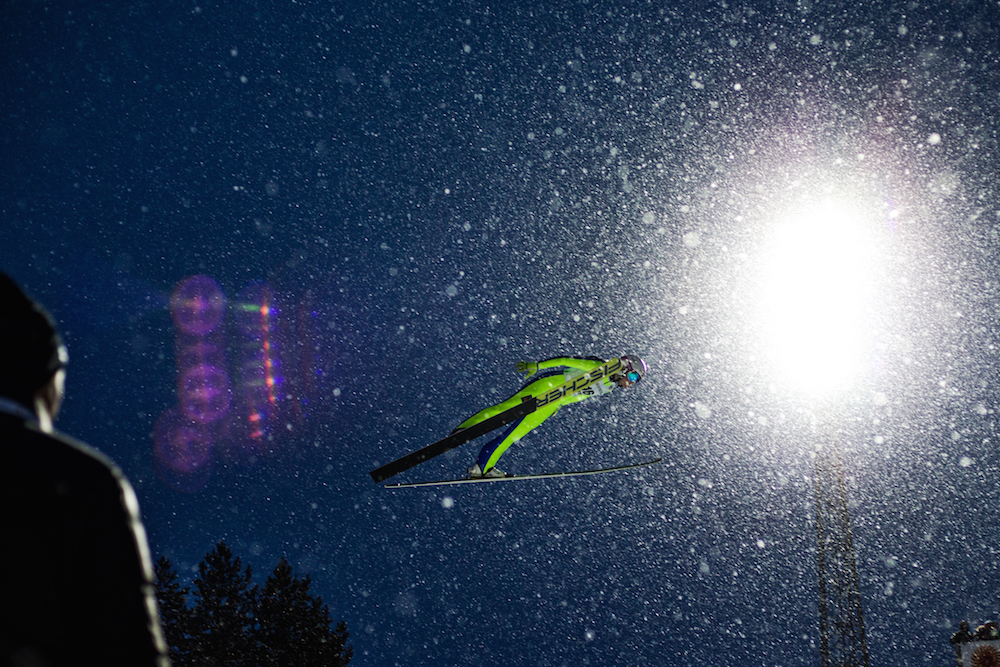
Sarah Hendrickson, jumping in this photo, is a FIS athlete representative to the Ski Jumping Committee. (Courtesy photo)
Let’s start with some basic gender equality facts in skiing.
The first women’s downhill at the Olympics was in1948. Women were awarded Olympic medals in combined (one downhill run and two of slalom) beginning eight years earlier in 1936. FIS has awarded a women’s World Championship in downhill since 1931. The FIS database marks 1967 as the first year for an official FIS World Cup downhill race for both men or women.
It’s a different narrative in ski jumping. FIS sanctioned ski jumping began for men during the 1979-1980 season. It took three more decades for women’s ski jumping to be recognized by FIS. The first women’s FIS World Cup ski jumping competition for women was held in 2011. American Sarah Hendrickson won. The first World Championships in ski jumping for women was awarded to another American, Lindsey Van, in 2009. Men, on the other hand, have been ski jumping in the Winter Olympics since their inception in 1924. The IOC welcomed women’s ski jumping at the Olympics in 2014.
This story though is about Ski Flying. But we’ll tie it back into alpine skiing later on.
Ski Flying is a close relative of ski jumping. Essentially, they are the same beyond the size of the jump. Ski Flying jumps are larger. Athletes soar farther on these jumps. Ski Flying is not an Olympic sport, however, FIS has sanctioned a World Championships in the discipline since 1972 – but only for men.
“Anybody who knows ski jumping even a little bit, you have a small hill and a big hill, and those are usually around a K90 and a K95 or K125. Ski Flying is jumping off anything that is above a K155,” said Jessica Jerome, a former U.S. ski jumper and Olympian. “There are six of these hills in the world, and only five of them are usable. It’s not a set K point or jump size. Basically, it’s ski jumping but just more of everything — it’s more speed it’s more flight time.”
Recently, if you’ve been following Jerome on Twitter, her Tweets about Ski Flying may have caught your attention. Here’s one poignant tweet: “Safety is not, and will NEVER be a valid argument @FISskijumping. I have seen some trash ski flying from forejumpers and other small nations. I think what you guys are afraid to say is you must have a penis to fly?”
Jerome was responding to an April 19 FIS press release and the decision made by the FIS Ski Jumping Calendar Planning Committee to not schedule the first-ever women’s Ski Flying competition next season. “No Ski Flying yet for the women next winter,” claimed the press release. The two reasons given by FIS for not allowing women to participate in Ski Flying were safety and issues with calendering an event.
One of the five operable Ski Flying hill towers in the world sits above Vikersund, Norway. The local Vikersund organizing committee recently proposed to host a FIS women’s Ski Flying event concurrent with a men’s jump next season. The proposal was voted down 9-7 by the FIS Ski Jumping Calendar Planning Committee.
“I can not believe that this comes from adults,” said Norwegian National team ski jumping coach, Christian Meyer, in a translated Dagbladat article. “We have jumped a big hill for a long time. Also in Granåsen in Trondheim, you can jump 145 meters. We have been doing this since 2013. For the history-less, I can also inform you that a lady jumped 200 meters in Kulm in 2003. At that time, Daniela Iraschko-Stolz was a test jumper. At that time, both equipment and technology were inferior. Still, it was zero problem to jump 200 meters for a girl.”
Maren Lundby, a twenty-six-year-old two-time Olympic ski jumping champion, and the 2019 and 2021 ski jumping World Champion, has been an outspoken critic of the decision. Active on Instagram, Lundby released a terse video with a singular message: The Girls Want to Fly.
The April 19 FIS statement on women’s Ski Flying claimed women would be introduced to Ski Flying incrementally. “The next step will be the women’s World Cup on the HS 147 hill in Willingen in the 2021/22 winter season,” read the statement. “The Muehlenkopf-hill in Willingen, [Germany] is considered a small flying hill, the perfect introduction to Ski Flying hills.”
That specific jump will be the largest yet used in an official women’s FIS ski jump competition. FIS goes on to claim, “The experts want to have these competitions first and then make a decision concerning Ski Flying events next winter.” FIS does not clarify who the “experts” are.
The U.S. representative to the Ski Jumping Calendar Committee is Park City based, Alissa Johnson. A now-retired ski jumper, Johnson is a former world top-10 ranked jumper and is a certified international technical delegate (TD). She voted to approve women’s Ski Flying in the 9 to 7 vote.
A vintage shot of then 2009 World Champion Lindsey Van (middle) celebrating a U.S. Ski Jumping title along with teammates Jessica Jerome (left) and Alissa Johnson (right) in Lake Placid. (Photo:ORDA-Jon Lundin)
“I think there have been safety concerns, like if you have a full World Cup field,” said Johnson of the sub-committee’s discussion on the issue. “So their safety concern was not so much for the top tier athletes, I think probably it’s safe to say they were referring to the top 10 or 15 depending on their age and World Rank. I think the safety concern is more directed at the back end of the field.”
The step up to Ski Flying should not be understated. The speeds achieved, and the distances jumped are greater than those on Ski Flying hills. The fact exists that ski jumping has been accessible to men far longer than women. It renders down to simply more opportunities for men and a greater number of male athletes perceived to be capable of Ski Flying.
With fewer opportunities to Ski Fly, the progression some women need to make technically and mentally to handle much larger hills is restricted. Johnson explained that to her knowledge, only seven women internationally have been allowed to Ski Fly – all as forerunners or test jumpers at men’s events.
According to Johnson, during the sub-committee meeting, some voting members were against approving the Vikersuznd round of Ski Flying because the field of women jumpers able to competently Ski Fly would be too small.
“I think women, in general, need advancements, but I also feel like the top-tier women can jump, and can jump safely,” said Johnson. “But I think a lot of the discussion came down to this: can we justify calling a World Cup a World Cup if it has less than 30 athletes?”
One solution to cull the women’s field for a potential Ski Flying event was to evaluate the women’s field mid-season after they had jumped on the large hill in Willingen, Germany.
Former U.S. jumper Sarah Hendrickson is one of two athlete reps to the FIS Ski Jumping Committee. (Courtesy photo)
Sarah Hendrickson, a twenty-six-year-old now-retired U.S. Olympian, and World Champion serves as one of two athlete reps to the FIS Ski Jumping Committee — a role she has served in for five years. Hendrickson explained that Norway’s Vikersund Ski Flying proposal, presented to the FIS Ski Jumping Calendar Planning Committee by Norway’s representative Clas Brede Bråthen, was both supported by Norway’s government and framed as an opportunity to raise the market value for women’s jumping.
“So Bråthen is stating it from a very business-money point of view, which I think is fantastic because marketing and sponsorship are important factors for FIS,” said Hendrickson. “They’re complaining during this meeting that they need to raise the viewership. Bråthen clearly explained here’s one way to increase the viewership and gain popularity in ski jumping, and some listening in were simply like ‘yeah no’.”
Hendrickson was further disheartened by the step-by-step approach suggested for women to gain experience on incrementally larger ski jumping hills. Absent from the discussion, according to Hendrickson, was what precise objective criteria the decision-makers were looking for to determine if a woman was capable of Ski Flying. Hendrickson recalls Bråthen trying to clarify what specific criteria the women had to meet to be certified to Ski Fly. Despite Bråthen’s questions, Hendrickson said no answer regarding a more structured method for assessing able-to-Ski-Fly women was forthcoming.
Cindy Haasch of Germany(GER) – jumping during the FIS nordic world ski championships nordic combined women’s individual Gundersen. (Photo: NordicFocus)
How Safe is Safe?
The notion that safety remains a concern falls flat for many athletes and observers of the sport. “I’m female, I didn’t get into the sport because I knew it was the safest sport,” said Hendrickson. “We love ski jumping because there’s a risk of danger, there’s a risk of challenge. We know there’s a risk, there’s just as much a risk jumping off a small hill as a big hill.”
Johnson, the voting member for the U.S. on the Ski Jumping Calendar Committee, expressed that individual athletes were the real experts in terms of determining Ski Flying readiness.
“At the end of the day, I think safety concerns should come down to the technical delegates that are appointed to those competitions on any given weekend,” reasoned Johnson. “It should come down to the coaches, but ultimately, it should come down to the athletes. Because regardless of whatever my coaches are saying, if I don’t feel safe, I won’t be safe. I think the safety argument has to come down to those individuals jumping. It’s so individualized. In the broad scheme of things, FIS and our TDs can host a fair and safe event for all athletes.”
The obvious long-term opportunity cost for limited Ski Flying opportunities for women is clear: fewer women might be ready to Ski Fly. If it is desired to increase the size of an experienced, and therefore “safe”, women’s Ski Flying field, then more women need the chance to Ski Fly.
“Safety is a non-issue, it’s not a thing,” said Jerome about a women’s ability to Ski Fly. “Because if safety were an issue, then first of all, why are you letting anybody participate if safety is an issue? It doesn’t matter whether it’s a male or a female or whatever. It’s a human being and it’s either going to be safe or it’s not. So if you’ve decided it’s safe for men, then it should be safe for certain women as well.”
Jerome went on to clarify that women who have demonstrated high technical proficiency and have the appropriate mental calmness to fly off large jumps should be allowed to Ski Fly. “It’s not one of those things where they’re going to fill quota spots for Ski Flying because you have to take it a little more seriously,” said Jerome.
Let’s circle back to the historical information mentioned at the top. Women have participated in downhill at the FIS World Championships since 1931. Beyond alpine skiing, of which downhill is a sub-discipline, FIS is responsible for sanctioning several winter sports considered to be potentially unsafe. Among them are snowboarding, freestyle, and freeskiing.
Perhaps FIS has data unavailable to the public regarding the inherent fragility of women compared to men that were rectified for downhill in 1931 but remain current for Ski Flying in 2021? Considering safety, the downhill is still among the diciest of the FIS disciplines. As noted, FIS does not discriminate by gender in that event. Women race downhill. And they race on courses at extreme speeds, over sometimes water injected snow.
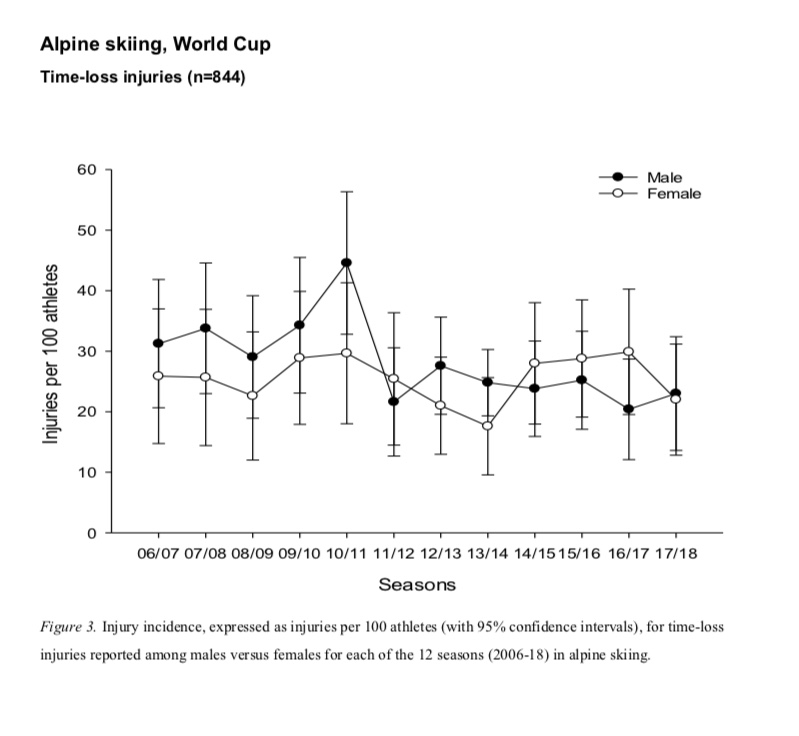
However, between the 2014/15 and 2016/17 race seasons, data from the FIS Injury Surveillance Ssyetem 2006-2018, found women were more likely than men to suffer time-loss injuries on the alpine World Cup. Ask American stars Lindsey Vonn (retired) and Mikaela Shiffrin, the women played through and they played on. Women were not kept from competing due to safety concerns.
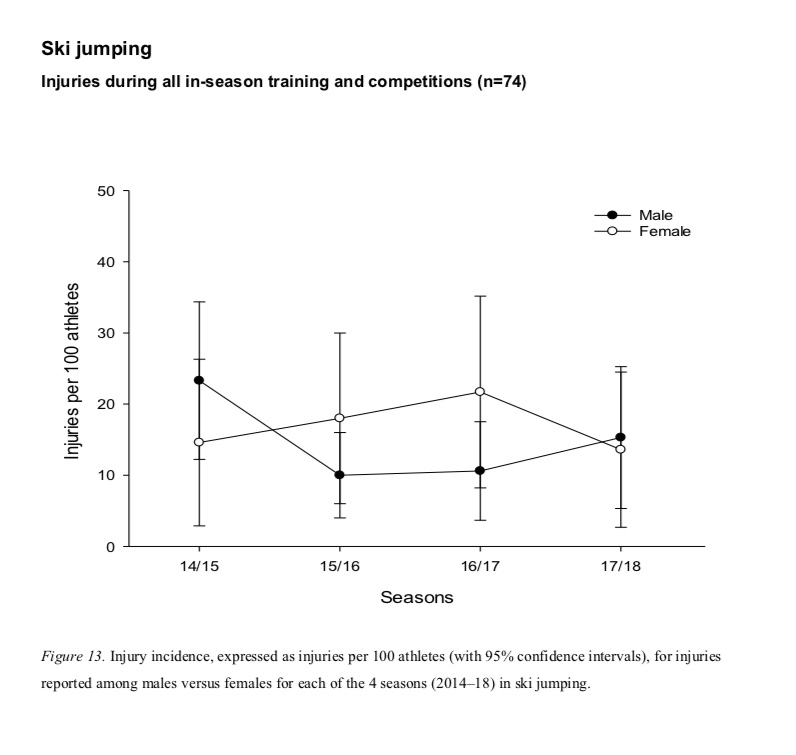
Over the same period, 2014-2018, FIS concluded men and women suffered about the same number of injuries ski jumping at the World Ski Championships and Olympics.
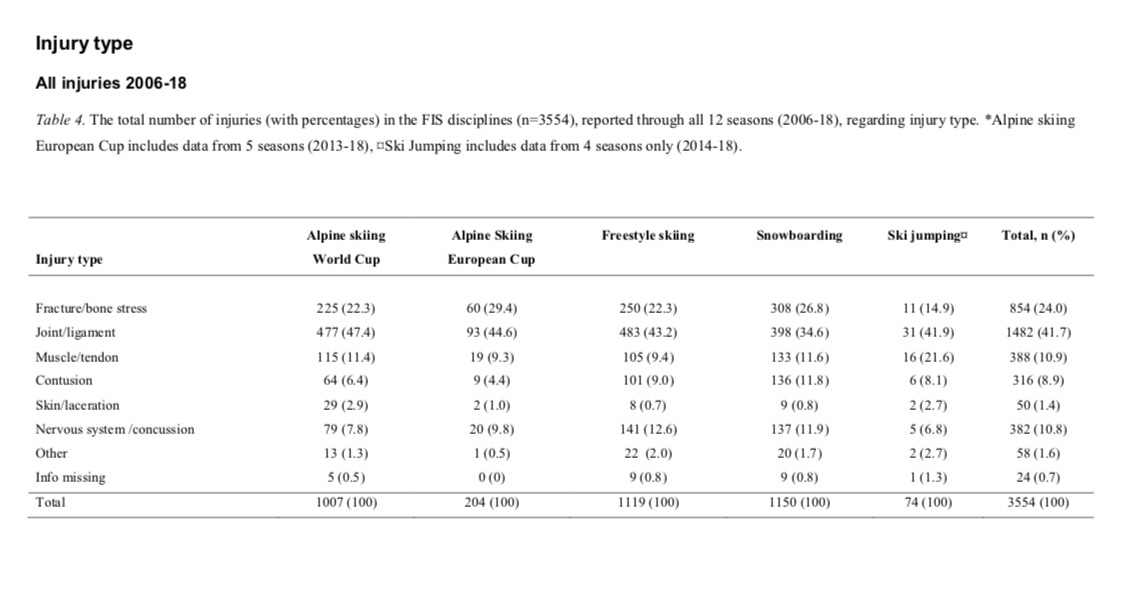
Of the total number of injuries through 12 seasons of the FIS disciplines (with ski jumping data from four seasons), 7.8% of all injuries suffered on the alpine World Cup were nervous system or concussion injuries. The same category accounted for 6.8% of injuries in ski jumping. Fractured bone/stress injuries comprised 22.3% of all injuries on the alpine World Cup. 14.9% of injuries in ski jumping were fractured bones/stress injuries.
On the surface, alpine skiing, at this elite level, appears more dangerous than ski jumping. Broadcast contracts for alpine skiing are much larger than those for ski jumping. Considering safety data, or the potential for yard sale crashes, the scheduling of FIS alpine events for men or women has not been deterred.
Across the spectrum of elite sport, the ceiling remains opaque for female athletes. Considering ski jumping, at the 2018 Winter Games, men had three unique events, the women one — an individual event on the normal hill. The legacy of discrimination extends to the first modern Olympics in 1896. The Games’ founder, Pierre de Coubertin is quoted as saying, “No matter how toughened a sportswoman may be, her organism is not cut out to sustain certain shocks”.
Again, according to FIS and their World Championships, those “shocks” somehow disappeared in the downhill for women in 1931 but persist for women in 2021 when it comes to FIS sanctioned Ski Flying competitions. FasterSkier requested an interview with a FIS representative. This story will be updated when we receive a reply.
On the men’s side of World Cup ski jumping, the top-30 earn prize money; the top-20 earn a paycheck for women. A quick check of the field size at a joint men’s and women’s competition in Râșnov, Romania in mid-February had 39 women in the field and 48 men, respectively.
Pay equity and safety aside, which are important issues, women have been allowed to chase the FIS dream in the alpine skiing realm for 90 years. (Although Lindsey Vonn was never granted the right to compete against men.) Women ski jumpers, for the time being, have to wait through at least another winter for the chance to Ski Fly in a FIS competition.
The wait, no matter how short or long is difficult, said Hendrickson. She explained that during the most recent Ski Jumping Calendar meeting she unmuted her audio and challenged the committee chair when they insisted there was “no rush” to get women Ski Flying.
“I explained that the Olympics are next year and a lot of women are going to retire after next year and they’ll never get a chance to Ski Fly,” said Hendrickson. “So it might not be a rush to you, but for someone who’s an athlete, that is looking to retire and now could not have this lifelong dream because they’re a girl is pretty devastating.”
PARK CITY, Utah (June 15, 2020) – USA Nordic has hired Chris Gilbertson as the head ski jumping coach for the men’s nordic combined team. Gilbertson spent 17 years coaching for the Steamboat Springs Winter Sports Club as well as the US Ski Team, where he led his athletes to five World Championship medals and four historic Olympic medals. Gilbertson returns to the sport after a seven year hiatus.
Gilbertson will team up with head coach Nick Hendrickson to lead the men’s nordic combined team. “I’ve known Chris for quite awhile and we were able to work together when I was on the national team. Now with a slightly different dynamic, we are both looking forward to working together as coaches,” says Hendrickson.
While the sport has changed since Gilbertson last coached, he’s not worried about that, “I might be naive, but I still believe the basics are the basics.” What Gilbertson brings to the table is experience coaching a team of champions. “He knows what it takes to win,” says Hendrickson.
Taylor Fletcher is the one remaining athlete from the 2013 team that Gilbertson coached. “I need to find out what they know about their sport and then also find out what I might have missed in the last seven years. With this new group, I look forward to creating trust and belief.” Gilbertson continues. “I’m really looking forward to working with all these guys, I see a ton of potential for them to improve on both the jump hill and cross country side.”
Newly named sport director Jed Hinkley sees this hire as a great fit, “Chris is not afraid to share his opinion, which I value, and I know nobody will work harder to help us achieve our goals in athletics and as an organization.”
When asked about his goals with this new team, Gilbertson says, “Number one goal is to get these guys to make qualification automatic. Worrying about making the cut every weekend is no way to get better. Then the goal is to get top 20, then top 10, then medals.”
American Ben Berend after jumping to 22nd in the nordic-combined individual/normal hill competition at 2017 FIS Nordic World Ski Championships in Lahti, Finland. He went on to place 41st in the 10 k to end the day on Feb. 24.
Three years ago, U.S. Ski and Snowboard (formerly known as the U.S. Ski and Snowboard Association, or USSA) officially dropped nordic combined from its funding rolls. It was a potentially big blow and flat-liner moment for a program coming off one the most successful runs in U.S. nordic sports history. As recently as 2013, the foursome of Todd Lodwick, Billy Demong, Bryan Fletcher, and Taylor Fletcher earned bronze in the team event at World Championships in Val di Fiemme, Italy.
Now, under the umbrella of USA Nordic, and two World Championships and nearly two Olympics removed from that seismic restructuring, American ski jumping and nordic combined are way beyond life-support mode.
Koby Vargas (Park City Nordic Ski Club) jumping at 2016 U.S. nationals in Park City, Utah. (Courtesy photo)
“What we see, and we see this across sport and the larger picture of health, is that we have less young athletes participating in sports these days,” said Jed Hinkley, sport development director for USA Nordic. “It’s not unique to any specific sport — it is across the board. There are some exceptions to that and I would say ski jumping and nordic combined are an exception to that.”
Hinkley has been on the job since last summer. He’s seen his mission morph from grasping member clubs’ capacity, infrastructure, and financials to determining how to attract athletes and retain them.
“I know our numbers are heading in a positive direction, but we still do see a fairly big drop off as athletes enter their teen years,” he said. “I would say that my role has shifted a little bit to be more athlete development around the U20 level — to try to keep athletes in the sport longer.”
According to Hinkley, ski jumping is experiencing a resurgence in the U.S. In 2014, USA Nordic began organizing a regional jumping competition, the US Cup Junior Series. Three of the four regions tracked by USA Nordic — Central, West and Alaska — experienced significant growth in participation. The only outlier was the East, which canceled its end-of-season jump competition due to severe weather. Hinkley believes that cancellation skewed the data downward.
Data collected for the series tracks boys and girls ages U10 (under 10) to U16. Between 2016 and 2017, the Central region increased participation 49 percent, the West percent, and Alaska 192 percent.
From a global perspective, the U.S. appears to be on a path to fostering a legitimate nordic-sport pipeline. Hinkley admits his data collection methodology relied in part on the “brother of a friend of a brother’s mechanic model,” but his information appears promising.
“To the best of my knowledge, Norway and Germany are one and two for numbers in ski jumping and nordic combined,” Hinkley said. “From what we can figure out, it appears that the U.S. is the third-largest ski jumping and nordic combined nation in the world. There is one country that I don’t have numbers for that could outrank us, that being Poland, because they have such a huge love for ski jumping. It appears our numbers are higher than Slovenia, Austria and Japan, which are all part of the jumping and nordic-combined powerhouses.”
Jumping and nordic combined are resource-intensive sports — they both require what can be costly jumping infrastructure. Two regions have taken different approaches to ski jumping viability.
In Anchorage, Alaska, two women spearheaded a regional revival. As part of the Nordic Skiing Association of Anchorage (NSAA), Karen Compton and Vivienne Murray, along with a core group of volunteers, now respond to daily emails, shuttle athletes, and supply and maintain loaner equipment in an effort to expose young athletes to jumping.
“When we started there were only three other boys jumping and a burned-out coach who quit shortly thereafter,” Compton said on the phone from Anchorage. “There just wasn’t anyone involved in the program, and I ran around a got some friends have their kids come and try it out because it’s only fun if your friends are doing it along with you. Vivian was one of the friends I asked. Her kids liked it and at the end of the season, which was just a few months, we talked about it and we decided the two of us would take it on and resurrect the program.”
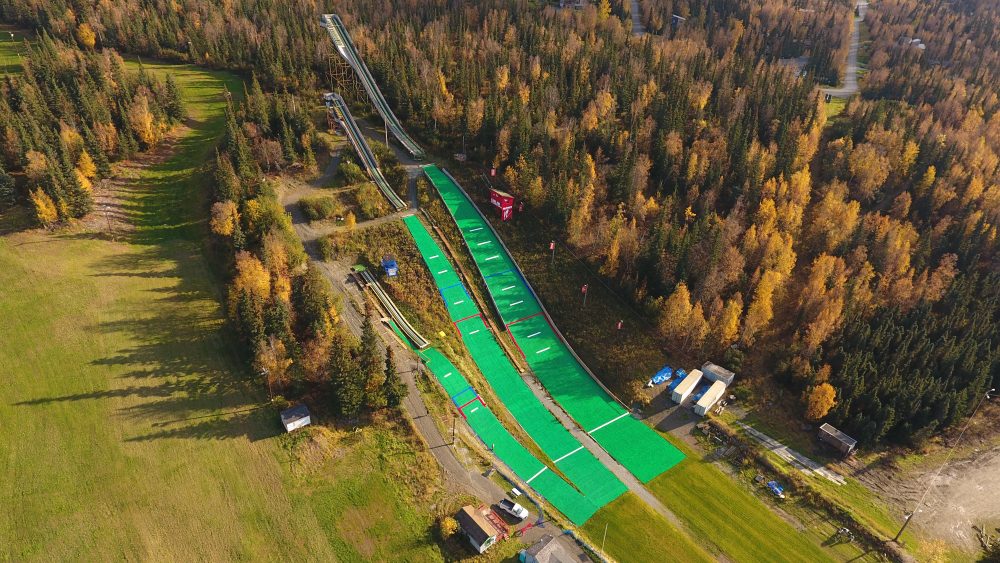
The Karl Eid Ski Jumping Complex in Anchorage, Alaska, which completed a retrofit in 2016. The three jumps pictured are now modernized with summertime jumping available to the athletes. (Photo: NSAA)
In 2012, Compton and Murray began co-chairing a grant-writing and fundraising campaign. By 2016 they had raised enough funds to rehabilitate the jumps at Anchorage’s Karl Eid Ski Jumping Complex. The complex now boasts a modernized 10-20 meter combined jump, and 40-meter and 65-meter jumps, respectively. Under NSAA, Team AK Ski Jumping/Nordic Combined has upwards of 70 kids jumping each winter.
Perhaps more importantly to developing higher-level jumpers, the modernization efforts allowed NSAA to plasticize the jumps’ in-runs to facilitate summertime jumping.
“[Anchorage] has been a good model to recruit, maintain, and make the sport fun,” Hinkley said. “They do a lot of social stuff outside of the jump hill, and organization-wise they are creating a welcoming environment and a professional organization. … I think what they are doing really well is they are a part of NSAA, which is all of cross-country skiing in Anchorage. They work collaboratively with the cross-country side and they are all in it together. I think in a lot of places, historically, there has been a divide between ski-jumping clubs and cross-country clubs, whereas in Anchorage there is an awesome collaboration.”
Anchorage came to the table with jumps in place. The Midwest boasts two from-the-ground-up success stories.
Red Wing, Minn., is developing a new Olympic-size jump on land owned by the Prairie Island Indian Community. “It’ll be a state-of-the-art facility with potentially cross-country trails at the base. And they want to do things like World Cups, FIS Cups, Grand Prix,” Hinkley said.
On a smaller but no-less-significant scale, a dedicated group in Cameron, Wis., built a 7-meter snow jump. That group collaborated with the well-established Flying Eagles Ski Club, a nationally recognized ski jumping club in Eau Claire, Wis.
The Pipeline
How bright is the future when it comes to international potential? On the U.S. men’s ski jumping side, four athletes were recently named to the its national team. Sixteen-year-old Kevin Bickner, who began jumping in Illinois but now lives in Park City, Utah, is the only A-team member. Bickner jumped to a 15th place on the World Cup this past March in Vikersund, Norway. In doing so, he jumped 244.5 meters, which was an American distance record, according to a USA Nordic press release.
Rounding out the men’s jumping team are three B-team members: Casey Larson (18), Michael Glasder (28) and William Rhoads (22). At last year’s Junior World Ski Championships, Larson placed eighth in the individual normal-hill competition.
“With men’s jumping, we have seen quite a phenomenal turnaround,” said USA Nordic Executive Director Billy Demong. “In participation for both women’s and men U14 levels, but for the national team, we have some guys who are really good. In fact, Kevin Bickner has had the best results in over a decade. And cumulatively the team scored more points last year than over the previous twelve years combined. They also had the best team-event finish since 1985, so there’s a solid group of four athletes.”
Demong also noted that keeping U20 skiers involved with the sport remains a priority. For scoring criteria as it relates to national-team selection, USA Nordic begins scoring at the more competitive (larger field size) Continental Cup competitions. He explained that success at the Continental Cup indicates a positive trajectory. The C-team is organized as a U24 program, essentially allowing older athletes an incentive to invest and remain in the sport. The C-team is comprised of two skiers, Nicholas Mattoon (22) and AJ Brown (22).
“We give our athletes a little more time to develop,” Demong said. “I think that’s partially why we are seeing the change. We are providing resources and opportunities for a greater group of athletes and at a higher level than it has been.”
This season, the U.S. Nordic Combined team will be led by A-team returners and brothers Bryan Fletcher (31) and Taylor Fletcher (27).
Last winter, the nordic-combined team was bottom heavy on the age-and-experience spectrum, with the Fletcher brothers being obvious outliers. U.S. Nordic Combined lacked the World Cup quota spots to expose several young skiers to that level of competition beyond domestic races and Junior World Championships .
U.S. NoCo’s Stephen Schumann (28) passing on the outside, en route to 10th in the normal hill/10 k at 2017 Nordic Junior World Championships at Soldier Hollow in Midway, Utah. (Photo: U.S. Ski Team/Steven Earl)
“One of the hopes is that we are able to start increasing the quota on the World Cup as well as the Continental Cup,” Demong said. “Last year, we had five different individuals score a top 10 on the Continental Cup, I believe. That’s unusual to have that much depth at that level. And what we need now is for some of those guys to transition into the World Cup.”
Adam Loomis (25), Ben Berend (21), Ben Loomis (19), Jasper Good (21) and Stephen Schumann (17) comprise the Nordic Combined B-team. Grant Andrews (19) is the sole C-team member.
The fleet of skiers following the Fletchers have time on their side in terms of World Championship and Olympic cycles, yet their recent junior-level results maintain the team’s emerging optimism. At the most recent Junior World Championships at home in Park City and Midway, Utah, U.S. Nordic Combined tallied two top-10 performances. Schumann placed 10th in the 10-kilometer Gundersen, and Ben Loomis finished ninth in the 5 k.
“There is a big group behind Schumann and Ben Loomis,” Demong explained. “I think in one of the qualifying events in Park City, there were six or seven of them that all finished within a minute, so pretty good size crew for a little sport.”
This April, USA Nordic formalized its efforts to keep promising athletes in an organized pipeline. Demong said it expanded its junior-national teams for both ski jumping and nordic-combined to include top athletes in the U16 to U20 range. USA Nordic also has national-development camps planned for this summer.
“I think it is a very nice transition from the Junior National team to National Team the way we have built it out, because we set our own criteria for the teams we fund,” Demong said. “Ideologically we are trying to give the U20’s a reason to continue competing and skiing in the critical 18-, 19-, 20-year-old ages and that this is something really worth investing in.”
Russian ski jumper Sofia Tikhonova during the women’s 100HS final at 2017 FIS Nordic World Ski Championships in Lahti, Finland. (Photo: Dustin Satloff/dustinsatloff.com)
For Tara Geraghty-Moats, nothing compares to the sense of weightlessness she feels and the way spectators appear to sink into the ground when she soars off a ski jump — except maybe the feeling of pushing her physical limits during a cross-country ski race.
The two sports have been a part of the 24-year-old New England native’s life since her grammar-school days — she picked up both at the age of 9 and in both, she excelled.
By the time she was 15, her jumping talents earned her a spot on the Women’s Ski Jumping USA development team, and she captured third place at the 2009 Springer Tournee in Park City, Utah. But within a year of her nomination, due to concurrent knee injuries, she was forced to leave the ski hill and for the next four seasons, she focused on cross-country skiing.
Vermonter Tara Garaghty-Moats (c) after winning the junior sprint at 2013 Swedish Biathlon Championships. (Courtesy photo)
Despite being told she would never jump again, she returned to the hill in 2013. That same year, she jumped to fifth at ski-jumping nationals in Lake Placid, N.Y., which earned her nomination to the Women’s Ski Jumping USA World Cup B-team.
While Geraghty-Moats saw success in both jumping and XC over the years, she never had the opportunity to showcase her combined abilities at an international level. Not because she didn’t want to, but because the opportunity didn’t exist — until this year.
“We have sort of been waiting for the sport to catch up with Tara Geraghty-Moats for quite a while,” Billy Demong, executive director for USA Nordic Sport (the U.S. governing body for men’s ski jumping and nordic combined) said on the phone earlier this month.
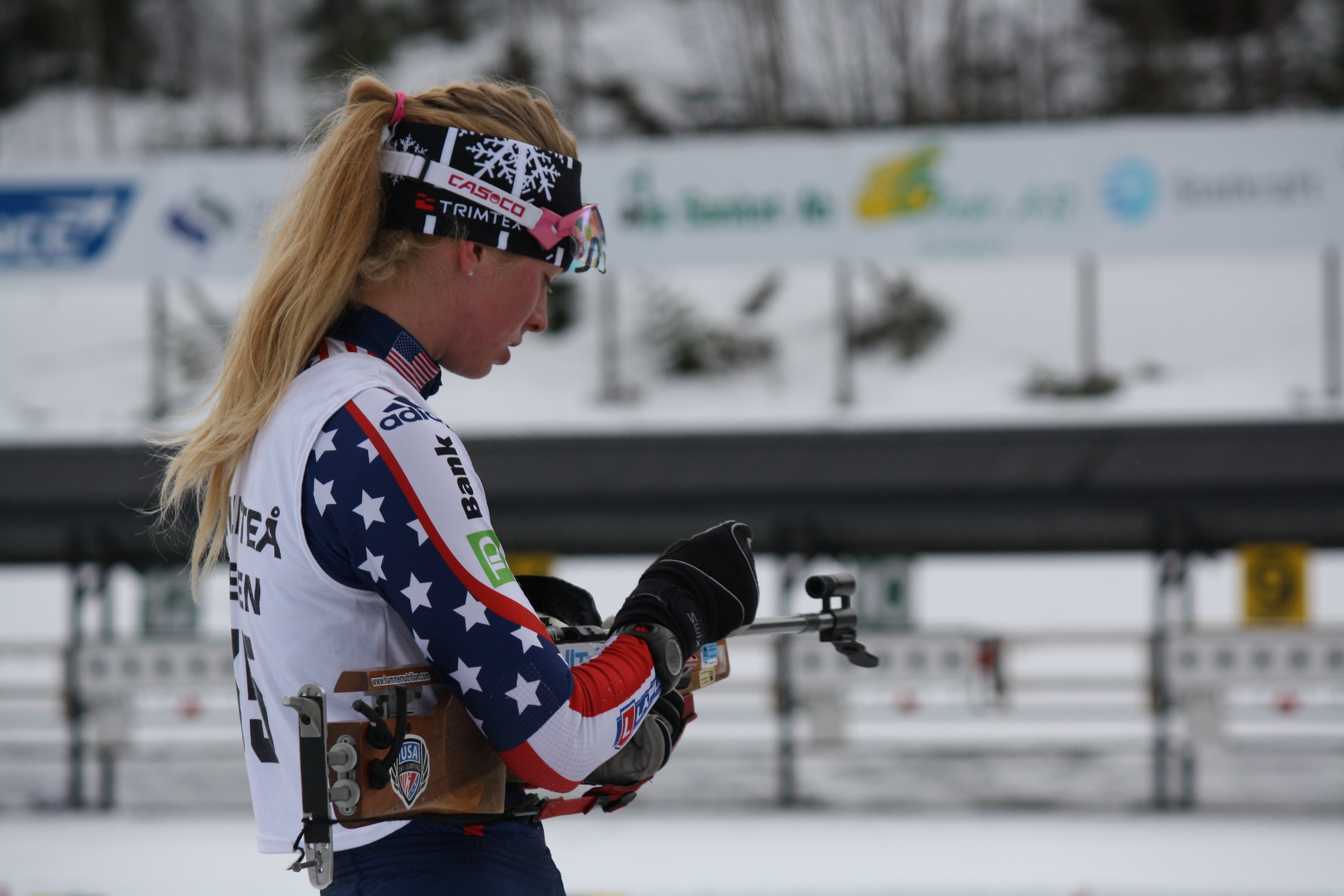
Geraghty-Moats on the range at 2011 Swedish Biathlon Nationals. (Photo: Per Nilsson)
Now it appears to be heading in Geraghty-Moats’s favor. Prior to this season, most of the cross-country ski training she did was either for pleasure or to maintain fitness for ski jumping. Now her training will take on a new meaning, as for the first time in history, women’s nordic combined will be included in the International Ski Federation (FIS) Continental Cup schedule. The inaugural women’s Nordic Combined event in the U.S. will be the USSA National Championships in Lake Placid on October 7. Demong anticipates eight to ten women to participate in the event.
“I’ve been wanting to compete on an international level for nordic combined for a long time,” Geraghty-Moats said on the phone this month. “It’s something I’m really invested in long term and something I’d like to see at a World Championships and Olympic-level competition. I’m really looking forward to helping develop the sport and helping mentor the younger girls that are getting into and also performing at a high level internationally.”
Women’s nordic combined has not yet been contested at the World Cup or Olympic level. Since this season marks an Olympic year, Geraghty-Moats will put her focus on World Cup ski-jumping events and enter as many FIS nordic-combined Continental Cups as she can.
“The ideal situation would be that I would qualify [for the 2018 Winter Olympics] in ski jumping and then am able to compete all the nordic combined races,” she said. “But there’s no way for me to tell where I’ll be in the points for the Olympic qualifying competitions … so hopefully I’ll be able to do them all, but I don’t really know.”
According to Demong, incorporating women’s nordic combined into the FIS schedule has been “on the radar for quite a while.” However, one blockade that prevented immediate action was the risk of draining athletes from a developing sport. Women’s ski jumping was added to Nordic World Ski Championships in 2009, the World Cup in 2011 and the Olympics in 2014.
“I think [women’s nordic combined] has really been in discussion since it was obvious that women’s ski jumping was going to be in the Olympics,” Demong said. “At the FIS level, I think one of the biggest challenges is with women’s ski jumping, you still have a developing sport. The ranks just aren’t as large and deep as the men’s side. And so I think there was a lot of fear that if you add another discipline, it could truncate the growth of women’s jumping.”
Sarah Hendrickson (Women’s Ski Jumping USA) taking flight during a summer competition in 2011. (Photo: Dan Campbell)
Over the past few years, the U.S. has seen more junior women participating in ski jumping. According to Demong, some a clubs have doubled their numbers within the last five years.
“The largest increase we saw in any user group was U8 [under 8], U10, and U12 in the Midwest, but also in Park City there was a pretty big increase, too,” he said. “We didn’t have a whole lot of participation before probably because they didn’t see a pathway. There were some diehards, like Tara and Gabby [Armstrong], but there weren’t droves of them and I think now there will be more in the sport because there’s a much more clear pipeline.”
This year will also be the first year that women’s nordic combined will be included at Junior World Championships. To Demong’s knowledge, Geraghty-Moats and Armstrong are the only two senior American women that plan to compete in the FIS Continental Cup competitions. Both will be supported by USA Nordic national-team staff at nordic-combined events, since the women’s events are scheduled to align with the men’s competitions.
“We have some really good 14 and 15 year olds that we’d like to see participate in the FIS Youth Cups again this year,” Demong added.
Also this year, the inaugural Women’s Nordic Combined National Championships will be held Oct. 7 in Lake Placid, N.Y.
With a longtime dream finally coming to fruition, Geraghty-Moats is not ready to let it end there.
“I don’t necessarily schedule things four years out,” she said. “But I definitely know that nordic-combined is going to be in my goals as an athlete for the foreseeable future. Obviously I need to stay healthy and continue doing things in my life, like going to school and staying at a high level of skiing, but I’m 100-percent sure that I will do nordic combined for as long as possible.”
Bryan Fletcher (U.S. Nordic Combined) jumping to 20th on the normal hill at 2015 World Championships in Falun, Sweden. (Photo: FlyingPointRoad)
Nordic combined is exactly that: a combination of the two discrete nordic-sport disciplines. There’s the cross-country side, which if you read FasterSkier regularly, you’re pretty comfortable with in terms of technique, gear, and the nuts and bolts of race dynamics. If you’re like me, the jumping side is a bit more foreign. I took the opportunity in this podcast episode to explore ski jumping.
For nordic combined competitions, it is the ski jumping portion that dictates the start order for the freestyle pursuit-style race. So to fully understand the discipline, and know why, for example, a skier starts one minute back from the morning’s ski-jump winner, I reached out to Bryan Fletcher, a 30-year-old old U.S. Nordic Combined Team veteran (he’s also a new dad), and Clint Jones, a former U.S. Ski Team jumper and currently a jumping coach and team director for USA Nordic, which encompasses nordic combined and ski jumping.
From those two we get a jumper’s perspective of a massive ski flying hill in Planica, Slovenia, and firsthand knowledge of jumping technique. Jumping may not be for the faint of heart, but understanding how it sets up the cross-country ski race after the jumps is critical to following nordic combined.
And when you listen to the podcast, you’ll hear Bryan Fletcher say this: “For me, I’m kind of an adrenaline junkie. I’ve done a lot of stupid adrenaline things in my life. And one of those is base jumping off of the bridge in Twin Falls, [Idaho]. And typically they recommend you have 100 sky dives before you ever go base jumping. Instead I spent two months learning how to pack a parachute, and then went and took six jumps off the bridge. And to give you perspective, base jumping I didn’t know anything about … However with ski jumping, you kind of have those rumors and commentary from other jumpers, I was more nervous getting on the bar of a ski flying hill for the first time than I was crawling over the railing of a bridge to base jump for my first time.”
You’ll also learn the difference between a ski flying hill — the type of jump Fletcher refers to in his base-jumping quote — and a regular, Olympic-style ski jumping hill. It’s always a good day to learn something new.
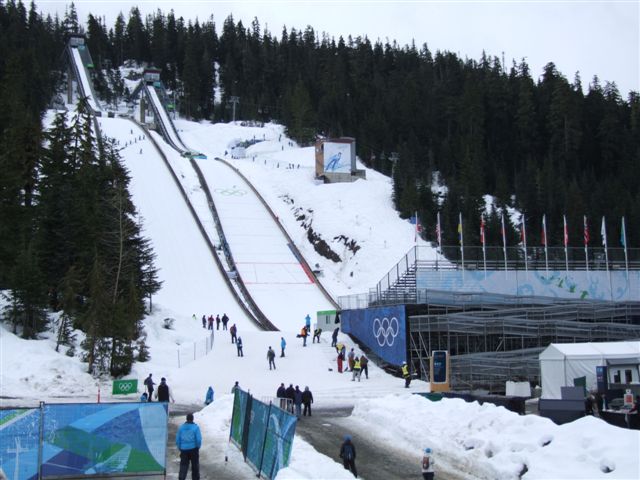
The Olympic ski jumping venue in Whistler, Canada. Ski Jumping and Nordic Combined Canada are in a state of uncertainty after their main financial source, Own the Podium, eliminated funding to the two sports.
The future of ski jumping and nordic combined in Canada is in limbo after one of the sports’ main funding sources, Own the Podium (OTP), decided to stop funding the sports for the 2014/2015 season. OTP is a sport-support program that makes recommendations for government and private-sector funding based on “targeted excellence” criteria.
FasterSkier learned of the funding cuts in a leaked document that included the proposed numerical amounts of funding for each program OTP plans to support: hockey, freestyle skiing, speed skating, figure skating, ski cross, curling, snowboarding, bobsleigh, alpine skiing, luge, cross-country skiing, biathlon, and skeleton. The document did not include ski jumping or nordic combined.
Both Curtis Lyon, Ski Jumping Canada and Nordic Combined Canada’s chairman and high-performance director, and OTP’s Director of Winter Sport Peter Judge confirmed the funding cut. But how that information was communicated remained unclear after speaking with Lyon and Judge in separate phone interviews.
According to Lyon, OTP did not contact his sports to inform them of the loss of funding. He stated that there had been no communication from OTP since May 16 and that he found out about the cuts by word of mouth and privately shared documents.
“I knew the number of sports getting cut plus there has obviously been leaked information,” Lyon said in a phone interview. “I know what I’ve seen even if it hasn’t been 100-percent official. Other sports have been notified of their dollar amounts so I’m just assuming that they’re not even taking the time to give us the call back.”
Judge said OTP notified Ski Jumping and Nordic Combined Canada about the decision to eliminate funding to their sports in mid- to late June. Lyon said he tried to contact OTP repeatedly for official information, without any luck.
“I don’t know if he continually contacted us,” Judge said. “I’ll look into it.”
According to Judge, the official funding numbers for the 2014/2015 season will be released on the OTP website once they are approved by Canada’s minister of the state (sport).
What this means for Canadian Jumping & NoCo
Peter Judge, Own the Podium (OTP) director of winter sport, explained the organization’s decision to cut funding for ski jumping and nordic combined. He stressed that OTP is not the sole-funding source for sports in the country and national sport organizations (NSOs) have the responsibility to develop their sports to a point where they have Olympic medal potential.
Without OTP’s financial support, Lyon said that the state of ski jumping and nordic combined in Canada depends on various factors and is currently uncertain. The two sports have several other possible funding sources, including Sport Canada, which operates directly under the government, but nothing was confirmed as of late July.
“We are working with Sport Canada to gain recognition under the Sport Funding Accountability Framework,” Lyon explained. “If that process goes well we can hopefully secure some level of support for the next four years but this is still unclear. Obviously we were expecting some investment from Own the Podium based on what we felt were fairly strong results and a fairly strong program going forward. It was obviously pretty frustrating as that was not the case.”
Lyon was most frustrated with the lack of communication. Had OTP informed them of the cuts earlier this year, Lyon said that the extensive amount of time they spent on the OTP application could have been put toward finding alternative financial supporters.
Over the past four years, Ski Jumping and Nordic Combined Canada have received $600,000 Canadian dollars to support the development of elite athletes, according to Lyon, who added that this number is misleading.
“If you look on their website, it says $600,000 dollars over the last four years,” he said. “What they don’t show is that in the first year of the quadrennial, we got about $200,000 dollars, the second year was $300,000, the third year was $100,000 and the last year was zero.
“We got a pretty hefty lecture that [OTP] had spent $600,000 over four years to get twelfth place in the Olympics,” Lyon added. “My response was, well, how do you put together a program based on such highly fluctuating numbers from year to year?”
According to Lyon, the year the program received $300,000, there was only one 15-year-old female on the team and she posted variable results throughout that season. However, when their funding was subsequently slashed to $100,000, athletes from the development program began to improve and Canadian ski jumping started consistently placing in the top 10 at World Cups, with occasional podiums at the Grand Prix.
Even in the 2013/2014 season, Canadian ski jumping saw some significant gains on the international ski jumping circuit with Atsuko Tanaka earning fourth in the 2014 Gand Prix standings. Takana and teammate Taylor Henrich also placed 12th and 13th in the Olympic HS 106 ski jumping competition.
“It’s a mismanagement of funds on their part,” Lyon said. “It’s just very inconsistent and short-term thinking.”
It is important to note, however, that men’s ski jumping was unable to match its women’s results and had only one competitor, Mackenzie Boyd-Clowes, who consistently competed in ski jumping World Cups in 2014.
Additionally, Canada had no competitors racing on the nordic combined World Cup circuit in 2014. While there were Canadian athletes competing in the 2014 nordic combined Continental Cups, their results were unable to earn them World Cup or Olympic starting spots.
According to Judge, his organization saw a very low possibility of ski jumping or nordic combined winning a medal in the 2018 Olympics, and thus believed OTP’s money would put to better use funding for other winter sports.
“Our mandate and our mission is simply around medal potential for 2018 and certainly on the nordic-combined side that’s been a challenge,” Judge said. “There are not any medal-potential athletes in coffer. On the ski-jumping side, again I looked at the data that was there and it was hard pressed to find medal potential for 2018.”
Judge stressed that OTP is not the sole-funding source for Canadian sports, and national-sport organizations (NSOs) are responsible for developing their sports’ Olympic-medal potential. According to Judge, funding from OTP is only a “small part of the equation” and that NSOs need to be able to function without the support of OTP.
Curtis Lyon, Ski Jumping Canada and Nordic Combined Canada’s chairman and high-performance director. (Photo: LinkedIn)
Lyon countered that while OTP is one funding source, the opportunities that come with being an OTP-sponsored sport totals much more than the monetary amount would suggest.
“They are one funding source; that’s what they’ll tell you,” he said. “As soon as you are not funded by OTP every other door closes. All the money for your sport services is gone. You can’t access this gym, you can’t access that gym. You get lower priority when you actually go to the Olympics in terms of the credentials, where you stay, how you are treated there. It’s a ripple effect. You are screwed at that point. There is no way back.”
Lyon said the current situation is not exactly surprising given how OTP had addressed nordic combined and ski jumping in the last decade.
“You are taking a sport that had potential and basically trying to kill it to the point where it may not exist in the country, rather than have a long-term goal and plan and work with the sport to develop it over four or eight years,” Lyon said. “That’s the way the sport has been for the last eight to ten years. We build a little momentum and then something changes and it almost folds altogether.”
What’s next
This season, three athletes represent Ski Jumping Canada: Atsuko, Alexandra Pretorius, and Taylor Henrich, who are all returning women’s national team members.
As for nordic combined, Lyon said that he didn’t know of anyone who was officially going to be on the national team, or if there would be a team at all. He said several athletes had discussed training in the U.S., but he was unaware of their status.
Canadian ski jumping and nordic combined relied heavily on partnerships with their U.S. counterparts the last few seasons.
Under previous arrangements, Ski Jumping Canada shared a coach with the U.S. and often joined the Americans’ training camps. Nordic combined was more reliant on the U.S., paying the U.S. Nordic Combined to coach, house, and provide waxing services for their athletes during the Continental Cup season.
This arrangement is up in the air for the upcoming competition season, as the status of Canadian ski jumping and nordic combined remains uncertain. U.S. Nordic Combined is working on fundraising, too, after the U.S. Ski & Snowboard Association ceased team funding this month.
Lyon expressed some optimism with a new training center opening at Whistler Olympic Park in British Columbia. Using the jumps from the 2010 Olympics, two clubs will attempt to develop a program in that area. Additionally, a strong recruitment program in Calgary will continue to introduce athletes to ski jumping and nordic combined.
However, Lyon stressed that for Canadian ski jumping and nordic combined to survive, it is necessary to find organizations that are intent on focusing on the long-term development for both sports.
“If we want to survive, we need to take matters into our own hands and really develop those relationships and get that money coming in and build up those relationships over the years,” he said, “Instead of just waiting for handouts from organizations that obviously have no long-term goals for organizations like our ours.”
Bryan Fletcher jumping last season. Fletcher recently told Nordic Mag that his team has officially teamed up with U.S.A. Ski Jumping in an effort to fundraise and promote its sport.
One of U.S. Nordic Combined’s leading men, Bryan Fletcher, 28, recently spoke with the the International Ski Federation (FIS) for a segment called Tuesday Talk about the state of his team. In April, the U.S. Ski and Snowboard Association (USSA) announced it would cease funding his sport, which would go into effect on July 31 — next Thursday.
In the following interview with FIS, Fletcher explains how U.S. Nordic Combined recently joined forces with U.S.A. Ski Jumping.
***
Bryan Flecher, U.S. Nordic Combined and USSA athlete rep (Photo: bryanfletcher.com)
FIS: After the season, you and your teammates received the difficult piece of news that there was a budget cut to come for the Nordic Combined athletes. How is the situation now, a couple of months later?
Bryan Fletcher: The news was a bit shocking. I think we all expected budgets cuts especially after the Olympic year but to cut our entire program was a bit of a shock. However, it only took us a moment to gather our thoughts and become motivated to rebuild and we have done that.
Today we are partnered with USA Ski Jumping, our new name will be “USA Ski Jumping and Nordic Combined.” There are some really cool projects that we will be collaborating on and we hope to bring to the table some extra help and collaboration in building an already impressive new organization. So to briefly answer the question we are looking much better then just a few short months ago.
FIS: Can you tell us a little bit more about the new structure that nordic combined in the USA will have?
BF: The most exciting thing about this new organization is that it opens us up to new sponsorship possibilities. The Nordic Combined team was rather handcuffed when it came to sponsors because of non compete clauses with the U.S. Ski Team. Now with this new organization in place we can go after new partnerships that are exciting, and most of all relevant to our sport and demographic that we couldn’t partner with before.
As an organization, this allows us to build from the ground up instead of the top down — meaning that there is going to be a future in both ski jumping and nordic combined in America with hopefully a strong pipeline.
“We are looking much better then just a few short months ago.” — Bryan Fletcher, 2014 Olympian and U.S. Nordic Combined veteran
FIS: At the same time, you have been elected as a member of the board of the U.S. Ski and Snowboard Association. What do you hope to achieve in this role in the future?
BF: Yeah, this a huge opportunity for me to learn about how a non-profit works and also to be a voice of the athletes. It’s a big role that will take a little bit of time to get going on, but I am motivated to have a voice on the board and really take an active role in the issues at hand. We had some productive spring meetings and my hope is to continue the dialogue during the summer and winter to actually make some improvements, especially in the opportunities for athletes to set up their career outside of skiing so that when they are done skiing they have something to fall back on.
FIS: Focusing on the sports part of things: what have you been up to training-wise in the last few weeks?
BF: I have been training a lot, road biking a ton and that has been great this summer. Most of the guys on the team raced quite a few races this spring and now I am transitioning into more jumping and rollerskiing. Training has been fun — we recently had some awesome competitions in Steamboat [Colorado] over the 4th of July. It felt much like Europe, there were 2000 spectators rolling through and staying to drink beer and cheer on the jumping. In addition there was even an Austrian band playing traditional Alpenhorn songs. It was great!
“It felt much like Europe; there were 2000 spectators rolling through and staying to drink beer and cheer on the jumping.” — Fletcher on Steamboat Springs July 4 jumping festival.
FIS: With what kinds of goals do you go into this season full of new beginnings?
BF: My goal this season is to have no excuses. Despite our cutbacks I think I and our team can continue to make progress in the sport. And I would like to add a few more podiums to my results page this season.
FIS: This summer will also mark an important step for you personally: you are set to marry your fiancé Nicole [Thorsen]. When is the big day?
BF: Nikki and I are very excited! The big day is September 27th! All the planning is pretty much done and now we are just excited for the big day.
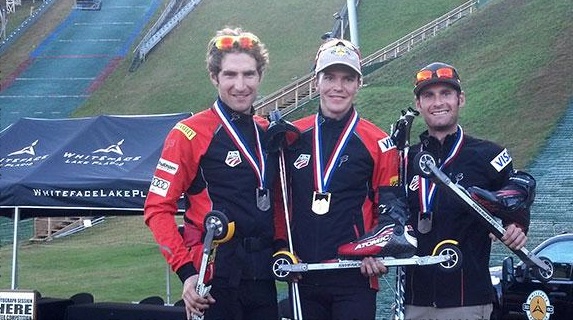
U.S. Nordic Combined’s Billy Demong (c) shares the podium with teammates Taylor (l) and Bryan Fletcher after winning his ninth national at U.S. Nordic Combined Championships on Sunday in Lake Placid, N.Y. (Photo: USST/ORDA-Jon Lundin)
Consistency is key when it comes to nordic combined. Third in the morning jump at the U.S. Nordic Combined Championships on Sunday in Lake Placid, N.Y., national-team staple Billy Demong went on to win the 10-kilometer rollerski with the third-fastest time at the Olympic Jumping Complex, holding off teammates Bryan and Taylor Fletcher by 11 seconds in 25:47.8.
According to Steamboat Today, Demong started 16 seconds behind jump leader Todd Lodwick, another U.S. Nordic Combined veteran. Lodwick started four seconds ahead of Aleck Gantick and ultimately placed fifth after Demong, Bryan Fletcher, Taylor Fletcher and Brett Denney, respectively. Bryan and Taylor started nearly a minute behind in seventh and eighth, respectively.
Taylor passed his brother and edged him for second by 0.3 seconds. Denney finished 31.1 seconds behind Demong in fourth and Lodwick was fifth (+1:14.5), reportedly slowed by asthma.
It was Demong’s ninth national title in what may very well be his last U.S. championships. The 33-year-old Lake Placid-area native plans to retire after the 2014 Sochi Olympics.
“No doubt, this was my best race of this summer,” Demong said in a U.S. Ski Team press release. “This was a solid start to where I want to be right now.”
Most threatened by the idea of Lodwick sprinting to the finish or Taylor Fletcher catching him and skiing away, Demong said he tried to ski his own race.
“I just wanted to ski an even split and stay just 10 to 15 seconds in front of [Taylor] so he didn’t have the opportunity to break away from me,” he explained. “It seemed like that worked out. He pulled within 10 seconds of the last lap, but I had enough energy to hold that gap to the finish line.”
Best of all, Demong said the dryland results indicate that the team’s in good shape overall.
“There were four to five guys who could have won so I think that our team is exceptionally strong, even stronger than four years ago,” he said. “That’s the most important thing to me.”
The U.S. Nordic Combined squad is headed to Europe on Monday for its final overseas training camp before the World Cup season starts next month.
“We had some good results,” head coach Dave Jarrett told Steamboat Today. “It was difficult conditions and this hill is hard. We didn’t do very well jumping, but we have jumped well here, so this was just one of those days.”
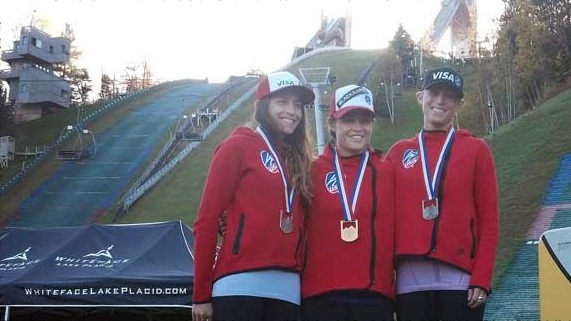
2009 World Champion Lindsey Van (c) celebrates her U.S. Ski Jumping title along with teammates Jessica Jerome and Alissa Johnson on Sunday in Lake Placid, N.Y. (Photo: USST/ORDA-Jon Lundin)
Van, Alexander Take Jump Titles
Also on Sunday in Lake Placid, 2009 world champion Lindsey Van (Women’s Ski Jumping USA) and Nick Alexander (USA Ski Jumping) notched national titles on the K90 Olympic normal hill at the U.S. Ski Jumping Championships. For Van, it was her 16th title and Alexander’s second.
“This validates all of the hard work that I’ve been putting in all this summer,” Alexander said in a U.S. Ski Team press release. “Now I just have to appreciate today and work even harder heading into the wintertime.”
“I had fun today and jumping is about fun,” Van said. “I started jumping well a couple of weeks ago. It’s nice as I was struggling a couple of years. It was nice to feel the rhythm of ski jumping again.”
Earlier this summer, U.S. Women’s Ski Jumping world champion Sarah Hendrickson, who is recovering from knee surgery and did not compete on Saturday, and USA Ski Jumping’s Nick Fairall won the large hill competitions in Park City, Utah.
Van tallied the two longest jumps of the weekend of 92.0 and 96.5 meters to top teammate Jessica Jerome, who was second, and Alissa Johnson in third. Alexander soared 99 meters on both rounds, the longest of any man, to beat teammates Fairall in second and Anders Johnson in third.
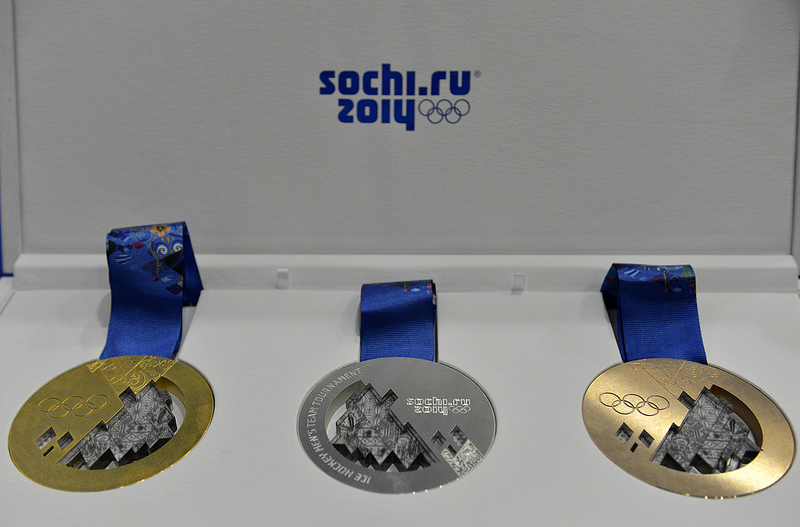
The medals to be handed out at Sochi were unveiled for the first time on Thursday. (IOC photo.)
In Saint Petersburg, Russia, on Thursday, the Sochi Organizing Committee unveiled the medals that will grace the winner’s necks at the upcoming 2014 Olympics. Reactions have been mixed, but the FasterSkier staff generally conclude that they are beautiful.
We also can’t help but take the opportunity to predict who might take home some of the hardware come February. Anything can happen over the next seven months before the Games kick off, and we don’t want to get too ahead of ourselves, but it’s not inconceivable that a few medals could be coming back to the U.S. and Canada from the nordic disciplines next winter.
And what medals they are: the large, circular design plays with positive and negative space, with a cutout section featuring a polycarbonate “patchwork” of designs from different regions and cultures of Russia. The gold, silver, and bronze portions themselves were described as tributes to the Sochi landscape of mountains and sunlight, and the coast of the Black Sea.
(The goodwill and excitement from the unveiling ceremony was marred somewhat by an announcement from Boris Nemtsov, a former deputy prime minister who is now an opposition figure and critic of the Kremlin. He estimated that as much as $30 billion of cost overruns for the Olympics could be due to corruption and urged Russian ministries to investigate fully, according to the Associated Press.)
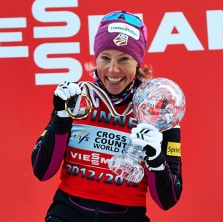
So how many of these gorgeous creations are likely to come back to North America when all is said and done? Before we break it down by event, let’s reflect back on four years ago. In Vancouver, women’s ski jumping was not on the schedule, the U.S. women’s cross country team wasn’t as deep, Kikkan Randall hadn’t yet won a crystal globe, the U.S. men’s nordic combined team had never won an Olympic medal, Jean Philippe Le Guellec hadn’t became the first Canadian man to win a biathlon World Cup and Tim Burke hadn’t became the first American to stand on the World Championships podium in decades. It’s been said many times already, but we’ll say it again: we’ve come a long way.
Let’s cut to the chase: by our calculations, it wouldn’t be at all surprising if four medals came back to North America. If everything went perfectly? North America could be seeing as many as eleven of those beauties flying back across the Atlantic to inspire many more generations of nordic enthusiasts. To understand how this might happen, let’s look at each event.
Opening Weekend
After Opening Ceremonies on Friday, February 7, the first weekend will be an exciting kickoff for nordic sports: there are two days of ski racing, with the 15 k and 30 k skiathlons, and two of biathlon, with the 10 and 7.5 k sprints. Those take place at the Laura venue, but over at RusSki Gorki men’s normal hill jumping will also be contested. Likelihood of North American medals there: zilch.
Jean Phillipe Le Guellec: sprint champion? He was this past season in Ostersund.
In the skiathlons, there’s potential. They certainly aren’t the events where Americans or Canadians are considered favorites, yet there are definite possibilities. The Canadian men probably have the best shot of taking home a medal. Devon Kershaw, Alex Harvey, Ivan Babikov, or Lenny Valjas could conceivably all be in the mix late in the race, and Kershaw, Harvey, and Valjas have all demonstrated strong finishing kicks at the end of long races when it counts. The U.S. women are slightly less likely to score, but Liz Stephen or any of her teammates have an outside shot.
On the biathlon side of things, Canada’s Jean Phillipe Le Guellec or Americans Tim Burke or Lowell Bailey could all conceivably be in the mix. Le Guellec was sixth in this event in Vancouver, and took home his first World Cup win in the discipline this season. Burke had a podium near-miss this season in the sprint as well, although it doesn’t seem to be his best discipline.
Medal haul: 0-1.
Week One, Early
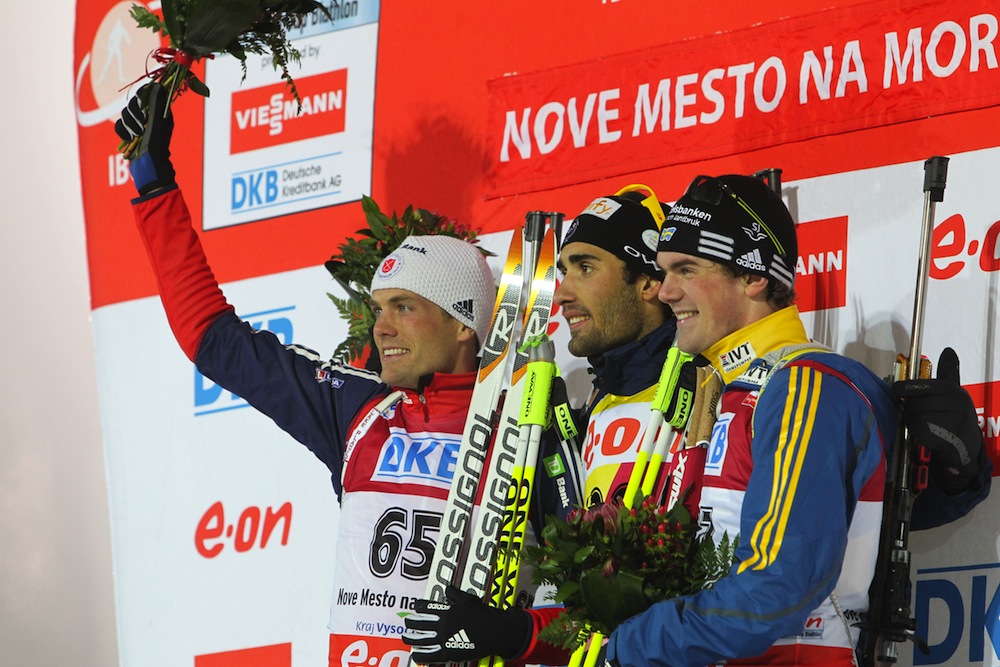
For most sports, back to back medals events on the opening weekend means a break is in the schedule. For biathlon, that’s not true. On Monday and Tuesday the racers head straight into the 12.5 and 10 k pursuit races, based on the time gaps from the sprint results. Here, again, the three North American men have a shot, and all have proved that they have the ability to gain ground in the pursuit. In fact, Bailey and Le Guellec were two of the biggest movers in this season’s Nove Mesto championship pursuit. Even if they struggle in the sprint, the trio could easily hit the top ten or fifteen; with a good sprint, anything is possible.
Sarah Hendrickson hopes to continue her run.
But the biggest day for North American nordic sports at the Games might easily come on Tuesday, which will feature not only the women’s biathlon pursuit but both the men’s and women’s cross country sprints and the women’s normal hill for ski jumping. Based on Sarah Hendrickson’s domination of the women’s ski jumping scene this winter, and the fact that plenty of other U.S. ladies have had success as well, such as former World Champ Lindsey Van, a medal seems inevitable – hopefully, a gold one, as women’s ski jumping finally wins its long-fought battle to make it onto the Olympic program.
In the cross country sprints, fireworks are most likely to come from the women, too. The sprints are skating, which is a perfect fit for defending two-time Sprint Cup champion Kikkan Randall of the U.S. Of course, sprinting is notoriously risky, as was seen at the 2011 World Championships in Oslo where Randall was expected to at least make the final but was tripped up in a collision with a Swedish racer.
So it’s tough to make guarantees in this discipline. But Randall is a hands-down favorite for a medal, at this point even for a gold one. And, despite her off-season in 2012/13, Canada’s Chandra Crawford could be figured in the final as well, as could the several other North Americans who have appeared in World Cup finals and semifinals: Dasha Gaiazova and Perianne Jones of Canada, and Ida Sargent, Jessie Diggins, Sadie Bjornsen of the U.S. Anything can happen in sprinting, so all of these women could make the semifinals, or none of them could.
Sprint Cup winner Randall can have her cake and eat it too with a skate sprint on the Olympic schedule.
In the men’s sprints, look for Andy Newell in the final. After all, he qualified for the heats in every single sprint of the 2013 World Cup season, and enough finals to land him in fifth place in the Sprint Cup. But also look for the Canadian men. Although they were certainly less consistent in their sprinting prowess – none are specialists to Newell’s degree, and had other races to focus on – they have the chops, and Alex Harvey won the bronze medal at 2013 World Championships. He or teammates Kershaw or Valjas could also appear in the final or on the podium.
Biathletes, skiers, and jumpers will have a break on Wednesday as the combiners take over with the normal hill competition. At this point it’s unclear whether the American heroes of the Vancouver Games have the mettle to pick up more medals; Billy Demong, for instance, is 33 years old and didn’t make the top ten in any World Cups this season. But he’s a canny competitor and did well in some relays. Instead, the mantle is more likely to be carried by Bryan and Taylor Fletcher. Bryan had the team’s lone individual podium this season and both had several just-missed-it performances. With the incredible peaking ability the combiners demonstrated in Vancouver, it’s possible one of them will earn a medal.
Medal haul: 2-4.
Week Two, Extended Weekend
Tim Burke won silver at World Championships; can he get the U.S. its first Olympic medal? Photo: USBA/NordicFocus.
As the weekend gears up, both biathlon and skiing will feature individual races on Thursday and Friday. In biathlon, it’s probably North America’s best hope for a medal. Tim Burke won silver in the 20 k at this year’s World Championships, and also landed third in the discipline rankings. On the women’s side, Susan Dunklee placed fifth in the event at 2012 World Championships. She’s far from a medal bet at this point, but she, Burke, and Annelies Cook all had excellent performances at the World Cup tests events at the Laura venue. It could be an exciting weekend for U.S. biathlon, which is the only remaining winter Olympic sport where the U.S. has never won a medal.
The 10/15 k classic individual races will be a bit dicier for the skiers. In general, interval-start is not where North America shines. It seems likely that there will be at least a few great performances – by no means a surprise to see North Americans hit the top ten. But a medal? It seems like a stretch, especially since the more all-around athletes may not even start.
Then, the weekend itself. Saturday will feature the men’s normal hill jumping event, another throwaway for North American hopes. But it will also see the women’s 4 x 5 k cross country relay, where the American women have a real chance for a medal. They already have a World Cup podium, and finished fourth at World Championships. It will definitely be a focus for the team.
Sunday brings the men’s 4 x 10 k relay, where the U.S. will likely be out of the picture but Canada is almost sure to be in the lead pack at some point in the race – for how long, who knows. The relay has not been a huge focus for the team in World Cup racing in the past few years, so it will be interesting to see how things come together.
Finally, the men’s biathlon field will race 15 k in the mass start, arguably the most exciting race format. Because the field is limited to just 30 racers, it’s hard to know how many North Americans will even get to put on a bib. But based on the past two seasons, it seems fair to guess that Burke and Bailey will be out there working and, it seems, probably making an appearance at the front. Can the pull through all the way to the finish? Who knows.
Medal haul: 0-2.
Week Two
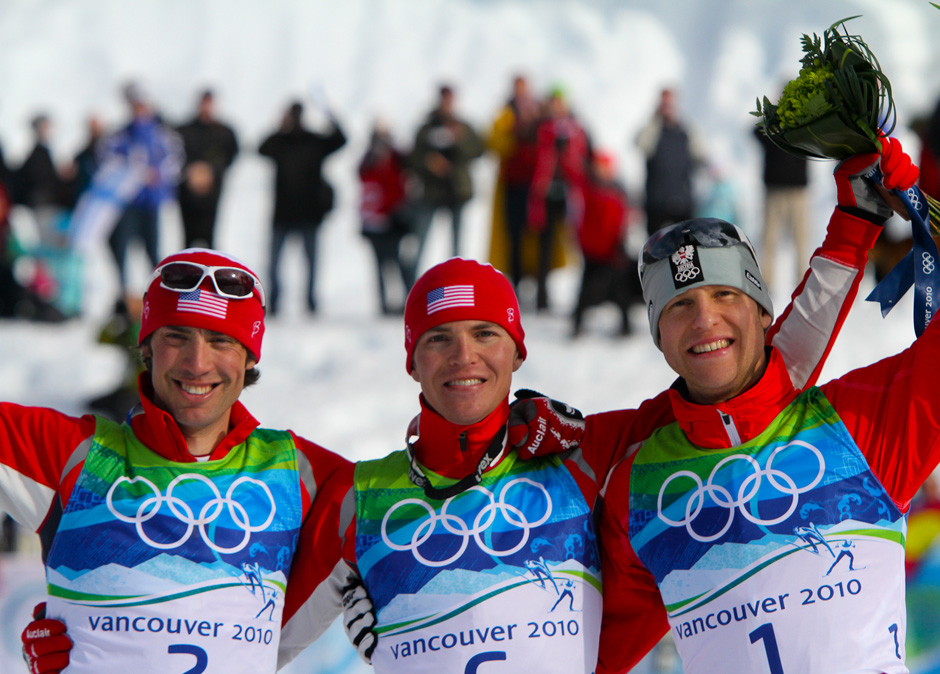
The U.S. earned two medals in the Large Hill competition in Vancouver, from Johnny Spillane and Billy Demong.
At this point in the Olympics, recovery will become essential. Some skiers and biathletes will have already competed in four events. On Monday, the biathlon women will take to the mats for their own mass start. This season, Rosanna Crawford made a single mass start appearance for Canada, finishing 22nd, and no Americans made the cut. Medals here are unlikely, as they will be that night at the men’s large hill ski jumping competition.
Tuesday and Thursday feature nordic combined, with the large hill and team large hill formats. There’s an outside chance of a medal in each. The United States took bronze in the event four-man event at 2013 World Championships, and silver back at the 2010 Olympics. Nothing is guaranteed, but they seem to have the capacity to do it again.
In between the two days of nordic combined are more team events. Biathlon will have the mixed relay on Wendesday, where the U.S. is capable of a medal-caliber performance but has not delivered in any World Cup or World Championship races so far.
Jessie Diggins and Kikkan Randall are defending World Champions.
Both the men’s and women’s team sprints are also on Wednesday, and for cross country skiers it could be a bonanza. The U.S. duo of Kikkan Randall and Jessie Diggins are defending World Champions; the Canadian pair of Devon Kershaw and Alex Harvey won the title in the edition before that. But each team is so strong in sprinting that it’s not even certain that those four individuals will be the ones to earn starts. To put it bluntly, it would be a shock if between the two of them, at least one set of medals didn’t head back across the Atlantic – and the possibility of double gold, though unlikely given the ups and downs of sprint racing, is what North American ski dreams are made of.
The complementary teams, though – the U.S. men and the Canadian women – certainly can’t be counted out. Canada will have to pick a team from the trio of Chandra Crawford, Dasha Gaiazova, and Perianne Jones, and the ladies have had their podium moments on the World Cup as well as disappointments. They should at least make the final. The American team is expected to be Andy Newell and Simi Hamilton, who have likewise had a variety of results. They, too, ought to make the final, especially in the Olympic format where each country is allowed only one team, unlike on the World Cup.
Medal haul: 2-3.
Last Chance Weekend
By the time the last weekend rolls around, jumping and combined will be finished. All that remain will be the most prestigious events for biathlon and skiing.
On Friday, biathlon will begin its final rundown with the women’s relay. Unfortunately, neither the U.S. nor Canada have the depth to figure at the front of the race. Come Saturday, however, the U.S. men may have a fighting chance. They have had top-six relay finishes in the past and are often in podium position at the halfway point. Perhaps Olympic courage and the thrill of the moment will finally send them towards a medal, although the competition will never be fiercer.
Alex Harvey and Ivan Babikov will have their last chances in the 50 k skate.
For skiing, the capstones will be the women’s 30 k skate on Saturday and the men’s 50 k skate on Sunday. The U.S. can pin its hopes on Liz Stephen, Noah Hoffman, and Kris Freeman. None are guarantees, but it’s possible – just possible – that they could land a bronze. None lack the guts, and the tough courses suit Stephen and Hoffman’s light builds and high pain thresholds well. Both young racers have been on an upward trajectory, but they would need everything to go perfectly.
For Canada, as in several other races, it’s probably less a question of whether there will be a man at the front, but who. Ivan Babikov is strongest in skating and excels on the toughest of courses – and Laura is one tough venue. But Kershaw (if he gets over his 2013 slump) and Harvey could be in the mix too. It’s easy to forget, given the sprint World Championships medals Harvey has accumulated, that one of his first major appearances on the World Cup circuit was in the Holmenkollen 50 k. In Vancouver, Kershaw was fifth in the classic 50 k. Don’t count Canada out.
Medal haul: 1 (we’re overcome with the Olympic spirit: optimism).
Total haul: (0-1) + (2-4) + (0-2) + (2-3) + 1 = 4 to 11 medals
It’s World Championships time! All of the nordic disciplines – cross country, nordic combined, and jumping – converged on Val di Fiemme, Italy, for the every-other-year festival for bragging rights.
One thing was clear right off the bat: that New Years heart scare hasn’t slowed down Norway’s Marit Bjørgen one bit. She climbed to victory in the classic sprint, besting Ida Ingemarsdotter of Sweden, then led a four-deep Norway sweep of the 15 k skiathlon. Another double winner was Nikita Kriukov of Russia, who won both the individual sprint and the freestyle team sprint along with Alexei Petukhov. Switzerland’s Dario Cologna interrupted the Russian party, winning the 30 k skiathlon for, at last, his first world title.
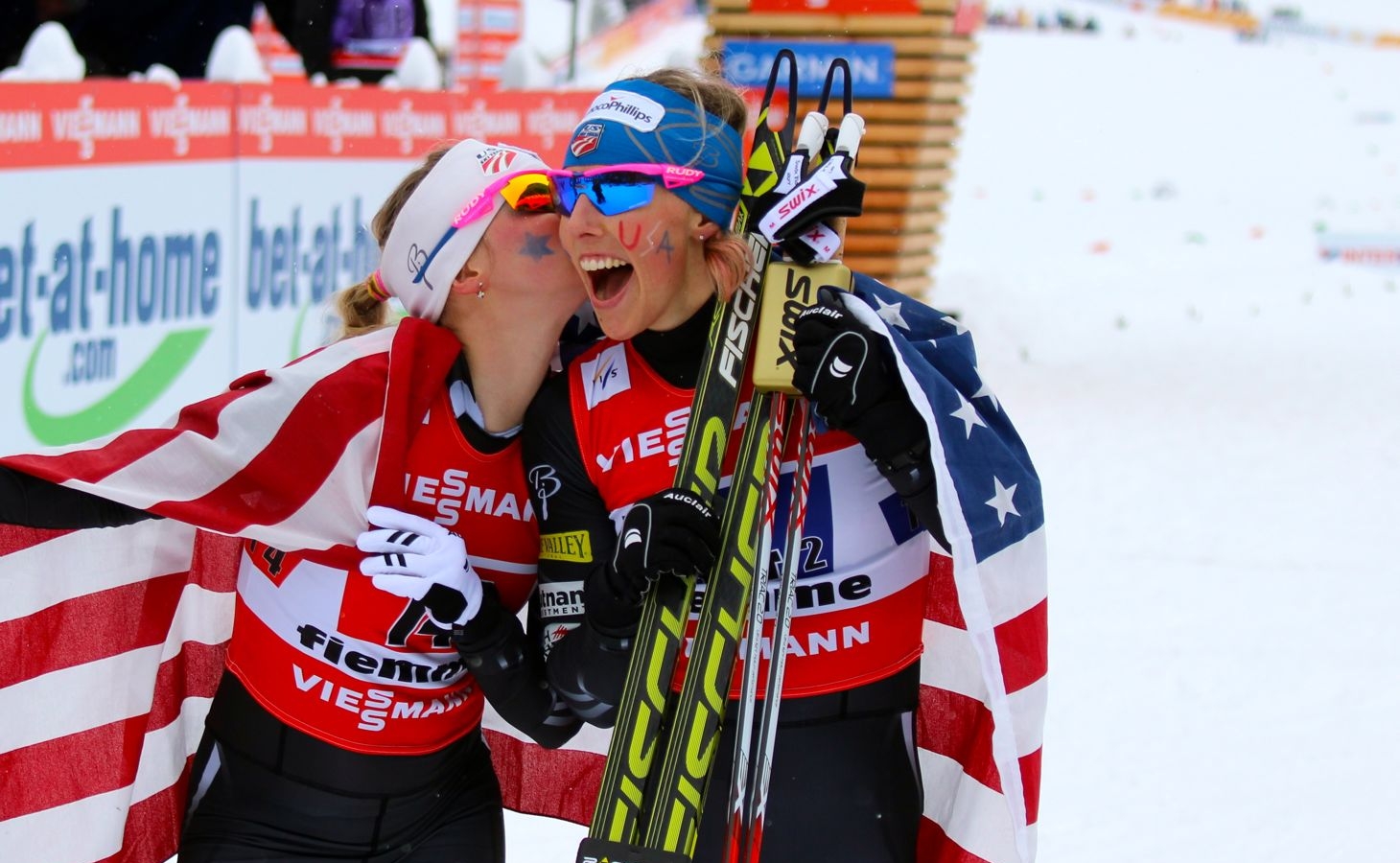
Another thing was clear, too: watch out for North America. In Thursday’s sprint Alex Harvey won Canada’s first individual World Championships medal, collecting bronze behind Kriukov and Petter Northug. A day later Lindsey Van ceded the women’s ski jumping world title to American teammate Sarah Hendrickson. Then, on Sunday, more fireworks: Kikkan Randall and Jessie Diggins skied to an incredible seven-second victory in the team sprint, and later that afternoon the American nordic combined team collected bronze in the team event, their first team medal at World Championships.
Over in the Midwest, a different sort of “championships” was taking place. The biggest ski marathon in the U.S. and the country’s entry onto the Worldloppet schedule, the American Birkebeiner traversed from Cable to Hayward. Caitlin Gregg won the second title of her career, but in the men’s race the U.S. squad missed out on the prize money as an Italian team controlled the race from start to finish and Sergio Bonaldi edged teammate and former Birkie champ Fabio Santus for the win.
A lot of other high-level racing was happening around the world too; all three U.S. college divisions hosted their regional championships, with competitions hosted at Bohart Ranch in Bozeman, by Michigan Tech in Houghton, and by Bates College in Rumford. U.S. juniors competed in Norway; U.S. and Canadian junior and senior biathletes raced at Open European Championships in Bansko, Bulgaria. We’ll have a NorAm report up soon from Western Canadian Championships, as well as coverage from at least a couple of these other races. Results are listed below regardless.
PARK CITY, UT–November 5, 2012—In a joint agreement announced today USA Ski Jumping and Ski Jumping Canada announced they have reached an innovative agreement to pool coaching resources and other related programs to form an alliance as the FIS World Cup ski jumping season beckons.
USA Ski Jumping CEO Jeff Hastings said today in making the announcement…”the Canadian program faces all the same challenges that we do–they’re small with limited resources and are based 5,000 miles away from the sport’s nerve center which makes it all the more expensive to fund a competitive program. The partnership we’re forging will help both programs make the most of those precious resources. We’ll be able to climb on each others shoulders both financially and competitively. It’s going to provide an enormous lift to both programs.”
Brent Morrice, the chairman of Ski Jumping Canada said that the U.S.A. and Canada have been working together for many years and the new concept was the culminations of those efforts. “In Canada we cheer as the U.S. jumpers win internationally, and the American community cheers just as loudly when Canadian athletes win and compete with the best in the world. Now, we have a formal agreement to maximize our expertise and give the North American jumping community everything our combined organizations can give them. We will work with a common goal which is to get North American ski jumping athletes on the podium in 2014 and 2018”, he said.
While both teams will continue to represent their own nations, coaching and traveling will be but one area where the agreement will help streamline operations. In addition, both nations will benefit from the consistent coaching, Hastings added.
USA coach Clint Jones (Park City, UT) will oversee the coaching efforts on the international scene. Jones is no stranger to the Canadian program having worked for them during the 2010 Olympic Winter Games in Vancouver. Canadian coach Gregor Linseg will shift his duties now to oversee the Canadian women’s program and will support Jones whenever both teams compete at the same venue. In addition, according to Linseg…”we have hired former Swedish coach Hartmann Wolfgang to coach some of the men’s COC events with our development team in Canada, he will be joining us in Park City soon to meet both teams and get familiar with the “Team North America” concept. We are very pleased with the way everything has come together.”
USASJ Athletic Director Alan Johnson said the innovative concept exemplifies the spirit of cooperation. “Our programs have always enjoyed close ties–and both programs have very limited financial resources. It only makes sense to combine those resources at as many levels as possible in order to optimize the quality of our programming which will allow our athletes to succeed.” The new plan will take place immediately.
PARK CITY, UT–October 24, 2012–In an announcement made today by USA Ski Jumping’s CEO Jeff Hastings, two members of the USASJ squad have been elevated to “A” Team membership. Based upon their Grand Prix performances this Summer Peter Frenette (Saranac Lake, NY) and Anders Johnson (Park City, UT) will be named immediately to the top team.
In making the announcement today Hastings–a 1984 U.S.A. Olympian, who was fourth in Sarajevo– said he was delighted by the progress both ski jumpers have made. “Anders and Peter’s performances this Summer and Fall have been really impressive and very much a validation for the program. Their results have provided a great financial boost to the program as USA Ski Jumping is now qualified to have two paid athletes and a coach at every World Cup event this Winter. Having two skiers performing at this level provides an enormous boost to the younger skiers in the U.S.A., as well. They get a picture of what they need to be doing and gain confidence that it’s possible. In a mind game like ski jumping, this kind of contact is critical. You need that first group to break through which breaks a path for others to follow”, Hastings said.
USASJ Athletic Director Alan Johnson said from the USASJ headquarters in Park City, UT today that the pair really stepped it up during the Summer. “Athletes earn a position on the “A” Team by either scoring Grand Prix or World Cup points or a top 10 in an international Continental Cup event. We are very pleased to have two athletes achieve this level in the first period of competition. We are on track with our goals at this point and very excited about the start of the second period in Lillehammer, Norway. These results will go a long way in helping USASJ athletes earn quota spots for the 2014 Olympic Winter Games in Sochi.” U.S. coach Clint Jones will travel with Johnson and Frenette this Winter.
The first FIS World Cup will get underway in Lillehammer, Norway in one month. The U.S.A. squad will assemble in Park City, UT soon for an intensive one-month camp, prior to the start of the competitive season.
PARK CITY, UTAH — Women ski jumpers will vie this weekend for the top spot in the nation at the U.S. Ski Jumping and Nordic Combined Championships in Utah. Jumper Jessica Jerome, last year’s large hill champion, is aiming for her ninth U.S. title.
“It’s always nice to have U.S. Championships on our home hill,” Jerome said. “I am really looking forward to this weekend and getting back into the competition mode.”
The 2013 title events – held during the summer for the fifth consecutive year – will take place Saturday and Sunday on the 2002 Olympic venues including the Utah Olympic Park ski jumps in Park City as well as the Soldier Hollow cross country trails near Midway.
“The mid-summer competitions are great because there is a bridge between spring (March) and fall competitions leading into the winter competition months,” said Women’s Coach Alan Alborn. “It is good to keep the athletes in touch with the pressures and time frames that competition inherently presents.”
Also this week, the Park City Nordic Ski Club will host its 14th annual Springer Tournee — an event that attracts development athletes from around the nation.
“I’ve already seen more young girls out here from all over the country than I ever have before. It’s awesome that more jumpers are coming up and are able to make the trip out here to compete,” Jerome said.
Alborn attributes the increased number of competitive jumpers and the overall higher level of athlete skill in large part to the inclusion of a women’s individual ski jumping event in 2014 Sochi Olympic Winter Games.
“The intensity and motivation has gone up quite a bit,” he said.
Sarah Hendrickson, 2012 World Cup champion, and Lindsey Van, 2009 World Champion, will both sit out the event recovering from planned off-season knee surgeries.
SCHEDULE
Saturday, Aug. 4
8 a.m. – U.S. Ski Jumping and Nordic Combined Championships (HS134-large hill)
8 a.m. – U.S. Ski Jumping Championships (HS100-normal hill)
The Visa Women’s Ski Jumping Team is sponsored and organized by Women’s Ski Jumping USA, a 501c3 nonprofit foundation. To learn more, go to www.wsjusa.com.
For the fifth-straight year, the U.S. Ski Jumping and Nordic Combined Championships are about to take place in the middle of summer with events Saturday and Sunday in Park City, Utah.
U.S. Nordic Combined teammates working out during a June training camp in Park City, Utah. Defending national champion Billy Demong (c) is seeking his ninth U.S. title at the U.S. Ski Jumping and Nordic Combined Championships this weekend in Park City. Johnny Spillane (l) was last year’s runner-up at nationals, and Bryan Fletcher (r) placed third. (Dave Jarrett courtesy photo)
The nation’s best, including defending champions Billy Demong and Jessica Jerome, will descend on the Utah Olympic Park ski jumps in Park City and Soldier Hollow ski area in Midway for two days of dryland competition, according to the USSA website.
Here’s what you need to know about this weekend’s nationals:
What: 2013 U.S. Ski Jumping and Nordic Combined Championships
Where: Park City
When: Aug. 4-5 (Ski jumping starts at 8 a.m. Saturday; nordic-combined rollerski final at 1 p.m. Saturday)
Favorites:
Demong, an Olympic gold medalist and eight-time national champion who won last year’s nationals in Fox River Grove, Ill.
Jerome, who also has eight U.S. titles and won on the large hill last year.
Peter Frenette of Saranac Lake, N.Y, large-hill defending champion with three national titles to his name and two top-10 finishes in FIS Continental Cups this summer
Anders Johnson of Park City, who won the normal-hill title last year and has three Continental Cup top-20s this summer
Of note: The reigning women’s ski jumping World Cup champion, Sarah Hendrickson will miss this year’s nationals along with Lindsey Van, the 2009 World Champion, to recover from planned surgeries. Hendrickson won her first U.S. title last year on the normal hill.
Todd Lodwick (second from left) after winning Sunday’s competition at the FIS Summer Grand Prix in Krasnaya Polyana near Sochi, Russia. Austrians Bernhard Gruber (l) placed second and Tomaz Druml was third. (Dave Jarrett courtesy photo)
At the biggest international competition of the summer, hardly anyone could blame the Americans if their heads weren’t totally in it.
It’s not that they weren’t focusing on nordic combined’s International Ski Federation (FIS) Summer Grand Prix. They just had a lot of other things to absorb during their first visit to Sochi, Russia.
For veteran competitors like Todd Lodwick, Johnny Spillane and Billy Demong, the new venue was a welcome change to their routine trips to the sport’s typical sites. Sure, they loved their jumps in Park City, Utah, and enjoyed getting some practice in Oberstdorf, Germany, before heading to Russia about a week ago. But sometimes, unique sights are the most stimulating.
View from the top of the 2014 Olympic ski jumping complex near Krasnaya Polyana, Russia. (USSA/Dave Jarrett photo)
The U.S. Nordic Combined team soaked up plenty last weekend at the under-construction venue near Krasnaya Polyana, about 40 kilometers northeast of Sochi. For the 2014 Olympics, the “Mountain Cluster” will host all the of the ski, snowboard and sled events (bobsled, luge and skeleton) and high-speed gondolas and trains will be in place to get people where they need to be.
Eighteen months before the Winter Games, U.S. head coach Dave Jarrett estimated there were 60,000 laborers running around, working around the clock in six-week shifts to get the job done. The Americans were only there for an extended weekend at the Summer Grand Prix (SGP) July 21-22, yet managed to capture the energy.
“I think everyone was psyched, especially the older guys,” Jarrett said on the phone from Florida, where he met his family for vacation after returning from Sochi. “It’s not every year that they get to go to a new jump or a new place. It [can be] like Groundhog Day all over again. Those guys were psyched to be somewhere new.”
The oldest member of the A-team, Lodwick, 35, did exceptionally well in the hot and humid conditions, with temperatures around 95 degrees Fahrenheit that rose higher on the newly paved rollerski track. After placing second on Saturday, Lodwick won gold at the Grand Prix on Sunday and raced the fastest time on both days.
While Lodwick couldn’t be reached for comment, Jarrett talked about his performance – more impressive considering Lodwick hadn’t competed since December of last season. The 2009 World Champion last won a race nearly two years ago at a Continental Cup in his hometown of Steamboat Springs, Colo. A five-time Olympian, Lodwick hadn’t been on the podium since the 2010 Vancouver Games, where he won silver in the team event, yet had six World Cup victories and 26 podiums to his name.
“He’s definitely a competitor,” Jarrett said. “He’s been around for a long time. I wouldn’t bet against him, but I wouldn’t have picked him to do as well as he did … on the jumping hill. I think he was really psyched and I think it gives him some motivation moving forward.”
Sochi’s nordic-combined jumps, which will be used in competitions leading up to the 2014 Winter Olympics, as seen in July. (Dave Jarrett courtesy photo)
Jarrett knew Lodwick could dominate a relatively thin Grand Prix field in the 8.8 k rollerski race, but was surprised by how well he jumped on the 140-meter large hill. On Saturday, Lodwick ranked ninth in the jump and climbed seven places in the Gundersen-start race to finish second, and Sunday, he finished fifth in the jump and landed the top spot overall.
“He’s been obviously doing a good job,” Jarrett said, adding that Lodwick hadn’t jumped as well in practice leading up to the event.
Four months ago, Jarrett wasn’t sure what Lodwick’s plans were. He essentially took last year off to remedy some pulmonary issues, and with a wife and two young children at home, Jarrett couldn’t blame him. However, with the 2014 Olympics fewer than two years away, Jarrett had a more frank discussion with Lodwick this spring.
“He and I sat down in March, and basically, I required him to make a commitment,” Jarrett said. “If he wasn’t going to commit to being a full-time athlete and good teammate, then there wasn’t going to be a place for him because he technically didn’t qualify for the team based on his results last year.”
With his sixth Olympics in sight, Lodwick chose to commit. According to his biography on the U.S. Ski and Snowboard Association (USSA) website, Lodwick said last season was a difficult because his asthma prevented him from training.
“I got down on myself and wondered if this was something I wanted to continue to do,” Lodwick said. “But this sport provides so much more to me than winning. I’m truly passionate about it. And with the staff we have and the athletes on the nordic combined team, I couldn’t ask for a better bunch of guys to work with to push the sport to the next level.”
Lodwick wasn’t the only American who shined in Sochi; Spillane and Taylor Fletcher also made the top 10 on Sunday.
Spillane, who finished seventh overall, said he was pleased with how things went at the SGP, but didn’t put too much thought into summer results.
“It really doesn’t matter at all, but the trip served its purpose for us to go there and get a feel for what it’s like over there,” Spillane said on the phone from Steamboat Springs. “As far as the competitions go, I was happy with how it went, and my goals aren’t to do well in July by any means.”
On the phone in Park City, Fletcher confirmed that his 10th place was a Grand Prix career best, but that didn’t mean a whole lot to him, either.
“It wasn’t a full field, which is kind of a bummer, but it’s good to go,” he said of the competition, which included several top jumpers from Austria and Japan, but lacked some of the best athletes from Norway and Germany. “Nonetheless it was still a good show and everybody had a good time.”
The Big Picture
Aside from testing Sochi’s new venue, the U.S. team also wanted to get its bearings before traveling to Russia again this winter. From Feb. 2-3, they’ll compete on the same large hill near Krasnaya Polyana and race a similar course.
About Taylor Fletcher and Billy Demong’s Grand Prix DQ’s:
According to Jarrett, the Grand Prix presented a good opportunity to compete at a new World Cup and Olympic venue, but he didn’t take it too seriously.
“On the jumping hill, it was clear that we certainly made improvements, which was what we were looking for,” Jarrett said.
“To have those guys ski as well as they did was a bonus, but if they were horribly slow it wasn’t going to be the end of the world either. It turned out well.”
Demong finished seventh on Saturday and was disqualified Sunday because his suit was three centimeters too loose. On Saturday, Taylor Fletcher was disqualified after the jumps because his undersuit had holes in it.
Jarrett didn’t have a problem with the Demong’s disqualification – Demong opted not to tighten his suit the night before – but he did take issue with Fletcher’s DQ.
“Taylor got disqualified because he broke an undersuit rule, an underwear rule,” Jarrett said with a laugh. “They didn’t enforce it last year. … They pick certain people to get checked every day, but the threat of being checked is there all the time.”
Regardless, Jarrett couldn’t believe he was spending so much time discussing threads, needles and bobbins.
“Now your suits basically become illegal because it becomes too big after a few jumps,” he said.
“Tongue and cheek, I joked that we ought to hire a seamstress instead of a second service guy [to travel with us]. It’s pretty stupid when a sport comes down to that. … We brought our sewing machine from Europe and those guys were sewing their suits before the competition.”
“The Grand Prix is just that; there wasn’t a lot of teams that came to Sochi,” Jarrett said. “It’s more important to just be there and jump on the jumps more so than the competition.”
In the winter, racers will have to do the full 10 kilometers on a slightly longer loop (the rollerski course was shortened to keep within maximum climbing limitations), and they’ll start and finish in the jumping flats so that spectators can watch from their stadium seats.
Another difference is that skiers probably won’t sink into the pavement like they did last weekend.
“It was so hot out that our rollerski [pole] tips were sticking; we were digging into the pavement and our wheels were running on hot, hot tar,” Fletcher said. “It’s a hard course and it’s going to [be] really challenging in the winter because everything’s going to be a little bit longer and … you’re not going to have the same speed that you have on rollerskis, I don’t think.”
Fletcher’s older brother, Bryan, tried to look beyond his results last weekend (16th on Saturday, 21st on Sunday) and envision himself competing there this winter.
“I held some hopes for the jump hill however after an extremely tough week in France for our TDF [Tour de France] camp, I knew I would be tired heading into the competitions,” Bryan wrote in an email, referring to the team’s preceding cycling camp in the French Alps. “I am not strong in extreme heat and humidity and Sochi had plenty of both.”
Outside of competition, he noted the magnitude of the development going on near Sochi, referring to the amount of construction as “astronomical.” All the snow venues will be accessed by gondolas and trains, which “could be fantastic for spectators,” he added.
According to Spillane, there weren’t a huge amount of local spectators at the Grand Prix, but that was to be expected given its location.
“The venues are not near anything; it’s a ways from the city,” he said. Taylor Fletcher estimated it took an hour and a half to drive there from Sochi.
“All the hotels are under construction so there’s nothing done,” Spillane added. “It’s pretty incredible actually.”
Before the Grand Prix competitions, the U.S. team hiked to a vantage point with former Canadian nordic-combined coach Nik Petrov, who works for the Russian Olympic Committee.
“He kind of pointed everything out up high,” Taylor Fletcher said. “We could see where everything was going, where the [athletes’] village is going to be an whatnot.”
One of the purposes of the trip was to find the best accommodations, and while their American-style hotel near their venue was suitable, they weren’t sure what other options would become available in the meantime. Jarrett felt the OC might be in a bit of a time crunch.
“It’s a big undertaking,” he said. “I guess the road from the Sochi airport up to Krasnaya Polyana, the valley where everything happens, used to take two hours to go almost 50 k’s. Now they built this high-speed highway and double-decker highway up this valley. It looks like it’s going be really nice when they get everything done, tons of hotels, tons of skiing, but we’ll see, they don’t have a lot of time. I guess they have no choice.”
***
Team photos from Sochi:
The high peaks of Krasnaya Polyana, a mountain resort near Sochi, Russia, where the 2014 Olympics will take place. (Taylor Fletcher photo)
A view of the valley in Krasnaya Polyana, where the 2014 Olympic snow sports will take place at the “Mountain Cluster” venue about 50 kilometers northeast of Sochi, Russia. (Taylor Fletcher photo)
During a hike near Krasnaya Polyana, Russia, the U.S. Nordic Combined team took some photos of the 2014 Olympic nordic combined and jumping venue in the valley below. (Dave Jarrett photo)
Hanging out on the rocky beaches of the Black Sea on the coast of Sochi. (Dave Jarrett photo)
Warming up on the rollerski course at the nordic-combined venue in Krasnaya Polyana near Sochi, Russia. (Dave Jarrett photo)
Switchbacks a-plenty at the rollerski course at the nordic-combined venue in Krasnaya Polyana near Sochi, Russia. (Dave Jarrett photo)
The runner-up on Day 1 of the FIS Summer Grand Prix in Sochi on Saturday, American Todd Lodwick (l) stands on the podium with Austrian winner Bernhard Gruber (c) and Akito Watabe of Japan (r). (Dave Jarrett photo)
The big downhill on the rollerski course at the nordic-combined venue in Krasnaya Polyana near Sochi, Russia.
Sochi’s nordic-combined jumps, which will be used in competitions leading up to the 2014 Winter Olympics, as seen in July. (Dave Jarrett photo)
View from the top of the 2014 Olympic ski jumping complex near Krasnaya Polyana, Russia. (USSA/Dave Jarrett photo)
Looking down at Sochi’s nordic-combined venue in Krasnaya Polyana, Russia, during a hike in late July 2012. (Taylor Fletcher photo)
Top of the 140-meter large hill at the nordic-combined and ski jumping venue in Krasnaya Polyana near Sochi, Russia. (Taylor Fletcher photo)
Todd Lodwick (second from left) after winning Sunday’s competition at the FIS Summer Grand Prix in Krasnaya Polyana near Sochi, Russia. Austrians Bernhard Gruber (l) placed second and Tomaz Druml was third. (USSA/Dave Jarrett courtesy photo)
Somehow that word just doesn’t evoke visions of soaring ski jumpers or cross country skiers battling for position coming down to the final lanes of a race. But, nonetheless, the FIS (International Ski Federation) had awarded the annual World Jr. Championships for all the Nordic events to Erzurum, Turkey for 2012.
Earlier in the winter the National Training Group of the US Nordic Combined team had traveled nine time zones to this sprawling, university city located in eastern Turkey. They have lived and trained in Steamboat Springs, Colorado for well over two years together, pushing and exhorting each other to excel, both in cross country and in ski jumping. However each jump hill has its own character, its own “feel”. So, for these athletes who would return a month later for their most important competition of the winter, their January competition at a Continental Cup (the World Cup “B” tour) was a critical component to that success. Under the tutelage of Czech-born Martin Bayer and US Olympian, Kerry Lynch, the small group had set its sights for a strong performance.
In January, Adam Loomis from Eau Claire Wisconsin had scored very well in both events. He scored his personal best COC with a 5th place, then followed it up with an 11th place the following day. Michael Ward, from Aspen, Colorado was well back in the field the first day, but skiing with Adam much of the second race, he then scored his personal best with a 13th place. Erik Lynch, from Steamboat Springs, had strong practice jumps, but didn’t perform to his best, with finishes of 31st and 41st. Cliff Field, also from Steamboat, jumped well, but also struggled in the cross country portion, finishing 29th the second day. Tyler Smith from Park City raced the first event, but finished a disappointing 42nd. For the team, the early trip to Erzurum was both a success, competitively, but also from an acclimation and familiarization aspect.
To know the food and the customs, the language and the venue sites…these are intangible elements that can make or break an athlete when the big event in “on”. Competing at a Continental Cup has its pressures, but for three out of four of the young men, the World Junior Championships would be their last at the international Junior level. Loomis, Ward and Field were all born in 1992, so next year they will move on to the senior ranks. Only Lynch, at 17, will have two more years at the junior level.
The Big Event
Temperatures had plummeted all over central Europe, and it had also in eastern Turkey, headwaters for the Euphrates river. In January the team had seen little snow, both on the jump hills towering over Erzurum, and on the ski trails 45 kilometers west of the city in a small hamlet named Kandilli. In mid February, when over 18 nations sent their best Nordic skiers to Turkey, the snow blanketed the mostly tree-barren landscapes. Luckily the jump hill inrun was of the latest design: a frost-rail system that was, in effect, two channels of ice, covered each night to prevent any snow from changing the consistent speed and superior condition of the track. The cross country trails, however, skied like Styrofoam, frighteningly slow but fairly easy for which to wax. The trick was in choosing the right flex of skis, and the optimal base preparation.
Feb 22
The first competition for the combined athletes was the Normal hill (K90) and the 10 kilometer ski race. With temperatures hovering at 5 degrees Fahrenheit the jump competition went off in Swiss-like clockwork. First for the Americans was Cliff Field, who soared 97 meters, and 116 points, which placed him at the intermediate position of 7th. Next up was Loomis, and he was not happy with his jump of 89.5 meters, or 98.5points. Ward, too, fared poorly with a jump of 85 meters, and 89 points. Lynch was seeded in the final grouping, and he jumped to 90.5 meters, which put him at 100.5 points. Coverting the points to “time back”, using the Gunderson method, the boys would start behind the top German, Christian Arlt, :32, 1:34, 1:42, 2:20 seconds respectively for Field, Lynch, Loomis and Ward.
Arriving at Kandilli about an hour later, the athletes found that Kerry Lynch was confident with the wax, and hopeful of a strong skate race. The 10 kilometer course consisted of 4 laps of a brutal 2.5 kilometer course that looked more like Tour de France hill climb and had a long, frostbite-decent back to the stadium. Only Loomis on this day would finish in the top 15, battling his way through the traffic jams of colorful skiers, finishing at 12th place, with the 3rd fastest time of the day. Ward had the 11th fastest time, which only brought him up to 26th place. Field, even though he had the advantage of a strong jump, was not able to hold on to the many skiers that skated by, finishing at 35th. Lynch, battling a flu bug, came in at 41st place. For the Americans it was a lesson of not jumping well enough to be “in the hunt” on the cross country course. The other countries like Italy, Germany, Norway, Austria were just too strong in both disciplines, placing 2,4,2 and 2 men respectively in the top fifteen.
On the 24th of February almost identical weather conditions prevailed: Cold, clear and barely a breeze. On this day the Americans showed that they could jump, as the team scores were tallied with each competitor. Loomis jumped 93 meters, Ward flew 94.5, Lynch soared 100, and Field laid down a jump of 96 meters. Their team score was 454.5 points, just 56 seconds from the first place team of Germany. Norway was close behind at second, Finland third and Austria fourth. It was the best intermediate team jumping score in many years for the United States.
Out at the Kandilli center, Noah Hoffman, the top U23 skier for the U.S. was having his best finish ever at 15 Kilometers. He finished a whopping 2nd place….and he set the stage for his hometown teammate, Michael Ward, who lead off the Nordic combined team in the afternoon. Skiing with a passion much like Loomis in the 10K, Ward skated a blistering pace in the first leg, skiing the fastest leg, bringing the US boys from 7th place to 4th, which turned out to be the second fastest leg of all skiers for the day. However, with some fatigue and slight illness overcoming Lynch, Field and Loomis the Americans ended the day in 8th place, over 2:50 back from the first place Austrians.
The last event, the K95 and 5 kilometer event, found the Americans with two strong performances and two disappointments plagued by illness. It was a day where the official jumping round was re-started due to a huge jump 106 meter jump by Go Yamamoto, Japan’s third athlete. For Cliff Field and Michael Ward their final jumps were 96.5 and 97 meters, giving them starts of 1:12 and 1:04 seconds back from top jumper, Ilkka Herola of Finland. Lynch flew 95.5 meters, but his poor health dictated that he not race later in the afternoon. Loomis, jumped 90 meters, so he would start the cross country segment in 42nd place, 2:10 back from the leaders.
At the Kandilli race center, Ward started the race with three others that had the same score, one being World Cup skier Manuel Faisst of Germany. Faisst had skied to a second place finish in the 10 K event, so Ward cautiously slipped in behind the veteran for the first lap. The duo, joined by a strong Italian, Austrian and Russian worked their way up through the field. In the end it was Ward nipping Faisst at the finish line in 9th place, only 28 seconds back from the winner Oystein Lien of Norway. Ward had skied the 3rd fastest time of the day, and it would prove to be the best finish for an American in over 10 years in an individual event. Faisst was 10th, just .7 seconds behind Ward, and Maierhofer of Italy was .6 seconds behind Faisst. Back in the pack, Field was having a much better race as well. From his 1:12 starting position he lost only 10 seconds to the leaders, finishing at 28th place. Loomis, without the advantage of strong skiers around him and fighting illness, skied up to finish at 34th place, 2:03 back from the winner, Lein.
All in all it was a good week for the American nordic combined team. Loomis had scored early with his 12th place in the first event. Lynch had jumped well, especially in the team event. Field had jumped consistently well and skied to 28th in the last event. Ward had jumped and skied well most of the week, and his 9th place was a personal best. The Americans will finish out their 2012 European tour this next weekend with two Continental Cup events in Predazzo, Italy.
First or second in all but one World Cup competition this year, Sarah Hendrickson of Park City, Utah, capped off her historic season by clinching the overall women’s ski jumping title on Saturday in Zao, Japan.
In the first season of the women’s World Cup, 17-year-old Hendrickson was the champion. She won Saturday’s first competition with two jumps of 99.5 meters to beat Japan’s Sara Takanashi, who jumped 98.5 and 99.5 meters. Hendrickson went on to place second to Takanshi in the second round with another jump of 99.5 meters.
Hendrickson started off the inaugural World Cup season with a victory in Norway on Dec. 3. She proceeded to win six more after that.
“When I think back to Lillehammer, I never would have imagined I would win the overall title,” Hendrickson told the Associated Press. “But I was able to get seven wins and that was a result of being able to jump with the same mental attitude that I had in training.”
She told FIS News that she understood the significance of the overall World Cup win, especially in regards to the growth of women’s ski jumping.
“But I will need months or even years to realize what it really means,” Hendrickson said.
U.S. women’s ski jumping coach Paolo Bernardi couldn’t have picked a better athlete to win it.
“She deserves this 100 percent,” he told the Salt Lake Tribune. “She’s been the most consistent jumper all season and sometimes she dominated the events.
“She did something crazy for a 17-year-old,” Bernardi continued. “She left on Dec. 27 for two months on the road and she competed at the highest level possible. She deserves all of her achievements. It’s incredible.”
Erzurum, Turkey (Feb. 23) — Sarah Hendrickson added another title Thursday to her long list of ski jumping accomplishments — silver medalist in the 2012 Nordic Junior World Ski Championships.
In 2010 she won the bronze (the only American, male or female, to ever medal in a Junior World Championship). She began this season by winning the inaugural women’s World Cup opener in Lillehammer, Norway, and she’s the current overall leader on the World Cup circuit.
Sometimes we forget that she’s just a teenager — only having been on this planet 17 years, but long enough to make a huge impression in the winter sports world and also to feel the stress of being the best.
“This was hands down the most pressure I’ve ever felt in a competition,” said Hendrickson, of Park City, Utah after her silver-medal performance in Erzurum, Turkey. “I am super happy and very satisfied with my 2nd place.”
Hendrickson was tied after the first round with Japan’s 15-year-old sensation, Sara Takanashi. The two battled in the final round with Takanashi just edging out Hendrickson for the win by 11.5 points. Carina Vogt, of Germany, took the bronze. U.S. teammates Nina Lussi finished 29th and Nita Englund was 35th.
“Sarah and Sara (Takanashi) are the two strongest jumpers on the Earth right now. They are both shooting stars,” said Paolo Bernardi, Women’s Ski Jumping USA International Coach. “It was nice to watch a battle to win because it was such a high level of ski jumping.”
Bernardi said he was proud of his team, their performance, and their ability to handle the stress they were under this week. “Everybody stepped up (Thursday) and got their best results.”
Lussi’s and Englund’s skis weren’t delivered from the airlines until halfway through the first day of training on Tuesday, causing them to miss valuable time on the hill. The judges also adjusted the start bar frequently during training, which caused some rattled nerves for the young team. But that kind of experience is valuable, Bernardi said, and only makes athletes more mentally strong.
Lussi had a solid first jump Thursday that catapulted her into the second round. Englund, who crashed in training in September and suffered a serious concussion and cracked ribs, fought back to be healthy and confident enough to make the Junior Worlds team and have a good first jump, just missing the cut for the second round.
Hendrickson said she struggled in training this week – trying to get used to the new hill and get her head wrapped around the task at hand.
“I’m still a junior and I wanted to really focus to keep my goals set high for Junior Worlds,” she said. “Being in contention for the overall World Cup title means that some people automatically assume I will win every competition. It’s not that easy because there are great jumpers here and everyone has the same goal, and I put a lot of pressure on myself this week.
“Sara (Takanashi) jumped amazing and definitely had the best jumps on the hill Thursday and deserved the win 100 percent,” she added.
Hendrickson rose to the occasion, Bernardi said.
“It’s not easy to be on top of the world,” he said. “I’m so proud of how she handled the situation and fought back after rough training rounds to get an amazing silver-medal result.”
There is a team event on Saturday where nations (consisting of four jumpers) compete against each other. The U.S. Team will not be participating since there are just three jumpers at Junior Worlds.
The World Cup women’s tour continues March 3-4 in Zao, Japan, where there will be three comps (one comp was added to make up for an earlier cancellation in Poland). The World Cup final is set for March 9 in Oslo, Norway.
2012 Junior World Ski Jumping Championships, Individual Event
Erzurum, Turkey
Thursday, Feb. 23
Women’s Normal Hill, K95
1. Sara Takanashi, JPN, (108.5 107.5) 276.5
2. Sarah Hendrickson, USA, (105.0, 100.5) 265.0
3. Carina Vogt, GER, (102.5, 100.0) 255.5
—
29. Nina Lussi, USA, (84.0 80.5) 164.0
35. Nita Englund, USA, (79.5) 76.5
Ljubno, Slovenia — Sarah Hendrickson’s double fist-pump in the outrun is a modest show of celebration for the U.S. teen who’s been adamantly punching through the ceiling of women’s ski jumping this season.
With two more World Cup wins this weekend in Ljubno, Slovenia, she’s sitting soundly in 1st place in the overall standings. Sarah has won six out of nine World Cup events and has notched at least two hill records, including Sunday’s second-round jump of 95 meters on the challenging K85 jump in Ljubno.
“I had one of the best jumps I’ve ever had in competition and it all just came together and worked out so well,” Hendrickson said. “Technically I stayed in balance and my timing was good and in flight I kept my arms closer to my body. It was great coming over the knoll in that second jump — I knew it was good.”
Coach Paolo Bernardi said Hendrickson is going from event to event, focused on jumping her best — and focused to win. “She’s in the perfect spot now,” he said of her overall 1st-place ranking.
The Visa Women’s Ski Jumping Team is also No 1 overall — more than 437 points ahead of Germany — thanks to consistent podium, top-10 and top-20 results. Jessica Jerome, who took 5th on Saturday and 8th on Sunday, is jumping super aggressively and strong and is stepping up with more confidence, Bernardi said.
“Coming into this weekend, I knew what I needed to do in Ljubno. This hill can be challenging and there were a couple of technical things I was able to figure out and fix,” said Jerome, currently 10th in the world. “I was really happy with my results.”
Lindsey Van, ranked 3rd in the world, was 8th Saturday and 10th Sunday; Abby Hughes was 18th both days; and Alissa Johnson was 22nd and 21st. More than 3,000 spectators came out both days to watch the women jump — some of the largest crowds they’ve had so far this season.
“It’s been a long six weeks on the road and I’m looking forward to coming home to recharge and prepare for the next World Cups in Zao, Japan,” Jerome said. “Our team is doing amazing and we’re ready to finish out the season strong.”
Hendrickson, Nina Lussi and Nita Englund will compete in a Continental Cup event Feb. 18-19 in Liberec, Czech Republic in preparation for the Junior World Ski Jumping Championships on Feb. 23 in Erzurum, Turkey. The World Cup tour continues March 3-4 in Zao, Japan, where there will be three comps (one comp was added to make up for an earlier cancellation in Poland). The World Cup final is set for March 9 in Oslo, Norway.
World Cup
Ljubno, Slovenia Sunday, Feb. 12, 2012 Women’s Normal Hill, HS95, K-point 85m