From the FasterSkier archive — posts syndicated from athletes’ and coaches’ own blogs between 2004 and 2012, kept online as published. Current coverage is at fasterskier.com.

Category: US Ski Team

Information about the United States Ski Team.
  • ‘We have no films to our name’: Lars and Torsten Brinkema on how Threshold got made

    ‘We have no films to our name’: Lars and Torsten Brinkema on how Threshold got made

    This article was made possible through the generous support of our voluntary subscribers. If you value coverage like this, please support FasterSkier with a voluntary subscription.

    Torsten and Lars Brinkema were two brothers from Minneapolis with a GoPro, a film school semester between them and no feature credits at all when they talked their way into a U.S. Cross-Country Ski Team camp in Bend, Oregon, in the summer of 2023. They spent the following World Cup season inside the team, paid their own way through it, and came home with roughly 500 hours of footage. What they cut it into is Threshold, the documentary about Jessie Diggins and her eating disorder that premiered on Peacock in February and is now available to rent in the United States and Canada.

    Earlier this month we published head coach Matt Whitcomb’s account of that winter and what the team changed because of it. This is the other half: the brothers’ own version, recorded before the rental release. Torsten is 26 and lives in Brooklyn. Lars is 23 and splits his time between Minneapolis and Los Angeles. They are still working as a duo.

    Below is a transcript of the Brinkemas’ conversation with FasterSkier. It has been lightly edited and condensed for clarity. LB is Lars Brinkema, TB is Torsten Brinkema, MV is Matthew Voisin.
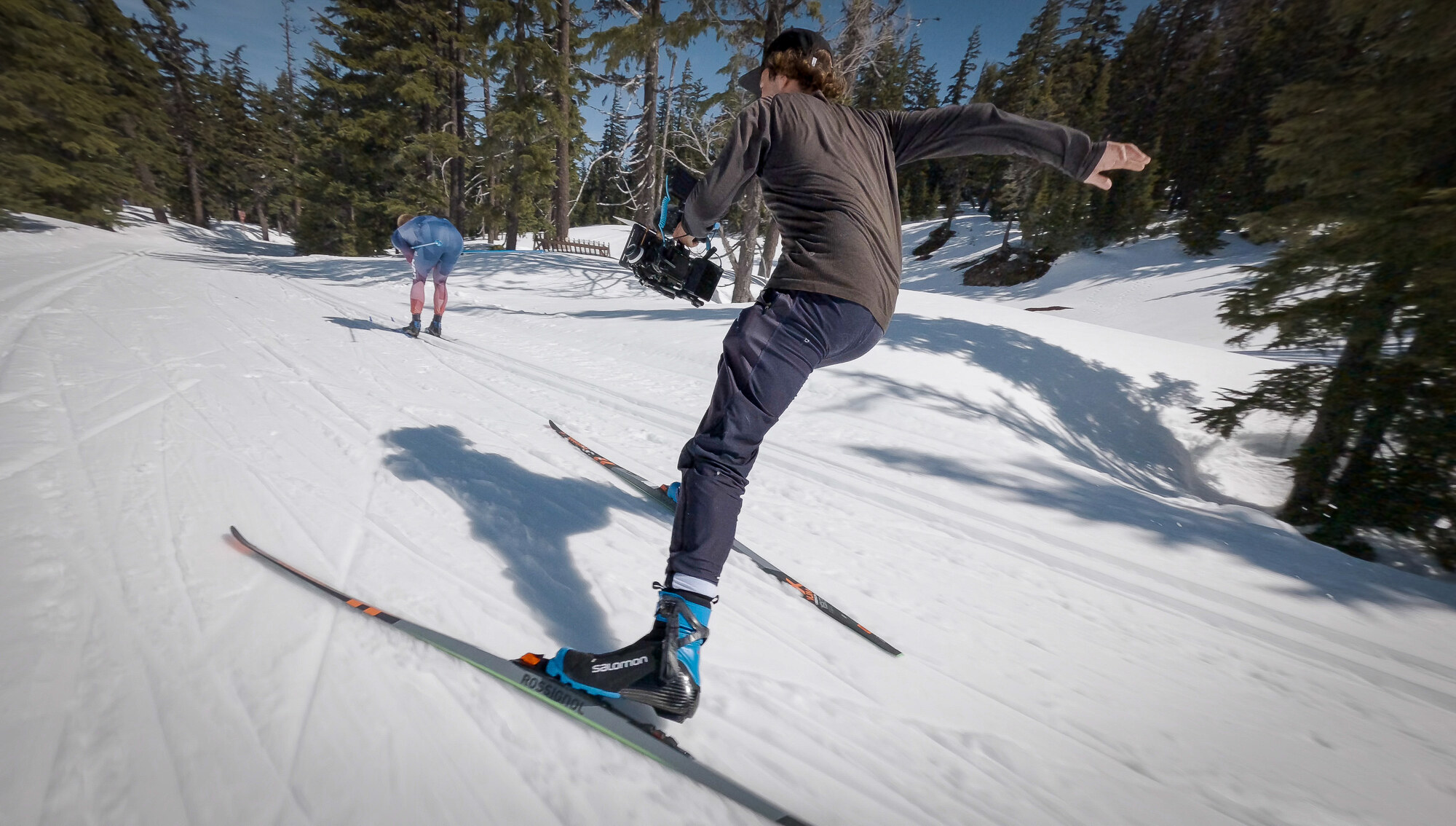
    A filmmaker mid-stride on cross country skis carrying a cinema camera rig, with an athlete skiing ahead of him on a groomed snow trail.
    Lars Brinkema filming on snow at a U.S. Ski Team camp in Bend, Oregon, chasing Jack Young up the trail. The brothers had done the workouts themselves, which is the reason the team let them near one. (Photo: Patrick Conroy)

    MV: I would love to back up a little and just hear about you two as young guys, how this all manifested.

    LB: To start at the very beginning, Torsten and I were both born in Minneapolis and grew up in that whole Minneapolis ski world. We had skis on right when we started walking. So we really grew up in the same community that Jessie had grown up in, and she was kind of just this idol that we looked up to. We both remember where we were when we were watching that gold medal race in Pyeongchang. And then fast-forward to when we were getting older, just always carrying cameras around, usually a small GoPro on our ski trips. Torsten ended up skiing for Colby College, and that is where he met Ben Ogden, racing against him on the collegiate circuit.

    TB: I got my ass kicked by Ben in most of the EISA college races. But I was always interested in shooting a lot of ski trips. I left school trying to figure out how to put those two pieces together, because I knew I was not good enough to be a professional skier, but I also wanted to capture the sport that I loved so much. It took a year of trial and error doing gigs for outdoor brands and whatnot.

    Then, when we figured out the World Cup was coming to Minneapolis, I talked with the Loppet Foundation, which is the club Lars and I grew up skiing for. I was kind of like, listen, do you guys need any promotional materials? People should be getting excited for this event that is happening at Wirth Park. I convinced them on a shoestring budget to send me to Holmenkollen in the spring of 2023. I stayed with a family friend out there, reconnected with Ben, and met a lot of the other skiers on the team. I think they were kind of surprised to have an American photographer out there with them, just because they are not getting much coverage once they leave. Ben was sort of like, we have to figure out how you guys can stick around with the team a little bit longer. It was just me at this point, but Lars was in film school. So Ben pitched Matt Whitcomb that he should invite us to their Bend, Oregon camp.

    MV: What did you think you were making at that point?

    TB: Lars and I basically bought cinema cameras and showed up at camp. We were definitely inspired by a lot of other sports documentaries at the time, niche sports finding success in that genre, people going, oh my god, look at Formula One, I have never heard of this sport before but I am really loving the series. And we were like, we could probably do something like that with skiing. Make it look really cool.

    I think the team was happy to see filmmakers who could not get in the way of their workouts. Jessie had experiences in the past with a brand interrupting an interval session, asking her to do another interval. This is just something that would never even cross Lars and my mind, to alter the workout, because we know how intense they are. We know the workouts. We have done them before. So we were kind of flies on the wall, and I think that proved our ability both as skiers and as filmmakers, to be in that documentary position and not get in the way.

    MV: What were you envisioning before it started to become more about the eating disorder and the mental health challenges?

    LB: Just bringing this sport that we grew up in and that we loved to the masses. We had seen smaller endurance sports, whether it was a YouTube channel or on Netflix, sports that we loved but not a lot of people in the U.S. tracked. And there was always this element to the successful films about sports that was more the human side of the story. We approached it very open-ended. We kept those options really open for a majority of our filming. We were still capturing when we went on the World Cup, talking to European athletes, we had some fun conversations with Klaebo on camera. We just spent every waking moment following different stories.

    I would say we were definitely, kind of subconsciously, following Jessie’s story more than others, and that just developed over the time of filming. Not until the editing process is when it really shaped. We had 500 hours of footage, so many different interviews with so many different athletes, doctors, staff on the U.S. team. And as we started to screen rough cuts to film industry people around Los Angeles and New York, we were getting so much feedback that Jessie’s story was the most resonant of all of them.

    MV: You have 500 hours, and then at some point you have to make the decision that almost all of it is hitting the cutting room floor. How do you feel your way through that?

    TB: Having an editor who had never cross-country skied before was totally instrumental in figuring out what would resonate with the wider audience we knew we had to appeal to. And there are also those moments where Lars and I were deep in the Arctic Circle, freezing our butts off, trying to get a time-lapse of the northern lights, out there for two hours and so attached to this one shot that we worked so hard for. I remember being in the cutting room and him saying, it is not serving the story, you have to cut it. Those were the things that were so hard to let go of.

    And of course all these other stories, U.S. Ski Team members, Klaebo, Emma Ribom, Pellegrino, people that we really looked up to, and all of their stories deserve to be told. But at the end of the day, when you have this Jessie story that is so compelling, you cannot really deviate from it if you want to give her story the time it deserves. At the industry screenings, Lars and I walked in with a lot of questions about what would resonate with a non-skier audience, and people just kept saying, Jessie, Jessie, we want more Jessie.
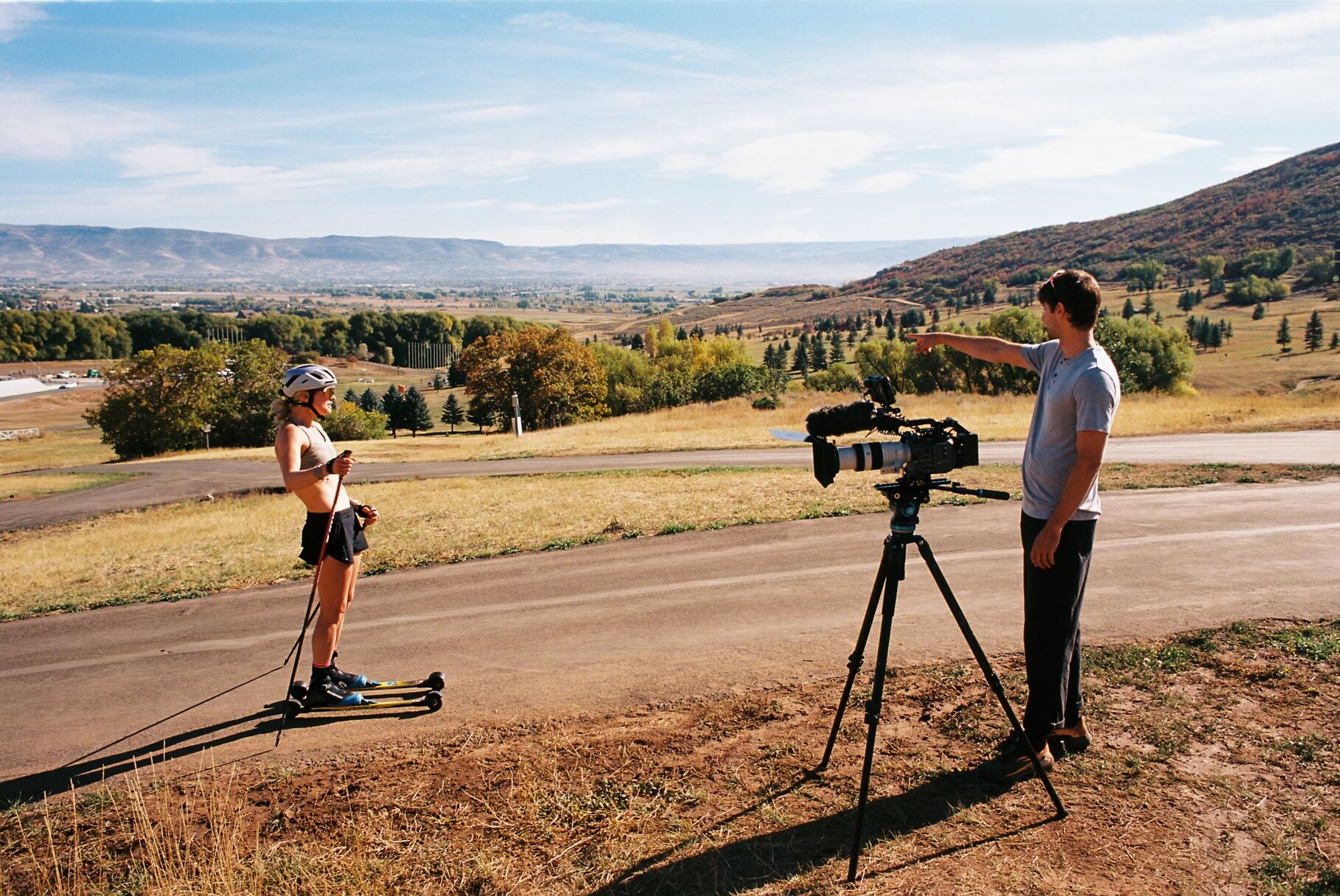
    A skier on roller skis stands on a paved path while a filmmaker directs from behind a tripod-mounted cinema camera, with a wide valley behind them.
    Jessie Diggins and Torsten Brinkema at the team’s Park City camp, in the open-ended stretch of filming before anyone knew what the story was. (Photo: Willie Maahs)

    MV: How did you get hooked up with Patrick Dempsey?

    LB: It was about six months into filming, right after the Tour de Ski, at a camp between that and the next World Cup stop. Growing up in the Midwest, we did not have any connections to the whole Hollywood world, but we definitely needed to find someone to help us get a foot in the door. So we asked Jessie if she had anyone in her directory who worked in that space. She remembered that Patrick had supported the ski team, and she was able to just send him an Instagram DM. He responded right away and said to send Torsten to his house in Maine. A couple of months later we showed up at his doorstep and pitched him on the idea. He had grown up cross-country skiing in his backyard in Maine, so he is very connected to the sport and a huge Jessie fan.

    MV: Jessie is big, but Dempsey is on another level. What was that like?

    TB: It was pretty wild. We knew this was a ticket for us into a new world that we had always hoped to get the keys to. And credit to him for inviting us over, because the roadblock we hit at every stage of this process is that we have no films to our name. We have a couple of short projects that nobody has seen. So we are asking someone with the credits that he has to trust us with nothing to see for it. Obviously Jessie’s word goes a long way with him. We had to swallow our awe of him and realize this was a huge opportunity, and tell him what we really believed: that there was a story in those 500 hours. At that point we had not really cut anything. He became a very important part of shaping it down to what it became in the end.

    MV: What other filmmakers have inspired you? What did you grow up watching?

    LB: One huge one was Jimmy Chin, especially with Free Solo. That may have been the first ever documentary I saw in a theater. This niche sport was brought to a thousand theaters across the country… such a huge story and such an interesting character. That was one of the times we were like, wow, we could bring a sport that we love to the big screen in an impactful way.

    TB: To add to that, I remember, I think it was actually while we were filming on the season, I saw a really old Herzog documentary from the 1970s called The Great Ecstasy of Woodcarver Steiner. Herzog was in his late twenties, early thirties, and he dedicated basically a whole year to following the ski jumping circuit, when it was at that really gnarly phase of people pushing the boundaries on these jumps, ending up jumping all the way to the flats, a whole bunch of drama between the jumpers and the officials. The fact that he was caught up in this story when he was around our age, and it felt like we were doing a similar thing, dropping everything to follow this circuit in unfamiliar landscapes. That just felt like, wow, if one of these great documentarians dropped everything for a ski documentary, we must be doing something right.

    MV: It is expensive to travel around Europe for a whole season, and the ski team is pretty transparent that their budget is tight. How did you make those numbers work?

    LB: We definitely had to pay our whole way through that season. There was not support from the ski team, in that they did bring us on, we were marked as members of the team crew, so we got our bibs and access to the races. But we basically had the ski team and Jessie help us find people who in the past had supported the ski team. It is not funded by the government; the ski team lives off these people who donate. So we went through their list of people who were instrumental in making sure the ski team could have success, people who paid for the wax van they use to this day. Over the course of filming we were always having to fundraise more and more money.

    Later on, when we were fine-tuning the edits, there were still a lot of payments to be made. We talked to Jessie’s sponsor, the Emily Program. That was a really cool opportunity, because now they are supporting the film, but they are also bringing it around the country to treatment centers and educational screenings.

    MV: You set out to tell a fun story and ended up helping people with something that is a real medical issue. Do you take a beat to think about that?

    TB: That is kind of the goal right now. We had a release with Peacock, which in a way felt like being viewed by this Olympic ski audience, but not everyone in the U.S. has Peacock, so right now we are figuring out how we can reach the people we did not reach in that initial release. For sure our target audience is this young group of impressionable people who are growing up either struggling with this disorder or who have people around them who have struggled with mental health. We have heard from people who have never skied before who say they were so moved by Jessie’s story. That is the biggest compliment we can get.

    It is a really hard thing to do, for her to pass one of the hardest years of her life on to us, filmmakers who had never made a film before, to then put out to the world. I remember when we showed her one of the rough cuts. She told us that this is the story her 18-year-old self desperately needed to hear. When we got her blessing, and when she said that, we took it and we ran with it, because we knew we could have that impact on countless other people who were struggling. That was a huge motivator for us.
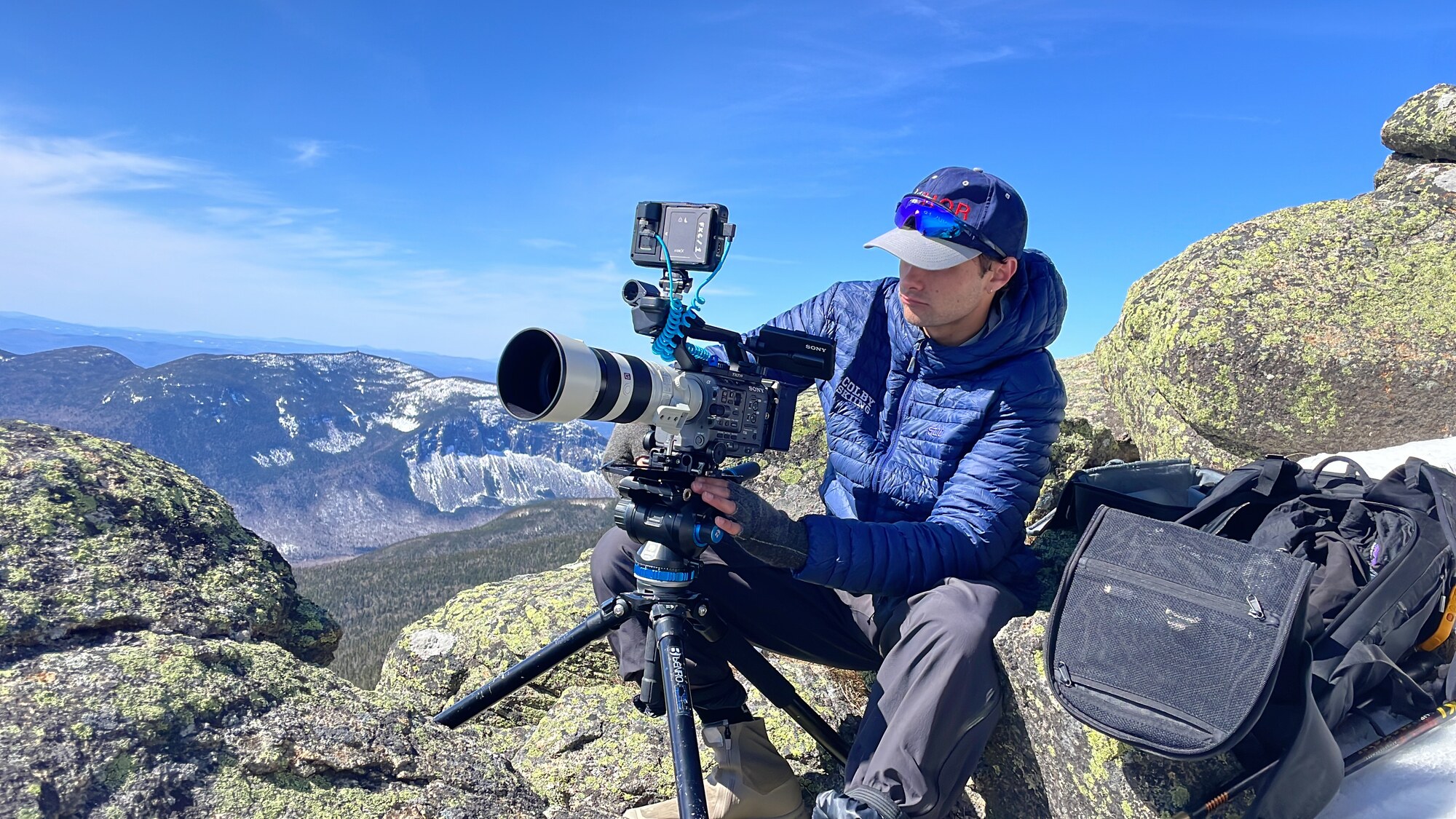
    A filmmaker sits on a rocky summit behind a tripod-mounted cinema camera with a long telephoto lens, snow-streaked mountains behind him.
    Torsten Brinkema on a summit in the White Mountains of New Hampshire in April 2024. This one never made the film either. (Photo: Brinkema Brothers)

    MV: Can you give me a specific memory from being in Europe?

    TB: Mine jumps to not a specific story, but this life on the road, which was so crazy for Lars and me. It was crazy to see the athletes, but also the staff who have done this year in, year out. It really is a wild lifestyle, packing up and going to a hotel room in the middle of nowhere in Finland, where there is light for five hours out of the day, then getting up and packing up and going to the next location in Sweden. The dedication these crews have is crazy, away from their families, away from the normal comforts of living in the States, and the fact that they repeat it every year.

    We pretty much joined every training session and filmed as much as we could, then charged the cameras and packed all the footage onto a hard drive. I always loved those nights when we were really tired, it is super dark out, there is nothing to do, and we would walk over to the wax truck and see what those guys were up to. It was always something fun. They are always blasting music, maybe having a shot of Jägermeister. I think they liked having us around because we were these young people who were totally oblivious to the waxing scene, so we could pick on whoever was not busy at the time. They had been living this life for five, ten years, and Oleg has been around, I do not want to quote how many. These guys are putting everything on the line and being away from their families to make the fastest skis in the world.

    MV: You mentioned the cameras. What was the gear you used to capture these moments?

    TB: We were rocking two Sony cameras, the FX6 and the FX3. That was a progression from, honestly, GoPros. Lars and I just loved being able to carry a camera that would not get in the way of anything, which was so important. We did a 20-mile run with Zanden, Gus, Luke and JC in Alaska, and we carried both our cameras and the drone in a backpack. We always wanted to be able to carry everything we had with only a backpack. That was the goal. In the winter we did a ton of skiing without poles, carrying those cameras, setting up a shot for a while and then skiing alongside people and trying to get it.

    The drone was another really key part of the setup, because it let us get beautiful shots of people when we could not keep up with them, which was most of the time. We could only set up these flyby shots for a 20-second clip before they sped past us. We are super proud of those shots, because it took thousands of them to get the five or six that appear in the movie of Jessie flying by in a training session. We also had to figure out how to make the cameras work in the cold, which was something we had not really experienced before. It involved a lot of hand warmers and duct tape, but we eventually figured out a system that worked even at minus five in Finland.

    MV: I have used hand warmers to keep my batteries warm too, but what is the duct tape for?

    TB: Taping the hand warmers to the battery on the camera, right on the part of the camera where the battery is.

    LB: We would have extra ones in our jacket pocket or in our pants, trying to keep them close to body heat so we could swap them out.

    MV: Lars, what stands out for you?

    LB: Just seeing the sport in Scandinavia was this insane experience. I remember the first Holmenkollen that we followed. I am sad it did not make the movie, but it was absolute mayhem. More people than are in the stadium for the Super Bowl. A hundred some thousand people in the woods watching these skiers who are going by maybe once every 20 minutes. It was not for a sprint, it was not for high impact crashes, it was just to watch these skiers go by, and they were so into it. I remember the big races in the U.S., high school meets, maybe the state meet, have a lot of people out there watching. But seeing all the young fans in Scandinavia watching this sport and being so jazzed up about it, maybe drinking a little too much during the race, it was such a cool experience that you do not get in the U.S.

    TB: It was crazy to experience that and compare it to Minneapolis. We had plenty of those fan experiences, not to the scale of Holmenkollen, seeing the Swedes, seeing the Finnish people. But then coming back to Minneapolis, everyone who was there, most of them traveling long distances, doing crazy things to be there to watch the sport they had been waiting so long to see. That was insane in its own right, because here we are almost matching the energy of Holmenkollen on the trails Lars and I grew up skiing on. We learned how to ski on the 5k Wirth course.

    Then I did a warm-up lap with Jessie before the 10k, and I started crying skiing down the sledding hill, because it was insane. The people, the roar of the crowd, traveling with her as she went around that loop. I feel like we were so blessed to be able to have that finish the movie, because it really felt like a homecoming for Jessie, and a realization of the legacy she has left, both in Minnesota and in the ski world.
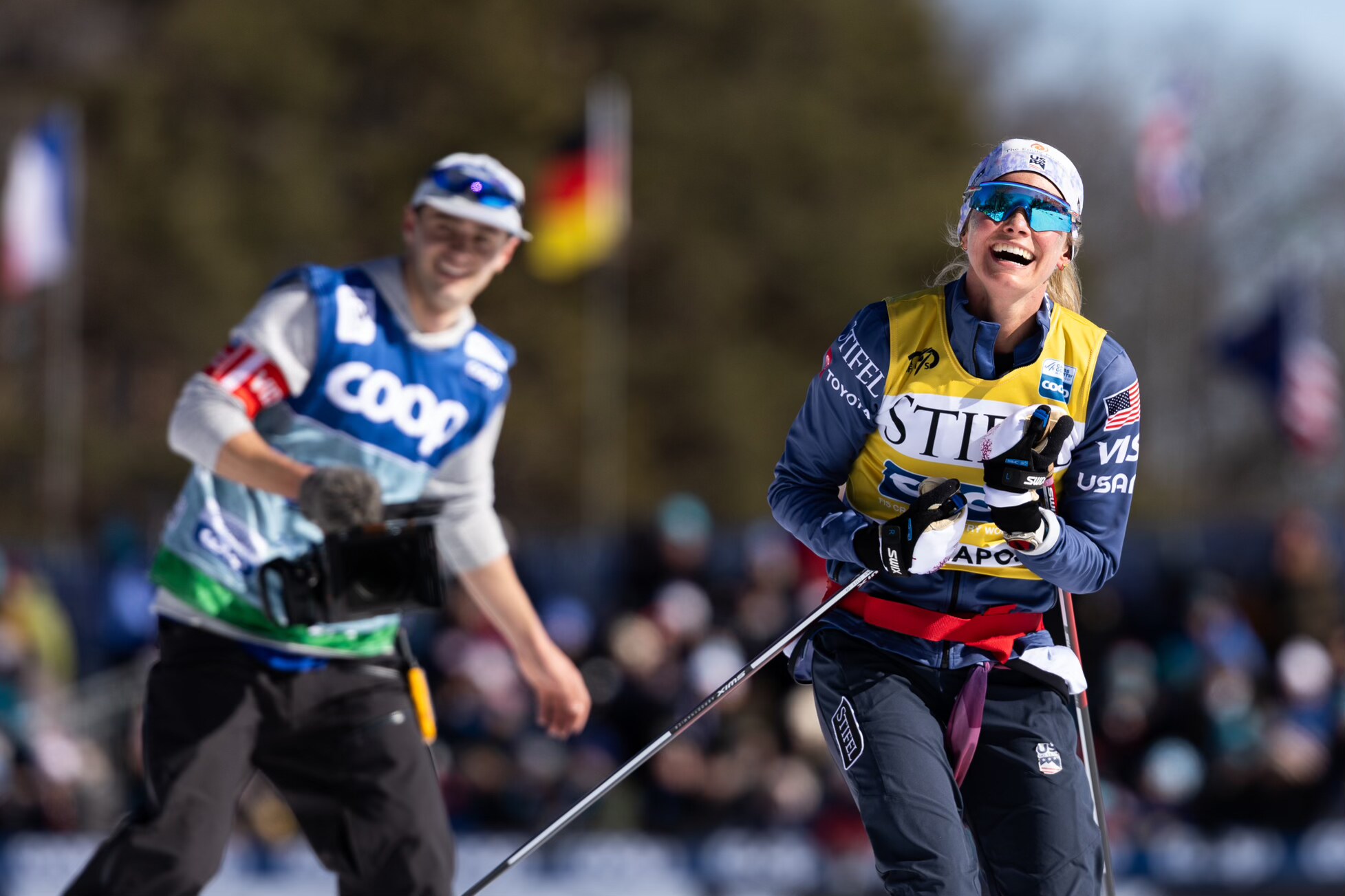
    Jessie Diggins laughs on a warm-up lap while a filmmaker in a media bib skis alongside her carrying a camera, a blurred crowd behind them.
    Torsten Brinkema, left, on the warm-up lap with Jessie Diggins before the 10-kilometer freestyle at Theodore Wirth Park in Minneapolis, February 2024. (Photo: Dustin Satloff)

    MV: What is something you are each really proud of?

    LB: Just coming into the film with such an open idea about what it could be, and that every step of the way we had trust in each other that we were going to make this happen and get it to a large audience. As Tor mentioned, we stepped into a really hard time in documentaries to get one out into the world and make an impact through film. I think we just trusted at every step of the process that we were going to figure this out. Being able to do that and show it in person in Lake Placid and Minneapolis has been such an incredible experience.

    TB: Going off of that, it felt like we were in such a unique position to tell this story. I am so proud of those POV shots we got on skis with the athletes. Again, that is the one percent of all the shots we did. But it is a crazy feeling, in a really crowded documentary landscape, to be one of a handful of people in the U.S., maybe even in the world, who can hold a cinema camera while going 30 miles an hour and pull focus and get that shot. It felt like a really proud moment just being like, wow, these turned out, and they are going to make it a better film, because you sort of feel like you are skiing with them.
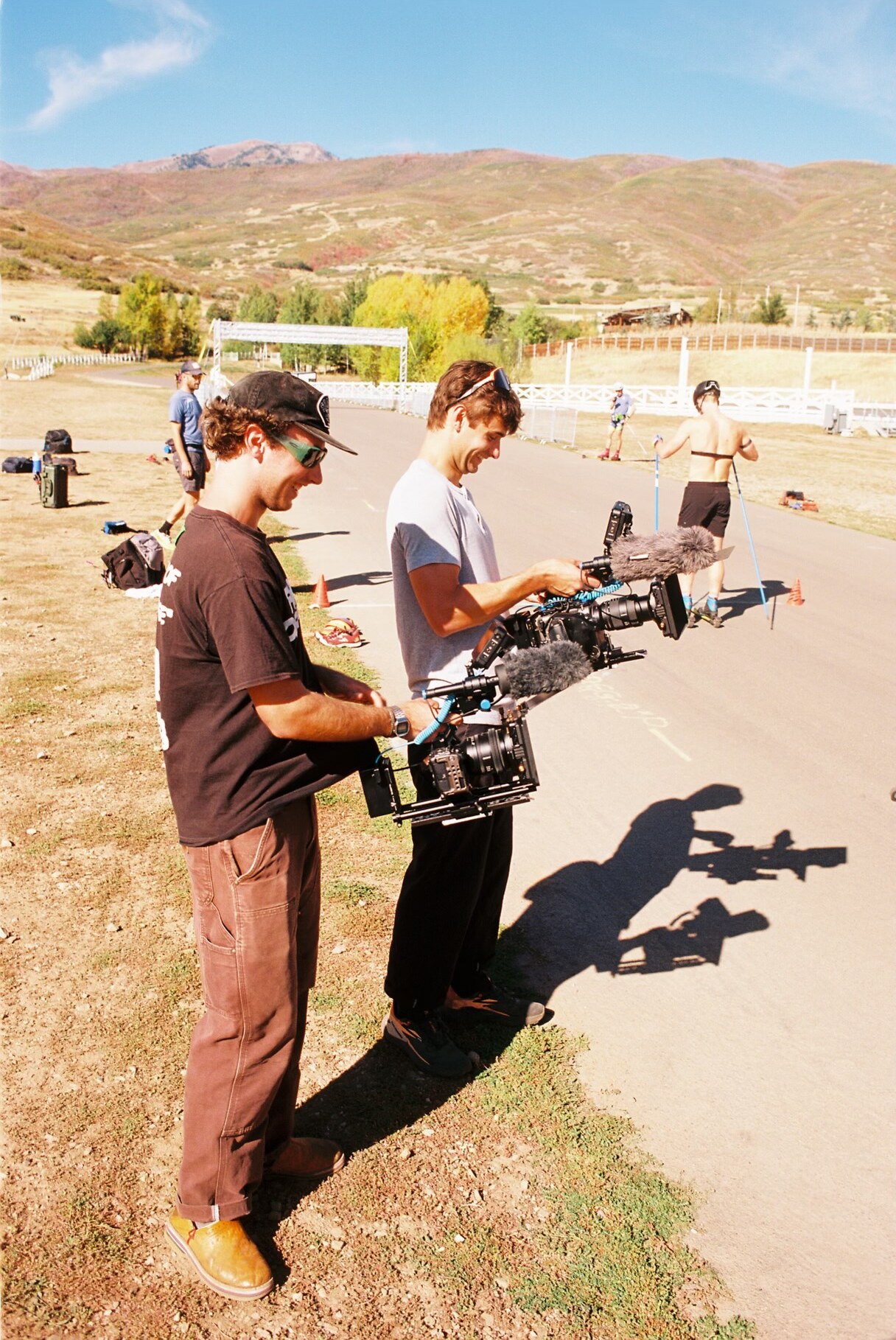
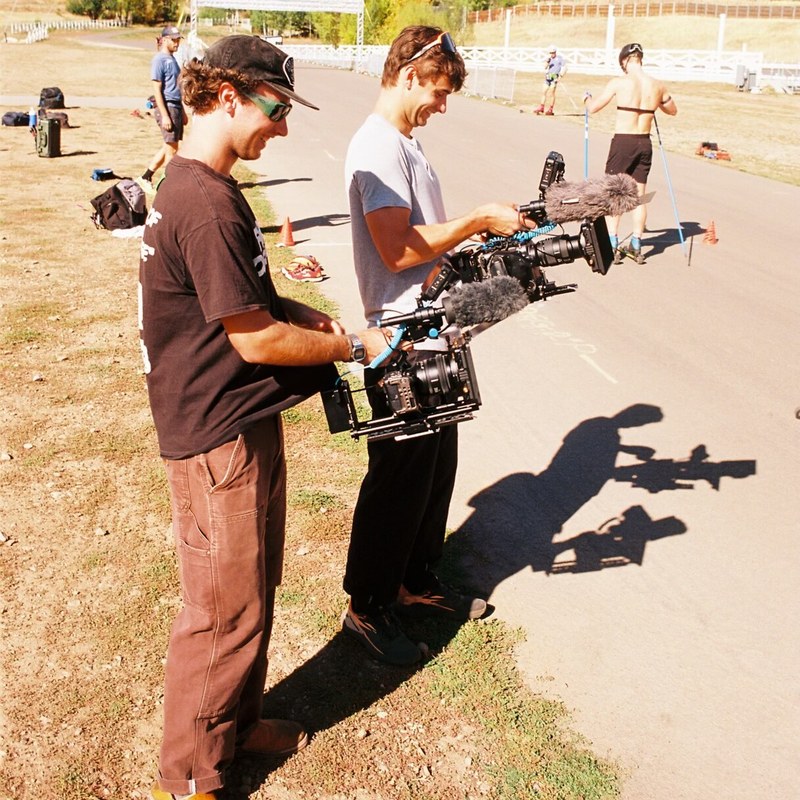
    Two filmmakers stand in profile at the edge of a paved roller ski loop, each holding a cinema camera with a microphone mounted on top.
    Lars, left, and Torsten Brinkema working the roller ski loop at the Park City camp, with the two Sony bodies that shot the season. (Photo: Willie Maahs)

    MV: What was it like working with FIS? Those rights can be really muddy.

    TB: It was definitely a headache to navigate Infront, basically a huge Italian conglomerate that controls a lot of these rights. We had a lot of negotiation with them, because we did want the context of the broadcast footage to feed into the intensity of the race segments. We wanted the tracker of kilometers to go. We wanted Chad and Kikkan announcing, which is so special and I think really leads the film in a way, because Lars and I never really wanted our voices narrating any of this. So we relied on the broadcast to be that context and the hype. It was an absolute pain in the ass, and that is kind of all that I will say.

    MV: What is next?

    LB: In line with Threshold, it was really special to bring something that is a subject matter so personal to us, skiing and mental health. So I think we will continue to create stories that are close to home. We are working on a film that will be set in Minnesota. It was such an incredible experience to show our city and our race course on the big screen.

    TB: We are excited to push our own limits again, and I think this round that will be writing a script, so not a documentary for the next one. But we still definitely want to work together, because having this balance of brother filmmakers, we rely on each other for the things we do not know or that we are not good at. Again, feeling that itch to both tell a story about home and push our comfort zones, which this project definitely did.


    Where to watch: Threshold is available to rent on Apple TV, Amazon Prime Video and YouTube in the United States and Canada. It premiered on Peacock in February, and a European release is planned for later this year.


    Help Support Our Coverage!

    If you value the thoughtful work and access FasterSkier provides, please consider becoming a Voluntary Subscriber. Your support directly fuels our work to cover the people, places, and moments that make our sport special.

    Join the FasterSkier community!
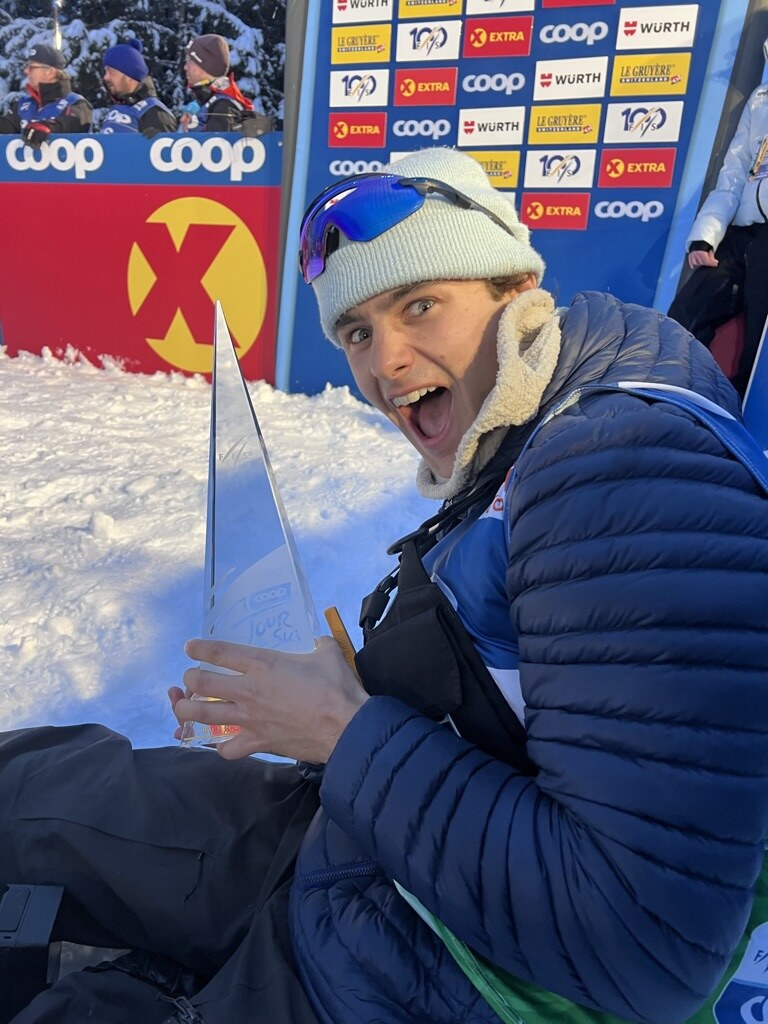
     

    A filmmaker sitting in the snow holding a tall glass pyramid trophy, with race sponsor banners behind him.
    Torsten Brinkema at the foot of the Alpe Cermis final climb in Val di Fiemme, holding Jessie Diggins’ Tour de Ski trophy in January 2024. (Photo: Leann Bentley)
  • What the U.S. Ski Team Changed After Threshold

    What the U.S. Ski Team Changed After Threshold

    This article was made possible through the generous support of our voluntary subscribers. If you value coverage like this, please support FasterSkier with a voluntary subscription.

    When I asked Matt Whitcomb what surprised him about Threshold, the head coach of the Stifel U.S. Cross-Country Ski Team started by admitting he was tempted to make something up.

    “This is the hardest question for me to answer, … but I haven’t watched it. I know it’s life-changing, but I don’t want to go back to that winter,” Whitcomb said. “I did my best as a coach, we all did, and it wasn’t good enough, and I’ve come to terms with my personal experience with it all.”

    The winter in question is 2023-24, the season Torsten and Lars Brinkema spent inside the American team with two Sony cinema cameras, a drone, and no feature film credits between them. What came out of it is a documentary about Jessie Diggins and her eating disorder that premiered on Peacock in February and, as of last Friday, is available to rent on Apple TV, Amazon Prime Video and YouTube in the United States and Canada. A European release is planned for later this year.

    Whitcomb is the person who let the cameras in. He is also, by his own account, the film’s loudest advocate.

    “I know from the response that the film is excellent, and I know it’s changing people’s lives and is being featured in college curricula. I recommend it to everyone I speak to,” he said. “I’m very proud of Torsten and Lars and am grateful for the film. I support it completely.”

    A filmmaker on cross country skis carries a cinema camera rig on a groomed snow trail while an athlete skis ahead of him.
    Lars Brinkema skiing with a cinema camera at a U.S. Ski Team camp in Bend, Oregon, chasing Jack Young on the trail. The brothers had done these workouts themselves, which is why it never occurred to them to ask an athlete to run one again for a better take. (Photo: Patrick Conroy)

    “A couple of brothers got a camera for Christmas”

    His first answer was no.

    “I figured a couple of brothers got a camera for Christmas, had a couple beers, and then came up with a fun way to spend a year,” Whitcomb said. “I normally would’ve erred on the safe side and told them to take a hike, but Ben doesn’t toss around ideas lightly and so I followed up to hear more.”

    Ben is Ben Ogden, who raced against Torsten in college on the EISA circuit and had watched him work at the World Cup in Norway that spring. Torsten had gotten there on a shoestring, having talked the Loppet Foundation, the Minneapolis club he and Lars grew up in, into sending him to shoot promotional material ahead of the 2024 World Cup at Theodore Wirth Park.

    “I think they were kind of surprised to have an American photographer out there with them,” Torsten said, “just because they aren’t getting much coverage once they leave.”

    Ogden pitched Whitcomb on inviting the brothers to the team’s Bend, Oregon camp that summer. The brothers bought cinema cameras and showed up.

    What they had in mind at that point was not a film about an eating disorder. It was a film about a sport nobody in America watches, made in the shape of the niche-sport documentaries that had broken through elsewhere.

    “We could probably do something like that with skiing,” Torsten said of the pitch they were making to themselves. “Make it look really cool.”

    They had one asset that mattered more than the cameras, which is that they were skiers. Diggins had been through the alternative, brand shoots that treated an interval session as something you could run again for a better take.

    “This is just something that would never even cross Lars and my mind, to alter the workout, because we know how intense they are,” Torsten said. “We know the workouts. We’ve done them before.”

    Two young filmmakers stand side by side on a paved roller ski loop holding cinema cameras, with autumn hills behind them.
    Lars, left, and Torsten Brinkema at the U.S. Ski Team’s Park City camp. On the road the athletes called them Larry and Toasty. (Photo: Willie Maahs)

    Toasty, Larry, and a problem with FIS

    Whitcomb’s worry was culture, which he describes as something you protect rather than something you have.

    The brothers had promised the arrangement would run both ways, that athletes would get usable footage of themselves out of it, and Whitcomb says they delivered. They also collected nicknames. Torsten became Toasty. Lars became Larry, or Lawrence in formal settings.

    “These guys were ghosts at times where they would disappear for the day and nobody would see them,” Whitcomb said. “And then we’d see them at dinner and they’d be showing athletes their incredible footage of the team training or racing together.”

    They washed dishes. They helped with wax testing. Whitcomb says everyone came to regard them as an addition to the team environment rather than a cost of doing business.

    It was not frictionless. At the first race of the season in Finland, Whitcomb watched one of the brothers get chewed out in the finish area by a FIS official for filming in a zone reserved for the television production company. Later, on course in Toblach, he got a text from FIS with a screenshot attached.

    “Larry running through the pines, keeping pace in his flatbrim hat and knit sweater, filming the lead pack. He was prominently within the TV feed,” Whitcomb said. “They asked if I could kindly remove him from the world feed. And you know what happened? Nothing. These guys said they were sorry and got a hand slap in each instance. Everyone likes them. They say things like thank you and sorry.”

    The rights question got more expensive than a hand slap when it came time to actually build the film. The brothers wanted broadcast footage in the race sequences, the kilometer counters and the commentary, partly because they had decided early that they would never narrate the film themselves. That meant negotiating with Infront, which controls FIS media rights.

    “It was an absolute pain in the ass, and that’s kind of all that I’ll say,” Torsten said. “Very expensive.”

    The money came from nowhere institutional. The brothers paid their own way through the season and kept fundraising as they went, working through the list of private donors who already keep the U.S. team on the road. The Emily Program, which sponsors Diggins, came in later during the edit and is now bringing the film into treatment centers and educational screenings.

    The Hollywood end of it started with a question the brothers asked Diggins at a training camp between the Tour de Ski and the next World Cup stop. They had no connections in that world and needed someone who did. Did she know anybody.

    She remembered that Patrick Dempsey had supported the ski team before, and sent him an Instagram message. He answered immediately and told her to send Torsten to his house in Maine, where Dempsey grew up skiing. A couple of months later Torsten showed up at the door and pitched him.

    “We have no films to our name. We have a couple short projects that nobody has seen,” Torsten said. “And so we’re asking someone with the credits that he has to trust us with nothing to see for it.”

    Dempsey signed on as an executive producer and, by the brothers’ account, became a real voice in shaping the cut. Whitcomb offers it as a character reference. “I mean, Patrick Dempsey signed on with these guys. That should tell you something.”

    Two filmmakers set up cameras on a patio to interview a skier seated in a chair with mountains in the background.
    Filming an interview with Johannes Høsflot Klæbo in Park City in October 2023. The brothers came home from the season with roughly 500 hours of footage and interviews across several national teams. (Photo: Daniel Sannum Lauten)

    The pivot happened the following summer

    This is the part Whitcomb wanted on the record, because he thinks people have the sequence backward.

    “From the start, this movie was meant to highlight the entire team, and not just Jessie,” he said. “Months after the winter concluded, I think the Brinkema brothers realized that the film needed to hone in on the topic of mental health to have a clear storyline. I understood and supported that pivot, but the point is that the winter filming was not targeted at just Jessie. That filming happened the next summer.”

    The brothers describe the same thing from inside the edit. They came home with roughly 500 hours of footage and interviews with athletes across several national teams, including Johannes Høsflot Klæbo, Emma Ribom and Federico Pellegrino. Their editor, Yaniv Elani, had never cross-country skied, which they now regard as the reason the film works.

    Elani is also the one who made them cut the northern lights. The brothers had stood out in the Arctic Circle for two hours in the cold to get a time lapse they were proud of.

    “It’s not serving the story. You got to cut it,” Torsten remembers him saying.

    Then came the screenings for film industry people in Los Angeles and New York, where the brothers went in hoping to learn what a non-skiing audience would care about.

    “People just kept saying, Jessie, Jessie, we want more Jessie,” Torsten said.

    A coach stands in green summer woods facing a filmmaker who is holding a camera in the foreground.
    Matt Whitcomb during an interview with the Brinkema brothers in Burke, Vermont. “We missed the mark on supportive team culture as an entire team,” he said of the winter the film covers. (Photo: Brinkema Brothers)

    “Our culture was at a 15 or 20-year low that winter”

    Whitcomb does not soften the season the film covers.

    “For anyone who has seen the movie, I think it’s no secret that our culture was at a 15 or 20-year low that winter. We had major struggles,” he said. He has thought about whether the presence of a film crew contributed to that, and concluded it did not.

    He is also insistent that the winter was not one athlete’s crisis with everyone else watching. “It was one of the hardest times for several other athletes and coaches, too. This wasn’t just a Jessie issue. We missed the mark on supportive team culture as an entire team.”

    Asked how he handled protecting Diggins against letting the story be told honestly, he rejected the premise.

    “I never felt like I had to protect Jessie from the film. She was a part of the team-wide decision to allow the Brinkema brothers into the team for the year, and that was the main gate we kept,” he said. When the brothers asked him whether they could film something sensitive, a one-on-one meeting for instance, he sent them back to the athlete. “I would usually just tell them to ask Jessie what she was comfortable with.”

    He watched her closely all the same, and says that had nothing to do with coaching. “That’s just because she’s a close friend, and friends look out for each other. But I had 100% trust in these guys, which is saying something because Lars was 19.”

    A filmmaker and a team communications manager pose together in a sunny finish area, raising ski poles overhead.
    Torsten Brinkema and Leann Bentley at the World Cup finals in Falun, Sweden, in March 2024. Bentley handles press for the cross-country and Para Nordic teams and appears in the film mostly doing her job in the background of somebody else’s scene. (Photo: Brinkema Brothers)

    The person in the hotel room

    Leann Bentley is the U.S. Ski & Snowboard communications manager who handles press for the cross country and Para Nordic teams, and she is in the film, mostly doing her job in the background of somebody else’s scene.

    She was in the room when the coaching staff decided whether to say yes, and she remembers it being straightforward. Here were two people willing to spend a year telling a story she could not tell herself, and one of them had raced against these athletes in college.

    The question she was asked for this story was how she decided where to draw the line once the film’s center became Diggins’ mental health. Her answer was that the question does not describe what happened.

    “Short answer, no, I never had to tell them no,” Bentley said. “Long answer is I of course will always protect my athletes. But at the same time, they’re protecting themselves. And throughout this entire process, Jessie was protecting herself. She knew what she wanted to give, and she knew maybe what she didn’t, but she was in charge of it from the very start. And so were all the athletes.”

    The scene she keeps coming back to is a hotel room in Ruka before the press conference where Diggins told the assembled media she was dealing with her eating disorder again. Bentley says it was one of the most heavily attended press conferences she has run with her.

    “There was a scene where I told her that it’s okay to be vulnerable. And I don’t remember saying that to her,” she said. “It really goes to show that when I work with these athletes, I’m working with them as people, and I’m really glad that came across in the film.”

    Most of her season is not spent in hotel rooms in Finland. It is spent in Salt Lake City, awake in the middle of the night, watching the same feed as everybody else and then turning it into the clips and quotes that hundreds of thousands of people see, for twelve teams and more than 240 athletes.

    Asked what the film got right about the parts of team life that press coverage never reaches, she was blunt about why the question has an easy answer.

    “It got everything right because it was showing exactly what was happening,” Bentley said. Athletes race for a few minutes at a time, a few times a weekend. The rest of it is chess and cards and laundry and going for a run. “I don’t think a lot of people understand that being a professional athlete, you train so hard mentally and physically for what you do on the weekends during a race. And then that race ends and you have, I don’t know, ten more hours of the day left.”

    Both she and the brothers land in the same place when asked for a favorite corner of that life, which is the wax truck, known on the road as Yolanda. Torsten’s version involves showing up on dark nights with nothing to do, music playing, occasionally a shot of Jägermeister, and a group of technicians who had been living this way for a decade or more and had stories nobody had ever asked them for.

    I interviewed the American wax techs last winter in the lead-up to the Olympics, and they remain the most enjoyable conversations I have had for this site, so I will just agree with him.

    Two filmmakers with cameras stand on a paved loop while a coach talks with two athletes on roller skis.
    Torsten Brinkema, left, and Lars Brinkema, right, filming Jessie Diggins, coach Jason Cork and Renae Anderson during a roller ski session at the Park City camp. (Photo: Willie Maahs)

    What actually changed

    The most concrete thing to come out of that winter is not on screen.

    Whitcomb describes an Athlete Wellness Passport, a monitoring system covering roughly eight health areas for every athlete on the team, men and women, including bone density, blood panels, caloric balance assessment, menstrual health and a mental health questionnaire. The team dietitian tracks each category for each athlete, and a licensed professional is brought in when a category calls for it.

    “It’s a safety net for the whole team,” he said.

    What that system did not have in 2023-24 was a ceiling.

    “What we were missing in the winter of 2023-24 was a plan for what happens when an athlete’s issue, like an eating disorder, advances beyond the qualifications of our professionals,” Whitcomb said. “In this case, we needed an eating disorder specialist MD on call, and we didn’t have one. We’ve debriefed on the experience extensively and have brought in the person we wish we already had in place going into that winter.”

    For coaches who watch the film and want something to do on Monday, his answer starts with an assumption rather than a policy.

    “If you coach a team of athletes, you likely coach some athletes who struggle with disordered eating, and you may never know who they are,” he said. He has had male and female athletes tell him about it years after they finished competing.

    On his team the practical version is a conversation about meals, held once a year, in which everyone agrees to treat mealtime as a place where safety matters more than opinions.

    “Everyone’s plate looks different, and everyone’s dietary needs and goals are different, and many of us are insecure, so the environment is ripe to be judgy and toxic,” Whitcomb said. “Talking it out isn’t perfect, but it helps.”

    He got there by getting it wrong first, and he tells that story without cushioning it.

    “As a young coach I used to think I could talk openly with athletes about their challenges with eating, body image, and weight. Then I learned from a parent that a comment I made to them regarding weight was harmful. Yeah, I know, duh. But I was 23 and some of you are now, too.”

    His correction was to stop talking about any of it and refer everything to professionals, which he now says was better but too absolute. The current version is that he will talk with an athlete who wants to talk, if the trust is there, while being honest about where his expertise ends and activating someone qualified.

    Three people stand in front of a cinema screen taking questions from a seated audience in a darkened theater.
    Lars Brinkema, Torsten Brinkema and Andrew Peterson take questions after a private screening of Threshold in Minneapolis in January. Diggins has asked teams to treat the film as “a visual book club.” (Photo: Sawyer Brice)

    What Diggins wants out of it

    Diggins raced her last World Cup in Lake Placid in March. She did not do a new interview for this piece, but she wrote at length on Instagram when the film went back out on Friday, and the argument she made was that the documentary is not really about her.

    Her request to teams, high school through professional, was that they treat it as “a visual book club.” Watch it, then talk about it. What pressure does this sport put on you. What kind of team do you want to be. And for coaches, find out now where you would send an athlete who comes to you, before one does.

    She also made a point the film cannot make on its own, which is that the recovery in it happened in hundreds of hours of therapy and clinical work that were never filmed and could not have been.

    Two filmmakers in Team USA bibs stand with their arms around a skier wearing the yellow overall World Cup leader bib.
    Torsten Brinkema, left, Jessie Diggins and Lars Brinkema in the finish area in Falun, Sweden, in March 2024, after Diggins wrapped up the overall World Cup title. (Photo: Modica/NordicFocus)

    When the film premiered in February, she put the goal simply in a U.S. Ski & Snowboard release: “I wanted to help others feel less alone.”

    The brothers are working on a scripted film now, set in Minnesota, still as a duo.

    Whitcomb, meanwhile, is not planning to watch. He described where the last two years have left him without much interest in tidying it up.

    “We’ve made improvements to our system because of lessons from that winter, and we became better coaches and teammates. I’m moving forward as an improved coach.”

    And then the part that sounded most like a coaching philosophy: “Your coaches and staff must truly care about the human condition. That’s your foundation. Get rid of the ones who don’t and add more who do.”

    Where to watch: Threshold is available to rent on Apple TV, Amazon Prime Video and YouTube in the United States and Canada. It premiered on Peacock in February, and a European release is planned for later this year.


    Help Support Our Coverage!

    If you value the thoughtful work and access FasterSkier provides, please consider becoming a Voluntary Subscriber. Your support directly fuels our work to cover the people, places, and moments that make our sport special.

    Join the FasterSkier community!


  • USSS Announces XC Team for Period 1 of the 2026-27 World Cup Season

    USSS Announces XC Team for Period 1 of the 2026-27 World Cup Season

    Dear Cross Country Community,


    We are pleased to announce the XC Team for Period 1 of the 2026-27 World Cup season:


    Ruka, FIN 10 km C & Trondheim, NOR 10 km C


    Men

    Zach Jayne                                Objective          25-26 Overall SuperTour Leader

    Gus Schumacher                       Objective          12th Distance World Cup 25-26

    Zak Ketterson                           Objective          36th Distance World Cup 25-26

    Ben Ogden                                Discretion         11th Lake Placid World Cup 10 km C

    Zanden McMullen                     Discretion         18th Oberhof World Cup 10 km C

    Hunter Wonders                       Discretion         24th Oberhof World Cup 10 km C

    Luke Jager                                Discretion         29th Oberhof World Cup 10 km C

    John Hagenbuch                       Alternate          32nd Lake Placid World Cup 10 km C

    JC Schoonmaker                        Alternate          Historic Dist. Results (23rd Falun 10 km C 24-25)


    Women

    Emma Albrecht                         Objective          25-26 Overall SuperTour Leader

    Rosie Brennan                          Discretion         12th Lahti World Cup 10 km C

    Julia Kern                                  Discretion         16th Goms World Cup 20 km C

    Hailey Swirbul                           Discretion         19th OWG 50 km C

    Sophia Laukli                            Discretion         Historic Dist. Results (16th Les Rousses 20 km C 24-25)

    Novie McCabe                          Discretion         22nd Goms World Cup 20 km C

    Kendall Kramer                         Discretion         27th Goms World Cup 20 km C

    Ava Thurston                            Alternate          33rd Lake Placid World Cup 10 km C

    Sammy Smith                            Alternate          33rd Oberhof World Cup 10 km C

    Alayna Sonnesyn (USA) lunges for the line at the end of the 10k Classic in Ruka (FIN). (Photo: Modica/NordicFocus)

    Ruka, FIN Sprint C

    Men

    Zach Jayne                                Objective          25-26 Overall SuperTour Leader

    Ben Ogden                                Objective          7th Sprint World Cup 25-26

    Gus Schumacher                       Objective          16th Sprint World Cup 25-26

    Jack Young                                Objective          19th Sprint World Cup 25-26

    JC Schoonmaker                        Objective          27th Sprint World Cup 25-26

    Zak Ketterson                           Discretion         18th Val di Fiemme Sprint C

    Zanden McMullen                     Discretion         Historic Sprint Results (22nd VdF Sprint C 24-25)

    Murphy Kimball                        Alternate          Historic Sprint Results (28th Falun Sprint C 24-25)


    Women

    Emma Albrecht                         Objective          25-26 Overall SuperTour Leader

    Julia Kern                                  Objective          29th Sprint World Cup 25-26

    Rosie Brennan                          Discretion         15th Ruka World Cup Sprint C

    Sammy Smith                            Discretion         19th OWG Sprint C

    Lauren Jortberg                        Discretion         30th OWG Sprint C

    Hailey Swirbul                           Discretion         22nd Oberhof Sprint F

    Alayna Sonnesyn                       Discretion         27th Davos Sprint F

    Ava Thurston                            Alternate          9th Lillehammer U23 Champs Sprint F


    Ruka, FIN 20 km F & Davos, SUI 5 km F Heat Mass Start


    Men

    Zach Jayne                                Objective          25-26 Overall SuperTour Leader

    Gus Schumacher                       Objective          12th Distance World Cup 25-26

    Zak Ketterson                           Objective          36th Distance World Cup 25-26

    John Hagenbuch                       Discretion         14th OWG 10 km F

    Ben Ogden                                Discretion         20th Toblach 5 km F Heats Mass Start

    JC Schoonmaker                        Discretion         29th Toblach 5 km F Heats Mass Start

    Zanden McMullen                     Discretion         Historic Dist. Results (7th Ruka 20 km F 24-25)

    Corbin Carpenter                      Alternate          10th Lillehammer U23 Champs 20 km F

    Kevin Bolger                             Alternate          33rd Trondheim World Cup 10 km F


    Women

    Emma Albrecht                         Objective          25-26 Overall SuperTour Leader

    Julia Kern                                  Discretion         10th Toblach 5 km F Heats Mass Start

    Sophia Laukli                            Discretion         Historic Dist. Results (8th Les Rousses 10 km F 24-25)

    Luci Anderson                           Discretion         25th Davos 10 km F

    Alayna Sonnesyn                       Discretion         27th Ruka 20 km F

    Kendall Kramer                         Discretion         28th Lake Placid 20 km F

    Novie McCabe                          Discretion         31st OWG 10 km F

    Hailey Swirbul                           Alternate          31st Lake Placid 20 km F

    Ava Thurston                            Alternate          32nd Lake Placid 20 km F

    Kendall Kramer (USA) racing the 10 k Freestyle this past weekend in Trondheim (NOR). (Photo: Modica/NordicFocus)

    Trondheim, NOR 20 km Skiathlon

    Men

    Zach Jayne                                Objective          25-26 Overall SuperTour Leader

    Gus Schumacher                       Objective          12th Distance World Cup 25-26

    Zak Ketterson                           Objective          36th Distance World Cup 25-26

    Zanden McMullen                     Discretion         Historic Skiath. Results (17th VdF Skiathlon 24-25)

    Ben Ogden                                Discretion         Historic Skiath. Results (21st VdF Skiathlon 24-25)

    John Hagenbuch                       Discretion         14th OWG 10 km F

    Hunter Wonders                       Discretion         24th Oberhof 10 km C

    Women

    Emma Albrecht                         Objective          25-26 Overall SuperTour Leader

    Kendall Kramer                         Discretion         9th Falun World Cup Skiathlon

    Julia Kern                                  Discretion         24th OWG Skiathlon

    Novie McCabe                          Discretion         26th OWG Skiathlon

    Rosie Brennan                          Discretion         29th Trondheim World Cup Skiathlon

    Sophia Laukli                            Discretion         Historic Skiathlon Results (11th Lillehammer 24-25)

    Hailey Swirbul                           Discretion         24th Goms World Cup 20 km C


    Trondheim Sprint F & Davos, SUI Sprint F

    Men

    Zach Jayne                                Objective          25-26 Overall SuperTour Leader

    Ben Ogden                                Objective          7th Sprint World Cup 25-26

    Gus Schumacher                       Objective          16th Sprint World Cup 25-26

    Jack Young                                Objective          19th Sprint World Cup 25-26

    JC Schoonmaker                        Objective          27th Sprint World Cup 25-26

    Zanden McMullen                     Discretion         15th Lake Placid World Cup Sprint F

    Kevin Bolger                             Discretion         15th Toblach World Cup Sprint F

    Murphy Kimball                        Alternate          6th Lillehammer WJC Sprint F 2026

    Women

    Emma Albrecht                         Objective          25-26 Overall SuperTour Leader

    Julia Kern                                  Objective          29th Sprint World Cup 25-26

    Sammy Smith                            Discretion         12th Oberhof World Cup Sprint F

    Hailey Swirbul                           Discretion         22nd Oberhof World Cup Sprint F

    Lauren Jortberg                        Discretion         28th Oberhof World Cup Sprint F

    Alayna Sonnesyn                       Discretion         27th Davos World Cup Sprint F

    Rosie Brennan                          Discretion         29th Lahti World Cup Sprint F

    Ava Thurston                            Alternate          9th Lillehammer U23 Champs Sprint F


    The above discretionary selections were nominated by a 15-person working group that included:


    James Southam                         Athlete Rep.

    Ida Sargent                               Athlete Rep.

    Perry Thomas                           Mansfield Pro Nordic Team

    Andy Newell                             Bridger Ski Foundation

    Eliška Albrigtsen                        Denver University

    Erik Flora                                  Alaska Pacific University

    Randy Gibbs                             Team Birkie

    Peter Holmes                            SVSEF Gold Team

    Annika Martell                          Craftsbury GRP

    Colin Rodgers                            SMS T2

    Sophie Caldwell Hamilton          Aspen Valley Ski and Snowboard Clu

    Kristen Bourne                          U.S. Ski Team

    Jason Cork                                U.S. Ski Team

    Matt Whitcomb                        U.S. Ski Team

    Chris Grover                             U.S. Ski Team


    The nominations were then approved by a discretionary selection review group comprised of:


    Tyler Kornfield                          U.S. Ski & Snowboard Athlete Rep

    Anouk Patty                              U.S. Ski & Snowboard Chief of Sport

    Bryan Fish                                 U.S. Ski & Snowboard Development Director


    All related documents to this process, including the World Cup Selection Criterion, the Working Group Guidelines, the Working Group Members, and the World Cup Discretionary Selection Dates, can always be found here: https://www.usskiandsnowboard.org/sport-programs/criteria/cross-country-world-cup-criteria


    The above discretionary selection process will be repeated for each period of World Cup this coming season.  As always, if you have questions or concerns about this process, feel free to contact me directly.


    Sincerely,


    Chris Grover

    Cross Country Program Director, U.S. Ski Team

    chris.grover@usskiandsnowboard.org

  • Biathlon at a Crossroads: Inside the Alliance That Could Reshape the Sport in America

    Biathlon at a Crossroads: Inside the Alliance That Could Reshape the Sport in America

    This article was made possible through the generous support of our voluntary subscribers. If you value coverage like this, please support FasterSkier with a voluntary subscription.

    U.S. Biathlon’s board votes Wednesday on a formal operating alliance with U.S. Ski & Snowboard. Supporters call it the stability the sport has always lacked. Skeptics call it a surrender of independence. Both are working from the same set of facts. Here is what the deal actually says, and what it would and would not change.

    The U.S. Biathlon board of directors is scheduled to meet tomorrow, Wednesday, July 29, at 4 p.m. Eastern. This account is based on interviews conducted by FasterSkier with the chief executives of both organizations, a U.S. Biathlon athlete representative, the U.S. Biathlon head physiology coach, a written statement from the U.S. Olympic & Paralympic Committee, and a review of the alliance term sheet, three community working-group reports, and correspondence circulated by members opposed to the deal. All of these documents were posted publicly by U.S. Biathlon or provided to FasterSkier.

    Campbell Wright (USA) during the biathlon sprint at the XXV Olympic Winter Games in Antholz (ITA). (Photo: Thibaut/NordicFocus)

    Every winter, for a few weeks in February, cross-country skiing and biathlon stop being niche pursuits in the United States. During the last Olympic period, FasterSkier drew more than 180,000 unique readers in a single February, most of them people who do not know the sport’s governance history and have never heard of the Ted Stevens Olympic and Amateur Sports Act. On Wednesday afternoon, a board most of those readers could not name will vote on a decision that could reshape how one of their sports is run for the rest of the decade and beyond.

    The question in front of the U.S. Biathlon board is whether to enter a “Strategic Operating Alliance” with U.S. Ski & Snowboard, the far larger national governing body that oversees Olympic and Paralympic skiing and snowboarding. Under the proposal, U.S. Biathlon would remain a legally separate organization and the recognized governing body for the sport, but would hand much of its day-to-day operation to U.S. Ski & Snowboard under a services agreement. To its architects, it is a way to give a chronically under-resourced sport the stability and commercial muscle it has never had. To its critics, it is the moment a proud, independent program stops steering its own ship.

    The two sides do not disagree much about the facts. They disagree about what the facts mean.

    What is actually being proposed

    Strip away the temperature of the debate and the structure is specific, and it has changed meaningfully since the idea first surfaced publicly in the spring. The current terms, which U.S. Biathlon posted for its members on July 27, describe an alliance rather than a merger in the dictionary sense. No organization dissolves.

    Under the agreement summary, U.S. Biathlon “will remain a separate legal entity,” keeping “its own corporate existence, financials, and independent audit.” It stays the governing body recognized by the U.S. Olympic & Paralympic Committee under the Ted Stevens Act, and keeps its membership in the International Biathlon Union, the sport’s world federation. Its name, logo, and trademarks remain owned by U.S. Biathlon and are licensed to U.S. Ski & Snowboard.

    What changes is who runs the operation. Under a services, or operating, agreement, U.S. Ski & Snowboard would take over “staffing, programs, events, and administration for biathlon,” giving the smaller sport access to a chief financial officer, general counsel, marketing and revenue staff, medical and sport-science support, and technology infrastructure it cannot afford on its own. U.S. Biathlon’s own staff, its leaders say, would remain responsible for running the sport itself. A new Biathlon Sport Committee would be created inside U.S. Ski & Snowboard, mirroring the structure the larger body already uses for cross-country and its other disciplines.

    Jack Gierhart, U.S. Biathlon’s president and chief executive, described the mechanism plainly in an interview. “The mechanics of this are like an operating agreement between U.S. Biathlon and Ski and Snowboard where they take over operations,” he said. “That’s how we’re honoring and satisfying the Ted Stevens Act.”

    Sophie Goldschmidt, president and chief executive of U.S. Ski & Snowboard, framed the same structure around what biathlon keeps. “We would keep the biathlon entity. In fact, we keep the biathlon name, the biathlon logo,” she told FasterSkier. “From a legal perspective, it would also have its own entity. With that, it would have its own board. So very much operating like it does today, but sitting within a larger framework so that it can benefit from the other resources and shared knowledge, extra funding that we can provide.”

    That phrase, “operating like it does today,” sits at the center of the argument, because a great deal depends on how much a board that has delegated its operations still actually decides.

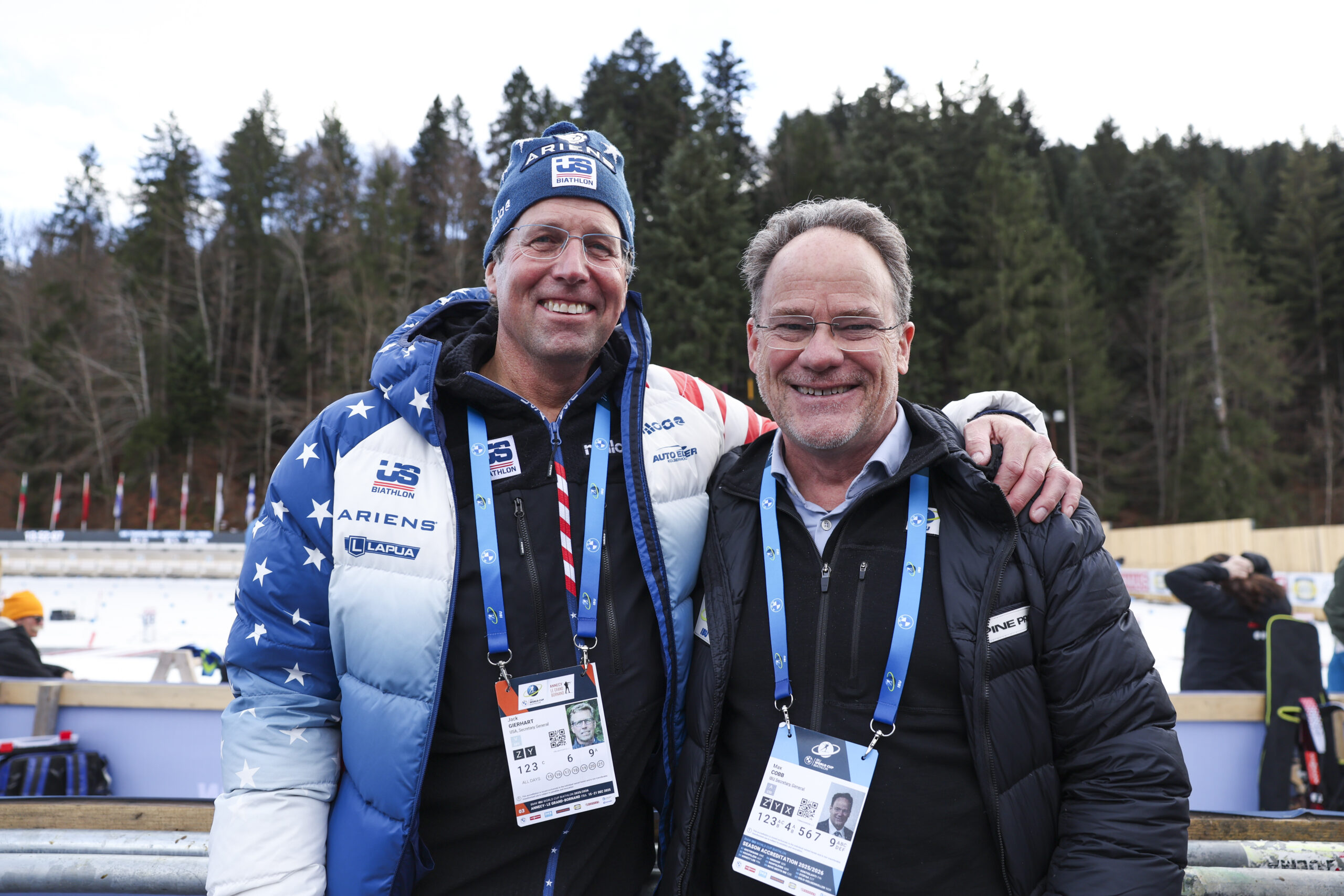
    USBA CEO Jack Gierhart poses with Max Cobb (IBU Secretary General) (l-r) at the IBU World Cup in Annecy-Le Grand Bornand (FRA) last December. (Photo: Manzoni/NordicFocus)

    How the sport got here

    By the account of the people who built it, this did not begin as a takeover. It began, Gierhart said, as an attempt to solve a problem every small Olympic sport shares.

    Gierhart arrived at U.S. Biathlon in September 2022, as longtime leader Max Cobb was leaving for the IBU. The organization was early in a strategic plan aimed at growing the sport, and a central piece of that plan was working more closely with the cross-country community, since most American biathletes come from skiing. “From my experience being in sport for 25 years, when you offer people more options, more pathways, you increase retention and you grow the pie,” he said. “It’s like, this should be a no-brainer, but then you run into the cultures and communities.”

    Those conversations, Gierhart said, drew in the U.S. Olympic & Paralympic Committee, which oversees and funds the country’s Olympic sports. “The USOPC started to suggest, hey, we’ve got a lot of these small NGBs, why don’t you guys think about something a little more formal?” he said. That was roughly a year and a half ago. The organizations sketched the basic terms, paused through the Olympic and Paralympic Games so as not to distract athletes, then brought the concept to a wider audience in the spring.

    Goldschmidt described the same arc and made the case for why her organization wants biathlon at all. U.S. Ski & Snowboard already runs multiple sports under one roof, she said, which means it can absorb the compliance and administrative costs that crush small governing bodies. “The central costs can really be absorbed and be a real cost saving for those organizations,” she said. “Legal, finance, safe sport compliance, all of that, which is quite a big burden, especially on some smaller NGBs. We can absorb that quite easily without having to increase the cost base, which means practically more money is going directly to the athletes.”

    The rollout did not land smoothly. After town-hall meetings drew pointed questions, the two organizations convened three joint working groups, on governance, sport development, and high performance, that met through the back half of July. Twenty-eight to twenty-nine participants, including athletes, coaches, club leaders, and staff, spent two weeks documenting what a successful alliance would require and what worried them. Their reports, posted publicly, have become some of the most revealing documents in the whole debate, in part because they capture both the community’s hopes for closer collaboration and its doubts, in the community’s own words.

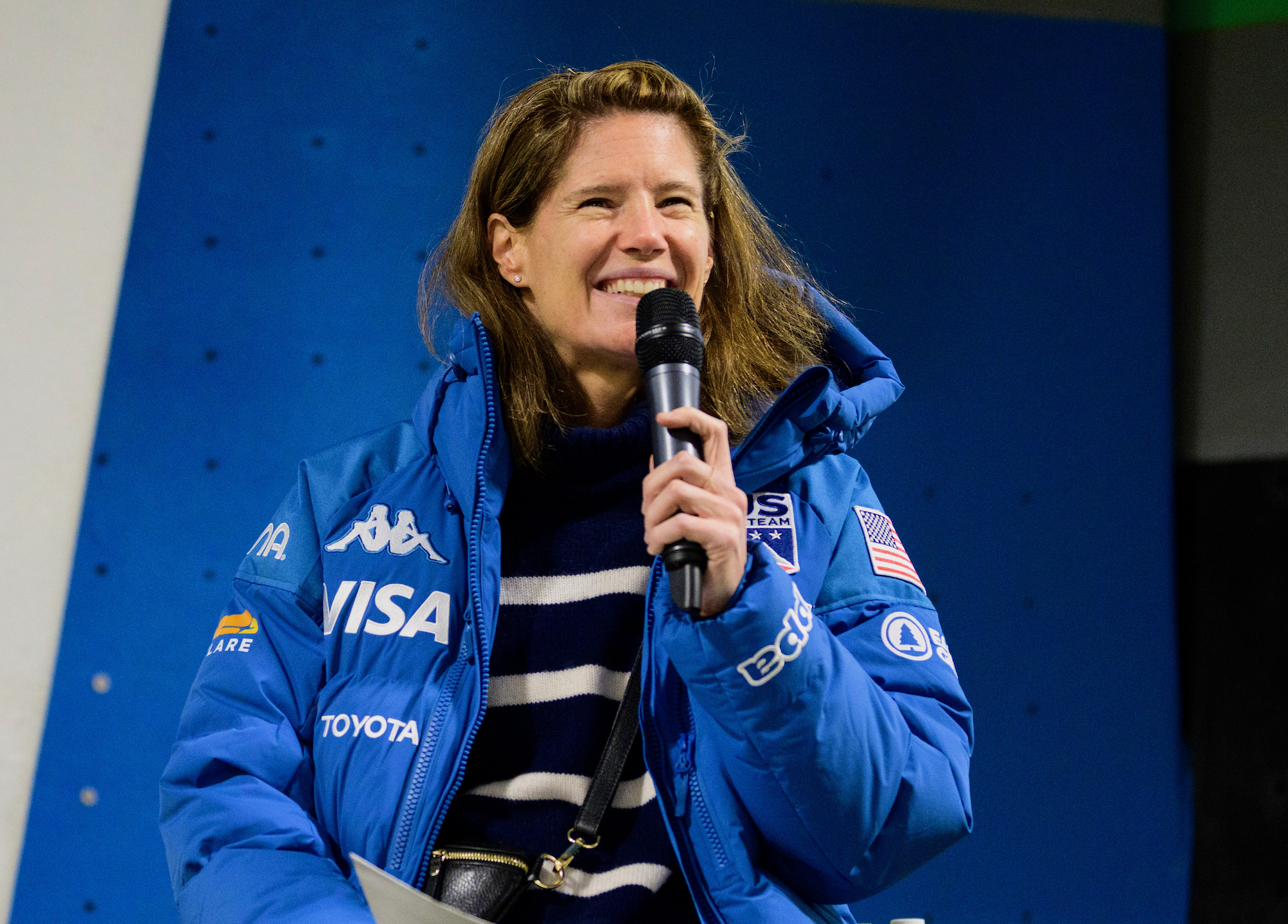
    Sophie Goldschmidt speaking at the Alpine World Cup in Killington, Vermont in 2024. (Photo: U.S. Ski & Snowboard)

    The money, and the question at the center of it

    Almost everyone involved agrees that money is the engine of this deal. What they do not agree on is how to describe the pressure behind it.

    The clearest number comes from Gierhart. For the coming season, he said, the USOPC reduced U.S. Biathlon’s grant by 22 percent. The reason, in his telling, has less to do with the alliance than with a shift in how the USOPC allocates money. Roughly three years ago, he said, the committee created an investment framework weighted toward medal potential. “They told us a couple of years ago, you guys are one of the highest funded sports, you haven’t delivered medals,” Gierhart said. “There’s a good probability you’re going to get a cut. And that’s what happened. They cut us,” a reduction he put at 22 percent for this year.

    Crucially, Gierhart rejected the idea that the cut is a lever to force the alliance. “It hasn’t been like, if you don’t do it, we’re taking away money,” he said. “It was, we’re taking away money because you’re over-resourced from our model standpoint and you’re not delivering. But if you go in this direction, which we believe will be beneficial in the long term, we want to help you do that.” Asked directly in a later FasterSkier interview whether it was a threat, he drew the distinction again. “They gave us our grant for this year, and it’s the 22 percent reduction. But they said that if we move in this direction with this alliance, they want to invest more in us. And they will find a way to do that,” bringing biathlon “back to where we were.”

    Goldschmidt, in interviews with FasterSkier, likewise described the reduction as reversible if the alliance proceeds, and tied it to the USOPC’s belief that a more efficient biathlon can compete for medals.

    The U.S. Olympic & Paralympic Committee, asked to confirm the figures and to say whether restoration of the funding is contingent on the alliance being approved, declined to address specifics. In a written statement, spokesman Jon Mason said the committee “is aware of and engaged in the discussions between U.S. Biathlon and U.S. Ski & Snowboard, and we support them taking a deliberate, transparent, fact-based approach to exploring a future relationship that complies with the Ted Stevens Olympic & Amateur Sports Act.” The committee, he added, is “supportive of outcomes that can build long-term stability and create opportunities for current and future generations of athletes.” The statement did not confirm the size of the cut, and it framed compliance with the Act as a goal the parties must meet rather than a settled fact.

    What the alliance would add is documented. According to the high-performance working group’s summary, biathlon “would receive a ~$600k increase from current FY27 revenue projections” in the first year, with U.S. Ski & Snowboard guaranteeing an increase “from this year-one level through year 4.” Gierhart put the combined total, new revenue and shared-services savings together, at “at least” $3.3 million over four years. That money, in principle, flows back into programs.

    Set against U.S. Biathlon’s roughly $3.5 million in annual revenue, those are not small numbers. And they arrive alongside a promise that biathlon’s existing money stays biathlon’s. Under the agreement, “all funding designated for biathlon, including IBU and USOPC support, existing sponsorship contributions, charitable donations, and other biathlon-specific revenue, will remain ring-fenced and used exclusively to support biathlon.”

    Here Goldschmidt was careful to correct what she called a misunderstanding. The ring-fence, she said, is permanent, not a four-year arrangement. “All of the money that they generate that is ring-fenced for biathlon will continue to go to that program. That will be a contractual commitment,” she said. “Some people have got confused that we’re only committing to four years to ring-fence and provide them funding. That’s not accurate.” The four-year commitment, she clarified, applies to the additional commercial funding U.S. Ski & Snowboard brings to the table, which depends on the sponsorship deals it can renew.

    Gierhart described the same two-part structure, and pushed back on the idea that biathlon falls off a cliff when the four years are up. “This gives us a platform for four years of sort of guaranteed increased revenue to build momentum and to implement the things that we know are going to help us,” he said. “Without that, we’re going to live year to year, and we’re already in maintenance mode as opposed to growth mode.” In four years, he argued, biathlon would be “in no different a situation than we are today. In fact, we’ll be better, because we’ll have a lot more resources to work with over the next four years.”

    That distinction defines exactly where the community’s deepest financial fear lives. The money biathlon already raises is protected by contract. The new money, the actual growth case, is guaranteed for one Olympic cycle, through 2030, and after that depends on the USOPC and on sponsors, the same as it would if biathlon stood alone.

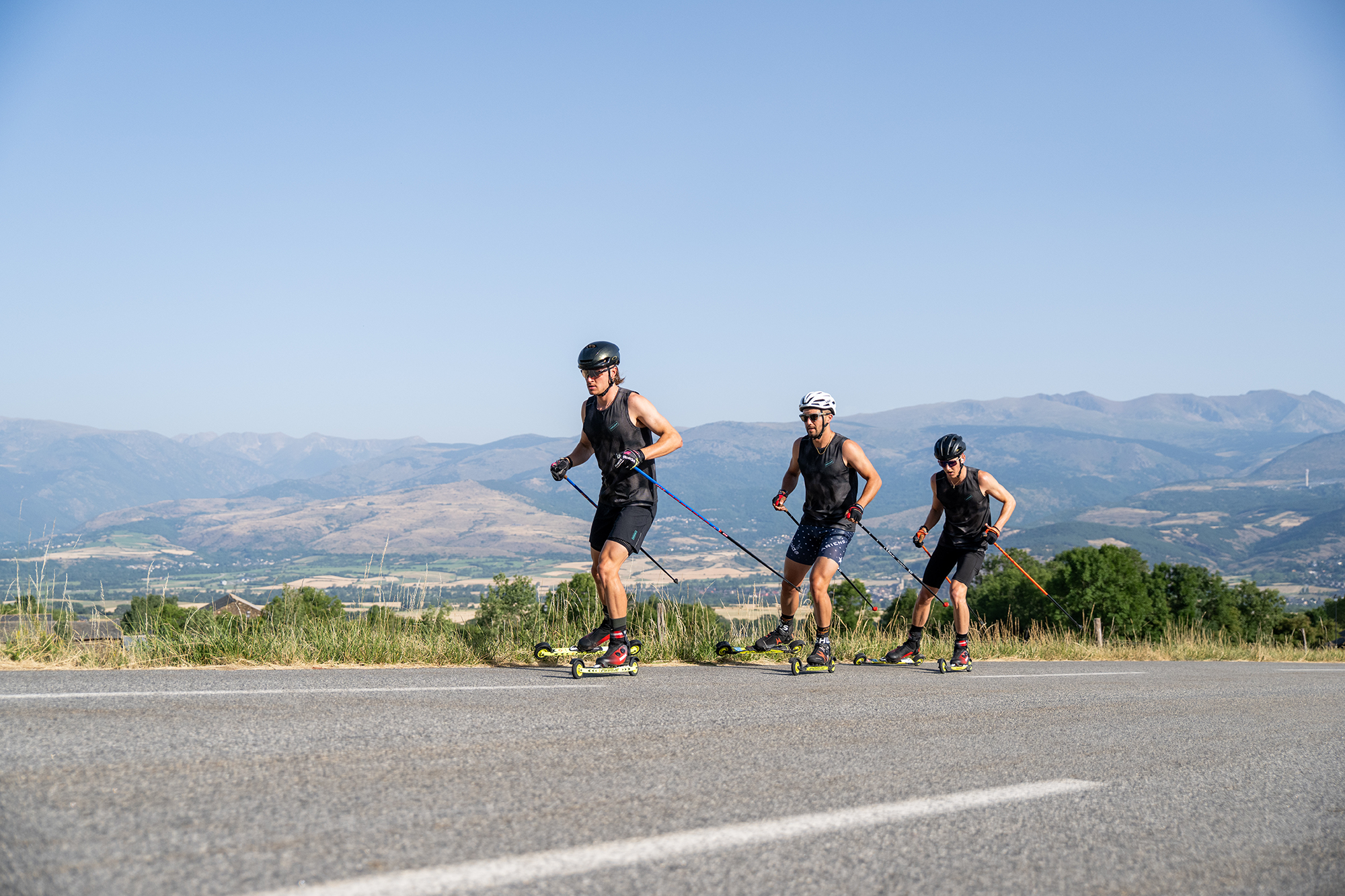
    While much of the US biathlon community debates governance, the USBA’s Campbell Wright, Vincent Bonacci, and Maxime Germain (l-r) gets after their summer training in Font-Romeu (FRA). (Photo: Authamayou/NordicFocus)

    The Ted Stevens question

    No part of the debate has generated more heat than the law. A group of members, some of whom helped establish U.S. Biathlon as an independent governing body decades ago, argue that the alliance violates the Ted Stevens Act. Their case rests on two provisions.

    The first is the single-federation rule. Under 36 U.S.C. 220522, a national governing body must be “a member of no more than one international sports federation that governs a sport included on the program of the Olympic Games.” U.S. Ski & Snowboard belongs to FIS, the International Ski and Snowboard Federation. Biathlon answers to the IBU. Critics contend that if U.S. Ski & Snowboard effectively governs an IBU sport, the arrangement collides with that rule.

    The second is autonomy. The same statute requires a governing body to be autonomous, in that it “independently decides and controls all matters central to governance” and “does not delegate decision-making and control of matters central to governance.” Arthur Stegen, a former U.S. Biathlon board member and part of a group called Team Independent Biathlon, laid out the objection in correspondence circulated to other members and shared with FasterSkier: a services agreement that assigns operational responsibility to U.S. Ski & Snowboard, he argues, is by definition a delegation of control, and reducing the biathlon board to a sport committee “would appear to relinquish its governance responsibilities to another organization.” Stegen wrote that he is “completely against this potential merger.”

    The written terms were plainly built to answer that challenge. The agreement summary includes a section titled “Reserved Governance Authorities,” which states that “notwithstanding any operational responsibilities delegated to U.S. Ski & Snowboard,” U.S. Biathlon “will retain sole authority over all matters required by the Ted Stevens Act or otherwise reserved to the National Governing Body,” including “oversight of the organization, approval of the biathlon budget, and all authorities reserved to the NGB.” In other words, the deal’s authors say operations are delegated while governance is reserved.

    Goldschmidt said the structure was designed to align with the statute from the start. “We’ve worked with the USOPC and others to ensure it fits all of those criteria, which it does,” she said. Gierhart said U.S. Biathlon has already received an opinion on the point. “We’ve gotten the opinion from the USOPC’s legal counsel on the terms as they’re written now, and their opinion is that it meets the requirements and is in compliance with the Ted Stevens Act,” he said.

    He was also clear about sequence, and described it as the normal way such deals come together. Wednesday’s vote is on the foundational terms, the fundamentals both sides have agreed to. “You’ve got to agree on the fundamentals, and then that’s what’s going to drive the detailed operating agreement,” he said. That more extensive agreement, covering licensing of the biathlon trademarks, the function of the board, and the bylaws, would be drafted next, “vetted by independent counsel” to confirm it complies with the Act, and then brought back to the U.S. Biathlon board, athlete representatives included, for a separate vote to approve it.

    That staging is itself contested ground. Supporters see a standard process: agree on principles, then build and independently vet the detailed contract. Skeptics see a board being asked to commit before the full agreement exists and before the independent legal review happens, and some argue a binding vote should wait until both are done. What Wednesday’s vote actually authorizes, the concept or a finished deal, is a distinction worth watching closely as the meeting unfolds.

    The USOPC, for its part, did not put its weight behind a declaration that the current structure is legal. It said it supports the parties “exploring a future relationship that complies” with the Act, language that leaves compliance as something still to be demonstrated.

    There is precedent for the skepticism, and for U.S. Ski & Snowboard’s interest in expansion. The organization previously pursued governing roles in surfing and skateboarding, efforts that critics cite as evidence of a broader ambition to build a multi-sport governing body, the very kind of concentration the Ted Stevens Act was written to prevent. Goldschmidt described those episodes as different in kind. Surfing, she said, “just got too political,” and the organization walked away; skateboarding remains “ongoing” with “no immediate decisions.” Biathlon, she argued, is a natural fit that most European countries adopted long ago. “I get asked all the time, why is biathlon not integrated within your organization,” she said. “It’s a natural fit in many ways.”

    Who controls the board

    Because the autonomy argument turns on control, the composition of the board is more than a technicality, and it is an area where early rumors and current terms diverge sharply.

    Gierhart was emphatic that the U.S. Biathlon board does not shrink or change hands. “The board is going to continue at the same size it is by the bylaws. It’s 12 to 15 members. They’re voted on by the membership,” he said. Those voters remain biathlon’s own roughly 1,500 members, whose categories will be tracked separately even after membership systems migrate to U.S. Ski & Snowboard’s platform in the 2027-28 season. “Our board size is not going to change. The composition is not going to change,” Gierhart said.

    Just as important, he said, is what that board keeps deciding. Among the authorities it retains is control of the budget and the annual plan, meaning that where biathlon’s money is spent would still be approved by the U.S. Biathlon board of directors.

    The new layer is the Biathlon Sport Committee, which the agreement describes as being drawn from the existing board, “6 to 8 members,” and maintaining the 33 percent athlete representation required by USOPC bylaws. The chair of that committee and one athlete representative would sit on the U.S. Ski & Snowboard governance board, giving biathlon two seats and a direct voice in the larger organization. The arrangement runs in both directions: U.S. Ski & Snowboard would, in turn, have representation on the U.S. Biathlon board.

    Athlete voice, a recurring worry, is addressed specifically. Rather than being folded into U.S. Ski & Snowboard’s athlete representation, “biathlon would still maintain its separate voice of athletes on the Team USA [Athletes’] Commission,” Gierhart said. “We’d have our own.”

    Even though Jake Brown officially retired from the IBU World Cup after last season, he has played an active role as an athlete rep throughout this process. (Photo: Authamayou/NordicFocus)

    What changes for the athletes

    For the people who actually race, the alliance is not an abstraction about governance. It is a question about who pays for the plane ticket to Europe.

    U.S. Biathlon funds its athletes to a degree unusual among American winter sports. “Our athletes within biathlon are better funded and supported than in any other winter sport,” Gierhart said, noting that the program fully funds its World Cup athletes and nearly fully funds its IBU Cup athletes. Revisiting the specifics, he said U.S. Biathlon provides its athletes $48,000 in direct athlete support, $35,000 in need-based assistance, and $30,000 in performance bonuses, and secures roughly $36,000 a year for its top competitors. Cross-country, by contrast, does not pay national-team skiers to compete on the World Cup; much of that burden falls to clubs and to community fundraising.

    That gap is the source of the athletes’ most concrete fear. Jake Brown, who retired from biathlon this year and sits on the U.S. Biathlon board as an athlete representative, said the worry he hears most is that biathlon’s funding model quietly converts to the ski-team model once the sports combine. He is careful to add nuance. “There’s nothing guaranteed that U.S. Biathlon will continue funding World Cups either,” he said. “The funding has to be there.” Biathlon also draws money from the IBU for each athlete who starts a race, which makes subsidizing those starts partly self-financing, and the sport has leaned into keeping athletes in the pipeline rather than cutting them early. “We can’t afford to lose them,” Brown said.

    The agreement attempts to lock that model in place, but only for a defined window. The current athlete support model “will continue through the 2030 Olympic quad,” it says, with “National Team, World Cup, IBU Cup, Youth, and Junior athlete support structures” remaining “in place unless changes are jointly approved by the Biathlon Sport Director and the U.S. Biathlon Board.” As with the incremental funding, the guarantee runs one cycle. What happens after 2030 is precisely what no document can promise, though, as Gierhart notes, biathlon cannot promise that to itself every year either.

    No voice in this debate has lived that risk more directly than Justin Wadsworth, the former U.S. Olympian who now is U.S. Biathlon’s Head Physiology Coach (working with both the men’s and women’s national teams) and who spent years coaching in Canada, including a stretch as a high-performance director there. Wadsworth described watching Biathlon Canada’s funding collapse. “Over the last eight to ten years, we’ve seen organizations having funded the athletes for all camps, all trips, everything, to now athletes paying for training camps, paying for trips,” he said. “That’s basically what’s really pulled Biathlon Canada down. The athletes just can’t afford to go on trips or training camps.”

    The damage, he said, was not only financial. “It really changes the dynamic with the team,” Wadsworth said. “As a coach and as an organization, it’s much harder when athletes are paying for everything.” His wife, Beckie Scott, the Olympic champion who now leads Nordiq Canada, made cutting athlete fees a priority for exactly that reason. Asked what U.S. Biathlon should guard most carefully, Wadsworth did not hesitate. “The number one is just, are the athletes going to continue to be getting funded when they’re absorbed with U.S. Ski and Snowboard.”

    Brown framed the same anxiety in a different register, as a question of trust. “There is a strength in independence,” he said. “You have a trust that your leader, when they put their head on the pillow every night, is trying to figure out how to make biathlon better in the country, and not trying to figure out how to prioritize what sport within a larger organization.” That, more than any statute, is the emotional core of the opposition: the fear that biathlon becomes one line item among many, advocated for by executives whose attention is divided.

    The community’s own working group named the same items. The high-performance group’s report listed what “must be protected”: the centralized national team model, athlete stipends and need-based aid, the pathway that recruits skiers into biathlon, the world-class ski-service program, the Montana State University sport-science partnership, and “athlete-centered decision making.” It also warned, in writing, of the risk that unites the skeptics and the supporters, that “differences in stipends, housing, and athlete funding philosophies will be inequities across sports,” and that “the reasoning behind this must be explained well, or there is high risk of tension between sports.”

    The case for

    Set the fears aside and the argument for the alliance is not hard to follow, and some of its most persuasive versions come from people with no stake in the outcome.

    Wadsworth, who says he has “no real skin in the game” and is “just trying to coach right now,” makes the efficiency case from painful experience. A small governing body cannot carry the overhead a large one can. “An appeal, from an athlete and the organization needs to get a lawyer for that, a single appeal can cost 30 to $50,000,” he said, “and if that’s 5 percent of your budget, that’s a big hit.” Fold biathlon into a larger organization with in-house counsel, fundraising staff, a training center, and sport scientists, he said, and those costs largely vanish. “Those efficiencies are really the positive side.”

    Goldschmidt’s version is about scale on the revenue side. U.S. Ski & Snowboard, she wrote to biathlon’s members, generated “more than 900 million social media impressions and 7 billion earned media impressions last season,” counts more than a million social followers, and has “more than doubled our commercial revenue over the last four years,” with “nearly 85 percent of that revenue going directly to athletics.” Biathlon, by her argument, brings a genuinely valuable and telegenic property, the IBU World Cup is among the most-watched winter sports in Europe, that a 35,000-follower organization cannot monetize on its own. “One plus one can equal a lot more than two,” she said, “most importantly for biathlon.”

    Gierhart’s case is about the limits of the status quo. “We’ve been doing the same thing for 60 years,” he said. “We’re a small sport, we have limited resources. We’ve always had a thin bench. But the formula isn’t changing. And if we’re going to try to drive transformational change, we’ve got to look at some things a little differently.”

    And there is the pipeline, the argument that biathlon and cross-country are natural partners that have been kept artificially apart. Today a club that wants to offer both sports contends with two governing bodies, two memberships, two coaching-education systems, two calendars. The sport-development working group’s central recommendation was to merge those tracks, shared coach education, coordinated regional calendars, laser biathlon introduced to youth skiers, so that, in Brown’s words, the “big potential benefit comes in the sport development space.” Wadsworth added the practical constraint that enthusiasm tends to skip past: it comes down to shooting ranges. “The number one thing for biathlon is you need a range, and so that’s probably a limiting factor,” he said. “If U.S. Ski and Snowboard decides they really want to focus on the development side, they’re going to have to build more biathlon ranges. If you build it, they’ll come.”

    Campbell Wright (USA), Maxime Germain (USA), Margie Freed (USA), and Deedra Irwin (USA), (l-r) after the IBU World Cup Biathlon mixed relay in Otepaeae (EST). (Photo: Manzoni/NordicFocus)

    The case against, in the community’s own words

    The sharpest questions about the alliance do not come from the members trading accusations online. They come from the process U.S. Biathlon itself ran. The working groups produced plenty of enthusiasm for closer collaboration, and their reports document at length the benefits participants believed an alliance could unlock. But the same reports surfaced a recurring doubt.

    Across all three groups, participants returned to a single question: if the goal is collaboration between biathlon and cross-country, why does it require a formal alliance? The consolidated report notes that “several participants observed that many of these initiatives could theoretically be pursued without a formal alliance.” The sport-development group put it more bluntly in its written takeaway: “Some expressed confident progress could be made without an alliance. It is not accountability that will move this from conversation to action. It is the passion of the people involved in both sports.” (U.S. Biathlon cautions on every page that the working-group notes were “generated during meetings in which judgment was not applied” and “do not represent the decisions or strategies” of the organization.)

    The governance group’s “parking lot” of unresolved issues reads like a checklist of the skeptics’ concerns: “Ted Stevens Act compliance,” “an escape path if integration fails,” “what autonomy does Sport Committee have to direct USSS operations,” and whether a replacement is needed for the athletes’ advisory council “to preserve biathlete input.” The high-performance group flagged “budget flexibility,” asked “which proposed benefits truly require an alliance, and which can already be achieved through partnership,” and wondered whether biathlon could build its own dedicated fundraising vehicle, an equivalent of the National Nordic Foundation, without merging at all.

    U.S. Ski & Snowboard’s answer to the “why not just collaborate” question is that informal collaboration has been tried, and has not delivered. The alliance-alignment document U.S. Biathlon distributed argues that, while the two organizations “have collaborated successfully for many years, this formal Alliance creates a level of commitment, coordination and accountability that cannot be achieved through informal collaboration alone.” Gierhart put it more sharply. He said he disagrees “wholeheartedly” with the notion that passion alone will carry the work forward. “You need accountability,” he said, describing what he sees as a fundamental difference within the community over how things actually get done. Goldschmidt made the same point about incentives: absent a formal structure, she said, no one at a big organization is measured on whether they helped a small one. “Why would I help another sport if that’s not how I’m measured?”

    Then there is the matter of process and speed, which even supportive athletes acknowledge. Brown said the spring rollout caught the community off guard. “It kind of came out in the springtime. It was a little bit surprising, and it took us some time to understand why,” he said. “Most of the membership and the athlete body, we had some catching up to do.” The working groups were themselves a response to feedback that the process had moved too fast with too little consultation, and some members continue to argue that a binding vote should wait for the final agreement and its independent legal review, both of which, by U.S. Biathlon’s own account, come after Wednesday.

    The exit, and what the fine print says

    If there is a single provision that will decide how much reassurance skeptics take from this deal, it is the exit. Gierhart is adamant that it is a last resort, not a trap door.

    He described a defined process. Goals and key performance indicators would be set at the outset, with an assessment after the first year and a comprehensive review at the end of the quad. “If we get to a point where there’s irreconcilable differences,” he said, “then there is an option to move towards a different operating structure, which could mean that U.S. Biathlon becomes an independent operating entity again. And that is a choice that can be made by either party. It doesn’t have to be mutually agreed upon.”

    He was careful to say that does not mean either side can simply walk away on a whim. The written summary describes an interim assessment after the 2026-27 season and a comprehensive review after 2029-30, and says that “should significant challenges arise that materially impair the objectives of the alliance, the organizations will first implement a corrective action plan.” Only “if substantial concerns remain unresolved after those efforts” would “alternative organizational structures, including the return of U.S. Biathlon to an independently operated organization, be considered.” That, Gierhart said, matches what he meant: a process of measuring progress against shared goals, trying to fix what is not working, and only then, if the problems prove irreconcilable, allowing either party to end the alliance without the other’s consent.

    “I don’t want it to sound in any way that in four years there’s an exit ramp that’s most likely going to happen,” he said. It is less an exit ramp, in his framing, than a runaway-truck ramp: an emergency measure, rarely used, that exists only for the case where nothing else has worked. The distinction that matters, he said, is that the eventual decision does not require both sides to agree. “It would probably be the board of directors of U.S. Biathlon that would say, we can’t resolve these differences and we want to make a change. Or Ski and Snowboard would say this is not working.”

    Emil Bormetti (ITA); Coach Team USA, Bjorn Westervelt (USA), Vincent Bonacci (USA), Campbell Wright (NZL), Maxime Germain (USA), Vaclav Cervenka (USA), (l-r) summer training in Font-Romeu (FRA). (Photo: Authamayou/NordicFocus)

    What happens Wednesday

    The board meets Wednesday at 4 p.m. Eastern. By Gierhart’s account, directors received an extensive board package over the preceding weekend, and the athlete representatives, who under USOPC rules make up a third of the board, have been closely engaged.

    What the vote settles may be narrower than the noise around it suggests. If the board approves the foundational terms, the more detailed operating agreement, and its independent legal review, would follow, along with a further board vote to approve it. If the board balks, or postpones, the timeline slides. Either outcome will be read as a verdict on a process that many in the community found rushed and many others found overdue.

    The stakes are real in both directions, which is why the debate has been so bitter. If biathlon stays independent, it does so facing a documented funding cut and the same structural constraints that have kept it small for six decades. If it joins, it trades a measure of autonomy for stability, resources, and a commercial platform it has never had, and it does so on the promise, guaranteed for four years and asserted in perpetuity, that the sport it has built will not be diminished inside a larger one.

    The people on every side of this insist they want the same thing. “Whichever way the board decides,” Brown said, “I really want to be able to take our membership with us in whichever direction we go, and maintain good relationships with our full community. Because otherwise, we lose.”

    On Wednesday afternoon, fifteen people will decide which way that goes.

    FasterSkier will report the outcome of Wednesday’s vote. Reporting for this article included interviews with U.S. Ski & Snowboard president and CEO Sophie Goldschmidt, U.S. Biathlon president and CEO Jack Gierhart, U.S. Biathlon athlete representative Jake Brown, and U.S. Biathlon head physiology coach Justin Wadsworth, a written statement from the U.S. Olympic & Paralympic Committee, and a review of the alliance term sheet, the July 2026 community working-group reports, and correspondence from members opposed to the deal.

    Because the details of this proposal are complex, quotations attributed to U.S. Ski & Snowboard and to U.S. Biathlon were provided to each organization in advance of publication so they could verify the accuracy of their own statements and clarify technical details. FasterSkier retained full editorial control over the content, framing, and conclusions of this article.


    Help Support Our Coverage!

    If you value the thoughtful work and access FasterSkier provides, please consider becoming a Voluntary Subscriber. Your support directly fuels our work to cover the people, places, and moments that make our sport special.

    Join the FasterSkier community!


    At this moment, we don’t know what is down the road for USA Biathlon, but hopefully we will stay a community that supports the sport and the hard work of the athletes and coaches doing their best to perform at the highest level. (Photo: Authamayou/NordicFocus)
  • Ben Ogden’s Spring of Silver and Setbacks

    Ben Ogden’s Spring of Silver and Setbacks

    This article was made possible through the generous support of our voluntary subscribers. If you value coverage like this, please support FasterSkier with a voluntary subscription.

    For Ben Ogden, the strangest change since taking home two medals from Milano Cortina has not been that more people started recognizing him around Vermont.

    He admits he is still adjusting to the newfound fame, but that part has mostly been fun. There have been school visits, community events and moments in Burlington restaurants when strangers stop by to say they watched him at the Olympics. After the winter Ogden had just put together, with two silver medals and a historic breakthrough for American men’s cross-country skiing, the attention made sense, even if it still felt a little surreal.

    What was harder to make sense of was everything that came next, which has made the last few months a bit difficult to sum up neatly. While Ogden has spent the spring and early summer being celebrated for the best season of his career, he’s also been going through the first major injury setback of his life. One part of the experience has pulled him outward, back into the local Vermont ski community that helped shape him. The other has forced him inward, into the slower world of surgery, crutches, rehab exercises, and patience.

    Ben Ogden posing for a photo with a few of his fans and the closest of friends of FasterSkier at the “Medals in the Mountains” community fundraiser held at Bromley Mountain Resort in Peru, Vermont, on April 12, 2026. (Photo: Jozefiak)

    A New Kind of Attention

    “It’s been different in some ways and similar in other ways,” Ogden said. “There are more people around Vermont who recognize me now, which is pretty crazy and fun. I’ve been invited to a lot of events, and gotten to go to a ton of schools, and just kind of been in the community a little bit more than normal.”

    That part, he said, has been one of the real joys of the post-Olympic stretch. Ogden has always championed his identity as a product of the Vermont ski world, and the last few months have given him more chances to be present in it. Not just as a skier people watched on television, but as someone who could show up, talk to kids, say yes to local events and feel the reach of what happened in Italy.

    “Outside of anything athletic related, it’s always a goal of mine to take my position and try to give back to the community as much as I can,” Ogden said. “There’s been a good amount of that, which has been great.”

    In some ways, he said, life still feels mostly normal. It is still a Vermont summer. Burlington is still Burlington. Richmond is still close enough to feel like a small ski-world hub. But the medals have changed the way people interact with him, even in everyday places.

    “It’s never tiring having people coming up to me and saying, ‘Oh, my son loves watching you,’ or, ‘We watched you this winter,’” Ogden said. “I love that, and it really makes me feel good. People are always, especially here in Vermont, just always so kind and thoughtful with their time and my time, so it’s never overwhelming.”

    Still, there is a strange adjustment that comes with being recognized more often. Ogden laughed a little while describing it, not because it is a major burden, but because it is new enough to still catch him off guard. Sitting at a restaurant one time, he said two or three people came over to say they loved watching him race. Then he remembered, in a small way, that he is moving through the world a little differently now.

    “You’re in the public eye a little bit more,” Ogden said. “I think you’re constantly reminded that people here in Vermont, especially, recognize me wherever I go. Again, I have no misgivings about it, but it’s hard to escape it a little bit.”

    That visibility took on a more formal shape in May, when Ogden returned to UVM for commencement. He graduated from the school in 2022 with a mechanical engineering degree, and at first, he thought the university might just want him to be present or say a few words. Little did he know he would end up as the special guest speaker in front of nearly 3,700 graduates.

    “I was like, ‘All right, yeah, sounds great,’” Ogden said. “And then it eventually got like, ‘Oh, you’re going to be the guest speaker,’ and I was like, ‘Whoa.’”

    Ogden was characteristically candid with his explanation of how unfamiliar that setting felt. He was not answering questions in a mixed zone, talking through race tactics or explaining what it felt like to stand on an Olympic podium. He was sitting on a stage in front of graduates, faculty and families, waiting through the first part of the ceremony with his own speech still ahead of him.

    “I haven’t really learned how to do public speaking properly,” Ogden laughed. “But it was really fun. The sense of relief was just staggering,” he said. “It felt so good. It felt like one of those moments where you feel like you can do anything after finishing something that scares you, and it’s just an immensely satisfying feeling. So it was fun, and I really appreciate UVM for reaching out and thinking of me and having me. That was a really fantastic honor.”

    In his address, Ogden spoke about goals, but also about the people who make them possible. It was a fitting theme for an athlete whose Olympic winter was historic on paper, but communal in feeling. The medals were his, and in the team sprint, shared with Alaska’s Gus Schumacher, but Ogden has often framed the breakthrough as something larger than one person.

    Ben Ogden getting some PT on his injured knee. (Photo: courtesy photo)

    One Blow After Another

    That same idea has followed him through the spring. The medals gave him a larger platform in the community, while the injury reminded him how much he still depends on one.

    The knee injury happened on April 10, during what Ogden described as a typical day of spring training, until it wasn’t. 

    “It was a moment, but it wasn’t like I rode in the ambulance,” Ogden said. “At the time it didn’t really feel like anything bad. I was just spring skiing and doing a hockey stop, kind of, to slow down. I was going pretty fast on my cross-country skis, not denying that. But I just caught some slush and tweaked my knee.”

    The first signs were not too alarming. Ogden knew he had tweaked something, but he stood up, tested it and finished skiing. The next morning, though, the knee was stiff enough that he eventually went in to have it checked out. According to the doctor, all the major ligaments were intact, and the hope was that the MRI would rule out a meniscus tear.

    It did not.

    “At first I was a little bit spooked, but I thought it was going to maybe be a week of slowing down or something,” Ogden said. “Then after I went to the guy, he was like, ‘Oh yeah, if it’s a meniscus tear, maybe it’ll be a month or two months.’ And then it ended up being a complete meniscus tear, so I had to have it repaired, which leveled up the situation even worse.”

    Ogden had surgery at the end of April and spent six weeks fully non-weight-bearing on his left leg. When he spoke with FasterSkier in late June, he was about seven weeks removed from surgery and had started a weight-bearing progression, sometimes using one crutch and sometimes none. Even with that progress, it had been a hard adjustment.

    “It was a little bit like I just got one blow after another for probably a week there,” Ogden said. “I was definitely pretty down, feeling pretty bummed, especially because it happened just doing something random. It so easily could have been avoided. But then again, stuff happens.”

    He’d dealt with illness and little tweaks here and there before, as most endurance athletes do over the course of a career. But this was different. It was his first surgery and the first time he had to take a major step back from the sport because of an injury.

    “On the mental side, it’s definitely hard,” Ogden said. “I think that an injury of this caliber would be hard for anybody mentally, just because being on crutches is incredibly frustrating, and it limits you so much. I won’t lie and say that wasn’t hard for me. Those weeks were brutal.”

    The hardest part, Ogden said, was not just the crutches. It was the way the injury stripped away the pieces of daily life that usually make him feel like himself. He could still drive, because the injury was to his left knee, so he was not fully stuck in the house. He had physical therapy almost every day, a strong group of people around him, and enough structure to keep his days from feeling completely empty. But he could not move the way he wanted. He could not train the way he was used to training. He could not go outside with teammates and friends to just disappear into the rhythm of a long session.

    “The two biggest things were just that I couldn’t really move, I couldn’t really do the things that I like to do, and I also couldn’t train,” Ogden said. “As a cross-country skier, or any type of athlete, really, not being able to do what you do, you quickly start to feel like you’re losing ground. That’s a really, really hard thing.”

    It’s left him in a strange middle ground, where he has been through enough seasons, enough ups and downs, to understand that a few months do not define everything. But understanding that and feeling it every day are not the same thing.

    “I feel like I’m at a point in my career where I’m better equipped to deal with that than I ever have been,” Ogden said. “But it’s still really hard to sit around.”

    With the helpful coaching of friend, teammate and neighbor Julia Kern. Ogden took to the water to try to maintain fitness. (Photo: courtesy photo)

    Finding a Way Through

    One major comfort is that he has not had to figure it out all on his own. Ogden said the U.S. Ski Team’s medical system has been well prepared to handle a knee injury like his, in part because other disciplines under the U.S. Ski & Snowboard umbrella see them more often. Alpine skiing, in particular, has no shortage of knee injuries, and Ogden joked that compared to what some alpine athletes have endured, his injury is “junior varsity.”

    That has not made the recovery easy by any means, but it has made the process clearer. From the start, he had a plan, a protocol and a timeline.

    “I knew the timeline on day one,” Ogden said. “That sucked, because it was a major blow knowing how long I’d be out for, but now I’ve just sort of had to work with it.”

    In some ways, he said, that has been easier than dealing with an illness, where there may be no clear date or progression. A meniscus repair brought bad news, but at least that bad news came with some kind of structure. 

    The training itself, for now, is limited and not always exciting, but Ogden has filled the space as best he can, with swimming, upper-body strength work and more time on the SkiErg than he would probably care to count.

    “I’m able to fill my days with the training modes available to me,” Ogden said. “I still get frustrated. Sitting at the SkiErg, it’s great and it’s something to do, you get the heart rate up, it feels good, but it is just horrendously boring.”

    That boredom has been one of the smaller but more persistent reminders of what he is missing. For Ogden, training has never just been about the work itself. It’s about being outside, sharing those hours with friends and teammates, and feeling connected to the sport in a way rehab cannot quite replace.

    “So much of what motivates me as an athlete is being outside and enjoying training with friends and teammates and all that stuff,” Ogden said. “You kind of lose it all.”

    Physical Therapy has a big part of Ogden’s life since his surgery. (Photo: courtesy photo)

    The Next Step

    Still, he has been able to see steady progression in his recovery. At the time of the interview, Ogden was starting to walk more normally again, though he said that process itself felt almost like something he had to relearn. His left leg had lost muscle and range of motion. Once walking felt solid, he expected to add more training options, including the spin bike, then outdoor biking, then eventually rollerskiing.

    He hopes to be on snow at a normal time in November, though what “normal” means for racing fitness is still unclear. This season, he said, may become more of a “train into it” year. Rather than targeting early World Cup racing in November, he could end up building toward later points in the season, perhaps after the Tour de Ski and closer to the World Championships portion of the calendar.

    “I’m still hopeful,” Ogden said. “It’s a blow for sure, and somewhere unlike any I’ve ever experienced, but I don’t necessarily think it has to be a complete loss. I think I’ll get through it.”

    For now, he is trying not to get too far ahead of himself. The surgeon told him to view the recovery on something closer to a year-long scale, not because he cannot train for a year, but because returning fully to where he was in strength and aerobic fitness will take time. Ogden’s hope is to beat that timeline by a few months if possible and feel like himself again by late January, February or March. That would still leave room for something meaningful to come from the season.

    “I’ve tried not to put a crazy amount of thought to it,” Ogden said. “I try to just focus on the present with this as much as I can. My goals are to do what I can, try to be patient, and try to feel like I get to that top race form, or something resembling it, at some point in the season.”

    That might not sound like the goal of someone who just won two Olympic silver medals. But that is the reality of the spring Ogden has been given. The medals did not make him immune to bad luck. They did not make rehab move faster. They did not make the SkiErg more interesting.

    They did, however, give him a new kind of perspective on what progress can look like.

    Ogden said he always likes to come out of a season with something to be proud of, something that can carry energy into the next year. This time, that “something” might look different. 

    “I want to find that something this season,” Ogden said. “Whether or not that’s coming back from this injury a few months ahead of what the surgeon thought I could, or getting a top 10, getting a top 15, whatever, on the World Cup despite a major setback, that’s what I need to be reinvigorated for next year.”

    In the meantime, the goals are much smaller. They are also more immediate, and maybe that is what makes them useful.

    Rather than sit on the couch and think about missing a year of the thing he loves most, Ogden has tried to narrow his focus. First, he could think about walking again and getting away from the crutches. Then he could think about biking outside. To do that, he needs more range of motion in the knee, more quad strength and more consistency with the everyday work.

    The scale has changed, but the mindset is familiar.

    “There’s always the next thing,” Ogden said. “It’s the same in ski racing, honestly. It’s the same mindset that you have to take as an athlete. Obviously, I had to take 20 steps back, where instead of trying to get that podium or get that whatever, I’m just trying to get walking. But it’s the same thing, and you still feel good about it when you accomplish something.”

    That may be the simplest way to understand Ogden’s first spring as an Olympic medalist. It has been a season of celebration, community and unexpected attention, but also one that has forced him to slow down, start over in small ways and rethink what progress looks like.

    The medals are still there. So is the community that helped him reach them. And now, so is the work of getting back, one smaller goal at a time.

    For Ogden, the next big thing does not need to be another Olympic podium just yet. For now, getting outside for a bike ride will do.


    Help Support Our Coverage!

    If you value the thoughtful work and access FasterSkier provides, please consider becoming a Voluntary Subscriber. Your support directly fuels our work to cover the people, places, and moments that make our sport special.

    Join the FasterSkier community!


    Ogden’s love for engineering and building has given him ways to stay busy this summer. (Photo: courtesy photo)
  • After the World Cup, Rosie Brennan Still Has More Skiing Ahead

    After the World Cup, Rosie Brennan Still Has More Skiing Ahead

    This article was made possible through the generous support of our voluntary subscribers. If you value coverage like this, please support FasterSkier with a voluntary subscription.

    Rosie Brennan (USA) celebrates in Ruka (FIN) in 2023 after finishing 2nd in Saturday’s 10 k classic race. The result was Brennan’s first classic World Cup podium of her career. (Photo: Nordic Focus)

    Rosie Brennan has stepped away from the World Cup, though she’s still figuring out exactly how to define the next chapter in her life.

    Retirement is the easy word, and in some ways, the accurate one. She is done with the World Cup. She is done with the version of cross-country skiing that demands five months in Europe, constant travel, start lists, team schedules, narrow margins and the unrelenting pressure of measuring a career in seconds. 

    After more than a decade with the U.S. Ski Team, three Olympic appearances, hundreds of World Cup starts, two World Cup wins and a place among the best all-around skiers the United States has produced, Brennan has stepped away from the highest level of the sport.

    But if retirement is supposed to mean the end of something, Brennan is not quite sure the word fits.

    “Retirement has been a tough word for me,” Brennan said. “It feels very black and white.”

    “One of my friends and older teammates called it rewiring.”

    To Brennan, that seems closer. She’s not walking away from skiing so much as trying to build a new relationship with it. The shape of her days may change, and her focus will no longer be “110 percent” on racing, but skiing itself remains too central, too familiar and too joyful to simply leave behind. 

    “I love skiing and ski racing,” Brennan said. “I want to continue to be able to use my body in ways that challenge and push me in the world of skiing and competition again at some point, maybe sooner than later.”

    “Skiing is just not that for me,” Brennan said of the idea of retiring and never doing the thing again. “It’s something that I hope to do till the day I die, honestly.”

    The first uploaded image of Rosie Brennan in the FasterSkier archives after she won both EISA women’s races in Feb. 2009 (Photo: Ruff Patterson)

    A Career Built on Perseverance

    When Brennan looks back now, the first thing she points to is not a specific race, podium or result sheet, but rather the belief in herself that made all of those things possible.

    “I’m really proud of, I guess, the perseverance of my career,” Brennan said. “It takes perseverance to have longevity in a career, to weather the inevitable obstacles that appear throughout a long career, and to find belief when things aren’t going your way.”

    That perseverance became the throughline of a career that took time to reveal itself. Brennan was not a teenage prodigy who moved smoothly from junior success to World Cup podiums. She came to skiing later than many of her peers, waited longer for the biggest results and had to weather the doubts that creep in when progress slows, injuries interrupt momentum and other paths begin to look more practical. Then when the results did arrive, those earlier years felt even more meaningful. 

    In a career defined by patience and progress, one of the things Brennan says she is most proud of is not just that she reached the top level, but that she continued to expand what she could do once she got there. She never settled into one lane as only a distance skier or only a classic specialist. Instead, she kept working to become more complete, finding reward in the challenge of improving across formats, distances and techniques.

    “I’m also proud of the range that I maintained throughout my career,” Brennan said. “Continuing to be an all-arounder throughout my career and finding some success in all the disciplines and both techniques throughout — that was something that was just, I don’t know, I guess a personal challenge that I found a lot of reward in.”

    That sense of progress extended beyond Brennan’s own results. Her career also unfolded during the strongest era in the history of American women’s cross-country skiing, and as the U.S. team continued to raise its standard internationally, Brennan came to see herself as part of something larger than her own race days.

    “I’m proud to have been part of a really amazing wave of American women skiing,” Brennan said, “and to have done my best to carry that wave forward and to help push things forward and pass things on to future generations as well.”

    APU’s Rosie Brennan (r) embraces close friend and APU teammate, Becca Rorabaugh (l), after they finish first and second, respectively, in the Women’s 1.5 k Classic Sprint at the 2015 U.S. Cross Country Championships in Houghton, Mich.

    Starting Late, Staying Long Enough

    Brennan started skiing at 14, late by the standards of an international sport where many athletes first step onto a set of fish scales as young children. But she never saw her development as a simple matter of being behind.

    “I was older when I kind of found top-level success in podiums on the World Cup,” Brennan said. “But because I started skiing so late, I guess I never really saw it that way.”

    In her mind, the clock did not start with age, but when she first found herself on a pair of skis.

    “If you look at when I started at 14 to when I had success, those accumulated hours of skiing and training are probably actually fairly equivalent to somebody who started at eight,” Brennan said. “So I always just chose to look at it that way, as if it was just going to take time to learn those skills, and it was fine that I started late.”

    “I’m not good at being patient,” Brennan said.

    But skiing gave her little choice. It took time to develop the specific strengths required of the sport, to learn how to race and to absorb the small skills that many skiers pick up almost without realizing it when they start young. Brennan had to build the engine and the instincts at the same time.

    There were moments when she wondered whether it was worth it. In college, after injuries and difficult stretches, she decided she was done with skiing when she graduated. She looked toward other paths. At times, she quit, or at least tried to. But the sport kept pulling her back.

    “I think what I enjoyed the most that made me keep coming back was just the challenge of it,” Brennan said. “Waking up every day with some purpose to get a little bit better, and to have the challenge of seeing if it was possible.”

    Eventually, that challenge became a way of life.

    “I just learned to really enjoy and thrive and love the lifestyle of skiing,” Brennan said. “And so that made it a lot easier to just keep coming back.”

    Brennan is quick to point out that she did not do that alone. The support systems around her mattered. At Dartmouth and later at Alaska Pacific University, she found teams and coaches that helped her keep believing when she could not quite do it herself.

    “There were definitely moments that it’s easy to question, and it’s hard to keep going,” Brennan said. “I was really fortunate to be part of some really, really amazing groups, and have coaches that fostered that belief in me, and made me see things in myself that I couldn’t see on my own.”

    Rosie Brennan celebrates her victory and first World Cup podium after the freestyle sprint in Davos, Switzerland. Photo: NordicFocus

    When the World Was Put on Notice

    For years, Brennan’s career was a slow and steady build, but then came that famous weekend in Davos.

    In December of 2020, during a World Cup season shaped by the uncertainty of the pandemic, Brennan won twice in two days in Switzerland. On Saturday, she claimed her first career World Cup victory, in a freestyle sprint, and then the very next day, she won again in the 10-kilometer freestyle.

    From the outside, it looked like a breakthrough and a historic moment for U.S. skiing. Brennan does not dispute that. She says what stays with her the most now is not only the winning, but everything she had to manage in order to ski that way.

    “Davos 2020 was definitely a breakthrough moment for me,” Brennan said. “That year was challenging for the whole world, and being a ski racer during that time certainly had its challenges too.”

    The uncertainty of that season weighed heavily. Rules changed, travel was complicated and athletes did not always know whether races would happen. The risk of illness carried not just health concerns, but career implications for athletes whose bodies were their livelihoods.

    Taking the victory and the sled, Rosie Brennan stands atop the podium in Davos, Switzerland. (Left to right) Anamarija Lampic (SLO) 2nd, Brennan (USA) 1st, Natalia Nepryaeva (RUS) 3rd.

    “I really struggled with the anxiety of it all,” Brennan said. “Just never knowing — traveling in foreign countries, where the rules were changing all the time, and you didn’t know what would happen if you got sick.”

    Hence why Davos still means something more than two entries on a results page. Brennan was proud of the wins, of course, but she was even more proud of how she managed everything around them.

    “It definitely showed me what I was capable of,” Brennan said, “and that I could manage these really high-stress environments and all the uncertainty and thrive in that setting.”

    That weekend did not just give Brennan her first World Cup wins. It helped confirm the range she had been building toward for years. Later that season, she became the first American to hold the overall World Cup leader’s bib, sprint leader’s bib and distance leader’s bib at the same time. Which was both a major accomplishment and also a fitting reward for all the work she had put in to become a more complete racer.

    Jonna Sundling (SWE), with a commanding victory in the 2022 Olympic individual freestyle sprint, comes to the finish with Rosie Brennan (USA) in the background on her way to fourth. (Photo: NordicFocus)

    What the Career Adds Up To

    Brennan will take a step back from her professional career after amassing quite the résumé, representing the United States at the 2018, 2022 and 2026 Winter Olympics. She finished fourth in the freestyle sprint at the Beijing Olympics in 2022, the kind of result that can feel both extraordinary and excruciating, by missing out on an Olympic podium by a single place. She reached World Cup podiums across seasons and disciplines. She became a two-time World Cup winner, a fixture in the American women’s team and one of the athletes who helped move the U.S. from occasional contender to regular presence near the front of international races.

    But Brennan’s own accounting of her career is not limited to the results she garnered over the years. She is proud of showing up. Proud of learning. Proud of becoming competitive in every event. Proud of the people who helped her and the younger athletes she helped in return. Proud that a career that could have ended several times kept expanding instead.

    That may just be why the end of her World Cup career does not feel like a true breakup. For Brennan, skiing was never just a job. It provided her with structure, challenges, community, identity and gave her something to work toward every day and a way to test what was possible. Even now, when she is no longer organizing her life around World Cup racing, she says she’s not suddenly becoming someone else.

    “When you train that many years, it’s hard,” Brennan said. “I’m still going out twice a day most days, because it just feels so normal to me.”

    That may change when she starts school again and other commitments begin to fill the space skiing once occupied. Brennan says she plans to pursue new interests and give attention to parts of herself that the World Cup lifestyle did not always allow. But the habits of a skier are not easy to unwind, and she does not seem especially eager to unwind all of them.

    “I definitely hope to bring forward a lifestyle that’s active, that treats your body well, that’s also willing to push yourself and see where the limits are,” Brennan said.

    Rosie Brennan (USA) during the individual sprint qualification at the final World Cup weekend this past March in Lake Placid, New York. (Photo: Modica/NordicFocus)

    Rewiring, Not Retiring

    That is why “rewiring” works. Brennan is not flipping a switch. She is just rearranging the circuitry.

    There will be no more full World Cup campaign, no more life built entirely around the next race weekend. But there will still be skiing, there will still be movement and there will still be competition. The habits and lessons of her career that she built through years of resilience and patience are not things Brennan expects to leave behind.

    “I’m sure there are countless skills, probably most of the skills I’ve learned in my adult life, that I will have to lean on in any of the various careers that I may pursue, and in my studying as well,” Brennan said. “The lessons that I’ve learned will undoubtedly come with me, along with the character and strength that I’ve built throughout my career.”

    Those lessons were built through the less tidy parts of Brennan’s career, from the late start and the years before the podiums to the injuries and doubts that forced her to keep adjusting. But the same career that asked so much of her also gave her something lasting. Skiing was more than a pursuit or a profession, it was the driving rhythm of her adult life, and one she still feels lucky to have followed for so long.

    “It’s definitely an incredible lifestyle to be a ski racer,” Brennan said. “I feel insanely lucky to have called that my career, and to have done so for so long.”

    That gratitude does not make the transition simple. After so many years of organizing life around training, racing and the rhythm of the World Cup, stepping back from that structure means more than changing a schedule. It means figuring out what skiing looks like when it is no longer the center around which everything else has to turn.

    Rosie Brennan (USA) during her final World Cup of her career — the 20 k Freestyle Mass Start in Lake Placid (USA). (Photo: Thibaut/NordicFocus)


    But there is also freedom in that. Brennan no longer has to prove she belongs. She already did. And now, instead of defining skiing only through the World Cup, she gets to decide what parts of it she wants to keep.

    Maybe that means races. Maybe it means long days outside. Maybe it means testing herself in new settings, with new stakes, away from the circuit that shaped so much of her adult life. Maybe it means all of that.

    What seems clear is that Brennan is not disappearing from the sport. She is stepping out of one version of it and into another.

    She is retired, if that is the word people want to use. But it is not the sunset kind. Not the final-page kind.

    For Rosie Brennan, skiing will always be there, just not in the all-consuming way it once was. Now, she gets the chance to redefine her relationship with the sport as something woven into the life she is building next.

    “It’s truly been a dream,” Brennan said.


    Help Support Our Coverage!

    If you value the thoughtful work and access FasterSkier provides, please consider becoming a Voluntary Subscriber. Your support directly fuels our work to cover the people, places, and moments that make our sport special.

    Join the FasterSkier community!


    Brennan’s U.S. teammates wait at the line to greet her after her final World Cup race, a 20-kilometer start in Lake Placid on March 22. (Photo: NordicFocus)
  • The Case for Transparency in the USA Biathlon–USSS Integration Talks

    The Case for Transparency in the USA Biathlon–USSS Integration Talks

    This article was made possible through the generous support of our voluntary subscribers. If you value coverage like this, please support FasterSkier with a voluntary subscription.


    I was reviewing recent U.S. Ski & Snowboard Cross Country Sport Committee meeting minutes and came across an interesting note in the April 7, 2026, meeting. The following item stood out:

    “Rick shared the announcement of adding Para Cross Country and that there is a strong drive from the USOPC to move Biathlon governance under USSS.”

    That immediately raised a larger question. Years ago, U.S. Ski & Snowboard decentralized Nordic disciplines because they were financially difficult to sustain. Now, the organization appears willing to absorb another financially struggling discipline.

    Campbell Wright (USA) takes aim during the men’s relay at the IBU World Championships in Lenzerheide (SUI) in 2025. (Photo: NordicFocus)

    The Questions

    Over the last week, I reached out to representatives from USA Biathlon, U.S. Ski & Snowboard, and the United States Olympic & Paralympic Committee with several specific questions regarding the discussions around potentially moving USA Biathlon under USSS governance. The questions were straightforward:

    • Why is the USOPC driving this discussion?
    • What does the USOPC believe the benefit of this move would be?
    • Is the push in any way related to USA Biathlon’s previously reported cultural and athlete protection failures?
    • If these discussions are connected to systemic governance failures, why were the corrective mechanisms outlined in the Sports Act not pursued first, including mandated reforms, leadership changes, sanctions, or ultimately decertification of the NGB?

    In its spring meeting minutes, USA Biathlon framed the discussions as an opportunity to transform the sport and accelerate long-term development, specifically through expanded athlete support, increased visibility, broader talent identification, and enhanced fundraising and sponsorship opportunities.

    The response from USSS was carefully worded:

    “U.S. Ski & Snowboard and U.S. Biathlon are exploring a potential integration aimed at growing the sport and strengthening long-term performance. Discussions are ongoing, and both organizations are committed to a thoughtful, athlete-first approach.”

    The USOPC response was similarly broad:

    “Can confirm that we are engaged and aware of the ongoing discussions between USSS and USA Biathlon, and supportive of actions that provide increased levels of athlete support and long-term organizational stability.”

    None of the organizations addressed the underlying questions.

    It is difficult to believe the negative publicity and lack of accountability surrounding multiple abuse cases within USA Biathlon did not create operational and funding consequences. It is equally difficult to understand how moving USA Biathlon under USSS materially improves athlete opportunities when the existing Nordic programs already operate under significant financial pressure.

    The 2007 Precedent

    The discussion also seems contradictory given what occurred in 2007, when the then-United States Ski Association/U.S. Ski Team eliminated direct national team funding for Ski Jumping and Nordic Combined, citing financial sustainability concerns. At the time, the core message from USSA leadership was clear:

    • Ski Jumping and Nordic Combined were too financially difficult to sustain within a centralized national team structure.
    • The sports needed to develop independent fundraising and governance models.
    • The creation of USA Nordic Sport was presented as a way to ensure the long-term survival of those disciplines through independent leadership and donor support.

    The rationale then was limited resources and the need to prioritize disciplines with stronger medal potential. If those same arguments were applied consistently today, they would appear to point toward similar conclusions regarding USA Biathlon.

    The U.S. Biathlon team and staff celebrate a Lowell Bailey’s gold medal in Hochfilzen in 2017. (Photo: USBA/NordicFocus.com/Twitter)

    The Performance and Financial Picture

    USA Biathlon has struggled for decades within its centralized development model. The program has never won an Olympic medal. Its financial structure remains heavily dependent on external institutional support. The closest the United States has come to a modern Olympic breakthrough was Lowell Bailey, whose 2017 World Championship gold medal represented a historic result for the program.

    More recently, Campbell Wright’s rapid rise has dramatically changed expectations. Olympic podiums now appear to be viewed internally as realistic rather than aspirational.

    Financially, the organization remains highly dependent on the USOPC and the International Biathlon Union. In 2023, those two sources combined to provide just under $2 million in funding. Membership revenue totaled approximately $305,000. Together, those categories represented roughly 70% of total organizational revenue, illustrating how limited the organization’s independent sponsorship and fundraising capacity remains.

    Overall, USA Biathlon reported approximately $3.2 million in annual revenue against roughly $3.2 million in expenses, essentially operating at break-even. Based on expense reporting, it appears less than $800,000 was directed toward direct athlete programs and support. USA Biathlon categorized approximately $2.4 million under “Functional Business” expenses tied to trials, training, competition, and development programs, yet more than $700,000 of that consisted of staffing and contract labor costs. In total, staffing and operational expenses appear to exceed $2 million annually, roughly 63% of total expenditures.

    That leaves very little financial margin for error. USA Biathlon appears to be operating in a structurally fragile position where revenues and expenses are essentially balanced while administrative and operational costs consume the majority of available resources.

    What Does USSS Gain?

    Given the current financial picture, and the program’s historical performance trajectory, it is difficult to see how USA Biathlon brings anything other than additional financial pressure to USSS. So the obvious question becomes: what does USSS gain from the arrangement?

    Presumably, increased USOPC funding. USA Biathlon’s own 2030 strategic plan lays out explicitly outcome-based goals:

    • “Consistent medal winning performances every year,”
    • beginning with “one Olympic medal in 2026,”
    • and progressing toward “four [Olympic medals] in 2030, at least one gold.”

    That language closely mirrors the increasingly performance-driven funding expectations the USOPC now places on National Governing Bodies.

    It is clear USA Biathlon currently faces significant operational and financial challenges in supporting athletes at the level required for sustained international success. Campbell Wright’s emergence has only intensified the pressure surrounding those expectations. What remains unclear is how simply moving the sport under USSS materially changes the equation.

    There may be some operational efficiencies through shared services and administrative consolidation, perhaps several hundred thousand dollars annually. But regardless of governance structure, the fundamental reality remains the same: the sport will require substantially more funding if it expects to support athletes at a level capable of producing consistent Olympic success.

    Athlete Trust

    The unresolved issue in all of this is athlete trust. Financial instability and competitive underperformance are one thing. Failures involving athlete safety, organizational culture, and accountability are something entirely different.

    Over the last several years, USA Biathlon has faced significant public scrutiny surrounding athlete abuse allegations and broader questions about organizational oversight. Whether or not those issues are directly tied to the current governance discussions, it is difficult to believe they are irrelevant to the long-term stability of the organization.

    For athletes and families, trust matters. Those athletes impacted by abuse allegations have asked for accountability for those who minimized their reports of abuse and failed to report. Parents should be evaluating a development pathway, not simply assessing coaching quality or race results. They should be asking whether the organization can provide a healthy, stable, and safe environment for athletes.

    Once an NGB develops a public reputation for cultural or athlete protection failures, rebuilding confidence becomes extraordinarily difficult. That impacts membership growth, fundraising, athlete retention, and ultimately performance itself.

    The Case for Transparency

    Which is why transparency matters here. If the proposed integration is fundamentally about operational efficiency and athlete support, then that case should be made openly and directly. If it is also connected to concerns surrounding governance, accountability, or organizational stability, those questions deserve equally direct answers.

    Without that transparency, the process begins to look less like strategic planning and more like institutional consolidation without meaningful public accountability.


    Help Support Our Coverage!

    If you value the thoughtful work and access FasterSkier provides, please consider becoming a Voluntary Subscriber. Your support directly fuels our work to cover the people, places, and moments that make our sport special.

    Join the FasterSkier community!


    Campbell Wright (USA) after the IBU World Championships Biathlon, sprint in Lenzerheide (SUI). (Photo: NordicFocus)
  • The Devon Kershaw Show: An anything but Placid finish

    The Devon Kershaw Show: An anything but Placid finish

    This episode was made possible through the generous support of our voluntary subscribers.  If you value coverage like this, please support FasterSkier with a voluntary subscription.  

    Yeah…the Olympics really took it out of us. But we’ve finally rallied the troops, plus a special guest, for our last episode of the season. We recap Oslo and the Lake Placid World Cups before signing off.

    We’ll be out getting our last kilometers of the year, but will read your emails when we’re back: devon[at]fasterskier.com and nat[at]fasterskier.com. Enjoy the spring skiing.

  • The Life That Grew Our Sport: John Caldwell, 1928–2026

    The Life That Grew Our Sport: John Caldwell, 1928–2026

    John Caldwell, born November 28, 1928, passed away February 27 at 97 years old. John’s contribution to cross-country skiing in the United States is unquestioned.

    John Caldwell, November 28, 1928 — February 27, 2026. (Photo: Robert George)

    He was a 1952 Olympian in Nordic Combined. He wrote several books on cross-country skiing that became our training guidance, our bibles, in the early and mid-1970s. He was a long-time teacher and coach at The Putney School, an early U.S. Ski Team coach, and a member of the coaching staff at the Winter Olympics in 1960, 1964, 1968, 1972, and 1984. In the mid-1990s he founded the New England Nordic Ski Association (NENSA), stepping in to fill a regional void the U.S. Ski Association had abandoned at the time.

    That’s the high-level resume. But that doesn’t capture what happened. It’s beyond me to catalog everything John did for the sport. What I can offer is a personal perspective, what it was like to grow up skiing with his influence.

    Left to right: Jennifer, Peter, Sverre, Tim, Hep, and John. (Photo: Courtesy Image)

    My earliest memory of JC was driving to Putney with my dad to buy a pair of skis from him. Later I saw him at the Washington’s Birthday races, local races in Putney, the Samsonite/Dannon Series, and the night races of the late ’60s and early ’70s.

    In 1967 or so, John reached out to Inga Löwdin in Sweden to bring women to the U.S. to race. That exchange helped spearhead women’s skiing in this country, particularly the career of Martha Rockwell, then a student at Putney. In the early ’70s he also brought Norwegian skiers over to compete in what was then a surprisingly robust night race circuit in the Northeast.

    I’m not sure he was thinking in terms of “athlete development” as we define it today. His goal was simpler: to grow the sport. Get people involved. Raise the level by exposure.

    He was integral in founding the Washington’s Birthday race in southern Vermont, one of the first popular cross-country races in the country. The race rotated locations from Marlboro, Guilford, Brattleboro, Putney, and Westminster West. It reportedly grew from 54 participants in the first year to several hundred within just a few years.

    It was not an accident, even before Bill Kochs success the sport was going through a growth and participation spike that fuels the sport still today.

    In junior high I would go up to Putney School for occasional training sessions. I remember skiing long loops and being far behind. In high school, Labor Day training camps organized by JC brought national team skiers into our backyard, Bob Gray, Tim Caldwell, Charlie Kellogg, Peter Davis, Joe McNulty. That was normal in Windham County. There were always good skiers and cyclists around for a workout.

    Chris Osgood, Mary Heller Osgood, Jennifer Caldwell (daughter), Peter Caldwell (son) and John Caldwell arriving in Australia for a ski trip. (Photo: Courtesy Image).

    By the early to mid-’70s, Putney graduates like Bob Gray and Martha Rockwell, along with the next wave, Bill Koch, Tim Caldwell, Stan Dunklee, myself, were training and competing together more regularly. John didn’t “coach” us in the modern sense. He rarely prescribed workouts. Instead, he would ask what I was doing for training, then share what he was hearing from Russians, Norwegians, and Finns.

    “This is what they’re doing. Maybe it makes sense to try it.”

    Between 1974 and 1978, and through the 1980 Olympics in Lake Placid, our local group trained together more often. Long runs from Putney to Saxtons River and back. Weekly 50–60 km roller skis, usually ending at the Caldwell sauna. For a few years we did a 220-mile bike ride straight up or down the spine of Vermont, depending on Bill’s forecast of prevailing winds.

    John didn’t script those sessions. He didn’t stand there with a stopwatch. His influence, and his openness to ideas from abroad, shaped the key workouts we implemented. Many of them still hold up today.

    I spent a lot of time around Putney in those years, so JC and I worked frequently on technique. He pushed me to experiment. Not necessarily because he knew the movement would be faster, but because adapting to new movement patterns develops skill. Most of our technical work happened on uphill’s. Back then, equipment and grooming limited how much time you could gain on flats and downhills. Uphill efficiency mattered most or so I thought. We worked on short, quick tempo striding. Shuffling. Even running movements not far from what people now call the Klaebo run.

    John Caldwell and the art of flexing skis. Here, he’s helping his granddaughter Sophie Caldwell, a former U.S. Ski Team member, pick skis in 2017. (Photo: Sophie Caldwell)

    In December 1979, John was contracted by the U.S. Ski Team to work with me in early, season Nordic Combined World Cups. I was skiing well and trying to hold form heading toward the 1978 World Championships in Lahti. I’m not sure how much he knew about ski jumping at that point. But he knew enough to keep things relaxed and low-key in the days before competition, including an afternoon visit to the Hofbräuhaus in Munich.

    In Reit im Winkl, I was third in jumping and won the cross-country by a substantial margin. That week, at least, he did just fine as a coach!

    At the 1982 World Championships he was there in a wax-support role. Back then, that mostly meant Swix Purple or Toko glide and a binder plus hard wax for kick. There wasn’t extensive testing. Athletes prepared their own skis. He was there as support team, especially for those of us from the Putney Ski Club. His last international trip with us was the 1984 Olympics in Sarajevo.

    In later years, John served on a steering committee overseeing the U.S. cross-country program. I’d like to say it was a productive collaboration between staff and the steering committee. It wasn’t. The structure didn’t allow for effective dialogue. Good intentions don’t automatically produce good governance.

    From left to right: Sverre Caldwell, Tim Caldwell, John Caldwell, and Peter Caldwell. (Photo: courtesy Sophie Caldwell)

    In the early to mid-1990s, I worked at Stratton Mountain School. Being close to Putney again meant more time with JC, and many discussions that eventually led John to the formation of NENSA. As a founding board, we saw the early organizational stages and the hiring of its first staff. Summers often included time at the sauna, the best conversations happened when only a few of us were there, often ending around the big dinner table.

    The last 30 years of my friendship with John were mostly phone calls, emails, and the occasional Facebook comment. Often cryptic. Once, commenting on a photo of me skiing in my 60s, he wrote that I still skied like a donkey. Not entirely inaccurate.

    Other times it was, “What do you make of the results at X race?” Or, “Whose technique is best?” He was always curious and engaged. Thinking about the sport at a higher level than most others during those years

    The last time I visited him was last June during a short trip through New England. Tim told me it was JC’s nap time, but I was on a tight schedule and stopped in anyway. The caretaker let me into his apartment. I walked in and said, “JC, what the hell is going on?” Before he even saw me, he replied, “Galanski, what the hell are you doing here?” We spent two hours talking about old times, friends, and family. Mentally, he was as sharp as ever, even as his body was failing.

    John’s contributions to skiing can be measured by the roles he held, the teams he coached, and the organizations he helped build. Harder to measure, and ultimately more important, is what happened in southern Vermont simply because he was there. A culture took shape that valued learning and curiosity, exposure to the highest levels, and consistent, broad-based participation. Athletes trained hard, thought broadly, and held themselves to a higher standard, without being told to do so. John didn’t try to manage the sport or own its direction. He created the conditions where it could grow. And for decades, it did.

    This all happened because of him.


    Listen to an interview FasterSkier’s Jason Albert did with John Caldwell in 2017


    Note: An official obituary for John Caldwell has been published by his family. Those wishing to honor John’s legacy may consider making a donation to New England Nordic Ski Association (NENSA), the organization he helped found to strengthen and grow cross-country skiing in the region. Contributions in his memory will continue the work he cared so deeply about — supporting athletes, coaches, and the future of American Nordic skiing.


    John Caldwell, front left, with his, Hep, and all 10 of their grandchildren. Photo: courtesy of Sophie Caldwell.
  • Chris Hecker and the Moment the Sun Came Out

    Chris Hecker and the Moment the Sun Came Out

    This article was made possible through the generous support of our voluntary subscribers.  If you value coverage like this, please support FasterSkier with a voluntary subscription.

    If you are a parent or coach and have been responsible for waxing skis for an important race — a state championship, a Junior National Qualifier — you know how stressful that can be. Now imagine it’s the morning of the Team Sprint at the Olympics, and you are responsible for Gus Schumacher’s skis. Feel your blood pressure rising yet?

    Welcome to the life of Chris Hecker, the US Cross-Country Ski Team service tech who leads the glide program and is Schumacher’s personal tech. Hecker, at this point, knows Schumacher well and that he has logged nearly 1,000 hours of training annually for years, and that he has dreamed of this specific day since the end of last season.

    “One of the most stressful moments actually came [on race day], about 45 minutes before the Men’s Team Sprint. I had selected the race skis for Gus and felt confident in the decision. At the time, it was clearly the best pair for the conditions.”

    Everything seemed to be playing out as Hecker had hoped, but then everything changed.

    “Then, about five minutes later, the sun came out. The course started to break down and got noticeably wetter. I still had a few minutes before beginning to wax, so I decided to run one more quick test. In the ten minutes between tests, the two top pairs kept getting closer and closer in performance.”

    These are the moments when experience, confidence, and a little tech magic can make or break a race. “In the end, I chose what was technically Gus’s second-best pair at that moment,” Hecker recalled. “As more athletes skied and the temperature continued to rise, there’s a good chance those skis actually became the faster option anyway.”

    Hecker was quick to point out that “Gus and Ben were on another level. Regardless of which skis Gus raced on, I’m confident the result would have been the same. They were [racing] on another level.”

    We may never really know, but maybe that decision did have something to do with Schumacher and Ben Ogden winning silver in the Team Sprint? For Hecker, it was a choice that was actually years in the making.

    Guided by family and noted mentors

    Hecker grew up in a family of skiers; his father, Mike, was a Pelton ski and Exel pole rep in the Midwest and had Chris on skis when he was just nine months old, “shuffling around and falling down.” Mike and his wife would pack the entire family, including Chris and his older brother Jeremy, and spend weekends traveling to different ski shows and venues. The parents told Chris and Jeremy it was their ‘vacation’, but in reality, it was just a family deeply invested in both the industry and the lifestyle.

    “So we were skiing from a really, really early age, and then we got into racing,” said Chris. When Chris was in middle school and high school, he raced for Anoka High School, in Minnesota, a northern suburb of Minneapolis. After graduating in 2013, he headed to St. Scholastica in Duluth, where he raced for three years under Chad Salmela and, in his senior year, under Maria Stuber.

    After graduating from St. Scholastica in 2017, Hecker took a job with Rex Ski Wax for the 2018 / 2019 season.

    “I worked with them for a year, spent a year on the World Cup being their racing service manager and research and development, kind of lead testing for all the new products, testing all the old products, and then walking around and working with the teams and saying, What do you need from us?”

    Hecker made himself available to World Cup teams, asking which products he could help with and which they thought were working well and which needed improvement. He continued this work for three full seasons before starting with the US Ski Team in 2020; this is now his sixth full season with the team.

    Two brothers… “Give me something weird.”

    Chris’s older brother, Jeremy, has kept the family tradition alive too, serving as a full-time employee of Pioneer Midwest and, in addition, as the domestic rep and race service lead for Rex ski wax.

    “We talk multiple times a week, and we get really deep into the weeds,” says Chris, who gives his brother lots of respect and praise. “He’s a really good wax tech, and sometimes you just need an idea from an outside source.”

    So when waxing domestically, Jeremy will ask his brother at the World Cup, “Give me something weird, give me something random to go out and test,” because he has all the normal, routine choices down.

    “He’ll always ask me for one random suggestion to try out for some of those race weekends. And sometimes it works, and sometimes it doesn’t.”

    For the most part, the two brothers talk about local races and how Jeremy can better support local skiers, since the products Chris is working on for the World Cup aren’t available to domestic skiers.

    “But it is also fun to talk about, when we have a really good day, like in Goms, or a really good day, like in the Val de Fiemme, on the final hill climb.”

    When that happens, Jeremy can spot it on the livestream and will call up Chris and ask, “Oh, what’d you guys do differently!”

    A lot more than two pairs of skis… like over 100

    In addition to being Schumacher’s personal tech, Chris Hecker is also responsible for Novie McCabe when she is on the World Cup and when she raced at the Olympics.

    In addition, Hecker is responsible for managing both athletes’ ski fleets. For McCabe, that means 38 pairs of skis and another 65 pairs for Schumacher, but even that can be variable, “like, Gus gets a ski [from Rossignol] maybe every other weekend or every third weekend because they’re always coming out with new prototypes and new skis.”

    McCabe is a Fischer-sponsored athlete, and they are admittedly a bit more controlled on allocating skis, but if Hecker and McCabe decide to “knock out a bad ski,” they can give it back to them and get another for her quiver.

    The new Rossignol skis arriving can introduce many more variables for Schumacher and Hecker to consider. As Hecker says, “ it can be new base material, new grinds, new core materials… the construction of the ski can be different.”

    Every little tweak has a purpose, “maybe it’s an easier kicking classic ski, maybe it’s a faster base material on a state ski.” As Hecker continues… “Maybe it’s a different laminate on a zero ski,” and what becomes quickly obvious is that all of these subtle variations make for endless possibilities.

    Building a rapport

    Hecker and Schumacher have been working together for two years now. Last season, Hecker was not responsible for another athlete, so he could focus on Schumacher, and the two quickly bonded.

    From the beginning, “working with him was really fun,” said Hecker . “We were trying to build a rapport as a new athlete and tech combination between the two of us.”

    Schumacher’s previous tech had left for the Swiss Biathlon Team, but Hecker and Schumacher found a lot of success last season with several top 10s and a podium in Falun, Sweden. As they started this season, they got right back to work.

    “Then starting this year, it was like jumping right back into it.” The two had a full year of experience to build on, and the dialogue and descriptions began to get more dialed, which is critical in the relationship between a tech and an athlete.

    Hecker began to know what Schumacher “likes for kick in skis, what feeling and stability he likes on skate skis,” and the two have been able to build that “innate rapport” which leads to a trusting relationship.

    As Hecker puts it, “[Schumacher] is one of the most astute athletes that I’ve worked with. He always comes with a question or two on race day. ‘Do you think we should try testing over on this side of the course instead of that side of the course, because I’m really trying to execute a plan here. Can we try focusing on glide for this half of the course, and maybe do a couple of glide outs here?”

    Hecker continues to describe how impressed he is with Schumacher as an athlete:

    “And so he’s always equally thinking as a wax tech and as an athlete when we’re out skiing together, and he’s really trying to dissect where the best places to test are. And it’s not just my job to revive the skis for him, but it’s also his job to pick the correct skis for him. And so he needs to know almost as much as I do about his skis and what is working and why it’s working, because ultimately we have to come to the decision together. He is racing, not me, and so we have a really cool relationship together to kind of pick and choose what we want to race on as a team.”

    Learning what he likes instead of what you like

    At this level, picking the right ski for an athlete is not just about what is fastest. It is also about picking a ski that responds the way the athlete prefers, and that matches the way a skier races.

    For Schumacher, that means a ski that is “extremely stable and forward tracking.” Hecker knows the way Schumacher skis, and how “when he pushes off to the left or to the right, and he goes fully onto one ski, he wants it to go straight.”

    “He doesn’t want the tip to move at all. He just wants it to point and shoot straight.”

    That isn’t a characteristic Hecker is personally always looking for in a ski, but he knows that’s what Schumacher wants. “So when I’m looking and testing without him some days, I say, ‘Okay, this ski is for sure going to be moving on because this feels better for him.’ And so we kind of have differing opinions sometimes on feeling, because I like a slightly different ski.”

    For Hecker, though, what is most important is that he understands not just what will ski fast, but also what will work best for Schumacher in different conditions, based on how he will race.

    “On a really firm course, he’ll look for this ski that just goes straight. And I think the reason why he likes that is that he will free skate a lot and likes being able to just push with his legs. And he’s so strong at that, and so relaxed when he does it, and so he can conserve a lot of energy.

    So it’s a really cool technique change from him, because I don’t think a lot of people utilize that on the men’s field. You see a lot of people always V2ing, and you’ll see him kind of free skating in the middle of the pack, just relaxing his upper body and giving half of his body a rest.”

    Inside the wax truck: how race morning actually works

    On a stable day, glide testing is fairly methodical.

    “We usually have four fleets of skis that go out,” Hecker explained. “Eight structure skis, eight paraffin skis, eight topping skis, and four to six application skis.”

    Before any athlete even gets to the venue, there is what the service team calls a “thinking period.” Jason [Cork], Tim [Baucom], Hecker, and anyone else in the truck who wants to join in, gather around a table with wax options.

    “We’ll put maybe 10 to 12 waxes in,” Hecker said. “Eli [Brown] might give us a wax. Oleg [Ragilo], our head of service, might give us a wax. Bernie [Nelson] might give us a wax. Then at the end of the table, it’s on me to narrow it down.”

    Ten or twelve become eight after the team removes the overlapping options. Some are eliminated because something similar tested better earlier in the week. Predictability and durability matter as much as outright speed.

    Structure follows a similar pattern. Baucom pulls 10 or 12 patterns before narrowing to eight that fit the day’s snow. The brainstorming narrows the options, then the skis go outside for testing.

    When results come back, they’re measured in inches and sometimes just two or three separate first from third.

    “If there are three that are really close,” Hecker said, “we might race on third place. Even if it’s two inches behind.”

    Because two inches in early testing might not matter if the wax is more durable, safer, or better, as temperatures rise and the track grows glazy under the skis of a throng of World Cup skiers.

    “It’s up to us to make a call,” Hecker said. “This is the wax we’re going to run today, even though it may not have won.”

    Once the athletes start warming up and testing skis, the techs have to add that feedback to the equation as well. Often, Hecker has one ear tuned to Gus’s feedback and the other to the incoming results.

    “When Gus is racing, a lot of these tests are going on,” he said. “I have to have my head on both testing skis with Gus, but also on the results that are coming in.”

    A call might come mid-session: pair 47 instead of pair 45. At this level, it’s small changes, constant recalibration, and decisions layered on decisions.

    For spectators, the race begins at the gun. For the glide team, it began hours earlier — likely in the dark — and never really stops until the racers reach the first checkpoint in the race and the team knows whether their choices put them in the race or not.

    “It’s definitely the hardest part of this job.”

    For Hecker, this will be his last season as part of the US World Cup service team.

    “It’s been a thing that I decided at the end of the year last year,” Hecker said. “I gave a fairly big heads up to the team in Bend in April.”

    This season marks the end of a third Olympic cycle for Hecker, but it is not that moments like the Olympic Team Sprint are wearing him down. That is not the hardest part of the job. The hardest part of the job is being away from his wife, Katie, family, and his dog.

    “It’s time to be at home with my wife and be more with my family and be back at home with my dog. And, yeah, right now it is time to retire after this year, and we’ll see what happens after that.”

    Like other staff and coaches on the US Ski Team, Hecker was able to sneak home twice so far this season, but those opportunities are few and far between.

    “Yeah, it’s, it’s definitely the hardest part of this job, not that waxing isn’t hard, but being away from your family, being away from loved ones for so long. It’s really hard.”

    This decision wasn’t made lightly because there are many things about being on the World Cup that Hecker will miss. Most significantly, the US Ski Team has done an amazing job creating a unified family.

    “It’s hard because this team is like a second family. Being away from these guys for long stretches is tough. I love working with them. When you like the person you’re rooming with every weekend, that means something. So leaving the team feels like leaving family.

    But I know it’s the right decision for me. I’m getting tired. There was a time when traveling to Europe was exciting, going to new venues, seeing new places. That was fun.

    Now it’s, ‘Okay, we’re going back to Val di Fiemme. We’re going back to Oberhof. We’re driving the wax truck to Oslo again.’ Last year, I realized I wasn’t looking forward to the travel anymore. I’d be excited once I got there, but the constant moving was wearing on me. That’s when I knew it might be time.”

    Gus Schumacher and Ben Ogden (USA), (l-r) celebrate their Olympic silver medal in the Team Sprint in Tesero, Italy. (Photo: Vanzetta/NordicFocus)
    On another level

    When the sun came out in Italy last Wednesday morning, it forced a decision. A choice was made to go with a slower pair of skis, but that decision was not a whim; it was not a swing for a bases-loaded grand slam to win the World Series. It was choosing an option that presented itself through a trusted process, through seasons of tested routines, and having the experience to trust instinct.

    By the time Gus Schumacher and Ben Ogden pushed off the line in the Team Sprint, the work had already been done, in the dark, in the truck, in inches measured on a test lane. Structures narrowed from twelve to eight, waxes debated and eliminated.

    The silver medal will always belong to the athletes. They were, as Hecker put it, “on another level.”

    But long before Schumacher chased down Johannes Høsflot Klæbo on the anchor leg, before the crowd roared in excitement, before the final sprint up the Zorzi Climb, there was a moment when the sun came out, and a technician had to make a decision.

    And one detail to remember when the story of the 2026 Olympic Team Sprint is retold for years to come is that the United States service team, on that day, was also ‘on another level.’


    Help Support Our Olympic Coverage!

    FasterSkier will have our own Nat Herz on the ground at the Olympics, which, to be honest, is a very big financial lift for us. If you value the thoughtful work and access FasterSkier provides at championships like this one, please consider becoming a Voluntary Subscriber. Your support directly fuels the work we do to cover the people, places, and moments that make our sport special.

    Join the FasterSkier community!


  • US Ski Team Announces World Cup Period 4 Starters

    US Ski Team Announces World Cup Period 4 Starters

    Dear Cross Country Community,

    We are pleased to announce the Team for Period 4 (Falun, Lahti, Drammen, & Oslo) of the 2025-26 World Cup season:

    Falun Sprint F & Lahti Sprint F

    Men

    Zach Jayne                                Objective          25-26 Overall SuperTour Leader

    Ben Ogden                                Objective          5th 25-26 Sprint World Cup

    Gus Schumacher                       Objective          21st 25-26 Sprint World Cup

    Jack Young                                Objective          26th 25-26 Sprint World Cup

    JC Schoonmaker                        Objective          28th 25-26 Sprint World Cup

    Kevin Bolger                             Discretion         15th Toblach Sprint F

    Zanden McMullen                     Discretion         20th Oberhof Sprint F

    Zak Ketterson                           Alternate          18th Val di Fiemme TDS Sprint C

    Michael Earnhart                      Alternate          35th Oberhof Sprint F


    Women

    Hailey Swirbul                           Objective          25-26 Overall SuperTour Leader

    Jessie Diggins                            Objective          25-26 Overall World Cup Leader

    Julia Kern                                  Objective          22nd 25-26 Sprint World Cup

    Sammy Smith                            Discretion         12th Oberhof Sprint F

    Lauren Jortberg                        Discretion         26th Oberhof Sprint F

    Alayna Sonnesyn                       Discretion         27th Davos Sprint F

    Rosie Brennan                          Discretion         15th Ruka Sprint C

    Ava Thurston                            Discretion         4th US Nationals Sprint F Qualification

    Emma Albrecht                         Alternate          5th US Nationals Sprint F Qualification

    Gus Schumacher (USA) charges up one of the hills on the sprint course at the base of the Mördarbacken during the 20 k Freestyle Mass Start in Falun, Sweden last season. (Photo: NordicFocus)

    Falun 20 km Skiathlon

    Men

    Zach Jayne                                Objective          25-26 Overall SuperTour Leader

    Gus Schumacher                       Objective          18th Distance World Cup

    Zak Ketterson                           Objective          26th Distance World Cup

    John Hagenbuch                       Discretion         14th OWG 10 km F

    Zanden McMullen                     Discretion         18th Oberhof 10 km C

    Ben Ogden                                Discretion         20th Toblach 5 km F

    Hunter Wonders                       Discretion         24th Oberhof 10 km C

    Luke Jager                                Alternate          29th Oberhof 10 km C

    JC Schoonmaker                        Alternate          29th Toblach 5 km F


    Women

    Hailey Swirbul                           Objective          25-26 Overall SuperTour Leader

    Jessie Diggins                            Objective          25-26 Overall World Cup Leader

    Julia Kern                                  Discretion         10th Toblach 5 km F

    Novie McCabe                          Discretion         22nd Goms 20 km C

    Rosie Brennan                          Discretion         24th Ruka 10 km C

    Luci Anderson                           Discretion         25th Davos 10 km F

    Kendall Kramer                         Discretion         27th Goms 20 km C

    Alayna Sonnesyn                       Discretion         27th Ruka 20 km F

    Jessie Diggins on her way to winning both the FIS Overall and Distance Crystal Globes in Lahti, Finland last season. (Photo: NordicFocus)

    Lahti 10 C

    Men

    Zach Jayne                                Objective          25-26 Overall SuperTour Leader

    Gus Schumacher                       Objective          18th Distance World Cup

    Zak Ketterson                           Objective          26th Distance World Cup

    Zanden McMullen                     Discretion         18th Oberhof 10 km C

    Hunter Wonders                       Discretion         24th Oberhof 10 km C

    Luke Jager                                Discretion         29th Oberhof 10 km C

    Ben Ogden                                Discretion         29th Toblach 20 km C

    John Hagenbuch                       Alternate          14th OWG 10 km F

    JC Schoonmaker                        Alternate          29th Toblach 5 km F

    Reid Goble                                Alternate          1st Wirth SuperTour 10 km C


    Women

    Hailey Swirbul                           Objective          25-26 Overall SuperTour Leader

    Jessie Diggins                            Objective          25-26 Overall World Cup Leader

    Julia Kern                                  Discretion         16th Goms 20 km C

    Novie McCabe                          Discretion         22nd Goms 20 km C

    Rosie Brennan                          Discretion         24th Ruka 10 km C

    Kendall Kramer                         Discretion         27th Goms 20 km C

    Sammy Smith                            Discretion         3rd US Nationals 10 km C

    Ava Thurston                            Discretion         4th US Nationals 10 km C

    Emma Albrecht                         Alternate          1st Wirth SuperTour 10 km C

    Alayna Sonnesyn                       Alternate          2nd Wirth SuperTour 10 km C

    Lauren Jortberg                        Alternate          2nd Anchorge SuperTour 10 km C

    Samantha Smith (USA) racing the individual World Cup sprint in Drammen (NOR) in 2024. (Photo: Modica/NordicFocus)

    Drammen Sprint C

    Men

    Zach Jayne                                Objective          25-26 Overall SuperTour Leader

    Ben Ogden                                Objective          5th 25-26 Sprint World Cup

    Gus Schumacher                       Objective          21st 25-26 Sprint World Cup

    Jack Young                                Objective          26th 25-26 Sprint World Cup

    JC Schoonmaker                        Objective          28th 25-26 Sprint World Cup

    Zak Ketterson                           Discretion         18th Val di Fiemme TDS Sprint C

    John Schwinghamer                  Discretion         1st US Nationals Sprint C Qualification

    Kevin Bolger                             Alternate          15th Toblach Sprint F

    Zanden McMullen                     Alternate          20th Oberhof Sprint F


    Women

    Hailey Swirbul                           Objective          25-26 Overall SuperTour Leader

    Jessie Diggins                            Objective          25-26 Overall World Cup Leader

    Julia Kern                                  Objective          22nd 25-26 Sprint World Cup

    Rosie Brennan                          Discretion         15th Ruka Sprint C

    Sammy Smith                            Discretion         19th OWG Sprint C

    Lauren Jortberg                        Discretion         30th OWG Sprint C

    Alayna Sonnesyn                       Discretion         27th Davos Sprint F

    Ava Thurston                            Discretion         3rd US Nationals Sprint C Qualification

    Erin Bianco                               Alternate          4th US Nationals Sprint C Qualification

    Jessie Diggins (USA) on her way to a podium finish during the first women’s 50k version of the famed Holmenkollen in Oslo (NOR) in 2023. (Photo: NordicFocus)

    Holmenkollen 50 km F Mass 

    Men

    Zach Jayne                                Objective          25-26 Overall SuperTour Leader

    Gus Schumacher                       Objective          18th Distance World Cup

    Zak Ketterson                           Objective          26th Distance World Cup

    John Hagenbuch                       Discretion         14th OWG 10 km F

    Ben Ogden                                Discretion         20th Toblach 5 km F

    JC Schoonmaker                        Discretion         29th Toblach 5 km F

    Zanden McMullen                     Discretion         18th Oberhof 10 km C

    Brian Bushey                             Alternate          4th US Nationals 20 km F

    Hunter Wonders                       Alternate          24th Oberhof 10 km C


    Women

    Hailey Swirbul                           Objective          25-26 Overall SuperTour Leader

    Jessie Diggins                            Objective          25-26 Overall World Cup Leader

    Julia Kern                                  Discretion         10th Toblach 5 km F

    Luci Anderson                           Discretion         25th Davos 10 km F

    Alayna Sonnesyn                       Discretion         27th Ruka 20 km F

    Novie McCabe                          Discretion         22nd Goms 20 km C

    Rosie Brennan                          Discretion         24th Ruka 10 km C

    Kendall Kramer                         Discretion         27th Goms 20 km C


    The above discretionary selections were nominated by a 15-person working group that included:

    James Southam                         Athlete Rep

    Ida Sargent                               Athlete Rep

    Perry Thomas                           Mansfield Pro Nordic Team

    Chad Salmela                            Team Birkie

    Andy Newell                             Bridger Ski Foundation

    Erik Flora                                  Alaska Pacific University

    Pepa Miloucheva                      Craftsbury GRP

    Colin Rodgers                            SMS T2

    Peter Holmes                            SVSEF Gold Team

    Sophie Caldwell                        Aspen Valley Ski and Snowboard Club

    Eliška Albrigtsen                        Denver University

    Chris Grover                             USST

    Matt Whitcomb                        USST

    Jason Cork                                USST

    Kristen Bourne                          USST


    The nominations were then approved by a discretionary selection review group comprised of:


    Tyler Kornfield                          U.S. Ski & Snowboard Athlete Rep

    Anouk Patty                              U.S. Ski & Snowboard Chief of Sport

    Bryan Fish                                 U.S. Ski & Snowboard Development Director


    The above discretionary selection process will be repeated for each period of World Cup this coming season.  As always, if you have questions or concerns about this process, feel free to contact me directly.


    Sincerely,


    Chris Grover

    Cross Country Program Director, U.S. Ski Team

    chris.grover@usskiandsnowboard.org

  • Full Bellies for Fast Skiers: Inside Megan Chacosky’s Olympic Kitchen

    Full Bellies for Fast Skiers: Inside Megan Chacosky’s Olympic Kitchen

    This article was made possible through the generous support of our voluntary subscribers who have helped us put our Nat Herz on the ground at the Olympics. If you value coverage like this, please support FasterSkier with a voluntary subscription.

    Megan Chacosky hauling one of many loads of groceries for hungry skiers. (Photo: Megan Chacosky)

    Megan Chacosky had just finished cleaning up from dinner when she hopped on the Zoom from the US Olympic Cross-Country Ski Team’s pre-Olympic training camp in Livigno, Italy.

    “Yeah, that’s okay,” she said. “I appreciate you waiting for me to reply while I cook dinner.”

    When Chacosky isn’t back in Vermont at the Craftsbury Outdoor Center, she’s often doing the unseen work that keeps elite endurance athletes moving: shopping, planning, cooking, adapting — and doing it in places where the grocery store might have four chicken breasts and a cart that doesn’t want to go straight.

    “Especially with the Euro grocery carts,” she said, “because they, like, Tokyo, drift in each direction. So once you weigh them down at all, you’re just bumping into everything.”

    Chacosky’s path to this role didn’t start with a lifelong plan to work in skiing. It started with kitchens — and with the realization that restaurant hours and athletic training don’t always coexist.

    “I really liked it,” she said of her early restaurant experience, “but I recognized really early I was a two-sport athlete in college at the time that it was really difficult to be cooking for a full day, and then still try to be an athlete and move my body.”

    She went back to school for nutrition, initially without much sense that sports nutrition was its own lane. “Thinking that sports nutrition didn’t even exist yet at that point,” she said. But at the University of Utah, she found herself in the right place at the right time: volunteering with the ski team, then stepping into a hybrid chef-dietitian role. “That was 2013, my first year with the team,” she said.

    Chacosky stayed on full-time through the PyeongChang quadrennial, then spent four years at the U.S. Olympic and Paralympic Committee, overseeing sport nutrition for winter athletes. But she kept circling back toward cross-country skiing.

    “Always throughout that time, I’ve tried to maintain a connection with cross-country and with this team in particular,” she said, adding that the athletes “really value nutrition and they value the staff who come in to support them in these contractor roles.”

    She also didn’t romanticize what she saw when she first arrived at the highest level of sport.

    “It’s easy to overclaim, maybe the Olympics, or what it looks like and feels like at the professional level,” she said. “And then you kind of see all these athletes who are footing their own bill for most of the season, or they are, you know, they’re really working to get more financial support, to get more resource support in general.”

    When Chacosky talks about fueling athletes, she doesn’t talk like someone selling a single perfect plan. Her starting point is simpler, and harder: build meals that can work for many different athletes, training loads, preferences, and moods — even if she isn’t the primary dietitian guiding each athlete day to day.

    “I have to assume that every individual from this team is going to walk into this room with a different goal for what they want, their nutrition, or their kind of fueling experience to look and feel like,” she said.

    In those situations, she aims for variety and flexibility. “Really try to make it kind of as, you know, choose your own adventure as it can be,” she said. “So I try to make it feel like everybody walks in and they think, ‘Oh, this meal was made for me,’ even if there’s 20 people walking into the room.”

    The job is equal parts logistics and psychology. Chacosky will ask athletes what they miss, then shape menus around those answers. It could be a “food from home that [they] really want to see, like, a specific hot sauce that I’m going to bring,” she said.

    She’s found patterns. “Any Mexican food and Asian food is usually popular with anybody in the group,” she said, because in much of Europe those flavors can be hard to find — especially in the team hotels athletes rotate through during the winter. “Those are really difficult flavors to find,” she said.

    She also tries to keep herself learning. “It’s been a goal of mine on every trip to try to pick a new meal that I haven’t made before,” she said. In Italy, that might mean leaning into where she is. “Maybe I’m going to try making fresh pasta or making gnocchi,” she said.

    All of it, however, depends on what she can actually buy — and that’s where the day-to-day grind starts.

    “I go to the grocery store at least once a day, every day, since I’ve been here,” she said.

    The reason is scale. At altitude, with athletes stacking long training sessions, food disappears quickly. “It’s just a mental exception, like, I just need to accept I’m going to go to the store every day,” she said.

    In Livigno, she’s had help. “[Coach] Jason [Cork] has been driving me to the store,” she said. “Very, very appreciative of his help.” When someone can share the errand, it changes the rhythm. “To be able to hand him a list, and just know he can go through the store and get some of those things and help me,” she said.

    Even with help, the optics are what you’d expect: foreigners filling carts, locals watching. “And then we just fill up two carts, and we go online, and we get laughs and sneers from a lot of the people who are there,” she said. “It’s like, what are you doing?”

    Sometimes it backfires. “Russia was probably the most,” she said, remembering an incident from years ago. “I accidentally dropped a container of blueberries… and they kicked us out of the store because I dropped the blueberries.”

    Sometimes it works better if she can communicate ahead of time. “We can talk to the grocer and tell them, ‘Hey, we’re staying here for two weeks. I’m going to be buying this amount of food every single day,’” she said. “So… we can actually communicate and just let them know, ‘like I’m going to be eating all of the eggs that you have. So if you can get more from your supplier… that might help you out.’”

    In Livigno, the constraints can be more basic, as in what the shelves can actually hold. Chacosky described walking into small Italian shops and finding limited quantities of meat. “There’s, you know, like four chicken breasts that are there,” she said. “Because that’s just what the butcher brought in. That’s what the farm was able to provide that day.”

    That scarcity has an upside: the quality. “Just the quality of… the meat and dairy products here have been really, really good,” she said.

    Then there are the unexpected windfalls — the strange currency of a long European winter: podium prizes and leftovers.

    The U.S. team arrived with a trio of cheese blocks from recent success; Chacosky said she’d used Gruyère “at almost every single meal so far.” Athletes, she explained, treat it as a snack as much as an ingredient. “They’ve gone through almost a wheel… just in snacking,” she said. But she’s cooked with it too: “I did a bunch of the grilled paninis the other day… We did some pasta and meatballs.”

    She’s also dealing with another inheritance: “There was, like, 20 bags of trail mix from Oberhof,” she said. Rather than let it sit, she’s been breaking it down. “I’ve been sorting the dried fruit and nuts from the trail mix to use for different things throughout the week.”

    Her approach is shaped by her work back home. “My full-time role is with Craftsbury and the Green Racing Project,” she said, “and I think part of that too, I really like to bring this kind of degree of sustainability and resourcefulness when I go on the road.” The goal isn’t just abundance; it’s abundance without waste. “Trying to… get down to as little food waste as possible at the end [of a trip], has become kind of another project of mine,” she said.

    That kind of planning gets more complicated when you add medical constraints — the things that can’t be solved by enthusiasm and another shopping trip.

    “So we have one celiac allergy with us right now,” she said. “And celiac has such an easy cross-contamination zone.” Her response is immediate and practical. “I will travel with painters’ tape and Sharpie,” she said, “and I will just immediately… label them. Like, ‘this is gluten-free only.’”

    There’s another allergy on the coaching staff side that changes everything. “Chris Grover (US Cross-Country Ski Team program director) is probably the weirdest,” she said. “He has a poultry allergy.” She described the implications plainly: “chicken is, like, only one of the best proteins that you can serve… and he can’t.” At a previous championship, she took extreme measures. “In Trondheim for World Champs,” she said, “I would cook chicken in the sports Med Room.”

    These are details athletes sometimes mention in passing, but they define Chacosky’s work: building a kitchen that is fast, safe, flexible, and — somehow — comforting.

    When asked what meals get the biggest reaction, she didn’t point to anything trendy. She pointed to the things that feel almost too easy.

    “It’s probably ‘Brinner’,” she said, explaining: “the breakfast for dinner.” She laughed at herself a little. “I could make it every single day, and I don’t think anybody would complain.”

    Then she offered another surprise: “the soup and sandwich day.” For her, it can feel like she’s cutting corners. For athletes, it can feel like exactly what they needed.

    “It’s all of the meals to me that feel like I’m not doing my job,” she said. “Like I’ve just made a tomato soup and put some grilled cheese together with ham and a fruit and veggie tray. And I was like, ‘this is like, cheating.’” But then: “They just are out of their minds excited about it.”

    The team’s appetite isn’t only for comfort. It’s also for familiarity — the branded products and specific flavors they’ve trained with for years, the stuff they don’t want to gamble on when the stakes rise. Chacosky is involved in that, too: the long process of shipping a slice of home across an ocean.

    “I actually get to be a part of the process too, for all of the food that we ship over from the US to the games,” she said. This year, because Italy’s venues are spread out, cross-country skiing got something rare. “Cross-country, got to pick, we got our own budget to kind of pick our own pallet of food to send for just these athletes,” she said. “Which is such a huge benefit.”

    The list is partly performance, partly preference. “We send a survey out to athletes,” she said. If someone needs a very specific bar flavor, she can put it on the pallet. “Jesse loves peppermint Luna bars,” she said. “I want two cases of those, and we’re going to put them on the pallet.”

    The freight itself is a slow-moving, months-long commitment. “They… put them on a pallet, typically at the end of October,” she said. “To be shipped over.”

    Some places require an absurd amount of paperwork. For Beijing, she remembered, “every product, including different flavors… had to have four pieces of paperwork.” Italy, she said, has been easier on packaged goods, though anything involving meat or dairy still brings extra scrutiny.

    Her description of what they shipped this time sounded like a team trying to control the controllables: hydration mixes they already use, recovery drinks in familiar flavors, and enough real food for the staff who may be away from the hotel all day.

    “We added a bunch of Maurten products,” she said. “We got a lot of Skratch product as well for hydration support.” And for the technicians: “We’ve got some ramen or like Annie’s mac and cheese cups going to them.”

    She paused on that point — the staff. “Some of our focus, too, was very intentionally for the tech staff as well,” she said, because on race days they may be at the venue “from the morning till the night.”

    On television, the sport is skiers, split times, a leaderboard, and a finish line. In the background, there are also shopping carts that won’t roll straight, a roll of painter’s tape, a curated pallet of food from home, and the daily decision to go back to the store again.


    Help Support Our Olympic Coverage!

    FasterSkier will have our own Nat Herz on the ground at the Olympics, which, to be honest, is a very big financial lift for us. If you value the thoughtful work and access FasterSkier provides at championships like this one, please consider becoming a Voluntary Subscriber. Your support directly fuels the work we do to cover the people, places, and moments that make our sport special.

    Join the FasterSkier community!
  • ‘Hard things are what’s cool about sport’: Gus Schumacher on a tough Olympics start

    ‘Hard things are what’s cool about sport’: Gus Schumacher on a tough Olympics start

    American Gus Schumacher competes in his first race at the 2026 Olympic Games at the cross-country ski venue in Tesero, Italy. (Federica Vanzetta/Nordic Focus)

    Gus Schumacher is one of the stars in U.S. cross-country skiing, and he was one of the team’s top medal hopefuls coming into the Winter Olympics in Italy.

    Against the same field that competes at the Games, the Alaskan won a World Cup race in Minnesota in 2024. Then, Schumacher, 25, was on the World Cup podium twice more just last month, in Switzerland.

    So far, though, his Olympics haven’t gone as planned, with tough results in several races. In his first one, he crashed. In the subsequent sprint — one of the disciplines where Schumacher was on the podium last month — he had another tough day, while his roommate and close friend, Ben Ogden, won a silver medal.

    Speaking with media Friday, after his third race, Schumacher bristled, a bit, at a question from a reporter who asked him if, maybe, he was not having the best time at the Olympics. He said he was actually having a good time, and in a good place in spite of his results.

    A day later, reporter Nat Herz asked Schumacher if he’d be willing to expand on his comments — but also offered him an out if he didn’t have more to share. He responded quickly by text: “Let’s do it. I’d rather get a story out there than have people make their own conclusions.”

    Here’s Schumacher in his own words.

    Nat reached out to me yesterday to ask if I was up for an interview. His timing was good, because I almost for sure would’ve said no most of the last six days. The opening of my Olympics has been hard, and processing it has taken time and effort, but I’m so proud to have been able to get through some rough days and be ready to fight again and again.

    For context, my hard races have involved a crash, an anomalous sprint qualifier, and a day where I think my skis had me out of the race in the second half. On top of it, my teammate and one of my best friends did something we’ve all wanted to do for years. I’m stoked for Ben, but it’s also still hard, and that’s fine! The real miss would be an inability to talk it out and move forward to race another day.

    I’m proud of my team, and I’m proud of myself for how I’ve handled a rough start, because this thing isn’t over and I’ve still got skiing to do!!

    Below is a transcript of Schumacher’s conversation with Herz. It’s been lightly edited and condensed for clarity.

    Nat: I don’t want to put words in your mouth — so maybe you could start by describing how it’s been for you here?

    Gus: I can set the stage for people who are listening. So I finished this (10-kilometer freestyle race Friday) and I wasn’t even on the results board — I knew I was far back. It was not what I wanted. And (a reporter) said, ‘So, I assume you’re having a really bad week here.’ And I was like, ‘Okay.’ First off, I wasn’t in a great mood then. But I’ve had a lot of things I’m really proud of. And I think, just, blanket statement, horrible week — it just goes to show you can’t really assume how people are feeling, because you don’t know.

    I understand, obviously, yeah: It’s not how I want to be skiing. In that sense, it hasn’t been great. But I wouldn’t just say I’ve had a horrible week, because these things make you better overall.

    Gus Schumacher, left, celebrates his podium finish at a World Cup race in Switzerland last month. (Augustin Authamayou/NordicFocus)

    NH: Can you take us back to the beginning of your time here?

    GS: I fell in the first lap of the skiathlon (the first Olympic race, which features legs in two different techniques, classical and skating). Someone fell right in front of me. There’s just a chain reaction, and maybe I could have put myself in a bit of a different place. I could have set myself up otherwise. But it was a crazy corner. I crashed there, 30 seconds back pretty quickly, and the pace was hot. In hindsight, I wasn’t going to have a chance of catching the leaders, which is where I wanted to be skiing.

    And I skied well — I think the classic went really well. In the skate, I think my motivation flagged a little bit. And I realized I have a lot more racing, and it wasn’t worth it to push super hard to get into 20th or something. But, you know, there were still some good things about how I skied.

    But it’s also still hard to really feel good in that situation, because you’re kind of swimming upstream.

    I left that, and I was just already on the back foot, needing to refocus — basically, not having a super confidence inspiring race, even if I was skiing pretty well. Objectively, it still wasn’t the result that I wanted. And then two days later, in the classic sprint, I didn’t qualify (as one of the top 30, who move into heat rounds), in an event where I’ve been pretty solidly qualifying lately. And I was really far back. I wasn’t in the realm of where I feel like I’ve been skiing lately. So that was another bummer.

    I want to say it was (problems with my) skis. I know there’s not super conclusive evidence of that. But I think that’s the best way for me in a championship to go forward — because I can’t change anything now, and I need to believe in my fitness, and I do. It’s just to say there’s something going on under the feet, and whatever: I’m racing again soon.

    And then (teammate and close friend) Ben (Ogden) got a medal (in the sprint). And that was a crazy event for all of us, especially me. Definitely took some thinking and processing to go through — especially given my tough start. I think I did a great job of getting back to a place where I’m just excited to ski and do what I can do.

    Ben Ogden celebrates his silver medal in the Olympic sprint Tuesday. (Federica Vanzetta/Nordic Focus)

    And then in (Friday’s) 10 k, again, I just really struggled. And I opened well, I feel like I skied really well. And again, something just didn’t line up, didn’t work. And I’m just gonna go with the skis again, basically. I don’t know exactly what it was. I think it probably has something to do with how they were actually pushing, and pressure stuff, which is kind of weird. But for my own sake, for these next races, I do still think I’m skiing well, and my movements are good and my energy is good.

    NH: Fair to say this is about as hard an environment as exists to have to deal with this stuff, though?

    GS: Yeah. In a normal World Cup weekend — and I had this at the beginning of the season, and it was still hard — you’ve just got another race the next weekend. And it’s easy to just say, ‘Yep, first race of the season. Shit luck. We got time.’

    But right now, I’m getting interviewed by NBC before every race. And everything’s going viral on social media. And it’s just a big moment, as people like to say. And it’s when everyone wants to be at their best. Part of what’s so hard about winning the Olympics, or medaling, is just that your timing has to be good. And my timing’s been great before. You know, Minneapolis, I still think, is the craziest timing ever. (In Minneapolis, Schumacher took his first-ever World Cup win when the circuit was on its first swing through the United States in more than two decades.)

    But, yeah, it’s really hard place to deal with tough results. Even if they’re not entirely because of me, or they’re a little bit out of my control, it doesn’t really matter.

    At the end of the day, to all the people that never watch skiing — it sucks, in my head, to feel like all those people won’t recognize me. And I know that’s somewhat vain — but, you know, a lot of this is vain. And there’s a part of me that’s, just — I want to be a ski star. I want to be really good, and I am, and it’s just through the first half of this championship, it hasn’t worked out amazingly. But there’s still time. At the end of the day, I just want to be skiing fast, in general. Skiing fast is what’s fun to me. And it’s cool if it’s at the Olympics — but it’s also cool if it’s at the Tuesday night race (in Anchorage, Schumacher’s home town), in April.

    Gus Schumacher stands with his club coach, Erik Flora, during a training session at the Olympics in Italy. (Nathaniel Herz/FasterSkier)

    NH: I talked yesterday with Ben Ogden about how you guys have been navigating since he won the first men’s Olympic medal in cross-country skiing in half a century — which is something that many of you guys on the men’s team are gunning for, but only one of you got.

    He spoke about how that’s obviously a challenging dynamic, but said you guys have been navigating it really openly. He’s also your roommate here in Italy.

    Can you talk about all that?

    GS: I mean, it’s been, honestly, great. It’s super hard. But having it be Ben is so nice. But he’s so good in that situation.

    Obviously, it’s really cool and big for all of us. But everyone wants to be the guy to break the drought, right? And I, for sure, wanted to be that guy. But I also wanted to win the green bib (of best under-23 skier on the World Cup). And I didn’t do that, because I wasn’t skiing that fast, and he did. And that was really cool, that he did that. And then, I’m sure he wanted to compete (at the World Cup) in Minneapolis, but he got mono, and I won.

    It’s not just Ben and I. (American) JC (Schoonmaker) got the first podium of any of us, and Ben was fourth that day. We all know how it feels to be on the other side.

    Ben came back in the room at 5 p.m., after a one o’clock finish — he’d had a crazy afternoon. I know he had interviews lined up, and I’d just been at home, basically stewing about myself and about the whole situation. And I can’t remember exactly what he said, but the first thing he said, basically, when he came in the room, was: I’ve been thinking about you.

    And that meant so much to me. That he would go through all of this, and enjoy himself — I know he was really enjoying himself, and I would not want him to not enjoy himself — but to have your teammate just immediately recognizing: Yeah, I know how it feels to be on the other side.

    It made it so much easier for me. And I’ve been clear with him, too, that yeah, it’s kind of hard. But I’m also really proud of him, and it’s really cool that he (won silver). One of us needed to do it, and it’s so, so cool that one of us did. And I also really want to be racing faster, and those things can be true together.

    It’s hard. But the hard things are what’s cool about sport, and the Olympics. And the hard times are a lot of what I enjoy about what I do, because I think it makes me a better person. It just makes everything else in life feel so much easier.

    To have a team like this, that can have those conversations and be real about it is so nice. Because obviously, it’s not sunshine and rainbows, no matter what it is. You can love someone with all your heart, and if they get something that you wanted, that you can’t have, or you didn’t get, it’s hard. And I’m really glad we don’t just say, ‘I’m so happy for you. Nothing but tears.’ Because it’s not always true. At least for me, honesty is the best policy. And to be able to air stuff makes it so much easier to just go on with it, and talk about the real things.

    Gus Schumacher and Ben Ogden celebrate a podium finish in a World Cup team sprint event in Switzerland last month. (Augustin Authamayou/NordicFocus)

    NH: Maybe this is touchy, but just to put a fine point on it: It’s not just that you and Ben both wanted a medal, any medal. He won this medal in a specific event that you were also racing in, and could very well have won a medal in.

    GS: Yeah. I mean, watching him, it felt a lot like what I did two weeks ago. (Schumacher finished second in a World Cup sprint race in Switzerland in late January.) He looked amazing, and I felt really good in (Switzerland), and I didn’t even really get tired — and the other guys were sort of tired in that final, and it was so similar.

    So, yeah, it felt like, ‘Fuck, it’d be awesome if that was me.’ But that’s just how it works in sport. Sometimes you’re there, sometimes you’re not. And if it was always the same, it would get boring.

    NH: I’ve been thinking back to the Beijing Olympics four years ago. You had a pretty hard time there, but I wonder if you think it’s right to say that you are experiencing things here in a different way — maybe with more resilience based on that past Olympics experience.

    GS: For sure. Everything I do, I think, makes it easier. But four years ago is, for sure, different — a different type of disappointment. And I’d rather have this one — I’d so much rather be in a true contender seat, where I feel like I have a shot at medals. I’d so much rather have that than not be recognizing my body — not be, just, super tired going up the hills.

    I learned a lot from Beijing, and I got a lot better after that. Mentally, it’s been a really cool experience to go through these emotions, feel them really well, write them down, pay attention to it, and talk to a bunch of people that can think with me. And I can just, sort of, rant, or do whatever, and get through it and be ready for the next one, because that’s what you need to do, when you’re feeling good, especially.

    I’m still feeling good. And it would be such a shame to have a couple bad races and mentally throw in the towel, because it’s hard to draw confidence from a race where you fell in. That’s silly. I can draw confidence from so many things, and that’s what I’m doing. The most recent experience I have, which is the easiest one to go on, is not great. But I’ve got a lot more in the tank to draw from, and I’m really excited to go out there and do what I do.

    NH: Fair to say you feel like you are mentally prepared to show up on the start line of the men’s relay tomorrow with a clear head and some confidence in your fitness?

    GS: Yeah. I think I’m ready to ski with the best, no matter what has happened so far. And that’s where I want to be. And I feel confident that that’s where I am. And I’m really excited to lay it out there for the team tomorrow, because I think we have a really strong team right now. I maybe alluded to, ‘Ben got something that I didn’t get.’ But this Games isn’t over — and we’ve got more Olympics (in four and eight years), too. I feel confident that I’ve still got time, which is nice.

    NH: I think I want to print this just as an unadulterated Q&A. Do you feel good about that?

    GS: Yeah — I think it’s important to talk about some of the hard things. It’s what makes our team strong. And I think it is something that is often so much more helpful than I even know for people to hear. Because a lot of this stuff is pretty applicable not just to sports, but even just day-to-day life.

    Shit happens, and sometimes it happens when you really don’t want it to. You’ve got to move through it, and it’s so much easier said than done. But I think talking about it — and hopefully I shed enough light on it to maybe inspire people, to help them understand — I think it’s a good message. It makes me proud to know that I’m still in the fight because of how I’ve gone about it.

  • For Olympians, a medal changes your life ‘overnight.’ Here’s how it changed Ben Ogden’s.

    For Olympians, a medal changes your life ‘overnight.’ Here’s how it changed Ben Ogden’s.

    Ben Ogden celebrates his silver medal in the Olympic sprint in Tesero, Italy. (Federica Vanzetta/Nordic Focus)

    PREDAZZO, ITALY — Ben Ogden, the U.S. cross-country skier, was ready to celebrate his historic Olympic silver Tuesday with his signature backflip off the podium.

    But there was a problem: He had to pee.

    After Ogden won the first men’s medal in cross-country skiing in a half-century, doping testers needed a urine sample. So, he did the obvious thing and “drank, like, three bottles of water, immediately,” he said.

    The need to relieve himself, he said, was probably the biggest concern on his mind as he contemplated the backflip while the podium ceremony played out. “When I was standing up there, I definitely reconsidered a couple of times,” he said.

    Ogden went for the backflip anyway. Afterward, he still had to walk through a maze of reporters called the mixed zone, where — unlike at non-Olympic races — everybody wanted to talk. Then straight to a news conference, and finally, a wait when he arrived at doping control: The other medal-winners had already arrived.

    Ben Ogden speaks with media in the mixed zone after his Olympics silver. (Nathaniel Herz/FasterSkier)

    “It was really, honestly, pretty miserable. I haven’t had to pee that bad since I was a little kid on a road trip,” Ogden said. “I didn’t really realize the whole situation after you get a medal at the Olympics.”

    But Ogden wasn’t complaining.

    At a reporter’s request, he was laying out the specifics of what happens in the hours and days immediately following something that many athletes dream of but few actually experience: winning an Olympic medal.

    In a conversation Friday at his hotel in Italy — outdoors, to minimize infection risk from a reporter who has been outside the U.S. team’s bubble — Ogden described a phone deluged with messages and a dayslong-sprint of interviews and TV appearances over Zoom. But he also took time the day of the medal to enjoy a sauna with some teammates he’s known for years. He said the time in the sauna was important because it gave him time to process an accomplishment that all of them have aspired to but just one of them has achieved.

    “If you win an Olympic medal, it’s like your life changes overnight,” said Jessie Diggins, one of the three other American cross-country skiers in history who can relate to Ogden’s medal-winning experience. “Which is really cool, but it’s a lot of pressure, and it’s a lot of obligations that come afterward.”

    She added: “I’m just really proud of him for taking in all of the energy that comes in surrounding that.”

    “The toll is real”

    Ogden, 26, has had a few podium finishes on the World Cup against Olympic-level competition. But the Vermonter was far from a lock for a medal in Tuesday’s sprint race, where he was nearly eliminated after failing to place in the top two in his semifinal heat and only advanced to the final as a “lucky loser” based on his finish time.

    In the finals, though, he made a powerful charge up the final hill and finished trailing only Johannes Høsflot Klæbo of Norway, who’s won all three cross-country events in Italy so far and is widely seen as the greatest athlete his sport has ever produced.

    The result was huge not just for Ogden but for his teammates and the American staff – a large group of athletes stayed at the race trails to congratulate him and attend the medals ceremony.

    American Olympic cross-country skier Julia Kern takes a selfie with Andrea Ogden, the mother of silver medalist Ben Ogden, just before Tuesday’s medals ceremony. (Nathaniel Herz/FasterSkier)

    For some of those athletes, the thrill of Ogden’s medal and their proximity to it left them so exhausted that they scaled back their own workouts the next day, said Chris Grover, the U.S. cross-country’ team’s director.

    “It really hit them not only emotionally, but it hit them physically,” he said in an interview Thursday.

    The impact on teammates, Grover added, underscores that for Ogden himself, “the toll is real.”

    One example: The night of the medal, Ogden said, “it was incredibly hard to wind down, just thinking about everything.” It took until 2 a.m. to fall asleep, and by 7 a.m., he was wide awake, with a “crazy” schedule of media appearances — including Good Morning America, on ABC.

    All Ogden had to drink the night before was a little champagne. Still, on TV, he said, “I had some bags under my eyes, I was pretty tired, I hadn’t shaved. And I was looking at myself in the camera and I was like, ‘Oh my God, I’ve got to tighten it up a little bit.’”

    “I’m sure that they all wanted me to say I was out drinking and carrying on. And I didn’t say that,” he said. “But they probably thought I was, based on how I looked.”

    Ben Ogden celebrates his Olympic medal Tuesday. (Federica Vanzetta/Nordic Focus)

    The cross-country team’s press officer, Leann Bentley, coordinated the string of media appearances. She also helped Ogden draft an Instagram post that, he said, was hard to compose.

    “It’s so overwhelming to think of all the people who you want to thank,” Ogden said. “You’re just like, ‘Oh, my God, there’s too many. It’s so hard.’”

    As for the phone? Ogden had left it in his backpack in the hours immediately following the race. When he picked it up, initially, there were so many messages coming in that it made it difficult to find the threads he needed to use to communicate with his ski technician and his mother.

    “Their text exchanges just get buried, immediately,” he said. “Then you start pinning them — but all of a sudden you have 10 pinned messages and that gets confusing. So, I’m sure I’ve missed a lot of important stuff.”

    A meeting with Bernie?

    On Friday, Ogden was expected to be one of the U.S. team’s four starters in the next Olympic cross-country event, the 10-kilometer freestyle, and he wanted to race.

    But amid the intensity of the medal-winning experience, U.S. staff encouraged him to stand down, according to Grover, the team’s director. “He’s just had so much emotion,” Grover said. “And there’s been a lot of media.”

    Chris Grover, one of the U.S. Ski Team’s coaches, skis at the Olympic venue in Italy. (Nathaniel Herz/FasterSkier)

    Ogden has traditionally been stronger in shorter distances. And the upcoming relay race Sunday — with four 7.5-kilometer legs — and the team sprint scheduled for Wednesday represent “really big opportunities for us,” Grover said.

    Ogden, nonetheless, was keen to race Friday, in spite of his coaches’ position.

    “They don’t ever make decisions for us. But I think that was the closest I’ll ever get to them telling me they’re not going to start me. They were really adamant that they wanted me to sit it out,” he said. “You kind of train a lot, and you’re trying to put yourself in good shape — and then when you are, it’s nice to race.”

    Since those conversations, though, Ogden acknowledged that he’s “crashed a little bit, energy-wise — as they sort of speculated would happen.”

    “You can only ride a high for so long before it comes down,” he said. Skipping the event, he added, was ultimately a “good call,” given the upcoming team events.

    In the days since the medal, Ogden said, he hasn’t had much time to consider what it means, and how it might affect him. But he did acknowledge that his view of himself and where he sits in his sport has “changed, a little bit.”

    Earlier in his career, Ogden said, he felt some awkwardness in describing himself as a “professional skier.” “You’re not getting paid. You’re not really making money, you don’t have results to show for it, too much,” he said. “It’s kind of hard to believe it.”

    He added: “Over the years, as you get more established, it starts to be easier. And I think now, it will be really easy.”

    Nonetheless, Ogden still has no agent. And no companies have landed in his inbox pitching endorsement deals — unless, he added, they’re in his DMs and he hasn’t seen them yet.

    More than anything else, he said, his “peak goal” is leveraging his medal into some time with Bernie Sanders, the populist U.S. senator and former presidential candidate from Ogden’s home state.

    “And I really want to meet him and talk to him, too. Not just, like, a handshake,” Ogden said.

    “I know it’s political and everything else. But Bernie is just an ambassador for Vermont, and has been for so long. And he’s been someone who I’ve looked up to and respected, and I just couldn’t ask him — he’s a busy man,” Ogden said. “But I think maybe now — maybe now — I can take this medal and figure out a way to meet him.”

  • Tim Baucom and the Art of Making Hand-Structured Skis

    Tim Baucom and the Art of Making Hand-Structured Skis

    This article was made possible through the generous support of our voluntary subscribers who have helped put our Nat Herz on the ground at the Olympics. If you value coverage like this, please support FasterSkier with a voluntary subscription.

    Tim Baucom mountain biking with his parents on the Bangtail Divide Trail in Bozeman, Montana. (Photo: Courtesy Photo)

    After a historic day like yesterday, there are so many possible stories, some big, some smaller, but all important. It is easy to get lost in the moment, the history, and the meaning, but we also cannot forget about how it happened. Not just on the race course, but bigger than that, how did the team make it happen, specifically the service team?

    A lot of credit should be given to Eli Brown, who is the tech for both Ben Ogden and Julia Kern. Clearly, Brown, a self-proclaimed golf caddy for his athletes, provided some special magic, as did Oleg Ragilo, who leads the kick team, and Chris Hecker, who leads the glide team, but what makes the US Cross-Country Ski Team service team special is that they know they work best when all of their pistons are firing in sync.

    One of those pistons is their head of hand structure, Tim Baucom. His route to the wax truck bench was less predictable than you might expect.

    Baucom’s first ski race. (Photo: Courtesy Photo)
    Just a Kid Who Loved Sports

    Like many who stay in coaching and the industry, Baucom loved all sports growing up.

    “Sports were definitely my biggest focus when I was young. As soon as I started playing Little League baseball, soccer, and stuff, it was definitely all I thought about, in school too. Gym class and recess.”

    For a long time, Baucom played all the sports he could, but he was definitely into soccer, which was probably his favorite, and he played through high school.

    Middle School State Championships with his coaches Kate and Chris Northcott. (Photo: Courtesy Photo)

    Baucom grew up in Walpole, a small town in southwest New Hampshire, but cross-country skiing wasn’t on his radar as a child. Though he tried it in fifth grade and continued through high school, he did not approach it with the passion one might expect from a story about someone at his current level.

    “I didn’t really have much of a community for it where I grew up. It’s funny because New England’s so small.”

    Little did Baucom know he was just across the Connecticut River from the epicenter of American Nordic skiing.

    “I was 15 or 20 minutes away from Putney… but the communities in New England are so removed from one another. My dad even worked in Putney, and I didn’t really know those kids or race against any of them, or know the coaches.”

    While he loved soccer and other ball sports, skiing seemed to fit best.

    “Once I started skiing, I realized it was probably my best sport, at least the one I was more naturally adapted to.”

    But that didn’t mean he was fully committed to training like the top juniors in the region.

    High School State Championships with teammates Brenden Short, Morgan Brown, and Tyler Westover. (Photo: Courtesy Photo)

    “The first time I roller skied was my freshman year at UNH… There were three or four of us who had grown up in the New Hampshire high school skiing world and played other sports and never thought about roller skiing.”

    And while that might sound surprising to some people, it is not something Baucom regrets at all.

    “In most ways, I’m super thankful that I had a very diverse sports background… competent at ball sports, and alpine skiing—I alpine skied a ton—and telemark skied and ice climbed, and rock climbed. I’m definitely thankful for that.”

    Racing for UNH in Houghton, Michigan. (Photo: Courtesy Photo)
    Moving West and Almost Choosing a Different Path

    After high school, Baucom chose to stay in-state and attend the University of New Hampshire, where he majored in anthropology and had minors in history and music. Skiing became a big part of his life through connections and friendships, but he admits he probably wasn’t fast enough to make the team now.

    After graduation, he spent the summer helping build houses up in North Conway, but as fall approached, he left Durham, North Conway, and southwest New Hampshire behind.

    “I moved out to Bozeman the year after graduating… planning on being a ski bum for a little bit and then probably going back to grad school. I was very interested in public health, and medical anthropology really interested me.”

    But Baucom needed to find a way to support his ski bum lifestyle:

    “I started coaching that winter for Bridger Ski Foundation because it was an easy job. I could go ice climb or ski all day, and then at 4:00 show up at Lindley Park and ski around with some kids for a little bit and get paid a little money.”

    He figured that, between the money he had saved that summer and what he was making as a coach, he would be able to make his lifestyle work financially, but he didn’t expect to enjoy coaching so much.

    “I started dryland training… working with younger kids who were just starting to roller ski and just starting to learn how to bound and ski walk. We played soccer and speedball, mostly, which [was] awesome.”

    Working in Quebec with fellow UNH alumni Nick Brown and Andrew Morehouse. (Photo: Courtesy Photo)
    First Real Exposure to Waxing

    At BSF, Baucom found mentors to guide him in waxing.

    “We had a few coaches and techs who were quite experienced… Floyd Rieshus… he was probably in his 70s when I was working with him, and he was so dialed.”

    But it wasn’t just the technical side of waxing that was appealing; there is something about the physical labor of being a cross-country ski coach that draws in a certain type of person.

    “We’d show up in West Yellowstone, and he’d have his big sled that he’d hauled his elk out of the woods with—still covered in blood—and we’d throw all the waxing tables and gear into that, and the generator, and he would slowly trudge from town all the way out to the stadium.”

    In addition to Rice, Bjorn Bakken was heavily involved in BSF, and Baucom was willing to take on whatever they suggested.

    Baucom must have been doing something right because when the opportunity presented itself, the head coaches threw him into the deep end of the pool to see if he could swim.

    “[U.S. Nationals] was in Rumford, and [my boss] called me, ‘one of the people couldn’t make it,’ and they were like, ‘We really need extra help.’ So I went there and really got thrown into it.”

    When he arrived in Maine, conditions were, to say the least, challenging, but the rest of the BSF service team didn’t question his ability. They put him in charge of kick, even though Baucom felt as if he had imposter syndrome.

    “I think I was honestly in charge of kick—which was a joke at the time—because I had no experience making skis for that quality of athlete and that high level of race.”

    Baucom knew the stakes were high and that he had better figure out what to do quickly, but then the weather of New England did what New England weather does in January and tossed a wintery mix classic race day at everyone.

    It was situations like that that Baucom loved, having to get creative when there was no other option.

    Baucom and Jason Cork on top of Stratton Mt. (Photo: Courtesy Photo)
    How He Made it to the World Cup

    As a parent, you try to teach your child to advocate for themselves, and clearly, Baucom was taught that lesson well.

    “For a few years, politely persistent. I emailed [Chris] Grover a few times, being like, ‘Hey, I’m interested in this job.’ I emailed [Jason] Cork [on the tech side] and was like, ‘Any advice if I want to be a tech on the World Cup?’”

    The message back was simple: keep doing what you are doing, it is really the only way. What Baucom may not have realized about the impression he was leaving wasn’t just that he was skilled when things got unpredictable, but that he brought the right ‘vibe’ with him to the wax trailer.

    “I think if you have the right personality, and enough people see that, I think that helps. That is huge for a team like this. We’re living together for four or five months… one of the most important aspects is to be able to work together.”

    Eventually, that persistence with the right vibe got Baucom to Europe to start lending a hand.

    Simi Hamilton and Baucom in Quebec. (Photo: Courtesy Photo)
    Baucom’s Role: Manual Structure

    For people who don’t know what manual structure is: basically, the base of any ski has structure in it, small etch marks that help move water through the base or over snow crystals, depending on the temperature and the sharpness of the crystal.

    When World Cup skis come from the factory or, more directly, from the brand reps at World Cup races, they are ground, which creates a more permanent structure cut by a machine. What Baucom and the rest of the team are trying to determine on race day is whether adding a different pattern over that grind with a hand tool improves speed compared to the structure already on the ski from the brand.

    “The idea is to find something that’s durable, lasts the duration of the race, doesn’t pick up excessive dirt, works well with the grind that’s under it, and works well with the base material.”

    The US Cross-Country Ski Team has five different ski brands represented, and “they all have factory grinds that are great, and we use them. So we need to find something that works well for everyone.”

    In the days leading up to a race, the team will run a structure test or two and another on race morning before both the men’s and women’s races, “depending on conditions, it could be eight pairs, it could be four,” said Baucom.

    “We’re trying to narrow a giant box of different hand structures down to eight on the morning of, and then from there down to one—or maybe two options—that could work with different grinds.”

    Hailey Swirbul and Baucom on a ski in China one of their first days on the ground OWG 2022. (Photo: Courtesy Photo)
    Trial, Error, and Evolution

    Not everything Baucom and the team do works, so they have to catalog the results and move on with that knowledge for the next time similar conditions arise.

    “There are certain structures we stay away from that we’ve had bad luck with… and there are certain grinds from different ski companies that we pretty much won’t ever put manual structure on.”

    That’s the tricky part: not all athletes ski the same way, are looking for the same feel from a ski, or ski on the same brand of skis.

    “The most important thing is for each individual tech to have an idea of what works with their athlete’s skis.”

    Baucom and his partner Brooke Segerberg in Davos, Switzerland. (Photo: Courtesy Photo)
    A Historic Day

    Elite skiers train nearly a thousand hours a year, year after year, which is the required ante chip to line up at a race, especially an Olympic one. For Baucom and the rest of the US Ski Team service staff, the skis raced on World Cup weekends and at these Olympics did not come together the way you might prepare them for a Saturday morning ski. It, too, took thousands and thousands of hours of work over decades of involvement for the entire service team to put world-class skis in the athletes’ hands so they could realize their dreams.

    Another historic day might materialize at these games, and one thing we know for certain is that the service staff is working hard to make it happen.

    Help Support Our Olympic Coverage!

    FasterSkier has our own Nat Herz on the ground at the Olympics, which is a significant financial lift for us. If you value the thoughtful work and access FasterSkier provides at championships like this one, please consider becoming a Voluntary Subscriber. Your support directly fuels our work to cover the people, places, and moments that make our sport special.

    Join the FasterSkier community!


  • American Skier Wins Hearts Amid Political Tension

    American Skier Wins Hearts Amid Political Tension

    This article was made possible through the generous support of our voluntary subscribers who have helped put our Nat Herz on the ground at the Olympics. If you value coverage like this, please support FasterSkier with a voluntary subscription.

    Ben Ogden did a round of interviews with European media outlets after winning a silver medal at the Winter Olympics in Italy on Tuesday. (Nathaniel Herz/FasterSkier)

    PREDAZZO, ITALY — Particularly among the citizens of the Scandinavian nations where cross-country skiing is religion, bringing up the United States right now does not exactly elicit warm fuzzies in Europe.

    U.S. President Donald Trump, after all, has done his best to shred traditional North Atlantic alliances, complained to Norway’s prime minister that he should have been awarded the Nobel Peace Prize and said he could take over Greenland by force.

    At the Winter Olympics opening ceremonies in Italy last weekend, fans greeted Vice President JD Vance with boos.

    All of which made for a confusing afternoon Tuesday in Tesero, Italy, where the Olympic cross-country ski sprint race unfolded: Rival athletes and spectators from Norway and Sweden were joining in the celebration of the silver medal won by American Ben Ogden, in spite of the stars and stripes on his uniform.

    It was only the second-ever U.S. medal by a man in Ogden’s sport, and a vivid illustration of the Olympics’ potential — not always realized — to transcend political division.

    “He’s the kind of president America should have,” said Tomas Pettersson, a veteran sportswriter and columnist with the Swedish tabloid Expressen. “Nobody thinks of Donald Trump and Ben Ogden in the same moment.”

    The historic silver for Ogden — the first U.S. men’s medal in his sport in a half-century — comes as he and his American teammates have been navigating repeated questioning by Olympics journalists about the behavior of Trump and his administration.

    U.S. flags mix with Norwegian ones during the medals ceremony for Tuesday’s cross-country ski sprint race at the Winter Olympics in Italy. (Nathaniel Herz/FasterSkier)

    On Tuesday, the questions were about Trump calling a U.S. Olympian a “loser” after the freestyle skier had said it was “a little hard” to be representing America; earlier in the Games, the questions were about the killings of protestors by federal agents in Minnesota.

    “We love our country so much, especially the ideals it was founded on, and don’t really feel like those ideals are really what’s happening right now,” Lauren Jortberg, one of the female American skiers, told reporters after Tuesday’s race. “There’s a lot of personal internal conflict. I’m not going to speak for the team, but I personally think it’s been hard to represent the States right now.”

    In interviews Tuesday, competitors, teammates and friends all said Ogden embodies the qualities that he and other U.S. skiers say they’ve been trying to project at the Olympics in a difficult political moment: joy, kindness, respect.

    “I don’t think they could have a better poster child, at this point so far in the Games, to fly the flag,” said Zach Caldwell, an American who’s working with a ski wax company at the Olympics. “You don’t have to know Ben very well to like him. And you’d have to really dig deep not to like him.”

    He added: “He just goes around the world picking up fans. He’s just an effortlessly gracious guy.”

    Caldwell would know better than most: He’s known Ogden since he was a child. Both of them live in Vermont, and Caldwell went to college and ski raced with Ogden’s father, John, who was also a beloved figure in the sport in New England.

    Ben Ogden’s mother Andrea celebrates his silver medal Tuesday in Italy. (Nathaniel Herz/FasterSkier)

    John died in 2023 at age 56 after a decade-long fight with cancer. At a news conference after his silver medal Tuesday, Ogden said it was most likely his father who’d imprinted the traits that have brought him so many friendships on the cross-country ski circuit, and elsewhere.

    “He was a real community builder, and, you know, I miss him every single day, and I try to be like him,” Ogden said. “He cheered for everybody, and said hi to everybody, and tried to get everybody excited about what they were doing. And that’s what I try and do — and I hope people feel it.”

    They do, if the comments from others in Tesero are any measure.

    Maja Dahlqvist, the Swede who won bronze in Tuesday’s sprint: “People are really happy for Ben. Our team is happy for Ben.”

    Johannes Høsflot Klæbo, the Norwegian gold medalist: “I think it’s hard not to like Ben, so I think we all do…it’s fun to be able to share the podium together.”

    Klæbo’s father, Haakon: “I think it’s so fantastic that we have Ben in second place. It’s crazy cool.”

    British skier James Clugnet, on his podcast, where he said he got “a little bit emotional” Tuesday watching Ogden: “I think it’s so well-deserved. He’s a super nice guy.”

    U.S. coaches and staff members spent Tuesday afternoon fielding a deluge of congratulatory texts, calls and emails from colleagues on other teams — an indication that the warm feelings extend not just to Ogden. Somehow, the full American team seems to have largely detached itself from their European competitors’ perception of the American political system.

    “I haven’t heard one single American skier back up Donald Trump’s craziness,” said Pettersson, the Swedish sportswriter. “They seem like totally normal people — as we thought the U.S. would be, forever.”


    Help Support Our Olympic Coverage!

    FasterSkier has our own Nat Herz on the ground at the Olympics, which is a significant financial lift for us. If you value the thoughtful work and access FasterSkier provides at championships like this one, please consider becoming a Voluntary Subscriber. Your support directly fuels our work to cover the people, places, and moments that make our sport special.

    Join the FasterSkier community!


  • The new Diggins documentary is a crucible of elite sport and mental health

    The new Diggins documentary is a crucible of elite sport and mental health

    Jessie Diggins, left, racing at the Olympics in Italy on Saturday. (Davide Barbieri/NordicFocus)

    Two years ago, U.S. cross-country skiing star Jessie Diggins was battling a relapse of an eating disorder — an episode that she publicly acknowledged at the time.

    What she didn’t share until now, though, was how close it came to derailing a year in which she won cross-country skiing’s season title and celebrated the return of the top-level World Cup circuit to the U.S., in her home city of Minneapolis.

    In the middle of that winter, Diggins was still struggling enough that she went in for a scan in Norway to assess her body composition. The results, according to her longtime coach Jason Cork, were “shocking,” with too many red flags — so many that U.S. Ski Team staff was prepared to stop her from racing.

    The previously undisclosed mid-season ordeal is featured in a new documentary about Diggins, “Threshold,” which will premiere nationally at the end of the Olympics.

    The film doesn’t cover the specifics of what the body scan revealed, other than that important indicators were off. 

    It depicts Diggins’ subsequent improvement, with support from family members who traveled to Europe to be with her during a scheduled Christmas break from racing.

    But the documentary also underscores how persistently the eating disorder continued to plague Diggins after it emerged in her teens — through revealing conversations between her, her coaches and the filmmakers taped in hotel rooms as she traveled across Europe for races.

    Jessie Diggins runs through a tunnel in a scene from the movie. (Brinkema Brothers Productions)

    The U.S. Ski Team announced the film’s debut in a press release last week. 

    Diggins is a longtime advocate for destigmatizing eating disorders through public discussion, and she’s written about her fight with bulimia in her autobiography, “Brave Enough.” She said at a news conference in Italy just before the start of the Olympics that she decided making the movie would be worth the cost to her privacy.

    “I’m willing to put my story on the line to help change this,” she said. “I hope that it inspires people to have really critical conversations that can end up actually saving lives. And I hope that it inspires coaches to learn more about these serious illnesses and have resources handy to help the athletes that are under their care.”

    The documentary’s release on the Peacock streaming service will be the culmination of three years of work by a pair of young cross-country ski racers-turned-filmmakers, brothers Torsten and Lars Brinkema, who, like Diggins, grew up in Minnesota. 

    TV and movie star Patrick Dempsey, a Diggins fan and an avid skier, is an executive producer.

    “Close to the edge”

    Torsten and Lars Brinkema were 24 and 20 years old, respectively, when they first showed up at a U.S. Ski Team spring training camp in Oregon in 2023, Torsten said in a phone interview.

    They’d come to film at the invitation of U.S. star Ben Ogden, whom Torsten had raced against on the university circuit when Ogden was competing for the University of Vermont and Torsten was at Colby College. 

    Unlike other videographers who had done work with the team in the past, the brothers could actually keep up on skis and knew how to stay out of the way — making for an easy camaraderie with the athletes, Torsten said.

    “I think we just weren’t very intimidating,” he said. “We were just these guys that were hanging out in the sun with our cameras.” 

    Lars and Torsten Brinkema (Brinkema Brothers Productions)

    On a ski with Diggins near the end of the camp, Torsten said, they talked through possibilities for further filming, particularly around Diggins’ upcoming home World Cup race.

    “I think she also felt a level of trust pretty soon with us because we’re from Minnesota,” Torsten said. “On both sides, a light bulb kind of went off, thinking: If there’s any season to follow, it’s got to be this one.”

    Thus began an odyssey that took the Brinkema brothers around the world with Diggins and the team, through a training camp in New Zealand and races in northern Scandinavia, Canada and Minneapolis. 

    They considered other ideas for the structure of the project, including a Netflix-style docuseries on the team; a broader focus on the whole international World Cup circuit; and a narrative strand documenting Ogden grappling with the death of his father from cancer. 

    In the end, though, fitting together an Ogden and Diggins narrative was too much for one movie, Torsten said. 

    “We ended up picking Jessie’s and really going all the way with it,” he said.

    While Diggins had spoken publicly about her relapse before the start of the 2023-2024 season shown in the film, the documentary reveals how she continued to struggle not just in the summer and fall but through the winter — even as she was racking up podium finishes. 

    One coach, in the film, describes how Diggins had previously warned him about her ability to hide when she’s not doing well — and how he couldn’t trust what she was telling him at the time.

    “She got very close to the edge,” Chris Grover, the U.S. cross-country program director, said in an interview. “It was incredibly stressful.”

    In the film, another coach said the U.S. staff warned Diggins she was not going to continue to ski. 

    “A hard message was delivered from a lot of people that really care about her,” Grover said in the interview.

    But Diggins, he said, “got the message.” She spent the holiday recovering with her family and “did what she had to do to get back to a healthy space,” Grover said. 

    After positive results from bloodwork and a bone scan, Diggins returned to racing after the winter break, won the Tour de Ski stage race and then went on to stand on the podium in one of the World Cup races in Minneapolis.

    Jessie Diggins stands on the World Cup podium in front of her home crowd in Minneapolis. (Nordic Focus)

    The filmmakers ended up with more than 15 interviews with Diggins, all of which were at least two hours — and 400 hours of footage total, Torsten said. 

    Dempsey, the actor, joined the project after Diggins, knowing he was a fan of hers, sent him a message on Instagram on the Brinkema brothers’ behalf. They didn’t expect a response, Torsten said, but “he got back to her two minutes later and said, ‘Send the brothers to Maine!’”

    “We showed up at his house and asked him to be a producer to help us navigate the film world,” Torsten said.

    To pay for the work of transforming the raw material and race footage into a fully produced documentary, the brothers raised tax-deductible contributions in partnership with a Minnesota nonprofit that supports local filmmaking. Key financial support also came from one of Diggins’ main sponsors, an eating disorder treatment clinic called the Emily Program.

    Diggins had approval power over the final version of the film, which Torsten described as “part of the trust” during the filmmaking process. She watched four different versions over a period of six or so months, mainly giving small notes about things like voiceovers, Torsten said.

    Beyond streaming on Peacock, he said, a theatrical release is also planned, with hopes of debuting at this year’s end-of-season World Cup races in Lake Placid, New York. There’s also hope that the movie could play in markets in Europe, where Diggins has a sizeable fan base.

    “It’s been three years of our life, and we could not be more proud that our debut feature film is about this sport that we grew up doing and this person that we’ve looked up to our whole life,” Brinkema said. “We’re stoked.”

  • In Italy, four years after the COVID Games, Olympic teams are still isolating

    In Italy, four years after the COVID Games, Olympic teams are still isolating

    This article was made possible through the generous support of our voluntary subscribers. If you value coverage like this, please support FasterSkier with a voluntary subscription.

    U.S. Olympic men’s cross-country ski team member Ben Ogden, second from left, speaks at a news conference Thursday, Feb. 5 at the competition venue in Tesero, Italy. From left, Ogden’s teammates are Zak Ketterson, JC Schoonmaker and Zanden McMullen. (Nathaniel Herz for FasterSkier)

    PREDAZZO, ITALY — The Olympics have traditionally been known as a kind of sports melting pot, where competitors from different backgrounds and countries could share meals and trade pins at tight-knight athletes’ villages.

    For winter sports, though, those social traditions ground to a halt at the COVID Olympics in China in 2022. And four years later, it turns out they may not be coming back, at least entirely.

    At this year’s Games in Italy, to avoid the risk of illness, multiple cross-country ski teams are skipping the athletes’ village and staying at private hotels — with participants even restricting contact with their own family members and loved ones who have come to watch.

    U.S. superstar Jessie Diggins, who’s retiring after this season, said at a news conference Thursday that her husband will be traveling to Italy to spectate — presenting what would otherwise be a precious chance for Diggins, who spends her winters thousands of miles from home racing in Europe, to spend time with him. 

    Canoodling is not in the cards, though. 

    The couple can spend unmasked time outdoors together, she said. But inside, “we are still going to be wearing masks,” she added.

    “He wants to protect my health too,” Diggins said. “We’ve been waiting for 10 years to have the rest of our lives together all the time and not worrying about sickness. We can wait.”

    Masked members of the U.S. women’s Olympic cross-country ski team pose for a photo Thursday, Feb. 5 after a news conference at their competition venue in Tesero, Italy. From left , Jessie Diggins, Hailey Swirbul, Sammy Smith, Julia Kern, Novie McCabe and Rosie Brennan. (Nathaniel Herz for FasterSkier)

    The U.S. cross-country team is living outside the Olympic village in an off-site hotel during the entirety of the Games — a substantial financial investment intended to protect “health and wellness” and to keep tabs on who comes in and out of their living space, Kristen Bourne, one of the American coaches, said in a statement.

    “Our top priority is making sure our athletes and staff stay healthy for the entirety of the Games,” Bourne said. “It’s also great to have all of our team together in one place.”

    Some athletes have famously pushed through illness to deliver transcendent performances in other sports — like Michael Jordan’s legendary “flu game” in the NBA championships in 1997, when he scored 38 points after a miserable night of vomiting and diarrhea that he later blamed on tainted pizza.

    Diggins even won a silver medal in a long-distance race at the 2022 Games after what she said was her own case of food poisoning. 

    After collapsing at the finish line, Diggins is helped off the course following the Olympic 30 k skate, where she pushed through food poisoning to earn a silver medal. (Photo: NordicFocus)

    But cross-country skiers are especially vigilant about respiratory viruses like COVID or the flu because of their sport’s dependence on their lungs. Infection could derail an athlete’s hopes for the full Olympics. 

    “You definitely get impacted more,” said Kendall Kramer, an American team member from Alaska. “Your body has to be definitely 110% to do the sport on any given day.”

    The U.S. team, Kramer said in a phone interview Wednesday, has collectively agreed to form, in effect, an Olympic bubble among themselves.

    “Worst-case scenario is someone’s a little more loosey goosey because they don’t have as much on the line. And then they would get some hard-hitters sick,” she said. 

    U.S. coaches Kristen Bourne and Matt Whitcomb wore masks at Thursday’s news conference. (Nathaniel Herz for FasterSkier)

    That means athletes will miss out on some of the traditional social aspects of the Games, she acknowledged. But it’s also creating a tighter and more private living experience for the team, Ben Ogden, one of the U.S. men, said at a news conference.  

    “We’re pretty locked down trying not to get sick,” he said. “But that’s okay — because we have six, seven of our best friends inside the bubble.”

    At least one other cross-country ski team is on a similar program. The Swedish tabloid Expressen reported that one of the team’s stars, Ebba Andersson, arrived Tuesday in Italy and will isolate from her teammate and boyfriend, Gustaf Berglund, for the first 48 hours after her arrival. 

    That’s the most likely window for her to start experiencing viral symptoms if she was exposed during travel, the team’s doctor told Expressen.

    Ebba Andersson (SWE) skiing in Val di Fiemme, Italy, during the Individual Sprint of the Tour de Ski on the Olympic course. (Photo: Modica/NordicFocus) 

    “We have closed our hotel. We don’t want outsiders in, and we don’t want infections to come in,” the doctor, Rickard Noberius, told the newspaper. “So, it’s just us and the family who run the hotel — and they have been given strict restrictions as well.”

    The risks of inadequate precautions have become painfully apparent for other athletes in Milan — specifically, the Finnish women’s hockey team. The squad has been hit by an outbreak of norovirus that’s either infected or forced the isolation of 13 players, said Lassi Kuisma, a reporter with Iltalehti, a Finnish newspaper, who’s covering the story from Milan.

    Just eight players and two goalies were able to practice Thursday and the team had to postpone its first game, against Canada. Players are currently facing harsh scrutiny in the Finnish press because of a video filmed Sunday that they posted on Instagram of team members singing a Backstreet Boys song at karaoke at a restaurant outside the Olympic village.

    “Nobody knows where the virus came from, of course,” Kuisma said in a phone interview. “But the team is putting itself under the microscope because they did a thing like that right before the tournament.”

    A columnist at Kuisma’s newspaper contrasted the hockey players’ conduct with that of Finnish cross-country ski star Iivo Niskanen, who’s known for taking strict precautions about his health. Her headline, in a rough translation, said that the women’s hockey team “really screwed up — Iivo Niskanen would never do the same.”

    As for the American skiers, it’s not just Diggins who will forgo time with a spouse during the Olympics. 

    Athlete Zak Ketterson said his time with his wife, who’s traveling to the Games from Minnesota, will also likely amount to outdoor hangs, or possibly with masks indoors. 

    While it can be difficult for everyone on a personal level to limit time with loved ones, Ketterson, like Diggins, said the restrictions totally make sense given how much athletes and the U.S. team have invested in preparing for the Olympics and booking their hotel. 

    “The Olympics are just a few weeks every four years,” he said. “So we can lock in a little bit.”

    Help Support Our Olympic Coverage!

    FasterSkier has our own Nat Herz on the ground at the Olympics, which is a significant financial lift for us. If you value the thoughtful work and access FasterSkier provides at championships like this one, please consider becoming a Voluntary Subscriber. Your support directly fuels our work to cover the people, places, and moments that make our sport special.

    Join the FasterSkier community!


  • Bernie Nelson and When Control Changes Hands

    Bernie Nelson and When Control Changes Hands

    This article was made possible through the generous support of our voluntary subscribers. If you value coverage like this, please support FasterSkier with a voluntary subscription.

    Jack Young and Bernie Nelson testing in Toblach for this year’s Tour de Ski – they have a lot of fun. (Photo: Courtesy Photo)

    At some point before every race, there is a moment when the conversation ends.

    The skis are ready. All the questions have been answered. The athlete has described, more than once, how the ski felt through the camber, how it released, and how it held when needed. Their part is done. Then, they leave the wax truck.

    “There’s sort of like a Venn diagram of what the athlete controls and what the tech controls,” Bernie Nelson said. “And once the athlete leaves the room, that part is on us.”

    There is nothing dramatic about the exit. No speeches or big gestures. Jack Young doesn’t hand over responsibility; he simply sets it aside. But the change is instant. The skis, once a shared object, now become a problem to solve, a risk to manage, and a promise to keep.

    “They’ve done their part,” Nelson said. “They’ve told us what they need. And then they kind of have to let go.”

    Letting go is one of the least visible but most important exchanges in cross-country ski racing. Athletes are judged by what happens after the race starts, but long before that, control has already shifted. The responsibility for speed, traction, and how the ski handles changing surfaces moves to someone else.

    Nelson takes a selfie during the podium ceremony in Davos, Switzerland, from this year’s Tour de Ski when both Jack Young and Ben Ogden finished in the top six. (Photo: Bernie Nelson)

    For Nelson, that responsibility comes from familiarity, not theory. She works closely with Young, and their partnership is built on a shared language developed through repeated experience, not just formulas or measurements.

    “It’s a lot about feel,” she said. “Like, I know what Jack is looking for because we’ve spent so many hours testing together.”

    Here, testing isn’t about collecting data points. It’s about building a shared vocabulary. Over many training sessions and race weekends, Young has described what he feels underfoot—how the ski responds to pressure, how it releases as speed builds, and how it acts when conditions change. Nelson listens, tests, and learns these sensations until they become her own reference.

    “At this point,” she said, “I can get on a ski, and I know if it’s right or not for him.”

    This knowledge can’t be easily passed on or turned into a checklist. It comes from shared experience—hours spent skiing the same loops, talking about small differences, and learning what matters. Nelson isn’t trying to copy Young’s race; she wants to understand his expectations well enough to meet them when he’s not there.

    That is especially true in classic racing, where the margin between enough and too much is thin.

    “With classic, especially,” she said, “it’s about that balance. You want enough kick so it’s there when you need it, but you don’t want it to feel draggy.”

    The goal is not perfection, but confidence. When Young steps onto the start line, he needs to believe that the skis under him will do what they are supposed to do. That belief begins hours earlier, in the wax truck, where decisions are made quietly and are completely owned by someone else.

    It all started in the driveway for Bernie Nelson. As Nelson says, she has been playing outside in the snow ever since: Just part of growing up in Tahoe. (Photo: Courtesy Photo)

    Nobody Owns the Speed Alone

    It might seem like the hand-off is a solitary moment—one technician, one set of skis, one athlete’s result. But Nelson quickly rejects that idea.

    “I think of it like a chain,” she said. “You know, you can replace any link in the chain, and it still works, as long as everything’s connected.”

    The metaphor is important because it shows how responsibility can be shared without becoming fragile. Nelson may be Young’s main contact, but she doesn’t work alone. Every decision she makes is shaped by a system that spreads out knowledge, work, and accountability.

    “Someone else can wax Jack’s skis,” she said, “and that’s totally fine, because we’re all communicating the same thing.”

    This is one of the quiet changes in modern service work. The old image of a single tech guarding secrets and working alone late at night has been replaced by a more collaborative and, surprisingly, more resilient approach. In the U.S. Cross-Country Ski Team’s service operation, having backup isn’t wasteful—it’s a form of insurance.

    The chain is made up of people with different specialties and overlapping skills. Some focus on glide, others on kick. Some handle structure decisions, while others work on wax application and testing. Information moves constantly between them—about snow, about feel, and about what worked earlier in the day and what didn’t.

    What holds it together is communication. Not just the volume of it, but its consistency.

    When the athlete leaves the room, the system doesn’t get smaller—it grows. Decisions that might seem individual from the outside are actually the result of many conversations layered together.

    Some of the US Service Team, including Jason Cork, Chris Hecker, Bernie Nelson, Tim Baucom, Eli Brown, and Paul Choudoir (l-r) in Ruka, Finland, this year. (Photo: Courtesy Photo)

    Ten People, One Direction

    The rhythm of that system becomes most visible at the end of the day.

    “At the end of every day, we all sit down and talk about what worked and what didn’t,” Nelson said.

    It happens whether the races went well or not. The format doesn’t change. The expectation doesn’t either.

    “The meeting looks the same whether it was a great day or a terrible day,” she said.

    There are no major celebrations on good days and no blame on bad ones. Each technician shares what they saw, what they tried, and what they would change. The goal isn’t to assign blame, but to build a clearer picture of the conditions and the choices that followed.

    “It’s never about pointing fingers,” Nelson said. “It’s about figuring out what we can do better.”

    Being curious instead of defensive is what helps the chain work under pressure. Speed in cross-country skiing depends on many factors, most beyond anyone’s control. What the service team can control is how they respond: how they share information, admit mistakes, and carry lessons forward.

    The meetings turn the day’s work into preparation for the next. They also reinforce trust—not just between techs, but between the system and the people who depend on it.

    Because tomorrow, another athlete will leave the wax truck. Another set of skis will change hands. And the chain will tighten again, ready to carry the weight.

    The US Service Team in Engadin, Switzerland, last year on the porch of their wax truck, Yolanda. (Photo: Courtesy Photo)

    Question the Skis, Not the People

    Pressure has a way of revealing culture.

    In a service room, pressure can show up as defensiveness, silence, or people sticking to their roles. But it can also appear as humor, rituals, and a shared understanding that mistakes will happen, but negative reactions are a choice.

    Over time, the U.S. team has built its own mechanisms for navigating that pressure. They are small, almost absurd on their face, but they carry real weight.

    “We have this thing called the Try Hard Trophy,” Bernie Nelson said. “And it’s basically for whoever just put everything they had into the day.”

    The trophy, one of many, isn’t for perfect decisions or the fastest skis. It’s for effort—for staying engaged when conditions are tough, when answers aren’t clear, and when the work is demanding. In a job where results depend on many things no one can control, effort is the only steady measure.

    There are other objects, too.

    “If someone messes up,” Nelson said, “there’s an ‘I’m Sorry’ mouse. You own it, you apologize, and then we move on.”

    The ritual is deliberate. The mistake isn’t ignored or softened. It’s acknowledged publicly, quickly, and without spectacle. The apology clears the air so the work can continue. There is no dragging of guilt into the next race.

    “We say brothers and sisters fight,” Nelson added, “but you still have to come back together.”

    These rituals aren’t just about morale. They’re about making things work. In a system where speed relies on teamwork, unresolved tension isn’t just personal—it’s a risk to performance. The culture is there to keep the chain strong when pressure rises.

    And pressure always spikes.

    Bernie Nelson in Lillehammer, Norway, in 2025. Course bibs are a finite resource, but FIS provides two red bibs, which can only be used by women. The US Cross-Country Ski Team takes full advantage of them, and the team even shared and coordinated the women’s bibs for this race, with more than 2 female staff on site (AWESOME). The Team bib is purple under the radio harness. (Photo: Gretchen Powers)

    When the Skis Aren’t Fast Enough

    Not every race goes well. Sometimes the skis aren’t competitive. Sometimes the margin is so small that you question everything.

    What happens next matters more than what went wrong.

    “We question the speed,” Nelson said. “We don’t question the effort or the intent.”

    That difference is key to how the service team gets through a long season, especially during the Olympics. Speed can be questioned. Decisions can be reviewed. Processes can be improved. But questioning intent damages trust, and once trust is lost, the hand-off becomes fragile.

    After a difficult race, the work looks much the same as it does after a good one. The team sits down. They talk through what they saw. They compare notes. They stay curious.

    “You still have to be curious,” Nelson said, “even when it didn’t go well.”

    Curiosity keeps the system open. It lets technicians adjust without becoming defensive or making enemies. It also means that when responsibility is shared and the chain works, failure is handled together, not blamed on one person.

    For the athlete, that matters. The race may already be over, but the relationship isn’t. Trust has to survive the bad days if it’s going to mean anything on the good ones.

    Nelson with her partner, Dakota Blackhorse-von Jess, in Falun, Sweden, in 2015 for World Champs. Dakota was racing in the sprint for Team USA. Qualified in 30th and was trending on Twitter/X in Sweden because of his last name. (Photo: Courtesy Photo)

    This Isn’t CPR

    Nelson hasn’t always worked in ski service. For a while, she left the sport and became a nurse. This decision was partly influenced by losing her mother and wanting to understand pressure in a new way.

    “I worked as a nurse for a while,” she said, “and it really changed how I think about pressure.”

    The comparison isn’t rhetorical. Nursing recalibrated what urgency looks like, what stakes feel like, and what consequences truly mean.

    “At the end of the day,” Nelson said, “this isn’t CPR. It’s ski racing.”

    The line isn’t meant to dismiss the sport. It’s a reminder to stay grounded. Cross-country skiing at the Olympic level is intense, career-changing, and deeply important to those involved. But it’s not a medical emergency. No one’s life depends on picking the perfect ski flex or structure.

    That perspective doesn’t lessen commitment; it makes it sharper. Without panic, Nelson can stay focused when conditions change and quick decisions are needed. Calm is an advantage, not a sign of not caring.

    Leanne Bentley, the team’s Press Officer, reinforces that calibration.

    “Leanne always says, ‘It’s just ski racing,’” Nelson said. “And that really sticks with me.”

    The phrase circulates not as a joke, but as a reminder: urgency without clarity helps no one.

    Dakota and Bernie in Falun for the World Cup in 2025. Exactly 10 years after the previous photo. (Photo: Courtesy Photo)

    No Home Runs in February

    The Olympics compress everything.

    “They’re career-changing for athletes,” Nelson said. “There’s no getting around that.”

    Four years of preparation come down to just a few races. Weather windows get smaller. Snow conditions change by the hour. In that environment, it’s tempting to look for something extraordinary—a new structure, a wax combination, or a last-minute change that makes everything certain.

    The service team resists that impulse deliberately.

    “You don’t want to be trying something totally new on race day,” Nelson said.

    At the Olympic level, restraint is a strategy. Big changes bring risk, and risk adds up fast when conditions are already unstable. The goal isn’t perfection, but to be consistently competitive.

    “We’re not looking for home runs,” Nelson said. “We’re looking to be competitive.”

    That approach comes from experience, including in Italy, where the team has usually felt confident in its preparation. But confidence isn’t the same as complacency. Every race still needs attention, testing, and communication. Past success doesn’t replace current effort.

    The chain is strongest at times like these. Decisions are double-checked. Ideas are discussed. No one person carries all the weight, even when the responsibility feels heavier than ever.

    Dakota, Bernie, Bernie’s late mom, Noelle. Noelle was a longtime coach for Stanford Field Hockey and played goalie for the US Field Hockey Team. Bernie credits many of her life (and coaching) lessons to her mom. The Nelsons were a big sports family – always outside playing games. (Photo: Courtesy Photo)

    Tomorrow, It Happens Again

    After the race, the skis come back. They are cleaned, evaluated, and re-prepped. Notes are taken. Meetings happen. The process resets.

    “The process doesn’t really change,” Nelson said. “You just do it again the next day.”

    Trust isn’t earned once and saved. It’s built again and again through consistency and follow-through.

    “That trust gets rebuilt every single race,” she said.

    Tomorrow, another athlete will sit in the service room. Another conversation about feel will take place. Another set of skis will be chosen. And at some point, quietly, control will change hands again.

    “You show up,” Nelson said. “You do the work, and you hope you gave them what they needed.”

    The athlete will leave the truck. The chain will hold. And the work—unseen, essential, and rarely recognized—will go on.

    Help Support Our Olympic Coverage!

    FasterSkier has our own Nat Herz on the ground at the Olympics, which, to be honest, is a very big financial lift for us. If you value the thoughtful work and access FasterSkier provides at championships like this one, please consider becoming a Voluntary Subscriber. Your support directly fuels the work we do to cover the people, places, and moments that make our sport special.

    Join the FasterSkier community!


    Eli Brown gave Nelson this shirt. Feel the Burn. Frequent in the rotation. “It’s an honor to share a bench with Eli Brown, he’s full of stories,” Nelson says. “We have a blast together. His feet still hit the floor with the same level of enthusiasm every day.” (Photo: Courtesy Photo)
    Service Truck snack haul – Oslo, Norway, edition. Nelson says, “This is a weekly event, we ski a lot!” (Photo: Courtesy Photo)
  • Eli Brown – The Ski Caddy

    Eli Brown – The Ski Caddy

    This article was made possible through the generous support of our voluntary subscribers. If you value coverage like this, please support FasterSkier with a voluntary subscription.

    Waxing Julia Kern’s skis in Toblach New Years 2026. (Photo: Courtesy Photo)

    On race mornings, when the athletes are still quiet, and the stadium hasn’t yet decided what kind of day it wants to be, Eli Brown is already working through choices that won’t appear anywhere in the results sheet.

    Brown is a technician for the U.S. Cross-Country Ski Team, a job title that undersells the reality of what he does. He manages ski fleets that can swell to dozens of pairs for each athlete, interprets snow that changes by the hour, balances structure, flex, base material, and wax, and does it all while standing between an athlete’s confidence and the unforgiving arithmetic of international racing. He describes the role with a metaphor that is so perfect and precise.

    “It’s kind of like being a golf caddy,” Brown said. “You’re advising. You’re coaching. You’re listening. There’s some sports psychology in there. And at the end of the day, it’s teamwork.”

    The difference, of course, is speed. Brown’s athletes are making decisions at speeds that at times surpass fifty kilometers an hour, on snow that doesn’t care how good yesterday felt. His job is to make sure they don’t have to think about their skis at all.

    This week, as the U.S. team arrives in Val di Fiemme for the 2026 Olympic Games, Brown is heading into his third Olympics as a full-time national team technician. He works primarily with Julia Kern and Ben Ogden, two athletes who could hardly be more different in how they move through the sport — or through their skis.

    What ties them together is Brown’s ability to translate snow into something usable and pressure into something manageable.

    The Mora (Minnesota) Vasaloppet in 1983. (Photo: Courtesy Photo)

    Before the Truck

    Brown didn’t arrive in the U.S. Ski Team wax truck by accident, or through a single decisive turn. He arrived there by staying in the sport long enough to see it from nearly every angle.

    He grew up outside Minneapolis, where skiing was part of the landscape rather than a specialization. From there, he headed north to Northern Michigan University, spending time embedded in one of the country’s most storied distance programs. He raced, trained, and lived the rhythms of high-level skiing there, even if the academic endpoint never quite aligned. The years mattered anyway.

    After Northern, Brown continued racing at a high level, lining up on the SuperTour with the Maine Winter Sports Center. Those seasons placed him squarely inside the domestic pipeline, moving between venues, teams, and support systems that most fans never see. It was an education in how competitive skiing actually functions in the United States — who does what, who makes decisions, and how outcomes are shaped long before race day.

    Coaching followed. Brown took over as head coach at the University of Utah, a role that asked him to shift from personal performance to collective responsibility. Coaching meant planning seasons, managing personalities, and learning how to communicate under pressure — skills that would later prove just as valuable off the racecourse as on it. It was also in Utah that he completed his degree, closing a chapter that had remained open since his time at Northern.

    His transition into technician work came gradually. After the 2014 Sochi Olympics, Brown began volunteering with the U.S. Ski Team as a tech, contributing where he could and learning how the national program operated from the inside. There was no formal on-ramp. He showed up, worked, and earned trust in the most durable way possible.

    Later that year, he became a full-time member of the U.S. Ski Team staff. He has remained in that role since, now heading into his third Olympic Games as a technician.

    That long, nonlinear path matters because it produced range. Brown understands athletes because he has been one. He understands coaches because he has been one. And he understands the demands of elite racing because he has lived alongside them for decades, in roles that rarely attract attention.

    By the time he steps into the wax truck now, Brown isn’t just a specialist. He’s a translator — carrying experience forward from each stage of his career and applying it quietly, in service of athletes who don’t have time to wonder how their skis came to be ready.

    Trailside support back in the 90’s. (Photo: Courtesy Photo)

    The Job Is Not the Ski

    Brown came up in an era when elite racers still did most of their own ski work. He’s part of what he calls “the last generation of full-time racers who maintained their own equipment,” a background that shapes how he approaches the modern technician’s role.

    Today, that role is far more layered than waxing alone. A tech has to understand how structure reduces suction in wet snow, how flex interacts with kick wax in classic skiing and changes contact on skate skiing, how base materials respond to temperature and moisture, and how all of that feels under an athlete who has preferences, moves differently, and skis faster than the tech ever will.

    “It’s complicated,” Brown said, describing how structure, grinds, and brands interact. “How it interacts with different brands and different grinds. Now we have to make sure that it interacts with our new grinds as we develop them, especially for race days in the games coming up.”

    The complexity has only increased in recent years. Product cycles are shorter. Wax formulations change constantly. “If you ask me what waxes we use,” Brown said, “it’s a combination of letters and numbers. From Swix or whoever. It’s always changing.”

    That instability has pushed the job away from recipes and toward judgment. Brown doesn’t describe himself as a scientist. He calls himself an artist.

    “I rely heavily on feel,” he said, contrasting his approach with colleagues who lean more on data. “There’s subjective testing, and that’s still really important.”

    The goal is simple, even if the path there isn’t: remove friction, remove doubt, and give the athlete skis they can trust without thinking.

    Julia Kern, Eli Brown, and Ben Ogden at the Planica World Championship. (Photo: Courtesy Photo)

    One Pair of Skis, Two Skiers

    Brown’s ability to individualize that trust is most obvious in the contrast between the two athletes he supports.

    “They’re such different athletes,” he said of Kern and Ogden. “And the way they ski, I think, is also different in the way that their ski brands are also different. So it’s hard to say there’s much crossover or similarity there.”

    Kern (Atomic) and Ogden (Madshus) race on different brands, which means separate quivers, separate development conversations, and separate ways of defining what “good” feels like. Over time, those preferences shape the skis themselves.

    “The quiver of skis develops kind of along with what the athlete wants,” Brown said. “Whether by effort or by chance.”

    For Brown, that means his own body becomes a tool — a reference point for athletes whose sensations he can’t fully replicate. In classic skiing, especially, the feedback loop is intimate and physical.

    “With Julia,” Brown said, “if I can feel the wax, then it’s good. And with Ben, I need to jump on those things and make them work. I need a hammer almost to keep up with him when he’s skiing easy.”

    Kern wants skis that give her clear feedback. Ogden wants skis that disappear under him.

    “She calls it the Eli Factor,” Brown said. “I ski in her skis a lot, and it’s like, yeah, she’ll like it if it feels a touch slow. And I question if it’s fast enough, then it’s perfect for her.”

    That calibration — knowing when “slow” is actually right — is the kind of knowledge that doesn’t show up in spreadsheets. It lives in repetition, in trust, and in the willingness to be wrong and adjust.

    Eli modeling the new Kappa kit inside the wax truck. (Photo: Courtesy Photo)

    Inside Yolanda

    The work happens inside a semi-truck the team calls Yolanda, a mobile workshop and nerve center that houses eight technicians during World Cup weekends and championships.

    “When you walk into Yolanda,” Brown said, “on the left, there’s Jason. He’s like the door security.”

    Jason Cork oversees Jesse Diggins’ skis and manages data. Across from him sits Chris Heckler, the team’s glide specialist, responsible for Gus Schumacher’s skis and for pushing development at the cutting edge. In the back corner is Oleg Ragilo, “a quiet boss from Estonia,” the head of kick wax and the truck’s mechanic. Tim Baucom, recently returned from retirement, handles hand structure. Bernie Nelson works with Jack Young and specializes in high-speed testing and emotional steadiness. Bjorn Heimdal and Per Erik Bjørnstad, both from northern Norway, bring decades of experience across glide and kick.

    “And then at table three,” Brown said, “it’s Bernie and me.”

    Everyone can wear any hat if needed, but the structure matters. Decisions are made by conversation, testing, and sometimes by vote. Kick wax choices are made by committee — “two out of three or three out of three votes advance skis” — a system designed to protect athletes from any single person’s blind spot.

    There’s humor inside the pressure. The team maintains a set of traveling trophies, passed around to mark gratitude, effort, or apology. It’s a way of acknowledging that success and failure are shared.

    “You’re on a roller coaster together,” Brown said. “The emotional roller coaster part.”

    Team Kern: Eli Brown, Julia Kern, and Kristen Bourne in Toblach. (Photo: Courtesy Photo)

    Relearning Speed

    The current era of ski preparation is defined by change. Products come and go. Environmental and health concerns have reshaped what’s allowed. Even trusted solutions can’t be trusted for long.

    “We’re on the cutting edge,” Brown said, “and it’s constantly changing.”

    That volatility has made high-speed testing more important than ever, especially in skate races where structure and glide decisions can hinge on how skis behave at race pace on the actual course. Hand structure tools, brand-specific grinds, and new base materials all interact in ways that don’t fully reveal themselves on paper.

    Brown sees his role as filtering that uncertainty before it reaches the athlete.

    “I don’t want them thinking about it,” he said. “I want them to just ski.”

    The Olympics compress all of that work. The venue in Val di Fiemme is familiar, but transformed by Olympic infrastructure. Warm weather looms as a wildcard. The margin for error narrows.

    Looking back on the Tour de Ski, Brown is candid about what he’d change. “I wish I’d given Julia slightly more kick,” he said. “Ben slightly less kick.”

    That kind of reflection isn’t self-flagellation. It’s the process.

    Eli and fiancé Colleen above snowy Predazzo days before the Olympics start. (Photo: Courtesy Photo)

    The Emotional Work

    If the technical demands are invisible, the emotional ones are even more so. A tech absorbs disappointment, so an athlete doesn’t have to. He steadies confidence when results wobble. He celebrates quietly when things click.

    Brown talks about success in broader terms than medals.

    “Gold is the goal,” he said. “But it’s also maintaining team relationships and health through an intense period.”

    That perspective extends beyond race results to the ecosystem around the sport. Brown worries about industry instability, about layoffs and shrinking budgets, about whether the work he and others do will continue to be supported.

    “We’re all one big community trying to do something special,” he said. “It’s my little cog in the machine.”

    Inside Yolanda, that belief takes practical form. Shared meals. Shared jokes. Shared responsibility when something goes wrong. The trophies circulate. The work continues.

    Skiing the 2025 Birkie with his dad, Elton Brown. (Photo: Courtesy Photo)

    What Happens When It Works

    When it works, there’s no single moment that announces it. No flag. No statistic. Just an athlete skiing freely, unencumbered by doubt.

    Brown watches from the side of the course or from inside the truck, reading body language, listening for feedback, and filing away information for the next decision. The skis disappear. The job is done.

    That’s the paradox of being a golf caddy or maybe more accurately a ski caddy: success means becoming invisible.

    For Eli Brown, that invisibility is the point.


    Help Support Our Olympic Coverage!

    FasterSkier will have our own Nat Herz on the ground at the Olympics, which, to be honest, is a very big financial lift for us. If you value the thoughtful work and access FasterSkier provides at championships like this one, please consider becoming a Voluntary Subscriber. Your support directly fuels the work we do to cover the people, places, and moments that make our sport special.

    Join the FasterSkier community!


    Eli and fiancé Colleen doing some pre Olympic cruising. (Photo: Courtesy Photo)