From the FasterSkier archive — posts syndicated from athletes’ and coaches’ own blogs between 2004 and 2012, kept online as published. Current coverage is at fasterskier.com.
Category: World Cup
The cream of the crop. The best in the world compete all winter long on the World Cup. We follow them at every stop with article and results. We also post occasional reports from North America’s best as they travel the globe.
The above discretionary selection process will be repeated for each period of World Cup this coming season. As always, if you have questions or concerns about this process, feel free to contact me directly.
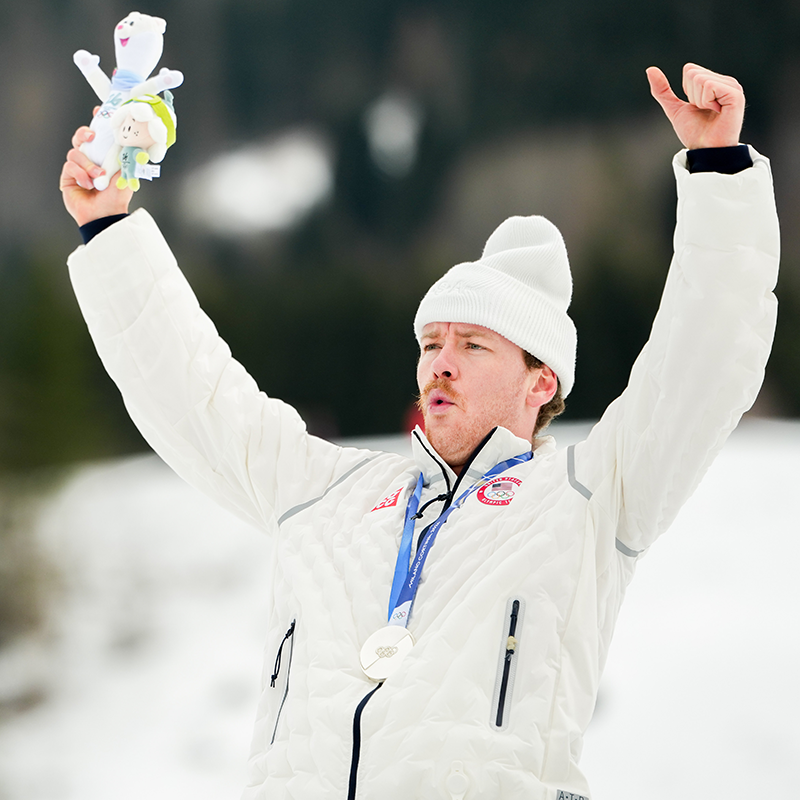
For Ben Ogden, the strangest change since taking home two medals from Milano Cortina has not been that more people started recognizing him around Vermont.
He admits he is still adjusting to the newfound fame, but that part has mostly been fun. There have been school visits, community events and moments in Burlington restaurants when strangers stop by to say they watched him at the Olympics. After the winter Ogden had just put together, with two silver medals and a historic breakthrough for American men’s cross-country skiing, the attention made sense, even if it still felt a little surreal.
What was harder to make sense of was everything that came next, which has made the last few months a bit difficult to sum up neatly. While Ogden has spent the spring and early summer being celebrated for the best season of his career, he’s also been going through the first major injury setback of his life. One part of the experience has pulled him outward, back into the local Vermont ski community that helped shape him. The other has forced him inward, into the slower world of surgery, crutches, rehab exercises, and patience.
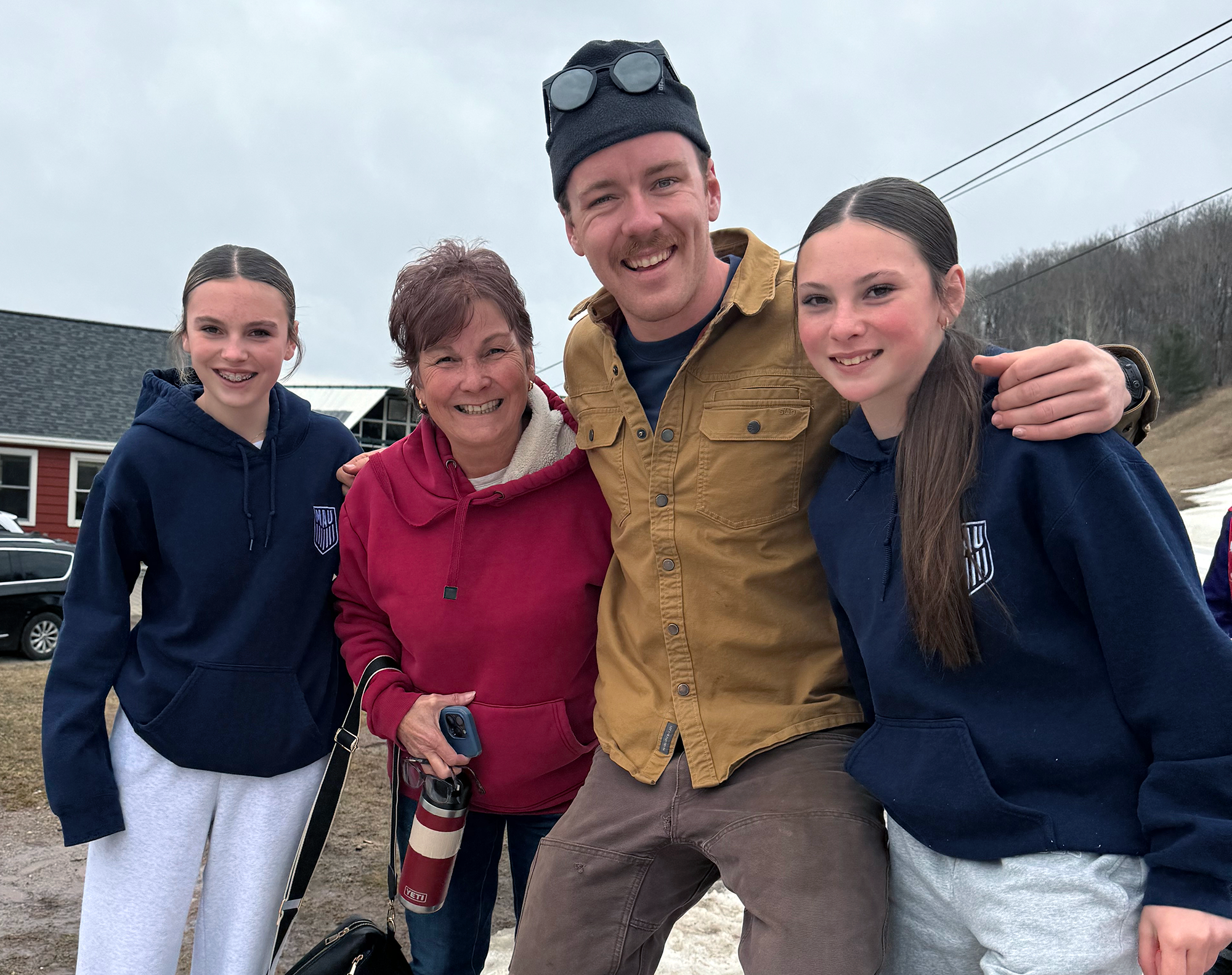
Ben Ogden posing for a photo with a few of his fans and the closest of friends of FasterSkier at the “Medals in the Mountains” community fundraiser held at Bromley Mountain Resort in Peru, Vermont, on April 12, 2026. (Photo: Jozefiak)
A New Kind of Attention
“It’s been different in some ways and similar in other ways,” Ogden said. “There are more people around Vermont who recognize me now, which is pretty crazy and fun. I’ve been invited to a lot of events, and gotten to go to a ton of schools, and just kind of been in the community a little bit more than normal.”
That part, he said, has been one of the real joys of the post-Olympic stretch. Ogden has always championed his identity as a product of the Vermont ski world, and the last few months have given him more chances to be present in it. Not just as a skier people watched on television, but as someone who could show up, talk to kids, say yes to local events and feel the reach of what happened in Italy.
“Outside of anything athletic related, it’s always a goal of mine to take my position and try to give back to the community as much as I can,” Ogden said. “There’s been a good amount of that, which has been great.”
In some ways, he said, life still feels mostly normal. It is still a Vermont summer. Burlington is still Burlington. Richmond is still close enough to feel like a small ski-world hub. But the medals have changed the way people interact with him, even in everyday places.
“It’s never tiring having people coming up to me and saying, ‘Oh, my son loves watching you,’ or, ‘We watched you this winter,’” Ogden said. “I love that, and it really makes me feel good. People are always, especially here in Vermont, just always so kind and thoughtful with their time and my time, so it’s never overwhelming.”
Still, there is a strange adjustment that comes with being recognized more often. Ogden laughed a little while describing it, not because it is a major burden, but because it is new enough to still catch him off guard. Sitting at a restaurant one time, he said two or three people came over to say they loved watching him race. Then he remembered, in a small way, that he is moving through the world a little differently now.
“You’re in the public eye a little bit more,” Ogden said. “I think you’re constantly reminded that people here in Vermont, especially, recognize me wherever I go. Again, I have no misgivings about it, but it’s hard to escape it a little bit.”
That visibility took on a more formal shape in May, when Ogden returned to UVM for commencement. He graduated from the school in 2022 with a mechanical engineering degree, and at first, he thought the university might just want him to be present or say a few words. Little did he know he would end up as the special guest speaker in front of nearly 3,700 graduates.
“I was like, ‘All right, yeah, sounds great,’” Ogden said. “And then it eventually got like, ‘Oh, you’re going to be the guest speaker,’ and I was like, ‘Whoa.’”
Ogden was characteristically candid with his explanation of how unfamiliar that setting felt. He was not answering questions in a mixed zone, talking through race tactics or explaining what it felt like to stand on an Olympic podium. He was sitting on a stage in front of graduates, faculty and families, waiting through the first part of the ceremony with his own speech still ahead of him.
“I haven’t really learned how to do public speaking properly,” Ogden laughed. “But it was really fun. The sense of relief was just staggering,” he said. “It felt so good. It felt like one of those moments where you feel like you can do anything after finishing something that scares you, and it’s just an immensely satisfying feeling. So it was fun, and I really appreciate UVM for reaching out and thinking of me and having me. That was a really fantastic honor.”
In his address, Ogden spoke about goals, but also about the people who make them possible. It was a fitting theme for an athlete whose Olympic winter was historic on paper, but communal in feeling. The medals were his, and in the team sprint, shared with Alaska’s Gus Schumacher, but Ogden has often framed the breakthrough as something larger than one person.
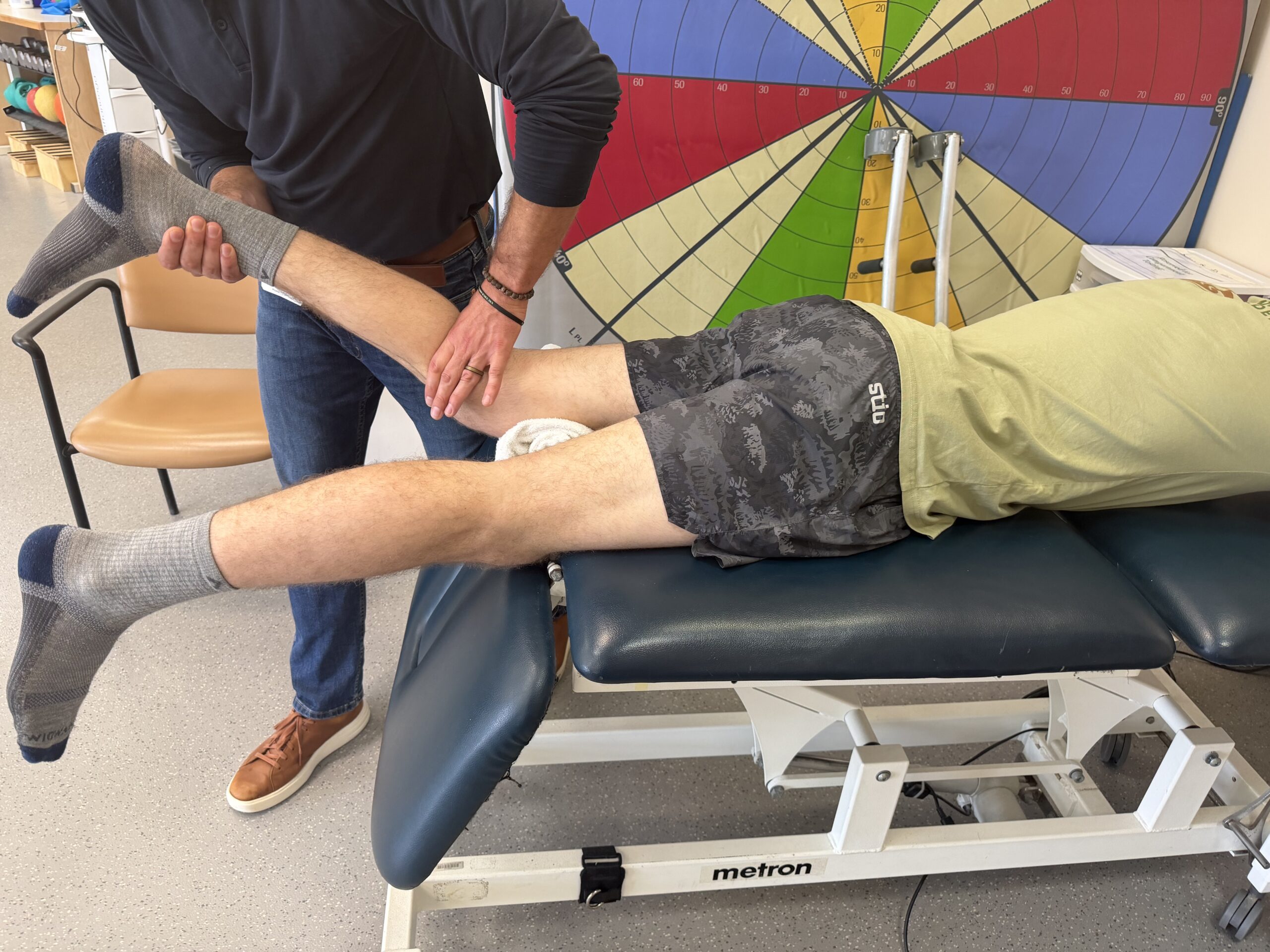
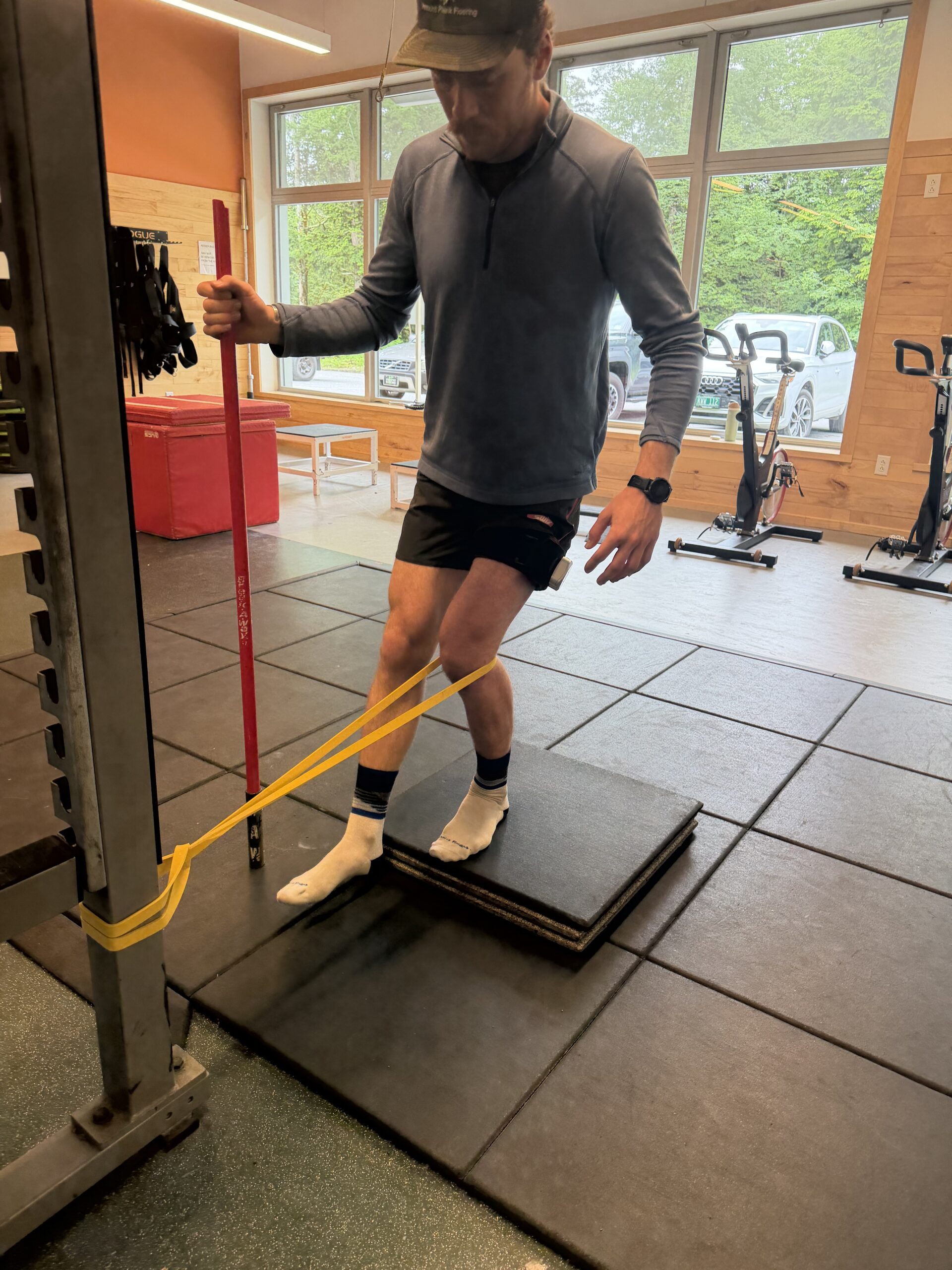
Ben Ogden getting some PT on his injured knee. (Photo: courtesy photo)
One Blow After Another
That same idea has followed him through the spring. The medals gave him a larger platform in the community, while the injury reminded him how much he still depends on one.
The knee injury happened on April 10, during what Ogden described as a typical day of spring training, until it wasn’t.
“It was a moment, but it wasn’t like I rode in the ambulance,” Ogden said. “At the time it didn’t really feel like anything bad. I was just spring skiing and doing a hockey stop, kind of, to slow down. I was going pretty fast on my cross-country skis, not denying that. But I just caught some slush and tweaked my knee.”
The first signs were not too alarming. Ogden knew he had tweaked something, but he stood up, tested it and finished skiing. The next morning, though, the knee was stiff enough that he eventually went in to have it checked out. According to the doctor, all the major ligaments were intact, and the hope was that the MRI would rule out a meniscus tear.
It did not.
“At first I was a little bit spooked, but I thought it was going to maybe be a week of slowing down or something,” Ogden said. “Then after I went to the guy, he was like, ‘Oh yeah, if it’s a meniscus tear, maybe it’ll be a month or two months.’ And then it ended up being a complete meniscus tear, so I had to have it repaired, which leveled up the situation even worse.”
Ogden had surgery at the end of April and spent six weeks fully non-weight-bearing on his left leg. When he spoke with FasterSkier in late June, he was about seven weeks removed from surgery and had started a weight-bearing progression, sometimes using one crutch and sometimes none. Even with that progress, it had been a hard adjustment.
“It was a little bit like I just got one blow after another for probably a week there,” Ogden said. “I was definitely pretty down, feeling pretty bummed, especially because it happened just doing something random. It so easily could have been avoided. But then again, stuff happens.”
He’d dealt with illness and little tweaks here and there before, as most endurance athletes do over the course of a career. But this was different. It was his first surgery and the first time he had to take a major step back from the sport because of an injury.
“On the mental side, it’s definitely hard,” Ogden said. “I think that an injury of this caliber would be hard for anybody mentally, just because being on crutches is incredibly frustrating, and it limits you so much. I won’t lie and say that wasn’t hard for me. Those weeks were brutal.”
The hardest part, Ogden said, was not just the crutches. It was the way the injury stripped away the pieces of daily life that usually make him feel like himself. He could still drive, because the injury was to his left knee, so he was not fully stuck in the house. He had physical therapy almost every day, a strong group of people around him, and enough structure to keep his days from feeling completely empty. But he could not move the way he wanted. He could not train the way he was used to training. He could not go outside with teammates and friends to just disappear into the rhythm of a long session.
“The two biggest things were just that I couldn’t really move, I couldn’t really do the things that I like to do, and I also couldn’t train,” Ogden said. “As a cross-country skier, or any type of athlete, really, not being able to do what you do, you quickly start to feel like you’re losing ground. That’s a really, really hard thing.”
It’s left him in a strange middle ground, where he has been through enough seasons, enough ups and downs, to understand that a few months do not define everything. But understanding that and feeling it every day are not the same thing.
“I feel like I’m at a point in my career where I’m better equipped to deal with that than I ever have been,” Ogden said. “But it’s still really hard to sit around.”
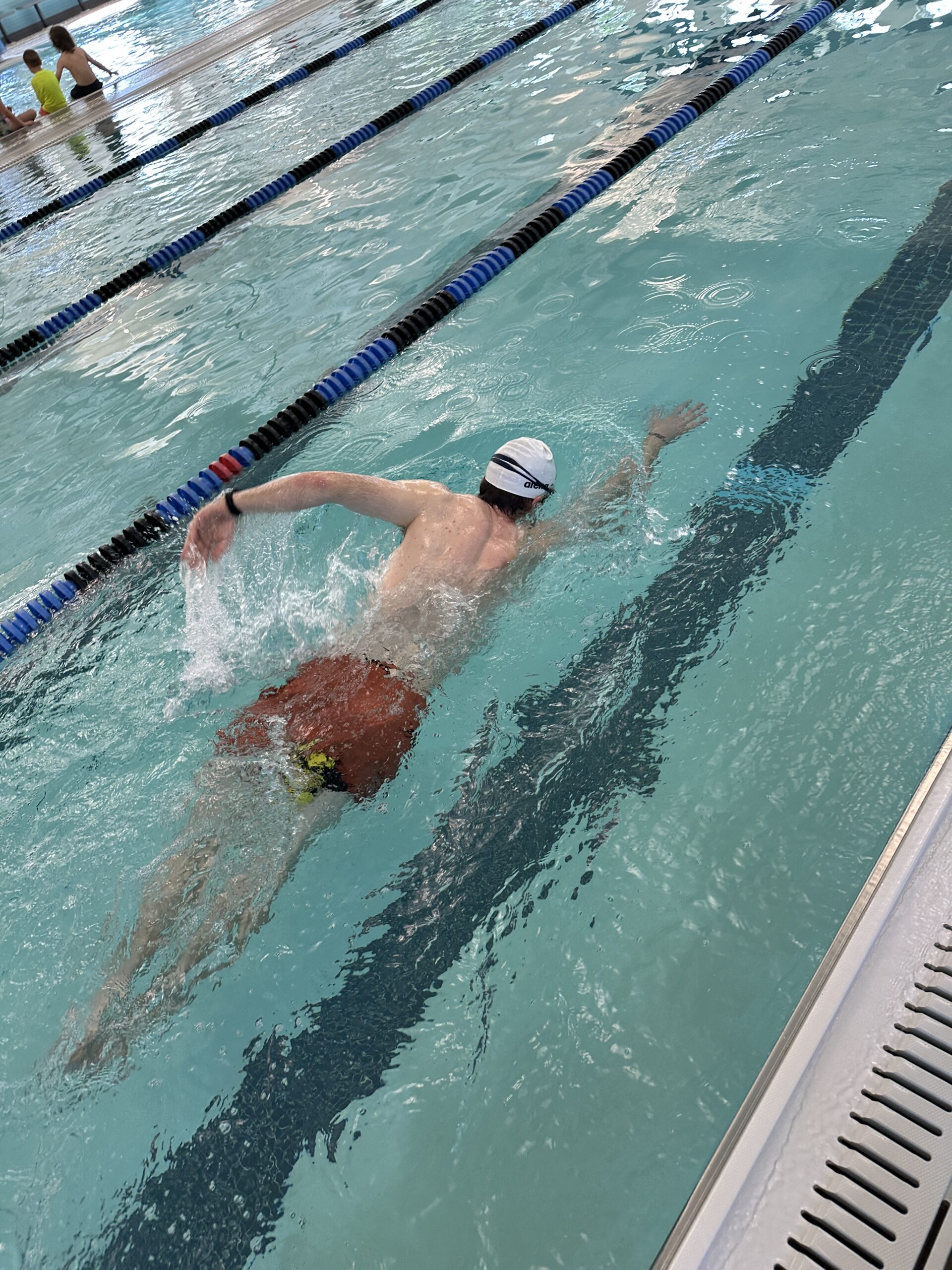
With the helpful coaching of friend, teammate and neighbor Julia Kern. Ogden took to the water to try to maintain fitness. (Photo: courtesy photo)
Finding a Way Through
One major comfort is that he has not had to figure it out all on his own. Ogden said the U.S. Ski Team’s medical system has been well prepared to handle a knee injury like his, in part because other disciplines under the U.S. Ski & Snowboard umbrella see them more often. Alpine skiing, in particular, has no shortage of knee injuries, and Ogden joked that compared to what some alpine athletes have endured, his injury is “junior varsity.”
That has not made the recovery easy by any means, but it has made the process clearer. From the start, he had a plan, a protocol and a timeline.
“I knew the timeline on day one,” Ogden said. “That sucked, because it was a major blow knowing how long I’d be out for, but now I’ve just sort of had to work with it.”
In some ways, he said, that has been easier than dealing with an illness, where there may be no clear date or progression. A meniscus repair brought bad news, but at least that bad news came with some kind of structure.
The training itself, for now, is limited and not always exciting, but Ogden has filled the space as best he can, with swimming, upper-body strength work and more time on the SkiErg than he would probably care to count.
“I’m able to fill my days with the training modes available to me,” Ogden said. “I still get frustrated. Sitting at the SkiErg, it’s great and it’s something to do, you get the heart rate up, it feels good, but it is just horrendously boring.”
That boredom has been one of the smaller but more persistent reminders of what he is missing. For Ogden, training has never just been about the work itself. It’s about being outside, sharing those hours with friends and teammates, and feeling connected to the sport in a way rehab cannot quite replace.
“So much of what motivates me as an athlete is being outside and enjoying training with friends and teammates and all that stuff,” Ogden said. “You kind of lose it all.”
Physical Therapy has a big part of Ogden’s life since his surgery. (Photo: courtesy photo)
The Next Step
Still, he has been able to see steady progression in his recovery. At the time of the interview, Ogden was starting to walk more normally again, though he said that process itself felt almost like something he had to relearn. His left leg had lost muscle and range of motion. Once walking felt solid, he expected to add more training options, including the spin bike, then outdoor biking, then eventually rollerskiing.
He hopes to be on snow at a normal time in November, though what “normal” means for racing fitness is still unclear. This season, he said, may become more of a “train into it” year. Rather than targeting early World Cup racing in November, he could end up building toward later points in the season, perhaps after the Tour de Ski and closer to the World Championships portion of the calendar.
“I’m still hopeful,” Ogden said. “It’s a blow for sure, and somewhere unlike any I’ve ever experienced, but I don’t necessarily think it has to be a complete loss. I think I’ll get through it.”
For now, he is trying not to get too far ahead of himself. The surgeon told him to view the recovery on something closer to a year-long scale, not because he cannot train for a year, but because returning fully to where he was in strength and aerobic fitness will take time. Ogden’s hope is to beat that timeline by a few months if possible and feel like himself again by late January, February or March. That would still leave room for something meaningful to come from the season.
“I’ve tried not to put a crazy amount of thought to it,” Ogden said. “I try to just focus on the present with this as much as I can. My goals are to do what I can, try to be patient, and try to feel like I get to that top race form, or something resembling it, at some point in the season.”
That might not sound like the goal of someone who just won two Olympic silver medals. But that is the reality of the spring Ogden has been given. The medals did not make him immune to bad luck. They did not make rehab move faster. They did not make the SkiErg more interesting.
They did, however, give him a new kind of perspective on what progress can look like.
Ogden said he always likes to come out of a season with something to be proud of, something that can carry energy into the next year. This time, that “something” might look different.
“I want to find that something this season,” Ogden said. “Whether or not that’s coming back from this injury a few months ahead of what the surgeon thought I could, or getting a top 10, getting a top 15, whatever, on the World Cup despite a major setback, that’s what I need to be reinvigorated for next year.”
In the meantime, the goals are much smaller. They are also more immediate, and maybe that is what makes them useful.
Rather than sit on the couch and think about missing a year of the thing he loves most, Ogden has tried to narrow his focus. First, he could think about walking again and getting away from the crutches. Then he could think about biking outside. To do that, he needs more range of motion in the knee, more quad strength and more consistency with the everyday work.
The scale has changed, but the mindset is familiar.
“There’s always the next thing,” Ogden said. “It’s the same in ski racing, honestly. It’s the same mindset that you have to take as an athlete. Obviously, I had to take 20 steps back, where instead of trying to get that podium or get that whatever, I’m just trying to get walking. But it’s the same thing, and you still feel good about it when you accomplish something.”
That may be the simplest way to understand Ogden’s first spring as an Olympic medalist. It has been a season of celebration, community and unexpected attention, but also one that has forced him to slow down, start over in small ways and rethink what progress looks like.
The medals are still there. So is the community that helped him reach them. And now, so is the work of getting back, one smaller goal at a time.
For Ogden, the next big thing does not need to be another Olympic podium just yet. For now, getting outside for a bike ride will do.
Help Support Our Coverage!
If you value the thoughtful work and access FasterSkier provides, please consider becoming a Voluntary Subscriber. Your support directly fuels our work to cover the people, places, and moments that make our sport special.
Rosie Brennan (USA) celebrates in Ruka (FIN) in 2023 after finishing 2nd in Saturday’s 10 k classic race. The result was Brennan’s first classic World Cup podium of her career. (Photo: Nordic Focus)
Rosie Brennan has stepped away from the World Cup, though she’s still figuring out exactly how to define the next chapter in her life.
Retirement is the easy word, and in some ways, the accurate one. She is done with the World Cup. She is done with the version of cross-country skiing that demands five months in Europe, constant travel, start lists, team schedules, narrow margins and the unrelenting pressure of measuring a career in seconds.
After more than a decade with the U.S. Ski Team, three Olympic appearances, hundreds of World Cup starts, two World Cup wins and a place among the best all-around skiers the United States has produced, Brennan has stepped away from the highest level of the sport.
But if retirement is supposed to mean the end of something, Brennan is not quite sure the word fits.
“Retirement has been a tough word for me,” Brennan said. “It feels very black and white.”
“One of my friends and older teammates called it rewiring.”
To Brennan, that seems closer. She’s not walking away from skiing so much as trying to build a new relationship with it. The shape of her days may change, and her focus will no longer be “110 percent” on racing, but skiing itself remains too central, too familiar and too joyful to simply leave behind.
“I love skiing and ski racing,” Brennan said. “I want to continue to be able to use my body in ways that challenge and push me in the world of skiing and competition again at some point, maybe sooner than later.”
“Skiing is just not that for me,” Brennan said of the idea of retiring and never doing the thing again. “It’s something that I hope to do till the day I die, honestly.”
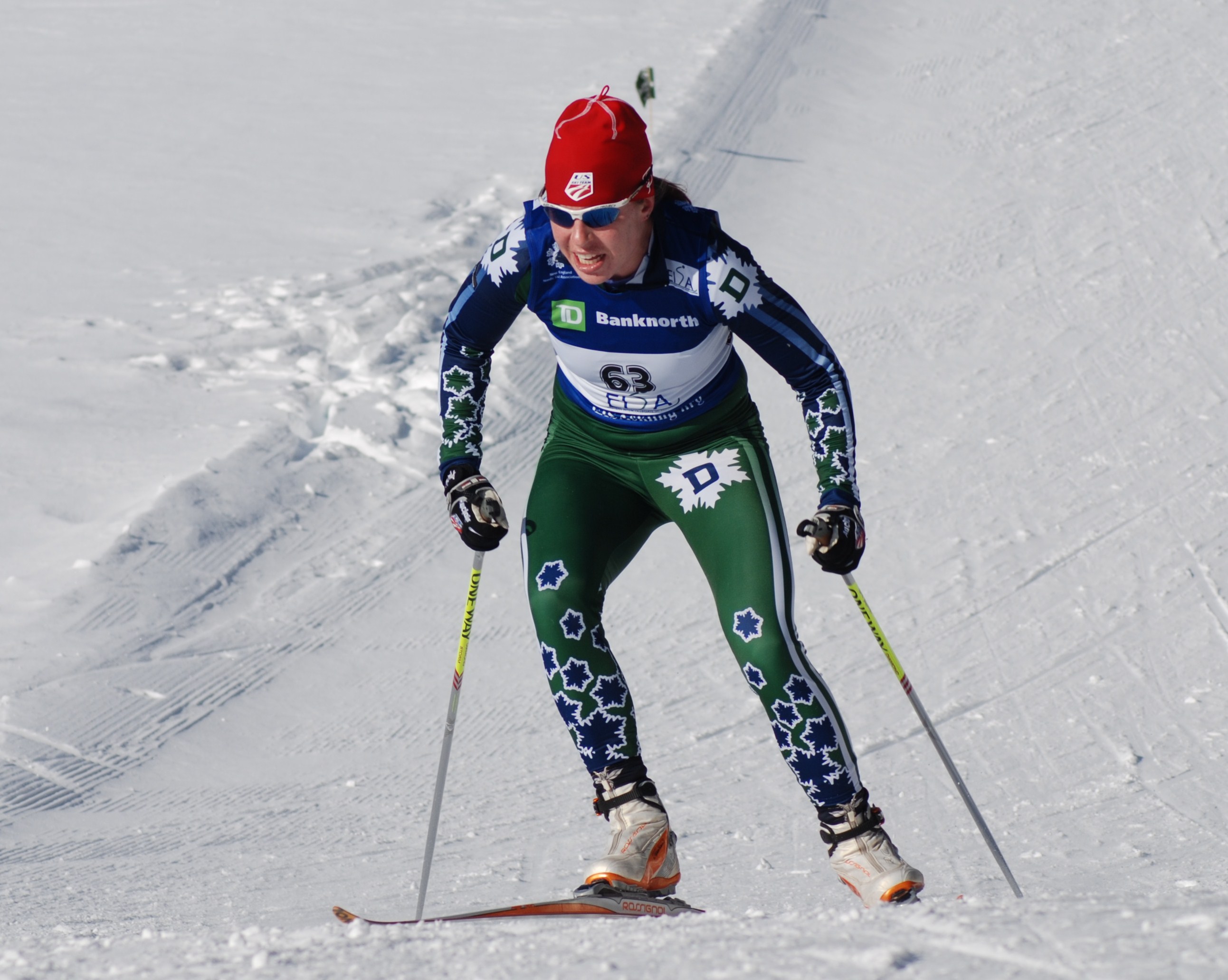
The first uploaded image of Rosie Brennan in the FasterSkier archives after she won both EISA women’s races in Feb. 2009 (Photo: Ruff Patterson)
A Career Built on Perseverance
When Brennan looks back now, the first thing she points to is not a specific race, podium or result sheet, but rather the belief in herself that made all of those things possible.
“I’m really proud of, I guess, the perseverance of my career,” Brennan said. “It takes perseverance to have longevity in a career, to weather the inevitable obstacles that appear throughout a long career, and to find belief when things aren’t going your way.”
That perseverance became the throughline of a career that took time to reveal itself. Brennan was not a teenage prodigy who moved smoothly from junior success to World Cup podiums. She came to skiing later than many of her peers, waited longer for the biggest results and had to weather the doubts that creep in when progress slows, injuries interrupt momentum and other paths begin to look more practical. Then when the results did arrive, those earlier years felt even more meaningful.
In a career defined by patience and progress, one of the things Brennan says she is most proud of is not just that she reached the top level, but that she continued to expand what she could do once she got there. She never settled into one lane as only a distance skier or only a classic specialist. Instead, she kept working to become more complete, finding reward in the challenge of improving across formats, distances and techniques.
“I’m also proud of the range that I maintained throughout my career,” Brennan said. “Continuing to be an all-arounder throughout my career and finding some success in all the disciplines and both techniques throughout — that was something that was just, I don’t know, I guess a personal challenge that I found a lot of reward in.”
That sense of progress extended beyond Brennan’s own results. Her career also unfolded during the strongest era in the history of American women’s cross-country skiing, and as the U.S. team continued to raise its standard internationally, Brennan came to see herself as part of something larger than her own race days.
“I’m proud to have been part of a really amazing wave of American women skiing,” Brennan said, “and to have done my best to carry that wave forward and to help push things forward and pass things on to future generations as well.”
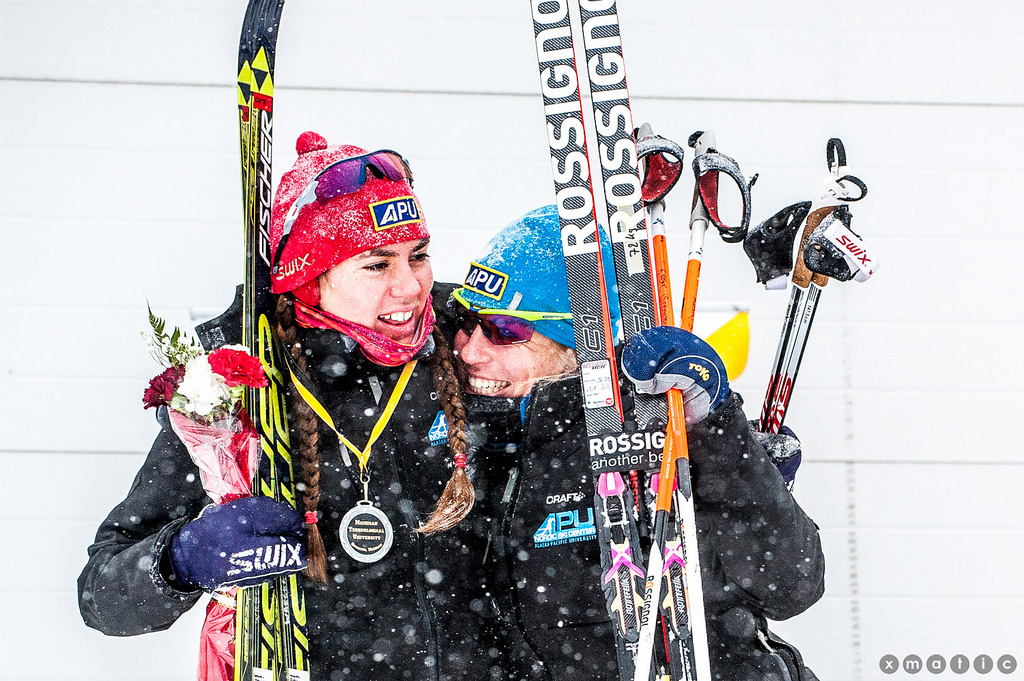
APU’s Rosie Brennan (r) embraces close friend and APU teammate, Becca Rorabaugh (l), after they finish first and second, respectively, in the Women’s 1.5 k Classic Sprint at the 2015 U.S. Cross Country Championships in Houghton, Mich.
Starting Late, Staying Long Enough
Brennan started skiing at 14, late by the standards of an international sport where many athletes first step onto a set of fish scales as young children. But she never saw her development as a simple matter of being behind.
“I was older when I kind of found top-level success in podiums on the World Cup,” Brennan said. “But because I started skiing so late, I guess I never really saw it that way.”
In her mind, the clock did not start with age, but when she first found herself on a pair of skis.
“If you look at when I started at 14 to when I had success, those accumulated hours of skiing and training are probably actually fairly equivalent to somebody who started at eight,” Brennan said. “So I always just chose to look at it that way, as if it was just going to take time to learn those skills, and it was fine that I started late.”
“I’m not good at being patient,” Brennan said.
But skiing gave her little choice. It took time to develop the specific strengths required of the sport, to learn how to race and to absorb the small skills that many skiers pick up almost without realizing it when they start young. Brennan had to build the engine and the instincts at the same time.
There were moments when she wondered whether it was worth it. In college, after injuries and difficult stretches, she decided she was done with skiing when she graduated. She looked toward other paths. At times, she quit, or at least tried to. But the sport kept pulling her back.
“I think what I enjoyed the most that made me keep coming back was just the challenge of it,” Brennan said. “Waking up every day with some purpose to get a little bit better, and to have the challenge of seeing if it was possible.”
Eventually, that challenge became a way of life.
“I just learned to really enjoy and thrive and love the lifestyle of skiing,” Brennan said. “And so that made it a lot easier to just keep coming back.”
Brennan is quick to point out that she did not do that alone. The support systems around her mattered. At Dartmouth and later at Alaska Pacific University, she found teams and coaches that helped her keep believing when she could not quite do it herself.
“There were definitely moments that it’s easy to question, and it’s hard to keep going,” Brennan said. “I was really fortunate to be part of some really, really amazing groups, and have coaches that fostered that belief in me, and made me see things in myself that I couldn’t see on my own.”
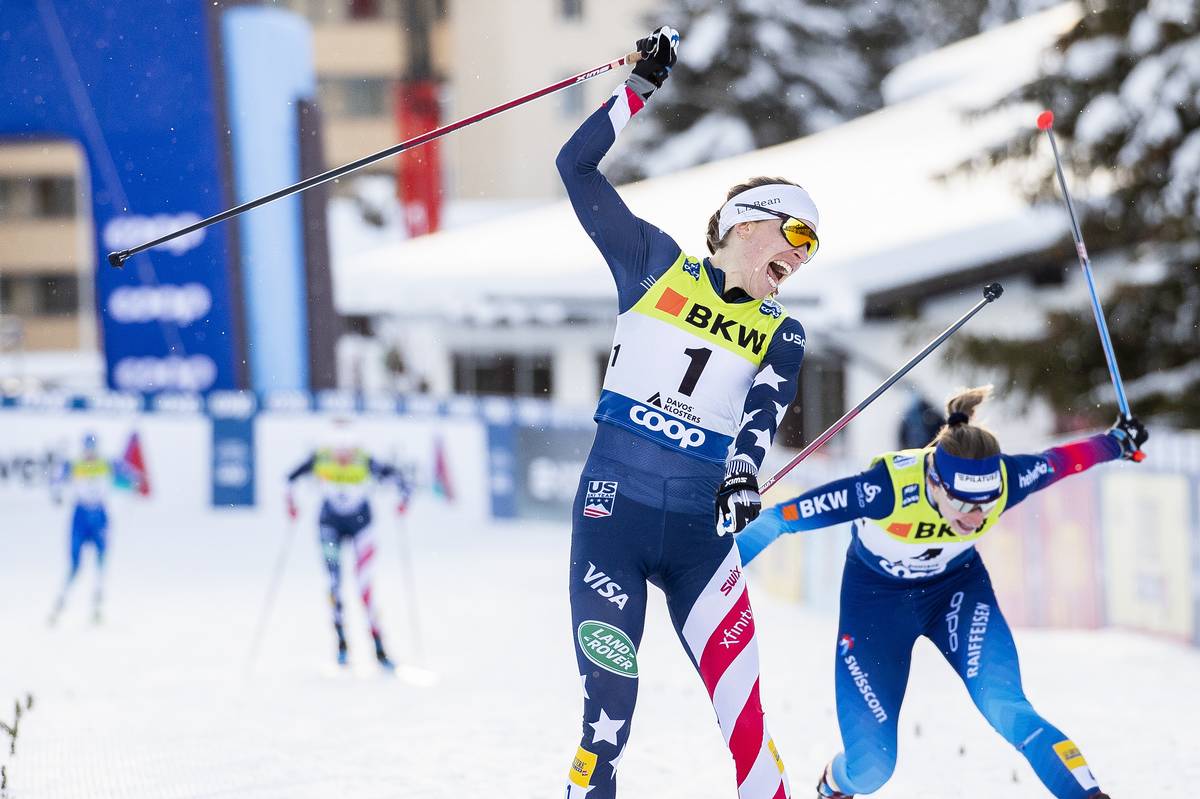
Rosie Brennan celebrates her victory and first World Cup podium after the freestyle sprint in Davos, Switzerland. Photo: NordicFocus
When the World Was Put on Notice
For years, Brennan’s career was a slow and steady build, but then came that famous weekend in Davos.
In December of 2020, during a World Cup season shaped by the uncertainty of the pandemic, Brennan won twice in two days in Switzerland. On Saturday, she claimed her first career World Cup victory, in a freestyle sprint, and then the very next day, she won again in the 10-kilometer freestyle.
From the outside, it looked like a breakthrough and a historic moment for U.S. skiing. Brennan does not dispute that. She says what stays with her the most now is not only the winning, but everything she had to manage in order to ski that way.
“Davos 2020 was definitely a breakthrough moment for me,” Brennan said. “That year was challenging for the whole world, and being a ski racer during that time certainly had its challenges too.”
The uncertainty of that season weighed heavily. Rules changed, travel was complicated and athletes did not always know whether races would happen. The risk of illness carried not just health concerns, but career implications for athletes whose bodies were their livelihoods.
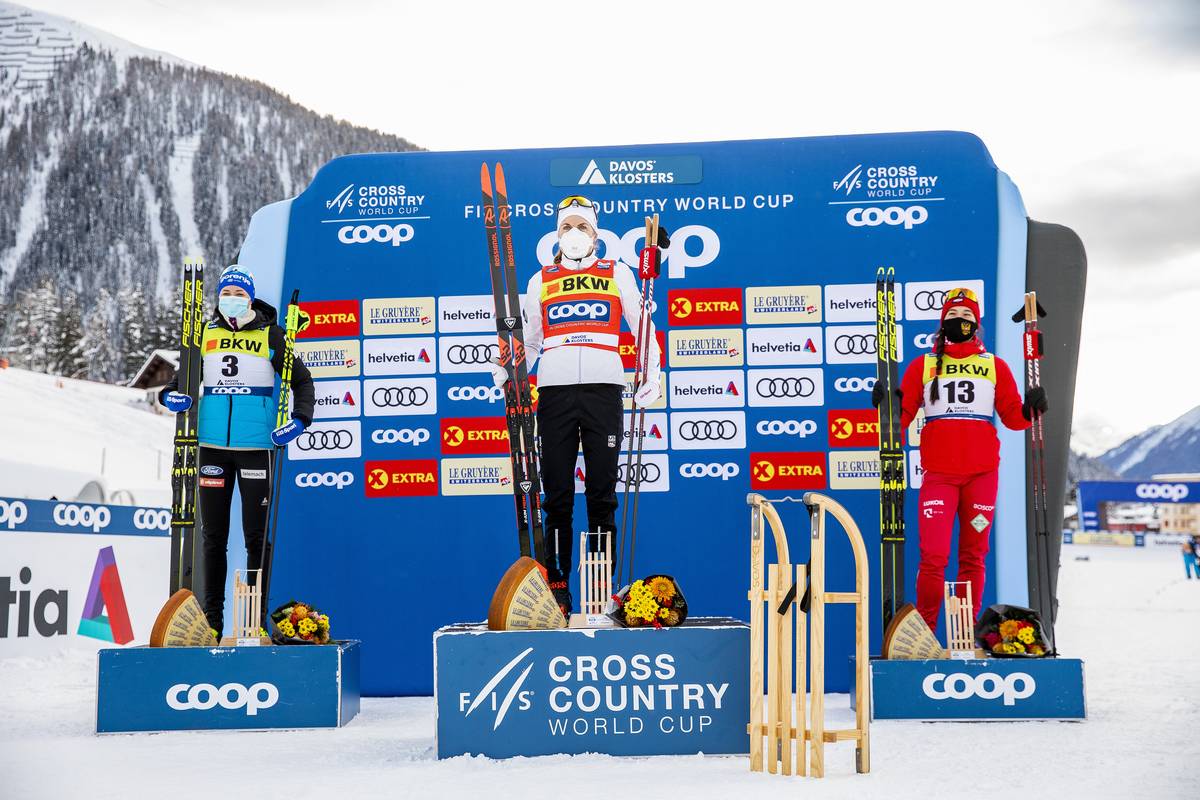
Taking the victory and the sled, Rosie Brennan stands atop the podium in Davos, Switzerland. (Left to right) Anamarija Lampic (SLO) 2nd, Brennan (USA) 1st, Natalia Nepryaeva (RUS) 3rd.
“I really struggled with the anxiety of it all,” Brennan said. “Just never knowing — traveling in foreign countries, where the rules were changing all the time, and you didn’t know what would happen if you got sick.”
Hence why Davos still means something more than two entries on a results page. Brennan was proud of the wins, of course, but she was even more proud of how she managed everything around them.
“It definitely showed me what I was capable of,” Brennan said, “and that I could manage these really high-stress environments and all the uncertainty and thrive in that setting.”
That weekend did not just give Brennan her first World Cup wins. It helped confirm the range she had been building toward for years. Later that season, she became the first American to hold the overall World Cup leader’s bib, sprint leader’s bib and distance leader’s bib at the same time. Which was both a major accomplishment and also a fitting reward for all the work she had put in to become a more complete racer.
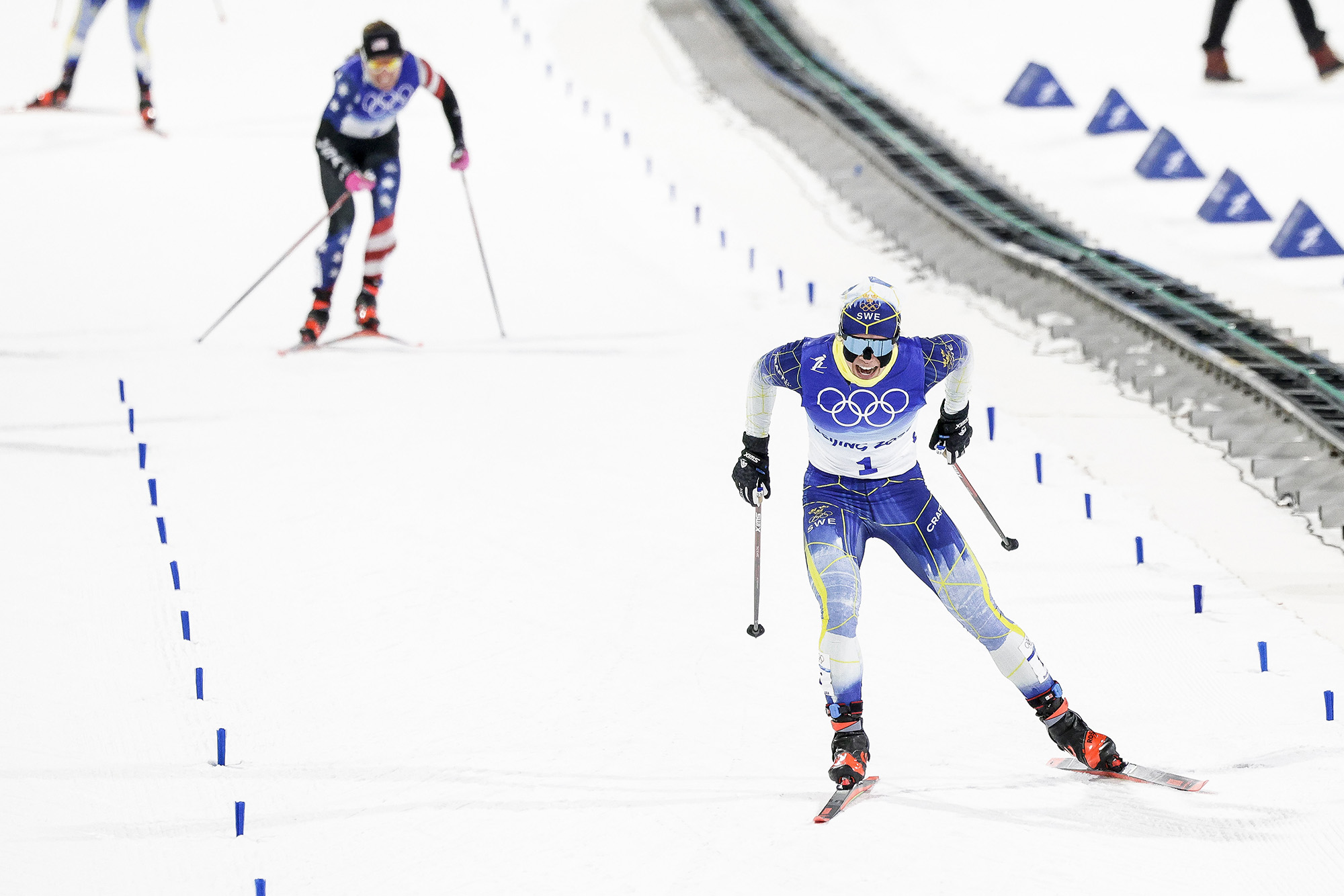
Jonna Sundling (SWE), with a commanding victory in the 2022 Olympic individual freestyle sprint, comes to the finish with Rosie Brennan (USA) in the background on her way to fourth. (Photo: NordicFocus)
What the Career Adds Up To
Brennan will take a step back from her professional career after amassing quite the résumé, representing the United States at the 2018, 2022 and 2026 Winter Olympics. She finished fourth in the freestyle sprint at the Beijing Olympics in 2022, the kind of result that can feel both extraordinary and excruciating, by missing out on an Olympic podium by a single place. She reached World Cup podiums across seasons and disciplines. She became a two-time World Cup winner, a fixture in the American women’s team and one of the athletes who helped move the U.S. from occasional contender to regular presence near the front of international races.
But Brennan’s own accounting of her career is not limited to the results she garnered over the years. She is proud of showing up. Proud of learning. Proud of becoming competitive in every event. Proud of the people who helped her and the younger athletes she helped in return. Proud that a career that could have ended several times kept expanding instead.
That may just be why the end of her World Cup career does not feel like a true breakup. For Brennan, skiing was never just a job. It provided her with structure, challenges, community, identity and gave her something to work toward every day and a way to test what was possible. Even now, when she is no longer organizing her life around World Cup racing, she says she’s not suddenly becoming someone else.
“When you train that many years, it’s hard,” Brennan said. “I’m still going out twice a day most days, because it just feels so normal to me.”
That may change when she starts school again and other commitments begin to fill the space skiing once occupied. Brennan says she plans to pursue new interests and give attention to parts of herself that the World Cup lifestyle did not always allow. But the habits of a skier are not easy to unwind, and she does not seem especially eager to unwind all of them.
“I definitely hope to bring forward a lifestyle that’s active, that treats your body well, that’s also willing to push yourself and see where the limits are,” Brennan said.
Rosie Brennan (USA) during the individual sprint qualification at the final World Cup weekend this past March in Lake Placid, New York. (Photo: Modica/NordicFocus)
Rewiring, Not Retiring
That is why “rewiring” works. Brennan is not flipping a switch. She is just rearranging the circuitry.
There will be no more full World Cup campaign, no more life built entirely around the next race weekend. But there will still be skiing, there will still be movement and there will still be competition. The habits and lessons of her career that she built through years of resilience and patience are not things Brennan expects to leave behind.
“I’m sure there are countless skills, probably most of the skills I’ve learned in my adult life, that I will have to lean on in any of the various careers that I may pursue, and in my studying as well,” Brennan said. “The lessons that I’ve learned will undoubtedly come with me, along with the character and strength that I’ve built throughout my career.”
Those lessons were built through the less tidy parts of Brennan’s career, from the late start and the years before the podiums to the injuries and doubts that forced her to keep adjusting. But the same career that asked so much of her also gave her something lasting. Skiing was more than a pursuit or a profession, it was the driving rhythm of her adult life, and one she still feels lucky to have followed for so long.
“It’s definitely an incredible lifestyle to be a ski racer,” Brennan said. “I feel insanely lucky to have called that my career, and to have done so for so long.”
That gratitude does not make the transition simple. After so many years of organizing life around training, racing and the rhythm of the World Cup, stepping back from that structure means more than changing a schedule. It means figuring out what skiing looks like when it is no longer the center around which everything else has to turn.
Rosie Brennan (USA) during her final World Cup of her career — the 20 k Freestyle Mass Start in Lake Placid (USA). (Photo: Thibaut/NordicFocus)
But there is also freedom in that. Brennan no longer has to prove she belongs. She already did. And now, instead of defining skiing only through the World Cup, she gets to decide what parts of it she wants to keep.
Maybe that means races. Maybe it means long days outside. Maybe it means testing herself in new settings, with new stakes, away from the circuit that shaped so much of her adult life. Maybe it means all of that.
What seems clear is that Brennan is not disappearing from the sport. She is stepping out of one version of it and into another.
She is retired, if that is the word people want to use. But it is not the sunset kind. Not the final-page kind.
For Rosie Brennan, skiing will always be there, just not in the all-consuming way it once was. Now, she gets the chance to redefine her relationship with the sport as something woven into the life she is building next.
“It’s truly been a dream,” Brennan said.
Help Support Our Coverage!
If you value the thoughtful work and access FasterSkier provides, please consider becoming a Voluntary Subscriber. Your support directly fuels our work to cover the people, places, and moments that make our sport special.
Brennan’s U.S. teammates wait at the line to greet her after her final World Cup race, a 20-kilometer start in Lake Placid on March 22. (Photo: NordicFocus)
The International Ski and Snowboard Federation (FIS) unveiled its proposed 2026/2027 cross-country skiing World Cup calendar this week at the FIS Spring Meetings in Portorož, Slovenia.
The schedule — first shared publicly through FIS social media and still pending FIS Council approval — builds the season around the 2027 World Championships in Falun, Sweden, with three pre-Christmas stops, a nine-race Tour de Ski, a stretch of three weekends between the Tour and Worlds, and a Scandinavian closing kick that ends with the Finals in Ulricehamn.
For North American fans, the calendar is once again entirely European, with no scheduled stops in Canada or the United States.
Frida Karlsson (SWE) poses with Mr. and Mrs. Claus following the 10k Classic to start last season in Ruka (FIN). (Photo: Modica/NordicFocus)
Pre-Holiday: Ruka, Trondheim, Davos
The season opens where it almost always does — in Ruka, Finland, where the World Cup begins November 27. From there, the circuit moves to Trondheim, host of the 2025 World Championships, before the pre-Christmas block closes in Davos, Switzerland, with a team sprint.
November 27-29, 2026: Ruka, Finland
27/11: 10km Interval Start Classic
28/11: Sprint Classic
29/11: 20km Mass Start Freestyle
December 1-3, 2026: Trondheim, Norway
01/12: 10km Interval Start Classic
02/12: Sprint Freestyle
03/12: 20km Skiathlon
December 11-13, 2026: Davos, Switzerland
11/12: 5km Heat Mass Start Freestyle
12/12: Sprint Freestyle
13/12: Team Sprint Freestyle
With Jessie Diggins (USA) now retired, there will be a new FIS Overall Crystal Globe and Tour de Ski champion next season (Photo: Vanzetta/NordicFocus)
Tour de Ski 2026/2027
The Tour de Ski returns to a three-country format, opening in Les Rousses, France, on New Year’s Day, moving to Oberstdorf, Germany, and finishing with three races in Val di Fiemme, Italy — capped, as ever, by the Final Climb up Alpe Cermis.
January 1-3, 2027: Les Rousses, France
01/01: Sprint Classic
02/01: 20km Mass Start Classic
03/01: 15km Pursuit Freestyle
January 5-6, 2027: Oberstdorf, Germany
05/01: 15km Mass Start Classic
06/01: 5km Heat Mass Start Freestyle
January 8-10, 2027: Val di Fiemme, Italy
08/01: 15km Skiathlon
09/01: Sprint Freestyle
10/01: Final Climb
Gus Schumacher (USA) and the rest of the US team will hope to continue their success in Toblach (ITA). (Photo: Modica/NordicFocus)
After the Tour, Before Worlds: Engadin, Toblach, Lahti
Three weekends bridge the Tour de Ski and the World Championships. Engadin opens its weekend with a mixed relay — a format the FIS has been working into more World Cup weekends — and Lahti closes the pre-Worlds stretch with its classic 20km skiathlon and 10km interval start.
January 22-24, 2027: Engadin, Switzerland
22/01: Mixed Relay
23/01: Sprint Freestyle
24/01: 20km Mass Start Freestyle
January 29-31, 2027: Toblach, Italy
29/01: 10km Interval Start Freestyle
30/01: Sprint Freestyle
31/01: 20km Mass Start Classic
February 12-14, 2027: Lahti, Finland
12/02: Sprint Classic
13/02: 20km Skiathlon
14/02: 10km Interval Start Classic
Kendall Kramer (USA) had a breakout World Cup Skiathlon in Falun (SWE) last season. (Photo: Authamayou/NordicFocus)
2027 FIS Nordic World Ski Championships: Falun, Sweden
The 2027 FIS Nordic World Ski Championships run from February 22 through March 7 in Falun, Sweden, with all title formats on the program. Falun last hosted Worlds in 2015.
Final Period: Oslo, Drammen, Ulricehamn
The closing stretch is a Scandinavian one. Oslo’s Holmenkollen weekend features back-to-back 50km mass start classic races on March 13 and 14 — long a fixture of the late-season calendar — before a one-day sprint stop in Drammen and the World Cup Finals in Ulricehamn, Sweden.
March 13-14, 2027: Oslo, Norway
13/03: 50km Mass Start Classic
14/03: 50km Mass Start Classic
March 16, 2027: Drammen, Norway
16/03: Sprint Classic
March 19-21, 2027: Ulricehamn, Sweden (World Cup Finals)
19/03: 10km Interval Start Freestyle
20/03: Sprint Freestyle
21/03: 20km Mass Start Classic
The calendar remains subject to FIS Council approval.
Yesterday’s announcement of changes to next year’s World Cup schedule came as a dramatic surprise to the cross-country skiing community. But the story behind those changes is just as interesting as the changes themselves. Lars Johansen, the Swedish delegate to the FIS (International Ski Federation) competition committee described how the historic changes came about. “I was sitting glumly in my Cortina hotel room. In nine days, I was due to give my final report to the annual meeting of the FIS’s cross-country skiing competition committee, and the news wasn’t good. Soon the good feelings and sugar buzz of the winter Olympics would be over,” said Johansen, “and the hard choices of what to do next would need to be resolved.”
Johansen was referring to the task the committee had directed him to address, which was the thorny issue of traditional cross country skiing’s sagging television ratings. The preliminary numbers from the Olympics were very good—but they always were—however the ratings for the regular season World Cup competitions continued to disappoint. There has been a long steady decrease in television viewers for traditional cross-country compared to other Nordic sports, and if the pattern continued, it would become an existential threat to the continued viability of traditional cross-country World Cup racing. Without the money associated with strong viewership, a business model simply doesn’t exist for traditional cross-country to continue on the World Cup circuit.
The data was now in and the results were unmistakable. The numbers weren’t bad, but biathlon continued to kick traditional cross-country’s butt. In fact, biathlon had surged to become the most watched winter sport in Europe, and despite the U.S. cross country team’s success in recent championships, North American viewership wasn’t increasing nearly fast enough to offset the decline in European viewers. The problem is that there are only so many advertising dollars to go around, and advertisers go for the biggest bang for their buck. The limited pool of existing advertisers were sinking their budgets into biathlon. Eyeballs were glued to biathlon, and traditional cross-country had become an afterthought. Biathlon’s dominance was becoming hard to take, and the Nordic competition committee wanted answers. Something had to be done.
The viewer data for traditional cross-country skiing compared to biathlon is not good. (Data/Photo: O’Neil Data Services Inc.)
The competition committee’s meeting process is well established. During every World Championships and Olympics, the Committee gathers to discuss changes to race formats and other issues which need to be addressed. It is a logical way to conduct business. Most of the governing body’s members are already in town for events, so it makes sense to get everyone together while officials are already there. The routine goes something like this; delegates are free to watch live events as they choose, after events and on off days; they meet to discuss business.
However, this year while the format was the same, the mood was very different. This year the mounting crisis facing traditional cross-country was the main topic and it was definitely not business as usual. “What were we going to do about the falling viewer ratings? That was the only agenda item.” The committee had already had two meetings, and they did not go well. “We batted around a bunch of tweaks to competitions to make them more attractive,” said Johansen. “But the reality was that we all knew these minor changes wouldn’t make much of an impact. I had been directed to submit new fresh ideas and really, I didn’t have much. We were looking at adding mixed relays to the Olympics and continuing them more prominently into the world cup schedule, but I knew that it was just nibbling around the edges. We needed something dramatic, something that would serve as a wakeup call to the world that we were not the stodgy older brother of biathlon, but that we could be the cool kid as well.”
“But I was totally stuck, and the committee wasn’t happy, though I think they knew that there really wasn’t much to be done. We were probably just going to have to accept our fate and continue to struggle with declining viewership and therefore declining revenue. I was fully prepared to be the one to deliver the bad news, knowing that it would mean that I would probably lose my job.”
The all important metric of total viewer engagement for traditional cross-country skiing is not looking healthy. (Data/photo: O’Neil Data Services)
However, as it turned out, serendipity intervened and Johansen came up with a groundbreaking idea that has rocked the Nordic world and put traditional cross-country back into the spotlight, hopefully for good.
“It was Wednesday, and my next update was due the following day. To be totally honest, I was pretty depressed. I didn’t even go the Sprint races that day, instead I watched them from my hotel room. I wasn’t really even paying much attention to the competition, but then I saw what now has become a worldwide phenomenon. The dog everyone now knows as Nazgul strayed onto the Sprint qualifying course. At first, I was annoyed by this. How could anyone be so careless with their animal I thought? Someone could have been hurt.” Johansen continued that, “the day progressed like any other day, and I mustered the energy to go watch the Sprint finals live. By the time I returned to my hotel room every social media channel was blowing up over this dog. I couldn’t believe it. In 30 seconds, this canine achieved more media notoriety than our hard working athletes had in years. I was dumbfounded but didn’t really know what to make of any of this other than that it was an interesting Olympic footnote.”
Johansen had bigger fish to fry than the curious case of a stray dog. He staggered into Thursday’s meeting empty handed, and admittedly dejected. “The discussion began and everyone turned to me for my suggestions. I had nothing. It was as you Americans like to say, the sound of crickets. So, just to fill the dead air, I asked if people had seen the dog who was now a social media star, of course everyone had. For the next half hour, we all talked about the dog and how amazing it was that it had gone viral. Slowly the discussion began to return to what suggestions I had to address our issue; that’s when the lightning bolt struck.”
“How about adding skijoring as an event, I said? It popped into my head and came out of my mouth before I even had time to think about it, though I did have the common sense to put it out there half joking just to see what the reaction would be. To my surprise, no one laughed. In fact, everyone seemed pretty interested.” (To the uninitiated, skijoring is the sport of a dog harnessed to a cross-country skier pulling the skier along as the skier skis, usually freestyle. The result is incredibly fast skiing).
Total dollar amount spent on dogs in the United States. (Photo/Data: American Pet Supply Federation, Inc.)
“I then pulled out my phone and showed the committee that there had already been over 15 million views on X of the dog crossing the finish line. That’s more than the number of viewers we had for the women’s Sprint finals in the United States!” It seemed to be the perfect solution in the right moment. Skijoring is wildly popular in Scandinavian countries. On any given winter’s day ski trails are crowded with skijorers, and even if you don’t care about skijoring, most people love dogs. But there were a few doubters in the room, surprisingly mostly from the nontraditional skiing countries. So, I did a quick Google search of how much money is spent in the United States on dog care and put the result on the conference room’s television screen. Over $150 billion was the answer. The room went silent. No one could argue with those numbers.”
Johansen continued, “that’s when my brain really started rolling. I put out this idea; imagine the image of an exhausted skier and dog crossing the finish line together, both collapsing to the ground embracing each other. The images alone would be better than all of the advertising we could spend. I quickly constructed an AI generated image of a finishing ski racer lying in the snow collapsed with a dog next to her. The doubters immediately went silent, everyone was in awe, the potential power of the imagery was more than anyone could have imagined, and it was impossible to argue against it. By then, I had gathered enough momentum and confidence to close the deal. I said, imagine joining the power of the most demanding athletic competition in existence with humankind’s innate love of animals into one package. I paused for a moment and looked at the delegates to let the statement’s impact set in. We have been handed the greatest promotional opportunity in sport history. No one disagreed.”
This AI generated image was used by Johansen to convince the FIS delegates that Skijoring would be cross-country skiing’s television savior.
But this was just the beginning. “From there, things started moving pretty fast. We immediately brought in a consultant on Zoom to help us understand possible formats and logistical issues. Krag Stellon from the Finnish contingent had contacts in the sled dog world (which is a completely different discipline but there is crossover in how the dogs are trained), and we immediately arranged a meeting with his friend Andrew Steffson to discuss if such races were even possible. After a full day of discussion, we had outlined possible formats. There were also discussions with independent skijoring associations to roll their races into the World Cup calendar and combine efforts with those independent associations. The committee was so excited that we all agreed to skip watching the remaining competitions live and focus on our work. So, with the men’s 50k race on the television in the background, we worked out our format.
Skijoring at the World Cup for the 2026/27 hopes to be the radical change needed to increase television ratings. An added bonus; men and women will compete at the same time. It’s an opportunity to link traditional cross-country skiing to an industry with endless growth potential.
For the next race season, we decided that there will be three skijoring events added to the calendar as demonstration events. The format will be broken down into three distinct categories. First there will be the combined event which will work like the skiathlon. Racers will ski 10 kilometers freestyle, then they will come into the exchange station where they will be harnessed to their dog to ski another 10 kilometers. The first to cross the finish line wins.
The next event will be the individual 10 kilometer race where the dog and skier will start in a time trial fashion.
The third event will be the mixed relay. There will be one male and one female skier. One skier will ski a five kilometer Classic leg, and they will then tag off to the skijoring skier who will ski five kilometers Freestyle to the finish. Teams may choose which gender skier they wish to have ski each leg.
FIS promotional image of skijor mixed relay. (Photo: Lars Johansen)
“For next year there will be 200 world cup points available for each skijoring race. This is twice the normal race point value which will serve as incentive for racers to partake in the new format. For 2027-28, we plan on there being one skijoring event every other weekend, with points being assigned the same value as traditional races. Skiers will not be compelled to skijor race, however, if they don’t, they will lose valuable points and hurt their Overall cup rankings.”
“All dogs will be provided by neutral trainers with kennels based in Finland and Sweden. For North American races, dogs will be transported by plane to the venues. The dogs will be subject to the same doping control protocols as their human companions. Teams will be assigned a group of dogs which they will work with throughout the season. For the first year, trainers will be assigned to teams. After that, teams will be free to hire their own dog coach/trainer, similar to the way wax technicians work, but the dogs themselves will always come from neutral kennels. This way we will avoid a dog arms race similar to what we see with ski preparation.”
FIS is hoping to have many smiling experiences like this one to draw in television viewers.
However, there were still a lot of details left to consider. “We contacted our representatives from every voting nation, and the immediate response was overwhelmingly positive. Then we decided to put out our findings for our corporate liaisons to reach out for sponsorship.
The response has already been overwhelmingly positive. “Our business representatives and lawyers have reached out to companies in the pet supply world, and the response has been huge. We already have a multi-year, multimillion dollar contract with Purina (pending legal reviews), as the principal sponsor for the skijoring races. We also have a seven figure sponsorship deal with a North American chain of dog kennels. Zoetis, the world’s largest canine prescription pharmaceutical company has also agreed to a multi-year, multi million U.S. dollar agreement. The inquiries from potential sponsors haven’t stopped since we made the announcement. Companies ranging from dog clothing accessories, to training devices, to grooming products, have been contacting us nonstop. It has simply been amazing.”
Lars Johansen with one of the hopeful saviors of traditional cross-country skiing.
“We’ve run preliminary viewer focus group studies and have had an over 85 percent positive response. That’s the highest focus group response we’ve had in the history of running such studies on any race concept.”
“When you stop to think about it, it’s really a no brainer, and it’s kind of embarrassing that we never thought of it before. Everyone loves dogs, and the cross-promotional tie-ins are limitless.”
“My view on the entire Nazgul situation has completely changed. I have to admit that at first I was a little frustrated and angered by what happened. But now I see it as the serendipitous confluence of an entirely new chapter in competitive cross-country skiing—something that could actually save cross-country as a televised sport. After having had some time to reflect I’m willing to bet that in five to ten years, skijoring audiences will greatly surpass human only powered racing. It’s really remarkable when a chance circumstance comes along at just the right time and changes history. Now we will let the races begin!
Even Ben Ogden’s (USA) silver medal couldn’t compare to the media boost provided by Nazgul the dog. (Photo: NordicFocus.)
THIS STORY WAS ORIGINALLY PUBLISHED ON APRIL 1, 2026
Yeah…the Olympics really took it out of us. But we’ve finally rallied the troops, plus a special guest, for our last episode of the season. We recap Oslo and the Lake Placid World Cups before signing off.
We’ll be out getting our last kilometers of the year, but will read your emails when we’re back: devon[at]fasterskier.com and nat[at]fasterskier.com. Enjoy the spring skiing.
This coverage is made possible through the generous support of Marty and Kathy Hall and A Hall Mark of Excellence Award. To learn more about A Hall Mark of Excellence Award, or to learn how you can support FasterSkier’s coverage, please contact info@fasterskier.com.
LAKE PLACID, New York (March 21) — As the snow settled on Lake Placid and clouds began to dissipate over Mt. Van Hoevenberg, a growing sense that something momentous could happen permeated the crowd assembling for the last Sprint of the 2025-26 World Cup.
That something unusual would happen was assured. With the Sprint Globe already secured to Johannes Høsflot Klæbo, the golden-haired juggernaut would not be on the starting line – opting instead to rest his legs, and head, in hopes of defending his 12-point lead over Harald Østberg Amundsen in the Distance standings. By default, then, someone other than Klæbo would stand atop Saturday’s podium – a rare occurrence in a season where the Norwegian had already won 8 of 11 Sprints in commanding fashion. (Two wins evaded Klæbo due to falls; the third because he did not start in Oberhof).
Who would take his place? Ben Ogden, the Northeast’s homegrown favorite and the Sprint silver medalist in Milano-Cortina? Gus Schumacher, Ogden’s partner in the Olympic Team Sprint? France’s embattled specialist, Lucas Chanavat, who appeared on track to rival Klæbo during the 2023-24 season, who had seized the opportunity – and the win – after Johannes’ bobble in Davos last December? Ansgar Evensen (NOR), who had done the same in Drammen?
Or, perhaps, it would be Federico Pellegrino (ITA) – the 35-year-old elder statesman of the league; making his 344th (and penultimate) World Cup start, eyeing an 18th and final Sprint victory?
Johannes Hoesflot Klæbo (NOR) and Federico Pellegrino (ITA) after the finish of the Finals in Davos, 2022. Pellegrino bested Klæbo on the eve of the birth of his first child. (Photo: Nordic Focus)
It states the obvious to say that success in cross-country skiing is a matter of timing, and for “Chicco Pelle’s” 15 seasons, the timing had been just shy of right. The formative and final years of Pellegrino’s career were defined by the dominance of skiers other than he. Pellegrino made his World Cup debut in Drammen in March 2010, finishing 49th. The winner that day was Emil Joensson (SWE); runner-up was Petter Northug (NOR), then on his way to his first of two Overall Globes. These were the halcyon days in which Dario Cologna (CHE) descended from his Alpine fastness to rack up World Cup and Tour de Ski titles; when Northug, Joensson and Marcus Hellner (SWE) traded sprint victories and taunts in a bitter intra-Scandinavian rivalry. Pellegrino was 12th in his first World Championships Sprint (Oslo, 2011) and 11th at his first Olympic Sprint (Sochi, 2014).
While notching his debut victory in December, 2014 in the Davos Freestyle Sprint, Chicco’s break came in the 2015-16 season. He won 5 of 13 sprint races, becoming the first non-Scandinavian male to win the Sprint Globe. As Pellegrino hit his stride, Northug’s star was showing its first flickerings ahead of a dramatic waning, Joensson had entered the twilight of his career, and although Sergey Ustiugov (RUS) was approaching his own prime, the factious cast of World Cup sprinters was looking for a new leading man.
That man would not be Chicco. An upstart dramatist from Trondheim, Johannes Høsflot Klæbo, had arrived to script skiing’s long, and mind-bogglingly successful, next chapter. After making his debut in Drammen in 2016, Klæbo outscored Pellegrino in the 2016-17 Sprint standings, taking his first of 8 (and counting) Sprint Globes. The two went head to head at the 2017 World Championships in Lahti, Finland, where Pellegrino surged from behind to claim his first World Title ahead of a legendary lineup, including Ustiugov, Klæbo, and Northug, but this maiden gold would also be his last. In Pyeongchang the next year, the Olympic gold went to Klæbo; Chicco brought home silver.
The wins did keep coming for Chicco, including a tear of three consecutive Sprint victories and his second Sprint Globe in 2020-21. And, though they admittedly came in greater abundance to Klæbo (who, it should be noted, did not start in those races, or the 2020-21 Tour de Ski), it is rather glib to assert that Chicco’s career had slid “in[to] the shadow of” the Norwegian. Pellegrino bested Klæbo in Dresden and Lahti in the spring of 2018; in Lillehammer that winter; and in Davos in 2022. He was near-omnipresent on Sprint podiums and won his second Olympic silver in Beijing in 2022; moreover, he was among the very few men who could disrupt Klæbo’s dominance in the discipline, and the clear favorite when Johannes was absent.
But Pellegrino’s win in Davos in December 2022 marked the beginning of a long, and perhaps self-inflicted, World Cup drought. Chicco declared his intention to focus on distance races ahead of Milano-Cortina, and did indeed record four such podiums in classic, skate, and skiathlon formats, alongside a welter of Sprint podiums – including an ecstatic World Championships silver in Trondheim in 2025, and Olympic bronzes on home soil in the Team Sprint (alongside Elia Barp) and in the 4 x 7.5 k Relay (which he described as “the proudest day of [his] life!”) this February.
Elia Barp welcomes Federico Pellegrino to a bronze-medal finish in the Olympic Team Sprint in Milano-Cortina, February 18th, 2026. (Photo: Vanzetta/Barbieri/NordicFocus)
Outright wins, however, were not forthcoming. By the time March 21, 2026 arrived in Lake Placid, it had become Pellegrino’s last, best chance to secure one more Sprint victory.
Anticipation and emotions ran high. While Pellegrino had been impervious to the crowd in Friday’s 10 k Classic – earbuds deadening the world beyond his blue racing cap during warmups, and his face a deaf mask of exertion during the race – their excitement overwhelmed him on Saturday. During his first warmup lap, he skated calmly up the course’s A-Climb through a chorus of “CHI-CCO, CHI-CCO, CHI-CCO.” On his second, the frenzied chant began again, and the gravity of the impending race dragged him to a halt. His skis splayed wide against the pitch; he buried face in his hands. “The energies I got in the Final were coming from the warmup lap, where I stopped in the middle of the climb, crying,” Pellegrino told me at the finish line. “I think the public deserved this kind of show, and I deserved to finish my career, with a Sprint skate like this.”
Pellegrino embraces the crowd ahead of Sprint qualifying in Lake Placid. “The energies I got in the Final were coming from the warmup lap, where I stopped in the middle of the climb, crying.” (Photo: Thibaut/NordicFocus.)
To reach that final finish line, however, was a perilous journey.
After qualifying second, Pellegrino sidestepped two falls (the first from Jules Chappaz (FRA); the second from Elias Keck (GER)) in his Quarterfinal, moving from sixth to first in the course’s final descent and level hairpin. In Semifinal 1, he attempted to close on Lucas Chanavat (FRA) and Anton Grahn (SWE) through the crest of the A-Climb but couldn’t get by; pushed to the outside on the level hairpin, he was out-lunged by Lars Heggen (NOR) in the final meters, finishing third by 0.03.
While the Lucky Loser spot was Chicco’s to lose heading into Semifinal 2, Erik Johansson (SWE), Harald Amundsen (NOR), and Even Northug (NOR) lost time playing for a slipstream position as they approached the top of the A-Climb. Pellegrino was on to the final by a comfortable margin.
Lars Heggen (NOR) outlunges Federico Pellegrino (ITA) by 0.03 in Semifinal 1. Federico moved on to the Final as a Lucky Loser. (Photo: Thibaut/NordicFocus)
Once more around the track, and the day could be his. After being fourth out of the gate, he attacked from the outside on the B-Climb; breaking into an aggressive V-2 and taking Chanavat and Heggen by surprise, he moved into second behind Grahn. The pace increased again at the base of the A-Climb, but where Grahn and Chanavat’s broad frames moved up the hill in sweeping, powerful strokes, Pellegrino leapt into a furious V-1.
The move was decisive. To the adulation of the crowd, he opened a decisive gap through the crest of the climb. His lead only grew through the final descent into the level hairpin, but Chicco was taking no chances. While Grahn and Heggen grappled for second behind him, Pellegrino hammered to the line, threw his arms wide and his head back, roaring with the crowd.
An 18th victory and 46th career podium, clinched.
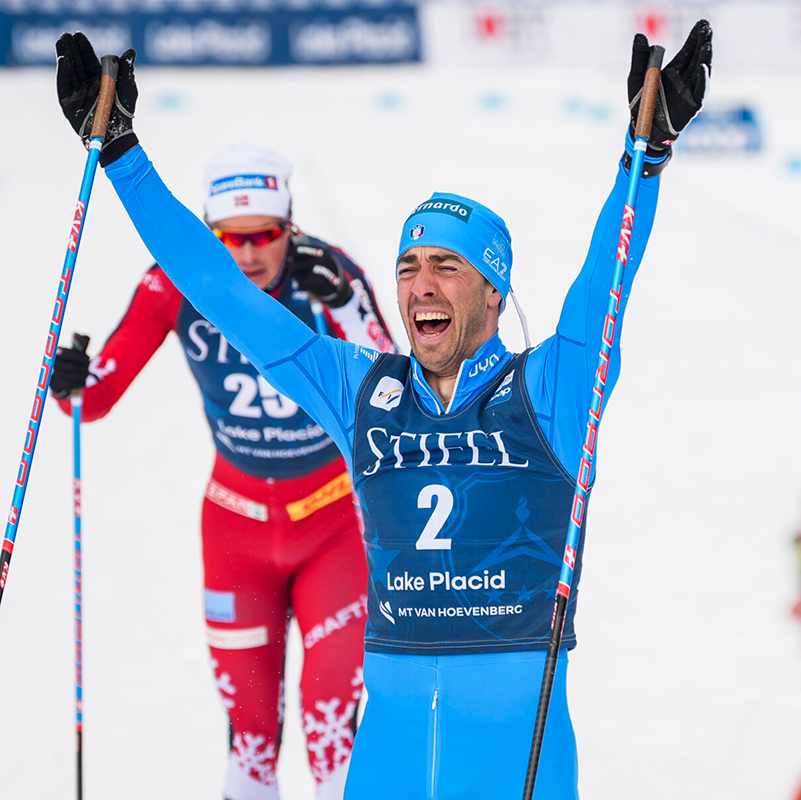
Federico Pellegrino secures his 18th and final World Cup victory. Lake Placid, March 21, 2026. (Photo: Thibaut/NordicFocus)
What had happened in the Semifinal, when this triumphant last dance had nearly evaded him by three hundredths of a second? And what had changed for the Final?
“I could not do what I did in the Final, because the energies of the other athletes were still quite big,” Chicco admitted our post-race interview. “About the last downhill, I was not the same as the others. I am not, I know, but I have some different qualities, and if I could get quite good gap in the top of the uphill, then I knew that I could keep it until I end. This is what I did. This is how I loved to win all along my career – not wait until the last meter, but trying before.”
“Sometimes it happened, mostly before Klæbo came,” he laughed. “But today I was there, and I studied the best tactics in the end . . . the public here in Lake Placid deserves this kind of show, and I think we are all happy now.”
And, this was nothing short of “the best way” to end his journey. “I could not do different. In the end, the last four years have been strange. I didn’t focus so much on sprinting; I tried to discover my body in different fields. Sometimes I got really great feelings and performances, but then, to come back here . . . and to win in that way, I could not do more.”
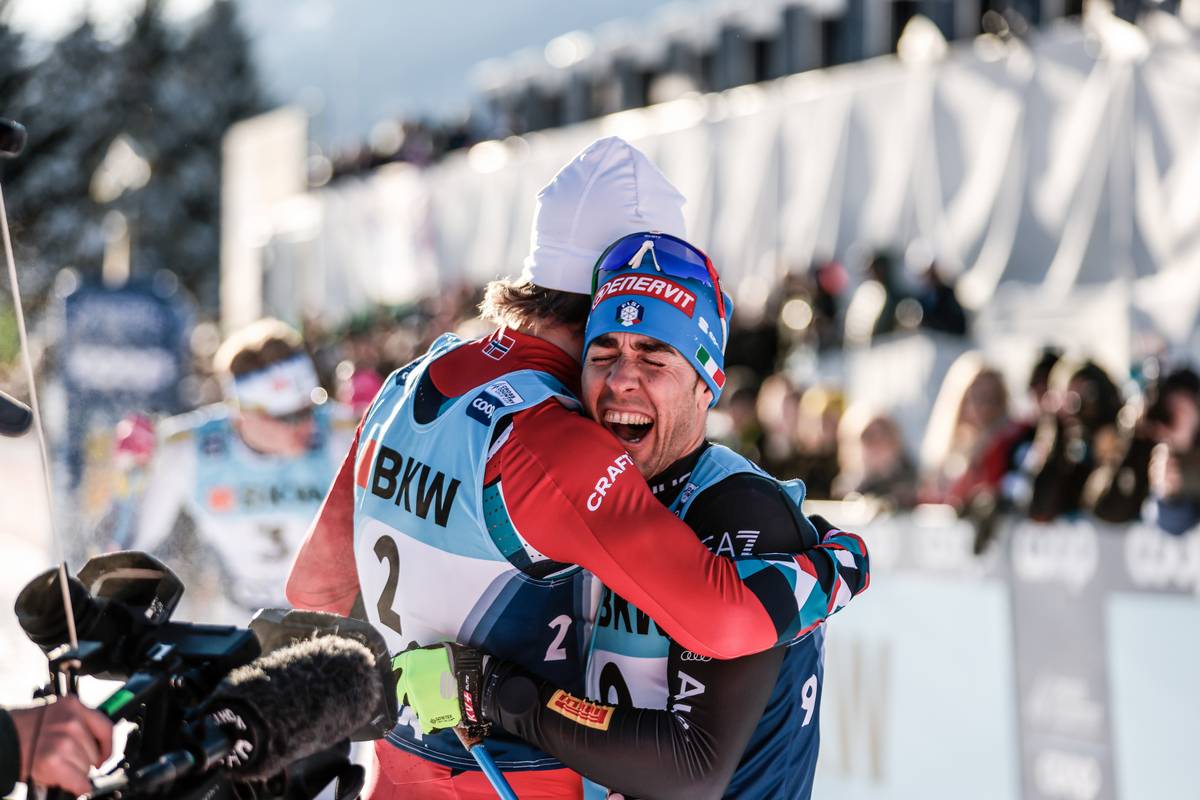
Pellegrino after his final win. “I think the public deserved this kind of show, and I deserved to finish my career, with a Sprint skate like this.” (Photo: Thibaut/NordicFocus)One more podium for Federico Pellegrino, alongside Lars Heggen (NOR) and Anton Grahn (SWE). (Photo: Thibaut/NordicFocus.)
In 15 seasons, Pellegrino proved himself to be far more than a runner-up to those Swedish and Norwegian titans who loomed large over his early and later years. He had taken the Sprint Globe from the Scandinavians for the first time; outsprinted Klæbo, Ustiugov, and Northug in Lahti; perpetually challenged – and occasionally beaten – the greatest athlete in the history of the sport; and secured Olympic medals on home soil, alongside a team of up-and-coming Italians ready and eager to fill his boots. “I’m really happy that he finished his career with probably one of the best weekends for him so far,” Elia Barp (ITA) told me on Sunday. “I’m very happy for him; I’m very happy for the team. I think we have proved that we are ready to race without him – not only me, but a few other young guys are ready to try to take victories next year . . . [He showed] that it is important to keep fighting and try to be a good overaller as he was in the last years. And, now we know that it’s possible; everyone is human as us, and we can do that.”
To Chicco’s fans, that determination – to grapple with giants; to reinvent himself; to seize the final, perfect timing and a final, perfect victory – defined his career. But for Pellegrino himself, “the biggest memories will not stay about the races, but much more about the hugs I got from the teammates, from the coaches, even outside of Italy, from my family, from the people that love me – and not only when things went well; even when things were not going so well. I think this is something that sport teaches us; that in the end, it’s only a cross-country ski race, and life is different. That’s it. The hugs are something I will remember for my entire life.”
Pellegrino, the most popular man at Zig Zag’s on Saturday, March 21. (Photo: Lily Den Hartog)
At Zig Zag’s Pub on Saturday night, Pellegrino told this reporter’s associate that his win vindicated his decision to retire. On Sunday, soaked with rain and champagne and tears after his last World Cup race, he reaffirmed it:
“That’s it. I tried to enjoy today as well . . . I tried to give my best, as always, and it was good after the finish line; under the rain, it was special. But with the teammates and coaches and waxers celebrating this moment, it was good for me.”
“Now, I really need to stay with my family. They deserve this, and I need to give them a lot of time.”
Love Stories Like This? Help Keep Them Coming.
Feature stories like this one take time, access, and care to produce. If you value thoughtful storytelling and independent ski journalism, please consider becoming a Voluntary Subscriber. Your support directly fuels the work we do to cover the people, places, and moments that make our sport special.
“Grazie Papao!!” Team Italy was waiting at the finish of the 20 k Skate with champagne and a tribute to Pellegrino’s children and wife, Greta Laurent (ITA, ret.). (Photo: Thibaut/NordicFocus)
This coverage is made possible through the generous support of Marty and Kathy Hall and A Hall Mark of Excellence Award. To learn more about A Hall Mark of Excellence Award, or to learn how you can support FasterSkier’s coverage, please contact info@fasterskier.com.
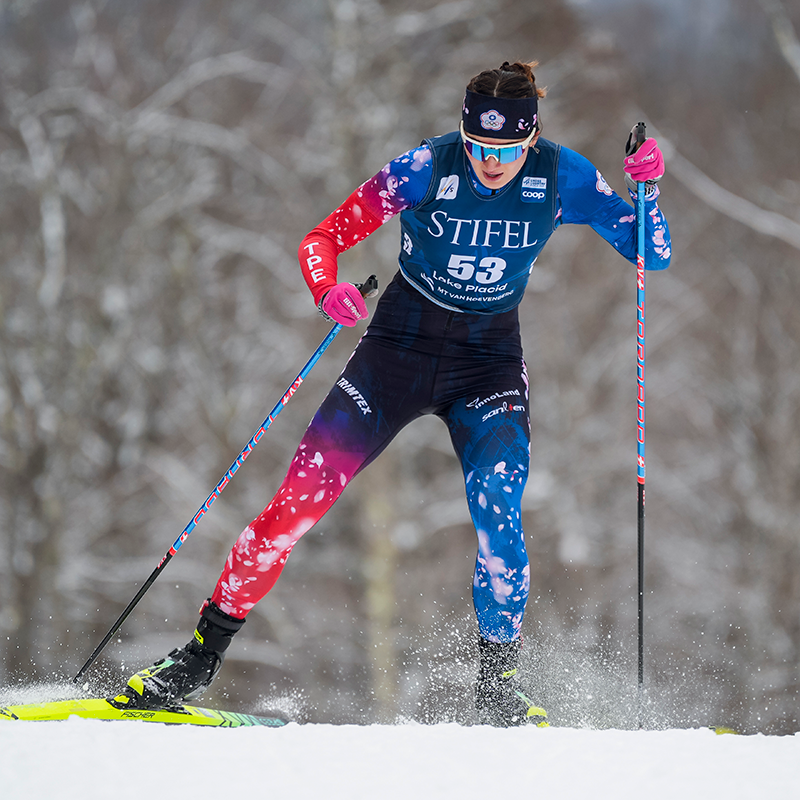
Sophia Tsu Velicer (TPE) during the World Cup Finals 20 k Freestyle on Sunday in Lake Placid, New York. (Photo: Thibaut/NordicFocus)
Taiwanese-American skier Sophia Tsu Velicer on racing in the U.S., representing Taiwan, and her mission to open doors for the next generation.
LAKE PLACID, N.Y. — Sophia Tsu Velicer didn’t mince words when FasterSkier caught up with her in the mixed zone after Sunday’s 20-kilometer mass start freestyle at the Stifel Lake Placid Finals.
“It was kind of brutal,” she said, still catching her breath, “but kind of super duper fun.”
That pretty much captures Velicer’s entire approach to cross-country skiing: an honest acknowledgment of how hard it is, paired with an irrepressible love for it. The 26-year-old, who represents Taiwan (Chinese Taipei), finished 52nd in the 20 k Freestyle Mass Start in 52:50, four and a half minutes behind the winner. She’d posted a nearly identical placement in Friday’s 10-kilometer classic interval start, crossing in 33:19 for 52nd. But for Velicer, the weekend was never really about the result sheet.
“Hang on and soak up the crowd”
Her strategy for the final race of the season was refreshingly uncomplicated.
“My strategy was kind of to just hang on as long as I could and try to find a group and really just soak up the crowd and enjoy this,” she said. “It’s the last race of a long season. So I think that was our strategy.”
And what a season it’s been. Velicer arrived in Lake Placid fresh off her first Olympic Games, where she became the first woman ever to represent Taiwan in Olympic cross-country skiing. She placed 52nd in the Skiathlon and then turned heads with a 22nd-place finish in the 50-kilometer classical, the best result by any athlete from an Asian country in that event. At the closing ceremony, she carried the Taiwanese flag.
Sophia Tsu Velicer (TPE) comes to the finish of Friday’s 10 k Classic while Jessie Diggins (USA) catches her breath. (Photo: Thibaut/NordicFocus)
A homecoming – in the loosest sense
Velicer was born in Michigan and grew up in Bloomington, Indiana, before eventually basing herself in Europe to train and compete. So when asked whether racing at Mt. Van Hoevenberg felt like a home World Cup, she laughed.
“Yeah, kind of in the loosest sense of the term,” she said. “I lived in the States when I was a kid. I was born in Michigan, and then I lived in southern Indiana. So not really close to here, but the U.S. does feel very, very homey.”
She paused, and her voice picked up.
“It’s just so exciting to be back and to be surrounded by all these people who are just stoked to be here and love the sport,” she said. “You don’t really get this in the same way in Europe, and it’s really special.”
Anyone who was at Mt. Van Hoevenberg over the weekend, the thousands who braved wet snow and packed every corner of the course, would be hard-pressed to argue with that.
Opening doors for the next generation
Velicer’s path to the highest levels of the sport was not a straightforward one. Representing a nation with essentially no cross-country skiing infrastructure meant navigating bureaucratic and logistical hurdles that most European or North American skiers never have to think about. Now, she wants to make sure those who follow her don’t face the same barriers.
“My general goal is to just improve as much as I can and have fun,” she said of next season. “I do want to try to make it easier for younger Taiwanese skiers to enter the highest level of sport, if they’re able to, if they have the level for it, because it was really difficult for me to get here. So to make that easier for them.”
At the 2025 FIS Nordic World Ski Championships in Trondheim, Velicer placed 38th in the 10-kilometer individual. She has her sights set higher for the 2027 edition.
“I would love, love, love to get a top 30 result at World Champs next year,” she said.
Given the trajectory of her career, from a kid racing the North American Vasa in Traverse City to Olympic flag bearer for Taiwan in the span of 15 years, it would be unwise to bet against her.
FasterSkier’s Luke Dykowski reported from the mixed zone throughout the Stifel Lake Placid Finals at Mt. Van Hoevenberg.
Love Stories Like This? Help Keep Them Coming.
Feature stories like this one take time, access, and care to produce. If you value thoughtful storytelling and independent ski journalism, please consider becoming a Voluntary Subscriber. Your support directly fuels the work we do to cover the people, places, and moments that make our sport special.
Andzelika Szyszka (POL) and Sophia Tsu Velicer (TPE), (l-r) during the 20 k Freestyle Mass Start in Lake Placid (USA) this past Sunday. (Photo: Thibaut/NordicFocus)
This coverage is made possible through the generous support of Marty and Kathy Hall and A Hall Mark of Excellence Award. To learn more about A Hall Mark of Excellence Award, or to learn how you can support FasterSkier’s coverage, please contact info@fasterskier.com.
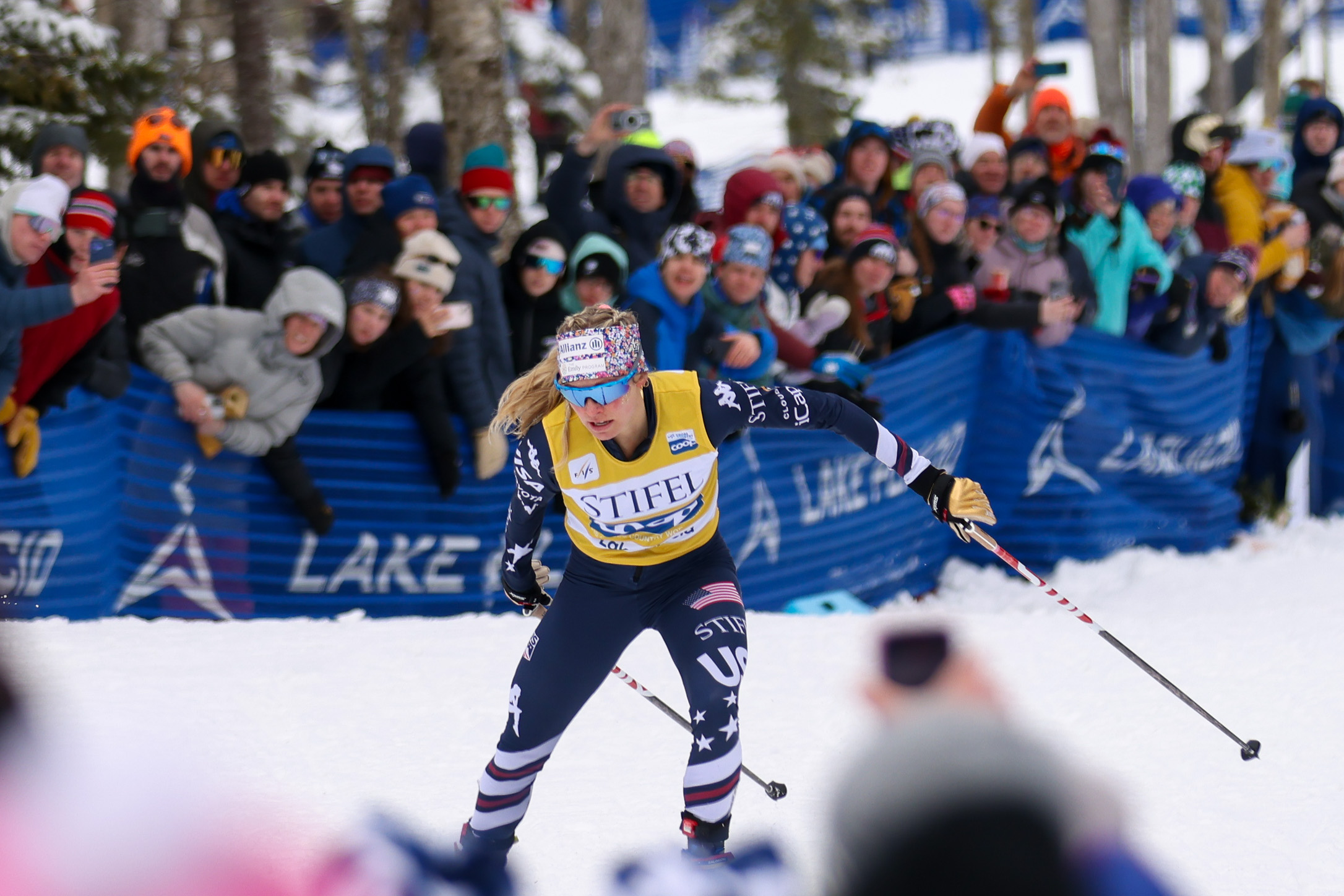
Jessie Diggins (USA) celebrates an entire career as she crosses the finish line of the 20 k Mass Start in Lake Placid. Thousands of fans in attendance celebrated with her. (Photo: Thibaut/NordicFocus)
While the men’s 20 k Mass Start Freestyle (raced earlier in the day) was the source of anticipation and intrigue, the Women’s 20 k was more likely to become a glorious victory lap. At the very beginning of the 2025-2026 season, Jessie Diggins had announced that this season would be her last. The most decorated American cross-country skier—and the winner of three World Cup Overall Crystal Globes—would hang up her skis after the final race in March in Lake Placid. Back then, that final day was still many months and many miles away. Today, Diggins toed the starting line for the beginning of these final kilometers. The staging of a glorious victory lap was entirely appropriate, and Diggins would make it one whether she won the day’s race, or not. That’s how she’s raced her entire career: joy in the competition, celebration in the victory, satisfaction in the effort, gratitude for the team. She’s left us breathless as many times as she has exhausted herself at finish lines, her effort as pure as the snow into which she has toppled after victories and defeats, alike. Her total effort and utter devotion could never have been in doubt. We have loved watching her give it all. Today, in Lake Placid, we were given one last precious opportunity to do so.
How ironic, then, that nature chose to rain, literally, on this parade. Spring conditions in the Adirondack Mountains are notoriously capricious. Lake Placid sits at the highest elevation of any village in the east, and the combination of elevation and proximity to both the Great Lakes and the Atlantic coast makes it a place for weathers to converge, for clouds to gather, where the mountains wear late-season robes of white, where the skies deliver showers of snow—and of rain. We’re often reminded that cross-county skiing is a winter sport—and racing through difficult conditions is the expectation, not the exception. So if there’s a victory lap to undertake, then a full-on storm of freezing rain seems like an appropriate way to do it.
Heidi Weng (NOR) and Frida Karlsson (SWE) provided the pace for much of the 20 k Mass Start in Lake Placid, but they didn’t manage to drop the most dangerous sprinter, eventual race winner, Jonna Sundling (SWE). (Photo: Thibaut/NordicFocus)
20 k Mass Start
Fans knew who to watch: Frida Karlsson, Heidi Weng, and Diggins. And Diggins has a strategy that she folows in mass-start events: allow others to set the pace on uphills, even letting herself get gapped, only to close those gaps on subsequent downhills. When she uses that strategy, she keeps herself in contention for as long as possible.
At the 8 kilometer mark, those contenders remained together, and were in the company of numerous others who could play a part in the strategy of tis race. Astrid Oeyre Slind has begun to find the form that eluded her in Milano-Cortina,and Linn Svahn and Jonna Sundling lurked in the lead pack, hoping to be there at the end where their lightning-fast sprints could perhaps snatch victory from the distance specialists.
Karlsson set the pace in the early kilometers, but not at the uber-speed that has often been seen in women’s racing over the past few seasons. Weng came forward to take over the pace-making just prior to the bonus points line at 9 kilometers, moving Karlsson back into the pack where she is far less comfortable. So uncomfortable, in fact, that Karlsson immediately ran headlong into an unexpectedly fallen Slind. Both of them ended up in a tangle as Weng and the leaders glided away. Weng captured the bonus points that she needed to maintain her position on the podium of the Distance competition. Weng continued to push the pace, but all the logical contenders seemed capable of preventing her from breaking away.
Diggins moved to the lead at the 12 kilometer mark, using her fast skis and descending ability to glide to the front before powering up a mid-lap hill. Karlsson (who had weaved her way back to the lead) took up a position at Diggins’ shoulder. These two—along with Weng and Slind—would do their best to undo the strengths of the sprinters in the kilometers that remained. But with Diggins, Sundling, and Svahn still in contention, Karlsson and Weng were leaving things a bit late.
Karlsson, Weng, Diggins, and Sundling came through in order at the final bonus points line, seemingly less interested in those points than they were in positioning themselves for all that was likely to transpire in the final two kilometers. At the top of the final uphill, Norwegian Karoline Groetting surged to the lead. She was pursued by Karlsson and Weng, with Sundling and Diggins just behind. One kilometer to go, one major downhill to navigate . . .
Years ago—at the beginning of what was to become an historic career—a young and impetuous Jessie Diggins was often seen to lose control on downhills. She would ultimately overcome that limitation, becoming one of the best and most daring downhillers on the World Cup scene. Today in Lake Placid, though, Diggins’ past caught up with her. Every competitor would be exhausted at this point in a 20 k race, and maintaining control on any fast, winding downhill would be tremendously difficult. As the leaders descended a steep lefthand curve, Sundling picked an outside line that was especially fast. The video replay shows Diggins seeming to notice Sundling’s acceleration. The shift in Diggins’ posture made it clear that she felt the need to accelerate a bit, herself, but the extra step she took shifted her weight to the tails of her skis. Just like that, Diggins went down. Less than a kilometer from the end of the race—just minutes from the end of an astounding career—Diggins fell from contention. Not one to lie in the snow feeling sorry for herself while a race is going on, Diggins sprung to her feet and took off in pursuit of the leaders. Her race for today’s podium may have been over, but Diggins was far from being done with the racing. If only one kilometer remained in her career, Diggins intended to race her heart out over that final kilometer.
Jonna Sundling (SWE) was the skier everyone else in the field was most determined to drop. They didn’t . . . (Photo: Thibaut/NordicFocus)
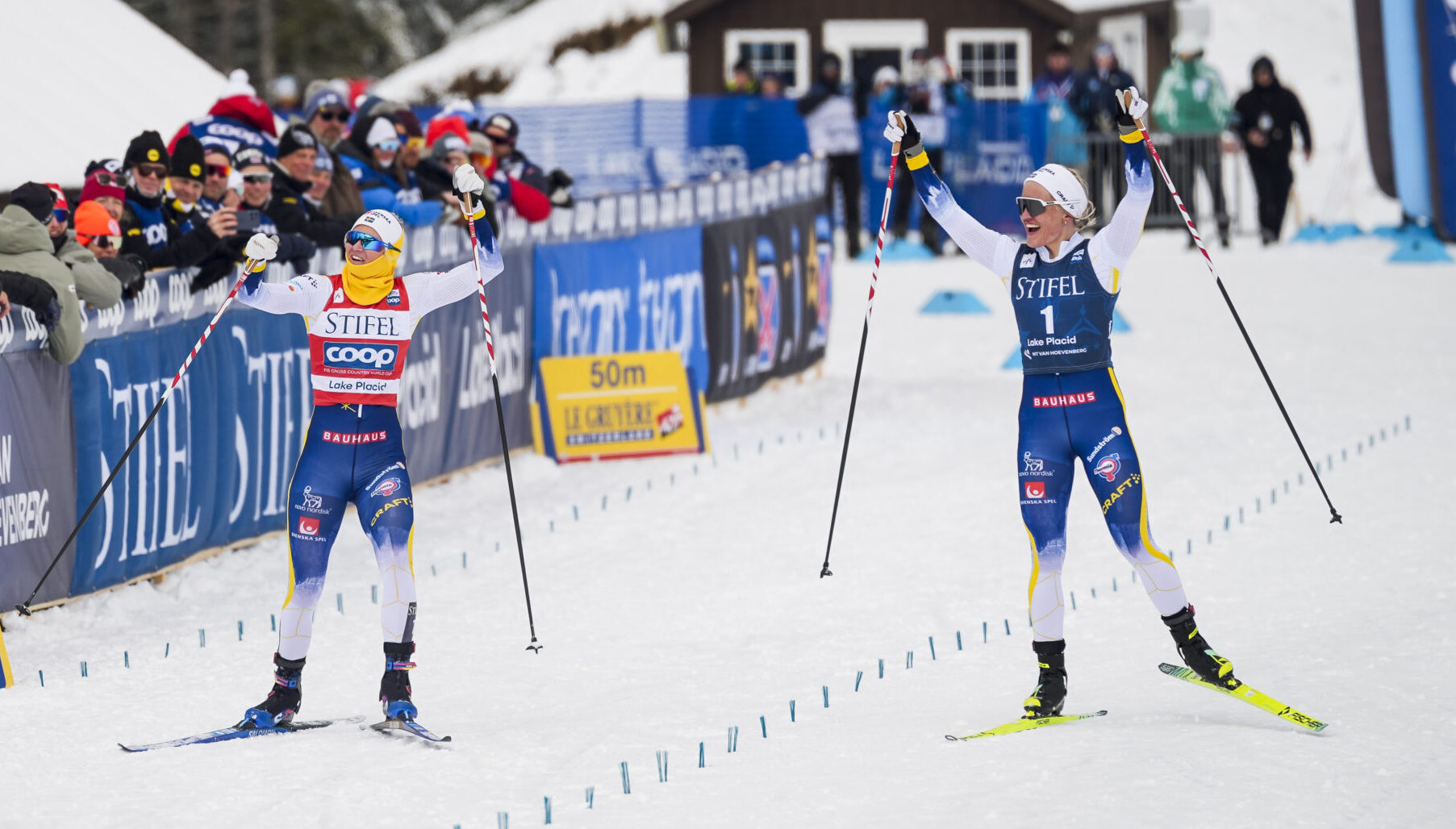
At the front, Sundling’s daring downhill move had produced the speed she needed, and she stormed off the front followed only by the other best sprinter, Svahn. Weng was game in giving chase, but she had no chance of catching the two Swedish speedsters. Sundling first, Svahn second, Weng third. Diggins would recover from her tumble on the turn to finish 12th.
The last fifteen years have represented a golden age in women’s cross-country skiing, and there is one skier, in particular, whose career has spanned those years: Jessie Diggins. From the dominance of Justina Kowalczyk, to the excellence of Marit Bjoergen, to the determination of Charlotte Kalla, to the brilliance of Therese Johaug, to the spotlight she shares with the truly dominant team of Swedes, Diggins has born witness to the best this sport has had to offer. From them, she learned her craft. With them, she elevated a sport and thrilled an audience. The sport will miss her exuberance and her joy, her silliness and her seriousness. Thank you, Jessie, Diggins, for doing your best, for leaving it all out on the course, and for taking us all with you on this glorious victory lap.
Feature stories like this one take time, access, and care to produce. If you value thoughtful storytelling and independent ski journalism, please consider becoming a Voluntary Subscriber. Your support directly fuels the work we do to cover the people, places, and moments that make our sport special.
This coverage is made possible through the generous support of Marty and Kathy Hall and A Hall Mark of Excellence Award. To learn more about A Hall Mark of Excellence Award, or to learn how you can support FasterSkier’s coverage, please contact info@fasterskier.com.
Johannes Hoesflot Klaebo (NOR) had won it all—except for a Distance Crystal Globe. Today in Lake Placid, he finally added that most elusive piece of hardware to his expansive trophy case. (Photo: Modica/NordicFocus)
The Kingdom of Norway expects much of its sport heroes. Johannes Hoesflot Klaebo knows this . . . that may be why this naturally gifted sprinter may have long coveted the prize that a skier of his sort is least likely to earn: World Cup Distance Crystal Globe. If he could capture that prize, he could place his name among those of revered strong men of cross-country skiing. But first he’d need to get past another Norwegian strong man: Harald Oestberg Amundsen, himself a past winner of both the Distance and All-Around Crystal Globes, and a skier who trails Klaebo by only 12 points heading into this final Distance race of the 2026 season. A Norwegian skier would go home from Lake Placid with the Distance Crystal Globe tucked safely in the overhead compartment of a chartered jet liner. But which Norwegian?
Twenty kilometers of mass-start racing through the forests and hills of Mt. Van Hoevenberg would answer the question. But the manner in which that question would be answered would have bearing on ski history, as well. That’s because Klaebo could choose to employ more than one strategy in today’s race. He could park himself behind Amundsen, presumably sprint past him at the end, and claim the Cup regardless of his placing in today’s race. Norwegian fans would love to see a Norwegian claiming the Cup, but they would prefer to see the victory be claimed in a different way. What Norway would love to see is dominance delivered at the hands of the sport’s most dominant skier. The “dominance” strategy is far more risky—it could backfire, it could get counter-attacked, it could conceivably allow Amundsen to overcome a self-exhausted Klaebo. But that’s what Norwegian fans long to see.
Back in 1983, Norwegian speedskater, Rolf Falk-Larssen won the World All Around Speedskating Championship by virtue of winning three of the championship’s four races. That was the rule back then—anyone who wins three of the four races is automatically crowned champion, regardless of their performance in the fourth race. Falk-Larssen won the 500 m, the 5,000 m, the 1500 m. Technically, all he had to do was finish the 10,000 (the final race of the championship) in order to wear the victor’s wreath and be proclaimed World Champion. He would finish that final race, but the way he raced it was also the reason that, to this day, few Norwegians are willing to even mention Falk-Larssen’s name. When Falk-Larssen had the chance to truly dominate, he chose, instead, to mail it in: he soft-pedaled the 10 k . . . finishing a full 37 seconds (that’s a lot) behind the race winner, Tomas Gustafson of Sweden, whose four-race performance actually accumulated a point-total that exceeded Falk-Larssen’s championship-winning total. Falk-Larssen was crowned champion, but the Norwegian crowd never forgave him.
Norway expects much of its champions. Witness the racing strategies of Marit Bjoergen, of Therese Johaug, of Bjoern Daehlie, of Thomas Alsgaard. They were dominators, setting a blistering pace from the very start of any race, heedless of the consequences, daring any other racer to challenge them. Consider the tactics of Norwegian athletes in other sports: World and Olympic champions like hurdler Karsten Warholm or middle distance runner Jakob Ingebritsen—both of whom race from the front in daring, victory-or-death style. Norwegian fans love this . . . seeing the champions who throw caution to the wind, who stamp their authority onto every race situation, who prove true dominance.
Fast-forward to Lake Placid New York, and the final race of the 2026 FIS World Cup cross-country ski season. At Mt. Van Hoevenberg, Klaebo could’ve been interested in only one thing: the World Cup Distance championship. In his long and illustrious career, it’s the one prize that has eluded him. He’s won the Overall Crystal Globe six times. He’s won the Sprint championship too many times to count. In this miraculous 2026, Klaebo has proven time and again that he is the man to beat. And though he is the world’s premier sprinter, he has shown that he can win from the front even when the world’s best Distance skiers are chasing him.
The stage was set for 20 kilometers of racing on the steep and rainy trails of Mt. Van Hoevenberg.
With his win in the 20 k Mass Start Freestyle at the World Cup Final in Lake Placid, Johannes Hoesflot Klaebo (NOR) completes the sweep of all sweeps. (Photo: Thibaut/NordicFocus)
20 k Freestyle Mass Start
In the old days of racing—especially on the trails around Van Hoevenberg—racers in Distance events would disappear into the trees, emerging from the forest hours later with practically no one having seen what transpired out on the course. Not today . . . the final race of the World Cup season was designed for the fans: five laps of four kilometers/lap. The crowd would get to see plenty of the racers, and that crowd ha already proven its ability to shower the skiers with cheering and support.
The start order was determined by World Cup points; six of the top seven starting spots were claimed by Norwegian skiers (their total monopoly only prevented by the presence of the sixth starter, Italy’s Elia Barp). It’s been a long season, and the final 20 k is a long race. The field can be forgiven for taking it easy at the start. But Mika Vermeulen (AUT) is not an especially patient competitor . . he would go to the front in the second kilometer to give the race some honest pace. Vermeulen’s effort seemed to remind the Norwegians of what they were supposed to do; by the 4 kilometer mark, Amundsen had powered to the front, followed by Klaebo and Pellegrino. A crowd of Norwegians and French race suits followed them. The players were all in position.
Schumacher hovered around the top ten, continuing to show his skills as a mass-start racer. The field began to break up on the course’s challenging downhills; Schumacher continued to hold his own.
At eight kilometers, Klaebo moved forward to take control. That’s because racers were offered World Cup bonus points at 9 k and at 17 k, and Amundsen had admitted in pre-race interviews that he would plan to pursue those points. If he could snatch some of those points, he could close the gap on Klaebo. Huh . . . Klaebo grabbed those 15 bonus points for himself, followed by Amundsen’s 12 point second place consolation prize. Amundsen had hoped to narrow the gap. Instead it widened by three points.
Soon after the bonus sprint, five Norwegian race suits began inexorably to pull away: Andreas Fjorden Ree, Mattis Stenshagen, Emil Iversen, Klaebo, and Amundsen. Schumacher eased his way forward to seventh position, just three seconds behind the leaders. The pace was fast, but fans could wonder if the skiers were really leaving it all out there. Who could blame them? All season long, Klaebo’s teammates—his closest rivals—had done all they could to drop the guy. Usually, whomever attempted to do so would find themselves dropped and distanced by their own teammates. It looked as though no one was willing to make such a risky play. But in that lull, Einar Hedegart had rejoined the leaders.
At the 17 kilometer mark, Klaebo again moved forward to seize the bonus points. Klaebo 15 points, Reee 12, Amundsen 10. Barring any unforeseen disasters, Klaebo had the points-lead he needed to claim the Distance Cup. Now the Norwegian fans would eagerly watch how he would race to the finish.
After the bonus sprint, the course returned to the finishing stretch utilized inhte Sprint course . . . Klaebo knows this part of the course so well. And he used the same tactic that took him to a Sprint victory just two days ago. Resplendent at the front, Klaebo turned on the jets up the final slope, jump-skating away from his rivals. Amundsen followed gamely, but the gap widened just enough to deprive Amundsen of the draft on the subsequent downhill. Klaebo was not to be denied in the final sprint, gliding across the line for his 113th World Cup victory, and the first Distance Crystal Globe of his career.
Hedegart held on for third, perhaps inspiring the young biathlete to continue competing as a skier in seasons to come. Pellegrino would finish his final race in 13th place, securing his place on the third step of the World Cup Overall podium. Schumacher would race in the main chase group throughout the race, but would fade to 20th at the finish.
Harald Oestberg Amundsen (NOR) chased Johannes Hoesflot Klaebo (NOR) through an entire season of Distance races. They finally settled the issue over twenty kilometers in Lake Placid. (Photo: Thibaut/NordicFocus)
Dominance, indeed
Not every Norwegian ski hero has been a front-runner. Norwegians began to learn of—and begrudgingly to accept—the strategic brand of racing that Pettter Northug employed during his brilliant career: sitting in and sprinting, snatching mass-start Distance races from Distance specialists. Perhaps Northug’s strategy became acceptable because it was so obvious that he was killing himself to hang on to the pace set by the Distance skiers just so he could have a chance to sprint at the end. Norwegian fans admired the effort, the tenacity, the fight. And they wanted a Norwegian skier to win, too. Northug delivered repeatedly, but Northug was an athlete of a different sort—spending off-season weeks gambling lavishly in Las Vegas, and getting into all sorts of trouble in Norway on account of his love of fast cars and strong drink. Northug definitely earned his place in the skiing Pantheon, but even his Norwegian countrymen remain unsure of him.
The only real way to capture the love of the Norwegian ski fans is to dominate the competition. Klaebo knows this . . . and what he delivered was a season that included a Tour de Ski, a Sprint Globe, a Distance Globe, an Overall Globe, and six Olympic gold medals. Dominance, indeed.
Referring to his haul of Crystal Globes, Klaebo said, “It’s going to be overweight getting back home, that’s for sure.
“I always try to focus on a part of the course where I can use a different part of tracks to get an advantage,” Klaebo said. “Today I felt like I was pushing hard up the last uphill, and Harald was right behind me all the way. I managed to get a small gap at the end!
“I saw it coming!” said Amundsen. “I tried to find his back and stay there. I knew that he would go fast on the last uphill. I just tried to follow.”
“We had a great team effort,” said Amundsen. “And second place, in the end, was quite good.”
Now, Team Norway will pack up its trophies and its flowers and its wheels of Gruyere cheese, and head back home to the land of Nordic skiing, and the cheering hordes of Nordic skiing fans.
“I’m glad the season is over now,” said a smiling Klaebo after the race. “It’s time to rest a little bit.”
And a well-deserved it will be. We’ve watched a remarkable season scripted by the greatest of all time. We’re unlikely to see such a season again.
Feature stories like this one take time, access, and care to produce. If you value thoughtful storytelling and independent ski journalism, please consider becoming a Voluntary Subscriber. Your support directly fuels the work we do to cover the people, places, and moments that make our sport special.
Here at the end of all things, another Norwegian podium. Harald Oestberg Amundsen (NOR), Johannes Hoesflot Klaebo (NOR), Einar Hedegart (NOR) celebrate the end of a long season. (Photo: Modica/NordicFocus)
This coverage is made possible through the generous support of Marty and Kathy Hall and A Hall Mark of Excellence Award. To learn more about A Hall Mark of Excellence Award, or to learn how you can support FasterSkier’s coverage, please contact info@fasterskier.com.
Jessie Diggins during the quarterfinals of the Freestyle Sprint on Saturday in Lake Placid, New York, USA. (Photo: Voisin / FasterSkier)
Lake Placid, N.Y. — The French coaches had questions. Two days before racing began at Mount Van Hoevenberg, they were standing in Saranac Lake — 55 degrees, windy, woods in every direction — wondering who exactly was going to show up to watch cross-country skiing in the middle of the Adirondacks.
By Saturday, an estimated — rumored to be fair — 14,000 people had answered.
Today, as Jessie Diggins lines up for the 20-kilometer mass start freestyle, the final race of her career, this corner of upstate New York will try to top itself one more time.
Screaming fans, chainsaws, flags, signs, and glitter all over the course in Lake Placid, New York, USA. (Photo: Voisin / FasterSkier)
A Weekend That Kept Building
The first sign that Lake Placid was going to be different came Friday, and it wasn’t entirely smooth. With an initial estimate of 10,000 fans on Friday, the transportation system to and from Van Hoevenberg buckled under the demand. Some fans waited over two hours to get to the venue.
US Head Coach, Matt Whitcomb, after the races yesterday in Lake Placid was really happy because the standout performance was not one of his athletes, but instead the North American ski community that showed up in droves and created an electric atmosphere. (Photo: Voisin / FasterSkier)
“Only Holmenkollen and Minneapolis”
U.S. Ski Team head coach Matt Whitcomb has been on the World Cup circuit for years. He said the only events throughout his career that have ever rivaled the atmosphere here this weekend in Lake Placid are the Holmenkollen in Oslo — the sport’s grand prix if you will — and Minneapolis two years ago.
That’s the company Lake Placid is keeping. And for those who were in Minneapolis, the comparison lands. Diggins said earlier this week that Minneapolis was the most special day of her career.
“It was the most I’ve ever cried,” she said at Wednesday’s press conference. “I got to race in front of some of my grandparents who haven’t been able to travel overseas. They got to see me race for the very first time in a World Cup. And having so many friends and family and getting to share the thing that I love doing with them — that is the most incredible thing ever.”
She paused, then added: “I think this weekend’s probably going to join that.”
College skiers from all over the Northeast came in force to the trailside in Lake Placid, New York, for the races this weekend. (Photo: Voisin / FasterSkier)
The Scene on the Ground
What the numbers don’t capture is the texture. Young kids running around the venue in their NNF fan bibs — the ones with athletes’ faces printed on them — clutching Sharpies, hoping to meet their heroes. Fans who drove and flew from Vermont, from Alaska, from Minnesota, who planned vacations around this weekend months ago. The school buses that became part of the story, ferrying the faithful up the mountain road when the original plan couldn’t hold.
This is what U.S. cross-country skiing looks like when it gets the stage. Not a packed NFL stadium or a sellout basketball arena — but thousands of people standing in the woods, screaming themselves hoarse for athletes from every country, because they love this sport and they know how rare these weekends are.
The fans — especial the college skiers — made it sound like the race was happening in Davos, Switzerland with the chainsaws out on course. (Photo: Voisin / FasterSkier)
One More Race
Diggins has spent this weekend doing exactly what she said she would — being present, soaking it in, putting on a show. She clinched the Crystal Globe on Friday. She raced the sprint on Saturday. And now there’s one more.
At Wednesday’s press conference, she talked about the way her mindset around suffering has evolved — how she’s learned to see the pain cave not as something to dread but as confirmation that she’s doing what she came to do.
“This is what 100 percent feels like,” she said. “And sometimes this is what it looks like, and it’s some ugly scene, but that’s okay. It just has to be all heart and all effort, and that’s what I have to give in that moment.”
She also made one thing clear about the team she’s leaving behind: “The team is going to be just fine without me. And I feel like that’s how I know I did my job.”
Then, with a smile: “I’m excited to be a fan on the other side of the fence and get to cheer for them.”
Today, in just ten minutes, Jessie Diggins will clip into her bindings for the last time as a World Cup racer. The 20-kilometer Mass Start Freestyle.
And based on everything this weekend has shown us, “no one” will be watching.
Love Stories Like This? Help Keep Them Coming.
Feature stories like this one take time, access, and care to produce. If you value thoughtful storytelling and independent ski journalism, please consider becoming a Voluntary Subscriber. Your support directly fuels the work we do to cover the people, places, and moments that make our sport special.
This coverage is made possible through the generous support of Marty and Kathy Hall and A Hall Mark of Excellence Award. To learn more about A Hall Mark of Excellence Award, or to learn how you can support FasterSkier’s coverage, please contact info@fasterskier.com.
Team . . . Maja Dahlqvist (SWE) wins the Sprint Crystal Globe, Linn Svahn (SWE) takes the World Cup Sprint win. (Photo: Thibaut/NordicFocus)
Team Sweden must face tricky circumstances in selecting its team for World Cup Sprint events, but their dilemma is made simpler by the apparent set of protocols the team follows when deciding who will race. Typically, Sweden brings only those skiers who can earn spots on the podium. Everyone else is racing back home in what we can only imagine must be the must competitive B-Team event in the world of women’s sports. In Lake Placid’s Freestyle Sprint, Sweden’s roster consisted of Jonna Sundling, Linn Svahn, Johanna Hagstroem, Maia Dahlqvist, Moa Ilar, and Emma Ribom (who did not start today’s Freestyle Sprint). That’s a fairly impressive set of starters: Sundling is 2022 Olympic Champion (and world champ from 2025), Svahn is 2026 Olympic Champion, Dahlqvist leads the World Cup Sprint standings, and Hagstroem is poised to win this year’s World Cup if Dahlqvist were to falter. Put those skiers on the starting line of a Sprint final, and it will be very difficult for any other nation to truly challenge them.
And that is precisely what Team Sweden did . . . though not without needing to come through a chaotic and unexpectedly close Freestyle Sprint final. In the end, Svahn notched her second victory of the weekend (after yesterday’s 10 k Classic victory) ahead of Sundling and Dahlqvist (who claimed her fourth World Cup Sprint Crystal Globe). Team Sweden swept its second straight podium of the World Cup final . . . with one race (tomorrow’s 20 k Mass Start) still to be run.
“It was so much fun—all these people, all this cheering—it’s amazing,” said Sundling.
“Honestly, I was just trying to do as good race as I could for the day,” said Dahlqvist. “The bonus would just be the points for the overall. I just wanted a good race for today.”
“It’s like my second home, honestly! So many people screaming my name,” said Dahlqvist.” It was really cool.”
Twelve Americans entered Lake Placid’s Freestyle Sprint qualifying: Jessie Diggins, Samantha Smith, Julia Kern, Alayna Sonnesyn, Lauren Jortberg, Rosie Brennan, Erin Bianco, Hailey Swirbul, Ava Thurston, Renae Anderson, Emma Albrecht, and Nina Schamberger. Diggins, Smith, and Kern all advanced beyond qualifying with Diggins advancing into the semifinals.
Jessie Diggins (USA) continues to cherish every finish line. Her retirement is a celebration, but one fans wish could be delayed a bit longer. (Photo: Thibaut/NordicFocus)
Freestyle Sprint
Diggins drew the first heat where she would meet up with Sundling and Faehndrich. That top-heavy field seemed to insure that this would be a fast heat, one likely to produce a lucky loser or two. Diggins’ strategy throughout the season has remained consistent: use her speed to keep heats fast, claim at least a lucky loser spot, and rely on her endurance to give her chances later in the heats when pure sprinters may be spent.
Diggins bobbled a bit out of the start gate, allowing Sundling to burst forward to set the early pace (Sundling is typically a fast-starter and aggressive pace-setter; she was likely to try that, anyway). Diggins needed to work a bit to get around Julie Myhre (NOR) on the first uphill, but from then on it was a three-woman race. That triad was interrupted when Diggins stepped on Faehndrich’s pole basket, sending the Swiss woman tumbling in a hairpin right-hand turn. Diggins lost some speed behind the tangle of skis and poles, but she would recover before the finishing straightaway. Faehndrich would pull off a miraculous recovery of her own, hopping back to her feet after her fall, chasing down the pack, and sprinting past Diggins into the third spot. The two of them would wait to see if their times would be fast enough to advance as lucky losers.
Svahn led a moderate-paced Heat 2, confident that no one else would be eager to lead. Jasmi Joensuu (FIN) went to the front in the loose snow of the final uphill, only to find her efforts eclipsed by Svahn swooshing out of the draft on the subsequent downhill. Svahn would advance easily, followed by Joensuu. Slow heat . . . Faehndrich and Diggins still safe.
Kern re-entered the World Cup scene after a few idle weeks following the Olympic Games where she had begun feeling some pulmonary stress. She appeared recoved with an impressive 17th place qualifier, but her performance in theheats made it clear that she may still be a bit rusty. Kern got pinched out of position numerous times in the quarterfinal, then lost her balance rather dramatically on the last right-hander before the finishing straightaway. Her speed having been lost, Kern would cross the line sixth. Her day would end with a mnmnmnmn place finish. For Faehndrich and Diggins . . . so far, so good.
Smith has repeated a pattern in recent world Cup Sprints, dropping to the rear early in each heat, only to unleash a torrential sprint in the closing meeters. Smith found an open lane to drive forward on the first uphill, puling even with Maia Dahlqvist (SWE) at the summit. Smith once again found a lane on the final uphill, hop-skating past Lotta Udnes Weng (NOR) before expertly pinching her out of second position. Smith entered the downhill well positioned on the tails of Dahlqvist. Smith’s good tactics would not continue as the field reached the final flats. Weng was able to wind past her, as well as Federica Cassol (ITA) who crowded Smith into abbreviated skate strokes in the finishing meters. Smith would finish fourth in the heat, and mnmnmnmnm in the day. Faehndrich and Diggins? Still in lucky loser positions with only one quarterfinal remaining.
Faehndrich and Diggins kept their fingers crossed that the final heat would be a slow one. It was a nervous position to occupy: Hagstroem highlighted the Quarterfinal 5; she’s a skier who often ignites the pace to exhaust her rivals . . . but her first strokes out of the start gate indicated that would not be her strategy on this day. Hagstroem would hold the lead across the finish line ahead of Coletta Rydzek whose clever footwork allowed her to sprint forward to claim the second automatic advancement spot. Hagstroem’s languid pace allowed the advancement of both Faehndrich and Diggins. the home-crowd breathed a sigh of relief.
Semifinals
Diggins lucky loser journey continude in Semifinal 1 where her desire to push the pace found itself in the backseat compared to the similar desires of Svahn and Sundling. The Swedish pair rocketed to the front as Diggins trailed the field. But it quickly became apparent that Sundling and Svahn had no interest in setting a fast pace—they only wanted to clog the front, daring others to take the lead. On Lake Placid’s Sprint course, taking the lead had proven to be a self-destructive tactic, while attacking from behind had proven to be a risky one. Diggins found an open lane on the final climb, but found the pace too high to allow her to advance.
The Swedes had looked supernaturally calm and relaxeda t the front, but on the final downhill the dangers of Lake Placid’s Sprint course revealed themselves again as Svahn was absorbed by skiers rushing from the rear, and Sundling found herself edged out of the lead by Anja Weber (SUI). The Swedes would call upon their superior speed to fight back into the lead before the finish line. Myhre would cross third, followed by Joensuu in fourth. Diggins would cross fifth to finish ??? on the day. The Swedes apeared relieved—and a little bit shell-shocked—in the finish area. They’d be unlikely to commit those tactical errors again.
Dahlqvist and Faehndrich—#1 and #2 in the current World Cup Sprint standings would face off in the second semifinal. After the grinning embarassment of an initial false start, Dahlqvist would allow her teammate, Hagstroem, to vault into the lead, followed closely by Faehndrich and Rydzek. Hoping to distance herself from Dahlqvist, Faehndrich drove to the front on the final uphill. using Hagstroem as a way to block any other pursuit. Faehndrich and Dahlqvist would cross the finish line togehter, followed by lucky losers, Hagstroem and Rydzek.
Linn Svahn and Jonna Sundling led the Swedish sweep at Mt. Van Hoevenberg. (Photo: Thibaut/NordicFocus)
Sprint Final
Svahn, Sundling, Hagstroem, and Dahlqvist highlighted the Sprint final, where they were joined by Faehndrich and Rydzek. With three closely-bunched contenders (Dahlqvist, Hagstroem, and Faehndrich) in the year-long Sprint World Cup competition all being present in the final, the Crystal Globe would be decided in this race. Sundling an Svahn set the pace, Faehndrich and Dahlqvist marked them closely. Hagstroem and Rydzek trailed. With Dahlqvist leading by only six points over Hagstroem—and with Faehndrich only a few more points behind them—the mathematical possibility existed for the cup to change hands at the finish line. In the end, Svahn pulled away from Sundling, and Dahlqvist separated herself from Faehndrich. Sweden would sweep the podium, and Dahlqvist would cross the finish line with arms raised as the winner of the Sprint Crystal Globe.
World Cup Final Women’s Freestyle Sprint QUALIFYING
Love Stories Like This? Help Keep Them Coming.
Feature stories like this one take time, access, and care to produce. If you value thoughtful storytelling and independent ski journalism, please consider becoming a Voluntary Subscriber. Your support directly fuels the work we do to cover the people, places, and moments that make our sport special.
This coverage is made possible through the generous support of Marty and Kathy Hall and A Hall Mark of Excellence Award. To learn more about A Hall Mark of Excellence Award, or to learn how you can support FasterSkier’s coverage, please contact info@fasterskier.com.
Federico Pellegrino (ITA) during warmup, hearing his name called by the joyous crowd lining the course in Lake Placid. It was the beginning to a tremendous day, and the final Sprint victory of his glorious career. (Photo: Thibaut/NordicFocus.)
“The energy that I got in the warmup lap . . . I got this feeling of power from the public,” said Federico Pellegrino.”Cheering for me. “Chicco Pelle! Chicco Pelle! And then in the Final, I could not wait!”
Though this race—this glorious victory— came at the end of a long and illustrious career, Pellegrino was true to his word. He could not wait. He blazed off the front of a complex and contact-filled Freestyle Sprint final to storm to the 18th win of his World Cup career—his 46th podium. He had won silver and bronze medals in front of his countrymen at the Olympics of Milano-Cortina just a few weeks ago. Perhaps this final victory in front of the cheering throngs of Mt. Van Hoevenberg was sweeter, still.
Pellegrino was joined on the podium by Lars Heggen (NOR) and Anton Grahn (SWE), two young guns who may represent the future of the sport. But Pellegrino showed he was not yet ready to allow the great names of the past to be forgotten. One last Sprint victory, and one more chance to show his appreciation to an appreciative crowd.
“Thank you Lake Placid,” smiled Pellegrino. “It was great!”
Lars Heggen (NOR) may see himself as the heir apparent, the sprinter most likely to triumph when Klaebo is away. That may soon be true . . . just as soon as Federico Pellegrino (ITA) retires. (Photo: Thibaut/NordicFocus)
A World Cup Sprint without Klaebo is two things at the same time: both a lot less interesting, and a lot more interesting. When Klaebo is in the Sprint field, Klaebo will win, won’t he? So what does it mean when Klaebo is absent? It means almost anyone can win. And with only the World Cup Distance championship remaining to be defended (in a close race with Harald Oestberg Amundsen), Klaebo elected to sit out the Freestyle Sprint . . . marking perhaps the only time that Klaebo has been able to watch an entire World Cup Sprint competition from the sidelines.
“It’s not very often that you have the races (in the USA),” said Klaebo. “And it’s always fun—I mean it was amazing when we were in Minneapolis a couple of years ago, and I’ve been looking forward to this race for a long time. With what happens last week, (coming to Lake Placid) was a little bit uncertain. I’m really happy that I made it, and happy that I made it to the starting line.”
“The Americans really know how to make noise and a good atmosphere,” said Klaebo of the Mt. Van Hoevenberg crowds lining the 10 k course on Friday. “It was cool!”
“I think it’s the right decision to skip the (Sprint on Saturday),” said Klaebo. “Hopefully I will be back at it again on Sunday with enough energy to be able to fight.”
JC Schoonmaker (USA) was the top American among five who qualified for Lake Placid’s Freestyle Sprint quarterfinals. He would put together a fine set of performances, advancing to the semifinal and finishing the day ninth. (Photo: Thibaut/NordicFocus)
Freestyle Sprint Heats
Team USA would qualify five skiers into the quarterfinals: Gus Schumacher, Ben Ogden, Jack Young, JC Schoonmaker, and Zanden McMullen. Schumacher, Ogden, and Young delivered especially eye-popping qualifying efforts: fourth, fifth, and sixth, respectively. While Americans would ski their way into the quarterfinals, it was not to be the Americans’ day.
Schumacher caught his pole in the start gate and immediately surrendered ten meters to the field, but an initial slow pace in the heat allowed him to catch up quickly, and to surge forward into third position. Schumacher followed early leaders Benjamin Moser (AUT) and Anton Grahn (SWE), though it was Lars Heggen (NOR) sitting quietly mid-pack that should have occupied everyone’s attention. Heggen was badly positioned mid-race, pinched out of a spot to advance on the climb, and found himself at the very back. Schumacher was pushed wide on the final turn while Heggen masterfully weaved far inside, squeaking past to fuel his dash down the final straightaway. Heggen would finish second (behind Grahn) while Schumacher would find himself fourth. Schumacher’s time would not hold up as a lucky loser. He would finish the day in 21st.
Quarterfinal 2 had Ogden lining up beside his teammate, McMullen, and with the legend, Federico Pellegrino. Loud cheers greeted the announcement of the Americans as Ogden waved to the crowd. The heat would be paced by Roman Alder (SUI) with Ogden and Pellegrino waiting patiently for the pace to settle. Pellegrino and Ogden vied for the lead at the top of the final uphill, but neither of them really wanted it. They baited Alder back into the lead, and prepared to take advantage of his slipstream on the descent. Pellegrino showed why he is a legend in the sport, weaving through the field and into the lead as he crossed the line. Ogden showed that he may still have much to learn as he skied himself into dead ends in the finishing straightaway, fading to fourth behind McMullen. McMullen would finish the day 15th, Ogden 17th.
Chanavat led out Quarterfinal 3; a typical tactic for Chanavat, though one that has always found itself to be ineffective against Klaebo. But Klaebo wasn’t here today . . . and no one other than Chanavat really seemed to have a plan. Counter-punching in Sprint heats can sometimes result in advancement, but it rarely results in victory. It looked like Chanavat would have the advantage. Behind him, Schoonmaker scrubbed too much speed in the hairpin turn, finding himself dropped by the acceleration of Jir Tuz (CZE) on the significant downhill. Chanavat gave chase, and the heat was all but decided. Chanavat would step out of the draft and into the lead. Tuz would follow him across the line with Harald Oestberg Amundsen claiming a lucky loser spot. Schoonmaker would finish fourth in the heat, sitting in a hopeful lucky loser position with two heats remaining.
Sasha Masson (CAN) set the pace in Quarterfinal 4, but found himself overtaken in the final curves. Eric Johansson (SWE) and Even Northug (NOR) would advance.
Quarterfinal 5 pitted Young against Ansgar Evensen (NOR) and Jaume Pueyo (ESP). Young would drop to the back in the opening meters, but forced his way forward by the top of the first uphill. He found an open lane on the next uphill, but may have spent too much energy advancing. Young entered the final downhill in second position, but he would fade in the final straightaway, finding himself overtake by Pueyo and Evensen. Young would end the day in 13th place.
Semifinals
Schoonmaker followed Chanavat, Pellegrino, and Heggen into the first semifinal, where he would mark Heggen at the rear. Maybe patience would be the righ tactic? At thefront, Chanavat drove the pace, duking it out with Pellegrino on the uphill. Grahn, Heggen, and Pellegrino would all lunge at the line in a photo finish as Chanavat faded into a lunge for fourth with Schoonmaker. Ultimately, the lucky loser spots would belong to Pellegrino and Chanavat. Schoonmaker would finish ninth on the day.
The second semifinal was led by Johansson, who was shadowed by Evensen and Amundsen. Pueyo, Northug, and Tuz trailed the field. Johanssen and Amundsen would advance at the line.
Federico Pellegrino (ITA) came storming into the finish area al alone. The crowd let him know who their favorite really is. (Photo: Modica/NordicFocus)
Sprint Final
The Sprint final offered an excellent non-Klaebo lineup: Grahn, Johansson, Heggen, Amundsen, Pellegrino, and Chanavat.. The veterans (those likely to have a plan), Chanavat and Pellegrino, had advanced as lucky losers. Would they be fast enough to contend? The Norwegians featured a proven sprinter in Heggen with a points-hungry all-rounder in Amundsen. Sweden brought two young skiers eager to upset Norway’s podium pitch. And the starter’s pistol revealed how easy it is for even the most experienced racers to suffer the most rookie mistakes—Amundsen planted his pole tip on top of his own ski, and collapsed in a tangle in the very first meter of the race. Remarkably, he would jump to his feet and take off in pursuit of the field, which he caught before 30 seconds had elapsed. Amundsen was back in the race, but at what cost?
At the front, Grahn and Pellegrino set the pace. They were followed by Chanavat who, for once, seemed willing to change his at-the-front tactics. As the climb began, Heggen’s ski tip fouled in Johansson’s binding. The Swede went down, and Heggen lost momentum. The leading three seemed to be getting away where Pellegrino was putting an entire career’s worth of energy to his hop skate up the steepest climb. Power-skating into the final downhill, Pellegrino had created a gap ahead of Grahn that meant the tall Swede would not benefit from Mt. Van Hoevenberg’s notorious draft. Pellegirno would exult across his final Sprint finish line, capping a brilliant career with one final victory. Heggen would recover to dash forward to claim second, ahead of Grahn in third.
“This was the way I dreamt, when I was young, to win races,” said Pellegrino. “To end my career in that way was fantastic.”
Feature stories like this one take time, access, and care to produce. If you value thoughtful storytelling and independent ski journalism, please consider becoming a Voluntary Subscriber. Your support directly fuels the work we do to cover the people, places, and moments that make our sport special.
This coverage is made possible through the generous support of Marty and Kathy Hall and A Hall Mark of Excellence Award. To learn more about A Hall Mark of Excellence Award, or to learn how you can support FasterSkier’s coverage, please contact info@fasterskier.com.
Johannes Hoesflot Klaebo (NOR) back in action and lifted by the roar of American ski fans during the World Cup 10 k Classic in Lake Placid, New York. (Photo: Dils / FasterSkier)
LAKE PLACID, NEW YORK — Ten kilometers into the second World Cup on American soil in as many decades, and the verdict is already clear: We need more racing in the United States.
That’s the message panted into my microphone by every athlete in the Mix Zone; shouted over the undulating din by every supporter I spoke with on the ice-lacquered walkways lacing Mt. Van Hoevenberg. And it’s the irresistible outcome of the turnout this afternoon in Lake Placid — with a crowd that came out in droves for Diggins, the Schumacher-Ogden’s Silver Medal Squad, and a host of homegrown heroes; that braved five inches of wet, driving snow; and that stayed to see Jessie clinch the Overall Crystal Globe, a reconstituted Klæbo overtake Amundsen in the Distance standings, and to welcome the world’s best to the conclusion of the 2025-26 season.
The reaction to racing in the United States in 2023 was overwhelmingly positive – and, it had seemed, sui generis. With four snowmaking venues spread across the Twin Cities, along with the (purportedly) highest concentration of cross-country skiers outside of Oslo, the energy that embraced Jessie Diggins in her home state and buried a generation of “almosts” for the U.S. Men’s Team in the snow and mud at Theodore Wirth could have been lightning in a bottle.
Jessie Diggins (USA) racing on home soil in Minneapolis and did so again in Lake Placid as she concludes her storied World Cup career. (Photo: Modica/NordicFocus)
I will admit my own skepticism that Lake Placid could field the fans, or the volume, of spectators to match Minneapolis. Perhaps my flight into Saranac Lake Regional Airport on Wednesday morning was my first evidence of error. Of seven passengers bobbing our way through the cloud-laden Adirondacks, four were here for the World Cup: Charlie, from Seattle; Billy (as in, Demong, the Nordic Combined gold medalist) and his son, from Salt Lake City; and myself, from D.C. Bussing to the venue the next day, I’m seated with a dozen of University of Minnesota alumni – they’ve taken off of work, graduate school, and medical school to spectate. “I’m excited just to see the number of people out cheering,” Alex Gude, who organized the trip, tells me. “I think one of the best parts about Minneapolis is just seeing the community come together, and now, away from home, we’re seeing another whole ski community come out and cheer.”
And, indeed, they are – from across the United States, from across New England, from across the Canadian border, and from right here in Lake Placid. Once we disembark, I wade through the corn snow and the first of many falling flakes to Mt. Van Hoevenberg’s sprawling Nordic Center, where the racecourse coils around the podium and snakes below the pedestrian bridge. Patricia Damp is herding thirteen might-be-members of the local ski community across the bridge; she’s a third-grade teacher here in Lake Placid, chaperoning a class field trip to the World Cup Finals.
Are the kids already Diggins die-hards, Ogden acolytes, Gus bus-riders? Not really, Patricia tells me. The class “was out here a couple months ago, cross-country skiing. We get to do the Olympic venues. We were at the museum a month ago. We have a friend who we watched ski jump. So, we’re very Olympic-oriented, and today we’re just out here to support the athletes and get some autographs.” Her students back her up. “We’re excited to get the players’ signatures,” Riley tells me. And while Declan is “excited to see the racers,” there’s no-one in particular he’s cheering for.
Gus Schumacher (USA) during the Men’s 10 k Classic in Lake Placid, New York. (Photo: Dils / FasterSkier)
From the mouths of children, our first – and perhaps strongest – argument for future American World Cups. The glitter-dusted kids in fan club bibs, wielding cardboard-cutout faces as large as they are, make for compelling pictures and undeniable evidence of Team USA’s impact on its next generation. But racing in the United States creates opportunities to draw an entirely new cohort of young people into the cross-country skiing community – kids who may have never tried skiing before; who may not have heard of Kikkan or Klæbo ; and whose parents certainly are not waking up before sunrise to livestream Ruka, Falun or Holmenkollen. They will not see themselves in this sport until they see this sport. What better way to do so than on a Friday field trip with Mrs. Damp?
After bidding them good luck with the signature-hunting, it’s not an easy task to wade against the current of the rest of the Lake Placid Class of 2035. Also threading his way through the third-graders is Niklas Dyrhaug, immediately recognizable even five years into retirement from World Cup racing. He’s on the other side of the v-boards this weekend, broadcasting for Norwegian television. In his first sentence, he tells me: “We are enjoying being back in the U.S. In my opinion, we should be here every year.” He’s not surprised by the number of spectators, either. “Everybody who knows the U.S. crowd knows they are really enthusiastic . . . We know the tradition, the culture, and Lake Placid’s place in that history. So, personally, I’m not that surprised. It’s really cool that we’re back here.”
That’s the sentiment just after Coaster Hill, some four kilometers into the racecourse, where Norwegian national team coach Eirik Myhr Nossum prowls the striding zone. Being back in the United States is “awesome, it’s amazing. I think we should be here every year, because you guys show up; you guys cheer for everyone, and it’s always fun to be in the U.S. and to be overseas to compete.”
And it’s the sentiment at the finish line.
Harald Oestberg Amundsen (NOR) after the 10 k Classic in Lake Placid, New York. (Photo: Thibaut/NordicFocus)
Harald Amundsen (NOR) tells me, “In the outer part of the track, there were so many people I couldn’t hear my own thinking. That’s a really good thing.” Even before he arrived at the venue, “We had a run this morning in the city. Everyone was screaming at us, ‘Good luck!’ It’s a really nice atmosphere.”
For Elia Barp (ITA), conditions were “very tough because it was really slow with this new snow, but it was fun racing for me. So I enjoyed it – at least I tried to enjoy it – it was a pack of people screaming my name so that gave me even more motivation, and was fun . . . I loved racing two years ago in Minneapolis, and here it’s packed with people, even with the snowfall, so thank you to everyone for coming. It’s really good to race here.”
Mika Vermeulen (AUT) admits, “Honestly, this is probably the worst race I’ve done in a long time. But I don’t think I’ve ever had so much fun out on the track . . . on top there, out in the forest, I just heard, ‘MI-KA, MI-KA,’ the whole time. It was insane. I had a bad race and a lot of fun.”
As for how he feels about returning to the United States: “Great, great, actually—and feeling a bit frustrated, because it just gets me pissed that we race these [bad] courses in Europe all the time, over and over and over again, and we have these freaking jewels out here which we never use. It’s crazy. I want to go to the U.S. every year for at least a whole period. It’s called the World Cup. It’s not called the European Cup, right?”
Fans all over the course with custom gear showing their fandom. (Photo: Dils / FasterSkier)
Klæbo’s opinion is a bit more measured – perhaps because he has more microphones hovering around his face. “I heard some rumors that it was supposed to be quite well [attended], and when I searched up Lake Placid and read a little bit about the place, I understood there’s not that many people living [here], but when you see how many people are here, I was pretty shocked.”
A second argument, then, in favor of World Cup racing in this country: the athletes love it. They embrace not just the energy, but the venues that push the World Cup beyond the geographic and cultural confines of Transalpine Europe.
Benjamin Dohlby (USA) at the finish of the Men’s 10 k Classic in Lake Placid. (Photo: Thibaut/NordicFocus)
For the closing statement, Ben Dohlby is among the last athletes I interview. This is Ben’s first World Cup start; a junior at University of Alaska-Fairbanks, he was 3rd in the American Birkebeiner in February. How does it feel to be making his first professional start in the United States?
“It was crazy. I went out so hard. The fans were so loud that I didn’t feel anything, and then I felt it all and got so tired – but it was awesome; a great atmosphere.” It wasn’t too long ago that Ben was skiing laps around the glazed kilometer of manmade snow at Lapham Peak State Park in Delafied, Wisconsin; now he’s here. To his former teammates, to other up and coming skiers, and to novices across similar ribbons of snow in Wisconsin, Michigan, and Minnesota, his message is simple: “Follow your dreams and you can make it happen.”
Most of the fans hiked up on the course, but the stadium filled up as the day went on. (Photo: Dils / FasterSkier)
That, then, is our concluding point: More World Cup starts on American soil means more starting berths for American skiers, and more chances for our most talented young skiers to make it to the starting line. We should savor the privilege of, as a host nation, pitting our athletes against the most accomplished figures in the sport, dreaming that a World Cup podium, an Olympic medal, could be in their future. When a lifetime of discipline and preparation meets the opportunity of a lifetime, the promise of Lake Placid – that miracles can happen – becomes deliverable.
I will leave the invariable complex problems of bidding, organizing, and logistically managing future events to far wiser pundits. But, in the meantime, the verdict is clear: FIS, U.S. Ski & Snowboard, and the American Nordic community should be eager, and determined, to have them here.
Love Stories Like This? Help Keep Them Coming.
Feature stories like this one take time, access, and care to produce. If you value thoughtful storytelling and independent ski journalism, please consider becoming a Voluntary Subscriber. Your support directly fuels the work we do to cover the people, places, and moments that make our sport special.
This coverage is made possible through the generous support of Marty and Kathy Hall and A Hall Mark of Excellence Award. To learn more about A Hall Mark of Excellence Award, or to learn how you can support FasterSkier’s coverage, please contact info@fasterskier.com.
A week ago, it looked likethe competitive season of Johannes Hoesflot Klaebo (NOR) might be over. Today, he returned to dominate the 10 k Classic Interval Start at the World Cup Final in Lake Placid. (Photo: Thibaut/NordicFocus)
Two seasons ago in Minneapolis, the energy of an American crowd lifted an American skier—Gus Schumacher—to a surprising win in the 10 k Freestyle Interval Start. The FIS World Cup returns to the USA, but in a very different environment. Mt. Van Hoevenberg is an historic cross-country skiing destination and two-time host of the Olympic Winter Games (1932 and 1980), but the village of Lake Placid is tiny—barely 3000 residents. Not only is it small, but it’s really really far away from any urban centers that might provide spectators for these World Cup Finals events. New York City is nearly five hours away by car; Boston even farther. Even the closest airport (Albany, NY) is nearly three hours away, even in good weather. Many cross-country ski fans will undoubtedly arrive at Mt. van Hoevenberg for the chance to see their ski-heroes, but the crowds are not likely to be anything like what those heroes experienced two seasons ago in Minneapolis. Still, Americans will be enjoying the rare benefit of racing on home turf. Perhaps Schumacher—or another American on the rise—would be able to break through?
Team USA sent Schumacher to the starting line along with his partner in the silver-medal-winning Team Sprint, Ben Ogden. Rounding out the American roster were Luke Jager, JC Schoonmaker, Zanden McMullen, John Steel Hagenbuch, Reid Goble, Benjamin Dohlby, Michael Earnhart, Zachary Jayne, Brian Bushey, and Hunter Wonders.
As is often the case, Norwegian names crowded the ranks of seeded skiers: Emil Iversen, Harald Oestberg Amundsen, Mattis Stenshagen, Andreas Fjorden Ree, and Lars Heggen would toe the starting line, joined by a late-arriving Johannes Hoesflot Klaebo whose arrival was delayed while he—and Team Norway—debated his fitness to compete. After a dramatic fall (and subsequent concussion) in the Sprint semfinals in Drammen last week, Klaebo’s condition had remained in question. before the race, he admitted he might not be at his absolute best, but he felt he owed it to the fans gathered in Lake Placid to make an appearance.
The arrival of Amundsen had never been in doubt, as he continues to joust with Klaebo in their rivalry for the Overall and Distance Crystal Globes. Like Klaebo, Amundsen remarked that he had been looking forward to this journey to Lake Placid.
“I spoke with Ben Ogden, and he said it would be lots of people and a good vibe,” Amundsen remarked to FasterSkier in post-race interviews. “So I was looking forward to it. They are traveling to Europe and staying there a whole winter, so now it’s our turn to travel here and get some good races.”
And a sentimental favorite during this World Cup Finals weekend would be Italy’s Federico Pellegrino who has announced that this World Cup season will be his last. At the end of this weekend, he will hang up his skis and glide off into retirement. Pellegrino’s chances for a fond farewell were improved by the announcement that his old friend and long-time rival, Klaebo, would not be competing in Saturday’s Sprint event.
But, c’mon, the story of the day is the three point lead enjoyed by Amundsen over Klaebo in the chase for the World Cup Distance title. A week ago, it looked like Klaebo would run the table: Distance, Sprint, and Overall. Who knew this race could be so close. With as much as Klaebo has won this year, it would be understandable to assume that he would win all the Crystal Globes. But Amundsen has never been far behind . . . and with the disastrous collision between Klaebo and Ogden in the Drammen Spritnt (that resulted in Klaebo’s hospital stay for a concussion), Amundsen was able to ski well enough in the Holmenkollen 50 k to slide into the Distance lead.
Amundsen would ski brilliantly in Lake Placid’s 10 k Classic Interval Start, battling snowy conditions, fighting his way to a fourth place finish behind Ree and Stenshagen. But it was Klaebo—who just a week ago looked like his season might be over—to reclaim what should rightfully have been his along.
With the energy of a cheering and rowdy Lake Placid crowd, Ben Ogden (USA) couldn’t hold back. (Photo: Modica/NordicFocus)
Schumacher and Ogden would both claim impressive finishes: seventh and 11th, respectively.
“I wanted to go out easy,” said Ogden. “But there was no hope of that with this many people cheering! I really had to fight for it at the end, but I wouldn’t have it any other way.”
“The last couple of kilometers, it was really fun to hear so many people cheering,” said Schumacher. “And to know that what’s going to make them happy is me going as hard as I can.”
Never Count Him Out
Serious contenders in any Classic ski race would normally include Savelii Korostelev (AIN). But like his compatriot, Dariya Nepryaeva, Korostelev is a citizen of Russia. Despite his competing as an Individual Neutral athlete (AIN), he would not have qualified for an American visa. Korostelev would not get the chance to be on the starting line in Lake Placid.
Snow continued to fall heavily during the Men’s race, gathering in fluffy inches on the course. Skiers continued to struggle, both uphill and down, and conditions looked likely to heavily influence the eventual results.
Gus Schumacher (USA) would follow the example of his fast-starting teammate, Ben Ogden. Schumacher would finish seventh, Ogden 11th. (Photo: Thibaut/NordicFocus)
Ogden started in bib 20 with a loud and energetic fan club cheering him on. Ogden would lead the first 50 starters at the first checkpoint, but would find himself overtaken by Stenshagen, Pellegrino, Amundsen, and Schumacher. That’s right, Gus was on course, and charging.
Klaebo would ease off the starting line, knowing that the accumulating snow was likely to favor earlier starters. His effort appeared measured; nonetheless, he was fastest through the first checkpoint, leading Amundsen (the only other skier whose placing probably concerned him) by 6.3 seconds, a lead that Klaebo extended to 16 seconds at 3.8 kilometers. If Klaebo was in race-shape today, Amundsen could find himself in trouble in Sunday’s 20 k Mass Start.
Schumacher trailed Klaebo by only 20 seconds at the halfway mark. Between them could be found Pellegrino, Stenshagen, Ree, and Amundsen. Ogden still maintained a top-ten position, and he was able to spend some time in the leader’s chair while he waited for the arrival of later starters.
Harald Oestberg Amundsen (NOR) wore the red leader’s bib in the Distance category. He is dertimined to fight to the end in his rivalry with countryman, Johannes Hoesflot Klaebo. (Photo: Modica/NordicFocus)
As the race played out, the Norwegians gravitated to the top of the list of finishers. Stenshagen would take over the lead, only to be supplanted by Ree. Schumacher would cross the line just behind Pellegrino, and only 25 seconds behind Ree. But the crowd and the headlines were awaiting the arrival of Klaebo, His splits had been fastest throughout the race, and Klaebo was hoping for even more than the win. Klaebo needed to put his recent concussion behind him, and put Amundsen in his place.
Amundsen—wearing the red Distance leaders bib—would cross the line and into the third slot . . . but that was not to last. Likewise, the red bib was soon to transfer back to the shoulders of Klaebo. To no one’s surprise—but to everyone’s surprise—Klaebo glided across the finish line for the win, some 14 seconds ahead of second place Ree, and 25 seconds ahead of fourth place Amundsen.
“It was a tough fight, tough conditions,” said Amundsen. “But I think it was fair conditions for everyone.”
“It was so much people, I couldn’t hear my own thinking,” grinned Amundsen.” That’s a good thing!”
“I’m second place in the World Cup Overall, so I’m fighting for that,” said Amundsen. “And I’m twelve points behind Johannes for the overall, so it will be a close fight on Sunday. I need to take some points in the sprints during the race, and beat him in the end . . . we’ll see.”
With two races remaining in the season—one of which (tomorrow’s Sprint) he is likely to skip—it really does appear that Klaebo will complete the near-perfect season, gathering up not only every Olympic gold medal, but the full slate of Crystal Globes—Sprint, Distance, and Overall—as well.
World Cup Final Men’s 10 k Classic RESULTS
Love Stories Like This? Help Keep Them Coming.
Feature stories like this one take time, access, and care to produce. If you value thoughtful storytelling and independent ski journalism, please consider becoming a Voluntary Subscriber. Your support directly fuels the work we do to cover the people, places, and moments that make our sport special.
This coverage is made possible through the generous support of Marty and Kathy Hall and A Hall Mark of Excellence Award. To learn more about A Hall Mark of Excellence Award, or to learn how you can support FasterSkier’s coverage, please contact info@fasterskier.com.
Linn Svahn (SWE) showed that she is no one-dimensional sprinter, holding off the season’s dominant Distance skier —Swedish teammate, Frida Karlsson—for the win in the FIS World Cup Final 10 k Classic Interval Start in Lake Placid. (Photo: Modica/NordicFocus)
FasterSkier’s reporters watch every single race of the World Cup and Olympic season, so we have our own ideas regarding what may happen on any given race-day. We’ve followed who has been progressing up the standings, who has been fading, who has been injured or ill and how their recovery has progressed. And we follow the amazing and durable actions of Jessie Diggins (USA) who has competed in every single race of the season (That’s right, isn’t it? Someone check the record . . .). Alone among all World Cup competitors, Diggins continues to devote herself to performing at the highest levels on every available race day. If she’s tired, she deals with it. If she gets sick, she overcomes it. If she’s injured, she races through it. If there’s a start line and a finish line, drawn on the snow Diggins is racing. While it may be argued that she might’ve performed even better if she took a day off from time to time, evidently it’s impossible for her to just sit out those race opportunities. And Diggins is also one of only two skiers in the world (along with Johannes Hoesflot Klaebo) who has an honest chance to win on any given day, regardless of distance or discipline. And the reward for such devotion and fortitude?
All eyes were on Jessie Diggins (USA) whose career is winding down to retirement, but not before another excellent top-five performance in the 10 k Classic, and the clinching of another World Cup Crystal Globe. (Photo: Thibaut/NordicFocus)
Any day’s race coverage begins with a check of the start list; that’s how we see the first inclinations of how the story might unfold. Here’s the context of today’s 10 k Classic Interval Start: perennial contenders, Ebba Andersson (SWE) and Kerttu Niskanen (FIN) have chosen to stay home home, Krista Parmakoski (FIN) retired at eh Holmenkollen finish line, and Dariya Nepryaeva (AIN) wasn’t allowed into the country (no American visas issued to Russian citizens) . . . The rest of the contenders appeared to be present. Among the logical contenders within the women’s field were those whose performances shined brightest this season, but whose illnesses and injuries kept them from contention in the year-long FIS World Cup competitions. Frida Karlsson (SWE) is undoubtedly the fastest skier in the world today as she proved repeatedly in the Olympic Winter Games and the recent Holmenkolen 50 k. She is joined by a list of other Distance contenders including Heidi Weng (NOR), Astrid Oeyre Slind (NOR) Karoline Simpson-Larson (NOR), Jonna Sundling (SWE), Moa Ilar (SWE), and Olympic Sprint champion Linn Svahn (SWE).
Host-nation USA was allowed additional entries. In addition to the much-anticipated participation of Diggins, the American roster included Emma Reeder, Alayna Sonnesyn, Katey Houser, Renae Anderson, Emma Albrecht, Samantha Smith, Novie McCabe, Kendall Kramer, and Rosie Brennan.
“It’s really awesome to know how many people care about skiing in America,” Kramer said in response to the crowds of eager spectators gather around the course. “It’s heart warming!”
“I love racing at home!” said Brennan. “It’s so awesome. I had many moments when I was second-guessing myself out there. then Id get to a hill and everyone was going nuts, yelling my name, and I was like ‘Okay, I got this! I got this!” ‘
“Honestly, I don’t care about the results,” beamed Diggins after the finish. “I just wanted to enjoy the crowd, and feel the love and the excitement, and just go as hard as I could! Laying in the snow there at the end, I was like ‘That was one of the best 10ks of my life.’”
In the end, it was Svahn winning a back-and-forth battle with her good friend, Karlsson. Sweden would top the podium, but Heidi Weng would prove the best of the rest, finishing 22 seconds behind the winner. Diggins would battle through the falling snow to secure a fifth place finish in the final interval start race of her career.
Frida Karlsson (SWE) surged to a mid-race lead, but it was not enough to overcome the momentum of her teammate, Linn Svahn. (Photo: Modica/NordicFocus)
Not Yet Spring
While the field—and the spectators—may have been hoping for sunny and mild spring conditions. Wouldn’t that have been nice? But Lake Placid sits at an elevation of 2200 feet—quite high for the east coast—and spring is notoriously late to arrive in these Adirondack mountains. Race day dawned with dense cloud and swirling snow, conditions that seemed likely to challenge ski technicians and skiers, alike.
The 10 k Classic would be skied over two five kilometer laps climbing immediately from the stadium into the woods. Svahn was the revelation among early starters, totally gapping the rest of the field at all early check points. At the halfway mark of the race, Svahn led all earlier starters by nearly a minute! Later starters among the top seed would begin whittling into Svahn’s times, but even Karlsson would trail by eleven seconds at the first checkpoint, with her teammate, Sundling, another five seconds behind.
Diggins started in bib 58. She would trail Svahn by 23 seconds at the first checkpoint (13 seconds behind Karlsson, 10 seconds behind Slind). The contenders’ splits were bunched near the front, but it was definitely Svahn who appeared strongest. Svahn continued to hold that lead over Karlsson at the 3.8 kilometer checkpoint, by which time Diggins had managed to take six seconds out of Svahn’s lead.
Svahn would surge again in the middle kilometers to put another six seconds into Diggins, but the splits identified the next serious challenger as Slind pulled within just a few seconds. And that’s when Karlsson made her move, pulling even with Svahn at 6.7 kilometers. Had Svahn gone out too fast?
Svahn has won 14 Sprint races in her career, but it is less known that she’s also won three Distance races. She is certainly no slouch when it comes to long events, and she obviously possess great endurance ability. That’s what she must’ve drawn upon in the later kilometers as—despite the charge from Karlsson—Svahn would finish in a dominant 29:04, surging to the victory by 1.4 seconds to claim the first Individual Start Distance victory of her career.
Diggins would thrill her fans with another gutsy performance, giving her all—as she has always been known to do—in finishing fifth on the day. She extended her lead in the Overall World Cup standings over her closest rival, Sweden’s Moa Ilar, virtually closing out that competition for the fourth time in Diggins’ illustrious career.
Feature stories like this one take time, access, and care to produce. If you value thoughtful storytelling and independent ski journalism, please consider becoming a Voluntary Subscriber. Your support directly fuels the work we do to cover the people, places, and moments that make our sport special.
Frida Karlsson (SWE) gave it her all in Lake Placid, only to fall just short of the performance of her good friend, Linn Svahn. (Photo: Thibaut/NordicFocus)
World Cup racing continues from Lake Placid this weekend:
Saturday, March 21
10:30 am | Women’s Sprint Qualification Free
11:05 am | Men’s Sprint Qualification Free
1:00 pm | Women’s Sprint Final Free
1:00 pm | Men’s Sprint Final Free
Sunday, March 22
12:30 pm | Men’s 20km Mass Start Free
2:30 pm | Women’s 20km Mass Start Free
4:30 pm | ONE LAST LAP w/Jessie Diggins & the Retiring Stars
This coverage is made possible through the generous support of Marty and Kathy Hall and A Hall Mark of Excellence Award. To learn more about A Hall Mark of Excellence Award, or to learn how you can support FasterSkier’s coverage, please contact info@fasterskier.com.
Jessie Diggins answering questions at the press conference before the World Cup in Lake Placid, New York. (Photo: Voisin/FasterSkier)
Lake Placid, N.Y. — The eve of the World Cup finals at Mount Van Hoevenberg brought press conferences, sound checks that went sideways, and three American skiers who couldn’t stop making each other smile.
Jessie Diggins, Ben Ogden, and Gus Schumacher sat side by side Wednesday afternoon — the same trio that has turned the 2025-26 season into something U.S. cross-country skiing has never seen before. Between them: Olympic medals, historic podiums, a 50-year drought shattered, and one very good birthday cake.
But with three races left and Diggins’s retirement looming, the mood wasn’t heavy. It was loose, funny, and deeply human — exactly the way this team tends to do things.
“Probably Glitter”
Asked to define her legacy heading into her final World Cup weekend, Diggins did what Diggins does: she went somewhere unexpected.
“I think I define my legacy honestly, completely outside race results,” she said. “I am more proud of the things I have done off the course. I think my legacy is going to be in my advocacy and the way that I have spoken about mental health and eating disorders specifically, and the way I’ve tried to make really hard conversations less hard for people to have.”
She pointed to her work with Protect Our Winters and Share Winter, to the energy she’s poured into the team’s culture over the years. And then she landed the dismount.
“And probably glitter. I think there’s a lot more glitter in ski races now, and that’s always a great thing — as long as it’s biodegradable.”
Diggins has spent the season saying goodbye in pieces — a little cry leaving training camp in Bend, quiet moments at each World Cup stop. She knows what’s probably coming Sunday.
“I suspect it’s probably going to hit like a dump truck on Sunday, and there’s probably going to be a lot of tears.”
But she’s ready. And what she’s ready for is maybe the most Jessie Diggins thing of all: she sees ski racing as performance art, and she wants her final show to leave people wanting to go run up a mountain or sign their family up for ski lessons.
“I realized that I can do that moving forward, but just with my story and with my words, and I don’t have to push my body so hard, but I can still leave people inspired and motivated.”
In the meantime, she’s looking forward to being able to wash her clothes when they’re dirty, cook whatever she wants, and bake cookies on the weekend instead of training and racing all day.
Ben Ogden answering questions at the press conference before the World Cup in Lake Placid, New York. (Photo: Voisin/FasterSkier)
“Your Life Is Not Going to Be the Same”
Ben Ogden grew up in Landgrove, Vermont. American skiing legend Bill Koch lived close by in Peru, Vermont. Same zip code, as Ogden puts it — “not so different.”
Fifty years separated Koch’s 1976 Olympic medal from Ogden’s silver this season, and when Ogden finally got on the phone with his neighbor and mentor after breaking the drought, Koch didn’t mince words.
“Bill just sort of said, ‘Hey, congratulations, and your life is not going to be the same from this point forward.’ And that was kind of crazy to hear.”
Ogden hopes to see Koch at the races this weekend. And racing at Van Hoevenberg carries its own weight for him — not just because of Koch, but because of his father, who was deeply embedded in the New England ski racing community.
“I think it’s really hard for me to come race in the U.S. and look around and not just, like, constantly think about him, because this was his scene,” Ogden said, his voice softening. “He would have been in such paradise on the side of the trail here in Lake Placid. And I’ll be thinking about him a lot this weekend, for sure.”
This is technically Ogden’s first home World Cup — he was sick for Minneapolis — and it’s hitting him right. He grew up racing the NYSEF Festival series at Lake Placid, bringing crews of Vermont kids over for slushy late-season races.
“It’s not my home, but it feels like it.”
Gus Schumacher answering questions at the press conference before the World Cup in Lake Placid, New York. (Photo: Voisin/FasterSkier)
Aspirations, Not Goals
Gus Schumacher has been doing some linguistic rebranding.
“I’ve been calling them aspirations for a few years now,” he said of his season targets, “because I feel like the pressure of goals was kind of weird for me.”
The distinction matters to Schumacher. He sets plenty of small goals — the daily, tactical kind — but the big ones, like winning an Olympic medal or finishing in the top 10 of the overall World Cup standings, he holds more loosely. They’re aspirations: things he wants, things he’ll chase, but things he won’t let crush him if they don’t happen.
“Those are things I want to do, but if they don’t happen, it won’t be because I didn’t try.”
He accomplished the Olympic medal. He entered this final weekend ranked sixth in the world, with a top-10 finish still in play. And he’s approaching Lake Placid the same way he approached Minneapolis, where he won his first World Cup in front of a hometown crowd: just be happy to be racing, and feed off the energy.
“Already today, it was really cool to have people cheering us on in the race prep, which doesn’t really happen much on the World Cup ever.”
Schumacher also dropped maybe the best origin story of the press conference: the formative moment that lit a fire under his career was Luke Jaeger beating him at an Anchorage cup race.
“That kind of put a fire under my belly to really start training, because I didn’t want him beating me anymore.”
The Knitting Club, the Water Pump, and the Greenhouse
The press conference’s best stretch might have been when someone asked the athletes how they decompress.
Schumacher keeps it clean: headphones, 10 to 20 deep breaths — four seconds in, eight seconds out. Standard operating procedure.
Ogden? He knits. And he’s not shy about it.
“After races, I’ve been doing a lot of knitting and stuff like that. Helps me just relax really quick.” After the season, it’s bigger projects: car work. “You can feel like you’re the king of the world after a couple medals, but go and try and replace a water pump on a Forerunner, and that’ll make you feel completely incompetent.”
Diggins revealed there was a full-on knitting club on the team this winter. Her own reset button is simpler: she calls her husband.
“He’s my absolute center of my world. The race could have been amazing, and it could have been also completely horrible. And we’re just talking about what I want to do with the garden, and how I want to start a greenhouse. And he’s like, ‘Uh huh, yeah, sure, I’ll support you in that.’”
One More Thing
Almost as a throwaway, Ogden mentioned that Andy Newell — “the original Nordic ski backflip guy” — is in Lake Placid this weekend. And Ogden himself has had a backflip dialed since he was 17.
“I’m hoping on Sunday we can kick up a little ski jump. I’m looking to take another one Sunday afternoon. So stay tuned.”
Three races to go. A retirement to honor. A culture to celebrate. And maybe a backflip.
It’s going to be a weekend.
Love Stories Like This? Help Keep Them Coming.
Feature stories like this one take time, access, and care to produce. If you value thoughtful storytelling and independent ski journalism, please consider becoming a Voluntary Subscriber. Your support directly fuels the work we do to cover the people, places, and moments that make our sport special.
Jessie Diggins (USA) has inspired fans of all ages across the world. This weekend, many of them will gather along the race course, on her home snow, to say thank you. (Photo: Vanzetta/NordicFocus)
This Sunday, a lesser-heralded chapter of American history will close when Jessie Diggins enters her final World Cup event. She will leave the sport at the absolute top of her game, for the fourth time as the overall Crystal Globe winner, having slogged it out over a season that began the day after Thanksgiving above the Arctic Circle in Finland and will end 33 races later right here in Lake Placid, NY. She is the only skier, male or female, to compete in every single individual competition this year, from sub-three-minute sprints to two-plus hour marathons, before throngs of beer-guzzling fans in the sun and to empty Teutonic stadiums in the spritzing January rain.
During the run-up to the Milan Olympics, she briefly returned to the national zeitgeist, hyped for her ability to dig into the pain cave, and seen writhing on the ground beyond the finish line, a paroxysm of gasping. A high school student of mine had seen the feature on her in the New York Times, and a room of young athletes in Greenwich, CT — alien to Nordic ski culture — spent the full English class discussing the efficacy of pushing one’s limits. People around the once skilliterate Westchester County even started making the connection of why I’d named my dog “Diggins.”
Diggins Donahue (Photo: Timothy Donahue)
During her first Olympic race this year, Diggins crashed in traffic on the slushy snow and bruised her ribs. So naturally, five days later, she gritted her way to a bronze in the 10-kilometer freestyle and to 5th in the 50-kilometer classic on the final day of the Games. But just a week after this, when the collective gaze had drifted from the luge and returned to the Epstein files, she came improbably, from back in the field to within 0.1 second of winning a 20-kilometer in Falun. I watched this tuck-skate drag race with my daughter, who has a Diggins poster on her wall, and we screamed so loud the neighbors asked if everything was okay.
Against the slow off-gassing of rage coming across the airwaves — the sex trafficking, the elementary school bombing, the painful erosion of dignity and competence — Diggins has given us an important antidote all these years. In early 2021, when insurrectionists were sprawling their feet and flag across Nancy Pelosi’s office, Diggins was on her way to winning her first Tour de Ski. I remember the Alpe Cermis climb, when she crested into view in her red, white, and blue race suit, and thinking that she, too, is a compatriot. This past January, when her native Minnesota had become an epic fury, she won her third Tour de Ski title and was entering her fourth Olympics. She wrote, “For everyone out there caring for others, protecting their neighbors, and meeting people with love — every single step is for you. YOU are the ones who make me proud to carry the flag, and I hope I can bring you joy over these next few weeks.”
Jessica Diggins (USA), and Kikkan Randall (USA), (l-r) win America’s first cross-country Olympic gold in the women’s team sprint at the 2018 Pyeongchang (KOR) Olympics Pyeongchang. (Photo: Fischer/NordicFocus)
When she won Olympic gold with Kikkan in 2018, she was suddenly in the spotlight. Unfamiliar territory for our stoic sport whose only other American medalist to that point was Bill Koch, who won silver a half-century prior, and retreated into the moss of Vermont. But she was on the Wheaties box, and on commercials for Chipotle, Salesforce, Deliotte, and Toyota. She gave countless Swift-like appearances to throngs of impressionable youth; she lobbied in Washington D.C. for climate change reform. They found out her team nickname was “Sparkle Chipmunk,” and her pre-race glitter applications became her meme. She choreographed music videos; she shared homemade baked goods during the five-month-long European exodus. And she infected a hunger-based confidence that vaulted our underfunded, lowly squad to rival the Scandinavian powerhouses. Proclaimed as “the face of American skiing” and “America’s sweetheart,” she shouldered all this as she simultaneously maintained the fitness to train and race to her own world-best standards.
But as she reveals in the excellent, newly-released documentary about her called “Threshold” (with screenings all weekend at Lake Placid’s Palace Theater), the pressure of doing this day-in, day-out, for six solid years, got to her. As she tells the movie camera, it reacquainted her with senior year of high school: “I was trying to go 100 percent into every single corner of my life because I couldn’t sit still with the feeling that I was not enough.” In 2023, she relapsed with her eating disorder. In the film, she narrates this journey with a raw earnestness that, like her approach to skiing itself, cuts right to the marrow. “I’m willing to put my story on the line to help change this,” she says.
Jessie Diggins (CXC) on her way to first place at US Nationals in Rumford, Maine. (Photo: Hallie Herz)
Those of us who recall her first U.S. National title, back in 2011, among the paper mill aromas of Rumford, ME, fold this into our meta-narrative of triumph over challenge. Where others stand tall and firm on their skis, like maestros conducting their symphonies, Diggins hides none of the pain. Her head bobs, her shoulders undulate, her breathing seems louder than anyone else’s. She’s dropped off the back of the pack and yet somehow, she finds something. She’s not done. Here comes Diggins! If she can do it, I can do it.
This winter, I was particularly attuned to Diggins because, after two partial knee replacements, I was trying to claw my way back into competitive skiing. There were no Toyota endorsements at stake for me, but it was enough to re-connect with the core of this sport. Yes, it’s a beautifully nurturing, soul-susurrating exercise, but climbing up a hill deep into a race, it’s really just about holding off an explosion. The lack of oxygen excites my imagination and it’s all I can do to stay quiet and suppress the inevitable voices saying no, it’s too hard, this guy ahead of me is probably a wonderful father, it’s ok.
Who can say for sure what’s inside the mind of Diggins as she enters this state, this tribute of her current to her source that she has alchemized into fist-pumping, tear-jerking frenzy? But I know that the highlight reels she has brought us over her 15-year career – breaking a pole and scrambling with one arm to her first World Championship gold in 2013, finishing gloveless with a bloody face in 2023 (after another pole incident) and still earning silver, collapsing the day after food poisoning to win silver in the 2022 Olympics – this is something that should give the nation pride. She tells us, “I want to cross that finish line and I want to be so tired that I can’t even stand up, so that I know I gave everything in my heart toward my very best effort.” And she speaks with her actions.
We project our own wish fulfillment onto our heroes, and for the run of her career, with its 365 World Cup starts — more than anyone in history — Diggins has sturdily and gracefully absorbed our collective desires. Now she is leaving on her terms, from the top step of so many podiums, a master of her time.
The Donahue daughters have been inspired by Diggins their entire lives — and they’ll be on-site for one last weekend of racing, sending her off with the skier’s signature heart and a glorious sunset on an amazing career. (Photo: Timothy Donahue)
Love Stories Like This? Help Keep Them Coming.
Feature stories like this one take time, access, and care to produce. If you value thoughtful storytelling and independent ski journalism, please consider becoming a Voluntary Subscriber. Your support directly fuels the work we do to cover the people, places, and moments that make our sport special.
This coverage is made possible through the generous support of Marty and Kathy Hall and A Hall Mark of Excellence Award. To learn more about A Hall Mark of Excellence Award, or to learn how you can support FasterSkier’s coverage, please contact info@fasterskier.com.
Johannes Hoesflot Klaebo (NOR) took all six gold medals awarded in men’s cross-country skiing at the Olympics last month. (Photo: Barbieri/NordicFocus)
Johannes Hoesflot Klaebo made the call late Tuesday night… he’s racing.
According to the Scandinavian press, Klaebo departed Oslo’s Gardermoen airport at 6:25 Wednesday morning, beginning a roughly 20-hour journey to Lake Placid, where he’ll arrive about a day and a half before Friday’s 10-kilometer classic interval start. The Norwegian Ski Federation confirmed the news in a press release on Wednesday morning.
“I can see this isn’t going to be an optimal buildup, both with the long travel and not being able to adjust to the time difference,” Klaebo said. “But I want to be part of the World Cup finale in the USA.”
The decision came after Klaebo did a training session on Tuesday morning in Trondheim and responded well. National team doctor Ove Feragen gave him the green light.
Ben Ogden (USA) checks on Johannes Hoesflot Klaebo (NOR) after their crash eliminated them from the race in Drammen, Norway. (Photo: Nordnes/NordicFocus)
“After the fall during the sprint in Drammen, and some quiet days at home, Johannes has gradually resumed training and normal activity,” Feragen said. “He has responded well to this, without any recurring symptoms after the fall. After observation and further examinations, we have concluded that he is fit to compete.”
Klaebo has been sidelined since March 12, when American Ben Ogden fell across the Norwegian’s skis during Classic Sprint semifinals in Drammen, Norway. The resulting crash sent Klaebo’s head into the hard-packed snow. He was diagnosed with a mild concussion, withdrew from the Holmenkollen 50k, and scrapped a planned media tour in New York City that included sit-downs with CNN, NBC, the New York Times, and the Wall Street Journal.
Now the question shifts from whether Klaebo will race to how much he’ll race. He’s not committing to the full program.
Harald Oestberg Amundsen (NOR), Johannes Hoesflot Klaebo (NOR), and Martin Loewstroem Nyenget (NOR), (l-r) share the Skiathlon podium in Falun, Sweden, on March 1st, 2026. (Photo: Thibaut/NordicFocus.)
“My expectations for performance are not sky-high,” Klaebo said. “I’ll do my best despite a poor buildup and potential jet lag. Whether I race one, two, or three events in Lake Placid, I’ll decide once I get to the USA and get skis on my feet.”
The stakes are real despite the measured tone. Klaebo has already clinched the overall World Cup — his sixth, tying Bjoern Daehlie — and the sprint globe. But he trails Harald Oestberg Amundsen by three points in the distance standings after missing the Holmenkollen 50k. Two distance events remain: Friday’s 10 k Classic and Sunday’s 20k Freestyle Mass Start. A clean sweep of the overall, sprint, and distance globes would be a first in Klaebo’s career.
“For cross-country skiing, it’s especially important to have World Cups in the USA,” Klaebo said. “I’ve been looking forward to this finale for a long time.”
Racing begins Friday at Mt. Van Hoevenberg. Klaebo will be on the start line — jet lag and all.
Love Stories Like This? Help Keep Them Coming.
Feature stories like this one take time, access, and care to produce. If you value thoughtful storytelling and independent ski journalism, please consider becoming a Voluntary Subscriber. Your support directly fuels the work we do to cover the people, places, and moments that make our sport special.
Ben Ogden (USA) and Johannes Hoesflot Klaebo (NOR), along with Oskar Opstad Vike (NOR), (l-r) on the Olympic sprint podium last month. It should be made clear that Ogden and Klaebo have a strong respect for one another, to say the least. (Photo: Vanzetta/NordicFocus)
You’ve got your tickets. You know the race schedule. You’re making the trip to Mt. Van Hoevenberg for the first World Cup finals ever held on American soil. But the racing doesn’t fill every hour of the day, and Lake Placid is the kind of town that rewards a little wandering. Over the last 15 years, my family and I have spent a lot of time in Lake Placid, and here’s what we’d suggest for filling in the gaps — whether you’re traveling solo, with a crew, or with kids in tow.
Fuel up
Start the morning at Big Mountain Deli & Crêperie on Main Street. They’ve got 46 sandwiches named after Adirondack high peaks, plus breakfast burritos, crepes, and all the espresso drinks you need to survive a cold morning in the stadium. A word of advice: order online in advance. The line moves faster if your food is already being made. Note that they’re closed on Wednesdays, so plan accordingly if you’re arriving midweek.
If you’d rather sit down and take your time, The Breakfast Club is just up the street and serves a proper breakfast and lunch with views of Mirror Lake. The portions are generous, the pancakes are legit, and if you’ve got kids, the hot cocoa is a guaranteed win. They open at 8 a.m. daily and close at 1, so don’t dawdle.
Lunch and dinner
For a real meal, Lisa G’s is our pick. It’s a short drive from Main Street on Sentinel Road, with a menu that leans American but doesn’t phone it in — think elevated pub food with creative wings, excellent fish and chips, and a solid beer list. They serve lunch on Fridays through Sundays starting at 11:30, and dinner Thursday through Monday. Closed Tuesdays and Wednesdays, so keep that in mind for early-week arrivals.
For something more upscale, the Mirror Lake Inn is one of the classic Adirondack properties — a lakefront resort with a polished dining room and views to match. And if you want something a bit more casual but still special, check out The Cottage, also on the Mirror Lake Inn grounds. It’s a cozy spot right on the water where you can grab dinner or a drink in an old gondola. It’s open Tuesday through Sunday — closed Mondays.
If you’re looking for a spot that can handle a crowd, Dancing Bears at the High Peaks Resort is worth a look. It’s at the far end of Main Street and has plenty of space — which matters on a weekend like this one, when every restaurant in town is going to be slammed. We’re fans of the food here, especially the salmon. It’s a reliable pick when other spots have a 45-minute wait.
Breweries
Lake Placid has two breweries worth your time, and both serve food if you’re looking to make a full stop of it.
Lake Placid Pub & Brewery has been an institution on Mirror Lake Drive for years. The beer list is deep, the vibe is pub-casual with college banners lining the walls, and the upstairs bar is a solid spot to post up after a day at the races. They’re open daily from 11:30 a.m. (noon on Sundays) and stay open late — midnight on weeknights, 2 a.m. on Fridays and Saturdays. If you can only try one drink, ask about the Smoked Berry Old Fashioned.
Big Slide Brewery & Public House is out on Cascade Road, about a five-minute drive from downtown and right near the Olympic Jumping Complex — which makes it an obvious stop if you’re heading to the Skirious Problems live recording Saturday evening. The beer ranges from fruit-forward lighter options to solid IPAs and porters, and the food holds its own. The burgers are good, the pizza is legit, and the buffalo wings have a bit of a cult following. They’ve also got outdoor seating with fire pits and Adirondack chairs if the weather cooperates. Open daily from 11:30 a.m. (10 a.m. on Sundays).
Catch some NCAA March Madness
The World Cup finals land smack in the middle of the NCAA basketball tournament, and if you need a screen and a cold beer between race sessions, Lake Placid has you covered. Wiseguys Sports Bar & Grill on School Street is the classic move — TVs everywhere, good wings, no pretense. They’re open Wednesday through Sunday. Players Waterfront Eatery on Main Street is another solid option with screens and lakeside seating if the weather cooperates.
Stroll and Explore Main Street
Don’t underestimate a good Main Street stroll. Lake Placid’s downtown is walkable and full of shops worth ducking into.
Saratoga Olive Oil Company is one of those places you walk into out of curiosity and end up spending way longer than you planned. They’ve got dozens of flavored olive oils and balsamic vinegars you can taste — some combinations will surprise you, and it’s a genuinely fun challenge for your taste buds. Great for picking up a gift or just entertaining yourself for half an hour.
The Maple Shop is exactly what it sounds like — a deep dive into maple syrup and all things maple. But it’s more interesting than you might expect. They carry different varieties and grades, and tasting your way through the range is a quick education in how much variation there is in something most people think of as one flavor.
Adirondack Popcorn Co rounds out the Main Street tasting tour. They specialize in creative popcorn flavors — some classic, some funky — and it’s the kind of snack you can grab and take with you to the races or back to wherever you’re staying.
Get Outside
You’re in the Adirondacks. Get some fresh air.
Though having recently CLOSED at the end of the 2026 season, Olympic Speed Skating Oval is open for public skating and is one of the few outdoor refrigerated ovals in the country. If the oval’s schedule doesn’t line up with yours, Mirror Lake itself often has a maintained skating area — check conditions locally when you arrive.
Get out on the Ironman Lake Placid course on Mirror Lake Drive — hopefully it won’t be raining — like IMLP Champion Trevor Foley. (Photo: Voisin / FasterSkier)
For our money, no trip to Lake Placid is complete without a walk or jog around Mirror Lake. The loop is about 2.7 miles on a paved path, it’s flat and accessible, and the residential architecture along the shoreline is worth the trip on its own — beautiful old Adirondack homes mixed in with classic lake houses, all set against the mountains. It’s a perfect way to shake out your legs before or after a day in the stadium.
If you’re looking for something a bit more rugged, there are dozens of short hikes in the area, but be warned: this time of year, trail conditions are unpredictable. You might hit packed snow, mud, ice, or all three in the span of a quarter mile. Bring traction devices if you have them, and dress for the mess. Cobble Hill is a nice short option with a rewarding view at the top — nothing too long or steep, but enough to feel like you earned it.
Need to get out for a Nordic Ski
If you’re itching to actually ski while you’re up here, your options may be limited. Mt. Van Hoevenberg’s trails will almost certainly be closed to the public during the World Cup weekend. But if you’re willing to make the drive, the Paul Smith’s College VIC in Paul Smiths — about 30 minutes north of Lake Placid — is a strong option. We checked in with Paul Smith’s head Nordic coach Matt Dougherty, who had his team out on the trails Wednesday morning for biathlon practice. “It was actually fantastic,” Dougherty told FasterSkier. “Conditions will reflect the temperatures — normal spring skiing.” Most trails are open and being groomed daily with the college’s PB 100, though a few trails that got washed out last week are closed for the season. The VIC maintains over 25 miles of trails, including more than 10 kilometers of FIS-homologated courses and 25 kilometers of skate skiing. The system benefits from heavier snowfall than other parts of the region, which tends to keep trails skiable even when conditions elsewhere are lean. Trail conditions are updated on their Nordic Pulse page. The VIC’s winter season runs through April 1.
Saturday Evening at the Jumps
After the sprint finals wrap up on Saturday, head over to the Olympic Jumping Complex on Cascade Road for a live recording of the Skirious Problems podcast at 6:00 p.m. Hosts Mika Vermeulen and James Clugnet will be joined by Ben Ogden, Frida Karlsson, and Federico Pellegrino. It’s free, but organizers are suggesting it may already have sold out — check the World Cup Finals event page for the link. After that, the Palace Theatre downtown is screening Threshold at 7:00 p.m.
Family-friendly fun
The Lake Placid Toboggan Chute on Mirror Lake is one of those only-in-Lake-Placid experiences — a 30-foot wooden tower that launches you and a toboggan out across the frozen lake. Warmer spring temperatures have caused the chute’s closing for this season, but it’s typically open Friday evening and Saturday and Sunday during the day. Lines can build, but it’s worth the wait.
If you’re already out at Mt. Van Hoevenberg, the Hi Notch Indoor Climbing center is right inside the Mountain Pass Lodge. It will be CLOSED during the FIS World Cup finals, but other days you’ll find a 30-foot top rope wall with over 1,500 square feet of climbing space, plus bouldering and traverse walls. All gear is provided, and instructors are on hand during daytime sessions. It could be busy this weekend, given the crowds, but it’s a great option for families or anyone who needs to burn off some energy between races.
If you’ve got a free morning or want a half-day excursion, the Wild Center in Tupper Lake is about 45 minutes west and worth every mile. It’s a natural history museum with live animals, hands-on exhibits, and the Wild Walk — a series of treetop bridges with panoramic views of the Adirondacks. It’s open Friday through Sunday, so you could pair it with a race day or build it into your travel schedule. Just know you’ll have to choose between the Wild Center and a morning at Van Hoevenberg if you’re trying to do both.
Closer to town, the Palace Theatre on Main Street is a beautifully maintained old single-screen movie house — a perfect way to wind down after a long day in the cold. And if your group wants something more active, Lake Placid Lanes (also known as Big Z’s) has bowling, arcade games, shuffleboard, darts, and a full bar. Reservations are recommended, especially on weekends — this place fills up.
Lake Placid has been hosting the world’s best winter athletes since 1932. The town knows how to do this. Get out there and enjoy it.